/


Автор: Richard C. S. Trahair Robert L. Miller
Теги: intelligence encyclopedia cold war espionage
ISBN: 0-7876-7546-6
Год: 2004


Текст
                    E N C Y C L O P E D I A

O F

Espionage, Intelligence, and Security

This page intentionally left blank

E N C Y C L O P E D I A

O F

Espionage, Intelligence, and Security
K . L E E L E R N E R A N D B R E N DA W I L M OT H L E R N E R , E D I TO R S

volume

1
A–E

Encyclopedia of Espionage, Intelligence, and Security
K. Lee Lerner and Brenda Wilmoth Lerner, editors

Project Editor
Stephen Cusack

Permissions
Lori Hines

Product Design
Kate Scheible

Editorial
Erin Bealmear, Joann Cerrito, Jim Craddock,
Miranda Ferrara, Kristin Hart, Melissa Hill,
Carol Schwartz, Christine Tomassini, Michael
J. Tyrkus, Peter Gareffa

Imaging and Multimedia
Dean Dauphinais, Leitha Etheridge-Sims, Mary
K. Grimes, Lezlie Light, Luke Rademacher

Manufacturing
Rhonda Williams

© 2004 by Gale. Gale is an imprint of The
Gale Group, Inc., a division of Thomson
Learning, Inc.

ALL RIGHTS RESERVED
No part of this work covered by the copyright
hereon may be reproduced or used in
any form or by any means—graphic,
electronic, or mechanical, including
photocopying, recording, taping, Web
distribution, or information storage retrieval
systems—without the written permission of
the publisher.

Cover Photos

Gale and Design™ and Thomson Learning™
are trademarks used herein under license.
For more information, contact
The Gale Group, Inc.
27500 Drake Rd.
Farmington Hills, MI 48331-3535
Or you can visit our Internet site at
http://www.gale.com

For permission to use material from this
product, submit your request via Web at
http://www.gale-edit.com/permissions, or you
may download our Permissions Request form
and submit your request by fax or mail to:
Permissions Department
The Gale Group, Inc.
27500 Drake Rd.
Farmington Hills, MI 48331-3535
Permissions Hotline:
248-699-8006 or 800-877-4253, ext. 8006
Fax: 248-699-8074 or 800-762-4058

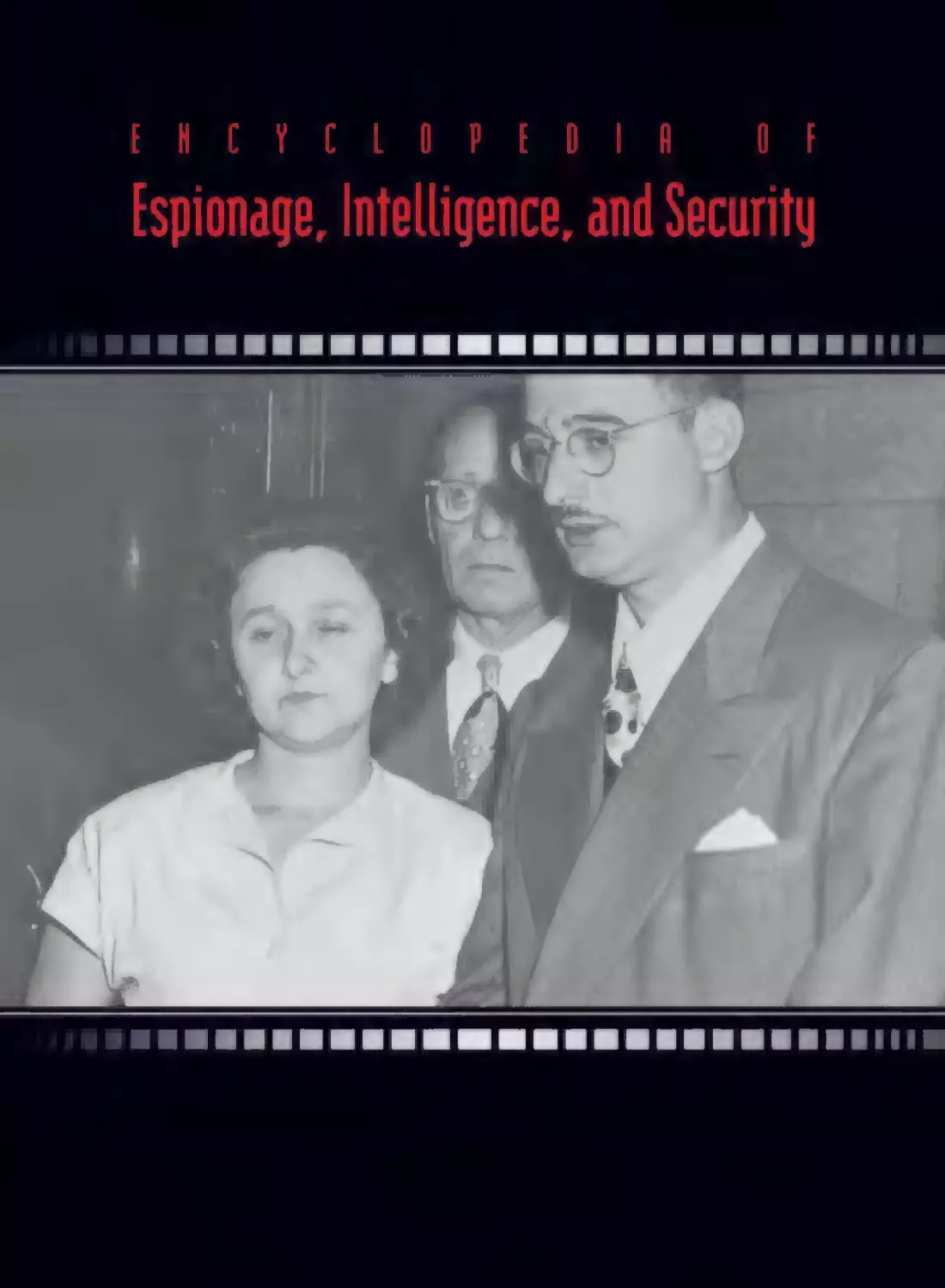
Volume 1: Ethel and Julius Rosenberg
following arraignment on charges of
espionage, August 23, 1950.
©Bettmann/Corbis
Volume 2: SR-71 Blackbird, c. 1991. ©Corbis
Volume 3: Clean-up crews scour the American
Media Inc. building in Boca Raton, Florida,
after the discovery of anthrax spores, October
9, 2001. AP/Wide World Photos.
While every effort has been made to
ensure the reliability of the information
presented in this publication, The Gale Group,
Inc. does not guarantee the accuracy of
the data contained herein. The Gale Group,
Inc. accepts no payment for listing; and
inclusion in the publication of any
organization, agency, institution, publication,
service, or individual does not imply
endorsement of the editors or publisher.
Errors brought to the attention of the
publisher and verified to the satisfaction of
the publisher will be corrected in future
editions.

Library of Congress Cataloging-in-Publication Data
Encyclopedia of espionage, intelligence, and security / K. Lee Lerner
and Brenda Wilmoth Lerner, editors.
p. cm.
Includes bibliographical references and index.
ISBN 0-7876-7546-6 (set : hardcover : alk. paper) — ISBN
0-7876-7686-1 (v. 1) — ISBN 0-7876-7687-X (v. 2) — ISBN 0-7876-7688-8
(v. 3)
1. Espionage—Encyclopedias. 2. Intelligence service—Encyclopedias.
3. Security systems—Encyclopedias. I. Lerner, K. Lee. II. Lerner,
Brenda Wilmoth.
JF1525.I6E63 2004
327.12’03—dc21
2003011097

This title is available as an e-book.
ISBN 0-7876-7762-0
Contact your Gale sales representative for ordering information.
Printed in the United States of America
10 9 8 7 6 5 4 3 2 1

❘❘❙❚❚❙❘❘

Contents

■
INTRODUCTION
■
ADVISORS AND CONTRIBUTORS
■
LIST OF ENTRIES

The Encyclopedia of Espionage,
■
Intelligence, and Security
■
GLOSSARY
■
CHRONOLOGY
■
SOURCES
■
INDEX

Encyclopedia of Espionage, Intelligence, and Security

❘❘❙❚❚❙❘❘

■
VII
■
XI
■
XIII

■

1

■
289
■
317
■
353
■
403

V

This page intentionally left blank

❘❘❙❚❚❙❘❘

Introduction

❘❘❙❚❚❙❘❘

In composing The Encyclopedia of Espionage, Intelligence,
and Security (EEIS), our goal was to shape a modern
encyclopedia offering immediate value to our intended
readers by emphasizing matters of espionage, intelligence,
and security most frequently in the news.

Big Brother and the deliberately blind eye lie the shadows
into which terrorists often slip.

EEIS is not intended as a classical “spy book,” filled
with tales of daring operations. Instead, within a framework of historical overviews, EEIS emphasizes the scientific foundations, applications of technology, and organizational structure of modern espionage, intelligence, and
security. High school and early undergraduate students
can use this book to expand upon their developing awareness of the fundamentals of science, mathematics, and
government as they begin the serious study of contemporary issues.

It seems inevitable that within the first half of the
twenty-first century, biological weapons may eclipse nuclear and chemical weapons in terms of potential threats
to civilization. Because informed and reasoned public
policy debates on issues of biological warfare and
bioterrorism can only take place when there is a fundamental understanding of the science underpinning competing arguments, EEIS places special emphasis on the
multifaceted influence and applications of the biological
sciences and emerging biometric technologies. Future
generations of effective intelligence and law enforcement
officers seeking to thwart the threats posed by tyrants,
terrorists, and the technologies of mass destruction might
be required to be as knowledgeable in the terminology of
epidemiology as they are with the tradecraft of espionage.

EEIS is also intended to serve more advanced readers
as a valuable quick reference and as a foundation for
advanced study of current events.
EEIS devotes an extensive number of articles to agencies and strategies involved in emerging concepts of homeland security in the United States. Faced with a daunting
amount of information provided by agencies, organizations, and institutes seeking to put their best foot forward,
we have attempted to allocate space to the topics comprising EEIS based upon their relevance to some unique facet
of espionage, intelligence, or security—especially with
regard to science and technology issues—as opposed to
awarding space related to power of the agency or availability of material.
A fundamental understanding of science allows citizens to discern hype and disregard hysteria, especially
with regard to privacy issues. Spy satellites powerful
enough to read the details of license plates do so at peril of
missing events a few steps away. With regard to electronic intercepts, the capability to identify what to carefully examine—often a decision driven by mathematical
analysis—has become as essential as the capacity to gather
the intelligence itself. Somewhere between the scrutiny of

Encyclopedia of Espionage, Intelligence, and Security

With an emphasis on the realistic possibilities and
limitations of science, we hope that EEIS finds a useful and
unique place on the reference shelf.

Knowledge is power. In a time where news can overwhelm and in fact, too easily mingle with opinion, it is our
hope that EEIS will provide readers with greater insight to
measure vulnerability and risks, and correspondingly, an
increased ability to make informed judgments concerning
the potential benefits and costs of espionage, intelligence,
and security matters.
❚ K. LEE LERNER & BRENDA WILMOTH LERNER, EDITORS
CORNWALL, U.K.
MAY, 2003

How to Use the Book
The Encyclopedia of Espionage, Intelligence, and Security was not intended to contain a compendium of weapons systems. Although EEIS carries brief overviews of
specifically selected systems commonly used in modern
intelligence operations, readers interested in detailed information regarding weapons systems are recommended
VII

Introduction
to Jane’s Strategic Weapon Systems, or Jane’s Defense
Equipment Library.
Although EEIS contains overview of significant historical periods and events, for those readers interested in
additional information regarding the history of espionage
operations and biographies of intelligence personnel, the
editors recommend Jeffrey T. Richelson’s A Century of
Spies : Intelligence in the Twentieth Century (Oxford University Press, 1995), Vincent Buranelli and Nan Buranelli’s
Spy/Counterspy: An Encyclopedia of Espionage (New York:
McGraw-Hill, 1982), and Allen Dulles’, The Craft of Intelligence (New York: Harper & Row, 1963).
The articles in EEIS are meant to be understandable
by anyone with a curiosity about topics in espionage,
intelligence, and security matters, and this first edition of
the book has been designed with ready reference in mind:
❚ Entries are arranged alphabetically. In an effort to

facilitate easy use of this encyclopedia, and to attempt order in a chaotic universe of names and acronyms the editors have adopted a “common use”
approach. Where an agency, organization, or program is known best by its acronym, the entry related
to that organization will be listed by the acronym (e.g.
FEMA is used instead of Federal Emergency Management Agency). To facilitate use, the editors have
included a number of “jumps” or cross-referenced
titles that will guide readers to desired entries.
❚ To avoid a log jam of terms starting with “Federal”

and “United States,” titles were broken to most accurately reflect the content emphasized or subject of
agency authority.
❚ “See Also” references at the end of entries alert the

readers to related entries not specifically mentioned
in the body of the text that may provide additional or
interesting resource material.
❚ An extensive Glossary of terms and acronyms is

included to help the reader navigate the technical
information found in EEIS.
❚ The Chronology includes significant events related to

the content of the encyclopedia. Often accompanied
by brief explanations, the most current entries date
represent events that occurred just as EEIS went
to press.
❚ A Sources section lists the most worthwhile print

material and web sites we encountered in the compilation of this volume. It is there for the inspired reader
who wants more information on the people and discoveries covered in this volume.
❚ A comprehensive general Index guides the reader to

topics and persons mentioned in the book. Bolded
page references refer the reader to the term’s full entry.
❚ The editors and authors have attempted to explain

scientific concepts clearly and simply, without sacrificing fundamental accuracy. Accordingly, an advanced understanding of physics, chemistry, or biochemistry is not assumed or required. Students and
other readers should not, for example, be intimidated
or deterred by the complex names of biochemical
VIII

molecules—where necessary for complete understanding, sufficient information regarding scientific
terms is provided.
❚ To the greatest extent possible we have attempted to

use Arabic names instead of their Latinized versions.
Where required for clarity we have included Latinized
names in parentheses after the Arabic version. Alas,
we could not retain some diacritical marks (e.g. bars
over vowels, dots under consonants). Because there
is no generally accepted rule or consensus regarding
the format of translated Arabic names, we have
adopted the straightforward, and we hope sensitive,
policy of using names as they are used or cited in
their region of origin.
❚ EEIS relies on open source material and no classified

or potentially dangerous information is included. Articles have been specifically edited to remove potential
“how to” information. All articles have been prepared and reviewed by experts who were tasked with
ensuring accuracy, appropriateness, and accessibility of language.
❚ With regard to entries regarding terrorist organiza-

tions, EEIS faced a serious dilemma. For obvious
reasons, it was difficult to obtain balanced, impartial,
and independently verifiable information regarding
these organizations, nor could EEIS swell to incorporate lengthy scholarly analysis and counter-analysis
of these organizations without losing focus on science and technology issues. As a compromise intended to serve students and readers seeking initial
reference materials related to organizations often in
the news, EEIS incorporates a series of supplemental
articles to convey the information contained in the
U.S. Department of State annual report to Congress
titled, Patterns of Global Terrorism, 2001. These articles contain the language, assertions of fact, and
views of the U.S. Department of State. Readers are
encouraged to seek additional information from current U.S. Department of State resources and independent non-governmental scholarly publications that
deal with the myriad of issues surrounding the nature
and activities of alleged terrorist organizations. A
number of governmental and non-governmental publications that deal with these issues are cited in the
bibliographic sources section located near the index.
Key EEIS articles are signed by their authors. Brief
entries were compiled by experienced researchers and
reviewed by experts. In the spirit of numerous independent scientific watchdog groups, during the preparation of
EEIS no contributors held a declared affiliation with any
intelligence or security organization. This editorial policy
not only allowed a positive vetting of contributors, but
also assured an independence of perspective and an emphasis on the fundamentals of science as opposed to
unconfirmable “insider” information.
When the only verifiable or attributable source of
information for an entry comes from documents or information provided by a governmental organization (e.g., the
U.S. Department of State), the editors endeavored to
carefully note when the language used and perspective
offered was that of the governmental organization.

Encyclopedia of Espionage, Intelligence, and Security

Introduction
Although some research contributors requested anonymity, no pseudonyms are used herein.

Acknowledgments
The editors wish to thank Herbert Romerstein, former
USIA Soviet Disinformation Officer and Coordinator of
Programs to Counter Soviet Active Measures, United States
Information Agency, for his assistance in compiling selected articles.
The editors wish to thank Lee Wilmoth Lerner for his
assistance in compiling technical engineering data for
inclusion in EEIS.
The editors acknowledge the assistance of the members of the Federation of American Scientists for the
provision of reports and materials used in the preparation
of selected articles.
Although certainly not on the scale of the challenge to
provide security for a nation with approximately 85 deepdraft ports, 600,000 bridges, 55,000 independent water
treatment systems, 100 nuclear power plants, and countless miles of tunnels, pipelines, and electrical and communications infrastructure, the task of incorporating changes
brought on by creation of the Department of Homeland
Security—and the most massive reorganization of the
United States government since World War II—as this
book went to press provided a unique challenge to EEIS

Encyclopedia of Espionage, Intelligence, and Security

writers and advisors. The editors appreciate their dedication and willingness to scrap copy, roll up their sleeves,
and tackle anew the smorgasbord of name and terminology changes.
As publishing deadlines loomed, EEIS was also well
served by a research staff dedicated to incorporating the
latest relevant events—especially information related to
the search for weapons of mass destruction—that took
place during war in Iraq in March and April of 2003.
EEIS advisors, researchers, and writers tenaciously
attempted to incorporate the most current information
available as EEIS went to press. The editors pass any
credit or marks for success in that effort, and reserve for
themselves full responsibility for omissions.
The editors gratefully acknowledge the assistance of
many at St. James Press for their help in preparing The
Encyclopedia of Espionage, Intelligence, and Security.
The editors extend thanks to Mr. Peter Gareffa and Ms.
Meggin Condino for their faith in this project. Most directly, the editors wish to acknowledge and thank the
project editor, Mr. Stephen Cusack, for his talented oversight and for his tireless quest for secure engaging pictures for EEIS.
The editors lovingly dedicate this book to the memory
of Wallace Schaffer, Jr., HM3, USNR, who died on January
8, 1968, in Thua Thien (Hue) Province, Vietnam.
“A small rock holds back a great wave.”—Homer, The
Odyssey.

IX

This page intentionally left blank

❘❘❙❚❚❙❘❘

Advisors and Contributors

Julie Berwald, Ph.D.
Geophysicist, writer on marine science,
environmental biology, and issues in geophysics.
Austin, Texas
Robert G. Best, Ph.D.
Clinical cytogeneticist and medical geneticist who
has written on a range of bioscience issues
Director, Division of Genetics
University of South Carolina School of Medicine
Tim Borden, Ph.D.
Doctorate in History from Indiana University, and is
an inspector with the U.S. Bureau of Customs
and Border Protection
Toledo, Ohio
Brian Cobb, Ph.D.
Bioscience writer, researcher
Institute for Molecular and Human Genetics
Georgetown University, Washington, D.C.
Cecilia Colomé, Ph.D.
Astrophysicist, translator, and science writer
Austin, Texas
Laurie Duncan, Ph.D.
Geologist, science writer, and researcher
Austin, Texas
William J. Engle, P.E.
Writer on contemporary geophysics issues and the
impacts of science and technology on history
Exxon-Mobil Oil Corporation (Rt.) New Orleans,
Louisiana
Antonio Farina, M.D., Ph.D.
Physician, researcher, and writer on medical
science issues
Assistant Professor, University of Bologna, Italy
Christopher T. Fisher, Ph.D.
Assistant Professor, Department of African
American Studies and the Department of History
The College of New Jersey, Ewing, New Jersey

Encyclopedia of Espionage, Intelligence, and Security

❘❘❙❚❚❙❘❘

Larry Gilman, Ph.D.
Electrical engineer and science writer
Sharon, Vermont
William Haneberg, Ph.D.
Former research scientist and professor, now an
independent consulting geologist and science
writer
Portland, Oregon
Brian D. Hoyle, Ph.D.
Science writer and Chief Microbiologist,
Government of New Brunswick from 1993 to
1997
Nova Scotia, Canada
Joseph Patterson Hyder
Writer on the historical impacts of science and
technology
University of Tennessee College of Law, Knoxville,
Tennessee
Alexandr Ioffe, Ph.D.
Writer on the history of science and researcher
with the Geological Institute of Russian Academy
of Sciences in Moscow
Russian Academy of Sciences, Moscow
Judson Knight
Science writer, researcher, and editor
Knight Agency Research Services, Atlanta, Georgia
Michael Lambert, Ph.D.
Researcher at the Great Plains/Rocky Mountain
Hazardous Substance Research Center and at the
U.S. Naval Research Laboratory
Manhattan, Kansas
Adrienne Wilmoth Lerner
Writer of various articles on the history of science,
archaeology, and the evolution of securityrelated law
University of Tennessee College of Law, Knoxville,
Tennessee
XI

Advisors and Contributors
Agnes Lichanska, Ph.D.
Science writer who has conducted research at
the Department of Medical Genetics and
Ophthalmology at Queen’s University of Belfast
(Northern Ireland)
University of Queensland, Brisbane, Australia

Morgan Simpson
Aerospace Engineer
National Aeronautical and Space Administration
(NASA)
Kennedy Space Center, Cape Canaveral, Florida

Eric v.d. Luft, Ph.D., M.L.S.
Writer on cultural, scientific, and intellectual
history, and philosophy
Curator of Historical Collections
SUNY Upstate Medical University, Syracuse, New
York

Constance K. Stein, Ph.D.
Writer on medical and bioscience issues related to
modern genetics
Director of Cytogenetics, Assistant Director of
Molecular Diagnostics
SUNY Upstate Medical University, Syracuse, New
York

Martin Manning
Served on the Economic Security Team, Office
of International Information Programs, U.S.
Department of State
Bureau of Public Diplomacy
U.S. Department of State, Washington, D.C.
Kelli Miller
Served as news writer and producer for Inside
Science TV News at the American Institute of
Physics (AIP) and as executive producer of
Discoveries & Breakthroughs Inside Science
Atlanta, Georgia
Caryn E. Neumann
Instructor and doctoral candidate in the
Department of History at Ohio State University
Columbus, Ohio
Mike O’Neal, Ph.D.
Independent scholar and writer
Moscow, Idaho
Belinda M. Rowland, Ph.D.
Science and medical writer
Voorheesville, New York
Judyth Sassoon, Ph.D., ARCS
Science writer with research experience in NMR
and X-ray crystallography techniques
Department of Biology & Biochemistry
University of Bath, United Kingdom

XII

Tabitha Sparks, Ph.D.
Marion L. Brittain fellow, Georgia Institute of
Technology and Fellow, Center for Humanistic
Inquiry, Emory University
Atlanta, Georgia
David Tulloch
Science and technology writer
Wellington, New Zealand
Michael T. Van Dyke, Ph.D.
Served as visiting assistant professor, Department
of American Thought & Language
Michigan State University, East Lansing, Michigan
Stephanie Watson
Science writer specializing in the social impacts of
science and technology
Smyrna, Georgia
Simon Wendt, Ph.D.
Ph.D. candidate in Modern History and History
instructor
John F. Kennedy Institute for North American
Studies, Free University of Berlin, Germany

Encyclopedia of Espionage, Intelligence, and Security

❘❘❙❚❚❙❘❘

List of Entries

❘A❘
Abu Nidal Organization (ANO)
Abu Sayyaf Group (ASG)
Abwehr
ADFGX Cipher
Aflatoxin
Africa, Modern U.S. Security Policy and
Interventions
Agent Orange
Air and Water Purification, Security Issues
Air Force Intelligence, United States
Air Force Office of Special Investigations, United
States
Air Marshals, United States
Air Plume and Chemical Analysis
Aircraft Carrier
Airline Security
Al-Aqsa Martyrs Brigade
Alex Boncayao Brigade (ABB)
Al-Gama’a al-Islamiyya (Islamic Group, IG)
Al-Ittihad al-Islami (AIAI)
Al-Jama’a al-Islamiyyah al-Muqatilah bi-Libya
Al-Jihad
Allied Democratic Forces (ADF)
Al-Qaeda (also known as Al-Qaida)
Americas, Modern U.S. Security Policy and
Interventions
Ames (Aldrich H.) Espionage Case
Anthrax
Anthrax, Terrorist Use as a Biological Weapon
Anthrax Vaccine
Anthrax Weaponization
Antiballistic Missile Treaty
Antibiotics
Anti-Imperialist Territorial Nuclei (NTA)
APIS (Advance Passenger Information System)
Archeology and Artifacts, Protection of during War
Architecture and Structural Security
Area 51 (Groom Lake, Nevada)
Argentina, Intelligence and Security
Argonne National Laboratory
Armed Islamic Group (GIA)
Arms Control, United States Bureau

Encyclopedia of Espionage, Intelligence, and Security

❘❘❙❚❚❙❘❘

Army for the Liberation of Rwanda (ALIR)
Army Security Agency
’Asbat al-Ansar
Asilomar Conference
Assassination
Assassination Weapons, Mechanical
Asymmetric Warfare
ATF (United States Bureau of Alcohol, Tobacco,
and Firearms)
Atmospheric Release Advisory Capability (ARAC)
Audio Amplifiers
Aum Supreme Truth (Aum)
Australia, Intelligence and Security
Austria, Intelligence and Security
Aviation Intelligence, History
Aviation Security Screeners, United States

❘B❘
B-2 Bomber
B-52
Bacterial Biology
Ballistic Fingerprints
Ballistic Missile Defense Organization, United
States
Ballistic Missiles
Balloon Reconnaissance, History
Basque Fatherland and Liberty (ETA)
Bathymetric Maps
Bay of Pigs
Belgium, Intelligence and Security Agencies
Belly Buster Hand Drill
Berlin Airlift
Berlin Tunnel
Berlin Wall
Biochemical Assassination Weapons
Biocontainment Laboratories
Biodetectors
Bio-Engineered Tissue Constructs
Bio-Flips
Biological and Biomimetic Systems
Biological and Toxin Weapons Convention
Biological Input/Output Systems (BIOS)
XIII

List of Entries
Biological Warfare
Biological Warfare, Advanced Diagnostics
Biological Weapons, Genetic Identification
Bio-Magnetics
Biomedical Technologies
Biometrics
Bio-Optic Synthetic Systems (BOSS)
Biosensor Technologies
BioShield Project
Bioterrorism
Bioterrorism, Protective Measures
Black Chamber
Black Ops
Black Tom Explosion
Bletchley Park
Bolivia, Intelligence and Security
Bomb Damage, Forensic Assessment
Bomb Detection Devices
Bombe
Bosnia and Herzegovina, Intelligence and Security
Botulinum Toxin
Brain-Machine Interfaces
Brain Wave Scanners
Brazil, Intelligence and Security
British Terrorism Act
Brookhaven National Laboratory
Bubonic Plague
Bugs (Microphones) and Bug Detectors
Bush Administration (1989–1993), United States
National Security Policy
Bush Administration (2001–), United States
National Security Policy

❘C❘
Cambodian Freedom Fighters (CFF)
Cambridge University Spy Ring
Cameras
Cameras, Miniature
Canada, Counter-Terrorism Policy
Canada, Intelligence and Security
Canine Substance Detection
Carter Adminstration (1977–1981), United States
National Security Policy
CDC (United States Centers for Disease Control
and Prevention)
CERN
Chechen-Russian Conflict
Chemical and Biological Defense Information
Analysis Center (CBIAC)
Chemical and Biological Detection Technologies
Chemical Biological Incident Response Force,
United States
Chemical Safety and Hazard Investigation Board
(USCSB), United States
Chemical Safety: Emergency Responses
Chemical Warfare
Chemistry: Applications in Espionage, Intelligence,
and Security Issues
Chernobyl Nuclear Power Plant Accident, Detection
and Monitoring
Chile, Intelligence and Security
China, Intelligence and Security
XIV

Chinese Espionage against the United States
Church Committee
CIA (United States Central Intelligence Agency)
CIA (CSI), Center for the Study of Intelligence
CIA Directorate of Science and Technology (DS&T)
CIA, Foreign Broadcast Information Service
CIA, Formation and History
CIA, Legal Restriction
Cipher Disk
Cipher Key
Cipher Machines
Cipher Pad
Civil Aviation Security, United States
Civil War, Espionage and Intelligence
Classified Information
Clinton Administration (1993–2001), United States
National Security Policy
Clipper Chip
Closed-Circuit Television (CCTV)
Coast Guard (USCG), United States
Coast Guard National Response Center
Code Name
Code Word
Codes and Ciphers
Codes, Fast and Scalable Scientific Computation
COINTELPRO
Cold War (1945–1950), The Start of the Atomic Age
Cold War (1950–1972)
Cold War (1972–1989): The Collapse of the Soviet
Union
Colombia, Intelligence and Security
Colossus I
COMINT (Communications Intelligence)
Commerce Department Intelligence and Security
Responsibilities, United States
Commission on Civil Rights, United States
Communicable Diseases, Isolation, and Quarantine
Communications System, United States National
Comprehensive Test Ban Treaty (CTBT)
Computer and Electronic Data Destruction
Computer Fraud and Abuse Act of 1986
Computer Hackers
Computer Hardware Security
Computer Keystroke Recorder
Computer Modeling
Computer Security Act (1987)
Computer Software Security
Computer Virus
Concealment Devices
Consumer Product Safety Commission (CPSC),
United States
Continuity Irish Republican Army (CIRA)
Continuity of Government, United States
Continuous Assisted Performance (CAP)
Coordinator for Counterterrorism, United States
Office
Copyright Security
Counterfeit Currency, Technology and the
Manufacture
Counter-Intelligence
Counter-Terrorism Rewards Program
Covert Operations
Crib
Crime Prevention, Intelligence Agencies

Encyclopedia of Espionage, Intelligence, and Security

List of Entries
Critical Infrastructure
Critical Infrastructure Assurance Office (CIAO),
United States
Croatia, Intelligence and Security
Cruise Missile
Cryptology and Number Theory
Cryptology, History
Cryptonym
Cuba, Intelligence and Security
Cuban Missile Crisis
Customs Service, United States
Cyanide
Cyber Security
Cyber Security Warning Network
Czech Republic, Intelligence and Security

❘D❘
D Notice
DARPA (Defense Advanced Research Projects
Agency)
Data Mining
DCI (Director of the Central Intelligence Agency)
DEA (Drug Enforcement Administration)
Dead Drop Spike
Dead-Letter Box
Decontamination Methods
Decryption
Defense Information Systems Agency, United
States
Defense Nuclear Facilities Safety Board, United
States
Defense Security Service, United States
Delta Force
Department of State Bureau of Intelligence and
Research, United States
Department of State, United States
DIA (Defense Intelligence Agency)
Dial Tone Decoder
Diplomatic Security (DS), United States Bureau
Dirty Tricks
Disinformation
DNA
DNA Fingerprinting
DNA Recognition Instruments
DNA Sequences, Unique
Document Destruction
Document Forgery
DOD (United States Department of Defense)
DOE (United States Department of Energy)
Domestic Emergency Support Team, United States
Domestic Intelligence
Domestic Preparedness Office (NDPO), United
States National
Doo Transmitter
Dosimetry
Double Agents
Drop
Drug Control Policy, United States Office of
National
Drug Intelligence Estimates
Dual Use Technology

Encyclopedia of Espionage, Intelligence, and Security

❘E❘
E-2C
Ebola Virus
E-Bomb
Echelon
Economic Espionage
Economic Intelligence
Egypt, Intelligence and Security
Eichmann, Adolf: Israeli Capture
Eisenhower Administration (1953–1961), United
States National Security Policy
El Salvador, Intelligence and Security
Electromagnetic Pulse
Electromagnetic Spectrum
Electromagnetic Weapons, Biochemical Effects
Electronic Communication Intercepts, Legal Issues
Electronic Countermeasures
Electronic Warfare
Electro-Optical Intelligence
Electrophoresis
EM Wave Scanners
Emergency Response Teams
Encryption of Data
Enduring Freedom, Operation
Energy Directed Weapons
Energy Regulatory Commission, United States
Federal
Energy Technologies
Engraving and Printing, United States Bureau
Engulf, Operation
Enigma
Entry-Exit Registration System, United States
National Security
Environmental Issues Impact on Security
Environmental Measurements Laboratory
EPA (Environmental Protection Agency)
Epidemiology
Espionage
Espionage Act of 1917
Espionage and Intelligence, Early Historical
Foundations
Estonia, Intelligence and Security
European Union
Executive Orders and Presidential Directives
Explosive Coal

❘F❘
F-117A Stealth Fighter
FAA (United States Federal Aviation
Administration)
Facility Security
FBI (United States Federal Bureau of Investigation)
FCC (United States Federal Communications
Commission)
FDA (United States Food and Drug Administration)
Federal Protective Service, United States
Federal Reserve System, United States
FEMA (United States Federal Emergency
Management Agency)
FEST (United States Foreign Emergency Support
Team)
XV

List of Entries
Fingerprint Analysis
Finland, Intelligence and Security
First of October Anti-fascist Resistance Group
(GRAPO)
FISH (German Geheimschreiber Cipher Machine)
Fission
Flame Analysis
Flight Data Recorders
FM Transmitters
FOIA (Freedom of Information Act)
Food Supply, Counter-Terrorism
Ford Administration (1974–1977), United States
National Security Policy
Foreign Assets Control (OFAC), United States
Office
Foreign Intelligence Surveillance Act
Foreign Intelligence Surveillance Court of Review
Forensic Geology in Military or Intelligence
Operations
Forensic Science
Forensic Voice and Tape Analysis
France, Counter-Terrorism Policy
France, Intelligence and Security
French Underground during World War II,
Communication and Codes
Fusion

❘G❘
G–2
GAO (General Accounting Office, United States)
Gas Chromatograph-Mass Spectrometer
General Services Administration, United States
Genetic Code
Genetic Information: Ethics, Privacy and Security
Issues
Genetic Technology
Genomics
Geologic and Topographical Influences on Military
and Intelligence Operations
Geospatial Imagery
Germany, Counter-Terrorism Policy
Germany, Intelligence and Security
Gestapo
GIS
Global Communications, United States Office
Glomar Explorer
Government Ethics (USOGE), United States Office
GPS
Great Game
Greece, Intelligence and Security
GSM Encryption
Guatemala, Intelligence and Security
Guerilla Warfare

❘H❘
HAMAS (Islamic Resistance Movement)
Hanssen (Robert) Espionage Case
Harakat ul-Jihad-I-Islami (HUJI) (Movement of
Islamic Holy War)
XVI

Harakat ul-Jihad-I-Islami/Bangladesh (HUJI-B)
(Movement of Islamic Holy War)
Harakat ul-Mujahidin (HUM) (Movement of Holy
Warriors)
Hardening
Health and Human Services Department, United
States
Heavy Water Technology
Hemorrhagic Fevers and Diseases
Hizballah (Party of God)
Homeland Security, United States Department of
HUMINT (Human Intelligence)
Hungary, Intelligence and Security
Hypersonic Aircraft

❘I❘
IBIS (Interagency Border Inspection System)
IDENT (Automated Biometric Identification System)
Identity Theft
IFF (Identification Friend or Foe)
IMF (International Monetary Fund)
IMINT (Imagery Intelligence)
India, Intelligence and Security
Indonesia, Intelligence and Security
Infectious Disease, Threats to Security
Information Security
Information Security (OIS), United States Office of
Information Warfare
Infrared Detection Devices
Infrastructure Protection Center (NIPC), United
States National
INS (United States Immigration and Naturalization
Service)
INSCOM (United States Army Intelligence and
Security Command)
INSPASS (Immigration and Naturalization Service
Passenger Accelerated Service System)
Inspector General (OIG), Office of the
Intelligence
Intelligence Agent
Intelligence and Counterespionage Careers
Intelligence and Democracy: Issues and Conflicts
Intelligence and International Law
Intelligence and Law Enforcement Agencies
Intelligence & Research (INR), United States
Bureau of
Intelligence Authorization Acts, United States
Congress
Intelligence Community
Intelligence Literature
Intelligence Officer
Intelligence Policy and Review (OIPR), United
States Office of
Intelligence Support, United States Office of
Intelligence, United States Congressional
Oversight of
Interagency Security Committee, United States
Internal Revenue Service, United States
International Atomic Energy Agency (IAEA)
International Narcotics and Law Enforcement
Affairs (INL), United States Bureau of

Encyclopedia of Espionage, Intelligence, and Security

List of Entries
Internet
Internet: Dynamic and Static Addresses
Internet Spam and Fraud
Internet Spider
Internet Surveillance
Internet Tracking and Tracing
INTERPOL (International Criminal Police
Organization)
Interpol, United States National Central Bureau
Interrogation
Interrogation: Torture Techniques and
Technologies
Iran-Contra Affair
Iran, Intelligence and Security
Iranian Hostage Crisis
Iranian Nuclear Programs
Iraq, Intelligence and Security Agencies in
Iraq War: Prelude to War (The International Debate
Over the Use and Effectiveness of Weapons
Inspections)
Iraq War (Immediate Aftermath)
Iraqi Freedom, Operation (2003 War Against Iraq)
Ireland, Intelligence and Security
Irish Republican Army (IRA)
Islamic Army of Aden (IAA)
Islamic Movement of Uzbekistan (IMU)
Isotopic Analysis
Israel, Counter-Terrorism Policy
Israel, Intelligence and Security
Italy, Intelligence and Security

❘J❘
Jaish-e-Mohammed (JEM) (Army of Mohammed)
Japan, Intelligence and Security
Japanese Red Army (JRA)
JDAM (Joint Direct Attack Munition)
Jemaah Islamiya (JI)
Johnson Administration (1963–1969), United States
National Security Policy
Joint Chiefs of Staff, United States
Jordan, Intelligence and Security
J-STARS
Justice Department, United States

❘K❘
Kahane Chai (Kach)
Kennedy Administration (1961–1963), United States
National Security Policy
Kenya, Bombing of United States Embassy
KGB (Komitet Gosudarstvennoi Bezopasnosti,
USSR Committee of State Security)
Khobar Towers Bombing Incident
Knives
Korean War
Kosovo, NATO Intervention
Kumpulan Mujahidin Malaysia (KMM)
Kurdistan Workers’ Party (PKK)
Kuwait Oil Fires, Persian Gulf War

Encyclopedia of Espionage, Intelligence, and Security

❘L❘
Language Training and Skills
Laser
Laser Listening Devices
Lashkar-e-Tayyiba (LT) (Army of the Righteous)
Law Enforcement, Responses to Terrorism
Law Enforcement Training Center (FLETC), United
States Federal
Lawrence Berkeley National Laboratory (LBL)
Lawrence Livermore National Laboratory (LLNL)
League of Nations
Lebanon, Bombing of U.S. Embassy and Marine
Barracks
Less-Lethal Weapons Technology
L-Gel Decontamination Reagent
Liberation Tigers of Tamil Eelam (LTTE)
Libraries and Information Science (NCLIS), United
States National Commission on
Libya, Intelligence and Security
Libya, U.S. Attack (1986)
LIDAR (Light Detection and Ranging)
Lock-Picking
Locks and Keys
Looking Glass
Lord Haw-Haw
Lord’s Resistance Army (LRA)
Los Alamos National Laboratory
Loyalist Volunteer Force (LVF)

❘M❘
Mail Sanitization
Malicious Data
Manhattan Project
Mapping Technology
Marine Mammal Program
McCarthyism
Measurement and Signatures Intelligence
(MASINT)
Metal Detectors
Meteorology and Weather Alteration
Mexico, Intelligence and Security
MI5 (British Security Service)
MI6 (British Secret Intelligence Service)
Microbiology: Applications to Espionage,
Intelligence, and Security
Microchip
Microfilms
Microphones
Microscopes
Microwave Weaponry, High Power (HPM)
Middle East, Modern U.S. Security Policy and
Interventions
Military Police, United States
MOAB (Massive Ordnance Air Burst Bomb)
Molecular Biology: Applications to Espionage,
Intelligence, and Security
Moles
Monroe Doctrine
Morocco, Intelligence and Security
Mossad
Motion Sensors
XVII

List of Entries
Mount Weather
Movies, Espionage and Intelligence Portrayals
Mujahedin-e Khalq Organization (MEK or MKO)
Mustard Gas

❘N❘
NAILS (National Automated Immigration Lookout
System)
Nanotechnology
Napoleonic Wars, Espionage during
NASA (National Air and Space Administration)
National Archives and Records Administration
(NARA),Unites States
National Command Authority
National Drug Threat Assessment
National Information Infrastructure Protection Act,
United States
National Intelligence Estimate
National Interagency Civil-Military Institute (NICI),
United States
National Liberation Army (ELN)—Colombia
National Military Joint Intelligence Center
National Preparedness Strategy, United States
National Response Team, United States
National Security Act (1947)
National Security Advisor, United States
National Security Strategy, United States
National Security Telecommunications Advisory
Committee
National Telecommunications Information
Administration, and Security for the Radio
Frequency Spectrum, United States
NATO (North Atlantic Treaty Organization)
Natural Resources and National Security
Navy Criminal Investigative Service (NCIS)
NCIX (National Counterintelligence Executive),
United States Office of the
NDIC (Department of Justice National Drug
Intelligence Center)
Near Space Environment
Nerve Gas
Netherlands, Intelligence and Security
New People’s Army (NPA)
New Zealand, Intelligence and Security
NFIB (United States National Foreign Intelligence
Board)
NIC (National Intelligence Council)
Nicaragua, Intelligence and Security
Nigeria, Intelligence and Security
Night Vision Scopes
NIH (National Institutes of Health)
NIJ (National Institute of Justice)
NIMA (National Imagery and Mapping Agency)
NIMH (National Institute of Mental Health)
NIST (National Institute of Standards and
Technology), United States
NIST Computer Security Division, United States
Nixon Administration (1969–1974), United States
National Security Policy
NMIC (National Maritime Intelligence Center)
NNSA (United States National Nuclear Security
Administration)
XVIII

NOAA (National Oceanic & Atmospheric
Administration)
Noise Generators
Nongovernmental Global Intelligence and Security
Non-Proliferation and National Security, United
States
NORAD
North Korea, Intelligence and Security
North Korean Nuclear Weapons Programs
Norway, Intelligence and Security
NRO (National Reconnaissance Office)
NSA (United States National Security Agency)
NSC (National Security Council)
NSC (National Security Council), History
NSF (National Science Foundation)
NTSB (National Transportation Safety Board)
Nuclear Detection Devices
Nuclear Emergency Support Team, United States
Nuclear Power Plants, Security
Nuclear Reactors
Nuclear Regulatory Commission (NRC), United
States
Nuclear Spectroscopy
Nuclear Weapons
Nuclear Winter
Nucleic Acid Analyzer (HANAA)

❘O❘
Oak Ridge National Laboratory (ORNL)
Official Secrets Act, United Kingdom
OPEC (Organization of Petroleum Exporting
Countries)
Operation Liberty Shield
Operation Magic
Operation Mongoose
Operation Shamrock
Orange Volunteers (OV)
OSS (United States Office of Strategic Services)

❘P❘
P-3 Orion Anti-Submarine Maritime
Reconnaissance Aircraft
Pacific Northwest National Laboratory
Pakistan, Intelligence and Security
Palestine Islamic Jihad (PIJ)
Palestine Liberation Front (PLF)
Palestinian Authority, Intelligence and Security
PanAm 103, (Trial of Libyan Intelligence Agents)
Panama Canal
Parabolic Microphones
Pathogen Genomic Sequencing
Pathogen Transmission
Pathogens
Patriot Act Terrorist Exclusion List
Patriot Act, United States
Patriot Missile System
Pearl Harbor, Japanese Attack on
People Against Gangsterism and Drugs (PAGAD)
Persian Gulf War
Peru, Intelligence and Security

Encyclopedia of Espionage, Intelligence, and Security

List of Entries
Petroleum Reserves, Determination
PFIAB (President’s Foreign Intelligence Advisory
Board)
Phoenix Program
Photo Alteration
Photographic Interpretation Center (NPIC), United
States National
Photographic Resolution
Photography, High-Altitude
Playfair Cipher
Plum Island Animal Disease Center
Poland, Intelligence and Security
Politics: The Briefings of United States Presidential
Candidates
Pollard Espionage Case
Polygraphs
Polymerase Chain Reaction (PCR)
Popular Front for the Liberation of Palestine (PFLP)
Popular Front for the Liberation of PalestineGeneral Command (PFLP-GC)
Port Security
PORTPASS (Port Passenger Accelerated Service
System)
Portugal, Intelligence and Security
Postal Security
Postal Service (USPS), United States
Potassium Iodide
President of the United States (Executive
Command and Control of Intelligence Agencies)
Pretty Good Privacy (PGP)
Privacy: Legal and Ethical Issues
Profiling
Propaganda, Uses and Psychology
Pseudoscience Intelligence Studies
Psychotropic Drugs
Public Health Service (PHS), United States
Pueblo Incident
Purple Machine

❘Q❘
Quantum Physics: Applications to Espionage,
Intelligence, and Security Issues

❘R❘
RADAR
RADAR, Synthetic Aperture
Radiation, Biological Damage
Radio Direction Finding Equipment
Radio Frequency (RF) Weapons
Radioactive Waste Storage
Radiological Emergency Response Plan, United
States Federal
Reagan Administration (1981–1989), United States
National Security Policy
Real IRA (RIRA)
Reconnaissance
Red Code
Red Hand Defenders (RHD)
Red Orchestra
Remote Sensing

Encyclopedia of Espionage, Intelligence, and Security

Retina and Iris Scans
Revolutionary Armed Forces of Colombia (FARC)
Revolutionary Nuclei
Revolutionary Organization 17 November (17
November)
Revolutionary People’s Liberation Party/Front
(DHKP/C)
Revolutionary Proletarian Initiative Nuclei (NIPR)
Revolutionary United Front (RUF)
Revolutionary War, Espionage and Intelligence
RF Detection
Ricin
Robotic Vehicles
Romania, Intelligence and Security
Room 40
Rosenberg (Ethel and Julius) Espionage Case
Russia, Intelligence and Security
Russian Nuclear Materials, Security Issues

❘S❘
Sabotage
Salafist Group for Call and Combat (GSPC)
Salmonella and Salmonella Food Poisoning
Sandia National Laboratories
Sarin Gas
Satellite Technology Exports to the People’s
Republic of China (PRC)
Satellites, Non-Governmental High Resolution
Satellites, Spy
Saudi Arabia, Intelligence and Security
Scanning Technologies
SEAL Teams
Secret Service, United States
Secret Writing
Security Clearance Investigations
Security, Infrastructure Protection, and
Counterterrorism, United States National
Coordinator
Security Policy Board, United States
Seismograph
Seismology for Monitoring Explosions
Senate Select Committee on Intelligence, United
States
Sendero Luminoso (Shining Path, or SL)
SENTRI (Secure Electronic Network for Travelers’
Rapid Inspection)
September 11 Terrorist Attacks on the United
States
Sequencing
Serbia, Intelligence and Security
Sex-for-Secrets Scandal
Ships Designed for Intelligence Collection
“Shoe Bomber”
Shoe Transmitter
Short-Wave Transmitters
SIGINT (Signals Intelligence)
Silencers
Skunk Works
Slovakia, Intelligence and Security
Slovenia, Intelligence and Security
Smallpox
Smallpox Vaccine
XIX

List of Entries
SOE (Special Operations Executive)
Soldier and Biological Chemical Command
(SBCCOM), United States Army
Solid-Phase Microextraction Techniques
Soman
SONAR
SOSUS (Sound Surveillance System)
South Africa, Intelligence and Security
South Korea, Intelligence and Security
Soviet Union (USSR), Intelligence and Security
Space Shuttle
Spain, Intelligence and Security
Spanish-American War
Special Collection Service, United States
Special Counsel and Security Related
“Whistleblower” Protection Issues, United States
Office
Special Operations Command, United States
Special Relationship: Technology Sharing between
the Intelligence Agencies of the United States
and United Kingdom
Spectroscopy
Spores
SR-71 Blackbird
START I Treaty
START II
STASI
Stealth Technology
Steganography
Strategic Defense Initiative and National Missile
Defense
Strategic Petroleum Reserve, United States
Sudan, Intelligence and Security
Suez Canal
Supercomputers
Surgeon General and Nuclear, Biological, and
Chemical Defense, United States Office
Sweden, Intelligence and Security
Switzerland, Intelligence and Security
Syria, Intelligence and Security

❘T❘
Tabun
Taiwan, Intelligence and Security
Taser
Technical Intelligence
Technology Transfer Center (NTTC), Emergency
Response Technology Program
Telemetry
Telephone Caller Identification (Caller ID)
Telephone Recording Laws
Telephone Recording System
Telephone Scrambler
Telephone Tap Detector
Terror Alert System, United States
Terrorism, Domestic (United States)
Terrorism, Intelligence Based Threat and Risk
Assessments
Terrorism, Philosophical and Ideological Origins
Terrorism Risk Insurance
Terrorist and Para-State Organizations
Terrorist Organization List, United States
XX

Terrorist Organizations, Freezing of Assets
Terrorist Threat Integration Center
Thin Layer Chromatography
TIA (Terrorism Information Awareness)
Tissue-Based Biosensors
Tokyo Rose
Toxicology
Toxins
Tradecraft
Transportation Department, United States
Treasury Department, United States
Truman Administration (1945–1953), United States
National Security Policy
Truth Serum
Tularemia
Tunisian Combatant Group (TCG)
Tupac Amaru Revolutionary Movement (MRTA)
Turkey, Intelligence and Security
Turkish Hizballah
Typex

❘U❘
U-2 Incident
U-2 Spy Plane
Ukraine, Intelligence and Security
Ulster Defense Association/Ulster Freedom Fighters
(UDA/UVF)
Ultra, Operation
Underground Facilities, Geologic and Structural
Considerations in the Construction
Undersea Espionage: Nuclear vs. Fast Attack Subs
Unexploded Ordnance and Mines
United Kingdom, Counter-Terrorism Policy
United Kingdom, Intelligence and Security
United Nations Security Council
United Self-Defense Forces/Group of Colombia
(AUC Autodefensas Unidas de Colombia)
United States, Counter-Terrorism Policy
United States, Intelligence and Security
United States Intelligence, History
Unmanned Aerial Vehicles (UAVs)
Uranium
Uranium Depletion Weapons
USAMRICD (United States Army Medical Research
Institute of Chemical Defense)
USAMRIID (United States Army Medical Research
Institute of Infectious Diseases)
USS Cole
USS Liberty
USSTRATCOM (United States Strategic Command)

❘V❘
Vaccination
Vaccines
Variola Virus
Venezuela, Intelligence and Security
Venona
Vietnam War
Viral Biology

Encyclopedia of Espionage, Intelligence, and Security

List of Entries
Viral Exposure Therapy, Antiviral Drug
Development
Voice Alteration, Electronic
Voice of America (VOA), United States
Vozrozhdeniye Island, Soviet and Russian
Biochemical Facility
Vulnerability Assessments
VX Agent

❘W❘
Walker Family Spy Ring
War of 1812
Water Supply: Counter-Terrorism
Watergate
Weapon-Grade Plutonium and Uranium, Tracking
Weapons of Mass Destruction

Encyclopedia of Espionage, Intelligence, and Security

Weapons of Mass Destruction, Detection
Windtalkers
World Health Organization (WHO)
World Trade Center, 1993 Terrorist Attack
World Trade Center, 2001 Terrorist Attack
World War I
World War I: Loss of the German Codebook
World War II
World War II: Allied Invasion of Sicily and “The
Man Who Never Was”
World War II, The Surrender of the Italian Army
World War II, United States Breaking of Japanese
Naval Codes

❘Z❘
Zoonoses

XXI

This page intentionally left blank

❘❘❙❚❚❙❘❘

Abu Nidal Organization (ANO)
Abu Nidal Organization (ANO) is identified by the United
States Department of State as an international terrorist
organization led by Sabri al-Banna. Split from the Palestine Liberation Army (PLO) in 1974, the ANO is comprised
of various functional committees, including political, military, and financial committees.
The Abu Nidal Organization (ANO) also operates as,
or is known as; Fatah Revolutionary Council, Arab Revolutionary Brigades, Black September, and Revolutionary
Organization of Socialist Muslims.

Organization activities. The ANO has carried out terrorist
attacks in 20 countries, killing or injuring almost 900 persons. Targets have included the United States, the United
Kingdom, France, Israel, moderate Palestinians, the PLO,
and various Arab countries. Major attacks included the
Rome and Vienna airports in December 1985, the Neve
Shalom synagogue in Istanbul, and the Pan Am Flight 73
hijacking in Karachi in September 1986, along with the
City of Poros day-excursion ship attack in Greece in July,
1988. The ANO is suspected of assassinating PLO deputy
chief Abu Iyad and PLO security chief Abu Hul in Tunis in
January, 1991. ANO assassinated a Jordanian diplomat in
Lebanon in January, 1994, and has been linked to the
killing of the PLO representative there. As of May 2002, the
ANO has not attacked Western targets since the late 1980s.
ANO leader Abu Nidal was found dead in Baghdad, Iraq in
August 2002. Following Nidal’s death and subsequent
disruption of ANO by Operation Iraqi Freedom in 2003, the
fate of the organization remained uncertain.
Membership in the ANO is estimated at a few hundred plus a limited overseas support structure. Al-Banna
relocated to Iraq in December 1998, where the group
maintains a presence. ANO has had an operational presence in Lebanon including in several Palestinian refugee

Encyclopedia of Espionage, Intelligence, and Security

A ❘❘❙❚❚❙❘❘
camps. Financial problems and internal disorganization
have reduced the group’s activities and capabilities.
Authorities shut down the ANO’s operations in Libya and
Egypt in 1999. The ANO has demonstrated ability to operate over wide areas, including the Middle East, Asia, and
Europe. They have also received considerable support,
including safe haven, training, logistic assistance, and
financial aid from Iraq, Libya, and Syria (until 1987), in
addition to close support for selected operations.

❚

FURTHER READING:
ELECTRONIC:

Central Intelligence Agency. World Factbook, 2002. <http://
www.cia.gov/cia/publications/factbook/> (April 16, 2003).
Taylor, Francis X. U.S. Department of State. Patterns of
Global Terrorism 2001, Annual Report: On the record
briefing. May 21, 2002 <http://www.state.gov/s/ct/rls/
rm/10367.htm> (April 17,2003).
U.S. Department of State. Annual reports. <http://www.
state.gov/www/global/terrorism/annual_reports.html>
(April 16, 2003).

SEE ALSO
Terrorism, Philosophical and Ideological Origins
Terrorist and Para-State Organizations
Terrorist Organization List, United States
Terrorist Organizations, Freezing of Assets

Abu Sayyaf Group (ASG)
The Abu Sayyaf Group (ASG) is the most violent of the
Islamic separatist groups operating in the southern Philippines. Some ASG leaders have studied or worked in the
Middle East and reportedly fought in Afghanistan during
the Soviet war. The group split from the Moro National
Liberation Front in the early 1990s under the leadership of
1

Abwehr
Abdurajak Abubakar Janjalani, who was killed in a clash
with Philippine police on 18 December, 1998. His younger
brother, Khadaffy Janjalani, has replaced him as the nominal leader of the group, which is composed of several
semi-autonomous factions.

Organization activities. The ASG engages in kidnappings for
ransom, bombings, assassinations, and extortion. Although
from time to time it claims that its motivation is to promote
an independent Islamic state in western Mindanao and the
Sulu Archipelago, areas in the southern Philippines heavily populated by Muslims, the ASG now appears to use
terror mainly for financial profit. The group’s first largescale action was a raid on the town of Ipil in Mindanao in
April 1995. In April of 2000, an ASG faction kidnapped 21
persons, including 10 foreign tourists, from a resort in
Malaysia. Separately in 2000, the group abducted several
foreign journalists, three Malaysians, and a United States
citizen. On 27 May 2001, the ASG kidnapped three U.S.
citizens and 17 Filipinos from a tourist resort in Palawan,
Philippines. Several of the hostages, including one U.S.
citizen, were murdered.
A few hundred ASG fighters make up the core group,
but at least 1000 individuals motivated by the prospect of
receiving ransom payments for foreign hostages allegedly joined the group in 2000–2001.
The ASG was founded in Basilan Province, and mainly
operates there and in the neighboring provinces of Sulu
and Tawi-Tawi in the Sulu Archipelago. It also operates in
the Zamboanga peninsula, and members occasionally
travel to Manila and other parts of the country. The group
expanded its operations to Malaysia in 2000 when it abducted foreigners from a tourist resort.
The ASG is largely self-financed through ransom and
extortion, but they may also receive support from Islamic
extremists in the Middle East and South Asia. Libya publicly paid millions of dollars for the release of the foreign
hostages seized from Malaysia in 2000.

❚

FURTHER READING:
ELECTRONIC:

Central Intelligence Agency. World Factbook, 2002. <http://
www.cia.gov/cia/publications/factbook/> (April 16, 2003).
Taylor, Francis X. U.S. Department of State. Patterns of
Global Terrorism 2001, Annual Report: On the record
briefing. May 21, 2002 <http://www.state.gov/s/ct/rls/
rm/10367.htm> (April 17, 2003).
U.S. Department of State. Annual reports. <http://www.
state.gov/www/global/terrorism/annual_reports.html>
(April 16, 2003).

SEE ALSO
Terrorism, Philosophical and Ideological Origins
Terrorist and Para-State Organizations
Terrorist Organization List, United States
Terrorist Organizations, Freezing of Assets
2

Abwehr
❚ ADRIENNE WILMOTH LERNER

The Abwehr was the German military intelligence organization from 1866 to 1944. The organization predates the
emergence of Germany itself, and was founded to gather
intelligence information for the Prussian government during a war with neighboring Austria. After initial successes,
the organization was expanded during the Franco-Prussian War in 1870. Under the direction of Wilhelm Stieber,
Abwehr located, infiltrated, and reported on French defensive positions and operations. The Prussians claimed victory, largely because of the success of Abwehr agents. In
1871, Prussia united with other independent German states
to form the nation of Germany. The new country adopted
much of the former Prussian government and military
structure, including the Abwehr.
The intelligence agency was again tested at the outbreak of World War I in 1914. German agents worked to
pinpoint the location and strength of the Allied forces,
helping the German forces to invade and progress through
northern France before stalemated trench warfare began.
New military technology changed the nature of espionage. Agency director Walther Nicolai recognized the
need for a modernized intelligence force and reorganized
the department to include experts in wire tapping, munitions manufacturing, shipping, and encryption. The agency
tapped enemy communications wires, intercepting and
deciphering Allied dispatches with measured accomplishment. The Abwehr sent several agents to spy on the
manufacture of poison gas in France, and tracked munitions production and shipping in Britain. The organization
sent saboteurs to disrupt the shipment of arms from
America to Allied forces in Europe. Several ships were
sunk in transit after being identified by agents as smuggling arms. German agents, often acting on information
collected by Abwehr, set fire to several American weapons factories and storage facilities. While the Abwehr was
generally successful, the loss of the German codebook to
British intelligence somewhat undermined the agency’s
ultimate efficacy during the war.
After World War I, the Abwehr ceased operation under the terms of the Versailles Treaty. The intelligence
service was re-established in 1921. When the Nazis gained
control of Germany in the 1930s, some members of the
intelligence agency began to spy on their own government. The Nazis created a separate intelligence organization, the Sicherheitsdienst, or Security Service, headed by
Reinhard Heydrich. In 1935, the new Abwehr director,
Wilhelm Canaris, and Heydrich reached an agreement
about the roles of each agency, but both trained and
maintained their own espionage forces. Canaris reorganized the Abwehr into three branches: espionage, counterespionage, and saboteurs. He appointed three distinguished Abwehr agents to lead the branches, but only on
condition that they were not members of the Nazi party.

Encyclopedia of Espionage, Intelligence, and Security

ADFGX Cipher
This aroused the suspicion of rival Security Service. The
two agencies came into conflict on several occasions, and
as Heydrich gained power, he persuaded the government
to investigate members of the Abwehr for espionage and
treason. Several members of the Abwehr were arrested in
1939. Though a handful of the agency’s highest ranking
officials were active as double-agents or as members of
the Resistance, the organization as a whole continued its
espionage operations on behalf of the German government.
At the outbreak of World War II, Abwehr resumed
operations similar to those carried out during World War I.
The agency was in charge of tracking troops and munitions transports, tapping wires and intercepting radio
messages, and infiltrating foreign intelligence and military units. Abwehr placed two operatives inside the British
intelligence agency for two years, and developed a highly
successful encryption device called the Enigma machine.
Agents tracked and monitored various resistance movements in occupied Europe, and even sabotaged military
and government strongholds behind Allied lines.
Canaris made the United States one of Abwehr’s
primary targets even before America’s entry into the conflict. By 1942, German agents were operating from within
all of America’s top armaments manufacturers. Abwehr
scored perhaps its greatest victories in the area of industrial espionage, as agents managed to steal the blueprint
for every major American airplane produced for the
war effort.
One of the Abwehr’s responsibilities during World
War II was the extraction of information from prisoners of
war. While Abwehr agents remained largely in control of
seeking strategic information from British, French, and
American prisoners, the Nazi government issued a special
directive to various branches of the military regarding
Russian prisoners of war. The Commissar Order, as it
became known, instructed the Army to handle Russian
prisoners as harshly as they deemed necessary for the
retrieval of military information. At one time, German
concentration camps held more that 1.5 million Russian
prisoners. Canaris himself raised several objections to this
policy, largely on the grounds that it undermined the
authority and efficacy of his agency and could cripple the
German war effort.
In 1944, Heinrich Himmler, head of the Gestapo, the
Nazi secret police, assumed control of Abwehr after an
unsuccessful assassination attempt on Adolf Hitler and
several other high ranking Nazi officials. Himmler suspected that the plot was the work of agents inside the
government, most especially the Abwehr. The July Plot
also exposed the work of those Abwehr agents who had
intentionally leaked sensitive information to the Allies.
Several agents, including Canaris, were charged with treason and executed. The Abwehr was then dissolved.

SEE ALSO
Bletchley Park
Cipher Machines

Encyclopedia of Espionage, Intelligence, and Security

Germany, Intelligence and Security
World War I: Loss of the German Codebook

Accelerated Strategic Computing
Initiative (ASCI).
SEE Lawrence Livermore National Laboratory (LLNL).

Achille Lauro.
SEE Palestine Liberation Front (PLF).

Acoustic Bullets.
SEE Audio Amplifiers.

ADFGX Cipher
❚ JUDSON KNIGHT

The ADFGX cipher, sometimes referred to as the ADFGVX
cipher, is one of the most famous codes in the entire
history of cryptography. Introduced by the Germans in
World War I, it is based on an ancient idea of associating
letters with positions on a grid. Variations on the code
have made communication possible across the walls of
prison cells, and further intricacies added through the
technique of transposition have made the code unbreakable without the aid of a computer.
Greek historian Polybius (fl.c. 200 B.C.) introduced
what became known as the Polybius square, a 5 x 5 grid
that used the 24 letters of the Greek alphabet. Each letter
had a unique position identifiable by a coordinate system
that numbered the rows and columns. For example, A was
one column to the right of the point of origin, and one row
down, so its coordinate would be 11. In the English alphabet, two letters are combined in a single square so that the
26 letters fit into the 25-square grid. Supposing I and J are
combined, then K would be at position 25—two rows
down, and five squares over.
Over the centuries that followed, the Polybius square
made possible a system of taps or knocks whereby prisoners could pass messages to one another across walls.
Applied by groups ranging from Russian anarchists to
American prisoners of war in Vietnam, the system has
been described by writers as diverse as Arthur Koestler in
Darkness at Noon, Aleksandr Solzhenitsyn in The Gulag
3

Advanced Photon Source
using just those six letters. That string of letters is then
placed in a matrix under the letters of a chosen keyword,
such as KAISER, which an army in wartime would typically
change every day, Then the letters of the keyword are
placed in alphabetical order—in this case, spelling AEIKRS,
with the corresponding columns moved as well. After
being transposed in this manner, the message is transcribed by reading down along each column, making it
impossible for anyone who does not know the keyword to
translate the message.
A modern computer would be capable of unscrambling such a transmission, even in a situation involving an
unknown keyword, but the Allies in World War I were
initially unable to break Nebel’s code. However, French
artillery captain Georges-Jean Painvin (1886–1980) did
succeed in deciphering the code. Though his work was
good only for a single day, it enabled the allied armies to
counter the German offensive of June 9, 1918.

❚

FURTHER READING:
BOOKS:

A polybius cipher square showing a grid that assigns a code number to
each letter of the alphabet. In this square, for example, the letter M would
be coded as number 32.

Archipelago, and Senator John S. McCain in Faith of Our
Fathers. It has undergone countless variations based on
the needs of the users—for example, a 6 x 6 grid for the 33
letters of the Russian alphabet—but the basic principle
remains the same. According to the English-language grid
described earlier, for instance, K would be rendered by
two rapid knocks or taps, a short break, and then five rapid
knocks or taps.

Haldane, Robert A. The Hidden War. New York: St. Martin’s
Press,1978.
Konheim, Alan, G. Cryptography: A Primer. New York:
Wiley,1981.
Rosen, Kenneth H., and John G. Michaels. Handbook of
Discrete and Combinatorial Mathematics. Boca Raton,
FL: CRC Press, 2000.

SEE ALSO
Codes and Ciphers
Cryptology, History

Advanced Photon Source (APS).
The ADFGX Cipher in World War I.

The ADFGX cipher,
developed by German army radio officer Fritz Nebel
(1891–1967), made its appearance on March 5, 1918, when
the Germans used it in a wireless transmission on the
western front. Instead of the numerals 1 through 5 along a
side of the Polybius square, Nebel’s cipher applied the
letters A, D, F, G, and X, which he chose because their
equivalents in Morse code were so dissimilar that confusion was unlikely. (For example, A is one dot and two
dashes, while D is one dash and two dots.) Three months
later, on June 1, the German army added the letter V to
make a sixth row and column. The 6 x 6 grid of the
ADFGVX cipher allowed the inclusion of the 10 numerals
from 0 to 9, like its predecessor.
The brilliance of the ADFGX cipher lay in the fact that,
unlike ordinary codes, the frequency of letters such as E
was not easy to recognize. Furthermore, the code could
become even more challenging by applying a system of
transposition. Suppose a message is written out in ADFGVX
format—that is, as a series of two-letter combinations
4

SEE Argonne National Laboratory.

AEC (Atomic Energy Commission).
SEE DOE (United States Department of Energy).

Aegis Air Defense System .
SEE Ballistic Missile Defense Organization,
United States.

Afghanistan.
SEE Enduring Freedom, Operation.
Encyclopedia of Espionage, Intelligence, and Security

Africa, Modern U.S. Security Policy and Interventions

Aflatoxin
❚ JUDYTH SASSOON

Aflatoxins belong to a group of toxins called mycotoxins,
which are derived from fungi. In particular, aflatoxins are
produced by the soil-born molds Aspergillus flavus and
Aspergillus parasiticus that grow on the seeds and plants.
At least 13 aflatoxins have been identified including B1,
B2, G1, G2, M1 and M2. The B aflatoxins fluoresce blue
and the G aflatoxins fluoresce green in the presence of
ultraviolet light. The M aflatoxins are present in milk
products. Aflatoxin B1 is the most ubiquitous, most toxic
and most well studied of the aflatoxins. Aspergillus spp.
contamination occurs as a result of environmental stresses
on plants such as heat, dryness, humidity or insect infestation. It can also occur if plants are harvested and stored in
hot, humid environments. As a result, people who live in
the regions of the world most prone to these conditions,
sub-Saharan Africa and southeast Asia are at highest risk
for aflatoxin poisoning.
Aflatoxins were first discovered in England in 1960
when more than 10,000 turkeys and ducks died within a
few months. The disease contracted by these animals was
called Turkey X disease and its cause was traced to
Aspergillus flavus contamination of peanut meal that had
originated in Brazil. The toxin was named for the short
hand of its causative agent: A. fla .

ppb. Because of the strict regulations regarding the permissible concentration of aflatoxin, exporting countries
often reserve contaminated grains for consumption within
their own country. Because Aspergillus spp. is usually
colorless and does not break down during cooking, it is
difficult to know whether or not people are consuming
contaminated food.
Evidence exists that Iraq used aflatoxins in biological
weapons. In December of 1990, Iraq produced 2,200 liters
of aflatoxin, 1,580 liters of which were used in biological
warheads. In particular, 16 R400 bombs and 2 Al Hussein
(SCUD) warheads were filled with the toxin.

❚

FURTHER READING:

ELECTRONIC:
Aflatoxins—Home Page, “Aflatoxins: Occurrence and Risk”
<http://www.ansci.cornell.edu/plants/toxicagents/
aflatoxin/aflatoxin.html> (March 17, 2003).
Agriculture Network Information Center, “Plant Disease
Announcements” <http://www.agnic.org/pmp/alpha.
html> (March 11, 2003).
World Heath Organization: “Hazardous Chemicals in
Human and Environmental Health”<http://www.who.
int/pcs/training_material/hazardous_chemicals/
section_1.htm#1.2> (March 11, 2003).

SEE ALSO

Aflatoxins are the most toxic, naturally occurring
carcinogens known. Aflatoxin B1 is an extremely
hepatocarcinogenic compound, causing cancer of the liver
in humans. Aflatoxin B1 exposure results in both steatosis
(an accumulation of fat) and necrosis (cell death) of liver
cells. Symptoms of aflatoxicosis are gastrointestinal including vomiting and abdominal pain. Other symptoms
can include convulsions, pulmonary edema, coma and
eventually death. Aflatoxins also pose a threat to developing fetuses and they are transferred from mother to infant
in breast milk. Aflatoxins B1, G1 and M1 are carcinogenic
in animals.

Biological Warfare
Food Supply, Counter-Terrorism
Toxicology

Aflatoxin poisoning occurs from ingestion of crops
that have been infested with Aspergillus spp. or from
eating animal products from animals that have ingested
these crops. High concentrations of aflatoxins are most
often found in plants with very nutritive seeds such as
maize, nuts and cereal grains in Africa and rice in China
and Southeast Asia. In the United States, peanuts are
routinely tested for aflatoxin concentrations, and contamination has also occurred in corn, rice, and cereal grains.

❚ JUDSON KNIGHT

Most consider aflatoxins extremely dangerous and
suggest that in human food is only acceptable with no
detectable concentration. The maximum allowable concentration of aflatoxins set by the United States FDA is 20
parts per billion (ppb). Foreign markets usually reject
grains with concentrations of 4 to 15 ppb. Acceptable
levels of aflatoxins for animal consumption are up to 100

Encyclopedia of Espionage, Intelligence, and Security

Africa, Modern U.S. Security
Policy and Interventions
United States policy in Africa since World War II has
generally been non-interventionist, in the sense that U.S.
troops have seldom actually engaged in military or quasi-military activities on the African continent. Exceptions,
however, do exist, most notable among them being a
limited commitment (both of troops and of covert
operatives) during the Congo civil war in the early 1960s,
the bombing of Libya in 1986, and the humanitarian mission to Somalia in 1993. More often, the United States
has provided assistance to African movements, such as
anticommunist guerrillas in Angola during the 1970s and
1980s. America has also used diplomatic and economic
pressure, both against South African apartheid in the
5

Africa, Modern U.S. Security Policy and Interventions

Children follow a United States soldier patrolling the Green Line, a heavily contested area in the Somali civil war of the 1980s, during Operation Restore Hope in
1992. ©PETER TURNLEY/CORBIS.

1980s and criminal activities in Nigeria during the twentyfirst century.

Background
After the 1998 embassy bombings in Kenya and Tanzania,
the United States conducted bombing raids over both
Afghanistan and Sudan, attempting to neutralize Osama
bin Laden and his al Qaeda terror network. The fact that
the same terrorist group later caused the 2001 bombings
in New York City and Washington, D.C., serves to illustrate
the fact that events in Africa are not removed from impacting American security and policy. As of July, 2003, the U.S.
made a limited troop commitment to secure stability in
Liberia and considered a more extensive involvement.
In choosing their policy priorities for Africa, American leaders managed a fine line between appearing
interventionist or imperialist on the one hand, and insensitive to Africans’ misery on the other. Generally, U.S. policy
in Africa has been guided by assessments of the strategic
importance of a given nation, its existing alignment or
non-alignment with U.S. interests, and the stability of its
government.
6

With the exception of Liberia and Ethiopia, every
nation in Africa—more than 50 in all—was at one time a
European colony. This is true even in North Africa, whose
people are linguistically and culturally distinct from their
neighbors to the south. At the beginning of the twentieth
century, France held much of west and central Africa;
Britain southern and eastern Africa, as well as parts of
West Africa; Belgium what is now the Congo, and Portugal a few notable colonies, among them Angola and
Mozambique. Germany and Italy, latecomers to African
colonialism, controlled some of the sites less rich in natural resources.
In the period between 1945 and 1975, virtually every
nation in Africa gained independence, with the
Portuguese—first Europeans to colonize in Africa—
becoming the last to relinquish colonies. High hopes attended independence, but with few exceptions (a notable
one being Botswana), the history of modern Africa has
been an unrelieved tale of cruelty, corruption, mismanagement, and rampant disease and poverty. Funds given
to help the African people have often ended up in the
Swiss bank accounts of dictators, and money intended to
build schools and feed children has instead been used to
fund civil wars.

Encyclopedia of Espionage, Intelligence, and Security

Africa, Modern U.S. Security Policy and Interventions

The Congo, Rwanda, and Africa’s
“First World War”
The Congo exemplified this problem. In 1960, Belgium
granted its former colony independence, but this proved
only the beginning of new troubles. Civil war ensued, and
initially the United States, as a participant in a United
Nations (UN) peacekeeping force, seemed to back Prime
Minister Patrice Lumumba. But as Lumumba drifted increasingly into the Soviet orbit, the Central Intelligence
Agency (CIA) considered means of assassinating him, in
the words of the local CIA station chief, “to avoid another
Cuba.” Meanwhile, the United Stated provided assistance
to army officer Joseph Désiré Mobutu, whose troops
captured and killed Lumumba.
Although conditions in the Congo were difficult under
Lumumba, they were at least as bad under Mobutu, who
became unquestioned leader of the nation in 1966. He
renamed the country Zaire and himself Mobutu Sese Seko
Kuku Ngbendu wa za Banga, which means “the all-powerful warrior who, because of his endurance and inflexible
will to win, will go from conquest to conquest, leaving fire
in his wake.” For the next three decades, Mobutu, supported by the United States and the World Bank, looted his
country, building vast palaces for himself and fattening
the pockets of his cronies while the majority of his people
lived without electricity, running water, or basic medical care.
Mobutu was overthrown in 1997 by Laurent Kabila,
who proved just as corrupt, and who was killed by his own
bodyguards in 2001. By then, the Congo had become
embroiled in events described collectively as “Africa’s
First World War.” The opening salvo of that larger conflict—
a series of conflicts involving Rwanda, the Congo (which
returned to its original name in 1997), and other nations—
was the infamous Rwandan genocide in 1994.
The conflict involved age-old disputes between the
Hutu and Tutsi peoples, who together constitute most of
the population in Rwanda, Burundi, and neighboring states.
After Rwanda’s Hutu dictator, Major General Juvenal
Habyarimana, died in a plane crash on April 6, 1994, his
supporters blamed the Tutsi-controlled Rwandan Patriotic
Front (RPF), and launched a campaign of genocide that
resulted in more than 800,000 deaths over a period of a
few weeks. By July, the RPF had driven the remnants of
the Habyarimana government, along with some 1 million
refugees, into neighboring Zaire. This influx served to so
destabilize the Mobutu regime that it helped provide the
opportunity for Kabila’s takeover.

Somalia, Ethiopia, and Angola:
Marxism, Anarchy,
and Intervention
The United States was criticized, both at home and abroad,
for not intervening in Rwanda, an extremely poor and

Encyclopedia of Espionage, Intelligence, and Security

landlocked nation with almost no strategic importance to
Washington. It is possible that had America intervened, it
would have been condemned for interfering in other nations’ internal affairs. Such was the case in Somalia just a
few months earlier, when U.S. attempts to provide humanitarian assistance so inflamed resentment that even
after the terrorist attacks of September, 2001, Muslim
critics of U.S. policy would cite Somalia as an example of
American imperialism.
Located on the horn of Africa, Somalia also achieved
its independence in 1960, and also succumbed to dictatorship, in this case under Major General Mohamed Siad
Barre. After overthrowing the government in 1969, Siad
Barre launched the country on a disastrous experiment in
Soviet-style socialism, complete with posters in the capital city of Mogadishu that featured his face alongside
those of Karl Marx and V. I. Lenin. In a country where the
principal form of organization is by clan, modern political
forms of any kind were foreign, and it would have been
difficult to find a more inadequate prescription for Somalia’s
challenges than Siad Barre’s Marxist Leninism.
Ironically, the takeover of neighboring Ethiopia by
Communists in 1974 proved Siad Barre’s undoing. In the
chaos that befell Ethiopia after the downfall of longtime
emperor Haile Selassie, Somalia went to war with its
neighbor over the Ogaden Desert, and by September,
1977, had all but won. At that point, however, the Soviets
switched their allegiance to Ethiopia’s Marxist government.
The Soviets’ change of allegiance created a strange
alliance between Siad Barre and the United States. The
proxy war in the Horn of Africa nearly became an entanglement involving U.S. troops, as Zbigniew Brzezinski,
National Security Advisor under President James E. Carter,
briefly considered deploying the U.S. carrier Kitty Hawk to
the region in March 1978. The United States and Somalia
concluded military agreements in 1980 that allowed U.S.
access to naval ports at Mogadishu and other cities.
The military alliance with the United States did not
result in any meaningful changes in Siad Barre’s style of
rule, and over the next decade, his influence slowly declined until he was ousted in 1991. By then, with the Cold
War all but finished, the United States—which had strategic naval bases farther south in Kenya—had no particular
interest in preventing Somalia from sliding toward anarchy. Then, in 1992, during the last weeks of his administration, President George H. W. Bush committed 25,000 U.S.
troops to a UN force involved in distributing famine relief
supplies.
Bush was influenced by the fact that the UN had
performed well during the crises surrounding the Persian
Gulf War of 1990–91, but the experience in Somalia was
not to be as successful. By 1993, U.S. forces had become
caught in the middle of conflicts between local warlords,
and on October 3, 18 U.S. Rangers were killed in a firefight
on the streets of Mogadishu. Prior to this debacle, Secretary of Defense Les Aspin had outlined an agenda of
7

Africa, Modern U.S. Security Policy and Interventions
“nation-building” in a nation that had no true government, and in the aftermath of the Mogadishu disaster,
Aspin resigned.

ironically, the freed slaves, known as Americo-Liberians,
virtually enslaved the native Liberians, who lived under
conditions of forced labor and extreme poverty.

Ethiopia and Somalia were just a few of the nations
that attempted to apply the Marxist formula to their problems during the 1970s. Numerous other nations aligned
with Moscow, but few did so as openly as the former
Portuguese colonies of Angola and Mozambique. The
United States provided help to the rebels fighting in both
countries, though aid to Angola was much greater. In
1985, President Ronald Reagan, under pressure from both
the Department of Defense and the CIA, transferred some
$15 million in antiaircraft and antitank missiles to the rebel
movement.

Finally, in 1980, Sgt. Samuel K. Doe led a revolt
against President William Tolbert, ending 133 years of
oppression. Doe, however, proved a tyrant, and he benefited from some $500 million in U.S. aid even as the quality
of life for the Liberian populace continued to decline.
When rebels overthrew Doe in 1990, the United States
quietly evacuated its diplomatic personnel and other citizens from the troubled nation.

The United States commitment to Angola was in part
a response to the fact the Soviets and Cubans had become
heavily involved on the side of the government, but it was
also a product of the magnetism exerted by the rebels’
charismatic leader, Jonas Savimbi. In 1966, Savimbi had
formed the National Union for the Total Independence of
Angola, known by the initials of its name in Portuguese,
UNITA. First he fought against the Portuguese, then against
the MPLA (Popular Movement for the Liberation of Angola)
when it took control of the government after the Portuguese left. Because the MPLA was aligned with Moscow,
Savimbi gained support from a wide array of nations
opposed to the Soviet Union: the United States, China,
and South Africa. Savimbi managed to convince American conservatives that he was an anti-communist, just as
he presented himself to the Chinese as a Maoist. To
the regime that maintained the system of apartheid in
South Africa, Savimbi’s victory would help keep blacks
from getting the idea that they should gain a share of
whites’ wealth.
In reality, the war was not about ideology, but about
control of the nation’s diamond resources and other natural wealth. The Communist regime of José Eduardo dos
Santos was corrupt and cruel, but Savimbi matched its
record. In 1989, even Mobutu tried to step in and pressure
him to accept a ceasefire. In 1992, with the Cold War over,
Savimbi lost U.S. funding. He spent the remainder of his
life fighting the government and opposition in his party,
looting the populace, and resisting efforts toward peace.
Six weeks after his death in February, 2002, the two sides
signed a ceasefire agreement.

Liberia and South Africa:
Oppression and Economics
In deciding to intervene, whether by military, economic, or
diplomatic means, prudent leaders tend to favor a conservation of resources. An example was America’s response
to chaos in Liberia in 1990. The West African nation,
founded by freed American slaves in 1847, has proven no
more stable or successful than any of its neighbors that
had been colonies. Nor has the American influence yet
fostered a greater degree of respect for human rights:
8

In part because the nation-state is a western construct
imposed on Africa, life in post-colonial times has often
been characterized by the oppression of one ethnic group
by another: first Hutu by Tutsi, then the reverse, first native
Liberians by Americo-Liberians, then the reverse, and so
on. As most of these situations involved native African
ethnic groups, they have attracted little attention in the
outside world. By contrast, the regime of apartheid that
prevailed in South Africa for more than four decades after
1948, involving as it did oppression of a black majority by a
white minority, invoked sharp criticism throughout the
western world.
Although many Americans had long condemned apartheid, the issue did not become a part of American popular
culture until 1985, as entertainers and college students
took up the cause. Activists pressured the Reagan administration to deal aggressively with South Africa, and to
isolate the nation economically. In fact the United States
did impose a number of economic restrictions on South
Africa, but not to a degree demanded by activists. The
solutions that worked with recalcitrant U.S. states during
desegregation in the 1960s would not necessarily be as
successful with an independent nation in the 1980s. Reagan
reasoned that while apartheid did not comport with U.S.
values, South Africa was of far greater value to the United
States than many of its most outspoken critics—among
them Zimbabwe, home to the notorious dictatorship of
Robert Mugabe.
Reagan’s administration used a combination of limited economic and diplomatic pressure, while allowing
South Africans—who at least had a framework of European-style representational government—to work out their
own differences. In the end, opposition leader Nelson
Mandela was released from prison, apartheid fell, and
Mandela became the president of a new South Africa.

Other Interventions and
Non-Interventions
In terms of economic intervention, Sierra Leone and Chad
may offer positive examples of what the world community
can do to affect policy in Africa. In 2000, the UN imposed a
ban on the purchase of diamonds from Sierra Leone, sales
of which had been used in large part to fund that nation’s
civil war. Two years later, the 11-year war ended in a
ceasefire.

Encyclopedia of Espionage, Intelligence, and Security

Agent Orange
Also in 2000, construction began on a pipeline through
Chad, an extremely poor country in which oil had been
discovered. Rather than permit a repeat of past mistakes, a
consortium of companies (including America’s Exxon and
Mobil), along with the World Bank, devised a strategy to
prevent the nation’s rulers from misusing funds. Agreements included stipulations that 80% of all oil revenues
would be spent on improving health, education, and welfare for the populace. Another 10% would go into escrow
accounts for future generations, 5% would be directed
toward the local populations in the area of the oil fields,
and only 5% would be placed in the hands of the government to do with as it pleased.

Nigeria: counterfeiting and advance-fee scams.

Another
economic and legal battleground—one where problems
remain is Nigeria. One of the leading nations in Africa in
terms of size and potential wealth, with its oil riches,
Nigeria is only slightly more stable than its neighbors, and
criminal activity is rampant. The country is particularly
notorious for its counterfeiting operations and its business scams.
Nigerian counterfeiting involves not banknotes, but
consumer and industrial goods, including garments and
textiles, electronics, spare parts, pharmaceuticals, personal products, and even soft drinks. The reason, in part, is
that intellectual property owners, frustrated with the national bureaucracy, have done little to put a stop to counterfeiting efforts there. Additionally, owners of rights to
these products are often unaware of counterfeiting activities in Nigeria. The Nigerian government has injunctions
against these crimes, but has been largely ineffective in
pursuing them.
In 1999, years of military rule in Nigeria ended, and
U.S. officials took advantage of this opportunity to
strengthen law enforcement efforts there. In July, 2002,
the two countries signed an agreement for increased lawenforcement cooperation. Part of the agreement was a
grant of $3.5 million from the United States, intended to
help Nigeria modernize its police force and provide additional resources to the country’s special fraud unit, which
targets 419 known scams.

❚

FURTHER READING:
BOOKS:

Campbell, Kurt M., and Michele A. Fluornoy. To Prevail:
An American Strategy for the Campaign against Terrorism. Washington, D.C.: CSIS Press, 2001.
Haass, Richard, and Meghan L. O’Sullivan. Honey and
Vinegar: Incentives, Sanctions, and Foreign Policy. Washington, D.C.: Brookings Institution Press, 2000.
Kissinger, Henry. Years of Renewal. New York: Simon and
Schuster, 1999.
Roberts, Brad. U.S. Foreign Policy after the Cold War.
Cambridge, MA: MIT Press, 1992.

Encyclopedia of Espionage, Intelligence, and Security

ELECTRONIC:
African Issues. U.S. Department of States. <http://usinfo.
state.gov/regional/af/> (April 29, 2003).
Congo Crisis. Maxwell Air Force Base. <http://www.au.af.
mil/au/aul/bibs/congo/congo.htm> (April 29, 2003).
USAID in Africa. U.S. Agency for International Development. <http://www.usaid.gov/regions/afr/> (April 29,
2003).

SEE ALSO
Americas, Modern U.S. Security Policy and Interventions
Egypt, Intelligence and Security
IMF (International Monetary Fund)
International Narcotics and Law Enforcement Affairs (INL),
United States Bureau
Kenya, Bombing of United States Embassy
Libya, Intelligence and Security
Libya, U.S. Attack (1986)
Middle East, Modern U.S. Security Policy and Interventions
Morocco, Intelligence and Security
South Africa, Intelligence and Security
Sudan, Intelligence and Security

Agent Orange
Agent Orange is a defoliant, that is, a chemical that kills
plants and causes the leaves to fall off the dying plants.
The name was a code devised by the United States military during the development of the chemical mixture. The
name arose from the orange band that marked the containers storing the defoliant.
Agent Orange was an equal mixture of two chemicals; 2, 4–D (2,4, dichlorophenoxyl acetic acid) and 2, 4, 5–
T (2, 4, 5-trichlorophenoxy acetic acid). Another compound designated TCDD (which stands for 2, 3, 7, 8tetrachlorodibenzo-para-dioxin) is a by-product of the
manufacturing process, and remains as a contaminant of
the Agent Orange mixture. It is this dioxin contaminant
that has proven to be damaging to human health.
Agent Orange was devised in the 1940s. It was widely
used during the 1960s during the Vietnam War. The dispersal of a massive amount of Agent Orange throughout
the tropical jungles of Vietnam (an estimated 19 million
gallons were dispersed) was intended to deprive the Viet
Cong of jungle cover in which to hide.
By 1971, the use of Agent Orange in Vietnam had
ended. Even today, however, the damage caused to the
vegetation of the region by the spraying of Agent Orange
is still visible. Agent Orange applications affected foliage
of a diversity of tropical ecosystems of Vietnam, but the
most severe damage occurred in the forested coastal areas.
Agent Orange was sprayed over 14 million acres of
inland tropical forest. A single spray treatment killed about
10% of the tall trees comprising the forest canopy.
9

AI
Because Agent Orange herbicide remains in the soil
for some time, the contaminant TCDD is quite persistent in
soil, with a half-life of three years. (In that period of time,
one half of the dioxin originally applied would still be
present in the soil.)
Evidence also suggests that the defoliant, and in
particular the TCCD dioxin component, is a health threat to
soldiers who were exposed to Agent Orange during their
tour of duty in Vietnam. Tests using animals have identified TCCD as the cause of a wide variety of maladies. In the
mid 1990s, the “Pointman” project was begun in New
Jersey, which scientifically assessed select veterans in
order to ascertain if their exposure to Agent Orange had
damaged them. The project is ongoing. In the meantime,
veterans organizations continue to lobby for financial
compensation for the suffering they assert has been inflicted on some soldiers by Agent Orange.

❚

FURTHER READING
BOOKS:

Gough, M. Agent Orange: The Facts. New York: Perseus
Books, 1986.
National Academy of Sciences. Veterans and Agent Orange:
Health Effects of Herbicides Used in Vietnam. Washington, DC: National Academy Press, 1994.
Schuck, P. H. H. Agent Orange on Trial: Mass Toxic Disasters in the Courts. Boston: Harvard University press,
1990.

Minneapolis Mayor R. T. Ryback, left, and St. Paul Mayor Randy Kelly,
right, listen during a 2002 meeting where Christine Whitman, head of the
Environmental Protection Agency, presented each city with checks for
$115,000 in EPA grants for water security planning. AP/WIDE WORLD PHOTOS.

AI (Army Intelligence).

air. A recent example occurred in 1995, when the Japanese cult Aum Shinrikyo released sarin gas into the Tokyo
subway system. The poisonous gas attack killed 12 people
and sickened 5,000.

SEE INSCOM (United States Army Intelligence and
Security Command).

Air America.
SEE Vietnam War.

Air and Water Purification,
Security Issues
❚ BRIAN HOYLE

Both water and air are particularly vulnerable to contamination by some bacteria and protozoa, and by their toxic
products. Chemicals can also be dispersed in water and by
10

Technologies exist to kill the microorganisms that
might be present (disinfection) or to completely remove
the microbes and chemicals from the air or water (purification). These technologies, however, are usually designed
to remove naturally occurring or polluting contaminants.
Groundwater or surface water treatment focuses on
providing water that is fit to drink. Typically, the water is
filtered to remove large debris. Some jurisdictions also
pass the water through microfilters that remove objects as
small as viruses from the treated water. Most drinking
water is treated with chlorine or chlorine-containing compounds to kill any bacteria. Other treatments that are
gaining widespread acceptance include the use of ultraviolet light, ozone, and other chemicals such as bromine.
Water can also be purified by techniques involving reverse
osmosis and steam distillation, although these techniques
are not typically used, as they are expensive and purify
relatively small volumes of water at one time.
Treatment and monitoring ensure that the water
emerging from the treatment plant is safe to drink and that

Encyclopedia of Espionage, Intelligence, and Security

Air Force Intelligence, United States
it remains that way all the way to the consumer’s tap.
However, these measures are not intended to thwart a
deliberate act of sabotage. Many of the water treatment
and distribution systems in use around the world were
built decades ago. Domestic terrorism was virtually unknown at that time, and protective measures were seldom
part of the system’s design. For example, surface water
supplies are often unguarded and exposed (unfenced, etc.).
For large surface water supplies, the volume of water
alone makes the possibility of deliberate contamination
remote. For example, it has been estimated that the contamination of the Crystal Springs Reservoir that supplies
some of the water for San Francisco, California with enough
hydrogen cyanide to harm anyone who drinks a glass of
water would require over 400,000 metric tons of the poison. Similarly, huge amounts of bacteria or viruses would
be required.
Poisoning smaller water sources, particularly after
the water has left the treatment plant, is a more realistic possibility. Even if the water has been chlorinated,
disease causing microorganisms such as Giardia and
Cryptosporidium are resistant to chlorine, as are bacterial toxins.
More than 100,000 communities in the United States
obtain their water from a community well, without the
benefit of chlorination or other treatment. Deliberate contamination of these systems could put millions of people at risk.
Another security risk with water supplies involves the
nature of monitoring the water. As of 2002, most monitoring techniques for living and nonliving contaminants requires up to 24 hours. “Real time” tests are not routinely
available. Thus, contamination would not be detected
until long after people had consumed the water.
Air is vulnerable to contamination with a variety of
bacteria, viruses, and fungi that are light enough to become dispersed in air currents. When inhaled, the microbes can cause infections. Chemicals and toxins can
also float in the air, to be inhaled or settle onto exposed skin.
Air purification has long been possible using filters.
Bacteria, viruses, and even some inorganic chemicals can
be retained on specialized filters. These filters are mainly
suitable for laboratories or relatively small, specifically
designed ventilation systems. In large indoor environments such as malls or sizeable office buildings, and in the
open air, air purification is virtually impossible.
Contamination of the open air poses a similar problem as the contamination of a large volume of water,
namely the amount of poisonous agent that is required.
For example, estimates are that hundreds of pounds of
anthrax spores would be needed to achieve a massive
contamination of the population of a large city.
The release of toxic agents into a more limited area
such as an office building is more plausible. Some buildings that are deemed to be a security risk, or which are
used for research with highly infectious microbes, are

Encyclopedia of Espionage, Intelligence, and Security

equipped with safeguards to prevent the spread of airborne infectious agents or poisons. Air treatment, ventilation filters, alarms, and the ability to isolate contaminated
zones are usually part of the designed safeguards.

❚

FURTHER READING:
BOOKS:

Drell, S. D. The New Terror: Facing the Threat of Biological
and Chemical Weapons. Stanford, CA: Hoover Institute
Press, 1999.
Henderson, D. A., “The Looming Threat of Bioterrorism.”
Science no. 283 (1999): 1279–1282.
Kowalski, W. J., W. P. Bahnfleth, and T. S. Whittam.
“Filtration of Airborne Microorganisms: Modeling and
Prediction.”ASHRAE Transactions 105 (1999): 4–17.
O’Toole, T. “Smallpox: An Attack Scenario.”Emerging
Infectious Diseases 5 (1999): 540–546.

SEE ALSO
Air Plume and Chemical Analysis
Biological Warfare
Environmental Issues Impact on Security
Microbiology: Applications to Espionage, Intelligence and
Security
Water Supply: Counter Terrorism

Air Force Intelligence,
United States
❚ JUDSON KNIGHT

The intelligence-gathering efforts of the U.S. Air Force
long predate its establishment as a separate military service in 1947. The Air Force has conducted extensive aerial surveillance, as well as air technical intelligence (ATI)
operations—that is, the study of foreign aircraft
themselves—since the end of World War I. As time has
gone on, equipment and techniques have become more
sophisticated, and involvement more widespread. Today’s
Air Combat Command includes a number of intelligence
agencies.

Background. The U.S. Air Force has its roots in the Aeronautical Section of the U.S. Signal Corps, founded in 1907, and
renamed the Aviation Section in 1914. This became the
U.S. Army Air Service in 1918, and the Army Air Corps in
1926. In 1941, on the eve of World War II, the Department
of the Army renamed its air section the United States
Army Air Force. Two years after the end of World War II,
the National Security Act of 1947 for the first time established the Air Force as a separate military service.
Throughout the twentieth century, the air services
took part in aerial intelligence, particularly during the Cold
11

Air Force Intelligence, United States

An image ready analyst from the AIA (Air Intelligence Agency) at Lackland Air Force Base, Texas, examines the imagery on a light table taken by a U-2 spy
plane. AP/WIDE WORLD PHOTOS.

War and thereafter. In the 1950s, the United States launched
one of its most successful spy aircraft, the U-2. Despite the
shootdown of pilot Francis Gary Powers over the Soviet
Union in 1960, as well as the passage of time and the aging
of the craft, the U-2 remained in service during the 1990s.
In addition to a number of surveillance craft such as the
SR-71 Blackbird, deployed the Vietnam War, the Air Force
made extensive use of satellites and unmanned, remotely
piloted vehicles.
The Air Force and its predecessors also took a great
deal of interest in ATI, which involves the study of aircraft,
parts, and accessories. ATI has helped the United States,
not only in the building of better aircraft, but also in
targeting enemy defense plants for bombing runs. A byproduct of ATI work has also been advances in other
areas, including computer systems in general, and automatic language translation technology in particular.

Air intelligence today.

Most air intelligence work today is
under the leadership of Air Combat Command (ACC).
Headquartered at Langley, Virginia, ACC operates fighter,
bomber, reconnaissance, battle-management, rescue, and
12

theatre airlift aircraft, along with command, control, communication, and intelligence systems. Under its leadership are a number of intelligence-related Air Force activities, most notable of which are the Air Intelligence Agency
(AIA) and the Air Force Technical Applications Center
(AFTAC).
Established in October 1993, AIA grew out of the Air
Force Intelligence Service, established in June 1972. AIA,
which is tasked with intelligence collection, security, support for treaty monitoring, and electronic warfare, is headquartered at Kelly Air Force Base (AFB) in Texas. It consists
of several components, including the 67th Information
Operations Wing and the 690th Information Operations
Group at Kelly, as well as the 70th Intelligence Wing at
Barksdale AFB in Louisiana. Its three centers are the National
Air Intelligence Center at Wright-Patterson AFB in Ohio,
the Air Force Information Warfare Center at Kelly, and
AFTAC, which it supports administratively, at Patrick AFB
in Florida. In the mid-1990s, AIA included 12,600 activeduty personnel, along with 1,900 reservists and 2,400
civilians.
AFTAC is the sole Department of Defense agency
operating and maintaining a global network of nuclear

Encyclopedia of Espionage, Intelligence, and Security

Air Force Office of Special Investigations, United States
event detection sensors, the U.S. Atomic Energy Detection
System (USAEDS). When the USAEDS detects a disturbance in the ground, water, atmosphere, or space, AFTAC
laboratories undertake an analysis of the event to discover
whether its causes relate to nuclear testing or deployment. It then reports its findings to national command
authorities through Air Force headquarters. In the mid1990s, AFTAC developed the U.S. National Data Center,
which makes use of various ground and satellite centers
for the monitoring of nuclear activities and treaty compliance worldwide.

❚

FURTHER READING:
BOOKS:

Boyne, Walter J. Beyond the Wild Blue: A History of the
United States Air Force, 1947–1997. New York: St.
Martin’s Press, 1997.
Clancy, Tom. Fighter Wing: A Guided Tour of an Air Force
Combat Wing. New York: Berkley Books, 1995.
Gann, Ernest Kellogg. The Black Watch: The Men Who Fly
America’s Secret Spy Planes. New York: Random House,
1989.
Richelson, Jeffrey T. The U.S. Intelligence Community,
fourth edition. Boulder, CO: Westview Press, 1999.

personnel, activities, or security. Its ranks, which numbered nearly 2,500 in 2002, include active-duty Air Force
personnel, reservists, and civilians.
Then United States Secretary of the Air Force W.
Stuart Symington formed AFOSI on August 1, 1948, as the
result of recommendations by the United States Congress
that the air force (created in 1947) consolidate its investigative activities. Symington patterned the new office after
the Federal Bureau of Investigation (FBI), and appointed
Special Agent Joseph Carroll, assistant to FBI director J.
Edgar Hoover, as the first AFOSI chief. Symington and
Carroll developed an investigative service designed to
provide unbiased information and operate independent of
top air force command. To this end, the AFOSI included
civilian personnel from the beginning.
AFOSI is based on a fourfold mission, intended to
protect the air force from dangers within and without. As
stated by AFOSI itself, that mission is to (1) Detect and
provide early warning of worldwide threats to the Air
Force; (2) Identify and resolve crime impacting Air Force
readiness or good order and discipline; (3) Combat threats
to Air Force information systems and technologies; and (4)
Defeat and deter fraud in the acquisition of Air Force
prioritized weapons systems.

ELECTRONIC:

Fulfillment of the AFOSI mission. The majority of AFOSI

U.S. Air Combat Command. <http://www2.acc.af.mil/>
(April 13, 2003).
U.S. Air Force Intelligence and Related. Federation of
American Scientists. <http://www.fas.org/irp/agency/
usaf/> (April 13, 2003).
U.S. Air Intelligence Agency. <http://aia.lackland.af.mil/>
(April 13, 2003).

activities are directed toward the fulfillment of the second
directive listed above. Among the crimes addressed by
AFOSI investigators are murder, robbery, rape, drug use
and trafficking, black-market activities, and other unlawful
acts committed by or against air force personnel. Economic crime, or fraud, is an area of investigation that
places particularly large demands on AFOSI resources.

SEE ALSO

Additionally, the service is concerned with detecting
and protecting against outside threats, activities that require investigation of espionage, terrorism, technology
transfer, and computer infiltration. In line with the first
directive in its mission, AFOSI personnel provide personal
protection to senior air force leaders and other officials.

Air Force Office of Special Investigations, United States
DoD (United States Department of Defense)
J-Stars
Photographic Interpretation Center (NPIC), United States
National
Photography, High-Altitude
USSTRATCOM (United States Strategic Command)

Within the ranks of AFOSI are also personnel with
specialized missions and skills who fulfill functions ranging from that of polygrapher to computer expert to behavioral scientist. Other AFOSI agents operate within one of
three antiterrorism teams, based at Lackland Air Force
Base (AFB) in Texas; Ramstein AFB in Germany; and
Hickham AFB in Hawaii.

Air Force Office of Special
Investigations, United States

Organization, personnel, and training. In addition to AFOSI

The Air Force Office of Special Investigations (AFOSI) is
the principal investigative service of the United States Air
Force. Established in 1948, AFOSI is charged with investigating and preventing criminal activities by United States
Air Force personnel, as well as by individuals outside the
air force whose actions threaten the service’s equipment,

headquarters, the organization has eight field investigation regions. Of these, seven are tied with major air force
commands: materiel (Region 1), air combat (Region 2), air
mobility (Region 3), air education and training (Region 4),
United States Air Forces in Europe (Region 5), Pacific Air
Forces (Region 6), and Air Force Space Command (Region
8). In line with the original vision of AFOSI as an independent unit, these regions report to AFOSI headquarters and

Encyclopedia of Espionage, Intelligence, and Security

13

Air Marshals, United States
not to the relevant air force commanders. Finally, there is
Region 7, which provides counterintelligence and security-program management under the direction of the Secretary of the Air Force.
As of 2002, AFOSI included more than 160 units
worldwide. Its ranks numbered 2,475, with members drawn
from active-duty Air Force personnel, reservists, and civilians. The vast majority—1,890 persons—were special
agents bearing credentials at the federal level. Each year,
the AFOSI, one of the most popular career-field choices in
the United States Air Force, welcomed 230 new special
agents drawn from active-duty officers and enlisted members, reservists, and civilians.
All members receive 11 weeks of training at the Federal Law Enforcement Training Center in Glynco, Georgia,
alongside trainees for other federal law enforcement services. They follow this with another six weeks of training
specific to the AFOSI mission. After a one-year probationary period in the field, members typically receive additional training in their given specialties.

❚

FURTHER READING:
BOOKS:

DOD Investigation Programs: Background Data. Washington, D.C.: United States General Accounting Office, 1989.
Wilson, William. Dictionary of the United States Intelligence Services: Over 1500 Terms, Programs, and Agencies. Jefferson, NC: McFarland, 1996.

ELECTRONIC:
Air Force Office of Special Investigations. <http://www.
dtic.mil/afosi/> (December 29, 2002).

SEE ALSO
Air Force Intelligence, United States

Air Marshals, United States
United States air marshals are the first police force of the
federal government created solely to protect against terrorism. Though they existed in limited numbers prior to
the September 11, 2001, terrorist attacks, the signing of
the Aviation and Transportation Security Act (ATSA) on
November 19 of the same year completely changed the
nature of the air marshal program. The ATSA created the
air marshals’ new employer, the Transportation Security
Administration (TSA), and within a little more than a year,
several thousand air marshals were on the job. Air marshals perform their job discreetly, and many aspects of the
program are deliberately kept secret so as to increase its
effectiveness.
14

The Changing Face of Flight
At the end of 2001, the federal air marshal program had 33
armed officers, and a budget of about $4 million. A year
later, the number of employees had swelled into the
thousands—U.S. officials are reticent, for security reasons, to indicate the number of air marshals that have
been deployed—with a budget of more than $1 billion.
The rapid pace of growth was symptomatic of a larger
change in the face of air travel after the September 11th
attacks. In the aftermath, the federal government placed
security screeners under government employment, and
planned to put in place a new computerized passengerprofiling system. These were visible signs that the ordinary traveler could hardly fail to notice. Most of all, travelers were confronted with long lines to enter terminals, and
with new security rules. Only persons with a ticket were
permitted past security checkpoints and into departure
gates, and even the most seemingly innocuous items,
such as tweezers, were subject to confiscation by security
screeners. By January, 2003, all passengers were additionally required to bring luggage intended to be checked
into the hold of the aircraft to a screening point for x-ray or
other scanning.

The invisible air marshals.

In contrast to these visible signs
of change, there was one change passengers were not
likely to notice: the addition of air marshals. In fact, if a
marshal’s presence on a routine flight was noticed, that
meant he (more than 95% of air marshals are male) was
not doing his job correctly. A key element of the marshal
program is its invisibility, and this is so for a number of
reasons, not least of which is the fact that not every flight
has a marshal aboard.
At any given moment at the height of business hours,
there are approximately 6,000 commercial flights in the air
somewhere in the United States. Every day, 25,000 aircraft
take off and land, and though the ranks of the marshal
program have swelled since September 11, it is not possible to have a marshal on every flight. Officials estimate
that even for the highest-priority flights (the determination
of which is made by analyzing a number of factors, such as
major events that may attract tourist attention), only about
15% had an air marshal on board in the first year after
September 11.

The air marshal’s work.

Federal air marshals, known as
FAMs, go through a specific procedure when assigned to a
flight. They dress in civilian clothes, and before boarding,
present their credentials to a ticket agent, who gives them
a ticket. Since September, 2001, ticket agents have been
trained in this procedure, and are aware of the security
precautions involved, which include not drawing any attention to the fact that an FAM is present.
After receiving his ticket, the FAM enters the terminal
by special means that allow him to bypass a security

Encyclopedia of Espionage, Intelligence, and Security

Air Marshals, United States

A federal air marshal trainee shoots live rounds during a training session in Egg Harbor Township, New Jersey. Thousands of armed, undercover air marshals
have joined the service since the September 11, 2001, terrorist attacks and are flying carefully chosen missions, sometimes on an hour’s notice because of new
terrorist threats. AP/WIDE WORLD PHOTOS.

check, because he is armed. Once aboard the plane, the
crew has knowledge that a marshal is on board, and
therefore, he is permitted access to discreetly check all
areas of the plane. Federal air marshals are trained to have
a variety of ordinary cover stories available to discourage
suspicion about repeated movements in different areas of
the aircraft, should they become necessary. The Federal air marshal program motto is Invisus, Inauditus,
Impavidus—unseen, unheard, unafraid.

Hazards of the job.

In the first year after September 2001,
FAMs made a dozen arrests, none of them related to
terrorism. They filed about a thousand reports of suspicious activities on planes, but these numbers have shown
signs of decreasing as time as passed. Apparently, in the
early months, FAMs tended to be overly cautious or overly
reactive to potentially dangerous situations, but experience has made them more judicious.
Early assessments of the FAM program suggest that
perhaps the greatest routine occupational hazard is a
decrease in concentration due to the monotony of being a
repeated airline passenger. Flying tends to be taxing
enough for civilians who do it regularly, but the FAM does
not have the option of going to sleep. Nor is he free to lose

Encyclopedia of Espionage, Intelligence, and Security

himself completely in a book or magazine article, or an inflight movie, though he may take part in such activities as a
means of blending in. On the one hand, the FAM must try
to appear completely ordinary, and on the other, he must
be on the alert at all times. Concerned about the effects of
flight fatigue on air marshals, the TSA in January, 2003,
announced plans to temporarily reassign some FAMs. In
order to gain some relief from the boredom and exhaustion of flight, some of these agents would serve in airport
terminals, providing surveillance. This announcement elicited considerable criticism, particularly from airport security officials, who complained that the FAMs were most
needed in the skies, and that airports were already
overstaffed with security personnel.
Issues of training and expertise have also raised concerns about the FAM program. Prior to September 2001,
FAMs received 12 weeks’ worth of training, but afterward,
officials of the Federal Aviation Administration (FAA) and
later TSA found themselves faced with a demand to hire
and train some 800 FAMs a month. As a result, new
recruits found themselves on the job with less than seven
weeks’ training. Those with previous federal law-enforcement experience might be deployed after as little as a
single week of compacted instruction.
15

Air Plume and Chemical Analysis
In May 2002, as the Senate was considering legislation to allow pilots to carry handguns, TSA director John
Magaw testified that the expertise of FAMs was such that
pilots did not need to carry guns. However, TSA officials
later acknowledged that new recruits had not been required to undergo the rigorous shooting tests required of
air marshals prior to September, 2001.
Given the fact that the program had experienced
a sudden upsurge in its personnel rolls—equivalent to
that of an army mobilizing after a declaration of war—
inefficiencies were virtually inevitable. The challenge with
which directors of the FAM program were confronted after
September, 2001, would have been daunting for any
agency, public or private, and thus, the program requires
more time before its full effectiveness can be accurately
assessed.

the surrounding air at a typical room temperature. The
temperature difference causes heat to be lost from the
entire surface of the skin to the surrounding air.
Because warm air rises, the plume rises up the body
and flows off the top of the head and shoulders, instead of
radiating outward to the surrounding air from all parts of
the body. As the air moves up and away from a person,
tiny bits of the skin and chemicals that were present on the
skin’s surface can also be carried upward. The presence of
clothing has no effect on the upward movement of the air.
The presence of clothing also does not block the
migration of chemicals from items being carried in the
clothing. Particles of an explosive in a pocket, for example,
will be able to pass through the pores of the fabric to the
immediate vicinity of the skin. There, they will encounter
the air plume and migrate upward with the airflow.

FURTHER READING:
PERIODICALS:

The chemicals that are carried in the air plume can be
detected using sophisticated detection equipment. The
chemical analysis of an air plume can detect explosives
and even the aromas emitted by microorganisms.

Donnelly, Sally B. “Grounding the Air Marshals.” Time.
161, no. 4 (January 27, 2003): 17.
Lombardi, Kate Stone. “Air Travel Under a More Watchful
Eye.” New York Times. (January 26, 2003): WC1.
Schneider, Greg, and Sara Kehaulani Goo. “For Air Marshals, a Steep Takeoff.” Washington Post. (January 2,
2003): A1.
Wald, Matthew L. “New Rule to Limit Boarding Passes
from Gate.” New York Times. (December 10, 2002): A24.

The analysis of an air plume has grown out of studies
that relied on the use of what is termed a schlieren system.
The word schlieren is German for streaks, and describes
the appearance of air in a special optical system. Schlieren
optics measure air flow based on the scattering of light
due to differences in density at the interface between
moving air and relatively motionless air.

❚

ELECTRONIC:
“Armed Air Marshals for UK Flights.” British Broadcasting
Corporation (BBC) News. <http://news.bbc.co.uk/1/h1/
uk_politics/2590309.stm> (March 5, 2003).
Transportation Security Administration. <http://www.tsa.
gov/public/> (March 5, 2003).

SEE ALSO
Aviation Security Screeners, United States
Civil Aviation Security, United States
FAA (United States Federal Aviation Administration)
September 11 Terrorist Attacks on the United States
Transportation Department, United States

Air Plume and
Chemical Analysis
❚ BRIAN HOYLE

An air plume is a layer of warm air that immediately
surrounds a person’s body. It has also been referred to as
a human thermal plume.
The skin’s surface temperature is typically 33° Celsius, which is approximately nine degrees warmer than
16

Scientists interested in imaging the schlieren patterns produced by people modified the small optical system so that it could be accommodated in a larger device.
The device is similar in appearance to the walk through Xray machines that are now commonplace in airport security areas.
When a subject walks through the portal, the air
plume is drawn into an analysis chamber positioned in the
portal’s archway. Any particles present are collected in a
trap. As well, the vapors in the air plume can be condensed
onto the trap. Chemical analysis is performed using a
machine called an ion trap mobility spectrometer.
The trapping of particles and condensation of the
vaporous air plume concentrates any compounds that are
present. The trapped sample is delivered to a chamber
that converts the sample molecules to ions. Typically,
bombarding the sample atoms with electrons accomplishes this conversion. When an electron collides with a
sample ion, an electron is dislodged from the sample
atom, producing a positively charged ion. As voltage is
applied along the length of the chamber, the positively
charged sample ions move toward the negatively charged
cathode. Separation of the ions occurs based upon their
different sizes and masses. For example, smaller ions
move down the chamber faster than larger ions. As ions
arrive at the cathode, a current is produced. The current can be amplified to produce a detectable signal.
The different signals can be plotted to produce a spectrum. The different peaks in the spectrum can be related

Encyclopedia of Espionage, Intelligence, and Security

Aircraft Carrier
to known ions to determine the ionic composition of
the sample.
The pattern of the spectrum produced by the nitrate (NO) groups in an explosive such as 2,4,6–
dinitrotoluene (TNT) is characteristic of the arrangement
of the NO groups within the chemical structure, and is
different from the pattern produced by other NO-containing explosives like nitroglycerine, ethylene glycol
dinitrate nitroglycerin, cyclotrimethylenetrinitramine, and
pentaerythritoltetranitrate.
The spectrometer is extremely sensitive and fast.
Chemicals that are present in only a few parts per billion
will be detected in about 10 seconds. Thus, even a very
small amount of explosive carried in a pocket would
register in the spectrometer.
Currently, the chemical analysis of the air plume is
geared towards the detection of explosives. The incorporation of other sensors, such as the “electronic nose” that
can detect and identify some bacteria based on the unique
chemical vapors given off by the cells will enable biological analysis of air plumes in addition to chemical analysis.
Incorporating a metal detector into the device could enable one device to be used to screen for conventional,
chemical, and biological weapons.

❚

FURTHER READING:
BOOKS:

Settles, Gary S. Schlieren and Shadowgraph Techniques.
Heidelberg: Springer-Verlag, 2001.

PERIODICALS:
Crabb, C. “Biosensors Enliven the Science of Detection.”
Chemical Engineering August (1998): 35–39.
Settles, G.S., and W.J. McCann. “Potential for Portal Detection of Human Chemical and Biological Contamination.”SPIE Aerosense no. 4378 (2001): paper 01.

from the continental United States to any theatre, no
matter how hostile, and offer a floating platform for missions that include both combat and intelligence-gathering. As President William J. Clinton said during a visit to
the carrier Theodore Roosevelt in the 1990s, “When word
of crisis breaks out in Washington, it’s no accident that the
first question that comes to everyone’s lips is, ‘where is
the nearest carrier?’”

Components in the Carrier Concept
The carrier is one of the leading means for force projection, or the ability to project an aggregation of military
personnel from the continental United States (or another
theatre) in response to military requirements. As long as it
operates in international waters, a carrier needs no permission to conduct landings or overflights. These floating
military bases constitute sovereign U.S. territory capable
of moving over the oceans—70% of Earth’s surface—in
the service of U.S. interests.
Carriers make possible a variety of options. They may
be used to insert forces ashore; on the other hand, their
presence is so intimidating that they may be used simply
to “show the flag,” or remind hostile powers of the U.S.
presence. They are capable of attacking airborne, sea
borne, or land targets, and engage in sustained operations
in support of other forces—for example, the ground forces
deployed for Operation Iraqi Freedom in 2003.

Battle groups and air wings. National command authorities
do not deploy carriers alone. Rather, the carrier is the
center of a battle group, a force of a half-dozen or more
ships. The carrier battle group, or CVBG, may be used to
protect merchant or military shipping; to provide protection to a Marine amphibious source en route to, or arriving
in, an objective area; or to establish a naval presence in
support of national security interests

❚ JUDSON KNIGHT

Members of a battle group may include at least one
destroyer and one frigate, two attack submarines, two
guided missile cruisers, one guided missile destroyer, and
a logistical support ship. Destroyers and frigates are primarily for anti-submarine warfare, while attack submarines, as their name implies, attack both enemy submarines and ships. Both guided missile cruisers and destroyers
are multi-mission surface combatants, the first type armed
with Tomahawk cruise missiles for long-range strike capability, and the second equipped for anti-aircraft warfare.
The logistical support ship is usually a combined ammunition, oiler, and supply vessel.

Sometimes characterized as “floating cities,” aircraft carriers are a potent symbol of America’s strength as a
superpower. Although nations ranging from the United
Kingdom and Russia to Peru and Thailand have their light
carrier and helicopter carriers, the large carriers of the
United States are without parallel in ability and firepower.
Carriers provide an important means of force projection

Additionally, the carrier—by definition—serves as a
home base for a number of aircraft, known as the carrier
air wing. These typically include three squadrons of F/A-18
Hornets, which are all-weather fighter and attack aircraft,
and one squadron of F-14 Tomcats, made for fleet air
defense and precision strikes against ground targets. Along
with these are one squadron of S-3B Vikings, the primary
overhead/mission tanker, which is equipped for day and

SEE ALSO
Air and Water Purification, Security Issues
Biosensor Technologies
Gas Chromatograph-Mass Spectrometer

Aircraft Carrier

Encyclopedia of Espionage, Intelligence, and Security

17

Aircraft Carrier

A flight deck crew gives the launch signal as an F/A-18-C Hornet is catapulted off the flight deck of the carrier USS Kitty Hawk in the Persian Gulf as part of over
3,000 American sorties flown during Operation Iraqi Freedom. AP/WIDE WORLD PHOTOS.

night surveillance, electronic countermeasures, command/
control/communications warfare, and search and rescue;
one squadron of EA-6B Prowlers, which jams enemy radar, electronic data links, and communications; one squadron of E-2C Hawkeyes, all-weather tactical warning and
control system aircraft; and one squadron of SH-60
Seahawks, twin-engine utility or assault helicopters.

Overview of a Modern Carrier
U.S. aircraft carriers fall into several groupings, the largest
of which is the Nimitz class. Largest warships in the world,
these measure 1,092 feet (332.9 m) from bow to stern, and
252 feet (76.8 m) across. As large as it is, the large U.S.
carrier still does not provide enough room for takeoff and
landing by conventional means; therefore, the carrier deck
includes a number of items for these purposes, as well as
for the storage of aircraft below decks.
The aircraft do not remain on the carrier’s deck when
not in use; rather, they rest in a cavernous hangar beneath
the deck, to which they can be summoned by means of
four deck-edge elevators, each of which is capable of
moving two aircraft at a time. For taking off, aircraft are
attached to catapults, which give them the necessary
acceleration to go from a standing position to 165 miles
per hour (265.5 kph) in just two seconds. The flight crew of
18

the Nimitz-class aircraft carrier is capable of launching two
aircraft and landing one every 37 seconds in daylight, or
one per minute at night.
The flight crew itself is a choreographed team, or
rather a group of teams, each distinguished by jackets of
different colors that signify functions. To the pilot in the
air, the most critical colors on the deck are the amber and
red lights of the Fresnel lenses on deck. Depending on the
angle of the light, the pilot knows if he is too low or too
high, while red flashing lights automatically signal a waveoff, meaning that the pilot cannot land at that time. When
landing, a plane catches an arresting cable using its tailhook,
a hook bolted to an 8-foot (2.4 m) bar attached to the rear
part of the aircraft. The tailhook can bring a plane from a
speed of 150 miles an hour (241.4 klph) to a complete stop
within just 320 feet (97.5 m).
Primary Flight Control, or “Pri-Fly,” is the control
tower for flights. Above it on the “island,” the part of the
carrier that sticks up above the flight deck, is the bridge,
the command and control center of the carrier as a whole.
On the bridge is always an officer of the deck (OOD),
designated by the ship’s commanding officer, who serves
a four-hour watch. The OOD is responsible for all facets of
the safety and operation of the ship, among which are
navigation, ship handling, communications, and routine
tests, and inspections. Also on the bridge are the helmsman, who steers the ship, and numerous other personnel.

Encyclopedia of Espionage, Intelligence, and Security

Aircraft Carrier
Powered by two nuclear reactors with four geared
steam turbines and four shafts, the Nimitz-class carrier is
capable of spending at least half a year at sea, and more
than a decade without refueling. Its ship’s company exceeds 3,000, with almost 2,500 more on the air wing.
Below decks is an entire city, complete with vast warrens
of living spaces, dining halls that serve nearly 20,000
meals a day, a radio and television station, a barber shop,
a library, gymnasium, a hospital and dentist office, shops,
and a post office.

catapults—made it possible to build carriers capable of
launching powerful aircraft and managing complex air
missions. But as the Cold War progressed, it became clear
that only extraordinary carriers could support the vessels’
emerging threefold purpose: to deliver air strikes against
targets on sea and land; to protect other ships at long
range; and to support antisubmarine operations through
their battle groups. Only a true world power could afford
to build carriers big enough to perform all three tasks—a
distinction that, in effect, separated the United States from
the rest of the world.

Evolution of the Carrier

With the launch of its 59th carrier, Forrestal, in 1959,
the United States introduced the era of the very large
carrier. The Forrestal included rectangular extensions on
the rear part of the flight deck, which greatly expanded the
deck area. Designers had also moved the elevators off to
the side, so that they could be used even as aircraft were
taking off and landing.

At 11:01 a.m. on January 18, 1911, the U.S. Navy’s Eugene
Ely landed a Curtiss pusher aircraft on a specially built
platform aboard the USS Pennsylvania. Thus, was born
the concept of the aircraft carrier. On March 20, 1922, the
Navy commissioned the Langley, its first carrier, built
from a converted collier called the Jupiter. Later that year,
as a result of the 1922 Washington Naval Limitation Treaty,
which limited battleship inventories, Congress authorized
the conversion of the unfinished battleships Lexington
and Saratoga. In June 1934, the Ranger, the first ship built
as an aircraft carrier, was commissioned.
During the interwar period, the aircraft carrier benefited from a number of innovations, most of them British
in origin. For example, the Royal Navy introduced the idea
of arresting wire (originally necessary because the flimsy
World War I-era planes might blow overboard), as well as
elevator lifts for stowing craft. Later innovations in catapults and landing lights would also come from the United
Kingdom. The British and Americans were not the only
forces building aircraft carriers; like the Americans, the
Japanese, who had signed the Washington naval agreement, converted unfinished battleships to carriers.
Carriers figured heavily in World War II, particularly
during operations in the Pacific theatre. The Japanese
launched their attack on U.S. forces at Pearl Harbor in
December, 1941, from carriers, and in May, 1942, the
United States struck back decisively in the Battle of the
Coral Sea, the first naval battle in which opposing fleets
fought without their ships coming in sight of one another.
A month later, the Battle of Midway proved one of the
turning points in the war, and reinforced the concept of
naval air support.

Postwar changes.

By the end of World War II, the United
States had commissioned more than 34 carriers, with
several more made operational late in 1945. But it had also
lost several such vessels, including the first two, the Langley
and the Lexington. Following the war, the introduction of
guided missiles revolutionized the nature of the carrier
battle group, while nuclear fission replaced diesel power
for the most advanced carriers.
Several British innovations—the angled landing strip,
which made it possible for a jet to land far from parked
aircraft, as well as the mirrored landing site and steam

Encyclopedia of Espionage, Intelligence, and Security

Two years later, in 1961, the Navy introduced the first
nuclear-powered carrier, the Enterprise. It is no accident
that the world’s most well-known fictional spaceship, from
the 1960s television show Star Trek, was also called the
Enterprise. During that era, the standard of excellence
among carriers—the epitomy of technological superiority
anyone was likely to encounter in real life—was the Enterprise, which carried 100 aircraft, displaced 75,700 tons
(68,674 tonnes), and moved at speeds higher than 30
knots (55.6 kph). With eight nuclear reactors, it could travel
for three years before being replaced.
As impressive as it was, the Enterprise would be
eclipsed by the Nimitz (commissioned in May 1975) and
the rest of its class. Instead of eight reactors, these required only two, whose uranium cores needed to be
replaced once every 13 years. The carriers displaced 81,600
tons, but had much smaller propulsion systems, and thus,
could store much more aircraft fuel.
As of 2003, the United States had launched a total of
75 carriers, with two more under construction. Its 12 active
carriers included the Enterprise and the Kitty Hawk class
(the Kitty Hawk and Constellation), all launched in 1961;
the John F. Kennedy, launched in 1968; and eight carriers
of the Nimitz class: Nimitz, Dwight D. Eisenhower (1977),
Carl Vinson (1982), Theodore Roosevelt (1986), Abraham
Lincoln (1989), George Washington (1992), John C. Stennis
(1995), and Harry S. Truman (1998). Additionally, the Ronald Reagan was under construction, with launch planned
for the middle of the decade, while construction was to
begin on the George H. W. Bush, with completion planned
for 2009. (Both are Nimitz-class carriers.)

Other nations and light carriers.

The United States has
decommissioned about as many carriers—63—as the rest
of the world had afloat in 2003. Nations with carriers
included the United Kingdom, France, Russia, China, Italy,
Japan, Spain, India, Brazil, Chile, Peru, China, and Thailand. The leading carrier power, other than the United
States, was—not surprisingly, given the many previous
19

Airline Security
British achievements in carrier design—the United Kingdom. In part to facilitate the building of smaller and more
economical carriers, the British in the late 1960s developed the Harrier jet, which takes off almost vertically. As of
2003, its fleet included three small carriers of the Invincible
class, built for vertical/short takeoff and landing (V/STOL),
each capable of carrying eight Harriers and from 10 to 12
helicopters.
France built the Charles de Gaulle, a nuclear-powered
vessel that could carry 40 planes, as well as the Jeanne
d’Arc helicopter carrier. The latter type of ship, midway of
a carrier and a cruiser, provided a means of giving several
nations carrier capabilities. Such was the case with the
Russian Federation, which had a large helicopter carrier,
the Gorshkov, along with a semi-active multi-role carrier,
the Kutznetsov. As the Soviet Union, Russia was slow to
develop carriers, in part because it lacked sufficient ports
worldwide. By the late 1960s, however, the Soviets had
begun to build aviation cruisers of the Moskva class.
These have all been decommissioned since then, however. The world’s other superpower, China, has a small
naval carrier force, consisting primarily of the Shichang
multi-role support ship.
Other notable naval powers include Italy, which had
six carriers, helicopter carriers, or amphibious assault
ships either in operation or under construction in 2003.
These included the Andrea Doria, scheduled for completion in 2007. Built along the V/STOL model, the Andrea
Doria would hold eight Harriers or 12 helicopters. Other
navies with aircraft carriers, helicopter carriers, helicopter
destroyers, or amphibious assault ships included Japan,
Brazil, India, Spain, Thailand, and Peru.

❚

FURTHER READING:
BOOKS:

Clancy, Tom. Carrier: A Guided Tour of an Aircraft Carrier.
New York: Berkley Books, 1999.
Kaufman, Yogi. City at Sea. Annapolis, MD: Naval Institute
Press, 1995.
Musciano, Walter A. Warbirds of the Sea: A History of
Aircraft Carriers and Carrier-Based Aircraft. Atglen, PA:
Schiffer Publishing, 1994.
Polmar, Norman. The Naval Institute Guide to the Ships
and Aircraft of the U.S. Fleet. Annapolis, MD: Naval
Institute Press, 1993.
Preston, Anthony. Carriers. New York: Gallery Books, 1993.
Wooldridge, E. T. Carrier Warfare in the Pacific: An Oral
History Collection. Washington, D.C.: Smithsonian Institution Press, 1993.

ELECTRONIC:
Haze Gray and Underway World Aircraft Carrier Lists.
<http://www.hazegray.org/navhist/carriers/> (April 13,
2003).
U.S. Navy—The Aircraft Carriers. U.S. Navy Office of Information. <http://www.chinfo.navy.mil/navpalib/ships/
carriers/> (April 13, 2003).
20

SEE ALSO
Aviation Intelligence, History
E-2C
Libya, U.S. Attack (1986)
National Command Authority
Persian Gulf War
World War I
World War II

Airline Security
❚ ADRIENNE WILMOTH LERNER

Following the September 11 terrorist attacks on the United
States, airline and airport security reform was a key aspect
of international anti-terrorist efforts. Although some nations, such as Great Britain and Israel, had created strong
passenger and luggage screening protocols before 2001,
there were few international standards for airport security. Concern about the possible future use of airplanes in
terrorist attacks and hijacking events provoked widespread
changes in United States airport security and passenger
screening operations.

United States Aviation and
Transportation Security Act
On November 18 and 19, 2001, the United States Congress
passed the Airport Security Federalization Act and the
Aviation and Transportation Security Act. The laws sought
to standardize pre-flight passenger and cargo screening
by federalizing security service and screening personnel
in the nation’s airports. The Aviation and Transportation
Security Act created the Federal Transportation Security
Administration (TSA) to supervise security operations for
sea and air transportation. The TSA hires and trains Federal airport screeners, who under the new law must all be
American citizens. Though the acts govern only United
States airports, many of the new initiatives and procedures outlined in the legislation have been routine in
many foreign airports for several years.
The Aviation and Transportation Security Act also
prescribed several fundamental changes in screening and
flight protocol beyond the federalization of personnel. As
of December 31, 2002, bomb detection devices, which can
detect explosive residue, must screen checked baggage.
CT Scanning devices and increased hand searching of
luggage were among other encouraged reforms.
Passenger screening also increased in scope and
effectiveness. Access to airport departure and arrival gates
and concourses is now restricted to ticketed passengers.

Encyclopedia of Espionage, Intelligence, and Security

Airline Security

The renovated American Airlines security checkpoint, part of a $300 million improvement project, is seen in the American Airlines Terminal 4 of the Los Angeles
International Airport. AP/WIDE WORLD PHOTOS.

In addition to the metal detectors already in place in many
airports, more careful checks of electronic devices, such as
laptop computers and cellular phones, and carry-on luggage, became standard. The Computer Assisted Passenger Prescreening System, a data base system used in
conjunction with the Advance Passenger Information System (APIS), provides searchable biographical and security
information on air travelers.
New security measures included modifications to
aircraft. Fortified cockpit doors, required to remain closed
during flight, prevent easy access from the cabin to the
cockpit. Pilots and flight crew can now monitor the aircraft
cabin with video monitors and recording devices. The
Department of Transportation further requires all planes
and passenger trains to be equipped with emergency
notification systems that are capable of communicating
with airport, national, and local “911” emergency services.
Airports themselves are now required to be secured
areas. Fences prevent unauthorized entry onto runways
and staging areas. Automobiles cannot be left unattended
within 300 yards of the airport terminal. Since the September 11, 2001, terrorist attacks on the United States, the
number of security personnel and law enforcement officers on duty in the nation’s airports has increased. Some

Encyclopedia of Espionage, Intelligence, and Security

special security details employ K-9 units with chemical
and bomb sniffing dogs.

The new screening process. Airport security reform mandated several procedural changes that are evident to travelers. Items that were once commonly allowed in carry-on
luggage, such as razors and scissors, are now banned in
luggage that will be stored in the cabin of a plane. Airports
and airlines in the United States now employ a more
stringent pre-flight screening process for passengers, as
well as luggage.
The first step in the new screening process is to
establish, and positively confirm, the identity of the traveler. Travelers must furnish identification that matches
itineraries or tickets. If a passenger is traveling to a foreign
destination, airlines and security personnel conduct an
unseen screening of passengers via the Advance Passenger Information System (APIS), a database that stores
biographical information on airline travelers.
After checking-in with the airline, the passenger, and
any carry-on luggage, is required to go through a detailed,
physical screening. Identification is checked and confirmed
for a second time. Travelers must pass successfully through
21

Airline Security
pulse induction standing or wand metal detectors, while
x-ray machines screen baggage. Electronic devices, such
as cellular phones, laptop computers, and personal digital
assistants (PDAs), are all required to be turned on and
shown to security personnel for inspection, or taken out of
luggage and screened separately by x-ray. Advanced xray machines that transmit images in three colors permit
federal screeners to identify organic, inorganic, and metal,
items inside of a traveler’s baggage. If security personnel
are unable to clearly define the contents of a piece of
luggage, or suspect prohibited items, then they open the
luggage and conduct a hand search. Only passengers and
luggage that successfully pass inspection are permitted to
proceed to airline departure gates.
Once at the departure gate, airline personnel are
required to conduct random security searches as passengers board the plane. These searches are usually brief, but
thorough, and involve a hand search of the contents of
carry-on luggage. Some passengers are also asked to
answer questions regarding their travel plans. These preflight searches have received criticism from some who
claim that racial and ethnic profiling is the predominant
factor in choosing which passengers to search. Others
have claimed that the pre-flight screening violates privacy
and causes fear with other passengers because the searches
are performed in plain sight of fellow travelers. Proponents of the random pre-flight searches assert that they
are indeed, random, unless a traveler is flagged by APIS.
As a passenger boards the plane, machines scan
boarding cards in order to compile a final passenger
manifest. Airline cabin or ground crew then transmits the
passenger list to federal aviation and individual airline
officials. During the boarding process, passenger identification is sometimes checked for a third and final time.
Baggage that the passenger surrenders to the airline
for storage in the cargo hold during flight, or checked
baggage, undergoes a different screening process, separate of the passenger. First, baggage is matched to its
owning traveler. If the passenger does not board the flight,
then the baggage is not loaded onto the plane. This is
more easily accomplished with the use of printed, individual, barcode tags affixed to luggage.
Checked baggage screening is geared around the
detection of explosive or incendiary devices. X ray machines or computer tomography (CT) scanners screen the
content of baggage. CT scanners permit a bag to be xrayed individually, yet efficiently, and from all sides. The
screener also calculates the density and mass of objects
within the luggage, checking the data with a database of
known mass/densities of dangerous or explosive substances. CT scanners are slower than standard palate xray systems that survey several bags at a time, however
their screening is more thorough.

The future of airline security.

Despite general acceptance of
most airline and airport security reforms, some programs
22

remain controversial. Some have criticized the incorporation of law enforcement profiling techniques into routine
passenger screening practices, claiming that persons of
Middle Eastern ethnicity are more often under suspicion,
searched, and detained by security personnel.
The controversy surrounding profiling escalated when
officials in the Department of Homeland Security and the
Department of Defense proposed the introduction of the
Total Information Awareness (TIA) system, a searchable
database that stores personal information including financial and medical records. Though the TIA was intended to
be used by federal law enforcement officials to collate
data and find terrorist networks, Congress severely circumscribed the controversial program in 2003, prohibiting its use for domestic security operations. TIA was later
renamed the Terrorist Information Awareness system
With the creation of the United States Department of
Homeland Security (DHS), many agencies responsible for
airline safety and airport security, including the TSA, were
assumed into the new government department. The DHS
has combined national anti-terrorist efforts with earlier
regulations specifically regarding airports and airlines.
The incorporation of the Early Alert System, a color-coded
warning system meant to indicate the variable likelihood
of terrorist attacks, marked the most notable change in
security procedures. As threat levels are elevated, security
procedures are heightened. At the Orange and Red levels, airports employ a wider secured perimeter, different
flight paths around urban areas, and increased security
personnel.
Although TSA is now a part of the Department of
Homeland Security, the Department of Transportation
and the Federal Aviation Administration (FAA) continue to
aid the progress of reforming United States airline security policy through safety recommendations and review of
airline practices.

❚

FURTHER READING:

ELECTRONIC:
Transportation Safety Administration. <http://129.33.119.
130/public/index.jsp> (12 March 2003).
United States Department of the Treasury. U.S. Customs
Service. <http://www.customs.ustreas.gov/>(05 January
2003).

SEE ALSO
Air Marshals, United States
APIS (Advance Passenger Information System)
Canada, Counter-terrorism Policy
France, Counter-terrorism Policy
Germany, Counter-terrorism Policy
Israel, Counter-terrorism Policy
September 11 Terrorist Attacks on the United States
United Kingdom, Counter-terrorism Policy
United States, Counter-terrorism Policy

Encyclopedia of Espionage, Intelligence, and Security

Al-Gama’a al-Islamiyya

Al-Aqsa Martyrs Brigade
The al-Aqsa Martyrs Brigade comprises an unknown number of small cells of Fatah-affiliated activists that emerged
at the outset of the current intifadah to attack Israeli
targets. It aims to drive the Israeli military and settlers
from the West Bank, Gaza Strip, and Jerusalem and to
establish a Palestinian state.

and believed to have been involved in the murder in 1989
of U.S. Army Col. James Rowe in the Philippines. In
March, 1997, the group announced it had formed an
alliance with another armed group, the Revolutionary
Proletarian Army (RPA). In March, 2000, the group claimed
credit for a rifle grenade attack against the Department of
Energy building in Manila and strafed Shell Oil offices in
the central Philippines to protest rising oil prices. ABB has
approximately 500 members and the largest RPA/ABB
groups are on the Philippine islands of Luzon, Negros, and
the Visayas.

Organization activities. Al-Aqsa Martyrs Brigade has carried
out shootings and suicide operations against Israeli military personnel and civilians and has killed Palestinians
that it believed were collaborating with Israel. At least five
United States citizens, four of them dual Israeli-U.S. citizens, were killed in these attacks. Intelligence reports
claim the group probably did not target U.S. citizens
during these attacks. In January 2002, the group claimed
responsibility for the first suicide bombing carried out by
a female.

❚

The strength of the Al-Aqsa Martyrs Brigade is unknown, and operates mainly in the West Bank and has
claimed attacks inside Israel and the Gaza Strip.

Taylor, Francis X. U.S. Department of State. “Patterns of
Global Terrorism 2001,” Annual Report: On the record
briefing. May 21, 2002 <http://www.state.gov/s/ct/rls/
rm/10367.htm> (April 17,2003).

❚

FURTHER READING:
ELECTRONIC:

Central Intelligence Agency. World Factbook, 2002. <http://
www.cia.gov/cia/publications/factbook/> (April 16, 2003).
Taylor, Francis X. U.S. Department of State. Patterns of
Global Terrorism 2001, Annual Report: On the record
briefing. May 21, 2002 <http://www.state.gov/s/ct/rls/
rm/10367.htm> (April 17,2003).
U.S. Department of State. Annual reports. <http://www.
state.gov/www/global/terrorism/annual_reports.html>
(April 16, 2003).

SEE ALSO
Terrorism, Philosophical and Ideological Origins
Terrorist and Para-State Organizations
Terrorist Organization List, United States
Terrorist Organizations, Freezing of Assets

Alex Boncayao Brigade (ABB)
The Alex Boncayao Brigade (ABB), the breakaway urban
hit squad of the Communist Party of the Philippines New
People’s Army, was formed in the mid-1980s. The ABB
was added to the Terrorist Exclusion list in December
2001. The AAB is responsible for more than 100 murders

Encyclopedia of Espionage, Intelligence, and Security

FURTHER READING:

ELECTRONIC:
CDI (Center for Defense Information), Terrorism Project.
CDI Fact Sheet: Current List of Designated Foreign Terrorist Organizations. March 27, 2003. <http://www.cdi.
org/terrorism/terrorist.cfm> (April 17, 2003).
Central Intelligence Agency. World Factbook, 2002. <http://
www.cia.gov/cia/publications/factbook/> (April 16, 2003).

U.S. Department of State. Annual reports. <http://www.
state.gov/www/global/terrorism/annual_reports.html>
(April 16, 2003).

SEE ALSO
Terrorism, Philosophical and Ideological Origins
Terrorist and Para-State Organizations
Terrorist Organization List, United States
Terrorist Organizations, Freezing of Assets

Al-Gama’a al-Islamiyya
(Islamic Group, IG)
Al-Gama’a al-Islamiyya (Islamic Group, IG) is Egypt’s largest militant group, active since the late 1970s, and appears
to be loosely organized. IG has an external wing with
supporters in several countries worldwide. The group
issued a cease-fire in March 1999, but its spiritual leader,
Shaykh Umar Abd al-Rahman, sentenced to life in prison
in January, 1996, for his involvement in the 1993 World
Trade Center bombing and incarcerated in the United
States, rescinded his support for the cease-fire in June,
2000. IG has not conducted an attack inside Egypt since
August, 1998. Senior members signed Osama Bin Ladin’s
fatwa in February, 1998, calling for attacks against the
23

Al-Ittihad al-Islami
United States. The organization is unofficially split in two
factions, one that supports the cease-fire led by Mustafa
Hamza and one led by Rifa’i Taha Musa, calling for a return
to armed operations. Taha Musa in early 2001 published a
book in which he attempted to justify terrorist attacks that
would cause mass casualties. Musa disappeared several
months thereafter, and there were conflicting reports as to
his current whereabouts. The primary goal of the IG is to
overthrow the Egyptian government and replace it with an
Islamic state, but disaffected IG members, such as those
potentially inspired by Taha Musa or Abd al-Rahman, may
be interested in carrying out attacks against the U.S. and
Israeli interests.

U.S. Department of State. Annual reports. <http://www.
state.gov/www/global/terrorism/annual_reports.html>
(April 16, 2003).

SEE ALSO
Terrorism, Philosophical and Ideological Origins
Terrorist and Para-State Organizations
Terrorist Organization List, United States
Terrorist Organizations, Freezing of Assets

Al-Ittihad al-Islami (AIAI)

Organization activities. The IG has conducted armed attacks
against Egyptian security and other government officials,
Coptic Christians, and Egyptian opponents of Islamic extremism before the cease-fire. From 1993 until the ceasefire, al-Gama’a launched attacks on tourists in Egypt, most
notably the attack in November, 1997, at Luxor that killed
58 foreign tourists. The IG also claimed responsibility for
the attempt in June, 1995, to assassinate Egyptian President Hosni Mubarak in Addis Ababa, Ethiopia. The IG has
never specifically attacked a U.S. citizen or facility, but has
threatened United States interests.
At its peak, the IG probably commanded several thousand hard-core members and a like number of sympathizers, but its present size is unknown. The 1999 cease-fire
and security crackdowns following the attack in Luxor in
1997, and more recently, tightened security efforts following the September 11, 2001, terrorist attacks in the United
States probably have resulted in a substantial decrease in
the group’s numbers.
IG operates mainly in the Al-Minya, Asyu’t, Qina, and
Sohaj Governorates of southern Egypt. They also appear
to have support in Cairo, Alexandria, and other urban
locations, particularly among unemployed graduates and
students, and have a worldwide presence, including the
United Kingdom, Afghanistan, Yemen, and Austria.
The oragnization’s external sources of support, if
any, are unknown. The Egyptian government believes
that Iran, Osama Bin Ladin, and Afghan militant groups
support the organization. The IG may also obtain some
funding through various Islamic non-governmental
organizations.

❚

FURTHER READING:
ELECTRONIC:

Central Intelligence Agency. World Factbook, 2002. <http://
www.cia.gov/cia/publications/factbook/> (April 16, 2003).
Taylor, Francis X. U.S. Department of State. Patterns of
Global Terrorism 2001, Annual Report: On the record
briefing. May 21, 2002 <http://www.state.gov/s/ct/rls/
rm/10367.htm> (April 17,2003).
24

Al-Ittihad al-Islami (AIAI) also operates as, or is known as,
the Islamic Union.
AIAI is Somalia’s largest militant Islamic organization. AIAI rose to power in the early 1990s following the
collapse of the Siad Barre regime. AIAI aims to establish
an Islamic regime in Somalia and force the secession of
the Ogeden region of Ethiopia. AIAI participates in primarily insurgent-style attacks against Ethiopian forces and
other Somali factions. The group is believed to be responsible for a series of bomb attacks in public places in Addis
Ababa in 1996 and 1997, as well as the kidnapping of
several relief workers in 1998. AIAI sponsors Islamic social
programs, such as orphanages and schools, and provides
pockets of security in Somalia. AIAI strength is estimated
at some 2,000 members, plus additional reserve militias.
The AIAI operates primarily in Somalia, with limited
presence in Ethiopia and Kenya. AIAI has received funds
from Middle East financiers, Western diaspora remittances,
weapons deliveries from Sudan, and—prior to Operation
Enduring Freedom—conducted training in Afghanistan
with ties to al-Qaeda (also spelled al-Qaida).

❚

FURTHER READING:
ELECTRONIC:

CDI (Center for Defense Information), Terrorism Project.
CDI Fact Sheet: Current List of Designated Foreign Terrorist Organizations. March 27, 2003. <http://www.cdi.
org/terrorism/terrorist.cfm> (April 17, 2003).
Central Intelligence Agency. World Factbook, 2002. <http://
www.cia.gov/cia/publications/factbook/> (April 16, 2003).
Taylor, Francis X. U.S. Department of State. “Patterns of
Global Terrorism 2001,” Annual Report: On the record
briefing. May 21, 2002 <http://www.state.gov/s/ct/rls/
rm/10367.htm> (April 17,2003).
U.S. Department of State. Annual reports. <http://www.
state.gov/www/global/terrorism/annual_reports.html>
(April 16, 2003).

SEE ALSO
Terrorism, Philosophical and Ideological Origins

Encyclopedia of Espionage, Intelligence, and Security

Al-Jihad
Terrorist and Para-State Organizations
Terrorist Organization List, United States
Terrorist Organizations, Freezing of Assets

Terrorist and Para-State Organizations
Terrorist Organization List, United States
Terrorist Organizations, Freezing of Assets

Al-Jihad

Al-Jama’a al-Islamiyyah alMuqatilah bi-Libya
Al-Jama’a al-Islamiyyah al-Muqatilah bi-Libya also operates as, or is known as, the Libyan Islamic Fighting Group,
Fighting Islamic Group, Libyan Fighting Group, and/or
Libyan Islamic Group.
Emerged in 1995 among Libyans who had fought
against Soviet forces in Afghanistan, the organization
declared the government of Libyan leader Muammar
Qadhafi un-Islamic and pledged to overthrow it. Some
members maintain a strictly anti-Qadhafi focus and organize against Libyan government interests, but others
are aligned with Osama Bin Laden’s al-Qaeda (also frequently spelled al-Qaida) organization or are active in the
international mujahidin network. Al-Jama’a claimed responsibility for a failed assassination attempt against
Qadhafi in 1996 and engaged Libyan security forces in
armed clashes during the mid to late 1990s. Currently, the
organization engages in few armed attacks against Libyan
interests either in Libya or abroad.
Al-Jama’a, operates in Libya, but since late 1990s
many members have fled to various Middle Eastern and
European countries. The group obtains some funding
through private donations, various Islamic non-governmental organizations, and criminal acts.

❚

FURTHER READING:
ELECTRONIC:

CDI (Center for Defense Information), Terrorism Project.
CDI Fact Sheet: Current List of Designated Foreign Terrorist Organizations. March 27, 2003. <http://www.cdi.
org/terrorism/terrorist.cfm> (April 17, 2003).
Central Intelligence Agency. World Factbook, 2002. <http://
www.cia.gov/cia/publications/factbook/> (April 16, 2003).
Taylor, Francis X. U.S. Department of State. “Patterns of
Global Terrorism 2001,” Annual Report: On the record
briefing. May 21, 2002 <http://www.state.gov/s/ct/rls/
rm/10367.htm> (April 17,2003).
U.S. Department of State. Annual reports. <http://www.
state.gov/www/global/terrorism/annual_reports.html>
(April 16, 2003).

SEE ALSO
Terrorism, Philosophical and Ideological Origins

Encyclopedia of Espionage, Intelligence, and Security

Al-Jihad (also known as Egyptian Islamic Jihad, Jihad
Group, and Islamic Jihad) is an Egyptian Islamic extremist
group active since the late 1970s. Al-Jihad merged with
Osama Bin Ladin’s al-Qaida organization in June, 2001,
but may retain some capability to conduct independent
operations. Al-Jihad continues to suffer setbacks worldwide, especially after tightened Egyptian security in the
aftermath of the September 11, 2001 terrorist attacks in
the United States. Al-Jihad’s primary goals are to overthrow the Egyptian government and replace it with an
Islamic state, and to attack U.S. and Israeli interests in
Egypt and abroad.

Organization activities.

Al-Jihad specializes in armed attacks against high-level Egyptian government personnel,
including cabinet ministers, and car-bombings against
official U.S. and Egyptian facilities. The original Jihad was
responsible for the assassination in 1981 of Egyptian
President Anwar Sadat. The organization claimed responsibility for the attempted assassinations of Interior Minister Hassan al-Alfi in August 1993 and Prime Minister Atef
Sedky in November 1993. As of May, 2002, Al-Jihad has
not conducted an attack inside Egypt since 1993 and has
never targeted foreign tourists there. Al-Jihad is responsible for the Egyptian embassy bombing in Islamabad in
1995; in 1998 an Al-Jihad attack against U.S. Embassy in
Albania was thwarted.
The actual size of Al-Jihad is unknown, but the organization has at least several hundred hardcore members. AlJihad operates in the Cairo area, but most of its network is
outside Egypt, including Yemen, Afghanistan, Pakistan,
Lebanon, and the United Kingdom, and its activities have
been centered outside Egypt for several years.
The Egyptian government claims that Iran supports
Al-Jihad. Its merger with al-Qaeda also boosts Osama Bin
Ladin’s support for the group. Al-Jihad also may obtain
some funding through various Islamic non-governmental
organizations, cover businesses, and criminal acts.

❚

FURTHER READING:
ELECTRONIC:

Central Intelligence Agency. World Factbook, 2002. <http://
www.cia.gov/cia/publications/factbook/> (April 16, 2003).
25

Allied Democratic Forces
Taylor, Francis X. U.S. Department of State. Patterns of
Global Terrorism 2001, Annual Report: On the record
briefing. May 21, 2002 <http://www.state.gov/s/ct/rls/
rm/10367.htm> (April 17,2003).
U.S. Department of State. Annual reports. <http://www.
state.gov/www/global/terrorism/annual_reports.html>
(April 16, 2003).

SEE ALSO
Terrorism, Philosophical and Ideological Origins
Terrorist and Para-State Organizations
Terrorist Organization List, United States
Terrorist Organizations, Freezing of Assets

SEE ALSO
Terrorism, Philosophical and Ideological Origins
Terrorist and Para-State Organizations
Terrorist Organization List, United States
Terrorist Organizations, Freezing of Assets

Allied Democratic
Forces (ADF)
The Allied Democratic Forces (ADF) is a diverse coalition
of a few hundred fighters from the National Army for the
Liberation of Uganda (NALU), Islamists from the Salaf
Tabliq group, Hutu militiamen, and fighters from ousted
regimes in Congo. The conglomeration of fighters formed
in 1995 in opposition to the government of Ugandan
President Yoweri Museveni. The ADF seeks to use the
kidnapping and murder of civilians to create fear in the
local population and undermine confidence in the government. The group is suspected to be responsible for dozens
of bombings in public areas. A Ugandan military offensive
in 2000 destroyed several ADF camps, but ADF attacks
continued in Kampala in 2001.
ADF operates in western Uganda and eastern Congo.
ADF has received funding, supplies, and training from the
government of Sudan and perhaps from sympathetic
Hutu groups.

❚

FURTHER READING:
ELECTRONIC:

CDI (Center for Defense Information), Terrorism Project.
CDI Fact Sheet: Current List of Designated Foreign Terrorist Organizations. March 27, 2003. <http://www.cdi.
org/terrorism/terrorist.cfm> (April 17, 2003).
Central Intelligence Agency. World Factbook, 2002. <http://
www.cia.gov/cia/publications/factbook/> (April 16, 2003).
Taylor, Francis X. U.S. Department of State. “Patterns of
Global Terrorism 2001,” Annual Report: On the record
briefing. May 21, 2002 <http://www.state.gov/s/ct/rls/
rm/10367.htm> (April 17,2003).
U.S. Department of State. Annual reports. <http://www.
state.gov/www/global/terrorism/annual_reports.html>
(April 16, 2003).
26

Al-Qaeda (also known as
Al-Qaida)
Responsible for the September 11, 2001, terrorist attacks
upon the United States, Al-Qaeda (also known as AlQaida) was established by Osama bin Ladin (also spelled
Usama Bin Ladin or Osama bin Laden) in the late 1980s to
bring together Arabs who fought in Afghanistan against
the Soviet Union. Al-Qaeda helped finance, recruit, transport, and train Sunni Islamic extremists for the Afghan
resistance. Al-Qaeda’s current goal is to establish a panIslamic Caliphate by working with allied Islamic extremist
groups to overthrow regimes it deems “non-Islamic” and
expelling Westerners and non-Muslims from Muslim countries. Al-Qaeda has issued statement under banner of
“The World Islamic Front for Jihad against the Jews and
Crusaders” in February 1998, saying it was the duty of all
Muslims to kill U.S. citizens—civilian or military—and
their allies anywhere in the world. The World Islamic Front
for Jihad merged with Egyptian Islamic Jihad (Al-Jihad) in
June 2001.

Organization activities.

On September 11, 2001, 19 al-Qaeda
suicide attackers hijacked and crashed four U.S. commercial jets, two into the World Trade Center in New York City,
one into the Pentagon near Washington, D.C., and a fourth
into a field in Shanksville, Pennsylvania, leaving about
3,000 individuals dead or missing. Al-Qaeda also directed
the October, 12, 2000 attack on the U.S.S. Cole in the port
of Aden, Yemen, killing 17 U.S. Navy crewmembers, and
injuring another 39. Al-Qaeda also admitted responsibility
for the bombings in August 1998 of the U.S. embassies in
Nairobi, Kenya, and Dar es Salaam, Tanzania, that killed at
least 301 individuals and injured more than 5,000 others.
Al-Qaeda claims to have shot down U.S. helicopters and
killed U.S. servicemen in Somalia in 1993 and to have
conducted three bombings that targeted U.S. troops in
Aden, Yemen, in December 1992.
Al-Qaeda is linked to unrealized plans to assassinate
Pope John Paul II during his visit to Manila in late 1994; a
plan to kill President Clinton during a visit to the Philippines in early 1995; the planned midair bombing of a
dozen U.S. trans-Pacific flights in 1995; and plans to set off
a bomb at Los Angeles International Airport in 1999. They

Encyclopedia of Espionage, Intelligence, and Security

Al-Qaeda

An Air Force RQ-1 Predator pilotless aircraft, capable of launching Hellfire air-to-ground missiles in CIA operations similar to the pin-point missile strike that
killed Qaed Salim Sinan al-Harethi, a top al-Qaeda operative, in Yemen on November 4, 2002. AP/WIDE WORLD PHOTOS.

also plotted to carry out terrorist operations against U.S.
and Israeli tourists visiting Jordan for millennial celebrations in late 1999. (Jordanian authorities thwarted the
planned attacks and put 28 suspects on trial.) In December, 2001, suspected al-Qaeda associate Richard Colvin
Reid attempted to ignite a shoe bomb on a transatlantic
flight from Paris to Miami.
Al-Qaeda may have several thousand members and
associates in cells located around the world, and also
serves as a focal point or umbrella organization for a
worldwide network that includes many Sunni Islamic extremist groups, some members of al-Gama’a al-Islamiyya,
the Islamic Movement of Uzbekistan, and the Harakat ulMujahidin.
Al-Qaeda has cells worldwide and is reinforced by its
ties to Sunni extremist networks. Coalition attacks on
Afghanistan since October 2001 have dismantled the
Taliban—once al-Qaeda’s protectors—and led to the capture, death, or dispersal of al-Qaeda operatives. Al-Qaeda
members at large, including as of April 2003, Osama bin
Ladin, have vowed to attempt to carry out future attacks
against U.S. interests.
Bin Ladin, member of a billionaire family that owns
the Bin Ladin Group construction empire, is said to have

Encyclopedia of Espionage, Intelligence, and Security

inherited tens of millions of dollars that he uses to help
finance the group. Al-Qaeda also maintains moneymaking front businesses, solicits donations from like-minded
supporters, and illicitly siphons funds from donations to
Muslim charitable organizations. U.S. efforts to block alQaeda funding has hampered their ability to obtain money.

❚

FURTHER READING:

ELECTRONIC:
Central Intelligence Agency. World Factbook, 2002. <http://
www.cia.gov/cia/publications/factbook/> (April 16, 2003).
Taylor, Francis X. U.S. Department of State. Patterns of
Global Terrorism 2001, Annual Report: On the record
briefing. May 21, 2002 <http://www.state.gov/s/ct/rls/
rm/10367.htm> (April 17,2003).
U.S. Department of State. Annual reports. <http://www.
state.gov/www/global/terrorism/annual_reports.html>
(April 16, 2003).

SEE ALSO
Terrorism, Philosophical and Ideological Origins
Terrorist and Para-State Organizations
27

Americas, Modern U.S. Security Policy and Interventions
Terrorist Organization List, United States
Terrorist Organizations, Freezing of Assets

Americas, Modern U.S.
Security Policy
and Interventions
❚ JUDSON KNIGHT

In 1823, the Monroe Doctrine provided a framework for
United States security policy in the Americas by declaring
the Western Hemisphere under a U.S. “sphere of influence”. This served to warn away European colonial powers, while providing justification for U.S. intervention in
the affairs of nations throughout Central and South America and the Caribbean. The Monroe Doctrine, along with
other statements of policy by modern U.S. presidents,
served as a basis for actions against Communist influence
in Cuba, Nicaragua, Grenada, and other countries. As the
Cold War drew to a close, U.S. action in Latin America,
including the invasion of Panama in December 1989, tended
to focus on anti-drug activities.

U.S. Policy and Interventions,
1823–1946
President James Monroe issued his famous doctrine in a
speech before Congress. In response to rumors of a planned
Franco-Spanish action to restore Spain’s empire in the
New World, Britain had made overtures to the United
States for a joint policy opposing international intervention in the Americas. Former presidents Thomas Jefferson
and James Madison urged Monroe to accept the British
offer. However, Monroe’s secretary of state, future president John Quincy Adams, advised him instead to make a
unilateral statement of U.S. interests in the Americas—
interests so great that outside intervention would meet
with swift military action.
The Monroe Doctrine was to be a basis for a range of
activities, from direct military intervention to support of
friendly regimes, and from protection of Latin American
nations against European aggression to humanitarian assistance for the peoples of Latin American countries. It
was also the basis for American isolationism with regard
to events overseas. Significantly, the United States, whose
first international action was against Libyan pirates during
Jefferson’s administration, would not again be involved in
overseas military activity until the Spanish-American War
of 1898—itself fought primarily over Cuba and Puerto
28

Rico. Even in 1917, the nation entered World War I partly
on the basis of information that Germany intended to
foment an attack against the United States through Mexico.
Mexico was the target of the first U.S. military action
in the Americas, whereby the nation acquired much of
what is now the southwestern United States in 1846.
During the 1850s, the United States intervened repeatedly
in Nicaragua, which U.S. adventurer William Walker ruled
as a private colony for two years. The 1855–57 occupation
by mercenaries under Walker, who was from Tennessee,
later sparked southern hopes of a Confederate empire in
Latin America.
Following the Spanish-American War, the United
States gave Cuba its independence, but included in the
Cuban constitution the Platt Amendment (1901), whereby
it reserved the right to intervene in Cuba. In 1903, Washington backed the revolt of Panama against Colombia,
which enabled the United States to begin building the
Panama Canal. The years from 1904 to 1945 saw literally
dozens of covert or military interventions in Cuba, the
Dominican Republic, Guatemala, Haiti, Honduras, Mexico, Nicaragua, and Panama. These involved protection of
U.S. facilities and personnel, U.S. businesses such as the
United Fruit Company in Guatemala, and pro-American
governments.
Particularly notable was the action against Mexican
guerrilla leader Pancho Villa, whose 1916 raid on the city
of Columbus, New Mexico, killed 17 Americans, the greatest loss of civilian life due to foreign action on U.S. soil
between 1812 and 2001. American troops, led by General
John Pershing, pursued Villa, but failed to catch up with
him before they were diverted to Europe.
U.S. forces repeatedly intervened in Nicaragua to
shore up pro-American governments, and, in 1926, to fight
back a putative Bolshevik conspiracy. This was the leftist
nationalist movement of Augusto César Sandino, whose
name a later generation of guerrillas would adopt for their
movement. The United States in 1929 created a military
academy to train Nicaragua’s National Guard, under the
leadership of Anastazio Somoza García. In 1934, Somoza
had Sandino assassinated, and in 1936, he assumed the
presidency. His family would control the nation until the
Sandinistas took power in the late 1970s.
As these events were taking place in Nicaragua, the
United States was intervening in another nation destined
to become communist, Cuba. In 1933, President Franklin
D. Roosevelt sent warships to quell unrest, and ultimately
helped install the government of Fulgencio Batista. A year
later, the Platt Amendment was repealed. Batista would
rule until 1959, when he was overthrown by Fidel Castro.
In the intervening years, the United States sought to
keep Axis and Communist influence out of Latin America.
Its opposition to outside invaders influenced support of
military leaders, who tended to establish more stable, if
less popular, regimes than did liberal democrats. The
United States supported the creation of National Guardstyle forces in Haiti and the Dominican Republic, and in

Encyclopedia of Espionage, Intelligence, and Security

Americas, Modern U.S. Security Policy and Interventions
1946, established the U.S. Army School of the Americas in
Panama. The school, which would provide military training to a generation of leaders, taught its students that the
chief threat to a nation is internal subversion—i.e., leftist
revolts.

U.S. Policy and
Interventions, 1946–81
When the leftist regime of President Jacobo Arbenz Guzman
seized control of United Fruit properties in Guatemala
in 1954, the U.S. Central Intelligence Agency (CIA) began activities against him, training opposition forces in
Honduras. Arbenz’s purchase of arms from Czechoslovakia only heightened U.S. fears of Communist subversion.
The CIA-backed paramilitary force overthrew his regime,
replacing him with Carlos Castilla Armas, a leader more
favorable to U.S. interests.
Such actions won the United States little support, but
Washington’s principal desires for the Americas were
stability and protection of U.S. economic and strategic
interests. If the United States could achieve this by supporting democratic movements and opposing dictatorships, it would, as it did when the administration of Ronald
Reagan backed Jose Napoleon Duarte in El Salvador during the 1980s, or when that of George Bush deposed
Manuel Noriega in Panama in 1989.
More often than not, however, military leaders—even
those who seized power by coups—tended best to serve
U.S. needs. President-elect John F. Kennedy articulated
this fact in 1960, after right-wing forces seized power in El
Salvador, when he noted that “Governments of the civilmilitary type of El Salvador are the most effective in
containing communist penetration in Latin America.”

Castro and Cuba.

Castro’s assumption of power in Cuba
presented Washington with a nightmarish scenario. Not
only was it presented with a pro-Moscow regime just 90
miles from Miami, but Castro—despite his unfailing support for Soviet policy—managed to position himself as a
freedom-loving nationalist rather than a communist. Furthermore, he was a charismatic figure, who has continued
to enjoy strong support among some U.S. intellectuals
and entertainers.
In 1960, President Dwight D. Eisenhower authorized
the CIA to undertake covert actions against Castro. Much
of what followed, courtesy of a predecessor to the agency’s
Directorate of Science and Technology, ventured into the
territory of the ridiculous: exploding cigars, poisoned
milkshakes, powder that would cause the dictator’s famous beard to fall off. In April, 1961, the United States sent
in a force of 1,400 anti-Castro Cubans, who landed at
Cuba’s Bahía de los Cochinos, or Bay of Pigs. The venture
turned into a rout, and gave Castro a huge public-relations
victory.

Encyclopedia of Espionage, Intelligence, and Security

A Soviet missile buildup in Cuba in October, 1962,
prompted the Cuban Missile Crisis, bringing the United
States close to nuclear war with the Soviet Union. The
incident highlighted the degree to which Castro was a
thorn in Washington’s side, and throughout the 1960s, the
United States conducted covert sabotage campaigns
against Castro. It also maintained an economic embargo,
and kept a close watch on Cuba from the naval base at
Guantanamo Bay—a strategic piece of property retained
by the United States when Cuba gained its independence
decades earlier.

Dominican Republic, Chile, and the Panama Canal.

From the
1960s to the 1980s, the United States opposed communist
and pro-communist movements in several countries. President Lyndon B. Johnson, claiming threatened communist
subversion, invaded the Dominican Republic in 1965. In
Chile in 1973, the administration of President Richard M.
Nixon, operating through the CIA, supported a coup led by
the right-wing General Augusto Pinochet against the Marxist president, Salvador Allende. Allende died, either by
suicide (according to Pinochet) or by murder (according to
Allende’s supporters).
Like Castro, Pinochet imprisoned and tortured opponents, suppressed free speech, and maintained a strong
military presence throughout the country. Unlike Cuba,
however, Chile—on the brink of economic collapse under
Allende—prospered under Pinochet, who imposed freemarket reforms. Pinochet, who later submitted to free
elections and was voted out of office, is one of the most
oft-cited examples, both by critics and supporters of U.S.
policy, of a U.S.-supported dictator in Latin America.
The administration of President James E. Carter sought
to shift from the U.S. tradition of support for right-wing
regimes, and cut off aid to the dictatorships in Guatemala
and Nicaragua. Carter undertook negotiations to return
the Panama Canal to Panama, and did not attempt to
intervene when the Sandinistas removed a later Somoza
from power and established a pro-Moscow regime in
Nicaragua in 1979.

U.S. Policy and Interventions,
1981-Present
President Ronald Reagan reversed this trend. In October,
1983, he launched Operation Urgent Fury, the first significant U.S. military action since Vietnam, on the Caribbean
island of Grenada. Grenada had become a pro-Soviet
dictatorship in 1979—President Maurice Bishop even called
his cabinet a “politburo“—but neither the Carter nor the
Reagan administration sought to disrupt its government.
Tensions rose, however, when Cuban military personnel began building an airport capable of accommodating large Soviet bombers. In 1983, Bishop’s minister of
29

Americas, Modern U.S. Security Policy and Interventions
defense launched a coup, killing Bishop and half the
politburo, including the minister of education, who was
pregnant. After the new dictator placed the entire island
under house arrest, Reagan sent in the military to protect
some 600 U.S. students and other citizens there.

El Salvador.

Meanwhile, the Reagan administration had
become involved in another tiny country, El Salvador,
which was caught in a battle between the Marxist FMLN,
the right-wing ARENA Party under Roberto d’Aubisson,
and the Christian Democrats under Duarte. The FMLN
enjoyed considerable support from U.S. leftists, who
claimed that Washington was backing d’Aubisson.
Ironically, throughout the period from 1982 to 1984,
the CIA was funneling money into efforts in favor of
Duarte and against d’Aubisson. For example, when European journalists visited the country in 1983, the CIA provided them with negative information on the right-wing
leader. Despite the fact that Washington backed the liberal
regime, El Salvador remained fraught with problems, as
rightist and leftist death squads battled over the country.
In 1989, Duarte was voted out in favor of an ARENA
candidate.

Nicaragua. The Reagan administration provided considerably more support for efforts against a regime openly
aligned with the Kremlin: the Sandinistas in Nicaragua.
U.S. actions in Nicaragua were closely tied with undertakings in neighboring countries, and one of Reagan’s aims
was to keep the Sandinistas from exporting their revolution. In this, he would be strongly opposed by congressional Democrats, and by U.S. intellectuals and entertainers, many of whom visited Nicaragua and proclaimed
their support for the regime.
Beginning in 1981, the CIA began training a number
of anti-Sandinista groups, collectively known as Contras,
and sponsored the production of two training manuals,
Freedom Fighters Manual and Psychological Operations
in Guerrilla Warfare. When these manuals later became
public, their contents prompted an outcry against CIA
tactics, leading to an internal investigation.
The agency also conducted its own efforts against the
regime in Managua, despite the Boland Amendment to
the War Powers Act of 1973, passed by Congress in December 1982. Boland prevented the CIA or Department of
Defense from using funds to overthrow the Nicaraguan
government. In 1984, Congress passed a second Boland
Amendment in response to the CIA mining of harbors on
Nicaragua’s Atlantic and Pacific coasts. In 1986, however,
Congress appropriated $70 million in aid for the Contras.
(The Boland Amendment was later repealed.)
At the same time, the Reagan administration and the
CIA became involved in an effort to sell weapons to Iran,
secure the release of hostages in Lebanon, and divert
30

funds to the Contras. A pro-Syrian newspaper in Lebanon
broke the story of Iran-Contra in November 1986, and for
many months thereafter, the administration would be
caught up in the scandal. Thanks to support for the Contras,
combined with reductions in Soviet aid to the Sandinistas,
the two sides signed a ceasefire agreement in 1987. The
Contras agreed to free elections in February 1990, and
these resulted in the election of Violeta Chamorro, a member of the liberal democratic opposition.

Panama and Haiti. Although opponents of U.S. policy in
Latin America cite early CIA alliances with Noriega, for
most of his career as Panamanian dictator, Noriega was
openly opposed to the United States and closely aligned
with Castro. He was also involved in drug trafficking, for
which he was indicted by a Florida grand jury in February, 1988.
In 1989, President H. W. Bush invested $10 million in
clandestine radio broadcasts against Noriega, and in
December launched Operation Just Cause. The operation,
which involved 27,000 U.S. troops, was at the time the
largest U.S. military undertaking since Vietnam. Its stated
goals were the protection of the Panama Canal and the
35,000 U.S. citizens living in Panama, as well as the removal of Noriega himself, promoting democracy, and
bringing an end to drug activities in the country. The
operation resulted in Noriega’s capture and trial.
Less clear were the results of a military operation in
Haiti, undertaken by the administration of William J. Clinton in 1994. The purpose was to restore President JeanBertrand Aristide, who had been deposed by a military
coup, and in that regard, the operation was successful.
However, political, economic, and social conditions on the
troubled island continued to erode, and in March, 1999,
the remaining U.S. forces departed the island amid continuing instability.

The war on drugs.

From Reagan’s time onward, the United
States has been involved in the war on drugs to stop the
flow of cocaine, marijuana, and other narcotics from Colombia, Peru, Bolivia, and other countries. The U.S. Drug
Enforcement Administration (DEA) has been, and continues to be, involved in this war, as is the CIA. The CIA has
undertaken cooperative efforts with the governments of
Colombia and Peru to interdict drug traffickers. Part of this
program is an airborne initiative whereby CIA and national air force personnel shoot down aircraft whose pilots
refuse to identify themselves. In many regards, these
efforts have been successful, and helped to reduce the
flow of drugs; however, in April 2001, miscommunications resulted in the Peruvian shootdown of a plane carrying a U.S. missionary family. The mother and her sevenmonth-old daughter were killed.
In the post-Cold War environment, drug gangs are a
much greater threat to stability in Latin America than are

Encyclopedia of Espionage, Intelligence, and Security

Ames Espionage Case
revolutionaries, although these are often linked. With the
elimination of support from Moscow, leftist groups such
as Colombia’s FARC rebels have turned to kidnapping
Americans, Europeans, and Japanese, and holding them
for ransom. The same was the case with Peru’s Tupac
Amaru, which held prisoners at the Japanese embassy in
Lima for several months before Peruvian forces stormed
the building in early 1997.
Many of these groups make common cause with drug
cartels, and some are directly involved with the drug
trade. Such was the case with Peru’s Sendero Luminoso,
or “Shining Path,” which, with its Maoist ideology, never
accepted aid from Moscow. Instead, it supported itself
largely through cocaine trafficking. Sendero was largely
neutralized with the capture of its leader, Abimael Guzman,
in 1992. The early 1990s also saw the death of Colombian
cocaine lord Pablo Escobar and the capture of his associate Carlos Lehder, as well as international terrorist Carlos
“the Jackal” Ramirez.

❚

FURTHER READING:

BOOKS:
Bouvier, Virginia Marie. Whose America? The War of 1898
and the Battles to Define the Nation. Westport, CT:
Praeger, 2001.
Gilderhus, Mark T. The Second Century: U.S.-Latin American Relations Since 1889. Wilmington, DE: Scholarly
Resources, 2000.
Hillman, Richard S., John A. Peeler, and Elsa Cardozo da
Silva. Democracy and Human Rights in Latin America.
Westport, CT: Praeger, 2002.
Musicant, Ivan. The Banana Wars: A History of United
States Military Intervention in Latin America from the
Spanish-American War to the Invasion of Panama. New
York: Macmillan, 1990.
Richelson, Jeffrey T. The U.S. Intelligence Community,
fourth edition. Boulder, CO: Westview Press, 1999.
Sicker, Martin. The Geopolitics of Security in the Americas: Hemispheric Denial from Monroe to Clinton.
Westport, CT: Praeger, 2002.
Szumski, Bonnie. Latin America and U.S. Foreign Policy:
Opposing Viewpoints. St. Paul, MN: Greenhaven Press,
1988.

SEE ALSO
Argentina, Intelligence and Security
Bay of Pigs
Brazil, Intelligence and Security
Bush Administration (1989–1993), United States National
Security Policy
Chile, Intelligence and Security
Colombia, Intelligence and Security
Cuba, Intelligence and Security
Cuban Missile Crisis
Customs Service, United States
DEA (Drug Enforcement Administration)
Drug Control Policy, United States Office of National

Encyclopedia of Espionage, Intelligence, and Security

Drug Intelligence Estimates
El Salvador, Intelligence and Security
FBI (United States Federal Bureau of Investigation)
Guatemala, Intelligence and Security
International Narcotics and Law Enforcement Affairs (INL),
United States Bureau
Kennedy Administration (1961–1963), United States
National Security Policy
Mexico, Intelligence and Security
National Drug Threat Assessment
NDIC (Department of Justice National Drug Intelligence
Center)
Nicaragua, Intelligence and Security
Panama Canal
Peru, Intelligence and Security
Reagan Administration (1981–1989), United States National
Security Policy
Spanish-American War

Ames (Aldrich H.)
Espionage Case
❚ ADRIENNE WILMOTH LERNER

A 31-year veteran of the Central Intelligence Agency, Aldrich
”Rick“ Hazen Ames became famous in 1994 as the highest
paid ”mole“ (double agent) in United States history. Ames
made millions of (US) dollars for information he provided
to the Soviet KGB, and later Russian intelligence, while a
mid-level employee of the CIA. The information he sold to
the KGB included the names of Russian double agents and
operatives working for the U.S. within the Soviet intelligence community, ultimately leading to their capture,
imprisonment, or execution by Soviet authorities. Ames
was thus, one of the most destructive double agents to
compromise the security of the United States intelligence
services.
A decade after Ames was born in 1941, his father, a
college professor, gained employment as a CIA analyst.
Ames attended college at George Washington University,
majoring in history. He began working for the CIA in 1959
while still a student, largely because of his father’s position there.
Ames’s performance throughout his career at the CIA
was marked by mediocrity. He continued to be promoted,
but never attained routine access to the highest level of
classified materials. Ames made his first deal with the
Soviets in April, 1985, selling CIA secrets for an initial
payment of $50,000. Later that year, Ames was sent to
Mexico City to recruit new agents. One of his first recruits
was a woman with whom he was having an affair, Colombian cultural attaché Maria Del Rosario Casas. Ames married Casas later that year. She aided Ames in his illegal
activities.
31

Ames Espionage Case
tests in 1986 and 1991. However, In 1993, a joint investigation between the Federal Bureau of Investigation and the
CIA narrowed a list of 200 suspects down to fewer than
40, and then down to Aldrich Ames. In May, 1993, they
launched project ”Nightmover,“ a criminal investigation
under the FBI’s jurisdiction charged with gathering evidence against Ames.
Compiling enough evidence to arrest Ames and his
wife on conspiracy charges took nearly a year. Over one
hundred FBI agents, some of them elite members of
the Special Services Group, tapped Ames’s phone wires,
rooted through his garbage, planted a wire in his Jaguar,
installed a video camera across from his house, shadowed him disguised as trash collectors and lawn maintenance workers, and kept his home under nearly constant
surveillance.

The CIA and FBI significantly delayed the detection of CIA turncoat
Aldrich Ames, shown handcuffed, by failing for five years to mount a
serious, joint investigation into their loss of Russian agents from 1956 to
1986. AP/WIDE WORLD PHOTOS.

The CIA transferred Ames to Rome in 1986, where he
stayed until 1988 working for the CIA’s Soviet Counterintelligence Division, at the same time selling secrets to
the KGB. Although Ames’s job was allegedly to recruit
Soviet agents (from the embassy in Rome) into the CIA, he
failed to successfully recruit a single Soviet agent. His
work, however, provided him with the names of Soviet
informants and it was this information he sold to the KGB.
By 1989, after his return to the United States, he had made
enough money to pay cash for a $540,000 home in Arlington, Virginia, an exclusive suburb of Washington, D.C.,
and another $100,000 for improvements on the house. He
told friends and acquaintances he and his wife had inherited money from her family in Colombia.
In 1991, Ames was transferred to the CIA’s Counternarcotics Division. Although he no longer had authorized
access to information his Russian handlers might want, he
managed to stay on the payroll by stealing computer files
and other sensitive material.
The CIA had suspected the presence of a mole in the
agency since 1986, when the first two of the Soviet agents
Ames betrayed were executed. Suspicions grew with every
execution and disappearance of Soviet agents in the late
1980s. The CIA was aware of Ames’s extravagant spending as early as 1990. Ames passed inquiry lie-detector
32

The big break in the case occurred in early September, 1993. Ames was overheard talking on his cell phone
with his wife. The conversation included details about a
pending deal with Russian agents. A few days later, he
was seen near what was assumed to be the signal or dead
drop site used by Ames and his Russian contacts. On
September 15, the FBI found a note in Ames’s garbage can
indicating he was arranging a meeting for October. The
FBI then obtained a warrant to enter Ames’s house. While
Ames and his family were away for a weekend in early
October, the FBI searched his home, finding in his personal computer detailed information about drop sites and
meeting places along with files of classified CIA information Ames had no business taking home. They followed
him to Bogota where he was to meet with his handler, Yuri
Karetkin, but failed to catch him in the act. Ames returned
home $125,000 richer.
Nothing happened for four months. Ames appeared
to be laying low. Finally, after detecting an unusual number of Russian intelligence officers lurking around Ames’s
neighborhood, the FBI became worried that the Russians
had guessed Ames was under investigation. Ames was
scheduled to go to Moscow and the FBI feared he might
defect. The FBI decided to act, even though they had not
been able to catch Ames actually meeting with his Russian
handler. Aldrich and Rosario Ames were arrested on February 21, 1994, and charged with espionage. To prevent
them from fleeing the country, the couple were held
without bail.
The Ames espionage case, called a ”calamity“ by the
Senate Intelligence Committee, remains one of the most
remarkable cases of double-dealing in the history of the
United States. The case is remarkable not only because
Ames made so much money selling CIA secrets and because of the huge amount of information he sold, allegedly compromising over a hundred covert operations, but
also because Ames remained undetected for so long. The
case prompted an investigation by the Senate into counterintelligence procedures at the CIA and calls from Congress and the public for sweeping reform of the agency.

Encyclopedia of Espionage, Intelligence, and Security

Anthrax
Following the Senate Intelligence Committee’s report, some
minor reforms were instituted to guard against the possibility of another security breech.
Ames was sentenced to life in prison without the
possibility of parole. To gain leniency for his wife, Ames
plead guilty to all charges levied against him.

❚

FURTHER READING:
BOOKS:

Nash, Jay Robert.Spies: A Narrative Encyclopedia of Dirty
Deeds and Double Dealing from Biblical Times to Today.
M.Evans, 1997.

SEE ALSO
CIA (United States Central Intelligence Agency)
KGB (Komitet Gosudarstvennoi Bezopasnosti, USSR Committee of State Security)
Russia, Intelligence and Security
Hanssen (Robert) Espionage Case

the globe, and the United States in particular. During the
Gulf War of 1990 to 1991, and in subsequent United
Nations inspection efforts, the government of Iraq’s development of advanced anthrax based bioweapons was
revealed.
Although the incidents have not been directly linked,
following the September 11, 2001 terrorist attacks on the
World Trade Center buildings in New York City and the
Pentagon in Washington, D.C., anthrax was used as a
bioterrorist weapon. Letters containing a powdered form
of Bacillus anthracis, the bacteria that causes anthrax,
were mailed to representatives of government and the
media, among others. Multiple attacks eventually killed
five people.
Anthrax refers to a disease that is caused by the
bacterium Bacillus anthracis. The bacterium can enter the
body via a wound in the skin (cutaneous anthrax), via
contaminated food or liquid (gastrointestinal anthrax), or
can be inhaled (inhalation anthrax). The latter in particular
can cause a very serious, even lethal, infection.

❚ BRIAN HOYLE

The disease has been present throughout recorded
history. Its use as a weapon stretches back centuries.
Hundreds of years ago, bodies of anthrax victims were
dumped into wells, or were catapulted into enemy encampments. Development of anthrax-based weapons was
pursued by various governments in World Wars I and II,
including those of the United States, Canada, and Britain.

In the 1990s, the use of biological weapons by terrorists
became a serious threat to the security of countries around

Humans naturally acquire anthrax from exposure to
livestock such as sheep or cattle or wild animals. The
animals are reservoirs of the anthrax bacterium.

Anthrax

A microscopic view of the anthrax bacteria is seen in this photo from the U.S. Army Medical Research and Development Command at Ft. Detrick, Maryland. AP/
WIDE WORLD PHOTOS.

Encyclopedia of Espionage, Intelligence, and Security

33

Anthrax, Terrorist Use as a Biological Weapon
While all three types of anthrax infections are potentially serious, prompt treatment usually cures the cutaneous form. Even with prompt treatment, the gastrointestinal form is lethal in 25%–75% of those who become
infected. The inhaled version of anthrax is almost always lethal.

researchers are exploring the possibility that the edema
factor and the capsule could be exploited as targets of
vaccines. The idea is that the vaccines would stop the
bacteria from getting into host cells. This would make it
easier for the immune response to kill the invading bacteria.

When Bacillus anthracis is actively growing and dividing, it exists as a large ”vegetative“ cell. But, when the
environment is threatening, the bacterium can form a
spore and becoming dormant. The spore form can be
easily inhaled. Only 8,000 spores, hardly enough to cover
a snowflake, are sufficient to cause the inhalation form of
anthrax when the spores resuscitate and begin growth in
the lungs.

❚

The growing Bacillus anthracis cells have several
characteristics that make them so infectious. First, the
formation of a capsule around the bacterium can mask the
surface from recognition by the body’s immune system.
The body can be less likely to mount an immune response
to the invading bacteria. Also, the capsule helps fend off
antibodies and immune cells that do respond. This protection can allow the organism to multiply to large numbers.
The capsule also contains a protein that protects the
bacterium. This ”protective antigen“ dissolves other protein molecules that form part of the outer coating of host
cells. This allows the bacterium to evade the host’s immune response by burrowing inside host cells such as the
epithelial cells that line the lung.
A toxic component called lethal factor actively destroys the host’s immune cells. Finally, another toxic factor called the edema factor (edema is the build up of fluid
at the site of infection) disables a host molecule called
calmodulin. Calmodulin regulates many chemical reactions in the body.
With the various toxic factors, Bacillus anthracis is
able to overcome the attempts of the host to deal with the
infection. Bacterial toxins enter the bloodstream and circulate throughout the body. The destruction of blood cells
and tissues can be lethal.
The early symptoms of anthrax infections are similar
to other, less serious infections, such as the flu. By the
time the diagnosis is made, the infection can be too
advanced to treat. This can make the recognition of a
deliberate anthrax attack difficult to recognize until large
numbers of casualties have resulted. While the bacteria
can be killed by antibiotics, in particular an antibiotic
called ciprofloxacin (cipro), the antibiotic needs to be
administered early in an infection.
The ease by which anthrax can be transported (i.e.,
via the mail) has made anthrax a weapon of frightening
severity.
A vaccine for anthrax does exist, although the possibility of serious side effects has limited its use to only
those at high risk for infection (i.e., soldiers, workers in
meat processing plants, anthrax researchers). Vaccine
34

FURTHER READING:
BOOKS:

Heyman, D. A., J. Achterberg, and J. Laszlo. Lessons from
the Anthrax Attacks: Implications for U.S. Bioterrorism Preparedness: A Report on a National Forum on
Biodefense. Washington, DC: Center for Strategic and
International Studies, 2002.
Koehler, T. M. Anthrax. Berlin: Springer Verlag, 2002.

PERIODICALS:
Jernigan, J. A., D. S. Stevens, D. A. Ashford, et al. ”Bioterrorism-Related Inhalational Anthrax: The First 10 Cases
Reported in the United States.“ Emerging Infectious
Diseases no. 7 (2001).

ELECTRONIC:
Centers for Disease Control and Prevention. ”Anthrax.“
Division of Bacterial and Mycotic Diseases. October 30,
2001. <http://www.cdc.gov/ncidod/dbmd/diseaseinfo/anthrax_t.htm>(9 December 2002).

SEE ALSO
Anthrax, Terrorist Use as a Biological Weapon
Anthrax Vaccine
Anthrax Weaponization
Antibiotics
Biological Weapons, Genetic Identification
Infectious Disease, Threats to Security
USAMRIID (United States Army Medical Research Institute of Infectious Diseases

Anthrax, Terrorist Use as a
Biological Weapon
❚ BRIAN HOYLE

During the past two decades, the potential use of biological weapons by terrorist groups has received a great deal
of attention, particularly in the United States. The existence of an anthrax bioweapon development campaign by
the government of Iraq was revealed during the Persian
Gulf War from 1990 to 1991. Then, in the aftermath of the
September 11, 2001 terrorist attacks on the World Trade
Center buildings in New York City and the Pentagon in
Washington, DC, letters containing a powdered form of
Bacillus anthracis, the bacteria that causes anthrax, were
mailed to government representatives, members of the
news media, and others in the United States. The anthraxlaced powder inside the letters was aerosolized (i.e., the

Encyclopedia of Espionage, Intelligence, and Security

Anthrax, Terrorist Use as a Biological Weapon

The FBI and the U.S. Postal Service released this reward flyer for information leading to the arrest and conviction of the individuals responsible for mailing
anthrax-tainted letters in 2001 to members of Congress and the media. AP/WIDE WORLD PHOTOS.

Encyclopedia of Espionage, Intelligence, and Security

35

Anthrax, Terrorist Use as a Biological Weapon
spores became airborne) when the letters were opened,
and in a few cases were inhaled. The death of a Florida
man was the first case of an inhalational anthrax death in
the United States since 1978 and as of June 2002, more
than 20 cases and five deaths were attributed to the
terrorist attacks.
Although anthrax is a relatively new weapon in the
hands of modern potential bioterrorists, the threat of
death from the inhalation of spores has been part of
human history since antiquity. Some scholars argue that
anthrax is the sooty ”morain“ in the Bible’s Book of
Exodus, and is likely the ”burning wind of plague“ that
begins Homer’s Iliad.
As well, the use of microorganisms such as the anthrax bacteria as weapons is not new. In ancient military
campaigns, diseased bodies (including those who died of
anthrax) were used to poison wells and were catapulted
into cities under siege. Research into the military use of
anthrax was carried out during World War I by combatants
on all sides of the conflict, and by World War II, anthrax
research was actively underway. For example, Allied efforts in Canada, the United States, and Britain to develop
anthrax-based weapons included the production of five
million anthrax ”cakes,“ designed to be dropped on Germany to infect wells and contaminate the food chain. The
weapons were never used.
Only within the past several decades, however, have
biological weapons, including anthrax, been added to the
arsenal of terrorists. For example, the Japanese cult Aum
Shinrikyo (which released Sarin gas into the Tokyo subway system in 1995, killing 12 people and hospitalizing
5,000) was developing anthrax-based weapons. Indeed,
the group had released crude anthrax preparations in
Tokyo on at least eight separate occasions in 1993. These
incidents constituted the first use of anthrax as a weapon
against a civilian population. In addition, state-sanctioned
terrorism by the government of Iraq has also involved the
production of anthrax bioweapons, and Western intelligence sources openly insist that Iraq—and or terrorist
groups operating with Iraq’s assistance—continued to
develop biological weapons, including anthrax based weapons. Finally, during the terrorist attacks of the United
States in the latter part of 2001, the use of anthrax by a
terrorist or terrorists (as of July, 2003, yet unidentified)
pointed out how easily the lethal agent could be delivered.
This ease of delivery of anthrax is one feature that has
made the bacterium an attractive weapon for terrorists.
Scenarios developed by United States government agencies have shown that even a small crop dusting plane
carrying only a hundred kilograms of anthrax spores flying over a city could deliver a potentially fatal dose to up to
three million people in only a few hours. Although variations in weather patterns and concentration variables
would substantially reduce the number of expected actual
deaths, such an attack could still result in the deaths of
thousands of victims and result in a devastating attack on
the medical and economic infrastructure of the city attacked. In a less sophisticated effort, spores could simply
36

be released into air intake vents or left in places like a
subway tunnel, to be dispersed in the air over a much
smaller area.
Another feature of anthrax that has led to its exploitation by terrorists is the physiology of the bacterium. Bacillus anthracis can live as a “vegetative cell,” growing and
dividing in a rapid and cyclical fashion. The bacterium can
also form a metabolically near-dormant form known as a
spore. An individual spore is much smaller and lighter
than the growing bacterium. The spores can drift on air
currents, to be inhaled into the lungs. Once in the lungs,
the spores can resuscitate into an actively growing and
dividing bacterium. The infections that are collectively
termed anthrax can result. Although millions of spores
can be released from a few grams (fractions of an ounce)
of Bacillus anthracis, only about 5,000 to 8,000 spores are
sufficient to cause the lung infection when they are inhaled. If left untreated or not promptly treated with the
proper antibiotics (such as Cipro), the lung infection is
almost always fatal. Non-inhalation contact with Bacillus
anthracis can result in cutaneous anthrax—a condition
more treatable with conventional antibiotic therapy.
An often-overlooked aspect of the use of anthrax as a
terrorist weapon is the economic hardship that the dispersal of a small amount of the spores would exact. A report
from the Centers for Disease Control and Prevention,
entitled The Economic Impact of a Bioterrorist Attack,
estimated the costs of dealing with an anthrax incident at a
minimum of U.S. $26 billion per 100,000 people. In just a
few months in 2001 alone, a flurry of anthrax incidents,
most of which turned out to be hoaxes, cost the United
States government millions of dollars.

Biotechnology and anthrax.

The choice of anthrax as a
weapon used by terrorists reflects the growing awareness
of the power of biological research and biotechnology
among the general community. The ability to grow and
disperse infectious microorganisms was once restricted
to specialists. However, the explosion of biotechnology in
the 1980s and 1990s demonstrated that the many basic
microbiological techniques are fairly simple and attainable. Experts in microbiology testifying before the U.S.
Congress estimated that crude weapons could be developed with approximately $10,000 worth of equipment. A
laboratory sufficient to grow and harvest the bacteria and
to dry down the material to powdered form could fit into
the average sized household basement. The more highly
trained the terrorist, the more effective weapons could be
expected to be produced.
Even though Bacillus anthracis could be grown in
such a makeshift laboratory, the preparation of the spores
and the drying of the spores into a powder is not a trivial
task. For example, even after a decade of dedicated effort,
United Nations inspectors who toured Iraq bioweapons
facilities after the Gulf War found that Iraq had only managed to develop crude anthrax preparations. Still, the Iraqi

Encyclopedia of Espionage, Intelligence, and Security

Anthrax Vaccine
bioweapons program managed to produce 8,500 liters of
concentrated anthrax.
Despite the technical challenges, the production of
anthrax spores in quantities great enough to cause a huge
loss of life is not beyond the capability of a small group of
equipped and funded terrorists. The small size and nondescript nature of a bioweapons facility could make detection of such a lab very difficult. Accordingly, the terrorist
potential of anthrax will remain a threat for the foreseeable future.

❚

FURTHER READING:
BOOKS:

Heyman, D. A., J. Achterberg, and J. Laszlo. Lessons from
the Anthrax Attacks: Implications for U.S. Bioterrorism Preparedness: A Report on a National Forum on
Biodefense.Washington, DC: Center for Strategic and
International Studies. 2002.
Inglesby, Thomas V. “Bioterrorist Threats: What the Infectious Disease Community Should Know about Anthrax
and Plague”, in: Emerging Infections 5 Washington, DC:
American Society for Microbiology Press, 2001.
Koehler, T. M. Anthrax. Berlin: Springer Verlag, 2002.

ELECTRONIC:
University of California at Los Angeles. ”Anthrax as a
Weapon.“ College of Letters and Science. February,
2002. <http://www.college.ucla.edu/webproject/micro12/
m12webnotes/anthraxweapon.html> (29 December
2002).

Domestically, the use of Bacillus anthracis spores by terrorists is a reality. Although not directly related by evidence to the September 11, 2001, terrorist attacks on the
World Trade Center and Pentagon in the United States,
letters containing powdered anthrax bacteria and spores
were sent to a number of politicians, media personalities,
and U.S. citizens. Even more ominously, the terrorists
responsible for the September 11 attacks had attempted
to procure a small crop dusting aircraft. Such an aircraft
could potentially disperse several hundred kilograms of
anthrax spores upwind of a major urban center in only a
few hours. One scenario developed by scientists for Washington, D.C. indicated that up to three million people could
be sickened or killed by such an attack.
For some years, military personnel and others at risk
for anthrax exposure (i.e., researchers and those handling
animals) have received an anthrax vaccine. For example,
U.S. military personnel were vaccinated in 1990, during
the Gulf War, and again prior to another response in that
region in 1998.
The increasing risk and incidence of anthrax exposure, however, have made the development of different
and safer anthrax vaccines a priority. The use of anthrax
against civilians, and the ominous scenarios of anthrax
spores released in the ventilation systems of office buildings and over large urban centers, have created the possibility that millions of people would potentially require
vaccination. As well, large stockpiles of anthrax vaccine
(as well as antibiotics) would be required, in anticipation
of future outbreaks.

SEE ALSO
Anthrax Vaccine
Bacterial Biology
Biological Warfare
Bioterrorism, Protective Measures

Anthrax Vaccine
❚ BRIAN HOYLE

Anthrax is an infection that is caused by the bacterium
Bacillus anthracis.
Several different types of anthrax infection can be
caused by the bacterium. Entry of bacteria through a skin
wound can produce a skin infection known as cutaneous
anthrax. Microorganisms can also contaminate food or
water. Ingestion of the contaminated food or water produces gastrointestinal anthrax. The most serious type of
anthrax results from the inhalation of the spore form of the
bacterium. Inhalation anthrax has a high mortality rate.
In the 1990s, United States military personnel in the
Persian Gulf region faced the possibility of retaliatory
strikes using biological weapons, in particular anthrax.

Encyclopedia of Espionage, Intelligence, and Security

Current anthrax vaccine.

The anthrax vaccine now in use
dates back to the time of Louis Pasteur, in the mid-nineteenth century. Pasteur noted that the injection of animals
with an attenuated type of Bacillus anthracis protected the
animals from contracting anthrax. An attenuated strain of
bacteria is one that can be capable of growth, but which
does not cause disease. The body’s immune system will
react to the bacteria, and produce antibodies that will
protect the animal or person from future exposure to the
disease-causing bacteria. A modification of this attenuated vaccine developed in the late 1930s still serves as the
anthrax vaccine given to animals.
In the late nineteenth century, the use of live bacteria
as vaccines was still too dangerous for humans. In the
early years of the twentieth century, researchers began
exploring the use of components of the anthrax bacterium
as a protective measure. In 1954, a product was developed
that consisted of soluble material called protective antigen, which is released by Bacillus anthracis, and which
can be precipitated out of solution—along with two other
cell components called the lethal factor and the edema
factor—by the use of aluminum potassium sulfate (alum).
Filtering the suspension captures the antigenic compounds.
By 1960, the selection of a strain of Bacillus anthracis
that produced more of the protective antigen, the use of
37

Anthrax Vaccine

A technician works in a clean room filling anthrax vaccine vials at a Spokane, Washington, laboratory in 2002. AP/WIDE WORLD PHOTOS.

growth media that was free of protein (that could also
stimulate an immune reaction), and the use of aluminum
hydroxide instead of alum had produced a superior vaccine. The improved product, anthrax vaccine adsorbed
(AVA), was approved for use in the United States in 1965.
AVA remains the only licensed vaccine in the United
States as of early 2003.

host cell proteins is lethal to the host cell, hence the
factor’s name.

Protective antigen, lethal factor, and edema factor.

Side effects of the anthrax vaccine.

The
protective antigen is a protein that can insert into the
membrane of a host cell to create a hole, or pore, through
the membrane. The pore then functions as a portal to
allow the other two components to get inside of the
host cell.
The lethal factor is a type of enzyme classified as a
zinc protease. The enzyme attacks and breaks host proteins into smaller and nonfunctional pieces. Destroying
38

Edema factor is a toxin. The destruction of the host
cells allows this toxin to enter the bloodstream, where it
can kill cells of the immune system. Disabling the host’s
immune response allows the bacteria and the toxin to
spread throughout the body.

Like some other
vaccines, AVA can cause side effects, which can, in rare
instances, be life threatening or fatal. Data regarding adverse events are available from the Vaccine Event Reporting System (a U.S. vaccine safety surveillance program
that is under the direction of the Food and Drug Administration and the Centers for Disease Control and Prevention). From January 1, 1990 through August 31, 2000,
1,859,000 doses of anthrax vaccine were administered in

Encyclopedia of Espionage, Intelligence, and Security

Anthrax Weaponization
the United States. The number of adverse events was
1,544 (e.g. sensitivity at injection site, headache, muscle
ache) with 76 of these being serious (e.g., heart failure,
blood infection). Other than reaction at the site of injection, it is still not clear whether the other maladies were
directly due to the vaccine. Nonetheless, the number of
adverse reactions were small.
Echoing this data, a report released in March 2002 by
the U.S. National Academy of Sciences Institute of Medicine concluded that AVA is ”acceptably safe.“ However,
the report noted the lack of data on the long-term effects of
the vaccine.
Studies conducted by the Department of Defense on
vaccinated military personnel found that most adverse
events were minor, were localized to the site of injection,
and cleared up within a few days.
The involvement of anthrax vaccine to the development of a multi-symptom debilitating syndrome reported
in military personnel deployed in the Persian Gulf conflicts
(”Gulf War Syndrome“) was investigated by the Centers
for Disease Control and Prevention. No scientific evidence
of an association was found. However, studies conducted
on Canadian and British soldiers stationed in the Gulf and
in Bosnia (where anthrax deployment was also a threat)
were not as conclusive.

Limitations of the anthrax vaccine.

While the risks posed by
AVA may not be pronounced, the vaccine is problematic
from the standpoints of supply and quality of the product.
In addition to aluminum, the vaccine contains
benzethonium chloride as a preservative and formaldehyde to keep the vaccine mixture stable upon storage.
Despite regulatory examinations that have confirmed the
safety of the vaccine, there continues to be debate as to
the possible long-term harm from the presence of these
chemicals.
Another problem concerns the frequency of vaccination that is required to establish immunity. Primary vaccination requires three injections at 0, 2, and 4 weeks,
followed by three booster injections at 6, 12, and 18
months. To maintain the immunity, annual injections are
recommended.
Such a frequent regimen of injections is inconvenient
and requires almost two years to establish peak protection. The vaccine is not designed to confer rapid immunity.
The nature of the vaccine’s preparation—collection of
material extruded by the bacteria—makes the vaccine
crude in terms of its exact composition and proportion of
the various components. This unpredictability, and the
scarcity of the vaccine have limited the wide-spread availability of AVA.
The vaccine is currently manufactured at a single
facility in the U.S., and only in sufficient quantity for use by
those at risk of infection, such as combat personnel and
researchers.

Encyclopedia of Espionage, Intelligence, and Security

❚

FURTHER READING:
PERIODICALS:

Advisory Committee on Immunization Practices. ”Recommendations of the Advisory Committee on Immunization Practices: Use of Anthrax Vaccine in the United
States.“ Morbidity and Mortality Weekly Report no. 49
(2000): 1–20.
Bradley, K. A., J. Mogridge, M. Mourey, et al. ”Identification of the Cellular Receptor for Anthrax Toxin.“ Nature
no. 414 (2001): 225–229.
Friedlander, A. M. ”Tackling Anthrax.“ Nature no. 414
(2001): 160–161.
Joellenbeck, L. M., L. L. Zwanziger, J. S. Durch, et al. The
Anthrax Vaccine: Is It Safe? Does It Work? Washington,
DC: National Academies Press, 2002.

SEE ALSO
Biological Warfare
Microbiology: Applications to Espionage, Intelligence and
Security
Toxins

Anthrax Weaponization
❚ BRIAN HOYLE

The lethality of inhalation anthrax, combined with the
ability of the lethal payload to be delivered in the spore
form, has made anthrax an attractive candidate for weaponization. In addition, a vaccine to anthrax does exist, but
is not yet widely available. Thus, troops can be vaccinated
against the disease while the general population of the
enemy remains unprotected. Many of these characteristics that make anthrax a desirable military weapon also
make the disease a desirable weapon of the terrorist.
As of 2003, intelligence sources indicate that at least
17 nations around the globe have offensive biological
weapons programs. How many of these nations are pursuing anthrax weaponization is unknown. The government of Iraq, however, admitted in 1995 to producing over
8,000 liters of concentrated anthrax as part of the nation’s biological weapons program. Additionally, only a
few generations ago, nations such as Britain and the
United States actively engaged in anthrax weaponization
programs.
Anthrax is a disease that is caused by the bacterium
Bacillus anthracis. The bacterium lives naturally in grazing
animals such as cattle and sheep. Depending on the route
of entry of the bacterium into the human body, anthrax
infection can occur in the intestinal tract, the skin, and,
most seriously, in the lungs. The latter form, which is
called pulmonary or inhalation anthrax, progresses swiftly
and is lethal in over 50%. Early detection of the infection,
39

Anthrax Weaponization

Members of an EPA and United States Coast Guard cleanup crew prepare to enter the American Media Inc. office building in Boca Raton, Florida, where at
least two people contracted anthrax through a deliberately contaminated letter mailed to the facility in October, 2001. AP/WIDE WORLD PHOTOS.

combined with the use of antibiotic and supportive therapies offer the best chance of survival once an inhalation
anthrax infection has been established.
A major factor that contributes to the spread of anthrax is the ability of the bacterium to form a spore. The
spore is a tough shell that houses the genetic material of
the microbe, and can preserve this material almost indefinitely through harsh environmental conditions that would
kill the growing bacteria. When conditions become more
hospitable—as when the spores are breathed into the
40

warm and moist environment of the lungs—the spores
”germinate“ and bacterial growth resumes.
Most biological warfare experts concur that the manufacture of sufficient quantities of anthrax spores to permit
an aerial assault or to form the payload of missiles requires manufacturing facilities and skilled personnel, and
is a formidable challenge. Nonetheless, given time, funding and desire, an organization can muster the necessary
resources. For example, the terrorist group Aum Shinrikyo,
which was responsible for the release of Sarin gas in a
Tokyo, Japan, subway station in 1995, also released spores

Encyclopedia of Espionage, Intelligence, and Security

Antiballistic Missile Treaty
of Bacillus anthracis and Clostridium botulinum (the bacterium that causes botulism) throughout Tokyo on at least
eight occasions.
The dispersal of anthrax via a crop dusting plane or a
balloon is the most likely scenario for the mass exposure
of a population. More traditional methods use missiles to
deliver the payload of explosives. However, the heat that
develops in a missile during its passage to the target,
particularly as it re-enters the atmosphere, could kill even
anthrax spores.
The most popular anthrax weapon to date has been
the dried form of the bacterial spores. The powdery material becomes dispersed in the air very easily. For example,
opening a letter can disperse the powder and cause spores
to be inhaled.
In contrast, the process of manufacturing the spore
powder is technically complex. When anthrax bacteria for
spores and the spores are harvested, they form a sticky
paste with the consistency of peanut butter. When this
paste is dried, the result is a hard block of material. The
block can be ground into a powder. But the spores will
tend to have a surface charge and so will tend to clump
together. The clumping can be overcome by coating the
spores with chemicals such as silica or alumina clay. The
Iraqi program utilized a clay preparation called bentonite.
For the spores to be inhaled deep into the lungs, each
spore needs to be on the order of one to five micrometers
in diameter. Anything smaller than this will behave as a
gas, and so will be exhaled, while larger particles such as
the clumps of spores will become stuck in the upper
respiratory tract, where it is more difficult to establish the
disease. Preparation of a spore powder where all the
particles are the requisite size is not, in terms of difficulty, a
trivial task. Nonetheless, the success of the anthrax terrorist attacks in the U.S. in 2001 shows that it is possible.
Studies on Gruinard Island—an island off the coast of
Scotland where Britain conducted tests of anthrax spore
delivery systems during World War II—has recovered
spores that can germinate into disease causing bacteria
even decades later. Thus, even an inefficient application of
anthrax spores may leave a residual that will be capable of
infecting people for long after the attack.

❚

FURTHER READING:
BOOKS:

Heyman, D.A., J. Achterberg, and J. Laszlo. Lessons from
the Anthrax Attacks: Implications for U.S. Bioterrorism Preparedness: A Report on a National Forum on
Biodefense. Washington, DC: Center for Strategic and
International Studies, 2002.

ELECTRONIC:
University of California at Los Angeles. ”Anthrax as a
Weapon.“ College of Letters and Science. February,

Encyclopedia of Espionage, Intelligence, and Security

2002. <http://www.college.ucla.edu/webproject/micro12/
m12webnotes/anthraxweapon.html> (29 December
2002).

SEE ALSO
Biological Warfare
Coordinator for Counterterrorism, United States Office
Infectious Disease, Threats to Security

Antiballistic Missile Treaty
❚ LARRY GILMAN

The Antiballistic Missile (ABM) Treaty was signed by the
United States and the Soviet Union (U.S.S.R.) in 1972. The
treaty was one of two treaties produced by the first series
of Strategic Arms Limitation Talks (SALT I) between the
two countries; the other was an interim agreement limiting offensive nuclear weapons. The ABM treaty strictly
limited the deployment—by both sides—of interceptor
missiles, missile launchers, radars, and other devices designed to destroy ballistic missiles or their components in
flight. In the original version, each nation was permitted to
retain a limited number of ABM radars and no more than
100 ABM interceptor missiles at each of two circular sites
186 miles (300 km) in diameter, one centered on the
nation’s capital and the other on a cluster of ballisticmissile launch sites. A 1974 amendment reduced the
number of permitted ABM sites to one per side and further
bound both countries to not deploy ABM systems outside
their own territory (e.g., at sea or on the territory of allies).
In 1975, the U.S. dismantled its sole ABM system, SAFEGUARD; the U.S.S.R. (and, later, the Russian Federation)
retained a single ABM system centered on Moscow. In
1997, further minor revisions were agreed upon, but never
ratified by the U.S. The U.S. withdrew from the ABM treaty
in July, 2002, and it is no longer binding on any country.
In the U.S., critics urged withdrawal from the ABM
treaty soon after it was signed. They argued that it was
ridiculous to prevent nuclear war by limiting defense
against the primary means for delivering nuclear weapons to their targets. The Reagan administration, for example (1980–1988) sought to deploy an ambitious missiledefense system (”Star Wars“) that would have required
abrogation of the ABM treaty. However, supporters of the
ABM treaty defended it successfully throughout the 1980s
and 1990s based primarily upon the concepts of mutual
deterrence, mutual destruction, and first-strike capability.
Since the 1950s, the U.S. and the Soviet Union
(U.S.S.R.) possessed enough nuclear warheads mounted
on ballistic missiles (and additional thousands on other
delivery systems, such as bombers) to destroy each other
many times over. Aggression by each side was, in theory,
deterred by fear of the other side’s weapons; if either side
attacked, both attacker and attacked would be destroyed.
41

Antiballistic Missile Treaty

With his national security team assembled in the Rose Garden at the White House, President Bush, center, announces that the United States will withdrawl
from the 1972 Anti-ballistic Missile Treaty in 2002, paving the way for the development of a defensive anti-ballistic missile technology program. AP/WIDE
WORLD PHOTOS.

This policy—often termed Mutually Assured Destruction—
was unstable to the extent that a ”first strike“ by one side
was able (or was perceived as being able) to destroy the
other side’s missiles in their silos, eliminating most of that
country’s ability to retaliate. If such a strike were successful, the country to strike first might prevail. Building defenses against ballistic missiles, most arms-control experts assumed, would make this situation even more
unstable for several reasons. First, it is impossible to build
a system of antiballistic-missile weapons that can reliably
protect most of the civilian population of any nation from a
determined nuclear attack. (2) A partially effective shield,
however, might serve to protect a nuclear aggressor from
the effects of a weak counterattack. (3) Possession of such
a partial defensive system would, therefore, make a first
strike more attractive to the nation possessing it. (4) Finally,
if one side built such a partial system, the other, knowing
that a first strike had become more attractive to side
possessing the partial ABM system, would have even
more incentive to strike first itself (against the enemy’s
ABM system as well as its offensive nuclear weapons),
and place itself on hair-trigger alert against attack, making
accidental nuclear war more likely. The ABM treaty was
designed, signed, and ratified by the U.S. and U.S.S.R. in
order to prevent destabilization of this type.
The Reagan administration was prevented from developing a Star Wars system by domestic political resistance centered on the ABM treaty and on skepticism about
the technical feasibility of the Stars Wars concept itself.
However, the project has been funded by all succeeding
administrations, and has now been fully revived under
President George W. Bush. In December 2001, the United
States gave six months’ notice of its intent to withdraw
42

from the ABM treaty, as provided for by the terms of the
treaty itself. The U.S. officially withdrew from the treaty in
July, 2002. A few days later, work began on a U.S. missile
shield, with ground-breaking ceremonies at Fort Greeley,
Alaska for a test-bed ABM system consisting of six interceptor missiles.
China, which at present has only about 20 intercontinental-range, land-based ballistic missiles, has stated that
it is able to build offensive systems capable of overwhelming any ABM system deployed by the United States.

❚

FURTHER READING:
BOOKS:

Alves, Péricles Gasparini. Prevention of an Arms Race in
Outer Space. New York: United Nations Institute for
Disarmament Research. 1991.

ELECTRONIC:
Stoullig, Jean-Michel. ”ABM Treaty Ends, U.S. Open to
Experiment on Missile Defense.“ Agence France-Presse
(in SpaceDaily.com). June 13, 2002. <http://www.
spacedaily.com/news/bmdo-02l.html> (December 9,
2002).
”Treaty Between the United States of America and the
Union of Soviet Socialist Republics on the Limitation of
Anti-Ballistic Missile Systems, 944 U.N.T.S. 13.“ Nuclear
Age Peace Foundation. 2002. <http://www.nuclearfiles.
org/docs/1972/720526-abm.html> (December 9, 2002).

SEE ALSO
Ballistic Missile Defense Organization, United States
Ballistic Missiles

Encyclopedia of Espionage, Intelligence, and Security

Antibiotics

Antibiotics
❚ BRIAN HOYLE

The security and stability of a country depends in part on
the health of its citizens. One of the factors that influence
the health of people is infectious disease (a disease that
can be spread from person to person or from another
living being to a human). A variety of infectious diseases
are caused by bacteria.
Some bacterial infections can be treated using compounds that are collectively known as antibiotics. Antibiotics can be naturally produced. For example, the first
antibiotic discovered (penicillin; discovered in 1928 by Sir
Alexander Fleming) is produced by a species of a mold
microorganism. There are a variety of different naturally
produced antibiotics, while many other antibiotics have
been chemically produced. Finally, antibiotics act only on
bacteria and are not effective against viruses.
Prior to the discovery of penicillin there were few
effective treatments to battle or prevent bacterial infections. Pneumonia, tuberculosis, and typhoid fever were
virtually untreatable. And, in those persons whose immune system was not functioning properly, even normally minor bacterial infections could prove to be be lifethreatening.
In nature, antibiotics help protect a bacteria or
eukaryotic cell (i.e., plant cell) from invading bacteria. In
the laboratory, this is evident as the inhibition of growth of
bacteria in the presence of the antibiotic-producing species. This screening can be automated so that thousands
of samples can be processed each day.
The chemical synthesis of antibiotics is now very
sophisticated. The antibiotic can be tailored to affect a
specific target on the bacterial cell. Three-dimensional
modeling of the bacterial surface and protein molecules is
an important aid to antibiotic design.
Penicillin is in a class of antibiotics called beta-lactam
antibiotics. The name refers to the chemical ring that is
part of the molecule. Other classes of antibiotics include
the tetracyclines, aminoglycosides, rifamycins, quinolones,
and sulphonamides. The action of these antibiotics is
varied. The targets of the antibiotics are different. Some
antibiotics disrupt and weaken the cell wall of bacteria
(i.e., beta-lactam antibiotics), which causes the bacteria to
rupture and die. Other antibiotics disrupt enzymes that are
vital for bacterial survival (aminoglycoside antibiotics).
Still other antibiotics target genetic material and stop the
replication of deoxyribonucleic acid (DNA) (i.e., quinolone
antibiotics).
Antibiotics can also vary in the bacteria they affect.
Some antibiotics kill only a few related types of bacteria
and are referred to as narrow-spectrum antibiotics. Other
antibiotics such as penicillin kill a variety of different
bacteria. These are the broad-spectrum antibiotics.

Encyclopedia of Espionage, Intelligence, and Security

Following the discovery of penicillin, many different
naturally occurring antibiotics were discovered and still
many others were synthesized. They were extremely successful in reducing many infectious diseases. Indeed, in
the 1970s the prevailing view was that infectious diseases
were a thing of the past. However, beginning in the 1970s
and continuing to the present day, resistance to antibiotics
is developing.
As of 2002, the problem of antibiotic resistance is so
severe that many physicians and security analysts think
that the twenty-first century will initiate the ”post antibiotic era.“ In other words, the use of antibiotics to control
infectious bacterial disease will no longer be an effective
strategy.
Resistance to a specific antibiotic or a class of antibiotics can develop when an antibiotic is overused or misused. If an antibiotic is used properly to treat an infection,
then all the infectious bacteria should be killed directly, or
weakened such that the host’s immune response will kill
them. However, if the antibiotic concentration is too low,
the bacteria may be weakened but not killed. The same
thing can happen if antibiotic therapy is stopped too soon.
The surviving bacteria may have acquired resistance, which
can be genetically transferred to subsequent generations
of bacteria. For example, many strains of Mycobacterium
tuberculosis, the bacterium that causes tuberculosis, are
resistant to one or more of the antibiotics used to treat the
lung infection. Some strains of Staphylococcus aureus
that can cause boils, pneumonia, or bloodstream infections, are resistant to most (and with one strain, all)
antibiotics.
The increasing antibiotic resistance of bacteria, and
the resulting increase in infectious diseases, is a security
risk. Disease can decimate the population. The misery and
economic hardship that results can cause political instability. In underdeveloped countries, this instability can
lead to anger directed at developed countries such as the
United States. Even in developed countries, the increasing
numbers of people needing hospitalization and medical
care can strain the health care system.
The availability of antibiotics to combat bacterial epidemics has always been challenging. The appearance and
rapid increase in an infection can tax the ability of a
healthcare system to respond with medicines including
the appropriate antibiotics.
The threat of biological warfare, such as the aerial
distribution of Bacillus anthracis, the agent of anthrax, has
made the provision of large quantities of antibiotics a
priority for the United States and other nations. Plants that
manufacture antibiotics are designed with sterility of manufacture in mind, not security. Disabling an antibiotic manufacturing facility would be a crippling blow to any potential biowarfare response.
Even if a large supply of a particular antibiotic were
available, the emergency response would be challenging,
as the antibiotic would need to be distributed to many
43

Anti-Imperialist Territorial Nuclei
people (i.e., millions in the event of an aerial release of the
anthrax bacterium) within hours.

❚

❚

CDI (Center for Defense Information), Terrorism Project.
CDI Fact Sheet: Current List of Designated Foreign Terrorist Organizations. March 27, 2003. <http://www.cdi.
org/terrorism/terrorist.cfm> (April 17, 2003).
Central Intelligence Agency. World Factbook, 2002. <http://
www.cia.gov/cia/publications/factbook/> (April 16, 2003).
Taylor, Francis X. U.S. Department of State. ”Patterns of
Global Terrorism 2001,“ Annual Report: On the record
briefing. May 21, 2002 <http://www.state.gov/s/ct/rls/
rm/10367.htm> (April 17,2003).
U.S. Department of State. Annual reports. <http://www.
state.gov/www/global/terrorism/annual_reports.html>
(April 16, 2003).

FURTHER READING:
PERIODICALS:

Inglesby, Thomas V. “Bioterrorist Threats: What the Infectious Disease Community Should Know about Anthrax
and Plague.” Emerging Infections 5. Washington, DC:
American Society for Microbiology Press, 2001.

ELECTRONIC:
Central Intelligence Agency. ”The Global Infectious Disease Threat and Its Implications for the United States.“
January 2000.<http://www.cia.gov/cia/publications/nie/
report/nie99–17d.html> (22 November 2002).
World Health Organization. ”Strengthening Global Preparedness for Defense against Infectious Disease
Threats.“ Statement to the United States Senate Committee on Foreign Relations Hearing on The Threat of
Bioterrorism and the Spread of Infectious Diseases. 5
September 2001. <http://www.who.int/emc/pdfs/Senate_
hearing.pdf>(24 November 2002).

FURTHER READING:
ELECTRONIC:

SEE ALSO
Terrorism, Philosophical and Ideological Origins
Terrorist and Para-State Organizations
Terrorist Organization List, United States
Terrorist Organizations, Freezing of Assets

SEE ALSO
Biocontainment Laboratories
Biological Warfare
CDC (United States Centers for Disease Control and
Prevention)
L-Gel Decontamination Reagent
Pathogens
Public Health Service (PHS), United States

Anti-Imperialist Territorial
Nuclei (NTA)
The Anti-Imperialist Territorial Nuclei (NTA) is a small
(approximately 20 members) clandestine leftist extremist
group that appeared in the Friuli region in Italy in 1995.
NTA adopted the class struggle ideology of the Red Brigade of the 1970s-80s and a similar logo—an encircled
five-point star—for their declarations. The group opposes
what it perceives as U.S. and NATO imperialism and
condemns Italy’s foreign and labor polices. NTA opposes
both the U.S. and the NATO presence in Italy. NTA attacked property owned by U.S. Air Forces personnel at
Aviano Air Base. The NTA also claimed responsibility for a
bomb attack in September, 2000, against the Central European Initiative office in Trieste and a bomb attack in
August, 2001, against the Venice Tribunal building. NTA
members threw gasoline bombs at the Venice and Rome
headquarters of the then-ruling party, Democrats of the
Left, during the NATO intervention in Kosovo.
The NTA operates in northeastern Italy, including the
Friuli, Veneto, and Emilia regions.
44

APIS (Advance Passenger
Information System)
The Advance Passenger Information System (APIS) is an
electronic database system that stores information about
airline travelers. The system, operated by the United States
Customs Service, the Immigration and Naturalization Service (INS), and the Federal Aviation Administration (FAA),
provides searchable biographical and security information on air travelers entering the United States from a
foreign location.
As of March 1, 2003, the newly created United States
Department of Homeland Security (DHS) absorbed the
former Immigration and Naturalization Service (INS). All
INS border patrol agents and investigators—along with
agents from the U.S. Customs Service and Transportation
Security Administration—were placed under the direction
of the DHS Directorate of Border and Transportation Security (BTS). Responsibility for U.S. border security and the
enforcement of immigration laws was transferred to BTS.
BTS is scheduled to incorporate the United States
Customs Service (previously part of the Department of
Treasury), the enforcement division of the Immigration
and Naturalization Service (previously part of the Department of Justice), the Animal and Plant Health Inspection
Service (previously part of the Department of Agriculture),
the Federal Law Enforcement Training Center (previously
part of the Department of Treasury), Transportation Security Administration (previously part of the Department of
Transportation) and the Federal Protective Service (previously part of the General Services Administration).

Encyclopedia of Espionage, Intelligence, and Security

Archeology and Artifacts, Protection of during War
Former INS immigration service functions are scheduled to be placed under the direction of the DHS Bureau of
Citizenship and Immigration Services. Under the reorganization the INS formally ceases to exist on the date the last
of its functions are transferred.
Although the description of the technologies involved
in the APIS entry security program remained stable, in an
effort to facilitate border security BTS plans envision higher
levels of coordination between formerly separate agencies and databases. As of April 2003, the specific coordination and future of the APIS dtaabase was uncertain with
regard to name changes, database administration, and
user policy changes.
Common APIS data includes information that that is
routinely found on a passport or visa and airline boarding
card, such as an individual’s name, birth date, country of
residence, country of origin and final destination. Records
also note if the passenger has been issued a United
States visa. In some locations, optical scanners are used to
obtain digital records of passports, visas, and other
documents.
Although initiated as a voluntary program for air
carriers in 1988, anti-terrorism and security legislation
passed in the wake of the September 11, 2001 terrorist
attacks mandated participation in the APIS. Prior to departure of every international flight bound for the United
States, APIS information is checked against the Interagency
Border Inspection System (IBIS) database. IBIS is a combined Federal law enforcement database consisting of
records from the Department of State, INS, Customs Service, and other agencies. IBIS, when used in conjunction
with APIS, prevents entry into the United States by illegal
aliens, and persons wanted on visa or customs violations.
APIS information is also cross-checked with Federal Bureau of Investigation (FBI) and State Department wanted
persons files.
A new voluntary programs encourages air carriers to
submit APIS manifests for flights departing from the United
States for international destinations. The INS is developing and testing various database systems to monitor more
closely foreign nationals with U.S. visas. The outbound
APIS program allows authorities to confirm when foreign
nationals with visas leave the United States when their
documents expire. Voluntary APIS is also being used on
limited domestic flights.
Since its inception, over 200 million passengers have
been processed through the APIS system.

❚

FURTHER READING:
ELECTRONIC:

Bureau of Citizenship and Immigration Services. INSPASS.
March 1, 2003. <http://www.immigration.gov/graphics/
howdoi/inspassloc.htm> (April 14, 2003).
Department of Homeland Security. April 2, 2003. <http://
www.dhs.gov/dhspublic/index.jsp> (April 11, 2003).

Encyclopedia of Espionage, Intelligence, and Security

United States Department of Homeland Security. Immigration Information, INSPASS. March 4, 2003. <http://
www.immigration.gov/graphics/shared/howdoi/
inspass.htm> (April 9, 2003).
United States Department of Homeland Security. Bureau
of Citizenship and Immigration Services, PORTPASS.
March 11, 2003. <http://www.immigration.gov/graphics/howdoi/portpass.htm> (April 9, 2003).

SEE ALSO
IBIS (Interagency Border Inspection System)
IDENT (Automated Biometric Identification System)
INSPASS (Immigration and Naturalization Service Passenger Accelerated Service System)
NAILS (National Automated Immigration Lookout System)
PORTPASS (Port Passenger Accelerated Service System)
SENTRI (Secure Electronic Network for Travelers’ Rapid
Inspection)

Archeology and Artifacts,
Protection of during War
❚ ADRIENNE WILMOTH LERNER

Plundering is a practice as ancient as warfare itself. With
the development of the world’s great civilizations, the
proverbial ”spoils of war“ often included national and
cultural treasures, including priceless art and antiquities.
The looting of exotic, foreign treasure filled the national
coffers and museums of the victorious, while depleting
the vanquished of tangible remnants of their history. The
evolution of warfare, both technical and philosophical,
altered international perceptions on the seizure of cultural
goods. However, today’s international bans on the looting
and trafficking of antiquities, as well as the expectation
that cultural sites remain protected during wartime, took
three centuries to come to fruition.

The Colonial Era: The Beginning
of Modern Conflicts over
Wartime Plunder
The discovery of the New World by European explorers
sparked a fierce competition among European nations to
obtain territories abroad. Colonialism was fueled by the
desire to fill national coffers, through trade, agriculture, or
plunder. In the sixteenth and seventeenth centuries, exaggerated rumors of indigenous wealth and stores of gold
encouraged plunder of Indian villages. Almost immediately, the demand for exotic objects d’art from the Americas swelled, as wealthy aristocrats clamored for Incan
jewelry and Mayan antiquities.
45

Archeology and Artifacts, Protection of during War
In the 1790s, the birth of the academic discipline of
archaeology spurred further interest in antiquities. Archaeologists conducted expeditions, excavating sites and capturing the popular imagination with the artifacts they
found. The development of archaeology occurred with a
contemporary revival in colonialism. In the early 1800s,
independence movements drove European colonial powers from much of the Americas. Seeking other venues for
expanding colonial markets, obtaining natural resources,
and extending political influence, several European nations, including Britain, France, and the Netherlands, turned
to colonial endeavors in Africa and Asia. As imperial
powers expanded, so too did public interest in exotic
artifacts. During the mid-nineteenth century, Chinese
porcelains, costumes, and figurines were popular goods
in Holland, Britain, and France. At the turn of the twentieth
century, British collectors favored artifacts and antique
jewels from Egypt and India. Colonialism provided a means
for such cultural resources to be trafficked to Europe for
sale or display in museums.
Even in times of warfare, such as the Napoleonic
Wars and wars of colonial expansion, cultural resources
were a prime consideration. Many western armies freely
destroyed indigenous or ancient sites of cultural significance in the heat of battle—a practice that later devastated
the many Medieval and Renaissance treasures in Europe
itself during World War I. Western archaeologists and
antiquities collectors, in an era before the discipline became highly scientific, looted sites to locate artifacts.
Antiquities of value were removed from their national
contexts, and sent back to museums in Europe. Napoleon
employed special spies to locate and gather the best art
and antiquities in conquered nations to send back to Paris.
In Britain, ancient Egyptian goods and mummies proved
immensely popular with collectors and museum audiences. Later, French wars in Indochina created a popular
vogue of Buddhist relics and ancient Chinese artifacts.
Even though many of the great finds of the last three
hundred years were considered spoils of war or colonialism, the removal of artifacts from their national contexts in
the eighteenth and nineteenth centuries was illustrative
of the colonial worldview. Many archeologists, antiquities collectors, and museum collectors considered the
removal of foreign treasures to European museums a
chief means of preservation. They considered themselves
better stewards of the world cultural resources, believing
that European collections offered better access for scholars, and a safer environment for the storage of the artifacts
themselves.
Changing practices in the discipline of archaeology,
which is now highly specialized, scientific, and wholly
dependent on the provenience (location and context) of
cultural goods, and the fall of colonialism, facilitated the
end of widespread plundering of African and Far Eastern
antiquities to Western museums. The demise of nineteenth century values regarding antiquities, however, raised
new questions about the ownership of goods plundered
during past conflicts.
46

One of the most complicated cases in the international dispute over antiquities repatriation, the giving back
of antiquities or works of art to their original owner, is that
of the British-owned Elgin Marbles. The stone sculptures
hail from the Greek Parthenon, but were purchased by
Lord Elgin, a British collector, from Greek authorities,
shortly before Greece erupted in a decades-long series of
wars. The Parthenon was in dubious condition, and Elgin
took the statues in an allegedly legal transaction. After
the establishment of international laws governing the
repatriation of both wartime and peacetime plundered
goods, the Greek government appealed to the British
History Museum for the return of the Elgin Marbles. The
legal battle remains ongoing, intensified by Greece’s desire to repossess the statues before the 2004 Olympics in
Athens, but Britain has retained ownership of the prized
antiquities.

Plunder and Warfare in the
Twentieth Century
In the early twentieth century, the question of wartime
plunder of cultural resources came to the fore in Europe.
The outbreak of World War I challenged national art and
antiquities holdings in a new manner. The advent of total
war threatened archaeological sites, buildings, museums,
and other national treasures. More intense and powerful
weaponry leveled entire cities. Improvements in transportation permitted a more swift, and expansive, invasion
force. Long before the fighting of World War I bogged
down in the stalemate of the trenches, museum curators
in France, Belgium, and Germany endeavored to protect
national art and antiquities treasures. At the Louvre,
France’s premier art and antiquities museum, the staff
evacuated the contents of the museum into secret tunnels
and antechambers. Some works were sent to various
homes throughout France for protection during the war. A
special guard force was established to look after the hidden works, and catalog those sent to safe houses. After the
Allied victory in 1918, most all of the works were returned
to the Louvre, and only a few were captured by German
forces or lost.
Plundering of national museums, on both sides of the
conflict, was kept to a minimum in Western Europe. However, the fall of the Austro-Hungarian Empire prompted
ethnic regional resistance groups to steal some works,
many previously plundered from various small nations
subsumed into the empire, from Austria. In Russia, the
1917 Revolution prompted wide-scale looting of treasures
from deposed aristocrats and the czar’s family. Some
treasures ended up in Soviet museums, but more were
sold to private collectors in the West willing to pay premium prices for the contraband goods. For decades, Soviet
intelligence employed special forces to track and locate
stolen Russian art treasures, reclaiming many that ended
up in private homes and museums in Eastern Europe.

Encyclopedia of Espionage, Intelligence, and Security

Archeology and Artifacts, Protection of during War
When World War II erupted in Europe in 1939, many
governments embarked on well-orchestrated efforts to
protect national treasures from wartime plunder. Most
nations perceived an acute threat to cultural resources
from Nazi Germany. As Nazi Germany grew in power
throughout the 1930s, the nation made plunder of the
world’s antiquities and art treasures a strategic priority.
The Nazi government employed archaeologists, art historians, antiquities specialists, and agents of espionage to
locate and seize foreign treasures, especially in Egypt and
the Middle East. When war broke out in Europe, Nazi
invasion plans for neighboring nations included special
provisions for the theft of national treasures, and their
relocation to Germany. A methodical bureaucratic system
was established to facilitate the cataloging of Nazi wartime plunder—ironically, after Germany’s defeat, this careful inventory system aided international repatriation and
reclamation efforts.
In France, museum staff once again emptied the
Louvre in advance of German occupying forces. The most
valuable works of the Louvre were sent into hiding in a
variety of locations throughout the nation, trafficked by
members of the French Resistance. When Nazi agents
broke into the museum to plunder their spoils of war, the
galleries were largely empty. After the first weeks of the
London Blitz, the German bombing campaign against
London, British officials moved the international treasures
of the nation’s famous museums to underground storage
and to safe houses in Wales, Northern England, and Scotland. Many European nations sent valuables to the United
States, Australia, or neutral Switzerland for protection.
Despite the success of Britain and France in protecting
national treasures, the Nazi government plundered antiquities throughout Europe, Africa, and the Middle East.
Wartime campaigns of total warfare devastated cultural
sites in Belgium, France, the Netherlands, Poland, Germany, and Italy.

The Holocaust: The Great Theft
and the Establishment of
International Cultural
Resource Protections
The Nazis directed their effort to plunder the world’s art
and antiquities not only against rival nations, but also at
Europe’s Jews. During the Holocaust, the German government orchestrated not only the systematic execution of
Europe’s Jewish population, but also the plunder of all of
their goods. In Germany, France, and Northern Europe,
wealthy Jews possessed extensive collections of art and
antiquities. Some were the major benefactors of national
museums, and a few were among some of Europe’s
leading art and antiquities brokers. Holocaust plunder,
known as the Great Theft, was less extensively catalogued
by German authorities. The plundered goods, formerly

Encyclopedia of Espionage, Intelligence, and Security

located in private collections, were not catalogued by
museums. Thus, the total loss of priceless cultural resources during the Holocaust is immeasurable.
Though the human tragedy of the Holocaust far outweighed devastation to art and antiquities, the Great Theft
was addressed in the 1946 Nuremberg Trials of Nazi war
criminals. Theft of personal and cultural property was
added to the international standards for war crimes in the
1940s. Much of the stolen Holocaust art and antiquities
remain in dispute. With few surviving original owners left
to claim stolen goods, many items were subsequently
repatriated to their nation of origin, returned to the nation
of plunder, or were sold in private art markets. However, the theft of cultural resources during the Holocaust
prompted the formation of strict international policy regarding the treatment of art and artifacts in times of both
war and peace.

Protecting art, artifacts, and cultural sites today. A 1970
United Nations Educational, Scientific and Cultural Organization (UNESCO) convention outlined international
policy on the protection of artifacts and cultural sites
during both war and peacetime. The convention recommended the repatriation of all antiquities, even those
acquired from former colonies. In the 1980s, several UN
member nations signed a treaty limiting the destruction of
cultural sites during military actions. Archaeologists, art
scholars, and antiquities specialists successfully lobbied
for a ban on the plunder and traffic of illegally obtained
artifacts, or removing any antiquities from their context
without express permission of national and local governments. INTERPOL now maintains a special force to investigate art and artifact crimes, including those perpetrated
during wartime.
A change in war ethos in the West prompted swift
reforms of how military campaigns dealt with cultural
resources during war. Cultural sites are generally avoided
in battle plans, and many governments maintain both
civilian and military intelligence forces trained to protect
cultural goods. In the recent conflict in Iraq, however, the
national museum, containing a vast wealth of antiquities
from ancient Mesopotamia, was looted before guard forces were established. The rampant looting raised questions about the enforcement of international anti-theft
laws, the effectiveness of military protection, and the
readiness of international intelligence forces to track down
the stolen goods. Subsequently, many of the artifacts
feared initially stolen or lost were recovered from hidden vaults.
The incident in Baghdad also brought to the attention
of the international media one of the most basic concerns
of preservationists. The growth of the modern antiquities
market, and the continued international hunger for plundered goods, has elevated the price of antiquities to
enticingly high levels. High prices encourage the looting
47

Architecture and Structural Security
of cultural sites by local populations desperate for income.
Despite international action, looting has become an increasing local phenomenon, but looters are better connected to dealers and antiquities markets. The Internet
aided the proliferation of illegally obtained antiquities, but
also helps law enforcement monitor the illegal cultural
goods trade.
One of the greatest protections to archaeological
sites and cultural resources during wartime is the continued development of ”smart weapons,“ ammunition that
is carefully guided to specific strategic targets and detonated to minimally impact surrounding areas. Smart weapons permit militaries to strike targets in close proximity to
cultural sites. Use of smart weapons by Britain and the
United States in the Iraq War minimized damaged to
Baghdad’s numerous museums, mosques, and cultural
sites. However, these weapons are only developed, possessed, and used by a handful of the most developed
nations. Less developed regions, many of which are prone
to endemic conflict, rely on more conventional weapons
and techniques of total warfare.
Today, the national governments of the United States,
Canada, and the European Union maintain the most comprehensive intelligence forces devoted to the protection of
the archaeological and art resources. In 1998, several
European nations sent a special task force into the Balkans, in conjunction with UN operations in Bosnia, to track
the trafficking and theft of cultural resources. Coalition
nations from the Iraq War in 2003 have devoted intelligence resources to an international effort to recover goods
stolen from the Iraqi museum. Thus far, the international
intelligence community and INTERPOL have arrested persons suspected of trafficking Iraqi treasures in Europe, the
United States, and Asia.

❚

FURTHER READING:

BOOKS:
Brodie, Neil, and Kathryn Walker Tubb. Illicit Antiquities:
The Theft of Culture and the Extinction of Archaeology.
London: Routledge, 2002.
Feliciano, Hector.The Lost Museum: The Nazi Conspiracy
to Steal the World’s Greatest Works of Art. New York:
Basic Books, 1987.
Simpson, Elizabeth.The Spoils of War: World War II and Its
Aftermath: The Loss, Reappearance, and Recovery of
Cultural Property. New York: Abrams, 1997.

SEE ALSO
Architecture and Structural Security
Document Forgery
Espionage and Intelligence, Early Historical Foundations
Forensic Geology in Military or Intelligence Operations
Interpol (International Criminal Police Organization)
Libraries and Information Science (NCLIS), United States
National Commission
48

World War I
World War II

Architecture and
Structural Security
❚ JUDSON KNIGHT

Buildings have always stood under the threat of physical
attack, but until the advent of organized terrorism in the
latter twentieth century, most structural dangers were
limited to fires, natural disasters, and acts of war. Since
the early 1970s, however, it has become increasingly
apparent to authorities in the West that their physical
structures are potential targets for terrorist actions, especially bombings, even during peacetime. Such concerns
have given rise to efforts by architects, engineers, and
planners, sometimes working closely with government
security experts, to create structures designed to meet
two differing, almost contradictory, needs: security on the
one hand, usability and aesthetics on the other.

Bombings of the 1990s
Among the most notable terrorist bombings of buildings
prior to 2001 was the assault on the United States Marine
barracks in Beirut, Lebanon, in October 1983, followed a
decade later by a string of bombings throughout the
1990s: the first attack on the World Trade Center (WTC) in
February 1993; the explosion of the Alfred P. Murrah
Federal Building in Oklahoma City in April 1995; the bombing of Khobar Towers in Dharran, Saudi Arabia, in June
1996; and the attack on the U.S. embassies in Kenya and
Tanzania in August 1998.
Death tolls differed, from fewer than ten in the case of
the first WTC incident to several hundred in the Marine
barracks bombing 10 years earlier. And although most of
these were perpetrated by Middle Eastern terrorists—
albeit from differing groups that collectively represented
the breadth of the Islamic fringe—Oklahoma City was an
exception, the work of American extremists. Yet, each
bombing was alike in terms of basic method: the use of a
truck, driven alongside the building or beneath it, to deliver explosives.

The conflict between comfort and safety.

In order to create
structures that could withstand such an attack, designers
must confront a classic dilemma of architecture and structural security articulated by Cheryl Kent in the New York

Encyclopedia of Espionage, Intelligence, and Security

Architecture and Structural Security
Times. “At heart, the task involves what seems like a
contradiction: designing a building that is secure from
attack while affording the openness appropriate for a
public building.”
Prior to the 1970s, security was not the paramount
consideration in architecture and therefore, comfort and
the human touch remained preeminent considerations.
Planners of the 1972 Olympic Village in Munich, Germany—
wanting to avoid the appearance of an armed camp, with
its potential evocations of Hitler and the 1936 Berlin
Games—had created an open, friendly village that proved
vulnerable to Palestinian terrorists. The subsequent assault by Black September left 11 Israeli athletes and one
German policeman dead. Olympic officials learned from
Munich and, thenceforth, greatly intensified the security
measures surrounding the Games; likewise the planners
of government buildings eventually learned from the terrorist attacks of the 1990s.

benefit of addressing an aesthetic problem in the Oklahoma City downtown, which, like that of other sunbelt
cities such as Atlanta or Houston, is pockmarked with
empty lots. By building to the boundaries of the site, the
Federal Campus conveys a sense of a populated environment that serves to invite traffic. Welcoming traffic was
also apparently in the architects’ considerations when
they fought off security planners’ attempts to close off
streets around the building, a measure that might have
kept away the public.
One of the few obvious signs of protective considerations in the design is the lack of glass in the outer perimeter of the Federal Campus. The building does have extensive glass areas, but these are inside the protected
courtyard, and the glass itself is reinforced—rather like
that of a car windshield—so that it would shatter rather
than break in the face of concussive force. Walls on either
side of the lobby are made to create a powerful aesthetic
effect, while protecting office workers in the event of an
explosion.

The Ronald Reagan building.

The learning process was far
from instantaneous, as illustrated by a look at the Ronald
Reagan Building in Washington, D.C. It was completed in
July 1997, a year after the Khobar Towers and a year
before the Africa bombings. The first World Trade Center
bombing and Oklahoma City were still fresh in memory as
evidence that terrorism was no longer a phenomenon
from which Americans on U.S. soil were exempt. Yet, a
1999 report by security experts at Sandia National Laboratories found that the building, which had run well over
budget to finish at $818 million, was “highly vulnerable”
to terrorist attack.
Several factors made the vulnerability of the Reagan
Building particularly dismaying. There was its proximity
to the White House and Capitol, combined with the large
numbers of employees to be housed there. Additionally, it
would serve as the headquarters of sensitive agencies
such as the U.S. Customs Service, and the venue of highsecurity events such as the North Atlantic Treaty Organization 50th anniversary celebrations in April, 1999. Yet,
the GSA, hoping to defray some of the costs by leasing
space to the private sector for restaurants, shops, and
convention facilities, had wanted to avoid creating a building that looked like an armed fortress.

The Oklahoma City Federal Campus.

By contrast, a Chicago
architectural firm managed to create a secure environmental—yet one that did not seem constricting to its
inhabitants or visitors—in their design for Oklahoma City’s
Federal Campus. The new name was chosen to avoid any
reference to “Federal Building,” a term forever associated
in local minds with the structure in Oklahoma City that had
been destroyed, along with 168 people.
Design architects planned the site in such a way that,
rather than lying hidden behind a protective plaza, the
building fills the block on which it sits. This has the added

Encyclopedia of Espionage, Intelligence, and Security

Designing and Protecting the
Post-September 11, 2001, World
Ironically, in its September, 2001 issue, which went to
press before the bombings, Signal reported that GSA was
testing a risk assessment and property analysis software
product called RAMPART as a means of determining buildings’ vulnerabilities to terrorism. Designed at Sandia, RAMPART made it possible to study a number of threats, both
natural and manmade, and allowed users to assess buildings with a point-and-click walk-through assessment tool
that took less than two hours.
After the World Trade Center terrorist attack, the
idea that such software could get into the wrong hands
prompted a joint statement by the American Institute of
Architects (AIA) and the GSA to immediately report any
suspicious requests to the appropriate local FBI field office. Just as terrorists’ strange requests at flight schools—
e.g., their desire to learn how to fly a plane, but not how to
land—should have, and in some cases did raise red flags,
the AIA and GSA warned architects, engineers, and others
concerning requests for intricately detailed plans of major
buildings.
Months earlier, an AIA member firm had received
several e-mail messages from an alleged student in Egypt
who requested plans that would show extremely specific
information about conduits, duct work, wiring, risers, and
other aspects of a particular building. Acting with prescience (given that this was before September 11), the firm
turned the requests over to the FBI. The wisdom of such
measures became all the more apparent after the March,
2003, capture of Khalid Sheikh Mohammed, a high-ranking al Qaeda figure who revealed that plans were in the
works for attacks on structures ranging from the White
49

Architecture and Structural Security
House and Israeli embassy in Washington, D.C. to bridges
in Manhattan and the Sears Tower in Chicago.
In December, 2001, the FBI revealed that the World
Trade Center terrorists might have actually used commercially available software to plot the destruction of the
towers. Several hundred such programs were on the
market at that time, although fewer than half a dozen
would have been capable or portraying the effects of a
plane crash in any detail.

Studying how the towers fell. During late 2001 and 2002,
government and private investigators undertook studies
to understand how a jetliner could have caused the collapse of the towers. Quickly, the investigators, including
representatives of the American Society of Civil Engineers
and the Federal Emergency Management Agency (FEMA),
concluded that it was not the impact, but the heat from the
burning jet fuel that weakened the steel. The National
Institute of Standards and Technology (NIST), which later
did its own study, found that the temperatures were not
high enough to actually melt the steel, as had been originally assumed. The temperatures were sufficient however, to weaken the steel beams, which crumbled at the
impact levels of the towers and, in turn, resulted in weight
loads sufficient to crush the floors remaining below, resulting in the total collapse of the structures.
Those involved in the World trade Center site investigation also attributed part of the buildings’ vulnerability to
what had also been their strength, the use of exterior walls
as support. In older skyscrapers such as the Empire State
Building, support was at the building’s core. This thicket of
massive steel girders not only took up rentable interior
space, but they had their structural shortcomings, including the fact that they did not prevent a building from
swaying in the wind. In the WTC, the exterior columns
were linked to the core with steel trusses that had been
inadequately fireproofed in the building process. Surrounded only by light foam fireproofing and walled off
with sheetrock rather than concrete, the trusses at the
impact site were easily exposed by the twin plane crashes,
leaving them vulnerable to melting or loss of integrity.

Bernardo Fort-Brescia of Arquitectonica, the design firm,
told the Wall Street Journal, “they would hit this undulating lawn. We’ve created an invisible barrier in the sense
that it doesn’t look like a wall.”
Another courthouse, in Springfield, Massachusetts,
solved the conflict of security versus aesthetics in a different fashion. Planners wanted local citizens to visit the
courthouse frequently for community events, and if
attendees had to pass through magnetometers and checkpoints upon entering, this would create a decidedly unfriendly environment. Instead, they separated the entry
pavilion from the interior portion, with its security checkpoints hidden from view.
At the new headquarters for the Bureau of Alcohol,
Tobacco, and Firearms (ATF) in Washington, designers
had dealt with the problem of bollards, the stubby concrete posts that prevent vehicles from driving into buildings at street level. Although useful for security, they are
typically far from pleasing visually, yet the architects of
the ATF building managed to create bollards that were an
exception to the rule. “Instead of looking like dragon’s
teeth,” GSA commissioner for public buildings F. Joseph
Moravec told the Journal, “there will be some really
cool metal bollards. They’ll have an antique, almost
Edwardian look.”
In at least one spot in Washington, D.C., the GSA’s
“post-9/11” design criteria had been implemented before
the World Trade Center attacks. This was the Pentagon,
where architects of a remodeling project had used new
techniques and materials intended to ensure that, in the
event of a devastating attack, the building section would
collapse progressively, rather than in a heap. Architects
had also used shatterproof glass and other materials
because, as Moravec noted, “One of the terrible lessons of
Oklahoma City was that when a bomb goes off near a
building, it’s not so much the blast that kills people. It’s
that the explosion creates flying elements, pieces of walls
and glass that kill.” In the remodeled portion of the Pentagon, “When the blast hit the wall, the wall itself didn’t
become a weapon. There’s no question that the glass
panels there saved a lot of lives.”

❚

Building for the future.

FURTHER READING:
PERIODICALS:

Among the $6 billion worth of projects released in a
flurry of GSA approvals was a district courthouse for
Miami. Unlike the Federal Campus, this building did sit
back from the street, with the intervening space hosting an
arboretum. Yet, the arboretum served a security purpose,
and not only because it separated the building from the
street. “Even if a truck got through the trees,” architect

Aveni, Madonna. “Software Analyzes Potential Threats to
Buildings.” Civil Engineering 71, no. 10 (October 2001): 36.
Brouwer, Greg. “Oklahoma City Complex Will Usher in
New Design Criteria.” Civil Engineering 72, no. 3 (March
2002): 16.
Dunlap, David W. “Architects Put on the Alert over Requests
That Are Rare.” New York Times. (October 4, 2001): B8.
Grant, Peter. “Plots and Ploys.” Wall Street Journal. (December 26, 2001): B4.
Kent, Cheryl. “A Safer Federal Building for Oklahoma
City.” New York Times. (August 22, 1999): 34.
Ottaway, David B. “Reagan Building Vulnerable to Attack.”
Washington Post. (March 8, 1999): A1.

The GSA approved a wide range of
designs in December, 2001, that seemed to have already
taken into account the World Trade Center tragedy three
months before. In fact, these were the result of the same
post-Oklahoma City studies that yielded the Federal
Campus earlier.

50

Encyclopedia of Espionage, Intelligence, and Security

Argentina, Intelligence and Security
“RAMPART Assesses Threats.” Signal 56, no. 1 (September 2001): 7.
Salamon, Julie. “A Detective-Story Approach to the Twin
Towers’ Collapse.” New York Times. (April 30, 2002): E1.
Smith, Ray A. “The Aesthetics of Security—Building Owners, Architects Seek to Make Properties Safer Without
Look of a Fortress.” Wall Street Journal. (February 19,
2003): B1.
Solis, Suzanne Espinosa. “Software May Have Mapped
N.Y. Hit.” San Francisco Chronicle. (December 12, 2001):
A11.
Watts, John M., Jr. “Our Changing World.” Fire Technology 38, no. 2 (April 2002): 99–100.

SEE ALSO
Computer Modeling
FEMA (United States Federal Emergency Management
Agency)
General Services Administration, United States
Kenya, Bombing of United States Embassy
Khobar Towers Bombing Incident
NIST (United States National Institute of Standards and
Technology)
Sandia National Laboratories
September 11 Terrorist Attacks on the United States
World Trade Center, 1993 Terrorist Attack

Area 51 (Groom
Lake, Nevada)
Area 51 is the popular name of a secret military facility at
Groom Lake, Nevada, approximately 90 miles north of Las
Vegas. The 6-by-10 mile rectangular air base lies within
the Switzerland-sized boundaries of Nellis Air Force Base,
and has served as a testing ground for ”black budget“
(top-secret) military prototype aircraft since the mid-1950s.
Area 51 is also a well-known folk symbol of an assumed
government conspiracy to cover up information on UFOs
and extraterrestrial life.
The United States government has never publicly
discussed the existence or purpose of the Groom Lake
base, but historical accounts chronicle the site’s long
history as a preliminary testing ground for the U.S. military’s most secret aircraft. The U-2 Spy plane, A-12 and
SR-71 Blackbird supersonic reconnaissance jets, and F117A and B-2 Stealth fighters were all tested at the site
before production, as was a reverse-engineered version of
a Vietnam War-era Russian MIG-21. Development and
testing of secret military aircraft and Unmanned Arial
Vehicles (UAVs) likely continues at Area 51 today.
The secrecy surrounding Groom Lake has piqued
public interest since 1955, when the Central Intelligence
Agency and Lockheed Skunk Works chose the remote
desert area as a testing ground for the U-2. President
Eisenhower signed Executive Order 10633 to restrict a

Encyclopedia of Espionage, Intelligence, and Security

rectangle of airspace over the base that year, and the
Department of the Interior withdrew a 60-square-mile
rectangle of land beneath the airspace from public use in
1958. Today, the so-called ”Groom box“ includes a 22-by20 nautical mile rectangle of restricted airspace, the original 60 square mile base, and a large area of surrounding
land with enforced public entry and viewing restrictions.
The present popular fascination with Area 51 bloomed
in 1989 when KLAS-TV in Las Vegas broadcast a series of
interviews with Robert Lazar, a self-proclaimed aerospace
engineer who maintained that he had been hired to help
reverse-engineer an alien spacecraft at the Papoose Lake
facility near Groom Lake. Lazar asserted that the United
States government had recovered a downed extraterrestrial spacecraft and stored it in an underground bunker at
Area 51. Lazar’s bizarre story elicited support from the
community of UFO and alien conspiracy theorists based in
Roswell, New Mexico, and ignited public curiosity. The
April 1994 issue of Popular Science magazine carried a
satellite image of Groom Lake on its cover and featured an
in-depth article on the military history of the facility. Since
then, Area 51 has become a science-fiction staple. The site
played a role in several episodes of the FOX television’s
popular series ”The X-Files“ and was featured in the 1996
movie ”Independence Day.“ Though the United States
military often collaborates with the entertainment industry, it has never sanctioned a project involving Area 51.

❚

FURTHER READING:
BOOKS:

Rich, Ben and Leo Janos. Skunk Works. New York: Bantam, 1994.

ELECTRONIC:
Area 51 Research Center. ”Area 51: Military Facility, Social
Phenomenon and State of Mind.“ Glenn Campbell. January, 2000. <http://www.ufomind.com/area51/> (December 5, 2002).
Airmen, Magazine of the United States Air Force. ”Flights,
Camera, Action!“ June, 1997. <http://www.af.mil/news/
airman/0697/index.html> (December 5, 2002).

SEE ALSO
Aviation Intelligence, History
Stealth Technology
Unmanned Aerial Vehicles (UAVs)

Argentina, Intelligence
and Security
Since gaining its independence from Spain in 1816, Argentina has struggled to maintain stable, democratic rule.
51

Argentina, Intelligence and Security
Conflict between the military and government factions is
endemic. In 1946, the election of President Juan Domingo
Peron began a period of authoritarian rule and heightened
tensions between military and civilian forces. A military
junta overthrew the government again in 1976. Both regimes employed civilian and military intelligence agencies in domestic espionage against Argentinean citizens
and persecuted political dissidents. Democratic rule was
restored in 1983. The new government overhauled government structure, separating civilian and military agencies into specialized, relatively autonomous units. In 1992,
the government modernized and redesigned the nation’s
intelligence system.
Argentina’s intelligence community is divided into
civilian and military branches. The civilian intelligence
system operates under the direction of the executive branch
of the government. The keystone of this network is the
National Intelligence Center (CNI). The CNI is responsible
for gathering information from various intelligence agencies and coordinating daily operations. In recent years,
however, the power of the CNI has greatly diminished.
The Office of the State Intelligence Secretary (SIDE) assumed many CNI duties.

SIDE is the oldest Argentinean intelligence agency.
Reporting directly to the President, SIDE is charged with
culling domestic and foreign intelligence information with
which to brief members of the executive branch. The
agency also directs the nation’s counterintelligence
program.
Domestic security was the primary concern of
Argentinean legislators who pushed for intelligence reform in the early 1990s. To this end, passage of the Internal
Security Law of 1992 created the domestic security service, the National Direction of Internal Intelligence. The
agency, a subsidiary of the Ministry of the Interior, created
national security policy and coordinates the protection of
national interests with the aid of intelligence services
and law enforcement agencies, such as the National
Gendarmerie and Federal Police.
Military intelligence is coordinated by the Joint Staff
of the Armed Forces, and a subcommittee known as J-2
Intelligence. The committee reports to the executive, and
like all military intelligence organizations is subject to
congressional oversight review, but remains largely autonomous. Each branch of the Argentinean military, the
Air Force, Army, and Navy, maintains its own intelligence
services.

A car moves along the Extraterrestrial Highway, a roadway that runs along the eastern border of Area 51, a military base on the Nevada test site that the U.S.
government has only recently admitted “officially” exists. AP/WIDE WORLD PHOTOS.

52

Encyclopedia of Espionage, Intelligence, and Security

Argonne National Laboratory
In 2002, Argentina again began a period of political
instability, in large part due to an economic crisis gripping
the country. Until government stability is restored, the
future of Argentina’s intelligence agencies is uncertain. As
in past periods of unrest, military intelligence and security
agencies have gained power and influence, eliciting the
concern of Argentinean civilians and members of the
international community.

waste products—the plutonium is placed in a form that
reduces or eliminates its potential use in a nuclear weapon.
In support of several agencies, Argonne scientists
are capable of providing field measurements of radiation exposure dangers and of guiding decontamination
efforts associated with reactor decontamination and
decommissioning. Part of the decommissioning effort is
dedicated to ensuring safe disposal of nuclear fuels so that
the fuels can not be used to manufacture nuclear weapons.
Argonne engineers collaborate on efforts to develop
sensitive detectors capable of identifying concealed nuclear materials.

Argonne National Laboratory
❚ K. LEE LERNER

Argonne National Laboratory is operated by the University of Chicago for the U.S. Department of Energy (DOE).
Located in Argonne, Illinois, the lab is divided operationally into five principle divisions: Physical, Biological &
Computing Sciences; Advanced Photon Source; Energy
& Environmental Science & Technology; Engineering
Research; and Operations.
Argonne scientists collaborate on several projects
related to nuclear safety. Argonne’s International Nuclear
Safety Center (INSC) is dedicated to improving safety
related technology and safety protocols for nucler
reactors—including reactors in the former Soviet Union.
Funded by DOE’s Office of Nonproliferation and National
Security, INSC scientists maintain an extensive database
related to a variety of nuclear facilities. The INSC database
is organized so that researchers can quickly access sitespecific information on reactors around the world.
Argonne scientists provide technical support to several agencies involved in stemming proliferation or use of
weapons of mass destruction. As of 2003, Argonne’s national security related programs supported research dedicated to developing technology—and providing expert
guidance—related to arms control and nuclear, chemical,
and biological counter-terrorism.
Argonne developed technologies include methods to
track nuclear fuels and to support nuclear waste cleanup
of spent fuels.
Argonne scientists have developed an electrometallurgical treatment process to handle spent nuclear fuels.
The treatment process uses electrorefining techniques
that separate uranium, radioactive wastes, and inert materials in sodium bonded metallic fuels. In preparing nuclear
waste for disposal, the electrometallurgical treatment process allows the isolation and removal of uranium and also
allows the remaining waste into a ceramic or a metal alloy
by heating and compressing a composite of borosilicate
glass and zeolite (a mineral that incorporates fission waste
products). Components of the metal alloy are derived
from the steel cladding used to encase the fuel in the
reactor. By restricting plutonium access—binding it with

Encyclopedia of Espionage, Intelligence, and Security

Argonne personnel provide technical expertise to
Federal Bureau of Investigation counterterrorism operations and aid in domestic infrastructure assurance programs designed to improve security at critical U.S.
infrastructure sites. For example, Argonne’s PROTECT
system, developed by the Decision and Information Sciences Division, features an integrated detection, communication and response program to secure subways against
chemical attacks.
Argonne research also includes efforts to improve
instruments and sensors capable of detecting chemical
and biological agents. As a part of the Joint Chemical Aid
Detector Program, Argonne researchers developed portable cyanide-gas microsensors. Engineers are especially
interested in developing hypersensitive detectors capable
of identifying trace evidence of dangerous chemical or
biological agents and developed a series of portable biochip
microarrays that are capable of detecting bioagents, including anthrax bacterium.
Argonne’s Advanced Photon Source (APS) allows
study of the 3-D structure of toxins—including Anthrax
toxins. Micro Array of Gel-Immobilized Compounds or
MAGIC chips were developed by Argonne researchers to
identify biological pathogens and disease related genetic
mutations.

❚

FURTHER READING:
ELECTRONIC:

Environmental Measurements Laboratory. National Security. <http://www.eml.doe.gov/> (March 16, 2003).
United States Department of Energy, Office of Science.
National Laboratories and User Facilities. <http://www.
sc.doe.gov/Sub/Organization/Map/national_labs_and_
userfacilities.htm> (March 23, 2003).
United States Department of Homeland Security. Research
& Technology. <http://www.dhs.gov/dhspublic/display?
theme=27&content=374> (March 23, 2003).

SEE ALSO
Brookhaven National Laboratory
DOE (United States Department of Energy)
Environmental Measurements Laboratory
Lawrence Berkeley National Laboratory
Lawrence Livermore National Laboratory (LLNL)
Los Alamos National Laboratory
53

Armed Islamic Group

President Bush, center, gets a look at new weapons in the war on terror during a visit to the Argonne National Laboratory in Argonne, Illinois.

AP/WIDE

WORLD PHOTOS.

NNSA (United States National Nuclear Security Administration)
Oak Ridge National Laboratory (ORNL)
Pacific Northwest National Laboratory
Plum Island Animal Disease Center
Sandia National Laboratories

Armed Islamic Group (GIA)
An Islamic extremist group, the Armed Islamic Group
(GIA) aims to overthrow the secular Algerian regime and
replace it with a fundamentalist Islamic state. The GIA
began its violent activity in 1992 after Algiers voided the
victory of the Islamic Salvation Front (FIS)—the largest
Islamic opposition party—in the first round of legislative
elections in December 1991.

Organization activities. GIA frequently attacks civilians and
government workers in Algeria. Between 1992 and 1998,
54

the GIA conducted a terrorist campaign of civilian massacres, sometimes wiping out entire villages in its area of
operation. Since announcing its campaign against foreigners living in Algeria in 1993, the GIA has killed more
than 100 expatriate men and women—mostly Europeans—
in the country. The group uses assassinations and bombings, including car bombs, and it is known to favor kidnapping victims and slitting their throats. The GIA hijacked an
Air France flight to Algiers in December 1994. In late 1999,
a French court convicted several GIA members for conducting a series of bombings in France in 1995.
Precise numbers of the GIA members are unknown,
but are estimated at about 200 members. Algerian
expatriates, some of whom reside in Western Europe,
provide some financial and logistic support to GIA. In
addition, the Algerian government has accused Iran and
Sudan of supporting Algerian extremists.

❚

FURTHER READING:
ELECTRONIC:

Central Intelligence Agency. World Factbook, 2002. <http://
www.cia.gov/cia/publications/factbook/> (April 16, 2003).

Encyclopedia of Espionage, Intelligence, and Security

Army for the Liberation of Rwanda
Taylor, Francis X. U.S. Department of State. Patterns of
Global Terrorism 2001, Annual Report: On the record
briefing. May 21, 2002 <http://www.state.gov/s/ct/rls/
rm/10367.htm> (April 17,2003).
U.S. Department of State. Annual reports. <http://www.
state.gov/www/global/terrorism/annual_reports.html>
(April 16, 2003).

SEE ALSO
Terrorism, Philosophical and Ideological Origins
Terrorist and Para-State Organizations
Terrorist Organization List, United States
Terrorist Organizations, Freezing of Assets

❚

FURTHER READING:
BOOKS:

Butler, Richard. The Greatest Threat: Iraq, Weapons of
Mass Destruction, and the Crisis of Global Security.
New York: Public Affairs, 2000.
Forsberg, Randall. Nonproliferation Primer: Preventing
the Spread of Nuclear, Chemical, and Biological Weapons. Cambridge, MA: MIT Press,1995.

ELECTRONIC:
U.S. Department of State Bureau of Arms Control <http://
www.state.gov/t/ac/> (December 30, 2002).

SEE ALSO
NNSA (United States
Administration)

National

Nuclear

Security

Arms Control, United
States Bureau
The Bureau of Arms Control is an office of the United
States Department of State devoted to policy on military
arms of all types, from conventional to nuclear. It falls
under the U.S. Arms Control and Disarmament Agency,
which Congress placed under State Department control in
1999. Among its functions is the implementation of existing arms agreements. The bureau also serves the secretary of state in an advisory capacity, providing the secretary with information on a variety of national security
issues related to arms control.
The Bureau of Arms Control was a product of the
merger between the United States Arms Control and
Disarmament Agency (created by Congress in 1961) and
the State Department on April 1, 1999. Thenceforth, the
newly created bureau, along with the bureaus of Nonproliferation, Verification and Compliance, and Political-Military Affairs, would be subordinate to the undersecretary of
state for Arms Control and International Security. Answering to the undersecretary on behalf of the Bureau of Arms
Control is an assistant secretary.
Areas of responsibility for the Bureau of Arms Control
include developing policy with regard to use of conventional, chemical/biological, and nuclear forces and arms.
The bureau is also charged with supporting negotiations
for arms control agreements, and for implementing existing agreements. It further supports the secretary of state
on relevant national security issues, such as those involving testing of nuclear weapons or the development of
missile-defense systems.
The bureau’s mission extends beyond these responsibilities, however, to the most creative area in the field of
arms control: the negotiation of new agreements. For
example, the bureau helped lead efforts toward the creation of the Moscow Treaty on strategic offensive reductions in May 2002.

Encyclopedia of Espionage, Intelligence, and Security

Army for the Liberation of
Rwanda (ALIR)
The Army for the Liberation of Rwanda (ALIR) also operates as, or is known as, Interahamwe, Former Armed
Forces (ex-FAR).
The FAR was the army of the Rwandan Hutu regime
that carried out the genocide of 500,000 or more Tutsis
and regime opponents in 1994. The Interahamwe was the
civilian militia force that carried out much of the killing.
The groups merged and recruited additional fighters after
they were forced from Rwanda into the Democratic Republic of Congo (then Zaire) in 1994. They are now often
known as the Army for the Liberation of Rwanda (ALIR),
which is the armed branch of the PALIR or Party for the
Liberation of Rwanda. The group seeks to topple Rwanda’s
Tutsi-dominated government, reinstitute Hutu-control, and,
possibly, complete the genocide. In 1996, a message allegedly from the ALIR threatened to kill the United States
ambassador to Rwanda and other U.S. citizens. In 1999,
ALIR guerrillas, critical of alleged U.S.-U.K. support for the
Rwandan regime, kidnapped and killed eight foreign tourists including two U.S. citizens in a game park on the
Congo-Uganda border. In the current Congolese war, the
ALIR is allied with Kinshasa against the Rwandan invaders. Several thousand ALIR regular forces operate alongside the Congolese army on the front lines of the Congo
civil war, while a like number of ALIR guerrillas operates
behind Rwandan lines in eastern Congo closer to the
Rwandan border and sometimes within Rwanda.
FAR generally operates in the Democratic Republic of
the Congo and Rwanda, but has operated in Burundi. The
Democratic Republic of the Congo provides ALIR forces in
Congo with training, arms, and supplies.
55

Army Medical Research Institute of Chemical Defense
❚

FURTHER READING:
ELECTRONIC:

CDI (Center for Defense Information), Terrorism Project.
CDI Fact Sheet: Current List of Designated Foreign Terrorist Organizations. March 27, 2003. <http://www.cdi.
org/terrorism/terrorist.cfm> (April 17, 2003).
Central Intelligence Agency. World Factbook, 2002. <http://
www.cia.gov/cia/publications/factbook/> (April 16, 2003).
Taylor, Francis X. U.S. Department of State. ”Patterns of
Global Terrorism 2001,“ Annual Report: On the record
briefing. May 21, 2002 <http://www.state.gov/s/ct/rls/
rm/10367.htm> (April 17,2003).
U.S. Department of State. Annual reports. <http://www.
state.gov/www/global/terrorism/annual_reports.html>
(April 16, 2003).

SEE ALSO
Terrorism, Philosophical and Ideological Origins
Terrorist and Para-State Organizations
Terrorist Organization List, United States
Terrorist Organizations, Freezing of Assets

In 1943, the army renamed SIS as the Signal Security
Agency, or SSA. On September 15, 1945, less than two
weeks after the end of World War II, SSA became the Army
Security Agency. Commanded by the director of military
intelligence for the army, the newly formed office possessed broad powers, a fact made evident by its wide
geographic presence: in addition to untold fixed sites, or
field stations, across the globe, it also maintained significant theatre headquarters in both Europe and east Asia.
Four years after its formation, in 1949, the ASA was
placed—along with its navy and air force counterparts—
under the new Armed Forces Security Agency (AFSA).
Though AFSA was a forerunner of the National Security
Agency (NSA; formed in 1951), unlike NSA, AFSA had little
actual power. Therefore, the reorganization had little effect on ASA operations other than the reassignment of
most ASA civilian personnel to AFSA. ASA, meanwhile,
continued its duties in the field, and would play a key
intelligence role in the conflicts of the 1950s and 1960s.

ASA in Korea and Vietnam
Army Medical Research Institute of
Chemical Defense (USAMRICD).
SEE USAMRICD (United States Army Medical
Research Institute of Chemical Defense).

Army Medical Research Institute of
Infectious Diseases (USAMRIID).
SEE USAMRIID (United States Army Medical
Research Institute of Infectious Diseases).

Army Security Agency
❚ JUDSON KNIGHT

The Army Security Agency (ASA) provided the United
States Army with signal intelligence and security information from 1945 to 1976. During the 1960s, ASA played a key
role in the Vietnam conflict, a role symbolized by the fact
that an ASA operative was the first soldier killed in the war.
For almost as long as there has been viable electronic
communication, the U.S. military has been concerned
with the field of signals intelligence (SIGINT): information
gathered from the interception, processing, and analysis
of electronic communications. The first SIGINT efforts in
World War I were informal, and only in 1930 did the army
organize the first permanent SIGINT organization, the
Signal Intelligence Service (SIS).
56

As a result of needs created by the Korean War, ASA
expanded its operations, and deployed numerous tactical
units to support the army on the ground. The Korean
conflict saw the first use of groups and battalions in the
ASA structure, a symbol of its growth during wartime. In
1955, ASA expanded its mission to include electronic
intelligence and electronic warfare functions that had formerly been the responsibility of the signal corps. Because
its role now encompassed more than intelligence and
security, it was reassigned from G-2 (military intelligence)
to the U.S. Army chief of staff.
The first ASA personnel arrived in Vietnam on May
13, 1961, to set up a post at Tan Son Nhut Air Base in South
Vietnam. Assigned to the 3rd Radio Research Unit (RRU),
ASA personnel were chiefly concerned with directionfinding (DF) operations to locate Viet Cong transmitters
operating in South Vietnamese territory. On December 22,
1961, a Viet Cong ambush outside the capital city of
Saigon claimed the life of Specialist Fourth Class James T.
Davis, a DF operator who became the first of more than
50,000 American soldiers killed in Vietnam during the next
11 years.
Davis’s death pointed up the dangers for the DF
operator in Vietnam: because of the difficulties of wave
propagation in the thick southeast Asian jungles, the DF
operator had to be close to the transmitter to detect it. The
solution was an airborne DF platform, the first of which
ASA deployed in March 1962. In 1965, as the U.S. presence
in Vietnam reached its height, the 509th Radio Research
Group replaced the 3rd RRU, and ASA personnel in country numbered as many as 6,000. The agency itself had
grown to include some 30,000 personnel, and in 1964 had
become a major army field command.
As the Vietnam conflict drew to a close, however,
ASA began to contract rapidly. By 1975, reorganization

Encyclopedia of Espionage, Intelligence, and Security

Asilomar Conference
had effectively ended its existence, and it was formally
disbanded on the last day of 1976. On January 1, 1977, a
new security and intelligence command known as Headquarters, U.S. Army Intelligence and Security Command,
replaced ASA.

❚

FURTHER READING:
BOOKS:

Bamford, James. Body of Secrets: Anatomy of the UltraSecret National Security Agency: From the Cold War
through the Dawn of a New Century. New York:
Doubleday, 2001.

ELECTRONIC:
Army Security Agency Online. <http://www.asa.npoint.
net> (December 30, 2002).
Origins of the Army Security Agency and INSCOM. <http://
www.nsa.gov/display/c130/ru8_asa.html> (December 30,
2002).

SEE ALSO
Codes and Ciphers
Cryptology, History
SIGINT (Signals Intelligence)

’Asbat al-Ansar
’Asbat al-Ansar—the Partisans’ League—is a Lebanonbased, Sunni extremist group, composed primarily of
Palestinians, which is associated with Osama Bin Ladin.
The group follows an extremist interpretation of Islam that
justifies violence against civilian targets to achieve political ends. Some of those goals include overthrowing the
Lebanese government and thwarting perceived anti-Islamic influences in the country.

Organization activities.

‘Asbat al-Ansar has carried out
several terrorist attacks in Lebanon since it first emerged
in the early 1990s. The group carried out assassinations of
Lebanese religious leaders and bombed several nightclubs, theaters, and liquor stores in the mid-1990s. The
group raised its operational profile in 2000 with two dramatic attacks against Lebanese and international targets.
The group was involved in clashes in northern Lebanon in
late December, 1999, and carried out a rocket-propelled
grenade attack on the Russian embassy in Beirut in January 2000.
’Asbat al-Ansar commands about 300 hundred fighters in Lebanon. The group’s primary base of operations is
the ‘Ayn al-Hilwah Palestinian refugee camp near Sidon in
southern Lebanon, and it is thought that they receive
money through international Sunni extremist networks
and Osama Bin Ladin’s al-Qaida network.

Encyclopedia of Espionage, Intelligence, and Security

❚

FURTHER READING:
ELECTRONIC:

Central Intelligence Agency. World Factbook, 2002. <http://
www.cia.gov/cia/publications/factbook/> (April 16, 2003).
Taylor, Francis X. U.S. Department of State. Patterns of
Global Terrorism 2001, Annual Report: On the record
briefing. May 21, 2002 <http://www.state.gov/s/ct/rls/
rm/10367.htm> (April 17,2003).
U.S. Department of State. Annual reports. <http://www.
state.gov/www/global/terrorism/annual_reports.html>
(April 16, 2003).

SEE ALSO
Terrorism, Philosophical and Ideological Origins
Terrorist and Para-State Organizations
Terrorist Organization List, United States
Terrorist Organizations, Freezing of Assets

Asilomar Conference
Soon after the discovery in 1970 of the first restriction
enzyme by American microbiologist Hamilton Smith, it
became possible to combine DNA from different sources
into one molecule, producing recombinant DNA. Concern
by scientists and lay people that some of this recombinant
technology DNA might be harmful to humans—either by
unintentional or deliberate release or recombinant DNA
into the environment—prompted the research to stop
until scientists could evaluate its risks.
In February 1975, over 100 internationally respected
molecular biologists met at the Asilomar conference center in California. There, they decided upon a set of guidelines to be followed by all scientists doing recombinant
DNA research. They considered each class of experiments,
and assigned it a level of risk: minimal, low, moderate, or
high. Each level of risk required a corresponding set of
containment procedures designed to minimize the chance
of vectors (carriers) containing recombinant DNA molecules from escaping into the environment where they
could potentially harm humans or other parts of the ecosystem. Because these projected experiments had never
been done, assignment to a risk category was, of course,
somewhat speculative and subjective. Accordingly, the
potential risks were arrived at by estimate.
At all risk levels, the guidelines called for the use of
biological barriers. Bacterial host cells should be from
strains unable to survive in natural environments (outside
the test tube). Vectors carrying recombinant DNA, including plasmids, bacteriophages, and other viruses, were to
be nontransmissible and also unable to survive in natural
environments.
For experiments having minimal risk, the guidelines
recommended that scientists follow general microbiology
57

Assassination
safety procedures. These included not eating, drinking, or
smoking in the lab; wearing laboratory coats in the work
area; and promptly disinfecting contaminated materials.
Low risk procedures required a bit more caution. For
example, procedures producing aerosols, such as using a
blender, were to be performed under an enclosed ventilation hood to eliminate the risk of the recombinant DNA
being liberated into the air.
Moderate risk experiments required the use of a laminar flow hood, the wearing of gloves, and the maintenance of negative air pressure in the laboratory. This
would ensure that air currents did not carry recombinant
DNA out of the laboratory.
Finally, in high risk experiments, maximum precautions were specified. These included isolation of the laboratory from other areas by air locks, having researchers
shower and change their clothing upon leaving the work
area, and the incineration of exhaust air from the hoods.
Certain types of experiments were not to be done at
all. These most potentially dangerous experiments included the cloning of recombinant DNA from highly pathogenic organisms or DNA containing toxin genes. Also
forbidden were experiments involved the production of
more than 10 liters of culture using recombinant DNA
molecules that might render the products potentially harmful to humans, animals, or plants.
The scientists at the Asilomar conference also resolved to meet annually to re-evaluate the guidelines. As
new procedures were developed and safer vectors and
bacterial cells became available, it became possible to reevaluate and relax some of the initially stringent and
restrictive safety standards.

❚

FURTHER READING:
PERIODICALS:

Barinaga, Marcia, ”Asilomar Revisted: Lessons for Today?“
Science 287 (2000).

SEE ALSO
Biocontainment Laboratories
Biodetectors
Biological Weapons, Genetic Identification
DNA Fingerprinting
DNA Recognition Instruments
DNA Sequences, Unique

Assassination
❚ JUDSON KNIGHT

Assassination is a sudden, usually unexpected act of murder committed for impersonal reasons, typically with a
58

political or military leader as its target. Although assassination gained its name from that of a fanatical Near
Eastern sect in the Middle Ages, the practice of assassination goes back to ancient times, and extends to the present
day. At one time, the most widely used tool for assassination was a knife or dagger, whereas modern assassinations more often use guns or bombs, while poisons have
long been a means of political killing.

Assassination in History
The first significant assassination victim was probably the
Egyptian pharaoh Amenemhet I, who established the
Twelfth Egyptian Dynasty in 1986 B.C. Amenemhet gained
his power by an act of usurpation, thus perhaps setting
an example for a group of courtiers who conspired in
his killing. Six centuries later, Horemhab, a general who
competed with the grand vizier Aya for the hand of
Tutankhamen’s widow (and hence for the political legitimacy to be gained by marrying a queen), was likewise a
victim of assassination—in this case, by his rival.
The list of assassination victims in ancient times is far
too long to recount in detail. Roman history alone is
studded with acts of murder. Long before and after the
most famous assassination in Rome’s history—that of
Julius Caesar in 44 B.C.—the dagger proved a far more
common instrument of political change than the ballot.
The assassination of Domitian in A.D. 96, and that of
Commodus in 192, serve as virtual bookends to the golden
age of the empire, after which the western portion fell into
a slow, but steady decline. During the half-century that
began in 235, no fewer than 20 men held and lost the seat
of Roman power, more often than not at the hands of
assassins.
Assassination plots, or rumors of them, have sometimes had the effect of neutralizing a ruler indirectly. Some
of the greatest and most despicable men of ancient times—
Hannibal on the one hand, and Nero on the other—killed
themselves rather than let assassins do the job. And
Chandragupta, founder of the Mauryan empire of India in
the third century, feared assassination so much that in 301
he left his throne, joined the Jain sect, and later died of
starvation.
On the other hand, rulers secure in their power usually dealt severely with would-be assassins. Such is the
case with the ruthless Prince Cheng of China’s Ch’in state
during the third century B.C. Many people wanted the
tyrant Cheng dead, and the crown prince of the rival Yan
kingdom set in motion assassination plans. It was a mark
of the terror Cheng commanded that the king of Yan killed
his own crown prince in the hope that it would please the
Ch’in ruler. Although history does not record Cheng’s
response to this favor, the event marks one of those
junctures in which assassination could or would have
altered history: Cheng went on to unite China, which today

Encyclopedia of Espionage, Intelligence, and Security

Assassination

A gunman wearing an Egyptian uniform fires an automatic Kalashnikov submachine gun into a military parade reviewing stand during an attack that took the life
of Egyptian President Anwar Sadat and five others at a Cairo suburb in 1981. AP/WIDE WORLD PHOTOS.

Encyclopedia of Espionage, Intelligence, and Security

59

Assassination

U.S. Special Forces assigned to guard Afghan President Hamid Karzai look for targets after an assassination attempt on Karzai as he was leaving the former
governor’s mansion in September, 2002. AP/WIDE WORLD PHOTOS.

still bears the name of his dynasty, commenced the building of the Great Wall, and established an empire that
would continue for more than two thousand years.

The cult of the Assassins. Assassinations continued throughout the Middle Ages in western Europe and the Byzantine
empire, as well as in the Muslim caliphates. It was in the
Islamic world, in fact, that the first true assassins appeared
on the stage. The Crusades created the political framework in which the cult of the Assassins, led by the Iranian
Ismaili Hassan-i-Sabah, gained their infamous reputation,
but Hassan founded the sect in 1090, a decade before the
first crusaders arrived in the Holy Land, and throughout
their existence, the Assassins were more apt to target
Seljuk Turkish leaders than Christian invaders.
Two centuries later, Marco Polo, known for his tendency to weave fantastic tales, created a legend still believed by many today. According to Marco, Assassin leaders would ensure their men’s loyalty by drugging them
and taking them to a garden where they could enjoy all
manner of earthly delights—pleasures which, they were
told, would await them in the afterlife if they died on the
field of battle. Contemporary Ismaili sources, however,
60

contain no mention of the “Garden of Paradise.” On the
other hand, it is true that the word assassin comes from
hashshash, or “one who chews hashish”—a reference to
the Assassins’ use of the drug.
Hassan was known as the “Old Man of the Mountain,” a title that passed to each successive Assassin
leader. Operating from a castle in a valley stronghold, the
Assassins conducted acts of terrorism and political killing
throughout the Muslim world, but particularly in Iran and
Iraq. Because the Seljuks happened to be in power at that
time, they were the primary target, and all attempts to
uproot the Assassins proved fruitless. During the Crusades, Assassins in Syria terrorized both Turks and Christians, but combined attacks by the Mongols and Mamluks
in the mid-1200s brought about the end of the sect.

Assassination in modern times. If the roster of ancient and
medieval leaders killed by assassins was too lengthy to
recount in any detail, such is true many times over where
the modern world is concerned. Abraham Lincoln in 1865
became the first American president killed by an assassin’s bullet, followed by three others: James A. Garfield in
1881, William McKinley in 1901, and John F. Kennedy in
1963. Franklin D. Roosevelt, Harry S Truman, Gerald Ford,

Encyclopedia of Espionage, Intelligence, and Security

Assassination
and Ronald Reagan were all targets of unsuccessful assassination attempts.
The roster of political murders in the twentieth century is lengthy. The assassination of Austrian Archduke
Francis Ferdinand in 1914 precipitated World War I, and
the attempted assassination of Adolf Hitler by his generals
30 years later very nearly ended World War II. Not only
Mohandas K. Gandhi in 1948, but Indian Prime Minister
Indira Gandhi (no relation) in 1984, and her son and
successor, Rajiv Gandhi in 1991, fell victim to assassins’
bullets. Leaders on both sides in the Middle East have
been killed by assassins: King Abdullah of Jordan in 1951,
President Anwar Sadat of Eygpt in 1981, and Israeli Prime
Minister Yitzhak Rabin in 1995. Interestingly, each of these
leaders was killed by extremists on their own political
side. On the other hand, extremist leaders are as likely as
any to become targets of assassins. Senator Huey Long of
Louisiana in the 1930s, and Malcolm X 30 years later, both
fell to assassins’ bullets. So too did George Lincoln
Rockwell, leader of the American Nazi Party, and Pim
Fortuyn, founder of a radical anti-immigrant party that
stunned the Dutch electorate by finishing second in the
2002 parliamentary elections.
Targets of assassination are not necessarily national
leaders, formal office-holders, or even political leaders.
When a Turkish assassin attempted to shoot Pope John
Paul II in 1981, it was clearly a political act even though the
pope is not a political leader per se. Martin Luther King and
Robert Kennedy, both assassinated in 1968, were political
leaders, but King held no formal office and Kennedy,
although he was a senator and presidential candidate,
symbolized a larger cultural atmosphere of optimism and
activism. Furthermore, his status as John F. Kennedy’s
brother added greatly to the symbolic impact of the event.

Assassination by Stealth
Many of the assassinations mentioned in the preceding
paragraphs were public acts, committed in crowded areas
where the loud crack of a fired gun served as a signal of a
murder in progress. Assassination committed by modern
security organizations and other government-controlled
response teams, however, is of a quite different nature.
Indeed, assassination, whether undertaken by governments, nongovernmental organizations, or individuals acting alone, is most effective when performed in stealth.
Such was the case with an act of political murder that
occurred at the outset of the modern era, during the
French Revolution. As depicted in a famous painting by
Jacques-Louis David, the radical leader Jean-Paul Marat
was in one of the most vulnerable places—his bath—when
young Charlotte Corday, a supporter of the opposition
Girondists, caught up with him on the night of July 13,
1793. Corday entered Marat’s private chambers under the
pretense of being a journalist there to conduct an interview. More than two centuries later, the Muslim terrorist
organization al-Qaeda used exactly the same pretext to
gain an audience with Ahmad Shah Massoud. The leader

Encyclopedia of Espionage, Intelligence, and Security

of the rebels in the Northern Alliance, and widely regarded as the most popular opposition figure in Afghanistan, Massoud posed the principal threat to the ruling
Taliban, who provided asylum to al-Qaeda and its leader,
Osama bin Laden. Two Arab al-Qaeda operatives, posing
as journalists with a camera, met with Massoud in private
on September 9, 2001—just two days before al-Qaeda
launched its infamous terrorist attacks on the United States.
As the interview began, their “camera” exploded, killing
both Massoud and the two assassins.

SMERSH and Trotsky.

An excellent example of stealth assassination undertaken by operatives working for a modern
government was the assassination of Leon Trotsky in
Mexico City in 1940. Trotsky had long been a rival of Josef
Stalin, who recognized that Trotsky’s role in launching the
Bolshevik takoever of Russia alongside V. I. Lenin gave
him much greater revolutionary legitimacy. Stalin had
Trotsky exiled, but still wanted him dead. For more than a
decade, agents of SMERSH (SMERrt SHpionam or “Death
to Spies”), the KGB assassination team, tracked him.
The individual who finally gained Trotsky’s confidence was Ramón Mercader, whom Trotsky granted a
private interview. Unbeknownst to Trotsky, however,
Mercader had been recruited by SMERSH in Spain during
its civil war. Using the cover identity of Jacques Mornard,
a French journalist, Mercader had gradually worked his
way into Trotsky’s inner circle, in part by seducing an
American named Sylvia Agelof, who had close connections to the radical leader.
Mercader worked patiently, meeting Trotsky on several occasions before mentioning that he had written a
paper on Trotsky’s political philosophies, and wished to
have the master himself read it. Undoubtedly flattered,
Trotsky agreed to meet with him on August 20, 1940. On
the appointed day, Mercader arrived bearing the putative
manuscript—which was actually gibberish—along with
the concealed tool necessary for his mission: a 13-inch
dagger, a pistol, and an Alpine mountain climber’s ice ax.
After Trotsky began to read the manuscript and realized
that it was only a prop, he looked up at his guest, whereupon Mercader split his skull with the ice ax. Trotsky did
not immediately die, and prevented his bodyguards from
killing Mercador because “He has a tale to tell.” Within 24
hours, Trotsky was dead in a hospital room, and Jacques
Mercador was in the custody of police. Mercador maintained his false identity as Mornard throughout his trial,
where he claimed that he had killed because he was
jealous that Sylvia had an intimate relationship with Trotsky. Sentenced in 1943, Mercador served 17 years in a
Mexican prison. After his release, he went first to Prague
and then to Moscow, where the Kremlin awarded him the
Order of the Soviet Union.

Wrath of God and ”Black September.“

Another instructive
example of a government undertaking a careful and calculated plan of assassination is that of Israel in response to
61

Assassination Weapons, Mechanical
the murder of 11 Israeli athletes at the 1972 Summer
Olympic Games in Munich. The killing had occurred at the
hands of Black September, a terrorist group established
by the Palestine Liberation Organization (PLO) as a “deniable” action team—in other words, a group that could not
be conclusively tied to its sponsors. In seeking to mete out
justice to Black September, Israel in turn set up its own
deniable counterterrorist unit, known as the Wrath of God.
Between 1972 and 1974, Wrath of God (nicknamed
“Israel’s long arm”) allegedly killed more than a dozen
Black September operatives. Wael Zwaiter, for instance,
had the misfortune to find himself in a Rome elevator with
what turned out to be two Wrath of God agents carrying
.22 caliber pistols. The group killed Mahmoud Hamshari
with an explosive device on a telephone in Paris, and
claimed Hussein Bashir in Nicosia, Cyprus, with a bomb
under his mattress. An explosion also claimed Mohammed Boudia, who, after a night with his girlfriend in her
Paris flat, started his automobile, only to discover too late
that it had been rigged with a car bomb.
As efficient as the Wrath of God was, it made some
mistakes. In Lillehammer, Norway, in 1974, Wrath of God
operatives shot a man they believed to be Ali Hassan
Salameh, operations chief of Black September. In truth, he
was Ahmed Bouchiki, a Moroccan waiter carrying an
Algerian passport. Five years later in Beirut, the Wrath of
God finally eliminated Salameh with an explosive device.
In the meantime, the Lillehammer incident provoked complaints from western European nations vexed at the Israelis
for using their cities as hunting grounds, and Israel agreed
to shut down the Wrath of God.

CIA. It is a truism of historically alleged assassinations
carried out by the Central Intelligence Agency (CIA), and
other such organizations in the United States that the only
operations of which the citizenry ever learns would be the
botched ones. Such is the situation of an agency dedicated
to covert action under the aegis of a government with a
degree of openness before its polity—a problem with
which SMERSH, for instance, did not have to contend.
The CIA has been publicly embarrassed by revelations of attempts to kill Fidel Castro by a number of fanciful
means, such as poisoning his cigar. There have also been
allegations that the agency either undertook or supported
the assassinations and attempted assassinations of numerous world leaders from Chou En-Lai of China in the
1950s to Saddam Hussein in the 1990s.
These and other revelations, many of which emerged
during the 1975–76 hearings led by Senator Frank Church
(D-ID), helped bolster an atmosphere of public suspicion
toward the CIA and NSA. From the 1970s onward, popular
conspiracy theories emerged among the public that linked
the CIA to almost every political slaying around the world,
including the assassination of President Kennedy. Conspiracy theories aside, some trained CIA operatives possess extraordinary skill in assassination techniques. Some
of those techniques are discussed in a CIA assassination
62

manual, apparently written in the 1950s and released to
the public in 1997.

❚

FURTHER READING:
BOOKS:

Lentz, Harris M. Assassins and Executions: An Encyclopedia of Political Violence, 1865–1986. Jefferson, NC:
McFarland, 1988.
McKinley, James. Assassination in America. New York:
Harper & Row, 1977.
Sifakis, Carl. Encyclopedia of Assassinations. New York:
Facts on File, 1991.
Spignesi, Stephen J. In the Crosshairs: Famous Assassinations and Attempts. New York: New Page Books,
2003.

ELECTRONIC:
Doyle, Kate, and Peter Kornbluh. CIA and Assassinations:
The Guatemala 1954 Documents. George Washington
University. <http://www.gwu.edu/~nsarchiv/NSAEBB/
NSAEBB4/> (January 30, 2003).

SEE ALSO
Assassination Weapons, Mechanical
Biochemical Assassination Weapons
CIA (United States Central Intelligence Agency)
Mossad
Soviet Union (USSR), Intelligence and Security

Assassination
Weapons, Mechanical
Throughout history, governments and groups have employed the tactic of assassination: a sudden, usually unexpected act of murder committed for impersonal reasons.
The reasons for resorting to assassination have become
perhaps a bit more complex as the balances of power have
become more intricate, but not especially so. The purpose
of assassination remains essentially the same as it was
4,000 years ago: to bring about political change quickly, or
to remove someone considered a threat. The methods of
assassination themselves, however, have changed greatly.

Mechanical weapons contrasted with biochemical techniques.
In discussing assassination techniques, it is useful to
divide these into mechanical and biochemical means. As
their names imply, the first type of weapon gains its
potency from its physical properties, whereas the second
kills primarily through its effect on the individual’s biochemistry. Into the first category would fall the basic types

Encyclopedia of Espionage, Intelligence, and Security

Assassination Weapons, Mechanical

The .22 caliber revolver used by John Hinkley, Jr. in his 1981 assassination attempt against U.S. President Ronald Reagan, displayed at Hinkley’s trial in 1982. AP/
WIDE WORLD PHOTOS.

of weapon to be discussed here: bludgeons, knives, guns,
and other firing devices.

fire, smoke, and ash—and a fraction of it becomes energy—
such that it can never become gunpowder again.

To varying degrees, all of these use the mechanical
principles of force, pressure, and momentum, which are
related through various ratios involving the fundamental
physical interactions of mass, length, and time. Additionally, several are variations on the three classic “simple
machines” of classical mechanics: the inclined plane (knife),
the lever (the firing mechanism of a pistol), and the hydraulic press (some types of firing devices other than
pistols).

Another area of overlap is the use of firing devices to
deploy the materials of biochemical assassination—that
is, poisons. A classic example is the poison pen, most
effectively employed by the Soviet KGB. Disguised as an
ordinary writing pen, the device fired hydrocyanic acid in
the form of gas. Another KGB pen-cum-assassination
weapon fired pellets of ricin, a poison long favored by
agents in the assassination squad known as SMERSH.

Areas of overlap.

SMERSH used variations
on this technique to eliminate several Bulgarian dissidents
living abroad in the 1970s. The most famous example of
this occurred in London, where SMERSH caught up with
journalist Georgi Markov in September 1978. As an unsuspecting Markov stood waiting in a crowd for a bus at
Waterloo Bridge, a man walked past him and accidentally—
or so it seemed—jabbed him in the thigh with the pointed
end of his umbrella. The man apologized and walked on
past. Within a few hours, Markov was dead. The man with
the umbrella was a SMERSH assassin, and the pointed tip
of his umbrella had fired a platinum pellet containing ricin.

There is often considerable overlap
between mechanical and biochemical assassination weapons. At the simplest level, all ultimately kill by impacting
some aspect of the victim’s biochemistry, if only by causing his brain or heart to shut down, thus bringing an end to
the functions of the body itself. Furthermore, firearms
employ chemical properties. The gunpowder in a bullet
undergoes a chemical, rather than a merely physical
change. A physical change, such as the freezing of water,
is reversible, but once gunpowder has chemically been
altered by the addition of heat and the process of combustion brought about by interaction with oxygen, it turns into

Encyclopedia of Espionage, Intelligence, and Security

SMERSH, poison pistols, and ricin.

63

Assassination Weapons, Mechanical
So clever was this method of murder that it took some
time before Western intelligence operatives realized what
had happened, and arranged for Markov’s body to be
exhumed. Only then did they discover the pellet.

advantage of a common blunt instrument such as a hammer is its universal availability.

In this and other such cases, a biochemical agent
actually caused death, yet the method of delivery was
mechanical. In the same way, poison that passes through
a syringe (a hydraulic pump) into the victim’s body is a
biochemical weapon delivered by mechanical means. By
contrast, when the Aum Shinrikyo cult employed ricin to
kill 12 commuters, and injure thousands more, in a Tokyo
subway in 1995, they used it in the form of gas—an almost
purely biochemical technique. Victims inhaled the gas,
which went to work immediately on their systems.

Knives, edge weapons, and pointed instruments. The CIA

Basic types of mechanical assassination weapon.

As with most assassination weapons, concealment is
a key issue. Hence, many units responsible for special
operations in World War II used thumb knives, which were
so small they could only be gripped with the thumb and
forefinger. Their size made them easy to hide in the user’s
clothing, or even in a closed hand. Also during the war, the
British Special Operations Executive (SOE) designed an
ingenious knife kit for the U.S. Office of Strategic Services
(OSS), forerunner of the CIA. The kit, made to fold up and
fit neatly in a pocket, contained a plethora of knives and
sharp instruments, ranging from a tiny knife painted black
(so as to be nonreflective) to a fierce-looking open-handled dagger. OSS never officially adopted the kit, but
many of its agents took a liking to it, and acquired their
own while undergoing training in Britain.

The
weapons under discussion here fall into a few broad
categories: bludgeons; knives and other sharp objects;
guns and other firing devices; and miscellaneous weapons. An encyclopedic treatment of such weapons would
fill an entire book, especially where guns are concerned.
Therefore, the focus here is confined to weapons, noted
for their clever design or means of concealment that were
developed by and for covert action organizations or similar groups. Even then, it is possible only to touch on a few
notable examples.
Few of these weapons are known to be associated
with a particular assassination, in part because most assassinations committed by covert-action organizations
probably go undetected. Furthermore, the vast majority of
assassinations are probably not directed against figures
well known to the public at large, and therefore are likely
to escape public attention. When Markov died, for instance, the people most likely to note the event were
primarily in Bulgaria, where state-fed disinformation effectively covered all incriminating details regarding the
cause of death.

Bludgeons and blunt instruments. A number of the potential
assassination weapons that fall under the general heading
of bludgeon are or were weapons for close combat also
used in situations other than assassination missions. An
example is the club-like instrument known as the cosh or
blackjack, employed by the U.S. Central Intelligence Agency
(CIA), the East German Stasi, and others. Though intended
to stun the victim with a blow to the head, a cosh could
certainly cause fatal injury if wielded with enough force. In
a situation where a metal detector or other device would
have revealed the presence of a gun, and where the
operative was likely to be at close quarters with his victim,
a cosh might well have been the weapon of choice.
In the 1950s, the CIA provided agents with an assassination manual that, due to the Freedom of Information
Act, is now available to the public. In discussing blunt
weapons, the author shows obvious respect for these
simple tools of the trade, although he notes they “require
some anatomical knowledge for effective use,” The main
64

author was equally explicit in discussing ways to use edge
weapons, a term encompassing not only knives, but also
other sharp weapons. British special forces in World War
II, for example, used the push dagger and the thrust
weapon, both sharp instruments that are more like stakes
or spikes than knives per se. Other British forces, serving
as commandos in North Africa, employed a combination
of knife and brass knuckles, by which the user could first
stun the victim, then put the knife itself to work.

Miscellaneous and hybrid devices. There are also miscellaneous assassination devices that either combine aspects of
the bludgeon and edge weapon, or use strangulation as a
means of killing. A notorious example of the latter is the
garrote, typically used when the killer is able to approach
the victim unsuspected from the back. Consisting of two
handles joined by a thin, strong wire a little longer than a
man’s shoulders, the garrote is a highly effective low-tech
weapon. Some are even designed with blade-like edges to
the wire so that they can double as saws if the user needs
to escape from a jail cell.
Similar to the garrote is the device known as the Gigli
saw. Named for Leonardo Gigli, a nineteenth-century Italian physician who used it in performing surgery, the Gigli
consists of long thin tempered steel blades arranged in an
oval shape, with finger rings at either end. Made to cut
through bone, it could certainly be used as a killing instrument, though mercifully it is more well known as an
escape device employed by British intelligence operatives.
An all-purpose device, combining aspects of both the
bludgeon and the sharp instrument, was the Peskett closecombat weapon. Used in Allied special operations during
World War II, the Peskett was a veritable warehouse of
low-tech killing equipment. Its wrist strap and attaching

Encyclopedia of Espionage, Intelligence, and Security

Assassination Weapons, Mechanical
ring were the only innocuous aspects of the Peskett,
whose ring attached it to a combination of cosh, garrote,
and dagger. The cosh was a heavy weighted ball at the far
end. The garrote wire, which could be pulled from (and
retracted to) a hole on the side, also had a smaller weighted
ball, which the killer employed as a grip when garroting a
victim. Close to the ring and strap was a button by which
the user released a dagger.

Guns and other firing devices: clever concealment.

The
designs of various guns, firing mechanisms, and explosive devices are often so clever that many of them sound
more like something from a James Bond movie than
actual weapons used by CIA, KGB, and other real covertoperations organizations. In such an environment, something as exotic as the CIA “Dear Weapon,” a 9-mm pistol
used by the organization in Vietnam, seems perfectly
ordinary. Also known as the “CIA zip gun,” it was made to
be dropped in a styrofoam box from a plane. The pistol
could be assembled in a matter of seconds with the help of
an extremely simple instruction sheet, printed on moisture-resistant paper using pictograms that required no
knowledge of English. The weapon stored ammunition in
its grip, and looked like a water pistol—but it fired real
bullets.
The Stinger (not to be confused with the surface-toair missile of the same nickname) was a .22-caliber pistol
hidden in a toothpaste tube. Developed for CIA during the
Cold War, it was one of several guns designed for concealment in innocuous-looking packages. The British SOE also
designed .22 caliber pistols disguised as either cigarettes
or cigars. Both had a string at the end the smoker would
put in his mouth, at which point the agent pulled the string
with his teeth, firing the pistol.
Although the Bulgarians used KGB help in Markov’s
case, they were also adept at designing assassination
devices of their own. Bulgarian intelligence designed the
keychain gun, which had two barrels and carried two .32
caliber bullets. The small size—about an inch wide and
three inches long—was both an advantage and a disadvantage. On the negative side, the shortness of the barrel
created a great deal of recoil, and the size of the weapon
left little room for any muffling device that would reduce
the loudness of the sound when fired. For this reason, the
keychain gun was typically used only as a last resort. On
the other hand, its size made it easy to conceal, and it was
designed in such a way that the keychain gun could pass
through airport metal detectors. Indeed, the keychain gun
cannot be spoken of in the past tense: according to Interpol,
Cold War versions or post-Cold War knockoffs continue to
sell in eastern Europe for as little as $20. After the September 11, 2001, terrorist attacks, United States aviation authorities warned airport screeners to look for keychain
pistols.
Guns have also been concealed as flashlights, pipes,
pencils, and any number of other ordinary-looking devices. A celebrated example was the lipstick pistol, or “kiss

Encyclopedia of Espionage, Intelligence, and Security

of death.” Created by KGB for its female agents (or for
male agents operating as homosexuals, or “ravens”), this
weapon contained a 4.5-mm single-shot pistol encased in
rubber and disguised as a tube of lipstick. To fire it, the
user twisted its knurled ring a quarter-turn.

Devices for firing poison gas.

Innocent-looking everyday
objects provide an effective cover for assassination equipment of all types—not just pistols, but devices for firing
poison gas as well. The KGB, which developed (or arranged for the development of) the poison pens described
earlier, was especially talented in this area. At different
times, KGB agents used wallets concealing gas-firing cartridges, as well as variations on the umbrella that killed
Markov. One tool was made to look like a blind person’s
cane. White tape concealed a triggering mechanism, but
when the tape was removed, the user—who of course was
a KGB operative with perfect vision—could fire poison gas
from the cane’s handle.
The KGB used a cigarette case to hide a poison-pellet
gun. Once the pack was opened, it would fire hollow-point
weapons containing poison gas. Another such weapon
concealed a gas-firing device that had to be removed
before using. In 1954, KGB sent Nikolai Khokhlov to assassinate dissident Georgi Okolovich in West Germany using
a cigarette-pack poison weapon. Khokhlov, however, had
secretly converted to Christianity, and renounced his profession. Therefore he warned Okolovich about the plot
and defected to the West, subsequently revealing information about the cigarette-case weapons.

❚

FURTHER READING:

BOOKS:
Irvin, Victor D. Political Assassination: The Strategic Precision Weapon of Choice. Carlisle Barracks, PA: U.S. Army
War College, 2002.
Melton, H. Keith. The Ultimate Spy Book. New York: DK
Publishing, 1996.
Minnery, John. CIA Catalog of Clandestine Weapons, Tools,
and Gadgets. Boulder, CO: Paladin Press, 1990.

ELECTRONIC:
Doyle, Kate, and Peter Kornbluh. CIA and Assassinations:
The Guatemala 1954 Documents. George Washington
University. <http://www.gwu.edu/~nsarchiv/NSAEBB/
NSAEBB4/> (January 30, 2003).
International Spy Museum. <http://www.spymuseum.org>
(January 31, 2003).

SEE ALSO
Assassination
Biochemical Assassination Weapons
Knives
65

Asymmetric Warfare

Asymmetric Warfare
❚ K. LEE LERNER

In contrast to traditional warfare or ”linear warfare,“ asymmetric warfare refers to operations that do not rely on
masses of troops or munitions to destroy and/or control
an enemy. Asymmetric warfare most commonly refers to
warfare between opponents not evenly matched where
the smaller or weaker force must exploit geography, timing, surprise, or specific vulnerabilities of the larger and
stronger enemy force to achieve victory.
At the tactical level, asymmetric warfare doctrine—
first formally proposed by the ancient military strategist
Sun Tzu—oftens attempts to specifically avoid a confrontation with the enemy’s strengths, preferring instead to
disrupt or impair command functions (intelligence gathering and communications) or logistics (supply and medical
care) so as to prevent the larger enemy from effectively
bringing their larger force to bear in an effective manner.
At a strategic level, asymmetric war is designed to
discourage and demoralize enemy forces and political
leaders of those forces from using their greater strength.
The high effectiveness and low cost of asymmetric
warfare has led to the inclusion of smaller and more agile
units within large power forces that can specifically disengage from the larger force so as to allow larger force
commanders to use asymmetric techniques.
Terrorist organizations have embraced many of the
concepts of asymmetric warfare—particularly when planning operations against Western power forces. After the
American-led invasion of Afghanistan following the September 11, 2001 terrorist attacks on the United States,
enemy Taliban forces utilized local tribal forces to attack
civilian populations and destroy food supply infrastructure
in an attempt to create a humanitarian aid crisis that would
slow Western coalition forces.
Because of the superpower status of United States,
enemy small state and terrorist groups must utilize asymmetric warfare techniques to bolster hopes of achieving
limited victories. For example, terrorist organizations hope
to exploit the vulnerabilities of a free and open society in
the United States and Europe. By attacking infrastructure
and civilian populations, terrorist groups hope to cause
political turmoil, dissent, and ultimately to change United
States and European foreign policy without exposing themselves to the might of Western military forces.

❚

FURTHER READING:
BOOKS:

Bailey, Kathleen C. Iraq’s Asymmetric Threat to the United
States and U.S. Allies. Fairfax, VA: National Institute for
Public Policy, 2001.
66

Rogers, Paul. Political Violence and Asymmetric Warfare. (U.S.-European Forum Paper) Washington, D.C.:
Brookings Institution, 2001.

SEE ALSO
Biological Warfare
Chemical Warfare
Electronic Warfare
Guerilla Warfare
Information Warfare
Terrorism, Philosophical and Ideological Origins

ATF (United States Bureau
of Alcohol, Tobacco,
and Firearms)
❚ JUDSON KNIGHT

In accordance with the Homeland Security Act of 2002, on
January 24, 2003, the Bureau of Alcohol, Tobacco, and
Firearms (ATF or BATF) was transferred from the Department of the Treasury to the Department of Justice. There it
became the Bureau of Alcohol, Tobacco, Firearms, and
Explosives, but retained the initials ATF.
ATF is responsible for enforcing federal law with
regard to the sale and use of alcohol, tobacco, firearms,
and explosives. Although the ATF itself was created in
1972, at that time making it the youngest tax-collecting
office of the Treasury Department, its roots go back to the
founding days of the Republic. The order of items in its
name corresponds to the order in which Treasury began
to assume control over the items themselves: alcohol in
the post-Revolutionary War era, tobacco around the time
of the Civil War, and firearms during the Great Depression.
Alexander Hamilton, the first secretary of the Treasury, suggested that Congress impose a tax on imported
spirits to pay a portion of the debt incurred in the War of
Independence. Congress passed a resolution calling for
such a tax, and in 1789 gave Treasury responsibility for
collecting it. An act passed in 1862 created the Office of
Internal Revenue, whose responsibilities included the collection of taxes on spirits and tobacco products. Renamed
the Bureau of Internal Revenue (BIR) in 1877, in 1886 it
established a laboratory that in time would assume responsibility for analyzing a variety of alcohol and tobacco
products, as well as firearms and explosives.
Following the passage of the Eighteenth Amendment, which banned the sale, distribution, and consumption of alcohol, Treasury in 1920 established the Prohibition Unit. The deeds of “revenuers” and “T-men” such as
Eliot Ness in the years that followed would become legendary, as would the less admirable exploits of gangsters
such as Al Capone. Nationwide concern over the violence

Encyclopedia of Espionage, Intelligence, and Security

ATF

An Alcohol, Tobacco, and Firearms (ATF) agent searches for clues at a Manassas, Virginia, gas station in 2002 as part of the search for a sniper that terrorized
the Washington, D.C. area. AP/WIDE WORLD PHOTOS.

Encyclopedia of Espionage, Intelligence, and Security

67

Atmospheric Release Advisory Capability
associated with organized crime led to the passage of the
National Firearms Act in 1934. Four years later, Congress
passed the Federal Firearms Act, and BIR became responsible for collecting taxes on firearms.
After a number of changes in the section of BIR
concerned with alcohol taxes, in 1940, this division became the ATU, or Alcohol Tax Unit. In 1942, Congress gave
ATU responsibility for enforcing the Firearms Act.

Vizzard, William J. In the Cross Fire: A Political History of
the Bureau of Alcohol, Tobacco, and Firearms. Boulder,
CO: Lynne Rienner, 1997.

ELECTRONIC:
Bureau of Alcohol, Tobacco, and Firearms. <http://www.
atf.treas.gov> (December 30, 2002).

SEE ALSO
Treasury Department, United States

ATF separates from the Revenue Office. Throughout much of
the twentieth century, BIR had included a Miscellaneous
Tax Unit (MTU), which had responsibility for tobacco
taxes and, between 1934 and 1942, taxes on firearms. In
1952, MTU was dismantled, and its firearms and tobacco
tax functions fell under ATU. At the same time, BIR received a new name, one familiar to millions of Americans
today: Internal Revenue Service (IRS). ATU then came
under IRS control as the Alcohol and Tobacco Tax Division, an arrangement that lasted for two decades.
In 1968, when Congress passed the Gun Control Act,
the old BIR/IRS laboratory became responsible for analyzing firearms and explosives, and the Alcohol and Tobacco
Tax Division became the Alcohol, Tobacco, and Firearms
(ATF) Division. The 1970 passage of the Organized Crime
Control Act made the role of the ATF Division more explicit, and signaled a shift away from IRS purview. On
June 1, 1972, the Treasury Department issued Order No.
120–1, which separated the ATF from the IRS.
The order gave the new bureau authority not only
over the three items listed in its name, but also over
explosives. During the 1970s, ATF and its laboratory became involved in arson investigations, and in 1982, Congress amended Title XI of the Organized Crime Control Act
to make arson a federal crime and formalize the ATF’s role
in investigating it.
During the 1990s and the beginning of the twenty-first
century, ATF undertook a number of new efforts toward
fighting and investigating crime. Among these was the
Integrated Ballistic Identification System, a computerized
program for matching weapons and ammunition fired
from them. In the mid-1990s, after its abortive 1993 raid on
a Waco, Texas, compound controlled by the Branch
Davidian cult, the bureau became the focus of hostility on
the part of fringe right-wing groups. By the turn of the
century, ATF annually collected more than $13 billion in
revenue for the federal government.

❚

FURTHER READING:
BOOKS:

Moore, Jim. Very Special Agents: The Inside Story of
America’s Most Controversial Law Enforcement
Agency—The Bureau of Alcohol, Tobacco, and Firearms. Urbana: University of Illinois, 2001.
A Report on the Bureau of Alcohol, Tobacco, and Firearms: Its History, Progress, and Programs. Washington,
D.C.: U.S. Government,1995.
68

Atmospheric Release Advisory
Capability (ARAC)
The Atmospheric Release Advisory Capability (ARAC) is
an effort through which the United States Department of
Energy (DOE) monitors and predicts the release of hazardous materials into the atmosphere. The bulk of its activities
takes place at the National Atmospheric Release Advisory
Center (NARAC), located at the University of California’s
Lawrence Livermore National Laboratory. ARAC and
NARAC have provided assessment on more than 100
incidents of hazardous-material release, whether accidental or intentional, involving nuclear, chemical, biological,
and natural materials.
In 1973, Rudy J. Engelmann of the DOE consulted
scientists at Livermore to learn if it were possible to create
an integrated system for providing data on potential and
ongoing atmospheric hazards. The laboratory undertook
a feasibility study, and the result was the creation of ARAC
a year later. ARAC and its national center, NARAC, got
their first major test on March 28, 1979, after a malfunction
in the nuclear power plant at Three Mile Island near
Harrisburg, Pennsylvania, threatened to release radioactive materials into the atmosphere. NARAC analysis helped
provide DOE with an accurate picture of radioactivity in
and around the plant, and helped prevent an environmental disaster.
Seven years later, a far worse nuclear incident occurred in what is now Ukraine, then a part of the Soviet
Union. On April 26, 1986, an accident at the Chernobyl
nuclear reactor killed 31 workers immediately, and ultimately led to the deaths of some 10,000 people. With the
Soviet government withholding information, even from
its own citizens in the threatened area, the U.S. government turned to ARAC. Over the weeks that followed, the
team at NARAC assisted western European U.S. allies in
assessing the threat, and accurately predicted the subsequent spread of radioactive material across the northern
hemisphere.
Accidental nuclear hazards are only one type of event
among many for which ARAC has provided data. Other
examples include the oil fires set by a retreating Iraqi army

Encyclopedia of Espionage, Intelligence, and Security

Audio Amplifiers
during the final days of the Persian Gulf War in February
1991; the volcanic eruption of Mount Pinatubo in the
Philippines in June of that year; a sulfuric-acid spill in
Richmond, California, in 1993; the reentry of a nuclearpowered Russian spacecraft over Chile in 1996; and the
Hanford wildfire in Richland, Washington, in 2000.
Though ARAC and NARAC might seem to be virtually
identical, the former is an agency of DOE, while the latter
supports both DOE, the Department of Defense, and other
governmental organizations. Nor are its DOE responsibilities confined to the consequence-management mission of
ARAC, though this is certainly a primary activity for NARAC.
NARAC also supports other federal, state, and even local
agencies in accordance with the Federal Radiological Emergency Response Plan and the Federal Response Plan.

❚

FURTHER READING:
BOOKS:

Cassaro, Edward, and Linda Lomonaco. Operators Guide:
Atmospheric Release Advisory Capability (ARAC) Site
Facility. Springfield, VA: Department of Energy, 1979.
Orphan, R. C. A Study of Applying the Atmospheric Release Advisory Capability to Nuclear Power Plants.
Springfield, VA: Department of Energy, 1978.

ELECTRONIC:
National Atmospheric Release Advisory Center. <http://
narac.llnl.gov/> (January 14, 2003).

SEE ALSO
Chernobyl Nuclear Power Plant Accident, Detection and
Monitoring
DOE (United States Department of Energy)
Lawrence Livermore National Laboratory (LLNL)
Nuclear Detection Devices

Atmospheric Sampling Programs.
SEE Environmental Measurements Laboratory.

Atomic Bomb.
SEE Nuclear Weapons.

Audio Amplifiers
❚ LARRY GILMAN

Any electronic device that increases the power of an
electrical signal whose vibrations are confined to the

Encyclopedia of Espionage, Intelligence, and Security

audio frequency range—the range that can be perceived
by the human ear—is an audio amplifier. All devices that
transmit, record, or otherwise electronically process voice
signals employ audio amplifiers. Voice-recognition or voicesynthesis systems, communications or eavesdropping devices, hearing aids, entertainment systems, talking toys,
are examples of devices containing audio amplifiers.

The need for amplification. Acoustic or sound waves are
longitudinal pressure waves (i.e., waves that cause molecules to oscillate along the wave’s line of travel rather than
across it) in air, water, or any other medium. A sound is
said to be in the audio frequency range if it is not too high
or low in frequency to be heard by the human ear. Audio
sound waves may be converted by microphones into
electrical signals for analysis, transmission, or recording.
Electrical signals can also be converted by speakers into
audible sound waves. Microphones and speakers are both
transducers, that is, devices that convert energy from one
form (e.g., electrical) into another (e.g., acoustic) or vice
versa. Audio amplifiers are required with both microphones and speakers.

Input amplification. Amplification of the signal produced by
a microphone—often termed preamplification—is necessary because the electrical signal that can be derived
directly from sound waves impinging on a microphone is
weak (i.e., on the order of .01 V or less; for eavesdropping
applications, much less). Input signals of such low amplitude must be amplified before they can be processed in
either analog or digital circuits.
In analog circuits—circuits that process smoothlyvarying electrical quantities—there is a always a certain
amount of random electrical activity or ”noise.“ This noise
is mixed with any information signal processed by the
circuit, corrupting it. Amplifying a weak input, such as that
from a microphone, before it mingles with circuit noise
makes the noise problem manageable. Furthermore, all
analog circuits that lack amplification (passive filters, transmission lines, etc.) experience signal loss; that is, they
dissipate energy. A weak signal fed into a circuit that does
not contain amplification will, therefore, quickly disappear, making amplification necessary in most analog circuits. Finally, amplification provides electronic isolation
between the signal being amplified and the result of the
amplification process; among other gains, this simplifies
the circuit-design process.
If an audio signal is to be processed using digital
circuitry (as is often the case today), a digital signal (i.e.,
on-off, high-low signal that can represent signal magnitudes symbolically) must be derived from the analog
input. This conversion is performed by a device termed an
analog-to-digital converter. For reasons ultimately deriving from the atomic properties of semiconductors, a typical analog-to-digital converter requires an analog input
signal with an amplitude variation on the order of several
69

Audio Amplifiers
volts. A low voltage signal must therefore usually be
amplified before being digitized.

Output amplification. Wherever human ears are the ultimate

weapons of any kind from sound. However, research and
development are proceeding. Military and security applications of high-intensity sound currently under development in the U.S. or elsewhere include the following:

destination of a signal it is necessary to drive a physical
sound-making device at the output. Here audio amplification is needed for a reason complementary to that which
applies at the input: the signal power needed to drive an
output device (e.g., speaker or headphones) is greater
than that conveyed by the signals processed throughout
the circuitry of a typical electronic device, whether analog
or digital. An audio amplifier is thus found at the output as
well as at the input of almost every system handling
signals in the audio range.

1. A device projecting ”acoustic bullets,“ baseballsized pulses of low-frequency (10-Hz) sound over
distances of hundreds of yards, scalable in intensity from painful to lethal.
2. Multisensory grenades emitting disorienting
light flashes, painfully loud sounds, and possibly
disagreeable odors.
3. A ship-mounted system to disable crewmembers
of nearby vessels (e.g., prior to boarding by Coast
Guard personnel).
4. The ”directed-stick radiator,“ an audio frequency, battery-powered weapon that could be
clipped to a rifle. It fires acoustic bullets with a
range in the tens of feet.

Applications.

The number of audio amplifier designs that
have been produced over the last century is probably in
the hundreds of thousands. Such devices are a ubiquitous
feature of modern life, and are found in computers, telephones, radios, high-fidelity audio systems, all military
voice-communication systems, many appliances, and
even toys.
Audio amplifiers can be miniaturized for placement in
headsets, mobile phones. In applications where small size
is at a premium, as in hearing aides and espionage applications (bugs and ”wires“), they may be ultraminiaturized.
At the high-power end, audio amplification drives publicaddress systems, speaker systems, and (potentially) weapons. Research is being conducted by several countries,
including Russia and the U.S. (through its Low Collateral
Damage Munitions Program), into the use of highly amplified sound as a weapon; frequencies in the infrasonic,
audio, and ultrasonic ranges are all being considered for
use against human beings. Though acoustic weapons are
sometimes assumed to always be in the nonlethal category, sound can be irritating, painful, or fatal, depending
on its intensity and on the efficiency with which its energy
is coupled to the body.
Loud music has repeatedly been used as a psychological weapon in siege situations (e.g., by the U.S. Army
against former Panamanian dictator Manuel Noriega in
1989, by cult leader David Koresh against police in 1993,
and by Peruvian police during the hostage crisis at the
Japanese Embassy in 1997) and as an instrument of torture. Specially-designed acoustic weapons can induce,
among other effects, vomiting, choking, spasms,
incontinence, thermal burns, intolerable sensations in the
chest, injury to internal organs, and hearing damage. The
latter is considered a serious drawback in antipersonnel
applications, as hearing loss caused by intense sound is
often partly or wholly permanent. Like laser weapons
designed to blind (which have been outlawed by recent
international agreement), acoustic weapons designed to
deafen would violate international humanitarian law. Further, they would be vulnerable to obvious countermeasures, such as earplugs. Indeed, some scientists are skeptical about the possibility of developing reliable, affordable
70

5. A helicopter-mounted nonlethal weapon emitting painfully loud sound in the audible range, with
a reported (but unlikely) range of 1.2–6 miles
(2–10 km).
6. Acoustic-beam weapons designed to cause
discomfort: intended for embassy defense, denial
of access to sensitive facilities, crowd control, and
other miscellaneous antipersonnel uses.
It is unlikely that such devices will see widespread
application or that, if they do, they will replace ordinary
lethal weapons such as firearms. Due to the tendency of
sound waves to diffuse with distance, the unpredictability
of their effects on individual persons at sub-lethal levels,
and the extremely high power requirements (megawatt
range) for lethal levels, acoustic weapons are likely to
remain a military curiosity. Audio amplification will thus
remain ubiquitous in communications devices and rare in
weaponry.

❚

FURTHER READING:
BOOKS:

Jones, Dwight V., and Richard F. Shea. Transistor Audio
Amplifiers. New York: John Wiley & Sons, 1968.

PERIODICALS:
Altmann, Jürgen. ”Acoustic Weapons-A Prospective
Assessment.“ Science and Global Security no. 9 (2001):
165–244.

ELECTRONIC:
Roxana, Tiron. ”Acoustic-Energy Research Hits Sour Note.“
National Defense Magazine. August 21, 2001. <http://
www.nationaldefensemagazine.org/article.cfm?Id=
746> (December 13, 2002).

SEE ALSO
COMINT (Communications Intelligence)
Communications System, United States National

Encyclopedia of Espionage, Intelligence, and Security

Australia, Intelligence and Security

Aum Supreme Truth (Aum)
A cult (also know as Aum Shinrikyo and Aleph) established in 1987 by Shoko Asahara, the Aum aimed to take
over Japan and then the world. Approved as a religious
entity in 1989 under Japanese law, the group ran candidates in a Japanese parliamentary election in 1990. Over
time, the cult began to emphasize the imminence of the
end of the world, and stated that the United States would
initiate Armageddon by starting World War III with Japan.
The Japanese government revoked its recognition of the
Aum as a religious organization in October 1995, but in
1997, a government panel decided not to invoke the AntiSubversive Law against the group, which would have
outlawed the cult. A 1999 law gave the Japanese government authorization to continue police surveillance of the
group due to concerns that Aum might launch future
terrorist attacks. Under the leadership of Fumihiro Joyu
the Aum changed its name to Aleph in January, 2000, and
claimed to have rejected the violent and apocalyptic teachings of its founder. (Joyu took formal control of the organization early in 2002 and remains its leader.)

Organization activities.

On 20 March, 1995, Aum members
simultaneously released the chemical nerve agent sarin
on several Tokyo subway trains, killing 12 persons and
injuring up to 6,000. The group was responsible for other
mysterious chemical accidents in Japan in 1994. Its efforts
to conduct attacks using biological agents have been
unsuccessful. Japanese police arrested Asahara in May
1995, and he remained on trial facing charges in 13 crimes,
including 7 counts of murder at the end of 2001. Legal
analysts say it will take several more years to conclude the
trial. Since 1997, the cult continued to recruit new members, engage in commercial enterprise, and acquire property, although it scaled back these activities significantly in
2001 in response to public outcry. The cult maintains an
Internet home page. In July, 2001, Russian authorities
arrested a group of Russian Aum followers who had
planned to set off bombs near the Imperial Palace in Tokyo
as part of an operation to free Asahara from jail and then
smuggle him to Russia.
The Aum’s current membership is estimated at 1,500
to 2,000. At the time of the Tokyo subway attack, the group
claimed to have 9,000 members in Japan and up to 40,000
worldwide. The Aum’s principal membership is located in
Japan, but a residual branch comprising an unknown
number of followers has surfaced in Russia.

❚

FURTHER READING:
ELECTRONIC:

Central Intelligence Agency. World Factbook, 2002. <http://
www.cia.gov/cia/publications/factbook/> (April 16, 2003).

Encyclopedia of Espionage, Intelligence, and Security

Taylor, Francis X. U.S. Department of State. Patterns of
Global Terrorism 2001, Annual Report: On the record
briefing. May 21, 2002 <http://www.state.gov/s/ct/rls/
rm/10367.htm> (April 17,2003).
U.S. Department of State. Annual reports. <http://www.
state.gov/www/global/terrorism/annual_reports.html>
(April 16, 2003).

SEE ALSO
Terrorism, Philosophical and Ideological Origins
Terrorist and Para-State Organizations
Terrorist Organization List, United States
Terrorist Organizations, Freezing of Assets

Australia, Intelligence
and Security
❚ ADRIENNE WILMOTH LERNER

Australia gained its status as a British Commonwealth
nation in 1901. The nation is largely autonomous, but
technically under the British monarch. A 1999 national
referendum sought to establish Australia as an independent republic, but Australians voted in favor of remaining
part of Commonwealth.
Despite its location, Australia maintains close ties
with the United States and Great Britain, joining the Allied
efforts in World Wars I and II. Following the Second World
War, Britain and the United States aided Australia in
reconstructing and modernizing its intelligence community. Australian intelligence services flourished in the early
1950s, rapidly becoming one of the most advanced in the
world. The nation’s strategic location aided Cold War
intelligence and security efforts by providing a regional
location from which to monitor the expansion of Communism and Soviet influence in Asia. Today, Australia’s strong
intelligence community participates in international nonproliferation and anti-terrorism operations.
Australia’s intelligence community is divided along
traditional distinctions between civilian and military, domestic and foreign intelligence services. The Office of the
Attorney General administers Australia’s main civilian,
domestic, intelligence agency, the Australian Security Intelligence Organization (ASIO). Founded in 1942 as the
Allied Intelligence Bureau, the agency was key to allied
intelligence and espionage efforts against Japan during
World War II. Many of Australia’s civilian intelligence
services were disbanded after the war, but escalating Cold
War tensions prompted their reinstatement in 1949.Today, the ASIO is charged with the protection of national
security and focuses its operations on gathering and processing domestic intelligence. Participating in ongoing counter-intelligence operations, the ASIO and the Australian
71

Australia, Intelligence and Security
Protective Service (APS) work to secure government computer, information, and communication systems from outside surveillance.
Though ASIO operations concentrate on broad-scale
threats to national interests, duties such as the surveillance of extremist groups and crime syndicates are conducted with aid of accessory intelligence and security
organizations. The ASIO works with the Australian Federal
Police, the National Crime Authority (NCA), and the Australian Bureau of Criminal Intelligence (ABCI), providing
information related to federal criminal investigations.
Australia’s other large intelligence agency is the Australian Secret Intelligence Service (ASIS). The ASIS was
formed in 1952, after United States and British intelligence
proved to the Australian government that Soviet operatives
had infiltrated high-levels of the national government.
ASIS focuses on foreign intelligence, often joining international intelligence services in global peacekeeping, security, and intelligence operations. The agency relies on a
variety of means, including human intelligence, to collect
data, but is expressly barred from domestic political espionage or the use of weapons.
Within the ASIS are two important divisions, the
Strategic Policy and Intelligence Branch (SPI) and the
Intelligence and Counter-Terrorism Policy Section (ITC).
The SPI coordinates intelligence and security policy among
the nation’s civilian intelligence community, sometimes
working in close cooperation with military intelligence
services. The ICT manages ASIS and inter-agency counter-terrorism efforts, sometimes working with foreign intelligence forces to combat global terrorist networks. Both
divisions act as liaisons between the intelligence community and government officials, via the Office of National
Assessments in the Office of the Prime Minister or Parliamentary oversight committees.
Australia’s civilian intelligence community has undergone increasing scrutiny in the past two decades. In
the 1990s, the Australian Parliament conducted a full
review of the ASIS to determine its utility to the post-Cold
War intelligence community. Parliament decided to keep
the agency, but only after a detailed reorganization. In
1996, an Office of Inspector General was established to
evaluate and report on the efficiency, ethicacy, and success of Australian intelligence operations. The Intelligence
Services Act of 2001 placed ASIS under the stewardship of
the Minister of Foreign Affairs and Trade. Parliament
further implemented a formal oversight process to promote accountability in both the ASIS and the ASIO.
The Department of Defense oversees military and
strategic intelligence forces. The Strategy and Intelligence
Program (S&I) is the coordinated intelligence policy for
Australia, managing the operations of a variety of agencies. The Defense Intelligence Organization (DIO) and the
Defense Security Branch (DSB) are the major intelligence
and security departments within the Department of Defense.
Australia maintains one of the world’s strongest
militaries. The Australian military community has three
72

branches, the Royal Australian Navy, Air Force, and Army,
each with its own intelligence units. The Royal Australian
Navy conducts both on and offshore communications
intelligence and remote surveillance operations. The main
concern of Naval intelligence is monitoring foreign intelligence in the South Pacific—Indian Ocean region, and
protecting Australia’s territorial waters.
Army intelligence conducts a variety of intelligence
operations and maintains several intelligence forces. The
central Army intelligence agencies are the Defense Intelligence Wing and the Army Intelligence Corps. The routine
operations of these forces are predominately classified,
and a majority of Army strategic intelligence forces is
imbedded in combat units. The Army also operates Australia’s primary military intelligence training school.
Australia’s Air Force participates in international military operations, but is also charged with aiding the Royal
Australian Navy in guarding Australia’s territorial waters
and expansive coastlines. A special division, the Maritime
Patrol Group, assumes part of this responsibility, routinely
patrolling the nation’s coastal waterways and ports. The
Air Force conducts aerial surveillance and remote intelligence operations both within Australia and abroad, in
accordance with national and international law.
Law enforcement in Australia is predominantly exercised by the nation’s seven territorial police agencies, as
well as individual municipal police forces. The Australian
Federal Police work with these agencies to infiltrate suspected crime syndicates and prevent drug trafficking,
money laundering, counterfeiting, paramilitary activities,
and other federal crimes.
In 2001, Australia’s intelligence and security agencies
joined the international fight against global terrorism.
Australia’s strategic position in the South Pacific and
Indian Ocean regions facilitates work of intelligence community surveillance of extremist groups and terrorist networks in southern Asia and Indonesia. Australian intelligence closely monitors the proliferation of weapons and
nuclear technology in Asia and the Indian Ocean region,
sharing information it garners with its allies and the United
Nations Security Council. Remaining committed to international non-proliferation efforts, Australia joined the Coalition forces in the 2003 war in Iraq, providing military,
intelligence, and humanitarian support.

❚

FURTHER READING:
BOOKS:

Polmar, Norman and Thomas B. Allen. Spy Book: The
Encyclopedia of Espionage. New York: Random House,
1997.

ELECTRONIC:
Australian Security Intelligence Organization. <http://www.
asio.gov.au/> (1 April 2003).
Australian Secret Intelligence Service. <http://www.asis.
gov.au/> (1 April 2003).

Encyclopedia of Espionage, Intelligence, and Security

Aviation Intelligence, History

Austria, Intelligence
and Security
Following World War II, Austria faced the monumental
task of restructuring its national government and intelligence forces. The Nazi government before and during the
war substantially increased the nation’s intelligence service, but post-war Austria sought to distance itself from the
Nazi legacy. The intelligence system was reformed wholly,
along with the nation’s extensive police and security forces. Because of its central geographic location, post-war
Austrian military intelligence agencies played a crucial
role in signals intelligence during the Cold War.
Intelligence and security forces in Austria follow the
traditional division between military and civilian, domestic and foreign intelligence agencies. The individual military services and the Ministry of Defense supervise military agencies; the Ministry of Interior regulates civilian
intelligence agencies and police forces. The main units of
the military intelligence force are the Nachrichtendienstliche Aufklärung, or Army Intelligence Service, and the
Nachrichtendienstliche Abwehr , Army Counterintelligence
Service. Both agencies primarily focus on external intelligence, often working with Austrian civilian and international intelligence agencies.
Austria’s premier civilian intelligence agency is the
Generaldirektion für dieÖffentliche Sicherheitt, or General
Directorate for Public Safety. The agency coordinates domestic intelligence operations and assesses internal national security risks. The Staatspolizei, State Police, is the
main national police force. The State Police is charged
with ensuring public welfare and aiding in the protection
of national interests within Austria’s borders.
Proving that Austria is a pioneering nation in the
widespread use of scientific forensic evidence, its civilian
and military intelligence agencies created a nationwide
DNA database. Austria’s DNA database, the result of cooperation between the Ministry of the Interior and the
Institute of Legal Medicine at the University of Innsbruck,
was created in 1997. While the police and security agencies actively seek to expand the database, the Austrian
government has enacted several measures to insure privacy and fairness in the use of the DNA database. The
Ministry of the Interior maintains a database with personal
information on each sample, while personal information
is withheld from the lab that processes samples for criminal and intelligence investigations. The DNA database is
controversial, but Austrian authorities claim the system
aids police forces, protects citizens, and greatly improves
counterintelligence operations.
Austria’s domestic intelligence and security forces
declared a new effort to combat money laundering and
banking fraud in 2002. The country passed legislation in
2000 and 2001 permitting the continued use of limited

Encyclopedia of Espionage, Intelligence, and Security

anonymous bank accounts. With the creation of a financial
market intelligence unit, Austrian intelligence hope to
closely monitor the use of such accounts to ensure that
their funds were not used to support fraudulent enterprise, illegal trafficking, or terrorism.
Following the September 11, 2001 terrorist attacks on
the United States, Austria joined the international coalition to fight terrorism. A member of the European Union,
Austria pledged to contribute signals intelligence technology to pan-European counterterrorism measures. Austria’s advanced and extensive financial intelligence network aids the discovery and seizure of funds used by
terrorist cells. Along with Switzerland, Austria ferreted out
nearly forty percent of all such illegal funds seized in
Europe in 2001. The Austrian government created an
inter-ministerial committee to oversee counterintelligence
against the financing of terrorism. The committee, comprised of representatives from the Ministries of Finance,
Justice, and the Interior, coordinates the combined efforts
of Austria’s various counterintelligence units and their
cooperation with foreign intelligence agencies.

SEE ALSO
Counter-Intelligence
European Union

Automated Biometric Identification
System.
SEE IDENT (Automated Biometric Identification
System).

Automatic Target Recognition (ATR).
SEE Brain-Machine Interfaces.

Aviation Intelligence, History
❚ JUDSON KNIGHT

As lengthy and complicated as any aspect of modern
espionage, the history of aviation intelligence has involved the use of aircraft both as intelligence-gathering
platforms and as objects of study. These two aspects of
aviation intelligence are known as aerial reconnaissance
and air technical intelligence, respectively. Over the decades, the United States has emerged as a leader in both
regards, from the earliest studies of the British DeHaviland
fighter in World War I, to investigations of Soviet MiG
fighters during the Cold War. From prop planes to missiles, from rickety biplanes to modern satellites high above
73

Aviation Intelligence, History

From the Cuban missile crisis overflights to missions in support of United Nations weapons inspection teams in Iraq, the U-2 spy plane performs a diverse array
of intelligence gathering operations. ©CORBIS SYGMA.

Earth’s surface, aviation intelligence has involved a variety of tools since the time of its inception, just a few years
after the birth of flight.

History
The use of aircraft as instruments of both combat and
reconnaissance began with the Italo-Turkish War of
1911–12. On October 23, 1911, the Italians first used an
aircraft to conduct reconnaissance, against Turkish troops
near Tripoli in what is now Libya. On November 1, the
Italians again made aviation history when they conducted
the first aerial bombing raid against an enemy. In 1912,
during the same war, an Italian officer took the first aerial
photographs of enemy forces from an airplane.
Aircraft also figured in the U.S. military action against
Pancho Villa’s Mexican rebels in 1911, and in the 1912–13
Balkan Wars. Yet at the beginning of World War I, the U.S.
Army aeronautical division was woefully unprepared to
gather intelligence in or on aircraft. To redress this shortcoming, the Army Signal Corps established an air technical intelligence (ATI) facility at McCook Field near Dayton,
Ohio. There, in July 1917, they studied their first foreign
aircraft, a British DeHaviland-4.
74

Meanwhile, in Europe, both sides in the world war
conducted extensive aerial surveillance, with the Germans alone taking some 4,000 photographs a day. Despite
Russian shortcomings in many aspects of military technology and tactics, Russia produced the most notable spy
plane of the First World War: the Il’ya Mourometz bomber.
Regarded as the world’s first strategic reconnaissance
aircraft, the Il’ya Mourometz was also the first operational
four-engine plane, and could fly deep behind German
lines at an altitude beyond the reach of what passed for
antiaircraft artillery at the time.
By 1920, the Army ATI facility in Dayton had become
the Technical Data Section (TDS), which relocated in 1927
to Wright Field (today known as Wright-Patterson Air
Force Base) near Riverside, Ohio. TDS studied more than
300 captured German aircraft, as well as hundreds of
British, French, and Italian planes. Weapons, parachutes,
and various airplane parts were also among the materials
examined by TDS.
During the interwar years, the Germans perfected the
airship, which offered considerable promise as a reconnaissance platform at a time when the use of aircraft for
this purpose in its infancy. In fact, the Graf Zeppelin, most
famous of the airships, would barely see service in a
reconnaissance capacity during World War II, and then

Encyclopedia of Espionage, Intelligence, and Security

Aviation Intelligence, History
only in the early months of the conflict. On the other hand,
as the Allies would discover after hostilities began, the
Germans had studied reconnaissance aircraft, which
yielded results in the high-altitude Ju (Junker) 86P and
86R, as well as the extremely durable Ju 88.
Other totalitarian powers also used the interwar years
to build up their aerial capabilities. The Fascist Italians set
the altitude record, and the Communist Russians the distance record, for aircraft during the 1930s, while the Nazi
Germans established speed records. In 1939, more than a
decade before jet aircraft came into use, the Germans
even demonstrated a turbojet. Also during the 1930s, the
Italians in Ethiopia, the Italians and Germans in Spain, and
the Japanese in Manchuria, each gained considerable
experience at aerial combat.
The most significant effort in aviation intelligence
conducted by the British and French during the interwar
years was a series of overflights in western Europe. French
pilots conducted reconnaissance over western Germany
beginning in 1936, and throughout 1939, British and French
intelligence agencies sent Australian aviator Sidney Cotton on several flights over German and Italian facilities in
Europe and North Africa. Using a specially modified Lockheed 12-A Super Electra, Cotton took a great number of
photographs, and continued his reconnaissance missions
throughout the war.

World War II.

During World War II, the U.S. Army Air Force
(established in 1941) modified a number of aircraft, including the B-17 Flying Fortress, B-24 Liberator, and P-51
Mustang, for reconnaissance missions. The United States
also developed a few special photo-reconnaissance planes,
primarily the F-11 and F-12. By the end of the war, the U.S.
Ninth Air Force alone was flying some 600 photo reconnaissance missions a month from bases in the United
Kingdom and western Europe.
Beginning with a U.S. Navy B-17 mission over the
Solomon Islands in 1942, Allied forces also used aircraft to
collect electronic intelligence (ELINT). These efforts continued and escalated throughout the remainder of the war.
At the same time, captured German and Japanese
aircraft provided valuable material for study at Wright
Field’s ATI facility. Officers there learned to glean intelligence from the most seemingly innocuous details; for
example, studies of ball bearings on German planes led to
a number of successful bombing runs against German
ball-bearing plants in 1943. Similarly, the nameplates of
Japanese aircraft provided a wealth of target data on
defense manufacturing plants in Japan.
Both sides used aircraft as a means of penetrating
enemy territory and inserting intelligence operatives. This
was an area in which the Germans particularly excelled,
using captured Allied aircraft so as to appear less conspicuous as they dropped troops behind enemy lines. The
Germans even developed a special three-man container
for parachuting operatives and their equipment into hostile territory.

Encyclopedia of Espionage, Intelligence, and Security

The Cold War
During World War II, the Army Air Force had organized the
Air Documents Research Center (ARDC) in London to
study literally tons of captured German technical documents. This effort, along with a similar one in the Pacific,
greatly informed ATI during the early Cold War, an era in
which aviation intelligence in all regards reached maturity.
Among the best-known aspects of the Cold War are
the spy flights conducted by the United States against the
Soviet Union and its allies using the U-2 and other craft.
But this was only one aspect of aviation intelligence in the
period after 1945, when the U.S. military turned its attention from the Axis powers to the Communist world.
So great was the number of aircraft populating the
skies in the late 1940s that the Air Force—established by
the National Security Act of 1947—established Project
Sign (later named Project Grudge) to study unidentified
flying objects (UFOs). These studies continued through
1969, and as documents released years later would show,
there was never any credible evidence to authenticate the
popular association of UFOs with extraterrestrial visitors.
However, the widespread hysteria over UFOs in the early
Cold War era serves to exemplify the palpable sense of
external threat that characterized those years.
In September 1946, the United States conducted the
first of many intelligence-gathering missions against the
Soviets, in this case using a B-17 to collect ELINT from a
Soviet station in the Arctic. In May 1951, the Air Force
established the Air Technical Intelligence Center (ATIC),
the principal military agency for ATI during the 1950s.
During the Korean War, the first major conflict using
jet aircraft, ATIC personnel studied captured Soviet-built
MiG-15 jets, as well as Il-10s and Yak-9s. At the same time,
Allied forces flew reconnaissance using the RB-45C Tornado jet and other craft, collecting hundreds of thousands
of images with an average of nearly 2,000 missions a
month throughout most of the war.
Even as the jet made its debut, the U.S. military in
Europe conducted reconnaissance against the Soviets
using much older aerial technology, the balloon. Projects
Moby Dick and Grand Union in the early 1950s, and
Genetrix in the mid-1950s, proved less than successful,
however. These failures helped influence the first overflights of Soviet territory, initially with the British Tornado,
and later with the American U-2.
For their part, the Soviets proved highly adept at
deceiving U.S. intelligence regarding their capabilities.
They invited the American air attaché to the rehearsal for
Soviet Armed Forces Day in 1954, at which their guest was
shown what appeared to be 28 “Bison” bombers. This led
to American estimates of a “bomber gap,” though it
would later turn out that the second wave of 14 bombers
witnessed by the attaché was actually the first wave, flying
back over. With the advent of the U-2, U.S. intelligence
developed better estimates of Soviet bomber production,
and instead of fearing a “bomber gap,” U.S. leadership
75

Aviation Intelligence, History
projected a “missile gap.” This, too, would turn out to be a
fallacy, thanks to intelligence collection efforts, as well as
studies by ATIC in the 1950s.
The capture of U-2 pilot Francis Gary Powers in 1960
did not bring an end to U.S. intelligence-gathering missions. American intelligence continued to use the U-2, as
well as other craft, including the SR-71 Blackbird and the
A-12 Oxcart. All of these flew extensive missions over
North Vietnam, North Korea, China, and the Middle East in
the 1960s. Overflights of Cuba using U-2s provided intelligence critical to the resolution of the Cuban Missile Crisis
in October 1962. Other important aerial reconnaissance
craft used during the 1960s and beyond included the A3D
Skywarrior and A3J Vigilante, both flown from aircraft
carriers, the RF-4 (a reconnaissance version of the F-4
Phantom), the P-3 Orion, the C-47 and C-130, and others.
In the realm of ATI, ATIC became the Foreign Technology Division (FTD) in July 1961. FTD pioneered a number
of technologies for the analysis and production of intelligence. As with ATIC, which brought its first Readix computer on line in 1955, FTD personnel made extensive use
of computers such as the Photo Online System (PHOTOLS),
an imagery database introduced in 1961. FTD also introduced the Central Information Reference and Control (CIRC)
system, a computerized technical database, in 1963. Additionally, FTD pioneered machine translation of foreign
languages in the Department of Defense. From an IBM
Mark I Translating Device acquired by ATIC in 1959, FTD
graduated to a Mark II, which provided word-for-word
Russian translations at the rate of 5,000 words per hour, in
October 1963.

From the Late Cold War to
the Present
During the late 1960s and early 1970s, FTD provided
extensive support to U.S. efforts in Vietnam, including the
December 1972 “Christmas bombings” of Hanoi and
Haiphong. Beginning in 1969, FTD turned its attention
from war to the prospect for peace, providing intelligence
that greatly assisted U.S. diplomats taking part in the
Strategic Arms Limitation Talks (SALT) and later the Strategic Arms Reduction Treaty (START) discussions. Throughout the era of detente that opened with these arms limitation
talks, the United States continued to conduct surveillance
against the Soviet Union. So, too, did the Soviets, whose
acquisition of numerous allies during the 1970s gave them
a number of friendly bases from which to conduct aerial
reconnaissance missions.
U.S. efforts gained a massive boost with the launch of
the KH-11, the first photographic satellite capable of directly transmitting images to a control base, in December
1976. The late Cold War also saw the introduction of
unmanned reconnaissance vehicles, first flown by the Air
Force in the 1960s. During their 1982 invasion of Lebanon,
the Israelis debuted their Scout drones, and in the Persian
Gulf War of 1991, the U.S. military made heavy use of the
76

Pioneer, modeled on the Scout. Operation Desert Storm
also saw the extensive use of American aerial capabilities,
including the E-2C Hawkeye, J-STARS, Skywarrior, Orion,
and other craft. Behind the scenes, FTD provided the
Pentagon with a veritable encyclopedia of Iraqi equipment, most of which had been produced by the soon-to-be
defunct Soviet Union.
In October 1991, the Air Force established the Air
Force Intelligence Command (AFIC), of which FTD became
a part as the Foreign Aerospace Science and Technology
Center (FASTC). Beginning in 1992, FASTC participated in
the Open Skies treaty, whereby friendly nations flew observation aircraft freely over one another’s territory to
collect information on military activities. FASTC operated
the Open Skies Media Processing center from 1993. It also
served as project manager for Red Tigress, a component
of the Ballistic Missile Defense program, formerly known
as the Strategic Defense Initiative. In October 1993, AFIC
became the National Air Intelligence Center, which in turn
merged with Air Combat Command in February 2001.

❚

FURTHER READING:
BOOKS:

Burrows, William E. By Any Means Necessary: America’s
Secret Air War in the Cold War. New York: Farrar, Straus
and Giroux, 2001.
Kreis, John F. Piercing the Fog: Intelligence and Army Air
Forces Operations in World War II. Washington, D.C.:
Air Force History and Museums Program, 1996.
Polmar, Norman, and Thomas B. Allen. Spy Book: The
Encyclopedia of Espionage. New York: Random House,
1998.
Richelson, Jeffrey T. The U.S. Intelligence Community,
fourth edition. Boulder, CO: Westview Press, 1999.
Stanley, Roy M. World War II Photo Intelligence. New
York: Scribner, 1981.
Taubman, Philip. Secret Empire: Eisenhower, the CIA, and
the Hidden Story of America’s Space Espionage. New
York: Simon & Schuster, 2003.

ELECTRONIC:
U.S. Air Combat Command. <http://www2.acc.af.mil/>
(April 13, 2003).

SEE ALSO
Aircraft Carrier
Air Force Intelligence, United States
Ballistic Missile Defense Organization, United States
Balloon Reconnaissance, History
Hypersonic Aircraft
J-Stars
Korean War
P-3 Orion Anti-Submarine Maritime Reconnaissance
Aircraft
Persian Gulf War
Photographic Interpretation Center (NPIC), United States
National
Photography, High-Altitude
Reconnaissance
SIGINT (Signals Intelligence)

Encyclopedia of Espionage, Intelligence, and Security

Aviation Security Screeners, United States
SR-71 Blackbird
U-2 Spy Plane
Unmanned Aerial Vehicles (UAVs)

Aviation Security Screeners,
United States
Prior to the terrorist attacks of September 11, 2001, security screening at the more than 400 major commercial
airports around the United States was the work of personnel employed by private firms that contracted with airlines. One outcome of the attacks was the Aviation and
Transportation Security Act (ATSA), signed into law by
President George W. Bush on November 19, 2001, which
placed security screeners under the control of the newly
created Transportation Security Administration (TSA). Early
assessments of the new program were uneven, and TSA
has encountered a number of challenges in what has
proven to be one of the largest mobilizations of a civilian
agency in U.S. history.
The fact that ATSA was written and passed just two
months after the terrorist attacks serves to indicate the
intensity of concern over air safety that prevailed in early
fall, 2001. In fact, the bill would have passed even more
quickly if it had not been for the thorny question of whether
the government or private enterprise should control security screeners—and, assuming government control,
whether Transportation or Justice was the department
better suited for this task.
Also symptomatic of the post-September 11 atmosphere was the spirit of bipartisanship that pervaded the
debate over ATSA. Arguments were as heated as ever, but
instead of the usual division between Republicans and
Democrats, this time the disagreement was between the
House of Representatives and the Senate. All agreed that
the old system of airlines hiring security screeners and
baggage handlers had to be changed and that a new ticket
tax would pay for the new federal service. Legislators in
the House, however, maintained that the Department of
Transportation should hire security contractors, whereas
their counterparts in the Senate favored a situation in
which the Department of Justice would oversee a program made up of government employees.
In the end, the two houses agreed on a compromise.
Over the year that followed passage of the bill, screeners
under the employment of the federal government would
be phased in at 419 commercial hub airports nationwide.
At the same time, up to five airports would participate in a
trial program whereby they could use private contractors.
After two years, all airports would be permitted to use
private contractors under federal supervision, assuming
they received approval to do so from the Department of
Transportation.

Encyclopedia of Espionage, Intelligence, and Security

As the debate took place on Capitol Hill, many supporters of free-market economics maintained that private
enterprise could inevitably do a better job than government. Yet, the World Trade Center attacks had occurred
when private firms were utilized at airports, and as legislators debated ATSA, two companies had already come
under scrutiny for alleged violations of federal law. In one
case, for instance, the Transportation Department found
that a security company had failed to conduct background
checks, and had hired screeners with criminal records.
As of January 2002, TSA had just 13 employees, but
by November 2002, a year after the passage of ATSA,
there were 47,000 newly trained federal security screeners
at airports nationwide. TSA spokesman Robert Johnson
compared the mobilization to the rush of enlistees that
followed U.S. entry into World War II in December, 1941.
Others were not as sanguine in their appraisal. Representative Harold Rogers (R-KY) maintained that the average screener at his home facility, Kentucky Bluegrass
Airport in Lexington, processed just four people per hour.
There were other concerns as well. According to
Transportation Department assistant inspector general
for auditing Alexis Stefani, security companies had begun
increasing their fees once the government, rather than
airlines, was paying the bill. Some of this money went
toward increasing the notoriously low pay of airport
screeners, which had been about $10,000 a year, to somewhere between $23,600 and $35,400. But, as one company
had nearly doubled the rate it charged the government, it
had increased employee pay by less than half that much.
Adding to TSA’s challenges with the screener program were several legal battles. ATSA had contained a
clause barring non-U.S. citizens from employment as airport security screeners, but in November, 2002—just as
the newly mobilized screeners went to work—a federal
judge in California found the ban on non-citizens unconstitutional. Meanwhile, the American Federation of Government Employees (AFGE), a union of government workers,
had attempted to unionize security screeners, a move TSA
officials blocked on grounds that a grant of collective
bargaining rights to screeners could jeopardize national
security. AFGE leaders vowed to continue the effort to
unionize the screeners.
Beginning December 31, 2002, all checked bags were
supposed to be screened for bombs, but as the deadline
approached, it was clear that TSA would have difficulty
meeting it. Screeners had already begun a practice of
matching bags to passengers—that is, ensuring that for
each name listed as the owner of the bag, there was a
passenger with that name. Bag matching had been a
practice on international flights since the 1980s, but many
critics maintained that it would do nothing to stop suicide
bombers such as those who perpetrated the September
11, 2001, attacks.
Meanwhile, confiscated items—some of them as unusual as deer antlers and rolling pins—piled up at airports.
Some facilities had become so overwhelmed with surplus
77

Aviation Security Screeners, United States

A security screener uses a magnetic wand to check a passenger at Chicago’s O’Hare International Airport in February, 2002. AP/WIDE WORLD PHOTOS.

items that they contracted with scrap-metal companies to
haul away all the knives, scissors, and other sharp items
confiscated. Passengers did not have to give up these
items permanently, assuming the item was not illegal in
the first place, and some airports had facilities for travelers
to mail home items that they could not take on planes.
In contrast to these challenges and the dim prognoses offered by some critics, there was much about the
federal screener program that pointed to success. The
rockiness of its early months was considered inevitable in
light of the monumental task administrators faced after
September 11. Clearly, a mobilization such as the one
required to federalize the screener program can only be
properly evaluated after several months or years, not just
a few weeks.

Goo, Sara Kehaulani. “Security Law Called Unconstitutional.” Washington Post. (November 16, 2002): A12.
———. “Security’s Growing Leftovers: Confiscated or Forgotten Objects Piling Up at Country’s Airports.” Washington Post. (February 4, 2003): E1.
Lee, Christopher, and Sara Kehaulani Goo. “TSA Blocks
Attempts to Unionize Screeners.” Washington Post.
(January 10, 2003): A19.
Miller, Leslie. “Some Airport Screeners Raise Rates.” San
Diego Union-Tribune. (August 27, 2002): A7.
———. “Deadline Met for Airport Security Screeners.”
San Diego Union-Tribune. (November 17, 2002): A2.
Wald, Matthew L. “Some Busy Airports to Miss Deadline
for Scanning Bags.” New York Times. (November 19,
2002): A23.

ELECTRONIC:
Transportation Security Administration. <http://www.tsa.
gov/public/> (March 5, 2003).

❚

FURTHER READING:

PERIODICALS:
Croft, John. “Air Security Bill Clears Lawmakers’ Logjam.”
Aviation Week & Space Technology 155, no. 21 (November 19, 2001): 46.

78

SEE ALSO
Air Marshals, United States
Civil Aviation Security, United States
FAA (United States Federal Aviation Administration)
September 11 Terrorist Attacks on the United States
Transportation Department, United States

Encyclopedia of Espionage, Intelligence, and Security

❘❘❙❚❚❙❘❘

B-2 Bomber
❚ K. LEE LERNER

The United States Air Force B-2 stealth technology lowobservable, strategic, long-range bomber is designed to
penetrate air defense systems and destroy command,
control, and air defense infrastructure during the opening
days of a conflict when enemy forces and air defenses are
fully operational.
A specially contoured radar absorbing skin and exhaust baffling system makes the flying wing configuration
B-2 almost impossible to detect by radar and difficult to
target with conventional thermal based system. The leading edges of the B-2 wings angle aft at approximately 33
degrees and trailing edge has a characteristic double “W”
form. Although the B-2 does leave a weak RADAR return
signature, the delay and low signal return confuse or
obscure the B-2 track until it is too close to target—or has
long passed the drop point.
The B-2 carries a crew of two and is equipped with a
electronic flight instrumentation system (EFIS), that provides variable heads-up display of flight, engine, navigation, and weapons status.
Built by Northrop Grumman and costing more than
$2 billion per bomber, the B-2 is the world’s most expensive combat airplane.
The stealth technology requires special care, especially to preserve optimal “invisibility” to RADAR. To
ensure this care, each B-2 is housed in a special climatecontrolled hanger. The skin requires special treating
occuring between missions to remove dirt and moisture.
These special maintenance requirements meant that prior
to Operation Iraqi Freedom the B-2 fleet operated exclusively out of Whiteman Air Force Base in Missouri. As a
result, with mid-air refueling, B-2 crews flew 44-hour long
round-trip bombing missions over Afghanistan in 2001.
To increase the tempo of B-2 missions for Operation Iraqi
Freedom, the air force transported (forward deployed)

Encyclopedia of Espionage, Intelligence, and Security

B ❘❘❙❚❚❙❘❘
special climate-controlled shelters at bases in England
and at the Diego Garcia base in the Indian Ocean.
As of April 2003, the U.S. Air force had 21 operational
B-2s. It made its first secret operational flight in 1989.
Stealth technology made its debut during the Persian Gulf
War (1990–1991) and the B-2 saw action in Kosovo and
Afghanistan (Operation Enduring Freedom).
The B-2 is designed to carry satellite-guided bombs,
including earth penetrating “bunker busters” that can
penetrate 20 or 30 feet of dirt or concrete before detonating. During Operation Iraqi Freedom a B-2 led strike opened
the war with an attempt on an Iraqi leadership bunker in
Baghdad that western intelligence sources thought might
contain Iraqi leader Saddam Hussein. Nearly three weeks
later another B-2 dropped four GBU-37 “bunker buster”
bombs on a Baghdad target that U.S. intelligence sources
source identified as a possible meeting location for Hussein
and/or other enemy leaders.The missions were notable
because the B-2s, already flying above Baghdad air defenses, were fully integrated with ground based intelligence operations that allowed no more than 35 minutes to
elapse from the generation of on-site intelligence to weapons delivery on target.
To maintain its stealth configuration, the B-2 carries
all its weapons internally in two separate weapons bays.
The B-2 can carry up to 40,000 lbs (18,000 kg) of weapons
load, including both conventional and nuclear precisionguided bombs and missiles. Operating at altitudes near
50,000 ft, B-2’s can carry a number of conventional and
nuclear weapons including, but not limited to, eight GBU37s or 16 Joint Air to Surface Standoff Missiles (JASSM)
and an undisclosed number of Joint Standoff Weapons
(JSOW) and AGM-129 Advanced Cruise Missiles (with an
estimated strike range of 1,500 miles).

❚

FURTHER READING:
BOOKS:

Jones, Joseph. Stealth Technology. Blue Ridge Summit,
PA: TAB Books, 1994.
79

B-52

ELECTRONIC:
Air Force Technology, B-2. <http://www.airforce-technology.com/projects/b2/> (April 8, 2003).

SEE ALSO
F-117A Stealth Fighter
Skunk Works
SR-71 Blackbird

ELECTRONIC:

B-52
The Boeing B-52 Stratofortress is a bomber made for
missions of extraordinarily long range. During the Persian
Gulf War in 1991, it flew the longest strike mission in
history, taking off from Barksdale Air Force Base in Louisiana, flying to Iraq and launching its cruise missiles, then
returning to Barksdale 35 hours after it left—all without
stopping. B-52s flew numerous sorties against a variety of
targets during Operation Iraqi Freedom in 2003. First deployed in February 1955, the B-52 has proven its endurance over the years, and is expected to remain in service to
the middle of the twenty-first century.
Over a period of eight years that ended in October
1962, a total of 744 B-52s were built and delivered. The
only models remaining in service are B-52Hs, which are
assigned to Air Force Air Combat Command and the Air
Force Reserves. The H model, of which 102 were built, is
made to carry as many as 20 air-launched cruise missiles.
Over the years, the B-52 has been modified to incorporate ever more advanced weaponry, as well as global
positioning and electro-optical viewing systems. Heavy
stores adapter make it possible to carry munitions of
enormous weight. The aircraft weights 185,000 pounds
(83,250 kg) empty, and can take off with a weight of
488,000 pounds (219,600 kg). It can travel 8,800 miles
(14,080 km) without refueling, and aerial refueling gives it
a range limited only by the needs of the mission and the
crew. Its ceiling is 50,000 feet (15,151.5 m).
The same plane that bombed North Vietnam remained
in service to bomb Iraq over a quarter-century later. It was
also used in Operation Allied Force, the North Atlantic
Treaty Organization (NATO) campaign against Serbia in
1999. Engineering analysis conducted at the end of the
twentieth century indicated that the B-52 could remain in
service past 2045—a full 90 years after its initial deployment.

❚

FURTHER READING:
BOOKS:

Boyne, Walter J. Boeing B-52: A Documentary History.
New York: Jane’s, 1982.
Holder, William G. Boeing B-52 Stratofortress. Blue Ridge
Summit, PA: AERO, 1988.
80

Keaney, Thomas A. Strategic Bombers and Conventional
Weapons: Airpower Options. Washington, D.C.: National
Defense University Press, 1984.
Mandeles, Mark David. The Development of the B-52 and
Jet Propulsion: A Case Study in Organizational Innovation. Maxwell Air Force Base, AL: Air University Press,
1998.

B-52 Stratofortress. Federation of American Scientists.
<http://www.fas.org/nuke/guide/usa/bomber/b-52.
htm> (March 8, 2003).
B-52 Stratofortress. U.S. Department of the Air Force.
< h t t p : // w w w . a f . m i l / n e w s / f a c t s h e e t s / B _ 5 2 _
Stratofortress.html> (March 8, 2003).

SEE ALSO
Electro-Optical Intelligence
GPS
Night Vision Scopes
Persian Gulf War

Bacillus Anthracis.
SEE Anthrax.

Background Investigations, NonGovernmental.
SEE Security Clearance Investigations.

Bacterial Biology
❚ BRIAN D. HOYLE

An understanding of the fundamentals of bacterial biology is critical to bacteriologists and other forensic investigators attempting to identify potential biogenic pathogens
that may be exploited as agents in biological warfare or by
bioterrorists.

Fundamentals of Bacterial Biology
Bacteria are one-celled prokaryotic organisms that lack a
true nucleus (i.e., a nucleus defined by a membrane).
Bacteria maintain their genetic material, deoxyribonucleic
acid (DNA), in a single, circular chain. Bacteria also contain
DNA in small circular molecules termed plasmids.
The Dutch merchant and amateur scientist Anton van
Leeuwenhoek was the first to observe bacteria and other

Encyclopedia of Espionage, Intelligence, and Security

Bacterial Biology
microorganisms. Using single-lens microscopes of his
own design, he described bacteria and other microorganisms as “animacules.”
In addition to not being contained in a membrane
bound nucleus, the DNA of prokaryotes is not associated with the special chromosome proteins called histones,
which are found in higher organisms. In addition,
prokaryotic cells lack other membrane-bounded organelles,
such as mitochondria.
Although all bacteria share certain structural, genetic,
and metabolic characteristics, important biochemical differences exist among the many species of bacteria. The
cytoplasm of all bacteria is enclosed within a cell membrane surrounded by a rigid cell wall whose polymers,
with few exceptions, include peptidoglycans—large, structural molecules made of protein carbohydrate. Bacteria
also secrete a viscous, gelatinous polymer (called the
glycocalyx) on their cell surfaces. This polymer, composed either of polysaccharide, polypeptide, or both, is
called a capsule when it occurs as an organized layer
firmly attached to the cell wall. Capsules increase the
disease-causing ability (virulence) of bacteria by inhibiting immune system cells called phagocytes from engulfing them.
The shape of bacterial cells are classified as spherical
(coccus), rodlike (bacillus), spiral (spirochete), helical
(spirilla) and comma-shaped (vibrio). Many bacilli and
vibrio bacteria have whiplike appendages (called flagella)
protruding from the cell surface. Flagella are composed of
tight, helical rotors made of chains of globular protein
called flagellin, and act as tiny propellers, making the
bacteria very mobile. On the surface of some bacteria are
short, hairlike, proteinaceous projections that may arise at
the ends of the cell or over the entire surface. These
projections, called fimbriae, facilitate bacteria adherence
to surfaces.
Other proteinaceous projections, called pili, occur
singly or in pairs, and join pairs of bacteria together,
facilitating transfer of DNA between them.
During periods of harsh environmental conditions
some bacteria can produce within themselves a dehydrated, thick-walled endospore. These endospores can
survive extreme temperatures, dryness, and exposure to
many toxic chemicals and to radiation. Endospores can
remain dormant for long periods (hundreds of years in
some cases) before being reactivated by the return of
favorable conditions.

Identifying and
Classifying Bacteria
The identification schemes of Bergey’s Manual are based
on morphology (e.g., coccus, bacillus), staining (grampositive or negative), cell wall composition (e.g., presence
or absence of peptidoglycan), oxygen requirements (e.g.,
aerobic, facultatively anaerobic) and biochemical tests

Encyclopedia of Espionage, Intelligence, and Security

(e.g., in which sugars are aerobically metabolized or
fermented).
Another important identification technique is based
on the principles of antigenicity—the ability to stimulate
the formation of antibodies by the immune system. Commercially available solutions of antibodies against specific
bacteria (antisera) are used to identify unknown organisms in a procedure called a slide agglutination test. A
sample of unknown bacteria in a drop of saline is mixed
with antisera that has been raised against a known species
of bacteria. If the antisera causes the unknown bacteria to
clump (agglutinate), then the test positively identifies the
bacteria as being identical to that against which the antisera was raised. The test can also be used to distinguish
between strains, slightly different bacteria belonging to
the same species.
Pathogens are disease-causing bacteria that release
toxins or poisons that interfere with some function of the
host’s body.

Aerobic and anaerobic bacteria. Oxygen may or may not be a
requirement for a particular species of bacteria, depending on the type of metabolism used to extract energy from
food (aerobic or anaerobic). Obligate aerobes must have
oxygen in order to live. Facultative aerobes can exist in the
absence of oxygen by using fermentation or anaerobic
respiration. Anaerobic respiration and fermentation occur
in the absence of oxygen, and produce substantially less
ATP than aerobic respiration.
During the 1860s, the French microbiologist Louis
Pasteur studied fermenting bacteria. He demonstrated
that fermenting bacteria could contaminate wine and beer
during manufacturing, turning the alcohol produced by
yeast into acetic acid (vinegar). Pasteur also showed that
heating the beer and wine to kill the bacteria preserved the
flavor of these beverages. The process of heating, now
called pasteurization in his honor, is still used to kill
bacteria in some alcoholic beverages, as well as milk.
Pasteur described the spoilage by bacteria of alcohol
during fermentation as being a “disease” of wine and
beer. His work was thus vital to the later idea that human
diseases could also be caused by microorganisms and
that heating can destroy them.

Bacterial Growth and Division
A population of bacteria in a liquid medium is referred to
as a culture. In the laboratory, where growth conditions of
temperature, light intensity, and nutrients can be made
ideal for the bacteria, measurements of the number of
living bacteria typically reveals four stages, or phases, of
growth, with respect to time. Initially, the number of
bacteria in the population is low. Often the bacteria are
also adapting to the environment. This represents the lag
phase of growth. Depending on the health of the bacteria,
the lag phase may be short or long. The latter occurs if the
81

Bacterial Biology
bacteria are damaged or have just been recovered from
deep-freeze storage.

growth include oxygen level, pH, osmotic pressure, light
and moisture.

After the lag phase, the numbers of living bacteria
rapidly increases. Typically, the increase is exponential.
That is, the population keeps doubling in number at the
same rate. This is called the log or logarithmic phase of
culture growth, and is the time when the bacteria are
growing and dividing at their maximum speed.

The events of growth and division that are apparent
from measurement of the numbers of living bacteria are
the manifestation of a number of molecular events. At the
level of the individual bacterium, the process of growth
and replication is known as binary division. Binary division occurs in stages. First, the parent bacterium grows
and becomes larger. Next, the genetic material inside the
bacterium uncoils from the normal helical configuration
and replicates. The two copies of the genetic material
migrate to either end of the bacterium. Then a cross-wall
known as a septum is initiated almost precisely at the
middle of the bacterium. The septum grows inward as a
ring from the inner surface of the membrane. When the
septum is complete, an inner wall has been formed, which
divides the parent bacterium into two so-called daughter
bacteria. This whole process represents the generation time.

The explosive growth of bacteria cannot continue
forever in the closed conditions of a flask of growth medium. Nutrients begin to become depleted, the amount of
oxygen becomes reduced, and the pH changes, and toxic
waste products of metabolic activity begin to accumulate.
The bacteria respond to these changes in a variety of ways
to do with their structure and activity of genes. With
respect to bacteria numbers, the increase in the population stops and the number of living bacteria plateaus. This
plateau period is called the stationary phase. Here, the
number of bacteria growing and dividing is equaled by the
number of bacteria that are dying.
Finally, as conditions in the culture continue to deteriorate, the proportion of the population that is dying
becomes dominant. The number of living bacteria declines sharply over time in what is called the death or
decline phase.
Bacteria growing as colonies on a solid growth medium also exhibit these growth phases in different regions
of a colony. For example, the bacteria buried in the oldest
part of the colony are often in the stationary or death
phase, while the bacteria at the periphery of the colony are
in the actively-dividing lo phase of growth.
Culturing of bacteria is possible such that fresh growth
medium can be added at a rate equal to the rate at which
culture is removed. The rate at which the bacteria grow is
dependent on the rate of addition of the fresh medium.
Bacteria can be tailored to grow relatively slow or fast and,
if the set-up is carefully maintained, can be maintained for
a long time.
Bacterial growth requires the presence of environmental factors. For example, if a bacterium uses organic
carbon for energy and structure (chemoheterotrophic bacteria) then sources of carbon are needed. Such sources
include simple sugars (glucose and fructose are two examples). Nitrogen is needed to make amino acids, proteins, lipids and other components. Sulphur and phosphorus are also needed for the manufacture of bacterial
components. Other elements, such as potassium, calcium, magnesium, iron, manganese, cobalt and zinc are
necessary for the functioning of enzymes and other
processes.
Bacterial growth is also often sensitive to temperature. Depending on the species, bacteria exhibit a usually
limited range in temperatures in which they can growth
and reproduce. For example, bacteria known as mesophiles
prefer temperatures from 20° – 50° C (68° – 122° F). Outside
this range, growth and even survival is limited. Other
factors, which vary depending on species, required for
82

Bacterial Genetics
Bacteria can exchange genetic material via conjugation.
Genetic recombination between bacteria (or protists) occurs via a cytoplasmic bridge between the organisms. A
primitive form of exchange of genetic material between
bacteria involving plasmids also can occur. Plasmids are
small, circular, extrachromosomal DNA molecules that
are capable of replication and are known to be capable of
transferring genes among bacteria. For example, resistance plasmids carry genes for resistance to antibiotics
from one bacterium to another, while other plasmids carry
genes that confer pathogenicity. In addition, the transfer
of genes via bacteriophages—viruses that specifically
parasitize bacteria—also serves as a means of genetic
recombination.
Bioengineering uses sophisticated techniques to purposely transfer DNA from one organism to another in
order to give the second organism new characteristics. For
example, in a process called transformation, antibiotic
susceptible bacteria that are induced to absorb manipulated plasmids placed in their environment can acquire
resistance to that antibiotic substance due to the new
genes they have incorporated. Similarly, in a process
called transfection, specially constructed viruses are used
to artificially inject bioengineered DNA into bacteria, giving infected cells some new characteristic.

Bacterial adaptation and resistance. Evolution has driven
both bacterial diversity and bacterial adaptation. Some
alterations are reversible, disappearing when the particular pressure is lifted. Other alterations are maintained and
can even be passed on to succeeding generations of
bacteria.
The first antibiotic was discovered in 1929. Since
then, a myriad of naturally occurring and chemically synthesized antibiotics have been used to control bacteria.

Encyclopedia of Espionage, Intelligence, and Security

Bacterial Biology
Introduction of an antibiotic is frequently followed by the
development of resistance to the agent. Resistance is an
example of the adaptation of the bacteria to the antibacterial agent.
Antibiotic resistance can develop swiftly. For example, resistance to penicillin (the first antibiotic discovered)
was recognized almost immediately after introduction of
the drug. As of the mid 1990s, almost 80% of all strains of
Staphylococcus aureus were resistant to penicillin. Meanwhile, other bacteria remain susceptible to penicillin. An
example is provided by Group A Streptococcus pyogenes,
another Gram-positive bacteria.
The adaptation of bacteria to an antibacterial agent
such as an antibiotic can occur in two ways. The first
method is known as inherent (or natural) resistance. Gramnegative bacteria are often naturally resistant to penicillin,
for example. This is because these bacteria have another
outer membrane, which makes the penetration of penicillin to its target more difficult. Sometimes when bacteria
acquire resistance to an antibacterial agent, the cause is a
membrane alteration that has made the passage of the
molecule into the cell more difficult. This is adaptation.
The second category of adaptive resistance is called
acquired resistance. This resistance is almost always due
to a change in the genetic make-up of the bacterial genome.
Acquired resistance can occur because of mutation or as a
response by the bacteria to the selective pressure imposed by the antibacterial agent. Once the genetic alteration that confers resistance is present, it can be passed on
to subsequent generations. Acquired adaptation and resistance of bacteria to some clinically important antibiotics became a great problem in the last decade of the
twentieth century.
Bacteria adapt to other environmental conditions as
well. These include adaptations to changes in temperature, pH, concentrations of ions such as sodium, and the
nature of the surrounding support. This adaptation is
under tight genetic control, involving the expression of
multiple genes.
Bacteria react to a sudden change in their environment by expressing or repressing the expression of a
whole lost of genes. This response changes the properties
of both the interior of the organism and its surface
chemistry.
Another adaptation exhibited by a great many bacteria is the formation of adherent populations on solid
surfaces. This mode of growth is called a biofilm; bacteria
within a biofilm and bacteria found in other niches, such
as in a wound where oxygen is limited, grow and divide at
a far slower speed than the bacteria found in the test tube
in the laboratory. Such bacteria are able to adapt to the
slower growth rate, once again by changing their chemistry and gene expression pattern. When presented with
more nutrients, the bacteria can often very quickly resume
the rapid growth and division rate of their test tube
counterparts.

Encyclopedia of Espionage, Intelligence, and Security

A further example of adaptation is the phenomenon
of chemotaxis, whereby a bacterium can sense the chemical composition of the environment and either moves
toward an attractive compound or shifts direction and
moves away from a compound sensed as being detrimental. Chemotaxis is controlled by more than 40 genes that
code for the production of components of the flagella that
propel the bacterium along, for sensory receptor proteins
in the membrane, and for components that are involved in
signaling a bacterium to move toward or away from a
compound.

Bacteriocidal and bacteriostatic treatment of bacteria.
Bacteriocidal is a term that refers to the treatment of a
bacterium such that the organism is killed. Bacteriostatic
refers to a treatment that restricts the ability of the bacterium to grow.
Bacteriocidal methods include heat, filtration, radiation, and the exposure to chemicals. The use of heat is a
very popular method of sterilization in a microbiology
laboratory. The dry heat of an open flame incinerates
microorganisms like bacteria, fungi and yeast. The moist
heat of a device like an autoclave can cause deformation of
the protein constituents of the microbe, as well as causing
the microbial membranes to liquefy. The effect of heat
depends on the time of exposure in addition to form of
heat that is supplied. For example, in an autoclave that
supplies a temperature of 121° F (49.4° C), an exposure
time of 15 minutes is sufficient to kill the so-called vegetative form of bacteria. However, a bacterial spore can
survive this heat treatment. More prolonged exposure to
the heat is necessary to ensure that the spore will not
germinate into a living bacteria after autoclaving. The
relationship between the temperature and the time of
exposure can be computed mathematically.
A specialized form of bacteriocidal heat treatment is
called pasteurization after Louis Pasteur, the inventor of
the process. Pasteurization achieves total killing of the
bacterial population in fluids such as milk and fruit juices
without changing the taste or visual appearance of the
product.
Another bacteriocidal process, albeit an indirect one,
is filtration. Filtration is the physical removal of bacteria
from a fluid by the passage of the fluid through the filter.
The filter contains holes of a certain diameter. If the diameter is less than the smallest dimension of a bacterium, the
bacterium will be retained on the surface of the filter it
contacts. The filtered fluid is sterile with respect to bacteria. Filtration is indirectly bactericidal since the bacteria
that are retained on the filter will, for a time, be alive.
However, because they are also removed from their source
of nutrients, the bacteria will eventually die.
Exposure to electromagnetic radiation such as ultraviolet radiation is a direct means of killing bacteria. The
energy of the radiation severs the strands of deoxyribonucleic acid in many locations throughout the bacterial
83

Bacterial Biology
genome. With only one exception, the damage is so severe that repair is impossible. The exception is the radiation resistant bacterial genus called Deinococcus. This
genus has the ability to piece together the fragments of
DNA in their original order and enzymatic stitch the pieces
into a functional whole.
Exposure to chemicals can be bacteriocidal. For example, the gas ethylene oxide can sterilize objects. Solutions containing alcohol can also kill bacteria by dissolving
the membrane(s) that surround the contents of the cell.
Laboratory benches are routinely “swabbed” with an ethanol solution to kill bacteria that might be adhering to the
bench top. Care must be taken to ensure that the alcohol is
left in contact with the bacteria for a suitable time (e.g.,
minutes). Otherwise, bacteria might survive and can even
develop resistance to the bactericidal agent. Other chemical means of achieving bacterial death involve the alteration of the pH, salt or sugar concentrations, and oxygen level.
Antibiotics are designed to be bacteriocidal. Penicillin
and its derivatives are bactericidal because they act on the
peptidoglycan layer of Gram-positive and Gram-negative
bacteria. By preventing the assembly of the peptidoglycan,
penicillin antibiotics destroy the ability of the peptidoglycan
to bear the stress of osmotic pressure that acts on a
bacterium. The bacterium ultimately explodes. Other antibiotics are lethal because they prevent the manufacture of
DNA or protein. Unlike bacteriocidal methods such as the
use of heat, bacteria are able to acquire resistance to
antibiotics. Indeed, such resistance by clinically-important
bacteria is a major problem in hospitals.
Bacteriostatic agents prevent the growth of bacteria.
Refrigeration can be bacteriostatic for those bacteria that
cannot reproduce at such low temperatures. Sometimes a
bacteriostatic state is advantageous as it allows for the
long-term storage of bacteria. Ultra-low temperature freezing and lyophilization (the controlled removal of water
from a sample) are means of preserving bacteria. Another
bacteriocidal technique is the storage of bacteria in a
solution that lacks nutrients, but which can keep the bacteria alive. Various buffers kept at refrigeration temperatures can keep bacteria alive for weeks.

Bacteria and Disease
Bacteria can multiply and cause an infection in the bloodstream. The invasion of the bloodstream by the particular type of bacteria is referred to as a bacteremia. If
the invading bacteria also release toxins into the bloodstream, the malady can also be called blood poisoning or
septicemia. Staphylococcus and Streptococcus are typically associated with septicemia.
The bloodstream is susceptible to invasion by bacteria that gain entry via a wound or abrasion in the protective
skin overlay of the body, or as a result of another infection
elsewhere in the body, or following the introduction of
84

bacteria during a surgical procedure or via a needle during
injection of a drug.
Depending on the identity of the infecting bacterium
and on the physical state of the human host (primarily
with respect to the efficiency of the immune system),
bacteremic infections may not produce any symptoms.
However, some infections do produce symptoms, ranging
from an elevated temperature, as the immune system
copes with the infection, to a spread of the infection to the
heart (endocarditis or pericarditis) or the covering of nerve
cells (meningitis). In more rare instances, a bacteremic
infection can produce a condition known as septic shock.
The latter occurs when the infection overwhelms the ability of the body’s defense mechanisms to cope. Septic
shock can be lethal.
Septicemic infections usually result from the spread
of an established infection. Bacteremic (and septicemic)
infections often arise from bacteria that are normal resident on the surface of the skin or internal surfaces, such as
the intestinal tract epithelial cells. In their normal environments the bacteria are harmless and even can be beneficial. However, if they gain entry to other parts of the body,
these so-called commensal bacteria can pose a health
threat. The entry of these commensal bacteria into the
bloodstream is a normal occurrence for most people. In
the majority of people, however, the immune system is
more than able to deal with the invaders. If the immune
system is not functioning efficiently then the invading
bacteria may be able to multiply and establish an infection. Examples of conditions that compromise the immune system are another illness (such as acquired immunodeficiency syndrome and certain types of cancer), certain
medical treatments such as irradiation, and the abuse of
drugs or alcohol.
Examples of bacteria that are most commonly associated with bacteremic infections are Staphylococcus,
Streptococcus, Pseudomonas, Haemophilus, and
Escherichia coli.
The generalized location of bacteremia produces generalized symptoms. These symptoms can include a fever,
chills, pain in the abdomen, nausea with vomiting, and a
general feeling of ill health. Not all these symptoms are
present at the same time. The nonspecific nature of the
symptoms may prevent a physician from suspecting
bacteremia until the infection is more firmly established.
Septic shock produces more drastic symptoms, including
elevated rates of breathing and heartbeat, loss of consciousness and failure of organs throughout the body. The
onset of septic shock can be rapid, so prompt medical
attention is critical.
As with many other infections, bacteremic infections
can be prevented by observance of proper hygienic procedures including hand washing, cleaning of wounds, and
cleaning sites of injections to temporarily free the surface
of living bacteria. The rate of bacteremic infections due to
surgery is much less now than in the past, due to the

Encyclopedia of Espionage, Intelligence, and Security

Ballistic Fingerprints
advent of sterile surgical procedures, but is still a serious
concern.
Bacterial infection does not always result in disease—
even if a pathogen is virulent (able to cause disease). The
steps of pathogenesis (the process of causing actual disease) can depend on a number of genetic and environmental factors. In some cases, pathogenic bacteria produce toxins released extracellularly (exotoxins) that migrate
from the actual site of infection to cause damage to cells in
other parts of the body.

❚

FURTHER READING:
BOOKS:

Alberts, et. al. Molecular Biology of the Cell, 4th ed. New
York: Garland Science, 2002.
Cullimore, Roy D. Practical Atlas for Bacterial Determination. Boca Raton, FL: CRC Press, 2000.
Dyer, Betsey Dexter. A Field Guide to Bacteria. Ithaca, NY:
Cornell University Press, 2003.
Groisman, Eduardo A. Principles of Bacterial Pathogenesis. Burlington, MA: Academic Press, 2000.
Koehler, T. M. Anthrax. New York: Springer Verlag, 2002.
Walsh, Christopher. Antibiotics: Actions, Origins, Resistance. Washington, D.C.: American Society for
Microbiology Press, 2003.

ELECTRONIC:
The Foundation for Bacteriology, New York University.
“Virtual Museum of Bacteria” <http://www.bacteriamuseum.org/main1.shtml> (February 5, 2003).

SEE ALSO
Biological and Toxin Weapons Convention
Biological Warfare
Biological Weapons, Genetic Identification
Bioshield Project
Bioterrorism
Bioterrorism, Protective Measures
Viral Biology

Baghdad Pact.
SEE Cold War (1950–1972).

Ballistic Fingerprints
A ballistic fingerprint is the unique pattern of markings left
by a specific firearm on ammunition it has discharged.
Ballistic fingerprinting efficacy as a tool of forensics is a
matter of some controversy. On the one hand, many lawenforcement officials insist that ballistic fingerprints are
as useful as ordinary fingerprints in linking a round of
ammunition to a specific gun. On the other hand, many

Encyclopedia of Espionage, Intelligence, and Security

advocates of gun-owners’ rights maintain that these fingerprints change so much over time that they are largely
useless as a means of matching a spent round to a firearm.
In 1997, the National Integrated Ballistics Identification Network, established by the Federal Bureau of Investigation and the Bureau of Alcohol, Tobacco, and Firearms,
made 8,800 ballistic fingerprint matches, which resulted in
the linking of 17,600 crimes. As of 2000, two states—
Maryland and New York—had passed laws requiring the
ballistic fingerprinting of weapons. Upon selling a firearm,
a dealer was required to provide the state with a spent
round from the gun, so as to establish a permanent record
of the gun’s ballistic fingerprint. By 2002, four other states—
California, Connecticut, Massachusetts, and New Jersey—
were considering ballistic fingerprinting laws of their own.
Police used ballistic fingerprints, in part, to link the
shootings of numerous people in the Washington, D.C.,
area during the fall of 2002 to the accused “Beltway
snipers,” John Muhammad and John Lee Malvo. The case
brought ballistic fingerprinting to national attention, but
not all of that attention was positive. Gun ownership
advocacy groups such as Gun Owners of America and the
National Rifle Association hold that ballistic fingerprints
are ineffective in solving crimes, not only because the
fingerprint changes over time, but also because criminals
usually steal, rather than buy, their weapons. Ballistic
fingerprinting, these groups claim, is actually a subtle
means of further tightening gun control.
On the other hand, criminologist Daniel W. Webster,
director of the Center for Gun Policy and Research at
Johns Hopkins University in Baltimore, is an advocate of
ballistic fingerprints as a tool of forensics, or the application of scientific techniques to crime-solving. In Comprehensive Ballistic Fingerprinting of New Guns, Webster
cited research showing that the majority of criminals
actually obtain their firearms legally. He also noted studies
suggesting that though ballistic fingerprints change over
time, these changes do not prevent authorities from establishing a match between a firearm and a spent round.

❚

FURTHER READING:
BOOKS:

Lowry, Edward D. Interior Ballistics: How a Gun Converts
Chemical Energy into Projectile Motion. Garden City,
NY: Doubleday, 1968.
Nickell, Joe, and John F. Fischer. Crime Science: Methods
of Forensic Detection. Lexington: University Press of
Kentucky, 1999.
Webster, Daniel W. Comprehensive Ballistic Fingerprinting of New Guns: A Tool for Solving and Preventing
Violent Crime. Baltimore, MD: Johns Hopkins Bloomberg
School of Public Health, 2002.

ELECTRONIC:
Gun Owners of America. “Why Ballistic Fingerprinting Is
Not an Effective Crime Tool.” October 2002. <http://
www.gunowners.org/fs0203.htm> (January 14, 2003).
85

Ballistic Missile Defense Organization, United States

SEE ALSO
Forensic Science

Ballistic Missile Defense
Organization, United States
❚ CARYN E. NEUMANN

The Ballistic Missile Defense Organization (BMDO), the
successor to the Strategic Defense Initiative Organization
in the United States Department of Defense, develops
systems to detect, track, and destroy ballistic missiles.
Working in collaboration with all of the U.S. military departments, all federal agencies, the private sector, and
major research institutions, BMDOs use the most current
advanced technologies to develop layered defenses that
employ complementary sensors and weapons to eliminate threatening missiles in the boost, midcourse, and
terminal phases of flight.
BMDO began on May 13, 1993 in the wake of a
congressional ban on the deployment of space-based
weapons. The collapse of the former Soviet Union had
made a global attack upon the U.S. appear much less likely
and Congress sought to push the Department of Defense
to update missile defense programs to address the dangers of the post-Cold War world. In this changed political
climate, Secretary of Defense Les Aspin announced that
former President Ronald Reagan’s ten-year old Strategic
Defense Initiative (popularly known as “Star Wars”) would
be terminated with missile defense responsibilities transferred to the newly formed BMDO. At this time Aspin also
changed the missile defense priorities of the United States,
ordering the BMDO to focus on theater missile defense,
the protection of U.S. forces deployed overseas, as well as
the guarding of allies and friends. National missile defense, the protection of the U.S. from deliberate, accidental, or unauthorized limited ballistic missile attacks, would
officially become a secondary priority. At the end of the
decade, priorities again shifted in response to the growing
threat posed by the spread of ballistic missile technology
to perceived non-deterrable countries like Iraq and North
Korea. Theater missile defense and national missile defense would subsequently receive equal attention as part
of an integrated system of research, development, and
testing programs.
To provide defense, BMDO developed a two-tier architecture system designed to intercept missiles as far
away as possible from protected areas. The system is
based on a hit-to-kill technology that sends a U.S. missile
to destroy an enemy missile by crashing directly into it.
The upper tier, named Theater High Altitude Area Defense
(THAAD), provides a wide area defense including coverage of dispersed assets and population centers. After
86

receiving target identification and guidance information
from radar, THAAD intercepts missiles either outside the
atmosphere or high in the atmosphere. If the radar and
operations center determines that the target has not been
destroyed, then the Theater Missile Defense-Ground Based
Radar (TMD-GBR) cues a lower tier system, named Patriot
PAC-3, to engage the missiles that have evaded THAAD.
Patriot PAC-3, an Army-run lower-tier system established
in 1999 as an upgrade of the PATRIOT system, includes
radar, a communications capability, and a command and
control system. Navy Area Defends (NAD), a sea-based,
lower-tier system upgrade of the Aegis air defense system
that is the Navy’s equivalent of PAC-3, will intercept missiles aimed at naval targets.
Research and testing consume the bulk of the BMDO’s
operating budget. It has focused on the development of
kinetic and directed energy weapons such as high-energy
lasers and particle-beam systems for potential sea-,
ground-, air-, and space-based operations. It also bears
responsibility for the creation of sensors to detect a launch,
track the thruster booster of a missile through space and
the atmosphere, distinguish actual warheads from decoys,
and deliver this information to the battle management. It
is this latter research that has been shared with the commercial scientific and technological communities. As mandated by law, the BMDO attempts to transfer its technical
knowledge to U.S. companies to benefit the national economy. The BMDO Technology Applications program distributes antimissile defense technologies, such as sensors, lasers, and materials, to commercial markets in the
non-defense public and private sectors.
The technology transfer program has been among
the BMDO’s greatest successes. The intercept of missiles
with THAAD has proved enormously difficult as well as
costly, but blame for the high failure rate has been placed
by the Department of Defense military contractors instead
of the BMDO system designers. The growing threat from
foreign missiles means that the organization will likely
continue to receive strong governmental support because
the development of a defense system to engage all classes
and ranges of ballistic missile remains an urgent need.

❚

FURTHER READING:
BOOKS:

Handberg, Roger. Ballistic Missile Defense and the Future
of American Security: Agendas, Perceptions, Technology and Policy. Westport, CT: Praeger, 2002 .
Naveh, Ben-Zin and Azrid Lorber, eds. Theater Ballistic
Missile Defense. Reston, VA: American Institute of Aeronautics and Astronautics, 2001.
United States General Accounting Office National Security and International Affairs Division. Ballistic Missile
Defense: Evolution and Current Issues. Washington,
D.C.: United States General Accounting Office, 1993.
Werrell, Kenneth P. Hitting a Bullet with a Bullet: A History
of Ballistic Missile Defense. Maxwell AFB, AL: Air University Press, 2000.

Encyclopedia of Espionage, Intelligence, and Security

Ballistic Missiles

This modified Minuteman intercontinental ballistic missile (ICBM) launched from Vandenberg Air Force Base in the U.S., was intercepted by a prototype
interceptor over the Pacific Ocean in 2001. ©REUTERS NEWMEDIA INC./CORBIS.

SEE ALSO
Aviation Intelligence, History
DOD (United States Department of Defense)
RADAR
Strategic Defense Initiative and National Missile Defense

Ballistic Missiles
❚ LARRY GILMAN

Any missile that lofts an explosive payload which descends to its target as a ballistic projectile—that is, solely
under the influence of gravity and air resistance—is a
ballistic missile. Missiles that do not deliver a free-falling
payload, such as engine powered cruise missiles (which
fly to their targets as robotic airplanes), are not “ballistic.”

Encyclopedia of Espionage, Intelligence, and Security

A ballistic missile has two basic components: a package contains guidance systems and explosives (the payload) and the rocket that lofts the payload into the upper
atmosphere or into space (the booster). Ballistic missiles
traverse distance rapidly; a long-range ballistic missile can
travel to the other side of the world in 30 minutes. Because
they give so little advance warning and deliver small, fastmoving payloads that may contain nuclear weapons capable of destroying entire cities, ballistic weapons are highly
destructive and difficult to defend against.

History
The world’s first ballistic missile was the V-2, developed
by Nazi Germany during World War II. The V-2 , which was
first test-launched on October 3, 1942, could deliver a
1,650-lb (750-kg) warhead to a target 225 miles away.
Germany launched approximately 3,000 V-2s during the
war, but with little military effect; the V-2, lacking the
87

Ballistic Missiles

In 1999, Pakistan test fired this Ghauri II ballistic missile, which is capable of carrying a nuclear warhead deep inside the territory of its neighbor and rival, India.
AP/WIDE WORLD PHOTOS.

88

Encyclopedia of Espionage, Intelligence, and Security

Ballistic Missiles
sophisticated guidance computers of later ballistic missiles, was inaccurate. Only 50% of V-2s aimed at a given
point would, on average, land within 11 mi (17 km) of that
point. The V-2 was therefore not aimed at military installations but, like its predecessor the V-1 (the first cruise
missile, also developed by Nazi Germany), at the city of
London. Some 518 V-2s struck London during the final
years of World War II, killing over 20,000 people and
making the V-2 the deadliest ballistic missile in history—
so far. (The “V” in V-1 and V-2 stands for Vergeltungswaffe,
German for “retaliation weapon,” reflecting the fact that
the V-2’s primary purpose was not victory but vengeance.)
The United States and Soviet Union were far behind
Germany in the design of large rockets during World War
II, but both captured V-2 technicians and information at
the end of the war and used them to accelerate their own
missile programs. The U.S. began by experimenting with
captured V-2s, and during the late 1940s built several new
rockets of its own based on the V-2. During the 1950s both
the Soviet Union and the United States turned their attention to the development of ballistic-missile boosters that
could reach the other country’s heartland from anywhere
in the world. The Soviet Union flight-tested the world’s
first ICBM, the R-7, in August, 1957. Two months later the
R-7 was used to launch the world’s first artificial satellite,
Sputnik I, and four years later launched the world’s first
orbital manned space flight. The U.S. was not far behind,
and by 1959 had deployed its own ICBMs, the liquid-fueled
Atlas and Titan missiles. The Americans also used their
ICBMs for early space-flight efforts; the first manned U.S.
space flights (Mercury and Gemini programs) used the
Redstone, Atlas, and Titan II missile boosters.
Throughout the Cold War, the U.S. and Soviet Union
competed in the development of numerous types of ballistic missiles and built thousands of missiles in all range
categories. At the peak of their buildup, which occurred in
the late 1980s, the two superpowers together possessed
approximately 70,000 nuclear weapons, many mounted
on ballistic missiles. After the Cold War ended with the
dissolution of the Soviet Union in 1991, arms-control
agreements were made between Russia and the U.S. that
reduced their combined nuclear arsenal to approximately
30,500 warheads. The number of ballistic missiles in all
range categories was also drastically reduced.
Nevertheless, the U.S. and Russia still maintain hundreds of nuclear-armed long-range ballistic missiles (i.e.,
ICBMs and SLBMs) in a state of launch readiness, mostly
in submarines and in concrete-lined holes in the ground
(silos). Specifically, the U.S. as of 2003 has approximately
550 ICBMs carrying 2,325 warheads and 432 SLBMs carrying 3,616 warheads, while Russia (the nuclear inheritorstate of the now-dissolved Soviet Union) has approximately 756 ICBMs carrying 3800 warheads and 348 SLBMs
carrying 2272 warheads. (The warhead numbers are greater
than the missile numbers because of MIRVing.) The U.S.
and Russia also maintain hundreds of nuclear warheads
mounted on various BSRMBs, SRBMs, MRBMs, and IRBMs,

Encyclopedia of Espionage, Intelligence, and Security

and hundreds of nuclear weapons configured for delivery
by aircraft rather than by ballistic missile.

Categories of Ballistic Missiles
With the exception of submarine-launched ballistic missiles (SLBMs), ballistic missiles are categorized according
to range. Five commonly accepted categories of ballistic
missile, with their associated ranges, are as follows: (1)
battlefield short range ballistic missiles (BSRMBs: <93 mi
[150 km]); (2) short range ballistic missiles (SRBMs: 93–497
mi [150–800 km]), (3) medium range ballistic missiles
(MRBMs: 497–1490 mi [800–2400 km]), (4) intermediate
range ballistic missiles (IRBMs: 1490–3416 mi [2400–5500
km]), and (5) intercontinental range ballistic missiles
(ICBMs:>3416 mi [> 5500 km]).
Alternatively, the U.S. Department of Defense defines
ballistic missiles with ranges less than 683 mi (1100 km) as
SRBMs, those with ranges between 683 and 1708 mi
(1100–2750 km) as MRBMs, those with ranges between
1708 and 3416 mi (1100–5500 km) as IRBMs.
Ballistic missiles can be launched from submarines,
silos (i.e., vertical underground tubes), ships, or trailers.
All ballistic missiles launched from submarines, regardless of range, are categorized as SLBMs; modern SLBMs
have ranges comparable to those of ICBMs. The purpose
of mounting ballistic missiles on submarines is to make
them secure from attack. Modern missile submarines,
such as those in the U.S. Trident class, are difficult to
locate and can launch their missiles without surfacing.

Ballistic Missile Function
The flight of a ballistic missile can be divided into three
phases: boost phase, cruise phase, and descent (terminal)
phase. Boost phase begins with the ignition of the missile’s booster rocket. The booster lofts the missile at a
steep angle, imparting a high speed to the payload before
burning out. The payload and booster then separate,
beginning the cruise phase. The spent booster falls back to
Earth while the payload, starting to lose speed, continues
to gain altitude. If the missile is sufficiently long-range, its
payload rises above the Earth’s atmosphere during cruise
phase, where it jettisons its aerodynamic protective shroud
and arcs under the influence of gravity. The payload may
be a single cone-shaped warhead or a flat “bus” with
several warheads attached to it like upside-down icecream cones arranged circularly on a plate.
Individual warheads are not propelled downward toward their targets on the ground, but follow ballistic paths
determined by gravity and aerodynamics, gaining speed
as they lose altitude. Modern reentry vehicles usually
feature small external fins or other steering devices that
enable them to control their course, within limits, as they
fall through the atmosphere; though such maneuverable
89

Ballistic Missiles
reentry vehicles (MARVs) are not, strictly speaking, ballistic objects, missiles delivering them are still termed “ballistic” missiles for convenience. Maneuverability increases
accuracy; a modern MARV delivered by ICBM or SLBM
can land within a few hundred feet of its target after a
journey of thousands of miles. Warheads may explode in
the air high above their targets, on the surface, or under
the surface after striking into the ground.

Boosters.

The booster rockets of early ballistic missiles
were powered by liquid fuels. A liquid-fuel rocket carries
fuel (hydrazine, liquid hydrogen, or other) and liquid oxygen in tanks. Pressurized streams of fuel and oxygen are
mixed and ignited at the top of a bell-shaped chamber:
hot, expanding gases rush out of the open end of the bell,
imparting momentum to the rocket in the opposite direction. Liquid fuels are unwieldy, as they must be maintained at low temperatures and may leak fuel or oxygen
from tanks, pipes, valves, or pumps. Early U.S. ICBMs
such as the Atlas and Titan I required several hours of
above-ground preparation, including fueling, before they
could be launched.
Since the late 1950s, ballistic-missile design has concentrated on solid-fuel boosters, which require less maintenance and launch preparation time and are more reliable because they contain fewer moving parts. Solid-fuel
rockets contain long, hollow-core casts of a fuel mixture
that, once ignited, burn from the inside out in an orderly
way, forcing gases out the rear of the rocket. Starting in
the early 1960s, liquid-fuel ballistic missiles were gradually phased out of the U.S. and Russian arsenals in favor of
solid-fuel missiles. The first U.S. solid-fuel ICBM was the
Minuteman I missile (so-called because of its near-instant
response time), which was deployed to underground silos
in the Midwest starting in 1962. Today, the ballistic-missile
fleet of the United States consists almost entirely of solidfuel rocket boosters. The Minuteman III, for example, like
the Minuteman I and II it replaces, has a three-stage solidfuel booster and a range of over 7000 miles. (Stages are
independent rockets that are stacked to form a single,
combined rocket. The stages are burned from the bottom
up; each is dropped as it is used up, and the stage above it
is ignited. The advantage of staging is that the booster
lightens more rapidly as it gains speed and altitude. There
are single-stage, two-stage, and three-stage ballistic missiles; the greater the number of stages, the longer the
range of the missile.)

Payloads, warheads, and MIRVs. As mentioned above, the
payload of a ballistic missile may be either a single warhead or a bus bearing several warheads which can each be
sent to a different target in the same general area (e.g., the
eastern United States). Such a payload is termed a multiple independently targetable reentry vehicle (MIRV) system, and missiles bearing multiple independently targetable warheads are said to be MIRVed. The first MIRVed
missiles were deployed the U.S. in 1970; only long-range
90

ballistic missiles (ICBMs and SLBMs) are MIRVed. After a
MIRV bus detaches from the burnt-out upper stage of its
booster, it arcs through space in its cruise phase. It may
possess a low-power propulsion system that enables it to
impart slightly different velocities to each of its warheads,
which it releases at different times. (Slight differences
between individual warhead trajectories in space can translate to relatively large differences between trajectories
later on, when the individual warheads are approaching
their targets.) The U.S. Minuteman III ICBM is a modern
MIRVed missile carrying up to three warheads; other
MIRVed missiles, such as the MX, have been capable of
carrying up to 10 warheads.
Regional or approximate targeting for each MIRVed
warhead is achieved by bus maneuvering and release
timing during cruise phase. During descent phase, the
warhead may steer itself to its precise target by means of
inertial guidance, radar, or a combination of the two.
Inertial guidance is based on the principle that every
change in an object’s velocity can be sensed by that object
as an acceleration. By knowing its exact prelaunch location and state of motion (e.g., by consulting the Global
Positioning System) and by precisely measuring all accelerations during and after launch, an inertial guidance
system can calculate its location at all times without needing to make further observations of the outside world.
Ballistic-missile payloads rely primarily on inertial guidance to strike their targets; MARVs may refine their final
course by consulting the Global Positioning System (as is
done, for example, by the Chinese CSS-6 SRBM) or by
using radar to guide themselves during final approach (as
was done, for example, by the Pershing II IRBM deployed
by the U.S. in Europe during the 1980s).
The nuclear warheads mounted on modern longrange ballistic missiles are usually thermonuclear warheads
having yields in the range of several hundred kilotons to
several megatons. (One kiloton equals the explosive power
of one thousand tons of the chemical explosive TNT; one
megaton is equivalent to a million tons of TNT.) Those
nations that do not possess nuclear weapons mount conventional-explosive warheads on their ballistic missiles.

Proliferation.

Ballistic missiles offer the ability to inflict
sudden damage on a distant foe. This is the central military motive behind their invention by the U.S. and Soviet
Union and behind their more recent development or purchase by many states. The U.S. Department of State
estimates that at least 27 nations now possess, or are in
the process of developing, ballistic missiles. However,
China, France, and the United Kingdom are the only countries beside the U.S. and Russia to possess long-range
ballistic missiles (i.e., ICBMs and SLBMs): China, 20 ICBMs
with 20 warheads; France, 64 SLBMs with 384 warheads;
and the UK, 48 SLBMs with 185 warheads.
Of the many countries that possess some type of
ballistic missile, only China, France, India, Israel, Pakistan,
Russia, the United Kingdom, the United States, and (as of

Encyclopedia of Espionage, Intelligence, and Security

Balloon Reconnaissance, History
early 2003) possibly North Korea have nuclear weapons to
mount on them. India and Pakistan, which in the 1990s and
early 2000s fought several border wars in the last few
decades, are engaged in a competitive ballistic-missile
development race in which India is distinctly ahead. India
has produced an SRBM, the Prithvi (range 155 mi [250
km]), and an IRBM, the Agni (range 1550 mi [2,500 km]); it
also has built several space-launch rockets capable of
being used as ICBMs. Pakistan manufactures several
BSRMBs and SRBMs of its own (the Hatf I, II, and III
missiles, all with ranges of 373 mi [600 km] or less) and has
purchased M-11 SRBMs from China. Israel’s Jericho 2B
IRBM (range 930 mi [1,500 km]) can reach southern Russia
and much of the Middle East; North Korea’s Taep’o Dong 2
IRBM (range 2,480–3,720 mi [4,000–6,000 km]) can reach
much of mainland Asia, Japan, the Pacific, and probably
Scandinavia. Some states (e.g., Japan, Sweden) are technically capable of building both ballistic missiles and
nuclear weapons but have refrained from doing so; however, many more states are likely to develop ballistic
missiles in the near future.

❚

FURTHER READING:
BOOKS:

Cimbala, Stephen J. Nuclear Strategy in the Twenty-First
Century. Westport, CT: Praeger, 2000.
Cochran, Thomas B., William M. Arkin, and Milton M.
Hoenig. Nuclear Weapons Databook: Vol. I, U.S. Nuclear
Forces and Capabilities. Cambridge, MA: Ballinger Publishing Company, 1984.

ELECTRONIC:
“Ballistic Missile Threats.” Centre for Defense and International Security Studies, Lancaster University, UK. Aug.
10, 2001. <http://www.cdiss.org/bmthreat.htm>; (March
3, 2003).
Daniel Smith. “A Brief History of ‘Missiles’ and Ballistic
Missile Defense.” Center for Defense Information. 2000.
<http://www.cdi.org/hotspots/issuebrief/ch2/> (March 3,
2003).

SEE ALSO
Ballistic Missile Defense Organization, United States
Nuclear Weapons
Strategic Defense Initiative and National Missile Defense

Balloon
Reconnaissance, History
❚ JUDSON KNIGHT

Just three months after the first manned balloon flights in
France in 1783, Benjamin Franklin wrote of the new invention’s military capabilities. Over the next 13 decades,

Encyclopedia of Espionage, Intelligence, and Security

An American major in the basket of an observation balloon flying over
fields near the front lines in France, June 1918. ©CORBIS.

balloons would increasingly serve fighting forces both for
reconnaissance—particularly in the American Civil War—
and later as bombers. The latter application would reach
its apex with the German airships of World War I, a conflict
in which the airplane proved itself a vastly superior instrument of aerial combat. Thereafter, the principal nation
using balloons for surveillance was not Germany, but the
United States, which employed them in the Second World
War. American use of surveillance balloons and blimps
continued even into the Cold War and the early twentyfirst century war on drugs and homeland defense efforts.

The Principle of Buoyancy
Balloons and airplanes both rise into air, but by very
different means. An airplane flies accordance to aerodynamic principles involving the relative pressure and speed
of fluids (air and other gases are considered fluids in the
terms of physics), and its lift depends heavily on the
design of the wing’s leading edge—a design borrowed
from that which nature has given to the bird’s wing. A
balloon, on the other hand, rises according to the principal
of buoyancy discovered by the Greek physicist and mathematician Archimedes (c. 287–212 B.C.)
According to Archimedes’s principle, the buoyant
force of an object immersed in fluid is equal to the weight
of the fluid displaced by the object. This explains how a
91

Balloon Reconnaissance, History
metal aircraft carrier weighing thousands of tons can float.
If all the metal were crushed into a ball, it would sink to the
bottom of the ocean, but when designed properly, the
area inside the hull weighs less than the water it displaces.
Similarly, the gases inside the envelope of a balloon must
weigh less than the air around them.

Gases for buoyancy. There are three gases practical for use
in balloons: hydrogen, helium, and heated air. Hydrogen
would be ideal, except for the fact that it is extremely
flammable, and helium, which was not discovered in
elemental form until the 1860s, is extremely expensive to
produce. On the other hand, heated air requires only a
reliable heating source.
As French chemist J. A. C. Charles, an early balloon
enthusiast, recognized in his famous law of gases, heating
a gas increases its volume; thus, the air molecules inside
the envelope of a balloon tend to spread apart, reducing
the density of the air inside and making the craft buoyant.
Ironically, Charles introduced the hydrogen balloon, which
would dominate until the 1937 explosion of the Hindenburg.
Since that time, most balloons have used heated air.

From the late eighteenth century to the U.S. Civil War
(1783–1863). French brothers Joseph-Michel and JacquesEtienne Montgolfier launched the first balloon on June 5,
1783. Later that year, the Montgolfiers sent up the first
balloon crew—a sheep, a rooster, and a duck—and on
November 21, Jean-François Pilatre de Rozier became the
first human being to ascend in a balloon.
The first army air corps was born in revolutionary
France in 1794, when a balloon contingent was established for reconnaissance purposes. The French used balloon reconnaissance extensively in the Napoleonic wars,
and by the mid-nineteenth century, Britain, Russia, Austria, and Denmark were using balloons for military
purposes.
In 1849, the Austrians undertook the first aerial bombardment campaign, using 200 unpiloted hot-air balloons
against the Venetians. The effort proved disastrous when
winds blew the balloons, whose explosives were set on
timers, back to the Austrian side.

Balloons in the early United States.

Whereas the Austrians’
experience illustrated the problematic nature of balloons
as bombers, the American experience in the Civil War
showed that balloons had great potential for reconnaissance and purposes other than combat. For several decades, visionary military leaders had called for the use of
balloons in warfare. During the Seminole War in Florida
(1835–1842), Col. John Sherburne tried unsuccessfully to
gain War Department support for a plan to use balloons
for spotting Seminole campfires at night. A decade later,
in the Mexican War, John Wise, later dubbed “the Father
of American Aeronautics,” proposed a balloon bombing
92

campaign against the city of Veracruz, although the War
Department ignored his proposal.
During the Civil War, Wise was one of several who
proposed the use of balloon reconnaissance by the Union,
but by far the most successful promoter of balloon reconnaissance was Thaddeus Lowe. While attempting unsuccessfully to cross the Atlantic by balloon, Lowe had found
himself behind Confederate lines at the outset of the war,
in April 1861. Having observed some military activity,
Lowe offered his services to Union leadership, and proved
to be the only balloonist the Union seriously considered.
On June 17, 1861, Lowe and a telegraph officer ascended
500 feet (152 m) above the Columbia Armory in Washington, with telegraph lines running along the rigging wires
and connecting them to the War Department and White
House. Lowe’s efforts won the support of President Abraham Lincoln, and over the next two years, the Union Army
became host to one of the war’s great experiments in
technology and intelligence.

The Union balloon corps.

During the winter of 1861–1862,
Lowe gathered around himself an aeronautic crew that
included two other ballooning pioneers, brothers Ezra and
James Allen. They developed a system of signals from the
ground to the air, and a method for getting balloons aloft
while avoiding trees. They also found an effective means
of transporting balloons, primarily aboard barges. While
aloft, aeronauts, sometimes accompanied by military observers, would study details ranging from dust clouds to
campfires, counting or if necessary merely estimating the
number of enemy troops they saw. With a telescope, they
could see as far as 30 miles (48 km) on a clear day.
The Confederates’ many attempts to shoot down
Lowe’s balloons, which earned him the title “most shot-at
man in the war,” illustrated the effect the balloons had on
morale. Years later, Confederate artillery officer E. P. Alexander said, “I never understood why the enemy abandoned the use of military balloons.… Even if the observers
never saw anything, they would have been worth all they
cost for the annoyance and delays they caused us in trying
to keep our movement out of sight.” The Southern states
attempted to field their own balloons, but in this as in other
areas, they lacked the technological means to effectively
challenge the North. They finally did send up a balloon,
made from silk dresses, but the Union promptly captured it.
Although Lowe’s corps had the technological advantage over the enemy, the Union ballooning effort was
doomed. Most Union generals failed to see the balloon’s
usefulness for a reconnaissance, and the fact that Lowe
and his crew were civilians only added to the War Department view of them as outsiders. Lowe resigned in April
1863, and although the Allen brothers kept the balloons
aloft for a few months, the corps had faded away by that
summer. One of their last intelligence reports was of
Confederate troops moving from Fredericksburg, Virginia,

Encyclopedia of Espionage, Intelligence, and Security

Balloon Reconnaissance, History
toward the Blue Ridge Mountains, the opening movements of a campaign that would lead to the decisive battle
at Gettysburg, Pennsylvania.

From the Franco-Prussian War to
World War I (1870–1918)
Balloons again proved their effectiveness for the French
during the siege of Paris in 1870, when 66 balloons managed to transport 102 people and more than 2 million
pieces of mail past the Germans. Impressed, the Germans
formed their own balloon corps in 1884, and the Austrians
in 1893. Russia opened a school of aeronautic training
outside St. Petersburg. Britain, meanwhile, began military
balloon training in 1880.
Still, the experience of the French in 1870 illustrated
the limits of balloons. First, they could not be steered, and
could only go with the wind. Second, the Prussians were
rumored to have developed anti-aircraft guns that could
shoot them down—which, while not true at the time,
boded ill for low-flying craft.

Rise of the airship. By that time, a new variation on the oldfashioned envelope-and-gondola balloon had begun to
show promise. This was the airship, an idea whose origins
dated back to the Montgolfiers’ era. Around the same time
as the first balloon launches, another French designer,
Jean-Baptiste-Marie Meusnier, began experimenting with
a more streamlined, maneuverable model.
It was more than a century before Meusnier’s idea
became a reality. In 1898, Alberto Santos-Dumont of Brazil
combined a balloon with a propeller powered by an internal-combustion engine. Although these men more clearly
qualify as the fathers of the airship, they were to be
eclipsed in history by a figure whose name became a
synonym for it: Germany’s Count Ferdinand von Zeppelin.

The Zeppelin. Zeppelin created a lightweight structure of
aluminum girders and rings that made it possible for an
airship to remain rigid under varying atmospheric conditions. The Zeppelins of World War I were legendary, as
terrifying to the enemy as they were inspiring to Germans
who sent them aloft.
At first, the German army failed to grasp their potential, so the navy began using them to scout British cruisers
in the North Sea. At a time when aircraft were still in their
infancy, and when the British fleet used light cruisers for
reconnaissance at sea, the Zeppelin was both safer than
an airplane and vastly more economical than a cruiser. In
1914, Zeppelin’s company was turning out three airships
a year; two years later, it was producing more than
two a month.
Along the way, the use of Zeppelins as bombers
overshadowed their role as reconnaissance craft. In 1915—
fully a quarter-century before the Nazis’ more famous

Encyclopedia of Espionage, Intelligence, and Security

bombardment—the Germans launched the first air battle
of Britain. Far beyond the actual physical damage the
Zeppelins wrought was the psychological effect of the
dark shapes appearing in the British sky. At 10,000 feet
(3,048 m), they were too high for antiaircraft guns of the
time to reach them, and therefore they rained terror at will.
Even so, Zeppelins were cumbersome, dangerous
craft, and in the final analysis, they were not cost-effective
either for reconnaissance or for bombing. By September,
1916, the British had at their disposal explosive bullets
that, when fired from an airplane, could shoot Zeppelins
from the sky. Even the psychological value of Zeppelins
proved a double-edged sword: recruiting posters and antiGerman propaganda made heavy use of the Zeppelin as a
symbol of the enemy.

Balloons from the 1920s to
the Present
For a few years after war’s end, airships constituted the
luxury liners of the skies, but the Hindenburg crash signaled the end of relatively widespread airship transport. In
the meantime, the U.S. Navy had taken an interest in
airships, several of which were built for it by the Goodyear
Tire and Rubber Company during the 1920s and early
1930s. After several mishaps involving rigid airships, the
navy switched entirely to nonrigid airships, or blimps.
During World War II, the U.S. Navy was to be the only
fighting force on either side to use airships. After the attack
on Pearl Harbor, Congress authorized the construction of
some 200 airships, which the navy used for photographic
reconnaissance, scouting, minesweeping, antisubmarine
patrols, search and rescue, and escorting convoys. Some
89,000 ships were escorted by airships during the war, and
not a single one was lost. Although they were slow compared to airplanes, balloons could stay aloft for as much 60
hours, a decided advantage in an era before in-flight
refueling.
Non-reconnaissance uses of balloons during the war
included their employment by the British as protection
against bombers, which had to fly over them to avoid
their mooring wires, thus placing the Luftwaffe further
from their targets and impairing accuracy. The Japanese
employed some 1,000 “Fu-Go Weapons,” or balloons
equipped with bombs, which they sent eastward across
the Pacific. These landed in some 16 U.S. states, as well as
in Alaska, Canada, and Mexico. They killed only six
civilians—a mother and her five children in Lakeview,
Oregon, in May 1945—and the fact that the U.S. media
agreed not to report news of the bombings greatly blunted
their potential psychological effect.

The Cold War: Project GENETRIX.

By far, the most significant
use of balloon reconnaissance during the Cold War was
Project GENETRIX. The program had its origins in a 1951
study by the RAND corporation, and in December 1955,
93

Basque Fatherland and Liberty
President Dwight D. Eisenhower gave approval for the
U.S. Air Force to launch 516 camera-carrying balloons
over Eastern Europe, the Soviet Union, and the People’s
Republic of China.
GENETRIX proved a disaster in several regards. Only
34 balloons—about 7% of the total—survived and produced usable, useful images. Worse than the poor return
ratio was the public-relations opportunity that the project
provided to the communist bloc, which protested U.S.
spying and used information on GENETRIX for propaganda purposes.
Central Intelligence Agency (CIA) officials called on
the air force to halt GENETRIX, which it did in February
1956. At the time, the CIA was planning the launch of U-2
overflights, and they feared that GENETRIX would turn
Eisenhower against the concept of overflights. Additionally, they were concerned that the program might negatively affect an effort by the Free Europe Committee, a CIA
front based in West Germany, to drop propaganda leaflets
over Eastern Europe.
The failure of GENETRIX concealed several successes.
The images of the Soviet Union it did produce provided
the best available record between World War II and the
advent of the U-2 reconnaissance plane and later satellites. Additionally, the high-flying balloons, which averaged an altitude of 45,800 feet (13,960 m), provided data
on wind currents that helped scientists determine the best
flight paths for the U-2.
Finally, the most curious benefit of GENETRIX was
the fact that a steel bar that secured the envelope, cameras, and ballasting equipment happened to measure 2.99
feet (91 cm)—exactly the same size as the wavelength of
Soviet radar known as TOKEN to NATO (North Atlantic
Treaty Organization) forces. Because it resonated when
TOKEN pulses hit it, the bar helped NATO radar operators
locate previously unknown radar installations. This, too,
aided the U-2 project.

Balloon reconnaissance today.

The navy, which had continued its balloon program until 1962, attempted to revive it
in the 1980s, but Congress cut off all funding in 1989. Yet,
the usefulness of balloons and blimps for surveillance is
far from exhausted. Their virtual invisibility with regard to
radar has reinvigorated interest in blimps on the part of
the U.S. Department of Defense, which has discussed
plans to use airships as radar platforms in a larger Strategic Air Initiative.
Meanwhile, the air force employs aerostats, or unmanned, aerodynamically shaped blimps tethered by a
single cable, in its Tethered Aerostat Radar System, a
counter-narcotics surveillance program along the U.S.Mexico border. Aerostats offer a number of advantages,
including enormous detection range and coverage. Typically occupying an altitude of about 15,000 feet (4,500 m),
an aerostat can cover 185 square miles (480 sq km) and
track smaller, lower-flying aircraft such as those used by
94

drug smugglers. They can operate virtually without break
at low cost, and need come down only for routine maintenance and severe weather. It is calculated that an aerostat
can provide surveillance at a cost about 5% as great as that
of an airplane. Kept aloft by helium, a highly non-reactive
gas, they also have a considerably accident free record of
operation.

❚

FURTHER READING:
BOOKS:

Brugioni, Dino A. From Balloons to Blackbirds: Reconnaissance, Surveillance, and Imagery Intelligence: How It
Evolved. McLean, VA: Association of Former Intelligence Officers, 1993.
Evans, Charles M. The War of the Aeronauts: A History of
Ballooning during the Civil War. Mechanicsburg, PA:
Stackpole Books, 2002.
Lebow, Eileen F. A Grandstand Seat: The American Balloon Service in World War I. Westport, CT: Praeger,
1998.
Peebles, Curtis. The Moby Dick Project: Reconnaissance
Balloons over Russia. Washington, D.C.: Smithsonian
Institution Press, 1991.

PERIODICALS:
Fanton, Ben. “View from above the Battlefield.” America’s
Civil War 14, no. 4 (September 2001): 22–28.
Nahum, Hazi, and Sheike Marom. “Aerostat-Borne Systems for Defense and Homeland Security.” Military
Technology 26, no. 8 (August 2002): 102–108.

ELECTRONIC:
U.S. Centennial of Flight. <http://www.centennialofflight.
gov> (March 13, 2003).

SEE ALSO
Civil War, Espionage and Intelligence
Reconnaissance
U-2 Spy Plane
World War I

Basque Fatherland and
Liberty (ETA)
The ETA was founded in 1959 with the aim of establishing
an independent homeland based on Marxist principles in
the northern Spanish Provinces of Vizcaya, Guipuzcoa,
Alava, and Navarra, and the southwestern French Departments of Labourd, Basse-Navarra, and Soule. The Basque
Fatherland and Liberty (ETA) group also operates as, or is
known as Euzkadi Ta Askatasuna.

Encyclopedia of Espionage, Intelligence, and Security

Bathymetric Maps

Organization activities. The ETA is primarily involved in
bombings and assassinations of Spanish government officials, security and military forces, politicians, and judicial
figures. ETA finances its activities through kidnappings,
robberies, and extortion. The group has killed more than
800 persons and injured hundreds of others since it began
lethal attacks in the early 1960s. In November 1999, ETA
broke its “unilateral and indefinite” cease-fire and began
an assassination and bombing campaign that had killed
38 individuals and wounded scores more by the end of 2001.
The actual size of ETA is unknown, but estimates
indicate that ETA may have hundreds of members, plus
supporters. The ETA operates primarily in the Basque
autonomous regions of northern Spain and southwestern
France, but also has bombed Spanish and French interests
elsewhere.
ETA members have received training at various times
in Libya, Lebanon, and Nicaragua. Some ETA members
allegedly have received sanctuary in Cuba while others
reside in South America.

❚

FURTHER READING:
ELECTRONIC:

Central Intelligence Agency. World Factbook, 2002. <http://
www.cia.gov/cia/publications/factbook/> (April 16, 2003).
Taylor, Francis X. U.S. Department of State. Patterns of
Global Terrorism 2001, Annual Report: On the record
briefing. May 21, 2002 <http://www.state.gov/s/ct/rls/
rm/10367.htm> (April 17,2003).
U.S. Department of State. Annual reports. <http://www.
state.gov/www/global/terrorism/annual_reports.html>
(April 16, 2003).

SEE ALSO
Terrorism, Philosophical and Ideological Origins
Terrorist and Para-State Organizations
Terrorist Organization List, United States
Terrorist Organizations, Freezing of Assets

Bathymetric Maps
❚ ALEXANDR IOFFE

Bathymetric mapping refers to construction of ocean and
sea maps—bathymetric maps (BM). Bathymetric maps
represent the ocean (sea) depth depending on geographical coordinates, just as topographic maps represent the
altitude of Earth’s surface at different geographic points.
Bathymetric maps are critical to submarine navigation,
submarine evasion tactics, and in predicting the location
of ocean signal channels.

Encyclopedia of Espionage, Intelligence, and Security

The most popular kind of bathymetric maps is one on
which lines of equal depths (isobaths) are represented.
Like geographical maps of the surface of Earth, bathymetric
maps are constructed in definite cartography projection.
Mercator projection is used perhaps more often in constructing bathymetric maps, and has been used for a long
time in constructing sea charts that are used for sailing in
all latitudes except Polar ones.
The creation of a bathymetric map of a given region
depends above all on the amount of depth measurement
data for that region. Before the invention of the echosounder
in the 1920s, ocean (sea) depth could be measured only by
lead. Such measurements were quite rare; these measurements were made only in isolated points, and creation of
bathymetric mapping was practically impossible. Thus,
the structure of the ocean floor was virtually unknown. It
should be noted, for example, that the most important
structure in the Atlantic Ocean, the Middle-Atlantic ridge,
was discovered and began to be investigated only after World War II. Another important factor for creating
bathymetric mapping is determining geographical coordinates of the point where the depth measurement is made.
It is evident that when these determinations are more
precise, then the maps are better. As of 2003, the GPS
(Global Positioning System) is used for determining the
coordinates of the measurement points.
When constructing topographic maps of land, one
can always measure the altitude of any point of the surface precisely. However, when constructing a bathymetric
map, it is practically impossible to determine the exact
depth of any point of the bottom of the sea. Obviously,
bathymetric maps are more precise when more data of
depth measurement per surface area unit in the given
region are available. Currently, the most precise and detailed bathymetric maps result from using data from
multibeam echosounding. The multibeam echosounder is
a special kind of echosounder, which is located on board
of the vessel and measures the depth simultaneously in
several points of the bottom. These points are located on
the straight line perpendicular to the vessel track. These
points themselves are determined by the reflection of
several acoustical pulses (beams) directed from one point
at different angles to the vertical. The determination of
depth in this method is performed regularly within periods of several seconds during the vessel motion. The
measurement data are stored in a computer, and using
them the map of an isobath of narrow bottom stripe can be
represented periodically, or these data can be represented
on a monitor.
It should be noted that in addition to the multibeam
echosounder, other devices that measure depths simultaneously in several points of the ocean bottom have been
developed, but all of them are based on the reflection of
sound signals from the bottom.
If there are a lot of measurement data (more precisely
this means that the average amount of measurement data
95

Baton Rounds
per surface area unit is relatively big, and the measurement points themselves are located uniformly on the
surface investigated), then computer methods of isobath
construction are used. In this case, two stages of the work
are executed: first using the measurement data obtained
in arbitrary points of the surface, the values of the depth in
knots of a regular grid are calculated (sometimes this
stage is known as digital surface model construction), and
then using these grid values, coordinates of different
isobaths are determined (grid values are used also for
other forms of bathometric mapping representations, 3-D
views, for example). There are many algorithms of digital
model creation, such as the least mean square method,
and the so-called Kriging method, as well as algorithms of
constructing an isobath of its own using depth grid values.
To construct a precise map of the region it is necessary to
perform echosounding surveying on it in such a manner
that map stripes, obtained in different vessel tracks, would
be as close to each other as possible, or even overlap.
After performing such surveying, all data are joined together, and the map of the entire region is constructed.
It should be noted that currently, only small part of
Earth’s ocean bottom (several percent) is covered by such
precise measurements. In some places, little data is available in a study area, obtained by one beam echosounder,
or there is no data at all. In these cases, scientists try to use
results of other geophysical measurements, first of all
gravimetric measurements, to determine ocean depth.
For example, methods of determination of ocean bottom
topography using satellite altimetry or marine gravimetry
data are useful. Even with using otherwise accurate satellite technology, indirect geophysical methods for determining the ocean bottom depth can always contain a
mistake. The Earth’s surface is a very complex formation, so the precise value of the ocean depth at a given
point should be determined if necessary only by direct
measurement.
In the case where depth measurement data are small
in numbers for a given region, indirect methods are used
in constructing bathymetric mapping, such as geomorphology analysis, for example. Scientists also take into
account geological considerations and even human intuition, which can at times be useful.
Several international organizations are currently working on bathymetric mapping. The unclassified General
Bathymetric Chart of the Oceans (GEBCO, in the scale
1:5000000), which may be considered a reference map,
is one example. In this map, data of many regional
bathymetric maps are collected, taking into account the
different methods of their construction. There is also a
digital version of this map (on CD), where files are represented in different formats, and in ASCII codes in particular, and where isobaths are represented in the so-called
vector format.
Bathymetric mapping is finding increasing scientific
and commercial use. For example, bathymetric maps are
important in forging different underwater communications.
96

❚

FURTHER READING:
BOOKS:

Barnes, J. Basic Geological Mapping, 3rd ed. New York:
John Wiley and Sons, 1995.

PERIODICALS:
Perez, P. “SPOT Satellite Data Analysis for Bathymetric
Mapping.” Image Processing, vol. 3 (2000):464–467.
Opderbecke, J. “Depth Image Matching for Underwater Vehicle Navigation.” Image Processing, vol. 2
(1999):624–629.

SEE ALSO
Mapping Technology

Baton Rounds.
SEE Less Lethal Weapons Technology.

Bay of Pigs
❚ LARRY GILMAN

The Bay of Pigs (Bahía de Cochinos) is a small bay on the
southern coast of Cuba that was invaded on April 17, 1961
by approximately 1,400 Cuban exiles organized and armed
by the United States Central Intelligence Agency (CIA).
The invasion was meant to appear to be an attempt by
independent Cuban rebels to overthrow leftist Cuban leader
Fidel Castro, but became obviously known as an American
project, and confirmed when President John F. Kennedy
immediately admitted responsibility when the invasion
failed. The Bay of Pigs, as the whole episode came to be
known, was a major embarrassment for the United States,
which was caught deceiving the United Nations and trying
to overthrow by force a government which the U.S. itself
had officially recognized and which was not attacking the
U.S. One hundred and fourteen invaders and 157 Cuban
soldiers were killed and 1,189 invaders were taken prisoner.
Fidel Castro became the leader of Cuba’s government
when his revolutionary forces overthrew the Batista regime in January, 1959. At first, Washington was not hostile to Castro. President Dwight D. Eisenhower recognized
his government a few days after Batista’s downfall, and
Castro even traveled to Washington to meet with Vice
President Richard Nixon (later President Nixon). Nixon
decided that Castro could not be relied upon to pursue
U.S. interests and began to agitate privately for his removal.
In October, 1959, Eisenhower approved a secret program to depose Castro proposed by the CIA and the State
Department. Eisenhower told his advisors that “our hand
should not show in anything that is done”—in other words,
that the operation should be carried out in such a way that

Encyclopedia of Espionage, Intelligence, and Security

Bay of Pigs

Cuban counter-revolutionaries, members of Assault Brigade 2506, after their capture at the Bay of Pigs, Cuba, in April 1961. ©AFP/CORBIS.

U.S. responsibility could be plausibly denied. To this end,
the CIA gathered, funded, armed, and trained an antiCastro rebel organization in Florida, the Panama Canal
Zone, and Guatemala. The CIA began military training of
300 Cuban expatriates in March of 1960, and in May began
broadcasting anti-Castro propaganda over the whole Caribbean from a station on a small, disputed territory named
Swan Island. The programs were taped in Miami under
CIA control, but claimed to be the voice of an authentic
Cuban rebel movement without U.S. ties. In September,
addressing the General Assembly of the United Nations,
Castro accurately accused the U.S. of operating Radio
Swan; the U.S. denied the charge.
In July, 1960, the Cuban fighters of “Brigade 2506”—
named for the number of a brigade member killed in an
accident—were transferred to a training camp in Guatemala built and run by the CIA.
On November 4, 1960, John Kennedy was elected
president. Once in office, Kennedy gave his approval for
the training of Brigade 2506 to continue. Like Eisenhower
before him, however, Kennedy was adamant that U.S.
armed forces should not take part in any effort to overthrow Castro. Not only was the whole operation illegal,
any hint of U.S. manipulation would alienate potential
supporters of the invasion inside Cuba. U.S. planners
hoped that when news of the invasion reached the Cuban
populace, an anti-Castro rebellion would arise and cast

Encyclopedia of Espionage, Intelligence, and Security

him out. At the very least, planners believed, the invaders
could fight their way overland to the Escambray Mountains, about 100 miles west of the landing zone, and join
rebel forces already fighting there.
On April 15, 1961, the first part of the invasion plan
was carried out. Eight B-29 bombers supplied by the CIA
bombed Cuban military aircraft on the ground at several
locations. Later, a B-26 bearing Cuban markings and marked
with bullet-holes landed at Miami International Airport.
The pilots claimed to be defecting Cuban pilots, the goal
being to make the raids on Cuba earlier that morning look
like an internal action by defecting Cuban pilots. However,
reporters on the scene noted that the plane’s machine
guns had not been fired and that the plane was not of the
type actually used by Cuba. Castro, hearing the reports,
commented that even Hollywood would not have tried to
film such a feeble story. The goal of the bombings themselves was to destroy the Cuban government’s small air
force at one stroke, eliminating any call for U.S. air support
of Brigade 2506 at the landing site. The raid was not
completely successful, however.
Two days later, on April 17, a landing was made at
Playa Girón (Girón Beach) in the Bay of Pigs. A small
beachhead was quickly achieved by Brigade 2506, but one
of their freighter vessels, containing food, fuel, medical
equipment, and a ten days’ supply of ammunition, was
quickly sunk. Combat was heavy around the beachhead as
97

Belgium, Intelligence and Security Agencies
Cuban government forces responded to the attack. The
remnants of the Cuban Air Force bombed and strafed the
invading forces, as Brigade 2506 had not been supplied
with fighter aircraft and President Kennedy categorically
refused to allow U.S. fighters to go into combat.
The military situation deteriorated steadily (from the
invaders’ point of view) over the next 48 hours. On April
18, while the fighting was at its peak, Adlai Stevenson
denied to the United Nations, in response to Cuban accusations, that the U.S. was attacking Cuba. Eventually,
Kennedy was persuaded to authorize unmarked U.S. fighter
jets from the aircraft carrier Essex to provide escort cover
for the invasion’s B-26 bombers, most of which were now
being flown by CIA agents in support of the ground invasion (two-thirds of the Brigade pilots were refusing to fly).
The jets from the Essex missed their rendezvous with the
B-26s by an hour due to a misunderstanding about time
zones; in the subsequent, unescorted bombing raid over
Cuba, two B-26s were shot down and four Americans were
killed. The fighting ended on April 20, 1961, with the defeat
of Brigade 2506.
The project, most analysts would later conclude, had
been hopeless from the beginning. Fidel Castro enjoyed
wide support in Cuba and had just consolidated a military
victory against the Batista regime; a few thousand lightlyarmed invaders could not possibly have taken the island.
Furthermore, the idea that the U.S. could keep its role
secret had become ridiculous long before the invasion
was attempted. The New York Times had run a story on
March 17, 1961, predicting a U.S. invasion of Cuba in the
coming weeks, and another story on April 7, entitled
“Anti-Castro Units Trained to Fight at Florida Bases,”
which noted that invasion plans were in their final stages.
Although the Times had watered down the latter story
considerably at President Kennedy’s personal request,
when Kennedy saw the paper he exclaimed that Castro
didn’t need spies; all he had to do was read the news.
But Castro, and others, did have spies, and the Soviet
Union was fairly well-informed of U.S. invasion plans
ahead of time.
The costs of the Bay of Pigs were high, and not only in
lives lost. In the wake of the invasion, Castro consolidated
his regime, supported by public outrage in Cuba over the
U.S.-plotted invasion, and concluded a mutual-defense
agreement with the Soviet Union. The Soviet Union exploited this relationship to get Cuban permission to place
ballistic-missile launch sites on Cuban soil. These launch
sites, detected by U.S. aerial photography, were the immediate cause of the Cuban Missile Crisis of 1962, generally agreed to have been the closest approach to all-out
nuclear war that the world has yet ecountered.

❚

FURTHER READING:
BOOKS:

Blight, James and Peter Kornbluh. Politics of Illusion: The
Bay of Pigs Invasion Reexamined. Boulder, CO: Lynne
Rienner Publishers, 1998.
98

Kornbluh, Peter. Bay of Pigs Declassified: The Secret CIA
Report on the Invasion of Cuba. New York: The New
Press, 1998.

SEE ALSO
Cuban Missile Crisis
Kennedy Administration (1961–1963), United States
National Security Policy

Belgium, Intelligence and
Security Agencies
Officially upholding a declared policy of neutrality, Belgium maintains a small number of defense, intelligence,
and military forces. Belgium has three national languages,
French, German, and Dutch, all of which are equally recognized for official government use. The nation’s central
geographic location, varied linguistic structure, and policy
of neutrality have aided the growth of Brussels as an
international city and financial center. The Belgian capital
also serves as the capital of the European Union (EU). With
this added international responsibility, the Belgian government restructured many of its intelligence and law
enforcement agencies in the early 1990s. National agencies work closely with other EU member nations to provide security in the international capital.
Belgium maintains both military and civilian intelligence forces. The nation’s armed forces have various
small, strategic intelligence units, but the Permanent Committee for the Control of Intelligence Services coordinates
wide-scale military intelligence operations. The central
committee, a branch of the Ministry of Defense and the
General Intelligence Service, governs various operational
divisions responsible for intelligence and security. The
committee also coordinates joint operations with military
and civilian security services.
The Intelligence Division of the Ministry of Defense
manages external intelligence operations. Charged with
protecting Belgian national interests at home and abroad,
the Intelligence Division cooperates with military intelligence to gather, process, analyze, and act upon information. Mainly focusing on information from and about
foreign states, the Intelligence Division maintains a small
operational division.
A second operational division in the Belgian intelligence community is the Security Division. Charged with
the protection of military security and classified information regarding foreign agreements, the Security Division
conducts surveillance of military property and operations.
The Security Division also screens government and military officials for various security clearances, granting access to classified materials.

Encyclopedia of Espionage, Intelligence, and Security

Berlin Airlift
The Security Intelligence Division, the third operational division of Belgian intelligence under the Ministry of
Defense, is the nation’s primary counterintelligence and
counterespionage force. The division protects military
operations and Belgian interests by seeking information
relating to terrorism, sabotage, and espionage. The Security Intelligence Division sometimes works with other Belgian and European Union intelligence agencies to ensure
the safety of EU officials, diplomats, and attaches in the
capital and abroad.
Belgium maintains a smaller civilian intelligence force.
The Ministry of Justice controls the Federal Intelligence
and Security Agency, whose prime mission is the maintenance of state security. In the 1990s, the agency overhauled government information and computer systems to
ensure the security of classified material. The agency
works closely with law enforcement, and focuses on internal intelligence information.
As terrorist threats against European targets have
increased, the Belgian intelligence community has increased efforts to protect EU government interests in
Brussels. Belgium also pledged its support to an international anti-terrorism coalition.

earned the drill the nickname by which it is known to
posterity.

❚

FURTHER READING:
BOOKS:

O’Toole, G. J. A. Honorable Treachery: A History of U.S.
Intelligence, Espionage, and Covert Action from the
American Revolution to the CIA. New York: Atlantic
Monthly Press, 1991.
Owen, David. Hidden Secrets. Buffalo, NY: Firefly Books,
2002.
Pollock, David A. Methods of Electronic Audio Surveillance. Springfield, IL: Thomas, 1973.

ELECTRONIC:
“‘Belly Buster’ Hand-Crank Audio Drill.” Central Intelligence Agency. <http://www.cia.gov/cia/information/artifacts/belly.htm> (January 6, 2003).

SEE ALSO
Counter-Intelligence
European Union

Belly Buster Hand Drill
The “belly buster” hand-crank drill served as an aid to
audio surveillance efforts by the United States Central
Intelligence Agency (CIA) during the 1950s and 1960s.
Designed to drill holes into masonry, the device made it
possible to implant audio devices for covert listening.
The field of audio surveillance was already some 90
years old, as evidenced by the enacting of the first state
statutes forbidding the interception of telegraphic messages in 1862, when the belly buster hand drill made its
debut. It has long since become a museum piece, replaced
by more sophisticated electronic drills, yet its genius lay in
its sheer simplicity.
The drill, on display in the CIA Museum at agency
headquarters in McLean, Virginia, was actually part of a kit
that included several bits and accessories, including wire
and microphones. The flat, compact kit made it easy to
conceal, and once the operator arrived at the site of the
intended audio surveillance, it could be assembled rapidly.
Having selected the area of wall to be drilled, the
agent held the base of the drill against his stomach, and
cranked the handle manually. The difficulty of this operation, and the exertion it placed on the operator’s stomach,

Encyclopedia of Espionage, Intelligence, and Security

Berlin Airlift
❚ ADRIENNE WILMOTH LERNER

Following World War II, Germany was partitioned into
various zones under the control of Allied nations. Berlin,
the nation’s key city, was also divided into different occupation areas, despite its location deep into the Soviet
sector. Tensions escalated between the Western Allies
and the Soviet Union, prompting the Soviets to attempt to
take over control of all of Berlin. When France, Britain, and
the United States agreed to introduce a new currency into
their sectors in West Germany and Berlin, the Soviets
declared the new currency void in the eastern partition
under their control. Days later, the Soviet government
closed supply lines to West Berlin. The United States Air
Force and the British Royal Air Force organized a massive
effort to deliver needed food, coal, and medical supplies
into Berlin to thwart the Soviet blockade. The round-theclock operation, which became known as the Berlin Airlift,
sustained the residents of West Berlin for over a year, and
secured the freedom of West Berlin from Soviet control.

The Soviet blockade.

Berlin lay more than 100 miles (160
kilometers) inside of the Soviet-controlled eastern sector.
The western sectors of the divided city relied on railroads
and the Autobahn, the nation’s main roadway, for the free
transport of goods and supplies into the city. Berlin’s
eastern sector was controlled by a Soviet installed communist dictatorship, and was already experiencing shortages of essential goods and a fragile economy. West
Berlin flourished under the control of the Western Allies,
99

Berlin Airlift
businesses for transport to Berlin. Red Cross medical
supplies were shipped in the airlift, and passengers were
permitted to travel between West Germany and Berlin on
a limited basis.

Berlin children cheer as United States armed forces airlift supplies to
West Berlin in 1948 after the Communists sealed off the borders.
©BETTMANN/CORBIS.

who intended to establish a democratic government and
market economy, aid Germany in overcoming the legacy
of the Nazis, and relinquish control of their sectors. In
order to gain full control of Berlin, Soviet and East German
forces acted on government decrees to occupy and shutdown essential transport services, effectively laying West
Berlin under siege.
On June 15, 1948, the Soviets declared the Autobahn
closed, and established roadblocks to prevent Berliners
from fleeing the city. Within a week, all traffic between the
various sectors of the city was halted. On Jun 21, river
barge traffic was outlawed. Two days later, all railroads
into and out of West Berlin were closed. Berliners were
then at the mercy of the Soviet government to provide
food and supplies. On June 24, 1948, the Soviets announced that they would not supply food to residents
outside of the Soviet controlled sector. With all other
means of transport cut-off, Britain and the United States,
with the help of France, organized a massive airlift to feed
and supply the sectors of West Berlin under their control.

Military airlift operations.

Airlift operations began immediately. On June 26, two days after the Soviet announcement of the blockade, the United States Air Force airlifted
the first cargo into Berlin. The American nicknamed the
effort, “Operation Vittles,” while British pilots dubbed the
operation “Plain Fare.” In July 1948, the operation was
renamed the Combined Airlift Taskforce.
In the first months of the operation, the airlift gained
international fame for delivering food and coal to blockaded Berliners. C-54 pilot, Lt. Gail Halverson added bundles of gum and candy to his payload for the crowds of
children he noticed near the airfield. Halverson’s “candy
bombs” gained renown, and soon donations of candy and
gum flooded his mailbox. In anticipation of winter, clothing donations were also collected from U.S. citizens and
100

Airlift operations were conducted daily, often in inclement weather. Squadrons of American C-54s and British Dakotas, Yorks, Sunderland “Flying Boats,” and Hastings aircraft delivered tons of goods per day to West
Berlin. The sorties flew in tight patterns, landing sometimes as frequently as four planes a minute into one of
three Berlin airfields. At the height of the airlift, as preparatory efforts for the winter of 1949 were underway, British
forces drafted commercial airliners into service. The maximum effort launched by the Combined Airlift Task Force
occurred on April 16, 1949. Known as the “Easter Parade,”
the airlift delivered 12,940 short tons of cargo, in 1,398
individual sorties, in one day.
Sustained airlift operations required a large-scale military effort not only in the air, but on the ground as well.
Since Britain and France were still coping with post-war
shortages at home, most supplies were shipped from the
United States across the Atlantic in C-82 “Flying Boxcars.”
Cargo was shipped to American, British, and French bases
in West Germany for final transport to Berlin. Once in
Berlin, cargo from American C-54s required hand loading and unloading because the modified aircraft could
not support palate loads. Sacks of flour, coal, and other
goods then were transported to locations established for
distribution.
Major General William H. Tunner commanded the
operation with the assistance of a deputy officer, RAF Air
Commodore, J. F. Merer. Under their direction, the airlift
employed increasingly complicated flying maneuvers and
sophisticated technology to maximize the amount of cargo
delivered to Berlin. The command team was primarily
concerned with operational safety, since planes were required to fly at full tonnage, for long flights, in tight flying
and landing patterns. Constant revision of safety standards and operational procedures, the instillation of sophisticated ground radar, as well as increased pilot training, aided the success of the Berlin Airlift while minimizing
casualties and accidents.
The Soviets made no effort to stop the airlift. Soviet
intelligence reported regularly on airlift operations and
the condition and moral of West Berlin residents, but
Soviet officials believed that the international coalition
would fail or eventually abandon their efforts. Also, they
were afraid that military intervention to prevent the airlift
might result in another war.
On May 12, 1949, the Soviets finally lifted the blockade on Berlin. Train and auto transport was resumed into
the city, but were limited at first. West Berliners regained
their freedom to travel to West Germany several months
later. Airlift operations continued through September of
1949 until supplies regularly reached Berlin via train and
truck. In all, the Berlin Airlift delivered 2.4 million tons of

Encyclopedia of Espionage, Intelligence, and Security

Berlin Tunnel
food and supplies in nearly 300,000 missions. Seventynine people lost their lives in the international effort to end
the Soviet blockade.

United Kingdom, Intelligence and Security
United States, Intelligence and Security
World War II

Legacy of the Berlin airlift. The Berlin Airlift was the first
large-scale, modern humanitarian effort that utilized airplanes as a primary means of delivery. The political effort
was the first international humanitarian coalition that used
military vehicles, instillations, resources, personnel, and
aircraft, instead of relying on civilian aid organizations.
Setting the precedent for future aid operations, the success of the Berlin Airlift added a new role to peace and
wartime military forces. Modern wartime humanitarian
relief operations, as well as nation building policies were
forged after World War II.
After the success of airlift operations and the formal
end of the Soviet blockade, there was no easing of political
tensions between the Soviet Union and the other Allies.
The Western Allies united their occupation zones and
created a self-sufficient, democratic government in West
Germany. The Soviet Union established a communist
satellite state. East Germany became the most tightly
controlled Soviet satellite nation, aiding Soviet espionage
and intelligence operations throughout the Cold War.
Berlin remained partitioned between East and West. Soviet
and East German troops used increasing force to control
the border between East and West Berlin, cutting off the
East from Western visitors and influences.
The Berlin Wall was constructed in the early 1960s to
permanently partition the city. The wall became a Cold
War symbol of the division between East and West, democratic and communist. In 1989, the failing East German
government passed a law limitedly opening the border
between East and West Berlin. When East German citizens
heard of the law, they stormed the Berlin Wall and its
guarded gates, demanding their immediate, and full, opening. East Germany, and the Berlin Wall, fell within months.
The subsequent reunification of Germany brought the full
end to the crisis which began with the Berlin Airlift forty
years prior.

❚

FURTHER READING:

BOOKS:
Haydock, Michael D. City under Siege: The Berlin Blockade
and Airlift, 1948–1949. Washington, D.C.: Brasseys, 2000.
Miller, Roger G. To Save a City: The Berlin Airlift, 1948–1949.
Seattle,WA: University Press of the Pacific, 2002.

SEE ALSO
Cold War (1945–1950), The Start of the Atomic Age
Cold War (1950–1972)
Cold War (1972–1989): The Collapse of the Soviet Union
Germany, Intelligence and Security
STASI

Encyclopedia of Espionage, Intelligence, and Security

Berlin Tunnel
❚ CARYN E. NEUMANN

The Berlin Tunnel involved an attempt by American and
British intelligence to adjust to the late 1940s Soviet shift
from wireless transmissions to landlines by tapping Soviet
and East German communication cables via a tunnel dug
below the communist sector of the German city. The
tunnel, which lasted from March 1955 until its discovery
by Soviet troops in April 1956, provided difficult-to-obtain
military intelligence, as well as information about scientific and political developments behind the Iron Curtain.
The brainchild of the CIA, the Berlin Tunnel aimed to
collect Soviet intelligence passed along an underground
hub of telecommunications cables adjacent to the U.S.
sector of the divided city. While Operation Gold had been
conceived in 1951, detailed plans were not in place until
August 1953 and the concept did not receive CIA approval
until January 1954. The delays centered on the difficulty of
discovering exactly which cables were used for Soviet
communications and where these cables were located.
While the CIA relied upon a number of East German
sources to get information, a contact in the long-distance
department of an East Berlin post office proved especially
useful by providing books that identified cable users.
Another contact in the East German Ministry of Post
and Telecommunications provided detailed official maps
of Soviet cable lines. Tunnel construction then began
early in 1954.
The CIA, using the U.S. Army as a front, designed a
warehouse that led to a subterranean passageway about
1800 feet long (900 feet into Soviet territory) and 16.5 feet
deep. A West Berlin contractor built the warehouse under
the misconception that the unusually deep basement and
ramps to accommodate forklifts were part of a new and
improved quartermaster warehouse design. A detachment of U.S. Army engineers dug the tunnel, but the
British army drove the vertical shaft from the end of the
tunnel to the target cables and British telecommunications
experts made the actual tap. In order to disguise evidence
of digging, the army installed washers and dryers on site
to clean the fatigues of the construction workers. As a
defense against possible Soviet attackers, a heavy torchproof steel door separated the preamplification chamber,
where the signals were isolated for recording, and the
vertical shaft of the tap chamber. A microphone in the tap
chamber permitted security personnel to monitor any
101

Berlin Tunnel

Soviet authorities find amplifiers and other equipment used to tap Russian telephone lines inside the long tunnel in Berlin, Germany, during the Cold War in 1956.
Russian officials discovered the tunnel, and charged that it was dug by the American authorities from their Berlin sector across the border. AP/WIDE
WORLD PHOTOS.

activity in the area. Sandbags along the tunnel walls
muffled sounds and served as shelves. Construction of the
entire tunnel complex ended in March 1955 and the taps
began in May.
The KGB soon became aware of Operation Gold
through George Blake, a Dutch-born British double agent
for the Soviets who entered MI-6 in 1953. Blake, employed
in a technical division, gave information about the tunnel
to the KGB when the project was still in the planning
stages. In order to attack the tunnel, the Soviets would
have to compromise Blake and they found it preferable to
sacrifice some information rather than their valuable agent.
The KGB did not inform anyone in Germany, including the
East Germans or the Soviet users of the cable lines, about
the taps. When Blake received a transfer in 1955, the
Soviets were free to “discover” the tunnel.
Soviet and American accounts of the tunnel discovery do not match, with the Soviets creating a fanciful and
widely-circulated account of Soviet technicians surprising
102

Americans as they sipped coffee in the tunnel. In reality,
with Blake safely out of the way, Soviet Premier Nikita
Khruschchev planned to use the tunnel to score propaganda points but he did not wish to embarrass the British
government on the eve of his visit to the island nation. He
planned to emphasize the American role in the tunnel
while downplaying British involvement. Accordingly, Soviet
troops began to dig on the night of April 21, 1956. American personnel, using night vision equipment, detected 40
to 50 Soviet soldiers digging at three to five foot intervals.
Given ample warning, the Americans retreated behind the
steel door. The Soviets, unable to open the door, dug
through an adjacent wall to get into the preamplification
chamber. Once inside, they cut the tap cables and the
microphone went dead.
Although it came to an embarrassing end, the Berlin
Tunnel counts as a successful intelligence operation. The
American and British governments used 50,000 reels of
tape to capture 443,00 fully transcribed conversations

Encyclopedia of Espionage, Intelligence, and Security

Berlin Wall
(368,000 Soviet and 75,000 East German), which in turn
led to 1,750 intelligence reports. Besides revealing the
latest developments in Soviet atomic research, the tapes
indicated disagreements between the Soviets and the
East Germans over the status of West Berlin. Despite
Soviet claims to the contrary, the tunnel provided much
more than carefully planned misinformation.

❚

FURTHER READING:
BOOKS:

Miller, Nathan. Spying for America: The Hidden History of
U.S. Intelligence. New York: Paragon House, 1989.
Murphy, David E., Sergei A. Kondrashev, and George
Bailey. Battleground Berlin: CIA vs. KGB in the Cold
War. New Haven: Yale University Press, 1997.

SEE ALSO
CIA (United States Central Intelligence Agency)
Cold War (1950–1972)
KGB (Komitet Gosudarstvennoi Bezopasnosti, USSR Committee of State Security)
MI6 (British Secret Intelligence Service)

Immediately after the war, the major concerns of the
administrative powers were feeding the populace, and
coping with the severe winter of 1947. The major political
discussions were disagreements over the amount of reparations Germany could pay while still leaving it with sufficient resources for recovery. However, the “Berlin Problem,” as it came to be known, was also beginning to
surface.
Post-war military rule by the four powers was intended to be a short term measure, as it was assumed a
suitable German civilian government would be quickly
formed, and the Allies would then sign a peace treaty with
this new authority and withdraw their troops. As a result,
there was little or no long-term planning in regards to the
peculiar problems of Berlin. Access routes from the western zones were only tenuously agreed upon with the
Soviets. The notion that both Germany and Berlin would
remain divided for an extended period was just not considered. When relations between the Soviet Union and the
Western powers began to deteriorate, all sides found
themselves with a geographical problem that caused political problems.

The Cold War heats up. The first major crisis between East

Berlin Wall
❚ DAVID TULLOCH

In the early hours of August 13, 1961, the border crossings
between the eastern Soviet Occupied Zone of Berlin and
the western American, British and French controlled sectors began to be sealed. At first barbed wire was used to
separate East from West Berlin, but over time this was
replaced by concrete slabs and a deadly no man’s land
that became known as the Berlin Wall. The Wall split a city,
a people, and the world, tearing apart families and friends
for decades, and becoming a powerful symbol of the Cold
War, representing the deepening divide between East and
West, physically, politically, and philosophically.

After the Second World War
Well before the D-Day invasion of mainland Europe, the
three main Allied powers, Britain, the United States, and
the Soviet Union, held high-level discussions to determine how to administer Germany after it had been defeated. Eventually it was decided that Germany would be
split into four administrative zones, one each for the
Soviets, the American, the British, and the French. Berlin,
as the German capital, was also to be divided into four
administrative zones. However, Berlin was located deep
within the zone allocated to the Soviets, 180 kilometres
(110 miles) from the western zones, and this geographical
fact was to haunt post-war Germany for many decades.

Encyclopedia of Espionage, Intelligence, and Security

and West regarding post-war Germany began on June 24,
1948, when Western land access to Berlin was blocked by
the Soviets. Berlin relied on shipments of almost every
good its population used, from food and medicine to coal
for heating and power generation. At first it appeared that
the Western powers would be forced to either abandon
their sectors of Berlin, or open a land passage to Berlin
through military confrontation, risking a possible Third
World War. Unexpectedly, however, it proved possible to
supply Berlin with the bare essentials (and no more)
through a massive airlift operation. The New York Treaty
of May 4, 1949 effectively ended the Berlin blockade, and
the Western counter-blockade, and supplies quickly returned to normal levels.
The blockade effectively ended the charade of four
power cooperation in the administration of Germany and
Berlin, with the Soviet sector eventually becoming the
German Democratic Republic (GDR) and the Western sectors eventually becoming the Federal Republic of Germany (FRG). In both cases, however, Berlin was considered the capital city of these new countries, but a Berlin
divided between the Soviets and the West. The events of
the blockade were also a fundamental impetus behind the
formation of the North Atlantic Treaty Organisation (NATO),
and its Eastern counterpart, the Warsaw Pact, further
defining the divisions of the Cold War.

Refugees.

The 1950s saw both sides of Berlin turned into
political and social showrooms for the competing doctrines. West Berlin developed into a capitalist Mecca,
while the East of the city transformed into a model socialist city. While the border between the two areas was
sealed in 1952, this did not stop half a million people
103

Berlin Wall

The Brandenburg Gate was sealed off by the Soviets in the Soviet-occuppied sector of East Berlin in 1961. Located at the center of the German capital, the gate
stood at the divide between East and West Berlin until the wall was torn down by German authorities and citizens in 1989. AP/WIDE WORLD PHOTOS.

crossing the borders each day. Many East Berliners worked
in the West, where they could make more money and so
enjoy a higher standard of living than those working in the
East, a situation that led to resentment from some. Berliners from the West enjoyed the extra spending power their
currency offered in the East, crossing the border for less
expensive haircuts, clothes, and other goods and services.
Relatives living on opposite sides of the city could visit
each other, students crossed to attend schools and universities, and many people crossed the border to attend
concerts and sporting fixtures. There were some measures introduced to make crossing the border difficult and
frustrating, such as police controls on many crossing
points, and the barricading of some streets, but over 80
access points still remained open, and the underground
railway (S-bahn) still crossed regularly.
However, there were a large number of people crossing from the East who simply did not return. Towards the
end of the Second World War there had been a flood of
refugees fleeing from the East to the West ahead of the
104

advancing Soviet army. While the tide slowed after the
end of the war, there remained a steady stream of Germans who left the East of the country and resettled in the
West. It is estimated that more that two and a half million
East Germans fled into the West between 1946 and 1961,
yet the entire population of East Germany was only 17
million. The East German authorities attempted to restrict
their citizens crossing by introducing passes and making
“fleeing to the Republic” a crime with potential jail sentence of up to four years.
There were many factors driving the refugees. Some
were as basic as seeking a better job, more food, or more
material goods. The numbers of refugees spiked upwards
during times of hardship in the East, when food and other
essential resources were scarce. The social and political
changes that had taken place in the Soviet zone, such as
the educational reforms and the removal of many judges
from their positions, resulted in many educated and wealthy
persons moving to the West. The refugee problem grew
and became an embarrassment for both sides. The East

Encyclopedia of Espionage, Intelligence, and Security

Berlin Wall
viewed those leaving as traitors and the West could not
cope with the scale of the human tide. In the first seven
months of 1961, over 150,000 East Germans left for the
West. Walter Ulbricht (1893–1973), the leader of East Germany, repeatedly requested that he be able to take radical
measures to stop the problem, but he was denied, at least
for the time being.

The Berlin crisis.

Aside from the refugee problem, there
were political troubles that threatened not only the peace
and stability of Berlin and Germany, but also the world. In
1958, the Soviet Leader, Nikita Khruschev (1894–1971)
demanded that several thorny post-war issues be resolved within a six-month period. The Soviets wanted
negotiations on European security, an end to the fourpower occupation of Germany, a final peace treaty signed
with a reconstituted Germany, and the creation of a nuclear-free Germany to act as a buffer zone between the two
superpowers.
The Soviets threatened that if their demands were not
met then they would sign a separate peace treaty with East
Germany, officially splitting Germany in two (even if in
practice it already was so.) Summit talks were held in
Geneva (May-August 1959), Paris (May 1960), and with the
newly elected President John F. Kennedy (1917–1963) in
Vienna (June 1961), but no agreements were forthcoming.
On the night of August 12, 1961, on the Eastern side of
Berlin, large numbers of army units, militiamen, and People’s Police (Vopos) began to assemble near the border.
Beginning shortly after one in the morning the troops
were posted along the border, and the wire and posts
were deployed to seal East from West Berlin. Traffic was
prevented from crossing, including the underground railway trains. When Berliners awoke on the morning of
August 13 their city had been split in two.
The closure of the border between the two halves of
Berlin came as a surprise to Western intelligence agencies. After the fact, a number of reports and individuals
surfaced claiming to have foreseen the events of August
13, but at the time there was no credible source that was
believed by the West. Some historians have suggested
there was an overload of information at the time, with too
many spies and informers supplying information. Sorting
through the sheer volume of reports was one problem, as
well as sorting the useful signals from the noise of halfrumor and disinformation. Reports from civilians who
noticed that something “big” was occurring before the
border was sealed were dismissed, as they were considered less reliable than the professional spies and informers. Credit must also be given to the secret planning and
execution of Ulbricht, Erich Honecker (1912–1994), and
their forces, who managed to stockpile 40 kilometres of
barbed wire and thousands of posts without arousing
suspicion. Even as the border was being sealed, many
people on both sides had no idea what the ultimate purpose was, including those laying out the barbed wire.

Encyclopedia of Espionage, Intelligence, and Security

The initial Western lack of response was baffling to
many, who expected a more aggressive approach from
the Western military in Berlin. The Kennedy administration appeared to accept that the Soviets had a natural right
to protect their borders, and the other Western leaders
followed his lead. Despite the fact that the East German
actions violated the agreements the Four Powers had
made after the Second World War, the United States only
protested in a feeble manner. While Kennedy has been
criticized heavily by biographers and historians for doing
nothing, in effect, the lack of an active Western response
stabilized the situation. While tension remained high for
the next two years, the walling of the Berlin border did not
threaten to boil over into armed conflict in the same
manner as the Berlin Blockade had done.
If there had been too much intelligence information
before the Wall, after the border was sealed there was the
opposite problem. Before the Wall, spies crossed as easily
as anyone else did. The massive tide of refugees that
moved to the West Berlin before the sealing of Berlin
caused many intelligence problems, as it was simply not
possible to effectively screen all potential communist agents
when the numbers crossing were high. After the wall, it
became much harder to send spies across the border,
simply because there was no longer any civilian traffic.
Potential spies were now much easier to spot, and security
forces on both sides could now shadow all suspected
persons in official parties who crossed the divide.
Over the years, the East Germans modified and added
to the initial barbed wire fence between the two Berlins. As
soon as it became obvious that the West was not challenging the erection of the barricades, the first concrete sections were moved into place. Within the first few months,
the Wall began to take on a more permanent shape,
consisting of concrete sections and square blocks. Weak
points were quickly identified and sealed. In mid-1962,
modifications were made to strengthen the Wall, and in
1965, a third generation of Wall building began, using
concrete slabs between steel girders and concrete posts.
The last major reconstruction of the Wall began in 1975,
when interlocking concrete segments were used.
The border fencing off West Berlin from East Germany was 155 km. (96 mi.) in length. The actual concrete
structure that became infamous was only 107 km. (66.5mi.)
in length, the remainder of the border was sealed off by
wire and fences. More than 300 watch towers were built
along the border, as well as 105 km. (65 mi.) of antivehicle ditches, more than 20 concrete bunkers, and all
patrolled by several hundred dogs and more than ten
thousand guards.
While the Wall was a formidable barrier that did not
stop many East Germans from trying to cross it. In the first
few days and weeks of its construction there were many
gaps in the border. Escapees jumped, burrowed, climbed,
and swam their way through weak points in the fence.
Some East German residents lived in apartments that had
windows and doors that opened into the West. Some fled
to West Berlin simply by walking through their front doors,
105

Biochemical Assassination Weapons
and when they were sealed, by climbing out the windows.
Over time the holes and weak points in the Wall were
found and blocked. Those attempting to escape in later
years faced many more hazards, and while some were
successful, many were wounded or killed in the attempt.

Biochemical
Assassination Weapons
❚ JUDYTH SASSOON

The fall of the Wall.

The collapse of the Wall was an even
greater surprise than its construction, catching the East
German politicians and border guards unaware. In 1989,
there had been growing unrest in the GDR, with a number
of mass demonstrations in East Berlin. A new refugee
crisis was also causing problems for the East German
authorities. The August, 1989, the opening of the Hungarian border with Austria provided a new gateway to the
West. In just three days of September, 1989, over 13,000
East Germans fled to the West via Hungary. The East
German authorities rushed through a number of stop-gap
measures in an attempt to stem the flow of refugees,
including the forced resignation of Honecker on October
18, and giving amnesty to those who had attempted to
cross the border illegally. However, the unrest continued,
and the refugees still fled.
Then on November 9, 1989, Politburo member Guenter
Schabowski gave a television interview in which he announced that East Germans would be able to travel abroad.
When a reporter asked when this would apply Schabowski
seemed unsure, but then said “immediately.” Within minutes, crowds gathered at the border demanding to cross,
but the guards refused to let them pass without orders.
The East German authorities had intended for the new
travel conditions to apply the next day, but in order to
avoid violent confrontations, the border was opened. Huge
crowds crossed the border, and an impromptu celebration
erupted in both sides of Berlin. The Wall had been breached,
and would not be closed again.

❚

FURTHER READING:
BOOKS:

Hilton, Christopher. The Wall: The People’s Story. Stroud,
Gloucestershire: Sutton Publishing, 2001.
Read, Anthony and David Fisher. Berlin: The Biography of
a City. London: Pimlico, 1994.
Tusa, Ann. The Last Division: A History of Berlin 1945–1989.
Reading, MA: Addison-Wesley Publishing, 1997.

ELECTRONIC:
Berlin Wall Online. <http://www.dailysoft.com/berlinwall/>
2003.
Deutsches Historisches Museum Berlin <http://www.wallberlin.org/>.

SEE ALSO
Berlin Airlift
Berlin Tunnel
Cold War (1950–1972)
Cold War (1972–1989): The Collapse of the Soviet Union
106

Assassination is usually defined as politically inspired
murder. The term is probably derived from the Arabic
word for hemp (Hashish), which was apparently used by
Hasan-ban-Sabah (c. 1034–1124) to induce motivation in
his followers. These “hashishins” or assassins were assigned to carry out political and other murders, usually at
the cost of their own lives. Thus, at the etymological level,
there is already a connection between assassination and
compounds derived from nature.
Biochemicals in the context of assassination involve
mostly plant-derived drugs or toxins. They can be organic compounds such as alkaloids, diterpenes, cardiac
and cynogenic glycosides, nitro-containing compounds,
oxalates, resins, certain proteins and amino acids. A selection of these biochemicals were effectively used in assassination attempts throughout history.
The ancient civilizations of the Near East, Greece and
Rome developed the use of poisons in political homicide
to a high degree of efficiency. In classical Rome, mushroom poisons were expertly administered by Agrippina
(A.D.16– A.D. 59.), wife of Emperor Claudius and mother of
Nero. She successfully disposed of several political rivals,
including Marcus Silanus who was to succeed Claudius,
and eventually Claudius himself. Agrippina probably employed the properties of the amanita species, which contain amanitin polypeptides that produce degenerative
changes in the liver, kidney, and cardiac muscles. In ancient Egypt, Queen Cleopatra in her search for a suitable
suicide compound became familiar with the properties of
henbane (Hyoscyanus niger) and belladonna (Atropa belladonna), although she judged death by these plants to be
rapid, but painful. Cleopatra was also disappointed with
Strychnos nux-vomita (a tree whose seeds yield strychnine). Strychnine causes stimulation of the central nervous system, produces generalized convulsions, and distorted facial features at death. The latter did not suit
Cleopatra, who eventually settled for the bite of an asp
(Egyptian cobra), which produced a more serene and
prompt death worthy of a queen.
Hemlock is another notorious biochemical used in
political murders. The hemlock plant contains coniine, an
alkaloid, and was used to execute the Greek philosopher
Socrates (c.479 B.C.–399 B.C.). The drug causes progressive motor paralysis extending upwards from the extremities until death results from respiratory failure. Some of
the deadliest political poisons were concocted by the
alchemists of the Middle Ages. La Cantrella was a secret
assassination weapon used by Cesare Borgia (1476–1507)
and Lucrezia Borgia (1480–1519) to despatch their enemies. Even today, its exact composition is not known, but

Encyclopedia of Espionage, Intelligence, and Security

Biochemical Assassination Weapons

Senator Frank Church, left, chairman of the Senate Select Intelligence Committee, displays a poison dart gun as co-chairman Senator John Tower watches
during the panel’s probe of the activities of the Central Intelligence Agency in 1975. AP/WIDE WORLD PHOTOS.

it was most probably a mixture of naturally derived copper, arsenic and crude phosphorus.
In later times, cyanide became more widely used as a
homicidal poison. Today, cyanide is usually derived in
large quantities from industry, but it has its source in
biochemical processes involving cyanogenic glycosides.
Amygdalin is one of the most widely distributed glycosides,
yielding hydrocyanic acid (HCN) as a product of hydrolysis. It is present in the rosaceae plant family and found in
the seeds of apples, cherries, peaches and plums. HCN
inhibits the action of the enzyme cytochrome oxidase and
prevents the uptake of oxygen by cells. As little as 0.06 g
can cause death in humans. Consumption of a lethal dose
of HCN is usually followed by collapse and death within
seconds. As an assassination weapon, it was famously
employed in the killing of the Russian monk Gregory
Efimovich Rasputin (c.1872–1916). Legend has it that
Rasputin’s unnaturally strong constitution allowed him to
ingest enough cyanide to kill six men, yet he continued to
breathe and eventually received his coup de grace from a
gun shot.
Ricin is a political poison of twentieth-century origin.
It is found in the shell casing of castor beans and is easily
produced, thus having the potential to be a large-scale
murder weapon. Ricin came to public attention in 1978
when it was used in the assassination of Bulgarian dissenter Georgi Markov in the United Kingdom. Markov

Encyclopedia of Espionage, Intelligence, and Security

worked as a broadcaster for the British Broadcasting Corporation, and relayed pro-Western material to his communist homeland. Markov died several days after being jabbed
by an umbrella at a bridge in London. The poison-tipped
umbrella injector was designed by the Soviet intelligence
agency KGB, whose Bulgarian agent carried the umbrella
and delivered the Ricin to the victim. An autopsy revealed
that a platinum-iridium pellet the size of a pinhead had
been implanted in Markov at the site of his injury. The
pellet was cross-drilled with 0.016-inch holes to contain
the Ricin. A short time earlier, a similar attempt had been
made in Paris against another Bulgarian defector, Vladimir
Kostov. This attempt proved unsuccessful because his
heavy clothing prevented the steel ball from entering any
farther than his subcutaneous tissue. Kostov read of his
comrade’s death and went for a medical examination
during which the pellet was found and removed before
any of the toxin could be absorbed. Ricin is an extremely
toxic poison. It is estimated that Markov was killed by only
a 425 mg. dose contained in the pellet. Ricin is deadly
because it can be inhaled, ingested or swallowed and is
quickly broken down in the body and is virtually undetectable. Markov’s assassination was only detected because
the pellet carrying the poison had not dissolved as expected. There is currently no antidote to Ricin although a
vaccine has been developed that has been successfully
tested in mice.
107

Biocontainment Laboratories
Apart from the poison pellet umbrella, the KGB is
known to have designed several other imaginative devises to deliver biochemical poisons. One was a pen-sized
assassination weapon that could deliver gas or liquid
poisons. Another was a cigarette case, surrendered by
KGB assassin Nikolai Khokhlov upon his defection to West
Germany in 1954. The device could fire poison filled hollow-point bullets through the false cigarettes at the opening of the case. Khokhlov, who had been sent to assassinate anti-Soviet émigré Georgi Sergeyevich Okolovich,
defected rather than carry out his mission.
In the 1950s and 1960s, a talented chemist and poisons expert worked for the United States Central Intelligence Agency (CIA). He was Sidney Gottlieb (1918–) and
also operated under the name Joseph Scheider. In the
1960s, Gottlieb was involved in various chemical and
biochemical projects, none of which was apparently successful. Gottlieb created devises that could deliver poisons by which the CIA could carry out assassinations of
political leaders who were assumed to be a threat to U.S.
national security. One of these leaders was Fidel Castro,
whose liking for Havana cigars was considered to be a
possible means of administering poison pellets. Gottlieb
is thought to have inserted poison into Havana cigars that
were sent to Castro, but which were somehow intercepted
and never arrived. Gottlieb then tried to create a poisoned
wetsuit, which Castro never wore. Another assassination
attempt involving Gottlieb was planned by the CIA on
General Abdul Karim Kassem of Iraq by planting a poisoned handkerchief in his suit pocket, but this plan also
failed. Gottlieb adopted a slightly different tactic in the
planned assassination of African leader Patrice Lumumba,
the leftwing prime minster of the Congo (now Zaire). In
September 1960, he constructed an assassination package that included a biological agent able to induce tularemia (rabbit fever), brucelloisis (undulant fever), anthrax,
smallpox, tuberculosis and Venezuelan equine encephalitis (sleeping sickness). This agent was mixed with toothpaste and placed in a tube that could be slipped into
Lumumba’s traveling kit. Gottlieb delivered this package
to Lawrence Devlin, the CIA station chief, instructing him
to kill Lumumba. However, the operation also did not
achieve its aim, as Lumumba’s enemies in the Congo
murdered him first in January, 1961.

❚

FURTHER READING:
BOOKS:

Klaassen, C. D. Toxicology: The Basic Science of Poisons.
McGraw-Hill Companies, 2001.

PERIODICALS:
Benomran, F. A., and J. D. Henry. “Homicide by strychnine
poisoning.” Med Sci Law 36 (1996): 271–3.
Dally, S. [Non-accidental criminal poisonings] Rev Prat 50
(2000): 407.
Knight, B. “Ricin—A Potent Homicidal Poison.” Br Med J.
1 (1979): 350–1.
108

Vetter, J. “Plant Cyanogenic Glycosides.” ToxiconChem
38 (2000):11–36.
Zhan, J., and P. Zhou. “A Simplified Method to Evaluate
the Acute Toxicity of Ricin and Ricinus Agglutinin.”
Toxicology 186 (2003): 119–23.

SEE ALSO
Anthrax, Terrorist Use as a Biological Weapon
Toxicology
Toxins

Biocontainment Laboratories
❚ BRIAN HOYLE

A biocontainment laboratory is a laboratory that has been
designed to lessen or completely prevent the escape of
microorganisms.
There are four levels of biocontainment laboratories.
Each level must meet certain design criteria, and each is
designed for research involving certain microbes. The
four levels are designated as Biosafety Level (BSL) 1,
2, 3, and 4.

Types of Biosafety Level Laboratories
The typical university research laboratory is a BSL-1 facility. Such a laboratory has few restrictions on who may
enter, connects directly with the remainder of the building, and, other than the wearing of lab coats and observing normal lab hygienic practices, has few specialized
safety features. For example, work is done on open-air
bench tops without specialized equipment designed to
contain the organisms (e.g., fume hood).
The safety features that are in place in a BSL-1 facility
are routine. Examples include hand washing before and
after work in the lab, decontamination of bench tops
before and after use, restrictions on food and drink, and
sterilization of all materials that have been in contact with
microorganisms. The work space is constructed with sealed
seams and a crevasse-free surface, to lessen the chances
that microorganisms will pool in a hard-to-reach location
and grow.
Personnel in a BSL-1 laboratory are trained in the
techniques necessary to prevent contamination of the
experiment or themselves. These techniques are not complex and undergraduate students can safely study in a
microbiology teaching BSL-1 lab.

BSL-2 Laboratory. A BSL-2 laboratory is similar in design
and operation to a BSL-1 lab. However, some additional

Encyclopedia of Espionage, Intelligence, and Security

Biocontainment Laboratories
carry a great risk of infection. Often a BSL-3 laboratory is in
a hospital or an infectious disease research facility.
One distinguishing characteristic of a BSL-3 laboratory, compared to BSL-1 and BSL-2 labs, is the requirement that work with the microorganisms be done within
biological safety cabinets or other containment equipment, or by personnel wearing protective clothing (i.e.,
wrap-around gowns, scrub suits, coveralls, gloves that are
changed frequently). Another characteristic is increased
restrictions for access to the lab. For example, newer
facilities must have double doors, which are sealed around
their edges. The first door that connects to the outside of
the lab must be fully closed before the door to the BSL-3
lab is opened.

A research technician conducts experiments that include challenging
insects with a virus mixed with blood at the U.S. Department of Agriculture Arthropod-Borne Animal Diseases Research Laboratory, a
biocontainment laboratory that specializes in animal diseases that are
transmitted by insects, including plague, West Nile, and tularemia. AP/
WIDE WORLD PHOTOS.

safety features are in place to allow microorganisms that
are potentially hazardous to health to be studied. For
example, lab personnel are trained in the handling of
specific disease-causing microorganisms, more care is
taken when handling the microbes (i.e., wearing sterile
gloves). Access to the BSL-2 lab is restricted and the doors
remain closed when experiments are in progress.
Because of the presence of microorganisms that can
pose an increased health threat, people who are known to
have a less efficiently operating immune system are not
allowed inside the laboratory. Even those with normal
immune systems are tested regularly for evidence of
infection, or can be vaccinated against the microbes they
work with.
Procedures like blending and centrifugation create
the opportunity for organisms to become airborne. Special protective clothing such as a facemask is worn, and
biological safety cabinets are present. The location of the
specialized equipment must be approved (i.e., a safety
cabinet is not allowed to be by an open window or the door
to a hallway).
There are no specific ventilation requirements for a
BSL-2 laboratory. Air enters and exits the lab via the
building’s ventilation system. If windows are present, they
can be opened.

BSL-3 Laboratory. This facility is designed for work with
microorganisms that can easily become airborne and that

Encyclopedia of Espionage, Intelligence, and Security

Ventilation systems in the BSL-3 lab are independent
from the rest of the building’s ventilation system. The air
from the laboratory is exhausted directly to the outside
and not into the general building circulation. The exhaust
air is also filtered to remove microorganisms. Also, ideally
the airflow through the laboratory should be balanced
(i.e., the air flow into the room is the same as the air flow
out of the room) and should flow from areas that are not
used for experimental work such as office space to areas
containing the microorganisms.
The floors and walls of a BSL-3 laboratory are designed to be free of cracks, impermeable to fluids, and
chemical resistant. While windows are permitted, they
cannot be opened.
The satisfactory performance of all equipment and
personnel in the lab is regularly monitored and recorded
for inspection. The lab and the personnel are re-verified
each year.

BSL-4 Laboratory. The BSL-4 facility is designed for work
with microorganisms that pose a dire health threat. The
most infectious microorganisms (i.e., Ebola virus, Bacillus
anthracis (the cause of anthrax), the Marburg virus, and
Hantavirus) can be handled only in a BSL-4 laboratory. A
newly discovered microorganism that is genetically related to a known extreme pathogen will also be handled in
a BSL-4 lab until, when, and if it is demonstrated that the
organism does not pose a threat to health or life.
Two hallmarks of the microorganisms that can be
handled only in a BSL-4 laboratory is their ability to be
easily transmitted from and to people via the air, and from
person to person (they are highly infectious). The design
of a BSL-4 laboratory prevents the release of these microorganisms into the environment and protects the researchers from infection.
An example of a BSL-4 laboratory is the one that is
present in the United States Army Research Institute of
Infectious Diseases, in Fort Detrick, Maryland. At 10,000
square feet, the USAMRIID BSL-4 facility is the largest
highest-level biocontainment laboratory in the United
States. As of 2002, three other BSL-4 labs exist in North
109

Biodetectors
America. The others are at the Centers for Disease Control
and Prevention in Atlanta, Georgia, San Antonio, Texas,
and Winnipeg, Manitoba, Canada.

Bioterrorism
Microbiology: Applications to Espionage, Intelligence and
Security
Pathogens

A fourth BSL-4 laboratory is planned for the National
Institute of Allergy and Infectious Disease’s Rocky Mountain Lab in Hamilton, Montana.
The personnel who work in a BSL-4 laboratory have
been highly trained and certified. They are experts in
microbiological techniques and in the containment of
infections. Only these lab personnel are allowed into the
laboratory.
Entry to the Level 4 area requires passage through
several checkpoints and the keying in of a security code
that is issued only after the person has been successfully
vaccinated against the microorganism under study.
All work in the level 4 lab is done in a pressurized
and ventilated suit. Air for breathing is passed into the
suit through a hose and is filtered so as to be free of
microorganisms.
Standard operating procedures are in place for every
technique and operation in a BSL-4 laboratory (i.e., changing a filter on a reverse osmosis filtration device), and all
work done in the laboratory is documented.
A BSL-4 laboratory is completely isolated from the
rest of the rooms in the building. Ideally, the lab is located
in a separate building. The laboratory is designed to be a
secure facility with respect to the escape of microorganisms. Until now, security against sabotage or deliberate
damage has not been a design feature. However, this is
changing. The BSL-4 laboratory proposed for Hamilton,
Montana, will be in a fenced and guarded space, and will
be equipped with observation cameras, multi-levels of
secured access, and complete illumination of the exterior
of the lab at night.

❚

FURTHER READING:
BOOKS:

Richmond, Jonathan Y., and Robert W. McKinney (eds.)
Biosafety in Microbiological and Biomedical Laboratories, 4th edition.Washington, D.C.: U.S. Government
Printing Office,1999.

ELECTRONIC:
National Institute of Allergy and Infectious Diseases. “An
Integrated Research Facility at Rocky Mountain Laboratories: Questions and Answers.” Office of Communications and Public Liason. November 5, 2002. <http://
www.niaiad.nih.gov/dir/infobs14/bs14faq.htm>(06
December 2002).
USAMRIID. “Welcome to USAMRIID.” The U.S. Army
Medical Research Institute of Infectious Diseases. Fort
Detrick, MD. July 25, 2002. <http://www.usamriid.army.
mil/>(25 November 2002).

SEE ALSO
Biological Weapons, Genetic Identification
110

Biodetectors
❚ JUDYTH SASSOON

Biodetectors are analytical devices that combine the precision and selectivity of biological systems with the processing power of microelectronics. Biodetectors act as
powerful analytical tools in medicine, environmental
diagnostics, and food industries, as well as forensic analysis and counterterrorism. Biodetectors usually consist of a
biological recognition system, typically enzymes or binding proteins immobilized on a surface acting as a physicochemical transducer. One typical example of a biodetector
is the immunosensor, which uses antibodies as the
biorecognition system. In addition to enzymes and antibodies, the recognition systems can consist of nucleic
acids, whole bacteria and single cell organisms and even
tissues of higher organisms. Specific interactions between
the target molecule or analyte and the complementary
biorecognition layer produce a detectable physico-chemical change, which can then be measured by the detector.
The detection system can take many forms depending
upon the parameters being measured. Electrochemical,
optical, mass or thermal changes are the most common
parameters providing both qualitative or quantitative data.
The sensitivity of biodetectors allows them to be of
considerable use as early detection systems against chemical or biological attacks. They are employed to monitor the
environment and can respond to low concentrations of
any harmful substances that may be present. Biowarfare
agents are frequently colourless and odourless and can
sometimes take days to cause symptoms. Early detection
of these agents is particularly important as they can trigger symptoms, such as fever or nausea that might be
initially mistaken for relatively benign conditions like influenza. Biological agents become weapons of mass destruction when they are disseminated through the air as
breathable aerosols. Droplets containing the agents can
travel through the air over long distances. A healthy human being breathes on average six litres of air per minute
and some of the most lethal pathogens are capable of
causing disease if as little as ten organisms are inhaled. To
be useful as an early warning device, a biodetector must
therefore, have a sensitivity that can detect fewer than
about two organisms per litre of air.
The biodetectors now under development for use in
counterterrorism fall into three broad categories: biochemical systems detecting a DNA sequence or protein
unique to the bioagent through interaction with a test

Encyclopedia of Espionage, Intelligence, and Security

Bio-Engineered Tissue Constructs
molecule; tissue-based systems, in which a bioagent or
toxic chemical affect living mammalian cells, causing them
to undergo some measurable response; and chemical
mass spectrometry systems, which break samples down
into their chemical components whose weights are then
compared to those of known biological or chemical agents.
In recent years, researchers have been sequencing
the DNA of a number of potential biowarfare agents in an
effort to make them available for DNA based biodetector
technologies. A microarray of gel-immobilized, fluorescence-labeled nucleic acids has been developed by Argonne
National Laboratory. One application of array systems
would be to develop a “bacillus microchip” for detecting
Bacillus anthracis (the anthrax agent). It would distinguish
B. anthracis from other related bacteria, such as B.
thuringiensis, B. subtilis, and B. cereus and also indicate
whether the organism is alive or dead by detecting DNA
when there are no RNA matches.
A number of new, fast, reliable, and portable DNA
detection devices have been developed that can prepare
and test samples within a very short time. Devices consisting of cell disruptors, capable of breaking bacterial spores
and extracting DNA, which is then used to identify the
species of organism, are being tried. Some companies
have incorporated an automated sample preparation
scheme and coupled it with a microfluidic “lab on a chip”
device for detecting microorganisms on the basis of their
DNA sequence. The system is said to reduce a laboratory
preparation procedure that can take six hours to just 30
minutes. The chip contains tiny channels, valves, and
chambers through which milliliters of sample can be
pumped and concentrated into a microliter volume. Any
bacterial cells are broken ultrasonically and their DNA is
extracted, amplified by PCR (polymerase chain reaction)
and sequenced.
A DNA-based biochip designed by Northwestern University detects DNA sequences that are specific for pathogenic microorganisms. The chip initially contains very
short single strands of DNA between two small electrodes. The DNA strands are complementary to DNA sequences from a specific pathogen. When DNA from that
pathogen comes into contact with the chip, it hybridizes
with the DNA on the chip. To detect the hybridization,
further pieces of DNA are added to the system and these
are complementary to the sections of pathogen DNA that
have not hybridized. The additional DNA pieces contain
gold particles that, on successful hybridization, form a
bridge of conducting metal linking the two electrodes. The
bridge completes an electrical circuit which raises an alarm.

❚

FURTHER READING:
PERIODICALS:

Behnisc, P.A. “Biodetectors in Environmental Chemistry:
Are We at a Turning Point?” Environ Int 27(2001):441–2.
Casagrande, R. “Technology against Terror.” Scientific
American. 287 (2002):59–65.

Encyclopedia of Espionage, Intelligence, and Security

“Early Warning Technology.” Med Device Technol 13
(2002): 70–2.

SEE ALSO
Biological and Toxin Weapons Convention
Biological Warfare
Biological Warfare, Advanced Diagnostics
Biological Weapons, Genetic Identification
Biosensor Technologies
Chemistry: Applications in Espionage, Intelligence, and
Security Issues
Forensic Science
Isotopic Analysis
Microbiology: Applications to Espionage, Intelligence and
Security
Molecular Biology: Applications to Espionage, Intelligence
and Security Issues

Bio-Engineered
Tissue Constructs
For several decades, scientists have cultured individual
cells and single layers of cells in media outside the body.
Information on cell growth, function, and pathology has
accumulated from studying these tissue cultures. Very
recently, the technology for growing three-dimensional
cultures, called tissue engineered constructs (TCE), has
evolved. This new technology relies on growing tissues in
low gravity fields, in the presence of tissue-specific scaffolding or in highly precise flow or tension environments.
The disciplines of biology, physics, and engineering are
combined in this new field of tissue engineering (TE).
Successful TCE have been used to treat bone disease,
replace cartilage and tendons and to repair fascia in hernias. Though there are still many technical problems that
must be solved, one of the ultimate goals of TE is to
engineer entire organs and to implant them in patients to
replace diseased tissues.
Military interest in ETC focuses on using engineered
tissue to study and perhaps cure diseases associated with
bioterrorism threats. For example, the development of
organs that simulate the immune system provide an excellent clinical model on which new vaccines that provide
better defense against bioterrorism agents may be tested.
Alternatively, artificially engineered lymph nodes or other
organs of the immune system could eventually be implanted in humans, inducing a powerful immune response
against such biological agents as anthrax, plague, smallpox and other viruses.
In 2002, the Defense Advance Research Projects
Agency (DARPA) announced an Engineered Tissue Constructs Program providing funding to research and private
institutions to study ETC. The project has two stages. The
first is to demonstrate that stem cells can be differentiated
into a variety of different types of immune cells within a
111

Bio-Flips
three-dimensional tissue construct. Funds for this stage
have already been awarded. The second stage is a continuation of the first in which successful tissue engineered
constructs are validated for appropriate immune responses.

❚

FURTHER READING:
BOOKS:

Lanza, Robert P., Robert Langer, and Joseph P. Vacanti.
Principles of Tissue Engineering. Academic Press, 2000.

ELECTRONIC:
Defense Advanced Research Projects Agency, Defense
Sciences Office <http://www.darpa.mil/dso/thrust/biosci/
etc.htm.> (March 3, 2003).
Aastrom Biosciences, Inc., 24 Frank Lloyd Wright Drive,
Ann Arbor, MI 48105. <http://www.aastrom.com.> (March
3, 2003).
Sciperio, Inc., 5202–2 N. Richmond Hill Road, Stillwater,
OK 74075. <http://www.sciperio.com/bio.html> (March
3, 2003).
The Regional Medical Physics Department of the United
Kingdom’s National Health Service. “Tissue Engineered
Synthetic Scaffolds.” <http://www.rmpd.org.uk/research/
bioengineering/tissue_engineered_synthetic_
scaffolds.htm> (March 3, 2003).

SEE ALSO
Biological Warfare
Bioterrorism
Smallpox
Vaccines

Bio-Flips
Bio-flips are specialized microprocessors that can be implanted in the body and that are capable of configuring
and calibrating themselves internally via biological feedback (e.g., a response to a set of biological conditions or
parameters). Bio-flip type microprocessors can also be
used in external biosensors through which bodily fluids or
gases are passed.
The advantage of bio-flip technology is that such
microprocessors allow accurate, real-time monitoring of
specific physiological processes. For example, one class
of bio-flip microprocessors are being designed to take
small samples of fluids, analyze those samples, digitize
the data, and report results to an external monitor. Bio-flip
microprocessors that are capable of monitoring bodily
process also offer the potential to allow fine control of
these processes.
The United States Department of Defense currently
funds research into bio-flip technology because of the
potential uses in the monitoring of drug and hormone
levels that are often critical in treatment of disease and
112

injury. Such dynamic implants would, for example, allow
more rapid and precise regulation of medication levels at
the site of injured tissues. It is anticipated, however, that
the widest potential usage of bio-flip technology will be in
the development of new drugs and other pharmacogenetic
applications. Bio-flip technology also holds the potential
to improve genetic testing.
As of 2002, a wide variety of fixed-assay or passive
chips are utilized in biosensor technology. Because these
passive chips are not capable of reconfiguration or selfrecalibration they are often rendered inaccurate when
subjected to biological extremes. For example, passive
microprocessors are often incapable of yielding accurate
biosensor data because of either a deviation from the
normally expected baseline function (e.g., the normal or
baseline level of a particular gas in the blood) or in situations where there is an excess of a particular substance
(e.g., a chemical present in far greater quantities than
normally expected).
Microprocessors that can reconfigure and recalibrate
will also enhance the accuracy of microarrays utilized for
DNA analysis and of biosensors currently capable of performing chemical analysis via capillary electrophoresis or
other microfluidic analysis (examination of small samples
of fluids).
The task of analyzing massive amounts of data generated by DNA microarrays is often daunting. Bio-flip
technologies along with specialized algorithms and specialized computer programs offer scientists hope of improved abilities to detect variation in genetic structure.
Accordingly, improvement in bio-flip like microprocessors should improve genotype analysis and improve identification of more DNA biomarkers (e.g., single nucleotide
polymorphisms (SNP)) that can be used in determining
genetic relatedness, disease susceptibility risk, and the
effectiveness (efficacy) of drug treatments.
Advances in bio-flip microprocessors depend on advances in both microprocessor design and microfabrication
technology.

SEE ALSO
Biodetectors
Bio-Engineered Tissue Constructs
Biological and Biomimetic Systems
Biological Input/Output Systems (BIOS)
Biological Warfare, Advanced Diagnostics
Biological Weapons, Genetic Identification
Biomedical Technologies
Bio-Optic Synthetic Systems (BOSS)
Biosensor Technologies
Chemical and Biological Detection Technologies
DNA Fingerprinting
DNA Recognition Instruments
Genomics
Microchip
Nanotechnology
Pathogen Genomic Sequencing
Polymerase Chain Reaction (PCR)
Telemetry
Tissue-Based Biosensors

Encyclopedia of Espionage, Intelligence, and Security

Biological and Toxin Weapons Convention

Biological and
Biomimetic Systems
❚ JUDYTH SASSOON

Animals depend on a variety of adaptations and behaviors
for reacting to their environment including locomotion,
navigation, and the compilation of sensory input into
recognizable patterns. The success of these various behaviors is determined by an animal’s fitness, which is
defined in evolutionary terms as the number of offspring
that live to reach reproductive age. Among other effects,
these adaptations and behaviors may increase the amount
of food an animal forages; increase the number of mates
an animal has; or decrease the number of predators an
animal encounters. These strategies, which animals have
developed through evolutionary pressures, are ideal for
incorporation into military systems that navigate, maneuver, sense, analyze, and respond to complex environments.
The Defense Advance Research Projects Agency
(DARPA) of the United States government supports a
program called Controlled Biological and Biomimetic Systems, whose goal is to incorporate biological evolutionary
strategies into new animals or robots that can detect and
report the presence of environmental dangers. Some of
the applications of the program include developing the
capability for mapping the concentration and distribution
of toxins within the air, land or water in real time; gathering information on environmental conditions in inaccessible locations or using biological organisms to make the
environment more hospitable for troops. The program’s
aims are entirely defensive. Both private corporations and
public laboratories and institutions have been awarded
grants within the program.
There are currently three major thrusts of research in
the Controlled Biological and Biomimetics Systems program. The goal of the vivisystems program is to exploit
live animals, in particular insects, as sentinels for reporting on environmental dangers, including biological weapons. The hybrid biosystems program focuses on developing neural probes that can be used to extract sensory
information from animals, in particular insects. The objective of the biomimetics program is to synthesize the
biomechanics, neural systems and materials found in
organisms for the use in robotic systems.

❚

FURTHER READING:
ELECTRONIC:

Defense Advanced Research Projects Agency, Defense
Sciences Office <http://www.darpa.mil/dso/thrust/biosci/
etc.htm.> (March 11, 2003).
Controlled Biological Systems <http://www.darpa.mil/dso/
thrust/biosci/cbs/index.html.> (March 11, 2003).

Encyclopedia of Espionage, Intelligence, and Security

SEE ALSO
Biodetectors
Bio-Engineered Tissue Constructs
Biological Input/Output Systems (BIOS)
Biological Warfare
Biological Warfare, Advanced Diagnostics
Bio-Optic Synthetic Systems (BOSS)
Biosensor Technologies

Biological and Toxin
Weapons Convention
❚ K. LEE LERNER

The Biological Weapons Convention (also more properly,
but less widely known as the Biological and Toxin Weapons Convention) is an international agreement that prohibits the development and stockpiling of biological weapons. The language of the Biological Weapons Convention
(BWC)—drafted in 1972—describes biological weapons as
“repugnant to the conscience of mankind.”
According to the United States Bureau of Arms Control, as of December, 2003, there were 147 countries that
were parties to the Biological Weapons Convention. An
additional 16 countires were listed as signatory countries
who had signed but not yet ratified the BWC.
The BWC broadly prohibits the development of
pathogens—disease causing microorganisms such as
viruses and bacteria—and biological toxins that do not
have established prophylactic merit (i.e., no ability to
serve a protective immunological role), beneficial industrial use, or use in medical treatment.
The United States renounced the first-use of biological weapons and restricted future weapons research programs to issues concerning defensive responses (e.g.,
immunization, detection, etc.), by executive order in 1969.
Although the BWC disarmament provisions stipulated that biological weapons stockpiles were to have
been destroyed by 1975, most Western intelligence agencies openly question whether all stockpiles have been
destroyed. Despite the fact that it was a signatory party
to the 1972 Biological and Toxin Weapons Convention,
the former Soviet Union maintained a well-funded and
high-intensity biological weapons program throughout
the 1970s and 1980s that worked to produce and stockpile biological weapons including anthrax and smallpox
agents. U.S. intelligence agencies openly raise doubt as to
whether successive Russian biological weapons programs
have been completely dismantled. In June, 2002, traces of
biological and chemical weapon agents were found in
Uzbekistan on a military base used by U.S. troops fighting
113

Biological Input/Output Systems
in Afghanistan. Early analysis dates and attributes the
source of the contamination to former Soviet Union or
successive Russian biological and chemical weapons programs that utilized the base.

PERIODICALS:

Evidence of continued biological weapons development and use in Iraq and Iran—both BWC signatory
countries—became widely evident during their war in the
1980s. In the wake of the Gulf War, evidence of Iraqi
development of prohibited biological weapons mounted
throughout the 1990s. Although some weapons were subsequently destroyed by United Nations mandate, in January 2003 the United States Secretary of State Colin L.
Powell presented to the United Nations Security Council
alleged evidence of Iraq’s continued development of prohibited biological weapons.

Dire, D. J., and T. W. McGovern. “CBRNE—Biological
Warfare Agents.” eMedicine Journal 4(2002):1–39.

As of February, 2003, intelligence estimates compiled
from various agencies provide indications that more than
two dozen countries are actively involved in the development of biological weapons. The U.S. Office of Technology Assessment and the United States Department of
State have identified a list of potential enemy states developing biological weapons. Such potentially hostile nations include Iran, Iraq, Libya, Syria, North Korea, and China.
The BWC prohibits the offensive weaponization of
biological agents (e.g., anthrax spores). The BWC also
prohibits the transformation of biological agents with
established legitimate and sanctioned purposes into agents
of a nature and quality that could be used to effectively
induce illness or death. In addition to offensive weaponization of microorganisms and/or toxins, prohibited research procedures include the concentrating a strain of
bacterium or virus, altering the size of aggregations of
potentially harmful biologic agents (e.g., refining anthrax
spore sizes to spore sizes small enough to be effectively
and widely carried in air currents), producing strains capable of withstanding normally adverse environmental conditions (e.g., disbursement weapons blast), and/or the
manipulation of a number of other factors that make
biologic agents effective weapons.

DaSilva, E., “Biological Warfare, Terrorism, and the Biological Toxin Weapons Convention.” Electronic Journal
of Biotechnology. 3(1999):1–17.

ELECTRONIC:
United States Department of State. “Parties and Signatories of the Biological Weapons Convention” December
11, 2002. <http://www.state.gov/t/ac/bw/fs/2002/8026.
htm> (February 25, 2003).

SEE ALSO
Biological Warfare
Biological Warfare, Advanced Diagnostics
Biological Weapons, Genetic Identification
Bioterrorism, Protective Measures
USAMRIID (United States Army Medical Research Institute of Infectious Diseases
Vozrozhdeniye Island, Soviet and Russian Biochemical
Facility
World War I

Biological Input/Output
Systems (BIOS)

FURTHER READING:
BOOKS:

The Biological Input/Output Systems program, also called
BIOS, was funded by the Defense Advance Research Projects Agency (DARPA) in 2002. Its goal is to develop and
incorporate specific genes into plants, bacteria, yeasts,
and prokaryotes that will induce these organisms to act as
remote sentinels indicating the presence of biological and
chemical substances. These “plug and play” sequences of
DNA represent an important step in the development of
technology that allow for the assembly of engineered
biological pathways within living organisms. For example, an engineered receptor on the exterior of a cell’s
surface that binds a biological toxin and then signals
another pathway within the organism so that it turns
different color, activated a fluorescent protein, synthesized a gene product or rearranged a segment of DNA is of
particular interest to BIOS. The project aims to produce
proof-of-concept examples within three years of initial
funding.

Cole, Leonard A. The Eleventh Plague: The Politics of
Biological and Chemical Warfare. New York: WH Freeman and Company, 1996.
Dando, Malcolm. Biological Warfare in the 21st Century.
New York: Macmillan, 1994.
Roberts, Brad. Biological Weapons: Weapons of the Future?
Washington, D.C.: Center for Strategic and International
Studies, 1993.

An example of a project funded under the BIOS program involves embedding canine olfactory genes that are
used in detecting TNT along with the DNA that codes for
the pheromone sensing pathway into a yeast’s DNA. The
potential result is a genetically engineered yeast that can
detect explosives. Eventually, these biological sentinels
will be grown on sheets that can be deployed in the field.

Although there have been several international meetings designed to strengthen the implementation and monitoring of BWC provisions, BWC verification procedures
are currently the responsibility of an ad hoc commission
of scientists. Broad international efforts to coordinate and
strengthen enforcement of BWC provisions remains elusive.

❚

114

Encyclopedia of Espionage, Intelligence, and Security

Biological Warfare
Another BIOS project focuses on engineering new molecular pathways that result in pigment changes in bacteria upon exposure to a variety of bacterial and viral
pathogens. A separate project seeks to engineer biological circuits in the E. coli bacterium for sensing biological
agents based on the well-known lac and mal operons
as models.

❚

FURTHER READING:
ELECTRONIC:

Defense Advanced Research Projects Agency, Defense
Sciences Office <http://www.darpa.mil/dso/thrust/biosci/
etc.htm.> (March 11, 2003).

SEE ALSO
Biodetectors
Bio-Engineered Tissue Constructs
Biological and Biomimetic Systems
Biological Warfare
Biological Warfare, Advanced Diagnostics
Bio-Optic Synthetic Systems (BOSS)
Biosensor Technologies

Biological Warfare
❚ JUDYTH SASSOON

Biological warfare, as defined by the United Nations, is
the use of any living organism (e.g. bacterium, virus) or
an infective component (e.g., toxin), to cause disease
or death in humans, animals, or plants. In contrast to
bioterrorism, biological warfare is defined as the “statesanctioned” use of biological weapons on an opposing
military force or civilian population. Biological weapons
include pathogenic viruses, bacteria, and biological toxins. Of particular concern are genetically altered microorganisms, which are engineered to target a specific group
of people.

Early History of
Biological Warfare
Examples of the use of biological weapons exist in ancient
records. In the sixth century B.C., Assyrians poisoned enemy wells with ergot, a toxin derived from mold that
grows on rye. Other records of battles document the use
of diseased corpses to poison wells. In 1346, plagueinfected corpses and carcasses were catapulted into Kaffa,
a city in current day Crimea, by the Tartar army. The
epidemic that resulted may have eventually led to the
great Black Plague that afflicted Europe. In 1710, the Russian army used a similar military strategy when it invaded
Sweden. The Spanish are reported to have contaminated
French wine with blood taken from people suffering from

Encyclopedia of Espionage, Intelligence, and Security

Chemical/biological warfare agent R400 aerial bombs, destroyed by the
United Nations weapons inspectors after the 1991 Persian Gulf War, are
seen at the Muthanna State Establishment in Iraq in 1998. AP/WIDE
WORLD PHOTOS.

leprosy in the mid-1400s. In the seventeenth century, a
Polish general filled artillery shells with the saliva from
rabid dogs.
Smallpox was used as a biological weapon several
times during the colonization of the Americas. The Spanish explorer Pizarro gave blankets infested with the virus
to natives in South America in the fifteenth century. Sir
Jeffery Amherst presented blankets contaminated with
the smallpox virus to native Americans during the French
and Indian war between 1754 and 1767. The epidemic that
followed resulted in the surrender of a strategic fort to the
English. A Southern doctor is reported to have sold clothing contaminated with smallpox to the Union Army during
the Civil War.

Modern History of
Biological Warfare
During the twentieth century, modern scientific methods
led to the development, refinement, and stockpiling of
weapons of biological warfare by governments throughout the world. During World War I, Germany developed a
115

Biological Warfare
biological warfare program based on the bacterium Bacillus anthracis and a strain of Pseudomonas known as
Burkholderia mallei, which causes glanders disease in
cattle. Dr. Anton Dilger, a German agent living in Washington D.C., reportedly grew anthrax and glanders bacteria in
his home and then inoculated thousands of horses and
cattle that were shipped to Allied troops in Europe. Many
of the animals perished and hundreds of the troops exposed to these animals were secondarily infected by the
diseases.
During World War II, prisoners in German Nazi concentration camps were infected with pathogens, such as
Hepatitis A, Plasmodia spp., and two types of Rickettsia
bacteria, during studies allegedly designed to develop
vaccines and antibacterial drugs. A large reservoir in
Bohemia was poisoned with sewage by the German
army in 1945.
Between 1918 and 1945, the Japanese government
conducted extensive biological weapon research at Unit
731 in occupied Manchuria, China. Prisoners of war were
infected with a variety of pathogens, including Neisseria
meningitis (meningitis), Bacillus anthracis (anthrax),
Shigella spp. (shigellosis), and Yersinia pestis (black
plague). Estimates are that over 3,000 prisoners died as a
result of infection by these biological pathogens or execution following such infections. In 1941, the Japanese released an estimated 150 million potentially plague-infected fleas from aircraft over cities in China and Manchuria.
After these infectious agents were released, outbreaks of
plague occurred in many Chinese villages. In addition,
approximately 10,000 illnesses and 1,700 deaths occurred
among Japanese troops.
Driven by reports of Japanese and German programs
to develop biological weapons, the Allies embarked on
vigorous efforts to develop their own biological weapons
during World War II. Britain produced five million anthrax
cakes at the UK Chemical and Biological Defense Establishment at Porton Down with the intent of dropping them
on Germany to infect the food chain. These weapons were
never used. British open-air testing of anthrax weapons in
1941 on Gruinard Island in Scotland rendered the island
inhabitable for five decades.
The United States government’s biological warfare
facility was headquartered at Fort Detrick in Maryland
beginning in 1942. Weapons were also tested and produced in Colorado, Arkansas and Utah. Many different
agents were studied including the bacteria that cause
anthrax, plague, botulism, Q fever, and staphylococcal
infections. Several viruses were also included in the research. The U.S. Army conducted a study in 1951–1952
called “Operation Sea Spray” to study wind currents that
might carry biological weapons. As part of the project
design, balloons were filled with Serratia marcescens
(then thought to be harmless, but easily identifiable) and
exploded over San Francisco. Shortly thereafter, there
was a corresponding dramatic increase in reported pneumonia and urinary tract infections in the region.
116

The former Soviet Union was implicated in several
incidents involving the development and release of biological agents. In 1979, an accidental release of a small
amount of anthrax spores occurred at a bioweapons facility near the Soviet city of Sverdlovsk. At least 77 people
were sickened and 66 died. All the affected people were
some 4 kilometers downwind of the facility. Sheep and
cattle up to 50 kilometers downwind became ill. Immediately following the incident, the Soviet government declared that the cause of the illnesses was contaminated
meat. However, in 1992 Russian President Boris Yeltsin
took responsibility, stating that the accident was the result
of military research at the microbiology facility. Between
1975 and 1983, Soviet forces allegedly used “yellow rain”
in military operations in Laos, Cambodia and Afghanistan.
This substance, T2 toxin or trocothecene mycotoxin, is
derived from the Fusarium fungi and is extremely damaging to the intestinal tract. The Soviet government has
denied the use of T2 toxins, claiming that the yellow rain
was the result of defecating bees.
In 1991, the Iraqi government admitted the existence
of a biological weapons program within their military.
They built bombs containing the botulinum toxin, anthrax
and aflatoxins. Iraqi scientists also studied the uses of
wheat cover smut, ricin and the toxins produced by Clostridium perfringens for biological weapons.

Diplomacy and biological warfare.

The first diplomatic effort
to limit biological warfare was the Geneva Protocol for the
Prohibition of the Use in War of Asphyxiating, Poisonous
or Other Gases, and of Bacteriological Methods of Warfare. This treaty, ratified in 1925, prohibited the use of
biological weapons; however, it was not effective as Germany, the United States, Britain, and the Soviet Union all
had biological weapons programs up to the 1960s. More
than 140 countries, including the United States, signed the
Convention on the Prohibition of the Development Production, and the Stockpiling of Bacteriological (Biological)
and Toxin Weapons and on Their Destruction, also called
the Biological Weapons Convention (BWC) in 1972, with
limited success. Although the United States formally
stopped biological weapons research in 1969 (by executive order of then President Richard M. Nixon), the Soviet
Union carried on biological weapons research until its
demise. Despite being a signator to the BWC, the Iraqi
government allegedly continued its buildup of biological
weapons into the twenty-first century.
Following the Iraqi war, however, anticipated stockpiles of biological weapons were not immediately found.

❚

FURTHER READING:
ELECTRONIC:

Rhode Island Department of Health: Bioterrorism Preparedness Program “History of Biological Warfare and
Current Threat” <http://www.healthri.org/environment/
biot/history.htm> (March 12, 2003).

Encyclopedia of Espionage, Intelligence, and Security

Biological Weapons, Genetic Identification
Arizona Department of Health Services: Epidemiology
and Surveillance “History of Biowarfare and Bioterrorism” <http://www.hs.state.az.us/phs/edc/edrp/es/
bthistor2.htm> (March 12, 2003).

SEE ALSO
Anthrax Weaponization
Biological and Toxin Weapons Convention
Bioterrorism
Chemical Warfare
Infectious Disease, Threats to Security
Viral Biology
Weapons of Mass Destruction

blood cells provides a very quick indication of the presence of a biological threat. The second method involves
the development of a wearable, non-invasive diagnostic
device that detects a broad-spectrum of biological and
chemical agents.

❚

FURTHER READING:
ELECTRONIC:

Advanced Diagnostics (DARPA) <http://www.darpa.mil/
dso/thrust/biosci/ADVDIAG/index.html> (March 13, 2003).
Defense Advanced Research Projects Agency, Defense
Sciences Office <http://www.darpa.mil/dso/thrust/biosci/
advdiagn.htm.> (March 13, 2003).

Biological Warfare,
Advanced Diagnostics
The Advanced Diagnostics Program is funded by the
Defense Advanced Research Projects Agency of the United
States government (DARPA). Its objective is to develop
tools and medicines to detect and treat biological and
chemical weapons in the field at concentrations low enough
to prevent illness. Challenges to this task include minimizing the labor, equipment, and time for identifying biological and chemical agents.
One area of interest includes development of field
tools that can identify many different agents. To accomplish this goal, several groups funded under the advanced
diagnostics program have developed field-based biosensors that can detect a variety of analytes including fragments of DNA, various hormones and proteins, bacteria,
salts, and antibodies. These biosensors are portable, run
on external power sources, and require very little time to
complete analyses.
A second focus of the advanced diagnostics project is
the identification of known and unknown or bioengineered
pathogens and development of early responses to infections. Many viruses act by destroying the ability of cells
to replicate properly. One group funded under the advanced diagnostics program is studying the enzyme 5’monophosphate dehydrogenase (IMPDH), which produces
products that are required for synthesizing nucleic acids,
such as RNA and DNA, both of which are essential for
proper cell replication. This group seeks to develop novel
drugs based on IMPDH, which can cross into cells and
thwart viral infection.
A final goal is to develop the ability to continuously
monitor the body for evidence of infection. Researchers
are addressing this goal in two ways. The first involves
engineering monitoring mechanisms that are internal to
the body. In particular, groups funded under the initiative
are developing bioengineered white blood cells to detect
infection from within the body. Often genetic responses to
infection occur within minutes of infection so analysis of

Encyclopedia of Espionage, Intelligence, and Security

SEE ALSO
Biodetectors
Biological Warfare
Biomedical Technologies
Biosensor Technologies
Bioterrorism
Bioterrorism, Protective Measures

Biological Weapons,
Genetic Identification
Biological weapons are weapons whose payload consists of microorganisms that can cause infections, or the
toxic components of the microorganisms. Examples of
microorganisms include viruses (e.g., smallpox, Ebola,
influenza), bacteria (e.g., Bacillus anthracis, Clostridium
botulinum, Yersinia pestis) and protozoa. The most prominent example of a toxic component is the variety of toxins
produced and released from bacteria (e.g. neurotoxins
produced by Clostridium).
Genetic technologies can be useful in the detection of
biological weapons. Of particular note is the polymerase
chain reaction, or PCR, which uses select enzymes to make
copies of genetic material. Within a working day, a target
sequence of genetic material can be amplified to numbers
that are detectable by laboratory tests such as gel electrophoresis. If the target sequence of nucleotides is unique to
the microorganism (e.g., a gene encoding a toxin), then
PCR can be used to detect a specific microorganism from
among the other organisms present in the sample.
Hand-held PCR detectors that have been used by
United Nations inspectors in Iraq during their weapons
inspections efforts of 2002–2003 purportedly can detect a
single living Bacillus anthracis bacterium (the agent of
anthrax) in an average kitchen-sized room.
117

Biological Weapons, Genetic Identification
The sequence of components that comprise the genetic material (genome) of a microorganism can also be
deduced using techniques such as electrophoresis. Once
a sequence is known, it can be compared to the many
bacterial, viral, protozoal, and other microbial sequences
in databases, in order to determine if the deduced sequence resembles a catalogued sequence. In this way,
the nature and identity of biological weapons can be
determined.
Genetic engineering has also made possible the splicing of the genetic determinants for a lethal agent from one
microorganism or other life form into another microbe.
For example, the former Soviet Union experimented with
the instillation of the gene responsible for the production
of cobra toxin into normally harmless bacteria that reside
in the intestinal tract.
While recent events in the United States and in other
countries, in particular Iraq, have brought biological weapons into prominence, the military use of biological weapons is centuries old. The bloated bodies of disease victims
were routinely dumped into wells to poison the drinking
water, or were even catapulted over the walls of fortified
cities that were under siege.
More recently, biological warfare was an accepted
part of the military campaigns of governments around the
world. During World War I, for example, Germany actively
explored the weaponization of Bacillus anthracis and
Burkholderia mallei. The latter causes Glanders disease in
cattle. Its’ use was intended to cripple the agriculture base
of the enemy.
During World War II, Britain also intended to cripple
German agriculture by airdropping discs (or cakes) of
anthrax. Indeed, five million anthrax cakes were ultimately
produced, although they were not used. Also during this
war, German and Japanese prisoners were used as guinea
pigs in the testing of microbial weapons, including hepatitis A, Plasmodia species, Rickettsia, Neisseria meningitis,
Bacillus anthracis, Shigella species, and Yersinia pestis.
The U.S. had an active biological weapons program during World War II, and extending even into the 1960s. This
program was finally terminated in 1968 by the order of
then president Richard Nixon.
The production of biological weapons can be accomplished with relatively unsophisticated microbiological technology and by a typically trained microbiologist.
Furthermore, the equipment necessary to accomplish weaponization (i.e., incubators, autoclaves, fermenters,
centrifuges, refrigerators, and lyophilizers) can be housed
in only a few thousand square feet. Thus, biological weapons manufacture is not difficult to conceal.
Furthermore, while biological weapons can be deployed in traditional weaponry (i.e., rockets), the weapons
can also be literally carried in someone’s pocket to the
target site. This can make the deployment of biological
weapons virtually impossible to stop, unless the carrier
passes near an instrument designed to detect the biological agent.
118

Microorganisms are very light and so can be dispersed easily in air currents. This is especially true for
bacterial spores, which, when dried, are powdery in texture. Furthermore, because exposure to only a few spores
can be sufficient to cause disease (e.g., the inhalation form
of anthrax, which is caused by spores of Bacillus anthracis),
the biological weapon can be easily delivered to the target. The anthrax-containing letters that were mailed in the
United States in the latter part of 2001 attest to the ease of
delivery.
Bacillus anthracis and Clostridium botulinum are two
prominent examples of spore-forming bacteria that have
been used as bioweapons. Spore forming bacteria normally grow and reproduce as “vegetative” cells. But, in
harsh environmental conditions that threaten the survival
of the bacteria, the microbes have evolved the ability to
transform into an almost dormant form known as a spore.
The spore is surrounded by a resilient coat that allows it to
persist for decades, perhaps even centuries. When conditions again become favorable for growth and reproduction, the spore resuscitates into the vegetative form. Thus,
if spore biological weapons do not kill immediately, the
residual spores can persist to cause illness many years later.
The microbial agents used as biological weapons are
typically highly infectious. The direct exposure of even a
small number of people to the weapon can quickly lead to
a large number of illnesses or casualties. Bacteria such as
Clostridium botulinum and various species of Salmonella
readily cause contamination, either by their growth in
food or by the production of potent toxins. Such foodborne microbial threats are also considered to be biological weapons. Indeed, in the aftermath of the U.S. anthrax
attacks in 2001, the vulnerability to sabotage of the food
production and supply systems in many countries has
become evident.
Ironically, the features that make biological weapons
attractive to those who wage war or terrorism, namely
their ease of dispersal, particularly via air, and their
infectivity, has also proved to be a stumbling block to their
use. A shift in the prevailing wind can carry the lethal
payload back to those who deployed it, similar to the
chemical warfare casualties that occurred during World
War I. For example, the open air testing of anthrax on
Gruinard Island off of the coast of Scotland in 1941 made
the island inhabitable for decades afterwards. In a second
example, as part of the U.S. Army’s “Operation Sea Spray”
in 1951–1952, balloons filled with Serratia marcescens
were exploded over San Francisco, to evaluate the effectiveness of aerial biological warfare on a major urban
center. The organism, which up until then was thought
to be innocuous, allegedly produced an increase of
pneumonias and urinary tract infections in the citizens of
the city. As a final example, an accidental release of
anthrax spores from a bioweapons facility in 1979 killed 66
people and sickened over 70 who were 4 kilometers downwind, in the city of Sverdlovsk, in the former Soviet Union.
Sheep and cattle up to 50 kilometers downwind became ill.

Encyclopedia of Espionage, Intelligence, and Security

Biomedical Technologies
❚

FURTHER READING:
BOOKS:

Cirincione, Joseph, Jon B. Wolfsthal, Miriam Rajkuman,
and Jessica T. Mathews. Deadly Arsenals: Tracking
Weapons of Mass Destruction. Washington, D.C.: Carnegie Endowment for International Peace, 2002.
Hamzah, Khidr Ald Al-Abbis, and Jeff Stein. Saddam’s
Bombmaker: The Terrifying Inside Story of the Iraq
Nuclear and Biological Weapons Agenda. New York:
Scribner, 2002.
Lavoy, Peter R., Scott D. Sagan, and James J. Wirtz.
Planning the Unthinkable: How New Powers Will Use
Nuclear, Biological, and Chemical Weapons. Cornell
University Press, 2001.

SEE ALSO
Anthrax Weaponization
Biocontainment Laboratories
DNA
Infectious Disease, Threats to Security
Pathogens

One of the expected technologies resulting from the
BioMagnetICs program includes bio-detection devices that
can detect several different analytes very quickly and with
minimal preparation of samples. These magnetic readers
have the capacity to provide 10 to1000 times more sensitivity than is possible using current analysis techniques. In
addition, these devices are expected to detect toxins with
a specificity that is greater than 99%. Because biological
and chemical toxins can be dangerous in extremely low
concentrations, speed, sensitivity and specificity are extremely important for ensuring the safety of troops in
regions where weapons of mass destruction may play an
important role.

❚

FURTHER READING:
ELECTRONIC:

Defense Advanced Research Projects Agency, Defense
Sciences Office <http://www.darpa.mil/dso/thrust/biosci/
biomagn.htm> (March 20, 2003).

SEE ALSO

Bio-Magnetics
In 2002, the Defense Advance Research Projects Agency
(DARPA) funded an initiative to research the use of magnetic technologies in the detection, manipulation and control of cells, molecules and nanomolecules called BioMagnetics Interfacing Concepts (BioMagnetICs). Living
cells and biological molecules are not particularly polar,
therefore using magnetic markers as tags represents a
highly specific and easily detectable signal for measuring
cellular response to environmental conditions, including
the presence of biological and chemical toxins. The function of cells and tissues are, to a large extent, managed by
the flow of chemical information across membranes via
membrane receptor molecules. These membrane receptors are extremely specific, controlling exactly which molecules pass in and out of the cell and at what rate. DARPA’s
bio-magnetics program seeks to exploit these molecular
functionalities by building stable, accurate and sensitive
sensors that detect and monitor cellular functions such as
protein synthesis, DNA expression, cell death and pigment generation.
The BioMagnetICs program has three major goals.
First, it hopes to develop new magnetic tags, or ferrofluids,
which have a strong magnetic signal and which can be
attached to specific cells and biological molecules. Second, research within the BioMagnetICs program will focus
on developing highly sensitive magnetic tags for attachment to fragments of molecules with diameters less than
100 nm within living cells. The final objective of the
BioMagnetICs program is to develop magnetic tweezers
that can manipulate single molecules and fragments of
molecules with precision on the order of nanometers.

Encyclopedia of Espionage, Intelligence, and Security

Biodetectors
Biological Warfare
Biological Warfare, Advanced Diagnostics
Biosensor Technologies

Biomedical Technologies
In 1993, the Defense Advance Research Projects Agency
(DARPA) initiated a program to develop biomedical technologies for use on the front line of the battlefield in 1993.
Research had shown that even though medical care has
greatly improved during the last three decades, the number of casualties on the battlefield has essentially remained constant. The focus of the Advanced Biomedical
Technologies Program (ABMT) was to apply techniques in
robotics, virtual reality, three-dimensional visualization,
telesurgery, microelectromechanical systems (MEMS), informatics and multi-media simulation to producing products for the care of wounded personnel on the front lines
of war. Achievements were made in each of the projects
three major research areas: diagnostics, therapeutics, and
education and training.
ABMT developed several technologies to improve
diagnosis of wounded soldiers on the battlefield, including a Personal Status Monitor (PSM) that continuously
monitors vital signs and location and reports this information to medical units. When a soldier is injured, medical
personnel can quickly detect his or her location and the
seriousness of the wounds. In the near future, troops will
wear smart tee shirts, which will have sensors woven into
119

Biometrics

A Purdue University professor demonstrates an atomic force microscope, used to view biochips, a technology aimed at making diagnostic devices that can be
used to quickly analyze samples with high sensitivity. AP/WIDE WORLD PHOTOS.

the fabric that monitor and transmit vital signs and location to medics in real-time. ABMT has also developed
hand-held sensors for taking ultrasounds, measuring blood
gases and body chemistry, and producing digital pathology reports in the field.
ABMT has also developed new therapeutic technologies for use on the front lines. The Life Support for Trauma
and Transport (LSAT) unit is a commercially available
stretcher that performs all of the functions of a portable
intensive care unit. Medics evacuate wounded soldiers to
LSAT units where they can administer IV fluids, intubate
and ventilate lungs, and medicate and monitor the soldier until they reach a hospital unit. In addition, ABMT
developed several systems for performing telesurgery
in remote locations using telemedicine, robotics, and
miniaturization.
The final focus of AMBT was to develop novel educational and training tools for troops. Virtual reality (VR)
programs simulate battlefield situations and give soldiers
first-hand experience for assessing the status of a wounded
soldier and deciding on the best way to diagnose, treat,
and evacuate the injured individual. Multi-media simulations teach an array of surgical and medical techniques
focusing on the procedures that medics are most likely to
encounter on the front lines of the battlefield.
120

❚

FURTHER READING:
ELECTRONIC

Defense Advanced Research Projects Agency, Defense
Sciences Office “Advanced Biomedical Technologies”
<http://www.darpa.mil/dso/trans/abt.htm> (March 24,
2003).

SEE ALSO
DARPA (Defense Advanced Research Projects Agency)

Biometrics
❚ K. LEE LERNER

Biometrics refers to the measurement of specific physical
or behavioral characteristics and the use of that data in
identifying subjects. With wide application, biometricbased identification techniques are increasingly an important part of physical and financial security infrastructure
because biometric data is difficult, if not impossible, to

Encyclopedia of Espionage, Intelligence, and Security

Bio-Optic Synthetic Systems
duplicate or otherwise falsify. Accordingly, biometric systems offer highly accurate means of comparison of measured characteristics to those in a preassembled database.
Biometric identification points include gross morphological appearance that is most often subjectively interpreted upon superficial examination (e.g., gender, race or
color of skin, hair and eye color). Other gross biometric
data can include more quantifiable—and therefore less
subjective—data (e.g., weight, height, location of scars or
other visible physical markings).
Some biometric data are easily changeable and therefore not reliable (e.g. presence of facial hair, wearing of
glasses, etc.).
Because even objective features such as weight can
change over time, systems of identification that rely on
changeable or gross features are not as reliable as biometric
systems that measure more stable anatomical and physiological characteristics such as fingerprints, retinal blood
vessel patterns, specific skull dimensions; dental and skeletal x-rays, earlobe capillary patterns and hand geometry.
The most specific and reliable of biometric data are
obtained from DNA sequencing.
More controversial and, at present, less reliable
biometric studies seek to enhance quantification of social
behaviors, voice characteristics—including language use
patterns and accents—handwriting and even keystroke
input patterns.
Biometric data can be encoded into magnetic stripes,
bar codes, and integrated circuit “smart” cards.
On a global scale, biometric data interchange and
interoperability standards are at present fragmented into
different measurement and input format schemes. The
Common Biometric Exchange File Format (CBEFF), in
development by the International Biometric Industry Association (IBIA), seeks to integrate such measurement
schemes to enhance reliability and use of biometric data.
Other integration efforts include the Biometric Application
Programming Interface (BioAPI) specification program used
by the United States Department of Defense. The Department of Defense has also established a Biometrics Management Office (BMO). BioAPI protocols are also being
used by other governmental agencies and the financial
service industry in the development of smart cards.
In the private sector, specific organizations regulate
need-driven biometric integration schemes. For example,
the American National Standards Institute (ANSI) establishes specific biometric standards for the financial industry.
One system already with broad integration is used by
the American Association for Motor Vehicle Administration (AAMVA). The Driver’s License and Identification (DL/
ID) standards are used to provide rapid and accurate
identification based upon data gathered during the issuance of a driver’s license within Canada or the United States.
The National Institute of Standards and Technology
(NIST) also has programs dedicated to biometric research
and exchange. NIST developed the initial data protocols

Encyclopedia of Espionage, Intelligence, and Security

used in the Face Recognition Vendor Test (FRVT) and
established the format for data collection used by most
face recognition technologies.

❚

FURTHER READING:
BOOKS:

Jain, A., A. Bolle, and S. Pankanti. Biometrics, Personal
Identification in Networked Society. Norwell, MA: Kluwer
Academic Publishers, 1999.

PERIODICALS:
Podio F., et al. “Common Biometric Exchange File Format
(CBEFF).” NISTIR 6529 (January 3, 2000).

ELECTRONIC:
NIST Biometric Interoperability, Performance and Assurance Working Group (May, 2003) <http://www.nist.gov/
bcwg> (May, 10, 2003).

SEE ALSO
APIS (Advance Passenger Information System)
Closed-Circuit Television (CCTV)
Facility Security
Fingerprint Analysis
Forensic Voice and Tape Analysis
IBIS (Interagency Border Inspection System)
IDENT (Automated Biometric Identification System)
INSPASS (Immigration and Naturalization Service Passenger Accelerated Service System)
Los Alamos National Laboratory
NAILS (National Automated Immigration Lookout System)
NIST (United States National Institute of Standards and
Technology)
PORTPASS (Port Passenger Accelerated Service System)
Retina and Iris Scans
SENTRI (Secure Electronic Network for Travelers’ Rapid
Inspection)

Bio-Optic Synthetic
Systems (BOSS)
In 2002, the Defense Advanced Research Project Agency
(DARPA) initiated a program aimed at simplifying complex optical sensors used in military operations by imitating biological visual systems. The goal of the Bio-Optical
Synthetic Systems project (BOSS) is to understand and
synthesize the components of biological vision systems.
Much of the current technology used for intelligence
gathering depends on optical sensors. These sensors are
complicated, relying on multiple sets of lenses for focusing on their targets. Biological vision systems, such as the
121

Biosensor Technologies
eye, are extremely compact, yet allow for a wide field of
view, a dynamic range of index of refraction and control
over spherical aberration. The crystalline structure of the
fish eye lens, for example, accomplishes this flexibility in
optical properties via an inhomogeneous protein gradient.
The technical challenges for this project include developing materials with a dynamic index of refraction and
a variable field of view lens. In particular, the program
specifies that the lens must have a field of view ranging
from less than one degree to 120 degrees. The program
seeks to develop material to improve the index of refraction, which likely requires the use of an inhomogeneous
protein gradient. Materials that self-assemble into such
hierarchical structure are of key interest. Both public institutions and private corporations have been funded under
this initiative.

❚

FURTHER READING:
ELECTRONIC:

Defense Advanced Research Projects Agency, Defense
Sciences Office “Bio-Optic Synthetic Systems (BOSS)”
<http://www.darpa.mil/dso/thrust/biosci/boss.htm.>
(March 25, 2003).

A major thrust of the surface receptor research is to
enhance or replace the signal given off by antibodies to
biological analytes. One such project has developed short
polypeptides (4–5 amino acids long) that can bind to
anthrax spores. A separate group has engineered aptamers,
short strands of nucleic acid that specifically bind to the
DNA of the bacteria that cause anthrax. Another research
area involves using ion channels for amplifying the signal
of a reporter molecule. This work includes the engineering
of an artificial ion channel that is triggered by the binding
of an antibody or other small molecules. Such engineered
ion channels are sensitive to a single binding event, require no external energy and can greatly amplify the
chemical signal. Finally, upconverting phosphors as a
replacement for fluorescent reporter molecules are being
investigated.
The focus of the nucleic acid sequence technology is
the development of a biochip that contains an array of
engineered molecules that react with the genome of biological warfare agents. The biochip is embedded in a
platform that is portable, automated and allows for direct
sampling of the environment. A biochip platform to identify the anthrax bacteria is in the testing stages and additional biochips for identifying other harmful bacteria and
viruses are in development.

SEE ALSO
Biodetectors
Bio-Engineered Tissue Constructs
Biological and Biomimetic Systems
Biosensor Technologies
Brain-Machine Interfaces
DARPA (Defense Advanced Research Projects Agency)

❚

FURTHER READING:

ELECTRONIC:
Defense Advanced Research Projects Agency: Defense
Sciences Office <http://www.darpa.mil/dso/thrust/biosci/
biostech.htm> (March 26, 2003).
Biosensor Technologies <http://www.darpa.mil/dso/thrust/
biosci/biosensor/index.html> (March 11, 2003).

Biosensor Technologies
The capability for detecting and identifying multiple biological warfare agents quickly and accurately is required
to protect both troops on the battlefields and civilians
confronted with terrorist attacks. The systems currently
available for sensing biological analytes rely on two technologies: reporter molecules that attach to antibodies and
give off fluorescent signals and the Polymerase Chain
Reaction (PCR) that amplifies suspect DNA. Because two
steps are required to identify biological weapons, the
procedure is both labor and time intensive. The Defense
Advanced Research Projects Agency (DARPA) initiated
the Biosensor Technologies Program in 2002 to develop
fast, sensitive, automatic technologies for the detection
and identification of biological warfare agents. The program focuses on a variety of technologies including surface receptor properties, nucleic acid sequences, identification of molecules found on the breath, and mass
spectrometry.
122

SEE ALSO
Anthrax
Biodetectors
Biological Input/Output Systems (BIOS)
Biological Warfare, Advanced Diagnostics
DARPA (Defense Advanced Research Projects Agency)

BioShield Project
❚ JULI BERWALD

Although the medical industry has made great strides in
the treatment of many naturally occurring diseases, such
as cancer and heart disease, over the last few decades,
very little has changed in the treatment of many of the
diseases that might be used in an terrorist attack. In

Encyclopedia of Espionage, Intelligence, and Security

Bioterrorism
particular, the smallpox vaccine has not changed much
since the 1960s and the treatments for exposure to radiation have remained the same since the 1970s. The goal of
the BioShield project is to focus biomedical research and
development on the field of bioterrorism to improve the
treatment of bioterrorism threats.
President George W. Bush announced Project
BioShield during his State of the Union Address in January of 2003. As approved by Congress, this project commits $6 billion to improve treatment of diseases caused by
biological, chemical and radiological weapons. The project is a joint effort between the Department of Homeland
Security and the Department of Health and Human Services.
Under the BioShield Project, resources will be made
available to buy the most effective drugs and vaccines
available for the treatment of anthrax, smallpox, and botulism and, in the future, ebola and plague. This financial
commitment is intended to ensure that the private sector produces the vaccines and drugs required to treat
bioterrorist threats. The Secretary of Health and Human
Services will identify the most critical threats and will
collaborate with industry to develop and make available
the most effective countermeasures.
The project gives the National Institute of Health
funding to expedite research into the most promising new
drug treatments. In particular, procedures to speed up the
funding process for grant proposals for research into new
drug therapies for chemical, biological and radiological
diseases will be authorized. Technical experts will be hired
more quickly and equipment required for research will be
purchased more rapidly. There is hope that some of the
most recent research in the fields of genetics, immunology, molecular engineering and proteomics will be useful
in developing novel treatments for the diseases caused by
bioterrorism. In addition, some of the innovations developed under Project BioShield may become important in
the treatment of naturally occurring diseases.
The BioShield project provides the Food and Drug
Administration with the authority to make promising drugs
widely available in emergency situations.

❚

FURTHER READING:
ELECTRONIC:

Defense Advanced Research Projects Agency: Defense
Sciences Office <http://www.darpa.mil/dso/thrust/biosci/
biostech.htm> (March 26, 2003).
The White House, News & Policies. President Details Project BioShield. February 3, 2003. <http://www.whitehouse.gov/news/releases/2003/02/20030203.html> (April,
3 2003).

SEE ALSO
Anthrax
Biological Warfare
Biological Warfare, Advanced Diagnostics

Encyclopedia of Espionage, Intelligence, and Security

Bioterrorism
❚ BRIAN HOYLE

Bioterrorism is the use of a biological weapon against a
civilian or military population by a government, organization, or individual. As with any form of terrorism, its
purposes include the undermining of morale, creating
chaos, or achieving political goals. Biological weapons
use microorganisms and toxins to produce disease and
death in humans, livestock, and crops.
Bioterrorism is viewed as a serious threat to national
security. For example, disaster scenarios created by United
States government agencies predict that the release of a
few hundred pounds of the spores of Bacillus anthracis
(the bacterium that cause the disease called anthrax)
upwind of Washington, D.C., could sicken or kill hundreds
of thousands to millions of people within twenty-four hours.
Bioterrorism can also be used as a weapon to damage
or destroy the economy of the target nation. A report from
the Centers for Disease Control and Prevention estimates
the costs of dealing with a large-scale anthrax incident is at
least $26 billion per 100,000 people. Only a few such
incidents could cripple the economy of any nation. Indeed,
the few anthrax incidents in the last few months of 2001
cost the United States government hundreds of millions of
dollars in treatment, investigation, and other response
measures.
Biological, chemical, and nuclear weapons can all be
used to achieve similar destructive goals (i.e., massive
loss of life). In comparison, biological weapons are inexpensive to make, relative to chemical and nuclear weapons. A sophisticated biological production facility can be
set up in a warehouse, or even in a building as small as a
house. Biological weapons are relatively easy to transport
and resist detection by standard security systems.
In general, chemical weapons act immediately, causing illness in minutes. For example, the release of sarin
gas in the Tokyo subway in 1995 by the religious sect Aum
Shinrikyo almost immediately killed 12 and hospitalized
5,000 people. In contrast, the illness and death from biological weapons can occur more slowly, with evidence
of exposure and illness appearing over time. Thus, a
bioterrorist attack may at first be indistinguishable from a
natural outbreak of an infectious disease. By the time the
deliberate nature of the attack is realized, the health care
system may be unable to cope with the large number of
victims.
The deliberate production and stockpiling of biological weapons is prohibited by the 1972 Biological Weapons
Convention. The United States ceased offensive production of biological weapons in 1969, on orders from then
President Richard Nixon. The U.S. stockpiles were destroyed in 1971–1972. This measure has not stopped
123

Bioterrorism

University of Nebraska researchers explain laboratory automation equipment available to analyze bioterrorism agents to the Secretary of the Department of
Homeland Security, Tom Ridge, second from right. AP/WIDE WORLD PHOTOS.

bioterrorists from acquiring the materials and expertize
needed to produce biological weapons.

through an entire population. An epidemic can spread a
disease far from the point of origin of the illness.

Genetic engineering can produce a wide variety of
bioweapons including bacteria or viruses that produce
toxins. More conventional laboratory technologies can
also produce bacteria that are resistant to antibiotics.

Preparing a strategy to defend against biological warfare is challenging. Traditional identification of microorganisms such as bacteria and viruses relies on assays that
detect growth of the microbes. Newer technologies detect
microbes based on sequences of genetic material. The
genetic technologies can detect microbes in minutes. As
of 2002, however, the genetic technologies are not available to any but the most sophisticated field investigative units.

Examples of the most likely to be used bioterrorist
weapons include smallpox (caused by the Variola virus),
anthrax (caused by Bacillus anthracis), and plague (caused
by Yersinia pestis).
The last recorded case of smallpox was in Somalia in
1977. As of 2002, only two facilities—one in the United
States and one in Russia—are authorized to store the
virus. In spite of international prohibitions, security experts suspect that smallpox viruses may be under development as biological weapons in other laboratories of
many nations. As recently as 1992, Russia had the ability
to launch missiles containing weapons-grade smallpox. A
number of terrorist organizations including Al Qaeda have
explored the use of biological weapons.
Bioterrorism may ultimately prove to be more destructive than conventional warfare, because of the mobility of the weapons and their ability to spread infection
124

Researchers are also working to counter bioterrorist
attacks using several other new technological strategies.
For example, robots equipped with sensors or microchipmechanized insects (with computerized circuitry that can
mimic biological processes such as neural networks) are
being developed. Bees, beetles, and other insects outfitted with sensors are used to collect real-time information
about the presence of toxins or similar threats. These new
technologies could be used to examine a suspected biological weapon and spare exposing investigators to potential hazards. The robotics program of the Defense
Advanced Research Project (DARPA) works to rapidly
identify bio-responses to pathogens, and for designs to
effectively and rapidly treat them.

Encyclopedia of Espionage, Intelligence, and Security

Bioterrorism, Protective Measures
Research is also underway to find genetic similarities
between the microbes that could be used by bioterrorists.
A vaccine made of a protein that is common to several
bacteria could potentially offer protection to the exposure
any bacterium in the group, for example.

Bioterrorism,
Protective Measures
❚ K. LEE LERNER

❚

FURTHER READING:

BOOKS:
Frist, W.H.When Every Moment Counts: What You Need
to Know about Bioterrorism from the Senates only
Doctor. Lanham, MD: Rowman & Littlefield,2002.
Henderson, D. A., and T. V. Inglesby. Bioterrorism: Guidelines for Medical and Public Health Management. Chicago: American Medical Association, 2002.
Inglesby, Thomas V. “Bioterrorist Threats: What the Infectious Disease Community Should Know about Anthrax
and Plague,” in Emerging Infections 5 Washington,
D.C.: American Society for Microbiology Press, 2001.

PERIODICALS:
Kaufmann, A.F., M.I. Meltzer, and G.P. Schmid. “The Economic Impact of a Bioterrorist Attack: Are Prevention
and Postattack Intervention Program Justifiable?” Emerging Infectious Diseases no. 3 (1997): 83–94.

SEE ALSO
Anthrax, Terrorist Use as a Biological Weapon
Anthrax Vaccine
Anthrax Weaponization
Antibiotics
Biocontainment Laboratories
Biological Warfare
Biological Warfare, Advanced Diagnostics
Biological and Toxin Weapons Convention
Biological weapons, Genetic Identification
Bioterrorism, Protective Measures
Chemical and Biological Defense Information Analysis
Center (CBIAC)
Chemical and Biological Detection Technologies
Chemical and Biological Incident Response Force, United
States
DARPA (Defense Advanced Research Projects Agency)
DNA Recognition Instruments
DNA Sequences, Unique
Mail Sanitization
Pathogen Genomic Sequencing
Pathogen Transmission
Pathogens
Polymerase Chain Reaction (PCR)
Salmonella and Salmonella Food Poisoning
Smallpox Vaccine
Spores
Weapons of Mass Destruction
Weapons of Mass Destruction, Detection
World War I

Encyclopedia of Espionage, Intelligence, and Security

Bioterrorism is the deliberate use of microorganisms or
the poisonous compounds that can be produced by some
microbes as weapons. Bioterrorism can be a well-organized government sanctioned weapons development program, or can involve a small group of people dedicated to
their particular cause.
In the past, the weapons employed by nations were
more easily recognizable and defendable. For example,
surveillance allows missile silos to be detected, and counter-strategies put in place to deal with the launch of the
missiles. Microorganisms, however, by virtue of their
small size can be readily hidden from detection. A vial of
anthrax spores—small enough to conceal in a pocket—
can be released into the ventilation system of a building.
The ability to protect against the use of biological
weapons is becoming recognized as one of the paramount
security issues facing nations such as the United States.
The need for protective measures against bioterrorism
was dramatically evident in the aftermath of the September 11, 2001 terrorist attacks on the United States, when a
lethal form of the anthrax bacterium that could be inhaled
was mailed to U.S. government leaders, media representatives, and citizens. The form that readiness and response strategies should take is the subject of much
public debate.
A range of protective options exist. These include
the mass production and stockpiling of antibiotics (i.e.,
ciprofloxacin, which is normally effective against the bacterial agent of anthrax) and the resumption of offensive
biological weapons programs by countries such as the
United States (where offensive research was halted in
1968). However, no single solution will provide protection
against the many potential biological weapons. Indeed, an
argument has been made that a targeted response (e.g.,
broadly inoculating the public against the virus causing
smallpox) might actually lower overall preparedness by
diverting personnel and funding from fundamental research programs that could help spawn a variety of protective measures.
The various protective measures to bioterrorism can
be divided into three general categories. These are strategic, tactical, and personal measures.
Strategic deterrence can involve international cooperation. For example, late in 2001, the United States and
NATO (North Atlantic Treaty Organization) allies reaffirmed treaty commitments that the use weapons of mass
destruction (i.e., biological, chemical, or nuclear weapons) against any member state would represent an attack
against all NATO members. As of June 2002, this deterrence was pointed at states—in particular Iraq—that have
125

Bioterrorism, Protective Measures
programs to develop or use biological weapons, or which
provide aid to bioterrorists.
Tactical measures involve the use of devices or weapons to detect or eliminate potential biological weapons.
The United States has a variety of tactical non-nuclear
options, which include precision-guided conventional thermal fuel-air bombs. In the 1990s military campaigns in the
Gulf region, for example, these bombs were used to
destroy facilities that were suspected of being factories for
the production of biological warfare agents and weaponry.
Terrorist operations are enigmatic and elusive. As a
result, these large-scale military responses offer protection against only the largest, identifiable, and targetable
enemies. Such responses are inadequate when the hostility is due a small number of people operating in a clandestine way in other countries, or even citizens targeting their
own country. For example, according to expert testimony
before the Congress, for less than 10,000 U.S. dollars, a
laboratory capable of producing spores of the anthrax
bacterium could be built in the basement of a typical
house. Surveillance of every structure in a country is
beyond the scope of established security agencies and, in
a democratic country, would severely curtail individual
liberties.
Reestablishing offensive weapons programs is a contentious issue. An argument has been made that an offensive program would further the understanding of potential biological agents and weapons delivery mechanisms.
However, many scientists and physicians argue instead
that an offensive program is unneeded and could possibly
be detrimental to the development of effective protective
measures, because of the diversion of funding from less
visible but vital preventative research. Resumption of an
offensive bioweapons programs in the United States would
violate the Biological Weapons Convention to which the
United States is a signatory.
Rather than a polarized offensive-versus-preventative national policy, scientific bodies in the United States
that include the National Institutes of Health and the
Centers for Disease Control and Prevention (CDC) advocate a balanced and flexible scientific and medical response to the need to develop protective measures against
the variety of disease causing pathogens in the arsenal of
the bioterrorist.
Preparedness programs designed to allow a rapid
response to bioterrorism also accompany the increased
research. One example is the National Pharmaceutical
Stockpile Program (NPS). The NPS stockpile of antibiotics,
vaccines, and other medical treatment countermeasures
is can be rapidly deployed to the site of a domestic attack.
For example, in the aftermath of the deliberate release of
Bacillus anthracis (the bacteria that causes anthrax) during the 2001 terrorist attacks, the United States government and some state agencies were able to quickly provide the antibiotic ciprofloxacin (Cipro) to those potentially
exposed to the bacterium.
126

Following these bioterrorist attacks, increase funding
for the NPS was authorized. The additional funds will help
train medical personnel in the early identification and
treatment of disease caused by the most likely pathogens.
Such steps are commendable, but will not provide
comprehensive and effective protection to biological terrorism. Indeed, such protection may not be possible.
Advocates of increased research capabilities argue
that laboratory and hospital facilities must be increased
and modernized to provide maximum scientific flexibility
in the identification and response to biogenic threats. The
CDC has already established a bioterrorism response program that includes increased testing and treatment capacity. The plan also envisions an enhanced ability to recognize
and respond to the illness patterns that are characteristic
of the deliberate release of an infectious agent.
An informed and watchful public is a key element in
early detection of biological pathogens. Knowing this, the
CDC web site contains a list of potential biological threats.
As of July 2002, approximately 36 microbes had been
identified (e.g., Ebola virus variants, plague bacterium,
etc.) as potential bioterrorist weapons.
Other protective and emergency response measures
include the development of the CDC Rapid Response and
Advanced Technology laboratory, a Health Alert Network
(HAN), National Electronic Data Surveillance System
(NEDSS), and Epidemic Information Exchange (Epi-X).
These responses are designed to coordinate information
exchange to enhance the early detection and identification of biological weapons.
The United States Department of Health and Human
Services 1999 Bioterrorism Initiative committed funds to
initiate or reinforce some of these protective measures.
Following the September 11, 2001 terrorist attacks on the
United States, the U.S. Congress more than doubled the
previous funding for bioterrorism research. Soon thereafter, the Bioterrorism Preparedness and Response Program (BPRP) was created. The BPRP seeks to increase the
number and capacity of laboratories that are capable of
identifying pathogens and developing countermeasures
to their use.
An essential component of a preventative response
including effective therapeutic treatments is basic research
into the biology and disease mechanisms of the disease
causing microorganisms. In response to terrorist attacks,
in February 2002, the U.S. National Institute of Allergy and
Infectious Diseases (NIAID) undertook a review of current research efforts. The panel of experts convened for
this task hopes to recommend research thrusts that will
more effectively anticipate and counter potential terrorist
threats. An immediate outcome of the panel’s deliberations was an increased emphasis on basic research involving smallpox, anthrax, botulism, plague, tularemia, and
viral hemorrhagic fevers.
In addition to medical protective measures, a terrorist
biological weapon attack targeted at humans would, at a

Encyclopedia of Espionage, Intelligence, and Security

Black Chamber
minimum, overburden medical infrastructure. Medical personnel and supplies would be in short supply. As well, the
costs of responding to attacks would cause economic
havoc. Alternatively, a biological weapon that spared humans but targeted domestic animals or crops could cause
famine and economic ruin.
On a local level, cities and communities are being
encouraged to develop specific response procedures in
the event of bioterrorism. Most hospitals are now required
to have response plans in place as part of their accreditation requirements.
Another aspect of prevention focuses on the drinking
water supply of communities. Many microorganisms or
their poisons readily dissolve in water, and so can be
spread to a population virtually undetected. As well, water
supplies and distribution systems have bee designed for
efficiency of water disinfection and deliver, not for security. Because of this, many communities have placed extra
security on water supply and treatment facilities. The U.S.
Environmental Protection Agency (EPA) has increased
monitoring and working with local water suppliers to
develop emergency response plans.
It is beyond the scope of this article to discuss specific
personal protective measures. Indeed, given the complexities and ever-changing threat, it would not be prudent to offer such specific medical advice. However, a
number of general issues and measures can be discussed.
For example, military surplus gas masks provide only the
illusion of protection. They offer no real protection against
biological agents, and should not be bought for that purpose. Personnel stockpiling of antibiotics is unwise. The
potency of antibiotics such as Cipro declines with time.
Moreover, the inappropriate use of antibiotics actually can
lead to the development of bacterial resistance and a
consequential lowering of antibiotic effectiveness.
On the other hand, a few days supply of food and
water and the identification of rooms in homes and offices
that can be temporarily sealed with duct tape to reduce
outside air infiltration is a wise precaution.
More specific response plans and protective measure
are often based upon existing assessments of the danger
posed by specific diseases and the organisms that produce the disease. For example, Anthrax (Bacillus anthracis),
Botulism (Clostridium botulinum toxin), Plague (Yersinia
pestis, Smallpox (Variola major, Tularemia (Francisella
tularensis, viral hemorrhagic fevers (e.g., Ebola, Marburg),
and arenaviruses (e.g., Lassa) are considered high-risk
high-priority. These agents do share a common trait of
being easily spread from person to person. And, they all
can kill many of those who are infected. But, the natures of
the diseases they cause are very different. A response that
is effective against one microorganism may well be useless against another.
The protective measures that are in place against
smallpox and anthrax remain controversial. Vaccines
against both diseases are available. However, both vaccines carry the risk of serious side effects. In the absence of

Encyclopedia of Espionage, Intelligence, and Security

a confirmed case of smallpox, the CDC’s position is that
the risks of resuming general smallpox vaccination outweigh the potential benefits. Vaccine is available for use in
a bioterrorist emergency, when the benefits of mass vaccination could well outweigh the risks of harm due to the
vaccine. Moreover, vaccines delivered and injected during
the incubation period for smallpox (approximately 12
days) convey at least some protection from the ravages of
the disease.
Also controversial remains the safety and effectiveness of an anthrax vaccine used primarily by military
personnel.

BOOKS:
Henderson, D.A., and T.V. Inglesby. Bioterrorism: Guidelines for Medical and Public Health Management.Chicago: American Medical Association, 2002.
Inglesby, Thomas V. “Bioterrorist Threats: What the Infectious Disease Community Should Know about Anthrax
and Plague.” Emerging Infections 5 Washington, D.C.:
American Society for Microbiology Press, 2001.

ELECTRONIC:
World Health Organization. “Strengthening Global Preparedness for Defense against Infectious Disease
Threats.” Statement to the United States Senate Committee on Foreign Relations Hearing on The Threat of
Bioterrorism and the Spread of Infectious Diseases. 5
September 2001. <http://www.who.int/emc/pdfs/Senate_
hearing.pdf> (24 November 2002).

SEE ALSO
Anthrax, Terrorist Use as a Biological Weapon
Biological Warfare
USAMRIID (United States Army Medical Research Institute of Infectious Diseases
Vaccines

Black Boxes.
SEE Flight Data Recorders.

Black Chamber
❚ DAVID TULLOCH

The term “black chamber” has come to represent any
code-breaking organization, but was originally applied to
groups of code-breakers associated with the French postal
service that intercepted, read, copied and decoded diplomatic mail. In the twentieth century, Americans created a
black chamber to intercept and decode radio transmissions (telegraphs) rather than postal mail.
127

Black List
In the seventeenth century, talented individuals such
as Antoine Rossignol (1600–1682) in France, and John
Wallis (1616–1703) in England showed the value of code
breakers in affairs of state. Their efforts encouraged European governments in the eighteenth century to recruit
further generations of cryptologists, and create formal
cryptology organizations that took their collective title
from the French cabinet noir/ (“black chamber”). Usually
located within post office buildings, the members of the
black chamber would carefully open the sealed mail, make
copies of suspect passages, and close the letters with
forged wax seals. Then the laborious task of deciphering
coded communications would begin.
Most of Europe’s black chambers were closed in the
mid-nineteenth century by a combination of public opinion and new social philosophies. The reading of other
people’s mail was seen as an infringement of personal
freedom. In England public pressure forced the government to cease its opening of diplomatic mail in 1844. Four
years later, the black chambers of Austria and France also
ended their work.
America did not have a black chamber until the early
twentieth century, and it was concerned with radio transmissions (telegraphs) rather than postal mail. Its fame is
mainly due to Herbert Osborne Yardley (1889–1958), who
described the inner workings of the covert organization in
his book, The American Black Chamber. Yardley wrote his
controversial text after the closing of the code-breaking
organization in 1929. The Hoover government wanted to
promote trust in international relations, and as Secretary
of State Henry Stimson noted, “Gentlemen do not read
each other’s mail.” However, by 1940, the black chamber
had to be reformed (without Yardley) to counter the threat
of war. Today black chambers have become electronic
monitoring systems, which many governments use to
monitor suspicious communications across the world.

❚

FURTHER READING:
BOOKS:

Kahn, David,The Codebreakers: The Story of Secret Writing. New York, NY: The Macmillan Company, 1967.
Yardley, Herbert O. The American Black Chamber. Indianapolis: Bobbs-Merrill, 1931.
———. The Chinese Black Chamber, Boston: Houghton
Mifflin, 1983.

SEE ALSO

Black Ops
“Black ops” is shorthand for “black operations,” covert or
clandestine activities that cannot be linked to the organization that undertakes them. The term is a highly problematic one, for a number of reasons. First, by definition,
many activities conducted by organizations such as the
United States Central Intelligence Agency (CIA) are never
intended to be linked to the agency itself. Second, a known
example of a successful black operation would be a contradiction in terms.
Third, and perhaps most important, is the fact that the
term “black ops” itself is much more likely to be used by
novices than by members of the intelligence community.
A member of the CIA or any such agency would not likely
use such a term in describing a true black operation for
obvious reasons; agents would be much more likely to
disguise the nature of their undertaking with innocuous
language. On the other hand, the intriguing sound of the
phrase “black ops” makes it highly appealing to conspiracy-theory buffs and others whose interest is more in
fantasy than in the often mundane reality of intelligence
work. A search of the term “black ops” on the Internet is
likely to turn up material from the organizational fringes
(some of it tongue-in-cheek), rather than any serious investigation of clandestine activities.

❚

FURTHER READING:
BOOKS:

Kahaner, Larry. Competitive Intelligence: From Black Ops
to Boardrooms: How Businesses Gather, Analyze, and
Use Information to Succeed in the Global Marketplace.
New York: Simon & Schuster, 1996.
Nutter, John Jacob. The CIA’s Black Ops: Covert Action,
Foreign Policy, and Democracy. Amherst, NY:
Prometheus Books, 2000.

SEE ALSO
Covert Operations

Black Tom Explosion

Codes and ciphers
Cryptology, History
Decryption

❚ ADRIENNE WILMOTH LERNER

Black List.

The Black Tom explosion was the peak act of German
sabotage on American soil during the First World War. On
July 29, 1916, German agents set fire to a complex of
warehouses and ships in the New York harbor that held
munitions, fuel, and explosives bound to aid the Allies in

SEE McCarthyism.
128

Encyclopedia of Espionage, Intelligence, and Security

Black Tom Explosion

Smoke billowing from the Black Tom explosion, a German sabotage operation on American soil in 1916. ©BETTMANN/CORBIS.

their fight. Though America was technically a neutral
nation at the time of the attack, general policies greatly
favored the Allies. The attack persuaded many that the
United States should join the Allies and intervene in the
war in Europe.

German intelligence and sabotage operations. As soon as war
broke out in Europe, the United States began manufacturing munitions and sharing the weapons with allied British,
French, and Russian forces in Europe. German agents in
the United States reported the stockpiling and shipping
of weapons, and the German government took action.
Because they could only openly attack United States property in limited ways such as the sinking of merchant ships
carrying contraband munitions without provoking America to wage war, the German government sent undercover
agents to sabotage munitions operations. Numerous fires
were set at military supply manufacturing sites. Shipping
lines and railroads were also sometimes targets. Over 50
acts of sabotage were carried out on American targets
from 1914 to 1918. Of those 50, nearly 30 occurred in the
New York area alone. Not only did several factories and

Encyclopedia of Espionage, Intelligence, and Security

warehouses operate in the New York area, but ports in and
around New York were the major staging point for shipping supplies to the western front in Europe.
Black Tom pier was located across the harbor from
Ellis Island and the Statue of Liberty. The pier partially
rested on Black Tom Island, from which it derived its
name. The adjacent shore was crowded with warehouses,
loading docks, and train tracks. While shipping had always
flowed steadily from Black Tom, German agents noted an
increase of activity from the site after the outbreak of war.
Further investigations revealed that Black Tom was indeed connected to the war effort, and was the major
shipping point for most of the fuel reserves bound for
Europe. A munitions factory in Manhattan also shipped
the detonator fuses it manufactured from Black Tom. A
Pennsylvania company used the pier to load dynamite and
other explosives onto transports. The combination of materials made Black Tom not only a dangerous place, but
also a prime target for sabotage. Destruction of Black Tom
would not only stall the shipment of supplies to Europe,
but the volatile cargo would ignite and likely cause considerable property damage to the surrounding area.
129

Black Tom Explosion

Planning the attack at Black Tom. In 1914, shortly after the
start of war in Europe, the German government sent a new
ambassador to Washington. Count Johann Von Bernstorff
brought with him a consular staff not of diplomats, but of
trained German intelligence operatives. The staff also had
an unusually high budget of 150 million dollars. The staff
performed regular consular duties, but also led a network
of other agents in the Unites States. They designated
targets for sabotage, and used their money to buy resources and bribe officials. Soon after the German delegation arrived, the first sabotage fires were reported. In
addition to monetary damage, the fires scarred the pre1920s American psyche. A certain hysteria began regarding the presence of spies and saboteurs on American soil.
Rumors of German agents spreading germs, planting
bombs, and kidnapping people were plentiful in the public
imagination. Even though the threat posed by saboteurs
on the public was propagandized to the extreme, the
actions of saboteurs were limited in scope until 1916.
German agents, including master spy Franz von
Rintelen, worked to increase the damage inflicted by their
attacks. Von Rintelen devised an explosive charge called a
pencil bomb that was designed to detonate when a ship
was already out to sea. German intelligence alerted the
German navy of the position and names of ships that were
carrying weapons and supplies. Some of these merchant
vessels were sunk without warning. After just a few short
months, von Rintelen and his operatives caused nearly
100 million dollars worth of damage. British intelligence
and police then devised a plan to lure von Rintelen back to
Germany via Britain. British intelligence sent the agent a
telegram with fake orders from German command to
attack a target off the British coastline. Von Rintelen took
the bait, was promptly arrested before arriving in Britain,
and was extradited back to the United States to stand trial.
Sabotage attacks continued to occur. Von Rintelen’s most
ambitious plan for destruction was carried out in his
absence.

guarded the area around the pier, but two were later
discovered to have accepted bribes from German agents
to loosen their guard. The cargo itself was largely unprotected, and sat loaded on moored barges and hips in the
harbor. An ammunition storage facility and several fuel
tanks were located on the adjacent shore. The first fire and
explosion most likely began in this area. Guards fled the
scene, wary of the materials they knew were in the vicinity.
At 2:08 a.m., a thunderous explosion shook the New
Jersey harbor, shattered windows, and threw people from
their beds across the bay in Manhattan. That explosion
began aboard the Johnson 17, a ship carrying explosives
and fuel that was docked near the pier. Several other
explosions were heard shortly after, and continued until
dawn. Shrapnel rained down on New York City and the
New Jersey harbor area. Immigrants awaiting entry processing on Ellis Island were evacuated from their barracks,
and the Statue of Liberty sustained damage from flying
debris. When all of the fuel and explosives were spent, the
smoke cleared to reveal a swath of devastation several city
blocks wide. Black Tom pier and most of its island
were gone.

Investigation following the war. Following the war, a special
commission convened to assess damages from various
incidences of terrorism in the United States. The Mixed
Claims Commission consisted of a German, an American,
and a neutral representative. The commission reviewed
the claims of industries, companies, and governments
that lost property to the work of saboteurs during the war.
The Black Tom explosion was the largest of such claims.
After reviewing evidence supplied by police and intelligence investigations, the panel decided that the explosion
was the result of foul play on the part of German terrorists.
The commission awarded a settlement amount of 50
million dollars, the largest damage claim awarded for a
single incident during the war. The money was to be paid
from German reparations payments proscribed in the
Treaty of Versailles. The damage award to the plaintiffs,
however, was not finally made until 1939.

The Black Tom explosion. Months before his capture, von
Rintelen established a team of agents that would be responsible for the destruction of Black Tom Pier. He hired
several agents to perform various tasks from smuggling
the charges onto ships to bribing pier workers. It remains
unknown who actually lit the first explosive fuse to cause
the explosion at Black Tom. Police investigations pointed
to a man named Michael Kristoff who was living at a
boarding house in Bayonne, New Jersey, and was reported by his land lady to keep odd hours and often return
home smelling of fuel or having small soot stains on his
hands or clothing. Kristoff, when later questioned by authorities mentioned several other accomplices, but did not
specifically mention their various roles in the sabotage.
The exact events of the night of the Black tom explosion largely remain a mystery. Several night watchmen
130

❚

FURTHER READING:
BOOKS:

Volkman, Ernest. Espionage: The Greatest Spy Operations
of the Twentieth Century. New York: John Wiley &
Sons,1996.
Whitcover, Jules.Sabotage at Black Tom: Imperial Germany’s Secret War in America, 1914–1917. Chapel Hill,
NC: Algonquin Books,1989.

ELECTRONIC:
Vogel, Peter. “Ship Explosions: Black Tom Island, SS Mary
Luckenbach, SS Robert Rowan, USS Mount Hood” from
The Last Wave from Port Chicago 2001. <http://www.
portchicago.org/lastwave/chapter8.htm> (December 2,
2003).

Encyclopedia of Espionage, Intelligence, and Security

Bletchley Park

SEE ALSO

were fully understood, the information they contained
was often outdated. Compounding the problem, these
intercepts contained very little useful intelligence information. Since the mid-1930s, the German government
had used complex cipher machines to disguise their most
important communications.

World War I

Bletchley Park
❚ ADRIENNE WILMOTH LERNER

Bletchley Park was the headquarters of the British Military
Intelligence Government Code and Cipher School during
World War II. Located fifty miles north of London, on the
grounds of the sprawling Victorian mansion for which it
was named, Bletchley Park employed 12,000 code breakers and staff. Bletchley Park cryptologists successfully
broke the major codes used by the German military and
high command, creating the most advanced computing
sources of the time with few resources. British cryptologists also aided United States efforts to break Japanese
codes. Intelligence information gathered from Bletchley
Park is credited with significantly aiding the Allied war
effort and saving thousands of lives.

The beginning of Bletchley Park.

Although British Military
Intelligence employed code breakers during World War I,
they failed to establish a permanent cryptology department in the inter-war period. In 1938, on the eve of World
War II, British Military Intelligence revived the cryptology
department. Drafting cryptographers from all disciplines,
and heavily recruiting young men from Oxford and Cambridge, the first cryptology operations were established in
London. The group’s main task was to correspond with
foreign code breakers in allied nations and cull information regarding their cryptology efforts against German codes.
In the summer of 1939, British Intelligence moved the
cryptology department to Bletchley Park, officially dubbed
Station X because it was the tenth division of the intelligence organization. A cipher school was established on
the grounds to train new code breakers. As war was on the
horizon, a large number of women were trained for employment at Bletchley Park. At the height of the war, threequarters of Bletchley Park staff were women. The focus of
operations at Station X shifted to active code breaking. By
the outbreak of World War II in September of 1939, Bletchley Park cryptologists had already made considerable
progress against some German diplomatic codes.

Early code breaking efforts.

During the two years of the war,
British cryptologists decoded German communications
with limited success. Older codes, used for low security
messages, were readily identified and broken by the Bletchley Park team. Some newer codes were broken mathematically, but decoding and translating these messages
by hand proved an arduous task. By the time messages

Encyclopedia of Espionage, Intelligence, and Security

The first great code breaking triumph at Bletchley
Park came on August 30, 1941. A British “Y Station,” one
of the military listening stations that intercepted German
communications, picked up a depth, a repeat transmission
that used the same settings on the cipher machine. This
intercept was forwarded to Bletchley Park. Cryptologists
identified as “fish,” the nickname for a message produced
by the illusive Geheimschreiber cipher machine. Within
two months, the Bletchley Park team broke the high-level
German code.
To facilitate the processing of “fish” intercepts, Bletchley Park engineers borrowed an idea from plans the Polish
intelligence service gave Britain before the war. They
constructed a machine that aided the deciphering of intercepts, nicknamed a “bombe” because of the low, roaring
noise it made while operating. The “bombe” constructed
to decipher Geheimschreiber transmissions did help cryptographers to process intercepts more rapidly, but the
machine required the exact synchronization of two paper
tapes for printing. The tapes often broke, and the machine
had to be reset. In addition, the start setting to process
each intercept, the original cipher settings used by the
Germans to send the message, had to be calculated by
British cryptologists by hand. The process was still too
complex to yield decoded intercepts ready for immediate translation to be useful to intelligence and military
personnel.

Operation Ultra: breaking the German Enigma machine. Most of
Germany’s high-level military messages were encoded
using a cipher machine called Enigma. The complex code
used not only a cipher, but also an overlaying encryption
to disguise the original text. The series of rotor wheels on
the Enigma teleprinter gave the machine an extraordinary
number of code combinations. The Germans were so
confidant that the machine code was so nearly infinite in
possibilities that it could never be broken. However, various intelligence services in neighboring nations had made
considerable progress breaking Enigma even before the
outbreak of the war. In Britain, efforts to break Enigma
were known as Operation Ultra.
In the months preceding the German invasion of
Poland in 1939, Polish intelligence passed on to British
intelligence information on their efforts to break Enigma.
Most helpful was the information Polish spies gathered on
how the cipher machine operated, including sketches of
the teleprinter and some of its components. With the
information, Bletchley Park cryptologists found two key
weak links in the Enigma code. Enigma code prohibited
that any letter be encrypted as itself, and German standards of communication dictated that the same phrase
131

Bletchley Park

The Duke of York, foreground, reads a printout from the Colossus computer during his tour of Bletchley Park, the former British Spy Center, England.
©CORBIS SYGMA.

begin all transmissions. Exploiting these two weaknesses,
British cryptologists unraveled the Enigma code mathematically in late 1940.
Even though cryptologists could read portions of
Enigma transmissions, they encountered the same delay
of accessing intercepted information as they had with
other codes. Another bombe was constructed that could
process Enigma codes, expediting code breaking. However, cryptologists and engineers at Bletchley Park realized that another mechanical solution was needed to fully
exploit German intercepts. To this end, two Bletchley Park
engineers invented Colossus, the first electronic, programmable machine in 1943. Colossus not only decoded
messages, but also broke through the overlaying cipher,
producing a ready to translate copy of the intercept in the
original German. With Colossus, Bletchley Park could
decipher German communications before the intended
recipients. Translated intercepts were immediately passed
on to intelligence and military officials, making Bletchley
Park central to the Allied war effort.

Security at Bletchley Park.

Concerned that the German
military and government would change encryption devises if they knew of the operation, operations at Bletchley
132

Park were shrouded in absolute secrecy. Details of Operation Ultra and other specific code breaking missions were
fully known by only four people. A special intelligence
protocol was established to funnel information into and
out of Bletchley Park. No one link in the chain of information knew more than two other people involved in the
operation.
In order to guard Bletchley Park secrets in the event of
a German invasion or bombing campaign of Britain, Bletchley Park’s extensive archives of every decoded intercept
and the accompanying original intercept were photographed and catalogued at the Bodleian Library at Oxford
University. Code breaking equipment was supposed to be
entirely disassembled, put on a nearby train to Liverpool,
and then ferried to the United States if Bletchley Park were
in danger of falling into enemy hands. The tight security
surrounding Bletchley Park was remarkably successful.
The operation was one of the few government and military outposts that was not compromised by German spies.

Legacy of Bletchley Park. The work of cryptologists and
engineers at Bletchley Park is often credited with shortening the duration of the war in Europe by an estimated two
to three years. Bletchley Park intelligence aided military

Encyclopedia of Espionage, Intelligence, and Security

Bolivia, Intelligence and Security
strategy, the shipment of necessary troops and supplies,
and turned the tide of the war in favor of the Allies.
German U-boats controlled the seas until Bletchley
Park decoded intercepts provided military leaders and
shipping interests with up-to-date fleet positions and mission reports. Ultra intelligence aided the sinking of the
German destroyer, Bismarck, a great moral victor for the
British Navy.
On land, Station X intelligence helped Allied forces
plan their invasions of North Africa, Italy, and France.
During the D-Day offensive and the subsequent Allied
march across France, military field command received
daily intelligence updates based on information garnered
by Bletchley Park code breaking efforts.
Bletchley Park also intercepted the first dispatches
relating to German prisoner of war and concentration
camps. Other intercepts decoded by Bletchley Park provided Allied military leaders with the first evidence of the
Holocaust.
After the war, the Bletchley Park was abandoned and
the staff sworn to secrecy regarding their wartime employment. All of the deciphering equipment, including
replica teleprinters, bombes, and even Colossus, were
disassembled and archived or simply destroyed. By March
of 1946, no trace of Station X operations remained on the
grounds of Bletchley Park, with the exception of the hastily
constructed outbuildings, known as huts, which housed
offices and staff. British Military Intelligence, known after
the war as MI-6, did not dissolve the Government Cipher
School or cryptology department. The department was
moved to MI-6 headquarters in London, and then to
Cheltenham in 1952 where its main mission was the
decoding of Soviet Cold War-era communications.
Although its contribution to the war effort was highly
significant, the exploits of Bletchley Park were not fully
known until details regarding Operation Ultra and Station
X were finally declassified in 1989. The continued secrecy
of Bletchley Park allowed American engineers in 1945 to
take credit for the invention of the world’s first computer,
ENIAC, built two years after Colossus. No member of the
Bletchley Park staff betrayed the secrets of Station X until
the government opened its files to the public.

❚

FURTHER READING:
BOOKS:

Hinsley, F. H. British Intelligence in the Second World War.
Cambridge: Cambridge University Press, 1988.
Hinsley, F. H. and Alan Stripp, eds. Codebreakers: The
Inside Story of Bletchley Park. Oxford: Oxford University Press, 2001.
Smith, Michael. Station X: Decoding Nazi Secrets. London: TV Books, 2000.

SEE ALSO
Codes and Ciphers

Encyclopedia of Espionage, Intelligence, and Security

Codes, Fast and Scalable Scientific Computation
Colossus I
FISH (German Geheimschreiber Cipher machine
Operation Magic
OSS (United States Office of Strategic Services
Poland, Intelligence and Security
Ultra, Operation
United Kingdom, Intelligence and security
World War II

Bolivia, Intelligence
and Security
Bolivia gained its independence from Spain in 1825. Since
then, the nation has weathered nearly 200 political coups
and other incidences of political upheaval. Throughout
the last century, power has shifted between large landowners and military interests. However, political reforms
in the 1980s brought the first democratized government to
power. The nation still deals with periodic unrest, but
continuing reform policies and an expanding intelligence
and security community have helped to stabilize the
Bolivian government.
Bolivia’s main civilian intelligence branch collects
and processes both domestic and foreign intelligence. The
Ministry of the Interior oversees government intelligence
services, including the Special Security Group and the
Multipurpose Intervention Brigade (BIP). Both agencies
have garnered criticism from Bolivian citizens and journalists for conducting political espionage operations in recent years.
Illegal drug trafficking remains one of Bolivia’s main
political and social issues. In cooperation with international anti-crime and anti-trafficking efforts, Bolivia established the Special Anti-narcotics Force (FELCN). The FELCN
maintains intelligence personnel and surveillance equipment to identify and track drug smuggling rings. The
agency also has elite action units that infiltrate trafficking
networks and made arrests. The FELCN also works closely
with The Bolivian National Police.
Bolivia’s intelligence community has a full-time antiterrorism department, the Special Elite Anti-terrorism Force
(FEAE). This unit has been operational in Bolivia long
before the recent international focus on global terrorism.
FEAE focuses on collecting intelligence regarding threats
to Bolivian national interests and government personnel,
mostly from paramilitary groups in Latin America and
from drug cartels.
Bolivia is a member of the United Nations (UN) and
several pan-Latin American security organizations.
133

Bomb Damage, Forensic Assessment
❚

FURTHER READING:
ELECTRONIC:

devices such as pipe bombs, which are usually little more
than metal pipe containing black powder from shotgun shells.

Central Intelligence Agency. “Bolivia” CIA World Factbook
<http://www.cia.gov/cia/publications/factbook/geos/bl.
html> (April 8, 2003).

Much more complex are explosives using TNT
(trinitoluene) or nitroglycerin. The latter is found in dynamite, which combines sodium nitrate, nitroglycerin, and
inert compounds. One notorious variety of explosive is
ammonium nitrate, used in the 1993 World Trade Center
bombing and the 1995 Oklahoma City bombing. Combined with fuel oil, it is known as ANFO, a foul-smelling—
and lethal—sludge.

Bomb Damage,
Forensic Assessment
❚ JUDSON KNIGHT

Just as fires and explosions are closely related phenomena in physical and chemical terms, bomb-damage assessment is an aspect of forensic science closely related to
arson investigation. In both cases, authorities analyze a
crime scene for telltale signs of the nature of the materials
that facilitated the conflagration. In the United States, the
two agencies most concerned with bomb-damage assessment at the federal level are the Bureau of Alcohol, Tobacco,
and Firearms (ATF), and the Explosives Unit of the Federal
Bureau of Investigation (FBI).
Both fires and explosions involve a physical change
in materials, such as the conversion of solid or liquid into
gas, as well as the conversion of small quantities of matter
into energy. Additionally, these processes involve a chemical change or reaction, that is, a rearrangement of atoms.
Both processes must take place in the presence of oxygen,
which is among the most reactive of the chemical elements, meaning that it is highly likely to bond with atoms
of other elements.
During the process of oxidation, an element bonding
with oxygen loses electrons, while the oxygen gains electrons, a process chemically known as reduction. The world
is full of oxidation-reduction reactions, some of which
include the rusting or corrosion of metals, the metabolism
of food and other biological processes, and combustion.
The last of these is commonly known as the process by
which materials catch fire, and explosion is simply a fast
form of combustion. In the combustion process, chemical
bonds are broken quickly, releasing energy that is experienced in the form of heat. In the case of explosion, these
bonds are broken even more quickly, producing even
more heat and more kinetic energy, which propels objects
outward from the center of the blast with greater impact.

Investigating a crime scene.

The investigator of a scene
where a bombing has taken place must be schooled both
in basic physics and chemistry, but also forensic science,
or the application of scientific techniques for the purpose
of solving crimes. One of the first matters of interest to the
investigator, obviously, is the nature of the explosive
itself. At the low end of the spectrum are unsophisticated
134

One difference between lower-level explosives and
their more sophisticated cousins is the fact that the latter
requires a detonator or blasting cap, a device to make it
active. Investigators will, therefore, seek not only the
telltale physical and chemical residue that will lead to a
determination of the type of bomb used, but also for
evidence of detonators and other components such as
tapes, wires, timers, switches, and batteries.

Agencies and bombings. ATF agents investigating the first
World Trade Center bombing, which killed six people,
found a great deal of chemical evidence in the aftermath,
ranging from the acrid, acidic smell of the air to specific
types of molecular residue. There was also physical evidence that identified the perpetrators’ van as the site
where the blast originated: among the items noted were
“feathering,” or the fact of being stretched by the blast;
“bluing,” exposure to welding-torch-like heat; and “dimpling,” whereby the metal close to the blast liquefied and
shot out, colliding with nearby objects and leaving tiny
craters on their surfaces.
In addition to the ATF, the FBI operates a laboratory to
which other law-enforcement agencies submit materials
for investigation. At the international level, bomb damage
assessment may be performed by security services of
various nations, or even by international teams, which
may include civilians. Such was the case in the investigation of the scene in Bali, Indonesia, where Islamist terrorists detonated a bomb that killed several hundred people
in October 2002.

❚

FURTHER READING:
BOOKS:

Bolz, Frank, et al. The Counterterrorism Handbook: Tactics, Procedures, and Techniques. Boca Raton, FL: CRC
Press, 2002.

ELECTRONIC:
BBC News. Q&A: Bali Forensic Challenge. <http://news.
bbc.co.uk/2/hi/asia-pacific/2327687.stm> (January 16,
2003).
Bureau of Alcohol, Tobacco, and Firearms. Arson and
Explosives Programs. <http://www.atf.treas.gov/
explarson/index.htm> (January 16, 2003).

Encyclopedia of Espionage, Intelligence, and Security

Bomb Detection Devices

An Australian forensic team collects evidence at the bombing site of a nightclub in Kuta, Bali, that killed nearly 200 people. Suspects arrested for the bombing
claimed to be members of the Jemaah Islamiyah regional network, an ally of Osama bin Laden’s Al Qaeda. AP/WIDE WORLD PHOTOS.

FBI Laboratory Explosives Unit. <http://www.fbi.gov/hq/
lab/org/eu.htm> (January 16, 2003).

SEE ALSO
Bomb Detection Devices
Forensic Science

Bomb Detection Devices

the presence in luggage of suspicious shapes. Plastic
explosives can be molded to resemble common objects.
Also, explosives are not metallic, and so will escape metal
detection. A well-trained operator is a key part of this
bomb detection strategy. A newer version of the x-ray
examination places a reflector on the opposite side of an
object from the x-ray beam. As the rays are scattered back,
they are analyzed by a sophisticated computer program,
which can reveal differences in the outgoing and incoming
beams that were caused by passage of the beams through
suspicious material.

When detonated in strategic, population-dense, or confined spaces, bombs are especially destructive. For example, a bomb planted by political terrorists in a suitcase was
responsible for the explosion of Pan Am Flight 103 over
Lockerbie, Scotland, on December 21, 1988, that claimed
270 lives. Given the devastation that bombs can cause,
and the risk they pose to national security, the detection of
bombs is a important priority in airports and elsewhere.

Another version of the x-ray dual energy technology
sends two x-ray beams through the object at the same
time. One of the beams distinguishes organic material
(i.e., food, leather objects, paper) and displays them as
red. The other beam distinguishes inorganic objects (i.e.,
metal clips, umbrella, metal pens) as green or blue. The
color difference helps the operator quickly scan packages and baggage for object that are suspicious by their
shape or chemistry. A similar method, which uses radio
waves instead of x rays, is called quadrupole resonance
technology.

Despite the fact that x-ray examination may not detect some bombs, the technique is still a mainstay in bomb
detection. For example, x rays are the best way to reveal

Another optical device is computer tomography, a
technique that has been adapted from the CAT scan xray technology used in the medical operating room. In

❚ BRIAN HOYLE

Encyclopedia of Espionage, Intelligence, and Security

135

Bombe
Devices known as sniffers detect vapor given off by
certain explosives. Chemicals such as nitroglycerin are
readily detected. But, a sniffer can miss explosives such as
plastic explosives that do not readily vaporize. Thus, a
sniffer should be used only as part of a bomb detection
regimen that involves other detection techniques.
Another device detects chemicals present in bombs
by concentrating the air collected from a target location.
The air is drawn through a filter, where explosive chemicals collect, due to their tendency to be heavier than the air
molecules around them. The filter is analyzed using ion
mobility spectrometry
The spectrometric technique is very sensitive. Less
than a nanogram (109 of a gram) of explosives residue can
be detected. To put this into perspective, a fingerprint on a
luggage handle left by someone had been handling explosives will typically contain 100,000 times more of the
residue.

❚

FURTHER READING:
BOOKS:

A dust sample is taken from a laptop computer and the particles analyzed
for explosives residue by a Barringer explosives detection device. AP/WIDE
WORLD PHOTOS.

Green, Michael. Bomb Detection Squads. Mankato, MN:
Capstone Press, 1998.
Shubert, Hiltmar, Andre Kuznetsov, and Audrey Kuznetsov.
Detection of Explosives and Landmines. Hingham, MA:
Kluwer Academic Publishers, 2002.
Yinon, Jehuda. Forensic and Environmental Detection of
Explosives. New York: John Wiley & Sons, 1999.

ELECTRONIC:
tomography, an object is scanned and then a computer
analyzes the x-ray image. If areas of the package have not
been adequately revealed, the x-ray source can be rotated
so as to produce a detailed view of the specific area. In this
way packages and baggage can be examined in great detail.

Sandia National Laboratories. “Miniaturization of chemical preconcentrators brings better bomb-detecting and
drug-sniffing devices.” Sandia Lab News. August 13,
1999. <http://www.sandia.gov/LabNews/LN08–13-99/
sniffer_story.html>(21 January 2003).

Some bomb components can leave a scent. Until a
few decades ago, specially trained dogs were a mainstay
of bomb detection squads. Specially trained dogs are still
used today to check out packages or locations that are
difficult to examine using a machine. A dog’s nose is
actually a bit more sensitive than the sensitivity of detection machinery that is currently available. However, a dog
and handler costs approximately $50,000 a year, whereas
a piece of detection equipment represents a one-time cost
of $20,000 to $40,000. Thus, machines are becoming more
prevalent.

SEE ALSO

One such technology utilizes gas chromatography
and a property called chemiluminescence. In gas chromatography, chemicals of different composition can be separated from each other based on their differing speeds in a
stream of gas (selection of the gas can determine the rate
of movement of different compounds). A compound in the
gas, which will then glow, will recognize an isolated compound that has a certain chemical group in its structure.
The glowing (chemiluminescence) registers on an optical
detector, revealing the presence of the explosive chemical.
136

Explosive Coal
Gas Chromatograph-Mass Spectrometer
Isotopic Analysis
Metal Detectors
Remote Sensing

Bombe
❚ ADRIENNE WILMOTH LERNER

A bombe was a mechanical device used for the rapid
decryption and transcription of complex ciphers. Developed during World War II, the multiple bombes employed
by British and United States military intelligence code
breakers aided the allied war effort by providing access to
German and Japanese military secrets. The most famous
bombe, employed by British code breakers at Bletchley

Encyclopedia of Espionage, Intelligence, and Security

Bombe
helpful was the information Polish spies gathered on how
the cipher machine operated, including sketches of the
teleprinter and some of its components. The Poles also
included blueprints for a code-breaking device that they
had not yet been able to construct, the first bombe decoder. At the time the Poles broke Enigma using longhand
mathematics, the Enigma machine had only three rotors.
On the eve of war, the Germans replaced most of the three
rotor machines with new a new five rotor model, making
Enigma more difficult to break, and sending British engineers back to the drawing board to redesign the bombe.
Before the mechanical device could be designed and
constructed, however, Bletchley Park cryptologists had to
break the new version mathematically. With the information provided by Polish intelligence, Bletchley Park cryptologists found two key weak links in the Enigma code.
Enigma code prohibited that any letter be encrypted as
itself, and German standards of diplomatic communication dictated that the same phrase begin many transmissions. Exploiting these two weaknesses, British cryptologists broke Enigma in 1940. Within a year, they had broken
two other major German codes, including the perplexing
Lorenz cipher used by Hitler’s High Command. Bletchley
Park engineers then set out to adapt original bombe designs to operate against the new codes.

Joe Desch, shown in 1943, headed a top-secret program at the National
Cash Register Co. in Dayton, Ohio, to develop a high-speed deciphering
machine called a Bombe, used to crack the Nazi submarine code. AP/WIDE
WORLD PHOTOS.

Park against the German Enigma cipher, could break messages 72 times faster than the first Pentium computer.
The bombe derived its name from the loud, rhythmic,
and somewhat ominous ticking noise it made while computing code permutations. The machine itself was highly
complex, requiring skill in mathematical code breaking
and engineering to construct. Throughout World War II,
the form of the bombe changed many times. Each improvement added to the machine’s ultimate effectiveness
and efficiency.

Enigma and the development of the bombe.

Most of
Germany’s high-level military messages were encoded
using a cipher machine called Enigma. The complex code
used not only a cipher, but also an overlaying encryption
to disguise the original text. The series of rotor wheels on
the Enigma teleprinter gave the machine an extraordinary
number of code combinations. The Germans were confidant that the machine code was perfectly random, and
therefore mathematically unbreakable. However, both Polish and Swedish intelligence made significant progress
breaking Enigma even before the outbreak of World War II.
In the months preceding the German invasion of
Poland in 1939, Polish intelligence gave British intelligence information on their efforts to break Enigma. Most

Encyclopedia of Espionage, Intelligence, and Security

British engineer Alan Turing designed and constructed
the first successful bombe. The Turing Bombe, or “Tabs,”
as it became known, operated against the German Enigma
code, but could be adapted to decipher other codes. The
Turing Bombe was the main device used against Enigma,
but its complex operation required the work of several
operators. During the course of the war, women were the
predominant operators of Bletchley Park bombes, decoding and translating intercepts for intelligence service use.
Even with the operation of several bombes, Enigma intercept information could not be used in “real time” but
military field command or forward intelligence units. A
series of improvements aided computational time, including a diagonal switchboard and “machine gun” voltage
regulator, which were added to eliminate processing errors that stopped the bombe’s computation. A teleprinter
was added to the device to allow for simultaneous transcription of messages into the original German, ready for
translation.
British intelligence shared some of their cryptanalytic
work with United States forces, even before the U.S.
entered the war in 1941. However, after the bombing of
Pearl Harbor, President Roosevelt acknowledged that the
cryptanalytic efforts of military intelligence needed additional aid. Some Bletchley Park personnel went to America
to train new code breakers, most of whom were members
of the Women Accepted for Voluntary Emergency Service
Corps (WAVES). WAVES assembled and trained to operate various bombes, eventually producing 121 bombes for
used against seven different Japanese and German codes.
After the Germans began sharing Enigma code secrets
and teleprinter construction secrets with the Japanese in
1942, U.S. intelligence became more able to decipher
137

Border Crossing and Inspection
Japanese codes and could adapt Enigma bombe designs
to fit Japanese Red and Purple codes.

How a bombe worked: The mechanics of code breaking. The
Enigma teleprinter functioned by replacing plain text letters with random letters, chosen by the settings of a series
of rotors individual to each letter and space in a plain text
message. The Enigma machine had a possible 15 million,
million (15 x 1012) combinations, but within each rotor set,
the combinations were far fewer. Repeated phrases, called
“cribs,” such as common greetings or the name and ranks
of officers, gave cryptographers a clue about the mathematical cycle of the rotors and how they replaced plain
text letters. Once a series of these cycles was mathematically determined, the logic equation could be used to
painstakingly decipher intercepts. The bombe worked on
the concept that these cycles, and the equations representing them, could be replaced with electrical circuits.
The Turing Bombe replicated the rotors of a German
Enigma machine, replacing the center reflecting rotor with
a standard rotor that could be handset. The rotors were
connected by a set of 26 parallel wires. The wire selected
by the rotor positions determined the passage of voltage
to the plug board. The machine then searched for various
combinations of loops and live wires, assigning each a
value on the plaintext/ cipher text rows of a diagonal
board. A teleprinter decoded the messages on to synchronized paper tapes.

Legacy of bombes.

By the end of the war, the bombe was
still being used to decode enemy intercepts in the United
States. British code breakers and engineers at Bletchley
Park, however, invented a new machine, Colossus, that
decoded messages more rapidly and with greater accuracy than the bombes. Colossus was the world’s first
programmable computer, capable of decoding and transcribing messages without the cumbersome synchronization of paper tapes. The advent of punch-card computer
processing ended the era of the code breaking bombe.
After the end of the war, British intelligence dismantled its operations as Bletchley Park. The numerous bombes,
and Colossus, were disassembled or destroyed. The entire code breaking operation remained secret until the
late-1980s, but after the news of Bletchley Park operations
was broken to the public, historical preservationists sought
to restore Bletchley Park and its code breaking apparati.
The British Computer Society’s Computer Conservation
Society embarked on an ambitious endeavor to reconstruct Colossus and the Turning bombe in 1999.

❚

FURTHER READING:
BOOKS:

Hinsley, F. H. British Intelligence in the Second World War.
Cambridge: Cambridge University Press, 1988.
138

Hinsley, F. H. and Alan Stripp, eds. Codebreakers: The
Inside Story of Bletchley Park. Oxford: Oxford University Press, 2001.
Stinson, Douglas. Cryptography: Theory and Practice, second edition. Chapman and Hall, 2002.

SEE ALSO
Codes and Ciphers
Codes, Fast and Scalable Scientific Computation
Colossus I
FISH (German Geheimschreiber Cipher Machine)
Operation Magic
OSS (United States Office of Strategic Services)
Poland, Intelligence and Security
Purple Machine
Ultra, Operation
United Kingdom, Intelligence and Security
World War II, United States Breaking of Japanese Naval
Codes

Border Crossing and Inspection.
SEE IBIS (Interagency Border Inspection System).

Bosnia and Herzegovina,
Intelligence and Security
Following World War I, the nations in the Balkan region
were unified into a single state, known after 1929 as
Yugoslavia. Tensions between the region’s ethnic populations remained high, but the establishment of a dictatorship under Marshal Tito kept Yugoslavia united after World
War II. After Tito’s death, authoritarianism continued to
dominate the Yugoslavian regime. The Yugoslavian intelligence community was dominated by secret police forces
and government-backed political espionage. Modeled after intelligence and security forces in the Soviet Union,
Yugoslav intelligence focused on protecting the ruling
regime under the direct control of the Communist Central
Committee.
In the early 1990s, Yugoslavia broke apart following
the fall of the Soviet Union. In 1991 and 1992, the various
ethnic states in the Balkan region declared their independence. Border disputes and ethnic tensions flared in the
region, sparking intense warfare. The most intense conflict erupted in Bosnia and Herzegovina. The state was
deeply divided. Bosniak Muslims, seeking autonomy,
fought Serbian-backed forces. As the conflict escalated,
the international community became concerned with the
region’s endemic warfare. By the time United Nations and
NATO forces intervened in the region, ethnic cleansing—
genocide—plagued Bosnia and Herzegovina.

Encyclopedia of Espionage, Intelligence, and Security

Botulinum Toxin
International intervention helped end genocide and
warfare in the region, but civil war left the national
infrastructure of Bosnia and Herzegovina devastated. In
1998, the Bosnian government began an ambitious program to rebuild the nation’s intelligence and security
forces. As of 2003, NATO-led Stabilization Forces (SFOR)
continue to operate in Bosnia and Herzegovina, preserving peace in the region and aiding in the formation of new
national security forces.
Bosnia and Herzegovina’s main civilian intelligence
service is the Agency for Investigation and Documentation
(AID). The AID investigates current and past criminal activities, with a focus on ferreting out perpetrators of genocide and other war crimes. The investigative force also
conducts domestic intelligence operations, including political and communications surveillance of military forces.
The State Security Agency and the Civil Police work closely
with the AID to assess and neutralize threats to national
security, and protect the nation’s citizens.
Although Bosnia and Herzegovina’s military is greatly
limited in their actions under the terms of current, regional cease-fire agreement, some military-based intelligence services continue to operate. The main objective of
military intelligence services is to obtain foreign intelligence information, especially that which relates to the
military strength of its neighboring states, Croatia and
Serbia. Government-backed espionage against dissident
and rival ethnic groups was circumscribed by international peacekeeping forces to deter renewed hostilities in
the region.
The government also maintains a mixed civilianmilitary Anti-terrorist Brigade. Little is known about the
daily operations of this secret police force.

❚

FURTHER READING:
ELECTRONIC:

Central Intelligence Agency. “Bosnia and Herzegovina”
CIA World Factbook <http://www.cia.gov/cia/publications/factbook/geos/bk.html> (April 8, 2003).

SEE ALSO
Croatia, Intelligence and Security
Serbia, Intelligence and Security
United Nations Security Council

Botulinum Toxin
❚ BRIAN HOYLE

Botulinum toxin is among the most poisonous substances
known. The toxin, which can be ingested or inhaled, and
which disrupts transmission of nerve impulses to muscles, is naturally produced by the bacterium Clostridium

Encyclopedia of Espionage, Intelligence, and Security

botulinum. Certain strains of C. baratii and C. butyricum
can also be capable of producing the toxin.
Botulinum toxin has become well known in recent
years for two reasons. First, the toxin has become a
weapon in the arsenal of terrorists. Contamination of food
is one route for infection with the toxin. The toxin can also
be released into the air, which was attempted on at least
three occasions between 1990 and 1995 by the Japanese
cult Aum Shinrikyo. The government of Iraq admitted to
United Nations inspectors following the 1991 Persian Gulf
War that tens of thousands of liters of botulism toxin had
been produced and loaded into weapons. The toxin was
the most numerous of all the biological weapons then
developed by Iraq.
Paradoxically, the other reason for the toxin’s fame is
the use of the toxin as a cosmetic enhancement (i.e.,
“botox”).
There are at least seven structurally different versions
of botulinum toxin. The type designated as type A is
responsible for some food-borne outbreaks in the United
States and elsewhere. Improperly canned foods are a
particular threat.
Clostridium botulinum is a spore-forming bacterium.
Like the well-known anthrax bacillus, the spores of Clostridium botulinum can persist in the environment for
many years and, when conditions become more favorable
(i.e., in a wound, food, and the lungs) the spore can
germinate and free the toxin. Dried preparations of the
spores can thus represent a terrorist weapon.
The use of botulinum toxin as a weapon began in the
1930s, with experiments conducted by the Japanese on
prisoners during the occupation of Manchuria. In World
War II, plans were made to vaccinate Allied troops participating in the D-day invasion of Normandy, because of
concerns that Germany had weaponized the toxin. Even
the United States maintained an active biological weapons program, including the use of botulism toxin, into the
late 1960s.
Botulism toxin acts by preventing the transmission of
nerve signals between the nerves that connect with muscle cells. Progressive functional deterioration of the affected muscles occurs. Symptoms of botulism intoxication include dizziness, blurred or double vision, nausea,
vomiting, diarrhea, and weakness of muscles in various
areas of the body. The muscle failure can be so severe as
to lead to coma and respiratory arrest. Even in those who
survive exposure to the toxin, complete recovery can
take months.

❚

FURTHER READING:
BOOKS:

Tucker, J.B., (ed.). Toxic Terror: Assessing the Terrorist
Use of Chemical and Biological Weapons. Cambridge:
MIT Press, 2000.
139

Botulism

PERIODICALS:
Byrne, M.P., and L.A. Smith. “Development of Vaccines
for Prevention of Botulism.” Biochimie no. 82 (2000):
955–966.
Kahn, A.S., S. Morse, and S. Lillibridge. “Public-health
Prepardness for Biological Terrorism in the USA.” Lancet no. 356 (2000): 1179–1182.
Montecucco, C. (ed.). “Clostridial Neurotoxins: The Molecular Pathogenesis of Tetanus and Botulism.” Current
Topics in Microbiology and Immunology no. 195 (1995):
1–278.
Lacy, D.B., W. Tepp, A.C. Cohen, et al. “Crystal Structure of
Botulinum Neurotoxin Type A and Implications for
Toxicity.” Nature Structural Biology no. 5 (1998): 898–902.

ELECTRONIC:
Centers for Disease Control and Prevention. “Botulism.”
Public Health Emergency Preparedness and Response.
February 7, 2003. <http://www.bt.cdc.gov/agent/botulism/index.asp>(April 15, 2003).
Johns Hopkins University. “Botulinum Toxin.” Center for
Civilian Biodefense Strategies. 2002. <http://www.hopkins-biodefense.org/pages/agents/agentbotox.
html>(April 15, 2003).

SEE ALSO
Biological Warfare
Microbiology: Applications to Espionage, Intelligence and
Security
USAMRIID (United States Army Medical Research Institute of Infectious Diseases)

Botulism.
SEE Bioterrorism.

Brain-Machine Interfaces
❚ JULI BERWALD

A brain-machine interface is the linkage of the brain to a
mechanical device exterior to the body in such a manner
that the device is controlled by natural signals from the
brain. An important goal for developing such technology
is to aid people who are paralyzed or otherwise physically
impared. The military has interest in brain-machine interfaces as a means of controlling robotics from a distance
with extreme accuracy and precision.
One of the major technological hurdles in the development of brain-machine interfaces is the understanding
of neural patterns required to accomplish tasks. One company headed by American scientist Phillip Kennedy has
made great advances in this area. Kennedy has developed
140

a very small neurotropic device that is implanted into the
motor cortex of the brain of severely paralyzed people.
This device transmits electronic signals from the person’s
brain to electronic equipment that then translates the
signals to a computer. People with the implant learn to
control a mouse on the computer and to type text using
electronic signals in their brain.
The extension of this technology is the understanding
of the neural patterns required to control complex motor
tasks. In 2000, scientists at Duke University implanted an
array of 96 electrodes into the brain of an owl monkey. The
electrical signals measured on each of the electrodes were
collected when the monkey performed certain tasks, including reaching for food. These signals were then analyzed and mathematical algorithms were developed that
allowed scientists to predict the trajectory of the monkey’s
hand from the neural signals. The scientists then programmed a robotic arm to move in three dimensions
according to the monkey’s brain signals. They eventually
transmitted these signals over the Internet to a laboratory
at MIT, where another robotic arm 600 miles away was
controlled by the monkey’s neural signals.
The Defense Advanced Research Projects Agency
(DARPA) is extremely interested in brain-machine interfaces for controlling robotics and interpreting sensory
information. In 2001, they authorized funding for the BrainMachine Interfaces program. The goals of this program
are to create new technologies that enhance human performance through non-invasive integration of neural signals into external devices. This includes understanding
the neural codes required to complete complex motor
tasks, building a feedback loop from an external device
back to the brain, and fabricating new materials required
to capture neural commands. In addition, biomimetic systems that integrate nueral signals are of interest.
Other defense related projects investigate neural networks and optics. Scientists at the U.S. Army Aviation and
Missile Command (Weapons Sciences Directorate) headquartered at the Redstone Arsenal, Alabama are working
intently on projects designed to integrate optic “flow” and
automatic target recognition systems. These projects utilize mathematical techniques improving image factorization
(e.g., image decomposition). For example, neural network
based optics using specific algorithms can translate optic
flow into four separate image planes that represent various motion parameters. In addition to targeting, neural
network based optics may be used to navigate autonomous vehicles and other robotics.

❚

FURTHER READING:
ELECTRONIC:

Defense Advanced Research Projects Agency: Defense
Sciences Office, “Brain Machine Interfaces” <http://www.
darpa.mil/dso/thrust/biosci/brainmi.htm> (March 26,
2003).
Neural Signals <http://www.neuralsignals.com> (March
26, 2003).

Encyclopedia of Espionage, Intelligence, and Security

Brazil, Intelligence and Security
Science Daily: “Monkeys Control A Robot Arm Via Brain
Signals” <http://www.sciencedaily.com/releases/2000/
11/001116080512.htm> (November 16, 2000).

SEE ALSO
Biological and Biomimetic Systems
DARPA (Defense Advanced Research Projects Agency)

Brain Wave Scanners
The term brain wave scanners, in the context of law
enforcement, encompasses an array of research studies
and technological developments undertaken with the aim
of using electronic equipment to determine the truth or
falsity of an individual’s statements. While such a concept
may sound farfetched at first glance, it is based not on
subjective phenomena, but on apparently measurable
brain states. Using magnetic resonance imaging (MRI)
and related equipment, it is possible to measure a subject’s brain for increased activity that may indicate the
telling of a lie.
The concept of a brain wave scanner is not unlike that
of a polygraph, but whereas a polygraph measures fluctuations in heart rate and breathing, a scanner measures
brain responses to stimuli. It could be more effective,
because a “good liar” may experience little excitement in
the circulatory system; however, even such an individual
would be required to expend extra energy on the thought
necessary to tell a lie, and it is this energy that a brain wave
scanner may be able to measure.
It is often said that the truth is much easier to remember than a lie, and the activity measured by brain wave
scanners offers a concrete illustration of this. When one is
asked a question to which one knows the true answer, that
answer comes first to mind automatically. Even if the
individual has already prepared and rehearsed a lie, it is
still necessary to think past the true answer and access the
lie. This extra activity is easily measured on a brain scan.

Testing and Possible Applications
In a 2001 University of Pennsylvania experiment using
MRI, 18 subjects were given objects to hide in their pockets, then shown a series of pictures and asked to deny that
the object depicted was in their pockets. Included was a
picture of the object they had pocketed, meaning that the
subject was lying when saying that the object was not in
his or her pocket. At that juncture, the MRI recorded an
increase of activity in the anterior cinglate, a portion of the
brain associated with inhibition of responses and monitoring of errors, as well as the right superior frontal gyrus,
which is involved in the process of paying attention to
particular stimuli.

Encyclopedia of Espionage, Intelligence, and Security

After the September 11, 2001, terrorist attacks, a
number of government agencies began to take a new look
at brain scanning technology as a means of security screening. In 2002, officials of the National Aeronautics and
Space Administration reportedly informed airline officials
that they were developing brain-monitoring technology
for use in screening airline passengers. Such activity,
along with an increase of interest in brain-wave scanning
by the Federal Bureau of Investigation, has raised concerns among civil-liberties groups, which view brain-wave
scanning as a particularly objectionable invasion of privacy in the service of public security.

❚

FURTHER READING:

PERIODICALS:
Feder, Barnaby J. “Truth and Justice, By the Blip of a
Brainwave.” New York Times. (October 9, 2001): F3.
Vedantam, Shankar. “The Polygraph Test Meets Its Match.”
Washington Post. (November 12, 2001): A2.
Wright, Karen. “Go Ahead, Try to Lie.” Discover. 22, no. 7
(July 2001): 21–22.
Young, Emma. “Brain Scans Can Reveal Liars.” New Scientist. (November 12, 2001).

SEE ALSO
Brain-Machine Interfaces
Electromagnetic Pulse
Polygraphs

Brazil, Intelligence
and Security
Brazil gained its independence from Portugal in 1822,
seizing upon a period of European unrest to establish its
own government. Since that time, the government of
Brazil has been traditionally unstable, with large-scale
landowners, the military, and democratic forces vying for
political power.
A military coup took control of the nation for much of
the late twentieth century, but civilians regained control of
the government in 1985. Under military rule, political
dissidents were taken into custody and sometimes tortured. The government used the intelligence services to
conduct surveillance of citizens and infiltrate political organizations. The regime also imposed strict censorship. In
1989, Brazil had its first free elections in three decades.
Seeking to distance the new government from the legacy of its predecessors, sweeping reforms were made to
141

Brilliant Pebbles
demilitarize the national intelligence and security agencies. While Brazil’s government has continued to weather
scandal and presidential overthrow, the reformed intelligence community established in the early 1990s remains
largely intact.
While the armed forces still maintain limited special
intelligence units, most of Brazil’s intelligence community
is civilian. The Brazilian Intelligence Agency (ABIN) was
created in 1995 to replace the Strategic Affairs Secretariat
(SAE). The civilian government’s first attempt at a reformed intelligence agency, the SAE supervised the Brazilian intelligence community from 1990–1994. Amid concerns that military interests dominated the agency, despite
efforts to demilitarize its operations, the agency was dissolved and replaced with ABIN.
The Brazilian Intelligence agency is the main intelligence and security force in Brazil. Responsible for both
internal and external intelligence, the agency coordinates
operations between various operational branches and
national law enforcement services. Charged with the protection of Brazilian interests both at home and abroad,
ABIN collects and analyzes information from a variety of
sources. The agency utilizes human, signals, and remote
intelligence. The largest operational branch of ABIN is its
counterintelligence unit. ABIN’s counterintelligence division focuses on the protection of economic interests from
sabotage, terrorism, and corporate espionage. The unit
also conducts political surveillance of the military and
coordinates efforts with law enforcement to ensure border
security.
Today, Brazil has the sixth-largest population in the
world. Its two largest cities, Sao Paulo and Rio de Janeiro,
have respective populations of 19 and 10 million people.
The most populous nation in South America, Brazil is one
of the regions leading economies. In 2000, Brazilian intelligence began a series of operations targeting illegal business practices, including money laundering, trafficking of
illegal drugs, and corporate espionage.

SEE ALSO
Counter-Intelligence
Economic Espionage
Economic Intelligence

British Security Service.
SEE MI5 (British Security Service).

British Terrorism Act
In July, 2000, the British Parliament passed the Terrorism
Act, a lengthy piece of legislation that criminalized a
number of activities associated with groups tied to terrorism. The act initially prescribed 14 groups, most of whom
were involved in Northern Ireland’s sectarian conflict. In
March, 2001, Parliament passed an amendment to the act,
listing 21 other organizations, of which most had a Middle
Eastern base.
The British Terrorism Act is an example of the fact
that, and while the United Kingdom and the United States
have much in common politically, the British government
reserves the right to exert far greater authority over freedom of speech than Washington. Whereas the Terrorism
Act makes it illegal to possess certain written materials, in
America, books on bomb-making and subversion are legal.
The Terrorism Act reformed or repealed earlier measures, including the Prevention of Terrorism Act of 1989,
the Northern Ireland (Emergency Provisions) Act of 1996,
and the Criminal Justice (Terrorism and Conspiracy) Act of
1998. It defined terrorism, listed proscribed organizations,
established government powers against proscribed groups,
provided for offenses relating to fund-raising for terrorists, gave the police authority to investigate terrorist groups,
and criminalized a number of offenses, including the possession of information for terrorist purposes.
Within two weeks of the September, 2001 terrorist
attacks in the United States, British authorities arrested
four men under the British Terrorism Act. Among them
was Sulayman Balal Zainulabidin, a 43-year-old cook.
Another, Loifti Raissi, was wanted in Arizona on misdemeanor charges relating to his application for a pilot’s
license, but was thought to have been involved in training
four of the terrorists involved in the September 11 attacks.

❚

Brilliant Pebbles.
SEE Strategic Defense Initiative and National Missile
Defense.

FURTHER READING:
PERIODICALS:

Jackman, Tom. “Terror Suspect Allowed to Seek Foreign
Aid.” Washington Post. (July 18, 2002): B2.
Milbank, Dana, and T. R. Reid. “New Global Threat Revives
Old Alliance.” Washington Post. (October 16, 2001):
A10.

ELECTRONIC:

British Secret Intelligence Service.
SEE MI6 (British Secret Intelligence Service).
142

London Man Charged Under British Terrorism Act. Cable
News Network. <http://www.cnn.com/2001/WORLD/europe/UK/10/04/inv.britain.arrest/> (April 7, 2003).

Encyclopedia of Espionage, Intelligence, and Security

Brookhaven National Laboratory
Terrorism Act 2000. Her Majesty’s Stationery Office. <http://
www.hmso.gov.uk/acts/acts2000/20000011.htm> (April
7, 2003).

SEE ALSO
MI6 (British Secret Intelligence Service)
Official Secrets Act, United Kingdom
September 11 Terrorist Attacks on the United States
United Kingdom, Counter-Terrorism Policy
United Kingdom, Intelligence and Security

Brookhaven
National Laboratory
❚ K. LEE LERNER

Founded in 1947, Brookhaven National Laboratory is operated for the U.S. Department of Energy by Brookhaven
Science Associates, a non-profit research company.
At Brookhaven, a staff of approximately 3,000 scientists, engineers, and technical support staff work alongside an additional 4,000 scientists and engineers who
annually visit the facilities located on Long Island, New York.
Although research at Brookhaven impacts both basic
science and national security related science issues, following the September 11, 2001, terrorist attacks on the
United States, Brookhaven established an interdisciplinary working group to tackle specific issues related to
counter-terrorism. The focus of the group is to oversee the
development of technologies devoted to prediction, detection, and preemption, of terrorism.
An important component of Brookhaven projects is
the development of sensors useful in detecting nuclear,
chemical, and biological agents. For example, highly sensitive chemical sensors can detect explosives, and radiation detectors are useful in detecting contact with nuclear
materials. Highly sensitive detectors are capable of measuring trace amounts in concentrations so small that the
sensors can provide evidence of prior contact with suspect materials—even if the materials are no longer physically present.
Facilities at Brookhaven include a thermal neutron
imaging camera that can detect radiation source emanation at distances up to approximately 200 feet. In addition,
Brookhaven sensor systems utilize a number of physical
properties—from laserscattering patterns to microwave
probes—to interrogate unknown materials.
Biotechnology research at Brookhaven includes the
development of vaccines to combat the deleterious effects
of a broad spectrum of biological weapons and chemical

Encyclopedia of Espionage, Intelligence, and Security

A Brookhaven National Laboratory employee works at a 68,000-gallon
pool housing spent fuel rods in 1997, thought to be the source of a leak of
radioactive materials that contaminated the groundwater source for
Long Island’s drinking water aquafer. AP/WIDE WORLD PHOTOS.

nerve gas agents. Antidote treatment research includes
the development of topical creams that contain enzymes
capable of degrading nerve agents.
To facilitate rescue of individuals in debris of collapsed buildings, Brookhaven engineers designed devices
to help remove debris and to image debris fields. Magnetic imaging equipment can locate damaged structural
elements (e.g., iron girders) and allow rescue personnel to
evaluate structural integrity and identify possible areas of
survival.
Brookhaven scientists and engineers developed the
Mini-Raman Lidar System (MRLS) that is capable of detecting trace amounts of dangerous chemicals (including
illegal narcotics and other drugs). Laser scattering devices
can also detect distinct chemical profiles or “fingerprints.”
MRLS allows investigators to detect those chemical associated with the processing of nuclear fuels. Because MRLS
is highly sensitive, inspectors can examine questionable
objects from safer distances. In many cases, MRLS can
accurately detect trace molecules at distances ranging
from three to ten feet. Given the proper environmental
controls, MRLS can detect trace molecules at far greater
distances.
Another recent national security related project at
Brookhaven National Laoratory involved the development
143

Bubonic Plague
of the Large-Volume Radiation Detector that uses compressed xenon as part of a portable, battery powered,
room-temperature spectrometer unit. The spectrometer is
very sensitive and offers high discrimination and resolution at levels that allow investigators the ability to distinguish between isotopes used in medical products and
those associated with prohibited nuclear activities. Investigators are hopeful that the success of the small scale
detector will allow construction of larger units using similar technology that are capable of rapidly examining large
cargo loads (e.g., bulk cargoes at truck terminals, ports,
etc.) at safer “standoff” distances.
Other research facilities include a relativistic heavy
ion collider, alternating gradient synchrotron, synchrotron
light source, tandem Van de Graaff accelerators, high-field
MRI, positron emission tomograpahy (PET) facilities, transmission electron (TEM) and scanning (SEM) electron microscopes, a laser electron accelerator facility (LEAF), and
other accelerator test facilities including 60-inch and 40inch cyclotrons.

❚

FURTHER READING:
ELECTRONIC:

United States Department of Energy, Office of Science.
National Laboratories and User Facilities. <http://www.
sc.doe.gov/Sub/Organization/Map/national_labs_and_
userfacilities.htm> (March 23, 2003).
United States Department of Homeland Security. Research
& Technology. <http://www.dhs.gov/dhspublic/display?
theme=27&content=374> (March 23, 2003).
Brookhaven National Laboratory. March 26, 2003. <http://
www.bnl.gov/world/> (April 2, 2003).

SEE ALSO
Argonne National Laboratory
DOE (United States Department of Energy)
Environmental Measurements Laboratory
Lawrence Berkeley National Laboratory
Lawrence Livermore National Laboratory (LLNL)
Los Alamos National Laboratory
NNSA (United States National Nuclear Security
Administration)
Oak Ridge National Laboratory (ORNL)
Pacific Northwest National Laboratory
Plum Island Animal Disease Center
Sandia National Laboratories

Bubonic Plague
❚ BRIAN HOYLE

A concern of health and defense officials is the possible
deliberate introduction of plague—or the exploitation of
144

plague—as a terrorist weapon. Plague causing microorganisms are highly lethal, highly transmissible, and relatively easy to develop as terrorist weapons.
Bubonic plague is transmitted via fleas infected with
Yersinia pestis. Pneumonic plague results from plague
bacterium investing lung tissue. Pneumonic plague exhibits an airborne form of transmission. Infection occurs from
breathing aerosolized bacteria. Untreated pneumonic
plague is highly lethal.
Bubonic plague is a disease that is typically passed
from rodents to other animals and humans via the bite of a
flea. The flea acquires the bacterium that causes the disease as it lives on the skin of the rodent. Humans can also
acquire the disease by direct contact with infected tissue.
The bacterium Pasteurella pestis is also known as
Yersinia pestis, after one of its co-discoverers, Alexandre Yersin.
Prior to 1970, both United States and Soviet biological weapons programs developed techniques that enabled weapons developers to aerosolize plague particles.
Bubonic plague is named because of the symptoms.
The bacterial infection produces a painful swelling of the
lymph nodes. These are called buboes. Often the first
swelling is evident in the groin. During the Middle Ages, a
pandemic of bubonic plague was referred to as the Black
Death, because of the blackening of the skin due to the
dried blood that accumulated under the skin’s surface.
The bubonic plague has been a significant cause of
misery and death throughout recorded history. The Black
Death is only one of many epidemics of plague that
extended back to the beginning of recorded history. The
first recorded outbreak of bubonic plague was in 542–543.
This plague destroyed the attempts of the Roman emperor of the day to re-establish a Roman empire in Europe.
This is only one example of how bubonic plague has
changed the course of history.
The plague of London in 1665 killed over 17,000
people (almost twenty percent of the city’s population).
This outbreak was quelled by a huge fire that destroyed
most of the city.
The disease remains present to this day. In North
America, the last large epidemic occurred in Los Angeles
in 1925. With the advent of the antibiotic era, bubonic
plague has been controlled in the developed world. However, sporadic cases (e.g., 10 to 15 cases each year) still
occur in the western United States. In less developed
countries (e.g., in Africa, Bolivia, Peru, Ecuador, Brazil)
thousands of cases are reported each year.
The infrequency of bubonic plague outbreaks does
not mean the disease disappears altogether. Rather, the
disease normally exists in what is called an enzootic state.
That is, a few individuals of a certain community (e.g.,
rodents) harbor the disease. Sometimes, however, environmental conditions cause the disease to spread through

Encyclopedia of Espionage, Intelligence, and Security

Bugs and Bug Detectors
the carrier population, causing loss of life. As the rodent
populations dies, the fleas that live on them need to find
other food sources. This is when the interaction with
humans and non-rodent animals can occur. Between outbreaks, Yersinia pestis infects rodents without causing
much illness. Thus, the rodents become a reservoir of the
infection.
Symptoms of infection in humans begin within days
after contamination with the plague bacterium. The bacteria enter the bloodstream and travel to various organs
(e.g., kidney, liver, spleen, lungs) as well as to the brain.
Symptoms include shivering, nausea with vomiting, headache, intolerance to light, and a whitish-appearing tongue.
Buboes then appear, followed by rupture of blood vessels.
The released blood can coagulate and turn black.
If the infection is untreated, the death rate in humans
approaches 75%. Prompt treatment most often leads to
full recovery and a life-long immunity from further infection. Prevention is possible, since a vaccine is available.
Unfortunately, the vaccine is protective for only a few
months. Use of the vaccine is usually reserved for those
who will be at high risk for acquiring the bacterial infection
(e.g., soldiers, travelers to an outbreak region). Antibiotics
such as tetracycline or sulfonamide are used more commonly as a precaution for those who might be exposed to
the bacterium. Such use of antibiotics should be stopped
once the risk of infection is gone, to avoid the development of resistance in other bacteria resident in the body.
The most effective way to prevent bubonic plague is
the maintenance of adequate sanitary conditions. This
acts to control the rodent population, especially in urban
centers.
In 1970, a World Health Organization study concluded
that deliberate dissemination of 110 lbs (50 kg) of aerosolized Y pestis over a city with a population of approximately 5 million people could potentially result in 150,000
cases of pneumonic plague. Half of these cases would
require advanced medical care and approximately 20%
would be expected to perish.

❚

FURTHER READING:
BOOKS:

Campbell, G. L., and D. T. Dennis. “Plague and other
Yersinia infections.” In: D. L. Kasper, et al; eds. Harrison’s Principles of Internal Medicine, 14th ed. New York:
McGraw Hill, 1998.
Dennis, D. T., N. Gratz, J. D. Poland, and E. Tikhomirov.
Plague Manual: Epidemiology, Distribution, Surveillance
and Control. Geneva: World Health Organization, 1999.
Frist, W. H. When Every Moment Counts: What You Need
to Know about Bioterrorism from the Senates Only
Doctor. Lanham, MD: Rowman & Littlefield, 2002.
Henderson, D.A., and T.V. Inglesby. Bioterrorism: Guidelines for Medical and Public Health Management. Chicago: American Medical Association, 2002.

Encyclopedia of Espionage, Intelligence, and Security

Inglesby, Thomas V. “Bioterrorist Threats: What the Infectious Disease Community Should Know about Anthrax
and Plague.” Emerging Infections 5. Washington, D.C.:
American Society for Microbiology Press, 2001.

PERIODICALS:
Kaufmann, A. F., M. I. Meltzer, and G. P. Schmid. “The
Economic Impact of a Bioterrorist Attack: Are Prevention and Postattack Intervention Program Justifiable?”
Emerging Infectious Diseases no. 3 (1997): 83–94.

SEE ALSO
Antibiotics
Biocontainment Laboratories
Biological and Toxin Weapons Convention
Biological Warfare
Biological Weapons, Genetic Identification
Bioterrorism, Protective Measures
Chemical and Biological Defense Information Analysis
Center (CBIAC)
Chemical and Biological Detection Technologies
Pathogen Transmission
Pathogens
Weapons of Mass Destruction

Bugs (Microphones) and
Bug Detectors
❚ BRIAN HOYLE

A key part of intelligence gathering and surveillance is the
installation of listening devices. The classic Cold War
image of Soviet espionage agents secretly planting “bugs”
in an office of the United States embassy is an accurate
historical picture of the use of these listening devices.
Police forces and private investigators also use bugging
devices (with legal approval).
The use of listening devices is often a race to acquire
information before the devices are discovered and removed. For example, rooms where top-secret intelligence
activity occurs are frequently examined, or “swept”,
for bugs.
A typical electronic bug consists of a microphone and
a radio transmitter. The microphone receives sound waves
and either vibrates a thin membrane called a diaphragm (a
dynamic microphone) or a thin metal ribbon suspended in
a magnetic field (a ribbon microphone). Vibration of the
diaphragm produces an electrical signal. Vibration of the
metal ribbon produces a voltage change, which can be
converted to an electrical signal.
The electric signals are then beamed out of the transmitter portion of the bug to a receiver. The conversation
145

Bugs and Bug Detectors
telephones, paved the way for the development of bugs
that operate using ultrahigh frequency wavelength or
microwaves. This has made the detection of bugs more
difficult than simply detecting the output of radio waves.
Some modern bugging devices can also disguise the
output signal or vary the frequency of the signal, which
can thwart detection.
Some bugs contain voice-activated recorders that are
capable of storing up to 12 hours of conversation. The
information can then be rapidly sent to a receiver in a
“burst” transmission. Because detection of the bug is
geared toward the frequencies emitted during transmission, the detection of these bugs is difficult. Counter
systems are designed to try and activate the bug and then
detect it. The transmission range of bugs has improved
from mere yards to miles. Some bugs can even transmit to
satellites, making monitoring from thousands of miles
away feasible.
Another surveillance option is the use of a microphone. Conventional microphones operate electronically;
the electrical signals representing the converted sound
waves are passed through a wire to a receiving device
located elsewhere. Microphones that operate using magnetic fields also exist.
Shotgun microphones equipped with a parabolic reflector can record conversation outside at a distance.
Electronic filters screen out extraneous background noise
in order to enhance the sensitivity of the microphone.

Sinn Fein President Gerry Adams dsiplays an electronic tracking and
listening device, found in a car used by Sinn Fein leaders, during a press
conference in Belfast, Northern Ireland in 1999. AP/WIDE WORLD PHOTOS.

transmitted by the bug to the receiver can be recorded or
listened to directly. Other types of bugs exist. For example, radio frequencies passing through the electrical wiring of a building can be intercepted. Bugs can also intercept the electrical transmissions from portable phones,
wireless computers linked to a network, and even from a
computer monitor.
The designation of secret listening devices as bugs is
entirely suitable, given their small size. Modern bugs can
be concealed in pens, calculators, and even buttons (although the latter need to be replaced frequently, as their
power supply is so small).
The miniaturization of electronics has made it possible to pack more devices into the small package. For
example, video equipment can be contained in a bug,
enabling sight as well as sound surveillance.
Up to the 1980s, bugs operated using very high frequency, or VHF, radio waves. However, the development
of mobile communications technology, particularly digital
146

Laser microphones bounce a laser beam off of an
object that is near the conversation. The object must be
something that resonates, or is able to move as pressure
waves created by noise in the room encounter it. As the
object vibrates back and forth due to the sound waves
from the conversation in the room, the distance traveled
by the laser beam will become slightly shorter and longer.
These length differences can be measured over time, and
the pattern of the vibrations translated into the text of the
conversation.
Microphones are extremely hard to detect, especially
when used in a room where other electrical appliances
(i.e., computers, telephones) are operating.
Bugs are detected by virtue of the frequencies they
emit. Essentially a bug detector is a receiver. When brought
near an operating bug, the detector will collect and amplify the bug’s transmission. Bug detectors are now portable enough to be carried in a “sweep” of a room.
Bugs and microphones have moved from the arena of
political espionage to the boardrooms of corporate offices
and police surveillance operations. Recognizing the prevalence of electronic eavesdropping devices and their threat
to privacy, the United States Congress passed the Electronic Communication Privacy Act in 1986, which made
bugging illegal. Nonetheless, the use of eavesdropping
devices and detectors is widespread in the intelligence

Encyclopedia of Espionage, Intelligence, and Security

Bush Administration, United States National Security Policy
and business communities. One estimate places the annual sales of such devices in the United States alone at
$888 million.

❚

FURTHER READING:
BOOKS:

Shannon, Michel L. Bug Book: Everything You Ever Wanted
To Know About Electronic Eavesdropping…But Were
Afraid To Ask. Boulder, CO: Paladin Press, 2000.
Shannon, Michel L. Don’t Bug Me: The Latest High-Tech
Spy Methods. Boulder, CO: Paladin Press, 2002.

SEE ALSO
Codes and Ciphers
Computer Hackers
Internet Surveillance

Burn Box.
SEE Document Destruction.

Bush Administration
(1989–1993), United States
National Security Policy
❚ CARYN E. NEUMANN

The administration of President George H. W. Bush confronted the most fundamental changes in the national
security environment since the onset of the Cold War in
the 1940s. The collapse of the Soviet Union and the disintegration of the Soviet empire removed the threat of
communism that had long determined the direction of
security efforts. To respond to this changed environment,
Bush reduced the size of the military, shifted resources to
the war on drugs, and pursued a new world order that
included access to the oil-rich Persian Gulf states. This last
goal made imperative the removal of Iraqi forces from
Kuwait after it was invaded by Iraq, and resulted in the
U.S. coalition-led Persian Gulf War with Iraq.
Bush, a former director of the Central Intelligence
Agency, entered the White House after serving as vice
president to Ronald Reagan. His approval of Reagan’s
security policies meant that he would largely continue
them as president. The appointment of General Brent
Scowcroft, National Security Adviser during the Ford administration, brought deep experience to the National

Encyclopedia of Espionage, Intelligence, and Security

Security Council (NSC) leadership. James Baker headed
the State Department. The Department of State and the
NSC worked harmoniously, with the jealous guarding of
territory that had marked earlier administrations notably
absent from this administration.
Reagan had issued a 1986 directive that characterized
illegal drugs as a national security threat. The Bush administration expanded this initiative in 1989 with National
Security Directive (NSD) 18. This two-part NSD designated the Department of Defense as the lead agency for
the detection and monitoring of the aerial and maritime
transit of illegal drugs into the country. While there are few
specifics in the document, implementation of the directive
almost certainly included increased use of intelligence
resources, specifically more extensive use of U.S. reconnaissance satellites to locate coca-growing laboratories,
communication intercepts to identify drug-smuggling
planes entering the country, and other efforts to help
monitor the communications of major drug cartel leaders.
The second part of the NSD, named the “Andean Initiative”, called for foreign aid for Columbia, Bolivia, and Peru
with most of the assistance coming in the form of military
equipment, such as helicopters, patrol boats and ammunition. The NSD also included such intelligence aid as radars,
electronic sensors, secure communications equipment,
and computers to store and retrieve information about
drug traffickers.
Along with freeing resources for the war on drugs, the
end of the Cold War also brought a renewed emphasis on
arms control. The collapse of the Soviet system had left a
considerable amount of military hardware in Europe and
Bush saw arms control as a way of reducing the risks
associated with this weaponry. The Conventional Forces
Europe (CFE) agreement in 1990 covered the area from the
Atlantic Ocean to the Urals. The North Atlantic Treaty
Organization (NATO) forces and the recently Soviet-aligned
divisions of the Warsaw Treaty Organization (WTO) were
limited to 20,000 tanks; 30,000 armored combat vehicles;
20,000 artillery pieces; 2,000 helicopters; and 6,800 combat aircraft. These figures meant marginal cuts for NATO
countries, but substantial cuts for WTO states. The result
was parity in conventional military forces. CFE served as a
major symbol of the end of the Cold War by speeding the
demilitarization of Europe.
The dependency of the United States upon oil made
access to the Persian Gulf a vital matter of national security. In NSD 26, Bush ordered federal agencies to expand
political and economic ties with the Saddam Hussein
regime of Iraq to ensure the continued friendliness of the
dictator. This 1989 directive led to U.S. government loan
guarantees that enabled Iraq to purchase vital foodstuffs
on credit and divert hard currency reserves to finance a
massive arms buildup. In 1990, Iraq used these arms to
support an invasion of Kuwait. The resulting Persian Gulf
War succeeded in freeing Kuwait from Iraq’s grasp, but
U.S. national security interests were damaged in the long
term by allowing Hussein to remain in power.
147

Bush Administration, United States National Security Policy
❚

FURTHER READING:
BOOKS:

Williams, Phil and Dilys M. Hill, eds. The Bush Presidency:
Triumphs and Adversities. New York: St. Martin’s Press,
1994.

ELECTRONIC:
Digital National Security Archive. “Presidential Directives
on National Security from Truman to Clinton.” <http://
nsarchive.chadwyck.com/pdessayx.htm> (April 25, 2003).

SEE ALSO
Cold War (1972–1989): The Collapse of the Soviet Union
National Security Strategy, United States
NATO (North Atlantic Treaty Organization)
NSC (National Security Council)
Persian Gulf War

Bush Administration (2001–),
United States National
Security Policy
❚ CARYN E. NEUMANN

George W. Bush, transformed the national security system of the United States to combat the threat of global
terrorism. After the terrorist attacks of September 11,
2001, Bush faced the likelihood of a repeat attack with the
knowledge that terrorism could not be effectively addressed through traditional defensive strategies. Accordingly, the administration developed a homeland security

Former U.S. CIA Director Robert Gates, left, visits with former Russian President Boris Yeltsin, second from left, at the Kremlin during the first trip to Moscow by
the head of the U.S. intelligence agency in 1992. Also shown are Victor Barannikov, right, former Minister of Security, and Yvgeny Primakov, second from right,
former head of the Russian Foreign Intelligence Service, the successor to the KGB. AP/WIDE WORLD PHOTOS.

148

Encyclopedia of Espionage, Intelligence, and Security

Bush Administration, United States National Security Policy

President Bush meets with his National Security Council in the White House situation room in October, 2001. Clockwise, from center are: White House Chief of
Staff Andrew Card, Vice president Dick Cheney, President Bush, Secretary of State Colin Powell, Defense Secretary Donald Rumsfeld, and National Security
Advisor Condoleeza Rice. AP/WIDE WORLD PHOTOS.

system and advanced a new doctrine that took into account the shadowy nature of terrorism. With this theory of
pre-emption, Bush argued that the U.S. possessed the
right and the moral responsibility to launch preventive
strikes against states that posed a danger to national
security even when that danger was not imminent. This
doctrine led to the U.S. led attack upon Iraq, Operation
Iraqi Freedom, in 2003.
Bush, a past governor of Texas, took office with little
experience in foreign affairs. Nine months into his presidency, the terrorist attacks of September 11, 2001, revealed shortcomings in national security. Simply, the major institutions of American national security were designed
during the Cold War to meet the requirements of that era
and failed to adequately protect the U.S. from the twentyfirst century threat of global terrorism. To meet the challenge of retooling the security system, Bush relied upon
Donald Rumsfeld as Secretary of Defense, Colin Powell as
Secretary of State, and Condoleezza Rice as National
Security Advisor.
In order to address terrorism, the Bush administration changed the way that security threats were identified
and monitored. Designed with the aim of collecting information about the massive and immobile Soviet bloc, the

Encyclopedia of Espionage, Intelligence, and Security

intelligence community now had to follow a far more
complex and elusive set of targets. The administration
strengthened intelligence warning and analysis to provide
integrated threat assessments for national and homeland
security. Through such new creations as the Terrorist
Threat Integration Center and the use of such older networks as Interpol, the U.S. disrupted terrorist networks,
removed key leaders, and arrested more than 3,000 terrorists around the world. The new Department of Homeland
Security intensified security at borders and ports of entry
through measures that included posting more than 50,000
federal screeners in airports.
Afghanistan had provided a safe base for al-Qaeda
terrorists to plot against the U.S. and this country became
the first target of an anti-terrorism strike. The 2001 war in
Afghanistan aimed to capture al-Qaeda leader Osama bin
Laden, remove a government that had permitted the growth
of terrorism, and establish a democratic system. While the
government quickly collapsed and the terrorist support
network appears to be shattered, bin Laden, as of June,
2003, has not been captured. Significant numbers of U.S.
military forces remain in the country to continue the
search for terrorists and to serve as peacekeepers.
149

Bush Administration, United States National Security Policy
In the months after the Afghanistan attack, the Bush
administration honed a doctrine of pre-emption that justified military aggression as the prevention of evildoing.
Bush sought to persuade other nations to adopt this
doctrine as part of an effort to protect the U.S. and its allies
from attack by strengthening alliances to defeat global
terrorism. The refusal of many other countries to cooperate for reasons that included nationalism and anger at
perceived American arrogance has meant that some of
these alliances have not formed. The 2003 war upon Iraq
became an Anglo-American project to prevent Saddam
Hussein from employing weapons of mass destruction
and supporting terrorism.
Under Bush, the United States possesses the strongest military that the world has ever known. The global
arms race is over, with no nation able to match the U.S. in
naval, air, missile, or tank strength and only China offering
a larger ground force. The ability of a large military to
ensure national security, however, is not certain. The
historic hostility of Arabs to Western intervention may

150

complicate efforts to stabilize the Middle East and establish a model of democracy in Iraq and Afghanistan. With
the perspective of history, therefore, the accomplishments
of the Bush administration can be fully evaluated.

❚

FURTHER READING:
ELECTRONIC:

White House. “National Security.” <http://www.whitehouse.gov/response/index.html> (April 27, 2003).

SEE ALSO
Domestic Intelligence
Enduring Freedom, Operation
Homeland Security, United States Department
Interpol (International Criminal Police Organization)
Iraq War: Prelude to War (The International Debate Over
the Use and Effectiveness of Weapons Inspections.)
Iraqi Freedom, Operation (2003 War Against Iraq)
Terrorist Threat Integration Center
United States, Counter-terrorism Policy
World Trade Center, 2001 Terrorist Attack

Encyclopedia of Espionage, Intelligence, and Security

❘❘❙❚❚❙❘❘

Cambodian Freedom
Fighters (CFF)
Cambodian Freedom Fighters (CFF) also operates as, or is
known as, the Cholana Kangtoap Serei Cheat Kampouchea.
CFF emerged in November, 1998, in the wake of
political violence that saw many influential Cambodian
leaders flee and the Cambodian People’s Party assume
power. With an avowed aim of overthrowing the government, the group is led by a Cambodian-American, a former member of the opposition Sam Rainsy Party, and its
membership includes Cambodian-Americans based in Thailand and the United States and former soldiers from the
separatist Khmer Rouge, Royal Cambodian Armed For-

C ❘❘❙❚❚❙❘❘
❚

FURTHER READING:
ELECTRONIC:

CDI (Center for Defense Information), Terrorism Project.
CDI Fact Sheet: Current List of Designated Foreign Terrorist Organizations. March 27, 2003. <http://www.cdi.
org/terrorism/terrorist.cfm> (April 17, 2003).
Central Intelligence Agency. World Factbook, 2002. <http://
www.cia.gov/cia/publications/factbook/> (April 16, 2003).
Taylor, Francis X. U.S. Department of State. “Patterns of
Global Terrorism 2001,” Annual Report: On the Record
Briefing. May 21, 2002 <http://www.state.gov/s/ct/rls/
rm/10367.htm> (April 17,2003).
U.S. Department of State. Annual Reports. <http://www.
state.gov/www/global/terrorism/annual_reports.html>
(April 16, 2003).

SEE ALSO
Terrorism, Philosophical and Ideological Origins
Terrorist and Para-State Organizations
Terrorist Organization List, United States
Terrorist Organizations, Freezing of Assets

ces, and various political factions. The CFF has on at least
one occasion attacked government facilities and planned
other bombing attacks. In late November, 2000, the CFF
staged an attack on several government installations,
during which at least eight persons died and more than a
dozen were wounded, including civilians. The group’s
leaders claimed responsibility for the attack. Following a
trial of 32 CFF members arrested for the attack, five re-

Cambridge
University Spy Ring
❚ ADRIENNE WILMOTH LERNER

ceived life sentences, 25 received lesser jail terms, and
two were acquitted. In April, 1999, five other members of
the CFF were arrested for plotting to blow up a fuel depot
outside Phnom Penh with antitank weapons.
CFF’s exact strength is unknown, but totals probably
never has exceeded 100 armed fighters. CFF operates in
Northeastern Cambodia near the Thai border. Its U.S.
based leadership collects funds from the CambodianAmerican community.

Encyclopedia of Espionage, Intelligence, and Security

The Cambridge spy ring was a group of British young men
recruited as Soviet spies in the 1930s. The group was
known in Britain as the Cambridge spy ring, after the
University where the men attended classes and were
recruited for espionage. In the Soviet Union, the group
was known as the “magnificent five.” The Cambridge spy
ring infiltrated the highest level of the British government,
including MI-5, MI-6, the Foreign Office, and the War
Ministry. During their career, the group betrayed some of
151

Cambridge University Spy Ring

Kim Philby (right) shown here following the shelling of his vehicle during the Spanish Civil War, was a member of the Communist Party while at Cambridge
University, where he recruited and led a ring of spies for the Soviet Union. ©BETTMANN/CORBIS.

Britain’s most guarded secrets to the Soviet Union. The
group was led by master-spy, Harold “Kim” Philby.
Soviet agents planned to expand their espionage
network in Britain as early as 1928. Though several spies
operated successfully in Britain at the time the Cambridge
ring was founded, Soviet intelligence officials realized that
it was necessary to recruit people who had access to the
upper echelons of British society, who could land prestigious civil service jobs, to infiltrate the highest levels of
British government. To that end, Soviet agents began
recruiting young men at Oxford University and Cambridge
University into service. They looked for students who
held genuine communist or socialist political sympathies,
and who possessed the necessary social pedigree to obtain the confidence of high level peers. From Cambridge,
Soviet agents persuaded Kim Philby, Guy Burgess, Donald Maclean, Anthony Blunt, and John Carincross into
service for the Soviet Union.

Kim Philby.

After graduating Cambridge, Kim Philby
(1912–1988) failed to land a position in the Foreign Service. He worked briefly at the London Times. Philby proved
152

his worth to Soviet intelligence during this time by smuggling agents and communist supporters out of fascist
Austria. He then traveled to Spain as a war correspondent,
covering the Spanish Civil War. When World War II began,
Philby returned to Britain, finally securing a job with
British Intelligence.
From 1944 to 1946, Philby served as director of antiSoviet counterintelligence for British Intelligence. The position guaranteed his access to top-level British military,
intelligence, and government secrets, including World
War II battle plans and Cold War agreements between
Britain and the United States to thwart the spread of
communism is Europe.
In 1949, Philby was stationed in Washington, D.C. as
part of an Anglo-American intelligence cooperative operation. For three years, Philby had access to CIA and FBI files.
More damaging, he received briefings of Venona Project
intercepts, providing him with the ability to inform Moscow of United States efforts to break Soviet communications codes. The Venona intercepts also allowed Philby to
monitor American knowledge of Soviet spy networks within

Encyclopedia of Espionage, Intelligence, and Security

Cambridge University Spy Ring
the United States, and report defections to Soviet authorities. After returning to London in 1951, Philby continued
his career as a mole (double agent) for over a decade.

Guy Burgess. Guy Burgess (1910–1963) worked as a radio
correspondent for the BBC from 1936 through 1944. During World War II, Burgess was also employed by British
intelligence agency, MI5. Burgess was somewhat successful in transmitting messages to Soviet agents via
radio broadcasts and smuggled several key documents to
Moscow. Burgess stole some of the most sensitive information in the career of the Cambridge spy ring. While
working for MI-5 in London, he smuggled copies of documents relating to nuclear weapons development. He also
informed the Soviet government of United States and
British plants to create the North Atlantic Treaty Organization (NATO), a European-American military alliance system.
In 1950, Kim Philby requested that Burgess be assigned to the Washington, D.C., bureau of the British
Foreign Office. Burgess worked as Philby’s assistant until
he came under the suspicion of British intelligence. Philby
then sent Burgess back to London, presumably to avoid
suspicion upon himself.

Donald Maclean.

The third member of the Cambridge spy
ring, Donald Maclean (1913–1983), worked closely with
Burgess. After graduating from Cambridge, Maclean
worked in diplomatic service. In 1950, he became head of
the Foreign Office’s American Department.
While working at the British Embassy in Washington,
D.C., Maclean was the main source of information regarding United States and British communications, advising
Moscow on Anglo-American policy. In 1951, Maclean was
tapped to be the British representative on the AmericanBritish-Canadian council on the sharing of atomic secrets.
With Burgess, Maclean used his position to funnel highly
classified atomic secrets to Soviet military intelligence.
The two men did not steal technical information about the
atomic bomb, but did provide Moscow with accurate
assessments of the American atomic arsenal, production
capabilities, and nuclear resources.

The Defections of Maclean, Burgess, and Philby.

In 1949,
Robert Lamphere, an FBI counterintelligence agent working with the Venona project, discovered that someone
was sending telegraph messages from the British Embassy
in Washington, D.C. to Moscow. The sender, under the
codename “Homer” was later identified as Maclean. Philby,
while working in Washington, learned of the FBI investigation of Maclean. Philby then devised a plan to warn Maclean
of his impending exposure, while protecting himself and
the rest the Cambridge spies.
Philby and Burgess agreed that Burgess would endeavor to be recalled by the Foreign Office to London,
where he could arrange to meet with, and warn Maclean
without arousing suspicion. Since Burgess had lived in the

Encyclopedia of Espionage, Intelligence, and Security

Philby family home while assigned to his Washington,
D.C. post, Philby cautioned Burgess not to attempt to
defect to the Soviet Union with Maclean should he decide
to escape. Burgess agreed to escort Maclean to safety, but
to return to Britain to avoid drawing attention to other
members of the Cambridge ring.
Days before he was scheduled to be questioned by
British and American intelligence officials, Maclean, with
Burgess, escaped to France. Once on the continent, they
made their way to Moscow via a network of KGB safe
houses. Soviet authorities insisted that Burgess defect
with Maclean. Burgess lived in Russia until his death in
1963, though he reportedly did not attempt to further
participate in the Soviet government. Maclean learned
Russian and spent his remaining years working as an
economic analyst and advisor on Western policy.
When British intelligence learned of Burgess and
Maclean’s defection, and acknowledged their roles in Soviet
espionage operations, Philby was immediately placed
under suspicion as a possible Soviet mole. In 1955, he
deftly weathered MI-5 and MI-6 interrogation. After being
released from his job at MI-6, he later was permitted to
return to the civil service. Philby continued to act as a mole
for Soviet intelligence for several more years, though he
had limited access to top-secret materials.
In 1963, under renewed suspicion of espionage, Philby
took a position as Foreign Office correspondent in Beirut,
Lebanon. Later that year, a Soviet intelligence agent defected to the West. While being interrogated by Australian
and British intelligence in Sydney, the defector named
Philby as one of the Soviet’s greatest human intelligence
assets. Philby quickly defected to the Soviet Union, where
he spent the rest of his life. He worked with the KGB,
training spies for operation in the West. Cambridge spy
ring member Anthony Blunt aided Philby’s final escape.

Anthony Blunt.

Though not the most active spy in the
Cambridge ring, Anthony Blunt (1907–1983) aided Soviet
agents’ recruitment efforts at Cambridge. Blunt supplied
the names of possible moles, and regularly attended communist political meetings in search of young recruits.
Blunt received degrees in history and art history from
Cambridge. At the outbreak of World War II, Blunt went to
work for British Intelligence. Blunt lacked the high-level
security clearances possessed by other Cambridge spy
ring members, however he was successful in smuggling
photographs of documents regarding British troop locations and counterintelligence reports to his KGB contact,
Yuri Modin. Blunt also provided information to Soviet
military intelligence regarding British code breaking efforts against the Germans. After the war, he cultivated a
reputation as a leading national academic. Socially, he
often refused to comment on national and international
political matters, leading colleagues to believe he had
grown disillusioned and possessed little interest in the
subject.
153

Cambridge University Spy Ring
Though Blunt did conduct espionage for the Soviets
after World War II, a majority of his operations was conducted during wartime. He was the first member of the
Cambridge spy ring to retire from service, returning to his
career as an art historian and museum curator, and the
only member to remain in Britain.
In 1964, an American, Michael Straight, who had
attended Cambridge with Blunt told FBI and MI-5 agents
that Blunt had tried to recruit him to spy for the Soviet
Union. After being exposed as a member of the Cambridge spy ring, Blunt provided MI-5 and MI-6 with some
information regarding his past operations and associates,
most of whom had by 1964 died or defected to Russia and
were out of reach of British prosecutors. In exchange,
Blunt was not tried for his offenses. He continued his
career in art history, managing the Courtauld Collection
until his retirement. His career as a spy for the Soviet
Union was exposed to the public by the government
officials under Prime Minister Margaret Thatcher in 1979.
He was stripped of his knighthood and academic honors.
By the time of his exposure, the public was already well
acquainted with the stories of agents Maclean, Burgess,
and Philby. Blunt was then presumed to be the final
member of the infamous Cambridge spy ring.

John Carincross.

In 1990, a fifth member of the Cambridge
ring was publicly identified. John Carincross (1913–1995)
worked with Maclean in the Foreign Office before being
transferred to the offices of the Treasury in 1940. Through
his connections with British intelligence and the Treasury,
Carincross obtained a significant amount of information
about the British Cipher School and code-breaking program at Bletchley Park. Heeding Carincross’s warnings,
Soviet intelligence changed their diplomatic, military, and
intelligence codes before the end of World War II. Bletchley Park cryptologists thus, had to begin anew with efforts
to break the Soviet code.
Carincross also leaked information about British and
American nuclear programs. Analysts estimate that the
Soviet Union was able to develop nuclear weapons three
years faster, and millions of dollars cheaper, with the aid
of intelligence from moles such as the Cambridge spies.
Similar to Blunt, when Carincross was exposed, he
provided information about Soviet espionage networks to
British intelligence. While the ultimate usefulness of such
information remains the subject of debate, he was nonetheless granted some level of immunity from prosecution.
When his career as a Soviet spy was made public, he left
England for France.

The legacy of the Cambridge University spy ring.

The actual
damage to British and American national security caused
by the activities of the Cambridge spy ring may never be
fully assessed. Even with the declassification of reports
and archives in the former Soviet Union, a comprehensive
account of secrets stolen by the ring remains illusive. The
154

Cambridge spies did have a profound short-term influence on British and American intelligence operations.
Both nations stepped up counterespionage efforts to root
out similar moles in government agencies. Competitive
tensions between MI-5 and MI-6 in Britain, and the CIA and
FBI in the United States, were greatly exacerbated after
Kim Philby’s defection. The agencies blamed each other
for not conducting adequate background checks on British
personnel sent to work on joint Anglo-American intelligence operations, and for not discovering the Soviet spy
network in time to prevent the loss of substantial information. The incident humbled both the British and American
intelligence communities, and even fostered mistrust between the two nations. For a decade, Britain and American
intelligence forces shared only limited information.
Relations between the British and American intelligence communities gradually became more supportive,
eventually returning to the cooperative status enjoyed in
the early Cold War years. When the Cold War ended with
the fall of the Soviet Union, the extent to which rival
nations infiltrated each other’s governments with spy
networks was made apparent. Declassification of documents relating to Cold War espionage proved the Cambridge spy ring was far from alone in its operations.
The Cambridge ring gained its notoriety not only
from its exploits of espionage, but also because of it
seemingly unlikely cast of characters—upper class, wellschooled, British citizens who fit well into the “old boys”
network that dominated the British civil service. Their
social credibility helped them gain access to the nation’s
top secrets. Further complicating the legacy of the spy ring
was the effectiveness with which the group operated.
Philby, Burgess, Blunt, Maclean, and Carincross spent
years building reputations as loyal British citizens and
staunch anti-communists before beginning active espionage during World War II. With the exception of one
payment made to Kim Philby when his family was in dire
financial need, none of the Cambridge spies demanded
compensation for their services to Soviet intelligence. The
group thus seemed ideologically loyal to communism, as
opposed to performing espionage for personal gain.
Regardless of motive or the ultimate success of their
operations, the Cambridge spies are some of the most
infamous figures of British intelligence. Subsequent
incidences of British citizens in the employ of Soviet
intelligence stealing sensitive information from high-level
officials further embarrassed British intelligence. In 1963,
the Profumo Affair exploded to public attention when
intelligence agents and journalists learned that the mistress of a British cabinet minister was a Soviet informant.
The “Sex for Secrets” scandal helped bring down the
administration of Prime Minister Harold Macmillan. Ironically, Macmillan, while serving as Foreign Secretary, cleared
Kim Philby of wrong-doing eight years before his ultimate
defection.
Labeled traitors in Britain and America, the “magnificent five” enjoyed fame in the Soviet Union. When Kim

Encyclopedia of Espionage, Intelligence, and Security

Cameras
Philby died there in 1988, he was buried in Moscow with
full state honors.

❚

FURTHER READING:
BOOKS:

Boyle, Andrew. The Climate of Treason: Five Who Spied
for Russia. London: Hutchinson, 1979.
Brown, Anthony Cave. Treason in the Blood. Boston:
Houghton Mifflin, 1994.

PERIODICALS:
Teagarden, Ernest M. “The Cambridge Five: The End of
the Cold War Brings Forth Some Views from the Other
Side.” American Intelligence Journal 18, no. 1/2 (1998):
63–68.

SEE ALSO
Cold War (1945–1950), The Start of the Atomic Age
Cold War (1950–1972)
KGB (Komitet Gosudarstvennoi Bezopasnosti, USSR Committee of State Security)
MI5 (British Security Service)
MI6 (British Secret Intelligence Service)
OSS (United States Office of Strategic Services)
Soviet Union (USSR), Intelligence and Security
Special Relationship: Technology Sharing Between the
Intelligence Agencies of the United States and United
Kingdom

Cameras
❚ JUDSON KNIGHT

Cameras have a number of applications in the world of
security and espionage. Cameras can be used for conducting surveillance, for instance, an activity that may require neither proximity to the subject nor even a human
operator. More intriguing and wide-ranging, however,
are the uses of the camera in up-close work by intelligence operatives. Such situations require human ingenuity, not only for designing effective photographic equipment, but also for concealing the camera and its operations. Intelligence personnel have used cameras to photograph individuals and their activities, as well as buildings
and installations. A significant subcategory of espionage
photography involves the copying of documents, often
with special cameras, although sometimes with ordinary
equipment.

Background
A camera functions by focusing light through a lens onto a
surface coated with light-sensitive chemicals. The concept
of the camera dates back to the Renaissance idea of

Encyclopedia of Espionage, Intelligence, and Security

A circa 1938 top secret spy camera made to resemble a contemporary
German matchbox. AP/WIDE WORLD PHOTOS.

the camera obscura, a small, dark chamber into which
light was permitted only through pinholes. During the
early nineteenth century, inventors perfected the camera
obscura to make the prototype of the modern camera, but
early photography was a cumbersome affair characterized by large, boxy cameras and slow exposures. It is
for this reason that most photographs from the American Civil War—the first conflict chronicled in depth by
photojournalists—tend to be stills rather than action shots.
Only in the twentieth century was it possible to build
cameras useful for work in espionage. Particularly after
World War II, the number of possible camera types suited
either to speed, concealment, range, or photographic resolution proliferated along with the many uses to which
espionage and security organizations applied them. Today,
the principal uses for cameras in the security and espionage context are copying documents, capturing activities
of individuals at a close range, or conducting surveillance
on large groups over large areas from a distance.
The last of these activities, while certainly a significant part of espionage and security operations, typically
lacks the tactile qualities popularly associated with the use
of cameras by spies. Surveillance aircraft such as the U–2
and SR–71 Blackbird, as well as satellites of the KH or
“keyhole” series, carried sophisticated cameras for longrange photography of missile installations, weapons factories, and other facilities. In such a situation, the human
155

Cameras
operator of the camera plays a lesser role than the technology behind its operation, and that of the craft that keeps it
aloft many thousands of feet or miles above Earth’s surface.

Surveillance cameras in daily life.

Similarly, with closerange surveillance and security cameras that operate automatically, the human operator is of little significance.
Still, there is a great deal of immediacy and intimate
contact between camera and subject—especially because
the unwitting subject seldom knows the degree to which
he or she is under surveillance. In modern times, Americans have become accustomed to ordinary security cameras in stores and other businesses, particularly those
whose contents have high monetary value. According to
the Security Industry Association, by 2003, there were
some two-million closed-circuit television systems in operation, most of them operated by private businesses for
security purposes, in the United States. CCS International,
a security company, estimated that the average person in
Manhattan was photographed 73 to 75 times a day. Often
this happened when the individual was not aware of the
surveillance, even when the camera itself was in plain
view. That camera might well be a dummy, with the real
camera photographing an individual’s activities from another angle.
Although civil libertarians protested this proliferation
of security cameras, they are unlikely to disappear any
time soon. J. P. Freeman, a firm that performs marketing
research for the security industry, estimated in 2002 that
the market for digital video surveillance equipment was
growing at the rate of fifteen percent per year, particularly
noticeable gains during the early twenty-first century recession. Additionally, in the heightened climate of awareness that followed the terrorist attacks of September 11,
2001, Americans were less likely than ever to react to
potential violations of privacy.

Surveillance Cameras in Espionage
First used by the Nazis in 1934, the robot could snap
multiple exposures without requiring manual winding.
Originally used by the German air force to rapidly photograph the destruction of targets, it later became a favorite
of Nazi intelligence services. The designs of the Nazi era
culminated in the Star 50, which could snap 50 exposures
in rapid succession. After the war, intelligence agents on
either side of the Iron Curtain used robot cameras.
Made to be concealed and, if necessary, operated
from a remote location, the robot was ideal for surveillance. Specific varieties of Star 50 were designed to be
hidden in handbags, while the robot Star II was flat enough
to fit in a special belt concealed by a trench coat. A false
coat button covered the camera lens, and the manufacturers provided an entire matching set of buttons so that the
user could replace those already on the trench coat if they
did not match the false one. The robot Star II could also fit
neatly into a briefcase.
The Soviet KGB developed their own variation on the
robot, the F21, in 1948. Small—about the size of a hotel
soap bar—and quiet, the F21 was ideal for concealment.
At various times, Soviet designers adapted the F21 to hide
it in belt buckles, jackets, umbrellas, and even camera
cases. In the latter instance, the spy, posing as a tourist,
would carry the camera case open and slung around the
neck. The visible camera was a dummy; mounted on the
side of the case was an F21 that took pictures at a 90degree angle to the lens of the dummy camera.
Some other significant surveillance models in the
history of Cold War espionage include the British Mark 3
automatic camera. Developed in the 1950s and still in use
during the 1990s, the Mark 3 had a chamber so large it
could hold enough film for 250 35mm exposures. Sometimes intelligence operatives needed moving pictures rather
than stills, and for this, KGB relied on a movie version of
the F21, developed in the 1960s. The camera was made to
be hidden in a coat, using the false button technique
applied with the robot camera.

In communist Eastern Europe.

If surveillance cameras are
ubiquitous in a democratic nation such as the United
States, they are pervasive in closed societies—assuming
that the nation possesses the financial means to watch its
citizens with electronic eyes. Certainly this was true in East
Germany, by far the most prosperous nation in the history
of communism, where per-capita incomes in the 1980s
ran higher than those of non-communist Greece. The East
German Stasi (short for das Ministerium für Staatssicherheit
or Ministry of State Security) frequently monitored patrons of public lodgings through the use of a Czech-made
surveillance camera with a German T1–340 lens. Made to
fit into a special cylinder built into the hotel wall, the
camera could be operated using a remote shutter release.
This piece of equipment, used to spy on hotel patrons, was
a variety of the German robot camera developed prior to
World War II.
156

Copy cameras.

To copy documents, intelligence services
required special cameras. An ordinary camera could theoretically be used, but would have difficulty in obtaining
readable images. A much better option is to use a camera
and accessories specially made for that purpose. A camera made specifically for copying documents has a high
degree of photographic resolution, and is constructed in
such a way as to be operated with a remote shutter release
in order to avoid shaking the camera. Usually, the equipment would also include a stand of some kind that would
both keep the camera steady and hold it fixed in place
some distance from the documents being copied. Finally,
because copying by an intelligence agent would most
likely be a clandestine activity, it would be necessary to
house all this equipment in a package that could easily be
concealed.

Encyclopedia of Espionage, Intelligence, and Security

Cameras, Miniature
One camera that fit the bill handsomely was built for
the StB, the intelligence service of communist Czechoslovakia. Made to fit into an unobtrusive-looking wooden
box, the kit included a Meopta copy camera, lights, a
power plug, and a four-legged stand. The camera sat atop
the stand, pointed downward. By pressing a button on a
shutter release cable, the operator could photograph documents, which were illuminated by light bulbs fitted into
housings at the base of the stand.
Both American and Soviet intelligence services used
kits that resembled miniature copier machines. The American model was made to fit into an attaché case, while the
Soviets’ Yelka C–64 copy camera had the appearance of a
thick book and, therefore, was unlikely to raise immediate
suspicions.
Particularly ingenious was the Soviet rollover camera, disguised as a notebook. The undercover agent would
regularly carry a real notebook to work, and use it often.
Then, when it came time to make copies of documents, the
agent would bring the rollover camera notebook, which
was identical in appearance to the real notebook. In order
to photograph a document, the agent would run the spine
of the notebook carefully back and forth across the documents to be copied. Inside the spine were wheels that
activated the camera, which was hidden, along with a
battery-powered light source, inside the notebook.

Working without a copy camera.

Perhaps the greatest
resourcefulness of all was required for those situations in
which the agent had no special equipment other than an
ordinary camera. Victor Ostrovsky, of Israel’s Mossad,
developed a method for copying that used only a standard
camera with a shutter release, a few thick books, and a
couple of lamps. The document would be taped to the
front a book, which would be set standing on end, facing
the camera. The latter would be placed atop one or more
books lying flat, and fixed in place with an ordinary adhesive, such as chewing gum. On either side, desk lamps
would provide concentrated lighting.
Another setup could be used when the agent needed
to copy large amounts of documents, but could use only a
camera and standard office equipment. Books would be
stacked in two towers of equal height—perhaps 18 inches
or so—with enough space between them to lay a document flat. Bridging the tops of the “towers” would be two
parallel rulers, spaced almost the width of an ordinary
35mm camera. The camera would be taped to the rulers,
and lamps placed on either side of the document. Then,
documents could be run through one after the other, and a
high volume of information recorded in a short time.

❚

FURTHER READING:

Babington-Smith, Constance. Evidence in Camera: The
Story of Photographic Intelligence in World War II. Newton Abbott, England: David and Charles, 1974.
Melton, H. Keith. The Ultimate Spy Book. New York: DK
Publishing, 1996.

Encyclopedia of Espionage, Intelligence, and Security

Murphy, Dean E. “As Security Cameras Sprout, Someone’s Always Watching.” New York Times (September
29, 2002).
Siljander, Raymond P. Applied Surveillance Photography.
Springfield, IL: Thomas, 1975.

SEE ALSO
Cameras, Miniature
Photo Alteration
Photographic Resolution
Privacy: Legal and Ethical Issues

Cameras, Miniature
❚ JUDSON KNIGHT

Intelligence operatives frequently have a need for cameras that can be concealed, and while small size is not the
only means to protect a camera from detection, it is
certainly a significant one. Hence the value of small cameras such as the Minox, which could easily fit into the palm
of a person’s hand, as well as extremely small models no
bigger than a thumb. During the years of World War II and
the early Cold War, an age when cigarette-smoking was
common, many spy cameras were designed to look like
lighters, matchboxes, or cigarette packs. Some were made
to photograph documents, others to photograph persons
and buildings, while a special variety of cameras was
applied to the copying of miniaturized photographic images via microdots.

Concealment and
Miniature Cameras
Concealment is often a concern for intelligence operatives
using cameras. Sometimes a camera larger than miniature can still be concealed—even when in plain view. For
example, the lens cap may be in place, so that observers
would not think the camera was even taking pictures, but
in reality the operator could be shooting exposures through
inconspicuous holes in the lens cap, using a concealed
shutter release. Or the apparent lens of the camera might
be a dummy, and the real lens could be off to the side, at a
90-degree angle to the apparent lens.
The Soviet Tokya 58-M, while not miniature, was
smaller than a pack of cigarettes, and made to be concealed behind the user’s necktie. The agent would wear it
strapped to his body, with the lens concealed behind a
special tie pin. In order to ward off suspicion, the agent
would make it a point to be seen often wearing an identical
tie pin; then, when it was necessary to discreetly snap
photographs, he could put the camera into place. The
camera itself snapped pictures in almost complete silence,
such that the sounds of a dinner party or a busy office
157

Cameras, Miniature
when an image is in focus without being able to actually
see how it looks through the lens.
It is unlikely that a miniature camera, particularly
those of the pre-digital cold-war era, would use color film,
since this would simply constitute another frill and hence
a complication in obtaining clear images. The film itself
was usually smaller than 35mm: sizes ranging from 16mm
all the way down to 9.5mm or smaller are typical of
miniature and subminiature cameras.

Lenses and light.

Virtually all cameras have at least one
glass lens, and one with a zoom or telephoto lens typically
has three: front and rear convex lenses, with a concave
one in between. Though zoom lenses clearly have an
application in the world of espionage, miniature and
subminiature cameras are usually for photographing images at close range. Typically they would have only a
single lens, perhaps with a coating to reduce reflections
or glare.
An unusual example of miniature camera optics was
the Soviet pinhole camera from the 1980s. One of the
Soviet strengths in technology was the use of extremely
simple, sometimes almost primitive, design to create extremely functional equipment that often outperformed its
more complex and temperamental Western counterparts.
Such was the case with the tiny camera, which was actually based on principles pioneered in the nineteenth century.

An Israeli miniature video camera of the 1980s. ©JEFFREY L. ROTMAN/CORBIS.

would be enough to conceal what little noise it made while
operating.
Despite the variety of techniques for concealing cameras that are of ordinary size or very nearly so, in some
instances it is preferable for an intelligence operative to
carry a miniature camera. Some of these are small, and
some very small: therefore it is common to speak of
“miniature” and “subminiature” cameras. The distinction
is a subjective one, however, and in both cases, the camera in question is so small that it must be constructed
using principles somewhat different from those of a typical consumer camera.

Design and Optics of
Miniature Cameras
A miniature spy camera is almost completely lacking in
the “frills” that one might expect from a camera built for
ordinary use. Because of the size (and the need, in many
cases, to prevent the camera from looking like a camera),
there is almost never any viewfinder. The user must therefore be highly experienced at photography, so as to know
158

In place of lenses, a pinhole camera uses tiny apertures,
or openings, so small that they are known as pinholes. The
value of a lens lies in its ability to focus and thus photograph distant objects or ones close by, depending on the
settings. By contrast, the value of a pinhole camera is
precisely the fact that it does not have lenses, and therefore can produce images of distant and nearby images
equally well.
Neither the faraway nor the closeup images produced
by a pinhole camera have a very high degree of photographic resolution, and a photograph taken using this
nineteenth-century technology will probably look like an
old daguerreotype. But where clarity of image is not as
important as versatility, quietness, and simplicity of design, a camera such as the Soviet model—so small it could
be worn unobtrusively on a key chain—would be ideal.

The Minox camera.

One of the great triumphs of miniature
and ultraminiature design, applied for espionage work
on both sides during the Cold War, was the Minox
subminiature camera. Originally produced in 1938, it was
the first significant and widely used miniature camera of
the twentieth century. Small and flat, it could easily be
concealed in the hand, yet for its size, it was exceptional in
both its speed and the quality of the pictures it produced.
The designer of the Minox was Walter Zapp, a Latvian
engineer who set out, not to make a tool of espionage, but
rather to produce a camera that could be easily portable
yet capable of producing photographs both quickly and

Encyclopedia of Espionage, Intelligence, and Security

Cameras, Miniature
accurately. A Baltic German living in the Latvian capital of
Riga, Zapp began producing his camera just before the
Soviets annexed his country as an outgrowth of the 1939
non-aggression pact with the Nazis. Because of his German heritage, Zapp opted to move to his homeland, but it
appears that the Nazis did not make use of his design.
Therefore seven years elapsed between the production of
the Riga Minox in 1938 and the founding of the Minox
GmbH company in Germany. The latter produced more
than 1 million cameras in its first half-century, and a 90year-old Zapp was on hand for the company’s 50th anniversary in 1995.

Uses for espionage.

In the meantime, the Soviets, having
appropriated Minox technology after capturing Riga, began producing their own miniature cameras. Among the
Soviet spies associated with the Minox was John A. Walker,
Jr., who used one given to him by his KGB handlers for
photographing sensitive U.S. Navy and National Security
Agency documents. After his arrest, Walker demonstrated
for authorities how he used a Minox, along with a measuring chain to ensure that the camera was held a proper and
uniform distance from the documents.
Western intelligence also recognized the value of the
Minox, and its operatives continued to use them into the
1990s. Popular among both civilians and intelligence
operatives was Model B, produced from 1958 to 1972,
which was the first Minox with its own built-in light meter.
It required no batteries, and therefore could be kept in
hiding for many months until it was needed. As time
passed, the resolution quality of Minox film improved
dramatically, along with the enlargers used to make prints
from the minuscule negatives produced by the camera.
There were also improvements in the technology of developing film: thanks to a developing tank, it became possible
to produce pictures without a darkroom, even in broad
daylight.

Other Notable Miniature Cameras
Today miniature and subminiature cameras are available
for sale to civilian consumers via the Internet, but once
these were virtually the sole province of intelligence services working on either side of the Iron Curtain. Today’s
designs for consumers—a jealous spouse, or an employer
suspicious of employee malfeasance—are typically based
on these old cold-war models.
As for the photographic technology utilized by today’s espionage services, that information is unavailable
to the general public. However, it is a safe guess that the
technological gap between the equipment used by intelligence services and that used by amateur photographers is
at least as great as it was in the middle of the twentieth
century.

Wristwatch cameras. An example of a civilian product with a
design related to that of a camera used in espionage is the

Encyclopedia of Espionage, Intelligence, and Security

Tessina, still produced and sold by Concava SA of Switzerland. Unlike most tiny cameras, the Tessina, which is
made to fit on a watchband, uses 35mm film, though this
is loaded into special cassettes to make frames that measure just 14 x 21 mm. The Tessina was reportedly designed
by Rudolph Steineck, whose Steineck ABC wristwatch
camera is a classic of compactness in the service of
espionage.
First produced in 1948, the Steineck ABC resembled a
wristwatch, though it was not disguised behind a watch
face. In fact, nothing about the Steineck looked like a
watch except the size and the fact that it was attached to a
watchband. Yet it bore such a close resemblance to a
watch from a distance that it seldom attracted attention as
a camera. The Steineck was capable of producing eight
exposures, each about 6mm across, on a film disk that
measured 25mm (some sources say 24) across.

Cameras disguised as smoking paraphernalia.

One variety of
Tessina used in the realm of espionage was a 35mm
model, the smallest motor-driven camera of its kind in the
world, which was designed to fit inside a cigarette pack.
The shutter could be pressed from outside the pack, with
very small holes on the exterior letting in just enough light
to take pictures. The Tessina could shoot up to 10 exposures before it required manual winding.
Ingenious as this Tessina model was, it simply fit
inside a cigarette pack. By contrast, the Soviet Kiev 30
16mm model was actually designed to resemble a metal
cigarette case, complete with dummy cigarettes. By moving one of the cigarettes, the user advanced the film and
snapped pictures through a lens at the side of the pack.
During World War II, Eastman Kodak designed for the
Office of Strategic Services a 16mm camera that was as
small as a matchbox, and could be disguised as one
simply by affixing a matchbox label. The lens opening was
on the side, in a small hole on the striking surface, and the
shutter release was at the end.
An early example of postwar Japanese technology
was the Echo 8 cigarette lighter camera, which first appeared in 1951. It was even more authentic than the Soviet
cigarette case or the American matchbox, because the
lighter actually worked. In order to photograph the subject, the user simply flipped the top, revealing a viewing
port and other equipment for a camera. It was a simple
task to light a cigarette while snapping a picture from the
side of the lighter. The “8” in its name referred to the 8mm
film, made by slicing 16mm film down the middle.

Microdot cameras.

Microdots were a specialized application
for which certain cameras were used during the Cold War.
This was particularly the case during the 1950s and 1960s,
though microdots—tiny photographic images that require
magnifying to be viewed—have been a fixture of intelligence work since the mid-nineteenth century. Microdots
were ideal for passing messages between East and West
159

Canada, Counter-Terrorism Policy
Berlin, for instance, a situation in which it was virtually
impossible for agents to cross sides and pass documents
without attracting attention. Instead, they could simply
send mail containing microdots, which were so small that
they would, in most instances, evade detection.
The East Germans designed a microdot camera about
the size of the end joint on an average man’s thumb. It
could produce microdots smaller than a typical letter or
character in a book. East German designers also created
an ingenious microdot viewer that could be concealed in a
fountain pen. Additionally, German intelligence services
of both the Nazi and communist eras were known for their
microdot concealment devices, which included a man’s
ring used in World War II (with the microdot hidden in a
secret chamber atop the ring), as well as a postwar coin
designed with a secret chamber.

❚

FURTHER READING:
BOOKS:

Babington-Smith, Constance. Evidence in Camera: The
Story of Photographic Intelligence in World War II. Newton Abbott, England: David and Charles, 1974.
Melton, H. Keith. The Ultimate Spy Book. New York: DK
Publishing, 1996.
Pritchard, Michael, and Douglas St. Denny. Spy Camera: A
Century of Detective and Subminiature Cameras. London: Classic Collection, 1993.

SEE ALSO
Photographic Resolution

Canada, CounterTerrorism Policy
❚ BRIAN HOYLE

Canada’s measures to respond to or prevent terrorist
activities have their origin in the October Crisis of 1970. At
that time, a minister in the government of the Canadian
province of Quebec and the British trade commissioner
were kidnapped by members of a radical organization
who advocated the separation of Quebec from Canada.
The minister, Pierre Laporte, was killed by his captors.
One response of the federal government was to invoke an act of Parliament that temporarily revoked many
democratic freedoms of Canadians in the interest of national security. As well, the Royal Canadian Mounted
Police (RCMP) began a campaign of investigation and
infiltration of the separatist organization and other perceived domestic terrorist organizations.
160

This counter-terrorism function shifted to the Canadian Security Intelligence Agency (CSIS) upon its establishment in 1984.
In the 1980s and 1990s, terrorism in Canada involved
religious extremists (mainly Islamic groups), political activities surrounding the separation of states in India, Sri
Lanka, Ireland, and the Middle East, and the activities of
groups opposed to abortion, animal rights, and globalization. CSIS and other law enforcement agencies in
the country assumed responsibility for the investigation of
such incidents and prevention of further domestic violence. A full-scale government counter-terrorism policy
did not yet exist.
The September 2001 terrorist attacks on the World
Trade Center and the Pentagon in the United States
prompted Canada to formulate policies to address the
possibilities of terrorist movement through Canada to the
U.S. and the presence of terrorist bases of operation in
Canada. As well, Canadian officials were concerned that
Canada might itself become a target of terrorism.
Canadian counter-terrorism policy involves several
federal government departments and agencies. CSIS has
assumed a prominent role in its capacity as an intelligence-gathering agency and as an advisor concerning
possible national security threats. In the 1990s, some 80%
of CSIS resources were devoted to counter-intelligence
with only 20% dedicated to counter-terrorism. As of 2002,
this ratio is reversed. Public safety has become the priority of CSIS.
The Threat Assessement Unit in the Counter-terrorism Branch of CSIS collects and evaluates information
about domestic and international terrorism. This information is passed on to other government departments to
initiate specific action (i.e., tightening of Canada-United
States cross-border security by the departments of Citizenship and Immigration, and Transport). Information is
also gathered prior to major international events to be
hosted by Canada, which could become the target of
terrorist activity.
CSIS, in combination with Citizenship and Immigration Canada, has tightened the screening of citizenship
and refugee applicants, and has streamlined the review
process for applicants in order to speed up approval or
deportation. The rights of an applicant to appeal have
been limited if their claim is rejected on their grounds of
national security. Prior association with a recognized terrorist organization is a legal reason for refusal of entry to
Canada and immediate deportation.
The United States-Canada border is the longest
undefended national border in the world. Movement of
terrorists across the border, particularly from Canada into
the U.S., has not been difficult. As of late 2002, the Canadian government has taken steps to increase border security, searches of vehicles, and is developing joint strategies of border security with the United States.
Canada was one of the first countries to implement
Resolution 1373 (2001) of the United Nations Security

Encyclopedia of Espionage, Intelligence, and Security

Canada, Intelligence and Security
Council, which required states to take action to prevent
and suppress terrorism.
On October 2, 2001, the government of Canada implemented Resolution 1373. On October 15, 2001, the
Antiterrorism Act was tabled in Parliament. The act (Bill C36), which was passed in December 2001, amended the
Criminal Code to restrict the ability of terrorists to finance
their activities from Canada, restricted known terrorists
from owing property in Canada, and increased the surveillance powers of the RCMP and CSIS. As well, stricter
controls were put in place concerning the purchase and
ownership of firearms.
Another piece of legislation, Bill C-42, proposes to
amend the Immigration Act to allow the Minister of Immigration to approve the destination of anyone being
deported. This would help ensure that the deportee did
not escape to a jurisdiction that is sympathetic to their
cause. The bill would also strengthen the search and
seizure powers of customs agents at border crossings.
Objections to Bill C-42 concerning its infringement on
civil liberties prompted its withdrawal and reformulation.
New legislation called the Public Safety Act was introduced in April 2002. Among the recommendations is the
coordination of federal and provincial government databases, to make a variety of information more widely
accessible.

Intelligence Service Act legislated the formation of CSIS
as a replacement for the Security Service, which was part
of the Royal Canadian Mounted Police (RCMP).
In 1984, Canada was one of only a few western democratic nations to have a legislated security and intelligence
force, with mandated boundaries to the scope of its operations and a monitoring process to ensure that the agency
operates as intended. The Federal Bureau of Investigation
in the United States is another example of a security and
intelligence gathering agency with a conceived purpose
and mandate.
Up until the mid-1970s, the task of defining what was
to be considered a security risk to Canada and monitoring
security developments was the responsibility of the RCMP.
The force’s Security Service performed security and intelligence gathering functions for the country. At that time,
the perceived threat from other nations or organizations
was ill defined, and no government security policy was in
force. The operations of the Security Service had evolved
over time and were the sole responsibility of the RCMP.
Decisions regarding the targets of intelligence gathering
were the domain of the Security Service. As a result, the
government and the citizens of Canada had little knowledge of the measures being taken by the RCMP in the
areas of national security and intelligence gathering.

Canadian security agency history. The roots of Canada’s

❚

FURTHER READING:
ELECTRONIC:

Canadian Security Intelligence Service. “Counter-Terrorism: Backgrounder Series No. 8.” Government of Canada. August 8, 2002. <http://www.csis-scrs.gc.ca/eng/
backgrnd/back8_e.html> (26 November 2002).
Department of Foreign Affairs and International Trade.
“Report of the Government of Canada to the Counter-Terrorism Committee of the United Nations Security Council on Measures Taken to Implement Resolution 1373 (2001).” Government of Canada. July 13,
2002. <http://www.dfait-maeci.gc.ca/anti-terrorism/
resolution1373-en.asp.> (26 November 2002).

SEE ALSO
Airline Security
Canada, Intelligence and Security
Information Security

Canada, Intelligence
and Security
❚ BRIAN HOYLE

As of July 1984, Canadian security and intelligence operations have been the responsibility of the Canadian Security Intelligence Service (CSIS). The Canadian Security

Encyclopedia of Espionage, Intelligence, and Security

intelligence and security agencies date back almost 150
years, to the Royal Canadian Mounted Police Act of 1864.
At that time, Canada had not formally become a country. A
number of police forces operated in various regions of
what, three years later, would become Canada. In 1864, Sir
John A. MacDonald—the prominent political figure of the
day and the man who would become Canada’s first Prime
Minister—assigned certain responsibilities to what was
then called the Dominion Police Force. Security related
duties included safeguarding the federal government’s
parliament building and collecting information concerning perceived security threats to Canada (i.e., at that time,
the government was wary that the Fenians—a group of
Irish nationalists who advocated for the political separation of Ireland from England—were planning to invade
Canada from the United States).
The intelligence and security role of the Dominion
Police Force increased in scope in 1920, when the Dominion Police joined with another force called the Royal North
West Mounted Police (who operated in the western region
of the country) to form the RCMP.
Having assumed the role as the country’s intelligence
and security agency, the RCMPs role and focus shifted
over time in response to national priorities. For example,
by the time of World War I, the RCMP was actively responding to labor unrest, which was perceived as being
anarchist and of Communist origin, and so was viewed as
a national security threat.
In 1920, the RCMP’s security role was officially sanctioned with the formation of the Criminal Investigation
161

Canada, Intelligence and Security
Branch. By the early 1940s, the focus of the Criminal
Investigation Branch shifted yet again. Then, in the climate
of escalating tensions between the former Soviet Union
and the democracies of the western world, the existence
of Soviet espionage networks in Canada became known.
In 1946, largely in response to these tensions, an official
branch of the RCMP dedicated to security and intelligence
gathering was created and termed the Special Branch.

In May 1983, the Canadian government introduced
Bill C-157, legislation that would create CSIS. This bill
proved controversial, with many challenges arising concerning the possible infringement on civil liberties. After
revision, Bill C-9 was proclaimed law in July and August,
1984. The responsibility for Canadian security measures
and intelligence gathering passed from the RCMP’s Security Service to CSIS.

From the Special Branch, to the Security Service, to CSIS. Over

The Mandate of CSIS.

the intervening decades, the relatively free hand that the
RCMP exercised in national security created an atmosphere conducive to excessive and inappropriate behavior.
For example, by the 1960s the RCMP was conducting
surveillance campaigns on university campuses across
Canada, having been convinced that campuses were fostering social unrest. Entertainment personalities and the
even the country’s tax payer-funded national radio and
television system, the Canadian Broadcasting Corporation, were targeted for the same reason. Indeed, by the
late 1960s the RCMP had investigated over 800,000 Canadians for evidence of Communist connections. Additionally, during the 1960s and 1970s, the Special Branch had
adopted illegal methods—including theft, break-ins and
property damage—to obtain information and foster dissension among groups considered to be security threats.
Recognizing the need for reform of the security framework in the country, the federal government of the day
undertook an exhaustive analysis of the RCMP’s security
framework (in Canada these analyses are termed Royal
Commissions). The Report of the Royal Commission on
Security was released in 1969. The report recommended
that national security should part of a civilian agency and
part of the mandate of the country’s federal police force.
The government responded in 1970 by forming the
Security Service, which, while still part of the RCMP, was
“civilian in nature”, according to then Prime Minister
Pierre Elliot Trudeau. For example, the Director General of
the service was a civilian. In reality, however, the bulk of
the Security Service was composed of RCMP officers and
little changed in the intelligence and security operations
community.
In October 1970, a minister in the government of the
province of Quebec and the British trade commissioner to
Canada were kidnapped by members of a group advocating separation of Quebec from Canada. The minister,
Pierre Laporte, was murdered. In the aftermath of these
events, the lack of information concerning the radical
separatist movement became apparent, as did the illegal
nature of some of the Security Service’s intelligence gathering activities. The federal government was galvanized
into revamping the Security Service. Another examination
of national security was commissioned. The MacDonald
report, which was released in 1981, echoed the earlier
Royal Commission report in calling for a civilian security agency.
162

The legislation that created CSIS
mandated the agency to function as a clearinghouse for
security information. In other words, CSIS investigates
perceived security threats to Canada and, if warranted,
collects, analyzes, and compiles information on the security threats. The agency is able to provide advance warning to various government departments and agencies of
individuals or activities that are suspected of being national security threats. The agency’s powers end there.
CSIS does not have any law enforcement responsibilities.
If a department requires further information, CSIS can
have an ongoing role in the process.
The legislation that spawned CSIS also mandated the
types of security threats that the agency could respond to.
Potential security threats take four forms. The first is
espionage or sabotage that is actively directed against
Canada or either threatens the country’s own intelligence
gathering efforts or other national interests. An example
of such a threat is the gathering of economic, military, or
scientific information by a group or government in a way
that is illegal or unauthorized.
The second category of security threat involves activities originating in another country that threatens Canadians or the country’s interests. An example would be the
pressuring of an ethnic community by a foreign organization or government seeking the community member’s
participation in a terrorist conflict in the home country.
In the third category, security threats originate from
within the country. Hostage taking (e.g., the separatist
kidnappings of 1970), bomb threats or bombings, and
politically motivated violence could threaten the security
of Canadians. Also in this category is the use of Canada as
a haven for terrorist activities in other countries. The
alleged existence of Al-Qaeda terrorist cells in Canada is a
current example of a security threat that CSIS is mandated
to explore.
Finally, subversive threats to various levels of government in Canada and the country’s judicial and economic system are potential security threats.

Regulation of security and intelligence in Canada. CSIS is
subject to regular review and monitoring of its procedures
and activities. The act that spawned CSIS also created the
office of the inspector general and the Security Intelligence Review Committee (SIRC). The inspector general
monitors CSIS operations and reports on whether these
operations are legal or appropriate to the deputy solicitor

Encyclopedia of Espionage, Intelligence, and Security

Canine Substance Detection
general (the second most powerful law enforcement officer in the country) and the SIRC. The SIRC is composed of
five people who are selected following consultations with
the prime minister and the leaders of all the qualified
opposition parties in the House of Commons. The SIRC
also conducts a review of CSIS activities and operations
each year and reports its finding to the ministers of defense and foreign affairs, and to Parliament. By reporting
to Parliament, the fullest public disclosure of the SIRC
reports are ensured.
A caveat to the full and open disclosure of information, however, is the denial of cabinet documents to both
the inspector general and the SIRC. Thus, some information about CSIS operations is kept secret.
The covert nature of some of Canada’s intelligence
and security network has been contentious from the establishment of CSIS. Much of the debate surrounding the
formation of CSIS centered on its mandate. The idea that
the country’s security force would have full authorization
to deal with “subversion” and “foreign influenced activities” struck some critics as too broad and hazy a frame of
reference. Civil libertarians, in particular, argued that the
lack of precision in the mandate could allow CSIS to
legally infringe on the civil right of Canadians.
The regulatory and monitoring processes seek to
minimize these civil rights issues. In response to a legal
challenge, the Federal Court of Appeal ruled in 1987 that
the Canadian Security Intelligence Act does not violate the
Canadian Charter of Rights and Freedoms.

The powers of CSIS.

The security and intelligence functions
of CSIS apply only within the borders of Canada. Foreign
intelligence, including offensive operations in other countries, is not part of the mandate of CSIS.
The federal government guides the powers that CSIS
wields. Thus, the direction of the agency can change. This
has occurred as the global tensions between the Eastern
Europe and the West have declined, and as terrorists
operations have escalated. CSIS is now concerned primarily with preserving the national security from disruption
from within the country than from beyond Canada’s borders. Operationally, the solicitor general, a member of the
governing party who is the overseer of CSIS, provides
government direction.

release of the analysis to the concerned government
departments.
One of the main analysis reports is known as a threat
assessment. Different departments use the threat assessment to determine responses. For example, the RCMP can
use a threat assessment to gauge the degree of security
provided to a visiting dignitaries and to prominent Canadians traveling abroad. As another example, the Department of Foreign Affairs and International Trade will use a
threat assessment report to provide the proper security to
Canadian business and governmental missions in foreign
countries. Transport Canada also uses the assessment to
issue warnings to the general public about travel.
As of late 2003, the primary role of CSIS is the safety
of Canadians from security threats. This includes terrorist
activity. As such, much of the information that CSIS collects on terrorist activities is shared with security and
enforcement agencies in other countries including the
United States.

❚

FURTHER READING:
BOOKS:

Cleroux, Richard. Official Secrets: The Story behind the
Canadian Security Intelligence Service.Toronto: McGrawHill Ryerson,1990.
Hewitt, Steven. Spying 101: The RCMP’s Secret Activities
at Canadian Universities.Toronto: University of Toronto
Press,2002.
Starnes, John. Closely Guarded: A Life in Canadian Security and Intelligence.Toronto: University of Toronto
Press,2001.

PERIODICALS:
Farson, S.A. “Is Canadian Intelligence Being Re-Invented?”
Canadian Foreign Policy no. 6 (1999): 49–83.

ELECTRONIC:
Canadian Security Intelligence Service. “A Historical Perspective on CSIS.” Government of Canada. November 01, 2001. <http://www.csis-scrs.gc.ca/eng/backgrnd/
back5_e.html> (06 December 2002).
Library of Parliament. “The Canadian Security Intelligence
Service.” Parliamentary Research Branch. January 24,
2000. <http://www.parl.gc.ca/information/library/
PRBpubs/8427-e.htm> (06 December 2002).

Intelligence information is gathered from a wide variety of sources, both public and privileged. Public sources
include newspapers, trade journals, periodicals, academic
journals, radio and television broadcasts in Canada
and abroad, and via official government documents.
Privileged sources include the interception of telecommunications.

❚ JUDYTH SASSOON

The information that is collected is analyzed by the
field staff who collect it and by personnel at CSIS headquarters. The information can be combined with other
information to provide a national picture of the significance of the suspected security threat. The final step is the

Canine substance detection involves the use of specially
trained dogs, commonly golden or Labrador retrievers,
for the detection of illegal substances. Dogs of this kind
are now being used in various different situations, such as

Encyclopedia of Espionage, Intelligence, and Security

Canine Substance Detection

163

Canine Substance Detection

John Long and his bomb-sniffing dog Coby check luggage as they go through a drill at Lackland Air Force base in San Antonio, Texas, in February 2002. AP/WIDE
WORLD PHOTOS.

workplaces, airports and schools, to detect weapons, contraband, narcotic drugs, abused medication, alcohol, firearms and explosives. The necessity for this is due, in part,
to the increasing incidents of drug abuse and violence
among young people and employees, along with a growing need for increased security in schools and workplaces.
Many schools and employers in the United States are now
engaging “sniffer dogs” to improve safety and assist in
the prevention of drug abuse. Supporters of this policy
argue that the presence of these dogs, even if they do not
immediately turn up illegal substances, provides a powerful deterrent. There are also, however, a number of school
principals and employers who are concerned about this
method because they anticipate that the seizure of illegal
substances would reflect badly on their institutions and
companies. Nevertheless, the reality is that today narcotic
drugs, alcohol, and weapons are discovered in schools
and in addition account for an astonishing 70 percent of
injuries at work.
Dogs trained to detect the scent of illegal substances
are useful as they can utilize their acute sense of smell to
penetrate many hiding places which are inaccessible to
164

other detection methods. A dog has about 200 million
sensitive cells in its nose, compared to about five million
or so in a human being, and therefore, a dog’s olfactory
system is around 40 times more sensitive than that of a
human. A dog’s sense of smell is made even keener by an
organ in the roof of the mouth that is not found in the
human olfactory system and this enables it to “taste” a
smell, amplifying a weak smell into a stronger one. This
sensitivity to, for example, the odor of butyric acid emitted
in sweat, enables a dog to locate an object, such as a ball,
belonging to its owner from several similar objects thrown
by a number of different people. It also enables tracking
dogs such as bloodhounds to pursue and keep pace with a
fugitive for up to 100 miles. Dogs also have the ability to
distinguish individual odors when other strong smells are
also present. They can be trained to detect the odors of
heroin, marijuana and cocaine hidden in suitcases even in
the presence of strong smelling perfumes. Drug traffickers
are constantly attempting to find more sophisticated ways
of smuggling illegal drugs and the scenting abilities of
sniffer dogs often provide the only means of locating wellhidden narcotics. Canine drug detectors have proved so

Encyclopedia of Espionage, Intelligence, and Security

Carter Adminstration, United States National Security Policy
successful that they are now employed in many airports
and also at bus stations, border crossings, and ports. The
dogs are trained both to detect the drugs and then to alert
authorities, either by pawing at the surface near the location of the smell or by sitting down next to the source. This
behaviour usually provides the authorities with a valid
cause to search luggage or vehicles.
Trained detection canines were introduced into American public schools in Texas in the 1980s. The concept soon
became popular and widely used as a tool for increased
safety and as a drug deterrent on campuses. Thus, drug
and narcotic detection are today an important aspect of
school security. Also, because of the increasing danger of
violence in schools, weapons and contraband detection
also plays a role in the promotion of school safety. Depending upon the school or business, a program of regular
canine visits is developed to detect illegal substances or
weapons. Typically, everyone is informed about the pending visit of a sniffer dog and in most cases, the dogs are
allowed to meet the students and employees beforehand.
Subsequently, the dogs are brought in with a handler on a
random, unannounced basis and perform “spot checks”
on designated areas.
Some dogs are specially trained to detect the acidic
smell of nitroglycerin and the sulphur in gunpowder for
work with explosives detection. Fire investigators use
arson dogs to help in criminal investigations. These canines
locate minute traces of gas or other flammable liquids in
situations where arson is suspected. Arson dogs are trained
in such a way that they can accurately detect traces of
arson about the size of a thousandth of a drop, which is
much more efficient than any commonly used electronic
detection device.
In 2002, it was reported that scientists at Russia’s DS
Likhachev Scientific Research Institute for Cultural Heritage and Environmental Protection successfully bred a
new kind of highly efficient sniffer dog. The new breed is a
cross between a wild jackal and a Russian husky. The
breeding program was started in 1975, and in 2002, the
institute successfully produced hybrids that were a quarter jackal and three-quarters husky. These hybrids were
bred to combine the very sensitive nose of the wild,
scavenging jackal with the more benign temperament of
the husky. The jackal has a sense of smell that is even
keener than that of its domestic counterpart. It was reported that many dog species are losing their naturally
sharp sense of smell through domestication. Huskies are
used as the domesticated breed in this program because
they have a better developed sense of smell than all other
dog breeds. This is because they are adapted to severe
conditions of arctic cold where many substances become
non-volatile and exist in only a highly diluted form. This
crossing of highly sensitive canines has produced a breed
that is now being used by authorities at Russian airports.
By 2003, some twenty-five of the dogs were employed at
Sheremetyevo Airport, Moscow and ten more were working at the forensic criminology examination department
nearby. Their handlers reported that, aside from their

Encyclopedia of Espionage, Intelligence, and Security

sharp sense of smell, the jackal hybrids were also highly
courageous and expert at crawling into the tightest corners, especially during the inspection of aircraft.

❚

FURTHER READING:
BOOKS:

Tonry, Michael Malign Neglect: Race, Crime, and Punishment in America. Oxford University Press, 1996.

PERIODICALS:
Charles Mesloh, Ross Wolf and Stephen Holmes. “A Pilot
Study of the Confounding Effects of ‘Jute’ on Law
Enforcement Canine Training.” Journal of the Academy
of Canine Behavioral Theory 1 (2002): 2–9.

ELECTRONIC:
United States Department of Agriculture. “The AQI Program at Airports.” <http://www.aphis.usda.gov/oa/pubs/
detdog1.html> (February 20, 2003).

SEE ALSO
Airline Security
Drug Control Policy, United States Office of National

CAPS (Computer Assisted Passenger
Screening System).
SEE IBIS (Interagency Border Inspection System).

Carnivore Program.
SEE Internet Surveillance.

Carter Adminstration
(1977–1981), United States
National Security Policy
❚ CARYN E. NEUMANN

While President Jimmy Carter notably became the first
president to label access to Middle Eastern oil as a vital
security interest, his single term in office is widely viewed
with skepticism in terms of national security. Carter’s
micro-management and concomitant power struggles
within the administration did little to arrest the sharp
decline in American power and influence that occurred in
the 1970s.
165

Carter Adminstration, United States National Security Policy

United States President Jimmy Carter, left center, and Soviet President Leonid Brezhnev, right center, shake hands amidst applause in the Vienna Imperial
Hofburg Palace after signing the SALT II treaty, June 8, 1979. AP/WIDE WORLD PHOTOS.

In the 1976 presidential election, the Democrats chose
Carter, a one-term governor of Georgia as their standard
bearer specifically because he could capitalize on the postWatergate cynicism about politicians. A graduate of the
United States Naval Academy, a born-again Baptist, and a
peanut farmer, the folksy Carter spent the campaign stressing both his honesty and his lack of inexperience in the
byways of Washington politics. He promised to use his
engineering education and his experience as an officer on
a nuclear submarine to be a hands-on manager who
would establish systemization in government. In office,
Carter’s strong concern with the minutiae of administrative procedure left him less able to assume the chief
leadership role among top levels of government.
Carter sought to avoid the extreme centralization of
power that had characterized the Nixon administration’s
security policy. He expected to serve as a policy initiator
and manager who would make decisions from the range
of views presented to him by his senior advisors. He saw
Secretary of State Cyrus Vance as the principal advisor for
foreign policy, while the National Security Council would
play a less active and assertive role than in previous
administrations. In practice, the Carter administration had
two secretaries of state. National Security Advisor Zbigniew
Brzezinski, a man accustomed to aggressive debate, proved
166

particularly adept at gaining the president’s confidence.
He also became an outspoken advocate of the administration’s security policy. Vance publicly competed with
Brzezinski for the position of chief presidential advisor, a
situation that left some congressional members confused
about the chain of authority. Vance ultimately resigned in
1980 in protest over the failed rescue attempt of the
American hostages held by Iran. His replacement, Edmund
S. Muskie, had too brief a term to make a significant impact.
While suffering from management strategy weaknesses, the Carter administration may have been troubled
from the start by growing problems facing the United
States. Dwindling resources had led to a severe energy
crisis that worsened when renewed violence struck the
Middle East. This situation prompted Carter to issue a new
foreign policy declaration that marked energy as a matter
of national security. The Carter Doctrine stated that the
United States would employ force if necessary to protect
its continued access to the oil fields of the Middle East. The
administration also pushed for the development of synthetic fuels, but Congress only partially funded this request.
Like Nixon and Ford before him, Carter attempted to
reduce tensions with the Soviet Union. The controversial
Strategic Arms Limitation Treaty (SALT II) was similar to
SALT I in that it did not do much to slow down the nuclear

Encyclopedia of Espionage, Intelligence, and Security

Carter Adminstration, United States National Security Policy

Despite President Jimmy Carter’s (shown here with his advisors) efforts to resolve the Iranian hostage crisis, 52 Americans were held at the American embassy
in Teheran, Iran for 444 days. January 20, 1981. ©BETTMANN/CORBIS.

arms race. The agreement placed a ceiling of 2,250 bombers and missiles on each side and set limits on the number
of warheads and new weapons systems. In order to ensure that the Soviets did not gain an advantage in the
number and destructive power of land-based missiles,
Carter proposed the MX missile system. The system proposed to befuddle the Soviets and prevent them from
successfully launching an attack by moving the MX missiles around a vast maze of underground tunnels connected by a railroad. While the Senate debated the merits
of SALT and the MX, the Soviets invaded Afghanistan.
Carter immediately shelved the treaty.
Carter’s presidency would be further weakened when
the Iranian hostage crisis in 1979 exposed the inability of
the U.S. to control world affairs. Carter appealed to the
United Nations for help but the head of Iran, Ayatollah
Ruhollah Khomeini, ignored the U.N.’s requests. Carter
then froze Iranian assets and imposed a trade embargo.
Americans clamored for a military response, which Carter
eventually provided by sending commandos to Iran in

Encyclopedia of Espionage, Intelligence, and Security

1980. The raid was aborted by helicopter failures that left
eight soldiers dead. The crisis finally ended after 444 days
when Carter released Iranian assets to ransom the 53
hostages.

❚

FURTHER READING:
BOOKS:

Carroll, Peter N. It Seemed like Nothing Happened: America in the 1970s. New Brunswick: Rutgers University
Press, 1990.
Crabb, Cecil V. and Kevin V. Mulcahy. American National
Security: A Presidential Perspective. Pacific Grove, CA:
Brooks/Cole, 1991.

SEE ALSO
ADFGX Cipher
Cold War (1972–1989): The Collapse of the Soviet Union
Eisenhower Administration (1953–1961), United States
National Security Policy
167

Case Officer
Middle East, Modern U.S. Security Policy and Interventions
National Security Advisor, United States
Nixon Administration (1969–1974), United States National
Security Policy

❚ Environmental Health (that includes the Office of

Genomics and Disease Prevention),
❚ Health Statistics
❚ HIV (Human Immunodeficiency Virus), STD (Sexu-

ally Transmitted Disease), and TB (Tuberculosis)
Prevention,

Case Officer.
SEE Intelligence Officer.

❚ Infectious Diseases,
❚ Injury Prevention and Control,
❚ Immunization Program,
❚ Occupational Safety and Health,
❚ Epidemiology Program, and,
❚ Public Health Practice Program.

CDC (United States Centers
for Disease Control
and Prevention)
❚ BRIAN HOYLE

CDC is an acronym for Centers for Disease Control and
Prevention. The center, which is headquartered in Atlanta,
Georgia, is one of the predominant public health institutions in the United States and in the world. The CDC serves
United States national security by monitoring the incidence of infectious disease in the U.S. (and around the
world), and through the development and implementation of disease control procedures. As part of this mandate, the CDC is one of the few facilities in North America
that houses a biological laboratory capable of handling
very infectious and lethally-dangerous microorganisms
such as the Ebola virus and Bacillus anthracis, the bacterium that causes anthrax.
The CDC is the pre-eminent institution in the United
States dedicated to the prevention of disease, and is a
global leader in public health. In addition to the Atlanta
headquarters, the CDC has facilities in San Juan, Puerto
Rico, and in eight other locations in the continental United
States. The U.S. locations are Anchorage (Alaska), Cincinnati (Ohio), Fort Collins (Colorado), Morgantown (West
Virginia), Pittsburgh (Pennsylvania), Research Triangle
Park (North Carolina), Spokane (Washington), and Washington D.C.
Approximately 8,500 people work at the CDC in 170
occupations pertaining to public health research, administration, monitoring, and education. CDC personnel are
also seconded to other international health agencies such
as the World Health Organization and to state and local
health agencies in response to disease outbreaks.
The CDC is organized into 11 national centers that are
concerned with health care and disease prevention. The
national centers study:
❚ Birth Defects and Developmental Disabilities,
❚ Chronic Disease Prevention and Health Promotion,

168

At the beginning of 2003, the CDC enters its 57th year
of existence. The institution was established on July 1,
1946 in Atlanta. At that time the acronym CDC stood for
Communicable Disease Center. The CDC replaced another
center known as the Malaria Control in War Areas. The
former institution had been established as part of the
Public Health Service to rid the southern United States of
malaria during the years of World War II. As well, the
center had assumed the responsibility for keeping the
region free of murine typus fever. The establishment of
the Communicable Disease Center continued these functions while expanding to include all diseases that could be
transmitted from person to person.
The institute’s founding director was Dr. Joseph M.
Mountin. In its early days, the center was small and research and surveillance programs were still geared towards insect-transmitted diseases such as malaria. After
an aggressive campaign of expansion by Mountin, however, which was intended to entrench CDC’s position and
value to the country, the center became the national
agency for epidemiology (the study of the origin and
spread of diseases).
The Korean War in the 1950s solidified the center’s
value as an epidemiological resource. The Epidemiological
Intelligence Service (EIS) was created during that time,
with the mandate to protect U.S. citizens from diseases
that originated in other regions of the world. The EIS
remains an important part of today’s CDC, especially
because of the recognition, in the 1950s, that biological
warfare was an emerging threat to national security.
Two other events in the 1950s besides the Korean
conflict increased the national importance of the CDC, and
served to ensure that the funding of the center continued.
First, a national campaign to inoculate children with the
recently approved Salk polio vaccine led to a spate of
poliomyelitis cases. A Polio Surveillance Unit was established at CDC. The unit quickly determined that a contaminated batch of the vaccine has been the problem. Their
findings allowed the contaminated units of vaccine to be
withdrawn from use, and the inoculation program continued with confidence. In retrospect, the continuation of the
vaccination campaign has been invaluable, since it was
pivotal in the eradication of polio, and since it instilled the
confidence in vaccines in general that helped ensure the

Encyclopedia of Espionage, Intelligence, and Security

CDC

In one of the biggest steps taken towards modernizing defenses against smallpox, the Centers for Disease Control (CDC) dedicated one of its two maximum
containment laboratories to smallpox-only research in 2002. A senior researcher is shown through a glass viewer entering the Biosafety-Level-4-Lab wearing a
biohazard protective suit. AP/WIDE WORLD PHOTOS.

Encyclopedia of Espionage, Intelligence, and Security

169

CERN
success of other vaccination campaigns. These outcomes
also solidified the CDC’s reputation as a disease-monitoring center of excellence. The other event was a large
influenza outbreak in the U.S. Once again, a surveillance
campaign on the type of virus that was involved and its
pattern of spread helped future efforts to develop effective
vaccines and inoculation programs.

on bioterrorist threats such as anthrax. The research and
disease surveillance expertise at CDC is being harnessed,
along with other national laboratories and intelligence
gathering organizations, to strengthen the United States
from bioterrorist attacks.

During the 1950s and 1960s, the CDC grew through
the assumption of responsibility for programs that had
been previously handled by other government departments and agencies. Examples include the centers of
venereal disease, tuberculosis, and immunization.

❚

Beginning in the 1960s, CDC assumed an increasingly
important role in the public awareness of infectious diseases. One important example occurred in 1961 when the
institution took over the publication of the Mortality and
Morbidity Weekly Report (MMWR). The MMWR publishes
information on the number of deaths and cases of infectious disease from every state in the country each week.
The availability of such detailed information has allowed
the progression of some emerging diseases such as AIDS
to be charted.
By the late 1960s, the CDC had become much more
than a center for the study and action against communicable diseases. These activities had moved CDC far beyond
its original mandate as a communicable disease center. In
recognition of the center’s changed role, its name was
changed in 1970 to the Center for Disease Control. Further
expansion led to a slight name change in 1981, to the
Centers for Disease Control. Finally, as further expansion
took the CDC into disease prevention, in 1992 the organization became the Centers for Disease Control and Prevention. Even so, for the sake of continuity the acronym
CDC has been retained.
These and other efforts have contributed to national
security through the preservation of public health. In more
recent times, accomplishments of significance have included participation in the development of a smallpox
vaccine and inoculation program, and the identification of
the agents of several diseases including Legionnaire’s
disease, toxic shock syndrome, hantavirus pulmonary
syndrome, and Acquired Immunodeficiency Syndrome.
In 1978, biosafety level 4 containment laboratory was
opened in the CDC Atlanta headquarters. Then as now,
this is one of only a handful of level 4 labs in North
America. Other similar facilities are present in San Antonio,
Texas, at the U.S. Army Medical Research Institute of
Infectious Disease (USAMRIID) in Fort Detrick, Maryland,
and in Winnipeg, Manitoba, Canada. It is only at these
facilities that highly infectious and lethal viruses and bacteria can be safely studied and treatments devised. At
CDC, for example, the Special Pathogens Branch studies
the Ebola, Marburg, and Hantaviruses.
In the present day, CDC provides a great deal of
information concerning naturally occurring infectious diseases and, particularly since in the aftermath of the September 11, 2001 terrorist attacks on the U.S., information
170

FURTHER READING:

PERIODICALS:
Epidemiology Program Office, CDC. “CDC’s 50th Anniversary: History of CDC.” Morbidity and Mortality Weekly
Report no. 45 (1996): 525–30.

ELECTRONIC:
Centers for Disease Control and Prevention. “About CDC.”
November 2, 2002. <http://www.cdc.gov/aboutcdc.htm>
(28 December 2002).
Centers for Disease Control and Prevention. “CDC
Timeline.” <http://www.cdc.gov/od/oc/media/timeprnt.
htm> (28 December 2002).

SEE ALSO
Biocontainment Laboratories
NNSA (United States National Nuclear
Administration)
Public Health Service (PHS), United States

Security

CERN
❚ LARRY GILMAN

CERN, located along the French-Swiss border near the
Swiss capital Geneva, is the world’s largest particle-physics laboratory. (The acronym stands for Conseil Européenne
pour la Recherche Nucléaire, French for CERN’s original
name, the European Council for Nuclear Research; since
October 1954, despite retention of the old acronym, CERN’s
name has actually been Organisation Européenne pour la
Recherche Nucléaire.) CERN was founded in 1954 and
today is supported by a consortium of 20 European nations and by a number of “observer states,” including
Japan and the U.S. Besides being responsible for many
fundamental discoveries in particle physics, primarily
through the use of particle accelerators, CERN is the
birthplace of the World Wide Web.
CERN is a non-military organization; Article II.1 of the
multinational convention establishing the laboratory states
that it “shall have no concern with work for military requirements and the results of its experimental and theoretical work shall be published or otherwise made generally available.” However, CERN is unavoidably relevant to

Encyclopedia of Espionage, Intelligence, and Security

CERN

Mock-up of the CERN Large Hadron Collidor or LHC atom-smasher under construction in a 27-kilometer tunnel near Geneva. ©AFP/CORBIS.

military affairs via the relevance of all physics to military
affairs. The proposal in 1949 to form a regional European
physics laboratory (i.e., CERN) was directly inspired by the
explosion by the Soviet Union, in that year, of its first
atomic bomb; furthermore, while CERN was being founded
during the early 1950s, the building of particle accelerators
in the United States was funded primarily by the military,
which hoped to produce particle-beam weapons and to
manufacture polonium for radiological warfare (i.e., the
use of radioactive dust as a weapon). Both scientists and
politicians involved in the founding of CERN were, therefore, aware that military applications of research in particle physics, though not predictable, might eventually occur. Furthermore, the advanced scientific equipment and
techniques that would be developed at CERN and the
large pool of expertise it would create and sustain were
seen as basic military European assets. Likewise, the U.S.
Navy’s Office of Naval Research financed research in
fundamental physics in U.S. universities in the postwar
years on the ground that even “untargeted” research—
science for science’s sake—could, on average, ultimately
be counted on to bear military fruit.
Nevertheless, CERN is as non-military, non-secretive,
and international as an institution could well be. The

Encyclopedia of Espionage, Intelligence, and Security

construction of a nuclear reactor at CERN was ruled out
from the beginning precisely because of the obviously
military applications of such technology. CERN has therefore focused on the use of particle accelerators for research, avoiding the production or use of militarily significant amounts of fissionable materials and leaving the
military implications (if any) of its discoveries to be worked
out by national and commercial laboratories. To further
distinguish it from a weapons-research laboratory, CERN
does not classify any of its results, but, in accordance with
its founding convention, makes them openly available to
all inquirers.
Design work for CERN’s first facilities proceeded in
Geneva, Switzerland during 1953 and 1954 while the final
international agreements were being worked out by CERN’s
original 11 member states. Construction contracts were
awarded in October 1954, and CERN’s first accelerator, a
600 MeV proton synchro-cyclotron, began operation in
1957. Confirmation of pion decay was one of the first
experimental results, beginning a long line of important
physics results made at CERN.
Not all of CERN’s contributions have been in the
realm of physics; in 1990, CERN computer scientists Tim
Berners-Lee and Robert Cailliau proposed a network of
171

Chain Reaction
“hypertexts”(texts, images, and other information objects
linked by computer addresses routinely hidden from the
user) that would run on computers connected through the
Internet, which was already used for file transfers, e-mail,
and other purposes. They proposed that this network be
called the World-Wide Web, a name which has stuck.
Approximately 6500 physicists from 80 countries work
at CERN, which operates a number of particle accelerators
and detectors. CERN’s largest tool is a circular particle
accelerator 16.7 miles (27 km) in circumference, located
some 320 feet (100 m) underground. CERN can achieve
higher particle energies than any other facility in the
world, making it a key facility for ongoing advances in
particle physics.

❚

FURTHER READING:

BOOKS:
Hermann, Armin, et al. History of CERN. Amsterdam:
North-Holland Physics Publishing, 1987.

ELECTRONIC:
“The CERN Archive.” February 12, 2002. <http://library.
cern.ch/archives/index.html> (March 11, 2003).

Chain Reaction.
SEE Nuclear Reactors.

Chatter.
SEE Electronic Communication Intercepts,
Legal Issues.

Kremlin’s ability to maintain sovereignty over Russian
territories in the post-Cold War era.

Background (1791–1991)
Located along the northern flank of the Greater Caucasus
mountain range, Chechnya is about the size of Massachusetts, with a much smaller population: about 1,165,000
people at the end of the twentieth century. To the east and
southeast is Dagestan, which, like Chechnya, was an outlying minority region of the Russian Empire in the eighteenth and nineteenth centuries, and an “autonomous
republic” in the Soviet Union and later the Russian Federation. For decades, Moscow administered Chechnya as
a unit with Ingushetia, which lies to the west. By contrast,
Georgia, to the south, has enjoyed full independence
since the breakup of the Soviet Union at the end of 1991.
Ethnic Chechens, as well as the Ingush minority in
Chechnya, are Muslim, and their shared religion has long
been a rallying point for resistance against Russian rule. In
1791, their Sheikh Mansur, a national hero and symbol of
Chechen resistance, lost a key battle to the Russians, yet
Russia did not truly secure control for several more decades. In the 1830s, Muslim leader Shamil prosecuted a
campaign of guerrilla warfare against the Russians, and
when the latter were diverted by the Crimean War in the
1850s, it seemed that the Chechens might successfully
break away. As soon as Russia turned its attention to the
Chechen problem, however, it crushed Shamil’s revolt.
In 1917, the new Bolshevik government created a
joint Chechen and Ingush entity that would eventually be
given the name “Chechen Ingush Autonomous Region.”
During World War II, Soviet dictator Josef Stalin used
alleged Nazi sympathies on the part of the local populace
as a pretext for a mass deportation in 1944. Thousands of
Chechens and Ingush died in transit, or as a result of
deliberate Soviet actions. Only in 1957 were they allowed
to return to their homeland, where they remained an
obscure fringe element of the Soviet empire until that
empire began to crumble.

The first Chechen war (1991–96). In August 1991, Chechen

Chechen-Russian Conflict
❚ JUDSON KNIGHT

During the 1990s, westerners became aware of a seemingly incongruous conflict between the Russian Federation and Chechnya, a small breakaway republic along its
southern border. In fact, Chechens had resisted Russian
rule, sometimes actively and sometimes passively, for
over two centuries. To both sides, as well as to outside
observers, the success of the Russian response to the
secessionist movement served as a litmus test for the
172

politician and former Soviet air force general Dzhozkhar
Dudayev led a coup against the local Moscow-appointed
government. Elected president on October 27, he declared independence on November 1. In 1992, ChechenoIngushetia split in two, with Dudayev still leading the
Chechen portion, and in 1993, he dissolved Chechnya’s
parliament.
Over the course of 1994, Moscow attempted to foment a coup by backing anti-Dudayev groups within
Chechnya. When these efforts failed to yield fruit, President Boris Yeltsin in November ordered the Chechens to
peaceably accept Russian sovereignty or face armed intervention. When the Chechens did not surrender the reins of

Encyclopedia of Espionage, Intelligence, and Security

Chechen-Russian Conflict
government, Russia invaded with a force of 40,000 men on
December 11, 1994.
In a situation that recalled the Soviet debacle in
Afghanistan that had begun almost exactly 15 years earlier, the Russians found themselves thwarted in their
hopes for easy victory. Pushed back from the capital city of
Grozny, they only managed to take it in March 1995, at a
heavy military and civilian cost. In April, Yeltsin ordered
a unilateral ceasefire, but sporadic fighting continued
throughout the spring. Only in June did peace talks begin.
January 1996 saw a Russian incursion in neighboring
Dagestan, where rebels had seized control of a hospital.
Meanwhile, fighting went on as before in Chechnya, and
though Yeltsin on March 31, called for a limited withdrawal, this did nothing to abate hostilities. Anti-Russian
sentiment in Chechnya flared when a rocket attack killed
Dudayev on April 21, and on August 6, rebel forces gained
control of Grozny. Then, on August 31, newly instated
Russian security chief Alexander Lebed signed a pact with
the rebels, declaring the war concluded and putting off the
question of Chechen independence.

The second Chechen war (1997–99).

In 1997, Aslan
Maskhadov, leader of one of the anti-Dudayev forces, was
elected president of Chechnya. That May, Maskhadov and
Yeltsin signed a peace treaty, but still failed to address the
question of Chechnya’s future status. Resentment of Russian rule continued, and with it sporadic armed resistance.
August 1999 saw more incursions into Dagestan, this
time on the part of Chechen rebels, who seized control of
several towns. Meanwhile, Russia, which had sponsored
terrorist movements worldwide during the Soviet years,
for now became the target of terrorism as Chechen separatists set off a wave of bombings in Russia proper. Chechen
separatists destroyed four apartment buildings in Moscow, and by the end of September, more than 300 people
had died in terrorist incidents across the country.
Although the Kremlin had opposed the U.S. and allied
European bombing of Yugoslavia under the aegis of NATO
(North Atlantic Treaty Organization) earlier in 1999, in
September, the Russians in Grozny emulated the NATO
strategy of strategic air offensives. At month’s end, however, it became clear that bombing alone would not be
enough, and as midnight approached on September 30,
several thousand Russian soldiers, with the support of
some 1,000 armored vehicles, advanced into northern
Chechnya.
At the end of October came an announcement from
Russia’s defense minister, Igor Sergeyev, that Russian
troops would remain in Chechnya “for a long time and
seriously.” This marked a reversal of Moscow’s claim,
made at the beginning of the offensive, that it was acting
only to stop Chechen incursions into Dagestan. Meanwhile, the Russians had set up a government under the
leadership of a pro-Russian parliament whose members
had been living in Moscow since 1996.

Encyclopedia of Espionage, Intelligence, and Security

Chechnya since 1999.

By the end of the 1990s, it was
estimated that some 100,000 people had died, and more
than 400,000 were rendered homeless, by the wars in
Chechnya. In 2002, actions by Chechen troops and terrorists against the Russians continued, with suicide bombings, the downing of a Russian helicopter, and—most
dramatically—the storming of a Moscow concert hall in
late October. The Russian government responded to the
terrorists by gassing the building, rescuing most of the
hostages, while killing some hostages along with the
perpetrators.
On November 3, 2002, Sergei Ivanov, who had replaced Sergeyev as defense minister, announced that
Russia would intensify military operations in Chechnya.
Military activity continued, but in early 2003, Russia signaled a new strategy. It declared six months’ amnesty for
all who had fought on either side in the Chechen conflict
since 1993, offering all combatants—including convicts
and those under investigation, though not persons accused of major crimes such as murder—immunity from
prosecution or prison time.
The Russian and Chechen governments held a referendum in April, 2003, that saw large voter acceptance for a
new Russian-backed constitution. Critics in Chechnya, however, charged that the referendum and constitution were
simply a means toward providing an illusion of self-rule.
Internationally, leaders of human rights groups, as well as
some Western officials, described the election as an attempt by the Kremlin to avoid negotiation with guerrilla forces.

❚

FURTHER READING:
BOOKS:

Gall, Carlotta, and Thomas De Waal. Chechnya: Calamity
in the Caucasus. New York: New York University Press,
1998.
Knezys, Stasys, and Romanas Sedlickas. The War in
Chechnya. College Station: Texas A&M University Press,
1999.
Lieven, Anatol. Chechnya: Tombstone of Russian Power.
New Haven, CT: Yale University Press, 1998.
Politkovskaia, Anna. A Dirty War: A Russian Reporter in
Chechnya. London: Harvill, 2001.

ELECTRONIC:
Chechnya News. <http://www.chechnyanews.com/> (April
30, 2003).
Pravda. <http://english.pravda.ru/> (April 30, 2003).
Russian Informational Centre. Ministry for Press, Television, Radio Broadcasting and Mass Communications of
the Russian Federation. <http://www.infocentre.ru/eng_
user/> (April 30, 2003).

SEE ALSO
Cold War (1972–1989): The Collapse of the Soviet Union
173

Chemical and Biological Defense Information Analysis Center
Kosovo, NATO Intervention
Russia, Intelligence and Security

Natick, Massachusetts; Saint Robert, Missouri; San Antonio,
Texas; and Dugway Proving Ground, Utah.

Activities of CBIAC.

Chemical and Biological
Defense Information Analysis
Center (CBIAC)
❚ JUDSON KNIGHT

The Chemical and Biological Defense Information Analysis Center (CBIAC) is a civilian-operated institution that
contracts with the United States Department of Defense
(DOD) to provide information on chemical and biological
warfare technology. Headquartered in Maryland, it has
satellites throughout the United States. CBIAC is a fullservice DOD information analysis center operated by
Battelle Memorial Institute, and supported by a number of
other technology and information entities in the private sector.
CBIAC’s mission is to generate, acquire, process,
analyze, and disseminate information on chemical and
biological (CB) science and technology. It operates under
contract to the Secretary of Defense, and is managed by
the Defense Technical Information Center under the information analysis center (IAC) program. The information it
produces is intended to support commanders, warfighters,
and reservists; the CB defense research, development,
and acquisition community; and various federal, state,
and local departments and agencies in need of current CB
information.

CBIAC operations.

The Defense Department established
CBIAC in 1986, and placed Battelle Memorial Institute in
charge of its operations. Founded in Columbus, Ohio, in
1929, Battelle is an information and technology company
involved in a wide array of disciplines. Among the most
notable examples of its achievements are the office copier
machine, bar code symbol, and compact disc, all of which
are the direct or indirect result of Battelle research and
development.
Working with Battelle specialists at CBIAC headquarters in Aberdeen Proving Ground, Maryland, are
representatives of Horne Engineering Services, Innovative Emergency Management, MTS Technologies, QuickSilver Analytics, and SciTech. Together they assist DOD
and other government agencies, as well as approved
contractors, with the use of CB information for integrated
solutions. In addition to its headquarters, CBIAC maintains
satellite operations in Arlington and Stafford, Virginia;
174

In accordance with its responsibilities to
the DOD, CBIAC identifies and acquires CB data and information from media sources; processes, stores, and retrieves CB data and information; identifies, develops, and
applies tools and techniques for the analysis, interpretation, and application of such data and information; and
prepares reports, tables, and other forms of focused information for military field personnel, managers, planners,
scientists, and engineers.
Among the areas of interest for CBIAC are analysis of
manufacturing processes for nuclear, biological, and chemical (NBC) systems; identification of chemicals and the
physical and chemical properties of chemical warfare/
chemical and biological defense (CW/CBD) materials; combat effectiveness; counter-proliferation, international technology proliferation, and arms control; counter-terrorism;
decontamination; demilitarization, conversion of CB materials and equipment for defense purposes, and technology transfer for dual use; individual and collective protection and domestic preparedness; environmental effects of
CB materials; force protection; and many others.
CBIAC attempts to anticipate the requirements for CB
information, and seeks to work with emerging CB defense
organizations. Its products range from handbooks and
training kits to computerized databases, interactive software, and CD ROMS. Additionally, it offers inquiry and
referral services whereby it provides answers and information relevant to specific CB needs. CBIAC also maintains an extensive library, containing some 108,000 citations of CB information, as well as 41,000 holdings.

❚

FURTHER READING:
BOOKS:

Drell, Sidney D., et al. The New Terror: Facing the Threat of
Biological and Chemical Weapons. Stanford, CA: Hoover Institution Press, 1999.
Joseph, Robert G., and John F. Reichart. Deterrence and
Defense in a Nuclear, Biological, and Chemical Environment. Washington, D.C.: Center for Counterproliferation
Research, National Defense University, 1999.

ELECTRONIC:
Battelle Memorial Institute. Defense Systems—CBIAC.
<http://www.battelle.org/army/cbiac.stm> (January 17,
2003).
Chemical and Biological Information Analysis Center.
<http://www.cbiac.apgea.army.mil/> (January 17, 2003).

SEE ALSO
Biochemical Assassination Weapons
Biological Warfare
Chemical Warfare

Encyclopedia of Espionage, Intelligence, and Security

Chemical and Biological Detection Technologies
object, information on the object’s composition is provided. Another version sends two different x rays of different wavelengths through an object. The different beams
can distinguish between organic objects, such as food and
paper, and inorganic objects.
A chemical detection technology known as gas chromatography has been sped into routine use in airports
since the U.S. terrorist attacks of September 11, 2001. The
different chemicals present on a cloth that is swiped over
an object can be separated based on their different preference for the gas mixture that is pumped through the
sample chamber. A target chemical (i.e., an explosive) is
detected within seconds.
Chemical detection technologies have also been
adapted for use “in the field”, such as by United Nations
inspectors deployed in Iraq beginning in November 2002,
to the presence of missiles that were supposedly destroyed by the Iraqi government in the mid-1990s.
Sound can be used to detect chemicals. For example,
the acoustic wave sensor uses a quartz surface to convert
incoming sound waves into electrical signals. Over a dozen
different chemicals can be detected within seconds, even
from biological sources. In another sound-based technique called acoustic resonance, the pattern of vibrations
when sound waves are sent inside an object like a missile
can reveal whether the missile is filled with a solid or a
liquid, and even the type of chemical present.

A technician collects a sample from a laptop computer that will be
analyzed by the Sabre 2000 trace detection instrument, which can detect
traces of explosives, drugs, or chemical weapons. AP/WIDE WORLD PHOTOS.

Chemical and Biological
Detection Technologies
❚ BRIAN HOYLE

The ability to detect the components of chemical and
biological weapons is an important part of a national
security strategy. For example, the inability to rapidly
detect letters for the presence of anthrax spores provided
a route for the targeting of infectious microorganisms in
the United States in 2001. The portability of chemical and
biological weapons has made them attractive to individuals or groups with political, religious, or other grievances.
This has spurred development of more sophisticated,
accurate and rapid detection technologies.
The conventional x-ray technology long used in airports has been refined. Most of the x-ray beam is reflected
back immediately upon encountering an object. Some of
the radiation, however, passes through the object. By
analyzing the beams that actually penetrate through an

Encyclopedia of Espionage, Intelligence, and Security

Light is another means of chemical detection. The use
of light is called spectroscopy. Mass spectroscopy determines the mass of proteins, which is important in determining the identity of the chemical or biological agent.
Matrix-Assisted Laser Desorption/Ionization Mass Spectroscopy (MALDI-MS) can identify proteins that are unique
to Bacillus anthracis (the cause of anthrax) and Yersinia
pestis (the cause of plague). Raman spectroscopy measures the change in the wavelength of a light beam by the
sample molecules. Optical spectroscopy measures the
absorption of light by the chemical groups and the subsequent emission of light by the same groups as the identification method.
The ability to detect genetic sequences that are unique
to certain bacteria (gene probing) has been exploited to
develop genetically based microbial detection methods.
The best example of gene probing is the polymerase chain
reaction (PCR), which can enzymatically detect a target
stretch of genetic material and rapidly amplify that region
to detectable levels. Handheld PCR detectors (i.e., Handheld
Advanced Nucleic Acid Analyzer, or HANAA) were used in
the 2002–2003 inspections of Iraqi facilities by United
Nations officials.
Biological detection devices can monitor the surrounding air at regular intervals. Air is automatically drawn
into the device and analyzed for target genetic sequences
using the PCR technology. The results can be electronically relayed to a central base for analysis.
Another biological technology utilizes antibodies that
are produced in response to the presence of a specific
175

Chemical and Biological Mass Spectrometer
microorganism. Tests are available that detect Bacillus
anthracis, Clostridium botulinum, viruses (e.g., smallpox),
and chemicals (e.g., ricin) in minutes.
Some older biological detection technologies still
prove reliable. Growth of microorganisms on artificial
food sources (media) produces populations called colonies. Medium can be selected that produces colonies that
have a distinctive appearance and color. Gel electrophoresis separates differently sized pieces of genetic material or
other microbial components (e.g., protein) into bands.
The banding pattern can be used to identify the microorganism. Finally, chromatography separates compounds
from one another based on their differing speed of movement through a gas or a liquid mixture.

❚

FURTHER READING:

Chemical Biological Incident
Response Force,
United States
❚ JUDSON KNIGHT

The Chemical and Biological Incident Response Force
(CBIRF) is a unit of the United States Marines devoted to
countering chemical or biological threats at home and
abroad. Activated in 1996, the unit served a number of
protective functions. Since the terrorist bombings of September 11, 2001, however, its prominence has increased
dramatically. Now part of the 4th Marine Expeditionary
Brigade (MEB), it has performed homeland security functions that included the removal of suspected toxic agents
from House and Senate office buildings during a rash of
anthrax attacks in late 2001.

BOOKS:
Cilluffo, Frank J., Sharon L. Cardash, and Gordon Nathaniel Lederman. Combating Chemical, Biological,
Radiological, and Nuclear Technologies: A Comprehensive Strategy: A Report of the Csis Homeland Defense
Project. Washington, D.C.: Center for Strategic and International Studies, 2001.
Fritz, Sandy, and Jack Brown. Understanding Germ Warfare (Science Made Accessible). New York: Warner Books,
2002.
Lederberg, Joshua, and William S. Cohen. Biological Weapons: Limiting the Threat (BCSIA Studies in International
Security). Boston: MIT Press, 1999.
United States Department of Defense. 21st Century Bioterrorism and Germ Weapons: U.S. Army Field Manual for
the Treatment of Biological Warfare Agent Casualties
(Anthrax, Smallpox, Plague, Viral Fevers, Toxins, Delivery Methods, Detection, Symptoms, Treatment, Equipment). Washington, D.C.: Progressive Management,
2001.

SEE ALSO
Air Plume and Chemical Analysis
Biocontainment Laboratories
Bomb Detection Devices

Background and Mission
Chemical agents have been a widespread threat since
World War I, when first used by German forces on the
Eastern Front in 1915. Soon the British developed their
own chemical weapons, and the age of chemical warfare
began, forever altering the battlefield equation. Use of
chemical weapons by Saddam Hussein on Kurdish civilians, use by both Iran and Iraq during their prolonged war
in the 1980s, and use during the 1994 and 1995 attacks by
Aum Shinrikyo (a Japanese cult) that released deadly
sarin gas into the Tokyo subways and killed 12 civilians,
demonstrate that both military and civilian personnel are
increasingly vulnerable to chemical attacks.
On June 21, 1995, partly in response to the Aum
Shinrikyo attacks, as well as the Oklahoma City bombing
on April 19 of that year, the administration of President
William Jefferson Clinton issued Presidential Decision
Directive 39, “United States Policy on Counterterrorism.”
The directive called for a number of specific efforts to
deter terrorism on America’s shores, as well as that against
Americans and allies abroad. In response to the need for a
response team to deal with chemical and biological threats,
the United States Marine Corps established CBIRF (the
first two words are sometimes rendered as “Chemical
Biological” or “Chemical, Biological) on April 4, 1996.

Training exercises.

Chemical and Biological Mass
Spectrometer (CBMS).
SEE Oak Ridge National Laboratory (ORNL).
176

Writing in the Marine Corps magazine
Leatherneck, Margaret Bone described CBIRF thus in early
1999: “It’s new, it’s unique to the Armed Services, and
right now, it’s the only quick reaction force in the world
equipped to help in the aftermath of a chemical, biological, or radiological (nuclear) attack.” But the writer went

Encyclopedia of Espionage, Intelligence, and Security

Chemical Safety and Hazard Investigation Board, United States
on to note that “CBIRF is not a counterterrorist group, and
it’s not direct-action oriented, though there is a security
element of more than 120 Marines, with the capability to
increase that strength as needed.” In the words of a force
protection element commander for CBIRF, “We are a
consequence management force. Our mission is to respond, to come in and save lives. We bring the full package: self-contained, expeditionary, and task-organized.”
During the spring and early summer of 1996, CBIRF
was deployed for training in a variety of environments
throughout the United States. Its members closely studied
the bombing that took place at Centennial Olympic Park in
Atlanta on the night of July 27, and practiced coordinating
a response with local fire and police. They also undertook
an experiment at the Citadel, a military college in Charleston, South Carolina, where CBIRF personnel acted to control lethal agents released by a mock chemical weapons
plant. Moving beyond training to real-world situations,
CBIRF provided security for President Clinton’s second
inauguration in January 1997, and for the Summit of Eight
in Denver, Colorado, that following summer.

A changing role. In the aftermath of the September 11, 2001,
terrorist attacks on the United States, CBIRF’s mission
became incorporated into the 4th MEB, along with the
Marine Security Force Battalion, the Marine Security Guard
Battalion, and the new anti-terrorism battalion. (The latter
had evolved from the 1st Battalion, 8th Marines, which
had been hit in the 1983 terrorist bombings of United
States Marine barracks in Lebanon.) In December 2001,
CBIRF sent a 100-member initial response team into the
Dirksen Senate Office Building alongside Environmental
Protection Agency (EPA) specialists to detect and remove
anthrax. A similar mission was undertaken at the Longworth
House Office Building in October, during which time samples were collected from more than 200 office spaces.

❚

FURTHER READING:

PERIODICALS:
Bone, Margaret. “Marines Provide Safety Net to Terrorist
Threat.” Leatherneck 82, no. 2 (February 1999): 50–53.
Cabellon, Paul C. “CBIRF Takes the (Capitol) Hill.” Leatherneck 85, no. 2 (February 2002): 19.
Garamone, Jim. “Marines to Stand up Anti-Terror Brigade.” Pentagon Brief (October 2001): 5.
Vogel, Steve. “Cooler Name Prevails for ‘Hot’ New Marine
Corps Club at Indian Head.” Washington Post. (April 26,
2001): T15.

SEE ALSO
Chemical Safety: Emergency Responses
Chemical Warfare

Encyclopedia of Espionage, Intelligence, and Security

Chemical Safety and Hazard
Investigation Board (USCSB),
United States
❚ CARYN E. NEUMANN

The United States Chemical Safety and Hazard Investigations Board (USCSB) is a federal agency formed to identify
the causes of chemical accidents. Created in 1990 as part
of an amendment to the Clean Air Act, the USCSB did not
begin functioning until it received funding in 1998. Although
its purpose overlaps that of other federal agencies, notably the Occupational Safety and Health Administration
(OSHA), the Environmental Protection Agency (EPA), and
the National Transportation Safety Board (NTSB), the
USCSB differs from these organizations in that it does not
have the power to make or enforce rules affecting the
routine day-to-day activities of businesses. Instead, the
USCSB makes a unique contribution to the protection of
workers, the public, and the environment by investigating
chemical accidents in the country and attempting to prevent future mishaps. The only regulations put into place
by the fact-finding agency involve the reporting of chemical incidences.
The establishment of the Washington, D.C.-based
USCSB is a result of the belief that existing hazard investigation agencies, like OSHA, EPA, and NTSB, focus on
violations of existing rules while ignoring factors that
contribute to a chemical accident, but which do not constitute a violation of existing rules and regulations. By creating this independent, scientific, investigatory agency and
modeling it after the NTSB, Congress hoped to produce
fuller accident reports that could then be used to formulate new regulations and policies to prevent future dangerous chemical spills and explosions. The amended Clean
Air Act of 1990 that gave birth to the USCSB directs the
board to investigate and report on the circumstances and
the probable causes of chemical incidents resulting in a
fatality, serious injury, or substantial property damages;
recommend measures to reduce the likelihood or the
consequences of such accidents and propose corrective
measures; and, lastly, to establish regulations for reporting accidental releases. The board has no enforcement
authority, does not issue fines or penalties, and essentially
plays a very limited regulatory role.
Accidental releases of toxic and hazardous chemicals
occur frequently and often have serious consequences.
The USCSB is notified of every chemical release in the
country and then decides which accidents to investigate. It
is required to coordinate its activities with OSHA, NTSB,
and EPA, but when an accident involves transportation,
NTSB is the lead agency. Board members, appointed by
the president to five-year renewable terms and confirmed
by the Senate, are ultimately responsible for the conduct
of investigations and the content of accident reports.
177

Chemical Safety: Emergency Responses
Staffers and contractors conduct the actual investigations,
which typically involve extensive site visits, evidence collection, and analytical work. Investigators may issue brief
summary or detailed investigative reports. Some investigations may conclude without the issuance of any report.
Accident reports must be approved by a majority vote of
the five board members before they are issued. As of 2000,
the USCSB had issued only a handful of reports, in part
because of insufficient staffing but also as a result of
serious disagreements among board members. Staff levels have since been raised and the board has established a
more harmonious working arrangement. The agency is in
the process of developing the Chemical Incidents Reports
Center, an online database of chemical incidents that have
occurred worldwide, in the hopes that the site may inspire
researchers to investigate the incidents that the USCSB
cannot examine for lack of resources.
The rise in global terrorism and the corresponding
fear of a terrorist attack that utilizes chemicals makes the
USCSB an important component of American homeland
security. By identifying hazardous practices, the agency
promotes preventive actions by the public and private
sectors that may make it more difficult for terrorists to
create chemical incidents.

❚

FURTHER READING:

BOOKS:
United States General Accounting Office. Chemical Safety
Board: Improved Policies and Additional Oversight Are
Needed. Washington, D.C.: GPO, 2000.
———. Chemical Safety Board: Realigned Management
Faces Serious Challenges: Testimony Before the Subcommittee on Veterans Affairs, Housing and Urban
Development, and Independent Agencies, Committee
on Appropriations, U.S. Senate. Washington, D.C.: GPO,
2000.

ELECTRONIC:
United States Chemical Safety and Hazard Investigation
Board. “Chemsafety.gov.” <http://www.chemsafety.gov/
about> (January 19, 2003).

SEE ALSO
Chemical Safety: Emergency Responses
Chemical Warfare
Chemistry: Applications in Espionage, Intelligence, and
Security Issues
NTSB (National Transportation Safety Board)
178

Chemical Safety:
Emergency Responses
❚ JUDSON KNIGHT

When the United States as a whole, or any portion or
property of the federal or state governments, is threatened by a chemical hazard, a host of agencies go into
action. Communities, neighborhoods, and localities are
also encouraged—and in some cases required—to develop their own emergency response plans. In the event of
a chemical threat, communities are protected by provisions in the Emergency Planning and Community Rightto-Know Act (EPCRA). Passed by Congress in 1986, EPCRA
establishes guidelines whereby federal agencies assist
local communities in the event of a toxic chemical spill or
related incident. EPCRA also provides a framework for
action both by citizens and state governments.
There are numerous federal offices assigned to handle threats involving the release, whether intentional or
accidental, of hazardous chemicals. Most notable among
these is the Coast Guard National Response Center, the
first point of contact for information on hazardous-waste
spills and a host of other threats to the environment or
infrastructure. Within the Department of Defense, the U.S.
Army and Marines both have forces designed to respond
to chemical threats, as do a number of other departments
of the federal government. Likewise, Washington oversees
civilian-run installations, such as the Atmospheric Release
Advisory Capability, to monitor chemical and other threats.
These and other agencies are discussed elsewhere; in the
present context, the primary concern is the local, civilian
response to chemical hazards.

EPCRA provides a response plan.

Motivated by concerns
raised by the disaster in Bhopal, India, where in 1984 some
2,000 people lost their lives due to an accidental release of
toxic chemicals, Congress passed EPCRA. The latter established requirements for federal, state, and local governments, Indian tribes, as well as for industry, with regard to emergency planning and “community right-toknow” concerning toxic chemicals. In addition to emergency planning and emergency release notification, EPCRA
addresses hazardous chemical storage reporting requirements and toxic chemical release inventories.
Under the provisions of EPCRA, each state governor
appoints a state emergency response commission (SERC).
The SERCs have in turn designated a total of about 3,500
local emergency planning districts nationwide. For each of
these, the SERC appoints a local emergency planning
committee (LEPC). Under the guidance of the SERC, the
LEPC develops a community emergency response plan

Encyclopedia of Espionage, Intelligence, and Security

Chemical Safety: Emergency Responses

A chemical, biological incidence response force (CBIRF) responds to a mock emergency at the Defense Language Institute in Monterrey, California. AP/WIDE
WORLD PHOTOS.

designed to identify threats, establish workable emergency procedures, assess preparedness, train local response teams, and take steps to maintain supplies and
schedules in preparation for any possible threat.

with environmental monitoring, decontamination, and
long-term cleanup of the affected site.

❚

Federal assistance. In the event of a terrorist attack involving hazardous chemicals, guideline provisions direct that
local authorities should establish an incident command
system that may eventually become a unified command
involving federal authorities. Under such circumstances,
the Federal Bureau of Investigation is usually designated
the lead federal agency. Meanwhile, the Federal Emergency Management Agency acts as the lead office for
coordination of federal support to state and local personnel. Also involved are the National Response Team, Environmental Protection Agency (EPA), Department of Health
and Human Services, and Department of Defense.
In accordance with the federal response plan, a national contingency plan for response to disasters, federal
agencies are grouped into one of 12 functional areas for
emergency support functions (ESFs). For example, EPA,
which is heavily involved in oversight regarding EPCRA
compliance and preparedness, falls under ESF 10, Hazardous Materials. EPA personnel work to determine the nature of the hazardous substance released, and follow up

Encyclopedia of Espionage, Intelligence, and Security

FURTHER READING:
BOOKS:

The EPCRA Compliance Manual: Interpreting and Implementing the Emergency Planning and Community Rightto-Know Act of 1986. Chicago: American Bar Association Section of Environment, Energy, and Resources,
1997.
EPCRA: Emergency Planning and Community Right-toKnow Act. Chicago: American Bar Association Section
of Environment, Energy, and Resources, 2002.
EPCRA Section 313 Questions and Answers: Section 313
of the Emergency Planning and Community Right-toKnow Act, Toxic Chemical Release Inventory. Washington, D.C.: United States Environmental Protection Agency
Office of Pollution Prevention and Toxics, 1999.

ELECTRONIC:
RCRA, Superfund, and EPCRA Call Center. <http://www.
epa.gov/epaoswer/hotline/> (January 29, 2003).

SEE ALSO
Coast Guard National Response Center
179

Chemical Warfare

Hazardous material response team members don protective gear during an exercise designed to train for an emergency involving chemical weapons stored in
the U.S. Army arsenal at Pine Bluff, Arkansas. AP/WIDE WORLD PHOTOS.

Homeland Security, United States Department
United States, Counter-Terrorism Policy

Chemical Warfare
❚ BRIAN HOYLE

Chemical warfare involves the aggressive use of bulk
chemicals that cause death or grave injury. These chemicals are different from the lethal chemical compounds that
are part of infectious bacteria or viruses. The latter constitute biological warfare.

History of Chemical Warfare
The use of chemicals in warfare began centuries ago,
when early combatants learned that smoke from burning
sulfur caused discomfort when it drifted into enemy fortifications. The dawn of modern chemical warfare occurred
180

during World War I. On April 15, 1915, German forces
released about 160 tons of chlorine gas into the wind near
the Belgian village of Ypres. The clouds of the gas drifted
into Allied forces, killing some 5,000 soldiers. Two days
later, another chlorine attack at the same village killed
5,000 more soldiers.
During the remainder of World War I, German and
British forces used chlorine gas, and other chemicals (i.e.,
mustard gas and phosphene) with increasing tendency.
Estimates are that approximately 113,000 tons of chemical
weapons were used from 1915 to 1918, killing some 92,000
people and injuring over one million people.
The aerial release of chemicals brought unpredictable results at the mercy of prevailing winds. Shifting
winds could send the deadly cloud back to the attacking
troops. Later during World War I, more sophisticated use
of chemical weapons began. For example, the French
used shells filled with an irritant to the eyes, skin, and
lining of the nose and lungs, and the Germans fired lead
balls coated with similar irritant.
The horrors of chemical warfare during World War I
prompted the drafting of the Geneva Protocol of 1925,
which banned chemical and biological weapons of warfare. The protocol was initially signed by 38 nations (now
over 130 nations). As history has shown, the protocol has

Encyclopedia of Espionage, Intelligence, and Security

Chemical Warfare

Terrified children run from their village after a U.S. napalm attack during the Vietnamese War. This photograph was pivotal in promoting awareness of the
suffering of the Vietnamese people during the war and was particularly effective in arguments against the use of napalm. AP/WIDE WORLD PHOTOS.

not stopped the use of such weapons by rouge states or
fringe elements in order to commit terrorism.

as the alleged cause of a variety of physical ailments in
veterans of the conflict.

Aerial releases of lethal chemicals did not occur in
World War II. However, the Germans developed a new
class of chemical weapon called nerve agents. During the
1930s and 1940s, agents such as Tabun, Sarin, and Soman
were created.

In the last few decades, chemicals have become the
tools of terrorists. A particularly well-known example is
the release of Sarin gas into the Tokyo subway system by
the religious cult Aum Shinrikyo in March of 1995. The gas
killed 12 people and injured over 5,500 people in 16 stations.

Chemical warfare research continued during the Cold
War tensions during the 1950s. During this time, military
chemists in the United Kingdom and then in the United
States adapted insecticides to produce the most lethal
chemical agent then known. The agent was code named
VX. The potency of VX was accidentally demonstrated in
1968, when a testing accident at the VX manufacturing
plant in Dugway, Utah killed over 6,000 sheep.
During the Vietnam War of the 1970s, the U.S. use of
defoliants—chemicals that killed vegetation, permitting a
clearer detection of the enemy—was extensive. One of
these compounds, Agent Orange, has become infamous

Encyclopedia of Espionage, Intelligence, and Security

Chemical Warfare Agents
There are several classes of chemical warfare agents,
based on their effects:
❚ compounds that cause choking or that irritate the lungs,
❚ blister agents (also called vesicants),
❚ blood agents,
❚ nerve agents,
❚ herbicides, and

181

Chemical Warfare
blisters take a long time to heal and can send the body into
a lethal shock reaction.
Other examples of blistering agents include nitrogen
mustard, lewisite, and phenyldichloroarsine. The latter
compound is a liquid, which can be sprayed onto an
enemy or released from a balloon, helicopter, or airplane.

Blood agents. These compounds interfere with the body’s
ability to transport oxygen in the bloodstream. This is
done by either blocking the use of oxygen by cells in the
body or by blocking the ability of the blood to take up the
oxygen. Examples include hydrogen cyanide (also called
prussic acid), cyanogen chloride, arsine, carbon monoxide, and hydrogen sulfide.
Hydrogen cyanide is initially a liquid at room temperature, but it quickly evaporates. This compound is
noteworthy in recent world history, as it was used by Iraq
in 1988 on an attack on the Kurdish town of Halabja during
the Iran-Iraq war. Because of its past use by Iraq, hydrogen
cyanide was one of the major concerns of United Nations
inspectors who inspected various facilities in Iraq during
the winter of 2003.
Compounds such as arsine and carbon monoxide
destroy the ability of the hemoglobin component of the
blood to bind oxygen. Arsine does this by destroying the
red blood cells. Carbon monoxide binds to hemoglobin,
blocking the binding of oxygen.
A member of a biological and chemical warfare response team wearing a
protective suit carries a suspicious envelope in a bag at Jerusalem’s
Malcha shopping mall in 2001. AP/WIDE WORLD PHOTOS.

❚ incendiaries

Choking and irritant agents.

There are a number of compounds that cause choking or irritation of lung tissue.
Examples include chlorine, phosgene (carbonyl chloride),
diphosgene, chloropicrin, ethyldichloroarsine, and
perflurorisobutylene.
Chlorine gas is suffocating and quickly burns tissues
in the nose, mouth, and lungs. The burned tissue can die
and slough off, causing lasting damage. Chlorine gas
dissipates in the air very quickly. If exposure is not too
long, than damage can be minor. In contrast, the compound called disphosgene is a liquid at room temperature,
and so persists much longer.

Blister agents.

As their name implies, blister agents cause
the formation of large and painful blisters on the skin. Eye
and lung tissue can also be damaged. A well-known example of a blistering agent dating from World War I is mustard gas. The damage to cells of the skin cause blistering
up to 24 hours after exposure to mustard gas. These
182

Nerve agents.

Compounds that are classified as nerve
agents interfere with the body’s transmission of nerve
impulses. This is done by disrupting the activity of a
chemical called acetyl cholinesterase, which functions to
bridge the gap between adjacent nerve cells, permitting
an electrical nerve signal to pass from one nerve cell to
the next.
Nerve agents were first developed in 1936, following
the development of organophosphate types of pesticides.
The first nerve agent that was made is called Tabrun. It is a
member of what is known as the G series of nerve agents.
Other G series members are Sarin and Soman. Sarin is
particularly lethal; a small amount absorbed through the
skin can kill a man within two minutes. When inhaled,
death occurs within 15 minutes. Sarin is infamous as the
gas released into the Tokyo subway system by the fringe
group Aum Shinrikyo in 1995.
Another series of nerve agents are called the V series.
Members of this series—which are commonly abbreviated according to their chemical composition—are more
potent than the agents of the G series. As well, they persist
longer in the environment. They can, for example, be
applied to surfaces like roads as a slime.
Examples of V series agents include VX, VE, VG, and
VM. VX is extremely potent; a drop of the liquid absorbed
through the skin is lethal within a few hours without
treatment.

Encyclopedia of Espionage, Intelligence, and Security

Chemistry: Applications in Espionage, Intelligence, and Security Issues
Nerve agents can be contained in missiles or in canisters for lengthy time periods. Examination of caves in
Afghanistan that were used as strongholds by the terrorist group al Qaeda has revealed evidence of stores of
Sarin and VX.

Herbicides. Herbicides are chemicals that kill vegetation.
Such chemicals are often used in everyday life to keep
lawns free of weeds (although more environmentallyfriendly alternatives are becoming popular). When used in
war, herbicides are weapons of mass destruction to foliage. Destruction of plants and the resulting loss of leaf
cover remove much of the concealment for an enemy in a
forested area. These philosophies led to the massive use
of Agent Orange by the United States in the Vietnam War
in the 1970s. Since that war, the damaging effects of
herbicides like Agent Orange and paraquat on the human
nervous and immune systems has become evident.

Incendiaries.

Incendiaries are chemicals that cause fires. In
warfare, they are also to remove vegetation. An infamous
incendiary is napalm. Napalm is a mixture of naphthenic
acid, coconut fatty acids, and palm oil. In addition to its
highly flammable property, napalm absorbs into exposed
skin, where it can cause severe burns if ignited. Napalm
was used as an offensive weapon by the United States
during the Vietnam War.

Modern Day Chemical Warfare
In 2003, the use of chemical weapons remains a threat
from rogue states and terrorists. Current world attention is
focused on the former chemical warfare capabilities of
Iraq. It is known that Iraq engaged in chemical warfare
research and weaponization in the 1980s and 1990s, and
as of early 2003, before the U.S. war in Iraq, had not fully
complied with United Nations resolutions requiring disclosure and destruction of their chemical weapons program.

❚

FURTHER READING:
BOOKS:

Ellison, D. Hank. Handbook of Chemical and Biological
Warfare Agents. Boca Raton: CRC Press, 1999.
Harris, Robert, and Jeremy Paxman. A Higher Form of
Killing: The Secret History of Chemical and Biological
Warfare. New York: Random House, 2002.

PERIODICALS:
Macintrye, A. G., C. G. W. Eitzen, Jr., R. Gum, et al.
“Weapons of Mass Destruction Events with Contaminated Casualties: Effective Planning for Health Care
Facilities.” Journal of the American Medical Association no. 283 (2000): 252–253.
Munro, N.B., S.S. Talmage, G.D. Griffin, et al. “The Sources,
Fate, and Toxicity of Chemical Warfare Agent Degradation Products.” Environmental Health Perspectives no.
107 (1999): 933–974.

Encyclopedia of Espionage, Intelligence, and Security

Nakajima, T., S. Ohta, Y. Fukushima, et al. “Sequelae of
Sarin Toxicity at One and Three Years after Exposure in
Matsumoto, Japan.” Journal of Epidemiology no. 9
(1999): 337–343.

ELECTRONIC:
How Stuff Works. “How Biological and Chemical Warfare Works.” 2002. <http://www.howstuffworks.com/
Biochem-war.htm>(10 January 2003).

SEE ALSO
Chemical and Biological Detection Technologies
USAMRICD (United States Army Medical Research Institute of Chemical Defense)

Chemistry: Applications in
Espionage, Intelligence, and
Security Issues
❚ JUDYTH SASSOON

From the detection of forgeries to the identification of
criminal suspects, the techniques of chemistry have many
applications in areas relating to espionage, intelligence
and security. Analytical chemistry, the branch of chemistry concerned with the analysis of substances, is of particular importance. The study of the chemical composition
of a compound gives a qualitative analysis, while the
determination if its concentration involves quantitative
analysis. Chemists utilize a range of different skills to help
security services in areas as wide-ranging as drugs, firearms, toxicology, and fiber analysis. For example forensic
chemistry concerns the detection and characterization of
substances at crime scenes. These might include bomb
fragment analysis, fire investigations, firearms discharge
analysis, poison or toxin analysis and various other types
of chemical residue analysis. In these instances, sophisticated analytical techniques are used to identify minute
residues of paint, fire accelerants, human hair, body fluids
or tissues. Advanced spectroscopic and separation procedures can often clarify confusing circumstantial evidence.
Modern analytical chemical laboratories can use both
classical “wet” methods (gravimetric or volumetric procedures) employing chemical reactions to perform the analysis, or instrumentation, which makes critical measurements during an analysis. A number of separation methods
are useful either prior to chemical analysis or as direct
methods in the analysis. These methods include distillation, selective precipitation, filtration, osmosis, and extraction. Most analytical procedures in the forensic laboratory now use some instrumentation and many are fully
automated. The instrument-based methods of analysis
are divided into categories according to the type of process used to perform the analysis. Optical instruments such
183

Chemistry: Applications in Espionage, Intelligence, and Security Issues

Chemistry students at the National School of Biological Science in Mexico City work with samples of anthrax in October 2001, without customary controls such
as biosafety suits and ventillation hoods that are imposed by most other countries. AP/WIDE WORLD PHOTOS.

as spectroscopes comprise the first major group and
measure electromagnetic radiation, which is either absorbed (absorption spectroscopy) or emitted (emission
spectroscopy) by a sample. The wavelength at which this
occurs can be used for qualitative analysis, while the
amount of radiation can be useful for quantification. Spectroscopy involves the use of radio, infrared, ultraviolet,
visible and x-ray regions of the electromagnetic spectrum.
Of the instrumental separation methods, chromatography and its variations are the most widely used. Chromatography is a technique whereby a mixture is separated into its components by the reactive adherence of
each component to a stationary phase while a mobile
phase passes over the stationary phase. Chromatography
is divided into categories, depending on the physical state
of the stationary and mobile phases. Examples include
gas-solid, gas-liquid, liquid-liquid or liquid-solid chromatography and also thin layer, paper, and gel permeation
chromatography. The applications of these techniques in
forensics can provide much intelligence information in the
form of physical evidence that can be used subsequently
by security forces.
The techniques above are frequently employed in the
analysis of substances from sites of criminal or terrorist
activity. For example, the examination of debris at the
184

scene of a fire can provide data to show if the fire started
accidentally or deliberately. The correct identification of
the source and the presence of accelerants can link the fire
to an arson suspect. Similarly, detailed laboratory analysis of debris and trace evidence from explosion scenes
(domestic, commercial, suspected criminal, or terrorist)
as well as a detailed chemical knowledge of the capacity of
materials to form explosions can yield information showing the nature of the source. If a firearm is discharged,
gunshot residue such as burnt or partly burnt gunpowder
and components from the primer compound (e.g. lead,
barium, and antimony are also thrown out into the surroundings). Firearms discharge residues that may be deposited on any object near to a gun when it is fired, or on
any object that subsequently touches the gun. When an
object is shot at a relatively close range, gunshot residues
are deposited, and sometimes violently impacted, onto
the target. The nature and distribution of these residues
can match a target to a weapon and can also be used to
determine the distance from the gun’s muzzle from point
of impact.
Chemical analysis becomes important in the study of
glass and building materials from the site of an incident.
Glass is frequently broken when a criminal offence takes
place and building materials such as plaster, mortar, bricks,

Encyclopedia of Espionage, Intelligence, and Security

Chernobyl Nuclear Power Plant Accident, Detection and Monitoring
slate or loft insulation may be dislodged if illegal entry is
gained into a building. Fragments of either can adhere to
clothing and may be recovered from a suspect. A comparison of these with similar materials at the incident scene
can link a suspect to a crime. Similarly, paint can be
conveyed between surfaces following contact, and analysis of paint composition and layering can be used to
connect paint fragments to a crime. The most common
occurrence is the transfer of paint between vehicles or
objects in road traffic accidents. Paint fragments can also
adhere to items of clothing following contact with loose
flakes on surfaces such as windows at the scene of burglaries. Paint analysis can also be applicable in circumstances
where painted car parts are suspected of having been
exchanged between vehicles.
Chemical analysis of cloth fibers, stains and organic
materials such as human hair and body fluids provide vital
evidence in, for example, homicide cases. In the past,
biochemical blood typing using antisera and the matching
of hair types could not provide absolute identification of a
suspect or victim, although it could narrow the possibilities down. Today, however, even minute quantities of
blood, semen, skin cells and hair can yield DNA profiles.
DNA from different individuals differs in base sequence
and, theoretically every individual with the exception of
identical twins, can be identified solely on the basis of
their DNA sequences. However, a complete DNA analysis
of individuals is a daunting and time consuming task
because of the many millions of bases in the human
genome. The possibilities for routine genome analysis do
not exist at present. Instead, DNA matching is performed
by analysing shorter, highly polymorphic single locus
genes such as the VNTR genes. This method can establish
a “DNA signature” for almost any individual. Biochemical
analysis of these sequences can determine whether two
DNA samples are from the same person, related people,
or unrelated people. Though these methods also do not
yield absolute certainties, they are nevertheless more
precise than traditional methods such as blood typing.
DNA profiling as a crime intelligence aid involves the
use of basic chemical and biochemical procedures. DNA is
chemically isolated from the cell or tissue sample, amplified using the enzymes in the polymerase chain reaction
(PCR), and then analyzed by electrophoretic methods. The
DNA profile from the scene of the crime can be compared
with a DNA profile from a suspect and a match can link the
suspect to the crime. If there is no suspect, the DNA profile
can be matched with profiles stored on to the National
DNA Database (NDNAD). If there is no match with the
NDNAD, it is sometimes decided to carry out an intelligence-led screen (a mass DNA screen). A target group of
individuals, for example, men within a certain age range
living in a town or area, are asked to voluntarily provide
DNA samples, which are then analyzed and compared
with a profile linked to a particular crime. Samples from
volunteers are not stored on the NDNAD, and are destroyed if they do not match the crime profile.

Encyclopedia of Espionage, Intelligence, and Security

Thus, the sensitivity and accuracy of chemical analytical methods lie at the heart of forensic science and, with
the advances in biochemical techniques, provide essential
tools for crime intelligence investigations.

❚

FURTHER READING:
BOOKS:

Bodziak J., and Jon J. Nordby. Forensic Science: An
Introduction to Scientific and Investigative Techniques.
CRC Press, 2002.

PERIODICALS:
Casagrande, R. “Technology against Terror.” Scientific
American. 287 (2002):59–65.
“Early Warning Technology.” “Med Device Technol 13
(2002): 70–2.

SEE ALSO
Biodetectors
Crime Prevention, Intelligence Agencies
Explosive Coal
Forensic Science
Microbiology: Applications to Espionage, Intelligence and
Security
Molecular Biology: Application to Espionage, Intelligence
and Security Issues

Chernobyl Nuclear Power
Plant Accident, Detection
and Monitoring
❚ LARRY GILMAN

On April 26, 1986, a nuclear reactor in the town of Chernobyl
(in the Ukraine, then a member state of the Soviet Union)
exploded, collapsing the building in which it was located
and releasing a radioactive plume that deposited material
over much of Europe and Scandinavia. Although the Soviet
government was unwilling to release information, satellite photographs by military and civilian satellites, as well
as direct radiation measurements downwind, confirmed
the event.

The accident and its consequences.

The town of Chernobyl, some 60 miles (96 km) north of the city of Kiev
(population 2.5 million), is the site of a nuclear electricitygenerating station comprising four identical units of the
Soviet-designed RBMK1000 type. Each of the four units is
designed to produce 1,000 megawatts of electricity; one of
the units is still in operation. On April 25, 1986, operators
began an experiment at Unit No. 4 to take advantage a
scheduled annual maintenance shutdown. The goal of the
185

Chernobyl Nuclear Power Plant Accident, Detection and Monitoring

An aerial view of the Chernobyl nuclear power plant is shown in this 1986 photo made a few days after the explosion in Chernobyl, Ukraine.

AP/WIDE

WORLD PHOTOS.

experiment was to see if the station’s turbine generator
could deliver temporary power to certain cooling pumps
after cutoff of its steam supply. As a first step, the unit’s
operators deliberately disconnected the reactor’s emergency core cooling system; such a system is necessary
because every large reactor core can generate millions or
billions of watts of thermal power (heat); this energy must
constantly be removed by a flow of coolant, or the core
may cause a steam explosion, melt down, or even (in
reactors using highly-enriched fuel) a relatively small nuclear explosion. The emergency core cooling system is
supposed to keep the core cool when the usual systems
have failed. Unit No. 4’s operators had not left the emergency core cooling system disconnected, but had committed a series of further errors that allowed the reactor’s
power output to fall far below planned levels. In attempting to restore the reactor’s power output, the operators
caused it to go out of control. In a period of approximately
5 seconds, the core’s heat output increased exponentially
to the point where a steam explosion occurred. This blew
a 1,000-ton concrete lid off the reactor and damaged the
roof of the reactor hall.
186

A few seconds later, an even larger explosion occurred when hydrogen released by the breakdown of
water exploded. Burning chunks of graphite (a form of
carbon of which 1700 tons were present in the reactor
core) flew through the air and landed on other parts of the
complex, starting fires. The remaining graphite started to
burn, releasing a plume of radioactive smoke that was
carried by the wind first north, toward Scandinavia, and
later west and south over much of the rest of Europe. The
graphite fire burned for over a week, but was finally
brought under control by firefighters, many of whom died
of radiation burns. The reactor was eventually encased in
a shell or ”sarcophagus“ of concrete. In the late 1990s,
United States and Ukrainian engineers worked together to
evaluate conditions inside the sarcophagus, which may be
vulnerable to collapse in an earthquake. The sarcophagus
may need to be strengthened to prevent future releases of
radioactivity from the site.
The Chernobyl accident is one of the worst nuclear
accidents to date, surpassed only by the explosion at the
Chelyabinsk-65 plutonium-processing facility in the Ural
Mountains in 1957, which was kept secret for decades by

Encyclopedia of Espionage, Intelligence, and Security

Chernobyl Nuclear Power Plant Accident, Detection and Monitoring
the Soviet Union. Over 20 million curies of radioactive
material were lofted into the atmosphere by the Chernobyl
explosion and ensuing fire. Some of this material sifted
down over nearby towns and countryside, while the rest
was spread over Europe by winds, exposing 10 to 20
million people to significant fallout. The number of deaths
caused immediately by the accident was in the dozens, but
the number of deaths caused in the long term by radiationinduced cancer and other health damage will never be
precisely known. Although initially dismissed by experts
in the West as exaggerations, reports of 30-to-100-fold
increases in thyroid-cancer rates among children in Belarus,
northern Ukraine, and parts of the Russian Federation
have recently been confirmed.
Nevertheless, the accident could have been worse.
Total ”meltdown,“ in which the molten uranium of the
ruined core would have coalesced into a single superheated
mass and melted its way down to the groundwater below
the plant, causing a violent steam explosion and dispersing even larger quantities of radioactive material, did
not occur.

The role of satellite imagery.

The Chernobyl accident
occurred on April 26, 1986, but the Soviet government did
not acknowledge the event until April 28 and denied the
extent of the disaster for some days thereafter. However,
the West quickly had definite knowledge of the accident’s
occurrence. Radiation was detected in Sweden the day
after the explosion and was soon being monitored by
aircraft equipped with radiation-detection devices, including the U.S. Air Force’s 55th Weather Reconnaissance
Squadron. Also, Soviet communications were monitored
by a geostationary U.S. military satellite called the Vortex,
and both military and civilian Earth-imaging satellites
were soon in position to image the site. Because of Soviet
reluctance to admit observers or release videos, photographs, or accurate announcements about the accident,
and because downwind radiation measurements could
give no specific information about what was happening at
Chernobyl, much news attention in the West focused on
the satellite photographs.
The United States’ KH-11 spy satellite provided highresolution images of Chernobyl to the U.S. government on
the afternoon of Tuesday, April 29th, three days after the
initial explosion. The KH-11, also known as the Keyhole
satellite, was the latest in the KH series of spy satellites
that the U.S. began launching in the 1960s, primarily to
spy on military activity in the Soviet Union. The KH-11
(whose capabilities were still secret in 1986) could resolve
details on the ground down to 4–6 inches (10–15 cm)
across. (It has since been replaced by the KH-12 satellite,
with a resolution of 2.45 inches [6 cm].) U.S. officials were,
therefore, soon as well informed about the Chernobyl
accident as vertical views could make them. These images
were not, however, released to the public; instead, the

Encyclopedia of Espionage, Intelligence, and Security

U.S. government’s knowledge was filtered to the media
through announcements.
The first civilian satellite to image the accident site
was the United States’ LANDSAT, which follows a polar
orbit 260 to 570 miles (420 to 912 km) high and takes
telescopic pictures of the Earth as it passes beneath. The
first LANDSAT (for land-sensing satellite) was launched
by the U.S. in 1972, and a series of LANDSATs have been
launched as technology has improved. (The seventh
LANDSAT in the series is in orbit as of 2003.) LANDSAT
images first became available to TV news media on Wednesday, May 3, 1986, only one day after KH-11 images
became available to the government. The resolution of the
LANDSAT images was comparatively poor, however, being on the order of tens of meters, rather than of centimeters. Nevertheless, they gave visual access to the layout of
the reactor complex and cooling pond. Infrared LANDSAT
imaging showed both the fire in Unit No. 4 and the chilling
of the pond, which indicated that the three remaining
reactors in the complex had been shut down.
Several days after the accident, a French satellite
named SPOT (for System Probetoire d’Observation de la
Terre) was able to provide higher-resolution images to
news media. These images were also seen throughout
Europe and the United States; on May 1, 1986, for example, ABC news broadcast SPOT infrared photos that showed
a plume of hot air trailing from the reactor building.
However, it is doubtful that these nonmilitary satellite
images were of any substantive benefit. Despite warnings
from professional photo interpreters, announcers on the
CBS and NBC television networks announced that the
LANDSAT images revealed two reactors on fire, a claim
that had to be retracted. Little actual news was derived
from the LANDSAT or SPOT images. They served to
lessen the sense of mystery surrounding the Chernobyl
disaster, but did not supply any specific information that
was not already available from other sources. They
confirmed—but also, through misinterpretation by amateur analysts, confused—reports already received from
official sources.
The KH-11 satellite data, on the other hand, were
probably of some utility. They at least gave U.S. officials
independent information about the scope of the disaster.
However, there was little the West could do with this
knowledge. The accident was inside Soviet territory and
the response to it was entirely a Soviet affair. Complete
cover-up of the event would have been impossible even
without spy-satellite imagery, due to the detection of
radiation downwind.
Nevertheless, the role of satellite imaging during the
Chernobyl accident shows that large-scale disasters can
no longer be denied, whether as a whole or in detail, by
national governments, given the imaging capabilities of
both military and nonmilitary satellites. The basic story of
Chernobyl, unlike that of the blowup at Chelyabinsk-65,
was public property from the beginning.
187

Chile, Intelligence and Security
❚

FURTHER READING:
BOOKS:

Medvedev, Zhores. The Legacy of Chernobyl. New York:
W. W. Norton & Company, 1990.
Mould, R. F. Chernobyl Record: The Definitive History of
the Chernobyl Catastrophe. Bristol, England: Institute of
Physics Publishing, 2000.

PERIODICALS:
Alper, Joseph. ”Navigating Chernobyl’s Deadly Maze.“
Science. 5365 (May 8, 1998): 826–827.
Brugioni, Dino A. ”Satellite Images on TV: The Camera
Can Lie.“ Washington Post. December 14, 1986.
Williams, Dillwyn. ”Cancer after Nuclear Fallout: Lessons
from the Chernobyl Accident.“ Nature Reviews, vol. 2
(July, 2002): 543-549.

SEE ALSO
Nuclear Power Plants, Security
Russian Nuclear Materials, Security Issues
Satellites, Spy

Chile, Intelligence
and Security
❚ ADRIENNE WILMOTH LERNER

Following a coup on September 11, 1973, Augusto Pinochet
assumed power of Chile and for nearly two decades, the
dictatorial Pinochet regime created and utilized various
intelligence and secret police forces to ferret out and
persecute political dissidents. The political prisoners seized
by Pinochet’s forces became known as the Desaparecidos,
or Disappeared Ones. Little is known regarding the circumstances of their detainment and subsequent execution, but over 3000 Chilean citizens were killed or disappeared during Pinochet’s rule. In 1989, Pinochet lost power
in Chile. The subsequent government was left to deal not
only with the public memory of the era, but also with a
massive restructuring of government agencies, most especially within the intelligence community.
After Pinochet seized power, he established the
Dirección Nacional de Inteligencia (DINA), or the National
Intelligence Directorate in 1974. The agency oversaw military intelligence as well as the national police force. DINA
had a paramilitary wing and operated a large secret police force. In 1977, the agency was replaced by the more
powerful Centro Nacional de Información (CNI), the
National Information Center. The CNI performed the same
duties as DINA, but also wielded significant judicial powers. No distinction was made between military and civilian
accused persons, and the agency directed military tribunals that prosecuted civilians. The CNI was chiefly concerned with internal security, espionage, and protecting
188

the Pinochet regime. The agency maintained records on
private citizens and organizations, often tapping phones
and intercepting private wire and written communications. Agents also located and captured persons who fled
persecution by escaping to neighboring countries.
After the end of the Pinochet regime, the new government dissolved the CNI in 1990. Many former CNI intelligence agents and members of the secret police were
reassigned to military intelligence units or the newly created Dirección de Inteligencia de la Defensa Nacional
(DIDN), the Directorate of National Defense and Intelligence. Unlike its predecessor agencies, the DIDN is chiefly
concerned with defense, not internal intelligence. DIDN
coordinates the operations of national intelligence forces,
sometimes including military intelligence. Though not
without controversy in its own right, the agency seeks to
distance itself from the legacy of the CNI and DINA secret
police forces.
The role of the Chilean national police forces also
changed with government and constitutional reforms in
1980 and 1990. Chile has two main national law enforcement forces, both of which also have roles in the intelligence community. The Carabineros, the national uniformed
police, are charged with public safety and border patrols.
Under the operational direction of the Ministry of the
Interior, the police force is actually part of the Ministry of
Defense. The Carabineros also have a paramilitary units
and a counterintelligence arm that combat drug trafficking and enforce border security. One branch of the special paramilitary forces, the Dirección de Inteligencia de
Carabineros (DIC), or Intelligence Directorate, is a countersubversive intelligence unit charged with fighting terrorism. While laws established protecting the rights of detained persons are largely followed by the police forces,
several journalists, citizens, and even legislators have
charged some of the Carabineros’ paramilitary forces with
human rights abuses, including arrest, prolonged detainment, and torture of political dissidents.
The second Chilean police force is the Investigations
Police, which employs, among other law enforcement
strategies, civilian plain-clothes forces that oversee surveillance and apprehension of suspected criminals and
terrorists. The agency investigates serious crime, such as
fraud, theft, and murder, and aids the Carabineros with
intelligence and investigative work. The Investigations
Police maintains airport security and operates the National
Identification Bureau, which keeps biographical and criminal records of all citizens and issues national identification
cards. Like the Carabineros, the Investigations Police has
weathered public suspicion for alleged abuses of power.
Chile has two major advisory boards that address
issues of national security, intelligence, and defense. The
Consejo Asesor de Seguridad Interior (CASI), or Internal
Security Advisory Council, is comprised of the Minister of
the Interior and various military representatives. CASI
advises the executive branch on matters of domestic

Encyclopedia of Espionage, Intelligence, and Security

China, Intelligence and Security
security. A second committee the Consejo Asesor PolíticoEstratégico (CAPE), or Strategic Political Advisory Council, monitors defense planning and external security threats.
In the Chilean government, the executive branch has
constitutionally granted control over the nation’s military,
intelligence, and police agencies. However, this power
was severely checked by constitutional reforms in 1990.
The Carabineros and various military branches are now
more autonomous and the president must appeal to his
National Security Council, Cosena, to remove and replace
heads of the various departments and services.
Constitutional and governmental reforms enacted
since the early 1980s have radically altered Chilean intelligence and security agencies. As past abuses and atrocities
are investigated and brought to light by the international
community, especially following the 1999 arrest and detainment of Pinochet on charges of human rights crimes,
current Chilean intelligence agencies seek to distinguish
themselves from the reputation of their predecessors,
despite continuing to hold similarly broad powers with
limited legal and administrative restraints.

❚

FURTHER READING:
BOOKS:

Collier, S., and W. F. Sater. A History of Chile, 1808–1994,
Cambridge: Cambridge University Press, 1996.

ELECTRONIC:
The Government of Chile. <http://www.gobiernodechile.
cl/> (14 January 2003).

China, Intelligence
and Security
China is the last communist-dominated world power. The
nation reserves veto power on the United Nations Security Council, and is a declared nuclear power. Although
censorship and restricted civil liberties persist in China,
citizens have witnessed a gradual ease of economic and
social restraints. Poverty remains an endemic problem,
causing an exodus of people from rural areas into already
overcrowded cities. In response, the government prohibited moving between regions and towns without express
permission. With the transfer of Hong Kong from British
control to Chinese administration in 1997 and the advent
of the Internet, the Chinese economy, media, and society
have been permeated by Western influences.
In Asia, Chinese politics cast a shadow over smaller
satellite states, most especially North Korea. In 2003,

Encyclopedia of Espionage, Intelligence, and Security

North Korea reactivated a nuclear reactor and announced
that it possessed the capabilities to produce nuclear weapons and intercontinental ballistic missiles. The development arose international suspicion that North Korea received nuclear materials and technology from its closest
ally, China. The Chinese government denies aiding North
Korea, and maintains that it adheres to global non-proliferation efforts. The Chinese intelligence community, however, is reluctant to share information about North Korea
with Western nations, especially the United States.
China’s main intelligence agency is the Ministry of
State Security (MSS). The Communist Party of China
dominates the Chinese government, especially the intelligence community. Political espionage within China, and
on Chinese citizens, is endemic. Government reforms in
1983 created the MSS, restructuring the Chinese intelligence community and revising the mission of its predecessor agency to account for technological advances in
intelligence tradecraft. The MSS utilizes human, signals,
remote, electronic, and communications intelligence in its
varied operations. The main mission of the MSS is to
protect national interests and preserve government stability. However, the MSS also aggressively targets United
States and European businesses and factories in a broad
campaign of industrial and economic espionage.
Chinese military intelligence is divided into operational departments that fall under the administration of
the central government and individual branches of the
military. The People’s Liberation Army (PLA), China’s defense force, maintains trained intelligence, counterintelligence, and security forces. The operations of these forces
are highly secret, but most operations deal with domestic
and regional threats to the government. PLA intelligence
also guards military instillations and key assets in the
nation’s nuclear weapons program. The PLA Navy has its
own intelligence force, concentrating on surveillance at
sea, signals, and communications intelligence. The PLA
Air Force’s intelligence forces are known as the Sixth
Research Institute. Sixth Research conducts intelligence
operations similar to other military and civilian organizations, but is also the primary agency for aerial surveillance.
The Second Intelligence Department focuses on foreign intelligence and espionage against rival nations. In
addition to monitoring foreign diplomats and foreign interests within China, the agency also conducts political
surveillance of Chinese diplomats abroad. Recently, the
Second Intelligence Department received a new mandate
to work with the MSS to increase industrial, economic,
scientific, and technological espionage efforts, especially
in Western nations.
Throughout China there are municipal, regional, and
national police forces. The Ministry of Public Security
administers the national police force. A military trained
police force, Unit 8341 General Security Regiment, provides security for government buildings and personnel,
and conducts counterintelligence and anti-terrorism operations. The special police force and intelligence unit is
maintained by the General Staff Department.
189

Chinese Espionage against the United States
The Chinese government also maintains secret police
forces. These forces are mostly plain-clothes officers who
use a network of informers to conduct surveillance and
political espionage operations on behalf of the government. Some of these police forces have gained a reputation for their arbitrary imprisonment of citizens and garnered international criticism for use of excessive force and
coercion.
A primary duty of China’s intelligence and security
community is media surveillance and participation in state
censorship efforts. The government censors all medium
of public expression, but in recent years has placed special
emphasis on monitoring electronic communication and
the Internet. In 1989, the intelligence forces began monitoring all fax transmissions. Five years later, e-mail communication was declared open to state censorship and
surveillance. China’s aggressive censorship initiatives
monitor political dissidents and anti-government sentiment.
China’s news service, Xinhua, provides censored news
to China’s citizens via television, print media, and radio.
The news service also plays a crucial role in China’s
intelligence community. The bureau analyzes reports from
informants, foreign diplomats, foreign journalists and news
services, and reports to Chinese government officials.
Members of the MSS work within the Xinhua, using its
network and journalistic credentials as a mean of gathering intelligence information.

❚

FURTHER READING:
BOOKS:

Ebrey, Patricia Buckley. The Cambridge Illustrated History
of China. Cambridge University Press, 1999.
Fewsmith, Joseph. China since Tiananmen. Cambridge
University Press, 2001.

SEE ALSO
Clinton Administration (1993–2001), United States National
Security Policy
Cold War (1945–1950), The Start of the Atomic Age
Cold War (1950–1972)
Cold War (1972–1989): The Collapse of the Soviet Union
Korean War
Nixon Administration (1969–1974), United States National
Security Policy
North Korea, Intelligence and Security
North Korean Nuclear Weapons Programs

Chinese Espionage against
the United States
❚ JUDSON KNIGHT

The question of Chinese espionage against the United
States animated policy and intelligence circles during the
190

In the first case to reach trial under the 1996 Economic Espionage Act,
which banned the theft of trade secrets, Hwei Chen ‘‘Sally’’ Yang was
found guilty of economic espionage in 1999. AP/WIDE WORLD PHOTOS.

second half of the 1990s, driven by a number of factors,
not least of which were allegations that members of the
administration of President William J. Clinton had accepted campaign donations from Chinese sources. An
investigation by the House Select Committee on U.S.
Nuclear Security and Military/Commercial Concerns with
the People’s Republic of China, chaired by Christopher
Cox (R-CA), found that the People’s Republic of China
(PRC) developed a number of key warheads based on U.S.
designs, but failed to establish that this information had
come through espionage. Still, the issue of Chinese spying simmered, and finally reached a climactic point with
the arrest of Wen Ho Lee, a computer scientist at Los
Alamos National Laboratory, in 1999.
In October 1996, the New York Times, Wall Street
Journal, and Los Angeles Times ran a number of stories
detailing a connection between John Huang, principal
deputy assistant secretary of Commerce for International
Economic Policy, and Indonesia’s Riady family, which had
close ties to China. It would eventually be revealed that the
PRC had funneled sizeable contributions to the Democratic National Committee through a number of intermediaries. Critcs pointed out that, near the same time, the
Clinton administration approved the sale of defense satellite technology to the PRC.

Encyclopedia of Espionage, Intelligence, and Security

Chinese Espionage against the United States
Meanwhile, concerns had arisen with regard to Chinese weapons technology, its links with U.S. technology,
possible espionage against the United States, and security
breaches that had facilitated that espionage. These were
the issues that sparked the investigation by Cox’s committee in 1998.
The PRC had never been involved in the kind of
broadly based espionage on American soil that the Soviet
Union had conducted through the KGB and its U.S. agents.
The Chinese did, however, have an interest in U.S. technology that had led to efforts at covert acquisition noted as
early as 1984, in a report by the Defense Intelligence Agency.
The Cox Report, as the findings of the House committee were called, asserted that the Chinese had appropriated information on seven warheads, including the W88,
deployed on the D-5 submarine launched-ballistic missile.
This information, the committee concluded, had come
from one of the U.S. weapons laboratories operated by
the Department of Energy (DOE).

The investigation.

The House committee completed its
seven-month investigation in December 1998, as Clinton’s
impeachment on unrelated charges loomed (he would
eventually be acquitted by the Senate), and published its
report in May 1999. In the meantime, the FBI had undertaken an investigation, code-named “Kindred Spirit,” of
persons who had access to W88 information.
If the Chinese had indeed stolen data on the W88, the
theft had occurred in the 1980s, long before Clinton was
president; therefore, the results of the Kindred Spirit investigation had nothing to do with Clinton per se. However, the Clinton administration’s handling of the situation
resulted in continued criticism.

The Wen Ho Lee incident. Taiwanese-born computer scientist Wen Ho Lee had been an employee at Los Alamos
National Laboratory for 21 years when Energy Secretary
Bill Richardson fired him in March 1999. Lee was subsequently arrested by the FBI, charged with not properly
securing classified materials and failing to report meetings with individuals from “sensitive” countries, and held
for a year. During this time, many observers maintained
that Lee was a scapegoat, and some Asian Americans
charged that his arrest was motivated by racism. At his
trial in September 2000, Lee was convicted on only one of
the charges against him—illegally gathering and retaining
national security data. Though this was a felony count, the
court released him on time served, and ordered him to
undergo 60 hours of government debriefing.
Many commentators charged that, if there was an
information leak from the Los Alamos lab, and if Lee had
anything to do with it, he was only a small part of a much
larger problem. Security at the laboratory was considered
by many security experts to be inadequate, given the
sensitive nature of the work that took place there. For
example, in April 2000, two computer drives disappeared

Encyclopedia of Espionage, Intelligence, and Security

from a high-security area and reappeared two months
later behind an office copier in another part of the facility.
Security breaches such as these prompted Congress to
create the National Nuclear Security Administration (NNSA)
as a means of better protecting sensitive properties—and
partially removing oversight of those materials from Richardson’s DOE.
The title of an article in the Wall Street Journal called
the Wen Ho Lee case a “diversion,” and certainly the case
did create more questions than answers concerning Chinese espionage. One of the reasons U.S. authorities have
had a difficult time pinning charges of spying on the
Chinese is that much of their information seems to have
come from open sources. This became apparent with the
“discovery” of a 1991 volume, published in Chinese in
Beijing, titled Sources and Techniques of Obtaining National
Defense Science and Technology.
Authors Huo Zhongwen and Wang Zongxiao, both
PRC intelligence officers, were frank in stating that Western technical journals “are the first choice of rank and file
S&T [science and technology] personnel as well as intelligence researchers.” Serendipity, combined with failed
security measures, also played a part; in the 1970s, the
U.S. government had accidentally declassified more than
19,000 documents on thermonuclear weapons. “This incident,” wrote Huo and Wang, illustrates that “…there is a
random element involved in the discovery of secret intelligence sources, and to turn this randomness into inevitability, it is necessary that there be those who monitor
some sectors and areas with regularity and vigilance.”
This statement is all the more ironic in light of the fact that
a copy of Sources and Techniques, which first came to
U.S. attention in 1999, had been sitting in the Library of
Congress for seven years.
Though the intricacies of the putative Chinese spy
scandal in the late 1990s will perhaps never be known, it
appears that much of the information the PRC acquired
was not a result of subterfuge, but rather of Western
openness—and, in some cases, the incompetence of individuals charged with guarding secrets. In any case, the
point became all but moot after September 11, 2001. Not
only did the United States have far worse concerns than
China, but President George W. Bush needed Chinese
support for America’s war on terror. The issue of Chinese
espionage, therefore, was not so much resolved as it was
set aside.

❚

FURTHER READING:
BOOKS:

Cox, Christopher. U.S. National Security and Military/
Commercial Concerns with the People’s Republic of
China. Washington, D.C.: U.S. Government Printing
Office, 1999.
Stober, Dan, and Ian Hoffman. A Convenient Spy: Wen Ho
Lee and the Politics of Nuclear Espionage. New York:
Simon and Schuster, 2001.
191

Church Committee
Trulock, Notra. Code Name Kindred Spirit: Inside the Chinese Nuclear Espionage Scandal. San Francisco, CA:
Encounter Books, 2002.

PERIODICALS:
Broad, William J. “Author to Sue U.S. over Book on
China’s Nuclear Advances.” New York Times. (June 18,
2001): A6.
Gordon, Michael R. “A Dangerous Game.” New York
Times. (April 3, 2001): A1.
Gosselin, Peter G. “No Sign Drives Left Lab, Richardson
Says.” Los Angeles Times. (June 19, 2000): A3.
Markoff, John. “Silicon Valley Concern Says It Thwarted
Software Theft.” New York Times. (September 20,
2002): 1.
Purdy, Matthew, and James Sterngold. “The Prosecution
Unravels: The Case of Wen Ho Lee.” New York Times.
(February 5, 2001): A1.
Richelson, Jeffrey T. “Uncertain Damage.” Bulletin of the
Atomic Scientists 55, no. 5 (September/October 1999):
17–19.
Rosenthal, Elisabeth. “China Changes Its Approach in the
Latest Espionage Incident.” New York Times. (January
27, 2002): section 1, p. 6.
Schwartz, Stephen I. “A Very Convenient Scandal.” Bulletin of the Atomic Scientists 55, no. 3 (May/June 1999):
34–39.
“The Wen Ho Lee Diversion.” Wall Street Journal. (September 19, 2000): A26.

ELECTRONIC:
China’s High-Tech Espionage. Counterintelligence News
and Developments/National Counterintelligence Executive. June 2000. <http://www.ncix.gov/nacic/news/2000/
jun00.html> (March 29, 2003).

Former CIA Director William Colby is sworn in to testify before the 1975
Senator Church Committee looking into activities by the intelligence
community. ©WALLY MCNAMEE/CORBIS.

SEE ALSO

intelligence and security services, but also abuses of those
services by the Office of the president.

China, Intelligence and Security
Clinton Administration (1993–2001), United States National
Security Policy
DOE (United States Department of Energy)
Los Alamos National Laboratory
NNSA (United States National Nuclear Security
Administration)
Satellite Technology Exports to the People’s Republic of
China (PRC)

The Church Committee investigated suspected abuses
of power by the intelligence community by interviewing
hundreds of witnesses and subpoenaing thousands of
relevant documents and materials. The main targets of its
investigations were the CIA, FBI, National Security Agency
(NSA), and Internal Revenue Service (IRS). The committee
also closely noted the involvement of the executive branch
and President in intelligence affairs.

Church Committee
Following the Watergate Scandal, the Senate conducted a
thorough review of the function, operation, and administration of the United States intelligence community. A
special committee, the Senate Select Committee to Study
Governmental Operations with Respect to Intelligence
Activities was established to conduct the sweeping audit
of national intelligence services. Known as the ”Church
Committee“ after its chairman Frank Church, the committee investigated not only the actions and operations of the
192

In 1975 and 1976, the Church Committee issued fourteen reports. Report topics ranged from intelligence and
executive branch involvement in the assassination of foreign leaders, an act prohibited by international law, to
domestic espionage and political blackmail. Though the
committee was initially charged with discovering the
abuses of power and intelligence resources that contributed to the Watergate scandal, its investigations encompassed intelligence community operations during the entire post-World War II and Vietnam War era.
The Church Committee issued its final report in April
1976. The Committee concluded that the CIA, FBI, and
other intelligence forces, had conducted concerted campaigns of domestic espionage that threatened the Constitutional rights of ordinary citizens. The Church Committee

Encyclopedia of Espionage, Intelligence, and Security

CIA
further decided that such actions could be prevented by
the establishment of a permanent means of congressional
review for the intelligence community. The Senate created the Senate Select Committee on Intelligence, a modified version of the Church Committee, as an oversight and
investagatory committee for the nation’s intelligence services. In the 1970s and 1980s, the committee formalized the
review and oversight process, and clearly defined instances of abuse of power and illegal activities that warrant committee investigation. The Senate Select Committee on Intelligence continues to operate today.

❚

FURTHER READING:

BOOKS:
Kurland, Philip B. Watergate and the Constitution (The
William R. Kenan, Jr., Inaugural Lectures). Chicago:University of Chicago Press, 1978.
Kutler, Stanley I. The Wars of Watergate: The Last Crisis of
Richard Nixon. New York: W.W. Norton and Company,
1992.

ELECTRONIC:
United States National Archives and Records Administration. Watergate resources. <http://www.archives.gov/
digital_classroom/lessons/watergate_and_
constitution/teaching_activities.html> (01 December
2002).

SEE ALSO
CIA (United States Central Intelligence Agency)

CIA (United States Central
Intelligence Agency)
❚ JUDSON KNIGHT

The Central Intelligence Agency (CIA) is an independent
government organization, founded under the National
Security Act of 1947. The agency is a leader among the 14
agencies and organizations in the United States Intelligence Community. The mission of CIA is to support the
president, the National Security Council (NSC), and other
officials involved in national security policy by providing
accurate, comprehensive, and timely foreign intelligence
on national security topics. CIA also supports the chief
executive and the national security policy leadership by
conducting counterintelligence operations, special activities, and other duties relating to foreign intelligence and
national security as directed by the president. The CIA in

Encyclopedia of Espionage, Intelligence, and Security

the 1990s increased its openness with the American public, and provides relatively detailed information about its
organizational structure, through which the director of
Central Intelligence (DCI) oversees the four directorates
(Administration, Intelligence, Science and Technology,
and Operations), as well as numerous other offices.

Background
CIA’s headquarters is in Langley, a neighborhood in
McLean, Virginia; hence the term “Langley” is used as a
metonym for the entire organization, or its leadership.
(The terms “CIA” and “the CIA” are used interchangeably,
while “the Company” is a term by which some employees
refer to the agency.) Information on its budget is classified, but the entire U.S. intelligence budget, of which CIA
comprises but a portion, was $26.6 billion in 1997, the first
year in which such figures were reported. (The 1998 budget figures, the only other ones released as of early 2003,
showed an increase of $100 million, to $26.7 billion.)
Also classified is the number of persons employed by
CIA, but the agency is more open concerning the variety of
personnel it hires. There is no one single type of CIA
employee, and the popular image of CIA operatives as
cutthroats and assassins is a bankrupt cliché. As of 2003,
the agency had a particular interest in hiring scientists,
engineers, economists, linguists, mathematicians, secretaries, accountants, and computer specialists, although
the scope of employment opportunities exceeded even
this wide range.
In order to be considered for employment with CIA,
an applicant must have a college degree, with a minimum
grade point average of 3.0. The applicant must submit to a
polygraph and medical examination, as well as background checks. Once hired, the new employee must be
willing to relocate to Washington, D.C., or to CIA stations
in various locales throughout the world. Many CIA officers
work under some form of cover, either as employees of
other government organizations (for example, some CIA
operatives serve under diplomatic cover in the State Department), or under nonofficial cover, whereby an intelligence
officer lives as a private citizen who ostensibly has no ties
to the U.S. government.
In accordance with the CIA’s mission, the majority of
activity by its operatives is directed toward the gathering,
production, and analysis of political, economic, and military intelligence on foreign governments, terrorist groups,
and criminal organizations. This information originates
from documents obtained either openly or illegally, from
human sources (human intelligence or HUMINT), from
electronic eavesdropping (signals intelligence, or SIGINT),
or from images collected by spy cameras or satellites in
space (imagery intelligence, or IMINT). Once gathered,
intelligence must be processed and analyzed, after which
the CIA passes information on to its clients, which include
193

CIA

President Bush, right, and George Tenet, left, head of the Central Intelligence Agency, pause at the entrance to agency headquarters on the way to a speech in
March, 2001, in which the president thanked CIA employees for their service and spoke of the importance of intelligence collection and analysis in a world that
includes many new threats to U.S. security. AP/WIDE WORLD PHOTOS.

the president and major cabinet-level departments, including State, Defense, and the Treasury.
CIA officers may also be involved in counterintelligence, which is designed to preserve U.S. national security by protecting American assets from foreign spying.
Additionally, operatives of the CIA may at times engage in
actions such as the spreading of propaganda or disinformation; the use of blackmail or other means to put pressure on enemy operatives; and give support to overseas
political or military groups whose objectives align with
U.S. interests.
CIA excesses in the past have prompted a number of
countermeasures against it on the part of the federal
government. In 1975, President Gerald R. Ford issued an
executive order forbidding acts of assassination by the
CIA, and Executive Order 12333, signed by President Ronald Reagan in 1981, extended this prohibition to forbidding indirect involvement in assassination. This order also
expressly prohibited CIA collection of foreign intelligence
194

on the domestic activities of American citizens. Today, the
Executive Office of the president monitors and investigates CIA activities through the president’s Foreign Intelligence Advisory Board.
In the mid-1970s, the Church Committee hearings in
the Senate and the Pike Committee hearings in the House
led to the formation of the Senate Select Committee on
Intelligence and the House Permanent Select Committee
on Intelligence. Congressional oversight of CIA through
these and other committees is an ongoing activity.
Some critics argue that the agency can find ways
around the executive and legislative authorities charged
with oversight of CIA activities. However, those authorities are privy to information on the CIA far beyond the
reach of ordinary citizens lacking an appropriate security
clearance and need-to-know, and it is likely that in many
cases presidents or legislators have put a stop to activities
about which the general public never learned. In light of
the increased atmosphere of scrutiny that has attended

Encyclopedia of Espionage, Intelligence, and Security

CIA
CIA activities since the Iran-Contra scandal of the 1980s,
the idea that the CIA maintains a government within the
government, whereby it exerts its will independent of
executive or legislative oversight, is tantamount to conspiracy theory.

The Structure of CIA
Although both Congress and the president exert oversight
of CIA activities, it is the president who holds ultimately
authority. Only the president, acting usually through the
NSC, can direct the CIA to participate in covert actions. By
the same token, DCI reports either directly to the president, or indirectly through the NSC.
Under DCI is the deputy director of Central Intelligence (DDCI), who assists DCI as head of the CIA and of the
Intelligence Community. DDCI also exercises the powers
of the DCI when the holder of that position is absent or
disabled. Within the CIA and the Intelligence Community
as a whole, the offices of the DCI and the DDCI are intended to function virtually as a single unit.

Three lines of authority.

Under the leadership of the DCI/
DDCI office are a number of functions within the intelligence community but outside the CIA. These include the
DDCI for Community Management and the Assistant DCI
for Administration, both of which are statutory positions
for which presidential appointment and Senate confirmation is required; the Associate DCI for Military Support; the
DCI for Foreign Intelligence Relations; and the National
Intelligence Council.
Reporting to the DCI and DDCI are a number of independent offices within the CIA, including the Inspector
General, General Counsel (these two are also statutory
positions nominated by the president and confirmed by
the Senate), Public Affairs, Congressional Affairs, Protocol, and Diversity Plans and Programs. By far the largest
chain of command within the CIA, however is the one that
runs through the offices of the Executive Director (EXDIR)
and Deputy Executive Director (D/EXDIR).
The EXDIR oversees five centers that collectively enable the CIA to carry out its mission: the Chief Financial
Officer, Chief Information Officer, Global Support, Human
Resources, and Security, each of which have numerous
subordinate offices and bureaus. Also under the EXDIR
aegis are several independent functions, including the
Center for the Study of Intelligence, Office of Equal Employment Opportunity, Ombudsman/Alternative Dispute Resolution, and the Executive Secretary. Finally, the Executive
Director’s office is in the line of authority between DCI/
DDCI and the four directorates.

The directorates. The work of the directorates of Operations
and Intelligence are at the heart of what most people think

Encyclopedia of Espionage, Intelligence, and Security

of when they hear the initials “CIA”. Operations is responsible for collecting foreign intelligence, including HUMINT,
and for overseeing the overt collection of intelligence
domestically through persons or organizations that volunteer that information. Within Operations are the Counterintelligence and Counterterrorism centers, the National
HUMINT Requirements Tasking Center, and various regional and transnational issues divisions.
The Directorate of Intelligence is responsible for producing the bulk of CIA’s finished intelligence, processed
from raw data collected in the field. Within this directorate
are the offices of Asian, Pacific, and Latin American Analysis; Near Eastern, South Asian, and African Analysis; Russian and European Analysis; Transnational Issues; and
Policy Support. Other groups within this directorate include the Collection Requirements and Evaluation Staff,
the DCI Crime and Narcotics Center, and the DCI Weapons
Intelligence, Nonproliferation, and Arms Control Center.
The Directorate of Administration provides support
to CIA activities through a number of administrative and
technical offices such as Communications, Facilities and
Security Services, Information Technology, and Medical
Services. The Directorate of Science and Technology also
provides support through research, development, acquisition, and operations of technical capabilities and systems. It directs the Foreign Broadcast Information Service
and the National Photographic Interpretation Center.

A Brief History of the CIA
The CIA began operation on September 18, 1947, with
Rear Admiral Roscoe H. Hillenkoetter as its first DCI. In its
first covert operation, begun late that year, it influenced
the general elections in Italy so as to prevent a Communist
victory. Despite this success, President Harry S. Truman
blamed Hillenkoetter for failing to predict the coming of
the Korean War, and replaced him with General Walter
Bedell Smith in October 1950. Under Smith’s leadership,
the CIA helped bring about the overthrow of Iran’s Premier
Mohammed Mossadegh after the latter nationalized oil
fields in his country.
The accession of Allen W. Dulles to the position of DCI
in 1953 marked the beginning of a new era. Under his
direction, the CIA became highly energetic and enterprising, building both the Berlin Tunnel and the U-2 spy plane,
and undertaking covert operations in Guatemala, Egypt,
Indonesia, Chile, and the Congo. Despite a number of
successes, the CIA under Dulles also experienced several
disasters, most notably the shootdown of U-2 pilot Francis
Gary Powers over the Soviet Union in 1960, and the
abortive invasion of Cuba at the Bay of Pigs in 1961.

The 1960s and 1970s.

Under John A. McCone, who replaced Dulles, the CIA regained favor with Kennedy when
195

CIA, Center for the Study of Intelligence
it furnished spy plane photos showing Soviet missile
emplacements in Cuba, evidence Kennedy used during
the Cuban Missile Crisis. Following Kennedy’s assassination, President Lyndon B. Johnson appointed fellow Texan
William F. Raborn, Jr., who had little background in intelligence. In June 1966, Raborn’s DDCI, Richard McGarrah
Helms, took the leadership position.
Helms vigorously prosecuted the CIA’s secret wars in
Vietnam, Cambodia, and Laos, yet struggled with Johnson and President Richard M. Nixon over their demands to
conduct domestic intelligence campaigns. Nixon fired him
in February, 1973, and after a six-month period in which
James R. Schlesinger led the agency, William E. Colby
became DCI. Colby’s was a difficult tenure, as the CIA
came under intense scrutiny from journalists and committees in Congress.
Colby retired in January 1976, and was replaced by
future President George H. W. Bush, who put his support
behind improvements in satellite technology. When James
E. Carter became president, he replaced Bush with Admiral Stansfield Turner, who continued Bush’s emphasis on
intelligence collection via satellite. Turner sought to distance the agency from its old practices, and covert operations declined dramatically under his leadership.

❚

FURTHER READING:
BOOKS:

Andrew, Christopher M. For the president’s Eyes Only:
Secret Intelligence and the American Presidency from
Washington to Bush. New York: HarperCollins, 1995.
Jeffreys-Jones, Rhodri. The CIA and American Democracy. New Haven: Yale University Press, 1989.
Kessler, Ronald. Inside the CIA: Revealing the Secrets of
the World’s Most Powerful Spy Agency. New York:
Pocket Books, 1992.
Prados, John. President’s Secret Wars: CIA and Pentagon
Covert Operations Since World War II. New York: W.
Morrow, 1986.
Richelson, Jeffrey T. The U.S. Intelligence Community,
fourth edition. Boulder, CO: Westview Press, 1999.
———. The Wizards of Langley: Inside the CIA’s Directorate of Science and Technology. Boulder, CO: Westview
Press, 2001.

ELECTRONIC:
Central Intelligence Agency. <http://www.cia.gov/> (April
24, 2003).
Central Intelligence Agency. Federation of American Scientists. <http://www.fas.org/irp/cia/index.html> (April 24,
2003).

SEE ALSO

From the 1980s to the present. The inauguration of a new
president, Ronald Reagan, in January 1981 brought with it
a new DCI, William J. Casey. Under Casey, a veteran of
U.S. intelligence in World War II, the CIA’s budget, size,
and influence grew enormously. Casey directed funds and
arms to rebels fighting Communist regimes in both Afghanistan and Nicaragua, and became heavily involved in the
Iran-Contra affair. How great that involvement was may
never be known, in part because Casey died on January
29, 1987, during the congressional investigation.
William H. Webster, who served as FBI director from
1978 to 1987, succeeded Casey as DCI and served for four
years. Under Robert M. Gates, a former DDCI of long
standing, the CIA redirected its efforts from a Cold War
orientation and toward a focus on issues such as nonproliferation, terrorism, and drug trafficking. During the tenure of R. James Woolsey, appointed in 1993, the CIA came
under criticism with the exposure of Aldrich Ames, a mole
for the Soviet Union and later Russia, who had operated
within of the agency for many years.
Woolsey resigned in January 1995, and John M.
Deutch replaced him. Deutch, who held the position for
less than two years, was the first DCI to serve on the
president’s cabinet. In July 1997, George J. Tenet became
the fifth DCI in just six years. Though Tenet’s leadership
style has won praise from observers of the Intelligence
Community, the CIA as a whole came under criticism for
perceived intelligence failures prior to the September 11,
2001, terrorist attacks. In the wake of those events, the
agency has placed a renewed emphasis on human intelligence, or the gathering of intelligence from human sources.
196

CIA, (CSI) Center for the Study of Intelligence
CIA Directorate of Science and Technology (DS&T)
CIA, Foreign Broadcast Information Service
CIA, Formation and History
CIA, Legal Restriction
DCI (Director of the Central Intelligence Agency)
HUMINT (Human Intelligence)
IMINT (Imagery Intelligence)
Intelligence Community
Intelligence, United States Congressional Oversight
Iran-Contra Affair
NIC (National Intelligence Council)
President of the United States (Executive Command and
Control of Intelligence Agencies)
SIGINT (Signals Intelligence)
United States, Intelligence and Security

CIA (CSI), Center for the
Study of Intelligence
The Center for the Study of Intelligence (CSI) of the United
States Central Intelligence Agency (CIA) is a reference and
resource center for scholars and others studying the history and practice of intelligence disciplines. According to
CSI’s mission statement, the center “seeks to promote
study, debate, and understanding of the role of intelligence in American society.” This it accomplishes by a
number of means, including publications, conferences
and seminars, the maintenance of historical records, and

Encyclopedia of Espionage, Intelligence, and Security

CIA Directorate of Science and Technology
other programs. As of 2003, CSI posted articles from the
unclassified, or non-restricted access version, at its Web site.
In accordance with its mission of preserving intelligence history, CSI publishes collections of documents
from the Cold War, and conducts oral history projects. It
also makes historical records available to scholars and
other members of the public. CSI’s conference and seminar programs provide a forum for research and discussion, and serve to commemorate major events in the
realm of intelligence. An outreach program to institutions
of higher learning promotes the teaching of intelligence
and related studies. Additionally, CSI sponsors CIA officers-in-residence on selected college and university
campuses.

❚

FURTHER READING:
ELECTRONIC:

Central Intelligence Agency. ”Center for Studies of Intelligence.“ <http://www.cia.gov/csi/> (January 17, 2003).

SEE ALSO
CIA (United States Central Intelligence Agency)
United States Intelligence, History

In researching his book on DS&T, The Wizards of
Langley (2001), intelligence scholar Jeffrey T. Richelson
accessed a host of documents that were once highly
sensitive, but are now declassified. He posted a number of
these at a permanent Web site associated with the George
Washington University National Security Archive. One
notable early example from the collection is a November
5, 1954, letter from Polaroid chief executive officer Edwin
Land to Director of Central Intelligence (DCI) Allen Dulles,
urging him to develop a specialized aircraft that could fly
at high altitudes and obtain ultra-high resolution photographs. From this letter and other early discussions would
come the U-2, developed at Lockheed’s Skunk Works
facility in California.
Other documents from the 1950s show early CIA
plans for the deployment of the first spy satellites. At that
time, the Air Force had its own satellite project in the
works, but the CIA’s CORONA, launched in 1959, would
prove much more successful, and would outlast the Air
Force SAMOS program by a decade. Much less successful
were CIA experiments with psychotropic drugs, including
LSD, during the period 1949–1963. Richelson excerpted
a January 1975 memo, written just before the CIA became the target for a series of congressional investigations, detailing those experiments, including the infamous MKULTRA program.

The 1960s.

CIA Directorate of Science
and Technology (DS&T)
❚ JUDSON KNIGHT

The Directorate of Science and Technology (DS&T) is one
of four directorates within the Central Intelligence Agency
(CIA). It provides support to the CIA mission through
research, development, acquisition, and operation of technical capabilities and systems. DS&T also directs the Foreign Broadcast Information Service and the National Photographic Interpretation Center (NPIC). Its most notable
work, however, is its task as a “spy shop,” in which some
of the most innovative surveillance technology in history—
the U-2 and A-12 spy planes, or the KH-11 and other
satellites of the CORONA program—were first envisioned.

Early History
From the earliest days of CIA, itself created in 1947, scientific and technological support has been an important
component of the agency’s mission. The earliest ancestor
of DS&T was the Office of Reports and Estimates, which in
December 1948 merged with the Nuclear Energy Group of
the Office of Special Operations to form the Office of
Scientific Intelligence (OSI). The latter would remain the
CIA’s principal scientific research laboratory until 1962.

Encyclopedia of Espionage, Intelligence, and Security

In 1962, OSI became the Deputy Directorate for
Research, whose name was again changed to Deputy
Directorate for Science and Technology in 1963. The directorate assumed its present name in 1965. During this
period, the agency developed the A-12 Oxcart, which,
though successful, never equaled the U-2 for accuracy. Its
satellite programs continued to progress, yet as an NPIC
photographic interpretation report from August 1962
showed, even the KH-4 satellite did not offer imagery any
better than that obtained by the U-2.
A March 1967 memo, from which several details
(including the recipient) were excised, provides an illustration of the folly that sometimes befell DS&T. The memorandum describes a project known as “Acoustic Kitty,”
whereby DS&T attempted to develop a mobile eavesdropping platform using a cat that had been surgically altered
by cutting it open, inserting batteries, and wiring its tail to
become an antenna. The unfortunate creature was run
over by a taxi before it could be trained for its mission.

The 1970s.

More indicative of DS&T’s involvement in cutting-edge technology was a report from a June 1971
meeting of the president’s Foreign Intelligence Advisory
Board in which President Richard M. Nixon, along Land
(still highly involved with the Intelligence Community)
and others, discussed the idea of developing a satellite
that could return images in real time. Today, of course,
such a concept is well known, but in an era when satellites
still recorded images on film for viewing days or weeks
later, the idea of a satellite that could instantaneously
197

CIA, Foreign Broadcast Information Service
relay images to a ground station seemed farfetched. In
December 1976, the vision discussed at this meeting was
realized with the deployment of the KH-11 satellite.

———. The Wizards of Langley: Inside the CIA’s Directorate of Science and Technology. Boulder, CO: Westview
Press, 2001.

Once again, documents selected by Richelson illustrate juxtaposition of scientific triumph with less successful undertakings. Even as KH-11 was being born, DS&T
undertook experiments in “remote viewing,” or the use of
purported psychic knowledge to explore targets of interest that could not be glimpsed by ordinary means. According to a December 1975 report from Los Alamos Scientific
Laboratory, remote viewers “saw” a number of objects
that, as shown by satellite photography, were not at the
site in question. After the end of the Cold War, American
scientists visiting the site discovered that it was being
used to develop a nuclear-powered space rocket and not—
as remote viewers had supposed—for underground nuclear tests.

PERIODICALS:

DS&T Today
Information about more recent DS&T activities is necessarily scanty, but these details from the first 30 years of
CIA science and technology illustrate the breadth of activities with which it was associated in the past. As of 2003,
the DS&T is tasked with collecting, assessing, and exploiting information to assist the agency in the execution of its
mission by applying innovative scientific, technical, and
engineering solutions to critical intelligence matters.
The workforce of DS&T incorporates some 50 different disciplines, ranging from computer scientists to engineers to linguists. These specialists develop, design, evaluate, and deploy highly specialized equipment intended to
provide the United States with a significant advantage in
intelligence and special operations.
DS&T is involved in a whole range of functions that
support the entire intelligence cycle. These activities include collecting information and materials of intelligence
value from foreign open sources, developing and deploying collection systems against the most challenging intelligence targets, supporting the National Reconnaissance
Office in creating efficient satellite systems, providing
state-of-the-art technologies for the clandestine collection
of intelligence, and researching and developing advanced
technologies to provide and maintain an advantage for
the United States. In pursuit of these activities, DS&T in
2001 developed In-Q-Tel, a nonprofit corporation intended
to seek information technology solutions to critical needs
faced by CIA as a whole.

❚

FURTHER READING:
BOOKS:

Jeffreys-Jones, Rhodri, and Christopher M. Andrew. Eternal Vigilance? 50 Years of the CIA. Portland, OR: Frank
Cass, 1997.
Richelson, Jeffrey T. The U.S. Intelligence Community,
fourth edition. Boulder, CO: Westview Press, 1999.
198

Goodman, Melvin A. “Science at the CIA.” Issues in Science and Technology 18, no. 3 (spring 2002): 90–93.
Mooney, Chris. “Spy Tech.” The American Prospect 13,
no. 2 (January 28, 2002): 39–41.
Prados, John. “Understanding Central Intelligence.” Bulletin of the Atomic Scientists 58, no. 2 (March/April
2002): 64–65.

ELECTRONIC:
Directorate of Science and Technology. Central Intelligence Agency. <http://www.cia.gov/cia/dst/home.html>
(April 24, 2003).
Richelson, Jeffrey T. Science, Technology and the CIA.
National Security Archive, George Washington University. <http://www.gwu.edu/~nsarchiv/NSAEBB/
NSAEBB54/index2.html> (April 24, 2003).

SEE ALSO
Antiballistic Missile Treaty
Aviation Intelligence, History
Biochemical Assassination Weapons
CIA (United States Central Intelligence Agency)
CIA, Foreign Broadcast Information Service
Dual Use Technology
Movies, Espionage and Intelligence Portrayals
Photographic Interpretation Center (NPIC), United States
National
Pseudo Science Intelligence Studies
Psychotropic Drugs
Satellites, Spy
U-2 Spy Plane

CIA, Foreign Broadcast
Information Service
❚ MARTIN J. MANNING

The Foreign Broadcast Information Service (FBIS) is the
pre-eminent collector of open source information for the
United States government; it collects, translates, and disseminates foreign open source material for U.S. Government use. It started as the Foreign Broadcast Monitoring
Service (FBMS), established in the Federal Communications Commission (FCC) by a presidential [Franklin D.
Roosevelt] directive on February 26, 1941, to monitor,
record, transcribe, and analyze foreign broadcasts. The
FBMS was organized after assistant secretary of state
Breckinridge Long became concerned about the possible
loss of diplomatic reporting and other information if the
war in Europe caused American embassies to close. Long
suggested radio as a supplemental source of intelligence

Encyclopedia of Espionage, Intelligence, and Security

CIA, Formation and History
and looked to the FCC, which regulated domestic radio, as
the best source to further monitor foreign broadcasts.
The FBMS was changed to the Foreign Broadcast
Intelligence Service by FCC order on July 28, 1942. Its
principal activities included translations of monitored foreign broadcasts; transmission of telegrams and cablegrams to government agencies concerned with war propaganda; and the preparation of daily reports by the Far
Eastern, Latin American, and European Sections, with
weekly reviews of official foreign broadcasts and radio
reports on the Far East. The FBMS’s first director,
1941–1943, Harold N. Graves, Jr., directed the FBMS’s
predecessor, Princeton Listening Center, which was
launched in November 1939 at Princeton University with
funding from the Rockefeller Foundation. It was the U.S.
pioneer in the systematic monitoring, translation, and
analysis of broadcasts from Berlin, London, Paris, Rome,
and Moscow. One journalist described the FBMS as the
”greatest collection of individualists, international rolling
stones, and slightly batty geniuses ever gathered together
in one organization.“
The FBIS’s first analytic report, released on December
6, 1941, warned of Tokyo’s increasingly belligerent tone.
The next day, the Japanese attacked the U.S. Navy fleet at
Pearl Harbor in Hawaii, initiating the U.S. entry into World
War II. The FBIS became responsible for providing opensource intelligence (OSINT) as its part of the military and
civilian wartime intelligence effort. On January 14, 1943,
FBIS issued its first special report on Nazi propaganda,
prepared by the Analysis Directorate’s German Section.
FBIS maintained a special telephone connection to the
White House, and on September 10, 1943, when Hitler
went on the air in reaction to Italy’s surrender, eager
listeners on the line included British Prime Minister Winston
Churchill, U.S. Army Chief of Staff General George C.
Marshall, and Roosevelt’s advisor Harry Hopkins.
After World War II, the FBIS was transferred to the
Military Intelligence Division, War Department General
Staff, by order of the secretary of war in January 1946,
pursuant to an agreement between the FCC and the War
Department. The first issue of the Daily Report was published the same month. After a period, as part of the
Central Intelligence Group (CIG), National Intelligence
Authority, the FBIS became part of the newly created
Central Intelligence Agency (1947) and negotiated with the
British Broadcasting Corporation (BBC) to divide monitoring responsibilities of most of the world’s pertinent news
broadcasts of interest to intelligence analysts.
As of 2003, the FBIS continues to monitor, translate,
and republish selected foreign radio and television broadcasts, newspaper articles, government news agency releases, and political speeches. The selection of items to be
included has been determined by the needs of its primary
users, officials of the U.S. government. Political, military,
economic, and environmental topics are the major emphases. The translations have been published as quickly
as possible, usually within a few days of original publication, in a series of daily reports. Since 1996, the service has

Encyclopedia of Espionage, Intelligence, and Security

been available online through a Worldwide Web site known
as the World News Connection and through its website:
<http://www.fbis.gov.
Foreign newscasts, as well as documentaries and
investigative news programs, are the mainstay of the FBIS
global television collection. The material FBIS disseminates is known as ”FBIS Reporting“ and is assumed to be
copyrighted by the foreign originator. Contractual and
copyright obligations requires that the information be
restricted to official U.S. government use.
From its first, unprepossessing headquarters at 316 F
Street, NE, in downtown Washington, the FBIS now resides in more lavish buildings in Reston, Virginia, where it
operates 24 hours a day, seven days a week, in the CIA’s
Directorate of Science and Technology.

❚

FURTHER READING:
BOOKS:

Graves, Harold N. On the Short Wave. New York: Foreign
Policy Association, 1941.

PERIODICALS:
Mercado, Stephen C. ”FBIS against the Axis, 1941–1945:
Open-Source Intelligence from the Airwaves.“ Studies
in Intelligence no. 11 (Fall-Winter 2001): 33–43.

ELECTRONIC:
National Technical Information Service, Department of
Commerce. ”World News Connection“ 2002. <http://
wnc.fedworld.gov/> (March 20, 2003).

SEE ALSO
COMINT (Communications Intelligence)
Communications System, United States National

CIA, Formation and History
❚ MICHAEL J. O’NEAL

United States military planners had always relied on intelligence during wartime, but it was not until World War II
that the U.S. government began collecting intelligence
systematically. Even before the Japanese attack on Pearl
Harbor on December 7, 1941, President Franklin D. Roosevelt had been having doubts about the effectiveness of the
nation’s intelligence-gathering efforts because they were
scattered among the various branches of the military. To
correct this deficiency, he appointed William J. Donovan,
a New York lawyer who had won the Congressional Medal
of Honor as an Army colonel in World War I, to put
together a plan for an intelligence service. Out of Donovan’s plan emerged the Office of Strategic Services (OSS)
199

CIA, Formation and History

An aerial view of the Central Intelligence Agency (CIA) headquarters in Langley, Virginia, about eight miles from downtown Washington, D.C.

AP/WIDE

WORLD PHOTOS.

in June 1942. The OSS, under Donovan’s leadership, was
given the task of collecting and analyzing information
needed by the Joint Chiefs of Staff, the heads of all the
branches of the nation’s military, and to conduct special or
clandestine operations that were not carried out by other
federal agencies or branches of the military. Throughout
the war, the OSS provided policy makers and the military
with essential intelligence, including enemy troop strength
estimates, that was crucial to planning military campaigns.
In the months and years following World War II,
policy makers struggled with two questions: Who should
conduct the nation’s intelligence-gathering activities? And
who should supervise their efforts? These were important
questions, for the Cold War rivalry between the United
States and its chief adversary, the Union of Soviet Socialist Republics, or Soviet Union, made accurate and timely
intelligence about Soviet intentions imperative. Initially,
President Harry S. Truman favored dividing responsibilities between military and civilian agencies. In October
1945, he abolished the OSS and transferred its operations
to the Departments of War and State. At about the same
time, Donovan proposed the formation of a strictly civilian
organization that would coordinate intelligence gathering. Such an organization would be authorized to conduct
subversive operations abroad, but it would have no police
200

or law-enforcement authority at home. Donovan’s plan
met with resistance from both the military and the Federal
Bureau of Investigation, which feared that the plan would
lessen their influence. In January, 1946, Truman struck a
middle course. He established the Central Intelligence
Group (CIG), giving it the authority to coordinate intelligence gathered by existing departments and agencies.
The CIG was placed under the supervision of a National
Intelligence Authority, which in turn was made up of the
president and the secretaries of the State, War, and Navy
departments. For the first time in its history, the United
States had a peacetime intelligence organization.
The original CIG and the National Intelligence Authority lasted less than two years. In 1947, Congress entered
the picture by passing the National Security Act. This act
created the National Security Council (NSC) and placed
under its authority the Central Intelligence Agency (CIA).
Intelligence gathering was now firmly under the control of
civilian authorities, principally the president and his
NSC staff.

The growth of the CIA. Throughout the early years, the
structure of the CIA changed and its functions were assigned and reassigned to various departments. By the

Encyclopedia of Espionage, Intelligence, and Security

CIA, Formation and History
early 1960s, its broad structure had become largely what it
is in 2003. Under the supervision of the Director of Central
Intelligence (DCI), one of any president’s chief political
appointees, are four major departments, or directorates.
The Directorate of Administration supervises the business
aspects of the agency, including personnel, logistics, training, and the like. The Directorate of Intelligence is the CIA’s
analysis arm; it interprets raw information and turns it into
useful intelligence for the president and the NSC. The
Directorate of Science and Technology employs top scientists to develop ever more sophisticated scientific tools to
aid in the intelligence-gathering process. Finally, the Directorate of Operations is the traditionally glamorized component of the CIA, for its agents conduct actual intelligence operations in the field.
In its early years, the staff of the CIA consisted primarily of former OSS personnel. Until recent years, the CIA
was overwhelmingly a male domain, including mostly
academics, lawyers, and journalists. At the time, the CIA
had a distinctly academic tone, for the agency recruited
top students from the nation’s most prestigious universities and placed considerable emphasis on the sober analysis of information. In 1950, the CIA employed about 5,000
people who were housed in various locations in and
around Washington, D.C. In 1961, the CIA moved into its
current headquarters in Langley, Virginia, and continued
to grow. Today the exact number of CIA employees is
classified (about 20,000; 6,000 of whom serve in clandestine areas of the organization), but one measure of the
agency’s size is the nation’s budget for intelligence-gathering activities, which in 1998 was $26.7 billion.
In the 1950s and early 1960s, the CIA enjoyed considerable prestige, for it was primarily through intelligence
that the United States resisted the expansion of the Soviet
Union and the spread of Communism. The CIA, for example, revealed the presence of Soviet nuclear missiles in
Cuba during the 1962 Cuban missile crisis. In the 1960s,
however, the CIA began to endure some public opinion
scrutiny. In 1961, it backed the disastrous Bay of Pigs
operation intended to overthrow Cuban dictator Fidel
Castro. Later in the decade, as opposition to the war in
Vietnam grew, the CIA was seen in many quarters as
emblematic of a misguided foreign policy. Further damaging the agency’s reputation were revelations that it took
part in unsavory operations in Central and South America,
often undermining unfriendly regimes and propping up
brutal dictators who were friendly to American interests.
In 1975, Senator Frank Church led congressional hearings
that resulted in restrictions to the entire intelligence community concerning domestic spying and the implementation of stricter oversight of covert operations abroad.
Because of these hearings and revelations, the CIA spent
much of the 1980s and 1990s refurbishing its image. After
the terrorist attacks of September 11, 2001, the CIA took on
added luster as the nation looked to the agency as the front
line in the fight against terrorism. In the wake of the
terrorist attacks, the CIA was again granted increased

Encyclopedia of Espionage, Intelligence, and Security

funding and operational authority to pursue counter-terrorism actions.

Directorate of Science and Technology. In its early years, the
CIA relied primarily on field operations, but in the early
1960s Director John A. McCone, whose tenure as DCI ran
from 1961 to 1965, concluded that the CIA of the future
would have to rely more on science and technology. Until
that time, the CIA’s science and technology efforts had
been scattered among various directorates. With the emergence of ”overhead“ intelligence-gathering technology,
including the U-2 spy plane and reconnaissance satellites,
McCone gathered all of the agency’s scientific and technological capabilities under one roof. The result was the
formation of the Directorate of Science and Technology
(DS&T) in 1963. Among the DS&T successes are the design and development of high-tech imagery and eavesdropping satellites, including the KH-11 and RHYOLITE. It
monitored Soviet missile capabilities from ground stations in China, Norway, and Iran. Its photographic experts
played a key role in monitoring such events as the
Chernobyl nuclear power plant disaster in the Soviet Union in 1986 and Iraqi troop movements during the 1991
Gulf War. Many of the DS&T’s innovations, including
heart pacemaker technology, have had implications for
medical research.

❚

FURTHER READING:
BOOKS:

Ranelagh, John. The Agency: The Rise and Decline of the
CIA. New York: Simon and Schuster, 1986.
Richelson, Jeffrey T. The Wizards of Langley. Boulder,
Colo.: Westview, 2001.
Troy, Thomas F. Donovan and the CIA: A History of the
Establishment of the Central Intelligence Agency. Frederick, MD.: University Publications of America, 1981.

ELECTRONIC:
Central Intelligence Agency. ”Key Events in CIA’s History.“ <http://www.cia.gov/cia/publications/facttell/
keyevent.htm> (January 2, 2003).
Federation of American Scientists. ”Central Intelligence
Agency.“ September 23, 1996. <http://www.fas.org/irp/
cia/ciahist.htm> (January 2, 2003).

SEE ALSO
Bush Administration (1989–1993), United States National
Security Policy
Bush Administration (2001–), United States National Security Policy
Church Committee
CIA (United States Central Intelligence Agency)
CIA (CSI), Center for the Study of Intelligence
CIA Directorate of Science and Technology (DS&T)
CIA, Foreign Broadcast Information Service
CIA, Legal Restriction
Covert Operations
United States, Counter-Terrorism Policy
201

CIA, Legal Restriction

James Angleton, former chief of Counterintelligence at the Central Intelligence Agency, answers questions before the Senate Intelligence Committee in 1975
regarding the CIA practice of opening mail of targeted Americans. Proceedings from the committee resulted in tighter controls concerning CIA covert actions.
AP/WIDE WORLD PHOTOS.

CIA, Legal Restriction
❚ JUDSON KNIGHT

Although created by legislation in 1947, the Central Intelligence Agency (CIA) operated largely free of legal restrictions for about a quarter-century. This all changed in the
early 1970s, when CIA involvement in the Watergate breakin led to investigations in Congress. Simultaneous with
this was a series of revelations in the media concerning
CIA covert operations in the past, which only further
influenced a widespread opinion that the agency had
operated for too long without benefit of legal oversight.
The result was the formation of House and Senate intelligence committees, as well as other restrictions that have
served—with varying degrees of success—to put the
agency under legal restraint.

Excesses and reactions.

The National Security Act, passed
by Congress in 1947, formally established the CIA, even
though a presidential directive signed by President Harry
S. Truman in January 1946 had established a forerunner,
202

the Central Intelligence Group. The Central Intelligence
Agency Act of 1949, rather than limiting the powers of the
agency, gave it a virtual blank check: CIA budgets, salaries,
and even job titles would be secret; contracts could be
awarded without bidding; and the CIA could grant permanent residency to aliens—particularly defectors from the
Soviet bloc—and their families.
During the height of the Cold War, the CIA operated
with a greater degree of operational freedom. Only in the
1970s, as the Cold War entered a new phase of detente,
and as the American public became increasingly suspicious of their government, did the agency come under
increased scrutiny and hence, legal restriction. More than
even the Vietnam War, the single greatest factor in
spawning this distrust was the 1972 Watergate break-in, in
which CIA personnel were involved. Watergate, which
would lead to the downfall of the Nixon administration,
started the CIA on a spiral of diminishing public confidence that would lead to the imposition of greater legal
restrictions on the agency.
Just as Washington Post journalists Bob Woodward
and Carl Bernstein broke the Watergate story, Seymour
Hersh of the New York Times started a barrage of investigative reports directed at the CIA when in December, 1974

Encyclopedia of Espionage, Intelligence, and Security

CIA, Legal Restriction
he uncovered evidence of a lengthy domestic intelligence
campaign involving interception of private mail. In the
years that followed, the public would learn that the agency
had been involved in assassinations and attempted assassinations, conducted experiments using LSD and other
psychotropic drugs, and lied to the public concerning the
development of secret spy planes.

of Congress. Thenceforth, the newly formed intelligence
committees would take the lead, though the armed services committees remain involved in monitoring intelligence activities, as did the foreign relations and foreign
affairs committees. At its end, the CIA maintains an Office
of Congressional Affairs, and provides more than a thousand briefings to Congress, its committees, and their
staffs, each year.

New committees and executive orders. In response to the

In an effort to prevent the pendulum from swinging
too far in the opposite direction, Congress passed the
Intelligence Identities Protection Act. The act, which Reagan
signed into law on June 23, 1982, made it a felony to reveal
the names of covert intelligence personnel. On October
15, 1984, Reagan signed the Central Intelligence Agency
Information Act, which exempted the agency from the
search and review requirements of the Freedom of Information Act. (The latter, passed in 1967 and amended in
1975, had further increased U.S. citizens’ protection against
domestic intelligence operations by the CIA and other
groups.)

growing public distrust of the CIA, President Gerald R.
Ford on January 4, 1975, signed Executive Order 11828,
which created the Commission on CIA Activities, to be
chaired by Vice President Nelson Rockefeller. On January
27, the Senate established its Select Committee to Study
Governmental Operations with Respect to Intelligence
Activities, under the leadership of Frank Church (D-ID).
The House of Representatives created its own Select Committee on Intelligence, later chaired by Otis G. Pike (D-NY),
on February 19.
The Church Committee submitted its final report on
April 26, 1976. Meanwhile, on January 29, just two days
before the Pike Committee was to complete its investigation, the House voted not to make its findings public. (The
report was eventually leaked to journalist Daniel Schorr,
and published in the Village Voice.) The Church Committee had already begun to have an impact, and as of May
19, the Senate had put in place its permanent Select
Committee on Intelligence. On July 14, 1977, the House
established its own such committee.
Ford signed Executive Order 11905, “United States
Foreign Intelligence Activities,” on February 18, 1976. The
order established the Committee on Foreign Intelligence
and the Operations Advisory Group, which greatly increased executive oversight of the CIA. The National Security Council (NSC), established at the same time as the CIA,
also afforded this oversight, but in the NSC, the Director of
Central Intelligence primarily acted in the capacity of an
intelligence advisor, whereas the new committees extended the President’s involvement in CIA budget planning and resource allocation.
President James E. Carter, on January 24, 1978, signed
Executive Order 12036, which changed the shape of the
intelligence structure. Among its provisions was a restriction of bugging and domestic surveillance activities, and
guidelines whereby the CIA could request surveillance
authorization through the Federal Bureau of Investigation. This order was superseded on December 4, 1981,
by Executive Order 12333, in which President Ronald
Reagan further clarified legal oversight of the intelligence
community.

Striking a balance.

All issues of legal authority over the CIA
were not solved in the period from the mid-1970s to the
early 1980s, however. Still ahead lay the Iran-Contra debacle, which did not so much lead to new legislation as it
further eroded the trust of lawmakers and the public
toward the CIA. As a result, by the early 1990s, the U.S.
intelligence community found itself so restricted that it
could hardly conduct its operations. This fact hit home
after the terrorist attacks of September 11, 2001, when it
became apparent that a lack of human intelligence had
contributed to the government’s failure to foresee the
attacks. However, the post-September, 2001 emphasis on
security portended a relaxation of restrictions on CIA
activity.

❚

FURTHER READING:
BOOKS:

Legislative Oversight of Intelligence Activities: The U.S.
Experience: Report. Washington, D.C.: U.S. Government Printing Office, 1994.
Polmar, Norman, and Thomas B. Allen. Spy Book: The
Encyclopedia of Espionage. New York: Random House,
1998.
Richelson, Jeffrey T. The U.S. Intelligence Community,
fourth edition. Boulder, CO: Westview Press, 1999.

PERIODICALS:
Cannon, Carl M. “Central Intelligence Agency.” National
Journal 33, no. 25 (June 23, 2001): 1903–1904.

SEE ALSO

Laws in the early 1980s.

The effort to bring the CIA into line
continued with a series of congressional acts in the early
1980s, including the 1980 Intelligence Oversight Act. The
act replaced the armed services committees as the principal arm of legislative oversight for the CIA in both houses

Encyclopedia of Espionage, Intelligence, and Security

CIA (United States Central Intelligence Agency)
CIA, Formation and History
FOIA (Freedom of Information Act)
HUMINT (Human Intelligence)
Intelligence, United States Congressional Oversight of
Intelligence Authorization Acts, United States Congress
203

Cipher Disk
NSC (National Security Council)
PFIAB (President’s Foreign Intelligence Advisory Board)
President of the United States (Executive Command and
Control of Intelligence Agencies)

Singh, Simon. The Code Book. New York: Doubleday,
1999.

SEE ALSO
Cipher Machines
Codes and Ciphers
Enigma

Cipher Disk
A cipher disk is a handheld coding device for generating a
limited number of substitution ciphers, that is, ciphers in
which each letter of the regular alphabet is enciphered as a
single character from a cipher alphabet. A typical cipher
disk consists of an inner ring with the characters of the
regular alphabet printed around its outer edge, and an
outer ring that fits snugly around the inner ring and can be
rotated. Around the outer ring is printed a cipher alphabet
that has the same number of characters as the regular
alphabet. This cipher alphabet may consist of a scrambled
regular alphabet or of other symbols. To encipher a message, the user of the cipher disk first chooses some particular alignment of the outer ring with the inner ring. For
example, if the cipher alphabet consists of the numbers 1
through 26 (in order), the user may align the number 10 on
the outer ring with the letter A on the inner ring. The letter
A will then encipher as 10, the letter C as 12, the letter Z
as 9, and so forth. By shifting the outer ring one or
more letter-positions, the user obtains a different substitution cipher. Some cipher disks have an internal mechanism that advances the outer ring by one step after the
encipherment of each letter; this prevents a given plaintext
letter from always enciphering as the same ciphertext letter.
The earliest known description of the cipher disk was
penned by Italian artist Leon Battista Alberti (1404–1472)
in 1470. Cipher disks produce ciphers that are too simple
for practical use in the modern world, but were used in the
field by Confederate forces during the United States Civil
War (1861–1865). Union cryptographers, however, often
had no problem reading the Confederacy’s encrypted
messages. Cipher disks were also widely distributed in the
U.S. in the 1940s as marketing giveaways for radio adventure programs such as Captain Midnight. These programs
were popular even with adults, including active air crews
during World War II, and stories—possibly apocryphal—
have circulated claiming that combat forces occasionally
put the toy cipher disks to real-life use. More complex
ciphering systems based fundamentally on the cipher disk
concept, such as Enigma, have seen extensive real-world
service.

❚

FURTHER READING:
BOOKS:

Deavours, Cipher, et al. Cryptology: Machines, History &
Methods. Norwood, MA: Artech House, 1989.
204

Cipher Key
A cipher key is a sequence of symbols that a user of a given
cipher system must possess in order to use the system.
Without a key, a user cannot encipher messages (turn
them from plaintext to ciphertext) or decipher messages
(turn them from ciphertext to plaintext).
Keys greatly enhance cipher security and are a feature of all modern ciphers. To see the value of keys,
consider the following Caesar shift cipher:

Plaintext alphabet:
ABCDEFGHIJKLMNOPQRSTUVWXYZ
Ciphertext alphabet:
DEFGHIJKLMNOPQRSTUVWXYZABC

Note that the ciphertext alphabet is merely the plaintext
alphabet shifted to the left by three letter-positions (with
A, B, and C wrapped around to the right). As it stands, this
cipher has no key; it consists of a one-step method that
never varies (e.g., in reading the above table, E from the
Plaintext alphabit always enciphers to H of the Ciphertext
alphabet, the E being directly below the H in the table).
Ciphers such as this example are easy to break. Twentyfour similar, but distinct ciphers can be generated, however, simply by shifting the lower alphabet by some number of positions other than three. For example, a leftshift of six letters changes the ciphertext alphabet to
GHIJKLMNOPQRSTUVWXYZABCDEF. One can therefore
imagine a cipher system in which one specifies a different
shift before enciphering each message. The receiver will
also need to know the shift, so that they can use the same
substitution cipher that the sender used. In this improved
cipher, the shift number for each message would function
as a key. There are 25 possible keys (i.e., shifts) in this
system, each of which would cause a different ciphertext
to be produced from a given plaintext. This is a general
feature of keys: a key modifies the rules for producing or
deciphering ciphertext.
In general, an opponent who obtains a key (and who
understands the rest of the cipher system) can decipher all
the plaintext that has been enciphered using that key. In
the example above, there are only 25 possible keys, and
the cipher can easily be attacked by exhaustion, that is, by
trying all possible keys. In real-world cipher systems, the

Encyclopedia of Espionage, Intelligence, and Security

Cipher Machines
number of keys is made too large for exhaustion to be
practical. For example, if a 56-bit binary number is used as
the key, there are 256 > 7.2 × 10¹⁶ possible keys. An ideal
cipher would be breakable only by exhaustion; in practice,
ciphers almost always have subtle weaknesses that make
it possible to break them without having to guess all
possible keys.

❚

FURTHER READING:
BOOKS:

Mollin, Richard A. An Introduction to Cryptography. New
York: Chapman & Hall, 2001.

SEE ALSO
Codes and Ciphers

Cipher Machines
❚ LARRY GILMAN

A cipher machine is a mechanical device that assists in the
production of ciphertext from plaintext and vice versa. In
this broad sense, any mechanical aid from a cipher wheel
to a supercomputer can qualify as a cipher machine;
however, the term is usually reserved for devices that
are fairly complex and that operate on mechanical or
electromechanical rather than on electronic principles.
Before World War I, ciphers were implemented using
either marks on paper or simple aids such as cipher
wheels. After the war, a number of inventors in various
countries produced cipher machines that transferred the
complexity and tedium of ciphering to a mechanism.
These machines allowed the operator, who might be
completely ignorant of the cipher’s nature, to simply type
at a keyboard or enter characters one by one by moving a
wheel with their fingers. If plaintext (ordinary written
language) was entered into such a machine, ciphertext
(apparently random characters) was produced; if ciphertext
was entered, plaintext was produced. Cipher machines
made it possible to cipher and decipher large numbers of
messages with less training for personnel, fewer errors,
and higher speed.
Many cipher machines invented in the post–World
War I period employed as their key component the scrambler disk or rotor. The typical rotor is a disk a few inches in
diameter, with letters and numbers printed around its rim
and embedded wires connecting one side to the other.
Matching points on opposite surfaces of the disk correspond to the same alphanumeric characters, and each
wire running through the disk corresponds to one character to be enciphered or deciphered. By connecting one
point on surface A of the rotor—say, the point corresponding to the letter M—to a different point on surface B—say,

Encyclopedia of Espionage, Intelligence, and Security

the point corresponding to the letter Z—the rotor implements a fixed substitution cipher (i.e., replaces every
character by some other). In this example, M is enciphered
to Z and Z is deciphered to M (or vice versa).
The substitution cipher built into the wires of a single
rotor is a trivial one. What the inventors of the rotor-based
cipher machines realized was that by lining up multiple
cipher disks and continually rotating them as a message
was enciphered or deciphered, they could produce much
more formidable ciphers. For instance, three rotors could
be stacked or aligned so that surface B of rotor 1 met
surface A of rotor 2, while surface B of rotor 2 met surface
A of rotor 3. Each letter of the input (at surface A of rotor 1)
then follows a tortuous path through the wiring of all three
disks to the output (at surface B of rotor 3). If the rotors are
shifted upon encryption or decryption of each and every
message character, the encryption/decryption path is not
only tortuous, but also changing. A degree of cipher
security that was essentially impossible with pencil-andpaper ciphering was made possible by such machines.
The rotor principle was discovered independently by
inventors in several countries, the most famous being
German engineer Arthur Scherbius (1878–1929). Scherbius
invented a three-rotor cipher machine, the Enigma, in
1918 (the last year of World War I). Scherbius tried unsuccessfully to sell his machine to commercial buyers, but he
was ahead of his time; corporations did not begin to use
encryption widely until the 1960s. Enigma was, however,
purchased by the German government in 1926. At that
time, Germany was busy rebuilding its military forces
after its defeat in World War I and the humiliating terms of
the Treaty of Versailles. Furthermore, the German military
leadership had become aware that their pencil-and-paper field cipher, the famous ADFGVX cipher, had been
broken by French cryptographers only a few months after
its deployment in 1918, leading to at least one significant military defeat for the Germans. In order to prevent a repetition of the ADFGVX debacle, the Germans
switched to Enigma as their primary system for secret
communications.
The different branches of the German military also
employed slightly different models of the Enigma cipher
machine. In 1943, the German military deployed the SZ42
cipher machine for use over 26 crucial communications
links. The SZ42 employed the stream-cipher technique, in
which identical key-streams of pseudorandom characters
are generated at both the sending and receiving end of the
link and added, character by character, to the individual
characters of the plaintext (for ciphering) or ciphertext (for
deciphering). The German military did not replace Enigma
with the SZ42 for general use because the SZ42’s complexity made it too heavy for the field.
The SZ42 cipher proved difficult for allied cryptographers to crack, as did another German cipher machine,
the Geheimschreiber, first deployed by the German navy
in 1942. However, Allied cryptographers cracked the Enigma, SZ42, and Geheimschreiber ciphers by building specialized devices to systematically try out possible keys
205

Cipher Machines

Enigma cipher machines displayed at the National Cryptologic Museum in Fort Meade, Maryland. ©RUBIN STEVEN/CORBIS SYGMA.

for the decryption of messages. The first such devices—
”bombes,“invented by Polish mathematician Marian
Rejewski (1905–1980) and possibly named for the loud
ticking noises they emitted while functioning—were
electromechanical (i.e., used a combination of electrical
currents and moving parts). Bombes sufficed for the Enigma cipher, but to crack the SZ42 and Geheimschreiber
ciphers, the Allies built what is sometimes considered the
world’s first electronic computer, the Colossus. The Colossus was based primarily on the ideas of British engineer
T. H. Flowers (1905–1998) and British mathematician Alan
Turing (1912–1954). (An ”electronic“ computer, as opposed to an electromechanical device, does not use moving parts to perform its calculations.)
Cipher-machine technology reached its peak in the
Geheimschreiber and SZ42 cryptosystems, achieving a
level of cryptographic security that could only be breached
by the invention of a wholly new technology: the electronic computer. Nevertheless, all the major German ciphers of the World War II—and the primary Japanese
cipher too, codenamed Purple—were broken by the Allies.
The Allies also used cipher machines during World
War II, but with better luck, as the Axis governments did
not succeed in breaking Allied ciphers routinely. The United
States Army’s primary cipher machine descended from a
206

compact device invented by Swedish inventor Boris Hagelin
(1892–1983) in the mid 1920s. Hagelin’s cipher machine,
originally designated the B-21, sold thousands of copies to
the French military between 1934 and the French defeat in
World War II. The U.S. Army purchased Hagelin’s machine after the German invasion of Norway in 1940 and
redesignated it the M-209. More than 140,000 M-209s were
manufactured before the end of the war. The M-209, like
the SZ42, employed the stream-cipher technique, with
matched generation of the key-stream at the transmitting
and receiving ends of each link. Interestingly, this technique is still used today in applications such as digital payTV, file encryption, and communication with secure Web
sites; however, electronic, rather than mechanical, generation of the pseudorandom key stream is used.
Cipher machines continued to be used by many countries for some years after the end of World War II, but were
slowly rendered obsolete by the increasing availability of
general-purpose digital computers. The displacement of
cipher machines by computers was inevitable for several
reasons. A computer can be flexibly reprogrammed to
implement any number of ciphering schemes, whereas a
cipher machine can implement only the cipher it is built
for. Further, electronic computers operate at far higher
speeds than can mechanical devices. Today, all serious

Encyclopedia of Espionage, Intelligence, and Security

Cipher Pad
ciphering is performed using digital computers, and the
only remaining ciphering machines are in museums.

❚

FURTHER READING:

BOOKS:
Churchouse, Robert. Codes and Ciphers. Cambridge University Press, 2002.
Deavours, Cipher, et al. Cryptology: Machines, History
and Methods. Norwood, MA: Artech House, 1989.
Singh, Simon. The Code Book. New York: Doubleday,
1999.

SEE ALSO
ADFGX Cipher
Cipher Pad
Codes and Ciphers
Purple Machine

U.S.-government-designed ciphering system widely used
since 1977), then there are 256 > 7.2 × 10¹⁶ possible keys.
A cipher-pad system takes key changing to a logical
extreme by using a different key for every message. The
keys used are, furthermore, long enough to keep an opponent from simply guessing at them. These selected keys
are printed in a book (the cipher pad), the pad is distributed to all senders and receivers, and the keys in the pad
are used up one by one as messages are sent. This has the
disadvantage that only a limited number of messages can
be sent before a new cipher pad must be printed and
distributed. Also, as with codebook systems, there is always the danger that a copy of the book will be captured.
For these reasons, printed cipher pads have not often
been used.

Principle of ciphering.

Cipher Pad
❚ LARRY GILMAN

A cipher pad is a printed list of cipher keys, each intended
to be used for the encipherment and decipherment of a
single message. Cipher pads (also termed one-time pads)
are closely related to one-time tapes and stream ciphers,
which are discussed below.
A key is a string of letters or numbers that is needed to
correctly encipher or decipher a message. Each distinct
key produces a unique ciphertext from a given plaintext
(and vice versa). Both sender and receiver must therefore,
know the key associated with a specific message if the
message is to be successfully enciphered and deciphered.
As long as the key remains unknown to an opponent, the
enciphered message is secure. If an opponent, however,
does manage to steal or guess the key—for example, by
systematically trying out all possible keys—then they will
have broken the cipher and can decipher the secret message. Another weakness of ordinary key-based ciphering
is that the more text is sent using a single key, the easier it
is for an opponent to deduce the key by analysis of intercepted messages.
These facts suggest two basic rules of key use: (1)
Change keys often. This prevents an opponent from building up a large mass of text, all enciphered by the same key,
which can be used to deduce the key. (2) Use long keys.
This makes it impractical for an attacker to find the right
key by pure guessing. For example, if the key is a 56-bit
binary number (as it is for the Data Encryption Standard, a

Encyclopedia of Espionage, Intelligence, and Security

The cipher-pad principle is important, however, when combined with the following fundamental principle of ciphering: A cipher employing a key
that is at least as long as the message itself and is never
used for any other message can be made truly unbreakable. This is easy to verify: imagine a message 50 letters
long that has been encrypted using a key 50 letters long.
To guess the correct key means trying out all possible 50letter strings. Even if this were practical—and it is not, for
there are 2650 > 1070 such strings, more than the number of
atoms in our galaxy—generating all keys 50 characters
long is the same thing as generating all messages 50
characters long. Generating all possible messages is the
same as simply guessing at what the message is, which is
the same as being unable to break the cipher.
The first mechanized application of this principle was
the one-time tape system, invented early in the 20th century by U.S. cryptologist Gilbert Vernam (1890–1960) and
perfected by Major Joseph Mauborgne of the U.S. Army in
1918. In this system, a message is encrypted as a series of
punched holes on a long paper tape. The holes on the
message tape are a function of both the message and a
randomly generated key (character string) that is as long
as the message itself. The key is stored on one tape and the
message on the other, and both tapes are shipped by
different routes to the intended recipient. The tapes are
read simultaneously by a machine that outputs the deciphered text. There is an obvious disadvantage to this
technique: the need to send the key. This rules out any kind
of telecommunications, for if an enemy intercepted both
the key sequence and the message sequence they could
decipher the message. Thus, only a perfectly secure transmission channel can be trusted with such information. If
the transmission channel is perfectly secure, then there is
no need to cipher. The one-tape system is thus, limited to
situations in which physical transport of messages is
practical.
This limitation is overcome in modern communications by the use of pseudorandom numbers. A truly random number sequence is one that contains no overall
207

Cipher Pad
structure or pattern; a pseudorandom number sequence
is one that looks like truly random sequence but is in fact
produced by a series of arithmetical calculations that can
be repeated at will. Pseudorandom number sequences are
easy to generate in digital computers using arithmetical
procedures termed pseudorandom number generators
(PNGs). The bits produced by a PNG can be strung together into a stream that is as long as any desired message. This stream of bits is termed ”the cryptographic bit
stream“ or ”key-stream.“ A message can then be encrypted by performing the EXCLUSIVE OR (XOR) operation pairwise on bits from the message-stream and the
key-stream. The XOR operation for two bits is defined as
follows:

it. Because cipher systems of this type work on streams of
bits, they are termed stream ciphers.
The discussion so far assumed that the receiver of the
encrypted message has access to the same key-stream as
the sender. In a cipher-pad or one-time-tape system, agreement on the key sequence is assured by sending the key
(on paper or some other medium) to both ends of the link.
In a stream cipher, it is assured by generating the keystream at both ends of the link. Because the pseudorandom
bits of the key-stream are generated by a PNG, both ends
of the cipher link need only start their PNGs at the same
point in its series of operations to generate the same keystream. This can be accomplished by transmission to the
receiver of a group of numbers termed a ”seed“ or ”initializing vector.“

Quantum cryptography. Weak points exist even in this system. For example, all PNGs start to repeat themselves
eventually, and so do not produce truly random numbers.
Also, the initializing vector must be known somehow at
both ends of the cipher link. The answer to these difficulties may be resolved using quantum cryptography. In
quantum cryptography, stream ciphering returns to the
old idea of sending a key-stream along with the message.
However, the key-stream is not sent on a paper tape or
even as a conventional digital message. It is generated by
the sender as a series of truly random subatomic events
and shared by the sender and receiver using pairs of
”entangled“ photons that cannot, by the most fundamental laws of physics as they are now understood, be intercepted without revealing the presence of the eavesdropper.
The following is a message-stream, a key-stream, and
the encrypted bitstream produced by XORing the message-stream and the key-stream together:

Message-stream:
Key-stream:
Encrypted bitstream:

10110001
01010011
11100010

Real-world quantum-cryptographic systems are being developed rapidly, and proof-of-concept systems have
already been built. Thus, there seems to be no basic
obstacle to the development of truly unbreakable quantum-cryptographic systems, the ultimate development of
the cipher-pad concept.

❚
It is easy to verify that each bit in the encrypted
bitstream is the XOR of the two bits above it.
The XOR function is used for encipherment because it
has the following useful property: the XOR of the encrypted bitstream and of the key-stream recovers the
message-stream.

FURTHER READING:
BOOKS:

Meyer, Carl H., and Stephen M. Matyas. Cryptography: A
New Dimension in Computer Data Security. New York:
John Wiley & Sons, 1982.
Mollin, Richard A. An Introduction to Cryptography. New
York: Chapman & Hall, 2001.

PERIODICALS:
Encrypted bitstream:
Key-stream:
Recovered message:

11100010
01010011
10110001

Bennett, Charles H., and Peter W. Shor. ”Privacy in a
Quantum World.“ Science no. 5415 (1999): 747–748.

SEE ALSO
In the example above, it is easy to verify that each bit
in the recovered message is the XOR of the two bits above
208

Codes and Ciphers
Quantum Physics: Applications to Espionage, Intelligence,
and Security Issues

Encyclopedia of Espionage, Intelligence, and Security

Civil Aviation Security, United States

A customs officer inspects a BodySearch image, which uses x-ray technology to allow inspectors to detect contraband on arriving passengers who choose not
to submit to the traditional ‘‘body pat down.’’ AP/WIDE WORLD PHOTOS.

Civil Aviation Security,
United States
❚ JUDSON KNIGHT

Civil aviation security in the United States is directed by
the Transportation Security Administration (TSA), which
was created after the terrorist attacks of September 11,
2001, under the Aviation and Transportation Security Act
(ATSA). Prior to November 19, 2001, when President George
W. Bush signed ATSA into law, the Federal Aviation Administration (FAA) handled civil aviation security. The passage of the new law, and the creation of the new administration, required changes to the federal statutes covering
aviation security, which are contained in Title 49 of the
Code of Federal Regulations, Chapter XII parts 1500
through 1699.
ATSA mandated increases in the numbers of federal
air marshals, and placed airport security screeners under

Encyclopedia of Espionage, Intelligence, and Security

federal control. It required that all screeners be U.S. citizens (a provision later challenged by the American Civil
Liberties Union), and that all bags be screened or matched
to passengers. It also included provisions for awards of
$1.5 billion to airports and private contractors to meet the
direct costs of meeting new security requirements.
The law created TSA, to be headed by a Transportation Department undersecretary for security appointed by
the president and confirmed by the Senate. Overseeing
TSA would be a new Security Oversight Board consisting
of cabinet secretaries, or their designees, from the departments of Transportation, Defense, Treasury, Justice, and
Homeland Security (the latter, then the Office of Homeland Security, became a cabinet-level department on March
1, 2003), as well as one representative each from the
Central Intelligence Agency and the National Security
Council.
The undersecretary would appoint a federal security
manager at each airport nationwide, and was authorized
to provide air marshals as he or she saw fit. Each flight
deemed a high security risk would have air marshals, who
could be appointed at the undersecretary’s discretion. In
consultation with airport and law enforcement officials,
209

Civil War, Espionage and Intelligence
the undersecretary would order the safeguarding or airport areas as needed.
In the field of airport security screeners, these were
placed under federal control as uniformed TSA employees. Airport security screeners had to be proficient in
English, pass background checks, undergo a minimum of
40 hours’ classroom instruction or the equivalent, complete 60 hours on-the-job training, and be tested each year.
In addition, the undersecretary was authorized to
establish a test program whereby five airports (one from
each of five levels of security risk) would be permitted to
contract directly with private companies. These companies would have to have standards at least as high as those
of the federalized screening force, which would operate at
all other hub airports—of which there were 424 total in the
United States at the time—for two years. At the end of two
years, airports would be allowed to opt out of the federalized screening program if they so choose.
Within 60 days, all checked baggage would have to be
screened, either by explosives detection machinery, or
manually. The law also authorized the Secretary of Transportation to require airports to use all necessary equipment for the detection of chemical or biological weapons.

❚

FURTHER READING:
PERIODICALS

Croft, John. “Air Security Bill Clears Lawmakers’ Logjam.”
Aviation Week & Space Technology 155, no. 21 (November 19, 2001): 46.
“Responses to ASR’s Survey on Aviation Security PostSept. 11.” Airport Security Report 9, no. 19 (September
11, 2002): 1.
“S. 1447, Aviation and Transportation Security Act.” Airports 18, no. 48 (November 27, 2001): 5.

ELECTRONIC
Transportation Security Administration. <http://www.tsa.
gov/public/> (March 5, 2003).

SEE ALSO
Air marshals, United States
Aviation Security Screeners, United States
FAA (United States Federal Aviation Administration)
September 11 Terrorist Attacks on the United States
Transportation Department, United States

Civil War, Espionage
and Intelligence
❚ WILLIAM J. ENGLE

During the great American conflict of the middle nineteenth century, the Civil War, efforts by both the North and
210

Portrait of Emma Edmonds, famous woman spy of the Civil War.
©BETTMANN/CORBIS.

South to engage in espionage and intelligence-gathering
activities were unparalleled in the history of the relatively
young nation. Although daring, these efforts were often
quite amateurish by modern standards.
The physical environment of America greatly facilitated covert activities. With America as the ”melting pot“
of the world, people throughout the nation represented
every race and nationality in the world. Unionist and
secessionist alike came from every corner of the country
and both sides consisted of people of every race, creed,
and color. Visually, covert combatants could not be easily
identified one from another. Americanized English was
the common language, but even with many regional dialects, there were few specific speech patterns unique to
either side. State or region of origin was no guaranty of
which side one might take in the conflict.
People were free to travel practically at will. Boundaries between Union and the Confederate held areas existed primarily as lines on a map and posed no controlled
barrier to travel. Many major rivers traversed the land
north to south. Major mountain ranges trended north/
south. Railroads and roadways had been developed in all
directions. Getting to and from one area to another was
relatively easy and borders were difficult to control. Spies
and agents were free to roam practically at will restricted
more by their own skill and courage than any other factor.

Encyclopedia of Espionage, Intelligence, and Security

Civil War, Espionage and Intelligence
With travel being relatively unimpeded it was fairly
easy to pass written or memorized verbal messages through
the lines. Both sides developed methods to encrypt messages using various forms of alphanumeric sequence
codes and cipher wheels. The telegraph was the leading
communication technology of the period. Anyone with
a portable key set could tap into any line and monitor, receive, and send massages often confusing and
countermanding orders being sent over the wire. Confederate cavalry leader John Hunt Morgan habitually included a telegraph operator on his staff just for this purpose. Hunt was so daring as to send a message to the U.S.
Commissary Department over telegraph lines operated by
the U.S. Army complaining about the quality of mules
being supplied to units opposing him and being captured
by his men. Requisitions for supplies were often submitted in similar fashion in anticipation of capture from the
adversary.
Hot air balloons were introduced by both sides for
observing troop movement and disposition, spotting artillery fire and relaying signals.
The Confederacy led in the development of ”infernal
weapons“ such as mines and torpedoes that were, at the
time, considered violations of the rules of war as they
acted upon unsuspecting prey. The concept of these devices was relatively simple in including a black powder
charge within a watertight container and a detonation
device. The Brooke buoyant torpedo consisted of a metal
dome with contact detonators on top mounted on a metal
conical shaped container attached to a wooden spar anchored on the bottom of a waterway. At times a Turtle
torpedo containing as much as 100 pounds of explosives
would be attached by wire to the base of the spar. Attempts
to remove the adjacent buoyant torpedo would pull the
wire and detonate the Turtle. Other torpedo designs included floating containers detonated by contact or electrical charge from a shore based agent and free floating
drifting mine detonated by an attached propeller mechanism after coming to rest against the hull of a ship. River
and sea torpedoes could be placed by agents or troops in
advance of the arrival of the opposing force.
However, the Coal torpedo required placement in a
fuel storage depot or bunker by an agent and quite often in
the presence of the enemy. The Coal torpedo was made of
a hollow chunk of iron cast to look like a piece of coal. The
fake coal contained a charge of powder and was coated
with tar and coal dust and exploded with tremendous
effect when fed into the boiler fire of a steam engine either
on board a ship, on a train or in a factory.
Agents on the ground were the backbone of the
espionage and intelligence gathering efforts of the period.
Unfortunately the identity of most of the agents of the
conflict was lost as many operated under multiple names;
records were often poorly kept, and lost or intentionally
suppressed or destroyed. Contraband and escaped slaves
served as a primary source of intelligence for the U.S.

Encyclopedia of Espionage, Intelligence, and Security

Army. However, a former barrel maker, sheriff and native
of Scotland organized a detective agency in 1850 that
served the Union effort extensively and is still in business
today. Alan Pinkerton formed the National Detective Agency
and gained fame by foiling a plot to assassinate President
Lincoln in 1861 and went on to create the secret service of
the U.S. Army. Neither Pinkerton nor his agents had any
training in intelligence gathering and were notorious for
their tactics and the over-estimation of Confederate troop
strength. During the Peninsula Campaign over the spring
and summer of 1862, General G. B. McClellan (U.S.) had
advanced the Army of the Potomac and its 108,000
effectives to within sight of the church spires of the Confederate capital city—Richmond, VA. However, based on
intelligence gathered by Pinkerton that suggested a potential opposing Confederate force nearing 200,000 who
were well fortified with reinforcements en route, the general paused to plead his case with Lincoln for more troops.
In fact, General R. E. Lee never had more than 85,000
effectives under his command during this time, as his
smaller force drove the Federal horde before him in full
retreat. Pinkerton’s unintended misinformation may well
have served the defense of the Confederate capital city
better than the mythical reinforcements that were not
coming. It would be some two and a half years before the
U.S. Army would get that close to Richmond again. Yet,
Pinkerton and his organization remained in Federal service well beyond the war. Much of Pinkerton’s information
came from criminals and escaped slaves who lacked the
skills of espionage and were thus, prone to exaggeration,
along with agents who may have spent more time enjoying Richmond’s pleasures than actually counting troops in
the field. In time, the Confederates learned to appreciate
the value of misinformation and intentionally sent men
forward to become captives of the Federal forces and
spread inaccurate information.
American culture was still quite Victorian in many
ways during the 1860’s. Women agents had a decided
advantage over their male counterparts, as they were not
likely to be as roughly interrogated or possibly executed
upon discovery. Both sides took full advantage of the
opportunity.
Belle Boyd shot and killed one of two drunken Union
soldiers who had entered her Martinsburg, VA home on
July 4, 1861. She was acquitted and set free. Thereafter,
Boyd voluntarily forwarded her written observations of
Union activity in her area to local Confederate authorities.
During General ”Stonewall“ Jackson’s Shenandoah Valley Campaign, Union troops occupied the town of Front
Royal, VA where Miss Boyd happened to be at the time.
Observing the panic that developed among the invading
Federals upon their learning of Jackson’s approach and
overhearing their plans to burn a large supply depot in
town and the bridges across the South Fork of the Shenandoah River as they retreated northward, seventeen year
old Belle decided to inform the Confederate forces personally. Under fire from Union pickets, Boyd dashed several
211

Civil War, Espionage and Intelligence
miles to carry her knowledge to the approaching Confederate column. The leading elements of the column then
dashed forward to save the bridges that later enabled
Jackson to drive up the valley driving the forces of Union
General Nathaniel Banks before him and freeing the vital
area’s food supply to Confederate purpose.
Belle Boyd continued her activities until arrested on
July 29, 1862, and was transferred to the Old Capital
Prison in Washington, D.C. No charges were pressed and
she was released one month later, where upon she returned to Richmond and continued her work as a spy.
Later she was arrested aboard the blockade runner Greyhound outbound for England but managed to persuade
Federal Lieutenant Harding, who had been placed as prize
master of the captured ship, to permit Confederate Captain Lewis to escape en route to Boston. Before the end of
the war, Miss Boyd and Lt. Harding married.
Elizabeth Van Lew, a native of Richmond, VA who had
attended a Philadelphia Quaker school, was an ardent
opponent of slavery and pro-Union. After the war broke
out, Van Lew was granted permission to care for Union
prisoners. Many of the prisoners had observations of
Confederate positions and troop dispositions that they
hoped to get back to Union authorities. Miss Van Lew
established a network of couriers, developed a secret
code, and began passing messages through the lines to
Union forces. Many in Richmond referred to her as ”Crazy
Bet“ as she hummed and mumbled to herself as she
traveled the town, while believing her sympathy for the
Union was part of her mental illness. ”Crazy Bet“ is credited with procuring for Mary Elizabeth Bowser, a former
slave whom she had freed before the war, a job as a house
servant in the home of Confederate President Jefferson
Davis. Together, the two women collected valuable information that was passed on to Union officers. ”Crazy Bet“
managed to maintain her cover throughout the war and
was one of the first people to be visited by General U.S.
Grant upon the taking of Richmond. Later, President Grant
appointed her postmaster of Richmond though the people
of the city shunned her once they realized the harm she
had rendered to the Confederate cause.
Emma Edmonds, who was able to join a Michigan
volunteer company by posing as a man, gathered information for her company by “posing” as a woman.
Legends and folklore are rich with stories of individual daring and accomplishment as agents and double
agents during the Civil War, but verifiable documentation
is only available in a few cases. Some of the best intelligence gathering opportunities came about as random
luck. Perhaps one of the most significant instances of pure
luck delivering critical information into the hands of the
enemy was the discovery of a copy of General R. E. Lee’s
order of march as he moved northward in September of
1862. A note was found on the ground wrapped around
three cigars by Federal soldiers that contained details of
the order of march of General R. E. Lee’s divided forces
212

marching through the Shenandoah Valley on their way to
carry the war to the North on their home ground. Some
historians assume that a member of General D. H. Hill’s
subordinate command dropped this bit of critical information. Union General G. B. McClellan had been cautiously
seeking the Confederate force, and the discovery of General Lee’s order of march enabled McClellan to unexpectedly close on them and force an unplanned battle near
Sharpsburg, MD along Antietam Creek. The battle unfolded to become the most deadly single day of combat in
American history, and ended in a tactical victory for the
South in that its army escaped annihilation and withdrew
southward in good order after Union forces refused to
attack the following day. However, the North claimed a
major strategic victory that changed the nature of the war,
and ended consideration of European intervention on the
side of the South.
Both the Union and the Confederacy had agents working throughout the territory of the other. The Northern
media proved to be of great aid to the Southern intelligence gathering effort. Northern papers continually ran
articles describing current events, Union troop dispositions, and future movement in such detail that undercover
Confederate agents kept a constant supply of daily newspapers heading south from major cities such as New York,
Philadelphia, and Boston to commanders in the field.
Spying was not limited only to opponents. There
was considerable spying by various political factions on
their own battlefield commanders and faction against
faction. This was particularly true on the Union side where
trust between President Lincoln, the cabinet, prominent
congressmen, and the military staff was particularly low
during the early years of the war, as the search for a
commander who could defeat the secessionists created
considerable turmoil. Many Federal commanders also
dreaded the political opponents in their rear as much as
the combat opponents to their front, as many officers
were removed to satisfy public whim.

❚

FURTHER READING:

BOOKS:
Coggins, Jack. Arms and Equipment of the Civil War.
Wilmington, NC: Broadfoot Publishing Company, 1990.
Canton, Bruce. The Civil War. New York: American Heritage/Wings Books, 1960.
Foote, Shelby. The Civil War—A Narrative.New York: Vintage Books/Random House, 1986.
Stern, Philip Van Doren. Secret Missions of the Civil War.
New York: Wings Books, 1990.

ELECTRONIC:
University of Virginia, ”Hearts at Home: Spies <http://
www.lib.virginia.edu/speccol/exhibits/hearts/spies.
html>(March 22, 2003).

Encyclopedia of Espionage, Intelligence, and Security

Classified Information
executive order, statute, or regulation, to require protection against unauthorized disclosure for reasons of national security and any restricted data, as defined in paragraph R of section 11 of the Atomic Energy Act of 1954 (42
U.S.C. 2014[y])
The act names executive orders before legal statutes,
because these orders—more than acts of Congress, decisions of the Supreme Court, or other rulings—are among
the principal governing authorities in matters of security
classification and access to classified information. In addition to executive orders, there are also other non-parliamentary government directives that present guidelines on
classified information and access.
For the present purposes, it is helpful to be a bit more
explicit than CIPA, and—using as a basis various executive
orders, as well as historical practice—define classified
information as materials or data belonging to, controlled
by, and/or produced by the federal government, pertaining to intelligence sources or methods of collecting information; cryptology or codes; and the vulnerabilities, capabilities, or planning of systems, installations, or projects
that relate to national security. Access to information thus
“classified” is restricted on the basis of its relative importance, the consequences that would follow if it were passed
to the wrong parties, and the individual’s “need to know”
that information.

Laws on classification procedures: An introduction. Federal

Alberta Lee, daughter of Los Alamos scientist Dr. Wen Ho Lee, protests
her father’s imprisonment outside the Federal Building in San Francisco.
Lee was arrested in 2000 for mishandling classified information. AP/WIDE
WORLD PHOTOS.

Classified Information
❚ JUDSON KNIGHT

Classified information is any data or material that belong
to the federal government and relate to sensitive topics
such as military plans or the vulnerabilities of security
systems. A number of laws or rules govern the control of
classified information and access thereto, as well as the
declassification of items no longer sensitive. Thanks to
Executive Order 12958, a number of formerly classified
documents regarding the Cold War and other critical junctures in U.S. security history are now accessible to the
general public.
As defined in the Classified Information Procedures
Act (CIPA), passed by Congress in 1980, classified information is any information or material that has been determined by the United States government pursuant to an

Encyclopedia of Espionage, Intelligence, and Security

laws on classification procedures provide for governing
authorities who determine what information should be
subjected to rules of restricted access. Specifically, Executive Order 12958, discussed below, defines the “original
classification authority” as “an individual authorized in
writing, either by the President, or by agency heads or
other officials designated by the President, to classify
information in the first instance.” This governing authority also determines the level of classification, of which are
three major ones: confidential, secret, and top secret. (The
levels of security clearance are discussed in more detail elsewhere, within the context of security clearance
investigations.)
A number of laws govern classified information, but
most are not “laws” in the sense that they were duly
reviewed by Congress or the Supreme Court; rather, the
majority of guidelines in these matters come from executive orders or presidential directives (which are classified),
as well as directives from the National Security Council,
the director of Central Intelligence, the Department of
Defense, and so on. A rare exception to this is CIPA, the
Classified Information Act, which came into being through
the ordinary channels of legislative procedure most commonly associated with a republican democracy. Even so, it
has often been used to protect the “shadow government”
of the security and espionage apparatus.

Classified Information Act (CIPA). Passed by Congress on
October 15, 1980, CIPA was codified as 94 Stat. 2025, 18
213

Classified Information

Speaker of the House of Representatives Dennis Hastert listens as Senate Majority leader Tom Daschle talks with reporters in October 2001, about
Congressional leaks of classified information. AP/WIDE WORLD PHOTOS.

U.S.C. Appendix, and further amended November 18,
1988, in 102 Stat. 4396. Known in legal circles as a procedural statute, CIPA presents guidelines for the use of
classified information by both government and defendant
in a legal case. As a procedural statute, it neither adds to
nor subtracts from the rights of the defendant or the
obligations of the government; rather, it is designed to
prevent both sides from unauthorized disclosure of classified information, and to apprise the federal government of
any security breach that may result from proceeding
with a case.
During the Iran-Contra conspiracy trials in 1988, attorneys representing defendants Oliver North, John Poindexter, Richard Secord, and Albert Hakim filed a petition
with U.S. District Judge Gerhard A. Gesell, stating that
CIPA “imposes burdens on the defense unprecedented in
American law.” Because so much of their case rested on
classified information, the defense argued, it would be
legal suicide to disclose all of that information to the
prosecution.
CIPA continued to be a theme throughout the proceedings. In July 1989, North’s attorneys filed an appeal
214

stating that Gesell, who established guidelines for compliance with CIPA, nevertheless permitted infringement of
North’s constitutional rights. Later, Senate majority leader
George Mitchell complained that CIPA was too lenient,
because it allowed Thornburgh to put a stop to the trial of
Costa Rica Central Intelligence Agency (CIA) station chief
Joseph F. Fernandez for his role in Iran-Contra.
More than a decade after Iran-Contra, attorneys representing Chinese scientist Wen Ho Lee, accused of stealing secrets from the Los Alamos National Laboratory,
attempted to use CIPA in a way different from that of North
or Poindexter. Instead of withholding information, they
were convinced that the release of highly sensitive data
that the government had no desire to reveal publicly was a
major reason for the government to avoid vigorous prosecution of Lee on the most serious charges.

Executive Order 12958.

The most significant presidential
provisions regarding classified information are the executive orders 12958 and 12968, both issued by President
William J. Clinton. The second of these is discussed elsewhere, in the context of security clearances. The first,

Encyclopedia of Espionage, Intelligence, and Security

Classified Information
circumstances, information is to be automatically declassified after 10 years. Those specific circumstances include
situations in which national security would be jeopardized
by disclosure of the information, as well as instances in
which automatic declassification could violate a legal statute. A notable example of such a statute is the Privacy
Act of 1974.
Executive Order 13142, signed November 19, 1999,
amended 12958 by extending the amount of time until
certain types of information can be declassified. Specifically, the order addresses Section 3.4 in the earlier order,
which provides for the declassification of information
more than 25 years old that has been determined to have
historical value in accordance with Title 44, U.S. Code.
Whereas the earlier order had provided for declassification
within five years, 13142 extended this period for 18 months.
As the Washington Times reported in December 1999, this
change angered the American Legion and other veterans’
groups eager to search records from the Vietnam era for
information regarding prisoners of war (POWs) and others
who were missing in action (MIAs).

Post-12958 declassification efforts.

A top-secret procedure manual used for instructing military officers in
the event of a nuclear missile launch rests on a desk at the Warren Air
Force Base missile launch complex. ©JAMES A. SUGAR/CORBIS

titled “Classified National Security Information,” was
signed on April 17, 1995. According to its opening sentence, the order “prescribes a uniform system for classifying, safeguarding, and declassifying national security
information.”
In addition to defining “classification” and the basic
levels thereof, as well as types of information that may be
classified, the order provides that “If there is significant
doubt about the need to classify information, it shall not be
classified.” Furthermore, “If there is significant doubt
about the appropriate level of classification, it shall be
classified at the lower level.” The order prescribes the use
of classification markings to distinguish varieties of classified information, and provides for “derivative classification,” or “the incorporating, paraphrasing, restating or
generating in new form information that is already classified, and marking the newly developed material consistent with the classification markings that apply to the
source information.”

Declassification and Executive Order 13142.

Particularly
important are the provisions of Executive Order 12958
with regard to declassification, or the removal of restrictions on access to information. Declassification is not to be
automatic, “as a result of unauthorized disclosure of identical or similar information.” However, except in specific

Encyclopedia of Espionage, Intelligence, and Security

An August 1998 White
House press release called Executive Order 12958 became
“the first effort since the end of the Cold War to reassess
the balance between open government and the need to
maintain secrets vital to national security.” Although critics disputed White House claims as to the extent of the
effort, the order did open a vast body of information
for declassification. According to the press release, the
Interagency Security Classification Appeals Panel established by the order had, in the three years that followed its
issuance, reviewed some 96 documents and released
81 of them.
Among these were documents from the administrations of presidents Dwight D. Eisenhower, John F. Kennedy, and Lyndon B. Johnson regarding the deployment
and possible use of nuclear weapons in Europe; two 1962
letters from Indian Prime Minister Jawaharlal Nehru to
Kennedy expressing fears of an impending nuclear war
between his nation and China; State Department communications regarding Israeli nuclear capabilities during the
June 1967 Six-Day War; and a September 1967 memorandum to Johnson regarding military options available to
the North Vietnamese army. Less than 25 years old were
documents from the administration of President Gerald R.
Ford concerning nuclear weapons programs in South
Korea. Some of the latter information remained classified, because disclosure would endanger a source, or
because its release would harm U.S. relations with foreign
governments.

NSA and NIMA records.

The National Security Agency
(NSA) subsequently undertook a review of documents for
declassification, a project it named OPENDOOR. As NSA
announced in a press release dated April 2, 1996, it had
215

Clinton Administration, United States National Security Policy
turned over some 1.3 million pages of declassified documents to the National Archives and Records Administration (NARA). Intriguing as the contents were, these documents were far more than 25 years old; rather, they dated
from the beginning of World War I to the end of World
War II. Among them were a cryptologic study of the
1917 Zimmermann telegram that precipitated U.S. entry
into World War I; information on the Native American
“Codetalkers” of World War II; and the captured diary of a
Nazi U-boat.
Much more recent were the photographs released by
the National Imagery and Mapping Agency (NIMA) in 1996
and again in 2002. These included millions of frames of
imagery taken by KH-1 through KH-6 spacecraft, the KH-7
Surveillance Imaging System, and the KH-9 Geospatial
Imaging System. Taken between 1963 and 1980, the images from the “Keyhole” satellites included shots of Hanoi
and Beijing, Egypt’s Aswan Dam, the Eiffel Tower, and the
U.S. Capitol building. Still withheld were numerous images, some dating as far back as 1963, that were still
considered too sensitive for release.

NARA, CIA, and the Continuing Task of Declassification. Further
information regarding documents released in accordance
with Executive Order 12958 is available at the NARA Web
site. With the help of teams sent by CIA under a project
known as “Remote Archives Capture Project,” NARA had
by the early twenty-first century declassified millions of
pages of material. Among these were State Department
files offering information on Nazi gold from World War II;
Kennedy’s tapes of conversations during the Cuban missile crisis of October 1962; the January 1968 incident in
which sailors from the U.S.S. Pueblo were captured by
North Korea; headquarters reports from U.S. military commands in Vietnam and Thailand through 1975; information on POWs and MIAs from Korea and Vietnam; and
records of U.S. participation in SALT (Strategic Arms
Limitation Talks) negotiations.
It was an intriguing collection, but much remained to
be processed by historians, scholars and archivists. Some
of the processed information may remain classified indefinitely. According to Michael J. Kurtz, aside from “unique
items such as Secret Service records relating to the protection of the President and Internal Revenue Service tax
information,” items exempted from release fell into four
basic groups: information on atomic energy; intelligence
sources and methods; sensitive foreign-relations topics
(e.g., U.S. discussions on border disputes between other
nations, such as that between India and Pakistan over
Kashmir); and information from foreign governments that
the latter had not approved for release.

❚

FURTHER READING:
BOOKS:

Disclosure of Classified Information to Congress. Washington, D.C.: U.S. Government Printing Office, 1998.
216

Richelson, Jeffrey T. The U.S. Intelligence Community,
third edition. Boulder, CO: Westview Press, 1995.

PERIODICALS:
Black, Chris. “Mitchell Urges New Classified Data Law.”
Boston Globe. (December 5, 1989): 3.
Elvin, John. “We’ve Waited Long Enough.” Washington
Times. (December 27, 1999): 26.
Lardner, George, Jr. “Classified Trial-Data Law Attacked.”
Washington Post. (April 30, 1988): A4.

ELECTRONIC:
Declassification and Freedom of Information Act (FOIA).
Defense Prisoner of War/Missing Personnel Office.
<http://www.dtic.mil/dpmo/foia/> (January 21, 2003).
OPENDOOR. National Security Agency. <http://www.nsa.
gov/programs/opendoor/> (January 21, 2003).
U.S. National Archives and Records Administration. <http://
www.archives.gov> (January 21, 2003).

SEE ALSO
Clinton Administration (1993–2001), United States National
Security Policy
Executive Orders and Presidential Directives
Iran-Contra Affair
National Archives and Records Administration (NARA),
Unites States
NIMA (National Imagery and Mapping Agency)
Security Clearance Investigations

Clinton Administration
(1993–2001), United States
National Security Policy
❚ CARYN E. NEUMANN

President William Jefferson (Bill) Clinton argued that the
end of the Cold War did not mean that the United States
could abandon its long-standing aim of ensuring national
security by promoting democratization around the world.
Now the sole surviving superpower, the U.S. in the 1990s
would continue to assertively support democracy but not
in a manner that might place American troops in great
jeopardy. Fearful of becoming stuck in a Vietnam-like
quagmire, the Clinton administration would employ force
as a tool of coercive diplomacy and punishment but avoid
full-scale conflict. The national security system, re-designed by the new president, would also de-emphasize
military issues in favor of a greater emphasis upon economics in the formulation of policy.
President Clinton entered the White House in 1993
with little experience or enthusiasm for international affairs. The first president to take office after the end of the
Cold War, President Clinton was also the first to come of

Encyclopedia of Espionage, Intelligence, and Security

Clinton Administration, United States National Security Policy

President Bill Clinton, at the head of the table, meets with national security advisors at the White House in November 1995, to discuss the peace agreement in
Bosnia. AP/WIDE WORLD PHOTOS.

age during the Vietnam War and he saw national security
through the prism of that conflict. Vietnam shaped the
Clinton administration in two ways: it made the president
reluctant to commit troops to combat and it damaged his
standing with the military because he had not served in
the military during the conflict. The relative worldwide
calm after the dissolution of the Warsaw Pact and the
American triumph in the Persian Gulf War made the
marginalization of overseas issues politically possible.
As his first national security measure, Clinton issued
a presidential directive to revise and rename the framework governing the work of the National Security Council.
The previous Bush administration’s National Security Review (NSR) and National Security Directive (NSD) series
were abolished in favor of a Presidential Review Directive
(PRD). The administration would use PRD to re-evaluate
security classifications and the safeguarding of systems to
ensure that they were in line with the reality of the current
dangers instead of the threat potential that had existed
during the Cold War.
The second presidential directive (PRD-2) established
a new NSC structure, with a broader emphasis on economic issues than in previous administrations. PRD- 2 also

Encyclopedia of Espionage, Intelligence, and Security

established three levels of deliberative committees under
the NSC: a principals committee of main NSC meetings, a
deputies committee including deputy chiefs of key agencies, and working groups on a variety of issues. Warren
Christopher served as Secretary of State, with Anthony
Lake heading the NSC until his replacement by his deputy
Samuel R. “Sandy” Berger in 1997.
The Clinton administration argued that the end of the
Cold War permitted the U.S. to shift to a foreign policy that
rested on support for such values as democracy, market
economics, humanitarian relief, and genocide suppression. PRD-20 had recommended this overhaul of U.S.
policies after concluding that foreign aid programs were
often wasteful, incoherent, and inconsistent with U.S.
objectives. The most urgent issues that the NSC dealt with
in the first years of the Clinton administration were Bosnia
(genocide suppression), Haiti (democracy and humanitarian relief), Iraq (strategic arms control), and Somalia (humanitarian relief). Most of the PRDs remain classified, but
it is known that the NSC system also dealt with illegal
drugs, United Nations peacekeeping, and global environmental affairs.
217

Clipper Chip
As Clinton settled into the presidency, he experienced
increasing conflict with Congress and a public angered by
his policies. A 1993 PRD to permit U.S. forces to operate
under the control of a United Nations commander particularly enraged many conservatives and had to be abandoned. The administration responded to its critics by
making overseas actions more modest in scope. In Clinton’s second term, the administration sought to integrate
Eastern and Western Europe without provoking tensions
with Russia; to promote more open trade; to improve
defenses against such transnational threats as terrorism
and narcotics; and to encourage a strong and stable AsianPacific community by seeking trade cooperation with China
while avoiding confrontation with it on human rights issues.
Critics of administration argue that it appeared to lack
a clear consensus on what constituted vital national interests. The obvious reluctance of the president to risk significant numbers of troops to achieve declared political
objectives prompted U.S. allies to express concern about
reduced American global military involvement and may
have encouraged continued troubles with “rogue” nations such as Iraq.

❚

FURTHER READING:

BOOKS:
Drew, Elizabeth. On the Edge: The Clinton Presidency.
New York: Simon & Schuster, 1994.
Herrnson, Paul S., and Dilys M. Hill, eds. The Clinton
Presidency: The First Term, 1992–96 New York: St.
Martin’s Press, 1999.

ELECTRONIC:
Digital National Security Archive. “Presidential Directives
on National Security from Truman to Clinton.” 2003.
<http://nsarchive.chadwyck.com/pdessayx.htm>(April
25, 2003).
White House. “History of the National Security Council, 1947–1997.” <http://www.whitehouse.gov/nsc/
history.html>(April 25, 2003).

SEE ALSO
Cold War (1972–1989): The Collapse of the Soviet Union
Executive Orders and Presidential Directives
Iraq War: Prelude to War (The International Debate Over
the Use and Effectiveness of Weapons Inspections)
Iraqi Freedom, Operation (2003 War Against Iraq)
National Security Advisor, United States
National Security Strategy, United States
NATO (North Atlantic Treaty Organization)
NSC (National Security Council)
NSC (National Security Council), History
218

Clipper Chip
In 1993, officials in the administration of President William
Jefferson Clinton announced the proposed use of a cryptographic device intended to protect private communications for all but authorized monitoring by government
agencies. Termed the “clipper chip,” the device would
permit secure encrypted voice communications, but would
also allow United States law enforcement and intelligence
agencies to monitor those communications by obtaining
the algorithm keys to decrypt the transmissions.
As initially proposed the government would allow the
keys to be maintained in a database held by an independent agent. Access to those keys would be permitted only
as “legally authorized.” Critics and privacy advocates
immediately questioned the vague and broad use of the
term legally authorized.“
A chip similar in design and performance specifications, the Capstone chip, could be similarly regulated to
allow secure data transmissions that could also be easily
decrypted by United States law and intelligence agencies
via known algorithmic keys.
An algorithm defines a repeatable step-by-step series
of mathematical or language manipulation procedures to
encrypt or decrypt a message or communication. Cryptology systems utilize algorithms and the labels, mechanics,
recursive procedures, or other solutions are termed ”keys“
to the algorithm.
Use of the clipper chip was adopted and authorized in
1994. The National Institute of Standards and Technology
(NIST) and the Department of the Treasury were designated to be the database repositories or ”escrow“ agents
for the algorithmic keys. Rules regarding access to the
keys were developed in accord with state and national
security wiretap orders.
The clipper chip utilizes the SKIPJACK algorithm as
part of the Escrowed Encryption Standard (EES) program.
SKIPJACK was developed as a classified algorithm by the
National Security Agency (NSA). SKIPJACk was initially
developed as part of the Fortezza encryption suite and is a
symmetric cipher with a fixed key length of 80 bits. Security experts assert that multiple encryption programs may
eventually replace SKIPJACK like encryption-decryption
programs.

❚

FURTHER READING:
PERIODICALS:

Baker, Stewart A. ”Don’t Worry, Be Happy: Why Clipper Is
Good for You.“ Wired. June 1994.
Johnson, George. ”The Spies’ Code and How It Broke,“
New York Times, Week in Review. July 16, 1995.

SEE ALSO
Cipher Key

Encyclopedia of Espionage, Intelligence, and Security

Closed-Circuit Television
Cipher Machines
Cryptology and Number Theory
Cryptology, History
NIST (United States National Institute of Standards and
Technology)
NIST Computer Security Division, United States

Closed-Circuit
Television (CCTV)
❚ LARRY GILMAN

Closed-circuit television (CCTV) involves the use of video
cameras to produce images for display on a limited number of screens connected directly to a non-broadcast transmission system (e.g., a network of cables). Commercial
cable TV is, technically, an example of CCTV, but the term
”closed-circuit TV“ is generally reserved for systems serving a small number of screens that are monitored for
security purposes. CCTV is a ubiquitous feature of institutional security systems. It is employed by prisons, banks,
urban police forces, airports, military organizations, utilities, large corporations, various other organizations, and
wealthy individuals. Some specific applications of CCTV are:
❚ X-ray baggage-inspection devices at airports.
❚ Remote viewing of dangerous industrial processes,

rocket liftoffs, and other operations.
❚ Perimeter security around power plants, military in-

stallations, warehouses, police stations, and other
defended facilities.
❚ Intrusion or theft monitoring of secure spaces, whether

indoors (halls, lobbies, specific doors and rooms,
etc.) or outdoors (parking lots, automatic teller machines, loading docks, etc.).
❚ Monitoring of vehicular traffic for traffic-control pur-

poses or detection of illegal activity (speeding, smuggling, etc.).
❚ Identity-checking of persons desiring entry into a

building.
❚ Computerized recognition of individual faces, with

possible identification of ”wanted“ persons.
Two of the most important CCTV applications are
discussed in more detail below.

Perimeter security. Prior to CCTV, in order to secure the
perimeter of an area, it was necessary to post guards in
such a way that their lines of sight covered the entire
circumference of the area. With CCTV, it is possible to
reduce the number of personnel needed to secure a perimeter by placing TV cameras at strategic points and
transmitting the resulting images to a control room where
a few guards can monitor many screens. Ideally, these

Encyclopedia of Espionage, Intelligence, and Security

observers will note any suspicious event on their screens
and alert a response team. CCTV has thus for decades
been a component of the typical Perimeter Intrusion Detection System (PIDS), which combines CCTV with devices
designed to detect intrusion by other means (ultrasonic
movement detectors, window alarm-contacts, etc.).
CCTV technology, however, has not proved as effective in PIDS applications as was once hoped. As vigilance
studies by psychologists confirm, guards who spend hours
”screen gazing“ at static scenes (> 20 minutes, in tests)
tend to become bored and less efficient, and are then likely
to miss low-frequency events, such as a figure running up
to and climbing over a fence. In the words of Geoff Thiel, a
British CCTV-security expert, ”Contrary to popular belief,
impressive control rooms with large banks of monitors
generally do not provide an effective “real time” surveillance service. The vast majority of installed CCTV cameras
remain unwatched and incidents are not likely to be detected while they are occurring. CCTV is therefore reduced
to a “post-mortem” tool. . .“ (1999 International Carnahan
Conference on Security Technology).
Starting in the 1980s, designers sought to combat the
bored-guard effect by using automatic Video Motion Detectors (VMDs). These devices are designed to automatically
detect scene action by comparing successive image-frames
for changes. When change is detected that exceeds a
predetermined threshold, an alarm is sounded. A guard
then judges whether the alarm is false or valid.
VMDs, however, have not turned out to be a security
panacea. There are too many sources of image change,
especially in outdoor scenes, for a simple circuit to distinguish meaningful intrusions from nuisance alarms: shifting shadows, wind-shaken foliage, birds, rodents, blowing trash or leaves, camera movement, camera auto-iris
adjustments, and the like. Faced with frequent false VMD
alarms, guards tend to ignore the system altogether. VMD
use is therefore restricted to artificially-lighted indoor
spaces or to expensive systems that employ computer
processing to reduce the false-alarm rate.
In the 1990s and beyond, artificial intelligence
techniques—in particular, expert systems—have been combined with VMD to increase the effectiveness of CCTV. An
expert system applies higher-level processing to information extracted from the pixels of the raw CCTV image in
order to identify and track objects, usually including human intruders. Such systems are a definite improvement
over simplistic VMD, and have proven their potential to
ignore waving tree-limbs and rabbits hopping over lawns.
However, progress remains slow, as in all artificial-intelligence efforts to navigate uncontrolled, complex, realworld situations. A large number of explicit classification
rules, for example, must be generated to enable a program to ”understand“ a given scene—and a scene may
change its appearance radically depending on weather
(e.g., fog, snowfall, rain), time of day, number and type of
cars in the parking lot, and numerous similar factors. It is,
219

Closed-Circuit Television

Nikolay Volodiev Dzhonev, center, appears on a television monitor during his closed-curcuit arraignment in 2002 after he was arrested for attempting to board
an airplane en route from Atlantic City, New Jersey to Myrtle Beach, South Carolina, with box cutters and a pair of scissors in his backpack. AP/WIDE
WORLD PHOTOS.

therefore, difficult to make a PIDS expert system expert
enough to be authentically useful. PIDS designers continue to emphasize that there is no near prospect of
intelligent CCTV systems outperforming human guards,
with all their weaknesses.

Public-surveillance CCTV. Surveillance by police of sidewalks, train stations, courtyards, parking lots, and other
public spaces has proliferated rapidly throughout Europe
and the United States during the last decade, propelled
largely by the increased availability of inexpensive electronics. Many major cities, including Copenhagen, London, New York, and Washington, D.C., now possess public-surveillance CCTV systems, most often operated by
police departments. In some cases, images from these
systems are being processed using facial recognition systems (also termed biometric systems, from the Greek for
“life measurement”). Facial recognition systems are software algorithms that seek to extract telltale facial features
from video images and match faces in photographs to
those in a database. Public-surveillance systems are thus
220

advertised as serving two basic purposes, deterrence of
crime in watched areas and identification of wanted
persons.
Such systems have been criticized on several grounds.
In Britain, where public-surveillance CCTV has been in use
since the 1980s, studies have cast doubt on whether CCTV
has any tendency to reduce crime through deterrence.
Crime sometimes decreases in monitored areas, but many
criminologists argue that this is because criminals simply
move their activities elsewhere. Further, facial-recognition software has an extremely low success rate. Several
systems, including ones deployed by the city of Tampa,
Florida and by the U.S. Immigration and Naturalization
Service, have been abandoned within months of deployment due to their zero or near-zero success rates. Police
databases have also occasionally been used by individuals with access for illegal purposes (e.g., stalking exspouses, blackmailing), and public-surveillance CCTV systems, like any powerful surveillance tool, are vulnerable to
such abuse. Further, system operators, who are usually
male, sometimes use CCTV systems to voyeuristically

Encyclopedia of Espionage, Intelligence, and Security

Coast Guard, United States
observe women; a British study found that 1 in 10 women
were targeted for voyeurism by the operators of one
public-surveillance system. Studies of operators of publicsurveillance systems have also shown instances of selectively monitoring dark-skinned persons. Further, powerful
surveillance tools may offer a tempting aid to repression
of groups such as political protestors. Many aspects of
public-space behaviors that are quite legal are nevertheless confidential or at least personal by nature—courtship
behaviors, travel patterns, buying habits, lawyer/client
consultations, reading choices, smoking, and more. Many
persons dislike the idea of such behaviors being recorded
by government officials as a matter of course.
There is also widespread willingness in some countries, however, to give up a large measure of privacy in the
quest for security from terrorism. A survey conducted by
Business Week in November, 2001 found that 63% of U.S.
adults favored increasing use of public-surveillance CCTV
and that 86% favored the use of facial-recognition software to scan for terrorists in public places (as was done
with taped images of over 100,000 attendees at the 2001
Superbowl). CCTV, enhanced by computer processing,
will probably play a growing role in both its traditional
security applications and in public life in years to come.

❚

FURTHER READING:
BOOKS:

Nieto, Marcus, Kimberly Johnston-Dodds, and Charlene
Simmons. Public and Private Applications of Video Surveillance and Biometric Technologies. Sacramento, CA:
California Research Bureau, California Public Library,
2002.

PERIODICALS:
Notton, John. ”The Use of Technology in Policing the City
of London,“ in proceedings from the International
Carnahan Conference on Security Technology, Larry D.
Sanson, ed., IEEE, 35–39, 1998.
Sage, Kingsley, and Steward Young. ”Computer Vision
for Security Applications,“ in proceedings from the
International Carnahan Conference on Security Technology, Larry D. Sanson, ed., IEEE, 210–215, 1998.
Thief, Geoff. ”Automatic CCTV Surveillance: Towards the
VIRTUAL GUARD,“ in proceedings from the International Carnahan Conference on Security Technology,
Larry D. Sanson, ed., IEEE, 42–48, 1999.
Walters, Peter. ”CCTV Operator Performance and System
Design,“ in proceedings from the International Carnahan
Conference on Security Technology, Larry D. Sanson,
ed., IEEE, 32–37, 1993.

ELECTRONIC:
American Civil Liberties Union (ACLU). ”What’s Wrong
With Public Video Surveillance?“ <http://archive.aclu.
org/issues/privacy/CCTV_Feature.html> (December 19,
2002).

SEE ALSO
Biological and Biomimetic Systems

Encyclopedia of Espionage, Intelligence, and Security

Bio-Optic Synthetic Systems (BOSS)
Biosensor Technologies

Coast Guard (USCG),
United States
❚ CARYN E. NEUMANN

One of the world’s leading maritime security forces, the
United States Coast Guard (USCG), maintains public safety
in American ports and shipping lanes while also enforcing
laws against drug trafficking, environmental abuses, and
illegal immigration. Created from a 1915 merger of the Life
Saving Service and the Revenue Cutter Service, the Coast
Guard is unique among the nation’s armed services in that
it has two masters. The Coast Guard has historically been
attached to the U.S. Navy during times of war, but as of
March 1, 2003, the Coast Guard acts under the direction of
the Department of Homeland Security (transferred from
the Department of Transportation). The USCG plays a
major role in homeland security by screening passenger
arrivals and conducting inspections at critical domestic
ports as well as engaging in patrols of the American
coastline.
The Coast Guard traces its origins to a 1790 act of
Congress authorizing the construction of vessels to enforce tariff and trade laws, prevent smuggling, and protect
the collection of the federal revenue. The Revenue Cutter
Service that grew out of this order gradually assumed the
additional duties of derelict destruction, protection of game,
and enforcement of environmental laws. When the Revenue Cutter Service merged with the Life Saving Service,
the newly formed USCG constituted a new branch of the
military but a relatively poorly armed one. For most of its
existence, the USCG has relied on light weapons that
could be brought topside upon need while vessels operating inland generally had only small arms aboard. In war,
USCG ships would add mounted guns, but such weaponry
has not been deemed necessary for the routine peacetime
activities of combating smuggling, assisting ships in distress, and conducting patrols.
The task assigned to the USCG is a daunting one.
Over 95% of America’s overseas trade moves by sea
through 361 ports along 95,000 miles of coastline. It is
more economical to bring in drugs and other illegal products in bulk by sea instead of by air, a fact that has
prompted numerous traffickers to try their luck at evading
the Coast Guard. To combat maritime smuggling, the
service designed radar especially for marine traffic surveillance and control in 1972. At first, only operational in
the key ports of San Francisco, Houston, Galveston, New
Orleans, Puget Sound, and New York, radar is now commonly used, but the chief counter-smuggling activity of
the Coast Guard remains the patrol of American waters by
221

Coast Guard, United States

Members of a six-man U.S. Coast Guard law enforcement Tactical Team North, operating from the USS Typhoon, approach the tank vessel Kara Sea,
designated a high interest vessel because of its gasoline cargo, in the Chesapeake Bay in August 2002. AP/WIDE WORLD PHOTOS.

ships and aircraft. In strategic ports, the USCG works
closely with the U.S. Navy to protect naval assets. It has
developed a methodology to conduct port vulnerability
assessments to identify critical infrastructure and is in the
process of establishing port security units to be rapidly
deployed to provide law enforcement in the event of
emergencies such as terrorist attacks.
About half of the USCG’s resources are dedicated to
public safety, a percentage that has increased in response
to the attacks of September 11, 2001. In order to guard
against future terrorist assaults, the Coast Guard screens
crew and passenger lists obtained through the advance
notice of vessel arrival forms that must be completed by
all ships. It has developed a maritime homeland security
strategy that involves coordinating USCG activities with
the intelligence community, U.S. Customs Service, U.S.
Navy, Border Patrol, and Immigration and Naturalization
Service; sharing maritime intelligence with other nations;
and conducting layered maritime security operations with
the aim of deterring, disrupting, and intercepting threats
before such dangers can reach American shores.
The survival of the Coast Guard seems assured. Congressional assertions that many of the duties of the USCG
could be carried out more cheaply by private contractors
have ceased as the threat of terrorism increases. Uniquely
222

positioned to continue to provide the maritime component of homeland security, the USCG has decades of
experience in detecting and intercepting unwanted intruders without significantly disrupting the transportation system.

❚

FURTHER READING:
BOOKS:

Gottschalk, Jack A. and Brian P. Flanagan. Jolly Roger
with an Uzi: The Rise and Threat of Modern Piracy.
Annapolis: Naval Institute Press, 2000.
Johnson, Robert Erwin. Guardians of the Sea: History of
the United States Coast Guard, 1915 to the Present.
Annapolis: Naval Institute Press, 1987.

PERIODICALS:
Hessman, James D. ”The Maritime Dimension; Special
Report: The Coast Guard’s Role in Homeland Defense.“
Sea Power (Apr 2002), pp. 26–30.

ELECTRONIC:
United States Department of Transportation. ”United States
Coast Guard.“ January 27, 2003. <http://www.uscg.mil/
USCG.shtm.asp> (January 27, 2003).

Encyclopedia of Espionage, Intelligence, and Security

Code Name

SEE ALSO
Coast Guard National Response Center
Crime Prevention, Intelligence Agencies
Customs Service, United States
DEA (Drug Enforcement Administration)
INS (United States Immigration and Naturalization Service)
NMIC (National Maritime Intelligence Center)
September 11 Terrorist Attacks on the United States

Coast Guard National
Response Center

In addition to regularly briefing the secretary of Transportation and the chiefs of modal administrations (e.g.,
the FRA) regarding transportation emergencies, CGNRC
also conducts briefings for the White House and the Department of Homeland Security. In the aftermath of the 9–11
terrorist attacks, the federal government has urged civilians witnessing any suspicious activity around rivers and
waterways to report this information to CGNRC. According to the New Orleans Times-Picayune in November
2002, “Activities that should be reported include unusual
filming, hunting or fishing in unusual areas, lights flashing
between boats and the shore, ship crew members recovering or tossing things into the water, and divers entering
the water near docks or bridges.” Numbers for contacting
CGNRC are provided at its Web site, listed below.

❚ JUDSON KNIGHT

❚
The Coast Guard National Response Center (CGNRC) is
the sole national point of contact for reports of oil spills, as
well as information regarding discharges of chemical,
radiological, and biological discharges into the environment. As a unit of the Coast Guard, CGNRC is part of the
Department of Transportation (DOT), but due to the significance of its function, it often reports directly to the
president of the United States. The increased terrorist
threat following the attacks of September 11, 2001, have
only served to further its importance as part of the homeland security apparatus.
The federal government advises individuals who observe oil spills, or evidence of oil spills, in or around the
United States, to report that information to CGNRC. The
latter will dispatch on-scene coordinators to collect data,
and will serve as a liaison for the U.S. National Response
Team (NRT). However, the responsibilities and purview of
CGNRC extend far beyond the functions one normally
associates with the Coast Guard. Not only is CGNRC the
principal point of contact regarding oil spills, the same is
true with regard to chemical, radiological (having to do
with nuclear radiation), biological, and etiological (involving disease) hazards as well.

FURTHER READING:
PERIODICALS:

Darce, Keith. “Port Still Vulnerable, Its Chief Says.” TimesPicayune. (New Orleans, LA) (November 20, 2002): 1.
Kreuzer, Heidi. “Westchester Incident Highlights Oil Spill
Concerns.” Pollution Engineering 33, no. 1 (January
2001): 9–10.

ELECTRONIC:
Coast Guard National Response Center. <http://www.nrc.
uscg.mil/index.htm> (January 22, 2003).
U.S. National Response Team. <http://www.nrt.org/production/nrt/home.nsf> (January 22, 2003).

SEE ALSO
Coast Guard (USCG), United States
Homeland Security, United States Department
National Response Team, United States

Code Name

Working with other departments and agencies.

CGNRC assists
a vast array of government departments, agencies, and
administrations in myriad ways. For the Federal Emergency Management Agency, for instance, it acts as a
contact point on reports of natural disasters and the evacuations associated with them. The Federal Railroad Administration (FRA) depends on its 24-hour Rail Emergency
Hotline, which receives and disseminates information on
hazards ranging from railroad accidents to the refusal of
railroad employees to undergo drug testing. CGNRC assists the Department of Defense (DoD) by recording transportation incidents or anomalies involving DoD explosives or other sensitive materials, while the Department of
the Interior relies on CGNRC to receive reports of incidents
involving Trans-Alaskan Pipeline Oil.

Encyclopedia of Espionage, Intelligence, and Security

A code name is a word or phrase used to refer secretly to a
specific person, group, project, or plan of action. Individual spies and large-scale military operations are often
referred to by code names to protect their identity. For
example, the code name for the United States’ project to
produce an atomic bomb during World War II was ”Manhattan Project,“ the codename for the U.S. plan to invade
Okinawa on April 1, 1945 was ”Iceberg,“ the Nazi German
plan to invade England had the code name ”Operation
Sea Lion,“ and the code name of Spanish double agent
Juan Pujol Garcia, who spied for the British while pretending to spy for the Nazis, was ”Garbo.“ So common is the
use of code names that an entire book has been devoted to
cataloguing the code names used during World War II.
223

Code Word
A code name is a particular type of code word. A code
word is any word or phrase that has been chosen to signify
a specific message while keeping that message hidden
from a third party. Functional codes may contain thousands of code words, some of which may also be code
names; however, a code name need not be part of a larger
code. It may, in effect, be a code unto itself, comprised of
only one word.

❚

FURTHER READING:
BOOKS:

Chant, Christopher. The Encyclopedia of Codenames of
World War II. London: Routledge & Kegan Paul, 1986.
Churchouse, Robert. Codes and Ciphers. Cambridge, UK:
Cambridge University Press. 2002.
Mollin, Richard A. An Introduction to Cryptography. New
York: Chapman & Hall 2001.
Singh, Simon. The Code Book. New York: Doubleday,1999.

SEE ALSO

Codes are therefore limited in flexibility by the number of
code words that can be fit into a code book of practical size,
whereas ciphers can convey almost any written message .

❚

FURTHER READING:
BOOKS:

Mollin, Richard A. An Introduction to Cryptography. New
York: Chapman & Hall, 2001.
Singh, Simon. The Code Book. New York: Doubleday,
1999.

SEE ALSO
Code Name
Codes and Ciphers

Codes and Ciphers

Code Word
Codes and Ciphers

❚ LARRY GILMAN

A code word is a word or phrase that is used to convey a
predefined message that differs from its own literal meaning. For example, the code word IRONBOUND might be
used to convey the message ”meet by the river at midnight.“ If a number (e.g., 785) is used instead of a word, it is
termed a code number. Both code words and code numbers are also termed code groups.

Codes and ciphers are forms of cryptography, a term from
the Greek kryptos, hidden, and graphia, writing. Both
transform legible messages into series of symbols that are
intelligible only to specific recipients. Codes do so by
substituting arbitrary symbols for meanings listed in a
codebook; ciphers do so by performing rule-directed operations directly on original message text. Because codes
can only communicate concepts that are listed in their
codebooks, they have limited flexibility. Rather, modern cryptography relies almost entirely on ciphers implemented by digital computers, and is widely employed in
industry, diplomacy, espionage, warfare, and personal
communications.

Code Word

A code is comprised of a list of messages and the
code groups that have been defined for them, usually
written down in parallel columns in a codebook. To create
or interpret messages in a code, one must have access to
its codebook. One advantage of a code, as compared to a
cipher, is that a single code group may contain a variable
amount of information, even within a single code; the
code word IRONBOUND, above, conveys a complete command, while another code word might stand either for a
single word or for an entire plan of operation. This makes a
well-designed code difficult to crack by examining captured messages for patterns.
Word codes, however, also have disadvantages. First
and foremost, if a copy of the codebook falls into enemy
hands, then the code becomes useless. Second, only
ideas for which code words have been predefined can be
communicated using a given code. For example, if a code
book contains no code word for ”noon,“ it may be impossible to convey the message, ”meet by the river at noon.“
224

Codes. A code is a set of symbolic strings (”code groups“)
that are listed, along with their assigned meanings, in a
code book.
Codes encrypt messages by substitution, that is, they
substitute code groups for components of the original
message. ”Kill the king at midnight“ could thus be encoded, for example, as ”OAKEN 7890 SPINDRIFT.“ Without the code book, it would be difficult for a reader of the
encoded message to form an idea of its meaning.
Either a word or a number can be used as a code
group. Code groups that are words are termed code words
and those that are numbers are termed code numbers.
Note that a single code group can encode a single word
(”king“) or an entire phrase (”deliver the films to agent
number 3“). A coded message may, therefore, be shorter
than the original message. It can also be made as long as
or longer than the original message, if the codebook

Encyclopedia of Espionage, Intelligence, and Security

Codes and Ciphers
❚ Plaintext letter P = ciphertext 62 (alphabet posi-

tion 16 + 46).
Incorporation of a variable term into a fixed algorithm, as in this example, is typical of real-world ciphers.
The variable component is termed a key. A real key would
be longer and would have a more complex relationship to
the cipher algorithm than the key in this example, but its
basic role would be the same: a key fits into an algorithm
so as to enable enciphering and deciphering, just as a
physical key fits into a lock to enable locking and unlocking. Without a key, a cipher algorithm is missing an essential part. In fact, so important is the concept of the key that
in real-world ciphering it is not algorithms that are kept
secret, but keys. Cipher designers assume that their algorithms will always become known to their opponents, but
design the relationship between key and algorithm so that
even knowing the algorithm it is almost impossible to
decipher a ciphertext without knowing the appropriate
key. Before a cipher can work, therefore, a key or set of
keys must be in the possession of both the sender and the
receiver.
If the key were always the same, it would simply
constitute a permanent part of the algorithm, and keying
would have no special advantage over trying to keep one’s
algorithm secret to begin with. Keys must, therefore, be
changed occasionally. A new key may be employed every
day, for every message, or on some other schedule.

Comparison of codes and ciphers. Codes have the advantage
The Morse Code, named for inventor Samuel Morse, was patented in this
form in 1840. This code is regarded as one of the great steps forward in
international communication. ©BETTMANN/CORBIS.

provides lengthy code phrases for single concepts or
nonsense code groups for padding purposes. Such techniques can be used to make encoded messages harder for
opponents to read.

Ciphers. A cipher uses a system of fixed rules (an ”algorithm“) to transform a legible message (”plaintext“) into
an apparently random string of characters (”ciphertext“).
For example, a cipher might be defined by the following
rule: ”For every letter of plaintext, substitute a two-digit
number specifying the plaintext letter’s position in the
alphabet plus a constant between 1 and 73 that shall be
agreed upon in advance.“ If 46 is the agreed-upon constant, then the plaintext word ZAP enciphers to 724762 as
follows:
❚ Plaintext letter Z = ciphertext 72 (alphabet posi-

tion 26 + 46).
❚ Plaintext letter A = ciphertext 47 (alphabet posi-

tion 1 + 46).

Encyclopedia of Espionage, Intelligence, and Security

of simplicity. No calculations are required to encode or
decode messages, only lookups in a codebook. Further,
because a code uses no fixed system for associating code
groups with their meanings (even the amount of meaning
assigned to a code word can vary, as seen above), a code
may fail gracefully—that is, an enemy may discern the
meaning of a few code groups but still be unable to
interpret others. In contrast, a cipher produces ciphertext
from plaintext (and vice versa) according to a fixed algorithm. Thus, if an enemy determines the algorithm and
steals or guesses a key, they can at once interpret all
messages sent using that key. Changing the key may
restore cipher security, unless the enemy has developed a
system for guessing keys. One such system, always possible in theory, is to try all possible keys until one is found
that works.
Codes, however, have two great disadvantages. Users
can only send messages that can be expressed using the
terms defined in the codebook, whereas ciphers can transmit all possible messages. Additionally, all codes are
vulnerable to codebook capture. If a codebook is captured,
there is no recourse but to distribute new codebooks to all
users. In contrast, the key–algorithm concept makes cipher secrecy dependent on small units of information
(keys) that can be easily altered.
Secure ciphers, however, entail complex calculations.
This made the use of complex ciphers impractical before
225

Codes and Ciphers

A 1968 miniature Kroger’s codebook containing a series of numbers that was used by spies to decode messages from Moscow, displayed beside an enlarged
photocopy of the text. ©HULTON-DEUTSCH COLLECTION/CORBIS.

the invention of ciphering machines in the early twentieth
century; codes and simple ciphers were the only feasible
methods of ciphering. Yet, a cipher that is simple to
implement is proportionately simple to crack, and a cracked
cipher can be disastrous. It is better to have to communicate ”in the clear“—to send messages that can be easily
read by the enemy—than to suppose that one’s communications are secret when they are not. Mary, Queen of Scots
(1542–1567) was executed for treason on the basis of
deciphered letters that frankly discussed plans for murdering Queen Elizabeth of England; likewise, simple ciphers used by the Confederacy during the U.S. Civil War
were easily cracked by Union cryptographers. What is
more, even more sophisticated ciphers, such as the Enigma cipher used by Nazi Germany during World War II or
implemented today on digital computers, are subject to
attack. As soon as any new cipher is invented, someone,
somewhere starts attacking it. The result is that ciphers,
like some antibiotics, have limited lifespans, and must be
regularly replaced.

Historical perspective.

Throughout much of the ancient
world, writing was either completely unknown or was an
226

arcane art accessible only to priests. There was little
motive, therefore, to develop coding or ciphering. Eventually, however, writing came to serve military, personal,
and commercial as well as sacred purposes, creating a
need for secure communications. To meet this need, ciphers based on scrambling the order of plaintext characters or on substituting other characters for them were
developed. The first recorded use of ciphering was by the
Greek general Lysander in the fifth century B.C. The Kamasutra, a Hindu text compiled in the A.D. fourth century from
manuscripts dating back as far as the fourth century B.C.,
recommends monoalphabetic substitution ciphering—the
replacement of each letter of a plaintext message with a
different letter of the alphabet—as one of the 64 arts to be
mastered by an ideally-educated woman. By the first
century B.C., codes had also been developed.
Cryptography fell out of use during the early Middle
Ages, but Arab scholars during the heyday of medieval
Muslim civilization, the Abbasid caliphate (A.D. 750–1258),
revived it. Muslim writers not only ciphered, but invented
cryptanalysis, the systematic breaking of ciphers. Ninthcentury Arab philosopher Abu Yusuf al-Kindi wrote the
earliest known description of the cryptanalytic technique
known as frequency analysis, which breaks substitution

Encyclopedia of Espionage, Intelligence, and Security

Codes and Ciphers
ciphers by matching ciphertext letters with plaintext letters according to their frequency of use in the language. In
English, for example, the most frequently used letter is E;
in an English-language ciphertext produced using a
monoalphabetic substitution cipher, therefore, the most
frequently used character probably stands for E.
During the late Middle Ages and the Renaissance, a
literate ruling class arose throughout Europe, and ciphering
regained importance in that part of the world for purposes
of intrigue, espionage, and war. English monk and scientist Roger Bacon (1220–1292) wrote a book describing
several cryptographic methods; Italian artist Leon Battista
Alberti (1404–1472) wrote the first European text on cryptanalysis in 1466. Under pressure from cryptanalysis, codes
and cipher systems gradually became more complex.
Beginning in the mid-nineteenth century, the importance of coding and ciphering was rapidly amplified by the
invention of electronic information technologies: the telegraph (1837), the telephone (1876), radio (1895), and electronic computers (1940s). Non-secret commercial codes
were developed in conjunction with telegraphy to make
messages more compact (therefore cheaper); ciphers were
widely used (and cracked) during the U.S. Civil War and
the first and second world wars. The cracking of German
and Japanese ciphers by Allied cryptographers during
World War II was of particular importance, enabling the
British and Americans to avoid submarines, intercept ships
and aircraft, and otherwise frustrate enemy plans. Ciphering
has since become basic to military and government communications. Since the 1960s, commercial and personal
communications have become increasingly dependent on
digital computers, making sophisticated ciphering a practical option for those sectors as well. In the late 1970s, the
U.S. government defined a cipher algorithm for standard
use by all government departments, available also to the
public; this now-elderly algorithm, the Digital Encryption
Standard, is today in the process of being replaced by a
new algorithm, the Advanced Encryption Standard.

Types of codes.

Codes can be generally divided into onepart and two-part codes. In a one-part code, the same
codebook is used for encipherment and decipherment.
The problem with this system is that some systematic
ordering of the code groups and their assigned meanings
must be made, or it will be difficult to locate code groups
when enciphering or their meanings when deciphering. (A
randomly ordered list of words or numbers thousands of
terms long is difficult to search except by computer.) Thus,
code groups tend to be arranged in alphabetic or numerical order in a one-part code, an undesirable property,
since an opponent seeking to crack the code can exploit
the fact that code groups that are numerically or alphabetically close probably encode words or phrases that are
alphabetically close. To avoid this weakness, a two-part
code employs one codebook for encipherment and another for decipherment. In the encipherment codebook,

Encyclopedia of Espionage, Intelligence, and Security

alphabetically ordered meanings (e.g., A, ABDICATE, ABLE)
are assigned randomly ordered code groups (e.g., 6897,
1304, 0045). In the decipherment codebook, the code
groups are arranged in order (e.g., 0045, 1304, 6897), for
easy location.
Code security can be improved by combining ciphering
with coding. In this technique, messages are first encoded
and then enciphered; at the receiving end, they are first
deciphered and then decoded. A standard method for
combining coding and ciphering is the ”code plus additive“ technique, which employs numbers as code groups
and adds a pseudorandom number to each code group to
produce a disguised code group. The pseudorandom numbers used for this purpose are generated by moduloarithmetic techniques closely related to those used in
stream ciphering.

Block ciphers.

Ciphers that encrypt whole blocks of characters at once—such as 10 letters at a time, or 128 bits—are
termed block ciphers. Block ciphers have the advantage
that each character in each ciphertext block can be made
to depend complexly on all characters of the corresponding message block, thus scrambling or smearing out the
message content over many characters of ciphertext. The
widely used Digital Encryption Standard (DES) is a block
cipher that employs a 56-bit key to encrypt 56-bit blocks. In
DES, the key and each message block are used as inputs to
a complex algorithm that produces a 56-bit block of
ciphertext. The same key is used to decode the block of
ciphertext at the receiving end.

Stream ciphers. Stream ciphers operate upon series of
binary digits (”bits,“ usually symbolized as 1s and 0s),
enciphering them one by one rather than in blocks of fixed
length. In stream encipherment, a series of bits termed the
key-stream is made available by some means to both the
sender and receiver. This stream is as long as the message
to be sent. At the sending end, the key-stream is combined
with the message-stream in a bit-by-bit fashion using the
exclusive or operation of Boolean algebra, producing the
ciphertext. At the receiving end, the same key-stream is
combined again with the ciphertext to recover the message stream. This system of ciphering is unbreakable in
both theory and practice if the key-stream remains secret.
Ongoing breakthroughs in quantum cryptography may
soon make perfectly secret key-streams available by exploiting certain properties of photons. If these techniques
can be made technologically practical, truly unbreakable
cipher systems will have become available for the first
time in history.

Public-key ciphers. All ciphers require the use of a secret
key. Public-key ciphers, first developed in the late 1970s,
are no exception. However, public-key ciphers have the
227

Codes, Fast and Scalable Scientific Computation
important advantage that the secret key possessed by the
sender need not be the same secret key possessed by the
receiver; thus, no secure transfer of keys between the
sender and receiver is ever necessary.
Public-key ciphers exploit the computational difficulty of discovering the prime factors of large numbers.
(The prime factors of a number are the primes that, when
multiplied together, produce the number: e.g., the prime
factors of 15 are 5 and 3.) To create a public key, two large
(50-digit or longer) primes are chosen and their product
calculated. This number (r) is made public. Further mathematical operations by the user produce two numbers
based on r; one of these is the user’s public key kp, and the
other is retained as the user’s private key ks. Anyone that
knows r and a given user’s public key kp can send encrypted messages to that particular user; the recipient
decrypts the message using their private key ks.
Public-key cryptography has seen wide use since the
1970s. Its security is limited by the ability of opponents to
determine the prime factors of r, and the difficulty of this
task is a function both of the size of r and of the speed of
available digital computers. (Large r also makes encryption
and decryption more computation-intensive, so it is not
practical to defeat opponents by simply making r extremely large.)
Software for a powerful public-key cipher algorithm
known as Pretty Good Privacy (PGP) is downloadable for
free from many sites on the Internet.

Attacking codes and ciphers. Codes and ciphers can be
attacked by two basic means. The first is theft of codebooks
or keys—espionage. The second is cryptanalysis, which is
any attempt to crack a code or cipher without direct access
to keys or codebooks. Cryptanalysis may proceed either
by trial and error or by systematic analysis of plaintext and
ciphertext. The analytic approach may involve both looking for patterns in ciphertext and solving mathematical
equations representing the encryption algorithm.
Cryptanalysis by trial and error usually means guessing cipher keys. A cipher key can be guessed by trying all
possible keys using a computer. However, designers of
encryption systems are aware of this threat, and are constantly employing larger and larger keys to keep ahead of
growing computer speed. Systematic cryptanalysis may
seek patterns in ciphertext, either by itself or in conjunction with a known plaintext (the so-called ”known-plaintext
attack“). Mathematical modeling of cipher algorithms may
assist trial-and-error methods by reducing the number of
guesses required to within (or near) practical limits. For
example, in 2002, cryptographers announced that the
recently-standardized Advanced Encryption Standard of
the U.S. government might be vulnerable to a mathematical attack that would reduce the number of computations
needed for a successful trial-and-error attack from order 2256 to order 2100. The latter number is still not
computationally practical, but may be soon.
228

Quantum cryptography holds out the promise of truly
attack-proof ciphering. In a quantum-cryptographic system, not only would messages be undecipherable if intercepted, but also the act of interception would always
be detectable by the intended receiver. Such systems
may become available to military and government users
around 2010.

❚

FURTHER READING:

BOOKS:
Charthouse, Robert. Codes and Ciphers. Cambridge, UK:
Cambridge University Press, 2002.
Meyer, Carl H., and Stephen M. Matyas. Cryptography: A
New Dimension in Computer Data Security. New York:
John Wiley & Sons, 1982.
Mollin, Richard A. An Introduction to Cryptography. New
York: Chapman & Hall, 2001.
Singh, Simon. The Code Book. New York: Doubleday,
1999.
Stinson, Douglas R. Cryptography: Theory and Practice.
New York: Chapman & Hall, 2002.

PERIODICALS:
Seife, Charles. ”Crucial Cipher Flawed, Cryptographers
Claim.“ Science no. 5590 (2002): 2193.

SEE ALSO
ADFGX Cipher
Cipher Disk
Cipher Key
Cipher Machines
Code Name
ENIGMA
FISH (German Geheimschreiber Cipher Machine)
French Underground During World War II, Communication and Codes
Playfair Cipher
World War I: Loss of the German Codebook
World War II, United States Breaking of Japanese Naval
Codes

Codes, Fast and Scalable
Scientific Computation
A code is a system for concealing a message by replacing
words or phrases with symbols. Codes are used on computers for a number of purposes relevant to espionage
and security, among them the development of large-scale
scientific simulations. For this to be possible, it is necessary to develop algorithms, or mathematical processes,

Encyclopedia of Espionage, Intelligence, and Security

COINTELPRO
that are easily scalable, or adjustable, such that computation time does not increase exponentially.
There are numerous situations for which a computer
simulation is preferable to a real-life demonstration, an
extreme example being a study of radiation diffusion
following a nuclear blast. Performing such a study requires a computer simulation, or a program that emulates
and measures the effects of a real-life process. These
problems are so complex that they require parallel processing, or the use of two or more computers working in
tandem, as well as the development of scalable algorithms.
An algorithm is a method for solving a mathematical
problem by using a finite number of computations, usually involving repetition of certain operations or steps. A
scalable algorithm is one that is capable of implementing
additional computational resources in such a way as to
solve increasingly more complex problems. To be truly
scalable, the work required to solve an algorithm should
grow at a rate smaller than the rate at which the amount of
input grows.

❚

FURTHER READING:
ELECTRONIC:

Fast and Scalable Scientific Computation. Defense
Advanced Research Projects Authority. <http://www.
arpa.mil/dso/thrust/am/faca_1.htm> (January 27, 2003).
Scalable Linear Solvers. Lawrence Livermore National
Laboratory. <http://www.llnl.gov/CASC/sc2001_fliers/
SLS/SLS01.html> (January 27, 2003).

SEE ALSO
Computer Modeling
Lawrence Livermore National Laboratory (LLNL)
Supercomputers

COINTELPRO
❚ LARRY GILMAN

COINTELPRO (for Counter Intelligence Program) was a set
of programs commenced by the United States Federal
Bureau of Investigation (FBI) in 1956 and officially terminated in 1971. COINTELPRO included programs variously
named Espionage COINTELPRO; New Left COINTELPRO;
Disruption of White Hate Groups (targeting the Ku Klux
Klan); Communist Party, USA COINTELPRO; Black Extremists COINTELPRO; and the Socialist Workers’ Party Disruption Program. Although these were ”counterintelligence“
programs by name, the FBI did not consider most of these
groups to be engaged in intelligence activities (e.g., spying for the Soviet Union). Rather, it deemed their political

Encyclopedia of Espionage, Intelligence, and Security

activities dangerous, and assumed that various court decisions had made it impossible to control them by nonsecret,
legal means (e.g., arrests for illegal acts). COINTELPRO
began by targeting the Communist Party, but quickly
expanded to include other groups. The FBI’s ”black extremist“ category included not only the Black Panthers but
the Southern Christian Leadership Conference and its
president, Martin Luther King, Jr., the Student Nonviolent
Coordinating Committee, and other civil rights groups of
the 1950s and 1960s. COINTELPRO also targeted groups
opposed to the Vietnam War.
COINTELPRO remained secret until a large number of
documents were stolen from the FBI office in the town of
Media, Pennsylvania, in 1971. Lawsuits brought by political groups who believed that they were being observed
and disrupted by the FBI soon produced other COINTELPRO-related documents. In 1975, a Senate committee—
the Select Committee to Study Governmental Relations
with Respect to Intelligence Activities, better known as the
Church Committee after its chair, Senator Frank Church
(D, Idaho)—was appointed to investigate COINTELPRO
and other domestic espionage and disruption programs
conducted by the FBI, the Central Intelligence Agency, the
National Security Agency, Army intelligence, and the Internal Revenue Service. The Church Committee concluded in
1976 that ”the domestic activities of the intelligence community at times violated specific statutory prohibitions
and infringed the constitutional rights of American citizens,“ and stated that the FBI had gathered information by
illegal means, disseminated that information illegally, and
otherwise violated the law in its efforts to disrupt political
activities that it considered subversive. The committee’s
report stated that ”the abusive techniques used by the FBI
in COINTELPRO from 1956 to 1971 included violations of
both federal and state statutes prohibiting mail fraud, wire
fraud, incitement to violence, sending obscene material
through the mail, and extortion. More fundamentally, the
harassment of innocent citizens engaged in lawful forms
of political expression did serious injury to the First Amendment guarantee of freedom of speech and the right of the
people to assemble peaceably and to petition the government for a redress of grievances.“
Disruption techniques used by the FBI during COINTELPRO, according to the findings of the Church Committee, included burglaries; illegal opening and photographing of first-class mail; planting of forged documents
to make it appear that individuals were government informants; anonymous letters to spouses, designed to
break up marriages; secretly communicating with employers in order to get individuals fired; planting of news
articles and editorials (covertly authored by FBI agents) in
U.S. magazines and newspapers; anonymous letters containing false statements designed to encourage violence
between street gangs and the Black Panthers; anonymous
letters denouncing Catholic priests who allowed their
churches to be used for Black Panther breakfasts sent to
their bishops; requests for selective tax audits; encouragement of violent tactics by paid FBI informants posing as
229

Cold War, The Start of the Atomic Age
members of antiwar groups in order to discredit those
groups; and others.

❚

FURTHER READING:

ELECTRONIC:
”Final Report of the Select Committee to Study Governmental Operations with Respect to Intelligence Activities.“ United States Senate. April 26, 1976. <http://www.
derechos.net/paulwolf/cointelpro> (March 18, 2003).

Cold War (1945–1950), The
Start of the Atomic Age
❚ SIMON WENDT

The Cold War was an ideological, political, economic, and
military conflict between the United States and the Union
of Soviet Socialist Republics (U.S.S.R.), which began in
the aftermath of World War II and ended in 1989. From the
outset, the Cold War was inextricably linked with the
development of the atomic bomb and its use as a military
deterrent.

Melita Norwood, an 87-year-old great-grandmother, reads a statement
outside her London home after being unmasked as one of the Soviet
Union’s top Cold War spies who passed atomic secrets to Moscow,
giving the Soviet Union a vital edge in the arms race. ©REUTERS NEWMEDIA
INC./CORBIS.

Roots of the Cold War. The enmity between the United
States and Russia, the largest of the fifteen republics that
ultimately constituted the U.S.S.R., stemmed from a long
history of mutual distrust. Opposing plans concerning the
political and economic future of post-World War II Europe
and disputes concerning the development and control of
atomic weapons intensified the conflict. The seeds of
antagonism date back to 1917. That year, the United States
dispatched a contingent of soldiers to assist European
allies in overthrowing Russia’s new communist regime,
which had come to power during the Russian Revolution.
Despite the operation’s failure, the U.S. government continued to deny the new Soviet Union diplomatic recognition until 1933. After a brief period of cooperation, Russian
leaders’ suspicions toward America began anew at the
dawn of World War II. They considered Western nations’
initial refusal to oppose Nazi Germany and Japan with
arms part of a capitalist scheme to destroy the U.S.S.R.
Americans, on the other hand, assumed that the brutal
regime of Soviet dictator Joseph Stalin (1879–1953) was
only slightly better than that of Germany’s leader Adolph
Hitler (1889–1945).
During World War II, Stalin’s doubts about the sincerity of American vows to support the Soviet war effort
intensified. Soon after the beginning of the war in 1939,
230

the Soviet Union bore the brunt of military action, attempting to fend off a massive German invasion. Although
American President Franklin D. Roosevelt (1882–1945)
promised the Soviet leader substantial economic aid, the
United States managed to provide relatively few supplies.
More important, Roosevelt assured Stalin in 1942 that
American troops would relieve some of the military pressure on Russia by establishing a second front in Western
Europe. However, logistical and production problems postponed an allied invasion for several years. When allied
forces finally landed on Europe’s shores on June 6, 1944,
Roosevelt had reneged on his promise three times. This
delay burdened post-World War II U.S.-Soviet relations
considerably.
Even before Germany’s surrender on May 9, 1945,
additional disputes arose over the future of liberated Europe. The United States envisioned democratic and freely
elected societies based on the right of self-determination
and free trade. By contrast, the Soviet Union sought territorial expansion and spheres of influence that would guarantee the country’s national security. Accordingly, during
and after the war, Stalin insisted on establishing Eastern
European governments supportive of the Soviet Union.
He considered countries such as Poland, Bulgaria, and
Romania part of an essential buffer zone to prevent future

Encyclopedia of Espionage, Intelligence, and Security

Cold War, The Start of the Atomic Age
attacks on the territory of the U.S.S.R. However, this
demand was the exact opposite of President Roosevelt’s
vision of self-determination. These disagreements were
aggravated by the U.S. government’s decision to provide
economic aid with the stipulation that Stalin revoke his
adamant stance on the territorial question.

Beginning of the Atomic Age. The atomic bomb became the
final divisive issue, contributing to the ultimate breakdown of U.S.-Soviet relations. In late 1938, German physicists had discovered that uranium atoms undergo fission
when bombarded by neutrons. They found that this fission triggered a self-sustaining atomic reaction that could
release enormous amounts of energy. Their discovery
had significant potential for the development of a powerful new weapon. In 1939, a group of European émigré
scientists in the United States verified the possibility of a
nuclear chain reaction. The group’s leader, Hungarian
physicist Leo Szilard (1898–1964), worried that Nazi Germany might use this knowledge to develop an atomic
bomb. In August 1939, Szillard asked famous physicist
Albert Einstein (1879–1955) to sign a warning letter to
President Roosevelt to convince him of the necessity to
forestall German scientists. But only in early 1942 did the
U.S. government finally launch an official research project
to develop the new weapon.
In what the United States Army code-named Manhattan Engineer District (later dubbed Manhattan Project)
scientific director J. Robert Oppenheimer (1904–1967) assembled a team of American and British scientists and
engineers who developed two weapon designs. One relied on the rare Uranium-235. The other, more complicated, design used man-made Plutonium-239, which was
produced in nuclear reactors that University of Chicago
physicist Enrico Fermi (1901–1954) had invented in 1942.
By 1944, three large reactors produced uranium and plutonium for the first American bombs. On July 16, 1945,
Manhattan Project scientists tested the Plutonium weapon
near Alamogordo, New Mexico, setting off the world’s
first nuclear explosion.
The decision by President Roosevelt’s successor Harry
S. Truman (1884–1972) to use atomic bombs in the military conflict with Japan proved the destructive power of
nuclear weapons to the world. On August 6, 1945, a B-29
aircraft dropped a Uranium bomb over Hiroshima, Japan,
obliterating the city and instantly killing 100,000 civilians.
Three days later, a Plutonium bomb killed another 30,000
Japanese citizens at Nagasaki. On August 14, 1945, Japan
finally surrendered. Thus, the last chapter of World War II
marked the beginning of the atomic age.
The nuclear attack on Japan and the secrecy that
surrounded the development of the bomb increased the
tensions between the United States and the U.S.S.R. Neither President Roosevelt nor Truman was willing to share
information on the bomb with the Soviets. American
scientists’ appeals to inform Stalin of the new research

Encyclopedia of Espionage, Intelligence, and Security

were ignored. Rather, President Truman sought to use his
country’s atomic monopoly as leverage in the worsening
conflict. Soviet scientists had already learned of the Manhattan Project during World War II through espionage,
however, and were now coordinating their own research
project on nuclear weapons. They used detailed plans that
Soviet spies had supplied them. German-born physicist
Klaus Fuchs (1911–1988) in particular provided crucial
intelligence that facilitated the acquisition of the atomic
bomb by the Soviet Union. As early as 1941, when working
on Great Britain’s nuclear program, Fuchs began to relay
classified information to Russia. Later working on the
Manhattan Project, he provided Soviet scientists with
facts on virtually every aspect of the project’s research.
When the U.S.S.R. finally tested its own atom bomb on
August 29, 1949, Stalin’s scientists detonated a nearperfect replica of the American Plutonium weapon.
During the period between the first nuclear explosion
in New Mexico and the end of America’s atomic monopoly, a series of divisive events and decisions gradually
established the fronts of the Cold War. The year 1946 saw
increasingly belligerent language on both sides. Joseph
Stalin proclaimed in early February that a new war was
inevitable as long as capitalism existed. That same month,
Moscow-based foreign-service officer George Kennan suggested in a secret telegram to Washington that the Soviet
Union sought to expand its influence and planned to
defeat its Western rivals. He argued that only long-term
attentive containment of these expansive tendencies would
avert disaster. Echoing Kennan’s concerns in March, British Prime Minister Winston Churchill (1874–1965) warned
of an ”iron curtain,“ with which the U.S.S.R. would shackle
Eastern Europe. Churchill also argued that the West needed
to resist Communist expansion. Later that year, the Soviet
Union provoked a major crisis when it continued to occupy Iran despite an agreement with Great Britain to leave
the country after six months of post-war occupation. Threatened with military confrontation, Soviet troops eventually
withdrew, but the Iran crisis further strained U.S.-Soviet
relations.
The debate on the international control of atomic
energy clearly reflected the increasing animosity between
the two nations. The final U.S. plan that the administration’s representative Bernard Baruch (1870–1965) presented
to the United Nations on June 14, 1946, proposed to create
an international agency that would supervise the mining
of uranium and the manufacture of plutonium. Baruch’s
scheme encouraged nations to conduct research on the
atom’s peaceful use, but insisted on the American atomic
monopoly. The Soviet Union rejected the plan. When U.S.
scientists conducted a new series of nuclear weapon tests
at the Bikini Atoll in the South Pacific in the summer of
1946, Stalin denounced it as proof of America’s insincerity
about international control.
In 1947, President Truman demonstrated that the
Cold War already dominated American foreign policy.
Early that year, concerns increased that Greece and Turkey might soon come under communist domination. In
231

Cold War, The Start of the Atomic Age
what came to be known as the Truman Doctrine, the
American president asked Congress on March 12, 1947, to
authorize economic and military aid for the two nations to
prevent a communist take-over. According to Truman, this
was a litmus test of the willingness of the United States to
stop the spread of communism everywhere in the world.
Couching the conflict in ideological and moral terms,
Truman proclaimed that people would have to choose
between the alternatives of communist tyranny and democratic freedom. After Truman’s impassioned speech, the
requested aid package passed Congress easily. The Truman Doctrine prompted most Americans to view the conflict with the U.S.S.R. as a primarily ideological struggle
between binary opposites of good and evil.
United States national security policy during the Truman administration revolved, however, around more than
ideology. In the eyes of Washington’s policy makers,
American predominance depended on power, which they
defined as the control of resources, industrial infrastructure,
and strategic superiority. The National Security Council
(NSC) and the Central Intelligence Agency (CIA), created
by the National Security Act of 1947, used the same criteria
when assessing potential Communist threats and American vital interests. The NSC served as a crucial strategic
planning body for security policy. The CIA continued the
espionage work of the wartime Office of Strategic Services
(OSS). In 1950, a planning document drafted by the NSC,
NSC-68, predicted an indefinite period of conflict with the
Soviet Union, calling for a vast American military buildup.
In the ensuing years, NSC-68 became the basis for American Cold War strategy.
Ideological premises and geostrategic security concerns were inextricably linked with American economic
interests. Becoming one the most important initiatives of
the early Cold War, the Marshall Plan of 1947 served these
economic interests and finalized the division of the world
into two hostile camps. Drawn up by secretary of state
George Marshall (1880–1959), the plan launched a massive economic aid package for the reconstruction of Western Europe. Healthy capitalist economies, Marshall argued, would provide American companies with new
markets and could help weld European nations into an
effective bulwark against Communism.
Although the United States invited the Soviet Union
and Eastern European countries to apply for economic aid
as well, negotiations soon demonstrated that Stalin would
never accept the American plan. In fact, the Marshall Plan
would not only allow the United States to control the
distribution of aid, but would also give them access to the
Soviet Union’s economic records. Predictably, Stalin withdrew from the negotiations and countered the American
economic aid project with the Molotov Plan, a series of
bilateral trade agreements with Eastern European countries. The Soviet plan transformed these countries into a
Communist counter alliance against the West.
In another confrontation, Stalin attempted to force
the United States, Great Britain, and France to revoke their
232

decision to unify their three occupation zones in Germany.
On July 23, 1948, the Soviet dictator initiated a year-long
blockade of all supplies to the city of Berlin in the Russian
zone. The United States responded with a well-organized
air lift, which supplied the encircled city for almost one
year. In the end, the air lift forced Stalin to give up the
blockade. By that time, however, the Soviet Union already
dominated Eastern Europe. In February, 1948, Czech and
Slovak communists had toppled Czechoslovakia’s democratic government and established a pro-Soviet Communist regime, adding the country to the Soviet bloc. In
Hungary, Stalin also had imposed Communist rule. When
the western part of Germany constituted itself as the
Federal Republic of Germany in spring of 1949, the U.S.S.R.
initiated the permanent division of the country by establishing the German Democratic Republic in the former
Russian occupation zone. On April 4, 1949, the United
States, Canada, and ten Western European nations had
reacted to Soviet hostilities forming the North Atlantic
Treaty Organization (NATO), a military alliance designed
to protect its members against a potential Soviet attack.
Thus, by 1950, the framework of the Cold War was
firmly in place, prompting both sides to enhance their
military capabilities, in particular their nuclear arsenal. By
the beginning of the new decade, the United States had
amassed three hundred nuclear weapons. However, since
the American administration had learned in early September, 1949, that the Soviet Union had successfully tested an
atomic bomb, American policy makers considered that
the strategic superiority of the United States might be in
jeopardy. As a result, President Truman ordered American
scientists to develop a weapon that was even more powerful: the hydrogen bomb. By the mid-1950s, both nations
had developed and tested this new weapon, marking the
beginning of a new round of Cold War confrontations.

❚

FURTHER READING:
BOOKS:

Carlisle, Rodney P., with Joan M. Zenzen. Supplying
the Nuclear Arsenal: American Production Reactors,
1942–1992. Baltimore: John Hopkins University Press,
1996.
Gaddis, John L. The United States and the Origins of the
Cold War. rev. ed. New York: Columbia University Press,
2000.
———. We Now Know: Rethinking Cold War History. New
York: Oxford University Press, 1997.
Herken, Gregg. Cardinal Choices: Presidential Science
Advising from the Atom Bomb to SDI. rev. and exp. ed.
Stanford, CA: Stanford University Press 2000.
Holloway, David. Stalin and the Bomb: The Soviet Union
and Atomic Energy, 1939–1954. New Haven, CT.: Yale
University Press, 1994.
Leffler, Melvyn P. A Preponderance of Power: National
Security, the Truman Administration, and the Cold War.
Stanford, CA: Stanford University Press, 1992.

Encyclopedia of Espionage, Intelligence, and Security

Cold War
Roleff, Tamara. ed. The Atom Bomb. San Diego, CA:
Greenhaven Press, 2000.

SEE ALSO
Berlin Airlift
CIA (United States Central Intelligence Agency)
National Security Act (1947)
NATO (North Atlantic Treaty Organization)
NSC (National Security Council)
Nuclear Reactors
OSS (United States Office of Strategic Services)
Truman Administration (1945–1953), United States National
Security Policy
United States, Intelligence and Security

Cold War (1950–1972)
❚ CHRISTOPHER T. FISHER

The Cold War, a contest between antithetical ideologies,
democratic capitalism and Soviet socialism, emerged
shortly after World War II and dominated global politics
for the latter half of the twentieth century. Its origins,
however, go back to the late nineteenth century when the
United States decried Russia’s colonial claims on the
Manchurian region of China. In the early twentieth century, opposition stiffened further over Russia’s brutal pogroms against its Jewish citizens. The Bolshevik cooptation
of the peasant revolution against the Russian Czar in 1917,
and their subsequent creation of the Soviet state, heightened mutual suspicion and opened the gulf between Russia and the West. World War II brought a temporary
reprieve in animosities, but tensions reemerged over questions concerning the postwar world. President Harry Truman, successor to Franklin Delano Roosevelt, launched
the first blow in the Cold War by insisting that Russia
honor its prewar commitment to self-determination under
the Atlantic Charter, and permit a democratic government
in Poland. Soviet leader Joseph Stalin steadfastly refused
any concession, and the Polish issue became the first
beachhead in Cold War politics. The Polish crisis alarmed
American leaders who interpreted it as confirmation that
Russia intended to carry the Bolshevik revolution westward.
The thaw caused great anxiety in the United States as
it turned to the Pacific theater and planned the settlement
of Germany. Each situation loomed ominously with the
prospect of an entrenched Soviet presence clouding negotiations. These fears compelled Truman to end the
Japanese campaign as swiftly as possible. The administration made the decision to deploy the world’s first atomic
bomb with both the unyielding Japanese and intransigent
Russians in mind.
Once the Japanese surrendered in the summer of
1945, the Cold War began in earnest. In almost rapid
succession, the threat of Communist infiltration troubled

Encyclopedia of Espionage, Intelligence, and Security

Truman. The war left many nations, particularly those in
the Third World, vulnerable to Communist influence. Additionally, a few countries, most notably China, erupted in
civil war between Capitalist and Communist factions at the
close of World War II. The loss of China’s vast natural
resources, unlimited commercial potential, and immense
population concerned American policymakers, who had
supported the ultra-nationalist Chiang Kai Shek from the
conflict’s inception. To Truman’s dismay, Communist leader
Mao Tse Tung’s made significant strides in battles as early
as 1946 and gained the upper hand permanently, forcing
Chiang off the mainland to the neighboring island of
Taiwan, in 1949.
Simultaneous to the Chinese civil war were political
fluctuations in the Middle East. The Soviet schemes on
making Iran, Turkey, and Greece strategic footholds in the
Mediterranean compelled Truman to take a tough stance.
In 1946, America funneled well over $600 million in appropriations to democratic forces battling the Communist led
and funded National Liberation Front in Greece for control
in the upcoming national elections. While in Iran and
Turkey, Truman met Soviet incursions through the newly
formed United Nations and with the threat of American
military reprisal.
George F. Kennan, charge d’affaires in Russia, provided a rationalization for the events of 1946 in his alarm
driven 8000 word dispatch from Moscow on the Soviet
postwar intentions. Providing the first part in what became the intellectual mooring of the Cold War, his long
telegram depicted Russia as irretrievably expansionist
and guided by messianic ideology that the United States
to resist. Truman read the events in the Mediterranean
through Kennan’s lens and assumed it justified a spirited
response, even though Truman had made no official declaration of a ”cold war“ to this point. Stalin and Churchill
had already made their Cold War declarations early in
1946, ruman rendered his own salvo in March 1947.
The Truman Doctrine argued that the world’s future
was split between totalitarianism and democracy. To preserve the American way of life, they would have to respond to Communist-inspired uprisings anywhere in the
world. Funding the democratic forces in Greece was the
first manifestation of this task; next, Truman requested a
larger economic stimulus program for Western Europe
that might rescue them from Communist subversion. His
request became the European Recovery Program, or Marshall Plan, which the administration intended to supplement with the International Monetary Fund and the World
Bank created at the Bretton Woods Conference of 1944.
Next, Truman created the North Atlantic Treaty Organization (NATO), a vast military alliance premised upon multilateral response to Communist attack. The Marshall Plan
and NATO gave Truman the tools for fighting the Cold War
and promoting democratic capitalism in the Third World.
At home, Truman’s anticommunist rhetoric energized a
Republican Party resurgence. Midterm elections of 1946
ushered a new class of hawkish congressmen, the most
notable were Wisconsin Senator Joseph McCarthy and
233

Cold War

Training Center One, a secret CIA guerrilla warfare training base at Ft. Benning, Georgia, in 1951, where some menbers of the Air Supply and Comminucation
Service (ARC) trained before going overseas. China had discovered that the newly created Central Intelligence Agency and the Air Force were collaborating on
a new Cold War weapon, an ‘‘unconventional warfare’’ group whose connection to the CIA remains an official government secret. AP/WIDE WORLD PHOTOS.

California Congressman Richard M. Nixon, who defined
themselves as Cold War activists. Republicans accused
the Democratic Party with compromising America’s postwar ambitions, giving Russia advantage in Western Europe.
The capture of Russian spy of Klaus Fuchs in Great Britain,
and then American counterparts Ethel and Julius Rosenberg, convicted for selling atomic secrets to the Soviet
Union, along with the Alger Hiss case, validated Republican claims for many. Further proof came with the Soviet
detonation of a nuclear device in 1949, and victory of Mao
Tse Tung in China.

Security Council Memorandum (NSC) 68. As the topsecret blueprint for fighting the Cold War, NSC 68 called
for a massive increase in military appropriations, the
creation of the enormously more powerful hydrogen bomb,
and levying taxes on the American public to pay for the
program. Congress was reluctant to appropriate the sums
of money needed for the Cold War, so Truman needed a
dramatic event to shake them from their parochialism.
That event came when North Korea, a Communist nation,
crossed 38th parallel and invaded its democratic counterpart South Korea on June 24, 1950.

George Kennan again proved a useful guide for Truman with his Foreign Affairs article published July 1947
under the pseudonym Mister X. In the X Article, titled ”The
Sources of Soviet Conduct,“ Kennan warned that Russia
operated on a mechanistic and fanatical faith that America
had to meet wherever possible. The Soviet system, he
advised, suffered from internal contradictions that would
destroy it from within if given exposure. Truman and his
secretary of state, Dean Acheson, interpreted Kennan’s
argument as ”containment“ and constructed the domestic tools for its execution. That July, Truman presented
Congress with the National Security Act, which restructured the military establishment creating the Department
of Defense, the National Security Council, and the CIA.
Soon thereafter, he created loyalty policies aimed at rooting out Communists in the government.

The Korean conflict proved to be a double-edged
sword for Truman; it provided him the public mandate to
institutionalize the Cold War, but it also laid the seeds for
the political undoing of the Democratic Party. The battle
itself swung unevenly, with the North Koreans at first
advancing southward, and then United Nations forces led
by General Douglass MacArthur recapturing ground. The
turning point in the conflict occurred when a ”volunteer“
force from China crossed the river separating Korea and
China, and sent MacArthur’s forces into retreat. The Chinese attack threatened war, but Truman decided to quell
to situation for the sake of American lives and global
peace. His decision placed him at odds with MacArthur,
which resulted in a war of words that ended with Truman
unceremoniously removing the general from his command.

The preemptory steps were not enough to meet the
myriad strategic and political crises of the Cold War;
therefore the administration attempted to streamline America’s response even more with the creation of National

The Korean War, however, justified NSC 68 and a
stronger stance in East Asia. Aside from the decision to
support the South Koreans financially and militarily, Truman used it as a vehicle for funding the French colonial

234

Encyclopedia of Espionage, Intelligence, and Security

Cold War

An electromagnetic separation facility in Sverdlovsk, Russia, used for uranium enrichment, is shown in an undated high-altitude photograph taken during the
Cold War. Many of the spy photos made of the Soviet Union taken in the urgent context of the Cold War now aid in peaceful purposes, such as disarmament
verification. AP/WIDE WORLD PHOTOS.

Domestic politics could not escape the gravitational
pull of the Cold War, and its questions particularly burdened the presidential election of 1952. Red-baiters in the
Republican Party, most notably Wisconsin Senator Joseph
McCarthy, created such a relentless and fantastic attack on
Truman’s handling that it implicated the entire Democratic Party. The Republican candidate, Dwight Eisenhower
(referred to as Ike), stayed above the fray, and allowed his
reputation as the great general of World War II’s European
theater to win him the White House. Eisenhower took a
pragmatic approach to the Cold War, and established the
tradition that would remain in place until its end.

thought a combination of brinksmanship, technological
innovation, and massive retaliation would streamline the
military, yet preserve the nation’s ability to respond quickly
to crisis. Eisenhower gauged success in the Cold War
effort broadly, thereby making the household washing
machine as important in the Cold War arsenal as the B-52.
In 1959, this correlation sparked the famous ”kitchen
debate“ between Vice President Richard Nixon and Soviet
Premier Nikita Khrushchev at the American National Exhibition in Moscow over which political economy promoted
the better home life. As Eisenhower eschewed Truman’s
containment program for a policy of rolling back Communist expansion, reducing the size of conventional forces
meant that the administration had to rely on the CIA to
keep order in the Third World through counterintelligence
and espionage.

The death of Soviet Premier Joseph Stalin in March
1953 cast a shroud of uncertainty over Eisenhower’s first
year as president. Undeterred, however, he began defusing
the anxious economy and international policies that dominated Truman’s administration, with his ”New Look“ program. The New Look consisted of nuclear deterrence,
designated by what his secretary of state John Foster
Dulles called brinksmanship, massive relation, nation building in the Third World, the diffusion of American culture
internationally, and a heavy investment in technological
innovation. Eisenhower detested wasteful spending and

International crises in Iran, Guatemala, and off the
coast of mainland China tested Eisenhower’s New Look
early in his administration. Nationalist leaders in Iran and
Guatemala assumed power in an attempt to redress grave
social and economic inequalities in their countries, forcing
the United States to respond. Although the Cold War
implications were not necessarily apparent, America gained
access to one of the world’s largest oil depository by
returning the Shah of Iran to power, and defeating the
Arbenz regime guaranteed American businesses open
access to the resources of Guatemala. The marriage of

war against the Vietnamese. Additionally, he created a
military alliance for East Asia, the Australia, New Zealand,
and United States (ANZUS) pact, and began rearming
Germany as a buffer to Soviet advances west.

Encyclopedia of Espionage, Intelligence, and Security

235

Cold War

U.S. Army tanks at Checkpoint Charlie, foreground, face Soviet Army tanks in 1961 during the most dangerous of several crises at the Friedrichstrasse
checkpoint in Berlin during the Cold War. AP/WIDE WORLD PHOTOS.

236

Encyclopedia of Espionage, Intelligence, and Security

Cold War
Cold War politics and market concerns became a signature attribute of the New Look.
The Tachen Straits crisis presented a different problem. In 1954, mainland China began shelling two of the
islands that neighbored Chiang Kai-Shek’s Taiwan, Matsu
and Quemoy with the threat that it was the start of a fullscale invasion to repatriate it citizens. To the surprise of
the entire world, Eisenhower threatened the use of nuclear
weapons to defend Taiwan unless China stopped the
bombardment. Frightened by the possibility of nuclear
calamity, neighboring countries India and Pakistan pressured China to desist, and the Tachen Straits crisis came to
an uneasy end. The conflict, however, was a coarse example of brinksmanship and a precursor to America’s deepening involvement in East Asia under the auspices of the
“domino theory” of foreign policy. The image of Asian
democracies, falling like dominos in rapid succession to
nationalist or Communist infiltration, justified a greater
presence in conflict between France and Vietnam.
Vietnam became a crisis for the United States at the
Geneva Conference of 1954, when it was learned the
French were on the verge of collapse in the region, signified by their surrender at Dienbienphu. To preserve democracy in Southeast Asia, the United States urged the
division of Vietnam at the 17th parallel on the promise the
country would have open elections within two years. In an
attempt to thwart a potential Communist takeover in the
upcoming elections, America installed Ngo Dinh Diem as
South Vietnam’s prime minister. Additionally, Eisenhower
created a regional defense apparatus, the Southeast Asian
Treaty Organization (SEATO), modeled after NATO, to
protect the new nation as it bloomed into an independent
state. Diem was an archconservative with autocratic tendencies who soon declared South Vietnam an independent
state and cancelled the scheduled national elections. The
United States supplemented Diem with vast amounts of
capital, goods, machinery, weaponry, and advisors to
train his soldiers. This effort marked the nation-building
phase of the Cold War. The decision to build a nation as a
response to what was essentially a civil war, committed
the United States to the success and failure of South
Vietnam, and would have dire consequences for America’s place in the Cold War.
The Middle East became bothersome for Eisenhower
in the later years of his administration, forcing him to
make his own Cold War declaration in 1957. Egyptian
president, Gamal Nassar created the Baghdad Pact, a
military alliance between Egypt, Iraq, Iran, Pakistan, and
Turkey in 1955 with the belief they could exploit the Cold
War division for the benefit of Arab and Muslim nations.
As part of his ”middle road“ strategy, Nassar opened
relations with communist nations, Czechoslovakia and
China, which soured America’s attitude toward Egypt and
compelled Dulles to cancel funds for the Aswan hydroelectric dam. Nassar responded by nationalizing the Suez
Canal and assuming control of the oil traveling into the
Mediterranean from the East. The situation escalated when
Israel attacked Egypt over disputed territory, and Great

Encyclopedia of Espionage, Intelligence, and Security

Britain and France took that as an opening to seize the
Suez Canal. The conflict placed the world oil trade and
Middle Eastern stability in jeopardy, and forced Eisenhower to pressure the European nations to relinquish
control of the canal. Although resolved, the specter of
Soviet influence in the oil-bearing region forced Eisenhower to take a stronger stand in the Middle East. The
concern culminated in the ”Eisenhower Doctrine,“ which
held that the United States defend any Middle Eastern
nation against communism. Eisenhower invoked the doctrine only twice, in the Jordanian uprising that spring and
Lebanon in 1958, but it set precedence for future presidents Lyndon Johnson, Richard Nixon, and Jimmy Carter.
By the end of his term as president, Eisenhower faced
ironic opposition. His administration privileged modernization, and ended under the suspicion of technological
backwardness. Eisenhower created the National Aeronautics and Space Administration (NASA), and began America’s reach for the heavens. The Russian launch of Sputnik,
the unmanned satellite in late 1957, and the downing of
the American U2 surveillance plane in 1960, demanded a
greater investment in science and technology. John F.
Kennedy drew upon this anxiety when he argued that
America lagged behind the Soviet Union in missile production. The Missile Gap critique helped Kennedy capture
the White House, but it also placed unrealistic burdens on
the way he and his successor Lyndon B. Johnson conducted the Cold War.
In the 1960s, the Vietnam conflict pervaded America’s
Cold War politics. The decade began with President Kennedy suffering profound Cold War failures, the failed
attempted overthrow of Cuba’s Communist leader Fidel
Castro at the Bay of Pigs, the CIA-sponsored assassination
of Congolese Prime Minister Patrice Lumumba, the Cuban
Missile Crisis, and the construction of the Berlin Wall.
Needing to silence critics, Kennedy decided to take a more
rigid stand against the Communists in South Vietnam.
With Diem’s popularity at a nadir due to his oppressive policies, Kennedy signed off on a plan to depose
him. During the junta, however, the operatives assassinated Diem, foreshadowing Kennedy’s own murder three
weeks later.
When Lyndon B. Johnson assumed the presidency,
he inherited the burden of not losing the Cold War in
Vietnam. Weighted by fluctuations in the civil rights movement and burgeoning antiwar sentiment, Johnson accelerated both nation building in South Vietnam and military
resistance to Communists. The entire conflict, and to
some degree American prestige, came crashing to the
ground in 1968 when Communist forces launched a massive attack against American and South Vietnamese forces in the major cities. Although the siege only had temporary success, it had a leveling effect on domestic sentiment.
Cold War arguments carried less significance and the
trouble became finding a way out. That responsibility fell
to Richard Nixon who inherited the Vietnam and the Cold
War in 1969.
237

Cold War: The Collapse of the Soviet Union
In the midst of the conflict, Nixon and his secretary of
state, Henry Kissinger, began to redefine the Cold War into
a mutual understanding of the boundaries between the
U.S. and Russia. He coupled this with the Nixon Doctrine,
which held that America would relinquish some of its
military commitments. Breaking precedent, Nixon went to
China and began arms reduction talks, or détente, with the
Russians. To counter his critics, Nixon coupled détente
with a brinkmanship-like tactic he called the ”mad man
theory.“ According to this strategy, American allies would
warn Third World nationalists that Nixon was insane and
willing to use nuclear weapons to end disputes. The crazy
man tactic had little to no effect on its intended audience,
North Vietnam, or any of the other Cold War dissidents.
Nixon’s Strategic Arms Limitation Talks (SALT I), begun in
1969 and concluded May 1972, between the United States
and Brezhnev regime exemplified the spirit his doctrine.
While SALT I failed to reduce the creation and stockpiling
of new, more destructive weapons, it was a progressive
gesture toward an international dialogue on nuclear
weapons.
Buoyed by the apparent success of détente and the
belief that China could help end the war in Vietnam, Nixon
went into the presidential election of 1972 confident in his
Cold War program. Indeed, twenty-five years had shifted
the Cold War from security concerns, to a contest of
development, to Nixon’s program of limited contact, and
ended the 1960s with the possibility of an uneasy coexistence between Soviet socialism and democratic capitalism. Many questions were still unanswered regarding the
conflict in Vietnam, rising nationalism in the Middle East,
the global economy, domestic dissent, and nuclear control. These issues would dominate the last seventeen
years of the Cold War.

❚

FURTHER READING:
BOOKS:

Gaddis, John Lewis. We Now Know: Rethinking Cold War
History. Oxford University Press, 1998.
La Feber, Walter. America, Russia, and the Cold War.
McGraw-Hill Humanities, 2001.
McDougall, Walter. The Heavens and the Earth: A Political
History of the Space Race. Baltimore: Johns Hopkins
University Press, 1997.
McMahon, Rober. The Cold War on the Periphery. New
York, Columbia University Press, 1994.
Wagnleitner, Reinhold. Cocacolonization and the Cold
War. Chapel Hill, The University of North Carolina Press,
1997.

PERIODICALS:
Frank Costigliola, ”Unceasing Penetration“: Gender, Pathology, and Emotion in George Kennan’s Formation of the
Cold War.” Journal of American History 83 (March,
1997): 1309–1939.

SEE ALSO
Berlin Airlift
238

CIA (United States Central Intelligence Agency)
Cold War (1945–1950), The Start of the Atomic Age
Cold War (1972–1989): The Collapse of the Soviet Union
National Security Act (1947)
NATO (North Atlantic Treaty Organization)
NSC (National Security Council)
Nuclear Reactors
OSS (United States Office of Strategic Services)
Truman Administration (1945–1953), United States National
Security Policy
United States, Intelligence and Security

Cold War (1972–1989): The
Collapse of the Soviet Union
❚ JOSEPH PATTERSON HYDER

By the early 1970s, the Soviet Union was at the peak of its
power. The Communist Party remained the sole political
force in the Soviet Union, but decades of post-Stalinist
economic reforms left the Soviet empire with a seemingly
robust economy and an increased standard of living for
Soviet citizens. Wages in the Soviet Union increased
sharply. The Soviet Union was the world’s leading producer of steel and oil. Urban dwellers enjoyed modern
appliances, such as televisions and dishwashers, and lived
mostly in the plentiful newly-constructed single-family
apartments.
In addition to these economic advantages at home,
the Soviet Union attempted to assert itself as the world’s
dominant superpower. For nearly every Soviet success in
the early 1970s, the United States suffered a setback.
While the oil-rich Soviet economy continued to grow, the
economy of the United States strained under the pressure
of the OPEC imposed oil embargo of 1972 and 1973.
The Soviet Union also prevailed on the international
stage. Soviet-backed North Vietnamese forces expelled
American troops after a prolonged conflict. The communist victory in Vietnam, coupled with U.S. public opposition to the conflict, signaled an end to the American policy
of communist containment in Southeast Asia. With further
containment of communism in doubt, the United States
had to reposition itself on the international scene. The
administration of President Richard M. Nixon embarked
on a policy of détente with China, culminating with Nixon’s
trip to China, and, to some degree, with the Soviet Union.
The pace of Soviet nuclear weapon production greatly
alarmed Washington. Fearing a Soviet advantage in the
arms race, Nixon signed the Strategic Arms Limitations
Talks (SALT I).
In addition to Southeast Asia, Soviet ideology was
gaining support in other parts of the world, including Latin
America. Soviet-supported troops in Central and South
America alarmed American officials, who feared communist expansion in the Western Hemisphere. Still deeply

Encyclopedia of Espionage, Intelligence, and Security

Cold War: The Collapse of the Soviet Union

Berliners sing and dance on top of the Berlin Wall in front of the Brandenburg Gate to celebrate the opening of East-West borders in 1989. Built of barbed wire
and concrete in 1961, the wall divided Berlin and became the most powerful symbol of the Cold War. AP/WIDE WORLD PHOTOS.

wounded by opposition to the Vietnam War, however,
America resorted to conducting covert operations in Latin
America. During the administration of President James E.
Carter, communist backed Sandinistas overthrew Nicaragua’s government. President Ronald Reagan later provided financial and material support to anti-Sandinista
rebels. Reagan also backed anti-communist forces in El
Salvador, even though Congress did not always agree
with the White House on the issue of Nicaragua and El
Salvador.
With proxy victories in Southeast Asia and Latin America and with a booming national economy, the power of
the Soviet Union appeared formidable under Soviet Premier Leonid Brezhnev. To many outside observers, the
Soviet Union appeared to be on the verge of winning the
Cold War. The post-Brezhnev years, however, would see
the internal collapse of the Soviet Union. Even while the
Soviet Union was soaring to new heights, cracks were
beginning to form in the monolithic empire. Economic
troubles, military failures, and emerging nationalism would
soon result in the end of the Soviet Union and communist
regimes in Eastern Europe.

Economic stagnation and the arms race.

The vigorous
Soviet economy of the late-1960s and early 1970s quickly

Encyclopedia of Espionage, Intelligence, and Security

fell victim to the very factors that had contributed to its
success, central planning and raw materials allocation.
Brezhnev recognized that the Soviet economy was slowing, and attempted to patch problems rather than completely overhaul the system. His efforts failed. Even if
Brezhnev had attempted to overhaul the Soviet economy,
the highly entrenched special interests that made their
living by manipulating the Soviet Union’s centrally planned
economy could have defeated Brezhnev’s efforts.
Throughout the 1970s and into the mid-1980s, the
Soviet Union’s GNP and industrial output continued to
increase, but at a lessening pace, eventually leading to
economic stagnation. The Ninth Five Year Plan (1970–1975)
saw a growth rate of approximately 3%. The period of
1975–1980 experienced a growth rate of between 1% and
1.9%, depending on whether revised Soviet numbers or
the West’s estimate is examined. Likewise, 1980–1985 saw
a further decline in economic growth, between 0.6% and
1.8%. Declining economic growth rates were not confined
to the Soviet Union. Eastern Europe, with its economies
intertwined with the Soviet Union’s, suffered a similar fate.
This declining growth rate in the 1970s and 1980s
resulted in the Soviet Union receiving a diminishing rate
of return on capital investment. This proved disastrous for
the Soviet economy, because by 1980, the Soviet Union
239

Cold War: The Collapse of the Soviet Union
was spending nearly one-third of its GNP on capital investment, with most of the sum dedicated to the military. The
military was consuming such a large portion of the Soviet
economy for two reasons: the Soviet involvement in
Afghanistan and the arms race with the United States.
These two events would weigh heavily in the Soviet economic demise and lead to its inevitable fall. A weak economy prevented the Soviet Union from reacting appropriately to each experience.
The stagnant Soviet economy of the 1970s would
have faired far worse had it not been for vast oil and
natural gas production propping up the economy. By the
late 1970s, technological backwardness and poor management under the centrally planned Soviet economy
resulted in depleted oil and gas reserves. This led Brezhnev
to turn his eye towards the oil and gas reserves of Central
Asia. Afghanistan had long been a relatively undeveloped
country comprised of numerous semi-autonomous ethnic
groups. Brezhnev assumed that the Soviet Union could
achieve a quick and decisive victory over the country and
expand its influence of Communism into Central Asia.
The United States and the rest of the world quickly
condemned the Soviet invasion of Afghanistan in 1979.
The United States also provided covert support to the
mujahideen, or Afghani resistance fighters. Rapid turnover in Soviet leadership following the death of Brezhnev
in 1982 also hampered the war effort. The short-lived
regimes of Yuri Andropov and Konstantin Chernenko provided for an inconsistent Afghan policy. The Soviet military operation quickly bogged down and faced stiff resistance in the harsh terrain of Afghanistan.
The Soviets erroneously assumed that since the
Afghans were economically disadvantaged, they would
be quickly defeated and embrace communism. The opposite result happened. As the Afghans had little to lose by
continuing to fight, instead of driving Afghanistan to communism, the Soviet invasion forged the Afgani Islamic
resistance. A decade after the invasion, Soviet troops
withdrew.
The war in Afghanistan had an even more adverse
effect on the Soviet Union than the Vietnam War had on
the United States. Thousands of Soviet troops died in a
conflict that resulted in the defeat of a superpower by a
developing country. Moreover, the conflict strained an
already weak economy. The conflict angered Soviet citizens, and they began demanding accountability from the
state. Brezhnev and his successors intended the war in
Afghanistan to reassert the supremacy of the Soviet Union. Instead, the conflict proved that the superpower’s
might was waning.
The war in Afghanistan also distracted the Soviet
Union from its arms race with the United States, thus
allowing America to gain a technological advantage. The
United States ratcheted up pressure on the U.S.S.R. through
several means. The Reagan administration began placing
missiles in Western Europe, primarily in Western Germany, strategically located to intimidate Eastern Europe
240

and the Soviet Union. Reagan also began building up the
U.S. military. Reagan commissioned new aircraft carriers
and expanded America’s stealth aircraft program. To the
Soviets, these actions signaled a widening weapons gap,
particularly in terms of technologically advanced weapons.
Perhaps the greatest threat to the Soviet Union was
the United States’ Strategic Defense Initiative (SDI), also
known conventionally as Star Wars. The SDI was a planned
satellite based weapons system that would detect and
destroy missiles fired at the United States. Such a technological advancement would have rendered Soviet ICBMs
useless. The Soviet Union tried to dissuade the United
States from implementing the SDI, but the Reagan administration refused to back away from the proposal. In reality, the SDI was only in the technological planning stages;
the Soviets, however, bought America’s bluff, prompting
a quick and expensive advance in their lagging military
technology. This increased spending further accelerated
the Soviet economic decline.
Realizing a weapons gap, the Soviet Union began
pushing the Reagan administration for nuclear arms talks
following the death of Brezhnev in 1982. The U.S. soon
entered negotiations over the Strategic Arms Reduction
Treaty (START). However, numerous changes in postBrezhnev Soviet leadership, Solidarity strikes in Poland,
and other issues prevented the completion of the START
during the Reagan administration.

Gorbachev and the end of the Cold War.

After a decade of
over-inflated military expenditures, dwindling oil revenue, and a centrally-planned economy that was too rigid
to adapt to consumer demands, Mikhail Gorbachev, upon
assuming office, declared the Soviet economy to be in a
“pre-crisis.” Gorbachev immediately transformed the face
of Soviet politics. Gorbachev quickly appointed new members to the Politboro and Secretariat, ridding each of
many hardline, longtime bureaucrats. Gorbachev also
attempted to reform the KGB, replacing many agents and
bureaucrats. Despite the shake-up, the KGB’s operational
power emerged from Gorbachev’s early reforms relatively unscathed.
After reforming the government, Gorbachev set out
to reform the economy and ultimately, Soviet society.
Gorbachev’s economic reforms (perestroika, or restructuring), were perceived as noble, but poorly executed. The
Twelfth Five Year Plan tried ambitiously and quickly to
reform the Soviet economy. Gorbachev sought to update
industrial equipment and computer systems, while simultaneously expecting workers to produce higher quality
products in greater quantities. Gorbachev also tried to
decentralize the economy by giving different regions greater
control over industry. All of these goals proved to be
unrealistic given Gorbachev’s timetable to dismantle the
gargantuan Soviet bureaucracy in favor of a more streamlined and efficient system.
By 1986, Gorbachev also began experimenting with
the notion that greater democracy, if presented in the

Encyclopedia of Espionage, Intelligence, and Security

Colombia, Intelligence and Security
proper format, would lead to increased socialism.
Gorbachev wanted to strip away Stalinism and its accompanying bureaucracy and return to the communism of
Lenin. Initially, Gorbachev underestimated the effect that
allowing Soviet citizens to question the past, in particular
the brutality of Stalin, would have upon the citizenry,
leading them to follow their lines of questioning up to the
present day. Soon, however, Gorbachev came to accept
and embrace the concept that he termed glasnost, or
“openness.”
Glasnost initially allowed only the divulgence of information by the state. Gorbachev held that if the Soviet
Union was more open and honest about its past, then
Soviet and Eastern European citizens would be more likely
to follow Gorbachev’s economic lead. Even a large number of bureaucrats in the KGB supported glasnost. The
KGB’s information network had become burdened and as
ineffective as the bureaucracy that it supported. Therefore, many KGB officials assumed that fostering an atmosphere of openness would result in new and better
informants.
Although Gorbachev intended glasnost to strengthen
the communist regime, he did not initiate a crack-down
when Soviet citizens went beyond the original intent of
glasnost. Soviet intellectuals began questioning the very
tenets of Soviet Communism and attacked the Communist Party in newspapers, journals, film, and books. Eastern European thinkers followed the lead of their Soviet
counterparts.
Consequently, glasnost had the unintended effect of
spurring nationalist and anti-communist movements in
Eastern Europe and the Soviet republics. Dissidents in
Poland, East Germany, Czechoslovakia, and other Sovietsatellite states staged labor demonstrations. Citizens took
to the streets, demanding that the Communist Party step
aside and allow democratic elections. In fall 1989, the
Berlin Wall, long a symbol of the division between Eastern
Europe and the world, fell, allowing East and West Berliners to cross freely. The Communist Party and its East
Germany secret police organization, the Stasi, had lost
power. Within months of the fall of the Berlin Wall, other
Eastern European countries broke away from Moscow’s
influence and expelled their communist leaders. With the
exception of Romania, most of the revolutions of 1989 and
early 1990 were relatively peaceful.
In the wake of the Eastern European revolts and the
euphoria that followed, the Soviet Union had little choice
but to allow greater freedoms. In February, 1990, the
Communist Party agreed to relinquish its political monopoly. Many of the civic groups that had been voicing displeasure with the Soviet system formed political parties.
Most of these new parties, especially those outside of
Russia had a nationalist agenda. Within a month, the
Baltic republic of Lithuania declared itself an independent
state. Other Soviet republics quickly followed.
In June 1991, Gorbachev allowed free elections to
choose a president of the Russian Republic. Boris Yeltsin,

Encyclopedia of Espionage, Intelligence, and Security

a former Gorbachev-supporter, won a landslide victory
over Gorbachev’s chosen candidate. In August, 1991, a
group of communists hardliners attempted a poorly organized coup while Gorbachev was on vacation at the
Black Sea. The coup failed, and strengthened Boris Yeltsin,
the primary target of the coup. The coup also undermined
the leadership of Gorbachev, who continued to govern
ineffectively until his resignation on December 25, 1991.
The following day, the Supreme Soviet officially declared
an end to the Soviet Union.

❚

FURTHER READING:

BOOKS:
Baucom, Donald. The Origins of SDI. Lawrence, KS: University Press of Kansas, 1992.
Brown, Archie. The Gorbachev Factor. Oxford: Oxford
University Press, 1997.
Colton, Timothy, and Robert Legvold. After the Soviet
Union. New York: W. W. Norton, 1992.
McGuire, Michael. Perestroika and Soviet National Security. Washington, D.C.: Brookings Institute, 1991.
McMahon, Robert.The Cold War on the Periphery. New
York: Columbia University Press, 1994.

SEE ALSO
Carter Adminstration (1977–1981), United States National
Security Policy
Cold War (1945–1950), The Start of the Atomic Age
Cold War (1950–1972)
Ford Administration (1974–1977), United States National
Security Policy
KGB (Komitet Gosudarstvennoi Bezopasnosti, USSR Committee of State Security)
Nixon Administration (1969–1974), United States National
Security Policy
Reagan Administration (1981–1989), United States National
Security Policy

Colombia, Intelligence
and Security
Colombia emerged as an independent nation in 1830,
following the collapse of Spanish rule in the region, then
known as Gran Colombia. Large-landowning and military
interests alternately dominated the nation’s politics, causing long-standing political tension. In the 1960s, political
extremists and paramilitary insurgent groups began attacking government interests in the capital. The conflict
escalated in the 1990s, destabilizing the Colombian government and allowing areas of the countryside to fall to
241

Colossus I
guerilla control. Violence and sporadic fighting continue
to be endemic in the nation, but the government restructured intelligence, police, and military forces to combat
the problem.
Colombia’s main intelligence service is the National
Intelligence Service (SIN). The SIN coordinates civilian
intelligence efforts, including those of subsidiary departments such as counter-intelligence, anti-terrorism, and
surveillance forces. SIN operations cover both domestic
and foreign intelligence, but focus on combating political
insurgency and threats to national security. The agency
works with the Colombian National Police to investigate
criminal activities related to drug cartels or paramilitary
groups, as well as instances of government corruption.
The Department of Administrative Security (DAS)
works to protect government officials and buildings. The
DAS also conducts limited counter-espionage operations
to ensure the safety and security of government information and communication systems.
Military intelligence in Colombia is the responsibility
of the army and the Intelligence Department (F-2). Military
intelligence assesses external threats to Colombian national security, and conducts surveillance of paramilitary
and rebel groups within national borders.
After a series of constitutional reforms in the early
1990s, the Colombian government began negotiations
with leftist rebel and right-wing paramilitary groups. The
government in Bogotá ceded control of some remote
areas to opposition control, but the transfers of power did
little to abate continued violence. The government continues to use intelligence and security forces for both antiparamilitary operations and political espionage with some
success. Creation of the Anti-Kidnapping Squad has reduced the number of government officials, journalists,
and foreign businesspeople taken by insurgent forces
who seek to intimidate the government or extract ransom
payments.
In the midst of political chaos, the presence and
influence of drug trafficking rings, cartels, and crime syndicates has increased in Colombia and throughout the
surrounding region. The Colombian government has
pledged support to international efforts to reduce the
cultivation, production, and trafficking of illicit drugs. With
the aid of the United States, and other nations, Colombia
patrols its countryside with aerial surveillance, has implemented tighter security in its ports, and begun a campaign
to seize illegal funds and halt money laundering operations.

Colossus I
❚ DAVID TULLOCH

Colossus I was the world’s first programmable computer.
Colossus I was created during World War II by the British
to speed up the decryption of German messages encoded
by the Lorenz Schlüsselzusatz (SZ) 40 and 42 machines.
In 1940, the British began to intercept German nonMorse teleprinter text that used the Baudot Code, an
international standard where each letter is represented by
five binary elements. In modern binary notation, A is
11000, B equals 10011, and G is 01011. The Lorenz machine used a code devised by Gilbert Vernam (1890–1960)
in 1918. Obscuring letters were added in modulo 2 addition, where adding like to like gives a 0, while like and
unlike equals 1.
The Lorenz machine added two obscuring letters
generated by two sets of five-toothed wheels, and two
motor wheels arranged in any order and starting position.
The British did manage to break this system when multiple messages were sent using the same initial settings,
but decoding was time-consuming and only partially successful. Eventually, the internal workings of the SZ machines were deduced, and allowed decoding, providing
the starting position of the wheels could be found. Decoding by hand, however, took several weeks. Max Newman
(1897–1984) used the ideas of Alan Turing (1912–1954) to
design a machine to speed up the process. Called “Robinson” after Heath Robinson, the British cartoonist and
designer of fantastic machines, it compared the coded text
with another piece of tape that represented the Lorenz
wheel settings. However, keeping the two paper tapes in
sync at high speed was difficult, and they frequently tore.
Tommy Flowers (1905–1998), an engineer, had the
idea of representing the Lorenz wheel settings electronically, doing away with the need for synchronised tapes.
Despite many doubters, Flowers spent ten months building the Colossus Mark I, completed on December 8, 1943.
Colossus contained 1500 valves, more than had been
previously used in a single device, and used photocells to
read punched paper tape at 5000 characters per second. It
had a limited memory, of five-bits, and used pluggable
logic gates. The wheel settings of the Lorenz ciphers were
simulated in collections of thyratons, gas-filled triodes
that acted as one-bit stores. The results were then printed
via a typewriter.

ELECTRONIC:

The Colossus Mark I was quickly outdated by the
Colossus II, the first of which was finished by June, 1944.
Nine Mark IIs were built, and the original machine was
upgraded to become the tenth machine, each one occupying a large room. The Colossus II used around 2500 values
and read the tape five times as fast as its predecessor.

Central Intelligence Agency. “Colombia” CIA World
Factbook <http://www.cia.gov/cia/publications/
factbook/geos/co.html> (April 8, 2003).

The Colossus machines counted through the length
of the encoded text many times, effectively trying out
billions of combinations to determine which initial wheel

❚

FURTHER READING:

242

Encyclopedia of Espionage, Intelligence, and Security

COMINT
settings of the Lorenz encoder were statistically significant. The Colossus output did not give a decoded message, but rather the settings of the first set of five wheels.
Humans, using a combination of statistics, language skills,
and intuition did the remaining decoding. Finally, the
complete wheel settings were fed into a device that produced the deciphered message. Later, the versatile Colossi
were reprogrammed to do more of the code-breaking
work, but there was always considerable input from their
human operators.
Breaking the Lorenz cipher gained the Allies crucial
information that aided in major operations, such as the
Battle of Kursk, and the D-Day landings. Colossus showed
that Turing’s ideas of a universal computer could be made
into practical machines. However, the existence of Colossus was kept secret for many years, and so the American
Electronic Numerical Integrator and Computer (ENIAC),
completed by the U.S. Army in 1946, was considered
the world’s first computer until information on Colossus
was finally declassified in the 1970s. In 1996, a Colossus
was reconstructed, and it can be seen at the Bletchley
Park Museum.

❚

FURTHER READING:
BOOKS:

Hinsley, F. H., et al. British Intelligences in the Second
World War: Its Influence on Strategy and Operations,
Volume Three, Part I. London: Her Majesty’s Stationary
Office, 1984.
Sale, Anthony E. “The Colossus of Bletchley Park—The
German Cipher System,” in Raùl Rojas and Ulf Hashagen
The First Computers: History and Architectures. Cambridge, MA: MIT Press, 2000.
Smith, Michael. Station X: The Codebreakers of Bletchley
Park. London: Channel 4 Books, 2000.

ELECTRONIC:
WWII Codes and Ciphers. <http://www.codesandciphers.
org.uk> (December 19, 2002).

SEE ALSO
Cipher Key
Cipher Machines
Codes and Ciphers
Enigma

COMINT
(Communications Intelligence)
❚ JUDSON KNIGHT

COMINT or communications intelligence is intelligence
gained through the interception of foreign communications, excluding open radio and television broadcasts. It is

Encyclopedia of Espionage, Intelligence, and Security

a subset of signals intelligence, or SIGINT, with the latter
being understood as comprising COMINT and ELINT, electronic intelligence derived from non-communication electronic signals such as radar. During the early part of the
modern intelligence era, the terms “signals intelligence”
and “communications intelligence” were used virtually
interchangeably, and therefore, much of what was described as signals intelligence in World War II is more
properly understood as COMINT.

Early History of Army and
Navy COMINT
COMINT is the province of several services, both military
and non-military, most notably the National Security
Agency (NSA) and the United States Army Intelligence
and Security Command (INSCOM). Until the establishment of NSA in 1947, however, the majority of COMINT
took place under the aegis of “signals intelligence” activities in the two principal military services. Though military
cryptanalytic and cryptographic operations dated back at
least to World War I, and included activities at the War
Department Military Intelligence Division under the direction of Herbert O. Yardley, the first true COMINT organization was the Army’s Signal Intelligence Service (SIS).
Established on April 24, 1930, SIS not only undertook
cryptographic and cryptanalytic tasks, but developed cipher machines and produced studies on cryptology. Its
greatest achievement was its breaking of the Japanese
diplomatic ciphers with the PURPLE code machine prior to
World War II. In June 1942, after the outbreak of war, SIS
acquired an intercept operation in the form of the 2nd
Signal Service Battalion, which conducted radio intercepts at Vint Hill Farms in Warrenton, Virginia.

A tale of two services.

The interaction of army and navy
COMINT activities during the war is rather like a morality
tale of two brothers, the older one highly favored, but
failing to live up to expectations, and the younger one
coming from behind to triumph. In this analogy, the army
was the “older brother,” and the navy, which lacked a true
COMINT organization during the war, the surprising dark
horse. After its initial victory with PURPLE, SIS conducted
a long and frustrating effort to crack Japanese military
codes, succeeding only in 1944.
The Navy had, at the end of World I, a cryptologic
bureau that had emerged during the war. The bureau
provided codes for the use of President Woodrow Wilson
during the Paris Peace Conference, but when Yardley
demonstrated his ability to break the naval codes, the
Office of Naval Intelligence (ONI) closed down the
cryptologic bureau in July 1918. Navy COMINT efforts
then retreated to the shadows—a fitting place for intelligence operations.
243

COMINT

Naval successes in the 1920s.

Operating through the
Research Desk at the Office of Naval Communications, the
Navy’s informal COMINT unit, designated OP-20-G, consisted of Lt. Laurence F. Safford and a four-person civilian
staff. Denied any help from the army, the unit, which
began operation in 1924, turned its attention to Japanese
naval codes.
By then the navy, in collaboration with the Federal
Bureau of Investigation and the New York City police, had
already undertaken several attempts to—quite literally—
steal codes from the Japanese Consulate in New York
City. A series of breaks-in during the 1920s led to the
compilation of a Japanese codebook. Because of the book’s
red binding, the code itself was thenceforth known as RED.

However, the navy was able to penetrate Japan’s
naval codes several other times, reacquiring them after
changes by the Japanese, and thus contributed to American success in the battles of the Coral Sea and Midway in
mid-1942. By the end of the war, the status of naval
COMINT had risen to such a degree that SIS actively
sought its help.

The postwar era. Between 1942 and September 1945, SIS
went through a staggering number of name changes, to
Signal Intelligence Service Division, Signal Security Division, Signal Security Branch, Signal Security Division
(again), Signal Security Service, and Signal Security

COMINT cooperation during the war. The navy actually played
a critical role in decoding PURPLE: the machine that broke
the code was constructed at the Washington Naval Yard in
1940. Thereafter SIS and the naval unit worked together to
break the Japanese diplomatic code. At the same time, the
navy had more success than the army in breaking the
codes of its Japanese counterpart—but unfortunately, a
change of code on December 1, 1941, helped make the
United States vulnerable to the attack on Pearl Harbor that
occurred six days later.

Agency. In September 1945, it became the Army Security
Agency, which was replaced by the Army Intelligence and
Security Command in January 1977.
The naval COMINT office only acquired a formal
name in 1968, when it was designated the Naval Security
Group. Later it was placed under NSA, which replaced the
Armed Forces Security Agency, a shortlived (May 1949October 1952) attempt to consolidate cryptology operations of all the services.

An E-3 Sentry airborne warning and control system aircraft (AWACS) lands at Kadena Air Base on Okinawa, Japan. ©REUTERS NEWMEDIA INC./CORBIS.

244

Encyclopedia of Espionage, Intelligence, and Security

Commerce Department Intelligence and Security Responsibilities, United States
❚

FURTHER READING:
BOOKS:

Aldrich, Richard J. The Hidden Hand: Britain, America, and
Cold War Secret Intelligence. Woodstock, NY: Overlook
Press, 2002.
Alvarez, David J. Allied and Axis Signals Intelligence in
World War II. Portland, OR: F. Cass, 1999.
Andrew, Christopher M. Codebreaking and Signals Intelligence. Totowa, NJ: F. Cass, 1986.
Bennett, Richard M. Espionage: An Encyclopedia of Spies
and Secrets. London: Virgin Books, 2002.
Gilbert, James L., and John Patrick Finnegan. U.S. Army
Signals Intelligence in World War II: A Documentary
History. Washington, D.C.: U.S. Government Printing
Office, 1993.
Richelson, Jeffrey T. The U.S. Intelligence Community,
fourth edition. Boulder, CO: Westview Press, 1999.
Sexton, Donal J. Signals Intelligence in World War II: A
Research Guide. Westport, CT: Greenwood Press, 1996.
West, Nigel. The SIGINT Secrets: The Signals Intelligence
War, 1900 to Today: Including the Persecution of Gordon Welchman. New York: W. Morrow, 1988.

ELECTRONIC:
Pearl Harbor Revisited: U.S. Navy Communications Intelligence, 1924–1941. U.S. Naval Historical Center. <http://
www.history.navy.mil/books/comint/> (March 29, 2003).

SEE ALSO
Army Security Agency
Cryptology, History
INSCOM (United States Army Intelligence and Security
Command)
Intelligence
NMIC (National Maritime Intelligence Center)
NSA (United States National Security Agency)
SIGINT (Signals Intelligence)

Commerce Department
Intelligence and Security
Responsibilities, United States
❚ JUDSON KNIGHT

In addition to promoting trade and industry, the United
States Department of Commerce (DOC), through it various bureaus, conducts the census, maintains standards of
weights and measures, and monitors the oceans and
atmosphere. The department has a number of intelligence
and security functions, ranging from protecting computers against hackers to overseeing exports of suspicious
transfers to hostile nations.

Encyclopedia of Espionage, Intelligence, and Security

A section of structural steel beam recovered from the World Trade
Center hovers over members of the media during a 2002 press conference at the Commerce Department’s National Institute of Standards and
Technology. A 24-month study was announced to examine the structural
failure and collapse of the WTC buildings during the terrorist attacks of
September 11, 2001. AP/WIDE WORLD PHOTOS.

Founded in 1903 as the Department of Commerce and
Labor, the Department of Commerce emerged in its present form after the Department of Labor separated from it
in 1913. The modern Commerce Department includes,
among other offices, the bureaus described briefly below.
The Economics and Statistics Administration (ESA) is
responsible for compiling, analyzing, and producing reports based on economic and demographic data. Similar
in mission is the Bureau of Economic Analysis (BEA),
which is dedicated to collecting statistical information
with the aim of producing an accurate picture of the U.S.
economy. Closely related to ESA and BEA is one of the
most well known sections of Commerce, the Bureau of the
Census. In addition to the decennial (once every decade)
census, the Census Bureau conducts demographic and
245

Commerce Department Intelligence and Security Responsibilities, United States
economic censuses, and produces more than 200 annual
surveys, many for other government agencies.
At the center of the traditional Commerce Department mission are three bureaus. The International Trade
Association (ITA) promotes U.S. exports of manufactured
goods, nonagricultural commodities, and services. Assisting minorities and the economically disadvantaged are
the Minority Business Development Agency (MBDA) and
the Economic Development Administration (EDA). The
first of these promotes minority-owned business, while
the EDA helps economically distressed communities by
providing grants, assisting in job retention, and stimulating industrial and commercial growth within these
communities.

Science, technology, and national security.

Commerce
bureaus with a special scientific focus include the National
Institute of Standards and Technology (NIST, covered
elsewhere) and the National Oceanic and Atmospheric
Administration (NOAA). NOAA is concerned with environmental assessment and prediction, protection of public
safety, weather forecasting, and the protection of marine
resources.
In the area of technology are three other bureaus: the
National Telecommunications and Information Administration (NTIA), the Patent and Trademark Office (PTO), and
the Technology Administration (TA). NTIA acts as the
principal advisor to the president on matters of telecommunications policy with regard to economic and technological advancement, as well as regulation. It is one of
several government agencies concerned with the operation of the Internet. Like the Census Bureau, PTO is another
office of the Commerce Department whose functions are
well known; not only does it serve as a registry for new
inventions and processes, it acts to protect this information, and to promote innovation. As for TA, it is concerned
with promoting the economic competitiveness of U.S.
technology companies.
The Bureau of Industry and Security (BIS) is concerned with issues of national security, including efforts to
stop the proliferation of weapons of mass destruction. At
the same time—and in a function more commonly associated with the Commerce Department in the popular imagination—BIS also seeks to further the growth of U.S.
exports.

Other intelligence and security matters.

Most of the abovenamed bureaus fall under one of a half-dozen Commerce
undersecretaries. In addition, other offices are directed
by officials, among them the General Counsel, who report directly to the Secretary of Commerce. Furthermore,
a presidential directive in 1998 placed the Critical
Infrastructure Assurance Office (CIAO; see entry) under
the Commerce Secretary’s direction without establishing
an obvious chain of command.
246

Among the Commerce offices involved in intelligence
functions are the Office of Executive Support (OES, formerly the Office of Intelligence Liaison), which reports to
the General Counsel; the Office of Export Enforcement
(OEE), which reports to the undersecretary for international trade; and the Office of Foreign Accountability (OFA),
whose leadership comes from the assistant secretary for
export administration.
OES, as its old name (changed in 1996) made clearer,
serves as a liaison between the Commerce Secretary and
the intelligence community, especially where technology
transfer issues are concerned. OEE oversees the export of
sensitive technology, and continually monitors trade data
with an eye toward national security. As for OFA, during
the Cold War, its task was to promote advantages for U.S.
companies competing against Soviet and Chinese exports. Since the early 1990s, however, it has been more
concerned with the proliferation of nuclear and ballistic
missile technology, as well as with chemical and biological weapons.
Under the administration of President William J. Clinton, the Commerce Department became an area of security concern. These issues first emerged when Ron Brown,
Clinton’s first Secretary of Commerce, was reported to be
packing overseas trade missions with high-volume donors to the Democratic Party. Later, Clinton replaced Brown
(who died in a 1996 plane crash) with William Daley, but
more problems emerged with revelations that Deputy
Assistant Secretary for Trade Missions John Huang had
obtained a high-level security clearance while maintaining close contact with the Chinese government. In February 1998, Daley announced plans to tighten security and
limit access to classified information within the department.

❚

FURTHER READING:
BOOKS:

Bowers, Helen. From Lighthouses to Laserbeams: A History of the U.S. Department of Commerce. Washington,
D.C.: U.S. Department of Commerce, 1995.

PERIODICALS:
White, Ben. “Commerce Secretary Unveils New Security
Policy.” Washington Post (February 11, 1998): A19.

ELECTRONIC:
Department of Commerce. <http://www.commerce.gov>
(January 28, 2003).

SEE ALSO
Clinton Administration (1993–1997), United States National
Security Policy
Critical Infrastructure Assurance Office (CIAO), United
States
NIST (United States National Institute of Standards and
Technology)
Port Security
Satellite Technology Exports to the People’s Republic of
China (PRC)

Encyclopedia of Espionage, Intelligence, and Security

Commission on Civil Rights, United States

Elsie Meeks, the first American Indian member of the U.S. Commission on Civil Rights, in her Kyle, South Dakota office in 2001. AP/WIDE WORLD PHOTOS.

Commission on Civil Rights,
United States
❚ JUDSON KNIGHT

Established under the Civil Rights Act of 1957, the United
States Commission on Civil Rights serves in an investigative, fact-finding role with regard to allegations of discrimination or denial of equal protection under the laws.
The commission, as it is known, has no enforcement
powers, but works closely with the federal, state, and local
agencies that have powers of enforcement.
Unlike a number of federal agencies whose upper
echelons consist almost exclusively of appointees chosen
by the current administration, the commission is designed
to be independent. Four of its eight members are appointed by the president, but the presence of persons who
would likely be friendly to the administration is counterbalanced in large degree by the other half of the commission, whose members are appointed by Congress.
It is significant that the commission began life at a
time when both houses of Congress were dominated by
Democrats, while Dwight D. Eisenhower, a Republican,

Encyclopedia of Espionage, Intelligence, and Security

held the White House—an ideal situation for a politically
diverse Commission. Though the years since have seen
long periods in which Democrats controlled both the
executive and legislative branches (1961–69, 1977–81,
1993–95), as well as a brief period in 2001 when Republicans enjoyed the same advantage, differences between
White House, Senate, and House leaders have helped to
ensure a healthy degree of political diversity on the Commission. Furthermore, its rules hold that no more than
four members at any one time shall be of the same
political party.

Political independence. Although the president appoints the
chairperson and vice-chairperson, one incident from the
administration of George W. Bush serves to illustrate the
commission’s independence from the Chief Executive.
The commission ordered a study of the controversial
November 2000 balloting in Florida, which resulted in a
deadlock between then-Governor Bush and his Democratic opponent, Vice President Albert Gore, Jr. Ultimately
the United States Supreme Court declared Bush the victor,
but only after five weeks of bitter legal wrangling. The
commission concluded in June 2001, by a vote of 6–2, that
the voting in Florida had been characterized by “injustice,
ineptitude, and inefficiency” that resulted in the loss of
some voting rights by minority participants in the election.
247

Communicable Diseases, Isolation, and Quarantine
The conclusion, which the two dissenting board members
described as based on faulty analysis, resulted from findings that minority voters’ ballots were more likely to be
rejected than those of their white counterparts.

Communicable Diseases,
Isolation, and Quarantine
❚ BRENDA W. LERNER/K. LEE LERNER

Responsibilities and powers of the commission. The Florida
study is an example of the commission fulfilling one
aspect of its mandate: investigation of allegations that
citizens have been denied their right to vote either by
fraudulent practices, or by reason of their race, color, sex,
religion, age, disability, or national origin. The commission also studies and compiles information regarding
discrimination or denial of equal protection in the administration of justice, or because of race and the other characteristics named previously. It submits reports and recommendations to the White House and Congress, and
issues public service announcements designed to discourage discrimination or the denial of equal protection
under the law.
The commissioners, who serve six-year terms, meet
on a monthly basis, except during August, and meet
several other times each year to hold hearings, conferences, consultations, or briefings. In the process of producing documents, the commission can call witnesses
and issue subpoenas within a state at which a hearing is
held, and within a 100-mile radius of the site of the hearing, whichever is larger. The commission maintains advisory committees at the state level, and refers the many
complaints it receives to appropriate federal, state, or local
agencies (including ones concerned with law enforcement), as well as private organizations.
The results of commission studies usually see publication, and the commission produces a number of pamphlets on a yearly basis. Among those that appeared in
2002 were Briefing on Civil Rights Issues Facing Muslims
and Arab Americans in Minnesota Post-September 11 (the
commission also produced a similar study on Wisconsin);
Voting Rights in Florida 2002: Briefing Summary; and
Haitian Asylum Seekers and U.S. Immigration Policy.

❚

FURTHER READING:

ELECTRONIC:
Civil Rights Commission Approves Report Assailing Florida Vote. Cable News Network. <http://www.cnn.com/
2001/ALLPOLITICS/06/08/florida.vote/> (January 29,
2003).
United States Commission on Civil Rights. <http://www.
usccr.gov> (January 29, 2003).
248

Isolation and quarantine remain potent tools in the modern public health arsenal. Both procedures seek to control
exposure to infected individuals or materials.
Isolation and quarantine are not synonymous. Isolation procedures are used with patients with a confirmed
illness. Quarantine rules and procedures apply to individuals who are not currently ill—but who are known to
have been exposed to the illness (e.g., the person has
been in the company of a infected person or come in
contact with infected materials).
Isolation and quarantine both act to restricts movement and slow or stop the spread of disease within a
community. Depending on the illness, patients placed in
isolation may be cared for in hospitals, specialized health
care facilities, or in less severe cases, at home. Isolation is
a standard procedure for active tuberculosis patients. In
most cases, isolation is voluntary; however, isolation can
be compelled by federal, state, and some local law.
Severe Acute Respiratory Syndrome (SARS) is the
first emergent and easily transmissible disease to appear
during the twenty-first century. Patients with SARS develop flu-like fever, headache, malaise, dry cough and
other breathing difficulties. Many patients develop pneumonia and in 5% to 10% of cases, the pneumonia and
other complications are severe enough to cause respiratory failure and death. SARS is caused by a virus that is
transmitted mainly from person to person by the aerosolized droplets of virus.
SARS cases provided a test of recent reforms in
international health regulations that were designed to
increase surveillance and reporting of infectious disease—
and to enhance cooperation in preventing the international spread of disease. Although not an act of bioterrorism,
because the very same epidemiologic principles and isolation protocols might be used to both determine and
initially respond to an act of bioterrorism, intelligence and
public heath officials closely monitored the political, scientific, and medical responses to the outbreak. In many
regards, the SARS outbreak provided a real and deadly
test of world public health responses, readiness, and
resources.
Common to both the responses of the 2003 SARS
outbreak and a potential deliberate biological attack using
pathogens—including smallpox or anthrax—is the need
to rapidly develop accurate diagnostic tests, treatment
protocols, and medically sound control measures.
At the end of April, 2003, SARS had the potential to
become a global pandemic. Scientists, public health authorities, and clinicians around the world struggled to
both treat and investigate the disease.

Encyclopedia of Espionage, Intelligence, and Security

Communicable Diseases, Isolation, and Quarantine
The first known case of SARS was traced to a November, 2002, case in Guangdong province, China. By midFebruary, 2003, Chinese health officials tracked more than
300 cases, including five deaths in Guangdong province
from what was described at the time as an “acute respiratory syndrome.”
Many flu-causing virsues have previously originated
from Guangdong Province because of cultural and exotic
cuisine practices that bring animals, animal parts, and
humans into close proximity. In such an environment,
pathogens can more easily leap from animal hosts to
humans. The first cases of SARS showed high rates among
Guangdong food handlers and chefs.
Chinese health officias initially remained silent about
the outbreak and no special precautions were taken to
limit travel or prevent the spread of the disease. The world
health community had no chance to institute testing,
isolation, and quarantine measure that might have prevented the subsequent global spread of the disease.
On Feb. 21, Liu Jianlun, a 64-year-old Chinese physician from Zhongshan hospital (later determined to have
unknowingly been a “super-spreader”—a highly contagious infected individual) traveled to Hong Kong despite
the fact that he had a fever to attend a family wedding.
Epidemiologists subsequently determined that Jianlun
passed on the SARS virus to other guests at the Metropole
Hotel where he stayed—including an American businessman en route to Hanoi, three women from Singapore, two
Canadians, and a Hong Kong resident. Jianlun’s travel to
Hong Kong and the subsequent travel of those he infected
allowed SARS to spread from China to the infected traveler’s immediate destinations.
Johnny Chen, the American businessman, grew ill in
Hanoi, Viet Nam, and was admitted to hospital. Chen
infected 20 health care workers at the hospital including
noted Italian epidemiologist Carlo Urbani who cared for
him, and who worked at the Hanoi World Health Organization (WHO) office. Urbani first formally identified SARS as
a unique disease on February 28, 2003. By early March, 22
hospital workers in Hanoi were ill with SARS.
Unaware of the emerging problems in China, the
Urbani report drew increased attention among epidemiologists that in mid-March, Hong Kong health officials had
also discovered an outbreak of an “acute respiratory syndrome” among health care workers. Unsuspecting hospital workers admitted the Hong Kong man infected by
Jianlun to a general ward at the Prince of Wales Hospital
because it was assumed he had a typical severe pneumonia—a fairly routine admission. The first notice that
clinicians were dealing with an usual illness came—not
from health notices from China of increasing illnesses and
deaths due to SARS—but from the observation that that
hospital staff, and those subsequently determined to have
been in close proximity to the infected persons, began to
show signs of illness. Eventually, 138 people, including 34
nurses, 20 doctors, 16 medical students, and 15 other
health-care workers at the hospital contracted pneumonia.

Encyclopedia of Espionage, Intelligence, and Security

One of the most intriguing aspects of the early Hong
Kong cases was a cluster of more than 250 SARS cases
that occurred in high-rise apartment buildings—many housing health care workers—that provided evidence of a high
rate of secondary transmission. Epidemiologists conducted
extensive investigations to rule out the hypothesis that the
illnesses were related to some form of local contamination
(e.g., sewage, bacteria on the ventilation system, etc.).
Rumors started that illness was due to cockroaches or
rodents, but no scientific evidence supported the hypothesis that the disease pathogen was carried by insects.
Hong Kong authorities then decided that those
sufferingfrom the flu-like symptoms would be given the
option of self-isolation, with family members allowed to
remain confined at home or in special camps. Compliance
checks were conducted by police.
One of the Canadians infected in Hong Kong, Kwan
Sui-Chu, returned to Toronto and died in a Toronto hospital on March 5. As in Hong Kong, because there were no
alerts from China about the SARS outbreak, Canadian
officials did suspect that Sui-Chu’s son and five health
workers had been infected with a highly contagious virus.
By mid April, Canada reported more than 130 SARS cases
and 15 fatalities.
Increasingly faced with reports that provided evidence of global dissemination, on March 15, the World
Health Organization (WHO) took the unusual step of issue
a travel warning that described SARS is a “worldwide
health threat.” WHO officials announced that SARS confirmed and potential cases had been tracked from China to
Singapore, Thailand, Vietnam, Indonesia, Philippines, and
Canada. Although the exact cause of the “acute respiratory syndrome” had not, at that time, been determined,
the official issuance of the precautionary warning to travelers bound for South East Asia about the potential SARS
risk severed notice to public health officials about the
potential dangers of SARS.
Within days of the WHO warning, SARS cases were
reported in United Kingdom, Spain, Slovenia, Germany,
and in the United States.
WHO officials were initially encouraged that isolation
procedures and alerts were working to stem the spread of
SARS, because some countries reporting small numbers
of cases experienced no further dissemination to hospital
staff or others in contact with the SARS victims. However,
in some countries, including Canada, where SARS cases
occurred before WHO alerts, SARS continued to spread
beyond the bounds of isolated patients.
WHO officials responded by recommending increased
screening and quarantine measures that included mandatory screening of persons returning from visits to the most
severely affected areas in China, Southeast Asia, and
Hong Kong.
On March 29, Urbani, the scientist who first reported a
SARS case, died of complications related to SARS.
In early April, WHO took the controversial additional
step of recommending against “non-essential travel to
249

Communicable Diseases, Isolation, and Quarantine
Hong Kong and the Guangdong province of China. The
recommendation, sought by infectious disease specialists, was not controversial within the medical community,
but caused immediate concern regarding the potentially
widespread economic impacts.
World attention—focused largely on the ongoing war
in Iraq—began to focus on SARS. Within China, under a
new generation of political leadership, a politically unique
event occurred when a Chinese official publicly apologized for a slow and inefficient response to the SARS
outbreak. Allegations that officials covered up the true
extent of the spread of the disease caused the dismissal of
several local administrators including China’s public health
minister and the mayor of Beijing.
Mounting reports of SARS showed an increasing
global dissemination of the virus. By April 9, the first
confirmed reports of SARS cases in Africa reached WHO
headquarters, and eight days later, a confirmed case was
discovered in India.
Scientists scrambled to isolate, identify and sequence
the pathogen responsible for SARS. Modes of transmission characteristic of viral transmission allowed scientists
to place early attention on a group of viruses termed
coronaviruses—some of which are associated the common cold. There was a global two-pronged attack on the
SARS pathogen, with some efforts directed toward a
positive identification and isolation of the virus, and other
efforts directed toward discovering the genetic molecular
structure and sequence of genes contained in the virus.
The development of a genomic map of the precise nucleotide sequence in the virus would be key in any subsequent
development of a definitive diagnostic test, the identification of effective anti-viral agents, and eventually a vaccine.
The development of a reliable and definitive diagnostic test was considered of paramount importance in keeping SARS from becoming a pandemic. A definitive diagnostic test would not only allow physicians earlier treatment
options, but would also allow the earlier identification and
isolation of potential carriers of the virus. Without advanced testing, physicians were forced to rely on less
sensitive tests that were unable to identify SARS prior to
21 days of infection—- in most cases too late to effectively
isolate the patient .
In mid-April 2003, Canadian scientists at the British
Columbia Cancer Agency in Vancouver announced that
they that sequenced the genome of the coronavirus most
likely to be the cause of SARS. Within days, scientists at
the Centers for Disease Control offered a genomic map
that confirmed more than 99% of the Canadian findings.
Both genetic maps were generated from studies of
viruses isolated from SARS cases. The particular
coronavirus mapped had a genomic sequence of 29,727
nucleotides—average for the family of coronavirus that
typically contain between 29,000 to 31,000 nucleotides.
Proof that the coronavirus mapped was the specific
virus responsible for SARS would eventually come from
250

animal testing, as rhesus monkeys were exposed to the
virus via injection and inhalation, and then monitored to
determine whether SARS like symptoms developed and if
sick animals exhibited a histological pathology (i.e., an
examination of the tissue and cellular level pathology)
similar to findings in human patients. Other tests, including polymerase chain reaction (PCR) testing helped positively match the specific coronavirus present in the lung
tissue, blood, and feces of infected animals to the exposure virus.
Identification of a specific pathogen can be a complex
process, and positive identification requires thousands of
tests. Testing is conducted with regard to testing Koch’s
postulates—the four conditions that must be met for an
organism to be determined to the cause of a disease. First,
the organism must be present in every case of the disease.
Second, the organism must be able to be isolated from the
host and grown in laboratory conditions. Third, the disease must be reproduced when the isolated organism is
introduced into another, healthy host. The fourth postulate stipulates that the same organism must be able to be
recovered and purified from the host that was experimentally infected.
Early data indicate that SARS has an incubation period range of 2 to 10 days with an average incubation of
about four days. This innoculation period allows the virus
to be both transported and spread by an asymptomatic
carrier. With air travel, asymptotic carriers can travel to
anywhere in the world. The initial symptoms are nonspecific and common to the flu. Infected cases then typically spike a high fever (100.4°F) (38°C) as they develop a
cough, shortness of breath, and difficulty breathing. SARS
fulminates (reaches it maximum progression) in a severe
pneumonia that can cause death.
As of May 1, 2003, no single therapy was demonstrated to show clinical effectiveness and physicians could
offer only supportive therapy (e.g. administration of fluids,
oxygen, ventilation, etc.).
Before the advent of vaccines and effective diagnostic
tools, isolation and quarantine were the principal tools to
control the spread of infectious disease. The term ”quarantine“ derives from the Italian quarantine and quaranta
giorni and dates to the plague in Europe. As a precautionary measure, the government of Venice restricted entry
into the port city and mandated that ships coming from
areas of plague—or otherwise suspected of carrying
plague—had to wait 40 days before being allowed to
discharge their cargos.
The legal basis of quarantine in the United States was
established in 1878 with the passage of Federal Quarantine Legislation in response to continued outbreaks of
yellow fever, typhus, and cholera.
The public discussion of SARS related quarantine in
the United States and Europe renewed tensions between
the needs for public heath precautions that safeguard
society at large and the individual liberties. During the

Encyclopedia of Espionage, Intelligence, and Security

Communicable Diseases, Isolation, and Quarantine
later years of the nineteenth century and throughout the
twentieth century, the law bent toward protecting the
greater needs of protecting society. The fact that the poser
of quarantine was sometime used to contain and discourage immigration, often made the use quarantine a political
and well as medical issue. In other cases such, as with
Tuberculosis (TB), quarantine proved effective and courts
wielded wide authority to isolate, hospitalize, and force
patients to take medications.
States governments within the United States have a
general authority to set and enforce quarantine conditions. At the federal level, the CDC’s Division of Global
Migration and Quarantine, is empowered to detain, examine, or conditionally release (release with restrictions on
movement or with a required treatment protocol) individuals suspected of carrying certain listed communicable
diseases.
As of April 27, 2003, the Centers for Disease Control
and Prevention (CDC) in Atlanta recommended SARS
patients be voluntarily isolated, but had not recommended
enforced isolation or quarantine. Regardless, CDC and
other Public Heath officials, including the Surgeon General, sought and secured increased powers to deal with
SARS. On April 4, 2003, U.S. President George W. Bush
signed Presidential Executive Order 13295 that added
SARS to a list of quarantinable communicable diseases.
The order provided heath officials with the broader powers to seek ”. . .apprehension, detention, or conditional
release of individuals to prevent the introduction, transmission, or spread of suspected communicable diseases…“
Other diseases on the U.S. communicable disease
list, specified pursuant to section 361(b) of the Public
Health Service Act, include ”Cholera; Diphtheria; infectious Tuberculosis; Plague; Smallpox; Yellow Fever; and
Viral Hemorrhagic Fevers (Lassa, Marburg, Ebola, Crimean-Congo, and others not yet isolated or named).“
Canada, hit early and much harder by SARS than the
U.S., responded by closing schools and some hospitals in
impacted areas. Canadian health officials advised seemingly healthy travelers from areas with known SARS cases
to enter into a 10-day voluntary quarantine. Once in isolation, individuals were asked to frequently take their temperature and remain separated from other family members. Within a month, almost 10,000 people were in some
form of quarantine. Despite the mounting medical and
scientific evidence, Canadian government officials, including the Prime Minister Jean Chrétien complained
bitterly when, on April 23, the WHO recommended a
postponement of non-essential travel to Toronto. Chrétien’s
government fearful that Canada’s economy—already
strained from tensions caused by the Chrétien—led government’s failure to support the United States during the
U.S. war against Iraq—might suffer further economic
isolation.
Faced with a more immediate danger and larger
numbers of initial cases, an authoritarian government in

Encyclopedia of Espionage, Intelligence, and Security

Singapore was less hesitant in ordering quarantine of
victims and those potentially exposed to the virus. One of
the three Singapore women initially infected in Hong
Kong turned out to be a super-spreader who infected
more than 90 people. She recovered, but both her mother
and father died of SARS.
Passengers arriving in Singapore coming from other
countries with SARS are required to undergo questioning
by nurses in isolation gear and then are required to walk
through a thermal scanner calibrated to detect an elevated
body temperature. Soldiers immediately escort those with
elevated temperatures into quarantine facilities. Those
subsequently allowed to remain in their homes are monitored by video cameras and electronic wristbands.
By late April 2003, WHO officials had confirmed reports of more than 3,000 cases of SARS from 18 different
countries with 111 deaths attributed to the disease. Each
new day brought new reports that increased these totals.
United States health officials reported 193 cases with no
deaths. Significantly, all but 20 of the U.S. cases were
linked to travel to infected areas and the other 20 cases
were accounted for by secondary transmission from infected patients to family members and health care workers.
In China, fear of a widespread outbreak in Beijing
caused a late, but intensive effort to isolate SARS victims
and halt the spread of the disease. By the end of April,
2003, schools in Beijing were closed as were many public
areas were closed. Despite these measures, SARS cases
and deaths continued to mount into late April. Many of
China’s neighbors considered closing borders to all but
essential travel. Health authorities assert that the emergent virus responsible for SARS will remain endemic (part
of the natural array of viruses) in many regions of China
well after the current outbreak is resolved.
On April 28, 2003, the WHO declared that Vietnam
was the first country to control its SARS outbreak, as no
new cases were identified in 20 days (twice the usual
incubation period). By August 2003, the initial outbreak
was contained.

❚

FURTHER READING:
PERIODICALS:

Ksiazek, T. G., et al. ”A Novel Coronavirus Associated with
Severe Acute Respiratory Syndrome.“ New England
Journal of Medicine 10.1056 (April 10, 2003): a030781.
Rosenthal, E. ”From China’s Provinces, a Crafty Germ
Spreads.“ New York Times. (April 27, 2003).

ELECTRONIC:
CDC. ”Severe Acute Respiratory Syndrome (SARS).“ April
3 , 2 0 0 3 . < h t t p ; // w w w . c d c . g o v / n c i d o d / s a r s /
isolationquarantine.htm> (April 27, 2003).
World Health Organization. Communicable Disease Surveillance & Response (CSR). April 24, 2003 <http;//
www.who.int/csr/sars/en/> (April 27, 2003).
251

Communications System, United States National

SEE ALSO
Biological Warfare, Advanced Diagnostics
Biological Weapons, Genetic Identification
Bioshield Project
Bioterrorism
Bioterrorism, Protective Measures
CDC (United States Centers for Disease Control and
Prevention)
Public Health Service (PHS), United States

Communications System,
United States National
❚ JUDSON KNIGHT

The United States National Communications System (NCS)
brings together representatives of numerous government
departments, using a wide variety of technologies, to
provide a single, integrated communications network in
the interests of national security. Created in 1962, when
Cold War tensions highlighted the need for reliable intraand international communication, NCS underwent significant changes in 1984, but its core mission—to provide for
the communication needs of the president and the national security apparatus—has not altered significantly.

The “Red Telephone” and the reality of NCS.

One of the great
fixtures of American national-security lore in the modern
era is the “Red Telephone.” According to legend, this
piece of equipment is exactly what its name implies:
presumably an ordinary-looking phone colored a standard shade of red—but with a key difference. As it is
depicted in movies and the popular imagination, the Red
Telephone has no dial or buttons, because it is designed
for communication between two sites only: the Oval Office
and the Kremlin. In a moment of grave national danger, so
the legend goes, the president of the United States picks
up the Red Telephone and is instantly connected to his
counterpart in Moscow.
The Red Telephone, in fact, is a figment of overactive
imaginations. There is no Red Telephone, per se; rather,
the president communicates with world leaders through
various secure lines, which are maintained by NCS. The
latter organization—and, perhaps, the myth of the Red
Telephone itself—emerged from a period when the United
States came as close as it ever would to nuclear war with
the Soviet Union.

Early history.

During the two weeks of the Cuban Missile
Crisis in October 1962, as President John F. Kennedy spent
a great deal of time communicating with Soviet General
252

Secretary Nikita Khrushchev, as well as with other world
political and military leaders. Faulty communications technology threatened to further complicate interchanges,
and thus exacerbate tensions, a situation that prompted
Kennedy to action after the crisis subsided.
The president ordered a study of available security
communication capabilities. Subsequently an interdepartmental committee, formed by the National Security Council (NSC), conducted this investigation. The committee
recommended the creation of unified system designed to
serve the security communication needs of the president
and other top political, military, national security, and
diplomatic figures. As a result, Kennedy established NCS
by a presidential directive signed on August 21, 1963.
Its initial mandate called on NCS to link, improve, and
extend the communications technology and capabilities
of the relevant federal agencies and departments, with a
focus on interconnectivity and the ability to survive ruptures in the communication system. It was a bold mission
at a time when telephones had dials, few homes had more
than one phone (let alone more than one phone line), and
few offices possessed any equipment other than a phone
and a typewriter. For the next two decades, the system
continued on the model set for it in the early 1960s; then,
on April 3, 1984, President Ronald Reagan greatly altered
its structure with Executive Order (E.O.) 12472.

NCS participants and NS/EP responsibilities.

Under the terms
of E.O. 12472, NCS grew from six member agencies and
departments to 22, and set about coordinating national
security and emergency preparedness (NS/EP) plans to
provide communications in the event of crisis or disaster.
Today NCS works with all the departments of the federal
government, as well as the Central Intelligence, National
Security, and Federal Emergency Management agencies;
the Joint Staff; the General Services, National Aeronautics
and Space, and National Telecommunications and Information administrations; the Nuclear Regulatory and Federal Communications commissions; the Federal Reserve
Board; and the United States Postal service.
A particularly notable example of a department with
critical NS/EP responsibilities is the Department of Defense
(DoD). Among the telecommunications assets it oversees
are the Advanced Research Projects Agency (ARPA) computer network; the Direct Communications Link (the Washington-Moscow hotline that constitutes the real-life “Red
Telephone”), the Defense Satellite Communications System; the Worldwide Military Command and Control System; and several others.
Along with the other 21 members, DoD is represented
on NCS through the Committee for National Security and
Emergency Preparedness. The committee, formerly known
as the NCS Committee of Principals, was established by
E.O. 12472, and renamed October 2001 according to E.O.
13231, “Critical Infrastructure Protection in the Information Age.” In late 2002, NCS was slated for inclusion in the
new Department of Homeland Security.

Encyclopedia of Espionage, Intelligence, and Security

Comprehensive Test Ban Treaty
❚

FURTHER READING:
BOOKS:

National Communications System, 1963–1998: 35th Anniversary. Arlington, VA: National Communications System, 1998.
National Communications System for Emergency Response Personnel. Washington, D.C.: Government Printing Office, 2001.

PERIODICALS:
Caterinicchia, Dan. “When Duty Calls.” Federal Computer
Week 16, no. 36 (October 7, 2002): 25–26.
McConnell, Bruce. “Telecom Role Model.” Federal Computer Week 16, no. 40 (November 11, 2002): 27.

ELECTRONIC:
National Communication System. <http://www.ncs.gov>
(January 29, 2003).

SEE ALSO
Cuban Missile Crisis
National Telecommunications Information Administration,
and Security for the Radio Frequency Spectrum, United
States
NSC (National Security Council)

Comprehensive Radiation Sensors (CRS).
SEE Environmental Measurements Laboratory.

Comprehensive Test Ban
Treaty (CTBT)
❚ LARRY GILMAN

The Comprehensive Test Ban Treaty (CTBT) is an international agreement designed to end the testing of nuclear
explosives. As of March, 2003, the United States is one of
the 166 states that have signed the treaty, but the CTBT
will only “enter into force” (i.e., take on the force of law for
all ratifying states) when 44 “nuclear-capable” countries
specifically listed in the treaty have all ratified the treaty.
Of these 44 states, India, Pakistan, and North Korea have
refused to sign, and 13 (including the U.S.) have signed
but not ratified.

Nuclear Testing. Nuclear testing is the detonation of nuclear
weapons for test purposes. Testing is needed to verify
new bomb designs and to observe the effects of nuclear

Encyclopedia of Espionage, Intelligence, and Security

weapons (e.g., types and amounts of radiation produced).
The first nuclear test, codenamed Trinity, was conducted
by the United States on July 16, 1945, near Alamagordo,
New Mexico. Since that time, six other nations—China,
France, India, Pakistan, the Soviet Union, and the United
Kingdom—have conducted nuclear tests. (Some experts
assert, based on U.S. intelligence satellite data, that Israel
and South Africa may have conducted a joint nuclear test
at sea in 1979.) The most recent nuclear test was conducted by India, on May 30, 1998.
Nuclear tests can be conducted underground, under
water, in space, or in the atmosphere. No nuclear weapon
has ever been tested in space, but approximately 2050
have been detonated in various environments on Earth.
Before 1962, most tests were conducted in the atmosphere; the U.S. conducted 193 atmospheric tests between
1946 and 1962, and the Soviet Union conducted 142 such
tests between 1948 and 1962. During the late 1950s and
early 1960s, these atmospheric tests became a global
political concern because of the radioactive substances
they released into the air (fallout). The most problematic
of these byproducts was iodine 131, a radioactive isotope
of iodine. Iodine 131, which is chemically identical to
ordinary iodine, can settle on grass, be consumed by
cows, concentrate in milk, and further concentrate in the
thyroid glands of human beings who drink the milk, especially children. Atmospheric testing in the 1950s and early
1960s released large quantities of iodine 131 into the
atmosphere; in 1997, the U.S. National Cancer Institute
estimated that 160 million people in the United States had
been exposed to some level of iodine 131 from U.S.
nuclear tests conducted in Nevada, and that these exposures would, over time, cause 30,000–75,000 cases of
thyroid cancer. Although the extent of fallout exposure
was not known at the time to be this large, public sentiment against testing became strong. As a result, the U.S.,
United Kingdom, and Soviet Union signed the Limited
Test Ban Treaty on July 25, 1963. The Limited Test Ban
Treaty forbade the detonation of nuclear weapons in the
air, the sea, or space. The treaty went into effect on
October 11, 1963; both superpowers conducted a flurry of
atmospheric tests before the deadline, after which testing
moved underground. The U.S. and Soviet Union had
attempted to negotiation a “comprehensive” test ban
treaty in 1963—that is, an agreement to ban all nuclear
tests—but could not come to agreement on technical
details. Also, military officials of both countries opposed a
comprehensive test ban, wishing to continue developing
new varieties of nuclear weapon. The Limited Test Ban
Treaty committed its signatories to continuing to seek, in
the words of the treaty’s first article, “the discontinuance
of all test explosions of nuclear weapons for all time”—in
other words, a comprehensive test ban treaty.
The next legal step toward this goal occurred in 1974,
when the Treaty on Underground Nuclear Weapons Tests
(also known as the Threshold Test Ban Treaty) was signed
by the U.S. and Soviet Union. This treaty forbade either
253

Comprehensive Test Ban Treaty
nation to conduct an underground test of any nuclear
weapon with an explosive force greater than 150 kilotons (i.e., equivalent to that of 150,000 tons of TNT
[trinitrotoluene]). The treaty has been observed by both
parties since 1974, but did not enter into full legal force
until December 11, 1990, when U.S. concerns about verification had been met. (Verification of a nuclear test ban
treaty requires the collection of seismic and other data to
assure that no test has been secretly performed that
exceeds the limits of the agreement.)
In 1991, Soviet President Mikhail Gorbachev announced that the Soviet Union would unilaterally cease
nuclear testing for one year. In 1992, a bill was passed by
both houses of the U.S. Congress mandating a unilateral
U.S. testing moratorium to respond to the Soviet testing
halt. This bill was signed into law by President George H.
Bush on October 2, 1992. Neither Russia (the nuclear
inheritor-state of the Soviet Union) nor the U.S. have, as of
early 2003, conducted any nuclear tests since the beginnings of these moratoria.
Multinational negotiations toward a CTBT began in
Geneva, Switzerland on January 25, 1994. In June 1995,
while CTBT negotiations were still under way, France
announced that it would resume nuclear testing. This
decision aroused official protest from many governments,
including that of the United States, and a worldwide
boycott of French-made goods. China, too, was continuing to perform sporadic nuclear tests during this period,
and on June 20, 1996 India announced that it would not
sign the CTBT. Nevertheless, on September 10, 1996, the
CTBT was approved by a 158-to-3 vote of a special session
of the United Nations General Assembly. President Clinton signed the CTBT for the U.S. on September 24, 1996,
and was soon followed by representatives of many other
states, including China, the United Kingdom, France,
and Russia.
Since signing of the CTBT began in 1996, the only
nuclear explosions to have taken place have been the
nuclear tests by Pakistan and India in 1998, a total of 11
explosions.

Ratification. President Clinton’s 1996 signature did not
make the CTBT binding law for the U.S. U.S. commitment
to such a treaty, like that of most other states, occurs in
two steps: first “signature” (by a president or qualified
ambassador), then “ratification” (formal agreement to the
treaty by the legislative body of the state, e.g., Parliament
or Congress). Many states obey the terms of treaties that
they have signed but not yet ratified, while reserving to
themselves the right to begin disregarding the provisions
of the treaty at any time.
The U.S. signed the CTBT in 1996, but the Senate
refused in 1999 to ratify (51 to 48). As of March 2003,
United States president George W. Bush’s administration
has stated that it intends to continue observing the CTBT’s
ban on testing, but will not support ratification of the
CTBT. Also, administration officials have indicated that
254

the U.S. may, at some time, withdraw from the treaty
altogether. The Bush administration’s Nuclear Posture
Review of 2002, a document designed to guide nuclearweapons strategy for years to come, has recommended
that the U.S. develop a class of relatively low-yield nuclear
weapons that would dive deep into the ground (probably
at thousands of miles per hour) before exploding; the goal
of such weapons, termed Robust Nuclear Earth Penetrators
or “bunker busters,” would be to destroy deeply buried
targets. In order to develop such devices, the U.S. would
have to resume testing of nuclear weapons.

Verification. Verification of the CTBT is accomplished by a
global system of sensors termed the International Monitoring System (IMS). The IMS consists of sensors that
detect bomb-type vibrations in the Earth, oceans, and air
(termed seismic, hydroacoustic, and infrasonic vibrations,
respectively) and that test the air for radioactive substances (radionuclides) which would reveal the occurrence of nuclear tests. The IMS is designed to accomodate
170 seismic monitoring stations, 11 hydroacoustic stations, 60 infrasound stations, and 80 radionuclide-detecting stations. These automatic sensors, deployed to provide global coverage, will report their data in real time via
satellite to a monitoring center in Vienna, Austria, the
International Data Centre (IDC). The IMS and IDC are run
by an independent group, the Comprehensive NuclearTest-Ban Treaty Organization. (Since the CTBT is not officially “in force,” the Comprehensive Nuclear-Test-Ban
Treaty Organization has been funded by nonbinding international agreement.) Construction of the IMS began in
1997. Regardless of the legal future of the CTBT itself, the
IMS will probably continue to provide high-quality, publicly-available information about nuclear testing worldwide.

❚

FURTHER READING:
BOOKS:

Galindo, Marta and John Newton. “Installation of New
Stations in the Hydroacoustic Monitoring Network for
the Comprehensive Test Ban Treaty,” in proceedings
from the Oceans 2000 MTS/IEEE Conference and Exhibition, IEEE, 797–801, 2000.

ELECTRONIC:
“The Comprehensive Nuclear Test-Ban Treaty.” United
States Department of State. January 10, 2001. <http://
www.state.gov/www/global/arms/treaties/ctb.html>
(March 10, 2003).
“The Limited Nuclear Test-Ban Treaty.” United States
Department of State. [No date on Web page.] <http://
www.state.gov/t/ac/trt/4797.htm> (March 10, 2003).

SEE ALSO
Antiballistic Missile Treaty
Nuclear Weapons
Start I Treaty
START II

Encyclopedia of Espionage, Intelligence, and Security

Computer Fraud and Abuse Act of 1986

Computer and Electronic
Data Destruction
Computers are often the repository of an astounding
amount of information. Even in a stand-alone computer
that is not linked to the Internet, millions of conventional
pages of text and images can be stored in the hard drive
and on peripherals, such as a floppy disk or on a compact
disk (CD).
For sensitive operations, the security of computer
data must be ensured. This is particularly true when data
is erased. The convention version of data removal involves the deletion of a file, by the movement of the file to
a “garbage can” (i.e., the “Recycling Bin” in the various
Windows operating systems). This form of deletion instructs the computer to use the slice of hard or floppy disk
space for something else. Eventually, the file will be overwritten. But, until that occurs, the information is recoverable.
The true cleaning of a hard or floppy disk involves
overwriting the actual data. Computer data is recorded as
a series of 0s and 1s. Irrevocable erasure of data can be
achieved by rewriting the relevant sector of a drive with
0’s. Others advocate for a hexadecimal pattern (i.e.,
110000001) followed by a “second pass”, which overwrites the hexadecimal pattern as 00111110. In this way,
every unit of information has been changed at least once.
True cleaning of a CD is also possible. The data layer
that was previously “burned” onto the CDs surface can be
removed and ground into fine powder. The original
polycarbonate disk that remains contains no trace of the
original data. The CD, which is rendered unusable, can be
conventionally disposed of.
Destruction can also be a brute force physical process. For example, a hard drive can be physically damaged
so that it cannot be read, even if installed into another
computer. Floppy disks can be cut apart. Thus, while
information may still reside on the drive, that information
is essentially destroyed. Disks and CDs can even be
melted down.
A number of vendors offer data destruction services
to those having concerns about the sensitivity and vulnerability of their data. Government agencies usually have
in-house staff and facilities, so that sensitive information
does not pass into unauthorized hands, even during the
destruction process.

❚

FURTHER READING:
BOOKS:

Bosworth, Seymour and Michael E. Kabay. Computer
Security Handbook. New York: John Wiley & Sons,
2002.
Eoghan, Casey. Digital Evidence and Computer Crime.
New York: Academic Press, 2000.

Encyclopedia of Espionage, Intelligence, and Security

Kruse, Warren G., II., and Jay G. Heiser. Computer Forensics:
Incident Response Essentials.Boston: Addison Wesley
Professional, 2001.

SEE ALSO
Computer Virus
Electronic Communication Intercepts, Legal Issues
Information Security

Computer Fraud and Abuse
Act of 1986
❚ ADRIENNE WILMOTH LERNER

The United States Computer Fraud and Abuse Act of 1986
served to define criminal fraud and abuse for computer
crimes on the federal level. The act specified a misdemeanor crime for the trafficking and misuse of passwords,
and two felony offenses for unauthorized access to federal
information systems and private computers deemed to
have a “federal interest.” The act removed several legal
ambiguities that surrounded computer information theft,
such as the lack of specific legislation mentioning computers and the slightness of legal precedence in such cases.
Computer data systems of varying sorts had been
used by the United States government since the 1960s. In
the early 1980s, the first computers for business and home
use were available in the marketplace. This expanse of the
computer-owning and software-literate population forced
the government to begin finding ways to protect data,
either through encryption or protective barrier mechanisms around certain files. With the advent of intranets
and computer-to-computer communication through telephone lines, hacking, or the breaking into other computer
systems, became more commonplace. In 1981, a computer-savvy 24-year-old named Ian Murphy hacked into several government systems, including the White House
switchboard. Murphy used the switchboard to order various products before turning his attention to cracking the
codes protecting sensitive military files. Murphy was arrested, but prosecutors did not have the legal recourse to
try him for computer crimes, as no such laws existed.
Murphy was eventually convicted of theft and knowingly
receiving stolen goods.
By 1982, Congress began collecting data on computer
crime, and gathering testimony from computer fraud victims. Most of the victims were major corporations who did
not want their security breeches and vulnerability to become public knowledge. Not only was it easy for random
hackers to crack a system, but also corporations could
hack into the data systems of rival companies, engaging in
corporate espionage. After five years, Congress introduced the Computer Fraud and Abuse Act of 1986. The bill
255

Computer Hackers
passed decisively. That same session, the Electronic Communication Privacy Act of 1986 was passed, criminalizing
the seizure and interception of digital messages and communication signals.
In January of 1989, Herbert Zinn was the first person
to be convicted under the Computer Fraud and Abuse Act.
As a teenager, Zinn broke into computer systems at the
Department of Defense, wreaking havoc with several hundred files. Zinn was sentenced to nine months in prison
and fined; he would have possibly received a harsher
judgment if he had been over eighteen years-old at the
time of the crime.
Since its inception, the Computer Fraud and Abuse
Act has weathered changing technology and the development of the Internet. However, computer crime is once
again on the rise, and only a fraction of victims report
these crimes. Subsequent court proceedings and legislation such as the Compute Abuse Amendments Act of 1994
have provided specific wording criminalizing the promulgation of computer viruses and other damaging code.

SEE ALSO
Computer Hackers
Information Security

Computer Hackers
Computer hackers are people who gain remote access
(typically unauthorized and unapproved) to files stored in
another computer, or even to the operating system of the
computer. In the 1950 and 1960s, hackers were motivated
more by a desire to learn the operating characteristics of a
computer than by any malicious intent. Indeed, in those
days hackers were often legitimate computer programmers who were seeking ways of routing information more
quickly through the then-cumbersome operating system
of computers.
Since then, however, computer hacking has become
much more sophisticated, organized, and, in many cases,
illegal. Some hackers are motivated by a desire to cripple
sensitive sites, make mischief, and to acquire restricted
information.
In the late 1990s, several computer hackers attempted
to gain access to files in the computer network at the
Pentagon. The incidents, which were dubbed Solar Sunrise, were regarded as a dress rehearsal for a later and
more malicious cyber-attack, and stimulated a revamping
of the military’s computer defenses. In another example,
computer hackers were able to gain access to patient files
at the Indiana University School of Medicine in February 2003.
The threats to civilian privacy and national security
from computer hackers was deemed so urgent that the
256

Ehud Tenebaum leaves a police station near Tel Aviv, Israel, under house
arrest with two other Israeli teenagers in 1998 pending charges for the
most organized hacker attack ever perpetrated on the Pentagon’s
computer system. AP/WIDE WORLD PHOTOS.

U.S. government enacted the Cyber-Security Enhancement Act in July 2002, as part of the Homeland Security
measures in the wake of the terrorist attacks on September 11, 2001. Under this legislation, hackers can be regarded as terrorists, and can be imprisoned for up to
20 years.
One tool that a hacker can use to compromise an
individual computer or a computer network is a virus.
Depending on their design and intent, the consequences
of a virus can range from the inconvenient (i.e., defacing of
a Web site) to the catastrophic (i.e., disabling of a computer network). Within a few years during the 1990s, the
number of known computer viruses increased to over
30,000. That number is now upwards of 100,000, with new
viruses appearing virtually daily.
Despite the threat that they can pose, computer hackers can also be of benefit. By exposing the flaws in a
computer network, hackers can aid in the redesign of the

Encyclopedia of Espionage, Intelligence, and Security

Computer Hardware Security

Convicted computer hacker Kevin Mitnick, right, after being released from the Federal Correction Institute in Lompoc, California, in 2000, remained under a
judge’s order barring him from using a computer for a further three years. AP/WIDE WORLD PHOTOS.

system to make information more inaccessible to unauthorized access.

Computer Hardware Security
❚ BRIAN HOYLE

❚

FURTHER READING:

BOOKS:
McClure, Stuart, Joel Scambray, and George Kurtz. Hacking Exposed: Network Security Secrets and Solutions,
4th ed. Emeryville, CA: McGraw-Hill Osborne Media,
2003.
Spitzner, Lance. Honeypots: Tracking Hackers. Boston:
Addison Wesley Professional, 2002.
Wang, Wallace. Steal This Computer Book 3: What They
Won’t Tell You About the Internet. San Francisco: No
Starch Press, 2003.
Warren, Henry S., Jr. Hacker’s Delight. Boston: Addison
Wesley Professional, 2002.

SEE ALSO
Computer Fraud and Abuse Act of 1986
Cyber Security
Internet Tracking and Tracing

Encyclopedia of Espionage, Intelligence, and Security

A phenomenal amount of information now resides on
computers. Individual computers as well as computers
that communicate with each other in geographically-restricted local networks as well as globally, via the Internet,
contain billions of pages of text, graphics, and other sources
of information. Without safeguards, this information is
vulnerable to misuse or theft.
Computer security can takes two forms. Software
security provides barriers and other cyber-tools that protect programs, files, and the information flow to and from
a computer. Hardware security protects the machine and
peripheral hardware from theft and from electronic intrusion and damage.
Physical on-site security can be as easy as confining
mission-critical computers to a locked room, and restricting access to only those who are authorized. This also
holds for servers, which are computers that function as a
central routing point for information to and from the
257

Computer Keystroke Recorder
networked computers and the Internet. Many personal
computer users pay to have this service provided by an
Internet service provider (ISP). However, having an outside provider can generate security threats and can be
disruptive if the ISP ceases operation. Nowadays, many
corporations opt to establish an in-house ISP. In this way
the security of the corporate server is under direct control.
Computers also have an internal form of a lock and
key. A security password that is needed to gain access to
all of a computer’s functions can be stored on a chip
known as the BIOS chip. Unfortunately, a dedicated thief
can easily circumvent this hardware security feature, by
removing the hard drive and putting it into another computer with a different BIOS chip.
With the exploding popularity of the Internet, hardware security has been extended to this electronic realm.
Computers that are connected to the Internet are vulnerable to remote access, sabotage, and eavesdropping unless security measures are in place to buffer the computer
from the outside electronic world.
Many corporations whose computers are linked to
one another, employ a local version of the Internet. An
Intranet or Local Area Network allows the exchange of
information between the linked computers, while at the
same time enabling the erection of hardware and software
(i.e., firewalls) that screen information flowing to and from
the Internet. Remote users of the internal network, such as
telecommuting employees, can be protected through what
is known as a virtual private network (VPN). A VPN establishes a protected communications link across a public
network between the remote computer and the computers
physically linked in the local network.
The individual computers that are linked in a network,
and the dedicated devices that route information back and
forth, are also known as nodes. The security measures
that have been discussed above also function to safeguard nodes.
At the core of a network is a device called the hub. The
hub exchanges the information between all of the connected computers. As such, it is key to a network. A hub
should be kept away from high traffic areas, and preferably in a secure room. This restricts tampering.
While a hub relays information indiscriminately from
computer to computer, a device called a switch is more
selective. Information can be sent to one user computer
but not to another. The use of a switch allows a network
administrator to control the information flow to authorized viewers, which can be a security issue.
Fluctuations in the power supply can play havoc with
computers. For example, a blackout or brownout can
cause a computer to shut down abruptly. Information that
is stored only in short-term memory will be lost. As well,
the fluctuation can physically damage computer components. The use of a surge protector guards against electrical spikes and drops. An uninterruptible power supply
(UPS) can also be hooked up to a computer. A UPS is
essentially a battery that will power the computer in the
258

event of a power outage. This can provide time for information to be saved and for a computer to be shut down
correctly.

❚

FURTHER READING:
BOOKS:

Bentley, Tom, and Jon Hastings.Safe Computing: How to
Protect Your Computer, Your Body, Your Data, Your
Money and Your Privacy in the Information Age. Concord, CA: Untechnical Press, 2000.
Bishop, Matt.Computer Security: Art and Science. Boston:
Addison Wesley Professional, 2002.
Luber, Alan D. PC Fear Factor: The Ultimate PC Disaster
Prevention Guide. Indianapolis: Que, 2002.

SEE ALSO
Computer Keystroke Recorder
Cyber Security

Computer Keystroke Recorder
A computer keystroke recorder, as its name suggests, is
simply a device for sequentially recording all the keys
pressed on a computer keyboard. Keystroke recorders are
available commercially, but much more sophisticated devices are used by government agencies such as the Federal Bureau of Investigation (FBI).
Also called a keystroke logger, key logger, or keylogger,
a computer keystroke recorder is a program that runs in
the background as the computer operates, recording all
key depressions or strokes. Some such devices are plugged
in manually, but the more effective kind operate through
means of a computer program. The latter may be introduced to the computer by means of a trojan horse, a
remotely inserted program that operates much like a virus.
An example of an FBI keystroke-recording trojan is
Magic Lantern, which made it possible to log keystrokes
by means of a computer virus sent to a remote user’s
machine. The revelation of the device’s use, reported by
MSNBC News on December 12, 2001, invoked the ire of
civil libertarians, as well as computer companies whose
assistance the government sought. According to the
MSNBC report, vendors of anti-virus software refused
to cooperate with FBI requests to bypass special government-created trojans and viruses used for security
purposes.
The FBI and its computer keystroke recording technology also made the news in late 2001 due to its involvement in United States v. Scarfo. The first known case of its
kind, Scarfo involved a request by the defense to allow
analysis of the keystroke recording technique used to
gather evidence against the defendant. The government

Encyclopedia of Espionage, Intelligence, and Security

Computer Modeling
claimed protection of classified information under the
Classified Information Procedures Act (CIPA), and the
court granted the government’s motion.

❚

FURTHER READING:
PERIODICALS:

Hentoff, Nat. “The FBI’s Magic Lantern.” Village Voice. 47,
no. 22 (June 4, 2002): p. 35.
Huleatt, Richard S. “EPIC May Never Learn Details of
Government Keystroke Monitor.” Information Intelligence Online Newsletter 22, no. 10 (October 2001): 5–6.

ELECTRONIC:
FBI Confirms “Magic Lantern” Exists. MSNBC. <http://
www.msnbc.com/news/671981.asp> (January 27, 2003).

SEE ALSO
Classified Information
Computer Hardware Security

Computer Modeling
❚ JUDSON KNIGHT

Modeling, in the technical use of the term, refers to the
translation of objects or phenomena from the real world
into mathematical equations. Computer modeling is the
representation of three-dimensional objects on a computer, using some form of software designed for the
purpose. Among the uses of computer modeling are war
games and disaster simulations, situations in which computers offer a safe, relatively inexpensive means of creating or re-creating events without the attendant loss of life
or property.

Mathematics, Computers, and
Modeling Software
Mathematical modeling dates to advances in geometry
and other disciplines during the late eighteenth century.
Among these was the descriptive geometry of French
mathematician Gaspard Monge, whose technique was so
valuable to Napoleon’s artillery that it remained a classified defense secret for many years. Nearly one and a half
centuries later, at the end of World War II, mathematicians
and scientists working for the United States war effort
developed a machine for readily translating mathematical
models into forms easily grasped by non-mathematicians.
That machine was the computer, and during the last
two decades of the twentieth century, varieties of threedimensional modeling software proliferated. These included any number of computer animation and gaming

Encyclopedia of Espionage, Intelligence, and Security

packages, as well as varieties of computer-aided design/
computer-aided manufacturing (CAD/CAM) systems. CAD
allowed engineers and architects, for instance, to create
elaborate models that allowed them to “see into” unbuilt
structures, and to test the vulnerabilities of those structures without risking lives or dollars.
One notable variety of three-dimensional software is
virtual reality modeling language, abbreviated VRML and
pronounced “ver-mal.” Necessary for representing threedimensional objects on the World Wide Web (that portion
of the Internet to which general users are most accustomed), VRML creates a virtual world, or hyperspace, that
can be viewed through the two-dimensional computer
screen. By pressing designated keys, the user is able to
move not only up, down, right, and left, but forward and
backward, within this virtual world.

Disasters, Wars, and
Other Simulations
After the space shuttle Columbia crashed on February 1,
2003, analysts at the National Aeronautics and Space
Administration (NASA) used modeling software applied
by the National Transportation Safety Board (NTSB) for
studying crashes. In applications such as those for the
NASA and NTSB studies, the purpose is to understand not
only what happened, but how and why it happened, and
what caused it.
The more data available on a disaster, the better the
model, and this in turn gives investigators more accurate
tools for analysis. In the end, however, there is no substitute for human reasoning. For example, an NTSB simulation of the Swissair Flight 111 crash in September 1998
tracked the course of a fire from the cockpit that eventually
brought down the plane, but it did not explain what caused
the fire.
Still, the simulation is invaluable inasmuch as it provides human minds with an extraordinarily accurate and
vivid source of information as to the exact sequence of
events that took place during a disaster. NASA analysts
used computer modeling to study the first great shuttle
disaster, that of Challenger in 1986, but the technology of
2003 was vastly superior. Not only was a $2,000 computer
capable of running simulations that required a $75,000
machine 17 years earlier, but advances in graphics—
spurred, ironically, by the seemingly frivolous demands of
gaming and the movies—had resulted in a vastly more
accurate picture of what happened.

War games and terror simulations. The connection between
entertainment and simulation in general, as well as computer modeling technology in particular, has not been lost
on the U.S. security and defense leadership. In the immediate aftermath of the September 11, 2001, terrorist attack,
federal officials brought together a team that included
David Fincher, director of Seven and Fight Club; Steven E.
259

Computer Modeling

A steel structure expert at the University of California, Berkeley, studies a three-dimensional computer model of the airliner hitting the 96th floor of the World
Trade Center. AP/WIDE WORLD PHOTOS.

De Souza, screenwriter for Die Hard; and Spike Jonze,
director of Being John Malkovich. The assignment placed
before these creative minds was one ideally suited to
Hollywood: to imagine scenarios in which terrorists attacked the United States.
These scenarios, along with other forms of input,
have helped form the basis for simulations by groups such
as the Institute for Creative Technologies (ICT), a research
center at the University of Southern California at Los
Angeles. ICT is one of many entities in which the federal
government invests nearly $100 million a year for the
purpose of developing military simulations—studies that,
unlike the disaster models for NTSB or NASA, are concerned not so much with what has happened as with what
could happen. The Department of Defense also has its
own simulation think tanks, including the U.S. Army Simulation, Training, and Instrumentation Command, known as
STRICOM.
Simulations developed by ICT are mind-boggling in
their degree of verisimilitude. The “virtual humans” on
screen are not automatons; rather, they have been programmed with personalities and emotions, like characters
in a movie. Cutting-edge computer technology makes it
260

possible to even simulate smells. In an unusual merger of
public and private sectors, ICT has sold commercial versions of games it co-produced with the U.S. Army.
The purpose of simulations produced by ICT and
others involved in computer modeling goes far beyond
mere entertainment: at a fraction of the expense and
risk involved in war games involving real troops and
equipment, commanders and their subordinates can study
and learn from battle. Computer modeling also makes it
possible to study dozens of different terror, but without
any human or financial cost. By providing laboratories
for instruction, simulations may prevent losses in real
situations.

❚

FURTHER READING:
BOOKS:

Danby, J. M. A. Computer Modeling: From Sports to
Spaceflight—From Order to Chaos. Richmond, VA:
Willmann-Bell, 1997.
Emmer, Michele. The Visual Mind: Art and Mathematics.
Cambridge, MA: MIT Press, 1993.

Encyclopedia of Espionage, Intelligence, and Security

Computer Software Security
Modeling and Simulation: Linking Entertainment and
Defense. Washington, D.C.: National Academy Press,
1997.

ELECTRONIC:
Lee, David B., Lt. Col., USAF. “War Gaming: Thinking for
the Future.” Airpower Journal <http://www.airpower.
maxwell.af.mil/airchronicles/apj/3sum90.html> (March
14, 2003).
U.S. Air Force Wargaming Institute. <http://www.cadre.
maxwell.af.mil/wargame/main.htm> (March 14, 2003).
U.S. Army Program Executive Office for Simulation, Training, and Instrumentation. <http://www.stricom.army.
mil/> (March 14, 2003).

SEE ALSO
Internet
NASA (National Air and Space Administration)
NTSB (National Transportation Safety Board)
Supercomputers

domain information. Despite this provision journalists
have encountered increasing difficulty obtaining FOIA access to federal material stored in computer databases.
Librarians have also observed that the Department of
Defense, Department of Energy, and NASA release fewer
documents to the public than in the years prior to CSA.
In light of the George W. Bush administration’s concern with secrecy as an element of national security, the
CSA will likely continue to be used to limit public access to
government information.

❚

FURTHER READING:
BOOKS:

Blyth, Andrew and Gerald L. Kovacich. Information Assurance: Surviving in the Information Environment. London: Springer, 2001.
Martin, Shannon E. Bits, Bytes, and Big Brother: Federal
Information Control in the Technological Age. Westport,
CT: Praeger, 1995.

Computer Security Act (1987)
The Computer Security Act of 1987 is the first major
United States government effort to legislate protection
and defense for unclassified information in governmentrelated computer systems. The act mandates the National
Bureau of Standards to develop and implement procedures that improve the security and privacy of sensitive
material and creates a means for establishing minimum
acceptable security practices.
The CSA arose out of congressional concerns about
computer database vulnerability and executive branch
over-zealousness on computer matters. While the Department of Defense argued that unclassified information
could be pieced together to create a national security
threat, President Ronald Reagan’s 1984 National Security
Decision Directive 145 set information safeguards at such
a high level that private computer data companies loudly
complained to legislators about federal scrutiny of their
customers. Congress decided to assess the vulnerability
of government computers, develop technical and management strategies against access to sensitive information, and establish mandatory training for employees in
computer and communication security. The resulting CSA
also designates the creation of a twelve-member advisory
board that meets at least three times per year and reports
to the Secretary of Commerce, the Office of Management
and Budget, the National Security Council, and Congress.
While the CSA is designed to prevent the release of
sensitive information, the law specifically forbids any federal agency to withhold information requested under the
Freedom of Information Act (FOIA). It also does not authorize any agency to limit, restrict, or regulate the collection, disclosure, use, or sale of privately owned or public

Encyclopedia of Espionage, Intelligence, and Security

SEE ALSO
Bush Administration (2001–), United States National Security Policy
Classified Information
Commerce Department Intelligence and Security Responsibilities, United States
Computer Fraud and Abuse Act of 1986
Computer Hackers
Computer Hardware Security
DOD (United States Department of Defense)
DOE (United States Department of Energy)
FOIA (Freedom of Information Act)
Information Security
NSC (National Security Council)
Reagan Administration (1981–1989), United States National
Security Policy

Computer Software Security
❚ BRIAN HOYLE

Computer software security refers to the use of software
to prevent damage to computer files, programs, and operating systems, as well as to monitor a personal computer
(PC) or laptop for theft.

Anti-virus software.

A recommended feature for any computer that is connected to the Internet is software that
protects the computer from viruses. Like biological viruses,
computer viruses need the machinery of another host, in
this case a computer, to make new copies of themselves
and infect another host computer. There are upwards of
261

Computer Software Security

Computer security researcher Steve Gibson is seen in his home office in Laguna Hills, California, in April, 2002. Two years prior, Gibson was testing intrusiondetection software when he suddenly found a program running on his computer that he had unknowingly installed. The hidden program secretly tagged along
with another program and monitored his Internet habits. AP/WIDE WORLD PHOTOS.

100,000 known viruses, with new viruses being detected
literally every day.
Viruses can enter computers via different routes. A
common route is as an attachment to an email. When the
email is opened the virus is triggered to disrupt whatever
computer code it has been targeted towards. Viruses that
target email addresses can distribute themselves to other
computer very quickly. An infamous example is the “Love”
virus, which infected millions of computers worldwide
within hours of its release in May 2000.
There are a wide variety of anti-virus software programs available that will recognize, quarantine and destroy many of these viruses. Anti-virus programs need to
be updated frequently (often accomplished automatically
“on-line” with some vendors products) to keep pace with
the appearance of new viruses.

Theft. Next to viruses, theft represents the biggest security
issue for computer users. Various hardware options are
designed to lessen the chance of theft. Anti-theft software
is also available. There are several software programs that
aim to lessen the usability, and so the appeal, of a stolen
computer (particularly laptop computers). In one setup, a
registered identifier number is beamed out when the
stolen computer is hooked up to the Internet. Proprietary
262

software can detect and even track the location of the
sending computer. Another strategy uses motion-sensing
software that is adjusted to the motion patterns of the
normal user. A different range of motions that are uncharacteristic of the principle user can trigger an audio alarm.
As well, the computer is triggered to shut down and
reboot. The user then needs to supply a complicated
password to use the computer and even to read the
scrambled files (see below) from the hard drive. This
protection occurs even when the computer is shut off.

Data encryption and ownership. Encryption is the scrambling
of the data so as to make the data undecipherable.
Encryption programs can scramble the data that is resident in the computer as well as data sent to another
computer via email. The message can be reassembled to
the original format if the receiving computer has an
encryption program installed.
With contracts being sent over the Internet, the ownership and legal status of such information has become an
important issue. Digital signatures can be affixed to a
document sent via the Internet to establish ownership, in
the same way that a signature on a paper contract is
legally binding. Countries including the United States
have sanctioned the use of digital signatures.

Encyclopedia of Espionage, Intelligence, and Security

Computer Virus

Authorization and intrusion. Software programs allow a
hierarchy of approvals to be established for access to data.
In a company, for example, senior managers can be authorized to view and even manipulate data that more
junior personnel do not have access to. Other programs
act as guardians of the data, and detect any unauthorized
or unusual actions on the computer (i.e., hacking).
Computers connected to the Internet are often
equipped with software known as a firewall. The firewall
functions to monitor incoming transmissions and to restrict those that are deemed suspicious. It is a controlled
gateway that limits who and what can pass through. A
number of vendors offer firewall programs. Like anti-virus
software, these programs can and should be frequently
updated, since those who seek to maliciously gain remote
access to computers are constantly developing methods
to thwart the firewall barrier.

❚

FURTHER READING:
BOOKS:

Bentley, Tom, and Jon Hastings. Safe Computing: How to
Protect Your Computer, Your Body, Your Data, Your
Money and Your Privacy in the Information Age. Concord, CA: Untechnical Press, 2000.
Bishop, Matt. Computer Security: Art and Science. Boston: Addison Wesley Professional, 2002.
Cheswick, William R., Steven M. Bellovin, and Aviel D.
Rubin. Firewalls and Internet Security: Repelling the
Wiley Attacker, Second Edition. Boston: Addison Wesley
Professional, 2003.
Stoll, Clifford. Cuckoo’s Egg: Tracking a Spy through the
Maze of Computer Espionage. New York: Simon and
Schuster, 2000.
Whittaker, James A., and Herbert Thompson.How to Break
Software Security: Art and Science. Boston: Addison
Wesley Professional, 2002.

SEE ALSO
Computer Hardware Security
Computer Virus
Cyber Security

Computer Virus
❚ LARRY GILMAN

A computer virus is a program or segment of executable
computer code that is designed to reproduce itself in
computer memory and, sometimes, to damage data.
Viruses are generally short programs; they may either
stand-alone or be embedded in larger bodies of code. The

Encyclopedia of Espionage, Intelligence, and Security

A computer screen e-mail inbox showing subject names reading
‘‘ILOVEYOU,’’ that contains a powerful computer virus that struck global
communications systems and crippled government and corporate computer networks around the world in May, 2000. AP/WIDE WORLD PHOTOS.

term “virus” is applied to such code by analogy to biological viruses, microorganisms that force larger cells to manufacture new virus particles by inserting copies of their own
genetic code into the larger cell’s DNA. Because DNA can
be viewed as a data-storage mechanism, the parallel between biological and computer viruses is remarkably exact.
Many viruses exploit computer networks to spread
from computer to computer to computer, sending themselves either as e-mail messages over the Internet or
directly over high-speed data links. Programs that spread
copies of themselves over network connections of any
kind are termed “worms,” to distinguish them from programs that actively copy themselves only within the memory resources of a single computer. Some experts have
sought to restrict the term “virus” to self-replicating code
structures that embed themselves in larger programs and
are executed only when a user runs the host program, and
to restrict the term “worm” to stand-alone code that
exploits network connections to spread (as opposed to,
say, floppy disks or CD ROMs, which might spread a
virus). However, virus terminology has shifted over the
last decade, as computers that do not communicate over
networks have become rare. So many worm/virus hybrids
have appeared that any distinction between them is rapidly disappearing. In practice, any software that replicates
itself may be termed a “virus,” and most viruses are
263

Computer Virus
designed to spread themselves over the Internet and are
therefore “worms.”
A program that appears to perform a legitimate or
harmless function, but is in fact designed to propagate a
virus is often termed a Trojan Horse, after the hollow,
apparently-harmless, giant wooden horse supposedly used
by the ancient Greeks to sneak inside the walls of Troy and
overthrow that city from within. Another interesting
subclass of viruses consists of chain letters that purport to
warn the recipient of a frightening computer virus currently attacking the world. The letter urges its recipient to
make copies and send them to friends and colleagues.
Such hoax letters do not contain executable code, but do
exploit computerized communications and legitimate concern over real, executable-code viruses to achieve selfreplication, spread fear, and waste time. Chain letters
have also been used as carriers for executable viruses,
which are attached to the chain letter as a supposedly
entertaining or harmless program (e.g., one that will draw
a Christmas card on the screen).
The first “wild” computer viruses, that is, viruses not
designed as computer-science experiments but spreading
through computers in the real world, appeared in the early
1980s and were designed to afflict Apple II personal computers. In 1984, the science fiction book Necromancer, by
William Gibson, appeared; this book romanticized the
hacking of giant corporate computers by brilliant freelance
rebels, and is thought by some experts to have increased
interest among young programmers in writing real-world
viruses. The first IBM PC computer viruses appeared in
1986, and by 1988 virus infestations on a global scale had
become a regular event. An anti-virus infrastructure began to appear at that time, and anti-virus experts have
carried on a sort of running battle with virus writers ever
since. As anti-virus software increases in sophistication,
however, so do viruses, which thrive on loopholes in
software of ever-increasing complexity. As recently as
January 28, 2003, a virus dubbed “SQL Slammer” (SQL
Server 2000, targeted by the virus, is a large software
package run by many businesses and governments) made
headlines by suspending or drastically slowing Internet
service for millions of users worldwide. In the United
States alone, some 13,000 automatic teller machines were
shut down for most of a day.
All viruses cause some degree of harm by wasting
resources, that is, filling a computer’s memory or, like SQL
Slammer, clogging networks with copies of itself. These
effects may cause data to be lost, but some viruses are
designed specifically to delete files or issue a physically
harmful series of instructions to hard drives. Such viruses
are termed destructive. The number of destructive viruses
has been rising for over a decade; in 1993 only about 10%
of viruses were destructive, but by 2000 this number had
risen to 35 percent.
Because even nonmalicious or nondestructive viruses
may clog networks, shut down businesses or Web sites,
and cause other computational harm (with possible realworld consequences, in some cases), both the private
264

sector and governments are increasingly dedicating resources to the prevention, detection, and defeat of viruses.
Twenty to 30 new viruses are identified every day, and
over 50,000 viruses have been detected and named since
the early 1980s, when computers first became integrated
with the world economy in large numbers. Most viruses
are written merely as egotistical pranks, but a successful
virus can cause serious losses. The ILOVEYOU virus that
afflicted computers globally in May, 2000 is a dramatic
recent case that illustrates many of the properties of
viruses and worms.
The ILOVEYOU virus was so named because in its
most common form (among some 14 variants) it spread
by looking up address-book files on each computer it
infected and sending an e-mail to all the addresses it
found, including a copy of itself as an attachment named
LOVE-LETTER-FOR-YOU.TXT.VBS. (“VBS” stands for Visual Basic Script, a type of file readable by World Wide Web
browsers.) If a recipient of the e-mail opened the attachment, the ILOVEYOU virus code would run on their computer, raiding the recipient’s address book and sending
out a fresh wave of e-mails to still other computers.
ILOVEYOU first appeared in Asia on May 4, 2000.
Designed to run on PC-type desktop computers, it rapidly
spread all over the world, infecting computers belonging
to large corporations, media outlets, governments, banks,
schools, and other groups. Many organizations were forced
to take their networks off line, losing business or suspending services. The United States General Accounting Office
later estimated that the losses inflicted by the ILOVEYOU
virus may have totaled $10 billion worldwide. Monetary
losses occurred because of lost productivity, diversion of
staff to virus containment, lost business opportunities,
loss of data, and loss of consumer confidence (with subsequent loss of business).
National security may also be threatened by computer viruses and similar software objects. During the
ILOVEYOU incident, the U.S. Department of Health and
Human Services was disrupted for many hours. An official of the department stated that if a biological outbreak had occurred simultaneously with this ‘Love Bug’
infestation, the health and stability of the nation would
have been compromised with the lack of computer network communication. An official at the U.S. Department
of Defense stated that so many personnel had to be
shifted from their primary responsibilities to deal with
ILOVEYOU that if the incident had continued much longer,
reservists would have had to be called up. All this damage,
and more, was accomplished by a virus not even especially designed to do so. Governments are, therefore,
concerned that specially designed viruses and other forms
of cyberattack may be used deliberately by hostile governments or terrorist groups to cripple the military or the
economy. The U.S. National Security Agency has stated
that at least 100 governments are developing viruses and
other cyberweapons, as well as terrorist groups. To counter such threats, the U.S. government has established a

Encyclopedia of Espionage, Intelligence, and Security

Concealment Devices
National Infrastructure Protection Center in the Federal
Bureau of Investigation. Its mission is to serve as the
central federal point for coordinating information on threats
to infrastructure, including threats (such as viruses) to
computers and telecommunications networks.

❚

FURTHER READING:
BOOKS:

Ferbrache, David. Pathology of Computer Viruses. Germany: Springer-Verlag, 1992.
Fites, Philip, Peter Johnston, and Martin Kratz. The Computer Virus Crisis. New York: Van Nostrand Reinhold
1992.

PERIODICALS:
“Virus Hits A.T.M.s and Computers Across Globe.” New
York Times. January 28, 2003.

ELECTRONIC:
Brock, Jack L. “‘ILOVEYOU’ Computer Virus Highlights
Need for Improved Alert and Coordination Capabilities.“ United States General Accounting Office. Testimony before the Subcommittee on Financial Institutions, Committee on Banking, Housing and Urban
Affairs, U.S. Senate. May 18, 2000. <nsi.org/library/virus/ai00181t.pdf> (Jan. 28, 2003).

SEE ALSO

from the French camoufleur (”to disguise“), entered the
English language during World War I, when the development of military aircraft exposed troop positions to enemy
reconnaissance planes. In the course of the war, all major
military forces established camouflage units composed of
soldiers trained in the art. This led to the development of
camouflage uniforms, the use of foliage or other materials
to disguise positions, and other measures.
Nature, of course, “discovered” camouflage long before humans did, and in a wide variety of plant and animal
species, natural selection has favored those that developed protective coloration or other forms of natural camouflage. Concealment by camouflage, in its truest sense,
is of necessity passive rather than active, and in this
regard, the term does not encompass those species capable of imitating predators or otherwise “convincing” other
plants or animals that they are something other than
they are.
This point is an important one, because it is not the
purpose of camouflage and concealment to persuade the
enemy; rather, the purpose of camouflage is to render the
enemy unaware. Disinformation, then, is not truly concealment, as its purpose is to convince the enemy that
some (actually false) premise is the case. Likewise, codes
and ciphers, while they certainly conceal information, are
not a form of concealment in this sense because they are
obviously codes.

Cyber Security

Varieties of Concealment Devices

Concealment Devices
❚ JUDSON KNIGHT

The need for concealment strikes at the heart of intelligence and covert operations work, as well as a number of
military activities. Concealment devices have been used
to disguise film, documents, and other items containing
intelligence material, which of necessity must be transported from a dangerous location—in or around the spot
where they were gathered—to a safe haven, namely the
intelligence bureau that commissioned the activity. To
achieve the objective of circumventing detection, intelligence agencies and operatives have developed a number
of clever devices, ranging from hollow coins to fake batteries. Documents, cameras, and film had found secure hiding places in objects as innocuous as a statuette, a hairbrush, or a can of shaving cream.

Camouflage and Concealment:
Passive Arts
All forms of concealment devices rely on the use of camouflage in the most general sense of the term. The word,

Encyclopedia of Espionage, Intelligence, and Security

Effective concealment necessarily involves items that resemble everyday objects, coins being a good example.
During the Cold War, KGB operatives often carried microfilm in a concealment device made from one of the more
physically large coins commonly used in the country of
their operation. Likewise, a Western intelligence service in
the late 1970s used a hollow version of a United States
Eisenhower dollar coin.
Inside the Soviet version was a cavity for hiding
microfilm, which might contain ciphers, messages, or a
communiqué providing the operative with date and time
coordinates for a planned transmission. A special pin
opened the interior. The Western version, in use during
the late 1970s, could be opened by pressing the tip of the
eagle’s wing on the reverse side.
Long before the use of coins as concealment devices,
intelligence operatives utilized an even more common
disk-shaped object of small size: a button. In this case, the
button itself was an ordinary one, but the back contained a
carefully written coded or enciphered message in very
small lettering. This technique dates back to World War I.

Hiding cameras. A number of concealment devices, particularly those used by Soviet and East German intelligence,
were designed to hide cameras inside ordinary-looking
265

Concealment Devices

Concealed weapons that fell into western hands through the defection of Russian Intelligence Captain Nikolai E. Khokhlov in 1954 included cases of cigarettes
that fired hollowpoint bullets and miniature pistols that fired while making a sound less than the snap of a finger. AP/WIDE WORLD PHOTOS.

items. When West German operatives of the counterintelligence service BfV apprehended one East German spy,
they found in his apartment a decorative wooden carving
of an elk. Inside the base, however, was a compartment for
holding a Minox camera, a favorite piece of photographic
equipment on both sides of the iron curtain.
One reason for the Minox’s popularity was its size and
shape, which was oblong and flat, and therefore made for
easy concealment. Another East German favorite was a
men’s clothing brush or shoe brush, which could easily
hold a Minox in the handle. Locking pins kept the compartment from opening when the operative was using the
brush for its intended purpose, as he would most certainly
have done so as not to arouse suspicion.
A particularly inventive East German device made
use of a portable chessboard whose surface had sockets
to secure the playing pieces. One of the 64 sockets, when a
paper clip was inserted into it, opened the back of the
chessboard to reveal a microdot camera. The chessboard—
which, like many of these items, was probably one of a
266

kind, created in a special East German workshop for espionage equipment. Security of intelligence operations required that no device become standard equipment; if one
operative were detected, this could potentially blow the
cover of other comrades using a similar item.

Film and other items.

Cylindrical objects make a logical
hiding place for rolls of film, and agencies of the Communist world used a number of such objects. One was a Dsized battery, about as large as a typical photographic film
canister. So as to avoid suspicions arising from a nonworking battery, inside the fake one was a much smaller
battery, about the size of an AA, which provided voltage.
This left the remainder of the inner compartment free to
conceal any item small enough to fit.
For the same reason that the fake battery was made to
work like a real one, a shaving-cream can device used by
Western intelligence contained a small amount of shaving
cream, with the remainder of the compartment set aside

Encyclopedia of Espionage, Intelligence, and Security

Continuity Irish Republican Army
for concealed items. A cigarette used by Polish intelligence likewise had real tobacco, but the operative would
never knowingly light it: inside was a roll of extremely thin
film. On the other hand, a soap case used by Czech
intelligence to transport film did not have room for a real
soap bar: inside was a battery and flashbulb, which would
flash and ruin the film if it were opened improperly.

❚

FURTHER READING:
BOOKS:

Breckenridge, Robert P. Modern Camouflage, the New
Science of Protective Concealment. New York: Farrar &
Rinehart, 1942.
Hartcup, Guy. Camouflage: A History of Concealment and
Deception in War. New York: Scribner’s, 1980.
Minnery, John. CIA Catalog of Clandestine Weapons, Tools,
and Gadgets. Boulder, CO: Paladin Press, 1990.

ELECTRONIC:
CIA Museum. Central Intelligence Agency. <http://www.
cia.gov/cia/information/artifacts/> (March 29, 2003).
International Spy Museum. <http://www.spymuseum.org/>
(March 29, 2003).

SEE ALSO
Assassination Weapons, Mechanical
Cameras
Cameras, Miniature
CIA Directorate of Science and Technology (DS&T)
Covert Operations
Cryptology, History
Dead Drop Spike
Disinformation

Since its inception, the CPSC has conducted research
on potential product hazards and vigorously pursued and
enforced mandatory standards on many consumer products. The Consumer Product Safety Act requires manufacturers to report serious product defects in a timely manner. Failure to do so can result in civil penalties. In 2001,
the commission fined Fisher-Price $1.1 million on charges
that it failed to disclose a fire hazard in a popular toy. The
fine was the largest against a toy firm in CPSC’s history.
Product recalls are one of the most familiar actions of
the CPSC. Recall information is posted on the commission’s Web site and circulated throughout the news media. One of the largest recalls in recent history involved
650,000 baby strollers that collapsed while in use. The
CPSC and Ohio-based Century Products announced the
historical recall after hundreds of children suffered injuries.
The backbone of the CPSC is the National Electronic
Injury Surveillance System (NEISS). The system compiles
data on consumer product-related injuries occurring in
the U.S., as documented by hospital emergency departments. Such data allow the CPSC to make timely national
estimates of the number of injuries associated with, although not necessarily caused by, specific consumer products. CPSC analysts study the data for important clues to
the cause and potential prevention of injuries.
The Washington, D.C. headquartered agency has an
operating budget of approximately $56 million and employs approximately 480 people. In 2002, President George
W. Bush nominated attorney Hal Stratton as the eighth
chairman of the agency.

❚

FURTHER READING:
ELECTRONIC:

Consumer Product Safety
Commission (CPSC),
United States
The United States Consumer Product Safety Commission
(CPSC) is an independent federal agency designed to
protect the public against unreasonable risks of injuries
and deaths associated with consumer products. Congress
established the commission in 1972, as part of the Consumer Product Safety Act. The CPSC regulates more than
15,000 types of consumer products, from coffee pots to
toys. The commission’s jurisdiction, however, is limited.
Cars, trucks, and motorcycles are governed by the U.S.
Department of Transportation; the U.S. Food and Drug
Administration (USFDA) oversees cosmetics, food and
drugs. Alcohol, tobacco, and firearms fall under the domain of the U.S. Treasury Department.

Encyclopedia of Espionage, Intelligence, and Security

Consumer Product Safety Commission ”Who We Are;
What We Do For You.“ December 12, 2002 <http://www.
cpsc.gov/cpscpub/pubs/103.html>(December 10, 2002).

SEE ALSO
ATF (United States Bureau of Alcohol, Tobacco, and
Firearms)
FDA (United States Food and Drug Administration)
NTSB (National Transportation Safety Board)

Continuity Irish Republican
Army (CIRA)
Continuity Irish Republican Army (CIRA) also operates as,
or is known as, the Continuity Army Council.
267

Continuity Irish Republican Army

A consumer information officer with the U.S. Consumer Product Safety Commission demonstrates the danger crib slats can pose to an infant during a press
conference in 2002. AP/WIDE WORLD PHOTOS.

CIRA is a radical terrorist splinter group formed in
1994 as the clandestine armed wing of Republican Sinn
Fein (RSF), which split from Sinn Fein in the mid-1980s.
”Continuity“ refers to the group’s belief that it is carrying
on the original IRA goal of forcing the British out of
Northern Ireland, and CIRA actively seeks to recruit IRA
members. CIRA has been active in the border areas of
Northern Ireland where it has carried out bombings, assassinations, kidnappings, extortion, and robberies. Targets include British military and Northern Ireland security
targets and Northern Ireland Loyalist paramilitary groups.
CIRA does not have an established presence on the U.K.
mainland. As of May, 2002, CIRA was not observing an
established cease-fire and in October, 2001, CIRA officials
stated that decommissioning weapons would be ”an act
of treachery.“
CIRA is estimated to have fewer than 50 dedicated
activists, but is said to have recruited new members in
Belfast. CIRA is suspected of receiving funds and arms
from sympathizers in the United States. CIRA may have
acquired arms and materiel from the Balkans in cooperation with the Real IRA.
268

❚

FURTHER READING:

ELECTRONIC:
CDI (Center for Defense Information), Terrorism Project.
CDI Fact Sheet: Current List of Designated Foreign Terrorist Organizations. March 27, 2003. <http://www.cdi.
org/terrorism/terrorist.cfm> (April 17, 2003).
Central Intelligence Agency. World Factbook, 2002. <http://
www.cia.gov/cia/publications/factbook/> (April 16, 2003).
Taylor, Francis X. U.S. Department of State. ”Patterns of
Global Terrorism 2001,“ Annual Report: On the Record
Briefing. May 21, 2002 <http://www.state.gov/s/ct/rls/
rm/10367.htm> (April 17,2003).
U.S. Department of State. Annual Reports. <http://www.
state.gov/www/global/terrorism/annual_reports.html>
(April 16, 2003).

SEE ALSO
Terrorism, Philosophical and Ideological Origins
Terrorist and Para-State Organizations
Terrorist Organization List, United States
Terrorist Organizations, Freezing of Assets

Encyclopedia of Espionage, Intelligence, and Security

Continuity of Government, United States

Continuity of Government,
United States
❚ ADRIENNE WILMOTH LERNER

The Continuity of Government (COG) program ensures
the survival of essential federal government leaders and
agencies in the event of a severe crisis. Created at the
height of 1960s public and government concern about the
possibility of nuclear warfare, COG provides a network of
disaster relief, emergency assistance, law enforcement,
and information services to the general citizenry of the
United States. COG also maintains underground facilities
to protect the president, cabinet members, and essential
government personnel in the event of attack or catastrophe.
President John F. Kennedy created the Continuity of
Government program on February 12, 1962. The stated
purpose of COG was to shield the essential infrastructure
of the United States government from destruction, permitting its continued operation and authority in a time of
crisis. Intended to preserve the American form of representative government, continuity of federal authority aided
law enforcement, ensured general safety, and protected
the government from the illegal assumption of power by
rival foreign powers or anti-government organizations.
The government acknowledged plans to construct secret
facilities and implement a COG strategy, but the details
and locations of COG operations were meant to remain secret.
The Kennedy administration incorporated existing
emergency strategies into its COG plans. Executive Order
10346, issued by President Harry S. Truman in 1947,
outlined emergency plans for federal departments. Truman created the Office of Emergency Planning to establish
policies for continued operations in the event of a national
crisis. Kennedy reorganized the Office of Emergency Planning as part of his wide-sweeping reform of national
defense infrastructure. These reforms were dictated by
Executive Order 10952, and the Office of Emergency Planning gained the authority to set policy for the continuity of
all three main branches of government.
One of the first orders of the COG was to ensure the
survival of the president, or executive authority. In 1947,
the line of succession of to the presidency was expanded,
and more firmly established. The line of succession moved
first to the vice president, then to the Speaker of the House
of Representatives, the president pro tem of the Senate,
and then proceeds through nine members of the cabinet.
Cabinet positions created after 1947 are not included in
the line of presidential succession. COG used this established line of succession to determine its strategies for the
preservation of executive function. According to COG
policy, not all twelve people on the list of presidential

Encyclopedia of Espionage, Intelligence, and Security

succession can gather in the same location, at the same
time. During large, pan-government events, such as the
State of the Union Address, and presidential inaugurations, one member of the Cabinet is removed to a remote,
safe, COG-designated location.
After securing the line of succession in the Executive
branch, the COG program mandated that individual government departments create their own, internal lines of
succession and continuity plans. COG officials check these
lines and plans annually, and most are published in the
Federal Register, so that other agencies can coordinate
operations with continuity personnel.
One of the most clandestine operations of the COG
program is the maintenance of the so-called Shadow
Cabinet. The Shadow Cabinet is composed of trained
personnel, appointed by the president and cabinet to
serve as a reserve government in the unlikely event of a
catastrophic disaster that destroys the government in
Washington. The Shadow Cabinet operates at a secure
COG location, and has never been utilized or played any
role in Federal policy formation.
COG plans also included the physical protection of
government entities. The preeminent COG safe facility
was constructed in stages, beginning in the 1940s. An
extensive series of underground bunkers that contain all
of the necessities of a small city, was constructed in the
mountains of Virginia. The facility, known as Mount
Weather, is one of a series of regional Crisis Relocation
Facilities. Command centers for the Federal Emergency
Management Agency (FEMA) and the National Emergency
Coordinating Center are located deep within the cavernous structure. Other facilities designated as COG safe sites
include several military bases and Air Force One, the
president’s personal airplane.
In the 1980s, the White House National Program Office
was responsible for COG operations. Operations were
expanded to include the establishment of facilities responsible for the maintenance of critical information systems, including government and banking computer systems. Emergency management agencies decided to house
reserve command centers at Mount Weather, providing a
central, underground, and contained location for COG
operations.
As the Cold War ended, and details of the government’s COG operations garnered public attention, debate
emerged over the usefulness and possible effectiveness
of COG plans. Critics alleged that the system was outdated; others claimed it was insufficient to handle a crisis
of great magnitude. As the frenzy about nuclear weapons
ebbed, the COG strategy was evaluated to handle postcold war threats, such as terrorist attacks. Indeed, some
aspects of the COG plan went into effect during the September 11, 2001, terrorist attacks on New York and Washington, D.C.
The recent creation of the Department of Homeland
Security (DHS) will possibly alter current, established COG
269

Continuous Assisted Performance
plans. The DHS gained the authority to administer COG
plans, and assumed responsibility for many of its member
agencies. To compliment the federal COG program, DHS
officials encouraged state and local governments to implement or reform their own COG strategies. New guidelines and annual audits will aid in the supervision of sate
and local COG plans, making sure that such plans provide
an adequate guarantee of local law enforcement and
government operation in the event of a crisis.

❚

FURTHER READING:

other formulations, such drugs routinely carry warnings
against operating heavy equipment under the influence of
the drug. The impairment of judgment associated with
dexamphetamine pills, further stimulates CAP research.
During the Flight of Apollo 13, as the crew entered the
critical reentry orbit interface, the exhausted crew was
reportedly ordered to take Dexedrine tablets to help keep
their computer inputs precise and accurate.
Use of dexamphetamine by U.S. pilots, whose judgment might have been impaired by fatigue or the use of
”go pills,“ was also argued to be a contributing factor in a
2002 ”friendly fire“ bombing accident in Afghanistan.

ELECTRONIC:
Federal Emergency Management Agency. Mount Weather
Emergency Assistance Center homepage. <http://www.
fema.gov/pte/weather.htm> (20 April 2003).

❚

SEE ALSO

DARPA, Defense Science Office. Continuous Assisted Performance (CAP). <http://www.darpa.mil/dso/thrust/
biosci/cap.htm> (April 14, 2003).

Emergency Response Teams
FEMA (United States Federal Emergency Management
Agency)

FURTHER READING:

ELECTRONIC:

SEE ALSO
Information Warfare
Interrogation: Torture Techniques and Technologies

Continuous Assisted
Performance (CAP)
In order to extend the physical capabilities of soldiers and
the mental acuity of pilots and other operators of technical
equipment, the Defense Advanced Research Projects
Agency (DARPA) sponsors research into continuous assisted performance (CAP) technology and pharmacology.
CAP programs are designed to allow an increase in
operation tempo by allowing soldiers to operate without
sleep, or limited amounts of sleep, for at least seven days.
In most combat operational systems, the fatigue of soldiers is the major limiting factor in operational readiness
and ability to continue action. Because of the increasingly
technical nature of warfare, the mere ability to go without
sleep is not productive unless high levels of both cognitive
and physical performance can be maintained.
The effects of sleep deprivation are well known to
interrogators, and informal efforts to fight fatigue among
troops have ranged from the soldier’s historical use of
strong coffee or tea to the condoned use of pharmacological fatigue management tools. U.S. Air Force pilots are
routinely allowed to take dexamphetamine pills (also known
as ”go“ pills), a prescription drug.
The use of go pills is controversial because the active
ingredients can impair judgment. In fact, when used in
270

Coordinator for
Counterterrorism, United
States Office
The Office of the Coordinator for Counterterrorism is a
section of the United States Department of State charged
with coordinating efforts to improve cooperation between
the U.S. government and its foreign counterparts in battling terrorism. The coordinator, an ambassador, is the
primary functionary of the federal government for developing and implementing America’s counterterrorism policy.

Four Principles of U.S.
Counterterrorism Policy
In forming specific policies for tactical purposes, the coordinator considers four strategic principles of U.S. counterterrorism policy:
1. The government makes no concessions to, or agreements with, terrorists;
2. Terrorists must be brought to justice for their crimes;

Encyclopedia of Espionage, Intelligence, and Security

Copyright Security
On December 5, 2001, Secretary of State Colin Powell,
in consultation with Attorney General John Ashcroft, placed
more than three dozen groups on the TEL. These represented a range of ideologies and areas of operation,
including the Libyan Islamic Fighting Group, the Army for
the Liberation of Rwanda, the Continuing Irish Republican
Army, and the Japanese Red Army. Included also were
front organizations such as the al-Hamati Sweets Bakeries, a Yemeni company considered to have ties with the
Islamist terror organization al-Qaeda.

❚

FURTHER READING:
PERIODICALS:

Nelson, Scott Bernard. “U.S. Offers $5M in Financial War
on Terrorism.” Boston Globe. (November 14, 2002): C1.

ELECTRONIC:
Coordinator for Counterterrorism. United States Department of State. <http://www.state.gov/s/ct/> (February
22, 2003).

SEE ALSO

U.S. State Department Coordinator for Counterterrorism, Francis X.
Taylor, answers questions at a news conference in New Delhi, India,
during a 2001 meeting to finalize a U.S./India anti-terrorism project. AP/

Department of State, United States
FEST (United States Foreign Emergency Support Team)
Terrorist Organization List, United States
United States, Counter-Terrorism Policy

WIDE WORLD PHOTOS.

Copyright Security

3. States that sponsor terrorists and terrorism must
be isolated and pressured so as to force a change of
behavior; and
4. The counterterrorism capabilities of countries allied with the United States, and those that require assistance in fighting terrorism, must be bolstered.
Under provisions of the U.S. Patriot Act of 2001 (8
U.S.C. 1182), Section 411, the secretary of state may, in
consultation with the attorney general of the United States,
designate certain terrorist organizations on a “terrorist
exclusion list” (TEL). Organizations listed on the TEL may
be prevented from entering the country, and in certain
circumstances may be deported. Before the secretary of
state places an organization on the TEL, he or she must
find that its members commit or incite terrorist activity,
gather information on potential targets for terrorist activity, or provide material support to further terrorist activity.
Under the terms of the statute, “terrorist activity” means
all unlawful activity that involves hijacking or sabotage of
an aircraft, vessel, or vehicle; hostage-taking; a violent
attack on a person protected under international law;
assassination; or the use of firearms, biological or chemical agents, nuclear devices, or other weapons to endanger
individuals or damage property for purposes other than
mere personal gain.

Encyclopedia of Espionage, Intelligence, and Security

The term copyright security refers to the protection of, and
measures taken to prevent the unauthorized duplication
of, copyrighted materials. With the increasing digitization
and computerization of society, efforts aimed at maintaining
and protecting copyright security have likewise become
increasingly high-tech. Software is routinely copyrightprotected, and copyright holders often take extraordinary
measures, including the retention of detective agencies,
to police acts of copyright infringement.

Copyright law.

Article I, Section 8, of the United States
Constitution authorizes Congress to protect the writings
of authors, and to this end, Congress passed the U.S.
Copyright Act (17 USC 101–810), the principal set of statutes governing copyright in America. Because the law is
written to be interpreted broadly, and because it contains
provisions precluding any state laws inconsistent with it,
copyright law is almost entirely a federal and not a
state matter.
In order to be protected by copyright, a work must be
original, and must be in a concrete medium—in other
271

Copyright Security
aspects of U.S. copyright law, are governed by the Berne
Convention for the Protection of Literary and Artistic Works,
which the United States signed in 1989.

The Digital Millennium Copyright Act.

As technology has
changed, so has the definition of “writings” under U.S.
copyright law. Today the Copyright Act encompasses
not only those forms of expression traditionally understood as writings, but also architectural designs, works of
graphic art, motion pictures, sound recordings, and computer software. Continued changes in the technology of
copyrighted material prompted the 1998 passage of the
Digital Millennium Copyright Act (DMCA), the most comprehensive overhaul of copyright law in a generation.
The DMCA endures criticism from detractors who
consider it as squelching the free exchange of ideas through
the Internet and electronic media. Although controversial,
the DMCA remains law, and as such requires enforcement. Although federal authorities have sole power where
enforcement is concerned, private firms such as BayTSP, a
digital detective service, assist the federal government by
interdicting lawbreakers. In addition to law enforcement
agencies, Bay TSP’s clientele includes private holders of
intellectual property who pay the company to protect that
property against infringements in cyberspace.

A steam roller crushes pirated CDs and electronic games during a
destruction ceremony at the customs office in Bangkok, Thailand. AP/WIDE
WORLD PHOTOS.

words, it must be recorded, not existing solely in “live”
form. A work need not carry a copyright notice to be
copyrighted, nor is registration required. However, copyright holders wishing to obtain registration may do so
through the federal agency charged with administering
copyright, the Copyright Office of the Library of Congress
in Washington, D.C.
The holder of a copyright has the exclusive right to
reproduce, distribute, perform, display, or license his or
her work, as well as derivatives of his or her work. This
means that others, in order to use all or a portion of that
work, must obtain permission and, if necessary, pay a fee
for use. There are, however, limited exceptions for “fair
use” of copyrighted works, as in a book review.
Works published before 1923 are now in the public
domain, meaning that they no longer hold a copyright,
though a particular translation, made more recently, may
be copyrighted. For works published after 1923, there are
specific provisions as to when the item becomes part of
the public domain. Some of these provisions, and other
272

Using an Internet spider (a computer program that
crawls over the World Wide Web and automatically fetches
Web pages, for instance for a search engine), BayTSP
searches the Web for lawbreakers. These include, for its
federal clients, purveyors of child pornography, and for its
private clients, users offering electronic files to share.
These electronic files may include software, sound recordings in digital format, or other materials.
If BayTSP finds an IP or Internet Protocol address
(equivalent to a neighborhood post office on the Internet)
at which illegal activity is taking place, under the DMCA, it
has the right to subpoena logs kept by the Internet service
provider. These logs will enable it to connect IP addresses
with user accounts. Arrest of lawbreakers may follow,
depending on the seriousness of the crime and the degree
of desire for enforcement on the part of the client. For
companies interested in maintaining good public relations, that desire may be low, whereas for federal agencies investigating child pornography, enforcement is usually swift and severe.

❚

FURTHER READING:
ELECTRONIC:

Cringely, Robert. ”We Can Run, But We Can’t Hide: How
BayTSP Is Enforcing the Digital Millennium.“ Public
Broadcasting System. <http://www.pbs.org/cringely/pulpit/pulpit20020919.html> (February 22, 2003).
Forno, Richard. Copyright, Security, and the Hollywood
Hacking Bill. <http://online.securityfocus.com/columnists/
99> (February 22, 2003).

Encyclopedia of Espionage, Intelligence, and Security

Counterfeit Currency, Technology and the Manufacture

SEE ALSO
Computer Software Security

Counterfeit Currency,
Technology and
the Manufacture
In the past, counterfeiters produced false banknotes with
printing presses, and some of the more skillful counterfeiters went to great lengths to imitate the original. Today,
sophisticated computer printers and copiers enable even
unskilled would-be counterfeiters to produce notes that
bear at least a superficial resemblance to real ones. However, the federal government continually works to stay a
step or more ahead of counterfeiters, updating currency
and making it ever more difficult to duplicate.

Two Waves of Counterfeiting
For virtually as long as there has been regular currency,
there has also been false currency, which has provided a
highly lucrative illegal trade to those who can successfully
pass off false banknotes as the genuine article. The period
since the middle of the twentieth century has seen two
significant waves of counterfeiting. First, there was a
surge in the illegal production of banknotes during the
1960s, when advances in printing and graphic arts technology enabled counterfeiters with the right equipment
and skills to produce highly accurate copies of federal
currency. By the 1990s, however, counterfeiting by means
of the printing press had diminished in significance compared to a new variety of counterfeit currency manufacture, this one using computer printers.
The phenomenon of “P-notes,” or “printer notes,”
first came to the attention of law enforcement in the early
1990s. In1995, authorities made a total of 37 arrests nationwide in connection with the production and distribution of currency produced on ink-jet or laser-jet printers.
By 2000, this number had skyrocketed to 4,500 arrests, and
officials estimated that P-notes accounted for as much as
forty percent of the currency seized by the United States
Secret Service (USSS) and other agencies annually.

Contrast of practitioners and techniques.

The change in
choice of technology also signaled a change in the profile
of the average counterfeiter. The old variety of criminal
operating in this field tended to be mature and skilled—a

Encyclopedia of Espionage, Intelligence, and Security

A computer printout of counterfeit $20 bills removed from the home of a
Massachusetts teenager by the U. S. Secret Service. AP/WIDE WORLD PHOTOS.

professional, highly trained practitioner who usually possessed, or at least had access to, printing equipment
whose operation would require knowledge far beyond
that of a novice.
The 1990s variety of counterfeiter, by contrast, fit a
quite different profile. Rather than being “professional
counterfeiters,” they were more likely to be drug dealers
who used their P-notes in connection with other crimes,
most notably the purchase of drugs. Typically youthful
(many were juveniles), these new counterfeiters lacked
skills for counterfeiting. Whereas the old model at least
required some degree of human ingenuity, the new type
of counterfeiting was primarily a matter of possessing the
right equipment.
Equipment loomed large in the old counterfeiting
technology as well, but practitioners had to know how to
use it. Counterfeiters of that era carefully studied currency, and made numerous photographs of it with graphic-arts cameras using different filters so as to break down
the various stages of the printing process. Only after
considerable trial and error could a workable set of printing plates be produced.
In contrast to this painstaking process, the new counterfeiting process required only that one use a high-quality
scanner to obtain an image of a bill, then print that bill on a
printer with high resolution. Given the ease of production,
counterfeiting again became a growth industry during the
273

Counter-Intelligence
1990s, and in 2001, the federal government seized a record
$47 million in counterfeit currency. By the following year,
the figure had dropped to $43 million.

Anti-counterfeiting Technology
The fact that the value of counterfeit currency seized in
2002 had dropped by almost 10 percent is not an indication of looser standards in interdiction; rather, after the
September 11, 2001, terrorist attacks on the United States,
the federal government was more likely to be aggressive
in searching for counterfeiters, whose ranks could presumably include foreign operatives funding illegal operations while undermining the value of U.S. currency. The
reduction in seizures is probably an indication of success
in efforts by the federal government to make its currency
more difficult to duplicate.
In 1996, partly as a response to the proliferation of Pbills, the U.S. currency underwent its first major redesign
in 70 years. Already difficult to duplicate, the currency
became much more so thanks to measures such as the use
of optically variable ink (OVI). The latter contains tiny
particles of special film such that it changes color depending on the angle from which it is viewed. Extremely expensive and therefore used in limited quantities, OVI is just
one of several specialized varieties of ink used in producing currency. By 2004, additional changes included the
introduction of new colors of inks. None is commercially
available—another hurdle in the production of false
currency.
A number of other features distinguish genuine currency from counterfeit. One of the most obvious ones is
the paper itself. Every variety of national currency is made
with a special type of paper (the Australian dollar is actually printed on very thin plastic), and U.S. currency uses a
highly durable variety made from cotton pulp. Not only
does it have a distinctive texture, it is far more resistant to
tearing, deformation, moisture, or sunlight than most
varieties of paper. Again, currency paper is not commercially available.
For the counterfeiter, a genuine banknote is a veritable minefield of potential pitfalls, and literally every
square millimeter presents its own challenges. There are
watermarks, embedded threads, see-through features,
microprinting, holograms, latent images—even forms of
embossing to facilitate recognition of various denominations by the blind and visually impaired. The printing of
currency is also highly complicated, involving various
processes at different stages. In addition to lithography,
letterpress, and sometimes silkscreening, there is intaglio,
an extremely expensive, technically difficult process in
which the surface of the paper is deformed ever so slightly—
another distinctive feature of official currency production.

Special safeguards against copiers. Aside from these challenges to the would-be counterfeiter, there is also the
274

problem of producing a usable serial number. Given these
challenges, a drug dealer with a computer printer or
copier is unlikely to enjoy long-term success in this illicit
trade. For those using a copier, the problem is rendered
even greater by additional measures. Most modern forms
of currency have anti-copy features, tiny designs that have
words such as VOID or FAKE embedded in them in such a
way that they will be visible if copied.
Manufacturers of color copy machines have also implemented a number of measures to circumvent the use of
their equipment for illegal purposes. Most modern copy
machines carry and embed unique codes, invisible in
ordinary light, such that their products are traceable to a
specific machine. There is also technology that detects
specific design elements of currency, and will cause the
copier to shut down if it is used for illegal purposes.

❚

FURTHER READING:

BOOKS:
Optical Document Security. Boston: Artech House, 1998.
Sincerbox, Glenn T. Counterfeit Deterrent Features for the
Next-Generation Currency Design. Washington, D.C.:
National Academy Press, 1993.
U.S. Currency: Treasury’s Plan to Study Genuine and
Counterfeit U.S. Currency Abroad: Report to Congressional Requesters. Washington, D.C.: General Accounting Office, 1997.

ELECTRONIC:
“Counterfeit Detection: A Guide to Spotting Counterfeit
Currency.” <http://www.indigoimage.com/> (February
5, 2003).
“Technology Breeds New Counterfeiting.” ABC News
<http://abcnews.go.com/sections/Downtown/2020/
Downtown_010601_counterfeitmoney_feature.html>
(February 5, 2003).

SEE ALSO
Engraving and Printing, United States Bureau
Federal Reserve System, United States
Secret Service, United States

Counter-Intelligence
Counter-intelligence is the use of intelligence resources to
identify, circumvent, and neutralize the intelligence activities of a foreign power. That foreign power may be an
enemy nation or a putative ally. In the United States,
counter-intelligence is overseen from the Counter-intelligence Center (CIC) of the Central Intelligence Agency

Encyclopedia of Espionage, Intelligence, and Security

Counter-Intelligence

Counter-intelligence agents are sworn in before a joint congressional committee holding open hearings on events surrounding the September 11, 2001 terrorist
attacks. Behind the screen at lower left, used to protect their identities, are CIA and FBI agents. ©REUTERS NEWMEDIA INC./CORBIS.

(CIA), although a number of intelligence and law enforcement agencies are concerned with counter-intelligence to
some degree.
Not only has the United States faced spying by Soviet
and Eastern Bloc, Chinese, and Cuban operatives, but also
by semi-friendly nations such as France or Indonesia, and
by outright allies such as South Korea and Israel. According to testimony given before the House Permanent Select
Committee in 2000 by Paul Redmond, former CIA associate deputy director of operations for counter-intelligence,
some 41 countries were at that time attempting to spy on
the United States. Given the size of the threat posed by
foreign intelligence—which seeks to gain information on
the technology and activities of the U.S. government, its
agencies, and the military—federal authorities have sought
to keep in place an effective counter-intelligence network.
This involves not only operators, or front-line personnel
involved in direct contact with foreign intelligence agents,
but also analysts, whose job it is to study wiretap transcripts, surveillance reports, and other materials on the
activities of foreign agents.
While the CIA holds the principal role in counterintelligence among U.S. agencies, even the Federal Bureau of Investigation (FBI), whose primary responsibility is
law enforcement, has a counter-intelligence role. Sometimes this can be inadvertent; FBI agents, rather than their
counterparts in the CIA, apprehended Soviet operative
John Walker in 1985. Actual FBI counter-intelligence is

Encyclopedia of Espionage, Intelligence, and Security

concerned with investigating terrorist threats and other
attempts to disrupt infrastructure or operations in the
United States. (Ironically, an FBI counter-intelligence agent,
Robert Hanssen, was exposed in 2001 as a spy of long
standing for the Soviets and later Russia.)
Counter-intelligence may involve the employment of
double agents, the planting of false information, or other
efforts to undermine the intelligence-gathering activities
of foreign nations. The agency conducting counter-intelligence may, when it has detected and identified foreign
intelligence operatives, elect to keep those persons in
place and not expose or arrest them—at least not for a
time—in order to cause further detriment to the opposing intelligence agency by passing disinformation to the
operative. This is a particularly likely option if the foreign agency represents a hostile power, rather than a
friendly nation.

❚

FURTHER READING:

Davis, James Kirkpatrick. Spying on America: The FBI’s
Domestic Counter-intelligence Program. New York:
Praeger, 1992.
Godson, Roy. Dirty Tricks or Trump Cards: U.S. Covert
Action and Counter-intelligence. Washington, D.C.:
Brassey’s, 1995.
Olson, James M. “The Ten Commandments of Counterintelligence.” Studies in Intelligence no. 11 (fall-winter
2001).
275

Counter-Terrorism Rewards Program
Parrish, Michael. The Lesser Terror: Soviet State Security,
1939–1953. Westport, CT: Praeger, 1996.
Richelson, Jeffrey T. The U.S. Intelligence Community,
third edition. Boulder, CO: Westview Press, 1995.

SEE ALSO
Domestic Intelligence
Intelligence and Counterespionage Careers

Counter-Terrorism
Rewards Program
The Counter-Terrorism Rewards Program, administered
by the United States Department of State offers monetary
compensation for individuals who volunteer information
that leads to the location, capture, and trial of suspected
terrorists. The program also seeks information relevant to
finances, assets, and plans of terrorist organizations. The
Federal Bureau of Investigation (FBI), and the Central
Intelligence Agency (CIA) work closely with the Department of State to investigate all information garnered
through the Counter-Terrorism Rewards Program. In 1998,
after the bombing of United States embassies in East
Africa, the Department of State raised the maximum reward for information to $5 million.
The rewards program not only offers monetary rewards for information aiding anti-terrorism operations,
but also promises confidentiality and anonymity for the
informant. The United States government further promises to aid and relocate informants whose disclosure of
information places themselves, and their family, in
jeopardy.
The Counter-Terrorism Rewards Program is now a
part of a larger anti-terrorism operation, the Rewards
for Justice Program. The program pays for information
relevant to the arrest and capture of wanted terrorists,
both domestic and foreign. As part of the Patriot Act of
2001, the secretary of state can pay rewards greater than
$5 million for information leading to the arrest of suspected terrorists. To date, the program has paid $9.75
million to 24 individuals who aided government antiterror investigations.
The Counter-Terrorism Rewards Program, as part of
Rewards for Justice, has had several key successes. Information received through the program led to the arrest and
eventual conviction of the 1993 World Trade Center bomber,
Ramzi Yousef. The highest current priority of the rewards
program is information leading to the capture of al-Qaeda
front man, Usama bin Laden, and others with suspected
involvement in the 2001 attacks on the World Trade Center
and the Pentagon.
276

Wanted posters, released in English and Arabic in 1995 by the FBI and
State Department, show two suspects wanted in the bombing of Pan AM
flight 103 which exploded over Lockerbie, Scotland in 1988. AP/WIDE
WORLD PHOTOS.

❚

FURTHER READING:
ELECTRONIC:

U.S. Department of State.”Rewards for Justice“ (April, 29,
2003)<http://www.rewardsforjustice.net/>.

SEE ALSO
Counter-Intelligence
Homeland Security, United States Department
September 11 Terrorist Attacks on the United States

Covert Operations
Covert operations are activities carried out by an intelligence or security agency, usually in a foreign country, in
such a way that it is difficult to connect that agency with its
action. Laws requiring free access to government information and an assertive press have provided Americans

Encyclopedia of Espionage, Intelligence, and Security

Covert Operations

Leaflets dropped over Afganistan by the U.S. military advertising rewards of up to $25 million offered by the U.S. government for information leading to the
capture of Usama bin Laden or his lieutenant Aiman al-Zawahiri. AP/WIDE WORLD PHOTOS.

Encyclopedia of Espionage, Intelligence, and Security

277

Covert Operations

Two members of a U.S.-led covert operations team stand in front of a downtown store in Kandahar, Afganistan in March, 2002. AP/WIDE WORLD PHOTOS.

with much knowledge about their country’s participation
in covert operations, particularly during the Cold War.
Some scholars have interpreted this information about
covert operations as evidence of an aggressive American
hand played in foreign policy, while others regard the
United States as the most effective nation to bear the
burden of world security and political stability.

The Purpose of Covert Operations
For reasons that will be discussed below, most examinations of covert operations focus almost exclusively on
U.S. covert operations, undertaken most prominently by
the Central Intelligence Agency (CIA). Virtually every populated region has been the target of U.S. covert operations
during the postwar era. This is particularly true of places in
which the ruling regime is neither unreservedly hostile,
nor unequivocally friendly, to the United States. Even a
hostile regime that has failed to fully consolidate its power,
such as Cuba in the period 1959–61 and Iran exactly 20
years later, may provide a promising area for covert
operations.
278

Areas of focus in covert operations include the following: support, training and indoctrination, manipulation
(including ”dirty tricks“), and other covert activities. Support includes political advice to friendly parties, intelligence-gathering operations, monetary disbursements to
individuals working in the service of U.S. interests, financial and technical help for pro-American political parties,
and assistance to other private organizations such as labor
unions and companies whose interests align with those of
the United States.
Training and indoctrination areas of activity may include the dissemination of propaganda, which often must
be covert in order to be effective. (An example from the
late 1970s is the proliferation of editorial pieces in western
European dailies that favorably compared the U.S. neutron bomb with the Soviet SS-20.) Also under this heading
is the training of individuals, groups, and forces in a
variety of techniques and areas of expertize.
Covert manipulation activities include economic operations, which can be designed either to destabilize the
economy of a hostile power—in which case the action
would qualify as a “dirty trick”—or to bolster the economy

Encyclopedia of Espionage, Intelligence, and Security

Covert Operations
of a friendly, but unstable nation. In the same way, paramilitary or political-action groups can be used to destabilize
or overthrow a regime (a “dirty trick”), or they can help to
support a pro-American government.

A Brief History of U.S.
Covert Operations
During the immediate post World War II years, the focus of
covert operations was Europe—primarily in the East, but
also in western nations such as France or Italy, where
Communists threatened to take power, and where covert operations focused on supporting anti-Communist
labor unions and parties. In the East, the focus was on
destabilizing Soviet-backed regimes. CIA also backed hundreds of propaganda assets, most notably Radio Free
Europe, Radio Liberty, Voice of America, and Radio Free
Asia, which broadcast from the Philippines to Communist China.
During the 1950s and 1960s, attention shifted to the
newly emergent Third World, including Cuba, the Dominican Republic, and several nations in Central America,
where Communists either tried to gain control of governments (or, in the case of Cuba, succeeded); the Congo in
Africa, where the rise of Patrice Lumumba threatened to
destabilize the region; and several areas in southwest
Asia, most notably Iran, whose Prime Minister Mohammed Mossadegh had nationalized the Anglo-Iranian Oil
Company.

The Carter years.

The CIA and other organizations undertook extensive covert operations during the war in Vietnam, but the late 1970s saw a sharp decline in these
activities. A number of reasons influenced this change,
not least among them the exposure of questionable CIA
deeds that took place during the Church Committee hearings in the U.S. Senate. It could be argued that the hearings themselves were but one aspect of a larger and
generalized distrust of government power that emerged
in the aftermath of the 1960s, Vietnam, and Watergate.
In addition, the administration of President James
Earl Carter publicly favored openness in government, and
reductions in American adventurism overseas. Even so,
during this time, the CIA still undertook or supported,
covert operations in such arenas as Angola, South Yemen,
and Afghanistan, but there was unquestionably a greater
emphasis on propaganda as opposed to direct action
during the Carter years.

Reagan and Bush years.

During the 1960s and 1970s,
Communists had either won control, were attempting to
win control, or enjoyed the support of dozens of nations in
Africa, Asia, and Latin America. At the same time, the

Encyclopedia of Espionage, Intelligence, and Security

overthrow of the Shah in Iran portended the rise of another anti-American force, that of Islamic fundamentalism. Such were the challenges facing the administration
of President Ronald Reagan when it took power in 1981.
Reagan responded to this situation by undertaking an
array of covert operations unparalleled by that of any
preceding administration. Regan stepped up covert operations and support of anti-Communist forces in Afghanistan and Angola, as well as those in El Salvador. He sought
to destabilize the Vietnamese-backed Communist regime
in Cambodia, as well as the Communist Sandinistas in
Nicaragua. Although Reagan was particularly active in the
Middle East against Iraq, Libya, and Iran, the most notorious covert operation of the Reagan years involved collusion between the CIA and the Iranian government in an
arms deal that would free U.S. hostages and fund the antiSandinista Contras.
Although the Iran-Contra scandal served to hamstring many of Reagan’s more ambitious undertakings,
his covert operations did not end after the scandal broke in
1987. In 1989, successor George H. W. Bush conducted
military operations against Panama’s dictator, General
Manuel Noriega, who was captured and imprisoned. In
this action, as in the Gulf War of 1991, the actual firing of
shots followed a long period of covert operations.
As with Carter, the last Democrat in the White House,
President William J. Clinton pledged openness, and presented his as an administration that was above the practice of covert operations. This was a relatively easy claim
to make, since the end of the Cold War obviated many of
Reagan’s and Bush’s undertakings. Furthermore, like the
Church Committee hearings, the Iran-Contra affair served
to bring the operations of the intelligence establishment
under public scrutiny. Clinton’s administration, however,
was one characterized by virtually unprecedented military
adventurism, under a variety guises: humanitarian support in Somalia, nation-building in Haiti, and countering
an aggressive, genocidal force in Bosnia and Yugoslavia.
In each case, military action would have been much more
difficult and costly without covert operations providing
advance intelligence.
Eight months into his administration, President George
W. Bush declared war on terrorism soon after the terrorist
attacks of September 11, 2001. The twentieth century was
over, and with it both the Cold War and the post-Cold War
era. The war on terror began with the bombing of Afghanistan on October 7, 2001, but by then, the CIA and other
organizations had long since paved the way with extensive covert operations on the ground.

❚

FURTHER READING:
BOOKS:

Borosage, Robert, and John D. Marks. The CIA File. New
York: Grossman, 1976.
279

CPNB
Knott, Stephen F. Secret and Sanctioned: Covert Operations and the American Presidency. New York: Oxford
University Press, 1996.
Marshall, Jonathan, Peter Dale Scott, and Jane HaapisevaHunter. The Iran-Contra Connection: Secret Teams and
Covert Operations in the Reagan Era. Boston: South End
Press, 1987.
Prados, John. President’s Secret Wars: CIA and Pentagon
Covert Operations since World War II. New York: William Morrow, 1986.
Richelson, Jeffrey T. The U.S. Intelligence Community,
third edition. Boulder, CO: Westview Press, 1995.

SEE ALSO
Bay of Pigs
Church Committee
CIA (United States Central Intelligence Agency)
Vietnam War

message. This would have been so no matter how carefully it had been enciphered or encoded, but the Germans
sometimes made things even easier by sending the same
message in plain text.

❚

FURTHER READING:
BOOKS:

Kahn, David. Kahn on Codes: Secrets of the New Cryptology. New York: Macmillan, 1983.
Konheim, Alan G. Cryptography: A Primer. New York:
Wiley, 1981.
Lubbe, J. C. A. van der. Basic Methods of Cryptography.
New York: Cambridge University Press, 1998.
Newton, David E. Encyclopedia of Cryptology. Santa Barbara, CA: ABC-CLIO, 1997.

SEE ALSO

CPNB (Chemical and Biological National
Security Program).

ADFGX Cipher
Cryptology, History

SEE NNSA (United States National Nuclear Security
Administration).

Crime Prevention,
Intelligence Agencies
Crib
A crib is a section of an encoded or enciphered message
that can easily be rendered into plain text, thus providing a
tool whereby a skilled cryptanalyst can crack the entire
code or message. A famous example of a “crib” from
outside the world of espionage is the Rosetta Stone, used
to translate Egyptian hieroglyphics.
Essentially a thank-you note from a group of priests to
a magnanimous king, the stone was addressed to the
second-century B.C. ruler Ptolemy V, who, like all the
Ptolemies, spoke Greek rather than Egyptian. Therefore,
the priests sent the note in Greek, as well as in hieroglyphics and demotic, a simplified version of hieroglyphic
writing. Thus the French archaeologist Jean-François
Champollion, who studied the Rosetta Stone in the early
nineteenth century, was able to translate the Greek portion, and from this crack the code first of demotic, and then
of hieroglyphics.
Any time a force sends out a message whose content
is predictable to the enemy, this offers an opportunity for a
resourceful cryptanalyst to find a crib. Thus, when the
German high command in World War II sent greetings to
Adolf Hitler every April 20—the Fuhrer’s birthday—it was
fairly easy for Allied cryptanalysts to guess the gist of the
280

The relationship between law enforcement agencies such
as the Federal Bureau of Investigation (FBI) and intelligence is straightforwardly recognized, as exemplified by
the fact that the FBI is regularly involved in intelligence
and counterintelligence activities. Less obvious, however,
is the interaction between operations such as the Central
Intelligence Agency (CIA) and crime prevention or law
enforcement. Although most activities of intelligence organizations are by definition secret, it is at least possible to
discern the outlines of a positive correlation between
intelligence and crime prevention activities. In the case of
police states and terrorist organizations, the relationship
between intelligence and crime prevention—or, for covert
operations in enemy countries, intelligence and the promotion of crime—is even easier to demonstrate.

Totalitarian societies and radical movements.

One of the
means to appreciate the interaction between intelligence
and/or covert operations on the one hand, and crime
prevention on the other, is to observe the example of
totalitarian nations and the radical movements associated
with them. In nations such as those of the Soviet bloc
before the end of the Cold War, the presence of an intelligence-gathering entity such as the KGB was so pervasive
that it had the side effect of virtually minimizing ordinary
crime. While in the last two decades of the Soviet era, the

Encyclopedia of Espionage, Intelligence, and Security

Crime Prevention, Intelligence Agencies
black market became an increasingly significant facet of
daily life. In the centralized command economy that prevailed at that time, it was by definition a criminal enterprise to engage in the buying and selling of goods through
channels other than those overseen by state authorities.
Yet, as the Soviet economy declined, the black market
became virtually the only means whereby individuals
could obtain basic goods, let alone luxury items. This was
true even of party apparatchiks other than the highest
officials, and for this reason, the black market became
the beneficiary of benign neglect on the part of Soviet
authorities.
With the exception of the forms of commerce encompassed by the black market, however—and most such
commerce would not be deemed criminal in a liberal
democracy—the Soviet Union and its Eastern European
satellites seem to have had a much lower crime rate than
the United States and Western Europe over a comparable
period. The obvious explanation for this difference, particularly when European countries are compared to make
up for cultural differences, is the existence of a pervasive
information-gathering apparatus. With spies, cameras,
bugs, and tape recorders pervasive throughout society,
criminal activity was unlikely to flourish unless it enjoyed
official sanction.

Promoting crime in liberal democracies.

Opposite to this
obvious relationship between totalitarian societies, intelligence, and crime prevention is that between totalitarian or
radical movements, intelligence, and the promotion of
crime in liberal democracies. The founder of the Soviet
state, V. I. Lenin, is credited as saying that “The enemy will
sell us the rope with which we will hang him.” Lenin’s
statement may have been too modest: based on the apparent relationship between the Soviet Union, allied movements and nations, and illegal activity in the West during
the 1970s and 1980s, it appears in some cases that, to
paraphrase Lenin, the enemy actually paid for the rope
himself.
Although rumors of CIA involvement in the drug
trade have long been fodder for conspiracy theories of
various ideological stripes, a more well-established relationship has existed between communist nations, particularly Cuba, and the traffic in illegal drugs. The same is true
of the Islamic fundamentalist regime of the Taliban in
Afghanistan, who controlled much of the heroin trade
prior to their overthrow in 2001. Some of this activity,
especially that of nongovernmental entities, falls under
the category of narcoterrorism, defined by the Drug Enforcement Administration (DEA) as terrorism undertaken by
groups directly or indirectly involved in producing, transporting, or distributing illegal drugs.
Whereas authoritarian and totalitarian governments
deal harshly with drug traffickers inside their borders,
selling drugs to Western nations serves a number of
purposes. On the most basic level, it funds the activities of

Encyclopedia of Espionage, Intelligence, and Security

revolutionary armies and terrorist groups such as al-Qaeda,
or the Havana-aligned FARC rebels in Colombia. The drug
trade also forces liberal democracies to allocate additional
resources toward a “war on drugs,” and, by encouraging
the behaviors associated with drug use, ultimately exerts
a deleterious effect on the fabric of society. In such a way,
encouragement of crime in a liberal democracy is a form
of covert operation on behalf of an enemy state or
movement.

Intelligence and crime prevention in Democracies. Ironically,
the relationship between intelligence and crime prevention in open societies is more difficult to demonstrate. In
part, this is because CIA and other organizations have far
less influence on daily life in the United States than do
intelligence organizations within a highly controlled political system. Still, the link between hostile governments or
movements on the one hand, and crime on the other, has
led U.S. authorities to increasingly link crime prevention
and intelligence.
This is particularly so in the post-September 2001
world, in which the relationship between Islamist fundamentalist terrorism and the heroin trade has been clearly
established. Even before that time, however, the CIA and
FBI were working together and expanding operations
overseas, in an effort to battle narcoterrorism. According
to an April 1995 report in the New York Times, both
agencies, along with the federal government, had begun
to treat global crime as a national security issue.
The CIA has also taken an interest in crime-prevention
tactics of domestic law enforcement. This is true not just
on a federal level, but even—in the case of a New York City
program—on a municipal level. In November 1999, CIA
director George Tenet visited police headquarters in lower
Manhattan to observe the operations of Compstat, a computerized statistical program whereby the New York Police
Department monitors crime block by block. According to
the New York Times, the agency was considering use of
such a system to monitor entire foreign nations as a
means of predicting potential unrest.

❚

FURTHER READING:
PERIODICALS:

Blair, Jayson. “C.I.A. Chief Slips in to Study Police Department Program.” New York Times. (November 6, 1999):
section B, p. 2.
Gedda, George. “CIA Probes Cuban Link to Drug Trade.”
Associated Press. August 16, 1999.
Johnston, David. “Strength Is Seen in a U.S. Export: Law
Enforcement.” New York Times. (April 17, 1995): A1.
Kushner, Harvey W. “Can Security Measures Stop Terrorism?” Security Management 40, no. 6 (June 1996): 132.

SEE ALSO
Customs Service, United States
281

Critical Infrastructure
DEA (Drug Enforcement Administration)
FBI (United States Federal Bureau of Investigation)

Critical Infrastructure
Critical infrastructure is a general term for physical and
computer-based systems essential to the functions of the
government and economy. Among these are telecommunications, energy, banking and finance, transportation,
water systems, and emergency services. The expression
critical infrastructure entered the language of policymakers
in the mid-1990s, as it became increasingly apparent that
the United States depended on a network of systems that
collectively constituted its physical engine, and that these
systems were potentially as vulnerable as they were
valuable.

Components of critical infrastructure.

Included under the
heading of critical infrastructure are highways, airports
and aircraft, trains and railways, bus lines, shipping and
boat lines, transport, trucking systems, and supply networks for basic goods, electric power plants and lines,
along with oil and gas lines and utilities of all kinds,
including water and sewer systems, land and cell phone
systems, computer networks, television, and radio (not
only that which is publicly accessible, but that controlled
by private or government entities in special networks or
on special frequencies), banks and other financial institutions, and security, fire, hospital, and emergency services.
Each element of critical infrastructure is so vital that if
it were removed from the equation, even temporarily, the
entire nation would experience monumental repercussions. Even when the infrastructure of a particular area is
threatened, the results can be disastrous. To this day,
people alive at the time remember the northeastern electrical blackout of 1965, or the New York City blackout of
1977. Today, the critical systems that run the engine of
America are far more interlinked than they were even in
the 1970s, and this interdependence carries with it new
vulnerabilities.

Responding to the challenge.

Recognition of these
vulnerabilities led to the creation of the President’s Commission on Critical Infrastructure Protection and the Critical Infrastructure Assurance Office, as well as the integration
of critical infrastructure elements of disparate departments and agencies at the federal level. It has also led to
the creation of critical infrastructure protection offices by
state and local governments, and by the U.S. private
sector. In other parts of the industrialized world, such as
Canada, concerns over critical infrastructure have led to
the establishment of new departments and offices.
282

Protection of critical infrastructure in the United States
became even more of an issue after the September 11,
2001, terrorist attacks. Though some of the measures
taken have invoked the ire of civil libertarians who decry
the loss of information access, and limitations on movement, faced by ordinary citizens, it is likely that the future
will see even more stringent protections over the systems
critical to the functioning of modern America.

❚

FURTHER READING:
BOOKS:

Cordesman, Anthony H., and Justin G. Cordesman. CyberThreats, Information Warfare, and Critical Infrastructure
Protection: Defending the U.S. Homeland. Westport,
CT: Praeger, 2002.
Critical Foundations: Protecting America’s Infrastructures:
The Report of the President’s Commission on Critical
Infrastructure Protection. Washington, D.C.: The Commission, 1997.
Zukin, Sharon. Landscapes of Power: From Detroit to
Disney World. Berkeley: University of California Press,
1991.

PERIODICALS:
Ingram, Gregory. “Roundtable Discussion: Critical Issues
in Infrastructure in Developing Countries.” Work Bank
Research Observer (1993): 473.
Lukasik, S. J., J. T. Goldberg, and S. E. Goodman. “Protecting an Invaluable and Ever-Widening Infrastructure.”
Association for Computing Machinery 41, no. 6 (June
1998): 11–16.
Robinson, C. Paul, Joan B. Woodward, and Samuel G.
Varnado. “Critical Infrastructure: Interlinked and Vulnerable.” Issues in Science and Technology 15, no. 1
(fall 1998): 61–67.

ELECTRONIC:
Partnership for Critical Infrastructure Security. <http://www.
pcis.org> (February 27, 2003).

SEE ALSO
Critical Infrastructure Assurance Office (CIAO), United
States

Critical Infrastructure
Assurance Office (CIAO),
United States
Created by Presidential Decision Directive 63 (PDD 63) in
1998, the Critical Infrastructure Assurance Office (CIAO) of
the United States Department of Commerce (DOC) has the
responsibility of coordinating security for energy, financial services, transportation, telecommunications, and other

Encyclopedia of Espionage, Intelligence, and Security

Critical Infrastructure Assurance Office, United States

A view of chain-locked gates leading to an area of critical infrastructure, the underground Pentagon near Founatin Dale, Pennsylvania. The facility was built
inside a mountain as a second central command structure if needed during wartime. AP/WIDE WORLD PHOTOS.

major systems at the federal level. After the terrorist
attacks of September 11, 2001, its mission became even
more critical to national security, and in early 2003 it was
incorporated into the newly created Department of Homeland Security (DHS).
In May 1998, President William J. Clinton signed PDD
63. The latter called for new measures to protect critical
infrastructures, which it defined as those physical and
cyber-based systems essential to the minimum operations of the economy and government. They include, but
are not limited to, telecommunications, energy, banking
and finance, transportation, water systems, and emergency services, both governmental and private.

mission gained new impetus in the wake of the September
2001 terrorist attacks. On October 16, 2001, President
George W. Bush signed Executive Order 13231, “On Critical Infrastructure Protection,” which established the Critical Infrastructure Protection Board (CIPB), and appointed
the director of CIAO as a member of both the board and its
coordination committee. On March 1, 2003, CIAO was
moved from DOC to the newly created DHS.

❚

FURTHER READING:
PERIODICALS:

Frank, Diane. “Cybersecurity Center Takes Shape.” Federal Computer Week 16, no. 4 (February 18, 2002): 10.

Among the specific policy measures of PDD 63 was
the creation of CIAO, a section of DOC designed to have a
life span of three years. During that time, CIAO would
conduct a study of the federal government’s dependence
on, and vulnerabilities with regard to, critical infrastructures.

Piazza, Peter. “Sunset of the CIAO? Industry May Decide.”
Security Management. 44, no. 11 (November 2000): 36.

CIAO continued to exist beyond the term of its mandate, and three and a half years after its creation, its

Critical Infrastructure Assurance Office. <http://www.ciao.
gov> (January 28, 2003).

Encyclopedia of Espionage, Intelligence, and Security

ELECTRONIC:

283

Croatia, Intelligence and Security

Commerce Department Intelligence and Security Responsibilities, United States
Critical Infrastructure Assurance Office (CIAO), United
States
Infrastructure Protection Center (NIPC), United States
National

government and oversees the operations of various intelligence agencies in Croatia. The UNS further coordinates
joint efforts between the intelligence and law enforcement
communities to act neutralize potential threats to national
security. Many of Croatia’s specific intelligence units, such
as Communications Intelligence and Counter- intelligence
force, are subsidiaries of the UNS.

Croatia, Intelligence
and Security

A small agency, the Security Intelligence Service (OBS),
conducts intelligence operations against neighboring Balkan nations, most especially Serbia and Montenegro. The
agency constantly provides other intelligence and security forces with information on regional ethnic tensions,
arms trafficking and stockpiling by various groups, and
the strength and operations of other regional intelligence
services.

SEE ALSO

Following World War I, the ethnic nations in the Balkan
region were unified into a single state, known after 1929 as
Yugoslavia. Tensions between the various ethnic populations remained high, and the government unstable. After
World War II, Marshal Tito, who established a stronghanded communist dictatorship, seized the Yugoslav government. The Yugoslavian governmental intelligence was
dominated by secret police forces and government-backed
political espionage. Modeled after intelligence and security forces in the Soviet Union, Yugoslav intelligence focused on protecting the ruling regime under the direct
control of the Communist Central Committee.
In the 1990s, Yugoslavia broke apart following the fall
of the Soviet Union. Croatia was the first province to
declare its independence in 1991. Border disputes and
ethnic tensions flared in the region, sparking intense warfare. When fighting eased after the intervention of UN
peacekeepers, Croatia began its struggle to overcome the
legacy of decades of communist dictatorship. The intelligence community was a primary target of initial reforms.
Though the old secret police were disbanded, and new
agencies sought to distance themselves from the legacy of
their predecessors, the process of rebuilding intelligence
and security services continues to be problematic in Croatia.
Between 1990 and 2003, the Croatian intelligence
community altered its structure several times. As of 2003,
twelve departments, in two government ministries, comprise the Croatian intelligence services. The main civilian
agency, under the direction of the Ministry of the Interior,
is the Croatian Intelligence Service (HIS). HIS operations
deal exclusively with the collection and analysis of foreign
intelligence. However, the agency also performs the bureaucratic function of coordinating the efforts of all civilian
intelligence operations, and processing information gathered by various agencies for dissemination to government
officials.
Aiding the HIS with coordination of intelligence operations is the National Security Office (UNS). The UNS
also distributed necessary intelligence information to the
284

The Croatian military, under the direction of the Ministry of Defense, also maintains specially trained intelligence forces, embedded in the each service branch. The
small Croatian Navy collects signals, communications,
and remote intelligence. The significantly larger Army
Intelligence Force aids civilian intelligence operations, as
well as collects information on foreign militaries. Both
military and civilian intelligence forces are chard with the
preservation of national security and the protection of
Croatian government officials at home and abroad.
Even after U.N. intervention in the Balkan Peninsula,
sporadic fighting between rival ethnic interests, and diplomatic disagreements between Croatia and neighboring
states, remain endemic. Croatian government and economic reforms have made the nation the strongest in
the region, with increasing participation in international
organizations.

❚

FURTHER READING:
ELECTRONIC:

Central Intelligence Agency. The World Factbook, 2002.
”Croatia“ <http://www.cia.gov/cia/publications/factbook/
geos/hr.html; (March 30, 2003).

SEE ALSO
Cold War (1945–1950), The Start of the Atomic Age
Cold War (1950–1972)
Cold War (1972–1989): The Collapse of the Soviet Union
World War I
World War II

Cruise Missile
Cruise missiles come in several varieties, the most well
known being the Tomahawk. Operating rather like a

Encyclopedia of Espionage, Intelligence, and Security

Cruise Missile

The destroyer USS Porter (DDG78) launches a Tomahawk Land Attack Missile toward Iraq on March 22, 2003, during Operation Iraqi Freedom; the missile
struck a government communications site in Baghdad. AP/WIDE WORLD PHOTOS.

pilotless airplane, these missiles have powerful guidance
systems that make them capable of hitting precise targets
from a great distance. Operated by the United States Air
Force and Navy, cruise missiles can be deployed from
aircraft, submarines, and destroyers.

launch. Once it has burned its fuel, the booster falls away
and the missile’s wings, tail fins, and air inlet unfold. From
that point until it reaches its target, the missile is powered
by its turbofan engine. In flight, the cruise missile has a
speed of about 550 miles per hour (880 kph).

Of the two most notable types of cruise missile, the
Tomahawk, most often used by the Navy, is 18 feet, 3
inches (5.56 m) long and weighs 2,900 pounds (1,315 kg).
The Air Force AGM-86B/C weighs 3,150 pounds (1,429 kg)
and measures 20 feet, 9 inches (6.3 m). The AGM, first
deployed (as an 86B) in December 1982, is an air-toground strategic cruise missile, while the Tomahawk,
which first saw service in 1986, is a long-range subsonic
cruise missile for striking high-value or heavily defended
land targets. Both have gone through several changes,
including the introduction of the Tactical Tomahawk, to be
launched from forward-deployed ships and submarines, in 2004.

Neither size nor speed nor rocket booster systems
define the cruise missile as much as its accuracy. The
Tomahawk has a range of 870 nautical miles (1,000 statute
miles, or 1,609 km), and the AGM more than 1,500 miles
(2,400 km) or more—the exact figure is classified—yet
both are capable of hitting a target the size of a truck.
Guiding these missiles are four different systems: the
inertial guidance system, which detects changes in the
missile’s motion; terrain contour matching, which applies
a three-dimensional database of the terrain over which the
missile flies; global positioning system (GPS), which includes both military satellites and an onboard GPS receiver; and digital scene matching area correlation, which
switches on once the missile nears its target, using an
image correlator and a camera to locate the target.

A cruise missile includes a solid rocket booster, which
makes up approximately fifteen percent of its weight at

Encyclopedia of Espionage, Intelligence, and Security

285

Cryo3 Detector
❚

FURTHER READING:
BOOKS:

Gormley, Dennis. Dealing with the Threat of Cruise Missiles. New York: Oxford University Press for the International Institute for Strategic Studies, 2001.
Huisken, Ronald. The Origin of the Strategic Cruise Missile. New York: Praeger Publishers, 1981.
Werrell, Kenneth P. The Evolution of the Cruise Missile.
Maxwell Air Force Base, AL: Air University Press, 1985.

ELECTRONIC:
Fact Sheet: AGM-86B/C Missiles. U.S. Air Force. <http://
www.af.mil/news/factsheets/AGM_86B_C_Missiles.
html> (April 7, 2003).
How Cruise Missiles Work. Howstuffworks.com. <http://
www.howstuffworks.com/cruise-missile.htm> (April 7,
2003).
Navy Facts: Tomahawk Cruise Missile. U.S. Navy Office
of Information. <http://www.chinfo.navy.mil/navpalib/
factfile/missiles/wep-toma.html> (April 7, 2003).

SEE ALSO
Ballistic Missiles
Ballistic Missile Defense Organization, United States
GPS
Patriot Missile System
Strategic Defense Initiative and National Missile Defense
Undersea Espionage: Nuclear vs. Fast Attack Subs

Cryo3 Detector.
SEE Lawrence Berkeley National Laboratory.

Cryptology and
Number Theory
❚ K. LEE LERNER

Cryptography is a division of applied mathematics concerned with developing schemes and formula to enhance
the privacy of communications through the use of codes.
More specifically, cryptography is the study of procedures
that allow messages or information to be encoded (obscured) in such a way that it is extremely difficult to read or
understand encoded information without having a specific key (i.e., procedures to decode) that can be used to
reverse the encoding procedure.
Cryptography allows its users, whether governments,
military, businesses or individuals, to maintain privacy
and confidentiality in their communications. The goal of
every cryptographic scheme is to be ”crack proof“ (i.e,
only able to be decoded and understood by authorized
recipients). Cryptography is also a means to ensure the
286

integrity and preservation of data from tampering. Modern cryptographic systems rely on functions associated
with advanced mathematics, number theory that explores
the properties of numbers and the relationships between
numbers.
Encryption systems can involve the simplistic replacement of letters with numbers, or they can involve the
use of highly secure ”one-time pads“ (also known as
Vernam ciphers). Because one-time pads are based upon
codes and keys that can only be used once, they offer the
only ”crack proof“ method of cryptography known. The
vast number of codes and keys required, however, makes
one-time pads impractical for general use.
Many wars and diplomatic negotiations have turned
in the ability of one combatant or country to read the
supposedly secret messages of its enemies. The use of
cryptography has broadened from its core diplomatic and
military users to become of routine use by companies and
individuals seeking privacy in their communications. Governments, companies and individuals required more secure systems to protect their databases and email.
In addition to improvements made to cryptologic
systems based on information made public from classified government research programs, international scientific research organizations devoted exclusively to the
advancement of cryptography (e.g., the International Association for Cryptologic Research (IACR)), began to apply
applications of mathematical number theory to enhance
privacy, confidentiality, and the security of data. Applications of number theory were used to develop increasingly
involved algorithms (i.e., step-by-step procedures for solving a mathematical problems). In addition, as commercial
and personal use of the Internet grew, it became increasingly important, not only to keep information secret, but
also to be able to verify the identity of message sender.
Cryptographic use of certain types of algorithms called
”keys“ allow information to be restricted to a specific and
limited audiences whose identities can be authenticated.

Mathematical Operations
In some cryptologic systems, encryption is accomplished,
for example, by choosing certain prime numbers and then
products of those prime numbers as a basis for further
mathematical operations. In addition to developing such
mathematical keys, the data itself is divided into blocks of
specific and limited length so that the information that can
be obtained even from the form of the message is limited.
Decryption is usually accomplished by following an elaborate reconstruction process that itself involves unique
mathematical operations. In other cases, decryption is
accomplished by performing the inverse mathematical
operations performed during encryption.
In the late 1970s, government intelligence agencies
and Ronald Rivest, Adi Shamir, and Leonard Adleman
published an algorithm (the RSA algorithm) destined to
become a major advancement in cryptology. The RSA

Encyclopedia of Espionage, Intelligence, and Security

Cryptology, History
algorithm underlying the system derives its security from
the difficulty in factoring very large composite numbers.
The RSA algorithm was the mathematical foundation for
the development of a public two-key cryptographic system called Pretty Good Privacy (PGP).
Applications of number theory allow the development of mathematical algorithms which can make information (data) unintelligible to everyone except for intended users. In addition, mathematical algorithms can
provide real physical security to data—allowing only authorized users to delete or update data. One of the problems in developing tools to crack encryption codes involves finding ways to factor very large numbers. Advances
in applications of number theory, along with significant
improvements in the power of computers, have made
factoring large numbers less daunting.
In general, the larger the key size used in a system
systems, the longer it will take computers to factor the
composite numbers used in the keys.
Specialized mathematical derivations of number theory such as theory and equations dealing with elliptical
curves are also making an increasing impact on cryptology. Although, in general, larger keys provide increasing
security, applications of number theory and elliptical curves
to cryptological algorithms allow the use smaller keys
with any loss of security.
Advancements in number theory are also used to
crack important cryptologic systems. Attempting to crack
encryoption codes (the encryption procedures) often requires use of advanced number theories that allow, for
instance, an unauthorized user to determine the product
of the prime numbers used to start the encryption process.
Factoring this product is, at best, a time consuming process to determine the underlying prime numbers. An unsophisticated approach, for example, might be to simply
attempt or apply all prime numbers. Other more elegant
attempts involve algorithms termed quadratic sieves, a
method of factoring integers, developed by Carl Pomerance,
that is used to attack smaller numbers, and field sieves
algorithms that are used in attempts to determine larger
integers. Advances in number theory allowed factoring of
large numbers to move from procedures that, by manual
manipulation, could take billions of years, to procedures
that—with the use of advanced computing—can be accomplished in weeks or months. Further advances in
numbertheory may lead to the discovery of a polynomial
time factoring algorithm that can accomplish in hours
what now takes months or years of computer time.
Advances in factoring techniques and the expanding
availability of computing hardware (both in terms of speed
and low cost) make the security of the algorithms underlying cryptologic systems increasingly vulnerable.
These threats to the security of cryptologic systems
are, in some regard, offset by continuing advances in
design of powerful computers that have the ability to
generate larger keys by multiplying very large primes.
Despite the advances in number theory, it remains easier

Encyclopedia of Espionage, Intelligence, and Security

to generate larger composite numbers than it is to factor
those numbers.
Other improvements related to applications of number theory involve the development of ”non-reputable“
transactions. Non-reputable means that parties can not
later deny involvement in authorizing certain transactions
(e.g., entering into a contract or agreement). Many cryptologists and communication specialists assert that a global electronic economy is dependent on the development
of verifiable and non-reputable transactions that carry the
legal weight of paper contracts. Legal courts around the
world are increasingly faced with cases based on disputes
regarding electronic communications.

❚

FURTHER READING:
BOOKS:

Burn R. P. A Pathway into Number Theory, 2nd. ed. New
York: Cambridge University Press, 1997 .
Niederreiter, Harald. Mathematical Foundations of Coding and Cryptology. Singapore: World Scientific Press,
2003 .
Wagstaff, Samuel S., Jr., Cryptanalysis of Number Theoretic Cyphers Boca Raton, FL: CRC Press, 2002 .

SEE ALSO
Cryptology, History
Cryptonym

Cryptology, History
❚ JUDSON KNIGHT

Cryptology is the study of both cryptography, the use of
messages concealed by codes or ciphers, and cryptanalysis, or the breaking of coded messages. It is nearly as old
as civilization itself, although ciphers and codes prior to
the late medieval period in western Europe tended to be
extremely simple by today’s standards. Advances in mathematics made possible the development of ever more
sophisticated systems. Further improvements in cryptology accompanied the creation of modern standing armies
and intelligence services during the nineteenth century.
Following the world wars and the creation of the computer, cryptology entered a far more advanced stage,
resulting in the creation of codes and ciphers so sophisticated that virtually no amount of human genius unaided
by computer technology can break them.

Ancient Cryptology
Early examples of cryptology can be found in the work of
Mesopotamian, Egyptian, Chinese, and Indian scribes. In
those four cradles of civilization, which emerged during
287

Cryptology, History
papyrus was wrapped around a staff, a message was
written down the length of the staff, and then the papyrus
was unwrapped. In order to read the message properly,
the recipient had to have a staff of exactly the same
diameter.
Two centuries later, the Greek historian Polybius introduced what became known as the Polybius square, a 5
x 5 grid that used the 24 letters of the Greek alphabet—a
model for the ADFGX cipher used by the Germans in
World War I. Julius Caesar in the first century B.C. employed one of the first known ciphers, a system that
involved a shift three letters to the right: for example, a
plain text Z would become a C, an A a D, and so on.

Medieval Cryptology
Progress in cryptology—as with most other areas of study—
came to a virtual standstill between the decline of the
Roman Empire in the third century and the rise of Islam in
the seventh. Arab scholars pioneered cryptanalysis, the
solving of ciphers or codes without the aid of a key, from
the eighth century onward. In 1412, al-Kalka-shandi published a treatise in which he introduced the technique,
later made famous to popular audiences by Edgar Allan
Poe in “The Gold Bug,” of solving a cipher based on the
relative frequency of letters in the language.

Cryptography on display at the National Cryptologic Museum in Ft.
Meade, Maryland. ©RUBIN STEVEN/CORBIS SYGMA.

the period between 3500 and 2000 B.C., few people could
read and write, therefore, written language was a secret
code in itself. Further concealment of meaning behind
opaque hieroglyphs, cuneiform, or ideograms served to
narrow the intended audience even further.
The specialization of writing skills served, in two
cases, to prevent the transmission of these skills to later
generations. Knowledge of hieroglyphic writing in Egypt
died out, and without the discovery and deciphering of the
Rosetta Stone in the early nineteenth century, translation
of Egyptian texts would probably have not occurred until
the computer age—if at all. The fact that the written
language of the Indus River valley civilizations in ancient
India remains to be translated serves as proof that computers cannot solve all cryptologic questions without a
crib or key.

Greece and Rome. Modern scholars know a great deal more
about cryptologic systems in Greece and Rome than in
earlier civilizations. The Spartans in about 400 B.C. used a
cryptographic system called a scytale, whereby a sheet of
288

By that time, cryptology had begun to advance again
in Europe, where the Italian city states used secret codes
for their diplomatic messages in the fourteenth century.
Messages were carried on horseback, and even in peacetime, the roads of Europe were plagued with highway
robbers, so secrecy in communication was of the utmost
importance.
Progress in mathematical learning from the twelfth
century onward aided these advances. In the early thirteenth century, Italian mathematician Leonardo Fibonacci
introduced the Fibonacci sequence, wherein each number
is the sum of the previous two: 1, 1, 2, 3, 5, 8, and so on.
Fibonacci’s sequence would prove highly influential in
cryptology: even in the late twentieth century, some
cryptologic systems relied on an electronic machine called
a Fibonacci generator, which produced numbers in a
Fibonacci sequence.
In the late fifteenth century, another influential Italian
mathematician, Leon Battista Alberti, published a work in
which he introduced the idea of a cipher disk. The latter is a
device for encoding and decoding messages by use of
concentric wheels imprinted with alphabetic and numeric
characters. Even in the late nineteenth century, cryptographers were using cipher disks based on the model pioneered by Alberti.

The Early Modern Era (1500–1900)
Due to its secret nature, cryptography—a word based on
Greek roots meaning “secret writing”—had long been

Encyclopedia of Espionage, Intelligence, and Security

Cryptology, History

This worker in the office of postal censorship in New York City, in 1942, deciphers a coded message found in a letter. ©BETTMANN/CORBIS.

associated with the occult, and one occultist who advanced the art was the early sixteenth-century German
monk Trithemius. Trithemius developed a table in which
each row contained all the letters of the alphabet, but each
successive row was shifted over by one letter. The first
letter of plain text would be encrypted using the first line,
the second letter using the second line, and so on. Late in
the 1500s, French cryptographer Blaise de Vigenère adapted
the Trithemius table for his own Vigenère table, which in
the twentieth century became the basis for the widely
used data encryption standard, or DES.
By the eighteenth and early nineteenth centuries,
cryptography had become widely used in Europe, where
governments employed special offices called “black chambers” to decipher intercepted communications. In America, Thomas Jefferson developed an early cipher wheel,
and in the 1840s, Samuel F. B. Morse introduced a machine that would have a vast impact on cryptology: the
telegraph. Up to this time, all encoded or enciphered

Encyclopedia of Espionage, Intelligence, and Security

communication had been written and carried by hand, and
the telegraph marked the first means of remote transmission. It also employed one of the most famous codes in the
world, the Morse code, and helped influence widespread
popular interest in cryptography. (It is no accident that
Poe’s fictional writing on cryptology coincided with this era.)
In the 1850s, Charles Wheatstone and Lyon Playfair
introduced the Playfair system, which used a Polybius
square and encrypted letters in pairs. This pairing made
deciphering more difficult, since it was less easy to see
how frequently certain letters appeared. The Playfair system proved so effective that the Allies used it in limited
form against the Japanese during World War II. Despite
these advances of the era, cryptography was still far from
advanced during the American Civil War. The Confederacy was so disadvantaged in the realm of cryptanalysis
that its government sometimes published undeciphered
Union messages in newspapers with a request for readers’ help in deciphering them.
289

Cryptology, History

A Korean War veteran examines a display explaining how cryptology was used to intercept North Korean radio transmissions during the Korean War at the
National Cryptologic Museum in Ft. Meade, Maryland. AP/WIDE WORLD PHOTOS.

The Twentieth Century
In the early twentieth century, another invention, the radio, had a profound effect on cryptography by greatly
improving the capacity of senders to transmit messages
to remote areas. World War I marked a watershed in
cryptography. Not only was it the first major conflict in
which radio was used, it was the last in which a great
power failed to employ cryptographic communications.
On the Eastern Front, the Russians sent uncoded messages that were easily interpreted by Russian-speaking
intelligence officers on the German and Austrian side,
290

leading to a massive victory for the Central Powers at
Tannenberg in 1914.
The war also marked the debut of the Germans’
ADFGX cipher, which was so sophisticated that French
cryptanalysts only deciphered it for one day, after which
the Germans again changed the key. But the cryptographic
dimension of the war did not belong entirely to the Central
Powers. British signal intelligence cracked the German
cipher, and intercepted a message from German foreign
minister Arthur Zimmermann to the Mexican president,
promising to return territories Mexico had lost to the

Encyclopedia of Espionage, Intelligence, and Security

Cryptonym
United States in the Mexican War if the country attacked
the United States. Informed of the Zimmermann telegram,
President Woodrow Wilson declared war on Germany.

for a given cipher until finding a solution. To guard against
these attacks, new Advanced Encryption Standard (AES)
algorithms were developed to replace DES.

Also in 1917, American engineer Gilbert S. Vernam
developed the first significant automated encryption and
decryption device when he brought together an electromagnetic ciphering machine with a teletypewriter. A year
later, Major Joseph O. Mauborgne of the U.S. Army devised the one-time pad, whereby sender and received
possess identical pads of cipher sheets that are used once
and then destroyed—a virtually unbreakable system. World
War I also saw the development of a cipher machine by
Edward Hebern, who tried to sell his idea to the U.S. Navy.
The Navy rejected Hebern’s system, which was later taken
by the Japanese and used in World War II. By the time of
that war, Hebern had developed Mark II (SIGABA), which
became the most secure U.S. cipher system during the
conflict.

Advances in computers, and in communication by
electronic means over the Internet, have both enabled
and necessitated progress in cryptology. For example,
electronic commerce requires sophisticated encryption
systems to protect users’ credit card information. Similarly, digital communication via cellular telephones requires encryption to prevent easy interception of phone
calls. Developments of the 1990s include Phil
Zimmermann’s PGP (Pretty Good Privacy) to protect email communications.

❚

FURTHER READING:
BOOKS:

Allied cryptologic victories against the Axis in World
War II have long been celebrated in the intelligence community, and few have received more acclaim that the
cracking of the German Enigma code. The Germans’ Enigma machine, invented by German electrical engineer Arthur
Scherbius around the same time Hebern introduced his
device, was a complex creation in which the variable
settings of rotors and plugs determined the keys. Solving
it was a major victory for the Allies, who kept secret the
fact that they had cracked the system so as to keep exploiting it. Cracking of codes also aided victories in North
Africa and the Pacific. At the same time, American use of
codetalkers transmitting enciphered messages in the
Navajo Indian language made their transmissions indecipherable to the Japanese.

Beutelspacher, Albrecht. Cryptology: An Introduction to
the Art and Science of Enciphering, Encrypting, Concealing, Hiding, and Safeguarding Described Without
Any Arcane Skullduggery But Not Without Cunning
Waggery for the Delectation and Instruction of the General Public. Washington, D.C.: Mathematical Association of America, 1994.
Haldane, Robert A. The Hidden War. New York: St. Martin’s
Press, 1978.
Kahn, David. Kahn on Codes: Secrets of the New Cryptology. New York: Macmillan, 1983.
Konheim, Alan G. Cryptography, a Primer. New York:
Wiley, 1981.
Lubbe, J. C. A. van der. Basic Methods of Cryptography.
New York: Cambridge University Press, 1995.
Melton, H. Keith. The Ultimate Spy Book. New York: DK
Publishing, 1996.

The computer age.

SEE ALSO

American cryptologic work during World
War II had contributed to the development of a machine,
the computer, which would revolutionize cryptology to an
even greater extent than the telegraph or radio had previously. Most cryptologic advances since the war have
involved, or made use of, computers. A quarter-century
after the war’s end, in the early 1970s, American electrical
engineers Martin Hellman and Whitfield Diffie introduced
the idea of asymmetric or public-key ciphers, which are
extremely hard to crack. This led to the development of the
RSA algorithm (named for its creators, Rivest, Shamir,
and Adelman) at the Massachusetts Institute of Technology in 1977.
Also in 1977, the U.S. federal government introduced
DES, a transposition-substitution algorithm so complex
that it seemed a safe means of guarding computer data.
Given the fact that DES had some 256 possible keys (a
number roughly equivalent to a 1 followed by 17 zeroes), it
had seemed unbreakable at the time. By the early 1990s,
however, vast increases in the processing speed of computers had made it possible for hackers to break DES using
“brute-force” means—that is, trying every possible value

Encyclopedia of Espionage, Intelligence, and Security

ADFGX Cipher
Cryptology and Number Theory
GSM Encryption
Pretty Good Privacy (PGP)

Cryptonym
Cryptonym, or code names, are words, symbols, or numbers used in place of the actual name of a person, item, or
planned event. The term is derived from two Latin roots,
crypto meaning secret, and nym, meaning name. A security and counterintelligence measure, code names facilitate covert communication and enhance secrecy.
Cryptonym have long existed in many forms, each
tailored to fit the circumstance in which they are used. To
preserve security, military and intelligence operation code
291

CT Scanners
names most often have littler or no relationship to the
classified item, person, or event that they represent. Sometimes, such cryptonym are intentionally misleading. During World War II, the American military used the code
name “Husky” to refer to a planned 1943 invasion of
North Africa.
Intelligence and military agents working in the field
often use cryptonym to disguise their identity. As means
of protecting both volunteer operatives and the organizations, members of partisan groups in the French Resistance referred to each other by code names. Names of
French villages, historical persons, and professional titles
were commonly used cryptonym. Resistance volunteers
adhered to the codename system to minimize the chance
of Gestapo infiltrators, or with captured partisans under
duress, easily identifying organization members.
Other types of cryptonym include number series,
now commonly used in reference to military and computer technology, and symbols. Though used extensively
throughout history as a means of maintaining a secret
identity, the practice of substituting secret symbols for
proper names has fallen out of favor. In medieval France
and England, knights and nobles wishing to send secret
communications often signed their messages with secretive wax seals different in color and design from their
family crests or signature seals.
Although assigning intelligence matters of great importance a cryptonym is one of the oldest espionage and
enciphering technologies, the practice remains commonplace today. Code names are no longer the exclusive
domain of governments, military, or intelligence agencies. With the advent of the Internet, the ever-present user
name, or handle, has become the most popularly used
from of cryptonym.

SEE ALSO
Code Word

CT Scanners.
SEE Scanning Technologies.

Cuba, Intelligence
and Security
Cuba has a security and intelligence apparatus that, when
considered in light of the nation’s size and its weak economy, is on a scale many times larger than that of the
United States. Whereas its poverty, lack of exports, and
292

depressed economic conditions would normally make
Cuba an irrelevant player on the international scene, its
clandestine operations extend its influence throughout
the globe.
Chief among Cuban intelligence agencies is the
Dirección General de Inteligencia (DGI), or General Intelligence Directorate. Established within the Ministry of the
Interior in 1961, DGI initially took an aggressive role in
fomenting third-world Communist revolutions. By the late
1960s, however, Cuba’s Soviet sponsors had grown wary
of this adventurism, and pressured Castro to purge DGI
leadership. Thereafter the agency focused on intelligence
collection.

Operations against the United States.

Today DGI collects a
wide variety of data through its operatives in Europe, the
Third World, and North America—especially the last of
these, because the United States is Cuba’s self-declared
number-one foe. The Cuban delegation to the United
Nations in New York City is the third-largest in the world,
and it has been estimated that nearly half of its personnel
are DGI officers. In 1982, United States authorities convicted four Castro aides of smuggling drugs into the
United States, and subsequently uncovered a vast drugsmuggling ring that operated in cooperation with General
Manuel Noriega’s Panama, as well as with Colombian
drug lords.
Over a period of five years beginning in 1998, the
Federal Bureau of Investigation (FBI) uncovered a Florida
spy ring consisting of at least 16 Cuban operatives. They
functioned on a shoestring budget, and had to account to
Havana for money spent, but in the realm of spying at
least, Castro’s regime often manifests what analysts contend is a certain economic genius. In some cases, Havana
receives intelligence free of cost. Ana B. Montes, a senior
intelligence analyst at the Pentagon arrested in September 2002, received no money for activities on behalf of
Cuba. Referring to the United States economic embargo
against Cuba, in force since 1961, Montes claimed her
actions reflected her concern over allegations of Washington’s alleged unfair treatment of the Castro regime.
After the DGI reorganization, responsibility for “national liberation movements” shifted to the National Liberation Directorate (DLN), that in 1974 became the America Department (DA) of the Communist Party of Cuba
Central Committee. DA, which supported the Communist
movements that gained control of Nicaragua and Grenada
in the 1970s and 1980s, is reported to have trained and
supported guerrillas and terrorists. Many of its operatives
function in supposedly innocuous positions, including the
diplomatic corps and Cuban-front corporations.
In addition to DGI and DA, there is the Military Counterintelligence Department of the Ministry of Revolutionary Armed Forces, which conducts counterintelligence,
signals intelligence, and electronic warfare activities against
the United States.

Encyclopedia of Espionage, Intelligence, and Security

Cuban Missile Crisis
The New York Times called “Cuba’s intelligence apparatus the “Little Spy Engine That Could.” Despite a
stagnant economy crippled by Castro’s policies—and sustained almost entirely by foreign aid and tourism—the
Cubans have managed to maintain a security apparatus
unequalled by that of any similarly small country other
than perhaps Israel. And whereas, by comparison, Israel
has a prosperous economy, Cuba has had to weather the
loss of considerable aid following the collapse of the
Soviet Union in the late 1908s and early 1990s. The postSoviet Russian government has continued to offer support to its old ally, but on a much smaller scale than did its
communist predecessor at the height of the Cold War.
The administration of President George W. Bush has
accused Cuba of aligning itself with worldwide terrorist
networks. Indeed, Castro has maintained friendly relations with all three members of what President Bush
has publicly labeled the “axis of evil”: Iran, Iraq, and
North Korea.

❚

FURTHER READING:
BOOKS:

Bennett, Richard M. Espionage: An Encyclopedia of Spies
and Secrets. London: Virgin Books, 2002.

PERIODICALS:
Golden, Tim. “White House Wary of Cuba’s Little Spy
Engine That Could.” New York Times. (January 5, 2003):
p. 1.3.

ELECTRONIC:
Cuban American National Foundation. <http://www.
canfnet.org/> (January 22, 2003).
Cuban Intelligence Agencies. Fellowship of American Scientists. <http://www.fas.org/irp/world/cuba/index.
html> (January 22, 2003).

SEE ALSO
KGB (Komitet Gosudarstvennoi Bezopasnosti, USSR Committee of State Security)

Cuban Missile Crisis
❚ LARRY GILMAN

The Cuban missile crisis of October 1962 was triggered by
the Soviet deployment to Cuba of medium-range, nucleararmed ballistic missiles. The United States demanded that
the Soviet Union remove these missiles and imposed a
naval blockade on Cuba, threatening to sink any Soviet
ships that approached the island without permitting their

Encyclopedia of Espionage, Intelligence, and Security

cargoes to be inspected. Eventually, the Soviet Union
(U.S.S.R.) announced that it would remove the missiles,
and the crisis ended. Most historians affirm that the world
has never been closer to global nuclear war than during
the 13 days of the Cuban missile crisis (Oct. 14–Oct.
28, 1962).
The roots of the Cuban missile crisis go back, in part,
to an earlier crisis—the failed Bay of Pigs invasion of Cuba
by Cuban expatriates trained, supplied, and directed by
the U.S. Central Intelligence Agency. The purpose of the
failed invasion was to overthrow Fidel Castro’s leftist rule
of Cuba, but had two unintended effects. First, it frightened Castro, causing him to make concessions to the
U.S.S.R, which wanted to place military bases on the
island of Cuba, in exchange for protection against further
U.S. invasion attempts. Second, it heightened tensions
between the U.S. and U.S.S.R. Khrushchev, the Soviet
leader, read U.S. weakness in the Bay of Pigs fiasco, and
blustered publicly that he might retaliate by driving the
U.S. out of West Berlin. U.S. President John Kennedy, in
return, openly boasted that the U.S. possessed many
more (and more accurate and deliverable) nuclear missiles and warheads than the U.S.S.R., and would consider
striking first with them if it ever found itself at a military
disadvantage. Kennedy’s claim was true; in 1962, the
U.S.S.R. had at most 20 or 30—perhaps as few as four—
functional, deployed intercontinental ballistic missiles
(ICBMs); the U.S. had several hundred. Nevertheless, Kennedy had claimed, during his presidential campaign, that
the incumbent Eisenhower’s administration had allowed
the Soviets to get ahead of the U.S. in missiles, causing a
”missile gap.“ A missile gap did exist, as Kennedy knew,
but in reverse; it had always been the U.S. that was far
ahead of the U.S.S.R. in such weapons. Once in office,
Kennedy dropped the old story about the ”missile gap“
and brandished the United States’s nuclear superiority
openly against Khrushchev.
Khruschev’s response was to secretly build missile
bases on Cuban soil to compensate for Soviet inferiority in
ICBMs. These missiles were medium-range and intermediate-range, rather than intercontinental, but from Cuba
could reach the entire continental U.S. except its northwest corner. Similar missiles had been by stationed the
United States for years in Turkey, which borders southern
Russia. Castro gave permission to the Soviets to build
Cuban missile bases in trade for a promise of protection
against U.S. invasion and for cancellation of Cuban monetary debts.
Construction of the Cuban bases proceeded throughout the summer of 1962. The U.S. was aware, from various
intelligence sources, that the Soviets were building up
military forces on the island, but did not realize that
intermediate-range nuclear weapons were part of the
plan. Kennedy issued warnings to Khrushchev that the
U.S. would not tolerate a major military buildup in Cuba,
but would do ”whatever must be done“ to guarantee U.S.
security; Kennedy and his advisors believed that Khrushchev would take these grave warnings seriously, and were
293

Cuban Missile Crisis

A low-level photograph taken November 1, 1962, of a medium range ballistic missile site at Sagua La Grande, Cuba, showing launch erectors removed and the
launchpads bulldozed over. AP/WIDE WORLD PHOTOS.

also aware that the U.S.S.R. had never yet placed nuclear
weapons outside Russian territory; these factors made it
seem unlikely that nuclear weapons were part of the
Cuban buildup. Nevertheless, they were.
U-2 spy planes (aircraft designed to take reconnaissance photographs from very high altitudes) were making
regular flights over Cuba, observing the military buildup.
On October 14, a U-2 spy plane photographed an area near
San Cristóbal, Cuba, revealing launch pads, missile erectors, and transport trucks for medium-range missiles.
Four of the launchers were already in firing position.
Khrushchev had decided to deploy launchers for at least
16 intermediate-range missiles (capable of reaching most
of the continental U.S.) and 24 medium-range missiles
(capable of reaching the southeastern U.S., including Washington, D.C.).
The U-2 pictures were shown to Kennedy on the
morning of October 16. Much like the Kennedy administration’s claims during the Bay of Pigs crisis that the U.S.
had no illegal intentions in Cuba, Khrushchev’s claims to
294

have no desire to base missiles in Cuba had proved to be
untrue. Kennedy hastily assembled an ad hoc executive
committee of the National Security Council, which helped
him come up with two alternative plans: (1) Immediate
attack on the Soviet missiles sites in Cuba, followed by a
full invasion of the island using 180,000 U.S. troops. (2) A
naval blockade of Cuba, to be lifted only if the Soviets
removed its missiles. If the blockade did not work—and it
was a risky plan, as such a blockade is, by international
law, an act of war—the invasion plan would be carried out.
On October 22, 1962, Kennedy addressed the American people by television. He stated:
”This sudden, clandestine decision to station strategic weapons for the first time outside of Soviet soil is a
deliberately provocative and unjustified change in the
status quo which cannot be accepted by this country if our
courage and our commitments are ever to be trusted
again. . .To halt this offensive buildup, a strict quarantine
on all offensive military equipment under shipment to
Cuba is being initiated. All ships of any kind bound for

Encyclopedia of Espionage, Intelligence, and Security

Culper Ring
Cuba from whatever nation or port will, if found to contain
cargoes of offensive weapons, be turned back.“
Over the next four days, ships carrying Russian goods
were searched at sea, and several Soviet vessels carrying
missiles were turned back by U.S. naval vessels. The U.S.
Strategic Air Command placed all its B-52 intercontinental
bombers on 15-minute takeoff alert on October 20; on
October 22, it placed them on a revolving airborne alert,
with a percentage of bombers airborne at all times, ready
to head over the North Pole toward the Soviet Union.
ICBM crews were also placed on highest alert, ready to
launch, and nuclear-armed Polaris submarines moved to
their pre-assigned war stations at sea. The Soviet Union
already had over 45,000 of its own troops on Cuba (though
the U.S. estimated only 16,000), armed with 90 shortrange nuclear warheads that would have been used against
a U.S. invasion force. (The U.S. did not know of these
short-range nuclear weapons.)
A U.S. invasion of Cuba, had it occurred, could have
escalated rapidly to nuclear war, first in Cuba and then
globally. The entire world, including Kennedy and Khrushchev and their advisors, feared throughout the crisis that
global nuclear war was extremely probable. If nuclear war
had occurred, it could have caused hundreds of millions of
deaths, and significantly destroyed the U.S., the U.S.S.R.,
and many other nations as functioning societies.
On October 26, Khrushchev sent a private message to
Kennedy indicating that he would be willing to remove the
missiles if the U.S. would promise not to invade Cuba. The
following day, a more formal message said that Soviet
Union would remove its missiles only if the U.S. would
remove its Jupiter-class intermediate-range missiles from
Turkey. In secret negotiations between Soviet ambassador Anatoly Dobrynin and U.S. attorney general Robert
Kennedy (brother of President Kennedy), the U.S. did
promise not to invade Cuba in exchange for withdrawal of
the Soviet missiles; it did not, however, promise to remove its missiles from Turkey. These missiles were considered largely symbolic by U.S. strategists, and were
technically unreliable and obsolete. Additionally, their threat
to the U.S.S.R. could have been replaced by deployment
of a Poseidon submarine carrying nuclear missiles to the
eastern Mediterranean. In secret, therefore, Kennedy seriously considered trading the missiles in Turkey for the
missiles in Cuba, although in public he refused to do. On
October 28—one day before the deadline urged by the
U.S. Joint Chiefs of Staff for launching a Cuban invasion—
the Soviets stated that they would remove their missiles
from Cuba. The crisis abated.
Many historians have viewed Kennedy’s handling of
the Cuban missile crisis as a masterpiece of statesmanship. The Soviet Union backed down; its missiles were
removed; U.S. goals were fully met; American geomilitary
prestige was preserved. Other historians argue that the
Kennedy administration was not as deft in reality as it
seemed publicly. Kennedy and his advisors were badly

Encyclopedia of Espionage, Intelligence, and Security

frightened; Secretary of State Dean Rusk began to weep
when told, at the height of the crisis, that a U-2 plane had
been shot down over Cuba. Robert Kennedy said later that
his brother had put events in motion that he could not
control.
What is certain is that Khrushchev and Kennedy were
both willing to risk global nuclear war for dubious gains.
The Soviets were soon to achieve strategic nuclear parity
with the U.S. simply by building more and better ICBMs;
any strategic advantage to be gained by placing missiles
in Cuba would, therefore, be short-term. By the same
token, no long-term U.S. interests were at stake in the
deployment of Soviet intermediate-range missiles to Cuba,
as within a few years every city in the continental U.S.
would be vulnerable to Soviet ICBMs and submarinelaunched ballistic missiles anyway. Kennedy administration officials knew that the Soviet buildup in Cuba would,
at worst, decrease the United States’s massive strategic
advantage, or appear to do so—in Kennedy’s words, make
the Soviets ”look like they’re coequal with the U.S.“ Kennedy was thus, willing to gamble the world’s future not to
save the U.S. from an imminent military threat, but because to tolerate the Soviet buildup in Cuba would, in his
words, ”have politically changed the balance of power. It
would have appeared to, and appearances contribute to
reality.“
The U.S. emerged from the Cuban missile crisis with
greatly expanded confidence in its own geopolitical skill.
Its policymakers had verified, as they believed, that ”showing resolve“ (threatening to use military force) was more
effective than diplomacy, the United Nations, or international law—with the proviso that the U.S. should be more
willing to commit conventional (non-nuclear) military forces in a crisis, in order to keep back from the nuclear abyss.
Today, many historians argue that U.S. willingness to
invade Vietnam is directly attributable to its success during the Cuban missile crisis.

❚

FURTHER READING:
BOOKS:

Nathan, James. Anatomy of the Cuban Missile Crisis.
Westport, CT: Greenwood Press. 2001.

PERIODICALS:
Frankel, Max. ”Learning from the Missile Crisis.“ Smithsonian. October, 2002: 53–64.

SEE ALSO
Bay of Pigs

Culper Ring.
SEE Revolutionary War, Espionage and Intelligence.
295

Cultural Resource Protection

Cultural Resource Protection.
SEE Archeology and Artifacts, Protection of
during War.

Customs Service,
United States
❚ JUDSON KNIGHT

One of the oldest bureaus of the federal government, the
United States Customs Service was founded in the first
year of George Washington’s presidency, and for decades
the tariffs it collected funded virtually all government
activities. Today, Customs is a vast border security force
that yearly interdicts hundreds of millions of dollars’ worth
of illegal goods. Following the terrorist attacks of September 11, 2001, Customs became a significant component in
homeland security operations, and in March, 2003, it moved
from the Department of the Treasury to the newly created
Department of Homeland Security (DHS). Among the postSeptember, 2001, measures it has adopted is a port security program that requires shippers to provide advance
notification of cargo arriving on American shores.

Customs activities. Customs is responsible for ensuring
that all imports and exports comply with U.S. laws and
regulations; collecting and protecting revenue; and guarding against smuggling. Its specific duties include assessing and collecting duties, excise taxes, and penalties on
imported goods; interdicting and seizing illegal items;
processing persons, baggage, cargo, and mail; administering certain navigation laws; detecting and apprehending persons engaged in activities designed to circumvent
Customs regulations; protecting American industry, as
well as intellectual property rights, by enforcing laws to
prevent illegal trade practices; enforcing import and export restrictions on dangerous items; and collecting import and export data for the compilation of international
trade statistics. In addition to enforcing its own laws,
Customs enforces some 400 other laws on behalf of more
than 40 government agencies.
In fiscal year 2002, Customs processed some 415
million passengers and pedestrians entering or leaving
U.S. territory. Additionally, it processed a total of 130
million boats, ships, passenger vehicles, trucks, buses,
and aircraft, both private and commercial. In the course of
these efforts, it arrested nearly 13,000 people and seized a
wide array of contraband, including $204 million in illicit
proceeds, $60 million in counterfeit goods, and $1.3 million in merchandise; almost 4 million pounds (1.8 million
kg) of marijuana, nearly 168,000 pounds (76,200 kg) of
cocaine, over 4,000 pounds (1,814 kg) of heroin, 7.5 million
tablets of ecstasy, and more than 3,000 pounds (1,361 kg)
of methamphetamine; as well as nearly 40,000 firearms
and 6.4 million rounds of ammunition.

Background
Soon after Washington took office as the nation’s first
president, Congress passed the Tariff Act, which Washington signed on July 4, 1789. Four weeks later, on July
31—in only the fifth act of congressional history—Customs
was established to protect American ports of entry. Newspapers of the day called the Tariff Act the “second Declaration of Independence,” an appellation based on something more than the date on which the act was signed: for
the next 125 years, the revenue provided by import tariffs
funded nearly the entire federal government.
Over the course of its long existence, Customs has
administered programs that eventually passed to other
departments. These included the supervision of revenue
cutters, ships that patrolled the coastline—a service that
ultimately became the U.S. Guard. Additionally, Customs
collected hospital dues to assist sick and disabled seamen,
a program now handled by the Public Health Service;
collected import and export statistics before the Bureau of
the Census was founded to undertake this responsibility;
established standard weights and measures prior to the
founding of the now-defunct National Bureau of Standards (now the National Institute of Standards and Technology); and administered military pensions many decades before the founding of the Department of Veterans
Affairs.
296

Protecting Homeland Security
With a mission that already made it alert to the protection
of U.S. borders and ports, Customs was a key component
of homeland security even before the phrase gained widespread currency in the wake of the 2001 terrorist attacks.
Following those attacks, Customs undertook new measures designed to tighten points of entry and protect the
borders against suspicions persons and items.
One such measure was Operation Green Quest, in
which Customs teamed with multiple federal agencies to
target systems used by terrorist organizations to acquire
and transfer funds. Established on October 25, 2001, Operation Green Quest issued 177 search warrants, and made
79 arrests and 70 indictments within a little more than a
year. The program also netted $33 million in terrorist
funds, some $21 million of it in the form of currency and
monetary instruments seized as part of the Operation
Green Quest bulk cash initiative.
On December 4, 2001, Customs partnered with U.S.
industry in Project Shield America, established for the
purpose of protecting against the acquisition and exploitation of technological products by terrorists and terrorsponsoring nations. (Among the latter, the federal government has identified seven governments: Cuba, Iran, Iraq,

Encyclopedia of Espionage, Intelligence, and Security

Customs Service, United States

A supervisor with the Bosnia-Herzegovina State Border Service Agency uses a fiberscope to examine the gastank of a pickup truck during the International
Border Interdiction Training conducted by the U.S. Customs Service at the Hidalgo port of entry in Hidalgo, Texas. AP/WIDE WORLD PHOTOS.

Libya, North Korea, Syria, and Sudan.) Of specific interest
are U.S. munitions list items, and strategic dual-use
technology.

Challenges. Post-September 2001 security measures also
include several programs requiring advance notice of
shipments. Through its Container Security Initiative, Customs places personnel at major foreign ports to prescreen cargo bound for the United States. The 24-Hour
Ruling, instituted in December, 2002, requires ocean carriers bringing goods to the United States to provide manifest information at least 24 hours prior to taking on cargo
at the foreign port.
Additionally, in January 2003, Customs proposed new
restrictions whereby it would receive four hours’ advance
electronic notification before imports are loaded into a
truck. According to a report in Transport Topics, a number
of truckers and shippers complained that this measure
would cripple business, and one industry executive predicted that “These regulations will essentially eliminate
same-day and next-day shipping.” Similar restrictions

Encyclopedia of Espionage, Intelligence, and Security

imposed on deliveries by air and rail provoked protests
from a wide array of shipping-related companies.
Disagreements with shippers may not be the only
challenges Customs faces in its intensified mission of
homeland security. By 2003, the service ran the danger of
being overtaxed, with numerous activities across a broad
spectrum, including counter-narcotics programs, new border security initiatives, financial investigations, and even
child pornography stings. Additionally, in January, 2003,
Customs deployed two Blackhawk helicopters and two
Cessna Citation jets equipped with sensors to conduct 24hour-a-day patrols over the skies of Washington, D.C.,
replacing military jets that had performed that role since
September, 2001.
Further complicating the picture for Customs was its
transition to DHS, which would require the separation of
its border inspectors from its investigators under two
different branches of the new department. As of March,
2003, as DHS began operations, Customs operatives faced
the problem of developing a suitable technological interface with the department, and with each other.
297

Cyanide
❚

FURTHER READING:
PERIODICALS:

Johnson, Jeff. “Truckers, Shippers Blast Customs Security Plan.” Transport Topics no. 3521 (January 27, 2003): 1.
Mintz, John, and Spencer Hsu. “Customs Takes over Monitoring Local Skies.” Washington Post. (January 28,
2003): A6.
Skrzycki, Cindy. “Security in Mind, Customs Says Cargo
Can Wait.” Washington Post. (February 11, 2003): E1.
Weiner, Tim. “Along Borders, Tension and Uncertainty
Prevail.” New York Times. (March 1, 2003): A11.

ELECTRONIC:
U.S. Customs Service. <http://www.customs.ustreas.gov/>
(March 29, 2003).

SEE ALSO
Homeland Security, United States Department
IBIS (Interagency Border Inspection System)
Treasury Department, United States

Cyanide
❚ JUDSON KNIGHT

The prospects for an intelligence operative captured by
enemy forces are grim. Soldiers and other war fighters
have recourse to Geneva Convention protocols concerning treatment, but personnel working in intelligence and
covert operations are effectively denied such protection
by virtue of their mission’s clandestine nature. The best
hope is to be released in a prisoner exchange, sometimes
after years. Even then, imprisonment in many countries is
likely to include lengthy and exposure to coercive methods, including beatings and/or torture whose intention is
to induce the operative to divulge sensitive information.
For some, the risk is too great, and therefore, intelligence
operatives and agents have often gone into dangerous
situations equipped with suicide devices. Most of these
employ one form of disguise or another to hide a deadly
compound of nitrogen, carbon, and other elements known
as cyanide.

The chemistry and biological effects of cyanide. When an
atom of carbon bonds with an atom of nitrogen, that is
cyanide, an ionic compound designated as CN—hence the
name cyanide. The bonding of these atoms with other
elements produces various forms: hydrogen cyanide (HCN),
cyanogen chloride (CNCl), sodium cyanide (NaCN), or
potassium cyanide (KCN). The first two are colorless gases,
while the second two appear in crystal form. In addition to
these chemical formulas, cyanide is sometimes referred
to by military organizations as AN (hydrogen cyanide) or
CK (cyanogen chloride).
298

Applied in materials for exterminating rats and other
pests, removing artificial nails, or developing photographs,
cyanide has a number of practical uses. It is found in some
foods, most notably cassava, and when combined with
another chemical, it produces a life-sustaining substance,
vitamin B12. Yet even in small quantities, cyanide is harmful, a fact illustrated by poisoning deaths in parts of Africa
where the diet is heavy in cassava. Cyanide is also one of
the most dangerous toxins in cigarette smoke, which is
the form of cyanide to which the average person is most
likely to be exposed.
Cyanide prevents the body’s cells from receiving
oxygen, and particularly effects the heart and brain because those two vital organs are particularly dependent on
the body’s oxygen supply. Within minutes, the victim of
cyanide poisoning in very small quantities will begin breathing rapidly and display signs of restlessness. Other symptoms include dizziness, weakness, headache, nausea and
vomiting, and a rapid heart rate. Exposure to larger amounts
causes rapid convulsions, severe lowering of blood pressure and heart rate, loss of consciousness, lung injury, and
ultimately respiratory failure that leads to death.

Cyanide in history. Because cyanide is an effective killer,
Iraqi dictator Saddam Hussein included hydrogen cyanide
among the chemical weapons he used against the Kurds
in the Iran-Iraq war of the 1980s. Forty years earlier, during
World War II, Nazi Germany used hydrogen cyanide—in
the form of Zyklon B—as an even more efficient agent of
genocide in its death camps, where it killed millions of
Jews and others. Ironically, in the same war, the Nazis’
enemies carried cyanide pills on their persons for a very
different reason, to eliminate themselves if captured.
Personnel working for the Special Operations Executive (SOE) in the war were often equipped with “L” pills (L
for lethal) containing cyanide in crystal form. In some
cases, cyanide could be hidden in the earpiece of a pair of
glasses. When cornered, the operative could take off his
glasses and pretend to thoughtfully bite the end of the
earpiece while thinking about what he would say next. But
there would not be any next statement: within seconds of
consuming this deadly toxin, the operative would be dead.
A similar situation happened in 1977, when Soviet
diplomat Aleksandr Ogorodnik found that he had reached
the end of the line. He had been secretly working for the
U.S. Central Intelligence Agency, who knew him by the
code name TRIGON. When the Soviets discovered they
had a traitor in their midst, they presented him with a
confession to sign. Ogorodnik, well aware of what lay in
store for him, asked to use his own pen, and when it was
given to him, he bit off the end, ingesting a dose of cyanide
hidden there. Within seconds, he was dead.
In order to keep this means of escape handy, operatives
have gone to extraordinary lengths. Among the items
used for concealing cyanide pills in the past is a container
shaped like a cigarette lighter and made to fit in the
rectum. In 1960, U-2 pilot Francis Gary Powers carried a

Encyclopedia of Espionage, Intelligence, and Security

Cyber Security
cyanide capsule on his person. Instead of committing
suicide, when the Soviets shot down his plane, Powers
parachuted to earth, and was taken prisoner. Later, after
his captors had reaped enormous propaganda benefits
from the incident, he was traded for a Soviet spy in a
prisoner exchange.

❚

FURTHER READING:
BOOKS:

Melton, H. Keith. The Ultimate Spy Book. New York: DK
Publishing, 1996.
Minnery, John. CIA Catalog of Clandestine Weapons, Tools,
and Gadgets. Boulder, CO: Paladin Press, 1990.

ELECTRONIC:
Facts About Suicide. Centers for Disease Control. <http://
www.bt.cdc.gov/agent/cyanide/index.asp> (March 19,
2003).
International Spy Museum. <http://www.spymuseum.org>
(March 19, 2003).

SEE ALSO
Assassination
Assassination Weapons, Mechanical
Biochemical Assassination Weapons
Chemical Warfare
Intelligence Agent
U-2 Incident

Cyber Security
❚ BRIAN HOYLE

Cyber security—measures taken to protect computers and
computer networks from accidental or malicious harm—is
an ongoing process. The security of a system is only as
strong as its weakest link. When a fault is identified and
corrected, the system tends to be stronger. This state is
often transient, as other faults are eventually be detected
and exploited.
The very nature of the Internet makes cyberspace
vulnerable to attack. The vast majority of computers connected to the Internet are IBM compatible, as are the few
operating systems that control their function. An attacker
who can find a security flaw in even one computer could
gain access to many computers that are not protected
from intrusion.
An attack can be circuitous, involving many computers. Some computers are used surreptitiously in the attack; thus, the source of an attack becomes difficult to
trace, especially if the attack has disguised the source

Encyclopedia of Espionage, Intelligence, and Security

Richard Clarke, the White House’s senior security advisor, outlines the
administration’s 2002 cyberspace security recommendations that include educating users and urging market forces, not government mandates, to fix cybersecurity problems. AP/WIDE WORLD PHOTOS.

address. While in the past, most breaches of computer
security were mischief caused by computer hackers, increasingly, the information contained within computer
databanks is probed and in some cases, altered.
Such disabling of computer networks can be crippling to business or infrastructure. The 1997 Presidential
Commission on Critical Infrastructure concluded that cyber
security was as essential to the functioning of the United
States as water supplies, and declared cyber security vital
to U.S. national interests. In November 2002, the U.S.
government passed the Cyber Security Research and Development Act, which dedicates almost one billion dollars to
the establishment of cyber security research and training
centers.

Cyber Security Threats
A practice dubbed ”dumpster diving“ involves routing
through the trash to recover paperwork or even used
computer components that have been discarded. Even in
299

Cyber Security
the computer age, many people print information and
then discard it. A diligent search of a person’s trash can
sometimes obtain a great deal of sensitive information.

is called the replay attack. In the replay attack, transmissions are intercepted, read, and passed along to the rightful final destination.

Intelligence personnel masquerading as janitors or
other staff can gain access to computers in off-hours, and,
utilizing deciphered user names and passwords, can delve
into databases for information.

Cyber security Measures

Cyber security also focuses on equipment. Computers that are linked via electrical wire (i.e., Ethernet networks) typically have many wall jacks (”network drops“),
by which computers are connected to the network. A
vacant network drop that has not been disabled can be
surreptitiously used to connect with the network. Software is available that enables the connected computer to
capture all data that is flowing through the network.
Wireless networks carry other security risks, as a
rogue computer does not need to be physically connected
to a network drop in order to acquire information. Furthermore, if the signal from a wireless network extends beyond the boundaries of a building, intelligence can be
gathered even from someone parked outside.
Usernames and passwords are another vulnerable
aspect of a computer network. The tendency of people to
trust someone making a request for user information, and
to use the same easy-to-decipher identifiers repeatedly
can allow an intruder to gain access to a network.
Email is especially prone to breaches in security. The
information in most emails, including the username, is in
plain text. Applications are available (i.e., MailSnarf) that
allow email transiting from sender to receiver to be retrieved and read by a third party. Thus, an attacker can
read sensitive information contained in an email and as
well, can hijack an email account to send and receive
messages. Emails often have documents attached to them.
This route is used to deliver malicious codes (i.e., viruses,
worms, Trojan Horses) to computers.
Viruses are small programs that become embedded
in files. Once a file is infected, the virus can execute its
function. Depending on the intent of the virus designer,
the result can be merely inconvenient to extremely destructive. Thousands of viruses exist, with new ones appearing daily. Thus, viral cyber security requires constant
updating of viral protection software.
Trojan Horses are applications that are disguised as
useful programs. Once activated, Trojan Horses permit a
remote user to have access to the host computer, via the
activated program. This aspect is especially relevant in
espionage and the subterfuge can be difficult to detect.
Attackers sometimes utilize authorized network connections, in effect assuming the identity of the authorized
user. Another attack strategy is called man-in-the-middle.
Here, a third party—the attacker or intelligence-gatherer—
impersonates both ends of a connection. The real sender
and receiver are unaware that their communications are
not proceeding directly to the destination. A third strategy
300

The perimeter security model is the most popular type of
cyber security model. The defenses are set to prevent
intrusion while allowing authorized user activities to proceed unimpeded.
Typical perimeter defenses include firewalls (which
filter incoming information according to set criteria for
acceptance, such as IP address, domain name, protocol of
sender-receiver communication, key words or phrases),
intrusion detection systems, and virtual private network
servers (where data is encrypted at the sending end and
decrypted at the receiving end). When all the components
are operating properly, a perimeter defense allows only
those authorized activities to proceed from the ‘outside’
(i.e., the Internet) to the individual computer or computer
network. However, improperly configured perimeter devices can create an illusion of security while offering little
security at all.

Administrative scrutiny. Data are often backed up onto
tapes. Being portable, the tapes are liable to theft. If the
tape data are not encrypted, the information can be transferred or copied to another computer.
Another aspect of cyber security is the identification
and approval of all hardware. The unapproved installation
of a piece of hardware such as a modem or a firewall can
compromise an entire network, if the installed item is not
properly configured. For example, an improperly configured firewall can allow access to the Internet when only
receipt and transmission of email should be permitted. A
dedicated systems administrator is the best guarantee of
daily scrutiny of a network’s performance and vulnerability. A key component of a cyber security plan is the
presence of a fallback plan in case of misadventure or
deliberate sabotage.
Evaluation of the performance of some security measures is a prudent precaution. This can only be accomplished by triggering the measures by a staged attack. For
example, former computer hackers are now employed
by companies and government agencies to probe the
vulnerabilities of a computer system. This surreptitious
testing, even of the security personnel, is known as redteaming.

Breaching of cyber security.

Computer and network security
tends to be expensive and can require additional operations on the part of the user. The installation of safeguards
does not increase the operational efficiency of a computer

Encyclopedia of Espionage, Intelligence, and Security

Cyber Security Warning Network
system, and can often add more layers to the operation of
the computers. Until an attack, the value of the cyber
security will be invisible. Thus, users and administrators
can resist the implementation of cyber security measures.
Without dedicated scrutiny, the cyber security measures
that are in place can lapse over time, creating opportunities for breaching of the system.

❚

FURTHER READING:

BOOKS:
Bosworth, Seymour (ed.) and Michel E. Kabay. Computer
Security Handbook. New York: John Wiley & Sons,
2002.
National Research Council, Computer Science and Telecommunications Board. Cyber Security Today and
Tomorrow: Pay Now or Pay Later. Washington, DC: The
National Academies Press, 2002.
Northcutt, Stephen, Lenny Zeltser, Scott Winters, et al.
Inside Network Perimeter Security: The Definitive Guide
to Firewalls, Virtual Private Networks (VPNs) Routers,
and Intrusion Detection Systems. Indianapolis: New
Riders Publishing, 2002.

ELECTRONIC:
How Stuff Works. ”How Firewalls Work.“ Jeff Tyson.
<http://www.howstuffworks.com/firewall.htm> (15
December 2002).

SEE ALSO
Codes and Ciphers
Electromagnetic Pulse
Internet Spider

Cyber Security
Warning Network
❚ JOSEPH PATTERSON HYDER

Communication is critical during a time of national crisis.
Emergency personnel need the ability to communicate
quickly and effective with their colleagues in other parts of
the country. In wartime, generals must remain in close
contact with commanders and troops in the field. In the
computer age, all communications systems—telephones,
cellular phones, email, and others–are intertwined. A
cyberattack that takes down the Internet by attacking root
servers would also have a profound effect on all forms of
communications, which rely on switches and routers to
relay signals. Therefore, a cyberattack coordinated with
other terrorist attacks or occurring during wartime could

Encyclopedia of Espionage, Intelligence, and Security

have catastrophic effects on national security and the
economy.
In 2001, the George W. Bush administration and emergency response officials began studying what would have
happened if an attack on America’s communication
infrastructure had coincided with the September 11, 2001
terrorist attacks. The more important question, however,
was how to stop such an attack. The result was the Cyber
Warning Information Network (CWIN), part of Bush’s
National Strategy to Secure Cyberspace.
Although the CWIN is not fully operational as of
2003, one proposed function of the CWIN is to prevent
cyberattacks. The CWIN will accomplish this by creating
several industry specific workgroups, or Information Sharing and Analysis Centers (ISACs). Each ISAC will monitor
Internet activity and cyberattacks on Web sites and Internet infrastructure within its sector. The government agencies, companies, and network security firms involved in
that ISAC will then communication with each other on
cyberattacks and increase security to prevent future attacks. IF action is taken quickly enough, an ISAC will be
able to stop the spread of computer viruses before they
strike important systems.
The Clinton administration developed the ISAC concept. Currently, ISACs exist for each of the following
sectors: information technology, banking and finance,
telecommunications, chemical, and energy. The Bush administration worked with government agencies and the
private sector to develop ISACs for public transportation
infrastructure, water treatment, and agriculture and food.
While the idea of sharing information about particular
network security vulnerabilities in order to increase security for all interested parties was considered favorable,
many private sector members have been slow to volunteer network and software security problems. The Freedom of Information Act covers the CWIN, so these organizations have shown hesitancy that any information shared
with fellow ISAC members might become public. Until
these companies receive a privacy guarantee from the
government, CWIN will not function as effectively as
intended.
The second major function of the CWIN will be to
allow each ISAC to operate as an individual network, even
if the entire Internet is damaged in a cyberattack. This will
allow ISAC members to continue to exchange critical
information if all other communications systems are down.
The CWIN will accomplish this by establishing an independent IP network for each ISAC.
Critics have found flaws with the CWIN on both conceptual and organizational grounds. Detractors argue that
in order for the CWIN to be effective, the private sector and
network security professionals will have to play a major
role. So far, the government has offered few incentives for
the private sector to invest the money and labor necessary
to accomplish this objective. The Department of Homeland Security has also concerned some of the private
301

Czech Republic, Intelligence and Security
sector with a lack of commitment to the CWIN. Even after
the unveiling of Bush’s National Strategy to Secure
Cyberspace program, which includes the CWIN, the DHS
had not named a person to head the CWIN.

❚

FURTHER READING:

ELECTRONIC:
MacMillan, Robert. ”U.S. Heightens Cybersecurity Monitoring.“ washingtonpost.com <http://www.washingtonpost.com/ac2/wp-dyn?pagename=article&node=
&contentId=A46583–2003Mar18¬Found=true> (18 March
2003).

SEE ALSO
Computer Fraud and Abuse Act of 1986
Computer Hackers
Computer Software Security
Computer Virus
Cyber Security
National Information Infrastructure Protection Act, United
States

Czech Republic, Intelligence
and Security
❚ TIMOTHY G. BORDEN

Like all of the socialist governments of Eastern Europe, the
Czechoslovakian regime used its intelligence and security
services to clamp down on political dissent from the time
it eliminated its opposition in 1948, until it was finally
deposed in 1989. Although the scope and tactics of the
Czech Statni Bezpecnost (StB) never reached the extent of
its secret-police counterparts in East Germany or Romania,
political repression was a feature of daily life in the country for its citizens. After the socialist regime fell in the
peaceful Velvet Revolution of late 1989, the new, democratic government moved quickly to reorganize its security and intelligence operations and implemented a novel
program to purge former high-level collaborators with the
StB from retaining their public posts.
After assuming power in disputed elections in 1948,
the Czechoslovakian Communist Party ruled the nation as
a satellite of the Soviet Union. Its foreign and domestic
policies closely followed that of its dominant partner and
the Czechoslovak regime consistently passed intelligence
information to the KGB. The brief period of reform in the
Czechoslovakian Communist Party under Alexander Dubcek
(1921–1992), known as the Prague Spring, came to an
abrupt end with the Soviet-led Warsaw Pact invasion of
302

August 1968. The government reverted to its former repression and maintained a network of informants working
for the Statni Bezpecnost (StB), or secret police, which had
its own staff of about 17,000 agents. The operatives were
active in reporting and suppressing dissent among religious, academic, and political groups. The regime also
maintained a higher standard of living compared to other
Soviet-bloc nations, which further helped to diminish political opposition. The combination of repression and material incentives succeeded in stifling the once-restive
Czechoslovakian people through the 1970s and well into
the 1980s.
Domestic reform movements overturned the socialist
regime with surprising swiftness and nonviolence during
the Velvet Revolution of late 1989, when dissident writer
Vaclav Havel emerged as the nation’s president. In 1992,
Havel also presided over the separation of Czechoslovakia
into the independent entities of the Czech Republic and
Slovakia. The government of the new Czech Republic
maintained the four intelligence agencies that were established in May 1991. Two of the agencies, the Czech Security Information Service (Bezpecnostni Informacni Sluzba,
or BIS) and Office for Foreign Relations and Information
(Urad pro Zahranicni Styky a Informace, or USZI), gathered domestic and international information related to the
protection of democracy, national interests, and human
rights. The other two agencies, the Intelligence Service of
the General Staff (Zpravodajska Sprava Generalniko Stab,
or ZSGS) and the Military Defense Intelligence Agency,
gathered information related to military interests. In contrast to the StB, the new civilian agencies did not retain
executive powers of arrest and detention and were pledged
to maintain the Constitutional rights of every citizen. The
agencies also faced the challenge of training their new
personnel in intelligence technology and surveillance and
enlisted the aid of the United States, Great Britain, and the
Netherlands in providing technical training in the 1990s.
Another major task of the new democratic government was implementing the lustration law passed in October 1991. Under the lustration process those who were
found to have collaborated with the secret police during
socialist rule were barred from a number of public posts,
including the state’s judicial system, central bank, and
other high-level civil service, military, and academic posts.
Through the expiration of the law at the end of 2000, over
300,000 lustration investigations took place under the
Civic Forum, an independent commission. Less than five
percent of the cases resulted in findings of collaboration
with the StB and ultimately only about one hundred people were barred from their positions at the conclusion of
their hearings. Other European countries adopted similar
lustration laws during their transitions to democracy, including Hungary, Bulgaria, and Poland. The process went
the furthest in the former German Democratic Republic
(East Germany), where the Gauck Authority disseminated
information from the Ministry for State Security (or
Stasi) files.

Encyclopedia of Espionage, Intelligence, and Security

Czech Republic, Intelligence and Security

During a 2002 ceremony, former Czech President Vaclav Havel, right, presents Vice Admiral Thomas R. Wilson, director of the U.S. Defense Intelligence Agency
(DIA), with the Order of the White Lion for his contributions to Czech defense and intelligence in Prague. AP/WIDE WORLD PHOTOS.

❚

FURTHER READING:

BOOKS:
Ulrich, Marybeth P. Democratizing Communist Militaries:
The Cases of the Czech and Russian Armed Forces. Ann
Arbor: University of Michigan Press, 2000.
Williams, Kieran and Dennis Deletant. Security Intelligence Services in New Democracies: The Czech Republic, Slovakia, and Romania. New York: Palgrave Macmillan, 2001.

ELECTRONIC:
Central Europe Review. ”A Scorecard for Czech Lustration.“
Kieran Williams. November 1, 1999. <http://www.cereview.org/99/19/williams19.html> (March 6, 2003).

Encyclopedia of Espionage, Intelligence, and Security

Czech Security Information Service. ”Intelligence Means.“
<http://www.bis.cz/eng/a_prostredky.html> (March 6,
2003).
———. ”Terrorism, Extremism, and Organised Crime,“
<http://www.bis.cz/eng/a_ismy.html> (March 6, 2003).
Federation of American Scientists. ”Czech Republic: Intelligence.“ John Pike. January 5, 2003. <http://www.fas.
org/irp/world/czech/> (March 6, 2003).

SEE ALSO
Cold War (1945–1950), The Start of the Atomic Age
Cold War (1950–1972)
Cold War (1972–1989): The Collapse of the Soviet Union
Intelligence and Democracy: Issues and Conflicts
Slovakia, Intelligence and Security
Soviet Union (USSR), Intelligence and Security
STASI

303

This page intentionally left blank

❘❘❙❚❚❙❘❘

D Notice
❚ ADRIENNE WILMOTH LERNER

D Notice (defense notice) refers to an alert given by intelligence services or the armed forces to the media, alerting
them of sensitive content that could damage national
security or defense if reported in part or in whole. In
Britain, the system is somewhat voluntary and various
media corporations are not obliged to report or refrain
from reporting, potentially sensitive issues.
The British D Notice system, the first of its kind, was
established in 1912. Later the process was bolstered by
the passage of the Official Secrets Act, which defined
subjects that are not cleared for public broadcast. The act
was intended to prevent information from falling into
enemy hands. The notices then pertained to wire transfers, and have since evolved with the progression of
technology. Today, D Notices cover media broadcast content via radio, films, television, and the Internet.
The parameters for information requiring a D Notice
are straightforward. Defense plans, specific training
regimens, and vital troop readiness statistics are discouraged from being broadcast. Reports on the specific operation of intelligence services, defense equipment, ciphers
and data security systems are flagged for D Notices, as is
the subject of civil defense, and nuclear weapons equipment and testing. The specificity and nature of a given
journalistic piece, as well as the time and circumstance
during which the report is broadcast, are all considered in
the D Notice process. Perhaps the largest factor in the
process is what type of media will be airing the piece.
Television and film cameras, as well as still photographs,
can often reveal more then words alone.
D Notices have again reentered the public consciousness, and are often called DA Notices (defense advisory
notices). During the Persian Gulf War, several government
and military officials from various nations complained

Encyclopedia of Espionage, Intelligence, and Security

D ❘❘❙❚❚❙❘❘
that intense media coverage let Iraq prepare for every
American strike. In late 2002, a new rash of D Notices were
issued for information coming from military operations in
the Middle East. Some journalists hold that D Notices are
too often issued for subjects that are merely unflattering
to government, rather than a matter of national defense.,
and thus are a from of soft censorship. On the whole,
media companies and individual journalists are increasingly opting out of cooperating with D Notices advisories,
when possible. However, there is always the possibility of
professional disciplinary action, or legal punishment, such
as suspension of broadcasting privileges or a steep fine,
for refusal to heed some especially sensitive D Notice
warnings.

❚

FURTHER READING:
ELECTRONIC:

Wilkins, Gus.“The DA-Notice Web site-The Official Site of
the Defence, Press and Broadcasting Advisory Committee.” <http://www.dnotice.org.uk/index.htm> (December 1, 2002).

DARPA (Defense Advanced
Research Projects Agency)
❚ K. LEE LERNER

The Defense Advanced Research Projects Agency (DARPA)
is the central United States Department of Defense agency
dedicated to advancing research in areas of science and
technology that may directly enhance military effectiveness.
DARPA’s development of the TCP/IP network protocol architecture and packet switching and significantly
305

DARPA
DARPA is specifically charged to maintain the technological superiority of U.S. military forces. Instead of funding projects based upon traditional criteria (i.e., expectations of anticipated results), DARPA strives for innovation
in technology—including areas and projects with a low
probability of success. This approach does not allow the
direct development of technology but helps to prevent
technological surprise by potential enemies.
As much as a governmental agency is able, DARPA
has embraced an entrepreneurial oversight approach that
facilitates rapid project start-up and strives to keep projects from becoming entrenched in traditional research
funding mires. In some cases, DARPA can operate outside
of traditional Civil Service rules and procure material
support for projects outside of Federal regulations related
to funding, bidding, and acquisition.
DARPA does not directly operate laboratories or facilities. DARPA is organized around a technology branch—a
branch that encompasses DARPA’s Defense Sciences
Office, Information Processing Technology Office, and the
Microsystems Technology Office—and system branch encompassing DARPA’s Tactical Technology Office, Advanced
Technology Office, Information Exploitation Office, Special Projects Office, and Information Awareness Office.
DARPA also encourages research by offering and
awarding monetary prizes. For example, DARPA decided
to offer a substantial monetary prize to the winner of a race
of fully autonomous, unmanned ground vehicles from Los
Angeles to Las Vegas set for April 2004. For the Army and
Marines, DARPA’s project AGILE led to the development
of the modern M-16 rifle.
Air Force General Richard B. Myers, chairman of the Joint Chiefs of Staff,
stresses the need for the different branches of the military, as well as the
providers of weapons and technology, to work as a cohesive unit at a
2002 conference of the Defense Advanced Research Projects Agency
(DARPA). AP/WIDE WORLD PHOTOS.

DARPA’s HAVE BLUE and TACIT BLUE programs led
to the development of the F-117 stealth fighter and B-2
stealth bomber used by the U.S. Air Force. Current DARPA
programs seek to advance hypersonic flight capabilities.
DARPA stealth programs include the SEA SHADOW program designed to apply stealth technology to naval vessels.

contributed to the development of the Internet during the
1960s-1970s (then known as ARPANet).

As of 2003, DARPA emphasized research in counterterrorism, assured use of the near space environment,
networked manned and unmanned systems, self-forming
robust networks, technologies to detect and destroy elusive surface targets; remote sensing and characterization
of underground structures, biotechnology, and cognitive
computing capabilities (i.e., computing systems that have
the ability to reason and learn).

The launch of The Soviet satellite Sputnik in 1958
fueled the creation of DARPA. Eventually DARPA’s programs related to utilization of space were transferred over
to the National Aeronautics and Space Administration
(NASA) or the National Reconnaissance Office (NRO).
Currently, DARPA continues research in space programs
related to rapid use of the near space environment. DARPAS
space use programs include the Responsive Access, Small
Cargo, Affordable Launch (RASCAL) program, Orbital
Express program, and the Space Surveillance Telescope
(SST) capable of detecting small satellites and other military hardware place in geosynchronous orbit.
During the Cold War, DARPA placed emphasis on
developing technology related to ballistic missile defense.
In 1968, DARPA programs became the foundation for the
Army Ballistic Missile Defense Agency (ABMDA).
306

❚

FURTHER READING:
ELECTRONIC:

DARPA Offices and programs. May, 2003. <www.DARPA.
mil> (May 10, 2003).

SEE ALSO
Biological and Biomimetic Systems
Biological Input/Output Systems (BIOS)

Encyclopedia of Espionage, Intelligence, and Security

Data Mining
Biological Warfare, Advanced Diagnostics
Bio-Magnetics
Bio-Optic Synthetic Systems (BOSS)
Bioshield Project
Bioterrorism
Brain-Machine Interfaces
Molecular Biology: Applications to Espionage, Intelligence
and Security
Nanotechnology
NSF (National Science Foundation)
Pathogen Genomic Sequencing
Quantum Physics: Applications to Espionage, Intelligence,
and Security Issues
Robotic vehicles
Tissue-Based Biosensors
Unmanned Aerial Vehicles (UAVs)

regression analysis and classification analysis. Regression analysis is used with numerical data (quantitative
data). This analysis constructs a mathematical formula
that describes the pattern of the data. The formula can be
used to predict future behavior of data, and so is known as
the predictive model of data mining.
For example, from a database of terrorists who have
corresponded using emails, predictions could be made as
to who will send an email and to whom. This would aid
efforts to intercept the transmission. This type of data
mining is also referred to as text mining.
Data that is not numerical (i.e., colors, names, opinions) is called qualitative data. To analyze this information,
classification analysis is best. This model of data mining is
also known as the descriptive model.
The data mining process involves several steps:
❚ Defining the problem.

Data Mining
❚ BRIAN HOYLE

❚ Building the database.
❚ Examining the data.
❚ Preparing a model to be used to probe the data.
❚ Testing the model.

Data mining refers to the statistical analysis techniques
used to search through large amounts of data to discover
trends or patterns.
Data mining is an especially powerful tool in the
examination and analysis of huge databases. With the
advent of the Internet, vast amounts of data are accumulating. As well, the amount of data that can be generated
from a single scientific experiment where stretches of
DNA are affixed to a glass chip can be staggering. Visual
inspection of the data is no longer sufficient to make a
meaningful interpretation of the information. Computerdriven solutions are required. For example, to analyze the
DNA chip data, the discipline of bioinformatics—essentially
a data mining exercise—emerged in the 1990s as a powerful melding of biology and computer science.
The collection of intelligence and the monitoring of
the activities of a government or an organization also
involves sifting through great amounts of data. Coded
information can be inserted into data transmissions. If this
information escapes detection, it can be used for undesirable purposes. The ability to extract the suspect information from the background of the other information is of
tremendous benefit to security and intelligence agencies.
An example of data mining that is of relevance to
espionage, intelligence and security is the use of computer programs—such as the Carnivore program of the
United States Federal Bureau of Investigation—to screen
thousands of email messages or Web pages for suspicious or incriminating data. Another example is the screening of radio transmissions and television broadcasts
for codes.
The formulas used in data mining are known as
algorithms. Two common data mining algorithms are

Encyclopedia of Espionage, Intelligence, and Security

❚ Using the model.
❚ Putting the results into action.

Database construction and model preparation—in essence the building of the framework for the mining exercise—requires about 90% of the data mining effort. If these
fundamentals are done correctly, the use of the model will
uncover the data that is of potential significance.
In July 2002, the Intelligence Technology Innovation
Center, which is administered by the United States Central
Intelligence Agency (CIA), pledged up to $8 million to the
National Science Foundation, to bolster ongoing research
into data mining techniques. United States intelligence
officials suppose that terrorist organizations use Web
pages and email to send encoded messages concerning
future activities. Currently, unless a message is accidentally uncovered, only monitoring every Internet transmission from a region can reliably discover the covert
information.
Also in 2002, the U.S. Federal Bureau of Investigation
and the Central Intelligence Agency, under the direction of
the Office for Homeland Security, have begun the joint
development of a supercomputer data mining system.
The system will create a database that can be used by
federal, state, and local law enforcement agencies. Currently, the FBI and CIA have their own databases.
Another aspect of data mining is the linking together
of data that resides in different databases, such as those
maintained by the FBI and the CIA. Often, different databases cannot be searched by the same mechanism, as the
language of computer-to-computer communication (protocol) differs from one database to another. This problem
also hampers the development of bioinformatics (the computer-assisted examination of large amounts of biological
307

DCI

The Society of Competitive Intelligence Professionals convened in Seattle in 2001, where representatives of data-mining services such as Don Smith, shown
here, gathered to exhibit new software and explain their data-mining techniques. AP/WIDE WORLD PHOTOS.

data). Increasingly, biological and computer scientists are
advocating that databases be constructed using a similar
template, or that they be amenable to analysis using the
same search method.

DCI (Director of the Central
Intelligence Agency)
❚ JUDSON KNIGHT

❚

FURTHER READING:
BOOKS:

Edelstein, Herbert A. Introduction to Data Mining and
Knowledge Discovery, Third Editon. Potomac, MD: Two
Crows Corporation, 1999.
Han, Jiawei and Micheline Kamber. Data Mining: Concepts and Techniques. New York: Morgan Kaufmann
Publishers, 2000.

ELECTRONIC:
What You Need To Know About. “Data Mining: An Introduction.” About.com. <http://databases.about.com/library/weekly/aa100700a.htm>(17 December 2002).

SEE ALSO
Cyber Security
Information Security
308

The director of Central Intelligence (DCI) is the head of the
U.S. Central Intelligence Agency (CIA), principal intelligence advisor to the president, and leader of the U.S.
Intelligence Community. The director oversees intelligence
activities both on a broad scale, and through highly targeted
operations such as the DCI Crime and Narcotics Center,
the DCI Counterterrorist Center, and the DCI Center for
Weapons Intelligence, Nonproliferation, and Arms Control. DCI also prepares the annual intelligence community
budget, and chairs two advisory boards, the National
Foreign Intelligence Board and the Intelligence Community Executive Committee. Notable DCIs of the past include Allen W. Dulles, the consummate 1950s cold warrior; Richard M. Helms, who led the CIA in the Vietnam and
Watergate eras; Stansfield Turner, who sought to clean up
the agency in the wake of scandals in the 1970s; and

Encyclopedia of Espionage, Intelligence, and Security

DCI

CIA director George Tenet, right, huddles with CIA Assistant Director Dale Watson during testimony before the Senate Intelligence Committee in 2002, during
which Tenet told the committee that Osama bin Laden’s al-Qaeda terror group remained the most immediate threat facing the U.S. AP/WIDE WORLD PHOTOS.

William J. Casey, a key figure in the Iran-Contra affair. The
list of DCIs also includes a man who went on to hold the
nation’s highest office: George H. W. Bush.

Directors of Central
Intelligence: 1946–73
The title of the DCI is actually older than the CIA itself:
President Harry S. Truman first used it in a January 22,
1946, presidential directive, when he designated it as the
lead position in the Central Intelligence Group (CIG) within
the National Intelligence Authority (NIA). It was in this
capacity that the first DCI, Rear Admiral Sidney W. Souers,
served during his brief tenure (January 23-June 10, 1946).
Lieutenant General Hoyt S. Vandenberg (June 10, 1946May 1, 1947) also served as DCI prior to the establishment
of the CIA.
The latter was created under the National Security Act
of July 26, 1947, which also created the National Security
Council (NSC), and it began operation on September 18.
On May 1, Rear Admiral Roscoe H. Hillenkoetter became
DCI, and on December 19, the NSC gave him orders for the
CIA to conduct its first covert operation intended to influence the general elections in Italy so as to prevent a
Communist victory. So successful was this effort that the

Encyclopedia of Espionage, Intelligence, and Security

CIA’s leadership became convinced of the efficacy of
covert action.
Despite this success, Truman blamed Hillenkoetter
for failing to predict the coming of the Korean War, and
replaced him with General Walter Bedell Smith on October 7, 1950. Smith held the position throughout the entirety of the Korean War, and it was under his leadership
that the CIA undertook one of its more notorious early
covert actions by helping to bring about the overthrow of
Iran’s Premier Mohammed Mossadegh after the latter
nationalized oil fields in his country. Smith resigned on
February 9, 1953, after President Dwight D. Eisenhower—
on whose staff he had served in World War II—appointed
him under secretary of state.

Dulles and the 1950s.

The accession of Allen W. Dulles to the
position of DCI on February 26, 1953, marked the beginning of a new era. Whereas most of his predecessors had
served in military intelligence units during the war, Dulles
came from the organization of which the CIA was both a
successor and an opposite: the Organization for Strategic
Services (OSS). Having served as chief of OSS operations
in Europe, Dulles brought expertise to the job. Dulles’s
grandfather, uncle, and brother all served as U.S. secretaries of state, but in contrast to his family’s penchant for
309

DCI
diplomacy, he favored action. Under his direction, the CIA
became highly energetic and enterprising, building both
the Berlin Tunnel and the U-2 spy plane, and undertaking
covert operations in Guatemala, Egypt, Indonesia, Chile,
and the Congo.
Despite a number of successes, the CIA under Dulles
also experienced several disasters, most notably the
shootdown of U-2 pilot Francis Gary Powers over the
Soviet Union in 1960, and the abortive invasion of Cuba at
the Bay of Pigs in 1961. Though Richard Bissell, one of
Dulles’s lieutenants, was actually more involved with these
two fiascoes, President John F. Kennedy blamed Dulles,
and demanded his resignation.

The early 1960s.

Under John A. McCone, who replaced
Dulles on November 29, 1961, the CIA regained favor with
Kennedy when it furnished spy plane photos showing
Soviet missile emplacements in Cuba, evidence Kennedy
used during the Cuban Missile Crisis.
Vice Admiral William F. Raborn, Jr. had little background in intelligence when fellow Texan Lyndon B. Johnson appointed him DCI on April 28, 1965. His lack of
experience showed in his handling of the U.S. intervention
in the Dominican Republic in 1965, when he passed directly to Johnson a great deal of data that had not been
processed by CIA analysts. His deputy DCI (DDCI), Richard
McGarrah Helms, put a stop to this indiscriminate flow of
raw information, and on June 30, 1966, Helms took
Raborn’s place.

Helms: mid-1960s-early 1970s. Helms, who as DDCI had
already put considerable CIA resources into the war in
Vietnam, built up the CIA office in Saigon at the expense of
stations around the world. He vigorously prosecuted the
CIA’s secret wars in Cambodia and Laos, and under his
aegis the proprietary airline, Air America—actually established much earlier—flourished. Yet, for all his pragmatism, Helms maintained an idealism about intelligence
work, and this would put him at odds with both Johnson
and Richard M. Nixon.
First Johnson in the 1960s, then Nixon in the early
1970s, sought to involve Helms in domestic intelligencegathering. The degree to which Helms willingly participated in these activities is a subject of some dispute, but it
is clear that when Nixon sought to involve him more
heavily in questionable activities, Helms objected. In particular, Nixon requested secret details involving Kennedy’s
debacles such as the Bay of Pigs. Nixon relieved Helms of
his position on February 2, 1973.

Directors of Central Intelligence:
1973-Present
James R. Schlesinger had the shortest tenure of any DCI:
exactly five months. During that short time, he set about
310

revamping the agency, calling for the firing of some 1,000
employees and compiling a list of agency secrets that his
successor would reveal to Congress. For two months after
his July 2, 1973, departure, the DCI’s position went unfilled;
then, on September 4, William E. Colby took leadership.
Colby’s was an extremely difficult tenure, as the CIA came
under intense scrutiny during this time.
In a feud with CIA counterintelligence chief James
Jesus Angleton, Colby told New York Times reporter
Seymour Hersh of a domestic intelligence campaign, Chaos,
that he claimed was Angleton’s brainchild. Colby did
eventually relieve the CIA of Angleton, whose hunt for
moles in the organization had become a preoccupation,
but the revelations to Hersh set off a flurry of suspicions on
Capitol Hill. During the latter part of Colby’s tenure, the
CIA would come under the scrutiny of multiple congressional committees, and Colby would reveal the details of
the secrets compiled by Schlesinger—a list of misdeeds
nicknamed “the Family Jewels”.

The late 1970s: Bush and Turner.

Colby retired on January 30,
1976, and was replaced by George H. W. Bush. Despite the
overall significance of Bush’s career, his tenure as DCI was
short—slightly less than one year. Bush did, however, put
considerable support behind intelligence-gathering technology, and the Keyhole satellite program flourished under his leadership. In the midst of ongoing debates regarding proposals to transfer the Panama Canal to Panamanian
oversight, Bush learned of an effort by a Panamanian
lieutenant colonel to purchase U.S. intelligence secrets.
Given the volatile atmosphere surrounding the Canal transfer debate, Bush opted not to act against the colonel.
Twelve years later, as president, he would unseat the
Panamanian, Manuel Noriega, who by then was a general
and dictator of his nation.
Bush’s tenure ended on the day James E. Carter
became president, as Carter had his own choice for DCI:
Admiral Stansfield Turner, who took office on March 9,
1977. Although Turner was an old Naval Academy classmate of Carter, the two men barely knew one another at
the time of his appointment. In contrast to the early days of
CIA when DCIs tended to be military officers, Turner, who
retired from active duty in December 1978, had been the
only military officer to serve in the position since 1966.
Turner continued Bush’s emphasis on intelligence
collection via satellite, and favored electronic intelligence
over human intelligence. This preference had much to do
with his desire to distance the agency from its old practices, and covert operations declined dramatically under
his leadership. The value of those decisions came in to
question, however, when the CIA was later in a poor
position to gain and analyze intelligence from human
sources that could help foresee or intervene in events
such as the Soviet invasion of Afghanistan or the Islamic
fundamentalist takeover in Iran.

Encyclopedia of Espionage, Intelligence, and Security

DCI

The 1980s: Casey.

Whereas Turner was an outsider—a
military man whose methods sometimes clashed with the
culture of CIA—William J. Casey, who replaced him on
January 28, 1981, was an old-time spy. As the last of the
former OSS men—a group that also included Helms and
Colby—to serve as DCI, Casey ran the agency as a fiefdom,
and kept as much secret from Congress as he could.
The CIA’s budget, size, and influence grew enormously under Casey, who enjoyed strong support from
President Ronald Reagan. Casey reportedly directed funds
and arms to rebels fighting Communist regimes in both
Afghanistan and Nicaragua, and became heavily involved
in the Iran-Contra affair. How great that involvement was
may never be known, in part because Casey’s staff deceived Congress regarding their activities, and in part
because Casey died on January 29, 1987, before he could
testify.

From the mid-1980s to the present. William H. Webster has
been the only man to serve both as FBI director (1978–87)
and DCI (May 26, 1987-August 31, 1991). He sought to
reform the abuses that had occurred under Casey, while
strengthening counterintelligence. However, the degree
to which counterintelligence was strengthened would be
open to question after the revelation in 1994 that the CIA
had long had a highly paid Soviet mole, Aldrich Ames, in
its midst.
Before becoming DCI on November 6, 1991, Robert
M. Gates had already served as DDCI for many years, and
even served as acting DCI during Casey’s illness. As DCI (a
job to which Bush appointed him), he led the redirection of
CIA efforts away from their Cold War orientation, and
toward a focus on issues such as nonproliferation, terrorism, and drug trafficking. During an October, 1992 visit to
Moscow, Gates did something inconceivable for a DCI in
Dulles’s time: he entered the Kremlin.
President William J. Clinton replaced Gates with R.
James Woolsey, who served two years and resigned on
January 10, 1995, amid criticism concerning CIA’s handling of the Ames case. John M. Deutch, who took office
on May 10, 1995, became the first DCI to serve on the
president’s cabinet. His tenure was a short one as well,
ending on December 15, 1996. During that time, however,
he had put considerable effort into reform of the organization. George J. Tenet, who became the fifth DCI in just six
years when he assumed leadership on July 11, 1997, set
the tone for his no-nonsense style of leadership in a
statement of the CIA’s purpose in the post-Cold War world:

Intelligence Community. He reports to the president, both
directly and through the national security advisor and/or
the NSC, of which he is a member and intelligence advisor. DCI oversees the preparation of the annual CIA budget, which is in turn part of the Intelligence Community
budget, a request he presents as a whole to the president.
DCI is also responsible for directing and coordinating
national foreign intelligence activities, though he only
exercises direct authority over the CIA, as well as some
staff organizations outside the agency. The latter include
the National Intelligence Council (NIC), which is responsible for preparing national intelligence estimates, and the
Community Management Staff, which assists him in his
executive functions as chief of the intelligence community. He also chairs two intelligence advisory boards, the
National Foreign Intelligence Board and the Intelligence
Community Executive Committee.
As head of the CIA, the DCI oversees a vast network of
offices, and is involved in several offices within the directorate of intelligence that are concerned with issues that
affect national security in the twenty-first century—namely,
drug trafficking, terrorism, and weapons proliferation.
These offices are the DCI Crime and Narcotics Center
(CNC), the DCI Counterterrorist Center (CTC), and the DCI
Center for Weapons Intelligence, Nonproliferation, and
Arms Control (WINPAC).
Working on behalf of lawmakers and the law enforcement community, the CNC collects and analyzes information on international drug trafficking and organized crime.
Its staff is made of a diverse array of personnel trained in
areas ranging from international finance, to remote sensing, to foreign languages. Its strategic analysts prepare
papers and briefings on both long-term trends and latebreaking events, while its targeting analysts conduct indepth research of high-priority criminal and drug-trafficking organizations. Operating support specialists and program managers assist colleagues overseas with up-tothe-minute information on crime and narcotics issues, and
remote sensing and geographic information specialists
use cutting-edge technologies to detect narcotics crops
and manufacturing facilities overseas.

“At the end of the day, this is an espionage organization. It must generate information that is unique . . . otherwise we don’t know why we are here. We no longer are in
search of a mission. We know what the mission is, we
know what the targets are.”

The CTC is actually independent of the directorate of
intelligence, although its Office of Terrorism Analysis (OTA)
belongs to that directorate. Established by Casey in 1986
upon the recommendation of a task force chaired by thenVice President Bush, CTC is designed to assist DCI in
coordinating Intelligence Community antiterrorism efforts.
OTA, its analytic component, monitors and assesses
crosscutting issues and emerging trends in terrorism. Its
responsibilities include tracking terrorists, analyzing worldwide terrorist threat warning information, assessing terrorist issues that cross national or regional boundaries,
and producing intelligence to help interdict the flow of
funds to terrorist organizations.

The DCI serves a triple function: head of CIA, principal
intelligence advisor to the president, and director of the

WINPAC provides intelligence support to U.S.
policymakers the military with the aim of protecting the

Encyclopedia of Espionage, Intelligence, and Security

311

DEA
United States and its interests from foreign weapons
threats. Its staff includes mathematicians, engineers, physicists, economists, political scientists, chemists, biologists,
and others. It studies the development of weapons across
a broad spectrum, including weapons of mass destruction, advanced conventional weapons such as laser devices, and missiles. It monitors strategic arms control
agreements, and supports military and diplomatic operations overseas.

❚

FURTHER READING:

BOOKS:
Colby, William, and Peter Forbath. Honorable Men: My
Life in the CIA. New York: Simon and Schuster, 1978.
Grose, Peter. Gentleman Spy: The Life of Allen Dulles.
Boston: Houghton Mifflin, 1994.
Montague, Ludwell Lee. General Walter Bedell Smith as
Director of Central Intelligence, October 1950-February
1953. University Park: Pennsylvania State University
Press, 1992.
Persico, Joseph E. Casey: From the OSS to the CIA. New
York: Viking, 1990.
Polmar, Norman, and Thomas B. Allen. Spy Book: The
Encyclopedia of Espionage. New York: Random House,
1998.

Satellites, Spy
U-2 Incident
Vietnam War
Watergate

DEA (Drug
Enforcement Administration)
❚ JUDSON KNIGHT

The Drug Enforcement Administration (DEA) is the lead
agency of the United States government for the enforcement of federal statutes on narcotics and controlled substances. Created in 1973, it is a division of the Department
of Justice with offices throughout the United States, and
in 56 countries. DEA has numerous enforcement, education, and interdiction programs, an array as varied as the
range of illegal drugs and the variety of groups to which
they appeal. Of particular interest within the context of
espionage is DEA’s intelligence function, much of which is
centered at the El Paso Intelligence Center (EPIC).

Powers, Thomas. The Man who Kept the Secrets: Richard
Helms and the CIA. New York: Knopf, 1979.

Historical Background

Prados, John. Lost Crusader: The Secret Wars of CIA
Director William Colby. New York: Oxford University
Press, 2003.

The genealogy of DEA involves entities, not only of the
Justice Department, but also of Treasury and even the
now-defunct Department of Health, Education, and Welfare (HEW). From 1915 to 1927, what traffic in illegal drugs
there was in the United States was the purview of Treasury’s Bureau of Internal Revenue, which in 1927 turned
this responsibility over to the Bureau of Prohibition. In
1930, Treasury established the Bureau of Narcotics, the
principal drug-fighting agency of the federal government
for more than a generation.

Thomas, Evan. The Very Best Men: Four Who Dared: The
Early Years of the CIA. New York: Simon & Schuster,
1995.
Turner, Stansfield. Secrecy and Democracy: The CIA in
Transition. Boston: Houghton Mifflin, 1985.

ELECTRONIC:
Central Intelligence Agency. <http://www.cia.gov/> (April
24, 2003).
Central Intelligence Agency. Federation of American Scientists. <http://www.fas.org/irp/cia/index.html> (April 24,
2003).

SEE ALSO
Americas, Modern U.S. Security Policy and Interventions
Ames (Aldrich H.) Espionage Case
Bay of Pigs
CIA (United States Central Intelligence Agency)
CIA, Formation and History
CIA, Legal Restriction
Covert Operations
Cuban Missile Crisis
HUMINT (Human Intelligence)
Intelligence, United States Congressional Oversight
Intelligence Community
Moles
OSS (United States Office of Strategic Services
312

When the government set out to fight illegal drugs
during World War I, the use of marijuana and cocaine was
a marginal activity, while some synthetic drugs, such as
LSD, had yet to be invented. By the mid-1960s, however,
the rising culture of psychedelia, closely tied with the
antiwar movement and a generalized opposition to “the
establishment,” had catapulted drug use into the center of
the youth culture. Recognizing these changes, HEW in
1966 established the Bureau of Drug Abuse Control within
the Food and Drug Administration, and in 1968 this merged
with the Bureau of Narcotics to become the Bureau of
Narcotics and Dangerous Drugs, the first Justice Department incarnation of what was to become DEA.

DEA in the 1970s and 1980s.

On July 1, 1973, the Bureau of
Narcotics and Dangerous Drugs became DEA, which arrived on the scene as drug use was spreading from college

Encyclopedia of Espionage, Intelligence, and Security

DEA

A Drug Enforcement Agency (DEA) agent stands guard next to 5,137 pounds of cocaine seized from a Panamanian vessel in Miami, Florida.

AP/WIDE

WORLD PHOTOS.

campuses to the mainstream of middle-class life. At no
time before or since has drug use been as socially acceptable as it was in the 1970s, and DEA faced an uphill battle
both culturally and operationally. The extraordinary growth
in marijuana and cocaine use was coupled with a staggering rise in drug traffic from Colombia, Mexico, and other
countries, and DEA greatly increased its interdiction efforts at borders, harbors, and airports.
Drug use in the United States reached an all-time high
in 1979, and began to steadily decline thereafter. The
change is one for which DEA rightly claims considerable
credit, but a number of factors contributed. Some were at
the level of policy, both public and private, including the
“war of drugs” initiated by President Ronald Reagan, the
“Just Say No” campaign of First Lady Nancy Reagan, and
the efforts of companies who contributed airtime, advertising space, and creative talents to the Partnership for a

Encyclopedia of Espionage, Intelligence, and Security

Drug-Free America. But a societal change was also underway, closely tied with the 1980s emphasis on traditional
values, health and fitness, and self-help. By the beginning
of the 1990s, Alcoholics Anonymous and other addiction
recovery groups were as popular as drugs and alcohol had
been a decade earlier.

New drugs and new challenges.

Even as drug use became
less widespread, the level of commitment to drugs on the
part of users deepened. This was accompanied by the rise
of ever more dangerous drugs. In the mid-1980s, there
was ecstacy, followed by an extraordinarily lethal cocaine
derivative called crack. The underpinning of new criminal
enterprises, crack spawned an attendant culture in America’s inner cities, but the drug knew no ethnic barriers:
users of all backgrounds joined the ranks of those addicted to this powerful narcotic.
313

DEA
Just as marijuana and even cocaine had once been
mainstreamed among the youth culture as a whole, by the
early 1990s one of the most powerful drugs of all, heroin,
became a fixture among a much smaller youth segment of
“Generation X.” Pundits even spoke of “heroin chic,” a
gaunt look attended by a lackadaisical demeanor and
unkempt clothing, which penetrated fashion and culture
in general. This was followed a few years later by the
surge in popularity of methampethamines and other synthetic stimulants, produced in illegal laboratories across
the nation.

September 11, 2001, and narcoterrorism.

The September 11,
2001, terrorist attacks heightened popular awareness regarding the connection between drugs and terrorism: the
Taliban, Al Qaeda’s fundamentalist Muslim hosts in
Afghanistan, profited from the cultivation of poppies for
making opium and heroin. But “narcoterrorism” was nothing new: for years, drug producers in Colombia, Peru, and
elsewhere in Latin America had either been in league with,
or even controlled by, radical or terrorist groups.
DEA analysts predicted that the connection between
terrorism and drugs would only increase, inasmuch as
former state sponsors of terrorism had either ceased to
exist or had curtailed their activities. In the 1970s and early
1980s, Libya’s Muammar Qaddafi had been a prominent
sponsor of terrorist groups from Ireland to the Philippines,
while the Soviet Union had its hand either directly or
indirectly in terrorist activities throughout Western Europe
and other regions. Qaddafi became much less involved in
terrorism after the 1986 U.S. bombing of Libya, however,
and the fall of Soviet Communism cut off millions of
dollars in terrorist funding. Terrorists now turned to bank
robbery, kidnapping, and drug trafficking to fund their
activities.

Mission and Operations
Although it exists to enforce the drug laws of the United
States, DEA operates on a worldwide basis. It presents
materials to the U.S. civil and criminal justice system, or to
any other competent jurisdiction, regarding those individuals and organizations involved in the cultivation, production, smuggling, distribution, or diversion of controlled
substances appearing in or destined for illegal traffic in the
United States.
DEA’s job is to immobilize those organizations by
arresting their members, confiscating their drugs, and
seizing their assets. Among its responsibilities are investigation of major narcotics violators operating at the interstate or international levels; seizure of drug-related assets;
management of a national narcotics intelligence system;
coordination with federal, state, and local law enforcement authorities, as well with counterpart agencies abroad;
and training, scientific research, and information exchange
in support of prevention and control of drug traffic.
314

Liaison with other agencies and countries.

The liaison
between DEA and other agencies exists at all levels, from
its relationship with law-enforcement in U.S. cities, towns,
and counties to its interaction with the United Nations.
DEA also works with INTERPOL and other organizations
on matters relating to international narcotics control. Its
agents operate throughout the world, with nations who
seek to reduce the flow of drugs, and against those few
rogue regimes—such as the Taliban in Afghanistan prior
to the U.S. victory in late 2001—who profit from the sale of
illegal drugs. Exemplary of DEA’s worldwide sweep was
an August 2002 Washington Post report that it was increasing its presence both along the Mexican border and
on the other side of the planet, in Afghanistan, where it
was sending 17 additional agents to help control the flow
of chemicals used to process heroin.
Particularly significant is DEA’s interaction with the
Federal Bureau of Investigation (FBI). As part of a federal
law enforcement reorganization by the Reagan administration, the FBI in January 1982 officially joined forces with
DEA so as to greatly increase federal anti-drug efforts. Up
to that point, DEA had reported to the associate attorney
general—who at that time happened to be future New
York City Mayor Rudolph Giuliani—but thereafter it would
answer to the FBI director. At the same time, FBI gained
concurrent jurisdiction with DEA where drug offenses
were concerned. The result was the increase of the federal
anti-drug force to some 10,000 FBI and DEA agents. Two
decades later, DEA, a force much smaller than the FBI, was
forced to reorganize some of its efforts in light of a postSeptember, 2001, FBI redirection of 400 agents from drug
investigations to counterterrorism.

DEA intelligence.

From its beginning, DEA was concerned
with the collection, analysis, and dissemination of drugrelated intelligence through its Operations Division, which
supplied federal, state, local, and foreign officials with
information. Originally, the agency had just a few intelligence analysts, but as the need grew, so did the staff, such
that by the end of the twentieth century, DEA intelligence
personnel—both analysts and special agents—numbered
nearly 700.
Along the way, demand for drug-related intelligence
became so great that the DEA leadership, recognizing how
overtaxed the operations division was, in August, 1992,
created the Intelligence Division. The latter consists of four
entities: the Office of Intelligence Liaison and Policy, the
Office of Investigative Intelligence, the Office of Intelligence Research, and EPIC. The last of these, located in El
Paso, Texas, served as a clearinghouse for tactical intelligence (intelligence on which immediate enforcement action can be based) related to worldwide drug movement
and smuggling. Eleven federal agencies participate at
EPIC in the coordination of intelligence programs related
to interdiction.

Encyclopedia of Espionage, Intelligence, and Security

Dead-Letter Box

Other programs and the goals they serve. DEA also creates,
manages, and supports domestic and international enforcement programs aimed at reducing the availability
and demand for controlled substances. Among its dozens
of programs is Demand Reduction, operated by 22 special
agents at 21 domestic field divisions to educate youth and
communities as a whole, to train law-enforcement personnel, and to encourage drug-free workplaces.
Demand Reduction falls under the heading of the first
of three goals DEA established late in the twentieth century, and toward which it continued to work in the early
twenty-first. That first goal is to educate and enable America’s youth to reject illegal drugs as well as alcohol and
tobacco. Among the programs in the service of the second goal—to increase the safety of America’s citizens
by substantially reducing drug-related crime—are the
Mobile Enforcement Teams, which work to dismantle
drug organizations.
The third goal, to break foreign and domestic drug
sources of supply, places DEA in collaboration with foreign governments and agencies through programs such
as the Northern Border Response Force. DEA also works
with other federal agencies, including the Department of
Justice National Drug Intelligence Center. DEA intelligence itself serves this third goal.

❚

FURTHER READING:
BOOKS:

Levine, Michael. Deep Cover: The Inside Story of How DEA
Infighting, Incompetence, and Subterfuge Lost Us the
Biggest Battle of the Drug War. New York: Delacorte
Press, 1990.
Ojeda, Auriana. Drug Trafficking. San Diego, CA: Greenhaven Press, 2002.
Stutman, Robert M., and Richard Esposito. Dead on Delivery: Inside the Drug Wars, Straight from the Street. New
York: Warner Books, 1992.

PERIODICALS:
Lichtblau, Eric. “White House Report Stings Drug Agency
on Abilities.” New York Times. (February 5, 2003): A16.
Reddy, Anitha. “Terrorists Are Now Targets in MoneyLaundering Fight.” Washington Post. (July 25, 2002): E3.
Schmidt, Susan. “DEA to Bolster Presence along Mexican
Border, in Central Asia.” Washington Post. (August 10,
2002): A11.

ELECTRONIC:
Drug Enforcement Administration. <http://www.dea.gov>
(March 13, 2003).

SEE ALSO
ATF (United States Bureau of Alcohol, Tobacco, and
Firearms)
Drug Control Policy, United States Office of National
NDIC (Department of Justice National Drug Intelligence
Center)

Encyclopedia of Espionage, Intelligence, and Security

Dead Drop Spike
A dead drop spike is one of several types of equipment for
concealing, and protecting from the elements, materials
left at a dead drop. The latter term refers to the site at
which an intelligence agent leaves materials—documents,
film, etc.—for a handler or intelligence agent to retrieve at
a later time. The handler may in turn leave money or other
items for the agent to subsequently retrive. Obviously, it is
important to both parties, as well as the agency sponsoring their activity, that these materials be safe from detection, theft, or harm by the elements or animals. Hence the
need for the spike and similar devices.
Used since the late 1960s, a dead drop spike typically
looks like a large, fat pencil. The blunt, “eraser” end has a
lid that can be unscrewed, so as to insert materials and
close them up in an air- and watertight chamber. The
pointed end, or spike, makes the device easy to stick into
the ground—safe from detection by interlopers, but easy
enough for the agent or handler to retrieve.
Another device for making a dead drop is a wallet-like
waterproof pouch. Sewn into the lining are ball bearings,
which ensure that the pouch will sink to the bottom of a
stream or ditch rather than float away. A “clam” dead drop
is a tiny metal chamber attached to a magnet, such that it
can be attached to an inconspicuous place on a car or any
other large object with metallic parts.

❚

FURTHER READING:
BOOKS:

Melton, H. Keith. The Ultimate Spy Book. New York: DK
Publishing, 1996.

ELECTRONIC:
Dead Drop Spike. Central Intelligence Agency. <http://
www.cia.gov/cia/information/artifacts/dead.htm> (February 1, 2003).

SEE ALSO
Drop

Dead-Letter Box
A dead-letter box is a covert location where messages or
other items are deposited for retrieval by other intelligence operatives. Also called a dead drop, it is most often
used as a means of transferring documents and messages, but can also be used to funnel equipment and
money to agents in the field.
315

Decontamination Methods
Dead-letter boxes can be highly clandestine or in
obvious places such as public trash bins, nooks in buildings, and mailboxes that can be incorporated into normal
activity. The only requirements are the ability to place
items into the receptacle unseen, communication between
the two parties regarding drop-off and pick-up, and the
ability to elude surveillance.
Although they are one of the oldest tricks in espionage, dead drops remain a useful tool. A successful dead
drop requires not only the transfer of items, but also
careful attention to counter-surveillance measures. A dead
drop is advantageous because it is accomplished without
the two parties making contact, thereby rendering surveillance of suspected persons more difficult.
In February of 2001, Robert Philip Hanssen was arrested on charges of espionage after making a dead drop
of classified documents in a public park in Vienna, Virginia. Days before his arrest, Federal Bureau of Investigations agents located Russian agents placing a parcel underneath an outdoor amphitheatre in Arlington, Virginia.
They retrieved and photographed the package, which
contained $50,000, the payment for the documents Hanssen
was supposed to leave at the dead drop the day of his
arrest. Over the course of 22 years, Hanssen, a veteran FBI
counterintelligence officer, used various dead-letter boxes
that he created in the New York and Washington, D.C.
areas to smuggle information to Soviet (and later, Russian) agents. He was convicted of espionage and conspiracy to commit espionage and sentenced to life in prison.
His final dead-letter box, code named Ellis, was underneath the supports of a park foot bridge.

SEE ALSO
Tradecraft

Decontamination Methods
❚ BRIAN HOYLE

Decontamination refers to the efforts to safeguard property and people that have been exposed to chemical,
nuclear, or biological agents. The intent of decontamination is twofold. The first objective is to make the individual
free from the contaminant, or, if complete removal of the
agent is impossible, to reduce the concentration of the
contaminant to a level that is safe for survival. The second
objective is to make property safe for habitation.
Human decontamination can involve removal of a
contaminant from the skin. Usually such decontamination
must be done quickly, since the contaminant may be
absorbed through the skin where it can cause internal
316

damage. In a setting such as the home, laboratory, or
factory, permanent decontamination facilities can be present. For example, washrooms equipped with arm-activated water taps and antiseptic soap allow for the rapid
removal of personal spills. Decontamination is also possible “in the field”, courtesy of emergency response personal decontamination kits, which can be carried with
workers or soldiers.
In April, 2003, military forces of the United States,
Britain, and Australia faced the prospects of chemical and
biological weapons attacks by forces in Iraq, as well as
decontamination resulting from the deliberate destruction of oil installations and the discovery and destruction
of stored biological and/or chemical weapons. For these
forces, rapid response decontamination strategies are a
prudent and vital precaution during the conflict.

Chemical Decontamination
There are a variety of decontamination methods and strategies that can be brought to bear on a chemical problem.
Often, the method selected depends on the nature of the
contaminant. For example, vacuuming up a spill of a
powdery chemical can be a prudent step, while the same
technique would be inappropriate for a liquid spill.
There are three general chemical decontamination
methods. These methods involve physical, chemical, or
thermal processes.

Physical methods. Liquid chemicals can be removed from
inert surfaces or living surfaces (i.e., skin) by the use of
sorbents. The sorbent can be a natural material, such as
soil, diatomaceous earth, or activated charcoal, or can be
synthetic (i.e., Amberlite XAD-2 and XAD-7 resins). In
general, the natural materials absorb, or suck up, the
liquid contaminants, while the synthetic materials adsorb
contaminants. Adsorption involves the concentration of a
substance from the liquid phase onto the surface of the
adsorbent material due to the chemistry of the surface
molecules.
The most recognizable solid absorbent is a clay material known as Fuller’s Earth. This material is commonly
found in kitty litter. When solid absorbent materials like
Fuller’s Earth, soil, or diatomaceous earth are used, the
contaminant is usually not altered. For example, petroleum products are readily absorbed but are not changed in
their character. Thus, the sorbent material becomes toxic
and so must be collected and disposed of afterwards.
Caution needs to be taken during the collection process,
as fine dust or particles can be inhaled or stuck to exposed skin.
A different type of physical decontamination involves
washing the contaminant away using another fluid like
water, an alcohol, or freon. The aim here is to dilute the

Encyclopedia of Espionage, Intelligence, and Security

Decontamination Methods

A volunteer is scrubbed by hospital workers wearing biohazard suits during an Omaha, Nebraska, hospital bioterrorism decontamination drill in March 2002.
AP/WIDE WORLD PHOTOS.

contaminant in the wash fluid, which should itself be
collected for proper disposal. Washing is not a complete
decontamination. Residual contaminant can remain behind in cracks or other hiding places. However, the use of
high-pressure sprays can be an effective and rapid means
of decontaminating surfaces like walls and floors.

Chemical methods. Chemical decontamination goes further
than merely removing a contaminant from the environment. Rather, in chemical decontamination the adsorbing
chemical neutralizes a contaminant. One example of chemical neutralization is the adsorption of a contaminant by
material that is impregnated with an alkaline chemical.
Another general example is the use of chemically reactive
compounds that interact with the contaminant and change
its structure into a form that is non-toxic.
A popular chemical decontamination strategy relies
on the use of oxidizing agents. Bleach is a well-known
example of an oxidizing agent. The use of oxidizing compounds such as calcium hypochlorite or sodium

Encyclopedia of Espionage, Intelligence, and Security

hypochlorite inactivates a variety of chemical compounds
as well as dangerous microorganisms such as bacteria
and viruses.
Oxidizing agents can be wiped onto a spill and collected in an absorbent material. As well, some oxidizing
agents can be incorporated into topical lotions, which are
smeared onto the skin to help inactivate a chemical or
biological spill.
A recent innovative example of an oxidizing agent is
L-Gel. Developed at Lawrence Livermore National Laboratory, L-Gel uses potassium peroxymonosulfate to deactivate a variety of biological agents, including anthrax spores
and Yersinia pestis (the bacterium that causes plague).
The thick gel is able to cling to surfaces better than water,
especially to steeply sloping surfaces like walls, which
keeps the decontaminant in contact with the target longer
than using a straight water-based decontaminant. It is
hoped that a powdered formulation of the product will
soon be available for use in ventilation ducts, where clean
up of chemical and biological agents is especially difficult.
317

Decontamination Methods
During the fall of 2001, L-Gel was successfully used to
decontaminate offices of Congress and at ABC News
following the receipt of letters that were laced with anthrax spores.
Strong bases, such as hydroxide forms of calcium,
sodium hydroxide, and potassium are other useful chemical decontaminants. These agents disrupt chemical bonds
in the contaminant and so destroy the offending compounds’ noxiousness.
Water is an ideal fluid for decontamination because a
variety of chemically different detergents and soaps readily dissolve in water. These compounds can loosen or bind
contaminants and so remove them from a surface. The
friction of scrubbing also aids in decontamination of the
skin during hand washing.
The different tendencies of chemicals to dissolve
in water (a property known as solubility) affects the efficiency of a decontaminant. For example, a longer period of decontamination is needed when using a compound that is not readily soluble in water. This problem can
be somewhat overcome by the use of microemulsions,
which are essentially very small droplets of the
decontaminant. The droplet coat is a material that is less
water-soluble. The effect is best seen when oil is added
to water. Then, a sheen of oil appears on the water,
rather than a homogeneous oil-water mixture. If a contaminant is not water soluble, it will quickly partition into
the hydrophobic (“water-hating”) decontaminant portion
of a microemulsion. This can speed up the action of a
decontaminant. Microemulsions can be applied to a contaminated surface as a spray, which can be washed off later.

Thermal methods.

Thermal decontamination is the use of
heat to vaporize those chemical contaminants that will
readily convert from a liquid to a gas in the presence of
heat. Both water- and alcohol-based chemicals can exhibit
this behavior.
Water can also be heated, even to the extent of being
converted to steam. Hot water or steam treatment can be
an efficient means of decontamination of greasy or oily
contaminants. The use of moist heat, as in the laboratory
sterilization unit called an autoclave, disrupts chemical
bonds in many microorganisms, killing them. Unfortunately, certain noxious bacteria that form spores (i.e.,
Bacillus anthracis, Clostridium species) can, under some
circumstances, survive autoclaving.
Hot air is another useful decontaminant for compounds that can be volatilized. This method is useful for
situations where a spill can be isolated and treated over a
longer period of time. In a battlefield situation, other more
urgent methods are preferable.

Nuclear Decontamination
Nuclear decontamination in a battlefield site, to date only
applicable in the Japanese cities of Hiroshima and Nagasaki in the waning days of World War II, necessitates the
318

removal, burial, or storage of the contamination. However, in sites such as decommissioned nuclear power
plants or weapons manufacturing facilities, the less concentrated amounts of radioisotopes that are encountered
can be more systematically decontaminated.
Nuclear decontamination consists of the removal of
the contaminating radioisotope. Removal can be accomplished by the use of water-soluble chemicals (i.e., alkaline permanganate, citric oxalic acid), fire-fighting foam,
and even the electrochemical treatment of the contaminated surface.

Personal Decontamination
The specter of contamination with agents, in particular
biological agents, was seared into the public consciousness in the latter months of 2001. Then, U.S. citizens were
subjected to terrorist attacks as letters containing Bacillus
anthracis, the bacterium that is the cause of anthrax were
mailed through the U.S. Postal Service.
The concern over the use of biological weapons has
not abated since that time. Indeed, the possibility of biological attack, and so the need for rapid decontamination,
was one of the paramount concerns of U.S. troops and
their allies involved in the war in Iraq in the winter and
spring of 2003.
Suspected exposure to an aerosol of a dangerous
microorganism should be dealt with promptly. The exposed clothing should be taken off and safely contained so
as not to contaminate bystanders or medical personnel. It
may be necessary to destroy clothing depending on the
suspected contaminant. For example, spores of the anthrax bacteria can cling to clothing and retain their potential for infection for decades. Exposed skin should be
decontaminated. The best strategy is to use soap and
water with diligent scrubbing for at least 30 seconds. The
use of diluted household bleach is acceptable.
Decontamination in the case of biological exposure is
typically done in an isolated facility, where the access of
personnel is tightly controlled, and the outgoing air can be
filtered to prevent the spread of the biological agent. Such
facilities are even used in the battlefield setting.
In battlefield settings such as Iraq, the military can use
a dried resin known as M291. This resin is a dry black
carbon containing material that decontaminates by absorption and physical removal of the chemical agents
from the victim. M291 resin is particularly useful for localized (“spot”) decontamination of exposed skin.

Organization of a military treatment area.

Part of military
strategy in conflicts where there is a potential for the use of
biological or chemical weapons, as in the Iraq conflict of
2003, is the establishment of medical treatment facilities.
In the battlefield a facility is divided into two zones. One
zone (the “dirty” zone) is where contaminated personnel
and equipment are segregated. The other, “clean” zone is

Encyclopedia of Espionage, Intelligence, and Security

Decryption
kept free from the contaminating agents. The transition
area between these zones, which is called the hotline,
keeps contaminated people (including casualties) and
equipment out of the clean side until decontamination is
completed.
Triage, emergency treatment, and decontamination
are done in the dirty zone. The emergency treatment
station essentially treats patients as best as possible and
stabilizes them for movement to the clean zone operation
theatre, or evacuation to a hospital. Any decontamination
is done in the dirty zone, with more substantive medical
procedures being done in the clean zone.

Civilian Decontamination
The National Pharmaceutical Stockpile Program in the
U.S. has assembled large quantities of antibiotics, vaccines, and other medical treatment countermeasures that
can be rapidly deployed. For example, in the aftermath of
the anthrax attacks in the U.S. during 2001, federal and
state agencies were able to quickly provide the antibiotic
ciprofloxacin (Cipro) to those potentially exposed to Bacillus anthracis.
In the event of a large scale contamination, such as
the “dusting” of anthrax spores over a metropolitan area,
large numbers of causalities would likely result, as decontamination strategies for such masses of people are still in
the planning stages.

Decontamination during the Iraq
War of 2003
The past deployment of chemical and biological weapons
by the government of Iraq under Saddam Hussein, and the
inconclusive findings of the United Nations weapons inspectors who were present in Iraq in 2002–2003, heightened concerns for the possible use of such weapons
during the 2003 war between Iraq and coalition forces of
the United States and the United Kingdom.
In the 1980–88 war with Iran, Iraq deployed chemical
weapons that affected an estimated 100,000 Iranians, killing about 10,000 people. Even today, some 1,000 people
are considered to be moderately to severely ill because of
these attacks.
Another decontamination effort will be necessary to
deal with the oil wells that have been set ablaze by Iraqi
soldiers in the 2003 conflict. The residue given off by the
blazing wells in sufficient numbers could be an environmental disaster, and is unhealthy to breathe. Unfortunately, decontamination is virtually impossible, other than
to extinguish the blazes and to clean up the terrain immediately surrounding the wells once they have been
extinguished.
Contamination of the drinking water supplies of southern Iraqi towns such as Safwan and Zubayr makes the

Encyclopedia of Espionage, Intelligence, and Security

possibility of disease more immediate. Post-war decontamination efforts involved the isolation and treatment of
the contaminated surface and ground waters.

❚

FURTHER READING:
BOOKS:

Boss, Martha J., Dennis W. Day, and Roger F. Jones.
Biological Risk Engineering Handbook: Infection Control and Decontamination. Boca Raton: Lewis Publishers, Inc., 2002.
Mauroni, Albert J. America’s Struggle with ChemicalBiological Warfare. Westport, CN: Praeger Publishers,
2000.

ELECTRONIC:
United States Environmental Protection Agency. “Anthrax.” EPAHome. January14, 2003. <http://www.epa.
gov/epahome/hi-anthrax.htm>(04 March 2003).

SEE ALSO
Anthrax Weaponization
L-Gel decontamination reagent
Pathogens

Decryption
Decryption is simply the reverse of encryption, the process by which ordinary data, or plain text, is converted into
a cipher. A cipher, often incorrectly identified as a code, is
a system in which every letter of a plain text message is
replaced with another letter so as to obscure its meaning.
To decipher a message requires a key, an algorithm that
provides the method by which the message was encrypted.

Ciphers, algorithms, and keys.

In one of the earliest and
simplest ciphers, Julius Caesar sent messages in which
each letter was substituted by the letter three places after
it in the alphabet. In place of A, then, one would use a D.
The key for such a cipher would be simply, “Shift right by
three,” or something similar.
A key is an algorithm, or a method for solving a
mathematical problem by using a finite number of computations, usually involving repetition of certain operations
or steps. An excellent example of an algorithm is f(x) = y, a
formula by which a relationship between two elements is
shown on a Cartesian coordinate system. It is said that “y
is a function of x,“ meaning that for every value of x, there
is a corresponding value of y. Suppose it is established
that 2x = y; then the key for the function has been established, and all possible values of x and y can be mapped.

Brute force and weak and strong encryption.

In a simplified
form, this is what occurs in decryption. The example
319

Defense Information Systems Agency, United States
shown is one that could easily be solved by what are called
“brute-force” means. Brute force is a method of decryption
in which a cryptanalyst, lacking a key, solves a cipher by
testing all possible keys. This tends to be impractical for
most ciphers without the use of a computer, and for the
most sophisticated modern ciphers, brute force is all but
impossible.

C4 (command, control, communications, and computers)
and information systems that serve the president of the
United States and other national leaders. DISA is also
responsible for Department of Defense (DOD) telecommunications and information processing facilities and systems. Included among the latter are the Global Command
and Control System, or GCCS.

Suppose, however, one were shown a graph with the
following coordinates for x and y: 1, 2; 2, 4; 3, 6, and so on.
It would be fairly easy to determine from these values,
using brute force, that 2x = y, even if one did not have the
key. This is an example of “weak” encryption. By contrast,
some of the systems in use today for encryption of bank
transactions or cellular phone communications and other
purposes are extremely “strong”. The ultimate example of strong encryption would be a situation in which
decryption would be impossible without knowing the key.

DISA was established in 1960 as the Defense Communications Agency. Overseen directly by the assistant secretary of defense for Command, Control, Communications
(C3) and Intelligence, the agency serves the needs of the
president, the vice president, the secretary of defense,
the joint chiefs of staff, combatant commanders, and
other DOD components under all conditions of both peace
and war. As the agency responsible for maintaining defense information infrastructure, DISA ensures that this
infrastructure will be interoperable with theater and tactical command and control systems, with the C4 systems of
allied nations, and with any other national or international
systems relevant to the DISA mission. Furthermore, DISA
supports the National Communications System (NCS) in
its national security emergency preparedness telecommunications functions.

Strong encryption is a controversial matter, due to
the concerns of law-enforcement and intelligence authorities that such ciphers could be used by terrorists or other
illegal groups. This has led to a move on the part of several
governments, including that of the United States, to set up
“key-escrow” arrangements, whereby all developers of
ciphers would be required to give authorities a “back
door” or key into the cipher. The government would
maintain decryption keys in a secure location, and use
them only when given a court order.

❚

FURTHER READING:
BOOKS:

Kahn, David. The Codebreakers: The Story of Secret Writing. New York: Macmillan, 1967.
Kippenhahn, Rudolf. Code Breaking: A History and Exploration. Woodstock, NY: Overlook Press, 1999.
Levy, Steven. Crypto: How the Code Rebels Beat the
Government, Saving Privacy in the Digital Age. New
York: Viking, 2001.
Schneier, Bruce. Secrets and Lies: Digital Security in a
Networked World. New York: John Wiley, 2000.

SEE ALSO
Encryption of Data
GSM Encryption
Pretty Good Privacy (PGP)

Among the information and communication systems
DISA manages are the Defense Message System, the
Defense Information Systems Network, the Global Combat Support Systems, the Common Operating Environment, and the Global Command and Control System
(GCCS). GCCS is the nation’s leading system for command and control of joint and coalition forces, and incorporates applications required by battlefield commanders
to prepare and undertake military operations. Fielded at
more than 625 sites globally, GCCS is networked through
the highly secured private intranet of the DOD.

❚

FURTHER READING:
BOOKS:

Communications Management and Control Activity
(CMCA). Washington, D.C.: Defense Information Systems Agency, 1995.
The Defense Information Systems Agency (DISA): NAA,
“The Three Sisters”. Washington, D.C.: Defense Information Systems Agency, 1995.
Operation: DISA, A Continuing Evolution. Arlington, VA:
Defense Information Systems Agency, 1996.

ELECTRONIC:

Defense Information Systems
Agency, United States

Defense Department Space Policy. Federation of American Scientists. <http://www.fas.org/spp/military/docops/
defense/d5105_19.htm> (February 22, 2003).
Defense Information Systems Agency. <http://www.disa.
mil/> (February 22, 2003).

SEE ALSO
The Defense Information Systems Agency (DISA) has the
responsibility of planning, developing, and supporting the
320

Communications System, United States National
DOD (United States Department of Defense)

Encyclopedia of Espionage, Intelligence, and Security

Defense Security Service, United States

Defense Nuclear Facilities
Safety Board, United States
The Defense Nuclear Facilities Safety Board (DNFSB) is an
independent agency of the federal government charged
with overseeing the disposition of defense nuclear materials controlled by the Department of Energy (DOE). Created
by Congress in 1988, DNFSB as of 2003 consisted of three
members responsible for advising, and providing recommendations to, the secretary of energy.
Today there are a dozen DOE defense nuclear sites
around the nation, including facilities at Oak Ridge, Tennessee, and Los Alamos, New Mexico. From the time of
the development of nuclear weapons by the United States
in World War II until the 1980s, the operation of these
facilities had taken place without benefit of external oversight, a situation that continued even as DOE replaced the
old Atomic Energy Commission in the 1970s. By the late
1980s, public health and safety concerns raised by the
accumulation of hazardous materials at the increasingly
aged facilities of the defense nuclear complex prompted
action on the part of Congress. The latter in 1988 passed
the National Defense Authorization Act, which established DNFSB.

Activities and powers of DNFSB.

An independent agency
within the executive branch of government, DNFSB provides oversight with regard to all activities within DOE’s
nuclear weapons complex that affect, or potentially affect,
public safety. Up until the end of the cold war, the nuclear
weapons complex was concerned with designing and
testing weapons, and with maintaining the nation’s nuclear arsenal. With the end of the cold war, and hence of
the arms race it spawned, the mission of the nuclear
weapons complex changed. Thenceforth, its resources
were committed to cleaning up contaminated sites, dismantling nuclear weapons, storing and disposing of excess materials, and maintaining the now-reduced nuclear
stockpile.
To ensure that these activities are undertaken with
the strictest concern for public health and safety, DNFSB
continually reviews and evaluates activities at defense
nuclear facilities. The board then makes recommendations to the secretary of energy regarding specific measures it deems necessary to protect the public. DNFSB also
reviews, and if necessary recommends changes to, designs for new facilities, as well as modifications to old
ones. The board also has the power to undertake investigations, issue subpoenas, hold public hearings, gather
data, conduct studies, and establish requirements for DOE
reporting. DNFSB is in turn required to report to Congress
at least once a year.

Encyclopedia of Espionage, Intelligence, and Security

❚

FURTHER READING:
BOOKS:

Nuclear Safety: The Defense Nuclear Facilities Safety
Board’s First Year of Operation: Report to Congressional Requesters. Washington, D.C.: General Accounting Office, 1991.
Plans, Progress, and Experience to Date of the Defense
Nuclear Facilities Safety Board: Hearings Before the
Subcommittee on Strategic Forces and Nuclear Deterrence of the Committee on Armed Services, United
States Senate, One Hundred First Congress, Second
Session, March 28, 1990. Washington, D.C.: U.S. Government Printing Office, 1990.

ELECTRONIC:
Defense Nuclear Facilities Safety Board. <http://www.dnfsb.
gov> (February 22, 2003).

SEE ALSO
DOE (United States Department of Energy)
Nuclear Power Plants, Security
Nuclear Reactors
Nuclear Regulatory Commission (NRC), United States

Defense Security Service,
United States
The Defense Security Service (DSS) serves the Department of Defense (DOD) in a number of capacities, conducting personnel security investigations, providing industrial
security products and services, and offering security training to DOD personnel, contractors, and employees of
other government agencies. Its most significant undertakings are the Personnel Security Investigations (PSI) Program; the Industrial Security Program (ISP); and the Security Education, Training, and Awareness Program.
Established as the Defense Investigative Service on
January 1, 1972, the service changed to its present name
in November 1997 in order to more accurately reflect the
breadth of its mission. Oversight comes from the assistant
secretary of Defense for Command, Control, Communications, and Intelligence. As of 2003, DSS employed some
2,600 persons throughout the United States, with a much
smaller contingent in Europe. About half of its personnel
roster was comprised of special agents responsible for
undertaking approximately half a million PSIs per year.
Another 230 employees were involved in the ISP program,
working with more than 11,000 contractors involved in
research, development, and other classified projects
outsourced to specially screened entities in the private sector.
321

Delta Force

Background investigations. The PSI program of the DSS
oversees background investigations on military, civilian,
and contractor personnel affiliated with DOD. PSIs are
used to determine the suitability of an individual for entrance into the armed services, for access to classified
information, and for appointment to sensitive positions
within DOD. PSIs conducted by DSS special agents are
submitted to the agency’s Personnel Investigations Center at Fort Meade, Maryland, where they are processed.
When completed, PSIs are sent to the appropriate DOD
adjudicative facility, which makes the determination as to
the individual’s suitability. DSS is thus purely a reporting
and screening agency, and has no power to choose or
reject individuals for positions within DOD.
The work of processing security clearances, the most
prominent service of DSS, has also provided the occasion
for a number of frustrations. In July 2000, the agency
experienced the breakdown of a $100 million computer
system, thus temporarily bringing to a halt its background
checks. Also in that month, a review panel that included
representatives of DSS came under fire for approving an
award to Loral Space & Communications Corporation “for
outstanding security performance and practices.” In 1996,
Loral had forwarded a report on a Chinese rocket to the
Chinese government without first obtaining State Department clearance, a situation that had led to a grand jury
investigation. The backlog of security clearance investigations forced DSS to turn to civilian contractors for help. In
June 2002, DOD investigators learned that one of the firms
DSS had used, Government Business Services Group,
may have submitted false reports to DSS and claimed to
have completed work it had not done. As of fiscal year
2004, DOD had transferred responsibility for conducting
most background checks from DSS to the Office of Personnel Management (OPM).

In the realm of counterintelligence, the DSS Counterintelligence Office, established in May 1993, seeks to integrate an awareness of counterintelligence with DSS core
mission areas. Its aims are to infuse the defense workforce
with counterintelligence knowledge, to increase awareness of counterintelligence throughout DOD and the contractor base, and to assist those it trains in recognizing and
reporting intelligence collection activities conducted by
foreign powers or groups.

❚

FURTHER READING:
PERIODICALS:

Barr, Stephen. “Defense Department Agrees to Have OPM
Take Over Background Checks.” Washington Post. (February 5, 2003): B2.
Pincus, Walter. “Computer Shutdown Hits Defense Security Service; Backlog of Background Checks Grows.”
Washington Post. (July 8, 2000): A10.
———. “A Pentagon ‘Embarrassment’: Loral Wins, Is
Stripped of Award for Security Practices.” Washington
Post. (July 19, 2000): A21.
Pound, Edward T. “Keeping Secrets Secret.” U.S. News &
World Report. (June 3, 2002): 22.

ELECTRONIC:
Defense Security Service. <http://www.dss.mil/> (February 22, 2003).

SEE ALSO
Classified Information
Counter-Intelligence
DOD (United States Department of Defense)
Security Clearance Investigations

Other DSS programs.

Under the ISP heading in DSS are three
industrial security programs, the largest of which is the
National Industrial Security Program, or NISP. DSS representatives working in the NISP oversee security at cleared
contractor facilities, and assist the contractor’s staff in
formulating and maintaining security programs. The other
two ISP sections are the Arms, Ammunition, and Explosives (AA&E) Program, which provides protection for munitions, and the Critical Infrastructure Program (CIP), which
oversees systems vital to the operation of DOD. Additionally, the Defense Industrial Security Clearance Office
(DISCO) in Columbus, Ohio, processes, issues, and maintains ISP facility and personnel clearances.
The Security, Education, Training, and Awareness
Program includes instruction in counterintelligence and
other areas. Training takes place at the DSS Academy, or
DSSA, in Linthicum, Maryland, where some 10,000 students from DOD and the defense industry learn core
security disciplines that integrate training in CI and information systems. Education is provided through combinations of formal classroom teaching, computer-based learning, and correspondence, distance, or tele-training.
322

Delta Force
Delta Force is one of the two principal United States
counter-terrorism units, the other being the Naval Special
Warfare Development Group, formerly known as Seal
Team Six. Created in 1977 by Colonel Charles “Charlie”
Beckwith, Delta Force is headquartered at Fort Bragg,
North Carolina. Little is known about the elite unit, which
is highly trained and well equipped with state-of-the-art
weaponry, airborne insertion equipment, and other forms
of technology. Delta Force has participated in a multitude
of counter-terrorist actions from 1979 onward.

Formation.

In forming Delta Force, which was activated in
November 1977, Beckwith drew on his experience with
the British 22nd Regiment Special Air Service (SAS), with
which he worked in an exchange program in 1962 and
1963. Despite the heavy influence of SAS, with which it

Encyclopedia of Espionage, Intelligence, and Security

Department of State Bureau of Intelligence and Research, United States
often trains—along with France’s GIGN, Germany’s GSG9, Israel’s Sayeret Matkal/Unit 269, and Australia’s Special
Air Service Regiment—Delta Force has its own, very distinct and unique, character.
The official name of Delta Force is 1st Special Forces
Operational Detachment-Delta, meaning that it is organizationally part of the Special Forces, themselves an elite
fighting unit under U.S. Special Operations Command.
Yet, Delta Force is housed apart from the Special Forces at
Bragg, and in appearance they are unlike any regular army
in the world. Many wear their hair well beyond regulation
length, and they often work in civilian clothes. Unlike
Special Forces or the Rangers, from which many of their
personnel are drawn, Delta Force has no distinct outward
uniform or insignia.
In addition to special-warfare units, Delta Force members may come from other parts of the army or even other
branches of the military. The group conducts limited recruiting, and undertakes specialized efforts to acquire
personnel possessing unique and valuable skills. A soldier
who speaks an obscure language, or who possesses special technical abilities may be approached and directly
recruited by a representative from Delta Force.

Facilities and equipment. Little is known about the inside of
the Delta Force compound, though it reportedly has extensive training facilities that include numerous shooting
areas (both for battle at close proximity, and for sniping at
longer range), an Olympic-sized swimming pool, a dive
tank, and a three-story wall for climbing. The compound
also reportedly includes a facility for hostage-rescue training, known as the “House of Horror” and modelled on the
“Killing House” of SAS.
Delta Force uses an array of equipment, some of it
specialized for the group’s unique mission. For example,
personnel conduct extensive airborne training, including
specialized HAHO (high altitude-high opening) and HALO
(high altitude-low opening) jumps. HALO work requires a
soldier to fall through the air a considerable distance
without the opened chute to break his fall, and thus he
must keep his hands above his head. However, this can
cause much of the blood to flow out of the arms, leaving
the soldier to operate at less than full capacity during the
first few minutes after he touches ground. To solve this
problem, Delta Force arranged to have specially built
parachute rigs that allow them to keep their hands at their
sides during descent.

Delta Force operations.

Delta Force works closely with
other services and federal agencies, particularly the Central Intelligence Agency. Its first deployment was an
inauspicious one, the attempted rescue of hostages held
in the U.S. embassy in Teheran on April 25, 1980. In any
case, the failure of this mission, which ended with a fatal
helicopter crash before the special unit (composed of elite
fighters from several military services) even reached Teheran, had little to do with Delta Force.

Encyclopedia of Espionage, Intelligence, and Security

Delta Force also participated in the U.S. invasion of
Grenada in 1983, and in 1984 and 1985 conducted assaults
on jetliners hijacked by terrorists in the Middle East. During the opening moments of Operation Just Cause in
Panama in 1989, it rescued Kurt Muse, an American citizen
held in a Panamanian prison. In the Persian Gulf War,
Delta Force served initially as bodyguards for top U.S.
officers, and later as part of an effort to locate and destroy
mobile SCUD missile launchers in the Iraqi desert. Delta
Force also served in Task Force Ranger in Somalia (1993);
a variety of operations associated with the Balkan wars of
1992–2000; Operation Enduring Freedom in Afghanistan
in 2001–2002; and Operation Iraqi Freedom in 2003.

❚

FURTHER READING:
BOOKS:

Beckwith, Charlie A., and Donald Knox. Delta Force. San
Diego: Harcourt Brace Jovanovich, 1983.
Bennett, Richard M. Espionage: An Encyclopedia of Spies
and Secrets. London: Virgin Books, 2002.
Griswold, Terry, and D. M. Giangreco. Delta, America’s
Elite Counterterrorist Force. Osceola, WI: Motorbooks
International, 1992.
Haney, Eric L. Inside Delta Force: The Story of America’s
Elite Counterterrorist Unit. New York: Delacorte Press,
2002.
Landau, Alan M., et. al. U.S. Special Forces: Airborne
Rangers, Delta, and U.S. Navy SEALs. Osceola, WI: MBI,
1999.

SEE ALSO
ADFGX Cipher
Asymmetric Warfare
Australia, Intelligence and Security
Carter Adminstration (1977–1981), United States National
Security Policy
DOD (United States Department of Defense)
France, Counter-Terrorism Policy
Germany, Counter-Terrorism Policy
Guerilla Warfare
Israel, Counter-terrorism Policy
SEAL Teams
Special Operations Command, United States
United States, Counter-Terrorism Policy

Department of State Bureau
of Intelligence and Research,
United States
❚ CARYN E. NEUMANN

The Bureau of Intelligence and Research (INR) draws on
intelligence from a range of sources to provide continuous
independent analysis of global events to the secretary of
323

Department of State, United States
state and other diplomatic policymakers. Established in
1946 to aid United States foreign policy and national
security goals, the bureau’s location within the Department of State means that it has more knowledge of policy
ingredients in a given estimative question than the analysts at the Central Intelligence Agency (CIA) or the various
military intelligence agencies. Accordingly, INR is a member of the National Counterintelligence Policy Board (NCPB),
provides briefings to the entire intelligence community,
and helps oversee all U.S. government activities overseas.
The primary objective of INR is to serve the Department of State by ensuring that intelligence activities support foreign policy plans. It acts as the focal point in the
department for ensuring policy review of sensitive counterintelligence and law enforcement activities, while also
analyzing geographical and international boundary issues. In support of the State Department’s responsibility
for the oversight of all U.S. government activities overseas, INR coordinates the agency’s activities relating to
intelligence, security, counterintelligence, investigative,
and special operations. It sits on the NCPB and participates in national security community decision-making on
visa denial, intelligence sharing, as well as the requirements and evaluation for data collection in all intelligence
disciplines.
INR staff draws on all-source intelligence, diplomatic
reporting, its own public opinion polling, and interaction
with U.S. and foreign scholars to provide early warning
and in-depth analysis of events and trends. On an annual
basis, INR analysts examine about two million reports to
produce more than 6500 written assessments that are
read by officials within the State Department, embassy
personnel, the White House, the National Security Council, the Department of Defense, Congress, and the intelligence community.
The officers and analysts of INR draw upon a vast
amount of knowledge. The bureau consists of about 300
employees who are organized into 19 offices that mirror
the other divisions of the State Department. The employees, three-fourths of whom are Civil Service and onefourth of whom come from the Foreign Service, blend
both continuity and country-specific knowledge. They utilize thirty-six different languages to integrate new data and
insights into their reports. Seventy-one percent of INR
officials hold advanced degrees, with over a quarter possessing doctorates. On average, INR analysts and officers
have spent six years within the bureau and 13 years
studying the country or issue for which they are responsible.
Perhaps the most significant contribution that INR
makes to national security comes through its estimative
intelligence. The estimative views of INR help compose
the National Intelligence Estimates (NIEs) produced by the
National Intelligence Council (NIC). While most NIC officers come from the CIA, INR officials are part of the
quarter of NIC analysts that are drawn from other parts of
the government. When few facts are available, INR analysts help fill in the picture to predict what might be or
might happen.
324

The major security lapses of the recent past such as
the failure to predict the true strength of Soviet military
defenses and the surprise testing by India of a nuclear
bomb have led to calls to improve U.S. intelligence capabilities. Reinvigorating the diminished place of the State
Department, particularly INR, in collecting and evaluating
intelligence has been proposed as one means of bettering
national security. Policymakers need estimative intelligence to help them understand the more diffuse and
ambiguous threats and opportunities of the post-Cold
War world and the specific knowledge offered by INR has
historically served as a valuable national security component. Accurate and timely intelligence is the critical first
line of defense against danger and INR provides exactly
this material.

❚

FURTHER READING:
BOOKS:

Ford, Harold P. Estimative Intelligence: The Purposes and
Problems of National Intelligence Estimating. Lanham,
MD: University Press of America, 1993.

ELECTRONIC:
United States Intelligence Community. “Department of
State: Bureau of Intelligence and Research. <http://www.
intelligence.gov/1-members_state.shtml> (March 23,
2002).

SEE ALSO
CIA (United States Central Intelligence Agency)
Department of State, United States
Intelligence Community
National Intelligence Estimate
NIC (National Intelligence Council)
Terrorist Organization List, United States

Department of State,
United States
❚ JUDSON KNIGHT

The Department of State is a cabinet-level division of the
United States government concerned with the planning,
conduct, and management of U.S. foreign policy and
foreign relations. The secretary of state is the highestranking member of the cabinet, and traditionally, secretaries of state have been among the most powerful members
of the government. The State Department includes six
major sections, each headed by an under secretary of
state, concerned with Political Affairs; Economic, Business, and Agricultural Affairs; Arms Control and International Security; Global Affairs; Management; and Public

Encyclopedia of Espionage, Intelligence, and Security

Department of State, United States
Diplomacy and Public Affairs. The department manages
some 250 diplomatic posts worldwide, along with a number of special offices, bureaus, and agencies tasked to
address issues such as counterterrorism, arms control
and proliferation, organized crime, and narcotics trafficking. Also notable is the U.S. Agency for International
Development (USAID), through which the United States
extends assistance to nations recovering from disasters or
trying to improve their political and/or economic conditions.

History
Oldest executive department of the federal government,
the State Department grew out of the Committee of Secret
Correspondence, established by the Continental Congress
in 1775. Its first chairman was Benjamin Franklin. Over the
next 14 years, the office went through a number of name
changes until, on September 15, 1789, Congress designated it the Department of State.
Initially, the department had a range of domestic
responsibilities, such as operation of the mint, issuing of
patents, and regulation of immigration, that have long
since passed on to other departments and bureaus. John
Jay, who had served as secretary for foreign affairs (as the
title of the chief American diplomat was called between
1781 and 1789) served as acting secretary until President
George Washington’s appointee, Thomas Jefferson, took
office as secretary of state in 1790.
For the next 80 years, appointment as secretary of
state tended to be set aside for persons distinguished in
politics or government, but not necessarily diplomacy.
These included future presidents Jefferson, James Madison, James Monroe, John Quincy Adams, Martin Van
Buren, and James Buchanan, as well as other notable
leaders, mostly from Congress, including Henry Clay,
Daniel Webster, John C. Calhoun, and William H. Seward.
In those early years, America remained largely isolated from the rest of the world, and the State Department
saw little activity except in times of war, or when the
federal government sought to acquire lands. In the years
leading up to the Civil War, Washington sought to ensure
European support for the union, a critical matter since
Great Britain and France depended to a large degree on
cotton from the South.
The State Department only emerged as a vital component of U.S. policy after the Spanish-American War of
1898, as the United States acquired territories overseas
and became increasingly involved in foreign affairs. The
first modern secretary of state was John Hay, who, during
his tenure (1898–1905), negotiated several treaties toward
the building of the Panama Canal, and promoted open
access to trade in China.
The fact that President Woodrow Wilson went personally to Paris to serve as U.S. negotiator at the postWorld War I peace conference shows that even in 1919,
the State Department had yet to acquire its present significance. Only in the wake of World War II did the United

Encyclopedia of Espionage, Intelligence, and Security

States, having fully left isolationism behind, begin to place
a heavy emphasis on its State Department.
In the early years of the Cold War, three strong secretaries of state—George C. Marshall (1947–49), Dean
Acheson (1949–53), and John Foster Dulles (1953–59)—
helped forge the framework of U.S. policy. Among the
components of that policy were containment of Communism, support for liberal democracies in Europe, and promotion of U.S. interests in the third world. The latter
strategy involved not only alliances with pro-American
movements, but also assistance. In service of this aim,
President John F. Kennedy and Secretary of State Dean
Rusk (1961–69) in 1961 created USAID and the Peace
Corps. (The latter became an independent agency in 1981.)
Since the Kennedy era, the importance of the secretary of state has risen or fallen depending on the administration. The power of Henry Kissinger’s (1973–77)influence was substantial, and was derived from his position
as national security advisor, an office he held concurrent
with his appointment at state for some time. Among the
more active secretaries of State are two from the turn of
the twentieth century: Madeleine Albright (1997–2001)
and Colin Powell (2001—), who were also the first female
and African American, respectively, to hold the position.

Duties and Structure
The State Department has its headquarters in a marshy
area, nicknamed Foggy Bottom, near the Potomac River in
Washington, D.C. Hence the name “Foggy Bottom” is
sometimes used as a metonym for the department itself.
The Department’s entire foreign affairs budget—including
U.S. representation overseas, foreign assistance programs,
foreign military training, and efforts against international
crime—comprised just one percent of the federal budget,
and cost each American citizen about twelve cents a day.
To promote and protect U.S. interests abroad, the
State Department works to assure peace and stability in
regions of vital interest; to create jobs at home by opening
markets overseas; to help developing nations establish
stable economies that encourage growth and opportunities; and to bring nations together in order to address
global issues such as disease, terrorism, humanitarian
crises, environmental threats, weapons proliferation, and
nuclear smuggling.
As the lead U.S. foreign affairs agency, the State
Department has the primary role in leading interagency
coordination in developing and implementing foreign policy; managing the U.S. foreign affairs budget and other
foreign affairs resources; leading and coordinating U.S.
representation abroad; conducting negotiations and concluding agreements; and coordinating and supporting the
international activities of U.S. agencies and officials.
The department maintains embassies in about 180
nations, or all but about a dozen countries (among which
are states such as Cuba, Iran, and North Korea), and also
has representation with non-governmental organizations
325

Department of State, United States
such as the United Nations (UN) or NATO (North Atlantic
Treaty Organization). Among the services provided by the
department, both as a whole and through its various
embassies, are protection and assistance for U.S. citizens
living or traveling overseas; assistance for U.S. businesses
in the international marketplace; coordination and support for international activities of other U.S. agencies, as
well as other diplomatic efforts, including official visits
overseas and at home; and keeping the public informed
regarding U.S. foreign policy and international relations.

State Department leadership. The significance of the secretary of state, from an official standpoint, is indicated by the
fact that he or she is fourth in the line of succession for the
presidency, after the Speaker of the House, vice president
and president pro tempore of the Senate. As chief diplomat, the secretary of State is the president’s principal
advisor on foreign affairs, and sits on the National Security Council (NSC) and other important committees. In
practice, the importance of the secretary’s position depends on the significance accorded to the office, or its
holder, by the President. The secretary’s relationship with
Congress is also important to his or her success, because
all authorization of funding for foreign policy initiatives
comes from Capitol Hill. Additionally, the Senate must
approve all treaties and ambassadorial appointments.
The Office of the Secretary of State includes a number
of key positions and personnel, among them the Deputy
Secretary and Executive Secretariat. The latter is responsible for inter- and intradepartmental coordination on foreign policy initiatives. Additionally, attached to the Secretary’s office are a number of important bureaus, including
the Policy Planning Staff, which provides the Secretary
with independent policy planning and analysis; the Office
of Protocol, whose duties include planning and hosting
diplomatic events; the Office of the Coordinator for Counterterrorism, which works to improve coordination of U.S.
counterterrorism efforts with those other governments;
and a variety of other offices.
There are other bureaus that, while not attached to
the Office of the Secretary, report directly to the Secretary.
These include the Office of the Permanent Representative
to the United Nations; the Bureau of Legislative Affairs;
the Bureau of Intelligence and Research, part of the State
Department’s participation in the U.S. Intelligence Community; the Office of Inspector General, which independently audits Department activities; the Office of the Legal
Adviser; and the Counselor of the Department, who advises the secretary on major foreign policy problems.

Under secretaries and their responsibilities. There are six
under secretaries in the State Department. The under
secretary of political affairs manages international crises,
and is responsible for looking after U.S. political, economic, and security interests in the nation’s bilateral relations. The section has six geographic bureaus—for African, East Asian and Pacific, European and Eurasian, Near
326

Eastern, South Asian, and Western Hemisphere affairs—
headed by assistant secretaries. Also within Political Affairs
is the Bureau of International Organization Affairs, which
coordinates U.S. policy within organizations such as the
UN and NATO.
The under secretary for Economic, Business, and
Agricultural Affairs is the senior economic official at the
State Department, and addresses issues involving economics and trade. Duties include coordination of State Department efforts on behalf of U.S. businesses, as well as
working with the Commerce Department to promote American economic interests abroad.
Within the purview of the under secretary for Arms
Control and International Security are the Bureau of Arms
Control, the Bureau of Political-Military Affairs, the Nonproliferation Bureau, and the Bureau for Verification and
Compliance. As a whole, this section of the State Department is concerned with global U.S. security policy, primarily in the areas of nonproliferation, arms control, regional
security and defense relations, arms transfers, and security assistance.
The under secretary for Management oversees a number of offices responsible for management improvement,
security, information technology, support services, consular affairs, training, and other personnel matters. Among
its sections is the Bureau of Diplomatic Security, which
manages the Counterterrorism Rewards Program and the
Overseas Security Advisory Council.
Included under the heading of the Global Affairs
Group, headed by another under secretary, are offices that
address a variety of global issues. Among these are the
Bureau of Democracy, Human Rights, and Labor; the
Bureau of International Narcotics and Law Enforcement
Affairs; the Bureau of Oceans and International Environmental and Scientific Affairs; and the Bureau of Population, Refugees, and Migration.
Finally, the under secretary for Public Democracy and
Public Affairs is concerned with cultural and educational
exchanges, as well as international information programs.
Its Bureau of Public Affairs helps Americans understand
U.S. foreign policy, while the Bureau of Economic and
Cultural Affairs attempts to foster mutual understanding
between the Untied States and other nations. The Office of
International Information Programs sponsors a variety of
information and strategic communication initiatives involving print, electronic media, and the Internet.

❚

FURTHER READING:
BOOKS:

Craig, Gordon Alexander, and Francis J. Lowenheim. The
Diplomats, 1939–1979. Princeton, NJ: Princeton University Press, 1994.
Gore, Albert. Department of State and U.S. Information
Agency: Accompanying Report of the National Performance Review. Washington, D.C.: U.S. Government Printing Office, 1993.

Encyclopedia of Espionage, Intelligence, and Security

DIA
Plischke, Elmer. U.S. Department of State: A Reference
History. Westport, CT: Greenwood Press, 1999.
Principal Officers of the Department of State and United
States Chiefs of Mission, 1778–1990. Washington, D.C.:
U.S. Department of State, 1991.
“Reinventing Government”: Change at State. Washington, D.C.: U.S. Department of State, Bureau of Management, 1993.
State 2000: A New Model for Managing Foreign Affairs:
Report of the U.S. Department of State Management
Task Force. Washington, D.C.: U.S. Government Printing Office, 1993.

ELECTRONIC:
U.S. Agency for International Development. <http://www.
usaid.gov/> (April 25, 2003).
U.S. Department of State. <http://www.state.gov/> (April
25, 2003).

SEE ALSO
Coordinator for Counterterrorism, United States Office
Department of State Bureau of Intelligence and Research,
United States
Diplomatic Security (DS), United States Bureau
FEST (United States Foreign Emergency Support Team)
International Narcotics and Law Enforcement Affairs (INL),
United States Bureau
Terrorist Organization List, United States

DIA (Defense
Intelligence Agency)
❚ JUDSON KNIGHT

The Defense Intelligence Agency (DIA) coordinates intelligence activities within the U.S. Department of Defense
(DOD). Established in 1961, DIA has faced a number of
territorial challenges both from the intelligence components of the three major armed services, as well as from
other intelligence agencies. DIA, which has some 7,000
civilian and military employees worldwide, is headquartered at the Pentagon in Washington, D.C. Its director is a
three-star military officer who serves as principal military
intelligence advisor to the secretary of defense and the
chairman of the Joint Chiefs of Staff (JCS).

Background
Despite the congressional passage of the 1958 Defense
Reorganization Act, which created unified military commands, the U.S. Army, Navy, and Air Force each guarded
their intelligence organizations. As a result, DOD leadership did not receive consistent, reliable intelligence, a
shortcoming that contributed to the failed April 1961 invasion of Cuba. Even before that, President John F. Kennedy
complained in his 1961 State of the Union speech about “a

Encyclopedia of Espionage, Intelligence, and Security

growing gap between decision and execution, between
planning and reality.” In February, 1961, Defense Secretary Robert S. McNamara informed JCS of his decision to
create a Defense Intelligence Agency, and instructed the
Joint Chiefs to develop a plan for the new organization,
which began operation on October 1, 1961.
The intention behind DIA was that it should serve as a
tight union, rather than a loose confederation, of defense
intelligence and counterintelligence activities, so as not to
increase the bureaucratic layering within an already thickly
populated defense intelligence community. Its director
would report to the secretary of defense through JCS.
Upon establishment of DIA, the services transferred various intelligence functions to it gradually, so as to maintain
the pace of ongoing activities. The job of DIA would be to
collect, process, evaluate, analyze, integrate, produce,
and disseminate military intelligence for DOD.
As DIA has admitted in its own official history, its
attempts to establish itself as the central military intelligence organization within DOD met with continuing resistance from the military services during the 1960s. First,
the services retained their own military intelligence organizations, and their leadership was often wary of sharing intelligence with a relative newcomer. The Vietnam
War, in which DIA was tasked with helping to account for
missing or captured military personnel, particularly tested
the abilities of the fledgling agency.
By the mid-1970s, DIA had gained considerable funding, but its budget of more than $200 million annually
made it a target for congressional inquiries, particularly by
the Pike Committee, the House equivalent of the more
well-known Church Committee in the Senate. Within the
Intelligence Community, Admiral Stansfield Turner, director of the Central Intelligence Agency (CIA) criticized DIA’s
inability to effectively coordinate military intelligence activities on the part of the various services.
Executive Order 12036, signed by President James E.
Carter on January 24, 1978, restructured the Intelligence
Community and brought DIA’s responsibilities into focus.
The agency was subsequently reorganized into five directorates, concerned with production, operations, resources,
external affairs, and J-2 (joint intelligence) support. During the 1980s, a DIA white paper series on Soviet military capabilities gained wide respect in the intelligence
community.
Soon after the Iraqi invasion of Kuwait in August,
1990, DIA established a 24-hour intelligence management
center focusing on intelligence relating to the crisis. Some
2,000 DIA personnel participated in Operation Desert Storm,
primarily through the National Military Joint Intelligence
Center (NMJIC), which DIA established at the Pentagon to
integrate intelligence from the war front. On the ground in
Kuwait and Iraq, DIA personnel worked closely with military combat units.
In 1992, the Armed Forces Medical Intelligence Center
and the Missile and Space Intelligence Center, both controlled by the Army for decades, became part of DIA. The
327

DIA

Vice Admiral Thomas Wilson, right, confers with CIA Director George Tenet, center, after Tenet’s testimony before the Senate Armed Servives Committee in
March 2002, to discuss the threat to U.S. interests around the world by al Qaeda. AP/WIDE WORLD PHOTOS.

following year saw a thoroughgoing reorganization of DIA
as part of the general military downsizing that followed
the end of the Cold War. In October 1995, DIA established
the Defense HUMINT [Human Intelligence] Service, or DHS.

Structure of DIA
Though DIA was conceived as a military organization, the
majority of its personnel today are civilians. The director,
however, is always a three-star officer—a lieutenant general or vice admiral. (The only exceptions were General
Donald V. Bennett, director from 1969 to 1972, a four-star
general, and Dennis M. Nagy, a civilian who served as
acting director during the fall of 1991.) In addition to the
Command Element, which includes leadership and support staff, DIA consists of three major sections: Analysis,
Intelligence Operations, and Support Services.
Within the Analysis section are the directorates for
Analysis and Production; Intelligence, Joint Staff (J2); and
Policy Support. Analysis and Production manages key
components of the intelligence cycle for DOD, its leadership, and its services. The directorate for Intelligence,
Joint Staff (J2) supports the chairman of JCS and other
uniformed leaders by providing a national-level focal point
for crisis intelligence support. Within it is the Defense
328

Intelligence Network, which operates a closed circuit DOD
news network modeled on commercial news networks
such as CNN, as well as INTELINK, a classified Internet.
Policy Support works with the Office of the Secretary of
the Defense, as well as the National Security Council and
State Department.
Intelligence Operations includes the directorate for
Intelligence Operations and the Central MASINT Organization. These are concerned, respectively, with human
intelligence and measurement and signatures intelligence.
Within the directorate for Intelligence Operations is DHS,
the Defense HUMINT Service.
Under Support Services are the directorates for Administration and Information Systems and Services. Among
the administration sections is the Counterintelligence and
Security Activity, which works to counter foreign intelligence threats, conducts security and suitability interviews,
and assists the Federal Bureau of Investigation and military investigative organizations in criminal and counterintelligence investigations. Information Systems and Services supports a number of activities, including the operation
of the Joint Worldwide Intelligence Communications System, a high-bandwidth system that makes possible fullmotion video teleconferencing and data exchange among
major intelligence nodes.

Encyclopedia of Espionage, Intelligence, and Security

Dial Tone Decoder
In addition to these main sections, DIA also includes
the Program Management directorate, under which is the
Military Intelligence Board, the DIA director’s advisory
committee. Also outside the main sections of DIA is the
Joint Military Intelligence College, which is accredited to
award bachelor’s and master’s degrees in intelligence and
strategic intelligence.

❚

FURTHER READING:
BOOKS:

Disposition of Production Records of the Defense Intelligence Agency: A NARA Evaluation. Washington, D.C.:
National Archives and Records Administration, 1996.
Intelligence Agencies: Personnel Practices at CIA, NSA,
and DIA Compared with Those of Other Agencies. Washington, D.C.: General Accounting Office, 1996.
Richelson, Jeffrey T. The U.S. Intelligence Community,
fourth edition. Boulder, CO: Westview Press, 1999.
Scanlon, Charles Francis. In Defense of the Nation, DIA at
Forty Years. Washington, D.C.: Defense Intelligence
Agency, 2002.

ELECTRONIC:
Defense Intelligence Agency. <http://www.dia.mil/> (April
14, 2003).
Defense Intelligence Agency. Federation of American Scientists. <http://www.fas.org/irp/dia/> (April 14, 2003).

SEE ALSO
Air Force Intelligence, United States
Bay of Pigs
DOD (United States Department of Defense)
HUMINT (Human Intelligence)
INSCOM (United States Army Intelligence and Security
Command)
Intelligence
Intelligence Community
Intelligence, United States Congressional Oversight
Internet
Kennedy Administration (1961–1963), United States
National Security Policy
Measurement and Signatures Intelligence (MASINT)
National Military Joint Intelligence Center
NMIC (National Maritime Intelligence Center)
NRO (National Reconnaissance Office)
NSA (United States National Security Agency)
Persian Gulf War

essential, the contact telephone number can be obtained
with a device called a dial tone recorder.
In a touch-tone telephone, each digit from 0 through 9
produces two tones when the particular key is pressed.
Each tone has a particular wavelength (i.e., height of the
peak and trough of the wave) and a frequency (i.e., the
number of waves and troughs per unit area). One of the
tones is from a low group, which represents the rows on
the telephone keypad. The other tone is from a high group,
which represents the columns on the keypad. The function
of the dial tone decoder is to decipher the tone pairs and
match up the combination with the row and column location on the telephone keypad. In an operating phone, this
information is passed to a switch, which routes the signal
to the phone line, allowing the call to proceed.
A dial tone decoder is also a standard feature of touch
tone telephones, and makes the phone capable of converting the numerical and symbolic information that is entered using the phone’s keypad into a signal that can
complete the transmission.
A decoder can also detect a busy signal. In espionage,
this allows the eavesdropper to find out whether the
telephone being monitored is in use. Dial tone decoders
can also route the dial tones to a personal computer
equipped with an infrared port, as the electrical impulses
of the tones can be converted to infrared radiation. Thus, a
computer can be used to record the activity of a telephone
over time, including the numbers dialed during that period.
Instances of assassination via cellular telephones
equipped with a decoder and an explosive device have
occurred in contested areas of the Middle East in the late
1990s. When the subject answered the telephone, a code
was entered that triggered a blast. Detection of the code
by the dial tone decoder triggers the explosive device. In
this way, attacks were carried out from remote locations.
In an Islamist militant group Hamas attack in July 2002,
five Americans and four Israelis were killed at the Hebrew
University in Israel after a bomb placed in a backpack
in the university cafeteria was remotely detonated by
cell phone.
In police investigations, dial tone decoders are routinely used for intelligence gathering, and are also used by
telephone repair crews to verify phone numbers.

❚

FURTHER READING:
BOOKS:

Dial Tone Decoder
Telephone conversations are sometimes surreptitiously
taped using microphones or other bugging devices. These
devices run the risk of being detected. In some intelligence-gathering tapings, however, the contact telephone
number may yield information that is as valuable as the
actual conversation. If the content of a conversation is not

Encyclopedia of Espionage, Intelligence, and Security

Goleniewski, Lillian. Telecommunication Essentials. Boston: Addison Wesley Professional, 2001 .
Ledwidge, Michael S. Bas Connection. New York: Simon &
Schuster, 2001.
Proakis, John G. Digital Communications. New York:
McGraw-Hill, 2001.

SEE ALSO
Microphones
329

Digital Watermarking
Telephone Recording Laws
Telephone Scrambler

Digital Watermarking.
SEE Steganography.

Diplomatic Security (DS),
United States Bureau
❚ CARYN E. NEUMANN

The Bureau of Diplomatic Security (DS) is the law enforcement and security arm of the United States Department of
State. Created on November 4, 1985, it bears responsibility for ensuring the safety of Americans who are serving
their government in embassies and consulates overseas
as well as protecting foreign dignitaries who visit the
United States. It also investigates crimes involving passport and visa fraud.
Diplomats traditionally have given little concern to
security. Aware of this shortcoming and the increasing
risks of terrorism, the secretary of state convened an
Advisory Panel on Overseas Security under the chairmanship of retired Admiral Bobby R. Inman. The 1985 Inman
Report warned that growing security demands at home
and abroad required the Department of State to establish
a professional law enforcement service with its own structure for personnel recruitment, advancement, and assignment. In light of the danger of mob attacks and terrorist
sabotage upon U.S. embassies, the panel also recommended that more physically secure sites and buildings
replace a large number of diplomatic facilities around the
world. The new service would initiate and direct this
relocation and building program.
Upon its creation, DS began providing protective
details based on the level of threat to selected foreign
officials within the U.S as well as to American ambassadors and other officials overseas. It does not protect visiting heads of state but, in response to specific threats
made against them, will guard foreign missions in the U.S.
through agreements with state and local law enforcement
authorities. On the average, DS participates in more than
150 foreign and domestic dignitary details each year. By
the mid-1990s, DS personnel had thwarted twenty-two
assassinations in progress, eighteen of them overseas.
The service also evacuated embassies in nations on the
verge of collapse.
To monitor and analyze all international and domestic terrorism matters, DS relies upon Intelligence and
Threat Analysis (ITA) to link with the U.S. intelligence
community. Besides issuing a classified Daily Security
330

Brief to senior DS and State Department officers, ITA
produces two annual publications. Significant Incidents of
Political Violence against Americans is a narrative and
statistical compendium of all acts of terrorism and political
violence against U.S. interests in a given year. Terrorist
Tactics and Security Procedures offers case studies of
specific terrorist attacks or security developments that
affect the safety of Americans abroad. ITA also distributes
the semiannual Security Environment Threat List (SETL),
which helps DS prioritize resource allocation by categorizing political risks and crime at all U.S. missions overseas.
DS also attempts to deter the efforts of foreign intelligence agencies to compromise U.S. employees. It investigates crimes involving passport and visa fraud while
examining the backgrounds of employees, applicants,
contractors, and others who seek access to Department of
State information or facilities. Additionally, the service
investigates personnel security matters with counterintelligence ramifications in conjunction with the National
Counterintelligence Center.
DS generally receives little notice and is probably
best known for its regular bulletins of security suggestions
for U.S. business representatives overseas. By working
with the Department of State’s Overseas Security Advisory Council as well as American embassies and consulates,
it provides current information about precautions that can
provide some degree of protection by serving as psychological and practical deterrents to would-be terrorists.
This information includes warnings about new crime strategies, such as kidnappers who first appear as vendors
operating carts across from the homes of Americans, as
well as time-honored advice like recommendations to
vary daily travel routes.
The volume of DS investigations has steadily increased each year. In light of the current high risk of
terrorist activity, the demand for DS service will likely
continue to grow.

❚

FURTHER READING:
BOOKS:

Katz, Samuel M. Relentless Pursuit: The DSS and the
Manhunt for the al-Qaeda Terrorists. New York: Tom
Doherty Associates, 2002.
Smith, G. Davidson. Combating Terrorism. New York:
Routledge, 1990.
United States Department of State, Bureau of Diplomatic
Security. Countering Terrorism: Security Suggestion
for U.S. Business Representatives Abroad. Washington,
D.C.: Department of State, 1999.

ELECTRONIC:
United States Department of State. ”Bureau of Diplomatic
Security.“ March 29, 2003 <http://www.ds.state.gov>
(March 29, 2003).

SEE ALSO
Architecture and Structural Security

Encyclopedia of Espionage, Intelligence, and Security

Disinformation
Assassination
Department of State, United States
Security Clearance Investigations
Terrorism, Intelligence Based Threat and Risk Assessments
Terrorist Organization List, United States

Directed Energy Weapons.
SEE Defense Initiative and National Missile Defense.

Dirty Bombs.
SEE Russian Nuclear Materials, Security Issues.

Dirty Tricks
Dirty tricks are clandestine activities carried out by a
covert-action group to discredit, destabilize, or eliminate
an opposing regime, one of its agencies or departments,
or an individual. A type of covert operation, dirty tricks
include everything from the spreading of false rumors to
sabotage, overthrow, and assassination.

American dirty tricks.

The history of dirty tricks practiced by
the United States Central Intelligence Agency (CIA) is a
long one. Among the most significant examples in this
extensive catalogue are the many attempts to undermine
or neutralize Cuban dictator Fidel Castro. These ranged
from large-scale conspiracies such as assassination plans
and the Bay of Pigs invasion to bizarre brainstorms at the
fringes of practicability. An example of the latter was a plot
to introduce a substance that would cause Castro’s famous beard to fall off, thus presumably eliminating his
machismo and thus his credibility with the Cuban people.
Castro was far from the only foreign leader targeted
by CIA dirty tricks. Another example was Chilean president Salvador Allende, who steered his nation toward
Marxism in the early 1970s. The CIA bribed members of
the Chilean Congress, and employed a number of means
to foment unrest in Chile. Evidence gathered by the Church
Committee of the U.S. Senate indicates that the CIA may
have been behind the truckers’ strike of 1972–73 that
helped spawn the coup in which Allende lost his life and
General Augusto Pinochet took power.

Soviet dirty tricks. Though CIA dirty tricks, such as those
that were revealed in the course of the Iran-Contra hearings in the late 1980s, are legendary for their cunning, the

Encyclopedia of Espionage, Intelligence, and Security

United States is hardly the only nation that has employed
dirty tricks in its covert operations. Another example is the
Soviet Union, whose KGB operatives were past masters at
such tactics ranging from disinformation to assassination.
The Soviets, of course, had the advantage—at least, in
countries where their system gained control—of being
able to suppress all undesirable information. Yet, even
before the fall of the Soviet empire, extensive information
on Soviet activities was available.
To cite one example among many of those noted by
British journalist Chapman Pincher in The Secret Offensive (1985) the Soviets sought to strike back at Egyptian
president Anwar Sadat for his increasingly pro-American
acts by printing leaflets attacking him as a U.S. puppet.
These tracts, which the CIA traced to the Soviets, but
which were purportedly issued by Muslim fundamentalists, helped fan the flames of the Muslim Brotherhood,
which had Sadat assassinated in 1981. The KGB also
provided the Weathermen, a U.S. radical group in the
1960s, with money and other forms of assistance through
Cuban intermediaries, and Soviet support for terrorist
groups attempting to destabilize western Europe during
the 1970s and 1980s is well-documented.

❚

FURTHER READING:
BOOKS:

Bennett, Richard M. Espionage: An Encyclopedia of Spies
and Secrets. London: Virgin Books, 2002.
Carney, John T., and Benjamin F. Schemmer. No Room for
Error: The Covert Operations of America’s Special Tactics Units from Iran to Afghanistan. New York: Ballantine,
2002.
Pincher, Chapman. The Secret Offensive. New York: St.
Martin’s, 1985.
Richelson, Jeffrey T. The U.S. Intelligence Community,
third edition. Boulder, CO: Westview Press, 1995.

SEE ALSO
Black Ops
Church Committee
CIA (United States Central Intelligence Agency)
Iran-Contra Affair
KGB (Komitet Gosudarstvennoi Bezopasnosti, USSR Committee of State Security)

Disinformation
❚ MARTIN J. MANNING

Disinformation is mostly commonly described as false
information created by governments in wartime for military purposes and by totalitarian governments for political
331

Disinformation

University students protest against possible fraud in the 2000 elections in Peru. The word ‘‘SIN’’ refers to Peru’s national intelligence agency, which allegedly
used dirty tricks and intimidation to give the incumbent President Alberto Fujimori an unfair advantage over his opponent, Alejandro Toledo. Fujimori later
resigned and Toledo gained the presidency. AP/WIDE WORLD PHOTOS.

purposes in peacetime. Rumors, lies, and other forms of
disinformation were made public by the Soviet Union to
discredit the United States, the latter being the context in
which the word is generally applied. The KGB coined the
Russian word dezinformatsiya; it came into the English
language as disinformation. The technique of disinformation goes back at least to 1918 with the end of World War I.
Disinformation as a KGB weapon began in 1923 when I. S.
Inshlikht, deputy chairman of the GPU, then the name of
the KGB, proposed the establishment of a special disinformation office to conduct active intelligence operations.

Soviet active measures. Soviet active measures refer to the
influence operations organized by the Soviet government.
These include white, gray, and black propaganda, as well
as disinformation. White propaganda was created by the
Information Department of the Communist Party and included those publicly identified Soviet channels as Radio
Moscow, Novosti, and pamphlets and magazines as well
as official Soviet government statements. Gray propaganda was organized by the International Department of
the Communist Party and used such channels as the
332

foreign Communist Parties and the network of international Soviet fronts. Black propaganda was prepared by
the KGB and included agents of influence, covert media
placements, and until 1959, assassinations. Forgeries and
disinformation were used by the Soviets in all modes. The
first effective disinformation campaign was during the
Korean Conflict. This was a major Soviet disinformation
campaign that generated media attention. The Americans
were accused of going into Korean villages during the
Korean conflict (1950–1953) and shooting villagers, or
killing them with biological weapons and chemical warfare. In fact, the Soviets used anthrax in Korea to kill men,
women, and children, and then blamed it on the Americans.
An attempt is now underway with the Cold War History Project at the Woodrow Wilson International Center
for Scholars, Smithsonian Institution, in Washington, DC,
to counter this account, especially through the work of
Katherine Weathersby who discovered that Soviet documents obtained through a Japanese researcher belied
these rumors and accusations. The issue re-surfaced in
the book United States and Biological Weapons: Secrets
of the Early Cold War and Korea (Indiana University Press,

Encyclopedia of Espionage, Intelligence, and Security

Disinformation
1999) by Stephen Endicott and Edward Hagerman. Endicott
was the son of one of the men who helped to disseminate
the disinformation campaign, James Endicott.
On September 9, 1982, President Ronald Reagan designated the United States Information Agency to lead an
inter-departmental effort to counter Soviet propaganda
and disinformation. For an advisory body, the administration created the Active Measures Working Group in
1981 to bring together the information the various agencies held to counter Soviet disinformation and forgery. It
served as a clearinghouse to expose such information and
it had permission to use classified documents and any
other resources that were required to meet this goal.
The Working Group was chaired by the State Department with representatives from State, Central Intelligence
Agency, Defense Intelligence Agency, Arms Control and
Disarmament Agency, United States Information Agency,
and the Defense and Justice Departments. The Working
Group ended in 1991, two years after the collapse of the
Soviet Union.

AIDS disinformation campaign.

A major effort for the Working
Group was the AIDS disinformation campaign, a controversial topic that had basis as a Soviet disinformation
campaign. A sensational disinformation story appeared
with allegations that the United States deliberately created AIDS in the laboratory to use it as a weapon. The KGB
started the story in 1985 with placements in both Soviet
and foreign newspapers; by September, 1986, it became a
major campaign when an English language paper that
actually originated in East Berlin carried the story. ”AIDS:
Its Nature and Origin,“ was distributed at the Non-Aligned
Movement Summit in Harare, where it contained pseudo
scientific verbiage, but the only evidence linking the origin
of AIDS to U.S. military laboratories was the following
unfounded statement: ”The first appearance of AIDS exactly coincides with the opening of a P-4 laboratory at Fort
Detrick [Maryland]—taking into account the incubation
period. This is also indicated by the fact that the spreading
of AIDS to the world emanated from New York, a city in the
neighbourhood of Fort Detrick. The assumption that AIDS
is a product of the preparation of biological warfare can
therefore quite plainly be expressed.“
The Soviet disinformation campaign accused the U.S.
government of creating the AIDS virus as a weapon against
black people and the story quickly appeared worldwide,
despite U.S. protests that Fort Detrick, in Maryland, was
hundreds of miles from New York. In April 1987, U.S.
Surgeon General C. Everett Koop advised the Soviets that
if this campaign continued, ”direct U.S.-Soviet collaboration on AIDS research would be impossible.“ The KGB
then began winding down the worldwide campaign, but
other countries continued to endorse the disinformation.
In Africa, stories circulated for years that the United States
created the AIDS virus. The U.S. Information Service (USIS,
USIA overseas) staff responded with accurate information
that countered these charges and defused the situation. In

Encyclopedia of Espionage, Intelligence, and Security

Pretoria, South Africa, and in Lilongwe, Malawi, USIS
information was able to refocus the media on AIDS prevention rather than on false blame.

World Trade Center attacks. After the terrorist attacks of
September 11, 2001, a disinformation campaign originated that 4000 Jewish persons did not show up for work
at the World Trade Center on that day. Authorities have
not determined the origin of the disinformation, but have
concluded that its source was probably from an Arabic
region, as the circulated disinformation did not mention
the fact that the hijackers were Arabic. This was the first
recorded account of an urban legend that has swept the
Arab world, and no facts in it have ever been substantiated. The disinformation appears to be based on concern
expressed by the Israeli government for the fate of 4,000
Israeli residents in New York, a small number of whom
worked at the World Trade Center. Within a matter of days
it was no longer 4,000 Israelis who were supposed not to
have turned up to work, but 4,000 Jewish persons; then
reports appeared that no Jewish persons died on September 11. In fact, many Jewish Americans died in the attack,
as well as four Israeli citizens—two in the World Trade
Center and two on hijacked planes, according to the Israeli
Foreign Ministry.
In August, 2002, the U.S. Government countered allegations that Abdul Salem Zayef, the former ambassador
to Pakistan, had been tortured and killed in captivity at the
United States’ Guantanamo detention center in Cuba.
After the U.S. Embassy in Islamabad alerted the Department of State that the story was appearing in the Urdu
press and that allegations were being broadcast as fact on
state-controlled media, the State Department worked with
elements in the Department of Defense to track how the
disinformation was being disseminated, and to prepare
guidance. In April, 2003, the Embassy in Islamabad also
countered allegations about damage to the Adhamiya
Mosque in Baghdad, which houses the Imam Abu Hanifa,
with relevant CENTCOM news releases and information
given for a story in the New York Times. Additionally, in
April 2003, the U.S. Embassy in Beirut, Lebanon, responded
to allegations about ”tranquilizer chemical weapons“ with
the Department of Defense’s statement that ”Incapacitating agents are agents that put people to sleep by slowing
the nervous system considerably. The Department of
Defense does not possess any incapacitating agents and
has no plans to conduct research in this area.“

Depleted uranium. A Gulf War disinformation campaign that
began when a South African minister spoke to the media
about the supposed genocide caused by the use of uranium depletion weapons in the 1991 Persian Gulf War.
This disinformation was started by Minister Doug Rokke in
a presentation to members of the South African Parliament on January 31, 2001, when he made a number of
333

Disinformation
assertions about depleted uranium. Media reports quoted
him saying that he knew only one person from his team
who was not sick from depleted uranium exposure, and
represented that tests revealed 5,000 times the permissible level of uranium in his body. Rokke was presented as
the Department of Defense’s (DOD) expert on depleted
uranium and the director of the Pentagon’s depleted uranium project. His comments resulted in a renewed fear
about the effects of spent uranium depletion weapons.
In order to correct the record, the Defense Department revealed Rokke as a private citizen not affiliated with
the U.S. Department of Defense. Following the war, Rokke
was attached for duty to assist technical experts in the
recovery and decontamination of radioactive material and
equipment. The team of approximately 10 people was led,
not by Rokke, but by a civilian from the Army Munitions
and Chemical Command (AMCCOM). Rokke’s primary
role was to facilitate the recovery operations by ensuring
the team had the proper support. In the following years,
Rokke reported varying numbers of ill or dead co-workers.
DOD staff compiled a list of 29 names of people Rokke
reported to be on ”his team.“ Staff members were able to
interview 22 of them. Approximately 15 of the 29 people
Doug Rokke had identified actually worked on depleteduranium contaminated vehicles. Two of the 29 had died,
however, neither of these two veterans was named as
having worked with depleted uranium.

of opportunities. Iraq has used four types of campaigns to
promote its propaganda and disinformation:
❚ Crafting tragedy: To craft tragedy, the regime places

civilians close to military equipment, facilities, and
troops, which are legitimate targets in an armed
conflict. The Iraqi regime openly used both Iraqis and
foreigners as human shields during the Gulf War,
eventually bowing to international pressure and releasing many of them. Iraq also placed military equipment next to or inside mosques and ancient cultural
treasures. Finally, it has deliberately damaged facilities and attributed the damage to coalition bombing,
and has attempted to pass off damage from natural
catastrophes, such as earthquakes, as the result of
bombing.
❚ Exploiting suffering: To exploit suffering, Saddam

Hussein blamed starvation and medical crises—often
of his own making—on the United Nations or the
United States and its allies. The Iraqi regime caused
or actively ignored hardship and then aggressively
exploited the Iraqi people’s suffering. During the last
decade, the Iraqis have aggressively promoted the
false notion that depleted uranium—a substance that
is relatively harmless and was used for armor-piercing munitions during the Gulf War—has caused cancers and birth defects among Iraqis. Scientific evidence indicates that any elevated rates of cancer and
birth defects are most likely due to Iraqi use and
testing of chemical weapons.
❚ Exploiting religion: Experts know that Saddam Hussein

Iraqi propaganda. Early in 2003, the White House issued
“Apparatus of Lies: Saddam’s Disinformation and Propaganda, 1990–2003” (Washington, D.C.: U.S. Department
of State, 2003) compiled by State and Defense Departments disinformation specialist Todd Leventhal. This report highlighted the apparatus used by Saddam Hussein
and his cadres to deceive the Iraqi people and the international community. The oppressive and totalitarian nature
of Saddam Hussein’s regime enabled this deception. This
regime, which became expert at obfuscation during the
1991 Persian Gulf War, had more than a decade to perfect
these practices before it was finally toppled by the allied
forces in March and April, 2003.
In December, 1998, when United Nations weapons
inspector Richard Spertzel became exasperated by Iraqi
evasions and misrepresentations, he confronted Rihab
Taha, the woman the Iraqis identified as the head of their
biological weapons program and asked her directly, ”You
know that we know you are lying. So why do you do it?“
She replied: ”Dr. Spertzel, it’s not a lie when you are
ordered to lie.“ In January, 2003, Taha refused to be
interviewed by U.N. weapons inspectors, but after Operation Iraqi Freeedom, Taha surrendered to U.S. authorities
on May 12, 2003.
In their disinformation and propaganda campaigns,
the Iraqis used elaborate ruses and obvious falsehoods,
covert actions and false on-the-record statements, and
sophisticated preparation and spontaneous exploitation
334

was a non-religious man from a secular—even
atheistic—party. In order to exploit religious sentiments, he adopted expressions of faith in his public pronouncements, and the Iraqi propaganda apparatus erected billboards and distributed images
showing him in other acts of piety—all while his
regime prevented citizens from engaging in religious
pilgrimages. Inflammatory disinformation designed
to incite Muslims against its adversaries has also
been used.
❚ Corrupting public records: To corrupt the public rec-

ord, the Iraqi regime used a combination of on-therecord lies, covert placements of false news accounts,
self-inflicted damage, forgeries, and fake interviews.
Other main tools of Iraqi disinformation included
restricting journalists’ movements; false claims or disclosures; false man-in-the-street interviews; self-inflicted damage; on-the-record lies; covert dissemination of false stories; censorship; edited or old television footage and
images; and fabricated documents. Recent U.S. government reports, including ”A Decade of Defiance and Deception,“ documented these deceptions regarding UN resolutions and weapons inspections. In order to raise awareness
of the many other Iraqi forms of deception, particularly
those likely to be repeated, ”Apparatus of Lies“ examined
the facts behind Iraqi disinformation and propaganda
since 1990. The U.S. Defense Department countered these
disinformation tactics by embedding over 300 world journalists with United States Marines during Operation Iraqi
Freedom in March-April, 2003.

Encyclopedia of Espionage, Intelligence, and Security

DNA
The author wishes to acknowledge Herb Romerstein
for his contributions to this article.

Iraqi Freedom, Operation (2003 War against Iraq)
Persian Gulf War
Propaganda, Uses and Psychology

❚

FURTHER READING:
BOOKS:

Bittmann, Ladislav. The KGB and Soviet Disinformation.
Washington: Pergamon-Brassey’s International Defense
Publishers, 1985.
Romerstein, Herbert. Soviet Active Measures and Propaganda: ”New Thinking“ and Influence Activities in the
Gorbachev Era. Toronto, Canada: Mackenzie Institute
for the Study of Terrorism, Revolution, and Propaganda;
Washington, D.C.: National Intelligence Book Center,
1989.
Shultz, Richard H., and Roy Godson, Dezinformatsia. Washington: Pergamon-Brassey’s International Defense Publishers, 1984.
U.S. Congress. House. Permanent Select Committee on
Intelligence. Soviet Active Measures: Hearings. 97th
Congress, 2d Session. Washington, D.C.: GPO, 1982.
U.S. Congress. Senate. Committee on Foreign Relations.
Subcommittee on European Affairs. Soviet Active Measures: Hearings. 99th Congress, 1st Session. Washington, D.C.: GPO, 1985.
U.S. Department of State. Active Measures: A Report on
the Substance and Process of Anti-U.S. Disinformation
and Propaganda Campaigns. Washington, D.C.: The
Department, 1986.
———. A Report on Active Measures and Propaganda,
1986–87. Washington, D.C.: The Department, 1987.
———. A Report on Active Measures and Propaganda,
1987–1988. Washington, D.C.: Department, 1989.

PERIODICALS:
Douglass, Joseph D. ”The Growing Disinformation Problem,“ International Security Review 4 (1981): 333–353.
Kux, Dennis. ”Soviet Active Measures and Disinformation:
Overview and Assessment,“ Parameters, Journal of the
U.S. Army War College 15, no. 4: 19–28.
McDonnell, Sharon. ”In From the Cold,“ American Journalism Review (June 1995): 16–17.

OTHER:
Romerstein, Herbert. ”Disinformation as a KGB Weapon
in the Cold War.“ Prepared for a Conference on Germany and Intelligence Organizations: The Last Fifty
Years in Review, sponsored by Akademie fur Politische
Bildung Tutzing, June 18–20, 1999.
U.S. Information Agency. Soviet Active Measures in the
Era of Glasnost. Prepared at the request of the U.S.
House of Representatives, Committee on Appropriation, for presentation at a hearing on March 8, 1988, by
Charles Z. Wick, Director, United States Information
Agency. (Washington, 1988).

SEE ALSO
Iraq War: Prelude to War (The International Debate over
the Use and Effectiveness of Weapons Inspections.)

Encyclopedia of Espionage, Intelligence, and Security

DNA
❚ JULI BERWALD

Because of the uniqueness of every human’s DNA and the
ubiquity of DNA in cells, this genetic molecule has become
an important tool for the identification of individuals, both
in forensics and security applications. Deoxyribonucleic
acid (DNA) consists of two twisted strands of polymers,
made up of mononucleotide units. Each nucleotide is
composed of three separate parts: a 2-deoxyribose sugar
(”2-deoxy-“ because the hydroxyl or -OH group of the
ribose sugar is missing from the second carbon position
on the sugar ring), a phosphate, and one of the four
bases: adenine (A), guanine (G), cytosine (C), thymine (T).
The deoxyribose sugar and phosphate are linked by
phosphodiester bridges in such a way as to form an
unbranched polynucleotide chain. According to the Watson-Crick model, which was published in 1953, the DNA
molecule consists of two such polynucleotide chains which
are complementary but not identical and which spiral
around an imaginary common axis. The two strands are
antiparallel, meaning that the phosphodiester links between the deoxyribose units read in opposite directions
designated 5’ to 3’ on one chain and 3’ to 5’ on the other.
The bases, which are perpendicular to the helix axis,
protrude at regular intervals from the two spiral sugar
phosphate strands, and reach into the interior of the helix.
The strands are annealed together by hydrogen bonds
between the bases of opposite strands and for correct
annealing to occur a purine (adenine or guanine) on one
strand must pair with a pyrimidine (thymine or cytosine)
on the other. Within the constraints of the double helix,
hydrogen bonds can only form between adenine and
thymine (A:T) and between guanine and cytosine (G:C).
Through this pairing, the arrangement of bases along one
strand determines that of the other and the genetic information is thus coded in these base sequences.
The most commonly described DNA structure is that
of the right-handed Watson-Crick double helix, also known
as B-DNA, which has a diameter of 20Å. The double helix is
not symmetrical and has a broad groove and a narrow
groove between the chains, known respectively as the
major and minor grooves. Adjacent bases are separated
by 3.4Å along the helix axis and related by a rotation of 36°
which causes the helix structure to repeat after 10 residues
on each chain, that is at intervals of 34Å. DNA is, however,
a dynamic molecule whose structure can vary and there
are two other commonly found DNA conformations, each
with slightly different dimensions.
335

DNA Fingerprinting

An FBI official holds a chart of the Combined DNA Index System (CODIS), a computerized database that allows law enforcement officers from around the
country to compare DNA genetic evidence taken from convicted felons and gathered in unsolved cases. AP/WIDE WORLD PHOTOS.

The DNA molecule contains all of the genetic information for every organism. Within a cell, DNA is organized
into long strands called chromosomes. Every chromosome contains many thousands of different genes. A gene
is a functional segment of DNA that codes for a specific
protein. During protein synthesis, a portion of DNA is
translated into a complementary strand of ribonucleic acid
(RNA), which is further transcribed into a sequence of
amino acids. A sequence of three nucleotides is required
to code for one amino acid and chains of amino acids are
further modified outside the nucleus of the cell into the
proteins. There are approximately 50,000 different types
of proteins in the human body and they either perform
tasks or synthesize molecules required for the biological
activity that sustains life. The DNA in every individual,
therefore, is the source of information the directs all of the
biological functions in the body.
The DNA molecule is inherited by every cell and every
individual. In asexual reproduction, the DNA in chromosomes is unwound and duplicated before the cell divides.
Both daughter cells receive exact copies of the parent
cell’s DNA. In sexual reproduction, a portion of the DNA is
inherited from both the female and the male parent. In
336

humans, there are 23 pairs of chromosomes in the genome.
During meiosis, which forms the sex cells or gametes (the
egg in females and the sperm in males), the chromosomal
pairs separate and each gamete receives 23 unpaired
chromosomes. When a sperm fertilizes an egg, its 23
unpaired chromosomes are paired with the 23 unpaired
chromosomes in the egg and the resulting zygote contains
a unique set of paired chromosomes.

SEE ALSO
DNA Fingerprinting
DNA Recognition Instruments
DNA Sequences, Unique

DNA Fingerprinting
DNA fingerprinting is the term applied to a range of
techniques that are used to show similarities and dissimilarities between the DNA present in different individuals.

Encyclopedia of Espionage, Intelligence, and Security

DNA Fingerprinting
DNA fingerprinting is an important tool in the arsenal
of forensic investigators and intelligence officers. In an era
when plastic surgery can be used to alter a terrorist’s
appearance, DNA fingerprinting allows for positive identification not only of body remains, but also of suspects in
custody. DNA fingerprinting can also link physical evidence from incidents that occur in different parts of
the world.

In addition to forensics, DNA has been used to unite
families. In 1976, a military junta in a South American
country killed over 9000 people, and the orphaned children were given to military couples. After the regime was
overthrown in 1983, Las Abuelas (The Grandmothers)
determined to bring these children to their biological
families. Using DNA fingerprinting, they found the families of over 200 children.

Sir Alec Jeffreys at the University of Leicester developed DNA fingerprinting in the mid 1980s. The sequence
of nucleotides in DNA is similar to a fingerprint, in that it is
unique to each person. DNA fingerprinting is used for
identifying people, studying populations, and forensic
investigations.

DNA has been used to solve several historical mysteries. On July 16, 1918, the czar of Russia and his family were
shot, doused with sulfuric acid, and buried in a mass
grave. In 1989, the site of burial was uncovered, and bone
fragments of nine skeletons were assembled. DNA fingerprinting experts from all over the world pieced together
the puzzle that ended in a proper burial to the Romanov
royal family in Saint Petersburg in 1998.

Historical Uses of
DNA Fingerprinting
Jeffreys was first given the opportunity to demonstrate
the power of DNA fingerprinting in March of 1985 when he
proved a boy was the son of a British citizen and should be
allowed to enter the country. In 1986, DNA was first used
in forensics. In a village near Jeffreys’ home, a teenage girl
was assaulted and strangled. No suspect was found, although body fluids were recovered at the crime scene.
When another girl was strangled in the same way, a 19year-old caterer confessed to one murder but not the
other. DNA analysis showed that the same person committed both murders, and the caterer had falsely confessed. Blood samples of 4582 village men were taken,
and eventually the killer was revealed when he attempted
to bribe someone to take the test for him.
The first case to be tried in the United States using DNA fingerprinting evidence was of African-American
Tommie Lee Edwards. In November 1987, a judge did
not permit population genetics statistics that compared
Edwards to a representative population. The judge feared
the jury would be overwhelmed by the technical information. The trial ended in a mistrial. Three months later,
Andrews was on trial for the assault of another woman.
This time the judge did permit the evidence of population
genetics statistics. The prosecutor showed that the probability that Edwards’ DNA would not match the crime
evidence was one in ten billion. Edwards was convicted.
DNA fingerprinting has been used repeatedly to identify human remains. In Cardiff, Wales, skeletal remains of
a young woman were found, and a medical artist was able
to make a model of the girl’s face. She was recognized by a
social worker as a local run-away. Comparing the DNA of
the femur of the girl with samples from the presumptive
parents, Jeffreys declared a match between the identified
girl and her parents. In Brazil, Wolfgang Gerhard, who had
drowned in a boating accident, was accused of being the
notorious Nazi of Auschwitz, Josef Mengele. Disinterring
the bones, Jeffreys and his team used DNA fingerprinting
to conclude that the man actually was the missing Mengele.

Encyclopedia of Espionage, Intelligence, and Security

The Mechanics of
DNA Fingerprinting
The nucleus of every cell in the human body contains
deoxyribonucleic acid or DNA, a biochemical molecule
that is made up of nearly three-billion nucleotides. DNA
consists of four different nucleotides, adenine (A), thymine
(T), guanine (G), and cytosine (C), which are strung together in a sequence that is unique to every individual.
The sequence of A, T, G, and C in human DNA can be
found in more combinations or variations than there are
humans. The technology of DNA fingerprinting is based
on the assumption that no two people have the same DNA
sequence.
The DNA from a small sample of human tissue can be
extracted using biochemical techniques. Then the DNA
can be digested using a series of enzymes known as
restriction enzymes, or restriction endonucleases. These
molecules can be thought of as chemical scissors, which
cut the DNA into pieces. Different endonucleases cut DNA
at different parts of the nucleotide sequence. For example,
the endonuclease called SmaI cuts the sequence of nucleotides CCCGGG between the third cytosine (C) and the
first guanine (G).
After being exposed to a group of different restriction
enzymes, the digested DNA undergoes gel electrophoresis. In this biochemical analysis technique, test samples of
digested DNA are placed in individual lanes on a sheet of
an agarose gel that is made from seaweed. A separate
lane contains control samples of DNA of known lengths.
The loaded gel is then placed in a liquid bath and an
electric current is passed through the system. The various
fragments of DNA are of different sizes and different
electrical charges. The pieces move according to their size
and charge with the smaller and more polar ones traveling
faster. As a result, the fragments migrate down the gel at
different rates.
After a given amount of time, the electrical current in
the gel electrophoresis instrumentation is shut off. The gel
is removed from the bath and the DNA is blotted onto a
337

DNA Recognition Instruments
piece of nitrocellulose paper. The DNA is then visualized
by the application of radioactive probe that can be picked
up on a piece of x-ray film. The result is a film that contains
a series of lines showing where the fragments of DNA
have migrated. Fragments of the same size in different
lanes indicate the DNA has been broken into segments of
the same size. This demonstrates a similarity between the
sequences under test.
Different enzymes produce different banding patterns
and normally several different endonucleases are used in
conjunction to produce a high definition banding pattern
on the gel. The greater the number of enzymes used in the
digestion, the finer the resultant resolution.
In DNA fingerprinting, scientists focus on segments
of DNA in which nucleotide sequences vary a great deal
from one individual to another. For example, five to ten
percent of the DNA molecule contains regions that repeat
the same nucleotide sequence many times, although the
number of repeats varies from person to person. Jeffreys
targeted these long repeats called variable number of
tandem repeats (VNTRs) when he first developed DNA
fingerprinting. The DNA of each person also has different
restriction fragment sizes, called restriction fragment length
polymorphisms (RFLPs), which can be used as markers of
differences in DNA sequences between people. Today,
technicians also use short tandem repeats (STRs) for DNA
fingerprinting. STRs are analyzed using polymerase chain
reaction or PCR, a technique for mass-producing sequences
of DNA. PCR allows scientists to work with degraded DNA.

and this sequence cannot be altered by surgery or physical manipulation, DNA fingerprinting is an important tool
for solving criminal cases.

❚

FURTHER READING:
BOOKS:

Griffiths, A., et al. Introduction to Genetic Analysis, 7th ed.
New York: W.H. Freeman and Co., 2000.
Jorde, L. B., J. C. Carey, M. J. Bamshad, and R. L. White.
Medical Genetics, 2nd ed. Mosby-Year Book, Inc., 2000.
Klug, W., and M. Cummings. Concepts of Genetics, 6th ed.
Upper Saddle River: Prentice Hall, 2000.
Watson, J. D., et al. Molecular Biology of the Gene, 4th ed.
Menlo Park, CA: The Benjamin/Cummings Publishing
Company, Inc., 1987.

ELECTRONIC:
The University of Washington. ”Basics of DNA fingerprinting.“ <http://www.biology.washington.edu/fingerprint/
dnaintro.html,>(March 4, 2003).

SEE ALSO
DNA Recognition Instruments
DNA Sequences, Unique
Fingerprint Analysis
Genomics
Retina and Iris Scans

Use as a forensic tool.

DNA fingerprinting is now an
important tool in the arsenal of forensic chemists. It is
used in forensics to examine DNA samples taken from a
crime scene and compare them to those of a suspect.
Criminals almost always leave evidence of their identity
that contains DNA at the crime scene—hair, blood, semen,
or saliva. These materials can be carefully collected from
the crime scene and fingerprinted
Although DNA fingerprinting is scientifically sound,
the use of DNA fingerprinting in courtrooms remains
controversial. There are several objections to its use.
Lawyers who misrepresent the results of DNA fingerprints
may confuse jurors. DNA fingerprinting relies on the probability that individuals will not produce the same banding
pattern on a gel after their DNA has been fingerprinted.
Establishing this probability relies on population statistics. Each digested fragment of DNA is given a probability
value. The value is determined by a formula relating the
combination of sequences occurring in the population.
There is concern that not enough is known about the
distribution of banding patterns of DNA in the population
to express this formula correctly. Concerns also exist
regarding the data collection and laboratory procedure
associated with DNA fingerprinting procedures. For example, it is possible that cells from a laboratory technician
could be inadvertently amplified and run on the gel. However, because each person has a unique DNA sequence
338

DNA Recognition Instruments
❚ AGNIESZKA LICHANSKA

DNA recognition instruments allow rapid identification of
the origin of DNA in an environmental or medical sample.
Recognition of the source of DNA is important in pathogen
(disease-causing agent) identification in public health surveillance, and diagnostic and military applications.
DNA recognition instruments utilize two main methods for DNA detection and identification, nucleic acid
hybridization r polymerase chain reaction (PCR). Hybridization of nucleic acids allows differentiation of sequences
that differ by as little as one base pair by using high
temperature washes that remove partially matched DNA
strands. Hybridization relies on the fact that single stranded
DNA reforms a double stranded helix with a complementary strand. The method requires a single stranded target
(unlabeled) and probe (labeled with a radioactive or fluorescent tag to detect signal). PCR-based detection in modern instruments is based on specificity provided by primers required for DNA amplification and fluorescent probes
to detect the product in real time.

Encyclopedia of Espionage, Intelligence, and Security

DNA Recognition Instruments

A technician places a gene chip into one of the photo lithography machines shown at a production facility in California. Gene chips are dime-sized pieces of
glass infused with DNA fragments that allow researchers to study how and why genes react to various stimuli. AP/WIDE WORLD PHOTOS.

New technologies for DNA recognition. The standard methods
used in diagnostics are not rapid enough for the immediate identification of pathogens in a case of a biological
attack either on military personnel or civilians. Engineers
and biologists, therefore, are designing new technologies
to make DNA recognition rapid, robust, with increased
sensitivity of the assays and improved identification of
positive samples. Optical identification methods are primarily used in PCR-based instruments; however, new
magnetic and electrochemical methods were developed
for hybridization-based assays.

Hybridization-based technologies. Chip-based hybridization
assays, where the target DNA is spotted onto a glass or
plastic slide and a single stranded DNA probe is used to
detect it, were developed recently by a number of companies. Technology allows placement of thousands of DNA
molecules on the slide, but detection of the specific reaction is often lacking sensitivity. As a result, a number of
research teams and commercial companies are researching better ways to identify a positive signal.
One breakthrough came with the implementation
of electrical conductivity as a detection method. This
method relies on the use of electrodes with gaps of 30–50nm

Encyclopedia of Espionage, Intelligence, and Security

in size, containing single stranded DNA molecules
(oligonucleotides) immobilized on their surface (capture
probes) and gold oligonucleotide nanoparticles allowing
detection of electrical currents resulting from hybridization. Both oligonucleotides bind to the target sequence
when the electrode is immersed in a solution containing
target molecules. A modification of this method is the use
of signal amplification by using a photographic solution as
developed by a Northwestern University team. A salt
wash before the addition of photographic developer removes mismatches and the silver coated gold particles
can be easily visualized. The chip is then scanned using a
flatbed scanner, removing the need for expensive equipment. This method is highly sensitive and very fast. It is
able to detect concentrations of DNA (100 times more
sensitive than conventional detection methods), in one to
three minutes.
A modification of this method was developed in 2002
and incorporates nanoparticle probes that in addition to
gold particles, have Raman dye-label (for example Cy3,
Cy5, or Texas Red). Detection of these probes can be either
by Raman spectroscopy or by using a flatbed scanner to
detect silver enhancement. By using multiple labels one is
able to design chips detecting multiple target sequences
(multiple pathogens).
339

DNA Sequences, Unique

Hybridization-based instruments. The great advantage of
hybridization-based instruments is the fact that they do
not require any DNA amplification, are highly sensitive
and give rapid results.
Scientists in industry are currently producing instruments that are based on measuring electrical conductivity. One is known as the eSensor. The system consists of
bioelectronic chips, reader, and special software. The chips
contain capture probes and signaling probes. After an
interaction with a target sequence, signaling probes induce electric current, which is detected and interpreted by
the sensor’s software. This instrument can perform a
number of assays simultaneously. A second instrument is
directly based on the technology from the Northwestern
University group, using a method of conductivity detection that was modified to amplify the signal from gold
particles by using a photographic developer solution to
coat the gold particles. Although this instrument currently
requires a large space, work is underway to design a handheld device.
One company has licensed a Strand Displacement
Amplification (SDA) method, and has devised an electrical
method of binding DNA to silicon chips and performing
hybridization. SDA oligonucleotides (probes) are localized
to spots on the chip by charge and immobilized on the
surface by chemical reaction. The sample is then added to
the chip and by applying an electric current, the binding of
test to the probes is highly accelerated (one to three
minutes). By reversing the charge, unbound molecules
are removed and only perfect matches remain. The entire
process takes about 15 minutes. Chips for identifying
pathogens such as the bacteria responsible for anthrax are
under development.

PCR products and identify mutations. The advantage of
the system is that it can detect mutations in any genes that
could have been altered for designing biological weapons, thus, potentially complementing any other detection
methods.

Application of DNA recognition instruments.

DNA recognition
instruments are likely to be used in general monitoring of
the environment, investigation of suspicious objects, and
in diagnostics. In all of these applications, detection must
be rapid and accurate in order to introduce prevention
measures or rapid treatment. Ease of use and result interpretation are important, as in majority of cases, users will
be people with minimal laboratory training.
As of 2003, the majority of these advanced DNA
recognition instruments were or are undergoing final testing in the field. They are able to cope with samples of
water, food, and various clinical samples to detect an
environmental contamination or identify a pathogen causing unusual symptoms in humans or domestic animals.

❚

FURTHER READING:
PERIODICALS:

Belgrader, P., W. Bennet, D. Hadley, et al.”PCR Detection
of Bacteria in Seven Minutes.“ Science no. 5413: 449–450.
Cao, Y. W. C., R. Jin, C. A. Mirkin. ” Nanoparticles with
Raman Spectroscopic Fingerprints for DNA and RNA
detection.“ Science no. 5586 (2002): 1536–1540.
Park, S. J, T. A. Taton, and C. A. Mirkin. ”Array-Based
Electrical Detection of DNA with Nanoparticle Probes.“
Science no. 5559 (2002): 1503–1506.

SEE ALSO

PCR-based instruments.

The newest technologies in
polymerase chain reaction (PCR)-based instruments involve instrument miniaturization and methods for handling and detecting multiple pathogens in multiple samples. The ability to prepare clean PCR templates in a field is
often difficult or limited. However, the presence of various
chemicals can inhibit the amplification, giving false negative results and, in the case of an attempt to identify a
biological threat, possibly endanger people’s lives. As a
result, a number of companies have started to offer sample preparation units with their PCR instruments.
The advanced nucleic acid analyzer (ANAA), developed in 1997, was the first DNA recognition instrument
designed for work in the field. It was portable, but still
large and was superseded by a hand-held ANAA (HANAA).
The major differences between the various instruments are in the proprietary heating and cooling systems,
detection optics, and sample preparation and handling, as
well as size. Speed of most of these instruments is similar
with the typical sample analysis taking 7–20 minutes.
A different technology, but still PCR-based, uses a
high-performance liquid chromatography to separate the
340

Biosensor Technologies
Bioterrorism, Protective Measures
DNA Sequences, Unique

DNA Sequences, Unique
❚ AGNIESZKA LICHANSKA

Deoxyribonucleic acid (DNA) contains genetic information of an organism that is unique for each organism. The
entire cellular DNA of any organism, bacteria, plant or
animal is known as its genome, as is the entire genetic
material of a virus. A DNA sequence is considered to be
unique if it is present in only one copy in a haploid
genome. A haploid genome contains only a single copy of
each chromosome. In humans, for example, a haploid
number of chromosomes is 23. However, not all of the
DNA contained in the genome is considered as unique;
there are also various repetitive sequences present.

Encyclopedia of Espionage, Intelligence, and Security

DNA Sequences, Unique

DNA and Genome Structure
A DNA strand is composed of a strand of nucleotides
(nitrogen-based building blocks of DNA and RNA). Each
nucleotide contains a phosphate attached to a sugar molecule (deoxiribose) and one of four bases, guanine (G),
cytosine (C), adenine (A) or thymine (T). It is the arrangement of the bases in a sequence, for example ATTGCCAT,
that determines the encoded gene. This sequence allows
scientists to identify organisms, genes, or fragments of
genes. One of the main characteristics of DNA is the fact
that it forms double stranded molecules (helices) by forming hydrogen bonds between the complementary strands
inside the helix and a sugar-phosphate backbone outside.
This pairing is not random, A always pairs with T, and C
pairs with G; therefore, a sequence complementary to
ATTCCGAT will be TAAGGCTA.
Genes are the sequences of encoded proteins, and
together with the surrounding regulatory sequences are,
considered as unique genomic sequences, because they
are present as single copies in a haploid genome. In
contrast, some sequences are present in multiple copies
and are known as repetitive fragments. The simplest
genomes of viruses and bacteria contain mostly unique
sequences with only a few repetitive regions. However,
the proportion of repetitive DNA increases in higher organisms, for example sea urchins have only 38% unique
sequences and human just over 50%.
The genes encoding the same protein in bacteria,
plants, and humans show some similarity as the majority
of the encoded proteins perform the same or similar
function across the species. Such homology between the
sequences allows scientists to identify the genes in humans by using fragments of mouse or yeast genes to
search for similar DNA fragments. Although most of the
genes show some species-dependent differences, not all
of them can be used to discriminate between organisms.
Only a few genes can be used for this purpose. The two
main groups are ribosomal (16S in bacteria and 18S in
animals) and mitochondrial genes.
Ribosomal genes are useful for tracing evolution
and relationships, especially in bacteria. However,
mitochondrial genes have an advantage over the ribosomal
genes as they are not encoded by the nuclear DNA, but are
present as circular molecules in the cells. As such they are
less likely to be degraded with time; therefore bones,
teeth, or tissue fragments can be identified even after a
long time.

Exploiting Unique DNA Sequences
The presence of unique DNA sequences allows scientists
to identify signature sequences that can be later used as
probes to detect individual organisms or to detect a particular gene. Changes of even one base pair can be readily detected by most hybridization techniques and by

Encyclopedia of Espionage, Intelligence, and Security

sequencing. Signature sequences are particularly important for diagnosis of viruses, which are the pathogens that
lack ribosomal or mitochondrial genes. Their detection
and identification is greatly simplified by using these
sequences, as traditional methods can take up to a
few weeks.
The unique DNA sequences can also be used to
design primers (short DNA fragments needed to initiate
DNA amplification) for polymerase chain reaction (PCR).
There is adequate difference between all the genes within
one organism, as well as between organisms from different species, to ensure that the selected primers will
only amplify the target sequence even if a mixture of
different DNA molecules is present. This allows scientists to design diagnostic and identification tests for the
common pathogens and diseases and for parts of the
pathogen’s genome.

Identification of people.

Although every person has unique
DNA (except for the identical twins), identification of people is not based on the sequencing of someone’s genome.
Instead, analysis of mitochondrial DNA in a region of a
displacement-loop (D-loop or control region) or of short
tandem repeats (STRs) is used for identification purposes.
D-loop analysis is used for individual identification in
forensic analysis. This is possible due to the polymorphisms
of such sequences resulting from substitutions of base
pairs during DNA replication process (for example, instead of A, DNA polymerase incorporates T) .
The D-loop region is 1274 base pairs long and is
located between the genes encoding transfer RNA (tRNA)
for proline and tRNA for phenylalanine and contains the
regulatory regions of the for replication other genes.
The main method used for the identification of the
changes in this region is PCR amplification and sequencing.
However, new microarray approaches are under
development.

Encoding secret messages.

DNA sequences offer a unique
method of encrypting messages or concealing information. A DNA sequence encoding a message is flanked on
the sites by primers that will be later used to amplify if by
PCR and sequence. An encryption code is selected by a
group that is using the system; for example, each letter
and number might be assigned three base pairs. The DNA
strand with a message is prepared and mixed with human
genomic DNA fractionated to the same size as the message. To further conceal the DNA from an enemy, DNA
from another species can be added. An intended recipient
of the message can decode it by PCR amplification and
sequencing. Sending such as message is as simple as
writing a letter and enclosing the DNA coded message as a
microdot. Once the DNA mix is prepared, it is spotted over
a dot on paper from which the microdots are cut out and
attached to the full stops in the letter. If such a letter falls
341

DNA Technology
into the wrong hands finding a message will be extremely
difficult, as it will be buried among millions of others, and
reading it without the primer sequences and encryption
code will be impossible.
DNA encrypted messages can be used for safekeeping important information, but also to pass on espionage
information. Although the method is simple, it requires
molecular biology equipment to decode and can be too
troublesome for everyday use.

DNA Technology.
SEE Genetic Technology.

Document Destruction
❚ JUDSON KNIGHT

Use of Unique DNA Sequences
Unique DNA sequences are already used as security tools.
The ability to synthetically create DNA molecules allows
the generation not only of spy messages, but more importantly, unique signatures that would protect consumers
from product fakes. Similar methods were used at the
Sydney Olympic Games in 2000 to mark all of the official
merchandise. In this case, an invisible ink mixed with DNA
obtained from one of the athletes was used. Protection is
not limited to manufacturers. Unique DNA sequences are
also used by artists such as Thomas Kinkade and cartoon
creator Joseph Barbera, who protect their artwork by DNA
signatures.
The major use of unique DNA sequences for security,
however, is in the area of environmental surveillance and
identification of agents of biological warfare. The sequences
used for these purposes are often kept secret. Most of the
producers of DNA recognition instruments use such sequences to design their products.
Finally, forensic science relies in many cases on the
use of unique sequences for identification of biological
traces and individual identification.

❚

FURTHER READING:
BOOKS:

Strachan, Tom, and Andrew P. Read. Human Molecular
Genetics, 2nd ed. Oxford: BIOS Scientific Publishers,
1999.
Hartl, Daniel L. Genetics. Boston: Jones and Bartlett, 1994.

PERIODICALS:
Clelland, C. T., V. Risca, and C. Bancroft. ”Hiding Messages in DNA Microdots.“ Nature no. 6736 (1999):
533–534.

ELECTRONIC:
Wired News. ”DNA Tagging.“ Stewart Taggart. <http://
www.wired com/news/print/0,1294,34774,00.html> (15
January 2003).

SEE ALSO
DNA Fingerprinting
DNA Recognition Instruments
Polymerase Chain Reaction (PCR)
342

Modern society that has become so accustomed to the
digitization of data may forget just how much information
remains available in physical format. Even documents
stored on a computer may circulate as hard copy, and
these, combined with other paper items such as phone
messages, notes, memoranda, and other items provide an
opportunity for the theft of useful information. Businesses
targeted for economic espionage are particularly vulnerable, as are individuals, either due to their own carelessness or that of companies charged with maintaining sensitive records. For that reason, businesses have increasingly
turned to document destruction, a security solution long
applied by government agencies. Document destruction
can be achieved with shredders, burn boxes, and other
forms of technology, often in industrial facilities dedicated
to that purpose.
Stories of document destruction by businesses and
public officials regularly appear in the media. In 2002, as a
scandal erupted around Enron Corporation for falsifying
records of earnings, it was revealed that Arthur Andersen
LLP, the accounting firm that had helped Enron falsify its
books, had shredded literally tons of documents.
Other businesses employ document destruction for
much more legitimate reasons, such as protection against
economic espionage. But not only businesses need to
destroy documents; so do individuals. According to the
United States Postal Service, half a million people each
year become victims of identity theft, which occurs when a
criminal steals financial information from someone, then
poses as that person in order to siphon off funds. One of
the most significant avenues of vulnerability in this area is
the household trash. A person may receive an unsolicited
credit card offer and, dismissing it as junk mail, throw it
away. Once garbage is placed on the curb for pickup, it is
easy for a thief to pick through it, remove the credit card
offer, fill it out, send it in, and obtain a “free” card—all
courtesy of an innocent consumer who failed to take
appropriate precautionary measures.
In the 1990s, these garbage-combing thieves earned
the colorful appellation of “dumpster diver”. Private detectives, for purposes either laudatory or malign, also
obtain a great deal of their information from trash. (So,
too, do law-enforcement officers, who take advantage of
the fact that material an individual has discarded is open
to search without a warrant.) Yet not every aspect of

Encyclopedia of Espionage, Intelligence, and Security

Document Destruction

Industrial shredders.

By contrast, the shredders at a facility
such as that of American Document Security Corporation
(ADS) in Brooklyn, New York, are capable of chewing
through 20 tons (18.14 tonnes) of documents an hour.
Clients of such companies range from law and consulting
firms to investment banks, hospitals, and many others.
Though document shredding is probably as old as the
concept of written documents, shredding by machine
dates back to the 1920s, when an American inventor
developed the first shredder from a Bavarian noodle cutter. Today’s shredders are far more efficient than those
used even in 1979, when the students who took over the
U.S. embassy in Teheran, Iran, were able to piece together
documents shredded by embassy personnel.
Some shredders are known as disintegrators. Often
used for destroying CD ROMs, circuit boards, and other
items containing computerized data, these chop up materials into a fine dust that can be sifted through a screen at
the bottom of the machine. Another variation on the
shredder, inasmuch as it destroys documents by purely
physical (rather than chemical or electromagnetic) means,
is a hammer-and-mill device, which beats paper quite
literally to a pulp.

Burning and other methods. Paper that has been put through
industrial shredders and hammer-and-mill devices often
is recycled. Waste-to-energy plants burn paper waste at
temperatures as high as 2,200° F ( 1,204 °C).

SOMAT (soluble materials), or shredded documents, are loaded into
disposal bins at C.I.A. headquarters in Virginia. ©ROGER RESSMEYER/CORBIS.

individual vulnerability to identity theft or invasion of
privacy involves those intent on misusing individuals’
private records.

Forms of Document Destruction

For burning documents on a smaller scale—especially
documents for which security is an extremely high
concern—a burn box may be used. Actually, the purpose
of the burn box is not to destroy documents per se, but to
destroy documents discovered by the wrong people. Inside
the box, a sturdy metal container, is a volatile chemical
mixture attached to a tamper-sensitive switch. If someone
opens the box in an unauthorized manner, the chemicals
turn the pages to ash.

A focus on security.

The best methods of document destruction take place on
an industrial scale. The document destruction industry,
which primarily serves corporate clients, is estimated to
generate $1.5 billion a year in revenue. Whereas only
about two dozen companies nationwide were in operation
in the early 1980s, by 2002 that number had risen to
about 600.

An intriguing variety of document
destruction can be used for electronic media such as CDROMs, hard drives, floppies, and so on. This is a degausser,
which applies electromagnetic energy to rearrange particles of information. Used either in the form of a stationary
box or a hand-held wand, a degausser removes information permanently, leaving the storage device free to be
used again.

Document shredding, which particularly came to national attention in the wake of the Enron debacle, is only
one of many methods of document destruction, though it
is the one most frequently used. As a report in the Wall
Street Journal noted, “For routine destruction work, many
companies use shredding services because even heavyduty office-model shredders tend to choke on anything
thicker than about 50 pages—and can be stopped dead in
their tracks by a binder clip.”

No matter how advanced the technology, however, it
is only as reliable as the individual who operates it. For this
reason, security concerns are as much a motivator to
document-destruction companies as they are to the firms
who hire them. ADS, for instance, equips its trucks with
alarms, and tracks them on a global positioning system to
ensure that documents are not stolen en route. Its employees are bonded, and must undergo background checks
prior to employment. Some 30 security cameras are in

Encyclopedia of Espionage, Intelligence, and Security

343

Document Forgery
operation at the Brooklyn facility. Similarly, at the trash-toenergy facility in Utah, a closed circuit television system,
along with security guards, provides surveillance during
the unloading and burning process.

Third, denial never entirely offsets the damage done as
doubt can be cast by repeated reference to the forgery and
to its contents.

Cadore letter.

❚

FURTHER READING:
PERIODICALS:

Brown, Ken. “When Enron Auditors Were on a Tear.” Wall
Street Journal. (March 21, 2002): C1.
Choi, Audrey. “VW Discloses GM Documents Were
Destroyed—German Car Maker Denies Involvement,
But Rival Still Claims Espionage.” Wall Street Journal.
(August 9, 1993): A3.
“Document Destruction.” Government Executive 30, no. 8
(August 1998): 58.
Eichenwald, Kurt. “Andersen Charged with Obstruction in
Enron Inquiry.” New York Times. (March 15, 2002): A1.
Kirch, John F. “Document Destruction.” Security Management 42, no. 8 (August 1998): 22–23.
Orey, Michael. “Why We Now Need a National Association for Data Destruction.” Wall Street Journal. (January 30, 2002): A1.
Rowh, Mark. “Shredders: The Cutting Edge.” Office Solutions 19, no. 8 (September/October 2002): 42–44.

ELECTRONIC:
National Association for Information Destruction. <http://
www.naidonline.org> (March 30, 2003).
Trujillo, Al. “Avoid Risk with Secure Document Destruction.” Electronic and Hardcopy Document Processing
Technology. December 2002. <http://www.dptmag.com/
editorial2.asp?ID=97> (March 30, 2003).

SEE ALSO
Computer and Electronic Data, Destruction
Economic Espionage
Privacy: Legal and Ethical Issues

Document Forgery
❚ MARTIN J. MANNING

The use of forgeries to deceive an enemy or affect public
opinion has been a staple of disinformation throughout
modern history. Forgeries can be more easily exposed
than other types of active deception measures largely
because careful analysis can often demonstrate convincingly that the documents are fraudulent. Still, forgery is
effective in at least three ways. First, a forgery can cast
aspirations on targeted governments and on individuals
(silent forgery). This can be the most damaging forgery, as
the victim does not know that the forgery is being circulated and may never get the opportunity to refute it.
Second, forgeries, when publicized, force the target government to spend time, effort, and funds on refutation.
344

On August 5, 1810, Jean, Duc de Cadore, a
French foreign minister, delivered a diplomatic note to the
United States minister John Armstrong. In it, Napoleon I
promised to revoke the Berlin and Milan Decrees in November, 1810, if the British Orders-in-Council were repealed,
or if the United States reinstated sanctions against Great
Britain. The latter happened and non-intercourse against
the British resumed on February 28, 1811. The Cadore
letter turned out to be a forgery. American ships continued
to be sized and President James Madison refused to
change his decision with regard to the British embargo.

De Lome letter.

Written by the Spanish minister to the U.S.,
Enrique de Lome, to a friend in Havana, the letter was
published in William Randolph Hearst’s New York Journal
in February, 1898. It characterized President William
McKinley as ”weak and a bidder for the admiration of the
crowd“ and questioned McKinley’s political integrity. This
private letter was stolen by a Cuban rebel sympathizer
from the Havana mail system and returned to New York.
The publication of the letter uncovered the false promise
of Spain’s foreign policy towards the U.S. In its wake, De
Lome immediately resigned, Spain sent an insincere apology, and McKinley let the incident pass, although it ignited
American opinion toward future Cuban intervention.

”Protocols of the Learned Elders of Zion.“

No country,
however, has used forgeries as extensively as the Soviet
Union, developing forgeries to a level unparalleled in
previous times. For the Soviets, forgeries were a weapon
of active measures (i.e., influence operations) that supported propaganda themes. The KGB had the responsibility for carrying out active measures and producing forgeries. Describing the role of the KGB in influencing attitudes
in the West, Yuri Andropov, then head of KGB, said in
1967, ”The state security bodies are also actively participating in the fulfillment of this task. The workers of these
bodies are aware that peaceful coexistence is a form of
class struggle; that it is a bitter and stubborn battle on all
fronts, economic, political, and ideological. In this fight,
the state security bodies are obliged to carry out their
specific duties efficiently and faultlessly.“ These Soviet
state security bodies built upon the activities of the czarist
secret police (Okhrana,) who produced one of history’s
classic forgeries.
Among the most widely circulated propaganda tracts
and the centerpiece of anti-Semitic literature, the infamous ”Protocols of the Learned Elders of Zion“ appeared
shortly before the 1905 uprising against the Czar Nicholas II of Russia. It was authorized by Pyotr Ivanovich
Ratchkovski, the head of the Okhrana, who circulated it,
although authorship is now given to Mathieu Golovinski.
The forgery derived from a French political pamphlet,

Encyclopedia of Espionage, Intelligence, and Security

Document Forgery

This false passport and disguise enabled Lenin to escape into Finland after an order for his arrest was issued by the Russian Provisional Government in July
1917. ©HULTON-DEUTSCH COLLECTION/CORBIS.

”Dialoque aux Enfers entre Montesquieu et Machiavel,“
by Maurice Joly, which was first published in 1864 as an
attack on Napoleon III’s ambitions for world domination.
In the ”Protocols,“ “the Jewish,” or “the Jews,” were
substituted where the French emperor was mentioned in
the text.
The Okhrana, was responsible for the ”Protocols,“ a
forgery that cost untold number of lives since it was first
introduced. The Nazis used this forgery as a justification
for genocide against Jewish persons, and even today antiSemitic groups continue to reprint it.

Encyclopedia of Espionage, Intelligence, and Security

German-Bolshevik conspiracy. Drawing on the experience of
their Czarist predecessors, the Soviet KGB (known earlier
as the Cheka, OGPU and GPU) continued to use forgeries.
Six months after seizing power, the Bolsheviks were concerned about continuing accusations labeling Lenin and
his comrades as German agents. There was some logic to
this accusation, as the Germans had helped send Lenin
back into Russia to undermine their wartime enemy. The
Bolsheviks denied that they were in the pay of the Germans. On September 15, 1918, the United States government released to the press a collection of documents that
345

Document Forgery
purported to show that the Bolsheviks had received money
both before and after the Russian Revolution. In October,
1918, the Committee on Public Information (CPI), the World
War I predecessor of USIA, released a pamphlet to the
press entitled ”The German-Bolshevik Conspiracy“ which
contained translations of 68 documents and reproductions of many of them. In addition, the pamphlet contained an analysis of the documents prepared for the
National Board for Historical Service by two distinguished
scholars. The report concluded that most of the documents were genuine, although some were questioned.
The documents had been obtained in Russia by Edgar
Sisson, the CPI representative, and came to be known as
the ”Sisson documents.“
The release of the Sisson documents was reported
in the American press on September 16, 1918, but, on
September 21, the New York Evening Post challenged
their authenticity, citing as their source Santeri Nuorteva,
who was described by them as ”head of the Finnish
Information Bureau in New York,“ a notorious Soviet
propapagandist who had been a representative of the
short-lived Communist government established in Finland by the Red Army. Nuorteva revealed that the first
American to see the documents was Col. Raymond Robins, the Red Cross administrator in Russia who was later
identified as a Bolshevik sympathizer.
The controversial Sisson documents are consistent
with documents proving German financing of the Bolsheviks that were found in the German Foreign Office after
World War II. The possibility exists that the Bolsheviks
created a set of forgeries which were then mixed with
authentic documents, and passed to the American government by Robins for the purpose of discrediting the
thesis that Lenin and company were on the German payroll. In fact, the exposure of the Sisson documents created
an atmosphere in which any allegation of German financial support to the Bolshevik was treated with distrust. It
was only decades later that the German Foreign Office
documents became available and proved the point.

Zinoviev letter. On October 25, 1924, the British Foreign
Office released to the press the text of an alleged document of the Communist International ordering the British
Communist Party to carry out activities against the Labour
government and to organize cells in the army. The document signed with the name of the head of the Communist
International, Grigory Zinoviev, is credited with bringing
down the British Labour government, which was perceived as being too soft on the Soviet Union.
The Soviet government and Zinoviev denied the authenticity of the letter. However, it was quite consistent
with instructions given to the British and other Communist
parties by the Fifth World Congress of the Communist
International held in Moscow in the summer of 1924. The
instructions had been printed in the September 5, 1924
issue of the official Comintern publication, International
346

Press Correspondence, published in German and English
in Vienna.

Tanaka memorandum.

In 1929, a different form of Soviet
forgery appeared when a document, purporting to be a
memorandum from the Japanese Prime Minister Tanaka
to the Emperor Hirohito, found its way into the Western
press. This document laid out a Japanese plan for world
conquest. According to the introduction to a 1941 publication of the document by the American Communist Party,
”The Tanaka Memorial…was written in 1927 as a confidential document. It first came to light in 1929 after it
had been purchased from a Japanese by Chang Hsuehliang, then the Young Marshal of Manchuria,“ a warlord
who frequently collaborated with the Chinese Communists. In late 1936, he kidnapped Chiang Kai-shek and
demanded that he cooperate with the Communists in the
war against Japan.
The Tanaka document was clearly a forgery. It contained errors of fact about Japan and even about Baron
Tanaka, but it was widely circulated until the end of World
War II. An insight into its Soviet origin was provided in
1941 by Leon Trotsky, who argued that it was authentic.
According to an article by Trotsky, written shortly before
his death, Felix Dzerzhinsky, the head of Cheka, secured
the document in 1925 through a spy in the Japanese
Ministry of Foreign Affairs. The document was photographed and then translated for Trotsky. Trotsky did not
explain how the Soviets came into possession in 1925 of a
document not written until 1927, the year Tanaka became
prime minister. It is possible that the Soviets created the
forgery based on an authentic document stolen in 1925.
Trotsky revealed that the document was put into
circulation in the United States through Amtorg, the Soviet
trading corporation, headed by man named Bogdanov.
Since Bogdanov did not arrive in the United States until
1930, Trotsky’s knowledge of the method of surfacing
could only have come through his contacts in the GPU,
which he maintained after being ousted from the Soviet
leadership. This date would be consistent with the forgery’s original surfacing in China in 1929 and its replay in
the United States in 1930.
The most recent replay of the Tanaka forgery was a
reference to it in a Kuwaiti newspaper in January, 1987.
The unsigned article, in Arabic, which showed substantial
evidence of Soviet authorship, accused the United States
of developing an ”ethnic weapon,“ a biological weapon
that would supposedly affect only black or brown skinned
people. This bizarre allegation has been repeated in both
official Soviet media and in publications influenced by the
Soviets for years. The article was also accompanied by a
purported picture of the ”ethnic weapon“ being fired and
carried the caption, ”The germ bomb is fired from regular
tanks looking like regular bombs and spreading the germs.“
The opening paragraphs of the article accused the United
States of taking over biological weapons research from

Encyclopedia of Espionage, Intelligence, and Security

Document Forgery
the Japanese, who were supposedly carrying out the
plans revealed by Tanaka in his letter to the Emperor.

Whalen documents. In 1930, the U.S. Congress was planning
to establish a committee to investigate Communist propaganda. Shortly before it was formed, the New York City
police department received copies of a set of documents
purporting to be letters from the Communist International
instructing Amtorg to carry out Communist propaganda
in the United States. Amtorg actually was deeply involved
in Soviet espionage in the United States. The documents
were released to the press on May 2, 1930, and appeared
in print the next day. They were released by police Commissioner Grover Whalen and came to be known as the
“Whalen documents.”
An examination of the documents revealed that they
were forgeries. For example, the letterhead read ”Ispolkom
Kominterna“ (Excom Comintern). An authentic document
would have spelled out ”Communist International,“ rather
than using the nickname Comintern. The forgeries were
exposed by journalist John L. Spivak, who provided the
evidence to Congressman LaGuardia and wrote about the
case in the New York Evening Graphic.
Spivak claimed that his editor gave him the assignment to trace the documents on May 3. After investigating
type foundries and print shops, he said he discovered the
identity of the printer of the letterheads on May 8. It took
him four days to trace the printing. Spivak’s story does not
stand up to investigation. When the printer testified before
a congressional committee, he revealed that he recognized the letterhead when he saw it reprinted on the front
page of the Yiddish language daily newspaper, The Jewish Daily Forward. The same day, Spivak came into his
store and accused him of being the printer of the letterheads. The printer Max Wagner, signed an affidavit for
Spivak acknowledging that he had the printed the letterheads. The statement, read into the Congressional Record
by Congressman Fiorello LaGuardia, states, ”I printed this
about four months ago and submitted two copies as a
proof, but the man did not come back for the order,
Signed, M. Wagner, printer.“
The photostat of the letterheads appeared on the
front page of The Jewish Daily Forward (May 3, 1930), the
date that Spivak began his investigation, not four days
later. It is clear that Spivak knew the printer’s identity as
soon as he began his investigation.
The Communist Party newspaper, Daily Worker (May
13, 1930) reproduced a photostat of the Wagner affidavit
with a slightly different text leaving out the word ”printer“
and inserting the words ”May 8, 1930.“ This appears to
have been concocted to authenticate Spivak’s claim that
he confronted Wagner on May 8th rather than on May 3,
when the incident actually took place.
In 1945, Elizabeth Bentley revealed to the FBI that she
had worked as courier for a Soviet spy ring and she
identified Spivak as a member of the ring. The Communists used the forgeries to discredit the congressional

Encyclopedia of Espionage, Intelligence, and Security

committee established to investigate Communist propaganda. The committee, headed by Congressman Hamilton Fish of New York, never authenticated the Whalen
documents. However, Earl Browder, then head of the
Communist Party U.S.A., reported to a meeting of the
Executive Committee of the Communist International held
in Moscow in April, 1931, that, ”the notorious forged
‘Whalen Documents,’ produced by the Czarist ‘General’
Djamgaroff, became the occasion for the U.S. Congress to
set up the Fish Committee to investigate Communist activities in the U.S. Behind the actions of this committee,
which were the most vulgar farce considered in themselves, was the sinister and serious purpose of preparing
‘public opinion’ for the war of intervention against the
U.S.S.R.“ Badacht was later revealed, by Whittaker Chambers, as the man who recruited him as a Soviet spy.
Bedacht was the contact between the leadership of the
American Communist Party and the Soviet intelligence
service.

Other events.

Since World War II, the Soviet Union continued to release forgeries that it expected would damage
U.S. relations with its allies. Several were important campaigns. One was designated the Eisenhower-Rockefeller
Letter, an extensive forgery presented as a private “letter”
from Nelson A. Rockefeller to President Dwight D. Eisenhower in which Rockefeller was portrayed as the advocate
of a ”bolder program of aid to under-developed countries,“ as a cover for what the East Germany press called
”supercolonialism“ (”superkolonialismus“). Its aim was
to discredit the U.S. commitment to the removal of the
old colonial powers from their involvements in Africa
and in Asia.
The document first appeared on February 15, 1957, in
the East German daily, Neues Deutschland, and circulated throughout the world during what was termed the
”Camp David“ period of East-West cordiality (1959–1960);
it later appeared on Radio Moscow, in Pravda (Soviet
party newspaper), on Radio Hanoi, on Radio Beijing, in the
Czechoslovak domestic press, and in the official news
agency of the People’s Republic of China.
In 1961, Richard Helms, assistant director of the Central Intelligence Agency, testified before the U.S. Senate.
He said, ”Long before 1957, the Communists were as
skillful as the Nazis in the production and exploitation of
forgeries. But in that year, they first began to aim them
frequently against American targets, to turn them out in
volume, and to exploit them through a wide-flung international network. Then CIA put these fakes under the microscope. We found that each Soviet forgery is manufactured
and spread according to a plan. Each is devised and timed
to mesh with other techniques of psychological warfare in
support of Soviet strategy.“ During this period, more than
32 forged documents were found.
In a 1980 report to the U.S. Congress, the CIA revealed
that ”the KGB provides a non-attributable adjunct to the
overt Soviet propaganda network. Service A of the KGB’s
347

Document Forgery
Foreign Intelligence Directorate plans, coordinates and
supports operations which are designed to backstop overt
Soviet propaganda using such devices of covert actions as
forgeries, planted press articles, planted rumors, and controlled information media. In particular, the number of
Soviet forgeries has increased dramatically in recent years.
In the early 1970s, this section of the KGB was upgraded
from “department” to “service” status—an indication of
its increased importance. Service A maintains liaison with
its counterparts in the Cuban and the East European
services and coordinates its overall program with theirs.“
The ”U.S. Army Field Manual, FM 30–31B,“ also known
as ”Stability Operations-Intelligence,“ was the most ubiquitous forgery of recent years. In September, 1976, a
photocopy of this forgery appeared on the bulletin board
of the Philippine Embassy in Thailand, together with a
letter addressed to Philippine President Marcos. The forgery said that the United States planned to use leftist
terrorist groups in Western countries to promote U.S.
objectives. It reappeared in 1978 in two Spanish publications where it had been planted by a Spanish Communist
and a Cuban intelligence officer. The next year, copies of a
Portuguese language translation were circulated by the
Soviets among military officers in Lisbon.
The forged field manual had worldwide distribution
in the late 1970s. In January, 1979, Covert Action Information Bulletin, published in the United States by CIA defector Philip Agee, reproduced the forgery as if it were an
authentic document. While the original forgery was a
typescript, the magazine reset it in font that gave the
impression that it was a printed document.
In 1983, the Soviets began to replay the story. In the
new version, the manual had been discovered in the
possession of the Italian Masonic organization P2, which
was involved in an important scandal at the time. This was
an attempt both to link the United States government to
the scandal and to authenticate the forgery.

Presidential review memorandum on Africa. On September
17, 1980, White House press spokesman Jody Powell
announced that an unidentified group had sought to sow
racial discord by circulating a forged presidential review
memorandum on Africa that suggested a racist policy on
the part of the United States. The first surfacing on the
forgery appears to have been in the San Francisco newspaper, Sun Reporter (September 18, 1980). The Sun
Reporter’s political editor, Edith Austin, claims in that
issue of the paper to have received the document from an
”African official on her recent visit on the continent.“ The
forgery was replayed by the Soviet news agency TASS on
September 18, 1980, and distributed worldwide.

Kirkpatrick speech.

Former United States ambassador to
the United Nations Jeanne Kirkpatrick has been the target
of more than one Soviet forgery. On February 6, 1983, the
pro- Soviet Indian weekly, Link published the text of a
348

supposed speech by U.N. Ambassador Kirkpatrick outlining a plan for the Balkanization of India. The speech was
never given, but this forgery has been replayed many
times by Soviet-controlled propaganda outlets. Its most
recent appearance was in the book, Devil and His Dart,
published in 1986. The author, Kunhanandan Nair, was
the European correspondent of Blitz, another pro-Soviet
publication.
On November 5, 1982, the British magazine, New
Statesman published a photostat of a letter supposedly
from a South African official to Kirkpatrick. He was allegedly sending her a birthday gift. The U.S. Mission to the
U.N. wrote the magazine on November 19, branding the
letter a forgery. New Statesman countered this by printing
another photostat of the forgery with entirely different
spacing between the lines. The magazine claimed that the
letter was authentic and that they had received it from a
source in the U.S. Department of State. A comparison of
this forgery with a letter sent by the South Africa official to
a number of U.S. journalists announcing his appointment
as information counselor at the embassy revealed that this
letter was the exemplar. The real letter had been typed on
a computer. The forgery based on it was typed on a
typewriter and contained a number of misspellings.

Los Angeles Olympics forgery. In the summer of 1984, two
bizarre leaflets were mailed to African and Asian participants in the Los Angeles Olympics, which were boycotted
by the Soviets. Signed by the Klu Klux Klan, they threatened the lives of these athletes. These leaflets later proved
to be Soviet forgeries, written in poor English. When the
U.S. government exposed them and pointed out that there
is no organization in the United States called simply the
Klu Klux Klan (the organizations bear individual names
like White Knights of the Klu Klux Klan or Invisible Empire
of the Klu Klux Klan), TASS, the Soviet official news
agency, responded on July 12, 1984, by claiming that the
leaflets were signed ”the Invisible Empire, The Knights of
the Klu Klux Klan.“ TASS attempted unsuccessfully to
correct the error on the leaflets made by the KGB. The
forgeries were intended to preoccupy African-American
and Asian-American athletes with intimidation, and negatively affect their performance. Despite the lack of Soviet
competition, Americans won a record 83 gold medals at
the 1894 Olympics, led by the 23-year-old African-American Carl Lewis.

Weinberger speech and the Strategic Defense Initiative.
During the summer of 1986, West European journalists
received a copy of the text of a supposed speech by U.S,
Secretary of Defense Casper Weinberger on the Strategic
Defense Initiative (SDI). No such speech was ever made.
The forgery contained five falsehoods: first, that the U.S.
had a desire for military ”prevalence“ (superiority) over
the Soviet Union in order to be able to achieve victory in a
”controlled nuclear exchange“ (limited nuclear war) or a
protracted war; second, that the United States would use

Encyclopedia of Espionage, Intelligence, and Security

Document Forgery
SDI to ”prevent the development of unfavorable tendencies“ in NATO and to control its allies was false; third, that
SDI would enable the U.S ”to threaten the Soviet Union
with a knock-out blow“; fourth, that SDI would ”coerce the
Soviet Union and make a practical contribution to the
liberation of all nations enslaved by Communist totalitarianism, including, possibly, even the Russians themselves“
were false; fifth, that SDI would enable the U.S. to maintain a technological lead over its ”rivals“ in the free world;
and sixth, that the Soviets do not have their own form of
SDI were additional false statements. The Weinberger
forgery was intended to assist the Soviet active measures
campaign. However, it was exposed by the U.S. government and did not serve Soviet purposes.

The Schweitzer-Pinochet letter.

In July 1985, an Italian
journalist found a copy of a letter signed with the name of
General Robert Schweitzer, the head of the Inter-American Defense Board. The letter was a forgery addressed to
President Pinochet of Chile asking him to provide troops
to fight on behalf of the United States in Central America.
The journalist contacted the U.S. Embassy and within the
day received evidence that the letter was a forgery. He did
not write a story based on the letter. A few days later,
however, another Italian press service ran a story datelined
Mexico City based on the letter. When they were advised it
was a forgery, they investigated and discovered that the
letter had been provided to one of their writers by the
public relations man for the Guatemalan insurgency, which
was supported by Cuba and Nicaragua. The news service
ran an expose of the forgery, attributing it to the Cubans
and Nicaraguans. This incident points to a problem the
Soviets had in surfacing forgeries. On the one hand, the
common technique of using a plain, unmarked envelope
to surface the forgery creates suspicion in the mind of the
recipient. On the other hand, the use of a human being to
pass on the forgery provided a trail leading back to
the forger.
Former United States Information Agency (USIA) specialist in Soviet disinformation Herbert Romerstein wrote
a letter to General Schweitzer on August 16, 1985, providing background on the forgery, then sent a copy of this
letter to the U.S. Senate Committee on Foreign Relations,
where he testified, for printing in a Congressional report
on Soviet active measures. Romerstein wrote the word
”copy“ on the top of the letter then, at the request of a
Czech diplomat, Vaclav Zluva, provided him with a copy of
this letter. As a precaution, Romerstein drew a line under
the word ”copy“ on the original from which all subsequent copies were made, which made Zluva’s letter unique
and identifiable.
In August 1986, the Washington Post and U.S. News
and World Report received a forgery in a plain white
envelope signed with Romerstein’s name. The Washington Post called him in; he looked at it, explained the
forgery, and the newspaper carried a story on it (August 19, 1986). The forgery was on the letterhead of the
United States Information Agency and was signed with

Encyclopedia of Espionage, Intelligence, and Security

Romerstein’s name. At the top of the forgery was the word
”copy“ with no line under it. This made it clear that the
exemplar for the forgery was the letter Romerstein had
given to the Czech. When Romerstein confronted Zluva
about this, he admitted sending the exemplar to Prague.
In the forgery, Romerstein made it appear as if he had
organized a USIA effort to spread all of the false stories
that had appeared around the world after the Chernobyl
disaster. In fact, the false stories were generated by Soviet
reluctance to reveal information about the accident. On
April 26, 1987, the Soviet publication Moscow News admitted, ”The formulation, not for the press, is being used
more and more often. Why cannot our press use what is
being regularly reported to the International Atomic Energy Agency? There are some who do not understand that
rumours and hearsay are generated not by summaries
and figures, but by their absence.“

Reagan signature. In the 1980s, before the downfall of the
Berlin Wall in 1989 and the Soviet Union in 1991, President
Ronald Reagan’s signature appeared on a number of
forgeries. The last to appear was in May 1987. It was a
supposed memorandum to the secretaries of state and
defense, and the director of the CIA. In this forgery, which
bore the date March 10, 1983, the president was supposedly ordering the establishment of a U.S. military force
called the ”Permanent Peace Forces“ to intervene in Latin
America. This forgery received wide circulation in Latin
America and was designed to inflame nationalist and antiAmerican feelings.
The usual path of a Soviet forgery was from the KGB
to a target newspaper. When the target was a legitimate
publication it became difficult for the Soviets to succeed in
planting the forgery. They often used publications which
they could control or influence for the initial surfacing.
One publication frequently used this way was the Indian
newspaper, Patriot. In testimony before a British court on
March 24, 1987, Ilya Dzhirkvelov, a former officer of the
KGB, revealed that in 1962, on KGB orders, he participated
in setting up this newspaper.
After a forgery appeared in a publication such as the
Patriot, it was replayed by the Soviet press agencies TASS
or Novosti. This provided copies in every language for
KGB officers to plant in the world press through their
agents but not all forgeries were meant for publication.
They were passed by KGB agents of influence to officials
of a target government in the hope that they would believe
forgeries designed to increase anti-American feeling. Such
forgeries were often unknown to American officials, who
had no opportunity to refute many of them. With the fall of
the Soviet Union and the relaxation of the AmericanSoviet rivalry, KGB forgeries lessened, but forgeries continue to remain a significant weapon of disinformation
stories worldwide.

Acknowledgement.

The author wishes to thank Herbert
Romerstein, former coordinator of Programs to Counter
349

DOD
Soviet Active Measures, United States Information Agency,
for his assistance in compiling this essay, especially in
clarifying the different Soviet forgeries. Mr. Romerstein’s
paper, ”Forgeries: A Weapon of Soviet Active Measures,“
prepared for the 1987 Conference on Soviet Active Measures and Propaganda in the Gorbachev Era: Analysis and
Response” should be considered a primary source on the
subject. I am grateful to Mr. Romerstein for permission to
use this paper and for his helpful comments.

❚

FURTHER READING:
BOOKS:

Baldwin, Neil. Henry Ford and the Jews: The Mass Production of Hate. New York: Public Affairs, 2001.
Daugherty, William E. Psychological Warfare Casebook. In
collaboration with Morris Janowitz. Baltimore, MD: Published for Operations Research Office, Baltimore: Johns
Hopkins University by Johns Hopkins Press, 1959.
Segal, Binjamin W. A Lie and a Libel: A History of the
Protocols of the Elders of Zion. [Translation by Richard
S. Levy of 1926 edition] Lincoln, NE: University of
Nebraska, 1995.
U.S. Department of State. Active Measures: A Report on
the Substance and Process of Anti-U.S. Disinformation
and Propaganda Campaigns. Washington: The Department, 1896.
———. Soviet Influence Activities: A Report on Active
Measures and Propaganda, 1987–1988. Washington:
The Department, 1989.
U.S. International Communication Agency. Forgeries of
U.S. Documents. Prepared by the European Branch,
Office of Research. Washington: The Agency, 1982.

SEE ALSO
Disinformation
Propaganda, Uses and Psychology

with the advice of the secretary of defense and the National
Security Council (NSC), DOD is made up of the military
services and the unified commands, whose deployment is
coordinated by the Joint Chiefs of Staff (JCS).

Historical Background
The roots of DOD lie in the establishment of the Army,
Navy, and Marine Corps in 1775, at the outset of the
American Revolution. In 1789, the new federal government created the War Department, and in 1798 the Department of the Navy, which also includes the Marine Corps.
Both the War Department, today known as the Department of the Army, and the Department of the Navy remained Cabinet-level executive departments until 1947.
Another military service, and the only one under DOD
control during peacetime, had it roots in the formation of
the Revenue Cutter Service in 1790. By 1915, this would
become the U.S. Coast Guard, which is today part of the
Department of Homeland Security, except in wartime,
when it is assigned to DOD. Finally, the U.S. Air Force—
which is centered on technology of which the nation’s
founders could not have conceived—began life as an
element of the Army. In 1947, it became a service in its
own right.
The statutory foundation of the modern DOD, along
with much of the national security apparatus, is the National
Security Act of 1947. It created a civilian secretary of
defense position, along with a Department of the Air
Force. The act transformed the War Department into the
Department of the Army, and placed the three major
services—Army, Navy, and Air Force—under the secretary of defense. An amendment to the act in 1949 officially
created the Department of Defense itself.

The Pentagon.

DOD (United States
Department of Defense)
❚ JUDSON KNIGHT

Although it originated only in 1947, the United States
Department of Defense (DOD) comprises elements that
date back to the Revolutionary War. Some 3.2 million
people, including active military, reservists, National Guard,
and civilian personnel, work for DOD, making it one of the
nation’s largest employers. DOD manages some 600,000
individual buildings or structures worldwide, the most
notable of which is the vast five-sided structure in Washington, D.C., whose name is sometimes used to designate
the Department as a whole: the Pentagon. Led by the
president, as commander-in-chief of the armed forces,
350

Six years before the National Security Act,
just prior to U.S. entry into World War II, the War Department built the structure that today symbolizes DOD: the
Pentagon. Prior to its construction, War and Navy department operations were housed in some 17 buildings. The
site chosen for the new military headquarters was an area
of swamps and garbage dumps at the edge of Washington, D.C., where construction began on September 11,
1941. Just 16 months after the groundbreaking, on January 15, 1943, the building was dedicated. The entire cost of
the project, including outside facilities, was $83 million.
A vast structure, the Pentagon covers 29 acres (11.74
hectares) and comprises three times as much floor space
as the Empire State Building in New York City. Any one of
its five wedge-shaped sections would hold the entire U.S.
Capitol Building. Workplace for some 23,000 civilian and
military employees, it has 17.5 miles of corridors, yet it
takes only seven minutes to walk between any two points
in the building. On September 11, 2001—exactly 60 years
to the day after construction began on the building—
terrorists flew American Airlines Flight 77 into the side of

Encyclopedia of Espionage, Intelligence, and Security

DOD

Department of Defense photo showing the Nassr Engineering Manufacturing facility in Iraq destroyed in 1998, and rebuilt in 2002. Analysts at the Defense
Department determined that the rebuilt facility had the capability to produce precision components for nuclear missiles. AP/WIDE WORLD PHOTOS.

the Pentagon, killing over one hundred personnel inside,
as well as the people aboard the plane.

DOD Resources
Since the time of the terrorist attacks, DOD has been
tasked with the protection of national security through a
number of operations, most notably Enduring Freedom in
Afghanistan during late 2001 and 2002, and Iraqi Freedom
in early 2003. Always important, its significance has become vastly greater since September 2001. Americans
following the course of the wars overseas have seen their
tax dollars put to use through the deployment of highly
trained and equipped troops assisted by the most advanced military technology on Earth.
In almost every regard, the resources available to
DOD are remarkable. First among those are the human
resources, including 1.4 million active-duty military personnel and 654,000 civilian employees as of 2002. In
addition, some 1.2 million serve in the National Guard and

Encyclopedia of Espionage, Intelligence, and Security

Reserve forces. The DOD workforce is also highly trained:
whereas 79 percent of working-age Americans have highschool diplomas, 95 percent of DOD employees do, and
5.6 percent of all DOD personnel have master’s degrees,
as compared to 4.9 percent of the total U.S. work force.
DOD’s civilian and active-duty workforce of 2 million
makes it among the nation’s largest employers, while its
budget of $371 billion in 2002 gives it a bottom line far
beyond the scope of corporations in the private sector. For
comparison, Wal-Mart, with its vast reach, had annual
revenues of $227 billion, with 1.3 million employees, in 2001.
When it comes to ownership and management of
property, no entity in the private sector can compare with
DOD, whose comprehensive inventory of facilities and
installations in August, 2002, showed that it was landlord
to some 600,000 individual structures at more than 6,000
different sites worldwide. These ranged from tiny unoccupied stations housing a single navigational aid to the
Army’s enormous White Sands Missile Range in New
Mexico, which comprises over 3.6 million acres (5,625 sq.
mi.; 14,569 sq. km.)—about the size of Connecticut. In all,
351

DOD
DOD controls some 30 million acres (46,875 sq. mi.; 121,406
sq. km.), an area a little larger than Pennsylvania.

Leadership. Ultimate leadership of DOD rests with the commander-in-chief, the president of the United States. According to the U.S. Constitution, it is the president, the senior
military authority, who is responsible for protection of the
nation against all enemies, foreign and domestic. The
president exercises that authority through two entities
that did not exist at the time the Constitution was written:
the secretary of defense and the NSC.
Working with these two, the president determines the
priorities of national security, and then takes action to
ensure that those needs are met. The authority of these
executive entities is checked and balanced by that of
Congress, which has the power to approve or reject budgets, and whose various committees oversee funding, military operations, and intelligence. Congress exercises oversight in areas ranging from major troop deployments to
pay raises.

The Secretary.

“National Command Authority” (or “national command authorities“) is a term referring to the
president and the secretary of defense together. They
constitute both a chain of command and, in certain cases,
a single commanding entity, though of course the president always has the power to override the secretary.
Notable secretaries of defense have included George
C. Marshall (1950–51) under President Harry S. Truman;
Robert S. McNamara (1961–68) under presidents John F.
Kennedy and Lyndon B. Johnson; Caspar Weinberger
(1981–87) under President Ronald Reagan; and Richard
Cheney (1989–93) under President George H. W. Bush. In
2001, Cheney became vice president for President George
W. Bush, with Donald Rumsfeld—who had served as
secretary of defense for President Gerald R. Ford becoming the first secretary to serve nonconsecutive terms.
The Office of the Secretary of Defense carries out
policy by assignments to the military departments, which
train and equip the military forces; the Chairman of the
Joint Chiefs of Staff (JCS), who plans and coordinates
military deployment and operations with other JCS members; and the unified commands, which conduct and carry
out military operations.

The Joint Chiefs of Staff. The Joint Chiefs of Staff consists of
a chairman, vice chairman, and the four heads of the DOD
military services (Army, Navy, Air Force, and Marines),
each of whom is a four-star general. The chairman sits on
the NSC, to which he is principal military advisor. Assisted
by the other members of JCS, he plans and coordinates
military operations at the National Military Command
Center, commonly called “the war room.”
During times of military action, the JCS chairman
often serves as a public face for the military, conducting
352

high-level media briefings either alongside the secretary
of defense, or on his own. Thus, during the Persian Gulf
War in 1991, Americans became accustomed to seeing
General Colin Powell, as they would a later JCS chairman,
Richard Myers, during operations Enduring Freedom and
Iraqi Freedom. (Powell, by then secretary of state for
George W. Bush, remained a visible figure.)

Unified commands. Actual fighting during wartime is overseen, not by the services themselves, but by the nine
unified military commanders. In peacetime, the secretary
of defense, acting through the three service secretaries (of
the Army, Navy, and Air Force) exercises authority over
the training and equipping of troops. In wartime, he exercises authority through the unified commanders, with the
advice of the JCS chairman.
On October 1, 2002, DOD established a new Unified
Command Plan to prepare it for the wars of the twentyfirst century, including the action in Iraq for which U.S.
forces were already preparing. The new plan solidified a
trend toward unified command that had been taking place
in the military for several decades, as leaders recognized
the need for integrated warfighting capabilities.

Geographic commands. Of the nine unified commands, five
have specific geographic responsibilities. Largest among
these is the European Command, whose area of operations extends well beyond Europe, and encompasses 93
nations across 13 million square miles (33,669,850 sq.
km.) between the North Cape of Norway and the Cape of
Good Hope at the southern tip of Africa, and from the
eastern half of the Atlantic Ocean to the Caspian Sea.
Central Command is a name familiar from Operation
Iraqi Freedom and other Mideastern deployments, but the
word “central” in the title does not mean that it is central
command for the entire U.S. military. Rather, it refers to
the command’s area of operations, in the center of the
Eastern Hemisphere, a region that encompasses the Middle East, northeastern Africa, western Asia, and part of the
Indian Ocean.
The Northern Command encompasses the continental United States, Canada, Alaska, Central America, and
the Caribbean, while the Southern Command is responsible for South America. Finally, the Pacific Command,
which covers the largest geographic area—about 50% of
Earth’s surface, most of it ocean—includes east Asia,
Oceania, and the Pacific islands, and shares responsibility
for Alaska with the Northern Command.

Non-geographic commands. DOD describes the Joint Forces
Command as the “transformation laboratory” for the U.S.
military. It is concerned with finding new solutions for
future challenges, for developing joint warfighting capabilities through joint training, and for delivering joint forces and capabilities to warfighting commanders.

Encyclopedia of Espionage, Intelligence, and Security

DOE
Strategic Command controls missile, deterrence,
space, and satellite systems. The Special Operations Command comprises a number of special support teams,
including the Navy SEALs, Army Special Forces, Delta
Force, and so on. Finally, the Transportation Command is
responsible for moving personnel and materials around
the world.

Field activities and defense agencies.

In addition to the four
services and unified commands, DOD includes seven field
activities and 15 defense agencies. The field activities are
the American Forces Information Service, Defense Prisoner of War/Missing Personnel Office, Defense Human
Resources Activity, DOD Education Activity, TRICARE Management Activity, Office of Economic Adjustment, and
Washington Headquarters Services.
Notable defense agencies include the Defense Intelligence Agency, National Imagery and Mapping Agency,
and National Security Agency, which, along with the Army,
Navy, Air Force, and Marine intelligence components,
constitute a majority among the 14 agencies and organizations of the U.S. Intelligence Community. Also significant,
from a national security standpoint, are the Defense Security Service, Defense Security Cooperation Agency, Missile Defense Agency, Defense Advanced Research Projects Agency, Defense Information Systems Agency, and
Missile Defense Agency.

❚

FURTHER READING:
BOOKS:

Cordesman, Anthony M. Terrorism, Asymmetric Warfare,
and Weapons of Mass Destruction: Defending the U.S.
Homeland. Westport, CT: Praeger, 2002.
Gilmour, Robert S., and Alexis A. Halley. Who Makes
Public Policy?: The Struggle for Control Between Congress and the Executive. Chatham, NJ: Chatham House
Publishers, 1994.
Ripley, Randall B., and James M. Lindsay. U.S. Foreign
Policy after the Cold War. Pittsburgh: University of Pittsburgh Press, 1997.
Trask, Robert R., and Alfred Goldberg. The Department of
Defense, 1947–1997: Organization and Leaders. Washington, D.C.: Office of the Secretary of Defense, 1997.

ELECTRONIC:
U.S. Department of Defense. <http://www.defenselink.mil/>
(April 28, 2003).

SEE ALSO
Air Force Intelligence, United States
DARPA (Defense Advanced Research Projects Agency)
Defense Information Systems Agency, United States
Defense Nuclear Facilities Safety Board, United States
Defense Security Service, United States
DIA (Defense Intelligence Agency)
Enduring Freedom, Operation

Encyclopedia of Espionage, Intelligence, and Security

G–2
INSCOM (United States Army Intelligence and Security
Command)
Iraqi Freedom, Operation (2003 War Against Iraq)
Joint Chiefs of Staff, United States
Korean War
Military Police, United States
National Command Authority
National Military Joint Intelligence Center
Navy Criminal Investigative Service (NCIS)
NIMA (National Imagery and Mapping Agency)
NMIC (National Maritime Intelligence Center)
NSA (United States National Security Agency)
NSC (National Security Council)
Persian Gulf War
Special Operations Command, United States
USSTRATCOM (United States Strategic Command)
Vietnam War

DOE (United States
Department of Energy)
Though many of its security and intelligence functions
have been passed to a subordinate office, the National
Nuclear Security Administration (NNSA), the Department
of Energy (DOE) is still the principal guarantor of energy
security in the United States. It has the task of maintaining
the safety and reliability of the U.S. nuclear stockpile,
cleaning up the environmental legacy of the Cold War
arms race, and advancing science and technology in the
service of national interests. In addition to DOE’s overall
concern for global nuclear security, the DOE Office of
Security works to protect employees, DOE contractors,
and entrusted assets. Office of Security programs include
the Nonproliferation and National Security Institute (NNSI)
and the Cyber-Forensic Laboratory. DOE also has an intelligence office that is a component of the U.S. Intelligence
Community.

Background
Most Americans tend to think of DOE in connection with
civilian activities—for example, its effect on the price of
gasoline at the pump—but in fact it is one of the federal
government’s most significant security assets. Its roots go
back to the Manhattan Project, the successful effort to
build an atomic bomb during World War II. Though most
of the scientists in the Manhattan Project were civilian, the
governing authority was military. Thus, in 1942, the first
full year of U.S. participation in the war, the U.S. Army
Corps of Engineers established the Manhattan Engineer
District to oversee the project.
The war’s end saw a heated battle in Congress over
the issue of whether to place atomic power under civilian
353

DOE

A trauma intervention volunteer plays the role of a casualty of a simulated gas attack during an inter-agency emergency response drill in Portland, Oregon. AP/
WIDE WORLD PHOTOS.

or military control. In 1946, the issue was settled with the
passage of the Atomic Energy Act, which created the
civilian-run Atomic Energy Commission (AEC). In the early
Cold War years, AEC put its greatest emphasis on the
production of nuclear weapons, and on the development
of nuclear reactors to propel naval vessels. A second
Atomic Energy Act, in 1954, opened the field of nuclear
power to the private sector, and AEC served as the regulatory agency for the new industry.
As a result of U.S. vulnerabilities in the face of the
1973 Arab oil embargo, Congress in 1974 passed the
Energy Reorganization Act, which abolished AEC and
replaced it with two other agencies: the Nuclear Regulatory Commission (NRC) and the Energy Research and
Development Administration. As the energy crisis of the
1970s wore on, however, it became more and more apparent that the government could most effectively deal with
energy issues by unifying energy organization and planning. The result was the Department of Energy Organization Act, signed into law by President James E. Carter on
October 1, 1977.
The new department replaced not only the Energy
Research and Development Administration, but also the
Federal Energy Administration, the Federal Power Commission, and programs or offices of other agencies. (NRC
remained independent.) At the outset, DOE took the role of
providing a framework for the development of a comprehensive national energy plan. It also undertook long-term,
high-risk research and development in areas that included
energy technology, energy conservation and regulation,
federal marketing of power, energy data collection and
analysis, and nuclear weapons.
354

The period since DOE’s inception has seen a shift in
focus in view of America’s changing needs within the
global landscape. Faced with the energy crisis of the late
1970s, DOE directed its efforts toward development and
regulation of energy resources. The arms buildup that
took place under the administration of President Ronald
Reagan in the 1980s saw DOE turn its attention to nuclear
weapons research, development, and production. With
the end of the Cold War, DOE entered a new phase, in
which its emphasis was on nonproliferation, nuclear stewardship, retooling of nuclear weapons for peaceful uses,
and environmental cleanup.

The DOE Today
Energy efficiency and conservation have remained focal
points of DOE efforts, particularly in view of increasing
tensions with and in the Middle East—where most of the
world’s oil is produced. In his 2003 State of the Union
address, President George W. Bush, pledged $1.2 billion
toward the development of hydrogen-powered fuel cells.
Not only would the development of hydrogen power, long
an area of research within DOE, free the United States
from dependence on Middle Eastern oil, but it would
greatly reduce the environmental impact of human activities, and provide an energy resource of almost limitless
renewability.
Today, DOE accomplishes its mission along four principal program lines: national defense, energy, the environment, and science. DOE national defense programs,
which DOE has continued to list as a top priority, have a

Encyclopedia of Espionage, Intelligence, and Security

DOE
fourfold purpose: to protect U.S. nuclear weapons, to
promote nuclear safety internationally, to advance the
cause of non-proliferation, and to continue providing safe
and effective nuclear power for the operation of U.S. Navy
vessels.
In the area of energy, DOE priorities include increasing domestic production, revolutionizing Americans’ approach to conservation and efficiency, and promoting the
development of renewable and alternative sources—
including hydrogen. The environmental program overlaps somewhat with the national defense goal of cleanup
of environmental and safety hazards left over from the
Cold War. DOE is also committed to the safe and permanent disposal of radioactive waste. There is also overlap
between the energy priority and a fourth program area,
that of science, in which DOE’s greatest interest is revolutionizing the search for, production, and delivery of energy.
Some aspects of DOE’s responsibilities for national
and global security are the work of NNSA, created by
Congress in 1999 as a response to apparent security
violations that occurred during the presidency of William
J. Clinton. Though NNSA is an agency of DOE, its administrator, an undersecretary within the department, has direct responsibility over most of its functions.
Responsibilities of DOE and NNSA overlap in some
areas. For example, both DOE and NNSA are concerned
with nonproliferation programs involving Russian and
other former Soviet republics. The purposes of these
programs include the securing of nuclear weapons, elimination of excess materials, prevention of the outflow
of nuclear expertise to other countries, and downsizing
of the overall nuclear weapons complex in the former
Soviet Union.
A particular area of emphasis in the DOE nonproliferation and verification program is the conversion of
highly enriched uranium (HEU) to peacetime uses. In 1994,
DOE agreed to purchase 500 metric tons of Russian HEU
over the next 20 years, at a cost of $12 billion. The materials would then be converted to low enriched uranium and
applied to commercial uses.

Emergency Operations
The Emergency Operations (EO) office of DOE is a joint
mission of DOE and NNSA, created to administer and
direct the emergency response capabilities of both. Focused
on nuclear and radiological emergencies, EO is the principal DOE point of contact for emergency management
activities.
EO develops policy for the emergency management
of sites, facilities, and operations; manages the response
to nuclear and radiological emergencies worldwide on
behalf of the U.S. government; coordinates inter- and
intradepartmental emergency management activities;
evaluates and works to improve emergency response
capabilities; and seeks to integrate programs, systems,

Encyclopedia of Espionage, Intelligence, and Security

assets, capabilities, training, and responses to improve
emergency capabilities.

Offices of Emergency Management and Response. EO consists
of two offices, the Office of Emergency Management
(OEM) and the Office of Emergency Response (OER). OEM
is charged with developing and implementing DOE’s emergency management system for DOE and NNSA facilities,
sites, and activities. It is responsible for operations and
training, direction of emergency response exercises, development of emergency management policies, and support of DOE and NNSA site emergency planning and
response.
OER supports both crisis response and emergency
management through various departmental radiological
emergency response assets or capabilities. It is responsible for the overall program management and organizational
structure of EO in both emergency and non-emergency
situations. OER also supports federal counterterrorism
and consequence management efforts that have a nuclear
or radiological dimension. In addition, EO as a whole
represents DOE as needed in multiagency responses to
nuclear or radiological threats affecting public safety
and health.

Office of Security.

Following the September 11, 2001,
terrorist attacks, numerous components of the federal
security and intelligence apparatus came under scrutiny,
and among these was the DOE Office of Security. In 2002,
Representative Ed Markey (D-MA) released figures showing that the number of DOE security forces had dropped
from 7,091 in 1992 to just 4,262 in 2001, a reduction of 40
percent. Political and intelligence analysts argued that
these reductions were typical of the post-Cold War, Clinton-era reduction in security and intelligence resources,
and after September 2001, DOE Office of Security director
Joseph C. Mahaley worked to rebuild those resources.
In his role as chief functionary responsible for the
development of policy regarding the protection of national security assets under DOE control, Mahaley gave a
statement to the U.S. House of Representatives Committee on the Budget on December 5, 2001. In his statement,
Mahaley explained that, in accordance with the DOE Security Condition (SECON) system, the office had declared a
level 2 emergency (SECON 2) on the day of the terrorist attacks, but had since dropped to—and stayed at—
SECON 3, the highest alert level that could be maintained
indefinitely.

Missions and priorities. The highest DOE security priority,
Mahaley explained, is the protection of special nuclear
material, or SNM, including everything from raw nuclear
materials to complete nuclear weapons. DOE’s nuclear
safeguards and security program are directed toward preparing for a worst-case scenario involving the theft of
these materials.
355

Domestic Emergency Support Team, United States
In addition to its mission of protecting materials and
technology—including non-nuclear assets of DOE—the
Office of Security also participates in the Technical Support Working Group, an interagency counterterrorism team
headed by the State Department. The Office of Security
had, at the time of Mahaley’s statement, 550 trained
counterterrorism personnel in its special response teams
at 11 locations, along with 3,500 other armed officers.

Programs.

Office of Security programs include NNSI, a
training provider not only for DOE, but for students from
more than 100 government departments and agencies.
Founded in 1984 and formerly known as the Central Training Academy, NNSI is located at Kirtland Air Force Base in
Albuquerque, New Mexico. Among its schools are the
Professional Development Program, the Defense Nuclear
Nonproliferation and International Cooperation Academy,
the Foreign Interaction Training Academy, the Emergency
Operations Training Academy, the Safeguards and Security Central Training Academy, and the Counterintelligence Training Academy.
The last of these, known as CITA, was established in
May 2000, and offers instruction to contractor employees
as well as federal workers. In addition to full courses, it
offers seminars on subjects such as “Counterintelligence
for Managers,” “Economic Espionage: Protecting Intellectual Property,” and “The Technical Collection Threat to
Travelers.”
The other major Office of Security program is the
Cyber-Forensic Laboratory. Cyber-forensics is the application of science and technology to the discovery, analysis,
and reconstruction of data extracted from any element of
computers, computer peripherals, or computer systems.
The laboratory assists DOE with the collection and study
of electronic data relating to DOE security, or that of other
government agencies and departments.

Office of Intelligence.

DOE’s Office of Intelligence (IN) is a
member of the U.S. Intelligence Community (IC), producing intelligence for use both within DOE, and across the IC
as a whole. Within the IC, the Office of Intelligence is the
leading technical intelligence resource in four areas: nuclear weapons and nonproliferation; nuclear energy, safety,
and waste; science and technology; and energy security.
The mission of IN within the IC is three-fold: to provide DOE and other agencies and departments, particularly IC members, with timely, accurate, and effective
analyses of foreign intelligence; to make DOE’s expertise
available to the intelligence, law enforcement, and special
operations communities; and to provide timely, specialized technological applications and operational support to
those communities.
Presidential Decision Directive (PDD) 61, issued by
President Clinton in February 1998, reorganized the intelligence structure at DOE. Counterintelligence and foreign
intelligence functions were separated, and both offices
were made directly answerable to the secretary of energy.
356

The new counterintelligence director would be a senior
Federal Bureau of Investigation (FBI) executive, and would
have direct access to the directors of Central Intelligence
and the FBI as well as the secretary of energy. In conjunction with the Office of Security, the director would work to
implement specific security measures designed to reduce
the threat to classified and sensitive information at DOE.
DOE operates a number of national laboratories that
bring together scientists from a variety of disciplines to
work on military and non-military related projects. National
laboratory scientists have developed a number of technologies related to national security interests.

❚

FURTHER READING:
BOOKS:

Closing the Circle on the Splitting of the Atom: The Environmental Legacy of Nuclear Weapons Production in
the United States and What the Department of Energy Is
Doing About It. Washington, D.C.: U.S. Government
Printing Office, 1995.
Department of Energy Non-Proliferation Programs with
Russia: Hearing Before the Committee on Foreign Relations, United States Senate, One Hundred Seventh Congress, First Session, March 28, 2001. Washington, D.C.:
U.S. Government Printing Office, 2001.
Rudman, Warren B. Science at Its Best, Security at Its
Worst: A Report on Security Problems at the U.S. Department of Energy. Washington, D.C.: President’s Foreign
Intelligence Advisory Board, 1999.

PERIODICALS:
Carr, Rebecca. “Security at Nuke Labs Lax—DOE ‘Indifferent’ Despite Sept. 11.” Atlanta Journal-Constitution.
(August 20, 2002): A11.

ELECTRONIC:
Department of Energy. <http://www.energy.gov> (March
7, 2003).
Department of Energy Office of Security. <http://www.so.
doe.gov> (March 7, 2003).

SEE ALSO
Cold War (1945–1950), The Start of the Atomic Age
Energy Technologies
Intelligence Community
NNSA (United States National Nuclear Security
Administration)

Domestic Emergency Support
Team, United States
Up to the time of its transfer to the newly created Department of Homeland Security (DHS), the Domestic Emergency Support Team (DEST) was the smallest—or, at

Encyclopedia of Espionage, Intelligence, and Security

Domestic Intelligence
least, the most obscure—of the Justice Department offices dedicated to national security and intelligence. It was
created under Presidential Decision Directive 39 (PDD 39),
“U.S. Policy on Counterterrorism,” signed by President
William J. Clinton on June 21, 1995. That document called
for a “rapidly deployable interagency emergency support
team” to assist the State Department in situations of
emergency involving U.S. citizens on foreign soil, as well
as for a DEST to operate in domestic incidents under the
direction of the Federal Bureau of Investigation (FBI).
According to PDD 39, “The DEST shall consist only of
those agencies needed to respond to the specific requirements of the incident,” indicating that DEST is not so
much an office unto itself as it is a coordinating agency. Its
function is not only to respond to terrorist incidents; in
July 2002, for instance, DEST went on call in response to
flooding in Texas. However, President George W. Bush
made clear its place in the post-September 11, 2001,
security environment by including DEST in the Homeland
Security Act, which he sent to Capitol Hill on June 18,
2002. Title V, “Emergency Preparedness and Response,”
established the position of under secretary for Emergency
Preparedness and Response, whose duties would include
oversight of DEST. DEST was one of several agencies
transferred from Justice to DHS when that department
began functioning in March 2003.

❚

FURTHER READING:

PERIODICALS:
Reiss, Tom. “Now Will We Heed the Biological Threat?”
New York Times. (February 21, 1998): 11.

SEE ALSO
FBI (United States Federal Bureau of Investigation)
Homeland Security, United States Department

Domestic Intelligence
Domestic intelligence is a term for efforts by a government to obtain information about activities that pose an
actual or putative threat to internal security. In authoritarian or totalitarian regimes, domestic intelligence-gathering by the government is a regular part of daily life, but in a
liberal democratic system such as those of North America
or Western European countries, it is more problematic.
United States domestic intelligence programs of the post
World War II era raised Americans’ ire after they came to
light, but in the wake of the September, 2001, terrorist
attacks, many Americans and Europeans put aside fears of

Encyclopedia of Espionage, Intelligence, and Security

A pedestrian passes under the arm of a traffic surveillance system in the
Chelsea neighborhood of New York City. AP/WIDE WORLD PHOTOS.

government surveillance in favor of a new demand for
heightened security.

World War II to Watergate.

Whereas most Americans of the
postwar era knew that the intelligence services of the
Soviet Union and other totalitarian states kept a close
watch on their citizens, most had no idea of the extent to
which their own government was watching certain elements. During the 1970s and later, information about
massive domestic intelligence programs came to light.
Among these was Shamrock, which involved the interception of telegrams and other forms of communication between 1945 and 1975. In another domestic intelligence/
surveillance program, Chaos, the Federal Bureau of Investigation (FBI) monitored Vietnam War protesters between
1967 and 1972, looking for ties to the Soviets.
Revelation of these and other activities came to light
in the wake of the Watergate scandal, which influenced an
attitude among some citizens of suspicion toward the
government. Questionable as they may have been in
some regards, Shamrock and Chaos subjected only a
fraction of the population to government scrutiny, but in
the atmosphere of reaction that pervaded the mid- to late
357

Domestic Preparedness Office, United States National
1970s, many Americans began to assume that there was
no limit to the government’s desire for information on its
citizens’ private lives. These fears both led to, and were
fueled by, investigations in Congress, most notably that of
the Church Committee in the Senate.

Privacy: Legal and Ethical Issues
September 11 Terrorist Attacks on the United States
United States, Counter-terrorism Policy
Watergate

The twenty first century.

Since that time, government
agencies have been placed under much tighter restrictions with regard to domestic intelligence and surveillance. The September, 2001, attacks, however, influenced
a shift in a different direction. Congress, once suspicious
of domestic intelligence-gathering, called for a new effort
to root out potential terrorists on U.S. soil. The same was
true in Europe, where countries such as Belgium—which
had always restricted domestic intelligence efforts—gave
their internal security services much freer rein.
During 2002, the U.S. executive and legislative
branches debated the question of which agency should
handle a new domestic intelligence effort: the FBI (formerly in charge of counterterrorism) or the Central Intelligence Agency (CIA). In February 2003, President George
W. Bush placed the CIA in charge of a new domestic
counterterrorism intelligence agency, to be formed later
that year. The FBI would work with the CIA in the new unit.

❚

FURTHER READING:
BOOKS:

Alden, Edward, and James Harding. “CIA Wins Battle to
Defend U.S. Against Terror.” Financial Times (February
15, 2003): 1.
Crawford, David. “Europe Eases Limits on Police, Intelligence Services—Fear of Islamist Terrorism Erodes Traditional Divide Between the Two Branches.” Wall Street
Journal (December 17, 2002): A15.
Eggen, Dan. “Bush Aims to Blend Counterterrorism
Efforts.” Washington Post (February 15, 2003): A16.
Johnston, David. “FBI Director Rejects Agency for Intelligence in United States.” New York Times (December
20, 2002): A22.
Lichtblau, Eric. “FBI and CIA to Move Their Counterterror
Units to a Single New Location.” New York Times (February 15, 2003): A14.
Polmar, Norman, and Thomas B. Allen. Spy Book: The
Encyclopedia of Espionage. New York: Random House,
1998.
Priest, Dana, and Juliet Eilperin. “Panel Finds No ‘Smoking Gun’ in Probe of 9/11 Intelligence Failures.” Washington Post (July 11, 2002): A1.

SEE ALSO
Church Committee
CIA, Legal Restriction
Domestic Intelligence
FBI (United States Federal Bureau of Investigation)
Intelligence and democracy: Issues and Conflicts
Intelligence, United States Congressional oversight
Nixon Administration (1969–1974), United States National
Security Policy
Operation Shamrock
358

Domestic Preparedness Office
(NDPO), United
States National
Formed in October 1998, the United States National Domestic Preparedness Office (NDPO) is the coordination
center for all federal efforts in response to weapons of
mass destruction (WMD). It works with a variety of federal
agencies, and assists state and local emergency responders
in preparing for the response to a WMD event. The Federal
Bureau of Investigation (FBI) originally formed NDPO,
which became part of the Department of Homeland Security (DHS) in March 2003.
An August, 1998, stakeholders conference involving
leading members of the federal emergency response community resulted in a recommendation that a single office
coordinate all federal WMD preparedness assistance programs. The result was the creation of NDPO by Attorney
General Janet Reno, who placed the FBI in charge of the
new office, initially known as the Office for State and Local
Domestic Preparedness.
NDPO works in partnership, not only with the FBI, but
also with the departments of Energy, Health and Human
Services, and Justice; the Federal Emergency Management and Environmental Protection agencies; the Office
for State and Local Domestic Preparedness Support; and
the National Guard Bureau. Its mission is to coordinate
and facilitate all federal WMD efforts to assist state and
local responders in their response to a WMD event. This
requires assistance in planning, training, equipment, exercise, and health and medical issues.

❚

FURTHER READING:
PERIODICALS:

“Training Centers Offer Assistance.” Crime Control Digest
36, no. 18 (May 3, 2002): 11.
Vise, David A. “Senate Panel Blasts FBI’s Deployment.”
Washington Post. (July 21, 2000): A29.

ELECTRONIC:
National Domestic Preparedness Office. Federation of
American Scientists. <http://www.fas.org/irp/agency/doj/
fbi/ndpo/> (March 28, 2003).
Office of Domestic Preparedness. U.S. Department of Justice. <http://www.ojp.usdoj.gov/odp/> (March 28, 2003).

Encyclopedia of Espionage, Intelligence, and Security

Dosimetry

SEE ALSO

Doppler Radar.

FBI (United States Federal Bureau of Investigation)
Homeland Security, United States Department
Weapons of Mass Destruction

Doo Transmitter
A Doo radio transmitter, officially known as a T-1151 radio
transmitter, is a radio transmission device camouflaged
as a pile of animal droppings or, in its most common form,
a large single fecal dropping from an animal indigenous to
the area of intended use. Regardless, the external form of
the device was designed to discourage close examination
and thus, detection or disruption.
Initially developed by United States military intelligence about 1970, the Doo transmitter was a homing
device camouflaged as dog or monkey feces for use in
Vietnam. At just over four inches long and three-quarters
of an inch in height, this inconspicuous spy tool was small
enough to be carried easily. It could send or receive
radio messages, usually by Morse code. The effectively
camouflaged beacon was positioned throughout the jungles of Vietnam, where it transmitted a radio signal that
helped aircraft pinpoint key enemy ground sites for strikes
or reconnaissance. The device often had a peat moss
crusted shell.
Because the Doo transmitter was often left undisturbed, operational life was often a function of the battery
life of its nickel-cadmium battery array. This advantage
was often essential when the transmitter was utilized as a
homing device. Because the device gave the appearance
of fecal matter, it was often left undisturbed and thus a
retained high efficiency as a homing beacon even when
planted days or weeks before a mission.
Another operational advantage of the Doo transmitter was its capacity to remain concealed long after its
operational usefulness ended. Accordingly, in addition to
detection avoidance while operational, the long-term detection avoidance qualities of the transmitter did not allow
the enemy the intelligence advantages of knowing that a
particular site was at one time used as a transmission or
rendezvous point.
The Doo transmitter design reflects an open concealment design concept used by intelligence agencies. Such
open concealment devices remain easily visible, only the
operational nature of the device is concealed.

SEE ALSO
Shoe Transmitter
Short-Wave Transmitters
Vietnam War

Encyclopedia of Espionage, Intelligence, and Security

SEE Stealth Technology.

Dosimetry
❚ LARRY GILMAN

Dosimetry measures the amount of radiation energy absorbed over a given period of time by an object (e.g.,
human body) or by part of that object (e.g., an organ or
tumor). Here, radiation refers not only to ionizing radiation
of the sort emitted by radioactive materials—fast particles
and gamma rays—but to light, radio waves, or ultrasound.
Dosimetry is essential wherever radiation is utilized to
treat cancer; the treatment must deliver a sufficient dose
to target tissues without delivering too large a dose to
other parts of the body. Dosimetry is also needed, wherever radioactive materials are handled in significant quantities, to track the cumulative exposure of individuals and
to moniotor for accidental releases of radioactive material.
A device that measures cumulative radiation exposure is a dosimeter. A Geiger counter is a radiation detector, but not a dosimeter, because it gives only a momentto-moment reading of radiation intensity; a strip of photographic film, however, whose degree of exposure indicates how much radiation it has absorbed (up to its saturation limit), can act as a dosimeter. Filmstrip dosimeters
are, in fact, still used to measure exposure to ionizing
radiation. By grading the sensitivity of a specially formulated film strip from one end to the other, it can be made to
indicate net, cumulative radiation exposure as a bar of
darkening that grows from the most sensitive end of the
film to the least sensitive end. Such ”badge dosimeters“
are common in the nuclear weapons and nuclear-power
industries. However, they have the disadvantage that they
must be developed to be read, and so do not give the
bearer immediate knowledge of their exposure level.
Another type of dosimeter is the pen ionization
dosimeter. These devices contain a long, narrow chamber
filled with a few cubic centimeters of nonconducting gas.
A metallic contact touches the interior of the chamber at
each end. When the dosimeter is to be used, an initial
electric charge is placed on the gas tube; that is, an
imbalance of electrons is created between the two ends.
Since the gas in the tube is normally nonconducting,
electrons cannot travel through it to even out the charge
imbalance. However, ionizing radiation passing through
the gas forcibly frees electrons from atoms in the gas (i.e.,
partly ionizes the gas), and these negatively charged electrons are free to flow toward the end of the tube having a
positive charge. The more ionizing radiation the pen
dosimeter is exposed to, therefore, the more of its initial
359

Double Agents
charge is enabled to leak through the gas tube; the amount
of charge lost is a measure of the amount of radiation that
has passed through the tube. A pen dosimeter can be read
by its bearer at any time, and so gives a current reading of
exposure; however, pen dosimeters readings can be affected by mechanical shock or vibration.
A more modern dosimeter design is the thermoluminescent dosimeter (TLD). A TLD contains a tiny crystal of
lithium fluoride (sometimes mounted in a finger-ring) that
undergoes cumulative structural changes as it is exposed
to ionizing radiation. When heated, the crystal glows,
giving off an amount of light that is proportional to its
radiation exposure. This light is observed by an electronic
sensor in a readout unit and recorded digitally. This data
can be stored in a central database, a convenient feature if
an organization wishes to systematically monitor radiation exposure of a large body of personnel. Databasing of
TLD data has been used, for example, by Canada to
monitor the exposure of its troops to radiation from depleted-uranium munitions used by NATO in Bosnia. TLDs,
unlike film badges, can be re-used; however, they must be
inserted in a reader that heats the crystal and records the
light emitted, a process that may take 20 to 30 seconds and
erases the data in the crystal.
An even more recent entry in the dosimeter field is the
optically stimulated luminescence dosimeter (OSLD). In
this design, a thin film of crystalline aluminum oxide
undergoes cumulative structural changes as it is exposed
to ionizing radiation; when an exposure reading is desired,
the crystal is exposed to green laser light. The amount of
blue light emitted by the film in response is proportional to
its radiation exposure. Unlike a TLD, an OSLD can supply
an instant readout that can be repeated if necessary.
Solid-state devices that measure radiation by detecting ionization leakage current through a transistor device
also exist. Radiation detectors and dosimeters based on
such solid-state technology have been available since the
1980s, but have not edged out other dosimeter technologies in terms of cheapness, sensitivity, and accuracy.
Dosimetry for laser light, radio waves, and ultrasound, which is often required in medical contexts, is
more difficult than dosimetry of ionizing radiation. One
method of measuring dose delivered to a volume of tissue
is to measure the temperature increase of the tissue; the
more increase, the more radio or sound energy has been
absorbed. However, these techniques do not work for
tissue embedded in living organisms (where temperature
measurement is difficult and where heat is rapidly conducted away) or for whole-body exposure, as biologically
tolerable doses of laser, radio, and sound energy produce
undetectably slight changes in body temperature. Absorption by the body of radio waves is particularly different
from absorption of ionizing radiation; the body acts as
a complex antenna whose performance is strongly affected by its posture and orientation and by nearby objects. Dosimetry for radio and ultrasound therefore relies
heavily on computational models rather than on direct
measurements.
360

❚

FURTHER READING:
ELECTRONIC:

”Measuring Occupational Exposures.“ Health Physics Society. <http://hps.org/publicinformation/ate/faqs/
lowmeasure.html> (April 17, 2003).
”Using and Wearing Radiation Dosimeters.“ Princeton
University: Environmental Health and Safety. <http://
www.princeton.edu/~ehs/UsingandWearing
Dosimetry.html> (April 17, 2003).

SEE ALSO
Radiation, Biological Damage
Radioactive Waste Storage
Radiological Emergency Response Plan, United States
Federal

Double Agents
A double agent is person who conducts espionage for
two, usually antagonistic, countries. Double agents allow
intelligence services to gather information by infiltrating
enemy organizations under cover. An organization usually recruits double agents from the ranks of a rival intelligence service, and then ”turns“ them, using them as spies
for their own purposes.
The use of double agents in intelligence tradecraft
and strategy is one of the oldest practices in the art of
espionage. Spies and double agents appear in literature
and written histories from the ancient civilizations of Egypt,
China, India, Greece, and Rome. The rise of great civilizations and militaries prompted the need for intelligence
gathering through infiltration of enemy organizations.
In the modern era, double agents gained notoriety in
a variety of espionage scandals. While some double agents
worked in accordance with their ideals, others were paid
handsomely with money or political favor for betraying
secrets. During the Cold War between the United States
and the Soviet Union, exposure of double agents became
a key part of counterintelligence operations. Double agents
compromised intelligence, military, industrial, and government strongholds in both nations, sometimes with
devastating consequences. Since the fall of the Soviet
Union, and the dissolution of its KGB intelligence agency,
access to formerly secret archives and testimony of former agents has exposed several double agents, and the
extent of their decades-long espionage operations. In the
United States, double agents working for the Soviet Union
(and later for Russia), such as Aldrich Ames and Robert
Hanssen were discovered, brought to trial, and sentenced
to life in prison.
During the Cold War, and the decade after its end,
double agents were popularly associated with intrigue,

Encyclopedia of Espionage, Intelligence, and Security

Drop
CIA (United States Central Intelligence Agency)
Dead Drop Spike
Dead-Letter Box
FBI (United States Federal Bureau of Investigation)
Hanssen (Robert) Espionage Case
KGB (Komitet Gosudarstvennoi Bezopasnosti, USSR Committee of State Security)

Drop
“Drop” is intelligence parlance for the location at which an
agent passes information to another, or the act of passing
that information—as in “making a drop.” In a live drop, the
two individuals actually meet. Given the dangers of this, it
is more common to employ a “dead drop.” The latter term
refers to a prearranged spot at which one party passes
information to another without actually meeting. Often a
dead drop—a term that again refers both to the place and
the act—also involves the transfer of money, as when a
double agent leaves information for a handler, and the
handler returns the favor with cash payment.

Harold ‘‘Kim ’’ Philby (standing) is shown during a 1968 news conference
after being cleared of allegations that he was the ‘‘third man’’ who tipped
off diplomats Guy Burgess and Donald Maclean. In fact, Philby led a spy
ring of former Cambridge University students, including Burgess and
Maclean, for the Soviet Union. ©BETTMANN/CORBIS.

and trials of double agents gained extensive media attention. However, within the intelligence community, the use
of trained double agents waned. Intelligence services replaced human intelligence operations with an increasing
reliance on satellite and electronic surveillance technology. Technological surveillance permits intelligence organizations to conduct operations without assuming the
high risks associated with using human intelligence or
double agents exclusively.

❚

FURTHER READING:
ELECTRONIC:

United States Federal Bureau of Investigation. <http://
www.fbi.gov/libref/historic/famcases/hanssen/
hanssen.htm#anchor26782> (April 2003).
The Center for Counterintelligence and Security Studies. <http://www.cicentre.com/Documents/DOC_
Hanssen_1.htm> (April 2003).

SEE ALSO
Ames (Aldrich H.) Espionage Case

Encyclopedia of Espionage, Intelligence, and Security

It so happens that the most commonly cited examples of drops and dead drops involved agents working for
the Soviet bloc during the Cold War. This is probably the
case because, for obvious reasons, Western intelligence
agencies are not as likely to reveal the methods employed
by their own agents.
One oft-cited example is that of John Walker, who
passed $1 million of United States Navy secrets to the
Soviets before the Federal Bureau of Investigation (FBI)
finally caught up with him in 1985. In making his drops,
Walker used a garbage bag containing bits of recognizable
trash—but nothing that would smell strongly and attract
animals—along with documents and other important materials. His KGB handler would in turn leave another bag
containing money.
In the same year the FBI caught Walker, the Soviets
recruited the FBI’s own Robert Hanssen, who accumulated $1.4 million for betraying his country before the
authorities caught him in February 2001. At the time of his
arrest, Hanssen was making a dead drop under a footbridge at Foxstone Park in Vienna, Virginia.

❚

FURTHER READING:
BOOKS:

Nash, Jay Robert. Spies: A Narrative Encyclopedia of Dirty
Deeds and Double Dealing from Biblical Times to Today.
New York: M. Evans, 1997.
Polmar, Norman, and Thomas B. Allen. Spy Book: The
Encyclopedia of Espionage. New York: Random House,
1998.
361

Drug Control Policy, United States Office of National

ELECTRONIC:
“Traitorous Actions”: FBI Agent Charged With Spying
for Moscow. <http://abcnews.go.com/sections/us/
DailyNews/FBIarrest010220.html> (February 1, 2003).

SEE ALSO
Cambridge University Spy Ring
Dead Drop Spike
Hanssen (Robert) Espionage Case
Walker Family Spy Ring

Drug Control Policy, United
States Office of National
❚ JUDSON KNIGHT

The White House Office of National Drug Control Policy, or
ONDCP, is an independent office of the executive branch
of the United States government, and reports directly to
the president. Established by the Anti-Drug Abuse Act of
1988, ONDCP is the principal architect of national drug
control strategy. It directs anti-drug efforts, and establishes a gameplan for achieving goals, along with a budget and guidelines for cooperation between federal, state,
local, and private entities.

Enabling legislation.

The Anti-Drug Abuse Act of 1988,
which set a policy goal of creating a “drug-free America,”
included as one of its key provisions the establishment of
ONDCP. It is charged with setting priorities for anti-drug
policy, implementing a national strategy for fighting drugs,
and certifying federal drug-control budgets. The drugfighting strategy, as specified by the statute, must be
comprehensive and founded in research; must contain
measurable objectives and long-range goals; and must
seek reductions in drug abuse, trafficking, and the consequences thereof. Specific aims include the discouragement of drug abuse among young people, a reduction in
the number of drug users, and decrease in the availability
of drugs.
A series of executive orders in 1993 (E.O. 12880) and
1996 (12992 and 13023) collectively placed ONDCP in the
lead role for drug policymaking entities within the executive branch of the federal government. In 1994, the Violent
Crime Control and Law Enforcement Act added to ONDCP’s
responsibilities the assessment of budgets and resources
related to the overall national drug control strategy.
The 1997 Drug-Free Communities Act empowered
ONDCP to undertake a national initiative whereby federal
grants would go to community coalitions with a demonstrated record of reducing substance abuse among local
362

populations, encouraging cooperation between the private and public sectors, and involving citizens in anti-drug
efforts. In 1998, the ONDCP Reauthorization Act expanded
ONDCP’s role and established additional requirements
for the office, including the development of a long-term
national strategy for combating illegal drug use and
distribution.

Anti-drug advertising.

Also in 1998, the Media Campaign
Act charged ONDCP with leading a national media campaign directed toward young people. This placed the
office in collaboration with the Partnership for a Drug-Free
America (PDFA), a private organization to which advertisers donate resources as a means of discouraging drug use
among America’s youth. ONDCP in 1998 initiated the
National Youth Anti-Drug Media Campaign, which mobilized both the private and public sectors to fight drug use
among young people.
Four years later, a private survey commissioned by
ONDCP found that advertising had done little to discourage drug use among adolescents. However, PDFA chairman Jim Burke asserted in a Washington Post editorial
that this assessment was too pessimistic: not only had
drug use among teens not increased, but the advertising
had helped to raise awareness among parents.
An ONDCP-sponsored campaign that established a
connection between drugs and terrorism drew fire from
some critics when it debuted at the 2002 Superbowl. While
the connection between the heroin trade and terrorist
groups such as al-Qaeda has been established, critics
maintained the link between terrorism and drugs is less
obvious for marijuana, some of which is grown in the
United States. Furthermore, in the view of some detractors, the introduction of the terrorism theme complicated
what should have been a simple message discouraging
drug use for health and social reasons. Nevertheless, the
campaign sparked debate and awareness for personal
responsibility issues regarding the global implications for
illegal drug purchase and use.

❚

FURTHER READING:
BOOKS:

Ojeda, Auriana. Drug Trafficking. San Diego, CA: Greenhaven Press, 2002.
Thompson, Stephen P. The War on Drugs: Opposing Viewpoints. San Diego, CA: Greenhaven Press, 1998.

PERIODICALS:
Burke, Jim. “Kids, Drugs, and Bureaucrats.” Washington
Post. (May 21, 2002): A17.
Grimm, Matthew. “A Dubious Pitch.” American Demographics 24, no. 5 (May 2002): 44–46.
“ONDCP Says Anti-Drug Ads Are Ineffective.” Crime Control Digest 36, no. 20 (May 17, 2002): 4.

Encyclopedia of Espionage, Intelligence, and Security

Drug Intelligence Estimates

ELECTRONIC:
White House Office of National Drug Control Policy. <http://
www.whitehousedrugpolicy.gov/> (February 22, 2003).

SEE ALSO
DEA (Drug Enforcement Administration)
NDIC (Department of Justice National Drug Intelligence
Center)

Drug Intelligence Estimates
❚ CARYN E. NEUMANN

The National Drug Intelligence Estimate (NDIE), an annual
publication of Royal Canadian Mounted Police (RCMP)
from 1985 until 1994, identified trends in drug abuse and
centers of drug trafficking. NDIE grew out of the realization
that illegal drug production, use, and transit affects all
countries and that effective international cooperation required an exchange of information. NDIE received wide
distribution within Canada and among those countries
officially recognized by Canada.
As the Cold War wound down in the 1980s, new
elements in the international drug trade emerged at the
same time that significant intelligence resources in Western countries became available to combat drug trafficking.
The rise in both the supply of drugs and the number of
traffickers combined with the reduction of international
hostilities to open the possibility of increased international anti-drug trade cooperation. Accordingly, in 1984,
the United Nations General Assembly pushed member
countries to strengthen and enhance international cooperation in criminal matters relating to the illegal traffic in
narcotic drugs. Canada responded to this call by creating NDIE.
The RCMP received the assignment to assemble and
distribute NDIE because it is the Canadian agency that is
charged with enforcing the nation’s drug control laws by
apprehending those individuals and organizations involved
in illicit drug activities. The Strategic Analysis Branch of
the RCMP’s Drug Enforcement Directorate produced NDIE
as well as regular digests of drug trends and a series of
special reports on such matters as money laundering,
outlaw motorcycle gangs and aerial cocaine smuggling
into Canada. The publications worked together to provide
law enforcement personnel with an accurate picture of
Canada’s relationship to the international drug trade. The
RCMP distributed NDIE to all federal departments concerned with drug law enforcement. Provincial and local
drug enforcement units also received copies of the estimate, as did RCMP liaison officers stationed at Canadian

Encyclopedia of Espionage, Intelligence, and Security

embassies who shared the information with their host
countries.
NDIE revealed a number of trends in drug smuggling.
It reported that while some drugs are produced and consumed domestically, much of the drug trade flowed from
developing to developed nations. It predicted that drug
incidents involving former citizens of the Soviet Union
and its Eastern European allies would increase because
the collapse of these countries had left the residents in
desperate economic straits and vulnerable to exploitation
by both domestic and foreign drug trafficking groups.
NDIE identified three threats relating to these ex-communist countries: 1) the shipment of Colombian cocaine to
Eastern Europe and then to the West; 2) the increased
cultivation of opium in the former Soviet republics of
Central Asia and its manufacture into heroin and subsequent shipment through Baltic ports; and 3) the production of amphetamines in places like Poland and their
distribution to the West.
Heroin, the illegal narcotic of choice in most of the
world and a drug increasing in popularity in the 1990s,
received particular attention. NDIE indicated that heroin
from Southwestern Asia supplied between twenty and
forty percent of the Canadian market in the mid and late
1980s, a rate that rose to 65% in the early 1990s. In 1993,
the last year of the estimate, Canadian police seized 154
kilograms of heroin, a 30% increase over seizures in 1992.
Record seizures were made in Vancouver and Toronto,
which joined Montreal as major centers of heroin trafficking and abuse. The primary heroin entry points into Canada were identified as Halifax, Montreal, Toronto, Winnipeg, and Vancouver.
In the wake of the Cold War, many intelligence agencies redefined their role to include the international drug
trade as a major concern along with terrorism and nuclear
proliferation. NDIE helped to change the view of the drug
trade by identifying it as a global concern that could only
be changed by international anti-crime cooperation.

❚

FURTHER READING:
ELECTRONIC:

Lee, James. ”Drugs and Drug Trafficking.“ November
1996. <http://www.parl.gc.ca/information/library/
PRBpubs/bp435-e.htm> (April 7, 2003).
Stamler, R.T., R.C. Fahlman and G.W. Clement. ”Co-operation Between Canada and Other Countries and Territories to Promote Countermeasures against Illicit Drug
Trafficking.“ United Nations Office on Drugs and Crime
Bulletin on Narcotics. January 1, 1987. <http://www.
undcp.org/odccp/bulletin/bulletin_1987–0 1 -01_1_
page009.htmldamtp.cam.ac.uk/user/gr/public/gal_
milky.htm> (April 7, 2003).

SEE ALSO
Canada, Intelligence and Security
Cold War (1972–1989): The Collapse of the Soviet Union
363

Dual Use Technology

Dual Use Technology

vehicle systems. Additionally, the U.S. intelligence community and military played a pivotal role in developing the
Internet.

❚ JUDSON KNIGHT

The phrase “dual use technology” refers to tools or techniques, developed originally for military or related purposes, which are commercially viable enough to support
adaptation and production for industrial or consumer
uses. Examples of dual use technology, for which the
United States Department of Defense (DOD) has an entire
dedicated program, include capabilities of the U.S. Navy
that could be adapted for aviation safety, detecting hazards on the ocean floor, and finding abnormalities in an x
ray. As promising as dual-use applications are, their potential for theft or appropriation by hostile powers has led
to calls for greater controls over their export.

Armies and Technology in History
A line or argument commonly heard among foes of the
military, or of a strong military defense, is that money
spent on defense projects could be better used toward
improving society by providing jobs, raising the standard
of living, and solving daily problems. In fact, four millennia of human experience support the claim that spending
on the development of new military technology ultimately
serves to benefit society.
Probably the first example of this principle in action is
the Egyptian adoption of the chariot, which greatly advanced the technology of transportation in the second
millennium B.C. Had it not been for the invasion by the
Hyksos in c. 1670 B.C., who dealt the Egyptians a brutal
blow with their chariot-equipped cavalry, Egyptian civilization might never have adopted the chariot.
In c. 800 B.C., the Assyrians introduced foundational
concepts of logistics—a significant component of modern
business, involving the allocation and provision of supplies to meet needs—as part of an effort to supply imperial
troops. Two centuries later, the concept of a postal service
was introduced as Persian emperors sought to maintain
communication with field commanders.
The Romans developed their roads, which ultimately
provided the blueprint for the modern superhighway
system—itself a concept introduced in the 1950s by President Dwight D. Eisenhower with military needs in mind. In
about 100 B.C., Chinese armies began using the wheelbarrow, a piece of technology so vital to the transport of
military material that the emperor kept its design a secret
for many years.
The list of military technological developments with
civilian applications continues right up to the U.S. space
program in the late twentieth century, without which
modern satellite communication—to name just one
example—would not be possible. Satellite technology, in
turn, facilitated the military’s global positioning system
(GPS), today used by civilians for navigation in onboard
364

The Dual Use Science and
Technology Program
In an effort to formalize the interaction between military
and civilian technological innovations, DOD established
the Dual Use Science and Technology (DU S&T) Program,
through which it partners with industry. As DOD officials
have noted, there can be commonalities of aim between
the need to maintain U.S. technological superiority on the
battlefield, and the competitive edge of U.S. industry in
the marketplace.
In order to facilitate partnerships, DOD has sought to
develop streamlined contracting procedures, and to implement cost sharing between its DU S&T Program, the
military services, and industry. The benefits to industry
inherent in these partnerships include the leveraging of
scarce science and technology funds, access to advanced
technology, and the means of developing further beneficial partnerships with other firms, defense laboratories,
and university research departments.
In order to qualify as a DU S&T project, an undertaking must have a clearly demonstrable dual use potential,
and at least half of the project cost must be underwritten
by non-federal participants, of which at least one must be
a for-profit company or corporation. Awarding must be
based on competitive procedures in compliance with federal regulations for equal opportunity, and projects must
meet DOD requirements regarding procurement.

Benefits and risks. A 1999 report in Naval Forces provided a
number of examples of benefits to be reaped from dualuse programs involving technology developed by a single
division of the U.S. Navy, the Naval Undersea Warfare
Center (NUWC) in Newport, Rhode Island. During the late
1960s, defense contractor General Electric began developing laser-based listening technology for the detection of
quiet-operating submarines at great distances deep beneath the ocean surface. Put on hold at the end of the Cold
War, the project had received new life through a partnership between the NUWC Weapons Systems Directorate,
Flight Safety Technologies, and Lockheed Martin.
The joint project would have applications for air safety
by making it possible for pilots to detect hazards that do
not show up on ordinary radar. Among these are the
turbulence produced in the wake of large aircraft, forms of
clear-air turbulence, wind shear, and microbursts, or sharp
downdrafts produced in extreme weather conditions.
Because these are not accompanied by rain or hail, radar
cannot detect them, but much more discriminating laser
beams are capable of “seeing” rather than “hearing”
sounds, thus potentially providing advance warning of a
disturbance that could cause a plane crash.

Encyclopedia of Espionage, Intelligence, and Security

Dual Use Technology
Undersea warfare (USW) also makes use of sonar,
which could be applied in searching a mammogram x ray
for minuscule abnormalities. Such was the focus of a
program under development in a partnership between the
NUWC Technology Transfer Program, the Weapons Systems Directorate, and the Faulkner Sagoff Center for Breast
Health Care in Boston. Another promising partnership
was a joint project with Precision Signal Incorporated of
Boca Raton, Florida, to produce an imaging unit capable of
detecting small objects buried under the sea floor. Called
the Ocean Bottom Profiler, the device could be used to
detect hazardous materials and other items that have sunk
to the bottom of the ocean.

The need for controls.

Great advances carry with them a
number of potential risks, not least of which is the chance
that military innovations may be stolen or appropriated by
hostile powers. This reality came to the forefront in the
late 1990s, as persons both inside and outside the ranks of
the federal government became concerned over alleged
efforts by the People’s Republic of China to appropriate
U.S. military technology for its own purposes. Similarly,
concerns were raised as to the use of sophisticated technologies by terrorist groups or terror-sponsoring nations
to develop weapons of mass destruction.
“In a perfect world,” Commerce Department Undersecretary for Export Administration William Reinsch told
reporters in January 1998, “I would have multilateral
agreements that would require consensus” before sensitive technologies could be exported. As Reinsch noted,
“Right now there is no veto [for the United States], but
during the Cold War, if the French wanted to sell something to the Chinese, we could block it.”
Reinsch, the senior government official responsible
for issuing export licenses on dual-use technologies, was
referring to a Cold War-era organization known as COCOM,
or the Coordinating Committee for Multilateral Export
Controls. When COCOM was in operation, its membership—composed of industrialized democracies—had
to reach unanimous agreement before civil or military
hardware could be exported to states such as the Soviet
Union and the Warsaw Pact nations, China, Cuba, North

Encyclopedia of Espionage, Intelligence, and Security

Korea, more aggressive states in the Middle East, and
South Africa under the apartheid regime.
With the end of the Cold War, COCOM had disbanded,
and no similar mechanism was in place. In lieu of such
agreements, the United States and the nations of Western
Europe relied on agreements of mutual consent, but these
often broke down in the face of conflicting views as to the
threat posed by certain nations. In the case of North Korea,
most of the world’s advanced nations agreed that it posed
a threat, but when it came to Iran—a nation the United
States accused of supporting terrorism—U.S. and European views differed. In order to prevent the illegal transfer
of dual-use and other sensitive technologies to hostile
nations, Reinsch called for an increased vigilance on the
part of vendor companies, as well as the tasking of more
U.S. agents to monitor potential transfers.

❚

FURTHER READING:
PERIODICALS:

Baus, Theresa. “Dual Use Technology.” Naval Forces 20,
no. 3 (1999): S54–S55.
Muradian, Vago. “Better Export Controls Needed to Check
Dual-Use Technologies.” Defense Daily 198, no. 14 (January 22, 1998): 1.
Palfrey, Terry. “The Hidden Legacy of Scott: Weapons of
Mass Destruction and the UK Government Proposals to
Control the Transfer of Technology by Intangible Means.”
International Review of Law, Computers & Technology
13, no. 2 (August 1999): 163–181.
Sharke, Paul. “The Start of a New Movement.” Mechanical Engineering 124, no. 8 (August 2002): 47–49.

ELECTRONIC:
Dual Use Science and Technology Program. <http://www.
dtic.mil/dust/> (April 14, 2003).

SEE ALSO
Information Security
Satellite Technology Exports to the People’s Republic of
China (PRC)
Technology Transfer Center (NTTC), Emergency Response
Technology Program

365

This page intentionally left blank

❘❘❙❚❚❙❘❘

E-2C
Built by Northrop Grumman and first used by the U.S.
Navy in 1964, the E-2C Hawkeye has served as an airborne
early warning and command and control aircraft in the

E ❘❘❙❚❚❙❘❘
Vietnam and Persian Gulf wars, as well as in the war on
drugs. It is also in service with five foreign governments.
The most distinctive feature of the E-2C, which provides
simultaneous air and surface surveillance, is its rotating
24-foot (7.3-m) radar dome above the fuselage.
The first airborne early warning and command and
control aircraft was the Grumman E-1 Tracer, which flew

An E-2C ‘‘Hawkeye’’ surveillance plane assigned to the ‘‘Wallbangers’’ of the Carrier Airborne Early Warning Squadron taxis on the flight deck aboard USS Carl
Vinson after completing a patrol, September 15, 2001. ©REUTERS NEWMEDIA INC./CORBIS.

Encyclopedia of Espionage, Intelligence, and Security

367

Ebola Virus
from 1954 to 1964. In 1964, the navy phased in the E-2
Hawkeye, the first aircraft designed to be carrier-based
and serve an all-weather airborne early warning and command and control function. Nine years later, in 1973,
Grumman introduced the E-2C model. Over the next three
decades, the E-2C underwent five major changes, with the
fifth, known as Hawkeye 2000, introduced in October 2001.
Using computerized sensors to provide early warning, the E-2C is a high-wing aircraft whose rotating dome
contains stacked antennae. The airflow over and around
the dome necessitates the second most distinctive of its
design features, a multiple-surface tail unit.
In addition to their service in Vietnam, Hawkeyes
directed F-14 Tomcat fighters on combat air patrol during
strikes against terrorist-related Libyan targets in 1986.
They also directed both land attacks and combat air patrol
missions over Iraq during the Persian Gulf War, providing
control for the shootdown of two Iraqi MiG-21 fighter jets
by carrier-based F/A-18s in the first days of the conflict.
E-2Cs have also served with the Drug Enforcement
Administration and other law-enforcement agencies for
the interdiction of smuggled drugs. The governments of
Egypt, France, Japan, Singapore, and Taiwan have purchased E-2Cs, which are engineered in Bethpage, New
York, and produced and modified in St. Augustine, Florida.

❚

FURTHER READING:

BOOKS:
Chant, Christopher. An Illustrated Data Guide to Modern
Reconnaissance Aircraft. London: Tiger Books International, 1997.
Hardy, M. J. Sea, Sky, and Stars: An Illustrated History of
Grumman Aircraft. New York: Sterling, 1987.

PERIODICALS:
Dietrich, Bill. “Engineering—Here’s What You Can Expect
Next Century.” Seattle Times. (December 15, 1992): D1.
Wilson, George C. “Drug-War Radar Picks up a Funding
Blip.” Washington Post. (April 14, 1987): A21.
“Young Defends $13 Billion CVN-21 Development Investment.” Defense Daily 217, no. 32 (February 19, 2003): 1.

ELECTRONIC:
E-2C Hawkeye. United States Navy Fact File. <http://www.
chinfo.navy.mil/navpalib/factfile/aircraft/air-e2c.html>
(March 9, 2003).

SEE ALSO
J-STARS
Persian Gulf War
368

Ebola Virus
❚ BRIAN D. HOYLE

The Ebola virus is one of two members of a family of
viruses that is designated as the Filoviridae. The name of
the virus comes from a river located in the Democratic
Republic of the Congo, where the virus was discovered.
Although naturally occurring, some public health experts
worry that the lethality of the virus makes it an attractive
potential bioterrorism agent. Under natural circumstances
Ebola induced hemorrhagic fever carriers have such high
death rates that their rapid death actually acts to limit the
spread of the virus. Deliberate spread of the virus would
counteract this natural limiting factor.
The species of Ebola virus are among a number of
viruses that cause a disease, hemorrhagic fever, that is
typified by copious internal bleeding and bleeding from
various orifices of the body, including the eyes. The disease can be swiftly devastating and results in death in over
90 per cent of cases.
To date, four species of Ebola virus have been identified, based on differences in their genetic sequences and
in the immune reaction they elicit in infected individuals.
Three of the species cause disease in humans. These are
Ebola-Zaire (isolated in 1976), Ebola-Sudan (also isolated
in 1976), and Ebola-Ivory Coast (isolated in 1994). The
fourth species, called Ebola-Reston, causes disease in
primates. The latter species is capable of infecting humans
but so far has not caused disease in humans. EbolaReston is named for the United States military primate
research facility where the virus was isolated, during a
1989 outbreak of the disease caused by infected monkeys
that had been imported from the Philippines. Until the
non-human involvement of the disease was proven, the
outbreak was thought to be the first outside of Africa.
The appearance of the Ebola virus only dates back to
1976. The explosive onset of the illness and the underdeveloped and wild nature of the African region of the
virus’s appearance have complicated the definitive determinations of the origin and natural habitat of Ebola. The
source of the Ebola virus is still unknown. However, given
that filovirus, which produce similar effects, establish a
latent infection in African monkeys, macaques, and chimpanzees, scientists consider the possibility that the Ebola
virus likewise normally resides in an animal that lives in
Africa. A search for Ebola virus in such primates has so far
not revealed evidence of the virus.
Almost all confirmed cases of Ebola from 1976 to
2002 have been in Africa. In the latest outbreak, which has
been ongoing since late in 2001, 54 people have died in the
Gabon as of February of 2002. In the past, one individual in
Liberia presented immunological evidence of exposure to
Ebola, but had no symptoms. As well, a laboratory worker

Encyclopedia of Espionage, Intelligence, and Security

E-Bomb
in England developed Ebola fever as a result of a laboratory accident in which the worker was punctured by an
Ebola-containing needle.

immunosuppressive mechanism may be the selective invasion and damage of the spleen and the lymph nodes,
which are vital in the functioning of the immune system.

The Ebola virus produces a high fever, headache,
muscle aches, abdominal pain, tiredness and diarrhea
within a few days after infecting a person. Some people
will also display bloody diarrhea and vomit blood. At this
stage of the disease some people recover. But, for most of
those who are infected, the disease progresses within
days to produce copious internal bleeding, shock and death.

The devastating infection caused by the Ebola virus is
all the more remarkable given the very small size of the
viral genome, or complement of genetic material. Fewer
than a dozen genes have been detected. How the virus
establishes an infection and evades the host immune
system with only the capacity to code for less than twelve
proteins is unknown.

Outbreaks of infection with the Ebola virus appear
sporadically and suddenly. The outbreak rapidly moves
through the local population and often just as quickly
ends. The initial infection is presumable by contact between the person and the animal that harbors the virus.
Subsequent person-to-person spread likely occurs by contamination with the infected blood or body tissues of an
infected person in the home or hospital setting, or via
contaminated needles. The fact that infected people tend
to be in more under-developed regions, where even the
health care facilities are not as likely to be equipped with
isolation wards, furthers the risk of spread. The person-toperson passage is immediate; unlike the animal host,
people do not harbor the virus for lengthy periods of time.
The possibility of air-borne transmission of the virus
is debatable. Ebola-Reston may well have been transmitted from monkey to monkey in the Reston military facility
via the air distribution system, since some of the monkeys
that were infected were never in physical contact with the
other infected monkeys. However, if the other species of
the virus are capable of similar transmission, this has not
yet been documented. Laboratory studies have shown
that Ebola virus can remain infectious when aerosolized.
But the current consensus is that airborne transmission is
possible but plays a minor role in the spread of the virus.
In the intervening years between the sporadic outbreaks, the Ebola virus probably is resident in the natural
reservoir.
Currently there is no cure for the infection caused by
the Ebola virus. However, near the end of an outbreak of
the virus in 1995 in Kikwit, Africa, blood products from
survivors of the infection were transfused into those actively experiencing the disease. Of those eight people who
received the blood, only one person died. Whether or not
the transfused blood conveyed protective factor was not
ascertained. A detailed examination of this possibility
awaits another outbreak.
The molecular basis for the establishment of an infection by the Ebola virus is still also more in the realm of
proposal than fact. One clue has been the finding of a
glycoprotein that is a shortened version of the viral constituent in the in the circulating fluid of humans and
monkeys. This protein has been suggested to function as a
decoy for the immune system, diverting the immune
defenses from the actual site of viral infection. Another

Encyclopedia of Espionage, Intelligence, and Security

❚

FURTHER READING:
BOOKS:

Cormican, M. G. and M. A. Pfaller. “Molecular Pathology
of Infectious Diseases,” in Clinical Diagnosis and Management by Laboratory Methods, 20th ed. Philadelphia:
W. B. Saunders, 2001.

PERIODICALS:
Peters, C. J., and J. W. LeDuc. “An Introduction to Ebola:
The Virus and the Disease.” The Journal of Infectious
Diseases no. 179 (Supplement 1, February 1999): ix–xvi.

ELECTRONIC:
Centers for Disease Control. “Ebola Hemorrhagic Fever.”
2001. <http://www.cdc.gov/ncidod/dvrd/spb/mnpages/
dispages/ebola.htm> (March 12, 2003).
———. “Viral Hemorrhagic Fevers.” 2000. <http://www.
cdc.gov/ncidod/dvrd/spb/mnpages/dispages/vhf.htm>
(March 12, 2003).

SEE ALSO
Biological Warfare
Biological Weapons, Genetic Identification
Bioshield Project
Bioterrorism
CDC (United States Centers for Disease Control and
Prevention)
Hemorrhagic Fevers and Diseases
Viral Biology

E-Bomb
An e-bomb, or electronic bomb, is a non-explosive artillery shell that sends out an electromagnetic pulse (EMP) of
enormous power, capable of permanently disabling mechanical and electronic systems. The concept developed
in the 1920s, and was later recognized as an unintended
consequence of nuclear explosions. By the beginning of
the twenty-first century, United States and British scientists had the technology to develop e-bombs. At the same
time, some observers warned that terrorists might be
capable of building their own, much less sophisticated,
devices for a fraction of the cost to a superpower.
369

Echelon
Carbon-graphite coils capable of generating an electromagnetic pulse used to destroy electronics equipment—
especially communications equipment—can be fitted to
cruise missiles. Carbon-graphite equipped cruise missiles
were used by U.S.-led forces in raids on Baghdad, Iraq in
1991 and in 2003.

caused by an e-bomb could create prohibitive costs. However, for a terrorist organization less concerned with moral
and practical compunctions, an e-bomb could be an attractive tool for creating vast destruction at a low cost.

❚

The Compton Effect and its consequences. In 1925, American

FURTHER READING:
PERIODICALS:

physicist and future Nobel laureate Arthur H. Compton
demonstrated that when a string of subatomic energy
packets called photons were fired into atoms with a low
atomic number—that is, atoms with a relatively small
number of protons in their nuclei—the atoms would eject
electrons. This phenomenon, known as the Compton effect, is the principle underlying the e-bomb. If enough
atoms eject enough electrons, which have a negative
electric charge, the result is a massive electromagnetic
pulse.

Jenkins, Sally. “Peaceful Games, Cold War Sentiment.”
Washington Post. (February 25, 2002): D1.
Sample, Ian. “Just a Normal Town.…” New Scientist 167,
no. 2245 (July 1, 2000): 20.
Squeo, Anne Marie. “Leading the News: U.S. Studies
Using ‘E-Bomb’ in Iraq—Electromagnetic Weapon Can
Permanently Damage Telecom, Power Systems.” Wall
Street Journal. (February 20, 2003): A3.
Wilson, Jim. “E-Bomb.” Popular Mechanics 178, no. 9
(September 2001): 50–53.

In 1958, when the United States conducted nuclear
tests high above the Pacific Ocean, the explosions sent
out bursts of gamma rays, extremely high-frequency electromagnetic waves. These collided with nitrogen and oxygen, which are the two most abundant elements in the
atmosphere, and which both have very low atomic
numbers—7 and 8 respectively. The result was an electromagnetic event whose effects were felt thousands of miles
away. Street lights in Hawaii were blown out, and radio
navigation as far away as Australia was interrupted for up
to 18 hours.

SEE ALSO

Recognizing that these powerful EMPs were a byproduct of nuclear explosions, American and allied scientists set out to harden the defenses of U.S. and NATO
(North Atlantic Treaty Organization) electronic systems
against disruption from nuclear explosions. Still, as long
as the threat of thermonuclear exchange remained real
during the Cold War, the EMPs themselves seemed a
relatively insignificant side-effect of nuclear explosions.

Developing e-bombs for the modern battlefield. After the Cold
War ended, physicists began to explore the use of EMPs as
a high-tech weapon to yield a low-tech result: the complete devastation of an enemy’s engines, telecommunications, and electronic systems by means of vast energy
surges that, by overloading those systems, would render
them permanently inoperable. Alarmed by news of Russian advances in the development of an e-bomb in 1998,
Western scientists stepped up efforts to create their own
e-bomb technology.
In 2000, British scientists announced the development of an e-bomb that could be fired from a long-range
155 mm. artillery gun or multiple-launch rocket system.
U.S. scientists developed their own version, which was
ready for use in the 2003 mobilization against Iraq. Military
leaders leaned against using it, however, precisely because of the bomb’s capabilities such as demobilizing
hospitals and emergency services. Furthermore, in rebuilding an economy, the devastation of infrastructure
370

Electronic Warfare
Microwave Weaponry, High Power (HPM)

Echelon
Echelon is the name for a global surveillance network
consisting of ground stations, satellites, and other listening posts, which collectively intercept and analyze worldwide electronic communications. The signals intelligence
agencies of five nations—the National Security Agency
(NSA) of the United States, the Government Communications Headquarters (GCHQ) of the United Kingdom, the
Communications Security Establishment (CSE) of Canada, the Defense Signals Directorate (DSD) of Australia,
and the Government Communications and Security Bureau (GCSB) of New Zealand—all participate, with NSA as
the controlling agency. Beginning in 1998, the governments of the European continent expressed increasing
outrage over Echelon. However, their efforts to monitor
their own citizens’ communications suggest that this anger is not so much because Echelon exists at all, but
because it is not under European control.
In 1943, the United States and United Kingdom signed
the Brusa (British-U.S.A.) Agreement, which established a
framework for the exchange of signals intelligence (SIGINT)
between the two nations. Three years later, with the war
over, the two signed the UKUSA (U.K.-U.S.A.) agreement
of March 5, 1946, which brought together then SIGINT
efforts of British, American, Canadian, Australian, and
New Zealand intelligence. Each UKUSA nation had its own
geographic spheres of influence, matched with its listening posts in certain parts of the globe, but the most
powerful of the five nations—the United States—remained
the unquestioned first among equals. In later years, a

Encyclopedia of Espionage, Intelligence, and Security

Echelon
Echelon was established at Morwenstow, Cornwall, in
England, using two large dish antennae to intercept communications across the Atlantic and Indian oceans. Soon
NSA built another such station at Yakima, Washington, to
intercept communications across the Pacific. Other sites
followed, among them Menwith Hill in England, Stanley
Bay in Hong Kong (dismantled and moved to Australia
prior to the Chinese takeover in 1997), and Sugar Grove in
West Virginia.

The technology of Echelon. Echelon has its own security
compartments: SECRET SPOKE instead of CONFIDENTIAL, UMBRA GAMMA instead of SECRET, and TOP
SECRET UMBRA instead of TOP SECRET, a compartment
that it trumps for level of secrecy and security classification. Echelon also long ago developed its own wide-area
network (WAN), much like the public Internet today, only
this network is completely inaccessible to public traffic.

Italian Eurodeputy Roberto Felice Bigliardo wears a t-shirt protesting
against the U.S. communications surveillance system Echelon during
debates in the European parliament in Strasbourg 05 July 2000. ©AFP/CORBIS.

number of other countries, including Denmark, Germany,
Norway, and Turkey, signed “third-party” agreements of
participation in the UKUSA network.
Over the years, there emerged a network of listening
posts and satellites intercepting cables, telephone communications, radio and microwave signals, wireless communications, e-mail, faxes, and other forms of communication traffic. Almost nothing was immune from the system
that came to be known as Echelon, whether a telegram
sending birthday greetings to a child in Great Britain, or
walkie-talkie communications between East German guards
on the Berlin Wall. UKUSA participants were forbidden by
law from intercepting communications that originate and
terminate in their own countries, but the exchange of
information between intelligence services effectively rendered these prohibitions moot. Perhaps NSA, for instance,
could not monitor communications within the United
States, but GCHQ could with impunity, and it was a simple
matter to pass this information on to NSA.
The Echelon system seems to have emerged in something like its present form, though at a much less advanced
technological stage, during the early 1970s. In the late
1960s, as NSA and GCHQ geared up for the use of satellites on a grand scale, U.S. and British leadership began to
recognize the need for interception and processing sites.
The first ground station in what came to be known as

Encyclopedia of Espionage, Intelligence, and Security

The Echelon wide-area network includes an intelligence news network known as Newsdealer, a TV conference system called Giggle, and other components. E-mail
and Web pages have an appearance very much like those
of their counterparts in the ordinary world, but again, the
similarity ends at the superficial resemblance. Through a
system known as Intelink, analysts can browse pages on
NSA’s server and select specific geographic areas from
which to obtain products ranging from video clips and
satellite photos to intelligence and status reports, as well
as databases.

Dictionaries.

As the targets of Echelon eavesdropping have
evolved—from cable traffic and land-line telecommunications to cell-phone traffic and e-mails—so have its tools.
These include not only satellites, but also computers for
filtering traffic to extract relevant data.
Once this was a painstaking process, with analysts
surveying reams of sheets by hand, marking them for
specific items of intelligence. Today, computers do most
of this work, thanks to systems known as dictionaries—a
computer programmed to scan data for specific terms and
keywords.
Echelon dictionary computers around the world scan
the traffic under their purview, not only for their own
keywords, but also for those of other agencies. In time,
keyword searches may be replaced by the more efficient
method of topic analysis, which employs principles similar to those of “fuzzy logic” in an effort to better replicate
the selection process that the human itself undergoes,
albeit at a much slower rate.

Outrage over Echelon. It has been estimated that for a million
inputs (a single phone call being an example of an input),
Echelon’s dictionaries eliminate all but 6,500 as unimportant. Of these, only 1,000 meet the criteria for forwarding
them to analysts, who typically select only 10 for closer
371

Economic Espionage
study. From these 10, only one warrants the production of
an intelligence report. These statistics tend to suggest
that, though civil libertarians and others may be outraged
over the existence of a system such as Echelon, NSA is
really not interested in listening in on most people’s phone
conversations. It simply sifts through 99.9999 percent of
the communication taking place in the world at any given
time so as to winnow out the 0.0001 percent that warrants
its attention.
Still, concerns about Echelon motivated Margaret
“Peg” Newsham, a former computer systems analyst, to
release the first reports about the system in 1988. During
the early 1990s, New Zealand journalist Nicky Hager painstakingly researched the system to produce his 1996 book
Secret Power, and in the late 1990s, respected U.S. intelligence writer Jeff Richelson studied Echelon. The European Union also published a report on Echelon in 2001, in
which it called on European citizens to encrypt their emails as a means of protecting them from snooping by the
intelligence services of the English-speaking countries. At
the same time, the European Union was considering proposals to require Internet service providers and telecommunications companies to record all their customers’
communications and archive them for at least a year—a
measure that suggests the UKUSA countries do not have
the monopoly on snooping in the liberal democratic world,
much less in the world as a whole.

❚

FURTHER READING:
BOOKS:

Bennett, Richard M. Espionage: An Encyclopedia of Spies
and Secrets. London: Virgin Books, 2002.
Best, Richard A. Project Echelon: U.S. Electronic Surveillance Efforts. Washington, D.C.: Congressional Research
Service, 2000.
Hager, Nicky. Secret Power. Nelson, New Zealand: Craig
Potton, 1996.
Richelson, Jeffrey T. The U.S. Intelligence Community,
fourth edition. Boulder, CO: Westview Press, 1999.

PERIODICALS:
Auer, Catherine. “EU Knocks Echelon, Wants Own Super
Spy.” Bulletin of the Atomic Scientists 57, no. 5 (September/October 2001): 11.
Evers, Joris. “U.S. Spy Technology Failed to Signal Attack
Planning.” InfoWorld 23, no. 38 (September 17, 2001): 28.
Melloan, George. “Civil Liberties Give Way to the Search
for Terrorists.” Wall Street Journal. (October 23, 2001):
A27.

Easton, Gary. British Broadcasting Corporation News.
<http://news.bbc.co.uk/1/h1/world/americas/1577313.
stm> (March 24, 2003).

SEE ALSO
COMINT (Communications Intelligence)
Information Warfare
NSA (United States National Security Agency)
Satellites, Spy
Security Clearance Investigations
SIGINT (Signals Intelligence)
Special Relationship: Technology Sharing Between the
Intelligence Agencies of the United States and United
Kingdom
United Kingdom, Intelligence and Security

Economic Espionage
❚ JUDSON KNIGHT

Economic espionage, sometimes known as industrial espionage, is spying conducted for the benefit of a commercial or industrial enterprise, typically to gain information
not available through open channels. (By contrast, economic intelligence conducted on behalf of governments
usually draws on information available through open channels.) Technologically advanced nations such as the United
States are most vulnerable to economic espionage, which
threatens hundreds of billions of dollars in U.S. economic
losses to industry. In an attempt to curb industrial and
commercial spying, Congress in 1996 passed the Economic Espionage Act, but challenges to U.S. companies
have continued.

Vulnerabilities. According to a 1999 report delivered by the
American Society for Industrial Security (ASIS) to the
Federal Bureau of Investigation (FBI), some $300 billion
worth of U.S. intellectual property was directly threatened
by industrial espionage in 1997 alone. The ASIS noted
more than 270 individual cases of theft and attempted
theft involving commercial information. In 2000, the ASIS
estimated that each year, losses and potential losses from
economic espionage cost American industry more than
$60 billion each year. Of 1,300 companies surveyed by the
ASIS, fully 1,100 reported that they had been the targets of
economic espionage.

ELECTRONIC:

Just as the most highly industrialized nations are the
obvious potential victims of economic espionage, emerging industrial powers and their economic firms are often
the most likely perpetrators. Such is the case with China,
which figured in a number of news reports involving
economic espionage during the 1990s and early 2000s.

Campbell, Duncan. Inside Echelon. <http://www.heise.de/
tp/english/inhalt/te/6929/1.html> (March 24, 2003).

In November, 2001, for instance, the FBI learned of an
attempt by individuals operating a Chinese corporation to

Poole, Patrick. “‘Echelon’ Spells Trouble for Global Communications.” Privacy Journal 25, no. 11 (September
1999): 3–4.

372

Encyclopedia of Espionage, Intelligence, and Security

Economic Espionage
U.S. military contractor Recon/Optical in 1992 accused
Israel of attempting to appropriate a design for an airborne spy camera, and after lengthy legal wranglings, the
Israelis agreed to settle out of court.
In 1993, the CIA warned U.S. aircraft manufacturers to
be on the lookout for French spies at the Paris Air Show,
and intelligence officials have claimed that France regularly sponsors the theft of information from U.S. companies. A French intelligence official defended his country’s
efforts in economic espionage with a public statement to
the effect that spying in the modern world is primarily
directed toward “economic, scientific, technological, and
financial” objectives.

U.S. spying. Responding to these and other accusations,

Pen Yen Yang, pictured, was among the first to be convicted of economic
espionage under the Economic Espionage Act of 1996, which banned the
theft of trade secrets. AP/WIDE WORLD PHOTOS.

steal information from Transmeta, a computer hardware
company in California’s Silicon Valley. According to an
affidavit submitted by the FBI to the U.S. District Court in
San Jose, Transmeta employee Fei Ye had partnered with
fellow Chinese nationals Sun Li and Ming Zhong in a
company called Supervision Incorporated. Backing the
company, created to develop high-speed, high-performance computer processors, was the Chinese government,
according to the FBI.
America is certainly not the only victim of economic
espionage. In 2003, for instance, Swedish authorities expelled two Russian diplomats accused of spying at Ericsson,
a manufacturer of radar and missile-guidance systems for
Sweden’s principal strike warplane, the Gripen fighter jet.
Nor are the nations involved in spying always inferior
technological powers, such as Russia or China; the United
States has on several occasions been the target of economic espionage by high-quality producers of technology, including Japan, France, and Israel.

Spying by technological competitors.

Despite the close
relationship between the United States and Japan in matters of national defense, the Central Intelligence Agency
(CIA) estimated in 1987 that 80 percent of Japanese intelligence-gathering activities were directed toward U.S. industry, particularly in high-tech and computer-related fields.

Encyclopedia of Espionage, Intelligence, and Security

the French in 1995 accused a CIA operative of attempting
to obtain classified information from an official of their
government. Under the leadership of Admiral Stansfield
Turner in the late 1970s and early 1980s, the CIA regularly
sponsored Commerce Department briefings at which U.S.
corporate executives received information on developments in semiconductor and aircraft technology by foreign powers. American authorities continued to deny the
French charges in the mid-1990s. For the most part, the
leading technology is in America. While U.S. intelligence
has a powerful motivation to keep tabs on the activities of
foreign technological concerns, the purpose is primarily
defensive, because the United States and its companies
have less to gain by stealing from overseas.

Protecting U.S. technology.

By the same token, U.S. companies are vulnerable to foreign competitors—and to one
another. For this reason, the federal government has put
in place a number of mechanisms to protect American
industry. One of these is the CIA, which monitors potential
cases of economic espionage against U.S. companies by
foreign concerns. If the CIA uncovers information regarding possible criminal activity such as bribery, it turns this
over to the FBI. Additionally, the National Security Agency
(NSA), despite the high levels of secrecy involving its
activities, sometimes passes on information to the FBI,
which notifies threatened companies using documentation that leaves out sensitive NSA information.
The Office of the National Counterintelligence Executive (NCIX), formerly known as the National Counterintelligence Center (NACIC), coordinates and distributes information on economic espionage gained by intelligence.
NCIX distributes this information to targeted U.S. companies on an as-needed basis. The U.S. State Department
monitors information on economic espionage through its
Bureau of Intelligence and Research (INR), and keeps U.S.
companies informed of threats by means of its Overseas
Security Advisory Council electronic bulletin board.
To provide further protections for U.S. companies,
Congress in 1996 passed, and President William J. Clinton
373

Economic Intelligence
signed into law, the Economic Espionage Act. The act
makes it a federal crime to use unauthorized means to
obtain any trade secret whose transfer to other parties
would cause economic harm to its lawful owner. “Unauthorized means” include the use of undercover employees, pretexts, and the development of confidential informants in order to obtain trade secrets. The act does not
address the gathering of information through open sources.
Despite the many efforts of the federal government to
protect sensitive trade, industrial, and commercial information, the first and often the best line of defense still lies
with the company itself. In order to protect assets from
economic espionage, a 2003 report in Security recommended that employees be educated, and technology
implemented, so as to track proprietary information. The
report also recommended a “cultural approach” to security, meaning that companies should recognize the leading role played by people and processes, and not simply
address information and facility security from a technological standpoint.
To better protect against economic espionage, according to the Security report, a number of steps must be
taken, beginning with the often-overlooked measure of
conducting an evaluation. During this process, company
security personnel should review work practices, identity
the most sensitive compartments of information, and note
the points and areas at which allegedly secure information
is transferred. The company should invest in security
technology only after this review, which will assist it in
best targeting funds for security.

❚

FURTHER READING:
PERIODICALS:

Carr, Chris, Jerry Furniss, and Jack Morton. “Complying
with the Economic Espionage Act.” Risk Management
47, no. 3 (March 2000): 21–24.
Jeffrey, Terence P. “Two Silicon Valley Engineers Indicted
for Economic Espionage Aiding China.” Human Events
59, no. 2 (January 13, 2003): 1.
Joyce, Jim. “Espionage Battleground.” Security 40, no. 1
(January 2003): 24–25.
Nasheri, Hedieh, and Timothy J. O’Hearn. “High-Tech
Crimes and the American Economic Machine.” International Review of Law, Computers & Technology 13, no.
1 (March 1999): 7–19.
Wolkowitz, Dave. “Facility Security—Playing It Safe.” Area
Development Site and Facility Planning 37, no. 9 (September 2002): 72.

Economic Intelligence
❚ MARTIN J. MANNING

Economic intelligence can be loosely defined as information gathered about materials and resources that are developed, produced, or managed outside the United States,
and the interpretation and presentation of raw information or unpublished data to reports or analyses that inform
policy makers and consumers.

Background. The importance of economic intelligence first
surfaced in 1776 when the Committee of Secret Correspondence of the Continental Congress, considered the
first U.S. intelligence agency, sent William Carmichael to
Europe to survey several economic matters crucial to the
emerging government, such as foreign competition in
European markets from tobacco grown in the Ukrainian
provinces of the Russian Empire. In his secret dispatch
(November 1776) from Amsterdam, Carmichael reassured
his superiors that, despite the fears that “the Ukraine
would supply Europe with tobacco,” the best that he saw
“is worse than the worst of our ground leaf.”
During World War I, an economic intelligence section,
within the Army’s military intelligence operation, was
headed by a future U.S. Secretary of State John Foster
Dulles. When this war ended, and President Wilson was
preparing for the Versailles Peace Conference, he consulted private experts, the “Inquiry,“ which gathered economic intelligence from its headquarters at the American
Geographical Society, New York.
In World War II, U.S. government agencies, such as
the Board of Economic Warfare, studied the Japanese
economy while the Office of Strategic Services (OSS)
collected information on key commodities, including tungsten; its Russian division, directed by economic experts
Abram Bergson and Wassily Leontief, targeted appraisals
of the Soviet Union’s postwar economic condition.

Post-World War II. In 1945, OSS was abolished; its succes-

SEE ALSO

sor, Central Intelligence Group (CIG), coordinated economic intelligence. Its June 1946 report gathered intelligence on foreign industrial establishments and foreign
petroleum extraction, compiled comprehensive geographic
information, and utilized the services of its foreign officers
to gather data on strategic minerals.

Chinese Espionage Against the United States
Counter-Intelligence
Economic Intelligence
Facility Security
NCIX (National Counterintelligence Executive), United
States Office of the
Satellite Technology Exports to the People’s Republic of
China (PRC)
Technical Intelligence

When the Central Intelligence Agency (CIA) was established as part of the National Security Act of 1947, its
role to monitor national intelligence, by coordinating the
information collected by the various departments of government, was supplemented by a 1949 recommendation of a review group that the CIA create an Office of
Research Reports (ORR) to collect and examine economic
information.

374

Encyclopedia of Espionage, Intelligence, and Security

Economic Intelligence
In National Security Council Intelligence Directive No.
15, Coordination and Production of Foreign Economic
Intelligence (June 13, 1951), CIA was given responsibility
to determine the overall requirements of foreign economic intelligence, to evaluate foreign economic data of
significance to national security issues, and to conduct
“such foreign economic research and produce such foreign economic intelligence” as required to supplement
work being done by other agencies. A year later, Director
of Central Intelligence, Walter B. Smith, informed the NSC
that the ORR was releasing accurate appraisals of an
“enemy’s economic potential” and that an interdepartmental Economic Intelligence Committee to establish priorities and publish interdepartmental economic estimates,
was in place, chaired by the ORR assistant director.
The allocation of responsibility for economic intelligence over the next 20 years shifted between the CIA and
the Department of State. Both worked closely together
during the Truman administration when the State Department produced economic intelligence on countries outside the Sino-Soviet Bloc while CIA compiled economic
intelligence on the Sino-Soviet Bloc. By 1955, the CIA
Office of Research Reports was generally credited with
composing the first good pictures of Soviet economic
capabilities, including its transport system, current production, and plant capability. This analysis was relied
upon by the Kennedy administration.
During the 1960s, the CIA became the government’s
leading provider of economic intelligence as it expanded
its economic analysis to “Free World” economies, especially to examine Soviet bloc economic activity in the
developing world. After State’s Bureau of Intelligence and
Research, hurt by shrinking budgets, cut the majority of its
economic research to maintain its expertise for political
analysis, CIA supplied regular economic inputs to national
intelligence documents and picked up substantial new
demands from policy makers, especially for information
on developing countries.
By 1968, the CIA replaced ORR with the Office of
Economic Research but the CIA’s overall importance in the
provision of economic intelligence lessened during the
Reagan Administration for several reasons: the U.S. Department of the Treasury and the Federal Reserve Board
improved their monitoring of international financial issues; new competition came from the highly sophisticated
technology of international economic analysis available
from the private sector; the international financial institutions, such as the International Monetary Fund (IMF) and
the World Bank, supplied their own economic expertise;
and a variety of on-line services, newspapers and trade
publications made a vast amount of data available to nongovernment subscribers.
The exact role of economic intelligence remains a
widely debated issue. According to Dr. Mark Lowenthal,
Senior Specialist in U.S. Foreign Policy, Congressional
Research Service, Library of Congress, in testimony before the U.S. Senate’s Select Committee on Intelligence,

Encyclopedia of Espionage, Intelligence, and Security

August 5, 1993, no one questions the importance of economic issues but there is “no broad consensus” about the
Intelligence Community’s proper role in it. He noted that
the issue has been oversimplified by calls for “more
economic intelligence” unsupported by any “knowledge
of long standing activities in that area or of the likely utility
of these intelligence activities and products to economic
problems or issues.” Lowenthal argues that no persuasive
case has yet been made that “U.S. economic competitiveness requires large-scale aid from the Intelligence
Community.”

Types of information.

There are three main sources of
economic intelligence. The first, open sources, range from
official statistical publications, newspapers, radio broadcasts, and trade publications to IMF country studies.
Unclassified sources generally constitute the foundation
of any economic analysis, an interpretation of the overall
picture.
The second are the reports and cables from U.S.
embassies and consulates, compiled by State Department
economic officers, Treasury Department attachés, and
officers of the Foreign Commercial Service.
The third, clandestine information, is obtained without either the knowledge or consent of foreign governments. It can come from satellites, from intercepted communications, or from secrets stolen by a foreign national
employed by the United States.

Present situation.

The CIA, assisted by other government
agencies, provides economic intelligence for U.S.
policy, with experts monitoring international transactions
(including sanctions enforcement and illicit finance);
international economic and environmental problems, including trade and finance; defense markets and logistics;
geographic resources, including demographics and commodities; civil technology, including aerospace, advanced
manufacturing, and emerging technologies; and energy
resources. However, critics feel that American companies
don’t need the CIA to compete in the global marketplace.
The glut of information (sometimes too much information) coming from the Internet, private citizens, groups
and organizations with access to foreign economic activities, and subscriber services, such as The Economist’s
Economic Intelligence Unit (EIU) databases, complement
and sometimes replace official channels.

Resources.

The official record of economic intelligence in
U.S. economic diplomacy is in the Foreign Relations of the
United States series volumes compiled by the Office of the
Historian, U.S. Department of State; published by the
Government Printing Office. Beginning with 1944: vol. II;
General: Economic and Social Matters (Washington: GPO,
1967), individual volumes have dealt with U.S. economic policy.
375

Egypt, Intelligence and Security
An excellent introduction to the history of U.S. economic intelligence is: Philip Zelikow, “American Economic
Intelligence: Past Practice and Future Principles,” Intelligence and National Security 12, no. 1 (January
1997):164–177. I am indebted to Mr. Zelikow’s research for
providing background for this essay.

❚

FURTHER READING:
BOOKS:

Katz, Barry M. Foreign Intelligence and Research and
Analysis in the Office of Strategic Services, 1942–1945.
Cambridge, MA: Harvard University, 1989.
U.S. Congress. Senate. Select Committee on Intelligence.
Economic Intelligence. Hearing, 103d Congress, 1st Session. Washington, D.C.: GPO, 1994.

PERIODICALS:
Ernst, Maurice. “Economic Intelligence in CIA,” Studies in
Intelligence 28, no. 4 (Winter 1984): 1–16.

SEE ALSO
Economic Espionage

many Western intelligence and security efforts in North
Africa and the Middle East. The rise of Islamist sects and
terrorist groups in the region, as well as Egypt’s close ties
to neighboring Arab states, creates further diplomatic
tensions with Europe and the United States. Although
Egyptian intelligence agencies aided the United States
intelligence community by providing information about
the Al-Qaeda terrorist network, many in the Egyptian
government opposed the United States led war in Afghanistan in 2001. Regardless, Egypt continues a liberal-use
policy of its territorial waters for international shipping,
including access to the Suez Canal.
The Egyptian Constitution prohibits religious political
parties, but over the past decade, a few Islamist militant
organizations have gained some political ground. In the
1990s, Egyptian and United States intelligence forces conducted operations to locate and capture Egyptian militants who had fled the country and were basing possible
anti-government and terrorist operations abroad. The two
nations successfully captured several suspects, but the
Egyptian government garnered international criticism for
human rights abuses, including poor treatment of the
prisoners and the use of secretive military tribunals.

SEE ALSO
Enduring Freedom, Operation
Terrorism, Intelligence Based Threat and Risk Assessments

Egypt, Intelligence
and Security
Egypt’s primary intelligence agency is the General Directorate for State Security Investigations (GDSSI). The Ministry of the Interior administers the GDSSI. The agency
collects both foreign and domestic intelligence, using
civilian and military operatives and resources. The GDSSI
maintains several operational departments and partner
agencies, including the Counterintelligence Branch, the
Department for Combating Religious Activity, Directorate
of State Security Investigations, and a security action unit.
The agency cooperates with military and foreign intelligence services in operations intended to protect national
interests, especially relating to shipping, oil production,
and refinement, and regional anti-terrorism measures.
The organization has received criticism from human rights
groups and members of the international community for
its employment of harsh coercion techniques and conducting espionage on Egyptian citizens.
The government and the individual branches of service coordinate military intelligence. The organization assesses threats to national targets and actively protects
military instillations. Operations of the Intelligence Agency
are classified.
While Egypt has cooperated with European and American anti-terrorist operations in the past, a recent political
shift has prompted Egyptian authorities to withdraw from
376

Eichmann, Adolf:
Israeli Capture
❚ ADRIENNE WILMOTH LERNER

Karl Adolf Eichmann (1906–1962) was the head of the
German Gestapo Department of Jewish Affairs from 1941
to 1945. During World War II, Eichmann oversaw the
deportation of European Jews to ghettos. In 1942, he
organized the Wansee Conference, a meeting of Nazi
officials to devise the “Final Solution,” the Nazi euphemism for the extermination of European Jews. Eichmann
supervised the creation and operation of death camps,
and set Nazi policy on the seizure of Jewish property.
Immediately following the war, he was identified as one of
the primary Nazi war criminals sought by international
law enforcement and intelligence agencies.
After his arrest and escape from an American internment camp in 1946, Eichmann assumed a variety of pseudonyms and moved throughout Europe, never contacting
his family. British and American intelligence searched for
Eichmann for a few months, but as the Nuremberg Trials
of other Nazi war criminals began, the focus of attention
shifted from Eichmann and other escapees. The onset of

Encyclopedia of Espionage, Intelligence, and Security

Eichmann, Adolf: Israeli Capture
Though Israel was a new nation, it had already developed a skilled intelligence service. A special unit of that
service was called Mossad. The unit was formed to track
down and kill enemies of the state, but dedicated its first
few decades to the capture of terrorists and war criminals.
The head of Mossad, Isser Harel, immediately took charge
of the hunt for Eichmann. He chose a special team of 30
agents, several of them survivors of the Holocaust, to
assist in the operation. The Israeli government decided
that Eichmann should not be assassinated, but brought
back to Israel to stand trial. To further complicate the
matter, once Eichmann was found, he would have to
be kidnapped and smuggled to Israel, a violation of
Argentinean legal sovereignty. Because many Nazi sympathizers found refuge in South America during the war,
the Israelis knew that a diplomatic extradition would be
difficult, if not impossible, to obtain.
The lead that Bauer gave Mossad turned into a dead
end. When an agent tried to locate the family, he discovered that Eichmann and his family had moved, with no
forwarding address. Another lead surfaced in 1959. One of
Bauer’s informants in Italy discovered the pseudonym
that Eichmann used when he immigrated to South America. Another agent discovered that a gas meter on the
house from the first tip still bore the name Klement.
Authorities were convinced that the man was Eichmann.

German Gestapo officer Adolf Eichmann listens to the guilty verdict read
by the presiding judge as he stands in a bullet-proof glass enclosure in a
Jerusalem court in 1961, during his trial for committing wartime atrocities
against Jewish Europeans. AP/WIDE WORLD PHOTOS.

the Cold War further distracted the hunt for Nazi fugitives.
Eichmann hid throughout Europe until 1950, before fleeing to Argentina with the aid of Nazi sympathizers. Once in
South America, Eichmann sent for his family to join him.
They eluded the authorities in Britain, Germany, and Israel
who continued the search for various perpetrators of the
Holocaust. It was through clues left by Eichmann’s family,
namely his sons Nikolas and Dieter, that authorities finally
located Eichmann.

Finding Eichmann. During this time, Eichmann lived under
the false name of Ricardo Klement, which he had taken
when he escaped Europe. His sons, however, sometimes
used the family name of Eichmann. In 1957, Eichmann’s
son Nikolas became involved with an Argentinean girl
named Sylvia. Not knowing that the girl was Jewish,
Nikolas often made anti-Semitic remarks and boasted of
his father’s deeds during the war. Nickolas’ remarks, coupled with the occasional use of his real last name, made
the girl’s father suspicious. He contacted a friend in Germany, jurist Fritz Bauer. Bauer, who was imprisoned by
the Nazis twice during the war, devoted his life to the
location and capture of Nazi war criminals. Bauer notified
Israeli authorities with the information.

Encyclopedia of Espionage, Intelligence, and Security

Mossad hatched a simple plan to find Eichmann’s
new address. Around the time of Nikolas’ birthday, Mossad
hired an undercover agent to dress as a bellboy and
approach Dieter Eichmann with a package that needed to
be delivered to his brother, Nikolas. The undercover agent
did not know anything else about the mission. Dieter
refused to give the bellboy his brother’s address, and took
the package himself. Prepared for this outcome, the Mossad
team sent the undercover agent back to Dieter a few days
later. The agent told Dieter that the sender of the package
believed that the package was not delivered and demanded
that she be paid for its lost contents. Dieter claimed that
the package was not delivered to Nikolas because he was
confused about the name, Nikolas Klement, which appeared on the box. Dieter further explained that his brother
used the surname Eichmann, so he thought the package
belonged to his father, Ricardo Klement. Dieter then reluctantly gave the bellboy his father’s address, 14, Garibaldi
Street, San Fernando . Mossad agents watched the house
for several weeks, tracking Eichmann’s daily schedule.
One evening, the subject believed to be Eichmann stepped
off his usual bus carrying flowers. He was greeted at his
home by several people who gathered for a party. The day
corresponded with Eichmann’s wedding anniversary. These
facts convinced the Mossad agents that they had positively identified the subject as Adolf Eichmann.

Eichmann’s Capture.

After locating Eichmann, agents then
devised a plan for his capture and kidnapping. The Israeli
team saw an opportunity to ferry Eichmann out of the
country during the upcoming celebration of Argentina’s
377

Eisenhower Administration, United States National Security Policy
100th anniversary of independence. Several Israeli diplomats were invited to the celebration and would arrive on a
specially chartered El Al flight. Agents knew Eichmann
would have to be smuggled aboard this flight. Harel contacted the members of his select team who had remained
in Israel awaiting further orders. Each agent was sent to a
different city, from which he would depart for Argentina,
supposedly to join the national celebrations. A series of
safe houses was established. Once in Argentina, the
Mossad agents changed locations and rental cars every
day to avoid being tracked. On the evening of May 11,
1960, four agents were positioned in two cars near
Eichmann’s house on Garibaldi Street. They pretended to
have car trouble. Eichmann was late getting home that
evening, so two of the agents decided to leave. Two
agents remained, continuing to occupy themselves with
their car engine. At 8:30 in the evening, Eichmann alighted
from his usual bus. He walked over the agents’ car, offering assistance. The agents quickly overpowered Eichmann,
put him in the car, and drove to the safe house.
The Mossad team had to keep Eichmann in their
custody for several days until he could be smuggled
aboard the departing El Al flight nine days later. He was
shackled to his bed in the safe house, but was cooperative
with Mossad agents. The team had counted on Eichmann’s
family not contacting local police. His family contacted
several friends, trying to learn of his whereabouts, but
none offered any information. They did not call the police
for fear of drawing attention to Eichmann’s real identity.
On May 20, 1960, Eichmann was slightly drugged and
dressed in the uniform of an El Al crewmember. The
agents who accompanied Eichmann were similarly dressed.
A few days prior to their departure, the Mossad team sent
one of their agents to a local doctor pretending to have a
brain injury. He was issued a medical certificate for travel
noting possible side effects, such as difficulty walking and
speaking. The agents changed the name on the certificate
to match Eichmann’s new pseudonym, providing an alibi
for his behavior while drugged.
Mossad was successful in its long mission. Eichmann
landed safely in Israel on May 22, 1960. Eichmann stood
trial for war crimes and crimes against humanity in Israel
from April 2 to August 14, 1961. He was convicted and
sentenced to death.
Eichmann was executed on May 31, 1962.

❚

FURTHER READING:
BOOKS:

Aharoni, Zvi, Wilhelm Dietl, Meir Amit, and Helmut Bogler
(trans.) Operation Eichmann: The Truth about the Pursuit, Capture and Trial. New York: John Wiley and Sons,
1997.
Black, Ian and Benny Morris. Israel’s Secret Wars: A History of Israel’s Intelligence Services. New York: Grove
Press, 1992.
378

Isser, Harel. The House on Garibaldi Street: The First Full
Account of the Capture of Adolf Eichmann. New York:
Viking Press, 1975.

ELECTRONIC:
The Nizkor Project. <http://www.nizkor.com> (November
10, 2002).

SEE ALSO
Gestapo
Mossad
World War II

Eisenhower Administration
(1953–1961), United States
National Security Policy
❚ CARYN E. NEUMANN

To President Dwight D. Eisenhower, the national security
of the United States could best be maintained by an
interventionist international policy. Under the guidance of
Secretary of State John Foster Dulles, his administration
abandoned the Cold War policy of containment that had
been adopted by President Harry S. Truman in favor of a
two-pronged approach to the communist menace. The
U.S. would respond militarily to overt communist aggression while advocating active measures to promote the
liberation of countries that had converted to communism.
This new policy required a strong military and Eisenhower
accordingly increased the production of nuclear weapons
as a cost-effective way to meet his administration’s goals.
Eisenhower won the presidency in 1952 partly because of his record as one of the military heroes of World
War II. As president, he sought to maintain America’s
global presence as the main deterrence to communist
expansion, but he regarded military outlays as unproductive. To Eisenhower, every raw material and skill that
served the military did so at the expense of the domestic
economy. To meet the needs of a steadily growing population, he sought to devote as few resources as possible to
the military. This cost cutting led him to emphasize nuclear weapons because they offered more bang for the
buck, in both literal and psychological terms.
Popularly thought to have delegated foreign policy
strategy to Dulles, Eisenhower in fact controlled its formulation through the mechanism of the National Security
Council (NSC). He created the NSC Planning Board to
carry out the strategic planning function, while the Operations Coordinating Board coordinated plans for translating approved national strategy into agency operations.

Encyclopedia of Espionage, Intelligence, and Security

El Salvador, Intelligence and Security
Dulles commanded day-to-day NSC operations and served
as foreign policy spokesman for the administration. In
time, Dulles became the sole intellectual wellspring of
foreign policy conception at the expense of the policy
planning staff. The creation of the Southeast Asia Treaty
Organization (SEATO) was his effort at reducing communist dangers in the region.
Upon entering office in 1953, Eisenhower immediately had to confront the stalemated Korean War. His
administration informed China that further delays in the
truce negotiations would enlarge the scale of the war and
that a resumption of full-scale fighting might include the
American use of nuclear weapons. The Chinese signed an
armistice in July 1953. Conflict with China would dominate much of Eisenhower’s presidency as the communists
periodically tested American intentions before retreating
before military threats.
While the Eisenhower administration generally used
propaganda and forms of psychological warfare to peacefully weaken communist influence, it occasionally resorted
to violence. The pledge to liberate countries from communism meant that limited means would be used to achieve
U.S. aims as long as no danger existed of provoking a
Soviet-U.S. war. In 1953, the Central Intelligence Agency
(CIA) helped stage a coup in oil-rich Iran to replace nationalist and Cold War-neutral Prime Minister Mohammed
Mossadegh with the American-allied Shah of Iran. In 1954,
the CIA staged another coup to get rid of Guatemalan
President Jacabo Arbenz Guzman, a land reformer who
had communists among his supporters but lacked any
particular ideological ties to the Soviet Union. The involvement of the American government in both operations quickly became widely known.
In order to head off congressional efforts to study the
CIA’s covert operations following these two coups, Eisenhower commissioned World War II hero Lt. Gen James
Doolittle to study the subject. The 1954 Doolittle Report
provided an early justification for covert action against
communists by stating that no rules applied when faced
with an implacable enemy set upon world domination by
whatever means and whatever cost. In 1955, the NSC
issued NSC-5412/2 to spell out the goals of covert operations. Such activities were to be designed to create and
exploit troublesome problems for communism; discredit
the prestige and ideology of communism; counter any
communist threat to achieve dominant power in a free
world country; reduce communist control over any areas
of the world; create a positive image of the U.S.; and
develop underground resistance to communism.
Eisenhower left office in 1961. His intelligence-related
legacy is a mixed one. In 1975, a Senate committee headed
by Frank Church charged that the exposure of covert
actions in foreign nations damaged the ability of the U.S.
to exercise moral and ethical leadership throughout the
world. While the Eisenhower administration succeeded in
reducing communist influence in the 1950s, the use of

Encyclopedia of Espionage, Intelligence, and Security

covert operations may have caused damage to the longterm national security interests of the United States.

❚

FURTHER READING:
BOOKS:

Boll, Michael M. National Security Planning Roosevelt
through Reagan. Lexington: University Press of Kentucky, 1988.
Crabb, Cecil V. and Kevin V. Mulcahy. American National
Security: A Presidential Perspective. Pacific Grove, CA:
Brooks/Cole, 1991.
Lord, Carnes. The Presidency and the Management of
National Security. New York: The Free Press, 1988.

SEE ALSO
ADFGX Cipher
CIA (United States Central Intelligence Agency)
Cold War (1950–1972)
Korean War
National Security Strategy, United States
NSC (National Security Council)
NSC (National Security Council), History
Nuclear Weapons
President of the United States (Executive Command and
Control of Intelligence Agencies)
Truman Administration (1945–1953), United States National
Security Policy

Eisenhower Doctrine.
SEE Cold War (1950–1972).

El Salvador, Intelligence
and Security
El Salvador won its independence from Spain in 1821, and
joined the Central American Federation. The nation left
the Federation in 1839, establishing its own government.
Political rivalry has been endemic in El Salvador, reaching
a climax in 1980 when the country erupted in civil war. In
1992, leftist rebel guerrillas and the El Salvadoran government signed a peace treaty. Specified in the agreement
were numerous government and military reforms desired
by opposition forces. Some of these reforms extended to
the El Salvadoran intelligence and security community.
Reforms continue today, but the intelligence community of El Salvador underwent several changes under a
program of demilitarization in the 1990s. Secret police and
anti-dissident units were abolished, but political espionage remains in practice to a lesser degree.
379

Electroactive Polymers and Devices
The main intelligence agency in El Salvador is the
Direccion Nacional Civil (DNI), National Directorate of
Intelligence. The DNI collects and processes both domestic and foreign intelligence information. The agency also
coordinates the operations of several smaller intelligence
units, including counter-terrorism, counterintelligence, antinarcotics, and anti-paramilitary forces.
The Ministry of Defense and Public Security manages
military intelligence and security forces. Though the army
and various militias are responsible for their own strategic
intelligence forces, the Ministry of Defense aids in the
sharing of information among various agencies, and coordinates large-scale surveillance operations for the C-2, the
main military intelligence wing.
The El Salvadoran government also maintains a number of special operations units in the intelligence community. An Anti-Riot Unit (UMO) and the Political Reaction Group (GRP) work with law enforcement to conduct
surveillance on anti-government groups and paramilitary organizations. The anti-riot squad has acted as
peacekeepers during large protests, and helped stop looting after natural disasters.
As part of its series of reforms, El Salvador legalized
the U.S. dollar as official currency, alongside the existing
national currency, the colon. The government hopes that
the influence of a stronger currency will help the nation
recover from the effects of civil war and encourage investment in the region. However, the dual currency also opens
the nation to increased financial crimes, including money
laundering for drug cartels. Working with neighboring
nations, the Organization of American States, and the
United Nations, El Salvadoran intelligence forces are acting to combat trafficking and financial crimes related to
illegal drugs.

❚

FURTHER READING:
ELECTRONIC:

Central Intelligence Agency. “Columbia” CIA World
Factbook <http://www.cia.gov/cia/publications/
factbook/geos/es.html>(April 18, 2003).

Electroactive Polymers and Devices.
SEE Biological and Biomimetic Systems.

Electromagnetic Pulse
❚ LARRY GILMAN

Any nuclear explosion 25 miles (40 km) or higher above
the ground produces a high-altitude electromagnetic pulse
380

(HEMP), a short-lived, overlapping series of intense radio
waves that blanket a large swath of ground. These radio
waves can induce electrical currents in metallic objects
and so cause damage to electrical and electronic equipment, including electrical power grids, telephone networks, radios, and computers. The HEMP produced by a
single large (i.e., multi-megaton) nuclear weapon detonated 125 miles (200 km) above the center of the continental United States would affect more than half the country;
a weapon detonated at 250 miles (400 km) would affect the
entire country, though at lower pulse intensities. Military
electronics are often “hardened” against HEMP by enclosures of metal foil and by specialized surge protectors.
Civilian systems are not hardened against HEMP.
A typical HEMP consists of a series of overlapping
radio pulses, each produced by a different physical aspect
of the nuclear explosion. The first, briefest, and most
intense component of a HEMP is the prompt gamma
signal, which is produced as follows: When a nuclear
weapon detonates, large numbers of gamma rays (highenergy photons with wavelengths less than .1 nm) range
radiate outward from the burst point. Many of these collide with atoms in the Earth’s atmosphere, knocking electrons free. These free electrons are created almost simultaneously in a large volume of the atmosphere surrounding
the explosion, and travel rapidly away from the burst point
in all directions. Because any charged particle crossing
magnetic field lines experiences a force at right angles to
its direction of motion, the Earth’s magnetic field forces
these electrons to follow curved paths, and because charged
particles following curved paths emit electromagnetic
waves (synchrotron radiation), the explosion-liberated electrons spiraling through the Earth’s magnetic field emit a
strong radio pulse, namely, the prompt gamma component of the HEMP. Additional pulses, of longer duration
but lower magnitude, arrive soon afterward. These are
caused by scattered neutrons and gamma rays (radiation that has made one or more bounces, rather than
following a straight radial path from the burst point)
and by the expansion and ascent of the ionized nuclear
fireball through the Earth’s magnetic field. The electromagnetic pulse caused by the latter effect, termed the
magnetohydrodynamic EMP or HD-EMP, is of low intensity but long duration, and is thought to be a particular
threat to power transmission lines.
Although the first nuclear weapon was exploded in
1945, HEMP was unknown to U.S. scientists until July 8,
1962, when a high-altitude nuclear test code-named Starfish was conducted by the U.S. approximately 250 miles
(400 km) above the Pacific Ocean, some 800 miles (1280
km) from the Hawaiian island of Oahu. Unexpectedly,
some 30 strings of streetlights failed in the island’s main
town simultaneously with the Starfish explosion. Investigation showed that certain of the lines, randomly oriented
so as to pick up the HEMP from Starfish like radio antennae, had absorbed enough energy to blow their fuses.
Soviet scientists were probably already aware of HEMP,

Encyclopedia of Espionage, Intelligence, and Security

Electromagnetic Spectrum
because the Soviet Union had already conducted highaltitude tests like Starfish. HEMP subsequently became a
central component in strategic nuclear war-simulations;
many speculative scenarios for a Soviet first strike on the
U.S. began with an EMP “lay-down” created by simultaneously exploding a relatively small number of nuclear
weapons at high altitude over the United States. The goal
would have been to cause widespread damage to civilian
and military electrical and electronics systems at relatively
low cost, to be followed by a more devastating ground
attack. More recently, some U.S. officials considered a
smaller-scale EMP laydown attack on Iraq as a prelude to
the Gulf War of 1990. (The attack was not carried out.)
Although some planners have worried that a nation
or terrorist group possessing only a few nuclear weapons
might use one of them to blanket the U.S. with a damaging
HEMP, this is thought by most experts to be unlikely. To
create a significant HEMP attack, a weapon must be small
enough to be lofted on a ballistic missile, and few countries have the know-how either to make powerful nuclear
weapons of such small size or to build ballistic missiles. In
any case, it is unlikely that an adversary seeking to cause
maximal harm and willing to risk using nuclear weapons
against a nuclear-armed adversary such as the U.S. would
make a HEMP attack. Any nuclear weapon would cause far
more destruction by direct blast (if detonated over or in a
city) than by HEMP (if detonated at high altitude).
Besides HEMP, two other forms of electromagnetic
pulse may be caused by nuclear explosions. The first is
generated inside electronic devices by the passage of
ionizing radiation (e.g., neutrons and gamma rays) directly into metallic cases, circuit boards, semiconductor
chips, and other components, where it can cause brief
electrical currents to flow by knocking electrons loose
from atoms. This effect is termed systems-generated electromagnetic pulse (SGEMP). The other form of EMP—
source-region EMP or SREMP—occurs when a nuclear
weapon explodes at low altitude. In this situation, a highly
asymmetric electric field is produced in the vicinity of the
burst (e.g., within a radius of 3–8 km) having intensities
that are much greater than those produced by HEMP.
Since the region affected by SREMP corresponds to that
effected by the nuclear blast itself, SREMP is relevant only
to the defense of hardened targets such as buried missile
silos, which are intended to remain functional even in the
aftermath of a near-surface nuclear blast.
Carbon-graphite coils capable of generating an electromagnetic pulse used to destroy electronics equipment—
especially communications equipment—can be fitted to
cruise missiles. Carbon-graphite equipped cruise missiles
were used by U.S.-led forces in raids on Baghdad, Iraq in
1991 and in 2003.
Scientists at Lawrence Livermore National Laboratory reportedly developed an HPM weapon for the Department of Justice: aimed at a moving vehicle, the HPM could
shut off the electronic ignition, thus bringing a high-speed
car chase to an abrupt end.

Encyclopedia of Espionage, Intelligence, and Security

❚

FURTHER READING:
BOOKS:

“Electromagnetic Pulse Threats to U.S. Military and Civilian Infrastructure.” Hearing Before the Military Research
and Development Subcommittee of the Committee on
Armed Services, U.S. House of Representatives, Oct. 7,
1999 (H.A.S.C. No. 106–31). Washington, DC: U.S. Government Printing Office, 2000.

PERIODICALS:
Kruse, V. J., et al. “Impacts of a Nominal Nuclear
Electromagnetic Pulse on Electric Power Systems: A
Probabilistic Approach.” IEEE Transactions on Power
Delivery. (Vol. 6, No. 3, July 1991): 1251–1263.

SEE ALSO
Nuclear Weapons

Electromagnetic Spectrum
❚ LARRY GILMAN

The electromagnetic spectrum consists of all the frequencies at which electromagnetic waves can occur, ordered
from zero to infinity. Radio waves, visible light, and x rays
are examples of electromagnetic waves at different frequencies. Every part of the electromagnetic spectrum is
exploited for some form of military, security, or espionage
activity; the entire spectrum is also key to science and
industry.

Basic Physics
Electromagnetic waves have been known since the midnineteenth century, when their behavior was first described by the equations of Scottish physicist James Clerk
Maxwell (1831–1879). Electromagnetic waves, according
to Maxwell’s equations, are generated whenever an electrical charge (e.g., an electron) is accelerated, that is,
changes its direction of motion, its speed, or both. An
electromagnetic wave is so named because it consists of
an electric and a magnetic field propagating together
through space. As the electric field varies with time, it
renews the magnetic field; as the magnetic field varies, it
renews the electric field. The two components of the
wave, which always point at right angles both to each
other and to their direction of motion, are thus mutually
sustaining, and form a wave which moves forward through
empty space indefinitely.
The rate at which energy is periodically exchanged
between the electric and magnetic components of a given
electromagnetic wave is the frequency, ν, of that wave and
381

Electromagnetic Spectrum
has units of cycles per second or Hertz (Hz); the linear
distance between the wave’s peaks is termed its wavelength, λ, and has units of length (e.g., meters). The speed
at which a wave travels is the product of its wavelength
and its frequency, V = νλ; in the case of electromagnetic
waves, Maxwell’s equations require that this velocity equal
the speed of light, c (>186,000 miles per second [300,000
km/sec]). Since the velocity of all electromagnetic waves is
fixed, the wavelength λ of an electromagnetic wave always determines its frequency ν, or vice versa, by the
relationship c = νλ The higher the frequency (i.e., the
shorter the wavelength) of an electromagnetic wave, the
higher in the spectrum it is said to be. Since a wave cannot
have a frequency less than zero, the spectrum is bound by
zero at its lower end. In theory, it has no upper limit.

Electromagnetic waves and matter.

All atoms and molecules
at temperatures above absolute zero radiate electromagnetic waves at specific frequencies that are determined by
the details of their internal structure. In quantum physics,
this radiation must often be described as consisting of
particles called photons rather than as waves; however,
this article will restrict itself to the classical (continuouswave) treatment of electromagnetic radiation, which is
adequate for most technological purposes.
Not only do atoms and molecules radiate electromagnetic waves at certain frequencies, they can absorb them
at the same frequencies. All material objects, therefore,
are continuously absorbing and radiating electromagnetic waves having various frequencies, thus exchanging
energy with other objects, near and far. This makes it
possible to observe objects at a distance by detecting the
electromagnetic waves that they radiate or reflect, or to
affect them in various ways by beaming electromagnetic
waves at them. These facts make the manipulation of
electromagnetic waves at various frequencies (i.e., from
various parts of the electromagnetic spectrum) fundamental to many fields of technology and science, including radio communication, radar, infrared sensing, visiblelight imaging, lasers, x rays, astronomy, and more.

The Spectrum
The spectrum has been divided by physicists into a number of frequency ranges or bands denoted by convenient
names. The points at which these bands begin and end do
not correspond to shifts in the physics of electromagnetic
radiation; rather, they reflect the importance of different
frequency ranges for human purposes. Below, the various parts of the spectrum are named in order, lowestfrequency to highest-frequency, and their properties
described.

Radio.

Radio waves are typically produced by time-varying
electrical currents in relatively large objects (i.e., at least
382

centimeters across). This category of electromagnetic
waves extends from the lowest-frequency, longest-wavelength electromagnetic waves up into the gigahertz (GHz;
billions of cycles per second) range. The U.S. government
officially allocates sub-bands of the radio frequency spectrum to various military and commercial purposes from 9
x 103 Hz to 3 x 10¹¹ Hz, dividing this part of the spectrum up
into over 450 non-overlapping frequency bands. These
bands are exploited by different users and technologies:
for example, broadcast FM is transmitted using frequencies on the order of 106 Hz, while television signals are
transmitted using frequencies on the order of 108 Hz
(about a hundred times higher). In general, higher-frequency signals can be used to transmit lower-frequency
information, but not the reverse; thus a voice signal with a
maximum frequency content of 20 kHz (kilohertz, thousands of Hertz) can, if desired, be transmitted on a signal
centered in the Ghz range, but it is impossible to transmit a
television signal over a broadcast FM station. From 109 to
3 x 10¹¹ Hz, radio waves are termed microwaves; these are
used for high-speed communications links, heating food,
radar, and electromagnetic weapons, that is, devices designed to irritate or injure people or to disable enemy
devices. The microwave frequencies used for communications and radar are subdivided still further into frequency bands with special designations, such as “X band”
and “Y band.” Microwave radiation from the Big Bang, the
cosmic explosion in which the Universe originated, pervades all of space.

Infrared. Electromagnetic waves from approximately 10

12

14

to 5 µlt 10 Hz are termed infrared radiation. The word
infrared means “below red,” and is assigned to these
waves because their frequencies are just below those of
red light, the lowest-frequency light visible to human
beings. Infrared radiation is typically produced by molecular vibrations and rotations (i.e., heat) and causes or accelerates such motions in the molecules of objects that
absorb it; it is, therefore, perceived by the body through
the increased warmth of skin exposed to it. Since all
objects above absolute zero emit infrared radiation, electronic devices sensitive to infrared can form images even
in the absence of visible light. Because of their ability to
“see” at night, imaging devices that electronically create
visible images from infrared light are important in security
systems, on the battlefield, and in observations of the
Earth from space for both scientific and military purposes.

Visible.

Visible light consists of elecromagnetic waves with
frequencies in the 4.3 x 10¹⁴ to 7.5 x 10¹⁴ Hz range. Waves
in this narrow band are typically produced by rearrangements (orbital shifts) in the outer electrons of atoms. Most
of the energy in the sunlight that reaches the Earth’s
surface consists of electromagnetic waves in this narrow
frequency range; our eyes have therefore evolved to be
sensitive to this band of the electromagnetic spectrum.

Encyclopedia of Espionage, Intelligence, and Security

Electromagnetic Spectrum
Photovoltaic cells—electronic devices which turn incident
electromagnetic radiation into electricity—are also designed to work primarily in this band, and for the same
reason. Because half the Earth is liberally illuminated by
visible light at all times, this band of the spectrum, though
narrow (less than an octave), is essential to thousands of
applications, including all forms of natural and many
forms of mechanical vision.

Ultraviolet.

Ultraviolet light consists of electromagnetic
waves with frequencies in the 7.5 x 10¹⁴ to 1016 Hz range. It
is typically produced by rearrangements in the outer and
intermediate electrons of atoms. Ultraviolet light is invisible, but can cause chemical changes in many substances:
for living things, consequences of these chemical changes
can include skin burns, blindness, or cancer. Ultraviolet
light can also cause some substances to give off visible
light (flouresce), a property useful for mineral detection,
art-forgery detection, and other applications. Various industrial processes employ ultraviolet light, including photolithography, in which patterned chemical changes are
produced rapidly over an entire film or surface by projecting patterned ultraviolet light onto it. Most ultraviolet light
from the sun is absorbed by a thin layer of ozone (O3) in
the stratosphere, making the Earth’s surface much more
hospitable to life than it would be otherwise; some chemicals produced by human industry (e.g., chlorfluorocarbons)
destroy ozone, threatening this protective layer.

X rays.

Electromagnetic waves with frequences from
about 1016 to 1019 Hz are termed x rays. X rays are typically
produced by rearrangements of electrons in the innermost orbitals of atoms. When absorbed, they are capable
of ejecting electrons entirely from atoms and thus ionizing
them (i.e., causing them to have a net positive electric
charge). Ionization is destructive to living tissues because
ions may abandon their original molecular bonds and
form new ones, altering the structure of a DNA molecule
or some other aspect of cell chemistry. However, x rays
are useful in medical diagnosis and in security systems
(e.g., airline luggage scanners) because they can pass
entirely through many solid objects; both traditional contrast images of internal structure (often termed “x rays”
for short) and modern computerized axial tomography
images, which give much more information, depend on
the penetrating power of x rays. X rays are produced in
large quantities by nuclear explosions (as are electromagnetic waves at all other frequencies above the radio band),
and have been proposed for use in a space-based ballisticmissile defense system as follows: X-rays emitted by an
orbital nuclear explosion would stimulate coherent, highly-directional x-ray emission (x-ray lasing) in special fibers
placed next to the warhead that had been pre-aimed at
ballistic warheads arcing through space. The resulting xray laser bursts would disable the warheads or knock
them off course. There are, however, many technical and

Encyclopedia of Espionage, Intelligence, and Security

political problems with such a scheme, and its feasibility
has never been demonstrated.

Gamma rays.

All electromagnetic waves above about 3 x
1019 Hz are termed gamma rays (γ rays). Gamma rays are
typically produced by rearrangements of particles in atomic
nuclei. A nuclear explosion produces large quantities of
gamma radiation, which is both directly and indirectly
destructive of life. By interacting with the Earth’s magnetic
field, gamma rays from a high-altitude nuclear explosion
can cause an intense pulse of radio waves termed an
electromagnetic pulse (EMP). EMP may be powerful enough
to burn out unprotected electronics on the ground over a
wide area; most military hardware is therefore “hardened” against EMP to some degree, although hardening
standards vary from one sector of the military to another.

Radio-frequency spectrum allocation.

Radio waves present a
unique regulatory problem, for only one broadcaster at a
particular frequency can function in a given area. (Signals
from overlapping same-frequency broadcasts would be
received simultaneously by antennas, interfering with each
other.) Throughout the world, therefore, governments
regulate the radio portion of the electromagnetic spectrum, a process termed spectrum allocation. In the U.S.,
since the passage of the Communications Act of 1934, the
radio spectrum has been deemed a public resource. Individual private broadcasters are given licenses allowing
them to use specific portions of this resource, that is,
specific sub-bands of the radio spectrum. The United
States Commerce Department’s National Telecommunications and Information Administration (NTIA) and FCC
(Federal Communications Commission) oversee the spectrum allocation process, which is subject to intense lobbying by various telecommunications stakeholders.

Military and security significance of the electromagnetic
spectrum. Virtually all forms of military, espionage, and
security activity exploit some portion of the electromagnetic spectrum. The transmission, reception, and interception of radio messages are perhaps the most obvious
examples, second to the use of light in the visible spectrum for ordinary vision and most technical imaging.
More exotic direct applications of electromagnetic radiation are also under development, including the direct use
of electromagnetic waves (e.g., laser light) as a destructive
weapon, and for various other methods of electronic warfare, defined by the U.S. Joint Chiefs of Staff as “any
military action involving the use of electromagnetic and
directed energy to control the electromagnetic spectrum
or to attack the enemy.” Jamming of enemy transmissions and protection of friendly forces against enemy
jamming attempts are typical forms of electronic warfare.
In summary, it can be said that the manipulation of
every level of the electromagnetic spectrum is of urgent
383

Electromagnetic Warhead Shrouding
technological interest, but most work is being done in the
radio through the visible portions of the spectrum (below
7.5 x 10¹⁴ Hz), where communications, radar, and imaging
can be accomplished.

❚

FURTHER READING:
ELECTRONIC:

“Electromagnetic Spectrum Use in Joint Military Operations.” Chairman of the Joint Chiefs of Staff Instruction.
May 1, 2000. <http://www.dtic.mil/doctrine/jel/cjcsd/cjcsi/
3320_01.pdf> (Jan. 30, 2003).
Schroeder, Norbert. “Radio Frequency Spectrum Allocations in the United States.” National Telecommunications and Information Administration. July 1, 2000.
<http://www.ntia.doc.gov/osmhome/chart_00.htm> (Jan.
30, 2003).

SEE ALSO
Electromagnetic Weapons, Biochemical Effects
Electronic Countermeasures
Electro-optical Intelligence

Electromagnetic Warhead Shrouding.
SEE Infrared Detection Devices.

Electromagnetic Weapons,
Biochemical Effects
❚ BRIAN HOYLE

Electromagnetic weapons—also known as E-bombs—are
designed to release a high-power flash of radio waves or
microwaves. Depending on the energy of the electromagnetic pulse, effects can range from the disabling of electronic circuitry to physiological effects in those exposed to
the electromagnetic pulse.
The pulse released by an electromagnetic weapon
lasts for an extremely short time, around 100 picoseconds
(one ten-billionth of a second). The absorption of this blast
of high energy by anything capable of conducting electricity, including nerves and neurons, overwhelms the recipient.
Research and development into the effects of electromagnetic weapons on human beings and animals was
underway in the 1940s. The Japanese spent considerable
sums of money on the development of a “Death Ray”
between 1940 and 1945. A review of these studies by the
United States military concluded that it was possible to
develop a weapon that would produce an electromagnetic
384

ray capable of killing humans five to 10 miles away from
the source.
Animal studies have demonstrated the lethal nature
of electromagnetic radiation. In the studies, wavelengths
ranging from 60 centimeters destroyed the lung cells of
mice and ground hogs. Wavelengths less than two meters
also destroyed brain cells.
Electronic stimulation can have other, nonlethal effects on humans. Secret research conducted in the United
States following World War II demonstrated that electronic stimulation of different regions of the brain of test
subjects could produce extreme emotions of rage, lust,
and fatigue. Another research program, dubbed “Operation Knockout,” operated at the Allan Memorial Institute in
Montreal, Canada, with funding from the Central Intelligence Agency. The study’s director, Dr. Ewen Cameron,
discovered that electroshock treatments caused amnesia. Memories could be erased, and the subjects reprogrammed. Once these “psychic driving” experiments became public, Cameron—then a pre-eminent psychiatrist,
endured harsh public and professional criticism.
In the 1960s, the U.S. Defense Advanced Projects
Research Agency (DARPA) studied the health and psychological effects of low energy microwaves for weapons
applications. The ability of microwaves to damage the
heart, create leaks in blood vessels in the brain, and to
produce hallucinations were demonstrated.
Many scientists assume that research into the debilitating effects of electromagnetic radiation has continued
up to the present day. However, increasing restrictions on
the information obtainable through the U.S. Freedom of
Information Act have made verification difficult. A 1993
U.S. Air Command and Staff College paper entitled “Non
Lethal Technology and Air Power” documented low frequency, “acoustic” and high power microwave weapons
that could deter or debilitate humans.
Low frequency electromagnetic waves, also known
as acoustic waves, have been commonly used for decades
in functions such as ultrasound machines. However, acoustic waves can also cause internal organs of humans to
vibrate. The result can be nausea, diarrhea, earache, and
mental confusion. The discomfort increases as one gets
closer to the source.
Shorter wavelength electromagnetic radiation produces different effects. A common example is microwave
radiation, which in a microwave oven can be used to heat
up foods and liquids. When directed at humans, a microwave weapon causes atoms to vibrate, which in turn
generates heat. At 200 yards away, body temperature
increases from the normal 98.6° F to 107° F. At closer
range, the temperature increase can be even higher, and
is lethal.
Microwave electromagnetic weapons can also stun a
victim. This is the result of the stimulation of peripheral
nerves. The simultaneous activity of many nerves overwhelms the capacity of the brain to process the incoming
information, and can induce unconsciousness.

Encyclopedia of Espionage, Intelligence, and Security

Electronic Communication Intercepts, Legal Issues
The biochemical effect of microwave exposure is
dependent on the distance from the source, as electromagnetic fields become much weaker as the distance
from the source increases.
Experiments with very low frequency electromagnetic radiation have demonstrated that the radiation can
induce the brain to release chemicals that induce slumber,
or to release a chemical called histamine. In human volunteers, the histamine release produces flu-like symptoms,
which dissipate when the radiation stops.
Not all electromagnetic weapons are cloaked in military secrecy. A device called the Pulse Wave Myotron is
commercially available. The Myotron emits rapid pulses
of electromagnetic radiation. The pulses incapacitate the
movement of voluntary muscles by over riding the electrical pulse that normally flows from nerve to nerve within
the muscles. Involuntary muscles, such as the heart and
muscles that operate the lungs, are unaffected. Thus, a
victim is rendered incapable of movement or speech. The
effect lasts until the muscles can repolarize; approximately
30 minutes.

❚

FURTHER READING:
BOOKS:

Alexander, John B. Future War: Non-Lethal Weapons in
Twenty-First Century Warfare. New York: St. Martin’s
Press, 1999.

PERIODICALS:
Pasternak, D. “Wonder Weapons.” U.S. News & World
Report. July 7 (1997): 38–46.

SEE ALSO
Electronic Warfare
Energy Directed Weapons
Radio Frequency (RF) Weapons

Electronic Communication
Intercepts, Legal Issues
❚ MICHAEL J. O’NEAL

The legal issues surrounding the interception of electronic
communications are many and varied, primarily because
they arise in different contexts: criminal investigations,
corporate espionage, employer-employee relationships,
and the intelligence activities of the federal government
conducted against foreign countries. In recent years, two
primary issues have arisen. One, rapid changes in technology can sometimes outpace legislation designed to protect United States citizens from unwarranted electronic

Encyclopedia of Espionage, Intelligence, and Security

intercepts. Two, in response to the threat of terrorism
against the United States, the federal government passed
legislation that, in the eyes of some, weakened constitutional protections against unwarranted interception of
electronic communications.

Electronic intelligence. Traditionally, intelligence-gathering
operations have been divided into two broad categories:
human and electronic. Human intelligence gathering, or
what the intelligence community refers to as HUMINT,
involves the use of on-the-scene human operatives who,
for example, prepare maps, observe enemy troop movements, steal documents, recruit others to provide information, or physically eavesdrop on conversations.
HUMINT is a dangerous undertaking. The possibility
always exists that the operative will be caught, forced to
reveal information about his or her activities and purposes, and even imprisoned or executed. For this reason,
intelligence agencies whenever possible have come to
rely more on electronic intelligence gathering, or ELINT.
Spy satellites and high-altitude planes such as the U2, for
example, can be used to provide accurate and timely
information about troop deployments or missile installations, while wiretaps and hidden microphones allow communications to be intercepted without placing an operative in danger. Further, ELINT can be conducted by those
who have no particular training in spycraft (tradecraft)
from positions thousands of miles away.
ELINT is divided into two types: trespassory and nontrespassory. As its name suggests, trespassory ELINT
requires some sort of trespass; the target’s physical premises have to be entered—to install a transmitter or microphone, for example. Non-trespassory ELINT, in contrast,
does not require physical invasion of the target premises.
Since the end of World War II and throughout the Cold
War, the intelligence community has devised various forms
of non-trespassory ELINT, enabling it to intercept information transmitted by satellite, radio, cell phone, and microwave transmissions. While ELINT was and is valuable for
gathering foreign intelligence, Congress and the public were concerned about possible misuses of it in conducting criminal investigations against U.S. citizens.
Accordingly, under Title III of the Omnibus Crime Control
and Safe Streets Act of 1968 (the “Wire Tap Statute”),
trespassory interception of electronic communications in
criminal investigations without a court order was made
illegal. In 1986 the Electronic Communications Privacy Act
amended Title III to include non-trespassory interception
of e-mail, computer communications, and cell phones calls.

TEMPEST technology.

The chief legal issue surrounding nontrespassory interception of electronic communications
stems from the use of the word communication. Under the
act, it would be illegal for authorities to, for example, tap a
phone without a court order, because the purpose of a
phone call is to communicate a message. But modern
385

Electronic Communication Intercepts, Legal Issues
electronic devices emit all sorts of information that is
never intended to be “communicated.” They do so in the
form of what are called emanated transient electromagnetic pulses (ETEP), which can be received and reconstructed. A computer screen, for example, displays information in the form of pixels that glow when they are struck
by an electron beam. To keep the pixels on a computer
screen lit, the electron beam fires perhaps 60 times per
second. The beam’s high-voltage electromagnetic emission can be intercepted and read from as far away as a
kilometer using classified government technology called
TEMPEST, which stands for Transient Electromagnetic
Pulse Emanation Standard. Thus, information can be legally intercepted from a computer screen because it is not
“communication”; it is merely incidental to the work that
the machine is performing.
The potential for abuse is clear. A person or agency
with the know-how could intercept from a business computer information that would be beneficial in, for example,
making stock market transactions, or steal proprietary
information about the development of a new product. But
because the U.S. government uses TEMPEST technology
to conduct intelligence on foreign governments and potentially to monitor the activities of terrorists, it currently
prohibits nongovernment agencies or individuals from
owning TEMPEST equipment, making it difficult to research ways to protect legitimate computer users from
this modern form of “eavesdropping.”

Echelon.

In 1947, the United States and Great Britain agreed
to join forces to form a “worldwide listening network,”
primarily to keep themselves apprised of the activities of
the Soviet Union and its allies. In the United States, this
agreement in 1971 evolved into Echelon, a global communications interception and surveillance system. In its early
days, the U.S.-UK system and Echelon focused on phone
and radio traffic. Later, the focus shifted to satellite and
microwave communications. More recently, Echelon has
also been used to monitor digital communication, principally on the Internet.
The workings of Echelon remain secret; the U.S. government barely acknowledges that it exists, and personnel
who work for the agencies of foreign governments with
access to Echelon (currently, Australia, Canada, Denmark,
Germany, New Zealand, Norway, and Turkey) sign lifetime confidentiality agreements. Echelon functions by tapping numerous sources, including ground-based radio
antennae, cable devices, satellites, equipment housed in
the U.S. embassies of foreign nations, and the Internet.
With regard to the Internet, Echelon can intercept e-mail
and file transfers, and by using so-called sniffer devices, it
can monitor Web browsing. It then uses a “dictionary” to
filter information through key words and addresses, as
well as to translate messages and even to interpret their
content. It is estimated that Echelon can intercept three
billion communications per day, including 90 percent of
Internet and satellite traffic.
386

Echelon was formed for the purpose of conducting
foreign intelligence operations. Under the Foreign Intelligence Surveillance Act, no proof of criminality has to be
shown to conduct such operations; the only safeguard is
the secret Foreign Intelligence Surveillance Court, which
verifies that the target of an operation is an “agent of a
foreign government” rather than a U.S. citizen (or permanent resident alien). Once again, though, the potential for
abuse is clear. Many governments have pressured the
United States to reveal information on surveillance targets and intelligence operations conducted through Echelon. They are concerned because of reports that economic
and business information gathered through Echelon has
been passed to American companies, giving them an
advantage over their foreign competitors. In recent years,
too, civil libertarians have expressed concern that Echelon
could be used in a way that violates the Fourth Amendment, which preserves the right of American citizens to be
free from unreasonable searches and seizures.

The USA Patriot Act. These developments—the pervasiveness of electronic intelligence-gathering capabilities, the
existence of sophisticated surveillance technologies, the
evolution of Echelon—all coalesced on October 26, 2001,
when President George W. Bush signed into law the USA
Patriot Act, more formally the Uniting and Strengthening
America by Providing Appropriate Tools Required to Intercept and Obstruct Terrorism Act (Public Law 107–56; 115
Stat. 272). The act was passed in response to the terrorist
attacks against the United States on September 11 that
year. Its goal was to provide law enforcement and the
intelligence community with tools to combat international
terrorism.
Even before it was signed into law, the bill was controversial. Its supporters argued that it was necessary in
an environment when attacks could emanate not only
from recognized states with identifiable borders but also
from loosely affiliated transnational groups such as militant Islamic extremists. These groups, it was pointed out,
include American citizens and others living inside the
United States, such as many of the September 11 hijackers. To communicate across national borders, launder
money, and channel funds, these groups rely on phones,
radio, and especially the Internet, and law enforcement’s
efforts to monitor their communications were shackled by
legislation that restricted electronic intercepts. The bill’s
opponents argued that the act poses significant risk that
civil liberties will be infringed and that it does not provide
for legislative and judicial overview of the purposes for
which such information is used.
The 342-page USA Patriot Act amends fifteen different statutes, including the Electronic Communications
Privacy Act, the Computer Abuse and Fraud Act of 1986,
and the Foreign Intelligence Surveillance Act. Many of the
changes are scheduled to expire on December 31, 2005,
unless they are extended by Congress. While many of the
changes are minor, they collectively give the Federal Bureau of Investigation (FBI), the Central Intelligence Agency

Encyclopedia of Espionage, Intelligence, and Security

Electronic Countermeasures
(CIA), other federal agencies, and local law enforcement
sweeping new powers to conduct intelligence operations
against terrorists inside the United States. For example,
the government can now legally monitor Web surfing,
including terms entered into search engines, by informing
a judge that doing so could lead to information “relevant”
to a terror investigation. Again, civil libertarians fear that a
ten-year-old who innocently conducts a Web search for
bomb or a student doing Internet research on Allah (the
name of the deity in the Islamic faith) could actually attract
the attention of the CIA—and never know it.
The act made other significant changes in the law.
Both the FBI and the CIA had complained that earlier laws
requiring a court order to tap a phone were unduly restrictive in the age of cell phones, when a user is not wired to a
location and can easily use multiple phones while on the
move. Under the USA Patriot Act, they have the authority
to conduct roving wiretaps; instead of getting a court
order to tap a phone, they now can get such an order to tap
a person or organization. This means that if a terrorist
suspect uses a cell phone, throws it away, then uses
another phone, the government can monitor calls made
and received on both phones rather than just one. Similarly, the new law makes it easier for the government to
get so-called pen/trap orders, referring to “pen register”
and “trap-and-trace device” orders. This change authorizes the collection of telephone numbers dialed to and
from a particular communication device, including phones
of course, but also computers with Internet connections.
Another change involves Internet service providers
(ISPs). Previously, the government had to obtain a court
order to access the records of an ISP. Now, the government can seek information from ISPs with just a subpoena. This information includes records of session times
and durations, network addresses, and methods of payment. The law also authorizes the ISPs themselves to turn
over information they believe suggests that a threat against
American lives exists. This includes not only “noncontent”
information (account numbers, phone numbers, credit
card account numbers, and the like) but “content” information—that is, the actual content of messages that
suggest a terrorist threat. Again, the purpose of all these
changes is to enable law enforcement to monitor the
“chatter” of terrorist groups and, on the basis of information gathered, warn the American public about impending
threats, thwart terrorist attacks, and round up suspected
terrorists.

❚

FURTHER READING:
BOOKS:

Ewing, Alphonse B. USA Patriot Act. Hauppauge, N.Y.:
Nova Science Publishing, 2003.
Reams, Bernard D., Jr., and Christopher Anglim, ed. USA
Patriot Act: A Legislative History of the Uniting and
Strengthening America by Providing Appropriate Tools
Required to Intercept and Obstruct Terrorism Act.
Littleton, CO.: Fred B. Rothman, 2002.

Encyclopedia of Espionage, Intelligence, and Security

Richelson, Jeffrey T. The Wizards of Langley. Boulder,
CO.: Westview, 2001.

ELECTRONIC:
Electronic Frontier Foundation. “EFF Analysis of the Provisions of the USA PATRIOT Act that Relate to Online
Activities,” October 31, 2001 <http://www.eff.org/Privacy/Surveillance/Terrorism_militias/20011031_eff_
usa_patriot_analysis.html.
Federation of American Scientists. “Echelon.” <http://www.
fas.org/irp/program/process/echelon.htm.
United Nations. “Echelon: Legal, Political, and Economic
Issues of International Surveillance.” <http://www.
unesco.org/webworld/observatory/in_focus/290302_
echelon.html.

SEE ALSO
Bugs (microphones) and Bug Detectors
Bush Administration (2001–), United States National Security Policy
Computer Fraud and Abuse Act of 1986
Computer Hardware Security
Counter-Terrorism Policy, United States
Domestic Intelligence
ECHELON
Electromagnetic Pulse
Foreign Intelligence Surveillance Act
Foreign Intelligence Surveillance Court of Review
HUMINT (Human Intelligence)
Internet Surveillance
Internet Tracking and Tracing
Patriot Act, United States
Privacy: Legal and Ethical Issues
September 11 Terrorist Attacks on the United States
U-2 Spy Plane

Electronic Countermeasures
Electronic countermeasures (ECM), also known as electronic attack, is a component of electronic warfare (EW),
the use or control of electromagnetic energy either in
defense, or for the purposes of a military attack on an
enemy. Its counterpart is electronic protection or electronic counter-countermeasures (ECCM)—efforts or equipment directed toward the protection of persons or material from the effects of electronic warfare.
Exemplary of electronic countermeasure technology
are the systems developed by Bell Helicopter Textron for
the U.S. Air Force, tested in the fall of 2002. The CV-22
Osprey tiltrotor, converted from a V-22, was intended for
deployment with Air Force Special Operations Command,
which has a specialty in low-altitude force insertions under day or night conditions. The aircraft’s suite of integrated radio frequency countermeasures includes technology for threat location and radar jamming. The Air
Force subjected the aircraft to three months’ worth of
testing suspended in an anechoic chamber, which simulates an ECM environment.
387

Electronic Warfare

This April 1999 U.S. Air Force file photo shows the F-22 Raptor in a test flight over Edwards Air Force Base in California. The aircraft features muti-spectral
countermeasures and wide field-of-regard offensive and defensive sensors. ©AFP/CORBIS.

The U.S. deployment to Iraq in 2003 tested capabilities both in ECM and ECCM. The relative sophistication of
Iraqi electronic systems, built by Western-trained engineers and mathematicians, provided a special challenge
to planners. Prior to the commencement of the campaign,
Army chief of intelligence Lt. Gen. Robert W. Noonan told
Aviation Week & Space Technology that in the event of
war, “one of the first objectives would be to disrupt local
fiber-optic networks, and thus, force the Iraqis to rely on
less state-of-the-art communication technologies.”

❚

FURTHER READING:
BOOKS:

Chrzanowski, Edward J. Active Radar Electronic
Countermeasures. Norwood, MA: Artech House, 1990.
Lothes, Robert N., Michael B. Szymanski, and Richard G.
Wiley. Radar Vulnerability to Jamming. Boston: Artech
House, 1990.

PERIODICALS:
Phillips, Edward H. “USAF Testing CV-22 Countermeasures.” Aviation Week & Space Technology 157, no. 15
(October 7, 2002): 59.
388

Wall, Robert. “Intelligence Support Seen Crucial to U.N.”
Aviation Week & Space Technology 157, no. 17 (October 21, 2002): 30.

SEE ALSO
Electromagnetic Pulse
Electromagnetic Spectrum
Electronic Warfare

Electronic Warfare
Electronic warfare, or EW, is the use or control of electromagnetic energy either in defense, or for the purposes of a
military attack on an enemy. There are three components
of electronic warfare: electronic countermeasures or electronic attack, electronic counter-countermeasures or electronic protection, and electronic warfare support measures.

Electromagnetism and the electromagnetic spectrum. Electromagnetism is the branch of physics devoted to the study

Encyclopedia of Espionage, Intelligence, and Security

Electronic Warfare

A U.S. Navy EA-6B Prowler carries sophisticated electronic equipment on board for jamming radar. ©REUTERS NEWMEDIA INC./CORBIS.

of electric and magnetic phenomena. Its focus is electromagnetic force, which, along with gravitation and the
strong and weak nuclear forces, is one of the four fundamental interactions in nature. Electromagnetic energy is
conveyed by means of radiation, which transfers energy
without the requirement of a medium such as air or water.
Sunlight, which travels to Earth through the vacuum of
space, is electromagnetic energy.
Electromagnetic waves travel at the speed of light,
and, as their name indicates, involve both electric and
magnetic components. If one holds one’s right hand, palm
perpendicular to the floor and thumb upright, the fingers
indicate the direction that an electromagnetic wave is
moving; the thumb points in the direction of the electrical
field, as does the heel of the hand; and the palm and the
back of the hand indicate the direction of the magnetic
field, which is perpendicular both to the electrical field and
the direction of wave propagation.
The electromagnetic spectrum is the complete range
of electromagnetic waves on a continuous distribution
from a very low range of frequencies and energy levels,

Encyclopedia of Espionage, Intelligence, and Security

with a correspondingly long wavelength, to a very high
range of frequencies and energy levels, with a correspondingly short wavelength. Included on the electromagnetic spectrum are—in order of energy levels, from
lowest to highest—radio waves and microwaves; infrared,
visible, and ultraviolet light; x rays, and gamma rays.
Although each occupies a definite place on the spectrum,
the divisions between them are not firm; as befits the
nature of a spectrum, one simply “blurs” into another.

Using electromagnetic energy in warfare.

The uses of
electromagnetism for war are myriad, and range from the
application of radar for navigation and locating targets to
the use of electronic bombs or “e-bombs” to disrupt
an enemy’s mechanical and electromagnetic systems.
Electromagnetic energy can be used to confuse or deceive
an enemy, as for instance in radar-jamming applications
or the propagation of misleading signals. It can also be
used directly as a weapon to disable infrastructure.
The three principal components of electronic warfare are:
389

Electro-Optical Intelligence
1. Electronic attack or electronic countermeasures:
The use of electromagnetic or directed energy against
personnel or equipment with the aim of degrading or
destroying combat capabilities.

Other analyses can reveal information about the composition of the object that is emitting the radiation. For
example, the exhaust of a missile can be detected and
distinguished from the exhaust of a commercial aircraft.

2. Electronic protection or electronic countercountermeasures: Efforts or equipment directed toward
the protection of persons or material from the effects of
electronic warfare. These includes the unintended sideeffects of friendly electronic warfare, as well as enemy
actions undertaken for the purpose of degrading or destroying one’s combat capabilities.

Electro-optical analysis equipment most commonly
includes forms of radiometers, spectrometers, lasers, and
laser radar devices.

3. Electronic warfare support: Actions and resources
committed toward locating, identifying, and if necessary
intercepting or neutralizing sources of electromagnetic
energy that pose an immediate threat.

❚

FURTHER READING:
BOOKS:

Browne, J. P. R. Electronic Warfare. London: Brassey’s,
1998.
Hoffman, Lance J. Rogue Programs: Viruses, Worms, and
Trojan Horses. New York: Van Nostrand Reinhold, 1990.
Price, Alfred. War in the Fourth Dimension: U.S. Electronic
Warfare, from the Vietnam War to the Present. London:
Greenhill, 2001.
Schleher, D. Curtis. Electronic Warfare in the Information
Age. Boston: Artech House, 1999.

PERIODICALS:
Wall, Robert. “Focus on Iraq Shapes Electronic, Info Warfare.” Aviation Week & Space Technology. 157, no. 19
(November 4, 2002): 34–35.
———. “Military Launches New EW Efforts.” Aviation
Week & Space Technology. 157, no. 19 (November 4,
2002): 35–43.

SEE ALSO
Electromagnetic Pulse
Microwave Weaponry, High Power (HPM)

Electro-Optical Intelligence
Electro-optical “intelligence” involves the acquisition of
data from the portion of the electromagnetic spectrum of
wavelengths that contains ultraviolet radiation, visible
light, and infrared radiation.
The term intelligence refers to the use to which the
optical spectrum is put. Ultraviolet, visible, and infrared
rays can be collected and analyzed for the information
they contain. For example, the detection of infrared radiation—either via satellite or localized detection devices—
can reveal the location and movements of humans and
heat-generating machinery.
390

Radiometers such as the Advanced Very High Resolution Radiometer operated by the National Oceanographic
and Atmospheric Administration, and the Multi-angle Imaging SpectroRadiometer operated by the National Aeronautics and Space Administration provide detailed views
of the Earth’s surface. For example, the removal of vegetation from an area due to clearing and/or construction is
readily detected. While used predominantly for climate
studies, these instruments may also provide detailed views
that allow critical assessment of the industrial and/or
military development in a surveyed area.
A laser radar sends out pulses of a laser beam. The
beam, a constrained and narrow beam of light, will ultimately encounter an object and be reflected, still as a
tightly organized beam. When the beam returns to the
source, a detector can measure the time taken for the
beam to travel to the object and return. The distance from
the source to the object can be measured very accurately
over extremely long distances (i.e., Earth to the Moon).
The United States Army’s Pulsed Laser Vulnerability
Test System (PLVTS) is a CO2 laser that can be housed in a
portable vehicle. The unit can be taken to whatever test or
military site requires accurate radar measurements. The
PLVTS has been used in the evaluation of the M-1 tank,
Black Hawk helicopter, and various missile test launches.
Another aspect of electro-optical intelligence involves
the use of cameras that can record information in both the
visible and infrared spectra. Because the infrared emissions from objects occur at night as well as during the day,
these cameras are capable of gathering information both
in day time and at night. Such cameras have been used in
high altitude “spy planes” and other reconnaissance aircraft to develop intelligence concerning ground operations shrouded by clouds associated with weather fronts
or more permanently obscured by thick indigenous fog or
pollution.
Similarly, visible and infrared imaging is incorporated into telescopes operated by the U.S. Space Command in Haleakala, Maui (TEAL BLUE) and Malabar, Florida (TEAL AMBER). The telescopes are used for the tracking
of satellites orbiting the Earth (including reconnaissance
satellites) and those that are deeper in space.

❚

FURTHER READING:
BOOKS:

Gaffney, Timothy, R. Secret Spy Satellites: America’s Eyes
in Space. Berkeley Heights, NJ: Enslow Publishers Inc.,
2000.

Encyclopedia of Espionage, Intelligence, and Security

Electrophoresis
Kupperberg, Paul. Spy Satellites (The Library of Satellites). New York: Rosen Publishing Group, 2003.

ELECTRONIC:
Institute for Defense Studies and Analysis. “Shaping the
Land Battle through Remote Sensing and Satellite-Imagery.” JNU Campus. February, 2000. <http://www.idsa.
org/an-feb00–5.html>(26 December 2002).

SEE ALSO
Electromagnetic Spectrum
Electronic Warfare
EM Wave Scanners
Infrared Detection Devices
Laser Listening Devices
Lasers
LIDAR (Light Detection and Ranging)
Microscopes
Satellites, Non-Governmental High Resolution
Satellites, Spy
Spectroscopy

Electrophoresis
Diseases caused by microorganisms are a threat to national security. Even in countries with well-developed
healthcare systems, a massive outbreak can strain
healthcare infrastructure. In other countries that are less
wealthy and more politically volatile, the ravages of disease can sow the seeds of resentment against the more
wealthy countries of the West. Thus, it is in a country’s
best interests to combat infectious diseases. One strategy
is to examine the relevant microorganisms, particularly to
find out the component(s) that are responsible for the
infection. For many microbes, proteins are an important
factor in the development of a disease. Proteins can function as receptors, to allow the microorganism to adhere to
the surface of a host cell. As well, the toxins produced by
microbes such as Escherichia coli O157:H7 and Vibrio
chlorerae are proteins. Methods that can “dissect” microorganisms into their components, and which can compare
a non-disease causing strain of a microbe to a diseasecausing strain to see what they differences are, is a valuable approach to fighting infectious disease. Electrophoresis is especially well suited to this role. Furthermore,
specialized types of electrophoresis (i.e., pulsed field electrophoresis) allow the genetic material of the microorganism to be examined. Thus, electrophoresis can reveal
much detail at the molecular level.
Electrophoresis is a sensitive analytical form of chromatography. Under the influence of an electrical field
charged molecules can be separated from one another as
they pass through a gel. The degree of separation and rate
of molecular migration of mixtures of molecules depends

Encyclopedia of Espionage, Intelligence, and Security

upon a variety of factors, which can be tailored depending
upon the intent of the separation. For example, conditions
can be established that allow molecules of very large
mass, but which differ from each other by only a fraction,
to be visually separated. The factors that influence molecular separation include the individual size and shape of
the molecules, their molecular charge, strength of the
electric field, the type of support medium used (e.g.,
gels made of cellulose acetate, starch, paper, agarose,
polyacrylamide) and the conditions of the medium (e.g.,
ion strength and concentration, pH, viscosity, temperature).
The advent of electrophoresis revolutionized the methods of protein analysis. Swedish biochemist Arne Tiselius
was awarded the 1948 Nobel Prize in chemistry for his
pioneering research in electrophoretic analysis. Tiselius
studied the separation of serum proteins in a tube (subsequently named a Tiselius tube) that contained a solution
subjected to an electric field.
In electrophoresis, the electric charge often is passed
through what is known as a support medium. As summarized above, various support media can be used. They all
share the trait that they are a three-dimensional arrangement of intertwined strands, which produces holes (or
pores) through the gel matrix. Such matrices act as a
physical sieve for macromolecules.
In general, the medium is mixed with a chemical
mixture called a buffer. The buffer carries the electric
charge that is applied to the system. The medium/buffer
matrix is placed in a tray. Samples of molecules to be
separated are loaded into wells or slots that have been
formed at one end of the matrix. As electrical current is
applied to the tray, the matrix takes on this charge and
develops positively and negatively charged ends. As a
result, molecules that are negatively charged such as
deoxyribonucleic acid (DNA), ribonucleic acid (RNA), and
protein are pulled toward the positive end of the gel.
Because molecules have differing shapes, sizes and
charges they are pulled through the matrix at different
rates and this, in turn, causes a separation of the molecules. Generally, the smaller and more charged a molecule, the faster the molecule moves through the matrix.
Intact DNA is so large that it cannot move through the
pores of a gel (although the technique of pulsed field
electrophoresis does allow very large pieces of DNA to be
examined). When DNA is subjected to electrophoresis, the
DNA is first cut into smaller pieces by restriction enzymes.
Restriction enzymes recognize specific sequences of the
building blocks of the DNA and cut the DNA at the particular site. There are many types of restriction enzymes, and
so DNA can be cut into many different patterns. After
electrophoresis, the pieces of DNA appear as bands (composed of similar length DNA molecules) in the electrophoresis matrix.
Proteins have net charges determined by charged
groups of the amino acids from which they are constructed. Proteins can also be amphoteric compounds (a
391

ELINT
compound that can take on a negative or positive charge
depending on the surrounding conditions.) A protein in
one solution might carry a positive charge in a particular
medium and thus migrate toward the negative end of the
matrix. In another solution the same protein might carry a
negative charge and migrate toward the positive end of
the matrix. For each protein there is a pH in which the
protein molecule has no net charge (the isoelectric point).
By varying the pH in the matrix, additional refinements in
separation are possible.
Sodium dodecyl sulfate (SDS) polyacrylamide gel
electrophoresis techniques pioneered in the 1960s provided a powerful means of protein separation. Still, because proteins of similar mass did not always clearly
separate into discrete bands in the gel only small numbers
of molecules could be separated.
The development in the 1970s of a two-dimensional
electrophoresis technique allowed greater numbers of
molecules to be separated. Two-dimensional electrophoresis is actually the fusion of two separate separation
procedures. The first separation (dimension) is achieved
by isoelectric focusing (IEF) that separates protein
polypeptide chains according to the arrangement of amino
acids that comprise a chain. IEF is based on the fact that
proteins will, when subjected to a pH gradient, move to
their isoelectric point. The second separation is achieved
via SDS slab gel electrophoresis, which separates the
molecule by molecular size. Instead of broad, overlapping
bands, the result of this two-step process is the formation
of a two-dimensional pattern of spots, each comprised of
a unique protein or protein fragment. These spots are
subsequently subjected to staining and further analysis.
Electrophoresis can be combined with the prior addition of a radioactive food source to the culture of bacteria.
The bacteria will use the food to make new proteins, which
will be radioactive. Following electrophoresis, the gel
can be placed in contact with x-ray film. The radioactive
bands or spots will register on the film, and so will determine what proteins were being made at the time of the
experiment.
There are many other variations on gel electrophoresis with wide-ranging applications. These specialized techniques include Southern, Northern, and Western Blotting.
Blots are named according to the molecule under study. In
Southern blots, DNA is cut with restriction enzymes then
probed with radioactive DNA. In Northern blotting, RNA is
probed with radioactive DNA or RNA. Western blots target proteins with radioactive or enzymatically-tagged
antibodies.
Modern electrophoresis techniques now allow the
identification of DNA sequences that are the same, and
have become an integral part of research into gene structure, gene expression , and the diagnosis of heritable
diseases. Electrophoretic analysis also allows the identification of bacterial and viral strains and is finding increasing acceptance as a powerful forensic tool.
392

❚

FURTHER READING:
BOOKS:

Birren, Bruce W., and Eric Hon Cheong Lai. Pulsed Field
Electrophoresis: A Practical Guide. San Diego: Academic Press, 1997.
Rabilloud, Thierry. Proteome Research: Two-Dimensional
Gel Electrophoresis and Identification Methods (Principles and Practice). Berlin: Springer Verlag, 2000.
Westermeier, Reiner. Electrophoresis in Practice. Weinheim: Vch Verlagsgesellschaft 2001.

ELECTRONIC:
Colorado State University. “Gel Electrophoresis of DNA
and RNA.” Biomedical Hypertextbooks. January 15,
2000. <http://arbl.cvmbs.colostate.edu/hbooks/genetics/biotech/gels/>(5 January 2003).

SEE ALSO
Chemical and Biological Detection Technologies
DNA Recognition Instruments
Microbiology: Applications to Espionage, Intelligence and
Security
Thin Layer Chromatography

ELINT (Electronics Intelligence).
SEE SIGINT (Signals Intelligence).

EM Wave Scanners
In order to observe phenomena that cannot be glimpsed
through direct contact, for example, the activities of an
isolated weapons-testing site in a hostile nation, it may be
necessary to employ remote-sensing equipment and techniques. These typically involve views from the air or from
space, which require the use of electromagnetic radiation
(EMR) across a wide spectrum. Though the information
rewards can be high, intelligence services using electromagnetic (EM) scanners in space must deal with a variety
of challenges in data collection and analysis.

Electromagnetic radiation from the sun. Light from the sun is
electromagnetic radiation, and it contains both electric
and magnetic components. The direction of propagation
for an electromagnetic wave is mutually perpendicular
with directions of its electrical and magnetic fields, whereas
the electrical field might be thought of as the x-axis on a
Cartesian coordinate plane, and the magnetic field the yaxis, the direction of wave propagation is the z-axis.
About 30% of the electromagnetic radiation from the
sun that reaches Earth is reflected back into space unchanged, without entering Earth’s atmosphere. This is due

Encyclopedia of Espionage, Intelligence, and Security

Emergency Response Teams
to the planet’s albedo—its reflective power, or the proportion of incoming radiation that it reflects. Another 25% of
solar radiation is absorbed by the atmosphere, while
about 45% is absorbed at the planetary surface by living
and non-living materials. This energy is later re-radiated to
space in degraded form, that is, at a longer wavelength.
The atmosphere and its current conditions have a
powerful effect on the amount of visible light reflected,
and this—along with the loss of electromagnetic energy
from the sun—places constraints on the observational
abilities of remote-sensing equipment.

Detecting images.

There is a continuous distribution of
electromagnetic energy levels, from extremely low to
extremely high, that together constitutes the entire electromagnetic spectrum of energy. At the lowest level are
radio waves, then microwaves (the section of the spectrum across which television transmission takes place).
Higher in frequency and energy levels are such forms of
light as infrared, visible, and ultraviolet. Still higher are x
rays, and highest of all are gamma rays, which have an
extremely small wavelength and extremely high frequency.
Of most interest in remote sensing are the energy
levels near the middle of the spectrum: microwaves, infrared, visible light, and ultraviolet light. Remote sensing
satellites measure the EMR reflected from features on
Earth back into space. Photographic cameras on remotesensing satellites are capable of detecting light from the
near infrared to the near ultraviolet. Remote sensing equipment typically divides the infrared portion into relatively
low-energy near-infrared images, and higher energy thermal infrared images. The satellite may have a thermal
scanner that operates in the thermal infrared portion, or a
multi-spectral scanner operating across a range from ultraviolet to thermal infrared. There may also be passive
microwave and active radar systems operating in the
microwave portion of the spectrum.

Scanning and processing images. Satellites equipped with
multi-spectral scanners can make precise measurements
across a number of narrow bands. These scanners may be
of the oscillating or “wisk-broom” type, which scan along
a line perpendicular to that of the satellite’s trajectory, or
of the “push-broom” type, which detect entire scan
lines at once.
These multi-spectral scanners record electromagnetic
radiation as electrical signals, convert them to digital
format, and transmit the information to an Earth receiving
station. The latter interprets various numbers as brightness values on a gray scale. Depending on the needs of the
observing agency, images may be adjusted for resolution.
For example, spatial resolution improves the detail for
smaller objects, while radiometric resolution allows for
the greatest levels of contrast. The analyzing agency may,
in the digital image processing phase, add false color to
enhance the readability of images for specific data—for

Encyclopedia of Espionage, Intelligence, and Security

example, red to indicate heat levels at areas where weapons are being tested.

❚

FURTHER READING:
BOOKS:

Chen, C. H. Information Processing for Remote Sensing.
River Edge, NJ: World Scientific, 1999.
Dehqanzada, Yahya A., and Ann Florini. Secrets for Sale:
How Commercial Satellite Imagery Will Change the
World. Washington, D.C.: Carnegie Endowment for International Peace, 2000.
Firschein, Oscar, and Thomas M. Strat. RADIUS: Image
Understanding for Imagery Intelligence. San Francisco,
CA: Morgan Kaufmann Publishers, 1997.
Krepon, Michael. Commercial Observation Satellites and
International Security. New York: St. Martin’s Press,
1990.

ELECTRONIC:
“Earthshots: Satellite Images of Environmental Change
(U.S. Geological Survey).” <http://edcwww.cr.usgs.gov/
earthshots/slow/tableofcontents> (February 26, 2003).
“Remote Sensing Data and Information.” <http://rsd.gsfc.
nasa.gov/rsd/RemoteSensing.html> (February 26, 2003).
“Satellite Remote Sensing.” University of Waterloo Faculty of Environmental Sciences. <http://www.fes.
uwaterloo.ca/crs/geog165/srs.htm> (February 26, 2003).
“Visualization of Remote Sensing Data.” <http://rsd.gsfc.
nasa.gov/rsd/> (February 26, 2003).

SEE ALSO
Satellites, Spy

Emergency Response Teams
Emergency response teams are the front line of the Environmental Protection Agency (EPA) Emergency Response
Program, which is in turn at the center of the national
infrastructure for responding to environmental hazards
such as oil spills. The Emergency Response Program
brings together a wide range of activities directed toward
ensuring appropriate, timely responses in the event of an
emergency involving the release of oil or hazardous substances. After state and local first-responder capabilities
have been exceeded, emergency response teams provide
additional support to see that all hazards are dealt with in
accordance with federal guidelines for the safety of human populations and the natural environment.

The larger framework. The EPA response system is part of a
larger national framework designed to respond to hazards
such as the release of toxic chemicals and oil. Among the
key facilities is the National Response Center operated by
the Coast Guard, which is the first point of contact for
393

Emergency Response Teams
behind the scenes by the National Response System, in
which EPA again is a key player.
The National Response System is designed to act
quickly and effectively in emergencies involving oil and
hazardous substances. A multi-tiered network, it involves
representatives of not only local, state, and federal governments, but also industry and other groups whose knowledge and equipment are necessary to address a chemical
threats to human safety and the environment.

The National Contingency Plan. Guiding the National Response System is the National Contingency Plan (NCP),
also known as the National Oil and Hazardous Substances
Pollution Contingency Plan. Described by EPA as a federal
blueprint for emergency responses, the NCP evolved over
the final third of the twentieth century, as the leadership of
the United States and the industrialized world became
increasingly aware of the threat that oil spills and accidental releases of chemicals could pose to societies.

An emergency response team heads to the site of a mock biological
threat during a bioterrorism training exercise at Camp Blanding, Florida in
2002. AP/WIDE WORLD PHOTOS.

reporting environmental hazards and other related public
emergencies. Linked to the Response Center is the National
Response Team, an interagency group co-chaired by EPA
and the Coast Guard.
Just as there is a national infrastructure for hazard
response, with EPA as a key component, there are guidelines governing the response at the state and local level.
This is especially important because in a real-world situation, the personnel most readily available to assist on the
scene will likely be local authorities and not functionaries
dispatched by Washington.
Local community responses to environmental hazards are guided by the Emergency Planning and Community Right-to-Know Act or EPCRA, passed by Congress in
1986. EPA plays a key role in administering EPCRA, which
groups federal agencies into 12 functional areas (for example, Hazardous Substances, which includes EPA) for
emergency support.

The National Response System. Each year within the United
States, there are some 20,000 emergencies that involve
the release, or the potential release, of oil, toxins, and
other hazardous substances. While local firefighters, emergency personnel, and police occupy the most visible role
in responding to these emergencies, they are supported
394

A 1967 oil spill caused by the sinking of the tanker
Torrey Canyon, which dumped more than 37 million gallons of crude oil off the British coast, prompted the development of the first NCP in the following year. Observing
the massive damage with which their British counterparts
were faced, U.S. officials sought to achieve a system for
reporting of accidents, containment of spills, and cleanup
of affected sites. The system was designed to include a
response headquarters, a national reaction team, and
regional teams. These teams were the forerunners, respectively, of the national and regional response teams.
The congressional passage of the Clean Water Act in
1972 led to the revision of the NCP in 1973 to incorporate a
plan for the response not only to oil spills, but also to
hazardous substance spills. In 1980, Congress passed the
Superfund legislation, or the Comprehensive Environmental Response, Compensation, and Liability Act. As a
result, the scope of the NCP grew to include the release of
substances at hazardous waste sites where emergency
removal actions are required. Passage of the Oil Pollution
Act of 1990 prompted more changes to the NCP in 1994.

The Emergency Response Program. The principal aims of the
Emergency Response Program are to take necessary steps
toward the prevention of oil spill and hazardous substance
emergencies; to prepare local, state, and federal emergency response personnel to deal with such situations;
and to respond in a timely and effective manner to incidents as those arise.
The Emergency Response program involves coordination of the ten superfund regions into which the nation
is divided geographically, and of five EPA organizations.
The latter include the Office of Emergency and Remedial
Response, which directs domestic emergency responses;
the Chemical Emergency Prevention and Preparedness
Office, which oversees responses to chemical emergencies; the Prevention, Pesticides, and Toxic Substances

Encyclopedia of Espionage, Intelligence, and Security

Encryption of Data
program, which mobilizes community resources; the Radiation program; and the Office of Underground Storage
Tanks, which protects against the release of petroleum
from underground tanks.
An example of the EPA emergency response teams at
work alongside their counterparts from other federal agencies occurred in the aftermath of the September 11, 2001,
terrorist attacks, when the EPA sent more than 200 personnel to the World Trade Center and Pentagon sites. Among
their ranks were specialists whose roles are not commonly associated with EPA in the public imagination,
including criminal investigators, forensic scientists, and
technical experts.

❚

FURTHER READING:
BOOKS:

An Overview of the Emergency Response Program. Washington, D.C.: U.S. Environmental Protection Agency,
1992.

PERIODICALS:
Hogue, Cheryl. “Regulators at Scenes of Attacks.” Chemical & Engineering News 79, no. 39 (September 24,
2001): 11.
Wallgren, Christine. “EPA Team Does Its Work Behind the
Scenes.” Boston Globe. (August 1, 2002): 1.

ELECTRONIC:
Emergency Response Program. U.S. Environmental Protection Agency. <http://www.epa.gov/superfund/programs/er/> (February 23, 2003).
U.S. National Response Team. <http://www.nrt.org/production/nrt/home.nsf> (January 22, 2003).

SEE ALSO
Chemical Safety: Emergency Responses
Coast Guard National Response Center
EPA (Environmental Protection Agency)
National Response Team, United States

Encryption of Data
❚ LARRY GILMAN

Data are any useful information and encryption is any
form of coding, ciphering, or secret writing. Encryption of
data, therefore, includes any and all attempts to conceal,
scramble, encode, or encipher any information. In the
modern world, however, the term data usually implies
digital data, that is, information in the form of binary digits
(“bits,” most often symbolized as 1s and 0s). Digital data
are stored, transferred, and processed in increasingly
large quantities at virtually every level of government and
in the private sector, especially in industrialized countries.
Money is transferred between accounts or disbursed from

Encyclopedia of Espionage, Intelligence, and Security

automatic teller machines on the basis of exchanges of
digital data; medical records, criminal records, tax records, personal documents and telephone conversations,
business negotiations, diplomatic communications, and
military communications are all, almost without exception, cast into digital form before being transmitted or
stored. All transmission media are vulnerable, however,
to interception, and stored records may be accessed by
unauthorized persons. The need for encryption of digital
data is almost universal; anyone who transfers or stores
important digital data has an interest in its security.
Governments have always had the strongest interest
in data encryption, both as users of ciphering and coding systems (cryptosystems) and as attackers of the
cryptosystems of other governments. The United States
government, for example, uses encryption for transmission not only of classified (officially secret) data, but also
of many unclassified data. Encryption is thus, distinct from
classification. Classification is the official assignment of a
particular degree of secrecy to data, whereas encryption
refers to the translation of data, classified or not, into a
form that is difficult for unauthorized parties to read.

Methods of encryption. Because digital data are numerical,
their efficient encryption demands the use of ciphering
rather than coding. A cipher is a system of rules for
transforming any message text (the plaintext) into an
apparently random text (the ciphertext) and back again.
Digital computers are ideal for implementing ciphers;
virtually all ciphering today is performed on digital data by
digital computers.
The U.S. military, the State Department, and the intelligence agencies (including the Central Intelligence Agency,
Federal Bureau of Investigation, National Security Agency
[NSA], and others), utilize a variety of secret ciphering
methods or “cryptosystems,” whose nature is classified
and about which little information is publicly available.
The NSA, which is dedicated to eavesdropping—that is, to
the collection of “signals intelligence” (sigint) both in the
U.S. and globally, devotes millions of dollars annually to
the breaking of ciphers and codes, and is the world’s
leading employer of mathematicians and purchaser of
computer hardware. In the military, different cryptosystems
are employed to achieve different levels of security, ranging from person-to-person communications on the battlefield to the exchange of messages with nuclear submarines at sea and other critical, high-end applications where
budgets run high.
Government departments handling nonclassified information, industrial and academic organizations, and
private individuals produce and transmit even greater
quantities of data than do the military, intelligence agencies, and other handlers of classified data. Because of both
the private sector and governmental need for reliable,
standardized ciphering of nonclassified data, the National
Bureau of Standards (an arm of the federal government)
first solicited proposals for “cryptographic algorithms for
395

Encryption of Data
protection of computer data during transmission and dormant storage” in 1973 (Federal Register 38, No. 93, May
15, 1973). An algorithm developed by German-American
cryptographer Horst Feistel, then working for IBM, was
eventually chosen as the federal Data Encryption Standard (DES) on July 15, 1977. All information about the DES
cipher algorithm is public and no licensing fees need be
paid by anyone who wishes to incorporate it into a product. Thus, from 1977 to the present, DES has been built
into thousands of data products, becoming among the
most widely used cipher in history.
DES is a block cipher, meaning that it chops the
message bitstream into blocks or sequences of 64 bits
each, then produces a 64-bit ciphertext block by processing the message block through an algorithm (series of
mathematical operations) governed by a key (secret number, in this case a 56-bit binary number). The ciphertext
block appears to be a random string of bits; to recover the
original message block, the 56-bit key that was used to
encipher it must be given, stolen, or guessed.
When first implemented, DES was effectively unbreakable—except, probably, by the NSA, which reportedly lobbied the National Bureau of Standards to keep the
key length down to a level that NSA supercomputers
could cope with. Key length is a basic aspect of cipher
security because any cipher can in theory be cracked by
the brute-force method known as exhaustion, that is, the
trying out of every possible key. In the case of DES, there
are 256 > 72,000,000,000,000,000 (72 x 1016) possible keys.
For many years, DES-enciphered data were safe because
few organizations possessed the computing power to test
72 x 1016 keys in a reasonable time, but this ceased to be
true several years ago. In July, 1998, a team of cryptographers cracked a DES-enciphered message in 3 days by the
exhaustion method, and in 1999 a network of 10,000
desktop PCs cracked a DES-enciphered message in less
than a day. DES was clearly no longer invulnerable, but a
replacement was not yet in view; users therefore switched
to an algorithm termed “triple DES.” Triple DES encrypts a
plaintext block using one 56-bit key, re-encrypts the resulting ciphertext block using a second 56-bit key, and then rere-encrypts the result of the second encryption using a
third 56-bit key. However, cryptographers have determined that triple DES is unsatisfactory as a long-term
solution, and in 1997, the National Institute of Standards
and Technology (NIST) solicited proposals for a cipher to
replace DES entirely, the Advanced Encryption Standard (AES).
An algorithm named Rijndael (pronounced RAIN doll),
created by Belgian cryptographers Vincent Rijmen and
Joan Daemen, was announced as the AES in December,
2001 (Federal Information Processing Standard 197). AES
is structurally similar to DES—both are block ciphers, for
example—but AES uses blocks and keys that are 128, 192,
or 256 bits long (at the user’s discretion—longer blocks
and keys entail slower processing), rather than a mere 56
bits long as in the original DES. According to the NIST, a
computer that could try out all possible 56-bit DES keys in
396

one second would require approximately 1.49 x 10¹⁴ years
to try out all possible 128-bit AES keys. Triple DES is still
the most commonly-used cryptosystem for the encryption
of data and will remain an approved cryptographic standard for the foreseeable future; however, AES has started
appearing in commercial products.
Encryption scientists expect that AES will remain
secure for at least twenty years. However, in September
2002, two cryptographers—Nicolas Courtois of France,
and Josef Pieprzyk of Australia—announced that they had
designed an attack on AES that would reduce the number
of calculations to crack the cipher from order 2256 (for the
longest key option) to order 2100. This remains beyond the
capabilities of present-day computers, but raises concern
for the long-term security of AES.
Both DES and AES are symmetrical-key cryptosystems,
meaning that both the sender and receiver must be in
possession of an identical secret key to encrypt and decrypt messages to each other. Systems based on publickey cryptography have also become important in the
last decade or so, especially the RSA system (named for
its inventors, Ronald Rivest, Adi Shamir, and Leonard
Adleman). Public-key systems are widely favored for occasional transmissions among networks of users, rather
than for dedicated links. RSA has been licensed to the
makers of Web browsers such as Netscape and Explorer,
allowing their users to employ public-key cryptography
for sending encrypted e-mails, making online purchases,
and doing online banking (most often without knowing
that they are employing cryptography at all). RSA has also
been used, without authorization, in the freeware program known as PGP (pretty good privacy). PGP can be
downloaded for free from a number of Web sites for
personal use.

❚

FURTHER READING:
BOOKS:

Meyer, Carl H., and Stephen M. Matyas, Cryptography: A
New Dimension in Computer Data Security. New York:
John Wiley & Sons, 1982.
Singh, Simon. The Code Book. New York: Doubleday,
1999.

PERIODICALS:
“Race to Pick a Better Cipher.” Science no. 5382 (1998):
1411.
Seife, Charles. “Crucial Cipher Flawed, Cryptographers
Claim.” Science no. 5590 (2002): 2193.

ELECTRONIC:
National Institute of Standards and Technology. “Advanced
Encryption Standard: Questions and Answers.” Computer Resource Security Center. March 5, 2001.<http://
csrc.nist.gov/encryption/aes/round2/aesfact.html> (November 16, 2002).
Nechvatal, James, et al. “Report on the Development
of the Advanced Encryption Standard.” National Institute of Standards and Technology. October 2, 2000.

Encyclopedia of Espionage, Intelligence, and Security

Enduring Freedom, Operation
<csrc.nist.gov/encryption/aes/round2/r2report.pdf> (Nov.
16, 2002).

SEE ALSO
Codes and Ciphers

Enduring Freedom, Operation
❚ JUDSON KNIGHT

Operation Enduring Freedom was the initial United States
military response to the attacks of September 11, 2001, in
which almost 3,000 Americans and other nationalities
were killed by members of the al-Qaeda terror network.
When the Taliban, Islamist extremists who controlled
Afghanistan, refused to surrender al-Qaeda leader Osama
bin Laden, the United States launched its attack the following month on October 7. The operation, initially named
“Infinite Justice,” was accompanied by a homeland security military effort named Noble Freedom. A part of Enduring Freedom was Operation Anaconda, an undertaking to
root out al-Qaeda and Taliban personnel in northern
Afghanistan. With the success of Enduring Freedom in
2002, the United States would go on a year later to the
second phase of its war on terrorism: Operation Iraqi
Freedom.

Stages of the Conflict
After the bombing of two U.S. embassies in Africa in 1998,
the administration of President William J. Clinton conducted retaliatory air strikes on a terrorist training camp in
Afghanistan, where bin Laden was believed to be in hiding. The air strikes failed to neutralize al-Qaeda, however,
and after September 11, President George W. Bush demanded that the Taliban turn bin Laden over to the
United States.
The Taliban stalled for weeks, claiming no knowledge
as to bin Laden’s whereabouts, while the Bush administration prepared for war. Rather than undergo a lengthy
process of obtaining United Nations approval for a multinational force, Bush called on the help of America’s major
ally among the major world powers: the United Kingdom.
(Canada and Australia later also contributed troops to the
coalition force.) On October 7, U.S. and British forces
launched air strikes against Afghanistan.
On October 25, approximately 25 aircraft (including
15 carrier-based tactical planes and eight to 10 long-range
bombers) struck seven strategic targets, including military
training facilities, surface-to-air missile storage sites, and
al-Qaeda infrastructure. By November 9, the northern city
of Mazar-e-Sharif had fallen to the Northern Alliance, a
loose coalition of Afghan factions opposed to the Taliban.

Encyclopedia of Espionage, Intelligence, and Security

Four days later, a combination of allied air assaults and
ground maneuvers by the Northern Alliance forced the
Taliban to surrender Kabul, the capital, and on November
17, the Taliban confirmed that al-Qaeda military chief
Mohammed Atef had been killed in the allied bombing.
Near the beginning of the war’s eighth week, on
November 25, Central Intelligence Agency officer Johnny
“Mike” Spann became the first combat casualty when he
was killed in an uprising at Mazar-e-Sharif. Three U.S.
soldiers were killed, and 19 wounded, when a U.S. bomb
missed its target on December 2.
In December 2001, one dramatic phase of the war
ended as the Taliban surrendered their last major stronghold in the southern city of Kandahar on December 7. Both
bin Laden and Taliban leader Mullah Muhammad Omar
apparently escaped from the city. December 16 saw the
fall of Tora Bora, a cave complex where al-Qaeda and
Taliban holdouts had hidden. Six days later, on December
22, Hamid Karzai was sworn in as chairman of a six-month
interim government. Women, treated as slaves under
Taliban rule, could again vote, participate in government,
and receive an education.

Early 2002: Operation Anaconda. On January 4, 2002, U.S.
Army Sergeant First Class Nathan Ross Chapman became
the first member of the U.S. military to be killed by hostile
fire. Fighting continued in spurts until March 2, the launch
of Operation Anaconda. The largest ground operation of
the war, Anaconda involved some 2,000 U.S., Afghan, and
allied troops, and would result in eight U.S. deaths. Its
purpose was to eliminate Taliban and al-Qaeda fighters
still holding out in the mountains of southeastern Afghanistan. But as the mission came to a close some two weeks
later, assessment of its success was difficult.
Over the course of an 11-day battle near Shah-i-Kot,
for instance, U.S. military commanders had been forced to
reassess original estimates of enemy strength in the region upward from 150 or 200 to 1,000. As that part of the
offensive came to a close on March 17, it appeared that the
U.S. military had produced as many as 800 enemy casualties, but numbers were difficult to determine. In any case,
civilian and military leaders were not inclined to evaluate
the offensive in terms of body counts—a lesson learned
from the Vietnam War a generation earlier.

Infinite Justice and Noble Eagle. Enduring Freedom, as the
larger operation came to be known in November, was
initially called Infinite Justice. The change resulted from
concerns that the original name had religious connotations, suggesting that God was on the side of the coalition
forces. (Similarly, in the wake of the September 11 attacks,
Bush had once mentioned a “crusade,” an unfortunate
choice of words that played right into the terrorists’ claims
that the war on terrorism was an attack by Christians
against Islam.). Still, the coalition took extraordinary measures, including dropping thousands of leaflets and radio
397

Enduring Freedom, Operation

Illegal combatants and terrorist supporters from Operation Enduring Freedom in Afghanistan being held at Camp X-Ray, on the US naval base in Guantanamo
Bay, Cuba. AP/WIDE WORLD PHOTOS.

broadcasts, to assure the population of Afghanistan that
the warfare was directed at eliminating al-Qaeda terrorists, not the practitioners of Islam.
Accompanying Enduring Freedom was Noble Eagle,
a military operation designed to safeguard homeland
security during the war in Afghanistan. The U.S. Coast
Guard (USCG), principal guarantors of stateside port security, played a central role in Noble Eagle. USCG deployed 55 cutters (small armed vessels), 42 aircraft, and
hundreds of boats to establish port and coastline patrols.
It also called up more than 2,800 reservists to support
homeland security operations at the country’s 361 ports.

❚

FURTHER READING:
PERIODICALS:

“Black September 11.” Air Force Magazine 95, no. 9 (September 2002): 46–53.
Blumenstein, Rebecca, and Matthew Rose. “Name that
Op: How U.S. Coins Phrases of War.” Wall Street Journal. (March 24, 2003): B1.
398

“Enduring Freedom.” New York Times. (August 11, 2002): 4.
“Military Operations Named.” Marine Corps Gazette 85,
no. 11 (November 2001): 4.
Thompson, Loren B. “The Lessons of ‘Enduring Freedom’.” Wall Street Journal. (January 7, 2002): A24.

ELECTRONIC:
Operation Enduring Freedom. U.S. Army. <http://www.
army.mil/operations/oef/index.html> (April 4, 2003).
———. U.S. Navy Office of Information. <http://www.chinfo.
navy.mil/navpalib/news/news_stories/pentstruck.
html> (April 4, 2003).
Operations Enduring Freedom and Noble Eagle. U.S. Air
Force. <http://www.af.mil/news/efreedom/index.
shtml> (April 4, 2003).

SEE ALSO
Bush Administration (2001–), United States National Security Policy
Clinton Administration (1993–2001), United States National
Security Policy
Enduring Freedom, Operation
Iraqi Freedom, Operation (2003 War Against Iraq)

Encyclopedia of Espionage, Intelligence, and Security

Energy Directed Weapons
Persian Gulf War
September 11 Terrorist Attacks on the United States
Vietnam War

Energy Directed Weapons
❚ LARRY GILMAN

Weapons that use energy to disable or destroy equipment
or people are referred to as energy directed weapons.
Examples include lasers, high-power microwave weapons, and charged particle beam weapons.
The genesis of energy directed weapons was the
work of Albert Einstein. Einstein’s 1905 Special Theory of
Relativity related electric and magnetic forces in the equation E=mc2. The equation demonstrated that even particles of small mass moving at the speed of light possess
tremendous energy.
Energy directed weapons concentrate large amounts
of energy at a specific wavelength and frequency and then
direct the beam of energy at the intended target. Because
the particles are moving at a speed that approaches the
speed of light, the beam will have a devastating amount
of energy.

Rationale for energy directed weapons. Those who favor
energy directed weapons argue that their development
would increase the ability to fight and win a conflict.
In theory, energy directed weapons would operate at
or near the speed of light. Even rapidly moving missiles
would be essentially motionless to the beam. For example, a missile 50 kilometers away moving at 20,000 feet per
second would only move five feet from the time a energy
weapon was “fired” until contact. As well, the weapons
could operate over thousands of kilometers, even in space.
Finally, as long as there was power to generate the high
energy, no other ammunition is required.
The use of energy directed weapons in space, particularly on Earth-orbiting satellites, has been proposed. One
reason is that conventional weapons do not operate well
or at all in the semi-vacuum of Earth orbit. Energy directed
weapons face no such limitation. Another reason is the
proliferating use of space for offensive weapons. In 1972,
only nine nations were known to have ballistic missiles. By
2001, this number had grown to at least 28 nations. This
increase has bolstered the argument for the ability to
defend and if necessary retaliate from space.

Laser weapons. A laser—an acronym for “light amplification by stimulated emission of radiation”—emits a tightly
focused beam of specific radiation that does not diverge
from the beam path. Chemical lasers use reactive energy

Encyclopedia of Espionage, Intelligence, and Security

between compounds (i.e., oxygen/iodine and deuterium/
fluoride). Solid state lasers use electricity to produce the
beam. Chemical lasers currently produce much more energy than do solid-state lasers. This power, however,
comes at the expense of a large volume for the great
quantities of chemicals required.
High power laser light can damage or permanently
destroy the eyes, and obliterate objects in its path. For
example, a weapon called the Saber 203 is a “laser grenade” that is capable of temporarily blinding those in the
path of the ray. The weapon was deployed, but never used
with United States troops during the 1990 Gulf War, and
with troops deployed to Somalia in 1995. Another weapon
called the Dazer fires up to 50 laser pulses per minute. It is
being used by U.S. Special Operations Command forces.
Research by the U.S. Army and Navy to develop
lasers for air and sea has been underway since the early
1970s. A chemical laser weapon capable of being mounted
on the next generation of fighter jet (Joint Strike Fighter)
and destroyer (DDX) is scheduled to be ready for testing in
2010. As of 2002, a chemical laser was to be built aboard a
modified Boeing 747 aircraft. The airborne chemical laser,
which will be the first in the U.S., is controversial because
of the possibility of environmental damage from the chemicals carried aboard the aircraft.
Military use of lasers is currently confined to lowpower units that measure the distance to a target or help
aim other weapons. Lasers could become much more
formidable weapons. For example, experts agree that a 25
to 100 kilowatt laser would be powerful enough to disable
equipment hundreds of miles away, and could burn through
metal, such as the outer casing of a missile, dozens of
miles away.

High-power microwave weapons.

High-power microwave
(HPM) weapons are also known as Radio Frequency weapons and Ultra-Wideband weapons. HPM weapons have
been in development by the United States, Russia, China,
and other countries for decades. The weapons produce
high-energy bursts; a typical HPM weapon consists of a
power source that can be electrical or explosive, a microwave generator, and an antenna to direct the beam of
radiation. The intense surge of energy that is emitted
disables electronics in vehicles, communications equipment, and other weapons. Such a weapon was successfully field tested by the U.S. in April 2001.

Particle beam. Development of the particle beam weapon
(PBW) began in the U.S. in the late 1950s, under the code
name Seesaw. A PBW operates by accelerating components of a hydrogen atom—either the negatively charged
electron or the positively charged proton—to almost the
speed of light, and then focusing these atoms into a beam.
The destructive power of the particle beam is due to the
collision of the positively or negatively charged ions with
399

Energy Directed Weapons

A U.S. Navy pilot inspects the laser guided weapons aboard his F/A-18C Hornet prior to his mission from the aircraft carrier USS Theodore Roosevelt. AP/WIDE
WORLD PHOTOS.

the atoms of the target. The energy transfer causes an
explosion, which obliterates the target.

energy directed weapons could be disguised, and no
traces are left behind.

The charged version of a particle beam weapon would
be utilized where there is an atmosphere. The neutral
particle beam weapon, which is not as powerful, is more
suitable to the friction-free atmosphere of space, where it
retains enough power to be destructive. A space version
of a PBW does not yet exist. Among the developmental
limitations is an aiming system capable of accuracy over
thousands of kilometers, and the maintenance of a tightly
focused beam over such vast distances (a beam composed of like-charged particles will tend to broaden out, as
the particles repel one another).

The collateral effects of energy directed weapons
such as lasers are still unclear. While an enemy target
would certainly be disrupted or even destroyed, the possibility of damage to civilian structures (i.e., equipment in
hospitals) or civilians themselves (i.e., disruption of pacemakers) has made the deployment of energy directed
weapons controversial. Even if the energy weapon can be
contained in a relatively narrow beam prior to the strike,
dispersion of the energy at ground level will likely occur. It
is this traveling shock wave of energy that could produce
the collateral damage.

Limitations and criticisms of energy directed weapons.

❚

Because energy directed weapons are beamed at the
target, they are “line of sight” weapons. Unless technological changes allow the beams to be precisely bent or
reflected, objects that are not directly in front of the beam
will not be targeted. In contrast, a conventional weapon
such as bomb can destroy its target even when the weapon
is slightly off the intended destination. Furthermore, laser
beams are blocked by clouds, limiting their use to all but
fair weather.
Those who oppose energy directed weapons argue
that civilian casualties and infrastructure damage will be
greater than with the present methods of warfare. Also the
weapons could be an ideal terrorist tool. The source of
400

FURTHER READING:
BOOKS:

Duffner, Robert. Airborne Laser: Bullets of Light.New York:
Plenum Trade, 1997.

ELECTRONIC:
In These Times. “Now You See, Now You Don’t.” The
Institute for Public Affairs. September 27, 2002. <http://
www.inthesetimes.com/issue/26/24/news1.shtml>(17
December 2002).
Lexington Institute,1600 Wilson Boulevard, Suite 900,
Arlington VA 22209. (703) 522–5828. <http://www.
lexingtoninstitute.org/defense/energyforum_
thompson.htm>.

Encyclopedia of Espionage, Intelligence, and Security

Energy Technologies
❚

SEE ALSO
DARPA (Defense Advanced Research Projects Agency)
Electromagnetic Weapons, Biochemical Effects
Lawrence Livermore National Laboratory (LLNL)

Energy Regulatory
Commission, United
States Federal
The U.S. Federal Energy Regulatory Commission (FERC)
is an independent regulatory agency within the Department of Energy (DOE) responsible for regulating energy
utilities nationwide. As such, it has a significant oversight
role in America’s critical infrastructure. In the aftermath of
the September 11, 2001, terrorist attacks, FERC has worked
to help ensure protection of information concerning energy utilities.
FERC is responsible for regulating, in interstate commerce, the transmission of oil by pipeline, the transmission and sale of natural gas for resale, and the transmission and wholesale sales of electricity. It also licenses and
inspects private, municipal, and state hydroelectric projects, approves site choices, and plans for abandonment,
of interstate pipeline facilities; and oversees environmental issues as these relate to natural gas, oil, electricity, and
hydroelectric power projects. Additionally, FERC administers the accounting and financial reporting regulations,
and the conduct of jurisdictional utility companies.
At the time the Department of Energy Organization
Act established DOE on October 1, 1977, the national
utilities oversight organization was known as the Federal
Power Commission (FPC). The FPC was later disbanded
and FERC established in its place. FERC’s membership
comes from five presidential appointees, no more than
three of whom may belong to the same political party. Its
members, whose appointments are made with the advice
and consent of the Senate, serve terms of five years.
Although there is a chairperson designated by the president, all members have equal voting power.
In the atmosphere of heightened security consciousness that emerged after the September, 2001 terrorist
attacks, FERC has worked with entities in the private and
public sectors to ensure greater protection of interstate
utilities. In September 2002, FERC proposed new rules
limiting public access to information on power plants,
pipelines, and other aspects of critical infrastructure as it
relates to energy. Information that had been easily available on its Web site would thenceforth be granted purely
on a need-to-know basis.

Encyclopedia of Espionage, Intelligence, and Security

FURTHER READING:
PERIODICALS:

“FERC Streamlining to Reflect Industry.” Oil & Gas Journal. 96, no. 26 (June 29, 1998): 33.
Gips, Michael A. “They Secure the Body Electric.” Security
Management 46, no. 11 (November 2002): 77–81.
Matthews, William. “Energy Agency Says Web Info Poses
Threat.” Federal Computer Week 16, no. 34 (September
23, 2002): 46.

ELECTRONIC:
Federal Energy Regulatory Commission. <http://www.ferc.
fed.us/> (February 23, 2003).

SEE ALSO
Critical Infrastructure Assurance Office (CIAO), United
States
DOE (United States Department of Energy)

Energy Technologies
❚ LARRY GILMAN

Energy technologies are techniques for moving energy
from a source to a point of use, for transforming it from an
original source-form to an end-use form, or both. They are
often lumped into two groups, conventional and alternative. Conventional energy technologies derive energy from
fuels, either fossil (coal, oil, natural gas) or nuclear (uranium, plutonium). These technologies first turn the energy latent in fuel into heat, then transform some percentage of that heat into another, more useful form of energy
(or apply the heat directly, as to warming a building,
smelting ore, or the like). Approximately 90% of presentday energy use is provided by conventional sources.
Alternative energy technologies, in contrast, harvest
energy from renewable, natural flows rather than from
fuels. Technologies that collect energy from sunlight, wind,
wave action, or plants are considered alternative energy
technologies. (An exception to the alternative/conventional classification scheme is hydroelectric power, the
generation of electricity from water flowing downhill.
Hydroelectric power, although it harvests an energy flux
from the environment rather than burning a fuel, is usually
considered conventional because it has been utilized on
an industrial scale for so long.)
Many energy technologies, conventional and alternative, produce electricity. Electricity is a uniquely useful
form of energy, not a source of energy. Thus, the belief
that an electric-powered device such as an electric car is
“clean” is only correct when the electricity that it uses is
produced cleanly. Most electricity is produced by coalburning power plants or nuclear power plants; the former
401

Energy Technologies
involves environmentally destructive mining and air pollution, while the latter involves some environmentally
destructive mining and produces growing inventories of
radioactive material that might be released to the environment either accidentally or deliberately, as by wartime or
terrorist action. Therefore, there is nothing intrinsically
“clean” about electricity. About 51% of United States
electricity is currently produced by coal-burning power
plants, 21% by nuclear power plants, 17% by natural-gasfired power plants, 6% from hydroelectric dams, 3% from
oil-fired power plants, and 2% from wind, wood, and
photovoltaics.
Several national-security issues arise with respect to
energy technologies:
(1) Self-sufficiency. An energy source that must be
imported, such as oil, is vulnerable to cutoff by hostile
parties. This was demonstrated by the oil crisis of 1973,
when the Organization of Oil Producing Countries (OPEC)
suddenly quadrupled its oil prices from about $3 to about
$13 per barrel (1 barrel = 42 United States gallons or 159 L)
in retaliation for United States support of Israel. This
triggered an economic crisis in the United States and
elsewhere. In contrast, the United States has large domestic stocks of coal and uranium, and is not vulnerable to a
cutoff of these energy sources; nor is it entangled politically or militarily with foreign sources of these fuels, as is
the case with oil. (However, coal and uranium produce
electricity, which, unlike oil, does not yet run affordable
cars; therefore, coal and uranium cannot, at present, significantly decrease United States dependence on foreign
oil.) Renewable or alternative energy resources also have
the advantage that they are not imported.
(2) Fragility. Energy sources that can be disrupted at
central points or along key transmission routes are more
vulnerable to terrorism and war than distributed energy
sources. For example, much of the United States electrical
grid—a tuned, interdependent, dynamic network—could
be blacked out for days or weeks by the destruction of
relatively few switching points, control centers, or transmission lines. Locally-harvested alternative-energy sources
such as rooftop photovoltaics or woodlots are immune to
large-scale disruption, but cannot serve all purposes; rooftop photovoltaics are still expensive relative to grid electricity, and there are no wood-burning computers or refrigerators. Between the resilience of locally-produced
energy supplies and the brittleness of the coal- and nuclear-fueled electrical grid lie the energy systems that rely on
distributed stocks of fuels such as gasoline and natural
gas. Although these energy technologies still rely on a few
centralized refineries or long-distance pipelines, they are
tolerant of temporary or local damage.
(3) Hazardousness. Some energy sources are hazardous due to toxicity or explosive potential. Standard nuclear power plants cannot explode, but they do contain
large inventories of radionuclides that could be deliberately released by an enemy; after the terrorist attacks of
402

September 11, 2001, the United States Nuclear Regulatory
Commission ordered immediate, drastic increases in security for nuclear power plants. A less well-known source
of vulnerability is liquefied natural gas, which is imported
to the United States in large tanker ships and stored in
centralized tank farms for national distribution via longdistance pipelines.
(4) Pollution. Pollution or greenhouse-gas emissions
that harm a country’s citizens, environment, and economy
can be thought of as a danger to national security. All
sources of energy, including wind and solar, require the
extraction and refinement of metals and other substances,
some toxic; conventional sources further require the extraction and (often) refinement of fuels and either (a)
release combustion products to the atmosphere or (b)
require the near-perfect, near-perpetual containment of
increasing quantities of radioactive materials.
(5) Adequacy. Whatever combination of energy technologies is used by a modern industrial state, its energy
system must provide sufficient energy. The present energy system of the U.S.—primarily gasoline for transport,
coal and nuclear (primarily) for electrical generation, and
oil for heating some buildings—does supply adequate
energy; however, some experts maintain that given increased end-use efficiency, the industrialized countries
could shift almost entirely to alternative energy sources in
about 50 years. If technically feasible this would increase
self-sufficiency and decrease fragility, hazardousness, and
pollution, but is not likely to occur without a major shock,
or several major shocks, to the conventional energy system, as for example a major terrorist act involving a
nuclear power plant, a second oil embargo, or radical
climate change. In the meantime, prices are falling slowly
for alternative energy sources, especially wind and solar,
making them increasingly competitive on the market with
conventional electricity sources. Gasoline continues to be
the only affordable energy source for most vehicles, with
the mileage of the United States fleet recently declining
rather than rising.
One change in the present U.S. energy system that, if
technically feasible, would increase self-sufficiency by
decreasing dependence on oil and which would also decrease pollution is a long-term shift (probably only partial)
to hydrogen “burned” in fuel cells. Fuel cells are chemical
reactors in which a fuel (not necessarily hydrogen) combines with oxygen to create electricity, with water vapor as
the only by-product. Hydrogen is available on Earth only
in chemically stable combination with other substances
(e.g., in H2O); it is therefore not a primary fuel but, like
electricity, a form of energy, and must be manufactured
either by using electricity to split water molecules or by
chemical processing of a fuel such as coal. Although
hydrogen is not currently available in large quantities and
fuel cells remain expensive (i.e., about 10 times as expensive, per horsepower delivered, as a conventional automobile engine), U.S. President George W. Bush has announced two funding programs for hydrogen fuel cells:

Encyclopedia of Espionage, Intelligence, and Security

Engraving and Printing, United States Bureau
Freedom Car (2002) to accelerate development of hydrogen-powered automobiles, and Freedom Fuel (2003), to
accelerate development of techniques for manufacturing
hydrogen from coal. Freedom Car receives about $50
million per year, and Freedom Fuel has been allotted $144
million per year for five years. The announced goal of the
twin programs is to make fuel-cell powered cars commercially available in 20 years. The United States is working in
partial cooperation with the European Union, which also
seeks to develop hydrogen-powered fuel cells for cars.
The European Union’s program, unlike the U.S. Freedom
Fuel program, seeks to produce hydrogen using electricity
generated by wind and solar power.

❚

FURTHER READING:

BOOKS:
Brockris, J. O’M. Energy Options. Redfern NSW, Australia:
Halsted Press, 1980.
Lovins, Amory, and L. Hunter Lovins. Brittle Power: Energy
Strategy for National Security. Andover, MA: Brick House
Publishing, 1982.

PERIODICALS:
Banerjee, Neela. “U.S. and Europe in Fuel Cell Pact.” New
York Times. March 7, 2003.

SEE ALSO
DOE (United States Department of Energy)

Engraving and Printing,
United States Bureau
The United States Bureau of Engraving and Printing (BEP)
is the largest producer of security documents in the nation. Although it is most widely known for the production
of Federal Reserve notes, paper currency is only one of
many printed materials that originate from its facilities in
Washington, D.C., and Fort Worth, Texas. BEP is also
responsible for printing postage stamps, identification
cards, Treasury securities, and other sensitive documents.

Background. BEP had its beginnings in 1862, when a small
room in the basement of the Treasury building in Washington was set aside for the separating and sealing, by
hand, of United States $1 and $2 notes printed by private
companies. Over time, BEP’s mission expanded as it began to produce some currency notes, as well as revenue

Encyclopedia of Espionage, Intelligence, and Security

Former Treasury Secretary Paul O’Neil, left, looks at newly-printed bills
with a Bureau of Printing employee during a tour of the Western Currency
facility in Fort Worth, Texas. AP/WIDE WORLD PHOTOS.

stamps, certificates recording obligations of the U.S. government, and a variety of other security documents authorized by various governmental departments. BEP became the sole authorized producer of U.S. paper currency
in 1877, and in 1894 began producing postage stamps.
By 1985, officials at the Treasury Department had
become aware of the need for a BEP facility west of the
Mississippi River, which would reduce the cost of transporting notes to Federal Reserve banks in San Francisco,
Dallas, and Kansas City. Treasury therefore authorized
BEP officials to accept proposals from potential host cities,
for which there were 83 applications. In November 1986,
BEP chose Fort Worth, and in 1987 began building what is
today known as the Western Currency Facility. The design
of the building, which in 1991 received an award from the
local chapter of the American Institute of Architects, includes a glass pyramid intended to replicate the truncated
pyramid on the reverse side of a one-dollar bill.

Production. Today BEP continues to produce all paper
money in the United States, while the United States Mint
produces all coins. Both distribute their products solely
through the Federal Reserve System, which in turn issues
403

Engulf, Operation
currency and coinage solely through member financial
institutions. BEP is also responsible for the processing of
claims for the redemption of mutilated currency. Its research and development department is concerned with
anti-counterfeiting technology, which is perpetually upgraded in an effort to remain many steps ahead of
counterfeiters.
Although the production of U.S. currency is perhaps
the most visible of BEP’s activities, it is far from the only
one. BEP produces a number of stamps and notes, including postage stamps for the United States Postal Service,
license stamps such as those used on alcohol products,
and Treasury securities. The lowest-value note ever issued by BEP was a $0.002, or one-fifth cent, wine stamp,
while the item of highest value was a $100,000,000 International Monetary Fund special note. BEP has also manufactured currency for other nations, including pre-Communist Cuba.
BEP produces federal identification cards, certificates
of naturalization, and other security documents as requested by particular government agencies. Among its
most specialized products are engraved White House
invitations.

❚

FURTHER READING:
BOOKS:

History of the Bureau of Engraving and Printing, 1862–1962.
Washington, D.C.: Treasury Department, 1964.
The Money Factory. Washington, D.C.: Bureau of Engraving and Printing, 1993.
Sincerbox, Glenn T. Counterfeit Deterrent Features for the
Next-Generation Currency Design. Washington, D.C.:
National Academy Press, 1993.

ELECTRONIC:
Bureau of Engraving and Printing. <http://www.bep.treas.
gov/> (February 5, 2003).

SEE ALSO
Counterfeit Currency, Technology and the Manufacture
Federal Reserve System, United States
Treasury Department, United States

The Suez crisis began in July 1956, when Egyptian
president Gamal Abdel Nasser seized the Suez Canal,
formerly under the control of Britain and France. Britain
and the United States, well aware of Nasser’s increasingly
close ties with the Soviet Union, had refused to fund
Nasser’s plans to build the Aswan High Dam. Therefore,
Nasser took over the canal, not only as an act of retaliation,
but as a means of raising money by collecting the tolls
charged to ships passing through the canal. Britain and
France, in a plan orchestrated with Israel, forced the evacuation of Egyptian troops, but were ultimately forced to
themselves evacuate by the threat of United Nations or
Soviet intervention.
In the months leading up to the crisis, MI5 undertook
efforts to plant a listening device (bug) in the Egyptian
embassy. The British postal service, which controlled telephone service, deliberately created problems with the
embassy’s phones, and an MI5 undercover team arrived
under the guise of repairing the equipment. While there,
they planted bugs that allowed them to hear the noises
made by the setting of the machines. Skilled specialists
were able to translate these noises into usable intelligence.

An unexpected conduit from Moscow to London.

As Wright
later recalled in his autobiography Spycatcher, intercepting
the Egyptian cipher transmissions allowed MI5 to follow
discussions between the Egyptians and Soviets in Moscow, the specifics of which were regularly passed on to the
embassy in London. From these transmissions, the British learned that the Soviets were not simply bluffing
when they threatened to intervene in Suez on the Egyptians’ behalf.
Wright went on to recount that the Soviets helped
their Egyptian allies by sweeping the London embassy for
bugs, but when they discovered the device planted by
MI5, they opted to leave it in place and not inform the
Egyptians. By allowing MI5 to listen in to the Egyptian
embassy, the Soviets were able to convey exactly where
they stood on the Suez situation, and to do so in such a
way that the British would know that they meant what they
were saying.

Other phases. In later phases of Engulf, MI5 attempted to

Engulf, Operation
❚ JUDSON KNIGHT

Engulf was a series of operations whereby the British
Security Service, MI5, intercepted Egyptian and French
cipher transmissions during a period from the mid-1950s
to the mid-1960s. The first major operation of Engulf took
place during the Suez crisis of 1956, when a team led by
British spymaster Peter Wright planted a bug in the cipher
room of the Egyptian embassy in London.
404

detect cipher noises in other contexts. In 1959, for instance, while the Soviet cruiser Ordzhonikidze was moored
at Stockholm, Sweden, MI5 placed microphones in a nearby
warehouse. This time, of course, there was no question of
going aboard the ship under any pretext to plant a bug,
and as it turned out, the warehouse was not close enough.
Though MI5 did pick up what were apparently cipher
machine noises, this did not lead to any usable intelligence.
From 1960 to 1963, in an operation known as Stockade, MI5 listened in to the French embassy in London.
Unlike the Suez phase, however, reliable intelligence did
not give the British any real diplomatic benefit. The United

Encyclopedia of Espionage, Intelligence, and Security

Enigma
Kingdom was attempting to join the European Economic
Community (EEC) or Common Market, which in 1993
would become the European Union. France was attempting to keep Great Britain out of the EEC, and the bugging
simply revealed that the French were not going to budge,
without revealing any likely means of inducing them to do
so. Wright, who also led Stockade, later recalled that the
operation “was a graphic illustration of the limitations of
intelligence.”

❚

FURTHER READING:
BOOKS:

Aldrich, Richard J. The Hidden Hand: Britain, America, and
Cold War Secret Intelligence. Woodstock, NY: Overlook
Press, 2002.
Epstein, Leon D. British Politics in the Suez Crisis. Urbana:
University of Illinois Press, 1964.
Kelly, Saul, and Anthony Gorst. Whitehall and the Suez
Crisis. Portland, OR: Frank Cass, 2000.
Louis, William Roger, and Roger Owen. Suez 1956: The
Crisis and Its Consequences. New York: Oxford University Press, 1989.
West, Nigel. The Circus: MI5 Operations 1945–1972. New
York: Stein and Day, 1983.
Wright, Peter. Spycatcher: The Candid Autobiography of a
Senior Intelligence Officer. New York: Viking, 1987.

SEE ALSO
Cipher Machines
Egypt, Intelligence and Security
MI5 (British Security Service)
Special Relationship: Technology Sharing Between the
Intelligence Agencies of the United States and United
Kingdom
United Kingdom, Intelligence and Security

ENIAC Machine.

was considered unbreakable both by the German military
and its foes. Polish and British mathematicians, however,
cracked the Enigma cipher in time to give the Allies access
to most German military communications throughout
World War II. The German government never knew that
the Enigma cipher had been broken and that its military
communications were often transparent, giving a significant advantage to the Allies on many occasions. The
Japanese military also used a cipher related to Enigma
during World War II. The Japanese version of Enigma was
cracked by American cryptographers, providing a crucial
advantage to the Allies in the Pacific theater. U.S. knowledge of secrete Japanese transmissions was essential, for
example, to victory at the crucial battle at Midway, the
Japanese navy’s first major defeat in several centuries.
Many military strategists and historians hold that Allied
success in cracking the Enigma and related ciphers helped
significantly shorten World War II.

Origin of Enigma.

During World War I, cumbersome paperand-pencil ciphers were still the rule, as they had been for
centuries past. (A cipher is any scheme for transforming
ordinary written language—plaintext—into a coded, but
apparently random string of characters, ciphertext.) After
World War I, several inventors turned their attention to the
mechanization of ciphering, seeking to increase accuracy,
speed, and security. The most successful of these inventors was German engineer Arthur Scherbius, who in 1918,
created a cipher machine he named the Enigma. (This is
not a translation; the word “enigma” is the same in German and English). Scherbius was unsuccessful in selling
Enigma to commercial buyers. It was not until 1923 that
Enigma was chosen by the German government as its
standard ciphering system, as Germany had only just
learned how much damage had been done by the breaking of its ciphers by the Allies in World War I. Between
1925 and 1945, the German military bought over 30,000
Enigma machines, deploying slightly different systems to
its European armies, its army in North Africa, its air force,
and its navy.

SEE Ultra, Operation.

The Enigma cipher. The Enigma cipher is built upon the

Enigma
❚ LARRY GILMAN

Enigma was a ciphering (code communication) system
used by the German military from 1926 until the end of
World War II, and by several other nations for some years
after. Enigma was the first mechanized message-encryption
system to see wide use. Enigma produced such thoroughly scrambled messages that for many years its cipher

Encyclopedia of Espionage, Intelligence, and Security

simplest of all cipher types, the substitution cipher. In a
substitution cipher, one letter of the alphabet is substituted directly for another. A substitution cipher for a sixletter alphabet might appear as:

Plaintext:
Ciphertext:

ABCDEF
FCABDE

Using this cipher, the plaintext word BAD (for example) would produce the ciphertext word CFB. Such ciphers
are easy to implement, but also contain easily broken
code, as their ciphertext contains all the regularities of
405

Enigma

A four-rotor Enigma machine, right, which was used by the crews of German U-boats in World War II to send coded messages. AP/WIDE WORLD PHOTOS.

ordinary language: that is, double letters in plaintext appear as double letters in ciphertext, the ciphertext letter for
“e” will appear in the ciphertext just as often as “e”
appears in plaintext, and so forth. Such codes are weak
because analyzing regularities is one of the primary means
by which codebreakers attack codes.
However, by adding complications to this simple
idea, a powerful code can be devised. Consider the following substitution cipher for a three-letter alphabet:

Plaintext:
Ciphertext:

ABC
ACB

In this simple example, A is enciphered as itself. This
cipher can be imagined as a physical device consisting of
three disks or dials arranged in a row. The first (left-hand)
and third (right-hand) disks, each of which has the alphabet ABC spaced evenly around its edge, are identical, and
are aligned so that their letters are in the same positions;
the third disk, which sandwiched between the other two, is
different. It contains three wires that pass from its left side
right through to its right, connecting the two alphabet
disks so that the A of the left-hand disk is wired to the A of
the right-hand disk, the B of the left-hand disk to the C of
406

the right-hand disk, and the C of the left-hand disk to the B
of the right-hand disk. In effect, the middle disk scrambles
the alphabet. The result is a simple substitution cipher. If
the middle disk, (the scrambler) is rotated, however, so
that the wire which touched A on the plaintext disk now
touches C on that disk, all the other letters on the plaintext
and ciphertext disks will also be connected differently by
the scrambler, producing the following substitution cipher:

Plaintext:
Ciphertext:

ABC
BAC

This can be verified by describing the wires in the
scrambler as a set of input-output rules, one for each wire:

1) Connect input position 1 to output position 1.
2) Connect input position 2 to output position 3.
3) Connect input position 3 to output position 2.

By rule 1, when scrambler input position 1 is lined up
with the letter A on the left-hand (plaintext) disk, it is
connected to output position 1, which is lined up with the

Encyclopedia of Espionage, Intelligence, and Security

Enigma
letter A on the right-hand (ciphertext) disk. The other two
substitutions are produced by the other two wires: B → C,
C → B. When the scrambler is rotated so that its input 1
moves from A to C on the plaintext disk, its output 1 moves
from A to C on the ciphertext disk. Now, instead of producing A → A, wire 1 produces C → C. The other two wires
now produce the substitutions A → B, B → A. Thus, each
time the scrambler is rotated by one letter position, a new
different substitution code is produced. This continues
until the scrambler returns to its starting position, whereupon the substitution codes produced by the device begin
to repeat. In this example, repetition begins with the third
shift of the scrambler.
Rotation of the scrambler can be used to make a
cipher that is more formidable than a straightforward
substitution. Consider a three-letter plaintext message is
to be sent: ABA. First, A is enciphered with the scrambler
in the first position described above: A → A. Before the
second letter is encrypted, the scrambler disk is rotated by
one letter-position. The second plaintext letter is then
enciphered: B → A. The disk is rotated, and A is enciphered
again: A → C. Although in this case one would start
repeating substitutions after only three letters, the resulting cipher is significantly more complex, and thus harder
to crack, than a static substitution cipher.
Decryption in this system is simple as long as the
receiving party possesses an identical machine; the wires
in the scrambler disk work equally well in either direction,
so decryption is simply encryption run backwards. The
receiver must, however, begin decrypting with their scrambler set to the same position as the sender’s at the start
of transmission, otherwise the substitution codes used
by the receiver to decipher the message will be out of
step with those used by the sender to encipher it, and
decipherment will fail.
The Enigma system was based upon the scramblerdisk principle described above. Enigma used not a 3-letter,
but a 26-character alphabet and not one, but four scrambler disks. The first scrambler scrambled plaintext or
ciphertext, the second scrambler scrambled the outputs of
the first scrambler, the third scrambled the outputs of the
second, and the fourth fed back, or “reflected,” the outputs of the third so that messages passed through the
other three scramblers before the encrypted ciphertext (or
decrypted plaintext) was read. Each letter was thus scrambled a total of seven times during its passage through the
machine. Three of the scrambler disks could be rotated
freely, but the fourth, the “reflector,” was stationary.
In order to use an Enigma unit, its operator typed
plaintext or ciphertext into a keyboard. For each keystroke
typed, Enigma automatically shifted one or more of its
scramblers and lit up a letter on a display board. The letter
on the display board showed the output text for the typed
input letter: ciphertext if plaintext was input, plaintext if
ciphertext was input. To produce further scrambling between ciphertext and plaintext, each Enigma also had a

Encyclopedia of Espionage, Intelligence, and Security

built-in commutator or “plugboard” that enabled the operator to crisscross paired letters of the alphabet before
their signals fed into the first scrambler disk. The result
was that Enigma had over 1020 different “keys” or distinct
settings of scramblers and plugboard. Simply guessing
the correct key for a given message was, therefore, essentially impossible. Every day at midnight, all operators of a
given Enigma system would switch to a new key; these
initial daily keys were printed in a codebook that was
distributed to the operators. For added security, the scrambler-disks part of the key was changed for every single
message sent; this message-key information was transmitted twice at the beginning of every message. This
technique was intended to prevent message loss due to
transmission errors, but in fact reduced Enigma’s effectiveness by introducing an element of predictability.

The defeat of Enigma. Enigma was long considered impossible to crack. However, in 1931, a disgruntled German exofficer gave drawings for the machine to the French secret
service. The French, who considered Enigma too tough to
crack even with this information in their possession, gave
it to the Polish government. Polish mathematician Marian
Rejewski (1905–1980) used it to devise automatic devices
(specialized electromechanical calculators) for re-cracking
the ever-changing Enigma cipher on a daily basis. Just
before the fall of Poland in 1939, Rejewski’s findings were
transferred to the British government, which continued to
improve them.
During World War II, the German military modified
the Enigma system at intervals, requiring the British to
continue re-cracking the cipher throughout the war. With
the help of a motley team of crossword-puzzle experts,
bridge devotees, chess champions, mathematicians, and
linguists led by British mathematician and computing
pioneer Alan Turing (1912–1954), the group succeeded.
Tragically, however, Turing was persecuted after the war
for his homosexuality. His security clearance was revoked,
he was forced to undergo debilitating hormone treatments, and he was banned from the development of the
digital computer. Turing committed suicide in 1954, some
20 years before his crucial contribution to the cracking of
Enigma, and thus, to the Allied victory, was declassified.

❚

FURTHER READING:
BOOKS:

Churchouse, Robert. Codes and Ciphers. Cambridge, England: Cambridge University Press, 2002.
Singh, Simon. The Code Book. New York: Doubleday,
1999.

SEE ALSO
Cipher Machines
Codes and Ciphers
407

Entry-Exit Registration System, United States National Security

Entry-Exit Registration
System, United States
National Security
The U.S. National Security Entry-Exit Registration System
(NEERS) is a program whereby persons whose nationality
identifies them as a possible security risk are required to
submit to control processes governed by the U.S. Department of Justice. Established in June, 2002, the system is a
response to the September 11, 2001, terrorist attacks and
the increased awareness of terrorism and homeland security that emerged in their wake. Despite these concerns,
some critics have charged that NEERS is unconstitutional.
On June 5, 2002, the Justice Department introduced
the new system that focused on citizens of Iran, Iraq,
Libya, Sudan, and Syria. In addition, “certain nationals of
other countries whom the State Department and the INS
[Immigration and Naturalization Service] determine to be
an elevated national security risk” would be placed under
the program, which required these individuals to undergo
fingerprinting, photographing, and registration. Exit controls built into the system would make it easier for lawenforcement officials to monitor foreign nationals as to
the length of their visas, and to ensure the removal of
those who had overstayed theirs.
In the first year, NEERS would track some 100,000
foreigners, but over time it would be expanded to include
the more than 35 million who visit the United States every
year. Though the program’s original regulations made
little reference to gender, it was clear that males from teen
age to middle age were the focus. By early 2003, this had
been spelled out in regulations that cited males 16 and
over from some 25 countries.
Almost immediately, the program invoked the ire of
groups representing civil liberties interests, foreigners, or
other constituencies. In December, 2002, the Financial
Times reported that some 700 men and boys in southern
California had been detained for several days on suspicion
of criminal activity. Such actions, the British paper warned,
could deter foreign nationals from registering with the
program.
This was one legitimate concern with the program
that law-abiding foreigners would register, while those for
whom NEERS was created would manage to avoid the
system. Some workers fled to other countries, as the
Washington Post showed in a report on Pakistanis making
their way north to Canada—only to be met with an unfriendly reception there. As for the claim that the program
unfairly singled out Middle Easterners or Muslims, defenders of NEERS pointed out at least three-quarters of the
terrorist attacks worldwide over the past quarter-century—
including the most violent attack in September, 2001, had
been perpetrated by males from the Islamic world.
408

❚

FURTHER READING:
PERIODICALS:

Brown, DeNeen L. “Pakistanis Find Cool Reception in
Canada.” Washington Post. (March 19, 2003): A24.
Lardner, George, Jr. “Congress Funds INS Registration
System but Demands Details.” Washington Post. (February 15, 2003): A18.
Parkes, Christopher. “Anti-Terror Programme in U.S. Runs
into Controversy.” Financial Times. (December 20,
2002): 8.

ELECTRONIC:
Attorney General Prepared Remarks on the National Security Entry-Exit Registration System. U.S. Department
of Justice. <http://www.usdoj.gov/ag/speeches/2002/
060502agpreparedremarks.htm> (March 24, 2003).
Fact Sheet: National Security Entry-Exit Registration System. U.S. Department of State International Information Programs. <http://usinfo.state.gov/topical/pol/terror/02060509.htm> (March 24, 2003).
National Security Entry-Exit Registration System (NEERS).
<http://fpc.state.gov/16739.htm> (March 24, 2003).

SEE ALSO
INS (United States Immigration and Naturalization Service)
Profiling
September 11 Terrorist Attacks on the United States

Environmental Issues Impact
on Security
❚ WILLIAM C. HANEBERG

The relationship between environmental issues and national security includes the possibility of conflict over
scarce resources such as fresh water and arable land, the
influence of global climate changes on the types and
locations of future conflicts, and the degree to which the
environmental consequences of domestic military and
security activities should be open to public scrutiny.
Although there is no standardized definition, aspects of
national security that are driven by or that address environmental issues can be collectively described by the term
environmental security. Because environmental security
issues are tied as closely to public policy, politics, and
economics as they are to science and engineering, discussions of either are often contentious and highly polarized.
Increasing concerns about environmental quality and
degradation during the past several decades have led to
the incorporation of environmental elements into national
security policy. Some policy scenarios, for example, discuss the possibility of United States troops invading South
American countries to enforce bans against logging in
rainforests or to quell violence arising from competition

Encyclopedia of Espionage, Intelligence, and Security

Environmental Measurements Laboratory
for arable land and fresh water in African regions undergoing desertification. It has also been suggested that
potential global warming may shrink the northern polar
ice cap and open parts of the Arctic Ocean as a military
theatre for surface ships as well as an avenue of commerce.
With regard to their potential for political upheaval
or war as a consequence of environmental problems,
the least stable parts of the world have been identified
as North Africa, the sub-Saharan Sahel region of Africa
(including Ethiopia, Sudan, Somalia, Mali, Niger, and Chad),
the island nations of the western Pacific Ocean, the Ganges River basin (principally northeastern India and
Bangladesh), and some parts of Central and South America. Some portions of Africa, in particular, do not possess
resources (especially food, water, and energy) adequate
to support the current population under existing conditions. Other areas are those in which climate change or
continuing population growth may cause the carrying
capacity of the environment to be exceeded. In either case,
regional deprivation and political unrest may have global
consequences if they provide an atmosphere that allows
extremist or terrorist groups to flourish. Environmental
security concerns will likely require the shaping of events
through diplomatic efforts to promote regional stability
(including the equitable provision of foreign aid); limited
military response in cases where diplomatic efforts to
promote stability have failed; and continuing preparation
of diplomatic, military, and civilian personnel to deal with
environmental security issues.
The environmental impacts of military activities and
the effects of domestic environmental laws on military
readiness are also evolving concerns. Like other federal
agencies, the Department of Defense has historically complied with the National Environmental Policy Act (NEPA)
that requires, for example, the preparation of Environmental Impact Statements (EIS) or Environmental Assessments (EA) prior to many activities. Military facilities are
also required to develop Integrated Natural Resources
Management Plans (INRMPs) that must be revised every
five years. In order to decrease the operational and budgetary impacts of environmental laws on military activities
deemed essential to national security, the Strategic Environmental Research and Development Program (SERDP),
a Department of Defense program, was established in
1990. Its focus areas include the development of more
effective methods and technologies for the cleanup of
contaminated military sites, compliance with environmental
laws and regulations, conservation of natural resources,
pollution prevention, and identification and destruction of
unexploded ordnance. More recently, the Department of
Defense has sought military exemptions from environmental laws that include the Endangered Species Act, the
Clean Air Act, the Clean Water Act, and the Marine Mammal Protection Act. The House Armed Services Committee
voted in 2002 to allow the Department of Defense to
ignore some environmental laws, but compromise legislation passed several months later in the Senate limited
this to a temporary exemption from the Migratory Bird

Encyclopedia of Espionage, Intelligence, and Security

Treaty Act. The legislation also directed the secretary of
the interior to draft within one year regulations that would
permanently exempt many military activities from environmental laws.

❚

FURTHER READING:
BOOKS:

King, Chris. Understanding International Environmental
Security: A Strategic Military Perspective. AEPI-IFP1100A. Atlanta, GA: Army Environmental Policy Institute, 2000.
Petzold-Bradley, E., A. Carius, and A. Vincze (editors).
Responding to Environmental Conflicts: Implications
for Theory and Practice. Dordrecht, The Netherlands:
Kluwer Academic Publishers, 2001 .
Price-Smith, A. T. The Health of Nations: Infectious Diseases, Environmental Change, and Their Effects on
National Security and Development. Cambridge, MA:
MIT Press, 2001 .

ELECTRONIC:
Benjamin, Paul. “Green Wars: Making Environmental Degradation a National Security Issue Puts Peace and Security at Risk.” The Cato Institute, Policy Analysis No. 369.
April 20, 2000. <http://www.cato.org/pubs/pas/pa-369es.
html> (14 March 2003).
Pacific Institute. “Environment and Security.” <http://www.
pacinst.org/environment_and_security/>(14 March 2003).
Pike, John. “Environmental Issues.” December 12, 2002.
<http://www.globalsecurity.org/military/facility/
environment.htm>(14 March 2003).
Strategic Environmental Research & Development Program. “Welcome to SERDP.” March 10, 2003. <http://
www.serdp.org/>(14 March 2003).
U.S. Army Corps of Engineers. “NEPA and Army Management.” September 10, 2002. <http://aec.army.mil/usaec/
nepa/compliance00.html>(14 March 2003).

SEE ALSO
EPA (Environmental Protection Agency)
Food supply, Counter-Terrorism
Natural Resources and National Security
Water Supply: Counter-Terrorism

Environmental
Measurements Laboratory
❚ K. LEE LERNER

The Environmental Measurements Laboratory (EML) is a
research laboratory located in New York City, first established in 1947, that is operated by the United States
409

EPA
government. Research at the facility is coordinated by the
Science and Technology (S&T) Directorate of the Department of Homeland Security. EML scientists are an integral
part of the nation’s radiological incident emergency response plans.
As a federal laboratory, EML supports the United
States Department of Energy (DOE) National Security
objectives. EML responsibilities include monitoring international compliance with nonproliferation treaties. EML is
a part of the Homeland Security Monitoring Network
(HSMN) and is also an official U.S. Radionuclide Laboratory with facilities dedicated to support of the International
Monitoring System.
EML programs are designed to develop and train
personnel in instruments and technologies capable of
detecting radioactive substances and identifying nuclear
threats. EML has advanced programs in radiation survey
planning, radiological monitoring and assessment, and
radiation measurements (including dosimetry measurements). EML also hosts high resolution gamma sensors
and equipment dedicated to measuring environmental
radiation and radioactivity.
Unique EML research capabilities include the ability
to generate atmospheric conditions that allow experimental evaluation of instrumentation. EML scientific programs
include collaborative research with global meteorological
groups dedicated to developing more accurate atmospheric modeling programs. Since the Cold War, EML has
maintained the International Environmental International
Environmental Sample Archive (IESA), a collection of atmospheric and other environmental samples containing
isotopes present in the atmosphere during periods when
nations still engaged in atmospheric testing of nuclear
weapons. These samples can be used to test current
samples for signs of nuclear testing and are a part of
nonproliferation monitoring. The samples can also allow
quantitative and qualitative standardization of monitoring
instrumentation.
As part of HSMN implementation, EML scientists
constructed a prototype monitoring platform on top the
GSA building in New York city that is capable of detecting
radiological anomalies. Radiation levels can be measured
by instruments utilizing a pressurized ionization chambers (PIC), comprehensive radiation sensors (CRS), and
direct analysis of trapping filters via high-resolution gamma-ray analysis. The instruments are capable of distinguishing between natural radioactive sources and artificial or man-made sources.
EML programs include surface, air, and high altitude
sampling programs, soil and sediment sampling programs,
and fallout measurement programs.
EML scientists have developed particulate collection
systems that utilize sodium iodide gamma detectors, and
RAMPSCAN, a highly portable battery-operated gamma
radiation detector.
Other EML facilities include pulse ionization chambers capable of measuring radon levels, a gamma ray
410

analysis laboratory, and a thermoluminescent dosimeter
reader facility.

❚

FURTHER READING:
ELECTRONIC:

Environmental Measurements Laboratory. National Security. <http://www.eml.doe.gov/> (March 16, 2003).
United States Department of Energy, Office of Science.
National Laboratories and User Facilities. <http://www.
sc.doe.gov/Sub/Organization/Map/national_labs_and_
userfacilities.htm> (March 23, 2003).
United States Department of Homeland Security. Research
& Technology. <http://www.dhs.gov/dhspublic/display?
theme=27&content=374> (March 23, 2003).

SEE ALSO
Argonne National Laboratory
Brookhaven National Laboratory
DOE (United States Department of Energy)
Lawrence Berkeley National Laboratory
Lawrence Livermore National Laboratory (LLNL)
Los Alamos National Laboratory
NNSA (United States National Nuclear Security
Administration)
Oak Ridge National Laboratory (ORNL)
Pacific Northwest National Laboratory
Plum Island Animal Disease Center
Sandia National Laboratories

EPA (Environmental
Protection Agency)
❚ ROBERT G. BEST

The Environmental Protection Agency (EPA) was founded
for the specific purpose of protecting human health and
safeguarding the natural environment. Until the establishment of the EPA in 1970, there were no federal agencies or
programs designed to deal with environmental pollution
in the United States in a coordinated fashion. The EPA was
assigned the unenviable task of reversing pollution that
resulted from many years of unregulated environmental
practices that preceded the establishment of the EPA.
Even before its inception as an agency within the
federal government, it was recognized that no single entity could govern all practices and activities that had significant potential impact on the environment. Thus, the
EPA was designed as an interactive agency providing
direction, oversight, and assistance to many other agencies and groups whose activities bear directly and indirectly on the quality of the air, water, and land.
The EPA provides advice to the president of the United
States on matters of environmental policy, and is charged
with the responsibility of establishing and enforcing laws

Encyclopedia of Espionage, Intelligence, and Security

Epidemiology
and regulations to control the quality of the environment.
The chief officer of the EPA is the administrator who is
appointed by the president. EPA employs 18,000 people
and operates 17 laboratories across the United States. The
country is divided into ten regions, each with its own
regional EPA office. The total annual budget for the EPA is
nearly $8 billion.
The EPA plays a leadership role in various aspects of
environmental science including research, education and
environmental evaluation and assessment. EPA works
closely with other federal, state and local agencies as well
as Native American tribal governments to develop environmental programs and regulations and to enforce existing laws pertaining to air, water, and land quality and
purity. There are also a number of voluntary programs
administered by the EPA that go beyond laws and regulations to encourage individuals and organizations to prevent pollution and conserve energy.
Research in environmental science is conducted directly by laboratories within the EPA. In addition, EPA
serves as a funding source and planning resource for state
governments and researchers outside of the agency. Over
$1 billion from the overall EPA budget goes to categorical
grants to state and local governments. Grants are also
made for the purposes of enforcement, response preparedness, information exchange networks, assistance with
Native American environmental issues, and counterterrorism.
Cleanup of existing toxic waste facilities remains one
of the largest and most difficult tasks for the EPA. The
nation’s biggest and most technically complex properties
affected by toxic waste are prioritized on the National
Priorities List to reverse, minimize, or prevent environmental disasters related to toxic waste. These include
private and federal properties many of which have been
abandoned by their owners. The Superfund was created
to fund these complicated and expensive cleanup activities. EPA provides outreach and educational activities for
communities surrounding the toxic waste sites to raise
awareness of risks, prevention and avoidance strategies,
and to promote direct involvement in cleanup activities.

EPA and the Federal Counter-Terrorism program.

The EPA
supports the federal counter-terrorism program by helping state and local agencies plan for emergencies, training
first responders, providing necessary resources in the
event of terrorist actions, and coordinating with key federal agencies. Three offices within the EPA participate in
the counter-terrorist Program: the Chemical Emergency
Preparedness and Prevention Office (CEPPO), the Office of
Emergency and Remedial Response (OERR), and the Office
of Air and Radiation (OAR).
Following the World Trade Center terrorist attacks in
September, 2001, the EPA assumed responsibility for monitoring air and water purity at ground zero, provided decontamination operations for on-site workers, monitored

Encyclopedia of Espionage, Intelligence, and Security

key pollutants at the Staten Island landfill site, and participated in clean up of sidewalks, streets, and buildings in the
surrounding area.

❚

FURTHER READING:
BOOKS:

Binns, Tristan Boyer. The Environmental Protection Agency.
Woburn, MA: Heineman Publishers, 2002.

ELECTRONIC:
United States Environmental Protection Agency. “EPA’s
Role and Authority in Counter Terrorism” Chemical
Emergency Preparedness and Prevention <http://yosemite.epa.gov/oswer/ceppoweb.nsf/content/ct-epro.
htm#epa> (February 15, 2003).
———. “Protecting Human Health, Safeguarding the Natural Environment” Home Page<http://www.epa.gov/>
(February 15, 2003).

SEE ALSO
Air and Water Purification, Security Issues
Chemical Warfare
Emergency Response Teams
Environmental Issues Impact on Security
FEMA (United States Federal Emergency Management
Agency)
Radiological Emergency Response Plan, United States
Federal
September 11 Terrorist Attacks on the United States
Toxicology
Toxins
Water Supply: Counter-Terrorism

Epidemiology
❚ ANTONIO FARINA/BRIAN D. HOYLE

Epidemiology is the study of the various factors that
influence the occurrence, distribution, prevention, and
control of disease, injury, and other health-related events
in a defined human population. By the application of
various analytical techniques including mathematical analysis of the data, the probable cause of an infectious outbreak can be pinpointed. This connection between epidemiology and infection makes microorganisms an
important facet of epidemiology, and gives epidemiologists a vital link in emergency planning for public health
response to a biological attack.
Molecular epidemiology has been used to trace the
cause of bacterial, viral, and parasitic diseases. This knowledge is valuable in developing a strategy to prevent further outbreaks of the microbial illness, since the probable
source of a disease can be identified.
411

Epidemiology
Furthermore, in the era of biological weapons use
by individuals, organizations, and governments,
epidemiological studies of the effect of exposure to infectious microbes has become more urgently important.
Knowledge of the effect of a bioweapon on the battlefield
may not extend to the civilian population that might also
be secondarily affected by the weapons. Thus, epidemiology is an important tool in identifying and tracing the
course of an infection.

Molecular and genetic basis of epidemiology.

Genetic
epidemiology studies could result in data that would enable forensic investigators to rapidly identify bioterrorism
or biological warfare agents specifically engineered or
vectored to affect certain subgroups within a larger
population.
Molecular epidemiology arises from varied scientific
disciplines, including genetics, epidemiology and statistics. The strategies involved in genetic epidemiology encompass population studies and family studies. Sophisticated mathematical tools are now involved, and computer
technology is playing a predominant role in the development of the discipline. Multidisciplinary collaboration is
crucial to understanding the role of genetic and environmental factors in disease processes.
Much information can come from molecular epidemiology even if the exact genetic cause of the malady is not
known. For example, the identification of a malady in
generations of related people can trace the genetic characteristic, and even help identify the original source of the
trait. This approach is commonly referred to as genetic
screening. The knowledge of why a particular malady
appears in certain people, or why such people are more
prone to a microbial infection than other members of the
population, can reveal much about the nature of the disease in the absence of the actual gene whose defect
causes the disease.
Differences in response to pathogens is often a complex interplay of various environmental and genetic factors that require sophisticated analytical tools and techniques to identify. Aided by advances in computer
technology, scientists develop complex mathematical formulas for the analysis of epidemiological models, the
description of the transmission of the disease, and genetic-environmental interactions. Sophisticated mathematical techniques are now used for assessing classification,
diagnosis, prognosis and treatment of many diseases.
Population studies provide data that greatly impact
public health programs and emergency responses. By
means of several statistical tools, genetic epidemiologic
studies evaluate risk factors, inheritance and possible
models of inheritance. Different kinds of studies are based
upon the number of people who participate and the method
of sample collection (i.e., at the time of an outbreak or after
an outbreak has occurred). A challenge for the investigator
is to achieve a result able to be applied with as low a bias
412

as possible to the general population. In other words, the
goal of an epidemiological study of an infectious outbreak
is to make the results from a few individuals applicable to
the whole population.
A fundamental underpinning of infectious epidemiology is the confirmation that a disease outbreak has
occurred. Once this is done, the disease is followed with
time. The pattern of appearance of cases of the disease
can be tracked by developing what is known as an epidemic curve. This information is vital in distinguishing a
natural outbreak from a deliberate and hostile act, for
example. In a natural outbreak the number of cases increases over time to a peak, after which the cases subside
as immunity develops in the population. A deliberate
release of organisms will be evident as a sudden appearance of a large number of cases at the same time.

Tracking diseases with technology.

Many illnesses of
epidemiological concern are caused by microorganisms.
Examples include hemorrhagic fevers such as that caused
by the Ebola virus. The determination of the nature of
illness outbreaks due to these and other microorganisms
involve microbiological and immunological techniques.
Various routes can spread infections (i.e., contact, air
borne, insect borne, food and water intake, etc.). Likewise,
the route of entry of an infectious microbe can also vary
from microbe to microbe.
If an outbreak is recognized early enough, samples of
the suspected cause as well as samples from the afflicted
(i.e., sputum, feces) can be gathered for analysis. The
analysis will depend on the symptoms. For example, in
the case of a food poisoning, symptoms such as the rapid
development of cramping, nausea with vomiting, and
diarrhea after eating a hamburger would be grounds to
consider Escherichia coli O157:H7 as the culprit. Analyses
would likely include the examination for other known
microbes associated with food poisoning (i.e., Salmonella) in order to save time in identifying the organism.
Analysis can involve the use of conventional laboratory techniques (e.g., use of nonselective and selective
growth media to detect bacteria). As well, more recent
technological innovations can be employed. An example
is the use of antibodies to a known microorganism that are
complexed with a fluorescent particle. The binding of the
antibody to the microbes can be detected by the examination of a sample using fluorescence microscopy or flow
cytometry. Molecular techniques such as the polymerase
chain reaction are employed to detect genetic material
from a target organism. However, the expense of the
techniques such as PCR tends to limit its use to more of a
confirmatory role, rather than as an initial tool of an
investigation. A considerable research effort is ongoing at
U.S. National Laboratories to develop quicker, less expensive, and more portable PCR equipment that can be used
by inspectors and investigators.
Another epidemiological tool is the determination of
the antibiotic susceptibility and resistance of bacteria.

Encyclopedia of Espionage, Intelligence, and Security

Espionage
Such laboratory techniques can be combined with
other techniques to provide information related to the
spread of an outbreak. For example, microbiological data
can be combined with geographic information systems
(GIS). GIS information has helped pinpoint the source of
outbreaks. In addition to geographic based information,
epidemiologists will use information including the weather
on the days preceding an outbreak, mass transit travel
schedules and schedules of mass-participation events
that occurred around the time of an outbreak to try and
establish a pattern of movement or behavior to those who
have been affected by the outbreak. Use of credit cards
and bank debit cards can also help piece together the
movements of those who subsequently became infected.
Reconstructing the movements of people is especially important when the outbreak is an infectious disease. The occurrence of the disease over time can yield
information as to the source of an outbreak. For example,
the appearance of a few cases at first with the number of
cases increasing over time to a peak is indicative of a
natural outbreak. The number of cases usually begins to
subside as the population develops immunity to the infection (e.g., influenza). However, if a large number of cases
occur in the same area at the same time, the source of the
infection might not be natural. Examples include a food
poisoning or a bioterrorist action.
Epidemiologists were among the first scientists to
effectively utilize the Internet and email capabilities to
effectively communicate regarding disease outbreaks. The
International Society for Infectious Diseases sponsors
PROMED, the global email based electronic reporting
system for outbreaks of emerging infectious diseases and
toxins, is open to all sources.

❚

FURTHER READING:
BOOKS:

Trestrail, John H. Forensic Epidemiology. Loue, Sana,
1999.

PERIODICALS:
Epidemiology Program Office, CDC. “CDC’s 50th Anniversary: History of CDC.” Morbidity and Mortality Weekly
Report no. 45 (1996): 525–30.

ELECTRONIC:
Centers for Disease Control and Prevention. “About CDC.”
November 2, 2002. <http://www.cdc.gov/aboutcdc.htm>
(28 December 2002).
International Society for Infectious Diseases. ProMEDmail. May, 2003. <http://www.promedmail.org/pls/askus/
f?p=2400:1000‘>(May 12, 2003).

SEE ALSO
Biological Weapons, Genetic Identification
Bioshield Project
Bioterrorism, Protective Measures

Encyclopedia of Espionage, Intelligence, and Security

CDC (United States Centers for Disease Control and
Prevention)
Communicable Diseases, Isolation, and Quarantine
Public Health Service (PHS), United States
World Health Organization (WHO)

Espionage
Espionage is the use of spies, or the practice of spying, for
the purpose of obtaining information about the plans,
activities, capabilities, or resources of a competitor or
enemy. It is closely related to intelligence, but is often
distinguished from it by virtue of the clandestine, aggressive, and dangerous nature of the espionage trade.
The term espionage comes from a French word meaning to spy. The Middle French espionner appears to be
related to the Old Italian spione, which in turn is linguistically akin to the Old High German spehon. This is interesting philologically, since French, Italian, and German have
very different historic roots: the first two derived from the
Latin of the Roman Empire, while the third comes from the
language of the Romans’ “barbarian” foes across the
Rhine. It is perhaps fitting that the very etymology of
espionage would reflect surreptitious connections.

A brief history. Though the word itself entered the English
language from the French in 1793, at a time when the
foundations of modern espionage were being laid, the
concept of espionage is as old as civilization. Ancient and
classical era scripts often mention spies and the use of
espionage (e.g., the Bible mentions spies some 100 times)
while the Greek legend of the Trojan horse suggests that
covert operations and “dirty tricks” are nothing new. The
roots of espionage in the East are likewise very deep: in the
third century B.C., both the Mauryan empire of India and
the China’s Ch’in dynasty ensured control over their vast
realms with the help of spy networks.
Despite this early evidence of organized spying in
east Asia, espionage tended to be an ad hoc enterprise
until the late eighteenth century. The reign of terror that
followed the French Revolution—significantly, in 1793—
marked the beginnings of the modern totalitarian police
state, while the American Revolution a few years earlier
saw the beginnings of a consistent interface between
military operations and intelligence. Military intelligence
came into its own during the American Civil War, while the
late nineteenth century saw the birth of the first U.S.
military intelligence organizations.

The twentieth century and beyond.

Espionage reached a new
level of maturity in World War I. Although Mata Hari may
413

Espionage

United States attorney general for the southern district of Florida Thomas Scott shows a diagram illustrating a Cuban espionage network operating illegally in
the U.S. as foreign agents of the Cuban government in 1998. AP/WIDE WORLD PHOTOS.

have been the most visible, and romantic, spy of the war,
there were many others on both sides. The war also gave
birth to the first true totalitarian state, in Russia, and this
was followed soon afterward by the establishment of
fascism in Italy. Totalitarianism spawned its own elaborate spy networks, and increased the requirements for
espionage activities on the part of democracies, as evidenced by the U.S. experience with Nazi and later Soviet
infiltrators on American shores.
The era that perhaps most commonly comes to mind
at the mention of the word espionage is the Cold War,
which lasted from the end of World War II to the fall of the
Berlin Wall and the Soviet empire. Yet the end of Soviet
communism was certainly not the end of espionage, a fact
that became dramatically apparent as new U.S. enemies
emerged among Islamist terrorists and their supporters.
In any case, espionage is not solely the enterprise of
governments: companies have long sought to gain the
advantage over competitors through the use of economic
or industrial espionage. In a world increasingly dominated
414

by huge corporations, economic espionage is not likely to
disappear. Nor is espionage only undertaken against enemies: the United States has captured, and punished, spies
who passed U.S. secrets to such allies as Israel and
South Korea.

❚

FURTHER READING:
BOOKS:

Bennett, Richard M. Espionage: An Encyclopedia of Spies
and Secrets. London: Virgin Books, 2002.
Dulles, Allen Welsh. The Craft of Intelligence. New York:
Harper & Row, 1963.
Haynes, John Earl. Venona: Decoding Soviet Espionage in
America. New Haven, CT: Yale University Press, 1999.
Martin, David C. Wilderness of Mirrors. New York: Harper
& Row, 1980.
Wright, Peter. Spycatcher: The Candid Autobiography of a
Senior Intelligence Officer. New York: Viking, 1987.

Encyclopedia of Espionage, Intelligence, and Security

Espionage and Intelligence, Early Historical Foundations

SEE ALSO
Civil War, Espionage and Intelligence
Economic Espionage
Espionage and Intelligence, Early Historical Foundations
Intelligence
Napoleonic Wars, Espionage During

Espionage Act of 1917
❚ ADRIENNE WILMOTH LERNER

The Espionage Act, passed in 1917 after the United States
entered the World War I, prohibited the disclosure of
government and industrial information regarding national
defense. The act also criminalized refusal to perform military service if conscripted.
In 1914, war began in Europe. The United States
declared neutrality at the beginning of the war, attempting
to avoid war in Europe and unrest within its own borders.
Forging alliances was difficult not only because the United
States’ relatively small military at the time, but also because of its large immigrant population. In the three decades preceding World War I, several million people immigrated to America, many from various nations involved in
the European conflict. Making alliances with Britain and
France promised to upset scores of German and Austrian
sympathizers, and vice versa. Though some elements of
the population were divided on the opinion of European
alliances, the government favored allegiance with Britain
and France. While America maintained its neutrality until
1917, it became a major supplier of money, supplies, and
munitions to British and French forces. American ships
transported contraband weapons across the Atlantic and
between European ports. Intelligence agents and merchant ships gathered reports on German vessels and
informed the British Navy of fleet activity.
In retaliation for what was viewed as acts of war and
signs of allegiance with their enemies, the German government sent saboteurs to destroy American factories,
warehouses, and ships that produced or held munitions
bound for the western front. Several high-profile terrorist
acts, most especially the demolition of Black Tom Pier
near Ellis Island, New York, helped to foster a genuine
concern, and to some degree an hysteria, about the danger of spies and saboteurs. When America formally joined
the Allies’ fight against Germany and Austria-Hungary in
1917, the government enacted tough legislation intended
to aid the war effort.
The Espionage Act was one of the first pieces of
wartime legislation passed. It had overwhelming favor in
the government, but was more controversial to the public,
especially among political radicals opposed to war, conscription, and interference with civil liberties. The act had
provisions for steep penalties, including a $10,000 fine

Encyclopedia of Espionage, Intelligence, and Security

and 20 years imprisonment. While the act was rarely
questioned as a means of controlling enemy espionage,
its broad application to silence anti-war protesters and
left-wing sympathizers drew criticism. Socialist advocate
Eugene V. Debs was sentenced to ten years in prison for
claiming in a speech that the Espionage Act itself was
unconstitutional. Over 450 conscientious objectors were
jailed under the provisions of the act for refusing military
service.
Congress amended the Espionage Act in 1918 with
the passage of the Sedition Act. The act further extended
prohibition on the expression of anti-war and unpatriotic
sentiments. It imposed several penalties on those convicted of “disloyal, profane, scurrilous, or abusive language” against the government, its actions, or its symbols.
While the Espionage Act was intended as wartime
legislation, it continued to be invoked following the end of
the war. When the Bolshevik Revolution toppled the Russian monarchy in 1917, it sparked a widespread fear of
communist revolts in other nations. The period, which
lasted from 1919 to 1920, became known in America as the
Red Scare. During the Red Scare, the attorney general, A.
Mitchell Palmer, and his assistant, John Edgar Hoover, set
up a special task force to prosecute radicals under the
Espionage and Sedition Acts. Nearly 2,000 people were
tried and imprisoned, but Palmer’s increasing zeal for his
cause began to draw criticism in 1920. Palmer claimed that
communist agents had infiltrated American organizations
and were planning to overthrow the government on May
1, 1920. When his predicted revolution failed to materialize, many turned away from his cause. Palmer and Hoover
ordered the deportation of some people convicted during
the Red Scare; however, most were simply jailed in the
United States. Most of the prisoners sentenced during the
Red Scare were freed in 1920.

❚

FURTHER READING:
BOOKS:

Kennedy, David M. Over Here: The First World War and
American Society. New York: Oxford University Press,
1986.

SEE ALSO
World War I

Espionage and Intelligence,
Early Historical Foundations
❚ ADRIENNE WILMOTH LERNER

Espionage is one of the oldest, and most well documented, political and military arts. The rise of the great
415

Espionage and Intelligence, Early Historical Foundations
The use of written messages necessitated the development of codes, disguised writing, trick inks, and hidden
compartments in clothing to his communications. Egyptian spies were the first to develop the extensive use of
poisons, including toxins derived from plants and snakes,
to carry-out assassinations or acts of sabotage.
The rise of the Greek civilization brought forth new
concepts of government and law enforcement. Between
1500 B.C. and 1200 B.C., Greece’s many wars with its regional rivals led to the development of new military and
intelligence strategies. The early Greeks relied on deception as a primary means of achieving surprise attacks on
their enemies. So renowned were Greek employments of
deceptive strategies, that Greek literature from antiquity
celebrated its intelligence and espionage exploits. The
legendary incident of the Trojan Horse, a wooden structure given to the city of Troy as gift, but which contained
several hundred Greek soldiers seeking safe entrance into
the heavily fortified rival city, became the symbol of Grecian intelligence prowess.

Belle Boyd was a spy for the Confederacy during the American Civil War.
©BETTMANN/CORBIS.

ancient civilizations, beginning 6,000 years ago in
Mesopotamia, begat institutions and persons devoted to
the security and preservation of their ruling regimes.
Clandestine and covert operations garner the most intrigue, but the history of espionage is better described in
terms of the evolution of its more mundane components
of tradecraft. Throughout history, intelligence has been
defined as the collection, culling, analysis, and dissemination of critical and strategic information. Its practice and
implications, however, are widely diverse.

Espionage in the Ancient World
Historical and literary accounts of spies and acts of espionage appear in some of world’s earliest recorded histories. Egyptian hieroglyphs reveal the presence of court
spies, as do papyri describing ancient Egypt’s extensive
military and slave trade operations. Early Egyptian pharos
employed agents of espionage to ferret-out disloyal subject and to locate tribes that could be conquered and
enslaved. From 1,000 B.C. onwards, Egyptian espionage
operations focused on foreign intelligence about the political and military strength of rivals Greece and Rome.
Egyptian spies made significant contributions to espionage tradecraft. As the ancient civilizations of Egypt,
Greece, and Rome employed literate subjects in their civil
services, many spies dealt with written communications.
416

In the era of democratic Greek city-states, espionage
was chiefly employed as a political tool. Agents of espionage spied on rival city-states, providing rulers with information on military strength and defenses. The most farsighted contribution of the ancient Greek intelligence
community, however, was its creation of a complex and
efficient means of communication between cities. Couriers
delivered messages between cities, but important messages were also relayed between a series of outposts or
towers using semaphore, a form of communication that
utilized signals to convey messages. Greek communications were so efficient that they remained unparalleled
until the modern era.
In the Middle East, and later Byzantium, the large
government bureaucracy established one of the earliest
civilian intelligence agencies. Civilian agents of espionage
culled information abut foreign militaries and economic
practices from traders, merchants, sailors, and other businessmen. Outside of the Mediterranean region, other civilizations utilized and contributed to the art of espionage.
Written records from the fifth century mention the use of
spies in the Indus Valley 2,500 years ago. In China, Sun Tzu
penned the comprehensive military treatise, The Art of
War, which contained several chapters devoted to the use
of spies both on and off the battlefield.
No civilization in the ancient world relied more heavily on intelligence information, nor furthered the development of espionage more than ancient Rome. Over a millennium, the Romans created the largest empire of the
ancient world, necessitating the governance of the most
expansive infrastructure, military, and bureaucracy or
the period.
Rome’s most famous case of espionage and intrigue
culminated in the assassination of Julius Caesar on March
15, 44 B.C. The exact details of the assassination conspiracy remain a mystery to historians, but records have
established that the Roman intelligence community knew

Encyclopedia of Espionage, Intelligence, and Security

Espionage and Intelligence, Early Historical Foundations

British soldiers tie the hands of Nathan Hale (1755–1776), just before his execution for spying. ©CORBIS.

of the plot and even provided information to Caesar or his
assistants providing the names of several conspirators.
The information from the intelligence community was
ignored.
The ever-expanding Roman Empire often spied on its
neighbors. Not only did intelligence forces provide comprehensive reports on the military strength and resources
of those outside the empire, but the Roman military also
employed intelligence forces to infiltrate tribal organizations and convince leaders to join in alliance with Rome. If
populations were judged hostile by informants, the military was informed, and engaged the opposing forces. This
type of intelligence campaign was very successful in the
Italian Peninsula during the fourth century B.C., but far less
effective in the later campaigns to conquer North Africa
and Northern Europe.
The Roman Empire possessed a fondness for the
practice of political espionage. Spies engaged in both
foreign and domestic political operations, gauging the
political climate of the Empire and surrounding lands by
eavesdropping in the Forum or in public market spaces.
Several ancient accounts, especially those of the A.D. first
century, mention the presence of a secret police force, the
frumentarii. By the third century, Roman authors noted
the pervasiveness and excessive censorship of the secret
police forces, likening them to an authoritative force or an

Encyclopedia of Espionage, Intelligence, and Security

occupational army. Political espionage was not limited to
the more contentious parts of the Roman periphery, but
was also practiced in Rome itself by rival factions of the
government. Some ministries even employed saboteurs.
Concern about government rivalries necessitated the creation of the agentes in rebus, the first exclusive counterintelligence force.

The Middle Ages
After the collapse of the Roman Empire in Europe, espionage and intelligence activities were confined to wartime
or local service. Warring factions under barbarian lords
may have used strategic espionage to gauge the strength
of their opposition or learn about enemy defenses, but no
written records of such activities survive. The only considerable political force in Europe during the Dark Ages was
the Catholic Church, but operations on the European periphery were confined to monastic outposts that struggled
for survival.
In the Middle Ages, the birth of large nation-states,
such as France and England, in the ninth and tenth centuries facilitated the need for intelligence in a diplomatic
setting. Systems of couriers, translators, and royal messengers carried diplomatic messages between monarchs
or feudal lords. Literacy was a rarity, even in the early royal
417

Espionage and Intelligence, Early Historical Foundations
courts, so messages were carefully delivered verbatim by
couriers, or clergy acted as scribes.
Espionage remained mostly limited to battlefield operations, but the development of the feudal system, in
which lords swore fealty to monarchs, created a complicated allegiance network. The web of allegiances gave rise
to laws prohibiting treason, double allegiances, and political espionage against allied lords.
In the eleventh century, the Catholic Church rose to
the fore in European politics. With a large bureaucratic
network, the resources of feudal military forces, and the
largest treasury in the world, the Church formed policy
that governed all of Europe. Throughout the course of the
Middle Ages, two events, the Crusades and the Inquisition, solidified the power of the Church and created the
only long-standing, medieval intelligence community.
In 1095, Pope Urban II called for the first Crusade, a
military campaign to recapture Jerusalem and the Holy
Lands from Muslim and Byzantine rule. The Church massed
several large armies, and employed spies to report on
defenses surrounding Constantinople and Jerusalem. Special intelligence agents also infiltrated prisons to free
captured crusaders, or sabotage rival palaces, mosques,
and military defenses. The Crusades continued for nearly
four centuries, draining the military and intelligence resources of most of the European monarchs.
The Crusades also changed the tenor of espionage
and intelligence work within Europe itself. Religious fervor, and the desire for political consolidation, prompted
thirteenth century church councils to establish laws regarding the prosecution of heretics and anti-clerical political leaders. The ensuing movement became known as the
Inquisition. Although the Church used its political force as
impetus for the Inquisition, enforcement of religious edicts
and prosecution of violators fell to local clergy and secular
authorities. For this reason, the Inquisition took many
forms throughout Europe. The same movement that was
terror-filled and brutal in Spain, had little impact in England and Scandinavia.
Espionage was an essential component of the Inquisition. The Church relied on vast networks of informants
to find and denounce suspected heretics and political
dissidents. By the early fourteenth century, Rome and the
Spanish monarchs both employed sizable secret police
forces to carry out mass trials and public executions. In
southern France, heretical groups relied on intelligence
gathered from their own resistance networks to gauge the
surrounding political climate, and assist in hiding refugees.
In 1542, the process of Inquisition was centralized
within the Church. Pope Paul III established the Congregation of the Holy Office, a permanent council, composed of
cardinals and other officials, whose mission was to maintain the political integrity of Church. The council relied on
censure and excommunication to coerce problematic individuals, forsaking the brutal cloak and dagger methods
of early Inquisitors. The council maintained spies and
418

informants, but shifted their focus to scrutinizing the actions of Europe’s monarchs and prominent aristocrats.
The advent of the Renaissance in Italy in the mid-fifteenth
century quelled much of the fervor and political fear that
drove the Inquisition, and the movement faded.

The Renaissance
The Renaissance marked the eclipse of the Church dominated world. Europe transitioned to more localized, nationalistic models of government, with each nation or citystate employing its own intelligence force. As nations and
city-states became wealthier and gained more power,
espionage enjoyed a resurgence. Competition for dominance over trade and exploration of the New World changed
the political climate of Europe, and forced regimes to
adopt increasingly deft measures of protecting political,
military, and economic interests.
In response to the changing world, Niccolo Machiavelli,
a Florentine political philosopher, published a series of
books detailing the qualities and actions of effective rulers. In his works, The Prince, and The Art of War, Machiavelli
advocated that rulers routinely employ espionage
tradecraft, engaging in deception and spying to insure
protection of their power and interests. His advice, much
of which was culled from rediscovered works of Aristotle
and Cicero, was intended for the ruling Medici princes of
Florence. However, the works gained popularity several
centuries after their 1520 publication.
In the late 1500s, the English royal court developed
the premier Renaissance era spy network. Religious reforms and a schism with the Catholic Church under the
rule of Henry VIII, prompted the creation of a large secret
police force, commanded by the military, to locate and
infiltrate Catholic loyalist cells that threatened the English
monarchy. When his daughter, Elizabeth I, ascended to
the throne, political tensions threatened her reign. Elizabeth chose to rebuild the flagging military to rebuff opposition from disloyal lords and their forces, but especially
lobbied for the expansion of the Navy and intelligence
services. The new navy dispatched foreign threats, defeating the Spanish Armada in 1558, while the intelligence
services dispatched several conspiracy plots that threatened to topple Elizabeth I’s reign.
The Elizabethan court gained a reputation for the
ruthlessness of its spies, several of whom double and
triple crossed those with whom they dealt. The Elizabethan espionage system was highly effective, but its novel
contribution to the development of espionage lay in its
employment practices. Instead of relying on haphazard,
ill-trained volunteers, or military men, the Elizabethan
intelligence community employed linguists, scholars, authors, engineers, and scientists, relying on professional
experts to seek and analyze intelligence information.
Technological development in the Renaissance altered the practice of espionage. The development of small

Encyclopedia of Espionage, Intelligence, and Security

Espionage and Intelligence, Early Historical Foundations
firearms, such the pistol, aided cloak and dagger operations. Chemists invested invisible inks, and the rebirth of
complex mathematics revived encryption and code methods long dormant since Antiquity. Telescopes, magnifying glasses, the camera obscura, and clocks facilitated the
remote surveillance and the effective use of “dead drops”
to pass information between agents. Travel became easier, but that ease soon prompted territorial growth and the
rebirth of vast empires.

The Birth of Modern Espionage:
The Age of Empires, Industrial
Revolution, and the
Nineteenth Century
Espionage in the Age of Empires, a period that spanned
from 1700 to almost 1900, saw its greatest development in
the numerous conflicts and wars that occurred in Europe,
and between rival colonial powers in Europe and abroad.
Industrialization, economic and territorial expansion, the
diversification of political philosophies and regimes, and
immigration all transformed the world’s intelligence
communities.
During the French Revolution, in the 1790s, all factions relied heavily on espionage. However, the period
marked by the dictatorship of Robespierre is most infamous. Informant networks denounced traitors to the new
republic, and tracked down refugee aristocrats and clergy
for trial and execution. The wide application of treason
laws and charges marked one of the greatest abuses of
intelligence powers in the modern era.
The American Revolution (1776–1783), and colonial
wars for independence in South America in the 1820s and
1830s, marked the end of Europe’s New World empires.
European nations turned their attention to Africa and the
Orient. The ensuing land grab inflamed tensions among
European nations, changing the balance of European power
and creating a complicated alliance system. Colonial rulers employed secret police and agents of espionage
throughout their territorial holdings, hoping to quell anticolonial rebellions and separatist movements.
Imperialism not only changed the world political balance, but transformed economics. Modern industrial espionage was born in the pan-European revolutions of
1848. The series of regional conflicts pitted workers against
landed gentry, liberals against conservatives, and monarchists against republicans, communists, and other political groups. Many governments, especially those of England, France, and Prussia, employed spies to infiltrate
political and labor organizations and report on any antigovernment activities. Labor organizations often spied on
each other, reporting on working conditions, factory operations, mining productivity, and other concerns. Many

Encyclopedia of Espionage, Intelligence, and Security

radical workers’ organizations carried out acts of sabotage, destroying factories, mines, and government property. After armed conflict abated, many governments continued to conduct surveillance on dissident and workers’
groups, within a decade, the same principals of industrial
espionage were increasingly employed against foreign
economic interests.
Industrialization revolutionized tradecraft with the
proliferations of gadgets for the concealment, transcription, and analysis of intelligence information. The invention of dynamite aided saboteurs. Advances in chemistry
and chemical production transformed everything from
dyes and inks, to poisons and acids. Chemical weapons
and poison gasses were developed during this time, but
were considered too inhumane for strategic use until
World War I. The discipline of forensic science added
scientific methodology to the investigation of crimes and
the analysis of intelligence information.
The collection of intelligence information forever
changed in 1837, with the invention of the daguerreotype,
the first practical form of photography. Though not able to
be widely incorporated into intelligence practices until the
1860s, the photograph permitted agents of espionage to
portray targets, documents, and other interests as they
actually were. As soon as photo development became
more practical with the advent of film, in lieu of glass
plates, cameras were made smaller, disguised, or placed
in mundane items for use in espionage. Until the advent of
electronic data storage in the twentieth century, the photograph was the best means of copying and transmitting
information.
Improvements in transportation and communications
also transformed espionage operations. On May 24, 1844,
Samuel Morse, sent the first message via telegraph. His
code (Morse code) and the telegraph were able to send
messages over lines in a matter of minutes, requiring only
knowledge of the operational code. As soon as governments began to use telegraphs to send vital communications, rival intelligence services learned to tap the line,
gaining access to secret communications and conducting
detailed surveillance from a comfortable distance. Use of
the telegraph necessitated the development of complex
codes, and the creation of specialized cryptology departments. By the turn of the twentieth century, most national
intelligence operations in Europe and the United States
involved communications surveillance and the tapping of
both wired, and wireless, telegraphs.
Just as the discovery of the New World, and the
development of fast ships in the seventeenth century
altered the scope of espionage, so to did the invention of
the locomotive and the proliferation of railroads. Railroads also became primary targets of enemy sabotage,
and one of the main protective objectives of counterintelligence personnel. Ease of travel facilitated communications and surveillance, permitting agents to travel to foreign destinations under the guise of tourists without
arousing suspicion. Movement, travel, and immigration
during the nineteenth century provided many nations,
419

Estonia, Intelligence and Security
especially the United States, with a field of language and
culture experts.
By the dawn of the twentieth century, espionage had
evolved into a highly specialized, technical field. Far from
the battlefield and political intrigue of the ancient world,
modern espionage involves more research and analysis
than field operations. Specialized military units are still
used for strategic intelligence, but most nations have
developed large, centralized, civilian intelligence communities that conduct operations in wartime and peacetime
with increasing technological sophistication.

❚

FURTHER READING:
BOOKS:

Boardman, John, Jasper Griffen, and Oswyn Murray. Oxford History of the Classical World. New York: Oxford
University Press, 1986.
Holmes, George. Oxford History of Medieval Europe. New
York: Oxford University Press, 1988.

SEE ALSO
Cryptology, History
Napoleonic Wars, Espionage During
Revolutionary War, Espionage and Intelligence
War of 1812

regaining its status as an independent nation. The collapse of the Soviet Union in 1991 allowed Estonia to finally
reemerge as a democratic, independent nation.
The move to democracy in Estonia required extensive social, economic, and government reform. The new
Estonian government sought to dissolve any remaining
Soviet institutions, most especially those that were used
as state-sponsored instruments of suppression, intended
to quell nationalism. Estonia did not maintain its own
intelligence community under Soviet rule, but had to
distance its new, national intelligence agencies from the
legacy of the KGB and Soviet secret police.
Corruption is a primary concern for the Estonia government. A legacy of Soviet occupation, government corruption was prevalent in the early 1990s. However, anticrime and corruption task forces, as well as intelligence
surveillance of government officials, has greatly reduced
the problem. Business corruption, as well as incursions
into the national economy by the Russian mafia, are also
targeted by KPol intelligence operations.
Today, Estonia is actively pursuing membership in
several international organizations. Reforms have aided a
rapid transformation of the Estonian economy. Diplomatically, Estonia gravitates toward Europe, but maintains ties
with neighboring Russia.

SEE ALSO
Cold War (1945–1950), The Start of the Atomic Age
Cold War (1950–1972)
Cold War (1972–1989): The Collapse of the Soviet Union
European Union

Estonia, Intelligence
and Security
Estonia maintains one central intelligence and security
agency, the Kaitsepolitseiamet (KPol), Security Police
Board. The KPol administers intelligence gathering and
information analysis, and reports its findings to the
executive branch of the government. KPol governs several operational divisions, including Counterintelligence,
the Security Police, the Anti-terrorism Bureau, Constitutional Protection Bureau, and Anti-Corruption Bureau. The
KPol’s main objective is the protection of national interests and national sovereignty. The agency seeks both
domestic and foreign intelligence.
Estonia emerged as a modern, independent nation in
1920. During World War II, however, the nation was invaded by both Soviet and German forces. After the war,
Estonia fell in the Soviet sphere of influence. Estonia lost
its sovereignty, becoming part of the Soviet Union for four
decades. In 1988, the Estonian parliament decreed the
nation autonomous, but Soviet forces kept the nation from
seceding for over a year. After the fall of the Berlin Wall
and the Iron Curtain in 1989, Estonia began the process of
420

European Union
❚ ADRIENNE WILMOTH LERNER

The European Union (EU) is a long-standing political and
economic federation of autonomous European nations.
With the consent of member states, the EU legislates a
variety of issues by treaty, including trade, customs, travel,
currency, and defense. Members choose to participate in
various EU institutions, delegating sovereignty in order to
achieve common goals.
The organization embraces democracy and the rule
of law, requiring member states to possess some form of
representative government, elected by universal adult
suffrage of the adult citizenry. The mission of the EU is to
promote economic growth in Europe, create a strong
international market, lobby for European interests in the
international community, raise standards of living, and
promote peace.

History. European integration, the process that eventually
yielded the EU, began on May 9, 1950, when France

Encyclopedia of Espionage, Intelligence, and Security

European Union
proposed to create a European trade organization. Two
years later, France and Germany established the European Coal and Steel Community. Both nations sought to
solve disputes over coal mining territories and industry
competition unresolved since the end of the Second World
War. Belgium later joined France and Germany, uniting
most of Western Europe’s continental coal and steel
industry.

democratic model of government, with executive, legislative, and judicial bodies. The European Commission is the
primary institution of the executive branch. Members are
elected or appointed by the European Parliament. The
Council of the Union is composed of representatives from
the governments of the member states. The Council governs the EU as a collective, requiring majority support to
set or endorse policy.

Continued success of the European Coal and Steel
Community prompted its president to lobby European
governments for the establishment of a large-scale economic and trade union. In 1957, six nations (France, Germany, Belgium, the Netherlands, Luxembourg, and Italy)
signed the Treaty of Rome, establishing the European
Economic Community (EEC). The EEC standardized some
tariffs, opened borders to free trade, promoted industry
cooperation, regulated industry standards, and synchronized export practices.

The European Parliament, the legislative body, is
elected by the people of the member states. Committees
within the European Parliament address specific concerns,
such as health care, preservation of the environment, and
trade regulation. The Court of Auditors, the committee
responsible for overseeing and managing the EU budget,
remains separate from every branch of the EU government, but works closely with the Parliament to appropriately allocate funds and resources.

In 1967, the member nations brought the European
Coal and Steel Community and the European Atomic
Energy Community (Euratom) into the fold of the EEC. The
new unified organization was officially named the European Community (EC), though many continued to use to
older designation, EEC, to refer to the new union.
Several nations in Europe chose not to join the original EEC, the most prominent of which was Great Britain. In
January 1960, Britain formed a more loosely regulated
economic union to rival the EC. The European Free Trade
Association (EFTA), known colloquially as the “Seven,”
included Britain, Austria, Denmark, Norway, Portugal, Sweden, and Switzerland. A year later, Britain applied for
membership in the EC, but France rejected their proposal
to join the organization. The French government subsequently vetoed Britain’s second application for membership in 1964.
Britain, along with Ireland, Denmark, and Norway,
became members of the EC in 1973. In a series of accessions, six more nations joined the EC before 1995. The
organization adopted a more ambitious mandate in the
1990s, establishing government and judiciary organizations in an attempt to closely unite European interests.
Adoption of the new mandate by member states established the European Union.

Organization.

Today’s EU mission encompasses more than
economic goals. The principal objectives of the EU are to
establish European citizenship, ensure civil rights of European citizens, promote social progress, protect European
security, and ensure justice. To these ends, the European
Union maintains its own government and supporting agencies. These institutions are granted sovereignty by the
member states to legislate European affairs and create
international law. Final adoption of EU policy, however, is
left to the individual member states.
Five primary institutions comprise the government of
the EU. Its overall structure embraces the three-branch

Encyclopedia of Espionage, Intelligence, and Security

The EU judiciary is the Court of Justice. The jurisdiction of the European court is somewhat dubious, and
member states recognize its authority to varying degrees.
The court is similar in structure and function to those of
the United Nations, but is permitted to pursue only cases
that affect member states.
A myriad of committees and support institutions comprise the rest of the EU government. The EU maintains its
own central finance system, including the European Central Bank and the European Investment Bank. These contain funds used by the EU or granted to individual member
states for various joint projects. In 1999, nine nations
adopted a standard European currency, the Euro.

Membership. Fifteen member states currently comprise the
European Union: Austria, Belgium, Denmark, Germany,
Greece, Finland, France, Ireland, Italy, Luxembourg, the
Netherlands, Portugal, Spain, Sweden, and the United
Kingdom of Great Britain and Northern Ireland. These
member nations participate in the EU to varying degrees.
For example, Britain participates in EU economic and
trade associations, but uses its national currency, the
pound, instead of the euro.
In 1998, the EU began negotiations with several eastern and southern European nations regarding EU expansion. Still recovering from decades of Soviet Communist
domination, many of these nations possess fledgling free
market economies. Introduction of former Eastern Block
nations into the EU holds the potential for economic
growth and expanded investment opportunities for European industry. However, expansion also poses liabilities
to more economically robust EU nations.
The EU granted admission to the following candidate
nations in 2002: Czech Republic, Cyprus, Estonia, Hungary, Latvia, Lithuania, Malta, Poland, Slovenia, and
Slovakia. These nations officially join the EU on May 1,
2004, assuming that they ratify membership in a national,
public referendum. Bulgaria and Romania are scheduled
join the EU in 2007.
421

Executive Orders and Presidential Directives
Some negotiations on expansion proved contentious.
The EU denied Turkey’s application to join the organization, despite the nation’s numerous economic and trade
associations with Europe. The EU will review Turkey’s
application again in 2004, if the nation furnishes evidence
that it has met EU demands to improve human rights and
maintain a stable democratic government. The nation of
Cyprus, divided between Grecian southern Cyprus and
nationalist Turkish Cypriots, failed to reunify before the
EU accepted the national proposal to join the EU. Therefore, only the independent half of the nation will join the
EU in 2004.
Some nations in Western Europe have chosen to
remain outside of the European Union. Switzerland, and
EFTA members, did not join the union on the grounds that
membership in the EU threatened its national policy of
declared neutrality. Norway also chose to exclude itself
from EU membership.

EU nations, such as France and Germany, voiced strong
opposition to the 2003 war in Iraq.

❚

FURTHER READING:
ELECTRONIC:

European Union. <http://www.europa.eu.int> (May 9, 2003).

SEE ALSO
NATO (North Atlantic Treaty Organization)
United Nations Security Council

Executive Orders and
Presidential Directives

Common defense and security: the future of the EU.

A series of
treaties in the 1980s and 1990s expanded the political,
defense, and military role of the European Union. Formerly an instrument of economic and social policy, the EU
adopted the Common Foreign and Security Policy (CFSP)
in response to global instability and the rise or terrorism.
The creation of the European Security and Defense Policy
(ESDP) followed, outlining the EU’s international responsibilities to defend European territory and interests while
cooperating with organizations such as the North Atlantic
Treaty Organization (NATO) and the United Nations.
Defense and security strategy remains one of the
most contentious aspects of European Union policy. Some
member states prefer to rely on their connections to
NATO, or their own defenses, for protection. Others are
wary of creating an EU military force under international
command.
The EU established several crisis management tasks,
known as the Petersberg Tasks, a foreign policy priority. For the purpose of humanitarian aid and rescue,
peacekeeping, and crisis management, the EU created a
military task force of 60,000 reserve troops. Member states
can choose to contribute and deploy national military
troops to EU operations on a case-by-case basis.
The EDSP launched its first operation, a police mission in Bosnia and Herzegovina, in January 2003. The first
EU military operation commenced in Macedonia two
months later.
With the aid of ESDP liaisons in 2002, the EU candidate nations signed a declaration warning Iraqi leader
Saddam Hussein that military action was justified if United
Nations weapons inspections were not permitted to freely
proceed. The statement angered several EU members,
causing a rift in EU foreign policy. Although the EU did not
formally support the subsequent United States led action
in Iraq, several member and candidate nations supported
the Coalition military action. Some of the most influential
422

Executive orders and presidential directives, as their name
suggests, come from the president of the United States.
Executive orders are unclassified, and in practice carry the
force of law, though they remain controversial inasmuch
as they amount to government by virtual edict. Presidential directives are classified, and thus the public is not even
aware of their content. Both types of rules, along with
directives from various security agencies, provide the
guidelines by which the United States intelligence community operates.

Executive orders.

President Theodore Roosevelt initiated
the practice of issuing executive orders at the beginning of
the twentieth century, and their numbers grew with each
successive administration, until by the early twenty-first
century they numbered more than 50,000. The actual
numbers designating the orders are relatively low: for
example, that of the order by which President George W.
Bush froze terrorist organization assets in the aftermath of
the September 11, 2001, attacks is only 13224. But these
low numbers conceal the fact that many executive orders
have been amended by number or letter extensions thus:
xxxx-A, xxxx-B, and so on.
Among the executive orders of significance to the
intelligence community are those dealing with classification and declassification of national security information.
These go back at least to the time of President Richard M.
Nixon, whose Executive Order 11652 (1972) stipulated
that virtually all records would be declassified after 30
years. President Carter, in Executive Order 12065 (1978),
called for a review of records after just 20 years with an eye
toward declassification. In 1982, President Ronald Reagan
bucked the trend, tightening the standards with Executive
Order 12356, which favored continued classification and
even provided conditions for the reclassification of previously declassified documents. With Executive Order 12958,

Encyclopedia of Espionage, Intelligence, and Security

Explosive Coal
discussed elsewhere in the context of classified information, President Clinton returned to the earlier trend toward
declassification.

Richelson, Jeffrey T. The United States Intelligence Community, third edition. Boulder, CO: Westview Press,
1995.

Most administrations from the 1960s onward have
also issued executive orders concerning the intelligence
community, its operations, and/or specific aspects of security and intelligence. President Reagan, for instance,
signed Executive Order 12333, “United States Intelligence
Activities,” in April 1981. President Clinton’s Executive
Order 12968, in 1995, provided conditions whereby security clearances would be granted.

ELECTRONIC:

The Supreme Court has ruled that executive orders
have the force of law only if they are consistent with
the provisions of the Constitution and/or receive congressional authorization. In practice, however, these orders have served as a means whereby presidents make
law without recourse to the system prescribed in the
Constitution.

Presidential directives and other guidelines.

At least executive orders are unclassified; by contrast, presidential directives are not open to public knowledge. They exist,
however, and have helped to guide security and intelligence policy since the administration of President John F.
Kennedy.
Most administrations have their own names for presidential directives; thus under President George Bush (president, 1989–1993), they were known as national security
directives (NSDs). President Clinton called them presidential decision directives, while President George W. Bush
designated them national security presidential directives.
An example of a known presidential directive is NSD
63, issued by George H. W. Bush in October 1991 to
guide background checks for the issuance of Sensitive
Compartmented Information (SCI) security clearances.
In addition to executive orders and presidential directives, other regulations guiding intelligence and security
operations in the United States include National Security
Council (NSC) intelligence directives (NSCIDs), Director of
Central Intelligence (DCI) directives (DCIDs), and Department of Defense (DoD) directives. Whereas the guidelines
from the president tend to be general, those from the NSC,
DCI, and DoD are much more specific.

❚

FURTHER READING:
BOOKS:

Mayer, Kenneth R. With the Stroke of a Pen: Executive
Orders and Presidential Power. Princeton, NJ: Princeton
University Press, 2001.
National Security: The Use of Presidential Directives to
Make and Implement United States Policy: Report to
the Chairman, Committee on Government Operations,
House of Representatives. Washington, D.C.: Government Printing Office, 1988.

Encyclopedia of Espionage, Intelligence, and Security

Executive Orders. National Archives and Records Administration. <http://http://www.archives.gov/federal_
register/executive_orders/executive_orders.html> (January 22, 2003).

SEE ALSO
Classified Information
Interagency Security Committee, United States
PFIAB (President’s Foreign Intelligence Advisory Board)
President of the United States (Executive Command and
control of Intelligence Agencies)
Security Clearance Investigations
Terrorist Organizations, Freezing of Assets

Explosive Coal
❚ DAVID TULLOCH

Explosives disguised as coal were made in World War II by
both the British Special Operations Executive (SOE) and
the American Office of Strategic Services (OSS) to be used
against such targets as steam locomotives, ships, and
factory furnaces. Explosive coal allowed operatives to
target relatively unguarded coal storage areas that supplied heavy security installations. Many other disguised
explosives were also made.
The SOE’s Section D made a number of disguised
explosives. Their explosive coal design was a hollow shell
in two halves that looked like coal and could be filled with
plastic explosive and fitted with an igniter match, fuse,
and detonator. The coal could then be hidden in enemy
coal bins, and would be triggered when burned. Dead rats
filled with plastic explosive were also used against the
same targets. Like the coal, these could be casually tossed
into coal stores by operatives, or left in factories, as the
most common method of disposal of dead vermin was to
burn them in the nearest furnace. After initial successes in
Belgium, the Germans discovered a downed British plane
containing a number of these vermin bombs, and so
changed their rat disposal methods. The SOE also produced explosive logs, cow-pats, mule dung, and even
explosive elephant dung.
The OSS Office of Science Research and Development went a step further with their explosive coal design
by providing a Coal Camouflage Kit. Coal comes in many
varieties, and there are significant differences in appearance depending on the region and grade of coal. Lignite
coal, for example, is brown in color, while anthracite coal
is a deep black. The Camouflage Kit contained paints,
brushes, and other tools to enable operatives to match the
explosive coal more exactly to the target type. Another
423

Explosive Coal
innovative OSS-disguised explosive looked identical to
wheat flour and could even be added to milk or water and
baked into a loaf before use. While having great novelty
value, the actual operational value of weapons such as
explosive coal was small in comparison to more conventional forms of explosives.

❚

FURTHER READING:
BOOKS:

Ladd, James, and H. Keith Melton. Clandestine Warfare:
Weapons and Equipment of the SOE and OSS. London:
Blandford, 1988.

424

Melton, H. Keith. OSS Special Weapons and Equipment:
Spy Devices of World War Two. New York: Sterling
Publishing Co, Inc., 1991.

ELECTRONIC:
International Spy Museum, 800 F Street NW, Washington, D.C. <http://www.spymuseum.org.> (December 19,
2002).
Museum of World War II, 46 Eliot Street, Natick, MA, 2001.
<http://www.museumofworldwarii.com.> (December 19,
2002).

SEE ALSO
OSS (United States Office of Strategic Services

Encyclopedia of Espionage, Intelligence, and Security