/


Теги: ecology philately nature conservation postage stamps collecting
Год: 2022

Текст
                    40 www.stampmagazine.co .uk OCTO BE R 2022
MULTISENSORY CONSERVATION STAMPS
■ Report by Indraneil Das and Genevieve V A Gee
Feel it, smell it,
hear it, taste it
Stamps on the themes of conser ving biodiversity and tackling climate change have
used many strategies in recent years. Be ready to have all of your senses engaged!
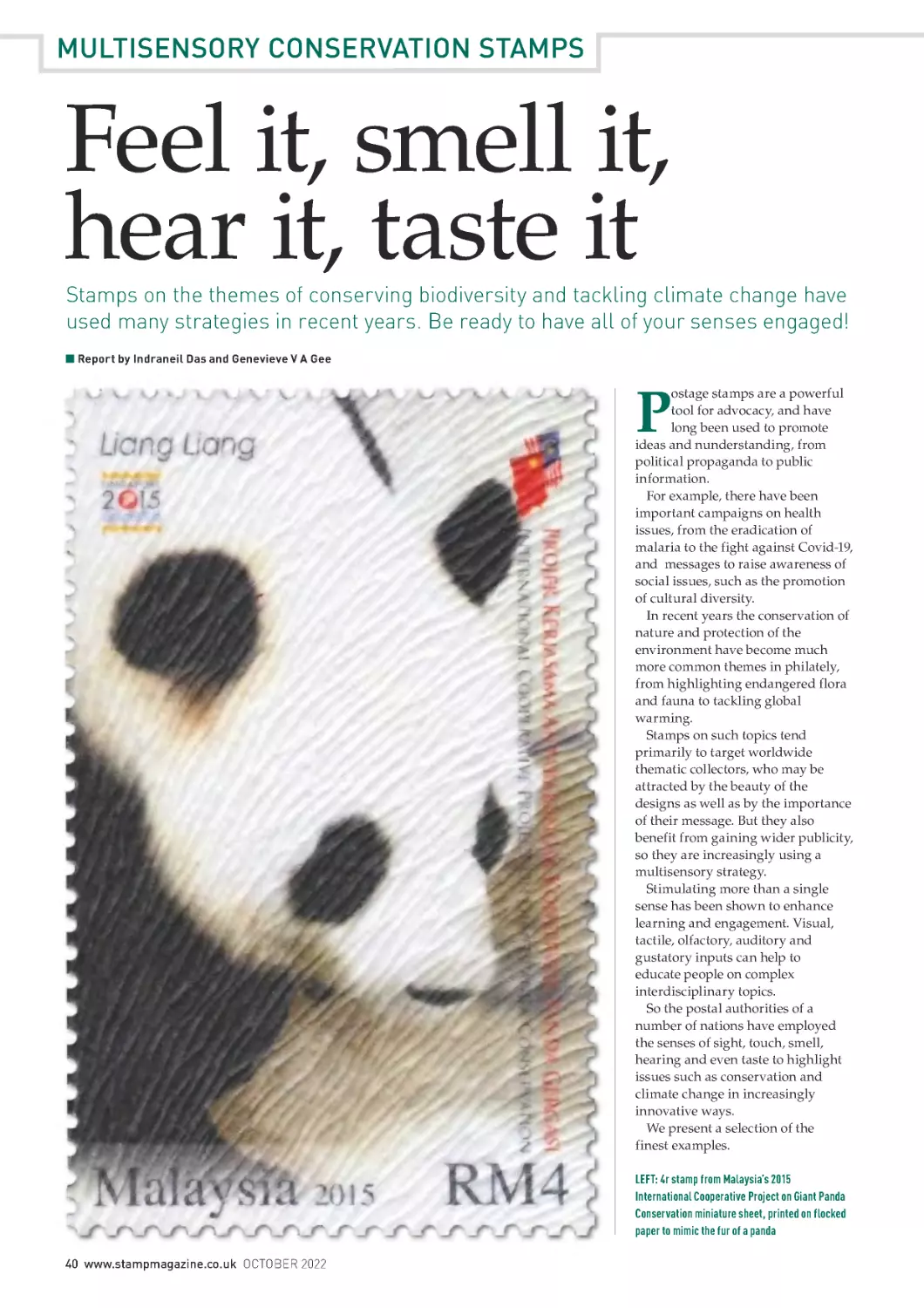
LEFT: 4r stamp from Malaysia’s 2015
International Cooperative Project on Giant Panda
Conservation miniature sheet, printed on flocked
paper to mimic the fur of a panda
P
ostage stamps are a powerf ul
tool for advoc acy, and h ave
long been used to promote
ideas and nunderstanding, f rom
political propaganda to public
information.
For example, there have been
important campaigns on health
issues, f rom the eradication of
malaria to the fight against Covid-19,
and messages to raise awareness of
social issues, such as the promotion
of cultural diversity.
In recent years the conservation of
nature and protection of the
environ ment have become much
more common themes in philately,
from highlighting endangered flora
and fauna to tackling global
warming.
Stamps on such topics tend
primarily to target worldwide
thematic collectors, who may be
at tracted by the beauty of the
designs as well as by the importance
of their message. But they also
benefit from gaining wider publicity,
so they are incre asingly using a
multisensory strategy.
Stimulating more than a single
sense has been shown to enhance
learning a nd engageme nt. Visual,
tactile, olfactory, auditory a nd
gustatory inputs can help to
educate people on complex
interdisciplinary topics.
So the postal authorities of a
number of nations have employed
the senses of sight, touch, smell,
hearing and even taste to highlight
issues such as conser vation and
climate change in increasingly
innovative ways.
We present a selection of the
finest examples.

OCTOBER 2022 www.stampmagazine.co .uk 41
W
O
R
L
D
N
E
W
S
|
A
U
C
T
I
O
N
S
|
G
B
C
O
L
L
E
C
T
O
R
|
L
E
T
T
E
R
S
|
C
O
M
M
E
N
T
|
C
O
M
P
E
T
I
T
I
O
N
S
F
E
A
T
U
R
E
S
E
V
E
N
T
S
|
S
T
R
A
N
G
E
B
U
T
T
R
U
E
Recycling not only allows
resources to be obtained at a
fraction of their original
ma nufacturi ng and
environ mental cost, but
typically leads to a
reduction in pollution.
For the International Year
of Biodiversity (designated
by the United Nations) in
2010, South Africa issued a
miniature sheet printed on
recycled paper.
The four stamps, at the
small registered letter rate,
depicted a selection of flora
and fauna: the giant African
ma ntis and common
lionfish; the common
chameleon and argus reed
frog; the black rhinoceros
a nd red-billed oxpecker;
a nd the lilac-breasted roller
a nd baobab tree.
It has been estimated that more
than 10 million metric tonnes of
plastic may be released annually
into the world’s ocea ns. Sy mbolic
of this waste material is
polyethylene terephthal ate (PET),
used in the manufacture of fibres,
bottles and containers, which can
kill many marine species when
ingested.
To draw attention to the dangers
of plastic pollution, Liechtenstein’s
PET Recycling stamp of 2020 was
made of this very material. It was
embroidered from recycled
polyester thread, derived from
3,100 recycled bottles.
The ne ar- circ ular, self-ad hesive
€6.30 value, coloured blue a nd
green, shows an embroidered
globe and leave s.
See it: recycled paper
South Africa 2010
See it:
recycled
plastic
Liechtenstein
2020

42 www.stampmagazine.co .uk OCTO BE R 2022
MULTISENSORY CONSERVATION STAMPS
See it: sustainable wood
Jersey 2017
Har vesting timber in a sustainable way is
crucial to protecting the world’s ecology,
and is overseen by the Forest Stewardship
Council, a n international non-profit
orga nisation promoting responsible
ma nageme nt of forests.
In 2017, Jersey drew attention to this work
by issuing a miniature sheet printed on
FSC-certified sycamore wood.
The issue marked 25 Years of the Darwin
Initiative, a UK Government programme
that assists countries with poor financial
re sources to meet their objectives in
preserving biodiversity.
The £3 stamp portrays Charles Darwin,
who is credited with the theory of
evolution. It also gives a nod to another
British nat uralist, Gerald Durrell, as the
Durrell Wildlife Conser vation Trust has
worked alongside the Initiative to save
species from extinction.
Global war ming inspired the release of the Being SunSmart
stamps in New Zealand’s Children’s Health series in 2015.
Specifically, the four designs provided guidance on the
preve ntion of melanoma (skin ca ncer), which can be caused by
exposure to ultrav iolet radiation.
They supported the ‘Slip, Slop, Slap & Wrap’ public
information campaign, advising people to slip on long-sleeved
shirt, slop on sunscreen, slap on a hat and wrap their eyes
w ith protective su nglasses.
The printing of the miniature sheet’s border is
photochromic. The white and yellow umbrella i n the
margin turns purple and green when exposed to
bright su nlight.
The face va lues of $0.80, $1.40,
$2.00 and $0.80 each carried a
10c surcharge, w ith the
proceeds going to a
prominent children’s
health charity.
See it: burning sun
New Zealand 2015
bright sunlight.
health charity.

OCTOBER 2022 www.stampmagazine.co .uk 43
W
O
R
L
D
N
E
W
S
|
A
U
C
T
I
O
N
S
|
G
B
C
O
L
L
E
C
T
O
R
|
L
E
T
T
E
R
S
|
C
O
M
M
E
N
T
|
C
O
M
P
E
T
I
T
I
O
N
S
F
E
A
T
U
R
E
S
E
V
E
N
T
S
|
S
T
R
A
N
G
E
B
U
T
T
R
U
E
Bhuta n is known for its
philatelic innovations,
pionee red by the American
ent repreneur Bu rt Todd,
and the Himalayan nation
produced the world’s first
aromatic stamps as ea rly
as 1973.
They depicted varieties
of roses on six values, four
for local mail and two for
airmail, with the aroma of
the flowers incorporated
into the printing ink.
The var ieties illustrated
were Iceberg, Pink Parfait,
Roslyn, Blue Moon,
Marchioness of Urguijo
and Wendy Cusson.
Stanley Gibbons does
not give these stamps
catalogue numbers but
lists them in an appendix.
Braz il’s miniatu re sheet of four
self-adhesive stamps entitled
Prevention of Forest Fires, issued in
1999, used impregnated scent to
dramatic effect.
In the country which encompasses
the majority of the Amazon
rainforest, it drives home an
awareness of the dangers of fire by
smelling of burnt wood.
The Amazon rainforest is the
largest on the planet, with an
unparalleled biodiversity of animals
and plant species.
The four 0.51r designs show a
giant anteater, a flower, a leaf and a
burnt tree trunk, and the design
makes them appear to be burning
from the inside.
‘The Amazon is the
largest rainforest on
the planet, with an
unparalleled diversity
of species’
Smell it: burning forest
Brazil 1999
Smell it: scent of roses
Bhutan 1973

44 www.stampmagazine.co .uk OCTO BE R 2022
MULTISENSORY CONSERVATION STAMPS
Desertification, caused by the over- exploitation
of soil, deforestation and climate change,
threatens many nations in northern Africa,
southern Europe and Asia.
In 2010, Morocco issued a mi niat ure sheet of
two 7.80d stamps with real sand from the
Sahara embedded in them.
The issue celebrated the 35th Anniversary of
the Green March, not a conservation event but
a mass demonstration to persuade Spain to
cede cont rol of the Spanish Saha ra to Morocco.
A genui ne attempt to highlight the incre asing problem of
desertification was made by the United Arab Emirates, with the
issue of a Protect Our National Heritage miniat ure sheet in 2011.
A 1d value illustrates the leaves of a ghaf tree, which grows in
arid regions of Asia and can survive extreme drought. A 4d
value is embedded with fibre and seed from a real tree.
The ghaf is the national tree of the Emirates. The government
operates a Give A Ghaf campaign, which encourages citizens to
plant trees in their gardens to combat desertification.
Few stamp issues have moving parts, but one spectac ular example
is the International Year of Water Cooperation miniature sheet from
South Africa in 2013.
The circ ular sheet has a n upper layer of cardboard, which can be
turned around its axle to reveal any of the five stamps (at the
bottom), along with information on its theme (at the top).
All of the five stamps are for international mail, and are in the
shape of a water d roplet. One each represents human consumption,
biodiversity, agriculture, industry and the South African
gover n ment’s Working For Water programme.
The biodiversity stamp illustrates the Clanwilliam redfin, a n
endemic fish thre atened by water ext raction and competition f rom
invasive species, a nd the mauve bluet damselfly, re sc ued from
extinction by the removal of invasive plants from riverbanks.
Touch it:
desert sand
Morocco 2010
Touch it: tree seed
UAE 2011
Touch it: water conservation
South Africa 2013
‘Desertification
can be caused
by the over-
exploitation
of soil, by
deforestation
or simply by
climate change’

OCTOBER 2022 www.stampmagazine.co .uk 45
W
O
R
L
D
N
E
W
S
|
A
U
C
T
I
O
N
S
|
G
B
C
O
L
L
E
C
T
O
R
|
L
E
T
T
E
R
S
|
C
O
M
M
E
N
T
|
C
O
M
P
E
T
I
T
I
O
N
S
F
E
A
T
U
R
E
S
E
V
E
N
T
S
|
S
T
R
A
N
G
E
B
U
T
T
R
U
E
Touch it: melting ice
Iceland 2009
One estimate
predicts a 10°C
rise in average
temperat ure in
the polar regions
this century due
to global
wa r ming, and
the melting of ice
and rising sea
levels could h ave
cat astrophic
consequences.
In a joint issue
with Chile and
Finla nd, e ntitled
Preser ve Polar
Regions &
Glaciers, Iceland
produced a
thermochromic
miniature sheet
in 2009.
One stamp
shows Iceland
and the other the North Pole, in a composite design in which the
border is a map of the entire Arctic region, with the polar ice cap
shaded in pink.
But when warmed by human touch, the image is transformed.
The ice ‘melts’, revealing the severely limited extent of the ice cap
which is predicted by the year 2100.
Touch it:
panda fur
Malaysia 2015
Saving the giant panda from extinction is
perhaps the world’s most famous wildlife
conser vation challenge. Its numbers
declined in the wild due to loss of habitat
in its native China, and captive breeding
programmes have had limited success.
In 2015, Malaysia issued a miniature
sheet, comprising two 4r stamps, to
commemorate the International
Cooperative Project on Giant Panda
Conservation, a joint venture with China.
As part of an intergovernmental
agreement, a pair of giant pandas were
given on a breeding loan by Beijing to
Kuala Lumpur in 2015, a nd so far they have
produced three cubs (and attracted a large
number of visitors) at Zoo Negara.
The miniature sheet is printed on
flocked paper which, when rubbed, is
redolent of fur.
Touch it: volcanic ash
Ecuador 2013
‘Lonesome George’ a male Pinta Island giant tortoise,
wa s the sole representative of his subspecies in
Ecuador ’s Galápagos Islands for many years, a nd
therefore became a poster boy for wildlife
conservation efforts.
After his death in 2012, at the estimated age of 102,
Ecuador issued a stamp as a memorial to George in
2013, and volcanic ash was embedded on the face of
the $3 value to provide a feel of the geological
feat ures of his homeland.
Pinta Island (also known as Abingdon Island) is an
active volcano which last erupted in 1928, when
George was a teenager.
The population of giant tortoises declined due to
hunting by humans from the 17th century, and
habitat loss in the 20th century, as the introduction of
feral goats decimated the vegetation.

46 www.stampmagazine.co .uk OCTOBE R 2022
MULTISENSORY CONSERVATION STAMPS
Until recently, stamps with an
audio element sounded like
pure fantasy, but augmented
reality (AR) technology has
changed that.
The largest series of ‘talking’
stamps to date has come from
the Netherlands in 2016, by way
of a semi-official set of no fewer than 74 domestic-rate values,
entitled Birds of the Netherlands.
Scanning the barcode at the base of any stamp, using a
specially developed digital reader pen, r edirected you to a
website that played the call of the respective bird.
Illustrated here a re the robin and the sparrowhawk.
Birdsong is often an indicator of a healthy eco-system, a nd several
postal administrations recognised this by producing stamps with an
augmented-reality bonus for the Europa theme of 2019, which was
National Birds.
The result of this international project was that users could play the
song of the bird depicted on the design by scanning the image using the
special CEE app.
One e xa mple was the issue from Gibraltar, w ith its two £1.66 stamps
illustrating the Barbary partridge. ■
Hear it:
birdsong
Netherlands
2016
Hear it: birdsong
Gibraltar 2019
Taste it: sea salt
Slovenia 2013
Slovenia has only a short stretch of coastline on the
Adriatic Sea, but it is proud of its diverse marine
fauna and the traditional activity of salt harvesting.
These elements were combined in a set of three
stamps and a miniature sheet issued in 2013, which
illustrated sea life and had sea salt from the
Piranske Soline works applied to the front of the
stamps using thermography.
Thus, the stamps taste of salt. They were not the
world’s first flavoured postage stamps, but they
stand out from the others which, predictably, tend to
r elate to the theme of gastronomy.
The 60c, 64c, 92c and 97c values depict the
damselfish, the common c uttlefish, the loggerhead
sea turtle and the golden grey mullet.
THE AUTHORS
Indraneil Das is P rofe ssor of H erpetology at the Institute of
Biodiver sity & Environmental Conser v ation at the University of
Malaysia in S ar awak. Genevieve Gee studies unusual stamps and the
evolving tech nologie s u sed in their production.
‘Birdsong is often an indicator of a healthy eco-system, and has been at the
centre of several philatelic experiments with augmented reality’