/
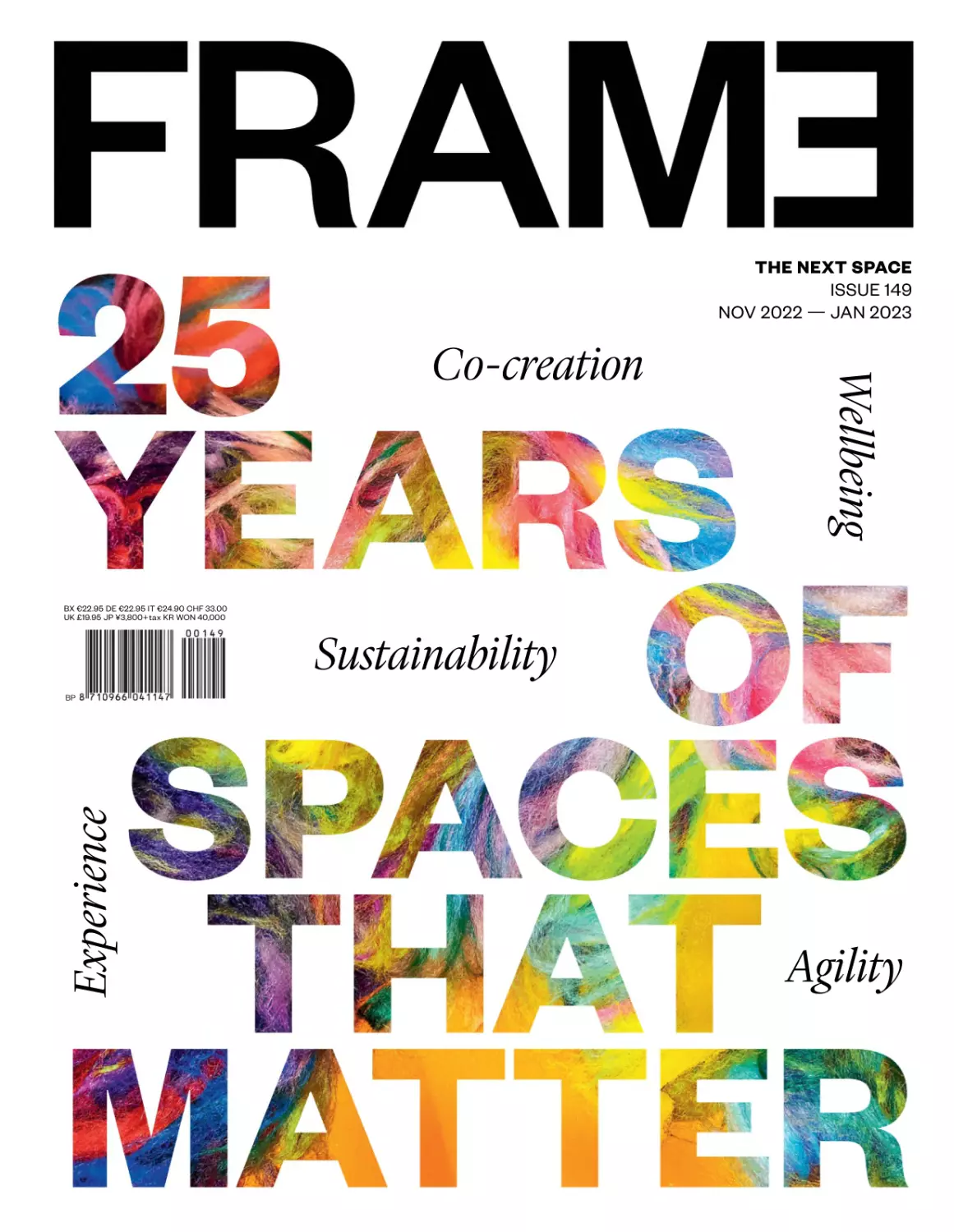






Текст
                    THE NEXT SPACE
ISSUE 149
NOV 2022 — JAN 2023

Wellbeing

Co-creation

BX €22.95 DE €22.95 IT €24.90 CHF 33.00
UK £19.95 JP ¥3,800+ tax KR WON 40,000

Sustainability

Experience

BP

Agility

CONTENTS

34

08 Make every space matter
10

EXPERIENCE

Omni-layered stores
Radical runways:
Lessons from Prada, Saint
Laurent and Balenciaga
35 Gaggenau: The balancing act
36 Rethinking the haute
cuisine experience
44 Toolkit

15
28

40
Jonas Bjerre-Poulsen, courtesy of Norm
Architects and Keiji Ashizawa Design

Thyago Sainte, courtesy of Balenciaga

Brigida González, courtesy of Yonder

Eric Petschek, courtesy of Zero10 x Crosby Studios

15

Frame 149

46

WELLBEING

50
54
61
62
68

Housing for ageing
Workplace health
Florim: Material mood
Healthified hospitality
Toolkit

52

2

146

SUSTAINABILITY

134 Look book: Waste-based
145
146
152
160
3

Collective living:
Learning from India
82 Indigenous design
89 Atlas Concorde: An icon reborn
90 Community workspaces
94 Toolkit

74

98

AGILITY

102
114
124
128

Look book: Elastic interiors
Climate-resilient spaces
Adaptive offices
Toolkit

140
114

Rory Gardiner, courtesy of Kerstin Thompson Architects

130

CO-CREATION

Courtesy of Omlab and Lilian van Daal

Iwan Baan, courtesy of Heatherwick Studio, BIG and Google

Wen Studio, courtesy of Roarc Renew

110

70

materials
Neolith: At your surface
Solar-powered architecture
Responsible retail: Strategies
from Ikea, Ace & Tate and PVH
Toolkit
Contents

Frame is published five times a year by

PUBLISHING

Frame Publishers
frameweb.com

Director
Robert Thiemann

EDITORIAL
For editorial inquiries, please e-mail
frame@frameweb.com or call +31 20 4233 717.

Marketing and communication specialist
Renata Sutton
renata@frameweb.com

Editor in chief
Robert Thiemann – RT

Social media intern
Valeria Lee

Head of content
Floor Kuitert – FK

Customer success manager
Raluca Pop
raluca@frameweb.com

Editor at large
Tracey Ingram – TI
Editors
Anouk Haegens – AH
Lydia Johnson – LJ

Back issues
Buy online at store.frameweb.com

Subscriptions
For subscription inquiries, please e-mail
service@frameweb.com or call +31 20 2205 224.

Head of digital
Lauren Grace Morris – LGM

2-year subscription + book
2-year subscription
1-year subscription
1-year student subscription

Junior editor
Kayla Dowling – KD

Please visit frameweb.com/subscribe for the latest
offers.

Video editor
Clémence Overeem

Back issues
Buy online at store.frameweb.com

Copy editor
InOtherWords (D’Laine Camp)

ADVERTISING
International sales managers
Sara Breveglieri
sara@frameweb.com
T +39 339 4373 951

Design director
Barbara Iwanicka
Graphic designer
Zoe Bar-Pereg
Translation
InOtherWords (D’Laine Camp, Maria van Tol)
Contributors to this issue
Shawn Adams – SA
Polina Bachlakova – PB
Roddy Clarke – RC
Simon Flöter – SF
Holly Friend – HF
Vésma Kontere McQuillan – VKM
Adrian Madlener – AM
Riya Patel – RP
Kristofer Thomas – KT
Cover
Marni x Shoplifter at Marni Milan by
Brinkworth, The Wilson Brothers
and Francesco Risso (see page 18)
Photo Louise Melchior

5

From €239
From €229
From €129
From €119

Veerle de Muijnck
veerle@frameweb.com
T +31 61 4562 079
Advertising representative
Italy
Studio Mitos
Michele Tosato
michele@studiomitos.it
T +39 042 2894 868
Frame (USPS No: 019-372) is published
by Frame Publishers NL.
ISSN FRAME: 1388-4239
© 2022/2023 Frame Publishers and authors
Printing
Grafisch Bedrijf Tuijtel
Hardinxveld-Giessendam

Colophon

Photographer: Henrik Schipper

Worldwide and exclusively, JUNG offers its
classic LS 990 switch in the 63 original colours
of the Les Couleurs® Le Corbusier palette.
Pure colour. Pure matt. In order to reflect the
impressive colour depth, the switches are
hand-lacquered.

SOHO Aesthetics | 12:43 Architekten
Stuttgart, Germany

MADE TO TOUCH.
DESIGNED TO CREATE.
JUNG.DE/LC

gris clair 31
vert olive vif

l’ocre rouge moyen
céruléen vif

25 YEARS
OF FRAME
Picture two men in their early thirties in a bar in
Hanover. Let’s call them Peter and Robert. The men
are in the German city to visit a trade fair and conclude the day with a pint of beer. They’ve been musing
about publishing their own magazine. It’s a far-fetched
idea, but Peter starts writing his thoughts on the back
of a beermat. Robert adds his own. By the end of the
evening the men have sketched the editorial formula
of their magazine.
The following year they further develop their
concept and reach out to publishers and printers in the
Netherlands. They meet people who are interested,
but always get a final ‘no’. Ultimately, their idea for the
magazine lands on the desk of Peter’s acquaintance
Rudolf, who owns a design-focused publishing house.
He likes what he hears and decides to give Peter and
Robert a room in his office’s attic.
This happened 25 years ago. Of course, it’s
the condensed and slightly romanticized story of
what really went on. But it aptly describes the birth of
Frame magazine. Along the way, Peter and Rudolf took
leave of what is now Frame Publishers. I’m still here,
for better or worse.
A lot has changed since 1997. Back then our
aim was to provide an international stage for interior
design professionals. To define the profession and
inspire its practitioners with alluring spaces made by
designers from all over the world. We’re talking preinternet here – magazines were still the only source of
inspiration.
Fast forward to 2022. The world has changed.
Interior design has become a mature profession that
nobody mistakes for decoration. Its practitioners work

7

with PR agencies to promote their work. Thanks to the
internet, inspiration now abounds. But there’s also a
widespread concern about the state the world is in.
We’re facing a plethora of crises that affect the way we
live, work and travel. We know so much more about
the impact of indoor environments on the health and
wellbeing of people. But we’re also aware of the devastating effects of the construction industry – and that
includes interior design – on the planet. Last but not
least, scientists have produced numerous technologies
that benefit interior design, but also technological
developments that impact the profession. To deal with
all these challenges, spatial designers need to reinvent
themselves. How? That’s where Frame comes in.
In critical times guidance is needed. Frame will
take the lead. We’ll not only inspire you, but also chart
what you need to know to future-proof your business.
We’ll not only publish significant spaces, but also tell
you why they’re meaningful and provide you with the
ideas and tools to get there yourself.
Most people spend a whopping 90 per cent of
their lives indoors. That’s why interiors are important.
Spaces directly impact us – and the planet.
Let’s make every space matter.

Robert Thiemann
Editor in chief

Editorial

How old are you? Multiply that by 0.9 and
you get the number of years you’ve actually
spent indoors. This exercise puts studies that
found that people living in North America
and Europe spend about 90 per cent of their
lives inside into perspective. It also makes it
clear that the quality of indoor spaces should
be everybody’s top priority. The question
is: What is quality? What do we want from
spaces? Which interiors really matter?
On the one hand, the answers to
these questions are universal and timeless.
Spaces need to make us feel safe – physically,
but also mentally: we want to be seen and
heard. Indoor environments must also give
us a sense of belonging: we all want to feel
connected with others. And interiors should
support self-expression: ultimately, we want
to be true to who we actually are.
Besides these universal needs,
forces that shift with time and are anything
but universal impact the way spaces are
designed. These forces originate from

9

changing needs and demands in business and
society, as well as from new environmental
conditions and scientific progress.
Combine these universal needs with
the forces that change with time, and at any
given moment phenomena – let’s not call
them trends – can be derived that define
interior design. In this celebratory issue we
look at the five phenomena that will shape
spaces in this decade:
AGILITY
CO-CREATION
EXPERIENCE
SUSTAINABILITY
WELLBEING
If you’ve been following our work over the
past years, these five words won’t come as
a surprise. In this special issue we combine
them, give shining examples and point the
way to the future. RT

Frame 149

Trípode, 1997
Santa & Cole Team

If we had to pick a word that’s defined spatial design in the past
decade, ‘experience’ might just be it. It’s a vague term – don’t all
interiors offer some kind of experience? – that surged into the
spotlight with the rise of the experience economy: the trend of
customers prioritizing experiences over products and services.
Now, the movement has spread to every conceivable typology
and shows no signs of abating. It is, however, adapting.

Stéphane Aït Ouarab, courtesy of Balenciaga

Back in 2014, a report from Eventbrite and The Harris Poll did the rounds.
Millennials: Fueling the Experience Economy revealed that 78 per cent of this
demographic would rather spend money on an experience or event than buy a
desirable item, while 55 per cent of millennials said they were spending more
money on events and live experiences than ever before. Backing this up – and by a
party that, unlike Eventbrite, is not in the experience business – the 2016 McKinsey
Millennial Survey showed that there was an increase in spending on experiences
across all demographics, with millennials ‘leading the charge’. Bear in mind that
millennials now represent the largest spending group.
While the term ‘experience economy’ dates back to 1999 – it was coined
by James H. Gilmore and B. Joseph Pine II and became the title of their book on
the topic – there are several reasons why the movement later proved – and is still
proving – pivotal. One relates to a growing awareness of sustainability and the nowflourishing sharing economy – some people simply want less stuff. Then there’s the
element of worth: Cornell University found that consumers devalued their material
purchases over time, whereas the opposite was true for experiences. Social media
has played a central role, too. As Dan Goldman, Sophie Marchessou and Warren
Teichner write for McKinsey & Company: ‘Facebook and Instagram likes and
creative snaps are now the ultimate social currency for millions of Americans,
especially millennials, and the quest for likes requires a constant stream of new
shareable content in the form of stories and pictures.’
Commercially speaking, prioritizing experiences over transactions can
build stronger connections with customers – and potentially a longer one, too, as
evidenced by the many retail brands that have added dining and accommodation

Eric Petschek, courtesy of Zero10 x Crosby Studios

30
12

Experience

Courtesy of Prada and AMO

Thyago Sainte, courtesy of Balenciaga

15

34

Louise Melchior, courtesy of Marni and Shoplifter

18

36

Jonas Bjerre-Poulsen, courtesy of Norm
Architects and Keiji Ashizawa Design

Courtesy of Bompas & Parr

40

to their offerings to extend visitor stays. Instagrammable environments can turn
customers from word-of-mouth ambassadors to word-of-social-media ones,
building awareness with a much broader reach. As for the experiencers, they’re
often looking for belonging, wellbeing and memorability – happenings that enrich
their lives, especially as people are becoming more discerning about how they
spend their time and money. Over the past few years, Covid-19 may have erased
some events from the calendar, but it has only increased the importance of making
meaningful memories with family and friends.
Now, technology has blown the terrain wide open, enabling immersive
experiences beyond physical bounds, in AR, VR and the metaverse. But with all the
opportunities it offers, technology has also prompted a countermovement: a focus
on the physical through the likes of hyper-tactile retail stores and multisensory
spas. Even the work sphere has jumped on board – if you can work from anywhere,
why go to the office if not for a better physical experience?
In the future we’ll see both: digital or phygital happenings that work with the
best technology has to offer – and can extend experiences to a wider range of people
– and purely physical experiences that ground us firmly in reality or expand our
minds. Here we look at what that might mean for retail, shows and haute cuisine. TI
13

Eric Petschek

A dual approach to retail has arisen and solidified in the aftermath of the
Covid-19 pandemic, as the retail sector converges with adjacent industries
– such as hospitality, technology and science – to increase meaningful foot
traffic and, hopefully by proxy, higher revenues.
15

For retailers, footfall is in crisis, with postpandemic numbers still failing to reach 2019
levels. UK retail trade association BRC found
that retail footfall decreased as much as
23.5 per cent in France and 51.5 per cent in
Germany in December 2021, compared with
the same period pre-pandemic.
But reigniting store spaces won’t
only provide benefits for retailers. After long
periods spent shopping through flat e-commerce websites, customers, too, are expecting
brands to enhance their everyday experiences
with spaces for connection, emotion and
inspiration. These values will be integral to
luring them back to high streets and shopping
malls, which once centred on one activity only:
selling. According to Shopify, 32 per cent of
global consumers are likely to engage with
in-store experiential moments in the next year.
‘In-person selling is one of the best opportunities for merchants to deepen relationships with
buyers through experiences, services and often
a shared community,’ comments Amy Shapero,
Shopify’s chief financial officer.
It’s this desire for extraordinary moments that
is inviting designers to push the boundaries of
what retail is, and work harder than ever to create stores worth visiting. Rather than relying on
visually enticing colour schemes, aesthetics and
materials to show worth on a surface level, the
most successful spatial designers will be ones
to court the experience economy. Especially if
they are to drive loyalty among the next generation of shoppers – over 80 per cent of millenni-

als and Gen-Z shoppers told Epson they would
change their shopping behaviour if high street
stores had an experiential element.
This means that technologists,
hospitality experts and community organizers
could soon be the new retail pioneers, as these
minds work with developers and architects to
creatively layer stores with unique dual uses,
from hands-on learning to artist residencies.
But what does this mean for designers? If
multi-layered stores are the new expectation for
shoppers, this could mean the end of uniform
interior trends and globalized aesthetics as
we know them. Store identities will become
inseparable from their host cities, tapping into
the real-time needs of local communities. Not
all shoppers, for example, will want to navigate
cutting-edge technologies when visiting a store
– for a beauty brand like Harmay, this means
side-stepping into food and hospitality to create
a comfortable inner-city sanctuary for catching up with friends and watching a film. Nike,
on the other hand, with its ever-expanding
ecosystem of retail laboratories, recognizes the
value that data and technologies can bring to its
performance wear, leveraging local insights to
form a community hub.
Stores today are about so much
more than a transaction point. As footfall
gradually increases around the world,
designers who recognize this, see the store
as a blank canvas, and reflect the needs of their
consumers onto it will be the ones to reap the
benefits. HF

For the Zero10 x Crosby Studios
pop-up in New York City, the latter
developed the retail experience and
interior, as well as a virtual fashion
collection with which visitors could
experiment via tech-forward fitting
rooms. The store’s façade (see p. 15)
and interior included Crosby Studios’
signature pixelated print, which is
inspired by the 1990s video game
aesthetic.

Phygital fashion
In New York City’s SoHo, Crosby Studios and AR fashion platform Zero10
created a pop-up that bridged the physical and virtual retail experience.
Crosby Studios designed both the interior and a five-piece virtual fashion
collection, which shoppers could try on using Zero10’s proprietary AR clothing
technology. Without the typical demands of physical retail – cash desks,
clothing racks and hangers, for instance – Crosby Studios could reimagine
retail as an interactive space for socialization, creation and exploration.
crosbystudios.com
zero10.app

16

Experience

Eric Petschek

Louise Melchior

Studio storefronts
Marni incorporated a fully functioning artist’s studio into its new
Milan flagship store, which will host a rotating schedule of creative
residents – first up, Shoplifter (pictured). Developed by Brinkworth and
The Wilson Brothers in collaboration with Marni’s creative director
Francesco Risso, the project blurs the line between art exhibition and
storefront. Windows line the studio walls, allowing patrons to catch
a glimpse of the artist’s work process and finished pieces. Since the
studio is modular, artists can modify it to their tastes. The project not
only bolsters the brand’s connection to creativity and the arts, but also
provides shoppers with a memorable, interactive experience.
brinkworth.com
marni.com

Omni-layered stores

19

Retail laboratories
L’Oréal-owned Biotherm brings to life
the convergence of science and skincare
currently shaking up the beauty sector. The
brand, which sells skincare products made
with ‘Life Plankton’, opened the Biotherm
Blue Beauty Lab to mark its collaboration
with Monaco’s Oceanographic Institute.
Eschewing retail for education, the openby-appointment lab offers a deep dive into
Biotherm’s methodology on a microscopic
level. Situated in an alcove with ocean views,
the Universal Design Studio-designed space
includes floor-to-ceiling projections of live
generative visuals that allow visitors to create
their own digital artwork and participate in
hands-on learning.

Courtesy of Universal Design Studio and Biotherm

universaldesignstudio.com
biotherm.com

Retailtainment
Chinese beauty brand brand Harmay – which raised €200 million earlier
this year to continue the expansion of its multi-typology offerings – is
taking a stake in hospitality with tea-based drinks store Introlemons.
Aim Architecture activated the Shanghai space with an entertainmentcentric narrative to encourage customers’ participation in the tea-making
process. This layer is evident first through engagement in the origins and
production of drinks, then through a cinema for customers to watch a film
while they sip their concoctions.
aim-architecture.com
harmay.com

Wen Studio

Wen Studio

A staircase at the rear of teabased drinks store Introlemons
in Shanghai guides visitors to a
cinema-slash-entertainment area.

Omni-layered stores

25

Tech-driven experiences
Nike has been perfecting the formula
of phygital spaces with its Nike Style
store in Seoul. The idea builds on the
Nike Rise concept, which first appeared
as a test site in Guangzhou, China.
Intended for the sportswear brand’s
distinct sport lifestyle audience, Nike
Style is characterized by digital-physical
spaces, locally curated collections
and community activations like
workshops and member events.
Aimed at ‘broadening the aperture of
sport retail culture’, the store boasts
a content studio for local creatives,
product experts and shoppers, with
customizable backdrops. QR-powered
augmented reality experiences provide
an extra layer of context to product
innovation and art installations.

Courtesy of Nike

nike.com

26

Experience

Omni-layered stores

27

How are key players in an industry built on trendsetting staying
ahead of the experiential fashion-show game? We take lessons
from Saint Laurent, Prada and Balenciaga.
Words Vésma Kontere McQuillan

28

Experience

Staging a spectacle
Saint Laurent’s SS23 Menswear show in the Moroccan desert
was one of the most poetic spatial experiences in recent fashion
history. The Es Devlin-designed runway encircled a water-filled
pond, from which a ring of light and mist emerged as darkness
fell. Notably, the presentation was not livestreamed, indicating
a direction that ensures exclusivity for the in-person audience
(220 people on this occasion). Still, the brand must answer
to justified post-show questions about the environmental
impact of the audience’s transportation and the complicated
production, especially considering its ten-minute duration.

Courtesy of Saint Laurent

esdevlin.com
ysl.com

29

Social simulation
AMO turned Yin An Palace – which is situated in the centre of the
400-year-old former royal Prince Shuncheng Mansion in Beijing – into
a magnificent container of light for Prada’s AW22 show. The space was
not only a spectacle for in-person visitors – simply logging onto Baidu’s
XiRang platform offered a futuristic simulation of the presentation in the
metaverse. According to Chinese media, it was Prada’s largest event
this year as a result, thus illustrating how fashion brands can retain the
appeal and intimacy of physical occasions while tapping into a much
wider audience.
oma.com
prada.com

30

Experience

Courtesy of Prada

Prada extended the
presentation of its AW22
collection in Beijing with
a virtual space in the
metaverse.

Radical runways

31

For Prada’s AW22 show,
AMO created a disorienting
aluminium landscape in the
interior of Beijing’s Yin An
Palace – a physical space that
was replicated in the metaverse.

32

Experience

Courtesy of Prada

Radical runways

33

Sociopolitical commentary
For Balenciaga’s creative director Demna Gvasalia, a fashion show
is a touchpoint in ongoing, scrupulously designed storytelling that
comments on the global social and geopolitical situation. The brand’s
AW22 collection, for example, was staged on an enclosed snowy field
at the Paris-Le Bourget Exhibition Centre. The final looks interrupted
the collection’s darkness, taking on the blue and yellow of Ukraine’s
flag. Merging into the spatial design, a dress became a stream and
a flag, desperately and bravely trailing a disappearing human. While
the set was originally intended as a commentary on climate change,
it doubled as a prediction of the terrifying possibility of nuclear war.
balenciaga.com

Stéphane Aït Ouarab

34

Experience

THE
BALANCING

A Statement of Form, 1zu33’s
exploratory Milan installation for
luxury kitchen appliance brand
Gaggenau, took visitors on a
sensory journey exploring the
notion of balance.

ACT

‘Balance is the key motive,’ said Henrik Müller,
founder of 1zu33, as he showed us around
A Statement of Form, the installation he and
his team designed for luxury kitchen appliance brand Gaggenau on the occasion of
Milan Design Week. Nestled inside the glass
conservatory of the city’s historical, Art Decostyle Villa Necchi Campiglio – which offered
a respite from the hustle and bustle of the
massive design event – Gaggenau’s presentation indeed reached a state of equilibrium
through its spatial design. The site was chosen
for its avant-garde yet traditional character, an
identity strongly aligned with the Gaggenau
brand, with its heritage and principled regard
for craft and materials.
Says Dr Peter Goetz, Gaggenau
managing director: ‘Entering Villa Necchi,
you see the garden, you see the pool, you see
the house with its different rooms, showcasing
marble and wood installed in a perfect way.
You can feel craftsmanship, which perfectly
fits what we stand for.’ The journey through

the location ran past various setups that dealt
with the theme of balance. Upon entering, for
example, visitors were welcomed by a cylindersupported counter surface and a hovering
marble shelf held in place by a large weight.
Here, and across the installation, stainless steel
was combined with materials inherent to the
domestic context, which, as Müller highlighted, references Gaggenau’s commitment
to bringing professional equipment into the
residential sphere.
Further into the explorative show,
Kaufmann Keramik tiles embraced Gaggenau’s
iconic 90-cm-wide oven, while a long, linear
counter reminiscent of a conveyer belt formed
a visual axis through the installation, leading to
a professional-grade kitchen where Christian
Jürgens, chef of three-Michelin-star Restaurant
Überfahrt in Germany, prepared culinary art
using Gaggenau’s combi-steam ovens and 200
series Vario downdraft ventilation system and
cooktops. To highlight the innovative character
of the brand, at the centre of the exhibition,

Gaggenau x Frame

1zu33 embedded two combi-steam ovens in
a mesmerizing steam-filled stainless steel
and glass case – a homage to the beauty of
steam in motion.
Juxtaposing the high-tech innovations, a bar made of charred wood and raw iron
indicated Gaggenau’s roots in Germany’s Black
Forest and origin in forging nails. Meanwhile, a
cabinet showcased the products of like-minded
artisanal producers – from ceramics to wine.
Overall, experience and storytelling
took precedence over products at A Statement
of Form. With the likes of tactile materials and
edible ‘stones’, Gaggenau managed to stimulate every sense, from touch to taste. In doing
so, the show underscored the added value of
live presentations following their long absence.
‘Our product,’ said Müller as he concluded his
tour, ‘is the footprint that people take away as
a memory.’

•

gaggenau.com/us/

35

Courtesy of Bompas & Parr

At Bompas & Parr’s Forces of Nature
in Al-’Ula, Saudi Arabia – home to
UNESCO World Heritage Site Hegra –
visitors ate meals cooked over lava in
an ancient canyon.

As the experience economy continues to thrive, attention
spans reportedly are narrowing and climate consciousness
is gaining urgency, innovative restaurants are rethinking the
fine-dining experience.

From shelter-in-place-induced home dining
to the delivery craze spurred by the likes of
Deliveroo and Uber Eats, the restaurant scene
has experienced a few years of upheaval. While
some lockdown legacies remain – the company
Zoom meeting, for one – there’s a reason why
dining in didn’t ultimately trump dining out
for high-end establishments. ‘A creatively
stimulating experience at 101 Gowrie requires
a lot of interaction and engagement from our
guests,’ says chef Alex Haupt of Amsterdambased restaurant, who picked up 2021’s
Michelin Young Chef of the Year Award. ‘I did
not and do not feel that that experience can be
translated into a takeaway/pick-up offering.’
And there he says it: experience.
It’s something with which your home dining
table – perhaps with a view to a stack of work
documents that demand attention, not to
mention the dishes that need washing afterwards – cannot compete. ‘First and foremost,
a restaurant . . . must become a destination,’
writes Kristen Hawley for Skift. ‘Now that
customers can get the food from a restaurant
anywhere they are, businesses must double
down on what happens inside.’ This is arguably
more important for fine dining, where guests
expect a certain level of experience for the
higher price tag.
Although the Michelin Guide
states that ‘the style of a restaurant [has] no
bearing whatsoever on the award’, is it possible
to entirely separate the environment from the
meal? And even if Michelin inspectors can do
it, can guests? Michelin-starred restaurant
Äng in Sweden, for example, used to receive
reviews that the food was amazing, but the
space – low-ceilinged and filled with dark wood

and leather – was lacking. CEO and partner
Daniel Carlsson responded by overhauling
not only the restaurant but the entire flow of
the evening. ‘You lose attention if nothing
other than the food changes,’ says Carlsson,
‘if the light, temperature and setting remain
the same.’ After all, sitting in the same seat
and space for hours on end can feel incredibly
static, and a haute cuisine meal often takes
between three and four hours, but can even
extend beyond the five-hour mark.
While Äng adopted a restrained
aesthetic for its new staggered spatial experience – in which diners literally shift between
settings, from relaxed to formal, from bright
to dark – others have pushed this approach
to the extreme. ‘Our rule of thumb is that
something spectacular happens every 20
minutes,’ says Sam Bompas of multisensory
experience design studio Bompas & Parr. ‘This
goes beyond the regular succession of courses
and paired drinks to the entire set changing
around the guests. It could be tables revolving
to propel guests into new areas or theatrical set
pieces with drinks made by merman mixologists who swim to your table. You emerge with
tales to tell, burning with crystalline green
flames of inspiration. The best experiences
situate you as the hero of the story.’
That doesn’t mean spatial progressions are necessary, nor that smaller establishments can’t find other ways to introduce
memorable, performative elements. Having
designed the likes of Disfrutar in Barcelona
– bearer of two Michelin stars and number
three on the 2022 World’s 50 Best Restaurants
list – El Equipo Creativo often finds the most
interesting way to activate a dining area is by

connecting it with ‘production’ areas. ‘It’s
never boring to look at chefs preparing
quality food or bartenders mixing drinks,’
says cofounder Natali Canas del Pozo. ‘Especially in a high-end restaurant where every
step is carefully orchestrated, it’s a beautiful
show to watch – something close to an art
performance.’
Others are aiming to have an
impact much greater than memorability.
Steinbeisser’s Experimental Gastronomy, for
example, is a series of climate-conscious dinners that cofounder Martin Kullik hopes will
inspire guests to create positive change. The
initiative began as bespoke vegan, local and
biodynamic food experiences for which artists
and designers produce experimental cutlery
and dishware exclusively for Steinbeisser. Each
piece is different – encouraging guests to be
more mindful about what they’re eating and
how they’re eating it – and can be purchased
online after the event. Now Steinbeisser has
not only extended the experience to include
the likes of glassware and textiles, but the
founders have become more reflective and
aware of the ecological impact of everything
from the tableware to the transportation of
chefs, staff and guests. While working to
make its events climate-neutral in the coming
years, Steinbeisser will invest a large portion of its profits in biodiversity restoration.
These reflections also offer the potential for
Experimental Gastronomy dinners to further
extend the experience. Perhaps the space itself
could solidify the message by aligning with
the nascent vegan interiors movement, or the
journey to the event could become part of the
experience. TI

Site-specific theatrics
At Forces of Nature, one of two Bompas & Parr-designed pop-up
dinners in the Saudi Arabian desert city of Al-’Ula, guests had the unique
experience of watching local produce being cooked over streams of
molten lava. Saudi Arabia is home to more than 200 dormant volcanoes,
creating an immediate link between the cooking method and the land’s
formation. The canyon’s ancient limestone walls were illuminated in
yellow, orange and red, mimicking an open flame – the most primitive
method of cooking – as well as the intensity of the molten lava, while a
bespoke sound installation took the multisensory experience further.
While not everyone can – nor should – re-create such a spectacularly
theatrical event, it stresses the strength of directly connecting an
experience to a place, no doubt solidifying both in visitors’ memories.
bompasandparr.com

38

Experience

Haute cuisine

39

Courtesy of Bompas & Parr

Jonas Bjerre-Poulsen

Spatial progression
A visit to restaurant Äng in Sweden begins in a
greenhouse that belies what lies beneath. As the
evening progresses, diners experience surprising
scene changes – including taking a hidden lift to an
underground wine cellar, the passage to a ‘secret’
sweeping dining space. Rather than rely on grand
theatrics, the project highlights how spatial and
product design – in this case by Norm Architects
and Keiji Ashizawa, Karimoku Case Study creative
directors and collection cofounder, respectively –
can alter the course of an entire evening. Changes
in colour, light, texture and physical posture slow
down (or speed up) time, shift visitors’ focus, and
ultimately create a richer experience. And, thanks
to the interior’s relationship with the outdoors and
Sweden’s drastically different seasons, the look and
feel will alter throughout the year.
normcph.com
karimoku-casestudy.com

40

Experience

Memorability meets messaging
For its latest climate-conscious Experimental Gastronomy experience,
Steinbeisser invited South Korean Zen Buddhist nun Jeong Kwan of Chef ’s Table
fame to cook a vegan feast in Amsterdam. It’s the last time the organization will
fly in a cook from abroad as it makes moves to become climate neutral. Some
changes were already evident in the event’s customized cutlery and tableware –
from oversized whittled chopsticks to double-ended seesaw spoons – for which
invited artists and designers used traceable ecological materials. Fallen trees
were the only source of wooden objects, for instance, while a series of bowls
were crafted of sludge from the UK’s River Thames. The latter were only possible
to produce because of this year’s low rainfall, another nod to the pressing climate
crisis. Kwan’s presence, storytelling and post-meal meditation further instilled
the message: ‘To overcome the climate crisis, we should protect nature and the
surrounding world. To do this, you must change yourself.’
steinbeisser.org

The customized tableware at the
latest Experimental Gastronomy
experience included Double Spoon by
Cornelia Peterson, Burnt Wood Bowls
by Sebastien Krier and Soil Glasses by
Fabienne Schneider.

Kathrin Koschitzki

42

Experience

1
Light blue

2
Ultramarine blue

ng Ide
as

1

e O ri gi nal

4
Heather violet

Th

·P

ate

nt 1 93

2

·

nki

i n c e 1 9 26
·
·S

3
Water blue

Li

The art
of colour
info@kriskadecor.com
kriskadecor.com

5
Raspberry red

6
Blue lilac

7
Black red

2
3

5

4

8
Antique pink

7

Luxe Colour Edition
Complete customisation
with all the available
RAL and Pantone Colours
8

6

EXPERIENCE TOOLKIT
01

SURPRISE!? The more experiences
we’re exposed to – whether in
reality or by proxy – the harder it is
to surprise people. But surprise is
only one drawcard of experiences,
so consider the ultimate goal.
A spectacle that amazes for one
visit? Or something meaningful
and enjoyable enough that people
continually return?

02

EXTEND THE EXPERIENCE
Yes, a physical experience can
sometimes be extended online, but
it can also be extended physically.
Can the journey to that remote
hotel in the woods become part
of the offer? Can the addition of a
green park or hotel turn a shopping
trip into a full-day or overnight
affair? Or can experiencers take
something (intangible) away with
them after the event, like learnings
from an educative workshop?

03

44

Toolkit

Simon Flöter

ENGAGE THE SENSES Multisensory experiences can not only make
people more present to the moment but cement lasting memories
– the connection between recollection and smell, in particular, is
well-documented. This is also one way to differentiate between a
physical and digital experience – for now at least, touching, smelling
and tasting are only possible in the real world. But multisensory
shouldn’t be confused with overstimulation, and designers should
keep neurodiversity in mind.

Design by Diez Office

The New Era of Lighting
Plusminus is versatile lighting system that takes the concept of
the light rail to a new level. The conductive textile ribbon at its core
allows for a free placement of the luminaries and the creation
of a custom light solutions on the spot.
Discover

Just like the ideals it advertises, the global wellness market
continues to thrive. Not only that, but it’s getting broader and
more personalized. Wellbeing is moving beyond the mere
physical, whether that’s by taking mental and emotional health
into account or by utilizing digital tools. As awareness grows
of how certain spaces and services impact the mind and body,
designers take on a new role as ‘healthcare professionals’.

Hiroyuki Hirai, courtesy of Shigeru Ban Architects and Zen Wellness Seinei

Hiroyuki Hirai, courtesy of Shigeru Ban Architects and Zen Wellness Seinei

66

Doublespace Photography, courtesy of Leckie Studio

62

Although wellbeing is an ancient concept, the wellness movement feels like a
modern phenomenon. Indeed, it gained ground towards the end of the 20th century
– when it began to be taken more seriously in the medical, academic and corporate
worlds – before completely exploding in the 21st. Now, social media is flooded with
wellness influencers, workplaces have comprehensive wellness programmes and
wellness tourism is booming.
The global wellness market is currently valued at €4.75 trillion with an annual
growth rate of 10 per cent, and there’s no indication it’s slowing down. As wellness
as a movement has expanded, so too has its umbrella. No longer does a wellnessoriented workplace merely include a fitness space, for instance, but we can now
discuss health more holistically, from a physical, mental and emotional perspective.
We can talk about personal, communal and even planetary wellbeing (more on the
latter in our Sustainability section on page 130). There are apps for physical and
mental workouts (or workins?), sleep tracking and depression treatments. You can
even meditate in the metaverse.
What’s more, society has realized that wellbeing is individual and should be
treated as such. Introverts, extroverts, neuro- and physically diverse individuals,
an ageing population – everyone has different needs at different times. This has
become of particular importance for workplaces that house a diverse group under
one roof, an increasing number of which are suffering from burnout. In response,
we’ve seen offices introduce everything from nap pods to multifunctional rooms in
48

Wellbeing

Courtesy of Tetris A/S and Sangberg

Courtesy of Modem and Snap Inc.

56

Brigida González, courtesy of Yonder

52

50

which to listen to music, practise yoga or pray. Companies have also realized the
relationship between socialization and wellbeing, orchestrating moments for their
communities to come together – perhaps at a central in-house coffee bar.
This isn’t a purely altruistic act, of course. Healthy and happy employees are
better for business. Good quality air, natural light and comfortable temperatures
have been linked to better productivity, while View’s ‘Future Workplace Wellness
Study’ showed that workplaces that enhance employee wellbeing would encourage
67 per cent of people to accept a job offer and 69 per cent to stay in their current
position. As Joseph Allen and John Macomber, authors of Healthy Buildings: How
Indoor Spaces Drive Performance and Productivity, write in a recent Harvard
Business Review article: ‘A healthy building will go from a “nice to have” to a
competitive, “must have”.’
Alongside workplaces, some other spaces are natural allies in the wellness
movement. Spas and retreat hotels, of course, but also healthcare facilities – the
best of which, like the Maggie’s Centres, have spent the past decade becoming
much more humanized. But healthy buildings need to become ‘must haves’ across
the board – especially when you consider that most people reportedly spend close
to 90 per cent of their time indoors.
Over the following pages, we dissect how living environments can better
support our ageing society, how technology can improve wellbeing at work, and
what the rise in wellness tourism means for hospitality spaces. TI
49

Courtesy of Tetris A/S and Sangberg

Wellbeing

50

We’re living longer.
Here’s how spatial
design can help us
live better, too

Built using Cross Laminated
Timber (CLT) and designed
by architecture studio
Sangberg, Agorahaverne is
an environmentally friendly
housing project for older
citizens in Denmark. Block
buildings are structured
around a roofed atrium
garden, which functions as a
common community space.

It’s no secret that a large portion
of people living in the developed
world are reaching seniority. The
US Census Bureau estimates
that the amount of Americans
aged 65 and over is expected to
outnumber those 18 years old
or younger by 2035. Stymied by
decades of declining birth rates,
European countries are predicted
to not fare that much better. With
such seismic shifts at play, the
issue should perhaps be seen as
less of a dilemma – a supposed
extra burden on already fragile
economic systems – and more
of a call to action. Re-evaluating
how care homes and retirement
communities could operate is
an opportunity to introduce
new design strategies that could
benefit everyone and perhaps even
address some of the other extreme
challenges facing our world.
During the pandemic, it
became clear that the traditional
practice of ostensibly putting
elders away in facilities that are
cut off from the rest of society
and located on the physical
periphery of town centres is not
viable. This is particularly true
for older citizens who suffer from

psychological debilities, especially
those exacerbated by the insidious effects of loneliness and the
feeling of abandonment.
Keeping the ageing active
within our multi-modal communities is essential to their wellbeing.
‘Patients don’t want to be hidden,
but to be a part of the natural
life in the city,’ says Morten
Gregersen, partner at Nord Architects. His firm helped spearhead
the Co-existence Village proposal:
homes for 300 individuals with
dementia located at the core of
a residential district in Odense,
Denmark. Similar initiatives are
popping up across Europe and
the US. These developments now
include a slew of new amenity
spaces that cater to their physical
and mental wellbeing.
If not introducing entirely
new campuses or adapted building complexes that mimic the
vibrancy of small towns or major
cities – complete with dedicated
retail spaces, cafés, gyms, theatres
and parks – these services are
being harnessed and redirected
in urban areas that already boast
these services. Such environments
still offer the benefits of traditional

Housing for ageing

care, but without the rigidity of
regulated schedules or the limited
scope of the traditional hospitallike layouts of yesteryear.
Reimagining the 65+
population as a demographic that
is active within established or
new communities requires us to
also rethink the nature of how our
homes and other complementary
spaces are designed and operated.
‘Through the different periods in
the life of a person, their living
conditions change on average
every seven years: marriage,
divorce, a baby, a person leaving,
or a relative joining – natural conditions that necessitate a change in
the way of living,’ Edgar Gonzalez,
associate dean for design and
Bachelor of Design director at
Madrid’s IE School of Architecture
and Design, commented during
Frame’s think-tank The Next
Space. It’s clear that our surroundings should reflect the progression
of our lives but no longer mirror
the traditional pattern of education, work and retirement. These
segments of one’s life are now far
more interspersed and sporadic.
As more people surpass
the 100-year mark, careers are

»

51

no longer defined by 40- to
45-year timeframes. ‘We need
to start really living much more
consciously and carefully, thinking
about the choices that we make
and about how we want to spend
our energy for creating an experience for self-care,’ explain Lekshmy Parameswaran and László
Herczeg of The Care Lab, a global
network of designers-turnedactivists that seeks to transform
the world of care utilizing a
human-centric approach. By being
more conscious of how homes are
built and furnished, we can better

plan for the unpredictability of this
future. Flexibility and resourcefulness are key tools in meeting the
new demands for housing ageing
populations.
Still, it’s clear that even if
we begin to view life’s phases as
more fluid, the biology of getting
older remains a reality. There’s no
question that as we reach a certain
age, we need more support and
medical attention. Increasingly
responsive and seamlessly integrated devices can keep track of an
individual’s health while providing
them with freedom of movement.

As 65+ populations continue
to shape statistics, architects,
developers and policymakers
need to start considering this
demographic’s value as a force
for driving positive change while
ensuring a better quality of life,
rather than relegating it to the
fringes of our built environments.
The biggest challenge today is
helping individuals find the right
living situation, but as more and
more options become available,
they should have their pick. AM

Conceived as a holiday home
that can later turn into a German
couple’s retirement residence,
Haus S features a grow-proof
design by studio Yonder. With
a sustainable long-term vision
embedded in its design, the
house serves the residents’
present needs while anticipating
those they’ll have in the future.

Brigida González

52

Wellbeing

Housing for ageing

53

Many post-pandemic return-to-work plans are faltering by not recognizing
the impact of flexible working on wellbeing and inclusivity. When Apple
mandated its employees to work in the office for three days a week from
September 2022, a group of staff immediately pushed back with a petition
arguing remote working made them ‘happier and more productive’. It’s
a high-profile case of corporations failing to treat staff as individuals.
Businesses of all types and sizes are learning that personalized working
arrangements, rather than blanket policies, have the potential to positively
impact workplace wellbeing and diversity.
Words Riya Patel
54

Wellbeing

Koy+Winkel

Contenful’s Berlin office
by Toi Toi Toi (T3) features
chromatherapy nap pods for
employees who need a refresh,
or those who have commuted
from the software company’s
US outposts.

Workplace health

55

Astin Le Clercq,
cofounder of Modem,
believes spatial
meeting technology
can make hybrid
work a more equal
and personalized
experience

‘We founded Modem in the middle of the
pandemic because we saw a huge opportunity
in people becoming more conscious of the
choices they make, especially around work.
Our first research paper on hybrid work with
UC Berkeley – New Office Rituals – looked at
how to bring serendipity back to this highly
rigid and scheduled culture of meeting-based
work. From a spatial design point of view,
offices will need to shift to accommodate
emerging spatial meeting tools that use AR
and VR. Technologies that create a common
ground between people working remotely and
in the office. Whether it will be wearables or
mixed-reality sets, in the future there will be
so much more possibility to transform your
own environment rather than step into a whole
56

different world. Because isn’t that just another
version of going to the office?’
‘In the spatial computing era it will
also be easier to adapt a work environment
to more people. Let’s say you can’t wear a
VR headset, or you can’t handle screen light,
tools will become available to us in the next
ten years that can create more flexible workspaces. Spaces can become more fluid. Slowly
we’re getting towards the Star Trek Holodeck
idea where space can be anything. But that’s
very far away! In the spatial design context we
need to get perspectives from more diverse
design teams, then we need to work with the
right tools to enable these workspaces for a
broader audience.’

Wellbeing

A collaboration with Snapchat,
Modem’s stress-relief tool
Breathings translates the
user’s breathing patterns into
ethereal AR sculptures.

Workplace health

57

Kay Sargent,
director of HOK’s
WorkPlace practice,
has researched
neurodiversity and
thinks science can
help us design a
workplace from
multiple viewpoints
‘So far we’ve designed the office as if one
size fits all. The bottom line is that we are all
so uniquely different. Some neurodivergent
people thrive on routine, they have to sit in
the same spot or they get really overwhelmed.
Some can’t handle the stimulation of trying
to get to an office, so being able to work from
home has been a benefit. Others might need
variety, stimulation and interaction. I think
the only way that we can truly address everybody’s needs is by giving people a variety of
options in the workplace. And in an ecosystem of work with options to work from home,
a third place, a co-working space, a spoke or
hub, or something else we didn’t consider
as the office before. Each one will be geared
towards meeting specific needs of individuals.’
‘There is absolutely a science to what
we do, and no decision should be random. We
58

know that lighting affects people in certain
ways. We know that certain colours encourage people to be innovative or creative, can
cause people to be stressed or calm down. The
use of natural materials and this hospitality
element to workplace design is really critical
to help people feel grounded and welcome.
What is really important about this ecosystem
is that you allow people to naturally gravitate
to the spaces that resonate with them. There
is a compelling human and business case to
be made to ensure that we design these spaces
to really help address mindfulness, health,
safety, wellbeing and inclusivity. And we can
do that now because through our experiences
with Covid-19, there is this heightened sensitivity. Everyone, not just people that are neurodiverse, has a heightened sensitivity to their
surroundings.’

Wellbeing

Eric Laignel

HOK’s New York City office for
Accenture prioritizes daylight,
circadian lighting, active
furnishings, restorative spaces
and nontoxic materials.

Workplace health

59

Itai Palti, director
at Hume, thinks
the human sciences
need to be better
integrated with
smart building tech

‘Cognitive science, neuroscience and psychology provide such a wealth of knowledge that
architects and designers aren’t using. What we
know about wellbeing and social connection
can be translated into useful information for
the design process. A co-working space, for
example, is much more than a place to sit and
work. To enhance creative thinking, or create
social connection with a client, requires different spaces with specific qualities. Scienceinformed design helps us understand that not
all experiences can live together. When you
break a co-working space down into the types
of mental states that people need, you understand why different spaces need different conditions of acoustics, privacy, comfort, etcetera.
Also, how the flow of one space into another
affects the experience overall.’
60

‘In this industry we have a lot of technology to
gather data about how people use space, but
it doesn’t often get contextualized through
human sciences in order to help future design
decisions. Understanding of the human experience can be integrated with the technology
of smart buildings to create better experiences. This field has been difficult to approach
over the years. But technology now gives us
the opportunity to put numbers to experience, and help people understand how a space
affects them. When you make that visible,
you help people interpret their experience in
a richer way. It’s really about allowing people
to learn about themselves in space, through
technology, different interfaces, and the way
dialogue is created.’

Wellbeing

MATERIAL
MOOD
Somewhere amid a pandemic that simultaneously forced us outside to socialize and into
our homes to isolate, the desire to incorporate
nature more holistically into spatial design
firmly took root. A new appreciation for the
many health benefits of connecting with
the great outdoors, the increasing urgency
to build better for the environment and the
ongoing mass migration into cities are the key
driving factors of a biophilic design movement that continues to grow.
Florim makes a thoughtful and
aesthetically captivating contribution to
this movement with Nature Mood. The fine
porcelain stoneware collection’s floors, wall
surfaces and furniture coverings are intended
for use beyond simply furbishing interiors and
façades. Each element holds a mirror up to
the intricate and varying patterns and colours
found in natural materials, bringing the outdoors into humanmade spaces and, in doing
so, having a positive impact on the mood and
experience within them.
A marble selection boasting a colour
choice of Tundra, Mountain Peak, Glacier,
Rainforest and Riverbed is a testament to
Florim’s aim to hold natural elements as the
active, central inspiration of Nature Mood.
The availability of these surfaces in various
sizes and thicknesses allows for flexibility in
their use, and they are presented alongside a
wood-themed stoneware decor range. These
two sides of the collection work seamlessly
with each another to complement existing light
and surroundings, and to create a now muchcoveted flow between interior and exterior.
Consideration of the environment
is also apparent in Florim’s design process. Its
manufacturing plants recover 100 per cent of
the water used in the production process, its
ceramics comprise 90 per cent natural origin
raw materials, and over 60,000 m2 of solar
panels go a long way in reducing its CO2 emissions. After becoming a Benefit Corporation,
Florim obtained B Corp certification in 2020.
Nature Mood provides a natural
design palette that has the potential to be used
for both practical and emotional purposes.
In bringing nature to the forefront of the
collection, Florim believes a ‘psycho-physical
balance’ within spaces can be regained, combatting a movement away from the rural by
cultivating an environment in which to better
connect with it.

Nature-first products and
interiors can have a positive
impact on people’s frame of mind
– a phenomenon Florim captures
with its Nature Mood collection.

•

florim.com

Florim x Frame

61

62

Wellbeing

Doublespace Photography

How hyperspecific
wellness is
impacting
hospitality
settings

The 26-m2 structures that
make up Arcana – a cluster of
cabins in the Ontario wilderness
designed by Leckie Studio – have
been specifically developed
to enhance the relationship
between guest and landscape.

In a post-Covid-19 world, guests
are more aware of their health
than ever before. Several years
of disruptive stressors coupled
with a news cycle dominated
by vaccinations, ventilators and
variants have seen the mildest
symptoms amplified to a cause of
concern. Indeed, data from care
platform Vida Health shows users
are spending more time tracking,
monitoring and fine-tuning their
habits – average minutes spent
exercising are up 42 per cent,
those keeping food logs has risen
49 per cent and the use of mood
and mental health trackers has
increased by 186 per cent. The
impact of such sharply escalated
awareness can be seen in the

Healthified hospitality

surging trend of ‘healthification’, and the infusion of sectors
from beauty and fashion to
F&B and consumer technology
with health-oriented form and
function.
But where this is a relatively
new development in these
sectors, the travel and hospitality
industries have benefited from a
significant head start, and over
the last decade large swathes of
the market have realigned with
the values of wellness. It might
have been a broad category –
touching on everything from
spa days and morning yoga to
biophilic architecture and guiltreducing sustainability drives
– but after a period of massive

»

63

growth for this all-encompassing
movement, the introduction of
a more precise and scientific
‘healthified’ presence now sees
the market splintering to serve
increasingly niche demands.
Naturally, as guests have
become more aware of their
health, they’ve become more
exacting in the quest to maintain
or improve their condition. Need
your Chakras recalibrated? The
Standard Huruvalhi Maldives
welcomed traditional Ayurvedic
Master Vipin Raj for a residency
to do just that. Want a menu
geared solely to strengthen the
gut-brain connection? The Mystique Retreat in Santorini has you
covered. Expecting a child, and
looking for a pre-natal circulation
massage? Pan Pacific London’s
‘baby bloom’ package was created for this exact situation. And

64

with the global medical tourism
market set to rise to €54.83 billion by 2026, it’s no surprise that
operators are seeking a means to
differentiate themselves.
So far, however, the impact
of this shift has largely been limited to programming. Pop-ups,
residencies and limited offers
are much less costly and committal than engineering an entire
project’s aesthetic around one
element of health, after all. But
as the health-conscious roots of
this movement spread, designers
are being asked to follow suit
with environments geared more
closely to the biological and
mental conditions in both natural
and urban destinations.
In the former, the growing
popularity of recuperative slow
travel has resulted in a back-tobasics natural materiality and

zen simplicity across projects
like the Shigeru Ban-designed
Zenbo Seinei retreat on Japan’s
Awaji Island, where much of the
second-storey footprint is given
to a zazen meditation studio.
The reduction of visual clutter in
favour of a near-uniform colour
palette and wide-open spaces
highlights the presence of natural
land as opposed to the hotel’s
position within it. In more remote
locations, this connection with
nature is a crucial factor, and
some designers are seeking to
minimize the presence of the
built environment as much as
possible to strengthen this bond.
The mirror-wrapped exteriors of
Arcana – a cabin-based wellness
retreat in the wilds of Toronto –
are a prime example; the designers would rather guests interact
with the healing powers of nature

Wellbeing

Clad in reflective steel, the
Arcana cabins merge seamlessly
with their forest surroundings.

»

Doublespace Photography

Healthified hospitality

65

Hiroyuki Hirai

than the cabin itself, and so it
all but removes itself from the
external equation.
However, inner-city urban
wellness cocoons have also seen
a considerable rise in demand,
and with a lack of nature to offer
guests, projects like the newly
opened Aman New York – where
three entire floors are dedicated
to a state-of-the-art spa – must
go the opposite way and root the
experience in highly engineered
man-made environments. As

66

Jean Michel Gathy, the hotel’s
designer, tells Travel Media
Daily: ‘What makes Aman New
York peaceful is the high level of
attention given to the acoustic
treatment within the building,
enhanced further by layers of
panelling and material . . . We are
dealing with composition, not a
juxtaposition of elements.’
This disparity between
city and rural health retreats is
driving a period of minimalist/
maximalist polarization, with

one side of the market attempting to synthesize health through
scientific accuracy and precision,
while the other sits back and lets
nature do the work. For guests,
this increased diversity and
choice of product can only be a
good thing, but for designers, the
task will be to avoid alienating
those guests seeking to escape
the often-overwhelming reminders of the human condition. KT

Wellbeing

At the Shigeru Ban-designed
Zenbo Seinei retreat on Japan’s
Awaji Island, much of the
second-storey footprint is taken
up by a zazen meditation studio.

Healthified hospitality

67

WELLBEING
TOOLKIT

01

PICK THE RIGHT CHANNEL
While one benefit of physical
spaces for wellbeing is the
therapeutic element of the
environment itself, digital media
can offer other advantages, such
as accessibility. If both aspects
are needed, perhaps a hybrid
model is the best fit. But not all
digital media are created equal,
so consider your intention.
Immersive gaming-style portals,
for instance, can tailor spatial
experiences to a specific context.

02

DESIGN FOR DIVERSITY Consider
the diverse and divergent demands
of end users, from introverts and
extroverts to neuro- and physically
diverse individuals to an ageing
population. Some people might
opt for a physical or mental outlet
to feel rejuvenated, whereas
others will choose rest – and we
all need both, at different times.
Alternatively, personalization
can play a role in ensuring that
everyone’s desires are met.

03

68

Toolkit

Simon Flöter

GO BACK TO THE BASICS As more people move to urban areas
(68 per cent of the world’s population is projected to live in cities
by 2050), society risks a severe disconnection from nature. It’s no
surprise that biophilia has become – and will continue to be – an
important component of wellness spaces, but the practice needs
to move beyond indoor plants to include healthy air quality, light
levels and acoustics. Movements like rewilding can also align
individual wellbeing with that of the planet.

COVERLAM HERMITAGE ARENA 1200x2600 mm
COVERLAM LIANA ROBLE 1200x2600 mm

Slab of large dimensions and reduced thickness.
High mechanical strength and immune to heat, ice and chemical agents.
*EFBMGPSDPBUJOHJOUFSJPST FYUFSJPST GBDBEFT nPPST GVSOJUVSFBOEDPVOUFSUPQT

coverlambygrespania.com

‘Co’ is arguably the most used prefix across the Frame
channels over the past few years. Collaboration and
connection are at the core of many recent spatial-design
developments: co-working and co-living, for two, while the
term ‘co-creation’ has transformed the role of the designer in
creative processes from ‘captain’ to (community) consultant.
Now, by expanding its collaborative approach across the
board, our industry continues its quest to reach a more
democratic, community-centric design scene.

Vivek Muthuramalingam, courtesy of Kumar La Noce

Most spaces are designed for people, so who better to ask about the requirements
of such spaces than the users themselves? Sounds simple, but for the longest period
architectural projects were driven by the commissioner and executor, rather than the
future occupant. Fortunately, change is underway. ‘Gone is the era of starchitects and
super designers, seen by clients and the general public as creative geniuses capable
of grand designs that solve all problems,’ says Frame director Robert Thiemann. ‘The
reality is that all forms of spatial design are becoming increasingly complex, because
the creation of spaces must simultaneously address a growing number of deepening
crises while dealing with evermore demanding clients. It forces designers to work out
solutions together with specialists and users, transforming creatives from “gods” to
conductors, curators and consultants.’ The industry leaders speaking in documentary
series Tomorrow Living, a collaboration between Frame and the Huawei Milan
Aesthetic Research Center, are witnessing – if not personally experiencing – the same
development. Ikea Life at Home Leader Jenny Lee, to name one, points out the critical
role of community in this evolution: ‘One thing that we’re missing in society is actually
recognizing people – consumers – as part of the design process.’ Data and technology,
she says, are tools to encourage the decentralization and peer-to-peer sharing that
this ‘democratic decision making’ requires. They can ‘cultivate an understanding’ of
particular demographics, leading to spaces that truly meet users’ needs.
Where those spaces are located and what that means for their cultural context
can’t be overlooked either. Buildings have to suit their sites in more than just the

75
Rajesh Vora, courtesy of Community Design Agency

Vivek Muthuramalingam, courtesy of Kumar La Noce

76
72

Co-creation

practical, architectural sense, and be considerate of local lifestyles and traditions.
Tapping into native communities can help designers build more socially appropriately.
The significance of user-led, community-centric design isn’t limited to our
physical realms, either. Contemporary artist Krista Kim sees the metaverse ‘as a
reflection of human ingenuity and creativity on the individual level that is experienced
collectively’. ‘Everyone – whether you’re an individual or an organization – that creates
a verse,’ she says, ‘has to think about the community they serve first. To build the
metaverse properly, it will take diversity, collaboration and co-creation.’
In some parts of the world, the growing awareness of community-driven design
is rooted in a deeper societal shift. According to The Togetherness Economy, a 2022
report created by the Culture Unit of FleishmanHillard with Harvard professor Robert
J. Waldinger and futurologist Martin Raymond, our sense of togetherness is in decline
in many Western countries. One potential reason for why can be found in Post Corona,
a recently published book in which author Professor Scott Galloway explains that
the number of shared experiences – the collective habits, pastimes and traditions of
people in a certain country or region – has decreased enormously in comparison with
those enjoyed by previous generations.
Reporting on some of the industry’s recent attempts to arrive at a more democratic,
community-centric design scene, we share what India can teach us about collective living,
how working closely with Indigenous design collaborators can lead to more inclusive
spaces, and why employees should lead the next phase of office design. FK

Courtesy of MVRDV

90
Courtesy of Warren and Mahoney

87
73

Should we be living with our extended families?
India provides lessons on the benefits of – and
best practices for – multigenerational abodes.

In India, multiple generations can often be
found living under one roof. Grandparents
can be seen playing with their grandchildren
while parents host guests in the living quarters. ‘Collective housing allows for deeper
connections between generations. It provides
social interactions and brings people together
during times of crisis,’ says Sanjay Puri, who,
at his eponymous Mumbai-based practice, has
worked on various residential projects that
place multiple age groups in one home. ‘The
key advantage is that younger family members
can help the older ones while receiving guidance and advice from them.’
According to Puri, one reason this
type of living arrangement is very common
in his part of the world is that many families
have home-based businesses – a phenomenon
that, in the wake of the Covid-19 pandemic, is
now a reality for many more people across the
globe. Mixing business and home life raises
the issue of privacy, a general lack of which is
often considered a disadvantage of this type
of housing. Puri believes it’s a challenge that
can be resolved through careful planning – as
evidenced by the office’s latest project, Mirai
House of Arches. By incorporating spacious
interiors, well-placed terraces and large openings, the free-flowing building provides ample
chances for residents to socialize and converse.
While there are plenty of opportunities to feel
connected, there are also many spaces to hide

74

away and retreat inside the dwelling when you
need time alone.
Finding this balance between connection and separation is perhaps the key factor
for multigenerational living projects. According
to Bhavana Kumar, cofounder of Bangalorebased architecture firm Kumar La Noce, many
families in India want multigenerational living
arrangements – but that doesn’t mean they
want to live all together, all the time. ‘Some
of our clients want two separate apartments
under one roof while others want one dwelling
where family members live on different levels.’
According to Kumar, multigenerational housing can provide residents with the supportive
cushion they often seek – particularly after
the realities of the pandemic – while affording
them their own independent space. This comes
with a caveat, though: ‘Most nuclear families
often go for pre-defined domestic apartments,
but multigenerational families need custom
homes to allow for multiple people to live
together,’ he says.
Architect Sandhya Naidu Janardhan believes designers in the Western world
can examine successful co-living projects
across India to learn how to create vibrant,
intergenerational social spaces where people
feel supported. She’s the managing director of
Mumbai-based Community Design Agency,
an organization made up of architects, artists
and engineers who work together to support

Co-creation

marginalized groups. ‘I think that as urbanization continues to sweep the globe, the focus
is increasingly on the individual as opposed
to the collective. In many cities, people don’t
know who their neighbours are and don’t have
any opportunities to interact with them. Due to
the design of the homes, strong social cohesion
is often missing.’
Janardhan believes collective living schemes that provide families with healthy
zones in which to live, work and play can help
to rectify the situation. In fact, she asserts, ‘the
answer to solving the world’s housing crisis lies
in forming communities that support residents
and reimagine their physical surroundings.’
Making these types of projects requires a collective approach to collective living: ‘Architects
need to genuinely make residents part of the
design process. When working on collective
living projects, designers should start at the
community scale and then work their way
down to individual families.’ SA

Kumar La Noce designed the flexible
353-m2 House on 46 in Bengaluru for a
father and his two sons, one of whom is
married. Later, the ground floor office
can become an independent home.

Vivek Muthuramalingam

For the Sanjaynagar Slum
Rehabilitation Project, Community
Design Agency (CDA) sought to
create opportunities for residents of
all ages to interact with one another.
‘We wanted grandparents from
different families to be able to sit
outside in cool ventilated areas as
children play right in front of them,’
says CDA managing director Sandhya
Naidu Janardhan. The ongoing
project in Ahmednagar will house
298 families currently living in slum
conditions, and was co-designed
with the 22 different communities
that have occupied the area since the
1980s. Eight three-storey buildings
are organized around courtyards to
help maintain the strong pre-existing
social bonds among residents.
communitydesignagency.com

76

Rajesh Vora

Co-designed collectivity

Co-creation

Collective living

77

78

Co-creation

Tiers of privacy
Sanjay Puri believes multigenerational
housing must have a balance of
both private and social spaces,
a factor his eponymous firm
employed at Mirai House of Arches
in Bhilwara. Organized across three
levels, the design fulfils the family’s
requirements to have four bedrooms,
a lounge, a living room, a large
kitchen, a gym and a study on a small
plot. As you venture up the building,
spaces become much more private.
The house allows each generation
to have its own indoor and outdoor
spaces, with individual terraces for
each room.
sanjaypuriarchitects.com

Dinesh Mehta

Collective living

79

Vivek Muthuramalingam

Separate but together
For JP House in Bangalore, Kumar La Noce was briefed to design a dwelling where
the client’s elderly parents could occupy the ground floor while the rest of the family
inhabits the upper two floors. Two apartments with their own front doors are thus
cleverly interconnected across 297 m2 on a compact, 180-m2 site. The building is
topped with a flexible rooftop terrace that acts as an event area, space for play and
a social zone for family members to mix, and a lift makes traversing the various levels
more accessible.
kumarlanoce.com

Collective living

81

For the Wii Gyemsiga Siwilaawksat
Student Building at Coast Mountain
College in Terrace, Canada – where 48
per cent of students are Indigenous –
HCMA worked with Indigenous design,
art, culture, language and ceremony
experts to inform its design.

Brit Kwasney

82

Co-creation

In an effort to create spaces that are more inclusive and
grounded in their surroundings, designers can harness
the invaluable knowledge of Indigenous collaborators.

It’s often said that history is written by the
victors. Nowhere is this truer than in our built
environment. For centuries, colonial forces
established dominion over newly conquered
territory by constructing cities, establishing
remote homesteads and introducing agricultural installations based on the standards of
their home countries. Imposing the popular
architectural styles, building practices and
infrastructural innovations of the time on
these environments, they left a lasting if not
also destructive impact.
Though cross-pollination with
Indigenous populations did occur – such as
learning how to build sound shelters from
those who had inhabited the land for millennia – the significance of these influences

was often taken for granted and overlooked.
Asserting their dominance, colonialists were
more interested in either extending their
rulers’ reach, extracting natural resources or
establishing new societies. They saw those
they were pushing out or enslaving as inferior
– savages that needed to be civilized – even if
their assistance was critical to their survival.
In a recent push to rectify this deeprooted injustice and finally give credit where
credit is due, influential architecture firms and
major companies have set out to work closely
with Indigenous design collaborators on various projects, especially those addressing the
topic at hand. These industry leaders are tapping into different types of expertise and going
beyond the standard European cannons. Their »
83

Interwoven stories
For the second redesign of the Vancouver Art Gallery – an institution
dedicated to Indigenous art – Swiss practice Herzog & de Meuron has
been consulting Squamish Nation weaver and educator Skwetsimeltxw
Willard ‘Buddy’ Joseph, along with three other artists. The elder-inresidence helped envision a new intertwined copper mesh glazing
reflective of the age-old craft traditions he upholds. Equally significant,
the new more approachable and human-scale concept incorporates a
material that is closely tied to the history of First Nation communities
based in Canada’s British Columbia province.
herzogdemeuron.com

aim is to create spaces that are more reflective of a location’s stratified histories, different
identities and diverse ecologies.
‘First Peoples have a complex understanding of life and the universe, which is
heavily influenced by a number of principles
– both cultural and spiritual in nature,’ says
Whare Timu, principal at architecture practice
Warren and Mahoney and head of the South
Pacific firm’s Indigenous Design Unit (Te
Matakīrea). ‘They also share a unique relationship with the land, one that is primarily influenced by the principle of reciprocation.’
This perspective is especially important at a time when the world is poised to
combat an existential climate crisis. With this
all-encompassing approach, architects are
completely rethinking how they practise. Part
of the task is learning how to fully incorporate
different forms of knowledge from the outset
and at all stages of a project. It’s all about giving new meaning to the idea of placemaking:
a methodology that could be adopted by firms
and their clients around the world on projects
84

both large and small. Going far beyond simply
co-opting or appropriating certain motifs, they
can implement new strategies in everything
from the aesthetics of a building to the actual
layout and use of building materials, but most
importantly, ensure that First Peoples are integral to the process.
‘As designers, we need to create
space and time to engage meaningfully with
Indigenous communities,’ says Jahmayne
Robin-Middleton, architecture graduate at
Warren and Mahoney. ‘We must engage and
listen with our pencils in our back pockets, and
not come to the table with any preconceived
ideas. True agency comes when Indigenous
communities hold the pencil.’ Establishing
level playing fields on which all viewpoints
are equally valued is critical to the success of
such an endeavour. ‘It’s never a one-size-fitsall exercise,’ he adds. ‘Their involvement in
any design project should be tailored to align
with their expectations, respecting their time
and mana [Māori for prestige, authority and
influence].’AM

Co-creation

Indigenous design

85

Courtesy of Herzog & de Meuron

Alexandre Monteiro Silva

Reclaimed territory
Located in Barão de Antonina, southwest of Brazilian metropolis São
Paulo, the Txondaros Tekoa Mbaé village was recognized as part of the
Tupí-Guaraní peoples’ ancestral lands in 2011. Helping to solidify this
reclaimed territory is a new cultural centre concept conceived using
the Indigenous community’s ancient techniques, style and method
of responsibly sourcing local materials. Developed by the Tagwató
Imarangatu group in partnership with Associação Cânions Paulistas,
the new complex will foster cultural exchange and education, and
help to re-establish history by playing host to exhibitions, musical and
theatrical performances, gastronomic events and outdoor activities,
such as dance, gymkhanas (horse racing) and archery.
canionspaulistas.org.br

86

Co-creation

Culturally grounded
Google has opened offices worldwide, but when it set out to put
down stronger roots in New Zealand for its first purpose-built office
in Auckland, it went about things differently. The company began an
ongoing partnership with experts from local iwi (‘tribe’) Ngāti Whātua
Orākei and worked closely with architects Warren and Mahoney and
cultural advisor Anzac Tasker. They first sought to personify Google
locally – tuku atu tuku mai, ‘the tide’, is illustrative of the relationship
between Google and Aotearoa, the Māori name for New Zealand.
This theme is woven throughout, along with reflections of the natural
elements of local landscapes, ensuring the design is culturally grounded
visually and physically at every turn.

Courtesy of Warren and Mahoney

warrenandmahoney.com

Indigenous design

87

Community activation
Tasked with designing the Heke Rua Archives New Zealand – a facility
housing the history of the nation – Warren and Mahoney and cultural
advisors Tihei collaborated with mana whenua (Māori territorial rights
and power from the land) representatives. Set for completion in 2026,
the new building is being developed using a kaupapa-driven strategy
– allowing Indigenous stakeholders to have ownership over the design,
name and programme so that it will be activated by all members of the
community for a long time. These types of institutions are too often cut
off from the environment they occupy. With this project, the various
collaborators are looking to change the trend.
warrenandmahoney.com
tihei.org

Courtesy of Warren and Mahoney

88

Co-creation

Atlas Concorde and HBA expand the
potential of a timeless material with
the release of Marvel Travertine.

Diamond decor designed by HBA

AN ICON
REBORN

The Marvel Travertine porcelain tile collection
is the product of two companies marrying their
extensive experience from different corners
of the design industry. It combines Atlas Concorde’s expertise as a leader in ceramic tile
surfaces with the knowledge accumulated over
nearly four decades by Hirsch Bedner Associates (HBA), one of the world’s leading firms in
prestigious hotel and resort design.
‘After listening to HBA’s vision of
architecture and hospitality design, as well as
the projects that inspire them, I immediately
sensed that our organizations shared similar
values,’ says Maurizio Mazzotti, CEO of Atlas
Concorde. Both Mazzotti and Ian Carr, CEO of
HBA, emphasize the passion for design excellence inherent in both their companies, and

the desire to maintain a sustainable production process.
The central inspiration for the collection, travertine, has long been heralded as
an iconic material in architecture and design.
Atlas Concorde and HBA give new life to this
timeless natural stone by faithfully reproducing its original colours, cuts and patterns in a
ceramic surface. By doing so, they explore and
expand the potential for porcelain tile to be
used in various project types, whether residential, commercial or hospitality.
HBA has exclusively designed a
unique decor range for Atlas Concorde in five
different patterns: Tessellation, Origami, Basketweave, Chiselled Urban Grid and Diamond
(pictured). This range consists of different

Atlas Concorde and HBA x Frame

geometric patterns, mosaic compositions,
textures, engravings and style effects made up
of the two Marvel Travertine graphic variants
(Vein Cut and Cross Cut), showcasing different
cross sections of the stone.
First presented at Cersaie 2022,
the Marvel Travertine collection offers three
shades: White, Sand and Pearl (pictured).
Each tile variation is available in various thicknesses and a selection of finishes, including
Matte, Matte Sensitech, Grip and Outdoor.
These – together with the product’s durability
and ease of care – enhance the collection’s
potential to be used for walls, floors and furnishing elements, both in- and outdoors.

•

atlasconcorde.com
hba.com

89

The new workspace
is a community.
Co-creation is key
to achieving it

Courtesy of MVRDV

90

Co-creation

MVRDV has received planning
approval for the initial phase
of co-created campus Atelier
Gardens in Berlin. The first
two buildings include a
multi-use event space, flexible
workspaces, meeting spaces
and a café. Overhead curtain
rails in Studio 1 allow the space
to be subdivided quickly,
either with translucent or
acoustic fabric.

The momentum behind cocreation is growing as companies
try to keep up with the changing needs of the workforce. It
encourages a long-term view of
office design, making successive
iterations in consultation with
staff and building users. Technology is also evolving to help
employers and landlords form a
more nuanced idea of their community’s needs. With the current
jobs market tilted in favour of
the employee, here are some
ways we’ve observed businesses
attracting talent by building
workplaces from the ground up.

The power of listening
In any type of organization,
people feel valued when they
are heard. Flattened hierarchies
give staff a sense of purpose
and deliver useful insights for a
company. Where better to demonstrate an inclusive mindset
than workplace design? For the
headquarters for Publicis Groupe
in Boston, Elkus Manfredi Architects spent 12 months listening to
the building’s 1,500 users, using
feedback to create a tailored
approach. Teams identified that

they wanted to work from ‘home
neighbourhoods’ and informal
cafés or ‘joy spaces’, as well as
having one large social space in
which to gather.
The designer’s listening and
facilitation skills are brought to
the fore in a co-creative process.
UK practice ID:SR used insights
from staff experiences in the
pandemic to deliver British
Telecom a London headquarters
that focuses on spatial variety,
digital connectivity and acoustics. Staff work from ‘mini-neighbourhoods’ defined by flexible
furniture arrangements rather
than fixed positions, reflecting a
desire for more communal and
social space. Beyond listening,
the practice is also using VR to
understand workplaces from
the viewpoints of different user
groups. Its BBC Wales headquarters has been designed to
be sensitive to the needs of the
neurodiverse.

Emotion-tracking tech
Although co-creation is helping
us design more inclusive workplaces, the process is still flawed.
Authority bias can persist – senior

Community workspaces

staff members’ views can still
hold more sway, and users who
sense risk in airing their views
can hold back. Emotion-tracking
software and wearables might
provide a solution by giving
anonymized feedback on
employees’ daily work experiences. Wearables can also
empower users with insights
into their own behaviour they
were previously unaware of, and
provide data that could help staff
prove that they require certain
circumstances or working patterns to be productive.
For those who are understandably uncomfortable with
having their boss track personal
information on sleep, heart rate,
body temperature and other
intimate factors, emotional intelligence platforms like Loopin and
Moodtracker could prove more
popular. These are designed
for employees to directly report
their feelings, helping to shape a
workplace that reflects individual
needs. Successful co-created
workplaces need regular reevaluation. Instead of carrying
out post-occupancy reviews
yearly or quarterly, wearables

»

91

Taran Wilkhu

92

Co-creation

and emotion-tracking software
could give employers an almost
daily analysis of how staff are
responding to their space.

Everyone is a creator
In a larger context, co-creation
can present a utopia where all of a
community’s needs are respected
and accounted for. UK developer
Fabrix is striving for such an
environment with its experimental
Atelier Gardens project. The
former Berlin film-making campus
goes beyond a single workspace
to imagine an entire co-created
economy, home to ‘change makers’ from the fields of farming,

food, finance, film, leadership and
education. MVRDV has received
planning approval for the first
phase – Studio 1 and House 1:
two buildings with a multi-use
event space, flexible workspaces,
meeting spaces and a café. For
both buildings, the architect made
minimal interventions to the existing structure to allow it to be used
as the community wants. The light
touch responds to the idea that
the campus is a work in progress
where the participation and
feedback of its users will provide
the overall direction.
The key to co-creation is
honouring the idea that everyone

has a right to shape their physical
environment, and that everyone
has creative ideas. Sectors and
departments once viewed as noncreative – such as finance, IT and
admin – want to enjoy the same
quality of space and connection as
their colleagues in creative roles.
Consequently, we’ll see more fluid
and democratic workplace designs
that don’t make assumptions
about people’s contributions based
on their role. RP

Community workspaces

In the co-created London
HQ of design firm Conran
and Partners, cellular offices
that enforce hierarchies are
abandoned in favour of casual
domestic-feeling spaces
that enhance creativity for
everyone.

93

CO-CREATION TOOLKIT
01

CONSIDER – AND CONSULT –
THE COMMUNITY YOU SERVE
Today’s emphasis on humancentric spaces requires them
to meet their occupants’ wants
and needs, and suit their cultural
identity and habitat. User-led
design approaches – ensuring
spaces are built by or with, rather
than just for users – are a key
tool in achieving this goal. They
don’t only take the guesswork
out of getting future spaces right
(both functionally and culturally
appropriately) but grant users
and locals a sense of ownership
over the spaces they inhabit, too.

FOSTER AND FACILITATE
TOGETHERNESS While consumers
are placing greater value on fellowship,
brands are increasingly expected to
act as community organizers. To live
up to this new role, their (physical and
digital) spaces, as well as their services,
should focus on facilitating a sense of
togetherness.

03

EMBRACE THE
SUPPORTING ROLE It’s
time for designers and
architects to abandon
the idea of ‘author’ to
meet the role of facilitator,
mediator and technical
advisor. According to
Mariana Ordóñez Grajales
and Jesica Amescua
Carrera of Mexico Citybased practice Comunal,
the main objective of their
role is ‘to demonstrate that
architecture is a social,
living, dynamic and
open activity in which
it’s necessary to recognize
people as “subjects
of action” and not as
“objects of intervention”’.
Toolkit

Simon Flöter

94

02

Designed by Nina Magon

The beauty of natural stones reimagined through Dekton technology
to create dreamlike enveloping spaces.

Daze | Vigil

Neural

Morpheus | Lucid

Awake

A CARBON NEUTRAL PRODUCT
BY COSENTINO

Trance

Somnia

THE HEALTHY INDOORS
New Challenges, New Designs
The Healthy Indoors candidly addresses the increasing need for spaces
designed to serve multiple and diverse uses while promoting a culture
of wellbeing and innovation. Laying claim to significance beyond that of
aesthetics, the case studies selected for this book are thoroughly presented
in a way that will appeal to both professionals and enthusiasts alike. €49

WHERE WE LEARN
Reimagining Educational Spaces
Where We Learn investigates how learning spaces are evolving to be
made more engaging, flexible and all-around better suited to today’s
challenges and opportunities. Geared towards readers interested in
understanding the broader impact of design on the human experience,
this book highlights imaginative projects while remaining grounded
in practical contexts and real-world settings. €49

store.frameweb.com

The past three years served as a lesson in designing for uncertain
times. While projects were put on hold, creative studios were
forced to rethink their practices and venture into new – often
low-touch, digital – realms. For those that were lucky enough to
see their commissions continue, the challenge lay in designing
for a new normal that had yet – and still has – to fully take shape.
Moving forward, the answer lies in agility.

Antoine Huot, courtesy of Émilieu Studio

Jumpei Suzuki, courtesy of Nori Architects

Mark Seelen Photography, courtesy
of Powerhouse Company

122

Courtesy of Vitra

Valentin Fougeray, courtesy of Paf Atelier

106

125

To better weather variability in the future, ensuring spatial fluidity should become
the norm within the industry. Today, architecture must proactively reckon with
fluctuations in functions and usage. This means it’s now key to embed agility into the
design of our environments. What we’re witnessing across sectors as a result is a shift
towards open-ended structures and transformable interiors that allow for endless
modifications. Within the residential sphere, for example, we’ve seen an increase of
homes with the ability to oscillate between private and communal functions, as well
as between living and performance (think work, wellness and exercise) spaces. On
top of that, modular and kit-of-parts-inspired architectural systems have enabled
housing projects to adapt to the changing family compositions and life stages of
their occupants. The work sector, in turn, is not only adapting to more hybrid forms
of working but also recognizing – and responding to – diversity in a workforce’s
requirements for productivity. Concurrently, we saw technology create multipurpose
hotel rooms containing interchangeable interior elements that adapt to their guests’
expanding needs while adjusting to smaller (urban) footprints. In the events business,
phygital or fully digital solutions helped ensure that shows could go on no matter what.
But when it comes to embedding flexibility in space, there is a thin line between
aiding and overwhelming users. Just think of the murphy bed that stays down most
100

Agility

Takumi Ota, courtesy of Schemata Architects

118

Rory Gardiner, courtesy of
Kerstin Thompson Architects

108

114

days. It’s the designer’s task to find the right balance. ‘There’s a dilemma in the term
flexible. If you take it to the extreme, you have no stronghold in what you’re doing, says
Peter Bundgaard Rützou, cofounder of and head of design at Space Copenhagen. ‘We
prefer to use the term “open-ended” instead. You need to commit sufficiently to make
a project convincing, then leave space for life to happen.’
What’s more? When we speak about agility, we shouldn’t solely look at it as
a tool to answer user needs. In-built adaptability allows not only for our spaces to
grow with their occupants, but also with the world around them. A world tortured
by crises that go beyond Covid and impact our climate. While agile approaches to
building can help increase sustainability in the construction industry by warranting
forms of longevity, they also have the potential to prepare our spaces to deal with
natural disasters and climate change.
Analysing how agility can further future-proof our environments, over the next
few pages we visualize smart design tactics used to create hybrid and flex spaces,
explore how architecture can adapt to the ever-increasing occurrences of climate
disasters like storms, floods and extreme heatwaves, and outline the many ways in
which workspaces can adopt agility to sustain their relevance. FK

101

102

Agility

Tomohide Tani

103

Jin Weiqi

Fulfilling the promise of spatial
variability by offering an abundance
of options for alteration, reconfigurable interiors are on the rise
and pushing the elasticity of space.
Accommodating dynamic and
highly malleable settings, the locations shared over the following pages
explore the multiple ways in which
users can be given increased agency
over their environments, and how
designers can encourage return visits
through ever-changing interiors. FK
PREVIOUS SPREAD For the Yabakei Tunnel Hotel – a temporary
event space situated in a road tunnel in Yabakei, Japan – Fumihiko
Sano Studio developed a structural framework that was easily
disassembled, and could be relocated and reused to continue the
experience’s lifespan.
OPPOSITE To ensure spatial flexibility and multifunctionality
at Beijing’s Mumokuteki Concept Bookstore, which also hosts
exhibitions and events, LUO Studio developed a bespoke system
of metal shelving. The structures are positioned against the walls,
which have many anchor points, and additionally function as
partitions; some are encased by perforated transparent sheets
that can be punctuated by wooden supports. Rotating screen
walls, inserted under the beams and constantly moveable, add
to the dynamic setting.

Elastic interiors

105

BELOW Paf Atelier’s spatial concept for Birkenstock’s
anticipated Paris showroom comprises a carefully
planned, agile merchandising landscape. Mobile
modules have been constructed from oak and metal.
Each vertical structure highlights a featured product,
and further functions to ‘arrange the space from
top to bottom’, as the designers explain. Meanwhile,
horizontal wooden planes showcase entire collections,
intentionally presented at foot height.
OPPOSITE Using just cardboard boxes, MDF and
packing tape, Pedro Cabrito + Isabel Diniz Arquitectura
& Design created a simple yet effective spatial
experience to display the works for Illustrarte, an
international exhibition of children’s book illustrations.
Organized in the Centre for Contemporary Culture in
Castelo Branco, Portugal, the 800-m2 installation had
an intentionally unfinished appearance that made it
possible to easily add or take away boxes.

Valentin Fougeray

106

Agility

Ivo Tavares Studio

Takumi Ota

Wen Studio

PREVIOUS SPREAD Schemata Architects configured
the interior of the Lim hair salon in Osaka, Japan,
with modified readymade steel racks, which have
been unichrome plated and organized to support
the salon’s shelving and the like. Mirrors, placed at
regular intervals, are also a core feature. They were
designed to be easily transported so that the space
can be rearranged as a hub for events when not in
use as a salon.
ABOVE AND OPPOSITE As part of its design for
Into the Force, a Shanghai café from Saturnbird,
Roarc Renew conceived a modular furniture
system that allows for a multitude of configurations
and thus maximizes the functionality of the
location. In addition, foldable, extendable and
height-adjustable pieces enable hybrid spatial
programming.

110

Agility

Hampus Berndtson

OPPOSITE To provide Art Hub Copenhagen with
a temporary location, Pihlmann Architects and
Archival Studies transformed the interior of a former
meatpacking building-turned-bank solely through
the reuse and reworking of its existing architectural
elements. White square ceiling tiles characteristic of
office buildings were removed and repurposed into
hanging folding walls, leaving the ceiling rails in place.

Antoine Huot

THIS PAGE Developed by Paris-based practice Émilieu
Studio and co-designed with the learning community,
the 2,000-m2 interior of École Camondo’s new Toulon
branch features a custom modular furniture system
constructed from locally sourced, recyclable materials.
The system relies on the ‘student box’, a cabinet that
each pupil builds and upgrades throughout their
education. Extensions can turn the dynamic pieces into
carts, whiteboards, mobile desks or even sofas. The
mobility of the interior outfit means that it can easily
transition outdoors.

Elastic interiors

113

Rory Gardiner

How can our buildings and
interiors respond to the
pressures of the climate
crisis, from rising sea levels
to extreme weather events?

Kerstin Thompson Architects’ design of
the Bundanon Art Museum and Bridge
in Australia is a timely response to a
landscape shaped by fire and floods.

It’s official: the climate crisis is here. The
latest report by the Intergovernmental Panel
on Climate Change proves that we are set
to pass the 1.5ºC global warming threshold
by 2040. Although the gravity of the crisis
largely depends on how drastically we reduce
emissions, overall, the question is no longer
about stopping the climate crisis in its tracks.
Instead, it’s about adapting to whatever may
come as swiftly and fluidly as possible.
This challenge isn’t lost on the
architecture and construction industry:
our urban environments and homes will be
affected by climate change – and many are
already starting to feel the pressure. We know,
for example, that the climate crisis will intensify the occurrence of extreme weather events.
We’ll see increasing heatwaves, droughts,
floods, rainstorms and more – all of which put
buildings at risk by leaving them vulnerable to
everything from poorer indoor air quality to
fundamental structural failure. And, according
to research published by the Nature Journal,
sea levels could rise more than 1 m by 2100,
posing a threat to coastal communities.
For architects and designers,
nimbly responding to the climate crisis is a
multi-layered task. How can they design and
build homes and communities that actually

adapt to unpredictable weather events? What
tools can they harness to protect inhabitants
from the ripple effects of climate change? And
how can they combine new materials and spatial configurations to help architecture weather
the storms of the future?
One place to start is the climateresponsive-architecture movement, which
urges architects to design buildings that interact with the local climate. This entails considering a multitude of factors – like the direction
of the sun, site-specific environmental conditions, seasonal changes and natural shade. It’s
also about being proactive. Could cyclones
become an increasing problem? Improve a
building’s wind resistance, and strengthen
walls, joints and junctions. Are heatwaves more
of an issue? Putting more focus on wind paths
therefore makes sense, as does considering the
optimal orientation for a building.
Barcelona-based studio Takk
put the latter into practice by working with
‘thermal gradients’ when renovating an apartment in Madrid (Frame 146, p. 124). According
to the designers, the apartment functions like
‘the layers of an onion’: the closer you get to
the centre of the space, the more insulated it
is – which corresponds to Madrid’s intensifying
heatwaves in the summer and cold periods in

the winter. In the Netherlands, Powerhouse
Company investigated how buildings can
fluidly adapt to flooding: the office building it
realized for the Global Center on Adaptation
will float instead of flood if sea levels rise.
Meanwhile, some firms choose to make the
notion of adapting to climate change playful
and interactive. Take, for example, Londonbased EcologicStudio’s AirBubble, a play area
that relies on algae to teach children about – as
well as combat – pollution. The 52 bioreactors
that flank the pavilion’s perimeter and purify
the air inside are activated when children
move around.
The key takeaway? There is no
universal way to adapt to the climate crisis.
To build for resilience, architects and designers must turn to new tools and ways of thinking – ones that respond to the changing, and
increasingly unpredictable, nature of
the environment. PB

Subterranean protection
How can architects honour the ecology of the present while preparing
for the climate of the future? That’s the balance Kerstin Thompson
Architects struck with the Bundanon Art Museum and Bridge in Australia.
Crucially, part of the museum is buried in the side of a hill; its subterranean
placement blurs the lines between landscape and built environment while
helping to protect the art inside from bushfires. The museum has only
one exposed wall, which is made of bushfire-resistant glass, thermal glass
and solid concrete. The remaining walls are solid concrete, timber-framed
and insulated – all of which further keep bushfire damage to a minimum.
The 160-m-long Bridge is suspended over a gully prone to flooding.
kerstinthompson.com

116

Agility

Rory Gardiner

Climate resilience

117

Jumpei Suzuki

Inner-city resilience
For a house in Japan’s Toyota City, Aichi Prefecture, Nori
Architects sought to give a young couple and their two
children year-round comfort while making the building as
energy efficient as possible. On the street side of the dining
room and kitchen, a covered terrace with a mesh front and
translucent side walls allows natural light and wind to enter
the space while protecting it from the city. Working with a
limited budget, Nori eliminated interior finishes – exposing
the home’s wooden structure, base, piping and wiring – and
used exterior insulation, which helps the building exceed
energy conservation standards.
norihisakawashima.jp

Climate resilience

119

Jumpei Suzuki

The exposed interior of Nori
Architects’ Minimum House
in Toyota City allows the
residents to make repairs and
modifications when needed.

120

Agility

Sebastian van Damme

Float, not flood
In Rotterdam, sea level rise is a threat that’s very close to home. Over
90 per cent of the Dutch city lies below sea level – which wasn’t lost
on local architecture firm Powerhouse Company when it designed
the offices for the Global Center on Adaptation. The building will
actually float if sea levels rise – or can be dismantled and reassembled
elsewhere, thanks to components held together with nuts and bolts.
As an added bonus, the building is mostly made of timber, which
helps reduce its carbon footprint.

Marcel IJzerman

powerhouse-company.com

Climate resilience

123

Einar Aslaksen

How agility is
impacting office
design

ABOVE At Norway’s The Plus – the
Bjarke Ingels-designed factory of
furniture manufacturer Vestre – an
external ramp affords the public views
of the production process.
OPPOSITE Inspired by scaffolding,
Vitra’s modular office system Comma
can be flexibly adapted to changing
needs.

124

Agility

Courtesy of Vitra

The term ‘agile working’ has been
around since 2015, but the rapid
changes of the past two years
have tested the adaptive business
mindset like never before. Current expectations of the workplace
are incredibly complex and the
functions it needs to fulfil are
constantly shifting. Here are some
key strategies we’ve noticed businesses using as they try to keep up
with a world in flux.

Demountable architectures and kits of parts
Without a crystal ball to predict
what employees need in the near
future, the smartest workplaces
are embracing scaled-back fitouts,
reconfigurable floorplates and
even wholly demountable structures to deal with rapid change.
Waugh Thistleton’s London office
building 6 Orsman Road has a
low-key interior with structure
and services left exposed, and

finishes deliberately kept raw in
anticipation of changes in use.
The cross-laminated timber
and steel building can be fully
dismantled in the future. Circular
thinking has also been embraced
by RAU Architects for the Dutch
HQ of Triodos Bank – principal
Thomas Rau encourages a view
of buildings as temporary stores
of materials that can be disassembled and used again.
Demountable offices are set
to become increasingly sophisticated as we attempt to define
an architecture that can adapt
quickly. Lightweight structures,
such as If_Do Architects’ London
community workspace The Hithe,
can be low-cost, built on underutilized sites, and minimize environmental impact. Such offices help
fledgling businesses in particular
stay agile by only existing while
needed and requiring less upfront
funding. Furniture manufacturers

Adaptive offices

are also responding to an accelerated idea of agile working with
kit-of-parts systems like Vitra’s
Comma. Inspired by scaffolding,
the reconfigurable tubular steel
system requires minimal tools
and expertise to be constructed.
Teams can change their work
setup by the hour or day depending on what is needed.

Outsourced ecosystems
that minimize risk
As economic uncertainty bites,
large corporations are turning
from traditional leases to flexible
office space. By choosing office
partners that run their properties
like hotels, businesses can keep
up with an evolving work culture
without fear of ‘getting it wrong’.
This shift has boosted existing
flexible office spaces, but also
opened up a new demand for
spaces that support hybrid work.
Take Convene, the fast-growing

»

125

LEFT On the green public rooftop of
MVRDV’s Idea Factory in Shenzhen,
a maze of native bamboo plants
shades a series of outdoor rooms for
events, exercise and games.
OPPOSITE Woods Bagot’s design for
Convene at London’s 22 Bishopsgate
combines hospitality with (large)
meeting spaces and more intimate
settings for gatherings.

Xia Zhi

US-based meeting space provider that was just launched in
Europe. It takes the expensive and
increasingly complex nature of
running physical/virtual conferences out of company hands,
offering technology assistance
and services to stream meetings
professionally. Woods Bagot’s
design for Convene at London’s
22 Bishopsgate acknowledges the
different styles of agile work, with
meeting spaces for large town
hall gatherings and more intimate
spaces for presentations and team
powwows.
The move from one-sizefits-all to more inclusive office
design approaches is also fuelling
businesses to provide an ecosystem of workplaces rather than
one central hub. Neighbourhood
and near-home workspaces (like
those we examined in Frame 144,
p. 116) are a response to continued

126

demand from staff to work where
and when it suits them. Growing
research into neurodiversity is
also helping us realize that different teams have different needs
and circumstances to be productive. By using external partners
to offer a range of spaces and
locations for staff to work from,
businesses are catering to an individualized approach to working.
This extends beyond the working
day, too, with work-hotels, club
spaces and staff retreats also
forming part of the outsourced
ecosystem.

Circulation spaces and
spreads of amenities
Agile working thrives in a mix
of workspaces – from rooms
dedicated to team huddles, quiet
library spaces to enhance solo
work, and casual open spaces
with moveable furniture that lets

you drop in on your colleagues’
discussions. We’ve seen that
approach expand since the onset
of the pandemic to include more
green spaces that can facilitate
indoor/outdoor working. At Lever
Architecture and Studio O+A’s
Adidas Village in Portland, long
tables on castors can be rolled outdoors when the weather allows.
Amenities and places for work
and repose are becoming more
imaginative. At MVRDV’s Idea
Factory in Shenzhen, a bambooenclosed public roof terrace offers
space for small performances, a
gym, a trampoline, swings, a tea
house, a dining room, a dance
floor and a giant chess set.
Circulation has also become
the star of the show in new agile
workspaces. Well-planned routes
enhance visibility into different
zones of work and let staff and
other building users strike up

Agility

spontaneous collaboration on the
way from one space to another.
The floors of Henning Larsen’s
105 Victoria Street office building in London will be accessed
by a winding staircase and cycle
ramp that helps keep employees
active and encouraged to explore
beyond their desks. Bjarke Ingels’s
boundary-pushing factory for
Vestre, The Plus, has an external
ramp that winds around and over
the building, allowing the public
to catch a glimpse of the activity
within. Agile working in 2022
and beyond will require constant
adaptation and experimentation
to meet evolving demands and
desires. RP

Jack Hobhouse

Adaptive offices

127

AGILITY TOOLKIT
01

ANTICIPATE ALTERING AUDIENCES From families
adopting multigenerational forms of living to
vacationers that turn into working nomads and
workforces that expand and contract: as user lifestyles
change, their surroundings should be equipped to
follow suit. To achieve this, agility should be embedded
in (interior) architecture from the offset.

02

BECOME CLIMATERESILIENT
Buildings don’t just
have to deal with
their occupants –
their environment,
too, should be a key
consideration in
their design. As we’re
increasingly having
to deal with extreme
weather conditions,
architects and
designers should
adopt more
climate-responsive
approaches.

03

128

Toolkit

Simon Flöter

HYBRIDIZE SPATIAL PROGRAMMES
As the hybrid-space revolution gains momentum, assigning a sole
function to a space – and equipping it just for that – has become
an outdated and unsustainable concept. To accommodate fluid
programmes, spatial schemes across sectors will have to become more
ambiguous, abandoning monolith strategies in favour of remix tactics.

3

BECOME WINNER OF THE MONTH
FRAMEWEB.COM/SUBMIT

As climate crisis news floods the airwaves, the built
environment is increasingly scrutinized for its contribution
to greenhouse gases – around 40 per cent and counting.
Despite – or perhaps due to – this immense impact,
architecture and design are falling behind when it comes
to curtailing carbon emissions. Adept at proving that crisis
breeds innovation, designers are perfectly poised to help
steer the ship out of rough – and increasingly rising – seas.

Courtesy of Made of Air

This year, 28 July was a significant day on the climate crisis calendar. Unfortunately,
it didn’t mark a moment of progress but rather Earth Overshoot Day, the date when
humanity has exhausted all the biological resources that the Earth regenerates during
the entire year. And that date has been getting earlier each year.
According to the Breakthroughs report from UN campaign Race to Zero, to
reach net zero by 2050, all new buildings need to operate with net-zero emissions while
reducing the buildings’ embodied emissions by 2030. ‘Given the lag time of around five
years between design and completion of a large building, change must start now.’
While we know the issue is highly complex and doesn’t involve only new buildings,
nor the buildings themselves – in the UK, for instance, government studies have
shown that transport is by far the biggest-emitting sector of CO2, suggesting a need
to rethink building-material supply chains – we do believe designers play a crucial
role in helping to navigate us towards a more sustainable future. This role becomes
even more important when you consider the impact of climate change on, and rate of
growth of, urban environments. In the same month as Earth Overshoot Day, London’s
temperature topped 40ºC for the first time, a scorching taste of what’s to come for
more people, as two-thirds of the population is expected to live in cities by 2050.
Architects and designers thus face a twofold conundrum: How to lessen the
environmental impact of their work while providing resilient solutions for tomorrow’s

Hertha Hurnaus, courtesy of Querkraft

132

Sustainability

Iwan Baan, courtesy of Heatherwick Studio, BIG and Google

153

Courtesy of We+

139

society, and how to build projects that are good for people and the planet, knowing
that the needs of both will change? The answer requires much more foresight than
we’re used to seeing. As Space & Matter cofounder Marthijn Pool told us in Frame 146:
‘You want to build a building once, and not tear it down after 30 years.’ We extend the
sentiment to interiors, whose gut-and-replace renovations are a source of endless –
and often needless – waste.
On the flipside, we’ve seen positive and inspiring ideas emerging from the
minds of countless creatives in recent years, from Lucas Muñoz’s Mo de Movimiento
restaurant in Madrid – where no deconstructed element was immediately thrown
away, but instead reviewed for potential reuse – to Schemata Architects’ Kolon Sport
Sotsot Rebirth store in South Korea, which celebrates its distressed pre-existing shell
and upcycles local waste into product displays. Architecture firms like Snøhetta have
shown us it’s possible to build buildings that are not only carbon-neutral but carbonnegative. We’ve tracked the rise of biomaterials, mass-timber construction and
alternative energy sources.
Thankfully the movement has momentum. Over the following pages, we reveal
the latest sustainable materials with a promising future, explore the new wave of solarpowered architecture, and find out how three big-name retailers are overhauling their
operations – initiatives we hope are a sign of much more to come. TI

Courtesy of By The End of May

134

146

Courtesy of Kennon

151

133

Courtesy of By The End of May

Sustainability

134

The task of making new materials
that assist in countering climate
change is being undertaken by an
increasing number of design studios
and initiatives. The following
innovations demonstrate how we
can take a new approach to waste,
transforming once-disregarded
industry byproducts into versatile
and practical new materials that
bring the possibility of the net-zero
economy one step closer to the
mainstream. LJ
PREVIOUS SPREAD Lisbon-based research design
lab By the End of May endeavours to change the
nature of paper and cardboard waste recycling with
its downloadable online package Post Paper Studio.
The ‘recipes’ for combining wastepaper with natural
and locally sourced materials, and ‘tools’ outlining
the method by which paper is pulped to create new
structures, make alternative, low-tech processes
for recycling and upcycling waste packaging more
accessible to companies as the shift away from
plastic use continues.
OPPOSITE A collaborative research project
between Studio Plastique and Snøhetta, Common
Sands – Forite explores the potential applications
of recycled e-waste glass. With added input from
ceramic tile manufacturer Fornace Brioni, recycled
glass from microwave ovens was turned into a
selection of glass tiles in two different sizes – each
with a unique pattern and expression – that can be
used across a range of architectural applications.

136

Sustainability

Waste-based materials

137

Bjørnar Øvrebl, courtesy of Snøhetta, Studio Plastique and Fornace Brioni

Courtesy of Made of Air

Founded in 2016, Made of Air focuses solely on
producing carbon-negative materials using biochar
from wood waste as an alternative to the fossilbased plastics and aluminium prevalent in the built
environment and consumer goods. Working with
large consumer brands across different sectors to
roll out building products that lock in more carbon
dioxide than they release, the company aims to drive
a net-zero economy and meet crucial climate goals.

138

Sustainability

Courtesy of We+

The Refoam furniture collection by We+ is made of waste
Styrofoam gathered in Tokyo, which is usually melted down into
ingots and shipped abroad to Europe and Southeast Asia as part
of a complex repurposing journey. We+ simplifies this recycling
process by taking out the intermediary step of making and
transporting ingots, manufacturing furniture directly as the end
product while giving new value to Styrofoam as a material.

Omlab has developed a 3D-printable construction material
composed of a mixture of byproducts taken from sewage and
drinking water treatment. When mixed with water, the excess
substances transform into a paste with similar properties to clay,
and bearing a close resemblance to 3D-printed concrete once
dry. By also developing a 3D printer in collaboration with IDskips,
Omlab has expanded the possibilities of using the biodegradable
material to build walls and houses. Designer Lilian van Daal has
used the material to create Stroncq (pictured), a biodegradable
embankment tile that forms the seat of a stool.

Courtesy of Omlab and Lilian van Daal

140

Sustainability

Courtesy of Noemi Niederhauser

Beer brewery drafts from the city of Lausanne
are the main ingredient used by Wastematter to
explore a new avenue of furniture design. Usually
discarded in tonnes as waste by breweries
around the world, the malted residue forms a
material similar to plywood when combined with
an organic binder.

Waste-based materials

141

Ronald Smits

Working with partners in Germany and the Netherlands, Imat sets a new
standard in textile production with its development of a yarn made of
blended waste fibres. In contrast with other recycled materials, which
consist of fibres separated out by type, Imat’s yarn contains unsorted
fibres. The ongoing improvement of this new material blend provides
further incentive to keep old clothing out of landfills, increasing the ease
of repurposing it for use across the automotive, furniture, interior and
fashion industries. To launch the yarn, Imat tapped Envisions to suggest
possible applications for its use.

Waste-based materials

143

Courtesy of NoMy x Snøhetta
Using forest fungus and agricultural waste
products from paper production and other
sources, NoMy has collaborated with Snøhetta
to grow a new material with soundproofing
qualities, which is naturally fire resistant and
100 per cent compostable in nature.

144

Sustainability

AT YOUR
SURFACE

Neolith’s versatility, enduring aesthetic
and durability make it an ideal surface
for hospitality settings.

Our lives are surrounded by surfaces, which
is why it’s crucial that our floors, ceilings,
walls and façades are not only functional
but also create ambience. This is particularly
true for hospitality environments, where
heavy use is a given and meeting guests’
expectations is crucial.
Neolith, the world’s leading brand in
sintered stone surfaces, is an ideal solution for
use throughout hotels and restaurants. Due
to its composition and material properties,
the surface will remain practically unaltered
by outside influences. Scratch- and stainresistant, it has near-zero porosity, making
cleaning simple. It can also withstand the high
temperatures demanded by the professional
kitchens of Michelin-starred restaurants and
top-rated hotels around the world. What’s
more, because Neolith surfaces don’t require

temporary treatments, they’re extremely low
maintenance and retain their brand-new look
for longer.
These material properties make
Neolith an ally for a variety of applications,
both in- and outdoors. From floors, walls,
ceilings and façades to reception desks, spas,
swimming pools, sinks and bathtubs: the uses
are boundless.
Because it can be applied directly
to existing surfaces, Neolith offers a simple
intervention that makes a lasting impact on
a space’s function and aesthetic. In practice,
speedy yet sound renovations of hotels can
occur without disrupting the guest experience
and the flow of business.
Available in a wide range of colours
and finishes – recalling marble, stone, exotic
woods and metals like copper, Corten or steel

Neolith x Frame

– Neolith combines the aesthetic of coveted
materials with the practicality and convenience of sintered stone. This gives architects
and designers full creative license to use the
surfaces in ways unafforded by more classic
yet restrictive materials.
Manufactured in a carbon-neutral
environment and offering maximum thermal
insulation, Neolith surfaces can help restaurants and hotels meet their sustainability goals
while reducing energy consumption and costs.
These qualities, combined with its timeless
aesthetic and long lifespan, mean Neolith
surfaces outlast microtrends and instead help
to futureproof hospitality spaces for years
to come.

•

neolith.com

145

In partnership with the UN’s
Environment Programme, the
International Energy Agency
produced a report in 2019 stating
that globally, the buildings and
construction sector accounted
for 36 per cent of final energy use
and 39 per cent of energy and
process-related CO2 emissions in
2018. In the context of the climate
crisis, this statistic was another
wake-up call for the need for
urgent change, especially in the
architectural world.
While harnessing the sun’s
power as clean and renewable
energy has been in progress for
several years, there have still been

146

drawbacks to the implementation
of solar panels due to aesthetic
challenges as well as cost and
setup implications. However,
thanks to the introduction of
building-integrated photovoltaics
(BIPV) and innovative, visionary
and future-focused architects and
manufacturers, we are seeing a
rise in solar-powered architecture,
presenting us with a renewable
future that doesn’t compromise
on aesthetics. And, if all newbuild construction could generate
energy for itself and its inhabitants, could this facilitate the
rapid change we need to create
a greener future for all?

»

Sustainability

Iwan Baan

How solarpowered
architecture
is fuelling
a greener
construction
industry

Google’s Bay View campus in Silicon Valley
– designed by BIG, Heatherwick Studio and
Google’s design and engineering teams – features
a first-of-its-kind ‘dragonscale’ solar skin.

Solar-powered architecture

147

Under construction in Shanghai, MVRDV’s
Lankuaikei Agriculture Development
Headquarters has a curved roof that
supports solar panels on the southern
part of the building. The outer walls of the
façade feature a pleated arrangement of
solar panels and glass.

148

Sustainability

mind. I truly believe that such an
approach to solar-energy harvesting will revolutionize the industry,
because it will quite literally
change the face, and therefore
the possibilities, of the expanded
application of BIPV in the future.’
While the benefits are
plenty, Van Berkel also says a
project’s budget is an essential
consideration, but should be
weighed against the longer-term
advantages in terms of environmental, social and governance
(ESG) standards and operational
costs, especially in a world with
rising non-renewable energy
charges. BIPV panels of this
kind will harvest slightly less
energy than basic traditional
modules, and it also depends on
their placement. ‘However, with
vast aesthetic possibilities that
broaden the designer’s palette
beyond traditional materials, they

offer the chance to free up roof
space for other initiatives such as
urban farming or outdoor dining,’
Van Berkel continues. ‘We just
need interested stakeholders and
early adopters to make wide-scale
implementation possible.’
Several architecture studios
have begun to utilize and implement such technology already.
Declan Sharkey, a senior principal
at design firm Populous and
lead architect for the MUCcc
Arena project in Munich (due for
completion in the next five years),
explains how his team is creating
a solar panel design on the roof
that fits into the aesthetic of the
façade, treating it as a fifth elevation. Australian studio Kennon
is also working on a commercial
office tower in Melbourne (550
Spencer) that will feature more
than 1,000 glass-like solar panels
across its façade. ‘The product

»

Courtesy of MVRDV

With solar panels primarily
installed on roof surfaces, due
to proximity to the sun and as a
way of keeping them out of sight,
harnessing power on high-rise
structures can be difficult, with
not enough roof surface to
accommodate the number of solar
panels that would be needed to
render the buildings net zero – a
goal that the Paris Agreement
claims all buildings will need to be
by 2050. ‘That’s why PV modules
have to become more versatile,
both structurally and aesthetically,’ states Dutch architect Ben
van Berkel, cofounder of UNStudio, one of the research partners
behind energy-producing building
materials company Solar Visuals.
‘With Solar Visuals, we want to
tackle those challenges and bring
BIPV modules to market that can
be fully integrated into buildings –
hidden in full sight and still out of

Solar-powered architecture

149

Courtesy of Populous

For the forthcoming MUCcc Arena in
Munich, Populous is creating a solar
panel design on the roof that fits into
the aesthetic of the façade.

150

is not vision glass; it has a solid
back and isn’t transparent,’ Pete
Kennon explains. ‘With the Australian building code tightening
to provide more regulated energy
requirements, all glass towers are
very difficult to pass. Being a solid
panel, this product could facilitate
both energy gain while subsequently resolving thermal qualities
internally.’ A development that
aims to prevent the emission of 70
tonnes of CO2 each year, as well
as dramatically increasing the
amount of energy to be generated, the Avancis panel system is
now approved for use across the
country, which Kennon hopes will
shift how other architects approach
each project. ‘We feel like this is a
gift to the industry,’ he concludes.
Looking ahead, architecture
students are also spotlighting how
we utilize resources, which could
define the future of the discipline
going forward. Alex Scott-Whitby,

Sustainability

leader of the Architecture and
Physical Design Cluster at the
University of East London, says
solar power plays a huge role in
our quest for human-centred,
meaningful development. He’s
excited to disclose the university’s
entry into the Orange County
Sustainability Decathlon with
partners Tongji University in
China: a 100 per cent solarpowered zero-carbon house. ‘Not
only does this grow our students’
understanding in this area, but it
also encourages a global discourse
in this field.’
As we strive towards the
goal of net-zero-carbon buildings, it’s particularly encouraging
to see the future generation coming forward with this mindset
embedded into their agenda.
A mindset that must, and at a
quicker pace, become the norm
if we want a sustainable and
positive future for all. RC

Courtesy of Kennon

The façade of 550 Spencer – an
office tower in Melbourne designed
by Kennon – will feature more than
1,000 glass-like solar panels.

Solar-powered architecture

151

how three
retail leaders
are futureproofing
sustainability
strategies
When it comes to sustainability, corporate efforts are typically
funnelled into long, convoluted and jargon-laden brand
manifestos, making it difficult to pin down what makes a
company’s value chain, products and stores truly sustainable.
To demystify the wave of copious claims of chief sustainability
officers, we’ve collated some of the most successful strategies
from key international retailers. Here’s what you can learn from
Ikea, Ace & Tate and PVH.
Words Holly Friend
152

Sustainability

Christina Häusler, courtesy of Querkraft

Studding the façade of Ikea in Vienna
are 160 trees that naturally cool the
building by 1.5ºC. They were planted in
accordance with the city’s Urban Heat
Island-Strategy Plan.

Responsible retail

153

IKEA
Listing the ways the world’s biggest flatpack furniture maker is climate-proofing
its operations would be an endless task, as
Ikea finds ever more ways to build sustainability into its complex value chain. Such
achievements can be found in the brand’s
first Climate Report, released in 2021, which
showed that, in FY21, the total Ikea climate
footprint decreased by 1.6 million tonnes
of CO2 in comparison with 2016. According
to chief sustainability officer Lena PrippKovac, this is mainly due to more energyefficient product ranges, more renewable
energy in production, and a focus on plantbased food. This is just the start of PrippKovac’s plans to ‘address longer-term movements and remaining complex challenges,
such as the climate footprint of the materials

154

used in the IKEA range’ in response to
climate change, biodiversity loss and
increasing inequalities.
It’s evident from Ikea’s latest retail
ventures that these circular solutions are a
major consideration when it comes to designing new stores. In Vienna, architecture firm
Querkraft created a transparent, flexible,
biophilic and climate-responsive mixed-use
retail space that is strongly connected to the
city’s public transport system, encouraging
customers to avoid travelling by car. While
climate awareness is now a basic expectation
in Europe, Ikea is also bringing this mindset
into its South American expansion – its new
store in Santiago will feature innovations like
a home waste-sorting system, water-saving
tap filter and pollution-battling air purifiers. »

Sustainability

Courtesy of Ingka Group
Ingka Centres’ first Ikea-anchored meeting place in
India will use sustainable construction techniques
throughout. The building will also maximize the use
of renewable energy, aim for 100 per cent water
recycling, and pursue efficient waste-management
and recycling initiatives.

The total Ikea climate footprint
decreased by 1.6 million tonnes
of CO2 in comparison with 2016
Responsible retail

155

The next step of Ace & Tate’s
mission is to reach net-zero
emissions by 2050
Ace & Tate’s London Marylebone
store marked a new era of flexible,
modular interiors based on the brand’s
Responsible Retail Design concept.

156

Sustainability

Courtesy of Ace & Tate

ACE & TATE
Eyewear brand Ace & Tate has proven itself
a leader in driving positive change in the
direct-to-consumer retail wave of the last
decade. Since it launched in 2013, its sustainability achievements have been multiplex
– by the time it received its B Corp certification in 2021, it had drawn up an expansive
carbon commitment pledge, launched a
circular initiative called Reframe, switched
96 per cent of its stores to renewable energy,
and achieved carbon neutrality an impressive
nine years ahead of schedule by offsetting
its emissions through the Trees for All programme. The next step of its mission is
to reach net-zero emissions by 2050.
As well as ensuring that its internal
strategies – from hiring processes to supply
chains – are inclusive, regenerative and ethical, the brand has made sustainability essential to its brick-and-mortar expansions, too.
‘The Responsible Retail Design concept is

about designing for disassembly – to have the
flexibility to easily repair, recycle and reuse
certain elements. It’s more like building a
pop-up than a fixed store,’ Ace & Tate’s creative director Ruud de Bruin told us in Frame
140. While some brands may focus on local
or sustainable materials, De Bruin recognizes
the value in simplicity: ‘Whatever you don’t
do to materials makes it easier to recycle,
reuse and repair them, so we try to keep everything as pure as possible.’
What this means in practice is evidenced by the brand’s fifth London outpost. Designed in collaboration with New
Tendency, the Marylebone store marks a new
era of flexible, modular interiors, with circular building materials, standardized furniture
and the prefabrication of components. Going
forward, the brand will measure electricity,
gas, water and waste usage per location at its
future stores. »

Responsible retail

157

A partnership between PVH brand
Tommy Hilfiger and online resale
platform ThredUp enables US
customers to sell preloved apparel in
exchange for Tommy Hilfiger credit.

PVH
With a history that spans 140 years, PVH,
which drives brand growth for household
names Calvin Klein and Tommy Hilfiger, is
one of Europe’s biggest retail powerhouses.
While it’s typically been challenging for such
large conglomerates to adapt to more ecoconscious ways of working, PVH is largely
the exception to the rule, becoming known
as a leader in how to scale up sustainability.
In 2022 it was named the most sustainable
apparel retail brand in the US in Barron’s
annual survey – for the fifth year running.
The vision and targets that give the brand this
label, according to its sustainable building
design manager Claudio Fiore Massenz, range
from eliminating waste and single-use plastics from its offices, distribution centres and
stores, to becoming fully circular. The brand
aims to achieve both by 2030.
158

But while the milestones set out in its latest
CSR report are impressive at a corporate level,
they do nothing if consumers can’t engage
with sustainability solutions in more physical
ways. This is where PVH’s portfolio of collaborations takes the spotlight, including ThredUp,
which has resulted in a first-of-its-kind resale
programme; Rotaro, lending the Tommy
Hilfiger brand a circular rental offering; and
biotech companies like IFC, which is piloting a
regenerative alternative to cotton made from
textile waste, cardboard and wheat. While
such strategies have yet to feed directly into
new retail spaces, PVH is soon to open new
stores for both its premium labels in London’s
Battersea Power Station, which has sustainability at its core – as well as being a retail and
residential destination, it will soon operate as
a self-sustaining power station once again.•

Sustainability

*For locations outside the EU, a shipping surcharge applies.

SUBSCRIBE
NOW

Be at the forefront of SPATIAL DESIGN. Enjoy Frame delivered
bimonthly to your door and save on the listed retail price
2 YEARS €229*
1 YEAR €129 (Students €119)

store.frameweb.com

SUSTAINABILITY TOOLKIT
01

START SOMEWHERE
To borrow an already wellworn quote from Anne
Marie Bonneau, aka the
Zero-Waste Chef: ‘We don’t
need a handful of people
doing zero waste perfectly.
We need millions of people
doing it imperfectly.’ And
a good place to start? The
three Rs: reduce, reuse,
recycle – in that order.

02

GET SPECIFIC, NOT (NECESSARILY) CERTIFIED
The diversity of potential solutions is proof that
there’s no one-size-fits-all answer to sustainability.
Designers should instead assess each specific
project: its location, materials and even its cultural
context. According to designer Lucas Muñoz, this
process is much more important than seeking
standards and certifications. As he told us in
Frame 137: ‘Sustainability in design should not be
measured, it should be thoroughly understood.’

03

160

Toolkit

Simon Flöter

JOIN FORCES
The responsibility certainly doesn’t lie with one person
or one industry. On page 70 we explore the power of
community and collaboration in design, and negotiating
the climate crisis will become another case in point.

the show

3. – 7. 2. 2023
FRANKFURT / MAIN

CONTRACT
BUSINESS
connects
The global contract business presents numerous challenges.
Ambiente showcases innovative solutions, trends and designs
in the lifestyle worlds of Dining and Living – as well as in the
new Working area. Here is the ideal place to start looking for
business partners.
Discover the Ambiente of the future:
ambiente.messefrankfurt.com/contractbusiness

Ona Collection

Simple as Nature
Inspired by the Mediterranean. Natural colours, pure lines and soft shapes.
This is Ona: a timeless, versatile and sustainable bathroom collection.
roca.com/ona