/



Текст
                    Table of Contents
Title Page
Copyright Page
Dedication
Acknowledgements

BOOK ONE - THE GOD THAT FAILED
CHAPTER ONE - AGAINST ALL THE GODS OF EGYPT
CHAPTER TWO - WHAT DID PAGANS DO?
CHAPTER THREE - TERROR AND TRUE BELIEF
CHAPTER FOUR - CONFESSORS AND TRAITORS

BOOK TWO - THE WAR OF GOD AGAINST THE GODS
CHAPTER FIVE - “IN THIS SIGN, CONQUER”
CHAPTER SIX - THE HARLOT IN THE BISHOP’S BED
CHAPTER SEVEN - THE RULER OF THE WHOLE WORLD
CHAPTER EIGHT - THE ORPHANS OF MACELLUM
CHAPTER NINE - THE SECRET PAGAN
CHAPTER TEN - “BEHOLD, THE RIVERS ARE RUNNING
BACKWARDS”

EPILOGUE
Chronology
Major Historical Figures
Notes

Bibliography
Index
For more of Jonathan Kirsch’s dramatic and eye-opening
accounts of religion, ...
FOR THE BEST IN PAPERBACKS, LOOK FOR THE

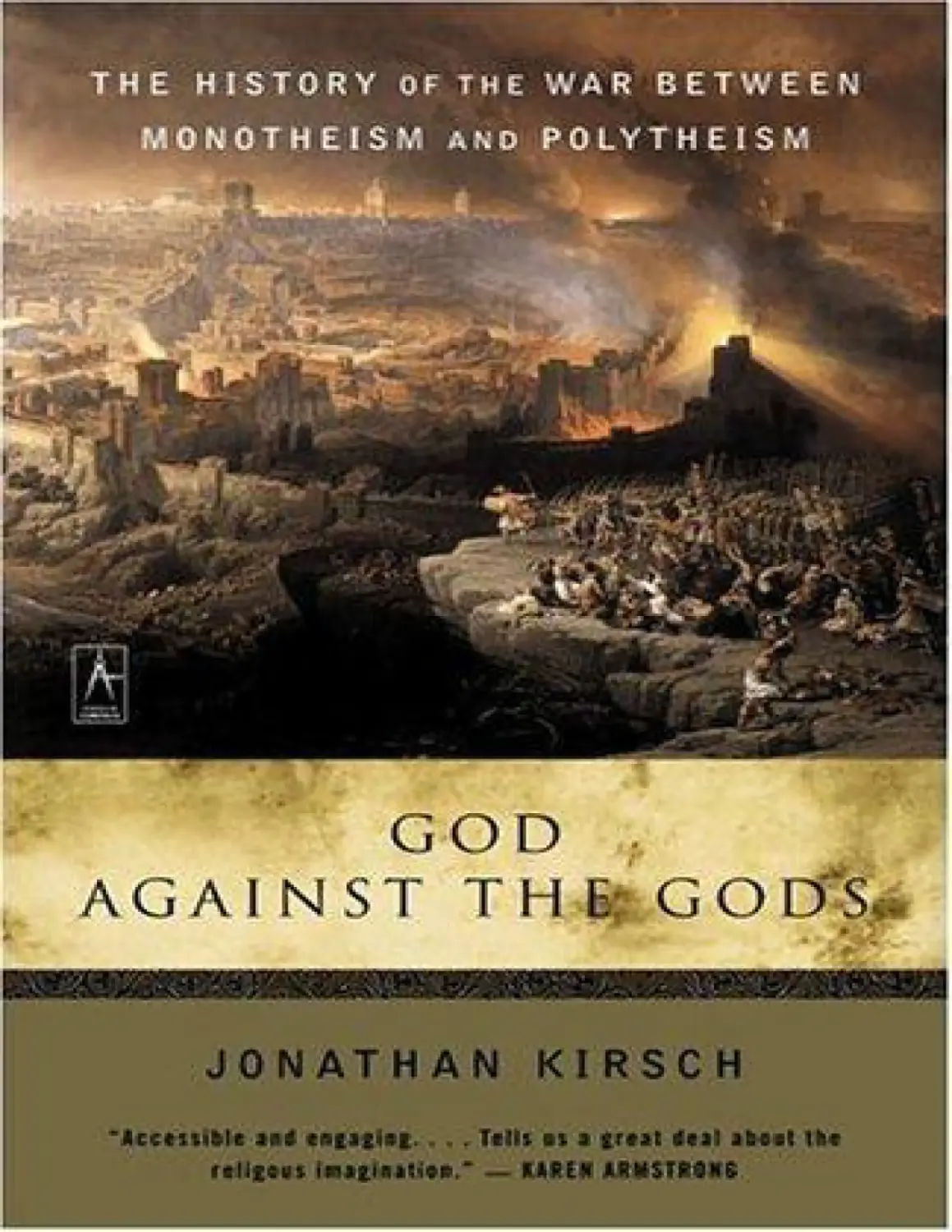
GOD AGAINST THE GODS
Jonathan Kirsch is the author of the bestselling and critically
acclaimed The Harlot by the Side of the Road: Forbidden
Tales of the Bible; King David: The Real Life of the Man Who
Ruled Israel; Moses: A Life; and The Woman Who Laughed at
God. A member of the National Book Critics Circle, PEN
Center USA West, and a book columnist for the Los Angeles
Times, Kirsch writes and lectures widely on biblical, literary,
and legal topics. He lives in Los Angeles, California.

ALSO BY THIS AUTHOR
The Woman Who Laughed at God:
The Untold History of the Jewish People
Moses: A Life
King David: The Real Life of the Man Who Ruled Israel
The Harlot by the Side of the Road: Forbidden Tales of the
Bible
Kirsch’s Handbook of Publishing Law:
For Authors, Publishers, Editors, and Agents
Kirsch’s Guide to the Book Contract:
For Authors, Publishers, Editors, and Agents

PENGUIN BOOKS
Published by the Penguin Group
Penguin Group (USA) Inc., 375 Hudson Street, New York, New York 10014, U.S.A.
Penguin Books Canada, 10 Alcorn Avenue, Toronto,
Ontario, Canada M4V 3B2 (a division of Pearson Penguin Canada Inc.)
Penguin Books Ltd, 80 Strand, London WC2R 0RL, England
Penguin Ireland, 25 St Stephen’s Green, Dublin 2, Ireland (a division of Penguin
Books Ltd)
Penguin Group (Australia), 250 Camberwell Road, Camberwell,
Victoria 3124, Australia ( a division of Pearson Australia Group Pty Ltd)
Penguin Books India Pvt Ltd, 11 Community Centre,
Panchsheel Park, New Delhi - 110 017, India
Penguin Group (NZ), cnr Airborne and Rosedale Roads, Albany,
Auckland 1310, New Zealand (a division of Pearson New Zealand Ltd)
Penguin Books (South Africa) (Pty) Ltd, 24 Sturdee Avenue,
Rosebank, Johannesburg 2196, South Africa

Penguin Books Ltd, Registered Offices:
80 Strand, London WC2R 0RL, England

First published in the United States of America by Viking Compass,
a member of Penguin Group (USA) Inc. 2004
Published in Penguin Books 2005

Copyright © Jonathan Kirsch, 2004

All rights reserved

Title-page art: Andrea Celesti (1637-1706). Moses Ordering the Destruction of

the Golden Calf.
Palazzo Ducale, Venice, Italy. Credit: Cameraphoto/Art Resource, NY

eISBN : 978-0-142-19633-5

The scanning, uploading, and distribution of this book via the Internet or via any
other means without the permission of the publisher is illegal and punishable by
law. Please purchase only authorized electronic editions, and do not participate
in or encourage electronic piracy of copyrighted materials. Your support of the
author’s rights is appreciated.
http://us.penguingroup.com

For
Ann Benjamin Kirsch,
Jennifer Rachel Kirsch,
Adam Benjamin Kirsch and Remy Elizabeth Holzer,
my beloved and gifted family.
And for
Laurie Fox,
my agent, muse, fellow writer and cherished friend.
“ . . . inscribe us in the Book of Life . . . ”

Acknowledgments
My first thought, as always, is for Ann Benjamin Kirsch, my
wife and lifelong best friend, and our gifted and
accomplished children, Jennifer Rachel Kirsch and Adam
Benjamin Kirsch, whose constancy, companionship and love
have been essential to the writing of God Against the Gods
and everything else I do.
This book is dedicated to my family and to someone who
has been crucial to my writing life ever since the publication
of The Harlot by the Side of the Road—Laurie Fox, whom I
first met when she worked behind the counter of a
bookstore in West Hollywood and soon came to know as a
cherished friend. Laurie is my literary agent, and the kind of
agent whom every writer dreams about, but that is only one
of her gifts—she is also an accomplished artist, poet and
novelist, a wise counselor on whom I have relied for her
vision, sagacity, good advice.
Janet Goldstein, my editor at Viking, guided me through
the conception and writing of both The Woman Who
Laughed at God and God Against the Gods, and I am
grateful for her discerning eye, expert editorial hand and
lively spirit.
I am deeply grateful, too, to Clare Ferraro at Viking, who
has given me so many opportunities over the years, starting
with The Harlot by the Side of the Road and including the
present book.
Among the many people at Viking with whom I worked
closely on the present book were Beena Kamlani, Carolyn
Coleburn, Cindy Hamel, Melanie Thurston, Rakia Clark, Ann
Mah, Francesca Belanger, Greg Mollica, and Trent Duffy and
I deeply enjoyed the opportunity to do so.

At Viking, I also appreciated the opportunity to work with
Mike Brennan, Nancy Sheppard, Phil Budnick, Fred Huber,
and Glenn Timony.
Susan Olinger, a gifted writer who shares my fascination
with the ancients, provided expert and imaginative research
assistance, and I made good use of research conducted for
my earlier books by Adam Kirsch, Andrew Solomon, Leonard
Braman and Vera Tobin. Michele Goldman ably assisted in
map research and proofing the manuscript and galleys.
I have been supported and encouraged in important ways
by family, friends, and colleagues to whom I express my
heartfelt appreciation:
Judy Woo and Eui Sook (Angie) Yoon, my cherished friends
and colleagues.
Remy Elizabeth Holzer, my daughter-in-law, and her
family, Harold, Edith and Meg Holzer.
Candace Barrett Birk and Raye Birk, Maryann Rosenfeld
and Shelly Kadish, Pat and Len Solomon.
K. C. Cole, my dear friend and a writer whose work on
science has shaped my own work on the history of religion.
Janet Fitch, Diane Leslie, Mary Rakow, Carolyn See and
Bernadette Shih, each of whom I admire as a fellow writer
and depend on as a dear friend.
Linda Chester and her colleagues at the Linda Chester
Agency.
Linda Michaels and Teresa Cavanaugh at Linda Michaels
Ltd. International Literary Agents.
Steve Wasserman, Tom Curwen, Nick Owchar, Orli Low,
Kristina Lindgren, Sara Lippincott, and Ethel Alexander at
the Los Angeles Times Book Review.

Doug Brown, Tom Crouch, Lara Furar and Barbara Morrow
and at the Los Angeles Times.
Jan Nathan and Terry Nathan at the Publishers Marketing
Association.
Larry Mantle, Kitty Felde, Aimee Machado, Jackie Oclaray,
Linda Othenin-Girard and Polly Sveda at KPCC-FM.
Rob Eshman at The Jewish Journal.
Sarah Spitz at KCRW-FM.
Gwen Feldman and Jim Fox at Silman-James Press, and
Tony Cohan at Acrobat Books.
Connie Martinson, host of Connie Martinson Talks Books.
Doug Dutton, Lise Friedman and Ed Conklin at Dutton’s
Books in Brentwood; Linda Urban at Vroman’s in Pasadena;
Stan Madson and Jeanne D’Arcy at the Bodhi Tree in West
Hollywood; Lita Weiss-man and Peggy Jackson at Border’s;
Michele Yanow at Tree of Life Judaica & Books in Seattle;
Abigail Yasgur at the Jewish Community Library in Los
Angeles; and Michael Graziano.
Charlie Alexiev, Scott Baker, Lillian Heller Conrad, Jacob
Gabay, Inge-Lise DeWolfe, Fred Huffman, Jill Johnson
Keeney, Les Klinger, Rae Lewis, Dennis Mitchell and Dolores
Sloan.
At various significant points, I have relied on the published
work and the generous encouragement of Jack Miles, Donald
Harmen Akenson, Karen Armstrong, David Noel Freedman,
Leonard Shlain and David Rosenberg, each of whom has
inspired my own work in important ways.

PROLOGUE
THE EVERLASTING FIRE
The Dark Side of Monotheism, the Bright Side of Polytheism
Religious intolerance was inevitably born with the belief in one
God.

—Sigmund Freud, Moses and Monotheism

Something deep in human nature prompts us to imagine the
existence of a power greater than ourselves, whether we
call it “Yahweh” or “Christ” or “Allah,” “Mother Nature” or
“the Higher Power” or “the Universe.” Religious belief and
practice begins with the origin of the human species—the
Neanderthals invented rituals for the burial of the dead—
and modern medical science proposes that the idea of
“god” is literally hard-wired into the anatomy of the brain.
Human beings, in fact, can be distinguished from lower
orders of animal life not because we use language or make
tools or fight wars, but because we are the only creatures
who conceive of a higher power and who are inspired to
offer worship and sacrifice to that power.
“Indeed, there is a case for arguing that Homo sapiens
[‘Rational man’] is also Homo religiosus [‘Religious man’],”
writes Karen Armstrong in A History of God. “Men and
women started to worship gods as soon as they became
recognizably human; they created religions at the same
time as they created works of art.”1
Nothing in human nature, however, suggests the
inevitability of the notion that there is only one god. On the

contrary, men and women in every age and throughout the
world have offered worship to literally thousands of gods,
goddesses and godlings, male and female alike, and they
still do. Only very late in the development of Homo
religiosus did monotheism—“one-god-ism”—first emerge,
and whenever some visionary king or prophet sought to
impose the worship of one deity to the exclusion of all
others, he would discover that ordinary people so cherished
their many beguiling gods and goddesses that the very idea
of monotheism was appalling. That is why the very first
recorded experiment in monotheism was an abject failure,
and polytheism has survived every effort to destroy it.
But, fatefully, monotheism turned out to inspire a ferocity
and even a fanaticism that are mostly absent from
polytheism. At the heart of polytheism is an open-minded
and easygoing approach to religious belief and practice, a
willingness to entertain the idea that there are many gods
and many ways to worship them. At the heart of
monotheism, by contrast, is the sure conviction that only a
single god exists, a tendency to regard one’s own rituals
and practices as the only proper way to worship the one
true god. The conflict between these two fundamental
values is what I call the war of God against the gods—it is a
war that has been fought with heart-shaking cruelty over
the last thirty centuries, and it is a war that is still being
fought today.

The Roots of Religious Terrorism
On September 11, 2001, we were reminded once again of
the real meaning of the 3000-year-old conflict between
monotheism and polytheism. The men who hijacked and
crashed four civilian airliners were inspired to sacrifice their
own lives, and to take the lives of several thousand
“infidels,” because they had embraced the simple but
terrifying logic that lies at the heart of monotheism: if there

is only one god, if there is only one right way to worship that
god, then there is only one fitting punishment for failing to
do so—death. At that moment, we were shown, yet again,
the power and the consequences of true belief in
monotheism.
Nowadays, the bloodiest acts of violence in the name of
God seem to come from the Islamic world, and the hijackers
who piloted airplanes into the World Trade Center and the
Pentagon are only the most horrific examples. Other recent
incidents include the dynamiting of ancient Buddhist
statuary in Afghanistan by the Taliban, who condemned the
1600-year-old artifacts as “false idols” and “gods of the
infidels,”2 the sentencing of Nigerian women to stoning for
the sin of adultery and Iranian journalists to death for the
sin of blasphemy, and suicide bombings by Palestinian
adolescents who seek martyrdom in a jihad (“holy war”)
against nonbelievers by blowing themselves up in the
streets of Jerusalem and Tel Aviv.
But the roots of religious terrorism are not found originally
or exclusively in Islamic tradition. Quite the contrary, it
begins in the pages of the Bible, and the very first examples
of holy war and martyrdom are found in Jewish and Christian
history. The opening skirmishes in the war of God against
the gods took place in distant biblical antiquity, when
Yahweh is shown to decree a holy war against anyone who
refuses to acknowledge him as the one and only god worthy
of worship. Holy war passes from biblical myth into recorded
history during the wars of national liberation fought by the
Maccabees against the pagan king of Syria and later by the
Zealots against the pagan emperor of Rome, which provide
us with the first accounts of men and women who are willing
to martyr themselves in the name of God. The banner is
taken up by the early Christians in the first century of the
Common Era, when they bring the “good news” of Jesus

Christ to imperial Rome, where the decisive battle in the war
between monotheism and polytheism is fought.
The crucial encounter takes place in Rome during the
fourth century, when the Roman emperor Constantine
worked a revolution in the name of monotheism and then
his nephew, the emperor Julian, sought to work a
counterrevolution in the name of polytheism. The years in
which these two men reigned, one in living memory of the
other, would literally change the history of the world. “For
better or worse,” remarks Gore Vidal in a novel based on the
life of Julian, “we are today very much the result of what
they were then.”3 And yet the final victory of God against
the gods was not inevitable, and we can see with our own
eyes how the Western world teetered between two possible
fates during the lifetimes of these two willful, ruthless and
charismatic men. Above all, we will glimpse something that
is rarely considered in our churches, synagogues and
mosques—the dark side of monotheism, and the bright side
of polytheism.

Four Kings
Monotheism is classically understood to be a “gift of the
Jews,” according to Thomas Cahill’s felicitous phrase, but
the fact is that an eccentric young pharaoh of ancient Egypt
was apparently inspired to worship a single god even before
“one-god-ism” was embraced by the ancient Israelites. The
first recorded experiment in monotheism took place in
ancient Egypt in the fourteenth century B.C.E. under the
reign of a pharaoh called Akhenaton, and it is likely that the
Israelites borrowed the idea from the Egyptians.
Unlike other inventors of new religions, including Moses,
Jesus and Mohammed, Akhenaton was not a prophet who
preached his gospel to skeptical crowds; rather, he was the
absolute ruler of the single most powerful empire in the
ancient world. Still, just like those more famous

monotheists, Akhenaton discovered that the idea of
monotheism is not especially appealing to men and women
who are accustomed to worshipping many gods and
goddesses. But popularity does not matter when the
prophet is also a king—the fiery young pharaoh possessed
the power to impose monotheism on an unwilling populace
by royal decree.
Akhenaton may have been the first monarch to order his
subjects to worship a single god, but he was hardly the last
one to do so. Monotheism eventually reached and rooted
itself in the land of Israel, but it was rejected by the majority
of Israelites as something strange and unappealing. Starting
with Moses, all the prophets who scold the Israelites in the
pages of the Bible are wholly unsuccessful in persuading
them to confine their worship to the God of Israel. Not until
the reign of King Josiah in the seventh century B.C.E.—
another monarch who was also a fiery religious reformer—
was the religion of ancient Israel fully purged of its pagan
taint, and only then because Josiah, like Akhenaton, enjoyed
the power to make it so.
But Josiah’s war on the gods, like Akhenaton’s, did not
result in a lasting victory. When Josiah died in battle against
an Egyptian pharaoh, many of the Jews drifted back to their
old and easygoing ways of worship, and the prophets
resumed their bitter but fruitless complaints. Later, the land
of the Jews came under the seductive but corrosive
influence of the pagan culture called Hellenism—to be an
educated and civilized man or woman, according to the
Hellenistic ideal, required a familiarity with pagan arts and
letters and participation in pagan rituals and celebrations.
Now and then, the most pious and zealous of the Jews
struggled against the temptations of Hellenism, seeking to
enforce the worship of the God of Israel at the point of a
sword, but monotheism seemed at risk of remaining only an

historical curiosity, the tribal practice of a tiny and
powerless people who lived in a backwater of the Near East.
Indeed, the final victory in the war of God against the
gods was not achieved until a new superpower emerged in
the ancient world—the empire of Rome—and the men who
ruled it acquired the apparatus of autocracy. The Roman
empire of late antiquity has been characterized as the first
totalitarian state in history, and the Roman emperors were
able to call on the expert services of an imperial
bureaucracy that included spies, informers, inquisitors,
torturers and executioners. The king who perfected the
Roman autocracy was Constantine, a pagan general who
intrigued, conspired and battled his way to the imperial
throne in the opening years of the fourth century—and then,
fatefully, found God.
To Rome came all the faiths of the ancient world, not only
the familiar gods and goddesses of Hellenism but a fantastic
assortment of weird, raucous and highly exotic deities from
all over the empire. Among the many competitors for the
hearts and minds of the Roman citizenry, in fact, the oddest
of all were those who confined their worship to only a single
all-powerful god—the Jews, of course, and an obscure sect
of Judaism that came to be called Christianity. By then, the
Jews had made a separate peace with paganism, and they
found a way to carry on the worship of the God of Israel
throughout the Diaspora without disturbing (or being
disturbed by) their pagan neighbors. But the Christians had
taken up the old traditions of zealotry that were written
large and plain in the pages of the Bible. They called
themselves “Soldiers of Christ,” and they were eager to
fight and die in the name of God.
Constantine favored Christianity, but he refrained from
bringing the full weight of imperial authority to bear in the
war that the Soldiers of Christ were fighting against all

manner of paganism. And so, after the long reigns of
Constantine himself and his three Christian sons, the
emperor who next took the throne was able to entertain the
remarkable idea of restoring the worship of the old gods and
goddesses whom he found so enthralling. His name was
Julian, and he is recalled in pious Christian history as “the
Apostate”—a term that was coined to condemn anyone who
has repudiated the teachings of true belief. But Julian also
represented the last, best hope for the preservation of
everything that was elevating and ennobling about
paganism. Between Constantine and Julian, the world faced
a choice between two futures, and so the lives and reigns of
these two men present us with one of the great “what ifs” of
human history.

A Parade of Horribles
Over the last thirty centuries of religious propaganda,
starting in the Bible and continuing through the TV
evangelists of our own era, paganism has been painted as a
parade of horribles. We are instructed to regard paganism
as an “abomination,” as the biblical authors so insistently
put it, a dark and demonic force compounded of harlotry,
idolatry, sorcery and human sacrifice. “The error of
polytheism,” argues historian Hans Lietzmann, “led the
peoples into darkness and moral chaos.”4 The classical
paganism of late antiquity—which was, after all, the faith of
the high civilization of ancient Greece and Rome—is flatly
condemned by one nineteenth-century Christian historian as
“the moral disease of the Roman world.”5 Even today, a
celebrity cleric like Jerry Falwell insists that the horrors of
September 11 can be attributed to the lingering evil of
paganism.
The pagan world, to be sure, was hardly a benign place.
Common criminals were routinely tortured before they were
put to death, and prisoners of wars were sold off as slaves

when they were not crucified en masse. Women and
children in conquered lands were placed in the same
category as cattle and chattel—spoils of war that belonged
to the victor. But the religious practices and beliefs of
paganism were kinder and gentler than we have been
taught to believe by our rabbis, priests, ministers and
imams. The core value of paganism was religious tolerance
—a man or woman in ancient Rome was at liberty to offer
worship to whatever god or goddess seemed most likely to
grant a prayerful request, with or without the assistance of
priests and priestesses, as long as he or she didn’t do it in
the streets, as a Victorian-era wit once said of women
preachers, and scare the horses.
“What does it matter by which wisdom each of us arrives
at truth?” muses Symmachus, a pagan prefect of the fourth
century. “It is not possible that only one road leads to so
sublime a mystery.”6
By the first century of the Common Era, paganism offered
a fabulous array of beliefs and practices from which to
choose, ranging from the sedate and stately rituals of
worship offered to the gods and goddesses of the traditional
Greco-Roman pantheon to the eerie and exotic rites that
roused the devotees of such imported deities as Isis, Mithra
and the Great Goddess. A few of the pagan cults still
engaged in celebrations so spirited that we might
characterize them as orgies, but the most common
ceremonies of classical paganism—ranging from animal
sacrifice to the offering of cakes and libations—were
strikingly similar to the rituals that the Hebrew Bible
prescribes for the worship of the God of Israel.
Indeed, many of the commonplaces of paganism will
strike the modern reader as both familiar and inoffensive.
Tossing a coin in a fountain, for example, is a distant echo of
the offerings of jewelry or coins that were made to the gods

who were thought to reside in lakes, streams and pools. The
horoscope in the morning newspaper recalls the daily
astrological readings that a cautious pagan would consult
before taking a bath or getting a haircut. Tying a ribbon
around a tree is our way of honoring a missing child, but the
same gesture was used by the ancients to honor an unseen
god. And the essential feature of the shrines where oracles
were thought to channel the voices of the gods—“the
conjunction of an uncanny place and a canny person,” as
historian J. L. Myers describes them—can be found in any
place where one might have a “spiritual” experience,
whether a single god or many gods or no gods at all are
worshipped there.7
Nor was sexual adventure quite as common in paganism
as we are led to believe by the scenes of orgiastic excess
that we find in biblical writings or Hollywood epics. Although
we will encounter a few examples of sex, sacred or
otherwise, taking place in the precincts of a pagan temple,
the fact is that paganism was as capable of prudery and
puritanism as the strictest forms of monotheism. The more
exotic rites and rituals were regarded as scandalous by the
sober senators of pagan Rome, who insisted, for example,
that the worshippers of Bacchus, the god of wine, do their
drinking off the public streets. Virginity until marriage and
fidelity during marriage were as highly praised—if also as
rarely practiced—by the worshippers of Jupiter as by the
worshippers of Yahweh. Priestly celibacy was enforced in
some pagan cults long before it was adopted by the
Christian clergy and in fact the Christians may have copied
the whole idea from the hated pagans.
Nor did the pagans seek from their many gods and
goddesses anything different from what Christians, Jews and
Muslims seek from the deity that they regard as the one and
only god. Pagans prayed for health and happiness, safety
and security, a good life here on earth and some kind of

salvation in the afterlife. They embraced the values of
justice and mercy, and, by and large, they sought to live
decent and moral lives: “Temperance, courage, chastity,
obedience to parents and magistrates, [and] reverence for
the oath and the law,” according to the venerable historian
Franz Cumont, were the core values of paganism as it was
practiced in ancient Rome.8
But one crucial quality distinguished Christianity from
classical paganism. Polytheists, as we have seen, were not
inclined to dictate to others how and to whom prayer and
sacrifice should be offered. They were perfectly willing to
mix and match gods and goddesses, rituals and beliefs, and
they sought the divine favor of many different deities at
once. A conquered people might embrace the gods of their
conqueror—and the conqueror might return the favor.
Nowhere in the ancient world was the open-mindedness
more apparent than in imperial Rome. Indeed, Roman
paganism was not a religion in the same sense that we use
the word to describe Judaism, Christianity and Islam. Rather,
what we call “paganism” was, as historian Ramsay
MacMullen puts it, “no more than a spongy mass of
tolerance and tradition.”9
“ ‘Paganism’ to the pagan never existed,” explains
historian John Holland Smith in The Death of Classical
Paganism. “It is not far from the truth to say that before
Christianity invented it, there was no Roman religion, but
only worship, expressed in a hundred-and-one different
ways.”10

The Only True God
Monotheism, by contrast, insists that only a single deity is
worthy of worship for the simple reason that only a single
deity exists. On this point, Judaism, Christianity and Islam
agree, at least in principle: the deity that is variously called

“Yahweh” or “Lord” or “Allah” is thought to be one and the
same god. Pagans certainly understood and embraced the
idea that some gods are more powerful than other gods,
and phrases like “Supreme God” and “Highest God” fit
comfortably into the language and theology of polytheism.
But monotheism insists that the other gods to whom
worship is offered are not merely inferior in power or
stature; rather, they are false, according to the Hebrew
Bible, or even demonic, according to the Christian Bible.
“For though there be gods many and lords many,”
explains Paul, “but to us there is but one God.”11
The point is made plain in a phrase that is found in the
scriptures of both Christianity and Judaism. The god of
monotheism is not only “the living God,” not only “the
everlasting King,” as the prophet Jeremiah puts it, but “the
True God.”12 The apostle John is even more plainspoken—
the god of monotheism is “the Only True God.”13 By
contrast, all of the gods, goddesses and godlings of
paganism are “no-gods,” in the words of Jeremiah,14 or even
worse, “devils,” according to the apostle Paul.15 To worship
the wrong god, according to the value system of biblical
monotheism, is not only a sin but a crime, and a crime that
is punishable by death.
Monotheism, for example, cruelly punishes the sin of
“heresy,” but polytheism does not recognize it as a sin at
all. Significantly, “heresy” is derived from the Greek word
for “choice,” and the fundamental theology of polytheism
honors the worshipper’s freedom to choose among the
many gods and goddesses who are believed to exist.
Monotheism, by contrast, regards freedom of choice as
nothing more than an opportunity for error, and the
fundamental theology of monotheism as we find it in the
Bible threatens divine punishment for any worshipper who
makes the wrong choice. Against the open-mindedness of

the pagan Symmachus, who allows that there are many
roads to enlightenment and salvation, Bishop Fulgentius
(468-533) insists that only a single narrow path leads to the
Only True God.
“Of this you can be certain and convinced beyond all
doubt,” declares Fulgentius, “not only all pagans, but also all
Jews, all heretics and schismatics will go into the everlasting
fire which has been prepared for the Devil and his angels.”16
Here is the flash point of the war of God against the gods.
The deity who is worshipped in Judaism, Christianity and
Islam is described in the Bible as a “jealous” and “wrathful”
god, and he is believed to regard the worship of any god
other than himself as an “abomination.” The deities who
populate the crowded pantheon of classical paganism, by
contrast, were believed to be capable of thoroughly human
emotions, including envy and anger, but they were never
shown to deny one another’s existence or demand the
death of someone who worshipped a rival god or goddess.
“The pagan gods, even the gods of mysteries are not
jealous
of
one
another,”
explains
historian
and
anthropologist Walter Burkert. “ ‘Envy stands outside the
divine chorus,’ as the famous saying of Plato’s puts it.”17
The polytheist can live in harmony with the monotheist:
“[M]any pagans could still extend to the new worship,”
writes historian Robin Lane Fox, “a tolerance which its
exclusivity refused to extend to them.”18 Pagan Rome
offered the ultimate gesture of respect to the Jews and
Christians by adding the God of Israel to the pantheon of
gods and goddesses, where he was called Iao and offered
worship along with Apollo and Zeus, Isis and Mithra. “If the
Supreme God was unknowable, who was to say which one of
the many cults of different peoples was right or wrong?”
explains Fox. “At its heart, therefore, pagan theology could
extend a peaceful coexistence to any worship which, in turn,

was willing.”19 But the pagans who did so, of course, missed
the whole point of monotheism, and the Jews and Christians
refused to reciprocate.
Indeed, the monotheists condemned not only the rude
and crude deities of the “barbarians” but even the elegant
and refined deities of the Greco-Roman pantheon who were
so richly embroidered into the fabric of classical civilization
and high culture. A sixth-century Christian militant called
Martin of Braga, for example, describes the most revered
gods and goddesses of Greece and Rome as demons who
had been cast out of heaven along with Satan and now
tricked the benighted pagans into offering them worship.
“So one said he was Jove, who was a magician and so
incestuous in his many adulteries that he had his sister as
his wife, who was called Juno [and] corrupted his daughters,
Minerva and Venus,” insists Martin of Braga. “Another
demon called himself Mars, who was a perpetrator of strife
and discord. Then another chose to call himself Mercury,
who was the wretched inventor of all theft and fraud.
Another demon took the name of Saturn, who, basking in
cruelty, even devoured his sons at birth. Another demon
feigned to be Venus, who was a whore. She did not only
whore with innumerable adulterers but even with her father
Jove and her brother Mars.”20
For true believers like Martin of Braga, then, the tales that
are told in the pages of Homer are not merely charming
myths, and the pagan gods are not merely “no-gods”—
rather, they are all the work of the Devil. Indeed, the
monotheists of late antiquity were convinced that they lived
in a world populated with evil spirits, and they relied on
amulets and charms, prayers and exorcisms, to keep the
Devil and his minions at bay. A vigilant Christian who passed
a pagan shrine in town or country, for example, would hiss
out loud and make the sign of the cross to scare off the

unseen demons that he or she believed to linger there. “The
air between heaven and earth is so crammed with spirits,
never quiet or finding rest,” writes the Christian sermonizer
John Cassian in the fifth century, “that it is fortunate for men
that they are not permitted to see them.”21
Thus the militant monotheist condemns polytheism in
general as an “abomination,”22 in the words of the Hebrew
Bible, and pagan Rome in particular as the “mother of
harlots and the abominations of the earth,”23 according to
the Christian Bible. Precisely because the monotheist
regards the polytheist with such fear and loathing, peaceful
coexistence between the two theologies is possible only
from the pagan’s point of view and never for the true
believer in the Only True God.

The Tragic Legacy
The strict and uncompromising attitude of monotheism,
approvingly described in the Bible itself as “zeal” for the
True God,24 sometimes manifests itself in a strange
phenomenon that historians of religion call rigorism—that is,
“extreme strictness” in religious belief and practice.25 The
Jewish men and women who were the custodians of the
Dead Sea Scrolls, for example, disciplined themselves to
refrain from bowel movements on the Sabbath lest they
defile the “Lord’s holy day of rest.” Among the hermitmonks of early Christianity were men who banished
themselves to the desert wilderness, spending years atop
stone pillars and feeding themselves only on crushed
greens. But paganism, too, produced its own rigorists—
some of the Romans who worshipped Isis, a deity who was
borrowed from the pantheon of ancient Egypt and embraced
throughout the Greco-Roman world, were inspired to show
the same kind of devotion to their goddess. “Three times, in
the depths of winter, the devotee of Isis will dive into the
chilly waters of the Tiber, and shivering with cold, will drag

herself around the temple upon her bleeding knees,”
observes the Roman satirist Juvenal (c. 60-40). “[I]f the
goddess commands, she will go to the outskirts of Egypt to
take water from the Nile and empty it within the
sanctuary.”26
But, tragically, rigorism is not always or only expressed
through acts of self-discipline and self-affliction. Extreme
strictness in religious observance is possible only when a
man or woman is so convinced of the truth of a certain
religious teaching that it becomes quite literally a matter of
life or death. Turned inward, rigorism may inspire a true
believer to punish himself by holding back a bowel
movement or feeding himself on raw vegetables. Turned
outward, however, rigorism may inspire the same man or
woman to punish others who fail to embrace the religious
beliefs that he or she finds so compelling. The history of
religion reveals that rigorism in one’s beliefs and practices
can readily turn into the kind of zealotry that expresses
itself in unambiguous acts of terrorism. Indeed, the very first
use of the word “zeal” in the Bible is used to describe God’s
approval of an act of murder, one Israelite murdering
another Israelite and his Midianite lover.27
Examples can be found in every faith, in every place and
in every age, including our own. A Jewish man in Israel, for
example, was recently moved by his own religious passions
to open fire with a machine gun on Muslims at prayer in a
mosque at the Tomb of the Patriarchs. A Christian man in
America was inspired by his religious passions to pick up a
sniper’s rifle and shoot down a doctor who performed
abortions. Neither of these true believers would be quick to
recognize a kindred spirit in the other, but they both share
the same tragic legacy of rigorism, a legacy that is deeply
rooted in monotheism.

Nowadays, of course, religious terrorism is carried out by
true believers in one or another variety of monotheism
against their fellow monotheists, and the same has been
true ever since the final victory of monotheism over
polytheism in the war of God against the gods. Ironically,
the worst excesses of the Crusades and the Inquisition were
inflicted by Christians on Jews and Muslims, all of whom
claimed to believe in the same god. But the first casualties
in the war of God against the gods were found among those
tolerant polytheists whom we are taught to call “pagans.”

Christian Soldiers
“Pagan” is a word invented by early Christians to describe
anyone who refused to recognize the Only True God, and no
self-respecting pagan ever described himself as one.
Paganism, in fact, has been so thoroughly defamed that our
language lacks the words and phrases to describe it in
value-neutral terms. “A pagan,” according to one of the
dictionary definitions of the word, is “an irreligious or
hedonistic person.”28 All of the synonyms and variants
—“heathen” or “idolater” or “infidel” or “barbarian”—are
equally dismissive or derogatory. We are left with the dry
and highly technical terms that distinguish between
someone who worships only a single god, a “monotheist,”
and someone who worships more than one god, a
“polytheist.”
One explanation for the root meaning of “pagan” allows us
to see what was at stake in the encounter between
monotheism and polytheism in ancient Rome. The word
derives from the Latin “paganus,” which originally referred
to a “village-dweller” and carried the sense of a “country
bumpkin.” But the word was also used in Roman military
circles to mean “civilian” and to distinguish one who is
ready to fight in war from someone who stays behind.
According to some scholars, that’s precisely the meaning of

“pagan” that inspired its first use by Christians—the
Christian rigorists regarded themselves as soldiers, ready to
march forth as crusaders in a holy war, and they
characterized anyone who refused to take up arms in the
service of the Only True God as a civilian, a slacker, a
“paganus.”
“Pagan” eventually came to mean anyone who
worshipped any god or goddess other than the deity who
was recognized as the Only True God in Jewish, Christian
and Islamic tradition. For that reason, the term
encompasses a multitude of supposed sins, ranging from
the elegant rituals of the Roman senator who represented
the highest expression of classical civilization in the ancient
world to the cruder rituals of the Celtic tribesman who
painted himself blue and fought naked against the Roman
legions. And Christianity would ultimately carry the holy war
in the name of the Only True God to every corner of the
Roman empire and far beyond—no distinction was made
between the patrician and the barbarian, and the religious
practices of each were regarded as equally “abominable”
and equally worthy of persecution.
Now and then, a willful and hateful monarch might
abandon the long tradition of tolerance that characterized
the world of classical polytheism and undertake a war of his
own against monotheism—the persecution of Christians in
pagan Rome, of course, is the most famous example.
Whether the Roman persecutions were quite as pervasive or
quite as horrific as depicted in the martyrologies, however,
has been the subject of hot debate for several centuries—
Edward Gibbon, for example, characterized the worst
atrocities as “extravagant and indecent fictions” that were
invented to inspire the faithful.29 Indeed, the spectacle of
men and women who went willingly and even ardently to
their deaths—and, long afterward, the memory of these
martyrdoms and the relics of the martyrs themselves—only

stirred the fires of true belief and inspired ever greater acts
of zealotry. Sometimes the pagan magistrates literally
begged the Christians to make some gesture of compromise
in order to save their own lives.
“Unhappy men!” cried one Roman proconsul to the alltoo-willing martyrs. “If you are thus weary of your lives, is it
so difficult for you to find ropes and precipices?”30
What the pagans found most provocative was not the fact
that the Christians chose to worship their own deity in their
own way, but that they stubbornly refused to drop a pinch of
incense on the altar fire or mumble a few words of prayer in
honor of the Roman deities. Ironically, the word “atheist”
was first used by pagans to describe Christians because
they denied the very existence of the gods and goddesses
whom the pagans so revered. What the Christians saw as an
act of conscience, the pagan saw as an act of disloyalty and
disrespect—all that was required of them was some simple
demonstration of their “civic virtue,” which is the phrase
that was used by one school administrator to justify the
recital of the Pledge of Allegiance when a California court
recently ruled it unconstitutional because it includes the
phrase “under God.”
Whether or not the “Great Persecution” of the early fourth
century, the tenth and last of the persecutions carried out
against Christianity by pagan Rome, would have been
successful in extinguishing or at least containing the fires of
true belief, we will never know. Remarkably—and, according
to Christian tradition, miraculously—the Christians were
rescued from their torturers and executioners when
Constantine, one of the many pagan contenders for the
imperial crown, managed to prevail in battle over all the
others and then put himself under the protection of the
Christian god. Here is one of the rare moments when the

willful act of a single human being can be said to have
changed the course of history.

“Behold, the Rivers Are Running Backwards”
We are encouraged to regard monotheism as a self-evident
truth that could not fail to win the heart and mind of anyone
to whom it was revealed. “But nothing made its final victory
inevitable,” insists historian Diana Bowder. “[T]he final
triumph of Christianity and extinction of paganism [were]
still far from certain or obvious.”31 Among the many faiths
on offer in ancient Rome, all but Christianity and Judaism
were polytheistic in origin—and Christianity, as historian
Kenneth Scott Latourette concedes, “seemed to be one of
the least of many rivals and with no promise of success
against the others.”32 Indeed, even after the famous
conversion of the emperor Constantine to Christianity, the
outcome could not have been predicted with confidence at
any time until the ultimate victory.
“If Christianity had been checked in its growth by some
deadly disease, the world would have become Mithraic,”
speculates the nineteenth-century historian Ernest Renan.33
“[I] magine how the history we trace in this book would
have unfolded,” proposes the contemporary historian James
Carroll in Constantine’s Sword, “had the young emperor
been converted to Judaism instead.”34
Indeed, as we shall see, the revolution that Constantine
had set in motion was still imperfect and incomplete on his
death—the ruling class, the culture and the vast majority of
the population of the Roman empire were still pagan. When
Julian, no less ambitious and no less visionary than
Constantine, ascended to the imperial throne, he promptly
revealed his intention to undo everything his uncle had
done in the name of the Christian god. “Behold, the rivers
are running backwards, as the proverb says!” writes Julian in

one of the elegant, highly literate and often bitterly ironic
discourses that were his real passion and his only enduring
monument. The ancient proverb that Julian quotes was
understood to signify that “all is topsy-turvy”—and thus
does he acknowledge his own audacity in seeking to undo
the revolution that Constantine set into motion and work a
revolution of his own.35
The Christian emperor and the pagan emperor, in fact,
shared much in common. Both of them, like other famous
makers of both religions and revolutions, were masters of
self-invention. Each was convinced that blessings had been
bestowed upon him from on high, although each credited a
different god for his curious fate, and both claimed to have
seen divine visions and received divine visitations. Yet they
were both driven as much by grudges and grievances as by
true belief, and intimate family politics mattered as much as
the wars and conspiracies in which they were engaged. Both
were so enmeshed in scandal, intrigue and betrayal that
their life stories resemble something between a soap opera
and a Shakespearean tragedy. Each of them was deeply and
decisively influenced by the women in his life—mother,
sisters, wives and concubines. Above all, each one sought to
remake the world over which he reigned, and each one very
nearly did so.
Julian, of course, ultimately failed to reverse the flow of
the river of history that Constantine had turned in the
direction of monotheism. A spear thrust ended his life, and
thus ended his pagan counterrevolution, only two years into
his reign. He was still a young man when he died in battle,
and if he had lived as long as his uncle, the war of God
against the gods—a war that has never really ended—might
have turned out much differently. Indeed, as we shall see, it
is tantalizing to consider how close he came to bringing the
spirit of respect and tolerance back into Roman government
and thus back into the roots of Western civilization, and

even more tantalizing to consider how different our
benighted world might have been if he had succeeded.

BOOK ONE
THE GOD THAT FAILED
You have rejected the Lord who is among you, and have troubled him with
weeping, saying, “Why, now, came we forth out of Egypt?”
—Moses, Numbers 11:20

CHAPTER ONE
AGAINST ALL THE GODS OF EGYPT
A Young Pharaoh’s Experiment in Monotheism and Why It
Failed
God is a latecomer in the history of religion.
—G. van der Leeuw

Only rarely does an archaeological discovery challenge
everything we have been taught to believe about the
history of religion. But that is what happened when an
expedition of so-called biblical archaeologists began to
excavate the ruins at Tell el-Amarna, a remote site near the
banks of the Nile in southern Egypt, in the late 1880s.
Suddenly, all that the Bible tells us about the origin of
monotheism was called into question.
By a tradition that is embraced in all three of the
monotheisms—Judaism, Christianity and Islam—the first
person to recognize and worship the single all-powerful
deity variously known as “Yahweh” or “Lord” or “Allah” was
Abraham, whose encounter with the God of Israel in the
land of Canaan is memorably depicted in the Book of
Genesis: “And the Lord appeared unto Abram,1 and said,
‘Unto thy seed will I give this land,’ and he built there an
altar unto the Lord.”2a A distant descendant of the first
patriarch, the man called Moses—yet another prophet who
is honored by Jews, Christians and Muslims alike—is shown
in the Book of Exodus to challenge the pharaoh of Egypt on
the fundamental theological issue that divides monotheism

and polytheism, the rivalry between the single all-powerful
god who calls himself “Yahweh” in the Hebrew Bible and the
countless gods, goddesses and godlings of Egypt.
“Who is Yahweh, that I should obey his voice?” a bemused
pharaoh asks Moses. “I know not Yahweh.”3
“Against all the gods of Egypt, I will execute judgment,”
promises Yahweh. “I am the Lord.”4
The diggings at Tell el-Amarna, some 180 miles south of
modern Cairo, tell a very different tale. The inscriptions on
the stones and shards that were scratched out of the ground
at el-Amarna show us the remarkable life of a young man
who worked a revolution in ancient Egypt by scorning all the
old gods and goddesses of the Egyptian pantheon, and
worshipping one god alone. The man was not Moses; rather,
he was a pharaoh who never met or even heard of a man
called Moses. But perhaps the most surprising fact about
the world’s first monotheist is that his daring new religion
died and was buried with him.

Cats and Crocodiles, Leeks and Onions
Some 3500 years ago, a young man ascended to the rule of
Egypt under the throne name of Amenhotep IV (died c. 1347
B.C.E.).5 The name refers to the deity called Amon, the
loftiest of the fantastic array of gods and goddesses who
were worshipped by the men and women of Egypt. Amon
was associated with the sun—the deity was thought to be
the most powerful of the many gods, just as the sun is the
brightest of the many objects in the sky—but there were
plenty of others to whom prayer and sacrifice were offered.
Indeed, the high king may have chosen a name that
honored the high god, but his subjects continued to worship
the jackal-headed Anubis, who was thought to weigh the
hearts of the newly dead and watch over their tombs; the
fertility goddess called Isis and her sibling-lover, Osiris, who

was believed to reign over the netherworld where pious
Egyptians hoped to spend their afterlives; and the troll-like
Bes, ugly and misshapen, but cherished as the cheerful god
of music and dancing and the good-hearted protector of
children. Like everyone else in the ancient world, the
Egyptians were ardent and unquestioning polytheists.
The Egyptians, in fact, were famous in the classical world
for their sheer inventiveness in matters of faith, which
included the worship of deities who were symbolized not
only by household pets and wild animals but even by
otherwise humble vegetables. “The comic writers and
satirists never tired of scoffing at the adorers of the cat, the
crocodile, the leek and the onion,” reports Franz Cumont,
citing as an example the most famous satirical poet of firstcentury Rome: “Juvenal says ironically: ‘O holy people,
whose very kitchen-gardens produce gods.’ ”6
The worship of gods and goddesses, however, was not
merely a matter of whim or whimsy. Each of the most
prominent deities was served by a priestly caste that
consisted of men and women who were both proud and
protective of the temples where they lived and worked and
of the ceremonies over which they presided so solemnly.
Like clergy in every place and every age, they courted the
favor of the rich and powerful, and the pharaohs of Egypt
were flatteringly likened to one or another of the gods. Over
the centuries, the polytheism of ancient Egypt rooted itself
in the political and economic establishment, and the
pharaohs came to be regarded both as gods and kings.
The pharaohs who preceded Amenhotep to the throne of
Egypt regarded themselves as the bearers of an old and
fixed tradition, and they dutifully consulted the priests of
Amon and the other gods and goddesses before embarking
upon any enterprise. Nor did they have reason to doubt that
the gods favored Egypt above all other nations of the known

world—Egypt was what we would today call a superpower,
and it dominated the ancient Near East, not only because of
its superior military strength but also because it was
regarded as the center of art, commerce and diplomacy.
Indeed, museums throughout the modern world are filled
with the rich artifacts that attest to the superb achievement
of Egyptian civilization.
But the young pharaoh called Amenhotep was not content
with following the example of the seventeen dynasties that
had come before him. He resolved to use the power that he
possessed as pharaoh of Egypt to decide, not only for
himself but for his subjects, what gods and goddesses ought
to be worshipped. Here we encounter another new and
terrible phenomenon in the history of religion—the fusing of
religion and politics into a single instrument of power
wielded by a single human being. Amenhotep now decided
to defy all of the old traditions and invent some new ones of
his own making.

Virgin Soil
Amenhotep was born and raised among the opulent and
elegant ceremonies of worship that constituted the state
religion of ancient Egypt. But something inspired him to
reject the status quo, to re- invent himself and revolutionize
his spiritual beliefs and practices. The young pharaoh
repudiated all of the gods and goddesses in favor of the
single high god called Aton, a word that means “sun disk,”
and he renamed himself in honor of his new and all-powerful
deity. Just as Abram became Abraham when he embarked
upon the worship of the new god called Yahweh, the
pharaoh signified his new faith by changing his throne name
from Amenhotep (“Beloved of Amon”) to the one by which
he is known and remembered today: Akhenaton, which is
translated as “Splendor of Aton.”7 So named, the restless

and willful young pharaoh was ready to carry out a purge
and work a revolution in the kingdom that he ruled.
Aton, just like Amon, was identified with the sun. But
Akhenaton forbade any depiction of Aton that might remind
his worshippers of a living thing, animal or vegetable. By
royal decree, Aton was symbolized by an austere circle of
gold that was meant to suggest the sun shining at its
brightest in the noon sky. For that reason, no idols were
fashioned in the image of Aton because, remarkably, he was
a god whose form could not be imagined.
And, just as remarkably, the pharaoh insisted that Aton,
quite unlike Amon, was a jealous god who refused to share
the affection or the attention of his worshippers with other
gods and goddesses. At Akhenaton’s command, the shrines
and temples of rival deities were closed, the rituals of
worship were suppressed, the statues that symbolized the
other divinities were shattered and their names and images
were literally chiseled off the stone monuments of ancient
Egypt. The high priest of Amon, whose services were no
longer needed, was put to work in a stone quarry like a
common slave.
To put himself beyond the taint or temptation of the old
gods, Akhenaton abandoned the royal capital of Thebes,
where generations of pharaohs had reigned and were now
buried beneath pyramids and sphinxes, and he built a new
capital on virgin soil along the bank of the Nile. Here he
established not only a new religion, with temples dedicated
to Aton alone, but also a new style of art and architecture, a
new royal entourage and a new government. Like other true
believers who would follow his example in the centuries to
come, Akhenaton convinced himself that the brave new
world he had created would replace all that had come
before and would last forever.

In the Mansion of the Sun

Like Moses, who is shown in the Bible to condemn the
worship of a golden bull and other graven images,
Akhenaton rejected all the traditional icons of paganism and
chose a simple geometric shape to symbolize the god Aton.
Like Solomon, he built a temple to the new god, the socalled Mansion of the Sun-Disk. Like Constantine, who
founded the city of Constantinople to replace pagan Rome
as capital of the Roman empire, Akhenaton personally
participated in the planning and design of the new city
dedicated to Aton.
Akhenaton can be compared to these famous
monotheists, but—as far as we know—he was the first
person to embrace these ideas, and he deserves the credit
for inventing something wholly new in human history. New
gods and goddesses had already been imagined and
embraced throughout human history, no less in ancient
Egypt than elsewhere around the world, and that is exactly
why the pantheon of polytheism was always so crowded.
Nor was there anything unprecedented or even unusual in a
god who was understood to be the higher in rank than all
other deities—both Amon and Aton were, after all, identified
with the sun, the brightest but hardly the only object in the
sky above Egypt.
Akhenaton, however, was the inventor of a religion with a
crucial and fateful difference. Never before had a deity been
understood to demand that all other gods and goddesses be
rejected and abandoned. Akhenaton did not regard Aton
merely as the one god among many who specially favored
him and thus deserved his special attention in prayer and
sacrifice. Rather, he regarded Aton as the one and only god,
and he refused to allow anyone else to believe or act
otherwise. “The monotheistic revolution of Akhenaton,”
explains Egyptologist Jan Assmann, “was not only the first
but also the most radical and violent eruption of a counterreligion in the history of humankind.” 8

The Forgotten God
What turned the pharaoh of Egypt, inheritor of a rich and
accommodating tradition of polytheism, into a revolutionary
and a rigorist? At the heart of monotheism, of course, is the
notion of the Only True God who reveals himself to ordinary
men and women, causes the scales to fall from their eyes
and thus turns them from benighted sinners into true
believers. Did Akhenaton, too, experience an epiphany like
the one that was visited upon Moses when a divine voice
addressed him from within “a bush that burned with fire but
was not consumed”9 or the one that manifested as “a light
from heaven”10 and sent Paul to his knees in awe and terror
on the road to Damascus?
Such is the common vocabulary of true belief in the
history of monotheism. But there are other ways of
understanding what happened to the excitable young
pharaoh who embraced the solar god with such fervor. One
theory, which has been applied to Constantine and Julian as
well as Akhenaton, suggests that he was expertly
manipulated into undertaking his missionary work by one of
the guileful women in his life—a theory that relies on the
primeval stereotype of woman as seducer and thus echoes
the tale of Eve and her notorious apple. Perhaps Akhenaton,
who is described by one scholar as “a sensitive aesthete,”11
fell under the influence of his mother, who may have been
the first member of his family to worship Aton. Or perhaps it
was his wife, the celebrated Queen Nefertiti, who prevailed
upon the impressionable young king to join the cult of the
sun god.
Another theory, which also prefigures the political conflicts
that raged in the courts of both Constantine and Julian,
proposes that Akhenaton was courted by the rival
priesthoods of Amon and Aton, one based in the old royal
capital at Thebes and the other in the “Sun-City” of On

(Heliopolis), each faction vying against the other for the
wealth, power and privilege that were the rewards for
winning the favor of the new king. When it came to
converting Akhenaton to the cult of the sun god, “[i]t is
likely that economic factors,” insists historian John Bright,
“played as great a part as did religious zeal.”12 The
priesthood of Aton, which prevailed over the priests of the
old and established cults, provided the pharaoh with a ready
supply of the “new men” who now served in the royal court
as generals, chamberlains, chroniclers and butlers.
Of one thing, however, we can be sure—Akhenaton failed
to win the hearts and minds of the ordinary men and women
of ancient Egypt. Living and ruling in his remote capital for
nearly seventeen years, he was distrusted and detested by
the worshippers of the old gods and goddesses. Promptly
upon his death, the monotheistic revolution that he imposed
from above on ancient Egypt was wholly undone—the royal
capital and the temples of Aton were abandoned, and the
newfangled cult was forgotten. Just as Akhenaton had once
erased the names of the old gods from the monuments of
ancient Egypt, now it was Akhenaton’s name that was
chiseled out of the stone inscriptions and stricken from the
lists of kings that the Egyptians maintained with such
meticulous care.
Akhenaton was succeeded on the throne by his son-in-law,
who moved the royal court back to Thebes, reopened the
old shrines, changed his name from “Tut-ankh-aton,” a
name that honored the god Aton, to “Tut-ankh-amon,” thus
proclaiming his allegiance to the old and beloved Amon—he
is the celebrated King Tut whose magnificent tomb was
found in 1922. The royal tomb where Akhe-naton was
buried, by contrast, was pillaged. When the tomb was finally
uncovered by the archaeologists at work at Tell el-Amarna,
the mummified corpse of the founder of monotheism was
gone.

The Gift of the Egyptians
But Akhenaton and the religion he invented may have been
preserved and passed down through history in intriguing if
obscure ways. Indeed, the startling discoveries at el-Amarna
have prompted some scholars to wonder whether
monotheism was, in fact, a gift of the Egyptians. If so, an
argument can be made that Judaism, Christianity and Islam
are all daughter religions of the failed experiment that took
place in prebiblical antiquity.
One of the pious hymns that Akhenaton himself may have
composed—“O Thou only God, there is no other God than
Thou”13—seems to prefigure the fundamental credo of
Judaism: “Hear O Israel, the Lord thy God, the Lord is
One.”14 And some scholars propose that the solar imagery
that can be found in the Psalms—“You are clothed in glory
and majesty, wrapped in a robe of light; You spread the
heavens like a tent cloth”15—was not merely inspired by the
pharaoh’s praise-song to Aton but is a Hebrew translation of
the original Egyptian text. “Were not the Egyptian ‘Aton’ and
the Hebrew ‘Adonai’ the same name?” muses Jan
Assmann,16 and Sigmund Freud takes the argument to its
furthest reach in Moses and Monotheism by suggesting that
Moses himself was a priest in the cult of Aton who converted
the Israelites to the new faith after the Egyptians repudiated
the dead pharaoh. “The man Moses, the liberator and
lawgiver of the Jewish people, was not a Jew but an
Egyptian,” proposes Freud. “Moses conceived the plan of
finding a new people, to whom he could give the religion
that Egypt disdained.”17
Such speculation is still capable of provoking anger and
outrage among the pious in all three monotheisms. But the
simple proposition that the faith of ancient Israel was not
something wholly new is now beyond debate—many of the
beliefs and practices that are written into the biblical text

were borrowed from the peoples among whom the Israelites
lived and against whom they fought, sometimes as the
victors and more often as the vanquished. And the
borrowings were not always based on a belief in the Only
True God—the Bible itself is covered with the fingerprints of
polytheism, and even the biblical authors find themselves
forced to concede that the people of ancient Israel, no less
than the people of ancient Egypt, were reluctant
monotheists.
The original theology of the Israelites, for example, may
have envisioned Yahweh as one god among many. One of
the Hebrew words used in the Bible to describe the God of
Israel is Elohim, a plural noun that means “gods.” God
sometimes speaks of himself in the plural: “Let us make
man in our image,” he muses out loud in the Book of
Genesis, “after our likeness.”18 According to one odd and
awkward passage in Genesis, described by Bible scholar
Ephraim Speiser as “controversial in the extreme,”19 Elohim
appears to have sired a whole brood of godlings—“the sons
of the gods,” according to a literal translation of the biblical
text.20 “The divine beings saw how beautiful the daughters
of men were, and took wives from among those that pleased
them,” reports the biblical storyteller in the Book of Genesis,
using words that seem more appropriate to Greek myth
than Jewish scripture. “The divine beings cohabited with the
daughters of men, who bore them offspring.”21
Nor were the Israelites able to resist the undeniable
charms and comforts of idolatry. The biblical authors readily
concede that the worshippers of Yahweh commonly owned
teraphim—that is, the household idols that were used for
the veneration of various fertility goddesses of the ancient
world. The matriarch Rachel, for example, so covets her
father’s collection of teraphim that she purloins his whole
cherished collection.22 Michal, daughter of Saul and wife of

David—both men chosen by God to serve as kings of Israel
—keeps an idol on hand in the royal household.23 Moses
hands down the famous commandment against the making
of graven images—“or any likeness of any thing that is in
heaven above, or the earth beneath, or the water”24—and
then appears to violate the commandment by fashioning a
snake out of bronze and using it as a kind of magic wand for
the cure of snakebite.25
Moses, in fact, is plainly shown to be something other
than a strict monotheist at one unsettling moment in the
Bible. After God assists the Israelites in defeating the army
of the pharaoh at the Red Sea, Moses leads the worshippers
of Yahweh in a praise-song in which he entertains the notion
that Yahweh may be the best god, at least as far as the
Israelites are concerned, but seems to concede that he is
not the only god: “Who is like you, O Yahweh, among the
gods?”26 The notion may be startling to those who regard
the Bible as a manifesto of monotheism, but it was
commonplace among the polytheists of the ancient world—
including more than a few of the Israelite kings—who
acknowledged the existence of many gods and goddesses
even if they offered worship only to their own tutelary god.

God and His Asherah
Further evidence of polytheism among the ancient Israelites
can be found outside the pages of the Bible. No remnant of
the Temple of Solomon has been recovered from the soil of
the Holy Land, no trace of the stone tablets on which the
Ten Commandments were inscribed by the finger of God,
but archaeologists have found literally hundreds of
teraphim, artfully fashioned out of rare ivory or humble clay,
depicting naked women, some touching their breasts or
genitals. Until recently, such artifacts could be dismissed as
pagan relics that had nothing to do with the monotheism of
ancient Israel—but new archaeological discoveries, fully as

startling as the ones at Tell el-Amarna, suggest that they
were used by worshippers of the God of Israel, too.
Not long ago, at an archaeological site in the wilderness of
Sinai called Kuntillat ’Ajrud, archaeologists discovered a
large ceramic storage jar that has been dated to the late
ninth century B.C.E. At that place and time, the strict and
uncompromising code of monotheism as set forth in the Ten
Commandments—“Thou shalt have no other gods before
me”27—had been in effect for four hundred years, or so the
Torah suggests. But the jar is inscribed with a prayerful wish
that is starkly at odds with the official theology of the Bible.
“I bless thee by Yahweh,” goes the inscription, “and by his
Asherah.”28
The goddess called Asherah is conjured up in the Bible, of
course, but only as an alien and evil deity who is
worshipped by the pagan tribes and nations whom the
Israelites vow to exterminate or expel from the land of
Canaan. She is symbolized in pagan ritual by a living tree or
a carved wooden pole set upright in the ground, and these
so-called asherim are found in “uncanny places” all over the
land of Israel—“upon the high mountains, and upon the hills,
and under every leafy tree.”29 At every mention of Asherah
in the Bible, she is condemned as something so vile and so
detestable that the biblical author is reduced to sputtering
rage—the worship of all gods and goddesses is condemned
as “that which was evil in the sight of the Lord, after the
abominations of the heathens, whom the Lord cast out
before the children of Israel.”30
What is significant about the inscription at Kuntillat ’Ajrud,
and others like it, is the confirmation that both the Israelites
and the native-dwelling pagans of Canaan embraced the
goddess Asherah. Putting aside such cracks in the
theological wall of the Torah as the one found in the tale of
“the sons of the gods,” the Hebrew Bible insists that God

does not consort with goddesses and does not sire godlings.
But the flesh-and-blood men and women of ancient Israel,
like polytheists all over the world and in every age, seemed
to imagine that deities, too, came in pairs, male and female,
king and queen, husband and wife, Yahweh and his Asherah.

The God That Failed
So even the strictest and sternest of the biblical authors
were forced to confront the undeniable fact that the
Israelites under the rule of their anointed kings, no less than
the Egyptians under the pharaoh Akhenaton, refused to put
aside “that which was evil in the sight of the Lord.” Indeed,
the kings of ancient Israel themselves are some of the worst
offenders. Solomon, for example, is famously depicted in
the Bible as so favored by God that “all the earth sought to
hear his wisdom, which God had put in his heart”31—and yet
it is also frankly reported that King Solomon “loved many
strange women,” including some seven hundred wives and
three hundred concubines, many of whom lured him into the
worship of gods and goddesses other than Yahweh.
“When he grew old, his wives turned his heart to follow
other gods,” the biblical author concedes, “and he did not
remain wholly loyal to the Lord his God as his father David
had been.”32
To the biblical authors, the explanation for these
“abominations” is simple and straightforward—God offers to
bestow his blessings on the Israelites as his chosen people
in exchange for compliance with his sacred law, but the
Israelites fail to live up to their end of the bargain. “Now
then, if you will obey me faithfully and keep my covenant,
you shall be my treasured possession among all the
peoples,” God instructs Moses to tell the Israelites.33 But
they yield so readily to their appetites and curiosities that
God loses patience with the Israelites and, more than once,

threatens to carry out the mass murder of his own chosen
people and start all over again with the children of Moses.
“Now let me be, that my anger may blaze forth against
them, and that I may destroy them,” God tells Moses after
the Israelites defy the commandment against the making of
graven images and offer worship to an idol in the form of a
golden calf, “and I will make of you a great nation.”34
Moses manages to talk Yahweh out of killing all the
Israelites by boldly reminding the God of Israel of how an
act of divine genocide would look to all those abominable
pagans back in Egypt: “Let not the Egyptians say, ‘It was
with evil intent that he delivered them, only to kill them off
in the mountains and annihilate them from the face of the
earth.’ ”35 But the Bible confirms that God is grimly
determined to punish the chosen people for their spiritual
lapses—and Moses turns out to be his willing henchman. Not
long after his stirring speech in defense of the Israelites,
Moses organizes what can only be described as a death
squad, and some 3000 men and women who joined in the
worship of the golden calf are put to the sword for their sin.
“Thus says the Lord, the God of Israel,” cries Moses to the
men whom he recruits to carry out the killings. “Each of you
put sword on thigh, go back and forth from gate to gate
throughout the camp, and slay brother, neighbor, and
kin.”36
The unmentioned but unmistakable subtext of these and
many other biblical passages is that Yahweh, no less than
Aton, is a failure. The God of Israel is rejected by the
majority of the Israelites, the very people whom he has
chosen as his “treasured possession,” and not just at the
moment when they worshipped the golden calf but
repeatedly over the long and troubled history of ancient
Israel. Indeed, the Bible can be read as a bitter song of
despair as sung by the disappointed prophets of Yahweh

who tried but failed to call their fellow Israelites to the
worship of the True God. Fatefully and tragically, the
prophets respond to rejection in exactly the same way that
God is shown to react to the worship of the golden calf—
they are roused to a fierce, relentless and punishing anger
toward any man or woman whom they find to be
insufficiently faithful.

The Core Value of Monotheism
Here we encounter the core value of monotheism at its most
bloodthirsty. Starting with Akhenaton, monotheism has been
characterized by what scholars call exclusivism, the belief
that worship is to be offered to a single god to the exclusion
of all other gods and goddesses. At its purest expression,
monotheism insists that its deity is not only the best of all
gods and goddesses, but the one and only god, and that all
other deities are false—“no-gods,” as the prophet Jeremiah
puts it.37 The most zealous monotheists have always sought
to exclude from their ranks anyone who does not share their
true belief. And, as we have just seen, some monotheists
insist that anyone who dares to offer worship to a false god
is worthy of not merely exclusion but death. Indeed, the
most militant monotheists—Jews, Christians and Muslims
alike—embrace the belief that God demands the blood of
the nonbeliever.
The point is made again and again in the Bible. All of
Israel is offered the opportunity to enter into the covenant
that Yahweh made with Abraham, but only a precious few
accept the offer and perform their duties with the fidelity
that God desires of them. The rest are hopeless sinners,
worthy of every kind of suffering that God inflicts on them,
sometimes through drought and famine, sometimes plague
and pestilence, sometimes through acts of violence by
zealous men like Moses and his death squad. According to
the worldview of the authors and editors who composed and

compiled the biblical text, the whole of humankind can be
divided into two categories—on one side, the elect, the
blessed, “the holy seed,” as the prophet Ezra puts it,38 and
on the other side, the fallen, the accursed, “the wicked and
the sinner.”39
What does God demand of the chosen people that they
find so objectionable? Sermonizers over the centuries have
suggested that anyone who rejects the True God is rejecting
the exalted moral and ethical teachings that are the glory of
monotheism. To be sure, the Bible includes a few sublime
passages that encourage us to be kind and gentle, caring
and compassionate, not merely in our hearts but in our
deeds, and not merely toward our own kin but toward the
stranger, too. When Isaiah ponders what God demands of
those who seek him, for example, the prophet insists that
God himself disdains prayer and fasting: “What is the fast
that I desire? It is to share your bread with the hungry, and
to take the wretched poor into your home, [and] when you
see the naked, clothe him.”40
To call such teachings the essence of biblical monotheism,
however, misses the point that is made so forcefully and so
fervently by the most rigorous biblical authors. They do not
define wickedness and sin in terms of moral and ethical
conduct. Indeed, they are far more concerned with the
purity of religion than with the pursuit of justice. The very
worst sin of all, as they see it, is not lust or greed, but rather
the offering of worship to gods and goddesses other than
the True God. Whenever a biblical author is moved to call
something “abominable,” he is using a code word for every
ritual and belief other than his own.
When it comes to spiritual purity, only a few of the
Israelites are judged worthy to be counted among the holy
seed, and the vast majority are characterized as wicked
sinners. “They provoked him to jealousy with strange gods,”

Moses is made to say of the Israelites in the Book of
Deuteronomy. “They sacrificed to demons.”41 And the Bible
warns that such sins will bring a terrible punishment: “For a
fire is kindled in my anger,” announces God. “The sword
without, and terror within, shall destroy both the young man
and the virgin, the suckling also with the man of gray
hairs.”42
Any misfortune that befalls the wicked and the sinful,
according to the cruel logic of monotheism, must be
understood as the sure and awful workings of divine justice.
Sometimes the instrument of God’s will is an angel of death
from on high, sometimes an enemy from abroad, and
sometimes a fellow countryman or even a blood relation.
But, no matter who acts on behalf of the True God, the
victim is always regarded as wholly deserving of his
punishment. The Bible includes a generous measure of myth
and metaphor, but if we read the biblical text literally, as so
many rigorists urge us to do, it is clear that the True God is
not only “a jealous god”43 but also a deeply resentful one—
and what he resents above all is his own failure to win the
hearts and minds of the people whom he has chosen as his
own.

The Cuckolded Husband
Nowadays, the most punishing texts of the Bible are mostly
passed over in favor of the more elevating and inspiring
ones. But the kinder and gentler deity who can be teased
out of the scriptures through a selective reading of the text
is very different from the jealous and vengeful god who so
inspired the rigorists in Judaism and Christianity during the
early history of monotheism. They imagined God not as a
heavenly father, bland and benign, but rather as a
cuckolded husband who is so embittered and enraged by
the promiscuities of his spouse that he is moved to torture
and murder. Indeed, it is the image of the spurned lover—a

favorite and even obsessive theme of the angriest biblical
prophets, including Jeremiah, Ezekiel and Hosea—that
allows us to feel the visceral emotions that drove (and still
drive) the most zealous of monotheists to acts of terror and
carnage.
Apostasy and idolatry are the theological equivalent to
adultery and harlotry, according to these biblical authors,
even if their poetry and prose are so lurid and so literal that
the reader may forget that they are expressing themselves
in metaphor. Thus, for example, the prophet Ezekiel
conjures up a scene in which Jerusalem is likened to a
woman who is abandoned at birth and left to die in an open
field, then rescued and raised by a kind and caring man and
finally—“[when] your breasts became firm and your hair
sprouted”—betrothed to her rescuer, who turns out to be
God himself. The passage begins like an enchanting fairy
tale—“I clothed you with embroidered garments, and gave
you sandals of dolphin leather, I decked you out in finery
and put bracelets on your arms and earrings in your ears
and a splendid crown on your head”—but it ends like a
horror story told by the Marquis de Sade.
Your time for love had arrived, so I entered into a
covenant with you by oath. But confident in your beauty
and fame, you played the harlot, you lavished your
favor on every passerby. You sullied your beauty and
spread your legs to every passerby, you multiplied your
harlotries to anger me. Yet you were not like a
prostitute, for you spurned fees; you were like the
adulterous wife who welcomes strangers instead of her
husband.44
But God is not content with ranting and raving at his
faithless wife. As his rage builds to a climax—“Now I will

stretch out my arm against you, I will direct bloody and
impassioned fury against you”—he spins wildly out of
control, and he is moved to threats and acts of violence that
are described in near pornographic language:
I will assemble all the lovers to whom you gave your
favors, along with everybody you accepted and
everybody you rejected, and I will deliver you into their
hands. Then they shall assemble a mob against you to
pelt you with stones and pierce you with their swords.
They shall put your houses to flames and execute
punishment upon you in the sight of many women. Thus
will I put a stop to your harlotry.45
Here we behold the ugliest face of monotheism, an
especially dark and dangerous one. The true believer is
taught in the Bible that “the Lord is a jealous and avenging
God, vengeful and fierce in wrath.”46 He is shown that God
works his will through emissaries and deputies and
surrogates of all kinds, and he is encouraged to regard
himself as an instrument of God’s will. And, once he
embraces the idea, he may feel inspired and empowered
and even obligated to follow the example of Moses by
strapping a sword on his thigh and taking it upon himself to
punish the wicked and the sinful, whether they are strangers
or “brother, neighbor, or kin.”
The impulse to translate an overheated biblical metaphor
into an act of violence is self-limiting as long as the rigorists
are small in number and lacking in political or military
power. They are surely capable of inflicting punishment on
those whom they regard as wicked and sinful, but only on a
relatively modest scale. When the rigorist is also a king and
the power of the state is put in the service of true belief,
however, both the risk and the scale of religious persecution

are vastly greater. That rude beast slouching toward
Bethlehem, as we shall see, is the soldier and the secret
policeman, the prosecutor and the public executioner.

CHAPTER TWO
WHAT DID PAGANS DO?
The Case Against Classical Paganism —and Why It Was
Wrong
Ye cannot drink the cup of the Lord, and the cup of devils.

—1 Corinthians 10:21

The biblical condemnation of polytheism, when stripped of
its rhetorical overkill, rests on a single theological offense:
the pagan commits an unforgivable crime when he or she
prays to any god or goddess other than the Only True God.
Although some of the biblical authors delight in describing
(and, of course, denouncing) the exotic and provocative
rituals of paganism, the manner of worship ultimately
matters less to these ancient rigorists than the deity to
whom worship is offered. Indeed, the rituals and practices of
classical paganism were very much like those of the faith
that is actually described in the Bible.
“Paganism” is a term that is used indiscriminately to
describe a vast array of unrelated beliefs and practices,
ranging in time, place and expression from the crude burial
rites of the Neanderthals to the exquisite statuary and epic
poetry of the Greeks and Romans—and much else in
between. Among the fantastic variety of pagans who have
come and gone over the centuries, to be sure, were men
and women whose religious practices were bloody, bizarre
and even deadly. But the only thing that all of these pagans
share in common is the fact that they did not confine their

worship to the Only True God as that deity is variously
defined in Judaism, Christianity and Islam.
Because the final and decisive battle in the war of God
against the gods was fought in the heart of the Roman
empire at the very peak of its power and glory, as the most
rigorous Jews and Christians saw it, the principal enemy of
monotheism was the high culture of the classical world, a
culture that began in Greece, reached its zenith in Rome
and spread throughout the Roman empire. “Classical
paganism,” then, was the official religion of a civilization
that is recalled and honored today in the classical texts that
are studied in our universities, the statuary that fills our
museums and the architectural styles that grace our
monuments and public buildings.
Still, the bad odor that clings to paganism begins with the
alarming and sometimes revolting depiction of pagan ritual
that we find in the Bible—paganism, we are taught, is
hopelessly tainted with harlotry, idolatry, sorcery and, at its
most wretched, human sacrifice. All of these notes are rung,
for example, by Ezekiel in the passage that we considered in
the last chapter. When God describes the debaucheries of
the fallen woman who symbolizes faithless Jerusalem, he
does not confine himself to her “harlotries.” Rather, he
allows us to understand that her sin is spiritual as well as
carnal.
You took your beautiful things, made of the gold and
silver that I had given you, and you made yourself
phallic images and fornicated with them. The food that I
had given to you—the choice flour, the oil, and the
honey—you set it before them for a pleasing odor. You
even took the sons and daughters that you bore to me
and sacrificed them to those images as food—as if your

harlotries were not enough, you slaughtered my children
and presented them as offerings!1
The Bible insists that all the rituals of paganism are
“abominations,” even the ones that are strikingly similar to
the rituals of monotheism, because they honor the wrong
deity. And the biblical authors decorate their simple
theological argument with atrocity propaganda, insisting
that pagans are not only apostates and blasphemers but
fornicators and baby killers, too. Indeed, the authors seem
to protest too much, and their obsessive concern with
harlotry only confirms that the most rigorous of the biblical
sources were plainly fascinated by what they claimed to find
so abominable.
The temptations of paganism are so powerful that God
himself is held responsible for using them to tempt and then
punish his chosen people. “They shall be a snare and a trap
unto you, and a scourge in your sides, and pricks in your
eyes,” warns Joshua after the Israelites have yet again
driven God into a rage over their stubborn refusal to comply
with his sacred law, “until ye perish from off this good land
which the Lord your God hath given you.”2
Still, by late biblical antiquity, the paganism that the
prophets found so abominable was something very different
from the parade of horribles that is described in the Bible.
Paganism in the Mediterranean world was an ornament of
what was (and is) regarded as the highest expression of
classical civilization. Its scripture consisted of the works of
Homer, for example, and its “idols” were the statuary that is
today displayed in museums all over the world. What, then,
did pagans actually do that the rigorists in Judaism and
Christianity found so appalling that they deemed it worthy
of death?

The Sacred Whore

Harlotry, as we are asked to believe by both the biblical
prophets and some secular historians, was an ancient,
enduring and beloved practice of paganism. A “sacred” or
“temple” or “cultic” prostitute is understood to have been a
man or woman (and sometimes a boy or girl) who offered to
engage in sexual intercourse with all comers at the temples
of a goddess of love, like the Babylonian goddess Ishtar, or
a goddess of fertility, like the Canaanite goddess Astarte.
The pious pagan regarded “divine intercourse” as a sacred
offering to the goddess in the hope that she would reward
the ritual lovers with “abundant harvests and an increase of
cattle.”3 And the ancient sources tell of a tradition that
required brides to sacrifice their virginity to the goddess by
presenting themselves at a shrine to be deflowered by
strangers on their wedding nights, although the husband
was sometimes allowed to put on a disguise and play the
role of the stranger.
Such titillating scenes have always excited the human
imagination, not only among strict monotheists like Ezekiel
but even among the pagans themselves. The Greek
historian Herodotus, writing in the fifth century B.C.E., was
already shocking his readers with tales of sexual adventure
in the service of the gods and goddesses of the ancient
world. Even the high-born matrons of Babylon, he reports,
were under a legal duty to serve as temple harlots at least
once in their lives: “Such of the women as are tall and
beautiful are soon released,” he writes with a leer, “but the
ugly ones have to stay a long time before they can fulfill the
law.”4
The historical reality, however, may not have been quite
so lurid. The “harlotries” that so agitated the prophets may
have been mostly or entirely metaphorical. Rituals of sacred
sex, if they took place at all, probably consisted of a single
act of ceremonial intercourse by a priest and a priestess on
a holy day or at a moment of crisis such as a plague,

drought or famine. Indeed, some revisionists openly wonder
whether the sexual practices of paganism are mostly in the
eye of the beholder. They point out that “qedeshah,” the
Hebrew word that is rendered in conventional Bible
scholarship as “temple prostitute,” literally means “a
consecrated woman.” A fresh reading of ancient texts and
archaeological evidence leads some recent scholars to
believe that a qedeshah was not a sacred whore at all but a
midwife, a wet nurse or perhaps a sorceress. “Tragically,”
writes Bible critic Mayer I. Gruber, “scholarship suffered
from scholars being unable to imagine any cultic role for
women in antiquity that did not involve sexual intercourse.”
Pagans, in fact, were as intent on imposing sexual law and
order on a lively populace as the most rigorous monotheists.
The Roman Senate, for example, was outraged by the
spectacle of the Bacchanalia, a festival that honored the
god of wine, Bacchus (also called Dionysus), with orgiastic
bouts of drinking, the display (and use) of phallic icons like
the ones that Ezekiel complains about and even the
occasional act of public sex, all carried out in plain sight in
the streets. By 186 B.C.E., the senators, declaring
themselves to be concerned that the initiates were at risk of
anal rape, ordered that the Bacchanalia be suppressed by
force of arms as a “depraved foreign superstition.”5
If we take the ancient sources at their word, some
goddess-shrines in the more remote corners of the Roman
empire served as functional equivalents of brothels. “A
school of wickedness for all the votaries of unchasteness” is
how the ancient Christian chronicler Eusebius of Caesarea
describes the temple of Aphrodite at Aphaca (now Efqa, in
Lebanon).6 The temple, for example, attracted prostitutes of
both sexes, among whom were male transvestites—“men
undeserving of their name [who] forgot the honour of their
sex,” as Eusebius puts it, “and propitiated the demon by
their effeminate conduct.” But the worship of the goddess

may have had little or nothing to do with their sexual
exploits—the “abandoned votaries of sensuality and
impurity,” as Eusebius dubs them, may have included
ordinary prostitutes offering their services to worshippers
who were aroused by the ceremonies that they just
attended inside the shrine.7
By late antiquity, sex in the sacred precincts of paganism
was more a matter of private scandal than religious
practice. During the reign of Tiberius (14-37 C.E.), for
example, an unsigned note was delivered to a Roman
noblewoman called Paulina. She was invited to the temple
of Isis, the Egyptian goddess of fertility, where the jackalheaded god Anubis promised to grant her the privilege of
bedding down with him. When she dutifully appeared at the
temple, the figure wearing the mask of Anubis turned out to
be a thoroughly mortal man—a Roman knight who was
either the seducer of a gullible woman or the lover of a
conniving woman.
Far from confirming the “harlotries” that so concerned the
prophets, the incident at the temple of Isis in Rome only
suggests that polytheists could be as prudish and
puritanical as monotheists: the emperor ordered the
crucifixion of a few priests of Isis, according to the Jewish
historian Josephus, as a caution against any further sexual
outrage in the holy places where the gods and goddesses
were worshipped.

A Mirror to Juno
The images of gods and goddesses that so outraged Moses
and his fellow monotheists can now be found in museums
all over the world, where they are displayed as works of art,
historical artifacts or anthropological specimens—and
sometimes all three at once. To the propagandists of
monotheism, however, they are “idols,” and their worship is
the emblematic sin of paganism, so offensive to God that

the second of his ten commandments is specifically directed
against the making of any image that might be mistaken for
a deity.
The installation of an idol in the temple of the True God
reduces the biblical author to a kind of sputtering rage: “The
abomination of desolation” is how it is described in the Book
of Daniel and echoed in the Gospel of Matthew.8 And those
who make and use idols are the target of open ridicule and
bitter irony—the idol maker, says the prophet Isaiah, is a
man who chops down a tree and uses some of the wood to
build a fire in order to warm himself, and some to bake
bread or roast meat in order to feed himself. “Of the rest, he
makes a god—his own carving!” scorns Isaiah. “He bows
down to it, worships it, he prays to it and cries: ‘Save me,
for you are my god!’ ”9
But the pagans of high antiquity were not quite so naïve
or simpleminded about the use of statuary in rituals of
worship. Among some of the more exotic cults, of course,
the statues of gods and goddesses were still the object of
elaborate rituals in which the priests and priestesses treated
them as if they were alive. At the temple of Isis in Rome, for
example, the statue of the goddess was awakened every
morning, bathed and anointed with oil, “covered with
sumptuous raiment and ornamented with jewels and gems,”
as historian Franz Cumont puts it, seated at a banquet table
and offered meals, and then returned to bed every night.10
Such practices, however, had been already regarded with
skepticism by Greek philosophers of distant antiquity—and
with open ridicule by the more refined and sophisticated
pagans of imperial Rome. “We should like to forbid offering
linen garments and a stiff brush to Jupiter, and holding up a
mirror to Juno,” writes the philosopher Seneca the Younger
(c. 4 B.C.E.-65 C.E.). “The god needs no domestic
servants.”11 And the poet Horace (65-8 B.C.E.), adopting the

same stance that we find in the Book of Isaiah, pokes fun at
the Greek god of procreation, Priapus, who was symbolized
by the figure of an outsized phallus: “Once I was a fig tree’s
stump, a useless log, then a carpenter, uncertain as to
whether he would make a stool or Priapus, decided for a
god.”12
The images of the gods and goddesses were more
commonly treated with the same affection and respect that
Judaism and Christianity still offer to their own holy objects,
and for much the same reason. A pagan entering a house in
the ancient Rome, for example, might pause to kiss the
image of the goddess-protector that was customarily placed
at the threshold just as a Jew in ancient Palestine (or, for
that matter, anywhere in the world today) might pause to
kiss the mezuzah that was customarily mounted on the
doorpost. The kiss was intended to show respect and
reverence to the deity, of course, but in both cases the
gesture also betrays a primitive but enduring and
thoroughly human belief, shared by polytheists and
monotheists, that a man-made object may possess the
miraculous power to bring good fortune.
Similarly, the images of the gods and goddesses were
intended to inspire the worshipper as he or she offered
prayer and sacrifice in the same way that icons or altar
paintings or altarpieces are meant to inspire the worshipper
in a Christian church. Indeed, the same can be said of all
religious art, whether it consists of the letterforms and
geometric shapes that adorn Islamic calligraphy and
architecture, the golden crowns and silver shields that
decorate the scrolls of the Torah, the Pietà of Michelangelo
at the Basilica of St. Peter in the Vatican—or, for that
matter, the statuary of pagan Greece and Rome, which
provided Michelangelo with such exalted models when he
set his own chisel to stone.

The Three Magicians
Among the most famous—and fiercest—of the laws that
Moses is shown to bring down from Mt. Sinai are the ones
that criminalize the practice of magic. “There shall not be
found among you a soothsayer, or an enchanter, or a
sorcerer,” decrees Moses. “Thou shalt not suffer a witch to
live.”13 Magic working is condemned with equal fervor in the
Christian Bible, where it is explicitly linked with all the other
outrages of paganism: “The fearful, and unbelieving, and
the abominable, and murderers, and whoremongers, and
sorcerers, and idolaters, and all liars, shall have their part in
the lake which burneth with fire and brimstone, which is the
second death.”14
Ironically, an intriguing and illuminating clue to the
function of sorcery in the pagan world is buried away in one
of the most beloved passages of the Christian Bible. “Three
wise men” come in search of the newborn Jesus, or so goes
the conventional English translation of Matthew 2:1-2, “for
we have seen his star in the east, and have come to worship
him.” The “wise men” are plainly called “magi” in the Greek
text, the plural form of “magus,” a word that was used
among the pagans of Babylonia and Persia to identify seers,
soothsayers and sorcerers. “Magus” is the root of “magic,”
and so we might more accurately call the men who followed
a star to Bethlehem the three magicians.
“Magus” came to be used in Jewish and Christian circles
as a derogatory term to describe someone who trafficked in
black magic: a sorcerer, a deceiver, even a poisoner. But the
original meaning of the word in the pagan world was
honorable and even exalted—it was used to identify a
teacher or a physician, an interpreter of dreams, an
astrologer or an augur, all of whom were regarded
throughout antiquity as wholly trustworthy practitioners.
They were experts in the ancient equivalent of “information

technology,” as historian Robin Lane Fox puts it, a set of
tools and techniques that were believed to reveal (and,
sometimes, to bend) the will of the gods.15 Indeed, the
Gospel of Mark allows us to glimpse the workings of pagan
magic—the three wise men are, among other things,
astrologers who observe the night sky, see the star over
Bethlehem, and recognize it as the sign of the birth of the
“King of the Jews.”
To be sure, the magi of antiquity were the inventors and
users of what we would today call magic tricks. At some
shrines and temples, the priests used smoke and mirrors,
quite literally, to amaze and be-dazzle the worshippers—the
arrival and departure of the god would be simulated with
fireworks or flashes of torchlight reflected from a temple
ceiling or a pool of water. An initiate into a mystery religion
might be conducted through an underground passage and
into a subterranean shrine, and his senses would be
stimulated first by foul odors, then the aroma of incense and
finally by light bursts and trumpet blasts. One famous
magus was credited with causing the torch held by a statue
of Hecate, a goddess of sorcery, to burst into flame, a feat
that surely owed more to chemistry than the black arts. At a
temple to Apollo, the priests would carry an idol of the god
into his shrine on a litter, and the idol appeared to rise of its
own accord as it passed through the threshold—the idol was
fashioned out of iron, and a magnet was apparently installed
in the lintel.
“[W]orship involved the chanting of hymns and secret
formulae, the lighting of torches and burning of incense,
sudden blazes of light, obsessive music, theatrical effects—
moving statues, doors opening of their own accord, and so
on—and it normally took place in underground chambers,”
writes historian Robert Browning about the cult of Cybele.
“It sounds trivial, like something from the fairground. But so

does almost
outside.”16

any

other

religion,

described

from

the

Such acts of legerdemain were not intended to entertain
the worshippers, of course, but rather to put them into an
appropriate state of awe and wonder and thus prepare them
for the offering of prayer and sacrifice to the gods. The point
was made by modern archaeologists at work in Greece, who
discovered an ancient marble bust with a curious funnelshaped opening at the mouth—they contrived to attach a
length of bronze tubing to the opening in the bust, and they
found that when someone spoke into the tube, his voice
seemed to come from the statue’s mouth. “[T]he effect was
powerful and strange,” the archaeologists explain, “a voice
which would sound to an emotional mind both weird and
mysterious.”17
To ancient monotheists as well as modern skeptics, the
wonder-working priests and priestesses were resorting to
cheap tricks to exploit the fearful and needy men and
women who gathered in their shrines and temples. But
there is quite another way to understand the use of “special
effects” in the rituals of paganism. The ancients were taught
by poets and playwrights, as well as priests and priestesses,
to believe that gods and goddesses routinely manifested
themselves in the here and now. Perhaps they were willing
to go along with the trick in much the same way that
modern audiences happily pay for the opportunity to
momentarily suspend their disbelief in a Las Vegas magic
show or a movie full of special effects.
“Because men expected their gods to be ‘present and
manifest,’ who could blame the priests if they helped the
gods live up to expectations?” proposes Fox. “Again, the line
between religion and magic vanishes.”18

Spilled Guts and Startled Birds

Sorcery was not always or only a matter of dazzling the
crowds at a pagan shrine. More commonly, sorcery was put
to use in paganism in the effort to answer the fundamental
questions of all religion: What does the deity want of us?
What is the deity willing to do for us? And how can we
persuade the deity to do our bidding, whether we seek a
happy marriage, a healthy child, a successful career, a safe
journey or the cure of a disease? Such are the concerns of
ordinary men and women, no less in ancient times than in
our own.
The ancients resorted to fortune-telling at every
opportunity. The scheduling of a haircut, a manicure or a
bath might be submitted for approval by an augur or an
astrologer. For an emperor, the will of the gods was believed
to be a matter of life and death—the imperial fortunetellers, known as the College of Haruspices, were always
consulted before any new undertaking, whether it was a
matter of setting off on a voyage or marching off to war.
That is why soothsaying will figure as prominently and
crucially in the lives of both Constantine and Julian, a
Christian and a pagan, as it did in the lives of kings and
commoners alike throughout the ancient world.
The tools and techniques that were used by magi of
various kinds strike us today as crude or weird or perhaps
even slightly pathetic. They would examine the spilled guts
of an ox that had been sacrificed to the gods to see what
meanings they could read in the lobes of a fresh liver. They
would ponder the significance of the place and timing of a
lightning strike, the direction of a startled bird’s flight, the
posture of the corpse of someone who had dropped dead in
the street. They would consult the vast libraries of oracular
writings—the so-called Sibylline books were only the most
famous example—and extract a revelation from the
ambiguous words and phrases that they found there.

The seers were credited with the ability to wring meaning
out of every happenstance, or so we are asked to believe by
the ancient historians. Alexander the Great always had an
augur at his side, and he was said to heed the augur’s
readings of what might strike us as random and
unremarkable events. A swallow that landed on Alexander’s
head and then rose again, for example, was said to be a
sign that he would survive a conspiracy against his life. An
eagle that perched on the railing of a warship predicted
victory in an upcoming battle. And when a pair of crows
were spotted in a sandstorm in the deserts of Egypt, they
were identified as pathfinders sent by Zeus to guide
Alexander to the shrine where he would be hailed as the son
of the god.
The most famous soothsayers of all were the strange but
powerful women who secreted themselves in shrines and
grottoes, put themselves into a deep trance and channeled
the eerie voices of the gods and goddesses: the oracles of
Eleusis and Delphi, Claros and Miletus, are perhaps the
single best example of “the conjunction of an uncanny place
and a canny person.”19 Their voices were meant to sound
weird and spooky, and their utterances were intentionally
vague, thus allowing the hearer to find meaning in bursts of
gibberish—the oracles at the shrine of Apollo at Didyma,
who worked in a laurel grove enclosed by an elaborate
temple, were called “the Grunters.”20
Indeed, the ancients may not have always been wholly
credulous when they beheld one of the oracles as she
grunted out the words of a god. The term “Pythia,” for
example, was originally the title of the oracle at Delphi who
was believed to give voice to the utterings of Apollo himself.
The name refers to the Python, a dragonlike serpent whom
Apollo, according to myth and legend, battled and slew at
the site of the oracular shrine. Even in antiquity, however,

the word came to be used to identify a stage ventriloquist
who threw his voice for the amusement of the crowds.

The Royal Road
More than one form of “information technology” favored by
the ancients was also used by enemies of paganism—and
many of them are still in use today. Just as Freudians regard
dreams as the “royal road” to the revealed wisdom of
psychoanalysis, for example, the ancients were convinced
that gods and goddesses spoke to both kings and
commoners as they slept. Both Constantine and Julian
insisted that they had been granted visions and revelations
in their dreams, and their claims were perfectly plausible to
their contemporaries. Indeed, no single experience of life
was freighted with greater or more various meaning in the
ancient world than a recollected dream.
Some pagan temples, in fact, were equipped with
dormitories where a troubled man or woman would spend
the night in the earnest hope that the god would appear in a
dream or a vision, a practice that is known by the technical
term “incubation.” On the advice of the priests, they would
fast for days in advance and then sleep in the cured skins of
a sacrificed beast, all in the hope of inducing an especially
rich and meaningful dream. Back at home, a man might
finger the figurine of a god or goddess before going to bed
for the same purpose. “Dream-seeking” and “dreamsending” potions were prescribed,21 and Plutarch preserves
the recipe for a concoction of sixteen spices that were
burned as incense to encourage such dreams, although
modern science has proven that they were not
hallucinogenic or even intoxicating.
Artemidorus of Daldis, a kind of a proto-Freudian,
compiled a series of dream-books in which he painstakingly
records the most intimate details of the dreams reported to
him by his contemporaries, and then offers a key to the

interpretation of dreams. A dream about Aphrodite in which
the goddess appears bare-breasted, he insists, is an omen
of good things to come, but the appearance of the goddess
fully nude is a bad omen to all dreamers except working
prostitutes. And if the dreamer engages in sexual relations
with the goddess, the meaning of the omen depends on
whether or not the encounter was pleasurable.22
What did these earnest seekers want from the gods? A
few of them sought nothing less than an epiphany—a
physical encounter with the god or goddess—or a revelation
of the secrets of the cosmos. But, according to the books of
oracles that have been preserved from distant antiquity, a
far greater number asked questions that were touchingly
ordinary, the same kind of questions that are posed
nowadays to tarot readers and telephone psychics: “Will I
receive my wages?” “Will I get a holiday?” “Will I be
successful” Other questioners were afflicted with even more
poignant concerns: “Will I be divorced from my wife?” “Will
my son be born with a big nose?” The most dire question
turns out to be a highly practical one: “Have I been
poisoned?”23
One of the less celebrated furnishings of a typical pagan
temple helps us to understand the poignance of the
encounter between pagan men and women and the deities
whose care and comfort they sought. Along with the
statuary that depicted the gods and the goddesses in all of
their glory, the domed sanctuaries where the priests and
priestesses conducted the solemn rituals of worship, and
the altars where incense was burned and libations were
poured, some temples included an oversized model of an
ordinary human ear, fashioned out of plaster or clay or
stone. Worshippers were invited to whisper their most
intimate questions and their most urgent pleas into the ear
—and then they hastened back to their homes, to sleep and
perchance to dream.

The God of the Hanged
Of all the supposed sins of paganism, according to the Bible,
the primal offense was human sacrifice. “They shed
innocent blood, even the blood of their sons and of their
daughters,” writes the Psalmist, “whom they sacrificed unto
the idols of Canaan; and the land was polluted with
blood.”24 And archaeological evidence confirms that the
offering of human flesh and blood to the gods and
goddesses is a practice that dates back to the beginnings of
the human race. Human beings, it seems, have always
convinced themselves that killing a fellow human being and
offering the corpse as a gift is the best way to soothe the
anger of a vengeful deity or win the goodwill of a mercurial
one.
“[B]lood and violence lurk fascinatingly at the very heart
of religion,” writes anthropologist and historian Walter
Burkert. “Homo religiosus acts and attains self-awareness as
homo necans”—that is, “Religious man” can also be
regarded as “Man the killer.”25
Some of the most common examples of human sacrifice
are among the most horrifying and heartrending: the burial
of a child in the foundation of a new building, the drowning
of a virgin in a river or stream, or the mass cremation of
slaughtered babies, all in an effort to please or appease
some god or goddess. Such may have been the fate of the
two six-year-olds whose blackened skeletons were
uncovered at the sanctuary of Gezer or the fifteen-year-old
girl whose remains were dug out of the foundations of an
ancient building at Megiddo, both sites located in Israel and
dated back to the biblical era, or the hundreds of urns
containing the charred remains of children that were
uncovered at the site of Carthage, which may have been the
farthest outpost of the Middle Eastern god known in the
Bible as Moloch.

Men and women all over the world have been inspired to
perform the same rites, of course, the Incas of South
America no less than the Carthaginians of North Africa.
Stripped of the ghastly details, however, the underlying
transaction was always the same: the goodwill of the gods
was purchased at the price of human life. “Human
sacrifice,” argues anthropologist and philosopher Edward
Westermarck, “is essentially a method of life-insurance—
absurd, no doubt, according to our ideas, but not an act of
wanton cruelty.”26
One crucial benchmark in the history of religion, of course,
is the shift from human sacrifice to animal sacrifice, a
phenomenon that can be found in both monotheism and
polytheism. The Bible depicts the very moment when God is
first shown to express a preference for animals rather than
human beings as sacrificial offerings—he demands that
Abraham slay his own son, Isaac, and offer the corpse on
the altar fire, then changes his mind even as Abraham is
holding a knife over his son’s throat, finally providing the
dutiful Abraham with a ram as a replacement.27 Thereafter,
Yahweh demands only the sacrifice of animal life and the
cutting of human flesh in the ritual of circumcision, a
practice that may have originated as a surrogate form of
sacrifice in which the foreskin of the male infant, rather than
the whole child, is offered to the deity.
But monotheism cannot claim a monopoly on the
replacement of human beings with animals as acceptable
offerings on the altar of sacrifice. According to Greek myth,
Agamemnon, who has managed to offend the goddess
Artemis by hunting down a stag that she holds sacred, is
warned by a soothsayer that the goddess will afflict his
army with pestilence and his navy with an unnatural
calming of the winds unless he offers his virgin daughter,
Iphigenia, as a sacrifice. Agamemnon, just like Abraham,
finds the demand to be unremarkable and is perfectly

willing to comply. At the last moment, the goddess Artemis
—like the God of Israel—spares the young woman and
provides a young deer to take her place on the altar fire.
The myth suggests that human sacrifice was already in
decline in the Greco-Roman world in distant antiquity. The
Vestal Virgins, for example, engaged in a ritual of sacrifice
to Vesta, the Roman goddess of the hearth, but they used
straw effigies rather than human beings when they
symbolically cast thirty sacrificial offerings into the Tiber on
the Ides of May. By 97 B.C.E., when the Roman Senate
formally adopted a law that criminalized the offering of
human victims, animal sacrifice had long before replaced
the offering of human flesh and blood to the gods and
goddesses of Greece and Rome.
Thus, for example, a hecatomb might be offered to Apollo,
one hundred oxen slaughtered, quartered and put to the
flames in a single offering, with a few pieces cast on the
altar fire as a sacrifice to the high god and the rest offered
to the celebrants as a pious feast. More exotic sacrifices
depended on the tastes of the particular deity—Artemis,
regarded as the protector of women ever since that episode
with Agamemnon and his daughter, was believed to favor
offerings of eggs, dates or the testicles of stallions. Priapus
was thought to prefer a whole donkey. But human flesh was
no longer on the divine menu.
Indeed, classical paganism prided itself on its highly
civilized rituals of worship. Among the distinctions that the
ancient Romans drew between themselves and the
“barbarians” who threatened their empire was the absence
of human sacrifice in their own religious practices. They
were as shocked and disgusted as any of the biblical
prophets at the tribes of northern Europe, who believed that
the high god called Odin preferred to see his sacrificial
victims put to death by strangulation and thus dubbed him

“the god of the hanged,”28 or the Celts of Britain, who
enclosed their human offerings in wicker baskets fashioned
in the image of a god and then lowered the basket into a
bonfire. Such pagan luminaries as Pliny and Cicero
condemned these practices, and the Roman generals who
conquered the barbarians and occupied their tribal lands
expended much effort in suppressing the practice of human
sacrifice.
Of course, some of the citizens of civilized Rome may
have been as reluctant as the “stiff-necked” Israelites to
give up the old ways of worship. A century after the first
laws against human sacrifice were enacted by the Senate,
the emperor Hadrian (76-138) deemed it necessary to issue
a new edict against the same practice. “The very laws which
the Romans drew up against certain kinds of human
sacrifice,” observes historian Nigel Davies, “are the surest
proof they existed.”29 As late as the third century, the
Roman historian Porphyry was still fretting over the
occasional lapses: “Who does not know that to this day, in
the great city of Rome, at the feast of Jupiter Latiaris, they
cut the throat of a man?”30
Then, too, some of the most familiar scenes of ancient
Rome represent the survival of human sacrifice in a slightly
different form. The famous gladiatorial combats in the
Colosseum and other arenas all over the Roman empire
were, in fact, religious ceremonies in which the victor was
understood to dedicate the vanquished to the honor of the
gods. Even a common criminal might be seen as a kind of
sacrificial victim—if a man were arrested and convicted for
the offense of stealing grain, for example, he suffered a
death sentence that was understood to be both a criminal
penalty and an offering to Ceres, the Roman goddess of
agriculture.

But classical paganism cannot be charged with the
practice of human sacrifice of the kind that is described in
the Bible, and even the offering of animal sacrifice was in
sharp decline by the beginning of the Common Era. The
imperial cult of ancient Rome was satisfied with ceremonies
that required only the offering of wine and cakes or the
casting of a pinch of incense on the altar fire rather than the
cutting of flesh or the spilling of blood, human or animal.
Indeed, as we shall see, the emperor Julian was famously
heartbroken when he visited a temple of Apollo in the hope
of witnessing one of the legendary hecatombs about which
he had read in the Iliad, which served some of the same
functions in classical paganism that the Bible serves in
monotheism, and found only a solitary priest chasing a
single forlorn goose.

Goddesses and Priestesses
From its very earliest stirrings, of course, paganism
envisioned the various deities as both male and female and
afforded a place for both men and women in its rites and
rituals. Against the Only True God of monotheism—a
masculine deity, both a bachelor and a loner—and his
exclusively male priesthood, the traditions of polytheism
recognized and honored the fact that human beings are
distinguished by gender. Some of the most beguiling and
beloved of the pagan deities, in fact, were female. The
tutelary spirit known as Tyche or Fortuna, who was thought
to embody the “genius” and good luck of a city, was
regarded as feminine, for example, and so were all the
deities of love and fertility: Aphrodite and Athena, Ishtar and
Astarte.
Flesh-and-blood women, too, were afforded a crucial and
prominent place in paganism. They served as priestesses,
presiding over cults that consisted wholly of other women or
sometimes men and women alike. Some cults, like that of

the goddess Vesta, required priestesses to be virgins, while
others, like that of the god Dionysus, restricted the most
elevated roles to women who were married. Women
participated in many of the pastimes that were dedicated to
the gods and thus amounted to sacred rituals—singing and
dancing, oratory and recitation, athletic games and
contests. Women were initiated into the highest orders of
some, if not all, of the mystery cults, and they were granted
the power to initiate others into the same mysteries.
Some of these women served in roles that are among the
most famous and most familiar expressions of paganism:
the Vestal Virgins, for example, who tended the altar fire of
the goddess of the hearth; the Pythonesses, who spoke in
the voice of the gods at Delphi and Eleusis; and the Sibylline
oracles, whose collected writings served as the basic text of
pagan prophecy. But others have been wholly forgotten—
some nameless women, for example, competed in the
games that were dedicated to the goddess Hera as a kind of
female counterpart to the ancient Olympiad, and others
actually put on armor, picked up a weapon and entered a
coliseum to fight as gladiators in the formalized public
combat that served as a ritual of worship in ancient Rome.
But, far more often, goddesses and priestesses focused on
the most basic human experiences—“childbirth, puberty,
marriage, serious illness, and death,” according to Ross
Shepard Kraemer31—and the most fundamental human
yearnings for comfort and cure.
“Female deities were extolled as healers, dispensers of
curative herbs, roots, plants and other medical aids,”
explains Merlin Stone in When God Was a Woman, “casting
the priestesses who attended the shrines into the role of
physicians of those who worshiped there.”32
Pagan women were commonly accused of bad motives
and bad conduct by both Jewish and Christian sermonizers.

If a woman presided over the ritual of worship to a goddess
of love, for example, she was condemned as a whore. If she
concocted one of the brews and potions that were thought
to cure illness and promote conception, she was condemned
as a witch. But the priestesses and prophetesses, seeresses
and sorceresses, can also be seen as practitioners of
something far more benign: “Even the witches of Thessaly,
whom people credited with the power of making the moon
descend from the sky,” allows Franz Cumont, “were
botanists more than anything else, acquainted with the
marvelous virtues of medicinal plants.”33

Pagans as Puritans
To be sure, the pagans of imperial Rome indulged in some of
the practices that are harshly condemned in the Bible.
Prostitutes were readily available, male and female alike,
and slave owners were not reluctant to bed down with their
female slaves. A Roman patrician might dally without
censure with a beautiful young boy, a beautiful young girl or
both. Even the sexless were sometimes put to use as sexual
objects: “[T]he emperors of the Late Empire employed the
services of eunuchs,” explains historian Pierre Chuvin, “and
sometimes their bodies when they were attractive.”34
Homosexuality, bisexuality and prostitution all served a
dual purpose—they were sources of sexual pleasure and, at
the same time, they functioned as a form of birth control,
which may have been one reason that they were tolerated.
Abortion, too, was available, and the most appalling form of
family planning was the exposure of infants—an unwanted
baby, especially a baby girl, might be abandoned in some
out-of-the-way place and left to die. Abandoned babies were
sometimes snatched up and later sold off as slaves—the
Greek surname Kopreus, which means “off the dung-heap,”
was sometimes taken as a sign that its bearer had been
abandoned at birth and then rescued.35

But paganism had its prudes, too. Pagans in polite society
placed a high value on virginity, and women were expected
to refrain from sex until they married. Adultery was
regarded as a sin and even a crime. One temple in ancient
Pergamum, for example, required a worshipper to wait for
one full day to pass after having sex with his wife before he
was permitted to participate in the ritual of sacrifice—and
two full days after having sex with someone else’s wife.
Tellingly, the dream collector Artemidorus, anticipating
Kinsey as well as Masters and Johnson by some eighteen
centuries, confirms that men who paid for the services of
prostitutes reported that they experienced feelings of
shame and remorse and, not incidentally, a pinch on the
pocketbook.
Nor were the rituals of worship in classical paganism the
scenes of orgiastic excess that are depicted in both religious
tracts and Hollywood movies. Priests and priestesses in
many of the pagan cults were expected to remain celibate—
the virgins who tended the altar of Vesta in ancient Rome
were the most famous example but hardly the only one.
Indeed, the priests of Isis and Cybele were expected to
castrate themselves to remove any possibility of breaking
their vows of celibacy. If some of the worshippers of Bacchus
or Cybele were prone to public displays of sexual excess,
the more refined polytheists were just as scandalized as the
monotheists. The Bacchanalia, as we have seen, was
banned by the Roman senate precisely because it was
regarded as an offense against pagan morality.
Contrary to what we have been encouraged to believe by
the teachings of monotheism, the phrase “pagan morality”
is not a contradiction in terms. The pagans may have been
guilty of hypocrisy, praising virginity and fidelity while
indulging in sexual adventures of various kinds, but they
were no more hypocritical than worshippers of the Only True
God who have shown themselves to be equally capable of

failing to practice what they preach. Indeed, the moral
aspirations and the moral failings of polytheism and
monotheism—the longing to lead a decent life in the face of
the thoroughly human tendency to do otherwise—were
often one and the same. Thus did the pagan emperor Julian
echo the prophet Isaiah when he describes the ideal pagan
ruler as “one who is just, kind, humane, and easily moved to
pity” and one who champions “the poor against those who
are strong, dishonest, and wicked.”36

“The Jews Agree with the Gentiles”
The awkward and ironic truth is that the rituals against
which the biblical authors rant and rave bear a striking
resemblance to some of the approved beliefs and practices
of monotheism as they are depicted in the Bible. What
pagans did, as it turns out, was not so very different from
what the pious worshippers of the Only True God did.
The prophets and kings who are depicted in the Bible, for
example, used the “information technology” of divination to
communicate with the God of Israel. Moses, Saul and David
are shown to resort to divination by the casting of lots—the
mysterious Urim and Thummim that are mentioned (but not
described) in the Book of Exodus, for example, appear to
have been the paraphernalia for the casting of lots that
yielded yes or no answers to the questions that were posed
to the God of Israel. And the worshippers of Yahweh were no
less convinced than the worshippers of Apollo that dreams
were the likeliest way to receive a divine revelation: “If
there be a prophet among you,” says Yahweh, “I the Lord do
make myself known unto him in a vision, I do speak with
him in a dream.”37
Even magic working is among the practices of otherwise
pious worshippers of the God of Israel—Moses himself
makes and uses a bronze serpent to cure snakebite, as we
have seen, and the curious object is preserved as a

cherished relic in the Holy of Holies at the Temple in
Jerusalem. Among the otherwise humane and progressive
laws that Moses is shown to bring down from Mt. Sinai is one
that prescribes a weird ritual of sympathetic magic for
determining whether a woman has committed adultery. The
priest is to write out a series of curses, wash the ink into an
earthen vessel with “holy water” and make the suspected
adulteress drink the potion. If she is guilty of the crime, the
Bible assures us, “her belly shall swell and her thigh shall
rot.”38
Above all, the daily rituals of blood sacrifice to the God of
Israel that are described in such exacting detail in the Torah
were very nearly identical to the ones practiced in honor of
the gods and goddesses of paganism. Monotheists, like
polytheists, favored the offering of animals that were good
to eat—oxen, sheep and goats—and the offerings were an
important source of sustenance for the men who served in
the priestly castes. And the sacrifices carried out by the
priests of Yahweh were, if anything, even more frequent and
far bloodier than the ones conducted by their pagan
counterparts: “Then shalt thou kill the ram,” goes one of the
passages in the Book of Exodus, describing the duties of the
very first high priest of Yahweh, “and take of its blood, and
put it upon the tip of the right ear of Aaron, and upon the tip
of the right ear of his sons, and upon the thumb of their
right hand, and upon the great toe of their right foot, and
dash the blood against the altar round about.”39
The irony was not lost on Julian, the most civilized of
pagans and one who delights in taunting the rigorists of
monotheism in his own writings: “The Jews agree with the
Gentiles except for the fact that they believe in one God,”
Julian points out in a tract titled Against the Galilean. “We
have all else in common—temples, sacred precincts, altars

for sacrifice, and purifications, in all of which we differ not at
all from one another.”40

Spiritual Overinsurance
The attitude that Julian displays here, so characteristic of
the core value of polytheism, was quite as obnoxious and
off-putting to the true believers of monotheism as the
supposed sins of harlotry, sorcery, idolatry and human
sacrifice. Paganism, as we have noted, was “a spongy mass
of tolerance and tradition,”41 according to historian Ramsay
MacMullen, a phantasmagoric collection of gods and
goddesses, rituals and beliefs, art and iconography, and
nothing was alien to it except the very notion of apostasy:
“Everyone was free to choose his own credo,” explains
MacMullen. “[A]nyone who wished could consult a priest, or
ignore a priest, about how best to appeal to the divine.”42
Thus, for example, a pagan might be a devotee of the
stately old gods of Rome and Greece whom Homer calls
“the Olympians”—Apollo and Zeus, Aphrodite and Athena—
and, at the very same time, a worshipper of the Syrian
goddess known as the Great Mother, the Persian god called
Mithra or the newfangled cult that conjoined the Egyptian
goddess Isis and a freshly minted god called Serapis, a
conflation of two older Egyptian deities. One famous pagan
called Praetextatus, a contemporary of both Constantine
and Julian, is described on his epitaph as a proud collector of
pagan priesthoods and initiations of all kinds: “high priest of
Vesta, high priest of the sun, a priest of Hercules, an initiate
of the mysteries of Dionysos and Eleusis, priest and temple
guardian in the mystery of Cybele, and Father in the
mystery of Mithras.”43 It says as much about paganism as
about Praetextatus that he used to joke with the pope that
“he might be tempted to become a Christian by the
prospect of being Bishop of Rome.”44

So welcoming was polytheism that even the holiest
figures of monotheism were recruited into Greco-Roman
paganism. One emperor, who could readily hold in his mind
the thought of a supreme god and a whole gang of lesser
gods, all living in peaceful coexistence with one another,
adorned his private chapel with “statues of Abraham, of
Orpheus, of Apollonius, and of Christ,” writes Edward Gibbon
of Alexander Severus (208-235), “as an honour justly due to
those respectable sages who had instructed mankind in the
various modes of addressing their homage to the supreme
and universal deity.”45
Even Yahweh, regarded by the strict monotheists who
wrote the Bible as the one and only god, was made over
into the deity called Iao and given a place among the many
gods and goddesses of paganism. The Romans who sought
the blessings of the God of Israel meant only to pay their
respects to yet another deity whom they had encountered
among the colorful and diverse peoples they ruled. Isis of
the Egyptians, the Great Mother of Syria, and Yahweh of the
Jews were all regarded with both curiosity and a certain
measure of awe and fear, and they wanted to make sure
that they did not forfeit the blessing of the right god by
making sure to worship to all gods—a practice that the
historian Robin Lane Fox describes as “spiritual overinsurance.”46
An intriguing example of spiritual overinsurance at work in
the pagan world can be teased out of a passage in the
Christian Bible, where we are given an account of Paul’s
mission to Athens, the seat of classical paganism. “As I
passed by, and beheld your devotions,” Paul says of the
pagan worship that he witnessed, “I found an altar with this
inscription: To the Unknown God.” Paul believes that the
poor benighted pagans are unwittingly offering worship to
the Only True God, even though they are ignorant of his
identity—and he proceeds to reveal it to them: “The

unknown God is the one I proclaim to you,” declares Paul.
“Since the God who made the world and everything in it is
himself Lord of heaven and earth, he does not make his
home in shrines made by human hands.”47
No pagan altar has been found with the inscription that
Paul describes, but there is an abundance of archaeological
evidence for an ever-so-slightly different inscription: “To the
Unknown Gods.” The inscription that Paul saw in Athens
probably referred to “gods” in the plural, thus attesting to
the anxiety that prompted the pagans to offer worship not
only to the hundreds of gods and goddesses whose names
they knew but also to deities who were unknown to them. A
sacrifice offered at an altar dedicated to the “unknown
gods,” as historian Hans-Josef Klauck points out, is like a
letter addressed “To whom it may concern.”48
“Whilst all nations and kingdoms honor their respective
gods, the Romans respect the gods of all the others, just as
their power and authority have reached the compass of the
whole world,” boasts the pagan orator Caecilius. “They
search out everywhere these foreign gods, and adopt them
for their own; nay, they have even erected altars to the
unknown gods.”49
But the open-mindedness of the pagan world was
regarded by those who worshipped Yahweh as the True God
as its very worst sin. It is exactly what Ezekiel means when
he likens Israel to a promiscuous woman who “poured out
your harlotries on everyone that passed by,” and it is what
prompted the author of the Book of Revelation to
characterize Babylon—a code word for Rome—as “the
mother of harlots and the abominations of the earth.50 By a
bitter irony, it was the open-minded and easygoing attitude
of paganism that roused the rigorists in both Judaism and
Christianity to their hottest and ugliest expressions of true
belief.

CHAPTER THREE
TERROR AND TRUE BELIEF
The Jewish King Who Reinvented the Faith of Ancient Israel
Now go and smite Amalek, and utterly destroy all that they have,
and spare them not; but slay both man and woman, infant and
suckling, ox and sheep, camel and ass.

—1 Samuel 15:3

At certain sublime moments in the Bible, the spirit of
toleration that was the core value of paganism is celebrated
by some of the kinder, gentler biblical authors. The
Israelites are commanded by God not only to respect and
protect the “stranger”—a word that refers to anyone who
does not belong to the Chosen People—but to love him, too.
“The stranger who settles with you in your land shall be
treated as the native-born among you,” says Moses in the
Book of Leviticus, uttering the very first biblical expression
of the “golden rule” that was later embraced by Jesus of
Nazareth. “You shall love him as a man like yourself because
you were strangers in the land of Egypt.”1
Here we find the deeply empathetic teaching that prompts
us to characterize Judaism, Christianity and Islam as “ethical
monotheism.” Over the centuries and millennia that have
passed since these words were first recorded in the Bible, all
three of the great monotheisms have struggled to put them
into practice. And the majority of Jews, Christians and

Muslims in the modern world embrace the values of respect,
toleration and compassion that can be found in their sacred
texts. Rigorism and all that it implies—fundamentalism,
fanaticism and religious terrorism—are found only on the
ragged fringes of all three faiths.
Still, the worst excesses of monotheism are also plainly
and sometimes even proudly recorded in the Bible. Some of
the biblical authors adopt a punishing attitude toward the
stranger, including all of the peoples of Canaan except the
Israelites, and all gods and goddesses whom they worship.
And some passages seem to pronounce a death sentence
on any man, woman or child who dares to follow any deity
other than Yahweh. The most heated and hateful passages
of the prophetic writings can be explained away as
rhetorical and metaphorical excess, of course, but the
equally bloodthirsty accounts that we find in Exodus and
Numbers and Deuteronomy, Joshua and Samuel and Kings,
are presented as works of history.
If we read the Bible literally, as the rigorists ask us to do,
some of the earliest accounts of monotheism depict what is
today called genocide, and it is a genocide carried out in the
name of the Only True God.

Fear and Dread
“By war, and by a mighty hand, and by an outstretched arm,
and by great terrors” is how Yahweh promises to bring the
Israelites out of Egypt and into the land of Canaan. “This
day will I begin to put the dread of you and the fear of you
upon the peoples that are under the whole heaven, who,
when they hear report of you, shall tremble and be in
anguish.”2
The military operations of the army of Israel that crosses
the frontier of Canaan, as described in the Bible, can be
understood as a war of conquest. God is shown to charge

the Israelites with the task of defeating the native-dwelling
peoples and establishing their own sovereignty by force of
arms, and he points out that he is bestowing upon the
Israelites not an empty wilderness but “great and goodly
cities, which you did not build, and houses full of good
things, which you did not fill, and vineyards and olive-trees,
which you did not plant.”3
The war of conquest is also explicitly described as a war of
extermination. “You shall save nothing alive,” God
commands the Israelites, “but you shall utterly destroy
them.”4 And the Israelites take of God at his word: “And we
utterly destroyed every city, the men, and the women, and
the little ones,” says Moses in the account of one campaign
as recorded in the Book of Deuteronomy. “We left none
remaining.”5
Above all, the war of conquest and extermination is
justified as a war on paganism. “You shall tear down their
altars, smash their images, and cut down their Asherim”—
that is, the upright posts or living trees by which the
Canaanite goddess Asherah was worshipped.6 Crucially, all
of the acts of violence carried out by the Israelites are
attributed to the God himself. Among the many titles and
honorifics used to describe the God of Israel is Elohim
Yahweh Sabaoth, which is usually translated as “Lord of
Hosts” but also means “Yahweh, the God of Armies.”7
Although the soldiers of Israel will actually wield the
weapons of war, they are encouraged to regard themselves
as the instrument of the divine will: “The Lord your God,”
declares Moses, “it is he that fights for you.”8
Priests and prophets, kings and commoners, are shown to
carry out the will of God with the same bloodthirsty zeal
against both the pagans and the Israelites who find the
pagan gods so alluring. On the long march from Egypt to
Canaan, for example, a man called Phinehas discovers that

an Israelite prince named Zimri has taken a Midianite
woman as a lover—and he is inspired to kill both the prince
and his lover with a single spear thrust, a feat that suggests
they were engaging in an act of love, belly to belly, at the
moment of their death.9 The Bible reports that God is well
pleased by his act of zeal: “Phinehas turned my wrath away
from the children of Israel,” God is made to say, “in that he
was zealous for my sake, so that I consumed not the
children of Israel in my jealousy.”10
The same zeal moves Moses to send an army of 12,000
soldiers to punish the Midianites en masse for a similar sin
on an even greater scale—the women of Midian have lured
the men of Israel into their shrines and their beds. When the
army returns in victory, the commander reports to Moses
that every man among the Midianites has been slain, and
their women and children taken as prizes of war. Moses,
however, is angered by the very sight of the captives: “Have
ye saved all the women alive?” he demands. Then he orders
that all of the women and male children be put to the sword,
too, sparing only the virgin girls and condemning them to a
lifetime of slavery. 11
Not only does God sanction such acts of violence,
according to the sternest biblical sources, but he is moved
to wrath whenever his worshippers do not carry out his
commands with sufficient promptness, precision and
ruthlessness. King Saul, for example, is ordered by God to
“go and smite Amalek,” an ancient tribal enemy of Israel,
and the Book of Samuel confirms that he “utterly destroyed
all of the people with the edge of the sword”—but Saul, in a
moment of noblesse oblige, takes it upon himself to spare
the enemy king. To punish him for his lack of zeal, God
withdraws his favor from Saul and drives him to despair and
even madness by refusing to grant him any further oracles.
God orders the prophet Samuel to anoint a new ruler of

Israel—David, the warrior-king, whom the Bible approvingly
describes as both “a man after [God’s] own heart” and “a
man of blood.”12
“Defiance of God is as sinful as witchcraft, and
stubbornness as evil as idolatry,” Samuel scolds Saul,
characterizing his decision to spare a single human life as
an act of apostasy because God had decreed the death of
all the Amalekites, man, woman and child. “Because you
have rejected the word of the Lord, he has rejected you.”13
Thus does the Bible provides both the vocabulary and the
theological rationale of a new kind of rigorism. Yahweh is a
jealous and wrathful god—he is moved to a murderous rage
when any other god or goddess is worshipped, whether in
place of him or merely in addition to him. Of his own
worshippers, he demands not merely faith but zeal—he is
not satisfied with good intentions and an earnest effort.
Anything less than abject submission to the divine will is as
sinful as sorcery and idolatry. And what is God’s will? It is to
punish “with the edge of the sword,” sometimes wielded by
a single zealous man and sometimes by a whole army,
anyone and everyone who refuses to worship him as the
Only True God.
We have a phrase to describe the kind of war that is
fought according to these rules of engagement: it is the
blight on human history called holy war, and it begins here.

The Man Who Invented Biblical Israel
Whether the wars of conquest and extermination that are
described in such gruesome detail in the Bible actually took
place is a matter of debate. According to modern biblical
scholarship, the Israelites may not have conquered the land
of Canaan at all—rather, they may have migrated to Canaan
gradually and peacefully, or they may have been there all
along. If so, what we are invited to regard as the very first

holy war in recorded history is wholly mythical, a work of
imagination by one or more of the biblical authors who
sought to inspire and motivate the worshippers of the True
God.
Indeed, the whole point of such mythmaking would have
been to strengthen the idea of “chosenness,” to physically
separate the Yahweh worshippers from everyone else in the
land of Canaan, and to discourage the Chosen People from
indulging in the pagan rituals of their friends and neighbors.
The most bloodthirsty passages of the Bible, according to
the consensus of modern scholarship, can be seen as the
handiwork of a faction of fundamentalists that emerged in
the seventh century B.C.E. and carried out a bloody purge of
Judaism as it was then practiced. If so, they can be
understood to have picked up the flag of monotheism where
Akhenaton dropped it and to have passed it along to the
generations that followed them, all the way down to Roman
emperors who achieved the final victory in the war of God
against the gods.
The crucial figure in the making of Jewish monotheism,
according to the revisionists in Bible scholarship, is the king
called Josiah (c. 648-609 B.C.E.), a sixteenth-generation
descendant of David, the greatest of all the biblical kings.
No less than Akhenaton, Josiah was a visionary and a
revolutionary who resolved to repudiate the oldest traditions
of the land that he ruled and impose a new set of rituals and
beliefs on his subjects. And Josiah was remarkably
successful in doing so. According to the latest theories of
biblical authorship, the Bible as we know it and the faith of
ancient Israel as it is described there were the result of the
crusade of religious reform that King Josiah carried out.
Before the reign of Josiah, we are invited to imagine, the
majority of ancient Israelites mixed and matched their
religious beliefs and practices, just like the pagans among

whom they lived, and strict monotheists represented only a
tiny minority of the Chosen People. But Josiah rejected the
easygoing ways of his fellow Israelites and devoted himself
to the worship of Yahweh as the Only True God. He allied
himself with the most rigorous of the priests who served at
the Temple of Solomon in Jerusalem, and he granted them a
measure of power and privilege that they had never before
enjoyed.
The tale is told in the Bible itself. Josiah is only eight years
old when his father is assassinated, the victim of a
conspiracy among his own courtiers, and he ascends the
throne as king.14 Presumably, the boy king rules under the
regency of his mother, Jedidah, but the spark of true belief
is already burning within him by the age of sixteen, when he
wakes up to the spiritual failings of his fellow Israelites and
“began to seek after the God of David.” At the age of
twenty, he commences the first of a series of purges: “He
began to purge Judah and Jerusalem from the high places,
and the Asherim, and the graven images, and the molten
images.”15 Later, at twenty-six, he piously resolves to
refurbish the Temple of Solomon in Jerusalem, and he sends
carpenters and stonemasons into the ancient shrine to
make repairs. At that moment, according to the Bible, Josiah
is granted a revelation from on high.

“A Pious Fraud”
The high priest reports to the young king that something
remarkable has been discovered in the Temple—a long lost
scroll of the Torah. When Josiah opens the scroll, he is so
alarmed at what he finds there that he rips his own
garments in a gesture of grief and terror. The scroll, as it
turns out, includes a set of laws that do not appear in the
other four books of the Torah, the only ones known to the
Israelites until the discovery of the lost scroll. If the missing
fifth book of the Torah is authentic, Josiah realizes, the

Israelites have been unwittingly breaking the sacred law of
Yahweh for several hundred years.
What are the laws that came as such a shock to Josiah?
Most of the text of the lost scroll simply restates the laws
that appear in the earlier books of the Torah, including all of
the commandments against “that which is evil in the sight
of the Lord”—that is, the practices that the Israelites have
borrowed from their pagan neighbors. But one point of law
is wholly new—the scroll declares that God will accept
sacrifice from only a single site in all of ancient Israel, the
Temple of Solomon in Jerusalem. Elsewhere in the Bible, of
course, it is reported without comment or criticism that
altars have been erected and sacrifices have been offered to
Yahweh at sites all over the land, ever since the God of
Israel first revealed himself to Abraham. But now the
Israelites discover that Abraham, Isaac and Jacob, Moses
and Joshua, Saul and David, among many others, were
defying the sacred law of God when they did so.
Josiah sends the scroll to a prophetess called Huldah for
authentification—one of the few instances in the Bible in
which a woman is afforded a decisive role in the spiritual life
of ancient Israel. The prophetess declares the scroll to be
genuine, and so the young king resolves to strictly enforce
the new set of laws by, among other things, suppressing the
offering of sacrifices to Yahweh at any site except Jerusalem,
which happens to be the capital city of his kingdom. Indeed,
as it turns out, the newly discovered scroll is perfectly
consistent with Josiah’s own understanding of what God
wants of the Israelites. It is precisely this coincidence that
prompted one nineteenth-century Bible scholar to call the
lost scroll—which scholars believe to have been most or all
of what we know today as the Book of Deuteronomy—“a
pious fraud.”16 Fraud or not, however, the scroll allows
Josiah to claim that he is acting on specific instructions from

God in escalating and expanding the purge that he has been
carrying out with such zeal.
The reformer-king orders the destruction of all sanctuaries
outside Jerusalem where sacrifices have been offered to the
God of Israel in unwitting defiance of the newly discovered
laws. Idols and other paraphernalia for the worship of pagan
gods and goddesses are dragged out of the Temple and
burned down to ash—“all the objects for Baal and Asherah
and the host of heaven.”17 The red-light district that has
grown up around the Temple, where “sodomites” ply their
trade as prostitutes, sacred or otherwise, and women
fashion the ornaments and hangings that adorn the pagan
shrines, is razed to the ground.
All over the land of Israel, pagan statuary and the altars
where they have been put to use, including the ones
installed by the anointed kings of Judah, are burned and
beaten into dust. Even the shrines erected by King Solomon
for the pleasure of his pagan wives and concubines—“for
Ashtoreth, the abomination of Sidonians, and for Chemosh,
the abomination of Moab, and for Milcom, the detestable
thing of the Ammonites”18—are pulled down. At the height
of the holy war that Josiah conducts within his own realm, all
priests who offer sacrifice to any god other than Yahweh are
put to death on their own altars.
Judaism as a faith of strict monotheism can be said to
begin with King Josiah. His purge “dramatically changed
what it meant to be an Israelite,” according to archaeologist
Israel Finkelstein and his collaborator, Neil Asher Silberman,
in The Bible Unearthed, “and laid the foundations for future
Judaism.”19 Thanks to his discovery of the lost scroll of the
Torah that turned out to be the Book of Deuteronomy, Josiah
can be said to have added to the Bible a strong measure of
zeal that is quite at odds with those biblical authors who are
perfectly willing to show Yahweh siring a brood of randy

godlings, Moses making a magical bronze snake and David
keeping a few household idols on hand.
But King Josiah was more than a religious reformer. The
young king saw clearly how the idea of a single all-powerful
god in heaven implied the appropriateness of a single allpowerful king on earth—an idea that would continue to
exert a powerful appeal for kings and men who would be
kings down through history, including Constantine and his
fellow Christian emperors. “One God, worshiped in one
Temple, located in the one and only capital, under one king
of the Davidic dynasty,” explain Finkelstein and Silberman,
“were the keys to the salvation of Israel.”20

The Son of Amon and the Son of Zeus
Josiah’s reign was brought to an abrupt end before he
reached the age of forty. The tiny kingdom of Judah was
caught between two rival superpowers, Egypt and Assyria,
and Josiah sided with the Assyrians. When the pharaoh and
his army crossed through the land of the Jews on the way to
do battle with the Assyrians on the far banks of the
Euphrates, Josiah loyally came to the assistance of his ally.
At a place called Megiddo—the site where, according to
biblical prophecy, the apocalyptic battle of Armageddon will
take place—Josiah mounted a war chariot and led an attack
on the Egyptians in 609 B.C.E. An arrow fired by an enemy
archer struck him, and he fell from his chariot.
“Have me away,” cries the king in the battle report that
we find in the Bible, “for I am sore wounded.”21
His comrades in arms rescued Josiah and carried him back
to Jerusalem, but he succumbed to his wound. His purge, as
it turned out, was incomplete and ultimately ineffective—
Jewish kings and commoners alike hastened to take up the
very practices of paganism that Josiah had tried to
eradicate. Archaeologists at work in modern Israel, for

example, have recovered numerous examples of statuary
that depict a woman cupping her breasts in her hands—she
is believed to be the goddess Asherah, a figure the women
of ancient Israel continued to revere, despite the best efforts
of their reformer-king.
Within a quarter century after Josiah’s death, the dynasty
that began with David finally died out and Jewish national
sovereignty was extinguished. Jerusalem was conquered by
the Babylonians in 586 B.C.E.; the Temple was destroyed
and the rest of the ruling class were marched off to Babylon.
When the exiles were allowed to return to Jerusalem some
fifty years later by the Persian conquerors of Babylon, they
regarded themselves as the “Holy Seed” and they insisted
on separating themselves from the rest of the Jews who had
been allowed to remain behind. The returned exiles, for
example, refused to allow the so-called Am Ha’aretz—“the
people of the land”—to join them in the task of rebuilding
the Temple of Yahweh in Jerusalem, where the strict and
pure monotheism of Josiah was put back into practice.
Invasion, conquest and exile failed to exterminate the
hardy monotheists of the Holy Land. Indeed, as we shall
shortly see, the argument can be made that oppression and
persecution are the ideal conditions for the flourishing of
true belief. Far more dangerous to fundamentalism, as it
turns out, are the seductions of peace, freedom and
prosperity. And so the faith that survived the destruction of
the Temple, the conquest of Jerusalem and the Babylonian
Exile was put to its greatest trial when confronted with the
changing tide of classical paganism that began with a young
Macedonian general called Alexander.
Alexander the Great (356-323 B.C.E.) was so successful in
his own wars of conquest that he was famously said to have
wept when he ran out of worlds to conquer. But his greatest
conquest was achieved without force of arms: wherever

Alexander and his armies marched, he introduced his new
subjects to the language, philosophy, literature, religion and
other institutions of Greek civilization, leaving behind cities
and towns in the Greek style that endured long after he was
gone. Indeed, Alexander was dead at the age of thirty-three,
but he was still revered six centuries later by the Roman
emperors, who followed his example in matters of both
religion and statecraft.
The Greek culture that Alexander carried around the world
is known as Hellenism, and it played the same role in the
ancient world that American culture plays in our own. Just as
the world covets the weapons, medicines, machines and
amusements that America produces, the ancient world
aspired to copy the Greek style of dress and manners, arts
and letters, athletics and education, weaponry and military
tactics. The Greek language, like English today, was the
lingua franca of international commerce and diplomacy.
Above all, the world embraced the Greek pantheon of gods
and goddesses and the Greek way of worshipping them. The
people whom we call “pagans” called themselves
“Hellenes.”
The religion of Hellenism was the highest expression of
the openness that had always characterized paganism.
Alexander may have waged war with cruelty and brutality,
and he may have made slaves of those he conquered, but
he did not punish anyone for holding a belief in one god
rather than another. Indeed, he displayed a lively interest in
the gods and goddesses who were worshipped in the lands
that he conquered, and he followed the old pagan practice
of adding the deities of his new subjects to his own
traditional pantheon. Thus, for example, Alexander
advertised himself as the begotten son of a god whom he
identified with both the Greek deity Zeus and the Egyptian
deity Amon. The conflation of gods from two different
cultures, the mixing and matching of beliefs and practices,

is an example of what historians of religion call syncretism,
and it is the essential feature of classical paganism as it was
embodied in Hellenism.
Alexander brought Hellenism to the land of the Jews when
he replaced the defeated Persian emperor as its overlord.
Much to the horror of the Jewish rigorists, the Chosen People
promptly showed themselves to be no less vulnerable to the
charms and attractions of Hellenism than they had been to
the “abominations” of their pagan seducers in distant
biblical antiquity. By the second century B.C.E., the city of
Jerusalem boasted its own gymnasium, where Jews studied
the Greek language and practiced the athletic skills that
were put on display in Olympic-style games. Not only did
they insist on competing in the nude, aping the traditions of
ancient Greece, but some of them resorted to a primitive
form of plastic surgery to conceal the fact that they were
circumcised—an act that was regarded by the rigorists as
the ultimate betrayal of the God of Israel.
We cannot know how Judaism would have fared if the Jews
of antiquity had been free to choose between their own
traditions of monotheism and the attractions of Hellenism.
Then, as now, the lure of assimilation was so powerful that
no amount of scolding or sermonizing was effective in
preventing defections from the oldest and strictest
traditions of Judaism. But, as it turned out, the Jews did not
enjoy the freedom to choose between the worship of one
god or many gods. Rather, after the death of Alexander and
the disintegration of his empire, they found themselves
under the rule of a pagan ruler so harsh and so punishing on
matters of faith that he more closely resembled a
monotheist like Akhenaton or Josiah than any of his fellow
pagan kings.

The Mad King

Alexander the Great believed that Hellenism would win the
hearts and minds of the people he conquered by its own
undeniable superiority and its own powerful allure. But one
of the men who inherited a portion of his empire, Antiochus
IV (c. 215-164 B.C.E.), lacked the open mind that was the
hallmark of Hellenism. He was disgusted and enraged by
the stubborn refusal of the most observant Jews—known as
the Hasidim (“Pious Ones”)—to pay respect to the pantheon
of Greek gods and goddesses, and he resolved to impose
Hellenism on all of his unruly Jewish subjects by force of
arms.
Antiochus looted the gold and silver treasures of the
Temple at Jerusalem. He defiled the Holy of Holies—the
inner chamber that only the high priest of Yahweh was
permitted to enter—by installing a statue of Zeus. He
banned the fundamental rites of traditional Judaism,
including circumcision, the observance of the Sabbath and
the dietary laws of kashrut. He forbade the offering of
sacrifices to the God of Israel, and he compelled the offering
of sacrifices to the gods and goddesses of the Greek
pantheon. To make the offerings especially offensive, he
commanded that only the animals that Jewish law regarded
as ritually impure could be offered to the pagan deities—a
pig was to be slaughtered on the holy altar of Yahweh, its
flesh was to be eaten in public by the high priest and its
offal was to be poured over the scrolls of the Torah.
But Antiochus was not content with merely suppressing
the practice of Judaism and compelling the practice of
polytheism in its place. Antiochus sent his soldiers into the
land of the Jews to carry out a massacre. His death squads
sought out the Pious Ones and put them to death—men,
women and children alike. Special tortures were reserved for
those who were caught with Torah scrolls: “They were
whipped with rods,” reports the ancient Jewish historian
Josephus, “and their bodies torn to pieces.” Mothers who

dared to defy the royal decree against circumcision were
strangled together with their circumcised sons, and the
dead child was hung from the neck of his mother, “as they
were upon the crosses.”22
The pagans of the ancient world were capable of inflicting
terrible cruelties on their fellow human beings, especially
criminals, prisoners of war and conquered peoples. But they
did not engage in the kind of religious persecution that
Antiochus inflicted on his Jewish subjects. Only rarely did the
ancient pagans attempt to suppress the practice of a
religion, and even when they did, they displayed a degree of
restraint that seems almost quaint from our vantage point.
Thus, if the atrocities carried out by Antiochus were an
assault on the values of monotheism, they were also a
betrayal of the values of polytheism.
The grotesqueries of Antiochus’s war against the Jews
inspired a subtle act of resistance by his victims. Antiochus
had adopted the pious title Epiphanes, which means “the
Manifestation of God,” but the atrocities that he committed
against his Jewish subjects were so senseless that they
called him Antiochus Epimanes—“Antiochus the Madman.”
The moniker reminds us that Antiochus violated the canons
of the very civilization that he claimed to champion and thus
crossed from mere cruelty into mental aberration.

Zealous for the Law
Even if the account of the conquest of Canaan by the
Chosen People as depicted in the Torah is mostly or only a
myth, it served its purpose during the reign of Antiochus the
Madman. Inspired by the stirring examples of zealotry that
they found in the Torah, the Jewish rigorists banded together
in a guerrilla army, rose up in open rebellion against
Antiochus and eventually inflicted a defeat on both their
foreign overlords and those of their fellow Jews who had

embraced the pleasures of Hellenism. Significantly, the very
first casualties in their campaign were a Syrian and a Jew.
An old man of priestly descent called Mattathias and his
five sons, according to a tale that is cherished in both Jewish
and Christian tradition, are the first to take up arms.
Mattathias has been ordered by a Syrian officer to offer a
sacrifice to the pagan god, and when he refuses, a more
willing Jew steps forward to comply. “Fired with zeal,”
Mattathias steps forward and strikes down both the Syrian
officer who gave the order and the Jew who was willing to
obey it, leaving their dead bodies on the altar of sacrifice.
“Follow me, every one of you who is zealous for the Law and
the Covenant,” cries Mattathias, whose tale is told in the
Book of Maccabees. “Thus Mattathias showed his fervent
zeal for the law, just as Phinehas had done by killing
Zimri.”23
The author of the Book of Maccabees is reminding his
readers of an incident in the Book of Numbers—the slaying
of the the Israelite prince who took a pagan woman as a
lover. Significantly, Phinehas is the same man who
commands 12,000 soldiers of God on a punitive expedition
that ends with the mass murder of the men, women and
male children of Midian. Thus did the Maccabees take up the
tradition of holy war as they found it in the pages of the
Torah.
Mattathias and his sons put themselves in command of an
army of Jewish partisans and conducted a sustained
campaign of guerrilla warfare against the Syrian invaders.
The battlefield commander was one of Mattathias’s sons,
Judah, whose toughness and tenacity earned him the
nickname Maccabee (“hammer”), and the Jewish resistance
movement came to be known as the Maccabees. Under
Judah and his successors, the Maccabees defeated the
armies of Antiochus and restored the sovereignty of the

Jewish homeland for the first time since the Babylonian
conquest in 586 B.C.E.
But the struggle of the Maccabees was more than a war of
national liberation—it was also a holy war. They fought
against the armies of the Syrian king with the sure
conviction that God was on their side, and they enjoyed the
tactical advantage that is bestowed upon any soldier who is
willing and even eager to die. But the pagan army from
beyond the borders was not the only enemy. The Maccabees
and their successors targeted not only the Syrian overlords
but also their fellow Jews, punishing the Jewish
assimilationists and collaborators who were deemed too
friendly with the army of occupation.
Among the less celebrated exploits of the Maccabees, for
example, was a campaign of forcible circumcision that was
directed against any Jew, whether infant or adult, who had
neglected the ancient and all-important rite. Some of the
Jewish fathers and mothers who failed to circumcise their
sons, of course, were merely seeking to spare their lives by
complying with the royal decree of Antiochus that
criminalized the practice. Others, as we have seen, were
seeking to ape the ways of Hellenism and perhaps even to
conceal their Jewish origins so they could pass into the
pagan world. To the rigorists, however, it did not matter
whether the failure to circumcise was the result of coercion
or collaboration—it was an act of disobedience to Yahweh,
and disobedience, as the prophet Samuel put it, is the
theological equivalent of sorcery and idolatry.
No single point of conflict between the rigorists and the
assimilationists in Judaism offers a clearer example of what
was at stake in the larger conflict between monotheism and
polytheism. Circumcision was an unmistakable and
ineradicable sign of membership in the Chosen People, a
sign that is literally carved into the flesh. As the Jewish

rigorists saw it, circumcision at the point of a sword was
“not an act of tyranny,” explains historian Steven Weitzman,
“but an act of zeal required to restore the social boundaries
between Jews and Gentiles in the Holy Land.”24 The God of
Israel, according to the strictest practitioners of
monotheism, required nothing less of his worshippers.

The Invention of Holy Martyrdom
The war that the Maccabees fought against Antiochus ended
in victory. But, significantly, the Book of Maccabees
preserves the memory of those moments when the
worshippers of Yahweh were victims rather than victors. It is
a collection of stomach-turning and heartrending accounts
of the Pious Ones who preferred to perish by fire or by sword
rather than break faith with the Only True God. The most
horrific of these tales shows us the ordeal of a mother who
is forced to witness Antiochus’s torture of her seven sons in
the hope that she will persuade at least one of them to
comply with the king’s command to taste a morsel of pork.
How she responds to the king’s cruel demand marks the
beginning of something new and crucial in the history of
monotheism—the invention of the holy martyr.
The author spares his readers no gruesome detail in
describing the ordeal of the Jewish mother and her sons—
that’s the whole point of telling the tale in the first place.
The seven brothers are beaten with whips and straps, but
they are resolute: “We are ready to die,” declares one of the
brothers, “rather than break the laws of our fathers.” The
outraged king orders that his tongue be cut out, his scalp
torn from his skull and his body mutilated. At last, what is
left of the young man, still alive, is roasted in a cauldron.
One by one, the brothers suffer the same horrific fate until
only the youngest remains. The king, maddened by their
defiance, demands that the woman use her motherly wiles

to persuade her last surviving son to swallow a bite of pork
and thus save himself.
She pretends to agree, but when she addresses her son—
speaking in her native tongue so that the king will not
understand what she is saying—the heroic mother delivers a
very different message. “Do not be afraid of this man,” she
boldly counsels her seventh son before the both of them
give up their lives. “Accept death and prove yourself worthy
of your brothers.”25
Here we are witnessing the birth of a tradition that is
absent from the triumphal passages of the Torah where
Yahweh, the God of Armies, decrees a holy war against the
abominations of paganism. It is the Maccabees, insists Rabbi
Emil L. Fackenheim, a Holocaust survivor and a
contemporary Jewish philosopher, who literally “invented
martyrdom.”26 And martyrdom, as we shall see, is the moral
counterweight of holy war. The soldier of God may delight in
taking the enemy’s life, but when the battle turns against
him, he must be equally willing to offer his own life, all in
the name of the True God. Holy war is the weapon of the
powerful and the victorious; martyrdom is the weapon of the
weak and the vanquished. Both will be wielded in the war of
God against the gods.

The Jewish War
The Maccabees defeated the army of Antiochus in 164
B.C.E. and promptly set up the first independent Jewish
state since the last descendant of King David had been
dragged from the throne in Jerusalem some four hundred
years before. The new Jewish kings are known as the
Hasmonean dynasty, a term that derives from Hasmon, the
family name of Mattathias, Judah and his brothers. But the
new Jewish commonwealth was not the theocracy that the
Maccabees had fought to establish. The Hasmonean kings
were accommodationists and assimilationists who made

their peace with the pagan world of Hellenism, adopting
Greek names, titles, dress and manners. By then, both
Judah the Maccabee and Antiochus the Madman were dead,
and their successors were far more inclined to compromise,
thus proving that rigorism in both religion and politics burns
so hot that it sometimes burns itself out.
Indeed, the victory of the Maccabees did not erase the old
struggle between the Pious Ones and the less rigorous Jews
who preferred the pleasures of Hellenism, and a civil war
broke out in the little Jewish kingdom in the first century
B.C.E. By now, a new superpower dominated the ancient
world—the empire of pagan Rome—and each of the warring
Jewish factions struggled to win the support of the Roman
emperor. But the Romans, who sought to impose the socalled Pax Romana (“Roman Peace”) on the whole of the
known world, refused to be drawn into the treacherous
politics of the tiny Jewish state. Instead, a Roman army
marched into Judea in 63 B.C.E., conquered Jerusalem and
ultimately installed a king to serve as both “King of the
Jews” and a client of pagan Rome.
The new king was Herod (73-4 B.C.E.), a man of Arab
descent whose family had been converted to Judaism during
the reign of the Hasmoneans. Herod had come to the
attention of the Roman authorities when, as a provincial
governor in the Galilee, he was charged with the task of
searching out and exterminating the latest generation of
Jewish rigorists who challenged the occupation of their
homeland by the Roman legions. He found out for himself
that some of the Jewish partisans who had taken up arms
against Roman occupation were perfectly willing to martyr
themselves in defense of their faith and their country.
During one operation, for example, he pursued a band of
resistance fighters to a cliffside cave and contrived to lower
a few of his soldiers from the cliff top in baskets so they
could haul out the fugitives. One man sheltering inside the

cave was seen to cut the throats of his wife and children
before taking his own life, preferring to die by his own hand
rather than surrender to Herod’s army.
Herod was no mere puppet king, and he earned the same
title that was bestowed upon Alexander before him and
Constantine after him: “the Great.” His army managed to
suppress the Jewish rigorists who still sought a purer form of
Judaism and a free Jewish state, and he succeeded in
brokering an uneasy peace between his unruly Jewish
subjects and his Roman overlords, who followed the
customary pagan practice of letting the locals worship as
they pleased. A golden eagle, the symbol of Rome, was
mounted on the gateway to the Temple, but—quite unlike
Antiochus—the Romans declined to defile the inner
chambers of the Temple itself with pagan imagery. So
deferential were the Romans to Jewish sensibilities, in fact,
that a Roman legionnaire who defied the Jewish prohibition
against entering the inner courtyards of the Temple in
Jerusalem could be put to death for the offense.
“Even the Jews, a wretched people as they are, and
separate from all other nations, certainly worship but one
God,” allows one ancient writer who disdains the theology of
Judaism but recognizes something familiar in the Jewish
rituals of worship. “Yet they do it openly, they do it in
temples, they do it with altars, sacrifices and ceremonies.”
27

The Temple remained the single most important site in
Jewish observance, a place where thousands of sheep and
goats were sacrificed to Yahweh according to the rituals that
are prescribed in the Torah. Herod expanded and enhanced
the Temple, enclosing the old structure that had been rebuilt
when the exiles returned from Babylon inside a vastly larger
construction that aped the architecture of Greece and Rome
and was regarded as one of the wonders of the ancient

world; indeed, the Temple was a kind of tourist attraction.
But the Temple was not the only monument to Hellenism—
Herod built amphitheaters and stadiums, baths and
gymnasiums, all the facilities that the Greco-Roman culture
demanded. Fatefully, he also built for himself a fortified
palace in the desert wilderness at a place called Masada.

The Fire Within
After the death of Herod in 4 B.C.E., Rome left his sons in
charge of various provinces of his kingdom, but the whole of
Judea was now under Roman occupation. The Romans
discovered that Jewish resistance was still alive. Just as one
person’s “terrorist” is another person’s “freedom fighter,”
the Romans called them “brigands” and “bandits,” but they
regarded themselves as holy warriors in a struggle to
restore Jewish sovereignty in the land of the Jews. Just like
the Maccabees, they resorted to what we would today call
acts of terrorism against both the Roman overlords and
those of their fellow Jews who were deemed too friendly
toward the occupation authorities.
The so-called Sicarii, for example, were urban guerrillas
who adopted the tactic of slipping into a crowded public
square in Jerusalem, drawing close to some Jewish
collaborator, striking him down with the stealthy blow of a
dagger (sica) and then disappearing into the crowd again.
Precisely because they embraced the old traditions of holy
war—like Phinehas and Mattathias, they were “zealous for
the Lord”—the ancient Jewish historian Josephus coined a
new term to describe the Jewish partisans who resisted the
Roman occupiers and their Jewish collaborators. He called
them Zealots.
The Zealots rose up in open rebellion against Rome in 66
C.E., a guerrilla army challenging a superpower. For four
years, the Zealots and their allies managed to keep the
most formidable army in the ancient world at bay. But,

unlike the holy war that the Maccabees conducted against
Antiochus, the latest war of national liberation ended in
defeat. In 70 C.E., Roman legions fought their way into
Jerusalem, destroyed the Temple and put to death all but a
remnant of the resistance fighters. Perhaps a thousand
survivors of the siege of Jerusalem sought refuge in the
palace Herod had built for himself in the Judean desert—the
mountaintop fortress called Masada—where they held out
for another two years. But Jewish armed resistance and
Jewish political sovereignty had been crushed by the weight
of Roman arms. All that was left was the opportunity for
martyrdom.
Masada, of course, is the ultimate and enduring symbol of
martyrdom in Jewish history. Surrounded by a Roman army,
watching Jewish prisoners at work on an earthen ramp that
would allow the legionaries and their siege engines to reach
the walls of the fortress and awaiting the inevitable moment
of defeat and death, the defenders of Masada chose to slay
themselves rather than be slain by their enemies. Or,
perhaps more accurately, the most zealous of their leaders
made the choice on their behalf. On the night before the
final assault by the Roman army, lots were cast to
determine who would put nearly one thousand Jewish men,
women and children to the sword before taking their own
lives.
“[W]hen ten of them had been chosen by lot to be the
executioners of the rest,” reports Josephus, “every man
flung himself down beside his wife and children where they
lay, put his arms round them, and exposed his throat to
those who must perform the painful office.” 28
The ten executioners drew lots again, and one of the ten
was selected to cut the throats of the other nine. At last,
only a single man remained alive atop Masada. As his last
act of defiance, he set fire to the palace of Herod, “and,

summoning all his strength, drove his sword right through
his body and fell dead by the side of his family.” When the
Roman soldiers finally reached the summit of Masada at
dawn, fully expecting a last stand by the most zealous of
the Jewish freedom fighters, they found only corpses:
“Dreadful solitude on every side,” as Josephus recalls it,
“fire within, and silence.”29

The Turncoat General
Jewish armed resistance against Rome did not come to a
final end at Masada. Another major insurrection against
Roman occupation took placed under Bar Kokhba in the
second century C.E., and Jewish uprisings on a more modest
scale continued to flare up now and then over the next
several hundred years. But Judaism was ready to make its
peace with pagan Rome. Indeed, the ancient historian who
recorded the events of the Jewish War, including the last
hours of the martyrs of Masada, offers a good example of
the spirit of compromise that replaced the spirit of zealotry
that had exhausted itself in the war.
He is remembered as Flavius Josephus, but he was born in
Jerusalem about 37 C.E. as Yoseph Ben Mattiyahu. A wealthy
and aristocratic Jew of priestly descent, Josephus was called
upon to serve as governor general of Galilee, and he was
placed in command of a Jewish army at the outset of the
uprising against Roman occupation. But he counseled his
fellow Jews against making war on Rome, and he
surrendered to the Roman general Vespasian after surviving
his first and only battle. Notably, Josephus declined to
embrace the ideal of martyrdom as espoused by the
Maccabees and the Zealots, and he contrived to escape the
fate of his comrades in arms, who committed suicide en
masse rather than be taken prisoner by the enemy.
The turncoat Jewish general put himself at the service of
the Roman conquerors. He frankly depicts himself standing

beneath the walls of besieged Jerusalem and calling on his
fellow Jews to join him in surrender. For changing his colors,
Josephus was rewarded with an apartment in the imperial
palace at Rome and a life of leisure that afforded him the
opportunity to write the histories and memoirs where some
of the most crucial events in the history of Judaism and
Christianity are recorded. He was exactly the kind of
“Hellenized” Jew whom the Zealots would have deemed
worthy of death, and yet it was Josephus and not the
Zealots who lived to tell about the experience of the Jewish
War.
Much of what we know about the Zealots, in fact, comes
from the war memoir in which Josephus offers an eyewitness
account of the siege of Jerusalem and the destruction of the
Temple. He may have set himself against the “brigands” and
“bandits” of the Jewish resistance, but he betrays a
grudging admiration for the self-willed martyrs of Masada,
praising “the nobility of their resolve” and their “utter
contempt of death.”30 Still, the writings of Josephus amount
to a kind of epitaph for the doctrine of holy war that begins
in the Hebrew Bible but now disappears from Jewish history.
“God takes care of mankind,” muses Josephus on the
futility of a war undertaken in the name of Yahweh, “but
men perish by those miseries which they madly and
voluntarily bring upon themselves.”31
Josephus was proud of his Jewishness, and he used his
writings to defend the Jewish people and explain Judaism to
the pagan world. And yet, as a former politician and
general, he understood the realpolitik that now governed
the fate of the Jews in the Roman empire. A Jewish king like
Josiah was able to carry out a purge of Judaism only because
he commanded the power of the state. At his decree, rival
sanctuaries for the worship of the God of Israel were closed
and sealed, pagan shrines and statues were burned to ash

and any priest who did not conform to his kind of Judaism
was put to death. A Jewish general like Judah Maccabee was
able to compel the forcible circumcision of his fellow Jews
only because he commanded an army. The same resources,
of course, are required in order to go to war, holy or
otherwise, against a foreign enemy. Once the Jewish state
was dismantled and the Jewish army was demobilized by
victorious Rome, holy war was no longer an option.

The Rabbi in the Coffin
Now that the once glorious Temple that Herod had built was
only a pile of broken stones, the sacrifice of animals that
Yahweh is shown to demand in the Torah could no longer be
offered. God, as King Josiah had determined when he found
the lost scroll of the law, would not accept sacrifice from any
place other than the one where “the Lord your God shall
cause his name to dwell”32—that is, the Temple at
Jerusalem. So Judaism was forced to reinvent itself yet
again.
The study of the sacred writings of Judaism—the Bible
and, later, the anthology of religious law, legend and lore
known as the Talmud—wholly replaced the rituals of blood
sacrifice. Rabbis took the place of the hereditary male
priests who once served at the Temple in Jerusalem as the
spiritual leaders of the Jewish people. “Rabbi” literally
means “my master,” and a rabbi functioned not only as a
prayer leader but also as a teacher, a preacher, a scholar, a
judge. Worship could be offered anywhere in the world
where a minyan of ten Jews gathered.
The revolution in monotheism that followed the
destruction of the Temple is summed up in a tale that is told
about Yohanan ben Zakkai, a revered figure in the history of
rabbinical Judaism. One of his fellow rabbis insists that the
Jews are doomed because, now that the Temple is gone,
they can no longer atone for their sins by offering sacrifices

to Yahweh. “My son, be not grieved,” says Yohanan ben
Zakkai, who goes on to quote some of the softer words of
the prophet Hosea. “We have another atonement as
effective as this, and what is it? It is acts of loving-kindness,
as it is said, ‘For I desire mercy and not sacrifice.’ ”33
Yohanan ben Zakkai, in fact, is the emblematic figure in
the new kind of monotheism that constituted the practice of
Judaism after the destruction of the Temple. He was a
contemporary of Josephus, and he, too, made a separate
peace with Rome. Yohanan ben Zakkai smuggled himself out
of besieged Jerusalem in a coffin, placed himself under the
protection of the same Roman general to whom Josephus
surrendered, and asked his captor only for a safe haven
where he could establish a rabbinical academy to preserve
and study the sacred law of Judaism. Just as Josephus was
granted refuge in the imperial palace in Rome, where he
wrote his memoirs, Yohanan ben Zakkai was permitted to
establish a yeshiva at a place called Yavneh, where the
writings that constitute the Hebrew Bible were finally
canonized in 90 C.E.
So a strictly observant Jew like Yohanan ben Zakkai, no
less than a “Hellenized” Jew like Josephus, demonstrates
exactly how and why Judaism made its peace with
paganism. The call to zealotry is replaced by the celebration
of “acts of loving-kindness,” and rigorism is confined to the
study and observance of religious law. The rabbis whose
teachings are collected in the Talmud are not Bible literalists
or religious fundamentalists: they preserve the passages of
the Torah that command a faithful Jew to keep the Sabbath
and the dietary laws of kashrut, but they overlook the
passages that call on a faithful Jew to take up arms against
the “abomination” of paganism. The pious rabbi and the
turncoat general, as it turns out, adopt the very same
stance toward pagan Rome.

“Pray for the peace of the ruling power,” advises Rabbi
Hanin, one of the contemporaries of Yohanan ben Zakkai
whose words are recorded in the Talmud, “since but for the
fear of it men would have swallowed each other alive.”34
The ruling power, of course, was pagan Rome, which had
just inflicted upon Judaism its cruelest defeat and greatest
humiliation. Perhaps one million Jewish men, women and
children died in the Jewish War, a casualty figure that
prompts Bible critic Jack Miles to call it “the Roman Shoah”
in Christ: A Crisis in the Life of God. The land of the Jews was
reduced to the status of an occupied territory, and its name
was changed from Judea to Palaestina, a reference to one of
the traditional enemies of the Jewish people, the Philistines.
Jerusalem was renamed Aelia Capitolina, a tribute to the
family name of the reigning emperor, and a shrine to Jupiter
was erected on the site where the altar of Yahweh once
stood. And yet, remarkably, the Roman authorities and the
Jewish people found a way to forgive and forget.

“A Craze for Judaism”
The Jews were not universally loved in ancient Rome.
Pagans, who were respectful toward the gods and
goddesses of the people they conquered, resented the
Jewish claim to be the “Chosen People” of the “Only True
God.” The characteristics of Judaism that pagans found so
obnoxious were only reinforced by the rite of circumcision,
the dietary laws of kashrut and the strict observance of the
Sabbath, all of which tended to keep the Jews to
themselves. However, for exactly these reasons, Judaism
was not regarded as much of a threat to paganism—few
Roman men were willing to submit to circumcision, and
neither men nor women were eager to give up the banquets
for which Rome was so celebrated in order to keep the laws
of kashrut.

In fact, despite all of these disincentives, the strange new
idea of the Only True God began to exert a certain appeal to
pagans, who were starting to entertain the notion of a
supreme god even within the context of polytheism. Then,
too, the pagans were impressed by the fact that the history
of Judaism was fully as ancient as their own, and they were
intrigued by the Jewish emphasis on the study of the Torah
and other ancient texts. Tellingly, the very first translation of
the Hebrew Bible into Greek—the so-called Septuagint—had
been completed in the second century B.C.E. in Alexandria,
the seat of Hellenistic civilization, and its translators had
been commissioned by the pharaoh of Egypt, one of the
rulers of the former empire of Alexander the Great.
By the first century of the Common Era, Rome was
undergoing “a ‘craze’ for Judaism,” as historian and
biographer A. N. Wilson puts it in Paul: The Mind of the
Apostle. Curious pagans who attended Jewish services—the
so-called God-fearers—were numerous enough that some
synagoges were outfitted with special galleries to
accommodate spectators.35 And the Jews were treated with
a marked degree of respect and tolerance when it came to
participation in the rituals of emperor worship that had
become a kind of loyalty test in the Roman empire—the
worshippers of the Only True God were officially permitted to
pray for the emperor rather than to the emperor, a
theological nicety that reveals something profound about
the capacity of both Judaism and paganism to take a step
back from rigorism.
Thus did a certain kind of zealotry pass out of Jewish
tradition. The Jewish people, of course, would continue to
provide martyrs in terrible abundance. But they would be
men, women and children on whom martyrdom was
imposed rather than besieged and defeated soldiers, like
the Zealots at Masada, who preferred suicide over
surrender. And the future martyrs were not victims of

paganism; rather, by a terrible irony, their oppressors and
persecutors would be fellow worshippers of the Only True
God. For now, however, the Jewish people and pagan Rome
made their peace with each other, and it was the soldiers of
Christ who took up the banner of holy war and carried it into
battle.

CHAPTER FOUR
CONFESSORS AND TRAITORS
Pagans and Christians Go to War in Ancient Rome
All degraded and shameful practices eventually collect and
flourish in Rome.

—Tacitus

By the first century of the Common Era, just as Rome was
reaching the high-water mark of its worldly empire, the
classical paganism of Greece and Rome was already in
decline. The old gods and goddesses were regarded by
sophisticated Romans as the stuff of fairy tales and folklore
rather than objects of awe and wonder: “That there is a
subterranean kingdom, a ferryman with a long pole, and
black frogs in the whirlpools of the Styx, that so many
thousand men could cross the waves in a single boat,”
writes the Roman poet Juvenal about the pagan myth of the
underworld, “today even children refuse to believe.”1 Many
of the minor deities had been reduced to bloodless and
disembodied abstractions such as Victory and Fortune. And
so the spiritual appetites that ordinary men and women
have always experienced, and still do, went mostly un-sated
by the stately rituals of the official cults.
But, then, the ceremonies of worship conducted by the
priestly colleges were never intended to meet the intimate
spiritual needs of the citizenry of ancient Rome. Rather,
they were designed to earn divine favor for the Roman
empire in all of its power and glory. The proper sacrifices

offered in the proper way, it was hoped, would ensure the
life and health of the emperor, the safe arrival of grain ships
from Africa and victory in battle for the Roman legions
against the “barbarian” tribes threatening the border
provinces in western Europe and the armies of the Persian
empire, the rival superpower on the eastern frontier. What
we call religion was regarded by the ruling class of ancient
Rome as a civic duty and an essential component of
statecraft.
That is why, for example, the Pontifex Maximus—the high
priest of the state religion of ancient Rome—was the
emperor himself. His priestly duties were intended to
preserve the so-called Pax Deorum, or “peace of the gods,”
the deal by which the Romans purchased divine protection
with the currency of smoke from burning incense and blood
of slaughtered cattle. For the ordinary man or woman who
sought some kind of comfort from the gods, the high
ceremonials of imperial cult had little or nothing to offer.
“Never did a people of advanced culture have a more
infantile religion,” declares the historian Franz Cumont. “In
Greece as well as Rome, it was reduced to a collection of
unintelligible
rites,
scrupulously
and
mechanically
reproduced without addition or omissions because they had
been practised by the ancestors of long ago.”2
But paganism is a term that encompasses far more than
the worship of the Olympian gods and goddesses who
enliven the pages of the Iliad and the Odyssey. In the
backwaters and byways of the Roman empire, a
phantasmagorical assortment of odd and beguiling deities
were offered prayer and sacrifice, and the rituals by which
they were worshipped were as strange and exotic as the
gods and goddesses themselves. As Rome conquered new
lands and peoples, as the network of Roman roads and the
routes of Roman trading ships reached out to link the
farthest stretches of the sprawling empire to the imperial

capital, many of these new beliefs and practices began to
catch the attention of the Roman citizenry.
Rome was the center of gravity of the ancient world, its
commercial and diplomatic capital, a rich source of
patronage for arts and letters, a market for goods and
services of all kinds and a magnet for fortune seekers from
every far-flung province of the empire. Rome was crowded
with people who brought with them the languages and
folkways of countless different cultures—diplomats and
traders from all over the ancient world, soldiers and sailors
who had served in the remote outposts of the empire and
slaves who were imported from conquered lands to work in
the imperial capital. The cultural baggage that they carried
with them included an astounding array of spiritual beliefs
and practices, all of which were offered in the Roman
marketplace of religion like so many intriguing baubles.
“Who can tell,” muses Cumont, “what influence
chambermaids from Antioch or Memphis gained over the
minds of their mistresses?” 3

Soldiers of Christ
Precisely because the oldest traditions of classical paganism
seemed so hollow and brittle to so many of the Romans, the
acolytes of new and exotic gods and goddesses found an
attentive audience. Because many of the most beguiling
new faiths originated in the eastern stretches of the Roman
empire, they are known in older works of scholarship as
“Oriental” or “Asian” religions. Because they promised to
reveal to their initiates the divine secrets that are hidden
from ordinary human beings, they are also called mystery
religions. Among the most provocative—and, for that
reason, among the most popular—of the Eastern mystery
religions that reached ancient Rome were the cults of the
Persian god Mithra, the Syrian goddess Magna Mater, the
Great Mother of the Gods, and the Egyptian goddess Isis.

But these three pagan imports were not the only “Oriental
mystery religions” on offer in Rome. From the newly
subjugated province of Palestine came the worshippers of
the god called Yahweh, and their insistence on offering
prayer to one god alone was so intriguing that their
synagogues were crowded with the curious pagans who
came to be known as “God-fearers.” By the first century, in
fact, perhaps 10 percent of the population of the Roman
empire was Jewish, and the readership of prominent Jewish
authors like Josephus and Philo of Alexandria, who explained
the history and beliefs of Judaism in language that a
Hellenist could understand, including the ruling class of
pagan Rome.
Nor was Judaism the only monotheism from the Middle
East that offered its teachings to the pagan world. In the
first century, the practitioners of a new faith that embraced
Jesus of Nazareth as a God-sent savior—a figure known in
Jewish tradition as the Messiah (literally, “Anointed One”)—
reached the imperial capital. “Messiah” is translated into
Greek in the Septuagint as “Christos,” and so the followers
of Jesus came to be called “Christians.” They had started
out as one of the dozens of sects and schisms within
Judaism as it was practiced in Palestine, but now they
insisted that they alone knew the proper way to worship the
Only True God.
Here we see the first stirrings of a new kind of rigorism
that was ready to erupt into the pagan world. As Christianity
emerged from Palestine and spread throughout the Roman
empire, the beliefs and practices of the early Christians
remained in a state of revolutionary flux. The very idea of
Christianity—and, therefore, the organization, leadership
and rituals of the Christian church—were something wholly
new, and even a theological question as fundamental as
whether Jesus of Nazareth was the Son of God or God
himself would still be hotly debated by Christians three

centuries after his crucifixion. But the one belief shared by
all of the early Christians distinguished them from all the
other men and women of the Roman empire except the
Jews: they were strict and uncompromising monotheists.
Paganism can be likened to a noisy and colorful bazaar
where merchants hawk their wares, each one declaring the
superiority of the god or goddess whom he or she is offering
to the crowd—Apollo or Aphrodite, Mithra or Isis, and
countless others, too. They might try to outshout one
another, but they do not engage in brawls. The earnest
advocates of the Only True God, however, enter the bazaar
with the sure conviction that all other gods and goddesses
are not merely inferior but counterfeit. Significantly, they
call themselves Soldiers of Christ, and they see the
encounter between monotheism and polytheism not as a
competition of ideas and values in the marketplace of
religion but as nothing less than a holy war.

“Call Me by My True Name”
All the so-called mystery religions, whether they advertised
one god or many, appealed to the jaded spiritual appetites
of pagan Rome with novel, colorful and highly provocative
rituals and beliefs. All of them sought to restore a sense of
mystery to the practice of religion. They did not neglect the
intimate and practical concerns that moved their
congregants to prayer—happiness in marriage, healing of
illness, safety while traveling, a full purse and a full belly—
but they also offered answers to a question that has always
plagued humankind: How can a mortal man or woman
secure the favor of the invisible power that rules our fate?
Above all, they all held out the tantalizing and even thrilling
opportunity of achieving, if only for a moment, a direct
encounter with the divine.
The worshippers of Mithra, for example, were initiated into
their new faith in the ritual of the taurobolium, a so-called

baptism of blood that reenacted a key event in the myth
that had been imported from Persia along with the god
himself—the slaying of a sacred bull by Mithra. The initiate
was conducted into an underground shrine in which a
wooden platform had been erected; a bull was made to
stand on the platform, and the initiate stood beneath it;
when the bull was sacrificed to Mithra by the priest, its
blood poured down through an opening in the floor of the
platform and literally showered the initiate. The “red
baptism,” as Franz Cumont describes the ritual of the
taurobolium, was not meant to promote the health of the
emperor or the security of the empire.4 Rather, it was an act
of personal salvation, and the initiate who underwent the
ritual of the taurobolium was believed to experience “the
new birth to eternal life.”5
The taurobolium was also employed in the worship of the
Magna Mater, a goddess of love and fertility who had been
imported from Phrygia in Asia Minor in the late third century
B.C.E. and granted a place in the pantheon of Hellenism—
she was dubbed Rhea by the Greeks and Cybele by the
Romans. According to one version of the myth that came to
be associated with Cybele, the goddess fell in love with a
young shepherd called Attis and sought to prevent his
marriage to a mortal woman by sending him into a frenzy of
desire for Cybele on his wedding day, but he frustrated her
efforts by committing suicide in an act of self-emasculation;
the grief-stricken goddess then prevailed on the high god
Zeus to restore Attis to life. The ritual of initiation into the
cult of Cybele included a period of fasting, followed by the
consumption of libations with high alcoholic content and,
finally, a spell of music, drumming and dancing. At the
climax of the ritual, the most frenzied celebrants castrated
themselves with axes or swords in imitation of Attis, thus
performing what historian Jocelyn Godwin delicately calls
“the irreversible act.”6

A less delicate account of the same bloody spectacle is
provided by James Frazer, who allows us to see exactly how
and why the mystery religions appealed to a citizenry that
was jaded and bored by the formulaic rites of classical
paganism. “While the flutes played, the drums beat, and the
eunuch priests slashed themselves with knives,” he writes
in The Golden Bough, “the religious excitement gradually
spread like a wave among the crowd of onlookers.”7
Man after man, his veins throbbing with the music, flung
his garments from him, leaped forth with a shout, and
seizing one of the swords which stood ready for the
purpose, castrated himself on the spot. Then he ran
through the city, holding the bloody pieces in his hand,
till he threw them into one of the houses which he
passed in his mad career. The household thus honoured
had to furnish him with a suite of female attire and
female ornaments, which he wore for the rest of his
life.8
A third mystery religion that came to Rome—perhaps the
most successful of them all—was the cult of Isis and Serapis,
which began in Egypt and spread all over the empire. Isis, of
course, was a prominent and powerful member of the
pantheon of ancient Egypt. According to sacred myth, Isis
restores life to Osiris, her brother and lover, after he has
been murdered and dismembered by a third sibling called
Seth. Isis gathers up all of the body parts except the penis,
which she replaces with a prosthetic device fashioned out of
wax and spices, and restores her dead sibling-lover to life.
By tradition, each reigning pharaoh was regarded as the
living embodiment of the son of Isis and Osiris, the demigod
called Horus.
After the conquest of Egypt by Alexander the Great,
however, one of his successor-kings seized upon the myth of

Isis and Osiris and made it over into a Hellenistic cult. The
beguiling Isis survived intact, but Osiris was conflated with
another Egyptian god and transformed into a new deity
called Serapis. “We need not wonder, then, that in a period
when traditional faiths were shaken, when systems clashed,
when men’s minds were disquieted, when the fabric of the
empire itself, once deemed eternal, began to show ominous
rents and fissures,” writes Frazer, “the serene figure of Isis
should have appeared to many like a star in a stormy sky,
and roused in their breasts a rapture of devotion not unlike
that which was paid in the Middle Ages to the Virgin Mary.”9
These three mystery religions are all examples of
syncretism at work, the mixing and matching of religious
beliefs and practices that was the hallmark of high
paganism. The taurobolium was borrowed from the worship
of the Great Mother and put to use in the worship of Mithra.
The cult of Isis and Serapis was an act of pure invention, the
mating of an ancient Egyptian goddess with a hybridized
Hellenistic god. The Great Mother originated in Phrygia but,
as we have seen, she was identified with the Greek fertility
goddess called Rhea and her Roman counterpart, Cybele. In
fact, all of the many goddesses of sex, love and fertility
whose worshippers were found in the backwaters and
byways of the ancient world were eventually hailed in some
pagan circles as incarnations of one great goddess.
The universality of Isis is affirmed in The Golden Ass, a
rather bawdy work of literature dating from the second
century C.E., and one of the precious few examples of
pagan writing that survived the Christian censorship of
pagan texts after the triumph of Constantine. The tale is
told by a young man who is turned into a donkey by a
sorcerer and then restored to human form by a saviorgoddess. In a passage that shows exactly how syncretism
worked in the ancient world, the goddess catalogues her
many names and guises before revealing her true identity.

[T]he Phrygians call me Mother of the Gods. The
aboriginal races of Attica call me Minerva. The Cyprians
call me Venus. The Cretans call me Diana. The Sicilians
call me Proserpine. The Eleusinians call me the ancient
goddess Ceres. Some call me Juno. Some call me
Bellona. Some call me Hecate. But those who are
enlightened by the earliest rays of that divinity the sun,
the Ethiopians, the Arii, and the Egyptians, who excel in
antique lore, all worship me with their ancestral
ceremonies and call me by my true name, Queen Isis.10
Roman paganism was proud of its willingness to honor the
vast array of gods and goddesses as equally authentic
expressions of divinity: “The Romans respect the gods of all
the others,” affirms Caecilius, “just as their power and
authority have reached the compass of the whole world.”11
But it is also evidence of a movement in the direction of
monotheism that was already in progress in the pagan world
when it first encountered Judaism and then Christianity. One
could readily imagine a convergence of monotheism and
polytheism if only the easygoing pagans of antiquity had
been allowed to find their own way to the worship of one
high god. Indeed, some of the oldest and most civilized
traditions of paganism had already arrived at a kind of
monotheism of their own.

Philosophers and Jugglers
Yet another voice that could be heard, quite literally, in the
marketplace of ancient Rome belonged to the philosopher.
Nowadays, philosophy has come to be regarded as an
intellectual pastime that has little to do with the practice of
religion—and nothing at all to do with real life. But the
philosophers of pagan antiquity were the functional
equivalent of what we would today call theologians: they

pondered the beginning and ending of the world, the nature
and destiny of humankind, the identity and will of the
divine. For the same reason that some of the ancients found
more spiritual meaning in the mystery religions than in the
staid ceremonies of the official cults, others placed
themselves under the tutelage of philosophers who offered
to reveal the arcane secrets of the cosmos.
Philosophy was fully as diverse as any other expression of
paganism. Just as one might worship one or another of the
many gods and goddesses, one might study and practice
the teachings of the Stoics or the Epicureans, the Skeptics
or the Cynics, the Peripatetics or the Pythagoreans or the
Platonists. And, like the mystery religions, the philosophers
offered something that the priests in the official cults
ignored—a concern for the happiness and fulfillment of the
men and women who placed themselves under their
tutelage. “[T]hey specialised in an activity that one could
call in modern language pastoral care, life counseling or
psychotherapy,” explains historian Hans-Josef Klauck.12
While the Pontifex Maximus and the lesser priests and
priestesses of the official cults called upon the old gods and
goddesses of the Greco-Roman pantheon to preserve the
empire, the philosophers were offering advice to ordinary
men and women about how to live a decent life. Here is
another example of the moral and ethical concerns that
were among the core values of classical paganism—the
philosophers instructed their followers on “what is
honourable and what is shameful, what is just and what is
unjust,” according to one ancient orator, “how a man must
bear himself in his relations with the gods, with his parents,
with his elders, with the laws, with strangers, with those in
authority, with friends, with women, with children, with
servants.”13

The most accomplished philosophers held forth in the
academies, the houses of wealthy patrons or the royal court
—King Philip of Macedon set the standard when he engaged
Aristotle as the tutor for his son, the future Alexander the
Great—but others plied their trade in public, wandering from
town to town and collecting the odd coin in an outstretched
bowl. Bearded, cloaked in a toga and holding a staff—the
standard iconography of a working philosopher—they would
deliver their oratory at the gates of a pagan temple, in the
public baths or amid the bustle of the marketplace. Not
unlike a stand-up comic, a philosopher had to work the
crowd and cope with hecklers: “What, is a juggler coming
on?” was one common taunt as reported by an ancient
source.14
Some of the most colorful trappings of paganism were
regarded with skepticism and even contempt by the most
sophisticated philosophers. The gods and goddesses of
myth and legend, so prone to sexual adventure and other
human passions, were already something of an
embarrassment. So was the belief that the deities routinely
revealed themselves to ordinary human beings, a notion
that was openly ridiculed by pagan philosophers even
before it was lampooned in the Christian Bible in a scene
where Paul and Barnabas are mistaken for Mercury and
Jupiter by a crowd of benighted pagans.15 “Plato complained
of Homer’s support for such absurdities,” observes historian
Robin Lane Fox, “and was inclined to see them as a
particular delusion of women.”16
Indeed, philosophy was already moving toward what we
would today call ethical monotheism. All of the gods,
goddesses and godlings of paganism, some philosophers
suggested, ought to be understood as fanciful ways of
describing the various attributes or manifestations of a
single high god—the “Great Ruler of Intelligent Beings,” as

Plotinus (c. 205-270) dubs the deity.17 “[I]t makes no
difference,” insists Celsus, writing in the first century of the
Common Era, “whether one calls god Zeus or Adonai or
Sabaoth or Ammon such as the Egyptians do.”18
Just like Akhenaton, the world’s first monotheist, some
polytheists adopted the single brightest object in the sky as
an austere and elegant symbol for the supreme divinity—
King Helios (“Sun King”) or Sol Invictus (“Unconquered Sun”)
came to be used in some pagan circles to identify the high
god, and figured importantly, as we shall see, in the lives of
both Constantine and Julian. “If the sun is the ruler of the
other lights of the heavens,” reasoned one ancient
philosopher, “the sun must then be the lord and author of
all.”19 Above all, the pagan moralists insisted that the
supreme deity demanded that ordinary men and women
strive toward goodness as well as godliness: “Without real
moral strength,” insists Plotinus, “God is only a word.”20

The Philosopher and the Magus
One school of philosophy, however, was not content with
such abstract and elevated notions. Like the priests of the
mystery religions, the practitioners of a school of philosophy
that came to be known as Neoplatonism offered something
far more thrilling, a potent blend of mystery and philosophy
that originated in Alexandria and soon reached Rome.
Echoing ideas that were first expressed by Plato in the
fourth century B.C.E., the Neoplatonists taught that mortal
human beings possessed a divine soul that was capable of
achieving union with the “One Supreme Being.”21 But they,
too, were syncretists, and they borrowed much of the
mysticism and magic that suffused the other mystery
religions of Rome.
Along with a single high god, for example, the
Neoplatonists believed in the existence of a vast but

invisible population of demigods, some good and some evil,
a concept borrowed from the elaborate system of
angelology and demonology that originated in Persia. They
taught that the power of the god on high could be invoked
for practical purposes down here on earth by use of
“theurgy,” a kind of white magic that was attributed to the
Chaldeans of the ancient Near East; indeed, the word
“Chaldean” was now a synonym for “magician.” They also
engaged in mystical rituals that were designed to send the
participants into a state of ecstasy and thus provide them
with insights into the secrets of the cosmos or even a
glimpse of the divinity.
Neoplatonism, then, engaged in practices that were as
eerie as anything offered by the imported mystery religions
—a “strange mixture of lofty speculation and superstition,”
according to historian Samuel Dill.22 Although it was later
hailed as “the ‘highest’ and most philosophical variety of
paganism,” according to historian Diana Bowder, its rituals
can be seen as “really nothing more than an exalted and
exotic form of magic.”23 And yet, precisely because it
catered to the human appetite for mystery and ecstasy,
Neoplatonism was a powerful competitor in the pagan world
—“a world tantalized by a belief that some men at least had
seen God and had found in the vision the sum of human
happiness,” as historian K. E. Kirk puts it, “a world aching
with the hope that the same vision was attainable by all.”24

“Neither Jew nor Greek”
When the Roman historian Tacitus (56-c. 120) complains
that “[a]ll degraded and shameful practices eventually
collect and flourish in Rome,” he is referring to not only the
strange kinds of polytheism that came from Egypt and
Phrygia and Persia, but also the even stranger kind of
monotheism that came from the unruly Jewish province of
Judea—the so-called Christians.25

At first, the followers of Jesus were only one of the many
“Judaisms” of the ancient world—the Talmud counts twentyfour Jewish sects and schisms during the period of Roman
occupation, most of which are now only historical curiosities.
And the same fate might have befallen the first Christians if
they had remained a sect within Judaism. But the Christians,
still small in number but already diverse in opinion, soon
began to fight among themselves; one faction insisted that
anyone who wished to embrace the teachings of Jesus must
embrace the Jewish faith, too, and the other faction insisted
with equal fervor that it was unnecessary to convert to
Judaism in order to call oneself a Christian.
The defining moment came when the two factions argued
over the fundamental question of whether to require pagan
converts to Christianity to undergo the ancient Jewish rite of
circumcision and to comply with the strict dietary laws. Such
practices had always tended to keep the Chosen People
apart from the pagans among whom they lived, which is
precisely what they were intended to do, and thus reassured
the Roman authorities that Jewish monotheism did not pose
a threat to polytheism; after all, who would voluntarily
submit to circumcision and forgo the pleasures of the
banquet table? Now the followers of Jesus debated the same
question among themselves—how could they carry the
“good news” about Jesus to the pagans if, at the same time,
they were obliged to deliver the bad news about the
burdens that Judaism imposed on its converts?
The debate among the first Christians, as reported in the
Christian Bible, turns on the old issue of rigorism. James, the
brother of Jesus, refuses to sit down at the dining table with
non-Jews who do not observe the Jewish dietary laws. Paul,
by contrast, regards the rites and rituals of Judaism as an
affliction—“Christ,” he argues, “has redeemed us from the
curse of the Law”—and he recognizes that the old ways
must be discarded if the Christians hope to win converts

outside Judaism. Paul prevails over the “Judaizers,” as they
came to be called in Christian tradition, and he is set free to
preach the new faith without having to explain why a pagan
needs to be a good Jew before he can be a good Christian.
Paul was born a Jew, but he revolutionized early
Christianity by carrying it far beyond the confines of the
Jewish world: “There is neither Jew nor Greek, there is
neither bond nor free, there is neither male nor female,” he
famously announces, “for you are all one in Christ Jesus.”26
Paul’s missionary travels amount to a grand tour of the
eastern Roman empire, and his last stop is the imperial
capital. The final destination is crucial and fateful—Paul, who
boasts of his Roman citizenship, regards it as his sacred
duty to win converts among the pagans in Rome itself.
“As you have testified of me in Jerusalem,” God is shown
to instruct Paul, “so must you bear witness also at Rome.”27
Paul and his fellow missionaries discovered that Rome’s
willingness to tolerate and even embrace strange new gods
and goddesses, an old and honorable tradition in paganism,
did not extend to the Only True God. Indeed, pagan Rome
was offended by the Christian claim that the deities of the
Greco-Roman pantheon were not merely inferior to the
Christian god, not merely false gods, as the Jews claimed,
but demons in disguise: “The things which the Gentiles
sacrifice,” insists Paul, “they sacrifice to devils.”28 Thus
provoked by the uncompromising zeal of the Soldiers of
Christ, according to Christian tradition, the Roman
authorities arrested Paul and sentenced him to death during
the reign of the emperor Nero. Ironically, one of the
privileges that Paul enjoyed as a Roman citizen was
immunity from crucifixion; therefore, he was beheaded.

While Rome Burned

Jesus and his followers went largely unnoticed by the
ancient chroniclers who were at work in pagan Rome during
the period that is described in such detail in the Christian
Bible. Josephus, for example, makes only a passing
reference to “Jesus, a wise man, if indeed one ought to call
him a man,” and the authenticity of even these few words
has been the subject of hot debate among scholars for
several centuries. Suetonius (c. 69-c. 122), the Roman
biographer and historian, was so unfamiliar with the
Christians that he seems to have been under the impression
that Jesus himself was living in Rome and stirring up trouble
in the Jewish neighborhoods in the middle of the first
century C.E.
But the Christians passed into the bright light of history in
64 C.E., when a fire of suspicious origin raged through the
imperial capital and Nero cast about for someone to blame
for starting it. The emperor himself was suspected of the
deed, accused of fiddling while Rome burned, and he tried
to deflect the accusations by casting suspicions on another
culprit: the tiny, obscure and powerless community of
Christians that had only recently appeared in Rome. Until
Nero called attention to them, in fact, the only violence that
touched the Christians in Rome were the occasional
fisticuffs with the Jews, a settling of old theological scores by
two communities that both claimed to worship the same
god.
Now Nero singled out the Christians and decreed that they
should be punished. According to secular historians,
however, the punishment had nothing to do with their
strange new faith. Nero was familiar with the fabulous array
of exotic rites and rituals that were on display in Rome—his
own wife was reputed to be one of the “God-fearers” who
attended services at the local synagogues—and he was
probably untroubled by the religious practices of a sect as
small and obscure as the Christians. Rather, the pagan

emperor condemned the Christians as common criminals,
guilty of the crime of arson, and he sentenced a few of them
to the standard penalty for arson in Roman law, death.
Some of the Christians were crucified, a form of capital
punishment that was commonly used throughout the
empire. Others were bound in the skins of wild animals and
sent into the gladiatorial arenas, where the crowds watched
as they were attacked by packs of hungry dogs. A few were
put to more exotic forms of torture and death in the gardens
of Nero’s imperial palace—they were sheathed in leather,
painted with pitch, hung from crosses, and set afire, thus
serving as human torches to illuminate a garden party
hosted by the emperor. But their deaths started a very
different kind of fire—Christian tradition sees them as the
first casualties in a holy war against paganism, the first
Christian men and women to suffer martyrdom in the cause
of the Only True God.

The Peace of the Gods
Once Nero chose to blame the Christians for the burning of
Rome, they became the object of ever closer scrutiny by the
imperial authorities. What troubled the pagan magistrates
was not their theology or their religious practices—far
stranger rites, as we have seen, were tolerated and even
embraced by pagan Rome—but their stubborn refusal to
participate in the rituals of worship that were regarded as
the civic obligation of every loyal citizen of the Roman
empire. As the pagans saw it, the Pax Romana depended on
the Pax Deorum, and the “peace of the gods” depended on
paying the proper respect to the old gods and goddesses.
By shunning the imperial cult, the Christians were calling
their own patriotism in question, and the pagan authorities
regarded Christianity as a security risk.
After all, the pagans reasoned, the rituals did not require
much of an effort—a few grains of incense cast on the altar

fire or a few words of prayer uttered before the image of the
deified emperor were sufficient to discharge one’s civic duty.
As long as the gesture was made, as long as respect was
paid to the old gods, one was perfectly free to worship the
deity of one’s own choosing. Since the Christians insisted
that they were not Jews, they did not enjoy the dispensation
that had been granted to the Jewish community, and so they
were expected to do their part to preserve the Pax Deorum
like every other Roman citizen. More than a few Christians,
in fact, did what was expected of them in public and then
retreated to the home churches where they prayed privately
and discreetly to the Only True God.
But the old rigorism that is written so deeply into the Bible
stirred the true believers in Christianity as it had once
stirred the Maccabees and the Zealots. They regarded a few
grains of incense or a mumbled prayer offered to the pagan
gods not as a gesture of civic virtue but as an act of
apostasy and betrayal. The most zealous among them saw
it as their solemn duty to make a public display of their faith
even if it meant arrest, torture and death—significantly, the
original meaning of the Greek word “martyr” is “witness.” A
few of the Soldiers of Christ actively sought martyrdom by
charging into the shrines and temples of the pagan gods,
smashing the statuary and overturning the altars, as they
were instructed to do by their own scriptures: “You shall
break down their altars, and dash in pieces their pillars, for
the Lord is a jealous God.”29
The offense that the Christians committed against Roman
law and tradition was not called or punished as heresy—the
whole vocabulary of true belief was alien to paganism.
Rather, the Christians were suspected of subversion and
treason, and they were accused of acts against public order
and civic virtue. A Christian could escape arrest and
punishment by turning over his Bible and offering a sacrifice
to the gods, thus demonstrating his loyalty and good

citizenship. Still, the most pious pagans were outraged by
the theological rationale of Christianity, and they roused
themselves to a certain rigorism of their own in defense of
the Pax Deorum. Like true believers in monotheism, the
persecutors of the Christians coined a new word to describe
those who denied the very existence of the old gods and
goddesses—the Christians were condemned as “atheists.”

The Shameless Darkness
Christian “atheism” excited rumor and speculation among
the pagans, who were baffled by what Christians believed
and curious about what Christians did. The atrocity
propaganda that was directed against Christianity was all
the more plausible because monotheism itself was such a
strange idea in the pagan world. After all, if a man or
woman was capable of publicly denying the thousand-yearold traditions that had established and preserved the culture
of Hellenism and the Roman empire, what else might he or
she do in secret?
The mystery was only deepened by the fact that Christian
rituals were, by legal and practical necessity, conducted in
private. The Christian church was not recognized as a
corporate body by Roman law and thus could not own
property, and so Christians were forced to use private
residences as their gathering places. Later, when Christians
found themselves at risk of arrest and imprisonment for the
practice of their faith, they were even more secretive—
Christian services took place only in hidden rooms and only
during hours of darkness. And so, ironically, the pagans
suspected the Christians of the same acts of sexual excess
and bloody human sacrifice that so obsessed the biblical
prophets.
“[T]hey make love together before they know one
another,” goes one especially agitated pagan tract, “for
there is a certain amount of lust mixed up with their religion,

and they promiscuously call themselves brothers and
sisters.” Their rituals of worship were said to include
“reverencing” the genitals of their priests, and a jackass “is
most improperly consecrated to I cannot imagine what kind
of worship.” After feasting and drinking, “[p]eople of every
age and sex . . . couple in abominable lust in the shameless
darkness.” At the most horrific moment in the initiation
ceremonies, a sacrifice is offered in a “suitably corrupt and
vicious way” to Jesus of Nazareth, “a man punished for his
crimes by the supreme penalty”:30
A baby is smothered with flour and . . . offered to one to
be initiated, who kills it with blows on the floury outer
surface. They lap the blood up thirstily and eagerly
share out the limbs.31
Demonizing one’s theological adversaries begins in the
Bible, as we have seen, but it can be found in paganism,
too. Such slanders are what provoked the official campaign
against Christianity, and they were later used to justify even
the worst atrocities against the Christians. The gruesome
garden party that took place in Nero’s palace, where
Christians were burned alive as human torches, is recalled
as the first persecution of Christianity by pagan Rome. And
Christian tradition counts a total of ten persecutions, ending
only with the so-called Great Persecution conducted by the
emperor Diocletian (245-316) in the opening years of the
fourth century.

Combs and Seashells
Roman justice was notoriously cruel, and accused criminals
were routinely tortured, sometimes to extract a confession,
sometimes as a form of punishment and sometimes just to
satisfy the impulse to inflict pain that is, sadly, one of the

characteristics of the human species. A man might be
scourged with whips, his bones shattered with rods, his eyes
gouged out with hooks. He might be flayed until he was
literally skinned alive, or his skin might be scraped off with
iron combs or the sharp edges of seashells. Many of the
implements of torture that figure so prominently in the
practices of the Holy Office of the Inquisition were first
invented and perfected in pagan Rome.
Indeed, the principal method of capital punishment under
Roman law, crucifixion, was essentially a kind of torture that
was specially and ingeniously designed to make a public
display of the whole process. Once nailed or tied to the
cross, the victim was allowed to hang for days. If he
appeared too comfortable, he might be poked or slashed
with a spear, but if he appeared likely to die too soon, his
executioners would refresh him with a beverage in order to
prolong his suffering. At the end, the weight of his own body
would make it impossible for the victim to breathe, and he
would die slowly of asphyxiation. For the crucified, death
was a welcome relief.
Criminals who were spared the death penalty and
survived the torture sessions might be put to work in mines
or galley ships. They might be confined in prison or exiled to
some especially unwelcoming backwater of the Roman
empire. They might be branded on the forehead, outfitted
with an iron collar or draped with heavy chains. Their goods
might be confiscated and—under some circumstances—
turned over to the informers who carried the accusations to
the imperial authorities in the first place. And the conduct
that put an ancient Roman at risk of punishment included
not only petty theft and other minor crimes but such private
moral lapses as adultery and seduction.
A Christian might suffer any or all of these afflictions if he
or she defied the imperial order to make an offering to the

gods or refused to surrender a cherished copy of the Bible.
But the tortures that were inflicted on the Christian martyrs
were even more sadistic—or so we are asked to believe by
pious Christian sources. The atrocities that are preserved in
the Book of Maccabees, where the tradition of martyrdom
begins, are far exceeded in sheer gruesomeness by the
hagiographers who describe the ordeal of the Christian
martyrs for the edification and inspiration of their fellow
believers.

The Christians and the Lions
A Christian martyr, we are told, might be made to seat
himself on an iron chair or stretch out on an iron bed that
had been heated until it glowed red, thus roasting to death
for the amusement of the pagan executioners. Molten lead
might be poured down the throat or funneled into another
and even more sensitive bodily orifice. A victim, male or
female, might be sawn in half, or tied up in a bag and
thrown to the bulls, or slowly carved up into tiny morsels
that would be tossed to a caged beast. One old bishop was
smeared with honey, suspended in a cage and exposed to a
swarm of wasps that slowly stung him to death.
Other accounts of martyrdom as preserved in Christian
tradition are faintly pornographic—virgins were dragged to
temples of Venus and offered the choice of either sacrificing
to the goddess of love or submitting to forcible rape on her
altar. The ordeals of Christians who were, quite literally,
thrown to lions are rendered with heart-tugging but heroic
details—when a highborn Roman matron called Perpetua
and her slave-girl, Felicitas, were sent into the arena to be
ravaged by wild beasts, for example, the crowd could plainly
see that “one was a delicate girl, the other fresh from
childbirth with her breasts still dripping with milk.”32 And
the pagan spectators who crowded into the coliseums and
circuses of ancient Rome are said to have been as

bloodthirsty as the beasts and the gladiators: “Well-washed,
well-washed” was the sarcastic cry that went up in the
arena when Christian blood began to flow, a phrase that was
customarily used as a friendly greeting in the public baths.33
The pagans, we are asked to believe, were provoked into
such outrages by the courage and conviction of the willing
Christian martyrs. Ordinary torture was not enough to
satisfy their blood-lust—the Romans set their practical skills
and their sadistic imagination to the task of devising new
and ever more terrible ways of tormenting and murdering
their enemies, and all because they were so addled and
demon-ridden that they failed to recognize the self-evident
truth of the Christian faith in the Only True God. But it is also
true that the Christians had learned the propaganda value
of martyrdom from the Jewish zealots who were the authors
of the Book of Maccabees—if the human imagination is
capable of devising ever more sadistic tortures, the human
heart is stirred to ever greater passion by the example of
such atrocities. Significantly, the most ardent of the new
converts to Christianity submitted to baptism during the
hottest periods of persecution.

“Horrid and Disgustful Pictures”
Whether the gruesome accounts of Christian martyrdom are
works of history or works of propaganda, however, is still an
open question. Writing in the late eighteenth century,
Edward Gibbon was already suggesting that the most
bloodcurdling examples of torture originated in the
imaginations of monks who sat safely in their cells and
entertained themselves by inventing “extravagant and
indecent fictions.” 34 Few of the details that decorate
ancient Christian writings can be confirmed in the pagan
histories that have survived, and secular historians ever
since Gibbon have taken a skeptical view of the
martyrologies.

“It would have been an easy task . . . to collect a long
series of horrid and disgustful pictures, and to fill many
pages with racks and scourges, with iron hooks, and red-hot
beds, and with all the variety of tortures which fire and
steel, savage beasts and more savage executioners, could
inflict on the human body,” writes Gibbon. “But I cannot
determine what I ought to transcribe till I am satisfied how
much I ought to believe.”35
A rather less frightful picture of the persecution of
Christians can be pieced together from the ancient sources.
Here and there across the vast empire, a few especially
hateful magistrates carried out the imperial decrees with
real sadism. Elsewhere, the same harsh decrees were
enforced only halfheartedly or not at all. A Christian might
be permitted to prevail upon a pagan friend or neighbor to
make a sacrifice in his place, and an officer who came to
seize a forbidden copy of the Christian scriptures might be
willing to take a bribe and leave the Bible behind. Some
magistrates literally begged the Christians who were
brought into their courts to go through the motions of pagan
sacrifice in order to provide an excuse for sparing them. “In
these relatively favoured circumstances,” observes Robin
Lane Fox, “it takes two to make a martyr.”36 And so, on the
occasion when a Christian was actually put to torture and
death, his or her own zeal was a necessary element of
martyrdom.
“Unhappy men!” cried one frustrated Roman proconsul to
the defiant Christians. “If you are thus weary of your lives, is
it so difficult for you to find ropes and precipices?”37

Confessors and Traitors
Among all the Christians who lived through the ten
persecutions by the authorities of pagan Rome, only a
modest number were martyred; Gibbon, for example,

speculates that the victims of the so-called Great
Persecution amounted to only two thousand or so, and Will
Durant insists that fewer Christians died at the hands of
pagans during all ten pagan persecutions than at the hands
of fellow Christians during the two hottest years of the
theological civil war that would later be fought within
Christianity over various beliefs condemned as heresies and
apostasies.
We do not know the number of Christians who saved their
lives by abjectly surrendering their Bibles for burning and
sacrificing to the pagan gods. Surely the vast majority of
Christians were neither zealots nor cowards, and they
managed to survive with their bodies and their souls intact.
But, as we shall see, it was the example of the heroes and
villains, the contrast between zealotry and cowardice, that
shaped the revolution that Christianity was ready to work in
pagan Rome.
The persecution provided a new vocabulary to describe
the heroes and the villains. A Christian who served the faith
by proudly confessing to the crime of Christianity and
suffering the consequences, willingly and even joyously, was
called a “confessor.” A Christian who betrayed the faith was
called a “traditor”—the Latin word literally means “one who
hands over” and refers to those who handed over Christian
writings and artifacts to the Roman soldiers who enforced
the imperial decrees that criminalized the practice of
Christianity. From the word traditor comes a more familiar
English word: “traitor.”
A confessor who endured and survived the persecutions of
pagan Rome was lionized by his fellow Christians—he was
regarded as a veteran of the holy war against paganism, a
living example of what it meant to be a Soldier of Christ,
and his wounds and scars were seen as badges of honor. A
traditor, by contrast, was the object of contempt and disgust

among the uncompromising Christians—the polytheist saw
nothing unusual and nothing wrong in offering sacrifice to
more than one god, but the monotheist was taught that
nothing was a greater “abomination” in the eyes of the Only
True God.
By the opening years of the fourth century, when the
greatest of the persecutions was in progress, the war of the
Only True God against the many gods and goddesses of
paganism seemed to be a lost cause. The apostle Paul, as
we have seen, believed his destiny—and the destiny of
Christianity—lay in the imperial seat of the Roman empire,
but history seemed to prove him wrong. So far, Rome had
served only as a place of torture, death and burial for
Christian confessors for nearly 300 years. “They have shed
the blood of saints and prophets,” writes the author of
Revelation, who likens Rome to a woman on whose forehead
is written “mother of harlots and abominations of the
earth,” a woman who is “drunken with the blood of the
martyrs of Jesus.”38
Yet Paul turned out to be right, although for reasons and
under circumstances that he never predicted and could not
have imagined. Christianity was about to be elevated from a
despised and persecuted cult to the state religion of the
greatest superpower of the ancient world. A single man was
responsible for the revolution in pagan Rome, but he was
neither a confessor nor even a Christian during the Great
Persecution. By a strange irony, the “Soldier of Christ” who
was single-handedly responsible for the triumph of
monotheism in Rome was born and raised a pagan, and the
argument can be made that he remained one until the day
of his death.

BOOK TWO
THE WAR OF GOD AGAINST THE GODS
For although there may be so-called gods in heaven or on earth—as indeed
there are many “gods” and many “lords”—yet for us there is one God.
—Paul, 1 Corinthians 8:5-6

CHAPTER FIVE
“IN THIS SIGN, CONQUER”
The Curious Encounter of Christ and Constantine in the
Struggle for the Roman Crown
What god was it that made you feel that the time had come for the
liberation of the city against the advice of men and even against
the warning of the auspices?

—Panegyric to Constantine after the Battle of the Milvian Bridge

The remarkable saga of how Christianity rose from a
persecuted cult to the state religion of imperial Rome begins
with a slightly bawdy tale about a general and an
innkeeper’s daughter.
Inns, as it happens, were a feature of the famous system
of roads that was one of the greatest achievements of
ancient Rome. First constructed to permit the speedy
movement of the Roman legions across the vast stretches of
the empire, the network of roads was also used by imperial
agents, diplomatic couriers and travelers of all kinds—“All
roads lead to Rome” is the old aphorism that describes its
essential function, and stretches of the ancient roadway can
still be seen all over Europe. To serve the needs of those
who traveled over the roads by foot or horseback, cart or
carriage, a service industry was established in the form of
way stations called stabula, where the travelers refreshed
themselves with food and drink, spent the night and set out
again with fresh mounts.
Innkeepers, then as now, always seek to keep the
customers satisfied, and the stabula offered all of the
services that a weary traveler demanded—the young

women who poured the wine and filled the trenchers surely
provided other services, too. And the Roman legionnaires
who were the principal users of the roads were their best
customers. For that reason, some pagan chroniclers have
charged that a Roman soldier by the name of Flavius
Valerius Constantius (c. 250-306) availed himself of
something more than food and drink when he stopped at a
way station on the Roman road and first encountered the
publican’s daughter who is known to history as Helena.
The commander’s striking visage, pale and drawn, earned
him the nickname Constantius Chlorus—“Constantius the
Pale”—and his complexion has been explained by the
ancient sources as “a symptom of the intense energy which
he put into the struggle for survival and self-advancement,”
according to historian John Holland Smith.1 Constantius
demonstrated these qualities in combat against the socalled barbarian tribes that continually threatened the
frontiers of the Roman empire, the Franks and the Alemanni,
ancestors of the Germans. Although a genealogy was later
invented to link him to the oldest and most aristocratic
families of old Rome, Constantius is reputed to have been
the son of a peasant, born in some Balkan backwater of the
Roman empire. Ultimately, it was his exploits in battle,
rather than his imaginary family history, that brought him
the political clout that sometimes turns common soldiers
into emperors.
The lowborn but combat-hardened soldier, in fact, rose to
the highest circles of power in the Roman empire, but not
before he had taken up with the innkeeper’s daughter, and
she had given him a son—the baby boy was named
Constantine. Pious historians insist on referring to their
union as a marriage, and one overenthusiastic medieval
historian even claimed that Helena was the daughter of the
British king who is immortalized in the nursery rhyme “Old
King Cole.” The fact is, however, that Helena was a

commoner, and the ancient chronicler Eutropius hints at the
real state of affairs when he characterizes her relationship
with Constantius as “a marriage of the more obscure kind.”2
Ancient pagan sources boldly call Helena a concubine, and
some of them even claim that she served as a prostitute in
her father’s inn before she met Constantine’s father.3
Helena’s questionable origins and the dubious nature of
her relationship with Constantius apparently rendered her
unsuitable to her husband’s upwardly mobile career in
public service. The ruling class of pagan Rome was, contrary
to twenty centuries of Christian moral censure, rather fussy
and even puritanical on the subject of sex, especially in
outward appearances. Once he was raised to imperial rank,
Constantius separated from the innkeeper’s daughter
—“dismissing” her, as befits a concubine, rather than
divorcing her—and made an advantageous marriage with
the stepdaughter of the emperor Maximian (c. 240-310), a
woman of noble birth called Theodora.

Son of the God
When Constantius the Pale was “raised to the purple”—the
phrase refers to the color that was reserved for use in the
apparel of royalty and worn as a badge of high office by
kings and emperors throughout the ancient world—he was
only one of four men who ruled the Roman empire. Thanks
to an elaborate system of power sharing invented by
Diocletian, no single one of them could claim to be the
emperor of Rome. Indeed, just as pagan Rome recognized
the divine authority of a great many gods and goddesses,
the Romans submitted to the political authority of a great
many men.
Here we encounter another core value of polytheism, one
that is expressed in politics rather than religion. Some of the
oldest and most revered political traditions of Rome, like
those of Greece, were based on the simple idea that no

single man was entitled to rule as an autocrat. Greece was
the birthplace of a primitive form of democracy, and Rome
deposed its last reigning king in favor of a republican
government in 509 B.C.E. Of course, neither of these early
forms of democracy were very democratic in the modern
sense—political power was shared only by wealthy and
highborn males who enjoyed the privilege of sitting in the
assemblies and making decisions that were binding on
everyone else, including the women, the poor and the
slaves who made up the majority of the population. But the
proto-democracies of the ancient world embodied one of the
fundamental assumptions of paganism—just as the pagans
of Greece and Rome did not worship a single all-powerful
god, they did not submit to a single all-powerful king.
But, significantly, the old assumptions began to change
shortly before the radical new idea of Christian monotheism
first appeared. Octavian, a grandnephew of Julius Caesar,
prevailed over Marc Antony in the civil war that followed his
great-uncle’s assassination and elevated himself to the rank
of emperor in 27 B.C.E. The newly minted emperor began to
call himself Augustus (“Sacred One”), a term that would
later be used as a title of office by his successors on the
imperial throne. He followed the example of Alexander the
Great in accepting an honor previously afforded only to
deities and dead emperors—statues were fashioned in his
image, and worship was offered to him as a living deity.
Even so, Octavian dared not abolish the Senate, which
retained much of its old prestige and many of its old
privileges, and he never repudiated the republican traditions
of Rome. The very first Roman emperor, according to law,
ruled not as an all-powerful autocrat but as the Princeps—
that is, the “first man” but not the only man to exercise
political authority in Rome. Octavian accepted worship as
“son of [the] god,” a reference to the fact that his great
uncle (and adoptive father) had been deified after death,

but it never occurred to him or anyone else to suggest that
the newly divinized emperor—or any of the many other gods
and goddesses—was the only deity worthy of worship.4
Indeed, it was under Octavian that an altar to the Goddess
of Victory was installed in the chambers of the Senate, a
neglected temple of the Magna Mater, the Great Mother of
the Gods, was restored and the Greek god Apollo, long
worshipped in Rome, was formally added to the Roman
pantheon with the construction of a temple in his honor on
the Capitoline. Not until the victory of monotheism did the
notion of the Only True God find its political equivalent in
the Roman empire in the notion of a single and all-powerful
monarch.

Lord and Master
By the reign of Diocletian, Rome had been ruled (or
misruled) by a long succession of men who claimed the rank
of “Augustus.” Few of them, however, enjoyed the success
in war and diplomacy that had been achieved by Octavian.
The Roman empire reached its high watermark during the
first century C.E., when the Pax Romana stretched from
Mesopotamia to Britain, from Gaul to Carthage. But the
zenith of imperial Rome passed quickly, and the next three
centuries were memorably characterized by Gibbon as its
“decline and fall.” The emperors who followed Octavian to
the throne were forced to contend with a series of
seemingly apocalyptic woes—famine and drought, plague
and pestilence, earthquakes and volcanic eruptions, wars
and rumors of wars, the threat of both “barbarian” hordes
and Persian armies on the frontiers of the far-flung empire,
not to mention such thoroughly modern problems as
consumer price inflation and currency devaluation.
A few of the emperors who presided over the decline of
the Roman empire were men of accomplishment and even
brilliance—Marcus Aurelius (121-180) distinguished himself

as a philosopher as well as a statesman—but most of them
ranged down the scale from mediocrity to outright
incompetence or abject madness. Nero for example, is
recalled as a demonic sadist who was believed to have
engaged in incest with his own mother during the riotous
days of the Saturnalia, the festival in honor of the god
Saturn, and reputedly kicked to death his pregnant wife. But
not even the worst of them ruled over the Roman empire as
an absolute monarch. Nero declined an offer from the
Senate to be officially deified and worshipped: “The Princeps
does not receive the honour of a god,” he demurred, “until
he has ceased to be among men.”5
Diocletian was markedly less modest than Nero on the
question of his own divinity. A commoner from one of the
Balkan provinces, reputedly the son of an emancipated
slave, he rose through the ranks of the Roman legions and
was boosted onto the imperial throne in a coup d’état
carried out by his fellow officers. Once enthroned, he did not
hesitate to put his new wealth and authority on lavish
display. He was not content with a mantle of imperial purple;
his garment was hemmed in gold and even his slippers were
bejeweled. He crowned himself with a diadem, a circlet of
gold and gemstones that prefigured the more elaborate
headgear of future kings. On the rare occasion when he
granted an audience to one of his subjects, the petitioner
was required to prostrate himself. He was the first Roman
emperor to adopt the titles of Lord and King, which created
something of a scandal among those who still honored the
republican traditions of ancient Rome and disdained such
exalted titles for the “first man” of the empire.
“Two hundred and fifty years earlier,” writes historian John
Holland Smith, “when Tiberius had once been called ‘Lord
and Master’ he had claimed that he was being deliberately
insulted.”6

Still, Diocletian did not repudiate all of the stately
traditions of pagan Rome. Tellingly, he renounced the
newfangled cult of Sol Invictus , the Unconquered Sun,
which dressed up the idea of monotheism in the garb of
paganism, and he sought to polish up the Roman pantheon
and restore the old gods and goddesses to their primacy in
the official rituals of worship. Indeed, the anxieties that
prompted Diocletian to order the torture and mutilation of
Christians who refused to join in the pagan rituals of worship
—and, along with them, the followers of the Persian mystic
called Mani—were stoked by his conviction that the various
imported cults posed a distinct and growing threat to the
empire itself.
Thus, while Diocletian still offered worship to Mithra—the
Persian god especially favored by the Roman legions from
which Diocletian had risen to power—he reserved the
greatest honors for the old pantheon of Greco-Roman gods,
Jupiter and Hercules among them. He may have been an
arriviste and a self-made man, a reformer who tinkered with
the old institutions of the Roman empire and invented
entirely new ones, but he regarded himself as the savior and
protector of the Pax Deorum—the “peace of the gods”—on
which the empire was believed to depend for its very
survival. Indeed, as if to replicate the rule of the many gods,
Diocletian devised a new system of imperial rule that came
to be called the Tetrarchy, a kind of imperial civil service
that divided the office of emperor among four men.
Two members of the Tetrarchy held the higher rank of
Augustus, and two held the lower rank of Caesar, both titles
derived from names used by the very first Roman emperor,
Octavian. One pair of emperors—an Augustus and a Caesar
—ruled over the western provinces of the Roman empire,
and the other ruled over the eastern provinces. Although
Diocletian was still the first among the coemperors, the
edicts and decrees now carried the names of all four.

Diocletian envisioned that the officeholders would gather
seniority based on their years of service, the junior
Augustus replacing the senior Augustus when he died or
retired, thus providing an orderly succession in place of the
intrigue and violence that had long characterized the
imperial politics of Rome.
The theological underpinnings of the Tetrarchy were
specifically polytheistic. Diocletian, as the senior Augustus,
claimed the high god Jupiter as his tutelary deity; the junior
Augustus, Maximian, claimed the demigod Hercules; and
the two divinities symbolized the power sharing that was so
characteristic of paganism. And so, when Constantius the
Pale was first raised to the purple in the western half of the
Roman empire in 293, his title was Caesar, and he was
second in rank to Maximian. Their counterparts in the east
were Diocletian and Galerius, who served as his Caesar.

The Fortunate Son
When Constantius put away Helena, the innkeeper’s
daughter, and took Theodora, the emperor’s stepdaughter,
as his wife—all at the urging of the senior Augustus,
Diocletian—he was engaging in the ancient and enduring
act of self-promotion known as marrying the boss’s
daughter. Helena is suddenly eclipsed by Theodora in the
ancient chronicles, although she will ultimately reappear as
the single most powerful woman in the life of her son,
Constantine. But Constantius did not distance himself from
his firstborn. While three more sons and three daughters
were born to Constantius and his new wife, Theodora, it was
Constantine whom he regarded as his favorite son and
future heir, even though he may have been, strictly
speaking, a bastard.
Young Constantine was born in one of the military
encampments where Constantius spent his early career as a
soldier on campaign, although we do not know exactly

where. By tradition, the year was 274, although the date of
his birth, too, is the subject of speculation. Constantine may
have been raised in Gaul, his father’s base of operations
against the barbarians and later his seat of government as
Caesar, or in the unknown provincial backwater where his
mother had been sent to live, or—perhaps most likely—he
shuttled between both places during his unsettled
childhood.
The details of Constantine’s upbringing have not been
preserved, if only because they were regarded in retrospect
as awkward and embarrassing for a man hailed as “the
Great.” He was “less than well educated,” as one ancient
source delicately puts it,7 and the best evidence is found in
the oratory, decrees and letters that can be shown to have
originated with the emperor himself rather than one of his
servitors—Constantine’s
work
is
characterized
by
“clumsiness” and “childish silliness,” according to historian
Andrew Alfoldi.8 We know that Constantine grew up
speaking Latin, the lingua franca of the western Roman
empire and the language used in matters of state; his
command of Greek—the language of high culture in the
Hellenistic world—was notoriously and even laughably poor.
What instruction Constantine received in matters of
religion is a subject of much speculation. His father was a
worshipper of Sol Invictus , a fact that prompts some
historians to regard Constantius the Pale as a kind of protomonotheist or even a secret Christian. One of his daughters
by Theodora, for example, was named Anastasia
(“Resurrection”), a name with powerful resonance in
Christian tradition. The stern decrees of Diocletian against
the practice of Christianity went mostly unenforced in the
provinces of the Roman empire where Constantius reigned
as Caesar, and his court was known as a place of refuge for
high-ranking officials who happened to be Christians. But it
is unlikely that Constantine or anyone else in his family

were, as yet, practicing Christians. “If the sacrifice to the
Genius of Empire that was the test of loyalty was ever
demanded of them, they must have offered it
unhesitatingly,” writes John Holland Smith, “otherwise
Eusebius would have written not the Life of Constantine but
the Acts of Constantine the Martyr.”9
Still, Constantius came under suspicion in the court of
Diocletian for his distinct lack of fervor in seeking out and
punishing the Christians who refused to demonstrate their
good citizenship by offering sacrifice to the deified emperor
and the other pagan gods. When young Constantine and his
mother were summoned by Diocletian, abruptly and without
explanation, the senior Augustus may have been seeking to
hold Constantine as a hostage to ensure his father’s loyalty.
And the ploy was successful in provoking the concerns of
Constantine’s father—Constantius monitored his son’s
welfare, seeking reports from his own sources in Diocletian’s
court about how Constantine was faring in the treacherous
world of imperial politics.
Constantine, it turned out, was faring remarkably well.
Diocletian was impressed by the young man, who grew up
strong, fit and handsome—the surviving busts of
Constantine give him even features, a strong jaw and a cleft
chin—and the emperor groomed him for a career in imperial
service. At the age of nineteen, Constantine was granted his
first commission as an officer in the Roman legions. A year
later, he was betrothed to Fausta, the daughter of Maximian,
the western Augustus under whom his father served as
Caesar. By the age of twenty-two, Constantine had been
promoted to tribune first class, a rank roughly equivalent to
a colonelcy, in the palace guard that attended Diocletian,
and he traveled with the imperial entourage on a campaign
to Syria to suppress the unruly Saracens on the eastern
fringe of the Roman empire. Later, he campaigned with
distinction against the enemies of Rome in far-off Egypt, on

the long embattled Persian frontier and in various hot spots
where barbarian tribes threatened Roman outposts in Britain
and Gaul.
In fact, young Constantine may have been rather too
successful for his own good. He was “matched by none in
grace and beauty of form, or in tallness, and so surpassed
his contemporaries in personal strength that he struck terror
into them,” writes the church historian Eusebius of
Caesarea, a contemporary of Constantine and an
eyewitness to many of the events he describes in detail in
his Life of Constantine . So the superior qualities of the
eldest son of Constantius the Pale excited jealousy rather
than admiration among the other members of the Tetrarchy:
“The ruling emperors, noting his virile and vigorous
appearance and enquiring mind, were moved to jealousy
and fear, and they carefully watched for an opportunity to
inflict a damaging wound on his character.”10
Among the tales that came to be written into
Constantine’s biography by Christian chroniclers are
accounts that could (and may) have been drawn from
various episodes in the biblical account of Samson and
David. Constantine, it is said, was dispatched by a jealous
Galerius to command the legions in places where the
fighting was hottest, thus exposing him to the heightened
risk of a convenient death in battle. On one occasion,
Galerius set the young Constantine in single combat against
an especially fierce prisoner of war taken in battle against
the barbarians of the Danube Valley. According to another
tale, young Constantine was so eager to prove himself—and
so little able to control his formidable temper—that his
comrades in arms baited him into taking on a wild lion. As if
to prove Constantine’s kingly qualities, the lion was the
loser.

The War on Monotheism

On February 23, 303, after consulting an oracle of Apollo
and receiving what he believed to be encouragement from
on high, Diocletian issued an edict that formally criminalized
the practice of Christianity, and the so-called Great
Persecution—the last and most extensive of the ten
persecutions that started with Nero—began in earnest.
Diocletian had been moving toward open persecution
throughout his reign. Only a few years earlier, for example,
he had convened a conference at Antioch to consider a
grave problem: when he sacrificed to the gods to obtain
their advice on military operations against the enemies that
surrounded and threatened Rome on all sides, the priests
who studied the livers and other viscera of the slain animals
were repeatedly unable to find clear answers to his
questions.
The problem, said the chief soothsayer, was that
Christians among the imperial servants and the palace
guard were secretly crossing themselves at the moment of
sacrifice. Christian magic, as the pagans saw the gesture,
was so offensive to the gods and goddesses that they were
shocked into silence. “Those Christian brethren, by signing
their brows with the Cross,” explains the church father
Lactantius, “put the gods to flight, so that they could not
reveal the future from the entrails of the beasts.”11
Diocletian promptly ordered everyone in the imperial court
to prove his piety and loyalty by offering a sacrifice in the
pagan manner—anyone who refused was flogged, and the
soldiers among them were stripped of their rank.
The most zealous of the Christians posed an even more
direct threat, one that reminds us of the Maccabees and the
Zealots. The Christian community in Syria, for example, rose
up in open resistance against the imperial decrees that were
meant to intimidate them into abandoning their new faith.
And when a fire broke out in the bedchamber of Diocletian’s

palace at Nicomedia, Diocletian suspected that it was an act
of terrorism by a pair of eunuchs in imperial service who had
been seduced into converting to Christianity. The eunuchs,
he feared, had been persuaded by “desperate fanatics”
among their fellow Christians to assassinate both Diocletian
and Galerius, and the fire in his bedchamber represented
their earnest if failed effort to do so.12
The soothsayers who blamed the Christians for their
inability to see the future in a mess of guts were clearly
playing on the mounting anxieties of the emperor. Every
misfortune that befell Rome—every spike in the price of
grain, every drop in the value of the coinage, every skirmish
with a barbarian tribe on the embattled borders, even the
bolts of lightning that struck the imperial palace—were seen
as ominous and compelling evidence that the “atheists”
were threatening the “peace of the gods” that had
previously preserved the empire. The refusal of the Christian
rigorists to afford even a simple gesture of respect to the
deities of the Roman pantheon was seen as mad, demonic
or subversive, and possibly all three at once.
Diocletian was also urged toward open war on
monotheism by his second in command, Galerius, a man of
barbarian descent who showed himself to be so brutal and
so coarse that the troops under his command dubbed him
“the Drover.”13 His own hatred of Christianity was stoked by
his mother, a priestess in one of the pagan cults, who
complained bitterly to her son about the poor turnout of
Christians at the sacrificial rites over which she presided.
Long before Diocletian issued the harsh decrees that have
come to be called the Great Persecution, Galerius was ready
to carry out an even more bloodthirsty purge—he urged the
senior Augustus to decree that any Christian who refused to
sacrifice to the pagan gods and goddesses be burned alive.

So the Great Persecution was Diocletian’s declaration of
war on monotheism—the spirit of religious toleration that
had always characterized paganism was withdrawn from
Christianity, and the Christians returned the favor by
refusing to acknowledge the pagan gods and goddesses.
Christian churches were to be closed down, and Christian
writings were to be seized and burned. Christians were
forbidden to hold public office or testify in court. Any
Christian who refused to demonstrate loyalty to the emperor
and the state by turning over his or her Bible and dropping a
pinch of incense on the altar fire was liable to torture,
disfigurement or death.
“[C]onfessors for the faith,” writes Lactantius, a pagan
who embraced Christianity during the Great Persecution out
of admiration for the courage of the martyrs, “had their ears
and nostrils slit, their hands and feet cut off, and their eyes
gouged out.”14
Thus did the rigorism that inspired some zealous
Christians to seek martyrdom find its counterpart in some
zealous pagan magistrates who were perfectly willing to
make martyrs of them. Gibbon, as we have seen, estimates
that a couple of thousand Christians were put to death
during the reign of Diocletian, and thousands more may
have endured the elaborate forms of torture that are
recorded in Christian accounts of the Great Persecution,
although the most grotesque examples go unnoticed by
pagan historians.
The Great Persecution was meant to exterminate, once
and for all, the Christian god, if not the Christians
themselves. Here was a decisive clash between two forms of
extremism, one pagan and one monotheistic—Diocletian
was determined to suppress the practice of Christianity
under threat of death, and the willing martyrs within the
community of Christians were just as determined to die

rather than submit to his decree. Here and there throughout
the empire, pagan magistrates showed themselves willing
to oblige, as when one Roman governor in the province of
Spain cruelly taunted a Christian bishop in the very
moments before he was sent to be burned at the stake.
“You are a bishop?”
“I am.”
“You were.”15
Still, if Diocletian was a zealous persecutor of Christians,
he was no megalomaniac. He was perfectly willing to share
the office of emperor with his fellow tetrarchs, and he
ultimately seemed to lose the will to rule at all. He
abandoned the city of Rome, traditional capital of the
empire, and moved his seat of government to Milan and
later to Ravenna. He abruptly called off the games that were
held to celebrate the twentieth anniversary of his reign, an
act of lassitude that was regarded as an insult to Rome itself
and the tutelary gods of the Roman empire.
The downward spiral of pagan Rome, according to the
ancient historian Zosimus, began when Diocletian denied
the citizenry the opportunity to celebrate his long reign with
the customary ceremonies, combats, and contests. When
the emperor fell ill with fever in the winter of 304-305, he
simply surrendered to his fate. On May 1, 305, at the age of
fifty-five, the senior Augustus abruptly abdicated, retreating
to his estate on the shores of the Adriatic Sea and
announcing his intention to live out his life tending his
garden as a gentleman farmer.
Ironically, although Diocletian had succeeded in imposing
order on the chaos that characterized imperial politics in
ancient Rome, his willing abdication prompted a frantic new
round of conspiracy and open conflict among the men who
sought to seat themselves on the throne in his place. At

first, Galerius succeeded Diocletian as Augustus in the east,
and Constantius the Pale replaced Maximian, who had been
coerced into joining Diocletian in retirement, as Augustus in
the west. But the unsettled state of affairs prompted a
series of pretenders and usurpers to make their own claims
over the next several years. At one dizzying moment in 309,
no fewer than eight men claimed the exalted title of
Augustus. Among the contenders was Constantine.

The Fugitive
By 305, Constantine had gathered yet more honors in
campaigns against the restive barbarian tribes along the
northern frontier of the empire and the Persians who
threatened to the east. As an officer whose courage, skill
and ruthlessness had been proven in battle—and as the
eldest son of the western emperor—he might have expected
to be raised to the Tetrarchy during the game of musical
chairs that followed the retirement of Diocletian. But
Constantine had lost the latest round and—for that reason—
he was regarded by the winners as a disgruntled and thus
dangerous rival.
One intriguing clue to Constantine’s status in imperial
circles can be found in his own early choice of a mate.
Constantine, as we have seen, was betrothed when he was
still an adolescent to Fausta, daughter of Maximian, the
emperor under whom his father had served as Caesar. Still,
as late as 305, Constantine had not yet actually married
Fausta. Rather, he had followed his father’s example yet
again by first taking up with a lowborn woman called
Minervina, who is described by Christian sources as his wife
and by pagan sources as his concubine. Her name means
“household slave of Minerva,” the Roman goddess of art and
war, and some sources suggest that she was a barbarian
woman who was born into slavery or taken as a prize of war
in one of the campaigns against the frontier tribes. Thus,

again like his own father, Constantine’s first love may have
been an illicit one.
Constantine could not have endeared himself to the
emperor Maximian by spurning Fausta and choosing
Minervina as his mate. Even after Maximian was replaced as
Augustus in the western empire by Constantius the Pale, his
own father, the upwardly mobile Constantine found himself
stalled in his imperial career at the very moment when a
seat in the Tetrarchy seemed to open up. The point is made
in a tale told by Lactantius, who dresses up Constantine as a
figure of courage and daring that, once again, may be
intended to remind his readers of how the intrepid young
David put himself beyond the reach of a murderous King
Saul.
As an officer attached to the imperial court of Galerius,
the successor of Diocletian as Augustus in the eastern
empire, so the story goes, Constantine required the formal
permission to leave the palace at Nicomedia and join his
father, the western Augustus. Constantine was anxious to
do so, and Galerius was just as anxious to keep him within
the earshot of his own spies and informers. Petitions from
both Constantine and his father were repeatedly refused or
ignored until one evening when Galerius, his mood elevated
and his senses blunted by a sumptuous banquet and an
abundance of wine, finally relented.
Galerius signed the order that permitted Constantine and
his entourage to leave the palace and join Constantius the
Pale on a voyage to the distant Roman colony of Britain.
Galerius was in such an expansive mood that he permitted
Constantine to travel at imperial expense on one of the mail
coaches that crisscrossed the empire on those storied
Roman roads. When Galerius awoke the next morning,
perhaps a bit hung over but thinking more clearly about the
threat that Constantine represented, he revoked the travel

orders, issued a warrant for his arrest and sent a search
party on horseback in hot pursuit.
But Constantine, a canny and decisive player of imperial
politics, had not tarried at the palace—he was already on his
way to join his father when Galerius changed his mind. A
detachment of imperial cavalry was sent after him, but
when they arrived at the first way station, they discovered
that Constantine and his men had taken fresh horses for
themselves and hobbled the rest of the mounts to prevent
any pursuers from following them too closely. Thus did
Constantine make his getaway from the court of Galerius,
join his father at the port of Gesoriacum in Gaul (now the
French city of Boulogne) and voyage with him to the
westernmost outpost of the western empire.

Bastard Son
When father and son reached Britain, they promptly set out
on a campaign against the Picts, one of the troublesome
tribes that threatened Roman sovereignty in the settled
areas of the British Isles. The emperor Hadrian had built the
famous wall that still bears his name in order to keep these
tribes at bay a couple of centuries earlier, but the mighty
Roman legions were never able to fully suppress the
barbarians on the vast and far-flung frontiers. Now
Constantius and Constantine rode out at the head of an
army to push the Picts back beyond the wall, and they
returned in triumph to the western emperor’s base of
operations at York. The expedition against the Picts was the
last victory on the battlefield for Constantius, who sickened
shortly after their return to base. On July 25, 306, barely
fourteen months after being raised from Caesar to
Augustus, Constantius the Pale was dead.
No sooner had Constantius passed his last breath than an
urgent question presented itself: Who would succeed
Constantius as Augustus in the west? According to the

elaborate mechanism of the Tetrarchy as designed by
Diocletian, the title of Augustus should have passed to a
man called Severus, who served as Caesar under
Constantius. A rival claim might have been expected by one
of the legitimate sons of Constantius by his wife, Theodora.
But it was the dead emperor’s illegitimate son, the roughand-ready Constantine, who enjoyed the decisive advantage
—he was hardened in battle, savvy in politics, driven by his
own urgent ambition and, above all, he found himself at the
head of his father’s own army, fresh from victory on the field
of battle and far from the reach of the senior emperor,
Galerius.
The Roman legions and the assorted allies and
mercenaries who served with them had been the makers
and breakers of Roman emperors for centuries, which
explains why commoners and outsiders like Constantius and
Diocletian had risen to imperial rank in the first place. Now
it was the king of a barbarian tribe who played a crucial role
in elevating Constantine to the imperial throne. King Crocus
commanded a detachment of cavalry in the Roman
campaign against the Picts, and he roused his own soldiers
into declaring Constantine as the new Augustus.
The tale was spun by later chroniclers to show
Constantine as an unassuming and an even unwilling object
of the spontaneous acclaim of his late father’s barbarian
allies. Constantine “put spurs to his horse” to put himself at
a distance from the soldiers who were, in fact, carrying out a
coup d’état, according to an ancient panegyrist who
composed the account in honor of the new emperor. But
they rode after him, gently but insistently escorted him back
to camp and compelled him to accept the purple mantle
that signified his new imperial rank.16
The reality is that Constantine was an active participant in
“a deliberate act of open rebellion,” as historian John

Holland Smith puts it.17 Indeed, Constantine demonstrated
his own willfulness and sheer impudence in the official
communiqué that he sent back to Galerius. The courier
carried news of the death of Constantius and a gift from
Constantine to Galerius—an official portrait of Constantine
in the garb of his new rank as Augustus, hung with a wreath
of bay leaves that signified his imperial rank. The very sight
of the portrait reduced Galerius to a state of sputtering
rage, according to one ancient historian; he ordered the
wreath and the portrait to be burned and spent the rest of
the day in bed.

Pretenders and Usurpers
When he finally rose from his sickbed, Galerius was
prepared to grant Constantine a place in the Tetrarchy,
although he recognized Constantine only as a Caesar, not
an Augustus, and the lowest-ranking of the four tetrarchs.
And, at least for the moment, Constantine decided not to
insist on the higher rank. After all, the man whom Galerius
recognized as the legitimate successor to Constantine’s
father, Severus, did not enjoy much real authority in the
land over which he supposedly reigned as Augustus.
Constantine was the de facto ruler of the western reaches of
Roman empire from the Alps all the way to Hadrian’s Wall.
But the deadly game of imperial politics was still very
much in play. Maximian, who had been forced into
retirement along with Diocletian, now sought to reclaim the
title of Augustus from Severus, the man who had lawfully
succeeded him. A whole gang of pretenders and usurpers,
including Maximian’s own son, put themselves in contention
for the crown. Amid the clamor for the imperial crown,
Constantine showed exactly how cunning and cruel he could
be.
At first, Constantine and Maximian entered into an uneasy
alliance in support of each other’s claim to imperial rank.

Constantine had been betrothed to Maximian’s daughter for
more than a decade without bothering to actually marry her,
but now he decided to put politics ahead of love. Minervina
may have been Constantine’s lawful wife, but no divorce is
recorded, and so it is possible that Constantine simply “put
away” Minervina in the same way that Constantius the Pale
had once “dismissed” Constantine’s mother. Once free of
Minervina, Constantine promptly married Fausta—the
wedding, an occasion for a public display of martial
splendor, took place at the town of Augusta Treverorum
(now Trier, Germany) on March 31, 307. Constantine
recognized his father-in-law’s claim to the rank of senior
Augustus, and Maximian returned the favor by elevating his
son-in-law to the rank of junior Augustus.
But his marriage to Maximian’s daughter and his alliance
with Maximian did nothing to blunt Constantine’s own
ambition. The whole arrangement, in fact, can be seen as a
cunning and even cynical ploy by a master strategist who
aspired not to be one of four emperors but rather the one
and only emperor. Constantine waited and watched, for
example, while his father-in-law fought to defend his claim
to the title of Augustus against Severus, the lawful western
emperor.
Severus marched on Rome, but his army was bribed into
defecting en masse to Maximian, and he surrendered on the
promise of a safe refuge. When Maximian broke his promise
and put Severus under house arrest, the defeated emperor
begged for an honorable death by execution. Maximian
refused, apparently concluding that Severus was far more
valuable as a hostage than as a corpse. Severus, however,
ultimately won the battle of will by taking his own life.
Maximian now decided to make a preemptive move
against his son-in-law. Lactantius, who delighted in
decorating the life of Constantine with dramatic but surely

legendary exploits, reports that Maximian asked his
daughter to assassinate her husband by stabbing him to
death in bed. When Fausta refused, or so the story goes,
Maximian resolved to strike the blow with his own hand.
He presented himself at Constantine’s palace in the
middle of the night, persuaded the bodyguard to let him into
the imperial bedchamber by insisting that he had a strange
and perplexing dream to share with his son-in-law and then
plunged a dagger into the sleeping figure that lay in the
bed. At that moment, we are asked to believe, Constantine
stepped out from the curtain behind which he had
concealed himself—Fausta had warned him of her father’s
plot, and he had arranged for one of the eunuchs to take his
place in bed. Then and there, Constantine ordered that the
neck of the would-be assassin be broken.
Another ancient source offers an account that is more
restrained but not entirely lacking in drama. While
Constantine was away from his palace on yet another
punitive expedition against an unruly barbarian tribe,
Maximian circulated the false rumor that he had fallen in
battle and offered the troops that remained behind a rich
gift in exchange for putting themselves in his own service.
Constantine’s troops, however, remained loyal to their
beloved emperor, and they set out on a fast march across
Gaul toward Marseilles, where Maximian was besieged,
defeated and captured. Constantine either permitted or
compelled Maximian to take his own life, depending on what
version one chooses to credit with historical truth.
The death of Maximian in 310 put Constantine in a
commanding position in the struggle among the rival
emperors. Galerius died of a wasting disease in 311—
Christian historians delighted in the gruesome details of his
final illness and saw it as a particularly satisfying form of
divine vengeance against a persecutor of Christians.

Constantine now sought to consolidate his imperial power
by moving against yet another rival—Maxentius, the son of
Maximian, who had been acclaimed as emperor by the
praetorian guard in Rome.
At the head of an army that had repeatedly proved both
its ferocity and its loyalty in battle against Romans as well
as barbarians, Constantine marched south from Gaul, taking
town after town in what he saw as a war of liberation rather
than conquest. As he approached Rome, Maxentius and his
army hunkered down behind the fortified walls of the
ancient capital, a seemingly impregnable position in which
they could have comfortably waited out a siege by
Constantine’s much smaller expeditionary force.
Maxentius, like all pagan emperors and generals,
consulted the gods for advice on his military operations.
One characteristically vague line of text from one of the
Sibylline books predicted that “an enemy of the Roman
people” would meet his destruction on October 28, the
same date on which Maxentius had been first declared
emperor of Rome six years earlier. Whether it was
Constantine or Maxentius whom the gods regarded as the
enemy was not clear, but Maxentius chose to regard the
oracle as a good omen. And so, on October 28, 312, the
gates of Rome were opened, and Maxentius marched out to
fight his brother-in-law, thus staking the imperial crown on a
single clash of arms.

“In This Sign, Conquer”
Constantine, too, yearned for divine favor in the battle to
come. He was driven by the sure conviction that skill,
strength and daring ultimately mattered less than the will of
the powers on high—a notion that lay at the very heart of
pagan rituals of worship and sacrifice. If a mortal caught the
attention of the right deity with a proper display of piety—
and, crucially, if he earned the goodwill of the god with a

generous sacrifice—then he would surely prevail against his
enemies. If he forfeited the divine favor, then he was
doomed to defeat. The whole enterprise depended on
picking the right god.
Until now, Constantine had courted the same gods and
goddesses as every other contender for imperial rank in the
Roman empire. Following his father’s example in matters of
faith as he did in matters of love, he sought the special
patronage of the high god known as King Helios or Sol
Invictus, the Unconquered Sun. Constantine, according to a
panegyric delivered in his imperial court, had been granted
a divine vision during a visit to a shrine of Apollo, the Greek
god who had long been associated with the sun in the
iconography of pagan Rome. The god manifested himself in
Constantine’s presence, accompanied by the Goddess of
Victory, and they presented him with a crown on which the
Roman numerals XXX were etched—the figure was
understood to represent the divine assurance of a long life
and a long reign.
Some historians have argued that his allegiance to the
solar god meant that Constantine, like Akhenaton in Egypt
some 1600 years earlier, was a monotheist in pagan garb.
But the evidence suggests that he was still a convinced and
committed pagan on the eve of his battle with Maxentius.
After all, he embraced the deification of his late father, who
was regarded as having been elevated to “the celestial
abode at the heavens’ very heart,” according to a court
poet in service to Constantine, and thus entitled to worship
as “Constantius the Divine.”18 And the coinage of his early
reign—a highly visible and enduring medium for imperial
propaganda, both pagan and Christian—featured not only
Sol Invictus but Jupiter, Hercules and Mars, sometimes in the
very act of receiving the kind of pagan sacrifice that
offended Christians so grievously that they were willing to
die rather than offer it.

Even as he marched toward Rome, according to the
ancient sources, Constantine was seized with anxiety over
the outcome of the decisive battle to come. He regarded
Maxentius as a magus with the skill to compel the attention
and sympathy of the old gods and goddesses, and he
worried that they would side with his enemy in the
impending battle. He pondered the vexing question of which
deity among the many gods and goddesses might be
persuaded to break ranks and bestow favor on his army. Just
as he had followed his father’s example in so many other
ways, Constantine thus turned to the pagan deity whom
Constantius the Pale had singled out for worship in
preference to the other divinities of the traditional GrecoRoman pantheon—Sol Invictus.
But, as it turns out, Constantine did not need to rely on
the patronage of the Unconquered Sun. The man who had
once seen Apollo and Victory with his own eyes was now
granted another divine vision—but, fatefully, it was not one
of the pagan gods or goddesses whom he beheld. On the
day before the decisive battle, Constantine looked up into
the sky above his encampment and saw something new and
remarkable—the symbol of the crucified god of the
Christians, and the letters that spelled out the message In
Hoc Signo Vinces (“In this sign, conquer”).

What Did Constantine See?
No single event in the history-making and history-changing
life of Constantine the Great has provoked quite so much
scrutiny and speculation as the question of what he actually
saw in the midday sky outside the walls of Rome on the day
before the battle with Maxentius. For true believers, it was
the sign of the cross, miraculously displayed in the heavens,
and no further explanation is necessary. For some secular
scholars, it is more convincingly explained as the play of
light on ice crystals in the atmosphere, a phenomenon that

can produce the effect of a cross superimposed on a halo.
For the most demanding observers, the whole incident is a
pious fairy tale or something even more cynical.
Several versions of Constantine’s curious vision have been
preserved, and—intriguingly—two are the work of
contemporaries who may well have heard about the incident
from Constantine himself. The first account was set down by
Lactantius, who was serving in Constantine’s court within a
year or so after the battle with Maxentius. The second
account is found in an edition of Life of Constantine by
Eusebius, written nearly thirty years after the fact by a man
who was an intimate adviser of Constantine and an
eyewitness to many other events in his life.
Lactantius refers to a dream rather than a vision. On the
night before the battle with Maxentius, Jesus appears to
Constantine in a dream and tells him to mark the shields of
his soldiers with a “heavenly sign” of a very curious kind, a
figure that resembles the letter P superimposed over the
letter X. The same two letterforms are known in the Greek
alphabet as chi and rho, and Lactantius explains the figure
as “the monogram of Christ,” that is, the first two letters of
Christos , the Greek word that meant “Messiah” and now
unambiguously referred to Jesus of Nazareth. Thus did the
symbol enter Christian iconography, where it is known as
the chi-rho. “By this sign,” Jesus tells Constantine in his
dream, “you shall be Victor.”19
Eusebius preserves a different and more familiar version
of Constantine’s epiphany, although he sets it during the
march through the Alps from Gaul into Italy rather than on
the eve of battle outside the gates of Rome. Constantine
looks up into the sky and sees the figure of a cross and
Greek letters spelling out the memorable phrase that has
come down through history: “In this sign, conquer!” Still
very much a pagan, Constantine is confounded by the sight,

and his bafflement is only deepened when, the next night,
he is instructed in a dream to inscribe the sign on a battle
standard. When he awakens from the dream, he tells his
courtiers about his strange dream, and a Christian among
them explains that what Constantine has seen in the sky
symbolizes the cross on which Jesus of Nazareth, the son of
the Christian god, had been crucified. Constantine summons
one of the craftsmen attached to his army and orders him to
fashion a battle standard, known as a labarum, to rally the
troops.
The classic version, however, offers its own puzzling flaws
and inconsistencies. Constantine needs a Christian to
explain the significance of the cross that he has seen in the
sky even though he had witnessed the Great Persecution, an
empire-wide campaign of state terror that supposedly began
when Christians in the court of Diocletian angered the gods
by making the sign of the cross during rituals of pagan
sacrifice. Even then, Constantine adopts the chi-rho, not the
cross, as the emblem of the Christian god. Intriguingly, the
chi-rho was not yet a Christian symbol when Constantine
first uses it to decorate his labarum—it was more commonly
employed by pagan scribes as an abbreviation for the Greek
word chreston (“good”) in the margins of manuscripts to
mark passages that they regarded as noteworthy or
memorable.20
“Did the Emperor’s advisers suggest this clever
abbreviation for ‘Christ’ (‘Chrestos’)?” muses historian Robin
Lane Fox. “Like other symbols in the years after the
conversion, it had a double meaning, one for pagans, one
for Christians.”21
Still, we are invited by Eusebius and other Christian
sources to imagine that, when Constantine marched out to
do battle with Maxentius, his troops carried shields that
were marked with the cross, and they followed a battle

standard that was decorated not with the golden eagle of
pagan Rome but with the chi-rho in its new function as a
sign of the Christian god. Eusebius describes the labarum
that was displayed at the court of Constantine in detail,
although the one he saw was surely fashioned after the fact
—it was gilded with pure gold, surrounded by a laurel
wreath, adorned with precious stones and surmounted with
a portrait of Constantine himself.
“[A]ssuming the Supreme God as his patron and invoking
Christ to be his preserver and helper, and setting the trophy
of victory, the saving symbol, in front of his legions,” writes
Eusebius, subtly conflating Sol Invictus and Jesus Christ,
“[Constantine] marched with his whole forces in an attempt
to regain for the Romans the freedom which they had
inherited from their forefathers.”22

The Head on the Lance Point
On one point of historical fact, however, no debate is
necessary. On October 28, 312, the armies of Constantine
and Maxentius finally closed with each other—and the army
that fought under the symbol of Christ was victorious, an
event with profound implications for both Constantine and
Christianity. Not even the most pious hagiographer claims
that a deity, Christian or pagan, manifested in visible form
on the field of battle. Indeed, Constantine’s victory can be
attributed to the thoroughly human qualities that he had
demonstrated in all of the military adventures that he had
undertaken while still a pagan: he was a courageous,
inventive and determined general who was capable of
inspiring impressive feats of arms in the men who served
under his command.
Then, too, the incident that resulted in the death of
Maxentius can be understood as the result of a simple
human error. To permit the army of Maxentius to cross the
Tiber and reach the battleground in force, his field engineers

bolted together a string of boats to supplement the narrow
stone bridge known as the Milvian Bridge. At a crucial
moment in the battle, when Constantine’s smaller army
seemed to be gaining the advantage over the much larger
forces of Maxentius, the rear guard began to fall back across
the Tiber. The engineers, panicking at the sight of the
pursuing army of Constantine, pulled the bolts and allowed
the boats to float away, thus hoping to prevent
Constantine’s army from crossing the river and reaching the
gates of Rome. The unfortunate men on the boats,
Maxentius among them, were thrown into the river—and,
weighted down by their armor and equipment, they
drowned.
To the true believer, of course, even a battlefield accident
can be seen as the handiwork of God. Indeed, Eusebius
encourages us to see Constantine as a new Moses, and
Maxentius as a new pharaoh—he describes how Maxentius
and his men “went down in the depths like stone,” echoing
the words of Exodus and suggesting that the Battle of the
Milvian Bridge was the scene of a miracle like the one God
had performed at the Red Sea.
A far less pious scene is recorded in the ancient
chronicles. The body of Maxentius washed up on the shores
of the Tiber. The head of the corpse was hacked from the
body, fixed to a lance point, and held aloft as a symbol of
the victory that Constantine had won over his rival for the
imperial crown. And so it was a grisly kind of labarum
behind which the army of Constantine marched into the
ancient capital of the Roman empire. But a severed head, as
it turned out, was a wholly fitting symbol for the new age
that was about to begin.

CHAPTER SIX
THE HARLOT IN THE BISHOP’S BED
The War Within the Christian Church over the Divinity of
Christ
From the time that Christianity was invested with the supreme
power, the governors of the church have been no less diligently
employed in displaying the cruelty, than in imitating the conduct,
of their Pagan adversaries.

—Edward Gibbon, The Decline and Fall of the Roman Empire

Constantine had vanquished both Maximian and Maxentius,
his father-in-law and brother-in-law, but he was not yet the
only man in the Roman empire to wear the imperial diadem.
Licinius (c. 265-325) still reigned the east as coemperor, and
Constantine was not ready to challenge him. Rather, he
adopted the favorite tactic of generals and emperors in
ancient Rome—a tactic that both he and his father had
mastered—by brokering a diplomatic marriage and thus
bringing himself into kinship with his rival.
A soldier of peasant stock from Transylvania, Licinius had
fought his way to a generalship. As a comrade in arms and
boon companion of Galerius, he was granted the title of
Augustus in 308. According to the intricate workings of the
imperial civil service that Diocletian had invented, Licinius
outranked Constantine. After the victory at the Milvian
Bridge, Constantine sought to make the senior Augustus
into a brother-in-law by offering his half sister, Constantia, in
marriage.
Licinius returned the favor by agreeing to recognize
Constantine’s sovereignty over the western half of the

empire, including not only Gaul, where Constantine was the
lawful emperor, but also the lands he had “liberated” by
force of arms. So it was that Constantine and Licinius both
showed up at Mediolanum (Milan) in February 313 to
celebrate the arranged marriage and, not incidentally, seal
their deal to reign as “brother emperors.” The fact that
Licinius was a dutiful worshipper of the old gods and
goddesses apparently mattered not at all to Constantine.
By now, the imperial edicts that had provided the legal
framework for the Great Persecution under Diocletian were
a dead letter. Galerius, the arch-persecutor who had once
urged Diocletian to engage in mass murder of Christians,
formally renounced the anti-Christian decrees on his
deathbed in 311. The last of the pagan rigorists to engage in
active persecution of Christianity, a rival emperor named
Maximinus Daia, was defeated in battle by Licinius and died
of cholera in 313. Licinius adopted a policy of grudging
toleration toward the Christians under his rule. Constantine
himself, like his father, had avoided any participation in the
Great Persecution even before he turned from Sol Invictus to
the Christian god on the eve of the Battle of the Milvian
Bridge.
Still, soon after the nuptials of Licinius and Constantia had
been celebrated at Milan, Constantine prevailed upon his
new brother-in-law to sign the document that formally
dismantled the machinery of the Great Persecution. The
imperial decree has been enshrined in the history of
monotheism as the Edict of Milan, but a close reading
reveals it to be an embodiment of the purely pagan virtue of
religious toleration.

The Peace of the Church
Strictly speaking, the Edict of Milan was a letter to the
governor of Bithynia, a province of the Roman empire in
what is now Turkey, that revoked the anti-Christian laws of

Diocletian. The missive was issued jointly in the names of
Constantine and Licinius, and recites their statesmanlike
concern for the promotion of “public well-being and
security.” No particular deity, pagan or Christian, is
mentioned—the brother emperors refer only to “the highest
divinity,” a phrase that was crafted with care to avoid giving
offense to either monotheists or polytheists. Above all, the
Edict of Milan restores the status quo of paganism as it
existed before the Great Persecution—all gods and
goddesses may be freely worshipped, and the Christian
deity is put in a position of parity with Apollo, Isis, the Great
Mother, Mithra and the other gods and goddesses.
“We thought it right that the Christians should be given
full liberty to follow the religion of their choice,” the
emperors explain in the Edict of Milan. “This is why we
thought that, with wholesome and just purpose, we should
embark upon this policy of not refusing to anyone the
opportunity of devoting himself either to the cult of the
Christians or to whatever religion he feels is most suited to
him, so that the highest divinity, whom we freely worship,
may in all things bestow upon us his customary favour and
goodwill.”1
The Christians were to be granted “complete and total
freedom . . . to practise their religion”—but, notably, they
were granted no special status and no special privileges.
Indeed, they were to be treated with precisely the same
degree of tolerance that was enjoyed by every other faith in
pagan Rome, both foreign and domestic: “[O]pen and free
liberty has likewise been extended to others, too, that they
should be utterly free to follow whatever cult they choose,”
the emperors pause to point out in the edict. “We have done
this lest we should appear to diminish any worship or any
religion.”2

The theological rationale of the Edict of Milan, in fact, was
purely and characteristically pagan. The same anxiety over
offending any particular god that prompted the erection of
altars “to the Unknown Gods” now prompts the emperors to
welcome the worship of all gods “so all that is divine in the
celestial seat may be appeased and propitious towards us
and towards those under our authority.” For that reason, the
edicts and decrees of the Great Persecution strike the two
emperors as “unfortunate” and “altogether alien to our
clemency”—or, to put it another way, they were more fitting
to a rigorous monotheism than an open-minded polytheism
—and “should be utterly abolished.”3
The Edict of Milan was only the first and least of the
revolutionary changes that Constantine was prepared to
work in the faith and politics of the Roman empire.
Constantine and Licinius were seeking to reestablish the
“peace of the gods,” the old bargain between gods and
mortals by which Rome had traded prayer and sacrifice for
divine favor. But it is also true that the document put an
end, once and for all, to the policy of state terror that had
afflicted the Christians in pagan Rome for several centuries.
That is why Christian tradition credits the Edict of Milan for
establishing the so-called Peace of the Church.
Over the three centuries since the apostles Peter and Paul
first came to Rome, the Christian church had grown into an
impressive religious institution. Christians still represented
only a fraction of the population of the Roman empire,
probably no more than 10 percent of the 50 to 60 million
people over whom Constantine reigned. Even so, the church
possessed an elaborate and extensive hierarchy of bishops,
priests and deacons; a collection of sacred writings that
included both the Old Testament (that is, the Hebrew Bible)
and the Christian scriptures known as the New Testament; a
series of sacramental rites such as baptism and
communion; an ornate and distinctive liturgy; and a welfare

system that even its pagan persecutors admired and
envied. But the persecutions that had afflicted the
Christians over the three centuries since Nero had forced
the church to operate behind closed doors.
Now, thanks to the Edict of Milan, the Christian church
was granted the same freedom of religion that pagan cults
had long enjoyed. No longer were Christians forced to
worship by night and in secret—they could gather openly in
churches rather than in the basements and back rooms of
private houses. Christians were now entitled to publish their
writings, to bequeath property to the church, to hold public
office. Indeed, Constantine welcomed Christians into his
army, his court, even his intimate family circles—Lactantius,
the chronicler and church father who is the source of so
much firsthand testimony about the reign of Constantine,
was hired to tutor the emperor’s children in the Christian
faith.
Not every Christian, however, regarded the Peace of the
Church as an unalloyed blessing. By the greatest irony of all,
the freedom of religion that Licinius and Constantine
established at Milan was the source of a wholly new kind of
terror. For the true believer in monotheism, as we have
already seen, the freedom to embrace any faith raised the
risk that some benighted men and women would embrace
the wrong faith. For the Christian rigorists, that risk was
itself intolerable: “So, in the century opened by the Peace of
the Church,” explains Ramsay MacMullen, “more Christians
died for their faith at the hands of fellow Christians than had
died before in all the persecutions.” 4 With the Peace of the
Church begins a new, remarkable and terrible phenomenon
—some Christians hastened to turn themselves from the
persecuted to the persecutors.

The Church of the Martyrs

The blessing of official toleration that was bestowed upon
the Christians by Constantine raised a new and ugly
question. What was to be done about the Christians who
had betrayed the faith during the Great Persecution—and
who was empowered to decide whether and how they
should be punished?
Only a few Christians had been willing to defy the imperial
authorities during the Great Persecution, and the greater
number managed to avoid martyrdom by going along and
getting along. Some succeeded in fooling an inattentive or
ignorant official by turning over secular or heretical writings
in place of Christian holy books— and some friendly officials,
whether bribed or not, knowingly went along with the
charade. Others simply saved their own lives by obeying the
command to offer a sacrifice to the pagan gods and
goddesses. Still others, as we have seen, bribed a greedy
magistrate to leave them unmolested. And some escaped
the Great Persecution by moving to towns and villages
where the authorities were more easygoing.
“I ran before that storm,” says one Christian schoolmaster
who was accused of being a traditor in 320. Remarkably, we
have the transcript of his examination by a pair of
inquisitors who urge him to save his own life by testifying
against a high-ranking bishop who was charged with the
same crime. If the schoolmaster affirmed that he had seen
the bishop turning over sacred books to the pagan
authorities, he would be spared. “Just admit it,” urges one of
the two inquisitors who questioned him in an early example
of good cop/bad cop. “If you will not, you have to be
interrogated under torture.”5
Thus were the lapsed Christians forced to present
themselves to the reconstituted authorities of the church:
the bishops who had returned from their places of exile,
reclaimed their old clerical titles and offices and set

themselves to the task of judging and punishing any
congregant accused of a crime against the faith.
Excommunication was reserved for the worst offenders—the
ones who betrayed the faith by betraying their fellow
Christians to the pagan authorities—but most of them were
required only to perform an act of penance, ranging from
almsgiving to fasting to public humiliation, all according to a
scale that varied according to the seriousness of the crime
against the church. Even those among the laity who
sacrificed to the pagan gods or turned over Christian
writings might be readmitted to communion after a suitable
punishment for their sins.
Some of the highest-ranking clergy, however, were
themselves accused of the same misdeeds. The rigorists in
the Christian community of Carthage, for example, declared
themselves to be scandalized at how readily their own
bishop, Mensurius, complied with the decrees of the pagan
authorities by surrendering the holy books that had been
entrusted to him. To use the vocabulary of church politics,
he was a traitor rather than a martyr, a coward who had
turned over the Bible for burning rather than confessing his
faith and suffering the consequences.
Yet it was Mensurius who now acted on behalf of the
church in Carthage in deciding what punishment, if any, the
other lapsed Christians must endure in order to reenter the
congregation. For those who had suffered the worst tortures
—and for those who had suffered no torture at all but who
admired the confessors and detested the traditores—Bishop
Mensurius was compromised beyond redemption by his own
betrayal of Christianity. They rejected his claim that the
books he had turned over to the authorities were, in fact,
not Holy Writ but rather heretical writings that deserved to
be burned. In their eyes, the bishop was no better, and
arguably worse, than the pagans who had carried out the
Great Persecution in the first place.

The recriminations among the Christians only grew
sharper when Mensurius died and his archdeacon, Caecilian,
was elected as bishop. Caecilian was regarded by the
rigorists as an even greater traitor to the faith because of an
incident that supposedly took place when Mensurius was in
exile and Caecilian was in charge of the Christian
community at Carthage. Under the penal system of ancient
Rome, prisoners relied on their friends and families to feed
them while in confinement. Caecilian, however, was
accused of aiding and abetting the pagan authorities by
preventing his fellow Christians from bringing food to the
prison where a band of confessors had been locked up—he
posted guards outside the prison, it was charged, and they
used leather whips to drive off the good-hearted Christians.
The food they carried was fed to the dogs, and the prisoners
died slowly of starvation as their heart-rending pleas were
cruelly ignored.
Here is an example of the sparks that are struck whenever
zeal and true belief come into conflict with the spirit of
compromise and accommodation. Caecilian indignantly
denied the charges against him, but he may well have been
among the pragmatic churchmen who sought to save the
lives of his congregants during the Great Persecution by
discouraging them from engaging in acts of provocation.
Ultimately, fewer Christians would be tortured or killed if
they saw that they could not count on the encouragement
and support of their fellow Christians when they decided to
defy the pagan authorities—or so a man like Caecilian may
have believed.
Such reasoning was appalling to the rigorists of Carthage.
Now that no Christian in the Roman empire was at risk of
martyrdom, it was all the easier to denounce those who had
struggled to survive the Great Persecution and to
sentimentalize and celebrate those who had martyred
themselves. So the rigorists refused to recognize the

spiritual authority of Caecilian or the church over which he
presided. They elected a bishop of their own, and they
sought to distinguish themselves from their rivals by
constituting themselves as a new and separate church—the
Church of the Martyrs.

Errors, Schisms and Heresies
The first bishop of the Church of the Martyrs in Carthage
was a man called Maiorinus. His successor was Donatus,
and so the clerics and congregants of the Church of the
Martyrs came to be known as Donatists. The rebellion of the
Donatists against the authority of the established Christian
church is called the Donatist schism, a bloodless phrase that
conceals the zealousness of the true believers on both sides
who fought against one another in the name of the Only
True God. When Constantine and Licinius issued the Edict of
Milan in 313, and thereby established the Peace of the
Church, the Donatist schism was already an open wound.
The Christian bishops who sought to crush the Donatists
claimed to be acting in the name of the “catholic” and
“orthodox” church. According to the literal meanings of
these terms, “catholic” means “universal” and “orthodox”
means “correct belief ”—and they were used by the
enemies of Donatists to suggest that the established church
was the guardian of the only authentic and authoritative
version of Christianity. b By contrast, the Donatists were
condemned by the officials of the established church as
rebels against their rightful authority.
Ironically, Donatism was only one of the many “errors,”
“schisms” and “heresies” that plagued the Christian
community at precisely that moment in history when
Christianity was free to offer itself to the pagan world as the
right and proper way to worship the Only True God. By the
fourth century, one bishop was able to count a total of 156
false beliefs and practices within the community of

Christians, and a whole new vocabulary was required merely
to categorize and describe the heretics and schismatics—
the Archontici, the Barbelognostics, the Cerinthians, the
Encratites, the Menandrians, the Nazarenes, the Ophites,
Phibionites, the Quartodecimians, the Stratiotics and the
Valentinians were just a few of the sects that came to be
harshly condemned and ruthlessly persecuted by the
authorities of the Christian church that called itself
“catholic” and “orthodox.”
Many of the so-called heretics of the fourth century were
charismatic preachers and teachers whose rigorism was
especially off-putting to some of their fellow Christians. The
supposed sins of a Spanish bishop called Priscillian (c. 340385) included “extravagances in self-discipline”—that is, he
forbade his congregants to indulge in carnal pleasure of any
kind, including the consumption of meat and wine, out of a
conviction that the body was a dungeon in which souls were
confined as a salutary punishment for sin.6 Sex was always
a touchy subject, of course, whether it was a matter of too
much or too little. Thus, for example, the followers of a man
called Carpocrates, who engaged in what one historian calls
“sexual communism,” were condemned as heretics—and so
were the followers of a man called Marcion, who suffered
the same fate for insisting that sex even between married
couples was equivalent to fornication.7
Sexual excess and other exotic practices have always
attracted the attention of those who see their mission as
maintaining law and order among the men and women over
whom they exercise authority. The same anxieties that
prompted the Senate of pagan Rome to ban the public
celebration of the Bacchanalia in the second century B.C.E.
were at work among the church councils of the fourth
century that condemned the less conventional varieties of
Christianity as heretical.

But the Christian authorities differed from their pagan
counterparts in one fundamental way. The pagan senators
voted to condemn the Bacchanalia only because they
believed it posed the acute risk of anal rape in the streets of
Rome—they did not object to the worship of the goodnatured god of wine as long as it was conducted in private,
and they never even considered the notion of criminalizing
mere belief in Bacchus or, for that matter, any other god or
goddess, no matter how bizarre. By contrast, the believers
in the Only True God concerned themselves with far more
than unruly or unseemly public conduct among their fellow
Christians. Indeed, the bishops who gathered in great
church councils and voted to declare one sect or another to
be “anathema”—that is, so hateful to the revealed truth of
Christianity that its members merited excommunication
from the orthodox church—felt themselves to be
empowered and even obliged to dictate not only what a
Christian might do, whether in public or in private, but also
what a Christian might believe.

700 Dedicated Virgins
Women, according to the stern fathers of the early church,
were at the greatest risk of seduction by teachers of false
and dangerous ideas—heresy, as they saw it, was “the
besetting sin of the female mind.”8 That is one reason why,
starting around 318, the bishop of Alexandria was so
unsettled by a strikingly tall, slender and handsome priest
whose sermons seemed to attract a remarkable number of
women—“700 dedicated virgins,” according to one ancient
source—and set them aflame with passion.9 His name was
Arius (c. 250-336) and his teachings prompted a crisis so
profound that it shattered the “Peace of the Church” that
Constantine had established only a few years before.
Arius was severe in appearance and solemn in demeanor,
and his gravitas was only deepened by a life of self-denial

and self-mortification so rigorous that it left him pale and
emaciated—a quality that the women in his congregation
seemed to find compelling. Then, too, he was a charismatic
speaker who was gifted with the ability to express complex
and subtle ideas in an accessible, even lyrical way. He wrote
a book of theology with the cheerful title Thalia—“Happy
Thoughts.” He reduced his teachings to simple phrases that
his followers chalked on the walls as graffiti or chanted out
loud at public gatherings. He even set them to catchy tunes
so that they could be sung like work songs or drinking
songs. That’s why his church in a suburb of Alexandria was
always filled with attentive and enthusiastic parishioners,
not only ardent women but also schoolchildren, sailors and
stevedores who chanted his ditties as they worked on the
docks of the busy port.
The fact that Arius was capable of inspiring such ardor in
ordinary men, women and children only served to deepen
the distrust and sharpen the suspicions of the higher clergy,
who regarded him as a dangerous rabble-rouser. What did
Arius teach that the bishops found so appalling? Reduced to
its simplest expression—and that is exactly what Arius
himself tried to do—Arianism was based on the seemingly
unremarkable idea that Jesus is the Son of God and not God
himself. After all, that’s exactly what the Christian Bible says
of Jesus in perhaps its single most affecting and oft-quoted
line of text: “For God so loved the world that he gave his
only begotten Son,” goes the verse in the Gospel of John,
“that whosoever believeth in him should not perish, but
have everlasting life.”10
The whole crisis of the so-called Arian heresy begins with
a uniquely Christian innovation in the theology that
Christianity inherited from Judaism. The Hebrew Bible is
simple and straightforward on the subject of monotheism:
“Hear O Israel, the Lord thy God, the Lord is One.”11 But
when Paul declares that “for us there is but one God,” he

does not stop there. Rather, he goes on to distinguish
between “one God, the Father” and “one Lord Jesus
Christ.”12 Elsewhere, he further complicates the question by
acknowledging the existence of the “Holy Spirit, whom God
has given to those that obey him.”13 But Arius felt obliged to
simplify and humanize the theological complexities of the
Trinity by reducing them to words and phrases that ordinary
people could understand—Jesus was “more than a mere
man, but less than God.”14
Of course, the Christian belief that God begat a son by
causing a woman to conceive was a notion that their fellow
monotheists—the Jews—found alien and offensive. Jewish
theology held that God might endow a man or woman with
the power of prophecy or appoint a king or conqueror to
perform wondrous feats as a Messiah or “anointed one,” but
he simply did not sire children, whether mortal or divine.
Ironically, the same idea was perfectly plausible to the
pagans whom the Christians sought to convert to
monotheism. Indeed, it is a commonplace in the myth and
legend of paganism—gods were both willing and able to
impregnate mortal women, according to the pagan way of
thinking, although mortal men were believed to be
incapable of doing the same with a goddess. Thus, as one of
countless examples, Alexander the Great was reputed to be
the flesh-and-blood offspring of Zeus-Amon, who was said to
have conveniently manifested himself in the form of a snake
and engaged in sexual intercourse with Alexander’s mother,
much to the shock and distress of Alexander’s human
father.
Then, too, the notion of a father-son relationship between
God and Jesus was a convenient way for Christians to
explain to the pagan world what the New Testament means
when it seems to refer to not one but three divinities: “All
power is given to me in heaven and earth,” Jesus tells his

disciples, instructing them to “teach all nations, baptizing
them in the name of the Father, the Son and the Holy
Ghost.”15 Once Constantine ascended to the throne—and
once Christianity was decriminalized by the Edict of Milan—
the churches began to fill with curious pagans who were
willing to sit and listen to Christian preachers like Arius, and
he expressed himself in words and phrases from the Holy
Writ that they would understand.
Those who condemned the way Arius explained the Trinity
readily conceded that it was not easy to express or
understand “the single divinity of the Father, Son, and Holy
Spirit,” as one church historian puts it, “within an equal
majesty and an orthodox Trinity.”16 That is exactly why the
whole idea is referred to as “the mystery of Trinity.” Even
Augustine, who participated in the struggle against
Arianism, concedes in The Confessions that he has not
penetrated the mystery—“the Trinity appears unto me,” he
writes, “in a glass darkly”—and he doubts that anybody else
has a much better grasp. “Which of us comprehendeth the
Almighty Trinity?” he shrugs. “Rare is the soul which while it
speaks of It, knows what it speaks of.”17
Still, the enemies of Arius in the church of Alexandria
insisted that he was putting a not-so-subtle pagan spin on
Christianity. Father, Son and Holy Ghost must be understood
as three “attributes” of the Only True God or three
“persons” in which the divinity manifests itself. Arius,
according to the orthodox critique, was suggesting that
Jesus Christ and the Holy Spirit are “secondary gods,”18 and
thus his theology was “nothing but a disguised
polytheism.”19 His clever little ditties reduced the solemn
mystery of “Unity in Trinity” to a kind of “tri-theism,” and
reduced Jesus to “a demigod, a sort of inferior deity, tricked
out in divine attributes.”20 And for that sin—the sin of false
belief—they condemned him as a arch-heretic.

The Harlot in the Bishop’s Bed
Arius and his parishioners, according to the Edict of Milan,
enjoyed “complete and total freedom” to believe that the
Bible means what it says when it calls Jesus the “only
begotten son” of God. But Alexander, the bishop of
Alexandria, true to the oldest traditions of monotheism,
refused to tolerate a theological stance that he regarded as
wrong. Alexander summoned a council of his fellow clergy in
321, and they voted to excommunicate Arius and to send
him into exile. The Arian heresy, as the teachings of Arius
came to be called, was declared to be “anathema”—and so
it is still called in histories of the church that was the
ultimate victor over Arianism.
Not every Christian, however, was quite so appalled. The
teachings of Arius, in fact, were rooted in old and honorable
traditions of early Christianity, including such revered
figures as Origen and Lucian of Antioch, the martyr under
whom Arius himself had studied. For every cleric who sided
with Alexander, others of equal or greater stature sided with
Arius. Among the churchmen who embraced his ideas were
highly influential Christians who served in the court of
Constantine, where they counseled the emperor on the
intricacies of church politics and tutored his children in the
new faith. For that reason, Arius could be denounced by
Bishop Alexander as a “heresiarch” and driven from his
parish, but—unlike Priscillian and thousands of other
Christians only a few decades later—he could not lawfully be
put to death by his fellow Christians under the authority of
imperial law.
Still, the disputation between Arius and his adversaries
resulted in a flood tide of theological propaganda and
counterpropaganda, much of it expressed in concepts so
airy and language so convoluted that the whole debate
sometimes seems like gibberish. At its hottest moments, the

argument was reduced to a few simple words and phrases
that could be flung back and forth like stones by the
contending factions. Was Jesus “begotten,” as the Arians
insisted with fervor—that is, was he created by God? Or was
he “unbegotten,” as the anti-Arians insisted with equal
fervor—that is, was he one and the same as God? Was Jesus
created by God ex nihilo—(“out of nothing”) or had he
coexisted eternally with God?
“We are persecuted,” Arius complained, summing up the
arguments that his enemies made against him, “because we
say, ‘The Son has a beginning but God is without beginning.’
”21
Ultimately, the theologians in each camp succeeded in
boiling down the whole controversy to a choice between one
of two catch-words. One faction insisted on characterizing
God and Jesus as homoousion , a Greek word that can be
translated into plain English as “made of the same stuff,”
that is, God the Father and God the Son were actually one
and the same divinity. The other faction insisted on
characterizing them as homoiousion, that is, “made of
similar stuff,” that is, God the Father could and should be
distinguished from God the Son. The two words are spelled
the same in Greek with the exception of a single tiny letter,
an iota, which turns homoousion into homoiousion . The
irony was immortalized by Edward Gibbon, who refers to the
crucial Greek letter as “the important diphthong.”22
“[T]he profane of every age,” he writes with sly good
humor, “have derided the furious contests which the
difference of a single diphthong excited between the
Homoousians and the Homoiousians.” 23
Remarkably, the arcane theological debate over Arianism
was not confined to theologians. Rather, the struggle
between the Arians and their adversaries tapped into the
reservoir of fear and loathing that seems to well up

whenever two human beings fix their attention on some
difference between them, whether it is a matter of race or
religion, class or color, age or sex. The question of whether
God and Jesus were made of the same stuff or different stuff
was and is ultimately unanswerable—indeed, that was what
church authorities meant when they characterized the
Trinity as a mystery—but that did not stop ordinary men and
women throughout the Christian community from literally
brawling with one another over an iota.
“If you ask a shopkeeper for change, he will argue with
you about whether the Son is begotten or unbegotten,”
wrote theologian Gregory of Nyssa (c. 335-394) at the
hottest moment of the crisis within Christianity over
Arianism. “If you inquire about the quality of bread, the
baker will answer, ‘The Father is greater, the Son is less.’
And if you ask the bath attendant to draw your bath, he will
tell you that the Son was created ex nihilo.”24
Nor was it merely a war of words. Followers of one faction
or the other were willing to take to the streets with rocks
and cudgels, burn down each other’s churches, lodge false
charges against each other with the imperial authorities,
and even drag out and string up each other’s priests and
bishops. To impugn his adversaries, for example, an Arian
bishop in Antioch instructed a couple of priests to recruit a
prostitute from a local brothel and slip her into the bed of a
visiting anti-Arian bishop from Cologne as he lay asleep at
an inn—they were to break into his bedchamber at
daybreak, reveal him as a whoremonger, and thus cast
shame on the enemies of the Arian cause. But the harlot
refused to play her role in the plot—once smuggled into the
bishop’s bed, she raised an alarm and betrayed the plotters.
On that day, it was the Arians whose reputation was sullied.

That Stranger God

Nothing in Constantine’s upbringing in pagan Rome would
have prepared him for the theological viper’s nest into
which he wandered when he put himself under the
patronage of the Christian god. Polytheism, to be sure, was
fully as diverse in its beliefs and practices as monotheism;
if, as we have already seen, one bishop was able to count
156 heresies in Christianity, a pagan priest of the same era
counted 360 gods and goddesses whom he deemed worthy
of worship, one for each day of the ancient Egyptian
calendar. But there was a crucial difference between the two
kinds of diversity—paganism embraced all the rival gods
and goddesses, and the very idea of “heresy” was
something alien and baffling.
What’s more, Constantine was distracted by far more
urgent and worldly concerns. His coemperor, Licinius, was
fully as ambitious as Constantine himself, and each of them
aspired to be the one and only Augustus. Licinius, for
example, had tried to discourage any new challengers to the
imperial status quo by murdering the surviving blood
relations of all the dead emperors of the old Tetrarchy,
including the wife and daughter of Diocletian, the son of
Severus and the whole family of Maximian. Licinius was also
implicated in an elaborate plot against Constantine himself,
an incident that prompted the two emperors to send their
armies into the field against each other only a year or so
after the wedding of Licinius and Constantine’s half sister.
After a few early and tentative skirmishes, they backed off
from open civil war, and each of the willful emperors waited
for the opportunity to strike a decisive blow against the
other.
One sign of Licinius’s concern over the ambition of his
brother emperor can be seen in his policy toward the
Christian population in the half of the Roman empire over
which he reigned. Although the Edict of Milan obliged him to
refrain from persecution of any faith, Licinius suspected the

Christians of sympathies toward Constantine—if the two
emperors challenged each other on the battlefield again,
the Christians could be expected to side with Constantine.
Christians had always been regarded as subversives by the
pagan emperors of Rome, of course, but the anxieties of
Licinius were even more acute now that his coemperor
reigned under the sign of the cross.
Licinius began to issue a series of decrees that were
aimed at deterring the perceived threat from the Christians
in his realm. Christians were once again forbidden to serve
in the palace, the government and the army in his portion of
the Roman empire. Christian rituals were to be conducted
out-of-doors, where the worshippers could be easily watched
by imperial agents. And bishops were forbidden to gather in
church councils to consider matters of theological
controversy like the ones provoked by the Donatists and the
Arians. The pagan emperor, of course, was unconcerned
whether one faction or another provided the next man to
wear the bishop’s miter in Alexandria or Carthage—rather,
he wondered what plots the Soldiers of Christ were
preparing against his crown when they met behind closed
doors.
The renewed persecution of Christians in the eastern
empire supplied Constantine with a lofty motive for
escalating his rivalry with Licinius into open warfare.
“Licinius’ growing dislike for the Christians,” insists the
historian John Holland Smith, “was simply one of the
justifications for war found by Constantine’s propaganda
machine.”25 Indeed, Licinius may have been provoked by
Constantine into sending an army into Thrace, which lay on
the boundary between the eastern and western portions of
the empire, and thus providing Constantine with a plausible
excuse for going to war. After seven years of peaceful but
troubled coexistence between the coemperors, Constantine
once again raised the battle standard called the labarum

and marched out at the head of an army to do battle against
a pagan enemy.
Constantine had already elevated two of his sons, Crispus
and Constantine II, to the rank of Caesar, and now he placed
Crispus in command of the war fleet that gathered in the
Bosphorus. The armies of the rival emperors met in battle at
the gates of Adrianople in the summer of 324, and
Constantine’s victory sent Licinius into retreat toward
Byzantium, where he was cut off by the fleet under the
command of Crispus and then besieged by Constantine’s
army. Licinius and a remnant of his army escaped to
Chrysopolis, the site of his final and crucial defeat.
Constantine’s campaign against Licinius can be seen as a
cunning and decisive blow against a rival for supreme
political power. But the ancient sources, both Christian and
pagan, insist on characterizing it as a holy war, the opening
battle of the final struggle between God and the gods.
Licinius fought under the aegis of the old pantheon of pagan
Rome—his battle standards were decorated with images of
the traditional gods and goddesses, and his army included a
corps of magi who offered blood sacrifices in a desperate
effort to enlist them in the battle with Constantine and
pored over the entrails of the slaughtered animals to read
the auguries of the battle to come. Constantine, by contrast,
fought under battle standard that bore the “monogram of
Christ,” his corps of priests offered prayers to the Christian
god alone and he taught his troops a new war cry: “Deus
summus salvator!” (“God the Highest, Savior!”)26
“Constantine is not fighting against us but against the
gods,” Licinius announced in advance of the decisive battle,
according to Constantine’s chronicler, Eusebius of Caesarea.
“Now we shall see who is wrong. If the gods prove
themselves in battle to be true helpers, we shall march
against all the godless. But if that stranger god wins, we

have sacrificed to our gods in vain. We shall know what to
do, for one must follow the conquering god.”27
Of course, the final victory of Constantine can be
measured in purely political terms. A pagan historian called
Eutropius insists that the struggle between the emperors
was a rivalry for absolute power between two ambitious
men: “[O]nce he had decided to rule the whole world,”
insists Eutropius, Constantine “occasioned a war with
Licinius.”28 Indeed, the defeat of Licinius meant that the
Roman empire was now ruled by a single all-powerful
monarch; for the first time in nearly a half century, only one
man held the lawful title of Augustus. A coin issued by
Constantine in celebration of his new stature was inscribed
with the boastful and self-revealing phrase Rector totius
orbis—“Ruler of the Whole World”—and now, at least in
terms of the vast empire that was the Roman world, the
words were literally true.29
Then, too, the imperial politics of ancient Rome can be
seen as an intimate family affair. The surrender of Licinius
was negotiated by his wife, Constantia, the half sister of
Constantine, in exchange for a promise to spare the
defeated emperor’s life. It is a measure of Constantine’s
ruthlessness that he ultimately repudiated the promise he
made to Constantia, his favorite of among all his brothers
and sisters. Just as Licinius carried out a purge of potential
rivals, Constantine ordered Licinius to be put to death by
strangling in 325. Apologists for Constantine insist that he
was compelled to murder Licinius for reasons of state—the
old intriguer was accused of engaging in a treasonous
conspiracy with barbarian tribes of Gaul—but even the
ancient Christian sources concede that the murder of
Licinius was carried out “secretly” and “in defiance of
civilised custom when oaths have been sworn.”30

God the Highest

Constantine had favored the Christians within his realm ever
since the victory at the Battle of the Milvian Bridge, of
course, but even after the defeat of Licinius, the fate of
Christianity in pagan Rome was not yet clear. After all, the
vast majority of the Roman population, including all but a
few members of the imperial household and the ruling class,
were still pagans. Would Christianity merely continue to
enjoy the generous gifts and personal protection of the man
who happened to be the reigning emperor, or would it
replace the old imperial cult as the state religion of the
empire?
Constantine had put an end to the Great Persecution and
secured for Christians the same freedom of religion that the
various pagan cults had always enjoyed, but he still served
as the Pontifex Maximus of the priestly colleges that
preserved and practiced the worship of the old pantheon.
He had granted Christian clergy the same rights and
privileges as those enjoyed by priests of the various pagan
cults, but the official coinage of his realm continued to
feature the images of Jupiter and Mars, Hercules and Sol
Invictus, all of them condemned by the Christians not
merely as false gods but as devils and demons. At the
celebration of his decennalia, the tenth anniversary of his
reign, he had declined to participate in the customary blood
sacrifices, but he had permitted the uttering of prayers of
thanksgiving to the pagan deities. Above all, while his
official pronouncements had always invoked a supreme
deity in words and phrases that seemed to refer to the
Christian god—“God the Highest,” for example, or “The
Supreme God”—he had not yet submitted to the
fundamental Christian rite of baptism and, for that reason,
was not yet a formal convert to Christianity.
With the victory over the last pagan emperor of the old
Tetrarchy, however, Constantine was poised to make a
decision for Christ that would have world-changing and

history-making consequences. Now that he was the one and
only emperor of the Roman empire, it was up to Constantine
to determine exactly what measure of power and privilege
would be bestowed upon the community of Christians whom
the emperors who reigned before him had persecuted so
cruelly. It was also within his power to decide which of the
many contending factions within Christianity was entitled to
hold itself out as what we are accustomed to call “the
Church.” For exactly that reason, as we shall see, the bitter
struggle within early Christianity over the name and nature
of the Only True God turned out to be a battle for the heart
and mind of one man—the emperor Constantine.

CHAPTER SEVEN
THE RULER OF THE WHOLE WORLD
The Invention of the Totalitarian State by the First Christian
Emperor of Rome
Begin now to cast aside the causes of that disunity which has
existed among you, for by so doing, you will with one stroke be
acting in the manner most pleasing to the Supreme God, and
confer an extraordinary favor on me.

—Constantine to the bishops at the Council of Nicaea

Among the legal petitions, military dispatches and
diplomatic notes from all over the ancient world that
reached the palace of the Augustus were two letters that
had nothing at all to do with affairs of state. Each one was
signed by an ardent and eloquent Christian cleric who
carefully argued the merits of his case in the arcane
theological debate over Arianism that raged within
Christianity, and each appealed to Constantine to act as the
final arbiter and decide the case in his favor. Thus did the
question of the begottenness or unbegottenness of Jesus
Christ come to the attention of the man who ruled the
Roman empire.
“It were better not to have asked,” replied Constantine,
“nor to have answered such questions.”1
Constantine never fully grasped the finer points of the
argument that he was called upon to decide one way or the
other—but he was quick to understand the dangers of
dissent against authority, and he knew well how to go about

suppressing it. Indeed, his preference for monotheism over
polytheism reflected his own ambition to achieve the same
absolute power on earth that the Christian god was believed
to exercise in heaven. “The division of the Empire into four
sections by Diocletian required four divine patrons for the
four rulers,” explains historian Andrew Alfoldi. “The
restoration of the unity of the Empire, on the other hand, led
inevitably to the belief that a single divine power must
watch over the single earthly ruler.”2
“Just as there is only one God, and not two or three or
more,” affirms Eusebius, “so there is only one Emperor.”3
Christianity also appealed to Constantine’s preference for
order over chaos. Polytheism, as we have seen, empowered
every person across the Roman empire to seek spiritual
truth from whatever source he or she found most appealing,
but the church demanded absolute and unquestioning
obedience of everyone who had been admitted to
communion. “How could Constantine,” asks Alfoldi, “fail to
see the advantages of this unique organization?”4
Constantine had been instructed in the dangers of heresy—
a wholly new concept for a lifelong pagan—by the Christian
priests who were now among his closest advisers, and he
had taken the lessons to heart. “We have received from
Divine Providence,” he said of himself, “the supreme favor
of being relieved from all error.”5

“The First Totalitarian State in History”
As a ruthless campaigner and an expert intriguer,
Constantine was perfectly willing and able to search out and
punish anyone who challenged his political authority. Among
his innovations, for example, was the establishment of the
so-called agentes in rebus, a corps of imperial couriers who
served as fixers, enforcers and informers. These “doers of
things,” as the Latin phrase is rendered in literal English,

functioned as the ancient equivalent of a secret police, and
they came to be feared and loathed by the men and women
of all ranks and stations on whom they spied. The very
existence of such apparatus of state security is what
prompts biographer A. N. Wilson to characterize imperial
Rome as “the first totalitarian state in history.”6
The mind-twisting abstractions of theology, of course,
were less threatening to Constantine than political intrigue,
but he feared that one might encourage the other. Thus, for
example, he banned private acts of divination out of
concern that the auguries might encourage enemies of the
state to conspire against his regime. If a soothsayer
predicted the death of the emperor, the prediction might
encourage a would-be assassin to make it happen. For the
same reason, he continued the ancient practice of
consulting the College of Haruspices, the imperial diviners,
to interpret the meaning of a lightning strike on the palace
or some other public structure. If the Haruspices detected a
plot against Constantine, he wanted to know about it. The
Christian clerics in his court condemned all pagan divination
as the work of the devil, but Constantine did not care about
the source of intelligence if it resulted in the arrest, torture
and death of anyone who conspired against him.
Conflict and dissension within the church had long
troubled Constantine, but all his earlier efforts to tame the
unruly Christians had been defeated by the ardor with which
the various factions battled against one another. The
Donatists, for example, stubbornly clung to the Church of
the Martyrs despite the escalating series of imperial
measures that were designed to bring them back into the
orthodox church. When arbitration and conciliation proved
futile, Constantine resorted to banishment of Donatist
bishops and seizure of their churches. The Donatists,
however, still refused to recognize the authority of a church

whose high clergy they regarded as cowardly and even
traitorous.
Still, notably, Constantine did not resort to the threat or
use of torture or capital punishment in dealing with the
bitter debate over religious belief and practice—he preferred
persuasion to coercion when it came to matters of faith. He
may have placed himself under the protection of the
Christian god, he may have bestowed his own largesse on
those who worshiped the Only True God, but he still acted in
the spirit of tolerance that was so deeply embedded in the
pagan mind. “Let those who still delight in error be assured
of the same degree of peace and tranquility as those who
already believe,” he declares in one of his encyclicals. “It is
one thing voluntarily to take up the fight for eternal life; it is
quite another to compel others to do so from fear of
punishment.”7
Now that he reigned over a newly unified empire,
however, Constantine resolved to use his influence and
authority to unify the Christian church, too. As the one and
only Augustus, he was ready to recognize the one and only
god of the Christians—and he expected the Christians to
submit to the sovereignty of one god, one emperor and one
church. Christian theology, as we have seen, provided the
rationale for absolute monarchy—a single all-powerful deity
reigned in heaven, and a single all-powerful monarch
reigned on earth. Thus did Constantine claim to be nothing
less than “the vice-regent of God,”8 and his coinage
declared him to be “Ruler of the Whole World.” As such,
Constantine regarded the theological civil war that the
Christians were waging among themselves over the nature
of the Only True God as both unseemly and unsafe.
On the occasion of his vicennalia, the twentieth
anniversary of his accession to the throne, Constantine
invited all the bishops of the Roman empire, some 300 or

more, to gather at the palace at Nicaea. To speed them on
their way, he granted them free passage on the imperial
mail coaches that crisscrossed the network of Roman roads.
As they arrived, he welcomed them with rich gifts, housed
them in comfort, provided them with abundant food and
drink. But he expected the quarrelsome churchmen to
present him with something in return: the restoration of the
“Peace of the Church.” Constantine sought to impose law
and order on the church in the same way that he had
successfully imposed law and order on the empire that he
ruled as the sole and absolute Augustus.

Constantine and the Confessors
Among the bishops who gathered at the emperor’s
charming lakeside villa at Nicaea in the spring of 325 were
“confessors” who had suffered at the hands of the imperial
authorities rather than surrender their Bibles or sacrifice to
the pagan gods. Not so long ago, they had placed their own
lives at risk by defying the harsh decrees of one Roman
emperor, but now they found themselves enjoying the
hospitality of another, more benevolent one. For these
venerable heroes of the Great Persecution, the opening
ceremonies of the so-called Council of Nicaea were tinged
with deep and bitter irony.
Constantine, after all, wore the imperial diadem that had
once crowned the heads of the emperors who had been
their tormentors. The Roman legionnaires who lined the
approach to the palace wore the same uniforms as the
soldiers who had dragged them into dungeons where they
were put to torture. As they walked past the guard of honor
and entered the vast hall where Constantine waited to
receive them, more than a few of the bishops hobbled on
legs that had been sliced or shattered beyond healing. At
the most sublime moment, according to one eyewitness
account, Constantine himself bent down to kiss the empty

eye sockets of a blind old man whose eyes had been
gouged out by the imperial torturers during the Great
Persecution.
“One might have thought it a foreshadowing of Christ’s
kingdom,” enthuses Eusebius of Caesarea, “and a dream
rather than a reality.” 9
Constantine, in fact, pointedly showed his deference to
the convocation of bishops. His entourage consisted only of
his family and a few of the Christians who served in his
court—the bodyguard that always accompanied the
emperor had been left outside the hall. He remained
standing until one of the bishops granted him permission to
be seated on his gilded throne, a reversal of the protocol
that usually governed an audience with the Roman emperor.
When the bishops celebrated the Christian rite of the
Eucharist, he dutifully rose and left the hall—since he had
not been baptized, he was not permitted to participate in
the Holy Communion.
Yet Constantine was not wholly self-abasing in the
presence of the bishops who had answered his call and were
now dutifully gathered before him. He was arrayed in a gold
and purple mantle, which symbolized his imperial authority,
and he was perfectly willing to lecture the churchmen on
their duties. When he rose to address the Council of Nicaea,
Constantine did not bother to comment on any of the bitter
disputes that had prompted him to summon the bishops in
the first place. Significantly, he spoke in Latin, the official
language of government, rather than Greek, the language of
theology and the Christian Bible. And he made it clear that
unity within the church was as crucial as unity within the
empire.
“I will and wish for all of you peace and unanimity,”
declared the old warrior whose sword had been washed in
the blood of his vanquished enemies, foreign and

domestic.10 “Internal strife within the Church of God is far
more evil and dangerous than any kind of war.”11

The Government of All Earthly Things
The Council of Nicaea was charged by the emperor with the
task of curing all of the afflictions that disturbed the Peace
of the Church. One of the most vexing problems was the
date of Easter, a question that generated much bitterness
because one faction relied on the Jewish calendar to
determine the date and thus suffered the indignity of
consulting the Jewish clergy to find out when to observe the
holiest day in the Christian calendar. Another was the
making of peace within the Christian community in Egypt; a
breakaway faction in Alexandria, the Meletians, just like the
Donatists in Carthage, refused to recognize the authority of
the orthodox bishops, whom they accused of having been
traditores during the Great Persecution, and declared their
allegiance to the Church of the Martyrs. As for the subtle
and corrosive debate between Arius and his adversaries
over the proper distinction to be made between God the
Father and God the Son—the debate over “the important
diphthong”—all that mattered to Constantine was that the
question be decided one way or the other and the whole
noisy argument be silenced once and for all.
Constantine always claimed to be acting out of lofty
Christian motives in addressing churchly matters, but even
his most pious utterances betray a certain pragmatic
concern that is more characteristic of polytheism than of
monotheism. The traditional pagan idea of the “peace of the
gods” was based on the sure conviction that a deity must be
cosseted in order to win and keep its divine favor. Any
offensive words or deeds by the worshiper posed the danger
of alienating the god to whom worship was offered.
Constantine took the same stance in his dealings with the
new deity who had granted him victory over his enemies.

The clamor in the church must be quieted so that the
Christian god would not be disquieted. What was at stake,
as far as Constantine was concerned, was the very survival
of his imperial regime.
“I consider it utterly contrary to divine law that we should
neglect such quarrels and disputes, by which the Highest
Divinity may perhaps be roused to anger not only against
the human race but also against me myself, to whose care
He has entrusted, by His celestial will, the government of all
earthly things,” Constantine declared when he first
attempted to repair the breach between the orthodox
church and the Church of the Martyrs. “For I shall not be
able to feel truly and fully secure . . . until I see everyone
venerating the Most Holy God in the proper cult of the
catholic religion with harmonious brotherhood of worship.”12
The fact that Constantine mentions himself as often as
God or the church reveals the real and urgent concern that
prompted him to convene the Council of Nicaea. Indeed, if
the Arian controversy interested the emperor at all, it was
only out of the anxiety that the god of the Christians, who
had entrusted Constantine with “the government of all
earthly things,” might grow so displeased with Constantine’s
apparent inability to silence the debate that he would
change his mind and choose someone else to govern over
the Roman empire.

A Death in the Latrine
Ultimately, the Council of Nicaea failed at every one of the
principal tasks assigned to the bishops by Constantine. The
Meletians, for example, refused to go along with the
compromise that was adopted by the bishops, and the
Church of the Martyrs continued to challenge the legitimacy
of the orthodox church in Egypt. Indeed, the rivalry
sputtered on for years, provoking riots, vandalism, book
burnings and one notorious criminal case, in which Bishop

Athanasius was charged with complicity in the murder and
dismemberment of a Meletian bishop. Athanasius, it was
alleged, used the severed hand of the dead bishop in a
ritual of black magic. When the defendant was brought
before a tribunal, a shriveled hand was offered in evidence
against him—but the case ended in acquittal after the
alleged victim showed up in court, alive and well and plainly
in possession of both hands.
Even the dispute over something as simple and
straightforward as the date of Easter was never fully
resolved. The conflict, of course, had less to do with
calendaring than with the ethnic and regional rivalries that
already existed within a church that aspired to universal
sovereignty over Christendom. Like so many other schisms
and heresies, the Easter controversy cracked open along
exactly the same linguistic and geopolitical fault lines that
divided the Roman empire into eastern and western halves.
Christianity, too, ultimately split into two separate spheres
of influence, one Latin and the other Greek, one under the
authority of the bishop of Rome and thus called the Roman
Catholic Church, the other under the authority of the various
churches that constitute Eastern Orthodoxy. And, to this
day, Easter is observed on different days in eastern and
western churches.
On the hottest point of all, the Arian heresy, the Council of
Nicaea showed its greatest impotence. To be sure, the
bishops were coerced into adopting a formal confession of
faith, the so-called Nicene Creed, which declared God and
Jesus to be homoousion rather than homoiousion —“of the
same essence” rather than “of similar essence”—and thus
repudiated the teachings of Arius. But many of the clerics,
including one who served as a counselor to Constantine
himself, soon renounced their vote and repudiated the
Nicene Creed: “We committed an impious act, O Prince,”

wrote Bishop Eusebius of Nicomedia c to Constantine, “by
subscribing to a blasphemy from fear of you.”13
The Arian controversy, in fact, only grew more rancorous
as the moderate bishops who advocated a compromise
were outshouted by the extremists on both sides of the
question of whether God and Jesus were made of the same
or different stuff. Constantine, whose court included both
Arians and anti-Arians, was characteristically mercurial and
temperamental, sometimes siding with Arius and sometimes
with his principal adversary, Bishop Athanasius of
Alexandria. Both men endured sporadic periods of exile
when one or the other fell out of imperial favor, depending
on who was whispering into Constantine’s ears at any
particular moment.
Athanasius, for example, was favored by Hosius of
Córdoba, the influential Spanish priest who had long served
as Constantine’s principal adviser on Christian matters and,
as John Holland Smith puts it, his “ecclesiastical intelligence
officer.”14 Arius, on the other hand, was favored by
Constantia, the emperor’s half sister, who had taken up
residence in the imperial palace after the murder of her
husband, the pagan emperor Licinius. Constantine himself
cared not at all about the theological niceties that moved
other men and women to violent words and violent deeds—
he sought only to suppress the whole rancorous debate.
That is why, at the urging of his half sister, he invited Arius
to the imperial capital and ordered the orthodox bishop to
admit him to communion.
The bishop who was charged with welcoming Arius back
into the orthodox church was deeply distressed at what
Constantine wanted him to do, and he asked for a sign of
divine will—or so the tale comes down to us. If the belief
that Arius held was pleasing to God, he should be allowed to
live, the bishop prayed, and if not, he should be made to

die. On the day before the service at which he would be
offered the Lord’s Supper, Arius was seized with a violent
spasm of pain as he hastened down the streets of
Nicomedia, and he stumbled into a public latrine near the
forum to relieve himself. When he squatted down, his
bowels literally dropped out of his body in a sudden and
massive hemorrhage, and he died then and there. The pious
chroniclers insist that the bishop’s prayer had been
answered and Arius had met the fate that God willed for
him. But there is another way to understand the ugly death
of Arius.
“Those who press the literal narrative of the death of
Arius,” Gibbon observes, “must make their opinion between
poison and miracle.”15

“A Picture of Christ’s Kingship”
Arius, as it turned out, won a posthumous victory. His
teachings were embraced by Christians across the Roman
empire for centuries after his death. Still, even if the Council
of Nicaea failed to end the debate over Arianism, it marks a
crucial event in the history of monotheism. When the
bishops marched into the imperial palace, Christianity could
still be seen as a radical and subversive movement that set
itself against the power and the glory of Rome. When they
marched out again, however, the bishops had “sealed an
alliance of throne and altar”16 and the church could be
regarded as “a branch of the Imperial civil service.”17
The Christian church now functioned as “the Christian
‘state-within a state,’ ”18 a kind of shadow government that
styled itself after the imperial administration that had once
sought to persecute Christianity. The word “vicar,” for
example, is derived from vicarius, a title that was first used
by the arch-persecutor Diocletian to identify the deputies
whom he placed in charge of various provinces, and

“diocese” is derived from the term that described the area
under their administration. “Basilica” originally described a
public building that housed the royal courts and other
government offices—the word comes from “basileus,” the
Greek word for “king”—but, significantly, it came to be
associated with church architecture after Constantine
deeded a basilica to the bishop of Rome for use as a church.
Christians had once been taught to believe that they
would witness the end of the world—the final destruction of
Rome, the “Whore of Babylon,” and the elevation of the
faithful to a heavenly kingdom—but now the church was
allied with and dependent on the all-powerful Roman
emperor who continued to rule here on earth. “The selfsame
imperial government which used to make a bonfire of
Christian sacred books had them adorned sumptuously with
gold and precious stones,” writes Jerome in frank
amazement, “and, instead of razing church buildings to the
ground, pays for the construction of magnificent basilicas
with gilded ceilings and marble-encrusted walls.”19
So the apocalyptic visions of the Book of Revelation were
now replaced by realpolitik. When the high clergy of the
Christian church beheld Constantine wearing the diadem
that had once crowned their persecutors, they no longer
saw an agent of Satan but rather “the Lord’s angel,” and
they regarded the sight of the Augustus on the imperial
throne as “a picture of Christ’s kingship.”20

A Death in the Palace
One measure of Constantine’s piety—or, perhaps more to
the point, his lack of it—is found in the short, unhappy life of
his firstborn son, Crispus. Like Constantine himself, Crispus
was the offspring of his father’s first consort, a woman who
may have been his concubine rather than his wife. Crispus’s
mother, Minervina, was dismissed when his father married
the daughter of the emperor Maximian, but Constantine

kept Crispus in his own household, encouraged him to
acquire the skills of a soldier and ultimately raised him to
the rank of Caesar. Still, Constantine turned out to be not
the champion of his eldest son but his betrayer.
Crispus distinguished himself as his father’s second in
command in the war against Licinius. Indeed, the young war
hero won the adulation of the Roman citizenry for his
courage and daring in battle, but Crispus may have been
doomed by his own celebrity: “This dangerous popularity,”
writes Gibbon, “soon excited the attention of Constantine,
who, both as a father and as a king, was impatient of an
equal.”21 Then, too, Crispus may have fallen afoul of the
imperial secret police whom Constantine charged with
detecting and destroying all potential rivals, real or
imagined. Some nameless informer may have whispered the
name Crispus to one of the agentes in rebus who were
charged with rooting out conspiracies against the crown,
and the accusation of treason, whether true or false, was
carried back to Constantine.
The most lurid tales that reach us from antiquity accuse
Crispus of a sexual rather than a political offense: he is
charged with conducting a love affair with his stepmother.
Variants of the same story hold that Fausta tried to seduce
her handsome stepson, and when he dutifully rebuffed her
advance, she revenged herself by falsely accusing him of
either a failed seduction or a successful rape. Yet another
tale accuses Fausta of dynastic intrigue—perhaps she falsely
accused Constantine’s firstborn son of political or sexual
treachery in order to secure his death and thus clear the
way for one of her own three sons to mount the throne on
the death of the Augustus.
A crucial role is assigned by some of the ancient sources
to Constantine’s mother, Helena. She had been “put away”
by Constantine’s father, as we have seen, when he was first

raised to the rank of Caesar some thirty years earlier. Now
she carried the title of empress and was an influential figure
in her son’s court. Helena is said to have denounced her
daughter-in-law, perhaps because she knew of Fausta’s
sexual misdeeds with Crispus, or perhaps because she had
invented them, and she supposedly demanded that
Constantine punish his faithless wife by putting her to
death.
Whatever the real reason for the suspicions that now
afflicted Constantine—and we do not know which of them, if
any, were grounded in fact—he resolved to do something
about them while the imperial entourage was en route from
Nicaea to Rome in 326 for the formal celebration of his
vicennalia. At a stopping place along the way, Crispus was
arrested, shackled and charged with some unspecified
crime. Constantine himself sat in judgment of his son and
pronounced him guilty as charged; Crispus was stripped of
the badges of rank that he wore as Caesar and put to death
as a common criminal.
Fausta’s life ended shortly afterward. One chronicler
credits her with taking her own life in order to avoid the
indignity of death at the hands of the public executioner.
Others insist that she was murdered in the baths of the
imperial palace—by drowning, by scalding or by
asphyxiation, according to the various tellers of tales—and
one especially gruesome version depicts the beautiful
young woman dispatched like a stewed lobster after the
doors to the baths were barred and the fires stoked to bring
her bathwater to the boiling point. No matter how Fausta
died, however, the consensus of the ancient sources is that
Constantine was complicit in her death.
The death of a third victim of Constantine’s purge is
devoid of gruesome details but it allows us to see the
likeliest reason for all of the carnage. Living under

Constantine’s protection in the imperial court was his
nephew, Licinianus, the son of Licinius. Both Crispus and
Licinianus had been granted the rank of Caesar in the
happier days when their fathers served as coemperors. Now
both of them were dispatched, along with their companions
and comrades, on Constantine’s orders. Sexual scandal and
family politics aside, the simplest explanation is that
Constantine was acting with typical ruthlessness to preclude
any challenge to his reign.
The sons whom Constantine left alive did not yet pose a
threat. The point is made in Constantine’s selection of a
replacement for Crispus as commander of the Roman
garrison in Gaul. The troops who had served under Crispus
were charged with pacifying the barbarian tribes along the
northern frontier, but surely Constantine recalled how his
own troops had once raised him to the purple in defiance of
the lawful emperor. When he finally dispatched a new officer
to replace the murdered Crispus, he chose one of his and
Fausta’s three sons: the boy, who already held the title of
Caesar and now assumed the command of the praetorian
guard at Augusta Trevorum, was eleven years old.

The City of Constantine
Constantine and his court, now much reduced in size by the
murders of his various relations, did not linger at the old
imperial capital. Helena promptly set off on a pilgrimage to
Palestine, perhaps as an act of contrition for her role in the
deaths of Fausta and Crispus, and she embarked on a new
career as the world’s first and most successful biblical
archaeologist. According to pious Christian tradition, she
sought and found the sites where Jesus was crucified and
entombed, and she is even credited with bringing back the
True Cross. Constantine, too, undertook an ambitious new
enterprise—he resolved to establish a glorious new capital

for the empire that he ruled as the sole and supreme
Augustus.
Constantine’s city is conventionally depicted as a purely
Christian enterprise. Like Akhenaton, we are invited to
believe, he set out to build a pristine new capital on virgin
soil. Just as the young pharaoh sought to distance himself
from the old gods and goddesses of Egypt, the emperor
aspired to create a place that would be wholly free of pagan
shrines and statuary that adorned the streets of Rome. And
so, on November 4, 328, Constantine put his hands on the
handles of a plow and cut a furrow in the empty plain that
marked the outermost boundaries of the city that he
proposed to build, the city he called Constantinople. Another
version of the same event depicts him using an implement
with which he was surely more familiar—the point of a
lance. Either way, Constantinople was the creation of the
willful emperor who ultimately named the city after himself.
Constantine claimed to have been divinely inspired to
build the city that turned out to be his most enduring
monument, and he thus inspired the chroniclers to supply
the colorful and evocative details that he neglected to
mention. One tale reports that Constantine dreamed of an
old crone who changed into a beautiful young woman, “so
charming to his eye . . . that he could not refrain from
kissing her.” The dream supposedly baffled him until the
late bishop of Rome, Pope Sylvester I, appeared to him in a
second dream and explained that he was being instructed to
build a new city: “You should make it famous with your own
name,” the pope tells the emperor, “and your descendants
shall reign here forever.”22
Another story proposes that as
out the future city limits, one of
observe that the site was surely
when the emperor would finally

Constantine was marking
his courtiers ventured to
large enough and to ask
stop. “Not until He who

walks before me stops.” So Constantine walked on, dragging
the spear behind him. Constantine himself was never
specific about what deity, if any, he had in mind; it is
Christian tradition that supplies the capital H in the word
“he,” suggesting that the invisible guide was the Only True
God.23
History tells a rather different story. The city was not built
on virgin soil—the site was already occupied by the ancient
city of Byzantium, a place that had long figured in pagan
myth and legend and, since it marked the place where
Europe ends and Asia begins, provided both symbolic and
strategic advantages. Nor was Constantine’s new city
untainted by paganism. The emperor sought the advice of
pagan astrologers and augurs in choosing an auspicious day
for the ancient pagan ritual of marking the boundaries. The
dedication of the completed city, which took place only two
years after the ground-breaking, was celebrated with
“ancestral rites” of pagan origin that lasted forty days,
including public feasts, games and processions.24 Among
the prominenti who were invited by Constantine to
participate in the festivities were Sopater, a leading
practitioner of the mystic pagan philosophy called
Neoplatonism, and Praetextatus, a man who was famous for
multiplying his various priesthoods, including those of Sol
Invictus, Isis, Cybele and Mithra.
To symbolize the fact that the city of Constantine was now
the “New Rome,” wholly replacing the old capital as the seat
of the empire, Constantine ordered the statue of the
goddess Athena to be seized and carried from Rome to
Constantinople. At least two pagan temples were erected in
Constantinople while Constantine himself was yet alive—
one was dedicated to the demigods Castor and Pollux,
patrons of horsemanship in general and cavalry in
particular, and another to Fortuna, the goddess who was
believed to determine one’s fortune, good or ill. A third

shrine, dedicated to the spirit of “Holy Peace,” was also
associated with pagan tradition, and a fourth was devoted
to Constantine himself.
“So much for Eusebius’ assertion, in his Life of
Constantine,” declares Diana Bowder, “that Constantinople
was a wholly Christian city, without a single pagan
temple!”25
According to Eusebius of Caesarea, Constantine ordered
that idols in pagan temples throughout the empire be seized
and stripped of their gold and silver shells so that the
wooden armatures and straw stuffing would be revealed—
the pagans would be confronted with the fact that the idols
were not gods at all. But Constantine’s real motive in looting
the pagan treasures had less to do with Christian idealism
than with raising money to pay for the construction of his
new city. After all, even the pagan emperors had been
willing to melt down statues fashioned out of precious
metals in order to pay for armies or palaces. Significantly,
Constantine destroyed the pagan statuary that could be
melted down into gold or silver ingots while preserving
those fashioned out of brass, wood or marble: “For the
decoration of his new capital,” writes the nineteenthcentury historian Jacob Burckhardt, “Constantine was very
willing to use images whose material was of no great
value.”26
Even the gargantuan statue of Constantine, fashioned out
of gilded bronze and set atop a column of stone, was free of
Christian iconography of any kind. He was depicted in a
manner that was strongly suggestive of a pagan god—the
head was adorned with the radiate crown that was an
attribute of Sol Invictus, the sun god, and the right hand
carried the figure of Victory, one of the most cherished
pagan goddesses of ancient Rome. The figure itself, in fact,
was a statue of Apollo from the site of ancient Troy whose

face was reworked to resemble Constantine. And the whole
elaborate display was artfully designed to invoke the
loyalties of both pagans and Christians. The installation
incorporated the most precious artifact of the pagan world—
the statue (or “Palladium”) of Athena, reputedly brought
from Troy by Aeneas in distant antiquity—and the most
precious artifact of the Christian world, a supposed
fragment of the True Cross that Helena brought back from
her expedition to Palestine.
“The foundation of [Constantinople] was a careful piece of
symbolic and spiritual engineering, conducted according to
the age-old techniques of Pagan magical technology,” insist
historians Prudence Jones and Nigel Pennick.27 But Jacob
Burckhardt offers quite another way of understanding
Constantine’s motives in founding and adorning the city he
named after himself: “Here Constantine is neither pagan nor
Christian—for he affronted both religions by carrying images
of the gods off to Byzantium—but a self-seeking plunderer
for the sake of glorifying his own name.”28

The Tinted Wig
According to a charming tale that is preserved in the ancient
sources, Diocletian was invited by Maximian to resume the
rank of Augustus at a particularly tumultuous moment in the
struggle that followed his retirement. Now living in obscurity
at his villa on the Dalmatian coast, Diocletian was offered
the opportunity to once again wear the diadem and the
purple mantle, to take up residence in the imperial palace
and to rule the Roman empire as its lord and master. All
these blandishments, however, left the old emperor
unmoved.
“He rejected the temptation with a smile of pity,” writes
Gibbon, “calmly observing that, if he could show Maximian
the cabbages which he had planted with his own hands at

Salona, he should no longer be urged to relinquish the
enjoyment of happiness for the pursuit of power.”29
No such scene was ever played out in the life of
Constantine. He reigned for more than thirty years, and as
he aged, he only grew more attached to absolute power and
its trappings: “He wore the garb of kings adorned with
jewels,” reports the ancient historian Zosimus, “and on his
head a diadem constantly.”30 Indeed, his harshest critics
depict him as a ludicrous and even laughable figure toward
the end of his reign, given to wearing tinted wigs in a
rainbow of colors and draping himself in garish silks. No
longer the handsome, fit and forceful young man who is
depicted in the statuary that he left behind, Constantine
was now thickset and gone to fat. Zosimus notes that “in
common parlance he was called ‘Bullneck.’ ”31
Even Eusebius of Caesarea, his mostly worshipful
biographer, finds himself forced to concede that the old
emperor was an odd sight, although he insists that
Constantine was only seeking to please the plebs. “He
smiles at his dress,” writes Eusebius of the occasion of
Constantine’s tricennalia, “with its embroideries of gold and
flowers, and at his imperial purple and diadem, when he
sees the crowds staring like children in wonderment.”32
But, quite unlike the more notorious pagan emperors,
Constantine could not be fairly accused of the sins of
carnality. “[F]rom his earliest youth to a very advanced
season of life,” allows Gibbon, “he preserved the vigour of
his constitution by a strict adherence to the domestic
virtues of chastity and temperance.”33 He was, in fact, “a
puritan of sorts,” according to John Holland Smith.34 Among
his decrees and edicts were laws that were designed to
discourage concubinage, the prostitution of inn-servants
and the seduction of slaves, all of which may have been
prompted by the fact that his own mother was reputed to

have been the victim of one or two of these offenses against
public morality.
The crowning moment of his reign was the tricennalia, a
public celebration of the supreme power that he had
achieved by force of arms and preserved by force of will for
more than thirty years. Ambassadors from all over the
ancient world presented themselves at court to honor the
old emperor, including a delegation from Persia, the once
and future enemy of the Roman empire. Yet Rome was no
less troubled at the end of Constantine’s reign than it had
been at the beginning, and history would reveal that
nothing Constantine had accomplished as the all-powerful
Augustus would halt its decline and fall.
The construction of Constantinople had exhausted the
royal treasury. The barbarian tribes along the Danube
continued to threaten the Pax Romana. Plague had broken
out in the provinces of Asia Minor, famine in the villages of
Syria, bread riots in the streets of Antioch. Now and then,
the more militant Jews in Palestine rose up in protest against
the Roman occupation of their homeland. A usurper set
himself up in Cyprus as a rival for the imperial crown. The
emperor of Persia was engaging in provocative acts of
persecution against his own Christian population, perhaps
as a prelude to war against Rome. By 337, the last year of
his long life and reign, Constantine bestirred himself yet
again to lead his army into battle—a battle that he would
not live to fight.

Was Constantine a Christian?
One question remained unanswered even at the very end of
his long reign: Was Constantine an earnest convert to
Christianity, or merely a cunning politician who saw in
Christianity a tool for his own self-aggrandizement? For the
pious chroniclers of Christianity, the bona fides of
Constantine are beyond dispute—that is why he is hailed as

“Constantine the Great” in Catholic tradition and even as
“St. Constantine” in Orthodox tradition. “What is really
remarkable and astonishing,” insists historian Andrew
Alfoldi, “is the fact that Constantine succeeded, in one short
decade, in shedding his last vestiges of polytheism.” 35 But
secular historians are a bit more guarded in their judgments
about the so-called conversion of Constantine.
Some historians suspect Constantine of being a
halfhearted Christian at best, a man who was motivated by
political calculation rather than true belief. “His religion, if
he had any, would seem to have been purely nominal,”
argues John Holland Smith. “Constantine neither persecuted
Christians nor, apparently, favoured them until it became
expedient for him to do so, when he needed them as allies
in the war for Rome.”36
Other historians are willing to credit Constantine with
sincerity if not purity of motive in his embrace of
Christianity. “It was no cynical calculation that made
Constantine a Christian, and at the date of his conversion,
Christianity was far too unimportant, especially in the West,
to justify an appeal to its adherents,” insists Diana Bowder.
“It is clear from our sources that Constantine was a deeply
religious man, quite incapable of any self-interested
pretence in this sphere. . . . [T]o the end of his life, he acted
out of his conviction that he had been chosen by the God of
the Christians to inaugurate a Christian Roman Empire.”37
Constantine was surely a visionary and a revolutionary, no
less so than Akhenaton or Josiah—“a man of action,”
according to a modern historian who sums up the testimony
of the Christian chronicler Philostorgios, “just as brutal and
decided as he is farsighted and intelligent.” 38 Like them,
Constantine claimed to have been on a divinely ordained
mission: “This was my glorious task,” he says of himself,
“God’s gracious gift to me.”39 From the pagan perspective,

of course, he was “a wicked innovator and tamperer with
the time-hallowed laws,” as Julian sees it, “and the sacred
ethical traditions of our fathers.” 40 But an argument can be
made that Constantine remained open-minded on the
subject of religion even after he embraced a high god whose
name and identity he often neglected to mention, referring
instead to a kind of all-purpose deity that he called the
“Highest God” or “Supreme God.”
“He seems in fact to have been a normal polytheist, and
he both permitted and founded shrines to other divinities,”
insist Jones and Pennick. “What Constantine actually did was
to grant freedom of religion to all within the Empire, [and]
he was personally inclined to the worship of a supreme and
nameless deity, as the philosophers had been before
him.”41
No historian, pious or secular, can dispute the simple and
compelling fact that Constantine was not formally admitted
to the Christian church until he fell ill in 327 and called a
priest to his sickbed to baptize him only hours before his
death. Until that moment, he was never more than a
“hearer” in the Christian church, a term that was reserved
for those who were preparing for conversion, and he had
never tasted the wafer or sipped the wine of Holy
Communion. At one moment of candor, in fact, he revealed
to a council of Christian clergy that he regarded himself as
“the bishop of those outside the church.”42
If Constantine was an early and enthusiastic convert to
Christianity, as conventional Christian sources have always
claimed, why did he delay his own baptism for so many
years? All three of his surviving sons had been baptized and
raised as Christians, but Constantine himself never joined
them at the baptismal font.43 The conventional explanation
is that deathbed baptism was a common practice in early
Christianity—since baptism was believed to cleanse the soul

of all sin, some Christians preferred to wait until all
opportunity to sin was over. Indeed, Tertullian was
distressed at what he called “the cunning postponement of
baptism,”44 and complained that it actually encouraged
some men and women to take advantage of the delay by
indulging in as much sinning as possible before the baptism.
Some historians speculate that Constantine sought to be
baptized, ardently and repeatedly, but he was denied
admission into the church by the bishops because of some
ghastly but undisclosed moral offense, perhaps the coldblooded decision to murder his wife and son. The story was
plausible to the ancient pagan chroniclers, who insisted that
Constantine embraced Christianity only after he was first
told by stern and high-minded pagan priests that his crimes
could not be forgiven and then turned to a Christian priest
“who offered him the free forgiveness of Christ.”45 Indeed,
the orthodox bishop who served as Constantine’s confessor
and counselor, Hosius of Córdovba, may have “used
Constantine’s guilty conscience,” as Diana Bowder puts it,
“as a means of tightening [Christianity’s] hold upon him.”46
Still, even if Constantine can be said to have “converted”
to Christianity as early as 312, when he was granted a
vision (or a dream) of the cross (or the chi-rho) on the eve of
battle, the fact remains that he was never a rigorist or a
true believer. To be sure, he clearly favored the Christian
god and those who worshiped him, and he issued a series of
decrees that were meant to make it easier to practice the
faith. Sunday, the holy day of the Christians, was declared a
legal holiday. Crucifixion was abolished, and displays of
gladiatorial combat, which had been the occasion for so
much carnage against the Christian martyrs, were
discouraged if not outrightly prohibited. Christian clergy
were granted the same rights and privileges that had long
been afforded to the priests of pagan cults, and Christian

churches were permitted to receive bequests. Constantine
bestowed gifts of money and property on the church,
including basilicas, palaces and a shrine of Apollo that was
converted into the Church of St. Peter.
Constantine deferred to the church on matters of ritual
purity among Christians. Thus, he did not confine himself to
a decree that prohibited magistrates from compelling a
Christian to offer sacrifice to the pagan gods; rather, he
went one step further by issuing a second decree that
prohibited Christians from willingly participating in pagan
sacrifice. The same sensitivity was at work when it came to
a syncretistic cult that worshiped at a shrine in a grove of
trees near Hebron where, according to the Book of Genesis,
God and two angels appeared to Abraham and Sarah. The
visitation of the three divine figures was regarded as an
early manifestation of the Father, the Son and the Holy
Spirit, but the whole nasty debate over Arianism cautioned
the church against anything that seemed to link the Trinity
to the practices of polytheism. So Constantine ordered the
altar to be torn down and the figures that decorated its
shrine to be burned.
But the fact remains that Constantine never criminalized
the beliefs and practices of paganism itself. He may have
ordered the closure of one or two pagan temples, but his
decrees had more to do with his own sexual puritanism than
a policy of antipaganism. One temple of Aphrodite in
Lebanon was razed, for example, but only because it was
reputedly a gathering place for transvestites and prostitutes
of both sexes. At another shrine of Aphrodite in the same
distant province, where only female prostitutes plied their
trade, the emperor left the temple intact and contented
himself with urging the populace to show “greater
restraint.”47 And Constantine may have condemned the
practice of priestly castration in Egypt, but he did not
prohibit the priests from conducting the pagan ceremonies

that were thought to ensure the annual flooding of the Nile
that was crucial to Rome’s food supplies—why take the risk
of drought and famine by offending the old gods and
goddesses?
Even the city that carried his name was a showplace of
pagan art and statuary, much of it seized from shrines and
temples around the empire and shipped to Constantinople
to adorn the new capital. Eusebius of Caesarea insists that
the pagan art works were put on display to show the
populace that they were false and detestable things, but the
emperor’s real motives may have been less pure—
Constantine may have hoped that the “magical power” of
the gods and goddesses would sanctify his new capital.48
Thus, for example, Constantine held a gold statuette of
Fortuna in his hand on the day of its dedication, and he
ordered that an ancient wooden statue of the goddess
Cybele, the Great Mother of the Gods, be set up in a portico
where she looked out protectively over the city, her hands
outstretched in a gesture of prayer.
“Constantine, it has been well said, might have entered on
Christianity as a man embarks on marriage,” observes Robin
Lane Fox, “not realizing at first that it required him to give
up his former, disreputable friends.”49
Still, it is undisputed that Constantine died a Christian. He
fell ill on Easter Sunday, 337. Seeking a cure, he visited a
hot springs, and then, despairing of a cure, he visited a
church, offering prayers for his own healing and vowing to
live as an ascetic if his prayers were answered. At last,
convinced that death was fast approaching, he summoned
the bishops who served him at the imperial court in
Constantinople and asked to be baptized. “The moment I
have been awaiting for so long has come at last,” declared
the dying emperor, or so says Eusebius. “Now I, too, may

have the blessing of that seal which confers immortality. So
be it, then. Let there be no further delay.”
On May 22, 337, at the age of sixty-six,50 after more than
thirty years on the throne, Constantine was dead and gone
at last. A majority of his subjects were still pagans, and
paganism still served as the state religion of Rome. The
Christian revolution that he set into motion was only
beginning, and its success was far from assured.

CHAPTER EIGHT
THE ORPHANS OF MACELLUM
The Christian Prince Who Survived a Blood Purge and
Struggled for the Restoration of Paganism
Only a little more effort and the Devil will be completely
overthrown by your laws.

—Firmicus Maternus, On the Error of Profane Religions

No miracle is required to explain how Constantine continued
to reign long after his death. The Chief Eunuch and Master
of the Sacred Bedchamber greeted the corpse at dawn and
bid it a good night’s sleep at nightfall. Ministers and
generals kneeled before the body, which was displayed on a
golden bed and adorned with the diadem and the purple
robe, and offered their customary reports. Petitions were
read aloud to him, and edicts were issued in his name. The
imperial courtiers who had served the Augustus during his
long reign feared the chaos and conspiracy that might
ensue if the Roman empire found out that the emperor was
gone before his sons had secured the crown for themselves.
Not until all three of his surviving sons reached
Constantinople in the late summer of 337 did they
announce the momentous passing and send the corpse to
its final rest in the Church of the Holy Apostles.
The solemn rituals that attended the belated imperial
funeral offered a glimpse into a brave new world that
Constantine had never seen. Constantine may have
distanced himself from some pagan traditions—he
discouraged blood sacrifices, as we have seen, and he

closed down a few of the most provocative pagan shrines—
but he tolerated and even participated in the more sedate
rituals of paganism. When selecting men of rank and skill to
serve in his army and his imperial administration,
Constantine favored Christians but did not exclude pagans.
Now, however, an unmistakable sign was given by the new
regime that Christianity was to be granted an even more
intimate and influential role in the governance of the Roman
empire.
A public procession and a military funeral were conducted,
and the coffin of the dead emperor was placed atop an
ornate catafalque, fashioned of gold, decorated with
gemstones and surrounded by the supposed relics of the
apostles. The final interment of Constantine’s mortal
remains was a moment of innovation in Christian history—
countless thousands of Christians had been buried in tombs
and catacombs throughout the Roman empire according to
the prescribed rites of the church, but never before had a
Christian emperor been laid to rest.
All pagans, even those of the highest rank, were wholly
excluded from the sanctuary when the burial actually took
place. The respect and tolerance that Constantine had
extended to paganism, if sometimes only grudgingly, was
now withdrawn, and only those who had been admitted to
communion in the Christian church were permitted to
witness the interment. Even so, out of long habit, the
pagans of Rome afforded Constantine the same honor that
pagan emperors had enjoyed ever since Octavian: they
solemnly declared him to be a god.

The Blood Purge
On the death of Constantine, a remarkable document was
found in the cold hand of the corpse—the last will and
testament of the dead emperor. The will had been entrusted
to Bishop Eusebius of Nicomedia, the man who had baptized

him on his deathbed, and it was Eusebius who arranged for
it to be found in the deathbed. The dying emperor,
according to an account provided by the ancient chronicler
Philostorgios, declared in the will that he had been the
victim of murder by slow poisoning. He named the culprits
as his own half brothers, Dalmatius and Julius Constantius—
the sons of his father, Constantius the Pale, and his
stepmother, Theodora—and he called on his sons to
revenge themselves against his faithless siblings.
The accuracy of the charge against Constantine’s half
brothers and, indeed, the authenticity of the document in
which it was made were called into question even in
antiquity. Dalmatius and Julius Constantius almost certainly
had nothing to do with Constantine’s death; they had both
been granted rank and title by Constantine, and they were
occasionally entrusted by their half brother with political
and diplomatic missions so sensitive that he clearly
assumed they were both loyal and discreet.
But the phony will provided both an explanation and an
excuse for the blood purge that the sons of Constantine—
Constantine II (c. 316-340), Constantius II (317-361) and
Constans (c. 323-350)—now carried out. The sons of
Constantine were apparently convinced that someone would
challenge their claim to rule in their father’s place, whether
it was an uncle, a cousin or a courtier. When the killing was
over, all of the potential rivals for the imperial crown were
gone: “The sun of the sons of Constantine rose blood-red,”
puns the nineteenth-century historian Gerald Henry Rendall,
“with the slaughter of their kin.”1
Dalmatius and Julius Constantius were arrested, hastily
tried and convicted, and promptly put to death.
Constantine’s nephew Hannibalianus, to whom Constantine
had granted the lofty title of “King of Kings” and the hand of
his daughter, Constantina, in marriage, was seized in his

little kingdom on the Black Sea in Asia Minor and murdered
without judicial formalities by some of the troops under his
command, supposedly on their own initiative but more likely
at the instigation of Constantius II. The same fate befell
another nephew, also called Dalmatius, who held the rank of
Caesar and served on the troubled frontier along the
Danube.
Clearly, a family relationship with Constantine and his
sons, whether by blood or marriage, offered no security at
all. Indeed, the men and women who were closest to the
throne seem to have come under the sharpest suspicion.
Julius Constantius was both the uncle and father-in-law of
Constantius II. A man who had served as praetorian prefect
under Constantine was arrested and executed, even though
Constans was betrothed to his infant daughter. The husband
of Anastasia, Constantine’s half sister, suffered the same
fate. In sum, two brothers and seven nephews of
Constantine were put to death, according to Julian’s count,
and once the denunciations and executions began, the
purge reached far beyond the imperial family.2
Constantine’s sons, as we shall see, proved to be far less
adept than their father at seizing and holding imperial
authority, but they followed his example of ruthlessness in
their attempts to do so. Ironically, Constantine had supplied
them with a memorable display of these qualities when he
had arranged for the murder of his firstborn son, Crispus,
and his second wife, Fausta.3 Now they followed his example
by arranging for the death of the potential rivals among
their blood relations. Although all three brothers may have
conspired in carrying out the blood purge, Constantius II is
generally regarded as its principal author.
Only two other male members of Constantine’s intimate
family circle survived the slaughter. The eldest of the three
sons of Julius Constantius was slain, but the two younger

boys were spared. One fanciful story preserved by Christian
sources proposes that one or both of them were spirited
away by a sympathetic priest through a secret passage in
the palace and sheltered from the death squads in a church.
A more plausible explanation is that the two young boys,
suddenly orphaned by the murder of their father, were so
frail and young that neither was regarded as a serious
threat—the older child was twelve years old, ailing and
expected to die, and the younger was only six years old.
Their lives were spared, and they were raised as virtual
prisoners of Constantius II, the cousin who had ordered the
death of their father. The names of the young wards were
Gallus (c. 325-354) and Julian (c. 331-363).4

Brothers and Emperors
The same forged will that prompted Constantine’s sons to
murder their uncles, cousins and in-laws also provided for
the division of the Roman empire among the three of them.
After some bickering and bargaining, they agreed on how
the spoils were to be shared out. The eastern empire went
to Constantius II; the western empire was divided between
Constantine II and Constans. Following the example of
Diocletian rather than that of Constantine, they reigned as
coemperors, each one formally acclaimed by the army and
confirmed by the Roman Senate as an Augustus.
None of the three sons of Constantine inspired much
admiration among historians, pagan or Christian.
Constantine II, they suggest, may have been born out of
wedlock to one of his father’s imperial concubines.
Constans, only fifteen when he ascended the throne, is
recalled as a pious hypocrite—he issued a decree that made
homosexuality a capital crime, but he recruited his
bedmates from among the “handsome barbarian hostages”
taken in battle, according to Zosimus, and allowed them “to
perpetrate any such misdeeds against his subjects as

served him with occasion for sexual depravity.”5 And
Constantius II is regarded as a murderous but weak-willed
monarch who permitted himself to be manipulated by the
men and women in his intimate circle, his wives as well as
his courtiers.
“With his chamberlain,” cracks the pagan historian
Ammianus Marcellinus in a sarcastic aside, “he possessed
considerable influence.”6
The three siblings reigned as fellow Christians and, quite
literally, as “brother emperors,” but the harmony among
them was brief and mostly illusory. Indeed, the purge of
imagined enemies within their own family and the division
of the empire did nothing to ensure a peaceful reign. While
their pagan subjects watched, waited and wondered what
life would be like under the rule of three unambiguously
Christian monarchs, the brothers went to war against one
another.

An Enemy of the People
Perhaps because they had been entrusted in childhood to
Christian tutors, the sons of Constantine tended to express
their rivalries—both as siblings and as Augusti—in
theological terms. On the vexing question of whether Jesus
was God himself or only the Son of God, for example,
Constantius II sided with the Arians while Constantine II and
Constans sided with the orthodox church. Even so, politics
and religion were so intertwined in the dealings of the three
brothers that they cannot be readily or completely
untangled.
Constantius II embraced a watered-down version of the
teachings of Arius that came to be known as semi-Arianism
—and, tellingly, so did Bishop Eusebius of Nicomedia, the
man who came up with the will that bestowed upon
Constantius II the richest portion of the Roman empire. By

contrast, Constantine II and Constans, who were forced to
share sovereignty in the western empire under the terms of
the same will, denounced all shades of Arianism as heresy
and embraced the orthodox theology of Bishop Athanasius
(c. 293-373), the bitter adversary of Arius. Conveniently,
and not incidentally, each of the three emperors followed
the apparent preferences of the majority of Christians in his
realm—Arianism was dominant in the eastern empire where
Constantius II reigned, and orthodoxy was dominant in the
western empire, where Constantine II and Constans reigned.
One example of how religion mirrored politics under the
reign of the three sons of Constantine can be found in the
curious fate of Athanasius, bishop of Alexandria, champion
of orthodoxy and bitter enemy of the Arians, whom he
dismissed as “Ariomaniacs.”7 Over his long and troubled
tenure, Athanasius was sent into exile on five separate
occasions by various emperors. But Constantine II
befriended Athanasius, sheltered him at his court in Gaul,
and even purported to authorize his return to Alexandria, all
in defiance of both the political authority and religious
affiliation of his brother and fellow emperor.
Constans, who shared Constantine II’s commitment to
orthodoxy, joined in championing the cause of Athanasius.
He sent letters of entreaty to Constantius II in an earnest
and even frantic effort to persuade him to permit Athanasius
and other orthodox bishops to return to their old sees. When
letters were unavailing, Constans sent emissaries, and when
the emissaries failed in their mission, he threatened to send
an army and a fleet against his Arian brother in the name of
orthodoxy. And yet his faith ultimately mattered less than
his ambition—when Constans eventually took up arms, it
was against his orthodox brother, Constantine II, rather than
his Arian brother, Constantius II.

Indeed, the conflict between Constantine II and Constans
had nothing to do with matters of theology. As orthodox
believers, they both professed that God and Jesus were
homoousion—made of the same stuff—and they both sided
with Bishop Athanasius against the Arian “heretics” who
held that God and Jesus were made of similar stuff. But they
were also both aggrieved over their respective shares of the
western empire. “[T]hey were incapable of contenting
themselves,” notes Edward Gibbon, “with the dominions
which they were unqualified to govern.”8
In 340, Constantine II crossed the Alps at the head of an
army in an effort to take Italy away from Constans. Young
Constans did more than merely defend the territory that had
been awarded to him on the death of their father: an
advance guard of Constans’s army lured Constantine II into
a fatal ambush, the battered body of the dead emperor was
dumped into the Alsa River, and the whole of his realm
passed under the sovereignty of Constans. The common
faith of the two brothers did nothing to soften the heart of
the victorious Constans—he declared his fellow believer in
orthodoxy to have been an enemy of the people, annulled
his decrees and edicts, and seized his holdings. At
seventeen, Constans was the sole emperor of the western
empire.
Ironically, the two sons of Constantine who both embraced
orthodox Christianity fell out with each other, and yet
Constans managed to live in concord with his Arian brother,
Constantius II, for a full decade. When Constans met an
early and violent death, the blow was struck by an
ambitious pagan general who saw an opportunity to claim
the imperial crown and restore the old gods and goddesses
to the place of honor they had so long enjoyed in Rome.

The Insanity of the Sacrifices

Constantine, as we have seen, may have favored
Christianity but he never dared to openly persecute
paganism, the colorful array of rituals and beliefs that were
still practiced by a vast majority of his subjects. Indeed, by a
profound and telling irony, the only faith that was not
generally if grudgingly tolerated during the reign of the first
Christian emperors was Christianity—or, at least, those
strains of Christianity that were condemned by one faction
or another as heresy and schism. “[V]enerable confessors
were tortured into heresy upon the rack,” writes Gerald
Henry Rendall. “[P]relates or clergy were exiled, starved,
strangled, or beheaded.”9
The sons of Constantine, however, escalated the war of
God against the gods by issuing the first recorded edict that
criminalized the rites and rituals of paganism. Although they
claimed to be re-enacting a law of Constantine, the fact is
that no such earlier decree has been found. “Let superstition
come to an end, and the insanity of sacrifices be abolished,”
goes one imperial decree issued in 341,10 and a second
decree ordered that “the temples be immediately shut, and
carefully guarded.” The death sentence was threatened for
anyone who defied the decree: “Let him feel the sword of
vengeance.”11
Here ends the era of official toleration that commenced
with the Edict of Milan, and here begins the formal
persecution of paganism in ancient Rome. The declaration
of open war thrilled the Christian rigorists who had long
denounced the pagan gods and goddesses as not merely
false but demonic. “Paganism, most holy emperors, must be
utterly destroyed and blotted out, and disciplined by the
severest enactments of your edicts, lest the deadly delusion
of that presumption continue to stain the Roman world,”
urged Firmicus Maternus, a pagan convert who reinvented
himself as a relentless enemy of his former faith. “How

fortunate you are that God, whose agents you are, has
reserved for you the destruction of idolatry and the ruin of
profane temples.”12
At first, the persecution of paganism was a halfhearted,
mostly symbolic undertaking. The oft-quoted decree against
sacrifices, according to Pierre Chuvin, was aimed only at the
practice of examining the viscera of sacrificed animals, and
the other rites and rituals of paganism were still tolerated.
Gibbon insists that “this formidable edict was either
composed without being published, or published without
being executed.”13 A law of 342 specifically prohibited the
destruction of the pagan temples that stood just outside the
walls of Rome—the traditional sites of spectacles, circuses
and games—so that the people of Rome might still enjoy
“their ancient entertainments.” 14 And Constantius II, like
his father, retained the old title of Pontifex Maximus, thus
serving as high priest of the pagan cults that still
functioned, strictly speaking, as the state religion of Rome.
“That emperor suffered the privileges of the Vestal Virgins
to remain inviolate,” insists the pagan orator Symmachus,
“and, though he had embraced a different religion, he never
attempted to deprive the empire of the sacred worship of
antiquity.”15
A state of cold war between monotheism and polytheism
prevailed for a few more years. Just as many provincial
magistrates had declined to enforce the anti-Christian
decrees of the Great Persecution, the antipagan decrees
were now “largely shipwrecked on the passive resistance of
pagan governors,” according to Diana Bowder. 16 Among the
pagans who converted to Christianity, some did so only as a
kind of protective coloration in an effort to promote their
careers in public service. As a result, many Romans went to
their graves “with Charon’s penny on their tongues”—a
gesture that honored the ferryman of pagan myth who was

thought to carry dead souls across the Styx—“and a cross in
their hands,” as John Holland Smith puts it.17
But even the first tentative measures of repression fired
the spirit of opposition among the pagans who had
accommodated themselves to the Christian idiosyncrasies
of the all-powerful Constantine. The disgruntled and
embattled pagans were eventually offered an opportunity
for open rebellion in the person of an ambitious officer
called Magnentius (d. 353), a soldier of German stock who
had risen to noble rank and command of the elite legions of
the Roman army. The target of his coup d’état was not the
accommodating Christian emperor in the east, Constantius
II, but his zealous younger brother, Constans, who ruled in
the west. So began the pagan counterrevolution, a conflict
in which not only the imperial crown but the whole edifice of
classical paganism were at stake.

At Midnight
In 350, Magnentius was feasting with his fellow officers in
the winter quarters of the imperial legions under his
command, according to the tale as told by Zosimus, when
the table talk turned to the excesses of Constans and the
notorious young barbarians with whom he surrounded
himself. Here is an example of pagan morality at work:
pagans were apparently no less scandalized than Christians
by the sexual adventures of the young emperor. At
midnight, Magnentius excused himself “as if to answer a call
of nature,”18 and when he returned, he had taken off his
military uniform and now wore the garb of the Augustus, the
purple mantle and the diadem, a wordless but unmistakable
claim on the imperial crown.
Constans and the young barbarians who were his intimate
companions, in the meantime, were absent from the
imperial court, engaging in the pleasures of the hunt—or,
perhaps, as Gibbon proposes, “some pleasures of a more

private and criminal nature.”19 When Constans learned that
the army had rallied behind the pagan usurper, he literally
ran for his life. The young emperor reached what he thought
was a safe refuge in a fortification at the foot of the
Pyrenees—one ancient source suggests that, ironically, the
ardent Christian sheltered himself in a temple—but he was
betrayed to his pursuers, dragged from his hiding place and
slaughtered with no more courtesy or ceremony than he had
afforded to his own brother a few years earlier.
The sudden and surprising success of the pagan coup
inspired a few other usurpers to make their own claims on
the crown, but Magnentius was the one who ultimately
prevailed as the champion of resurgent paganism. Six
weeks after the fateful midnight feast, Magnentius and his
rebel army reached Rome, which lay within the realm of the
emperor Constans, and he was acclaimed by the local
pagan aristocracy as prefect. By the end of the year, he
replaced Constans as emperor of the western empire,
ordered the reopening of pagan shrines and temples that
had been closed during the reign of the Christian emperors
and invited his fellow pagans to resume the solemn
sacrifices to the gods and goddesses that had been
regarded with such horror by the Christians.
Constantius II was campaigning on the Persian frontier
when
the
first
reports
of
Magnentius’s
pagan
counterrevolution reached him. He withdrew from the front
and retreated to the imperial capital, pondering all the while
how to battle the threat that he faced from Magnentius and
the other challengers, Christian and pagan alike. Both his
brothers were now dead, of course, and so were the uncles,
cousins and in-laws whom he had ordered to be killed during
the purge that followed the death of Constantine.
Constantius II himself was married but remained childless.
When he cast about for allies and confidants, he was thus
forced to consider the only blood relations who had survived

the slaughter: the young sons of the dead uncle who had
been among the principal victims of the blood purge.

The Orphans of Macellum
Whether or not young Gallus and his half brother, Julian,
witnessed the murder of their father is not recorded in the
ancient sources, although Rendall imagines that they
“listened in hushed terror to the tramp of soldiers and cries
of bloodshed” from the hiding place where they had been
taken by a kindly priest .20 After the purge, they were placed
under the equivalent of house arrest by Constantius II, and
they spent their early years in separate confinement, Gallus
in Ephesus and Julian in Constantinople, until they were
finally reunited in 344 at Macellum, an imperial estate in a
backwater of Asia Minor.
Gallus, born in what is now Tuscany in 325 or 326, was the
son of Julius Constantius’s first wife, Galla. Julian, born in
Constantinople in 331 or 332, was the son of his second
wife, Basilina. Both women, however, were already dead by
the time that their sons’ father was murdered. So the
orphans were raised by a series of surrogates—slaves,
eunuchs, priests and tutors—who were charged with the
task of turning them into good Christians and loyal subjects
while monitoring their state of mind and reporting back to
their cousin and captor, the emperor Constantius II.
Macellum was an opulent but remote place surrounded by
high mountains and forests full of wild beasts. Indeed, the
palace had been used as a kind of hunting lodge until it was
converted into a place of confinement for Gallus and Julius.
Here the orphaned brothers were both sent on the order of
Constantius II, whose anxieties had been sharpened by the
death of Constantine II and the ascension of Constans to the
rank of sole Augustus in the western empire. Constantius II
fretted that the boys might find sponsors among his
enemies or grow up to make claims of their own on the

imperial crown—and so he resolved to put them in a place
where they would remain under constant scrutiny of spies
and watchers and far beyond the reach of potential
conspirators. Julian himself records the experiences of a
lonely and fearful childhood.
“How shall I describe the six years we spent there?”
muses Julian in Letter to the Athenians. “For we lived as
though on the estate of a stranger, and were watched as
though we were in some Persian garrison, since not one of
our old friends was allowed to visit us; so that we lived in
glittering servitude, and shared the exercises of our own
slaves as though they were comrades.”21
Constantius II had deprived them not only of their father
and their freedom but their patrimony, too. “Of my father’s
estate nothing came to me,” complains Julian, “not the
smallest clod of earth, not a slave, not a house.”22 Still, the
boys were encouraged by their guardians to regard
Constantius II as a benefactor, and the purge in which their
father died was prettied up. “[T]hey kept telling us and tried
to convince us that Constantius had acted thus,” Julian
writes, “partly because he was deceived, and partly
because he yielded to the violence and tumult of an
undisciplined and mutinous army.”23 Constantius II declared
himself to be “stung with remorse” over the role he had
played in the death of their father, or so went “the gossip of
the court,” as Julian puts it. “He thinks that his unhappy
state of childlessness is due to those deeds, and his ill
success in the Persian war he also ascribes to that cause.”
Constantius II himself visited Macellum in 347, perhaps to
do some hunting in the surrounding woods and, at the same
time, to satisfy himself that his prisoners were not nursing a
dangerous grudge against him. Three years later, when he
was seeking someone to serve as his second in command in
the struggle against Magnentius, he was forced to consider

the orphans of Macellum. Gallus, after all, was not only his
cousin but his brother-in-law—Constantius II’s first wife had
been Gallus’s sister. With so pitifully few candidates
available to the emperor, and so many enemies arrayed
against him, Gallus must have seemed a chance worth
taking.
Gallus, now in his midtwenties, is depicted by the ancient
sources as a striking figure, blond and handsome, but also a
man with a cold and cruel nature. Julian himself insisted that
the years at Macellum, where they were denied the care of
their own parents or the companionship of boys their own
age, so distressed Gallus that he blamed Constantius II for
the character flaws that his older brother would later
display. “[W]hatever cruelty or harshness was revealed in
his disposition was increased by his having been brought up
among those mountains,” writes Julian. “It is therefore I
think only just that the Emperor should bear the blame for
this also.”24
Gallus himself, as we shall see, proved himself to be far
more dutiful than Constantius II had any right or reason to
expect. An imperial messenger appeared at Macellum in
351 with a wholly unexpected summons—Gallus was
ordered to present himself at the imperial court in
Constantinople and put himself in service to his cousin.
When he arrived at court, he found himself suddenly and
unpredictably elevated from the “splendid slavery” of
Macellum, as the nineteenth century historian Augustus
Neander puts it, to the very highest circles of power and
privilege.25
The former prisoner of state was now advanced to the
rank of Caesar. He was presented with a wife—Constantina,
the eldest daughter of Constantine the Great, thus making
him a brother-in-law of Constantius II for a second time. He
was also placed in command of an army and charged with

the crucial task of securing the eastern frontier of the
Roman empire while Constantius II marched off to do battle
with Magnentius and the other rebellious pagans. In fact,
Gallus discharged his new duties so well that Constantius II
was able to devote his attention to the crushing pagan
counterrevolution in the west. By 353, only three years after
Magnentius had replaced Constans as western emperor, the
pagan had been defeated and driven to suicide—he took his
own life when the last of his troops proposed to surrender
him to the Christian emperor—and Constantius II now
reigned as the sole Augustus of the whole of the Roman
empire.

“Bloody Adventures”
Gallus is not warmly recalled by the more pious historians,
ancient or modern. “His private life was frivolous,
completely taken up with gladiatorial shows and games in
the circus,” insists Abbot Guiseppe Ricciotti, a biographer of
Julian. “[He] wandered about Antioch at night in search of
bloody adventures.”26 And yet Gallus displayed a surprising
aptitude for the role of Caesar—he succeeded in keeping the
Persians at bay, crushing one of the Jewish insurrections
that still flared up in Palestine, suppressing the bandits and
barbarians who threatened the peace of his realm, foiling an
assassination attempt organized by Magnentius and even
coping with a crisis in the supply of grain at Antioch, the
ancient city in Asia Minor that served as the seat of his
imperial government, all with a degree of brutality that
shocked even the chroniclers who otherwise admired the
results.
“Through the murders of many thousands of men—even
those too young to pose a threat—Gallus suppressed the
Jews,” writes Jerome, “and he put to the torch their cities
Diocaesarea, Tiberias, and Diospolis and many towns.”27

Constantius II, in fact, apparently decided that he had
chosen too well in Gallus. “The moment that Constantius
had invested him with the purple,” insists Julian, “he at once
began to be jealous of him.”28 His anxieties were stoked by
the agents and informers who told the emperor that Gallus
aspired to not merely serve but replace him. When Gallus
invited his younger brother to join him at the theater during
a visit to Nicomedia—how the two of them must have
marveled at their remarkable new circumstances!—the
rendezvous was regarded as suspicious and even
subversive by the watchful Constantius. Only three years
after releasing Gallus from confinement and raising him to
the purple, the ruthless and remorseless emperor resolved
to correct the mistake that he believed he had made in
letting Gallus live.
Now, once again, Constantius issued a summons to his
cousin, inviting Gallus and Constantina to join him at his
winter quarters in Milan. Constantina, an active and expert
intriguer, surely understood that her brother’s intentions
were not benign, and the couple did not make haste to
answer the call. Indeed, when Constantina fell ill of a fever
and died en route, Gallus tarried at Antioch, fearful of what
might happen at court without his wife, the emperor’s sister,
to speak in his defense. Constantius II urged Gallus on his
way with an encouraging letter that suggested he intended
to grant Gallus the title of Augustus and make him
coemperor. Gallus dutifully if reluctantly resumed his
journey toward the imperial court—but he never arrived.
As he neared Milan, Gallus and his entourage stopped for
the night at a palace. When he awoke the next morning, he
found himself surrounded by a death squad under the
command of one of the dreaded agentes in rebus in service
to Constantius II. Gallus was seized, stripped of his imperial
robes and taken under guard to Pola, the very same place
where Constantine the Great had arranged for the arrest

and murder of Constantius’s half brother so many years
before: “The blood of Crispus,” writes Rendall, “still cried
from its prison walls.”29 With hands bound and head forced
down for the convenience of the executioner, Gallus was
beheaded and the body was discarded without the simple
decency of a Christian burial. And so the extermination of
Constantine’s brothers and nephews that had begun on his
death was nearly complete. Julian was now the sole survivor.

“Let the Curiosity to Know the Future Be
Silenced Forever”
The pagan majority that had taken hope in the short-lived
reign of Magnentius now confronted a Christian emperor
whose authority was unchecked. Constantius II adopted the
title “His Eternity” in place of “His Majesty,”30 and his belief
in the Only True God seemed to burn hotter in him than it
had in his father. “What I will,” announced Constantius,
“should be the law of the Church.”31 Starting in 353, the
year of Magentius’s suicide, the emperor issued a series of
imperial decrees that enforced and expanded the formal
persecution of paganism. The pagan restoration appeared to
be stillborn, and the victory of God against the gods was
assured—or so it seemed at this moment in history when
the Roman empire still teetered between monotheism and
polytheism.
First, the rituals of sacrifice carried out by night—and later
all sacrifices—were formally banned. According to a decree
issued in 354, the pagan temples were to be closed and,
two years later, the use of pagan statuary in rituals of
worship was condemned. All the practitioners of divination
were proscribed—soothsayers and seers, astrologers and
augurs, sorcerers and “readers of entrails”—and even the
most distinguished of pagan philosophers might be tortured
on suspicion of having practiced black magic. “Let the
curiosity to know the future,” decreed Constantius II, “be

silenced forever.”32 At last, the death penalty was officially
adopted as the punishment for what was now the crime of
paganism. “For if anyone consulted with a soothsayer about
the squeaking of a shrew-mouse,” complains the pagan
Ammianus, “or a meeting with a weasel or a similar omen,
or applied an old wife’s charm to soothe pain—which even
medical authority permits—he was indicted from an
unknown source, dragged into court, and suffered the death
penalty.”33
By 357, when Constantius paid a state visit to the old
imperial capital at Rome, the citizenry witnessed a display
that seemed to symbolize the abandonment of the oldest,
most cherished traditions of Roman paganism: the Christian
emperor demanded that the altar to the goddess of Victory
be hauled out of the chambers of the Roman Senate. By
long tradition, the pagan aristocrats who served in the
Senate had paused before the statue and sprinkled a pinch
of incense on the altar fire, thus making the offering to the
goddess who was believed to preserve the Pax Deorum and
the Pax Romana.
Yet, significantly, a statue of the goddess herself was
permitted to remain on display, and the removal of the altar
was only temporary—Christians and pagans would still be
fighting over the same issue a half century later.
Constantius II himself may have issued decrees that
appealed to the Christian rigorists who were his ardent
supporters—and the laws may have been enforced in
Constantinople and the eastern empire—but they were still
mostly a dead letter in the more distant provinces and Rome
itself, the seat of classical paganism. On the same visit to
Rome in 357, for example, Constantius II still found it
convenient and appropriate to perform his duties as Pontifex
Maximus , visiting pagan temples and making appointments
to the pagan priesthoods, both of which continued to enjoy
the support of the imperial treasury.

Christianity itself, in fact, was tugged and torqued in so
many directions by its various contending rigorists, each
one condemning the others as apostates and blasphemers,
that none of them could plausibly claim to act with the
authority of the “orthodox” and “catholic” church. “It is a
thing equally deplorable and dangerous,” warned Bishop
Hilary of Poitiers, “that there are as many creeds as opinions
among men.”34 Indeed, the same zeal that had sustained
Christian true believers during the persecutions of the
pagan emperors inspired the dissidents who were now
persecuted by the Christian emperor.
At Alexandria, the churches where orthodox clergy still
presided were put under siege by the legions of the Arian
emperor: “Many were killed who may deserve the name of
martyrs,” reports Gibbon. “Bishops and presbyters were
treated with cruel ignominy; consecrated virgins were
stripped naked, scourged and violated.”35 At Rome, rival
candidates for the papacy were championed by rival mobs,
and the Christian rioters spilled one another’s blood “in the
streets, in the public places, in the baths, and even in the
churches.”36 And, at Constantinople, more than 3000
Christians lost their lives in the battle for the bishopric of
the imperial capital: “One of the ecclesiastical historians has
observed, as a real fact, not as a figure of rhetoric,” Gibbon
points out, “that the well before the church overflowed with
a stream of blood.”37
The most fanatical of the Donatists in North Africa, known
as Circumcellions (“vagabonds”), rose up in open
insurrection in defense of their rigorous strain of Christianity.
Armed only with crude weaponry, the poor folk who rallied
to the Church of the Martyrs carried out attacks on orthodox
clergy and pagan priests alike. Significantly, they used the
term “Israelite” to identify the stout wooden clubs that they
carried, thus invoking the example of the original holy

warriors of the Hebrew Bible. When routed by the imperial
cavalry, the Circumcellions were known to seek assistance
in achieving martyrdom by stopping passersby on the
highway and offering to pay them to deliver a coup de grâce
—and to kill them if they refused the offer.
“The great Christian commonwealth seemed drifting into
helpless anarchy,” writes Gerald Henry Rendall. “Bishops
had become so many centres of confusion and ringleaders
of heresy.”38
Even after the practice of paganism had been formally
criminalized by Constantius II, in fact, the politics of religion
in the Roman empire remained so unsettled that some
pagans still hoped—and expected—that the Christian
revolution would be defeated by its own true believers, so
numerous and so fiercely at odds with one another. “No wild
beasts are so hostile to mankind,” Ammianus famously
remarked, “as are most of the Christians in their savagery
toward one another.”39 Magnentius may have failed in his
effort to restore the worship of the old gods and goddesses,
but the pagans consoled themselves with the simple fact
that paganism was still the preferred faith of the majority of
Romans. What they did not yet suspect was that the man
who was determined to succeed where Magnentius had
failed was not some disgruntled pagan general but the last
surviving orphan of Macellum, the young Christian prince
called Julian.

CHAPTER NINE
THE SECRET PAGAN
Gods, Empresses, and Julian’s Unlikely Rise to the Imperial
Throne
And shall I write about things not to be spoken of and divulge
what ought not to be divulged? Shall I utter the unutterable?

—Julian, Hymn to the Mother of the Gods

Julian, too, was summoned to the imperial court at Milan by
Constantius II. On the way, the ship that was carrying him
back to Italy called at a port near Ilion, the site of ancient
Troy, and he took advantage of the opportunity to visit the
shrines that celebrated the gods and heroes who would
have been deeply familiar to any educated Roman, pagan or
Christian. But an incident that took place during his brief
sojourn at Ilion offers us an early and intriguing glimpse of
the dark and dangerous secret that Julian was still guarding
from all but his closest confidants.
Julian was welcomed to Ilion by the local bishop, a man
called Pegasius, who escorted him to the pagan temples
that remained open in apparent defiance of the imperial
decree that all such structures be destroyed. Unlike his
more rigorous brethren in the church, who carried out the
decree with pleasure and even ardor, Pegasius had made
only a gesture of compliance by removing a few blocks of
stone from the exterior façades—he sought to fool the
Christian rigorists into thinking that the temples had been
emptied and defaced. Now the bishop boldly conducted the

emperor’s cousin into the shrines of Athena and Hector and
Achilles, where Julian noticed that the altar fires were still
burning and the statuary were still anointed with oil.
“What does this mean?” Julian asked the bishop. “Do the
people of Ilion offer sacrifices?”
“Is it not natural that they should worship a brave man
who was their own citizen,” replied Pegasius, “just as we
worship the martyrs ?”1
Julian’s ulterior motive, as he later discloses in his own
writings, was to take the temperature of Bishop Pegasius.
Was he one of the Christian zealots who condemned
paganism as nothing more than devil worship? Or did he
secretly harbor somewhat warmer feelings for Athena and
Achilles? Such questions could not be safely asked aloud,
but Julian was watchful for some sign of the bishop’s
unspoken attitude toward paganism.
The telling fact, as Julian carefully noted, was something
that the bishop did not do. The most zealous Christians, as
Julian knew, displayed their fear and contempt by making
certain unmistakable gestures when confronted with pagan
artifacts, which they regarded as demon-infested. “For this
is the height of their theology,” Julian writes in his account
of the incident, “to hiss at demons and to make the sign of
the cross upon their foreheads.”2 But the bishop, like Julian
himself, was perfectly at ease in the pagan shrines and, in
fact, eager to show him “all the statues in perfect
preservation”3—and so the two men may well have
recognized in each other a kindred spirit.
At that moment, Julian may appear to us as a highly
civilized Christian who was still able to appreciate the
literary and historical resonance of what he beheld in the
pagan shrines. But the fact is that he had already renounced
the Only True God and embraced the old god and goddesses

whom the Christians regarded as demons and devils. He
was already at risk for purely political reasons—Gallus, a
Christian, was only the latest example of Constantius II’s
willingness to kill his cousins—but the open avowal of
paganism would have put him at even deadlier peril. For
now, but not for long, Julian’s new faith remained unspoken.

The Purified and the Perfected
We do not know exactly when, where or how Julian made
the fateful decision for paganism. Both Julian and Gallus had
been raised as Christians during their years of confinement
—they were duly baptized and granted communion,
instructed in theology and the Bible, raised through the
ranks of Christian initiation from “the purified” to “the
illuminated” to “the perfected”4 and eventually admitted to
the lower rank of the clergy as “lectors,” an office whose
duties included reading aloud from the Bible to fellow
congregants at church services. As an exercise in Christian
piety, the young princes even built a martyrium, a shrine
that marked the grave where the mortal remains of a local
martyr called Mama were buried and where the suffering of
the martyr was recalled and honored.
“[Julian and Gallus] were cultured and educated in a
manner corresponding to the dignity of their birth,” reports
the fifth-century church historian Sozomen. “Their habits
and actions indicated no dereliction from piety. They
respected the clergy and other good people and persons
zealous for doctrine; they repaired regularly to church and
rendered due homage to the tombs of the martyrs.”5
Among Julian’s first instructors in the fundamentals of
Christianity was Eusebius of Nicomedia, the Arian bishop
who had baptized Constantine on his deathbed and, as it
happens, a distant relation of Julian’s dead mother.
Eusebius, of course, tutored Julian in the theology of Arius,
which was not regarded as heresy in the imperial household

of Constantius II. When Eusebius was ultimately raised to
the rank of bishop of Constantinople, other attentive priests
took his place as the royal tutor. “From the poison of
Paganism,” insists historian Gerald Henry Rendall, Julian
“was to be guarded inviolate.”6
What Julian came to regard as toxic, however, was
Christianity itself. “What he knew from personal observation
of Christianity, what he witnessed of its moral power, was
not encouraging,” Rendall frankly concedes. After all, the
murderer of his father was a pious Christian, and so were
most of the men and women who acted as his jailors. “The
man he most hated for his crimes,” writes Rendall, referring
to Constantius II, “was the man most loud in his Christian
profession.” 7 Of all his many caregivers, in fact, the only
one who seemed to earn his trust and affection was an
aging eunuch called Mardonius, whom Julian describes as “a
barbarian, by the gods and goddesses” 8 and who may well
have been, as the historian (and abbot) Giuseppe Ricciotti
puts it, “an honest pagan.”9

Blood and Outrage
Mardonius was a family slave who was assigned to serve as
pedagogue to the seven-year-old Julian, first at Nicomedia
and possibly later at Macellum, the same function he had
performed years before for his mother, Basilina: “He was my
mother’s guide,” as Julian puts it, “through the poems of
Homer and Hesiod.”10 Julian describes him as a
“curmudgeon”—“boorishness he called dignity, lack of taste
he called sobriety”11—but he does not conceal the affection
he feels for the old man who represented his only living link
to his family of origin: “Among so many memories of blood
and outrage,” writes Ricciotti, “only that of Mardonius came
to [Julian’s] mind like a beam of light shining in the
darkness.”12

Julian recalls Mardonius as a strict, even puritanical
schoolmaster, teaching him to walk with his eyes cast down
to avoid even a glimpse of the forbidden pleasures that
were on display in the streets of Nicomedia—“the
pantomime, the dance, the horse-race,” as Rendall writes,
“everything that to a Roman boy savoured at all of fun or
excitement.”13 Julian attests that, thanks to his watchful
tutor, he never attended the theater until “I had more hair
on my chin than on my head.”14 Fatefully, Mardonius used
the poetry of Homer to pound Julian into the mold of a
civilized man.
“Have you a passion for horse races?” he asks his young
charge. “There is one in Homer, very cleverly described.
Take the book and study it.”15
Constantius II issued an order that Julian was not to be
instructed in the tales of the gods and goddesses that were
the core texts of classical paganism. At least one of his
tutors gamely attempted to comply, or so the ancient
sources insist, but it turned out to be impossible. Any
Roman of the higher classes, whether Christian or pagan,
would have studied the same pagan writings, which were
regarded even in late antiquity as classics and still provided
the curriculum of the basic course of study called paideia.
Mardonius, in any event, plainly paid no attention to the
imperial decree in choosing the books that he assigned
Julian to read. And Julian, like his mother, read them not just
dutifully but joyfully.
“Some men have a passion for horses, others for birds,
others for savage animals,” writes Julian of himself, “but I
for books.”16 And he credits his cherished teacher for
opening his eyes to the improving truth to be found in such
pagan poets as Homer and Hesiod, such pagan philosophers
as Plato and Socrates, Aristotle and Theophrastus: “This old
man convinced me that if I should emulate those famous

men in all things,” he recalls, “I should become better than
my former self.”17
By his “former self,” Julian can be understood to mean his
Christian self, although he is guarded about the source of
his pagan instruction or the time and place of his formal
conversion to paganism. He refers to the years he spent as
a professing Christian as the time “when I wandered, as it
were, in darkness.”18 But he openly declares that the pagan
philosophers served as a buffer against the “cruelty” and
“harshness” of the strange and tragic childhood that
Constantius II imposed on him: “The gods, by means of
philosophy, caused me to remain untouched by it and
unharmed by it,” recalls Julian.19 And he claims to have
been inspired by King Helios—the same solar god that
Constantius the Pale and Constantine the Great worshiped
as Sol Invictus—“from my earliest years.”20
“This at least I am permitted to say without sacrilege,”
reveals Julian, scrupulously guarding the secrets of the
mystery religions to which he was later admitted, “that from
my childhood an extraordinary longing for the rays of the
god penetrated deep into my soul.”21
Later, the ancient Christian historians looked for clues of
Julian’s pagan tendencies in the otherwise unremarkable
events of his childhood. Gallus and Julian practiced their
rhetorical skills by engaging in mock debates over the
relative merits of monotheism and polytheism—Julian, they
insist, always preferred to argue on behalf of the pagan
cause and did so with a fervor that betrayed his real feelings
on the subject. When the boys set to work on building the
martyrium, they report, the portion erected by Gallus was
sturdy and strong, but Julian’s handiwork fell under its own
weight, “as if the earth refused to accept the labors of the
future apostate.”22 And they insist on blaming Julian’s
ultimate apostasy on the defects in his early Christian

instruction—the priests and bishops who were his first
teachers, after all, had been Arians: “They were not
themselves,” observes Augustus Neander, “thoroughly
imbued with the true spirit of Christianity.”23
Still, the fact remains that Julian himself revealed none of
his pagan interests or inclinations during his years as an
inmate at Macellum. “He was by nature a wistful dreamy
child,” writes Rendall, “full of strange reveries.” Yet he was
also an alert and aloof child, and necessarily so: “A
remarkably beautiful character was strangely marred,”
Rendall observes. “Hard experiences made him day by day
increasingly and sadly worldly-wise: reserve, distrust,
dissimulation became a second nature to him.”24 No one yet
suspected what visions he beheld in his own imagination or
what powerful passions were building up inside the young
man as he dutifully read aloud from the Bible in the chapel
at Macellum.

The Bridge That Cannot Be Recrossed
When Gallus was called to the capital and raised to the rank
of Caesar in 351, Julian, too, was released from captivity. By
now, however, he was already so accomplished at grammar
and rhetoric that his new tutors at Constantinople
recommended to Constantius II that Julian be permitted to
pursue his studies at a place where he would find scholars
who were able to teach him something he did not already
know. Such praise only stoked the anxieties of Constantius II
—if Julian were regarded so highly in the imperial capital,
might he not attract the attention of conspirators in search
of a candidate for yet another coup d’état?
So Constantius II sent Julian from Constantinople to
Nicomedia, a place where he would be less likely to attract
attention to himself. But first the young man was required to
swear an oath that he would not attend the lectures of
Libanius, a pagan Sophist whose discourses were so popular

that they rivaled the race course and the theater as venues
for public entertainment, or so Libanius himself boasted.
Julian gave the promise of good behavior that his cousin
demanded—and then he promptly engaged one of
Libanius’s student to take notes of what the famous orator
had to say and bring them to Julian after every lecture.
The promise that Constantius II extracted from Julian is
doubly significant—we are reminded that pagans were still
influential public figures even if paganism was already being
persecuted, and that Constantius II was still concerned
about the influence that a charismatic pagan might exert
over a prince of the blood. And his anxiety, as it turns out,
was justified. Julian, at liberty in the cities where Hellenism
had flowered—first Nicomedia and later Ephesus, Pergamum
and Athens—sought out the practitioners of the arcane and
mystical pagan philosophy called Neoplatonism. Now a man
in his early twenties, he was eager to be formally (but
secretly) admitted into the mystery religions that were still
the lively rivals of Christianity.
“I was initiated by those guides, in the first place by a
philosopher who trained me in the preparatory discipline,”
Julian reveals in an oration composed shortly before his
death, “and next by that most perfect philosopher who
revealed to me the entrance to philosophy.” 25
The Greek word that Julian uses to describe his “initiation”
is a technical term that refers to the rites by which the
deepest secrets of a mystery religion were formally revealed
to an acolyte,26 including the “red baptism” of the
taurobolium as used in the cults of both Mithra and the
Great Mother. Elsewhere in his writings, Julian suggests that
he made the decision to embrace paganism when he was
still living in captivity at Macellum. “Julian was no Paul on
the road to Damascus,” writes biographer Robert Browning.
“It was rather the climax of months, or maybe years, of

moral and intellectual struggle in the sinister solitude of his
idyllic palace in the arid heart of Asia Minor.”27 But it was at
Ephesus that Julian was conducted into a pagan shrine, not
as a Christian sightseer but as an ardent convert to
paganism.
Several candidates have been proposed to identify the
unnamed “guides” who initiated Julian into the pagan
mysteries. Mardonius, his childhood tutor, may have been
one of them. Later, at Pergamum, Julian studied under
several of the disciples of the late Iamblichus (c. 250-c.
325), a prominent Neoplatonist whose eerie rituals of
sacrifice once attracted crowds of credulous pilgrims and
who was said to “emit a golden glow and float at kneeheight or more above the ground.”28 Julian himself
describes Iamblichus as “god-like”29 and he sent a series of
rich gifts to one of his followers, Aidesios, in an effort to
persuade the old man to grant him instruction and initiation.
What Julian sought in Neoplatonism were the ecstasy and
mystery that attracted so many other earnest seekers to the
mystery religions that competed with Christianity in ancient
Rome.
“If you are initiated into our mysteries,” promised Aidesios
to a tantalized Julian, “you will be ashamed to have been
born a man.”30
But the man who actually administered the rites of
initiation to Julian during his student years was probably
Maximus of Ephesus (d. 370), a relative of Aidesios and an
accomplished magus whose feats of legerdemain included
making a torch in the hand of a statue of Hecate, goddess of
sorcery, burst into flame and the goddess herself break into
a smile and even laugh out loud.31 Indeed, he was regarded
by his own ardent followers as a master of theurgy, the term
used to describe the blend of high mysticism and stage
magic as practiced by the Neoplatonists. “He seems to have

been the kind of half-charlatan,” observes Browning, “who
deceived himself before he deceives others.”32 Maximus
consented to introduce Julian to the mystery of the Great
Mother of the Gods and escorted him into the crypt where
the ritual was conducted and the secrets were disclosed. At
last, the forbidden knowledge that Julian had so long sought
was revealed.
“This initiation, with its words and music and incense and
light filling the senses and charging the emotions, was a key
experience in Julian’s life,” explains Browning. “He now
belonged to the elect, of whom more was demanded than of
ordinary men, and to whose souls was promised a rebirth in
the higher order of being. He had crossed a bridge that
could never be recrossed.”33
Like all authentic pagans, young Julian did not confine
himself to a single god or a single set of rituals. He was soon
initiated into the cult of Mithra, the Persian deity who was
now fully conflated with the solar god called King Helios or
Sol Invictus, and “the great and unspeakable mysteries” of
Eleusis,34 where the goddess Demeter and her daughter,
Persephone, were worshipped. According to ancient
Christian historians, Julian “sought by the Taurobolium and
other expiatory rites to wash away from his body the traces
of baptism, and especially from his hands the sacred touch
of the Eucharist.”35 Yet Julian himself, otherwise candid and
even chatty, always honored the strict vows of secrecy that
were required of initiates into the mystery religions: “He
trembles,” writes Edward Gibbon, “lest he should betray too
much of these holy mysteries.”36
All these daring new experiences were thrilling and
fulfilling to the ardent young man—Maximus, it is said, told
Julian that he “housed within himself the soul of Alexander
the Great” and “was destined to equal and even to surpass
Alexander’s deeds”37—but they all represented a terrible

risk. Julian may have been granted the freedom to travel
and study, but he was always accompanied by an imperial
entourage that surely included a few watchers who reported
back to the emperor. The sacrificial offerings and nocturnal
rites in which Julian participated were now criminal offenses,
and his presence at such ceremonies would have been
treated as high treason precisely because he was a prince of
the blood. “Predictions had been widely spread that
Christianity was soon about to fall,” explains Augustus
Neander, “and that a restorer of the ancient religion should
rule over the Roman empire.”38 Constantius II would have
acted swiftly to prevent Julian from serving, wittingly or not,
as the figurehead of a pagan counterrevolution.39
Although Julian may not have avoided suspicion, he
certainly avoided detection. To conceal his new faith from
the spies in his entourage, Julian put on a show of Christian
piety, going to church on Sundays and feast days and
making pilgrimages to the shrines of martyrs. That is why,
when he visited the shrines of Athena and Achilles in the
company of Bishop Pegasius, he masqueraded as a
Christian sightseer and concealed the fact that he had
already been welcomed into more than one pagan cult. Still,
as he embarked from Ilion and resumed his journey toward
the court of Constantius II, Julian dreamed of the headless
body of his half brother, and he must have wondered if what
awaited him in Milan was the same fate that had already
befallen Gallus—arrest, trial and execution.

“The Beautiful and Virtuous Eusebia”
Julian’s anxieties were only aggravated upon his arrival in
Milan. Constantius II declined to grant him an audience, and
he remained in the quarters assigned to him, once again
under close surveillance and living as a virtual prisoner of
state. The only friendly words came from Eusebia, the young
second wife of Constantius II, who became his self-

appointed benefactress. She began to send welcoming and
ingratiating letters to the young Julian by means of the
palace eunuchs, and she prevailed upon her husband to
receive him at court. At last, the emperor consented to see
his cousin and, remarkably, Julian found himself in polite if
not exactly friendly discourse with the man who was, after
all, the murderer of both his father and his half brother.
Eusebia, like Constantius II’s first wife, had failed at her
principal duty as empress—she had given no sons (or
daughters, for that matter) to the emperor. She refused to
resign herself to childlessness, and she continued to sip the
vile concoctions that various healers offered as a cure for
infertility until the day of her death. Indeed, she was
apparently not born a Christian, and she remained deeply
superstitious even after her conversion. But she was a
canny and cagey observer of imperial politics, and she
decided that Julian, as Constantius II’s closest surviving
blood relation, should serve as a surrogate son and heir if
she remained unable to bear children. So she took it upon
herself to put Julian forward as a replacement for the son
she had failed to produce.
Thanks to her willingness to whisper words of
encouragement to the emperor, Julian was given permission
to take up residence in a modest villa in Bithynia that had
belonged to his mother. (Because Constantius II had seized
the whole of his father’s estate, as Julian acidly notes, it was
the only private property that Julian owned.) Still later, she
succeeded in persuading the emperor to allow Julian to
resume his travels and studies, first at Como in Italy and
then in Athens, the seat of classical paganism and a place
where Julian was able to participate in pagan worship at
somewhat less risk than in Milan or Constantinople.
Julian never failed to acknowledge the role that Eusebia
played in saving and enriching his life. Among Julian’s

writings, for example, are panegyrics to both Constantius II
and Eusebia. When praising the emperor, Julian’s words are
so ornate and overblown that, in retrospect, they strike us
as not merely ironic but openly sarcastic: “The Emperor was
kind to me almost from my infancy,” he writes, “and he
surpassed all generosity, for he snatched me from dangers
so great that not even ‘a man in the strength of his youth’
could easily have escaped them.”40 But when Julian credits
“the beautiful and virtuous Eusebia” for saving his life by
persuading the emperor not to murder him as he had
murdered Gallus, his words are plainspoken and utterly
earnest: Eusebia was “zealous in my behalf,” Julian puts it.
“I could not have escaped from his hands myself.41
Still, Julian gradually awoke to the danger of drawing too
close to the wife of the reigning emperor. “She bade me
write confidently about whatever I desired,” recalls Julian,
who promptly composed a letter in which he begged the
empress to seek permission for him to leave the court and
return to his studies. But he began to worry about the
accusations that might be whispered against both of them
when his letter was delivered to the palace. “I entreated the
gods to inform me during the night if I should send the
letter,” writes Julian—and, while he slept, he was granted
the divine instruction that he sought: “They warned me that
if I sent it, I would incur a most shameful death.”42 So Julian
did not send the fateful letter, but Eusebia was nevertheless
inspired to do his bidding, and he succeeded in reaching
safe refuge in Athens.
His sojourn at Athens lasted only a few months. Julian was
summoned back to Milan, but under wholly new and
extraordinary circumstances. Constantius II was troubled by
new rumors of conspiracy and new threats of a coup d’état,
and he had been persuaded by Eusebia to regard Julian as
his best (and perhaps only) ally in the campaign that would

be required to keep his crown. Then, too, the Roman empire
was troubled anew by the barbarians along the Danube and
by the Persians on the eastern frontier—Constantius II
sought someone to secure his western flank while he
campaigned against these renewed threats to the Pax
Romana. Just as he had once recruited Gallus to perform the
same function, he now resolved to call Julian to serve as his
second in command and to watch his back while he went to
war against his enemies.

A Comical Soldier
The young man who presented himself at the court of
Constantius II in 355 must have struck the emperor and his
courtiers as an odd choice to command an army. Julian was
“of medium height, with a beard that ended in a point, and
endowed with bright eyes of striking beauty,” according to
the pagan historian Ammianus Marcellinus. “He had elegant
eyebrows, a perfectly straight nose, a rather large mouth
with a loose lower lip, a neck somewhat bent, and large,
broad shoulders.”43 But he disdained the “soft and delicate
way of living” and the “effeminate dispositions” favored by
the Roman aristocracy, 44 and he pointedly affected the
shabby robe, careless grooming and shambling gait of the
kind of wandering philosopher who might have been seen in
the marketplace with a staff and a beggar bowl—thus did he
later earn the nickname Cercops, a reference to a mythical
race of human beings who had been turned into apes by
Jupiter.45 “For though nature did not make [my face] any too
handsome, I myself out of sheer perversity have added to it
this long beard of mine, to punish it, as it would seem, for
this very crime of not being handsome by nature,” Julian
later writes of himself in a satirical work titled Mispogon
(“Beard Hater”). “For the same reason, I put up with the lice
that scamper about in it as though it were a thicket for wild
beasts. As though the mere length of my beard were not

enough, my head is dishevelled besides, and I seldom have
my hair cut or my nails, while my fingers are nearly always
black from using a pen.”46
Julian is made to seem almost freakish by a Christian
contemporary who claimed to detect his future apostasy in
his appearance: “There seemed to me to be no evidence of
sound character in his unsteady neck, his twitching and
hunched shoulders, his wandering eye with its crazy look,
his uncertain and swaying walk, his proud and haughty
nose, the ridiculous expressions of his countenance, his
uncontrolled and hysterical laughter, the way he jerked his
head up and down for no reason, his halting and panting
speech,” declares Gregory of Nazianzus, a Christian bishop
who knew Julian when they were both students in Athens .47
“As soon as I saw these signs, I exclaimed, ‘What an evil the
Roman world is breeding!’ ”48
And yet Julian is hardly kinder to himself in his own
writings. Indeed, he delights in listing the disdainful and
dismissive nicknames that he attracted: “ ‘Nanny-goat,’ ‘a
talkative mole,’ ‘an ape dressed in purple,’ ‘a Greekish
pedant,’ and ‘a lazy, timid, shady character, tricking out his
actions with fine words.’ ”49 On a note of characteristic
irony, he admits in Mispogon that he finds himself unable to
exhaust his shortcomings: “What a small fraction of my
offenses have I described!”50
So Julian was an exceedingly unlikely candidate for
Caesarship, and not only because of his intentionally
eccentric appearance and manners. And yet, as Julian now
discovered, he had been summoned by the emperor
precisely because his cousin was now ready to raise him to
the rank only recently held by his slain brother. He was
turned over to the army of body servants in the imperial
palace who went to work at transforming him from a Greek
philosopher into a Roman general: “They set up a mock

barber’s shop, cut off my beard, threw a military cloak
around me,” recalls Julian, “and turned me—as they
obviously thought—into a rather comical soldier.”51
Julian, the secret initiate into the mysteries of Mithra and
the Great Mother, was now given a very different and far
more public form of initiation. As the emperor Constantius II
and the empress Eusebia watched, one surely less gratified
than the other, Julian mounted the high tribunal around
which the imperial legions were gathered en masse beneath
the eagle standards of ancient Rome. Constantius II himself
bestowed the purple robe on Julian—“At the instigation of
God in heaven,” he intoned, “I put upon his shoulders the
mantle of empire”52—and the soldiers signaled their
approval by the traditional gesture of striking their shields
against their knee armor.
To seal the new alliance between them, Julian was
presented with a relation of the Augustus to be his wife—the
bride was Helena, daughter of Constantine the Great and
the sister of Constantius II, a woman at least five or six
years older than Julian. “We shall sustain one another with
strong and unshakeable affection,” declared Constantius II
to Julian, “we shall fight side by side, and we shall rule with
equal moderation and sense of responsibility a world to
which—God grant our prayer—we have brought peace.”53
Against every expectation, and still only in his early
twenties, the young man who had twice avoided death at
the hands of Constantius II was now his brother-in-law as
well as his brother emperor.
“Purple death and mighty destiny gathered him in,”
muttered Julian to himself, quoting a line from his beloved
Homer that summed up his own misgivings at his sudden
change of fortune.54
As yet, the new rank carried no real power. Constantius II
was now, if anything, even more watchful of Julian: “The

slavery that ensued and the fear for my very life that hung
over me every day, Heracles, how great it was, and how
terrible!” Julian later recalls. “My doors locked, warders to
guard them, the hands of my servants searched lest one of
them should convey to me the most trifling letter from my
friends!”55 All but a few of the servants who attended the
new Caesar had been assigned to him by the imperial
chamberlain and, for that reason, Julian had to assume that
his household was salted with spies. Of the four servants
that Julian had been permitted to bring with him from
Athens, only a single one was entrusted with knowledge of
Julian’s allegiance to the pagan gods and goddesses—“and,
as far as he was able,” reveals Julian, this man “secretly
joined me in their worship.”56
Nothing in Julian’s upbringing, temperament or
experience, of course, predicted that he would rise to the
rank of Caesar or that, once there, he would have the
faintest idea of what to do. Of the two brothers, as we have
seen, Gallus was the man of action, impulsive and often
brutal, while Julian was the man of letters, given to dreams
and reveries. Nevertheless, Julian was not lacking in the
stuff that was required to survive and succeed in the
imperial family of ancient Rome. Both of them, after all,
were grandsons of Constantius the Pale, the rough soldier
who had fought and intrigued from the Roman legions to the
rank of Caesar. Julian, still a secret pagan, would show that
he was capable of doing the same.

“I Engaged the Enemy Not Ingloriously”
When Julian was dispatched to the troubled province of Gaul
in the winter of 355, he was given command of a
detachment of only 360 legionnaires. The men were so
lacking in the both the skill and the spirit of soldiery that, as
Julian himself famously puts it, “they knew only how to
pray.”57 The sorry state of his miniature army was just the

first clue that Julian was a Caesar in name only; the emperor
had also provided Julian with a set of handwritten orders
that specified exactly how much money he was allowed to
spend, and even what kind of food he should eat. The
generals who commanded the embattled Roman garrisons
in Gaul, Julian understood, outranked him in authority if not
in title. “For letters had been sent and orders given that
they were to watch me as vigilantly as they did the enemy,”
he writes, “for fear I should attempt to cause a revolt.”58
On his arrival in Gaul, Julian was surprised to find himself
warmly welcomed by the citizenry of Vienne, a town on the
banks of the Rhone River that would serve as his first seat
of government. The narrow streets were hung with festive
banners and filled with a cheering crowd—the very first
taste of public acclaim, and an especially sweet one, for the
young man who had been a prisoner of state for most of his
life. One old blind woman, according to a tale that came to
be preserved in the ancient chronicles, asked the name of
the newcomer. When told that he was Julian, the new
Caesar, a cousin of Constantius II, the old woman offered a
solemn and surprising prophesy—he is the one, she insisted,
who would restore the old pagan temples that the Christian
emperor had destroyed.
The tale may be purely apocryphal. When he first arrived
in Gaul, Julian was still a public Christian, and he enjoyed
only such scraps of authority as Constantius II was willing to
share with him. For example, Constantius II extended Julian
the honor of cosigning a few of the imperial decrees that
were formally issued in the names of both the Augustus and
the Caesar. As a result, Julian is recorded as the co-author of
a law issued in 356 that imposed a sentence of death on
any malefactor who dared to sacrifice or even utter a prayer
to pagan idols. He put his signature to the decree, according
to Ricciotti, “only a few hours after he had himself
performed secret acts of pagan worship.”59

Yet the “comical soldier” now discovered and displayed a
genius for command that no one suspected to exist, least of
all himself. In fact, the bookish Julian delighted in military
life. He insisted on participating in drills and exercises
alongside the rank and file, and he pointedly ate the same
rations, “sometimes while standing like a common
soldier.”60 At the same time, he set himself to the study of
the Roman province over which he was as yet only the
nominal ruler. Julian understood that a knowledge of the
history and geography of Gaul, its fortifications and lines of
defense, would be essential if he intended to actually lead
his army into battle. Significantly, he also mastered the
Latin tongue—Greek was the language in which he
discoursed with pagan philosophers in Athens and Ephesus,
but Latin was what he needed to address the troops in Gaul.
Julian’s first opportunity to put his newly acquired skills to
use in combat came during the spring of 356, when
Constantius II ordered a general campaign against the
Germanic tribes that threatened the frontier, both the
Alemanni and the Franks. Constantius II and his army
attacked through the Black Forest, and the Roman legions in
Gaul marched toward the Rhine. Julian was not even told of
the campaign until shortly before it was set to begin, and he
was given only a small force of cavalry to command. But
when he rode off to join the main body of the Roman
legions, Julian chose a perilous route that, he hoped, would
bring him into contact with the enemy. By the time he
reached the Roman encampment, he had already won his
first victory against a band of barbarian marauders and
taken the first prisoners.
“I engaged the enemy not ingloriously,” recalls Julian,61
modestly enough, but the fact is that he was victorious over
the next three campaigning seasons, driving the barbarians
back across the Rhine and restoring Roman sovereignty in
Gaul. The generals whom Constantius II sent to Gaul were

rarely helpful to Julian—a few may have been under orders
from the Augustus to make sure that he was never too
successful in battle—and, more than once, Julian was forced
to face a superior enemy with only his own troops after
Roman armies failed to arrive or abandoned the field before
the fighting was over.
Julian also insisted on leading his men into battle himself,
plainly demonstrating both his newfound genius for
command and his own physical courage. “The sight of
Julian, conspicuous by the purple dragon pennant at the
point of his long lance, shamed some of the officers into
rallying their men,” writes Robert Browning of one such
engagement. “Julian was everywhere, in the thick of the
fight, shouting orders, encouraging the timid, restraining the
foolhardy, oblivious of personal danger.”62
Julian did not hesitate to adopt the ruthless tactics favored
by the Roman legions, including the taking of hostages and
the pillaging and burning of villages, to terrorize the
barbarians into submission. On one occasion, he offered a
gold coin to every soldier who brought back the head of an
enemy warrior, and they soon provided him with a mound of
severed heads. But he was also mindful of the need to
restore peace and prosperity, to rebuild the cities and
resettle the lands, to restore the supply of grain, to lighten
the burden of taxation, to feed, house and clothe the men,
women and children of Gaul, all of which amounted to a
practical expression of pagan morality or, as Browning puts
it, “that philanthropia—love of one’s fellow men—which was
part of the heritage of ancient ethical thought.”63
“One who is just, kind, human, and easily moved to pity”
is how Julian defined the ideal ruler, “devising means of
protection for the weaker and simpler citizens, and for the
poor against those who are strong, dishonest, wicked and so

elated by their wealth that they violate and contemn
justice.”64
Julian’s surprising success in both war and peace,
however, stoked the anxiety and enmity of Constantius II.
No longer “a comical solider,” Julian had won the affection
and loyalty of both the soldiers he commanded and the
civilians over whom he reigned as Caesar. “At [first] I
provoked their laughter,” Julian writes of his remarkable
ascent, “but a little later their suspicions, and then their
envy was kindled to the utmost.”65 Then, too, Julian was
already regarded in some pagan circles as a likely champion
of Hellenism in its life-and-death struggle with Christian
rigorism. He still concealed his commitment to paganism,
but he was obviously not a Christian zealot. When Julian
retired to his winter quarters at Paris in 359, he was very
much on the mind of his cousin back at Constantinople “This
billy-goat,” one fawning courtier told Constantius II, referring
to the beard that Julian wore so proudly and so defiantly, “is
becoming a bore with his victories.”66

The Poisoned Cup
Helena, sister of Constantius II and wife of Julian, had
accompanied the new Caesar to Gaul, but she did not seem
to inspire much passion in her otherwise highly passionate
husband. Julian, for example, is moved to lavish praise of
Eusebia for giving him a small collection of books on
philosophy and history to replace the cherished library that
he had been forced to leave behind in Athens: “She made
[Gaul] and the country of the Celts,” he writes, “resemble a
Greek temple of the Muses.”67 He also named a city after
his mother, whom he had not known at all, and he cherished
the baubles that she left behind on her death. But he hardly
mentions his own wife, and he says nothing at all about the
fact that she gave him a son in the winter of 356—or that
the infant died only a few days later.

Even if Julian himself is silent on his arranged marriage,
both Helena and Eusebia—like so many of the crucial
women in the lives of Constantine the Great and his sons—
attracted plenty of attention from gossipmongers in the
court and the camp. Perhaps, they speculated, the childless
Eusebia was so jealous of Helena that she arranged for the
midwife to strangle Julian’s newborn son “so that this most
valiant man should have no offspring.”68 Just as Fausta,
second wife of Constantine and mother of both Constantius
II and Helena, was accused of adultery with stable boys and
even her own stepson, Eusebia was denounced for engaging
in sexual adventures with Julian at the imperial palace in
Milan. When Eusebia fell ill and died in 359, it was
suggested that she had been the victim of a plot by the
jealous Helena, who was accused of introducing a slow
poison into the concoctions that Eusebia was known to drink
in a desperate effort to promote her own fertility. Two years
later, when Helena herself died, Julian was charged by the
rumormongers with using his mother’s jewels to bribe her
physician to poison her.
The rumors may never have reached Julian, and he
certainly said and did nothing to encourage such
speculation. “Now when first I came into her presence,” he
writes of Eusebia, “it seemed to me as though I beheld a
statute of Modesty set up in some temple.”69 As for Helena,
the only detail of their domestic life that he deemed
appropriate to reveal is that his letters to his wife were so
restrained and so respectful they could be read aloud
without embarrassment. All the lurid tales told about Julian
and the women who loved him are dismissed by Ricciotti as
“a complete fiction maliciously spun out of the calumnies
circulating among the courtiers.”70
Julian sent Helena’s remains to Rome for interment in the
eternal company of her sister, Constantina, who had been

his brother’s wife. Julian never married again, and no
mention is made in his own writings or those of the ancient
chroniclers about any further sexual entanglements of any
kind. “Except in the short interval of a marriage, which was
the effect of policy rather than love,” writes Gibbon, “the
chaste Julian never shared his bed with a female
companion.”71 Ammianus affirms that “even his most
confidential servants never accused him of any suspicion of
lustfulness, as so often happens.”72 Like Constantine, in
fact, Julian was apparently a prude and a puritan. Julian
himself later acknowledges that his critics taunted him for
his chaste ways: “You complain: ‘You always sleep alone at
night, [but] there is plenty else to be enjoyed, men and
lovely boys, and lots of dancing girls.’ ”73
To be sure, Julian was capable of remarkable passion, but
only in service of the gods and goddesses whom he
continued to worship in secret.

The Sign of Zeus
If the death of Eusebia in 359 saddened Julian, it also further
and fatally estranged him from Constantius II. The
emperor’s wife, who had been responsible for his sudden
elevation from prisoner to Caesar, was no longer there to
soothe her husband’s fear and envy of Julian. Julian himself
was emboldened by the ever widening gap—physical,
political, religious and familial—that separated the cousins
and coemperors. “Another moral link binding Julian to the
emperor,” explains Ricciotti, “was broken.”74
The final breaking point came in January 360, when an
emissary sent by Constantius II arrived in Paris with an
ominous and unsettling order: the emperor required four of
Julian’s strongest regiments, as well as 300 men to be
drawn from each of the remaining regiments; these soldiers
were to be sent to the eastern empire to serve in a new

campaign that Constantius II was undertaking against the
Persians. Nor was Constantius II content with drawing off the
most accomplished and experienced soldiers in Julian’s
army—he also showed his contempt for the Caesar by
addressing the order not to Julian himself but to the
generals under his command.
The order was actually occasioned by a new and urgent
military concern. The Romans had suffered a catastrophic
defeat in the war against the Persians in Mesopotamia, and
the emperor sought to replace the six legions that he had
lost. But the ulterior motive was unmistakable, and Julian
resolved to frustrate the whole effort by playing on the
morale of the soldiers who were now being asked to fight on
the dangerous and far-distant Persian front. Many of them
were local men—or married to local women—and not a few
had enlisted in the Roman army on the promise that they
would not be sent beyond the Alps. Julian moved among the
rank and file and then invited the officers to a banquet. As
they dined together, he expressed his sympathy with their
plight and his frustration at his inability to do anything
about it—he was, after all, only Caesar and not Augustus!
Later the same night, as Julian rested with Helena in her
private apartment on the upper floor of the palace, he was
alerted by his courtiers to the approach of a crowd of
soldiers. At that moment, he did not yet know whether they
intended to make him a scapegoat for his cousin’s order or
make him emperor in his cousin’s place. Roman history, as
Julian knew well, provided examples of both. Soon enough,
however, he was able to make out the fateful words that
they were shouting: “Iuliianus Augustus!” (Emperor Julian! )
According to his own account of the incident, Julian was not
yet sure whether to resist or submit to the will of the mob.
So he offered a hasty but earnest prayer for guidance to the
high god Zeus. When he happened to glance out the
window, he spotted the planet Jupiter in the night sky over

Paris. “A man who needs a sign from heaven usually gets
one,” quips Browning, “and Julian got his, whatever it
was.”75 Julian promptly decided that the sight of Jupiter, the
Roman counterpart of Zeus, ought to be understood as
confirmation from on high that the crown now belonged to
him: “Surely it was my duty,” writes Julian, “to trust in the
god after he had shown me the sign.” 76
Thus resolved, Julian descended from his wife’s apartment
and addressed the army. “Very well, go back to your
quarters and you will not set foot beyond the Alps, since
such is your desire,” declares Julian, choosing his words with
both precision and guile. “I will explain this to the emperor,
who is a reasonable and prudent man, and I am sure that I
will convince him.”77
The scene was expertly played by Julian, who granted the
army exactly what it sought from him while deftly avoiding
an open claim on the crown. Now the soldiers took the
initiative, which is exactly what Julian was calculating they
would do—Constantine the Great, after all, had been
acclaimed as Augustus by his army at York, and Julian
expected that his own troops would do the same for him at
Paris. And the soldiers obliged.
The impromptu nature of Julian’s coronation is confirmed
in the surviving account of the antics that preceded the
ceremony. Julian was already supplied with the requisite
purple robe—Constantius II had bestowed it upon him in
advancing him to the rank of Caesar—but he lacked the
imperial diadem. Someone suggested prevailing upon
Helena for a tiara, but Julian demurred; a bauble filched
from his wife’s jewel box was hardly an auspicious way to
inaugurate his reign as Augustus. Someone else proposed
using a chain from one of the harnesses on the cavalry
horses, but it was pointed out that a horse was even less
appropriate than a woman as the donor of a crown. Finally,

Julian accepted the offer of a brass collar that served as a
standard bearer’s insignia of rank.
An honor guard then approached Julian with a shield, and
they raised him to shoulder height, so the rest of the men
could plainly see the ceremony that they were intent on
carrying out. They swore a solemn oath to Julian and raised
their swords to their own throats in a gesture of loyalty that
signified their willingness to die for him. The purple cloak
was draped over his shoulders, the brass collar was perched
atop his head and one of the officers recited the traditional
formula for making a man into an Augustus: “Julian, our
Emperor, Caesar, Lord, and always our Augustus.”78

CHAPTER TEN
“BEHOLD, THE RIVERS ARE RUNNING BACKWARDS”
The Pagan Counterrevolution of the Emperor Julian
And he bowed down his hopeless head
In the drift of the wild world’s tide,
And dying, Thou hast conquered, he said,
Galilean; he said it, and died.

—Algernon Charles Swinburne, “The Last Oracle”

Julian was not eager to fight Constantius II over the imperial
crown, but neither was he willing to conceal his intimate
grievances against his cousin. He sent a letter to
Constantius II at his field headquarters in Cappadocia with a
proposal to put in place the old power-sharing arrangement
that had begun under the pagan emperors—Constantius II
would continue to reign in the eastern empire, Julian would
reign in the western empire, and they would both bear the
title of Augustus. When Constantius II, however, sent an
emissary to Paris to put Julian in his place and scold him for
his ingratitude—had Julian forgotten, the emissary asked,
the generosity that his cousin had shown to him when he
was a poor and friendless orphan?—Julian did not confine
himself to oblique and ironic cracks.
“Orphan!” retorted Julian. “Does my father’s murderer
reproach me with being an orphan?”1
Still, Julian soon saw an opportunity to honor the old gods
and goddesses while advancing his own political agenda. At
a ceremony in celebration of his quinquennalia, the fifth
anniversary of his elevation to imperial rank, Julian was
ready to make a public demonstration of his authority. He

replaced the humble brass collar with a proper diadem
fashioned of gold and richly embellished with precious
stones. The legions paraded in his honor, and he handed out
the traditional gift of gold and silver to the troops. And he
chose that moment to issue a remarkable decree: an edict
of toleration that annulled the legislation issued by his
Christian cousins and thus decriminalized the worship of the
old gods and goddesses .2

Propaganda and Psychological Warfare
The standoff between the rival emperors continued through
the spring of 361. But Julian’s spies began to report that
Constantius II was preparing an army to march against him.
Now Julian was forced to decide whether to wait for
Constantius II to attack him in Gaul and thus fight a
defensive war on friendly ground, or to cross the Alps and
strike first. So he prayed again for a sign from the gods, and
he was granted not merely a sign but a vision—a divine
apparition manifested itself in plain sight and directed him
to a passage in Homer that seemed to predict the death of
Constantius II. To prepare himself for the coming battle,
Julian again sought out the secret rite of the taurobolium,
bathing himself in the blood of a slaughtered bull and
imploring the divine favor of the Roman goddess of war,
Bellona.
Thus blessed and emboldened, Julian and his army set off
in the direction of Constantinople. Along the way, Julian
asserted his authority in each province through which he
passed, and he sought to win the sympathy and support of
the major cities that lay ahead on his line of march—Rome,
Sparta, Corinth and Athens—by composing and sending a
series of public letters that arrived in advance of his army.
Only one of these extraordinary exercises in propaganda
and psychological warfare, Letter to the Athenians, survives
intact from antiquity, but it reveals how boldly Julian

condemned his Christian cousin and how close he was
coming to an open declaration of his own pagan faith.
“Close kinsmen as we were,” declares Julian with his
characteristic sarcasm, “how this most humane Emperor
treated us!”
Six of my cousins and his, and my father who was his
uncle and also another uncle, and my eldest brother, he
put to death without trial. As for me and my other
brother [Gallus], he intended to put us to death but
finally inflicted exile upon us; and from that exile he
released me, but [Gallus] he stripped of the title of
Caesar just before he murdered him.3
Julian pointedly refrains from invoking the Christian god in
his letter to the Athenians. Rather, he declares that he was
spared from death at the hands of his murderous cousin
only “by the help of the gods.”4 And, when he recalls the
prayers that he offered at the moment when he was called
by Constantius II from Athens to Milan to accept the
Caesarship, Julian makes a remarkable and even startling
confession of faith.
What floods of tears I shed and what laments I uttered
when I was summoned, stretching out my hands to your
Acropolis and imploring Athene to save her suppliant
and not abandon me, many of you who were
eyewitnesses can attest, and the goddess herself, above
all others, is my witness that I even begged for death at
her hands in Athens rather than my journey to the
Emperor.5

The argument has been made that Julian was not yet
revealing and affirming his own paganism—rather, he was
merely employing the conventions of language that would
have been familiar and endearing to the gentry of Athens.
And, in fact, Julian did not engage in a single public act of
unambiguous pagan worship so long as Constantius II
remained alive. But the Christians who were his political
adversaries, not least of all his cousin, surely understood
that his words amounted to a declaration of war not only on
Constantius II but on the Only True God, too.
“That goddess did not betray her suppliant or abandon
him,” Julian says of Athena, a goddess in the eyes of
classical paganism and a demoness in the eyes of Christian
rigorism. “For everywhere she was my guide, and on all
sides she set a watch near me, bringing me guardian angels
from Helios and Selene.”6

On the Knife-Edge
Whether we attribute it to God or the gods, the fact is that
Julian was spared the necessity of defeating Constantius II
on the field of battle. After Julian and his army reached
Naissus in the Balkans in November 361, emissaries arrived
on horseback from the court of Constantius II. The emperor,
they reported, was dead of a sudden fever at the age of
forty-four. To spare the empire from civil war, or so it was
later said, the dying man had named Julian to reign in his
place, and the armies of the eastern empire promptly
declared their allegiance to Julian as the sole Augustus of
the Roman empire. At these words, Julian wept, surely as
much out of relief as triumph.
“For it seemed almost like a dream that a young man, in
the flower of his age, slight in stature but famous for great
exploits,” writes the pagan historian Ammianus Marcellinus,
“had now finally received imperial power by divine will
without any injury to the state.”7

Now that the gods and goddesses had answered his
prayers, so clearly and so directly—and now that
Constantius II was safely dead—Julian did not bother to
conceal his paganism any longer. On the march from
Naissus to Constantinople, he paused to offer a blood
sacrifice to his divine benefactors, the very first such public
ceremony in which he participated. “We worship the gods
openly,” declares Julian, who wielded the sacrificial blade
with his own hands. “I have offered many hecatombs to the
gods in gratitude for what they have done for me.”8
Julian entered Constantinople, the place of his birth, not as
a conqueror or a usurper but as the lawful if wholly
unexpected successor of the man after whom it was named.
Ironically, he was the first emperor to be born in the city
that was meant to replace pagan Rome and thus symbolize
the triumph of the Only True God in the Roman empire—and
yet he promptly set out to restore the reign of the old gods
and goddesses throughout the empire. To symbolize the
restoration of the cherished old traditions that the Christian
emperors had sought to destroy, Julian ordered that the
altar of Victory, which Constantius II had removed from the
Roman Senate, be restored to its former place of honor.
To the pagans, Julian was the long awaited pagan messiah
whose coming had been predicted by the old blind woman
at Vienne: “He laid bare the secrets of his heart,” writes
Ammianus, “and, with plain and final decrees, ordered the
temples to be opened, victims to be brought to the altars,
and the worship of the gods restored.”9
The Christians, of course, saw Julian in a darker light:
“Sorcerer and blackguard that he was, he had at first
pretended to profess the Christian faith,” complains John
Chrysostom, the fiery Christian sermonizer. “But as soon as
his benefactor died, Julian cast aside his mask and

barefacedly flaunted for the world to see all those impious
superstitions which he had previously concealed.”10
At precisely this moment, the Roman empire—and, in a
real sense, the whole of the Western world—was balanced
on a knife-edge between two very different but equally
plausible destinies. One possible future was defined by the
Christian revolution that Constantine and his sons had set in
motion, a world in which all men and women would be
compelled to worship the Only True God. The other possible
future was defined by the pagan counterrevolution that
Julian was now posed to carry out, a world in which all men
and women would be free to worship any or all of the gods
and goddesses or none at all.
Julian aspired to restore and refurbish the traditions of
classical paganism, a set of beliefs and practices that were
deeply rooted in Greco-Roman civilization and embodied its
highest moral and ethical aspirations. Classical civilization,
as we have seen, was pagan civilization, and no one could
claim to be well read or well educated without a command
of pagan philosophy or pagan literature. Nor was classical
paganism restricted to the aristocracy or the intelligentsia—
the majority of the Roman population across the empire
embraced paganism in one form or another. At the core of
Julian’s vision, then, was the profoundly conservative notion
of restoring the old and idealized world that he glimpsed in
the pages of Homer and Plato and, even more powerfully, in
the secret rites and rituals of Mithra and the Great Mother.
“Behold, the rivers are running backwards,”11 quips Julian
in one letter, quoting an old proverb that is meant to
describe the world turned upside down. He is even more
plainspoken in another letter: “Innovation I abominate
above all things, especially as concerns the gods.”12
The Christian revolution that Julian proposed to dismantle
was still something very new. The reign of the Christian

emperors had so far lasted less than a half century. His
predecessors may have ordered the closing of the pagan
temples and criminalized the worship of the pagan gods, but
the thousand-year-old traditions of paganism were not so
easily suppressed. “The monuments which are still extant of
brass and marble,” writes Gibbon, “continue to prove the
public exercise of the Pagan worship during the whole reign
of the sons of Constantine.” 13 Promptly upon the death of
Constantius II, for example, the Senate of Constantinople,
sitting in a city and acting on behalf of a government that
were supposed to be pure expressions of Christianity, voted
to grant him the same posthumous honor that was
traditionally afforded to all dead emperors: Constantius II,
like his father, was formally declared to be a god, a gesture
that Julian later satirized as “fashioning gods as others
fashion puppets.”14
Christianity itself had shattered into countless sects and
schisms, and no single faction was yet so commanding that
it could wield authority as the “catholic”—that is, the
universal—church. Obviously, nothing about the Only True
God was self-evidently true—the followers of Arius were no
less convinced of the truth of their teachings than the
followers of Athanasius; the bishops of the Church of the
Martyrs asserted their authority with as much zeal as the
high clergy of the “orthodox” church; and each faction
condemned the others as apostates, blasphemers and
heretics.
For all of these reasons, nothing that Julian beheld from
the high throne made the triumph of monotheism over
polytheism seem inevitable. The Christians could not agree
among themselves on the right way to worship the Only
True God. Even with the legal and financial support of the
greatest superpower in the ancient world, they had not yet
managed to put an end to paganism. How would the
Christians fare in the struggle for the hearts and minds of

the Roman empire if they were denied access to the public
treasury, the public courts and the services of soldiers,
torturers and executioners?
Julian now resolved to publicly affirm his own pagan faith,
to withdraw from Christianity the imperial favor it had
enjoyed since the reign of Constantine and to restore official
toleration to all expressions of religious belief and practice.
At his most visionary moments, he dreamed of establishing
a pagan “church” that would be as “catholic” as the
Christian church claimed to be. Just as Constantine the
Great credited the Christian god with his victory at the
Battle of Milvian Bridge, Julian saw his bloodless triumph
over Constantius II as a sign that he had been blessed by
the gods and goddesses. And surely Julian was comforted by
the thought that time, too, was on his side. After all, he was
barely thirty years old, and his reign as the pagan emperor
of Rome had just begun.

A Gift of Purple Slippers
The new Augustus, his head uncovered and dressed in
mourning, greeted the cortege that brought the body of his
cousin back to Constantinople and participated in the
ceremonies by which his remains were interred alongside
those of Constantine the Great in the Church of the Holy
Apostles. As soon as the tomb was sealed, however, Julian
set about the task of remaking the Roman empire in his own
image.
Julian promptly set up a military tribunal to purge the
imperial administration of the officers and courtiers who had
agitated against him and arranged for the murder of his
brother during the reign of Constantius II. The eunuch
Eusebius, who had played a powerful role in imperial politics
as chamberlain to both Constantine and Constantius II, was
beheaded. The two men whom Constantius II had put in
charge of domestic espionage were tried, condemned and

buried alive. The apparatus of state terror was dismantled
and the number of agentes in rebus was reduced to fewer
than a dozen. A greater number of the accused, however,
were given mild sentences, including fines, house arrest and
banishment.
Julian replaced the purged officers and courtiers with men
whom he regarded as both more capable and, crucially,
more likely to serve him loyally. Among them were men who
shared Julian’s passion for paganism, including those who
had known him when he was still a secret pagan. Libanius,
the pagan orator whose lectures young Julian had been
forbidden to attend, was invited to serve as an imperial
counselor. So was Maximus of Ephesus, the theurgist who
had formally initiated Julian into the mysteries of paganism.
Praetextatus, the pagan who so famously collected pagan
priesthoods and initiations into the mystery cults, was
appointed to serve as governor of the Roman province of
Greece. Salutius, a soldier who had served under Julian in
Gaul, was now appointed praetorian prefect in the eastern
empire. These men had once worshiped with Julian in
secrecy and at great risk, but now they participated openly
in the rituals of sacrifice over which the emperor presided.
“There came from every corner of the world a whole host
of magicians and enchanters, diviners, augurs and
mendicant priests, a workshop of every sort of trickery,”
sputters John Chrysostom in his condemnation of Julian’s
pagan revival. “Even the imperial palace was bursting at the
seams with fugitives from justice and men of infamy!” 15
Then, too, Julian seemed to delight in the opportunity to
rid the palace of the opulence and decadence that so
offended his ascetic sensibilities. An emblematic story, often
retold, recalls how Julian, soon after he took up residence at
the imperial palace, decided that his shaggy locks were all
too shaggy and summoned a barber for a quick trim. The

man who answered the call was so richly attired that Julian
mistook him for a minister of state—“It is a barber that I
want,” said Julian, “not a receiver-general of the finances.”
16 When the man insisted that he was, in fact, the imperial
barber, Julian asked how he managed to dress so well on a
barber’s pay. The barber admitted that he enjoyed not only
a generous salary but also a budget sufficient to feed
twenty men and twenty horses, and he supplemented his
earnings by taking a coin or two in payment for the service
of presenting petitions at court.
Such excesses inspired Julian to purge the household staff
as he had purged the highest ranks of the army and the
government. He dismissed all of the eunuchs who had
served as a veritable shadow government, wryly noting that
he no longer needed the services for which they were so
uniquely equipped because his wife was dead and he did
not intend to acquire a new one. He summoned the cook
who had prepared the lavish meals that were presented to
Constantius II and his courtiers—a man as well appointed as
the imperial barber—and stood him side by side with the
field cook who had been attached to Julian’s army. When the
emperor asked his courtiers which one more closely
resembled a cook, the man in the fancy dress found himself
without a job.
Julian was always proud of his own discipline and selfdenial, and the wealth and power that he now enjoyed did
nothing to seduce or soften him. He ate only sparingly, often
confining himself to meals “of the vegetable kind,” as
Gibbon puts it. 17 Unlike other Roman aristocrats, who
famously gorged themselves at the banquet table and then
retreated to the vomitorium so they could return to the
table and gorge again, Julian boasts that he vomited only
once since becoming Caesar and, even then, “by accident
and not due to over-eating.”18 At the circus, he lingered for

only five or six of the twenty-four races, all the while
distracted by the correspondence and documents that he
brought with him. Indeed, he worked around the clock,
pausing only for hasty meals and brief intervals of sleep,
and he was attended at all hours by secretaries and
servitors. “He could employ his hand to write, his ear to
listen, and his voice to dictate,” writes Gibbon, “and pursue
at once three trains of ideas without hesitation and without
error.”19
Still, Julian was no mere drudge, and a certain charm and
whimsy can be also seen in his reign as a philosopher king.
When, for example, a Roman citizen was accused of treason
because he had dared to acquire a purple robe, a garment
that only a monarch could lawfully own and wear, Julian
satisfied himself that it was a matter of vanity rather than
ambition. So he sent the informer back to the accused man
with a gift—“a pair of purple slippers to complete the
magnificence of his Imperial habit.”20
On another occasion, Julian presumed to engage in the
formal ceremony of manumission, the freeing of a slave,
while attending the games of the circus. When it was
pointed out to him that Roman law reserved the ceremony
to the consul who was also in attendance at the games,
Julian solemnly put himself on trial and judged himself to be
guilty of “trespassing on the jurisdiction of another
magistrate.” He imposed on himself a fine of ten pounds of
gold, thus making the point that no one, not even the
emperor, was above the law.21

The Gentle Persecutor
Julian is charged by pious Christian historians with
embarking upon yet another persecution of Christianity, but
the fact is that he was the gentlest of persecutors. “I declare
by the gods that I do not want the [Christians] to be put to

death,” insists Julian, “or unjustly beaten, or to suffer
anything else.”22 Even if Julian had been inclined to threaten
the Christians with torture and death—and nothing in his
nature suggests that he would have or could have—he
realized that these were the wrong weapons to use against
religious zealots. Indeed, he flatly refused to provide the
Christians with a fresh supply of martyrs. Rather, he
attacked Christian rigorism by resorting to the oldest pagan
tradition of all: religious tolerance.
The edict of toleration that Julian issued in 360 is lost to
us, but the document can be understood as a mirror image
of the Edict of Milan issued by Constantine almost a half
century earlier. Constantine had extended the pagan
principle of religious toleration to the persecuted Christians.
Under his sons and successors, that principle was
abandoned, and it was the Christians who came to
persecute the pagans as well as each other. Now Julian
restored the status quo as it had existed under Constantine
and throughout most of pagan antiquity.
Julian issued a series of decrees that were intended to
injure the Christian cause, but only through the mildest of
measures. The cross and the chi-rho were removed from the
imperial standard. Property that had been seized from
pagan temples by the Christian emperor was to be returned
to its owners. Bequests to the church were no longer
permitted, the tax exemptions enjoyed by churches and
clergy were ended and the stipends that had been paid to
Christian clergy out of the public treasury were cut off. All
public rituals of worship were to be tolerated, pagan as well
as Christian. Thus, Julian’s imperial proclamations can be
understood as evenhanded and open-minded: he may have
favored paganism, but he acted only to put all faiths on a
equal footing.

Still, Julian was clever enough to recognize how to cause
his Christian adversaries the greatest possible aggravation
—he issued an order for the recall of all Christian bishops
and other clergy who had been exiled from their places of
residence on charges of heresy or schism, including Arians,
Donatists and even the famous Bishop Athanasius. Indeed,
the Christians regarded religious liberty as a form of
persecution: “He began with re-establishing Paganism by
law and granting a full liberty to the Christians,” explains
the eighteenth century historian William Warburton, an
Anglican bishop. “He put on this mask of moderation and
equity for no other purpose than to inflame the dissensions
of the Church.”23
At a moment of exquisite irony, for example, Julian
convened an assembly of Christian clerics, forcing Arians to
sit side by side with Athanasians, and he echoed the words
of Constantine the Great when he scolded them for fighting
so bitterly among themselves. But the pagan emperor
insisted that he was entitled to a far greater measure of
gratitude from the Christians than his late cousin, the
Christian emperor. “For under him, most of them were sent
into exile, prosecuted and imprisoned, and many of them
were butchered, whereas under me, the opposite has
occurred,” Julian writes with characteristic sarcasm. “Under
my laws, the exiled have been restored and the
dispossessed repossessed of everything. I do not permit a
single one of them to be dragged to the altars against his
will.”24
Now and then, to be sure, Julian was willing to use his
imperial authority to punish his Christian adversaries. At
Antioch, for example, Julian was told that Apollo was
refusing to communicate through the oracles because his
shrine in the suburb of Daphne was polluted by the
presence of dead bodies—a church had been built next to
the temple of Apollo during the reign of his half brother,

Gallus, and the remains of a martyred bishop had been
buried there. When Julian ordered that the corpse be moved
elsewhere, a crowd of Christians followed the burial party
and sang psalms that were intended (and taken) as an insult
to the pagan emperor: “Confounded be all they that serve
graven images, that boast themselves of idols.”25
Julian set his fellow pagan and comrade in arms, Salutius,
to the task of arresting a few of the Christians and putting
them to torture—he wanted to identify the agitators who
had organized the demonstration. But the prisoners refused
to name names, and the rumor spread through Antioch that
one of the victims had been sustained through his agony by
the physical presence of an unseen angel. Salutius
understood that the whole investigation was likely to spark
yet more trouble in the streets. Julian relented and allowed
the prisoners to be released. When the temple of Apollo
burned to the ground a few days later, he suspected the
Christians of arson but did nothing to seek out the culprits,
contenting himself with a gesture of tit for tat—he ordered
the closing of a church at Antioch that Constantine had
built.
Over the centuries that followed his reign, Julian came to
be charged with meaner and uglier deeds. One tale, for
example, holds that he ordered blood from sacrificed
animals and libations from the pagan temples to be
sprinkled over the food on sale in the public markets so that
Christians would be tricked into partaking of the offerings to
the gods—a practice of earlier Roman emperors that was
attributed to Julian himself.
Another tale, set down some four centuries after the reign
of Julian, imagines the torture and death of a martyr falsely
accused of torching the temple of Apollo at Daphne—Julian
orders the martyr to be crushed between the two halves of

an immense rock that has been cleft in two by stonecutters,
but the doughty martyr emerges miraculously alive.
“He was a horrifying sight and a strange example of the
human condition: a man naked, his bones shattered, his
eyes out of their sockets, yet he walked about and spoke
back to the tyrant,” goes the martyrology. “Pronounce
whatever sentence you like on me, whatever Satan who
dwells in your soul inspires you,” the martyr himself is made
to say to Julian. “Along with your gods, you too will be given
to the everlasting and unquenchable fire, to be punished for
all time, because you trampled on the Son of God.”26
Julian has been generally acquitted of these charges by
historians, religious and secular. “He was a persecutor of the
Christian religion,” concedes the ancient pagan historian
Eutropius, a contemporary of Julian, “but one who held back
from shedding blood.”27 Only a few men and women who
were put to death during the reign of Julian are nowadays
recognized as authentic martyrs. Some of them were
zealots who actively sought out martyrdom by carrying out
provocative attacks on pagan shrines, and a couple more
are members of Julian’s palace guard who suffered the
death penalty after they tried to assassinate the emperor.
More often, however, Julian resorted to a weapon that drew
no blood but one that he wielded with both pleasure and
expertise—a pen dipped in the acid ink of satire.

Against the Galileans
The sharpest instrument that Julian brought to bear against
Christianity was a purely verbal one—he engaged in open
and sustained ridicule of their most cherished beliefs and
practices. He employs a contemptuous term, “the Galilean,”
to identify Jesus—the Galilee was a backwater of the unruly
province of Palestine and a notorious hotbed of banditry, as
any reader of Josephus would have known. He refers to
Christianity as “the cult of the Galilean” when he does not

flatly condemn it as “atheism.”28 He disdains the veneration
of martyrs and, especially, the enshrinement of their body
parts as sacred relics—he describes relics as “corpsepieces”29 and the churches where they were piously
displayed as “tombs.”30
The decree that best expresses Julian’s own passion and
prejudice is one that prohibited Christian teachers from
teaching their students about the works of pagan authors—
Homer and Hesiod, Herodotus and Thucydides. “Did [they]
not receive all their learning from the gods? I think it absurd
that men who explain the works of these writers should
dishonor the gods whom they honored,” writes Julian.31 “If
[Christians] feel that they have gone astray concerning the
gods, then let them go to the churches of the Galileans, and
expound Matthew and Luke.”32 Since the pagan classics
formed the basic curriculum of the course of instruction
called paideia, the law functioned to keep Christian
pedagogues out of the schools. But it was also Julian’s way
of reclaiming the culture of classical paganism in the same
way that he had reclaimed the crown of pagan Rome from
the Christian emperors who had worn it for the last fifty
years.
“If the reading of your scriptures is sufficient for you, why
do you make such a fuss about the learning of the
Hellenes?” writes Julian in Against the Galileans, a work that
is both a tract against Christianity and a manifesto of
paganism. “Now, this would give you clear proof—select
children from among you and educate them in your
scriptures, and if when they come to manhood they prove to
have nobler qualities than slaves, you may believe that I am
talking nonsense.” 33
At the heart of Julian’s case against Christianity is the old
grievance that had afflicted him since early childhood: the
willingness of Constantine and his sons to murder their kin

in order to protect the imperial crown. Christian baptism, he
argues, “does not take away the spots of leprosy, nor the
gout, nor the dysentery, nor any defect of the body,” he
writes in Against the Galileans, “but it can take away
adultery, rapine, and all the crimes of the soul.”34 Julian
makes the same point in an elaborate satire titled The
Caesars, a work in which he imagines that all of the dead
Roman emperors are invited to a heavenly banquet by the
gods and goddesses of Olympus. The guest list begins with
Julius Caesar and ends with Constantine the Great, who is
asked to reveal to the gods what his ambition in life had
been.
“To amass great wealth,” Constantine replies, “and then to
spend it liberally so as to gratify my own desires.”
“If it was a banker you wanted to be,” replies one of the
gods, “how did you so far forget yourself as to lead the life
of a pastry-cook and hairdresser?”
Thus did Julian indict Constantine for his greed, his
gluttony and his garish wigs, all at once. But the more
serious charge is yet to come. Each of the emperors is
invited to choose a god to serve as “his own guardian and
guide,” and Constantine runs to the goddess of pleasure.
“Dressing him in raiment of many colours and otherwise
making him beautiful,” she passes him along to the goddess
of incontinence.
There too he found Jesus, who had taken up his abode
with her and cried aloud to all comers: “He that is a
seducer, he that is a murderer, he that is sacrilegious
and infamous, let him approach without fear! For with
this water will I wash him and will straightway make him
clean. And though he should be guilty of those same

sins a second time, let him but smite his breast and
beat his head and I will make him clean again.”
Here we have a haunting and even heartbreaking
suggestion that Julian cared rather less about Christianity in
general than he did about one or two particular Christians:
Constantine, who had murdered his own wife and son, and
Constantius II, who had murdered Julian’s father and half
brother. At the very end of The Caesars, Constantine and his
sons go “gladly” to Jesus and avail themselves of his offer of
easy salvation from sin. “But the avenging deities none the
less punished both him and them for their impiety,” Julian
writes, “and exacted the penalty for the shedding of the
blood of their kindred.”35

The Priest and His Goose
Perhaps the most poignant of the many tales that have
come down from antiquity about Julian is the one told about
his visit to an ancient temple of Apollo. Here was one of
those “uncanny places” where pagans had long gathered to
worship—a grove of trees, a waterfall and a shrine where
sacred songs were sung, incense was burned, libations were
poured and a hecatomb was slain and burned on the altar
fire in honor of the high god. Once Julian had restored the
right to openly worship the gods, he made a pilgrimage to
the shrine on the day of the sacred festival when all of these
solemn but joyous festivities were to take place. A whole
lifetime of reading and dreaming, starting in the library at
Macellum and continuing through his secret initiation into
the mystery cults at Ephesus, had prepared him for this
glorious day.
“I pictured to myself the procession, as if seeing visions in
a dream,” Julian writes, “sacrificial victims and libations and
choruses in honour of the god, and incense, and the youths
of the city gathered round the shrine, their souls arrayed

with all holiness and they themselves decked out in white
and splendid raiment.”36
On his arrival, however, Julian was disappointed at what
he saw— or, rather, what he didn’t see. A hecatomb
required a hundred oxen, but he saw not a single one. No
fire burned on the altar, no incense wafted through the
shrine, and no cakes or libations had been prepared. No
beautiful young women or handsome young men were
waiting at the shrine. The whole desolate place was empty
but for a single priest and, remarkably, a single forlorn
goose.
“When I began to enquire what sacrifice the city intended
to make in celebration of the annual festival in honour of the
god,” Julian relates, “the priest said, ‘I have brought with me
from my house a goose as an offering to the god, but the
city has made no preparations.’ ”37
Julian was disappointed, but he should not have been
surprised. Classical paganism as it is enshrined in the pages
of Homer, as we have seen, was already in decline when
Christianity first arrived in Rome. The official cults had long
been reduced to formulaic prayers and hollow ceremonies.
All of the exotic mystery religions into which Julian had been
initiated—the cults of Mithra and the Great Mother of the
Gods as well as the mystical and magical rites of the
Neoplatonists—flowered in Rome precisely because Apollo
and the other gods and goddesses of the Greco-Roman
pantheon no longer seemed to provide their worshippers
with a sense of wonder. To turn back the river of
monotheism, Julian understood, he would have to restore
the faded glory of polytheism that was now found only in
the brittle pages of Homer.
Julian found ways to satisfy his own spiritual longings. He
personally presided over the offering of hecatombs, drawing
the sacrificial blade across the throats of the oxen and

hacking them into quarters with a sacred axe. “He was
called a slaughterer rather than a priest by many who
ridiculed the number of his victims,” admits the pagan
orator Libanius, now one of Julian’s intimate friends.38 “Men
said that if he returned victorious over Persia,” writes Robert
Browning, “there would soon be a shortage of cattle.”39
And, according to the pagan historian Ammianus, “Julian
presumptuously delighted in carrying the sacred emblems
instead of the priests and in being attended by a band of
women,”40 a sight that inspired only shock and disgust in
his former schoolmate from Athens, Gregory of Nazianzus.
“Julian was habitually followed by a train of prostitutes,
libertines, and perverts,” insists the bitter and ever critical
Gregory, “who assiduously assisted at his functions.”41
Julian installed a Mithraeum, a shrine for the worship of
Mithra, in his palace on the shores of the Sea of Marmara,
and there he submitted again to the ritual of the
taurobolium. He made pilgrimages to pagan shrines,
including the temple of Zeus on Mount Casios. He sent to
Egypt for an Apis bull that was regarded as sacred to the
god Osiris. He composed a tribute to King Helios—“May
Hermes, the god of eloquence, stand by my side”42—and
another one to the Great Mother of the Gods: “I am well
aware that some over-wise persons will call it an old wives’
tale,” he concedes. “But for my part I would rather trust the
traditions than those too clever people, whose puny souls
are keen-sighted enough, but never do see [anything] that
is sound.”43
In fact, Julian suggests in his own writings that he was
granted more than one divine vision, and Libanius is willing
to affirm that these suggestions are more than merely
rhetorical or metaphorical: “You alone have seen the shapes
of the gods, a blessed observer of the blessed ones,” writes
Libanius. “You alone have heard the voice of the gods and

addressed them in the words of Sophocles, ‘O voice of
Athene’ or ‘O voice of Zeus.’ ”44

The Church of the Gods and Goddesses
Julian was an authentic and earnest pagan, and he
embraced the core value of polytheism—the willingness to
recognize and respect the divinity of all gods and
goddesses. Thus, even though he practiced a kind of “pagan
monotheism,”45 as Browning puts it—that is, he believed
that King Helios was the greatest of all the gods, if not the
one and only god—he offered worship to all the traditional
deities of the Greco-Roman pantheon as well as to such
imports as Mithra and the Great Mother. But it is also true
that Julian had learned a lesson from his Christian
upbringing—he
admired
and
envied
the
superior
organizational skills that the Christians brought to bear in
setting up and running their churches. To overcome the
advantage that they enjoyed, Julian proposed to copy what
the Christians did best and apply it to the pagan restoration
that was now in progress.
Julian envisioned, and promptly invented, something that
had never before existed—a pagan “church” with its own allencompassing theology and its own unified clerical
hierarchy.46 He commissioned the composition of a work
titled On the Gods and the Universe, a “manual of pagan
theology.”47 He established a unified pagan priesthood—one
of his first appointments was Pegasius, the former Christian
bishop who had conducted him on a tour of the pagan
temples of Ilion—and he even adopted the same title of
office, archiereus, that was used to identify Christian clergy
of comparable rank. He encouraged the Hellenes, the term
he uses to describe what Christians called “pagans,” to
follow the Christian example in both chastity and
philanthropy. Pagan priests were to avoid the excesses of
the tavern, the distractions of the theater and the

seductions of erotic literature, and they must shun the
company of actors, jockeys and dancers. He even prescribed
a set of dietary laws that he extracted from the cult of the
Great Mother—root vegetables, pomegranates and pork
were forbidden, and fish was to be eaten only when
prescribed.
Julian sought to impose order on the chaos of paganism.
All of the gods and goddesses who were worshipped across
the vast stretches of the Roman empire—some of them
stately and solemn, some of them wild and raucous—were
to be accommodated in the new pantheon, but all of them
would be subservient to the most high god whom
Constantine had once worshipped, the solar deity variously
called Apollo, Sol Invictus and King Helios. “There exists no
man who does not stretch out his hands toward the heavens
when he prays,” writes Julian, “and whether he swears by
one god or several, if he has any notion at all of the divine,
he turns heavenward.”48 In that sense, the unified and
orderly pagan church that Julian envisioned was the perfect
counterpart to the orderly Christian church that Constantine
tried to create at the Council of Nicaea.
Yet the very notion of a pagan church is a contradiction in
terms. The “spongy mass of tolerance and tradition” could
not be so readily molded into a single set of approved
beliefs and practices. Julian’s experiment in “pagan
monotheism,” scholars have argued, was doomed to failure
because it violated the core value of polytheism: the
freedom of every man and woman to choose among any, all
or none of the gods. Indeed, by a strange irony, Julian’s
vision of a pagan church betrays how deeply he had been
imprinted with the most dangerous features of monotheism
—the idea that there is one god who must be regarded as
the best of all gods, and the impulse to impose the Only
True God on everyone else.

The Skulls in the Crypt
Julian’s pagan counterrevolution was intended to be a
nonviolent one, but the emperor in Constantinople found
that he could do nothing to suppress the religious
extremists, both Christians and pagans, who continued to
battle one another in the streets of cities across the Roman
empire. Shortly after Julian came to the throne, for example,
the Christian bishop of Phoenicia was denounced for his role
in the destruction of a pagan temple. Bishop Marcus, it was
said, was the same man who had rescued young Julian from
the blood purge that ended his father’s life so many years
before. Now, perhaps out of gratitude, Julian imposed a
punishment that was mild enough by comparison with
Roman criminal justice—the old man was ordered to rebuild
the temple.
Like the confessors of the Great Persecution, however,
Bishop Marcus stubbornly refused to put his hand on what
he regarded as the demon-tainted stones of a pagan shrine.
That act of Christian zeal was enough to rouse the pagan
mob to vengeance. First, they dragged him into the street,
plucked out his beard, hair by hair, and turned him over to
“the refined cruelty of schoolboys, who amused themselves
by piercing him with their [pens],” according to Giuseppe
Ricciotti, an abbot as well as a biographer of Julian.49 At last,
they smeared his body with honey and left him to be stung
to death by insects.
The pagan equivalent of zealotry was also at work in the
death of George of Cappadocia. Constantius II had
appointed George, an Arian bishop, to serve in place of the
exiled Athanasius in the see at Alexandria, and he had
turned over an abandoned Mithraeum to George for use as
a church. When workers broke into the crypt of the old
temple, they found an accumulation of human skulls—and

the discovery was the flash point of a clash between
Christian and pagan rigorists.
To Bishop George, the skulls were evidence that the site
had once been used for rituals of human sacrifice. To the
pious pagans, they were the sanctified remains of men and
women who had been properly buried there—and they saw
the conversion of the Mithraeum into a church as an act of
desecration. George only managed to make matters worse
for himself when he was overheard making a dismissive
remark about the temple of Agathos Daimon, the tutelary
god of Alexandria: “How long will that tomb continue to
stand?”50
When Constantius II died and Julian declared the pagan
restoration, the pagans of Alexandria felt themselves at
liberty to seize George and throw him in jail. On December
25, 361—by pagan tradition, the birthday of Sol Invictus—a
mob broke into the public cells, dragged out several
Christian prisoners, including George, and lynched them.
The corpse of Bishop George was tied to a camel, and the
others were dragged along behind, all to the amusement of
the mob. At last, the bodies were burned—as a precaution
against supplying the Christians with yet more “corpsepieces”—and the ashes were dumped into the sea.
Julian, as it turned out, had known George in early
childhood.
During his years of confinement at Macellum, long before
George was appointed to the see at Alexandria, Julian had
been permitted to visit the library that George maintained in
his quarters in nearby Caesarea. The young man admired
the works of philosophy and rhetoric that he found there,
and the bishop allowed him to borrow them for reading and
copying, although Julian later wrote contemptuously of the
books that were concerned with “the teachings of the

impious Galileans, which I would like to see entirely
destroyed.” 51
Julian did not instigate the pagan riot that ended in the
murder of Bishop George, but neither did he do much about
it. He contented himself with a mild scolding of the citizenry
of Alexandria. “Perhaps your anger and rage led you
astray,” writes Julian in a public letter. “I administer to you
the very mildest remedy, namely admonition and
arguments.”52 Then he turned to what he found to be a
much more compelling aspect of the whole ugly incident.
The bishop had brought his books with him to Alexandria,
but his library had been broken up and dispersed. Now the
emperor wrote to his agent in Alexandria and instructed him
to gather up as many of the volumes from the dead bishop’s
library as he could recover and send them back to
Constantinople.
Julian was plainly guilty of indifference to the sufferings of
the Christian victims of the mob violence that erupted
during the pagan restoration. “I might even admit,” he
writes of George, “that he deserved even worse and more
cruel treatment.” From the Christian perspective, however,
he was an accomplice to murder. The pagan rioters in
Phoenicia and Alexandria, as the Christian sources see it,
were Julian’s unwitting agents in a subtle campaign of terror
against the Christian minority. “Julian shrank from a death
penalty,” concedes Ricciotti, but only because to do
otherwise “would have removed the disguise from his
system of veiled persecution.”53 Whenever the mob took to
the streets, he insists, they were doing the emperor’s dirty
work: “Churches were sacked, priests tortured, consecrated
virgins violated, stomachs of victims were slit open and
barley thrown into them to feed the pigs,” reports Ricciotti.
“Local governors, knowing the attitude of the emperor,
tolerated such crimes.”54

“One Stone Upon Another”
Far more often, however, Julian’s torment of the Christians
was characterized by the wry and whimsical, if also slightly
devilish, quality that sparkles in the letters and orations that
were his best-loved pastime. But nowhere is Julian’s fanciful
nature more richly on display than in the single most
grandiose of all his undertakings—the restoration of the
temple in Jerusalem where the God of Israel had been
worshipped until the end of the Jewish War in 70 C.E., when
one of his less gentle predecessors on the throne pulled it
down. Julian intended to honor the ancient faith of the Jews
by permitting them to return to their homeland and rebuild
their temple, or so he vowed. He also delighted in vexing
the Christians by bestowing imperial favor on the original
monotheists—whom, ironically, they now regarded as their
worst enemies.
So Julian addressed a remarkable public letter to the
Jewish community of the Roman empire in which he vows
that they, too, would enjoy the blessings of pagan
toleration. Julian promises that the punitive taxes that had
been imposed on them by his predecessors—“by far the
most burdensome thing in the yoke of your slavery”—will be
lifted. The various accusations and denunciations by
Christians against Jews “that were stored in my desk,” he
assures them, “I threw into the fire.” He declares that
“everywhere, during my reign, you may have security of
mind,” and he implores them to “offer more fervid prayers
for my reign to the Most High God, the Creator, who has
deigned to crown me with his own immaculate right
hand.”55
Then he makes a vow that reveals not only his expert
knowledge of monotheism, not only his pagan commitment
to religious toleration, but—above all—his guile and his sly
gamesmanship. Julian knew from his own reading that the

Jews once sacrificed to the God of Israel at the Temple of
Solomon in Jerusalem, the only place where sacrifice had
been permitted since the days of King Josiah. And he saw a
striking commonality between the worship of Yahweh as it
was actually described in the Bible and the worship of the
gods and goddesses of paganism. The Jews, of course,
offered worship to one god only, and the pagans offered
worship to many gods. “We have all else in common—
temples, sacred precincts, altars for sacrifice, and
purifications,” writes Julian, “in all of which we differ not at
all from one another.”56 But he also understood that Judaism
had been cut off from the old rituals of worship to the God of
Israel after the Roman legions marched into Jerusalem and
razed the Temple.
Julian understood, too, that the events of the Jewish War
figured crucially in Christian theology and, especially, the
Christian denunciation of Judaism. Jesus is shown to
prophesy the destruction of the Temple in the Christian
Bible: “Verily I say unto you, there shall not be left here one
stone upon another.”57 The new temple that Jesus promises
to raise up in its place is not a physical structure but rather
“the temple of his body.”58 The fact that the Roman army
left the Temple in ruins at the end of the Jewish War was
seen by Christians as incontrovertible physical proof that
the prophecy of Jesus had been fully realized and, therefore,
Jewish monotheism had been repudiated and superseded by
Christianity.
So Julian decided to strike a blow against Christianity by
the simple if astounding feat of rebuilding the Temple and
thus permitting the Jews to resume the rituals of animal
sacrifice to the God of Israel that had been abandoned
nearly 300 years before. Jesus had destroyed the old
Temple, but now Julian would build a new one. “The high
priest of the Hellenes would embarrass the God of the

Galileans on His own terrain,” as Abbot Ricciotti puts it,
“making Him out to be a charlatan.”59 What more eloquent
way to repudiate the Christians, Julian calculated, than to
befriend the Jews and, especially, to prove the cherished
scriptures of the Only True God to be wrong?
Julian acted with characteristic energy and resolve to set
his audacious plan into motion. He allotted funds from the
imperial treasury, and he dispatched one of his trusted
courtiers, a man called Alypius, from Antioch to Jerusalem to
oversee the project. Encouraged by the remarkable decree,
Jews from both the Roman empire and Persia began to make
their way to Jerusalem, a place from which they had been
excluded by imperial decree. Some of the rabbis, who had
replaced the old priesthood after the destruction of the
Temple, saw the remarkable promise of Julian as a sure sign
that the Messiah was on his way.
A synagogue was opened in one of the Roman colonnades
that had been built over the site of the former Temple.
Rubble and ruins were removed from the site by an ardent
and inspired workforce that included both Jewish men and
women who rejoiced at the opportunity to rebuild the sacred
structure. Stonemasons started cutting and dressing the
first of the massive stones that would be needed for the
new temple; by pious tradition, their tools were fashioned
out of silver rather than iron, all in compliance with the
dictates of the Bible. An inscription carved into one of the
surviving stones of the Western Wall—“When you see this,
your heart shall rejoice”—may be the handiwork of one of
those masons.60
The work on the temple was interrupted, according to the
ancient chronicles, by a series of ominous mishaps. First
came torrential rains; then an earthquake caused the
stonework to tumble and crush several of the workers.
“Frightful balls of flame kept bursting forth near the

foundations of the temple and made it impossible for the
workmen to approach the place,” writes Ammianus, “and
some were even burned to death.”61 The flames reached
storerooms where the building materials were stored.
Secular historians are willing to entertain the idea that these
were unremarkable natural phenomena, and one Jewish
historian proposes that the damage was the result of
vandalism and arson by Christian zealots who resented the
whole undertaking, just as Julian himself had intended.62
Christians, of course, saw the tremors and fireballs as
nothing less than the wrath of the Only True God. Whatever
the cause of the calamities, construction of the new temple
came to a halt.
Julian himself recognized that the task would not be
completed until he had attended to the urgent task that now
faced him: the defeat of the Persian armies that were once
again threatening the Pax Romana on the eastern frontier of
the empire. Indeed, he would have to put aside all his
visionary undertakings in order to devote himself to the
campaign against the Persians. He implored the Jews to
address “their suppliant prayers on behalf of my imperial
office to Mighty God” at this moment of greatest peril to his
life and reign.
“This you ought to do,” he concludes, “in order that, when
I have successfully concluded the war with Persia, I may
rebuild by my own efforts the sacred city of Jerusalem,
which for so many years you have longed to see inhabited,
and may bring settlers there and, together with you, may
glorify the Most High God therein.”63

To the Persian Front
Julian rode out of Constantinople at the head of an army to
engage the Persian enemy in the summer of 362. The
Roman road on which Julian traveled was now put to its

original and essential use—a military highway intended to
permit the rapid deployment of the legions to the farthest
stretches of the empire. On his way, he paused at the
ancient temple of Cybele, the Great Mother of the Gods, and
he passed the site where Alexander the Great had fought
and beaten the Persian army seven centuries before—Julian,
it was said, believed himself to be the reincarnation of the
original philosopher king and the founder of Hellenism. At
last, he reached Antioch, where the army would rest and
resupply while he awaited the campaigning season to come
the following spring.
The sojourn at Antioch lasted eight months. Julian found
an opportunity to pore over the books that had formerly
belonged to Bishop George, which caught up with him there,
and he dutifully presided over public sacrifices to the old
gods in the company of his old comrades and confidants,
including Maximus of Ephesus and Priscus, his former tutors
in the Neoplatonist mysteries, and his personal physician,
Oribasius, all of whom had known him when he was still a
secret pagan. The largely Christian citizenry of Antioch,
however, treated the young emperor with coldness and
contempt.
The local Christians resented his pagan piety. They bridled
at the decrees he enacted to address the problem of grain
shortages and price inflation and they even scorned the new
currency that he had introduced, both for its pagan motifs
and for the fact that the emperor was depicted with a beard
in defiance of long tradition. Julian, in an utterly
characteristic gesture, responded in the self-revelatory and
bitterly sarcastic Misopogon (“Beard Hater”). He ordered the
work to be posted on the palace wall, where all could read
his account of his own flaws and eccentricities. “For
criticising myself,” writes the Augustus in a startling
exercise of lèse-majesté, “I have countless reasons.”64

Julian contented himself with the company of his fellow
pagans, and he busied himself with preparations for the
campaign on which he would soon embark. He also found
encouragement in a series of good omens that seemed to
confirm that he enjoyed the favor of the gods, if not the
citizenry of Antioch. A swan, the bird whose form the high
god Zeus had once taken, was caught along the nearby
banks of the Orontes. And when Julian offered a blood
sacrifice in the temple of Zeus, the swan rose in flight and
headed toward the east, a sure sign that he was destined to
vanquish the Persians.

A Willing Sacrifice
On March 5, 363, Julian and his army resumed the march
toward the Persian frontier. Along the way, he paused to
sacrifice a white bull, a particularly auspicious offering, and
later he celebrated the festival of Cybele by ritually
immersing an image of the Great Mother of the Gods in the
waters of the Euphrates. Soon the whole of Julian’s army
was across the Euphrates and then the Tigris, and he began
to encounter mounted patrols of Persian cavalry on
reconnaissance missions.
On the day before he crossed into Persian territory, Julian
addressed the soldiers under his command with words that
were recorded by an eyewitness, the pagan historian
Ammianus. “Angered by the fate of captured cities and
defeated armies, I am resolved to make our territory safe
and strong,” he declared. “Should I be killed in battle, it will
be as a willing sacrifice for my country.”65
Now that his army was on Persian soil, Julian found himself
under attack by units of Persian archers and cavalry that
were testing his strength and harrying his progress. The
terrain was broken up by irrigation canals and tributaries of
the bigger rivers, and the Persians flooded the line of march.
The Roman army moved with difficulty into its first major

operations, besieging a series of fortified Persian cities that
ultimately fell to Julian’s catapults and battering rams, and
suffering a series of stinging attacks as the legions slogged
off in search of the Persian army. By May 29, Julian’s army
caught up with the enemy and Julian himself marched into
battle as he had once done in Gaul, personally directing his
men in close combat. When the sun set, some 2500
Persians lay dead against a Roman death toll of only 70. The
auguries, it seemed, had been accurate, and the gods
seemed to be on Julian’s side.
Julian was utterly serious and characteristically singleminded about the campaign. Booty taken from the Persian
towns and cities along the line of march was distributed
among the soldiers, according to Ammianus, but Julian took
for himself only “three gold coins and a young deaf-mute
who expressed himself gracefully with his hands.”66 And the
chaste and ascetic young emperor, who may have believed
that he was the bearer of the soul of Alexander the Great,
followed the famous example of the philosopher king: Julian
refused to lay eyes, much less hands, on the beautiful
young women who were taken as prizes of war.

“Thou Hast Conquered, Galilean”
The next day, however, the omens went suddenly sour. Ten
bulls had been brought along to serve as offerings along the
way—nine of them dropped dead before they could be
slaughtered, and the last one escaped altogether. “The
skeptical historian may hazard the guess that someone had
poisoned the sacrificial animals,” offers Browning, “for
reasons of his own.”67 The exertion and privation of a long
march over rugged terrain supplies an equally plausible
explanation. Whatever the actual cause, Julian himself was
alarmed and unsettled—he was, after all, the most pious of
pagans.

Still, the army now resumed its march in the direction of
the Persian capital, Ctesiphon. Again, the Persians resorted
to harrying tactics—they burned the crops and the
grassland that stood along Julian’s line of march; they fired
stones and spears from catapults; and they sent small
detachments of cavalry to ride down on the long columns,
strike a sharp blow and then ride off again. At last, a new
and terrifying sight presented itself on the far horizon to
Julian and his comrades in arms—the cloud of dust and the
occasional glint and sparkle of light on polished armor that
revealed the presence of a sizable fighting force. On the
next morning, as the sun rose, the Romans could plainly see
the army of Shapur II, the emperor of Persia, arrayed for
battle.
Julian fought again—and he won again. The soldiers who
had once refused to cross the Alps at the command of
Constantius II had done so at the command of Julian, and
they now followed him into battle against the archers,
cavalry and battle elephants of the Persian emperor. They
drove off the Persian army but they did not succeed in
destroying it. His tactical victory presented Julian with a new
crisis—he was deep in enemy territory, far from any source
of reinforcement or resupply, his provisions were depleted,
his men were underfed and tired and he was at risk of yet
another attack by a fresh Persian army.
Alone in his tent, Julian comforted himself in the same way
he had done as a frightened child at Macellum—he opened
a book and read by lantern light. But the book failed to work
its old magic. He lay awake, anxious and fretful, and he
wondered what he might have done to displease the gods
and goddesses who had so far favored him so richly. At his
darkest moment, he imagined that he saw a spectral figure
cross the floor of the tent and exit into the darkness outside
—the tutelary god of the Roman people who had once

championed the pagan emperor but was now abandoning
him to his fate.
Julian promptly summoned the band of seers who were
formally attached to his army, and he demanded that they
perform the ancient ritual of divination by which the gods
might reveal their will. The Haruspices consulted their
sacred texts and reported that all signs were against him—
Julian must not engage in battle on that day. But Julian, a
seasoned soldier as well as a pious pagan, apparently
decided that the risk of a new Persian attack outweighed the
risk of defying the auguries. At his order, the army marched
at first light—and, just as he had feared, the Persian horse
and elephant cavalry promptly began to strike the Roman
formations here and there along the whole line of march.
Julian, like Josiah and Constantine before him, was not
only a king but also a fearless general who insisted on
showing himself where the fighting was fiercest. When word
reached him that the Persians were striking his left flank and
his men were falling back, he abruptly turned toward the
skirmish. Julian moved in such haste that he forgot or
neglected to strap on the breastplate that his armor bearer
carried, and he moved so fast that his bodyguard lost sight
of him in the clamor and chaos of the fighting. And so there
was nothing—and no one—to stop the soldier who charged
the emperor, thrust a long spear into his side and left it
there, the spear point lodging between his ribs and piercing
his liver.
Suddenly and grievously wounded, Julian struggled to pull
the spear out of his body but succeeded only in wounding
his hand on its sharp edge. When his comrades in arms
finally reached him, they drove off the Persian cavalry and
sought out Oribasius to care for the fallen Augustus.
Maximus and Priscus, too, were summoned to comfort their
old friend during his final agony. Julian bravely called for his

weapons so he could resume the fighting, but his bandaged
wound broke open and began to bleed again. “He delighted
in his wound,” insists Libanius, “gazing joyfully upon it,
asking those who were weeping if his lot was not preferable
to growing old.”68 At last, Julian called for cold water,
swallowed it with difficulty, and died without uttering
another word.
Who delivered the fatal spear thrust? His fellow pagans
suggested it was not one of the Persian cavalrymen but
rather a treasonous and treacherous Christian zealot serving
in the ranks of the Roman army, “an idea that was not
displeasing to some Christians,” according to Pierre
Chuvin.69 Whether it was a Roman or a Persian, a Christian
or a pagan, however, the Christian true believers welcomed
his death as a miracle and a blessing. Indeed, one Christian
chronicler, writing a century or so after the fact, imagines
that Julian conceded defeat to the Christian god at the
moment of his death, collecting the blood from his battle
wound in his cupped hand and casting it toward the
heavens as he cried: “Thou hast conquered, Gaililean!”70
The tales are purely legendary. But surely, as he lay dying,
Julian must have wondered—and so can we—what he might
have been able to accomplish if he had reigned, like
Constantine the Great, for thirty years. Would he have
fulfilled the promise of religious toleration that is implicit in
polytheism, or reverted to the uglier practices of religious
persecution that both Christians and pagans had more
recently embraced? All we know for a fact, however, is that
when Julian died on June 26, 363, he was barely thirty-two
years old, and only eighteen months had passed since the
day when he replaced the Christian emperor on the imperial
throne and the pagan restoration had begun.

EPILOGUE
THE HANDLESS SCRIBE
The Price of Victory of the Only True God
What should be said of us, who are forced to live piously, not by
devotion but by terror?

—Maximus of Turin

Sometime around the year 1000, an artful but curious
reliquary was put on display in a village church in southern
France—a near-life-sized statue that was used to preserve
the relics of a martyr known as St. Fides. In life, she was
famous for having resurrected a dead mule and, after her
death, her body parts were believed to possess the same
miraculous power. The face is fashioned out of gold, and the
figure is richly embellished with precious stones. She is a
martyr, not a monarch, but she sits on a throne. This simple
fact reveals something remarkable about the origins of the
image. “The devout had somewhere found the image of an
emperor of Julian’s time or thereabouts,” explains Ramsay
MacMullen, “and used it to make a reliquary.”1
The reliquary of St. Fides is doubly ironic. An image of the
man whom Christianity condemns as Julian the Apostate
may have been recycled into the resting place for the bones
of a revered Christian martyr. Yet Julian himself, as we have
seen, detested the Christian adoration of “corpse-pieces.”
Nonetheless, the reliquary is a wholly appropriate symbol of
what happened after the death of the last pagan emperor of
Rome. The whole of the Roman imperial government, in

fact, was put in service of the Christian church in the
crusade to exterminate both paganism and what the
orthodox church regarded as Christian heresy. Within a
generation after Julian’s death on a battlefield in Persia, the
Roman empire was once against a Christian realm.
Christian tradition salutes Constantine as “the Great” and
condemns Julian as “the Apostate.” According to Bishop
Gregory of Nazianzus, who knew Julian when they were both
students in Athens, Julian “concealed his evil character
under a mask of goodness,” and Constantius II stopped too
soon when he set out to murder his uncles and cousins: “He
did not realise he was training up an enemy of Christ,”
writes Gregory in Against Julian. “In this one thing he did not
do well, in showing kindness, saving the life and giving rule
to him who was saved and crowned for evil.”2 Edward
Gibbon, by contrast, saluted Julian as a man of impressive
and even exalted qualities: “The throne of Julian was the
seat of reason, of virtue,” insists Gibbon, and “the apostate
Julian deserved the empire of the world.”3 For later
historians, he presents “a baffling problem in psychology,”
as historian Edward J. Martin wrote in the early twentiethcentury. 4 But, whether we admire Julian or detest him,
Bishop Athanasius correctly predicted that he was “only a
little cloud that would soon pass.”5
“Behold, the rivers are running backwards,” writes Julian—
but the nineteenth-century historian August-Arthur Beugnot
insists that “Julian’s life was an accident, and at his death
events reverted to their natural channel.”6
Both the pagan restoration and the dynasty of
Constantine the Great died with Julian. The Roman officer
who was elected by the army to take Julian’s place on the
throne, Jovian, was unrelated to him by blood. Donning the
purple robe that had belonged to Julian, Jovian promptly
sued for peace with the Persian king. When the treaty was

signed, he hastened back to Rome, carrying the embalmed
body of Julian to his birthplace, Constantinople, where it
would lay in state before it was interred among the graves
of his mother’s family. An old monk approached the corpse,
pierced in the side with its Christ-like wound, and composed
a hymn to celebrate the triumph of the Only True God over
“the unclean one.”
I stood over him and mocked his heathendom and I said,
“Is this the one who raised himself against the living
name and forgot that he is dust?”7
Jovian reigned as a Christian emperor, but he did not
promptly reenact the antipagan decrees of Constantius II.
Indeed, he issued an edict of toleration of his own,
promising that no one would be persecuted for the practice
of any religion, pagan or Christian, with the exception of
magic workers and fortune-tellers. The pagans who had
enjoyed imperial favor under Julian sought to hide
themselves in fear of the expected purge—but it did not
come. Or, at least, it did not come quite as soon as they
expected.

Men in Black
Even if the first of Julian’s successors stayed his hand
against paganism, however, a new kind of Christian zealot
took up the banner of the Only True God with a righteous
wrath that was now charged with a taste for revenge. The
monks who had taken vows of poverty and chastity in
imitation of Christ—“men in black,” as Libanius, the fourthcentury Sophist, describes them8—had first appeared early
in the fourth century in Syria and Egypt as anchorites and
hermits. “They train to live like angels,” as the preacher
John Chrysostom puts it,9 and they refrained from all

pleasures of the flesh. Indeed, the monastics were rigorists
in the purest sense—pious men and women who sought the
isolation of the wilderness to punish their bodies and
nurture their souls. Thus did one scholar quip that Julian
“was probably as proud of the lice in his beard as any monk
in Egypt.”10
At first, the monks did violence only to themselves. The
hermit monk called Anthony (c. 251-c. 356) banished
himself to a tomb in the wilderness, where he was famously
afflicted by demonic apparitions: “The walls opened, and
the daimones appeared as serpents, lions, bulls, wolves,
scorpions, leopards, and bears.”11 The sufferings of Hilarion
(c. 291-c. 371), who confined himself to a stone cell only
five feet high, were even more lurid—his vows of abstinence
were sorely tested by visions of naked and lascivious
women, as well as banquet tables richly laden with
delicacies. So famous were some of these hermits that they
did not remain alone for long—Hilarion, for example, looked
out of his cell one day to see a man and a camel, both
perfectly real and both a bit cranky. He was called upon by
the man to exorcise the evil spirit that had obviously
possessed the camel.
Now, however, the monks boiled up out of the wilderness
en masse and descended upon town and countryside as
self-appointed “shock troops” in the holy war against
paganism. Urged on by the most militant of the bishops,
they took it upon themselves to search for and destroy any
expression of paganism that they could find. They delighted
in pulling down altars, smashing statuary and ruining
shrines and temples. They helped themselves to the
treasures of the temples they destroyed, and they set upon
any unfortunate man or woman whom they suspected of
engaging in pagan rituals of worship. So thorough were the
monks that their path of destruction can be traced by

archaeological evidence of the pagan shrines that they
ruined.
“Men in black, who eat more than elephants and exhaust
themselves with the number of cups they drain, who have
drink served to them in the middle of their psalm-singing,
rush upon the temples,” writes Libanius in a tract titled In
Defense of the Temples. “Roofs are knocked off, walls
undermined, shrines thrown down, altars totally destroyed.
And as for the priests: they can choose between silence and
death.”12
The riotous monks, as it turned out, were the advance
guard of a renewed and reinvigorated Christian revolution,
and they set an example that would be followed by
revolutionaries who came along many centuries later. “As
France long ago had its revolutionary mobs and China more
recently its Red Guards,” explains historian John Holland
Smith, “so too the empire in the closing years of the fourth
Christian century had its propaganda-directed gangs of
rioters who went from place to place smashing, burning,
looting and destroying in defiance of the laws and defence
of their own cultural revolution.”13
The monks were so unruly, in fact, that an imperial decree
was issued in 390 in a vain effort to compel them to return
to the wilderness from whence they had come. But the zeal
of the monks eventually came to infect the Christian
emperors who followed the benign Jovian to the throne, and
the era of religious toleration finally came to an end. Once
again, the machinery of the Roman state—the prison, the
torture chamber, the gallows and the executioner’s block—
was used to punish anyone who refused to confine his or her
worship to the Only True God, as well as anyone who
worshiped the Only True God in a manner that the orthodox
church regarded as heretical.

“In the long truce between the hostile camps, the pagan,
the sceptic, even the formal, lukewarm Christian, may have
come to dream of a mutual toleration which would leave the
ancient forms undisturbed,” writes historian Samuel Dill.
“But such men, living in a world of literary and antiquarian
illusions, know little of the inner forces of the new Christian
movement.”14
Julian has been blamed for the escalation of the war on
paganism that was conducted by the Christian emperors
who reigned at the end of the fourth century and thereafter.
“It was only after the near-catastrophe of Julian’s reversion
to paganism that the Christian emperors systematically
legislated against paganism so as to destroy it,” explains
Jewish historian and theologian Jacob Neusner. “His brief
reign brought in its wake a ferocious counterrevolution, with
the Christian state now suppressing the institutions of
paganism, and Christian men in the streets acting on their
own against those institutions.” 15 Church, state and mob
were now fused into a single instrument of terror that was
brought down on all expression of religious diversity, both
pagan and Christian.
With the reign of Theodosius I (c. 346-395), a fierce and
even fanatical Christian true believer who ascended to the
throne in 379, the war of God against the gods entered its
final and decisive phase. The Spanish-born emperor,
according to historian Hugh Trevor-Roper, deserves to be
regarded as “the first of the Spanish Inquisitors.”16 He was
the first emperor to formally elevate Christianity to the legal
status of the state religion of Rome. As a faithful member of
the “orthodox” and “catholic” church, he condemned
Arianism and other Christian beliefs and practices that the
orthodox church regarded as apostasies and heresies. And
he issued a series of decrees that criminalized the practice
of paganism: pagan ritual and sacrifice were prohibited,

pagan temples were closed and the property of the pagan
cults was confiscated. Not only blood sacrifice, but any ritual
use of fire, wine, incense, trees or garlands, was now a
public offense. The punishment for violation of the new
decrees was death.
“It is Our will that all the peoples who are ruled by our
Clemency shall practice that religion which the divine Peter
the Apostle transmitted to the Romans,” decreed
Theodosius I in 380. “We command that those persons who
follow this rule shall embrace the name of Catholic
Christians. The rest, however, whom We adjudge demented
and insane . . . shall be smitten first by divine vengeance
and secondly by the retribution of Our own initiative.” 17
In 385, the Christian rigorist Priscillian was put on trial by
a Roman magistrate on charges of heresy, tortured to
extract a confession of doctrinal error and then executed—
the first time a public court enforced Christian doctrine. In
386, the bishop of Apamea in Syria was provided with
legionnaires and gladiators by the praetorian prefect to
demolish the temple of Zeus. Even the Roman emperor
might find himself outranked (or, at least, outflanked) by a
cleric. When a band of monks destroyed a synagogue in
Callinicum, a town on the Euphrates, in 388, for example,
Theodosius I ordered the local bishop to pay reparations to
the Jewish community; the bishop defied the order and
announced that he would no longer celebrate the Eucharist
until it was withdrawn. The emperor ultimately yielded to
the bishop.
“I have now learned the difference,” Theodosius later
remarked, “between a Prince and a Bishop!” 18
Akhenaton and Josiah, as we have seen, were monarchs
who tried but failed to impose monotheism on their subjects
—they were true believers, but they did not possess the
terrible power of the totalitarian state. Constantine and

Julian were the first monarchs in recorded history to
command the whole arsenal of totalitarianism, but neither
of them was willing to put it to use in service of true belief.
Each of them, to a lesser or greater degree, was willing to
tolerate a certain degree of diversity in religious belief and
practice. But Theodosius I was not so kind or gentle, and he
used what he called “the thousand terrors of the laws” to
achieve the final victory of monotheism over polytheism.19
“Theodosius appears on history’s stage like a Roman
Cromwell, Napoleon, or Stalin,” explains Richard E.
Rubenstein in When Jesus Became God, “an authoritarian
figure whose mission was to consolidate the Christian
revolution by conservatizing it, adapting it to existing social
realities, and incorporating it into the structure of state
power.”20
Plutarch describes how the passengers on a becalmed
ship off the coast of Italy once heard a mysterious voice that
cried out in despair: “The great god Pan is dead.” Ironically,
the incident supposedly took place during the reign of
Tiberius (14-37 C.E.), the same period during which, by
tradition, Jesus of Nazareth met his own death on a cross in
Palestine. Three centuries later, under the reign of
Theodosius I, the plaintive cry of the unseen spirit could be
understood in retrospect as an augury of things to come:
“The rustic god who for centuries had inhabited the
mountain slopes and who typified the simpler and frailer
spirit of paganism,” explains Edward Alexander Parsons,
“was as the symbol [for] the death of all the gods.”21

The Death of Hypatia
The pagan tradition of religious liberty may have outlasted
the last pagan emperor, but only for a few decades—history
provides us with a series of benchmarks that signify the final

and total victory of monotheism in the war of God against
the gods.
In 390, for example, a mob of Christian zealots attacked
the ancient library of Alexandria, a place where works of the
greatest rarity and antiquity had been collected. Here were
preserved the oldest manuscripts of the Bible and other
writings of Jewish and Christian origin, far older than the
Dead Sea Scrolls, and the pagan texts were even more
ancient and even more abundant, some 700,000 volumes
and scrolls in all. The whole collection of parchment and
papyri was torched, the library itself was pulled down, and
the loss to Western civilization is beyond calculation or even
imagination.
The next year, Theodosius I ordered the destruction of the
Serapeum, a magnificent temple that served as the
principal shrine of Isis and Serapis and “the most important
monument in the Empire after the Capitol in Rome.”22 The
order was carried out with ardor by the Christian patriarch of
Alexandria—his name was Theophilus, and he is memorably
described by Gibbon as “a bold, bad man, whose hands
were alternately polluted with gold and with blood.”23 Pagan
diehards fortified the shrine, but they were overwhelmed by
the Christian attackers, and the Serapeum was left in ruins.
The heartbroken defenders consoled themselves with the
idea that the gods had abandoned the shrine “and gone
back to the heavens.”24 Meanwhile, the Christians delighted
when they broke up a wooden statue of Serapis and
discovered that it was infested with vermin.
“The Egyptians’ god had become an apartment-block for
mice!” exults the ancient Christian historian Theodoret. “So
they broke him into pieces and fed them to the flames. But
the head they dragged through the whole city, so that his
worshippers could see it, and with it the impotence of the
gods they had prayed to.”25

The most poignant incident of all, however, took place in
415. A pagan woman called Hypatia, who is recalled as both
beautiful and brilliant, succeeded in scandalizing the
Christians of Alexandria, not only because of her faith but
also because of her gender. She participated in the study of
the old pagan texts on astronomy, mathematics and
philosophy, and she did so alongside the otherwise male
faculty and student body. She even insisted on wearing a
short tunic that was regarded as something both grotesque
and immodest on a woman. But Hypatia, like Julian, was a
pagan ascetic who was said to regard the human body,
including her own, as “a pile of garbage,” and she once
sought to discourage one of her love-smitten students by
displaying one of her blood-soaked menstrual pads.
“That, young man, is what you have fallen in love with,”
she admonished him, “and there is nothing beautiful about
it.”26
Such eccentricity might have been regarded as charming
and endearing by a man like Julian, who boasted of the lice
in his beard. And Palladas, among the last of the pagan
poets of ancient Rome, hails her as the “[u]nsullied Star of
true philosophy.”27 But Hypatia inspired only contempt and
disgust in the zealous Archbishop Cyril of Alexandria, a
nephew of Theophilus, and he prevailed on the “men in
black” to do something about the vile woman. So it was that
a “wild black army,” as the English novelist E. M. Forster
describes the mob, followed her carriage as she headed
toward the hall where her students were waiting—they
dragged her out, carried her into the convenient darkness of
a nearby church, stripped her naked, tortured her with
broken shards of pottery and finally hacked her body into
pieces. Then they put her butchered body parts on public
display and, finally, tossed her remains on a bonfire.

“With her the Greece that is a spirit expired,” writes
Forster in his own tribute to Alexandria and its pagan
heritage, “the Greece that tried to discover truth and create
beauty.”28

The Handless Scribe
The embers of paganism, of course, continued to glow even
after the torching of the library, the destruction of the
Serapeum and the butchering of Hypatia. “For the majority
of the rural population, down to the eighth century (and
often much later still),” writes historian J. N. Hillgarth, “some
form of ancestral paganism was at least as attractive as
Christianity.”29 The last academy where the texts of the
pagan philosophers had been taught without interruption
since the era of Julian was not closed down until the
eleventh century. Yet the brutal death of Hypatia remains an
enduring symbol, heart shaking and haunting, of the fate
that befell men and women whose only crime was a belief in
the many gods rather than the Only True God.
No longer was zealotry a matter of rigorist bishops and
riotous mobs. Church and state now acted together to purge
the Roman empire of religious diversity and dissent. “The
triumph of Catholic Christianity over Roman paganism,
heretical Arianism [and] pagan barbarism,” argues Hillgarth,
“was certainly due in large part to the support it received,
first from the declining Roman State and later from the
barbarian monarchies”—that is, the kingdoms of western
Europe whose tribal armies conquered imperial Rome in the
fifth century.30
Nor were human beings the only victims of the new
Christian state. Tragically, Rome under the Christian
emperors set out to destroy its own rich patrimony—the
writings of the pagan poets, philosophers and historians,
which were among the highest achievements of classical

civilization. Scribes were forbidden to copy out the old
pagan texts on pain of death or, perhaps worse, the
amputation of the scribe’s writing hand. Existing texts were
seized and burned or, sometimes, literally erased—because
vellum was both expensive and reusable, the old pagan
writings were often rubbed off the page so that a pious
Christian text could be put there in its place.
“Our sole copy of the sole work about political good sense
by the person arguably best able to deliver it to us from
classical antiquity, Cicero,” writes Ramsay MacMullen, “was
sponged out from the vellum to make room for our
hundredth copy of Augustine’s meditations of the Psalms.”31
Ironically, many of the pagan writings that survive from
antiquity were preserved by pious Christian tract-writers
who quoted their pagan adversaries in order to repudiate
them. The only fragments of Julian’s fiery anti-Christian
manifesto Against the Galileans that survived Christian
censorship, for example, appear in a refutation that was
composed by Bishop Cyril of Alexandria in the fifth century.
The original text, consisting of three books, is lost to us, and
we are forced to rely on Cyril—“a hostile witness,” as Robert
Browning points out32—for a glimpse of what Julian actually
wrote.
Similarly, some pagan traditions were rescued from the
bonfires because they were expropriated for use in Christian
ritual. Christmas is celebrated on December 25, the
traditional birthday of Sol Invictus, because the early
bishops realized that the pagans whom they sought to
convert to Christianity were accustomed to celebrating
something on that date. The depiction of Horus at the breast
of Isis in the pagan art of Egypt, insists James Frazer in The
Golden Bough, “is so like that of the Madonna and child that
it has sometimes received the adoration of ignorant
Christians.”33

Even those “uncanny places” that served as venues for
the worship of pagan gods and goddesses—caverns,
grottoes, crags and glens—were recycled into sites for the
construction of Christian chapels, shrines and martyriums:
“Let altars be built and relics be placed there,” decrees Pope
Gregory the Great (c. 540-604) “so that [the pagans] have
to change from the worship of the daemones to that of the
true God.”34 And thus did a bejeweled statue of Julian the
Apostate take on a new life as the reliquary of a Christian
martyr.

“God Is Great! Truth Has Come! Falsehood Is
Vanquished!”
Ultimately, the legacy of classical culture was too rich to be
repudiated merely because it was also the legacy of pagan
culture. “Early Christian writers composed diatribes ‘against
the Pagans,’ by which they meant philosophers and
theologians such as Plato, Porphyry, Plutarch, Celsus and
other predecessors or contemporaries,” write Prudence
Jones and Nigel Pennick.35 But the art, science, philosophy
and literature of the ancient pagans were preserved in the
remote stretches of the former Roman empire that came to
embrace Islam, the third and last of the great monotheisms,
in the seventh century and afterward.
The prophet Mohammed was no less a rigorist than his
Jewish and Christian counterparts when it came to
polytheism and idolatry. In 620, for example, he led an army
of 10,000 devoted followers into Mecca, where he used his
own staff to shatter the 360 pagan idols that had long been
displayed in the Ka’bah, the shrine that came to serve as
the focal point of the annual pilgrimage known as the Hajj.
“God is great!” he cried. “Truth has come! Falsehood is
vanquished!”36 Nevertheless, the Islamic civilization that
came to power after the death of Mohammed was willing to
spare the pagan writings that the Christian civilization of

medieval Europe was so quick to burn. For example, the
scientific writings of Aristotle were preserved in Arabic long
after the original Greek texts had been destroyed.
Ironically, Christian Europe reconnected with its pagan
roots when the Crusaders embarked upon a campaign to
take back Jerusalem and the Holy Land from the Muslims
during the eleventh, twelfth and thirteenth centuries. Of
course, these latest Soldiers of Christ did not hesitate to
spill the blood of all their fellow monotheists—Jews,
Byzantine Christians and Muslims were murdered in horrific
numbers during the Crusades. But the Crusaders were
exposed to the remnants of classical Greece and Rome that
had been preserved under Islam, and they returned to
Europe as the bearers of a lost civilization. From the very
moment that the West reconnected with the traditions of
classical paganism, the so-called Dark Ages—an era of
obscurantism, stagnation, and terror in the service of true
belief—slowly began to recede. “[S]ome Christians were
learning from Arabs and Jews instead of slaughtering them
in the name of God,” explains Karen Armstrong in Holy War,
“and from this fruitful and positive cooperation a new
intellectual life was born in Europe.”37
Still, the restoration of religious liberty and religious
diversity was a long, painful and halting process. Pope
Innocent III sent a crusade into southern France to
exterminate a sect of Christian rigorists known as the
Cathars (“Pure Ones”) in 1208, for example, and the Cathars
were the very first target of the Inquisition, which was
organized in 1233 and continued to prey upon Christians,
Muslims and Jews for the next six hundred years. Women
accused of witchcraft were being tried in public courts and
hanged in the American colonies as late as the seventeenth
century. And Jews were being executed on utterly false
charges of murdering children to obtain blood for religious
rituals well into the twentieth century.

In fact, the impulse to seek out and punish anyone who
did not embrace an approved set of beliefs and practices
turned out to be an enduring legacy of monotheism. Long
after the coming of the “Age of Reason,” when the modern
nations of Western Europe prided themselves on embracing
the ideal of universal human rights, new and ever more
terrible instruments of persecution were still being invented.
As much ingenuity as the ancients showed in devising ways
to maim and kill, they were far outclassed by the
totalitarians of the twentieth century. And, as we know only
too well, torture and murder have been put to use in the
name of various kinds of true belief in our own benighted
world on a scale that the ancients simply could not have
imagined.
When power of true belief is alloyed with the power of the
totalitarian state—a phenomenon that began in ancient
Egypt under the pharaoh Akhenaton, reappeared in biblical
Israel under King Josiah and reached its fullest expression in
Rome under the Christian emperors—anyone and everyone
who does not embrace the approved beliefs and practices,
or does not embrace them with sufficient ardor, is at risk of
death. The same rigorism and zeal that characterized the
war of God against the gods can be found in all
totalitarianism, and nowhere more terribly than in such
modern and supposedly secular phenomena as Nazism and
Communism. Eusebius of Caesarea came to the conclusion
that the Only True God had appointed a single man as “the
Ruler of the Whole World”—the emperor Constantine—and,
in their own way, the followers of more recent autocrats did
the same.
“The conclusion is reminiscent of the acclamation of the
emperor: ‘One God, one Logos, one emperor,’ ” writes
historian Hermann Dorries. “The perversions implicit in this
formulation became manifest in the words of Louis XIV, ‘Un
roi, une loi, une foi’ ”—“One king, one law, one faith”—“and

in the vastly more sinister slogan of the Nazis, ‘Ein Volk, ein
Reich, ein Führer’ ”—“One people, one nation, one leader.”38

The New Age
Perhaps the single most illuminating (and oft-quoted)
description of the battleground on which the war of God
against the gods was fought is provided by Franz Cumont,
the early-twentieth-century Belgian historian. He invites his
readers in the Western world—Catholics, Protestants and
perhaps a few Jews—to imagine themselves in a time and
place of religious and cultural diversity so extravagant and
so unlikely that he means them to experience it as a dream,
if not a nightmare.
Let us suppose that in modern Europe the faithful had
deserted the Christian churches to worship Allah or
Brahma, to follow the precepts of Confucius or Buddha,
or to adopt the maxims of the Shinto; let us imagine a
great confusion of all the races of the world in which
Arabian mullahs, Chinese scholars, Japanese bonzes,
Tibetan lamas and Hindu pundits would be preaching
fatalism and predestination, ancestor-worship and
devotion to a deified sovereign, pessimism and
deliverance through annihilation—a confusion in which
all those priests would erect temples of exotic
architecture in our cities and celebrate their disparate
rites therein.39
Cumont’s whole point in offering up such a
phantasmagoria is to allow us a glimpse of the world into
which Constantine and Julian were born. “Such a dream,” he
remarks, “would offer a pretty accurate picture of the
religious chaos in which the ancient world was struggling
before the reign of Constantine.” But Cumont remarks in
passing that it is a dream “which the modern world may

perhaps realize.” 40 And, of course, the scene that he
conjures up has been fully realized—Cumont could have
been describing New York or Los Angeles, London or Paris, in
the twenty-first century. What we sometimes call “the New
Age”—an age of religious liberty and diversity in which each
of us is permitted to mix and match our religious beliefs and
practices according to our own taste and inspiration—is
really something very, very old. Indeed, it is the oldest
religious tradition of all, one that predates monotheism and
very nearly prevailed over it.
Of all the ironies that we have encountered so far, here is
the richest and cruelest. Those of us who live in the Western
world are no longer at risk of torture and death by agents of
the church or the state for believing in more than one god or
no god at all. And yet we find ourselves very much at risk
from the latest generation of religious zealots who have
preserved the oldest traditions of monotheism, including
holy war and martyrdom. The new rigorists include Jews,
Christians and Muslims, and the atrocities of September 11
are only the most recent examples of the violence that men
and women are inspired to commit against their fellow
human beings by their true belief in the Only True God.
Indeed, all the excesses of religious extremism in the
modern world can be seen as the latest manifestation of a
dangerous tradition that began in the distant past. When
the Taliban dynamited the Buddhist statuary of Afghanistan,
they were following the example of the idol-smashers of
antiquity. When Arab suicide bombers carried out “martyr
operations” in Haifa, Tel Aviv and Jerusalem, and when a
Jewish physician opened fire on Muslims at prayer at the
Tomb of the Patriarchs, each one was acting out a kind of
zealotry that was inspired by a tragic misreading and
misapplication of ancient texts.

The dark side of monotheism, of course, is not its only
side. The blessings of Judaism, Christianity and Islam far
outweigh—and, we must hope, will long outlast—the curse
of religious fanaticism that is implicit in the very notion of
the Only True God. But it also true that we make a mistake
when we write off the pagan tradition as something crude
and demonic. After all, the values that the Western world
embraces and celebrates—cultural diversity and religious
liberty—are pagan values. And so, even when we
congratulate ourselves on being the beneficiaries of twenty
centuries of “ethical monotheism,” we might pause and
ponder how the world would have turned out if the war of
God against the gods had ended with an armistice rather
than the victory of the Only True God.

Chronology
“Before the Common Era” (B.C.E.) is the equivalent of
“Before Christ” (B.C.), and “Common Era” (C.E.) is the
equivalent of Anno Domini (A.D.), which literally means “In
the year of Our Lord.” The abbreviations are used in Jewish
and secular scholarship to avoid the theological implications
of B.C. and A.D.
Before the Common Era (B.C.E.)
c.1364-1347 Reign of Akhenaton, the world’s first
recorded monotheist.
c. 640-609 Reign of Josiah, the king of Judah and
reformer of the faith of ancient Israel.
586 Destruction of the Temple of Yahweh at Jerusalem
during the Babylonian Conquest.
356-323 Life of Alexander the Great.
204 Worship of the Great Mother (Magna Mater) comes
to Rome.
164 Defeat of Antiochus IV, Syrian king and conqueror
of Judea, by the Maccabees.
97 Roman Senate bans human sacrifice in pagan
worship.
63 Jerusalem is conquered by the Roman general
Pompey and Judea is absorbed into the Roman empire.
Common Era (C.E.)
64 First persecution of Christians at Rome under the
emperor Nero.

66-70 The Jewish War against Rome, ending in the
defeat of the Zealots and destruction of the Temple at
Jerusalem.
72 Mass suicide by the Jewish defenders of Masada.
132-135 Jewish insurrection against Roman occupation
of Palestine under Bar Kokhba.
February 27, 274 Traditional birthdate of Constantine.
(The earliest of several dates proposed by various
scholars is 271.)
293 Diocletian establishes the Tetrarchy, consisting of a
pair of rulers (an “Augustus” and a “Caesar”) in both the
western and eastern portions of the Roman empire.
303 Diocletian issues an edict that criminalizes the
practice of Christianity, and the Great Persecution
begins.
305 Abdication of Diocletian.
306 Death of Constantius the Pale and acclamation of
his son, Constantine, as Augustus.
312 Constantine embraces Christianity after a vision on
the eve of the Battle of the Milvian Bridge.
313 Religious toleration extended to Christians under
the Edict of Milan.
321 Excommunication and first exile of Arius by Bishop
Alexander of Alexandria.
324 Defeat and execution of Licinius; Constantine
becomes the sole emperor of Rome.
325 Council of Nicaea.
325-326 Constantine orders the execution of his eldest
son, Crispus, offspring of his first wife, Minervina.
c. 325 Birth of Gallus, nephew of Constantine and half
brother of Julian.
326 Edict of Constantine against Christian heretics.
330 Dedication of Constantinople as “New Rome.”

c. 331 Birth of Julian, nephew of Constantine.
336 Death of Arius.
May 22, 337 Baptism and death of Constantine the
Great.
September 9, 337 Three sons of Constantine the Great
(Constantine II, Constantius II and Constans) declared
Augusti (emperors).
337-338 Murder of siblings and other male relations of
Constantine the Great by his son Constantius II.
340 Constantine II, eldest son of Constantine the Great,
is ambushed and killed by the forces of his brother,
Constans.
341 First imperial decree against the offering of pagan
sacrifices.
350 Constans is assassinated by the forces of the pagan
usurper Magnentius, leaving his brother Constantius II
as last surviving son of Constantine the Great and sole
emperor of Roman empire.
351 Gallus, half brother of Julian, is appointed Caesar by
Constantius II.
354 Death of Gallus.
355 Julian is appointed Caesar by Constantius II and
marries Helena, sister of Constantius II.
357 Altar of the goddess of Victory removed from the
Roman Senate by order of Constantius II.
359 Death of Eusebia, second wife of Constantius II.
February 360 Julian proclaimed Augustus by his troops
in Paris.
November 360 Julian issues edict of toleration in favor
of paganism. 361 Death of Helena, wife of Julian.
November 3, 361 Death of Constantius II, last
surviving son of Constantine the Great, en route to
battle with Julian.

December 11, 361 Julian enters Constantinople as the
sole Augustus of the Roman empire.
February 4, 362 Decree ordering the reopening of
pagan temples published at Alexandria.
June 26, 363 Death of Julian in battle with the Persians.
379 Ascension of Theodosius I to imperial throne.
380 Theodosius I elevates Christianity to status of state
religion of Rome.
381 Theodosius I condemns Arianism and other
“heresies.”
385 Death of Priscillian, first Christian to be tried and
executed by a public court for doctrinal “error.”
386 Destruction of temple of Zeus at Apamea by
imperial soldiers.
390 Destruction of the library at Alexandria.
391 Destruction of Serapeum at Alexandria.
392 Absolute prohibition against offering pagan
sacrifices or visiting temples.
395 Death of Theodosius I.
415 Death of Hypatia.

Major Historical Figures
Akhenaton (Amenhotep IV) (d. c. 1347 B.C.E.): Pharaoh of
Egypt and founder of the first recorded monotheistic
religion, a faith based on the worship of the sun god called
Aton. His original throne name was Amenhotep IV, but he
changed his name to Akhenaton to signify his allegiance to
Aton.
Alexander (d. 328): Bishop of Alexandria and early leader
of the orthodox church in its struggle against Arius and the
so-called Arian heresy.
Alexander the Great (356-323 B.C.E.): Macedonian king
and conqueror who spread Hellenism—the culture, religion
and language of ancient Greece—throughout the ancient
world.
Antiochus IV (c. 215-164 B.C.E.): King of Syria and
conqueror of the land of Judea. He sought to impose
Hellenism on the Jews but was defeated after a long
guerrilla war with Judah and the Maccabees.
Arius (c. 250-336): Alexandrian priest whose teachings on
the divinity of Jesus of Nazareth were condemned by the
orthodox church and sparked the division in the early
Christian church between orthodoxy and the so-called Arian
heresy.
Athanasius (c. 293-373): Orthodox bishop of Alexandria
and leader of the struggle against Arius and the so-called
Arian heresy and other dissenting factions in the church.
Basilina (died c. 331): Mother of Julian.
Constans (c. 323-350): Youngest son of Constantine the
Great and coemperor in the western Roman empire.
Constantia (d. c. 336): Half-sister of Constantine the Great
and wife of his coemperor, Licinius.

Constantina (d. c. 354): Daughter of Constantine the Great
and wife of Gallus, the older half brother of Julian.
Constantine the Great (c. 274-337): Roman emperor who
embraced and legalized Christianity and commenced the
process that ultimately raised Christianity to the status of
the state religion of the Roman empire.
Constantine II (c. 316-340): Son of Constantine the Great
and coemperor in the western Roman empire.
Constantius Chlorus (Constantius the Pale) (c. 250-306):
Roman general and emperor, father of Constantine the
Great.
Constantius II (317-361): Son of Constantine the Great
who reigned as Augustus first in the eastern empire and
later as the sole emperor after the death of his two brothers,
Constantine II and Constans, before raising his cousin Julian
to the rank of Caesar.
Crispus (d. c. 326): Son of Constantine the Great by
Minervina, his first wife (or his concubine). Reigned briefly
as Caesar under his father before his arrest and execution
on his father’s orders.
Diocletian (245-316): Roman emperor, founder of the
Tetrarchy (by which four emperors shared in the rule of the
Roman empire), and the last Roman emperor to persecute
Christianity during the so-called Great Persecution.
Donatus (d. c. 355): Bishop of the so-called Church of the
Martyrs, which broke away from the orthodox church over
charges that some orthodox clergy cooperated with pagan
authorities during the Great Persecution. His followers are
known as Donatists and the rift between the orthodox
church and the Church of the Martyrs is known as the
Donatist schism.

Eusebia (d. 359): Second wife of the emperor Constantius
II. She encouraged her husband to raise Julian to the rank of
Caesar.
Eusebius (d. 361): The influential eunuch who served as
chamberlain of the imperial palace during the reigns of
Constantine the Great and his son Constantius II.
Eusebius of Caesarea (c. 265-340): Arian bishop who was
a contemporary of Constantine the Great; author of Life of
Constantine and other works on the Bible, theology and
history.
Eusebius of Nicomedia (d. c. 342): Arian bishop and
imperial counselor who baptized Constantine the Great on
his deathbed.
Fausta (289-326): Daughter of the emperor Maximian, wife
of Constantine the Great, and mother of some or all of the
three sons who later reigned as Roman emperors,
Constantine II, Constantius II, and Constans. Constantine
“put away” his first consort, Minervina, in order to marry
Fausta in 307.
Galerius (c. 250-311): Pagan coemperor under Diocletian
and persecutor of Christianity. His death marked the end of
the Great Persecution.
Gallus (c. 325-354): Nephew of Constantine the Great and
half brother of Julian. Served as Caesar under his cousin, the
Augustus Constantius II, until he was deposed and murdered
on the latter’s order.
Helena (c. 248-328): Consort of Constantius the Pale,
possibly his concubine rather than his wife, and mother of
Constantine the Great.
Helena (d. 361): Daughter of Constantine the Great and his
second wife, Fausta. She was named after Constantine’s
mother. Sister of Constantius II and wife of Julian.

Herod (“the Great”) (73-4 B.C.E.): Monarch of Arab descent
who was placed on the throne of Judea by the Romans,
reigned as King of the Jews and refurbished the Second
Temple at Jerusalem in the Hellenistic style.
Josephus (37-100): Jewish general who defected to the
Romans during the Jewish War (66-70) and then wrote
memoirs and historical works under imperial patronage in
Rome.
Josiah (c. 640-609 B.C.E.): King of Judah, the southern
kingdom of biblical Israel. He reformed the religion of the
Israelites by centralizing worship in Jerusalem and purging
the faith of pagan elements.
Judah (“the Maccabee”) (d. c. 160 B.C.E.): Son of the Jewish
priest Mattathias and leader of the Jewish war of national
liberation against the Syrian occupiers of Judea. His family
name was Hasmon, and his relations ruled the independent
Jewish monarchy as the Hasmonean dynasty.
Julian (“the Apostate”) (c. 331-363): Nephew of Constantine
the Great, and the last pagan emperor of the Roman
empire.
Julius Constantius (d. c. 337): Half brother of Constantine
the Great and father of Julian. He was murdered during the
blood purge that followed the death of Constantine.
Licinius (c. 265-324): Coemperor and brother-in-law of
Constantine the Great. His defeat allowed Constantine to
rule as the sole Augustus of the Roman empire.
Magnentius (d. 353): Pagan general who tried and failed to
depose Constantius II as Roman emperor and restore
paganism in the Roman empire.
Mattathias: See Judah.
Maxentius (c. 278-312): Son of the emperor Maximian and
rival of Constantine for the imperial throne. Constantine’s

defeat of Maxentius at the Battle of the Milvian Bridge in
312 was the occasion for the miraculous vision that
prompted Constantine to embrace Christianity.
Maximian (c. 240-310): Roman emperor who was father-inlaw of both Constantius the Pale and his son, Constantine
the Great, and who was ultimately defeated by Constantine
in the struggle for the imperial throne.
Minervina: First consort of Constantine the Great and
mother of his firstborn son, Crispus. Constantine “put away”
Minervina in order to marry Fausta, daughter of the emperor
Maximian, in 307.
Nero (37-68): First emperor to persecute Christians in
ancient Rome.
Paul (d. c. 64): Apostle who converted from Judaism to
Christianity, encouraged the early Christian church to
abandon the observance of Jewish ritual law and carried the
message of Christianity throughout the Roman empire,
including the city of Rome.
Theodora: Wife of Constantius the Pale, stepmother of
Constantine the Great and paternal grandmother of Julian.
Constantius the Pale married Theodora in 293 after “putting
away” his first consort, Helena, Constantine’s mother.
Theodosius I (c. 346-395): Christian emperor who
established orthodox Christianity as the state religion of
Rome and completed the criminalization of paganism.

Notes
I have taken the liberty of omitting words and phrases from
some quoted material without using brackets and ellipses to
indicate the omissions. Whenever I have done so, I use the
word “adapted” in the note that identifies the source of the
quotation. In all instances, the omissions do not affect the
meaning of the quoted material. A key to abbreviations used
in Biblical citations is provided on page 315.

PROLOGUE: The Everlasting Fire
1 Karen Armstrong, A History of God (New York: Alfred A.
Knopf, 1993), xix.
2 David Zucchino, “The Last Days of Bamian’s Buddhas,”
Los Angeles Times, February 24, 2002, A10-A11.
3 Gore Vidal, Julian (1962; reprint, New York: Ballantine,
1986) “A Note” (not paginated).
4 Hans Lietzmann, From Constantine to Julian: A History of
the Early Church, trans. Bertram Lee Woolf, (New York:
Charles Scribner’s Sons, 1950), 3:156-57, paraphrasing
Constantine.
5 F. J. Foakes-Jackson, The History of the Christian Church
from the Earliest Times to A.D. 461 (1891; reprint, Chicago:
W. P. Blessing, 1927), 328.
6 Quoted in Pierre Chuvin, A Chronicle of the Last Pagans,
trans. B. A. Archer (Cambridge, Mass.: Harvard University
Press, 1990), 58.
7 J. L. Myers, quoted in Robin Lane Fox, Pagans and
Christians (New York: Alfred A. Knopf, 1987), 204.
8 Franz Cumont, Oriental Religions in Roman Paganism
(1911; reprint, New York: Dover, 1956), 35.
9 Ramsay MacMullen, Christianity and Paganism in the
Fourth to Eighth Centuries (New Haven: Yale University
Press, 1997), 2.
10 John Holland Smith, The Death of Classical Paganism
(New York: Charles Scribner’s Sons, 1976), 6.
11 1 Cor. 8:5-6 (adapted).
12 Jer. 10:10.
13 John 17:3.

14 Jer. 2:11.
15 1 Cor. 10:21.
16 Quoted in Daniel B. Clendenin, Many Gods, Many Lords:
Christianity Encounters World Religions (Grand Rapids,
Mich.: Baker Books, 1995), 71 (adapted).
17 Walter Burkert, Homo Necans: The Anthropology of
Ancient Greek Sacrificial Ritual and Myth, trans. Peter Bing
(1972; reprint, Berkeley: University of California Press,
1983), 48, 49.
18 Fox, 672.
19 Ibid., 261.
20 Martin of Braga, On the Castigation of the Rustics,
quoted in J. N. Hillgarth, ed., Christianity and Paganism, 350750: The Conversation of Western Europe, (rev. ed.
(Philadelphia: University of Pennsylvania Press, 1986), 58.
21 Quoted in ibid., 12.
22 See, e.g., Lev. 18:26.
23 Rev. 17:5. Babylon is named here, but it is commonly
understood as a reference to Rome.
24 Num. 25:11. The Hebrew word ki-nah, translated here as
“zeal,” is sometimes rendered as “passion” (New JPS) or
“jealousy” (NEB).
25 Random House Webster’s Unabridged Dictionary.
26 Quoted in Cumont, 41.
27 Num. 25:11.
28 Random House Webster’s Unabridged Dictionary.
29 Edward Gibbon, The Decline and Fall of the Roman
Empire (1776; reprint, New York: Heritage, 1946) 1: 421.
30 Quoted in ibid., 1:427.

31 Diana Bowder, The Age of Constantine and Julian (New
York: Barnes & Noble, 1978), xii, xiii.
32 Kenneth Scott Latourette, A History of Christianity (New
York: Harper & Row, 1975), 1:23.
33 Quoted in Cumont, 160.
34 James Carroll, Constantine’s Sword: The Church and the
Jews (New York: Houghton Mifflin, 2001), 171.
35 Julian, To the Uneducated Cynics, in Wilmer Cave Wright,
trans., The Works of the Emperor Julian (1913; reprint,
Cambridge: Harvard University Press 1980), 2:5 and fn. 1.

CHAPTER ONE: Against All the Gods of Egypt
1 According to the Bible, Abram is given a new name
—“Abraham,” which is said to mean “Father of Many
Nations”—when God and his very first worshipper enter into
a covenant with each other.
2 Gen. 12:7.
3 Ex. 5:2.
4 Ex. 12:12.
5 Various dates are proposed for the life and reign of
Akhenaton. I have adopted the dates given by Egyptologist
John Bright: c. 1364-1347 B.C.E. John Bright, A History of
Israel; 2d ed. (Philadelphia: Westminster Press, 1972), 108.
6 Franz Cumont, Oriental Religions in Roman Paganism
(1911; reprint, New York: Dover 1956), 78.
7 Bright, 108.
8 Jan Assmann, Moses the Egyptian: The Memory of Egypt in
Western Monotheism (Cambridge: Harvard University Press,
1997), 25.
9 Ex. 3:2.
10 Acts 9:3.
11 Donald B. Redford, “Akhenaton,” in The Anchor Bible
Dictionary, ed. David Noel Freedman (Garden City, N.Y.:
Doubleday, 1992), 1:135.
12 Bright, 108.
13 Quoted in Sigmund Freud, Moses and Monotheism, trans.
Katherine Jones (1939; reprint, New York: Vintage, 1967),
24, citing James Henry Breasted.
14 Deut. 6:4.
15 Ps. 104:12 (New JPS).

16 Assmann, 24.
17 Freud, 16, 31-32 (adapted). Freud’s reference to Moses
as a Jew is an anachronism—“Jew” is a term derived from
the tribe of Judah, but Moses is described in the Bible as a
member of the tribe of Levi, one of the twelve tribes of
ancient Israel.
18 Gen. 1:26.
19 E. A. Speiser, trans., intro., and notes, Genesis: The
Anchor Bible (Garden City, N.Y.: Doubleday, 1987), 1:45.
20 The Hebrew text of Gen. 6:3 and 6:4 refers to “B’nai ha
Elohim,” that is, the “sons of Elohim.” a phrase that is
rendered as “the sons of the gods” in the NEB and “the
divine beings” in the New JPS.
21 Gen. 6:2, 4 (New JPS).
22 Gen: 31:19.
23 1 Sam. 19:13.
24 Ex. 20:4.
25 Num. 21:9.
26 Ex. 15:11.
27 Ex. 20:3.
28 Quoted in J. E. Emerton, “Yahweh and His Asherah,”
Vetus Testamentum, vol. XLIX, No. 3, July 1999, 315-337, p.
320. (Leiden: E. J. Brill).
29 Deut. 12: 2-3.
30 2 Kings 21:2.
31 1 Kings 10:24.
32 1 Kings 11:4 (NEB).
33 Ex. 19:5 (New JPS).

34 Ex. 32:10.
35 Ex. 32:12.
36 Ex. 32:27.
37 Jer. 2:11.
38 Ezra 9:2.
39 Prov. 11:31.
40 Isa. 58:7 (adapted from New JPS).
41 Deut. 32:17 (adapted).
42 Deut. 32: 22, 25 (adapted from JPS and New JPS).
43 Ex. 20:5.
44 Ezek. 16:7-34 (adapted from New JPS).
45 Ezek. 16:37-41 (adapted from New JPS).
46 Nah. 1:2.

CHAPTER TWO: What Did Pagans Do?
1 Ezek. 16:17, 19-21 (adapted from New JPS).
2 Josh. 23:13.
3 Elaine Adler Goodfriend, “Prostitution (OT),” in The Anchor
Bible Dictionary, ed. David Noel Freedman (Garden City,
N.Y.: Doubleday, 1992), 5: 505 et seq., and Karel Van Der
Toorn, “Prostitution (Cultic),” in ibid., 5:511 et seq.
4 Quoted in Eugene J. Fisher, “Cultic Prostitution in the
Ancient Near East? A Reassessment,” Biblical Theology
Bulletin 6, nos. 2-3 (June-October 1976): 226.
5 Quoted in Prudence Jones and Nigel Pennick, A History of
Pagan Europe (London: Routledge, 1995), 63.
6 Quoted in John Holland Smith, Constantine the Great (New
York: Charles Scribner’s Sons, 1971), 287-288.
7 Quoted in John Holland Smith, The Death of Classical
Paganism (New York: Charles Scribner’s Sons, 1976), 65.
8 Dan. 11:31; Matt. 24:15.
9 Isa. 44:17 (New JPS).
10 Franz Cumont, Oriental Religions in Roman Paganism
(1911; reprint, New York: Dover 1956), 96.
11 Quoted in Hans-Josef Klauck, Magic and Paganism in
Early Christianity: The World of the Acts of the Apostles,
trans. Brian McNeil (Edinburgh: T&T Clark, 2000), 84.
12 Quoted in Johannes Weiss, The History of Primitive
Christianity (New York: Wilson-Erickson, 1937), 1:238, fn. 22.
13 Deut 18:10; Exod. 22:18.
14 Rev. 21:8.
15 Robin Lane Fox, Pagans and Christians (New York: Alfred
A. Knopf, 1987), 228.

16 Robert Browning, The Emperor
University of California Press, 1976), 58.

Julian

(Berkeley:

17 Quoted in Fox, 135.
18 Ibid., 136.
19 J.L. Myers, quoted in ibid., 204.
20 Smith, Death of Classical Paganism 31.
21 Fox, 151.
22 Ibid., 163 (adapted).
23 All of the questions are quoted in Klauck, 67, except “Will
my son be born with a big nose?,” which is paraphrased
from Cumont, 165.
24 Ps. 106:38. Strictly speaking, the Psalmist is complaining
about the conduct of the Israelites, whom he accuses of
aping their Canaanite neighbors by offering human sacrifice.
25 Walter Burkert, Homo Necans: The Anthropology of
Ancient Greek Sacrificial Ritual and Myth, trans. Peter Bing
(Berkeley: University of California Press, 1983) (Orig. Pub.
1972), 2, 3.
26 Quoted in in Nigel Davies, Human Sacrifice: In History
and Today (New York: William Morrow, 1981), 24-25.
27 Gen. 22:13.
28 Davies, 43.
29 Ibid., 47.
30 Ibid., 47.
31 Ross Shepard Kraemer, Her Share of the Blessings:
Women’s Religions Among Pagans, Jews and Christians in
the Greco-Roman World (Oxford: Oxford University Press,
1992), 51.

32 Merlin Stone, When God Was a Woman (New York:
Harcourt Brace Jovanovich, 1976), 3.
33 Franz Cumont, Oriental Religions in Roman Paganism,
186.
34 Pierre Chuvin, A Chronicle of the Last Pagans, trans. B. A.
Archer (Cambridge, Mass.: Harvard University Press, 1990),
33.
35 Fox, 343.
36 Julian, Heroic Deeds, quoted in (and slightly adapted
from) Giuseppe Ricciotti, Julian the Apostate, Roman
Emperor, 361-363, trans. M. Joseph Costelloe (1960; reprint,
Rockford, Ill.: Tan Books, 1999), 117.
37 Num 12:6 (adapted).
38 Num. 5:17, 27.
39 Exod. 29:20.
40 Julian, Against the Galileans, quoted in (and slightly
adapted from) Ricciotti, 223.
41 Ramsay MacMullen, Christianity and Paganism in the
Fourth to Eighth Centuries (New Haven: Yale University
Press, 1997), 2.
42 Ibid., 32.
43 Quoted in Smith, Death of Classical Paganism, 81
(adapted).
44 Samuel Dill, Roman Society in the Last Century of the
Western Empire , 2d rev. ed. (New York: Meridian, 1958),
132-133.
45 Edward Gibbon, The Decline and Fall of the Roman
Empire, (1776; reprint, New York: Heritage, 1946), 1: 432.
46 Fox, 30.

47 Acts 17:23-24.
48 Klauck, 82-83.
49 Quoted in August Neander, The Emperor Julian and His
Generation, trans. C.V. Cox (1812; reprint, Eugene, Ore.:
Wipf and Stock, 2001) 58 (adapted).
50 Ezek 16:15; Rev. 17:5.

CHAPTER THREE: Terror and True
Belief
1 Lev. 19:34 (adapted from JPS and NEB).
2 Deut. 4:34, 2:25.
3 Deut. 6:10-11.
4 Deut. 20:16-17 (adapted).
5 Deut. 2:34.
6 Exod. 34:13.
7 E.g., Jer. 2:19 (NEB).
8 Deut. 3:22.
9 Num. 25:8.
10 Num. 25:11. The Hebrew word Ki-nah is variously
translated as “zealous” and “jealous.”
11 Num. 31:15, 17-18.
12 1 Sam. 15:3, 12.
13 1 Sam. 15:3, 9, 23 (adapted from JPS and NEB).
14 According to the Bible, the land of Israel was united
under a single monarch during the reigns of David and
Solomon. On the death of Solomon, as a punishment for his
acts of apostasy, a civil war ensued and the kingdom was
split into two separate monarchies. The southern kingdom
was called Judah and the northern kingdom Israel. Shortly
after Solomon’s death, the monarch of the northern
kingdom, Jereboam, set up sanctuaries for the worship of
Yahweh in the northern cities of Bethel and Dan as
alternatives to the Temple of Solomon in Jerusalem, the
royal capital of the kingdom of Judah.

15 2 Chron. 34:3.
16 Richard Elliott Friedman, Who Wrote the Bible? (New
York: Summit Books, 1987), 102.
17 2 Kings 23:4 (New JPS).
18 2 Kings 23:13 (New JPS).
19 Israel Finkelstein and Neil Asher Silberman, The Bible
Unearthed: Archaeology’s New Vision of Ancient Israel and
the Origin of Its Sacred Texts (New York: Free Press, 2001),
275, 276.
20 Ibid., 122.
21 2 Chron. 35:23.
22 Flavius Josephus, The Works of Josephus, trans. William
Whiston (Peabody, Mass.: Hendrickson, 1987), Antiquities of
the Jews, 324.
23 1 Macc. 2:24, 26, 27 (NEB).
24 Steven Weitzman, “Forced Circumcision and the Shifting
Role of Gentiles in Hasmonean Ideology,” Harvard
Theological Review 92, no.1 (January 1999): 59.
25 2 Macc. 7:2, 29 (NEB).
26 Emil L. Fackenheim, What Is Judaism? An Interpretation
for the Present Age (New York: Summit, 1987), 67, 68.
27 Caecilius, quoted in Augustus Neander, The Emperor
Julian and His Generation, trans. C.V. Cox (1812; reprint,
Eugene, Ore.: Wipf and Stock, 2001), 56.
28 Flavius Josephus, The Jewish War, rev. ed., trans. G. A.
Williamson (New York: Dorset Press, 1981), 404.
29 Ibid., 404-5.
30 Ibid., 405.
31 Flavius Josephus, Works, Antiquities of the Jews, 743.

32 Deut. 12:11.
33 Quoted in Jacob Neusner, A Life of Yohanan ben Zakkai,
ca. 1-80 C.E. (Leiden: E. J. Brill, 1962), 142. Yohanan ben
Zakkai is quoting Hos. 6:6.
34 Zvi Kaplan, “Hanina Segan Ha-Kohanim,” Encyclopedia
Judaica corr. ed. (Jerusalem: Keter, n.d.), 7: 1266-67, citing
Avot 3:2.
35 A. N. Wilson, Paul: The Mind of the Apostle (New York: W.
W. Norton, 1997), 5.

CHAPTER FOUR: Confessors and
Traitors
1 Quoted in Franz Cumont, Oriental Religions in Roman
Paganism (1911; reprint, New York: Dover, Publications,
1956) 37.
2 Ibid., 28, 31.
3 Ibid., 24.
4 Ibid., 66.
5 Quoted in Samuel Dill, Roman Society in the Last Century
of the Western Empire, 2d rev. ed. (New York: Meridian,
1958), 32.
6 Quoted in Patrick Tierney, The Highest Altar: Unveiling the
Mystery of Human Sacrifice (New York: Penguin, n.d.), 441.
7 James George Frazer, The Golden Bough: A Study in Magic
and Religion , abridged ed. (1922; reprint, New York:
Macmillan, 1979) 406.
8 Ibid., 406 (adapted).
9 Ibid., 445 (adapted).
10 Adapted from Apuleius, The Golden Ass, trans. Jack
Lindsay (1932; reprint, Bloomington: Indiana University
Press, 1962) 237-238.
11 Quoted in Augustus Neander, The Emperor Julian and His
Generation , trans. C. V. Cox (1812; reprint, Eugene, Ore.:
Wipf and Stock, 2001) 58.
12 Hans-Josef Klauck, Magic and Paganism in Early
Christianity: The World of the Acts of the Apostles, trans.
Brian McNeil (Edinburgh: T&T Clark, 2000), 77 (referring
specifically to the Epicureans and Stoics).

13 Pseudo-Plutarch, quoted in Abraham J. Malherbe, Moral
Exhortation: A Greco-Roman Sourcebook (Philadelphia:
Westminster Press, 1986), 30-31.
14 Dio Chrysostom, quoted in ibid. 24.
15 Acts 14:12.
16 Robin Lane Fox, Pagans and Christians (New York: Alfred
A. Knopf, 1987), 119.
17 Quoted in John Holland Smith, Constantine the Great
(New York: Charles Scribner’s Sons, 1971), 43.
18 Quoted in (and slightly adapted from) Jan Assmann,
Moses the Egyptian: The Memory of Egypt in Western
Monotheism (Cambridge, Mass.: Harvard University Press,
1997), 53.
19 Saturnalia of Macrobius, quoted in Dill, 92-93.
20 Quoted in Smith, Constantine, 1971, 44.
21 Diana Bowder, The Age of Constantine and Julian (New
York: Barnes & Noble, 1978), 98.
22 Dill, 98.
23 Bowder, 83.
24 Quoted in Fox, 165.
25 Quoted in A. N. Wilson, Paul: The Mind of the Apostle
(New York: W. W. Norton, 1997), 4.
26 Gal. 3:13, 28.
27 Acts 23:11.
28 1 Cor. 10:20.
29 Exod. 34:13-14.
30 Minucius Felix, quoted in John Holland Smith, The Death
of Classical Paganism (New York: Charles Scribner’s Sons,

1976), 5. Minucius, a Christian writer of the third century
C.E., “put this scandal together in order to refute it.”
31 Quoted in (and slightly adapted from) ibid.
32 Quoted in Fox, 420.
33 Ibid.
34 Edward Gibbon, The Decline and Fall of the Roman
Empire, (1776; reprint, New York: Heritage, 1946), 1:420-21.
35 Ibid. 1: 450.
36 Fox, 434.
37 Quoted in Gibbon, 1: 427.
38 Rev. 16:6, 17:5, 6. The mention of Babylon in the Book of
Revelation is understood by most scholars as a reference to
Rome.

CHAPTER FIVE: “In This Sign, Conquer”
1 John Holland Smith, Constantine the Great (New York:
Charles Scribner’s Sons, 1971), 3.
2 Quoted in ibid., 16.
3 Ibid., citing Zosimus and Orosius.
4 Quoted in Prudence Jones and Nigel Pennick, A History of
Pagan Europe (London: Routledge, 1995), 55.
5 Quoted in A. Nicholas Sherwin-White, “The Empire of
Rome,” in Arnold Toynbee, The Crucible of Christianity:
Judaism, Hellenism and the Historical Background to the
Christian Faith (Cleveland: World, 1969), 146.
6 Smith, Constantine, 7.
7 Quoted in ibid. 22-23.
8 Andrew Alfoldi, The Conversion of Constantine and Pagan
Rome, trans. Harold Mattingly (1948; reprint, Oxford:
Clarendon/Oxford University Press, 1998), 20. “Childish
silliness” is a phrase used by historian P. Batiffol to argue
that a certain letter attributed to Constantine was a forgery.
“[S]uch primitive ideas characterize the whole of
Constantine’s religious writings,” counter Alfoldi, “and
betray thereby their imperial composition.”
9 Smith, Constantine, 21.
10 Quoted in ibid. 26.
11 Quoted in Alfoldi, 22.
12 Edward Gibbon, The Decline and Fall of the Roman
Empire, (1776; reprint New York: Heritage, 1946) 1:441-42.
13 Jones and Pennick, 64.
14 Quoted in Smith, Constantine, 98.

15 Quoted in Pierre Chuvin, A Chronicle of the Last Pagans,
trans. B. A. Archer (Cambridge, Mass.: Harvard University
Press, 1990), 18.
16 Smith, Constantine, 60.
17 Ibid.
18 Quoted in ibid. 63.
19 Lactantius, quoted in ibid., 103.
20 Historians do not agree on the origins of the chi-rho. “As
a Christian symbol, it is definitely documented since the
mid-second century,” insists Carsten Peter Thiede, The Dead
Sea Scrolls and the Jewish Origins of Christianity (New York:
Palgrave, 2001), 82. Robin Lane Fox, however, insists that,
“despite much debate and searching, no ‘chirho’ sign has
been found in a Christian context which is datable with
certainty to the years before Constantine’s vision.” Robin
Lane Fox, Pagans and Christians (New York: Alfred A. Knopf,
1987), 616.
21 Fox, 616.
22 Quoted in Smith, Constantine, 106.

CHAPTER SIX: The Harlot in the Bishop’s Bed
1 Quoted in Diana Bowder, The Age of Constantine and
Julian (New York: Barnes & Noble, 1978) 28-29 (adapted).
2 Ibid.
3 Ibid.
4 Ramsay MacMullen, Christianity and Paganism in the
Fourth to Eighth Centuries (New Haven: Yale University
Press, 1997), 14.
5 Quoted in John Holland Smith, Constantine the Great (New
York: Charles Scribner’s Sons, 1971), 273.
6 A. R. Whitham, The History of the Christian Church to the
Separation of East and West 4th ed. (London: Rivingtons,
1954), 255.
7 Robin Lane Fox, Pagans and Christians (New York: Alfred A.
Knopf, 1987), 358.
8 Ibid., 559.
9 Smith, Constantine, 187, citing Epiphanius.
10 John 3:16.
11 Deut. 6:4.
12 1 Cor. 8:6.
13 Acts 5:32 (adapted).
14 Whitham, 185.
15 Matt. 28:18-19.
16 Theodosius, quoted in Richard E. Rubenstein, When Jesus
Became God: The Struggle to Define Christianity During the
Last Days of Rome (San Diego: Harcourt, 1999), 220.
17 Augustine, The Confessions of Saint Augustine, trans.
Edward B. Pusey (New York: Modern Library, 1949), 304,

308.
18 J. N. Hillgarth, ed., Christianity and Paganism, 350-750:
The Conversion of Western Europe, rev. ed. (Philadelphia:
University of Pennsylvania Press, 1986), 3.
19 Whitham, 186.
20 Ibid.
21 Quoted in Robert M. Grant, Gods and the One God
(Philadelphia: Westminster Press, 1986), 160-61.
22 Edward Gibbon, The Decline and Fall of the Roman
Empire (1776; reprint, New York: Heritage, 1946), 1:604.
23 Ibid.
24 Gregory of Nyassa, quoted in Rubenstein, 6-7 (the
quotation from Gregory has been slightly adapted).
25 Smith, Constantine, 162.
26 Prudence Jones and Nigel Pennick, A History of Pagan
Europe (London: Routledge, 1995), 67.
27 Quoted in Hermann Dorries, Constantine the Great,
trans. Roland H. Bainton (New York: Harper & Row, 1972),
57.
28 Quoted in Smith, Constantine, 130.
29 Dorries, 61.
30 Jerome’s Chronicle, quoted in John Holland Smith, The
Death of Classical Paganism (New York: Charles Scribner’s
Sons, 1976), 61.

CHAPTER SEVEN: The Ruler of the Whole World
1 Quoted in Herman Dorries, Constantine the Great, trans.
Roland H. Bainton (New York: Harper & Row, 1972), 143.
2 Andrew Alfoldi, The Conversion of Constantine and Pagan
Rome, trans. Harold Mattingly (Oxford: Clarendon/Oxford
University Press, 1998), 11.
3 Eusebius, “The Oration of Eusebius Pamphilus in Praise of
the Emperor Constantine” in Philip Schaff and Henry Wace,
eds., A Select Library of Nicene and Post-Nicene Fathers of
the Christian Church (2d. Series), Vol. 1, Eusebius (1890;
Reprint, Grand Rapids, Mich.: Wm. B. Eerdmans, 1997), 584.
4 Alfoldi, 13 (adapted).
5 Quoted in Ramsay MacMullen, Christianity and Paganism
in the Fourth to Eighth Centuries (New Haven: Yale
University Press, 1997), 130.
6 A. N. Wilson, Paul: The Mind of the Apostle (New York: W.
W. Norton, 1997), 9.
7 Quoted in John Holland Smith, Constantine the Great (New
York: Charles Scribner’s Sons, 1971), 183.
8 Quoted in James Carroll, Constantine’s Sword: The Church
and the Jews (New York: Houghton Mifflin, 2001), 187.
9 Quoted in Smith, Constantine, 201.
10 Quoted in Dorries, 136.
11 Quoted in Diana Bowder, The Age of Constantine and
Julian (New York: Barnes & Noble, 1978), 71.
12 Quoted in ibid., 67.
13 Quoted in Smith, Constantine, 202.
14 Ibid., 113.

15 Edward Gibbon, The Decline and Fall of the Roman
Empire (1776; reprint, New York: Heritage, 1946), 1:608.
16 Pierre Chuvin, A Chronicle of the Last Pagans, trans. B. A.
Archer (Cambridge, Mass.: Harvard University Press, 1990),
22.
17 Prudence Jones and Nigel Pennick, A History of Pagan
Europe (London: Routledge, 1995), 68.
18 Robin Lane Fox, Pagans and Christians (New York: Alfred
A. Knopf, 1987), 667.
19 Quoted in Jacob Neusner, Judaism and Christianity in the
Age of Constantine: History, Messiah, Israel and the Initial
Confrontation (Chicago: University of Chicago Press, 1987),
14-15.
20 Quoted in Chuvin, 22.
21 Gibbon, 1:499.
22 Quoted in Smith, Constantine, 220.
23 Quoted in (and adapted from) Jacob Burckhardt, The Age
of Constantine (1852; reprint, Garden City, N.Y.:
Doubleday/Anchor, 1949), 337.
24 Jones and Pennick, 68.
25 Bowder, 35.
26 Burckhardt, 294.
27 Jones and Pennick, 68.
28 Burckhardt, 340.
29 Gibbon, 1:303.
30 Quoted in Samuel N. C. Lieu and Dominic Montserrat,
eds., From Constantine to Julian: Pagan and Byzantine
Views, A Source History (London: Routledge, 1996), 5.
31 Ibid.

32 Quoted in Smith, Constantine, 289.
33 Gibbon, 1:495.
34 Smith, Constantine, 40.
35 Alfoldi, 6 (adapted).
36 John Holland Smith, The Death of Classical Paganism
(New York: Charles Scribner’s Sons, 1976), 37.
37 Bowder, xii.
38 J. Bidez, quoted in Alfoldi, 30.
39 Eusebius of Caesarea, Life of Constantine, quoted in
ibid., 33.
40 Ammianus, quoted in ibid., 31.
41 Jones and Pennick, 66, 69.
42 Bowder, 80.
43 Strictly speaking, the baptism of Constantine II is not
confirmed in the historical record, and some historians
question whether he was in fact baptized.
44 Quoted in Fox, 339.
45 Bowder, 33, citing Zosimus and Julian.
46 Ibid., 34.
47 Chuvin, 32.
48 Ibid., 29.
49 Fox, 619-20.
50 Constantine’s year of birth is the subject of much
scholarly debate. Eusebius proposes a date of birth between
273 and 275 (Smith, Constantine , 1); Gibbon adopts the
earlier date, which puts his age at death at sixty-four.
(Gibbon, 1:508.) According to the earliest year of birth

proposed by modern scholars, 271, he would have been
sixty-six years old on the day of his death.

CHAPTER EIGHT: The Orphans of
Macellum
1 Gerald Henry Rendall, The Emperor Julian: Paganism and
Christianity (Cambridge: Deighton, Bell and Co., and
London: George Bell and Sons, 1879), 35.
2 Julian, Letter to the Athenians, in Wilmer Cave Wright,
trans., The Works of the Emperor Julian, (1913; reprint,
Cambridge, Mass.: Harvard University Press, 1980), 2:249.
Gerald Henry Rendall argues that the death toll of seven
cousins and uncles of Constantine II results from an
erroneous translation of Julian’s account in Letter to the
Athenians, and puts the total number at six. “[T]here were
not seven cousins left to murder,” he insists. Rendall, 35-36,
fn. 1.
3 Constantine II, one of the three surviving sons of
Constantine, may have a different mother, but they were all
regarded as legitimate offspring and legal heirs of their
father. John Holland Smith, The Death of Classical Paganism
(New York: Charles Scribner’s Sons, 1976), 67.
4 The birthdates for Gallus and Julian are subject to debate
but are generally given as 325 or 326 for Gallus and 331 or
332 for Julian.
5 Quoted in ibid. 79.
6 Quoted in Rendall, 32.
7 Quoted in Richard E. Rubenstein, When Jesus Became
God: The Struggle to Define Christianity During the Last
Days of Rome (San Diego: Harcourt, 1999), 196.
8 Edward Gibbon, The Decline and Fall of the Roman Empire,
1776; reprint, (New York: Heritage, 1946), 1:517.

9 Rendall, 32.
10 Quoted in Pierre Chuvin, A Chronicle of the Last Pagans,
trans. B. A. Archer (Cambridge, Mass.: Harvard University
Press, 1990), 36.
11 Quoted in Gibbon, 1:636.
12 Quoted in (and slightly adapted from) Diana Bowder, The
Age of Constantine and Julian (New York: Barnes & Noble,
1978), 82.
13 Gibbon, 1:636.
14 Quoted in Chuvin, 37.
15 Quoted in Gibbon, 1:636.
16 Bowder, 96.
17 Smith, Death of Classical Paganism, 77.
18 Quoted in ibid., 82.
19 Gibbon, 1:518.
20 Rendall, 35.
21 Julian, Letter to the Athenians,
(adapted).

in

Wright,

2:251

22 Julian, Letter to the Athenians, in ibid., 2:255 (adapted).
23 Julian, Letter to the Athenians, in ibid., 2:249-251.
24 Julian, Letter to the Athenians, in ibid., 2:251.
25 Augustus Neander, The Emperor Julian and His
Generation, trans. C.V. Cox (1812; reprint, Eugene, Ore.:
Wipf and Stock, 2001), 74.
26 Giuseppe Ricciotti, Julian the Apostate, Roman Emperor,
361-363, trans. M. Joseph Costelloe, (S. J. 1960; reprint,
Rockford, Ill.: Tan Books, 1999), 51.

27 Quoted in “Gallus Caesar,” Thomas M. Bancich, De
Imperatoribus
Romanis
(www.romanemperors.org/gallus.htm).
28 Julian, Letter to the Athenians,
(adapted).

in

Wright,

2:253

29 Rendall, 53 (adapted).
30 Ibid., 33-34.
31 Quoted in Hermann Dorries, Constantine the Great,
trans. Roland H. Bainton (New York: Harper & Row, 1972),
152.
32 Quoted in Chuvin, 39.
33 Quoted in Bowder, 84.
34 Quoted in Gibbon, 1:603.
35 Ibid., 1:622 (adapted).
36 Ibid., 1:628 (adapted).
37 Ibid., 1:630 (adapted).
38 Rendall, 32 (adapted).
39 Quoted in Bowder, 108 (adapted).

CHAPTER NINE: The Secret Pagan
1 Julian, To a Priest, in Wilmer Cave Wright, trans., The
Works of the Emperor Julian, 1913; reprint, (Cambridge,
Mass.: Harvard University Press, 1980), 3:51.
2 Julian, To a Priest, quoted in Giuseppe Ricciotti, Julian the
Apostate, Roman Emperor, 361-363, trans. M. Joseph
Costelloe, S. J. (1960; reprint, Rockford, Ill.: Tan Books,
1999), 54.
3 Julian, To a Priest, in Wright, 3:53.
4 Gerald Henry Rendall, The Emperor Julian: Paganism and
Christianity (Cambridge: Deighton, Bell and Co., and
London: George Bell and Sons, 1879), 37.
5 Quoted in “Gallus Caesar” Thomas M. Bancich, De
Imperatoribus
Romanis
(www.romanemperors.org/gallus.htm).
6 Rendall, 37 (adapted).
7 Ibid., 45 (adapted).
8 Julian, Mispogon, in Wright, 2:463.
9 Ricciotti, 12.
10 Julian, Mispogon, quoted in ibid., 11.
11 Julian, Mispogon, in Wright, 2:459.
12 Ricciotti, 11.
13 Rendall, 38.
14 Julian, Mispogon, in Wright, 2:458-59.
15 Ibid., 2:459.
16 Quoted in John Holland Smith, The Death of Classical
Paganism (New York: Charles Scribner’s Sons, 1976), 105.

17 Julian, Mispogon, in Wright, 2:465 (adapted).
18 Julian, Hymn to the Mother of the Gods, in Wright, 1:487
(adapted).
19 Julian, Letter to the Athenians, in Wright, 2:251.
20 Julian, Hymn to King Helios, in Wright, 1:353.
21 Ibid. 1:353.
22 Ricciotti, 19, referring to accounts in Sozomen, Theodoret
and Gregory of Nazianzus.
23 Augustus Neander, The Emperor Julian and His
Generation, trans. C. V. Cox (1812; reprint, Eugene, Ore.:
Wipf and Stock, 2001), 74.
24 Rendall, 39 (adapted).
25 Julian, To the Cynic Heracleios, in Wright, 2:151
(adapted).
26 Ricciotti, 16.
27 Robert Browning, The Emperor Julian
University of California Press, 1976), 44-45.

(Berkeley:

28 Smith, Death of Classical Paganism, 56 (adapted).
29 Quoted in Diana Bowder, The Age of Constantine and
Julian (New York: Barnes & Noble, 1978), 85.
30 Quoted in Browning, 55.
31 Bowder, 98, and Browning, 56.
32 Browning, 56.
33 Ibid., 58.
34 Walter Burkert, Ancient Mystery Cults (Cambridge, Mass.:
Harvard University Press, 1987), 91.
35 Edward J. Martin, The Emperor Julian: An Essay on His
Relations with the Christian Religion New York: Macmillan,

1919), 28, citing Sozomen and Gregory of Nazianzus.
36 Edward Gibbon, The Decline and Fall of the Roman
Empire (1776; reprint, New York: Heritage, 1946), 1:669, fn.
11.
37 Ricciotti, 207.
38 Neander, 79.
39 A letter preserved from antiquity suggests that Gallus,
while still reigning as Caesar, had already received reports
that his younger half brother, “goaded by some evil kind of
madness,” had turned to paganism, and that Gallus had
then urged Julian remain faithful to the Christian deity. W. C.
Wright insists, however, that “[n]early all the critics reject
this letter as a Christian forgery.” Gallus Caesar to His
Brother Julian, in Wright, 3:288, fn. 1, 289.
40 Julian, Panegyric in Honour of Eusebia, in ibid., 1:315.
41 Julian, Panegyric in Honour of Eusebia, in ibid., 1:311 (“. .
. zealous on my behalf . . .”); Julian, Letter to the Athenians,
in ibid., 2:255 (“I could not have . . .”).
42 Julian, Letter to the Athenians, quoted in Ricciotti, 67.
43 Ricciotti, 35, paraphrasing Ammianus.
44 Julian, Mispogon, in Wright, 2:425.
45 Ricciotti, 35.
46 Julian, Misopogon, in Wright, 2:423, 427 (adapted).
47 Quoted in Browning, 65.
48 Quoted in Smith, Death of Classical Paganism, 98.
49 Julian, To the Athenians, quoted in Ricciotti, 103-04
(adapted).
50 Julian, Misopogon, in Wright, 2:429 (adapted).
51 Quoted in Smith, Death of Classical Paganism, 98.

52 Ammianus, quoted in Browning, 71.
53 Ammianus, quoted in ibid., 72.
54 Quoted in Ricciotti, 69. The verse that Julian recites is
found in the Iliad (5.83).
55 Julian, Letter to the Athenians,
(adapted).

in

Wright,

2:265

56 Ibid.
57 Quoted in Bowder, 50.
58 Julian, Letter to the Athenians, in Wright, 2:267.
59 Ricciotti, 82-83.
60 Ibid., 110.
61 Julian, Letter to the Athenians, in Wright, 2:271.
62 Browning, 86-87.
63 Ibid., 92.
64 Julian, Heroic Deeds, quoted in Ricciotti, 117 (adapted).
65 Julian, To the Athenians, quoted in ibid., 67.
66 Quoted in Browning, 95.
67 Julian, Panegyric in Honour of Eusebia, in Wright, 1:329.
68 Quoted in Ricciotti, 58.
69 Julian, Panegyric in Honour of Eusebia, in Wright, 1:327.
70 Ricciotti, 59.
71 Gibbon, 1:655 (adapted).
72 Quoted in Ricciotti, 126.
73 Quoted in Smith, Death of Classical Paganism, 107
(adapted).
74 Ricciotti, 59-60.

75 Browning, 102.
76 Julian, Letter to the Athenians,
(adapted).

in

Wright.

2:283

77 Quoted in Browning, 103.
78 Quoted in ibid. (adapted). The complete formula
Browning gives is: “Imperator Caesar dominus noster
Flavius Claudius Iulianus pius felix victor ac triumphator
semper Augustus.”

CHAPTER TEN: “Behold, the Rivers Are Running
Backwards”
1 Quoted in (and adapted from) Robert Browning, The
Emperor Julian (Berkeley: University of California Press,
1976), 107, and Edward Gibbon, The Decline and Fall of the
Roman Empire, (New York: Heritage, 1946), 1: 647.
2 “It was probably on this occasion that he issued his first
edict of toleration. Its precise terms are unknown, but it
seems to have accorded freedom of public worship to
adherents of pagan cults. . . .” Browning, 108-9.
3 Julian, Letter to the Athenians, in Wilmer Cave Wright,
Mass. trans., The Works of the Emperor Julian, (1913; reprint
Cambridge Mass.: Harvard University Press, 1980) 2: 249
(adapted). We do not know the name of the “eldest brother”
whom Julian includes in the list of victims of Constantius II’s
purge.
4 Julian, Letter to the Athenians, in ibid. 2: 251, 253.
5 Julian, Letter to the Athenians, in ibid. 2: 261.
6 Ibid.
7 Quoted in Samuel N. C. Lieu, ed., The Emperor Julian:
Panegyric and Polemic, 2d ed. (Liverpool: Liverpool
University Press, 1989), 3 (adapted).
8 Quoted in Browning, 135.
9 Quoted in Giuseppe Ricciotti, Julian the Apostate, Roman
Emperor, 361-363, trans. M. Joseph Costelloe, S. J. (1960;
reprint, Rockford, Ill.: Tan Books, 1999), 179.
10 Quoted in Lieu, 59.
11 Julian, To the Uneducated Cynics, in Wright, 2: 5
(adapted) and fn. 1.
12 Quoted in Browning, 134.

13 Gibbon, 1:636.
14 Julian, The Caesars, quoted in Ricciotti, 170.
15 Quoted in Lieu, 60 (adapted).
16 Quoted in Gibbon, 1:656.
17 Ibid., 1:655.
18 Julian, Misopogon, in Wright, 2:429.
19 Gibbon, 1:655 (adapted).
20 Gibbon, 1:660.
21 Ibid., 1:661.
22 Julian, To Artabius, quoted in Ricciotti, 202.
23 Quoted in Augustus Neander, The Emperor Julian and His
Generation trans. C. V. Cox, (1812; reprint, Eugene, Ore.:
Wipf and Stock, 2001), xiii.
24 Quoted in John Holland Smith, The Death of Classical
Paganism (New York: Charles Scribner’s Sons, 1976), 106
(adapted).
25 Ps. 97:7.
26 The Artemio Passio, quoted in Samuel N. C. Lieu and
Dominic Montserrat, eds., From Constantine to Julian: Pagan
and Byzantine Views, A Source History (London: Routledge,
1996), 249, 250, 251 (adapted from various passages).
27 Quoted in Smith, Death of Classical Paganism, 117.
28 Quoted in Pierre Chuvin, A Chronicle of the Last Pagans
trans. B. A. Archer, (Cambridge, Mass.: Harvard University
Press, 1990), 47.
29 Julian, Mispogon, quoted in Smith, 1976, 108.
30 Quoted in Chuvin, 46.
31 Quoted in Ricciotti, 199 (adapted).

32 Quoted in Edward J. Martin, The Emperor Julian: An Essay
on His Relations with the Christian Religion. (New York:
Macmillan, 1919), 46 (adapted).
33 Julian, Against the Galileans, quoted in Smith, Death of
Classical Paganism , 109.
34 Julian, Against the Galileans, quoted in Martin, 31.
35 Julian, The Caesars, in Wright, 2:411, 413 (adapted.)
36 Quoted in Diana Bowder, The Age of Constantine and
Julian (New York: Barnes & Noble, 1978), 120.
37 Ibid. (adapted).
38 Quoted in Ricciotti, 188.
39 Browning, 175-76.
40 Quoted in Ricciotti, 189.
41 Ricciotti, 190, paraphrasing Gregory of Nazianzus and
John Chrysostom.
42 Julian, Hymn to King Helios, in Wright, 1:357 (adapted).
43 Julian, Hymn to the Mother of the Gods, in ibid., 1:449
(adapted).
44 Quoted in Robin Lane Fox, Pagans and Christians (New
York: Alfred A. Knopf, 1987), 149.
45 Browning, 139.
46 The pagan emperor Maximinus Daia (c. 270-313) had
tried but failed to establish a unified pagan church about a
half century earlier.
47 Browning, 139.
48 Julian, Against the Galileans, in Wright, 3:323.
49 Ricciotti, 184.
50 Quoted in Chuvin, 43.

51 Julian, To Ecdicius, quoted in (and adapted from) Ricciotti,
17.
52 Julian, To the People of Alexandria, in Wright, 3:63, 67
(adapted).
53 Ricciotti, 184.
54 Ibid., 185.
55 Julian, To the Community of the Jews, in Wright, 3:179.
56 Julian, Against the Galileans, quoted in (and slightly
adapted from) Ricciotti, 223.
57 Matt. 24: 1-2 (adapted).
58 John 2:21.
59 Ricciotti, 224.
60 Hershel Shanks, Jerusalem: An Archaeological Biography
(New York: Random House, 1995). The inscription, which is
only partially quoted here, is from Isa. 66:14.
61 Quoted in Ricciotti, 225.
62 S. Safrai, “The Era of the Mishnah and Talmud (70-640),”
in H. H. Ben-Sasson, ed. A History of the Jewish People
(Cambridge, Mass.: Harvard University Press, 1976), 353-54.
63 Julian, To the Community of the Jews, in Wright, 3:181.
64 Julian, Misopogon, in ibid., 2:423.
65 Quoted in Browning, 198.
66 Ricciotti, 245, paraphrasing Ammianus.
67 Browning, 207.
68 Quoted in Smith, 1976, 119, fn. 28.
69 Chuvin, 48.
70 Quoted in Ricciotti, 254, citing Theodoret and Sozomen.

EPILOGUE: The Handless Scribe
1 Ramsay MacMullen, Christianity and Paganism in the
Fourth to Eighth Centuries (New Haven: Yale University
Press, 1997), 128.
2 Quoted in John Holland Smith, The Death of Classical
Paganism (New York: Charles Scribner’s Sons, 1976), 95, 96.
3 Edward Gibbon, The Decline and Fall of the Roman Empire
(1776; reprint, New York: Heritage, 1946), 1:655.
4 Edward J. Martin, The Emperor Julian: An Essay on His
Relations with the Christian Religion. (New York: Macmillan,
1919), 7.
5 Paraphrased in Robert Browning, The Emperor Julian
(Berkeley: University of California Press, 1976), 219.
6 Quoted in Gerald Henry Rendall, The Emperor Julian:
Paganism and Christianity (Cambridge: Deighton, Bell and
Co., and London: George Bell and Sons, 1879), 274.
7 Quoted in Browning, 217.
8 Quoted in Prudence Jones and Nigel Pennick, A History of
Pagan Europe (London: Routledge, 1995), 72.
9 Quoted in Pierre Chuvin, trans. A Chronicle of the Last
Pagans B. A. Archer, (Cambridge, Mass.: Harvard University
Press, 1990), 76.
10 J. N. Hillgarth, ed., Christianity and Paganism, 350-750:
The Conversion of Western Europe, rev. ed. (Philadelphia:
University of Pennsylvania Press, 1986), 5, quoting Gilbert
Murray.
11 Jacob Burckhardt, The Age of Constantine the Great,
trans. Moses Hadas (1852; reprint Garden City, N.Y.:
Doubleday Anchor, 1949), quoting Jacques Callot (adapted).
12 Quoted in Smith, Death of Classical Paganism, 166.

13 Ibid., 162.
14 Samuel Dill, Roman Society in the Last Century of the
Western Empire, 2d rev. ed. (New York: Meridian, 1958) 26.
15 Jacob Neusner, Judaism and Christianity in the Age of
Constantine: History, Messiah, Israel and the Initial
Confrontation (Chicago: University of Chicago Press, 1987),
16 (adapted).
16 Quoted in James Carroll, Constantine’s Sword: The
Church and the Jews (New York: Houghton Mifflin, 2001),
206.
17 Quoted in Hillgarth, 47 (adapted).
18 Quoted in A. R. Whitham, The History of the Christian
Church to the Separation of East and West, 4th ed. (London:
Rivingtons, 1954), 256.
19 Quoted in Dill, 28.
20 Richard E. Rubenstein, When Jesus Became God: The
Struggle to Define Christianity During the Last Days of Rome
(San Diego: Harcourt, 1999), 224.
21 Edward Alexander Parsons, The Alexandrian Library:
Glory of the Hellenic World (London: Cleaver-Hume, 1952),
344 (adapted).
22 Chuvin, 67.
23 Quoted in Parsons, 354.
24 Chuvin, 66.
25 Quoted in Smith, Death of Classical Paganism, 169-70.
26 Quoted in Chuvin, 86.
27 Quoted in Parsons, 356.
28 E. M. Forster, Alexandria: A History and a Guide
(Alexandria: Whitehead Morris, 1938), 46.

29 Hillgarth, 2.
30 Ibid., 4 (adapted).
31 MacMullen, 4.
32 Browning, 175.
33 James George Frazer, The Golden Bough: A Study in
Magic and Religion , abridged ed. (1922; reprint, New York:
Macmillan, 1979), 445.
34 Quoted in MacMullen, 124.
35 Jones and Pennick, 2.
36 Quoted in Caesar E. Farah, Islam: Beliefs
Observances (Woodbury, N.Y.: Barron’s, 1970).

and

37 Karen Armstrong, Holy War: The Crusades and Their
Impact on Today’s World (New York: Anchor, 2001).
38 Hermann Dorries, Constantine the Great, trans. Roland H.
Bainton (New York: Harper & Row, 1972), 199.
39 Franz Cumont, Oriental Religions in Roman Paganism
(1911; reprint, New York: Dover, 1956), 197.
40 Ibid.

Bibliography
Note on Adaptation and Bible Usage:
Where I have altered punctuation and capitalization or
omitted words and phrases from quoted material without
changing the meaning of the text, I have taken the liberty of
generally omitting brackets and ellipses to indicate the
alterations and omissions. Whenever I have done so, the
note identifies the quotation as “adapted.”
As one example, I have not followed the tradition of
capitalizing the personal pronouns that refer to God. As a
more substantive matter, I have sometimes used “Yahweh,”
the personal name of God, in place of “Lord,” its customary
English translation.
Where no specific source is given in the text or the
endnotes, quotations from the Hebrew Bible are taken (and,
in some cases, adapted) from the 1961 edition of the Jewish
Publication Society’s The Holy Scriptures According to the
Masoretic Text (JPS), and quotations from the Christian Bible
are taken from the 1909 Oxford University Press edition of
the King James Version (KJV). All other quotations from
various English translations of the Bible are cited in the text
or the notes using the following abbreviations to identify the
source:
NEB The New English Bible with the Apocrypha. 2d ed.
New York: Oxford University Press, 1970.
New JPS Tanakh, The Holy Scriptures: The New JPS
Translation According to the Traditional Hebrew Text.
Philadelphia: Jewish Publication Society, 1985.
Another Bible that I have consulted is:

Speiser, E. A., trans., intro., and notes. Genesis. The Anchor
Bible. Vol. 1. Garden City, N.Y.: Doubleday, 1987.

Reference Works
Freedman, David Noel, ed. The Anchor Bible Dictionary. 6
vols. Garden City, N.Y.: Doubleday, 1992.

Encyclopedia Judaica. Corrected ed. 17 vols. Jerusalem:
Keter, n.d.

BOOKS
Alfoldi, Andrew. The Conversion of Constantine and Pagan
Rome. Translated by Harold Mattingly. 1948. Reprint, Oxford:
Clarendon/Oxford University Press, 1998.
Apuleius. The Golden Ass. Translated by Jack Lindsay. 1932.
Reprint, Bloomington: Indiana University Press, 1962).
Armstrong, Karen. A History of God: The 4,000-Year Quest of
Judaism, Christianity and Islam. New York: Alfred A. Knopf,
1993.
———. Holy War: The Crusades and Their Impact on Today’s
World. New York: Anchor, 2001.
Assmann, Jan. Moses the Egyptian: The Memory of Egypt in
Western Monotheism . Cambridge, Mass.: Harvard University
Press, 1997.
Augustine, Edward B. Pusey. The Confessions of Saint
Augustine. Translated by New York: Modern Library, 1949.
Aurelius, Marcus, et al. Marcus Aurelius and His Times: The
Transition from Paganism to Christianity. New York: Walter J.
Black for the Classics Club, 1945.
Ben-Sasson, H. H., ed. A History of the Jewish People.
Cambridge, Mass.: Harvard University Press, 1976.
Bowder, Diana. The Age of Constantine and Julian. New York:
Barnes & Noble, 1978.
Bright, John. A History of Israel. 2d ed. Philadelphia:
Westminster Press, 1972.
Browning, Robert. The Emperor Julian. Berkeley: University
of California Press, 1976.
Bulfinch, Thomas. Bulfinch’s Mythology. 1855-1863. Reprint,
New York: Modern Library, n.d.

Burckhardt, Jacob. The Age of Constantine the Great.
Translated by Moses Hadas. 1852. Reprint, Garden City, N.Y.:
Doubleday/Anchor, 1949.
Burkert, Walter. Ancient Mystery Cults. Cambridge, Mass.:
Harvard University Press, 1987.
———. Homo Necans: The Anthropology of Ancient Greek
Sacrificial Ritual and Myth. Translated by Peter Bing.
Berkeley: University of California Press, 1983.
Carroll, James. Constantine’s Sword: The Church and the
Jews. New York: Houghton Mifflin, 2001.
Chadwick, Henry. Heresy and Orthodoxy in the Early Church.
Hampshire, U.K.: Variorum, 1991.
Chuvin, Pierre. A Chronicle of the Last Pagans. Translated by
B. A. Archer. Cambridge, Mass.: Harvard University Press,
1990.
Clark, Gillian. Women in Late Antiquity: Pagan and Christian
Life-styles. Oxford: Clarendon Press, 1993.
Clendenin, Daniel B. Many Gods, Many Lords: Christianity
Encounters World Religions. Grand Rapids, Mich.: Baker
Books, 1995.
Cotterell, Arthur, ed. The Penguin Encyclopedia of Classical
Civilizations. New York: Penguin, 1995.
Cumont, Franz. Oriental Religions in Roman Paganism. 1911.
Reprint, New York: Dover 1956.
Davies, Nigel. Human Sacrifice: In History and Today. New
York: William Morrow, 1981.
De Chair, Somerset. Bring Back the Gods: The Epic Career of
the Emperor Julian, the Great. London: George G. Harrap,
1962.
De Vaux, Roland. The Early History of Israel. Translated by
David Smith. Philadelphia: Westminster Press, 1978.

Dill, Samuel. Roman Society in the Last Century of the
Western Empire. 2d rev. ed. New York: Meridian, 1958.
Dorries, Hermann. Constantine the Great. Translated by
Roland H. Bainton. New York: Harper & Row, 1972.
Durant, Will. The Story of Civilization. Vol. 3, Caesar and
Christ. Vol. 4, The Age of Faith. New York: Simon and
Schuster, 1944, 1950.
Fackenheim, Emil L. What Is Judaism? An Interpretation for
the Present Age. New York: Summit, 1987.
Farah, Caesar E. Islam: Beliefs and Observances. Woodbury,
N.Y.: Barron’s, 1970.
Ferguson, John. Gods Many and Lords Many: A Study in
Primal Religions. Guildford, Eng.: Lutterworth, 1982.
Finkelstein, Israel, and Neil Asher Silberman. The Bible
Unearthed: Archaeology’s New Vision of Ancient Israel and
the Origin of Its Sacred Texts. New York: Free Press, 2001.
Fleming, Fergus, and Alan Lothian. Myth and Mankind: The
Way to Eternity, Egyptian Myth. London: Duncan Baird,
1997.
Fletcher, Richard. The Barbarian Conversion: From Paganism
to Christianity. New York: Henry Holt, 1997.
Foakes-Jackson, F. J. The History of the Christian Church from
the Earliest Times to A.D. 461. 1891. Reprint, Chicago: W. P.
Blessing, 1927.
Forster, E. M. Alexandria: A History and a Guide. Alexandria:
Whitehead Morris 1938.
Fox, Robin Lane. Pagans and Christians. New York: Alfred A.
Knopf, 1987.
Frazer, James George. The Golden Bough: A Study in Magic
and Religion. Abridged ed. 1922. Reprint, New York:
Macmillan, 1979.

Freud, Sigmund. Moses and Monotheism. Translated by
Katherine Jones. 1939. Reprint, New York: Vintage, 1967.
Friedman, Richard Elliott. Who Wrote the Bible? New York:
Summit, 1987.
Gibbon, Edward. The Decline and Fall of the Roman Empire.
3 vols. 1776. Reprint, New York: Heritage, 1946.
Grant, Robert M. Gods and the One God. Philadelphia:
Westminster Press, 1986.
Graves, Robert. King Jesus. New York: Farrar Straus Giroux,
1946.
———. The White Goddess: A Historical Grammar of Poetic
Myth. Amended and enlarged ed. New York: Farrar, Straus
Giroux, 1966.
Grayzel, Solomon. A History of the Jews. Philadelphia: Jewish
Publication Society of America, 1952.
Greenslade, S. L. Schism in the Early Church. New York:
Harper & Brothers, n.d.
Guitton, Jean. Great Heresies & Church Councils. Translated
by F. D. Wieck. New York: Harper & Row, 1965.
Hawass, Zahi. Valley of the Golden Mummies. New York:
Harry N. Abrams, 2000.
Hillgarth, J. N., ed. Christianity and Paganism, 350-750: The
Conversion of Western Europe. Rev. ed. Philadelphia:
University of Pennsylvania Press, 1986.
Jones, Prudence, and Nigel Pennick. A History of Pagan
Europe. London: Routledge, 1995.
Josephus, Flavius. The Jewish War. Rev. ed. Translated by G.
A. Williamson. New York: Dorset Press, 1981.
———. The Works of Josephus. Translated by William
Whiston. Peabody, Mass.: Hendrickson, 1987.

Klauck, Hans-Josef. Magic and Paganism in Early Christianity:
The World of the Acts of the Apostles. Translated by Brian
McNeil. Edinburgh: T&T Clark, 2000.
Kraemer, Ross Shepard. Her Share of the Blessings:
Women’s Religions Among Pagans, Jews and Christians in
the Greco-Roman World. Oxford: Oxford University Press,
1992.
Latourette, Kenneth Scott. A History of Christianity. Vol. 1.
New York: Harper & Row, 1975.
Lebreton, Jules, S.J., and Jacques Zeiller. Heresy and
Orthodoxy. Vol. 3. of A History of the Early Church.
Translated by Ernest C. Messenger. 1946. Reprint, New York:
Collier, 1962.
Lietzmann, Hans. From Constantine to Julian: A History of
the Early Church. Vol. 3. Translated by Bertram Lee Woolf.
New York: Charles Scribner’s Sons, 1950.
Lieu, Samuel N. C., ed. The Emperor Julian: Panegyric and
Polemic. 2d ed. Liverpool: Liverpool University Press, 1989.
Lieu, Samuel N. C., and Dominic Montserrat eds. From
Constantine to Julian: Pagan and Byzantine Views, A Source
History. London: Routledge, 1996.
Maccoby, Hyam. The Sacred Executioner: Human Sacrifice
and the Legacy of Guilt. New York: Thames and Hudson,
1982.
MacMullen, Ramsay. Christianity and Paganism in the Fourth
to Eighth Centuries . New Haven, Conn.: Yale University
Press, 1997.
Malherbe, Abraham J. Moral Exhortation: A Greco-Roman
Sourcebook. Philadelphia: Westminster Press, 1986.
Martin, Edward J. The Emperor Julian: An Essay on His
Relations with the Christian Religion. New York: Macmillan,

1919.
Miles, Jack. Christ: A Crisis in the Life of God. New York:
Alfred A. Knopf, 2001.
———. God: A Biography. New York: Alfred A. Knopf, 1995.
Neander, Augustus. The Emperor Julian and His Generation.
Translated by C. V. Cox. 1812. Reprint, Eugene, Ore.: Wipf
and Stock, 2001.
Neusner, Jacob. Judaism and Christianity in the Age of
Constantine: History, Messiah, Israel and the Initial
Confrontation. Chicago: University of Chicago Press, 1987.
———. A Life of Yohanan ben Zakkai, ca. 1-80 C.E. Leiden: E.
J. Brill, 1962.
Parsons, Edward Alexander. The Alexandrian Library: Glory
of the Hellenic World. London: Cleaver-Hume, 1952.
Patai, Raphael. The Jewish
Scribner’s Sons, 1977.

Mind.

New

York:

Charles

Rendall, Gerald Henry. The Emperor Julian: Paganism and
Christianity. Cambridge: Deighton, Bell and Co, and London:
George Bell and Sons, 1879.
Ricciotti, Giuseppe. Julian the Apostate, Roman Emperor,
361-363. Translated by M. Joseph Costelloe, S. J. 1960.
Reprint, Rockford, Ill.: Tan Books, 1999.
Roth, Cecil. A Short History of the Jewish People. London:
East and West Library, 1959.
Rubenstein, Richard E. When Jesus Became God: The
Struggle to Define Christianity During the Last Days of
Rome. San Diego and Harcourt, 1999.
Schaff, Philip and Wace, Henry, eds. A Select Library of
Nicene and Post-Nicene Fathers of the Christian Church (2d
series). Vol. 1, Eusebius. 1890. Reprint, Grand Rapids, Mich.:
Wm. B. Eerdmans, 1997.

Shanks, Hershel. Jerusalem: An Archaeological Biography.
New York: Random House, 1995.
Shlain, Leonard. The Alphabet Versus the Goddess. New
York: Penguin/ Arkana, 1988.
Smith, John Holland. Constantine the Great. New York:
Charles Scribner’s Sons, 1971.
———. The Death of Classical Paganism. New York: Charles
Scribner’s Sons, 1976.
Stone, Merlin. When God Was a Woman. New York: Harcourt
Brace Jovanovich, 1976.
Thiede, Carsten Peter. The Dead Sea Scrolls and the Jewish
Origins of Christianity . New York: Palgrave, 2001.
Thompson, Thomas L. The Mythic Past: Biblical Archaeology
and the Myth of Israel. New York: Basic Books, 1999.
Tierney, Patrick. The Highest Altar: Unveiling the Mystery of
Human Sacrifice. New York: Penguin, n.d.
Toynbee, Arnold. The Crucible of Christianity: Judaism,
Hellenism and the Historical Background to the Christian
Faith. Cleveland: World, 1969.
Vidal, Gore. Julian. 1962. Reprint, New York: Ballantine,
1986.
Weiss, Johannes. The History of Primitive Christianity. 2 vols.
New York: Wilson-Erickson, 1937.
Whitham, A. R. The History of the Christian Church to the
Separation of East and West. 4th ed. London: Rivingtons,
1954.
Wilson, A. N. Paul: The Mind of the Apostle. New York: W. W.
Norton, 1997.
Wright, Wilmer Cave, trans. The Works of the Emperor
Julian. 3 vols. 1913. Reprint, Cambridge, Mass.: Harvard

University Press, 1980.

JOURNALS AND PERIODICALS
Emerton, J. E. “Yahweh and His Asherah. Vetus
Testamentum, Vol. XLIX, no. 3, July 1999, 315-337 (Leiden:
E. J. Brill).
Fisher, Eugene J. “Cultic Prostitution in the Ancient Near
East? A Reassessment.” Biblical Theology Bulletin 6, nos. 23 (June-October 1976): 225-36.
“Papal Letters Excerpt.” Los Angeles Times, March 22, 2002,
A18.
Weitzman, Steven. “Forced Circumcision and the Shifting
Role of Gentiles in Hasmonean Ideology.” Harvard
Theological Review 92, no. 1 (January 1999): 37-59.
Zucchino, David. “The Last Days of Bamian’s Buddhas.” Los
Angeles Times, February 24, 2002, A10-A11.

ON-LINE AND DIGITAL RESOURCES
BibleWorks 5 (Hermeneutika Bible Research Software)
Britannica.com (www.britannica.com) De Imperatoribus
Romanis: An Online Encyclopedia of Roman Emperors
(www.roman-emperors.org)

Index
abortion, in paganism

Abraham

Adonai

adultery

Aelia Capitolina

Afghanistan

Against Julian (Gregory of Nazianzus) Against the Galileans
(Julian) Agamemnon

Agathos Daimon

agentes in rebus Aidesios
Akhenaton (Amenhotep )
Alexander (Bishop of Alexandria) Alexander Severus

Alexander the Great
Julian’s affinity for

Alexandria

Arianism in

Christianity in

destruction of library of

destruction of Serapeum at
Hypatia’s death in
pagan-Christian conflict in
Alfoldi, Andrew

Amalek
Amenhotep , see Akhenaton Ammianus Marcellinus

Amon

Anastasia
“anathema,” early Christian sects as animal sacrifice
Antiochus’s imposition of

in Temple of Jerusalem

Anthony

Antioch

Antiochus

Anubis

Apamea

Aphrodite

temples of

Apollo
Constantine’s vision at shrine of idol of
Julian’s pilgrimage to shrine of oracles at shrine of

sacrificial offerings to
shrine of, at Daphne
temple of, at Rome

see also Helios, King; Sol Invictus apostasies

during Great Persecution

Arianism

Constantius and

Council of Nicaea and

Julian and
Theodosius’s condemnation of

Aristotle

Arius

Armageddon
Armstrong, Karen

Artemidorus of Daldis

Artemis

Asherah

asherim

Ashtoreth
Asian religions, see mystery religions assimilationism:

of Hasmonean kings

Jewish
Assmann, Jan

Assyria

Astarte

astrology

Athanasians

Athanasius

atheists

Christian

Athena

Palladium of

Aton

Attis

augury

Augustine
“Augustus,” as title
Augustus, Emperor of Rome (Octavian)

Baal

Babylonian Exile

Bacchanalia
Bacchus (Dionysus)

Bar Kokhba

Barnabas

basilica

Basilina
B.C.E. (Before the Common Era) Bellona

Bes
Beugnot, August-Arthur
Bible:

animal sacrifice in

canon of Hebrew Bible

divination in

Greek translation of

and idolatry
on Israelites’ conquest of Canaan magic condemned by

and monotheism

paganism depicted in

and polytheism

religious terrorism in

rigorism of

spirit of tolerance in

study of

violence and war in

Bible Unearthed, The (Finkelstein and Silberman) bisexuality
Bowder, Diana
Bright, John
Browning, Robert:

on cult of Cybele

on Julian
Buddhist statuary, Afghanistan, destruction of Burckhardt,
Jacob
Burkert, Walter
Byzantium, ancient city of

Caecilian

Caecilius
“Caesar,” as title

Caesars, The (Julian) Cahill, Thomas

Callinicum

Canaanites

conquest of
capital punishment, in ancient Rome Carpocrates
Carroll, James

Carthage

human sacrifice at
Cassian, John

Castor and Pollux
castration, priestly

Cathars
“catholic,” definedn C.E. (Common Era)

celibacy

Celsus

Celts

Cercops

Ceres

Chaldeans

Charon

Chemosh

chi-rho
Christ: A Crisis in the Life of God (Miles) Christians,
Christianity
Alexandrian library destroyed by alliance of state and

in ancient Rome

in burning of Rome

and Constantine
and Constantine’s dream or vision and Council of Nicaea

Crusades of

and destruction of Serapeum

and Edict of Milan

and ethical monotheism
heresies of, see heresies and schisms Julian influenced by
and Julian’s death
Julian’s persecution of

magic condemned by

monotheism and

pagan converts to
pagans’ conflict with

and pagan women

persecutions by

in punishment of apostates

religious art of
restoration of, after Julian’s death rigorism of

rituals of

Roman persecutions of
survival of pagan traditions in Trinity in

zealotry of monks in

Christmas

chronology
Chrysostom, John

on Christian monks

Church of the Martyrs
Chuvin, Pierre

Cicero

Circumcellions

circumcision

civic virtue
Claros, oracle of
classical culture, survival of classical paganism
Christianity’s reconnection with decline of
human and animal sacrifice in classical paganism
(continued) and Julian’s counterrevolution moral and ethical
concerns of syncretism of

see also Greece, ancient; Rome, ancient Common Era
(C.E.)

Communism

Confessions, The (Augustine) confessor

Constans

Constantia

Constantina

Constantine

Constantine’s Sword (Carroll) Constantine the Great

aging of

birth and upbringing of

Christianity and

Constantinople founded by
and controversy over nature of Jesus and Council of
Nicaea

and Crispus

death and burial of

dream or vision of

and Edict of Milan

epigraph from Panegyric to
Julian’s indictment of

and Licinius

magical beliefs of

paganism and

polytheism and
reign of, after death

statue of

totalitarianism of

tricennalia of will of

Constantinople

Julian in
Julian’s interment at

Constantius

death and deification of

and Julian
Constantius Chlorus (Constantius the Pale) Corinthians, First
Epistle to the, epigraph from Council of Nicaea, see Nicaea,
Council of covenant

Crispus
Crocus, King

crucifixion

Crusades
Cumont, Franz
Cybele see also Great Mother of the Gods Cyril of Alexandria

Dalmatius
Daniel, Book of

Dark Ages

David

divination by
Davies, Nigel

Death of Classical Paganism, The (Smith) Decline and Fall of
the Roman Empire, The (Gibbon), epigraph from Delphi,
oracle of

Demeter
democracy, polytheism and
demons, pagan gods and goddesses as Deuteronomy, Book
of
Didyma, oracles at
dietary laws, Jewish
Dill, Samuel

diocese

Diocletian
Dionysus, see Bacchus divination

Donatists

Donatus
Dorries, Hermann
dream-books
dreams, interpretation of in ancient Israel Durant, Will

Easter controversy

Eastern Orthodoxy
Edict of Milan, see Milan, Edict of edicts of toleration, see
toleration, Jovian’s edict of Egypt, ancient Christianity in
Eleusis oracle of

Elohim
Elohim Yahweh Sabaoth (Lord of Hosts) Ephesus

ethical monotheism

eunuchs

Eusebia
Eusebius (chamberlain)

Eusebius of Caesarea

on Constantine

on temple of Aphrodite

Eusebius of Nicomedia

Eutropius

exclusivism

excommunication

of early Christian sects
Exodus, Book of

Ezekiel

Ezra
Fackenheim, Emil L.
Falwell, Jerry

fanaticism

Fausta
Fides, Saint, relics of
Finkelstein, Israel
Firmicus Maternus, Julius epigraph from Forster, E. M.

Fortuna
fortune-telling, see divination Fox, Robin Lane
Frazer, James
Freud, Sigmund epigraph from

Fulgentius

fundamentalism

Galerius

Gallus
Gaul, Julian’s military campaigns in Genesis, Book of

genocide

George of Cappadocia
Germanic tribes, Julian’s campaigns against Gezer, human
sacrifice at
Gibbon, Edward:

on Alexander Severus
on Arius’s death
on Christian persecutions of dissenters on Constantine
on Constantine’s sons

on Crispus

on decline of Rome

on Diocletian

epigraph from
on homoousion controversy Gibbon, Edward (continued)
on Julian

on persecution of paganism
on Roman persecutions of Christians on Theophilus

gladiatorial combats
goddesses, pagan
God-fearers
Godwin, Jocelyn

Golden Ass, The Golden Bough, The (Frazer) golden calf

golden rule
graven images, commandment against Great Britain

Great Mother of the Gods

see also Cybele Great Persecution

apostasies during

end of
Greece, ancient:
culture, influence of

democracy in
human and animal sacrifice in paganism, decline of

paganism in

Gregory of Nazianzus

Gregory of Nyssa
Gregory the Great, Pope
Gruber, Mayer I.
Grunters, the (oracles)

Hadrian
Hadrian’s Wall

Hajj
Hanin, Rabbi

Hannibalianus

harlotry
Haruspices, College of

Hasidim

Hasmonean dynasty
Hebron, shrine at

Hecate

hecatombs
Helena (daughter of Constantine the Great) Helena (mother
of Constantine the Great) Heliopolis
Helios, King see also Apollo; Sol Invictus Hellenes (Julian’s
term for pagans) Hellenism Hera

Hercules

heresies and schisms

Christian
Christian
Crusade
Constantine’s war on

against,

after

Julian’s

death

Inquisition and

in monotheism
Theodosius’s condemnation of
hermits, Christian

Herodotus
Herod “the Great,”

Hilarion

Hilary of Poitiers
Hillgarth, J. N.

History of God, A (Armstrong) Holy Spirit, in Arianism

holy war

of Christians

of Constantine and Licinius

of Maccabees

and martyrdom

Holy War (Armstrong) Homer
homoousion-homoiousion controversy homosexuality

Horace

Horus

Hosea
Hosius of órdoba

Huldah

human sacrifice

Hymn to the Mother of the Gods (Julian), epigraph from
Hypatia, death of

Iamblichus

Iao

idolatry

of Israelites

Iliad (Homer) Ilion
Incas, human sacrifice by

incubation

In Defense of the Temples (Libanius) infants, abandoned
In Hoc Signo Vinces Innocent , Pope

Inquisition

Iphigenia

Iran

Isaac

Isaiah

Ishtar

Isis

Islam
calligraphy and architecture of monotheism and

religious terrorism and

rigorism of
Israelites:

conquest of Canaan by

idolatry of

military operations of

monotheism and

polytheism of

tolerance of

see also Jews; Judaism
James (brother of Jesus)

Jeremiah

Jerome
Jerusalem:

Babylonian conquest of

Hellenism and
Roman siege and occupation of Jerusalem, Temple of, see
Temple of Jerusalem Jesus of Nazareth

and Arian controversy
Constantine’s dream or vision of Constantine’s idea of
nature of and destruction of the temple Jewish War
Jews:
and Julian’s plan for restoration of temple persecutions of

rigorism of
Rome’s tolerance of

see also Israelites; Judaism John the Apostle
Jones, Prudence

Josephus

Joshua

Josiah

death of

Jove

Jovian
Judah “the Maccabee,”
Judah, kingdom of:

conquest of

pagan shrines destroyed in

Judaism

fundamental credo of

and Hellenism

mezuzah in

and monotheism

and pagan women

rigorists in

in Roman empire

sects and schisms of

study of sacred writings of

see also Israelites; Jews Judaizers
Judea, Roman conquest and occupation of Julian “the
Apostate,”

appearance of

as Augustus

as Caesar

on Constantine

and Constantius
coronation of, by soldiers

domestic life of

epigraph from

and Eusebia

and George of Cappadocia

and Gregory of Nazianzus
historians’ evaluation of

on ideal pagan ruler

interment of

magical beliefs of

nickname of

paganism of

persecution of Christians by

Persian campaign of
and relics of St. Fides
and restoration of temple of Jerusalem as soldier

survival of writings of

totalitarianism of

visions of

wounding and death of

Julius Constantius

Juno
Jupiter see also Zeus Juvenal
Ka’bah
Kirk, K. E.
Klauck, Hans-Josef

Kopreus
Kraemer, Ross Shepard
Kuntillat ’Ajrud

labarum

Lactantius
“Last Oracle, The” (Swinburne), epigraph from Latourette,
Kenneth Scott
Leeuv, Gerardus van der, epigraph from Letter to the
Athenians (Julian) Leviticus, Book of

Libanius on Christian monks

Licinianus

Licinius and Constantine
Lietzmann, Hans

Life of Constantine (Eusebius) Lord of Hosts
Louis , King of France

Lucian of Antioch

Maccabees
Maccabees, Book of

Macellum
MacMullen, Ramsay
on destruction of Cicero’s writings on relics of St. Fides
Madonna and child, image of

magical practices

in ancient Israel

Constantine and

of Neoplatonists

Magna Mater, see Great Mother of the Gods Magnentius

magus

Mani
Mansion of the Sun-Disk

Marcion
Marcus, Bishop

Marcus Aurelius

Mardonius
Mark, Gospel of
marriage practices, pagan

Mars
Martin, Edward J.

Martin of Braga
martyrdom:

in Book of Maccabees
of Christians, in ancient Rome of Jews, after Roman
conquest of Jews, at Masada

relics of

Masada

Mattathias
Matthew, Gospel of

Maxentius

Maximian

Maximinus Daia

Maximus of Ephesus
Maximus of Turin, epigraph from Mecca

Megiddo

human sacrifice at

Meletians

Mensurius

Mercury

Messiah

mezuzah

Michal

Midianites
Milan, Edict of

Milcom
Miles, Jack

Miletus
Milvian Bridge, Battle of

Minerva

Minervina

minyan

Mispogon (Julian) Mithra

Mohammed

Moloch
monks, Christian

monotheism

of Abraham

of Akhenaton

animal sacrifices in

of Christianity
classical paganism as enemy of under Constantine’s sons

core value of

and Council of Nicaea
Diocletian’s war on

emergence of

ethical
excesses of, in Bible
following conquest of Jerusalem following destruction of
Temple in Hebrew Bible
Jewish, development of

and martyrdom

pagan
monotheism (continued) and religious terrorism

rigorism of

triumph of
Moses:

and burning bush

and bronze snake

and conquest of Canaan

divination by

epigraph from
and extermination of the Midianites Freud on
and God’s punishment of Israelites and golden calf

and golden rule

and graven images

and magical practices

and monotheism

Moses and Monotheism (Freud) epigraph from Myers, J. L.

mystery religions

Nazism
Neander, Augustus

Nefertiti

Neoplatonism

Nero
Neusner, Jacob

New Age
Nicaea, Council of
Constantine’s address to bishops of, epigraph from Nicene
Creed

Nigeria
Numbers, Book of

epigraph from

Odin

Olympians

On the Error of Profane Religions (Firmicus Maternus),
epigraph from On the Gods and the Universe (manual of
pagan theology) oracles

Oribasius
Oriental religions, see mystery religions Origen
orthodox, definedn Osiris
pagan “church,” Julian’s idea for paganism

in ancient Greece

in ancient Rome

ceremonies and rituals of
Christian monks’ war against
Christians’ conflict with

common ceremonies of

Constantine and
and Constantinople’s founding counterrevolution of

cruelties of

definition of

dream interpretation in

under Edict of Milan
gods, goddesses, and priestesses in human sacrifice in

idolatry of

Islam and
Israelites’ war on
Josiah’s war on

Judaism and

Julian and

magic practices of

persecution of

persistence of
philosophers’ attitude toward prudery and morality in

rigorism of

sexual practices in
sorcery and fortune-telling in statuary in rituals of

survival of traditions of
Theodosius’s war on

tolerance of
values of, in New Age
variety of beliefs and practices of pagan temples

paideia

Palaestina

Palestinian terrorists

Palladas

Pan
Parsons, Edward Alexander

Paul

epigraph from
and inscription to the unknown god on the Trinity

Paul: The Mind of the Apostle (Wilson) Paulina
Pax Deorum Pax Romana Peace of the Church
peace of the gods, pagan notion of Pegasius

penance
Pennick, Nigel

Pergamum
Perpetua and Felicitas, martyrdom of Persephone

Persia
Jovian’s treaty with
Julian’s campaign against

pharaohs

Philip of Macedon
philosophy:

in ancient Rome

Neoplatonism

Philostorgios

Phinehas
Phoenicia, pagan-Christian controversy in Picts

Plato

Pliny

Plotinus

Plutarch

polytheism

of ancient Egypt

in ancient Rome

in Bible

of Constantine
under Constantine’s sons

goddesses and priestesses in

of Israelites

of Julian

political expression of

and Roman Tetrarchy

sun used as symbol by

survival of

Pontifex Maximus Porphyry

Praetextatus

Priapus
priestesses, pagan
priestly celibacy, in pagan cults Priscillian

Priscus
propaganda, accounts of Christian martyrdom as prostitutes
in Jerusalem

Psalms

Pythia

Pythonesses

rabbi

Rachel
relics:
Julian’s disdain for
of St. Fides

of True Cross

religious art
religious belief and practices, origin of religious persecution,
rigorism and religious terrorism
and Roman occupation of Judea roots of
Renan, Ernest
Rendall, Gerald Henry
Revelation, Book of

Rhea

see also Cybele; Great Mother of the Gods Ricciotti,
Giuseppe

rigorism

of Christians

defined

of Islam
in Julian’s reign

of Maccabees

in New Age

in Roman occupation of Judea

of totalitarianism

Roman Catholic Church

Roman roads
Rome, ancient
alliance of church and state in burning of
Christianity made state religion of Christian persecutions
of dissenters in Christian restoration in

Christians in
conquest and occupation of Judea by Constantine and
Licinius at war in decline of empire

decline of paganism in
destruction of pagan writings in and Edict of Milan

faiths in
human and animal sacrifice in Judaism in

justice of

mystery religions in

pagan counterrevolution in

paganism in

persecution of paganism in

philosophers of

republican government in

tolerance of Jews in

totalitarianism of

women gladiators in
Rubenstein, Richard E.

Sabbath observance
sacrifice:

of Israelites

see also animal sacrifice; human sacrifice Salutius

Samuel
Samuel, Books of

epigraph from

Saturn

Saturnalia

Saul

divination by
schisms, see heresies and schisms semi-Arianism

Seneca the Younger
September, terrorist attacks of Septuagint

Serapis

Severus
sexual practices:
among early Christian heretics in paganism

Shapur

Sibylline books

Sicarii
Silberman, Neil Asher

sin

of faithless Jerusalem
Smith, John Holland:

on Christian zealots

on Constantine

on Constantius Chlorus
on Hosius of órdoba
on pagan converts to Christianity on paganism

on Tiberius

Sol Invictus birthday of
see also Apollo; Helios, King Solomon
Solomon’s Temple, see Temple of Jerusalem Sopater

Sophocles

sorcery

Sozomen
Speiser, Ephraim
statuary and images, pagan
Stone, Merlin

Suetonius

suicide bombings
sun, as symbol of supreme divinity Sunday
Swinburne, Algernon Charles, epigraph from Sylvester ,
Pope

Symmachus

syncretism

mystery religions and

of Neoplatonists

Syria

Tacitus

epigraph from

Taliban

Talmud
taurobolium, ritual of
Tell el-Amarna

Temple of Jerusalem
Julian’s plan for restoration of temple prostitutes

teraphim
terrorism, religious, see religious terrorism Tertullian
Tetrarchy, Roman

Thalia (Arius) Thebes

Theodora

Theodoret

Theodosius

Theophilus
Thessaly, witches of

theurgy

Tiberius
tolerance:

under Edict of Milan

of paganism

of polytheism
toleration, Jovian’s edict of
toleration, Julian’s edict of

Torah
torture, in ancient Rome
totalitarianism:

of Constantine the Great

of Theodosius

of twentieth century

traditor
Trevor-Roper, Hugh

Trinity
True Cross, relic of the
Tut-ankh-amon (Tut-ankh-aton)

Tyche
unknown god, inscription to, Athens Urim and Thummim

Venus

Vestal Virgins

vicar
Victory, goddess of
Vidal, Gore

Vienne

virginity
Warburton, William
Weitzman, Steven
Westermarck, Edward
Western Wall, Jerusalem

When God Was a Woman (Stone) When Jesus Became God
(Rubenstein) Wilson, A. N.
Wise Men (Magi)

witches
women:

in early Christianity

Hypatia
as pagan goddesses and priestesses as seducers

and witchcraft

Yahweh

in paganism

Yavneth

Yohanan ben Zakkai

zealotry
Zealots (Jewish partisans)
Zeus see also Jupiter Zimri

Zosimus

For more of Jonathan Kirsch’s dramatic and
eye-opening accounts of religion, faith, and
tradition, look for the

The Woman Who Laughed at God: The Untold History
of the Jewish People
“A grand story, grandly told.” —Chicago Tribune
“An entertaining tour of Jewish history.”

—The Washington Post
Who is a Jew? In this colorful, eye-opening work, bestselling
author and lecturer Jonathan Kirsch reveals that Judaism has
never been a religion of strict and narrow orthodoxy. For
every accepted tradition in Jewish faith there are
countertraditions rooted in biblical antiquity: the Maccabee
freedom fighters who closed the Bible and picked up
swords; dervishlike ecstatics who claimed to enjoy direct
communication with God even after they had been
excommunicated by a distrustful rabbinate; and courageous
men and women who were the forgotten heroes of the
Holocaust. With drama and narrative verve, Kirsch explores
these and many other “Judaisms” that make up the rich
tapestry of Jewish identity.

ISBN 0-14-219611-8

FOR THE BEST IN PAPERBACKS, LOOK FOR THE

In every corner of the world, on every subject under the sun,
Penguin represents quality and variety—the very best in
publishing today.
For complete information about books available from
Penguin—including Penguin Classics, Penguin Compass, and
Puffins—and how to order them, write to us at the
appropriate address below. Please note that for copyright
reasons the selection of books varies from country to
country.
In the United States: Please write to Penguin Group
(USA), P.O. Box 12289 Dept. B, Newark, New Jersey 071015289 or call 1-800-788-6262.
In the United Kingdom: Please write to Dept. EP, Penguin
Books Ltd, Bath Road, Harmondsworth,West Drayton,
Middlesex UB7 0DA.
In Canada: Please write to Penguin Books Canada Ltd, 10
Alcorn Avenue, Suite 300,Toronto, Ontario M4V 3B2.
In Australia: Please write to Penguin Books Australia Ltd,
P.O. Box 257, Ring-wood, Victoria 3134.
In New Zealand: Please write to Penguin Books (NZ) Ltd,
Private Bag 102902, North Shore Mail Centre, Auckland 10.
In India: Please write to Penguin Books India Pvt Ltd, 11
Panchsheel Shopping Centre, Panchsheel Park, New Delhi
110 017.

In the Netherlands: Please write to Penguin Books
Netherlands bv, Postbus 3507, NL-1001 AH Amsterdam.
In Germany: Please write to Penguin Books Deutschland
GmbH, Metzlerstrasse 26, 60594 Frankfurt am Main.
In Spain: Please write to Penguin Books S. A., Bravo Murillo
19, 1º B, 28015 Madrid.
In Italy: Please write to Penguin Italia s.r.l.,Via Benedetto
Croce 2, 20094 Corsico, Milano.
In France: Please write to Penguin France, Le Carré Wilson,
62 rue Benjamin Bail-laud, 3 1500 Toulouse.
In Japan: Please write to Penguin Books Japan Ltd, Kaneko
Building, 2-3-25 Koraku, Bunkyo-Ku,Tokyo 112.
In South Africa: Please write to Penguin Books South
Africa (Pty) Ltd, Private Bag X14, Parkview, 2122
Johannesburg.

a
See the Bibliography for notes on biblical sources and
usage.
b
As the terms are used today, the “Catholic Church” refers to
Roman Catholicism, and “Orthodoxy” generally refers to the
various churches that constitute Eastern Orthodoxy,
including the Greek Orthodox Church, the Russian Orthodox
Church, the Armenian Orthodox Church and so on. As used
in conventional scholarship on the history of the early
Christian church, the “catholic” and “orthodox” church was
the established church that set itself against various
“heretics” and “schismatics,” including the Donatists.
c
Bishop Eusebius of Nicomedia is to be distinguished from
the church historian Bishop Eusebius of Caesarea, both of
whom were Arians, and a third Eusebius, who served
Constantine as chief imperial eunuch.

Table of Contents
Title Page
Copyright Page
Dedication
Acknowledgements
BOOK ONE - THE GOD THAT FAILED
CHAPTER ONE - AGAINST ALL THE GODS OF EGYPT
CHAPTER TWO - WHAT DID PAGANS DO?
CHAPTER THREE - TERROR AND TRUE BELIEF
CHAPTER FOUR - CONFESSORS AND TRAITORS
BOOK TWO - THE WAR OF GOD AGAINST THE GODS
CHAPTER FIVE - “IN THIS SIGN, CONQUER”
CHAPTER SIX - THE HARLOT IN THE BISHOP’S BED
CHAPTER SEVEN - THE RULER OF THE WHOLE WORLD
CHAPTER EIGHT - THE ORPHANS OF MACELLUM
CHAPTER NINE - THE SECRET PAGAN
CHAPTER TEN - “BEHOLD, THE RIVERS ARE RUNNING
BACKWARDS”
EPILOGUE
Chronology
Major Historical Figures
Notes
Bibliography
Index

For more of Jonathan Kirsch’s dramatic and eye-opening
accounts of religion, ...
FOR THE BEST IN PAPERBACKS, LOOK FOR THE