/


Теги: magazine magazine the paris review
Год: 2024




Текст
                    PROSE INTERVIEWS POETRY ART

SUMMER 2024

$22 US / $26.99 CAN / £14.99

THE PARI

544 West 27th Street, New York, New York 10001

S REVIEW

Our Way is the Slow Way
The Bit Moc is Handcrafted Without Shortcuts

Our Bit Moc is an exercise in patience. The leather is tanned
for 90 days by the Horween Leather Company in Chicago.
Our team then spends roughly 45 days handcrafting each
batch of moccasins, meaning there is about 4–5 month s of
work that goes into each pair. That might seem like quite a
bit of time to spend making a moccasin, but it’s time well
spent making a moccasin that will last a lifetime.

Call +1-630-668-0867
Weekdays 9AM—5PM CST

THE PARIS REVIEW
EDITOR
MANAGING EDITOR
SENIOR EDITOR
ASSOCIATE EDITOR
WEB EDITOR
ASSISTANT EDITORS
EDITOR AT LARGE
POETRY EDITOR
ART DIRECTOR
ADVISORY ART EDITORS
ADVISORY EDITORS

DIGITAL ARCHIVE INTERN

EMILY STOKES
KELLEY DEANE McKINNEY
HARRIET CLARK
AMANDA GERSTEN
SOPHIE HAIGNEY
OLIVIA KAN-SPERLING, ORIANA ULLMAN
DAVID S. WALLACE
SRIKANTH REDDY
NA KIM
CAROL COHEN, MATTHEW HIGGS
HILTON ALS, ANTONIN BAUDRY, MAYA BINYAM,
ELAINE BLAIR, ROBYN CRESWELL, HAILEY GATES,
CARY GOLDSTEIN, BRANDEN JACOBS-JENKINS,
JOSHUA LIBERSON, CHRISTOPHER MERRILL, NIELA ORR,
OWEN PARK, DAN PIEPENBRING, AARON ROBERTSON,
MADELEINE SCHWARTZ, ARUNAVA SINHA,
NADJA SPIEGELMAN, ADAM THIRLWELL,
MATT WILLEY, FRANK WYNNE
NIKITA BISWAL, NOVA MEURICE
MATTHEW D ECOSTANZA, JAY GRAHAM, ELINOR HITT,
KIRSTEN IHNS, MATTHEW KEATING, LEENA MAHAN,
MARGARET ROSS, JANUARY SANTOSO,
TROY SCHIPDAM, ADAM SCHORIN, CLAYTON WICKHAM
TATIANA JACKSON-SAITZ

EXECUTIVE DIRECTOR
DEVELOPMENT DIRECTOR
ENGAGEMENT EDITOR
BUSINESS MANAGER
FINANCE MANAGER

LORI DORR
JANE BREAKELL
CAMILLE JACOBSON
SPENCER QUONG
ROBIN JONES

INTERNS
READERS

PUBLISHER
BOARD OF DIRECTORS

FOUNDERS

PAST PUBLISHERS

EDITOR EMERITA
PAST EDITORS

MONA SIMPSON
MATT HOLT (PRESIDENT), KWAME ANTHONY APPIAH,
WILLIAM B. BEEKMAN, JEFFREY EUGENIDES, STEPHEN
GAGHAN, LARRY GAGOSIAN, JAMES C. GOODALE (EMERITUS),
LAWRENCE H. GUFFEY, RADHIKA JONES, DODIE KAZANJIAN,
JEANNE McCULLOCH, TERRY McDONELL (EMERITUS),
JOHN McWHORTER, SANDY GOTHAM MEEHAN,
SARAH DUDLEY PLIMPTON (EMERITUS), EMMANUEL ROMAN,
AKASH SHAH (EMERITUS), ILEENE SMITH,
ROSE STYRON, LIZA WACHTER, ANTONIO WEISS
WILLIAM PÈNE DU BOIS, THOMAS H. GUINZBURG,
HAROLD L. HUMES, PETER MATTHIESSEN,
GEORGE PLIMPTON, JOHN P. C. TRAIN
SADRUDDIN AGA KHAN, BERNARD F. CONNERS,
RON DANTE, DEBORAH PEASE, DRUE HEINZ,
ANTONIO WEISS, SUSANNAH HUNNEWELL
MAXINE GROFFSKY
GEORGE PLIMPTON (1953–2003),
BRIGID HUGHES (2004–2005),
PHILIP GOUREVITCH (2005–2010),
LORIN STEIN (2010–2017),
EMILY NEMENS (2018–2021)
COPYRIGHT © 2024 BY THE PARIS REVIEW FOUNDATION, INC.
DESIGN BY MATT WILLEY.
FRONTISPIECE: WILLIAM PÈNE DU BOIS, PARIS VIEW.

30 YEARS OF

NEW
YORK’S
ART
FAIR

SEPTEMBER 6–8
JAVITS CENTER

FALLEN LEAVES
AKI KAURISMÄKI

WATCH

GREAT

NOW
STREAMING

CINEMA

GET
30 DAYS
FREE

248
Prose
Anne Serre

That Summer

17

Translated by Mark Hutchinson.......

Rodolfo Enrique Fogwill

Passengers on the Night Train

21

Translated by Will Vanderhyden......

K Patrick
Renee Gladman
Nancy Lemann
Banu Mushtaq

Blue
My Lesbian Novel
The Oyster Diaries
Red Lungi

69
97
119
163

Translated by Deepa Bhasthi......

Peter Cornell

The Ways of Paradise
Translated by Saskia Vogel

215
......

Interviews
Mary Robison
Elaine Scarry

The Art of Fiction No. 263
The Art of Nonfiction No. 12

34
178

Poetry
Kim Hyesoon

Person Walking Backward

20

Translated by Cindy Juyoung Ok.......

Patty Nash
Jana Prikryl
Masaoka Shiki

Metropolitan
The Channel
from A Drop of Ink
Translated by Abby Ryder-Huth

Homer
Douglas Kearney
Diana Garza Islas

31
65
117
...

from The Odyssey, Book Five

139

Translated by Daniel Mendelsohn

...

Two Poems
from “Section of Adoring Nocturnes”

161
175

Translated by Cal Paule.......

Mosab Abu Toha

My Library

214

Art
G. Peter Jemison
Lauren Halsey

Paper Bags
emajendat

81
145

Contributors and credits

241

Opposite page: Jeremy Frey, Radiance, 2024,
black ash, sweetgrass, and synthetic dye, 22 x 12 in.
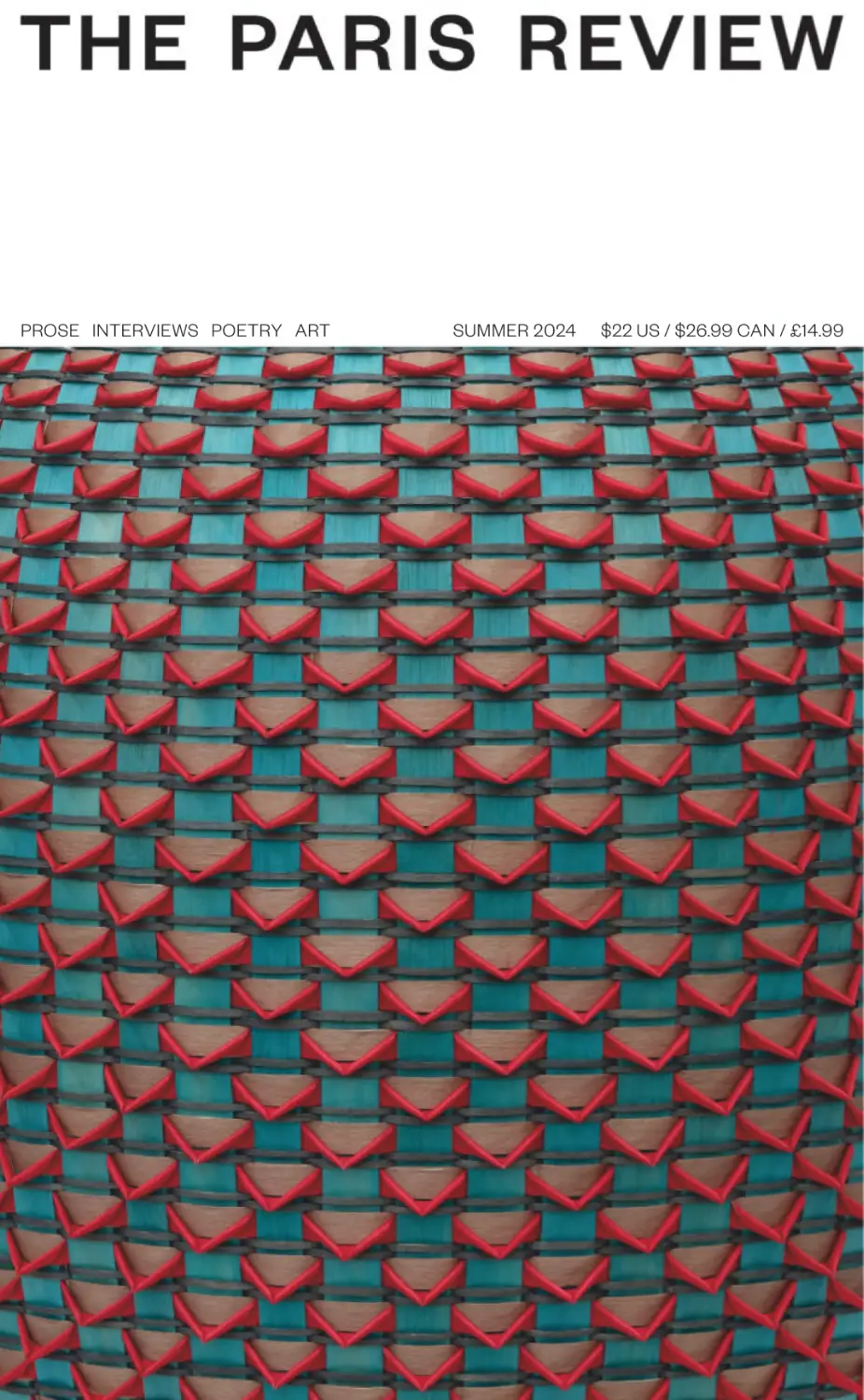
Cover: Jeremy Frey, Radiance (detail), 2024.

The story of Aesop’s partnership with The Paris Review
is one plotted by a deep reverence for the written
word. Since 2015, we have been proud to offer this
esteemed quarterly for purchase in select stores across
the globe and at aesop.com, inviting customers to join
us in discussing the thought-provoking ideas explored
in its pages.
Now more than ever we believe literature has the
power to nurture meaningful connections, nourish
weary minds and give voice to those whose words
have, for too long, been kept in the margins—so, here’s
to the next chapter.

Aesop Chelsea
74 9th Ave, New York, NY 10011

STORE.THEPARISREVIEW.ORG

That Summer
Anne Serre
Translated from the French by Mark Hutchinson

That summer we had decided we were past caring. It was just too
tiring, rushing back and forth between mental institutions. My
father was in a well-known sanatorium in Switzerland, but to see
him each month mistaking himself for Alfred de Musset, talking to
me as if I were George Sand, and reminiscing about wholly imaginary events—and doing so, moreover, with a gaiety and malice
that had their charm, no doubt, but seemed singularly out of place
under the circumstances—was a burden. What was still more of
a burden perhaps was that, deep down, I was very taken with this
behavior, and, ensconced in the little train that made its way up
to the village of Birgen against a magnificent backdrop of Alpine
meadows and snowcapped peaks even in spring, I would make these
monthly trips, the frequency of which I myself had determined—not
too many, not too few—with the same feeling of terrified delight
I had always experienced in my dealings with my father. Perhaps
he would be better that day and make more sense? And sometimes
he was. But I’m not sure I preferred him that way. I think, unfortunately, that I preferred him mad. On the train I would prepare

18

ANNE SERRE

to be mistaken for George Sand or some character in a book. He
didn’t entirely mistake me for someone else—he knew I was his
daughter and he knew about my life. He might ask for my news,
inquire about my work or friends, but something would quickly
slip out of gear. If he was happy, as much of the time he was, his
imagination would start to bubble over, rather as it does when you
are writing. It was this kind of secret joy, which had something
slightly erotic about it, that would lead him to reminisce about
books he had loved, books that had meant a lot to him, at which
point he would start to overlay our conversation with a sort of
pall or veil of images and recollections drawn from books he had
read, not from our lives. The moment when the veil appeared was
always very moving. It was the moment I was waiting for, I think,
and the reason I loved my father so much. If I was feeling sad or
anxious, I would try, often quite brutally, to thrust the veil aside.
He wasn’t upset, I think, when I did this; it startled him. He would
look around slightly, tilting his head like someone who has heard
a noise he can’t identify or locate. Bringing him to his senses was
always a cruel move, one that I even found distasteful.
If I agreed to being laid under this veil with him—agreed, that
is, not to contradict him in his joyful flow of speech—I would be
drawn into a stream that struck me as both my true life and dangerous for me. My father enjoyed socializing, and even within the
confines of the sanatorium would greet any fellow patients we ran
into with warmth and courtesy. You would have thought he was
holidaying in pleasant company at some country home. What he
most enjoyed with me was having conversations about art. If we
were discussing a painting, a piece of architecture, or the beauty of
a city, he would know a hundred and one things that would always
surprise me, because though he was very well read, he hadn’t
traveled much and had lived for a long time in the provinces. His
memory, on the other hand, was prodigious—he could remember
books he had read in his teens, theatrical performances he had been
passionate about as a young man, as if he had encountered them
yesterday. Time meant nothing to him. Eros and its torments were
his great theme.
When it was my little sister I was visiting, at Combleux, the
atmosphere was quite different. Inès wasn’t cheerful like my father,

THAT SUMMER

19

she was forceful and focused, implacably alert. But there were many
things I got wrong about my sister, I think, and I never fully understood who she was. Something inside her was asking to explode,
and explode it did. She didn’t mistake her mental hospital for
a holiday home. She was more present than one should be or can be
present, she was supremely present in a way, and the task I had set
myself was to relax that presence, not to diminish it but to soften
it up. We talked a lot and it wasn’t at all like the conversations
I had with my father, because behind our words there was always
a text that neither of us could read, which we would pore over and
study without ever managing to decipher it.
My life, then, went from Birgen to Combleux, and from Combleux to Birgen, with stopovers in Paris, where I would pause for
breath. But as soon as I had been in Paris for a while, I wanted nothing more than to return to Combleux and Birgen.
My other sister made similar journeys from a different town,
where she lived. I never went to my other sister’s town and she
never came to Paris. But that summer, in the last days of June,
we decided for the first time to give ourselves a few months’ rest
and to do so together. We would go neither to Combleux nor to
Birgen, we would go to Capri. We remained there for quite some
time because my sister had found a little job on the island, and
I for my part had obtained a student grant. It was then that alarming news reached us from Birgen and Combleux: Father critically ill,
sister too. Should we have rushed back? Oh, we would have loved
to! But it was no longer possible, we were caught between the walls
of petrified Capri. I’ve always felt bad about not being George Sand
one last time at my father’s bedside as he departed this bewilderingly
hard-hearted world, about having no other memory of Combleux
than that of a monumental tragedy. In some respects, I was saying
one day to my remaining sister, our life is much less exciting now.
She was shelling peas on the kitchen table in the old family home,
and she didn’t say a word, she didn’t even look up.

Kim Hyesoon
Translated from the Korean by Cindy Juyoung Ok

Person Walking Backward
Inside the head there lives a lonely dog
It is drooling spit
digging through a mountain pile of garbage
opening and closing an empty house’s windows
overturning footprints in the sand
and going into the fog
When you’re walking with pounding legs today
with a clock hung from your heart
When you’re hanging the hour and second hands from your legs today
and rowing this way and that
When the road you have walked today
is quickly followed and erased by someone
Inside your head the dog
wags its tail and
stands with its back to you
digging through the garbage pile
while indifferently watching
a bird falling to death

Passengers on the Night Train
Rodolfo Enrique Fogwill
Translated from the Spanish by Will Vanderhyden

Nobody really knows how it began. Word first started getting around
on a Thursday, but that doesn’t prove anything: it might have all
begun days or weeks before that morning in early summer when the
cigarette and the newspaper vendors at the train station reported
that the soldiers were coming home and that they had seen Diego
Uriarte getting off the train that brings the milk cans, the previous
day’s newspapers, and the packages of orders from wholesalers.
Jiménez, from the magazine kiosk, and Kentros, the cigarette
vendor, started spreading the news that same morning, and that’s
why everyone in town believes that that was the day the soldiers
started coming home, but it might have begun earlier: the previous day, or the previous Thursday, on another train, or on that
same train, the one that always pulls out of the capital just as it’s
getting dark and arrives early in the morning, the one they call
the night train.

22

RODOLFO ENRIQUE FOGWILL

That they had seen Diego Uriarte get off the night train. That
they saw how he said goodbye to a group of soldiers with splints
and bandages and leaped onto the platform from the mail car, and
how two other men, also in uniform, jumped off after him. That
Jiménez thought one of them must have been Miguel Sanders, but
that neither he nor Kentros recognized the other, a slender man
with a dark complexion.
That’s what they told everyone, and they also said they saw the
three boys wave goodbye to the other soldiers and walk toward
town already illuminated by the rising sun, though lights still shone
in the square and at the station and in the windows of some of the
bigger businesses.
Then the three boys parted ways and each went on alone:
Uriarte down the main street toward his house; the dark stranger to
the road leading toward the orchards; and the other man, the one
Jiménez said must have been Miguel Sanders, up the embankment
and toward the limestone quarry. Kentros hadn’t recognized him,
but it could well have been the Sanders boy, he said, because the
Sanders family lives on the other side of the quarry, past the white
hill, and that was the way you would go to get to his mother’s house.
And it all began that morning. At least as far as anyone knows,
though it could well have begun days or weeks before. But it was
widely discussed that morning, because the two men who were at the
station waiting for the train to arrive recognized Diego among the
three returning soldiers. As a boy, Diego Uriarte had been beloved
by all, because his father ran the buffet at Club Social, which also
housed the casino; because he’d been captain of the basketball
team and a champion pelota player; and because everyone in town
thought that Diego Uriarte had died two years ago on the front,
and there had even been multiple funeral Masses. That, more than
anything else, is why word traveled so quickly and why everyone
remembers and agrees that the soldiers started coming back that
Thursday, the fifth of December.
Of course, nobody was going to tell Diego that they’d given him
up for dead and had even attended his funeral. In his family’s shock
and jubilation at seeing him alive and home, nobody mentioned it.
He must have shown up at his father’s house, taken off his uniform

PASSENGERS ON THE NIGHT TRAIN

23

for the last time, and gone straight to sleep, exhausted from the
journey, happy to finally lie down in a clean bed. It wasn’t until
Saturday afternoon that he was spotted downtown, on the sidewalk
in front of the soda fountain and around Club Social’s card tables,
and by then everyone knew he was back and they were already
starting to forget the eulogies and funerals.
Later, though, there had to have been someone who, out of curiosity or as a joke, told him—or one of the others who returned—
about the funerals. Not Miguel Sanders, though; nobody told him.
The Sanders family lives on the other side of the sierra, past the
limestone quarry, and they almost never come into town; they shop
at Santiago Nasar’s country store and go to parties and dances in
another town, where Miguel’s mother’s sisters live and where he
and his siblings went to elementary school. But somebody, some
joker or busybody, must have told Diego Uriarte, or one of the
others, that everyone in town, even their own mothers, had given
them up for dead.
There are issues of logic: Federico Ortiz’s mother reportedly
received condolence telegrams from the military, the edges dyed
black, and then an indemnification check that she cashed at Banco
Provincia. Most of the mothers, if not all of them, probably received
checks or telegrams regarding their deceased sons. But it was to be
expected: sooner or later, Ortiz’s mother or Uriarte’s mother, if she’d
also received a telegram or a check—or some other mother who
received a check or a telegram—must have mentioned the whole
thing to her son, and more than one of the mothers had probably
been going around wondering if the money—a few lousy pesos—
would be reclaimed by the government.
But there’s no way to know for sure whether Ortiz’s mother
or any of the other mothers ever said anything to their sons or to
their friends or to their friends’ sons. When it came to the subject
of the telegrams and the checks, they maintained silence, the way
mothers maintain silence about many things. Or did they intuit
everything from the beginning . . . ?
It was the December 5 train that was the first known case, but
it might have all begun earlier. Throughout the summer, the
Wednesday-night trains—always arriving between five thirty and

24

RODOLFO ENRIQUE FOGWILL

five forty-five on Thursday mornings—continued to drop off returning soldiers. And soldiers’ mothers, who knew their sons might be
discharged, began going out to wait on the platform. They would
wait, and later, as the train continued on its way, slowly climbing
the sierra baja, a group of weeping women would crowd around a
few dead-tired soldiers. All of them weeping: some with joy because
they’d just welcomed their sons home; others because the sons they’d
been hoping would step off that train hadn’t returned to them.
These things come with war, and mothers, who willingly resign
themselves to bringing children into the world and to raising their
own children and the children of others, do not know how to resign
themselves to their children going missing, and so they kept heading out to the platform to wait and to hope, many with their husbands or with stepchildren or daughters-in-law or grandchildren,
and so, early every Thursday morning, a crowd would gather at the
station to await the arrival of the night train.
But in those final weeks—in March, or April, during the rainy
season—very few went out to wait.
The last soldier arrived at the end of April, alone. It was Sergio
Guebel, the son of the Jewish owners of the farm supply store. At
the train station, he was greeted by his parents, some neighbors,
the girl who had been his fiancée, and Jiménez and Kentros, who
had been talking to Sergio’s father about the war and reported that
the old man smoked one cigarette after another on the platform,
soaked by the rain, waiting.
Apparently Sergio Guebel stepped out of the second car, kissed
his mother, who was weeping, and he wept too, not so much at
seeing his family but at having to say goodbye to his fellow soldiers, who’d been with him throughout the war and would no
doubt be getting off in other towns, along the final stretches of the
railway line.
Guebel’s mother never received a condolence letter or a check.
Instead, she had received a letter of commendation, because her
son, the letter said, had carried out a heroic deed against enemy
tanks. Seeing Guebel around town, his baggy old uniform, his wornout combat boots, no medals and not even a captain or sergeant
insignia, led one to believe that the telegram could have said that,
because it could’ve said anything at all.

PASSENGERS ON THE NIGHT TRAIN

25

“With everything that happened, who would be stupid enough
to believe the telegrams?” said Emilio Renzi, who had just won the
Teleloto and had been leaving the post office after depositing the
check when he ran into Sergio Guebel.
Back then, poor Sergio was walking around downtown like a big
turkey, still in uniform, because his old man hadn’t yet bought him
new clothes or put him to work driving the truck, a job he can be
seen doing to this day: driving that truck, hauling drums of herbicide, bags of seed, and well-balanced pig feed.
“With the whole to-do with the check and everything they
deducted and the three days I had to wait for them to process it,
I wasn’t even thinking about the war. I was leaving the post office
and heading toward city hall and I saw him just standing there like
a dummy . . . I almost fell on my ass!”
Renzi always tells the same story, about how he came out of
the post office and almost fell on his ass, and how even if Sergio
had turned up with a new face and changed his voice, he would’ve
recognized the Russian by his stupid joke: Lucky at cards, unlucky
in love, he says Guebel said, acting as if he were in on all the
town gossip.
War is a thing riddled with error. For example: in the battle
of August 22, the artillery intended to shell a shuttered DuPont
factory, where the enemy was storing munitions and medications,
but they bombed another factory, the Dinam factory, because
on an old map of the city they were attempting to occupy, the
names of the factories had been mixed up. Who knows how many
people working in that factory died due to the error of an illustrator who made a bad copy of the guide to the capital? Hundreds
or thousands of people needlessly killed because of an error on
the map . . . ! The shelling of the Dinam factory is only one example:
all that expertise and research just to reduce the wrong factory
to rubble.
But people adapt, they get used to it. It’s the same in big cities as in small- and medium-size towns like this one; people adapt.
Cayetano Sain, who made a fortune reselling flowers, explains it
like this:
“I was trying to quit drinking. I drank all I wanted at meals—
I drank wine but no vermouth and not a drop of liquor except at

26

RODOLFO ENRIQUE FOGWILL

mealtime. One Saturday I was at the soda fountain, way in the back,
and I sat down next to Jesús Noble, another one of the returned.
This was a while after the soldiers started returning on the night
train, but I hadn’t seen Noble yet. I greeted him as if nothing had
happened. He was friendly, and he greeted me as if it had only been
a week since we’d last seen each other. Who knows if it was just
random, who knows if maybe, after seeing so many people at the
soda fountain, he thought he’d already run into me. He was drinking white wine and I joined him. By the second round, we were
telling stories and shooting the breeze. I think I drank around ten
glasses, and they had no effect. He kept up, drank as much as I did.
Half in the bag, he struggled to get up from the table and almost
choked on his tongue when he tried to speak. But for me, I felt like
I could’ve been sitting there with anyone, as if it were my foreman,
Rogelio, at the table instead of him. It felt natural . . .”
Because habits overpower everything. According to Pugliese, the
town auctioneer, habits always win out in the end. He tells a story
about how, one day, he and Avelino, his associate, were checking
out a small farm, and when Avelino had to leave to go see a client
in the city, Pugliese let him take the car, because Quirós—another
one of the returned—offered to give him a ride back to town in
his truck, a Scania.
Pugliese says that he got into the Scania and wouldn’t have
remembered anything about the war if he hadn’t noticed the medal
hanging from the sun visor, one of those nickel medals with the
words Cristo Vencedor and the general’s face engraved on it. Then
he remembered, he says, and that moment really made an impression: “Keep in mind I was on the church committee, so I attended
all the funerals, including his, including Quirós’s.”
But Pugliese had such a good time talking to Quirós about
radios and radio-aficionado things that he forgot again right away,
and it was as if the guy driving the Scania were his associate, Avelino,
and not one of the returned.
“And, look, I already knew, from the parish committee, about
what’d happened in the other towns . . . ” Pugliese clarifies.
Even when you’re aware of exactly what’s going on, other people’s behavior still carries the most weight: the truth is what you
see other people do with your own two eyes, nothing else matters.

PASSENGERS ON THE NIGHT TRAIN

27

Even Torraga, who didn’t want his daughter to marry Horacio,
a returned soldier she’d dated as a girl, acknowledges that:
“It’s not that I thought my daughter didn’t love him, or that the
boy was no good. But when Horacio, who was coming by the house
all the time, asked me if he could marry her, I told him we needed
to think about it, because I’d seen how Orlando’s daughter had married one of the returned about three years before and they hadn’t
had any children. Doctor Álvarez’s widow, the midwife, who later
married another returned soldier, Márquez, had been trying to get
pregnant for two years and couldn’t, and she was a midwife. It was
because of that fear, not because I looked down on the boy, that
I asked her to reconsider. But today nobody can stop kids from
getting married, and if the girl’s father opposes it, it’s worse—
they meet up in highway motels, and when you pass by on Saturdays you see those places packed with kids and cars belonging to
their parents parked outside and you know exactly who’s inside,
rolling around like dogs in heat . . .”
That’s how it goes with habits and how people adapt, and—
more than anything you might think you know—it’s what people show you with their actions that matters. These days, people
accept the fact that boys take their parents’ cars, pick up girls in
town, and drive out to the highway motels around midnight on
Fridays and Saturdays, and the fathers—to whom, back when they
were dating the women who are now their wives, it never would’ve
occurred to do such things, leaving their cars out along the highway for everyone to see—now let their daughters head off to the
motels as if they were local festivals. And someone like Pugliese,
who attended Quirós’s funeral, can now lightheartedly go rabbit
hunting with him, and Avelino can even spend entire nights playing poker with Diego Uriarte, who never married and wound up
an inveterate gambler, who leaves everything he earns from working behind Club Social’s buffet counter on the card tables of the
same establishment.
And it’s not like they’ve done anything in particular to draw
scrutiny either. Nobody would claim they’ve gone unnoticed, but
their actions haven’t attracted people’s attention, as if maybe they
knew that, as time passed, the whole town would come to see their
presence as natural—through the power of adaptation.

28

RODOLFO ENRIQUE FOGWILL

Occasionally they’re seen together, in twos or threes, due to such
coincidences as sometimes happen. Once, when Marina Echagüe
took her students to the racetrack and sat at the first turn—where
the majority of the young men like to position themselves so they
can see how the cars come in at top speed, slam on the brakes,
drop into second, and take off laying rubber—she spotted Federico
Ortiz, and nearby, in a row of men from Club Social, was Diego
Uriarte, and in the next seat she saw Juan Molina, another of the
returned. It might have been a coincidence, but Marina says that when
people from the crowd went out to help push Rubolino’s car, which
had slammed up against the fence, the three of them—Diego, Juan,
and Federico—stayed right there, together, talking among themselves, and, even though they’d been back for so long, that sight
really struck her.
There are times—at baptisms, business openings, weddings—
when two or more of them come together, and there’s always someone who sees them talking and horsing around and can’t help but
wonder. And there was a whole lot of wondering when people learned
that the same thing hadn’t happened in other towns. The news
came from some members of the parish, who’d gone to an assembly in Coronel Insúa where the subject came up, and, seeing the
shock of the other people in attendance, decided to ask around
and discovered that theirs was the only town whose soldiers had
all returned. At that time there was an increased curiosity about
what they were up to—if they conspired together or spoke to each
other—but nobody noticed anything different. Again, you see, they
trusted that, as time passed, the fact that this had happened only
in their town would also be forgotten.
And they were right, because over the years, it was all forgotten.
At a time when many couples are starting to design their own houses,
take trips abroad, and spend nights out at parties—copying each
other’s mannerisms, showing off new clothes, and checking out
the new clothes and consumer goods others are showing off—
couples without children are becoming more and more common,
and so it’s not surprising that they don’t have children either, given
that they make up only a small fraction of those childless couples
who are always showing off their new clothes. In the end, kids keep
getting born.

PASSENGERS ON THE NIGHT TRAIN

29

The children born that summer the soldiers started coming home must be around ten years old now and probably don’t
know anything about it. To those kids, everything to do with the
war is just a story for adults, and when they interact with one of
the soldiers—when, on occasion, Ortiz’s or Vigliani’s nieces and
nephews are left in their uncle’s care—they play with them like
they would with anyone else, and their uncle lifts them up in the
air or takes them to the circus or to the movies when there are
movies playing that they’re allowed to see, just like any other uncle
in town would. So these kids grow up knowing nothing—same as
the adults, who go around without acknowledging what’s been
happening all these years.
That’s why no one will ever tell them, and the kids will grow up,
have children of their own, live, and die without knowing any of
this, but many people do write these things down and save them, in
case, years later, somebody might be interested. There’s a teacher
at the school named Morizzi: he came as a substitute for a few
months, liked it here, and stayed in town. He has a degree in philosophy, enjoys literature, and spends his free time and vacations
compiling other people’s writing and organizing writing contests
for the town’s ministry of culture. He can confirm that the kids of
today will probably never really know what happened.
“It’s,” he said one night in a bar, “like with fish: the last thing a
fish realizes is that it lives in the water.”
“Until someone goes fishing and catches it . . .” reasoned the
Turk.
“Of course,” Morizzi answered, “but then it’s already dead, and
it won’t do it much good to know it spent its life in the water . . .”
When there’s no wind, on windless summer nights, and also
in the winter, before storms, from anywhere in the city you can
hear the passing of the trains. At midnight the Northern comes
through, all lit up inside because it’s always carrying first-class passengers who, as they’re shuttled across town, are enjoying some
postprandial conversation in the grand dining car. At one thirty, the
Express rolls in, a freight train that, despite its name, slows down to
change tracks. At four, there’s the Combo, which departs the capital at six in the evening, with both freight and passenger cars. That
train doesn’t stop, but the guard waves the green-and-red lantern in

30

RODOLFO ENRIQUE FOGWILL

greeting as it passes the signalman’s booth. The whole town knows
those trains and how to recognize them, and sometimes, waking
with a start in the middle of the night, they’re gripped by a fear
that the train that’s suddenly arrived is neither the Northern nor
the Express nor the four-o’clock Combo, that it might be a New
Train, coming in from the opposite direction, that stops in town,
releases a long mournful whistle, and pulls slowly away, bound for
the capital, and that it takes all of them away, again, forever.

Patty Nash

Metropolitan
1. So do you read literature?
2. Yeah.
3. Placated and ventilated
4. In the room’s relative dimness,
5. She waited for the moment
6. To pass.
7. Then they saw the medieval
8. Knights, whose armor
9. Did not seem comfortable.
10. Would you like something
11. To eat?
12. Yeah, indefinitely.
13. She practiced hinging at the hips
14. To correct
15. A historical inaccuracy, the
16. Hypermobility of the spine.
17. A man tipped his forehead on
18. A windowpane, next
19. Had difficulty finding words.
20. I still had these problems
21. With my alveoli,
22. She informed the doctor . . .
23. What else do you need to know?
24. He shrugged.
25. She never saw him again.
26. Nothing is quite analogous.
27. The problem was amorphous.
28. Data accretes like islands
29. In Scotland!
30. Everybody wants to buy.

32

31. Even her
32. Stern nurse.
33. She had asked for assistance
34. The predictable thing occurred.
35. On the angle of a felt
36. Mountainside called
37. Chimney Rock
38. Her boyfriend began to slip . . .
39. It wasn’t just the lack
40. Of proper footwear.
41. Walking poles
42. Afforded him stability
43. On the mound of dirt
44. Which implied the ground
45. Like sulfuric ash.
46. And it was.
47. It’s good to have a purpose,
48. An end goal,
49. His guide firmly stated.
50. When your refrigerator breaks,
51. It’s good to have a job
52. Even if it entails
53. Buying a new refrigerator
54. And then the old one rears
55. Up again.
56. Let’s go through the American Wing
57. And then to ancient Egypt,
58. Where they filmed
59. That scene.
60. Two lovers reunite.
61. Are you in the elevator?
62. Yeah.
63. Oh, that’s where?
64. Go outside, she urged.
65. Look.
66. Every person is wearing
67. Brown leather mules.

33

68. Hard not to notice the
69. Sulfuric smell
70. With no effect
71. On said leather mules.
72. Every millisecond
73. Value is processed.
74. Every millipede possesses
75. Numerous legs
76. And shuffles in like an elevator
77. Or toilet paper
78. A white American child
79. Like Goldilocks
80. Looks around
81. Her arms
82. In every luxury campground
83. With unlimited sinks.
84. Among other tabulations of
85. Wealth and value.
86. It all happens on the inside,
87. And yet it’s worthless
88. If you don’t perceive it.
89. On the other hand, they x-rayed
90. My lungs just once,
91. And on the phone
92. Told me
93. They didn’t find anything of
94. Note
95. Besides lungs, of course.

Notes for a short story in progress.

The Art of Fiction
No. 263

Mary Robison

There were a few conditions around my first meetings with Mary
Robison. She is an extreme night owl; hates Mondays; preferred a
place to talk where she could make endless pots of decaf, someplace
where she could easily duck out and smoke. Home wouldn’t work.
During our second set of conversations, conducted on the phone,
I understood why that was: neighbors, talkative ones, tend to drop
in, much as they do in her novels, with some fascinatingly oblique
and long-winded monologue, or asking to walk Robison’s cat.
When we did meet in person, in the fall of 2022, it was in a beigewalled motel suite. On a Wednesday afternoon, Robison arrived in
a long black skirt, a deconstructed rosary made by her daughter
Jenny, stacks of silver rings, and motorcycle boots, her black-andsilver hair down. She spoke in low, quiet tones. She did not avail herself of the kitchenette’s coffee maker, having brought bottled iced
green tea. We met over four days; on the first, before I’d pressed
the Record button, she was talking about The Stars at Noon, her
favorite Denis Johnson novel. Smoke breaks bracketed our conversations, counted out in Camels because Robison can no longer
find Old Golds.
The first stories Robison published, in The New Yorker, were
written in the mid-to-late seventies, when she was still a student
at the Johns Hopkins Writing Seminars, studying with John Barth.
Her first collections—Days (1979), affixed with high praise from
Richard Yates, and An Amateur’s Guide to the Night (1981)—placed

36

MARY ROBISON

her in league with a dazzling group of American short-story
writers, including Amy Hempel, Raymond Carver, Ann Beattie,
and Frederick Barthelme, though with a critic-coined label, minimalism, that she disliked. More books followed at a steady clip: the
novel Oh! (1981), about an eccentric and motherless Midwestern
family, later adapted by Michael Almereyda into the 1989 film
Twister, starring Harry Dean Stanton and Crispin Glover; the collection Believe Them (1988); and Subtraction (1991), a novel in
which a poet tries to track down her errant husband all over Houston. In the nineties, alongside her teaching gigs, Robison worked as
a script doctor in Hollywood, a job she gave to Money, the protagonist of Why Did I Ever, her 2001 novel structured in 536 vignettes.
It won the Los Angeles Times Book Prize for Fiction, beating out
Jonathan Franzen’s The Corrections and an Alice Munro story collection. Her novel One D.O.A., One on the Way (2009) intersperses
reported details from fractured post-Katrina New Orleans within its
vignetted form. Robison is the recipient of a Guggenheim Fellowship, a Rea Award for the Short Story, and an American Academy of
Arts and Letters Award in Literature. Of all the ways her admirers—
among them Hempel, Richard Ford, Rick Moody, David Leavitt,
and Larry McMurtry—have praised her work, she is most partial
to Barry Hannah’s description of her prose, as “pure, grim poetry.”
A Mary Robison sentence is unforecastable, charged with peculiar energy. Her characters lend seemingly benign observations
rhythms all their own. “They’ll move a word so that the whole
line is different,” Robison told me. “It’s a word, and a pause, and a
gasp, and whatever. It’s a syntactical thing, and I try to screw with
that.” Here’s Money’s platonic partner, after delivering a lengthy
and unsolicited interpretation of the story of David and Goliath:
“ ‘Well, lookit,’ Hollis says, a little flustered. ‘I can think this stuff
or share some of it. You people choose.’ ”
A few years ago, Robison began listening mostly to jazz and
blues. On the morning of our first meeting, she’d been hunting
for the Bessie Smith song “You’ve Been a Good Ole Wagon” on
Last.fm, and she talked about Smith, Jelly Roll Morton, and Billie
Holiday. “Wanting her voice to be another instrument—how does
a person have that as a lifelong goal?” For a while she led a photography group on Flickr, often posting cropped and color-tinted

THE ART OF FICTION NO. 263

37

photos, especially of her late daughter, Rachel, who, she said, “was
just born to be photographed.” Robison lives with Jenny, a jewelry
artist she credits as her sharpest reader. She’s private about exactly
where that is. She has lived all over the country, including for
stretches in Mississippi, Texas, Massachusetts, and Florida. During
our conversations, she recounted the bus trip she took when she left
Florida to take care of her mother, leaving behind her car for her
daughters. She was weaning herself off flying; there was no train.
She still has a fondness for the people she met along the way. “They
didn’t have to explain anything,” she said. “You know the reasons
they’re on the bus too.”
—Rebecca Bengal

INTERVIEWER

Tell me, what are you writing now?
MARY ROBISON

I’ve been involved with a novel for about ten years, maybe more
than that, called “Glass Avenue.” It’s a book about giants—three
men who have giantism. They’re not eight feet tall but they’re damn
near. When the three of them go out anywhere, people start screaming and tearing out into the parking lot. It’s bizarre, because everything, of course, has to be. They wear a size thirty-five shoe. They
can’t fit into cars. There’s a social worker who is assigned to their
case, studying them at an institute. She lives with these three giants.
INTERVIEWER

What got you thinking about those characters?
ROBISON

That she could belong with them and help them seem less preposterous, less menacing. She could remind them of the humor in their
lives. I mean, not like a setup joke.
INTERVIEWER

So not “Three giants walk into a ——”?

MARY ROBISON

38

ROBISON

No, ha. So much of humor is stock, and I want to steer away from
that. Buttering the tie and slipping on the banana peel . . . I get it,
you’re watching someone be ridiculous, but you don’t know the
tie-butterer. It’s the human part of humor that you can relate to.
Like Mel Brooks—“I’m wearing a cardboard belt!” That’s how
he described being down and out. So many writers have done so
much for me in that way—Donald Barthelme, David Foster Wallace.
Wallace’s funny is, of course, also heartbreaking. It’s the magic and
the humor and the heartbreak.
INTERVIEWER

Do you think humor is undervalued in fiction?
ROBISON

The joke may not be unappreciated, but it is undercherished. I’ll
admit that humor is paint that covers a lot of sins, but I think
readers minimize the ability to mix it in. What I like is the element
of surprise. It could be a dog crossing the street one morning with
a string of wieners, which is something I’ve always wanted to see.
That’s my golden dream. I don’t think I ever will. But you don’t
know—it could happen, and it could change you, and change your
life.
INTERVIEWER

Sometimes the dog is there, but we don’t see it walking by.
ROBISON

Yes, or the reverse—I can be so sure the dog is there that I’m going
to see it even when it isn’t. I’ll go there when I’m writing because
I think it’s somewhat of a lubricant for readers, and it’s a way to
move in the story. Money, in Why Did I Ever, insists on keeping it funny for herself, because otherwise she might not be able
to hold it together. There are so many pieces of life she needs to
see to.
INTERVIEWER

How did you come upon the form of that novel, those little vignettes?

THE ART OF FICTION NO. 263

39

ROBISON

Well, I found that I just couldn’t write. I just couldn’t write in any
linear sense. I found that I was in some unknown territory. Donald
Barthelme had invited me to come teach with him in Houston, and
working with him was a wonderful, thrilling experience, but he had
cancer and it was getting worse and worse, and my marriage was
going up in smoke or out the window or whatever the metaphor
would be. It was hell. Wretchedness. Grief and anger—those two,
I find, are very compatible. It was time to rethink and reinvent and
start everything over. One of my students had won a competition for
writing a story that could fit on a postcard, and I started thinking
about that—how I could have something whole on one card, with
a beginning, a middle, and an end, and then match it with others.
I began with these little moments and snippets and music and
fears and so forth. I would write a scene on an index card, whatever could fit, and not worry about segue. It was in shrapnel, just
thousands of pieces. They didn’t really have anything to do with
one another until they did, until I noticed there were similar preoccupations that went through them.
INTERVIEWER

Did the writing come easily?
ROBISON

I’m a night writer and a binge writer—I could go sixteen, twenty
hours. In those moments I am just not aware of having a body. My
thoughts are elsewhere. I forget to eat. I’m barely functional as a
human, but my brain’s doing a little extra. So that’s the trade-off.
You’ve forgotten to do anything else, so you might as well paint
the truck.
At the time I had a car with a moonroof, so I’d drive to parking
garages and park under a light and write there. The best is a hospital
parking garage, because there’s security and people show up at all
hours, so nobody questions you being there. I can control the temperature and music, and I can smoke. It’s an aloneness that’s very
good. Ray Carver did a lot of his writing in the car. It’s just so magical
in bad times—well, magical anytime. Though I like it best at night.
For Why Did I Ever I had this little voice recorder I got from

MARY ROBISON

40

RadioShack, which was really helping me. I don’t like using it, but
you can scream in the car and nobody knows it. I realized, Nobody
is ever going to hear any of this. It’s just for you.
INTERVIEWER

How do you use the voice recorder? Do you speak into it for a long
time and see what sticks?
ROBISON

It’s more intentional than that. It might be an impulse or an image,
and you record that, and then you don’t like the way it came off,
or it wasn’t in sentences, so you keep at it until you like the sound.
Once you’ve achieved that, it becomes memorized, and you can just
work on it all the time in your head.
INTERVIEWER

Were you script-doctoring when you were writing that book, like
Money?
ROBISON

Yes, in those days I was commuting between Houston and LA. The
work was very convenient for paying off my student loans, and
my husband at the time’s. I jumped around between studios. I was
at Fox for a while, and Paramount. It was collegial in the writers’
room, and it could even be fun. There was a real mix of people—
there was a guy who had been a cop or something, so he knew how
to correct all the crime stuff. I was the writer with the paintedpolka-dot scissors, and it turned out everybody liked them. The
actual work was very much like marking up a student manuscript.
And they were just flabbergasted—“How on earth did you do that?”
That part was easy. But inventing, not so much. It would come to
something like an abortion, and you’re supposed to write a line of
dialogue like “You killed our baby.” I couldn’t work on that.
I was a total novelty, a different kind of mess than anything they’d
seen. I was fired more than anybody else, probably. I would fail
to pick up my paychecks. I read about this convention of ADHD
patients where the women were all in the bathroom dumping out
their entire purses to find something, and I thought, Yeah, that’s

THE ART OF FICTION NO. 263

41

how it is. My ADHD went completely undiagnosed for years. The scientific community has been very slow and negligent about recognizing it in women and in girls. They just don’t know what it looks like.
INTERVIEWER

Was your ADHD bad when you were a child?
ROBISON

Yes, and looking back, I needed meds. I had this debilitating anxiety.
Deadlines and assignments would just undo me. But I had this gaggle of brothers—nobody could say how many there were—who all
had ADHD to a rabies degree. They were swinging on vines, textbook cases. So the doctors would look at me and say, “Nah, that’s
nothing. That’s just the mood she’s in. These are the examples
of ADHD.” Getting on Ritalin, finally, was amazing. It taught me
so much.
INTERVIEWER

How so?
ROBISON

Well, you don’t have the failure and shame with Ritalin. But it was
mostly a kind of discipline in writing, ways I never knew you could
listen, as though thirty channels had been disconnected and I could
hear just the one. Because you’ll often have voices, not in the literal,
really crazy sense, but recurring thoughts and stuff going over and
over in your head, whether it’s insane or makes sense or comes from
Cleveland or something. You just don’t know. I still have some vestige
of that with songs, where a song I don’t want to hear is playing in
my head, but I’ve just about licked it.
INTERVIEWER

Songs?
ROBISON

Oh, yeah, Bumble Bee tuna. I mean, it could be anything. I’ve had
Steve Winwood’s “Higher Love” stuck there, just because they played
it at King Charles’s coronation. I’m praying it won’t start up again.

MARY ROBISON

42

At one point, I found a way to switch to a really complicated Bob
Dylan song, and I could get myself to think that way instead. But
there’s nothing that works all the time. Sometimes you’re stronger
than the voices, but not always.
INTERVIEWER

How has your ADHD most affected your writing?
ROBISON

It’s hard for ADHD types, I think, to get back to anything. I could
be going great guns, but something interrupts and that’s it. That’s
an area of frustration. I’ve never liked the term writer’s block, but
that’s what it amounts to, I think. I have always had a lot of frustration with art in general. As a kid I was cast as the class artist, and
that was a mistake. Once, I had to decorate the classroom for some
event, “Goldilocks and the Three Bears.” I could do Goldilocks,
but the three bears were a fucking nightmare. I could not get their
legs right. Every session ended in grief and tears. I worked on it so
much that the legs fell off the papa bear. I realized it wasn’t ever
going to get there. In fact, I was going to wear it away. There is
an argument that someone could have intruded and saved it. But
that’s come up a lot—the disappointment and the sadness you get
from not being able to write a scene. Not the initial feeling, where
you’re slapping yourself—but later, when you’re adding and revising and you realize, This won’t hold anything. That’s a particular
condition I know very well. That’s being a writer.
INTERVIEWER

Did your family see you as a writer, as an artist?
ROBISON

My father was a patent attorney—he worked for the Department of
the Navy when we lived in D.C., and he was one of the early attorneys
for Xerox, so he did rather well for a period—and I think it was
sort of assumed that my brothers would become lawyers. A few of
them did. But I don’t think I would have gone that way—I was the
quietest one in the room, always. It’s hard to believe, now that I’m
such a blabber-box, but it’s true. I was the fourth child of eight,

THE ART OF FICTION NO. 263

43

Robison in her mother’s arms at top right, with her
father and older brothers, Washington, D.C., 1950.

the first girl. My parents gave me a pretty wide berth, and I was
pretty good at ignoring things that didn’t fit. “No, I will not wear
Tommy’s sweater.” Mostly, I was reading a lot. In such an enormous
group, you need your areas of privacy, and reading was handy for
that. I could go there and be anywhere but here. It was an ownership thing, where this was mine. I remember finding a paperback copy of Another Country by James Baldwin when I was quite
young. I wasn’t very sophisticated, and here was an adult book
depicting an adult world, and it had swearing and drinking and
sex. It had all this gaiety and sorrow that I’d never experienced in
books before. Once I’d read it another eight times, I was never the
same. That happened, too, with Our Lady of the Flowers by Jean
Genet—this was a queer novel written in prison on toilet paper or
something.
I always wrote, as a way to take things in. It was joyous, and it
was angry. I knew I would be a writer.

MARY ROBISON

44

INTERVIEWER

You did?
ROBISON

Not in any prideful or self-congratulatory way. It was how I processed things. I mean, I don’t know that what I was doing then
should be called writing, but it was something in that direction. It
was a way to observe and experience at the same time.
INTERVIEWER

Were you writing stories from the beginning?
ROBISON

Thinking back, the story “White Dark” was my first, but I was very,
very young when I wrote that one. Maybe four. It was a tragedy,
really, about a horse, and it didn’t end well.
Then throughout my teens I was involved with poetry. I wrote
nothing but. I wish I could write a poem now. At the time, I was
reading E. E. Cummings, Ferlinghetti, everyone I could get my hands
on. That I read and wrote poetry explained a lot to other people.
I was fucking up on so many levels—the ADHD and the Catholic
schools were just bad news all around—but it was like, Oh, she’s
thinking, it’s poetry. It’ll go away in a minute. Leave her alone.
INTERVIEWER

You didn’t like school?
ROBISON

It was on and off. Eventually, I fucked up everything, even flunked
art. I mean, who flunks art? The sadistic art teacher gave me an F,
but an A for effort. Later, I came to think he was right. Trying
doesn’t help. You can’t try to have a better personality, it’s just—
you can’t. He was saying, She’s trying with all she’s got, but this is
still a flunk-o work. It didn’t matter. I was much more interested
in leaving class to smoke.
INTERVIEWER

You could smoke in Catholic school?

THE ART OF FICTION NO. 263

45

ROBISON

Put it this way, they can’t stop you. Though I was expelled from
one school for that. According to lore, I was smoking in my uniform, which is just disrespectful. You don’t do that—that goes on
them, on the name. But at the time I was talking to a couple of Black
boys, and I think that was what I was really being reported for. My
siblings got in trouble too. I remember a nun beating my sister’s
head with a book. People know about the sexual abuse among
the priests, obviously, but the physical abuse was serious too, and it
was out in the open. No parent had the nerve to do anything about it.
I wasn’t ever physically abused. I had to clean an incinerator on my
knees, but I was never hit or beaten. Still, the abuse was all around.
I remember sitting at my desk and just weeping because I could hear
one of my brothers screaming in the hallways. That happened more
than once. At the time, I thought I would grow up and expose them.
INTERVIEWER

You’ve written about nuns—you have nun characters.
ROBISON

God. I hadn’t thought of it that way, but I used to draw them as
well. The one painting of mine I’ve sold was of a pair of nuns, one
very pregnant.
INTERVIEWER

I read on the cover flap of Days that you ran away from home when
you were sixteen. You’re described as “another sixties dropout falling headlong cross-country and back again.” Is that true? Where
did you go?
ROBISON

That’s Gordon Lish.
INTERVIEWER

Lish wrote the flap copy?
ROBISON

I’m damn sure he did, but he might deny it. We crossed antlers

MARY ROBISON

46

at some point. But it’s all true. My father had moved us to Ohio
by then, a place I so hated and resented and was bored and saddened by. He still had eight or ten children to raise, and he probably
felt the move was financially necessary. I was becoming a free-love
hippie flower person. I read poetry and I read On the Road, and
that was it. I was taken away by Mr. Kerouac. There was a rumor
that he was in Florida and dying, that he was going fast. At school
there were these boys who all wore black turtlenecks and were
hung up on different poets, and they wanted to start a magazine.
They approached me. I happened to be reading Ginsberg then—
Howl was tucked inside my world history book—and apparently
this had been noticed. I don’t remember exactly how it was suggested that we go find Jack Kerouac, but one of them had a family
van, and I remember climbing into it. As we were leaving town,
I saw my younger brother Louie on the street, and we pulled over
and talked to him. I think he gave me ten dollars. He wanted to
hug me. I wouldn’t tell him where I was going, but he knew that
I was going to be gone, and he never said a word. He completely
covered for me, and that was important to me.
INTERVIEWER

Did you actually meet Kerouac?
ROBISON

No. Kerouac would have hated us anyway, because by that point he
was just very different. Rumor had it Kerouac was wrapped in a flag
and wore a silver half-dollar taped to his navel. We thought we knew
where his house was, and we circled around there, but we never got
to see him. The police found us sleeping on the beach and I was
arrested. Being a wise guy, I kept on refusing to identify myself so
they put me in jail and I sat there until my mother flew down and
got me out. It was truly humiliating. The public school I was going
to would not take me back—they had no tolerance for runaways.
My poor mother. She was always so accommodating and polite and
sweet, but when she was excessively those things, I knew she was
pretending. When I got back, my family, really everyone I knew,
were sort of jumpy around me. I don’t know what they thought.
I sure as hell didn’t ask. I was put into the hands of psychiatry at

THE ART OF FICTION NO. 263

47

that point. But I enjoyed going to the psychiatrist. I liked the man,
and I liked the talks, so it was okay with me.
INTERVIEWER

What did you talk about?
ROBISON

I tried to talk to him about writing. I was aware that while I was
gone, people were reading my poems, wherever I had them stashed,
to try to find some clue as to where I’d gone, which seemed very
strange. The shrink was a writer too—he wrote nonfiction—and
he was encouraging. But I didn’t feel valid or authentic in any way
yet. I thought, Well, this is some girl’s diary writing.
INTERVIEWER

Did you dream about a particular life you wanted to have? Or were
you just like, Get me out of Ohio?
ROBISON

I suppose when I was eighteen I hitched a ride to San Francisco
with a handful of guys and lived there for a bit, and I had dreams
about it for years and years afterward. It was pretty great. It was
the Summer of Love.
INTERVIEWER

Somebody had a vehicle. This is a story that sounds familiar.
ROBISON

There was a pattern. When I arrived, there were people lining the
street, beating the pavement with cans, saying “Let’s be Jesus till
it hurts!” I thought, I’m gonna like it here. This was during the
Vietnam War, and I thought LSD was going to save and change
the world. Plus it made everything hilarious. I woke up in Golden
Gate Park, I thought, on a huge salad. I’d hang around the bookstores on the north side of the city—City Lights and the Metaphysical. No one would hire us, because the governor then was Ronald
Reagan and his idea was basically to starve the hippies out. “Don’t
communicate with them at all. Do not engage.” There was a guy in

MARY ROBISON

48

With her daughters, Rachel and Jenny, 1972.

the grocery store sitting on the floor, just eating out of the refrigerators of frozen stuff. I hung with him for a few days. I resorted
to panhandling once or twice. But there were people I could call.
I’d chosen to live that way, and I could get out. For a while I didn’t
think anything could happen to me, but then I got a bad case of
strep throat and I got scared, so I took a train back to the Midwest.
I didn’t have any shoes. They wouldn’t let me into the dining car.
INTERVIEWER

What were you doing before you went to Johns Hopkins?
ROBISON

I haven’t penetrated that haze, and I guess I haven’t wanted to.
I hung out with other hippie types, and that was full-time. I sort of
worked as my dad’s secretary because I could type. I went to Ohio
State and studied art history and dance history—I was just fooling
around. I was in my late teens, early twenties, and I was married,
and I was having children. After college I probably wasted my time.
I worked as a seafood waitress. Then in a potato chip factory—
I wanted to be a card-carrying socialist, but those women didn’t like
me. One day I brought my lunch in a bag from Morehouse-Fashion,

THE ART OF FICTION NO. 263

49

and that was it. But all the time in the background what I was really
doing was writing and reading.
INTERVIEWER

Still poetry?
ROBISON

I was getting off poetry and reading William Burroughs and his cutouts and snippets, and I began thinking more about paragraphing
and placement. I was discovering that punctuation and paragraphing
have power. I’d fallen in love with the French nouveau roman people
and Oulipo, all that, and for a while I had trouble getting separate
from them. But I had the workshop trick where you type out three
or so pages of your influence’s work—type it up exactly and see
how long you can go. It wasn’t long at all before I had to make some
changes. I saw that no matter who it was, I would do it differently.
Completely unbeknownst to me, my sister-in-law submitted a
graduate school application and some of my short stories to Hopkins. Out of the seeming blue, I got a handwritten acceptance letter from John Barth, saying something like, “Don’t worry about the
financial aid, just come.” I had read one of his books before that,
but then I did my homework. And when I went—I mean, that program was just all the difference. I was older than most of the students, but there were some extraordinary people. My acquaintance
with the brothers B., Steve and Rick [Barthelme], started there.
INTERVIEWER

Did you feel Barth’s influence very much?
ROBISON

Barth got me, he really did. Right away he could explain things to
me about disjunction and so on. He understood a lot, and he got
the humor. He got the jokes. That was what really mattered to me.
He gave me tips that helped me understand what it meant to get in
there and write the thing. This is a small one, but he told me to drop
the last and in a serial list, that it would be much more powerful.
I’ve done that ever since. I had another teacher there who was a
Henry James scholar who was just fascinated by soap operas. And

MARY ROBISON

50

From left, John Barth, Robison, Frederick Barthelme, Lisa Zeidner, David
Hodges, and Phillis Levin at Robison’s Hopkins graduation ceremony, 1977.

I fell in love with James too. Though I never like his endings—
I always think they’re bitter and sad.
INTERVIEWER

Was it Barth who encouraged you to submit to Roger Angell at
The New Yorker?
ROBISON

Barth had never been published in The New Yorker. He knew he
never would be. But he and Angell had a respect for each other, and
he urged me to send out stuff, which I hadn’t really done before.
So I sent three stories to The New Yorker, and I got a letter from
Roger. God, I wish I had it today. He said, “We’re not buying any
of these, but I want to assure you that you have a future as a fiction writer.” And, my God, you know, that was it. The next time,
I submitted three and they bought one, and he invited me to New
York to have dinner at the Algonquin. I was still at Hopkins then.
That was the rule for a long time, to try to get three stories together
to send them—I got superstitious about it. And, well, I’d imagine

THE ART OF FICTION NO. 263

51

them saying, “I haven’t heard from her in such and such, and she
sent us this? It’s a two-page story.”
INTERVIEWER

Were you tempted to move to New York?
ROBISON

I was dazzled by New York, but I was intimidated by it. I thought
you had to arrive—you didn’t just go to live there. Anywhere
I am or was, I couldn’t get out fast enough. That’s just the nature
of mental illness—you’re always sitting near the door to escape the
situation. But I did love being on the Eastern Seaboard. Around
that time, the person I was traveling with moved to Providence,
so I went with him.
INTERVIEWER

What did you do in Providence?
ROBISON

I got an office job working in the football department at Brown,
which fascinated Roger. It was odd because his family had done
a lot in Providence—there was an Angell Street and houses with
plaques on them mentioning his family. I was in recruiting, and
everyone else was a coach. It was just intoxicating working in this
room of coaches who were just these big idiots. I mean, they were
really funny. They were always tugging at each other’s clothes, rolling on the floor, and lifting me up. They had such a different physical relationship to one another. I’d never been around anybody like
these guys. I knew nothing of football until I was hired. I enjoyed
working there, and Roger loved to call me there. We probably had
some editing excuse, but I think it’s fair to say he just liked to call.
INTERVIEWER

Were the characters in “Coach” and “Again, Again, Again” based on
those guys?
ROBISON

Not exactly. I just like doing old men and older dads and stuff like

MARY ROBISON

52

that, being with a mentality that isn’t mine at all. It’s the way they
talk, but also I notice how men stand with their feet wide apart and
their hands on their hips. I like to go more with that than whatever
it is they’re cheering and whooping and chattering about, although
you could sit around IHOP and get a lot of help on character.
INTERVIEWER

Have you done that?
ROBISON

I remember enjoying being anonymous and hanging out at cafés
in Mississippi and other places, where I was among strangers and
I could just cop pieces of their talk. That can be a pleasantly stressful side job. But if you’re eavesdropping, which I try to avoid doing,
because it feels smarmy and sinful, you have to do some rethinking and reimagining to get the words to sound anything like real
dialogue in fiction—and make them true to gender, to the time of
year, to place.
Objective listening is difficult for me. I’m a strict and dedicated minimalist, so invariably what I overhear is a talker telling too much. I can work with that in postproduction, but in the
moment it makes me uncomfortable. I always want to turn it into
a learning experience for them, to hurry along the boring parts.
Pull it up. Tighten it. Drop all this part. You don’t need this. Sometimes I object to or disapprove of the content, but usually more
the form.
INTERVIEWER

I’m surprised to hear you referring to yourself as a minimalist.
I thought you didn’t like the term.
ROBISON

It’s true that I hated all the implications. I felt insulted by it, as if
there were something lacking—as if what I was doing wasn’t coming
across as deliberate, like I’d run out of words.
INTERVIEWER

How about the term dirty realist? That’s how Bill Buford described

THE ART OF FICTION NO. 263

53

Robison, her dog, and, clockwise from bottom left, her
brothers, Louis, Tommy, Michael, Donald, and Arthur, 1982.

you in Granta in the early eighties, along with writers like Rick
Barthelme, Raymond Carver, Ann Beattie, Richard Yates, and
Tobias Wolff.
ROBISON

Really? Nobody ever tells me anything. It was a good time to be
learning the craft. You can’t say we didn’t benefit from the labels—
of course we did. I’m grateful for it now. We got a lot of attention, and it was a really good group. But at the time we weren’t
treated well. Anatole Broyard was a thorn in my side for a long time.
There was a lot of bitter complaining. Nobody wanted to be called
a minimalist, certainly not Ray Carver, certainly not Rick Barthelme.
It just had a reductive sound. I like to think I’m more selective than
the term minimalism would imply. John Barth, when he was writing

MARY ROBISON

54

one of his stories, was clearing out all the stuff that embarrassed
him, and he got down to the word olive.
INTERVIEWER

What was Roger Angell like as an editor?
ROBISON

Roger was a very involved editor, wonderfully so. He could do me
better than I. I remember with “Sisters” I came in with the idea
that I should make one of the priests younger, and Roger talked me
right out of that. He was like, “Oh, I think that only a more mature
individual would respond this way.” And there’d be little niggling
things. He’d point out, for instance, “That horse, that particular
kind of horse, doesn’t lope.” He was so cute. I had lots of phobias
at the time, and I couldn’t manage the elevator up to his office.
But William Shawn had a special elevator that was hand-operated,
because he was terrified of elevators as well, so Roger would come
down on William Shawn’s elevator to meet me and then take me
back right up. I never could have hoped for anything different.
I really came to appreciate editorship. That doesn’t go for all editors. Gordon Lish was my book editor. I don’t know if I can say this.
INTERVIEWER

You can say anything.
ROBISON

Well, Lish was just determined to rewrite everything, and often
the thing he would substitute wasn’t funny. There was a kind of
hyperbole that he thought was very funny but that I didn’t at all.
He’d make it “That’s as big as the state of Russia.” I’d say, “Can
you come down to Minnesota or something?” And even that’s not
right—it’s got to be something you can picture. It drove me nuts.
He had other ideas, too, and he did not like my first-person voice.
There were things you just couldn’t get around with him. Roger
would call me and say, “I bet you a buck that Lish is going to make
you change that title to something else.” And he’d always be right.
Ray Carver and I talked about this with his own situation with Lish.
Lish would take stories of mine that Roger had edited and that had

THE ART OF FICTION NO. 263

55

already appeared in The New Yorker and change them some more—
a lot more sometimes. He would hack off the ending. In “Yours,” a
woman dies. She wasn’t even sick in his version. I had to be fierce
about that one. But there were times when I just squeezed my eyes
shut and signed my name. The books would arrive, and I wouldn’t
recognize the titles, the stories.
At the same time, Lish could be very charming and very funny—
just irresistibly funny. And he gave me attention that I can’t be
ungrateful for—he was at Esquire when he first accepted some stories of mine, and then he got fired and found a way to pay me anyway. He was a real champion. But I’ve told my students to watch
out for being too grateful. I was so amazed to be published that
I’d go along with stuff I didn’t agree with. I think it was Robert
Gottlieb who put that fucking exclamation mark on the end of the
title of Oh! I wanted to make it an ellipsis, but he didn’t want that.
He might have said this through Lish, not to my face, but he said,
“I’m the one who talked Joe Heller out of Catch-18.” Although that
wouldn’t have made any difference. We would just say “catch-18”
instead now. At the time, I just thought, Oh, you must be right.
INTERVIEWER

What did Carver tell you about his experiences with Lish? Was he
looking out for you?
ROBISON

Ray and I didn’t know each other well, but we were more than acquaintances, and we got along. When I was in some kind of crisis with
Lish, Ray said to me, “I know about this inside and out, and here’s
what you have to understand about him—he’ll remake everything,
he’ll rewrite every word if you let him.” Ray knew he was right, but
he was scared that if Lish vehemently thought his versions were better, then maybe they were better. That was the worry—that people
would believe that. After Ray died I was afraid that people would
believe Lish, that Lish really wrote those stories.
INTERVIEWER

Didn’t you restore the New Yorker stories you republished in Tell
Me (2002) to the way they were when Angell edited them?

MARY ROBISON

56

Ohio, 1985.

ROBISON

I did that out of love for Roger, and out of impatience with Lish.
Also, mostly, they were better.
INTERVIEWER

Did you feel, while you were writing the early stories, that you were
warming up to writing a novel?
ROBISON

I didn’t think of a novel as something to graduate to, necessarily.
I saw it as more involved. I thought of it as a better way to go, but
I didn’t have a story that was big enough, one that could contain
enough. I was just more comfortable with the short-story form.
I think I lost that somewhere later, which is sad because I would
like to be turning out short stories right and left.
You can’t, of course, make any money with short stories. The
first thing they’d say was “This is a nice story—where’s your
novel?” And I would just lie my head off. “Oh, it’s at home. It’s

THE ART OF FICTION NO. 263

57

almost there!” I’ve been of the belief that that’s what you should
do, considering all the lies they’re going to tell you down the
road.
INTERVIEWER

What made you realize that “The Help” could be a novel—that it
could become Oh! ?
ROBISON

It was never the story itself—it’s about choosing who you want
to spend time with. It was, Oh boy, I get to be with these people
again today. I just wanted to be best friends with the characters.
Howdy, for instance—he was so much fun, even though sometimes
he was a little too much for me. Some characters are just really easy
to write, and there’s joy in finding one of them. I do have tendencies toward certain kinds of characters. There’s always going to be
an uncle who is kind of an odd nut, a wackadoo, but you get comfortable with him right away. What I want is to know the person
the way I would in real life.
INTERVIEWER

Do your family and friends end up in your writing?
ROBISON

I’ve really worked against it, but I think they’ve tried to find themselves in there anyway. I think people see themselves in art more
than they are actually there—“I’ve known Bob Dylan was communicating with me since Blonde on Blonde.” My dad would ask me,
about “Kite and Paint,” “Now, those two fellas at the beach, that
was me and your uncle Louie, right?” I could never give it to him.
I’d say, “No, no, in fact, they were gay, and they were not you. Honest, Dad. They were made-up.” I still believe there’s more of me
in those characters than anybody else. But there are boundaries.
I don’t think, If it’s in front of me, then it’s fair game. I know people
who are like that, and I have been married to at least one of them.
I might come up with a written line that says, “Don’t worry, you’re
covered with me. It’s not going to look like you at all.” That seems
fair, doesn’t it?

MARY ROBISON

58

INTERVIEWER

Do your characters tend to arrive fully formed?
ROBISON

I’d be damned if I wrote a character before they were named. They
need that much of an identity. In Why Did I Ever, Money’s name
was handy for so many things. It was completely see-through. What
I had trouble with was explaining how she got it. I tried hundreds
of different things—like “Oh, she dropped something,” and then
what I landed on was the way it felt to me. “My real name’s Monica.
Big fucking deal.” Names help me understand my characters when
nobody else does.
The Raymond character in Subtraction was really tough, but he
turned out to be a delightful stress. He wasn’t based on anyone—he
came from a feeling of someone who could take your hand in the
dark and you’d know who it was. But there are layers you can’t know
about until you’re well along. Occasionally, I’ve flipped the gender
of somebody, and a lot has come to the surface that wasn’t obvious before. I was halfway through Why Did I Ever when I decided
to change Paulie’s gender. He was always sick and kind of tragic,
but I wanted him to have a life and a boyfriend and not be entirely
accepted. My editor at the time was horrified, but I wouldn’t take
no for an answer on that, although I didn’t have a gay son. I didn’t
know how to cope with Paulie, and yet I really wanted to, and he
was very alive for me and very important to me. That book was
largely about motherhood, but I didn’t really see that coming. At the
time, I thought, No, it’s really about the paragraphing and subtitles.
INTERVIEWER

Are you a big reviser?
ROBISON

I love revising. I love editing. That’s where I do my best cutting,
my best work. I don’t believe in doing drafts, but I believe in taking the thing and really starting with what it’s supposed to be and
with what compels you to write more. You’re finding your voice
for that particular story. Often, I’m some of the way through and
I realize, That was too long. This really started somewhere else.

THE ART OF FICTION NO. 263

59

The hope is that no matter where you begin, whatever the story
is, it’s already been going on without you. The whole “Once upon a
time” thing, “She was born in wherever”—who gives a . . . ? When
you drop into something where the characters already exist, that’s
when things get interesting.
Slopping out the main story, that’s hell, that’s as hard as it can
be. But I tell myself as I’m writing not to worry, I can always do the
connecting later. I know this comes after, and I know this goes there.
I just don’t have that little piece yet. It’s like hardware or something.
You know it will fit, but you don’t have the right tools at first. You
have to believe that you will have all the parts at some point and that
they’ll work. Working on the sequence of Why Did I Ever was the
most fun I’ve ever had. I kept the index cards in a box, so I could flip
through them that way, but mostly the floor was where it worked.
You could shuffle the cards, and it was just great. Kind of like a
screenwriter’s storyboard, though I’ve never had any use for those.
INTERVIEWER

Is that something you partly absorbed from film, those breaks
between fragments?
ROBISON

I used to think it was left over from poetry. You’ve got to skip around.
Landscaping, exposition, has always been miserable for me—I used
to write those parts separately and save them for a rainy day. I think
that’s where the white space comes in. You have to move somebody
across town, but you can’t write, “Just going up the street to the
car wash.” With Why Did I Ever, I wanted the reader to be able to
start anywhere and go backward or forward. But it’s just not possible, because so many things depend on what comes before. I’ve
dreamed of abandoning sequence, but how would that come off ?
I suppose some of it is wanting to make it less like real life. I have
nothing against realism, but abstracting it is always a pleasure.
In general, I have very little idea where I’m going in a novel, or
what’s happening, or what’s going to happen. And that’s better for
me. That’s why I cling to the present tense. I like everybody having
the same experience—reader, writer, characters. We’re all encountering it together. It’s all happening at once. I’ve worked at this.

MARY ROBISON

60

From left, Angela Ball, Robison, Rie Barthelme, and Melanie
Barthelme, on vacation in Gulf Shores, Alabama, ca. 1990.

I’ve tried to teach myself, This is the only moment, there’s nothing more, there is no other case. This is the case. Because then you
don’t have to worry about the before and after. It’s less cause and
effect. It’s less tying up loose ends and all that bullshit.
INTERVIEWER

Do you have a philosophy of endings?
ROBISON

I’ve had trouble with other writers’ novel endings. I’m often—
disappointed isn’t fair, but I feel misled. Well, we were carrying on
this way, and now you’re going to do that, huh? Part of it is that
endings don’t seem to be an integral part of a novel. In my case,
ending, middle, beginning—they’re not much different.
INTERVIEWER

How did you feel when you found the right sequence for Why Did
I Ever?
ROBISON

When I was done, I thought, This is some omelet. I really didn’t
expect anyone to get it, until the last second, when I was chasing

THE ART OF FICTION NO. 263

61

the FedEx truck to give them the manuscript just as they were pulling out. In that dash, I thought, It’s pretty good.
INTERVIEWER

You came to the first person slowly, over time. How did that happen?
ROBISON

With the short stories, I really wanted the distance of the third person, writing about people whom I would never know and who slept
in my unconscious. But little by little, I just had to put my two cents
in. I wanted control over how things sounded, and I wouldn’t have
known how to do that, putting it in a variety of minds. I finally found
that the first person is just about the only voice I can use. I worked
on the opening line of Subtraction, in Paige’s voice, for months.
I knew the sound I wanted, but I had to lose a lot of starch to get
there. It has a little of the voice you talk to yourself with, because it
doesn’t matter if anyone is listening when you’re using that voice.
It’s kind of resigned and complaining, which is very comfortable.
People have asked me, and it’s a really good question that stops me
in my tracks, where the Bible quotes come from in that book. Are
they in Paige’s head? Are they just left over from Raymond? Are they
floating? And I don’t know.
INTERVIEWER

Do you read the Bible?
ROBISON

It’s something I do from time to time, and I was studying it as I was
writing that book. It’s a discovery thing for me. There are some exquisite pieces of writing in books of the Bible that I find revealing and
interesting, that imply all this stuff I hadn’t associated with religion.
I think the book of Luke is the most original. I went back to Catholicism because of my daughter Rachel’s passing. I just couldn’t bear it
otherwise. I had to find a way to believe that I would see her again.
I wouldn’t want to be alive if that were proved to be impossible.
INTERVIEWER

Were the two of you very close?

MARY ROBISON

62

ROBISON

Oh, yes. We all lived together in Florida for a while, Rachel and Jenny
and my grandkid. They came to me from Mississippi when Katrina
hit, because they were just wiped out. They lost everything. It was
staggering for them. Katrina really divided life up into what matters and what will never happen again and what stops mattering.
INTERVIEWER

Was One D.O.A., One on the Way always set in New Orleans?
ROBISON

When I started writing One D.O.A., the New Orleans I was writing
about was really a New Orleans of the mind. I was about halfway
through, and achieving some things in it, I felt, when Katrina hit.
Suddenly I just couldn’t do it. I couldn’t think of New Orleans
without Katrina, and I didn’t think anyone would believe a story
without it. It’d be like writing about New York without 9/11. It
was torture—should I work up to the brink of Katrina, or should
I try not to mention it? In the end I trashed that version and
rewrote it.
INTERVIEWER

Do you think a fiction writer has a responsibility to address events
like that?
ROBISON

I’m not saying you have to write about them, but if you’re aware
of, you know, World War Two being ignored entirely while a story
goes on, that won’t do. I think it’ll be like that with the pandemic,
maybe. Granted, I was watching every second of Katrina. I’m a news
junkie. MSNBC, all day and all night. I filled, like, ninety composition books with lists—statistics, facts. I used maybe a tenth of that
in the book. The fiction’s always going to end up winning with me.
That’s the more important memory of a time, even though it’s ragtag and unreliable. That’s the way I get through.
INTERVIEWER

Do you have those composition books? I’d love to see them.

THE ART OF FICTION NO. 263

63

Robison at right, with Jenny in Hattiesburg, Mississippi, 1997.

ROBISON

I have very few left. I can’t keep anything.
INTERVIEWER

Why’s that?
ROBISON

In every place I’ve lived, something has happened. A flood or something. I haven’t come away with much. Or it’s from bad marriages
and so forth—separating in a hurry. There are a lot of sacrifices
you make when you leave, and so much is involved in moving to a
new place. It’s about finding a bookstore and a shrink and a photography place and a café to write in and all the utilities shit, and
then you have to undo it when you go. I got used to that. It wasn’t
quite once a year, but sometimes it was.
INTERVIEWER

Were your moves mostly for teaching positions?
ROBISON

I was following the jobs wherever I could get one. You think, If only
I can get a teaching job, then I can kind of afford the writing habit.
However this sounds, there were not a great many women who

MARY ROBISON

64

could move across the country, and faculties all over the country
sometimes needed a woman. So I’ve been able to take advantage
of that. And I’ve been happy living in all kinds of places. After
I got a Guggenheim, I was offered a job at Harvard. I was making
an unbelievably low salary. It started at sixteen thousand dollars a
year, and Boston’s as pricey as anywhere. I lived out on an isthmus,
in a really trashy beach town where nobody had a muffler and you
could walk around in your robe. I would take a ferry to work. It was
great. When David Leavitt invited me to teach in Florida, I drove
from Hattiesburg to Gainesville with four or five cats, which was
hell—I would never recommend traveling with cats. They screamed
the whole way. Roll down your windows, and don’t use AC with
cats, because it does something to their fur, their minds. Just awful.
INTERVIEWER

Are the students very different from place to place?
ROBISON

Yes, and I liked the differences. I spent close to ten years in Houston and the same at Southern Mississippi, with Rick and Steve
Barthelme. I taught at Bennington, Oberlin. My first teaching
job was at a school in southern Ohio, down by the West Virginia
border. The students worked in mines, after school and on the
weekends. They had really serious lives. They wanted to write
stories. I tried getting them to read Lolita. I had a stint teaching
at UC Irvine, where all the students were writing shoot-’em-up
Westerns. In one of the last classes I taught, at the University of
Florida, there was so much talent in that room that it was just
breathtaking. You didn’t want to see it be narrowed to any individual student. It seemed like as a group they could do something
and change things, and I wanted them to absorb the work of their
predecessors. They needed to know metafiction and minimalism
and magic realism and postmodernism, so on and so forth. Let
your work be informed by all of that but not be like any of it.
Let it not fit any of those but be a new thing that truly, rightly
follows all those things. It seems like the time for that, like we
need that. We need hard bop. We need something new. Write a
manifesto. Come up with your own name.

Jana Prikryl

The Channel
GLOUCESTER: There is part of a Power already footed . . .
—King Lear, 3.3.13

Through mildewed windshield of the bridge my France
and I can see the cliffs begin to show
the more as night approaches. Particulates
that dim the glass release what glows to warmer
glowing. In-betweens like this we had
at every stage, and neither had to tell
the other the light falling is rising.
We double-checked the list of things to do.
Together made a plan to steer some beaches
west of Dover, land in darkness, darkness
in that century a toothèd beast that we
will yoke, march our men back east and there
when he remembered, in the middle
of our planning as if planning freed him
to remember something left imperfect
like the stove on or the bathroom light
which imports so much fear and danger
his personal return was most required
and necessary. It has been asked, know you
no reason the king of France so suddenly
is gone back? The matter made explicit,

66

proxy for my own repeated asking
though some assume that France remained in France
when I sailed north, neglecting the small
wrinkle in the fabric: he came along
and then he turned around, which may be worse?
I tell myself it is a privilege
to hear my thoughts run out against my will
and few events on earth can bring you here,
the very rim, where who you are goes on
into the sheer new time and voyages
without you since you watch her go, become
the parting of the two. The air between.
His self-awareness must have taken forms
quite painful. Recently eating an apple
the thought like stop-motion innocence ripened
all at once in me that he ate apples
and for a moment the inside of my mouth
was his. Last night it dawned on me: he slept
and nearly laughed. If he slept he woke, he
experienced morning. The list is long
of human things we almost did together,
the man I’d bring my famous cruxes to
though I’m afraid I know what he would say.
Rewrite, rewrite! Humans are the animals
with speech who let all of his manuscripts
go poof. It’s wrong to make so personal
a mind so free, you say, but as he said
of overdoing things, it’s fine for me.

67

France’s lifeboat going down, I stood
looking like myself to starboard best
I could, at him till he had melted from
the smallness of a gnat to air and then
have turned mine eye and wept, alone
now in the plural sense of leading men
whose leader never speaks, Monsieur La Far.
They’re joking over their pints and I nearly
expire, unused to marching although
nineteen and they on into middle age,
a sort of bonding drill beside a pub
by a canal. I hear again the cut
of Hazel’s laugh when someone asked my plan
at university, take English, learn
everything, I said, quite literally.
Perhaps the only one who heard me right,
La Far’s transplanted English wife who’d seen
some victories and knew what they were worth,
she laughed without much kindness in her voice
which did make me see myself as the child
I was. I smiled, every inch aware
how simple yet meant it more for that, to read
the landscape fore and aft, to read what’s not,
the streams up to their sources and the roads
just hearsay in the place where I was born,
a distant bell, as though a small neglect
could be repaired, as if understanding
made up for failure to experience,

68

as if failure itself were a deeper form
of experience and there we stood at dawn,
Monsieur La Far and I, halfheartedly
suppressing what we knew the other knew.
A croft of trees advanced from down the hill,
a flight of ravens circled overhead,
we read the signals as two readers will,
interpretation so intrinsically
equivocal when there is only one thing
you can do. Who can tell me how event
touches on the next event, what substance
forms the point of contact, where connects
enlarges every time you read the text
when I remember certain books I haven’t
and now wish I had despite their dullness
thoughtless English, drafty construction
and had to ask, my captain, taste, the ear,
my sense of what is good, could it be
a style of selfishness permitting me
to use the shipping lanes the careless use
who think about themselves from first to last

Blue
K Patrick

Some natural flowers had been allowed to bloom across the field.
Sunflowers, the big ones, he couldn’t remember the name, Giganteus
blah blah. Buttercups, he at least knew those. A pinkish type. Fine
petals drawn upward like bunched fingertips. Bees bounced from
one to the next. The field was bright green. Unnaturally so, as if it
had been dyed, which he supposed it might have been. The rest of
the flowers were fakes. Made from a light plastic able to sway in
the breeze, and if there was no breeze, the breeze might also have
to be reproduced, an industrial fan clattering in the background
of the opening scenes.
Michael wore his costume, everything except the head, which
waited upside down at his feet. He was hungover. No point in putting on the head until the director was exactly ready. His body
below the neck had already entered that familiar and strange dissociation, brain struggling lightly against the sight of his hands,
now enormous and blue. A stomach also enormous and blue. In
the early days of the job he had found this moment fascinating.
Stroking his blue stomach with his blue hands, nerve endings
firing as if each were his own.

70

K PATRICK

The director clapped his hands. Right, assemble! He was secretly
sweet, Michael thought. The way he sucked in his paunch, still
visible through those black T-shirts he preferred. The director
clapped again, impatient, although everyone was already falling
into place. A large and horrible lamp was used to intensify the
sunlight. The other actors appeared beside Michael, heads tucked
against the sides of their chests. Red, Purple, Green. Colors given
the personalities of feral children. Left to live inside what looked
like a metal bunker on this fake green hillside.
Here we go again. Gio, the other man, half-heartedly sexist,
saving up asides for Michael. He believed the women who played
Red and Purple were better built to survive the costumes, that for
men it was harder, more torturous. Michael tried to respond only
in disinterested smiles, though he found Gio’s bitterness attractive.
His silence hadn’t yet put Gio off.
A woman from costume, her name momentarily gone from
Michael’s mind, brushed down their bright fur. Tutted at Michael,
picked his head up off the ground, wiped the top with a heavy hand.
Try not to if you can, gets very mucky very quickly. Michael nodded, loyal. They were not stars. No one much gave a shit about
the people inside the characters. The director waved his hand.
A wedding ring, Michael noticed for the first time, winking in the
harnessed sun. Perhaps he didn’t always wear it, perhaps he only
wanted to be heterosexual on special occasions.
The heads were put on. For the first few seconds, Michael closed
his eyes. Breathed in, breathed out. On the fifth or sixth movement
of his lungs, the costume tuned in. Heft of fur and polyester, heft
of muscle and blood. Noises commingled, that syncing of bodies real and otherwise. Today, whispers of alcohol on his breath.
Pressure in his face, pushing outward. At his eyebrows, at the hinge
of his jaw, at the pause of his temples. And in his neck, a pain newly
building. The weight of the head slowly fucking up his spine.
Last night had been fun enough. Commemorative stamps of
Princess Diana had just been released and the George had thrown
a party. One man, tall, Michael guessed at a pierced nipple beneath
his T-shirt, had wanted to know what Michael did for a living,
wet lips touching his ear. You’ll never guess, Michael had flirted
chaotically, casting himself into myth.

BLUE

71

Michael shuffled forward. Behind Gio, behind Green. Red and
Purple already in position, their huge neon forms shifted about by
a DP, then by the director. For vibes, they played the theme song.
The crew groaned and rolled their eyes in acceptable self-loathing.
Michael smiled even though no one could see him. He was able to
see only through fine slits in the creases of the costume’s cheeks, his
vision striated. In his ear a hard whistle, then the director’s voice
hummed. Everyone on? All four lifted their massive hands. Scene
three, after the surprise arrives, let’s run down the hill, is the dog
ready, Kate, is the dog ready?
Michael swiveled to better see the dog. Led onto the grass by
a handler all in khaki, her color palette infinitely dull against the
green grass, the fake flowers. Bandy legs, a long snout, a perfectly
round brown spot on its flank, like a child’s drawing of a dog. That
was the idea, Michael supposed. His eyes swam a little. The pain in
his neck expanded. The handler whispered something to the dog,
who had begun to pant, perhaps in anticipation. She scratched its
neck fondly, which to Michael seemed unprofessional, he figured
the world of animal handlers ought to be cold and intellectual.
Leash unclipped, the dog stayed sitting. Freedom had never crossed
its mind. Right, Red and Purple, off you go, then Blue and Green
five seconds behind. Names lost to their colors, they lumped down
the hill. Red and Purple impossibly sprightly, kicking together
their inflated heels, stretching the fabric of their armpits into a
two-handed wave. Maybe Gio was right after all. Michael stumbled
forward, the incline steep beneath his blue feet, or paws, the costume’s intention not particularly clear.
Release the dog! Go the dog! The woman in khaki snapped her
fingers. The dog took off after them, a large brown spot swimming
between their multicolored legs. Cut, cut. They stopped running.
Michael damp with sweat, the smell of alcohol sweetening. He
turned toward the director, enjoying that belly in profile. Sorry,
sorry, can we get the dog to show some excitement? The woman
in khaki nodded furiously. The dog, meanwhile, had resumed a
sitting position, this one a little tenser, sharp white teeth pressed
over purple gums. Like, can the dog maybe jump, or bark, or something, it needs to be lively, you know? She nodded and nodded.
Right okay, good work guys, let’s go again, okay, action! The woman

72

K PATRICK

in khaki took off along the edges, ducking and weaving between
the cameras and cameramen, the tall booms, the assistants holding
coffees and elbows. She called out to the dog, wanting it to leap,
to break its hard-earned control. The dog stopped to watch her.
Michael found himself doing the same. She seemed to draw on a
deep-held mania, more animal than her animal.
Gio nudged Michael’s elbow. Michael tilted to the left. He was
holding up the scene, he started his run again. The dog, attuned,
began its mimicry. Barked excitedly. Something in it momentarily
broken apart. No longer flashing between their legs but looping
around them, herding. Cut! Cut! That’s it, nice work. The woman
in khaki now heavy with exertion. Motioned to the dog, crouching,
her arms open. Michael had expected a tin whistle. Short, sharp
commands.
Next, next we’re in the flower beds, we need you to get the dog
to sit, or whatever, can it do tricks? The woman in khaki smiled.
Michael watched the words find shape in her lips: Of course. The
director’s voice buzzed slightly, an octave of stress. Right, can we
get the dog back in here, please, the dog?
The woman in khaki strode across the field. The pockets on
her shorts bulged. Filled with treats, with leads, with small bags
for dog shit. The dog walked at her ankles, looking up at her with
every step. Did it, did the dog, feel pleasure in their connection?
Michael wondered. She did, anyway, kneeling to talk to it sweetly
once again, reminding it of its goodness, of its ability. Okay guys,
guys, you’re shocked, remember, don’t know what a dog is and
now you have one, get the dog to stay sitting, guys, sort of move
around him in a circle. Purple knocked into Green, into Gio, as he
tried to move the other way. Counterclockwise! Please! Counterclockwise! Fucking hell. An eye roll in the director’s voice. They
moved again, Gio allowed to lead. Now sort of lean in and stare,
like What is this strange thing!!! What is it!!
Purple was, of course, the most confident. She bent low, fixed
a hand to her elbow, rocked her head. Bex. She was classically
trained. Always the first to respond to the director’s desires. A thespian’s way about her that Michael loathed and envied. Gio spread
his arms wide and shrugged, his shoulders cute.
Michael was overthinking the body experiencing confusion,

BLUE

73

how his limbs would stupefy, what he might be able to bring to the
scene. Red, Jo, scratched the top of her head with drama, the enormous hand able to move only in giant circular motions. Michael
stood. Looked at the dog, which sat patiently at the center of them
all. He could see where its lungs were located, the soft chest expanding and collapsing. Had to do something. Experimented, planted
his palms on his hips. He frowned, raised his eyebrows, forgetting,
in his haze, that no one could see his face. The director back in his
ear: Blue, we need a bit more than that, you’re thinking, What is it,
what is it, I’ve never seen anything like this before!!!! The others
continued their movements as Michael’s hands remained on his
hips. He added a new gesture, moved a foot from side to side. This
was not confusion, this was not lighthearted curiosity.
Cut, cut. The director strode across the fake green. The dog
lay down, noticing the pause in action. Michael did not see if the
woman in khaki had given any particular command. Maybe she had,
the dog not able to read the room, understanding only her humanness and nobody else’s.
Blue, Blue, come on, you okay in there? The director’s stomach glanced Blue’s stomach. He knocked on Blue’s head, a little
roughly. Michael hoped it was playful. Yes, sorry, having a mind
blank. The director sighed as if to say, Another one?! He knelt on
one knee, indicating that Michael do the same. It was difficult not
to feel like the dog, so Michael committed, letting his tongue leave
his mouth. He was already panting anyway. Now lean closer, you can
put your hands back on your hips if that’s what you want. Michael
obliged. The director stood, his belly gloriously close to Michael’s
face. That’s it, that’ll work, just keep doing that. Had Michael not
been so hungover he might have released a laugh, but instead it
remained lodged somewhere behind his collarbone.
Right, let’s go again. Adrenaline unclenched Michael’s temples.
Relief. He stayed on one knee, then felt inspired to elaborate, to
show he could do the job, dropping to both knees, leaning close
enough to smell the dog’s breath. That’s it, nice one Blue, great job
Purple. Bex was competitive. Her head rocked harder, she paced,
added flair to her gripped elbow. Gio maintained his shrug. Jo’s
hand went around and around her enormous head. Now Michael
did laugh, the sound immediately inappropriate, shooting through

74

K PATRICK

the mics, the entire set privy to his interior. A broken rule, to make
fun of their actuality in the middle of its unfolding.
Bex was the first to respond, a muttered forfuckssake, the texture
of her mouth audible. Gio touched Michael’s arm, a patronizing
kindness that Michael was annoyed to find thrilled him. A bee cut
clumsily between them, aiming for a fake flower.
The director decided to save him. Yes, ha ha, very funny Blue.
Some of the tension dissipated. Bex unfolded her thick arms, how
she’d managed to contort the costume Michael couldn’t understand. Look let’s take a break, ten minutes everyone, smoke your
cigarettes, drink your Diet Cokes. Gio pulled off his green head,
his cheeks still pale, no sweat broken. Waited for Michael to do
the same. He did not want to. Preferred to be Blue, spine twisted.
Come on man, take it off. One sec. Michael walked away. Found
the nearest trailer with a bathroom. Closed the door. Concentrated on his reflection, Blue’s round, sweet eyes, the permanent
expression gentle, an innocent blue curl at the center of the cream
forehead. Michael freed his hands from the paws, which he left
hanging like mittens. Raised his arms with great effort, loosening
the head at the squat neck. He looked fine, really. Pupils dilated.
The now-familiar dark circles, slightly swollen eyelids. Checked his
teeth, dragged his fingers across his cheeks, feeling the call of his
sinuses. Half thought he would cry. Creased his face, but nothing.
Here was his body, completely uninspired.
A gentle knock at the trailer door, then Gio’s face. You okay in
here man? His Italian accent strengthened in the display of empathy. Yeah fine, just dizzy, too hot. Gio’s shoulders moved in that
same cute shrug. It’s not so hot. Now that Gio was headless, Michael
could watch the hint of his bones beneath his skin. Not for you
maybe. Michael tried a smile. Saw it in the mirror, the straining of
his jaw, his neck. Gio smiled back. Listen don’t worry about her,
she’s a bitch. Michael tried not to flinch at the word. Gio meant
Bex. He thought, enjoyed even, that Michael might be upset about
her reaction. Oh it’s fine. Seriously, what a bitch, she thinks she’s
so much better than everybody. Gio hit his nose with a forefinger.
She’s the same as us, please, she’s no better. He waited for a reply.
Michael hesitated. I’m sure she didn’t mean it, I was holding things

BLUE

75

up anyway. Gio was disappointed. Okay, well, whatever man, see
you out there. Yeah, see you out there.
Michael waited a few seconds to be sure Gio had gone. Opened
the trailer door slowly, only a crack. Other people were sitting or
squatting where they’d stood while shooting. Some were lying
down, propped up on their elbows, talking, blowing on coffees.
He’d managed to bring the whole place to a standstill. He returned
to the sink. Splashed water on his wrists. Forced his head back
on. Felt the infrastructure of heat kick in again.
Outside, the director was waiting for him. Michael, have you
got a sec? Sure. He spoke too quietly, the mics now off, his voice
muffled by blue. Michael? Could you maybe lose the head? Took
it off. Lowered his eyes. You okay to talk for a sec? Yeah, yep. My
trailer, give me five minutes.
Michael spotted Bex and Jo performing one of their rituals as
they walked. Reading aloud each other’s horoscopes, as foreseen
by a newspaper mystic with a stern haircut. They’re probably fucking
each other, Gio had said more than once, opening his fingers into
scissors, jamming them together. Don’t you think they’re fucking
each other?
Michael wasn’t quick enough to dodge their approach. Bex’s
face already darkening, excited by the prospect of her new complaint: couldn’t it make you horny, to be so wrapped up in woe!
Maybe they were fucking after all.
Another late night was it Michael? Bex looked at Jo, not for
support but to confirm their shared conspiracy. Not really. As Bex
spoke, her wide stomach bumped his, missing the sensation of
touch but not its force. He swayed. Remembered, with inventive
shame, the LSD-laced Diana stamp he’d consumed the night before.
You know, Bex went on, what can you even do on a Tuesday night?
I wasn’t out. Fine, whatever, just get it together so we can leave
at a decent time. I’m doing what I can out there. Sure you are.
Thanks for the pep talk. Just get it together, please. Well now that
you’ve asked so nicely. Bex frowned. Jo remained silent. A pair of
nesting dolls, he thought, small shoulders emerging from brightly
colored shells. They left, shaking their heads a few paces in, assuming they knew well what they did not. Even if they’d guessed he

76

K PATRICK

was gay, their impression would be limited, censored just as things
started to get exciting.
Michael reached for the newspaper they’d ditched in the bin,
hinging forward. The front page dedicated a small column to the
destinies of the Brexham Seven. No custodial sentences, the lede
mourned. But the journalist was wrong about no lesson learned.
It was simple: if you were going to make a gay sex tape, it had to
be a cozy version, just the two quite ordinary cocks. Any more,
or any prettier, and it was a crime! The journalist was in lambasting mode, wondered how seven people would even self-govern in
a bed, across a carpet, up against a wall. There would probably
be another celebration back at the George later. Perhaps they’d
show the original footage of the Brexham Seven, the total sum of
limbs. He’d like to see their faces. All that pleasure performed, their
celebrity as yet unknown, though surely longed for, on whatever
level. To look back at such footage and see yourself so alive!
Michael found the horoscopes and turned to Virgo. Don’t try
to hide your real feelings, your Love’s on show! Someone Special
is bound to notice! Designed to make a person paranoid, Michael
thought. The woman’s wide face floated beside the headline
“This Week’s Predictions,” her fingertips touching a smoky purple globe. He’d like to read the director’s but had no clue about
his birthday. He’d guess Capricorn, so he read accordingly: Positive moon and Venus bonding, get ready for Dreams to surface! The key word is Casual ! And hadn’t Gio’s been a few weeks
ago? At a pub dedicated to heterosexuals. The date made him a
Leo. Michael scanned down. A fiery change is on the way! But
H. is holding things up—you know what you need to do! Kill H.,
Michael supposed.
The director’s trailer was in the neighboring field. This one
parched by a hosepipe ban that did not apply to the set. Grass gone
brown, a few dandelions clinging on, hedgerows crumpled. At least
the light was softer, the sun operating at a normal degree of brightness. Beyond, up a shallow hill, were rectangles of rapeseed, somehow still yellow and resilient.
Michael? The director stood on the steps, one hand on the door.
Coming. Inside, a video game console, the smell of reheated food. No
proper kitchen, but a microwave, a sink, a collection of dirty mugs.

BLUE

77

Michael noticed a small heap of black T-shirts across the back of the
sofa. Welcome to my bachelor pad, well you know, not-a-bachelor
pad. The director tapped his wedding ring. Can I get you anything?
Water, please. God, Michael’s hangover had stamina. Taste of rust
in his mouth, he couldn’t work up enough saliva to clear it.
The director sat on the sofa. How about his wife, Michael wondered, had she visited him here, in his trailer? No doubt she’d gone
through his black T-shirts like a bloodhound, knowing clean from
dirty. The thing about a normal life is that it’s very easy to imagine.
Here, sit. Michael joined him, draining the water he’d been given.
Do you want to take that off ? Michael looked down at the slope
of fur. It’s a little complicated I’m afraid. A few seconds passed as
he arranged himself, the bulk of blue pressing into his crotch. The
director widened his arms, as if Michael might suddenly slip to the
floor, needing to be caught. You all good? Fine, yeah. More water?
No, thanks, I’m fine. So, Michael. He turned to face the director
at the sound of his name. The length of a forearm between them.
What does this job mean to you? The director slid a hand along the
back of the sofa, his fingers inches from Blue’s shoulder. It means
a lot. I don’t believe you. The director adopted the tone of a schoolteacher, cushioning a hard sentence. I’m afraid I just don’t believe
you. I’m sorry. Michael tried to identify the smell of the food. Something loose and meaty, a Bolognese, a steak pie.
You can’t keep holding us up, it’s expensive, it’s disruptive.
I know, I really am sorry. Michael could beg, that was something
his body had an instinct for. He made a decision slowly, through
the wet filter of last night’s escapades. It might be fated, if it came
down to it, to blow the director, to follow the stern mystic right
into the bulk of this Someone Special. It wasn’t so much the job
he’d do it for, he reasoned, but himself.
Michael leaned as close to the director as his costume allowed.
This meant that he tipped forward, like a blue jug. If you give me
another chance, I’ll step it up, I’ll do better, I love being here, it’s
such a great job. A lot of people would love the chance. The director looked up at the ceiling and exhaled. A lot of people, they’d
kill for the chance, this isn’t just any show, it’s the show, secondbiggest ratings for 1997 and it looks like, for 1998, we’re going to
be all the way at the top, between you and me.

78

K PATRICK

Last year, the show had been outdone only by Princess Di’s
funeral, which, the director had said solemnly, was nobody’s fault.
Michael looked at the stack of video games. One left open, the disc
glowing inside the plastic, a name he wouldn’t recognize.
With tenderness, Michael remembered Joan and Phil, the two
Flemish giant rabbits once used in a few seconds of the show’s
opening scene. Lazy under the bright lights, noses twitching with
the kind of curiosity that Michael had failed to invoke. They hadn’t
lasted long in the job. After only three or four turns at stardom,
Phil had taken to mounting Joan just as the camera swiveled to find
them. Both rabbits were bigger than the average toddler and just
as vicious. It was too hard to keep separating them.
We value you, we do, Michael, we have these hiccups, but your
tone, it’s perfect, you know that, don’t you? Michael had suspected he might be all right, that he’d managed to embody Blue
in a way they hadn’t expected but liked. That was the second half
of the job, recorded in a dingy London studio: Blue, Green, Purple,
Red, working their voices up to impossible octaves. Not a real language but a unique series of exclamations. That maximalist childishness. Moods thrown great distances, operating across unreal
binaries, ecstasy and devastation. Blue was soft, gentle. His voice
could reach great heights, his particular grammar a frenzy of hums,
of commas.
Look, we have a solution for our little problem, anyway, that’s
the good news, that’s what I wanted to tell you, yeah? We’re gonna
give you a head start on the next episode, right here, right now.
Michael felt a pulse of nausea, then nothing.
The director moved across the room, flicking a pair of balled
socks aside, the trailer vibrating with his footsteps. He opened
a slim cupboard, an ironing board pinned to the door. The director pulled out an object and clawed through its wrapping. A large
handbag, a familiar blue. Not leather, of course not, maybe vinyl.
High shine, stiff handle. The director beamed. Placed it in Michael’s
lap. Try it, see how it feels. The director stood with his legs too
wide. Michael could smell the plastic, almost sugary. His reflection
caught in the sheen. What do you think?
Michael choked on his own thought and came up with a question. What star sign are you? The director barely reacted. Beg your

BLUE

79

pardon? What star sign are you? No clue. When’s your birthday
then? Michael, can we focus here? Michael swallowed rust.
So there’s only a bag for me? What about Bex, or Jo? Ah well,
you’re the chosen one, yeah? The director calculated an unknown
equation, holding his chin in his hand. The chosen one? Sure, yeah.
What will be in it, the handbag? Anything? The director frowned.
Michael tried again. Well, what’s the motivation, I mean, in the plot,
the next episode? Michael we’re not doing Ibsen, it’s just a fucking bag, you’ll see the bag, you’ll take the bag. Handbag, Michael
corrected.
The director stretched, showing the daftest glimpse of skin.
Could such heterosexuals not intuit a handbag? Delirious with
ill-defined crisis, Michael had a brief fantasy of fainting. Falling
into a textured heap. Skin, wire, metal, plastic, fur. The director
digging through it all.
Okay. Listen, let me tell you a secret, Blue is the most popular
character, he’s all the kids’ favorite, the teenies go wild for Blue,
so if there’s a blue bag, they’re gonna want a blue bag too, you
see? It’s all about you! Michael felt an urgent movement. Sorry,
I’m sorry, is there a bathroom? The director deflated. Oh, yeah,
sure, just through there.
Past the microwave, door left open and light on, splattered with
the director’s lunch. The bathroom was tiny. Michael unable to
turn. Got to his knees, his blueness bumping the walls. Stayed
upright, tried to control the aim of his mouth, torso already
convulsing. He vomited sour liquid. Worried about the noise, the
choke, that traveled up from his depths. Eyes streaming with the
effort of it. He looked into the bowl and saw pulped yellow, the
terrible consequences of tinned peaches dropped into fizzy wine.
The pub had called the drink the Queen of Hearts. Frenzy of
plastic tiaras and cycling shorts. Clip-on earrings crushed underfoot. The pierced-nipple man and his boring attempts at guessing
what it was Michael did for a living. Race car driver, fireman, spy.
When the punch line came, the man had taken Michael’s arm. He
knew the show well, had a nephew who was utterly obsessed, you
couldn’t tear him away. And you’re one of them! That’s so subversive! My God! The man had clapped. Sensing the horny opportunity
of the political, Michael had played along. We love gay propaganda!

80

K PATRICK

We do! They had toasted. Why hadn’t Michael continued his subversion, committed to his gay propaganda, taken that nice man
to a bathroom stall, removed the plastic tiara from his head, and
placed it on his own?
He got off the ground slowly, cleansed. Wiped his chin with
a paw. Shuffled out backward, lowering the door handle with the
costume’s hard edge, the loop of metal that extended the stomach.
You all right? Yeah, great, sorry. Good, then get over here. The
director led him to the wall opposite the cupboard. A full-length
mirror hung, slightly wonky. The director was excited, spinning
on the heels of his white trainers. Michael had left the head on
the ground. He thought of the costume lady, her disciplining, and
dusted the top dutifully. Put it back on, clicking the neck into
place. The world shrank to the size of the slit. The director guided
Michael’s paw through the bag’s handle. Michael shut his eyes.
Do you have any children? Four, the director confirmed. Are
you kidding? Michael asked the question quite seriously. Why
would I joke about that?
Michael had been a pretty child, he embraced the cliché of remembering such a thing, the present moment considered. Blue was
a color he’d surely always liked. Hadn’t he had a little sailor’s outfit? A sky blue necktie? Or was that just a dream he’d once had.
He’d definitely put on plays, directing his younger sister in twoperson shows and forcing their family to watch, charging his older,
stately cousins and blank-faced uncles a reasonable fee. He’d liked
the weight of the twenty-pence pieces in his little sailor pocket.
What were the phrases? There’s more than one way to the top,
that Wilde one about gutters and stars, something something
showbiz. Wasn’t it just: Now that’s showbiz?
Michael placed one large blue foot in front of the other, then
turned, attempting a pirouette, the fur at his sides whipping
gently. Celebrity could be thrust upon you. The key was to know
what to do with it. The director released a fist pump. Yeah! That’s
it! Now we’re talking, now we’re really talking, this’ll work great,
I knew it. Michael kept turning, speeding up, letting his handbag
set sail.

Paper Bags
G. Peter Jemison

Braves, 1992, colored pencil and gouache on Zabar’s bag, 14 × 8 ¾ × 5 ½ in.

Decolonize, 2012, colored pencil, collage, oil pastel,
and gold foil on paper bag, 23 × 15 ½ × 5 in.

Christmas Cactus, 2001, colored pencil and china marker
on Aunt Millie’s bag, 16 ½ × 11 ½ × 7 in.

Robin Dance tyo’: yak oeno, 1986, colored pencil on Dansk bag, 16 ¾ × 17 ½ × 6 ½ in.

Gourd Dancer, 1999, acrylic on paper bag, 17 × 11 ½ × 7 in.

Orenda (AaTmn!), 2012, colored pencil, marker, and acrylic on paper bag, 12 × 6 × 4 in.

Revoke Papal Bulls, 2022, blackberry juice, plastic beads, leather, thread, safety
pin, foil, colored pencil, and acrylic on Fendi bag, 19 ½ × 24 ¼ × 8 in.

G. Peter Jemison was born in 1945 to an ironworker father and
a stay-at-home mother, both of the Seneca Nation of Indians. He
grew up in Irving, New York, on the border of the Cattaraugus
Reservation, where he often visited his cousins and grandmother.
After graduating from Buffalo State University’s arts education
program, Jemison spent a brief stint as a shopwindow display artist in Manhattan. There, he found a community of Native painters
and had his first major exhibitions, but he soon returned to Western New York, ironworking in Buffalo and serving as the director
of the Seneca Nation Organization for Visual Arts. When a fire
destroyed much of his archive, which was held in his grandmother’s
barn, he stopped painting for a number of years.
Jemison began making shopping-bag artworks—initially subway doodles on brown-paper lunch bags—in 1978, after returning
to New York City as the founding curator of the American Indian
Community House Gallery. Paper Bags collects pieces spanning
four decades, on bags garnered from Jemison’s own purchases—
at Zabar’s, Dansk, and various grocery stores—as well as ones
sourced online, such as the golden yellow Fendi bag that serves as
the base for Revoke Papal Bulls, which cites the 2022 protests in
the county of Lac Ste. Anne, Alberta, for the Vatican to rescind the
colonial “doctrine of discovery.” Also pictured on that bag is Queen
Victoria—under whose reign residential schools across Canada
forcibly separated Native children from their families, languages,
and cultures—in a Christopher Columbus–style hat. Depicted elsewhere in this portfolio are a player for the Tonawanda Braves, an
all-Seneca team that plays the historically Native game of lacrosse,
and birds, flowers, fruits, shells, and trees that invoke the Native
tradition of dance and concept of orenda, the life force inherent
in all things.
—AG

My Lesbian Novel
Renee Gladman

I: I think we should begin today by informing the reader that there’s
been a considerable break in time since we last met.
R: Why should we do that?
I: Well, I was thinking about how when we read a novel there’s no
real record of the time in which it was written. The pages run so
smoothly, are so ordered, we probably don’t put much thought to
it. But since I’m talking to you as you build this novel, there’s an
opportunity for the reader to know how long a novel takes and
whether it’s written with or without interruption.
R: Some novels are written fast. I’ve heard people talk about writing as a fever dream. Once I was at a reading and this writer was
saying he checks into a hotel and writes and drinks and, I imagine,
eats shitty food until he’s done. I use writing to feel good, even if
the subject of my writing is melancholy or dislocation. I love sublimation that feels like a very hot bath or the long runs I used to go
on. Sometimes I do a stretch that is almost a split and it releases

98

RENEE GLADMAN

so many endorphins I start giggling. I have always wanted writing
to feel that way.
I: Does that mean you don’t feel good when you’re not writing?
R: I feel good if my body and brain are engaged at the same time.
I like to hike even though Danielle makes fun of me because I don’t
see anything while we’re hiking. She’s stopping every few feet to
take videos of woodland ephemera or water rushing down the same
creek or just me leaning on my stick waiting for her to be done
taking a picture of me leaning on my stick. I told her the other day,
“I durate,” which is obviously not a real word, but I mean “I experience duration while hiking.” That’s the thing I’m doing most.
Although I am very aware of the fragile trees in our forest; a new
one falls every day, it seems, and now hangs in the crook of another
tree that is soon to fall. I always miss the first sighting of the trout
lily or the bounty of usnea, but it’s hard to miss the skunk cabbages
when they return to the forest . . .
I: So do you mind if I say how long it’s been since we met?
R: Sure. Fuck it.
I: When I first suggested we should tell the reader how much time
had passed, it had been only a couple of months. But since you
were telling me about hiking with Danielle, five years have passed.
It’s phenomenal.
R: How do I even begin to account for the past five years? As pertains to this novel, something kind of extraordinary happened.
I think the first time we met to discuss my lesbian novel was the
spring of 2018, and I’d just finished reading Naomi Alderman’s
Disobedience and Fiona Shaw’s Tell It to the Bees. I can’t remember how I’d gotten there, but I’d been on a foray through lesbian
fiction—I’d also read Doris Grumbach’s Chamber Music and probably a Sarah Waters book.
I realized that people who write literature (me included) are
not comfortable with leaving people in a well-nourished and happy

MY LESBIAN NOVEL

99

place. It’s not complex enough. It seems to suggest that all your
questions have been answered. The women in Tell It to the Bees get
run out of town. Rachel Weisz’s character in the book version of
Disobedience is a player; she just walks away from the other Rachel.
Chamber Music is a beautifully written book dominated by a wife
and a nurse taking care of a brilliant though ill man, who don’t get
together until after the husband dies, and then one of them dies! So,
I was like, I’m going to write my own fucking lesbian romance, and
when you finish reading it these women are going to be together
and happy and sexy!
The funny part is, I had no idea there was a lesbian romance
genre of Happily Ever Afters, HEAs—like, hundreds of books, so
many that I didn’t even need to go back to Rita Mae Brown or to
the nineties, when many of them emerged, because they were being
written now and profusely so. However, I didn’t discover this until
the fall of 2018, and for some reason, once I did, I could no longer write this novel.
I: Because you could get the hit of a happy ending without having to write one?
R: Perhaps, initially. I accepted an artist residency in Berlin for 2019.
Went there and didn’t sleep for a year. It was so noisy. I just stayed
up all night reading, then stumbled around during the day, sitting
on benches in old cemeteries, sometimes meeting up with people
but largely walking the city on my own trying to figure out who
I was in Europe. By the fall of 2019, I’d become a scholar.
I: What does it mean to be a scholar?
R: It means I knew all the tropes. I’d read hundreds of books. Could
name the popular authors. I learned a lot about what femme lesbians
wear, according to these authors. The kinds of heels a high-fashion
lesbian would wear. I learned how much people who are not writing
experimental novels have their characters eat pizza and watch TV.
It was like getting a tour through a kind of living that had eluded
me before. I was always weird—even as a kid—living a weird life.
And although I would argue I have a great capacity for emotional

100

RENEE GLADMAN

response (in certain conditions), reading these books somehow
taught me about the little things. It’s weird, because I should have
known them, but I think maybe I was cynical toward them.
I: Can I ask what you learned?
R: In better novels, I learned how people like to be consoled.
I learned all the ways a person can get their feelings hurt inadvertently, how the hurt blooms and, if they’re not consoled, which
most of the time isn’t because the other person doesn’t realize what
they’ve done, what they’ve said or not said, how that leads to a great
misunderstanding. I detest this . . . device? In romances. Hate it.
I abhor communication drama—people misunderstanding each
other, not being honest, not asking questions, acting out of fear.
I: But isn’t that the bones of any kind of story?
R: I don’t care, I hate it. When people start acting stupid I usually
stop reading. Those people aren’t ready to be characters yet. You
can’t have just any figment be a character. They should have to
pass a test.
I: I think the argument is that novels are a space for growth and
transformation; we are on a journey with a protagonist, rooting for
them to figure their world out, make good choices.
R: Nah.
I: That’s your response? There’s no way you’re against transformation.
R: I am not. But you’re not supposed to be stupid when you start
the journey, especially not if you’re a protagonist in a romance.
Okay, let me give you an example. I read this book some years ago;
it was about a straight woman who is a born-again Christian dating
a born-again man. He’s annoying and controlling, so there’s no
way the reader feels any sympathy for him; we’re there to see her

MY LESBIAN NOVEL

101

find a more open love. Anyway, I think she starts a new job and
immediately begins to fall for her boss, who is an Ice Queen. But
they have some kind of weird angry energy between them that
already has my hackles . . . What is it that hackles do? Whatever
it is, I’m already pretty sure I don’t like these characters. There’s
also an age gap, although with both MCs being so immature, this is
a nonfactor. So, born-again lives with a roommate, someone she’s
been friends with for a long time, and the roommate likes to sleep
around. Somehow the roommate encounters her friend, the bornagain, with the Ice Queen boss and sees there’s something brewing between them. Are you with me?
I: Yes, I think so . . .
R: Good. Almost done. The promiscuous friend asks the bornagain if she’s interested in her boss, and, as in any romance, the
born-again says no, but obviously she’s lying. The Ice Queen is
annoyed that the born-again is born again and straight. I actually
don’t remember her motivation for doing the horrendously stupid
thing she’s about to do. So, the Ice Queen decides it’s a good idea
to seduce the promiscuous roommate, go back to the roommate’s
place, which she shares with the born-again, I remind you, instead
of her own presumably luxury apartment, and have loud sex with
the roommate, knowing that the person she’s actually interested
in can hear them. That’s only the first of a series of unethical decisions these characters make. This was the first time it occurred to
me that not every character is ready to be in a book. That doesn’t
mean I don’t want to have an emotional experience; I just don’t want
to be wrung out because two people don’t have enough respect for
themselves and those around them to act bravely, or at least to feel
remorse when they don’t.
I: What do you love?
R: In the genre?
I: Yes, as a scholar/enthusiast.

102

RENEE GLADMAN

R: Well, there’s this one novelist who doesn’t do breakups and misunderstandings, which I deeply appreciate, and whose MCs have
a lot of past trauma—usually injuries, emotional or physical—
and get paired up with someone who, at one or two points in
the story, lifts them off the ground or pulls them into their lap.
Carries them when they are hurting. I am a sucker for women carrying each other around. So much of our pain is that old—where
we could have been lifted and cradled by a caretaker and weren’t.
I love it. It pulls all my strings.
The shifter romance is probably my favorite. I love wolves and
dragons. Wolves more, because they are very protective, and they
growl even in their human form when they sense arousal from their
mate or when someone is threatening their mate. I also love a fake
marriage trope. I love romances that take place on farms where
there are many animals, especially horses and goats.
I: Any others you want to share?
R: I’m not sure I want people to know how thoroughly mushy
I can be. How will I live down exposing this utter need I have for
lesbian love stories? Look, it’s totally spilled over into my literary
life. Made a mess of my autobiography.
I: Do you know how you will begin your novel, or return to what
you started?
R: This reminds me of the question Xavière Gauthier asks Marguerite
Duras in Woman to Woman, their book-length compilation of five
interviews. Although perhaps it’s more like “How can one begin?”
Or the video of an interview Muriel Spark gave where someone
asks her how she writes her books and she says something like
“First I write my name. No, first I write the title and then I write my
name.”
I: So . . . ?
R: Girl, I don’t know!

MY LESBIAN NOVEL

103

I: I recall that your protagonist was June, an architect. There was
something about a woman she met in London. Where is June now
inside the novel? I mean, where has she been all this time? Is she
still with her boyfriend, Ellis?
R: I’m almost afraid to go and see. What if the book has vanished
entirely in the time I’ve been away?
I: We’re here. We’re still talking. So June is probably somewhere too.
R: Umm . . . that’s a good perspective. Let’s see.
Something is stirring in me. Has been for months now, since Ellis
and I were in London. Ellis says I’m a ferry moving full steam away
from him and he’s kicking himself because he should have noticed
before I ended up in the middle of the sea. He says it’s dark and
the sea is churning from the ferry’s engines, so he can’t even see
me anymore. “Where was I when you set sail?” he keeps moaning.
I have said yes to accompanying Marcel to the Gego retrospective
at the G. He thinks I’m obsessed with circles. I am in love with
moons, spheres, but I don’t tell him that. When we go, it’s a quiet
afternoon. The show has been open for a couple of months and the
city is hot and sleepy. Esther will meet us later for a coffee, but
in the meantime, we are traversing the spiral, though at different speeds and on different levels. I am moving so slowly I’m not
sure I’ve even begun taking in the show. I’m thinking about all
the negative space in Gego’s wire sculptures, everything unsaid.
My phone buzzes with a message from Marcel:
Move your butt!
Followed by another:
For real. What’s wrong? Why are you staring at the floor?
Me: I’m thinking about space like we’re supposed to be doing.

RENEE GLADMAN

104

“You’re thinking about space?” A low voice interrupts my search
for the perfect emoji.
“Did I say that out loud?” I ask, turning to take in the intruder.
For the moment, we have one of Gego’s Square Reticulária to
ourselves.
“You did, but I’m not disagreeing. Did you want to finish
that?” She nods toward my phone. I add “smssshi” quickly and
send the text, because I want Marcel to know that everything
has changed. I turn back to this woman, trying to figure out how
to tell the truth. “I have this feeling in me that every time I see
you—” But then I stop. “Not sure how to complete that thought.”
“So, you do remember me?” She looks less confident than she
did a moment ago.
“It’s not so much remembering as it is a stirring-up of strange
weather when our paths cross. And I know the feeling comes from
the past, but I can’t grasp it.”
The smirk is back. “Isn’t that just an existential way of saying you don’t remember?”
“Not when your moon is in Virgo.”
“What happens when your moon is in Virgo?”
“You want order and, if it’s not too much to ask, to hear that
click of everything sliding into place.”
Then her soft laugh is rolling through me.
“Do you want me to tell you how we know each other?”
“Not in this climate! I’m not sure I can handle it.”
Smiling, she says, “Okay. I’ll wait but I need to get your number or something.”
“You’re going to call me?”
“I’m going to text you and ask you to meet up for coffee.”
“Are you British?”
“When I’m looking out a window or walking somewhere.”
Now it’s my turn to smile, which I do shyly.

I: What’s the British woman’s name?
R: Umm . . . do I know?
I: Well, did she type anything into June’s phone?

MY LESBIAN NOVEL

105

R: I have no idea. I haven’t checked yet. Honestly, I can’t remember the name I dreamed up for her, and I can’t find my notebook
where I wrote out my first thoughts about the novel. There’s the
mention in my journal from 2017, but it’s just me saying enthusiastically that I’m on page thirteen. Where the hell is the other
notebook? I started the novel by hand in one journal and took
notes in another—but not in my normal journal, where I wrote
about writing? And not in the journal where I was exchanging
letters with Danielle?
There’s a small chance I was waiting to name her until she became
a full presence in the novel, as if June needed to first understand
the value of the British woman’s existence before I allowed myself
to see her fully, or it would be near simultaneous: June would know,
then I would know. But why didn’t I write this out in one of my
journals? I know you think I’m obsessing.
I: Can’t you just name her anything?!
R: Okay. Let me see . . .
We are all in high-stress mode with the Detroit House; I’ve been
staring at these digital blueprints of the roof for hours. Something
is missing. It sort of feels like that everywhere. Ellis is always
missing these days. In Singapore this week. Esther is on a research
trip. Marcel is in the studio. I don’t want to see anyone else, anyone new to whom I’d have to explain where I go in the middle of
conversations.
A message chime. I know it’s Griffin with the fifth reminder this
morning of our meeting tomorrow, but I look anyway and lose my
breath when I see it’s the woman from London. I haven’t heard
from her since our run-in at the G ten days ago. I’d be lying if I
said she hasn’t been on my mind. She’s been everywhere. On all
my surfaces. What the hell?
Thena: Hi June. I wonder where you are on this gorgeous day.
The humidity is low. A perfect day to sit somewhere and get
to know a person. Are you free?

RENEE GLADMAN

106

Breathing is not more important than the stillness my body needs
to keep my heart in my chest. My reaction to her text is completely unreasonable. A thrill overtakes my nervous system. Am
I that lonely?
Me: How did you know I needed a reason to step away? I’m
working but I could use a break.
Thena: You want the truth or something more socially acceptable?
Me: I don’t even know how to respond to that.
Thena: Come meet me. I’ll send you a pin. East side or west?
Me: West, uncrowded.
Thena: Will do.
Who is this woman? She is an absolute question mark. But one
I seem to be moving toward—I’m throwing shit into my bag, stuff
I want to show her for some odd reason. Perhaps it’s just the idea
of meeting a new artist, one from a city whose architectural history goes back so much further than this one, a city with secret
underground rivers—although it’s true Manhattan has its own
lost rivers. We don’t often talk about what we can’t see.
I find her an hour later on a flat rock perched over the Hudson.
“I was worried you weren’t coming.”
“I should have told you I live near Union Square.”
“Oh. Oops.”
“No. No big deal. I like to relocate.”
“I like your sneakers,” she says. “And your hair. That shirt.
Your earrings. And your pocket protector.”
I can’t believe she noticed my protector.
“Sorry.” She sort of chuckles and sighs at the same time. “I’m
nervous.”
“Do your friendships usually begin so mercurially?”

MY LESBIAN NOVEL

She reaches out an arm and helps me up onto the rock. I’m so
glad the heat’s let up enough that we can be with the water like
this. I wonder which of the rivers I should tell her about first.
“I’m not sure I’ve ever started a friendship with someone I’ve
met before but who doesn’t remember me.”
“I do remember you, Thena. But when I reach for specifics,
it’s all weather—fog, wind, tumult.” I’m breathless.
“Tell me something I need to know about you,” she says with
her gaze pointed at the water.
“Okay. I have a boyfriend. His name is Ellis. He’s in finance
and travels a lot. When we were in London, he worked all day
and I walked the streets, saw as much art and architecture as
I could.”
“You’re an artist?”
“I’m a builder.”
And then, as if the words had just reached her, “You have a
boyfriend?”
“Yes . . . traveling . . . Ellis.”
We sit with the quiet between us for a long while. I’m watching
things come in and out of sight on the horizon. She turns to look
at me. I hadn’t really meant to invite study. I want to remember
to ask her about her art. I see specks of paint on her knees. She’s
wearing cutoff shorts and a big linen shirt.
“I like your necklace,” she says so quietly I am reading her
lips more than hearing her voice.
“Will you tell me something?” I ask hesitantly because I’m
not sure what I can handle knowing about this woman. She’s very
beautiful. Her voice is raspy but also proper. Then occasionally
something else, something more street-level. I want to ask her a
question that takes her a long time to answer, so she forgets she’s
speaking and starts using her hands. And then I realize she’s
already talking, and I’ve missed most of it.
“. . . I could go up or lean over. It wouldn’t matter to me,” she
finishes, with something too bright to hold rushing toward me.

I: Well done.
R: Thank you.

107

108

RENEE GLADMAN

I: How do you feel?
R: Like I need to stare up into the trees for a long time. That’s
how I think.
I: What do you need to think about?
R: For one, dialogue. Is it okay to simply render June and Thena’s
speech, or is it better to support their exchange with “I said” and
“she said”; should I build an environment or a choreography around
their speaking with observations like “Thena turns to gaze at the
water, returns her eyes to me,” or “Thena looks as if she has more
to say”? There’s also something deeply literal in romance, something brought over from real-life situations that I think is actually hard to achieve in real life, which is probably why there are
romances in the first place. For example, a character in a romance is
often more likely to catch fleeting emotions as they cross another’s
face. Sometimes the characters discuss these feelings; other times
it’s a secret between the narrator and the reader. What I’m saying is that feeling itself, the experience of feeling, is given a kind
of presence in romances that is almost phenomenological. The
organic response to embarrassment in the romance, for example,
is to extend the moment, observe all its nuances: a character stares
at her hands folded in her lap; she blushes; she goes to speak
and her voice cracks; tries again, utters some apologetic words.
The other person goes to console, offers encouragement, maybe
experiences a swelling of warmth in their chest (that’s usually the
beginning of some love feeling), or they fail to meet the moment,
change the subject. It’s a whole drawn-out thing and nothing else
matters until we get to the other side of it.
I: Most of your work has some romantic or sexual aspect to it, even
if only minutely. Can you talk about how else what you’re doing
here differs from what you’ve done before?
R: Did I already say that the large majority of books in the lesbian
romance genre are poorly written? This is the case for hetero and
other queer romances, too. It’s an asshole thing to say but no less

MY LESBIAN NOVEL

109

true. The genre does not regard language as a living force, as an
inhabitable space, a space for encounter. Rather, each sentence
tends to be treated as if it were a sharp-edged container with one
function. Like: make a point. Or: explain. Or: dramatize. They go:
“I drove home.” “We looked at each other with heat in our eyes.”
“Doug nodded.” “Bess was puzzled.” “After everything that happened yesterday, Morgan knew what she needed to do.”
I try to avoid writing things I don’t want to write. “Mary opened
the refrigerator door to remove the chicken that had been marinating all morning. She grabbed the dish with her hand and pulled
it toward herself. She turned and placed it on the table and went
back for the salad greens she’d pair with the meat”—such a detailed
description of an action is not only unimportant to what is happening in the story but also very uninteresting because it’s very
easy to imagine those actions without them being serenaded to us.
I mean, the one thing I can picture in my life is pulling shit out of
the fridge. I think people justify that kind of narration by saying
“I’m building the scene” or “This is backstory.” But I want neither
to read these actions in other people’s books nor to write them in
my own. If I don’t, though, my novel will be ten or twenty pages
long! There are things that are hard for me to do fictionally, things
that bore me and feel unnecessary, and there are things that are
hard but must be done. Like June and Ellis. I owe it to the novel to
show the dissolving of that relationship, but having to do so feels
like those days in middle school when I had to drag my soul out of
bed to go do this horrendously asinine thing within this dubiously
constructed frame, which, in this case, was childhood.
I: Will you enact the breakup in the novel?
R: Ugh. Do I have to?
I: We were always taught “Show, don’t tell.” Although I realize that
the essence of what you’re doing here is telling. We can’t really get
around that. Do you mind if we return to the book for a minute?
Where are we with June?
R: You’re going to think this is random, but I was reading this article

RENEE GLADMAN

110

on ESPN yesterday, about a running back who plays for one of the
New York teams. He’s waiting for a big contract, but the team is
stalling for whatever reason. I’m thinking about it because someone was interviewing him about the negotiations, and these guys
are so much in the spotlight; they’re expected to answer questions
but are also pressured by their agents or teams not to give too much
away—this is rhetoric; you normally have to go to graduate school
to do this well—so they end up speaking in platitudes or clichés.
That’s really all digressive. I just want to share this moment when
the running back is answering a question about how the talks are
going. He says, “I think at the end of the day, if you really break it
down and look at it as a whole, there is no rush.” That if you really
break it down and look at it as a whole . . . oh man, I love that.
That’s what we’ve got to do with June: break her down so we can see
her whole.
Something about Thena makes me want to fall to my knees and
take her sex into my mouth, even though I’ve never done that
before. I want her to destroy my face with friction and wetness
and whatever else she’s got. I love the way her vulva gleams with
arousal, and I just want to get inside—

I: Whoa! Whoa! Jesus Christ. Just hold up a moment. How did we
get here?
R: Oh, too much?
I: I mean, what’s going on? Is she dreaming?
R: Okay. Let me back up.
I find the courage to message Thena. I haven’t seen her in a couple
of weeks, but she keeps showing up in my sentences. Mostly in things
I say to Esther; sometimes, though, she comes out at work. I’m as
shocked as anyone when I say at this morning’s meeting, “Thena
would draw this line thusly.” Part of my surprise is due to the
authority of my tone—how is it that I think I know what her lines
would do? Even if I did know Thena’s lines intimately, they don’t

MY LESBIAN NOVEL

belong in or near the Detroit House. Everyone’s looking at me when,
for the third time this week, I open my mouth and say, “Thena . . .”
Griffin texts me as everyone turns their attention back to the slideshow. “Take five, June. And by that I mean five hours.” Griffin
gives me an idea. Instead of treating my brain like an intruder or a
mutinous landscape, today—and today only—I’ve decided to read
it literally. I look at it head-on and it’s just covered in placards
that read “Thena, Thena” and sometimes “THENA.” So I’m going
to go with that: call Thena, text Thena, move toward Thena somehow. I choose to text.
Me: Hi. How is your world?
I’ve relocated to a café across from my office. It takes eleven minutes for her to respond.
Thena: Hey beautiful. Whatever it was, it isn’t any longer.
Me: Are you working? Do you have a studio?
Why don’t I know this? How have I asked her nothing about her
art? I try to be patient. It’s been forty-five seconds.
Thena: Not really. I’m a bit of a nomadic artist.
Then it strikes me that I don’t know where she lives. I have forgotten that I met her in London, that she just showed up here.
Is her stay in New York temporary? I realize I’ve spent too long
working my way through this when she texts.
Thena: Wrong answer?
I’m on it.
Me: No, I’ve just realized that I don’t know how long you’ll
be here.
Thena: In the city?

111

RENEE GLADMAN

112

Me: Yeah.
Thena: That depends.
Me: On what?
Also, wait! Did she call me beautiful? I have to scroll up to check.
Yes, it says, “Hey beautiful.” Was she talking to me?
Me: It’s June by the way.
Thena: LOL
Me: Well, I don’t know. Maybe you haven’t saved my number.
Thena: I have saved everything.
Okay. My brain shuts down momentarily. By the time it restarts,
I’ve missed a few texts. She wants to meet up.
Me: I think I’m ready to hear about London.
I write this and am suddenly flush with heat.
Thena: Okay. We can do that, too.
Too? Did I miss something? I’m sure I did.
Thena: Come to me. I will cook you dinner.
And I sit there for a while kind of exploded.
Thena: Will you come to Brooklyn?
We make arrangements, after which I toss my phone into my
bag, then drop my bag to the floor, then place my foot on top
of it.

MY LESBIAN NOVEL

113

I: There’s no way June’s about to go to Thena’s house and . . . what
did you say, “fall to her knees”? It’s too soon.
R: What’s happened to this interview?
I: Sorry. It’s just suddenly you’re rushing, and I don’t understand why.
R: Well, this is the time in the novel when the narrative begins to
turn toward the finish. I mean, there’s still some work to do, but
once our protagonist starts to realize she can no longer contain her
feelings, the ball really gets rolling.
I: I get it. But there are a couple of things I think we should discuss first.
R: Like what?
I: You wrote just now that June is sitting “kind of exploded” for a
while. I wonder if you could talk about the ways in which the body
stamps or shapes narrative time.
R: That sounds a bit theoretical.
I: You don’t think it’s important?
R: This is me narrowing my eyes at you. And you’re in luck because
that is a common occurrence in the romances I read. You narrow
to discern or to threaten, sometimes for snark or flirtation. There’s
a lot about the eyes in general. People’s smiles not reaching their
eyes. People’s faces being unreadable but their eyes revealing. In
lighter novels, there’s a great deal of rolling of the eyes, which
I like. A lot of dilation of the pupils upon arousal. Blue eyes growing dark before sex. Brown eyes resembling melted chocolate, usually with gold flecks. Not many people wear glasses in romances.
Did you know that? And I’ve only read one book where an MC
wears contacts, and that was only in the beginning. She was hiding her identity.

114

RENEE GLADMAN

Most lesbian romances you’ll encounter feature white women,
so it’s like I’m getting an extended education in how white women
want and love and fight and communicate, fictionally. In these
books, blushing is a kind of currency. Oh my god, there could be
a catalogue for the different kinds of blushes there are, and upon
which part of the upper body—the ears, cheeks, whole face, one ear,
neck, chest—they blaze. The variations in color—fire red blushing,
deep red, dusty pink, purple. It’s amazing. Blushing shows vulnerability, conveys desire or withholding. I have some small jealousy
that my skin is too dark to communicate in this way. And then we
have the core.
I: Yes, kind of a fundamental concept for many things.
R: True, but cores burn brightest in lesbian romances. They are
both the site and the measure of arousal in the body. When a character starts to experience desire, it’s the core that lets them know
it’s real. When a character says “Touch me” or “Please” or “Don’t
stop,” they mean there’s a fire at the center of them. When a character says “Come for me” or “I’m coming,” there’s liquid in the
core. Sometimes a lot. Sometimes it’s almost like they’re molten.
And often, as is the case with the eyes, the core can overflow.
I: Are you done with the body?
R: Hmm. I should probably say something about lips and nipples.
I am enamored with nipples in a romance. They come in so many
different colors. When the core starts to ignite, the nipples can
get very hard: nipples pebbling under thin shirts, hot mouths on
nipples, nipples being tugged softly or roughly pinched, nipples
brushing against other nipples.
It’s a matter of debate, when people talk about the degree to
which a character gets wet, whether it’s fantasy or the author simply
not understanding the contours of the experience. Meaning that
sometimes you don’t know whether it’s because a man is writing the scene or because a character is fantasizing. For example,
I’ll never forget this scene where these two women are having sex
for the first time in the back of a limo. They are both “gushing”

MY LESBIAN NOVEL

115

arousal, but they are also on their way to an event, so they’re wearing evening gowns and thongs. These thongs are filling up and the
choreography is hot, but when they’re done, they just get out of
the car and go to the party. No way, man. Can you imagine walking around in a soaking thong? And considering it’s a thong, let’s
think about where all that liquid really is. It’s probably in their shoes
by now.
Everybody also has full lips, and they can tongue for hours without needing to excuse themselves to vacate spit. I like when one or
the other nips the bottom lip—either their own lip, in thought or
hesitation, or their partner’s, in hunger.
What keeps me coming back, even though aspects of the romance
formula drive me crazy, is that the people who write these stories
understand how beautiful women are. And there is no more perfect way this gets demonstrated than through the narration of the
orgasm. How lovingly and with such great texture writers, even
bad ones, describe this moment of surrender. The back arches,
the breath is held, the neck tilts back, the mouth opens, names are
called out or moans erupt, limbs shake and seize up, sweat comes,
the core empties; then bodies entwine, they start over or seek comfort, they rest, they grieve something or reach for something, then
start again or sleep. It’s like a poem or a long paragraph or a drawing. An unfolding, folding line. Some of them go and go. I keep
thinking I’m going to reach the end of wanting to read these stories. That I’ll fill up on these repeating story lines of people finding the one person or the found family that nourishes them, but
here I am still eating.
I: Hello, by the way. It’s been a long time.
R: I had to go away for a minute after that exchange. I was kind
of emptied out.
I: Where did you go?
R: We went to the woods.
I: You and Danielle?

116

RENEE GLADMAN

R: Yep. It’s our usual. Red trail to the yellow trail, break at the
mouth of the blue trail—eat an apple, catch our breath from the
climb, swat flying things in the warmer months—then pick back
up to finish the yellow, then finish the red.
I: Did Danielle see anything?
R: Apparently, the forest floor is alive. There are verdant pools
full of wood frog eggs and salamander eggs. Purple violets. White
violets. Wood betony. The skunk cabbage is huge. She stopped for
a while to take a video of a fern, I believe. Picked up something and
filmed it on her hand. We checked each other for ticks at every stop.
They’re crazy this year. Found none. She told me to stop brushing
against this one plant, which I hadn’t consciously touched. I got
to use my knife. Had to cut an opening into an orange so I could
peel it. Saw one large unidentifiable paw print. A couple of trees
had fallen. What did you do?
I: I called someone I’d been thinking about and asked her if she’d
meet me. It’s not a date.
R: Oh okay.
I: Are you smirking?
R: No. Of course not.

Masaoka Shiki
Translated from the Japanese by Abby Ryder-Huth

from A Drop of Ink
March 26, 1901 (Meiji 34)
Sachio brought three carp and put them in a basin next to my sickbed. He said, You’re sick and shut inside and don’t know it’s spring
out there in the world, so I’m letting these carp out in the water
here and you’ll see how they say it is in the old poem, “earth brimming with fresh snow melt.” He said it all excited. But even though
I thought about writing a haiku, nothing came. Anyhow, I worked
it over in my mind and finally I made it to ten. They may number
ten but they aren’t really ten haiku, just trying to put one thought
ten ways.
spring water
in a large low bowl
the carps’ gills
in the bowl
narrow carps’ spines show
water in spring
carp tails
moving in the bowl
water in spring
heads lined up
the carp in the bowl
water in spring
carp shoulders
brimming in the bowl
of spring water

118

water in spring
a bowl where the carp
are alive
in a cramped
bowl filled with carp—
water in spring
carp blowing
bubbles—the bowl
of spring water
spring water
spills over carp spines
in the bowl
carp asleep
in the shallow bowl
water in spring

The Oyster Diaries
Nancy Lemann

I know a certain amount about sports, mainly baseball. Last night
the Rangers won the pennant, for example, and I know what the
pennant is. The thing my husband finds truly poetic is sports. He’s
always trying to talk to me about it and explain. “Watch this play,”
he keeps saying, and then explaining it. Without his explanations
I don’t think I would appreciate the poetry in sports, though the
concept is simple: it’s an arena for heroes and heroics.
It’s also an arena for people who are grown men, and sometimes
quite old men, who take a child’s game so seriously it’s as if they’re
soldiers bound for battle zones in a war to fight for our ideals.
My husband approaches sports with a level of dedication normally
reserved for the enactment of international peace agreements, and
a lot of men are like this. They experience weird levels of wellbeing at victory and existential despair at defeat. Maybe sports provide for them an alternate route to emotion without actual human

120

NANCY LEMANN

interaction, a route to the realm of poetics and sensibility without
having to read a poem or have a sensibility.
Jack is a conundrum. I am the perfect wife for him since I have
no needs and am easily suffocated and am not suffocating. Maybe
I’m not needy enough. Men like needy women. Damsels in distress.
The worst things that happen, you don’t see them coming. That’s
what makes them the worst. One of the vagaries of age is a loss of the
ability to see or detect things that are right in front of you. Usually
it’s when you’re cooking and you can’t find the oregano. But this is
a metaphor with a bigger meaning—like when you don’t notice that
your husband has turned into a Hieronymus Bosch painting.
“There is something worse than knowing the worst. It is not
knowing,” wrote Walker Percy. Yes, it is unsettling to discover
that the man you love is not the one you thought he was—or the
one he never was, but you embroidered him into a vast ideal, and
you can’t change your entire personality in one instant and stop
embroidering people into vast ideals. But there is one good side to
disillusionment. At least you’re in the real world after that, jolted
out of your pathetic stupor. Like welcome to the world, the normal world of disillusionment. The loss of my ideal of him seems
almost paltry in comparison.
Like Dante, lost in a dark wood in the middle of the journey
of our life, you weren’t paying attention. You were so inattentive
that you didn’t notice your husband had turned into a Hieronymus
Bosch painting. (Just take a close look at a Hieronymus Bosch painting if you’re wondering what I mean.)
When I learned of his transgression I threw myself into Dante
and Shakespeare, seeking to understand the world that I had failed
to see. I couldn’t decipher it without a guide, so I took classes. The
classes were at Georgetown. I tried not to talk in class because my
contributions were inappropriate, but the other oldsters (auditors) talked so then I did too. The kids stuck purely to the text and
the question at hand, as did the oldsters. Whereas when I talked it
was all about My Personality, not just Shakespeare. That’s why I’m
always cringing in retrospect about my ego disorder.
The villains in Shakespeare had always upset me. Often the villain comes out on the stage first off and confides his evil plan (Iago,

THE OYSTER DIARIES

121

Richard III). So the audience has to squirm in teeth-gnashing hatred
of the villain for the rest of the play while his innocent victims are
destroyed. Or wait a minute—maybe it’s their innocence that is
the agent of their destruction. Their inability to read his heart,
see him for who he is.
This inability to face bleak truths is a great source of trouble.
I for example conveniently overlooked the fact that I was an ass or
that Jack was not a god or that she whom I held dear was capable
of stark betrayal. I had never met a Shakespearean villain before
personally. The fault of my inviolable innocence—the crack she
got in through.
Are there really such women? Desdemona asks.
How oddly innocent she is, said the professor.
That was me exactly.
“How do you deal with your despair at Iago’s perfidy?” I asked
in class. “It’s so depressing.”
Answer: Blank silent stares.
One day I volunteered inanely, “I am exactly like Desdemona
and Othello wrapped up into one, so Shakespeare is teaching me
to change and be less stupid.” In Shakespeare class I continued to
encounter my essential nature, one that must be delivered in tortured public proclamations. My flaws. My woes. My uncanny resemblance to Don Quixote (embroidering everything into vast ideals).
The kids in the class were adorable. If you idealize someone,
said one kid, you’ll never do anything for them, because they’re
like a fake statue. If you idealize someone they can never be who
you think they are.
I did learn that, at least. At least then I could look at Jack without embroidering him into a vast ideal and actually just find out
who he is. And on the rare occasions when I could do that I saw
this: he needs to be nurtured. Hideously, someone else had to do
it when I didn’t.
While reevaluating his personality I noticed he’d done things
that Tony Soprano did. Tony wanted to buy a house on the shore, as
he plainly told Carmela, “to keep the family together.” It would be
a draw for the kids and their friends. Which is what Jack said when
he bought the beach house. So is that who Jack is? Tony Soprano?

122

NANCY LEMANN

You think it’s all about ethics at first. You’re the guy in the shroud
with the long white beard, carrying the sign that says REPENT.
You’re a Florentine fanatic in the fifteenth century about to immolate herself for her obsessive opposition to sin. Or maybe it’s the
pope who decides she should be immolated in flames. I’m not sure.
There is one key bit in the Day of Atonement service that is
alien to my ideals (and eminently dear to Jack): they want you to
atone for your sins, presuming indubitably that you will sin. The
weakness is expected. The evil is presumed. That’s weird. You’re
not just some uncontrolled amoeba swimming around the universe. Are you?
In God’s eyes all men are sinners. It sounds like a Hank Williams
song. This is humanity. These are the sinners. God loves them too.
In fact God loves them more. But the straight shooters have to be
stronger.
You think you must fight back. Draw your sword. But what will
you fight? You should surrender your innocence, not fight for it.
Yet my innocence kept unintelligently advancing like the soldiers
at Gallipoli, as if directed by remote uncourageous generals.
The absurd advance continued as I drove home from class.
A hard rain slashed into the swaying trees. The traffic was gridlock and the temperature was ninety-nine degrees, although it was
October.

Then there was Dante. Although Dante seems like a moralist, our
professor thought the Inferno was more about the psychology of sin
than the nature of evil. There is also the psychology of the blessed,
not only of the damned. Dante is looking for redemption. Thus,
after traversing the depths, he reaches the heights:
“And then we came forth again to see the stars.”
Not as ecstatic as Paradise. But you came to the other side.
Dante has compassion for the sinners. In the end you come
to that, or else it’s curtains. You have to look at what it must be
like to be married to you. It must be annoying. You look at all the
angles. It must be that he had never loved me quite as I loved him.
That would be another angle, a bleak truth to face, to account for
his behavior.

THE OYSTER DIARIES

123

The old idolatry, or is it gratitude, or merely the ability to love . . .
I still feel it, thank God. Despite the disillusionments, which were
so ordinary and ineluctable. I was glad of them, I was deficient without them, something was missing without them. The curtain rose,
a veil removed that had obscured the scene whose meaning now
could be revealed: treachery, corruption, that my idols could fall.
I was grateful that the veil over such basic knowledge was finally
lifted to recalibrate my soul.
So I drove home one evening in a humid twilight when the classes
were over. But the straight way was still lost. It was easy to get lost
in Washington. That was another thing about the District. One false
move and you were in Virginia. You practically had to have ESP to
find your way around the traffic circles amid the statues of generals
on horseback facing certain directions to express defeat or victory.
But there is a reason why everyone keeps getting lost in Washington. It was designed to confuse the enemy. I had an enemy now.

Winter was coming, as they say in Game of Thrones. In some places
downtown there were soldiers wearing fatigues. Some said they
couldn’t discuss their mission. Others said they would go to Korea
if there was a war. I went past the embassy of the Republic of Côte
d’Ivoire, a fascinating crumbling palazzo. Mysterious caravans often
drove past, creating paranoid Washington moments with black SUVs
and studiously nondescript square-jawed men talking tensely into
their secret earphones.
The pope was in town, causing huge traffic jams. The pope
seemed to follow me wherever I went. Maybe because of the shroud.
Adelaide came home from college for Thanksgiving. “I feel so
sorry for the turkeys,” she said. “Just let the turkeys live.”
“Your compassion for the turkeys is very beautiful but I’m
cooking one. I have to read the directions. It takes hours.” Grace
cooked a pasta dish for lunch while we were waiting.
“I loved the pasta, Grace,” I kept saying over and over. “Let me
tell you how much I enjoyed the pasta,” I continued. “This pasta
you made is exquisite.”
“Mom you’re driving me crazy.”
So the holiday was gotten through, Adelaide went back for her

124

NANCY LEMANN

last semester of college, and Grace prepared to navigate her last
year of high school while simultaneously conducting her wastrel
youth. And I looked for opportunities to discuss the crisis when
I was alone with Jack, or to find out what I did not know by what
I did—like the Duke of Wellington standing on the hill.
Then I had to do my Daily Record of Dysfunctional Thoughts.
As instructed by the shrinks.
But in the end I fled to New Orleans to escape the winter and
the pain and the cause of the pain: Jack. One story is of the woman
who leaves and doesn’t worry about whether he’ll come after her.
I guess that’s what was happening then. Only when you give up
hope are your hopes realized. Or—the only way to suffer less is to
love less?

My father had a mental crisis in Italy in 1954, after his soul received
the shock from which it never fully recovered.
“He went around like a zombie for years,” said the transgressor, my mother.
There is a striking similarity about our lives in this respect—
my father’s and mine.
I sympathized instantly with my mother, that is not the tragic
part, but that my father took it so hard. His ability to be consoled
by Latin fricatives and Greek macros (whatever those are) developed then, driven by the heartache he never got over. For me it
was Dante and Shakespeare. For him it was ancient Greek and peat
stacks and stuccators.
Whenever I flew into New Orleans a terrible storm would start
about forty-five minutes before landing. Occasionally a glimpse of
the Mississippi River glittering under the black storm clouds was
illuminated by a flash of lightning. My father gave me some Homer
to read to calm me down when I got home. I thought of my mother:
it was her birthday. My father said he was well aware of the day.
“In many respects she was a wonderful person,” he said.
Gee, could you be any less qualified or enthusiastic, I mean, this
is the woman you were married to for forty years.
“But you know my story.”
It was now my story also, though I did not confide this truth

THE OYSTER DIARIES

125

to my father. Usually a girl becomes her mother. I became my
father—the sternness, the innocence, the shock. He did not know
my story, though I knew his. My mother told me about it when
I was twenty-five.
In her effects I later found a note he wrote to her parents on
June 11, 1953: “Claire flew off today to spend 6 weeks in the tropics
for a rest cure in Nassau.” I also found the adoring letters he wrote
to her while she was there. The adoring letters are not dated. Which
was striking since I knew him as one to insist that every article of
writing be prefaced by the date.
It was while he was writing these adoring letters that it happened: the cataclysm in his life by which he would thenceforward
date all things. Everything thereafter must be dated to record the
passage of events, the sequence of their history. As one must then
begin, patiently and painfully, as he had learned in the army, to
“appreciate the situation.”
The similarities are so curiously exact in some respects—his
trusting adoring love. How I used to idolize Jack.
Tears were streaming down my face silently as I stood behind
my father while having this strangely apropos conversation. He
was at his desk, showing me the bookplate designed for him by a
New Orleans architect in 1954. I asked him to explain its elements.
His Latin motto, which he translated as “Persevere, it suits you,”
was the rubric above the design. The exact translation is: “Persevere, it is fitting, for a better fate awaits the afflicted.” My father’s
translation is more suave, the other more exact. The line is from
Virgil, the Aeneid.
This was the motto he adopted after the heartache he never got
over. I wanted to confide in him, to teach him that there are explanations and that understanding can be sought. He never forgave
her. He said he didn’t. But they lived together for the next forty
years until he took her through the door to heaven.
“I don’t think you could have done that if you didn’t love her,”
I said.
“My father helped me,” he said. “He knew my story. He gave
me his advice.”
“What did he say?”
“This is a test of your character.”

126

NANCY LEMANN

An enigmatic comment.
Below the Latin motto on the bookplate there was a drawing of
the best oyster he ever ate, on April 4, 1952.
Below that were the sugarcane fields at Bayou Lafourche, to
signify where his father was born and where his family began in
Louisiana.
His father was the last of nine children and led the family when
they lost their parents. “Some boys are men before they turn
twenty-one,” he said to his many brothers when that time came.
“And that is what we must be.” He was ten years old. It was curious to have a boy of ten calling the shots, but Ever Anhalt was the
family prodigy. He went to college when he was fourteen, the first
in his family to go that far. He went to law school in the North
three years later.
In 1907 he returned to New Orleans to found the law firm
DeGaullier & Anhalt. The clients were heavy hitters, including
United Fruit, Coca-Cola, the Port of New Orleans, and the Louisiana
Rice Milling Co. My father inherited these clients when, after serving overseas in World War II, he went to law school in the North
and then returned to practice law beside his father, bringing home
with him a Yankee bride.
In the early fifties my father went to the site of the United Fruit
operations once or twice and brought my mother, who had a fondness for the tropics. My mother, trained as a psychologist, always
thought that people’s marriages were disintegrating and was always
predicting disasters. Her predictions were always accurate. She
knew the worst was coming. It would never surprise her. I always
thought when she kept saying everything was disintegrating that
it wasn’t, really. But of course it turns out that it is. Unraveling,
like my father’s cigars.
Things do tend to disintegrate in the tropics. She returned to
Nassau periodically for her rest cures.

In my father’s possession is a very curious item. It’s an oyster diary,
where he grades the oysters at the Pearl, a restaurant downtown,
across the street from his office. He had lunch there every day. It
starts in January 1954, and is plainly an attempt to come to grips

THE OYSTER DIARIES

127

with what he said was the hardest year of his life. Each entry is
preceded by the date, which is followed by a terse description in a
minuscule scrawl. It is the work of a madman.
Sept. 2 – awful
Sept. 4 – still awful
Sept. 5 – terrible
Sept. 7 – no good
Sept. 10 – terrible
Sept. 12 – wonderful
Sept. 13 – miserable
Sept. 17 – exceptional
Sept. 18 – very poor
Sept. 19 – passable
Sept. 20 – fabulous
Sept. 21 – utterly tasteless
Sept. 22 – beautiful to look at but no salt
Sept. 28 – very fine
Sept. 29 – not so hot
Sept. 30 – lousy
Oct. 1 – unusually fine
Oct. 3 – not yet
Oct. 5 – not ever yet
Oct. 6 – not ready yet
Oct. 7 – at last!
Oct. 8 – even better
Oct. 9 – still magnificent
Oct. 10 – superb
Oct. 11 – declined slightly
Oct. 13 – still flat
Oct. 14 – beautiful but tasteless
Oct. 15 – marvelous
Oct. 16 – unbelievable
Oct. 17 – warned away

It goes on that way for twenty years.
I did not tell my father of Jack’s transgression, but I told my
stepmother, Amelia. She did not appear overtly shocked—and she

128

NANCY LEMANN

would rather have been submerged in a vat of boiling oil than desert
her defense of Jack. She was like an eighteenth-century Frenchwoman in a Balzac novel. She provided her weirdly outmoded spiel
from another century: “Don’t show him how you really feel, don’t
show anger, don’t drive him away, show him your strength, act totally
serene.”
“I’m not a professional actress.”

You probably want some details. You want to hear the whole sordid story, maybe. It is too sad to tell. It is mentally nauseating.
Here’s an analogy. When we moved to Washington there was
a madman loose on the streets of Virginia. A sniper. He went to
Maryland, he went to Virginia, he went to the District. To disperse
his madness. You couldn’t think about it head-on, full frontal; you
had to keep it at the side of your head like a gnat that you swat at
occasionally. Otherwise you couldn’t cope.
The prurient details of this story are like that.
We were in New York when he told me. It was early June. We
were at a hotel. The palaces of Manhattan were all around us. Skyscrapers instead of greenery. It gave me the creeps. He said he had
done something terrible. He put his head in his hands. There was
a long, tortured silence. Finally he came out with it.
At first the drama seemed unreal. Like when the teacher tells
everyone to stop throwing the erasers and no one listens amid the
uproar. And I’m usually the one who tells everyone to stop throwing the erasers. And there was no uproar. Unless it was the huge
waves of my innocence crashing on the shore.
It was so outlandish I kept thinking that he had a brain tumor
causing temporary insanity.
“Does anyone else know?” I asked. Because other people close
to us were involved.
“Yes. Our daughters.”
Jesus Christ.
“How?”
“Grace asked to use my phone one day and discovered texts,
she confronted me, she took pictures of the texts and sent them to
Adelaide. Adelaide invited me to dinner in New York pretending

THE OYSTER DIARIES

129

everything was normal, acting super nice. When she walked into the
restaurant there was a knife vibrating in the wall next to my head.”
Speechless shock.
“Are they able to forgive you?”
“Adelaide says she never wants to speak to me again unless
it’s about logistics. Grace is more psychologically probing about
it. But she made me tell you.”
A piteous collateral sorrow that a seventeen-year-old daughter
on the brink of life had to make this discovery. Though if not for
her psychological genius in making him tell me, my idiotic innocence would have been lifelong preserved.
The next morning I took the train back to Washington praying
I would not run into Ivy when I got there. She and Albert lived in
our neighborhood. The train was standing room only and would
only go ten miles an hour. After crawling at ten miles per hour
to Philadelphia I gave up and got out and went across the track
and found another train, also standing room only, which was filled
with an inordinate number of priests.
Why are there so many priests on this train, I wondered, and
kept accidentally stepping on their cassocks.

Looking back, I could observe things involving Ivy that to anyone literally possessing a brain would point in one exact direction. It’s not necessarily that I was incapable of putting two and
two together, although there was that; it was more that I knew
she was annoying but I loved her, and was devoted to her.
The trouble with the weak is that you have to protect them.
The strong don’t need to be protected. The weak take advantage of you—not necessarily even deliberately or consciously but
through lack of tact, lack of insight. And after they have taken
advantage of you, then you have to protect them.
But why, Del, why? Because you’re so magnanimous? Because
you are strong? Or because you’re a doormat.

“You don’t introduce your girlfriend on a flying trapeze to a
hundred of your friends and relatives for no reason,” observed

130

NANCY LEMANN

Aunt Beatrice when the family was summoned to London to
meet Ivy.
“That’s true. But most people I know don’t have a girlfriend
who is a flying trapeze artist,” I said. “If they did, they would probably do that.”
“Maybe there will be an announcement,” continued Aunt
Beatrice. Regarding her son and Ivy. “An engagement.”
There was. The wedding of Albert and Ivy one year later took
place at the northernmost tip of Scotland. I took a windswept
evening walk along the bracing North Sea with my children, then
age eight and twelve. I went for cocktails in the castle. You could
pick out the bride’s friends—fellow trapeze artists and contortionists—by their general profile and demeanor: they had names like
Jezebel and wore outlandish frocks.
In the morning I was summoned by the bride to help edit her
marriage vows (Sweetheart give me rewrite). By then we were fast
friends.

“So they’re coming in September,” said Aunt Beatrice when their
move to the USA was planned a few years later, “and they’ll stay
with you until they find a house.”
“Maybe they should rent an apartment until they find a house,”
I said.
But that was not the family ethos.
So when I got home from teaching my class in Baltimore one
day in September, my open-ended houseguests and their baby and
their seven steamer trunks were littered across the hall, as they
had made the move from London.
Sobbing was heard. Not the sobbing of an infant. At night there
was more sobbing and more tortured one-sided arguments.
From the moment Ivy landed on our shores she fell completely
apart. I was surprised at her behavior because of my rabid Anglophilia and demented conceptions of the British character. Obviously
you have sangfroid if you’re going to swing from a flying trapeze
over a concrete floor. So where was the proverbial stiff upper lip,
the iron nerve of Wellington?
While trying to prepare for my teaching duties every day I would

THE OYSTER DIARIES

131

attempt to pretend that Ivy was my grown daughter having a nervous breakdown, so it might seem more normal to imagine her
and her baby lurking just outside my office doing laundry, acting
needy, and making signs of coming in to chat.
“I can’t chat right now,” I said gruffly when she crossed the
line into my office.
“That’s an interesting outfit you’re wearing,” said Ivy.
“I can’t talk right now,” I said, as I did not have time to explain
my outfit.
“It was just a comment,” said Ivy.
I hoped she didn’t find my gruffness offensive. I need not
have worried. The person Ivy found offensive was her husband,
Albert.

Ivy was the type of person who liked to wrangle with waiters.
“Could you bring us something other than soggy bread?”
“This is inedible.”
“Could I have some non-swamp water please.”

“She sounds like an ass. Why do you like her?” said Amelia.
“I love her. She’s effervescent. Fizzy. Witty.”

“Mom, how long are they staying?” said Adelaide.
“Until they find a house.”
“Do they have to stay till then? She’s awful.”
“What? She’s adorable.”
Children and dogs, they have sharp instincts. The girls understood something that I never did.

Ivy’s violent disaffection with her husband continued to escalate.
Her aim became divorce. But Albert wouldn’t let her go, and Ivy
wasn’t satisfied with the financial settlements he came up with from
time to time in half-hearted gestures of surrender.
Every Monday evening she and I took long walks through the

132

NANCY LEMANN

greensward. I loved hearing her complain incessantly about “your
bloody country.” I loved hearing her complain incessantly about
Albert. He had to brush his skin and meditate and hang upside
down on a transverse lumbar contraption in the morning before
he could help their daughter or talk to Ivy about her needs. Albert
was limited, I told her. Most people are.
I tried to empathize; I pondered Ivy’s “noble struggle” to get free.
BECAUSE I AM THE WORLD’S LITERALLY MOST STUPID
PERSON
Albert may have had to brush his skin and hang upside down to
find the strength to cope, but he, like me, was an innocent. At times
I found the situation annoying for its endless lack of resolution,
but I went on to chastise myself for ignobility. I could always find
ignoble motives in myself. I searched in vain to find them in others.
I must be magnanimous and help Ivy in her struggle.
CLUELESSNESS TRAINING AVAILABLE HERE
The moralist asks herself what the good person would do, and
has to force herself, sometimes, to act in that way. And she will
always search herself for blame before she blames another.
THE CREDO OF THE SAPSUCKER
“Shall we go look at the cherry blossoms?” said Ivy one day in
the spring. “We can take Aunt Beatrice and Stella when they visit.”
“I really don’t see what the big deal is about the cherry blossoms,” I commented.
Cherry blossoms and giant pandas—people are always raving
about how enchanting they are.
“Aside from your enmity to the cherry blossoms, it would be a
nice family activity.”
I let it drop. I would let the suggestion marinate. Maybe they
would go without me.
Why were we always wrangling? I assumed it was just Ivy’s domineering personality.
In reality, as I now look back, I see it was me standing in her way.
It would be annoying enough, her constant woes, my stalwart
friendship, even without the knowledge I later learned of her ungodly
actions going on in secret. But in light of what she was really doing
at the time—it is beyond what can be understood.
At least it was beyond what could be understood by me.

THE OYSTER DIARIES

133

“How’s Jack?” asked Ivy before we parted that day.
“Well . . . when you’ve been married twenty-five years, it’s kind
of like a Walker Percy novel,” I said vaguely.
“How’s the tennis?” Ivy asked. It was our code word for sex.
“Right, it’s been a long time, the longest it has ever been, I need
to work on that . . .”
Thus the dupe, whose nature is so far from doing harm that
she suspects none.

Ivy was ten years younger than me and people kept mistaking me
for her mother at their wedding. But my confidence in what I saw
as my intrinsic glamour had always been strangely secure. Despite
my librarian-like presentation. A plain Jane—why, Miss Jones, you’re
beautiful!
Former glamour girl and now Deposed matriarch.

“How was it possible?” I inappropriately asked my seventeenyear-old daughter, who was doubtless already irreversibly traumatized by her discovery of the texts but more insightful than marriage counselors or shrinks.
“He’s about to lose his last child to adulthood, both daughters
out of the house, he’s scared or doesn’t know how to proceed . . .”
“Have you been diagnosed as a certified genius?” I asked her.
“I watch a lot of movies.”

“Why are you so calm and gracious, Del?” asked Louise Brown.
“I’d go straight to her door and say, ‘If you come near any member
of my family, I will destroy you.’ ”
This was bemusing advice from an iron magnolia in New Orleans. One bemusing part was the contrast between Louise’s butterwouldn’t-melt-in-her-mouth demeanor and her iron wrath. It was
not my way. But it was food for thought.
The iron magnolias in New Orleans urgently advised me to make
such declarations as the above in no uncertain terms. They were
incensed with rage at the suggestion of a particle of sympathy for

134

NANCY LEMANN

Ivy, which I still had from time to time. Maybe because my backbone had been surgically removed.
“She keeps texting me,” said Jack’s sister Stella, who was visiting him when I went to New Orleans. “I don’t know whether to let
her visit me. Here at your house.”
A temporary backbone had been surgically reinserted in my
spine so I delivered a more unequivocal answer.
“It’s not a good idea,” I said. “That’s all I know.”
It felt forceful.
But you can’t control how people feel. You can only try to work
with it. What did I do, possibly, to make someone behave this way
toward me; what is humanity, etc.
The temporary backbone was corroding.

Take a world-class city, and it will always have sleaze. A Bourbon
Street–type situation, as in New Orleans. Washington, D.C., doesn’t
have that kind of sleaze—although of course it has other kinds.
Sleazy politicians, the barnacles you can’t scrape off the boat.
It was Grace’s last year at home so I returned to the capital.
Passing her room I stopped to watch her apply makeup with the
surgical precision of a highly trained bomb defuser, and felt
momentarily renewed.
“Mom you can’t talk about this with your daughters, you have
to stop, we are going out into the world, we want to do it with
some shred of optimism,” said Grace.
Ouch.
Fair enough.
“At least I’m not lying in bed all day with a bottle of vodka.
Wouldn’t most people be doing that?”
“Do you have a therapist, Mom?”
“I had one but she was illiterate and tedious and annoying so
I had to get out of it.”

Like George Washington, I could not tell a lie. But unlike George
Washington, my hair was a disaster and my soul was filled with
darkness. It was January. I was conducting my twenty minutes per

THE OYSTER DIARIES

135

day of interrogation and analysis allowed by the generic books on
infidelity I consulted.
“You look like Lord Kitchener finding the First Lord of the
Admiralty’s report unsatisfactory,” said Jack.
Yeah. Duh.
He was reading a twelve-volume biography of Winston Churchill. Lord Kitchener was as disappointed with the conduct of the
troops as I was. Or maybe it was just my vibe. My fun-buster persona. And what about his vibe. I would have to teach him. I kept
giving him the generic books and articles. I was trying to teach
him about—what, the Ten Commandments? Basic concepts of
ethics? Who am I, Virgil leading Dante from the Inferno toward
Paradise? Yes.
Later he was studiously rereading one of the generic books
that I had lent him. This book was unintentionally hilarious while
being biblically instructive. It was addressed to the betraying man
who wanted to get his wife back. It was written from the perspective that your wife is an incomprehensible creature it would be
impossible to communicate with unless you learn a set of alien
specifications and precise instructions regarding how to pacify
her, how to answer her questions, and if this was all too difficult
to grasp, scripted speeches were included at the end, with cautions
not to sound as if you’d memorized them. But from this ludicrous
framework came a message of resolve and exactitude. The only way
forward.

“Are you ready to put this behind you and move on, Del?” asked
the marriage counselor.
“No I’m not ready. Are you joking? And give up all this—the
cross-examinations, the tortured speculations, the pleas for repentance, the search for clues, the prosecution of the case, the—”
The in-laws would be coming for Passover and I would be
drowning in a sea of pathology. I would have to hold it together.
I would be like the Duke of Wellington on the battlefield watching
his general lose his leg and still cheering on the troops.
Later I was driving home and there had been a storm. The
atmosphere was ominous and violent. The car radio was playing a

136

NANCY LEMANN

familiar and dramatic piece of classical music that was also ominous
and violent. I struggled to identify it—Brahms? Mahler? Finally on
the streets of Chevy Chase in the storm-washed winter greensward
I realized it was the score from Swan Lake.
I had taken Ivy to that ballet while, unbeknownst to me, the
infamy was going on. I had been so easy to deceive. It galvanized
anew in me the need to try to ascertain: Where was I? Where the
hell was I.

The most able in a family helps the others. That was pretty much
Jack’s role in his. He paid their bills if necessary, he restructured
their debt, he funded accounts for their children’s college education. A dazzling consideration for others blazed through his being—
that was what I’d always seen in Jack before.
If he seems missing from this story it is because I no longer
knew who he was. It takes a long time before you can blame him,
not her. And ever since the exact moment of his disclosure, he had
lost his personality. He acted wooden. As a consequence of his sad
tortured lost-soul demeanor I often felt compelled to minister to
him—instead of the reverse. As if I had to be the strong one or was
not the injured party.
I asked what was bothering him now. He claimed that what was
bothering him was Adelaide wanting to quit her job at the anarchist
bookstore in order to devote herself to fighting racism. If you’re
upset about her devoting her life to fighting racism, I mused, then
maybe it means you are a racist.
“I feel guilt and sadness at how I ruined everything,” he said.
He was gloomy, deadened and wooden. He seemed subsumed
by nostalgia. “I don’t want to lose you, because I love you and
you are my vision of truth,” he said in his tortured wooden way.
“You face the truth head-on. The consequences may be awful but
you would rather confront them than avoid them. I have met
few who have this courage. And honesty.”
“Really? Where have you been living, Alcatraz?”
“I want things to be like they were before, Del,” said Jack.
“I want to go back to that.”

THE OYSTER DIARIES

137

“It can never be what it was before. That’s over. It has to be
something different. For me it will be better. My life won’t be a
quixotic delusion.”

I straggled into the marriage counselor’s like a sad old person.
I felt like a slug. I felt old. “How are you, Del?”
“I feel old.”
“How about you, Jack?”
“I feel deadened.”
“You’re cured!” said the marriage counselor inexplicably.
She turned to me. “You’ve made so much progress.”
“I have?”
“You’ve both done so much work. You’re stable now.”
“We are?” It was so weird. “And by the way, why did Ivy never
ask for my forgiveness?”
“Because she’s not sorry,” said the marriage counselor.
Having your brain surgically removed meant that you would
never think of that yourself. That our friendship could have meant
so little to her and been so easy to sacrifice. That the stakes were
higher if she won with Jack than if she lost with me.
And what’s the deal with the weird fake frozen smile? The one
she has when she sees me. When I run into her in the neighborhood, as I prayed I never would but as I occasionally did. It makes
her look like a different person from the one I knew. More cunning than any creature in the field.

The towering mid-Atlantic spring had come and gone, and the
swamp-laden allergy-ridden summer was in full force.
“You need to get your things for college, Grace,” I said. I felt a
pang of psychic weakness to anticipate our parting.
“Mainly I have to go to Bed Bath and Beyond to get stuff for
my dorm room.”
“What’s the Beyond for, I wonder. Do they have shower curtains on the Andromeda Strain? Why can’t it just be Housewares.”
“It’s for bed, bath, and kitchen.”

138

NANCY LEMANN

“But instead it has to be a huge euphemism. Like you can’t say
‘kitchen.’ It’s too blunt. You have to use this huge euphemism—
Beyond—like beyond the galaxy.”
“I think it just means a realm of mediocre knickknacks and
random pots and pans,” said Grace. “Calm down.”
Then she went off to conduct her wastrel youth and climb the
steep hill that would lead to all the years ahead, armed with the
salutary loss of innocence that had escaped her loving, unusual
mother.

My father had a recurring dream: he was in Italy, at a crossroads;
in one direction was a village with a hill, in the other direction—
nothing.
One road led to interest/aspiration and the other to nothing/
nowhere. It was pretty obvious which road you would take,
right? The idea, to me, was that you had this choice—
“This is a test of your character.”

Homer
Translated from the Greek by Daniel Mendelsohn

from The Odyssey, Book Five
Hermes strapped the beautiful sandals onto his feet,
Immortal, made of gold, which bore him across the wet seas
And endless expanses of land as swift as the breath of the wind.
He took along the wand with which he lulls to sleep the eyes
Of any man he pleases—or awakens those who are sleeping.
Holding it in his hands, mighty Argos-Slayer flew off.
Swooping down, he set foot on Pieria; then he plunged into the sea
And skimmed along the breakers like nothing so much as a tern,
Which drenches its thick plumage in the brine as it hunts for fish
Down through the troughs of the breakers on the restless wastes of the sea.
That is how Hermes looked as he darted through wave after wave.
When he reached the island at last—it lies off at a great distance—
He emerged from the violet-dark sea and then made his way onto
Dry land, until he reached an enormous cave where the nymph
Of the beautiful braids had her dwelling. There, inside, he found her.
An enormous fire was burning upon the hearth. The aroma
Of blazing splits of wood—cedar, juniper—
Drifted all over the isle while she lifted her lovely voice
In song and wove back and forth at her loom with a golden shuttle.
A luxuriant growth of trees spread out all around the cave,
Alder and black poplar and sweet-smelling cypress as well,
And the birds inside them were sleeping, their wings outstretched,
Little horned owls and hawks, as well as cormorants,
Their chattering tongues stretched out—birds who work the sea.

140

Round about the mouth of the hollow cave, a vine
Had been trained to climb; now it flourished, bursting with clusters of grapes.
Four springs, all in a row, flowed with the clearest water,
Their streams running side by side, then turning this way and that.
All around were velvety meadows where violets and bay grass were growing
Lushly. Even a god who chanced upon this scene
Would marvel at the sight, pleasure filling his mind.
The Guide, Slayer of Argos, stood marveling at the sight.
But when he’d marveled at it all and gazed to his heart’s content
Straightaway he entered the cave’s wide mouth. As he stood before her,
Kalypso, that radiant goddess, did not fail to recognize him.
For a god will never fail to recognize another
Immortal—not even one who dwells far away from the others.
Hermes did not find great-hearted Odysseus inside:
No, he was sitting by the shore and lamenting, as so often before,
Weeping and moaning and tearing his heart to shreds in despair.
At the restless wastes of the sea he kept staring, the tears pouring down.
Kalypso, that radiant goddess, now began to question Hermes
After settling him in a chair that shone with a brilliant gleam.
“Why on earth have you come here, Hermes, you with your golden wand—
My dear respected friend? You’ve never been one to visit.
Out with it—what are you here for? Your wish is my command—
If it’s something I can do, and something that can be done.
But first follow me inside, so I can give you a proper welcome.”
Her words. And then the goddess set a table there before him,
Laden with ambrosia, and mixed him some ruddy nectar.
And then the Guide, Slayer of Argos, drank and ate.
But once he had finished his dinner and sated his heart with eating
He responded to her at last, addressing her with these words:
“You ask me, god to god, why I’ve come? Now I will tell you,
Laying the whole story out truthfully, since you have asked.
It was Zeus who ordered me here—not that I wanted to come:
For who would willingly cross such a briny expanse of sea,
Vast as it is? There is not a city in sight where men
Make sacrifice to the gods and offer choice hecatombs.
But it’s utterly impossible for us other gods to thwart
Or void the intention of Zeus, he who bears the aegis.

141

He says that you’ve got a man here who deserves our pity more
Than any of those who fought around the stronghold of Priam
For nine full years—and then, in the tenth, sacked the city and went
Home again. But as they returned they gave offense to Athena,
Who whipped up an evil wind and tremendous waves against them.
That is where the rest of his noble companions perished.
But him the winds bore along, and the current brought him here.
It is he whom Zeus now orders you to send on his way with all speed,
For it is not his fate to perish here, far from his loved ones.
No, he is still destined to see those dear to him, and to reach
His house with its high-built roof and the land of his fathers once more.”
Those were his words. And Kalypso, that radiant goddess, shuddered;
And then she addressed him with words that flew toward him like arrows.
“What wretches you are, you gods, jealous beyond all others!
You’re full of resentment at goddesses who sleep with mortal men
Openly, if one of us wants to make him her wedded husband.
So it was when Dawn, who streaks the sky with pink fingers,
Chose Orion: you gods who live in ease grew resentful of her
Until the holy lady Artemis, who sits on a golden throne,
Aimed her gentle shafts at him in Ortygia, striking him dead.
Demeter with her lovely braids once yielded her heart to Jason:
When she mingled with him in love—their bed was but a fallow
Field plowed three times over—it hardly went unnoticed
By Zeus, who struck him dead with a flash of his thunderbolt.
And so it is now. You resent it because I’m with a mortal man.
But I was the one who saved him as he sat there astride a keel
All alone, for Zeus had splintered his swift-running ship with a blow
Of his flashing thunderbolt in the middle of the wine-faced sea.
It was then that all the rest of his noble companions perished.
But him the winds bore along, and the current brought him here.
It was I who took him in and nursed him, for I was intent
On making him immortal and ageless through all his days.
But it’s utterly impossible for us other gods to thwart
Or void the intention of Zeus, he who bears the aegis.
Let him go then!—if Zeus insists and orders him to go
Onto the restless wastes of the sea. I won’t send him off !
For I have no rowing ships, nor are there any shipmates

142

Who could help to bring him home across the sea’s broad back.
But I’ll gladly offer him counsel, keeping nothing hidden,
So he can return, unscathed, to the land of his fathers.”
The Guide, Slayer of Argos, addressed her in reply:
“Now you must send him away—beware the wrath of Zeus
Lest it harden into rancor and bring you lasting trouble.”
His words. Then the mighty Slayer of Argos took his leave.
But she, that queenly nymph, went to seek out great-hearted Odysseus,
Since she had clearly understood the message sent by Zeus.
She found him by the shore, sitting there; nor did his tears
Ever dry, since the sweetness of life was trickling away
As he grieved for his homecoming. For the nymph had ceased to please him.
Night after night he lay down in the hollow caves beside her,
Compelled by the goddess to do so, he unwilling, she all too willing,
While during the day he would sit on the rocks by the edge of the sea
Weeping and moaning and tearing his heart to shreds in despair,
The tears pouring down as he stared at the restless wastes of the sea.
Drawing close to him now, the radiant goddess spoke:
“Poor unfortunate thing! Grieve no more here, nor let your life
Shrivel away, for by now I’m quite content to send you off.
But come now, cut some timber and use your blade to shape it
Into a broad-beamed craft. Notch in the planks of the half-deck
High up, so that it can carry you across the misty sea.
And then I will bring aboard abundant stores of bread
And water and ruddy wine to help you stave off hunger,
And will give you clothes to wear and send a following wind
So you can reach the land of your fathers all unscathed—
If that indeed is the will of the gods who hold the wide heavens aloft
And whose power to plan and accomplish is so much greater than mine.”
Her words. And glorious Odysseus, who’d endured so much, shuddered,
And then he addressed her with words that flew toward her like arrows:
“You’re certainly planning something, my goddess—but not a send-off,
Not when you’d have me cross the sea’s great maw in a raft,
An expanse both dreadful and harsh, which even the trimmest ships
Do not cross, although they run swiftly, delighting in Zeus’s breezes.
No, I’d never set out on a raft if you were somehow against it—
Unless you can bring yourself, my goddess, to swear a great oath
That you aren’t planning to do me any more grievous harm.”

143

His words. And then Kalypso, that radiant goddess, smiled;
Stroking Odysseus’s hand, she turned to him and spoke:
“Ah, what a devil you are!—and no fool, I must admit!—
To have gotten it into your head to say such things to me!
Now let earth and wide heaven above stand as my witnesses,
As well as the weeping waters of Styx—for this is the greatest,
The most awesome oath that exists among the blessed gods—
That I have no plans to do you any more grievous harm.
No, I shall think on this matter and devise a plan, as if I
Were arranging all this for myself, touched by some urgent need.
For I, too, have a sense of fairness, nor is the heart
In this breast of mine made of iron. No, it is merciful.”
After making this speech to him, the radiant goddess strode
Briskly ahead, and he followed behind in the goddess’s footsteps.
They came to the hollow cave, a goddess and a man,
And he sat himself down in the chair from which a god had just risen:
Hermes. The nymph was busy putting out all kinds of food
For him to eat and to drink, such things as mortal men eat.
She herself sat down across from godlike Odysseus;
For her, the servingwomen set out ambrosia and nectar.
They stretched out their hands toward the food that was spread before them.
Once they had finished enjoying their food and their drink,
Kalypso, that radiant goddess, began to hold forth to him:
“Son of Laërtes, sprung from Zeus, ever-inventive Odysseus,
So you want to return at once to the cherished land of your fathers,
Homeward bound once more. Still, I wish you well.
If your mind could only fathom how much anguish fate has stored up
For you, which you must endure before you reach the land of your fathers,
You would stay right here at my side watching over my house;
And you’d be an immortal, too—however much you may yearn
To lay eyes on that wife of yours, for whom you still pine every day.
This much I will say: I doubt I am lesser than she,
No, not when it comes to my figure, now in full bloom—it’s unthinkable
For mortals to vie with immortals in either their build or their looks.”
Odysseus of the many ruses replied to her in turn:
“Divine lady, do not be angry with me, for I myself know
Very well how feeble Penelope, that clear-thinking woman, would seem
If someone were to compare her beauty or stature with yours.

144

She, after all, is a mortal, while you are immortal and ageless.
But not a day goes by for me when I am not wishing and longing
To be homeward bound and to see the day of my return.
And if one of the gods should wreck me upon the wine-faced sea
I shall nonetheless endure, since this heart can endure great woe:
For I’ve already suffered so much and have borne so many struggles
Upon the high seas and in war. Now let this one be added to those.”
His words. And then the sun sank down as darkness descended.
And when the two of them had reached the inmost part of the cave
They enjoyed the pleasures of love, and stayed by each other’s side.

emajendat
Lauren Halsey

emajendat is, like much of Lauren Halsey’s work, a love letter
to the neighborhood of South Central in Los Angeles, where
she was born and still lives; it was there, too, that she started
making collages, on the walls of her childhood bedroom. This
portfolio juxtaposes cell phone snapshots of local shops and street
vendors—a “dreamy, maximalist sign” for a strip mall, a storefront
painted with a sunset-esque gradient—with digital collages filled
with human figures, billboards and murals, beaches, palm trees,
celestial pyramids. Each collage takes imagery from a different
corner of South Central—west, east, north, and south—“conflated,”
Halsey explained in an email, with “proposals for an afrofuture.”
They incorporate clippings from sixties and seventies issues of
Ebony, Jet, and Muhammad Speaks, among other seminal Black
publications; computer-generated assets from the 3-D software suite
Cinema 4D; and photographs of family and friends “posing, partying, pondering, walking, riding a pony, sitting on the porch, etc.”
Some, Halsey wrote, are “pre smartphone era”: “i’d take cousins’
digital cameras they’d take w/ them to the club/events/sunday
funday and dump the photos on my laptop.”
—AG

Two Poems by
Douglas Kearney
“It’s the bullets what’s silver,
ne’er one tongue, mine’s the flesh
you find in men’s mouths; moon
neither, though swore they, fired,
shone like one, unbinding night
as it do what it does ever unerring,
lighting flesh. my tongue thus
unprecious, as song to howl,
as captain to warlord, as wolf
to man, as the wolf in the man
until not, the flashing bullets shot
to unwolf the man unmanned
by the wolf; the man scatters
under a moon we make plated,
the man only crawling, a silver
tongue’s the wile, needful
to hawk the shots more dear
than what they enter to render
still, still mine’s flesh you expect
in a man’s mouth,” the man
howled, is howling.

Apology tour.
I can’t but for doing,
I guess, put my eye
against crossing what
was covert, covered
over and over, which I
mean’s been the line
unseen, though dug in
the fitful shore, even—
sure, sure—while in the cut,
outside my sight,
quiet there, unsaid, still
was heretofore traversed,
which I done did, right?
and therefore why I come
to pitch me on my sword
then, red, run through
the appointed words.

Red Lungi
Banu Mushtaq
Translated from the Kannada by Deepa Bhasthi

There’s no end to the woes that mothers face come summer vacation. All the children are at home. When they’re not in front of
the TV, they’re either climbing the guava tree in the front yard or
perched on the compound wall. What if one of them falls and breaks
an arm or a leg? Then there’s the crying, the laughter, the punishments they inflict on one another based on some arcane system of
justice . . . This was why Razia’s headaches worsened when the summer holidays started. The nerves in her temples throbbed, her hot
head felt like it would burst, and it seemed as if the veins at the
back of her neck might snap at any moment. One after the other the
children rushed in with their complaints, crying and screaming . . .
and then there were their games . . . abbabbaa . . . battles with swords
and machine guns, bomb attacks . . . !
Enough is enough, she thought, and lay on the divan cot in
the hall with a piece of cloth wound tightly around her head. She
couldn’t bear the noise. The TV was on, though at a low volume.
She had warned the children sternly, and was just beginning to
hope that she could finally relax and put her feet up when one of

164

BANU MUSHTAQ

them wailed, “Doddammaaa . . . Doddamma, she’s pinching me!”
Fuming, Razia jumped to her feet, silently cursing them.
Her husband, Latif Ahmad, entered the room just as she was
thinking, Six brats are already here. Each brother-in-law has twotwo . . . three-three . . . and all of them have landed up for the holidays. And my two younger sisters’ children are here too—for God’s
sake, what am I supposed to do! Seeing the state his wife was in,
he grew alert. She had always been allergic to children. There were
the terrible headaches, to begin with, and the noisy children only
rubbed masala on the wound . . . Glancing helplessly at them out
of the corner of his eye, he mentally counted . . . one, two, three,
four . . . eighteen in all, all between three and twelve.
Before Razia could say a word, Latif Ahmad scolded them:
“Ey, sit down quietly, all of you—anyone who makes noise will
get nothing!” Hussain appeared with a basket of mangoes from
the farm. As the children shrieked and swooped on the basket,
it was Latif Ahmad’s turn to take fright. He gave his wife a forlorn look and walked to the bathroom. Unable to stand her headache, Razia grabbed one or two of the children within reach and
whacked them, patapatapata . . . The prospect of unending torture
all summer made her decide that bed rest had to be engineered for
at least some of them. Circumcision, she concluded. She would get
khatna done.
According to her calculations, eight of the eighteen children
were girls, so they would be spared. The ages of four of the remaining ten were even numbers—four, six, eight—so those little devils
would be spared, too. Without a word of protest, Latif Ahmad
agreed to khatna for the remaining six.
Theirs was one of the wealthy families in the district center.
Although all four of Latif Ahmad’s younger brothers had government jobs and lived elsewhere, the family ceremonies were conducted in their eldest brother’s house. Razia skimped on no expense,
considering it her duty to host them well. Besides, she was happy
that two of the six boys to be circumcised were her younger sisters’
sons.
Under her supervision, preparations began. Several meters of
red alwan were bought. The children joined their Doddamma in

RED LUNGI

165

making the arrangements. Razia cut the cloth to measure for lungis.
The girls had a great deal of work to do, painting the lungis and
stitching sequins and zari onto them. After making the lungis for
the six boys, quite a bit of cloth remained, leaving Razia wondering what to do with the rest of the roll. An idea flashed in her mind.
“Arrey, what about the cook Amina’s son, Arif ? And there’s our
farmworker’s son, Farid, too . . . In fact, why don’t we get khatna
done for some other children from poor families as well?” She got
to work right away.
There were five masidis in town, including the Jamia Masidi
and the Masjid-e-Noor. The secretaries of all five mosques made
announcements after the Friday namaz: “As an offering to God, Latif
Ahmad Saheb has made arrangements for a mass Sunnat-e-Ibrahim
next Friday after the afternoon namaz. Those who want their children to participate must register in advance.”
They could have just used the word khatna, but a public announcement on a stage with a microphone had to be formal. The implication
was that this was a celebration for Prophet Ibrahim. It amounted to
the same thing, though: a collective ceremony at which the children
looked forward to the festivities and ended up screaming.

Everything went according to plan. Several poor families registered
their boys. Razia made one lungi after another. The children in her
family got lungis with sequins and zari, while the others would get
plain ones. There were so many sequins on her son Samad’s lungi
that it was impossible to tell the color of the fabric. Sackfuls of wheat
and copra were gathered, and almonds, raisins, dates, and ghee
made from cow’s milk were bought. The children were strangely
restless and fidgety, but there was a festive air, and everyone else
was happy. Before anyone knew it, Friday arrived. Once the afternoon namaz had ended, Latif Ahmad quickly had lunch and went to
the compound next to one of the masidis. Many people were gathered; the children getting khatna and their parents had formed a
line. An army of young men was in attendance as volunteers, all of
them dressed in white shalwar and jubbas, and wearing either white
topis or white cloths wound around their heads. They looked fresh

166

BANU MUSHTAQ

and clean, having bathed just before the Friday namaz. Some had
lined their eyes with surma and dabbed themselves liberally with
perfume. There was a pleasant fragrance in the air.
Khatna was to be carried out inside the nearby madrasa. Ibrahim,
who was built like a wrestler, was the most important person of the
day. His biceps bulged beneath his white mul jubba. While doing
khatna was his family profession, he was a barber the rest of the time.
He was busy making his preparations in a corner of the large hall.
He began by placing a bronze bindige, borrowed for the ceremony,
upside down. Razia had made Amina scrub it with tamarind juice
two-two times to make it shine. A plate heaped with finely sieved
ash lay in front of the upended pot.
Ibrahim inspected the arrangements until he was satisfied. He
was extremely experienced in this matter. It was said that when he
brought the knife down, the khatna was completed perfectly and
would heal without infection. Such was his fame. In another corner
of the hall, a group of young men had laid down a large jammkhana,
taking care to smooth out the mat’s wrinkles. Ibrahim checked
everything once again, and then slowly rose to his feet. He took a
shaving razor from his pocket, whisked it across his left palm, and
ordered, “Start bringing them in one at a time.”
Abbas, one of the volunteers standing next to him with an uneasy
expression, couldn’t keep himself from saying, “If you just give me
the razor, I can sterilize it in hot water. We can add a little Dettol
to disinfect it, too, I think.” Ibrahim glanced at Abbas—here was
someone, he realized, who had walked the steps of a college. He
looked at Abbas with a disdain reserved for vermin and mockingly
asked why. “So that there’s no chance of septic . . .” Disconcerted,
Abbas trailed off. But Ibrahim was not done, and maliciously asked
whether he had had such an infection, which made Abbas’s friends
giggle, ki ki ki . . . Annoyed, Abbas snapped at them—“So uncivilized, the lot of you”—and walked off. Ibrahim smiled triumphantly
and called out once again, “Come on in, one at a time.”
The volunteers outside ordered the boys to remove their underwear. At the head of the line was Arif, who, at thirteen, was almost
grown up. While boys were usually circumcised before they turned
nine, his mother, Amina, hadn’t had the money. Onlookers tittered
as Arif, after removing his shalwar, tugged at his shirt. A young

RED LUNGI

167

man struggling to contain his laughter clapped the boy lightly on
the back and pushed him inside.
Five or six people sat Arif down on the bronze bindige. He was
thoroughly confused, and before he could tell what was happening, a pair of strong arms appeared and reached under his armpits. Hands clamped down on his thighs and parted his legs. As
he screamed in terror, two other men pinned his arms behind his
back. Arif ’s heart was racing, and he wanted to escape. But the
people holding him down were smarter and stronger. They gave
him no room even to wriggle. Arif tried with all his might to free
himself, and screamed himself hoarse: “Let go, let me go, aiyo . . .
Amma . . . Allah!” As though expecting this very response, three or
four men chimed in to chide him: “Ey, you shouldn’t scream like
that, say ‘deen, deen.’ ” Between gasps Arif repeated, “Deen . . .
deen . . . Allah . . . Allah . . . Amma . . . aiyooo . . .”
As this drama was unfolding, Ibrahim calmly attached a strip of
bamboo sliced thin as paper to Arif ’s penis, choosing a spot that
left only the foreskin hanging in front of it. One of the men turned
Arif ’s face away and urged, “Bol re, say it, boy, say ‘deen,’ say it
quickly, quickly!” The word deen can mean anything from “faith”
to “dharma,” but even without knowing any of its meanings, Arif
screamed his lungs out, “Deen! Deen!” His tongue dried up, sweat
dripped down his back, and a wave of heat rose through his body
while his arms and legs went cold with fear. One last time, he made
a futile effort to free himself.
“Why, boy?” asked one of the volunteers, pinning his legs down.
“Let me go, let me go, I have to piss,” he begged, only to be told
“In a minute.” They held him down tighter. Ibrahim brought out
the razor he’d been hiding behind his back and slid it in one swift
movement across the tip of Arif ’s penis. The foreskin fell onto
the plate of ash. Blood spurted from the wound. Ibrahim gently
sprinkled some of the ash on the cut, which stanched the flow of
blood. Arif ’s face was pale, and he was soaked in sweat. His sobs
continued sporadically. Two young men lifted him unceremoniously and laid him down on the floor in a corner of the hall. The
cool plaster provided his buttocks some relief, but still there was a
burning pain . . .
Some of the young men got hold of another boy and dragged

168

BANU MUSHTAQ

him to Ibrahim. Abbas gave Arif some water and began to fan him.
A voice wailed, “Deen . . . deen . . .” Arif clutched his stomach and
writhed in pain as the boy was laid on a mat next to him.
“Deen . . . deen . . .” The screams continued in various voices.
Bodies everywhere thrashed in agony. Despite the searing pain,
Arif ’s eyes began to close. Drowsiness overtook him—and then,
just as suddenly, he was awake again. After drifting in and out of
sleep a couple of times, he was about to slip into a deep slumber
when someone shook him gently. Although he was still in pain, it
was no longer unbearable, and he slowly opened his eyes. Abbas
was standing before him with sympathy. “Arif, can you walk?” he
asked. “Look, your mother’s here.”
His mother, dressed in a threadbare burqa, could neither appear
before the eyes of the men nor leave her son alone in this condition. She peeped in from the other side of the door. The sight of his
mother’s faded burqa gave Arif a burst of strength. With Abbas’s
help, he rose to his feet and slowly hobbled out.
Latif Ahmad, seated on a stool at the door, handed him a bag.
Arif discovered that it held some wheat, two halves of copra, a
packet of sugar, some butter wrapped in plastic . . . His mouth
watered.
A boy on the brink of entering stumbled at the threshold.
When the boy began to cry, Arif drew himself up to his full height
like a superhero, and called after him, “Ey . . . Subhan, don’t be
scared . . . ‘Deen’—just say ‘deen’ . . . you’ll be fine.” He had become
a veteran.
Amina took the bag from Arif and told him to him sit on the
veranda outside. He lowered himself gingerly and spread his legs
to ensure that his lungi did not touch the wound. A boy standing
in line asked loudly, “Lo, Arif . . . does it hurt?” Taking care not to
show any sign of pain, Arif replied, “No, not at all, kano. Doesn’t
hurt a bit.”
A bearded middle-aged man standing nearby heard him and
said, “Shabhash, son. Here, take this, use it to look after yourself,” and gave him a fifty-rupee note. All the boys waiting looked
at Arif with envy. Screams could be heard inside. “Deen . . . deen . . .
aiyooo . . . Allah . . .” Another boy was pushed inside.

RED LUNGI

169

The boys went in one by one, each emerging a while later in a
red lungi. It was in the midst of all this that the woman appeared.
Gaunt, with deep-set eyes, she didn’t seem to possess hips, and
yet she was carrying a baby on one. A patched-up blouse hid
behind her tattered sari. The woman was dragging a six- or sevenyear-old boy behind her. The boy kept squirming, but her grip
was strong. His cries were heart-wrenching. The woman tried to
draw the end of her ripped sari over her head, but, in the process,
it only unraveled further. In a voice barely audible even to herself,
she said, “Bhaiyya . . .” Engrossed in conversation, Latif Ahmad
took a moment to turn around and ask, “What is it, ma?”
The boy started crying louder. “I want him to get Sunnat too,
bhaiyya,” the woman pleaded. “No, no, I don’t want it!” the boy
shouted, trying to run away. His mother held his arm firmly. In the
tussle, the cowl she had made with the end of her sari slipped from
her head. Her shriveled belly, protruding collarbone, sunken eyes,
and ragged blouse were most disturbing to Latif.
Averting his gaze, he looked down at the ground and scolded
the boy: “Ey, stand quietly. Don’t you want to be part of the
deen? You cannot belong to Islam without khatna. Is that what
you want?” Between sobs, the boy spilled the truth: “I’ve had my
khatna already.”
His mother, agitated, immediately said, “But it wasn’t done
properly, bhaiyya . . . It can be done properly this time.” Latif Ahmad
was suspicious, but he couldn’t be sure. Summoning one of the
young men standing nearby, he said, “Ey, Sami, grab this kid and
examine him.” A few mischievous boys hanging around in the hope
of some entertainment lifted the child up in the air, and one of them
pulled his shorts down. The ill-fitting garment, made to someone
else’s measurements, was easily slipped off. The crowd was on the
verge of laughter as they watched the scene. “The khatna has been
done properly.” The boys let out the guffaws they had been holding back. One of the men said unkindly, “Bring your husband, too.
Let’s get him circumcised so you get your wheat and copra.” There
was another roar of laughter.
As soon as the boy was released, he hurriedly pulled his shorts
back up and fled. His mother covered her head once more with

170

BANU MUSHTAQ

the frayed seragu of her sari and left, dragging her feet. “Thoo! So
many lowlifes in this world . . . They’ll stoop to any level,” said one
of the men, spitting in disgust.
Latif Ahmad began to feel somehow uneasy. Had he been inhumane in the face of such poverty and misery? The image of the
woman kept returning to him. “Che, I shouldn’t have sent her away
empty-handed.” With some remorse, he looked around for her, but
she had vanished as suddenly as she had appeared.

The line kept moving along. Red lungis kept emerging. Latif
Ahmad impatiently looked at the clock. It was five o’clock already.
Dr. Prakash, a well-known local surgeon, had asked him to bring
his family’s children for circumcision by six. What were they up to
now? Razia had bathed all of them that morning, lavishing a little
extra love on her eldest son, Samad. For six years now, ever since
he had turned five, she had been telling her husband, “Let’s get the
child circumcised—look how thin he’s become!” Razia expected
him to put on some weight after his khatna. But Latif Ahmad hadn’t
had the courage to schedule the procedure, and kept postponing
with one excuse or another. Finally the time had come, and he was
still anxious.
Razia’s brothers-in-law had come for the ceremony. Her sisters
had also traveled a long distance. The house was full of guests, all
the children dressed in new clothes and the boys getting khatna
strutting about. While the men, young and old, were at the masidi
for the mass khatna, the local girls and older women had gathered
at Latif Ahmad’s house.
After lunch, the family made the boys, dressed in their sherwanis, Nehru jackets, and zari topis, sit down in a row. Garlands
long enough to reach their feet went around their necks. They
wore jasmine flowers around their wrists. Well-wishers came. They
cuddled the children. Some slipped gold rings onto their fingers,
and others gave presents of gold chains. The five-hundred- and
one-hundred-rupee notes they received were too numerous to
count. Everyone who came performed the ritual of warding off the
evil eye, cracking their knuckles above the children’s heads. Betel

RED LUNGI

171

leaves, bananas, karji kaayi, and other snacks were distributed. No
one had time for conversation. The house was bursting with confusion and chaos as everyone hurried about . . .
The woman materialized in front of Latif Ahmad: he had just
gotten someone to bring him a chair and, sitting on it to rest his
tired legs, was opening his mouth to yawn—“Aaa . . .”—and there
she was. She was thin, and an old sweater covered her breasts,
which were wet. She had an faded scarf tied around her head. Her
face was pale. She was holding something—a cloth bundle pressed
close to her chest.
“Bhaiyya! Sunnat for this one too, please . . .” Latif Ahmad stared
at the tender bud, maybe a month old at most, wrapped in the cloth,
and then looked up at the mother. He grew apprehensive—what
if the young men nearby gathered around and said nasty things?
Without another word, he took a hundred-rupee note from his
pocket and put it in her hands. He had begun to feel as though it
were Razia standing in front of him, with Samad in her arms. The
woman walked off without a backward glance. Latif Ahmad wished
he had given a little money to the woman who had come earlier,
too. Then again, another woman would lead to yet another . . . and
another . . . and surely one more . . . They would keep coming, and
where would the end be to it all? It was only after the last boy was
circumcised and everyone had been sent home that Latif Ahmad
took a moment to compose himself. Now he had to take care of
his family’s children.
Everyone was ready to go to the surgeon by six o’clock, when
Latif Ahmad reached home. Dr. Prakash had told him, “We’ll give
the children a local anesthetic so they won’t feel a thing. After a
good night’s sleep, they’ll wake up feeling fresh.” The whole family gathered outside the operating room in Dr. Prakash’s clinic.
The surgeries were conducted smoothly, even though a few of the
boys fussed and cried.
Back home, they were put to bed on soft mattresses under whirring fans. A number of people stood by to wait on them hand and
foot. Only one or two of the children groaned in pain now and again,
and outside their room, there was no letup in the laughter, loud
chatter, and festivities. The boys were woken every eight hours, given

172

BANU MUSHTAQ

almond paste mixed with milk and painkillers, and put down again.
Most of them had recovered by the next day. There was an abundance of good food to help them heal faster—milk, ghee, almonds,
dates . . . enough for everyone—enough, even, to throw away.

On the fifth day after the khatna, there was a commotion in the
front yard. Razia went downstairs and, peeping outside, saw Arif in
the guava tree, plucking the half-ripened green fruits. Two of the
servants were shouting at him to get down. His mother, Amina,
stood under the tree, alternately begging the servants and beseeching her son. After he’d had his fill of the fruits, Arif took his time
climbing down, and then the servants grabbed him. When they
brought him to Razia, he casually took another guava from his
pocket and bit into it. Razia told the servants to let go of him and
asked in surprise, “Has your wound healed?”
“Hmm, yes, Chikkamma,” he replied, parting his lungi without any shame or hesitation. Razia couldn’t believe her eyes.
There wasn’t even a bandage. The cut had healed. There was no
pus, either. Meanwhile, her son Samad couldn’t stretch his legs.
The wound had become infected, despite all the antibiotics. That
morning, Samad hadn’t been able to walk to the bathroom for
his bath. They’d had to carry him and set him down on a stool.
His wound had been covered with a sterilized steel cup so that it
wouldn’t get wet. Afterward, he’d been exhausted. They’d had to
dry him gently. A nurse sent by Dr. Prakash bandaged the wound
again and gave him an injection. And here was Arif, playing like a
monkey in a tree. “What medicine have you been taking, Arif—
what kind of pills?” Razia couldn’t stop herself from asking. “I
haven’t taken any medicine, Chikkamma. They put some ash on
the wound, that was all . . .”
Razia hadn’t really understood how khatna was carried out
on the children of the poor. She was deeply troubled to learn that
ash was sprinkled on their wounds. She went back inside, fretting
about what might happen if one of these helpless children were to
die. After checking on all the other children sleeping upstairs, she
went to her son. Samad was asleep, too. Several types of sweets,
biscuits, and fresh and dry fruits were piled high on the teapoy

RED LUNGI

173

next to him. She looked out the window to check whether Arif was
still in the front yard, meaning to call him upstairs and give him at
least a packet of biscuits. But he was nowhere to be seen. She laid
a light blanket over her son and went downstairs to the kitchen to
supervise the cooking.
There was chicken soup to be made for the circumcised boys,
and pulao and kurma for the guests, but she hadn’t been ten
minutes in the kitchen with Amina before she began to feel uneasy
again. Even though Razia was sure that the food wouldn’t be
ready in time without her supervision, she had an urge to leave.
Abandoning the chicken she’d been checking on, she rushed
upstairs.
Razia had shut the door of Samad’s bedroom so that he could
sleep undisturbed. She pushed it open and let out a hair-raising
scream. A black veil fell over her eyes. The rest of the family
rushed out of their rooms to find Razia unconscious and a bloodsoaked Samad lying on the floor. He had woken up and gotten
out of bed to look for his mother, but had fainted before he could
reach the door. He had banged his head on the wall, and blood
was pouring out. The wound from the operation had also opened,
and blood dripped from that as well. And so Samad was taken to
the hospital.
On the eleventh day after the khatna, the children of Latif
Ahmad’s family were given a ritual bath. This was also the day
Samad returned from the hospital. There was a grand celebration
at home that evening. The entire town had been invited. Several
goats were slaughtered, and preparations had been made for the
feast. Shamianas had been set up in front of the house and on the
terrace. The aroma of biryani wafted in waves from the backyard.
Samad was still very weak, and Razia wouldn’t let him out of her
sight. She cradled his head on her lap and met visitors without getting up from the divan cot.
Later, Razia noticed someone slinking across the drawing room.
“Ey . . . who’s that? Come here,” she said. The figure returned. “It’s
me, Chikkamma . . .” Razia’s eyes widened. It was Arif ! Even in his
worn-out shirt with its torn collar, he radiated health. He had discarded the red lungi and had started wearing trousers. That meant
his wound had healed completely. She turned toward Samad, her

174

BANU MUSHTAQ

eyes filling with tears, and muttered to herself, “Khar ku Khuda ka
yaar, gareeb ku parvardigaar”—If there are people to help the rich,
the poor have God’s help.
Razia’s gaze drifted to Arif ’s trousers, threadbare at the knees.
Seeing her silent and lost in thought, he turned, revealing two
more big holes, one in his pants and the other in his shirt.
“Wait, Arif,” Razia said, getting to her feet. She opened the
cupboard and ran her eyes over a stack of neatly folded clothes.
About a dozen outfits, given to Samad as presents, were still in
their packaging. She picked out a pair of trousers and a T-shirt too
large for Samad and gave them to Arif, saying, “Take these. Put
them on. Make sure you’re wearing them when you come over to eat,
all right?”
Arif ’s eyes began to twinkle when he took in the clothes. The
look he gave Razia reflected more devotion than gratitude. He
tentatively stroked the T-shirt, and she smiled. Samad sat up, laying his head on her shoulder. Arif kept looking back at them as
he slowly walked toward the door, hugging the clothes that Razia
had given him to his chest.

Diana Garza Islas
Translated from the Spanish by Cal Paule

from “Section of Adoring Nocturnes”
Stellatundra,
Albadune, Whiteout,
Zebranivem, Faloop’njoompoola.
—Engaland, she said.
Or a crystal bead of meager bees, a noctifuge
suitcase
on the tip of the tongue.
Give me loops.
Give me turtles.
O remolino de abejas marrones
en un veliz “noctífugo.”
—Ingalaterra, ella decía.
(Como un évolor.)
And her lines rambled on
a glass rectangle resolving
into something with sun, a bicycle shadow
settling obliquely.
In the whole whale of what we mean.

176

And spiracles.
And knots.
As the knight was falling his sword
his word that was fall in
my offspring, mummy.
While a sarcophagus of algae pulled
huntsells off my shirt in Portuguese man-o’-wars
and neon peninsulas.
Or will you be the One to Dodge
its poleyn powders? —I (the river) laughed Brave.
So, the path continued
the breadcrumbs, one by one
the insatiable length
the foliage
the assured inquiry
—surely—
every time in what place
what I knew.
Here, we’ll build a black
box, named like to me.
(We said it in a soft voice.)
There
where the snow didn’t melt, and the ice
was being said and without eyes.

177

(Another day, in another language.)
Like fluorine.
Like smoke.
(Like what I said between the lines
to know it for sure.)
That’s how I climbed the scaffolding
and fell uphill of my voice.
And it wasn’t just me, a trio
joined in the landscape.
They threw the suitcases.
Here is here mom
and here is here.
(He sank, he said yes.)
At the bottom
now only the assurance of my body
melted in the snow.

A manuscript page from The Body in Pain (1985).

The Art of Nonfiction
No. 12

Elaine Scarry

Elaine Scarry lives in a pale pink house near the Charles River in
Cambridge, Massachusetts. A tall hedge runs along the front, rising
to the second story and nearly engulfing the white picket gate
through which one passes into Scarry’s garden. Flowers thrive in
dense beds overlooked by crabapple trees and yews. Toward the
back of the house, a curved wall of windows divides the garden
from the garden room. Scarry’s longtime partner, the writer and
scholar Philip Fisher, keeps a house nearby and they split their time
between the two. Fisher does the cooking, and they eat dinner at
his place. When it’s nice out they like to go for a drive.
Both teach a few blocks away in Harvard’s English department,
where they’ve been on the faculty for more than thirty years.
Scarry’s title is Walter M. Cabot Professor of Aesthetics and General
Theory of Value. Since The Body in Pain (1985), her iconic debut
examining language in the context of torture and war, she has published eight books spanning literary criticism, moral and political
philosophy, social theory, cognitive psychology, and neuroscience,
sometimes within the same volume. She has spoken at numerous
law and medical schools. To each discipline she brings uncommon
perceptions. In an early presentation at the Yale Legal Theory
Workshop, she analyzed the Amtrak emergency brake as an ideal
model of consent, since any passenger can pull it, whereas only the
driver or the pilot can stop a car or a plane. Her study of imagery

180

ELAINE SCARRY

in poems and novels argues that flowers appear so often in literature because they are perfectly sized to fit “the habitual space of
interior imagining—the forehead.” Some were incredulous when
she published essays in The New York Review of Books hypothesizing that electromagnetic interference caused plane crashes, but
a 2000 NASA report begins by crediting her for prompting its own
investigation. Scarry’s most recent book claims to reveal the secret
addressee of Shakespeare’s sonnets.
Scarry’s home is furnished simply, but ornaments abound.
Clusters of bright glass bottles and vases congregate on shelves
and windowsills. In one vase (striped aqua), live poppies mingle
with blond plumes of dry grass and a forked branch cradles an
abandoned bird’s nest. A side table displays two tiers of shells
organized by size and type—conches, large scallops, small scallops,
clams. The formation recalls the grid of birds’ eggs on the cover of
On Beauty and Being Just (1999), which explores the ways encounters with beauty lead us to seek social justice. The “strange brown
green” of that cover is very difficult for printers to get right, she
told me: one run had to be pulped.
For some years now, Scarry has been writing a book called
“Imagining Color,” on how poets and novelists enact that process
on the reader’s “mental retina.” But lately she’s devoted much of
her energy to her work against nuclear weapons: a piece about why
“nuclear weapons sabotage not just constitutions but the actual
capacity for philosophic thinking”; a new preface to a Japanese
translation of Thermonuclear Monarchy (2014); Zoom meetings
with Peace Action groups around the country.
We met four times between 2022 and 2023, sitting in the garden room for long conversations occasionally interrupted by the
sound of a glass harmonica (her landline ringtone). Scarry’s speaking style bears some relation to her decor—delicate variations, parallel arrangements—and her sentences manifest an intricate syntax
of examples, hypotheticals, and asides. She is, in all things, meticulous and conscientious. Over email this spring, she described
being stranded in Alabama during a tornado warning: “With amazing good luck (for someone who has written about ‘thinking in an
emergency’) the tornado-proof room in which I was hiding out
(the only hotel guest, the receptionists told me, who followed the

THE ART OF NONFICTION NO. 12

181

instructions blaring on everyone’s phones) was suddenly entered by
thirty Coast Guard emergency swimmers who were gathering for a prearranged all-afternoon meeting and welcomed me into their midst.”
—Margaret Ross

INTERVIEWER

Not many literary scholars have written books on torture, war, and
nuclear abolition. How do you see the two sides of your work fitting together?
ELAINE SCARRY

I see my writing on imagination and on war as continuous. Or rather,
the two subjects are essentially locked in combat, because the act
of inflicting injury or pain is really a willful aping of imagination,
turning it upside down and appropriating it. The Body in Pain
and On Beauty and Being Just are about both willful injuring and
creation, but I’m sometimes writing about just one or the other—
as in, let’s say, the articles on electromagnetic interference for The
New York Review of Books, or, on the other hand, when I look at
verb forms in Emily Brontë. But because they’re parts of a larger
architecture, they seem to me to go together.
I’m dedicated to the factual, and yet one has to have a tremendous capacity for factual and counterfactual thinking to be able to see
any truth at all. And the exercise of the counterfactual is really done
through literature. I once had the occasion to write about Orwell’s
1984, for a book that Martha Nussbaum and some of her colleagues
edited. People always talk about the way, in that novel, the state
destroys facts in order to incapacitate any kind of objection—but the
state is also trying to dismantle the imagination through the Fiction
Department, where machines write novels and where Winston Smith’s
beloved Julia works. If you really want to take down someone’s, or a
whole population’s, ability to think, you must do it by shutting down
their practice of the fictional as well as their practice of the factual.
INTERVIEWER

How does studying literature help us think?

ELAINE SCARRY

182

SCARRY

What we often do in a literature class is talk about the psychological or philosophic complexities of a text. But anterior to the discussion of the psychology and the moral or ethical questions and
all the other interesting reasons we’re motivated to read literature is this thing we have to do to construct the world of the book
in our minds—not just like a lazy daydream, but as an incredibly
complex landscape of interactions.
So many people who are considered towering intellects have
talked about the contributions that came to them from reading
literature. Oppenheimer was not only reading Sanskrit but could
recite passages of Proust verbatim. Thomas Hobbes translated
the Iliad and the Odyssey, and Newton said that having to deal
with physics and math was an interruption of his real study, which
was of the Bible. Now, Newton thought the Bible was historically
real, but that doesn’t change the fact that it’s a narrative and he
had to make the steady cascade of images in his mind. I’m a slow
reader myself, and it takes me many, many hours even to reread
a book, but I think it’s unfortunate that less and less reading is
required of students these days. You just wonder, How are people
going to do all they wish to do without this power of the mind
acquired through Olympic feats of reading?
INTERVIEWER

Dreaming by the Book (1999) is a detailed analysis of how we make
those images. Would you call it a work of philosophy or of criticism?
SCARRY

It may be something like phenomenology coupled with theory
of mind.
INTERVIEWER

Do you think everyone makes images as they read?
SCARRY

I know there are people who say they don’t make images, and even
occasional philosophers who say they don’t, but I believe we all do.
Let’s say there’s somebody who, when they’re reading Jane Austen,

THE ART OF NONFICTION NO. 12

183

Scarry, at center, with her sister, her parents, and the
family cat, in Summit, New Jersey, 1953.

never stops to picture Jane Fairfax’s head covered with curls—and
yet even they have to make enough of a picture to have a sense
of the room where Emma Woodhouse and her father are when
Mr. Knightley comes in. It may be gauzy, or a thin sketch—I mean,
that’s certainly the kind of faint image one may be making much of
the time, because only now and then does the text of a novel flare up
into a highly specific image, as opposed to the lines of a poem, or at
least of a lyric poem, where it’s flaring into an image at many points.
The difficult thing is to catch your mind in the act of making
the images. They’re like the hypnagogic, geometric, and highly colored mental events that occur right before you fall asleep. You could
easily have those running through your mind each night without

ELAINE SCARRY

184

ever stopping to think, My God, this is unfolding into purple and
yellow.
INTERVIEWER

How did you come to your findings in that book?
SCARRY

In the midst of reading poems and novels, I noticed that writers
kept constructing certain images in the same ways. The fact that,
to get us to make an image of solid walls, for instance, Proust does
exactly the same thing in creating the Balbec and Combray rooms as
Flaubert does in creating the Bovary kitchen and Charlotte Brontë
does in creating the red-room—they describe a weightless image
like a roving light or a shadow moving over a wall, which coaxes the
wall into sturdiness by comparison with the light or the shadow.
It’s just amazing to me. And it’s not because they’re reading one
another. They watch their own minds and just intuitively get it done.
And I was watching my own mind, too. This is the common practice of introspection, which is what philosophers from Descartes
onward have done. The assumption is that readers can see whether
it’s true for themselves, which is why, in the book, I keep saying
things like, Try and see if it isn’t the case that you can make the
face more vivid by having an apple blossom shadow fall across it.
INTERVIEWER

You write about how one often forms the strongest mental images
when listening to a novel being read aloud. Why is that?
SCARRY

If I have someone read aloud to me, I can absolutely see the images
more vividly than if I’m reading the type, when my attention is divided
between the visual apprehension of the typescript and the images in
my mind. Philip and I often read aloud. We’ve gone through all of
The Tale of Genji three times, always a few pages at a time. He cut
up the book into an array of small pamphlets, put binding strips on
them, and placed them in a beautiful box. Also War and Peace. Sometimes after a reading session I’ll write down things that were amazing to me, and usually I’ll leave aside all the great metaphysical issues

THE ART OF NONFICTION NO. 12

185

and note down just some fact, such as the fact that Nikolai, Sonya,
and Natasha glide in a sleigh through blue moonlight and see that
and see that each other’s faces and eyelashes are covered in snow . . .
INTERVIEWER

Does it work as well if you’re the one reading aloud?
SCARRY

Let me see. I do find that the emotion is strengthened by reading
aloud, and the more times you read something, the more overwhelming it feels. Maybe it becomes more emotional precisely because,
though you may not notice it, you’re each time making more powerful images. Every time I lecture on Bleak House, I’ll come to a certain passage, and even though I’ve prepared and I know I’m going
to get to that spot, I’m now standing in front of everyone and fighting hard not to start weeping. I remember the last time I taught the
nineteenth-century novel, I said to the class, “In a few more years,
I’m just going to come in and say ‘Bleak House’ and then put my
head down on the lectern and start crying. Why even go through
all the preliminaries?”
INTERVIEWER

In the acknowledgments for Resisting Representation (1994), you
mention “hours and days of shared reading aloud” with your mother.
Did she read to you as a child?
SCARRY

Actually, what I was referring to there was almost certainly the time
we spent proofreading the book. One of us would read the proof,
saying, “And then comma the man comma,” and the other would
follow along in the original manuscript, to make sure they matched
up. My mother had been a teacher and a librarian and was so proficient in things like punctuation and spelling and grammar that she
would take great pleasure in doing that. You might think I’m convincing myself that this was pleasurable for her, but I think it was.
Of course, when I was very young, my mother would read me
stories and fairy tales. She was a churchgoer, and we would be
assigned a Bible story for the week. I can remember her stopping

ELAINE SCARRY

186

With her grandfather in Nesquehoning,
Pennsylvania, ca. 1957.

over certain things in the Old Testament and looking very troubled
if God was being particularly high-handed, which he usually was. And
I remember the terror of things that were going on in fairy tales—
someone having a shovelful of coals put into their mouth or something terrible like that. I loved those stories, but I just could not
assimilate the details.
INTERVIEWER

Because of the cruelty?
SCARRY

I didn’t necessarily have the vocabulary to articulate it as cruelty,
wanton cruelty. Probably if I had been able to, I would have been
better able to assimilate it.
We got a television when I was eight or so, and I remember
there was a film in which someone was bent over, beating someone
with a cane, and that for me was like the line in the sand. Horrible,

THE ART OF NONFICTION NO. 12

187

sickening—a feeling that you’d just seen something and you could
never unsee it.
INTERVIEWER

In your memory of this moment, are you alone?
SCARRY

Somehow, when I try to remember, I feel that I was. This is in Summit,
New Jersey, in our two-room apartment. At that age, I was mostly
watching Lassie, though I do remember, later, a show called Medic
that always had this portentous voice narrating it. One of the stories
was about a little boy who has a lethal allergy to material x. The
babysitter doesn’t know, and she takes down from the closet a
stuffed animal that has this material in it. This was how the show
always went—with a sense that some emergency is underway before
the participants realize that it’s underway. And also how short the
distance is between “It’s all normal” and “It’s a catastrophe.”
INTERVIEWER

Were there books around?
SCARRY

The apartment was very small, and I don’t remember there being a
whole bookcase, but we had many art books because my father was
gifted at drawing and painting. I remember a black lacquered case
in which he kept photographs of Greek statues that he would draw.
Then we moved to a fairly large house in an adjacent town, and
there I can picture bookcases in multiple rooms. At one point his art
books were stuffed with wonderful charts he’d made—I’ve looked
for them in residual books from that house, hoping to find them.
One was a beautifully etched timeline of all the different painters,
with colors in tiny wedges that would indicate whether they were
Italian or French or whatever.
The library would have been the major source of books in my
early childhood. In fifth grade, I really loved Albert Payson Terhune’s
stories about collies. I’d always wanted a collie. When we were living in the apartment, we had a black-and-white cat named Newark
Evening News—my paternal grandfather, who lived in Summit, was

ELAINE SCARRY

188

an editor of that paper. Then, when we moved, I was given a very
beautiful little pedigree collie by my father. But then my father
left when I was twelve, and my mother was pregnant with my little
brother, and this collie was so high-strung that he had to depart for
my grandfather’s house, and then from my grandfather’s he went
to my grandfather’s brother in western Pennsylvania.
INTERVIEWER

Where did your father go?
SCARRY

To New York. The picture my brother and I have from his photographs—he was an obsessive photographer—is that, when he was living with us, he must have had a conflicted life, liking the idea of this
nice family in suburbia, and, on the other hand, having an exciting
parallel life in Greenwich Village. A lot of his photos are of a sculptor he was friends with, and of the jazz world and so forth. Because
I never saw him after I was twelve, I can’t give you that complete a
picture, but he later moved to California. He headed a computer company in Los Angeles, and he was an executive in the computer world
at a time when computers were kind of a strange concept. After my
mother, he married a woman who had a bookstore. My brother, having met him only once, when he was five days old, understandably
sometimes searches for him, and he found his place of burial, which
is somehow nearly next to Marilyn Monroe’s. It seems improbable.
INTERVIEWER

How did you make sense of his departure as a child?
SCARRY

I just refused to believe it. I kept thinking he would come back,
that tomorrow would be different. The last time I saw him, my
mother said, “He’s just coming home to get some things, he’s
not going to stay,” but being already gifted in the counterfactual,
I was quite certain that it didn’t have to be that way. That night, he
pointed to a plant in the garden and said, “Do you see that plant?
It’s a tobacco plant. I guess from now on I’ll be rolling my own.”
I thought that meant “From now on I can roll my own cigarettes”—

THE ART OF NONFICTION NO. 12

189

Mansfield, Connecticut, 1973.

that is, “I’m staying”—and I was just elated. I was aghast the next
morning when he was gone. There is an example of the high cost of
not being able to read correctly, because years later, when he died,
I told a friend that story and she said, “Oh, he was saying just the
opposite. Rolling your own means you’re going to go off on your
own. He was telling you he was leaving.” Not only did I suffer from
the misinformation, wondering for years why his final words would
be untruthful, but imagine what he thought—he was telling me he
was leaving and I was acting elated. It must have been as painful
to him as it was to me.
INTERVIEWER

Your friend’s reading sounds like the one that’s a stretch. Did you
correspond with your father after that night?
SCARRY

It was a pretty serious break. I remember he appeared on The Today
Show, with a large IBM computer predicting what was going to happen in the World Series, whether Roger Maris or Mickey Mantle
would break Babe Ruth’s home run record. It was tremendously
powerful to see him.

ELAINE SCARRY

190

With her brother, Joe, in Chatham, New Jersey, 1975.

And I do remember a rare valentine he sent me when I was in
college. I put it in my purse, and on that day my purse was stolen
from the kitchen where I was waitressing for my scholarship job—
a bizarre thing to have happen.
He became sick and went into a coma while I was still in school,
and I wanted to go out to LA to be with him, but my aunt said he
would want me to stay and study. He died shortly after that. It’s
something I regret—just taking what my aunt said as the truth.
A lot of my troubles in life have come from taking literally what
I should have understood as figurative. That’s one of the reasons
why it’s good that I went into literature—to understand that certain things are not quite as literal as you think they are.
INTERVIEWER

What literature was important to you when you were young?
SCARRY

We read Great Expectations in high school, and my boyfriend, who
was a very good friend, was an actor in a number of Shakespeare
plays, so I would help him with his lines. I loved the sensory writing in Keats’s odes, and when I was at my mother’s parents’ house

THE ART OF NONFICTION NO. 12

191

in Nesquehoning, I read some of Aldous Huxley’s books, Crome
Yellow and Point Counter Point, though I barely understood what
was being said. I remember being baffled by one passage in particular that said, “Living modernly’s living quickly. . . .When you travel
by airplane, you must leave your heavy baggage behind.” But that’s
part of the reason I liked reading—it was just such an incomprehensibly different world.
INTERVIEWER

Where is Nesquehoning?
SCARRY

It’s a little mountain village in eastern Pennsylvania. My grandfather was an anthracite coal miner. My mother placed highest in
the state in an essay contest and won a scholarship to Temple University, and she told me that when the other young women there
heard she was from a coal-mining town, they thought she lived in a
cave. And of course today we look down on coal, but at that time,
any fuel was considered a good thing, and this was hard coal, or
anthracite coal, which is thought by the people who mine it to be
like black diamonds, very beautiful, and is distinguished from bituminous coal or soft coal, which we who come from the anthracite
side of things very much look down on. In any case, coming from
our little apartment and going to this beautiful mountain village
with beautiful gardens was just the opposite of privation.
My grandfather had built his house, and if you saw how elaborate it was . . . You go up a steep bank, there’s this old kitchen with
one of those stoves where you lift off the burners and put coal in.
Then there’s the back cellars, where laundry’s done, and then other
cellars, containing root vegetables, preserves, and coal, and where
by now you’re underground. Then you go up to the next floor and
there’s all this beautiful woodwork and a parlor. Then there are two
large bedrooms on the third floor, and above those, an attic. And
if you walk through the garden, the mountain is rising the whole
time very steeply, covered with flowers, and up on the dirt road
there’s a garage where a car is kept. Oh, and there is a chicken coop.
I would read in the morning while my grandfather was at work,
and then I would go up to the dirt road and wait for him. I would

ELAINE SCARRY

192

trace his path in the dirt over and over. I’d think, Now he’s coming out of the mines, now he’s approaching me, when I look up he’s
going to be there. No, he’s not there. He’s coming out of the mines,
he’s approaching me. No, he’s not there. I would do that over and
over again, waiting for him to come, but strangely I never really
pictured where he was coming from—even though, when he did
appear, he’d be covered in coal. Later, when I read Zola’s Germinal,
where you see the men dropping down two thousand feet and working in these tiny crevices, I realized I had always stopped my mind
short of what a mine really was.
INTERVIEWER

Did you often do that kind of imagining as a child—picturing people
on their path? It seems connected to your later work.
SCARRY

It does—like trying to coax them into appearing.
After my father moved out, if I came upon a random photograph
of people in New York, I might look to see, Is he in this photo? But
that’s not the same thing as imagining.
INTERVIEWER

Did you know then that you wanted to write?
SCARRY

When you ask the question, I can remember writing a story about
a whale. I can remember things like that. But the sentence “I wish
to be a writer” would have been the kind of aspirational formula
that was really beyond my self-conception. My sister and I, starting
at age twelve, did a huge amount of babysitting for money for our
household. At a certain point I wanted to help children who were
disabled, and I remember going to a home where there were children with Down syndrome and taking care of a tiny little infant.
But it was such a struggle even to help the child suck on a bottle
that I quickly realized I couldn’t, that I wouldn’t be good at it.
The image that sometimes comes to mind when I think of my
childhood is of treading water the whole time. I was struggling to
make sense of what I was seeing. I think I had some sense of sadness

THE ART OF NONFICTION NO. 12

193

Writing the torture chapter of The Body in Pain, Cambridge, Massachusetts,
ca. 1977.

or something as a child that made any kind of narrativizing of oneself, of one’s future, just not part of my mental life.
INTERVIEWER

Did you have a confidant? Were you close to your sister?
SCARRY

Not until much later. We came to have a deep friendship, but not
in our youth. A couple of years ago, my brother referred to the
fact that I smoked when I was young, and my sister said, “Elaine
didn’t smoke.” I was a chain-smoker—so that tells you something.
Tobacco was the only vegetable I liked.
There was my boyfriend in high school, and he was a delight
and was always helping me take care of my baby brother, but then
we broke up. I think if I had been in a slightly more wealthy or a
more together family, they would have understood that I was in real
trouble about that separation. I really think I was near the edge.
I remember I could barely get home from school each day before
I would just start sobbing. I don’t know how people separate. People
nimbly do this and it’s a mystery to me.

ELAINE SCARRY

194

INTERVIEWER

Did your mother have academic ambitions for you and your siblings?
SCARRY

It wasn’t a topic of discussion. There was no, You should go here,
and maybe you should look there. It might have been that she was
treading water. I mean, we had struggles with money more or less
the whole time after my father left. I went to Chatham because my
sister had gone there and they offered me a scholarship. I worked
in dining services as a tray waitress for three of the four years.
INTERVIEWER

Were you a good waitress?
SCARRY

Yes, I was so good that I was eventually made head waitress. I used
to get into disagreements with the boss of dining services, who
would ask too much of people. I remember this one time when we
were having a disagreement, I picked up a scalding-hot tray, and
I was so mad at him that I didn’t want to acknowledge that it was
scalding, so I turned very slowly, put it down, and walked into an
alcove to recover. That image comes back to me and makes me
think I must have had some self-belief by then—to be fighting with
the adult head of dining services.
INTERVIEWER

Can you think of other times you confronted powerful people as
a young woman?
SCARRY

In high school, my Latin teacher one day imitated a student in the
class who stuttered. I objected, and he silenced me. And I remember once, in math class, our teacher chuckled at her own instruction to move all the desks farther apart, and I said, “No wonder
students cheat if it’s treated as a joke.” Neither teacher was amused
by my response and in retrospect, I see I was a bit self-righteous.
Much later, there was someone in a graduate seminar who was
very loquacious without really, in my view, saying anything—I mean

THE ART OF NONFICTION NO. 12

195

really loquacious—and one day, without fully registering what
I was doing, I punched him.
INTERVIEWER

In the face?
SCARRY

No, in the arm. The whole class was completely startled. The teacher
just cleared his throat and carried on.
INTERVIEWER

Did you feel you’d found your stride in college?
SCARRY

Certain things were fairly easy for me, like psychology class, or
political philosophy class. It was helpful that the sorts of questions I
would ask—like “What kind of metaphors does Plato use as opposed
to Aristotle?”—were completely accepted. And I loved reading—
Ovid, mythology, Shakespeare, John Donne. I do remember, in the
first literature course I took, having no idea what was meant by a
question like “What is nature in this poem?” I think that people who
came through private high schools had a little more experience with
technical literary criticism, but to me the practice at first seemed
quite mysterious. Once, after an exam, I realized I’d recalled some
detail of a text incorrectly—I’d written something like “The birds
were flying over the ocean,” but in the book, the birds were flying
over the mountains. I was really pained by the fact that I had made
this error. Of course, when I got my blue book back, the professor
hadn’t even noted that detail as being incorrect. Now I can see that
one shouldn’t have to know a million details, but that was another
example of my not at first really being in alignment with what a
literature class does. It felt like a kind of free fall to me. Looking
back, I think I was lucky to go to a college and a graduate school
where we mostly studied the primary texts and didn’t attend to all
the theory swirling around. When I began much later to cross paths
with people who had been immersed in poststructuralist theory,
I was quite baffled and pained by what seemed to be a willingness to
dematerialize the world. Recently, I was greatly heartened to read

ELAINE SCARRY

196

With her life partner, Philip Fisher, in Prenzlauer Berg, Berlin, 1981.

Stepping Stones and learn that Seamus Heaney had been dismayed
by those very same conversations during that era.
INTERVIEWER

Is that what led you to want to write about truth in language?
SCARRY

I think there would have been a number of things that made me study
truth in language. Not only did I see instances of people not telling
the truth, but I probably had at that time more of an absolute sense
of the requirement to be strictly truthful, and maybe wasn’t open
enough to the difficulty people have in being truthful. The Vietnam
War was going on, so it seemed ferociously important politically that
you be able to put this word to this object and get the match right.
As a graduate student, I spent a very long time with Boethius, Thackeray, and Beckett, all of whom have radically different conceptions of truth, but in almost every case, they expressed
their conception with ease and virtuosity. What the writer was
doing was immediately apparent to me, although writing it out
took time. I recall, in a graduate medieval literature class, the

THE ART OF NONFICTION NO. 12

197

professor said, “So, for next week we’ll read Boethius’s Consolation
of Philosophy and discuss what its structure is.” I came back the
next week and told him that I thought the structure was organized by the cognitive faculties—sense, imagination, reason, and
insight—thinking it was simply the answer to the question he’d
posed, and instead he was completely floored. That would be the first
moment I realized that what I’d assumed was self-evident wasn’t so
to others.
INTERVIEWER

I wonder if that treading-water feeling you described, the feeling that
you didn’t quite know what was going on, allowed you to perhaps—
SCARRY

See what’s going on? I think that may be right. I didn’t know what
you were supposed to think. But it’s also true that I might have been
more awake by then. I was at the University of Connecticut, living in
a house in Eastford, in the countryside, with Ann Beattie, the shortstory writer, who’s still my good friend, and David Gates, the novelist,
who played the fiddle, and then the person I was with, Marc Wanner.
It was in some ways an idyllic life, a time of constant pleasure.
INTERVIEWER

Did you and Ann Beattie share work?
SCARRY

I read her stories, certainly. Talk about somebody who had a vision
of herself. I use her as a model. She thought rejection notes were
hilarious. They were just something to put up on your bulletin
board. She’s a great example of the fact that you’ve got to have not
only all the talent but the self-belief.
INTERVIEWER

Did you ever write stories or poems?
SCARRY

I wrote poems, but only in the way one does to confront certain

ELAINE SCARRY

198

feelings or perceptions. I wrote them because I had to write them,
and when I didn’t have to write them, I stopped. Why I didn’t have
to write them later, I don’t know. Sometimes when you write poetry,
it feels like someone is taking your hand and it just happens.
Saying that makes me see some connection with The Body in
Pain, because I did have this sense that writing it was absolutely
what I was put on Earth to do. The people around me didn’t understand what I was doing at first, but once I was on the road to doing
it, I began to really be afraid that something would happen to me
before I got it done. I was tremendously afraid I would die before
I completed it—not that I had any disease or anything. But it was
a very powerful feeling whose origins were utterly unknown to me.
INTERVIEWER

Can you pinpoint any experiences, outside of your studies, that
made you want to write about pain?
SCARRY

I can remember, at five or six, seeing my mother when she was
changing a menstrual pad, and not understanding and being semiterrified. And once, in the Chesapeake Bay area, seeing an animal
that had been run over and realizing what the interior of a human
being would look like.
When I was living in the Eastford house, Marc was in terrible
pain for twenty-four hours before he was diagnosed with appendicitis. I was with him throughout that time, and I can’t remember
if it was during or immediately after the pain that he said that if
giving me up would have made the pain stop, he would have done
it in a heartbeat. We were very much in love, so that was a pretty
clear tribute to the power of pain.
But mostly I think it was because I realized that literature—which,
as far as I was concerned, could do anything—could not represent
pain in narrative, or could only rarely. I had seen how writers would
pull out all the stops to get language to accommodate their conceptions of truth, but almost no one could get it to accommodate pain.
After I started working at the University of Pennsylvania, I began
receiving letters from Amnesty International. I was amazed by the

THE ART OF NONFICTION NO. 12

199

way they could make me understand this horrible thing that was
happening to someone in another country. So I arranged to go to
the International Secretariat in London, and though they said they
hadn’t thought about their own use of language, they let me use
their archive and little library.
I met Philip the spring before I left for London. It all happened
very fast—we met in April and by June I was living with him and
his son, Mark, who was seven at the time.
INTERVIEWER

How did you and Philip meet?
SCARRY

He came to give a lecture at Penn. He and I went to the Philadelphia
Museum of Art, and a docent came in with a class of little schoolchildren, maybe third graders, and said to them, “I want you to go
into the next room and sit in front of the painting with the most
physical pain in it.” We couldn’t believe it.
INTERVIEWER

Did they all choose the same painting?
SCARRY

Half went to Rubens’s Prometheus Bound, and half went to Pacecco
de Rosa’s The Massacre of the Innocents, where you see many little
babies being stabbed. So it wasn’t an accident that she’d issued that
instruction on the threshold of that room.
INTERVIEWER

You write, in On Beauty and Being Just, that the true opposite of
beauty is injury. Why not ugliness?
SCARRY

People get upset sometimes when I say that injury is the opposite
of beauty, because they think I’m insulting the injured person. I’m
not saying that the person isn’t beautiful—I’m saying the injury isn’t
beautiful and that if the injury can’t be changed, then we need to

ELAINE SCARRY

200

change the world to make it so the injury ceases to be experienced
as an injury, as in the case of not being able to walk or not being
able to hear, when we might need a wheelchair or a hearing aid.
The word ugly just doesn’t register for me, except in the case
of moral actions. I suppose that’s because if you say something
is ugly, you’re separating yourself from it and experiencing your
own superiority. Whereas to disown an immoral act as ugly doesn’t
trouble me in the same way.
INTERVIEWER

What about the case of, say, an unattractive object?
SCARRY

What’s misleading about beauty is that there are some objects
almost everyone finds beautiful—like the sun, or the moon, or certain paintings, or the work of Shakespeare—so we might think all
beauty has to be universally agreed on. But that isn’t true. There
are really two genres of beauty—universal cases, and cases that are
tremendously plural. Maybe the cases that everyone agrees on provide a kind of rehearsal for what it would mean to come together
and agree about certain things like not torturing people or giving
up nuclear weapons and so forth. But it’s not a necessary feature
of beauty that we agree, and in some instances agreement would
actually be deleterious—if everyone fell in love with the same person, for example.
INTERVIEWER

Do you think art should always be beautiful?
SCARRY

Well, I think beauty provides a stable ground—it keeps you on the
side of opposing injury. With, say, the paintings of Francis Bacon,
which seem to luxuriate in the deformation of the human body,
I can get to an understanding of what he accomplishes if I contextualize them and look at them in relation to other paintings about
pain. But with really amoral works, like [Marquis de] Sade’s, I don’t
even think of them as art.

THE ART OF NONFICTION NO. 12

201

With her former student Barbara Schulman, in Paris, 1981.

INTERVIEWER

What do you think of them as?
SCARRY

I think of them as very confused about the somewhat ridiculous
claims they’re making.
INTERVIEWER

So the act of creation is essentially good, but its products might
not be?
SCARRY

I think that any act of creation assists our creative capacities in
general—even if it’s just that, when I read your poem, I create
images in my mind. As I say in On Beauty, justice doesn’t occur
naturally, so these other acts of practicing creation help strengthen
our capacity to create just relations in society.
Of course, I see that, in the case of global warming, for example, our appetite for certain creations, like cars and air conditioning, has negative effects. But the creations themselves still

ELAINE SCARRY

202

With her son, Mark, in Berkeley, California, 1987.

seem to me to be benignly motivated—people wanting to travel,
or to stay cool, to have more and more comfort. And if the
creation itself isn’t benign—let’s say that suddenly a chain saw
was out of our control, marauding down the street—we wouldn’t
allow it in society. Starting with at least Plato, it’s in his Laws
that if an object hurts people, it has to be taken out of the city
gates.
In the case of artistic creations, let’s say an artwork was enticing people toward real, one-directional cruelty or suicide. I’m
imagining not just a tract but something with dazzling aesthetic
attributes. Should it be taken outside the city gates? Yes, I think
it should be. But as soon as I say that, I think, Oh, that sounds
like the people who are not allowing certain books in schools . . .
Let the artwork do its work and hope for the best.
I think I’m going to make another cup of coffee. Would you
like one?
INTERVIEWER

Yes, please.

THE ART OF NONFICTION NO. 12

203

SCARRY

I can almost guarantee that you don’t want the kind of coffee
I want, which is instant coffee, since most people don’t want that.
INTERVIEWER

Is that what you drink every day?
SCARRY

Absolutely. My friend D. A. Miller recently did send me an espresso
machine, and maybe I’ll get converted, though that has not happened in many decades. I also have a filter that you pour coffee through, because I kind of got the hint—after many years of
people showing up at my door with coffee cups from someplace
in Cambridge—that maybe instant coffee wasn’t perfect.
INTERVIEWER

Do you have a writing routine?
SCARRY

When I was writing the second chapter of The Body in Pain, the war
chapter, I had a little office in the church on Cambridge Common—
a little attic alcove—and I would climb up the metal staircase in
the morning and fill three yellow legal sheets, and then by about
one o’clock in the afternoon I’d be done for the day and utterly
exhausted. That has generally, for me, been the best way of writing—
not to say, Here’s a great idea that I aspire to express in the next
twenty-four hours, but instead, I’m going to cover three sheets, and
then stop only when I know what I’m going to write the next day.
Of course, there is often a holdup for reading. I remember that
at the end of writing the torture chapter of The Body in Pain, I realized, If that’s true, then x would be true of war, y would be true of
the nature of making—and I wrote out quick paragraphs outlining
the rest of the book. But then I had a vast amount of reading to do,
from military strategy writings to historical descriptions of battles
to the Hebrew and Christian scriptures, and so forth. Much later,
when I started lecturing on nuclear peril, I noticed that people would
often bring up Hobbes as an apologist for the kind of thermonuclear

ELAINE SCARRY

204

monarchy we have. My own view of the idea of the social contract
had been shaped by Locke and American constitutional writings. So,
I had to read all of Hobbes—and I developed a very different
sense of his view than the one wrongly attributed to him in the
post-atomic era—in order to write Thermonuclear Monarchy. In
writing the airplane pieces for The New York Review of Books,
I had to put myself through a four-year crash course. At the end
I had boxes and boxes of research, endless files.
INTERVIEWER

Do you still write longhand?
SCARRY

Certainly when I’m taking notes on something I write by hand, and
that seems very important—I’ve read about how all kinds of abilities, like one’s math ability, are helped by the practice of handwriting. For certain passages of Dreaming by the Book, I’d wake up at
five in the morning and sit by the windowsill, watching the birds,
recording the sequence in which they came. I took immense pleasure in that.
INTERVIEWER

Is the morning generally the best time to write?
SCARRY

I don’t always get to write in the morning, but if I’m writing something important, it’s best for me to start without undergoing any
social act—like combing my hair or anything like that—because
my brain just crosses over onto another set of tracks. I can think of
people whose writing is tremendously compatible with the social
world—for me, I don’t think it is. The call-and-response of teaching seems so immediate and urgent that it’s hard to write during
the semester. And I can certainly remember times when by answering the phone I lost access to the work that my mind was doing.
It’s almost a physical feeling.
INTERVIEWER

I remember that you weren’t always on email.

THE ART OF NONFICTION NO. 12

205

SCARRY

I used to sometimes use Philip Fisher’s email, and then in 2017,
I co-organized a conference on the illegality of presidential first
use of nuclear weapons, with some people from Congress and constitutional law philosophers, and I thought I should start using my
own email account. The terrible thing is that if you don’t use email,
you do miss out on some very generous invitations. It’s also the
case that I probably offended people by not responding to letters
never seen. But email just seemed like too much correspondence
to keep up with. I don’t process the world quickly. Even with regular mail—the kind of letters you’re supposed to go through saying, In, out, answer this, forget this—I would have piles of paper
sitting there and not know how to respond to any of it. It’s the
same kind of processing you have to do in driving, and I don’t
drive.
Poor flowers, they’re about to get smashed.
INTERVIEWER

Don’t they like the water?
SCARRY

They like the water, but they like the water coming in from below,
from my kind hands. Do you know Ruskin’s Queen of the Air? He
does say that rain, usually Athena’s great blessing, is not in every
case the friend of flowers. Sometimes I’ve quickly put up umbrellas
over all of them. I have done that a couple of times this year, just
over some that are in pots.
INTERVIEWER

Like beach umbrellas or personal umbrellas?
SCARRY

Like delicate beach umbrellas. Japanese gardens go to great lengths
to do things like this. I remember once, when Philip came back
from a trip to Japan, he described gardeners putting a paper bag
around each apple to get it to ripen to the right place. When I visited
Japan, I saw beautifully crafted crutches everywhere, assisting any
tree limb in peril.

ELAINE SCARRY

206

INTERVIEWER

Do you and Philip share your work with each other?
SCARRY

More so when we get something finished. We tend not to watch
each other, though the relationship provides the table on which
the work gets done. As I was writing The Body in Pain, he actually made me a series of wooden desks—and here in this house you
can see his slate tables with lovely supports painted black. A friend
recently told me that your IQ can be raised by the people you live
with, and insofar as intelligence matters, I think each of us feels
there are times when we have no idea what the other is going to
say, and that the writing always has a lot of surprises in it. I recall
him being very surprised the first time he read some of my published writings—I think it was the take-no-prisoners quality. He
thinks my writing is incredibly arrogant, and I certainly think his
writing is incredibly arrogant.
INTERVIEWER

Do you feel you have arrogance?
SCARRY

It’s strange—when you, in this conversation, have encouraged me
to say something good about myself, I’ve thought, Isn’t that the
kind of self-mythologizing one shouldn’t do? But with the writing,
there’s none of that self-effacement.
When I started Naming Thy Name (2017), for instance, in
the nineties, close friends sitting in this very room advised me,
“Don’t even go near that subject.” Philip and I called it “Secret
Shakespeare” for a long time because I felt I couldn’t show it to anyone until it was really done. I would never have set out to try and
answer the question of whom Shakespeare was writing his sonnets
to, but the answer came to me out of the blue, directly voiced by
Shakespeare in a poem I was innocently reading for its blossoms
alone, and it seemed that this promise Shakespeare had made to his
friend—You will be known to the rest of the world—was a special
assignment I had just received. It does take arrogance to say, “No,

THE ART OF NONFICTION NO. 12

207

Berlin, 1989.

this is who he was writing to. This is what I understand to be the
truth.” But it would have taken more arrogance to ignore the
assignment.
INTERVIEWER

Have you ever felt that a conclusion you’ve come to in your writing was wrong?
SCARRY

Let me think. It would be great to say yes, but I’m afraid that when
I reread my books I tend to think, This person is absolutely right.
I do remember that, when I was almost done with Naming Thy
Name, I gave the manuscript to the poet Jeff Dolven to read, and he
suggested that I could narrate the book in terms of how I’d made
these discoveries, the sequence of steps, rather than by writing out
only the conclusions. At the time I assumed no one would care how
I’d discovered something. But I think if I had interrogated what

ELAINE SCARRY

208

Philip Fisher, Scarry, and their granddaughter, Colette, in San Francisco, 2003.

Jeff was saying a little more, I might have realized that there is a
kind of force in describing the process by which a revelation that
could be shown to be false at the next step or at step fifty or step
one hundred instead keeps getting affirmed. I might have written
it in such a way that more people would have understood just how
many places there are in the sonnets—four hundred, maybe four
thousand—where Shakespeare’s and Henry Constable’s voices are
so dovetailed that it simply cannot be that they are not speaking
to each other. As it is, believe it or not, there’s still a whole world
of scholars out there who think Shakespeare was just writing a
sonnet sequence in which he merely pretended to love someone,
and that you’re not supposed to think Shakespeare truly is talking
to a real person. But that’s the kind of thing I knew from the start
I was up against.
INTERVIEWER

Has working with editors been useful?
SCARRY

There haven’t been many changes to my book manuscripts, but
I was blessed to have William Sisler at Oxford [University Press]

THE ART OF NONFICTION NO. 12

209

for The Body in Pain. He thought of sending it to people like Susan
Sontag, who wrote a blurb for the book, and she and I later became
friends. Mary Murrell, who was the editor of On Beauty and Being
Just, believed in the academic world in an ardent way that’s rare—
so much so that she unfortunately left to do a Ph.D. Actually, that
book was originally called “On Beauty and Being Fair,” but my
always highly alert agent, Amanda Urban, called me one day and
said, “Elaine! People come into my office and see the manuscript
on my desk and they think it’s about being blond.” It would have
been dreadful to have that misunderstanding.
When I was doing pieces for Boston Review and The New York
Review of Books, there was more intervention. Robert Silvers would
always say, “Don’t be assumptive”—meaning, Don’t assume your audience knows what you’re referring to. When he wanted me to explain
what electromagnetic interference was, I thought, Oh, I don’t want
to do that. But I did it. While we were working on it, we were talking
literally three times a night. He wouldn’t even say, “Hello, it’s Bob
Silvers”—he’d just launch into whatever the next question was.
Robert Silvers was famous for always being able to find the
leading person in the world on any subject—so before the first
article went to print, he gave it to an electrical engineer in the air
force who was the leading person on electromagnetics and shielding, Carl Baum, and Baum in turn suggested that his frequent
collaborator David Giri also read it. I asked Bob, “Is it usual to
have a piece vetted by the very people you’re accusing of bringing
down a plane?” He wouldn’t necessarily not have published it had
they denounced it, but he knew for sure that if there was something intellectually wrong with the argument, they would point it
out. In any case, they wrote back and said there were no errors.
So then it was full speed ahead—with, you know, a bit of dillydallying. Carl Baum and David Giri later invited me to speak at an
Institute of Electrical and Electronics Engineers meeting at Kirtland Air Force Base and, after that, at the International Conference
on Electromagnetics in Advanced Applications in Torino, Italy—
on 9/11, as it happened.
INTERVIEWER

How have you dealt with skepticism from readers?

ELAINE SCARRY

210

SCARRY

I guess I figure that, over time, true north reveals itself. One of
my teachers from the University of Connecticut, Jack Davis, said
about The Body in Pain, “I thought that people would accept this,
but I thought it would be twenty years before they would accept
it.” With the airplane pieces, the problem was so much possibility of misconstrual, and if you’re not one of these gifted public
personae, the public world is full of incomprehensible missteps. At
one point, the New York Times was doing a piece about my ideas,
and they sent a photographer and her assistant to my home. They
had me standing in the doorway and they were reflecting lights on
the ceiling, and suddenly her assistant said, “Oh, this is perfect, it
looks just like outer space!” And I thought, They’re going to make
me look like a crazy person. I realized that they had with them a
shopping bag with what looked like Joan of Arc armor inside it.
I put a stop to that.
INTERVIEWER

Have you often felt as you did with The Body in Pain—that you’ve
been given a cosmic assignment?
SCARRY

I think anybody engaged in nuclear work probably feels like that,
because of what’s at stake. Have you seen Oppenheimer yet?
INTERVIEWER

I haven’t.
SCARRY

Then I can’t tell you what the final line of that film is, but it bears
directly on the question you’re asking. The problem with the policy we currently have is that the voices of individuals, even of many
individuals speaking together, has been lost—that’s part of what
those weapons eliminated. If our defense department were required
to convince the citizenry why another country deserved to be
injured, it would have to persuade people, and to listen to people.
But the weapon is just ready to go and no other voice matters. Even
Oppenheimer’s voice didn’t matter, and he made the thing.

THE ART OF NONFICTION NO. 12

211

Gardening at home in Cambridge,
Massachusetts, 2005.

But, in turn, this automatic erasure of the human voice just
doesn’t seem to have happened in other countries—that is, in countries that don’t have nuclear weapons. So there are now seventy
countries that have ratified or acceded to the Treaty on the Prohibition of Nuclear Weapons, and they all get it. I suppose the populations of several countries could come over and dismantle our
arsenal or something. My brother was calculating that, from the
eighty million or so dollars that the Oppenheimer film made in the
first weekend, if it was fourteen dollars a ticket, there were at least
five million people who had seen it. So maybe if you had those five
million people taking to the streets of Washington . . .
You often feel, when writing on nuclear peril, that you are speaking at a frequency that isn’t audible, so you just keep lurching around
trying to find some word that will make it audible. Interestingly, even
when people who seem like they’ll be heard speak out—people like
the former secretary of defense William Perry, or Henry Kissinger—
I can see that they too are not being heard. It’s a very hard question.

ELAINE SCARRY

212

At the Nagasaki Atomic Bomb Museum in Japan, 2015.

I once had the pleasure of being the respondent to Edward Said’s
Tanner Lecture, called “Lost Causes,” on exactly what your obligation is when you’re working on something and you can see it’s a
lost cause. It’s a puzzle to figure out at what point you should stop
and write about something else. I mean, if you knew how long I’ve
worked on this . . .
INTERVIEWER

When did you start?
SCARRY

A lot of the work was being done shortly after The Body in Pain,
in the late eighties and early nineties, when Philip and I were in
Berlin. I was writing a piece that eventually got published in a law
review, about the lack of consent in nuclear weapons and the real
meaning of the right to bear arms. That was when I was also beginning to think about the taboo on beauty that had taken hold of the

THE ART OF NONFICTION NO. 12

213

humanities, the taboo on looking at formal attributes of poems and
novels. Though we were going to galleries and the theater all the
time, and in that way Berlin was just electric with art, there was,
especially in painting, a resistance to the beautiful.
INTERVIEWER

Were you in Berlin when the wall opened?
SCARRY

Yes. The night it happened we were at the Wissenschaftskolleg, the
Institute for Advanced Study, where scholars came together every
Thursday night. We were talking at a candlelit table, and there was
a scholar from East Germany sitting at the head. Someone came in
and spoke to him, and he shot up into the air and left the room. The
rest of us just went on talking, assuming, you know, that perhaps
his wife or a friend was on the phone. Then someone came over
and sat down and said, “Now I’m going to tell you why so-and-so
suddenly left the room. The wall is open.” Talk about lightning.
Everything was adrenalized and heightened. Everybody went to
the wall—the next morning to the wall, and the next night to the
wall, and night after night, just throbbing, surging joy.
In fact, a year earlier, I had written an essay about some wonderful paintings on the wall by the artist Thierry Noir, who would paint
big friendly-featured, super-sentient figures, and how people would
then write statements of love all around them. I had ended my essay
by saying that perhaps the wall would open before the paint was
even dry, but the editor cut that sentence as hopelessly American.
Well, the book in which the essay appears went to press, and by
November 9, the wall was open. It’s a very important reminder that
things can change overnight. It seems like they can’t, and yet there
are moments when suddenly the sky opens and people are able to
lift themselves out of some horrible misery.

Mosab Abu Toha

My Library
My books remain on the shelves as I left them last year
but all the words have died.
I search for my favorite book,
Out of Place.
I find it lying lonely in a drawer,
next to the photo album and my old Nokia phone.
The pen inside the book is still intact,
but some ink drops have leaked.
Some words breathe its ink,
the pen like a ventilator
for a dozen patients:
Home, Jerusalem, the sea, Haifa,
the rock, the oranges, the sand,
the pigeon, Cairo, my mother,
Beirut, books, the rock, the sea, the sea.

The Ways of Paradise:
Selected Notes from a
Lost Manuscript
Peter Cornell
Translated from the Swedish by Saskia Vogel

Preface
The author of this text was a familiar figure at the National Library
of Sweden in Stockholm’s Humlegården park. Almost every day for
more than three decades he could be spotted in the serene reading room, absorbed in his studies and in reverie. It was said that he
was occupied with an uncommonly comprehensive project, a work
that—as he once disclosed in confidence—would reveal a chain of
connections until then overlooked.
Even after the thorough investigations that have followed upon
his death, the work in question has yet to be located. Among his
effects, however, is a sheaf of papers on which is written “The Ways
of Paradise: Notes.” Which is to say, all that remains of his great
work is its critical apparatus.
The manuscript is typewritten on white A4 paper. It consists
of 122 loose sheets, collected in said sheaf. Neither the pages nor
the notes are numbered. In the edition from which this selection is
taken, I have, however, numbered the notes following their order
in the manuscript. The extent to which this order was finalized we

216

PETER CORNELL

cannot be sure; therefore other combinations cannot be ruled out.
Neither can we be sure that this manuscript contains the complete
critical apparatus to The Ways of Paradise or if this represents but
a smaller part. Certain graphic figures were included in the original
manuscript; other illustrations, notably of various artworks named
in the text, I have appended myself.
As the author’s sole remaining friend and student, all that is left
for me to do is publish these notes, in the hope that they will provide a glimpse of the lost manuscript’s contours.
Stockholm, June 1987
Peter Cornell

Book I
1. Various types of fantastical tales, “contes fantastiques autour des
contes originaires.” Jurgis Baltrušaitis, La quête d’Isis: Essai sur la
légende d’un mythe, 1985.
2. Ibid.
3. “The center of the world,” “the heart of the world.” This concept
recurs in all cultures even as their geographic and topographical
situations may vary: country, cave, mountain, tower, temple, or city.
These imagined places arise from fantasies of a holy land, described
as follows by René Guénon: “This ‘holy land’ above all others, it is
the finest of lands per the meaning of the Sanskrit word Paradesha,
which among the Chaldeans took the form of Pardes, and Paradise in the Western world; in other words it refers to the ‘earthly
paradise’ that constitutes the point of departure in each religious
tradition.” Here was the origin, here was spoken the first, creative
Word. See “Les gardiens de la Terre Sainte,” 1929, in Symboles
fondamentaux de la Science sacrée, 1962.
4. Possibly in André Breton’s object Souvenir du paradis terrestre
from 1953, a rugged rock, 10 x 9 cm., its title inscribed into the
rock.

THE WAYS OF PARADISE

217

5. Paradise, from Old Persian pairidaeza, meaning “enclosed garden, park.”
6. On parks as places “where the city dwellers’ wild dreams stir,”
see Louis Aragon, Le paysan de Paris (Paris Peasant), 1926.
7. Observe that he “imagines himself [sic!] to know.”
8. Cf. here Prof. Gianfranco Ravasi, for whom the term center—
“paradise,” “cosmic navel”—is fundamental to descriptions of Jerusalem. The term can be read metaphorically, as a protective circle,
a place of refuge, a hortus conclusus. La Gerusalemme celeste, 1983.
9. It was namely thought that mankind was created in the center
of the world, in the navel of the earth, omphalos. Mircea Eliade
has recounted several such myths, among them Mesopotamian
and Jewish. Of course, paradise, where Adam was created from
dust, lay at the center of the cosmos. And according to one Syrian tradition Adam was created in the very place where Jesus’s
cross was to be raised. The same notion has been preserved in
Judaism, where Midrash, one of the oldest methods of biblical exegesis, identifies Jerusalem as the site of Adam’s creation.
Adam was buried in the very spot of his creation, at the center of
the world, on Golgotha. Cf. Mircea Eliade, Le mythe de l’éternel
retour, 1949.
11. It can, by the way, be noted that within Jerusalem are two places
and—under the caliph ‘Abd al-Malik—three religions that could lay
claim to the absolute center of the world. On the one hand, there
is the rock that provided the foundation for Solomon’s temple,
the very crown of which marked the altar of burnt offering: the
same rock that was identified as the place of Muhammad’s ascent
to heaven. On the other hand, there is Golgotha hill with the Holy
Sepulchre, where the center of the world is still marked with a bowl
containing a round rock. See Lars-Ivar Ringbom, Graltempel und
Paradies, Royal Swedish Academy of Letters, History and Antiquities Records, 1951.

PETER CORNELL

218

Omphalos in the Church of the Holy Sepulchre. After Roscher.

14. But can one not equally assert the inverse relationship here?
Paul Cézanne’s repetition of certain motifs doesn’t have to mean
that he was indifferent to the motif, that the motif was merely an
artifice to render the desired form. On the contrary, his constant
return to the mighty Mont Sainte-Victoire could suggest that this
motif harbors a dark and mysterious meaning. Behind the outline
of Sainte-Victoire we can perhaps glimpse old notions about the
center of the world. And via Cézanne these fantastical stories reproduce themselves in ever-widening circles around their origin; this
is how Peter Handke designates a specific geological point on this
very mountain as his own center point:
In my quest for unity I had discovered yet another clue, to which I
felt committed, though I had no idea where, if anywhere, it might
lead. In the preceding months, every time I looked at Cézanne’s
paintings of his mountain, I had come across this clue, and it had
become an obsession with me.
Seen from the west, where the mountain shows three prongs,
it reveals its strata and folds in a geological cross section. I had
read that Cézanne as a young man was friends with a geologist
by the name of Marion, who in later years accompanied him on
many of his expeditions in search of “motifs.” As I studied the
maps and descriptions of the mountain, my thoughts began, involuntarily and inexplicably, to revolve around one and the same

THE WAYS OF PARADISE

219

point: a fault between two strata of different kinds of rock. This
occurs on the gently rising ridge path leading from the west to
the actual crest, and it can fittingly be called a “point” because
here, where one stratum penetrates most deeply into the other,
it also intersects the line of the ridge. This point, which in nature
cannot be discerned with the naked eye, nevertheless recurs
time and again in Cézanne’s paintings, where it is indicated by a
shadow line of varying length and thickness; even in the pencil
sketches, the indentation is indicated by shading or at least by
a delicate outline.
It was this spot more than anything else—I was about to start
working—that impelled me to repeat the trip to Provence. From
this new trip I expected the key; and even if my reason tried to
talk me out of it, I knew that my imagination was right.

Die Lehre der Sainte-Victoire, 1984 (“The Lesson of Mont SainteVictoire,” translated by Ralph Manheim, 1985).
17. It now seems to have been firmly established that Sigmund
Freud climbed Vesuvius in 1902.
18. Cf. the term passages in the art historical literature about Cézanne
(André Lhote, Erle Loran, etc.). Cézanne decidedly opposes the depth
of field in the old one-point perspective—a static projection of the
world in which imagined orthogonal lines converge at one vanishing point, or point of focus, in the distance. A one-point perspectivist representation presumes that the artist has viewed their motif
from a single, arbitrary angle. The artist is in this case static, i.e.,
fettered to one point and unable to so much as turn his head, similar to the people in Plato’s cave.
Aided by passage, Cézanne prevents the viewer from losing
himself in the illusion of spatial depth and instead restores the
background to the picture’s surface. A person’s shirtsleeve can,
e.g., take on the same color as the drapery in the background, or
a tree’s contours can be split up and united with a mountain in
the distance; this is how passage takes shape, constant transitions
between foreground and background, surface and depth. The eye
of the beholder wanders as if at random back and forth across the

220

PETER CORNELL

image; it becomes a flâneur. Or, as André Lhote expresses it: in
Cézanne’s landscape “you can carry out an ideal walk, not on your
feet, but with your mind.” André Lhote, Traité du paysage (Treatise
on Landscape Painting), 1939.
19. To whom he also appeals in the foreword.
21. Clearly refers to what is in motion inside the arcades, the circulation of people, money, and goods. In his novel Paris Peasant
Aragon defines these spaces for trade, flânerie, and unexpected
encounters: “How oddly this light suffuses the covered arcades which
abound in Paris in the vicinity of the main boulevards and which
are rather disturbingly named passages, as though no one had the
right to linger for more than an instant in those sunless corridors.”
22. In Stéphane Mallarmé’s full vision for Le Livre, which Mallarmé
planned but never saw through, radically new modes of reading
are suggested. The reader was to abandon the rigidity of linear
reading for “a new way of reading, concurrent.” The reader could
begin at the start or at the end of the work. And the pages, according to an intricate system, could be reordered so that new combinations and contexts of meaning would ever be arising. As such,
Le Livre had neither a beginning nor an end, no fixed meaning, only
perpetual circulation, like “les anneaux mobiles du serpent,” the
snake’s meandering movements. See Jacques Scherer, Le «Livre»
de Mallarmé, 1957.
23. A paradoxical, cyclic motion it may seem: particulars are understood via the whole and the whole via particulars. As such, the very
process of understanding, the hermeneutic work, in Heidegger,
Gadamer, etc., can be described as walking in a circle, though not
one that is closed, “circulus vitiosus,” but that instead is freely
circulating and ever-widening, moving toward broader horizons.
Therefore, the expression hermeneutic spiral is often preferred to
hermeneutic circle. Adrian Marino thus argues that “the hermeneutic process is bound up with circular development. It runs through
various circles, which constantly convey a series of alternate connections, retreat, old paths with new credibility, a demonstration

THE WAYS OF PARADISE

221

‘in spiral fashion.’ ” L’herméneutique de Mircea Eliade, 1981; see
also Gerard Radnitzky, Contemporary Schools of Metascience, 1977.

26. Here it is falsely presumed that a center is always situated in
a fixed location. Among nomadic peoples the situation differs, of
course. Eliade offers one such example of a movable axis mundi:
the sacred pole of the Achilpa people of Australia. These people
carry the pole with them on their travels. Proximity to the pole
means that one is always at home, and through the pole a connection to the sky is opened up. Were the pole to break, however,
it would be tantamount to catastrophe, bringing the “end of the
world” and a return to chaos.
The anthropologists B. Spencer and F. J. Gillen have observed
the outcomes of one such catastrophe; the tribe’s members were
seized by death anxiety, roved aimlessly, and, in the end, sat on the
ground to await death. (Mircea Eliade, Le sacré et le profane, 1968.)
Among Jewish people, the tabernacle, which denoted the presence
of God, Shechinah, was in constant movement until it found a fixed
location once Solomon had his temple built.
28. It hardly needs to be pointed out that a center may just as well
be located at the periphery, like a humble fragment. Marcel Proust
asserted that Vermeer’s View of Delft was the most beautiful of all

222

PETER CORNELL

paintings, and when the painting was exhibited at the Jeu de Paume
in 1921, not even his infirmity could prevent him from seeing it
again. A photograph from this visit has been preserved, taken the
year before his death. Proust has just stepped out into the bright
sunlight and is standing stiff and tall, as if gripped by a grand,
solemn ceremony. What has he seen? Proust incorporated the episode into his novel À la recherche du temps perdu (In Search of
Lost Time). There the aged and sickly author Bergotte takes great
pains to make his way to an exhibition to see the same painting by
Vermeer, which he also loves. But this time, the whole doesn’t interest
him as much as an apparently inconsiderable detail: a little patch of
yellow wall. At once the patch illuminates Bergotte’s consciousness,
ecstatic and merciless. “His giddiness increased; he fixed his eyes,
like a child upon a yellow butterfly which it is trying to catch, upon
the precious little patch of wall. ‘That is how I ought to have written,’ he said.” Bergotte realizes that his writing has become ever
more desiccated and lifeless, and he would gladly trade it for this
exquisitely painted patch of yellow.
This scene may recall the moment when Roland Barthes, in
Camera Lucida, focuses on and is overwhelmed by the photograph’s
“punctum,” the point that has the ability to puncture, to make a
hole. Barthes doesn’t reach this point by way of system-building,
no—“punctum” takes him by surprise only once he allows his eye to
wander the image without bias. The “punctum” might then reveal
itself to be something as inconsequential as a pair of shoes at the
edge of a group portrait.
29. This woodcut from the Middle Ages represents the Earthly
Jerusalem, an imperfect and transient copy of the Heavenly Jerusalem that God created at the same time as paradise. In the center
we see Solomon’s temple surrounded by several defensive walls.
The city takes the shape of a spiral, or labyrinth—the very function of which is to protect its center.
Cf. here Bernard Gorceix’s note in the critical commentary to
a seventeenth-century Rosicrucian manifesto: “the alchemist loves
to compare his work to a perilous journey towards a city surrounded
by walls.” La Bible des Rose-Croix, 1970.

THE WAYS OF PARADISE

223

31. Beehive.
32. Leonardo da Vinci’s and Dürer’s labyrinthine “knots” without
beginning or end can be seen as maps of the universe. They are, along
with a few late drawings, the kind of hieroglyphs that may have been
stimulated by Leonardo’s well-known exercises around the imaginative eye—to lose one’s self in the damp patches on a wall or other
fragmentary forms. “One gets the impression that the [Leonardo]
drawings held at Windsor castle, which symbolically represent the
world at once in its birth and its final cataclysm, stem from similar
visions.” See Gustav René Hocke, Die Welt als Labyrinth, 1957, and
A. K. Coomaraswamy, “The Iconography of Dürer’s ‘Knots’ and
Leonardo’s ‘Concatenation,’ ” in The Art Quarterly, 1944.
36. To make a case against reverie, contrary to André Breton’s
appeal in Manifeste du surréalisme (Manifestoes of Surrealism) to
consider “the case against the realistic attitude.”
37. “For she had alarmed me by saying to me of this church as of
other buildings, of certain pictures: ‘What a pleasure it would be to
see that with you!’ This pleasure was one that I did not feel myself
capable of giving her. I felt it myself in front of beautiful things only
if I was alone or pretended to be alone and did not speak.” Marcel
Proust, In Search of Lost Time, Volume IV: Sodom and Gomorrah.
38. Bachelard nonetheless persists, apropos Jung-Stilling’s Das
Heimweh, in saying that “the path in these so divergent forms of
initiation is always that of a labyrinth.” And a little later, regarding
the Freemason theme in George Sand’s La comtesse de Rudolstadt:
“Every initiation is a test of solitude. There is no greater solitude
than that of the labyrinth dream.” La terre et les rêveries du repos,
1948. Cf. also Mircea Eliade, L’épreuve du labyrinthe, 1978.
42. I consider the function of forgetting to be a protective and defensive maneuver, Abwehr. The protective mechanism of forgetting
often takes on a labyrinthine structure. In Zur Psychopathologie
des Alltagslebens (The Psychopathology of Everyday Life), Sigmund

224

PETER CORNELL

Freud reconstructs a sudden gap in his memory. He recounts an
occasion on which he was unable to recall the name of the master
who painted the grand frescoes of the Last Judgment in Orvieto; the
name itself seemed to have inexplicably gone missing. “Instead of
the lost name—Signorelli—two other names of artists—Botticelli
and Boltraffio—obtruded themselves, names which my judgment
immediately and definitely rejected as being incorrect.” Freud’s
bewildering forgetting occurred during a train journey between
Ragusa, Dalmatia, and a station in Herzegovina. Freud had entered
into conversation with a fellow traveler, and at one point Freud
asked the man if he’d ever visited Orvieto and there seen the famous
frescoes. Shortly before, they’d been discussing the customs of
Turkish people in Bosnia and Herzegovina, and in this context the
sentence “Sir (Herr), what can I say?” arose (with such stoicism even
the most difficult news was imparted to Turkish patients, according to one of Freud’s medical colleagues), as well as the place-name
Trafoi (there Freud had once found out that a patient of his had
committed suicide because of an incurable sexual disturbance).
In Freud these words had roused certain unpleasant associations of death and sexuality, and he had tried to escape the unease
by changing the subject; this is why he’d suddenly posed the question about the Orvieto frescoes. In his reconstruction of the conversation, Freud notes: “I wanted to forget something, I repressed
something. To be sure, I wished to forget something other than the
name of the master of Orvieto.” And he analyzes every swing and
roundabout of forgetting and repression in a diagram that brings
to mind a labyrinth’s elaborate system of fortification:

THE WAYS OF PARADISE

225

45. Among other reasons for discord.
54. Written in a conceptual style, hard to read, furthermore incomplete.
61. In Gérard de Nerval’s Voyage en Orient ( Journey to the Orient),
1851, the narrator’s travel entries are constantly being mingled
with the romantic fruits of his reading. Immediate observations
and impressions are interrupted by long fantastical tales that the
author places in the mouths of various people the narrator happens
to meet on his journey. A storyteller, connected to one of Constantinople’s grand cafés, is given some one hundred pages in which
to tell the legend of King Solomon and Adoniram (or Hiram), the
temple’s indefatigable, genial yet misanthropic master builder. The
temple building, one of the world’s seven wonders, is described as
a tremendous and fantastic enterprise for which more than a hundred thousand craftsmen had been put at Adoniram’s disposal.
But three deceitful journeymen murder Adoniram because he
refuses to reveal the master workmen’s secret password. (Craftsmen
are divided into classes, each with its own password: apprentices
“Tubal-Cain”; journeymen “Shibboleth”; and masters “Giblim.”)

226

PETER CORNELL

They then bury Adoniram’s body and mark the spot with the bough
of an acacia. The grave is eventually found by nine masters. They
dig up the corpse and, faced with the rotted body, cry “Makbenash,”
which means: “The skin leaves the bones!” This word becomes the
masters’ new password.
The story about the temple and the murder of Adoniram is
a cornerstone of the mythologies and initiation rites of the Freemasons, and in Journey to the Orient it bears witness to Nerval’s inextinguishable interest in romantic, esoteric, and fantastical stories,
woven around a legend of origin.
63. On this point I can in no way follow the author’s reasoning. It
seems, to put it mildly, venturesome to use a “novel” by Nerval as
theological source material.
66. However, arrival can be experienced as a loss. Nerval writes to
his friend Gautier: for a person who has never visited the Orient,
a lotus is still a lotus, whereas to him, having now made the journey, it has been reduced to a kind of onion.
69. “Actually, Passaic center was no center—it was instead a typical
abyss or an ordinary void.” Time and time again the American artist
Robert Smithson sought out various places that instilled in him a
certain dread and to which he gave the name sites (places). This wasn’t
about a taste for vantage points of great natural beauty or splendor—
what André Lhote would dismiss as “esthétique sportive”—but for
abandoned, desolate, and forgotten places, such as the Great Salt
Lake in Utah, “America’s Dead Sea”; old industrial areas; quarries;
desert landscapes; or the dreary suburb of Passaic, New Jersey. A
now-classic report from a visit to this unlikely spot was published in
1967 in Artforum magazine and titled “The Monuments of Passaic.”
With the objectivity of an ethnographer and aided by a Kodak Instamatic, he renders the city’s overlooked monuments: an old bridge,
a pumping derrick with a large pipe, a parking lot. Finally he stops
in reverie in front of a sandbox, “a model desert.” The whole text is
given a certain charge—though it is never explicitly stated—by the
fact that Passaic was Smithson’s childhood home. On his journey
back to childhood he finds a dreary and metaphysical place, in its

THE WAYS OF PARADISE

227

endless tedium an iteration of eternity, of the entropy of eons that
is Smithson’s paradoxical paradise: “Has Passaic replaced Rome as
The Eternal City?” Since Smithson’s death in 1973—he died in an
airplane crash while photographing one of his earthworks from the
air—many admirers have followed the artist’s footsteps in pilgrimage to his ever-more-mythical sites.
72. “Can one not affirm the nonreferral to the center, rather than
bemoan the absence of the center? Why would one mourn for
the center? Is not the center, the absence of play and difference,
another name for death?” But on the other hand: “is not the desire
for a center, as a function of play itself, the indestructible itself ?
And in the repetition or return of play, how could the phantom of
the center not call to us?” Questions, posed by Jacques Derrida in
“Ellipse,” L’écriture et la différence (Writing and Difference), 1967.
73. Handwritten word illegible.
74. Hartman illustrates his reasoning with two alphabetic labyrinths,
by Jost Amman and Johann Caspar Hiltensperger, respectively.
Hiltensperger’s labyrinth unfurls from a few words taken from the

228

PETER CORNELL

apocryphal Book of Sirach: “All wisdom is from the Lord . . .” The
figure is logocentric; all meaning radiates from and can be traced
back to the word at the center. There is the origin, the truth, and
the guiding principle—the strict father who forbids deviation,
pleasure-filled flânerie, and improvised embroidery.
The figure by Jost Amman, however, lacks one such center. Here,
freely and organically, a series of contes fantastiques grow from a
conte originaire, perhaps by now so overgrown they may no longer be detectable. New meanings are spread, unexpected pathways
open up, as for the person who travels without a fixed route. “It
is a word cast on the waters, a prodigal without hope of return.”
Geoffrey Hartman, Saving the Text, 1981.

The difference between the original text and the exegetic corresponds to the difference between the rabbi and the poet, according to Jacques Derrida in an essay about the poet Edmond Jabès.
Allan Megill further interprets this reasoning in his book Prophets
of Extremity, 1985: “ ‘Rabbinical’ interpretation is the sort practiced
by Talmudic scholars, who keep a clear separation between Scripture
and Midrash, granting an unequivocal priority to the former and

THE WAYS OF PARADISE

229

regarding the latter as a secondary working out and expansion
of the Sacred Text. ‘Poetic’ interpretation, the sort practiced by
Jabès, is a very different enterprise. Here the distinction between
‘original text’ and ‘exegetical writing’ is blurred if not eliminated,
with interpretation itself serving as an ‘original text.’ . . . [Interpretation] becomes an end in itself, no longer seeking justification in its attempt to reveal the meaning hidden in an ‘original
text.’ ”
77. A continuation was promised, but never materialized.
Book II
9. Already then a professor.
12. He says that the book is assembled of creases and folds, that it is
born of the folded sheet, sometimes sealed, as in the stapled pamphlet. Its closedness is both religious and erotic. Mallarmé describes
thusly in “Chronique” the intimate rite implied in driving an ivory
knife into the darkness between two as-yet unslit pages. A newspaper’s shamelessly full pages, however, dispel the mystery. And
he continues in the prose piece “Le livre, instrument spirituel”
(“The Book, Spiritual Instrument”), in Divagations, observing
the pile of pages stacked upon one another: “With regard to the
large printed sheet, the folding is a sign, almost religious, which
is not so striking as its settling, in density, presenting the miniature tomb, indeed, of the soul.” The very image of the fold, that
which is folded, is, Sherer says (op. cit.), one of Mallarmé’s central
motifs.
13. Very likely gneiss. Ruskin harbored a passionate interest in geology, and the location of J. E. Millais’s famous portrait is not happenstance. It was during a trip to Scotland in the summer of 1853 that
Ruskin, his wife, Effie, and Millais found the gneiss rock in front of
the waterfall. In the rock upon which Ruskin stands, grooves and
folds run like waves, like a petrified analogy to the whirling waterfall and river, along with the water flowing in the background. This
choice of scenography is surely a reference to Ruskin’s observations
in Modern Painters, where he describes the arrested movement of

230

PETER CORNELL

the gneiss as a form of frozen time, a memory of the mountain’s
volcanic, fluid infancy: “The tremor which fades from the soft lake
and gliding river is sealed, to all eternity upon the rock; and while
things that pass visibly from birth to death may sometimes forget
their feebleness, the mountains are made to possess a perpetual
memorial of their infancy.”
14. In his public and infamous divorce case, Ruskin’s secret was
brought to light. A gynecologist could verify that his marriage
with Effie had been “unconsummated,” and she was therefore free
to marry J. E. Millais, whom she had gotten to know during a trip
to Scotland.
18. Edmund Engelman’s photographs of Berggasse 19 reveal Freud
as a passionate, if not manic, collector of archaeological material.
Half his desk, and every other unused table surface and shelf, are
filled to breaking point with antique statuettes. Freud himself willingly admitted that his lust as a collector was exceeded only by his
nicotine craving.
20. So too it has been assured, but when can the case be said to be
solved and the excavations complete? Freud has described psychoanalysis as work not unlike the draining of the Zuiderzee. In place of
the mysterious vegetation of the ocean’s murky depths, what remains
is a dry seabed. It’s a task that undeniably resembles that of Sisyphus,
for do not new secrets arise throughout the working process, does
not the work of dredging constantly create new furrows and leaks?
38. Places full of pain. “Throughout his life, Masson painted ‘emblematic places,’ ” Jean-Paul Clébert writes in a book about the French
artist André Masson, Mythologie d’André Masson, 1971. Masson
served as a young private soldier in the First World War and was
badly wounded at a place in Flanders that bore the name Le Chemin
des Dames (the Ladies’ Way). Thereafter, he could never bring
himself to stay in those parts. During much later travels through
the region he was beset by chills, extremely sensitive to this bloodied geography that the very place-names seem to have portended.
There in the area of conflict lay, for example, Heurte-bise (nigh on

THE WAYS OF PARADISE

231

black, northerly wind), La Grotte du Dragon (the Dragon’s Cave),
where a massacre took place in 1917, and not far from there, the
village of Soupir (sigh), Pontavert (bridge, warning), or Craônne,
where he took up arms, and which rouses associations with a skull.
All coincidences that must be the work of chance, or, in Masson’s
words, “what André Breton calls ‘objective chance’ . . . Yes, I am a
bit like Breton.”
50. Notably in Homer, Plutarch, Diodorus, Ovid, etc., King Minos
of Crete receives from Poseidon the gift of a magnificent white
bull, which is intended for sacrifice. Instead, Minos incorporates
the creature into his herd and sacrifices a different bull. Poseidon
then instills in Minos’s wife, Pasiphaë, an irrepressible sexual desire
for the white bull. Daedalus, the inventor, helps her build a hollow
wooden cow decoy that Pasiphaë can enter, and there allow herself
to be mounted by the bull.
As a result of this coupling, she births the Minotaur—halfhuman, half-monster. Minos wants to conceal and protect him from
the world and orders Daedalus to build a labyrinth, at the center
of which the Minotaur is to be placed. There he feeds on human
sacrifices alone. Athens, too, has to contribute and is enjoined to
send seven maidens and seven young men into the labyrinth every
nine years. One day Theseus convinces his father, the king of Athens, to allow him to join this group of youths in order to destroy
the Minotaur.
Upon arrival in Crete he meets Ariadne, daughter of Minos and
Pasiphaë, and the two fall in love. Ariadne wants to help her beloved:
she obtains a ball of thread from Daedalus that will enable Theseus
to find his way out of the dark labyrinth. Theseus penetrates the
labyrinth, kills the Minotaur, and finds his way back out by following Ariadne’s thread.
On Crete, Minos rages and punishes Daedalus: he shuts him
inside the labyrinth along with Daedalus’s son Icarus. But Daedalus,
as usual, finds a solution: he fashions large wings, which he affixes to
their bodies with wax. They escape the labyrinth by air, but Icarus,
intoxicated by the joy of flight, soars higher and higher toward the
sun. The heat of the sun melts the wax; Icarus falls into the sea.
Icarus’s death does not, however, quench King Minos’s thirst for

232

PETER CORNELL

vengeance. He searches for Daedalus throughout Magna Graecia,
aided by a riddle: Who knows how to string a thread all the way
through a spiral seashell, and back again? At the home of King Cocalus
(from the ancient Greek koklos, “shell”), Minos finds a man who
knows how to solve the problem by making a small ant work its way
through the winding shell with a thread. This man can be none other
than Daedalus. However, Daedalus senses the danger and, thanks
to Cocalus’s daughter, manages to scald Minos in the bath using an
ingenious device that substitutes boiling pitch for the bathwater.
51. Note that despite the abundant references to the labyrinth in
ancient literature, one cannot find a single author who claims to
have seen a labyrinth on Crete with their own eyes.
52. More precisely, an analogy or correspondence. “It is not known at
the present day what correspondence is. . . . The ancients did otherwise, to them the knowledge of correspondences was the chief of
all knowledges.” Emanuel Swedenborg, De coelo et ejus mirabilibus
et de inferno, ex auditis et visis (Heaven and the World of Spirits
and Hell; From Things Heard and Seen), 1758.
53. Allow me to recall the etymology of the symbol. The Greek
verb symballein roughly means “to throw together,” “to unite.” In
ancient Greece the noun derived from it, symbolon, characterized
the sign of recognition created when a coin or bone fragment was
broken in two to provide proof of identity between, for example,
a messenger and the recipient. Each kept his own half, and when
they met, each could verify the other’s identity by checking that
the two irregular edges along the breakage matched each other like
two pieces of a puzzle. Figuratively speaking, the symbol therefore
bears witness to an absent and otherwise invisible part. (Cf. Thomas
Aquinas’s expression “corporeal metaphors of spiritual things.”)
54. “Interestingly enough, neither Gold nor David Greenglass had
originally remembered that the recognition signals they had shown
each other had consisted of portions of a Jell-O box label. In his first
statements to the FBI, David had recalled only that the signal was
a cut or torn piece of card. And Gold, in his July 10 interrogation,

THE WAYS OF PARADISE

233

had spoken of ‘two torn pieces of paper of an irregular shape, but
which matched when put together.’ It was Ruth Greenglass, in her
first signed statement of July 17, who identified the signal as the
halves of a Jell-O box panel.” Ronald Radosh and Joyce Milton, The
Rosenberg File, 1983.
56. Here returning to the concept of site and nonsite. The work
of the American sculptor Robert Smithson occupies the field of
tension between two poles: what he calls site (place) and nonsite
(nonplace). He might begin his work by seeking out a site, a kind
of magical boundary zone facing the void, typically an inaccessible,
godforsaken peripheral place—a desert, a quarry, or an abandoned
industrial wasteland. One such site would then become the starting
point for a nonsite, which would take shape in the physical artwork,
itself placed in a gallery. The nonsite was by its nature fragmentary, consisting of a pile of sand, rocks, or earth that had been
brought back from the original site and encased in geometrically
shaped boxes, along with certain topographical documentation
of their provenance, i.e., their site. Smithson’s site was materially
absent and not easily accessible to the public; on the other hand,
the latter could partake in the corresponding nonsite physically
present in the gallery. Between these two poles reigned a tension;
one might even call it a longing. As Smithson put it: “What you
are really confronted with in a nonsite is the absence of the site. . . .
One is confronted with a very ponderous, weighty absence.” A nonsite is therefore a kind of signifier of and fabulation around an original and absent site. Smithson’s first nonsite was A Nonsite, Pine
Barrens (1968). It consisted of containers of sand from a site in
New Jersey, namely an old airfield with sandy runways. However,
in his final nonsite, called Nonsite, Site Uncertain (1968), any contact with an existing original site is tenuous and left open. The referent, for which Nonsite is the signifier, is dissolved. The artwork
contains coal from somewhere in Ohio or Kentucky, but there is no
information on the specific geographical location of this site—and
it also seems to lose itself in time, in a distant geological carbon
period. See Robert Smithson: Sculpture, ed. Robert Hobbs, 1981.
56a. Cf. utopia, from the ancient Greek ou tópos, “nonplace.”

PETER CORNELL

234

64. A kind of broken optical instrument.
Book III
1. In this context the ephemeral labyrinthine traces made by the
folds and creases of garments are close at hand. A not-inconsiderable
amount of older European painting has been devoted to the
structure of such folds. In Rogier van der Weyden’s painting The
Magdalen Reading, dating from the mid-fifteenth century, the eye
follows, as if hypnotized, the meandering folds of the Magdalen’s
green dress. The costume, which is in fact peripheral to literary
motif, becomes central to the work. It creates space for a paradoxical element of free, abstract painting in the middle of the century’s meticulous Flemish realism. Here we sense, smuggled into
and camouflaged by a garment, a whisper of European mysticism—
provided, of course, that one doesn’t prefer, in the spirit of the
Danish Marxist Broby-Johansen, to view the abundance of folds as
a reflection of the expanding Flemish textile industry.
During a mescaline experiment, Aldous Huxley observed this
crumpled geography in Botticelli’s Judith, as well as in his own plain
gray trousers. There he found a message about pure Being, Meister
Eckhart’s Istigkeit:
My attention was arrested and I gazed in fascination, not at the
pale neurotic heroine or her attendant, not at the victim’s hairy
head or the vernal landscape in the background, but at the purplish silk of Judith’s pleated bodice and long wind-blown skirts.
This was something I had seen before—seen that very morning, between the flowers and the furniture, when I looked down
by chance, and went on passionately staring by choice, at my
own crossed legs. Those folds in the trousers—what a labyrinth
of endlessly significant complexity! And the texture of the gray
flannel—how rich, how deeply, mysteriously sumptuous! And
here they were again, in Botticelli’s picture. . . .
Poring over Judith’s skirts, . . . I knew that Botticelli—and
not Botticelli alone, but many others too—had looked at draperies with the same transfigured and transfiguring eyes as had
been mine that morning. They had seen the Istigkeit, the Allness
and Infinity of folded cloth and had done their best to render it

THE WAYS OF PARADISE

235

in paint or stone. Necessarily, of course, without success. For
the glory and the wonder of pure existence belong to another
order, beyond the power of even the highest art to express. But
in Judith’s skirt I could clearly see what, if I had been a painter
of genius, I might have made of my old gray flannels. Not much,
heaven knows, in comparison with the reality, but enough to
delight generation after generation of beholders, enough to make
them understand at least a little of the true significance of what,
in our pathetic imbecility, we call “mere things” and disregard
in favor of television.

Aldous Huxley, The Doors of Perception, 1954.
2. According to an old legend, Mary Magdalene, after the crucifixion, is said to have been led by a star to a mountain in Provence.
There she went on to live in a grotto.
4. Cf. the labyrinthine folds of Leonardo da Vinci’s painting
The Virgin and Child with Saint Anne, a depiction of the Christ
child, Mary, and Mary’s mother, Anne.
In 1910 Sigmund Freud attempted to trace in detail the psychosexual evolution of Leonardo da Vinci in his study “Leonardo:
Eine Kindheitserinnerung.” He pored over piles of Leonardo’s
manuscripts on art, science, and inventions, but could find only a
single fragment on his private character. In a chapter on bird flight,
Leonardo abruptly recalls that when he was an infant lying in his
cradle, a vulture had come flying, landed next to him, and thrust
the plume of its tail into his mouth. This seemingly insignificant
fragment is the starting point for Freud’s research; it becomes
the thread that Freud follows to uncover the most secret sides of
da Vinci and his oeuvre. And by the end of the study, his entire
character seems to have been elucidated: Leonardo’s latent homosexuality, as well as his prodigious faculties for sublimation. The
vulture is unmasked as a maternal symbol because maternal attachment is one of the artist’s major themes. The Mona Lisa represents
both a gentle mother and a vampiric lover, The Virgin and Child
with Saint Anne turns out to be a double portrait of maternity.
Case closed.

236

PETER CORNELL

However, shortly after the publication of Freud’s book, his friend
Oskar Pfister made a sensational discovery. If the mother, masked
as a vulture, appears in Leonardo da Vinci’s only recovered childhood memory, or rather in his childhood fantasy, how is it that
the vulture appears nowhere in his work? Well, it’s precisely in the
painting Virgin and Child with Saint Anne that he finds the vulture, half-hidden in the folds of Mary’s garments! The meanderings
of the folds must have been painted automatically; the brush must
have been guided by the dictations of the unconscious. It was only
afterward, yes, only then that the distinct and surprising content of
the folds was revealed to Pfister. Pfister sketched out a diagram for
all to see what he himself had seen: the vulture supine on the Virgin Mary’s lap. The vulture’s head, with its distinctive beak, rests
along her back, one wing hangs over her right leg, and the cloth
across her left arm constitutes the vulture’s tail feathers—which
are indeed angled toward the Christ child’s / Leonardo’s mouth.
Mary’s garment is metamorphosed, acquiring the character of a
symbol. It refers to something absent and invisible, but not to pure
Being, as in the folds of Botticelli’s Judith, but rather to an unconscious, repressed, and “forgotten” desire. Since then, a “researcher”
has pointed out that the Italian nibbio, used in Leonardo da Vinci’s

THE WAYS OF PARADISE

237

memory fragment, is not in fact the word for “vulture,” but for the
bird we call a kite.
5. Freud as writer or as man of science and tireless drainer of the
Zuiderzee? As the eternally unhampered interpreter he is unsurpassed, whatever the veracity of his theory. A researcher such as
Allan Megill (op. cit.) finds The Interpretation of Dreams to be a
wholly brilliant work, even if every single one of the book’s conclusions has been proved wrong. Mircea Eliade too calls attention to Freud as a writer and mythmaker, rather than as a man of
science. As he writes in his diary in December 1960: “The interpretations proposed by Freud are more and more successful because
they are among the myths accessible to modern man. The myth of
the murdered father, among others, reconstituted and interpreted
in Totem and Taboo. It would be impossible to ferret out a single
example of slaying the father in primitive religions or mythologies. This myth was created by Freud. And what is more interesting: the intellectual elite accept it (is it because they understand
it? Or because it is ‘true’ for modern man?).” M. Eliade, Fragments
d’un journal (No Souvenirs: Journal, 1957–1969), 1973. Or, in other
words: perhaps Freud is more poet than rabbi.
6. Not how it happened.
7. “Coming level with the Rue de Meaux we failed to notice the
red dotted line which traces the border between the Quartier de
La Villette and the Quartier du Combat. We had already passed
the Bolivar Métro station where the Rue Bolivar is terminated by
a spiral staircase, having started off among the rich pastures of
new business and residential blocks. The Rue Secrétan then starts
up, finally reaching the great Paving-stone depot not far from the
Jacquard vocational school. Thus it is that, at the approaches to the
park in which nestles the town’s collective unconscious . . .” (italics
mine; in reference to Buttes-Chaumont). L. Aragon, Paris Peasant.
9. Characterizing parks as “this decor of desires” (Aragon) brings
to mind the labyrinths of love that were in vogue in garden architecture between 1550 and 1650. These labyrinths, which bore an

238

PETER CORNELL

echo of ancient magical fertility rites, gave allegorical shape to the
convolutions of love. They are made up of high trimmed hedges
arranged in concentric circles in patterns that seem to have their
origins in French church labyrinths. The hedges provided an ideal
haven for secret exchanges of kisses and a hiding place for intimate encounters. At the center of these labyrinths of love a maypole was placed, as a fertility symbol and a reminder of the tree of
life in paradise. See H. Kern, op. cit.
23. The notes are in private hands.
35. “The Orient is identified with commemorative absence. How else
can we explain in the Voyage, a work of so original and individual a
mind, the lazy use of large swatches of Lane, incorporated without a
murmur by Nerval as his descriptions of the Orient?” writes Edward
W. Said in Orientalism. In Gérard de Nerval’s Journey to the Orient,
the narrator is in search of a lost paradise, from Cairo to Beirut
and Constantinople. He travels in circles, for the Holy Land does
not allow focus to fall upon a single vanishing point; instead, it dissolves into a vague absence. He avoids both Jerusalem and Nazareth.
He believes himself to no longer be able to find the truth in these
geographical locations—furthermore, one of his traveling companions informs him that the angels have already transported the Virgin
Mary’s dwelling to Loreto, Italy, and thus the detour to Nazareth
is not worth the effort. The contemporary Orient he encounters
on the journey is abandoned and in ruins. Nerval’s voyage threatens to annihilate his Orient.
Instead, as we’ve seen, Nerval impregnates this modern landscape
of disillusionment with mythologies and reveries drawn from his
own reading, and for long spells this reading takes precedence over
his real journey. Whole chapters of Journey to the Orient are simply
compilations of works and travel accounts by other authors, such
as Lane’s Modern Egyptians, Creuzer’s Symbolique et la mythologie
des peuples anciens, Herbelot’s Bibliothèque orientale, de Sacy’s
Exposé de la religion des Druzes, Abbé Terrasson’s Sethos, and many
others. This book, thus, becomes a conjuration against the disappointments of his own journey, against his apprehensions that on
his arrival the center will turn to ash, or, as Nerval wrote in a letter

THE WAYS OF PARADISE

239

to Théophile Gautier: “I have already lost Kingdom upon Kingdom
and province upon province and soon my fantasies will have no place
of refuge; but I most regret having driven Egypt from my imagination, now that I have solemnly placed the country in my memory.”
The outline of a crumbling Sicilian labyrinth dating back to the
Romans could be a figure and symbol of Nerval’s route of travel.
The dolphins outside the fortress wall suggest that the labyrinth
comes from a city by the sea. The labyrinth is now housed in the
archaeological museum of the city of Syracuse, Sicily. The center
of the labyrinth itself has been left empty, like a white square (cf.
Aragon’s words about Paris: “the labyrinth without a Minotaur”).
In the passage of time, parts of the labyrinth have collapsed and
its formerly cohesive structure has crumbled. The corridors and
passages are no longer unconditionally subordinate to the center
but instead compose a sort of liberated but incoherent domain, a
stage set for fanciful tales. Cf. Jean Richer (op. cit.) and Edward
W. Said, Orientalism, 1978.

37. At the very turn of the century, he rented a solitary cabin and
set up camp by the disused Bibémus quarry. Cézanne was then
almost sixty years old. This retreat was a return to the place where,
as a boy, he’d lived a free and happy life in the wilderness with his
classmate Émile Zola. They had often swum in the great reservoir

240

PETER CORNELL

that Zola’s father had constructed and which supplied the town of
Aix with fresh water.
From Bibémus he had a view of his old motif, Mont SainteVictoire, and he reproduced it time and again, looming there in the
distance. The quarry in the foreground lies bare, exposed to weather
and wind and the merciless afternoon sun. Trees and bushes have
begun to take root in the hollows of the ocher-colored cliffs. The
area recalls the wild remnants of a strange unkempt garden. A very
particular disorder marks this place. John Rewald reports from a
visit to the site, “Yet it appears as though no plan presided over the
exploitation of the quarry, where the stone has been extracted here
and left untouched there. Between deep cavities and shallow furrows, solitary blocks remain standing. . . . It is a vast field of seemingly accidental forms, as if some prehistoric giant, constructing a
fantastic playground, had piled up cubes and dug holes and then
abandoned them without leaving a hint of his intricate plan.” The
dramatic canvases of Bibémus confirm Dorival’s impression that the
artist had been “seized by cosmic vertigo.” Everything, as in Erle
Loran’s diagram, is in uneasy motion and circulation. Cézanne said
he wanted to paint “the virginity of the world,” its original state.

CONTRIBUTORS

is a poet, short-story writer, and essayist. His
second poetry book, Forest of Noise, is forthcoming from Knopf
in fall 2024.
MOSAB ABU TOHA

REBECCA BENGAL

is the author of Strange Hours.

is a writer and critic who translates Kannadalanguage literature.

DEEPA BHASTHI

is a writer, historian, and art critic. The Ways
of Paradise, first published in Swedish in 1987, is forthcoming
from Fitzcarraldo Editions in winter 2025.
PETER CORNELL

(1941–2010) was the author of
more than twenty-five books of fiction and poetry.
RODOLFO ENRIQUE FOGWILL

is a craftsperson whose work builds on the
methods and histories of Wabanaki basketry.

JEREMY FREY

DIANA GARZA ISLAS ’s

Black Box Named Like to Me will be
published by Ugly Duckling Presse in fall 2024.
RENEE GLADMAN ’s

My Lesbian Novel will be published by
Dorothy in fall 2024.
LAUREN HALSEY

is a visual artist.

has translated widely from the French,
including books by René Char and Emmanuel Hocquard.
MARK HUTCHINSON

is the author of fourteen poetry collections. The
Hell of That Star will be published by Wesleyan University Press
in 2026.
KIM HYESOON

G. PETER JEMISON

is a visual artist.

has published eight books ranging from
poetry to essays. He teaches creative writing at the University of
Minnesota.

DOUGLAS KEARNEY

is the author of Lives of the Saints, The Ritz of
the Bayou, and Sportsman’s Paradise.

NANCY LEMANN

(1867–1902) was a poet, essayist, literary
critic, and diarist. The Glass Clouding will be published by Ugly
Duckling Presse in fall 2024.

MASAOKA SHIKI

DANIEL MENDELSOHN ’s

translation of The Odyssey will be
published by the University of Chicago Press in spring 2025.
is a writer, social activist, and lawyer. Heart
Lamp: Selected Stories, the first book-length translation of her
work into English, will be published by And Other Stories in 2025.

BANU MUSHTAQ

PATTY NASH ’s

first book of poems, Walden Pond, will be
published by Thirdhand Books in late summer 2024.

is a translator and the author of the poetry
collection Ward Toward.

CINDY JUYOUNG OK

is the author of the novel Mrs. S and the poetry
collection Three Births.

K PATRICK

CAL PAULE

is a translator, poet, and gender studies teacher.

JANA PRIKRYL ’s

latest book of poems is Midwood.

MARGARET ROSS ’s

second book, Saturday, will be published by
The Song Cave in fall 2024.

ABBY RYDER-HUTH

is a poet and translator.

is the author of seventeen books of fiction. A
Leopard-Skin Hat is the fourth of her books to appear in English.

ANNE SERRE

WILL VANDERHYDEN

is an award-winning translator of Spanish-

language literature.
is the author of the novel Permission and a
translator of Swedish-language literature.

SASKIA VOGEL

CREDITS

Cover: © Jeremy Frey, courtesy of the artist, Karma, and the
Metropolitan Museum of Art. Page 12, © Jeremy Frey, courtesy
of the artist, Karma, and the Metropolitan Museum of Art; pages
34, 43, 48, 50, courtesy of Mary Robison; page 53, photograph
by Jean Moss-Weintraub, courtesy of Murray Moss, Franklin
Getchell, and Esquire magazine; page 56, courtesy of Mary
Robison; page 60, photograph by Saradel Rawls Berry, courtesy
of Angela Ball; page 63, courtesy of Mary Robison; pages 82–95,
photographs by Joerg Lohse, courtesy of G. Peter Jemison and
47 Canal, New York; pages 146–159, courtesy of Lauren Halsey
and David Kordansky Gallery; pages 178, 183, 186, 189, 190, 193,
196, 201, 202, 207, 208, 211, 212, courtesy of Elaine Scarry; page
218, drawing by Alice Roscher, in Wilhelm Heinrich Roscher’s
Omphalos (1913); page 221, drawing by Michel Til, in Théodore
Flournoy’s Esprits et médiums (1911), courtesy of Gallica; page
224, diagram in Sigmund Freud’s Psychopathology of Everyday
Life (1901, translation 1914), reproduced by Na Kim; page
225, drawing by Gérard de Nerval, in Nerval’s Journey to the
Orient (1851); page 227, drawing attributed to Johann Caspar
Hiltensperger, in Geoffrey Hartman’s Saving the Text (1981);
page 228, drawing by Jost Amman, in Geoffrey Hartman’s Saving
the Text (1981); page 236, drawing by Oskar Pfister, in Sigmund
Freud’s “Leonardo da Vinci and a Memory of His Childhood”
(1910); page 239, tracing of mosaic from Taormina, in Wiktor
Andrzej Daszewski’s La mosaïque de Thésée (1977); page 240,
diagram by Erle Loran, in Loran’s Cézanne’s Composition (1943).

is proud to present
The New York City

BOOK AWARDS 2023-24
Jonathan Lethem

Alexander Stille

Brooklyn Crime Novel

The Sullivanians: Sex,
Psychotherapy, and the
Wild Life of an
American Commune

Ecco

Prudence Peiffer
The Slip: The New York
City Street That Changed
American Art Forever
Harper

Jesse Rifkin
This Must Be the Place: Music,
Community and Vanished
Spaces in New York City

Farrar, Straus and Giroux

THE HORNBLOWER AWARD
FOR A FIRST BOOK
Aisha Abdel Gawad
Between Two Moons: A Novel
Doubleday

Hanover Square Press

The 2023-2024 New York City Book Awards are generously underwritten by Ellen M. Iseman.
The 2023-2024 Hornblower Award is generously underwritten by Jenny Lawrence. nysoclib.org

NEW FROM NEW DIRECTIONS

“Wrenchingly funny.”

“Magnificiently strange.”

“A miracle.”

—TH E N EW YORK NATIV E

—R IVKA GALCH E N,
NYT MAGAZ I N E

—LE MON DE

ndbooks.com

independent publisher since 1936

AT ST. JOSEPH’S UNIVERSITY, NEW YORK IN BROOKLYN

Photo by Sasha Wiseman

Core Faculty and Thesis Advisors

Alicia Mountain

María Alejandra Barrios

Lee Clay Johnson

Carly Joy Miller

Adrienne Raphel

Irvin Weathersby

Megan Fernandes

David Gates

Erinrose Mager

Andrew Martin

Christina Olivares

For more information about the MFA program at St. Joseph’s University,
New York, contact 718.940.5317, mfa@sjny.edu or visit sjny.edu/mfa.
1/24-8600

The Plimpton Circle is a remarkable group of individuals and organizations whose
annual contributions of $2,500 or more help advance the work of The Paris Review
Foundation. The Foundation gratefully acknowledges:
1919 Investment Counsel • Kyle Armbrester • Gale Arnold • Debbie & Mark
Attanasio • Kristen & Peter Becker • Helen & William Beekman • Kathleen
Begala & Yves Istel • Clara Bingham & Joseph Finnerty • Josh Black • Bloomberg
Philanthropies • BNY Mellon • Noora Raj Brown & Ryan Brown • Caryn & Rodney
Cohen • Giovanni Colavita • Bernard F. Conners • Creative Artists Agency • Boykin
Curry • Gayatri Devi • Farrar, Straus and Giroux • The Fifth Avenue Hotel • Stephen
Gaghan & Minnie Mortimer • Larry Gagosian • Mala Gaonkar • Toni K. & James C.
Goodale • Grubman Shire Meiselas & Sacks, P.C. • Lucy & Lawrence H. Guffey
• William & Margaret Hearst • Alexander Hecker • The Drue & H. J. Heinz II
Charitable Trust • Matt Holt • Ian Iclisoy • Jessica Iclisoy • Radhika Jones & Max
Petersen • Kirkland & Ellis LLP • Tony Kiser & Lisa Atkin • Steve Klinsky &
Maureen Sherry • The Knopf Doubleday Publishing Group • Lazard • Macmillan
Publishers • Win McCormack • Terry McDonell & Stacey Hadash • Metrograph
• David Mortimer, Shelley Wanger, & Lily Mortimer • Nicolas Niarchos • Lynn &
Harry O’Mealia • Andrew J. Pitts • Sarah Dudley Plimpton • John & Mo Pritzker •
Alyssa Reeder • Claudine Ries • Emmanuel Roman • The Mimi Saltzman Foundation
• Samuel & Karen Seymour • Akash Shah • Lawrence Shire & Robert Strent • Mona
Simpson • Ileene Smith & Howard Sobel • David A. Spiegel • Joshua Steiner &
Antoinette Delruelle • Rose Styron • Nan & Gay Talese • Kevin C. Thomas •
Valentino • Vogue 100 • Liza & Paul Wachter • Walkup Studio • Antonio Weiss •
White Cube • Lucas Wittmann & Victoire Bourgois • David Zwirner
The Foundation also thanks these institutional funders:
Amazon Literary Partnership Literary Magazine Fund & the Community of Literary
Magazines & Presses • Cornelia T. Bailey Foundation • Dedalus Foundation • Pine Tree
Foundation of New York • Whiting Foundation
The Writers at Work interview series is supported in part by the National Endowment
for the Arts.
The Paris Review is supported, in part, by public funds from the New York City
Department of Cultural Affairs in partnership with the City Council.
The Foundation’s programs are made possible by the New York State Council on
the Arts with the support of the Office of the Governor and the New York State
Legislature.
The Paris Review is grateful for the support of its friends. Please send your taxdeductible contribution to The Paris Review Foundation, 544 West 27th Street, Third
Floor, New York, NY 10001. To donate or to learn more about supporting The Paris
Review through a grant, please contact Jane Breakell at jbreakell@theparisreview.org,
or visit theparisreview.org/donate.

The Paris Review (issn #0031–2037) is published quarterly by The Paris Review
Foundation, Inc. at 544 West 27th Street, New York, NY 10001. Vol. 66, No. 248, Summer
2024. Matt Holt, President; William B. Beekman, Secretary; Lawrence H. Guffey,
Treasurer. Please give six weeks’ notice of change of address. Periodicals postage paid at
New York, NY, and at additional mailing offices. Postmaster: please send address changes to
The Paris Review, PO Box 8524, Big Sandy, TX 75755-8524. For subscriptions, please call
toll-free: (866) 354-0212. From outside the U.S.: (903) 636-1118.
For additional information, please visit www.theparisreview.org. Printed in Canada.

Arts and Letters

2024 New Members and
Award Winners in Literature
New Members

E. M. Forster Awards

Charles Baxter
Margo Jefferson
Alice McDermott

Cal Flyn
Chetna Maroo

New Foreign
Honorary Member

Sue Kaufman Prize
for First Fiction

Olga Tokarczuk

Taylor Koekkoek
for Thrillville, USA

Gold Medal for Biography

Katherine Anne Porter Award

Doris Kearns Goodwin

Gayl Jones

Christopher Lightfoot
Walker Award

Rosenthal Family Foundation Award

Darryl Pinckney

Maya Binyam for Hangman
Harold D. Vursell Memorial Award

Arts and Letters Awards

Luis Alfaro
Lan Samantha Chang
Ama Codjoe
Boris Dralyuk
Elisa Gonzalez
David George Haskell
Michelle Huneven
Elizabeth McCracken

Andrew Holleran
Thornton Wilder Prizes
for Translation

Charlotte Mandell
Michael F. Moore
Morton Dauwen Zabel Award

Jennifer Homans

American Academy of Arts and Letters artsandletters.org


Farrar
Straus
Giroux

Summer 2024

Q
A Voyage Around the Queen
Craig Brown

CIRCLE OF HOPE
A Reckoning with Love, Power,
and Justice in an American Church
Eliza Griswold

CHRISTOPHER ISHERWOOD INSIDE OUT
Katherine Bucknell

NAPALM IN THE HEART
A Novel

DEAR DICKHEAD
A Novel

Pol Guasch
Translated by Mara Faye Lethem

Virginie Despentes
Translated by Frank Wynne

SURVIVAL IS A PROMISE
The Eternal Life of Audre Lorde

DISMANTLING MASS INCARCERATION

Alexis Pauline Gumbs

A Handbook for Change
Edited by Premal Dharia, James Forman Jr.,
and Maria Hawilo

NAT TURNER, BLACK PROPHET
A Visionary History
Anthony E. Kaye with Gregory P. Downs

SCAFFOLDING
A Novel
Lauren Elkin

THE SALT OF THE UNIVERSE
Praise, Songs, and Improvisations
Amy Leach

LIVING ON EARTH
Forests, Corals, Consciousness,
and the Making of the World
Peter Godfrey-Smith
SEEING THROUGH
A Chronicle of Sex, Drugs, and Opera
Ricky Ian Gordon
SMALL RAIN
A Novel
Garth Greenwell

HIGHWAY THIRTEEN
Stories
Fiona McFarlane
SCATTERED SNOWS, TO THE NORTH
Poems
Carl Phillips
THE BLACK UTOPIANS
Searching for Paradise and the
Promised Land in America
Aaron Robertson

FSGBOOKS.COM