/





Текст
OPINION: INTER-CIVILIZATIONAL LEARNING P.22 | FEATURES: THE EXAM OF A LIFETIME P.28
VOL.67 NO.25 JUNE 20, 2024
WWW.BJREVIEW.COM
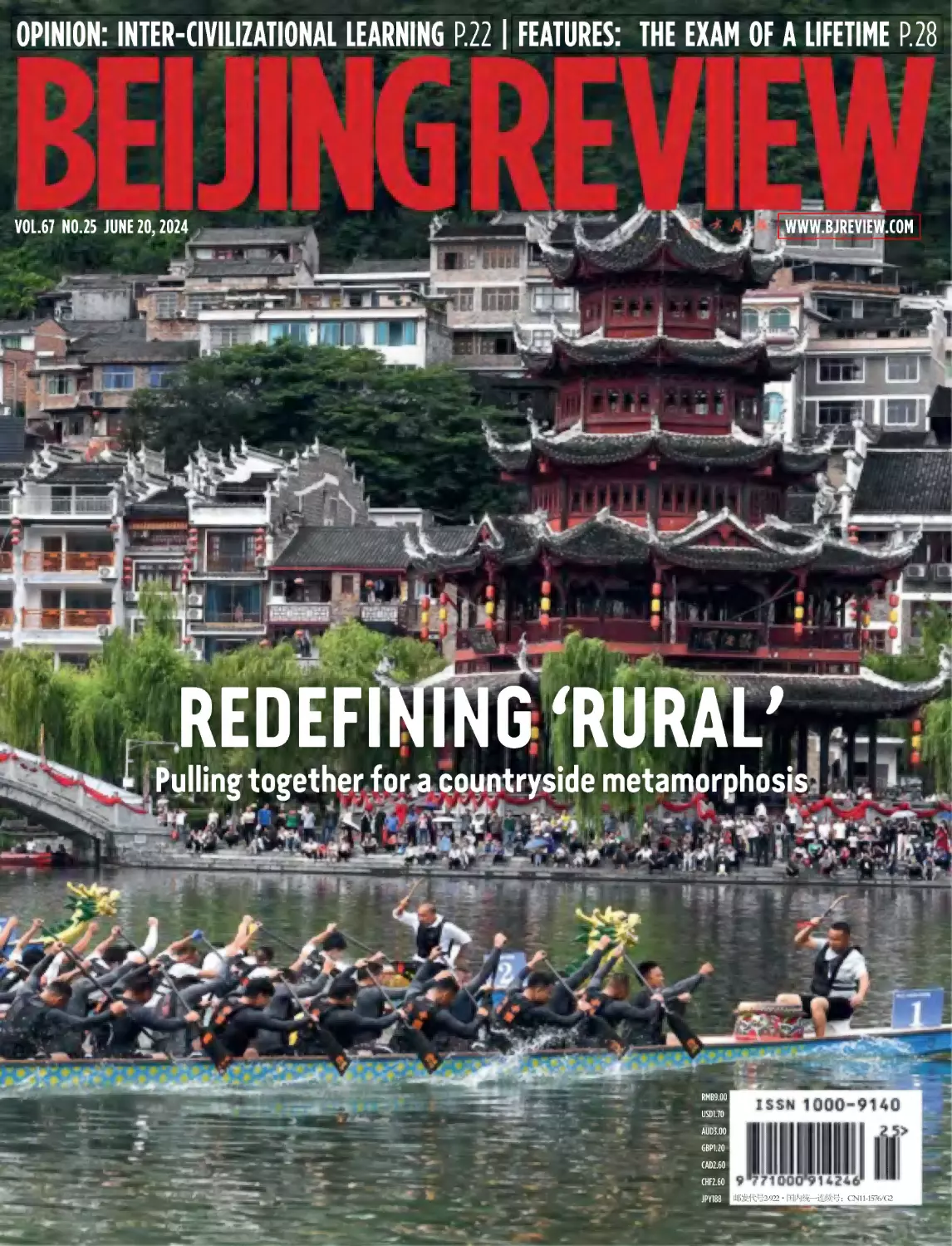
REDEFINING ‘RURAL’
Pulling together for a countryside metamorphosis
RMB9.00
USD1.70
AUD3.00
GBP1.20
CAD2.60
CHF2.60
JPY188
ᥪԦ̼Ձ-eڍЮፑʶᤋ፝ՁὙ$/-(
CONTENTS
EDITOR’S DESK
OPINION
02 Game Changers
22 Dialogue Among Civilizations
The blueprint for a shared future on
our shared planet
THIS WEEK
COVER STORY
12 Grassroots Glory
Small villages draw big
crowds for sporting spectacles
24 What the Tea Industry Reveals
About China’s Next Chapter
Participating in development through
the medium of tea
34 Unity in Diversity
History and harmony in the nation’s northwest
36 Ethnic Euphoria?
Young appetite for folkloric authenticity
shows guochao’s breadth
40 The Flow of Life
A Japanese director and his musings
along the Yangtze River
16 A Countryside Dash
+DOIPDUDWKRQEOHQGVÀWQHVV
DQGORFDOÁDLU
26 A Broken Dream: The American
Curse of the ‘Working Poor’
U.S. should put empowerment
over exploitation
42 Cracking the Code
Canadian entrepreneur connects south China
with North America
18 Employment Evolution
New professions are driving
rural development
27 5G: 5 Years and Counting
Connecting people and powering
development
CULTURE
46 Time to Test Your Chinese
Students around the world showcase their
language skills
FEATURES
28 Aiming High
Gaokao go time: Record 13 million
students take college entrance exam
FORUM
48 Will ‘Dumbphones’ Help Improve
Quality of Life?
32 Studying History to Understand
The Future
Setting the record straight on
Xinjiang’s history
Cover Photo: A dragon boat race in
Zhenyuan County, Guizhou Province,
on June 10 (XINHUA)
©2024 Beijing Review, all rights reserved.
www.bjreview.com
MEDIA PARTNER
Follow us on
BREAKING NEWS » SCAN ME » Using a QR code reader
Please recycle
EDITOR’S DESK
A News Weekly Magazine
Published Since 1958
President: Li Yafang
Associate Editor in Chief: Liu Yunyun
Vice Presidents: He Peng, Gao Dingbo
Content Supervisor: Yu Shujun
Executive Editor: Yan Wei
Production Director: Yao Bin
Editors: Wang Hairong, Zhang Shasha, Lu Yan
Researcher: Lan Xinzhen
Editorial Consultants: Elsbeth van Paridon, G.P. Wilson
Reporters: Ji Jing, Kang Caiqi, Li Qing, Li Wenhan, Li Xiaoyang,
Liang Xiao, Ma Miaomiao, Pan Xiaoqiao, Peng Jiawei,
Tao Xing, Tao Zihui, Wang Jun, Wang Ruohan, Yuan Yuan,
Zhang Yage
Photographer: Wei Yao
Art: Li Shigong
Design Director: Wang Yajuan
Chief Designer: Cui Xiaodong
Editorial Administrator: Zeng Wenhui
Planning Director: Xu Bei
Deputy Planning Director: Li Nan
World News Director: Ding Ying
World News Deputy Director: Li Fangfang
Director of Digital Media: Yu Shujun
Director of Strategic Research: Zan Jifang
Deputy Director of Strategic Research: Lu Ling
Administration: Zhang Yajie
International Cooperation: Sun Xuan
Legal Counsel: Yue Cheng
North America Bureau (New York City)
Chief: Yu Shujun
Executive Assistant: Zhao Wei
Tel/Fax: 1-201-792-0334
E-mail: yushujun@cicgamericas.com
Latin America Bureau (Mexico City)
Chief: Miao Ye
Tel: 52-55-55127271
Fax: 52-55-55332027
E-mail: chinahoymx@gmail.com
3HUX2IßFH /LPD
Chief: Meng Kexin
Tel: 0051-959212702
E-mail: revistachinaperu@gmail.com
*HQHUDO(GLWRULDO2IßFH
Tel: 86-10-68996252
Fax: 86-10-68326628
Editorial Desk
Tel: 86-10-68996250
Partnerships
Tel: 86-10-68995807
E-mail: yecong@cicgamericas.com
Distribution
Tel: 86-10-68310644
E-mail: circulation@cicgamericas.com
Game Changers
The mere mention of the word “countryside” used to conjure up images of a dull,
rustic life. But things are changing fast.
Several trendy sports events that have
emerged in China’s rural areas are becoming national phenomena, shattering longheld stereotypes.
To celebrate the annual Dragon Boat
Festival, which commemorates the ancient
patriotic poet Qu Yuan from the Warring
States Period (475-221 B.C.) on the fifth
GD\RIWKHÀIWKPRQWKRIWKH&KLQHVHOXQLsolar calendar, or June 10 this year, dragon
boat races were organized nationwide.
The boat race, nothing short of a visual
spectacle, has evolved into a sport with extensive local engagement, as well as a major
attraction for tourists. But the races are just
one part of the trending athletic scene.
During the Dragon Boat Festival holiGD\WKHTXDUWHUÀQDOVRIWKHVHFRQGHGLWLRQ
of the Cunchao, or Village Super League,
soccer tournament in Rongjiang County,
Guizhou Province, kicked off in style. This
year, 62 teams composed of local villagers
competed in the Cunchao, which started in
January and is slated to conclude in July.
Last year, the inaugural edition of the competition with 20 participating teams first
went viral on social media and then made
headlines nationwide.
With no entry fee, spectators flocked
to the county’s stadium for every match.
Published every Thursday by
CICG Center for Americas, 24 Baiwanzhuang Lu,
Beijing 100037, China
Overseas Distributor: China International Book Trading
Corporation (Guoji Shudian), P. O. BOX 399,
Beijing 100044, China
Tel: 86-10-68413849, 1-416-497-8096 (Canada)
Fax: 86-10-68412166
E-mail: fp@mail.cibtc.com.cn
Website: http://www.cibtc.com
General Distributor for Hong Kong, Macao and Taiwan:
Peace Book Co. Ltd.
17/Fl, Paramount Bldg, 12 Ka Yip St, Chai Wan, HK
Tel: 852-28046687 Fax: 852-28046409
Beijing Review (ISSN 1000-9140 USPS 2812) is published weekly
in the United States for US$64.00 per year by Cypress Books,
360 Swift Avenue, Suite 48, South San Francisco, CA 94080
News Postage Paid at South San Francisco, CA 94080
POSTMASTER: Send address changes to Beijing Review,
Cypress Books, 360 Swift Avenue, Suite 48,
South San Francisco, CA 94080
2
BEIJING REVIEW JUNE 20, 2024
All matches were livestreamed on social
media. The stands were often packed to
capacity, with enthusiastic supporters even
resorting to squatting on the ground to
catch the action.
In Taijiang, another county in Guizhou,
the annual village basketball tournament
has also become a smash hit since 2022.
Its exceptional success has inspired similar
events nationwide.
These amateur sports events not only
add color to the lives of rural residents, but
also contribute to local income growth due
WRWKHLQÁX[RIWRXULVWV
Rural revitalization, a strategy introduced at the 19th Communist Party of
China National Congress in 2017, promotes the economic prosperity and overall
development of rural areas. It builds on
the success of the nationwide poverty alleviation campaign, which succeeded in
eradicating absolute poverty in late 2020.
This initiative involves developing rural
industries, creating a pleasant living environment, promoting civility and effective
governance, and improving rural residents’
living standards. Cultural progress is among
its priorities.
Sports are necessary in fostering
social development through teamwork
and healthy competition. Their growing popularity is a positive sign of rural
revitalization. BR
CHINA......RMB9.00
U.S.A.......USD1.70
AUSTRALIA......AUD3.00
UK......GBP1.20
CANADA......CAD2.60 SWITZERLAND......CHF2.60
JAPAN......JPY188
EUROPE......EUR1.90
TÜRKIYE......YTL5.00
HK......HKD9.30
NEPAL......RS40
Ұ֧܉䩭Ѕм֔ҹоؗтҲѨ
Ұ֧ފ䩭Ѕм֔ҹѤರتЅК䩛ۏرߟܚघ䩜
сժ䩭صߟܚ՝ݚښ߇ڵນϽঅً൜䩭
൜ణϿ䩭ଽᇙᇷឡข࠭࠭ҙ౨ѕ߲ҹ
Ұڗ䩭ଽᇙ
ւ൜ॣӈҦ䩭
тҲחӈҦ䩭
WRITE TO US
ા䩭࠾ܗߟܚાϩࡳԍޅ
Send an e-mail: editorsoffice@cicgamericas.com
߭ۏرߟܚҹؗёҷ,661
Please provide your name and address
along with your submissions.
Submissions may be edited.
мֵࢅϣ۟ۂоًؗ䩭&1*тًڊ䩭
ܲܙݍНً࢙صߟܚᑂ࢙֭ࠪҷً
мֵജତ٣䩭Ϫھ
ׄ
http://www.bjreview.com
THIS WEEK
XINHUA
PUBLIC PREMIERE!
Giant panda Fu Bao dines in its enclosure at the Shenshuping giant panda base in the Wolong National Nature Reserve in Sichuan
3URYLQFHRQ-XQH)X%DRWKHÀUVWJLDQWSDQGDERUQLQWKH5HSXEOLFRI.RUHDPHWWKHSXEOLFIRUWKHÀUVWWLPHWKDWGD\DIWHUPRYLQJ
to Sichuan in early April.
http://www.bjreview.com
JUNE 20, 2024 BEIJING REVIEW
3
THIS WEEK SOCIETY
XINHUA
intelligent driving challenges.
The two municipalities will take
turns hosting the expo in the future.
Tourist Resorts
Cutting Losses, Boosting Yields
6GEJPKEKCPUEQPFWEVOCEJKPGJCTXGUVNQUUOGCUWTGOGPVUKPCYJGCV³GNFKP&CEJCPI6QYP3KPIFCQ
Shandong Province, on June 11. In Shandong, China’s second largest wheat-producing region, activities to
reduce harvest losses are underway across counties and cities with more than 4 million hectares of wheat.
Meanwhile, over 1.5 million units of agricultural machinery have joined the province’s harvest.
Private Pension
System
More than 60 million people have
opened private pension accounts
since the introduction of China’s
private pension system in late 2022,
data from the Ministry of Human
Resources and Social Security
showed, Xinhua News Agency
reported on June 8.
In November 2022, the government-supported, voluntary and
market-oriented pension system
was open to qualified citizens in 36
pilot cities and regions including
Beijing, Shanghai, Guangzhou
in Guangdong Province, Xi’an in
Shaanxi Province and Chengdu in
Sichuan Province.
The mechanism allows
Chinese citizens to contribute up to
12,000 yuan ($1,658) annually to
individual pension accounts to buy
certain old-age financial products.
Currently, the private pension
4
BEIJING REVIEW JUNE 20, 2024
system has 762 special products.
Among them, 465 are saving
products, 192 are fund products, 82
are insurance products and 23 are
asset management products.
Data also revealed that middle
and high income groups aged 31
to 40 showed the strongest interest
in opening such pension accounts
and purchasing related products
to prepare for their retirement in
advance and enjoy tax incentives.
China has a three-pillar
old-age insurance mechanism,
covering the national basic oldage insurance, the enterprise and
occupational annuities, plus the
commercial old-age financial
products and the private pension
system.
World Intelligence
Expo
The 2024 World Intelligence Expo,
taking place in Tianjin from June
20 to 23, aims to aggregate artificial
intelligence (AI)-related resources
both nation- and worldwide.
The expo is co-hosted by
Tianjin and Chongqing municipalities, combining two events formerly
known as the World Intelligence
Congress in Tianjin and the Smart
China Expo in Chongqing.
The AI event creates a global
platform for academic innovation,
exhibitions, competitions and
investment promotion in the field
of intelligent technology. It attracts
leading enterprises, renowned
research institutions and top universities.
With an exhibition area of
100,000 square meters, the event
includes 10 themed exhibition
areas covering the fields of AI,
intelligent connected vehicles, intelligent manufacturing and robotics.
Multiple international organizations
and institutions participate in the
event, competing in robotics and
The Ministry of Culture and
Tourism on June 12 announced it
has made 22 additions to its list of
national-level tourist resorts, bringing the country’s total to 85.
The latest additions span
across 22 provincial-level regions
in China, including multiple types
of attractions, many of which are
situated in and around rivers, lakes,
mountains and coastal areas.
In a bid to boost tourism
development and optimize tourism
offerings, China initially identified a
selection of sites as national-level
tourist attractions in 2015.
The identification process
considers major resort factors
such as infrastructure conditions,
operational efficiency, information
services and tourist satisfaction
levels.
In 2022, China introduced a
cultural development plan for the
2021-25 period, pledging to develop a diverse, well-balanced and
high-quality tourism supply system with distinctive features, aimed
at meeting the public’s needs and
bolstering the integrated development of tourism and culture.
Donation Fraud
The Ministry of Civil Affairs has
handed an administrative penalty
to a children’s aid foundation over
a donation fraud case that led to
nearly 10 million yuan ($1.4 million)
in losses.
The China Charities Aid
Foundation for Children, a public
fundraising foundation under the
ministry’s charge, has been barred
from carrying out charity activities
for three months and blacklisted
as a dishonest social organization
due to a serious law violation, the
ministry said in a circular on June 11.
An investigation found that
http://www.bjreview.com
THIS WEEK
Maritime Trial Cases
The Supreme People’s Court (SPC),
China’s top court, has recently
released typical cases of maritime
trials in China to underscore the importance of maritime jurisdiction in
the country in settling international
disputes, maintaining the shipping
order and promoting the marine
economy, Xinhua reported on June
10.
The cases handled by Chinese
courts in 2023 involved disputes
related to the purchase and sale of
ships, and liability for damage to
ships, according to the SPC.
Chinese courts aim to establish
themselves as preferred venues for
maritime dispute resolution, with
an increasing number of foreign
parties resorting to Chinese courts,
the SPC said.
In 2023, Chinese courts settled
26,425 maritime trial cases, according to data available on the China
Maritime Trial website.
Beautiful Bays
China has stepped up its construction of “beautiful bays” in an effort
to conserve its marine ecology and
environment, Xinhua reported on
June 7.
The Ministry of Ecology and
Environment has issued a plan to
build more than 110 bays across
the country by 2027. These bays
will achieve harmony between
people and the marine environment, with the ministry noting
that “clear water and clean
DGCEJGUCPFUJQCNUQH³UJCPF
XINHUA
from June to August 2023, a person surnamed Ke, who had been
engaged in services at a local aid
station since November 2022, had
illegally raised funds from patients
in the name of an aid program for
seriously ill children.
In September 2023, Ke was
detained for suspected fraud. The
case has now been transferred to
the judicial authority, according to
the ministry.
The management within
the foundation was found to be
substandard, said the ministry,
adding that the organization had
also failed to disclose any relevant
information.
In response, the foundation’s
deputy secretary general, who was
in charge of the serious illness aid
program, was investigated by a supervisory agency over allegations
of duty crimes. The case has since
been transferred to the judicial
authority, read the circular.
The ministry vowed to protect
the legitimate rights of the juvenile
patients currently covered by the
foundation’s aid, initiate a comprehensive rectification process
within the organization, and further
strengthen supervision and law
enforcement over charity organizations and activities.
Following in Ancient
Footsteps
Hiking enthusiasts trek along the Wusun ancient road in Baicheng
County, Xinjiang Uygur Autonomous Region, on June 9. A seven-day
hiking and camping event was launched there that day, attracting
more than 150 enthusiasts from all over the country.
´QEMUQHUGCDKTFU©YKNNDGUGGP
The 110 bays will account
for about 40 percent of China’s
major bays, according to the
ministry.
The plan also sets the goal of
transforming seven cities, including Xiamen in southeast China’s
Fujian Province, into model
zones where all coastal areas can
be classed as beautiful bays.
It details three tasks, including
the protection and restoration of
typical marine ecosystems, and
the improvement of key sewage
outlets that empty into the sea.
The ministry said that China’s
long-term goal is to build all 283
of its major bays into beautiful
DC[UD[YKVJVJCV³IWTG
including the 110 outlined in the
plan.
In recent years, China has
channeled more energy into the
protection of its marine ecology
and environment as part of its efforts to promote the construction
of a Beautiful China by 2035.
XINHUA
Steel to Sparkle
Tourists visit an industrial tourism area transformed from the
warehouse of a steel factory in Yuhuatai District of Nanjing, capital
of Jiangsu Province, on June 12.
http://www.bjreview.com
JUNE 20, 2024 BEIJING REVIEW
5
THIS WEEK ECONOMY
Response to EU’s
New EV Tariffs
%JKPCTGUGTXGUVJGTKIJVVQ³NG
lawsuits with the World Trade
Organization (WTO) concerning
the European Union’s (EU) plan
to impose provisional duties
on imports of Chinese electric
vehicles (EVs), the Ministry of
Commerce said on June 13.
6JG³PFKPIUD[VJG
European side in its predisclosure lack both a factual
and a legal basis, the ministry’s
spokesperson He Yadong said
CVCRTGUUDTKG³PI
The spokesperson stated
that the move not only undermines the legitimate rights and
interests of China’s EV industry,
but also disrupts the cooperation between China and Europe
KPVJG³GNFQHPGYGPGTI[
vehicles and distorts global automotive industrial and supply
chains, including those in the
EU.
Such an action is “blatant
protectionism” and it is suspected that it violates WTO rules,
He said, adding that China will
take all necessary measures to
defend the legitimate rights and
interests of Chinese enterprises.
China urges the EU to
rectify its wrong-doing immediately, implement the important
consensuses reached during
the recent China-France-EU
trilateral meeting, and address
economic and trade frictions
through dialogue.
The European Commission
on June 12 issued a statement
pre-disclosing the level of
protectionist provisional duties
it will impose on the imports of
battery EVs from China.
Passenger Car
Sales
A total of 8.07 million passenger cars were sold via retail
channels in China during
the January-May period, an
increase of 5.7 percent year on
year, according to the China
Passenger Car Association.
In May alone, retail sales of
passenger cars in the country
reached 1.7 million units. This
³IWTGYCUFQYPRGTEGPV
year on year, but still 11.4 percent higher than the previous
month.
The association attributed
the solid performance of the
CWVQOCTMGVKPVJG³TUV³XG
months to a number of factors,
including the implementation
of a trade-in policy and supportive measures introduced at
local levels.
In early April, China introduced measures to promote the
trade-ins of different consumer
goods, including automobiles,
with the aim of establishing a
system where used goods can
be exchanged for smart, green
and low-carbon alternatives.
In addition, China’s retail
sales of new-energy vehicles
(NEVs) soared by 38.5 percent
year on year to 804,000 units
in May, while NEV exports decreased by 4 percent compared
with a year earlier to 94,000
units.
The term NEV is used to
designate automobiles that
are fully or predominantly
powered by electric energy,
which include plug-in vehicles,
battery electric vehicles, plug-in
hybrid electric vehicles and fuel
cell electric vehicles.
SME Development
Index
China’s small and mediumsized enterprises (SMEs)
reported a slight decline
in business activity in May,
with the Small and Medium
Enterprises Development Index
down 0.2 points from the previous month, the latest industry
data showed.
The index, calculated based
on a survey of 3,000 SMEs in
China, came in at 89.2 in May.
The reading was up from 88.9
registered in the same period
last year, according to the
China Association of Small and
Medium Enterprises.
The index contains multiple
sub-indexes to gauge SME
performance and prospects. A
reading below 100 indicates
NUMBERS
China’s Producer Price Index Growth
China’s Consumer Price Index (CPI) Growth
2.5
2
Year on year (%)
Month on month (%)
1
-0.2
0
-1
-4
0
-0.2
-0.3 -0.3 -0.2 -0.2 -0.1
0.2
-1.4
-3.0
-2.5 -2.6
-2.7 -2.5 -2.7 -2.8 -2.5
-3.0
-4.4
6
0.7
0
0
-0.2 -0.2
-1.0
JUL AUG SEP OCT NOV DEC JAN FEB MAR APR MAY
2024
BEIJING REVIEW JUNE 20, 2024
MAY JUN
2023
0.1
-0.1
0.1 0
-0.3
Month on month
-5.4
MAY JUN
2023
0.2 0.3 0.2
0.5 0.2
-0.5
-5
-6
1.0
1.0
Year on year
-4.6
2.0
1.5
-0.9 -0.8
-2
-3
0.2 0.4
0.3
0.1
0.3 0.3
0.1
-0.2
-0.5
-0.1
-0.3
-0.8
-1.0
JUL AUG SEP OCT NOV DEC JAN FEB MAR APR MAY
2024
http://www.bjreview.com
THIS WEEK
dented vitality.
In May, the sub-indexes for
labor force and business capital
were above 100, while those for
sentiment on the macroeconomy, overall business operation,
market, investment and earning
performance were below 100.
5/'FGXGNQROGPVEQP³dence and market expectations
had yet to receive a boost, the
association said. The survey
showed that these enterprises
faced falling demand and high
operating costs in May.
The association called for
consolidating and strengthening the sound economic
recovery momentum, stressing
the need to step up support
for the real economy, expand
domestic demand, and widen
5/'KPXGUVOGPVCPF³PCPEKPI
channels.
From 2024 to 2025,
China plans to cut domestic
carbon dioxide emissions by
around 13 million tons through
industrial renovation and
equipment renewal in cement
production, according to an
action plan released by government departments including
the National Development and
Reform Commission, the country’s top economic planner.
During this period, China
also aims to save energy equal
to 5 million tons of standard
coal equivalent in cement production, according to the action
plan.
By the end of 2030, it is
expected that the overall enGTI[GH³EKGPE[QHVJGEQWPVT[«U
cement industry will reach a
world-class level and its energy
consumption pattern will be further optimized, the plan stated.
In September 2020, the
country announced its goal of
peaking carbon dioxide emissions before 2030 and achieving
carbon neutrality before 2060.
Carbon Reduction
#WVJQTKVKGUJCXGUGVURGEK³E
carbon emission reduction
targets for the cement industry
as China moves toward a lowcarbon economy.
Commercial Bank
Resilience
The balance of loan loss provisions of China’s commercial
banks came in at 6.9 trillion
yuan ($951.3 billion) at the end
QHVJG³TUVSWCTVGTQHVJKU[GCT
FCVCHTQOVJGEQWPVT[«U³PCPcial regulator showed.
6JG³IWTGJCFKPETGCUGFD[
269.8 billion yuan ($37.2 billion)
from the end of the previous
quarter, further demonstrating the resilience of Chinese
lenders against risks, according to the National Financial
Regulatory Administration.
The lenders’ provision coverage ratio (PCR) stood at 204.54
percent by late March, down 0.6
percentage points from the end
of last year, the data showed.
6JG2%4KUC³PCPEKCNTCVKQVJCV
measures the extent to which a
DCPMQTQVJGT³PCPEKCNKPUVKVWVKQP
has set aside provisions (reserves)
to cover potential loan losses.
A higher PCR (closer to 100
percent) indicates a conservative
approach, while a lower PCR
suggests room for improvement.
+PVJG³TUVSWCTVGTVJG
EWOWNCVKXGPGVRTQ³VUQH%JKPC«U
commercial banks reached 672.3
billion yuan ($92.7 billion), up 0.7
percent year on year.
Foreign Trade
China’s total goods imports and
exports expanded 6.3 percent
year on year in yuan terms in
VJG³TUV³XGOQPVJUQHVJKU[GCT
QH³EKCNFCVCUJQYGF
The country’s exports rose
6.1 percent year on year in the
January-May period, while
imports climbed 6.4 percent,
according to the General
Administration of Customs of
China.
From January to May, the
country’s foreign trade in goods
stood at 17.5 trillion yuan ($2.4
trillion). Exports reached 9.95
trillion yuan ($1.4 trillion), while
imports hit 7.55 trillion yuan
($1.04 trillion).
In May alone, foreign trade
grew 8.6 percent to 3.71 trillion
yuan ($511.5 billion).
China’s CPI Growth by Type
May (%, y.o.y.)
-1.0
Food
1.6
Clothing
0.2
Housing
0.8
Household items and services
Transport
-0.2
1.7
Education
Healthcare
1.5
3.6
Others (combined)
-1.0
-0.5
0
0.5
1.0
1.5
2.0
2.5
3.0
3.5
4.0
(Source: National Bureau of Statistics)
http://www.bjreview.com
JUNE 20, 2024 BEIJING REVIEW
7
THIS WEEK WORLD
XINHUA
¼
¼
AUSTRALIA
UNITED STATES
The Love Is in the Air drone show
at the Vivid Sydney light festival
on June 8
Hunter Biden (left) at the White House in
Washington, D.C. on May 20.
A jury of 12 members in the state of
Delaware found Hunter Biden, son of
President Joe Biden, guilty of three federal
JXQFKDUJHVPDUNLQJWKHĶUVWWLPH
a sitting U.S. president’s child was
criminally convicted
XINHUA
¼
DEMOCRATIC REPUBLIC OF
THE CONGO
Health workers conduct a sanitation mission in a
village in the Beni region of North Kivu Province
on June 11. At least 57 civilians were killed within a
week by Allied Democratic Forces rebels
XINHUA
8
BEIJING REVIEW JUNE 20, 2024
http://www.bjreview.com
THIS WEEK
¼
INDONESIA
Shi Yuqi (right) of China and Anders Antonsen of Denmark
pose for photos during the award ceremony following the
PHQoVVLQJOHVĶQDODWWKH,QGRQHVLD2SHQEDGPLQWRQ
tournament in Jakarta on June 9
XINHUA
XINHUA
¼
FRANCE
Olympic rings adorn the Eiffel
Tower in Paris on June 7. The
rings were unveiled as Paris
marked 50 days before the start
of the upcoming Paris 2024
Olympic Games
¼
ISRAEL
A rescued Israeli hostage arrives
at a medical center in Ramat Gan
on June 8. Israeli forces rescued
four Israeli hostages taken by
Hamas into the Gaza Strip
on October 7, 2023
XINHUA
http://www.bjreview.com
JUNE 20, 2024 BEIJING REVIEW
9
THIS WEEK PEOPLE & POINTS
¾ TSINGHUA PROFESSOR RECEIVES LETTER FROM PRESIDENT XI
Andrew Chi-Chih Yao, a computer scientist and computational theorist, received
a letter of reply from President Xi Jinping in mid-June, encouraging him to make
more contributions to help the nation achieve high-level self-reliance and strength
in science and technology.
Yao, who taught in U.S. universities for many years, returned to China in
2004 to join the faculty at Tsinghua University. In a recent letter addressed to Xi,
KHGHWDLOHGKLVZRUNLQWDOHQWFXOWLYDWLRQDQGVFLHQWLÀFLQQRYDWLRQGXULQJKLVWZR
decade tenure.
<DRLVWKHÀUVW&KLQHVHVFLHQWLVWWRUHFHLYHWKH7XULQJ$ZDUG
given by the U.S.-based Association for Computing Machinery
for major and lasting contributions to computer science. Now, the
\HDUROGLVGHDQRI7VLQJKXD·V&ROOHJHRI$UWLÀFLDO,QWHOOLJHQFH
and its Institute for Interdisciplinary Information Sciences. He is
also a member of the Chinese Academy of Sciences.
Toilet Timers
Rednet.cn
June 7
Visitors to the Yungang Grottoes, a historical site in Shanxi Province, recently
discovered timers on the cubicle doors in
women’s lavatories, measuring the minutes and seconds each user spends inside.
The installation of timers is well-intentioned. The use of restrooms, particularly
women’s restrooms, at scenic spots
reaches or exceeds capacity during every
national holiday. The timers are intended
to remind users of the time they take to
reduce queues and wait times. However,
placing pressure on visitors by measuring the time they take in the restroom is
unnecessary, an invasion of privacy and
won’t solve the fundamental problem.
The right answer is to build more
public lavatories. Well-developed infrastructure is a crucial part of the tourism
industry. Only by satisfying tourists’ real
demands can tourism achieve high-quality
development.
“We need to enable the public,
especially parents, to understand the
importance of early childhood
development, to acquire knowledge
and skills, and to take care of young
children scientifically to promote their
KHDOWKóDQGóDOOURXQGóGHYHORSPHQWµ
Xu Zongyu, Director General of the National Center for
Women and Children’s Health, as a new public campaign
was launched on June 7 to create awareness on
the importance of early childhood development
10
BEIJING REVIEW JUNE 20, 2024
Green Mountains and
Crystal Waters
Outlook
June 3
Guizhou Province in southwest China was
once ecologically fragile, but nowadays its
forested areas are increasing and it is standing out as a pioneer in pursuing ecological
progress.
In recent years, the ecology in major river
basins and mountainous areas has markedly
improved. According to Guizhou’s forestry
authorities, the area affected by karst rocky
“Over millennia, the wondrous story
of the Silk Road has been one of
encounters—between people,
FXOWXUHVóUHOLJLRQVóDQGóNQRZOHGJHó
These encounters have shaped
FLYLOL]DWLRQVóRYHUóWKHóDJHVµó
Irina Bokova, former Director General of the United
Nations Educational, Scientific and Cultural Organization
(UNESCO), in a recent interview with Xinhua News Agency,
citing the history of the Silk Road as an example of
dialogue being a key driver of human civilizations
http://www.bjreview.com
THIS WEEK
desertification has been cut down to 15,500
square km from 37,600 square km in 2005.
Additionally, more effective urban sewage treatment and the appointing of “river
chiefs,” local government heads placed in
charge of protecting the bodies of water
within their jurisdictions, have also helped
improve ecological environments. Air quality in Guizhou’s major cities was within the
“excellent” range on 98.6 percent of the days
in 2023. Even in the vast rural areas, a system
for collecting, transferring and treating household waste now covers all villages.
The green economy contributed 46 percent of the overall economy in the province in
2023, up from 37 percent in 2017. As mountainous and hilly areas make up 92.5 percent
RIWKHSURYLQFHDJULFXOWXUHÀWIRUPRXQWDLQous areas has been widely introduced. The
province has adopted green and low-carbon
development as the most suitable means
for local economic development. Industries
related to new-energy batteries as well as
photovoltaic and wind power are advancing rapidly and the data economy continues
to upgrade. By 2027, the green economy is
expected to account for 50 percent of the provincial economy.
Moreover, the province has set up 34 environmental protection courts. The concept of
green development has been internalized into
the overall judicial process.
Branches of the Same Tree
People’s Daily
June 11
Recently, a short video of a professor from Minzu University of China in
Beijing, which specializes in ethnic minority studies, rehearsing a Mongolian
dance went viral on social media. What
has captured viewers’ attention is that the
lead dancer is not of ethnic Mongolian
descent but a member of China’s Korean
ethnic group; the choreographer, then,
is of the Hui ethnicity. The dance is
WKHUHIRUHDFRQÁXHQFHRIPXOWLSOHHWKQLF
cultures.
Chinese civilization has developed
through the interaction of the cultures of
its diverse ethnic groups. Many measures
are being taken to bring these cultures to
the fore, such as promoting the protection and passing on of cultural heritage,
tapping into the cultural resources of
ethnic minorities, and promoting cultural exchange between different ethnic
groups.
China is home to 56 ethnic groups,
with the Han people accounting for 91
percent of the total population. The traditional cultures of all ethnic groups are an
integral part of the Chinese culture and
are all branches of the same tree.
¾ TABLE TENNIS LEGEND TO CHAIR OCA ATHLETES’ COMMITTEE
Chinese table tennis legend Ding Ning has been elected chair of the Athletes’
Committee of the Olympic Council of Asia (OCA), the OCA said on June 10.
In her candidature speech, Ding pledged to strengthen sports exchange and cooperation between national Olympic committees, fostering dialogue among Asian
athletes.
Ding has won 21 gold medals at the Olympic Games, World Cup and World
&KDPSLRQVKLSV6KHRIÀFLDOO\DQQRXQFHGKHUUHWLUHPHQWLQ6HSWHPEHU
2021. She graduated with a master’s degree in physical education
from Peking University in July 2023, and remained at the institution
as a teacher. Three months later, she was elected a member of the
OCA Athletes’ Committee.
“Chinese companies, because of the
competitive threats and pressures
within China, are very good at
trying things out, experimenting
and adapting their products to
WKHóPDUNHWóTXLFNO\µ
“The Global South now represents not
just the pursuit of prosperity, but the
driver of emerging global prosperity and
JURZWKó,QóWKHóEDWWOHóIRUóLQFOXVLRQóLQóWKHó
present, they clearly have a voice not to
EHóLJQRUHGóLQóWKHóLQWHUQDWLRQDOóRUGHUµ
Julian Birkinshaw, Vice Dean of London Business
School, in a recent interview with China Daily
Anwar Ibrahim, Malaysian Prime Minister,
in a keynote speech delivered at a regional forum
in Kuala Lumpur on June 6
http://www.bjreview.com
JUNE 20, 2024 BEIJING REVIEW
11
XINHUA
COVER STORY
GRASSROOTS GLORY
Village sports embraced across China By Yuan Yuan
he Dragon Boat
Festival arrived on
June 10 this year
with a crescendo
of drumbeats in
Diejiao Village of Foshan City in
Guangdong Province, south China.
12
BEIJING REVIEW JUNE 20, 2024
Famous for its dynamic and exhilarating dragon boat
races—a tradition dating back to the Ming Dynasty (13681644)—the village has emerged as a favored spot for
tourists celebrate the festival.
For the locals, this festival is one of the highlights of
the year. To secure top results in the races, villagers who
have moved away are summoned back well over a month
in advance to start their preparations.
The training sessions further drum up
enthusiasm for the dragon boat races.
Passing passions
Wen Yongcheng, who was
born in the village in 2000 and
http://www.bjreview.com
Fireworks light up the sky following
a soccer match in Rongjiang County,
Guizhou Province, on May 5
later relocated to Macao Special
Administrative Region with his
family during his middle school
years, has harbored the dream of
racing in a dragon boat since his
childhood. This year, he dedicated
himself to making that dream a
reality, traveling six hours back to
Foshan from Macao every Friday
after school to participate in night
WUDLQLQJVHVVLRQVIRUKLVÀUVWRIÀFLDO
race.
The dragon boat races in
Diejiao are unlike those on open
waters. Here, the 25-meter-long
http://www.bjreview.com
dragon boats must deftly navigate through channels less than 6 meters wide. The 30 crew members
aboard are tasked with executing a series of intricate
maneuvers, including sharp turns, abrupt stops, and
rapid sprints. Any minor error can result in a collision. The boats’ ability to drift around corners and
reverse has added a visually captivating element to
the races.
Wen is proud of being a member of the winning
dragon boat team. “It’s incredibly thrilling to aim for
and attain such honor alongside childhood friends,”
Wen told China Central Television (CCTV).
The boat Wen raced on, with nearly half of its
crew born after 2000, has attracted the attention
of the village’s elder generation. They see in these
young participants the future and
hope for the continuation of the
dragon boat racing tradition.
Li Youhang, born in 1997, is a
key member of the team. Positioned
at the front of the boat, he leads by
chanting slogans in rhythm with the
drummer positioned on the stern to
inspire the younger paddlers seated
between them. “They remind me of
my own early days of training on
the boat,” he told CCTV.
The tradition of dragon boat
racing surged in popularity on
social media during the Dragon
Boat Festival holiday. Each region,
with its distinctive geographical
characteristics, introduces unique
variations to the sport.
For instance, the narrow waterways of Diejiao Village necessitate
that dragon boats enter the competition sequentially, racing against
time rather than directly against
each other. This format demands
that competitors continually strive
to exceed their personal bests.
In the rugged terrain of
Longjiapu Village, situated in
Mayang Miao Autonomous County
of Hunan Province in central China,
the teams must undertake a strenuous upstream journey, covering
tens of kilometers by river to reach
the competition site, as the mountainous roads present logistical
challenges for transporting dragon
boats by land. Villagers along
the route offer them encouragement by setting off fireworks and
ÀUHFUDFNHUV
Similar to Diejiao, the inhabitants of Longjiapu eagerly return
JUNE 20, 2024 BEIJING REVIEW
13
ʈʈ
home to participate in the dragon
boat race. The village team, composed of villagers aged 18 to 55,
often includes members from the
same family such as father and son
or brothers.
The journey’s challenge for
the team members extends beyond
merely rowing upstream. It also includes skillfully navigating through
rapid currents to safely beach the
boat. Their traditional dragon boat,
nearly 40 meters in length, risks
capsizing or sustaining damage if
not handled correctly during these
critical moments. It falls upon the
steersman, armed with experience,
to discern the safest path by keenly
observing the water’s color and
wave patterns.
Once a viable route is identified, the drummer signals the
paddlers, with drumbeats, to pool
their strength and paddle in unison.
In these moments, the drummer’s
role is crucial to lifting the team’s
morale and energy.
$VWKHUK\WKPRIWKHEHDWLQWHQVLÀHVWKHGUDJRQ
boat gradually makes headway against the current,
driven by the collective effort of the team. “We all
share a love for the sport and are united in our pursuit to embody resilience and courage,” said Chen
Yinhao, a paddler of the team.
Give it a goal
Dragon boat races have boosted local tourism, with
data from leading travel platform Trip.com indicating that Foshan experienced a 55-percent surge in
hotel bookings during the Dragon Boat Festival
compared with last year.
In addition to dragon boat races, various other
forms of rural sports have injected vitality into
China’s rural areas.
In Rongjiang County, located in Qiandongnan
Miao and Dong Autonomous Prefecture, Guizhou
Province, the recent rise in popularity of the Village
Super League—a rural soccer league, has led to an
11-fold increase in local hotel bookings.
A rural sport phenomenon in Guizhou, the league
captured widespread attention in 2023. Despite, or
perhaps because of, its small-village vibe, the league
has set national records for attendance and viewerXINHUA
ship, with single game attendance
exceeding 60,000, and total online
views surpassing 48 billion.
After going viral online last
year, the Village Super League has
continued to evolve and mature. On
May 27, former Brazilian football
legend Ricardo Izecson dos Santos
Leite, famously known as Kaká,
graced the Village Super League
pitch, where he played and scored
a goal alongside local players. He
also participated in a charity match
for local primary school girls, furWKHUERRVWLQJWKHHYHQW·VSURÀOH
The number of teams participating in league has also expanded.
On June 10, a special team from
Xigaze in Xizang Autonomous
Region made their league debut
in Rongjiang. It is the first team
from Xizang to participate in the
competition.
On the sideline of the games,
the Xigaze Cultural and Tourism
Carnival was held nearby, showcasing the stunning scenery and
rich intangible cultural heritage of
Xigaze to promote its tourism.
“This event represents an innovative exploration integrating
culture, tourism, and sports, and
promoting cultural exchange and
tourism through activities,” said
Ge Yongming, Deputy Director
of the Xigaze Municipal Tourism
Development Bureau.
Ge emphasized that the
Guizhou Village Super League
is not just a celebration of soccer
but also a platform for cultural
exchange. Hosting a Xigaze cultural and tourism promotion event
alongside the Village Super League
is a pioneering exploration aimed
DWH[SDQGLQJWKHFLW\·VLQÁXHQFH
Hoops and hopes
A soccer match between a team from Henan Province and another one from Inner Mongolia
Autonomous Region, in Rongjiang County, Guizhou Province, on June 10
14
BEIJING REVIEW JUNE 20, 2024
In Taijiang County, another county
in Guizhou, the Village Basketball
Association (VBA) is also creating
http://www.bjreview.com
http://www.bjreview.com
XINHUA
a festive atmosphere.
Since the tournament commenced on March 22, over 600
teams from 24 provincial-level
regions have been vying for victory
in a competition that will continue
until November. At least half of
the players on each team must be
farmers.
Originally organized to celebrate a local festival on the sixth
day of the sixth month of the
Chinese lunar calendar, the basketball games went viral in 2022,
attracting over 1.5 billion online
views that year. In 2023, the event
garnered more than 55 billion
views, further cementing its status
as both a cultural and sporting phenomenon.
“We plan to take the championship team to an exchange program
with the American NBA, allowing
them to interact with professional
NBA players,” said Cen Jianglong,
head of Taipan Village, Taijiang,
and co-organizer of the tournament,
in an interview with China Daily
newspaper.
He revealed that during the
VBA tournament, at least one NBA
player will visit Taipan to engage
with the players and the local community. The organizing committee
also intends to establish a VBA
alliance through the tournament to
promote the development of rural
basketball.
Gao Delong, a basketball player
from a village in Ningjin County,
Xingtai City, Hebei Province in
north China, considered the tournament a good opportunity to
meet teams from the south. “This
competition not only provides a
platform for teams from both regions to exchange skills but also
allows young people from different
ethnic backgrounds to understand
each other and build friendships,
creating a favorable environment
Teams compete in a traditional Chinese dragon boat race in Lianjiang County, Fujian Province,
on June 11
for national unity,” he said.
Zhou Xiangzhong, an enthusiastic audience
member from Guangdong Province arrived early
in the morning to secure a seat. “The atmosphere is
electrifying, and it was truly worth coming. Despite
the rain, the performers gave it their all, and the
players fought hard on the court. Their spirit deeply
moved me,” he said.
$FFRUGLQJWRÀJXUHVIURPWKHORFDOJRYHUQPHQW
in 2023, Taijiang County attracted 6.4 million tourists, a nearly 75-percent increase year on year, and
the county’s tourism revenue reached 8.46 billion
yuan ($1.17 billion), up nearly 95 percent year on
year.
Grassroots sports have experienced a surge in
recent years, with many regions organizing sporting
events.
For instance, in Wenchang City, Hainan
Province, a volleyball competition featuring diverse
playing styles began on June 15. Twenty village
teams will compete in 52 matches
that will last until August, drawing
broad participation.
“There are over 600 volleyball
courts in the city, covering almost
all villages,” Pao Guangyu, the
official in charge of tourism in
Wenchang, told Guangming Daily.
“At the grassroots level, sports
events combined with entertainment activities are driving local
cultural and tourism development.
We will endeavor to make our
village volleyball tournament nationally renowned, making it more
enduring.” BR
Copyedited by G.P. Wilson
Comments to yuanyuan@cicgamericas.com
JUNE 20, 2024 BEIJING REVIEW
15
COVER STORY
A COUNTRYSIDE DASH
Half-marathon participants revel in rural tradition By Yuan Yuan
W
ith its course set against a
canvas of quaint villages
on the one side and the
majestic curve of the Yangtze River
on the other, this rural half-marathon
offered a laid-back atmosphere, attracting participants, many of whom were
farmers, from across China.
As runners made their way through
the scenic countryside, they were encouraged by cheerleaders dressed in
ethnic costumes and got the chance to
sample some local snacks along the
route.
Unlike traditional races with cash
prizes, the winners received a live
JRRVHDQGWZREDVNHWVÀOOHGZLWKORFDO
produce.
The event kicked off at 7:30 a.m.
on May 19, with over 2,000 runners
ready to go at the starting line, eager
to tackle the 21.0975-km journey through Nanxi District
on the outskirts of Yibin in Sichuan Province, southwest
China. About four minutes later, another wave of over
1,000 participants set off on a shorter, 4.2-km run.
Launched in 2020 by the Ministry of Agriculture and
Rural Affairs and the General Administration of Sport of
China, this national-level event featuring running races in
rural areas has been held annually at different locations all
over China. This year, Yibin took the baton of hosting the
opening races.
The participants generally comprise a mix of farmers,
LQGLYLGXDOVZRUNLQJLQDJULFXOWXUHUHODWHGÀHOGVORFDOUHVLdents and professional marathon runners.
Registration for the event opened on April 17 and was
met with overwhelming enthusiasm, with 3,000 open slots
ÀOOHGXSZLWKLQMXVWÀYHPLQXWHVWKHRUJDQL]LQJFRPPLWtee told Beijing Review.
Relax, recharge
7KHVWDUWLQJOLQHDOVRVHUYLQJDVWKHÀQLVKOLQHZDVVLWXDWHGQHDUWKHÀUVWPDMRUEHQGRIWKH<DQJW]H5LYHULQ<LELQ
This spot is the place where the Minjiang River, a tributary
of the Yangtze River, converges with
the upper reaches of the Yangtze River,
unveiling a 24-km panorama that sets
the perfect backdrop for a half-marathon.
“This half-marathon offered a relaxing atmosphere,” Meng Xianjuan,
a participant from Hebei Province
in north China, told Beijing Review.
“Beyond the scenic vistas, the course
featured gentle slopes and minimal
sharp turns.”
Meng, a 51-year-old running
enthusiast who has participated in
different marathons for over two
years, noted how running in this
rustic setting felt very different from
running in the urban concrete jungle.
“Unlike the modern skyscrapers
seen in big cities, here, you’re enveloped by lush greenery and blooming
COURTESY PHOTO
Half-marathon participants run along the Yangtze River in Yibin, Sichuan Province, on May 19
16
BEIJING REVIEW JUNE 20, 2024
http://www.bjreview.com
http://www.bjreview.com
XINHUA
ÁRZHUVµVKHVDLG´,W·VDQLGHDOVSRW
for running.”
She arrived in Yibin two days
before the race to prepare, and took
advantage of the proximity of her
hotel to several fruit-picking farms.
“I went watermelon picking—given
it’s watermelon season,” she said. “It
was a unique experience after having
run many city marathons.”
According to the organizing
committee, the participants hailed
from 21 provinces, municipalities
and autonomous regions across
China. Some farmers had formed
teams with their provincial counterparts to participate in the event.
Beyond the competition, many
runners considered this race an opportunity to showcase themselves
and promote their agricultural products, adding a twist to the traditional
athletic event.
Liu Yong from Chongqing
Municipality enthusiastically waved
DÁDJHPEOD]RQHGZLWK´&KRQJTLQJ
Citrus” throughout the race. “I live
by the Yangtze River in Chongqing,”
he told news portal ThePaper.cn.
“Chongqing’s hilly terrain requires
constant climbing, which has nurtured my passion for running. The
roads in my hometown are lined by
citrus trees and running under their
shade is a regular enjoyment for me.
I took this opportunity to promote
the reputation of my hometown’s
citrus fruits.”
He Fanyong, a farmer from
Yibin’s Pingshan County and a
celebrated rural life vlogger with 1
million followers across different
Chinese social media platforms,
completed the race while carrying a
batch of his hometown’s specialty—
fine dried noodles. Crossing the
finish line, he immediately began
promoting his noodles, not even
stopping to wipe away his sweat.
“Through my videos, I strive to presHQWWKHPRVWDXWKHQWLFDQGXQÀOWHUHG
Winners of the race pose for pictures holding their prizes on
stage in Yibin, Sichuan Province, on May 19
aspects of rural life,” he stated.
The event also served as a platform for local cheerleading squads from a range of ethnic backgrounds
to exhibit their unique cultural traditions and skills.
Performances featuring waist drums, lotus spears and
flower boats contributed to the across-the-board cultural ambiance.
An exhibition area for the display and sale of
Yibin’s agricultural products and local handicrafts was
VHWXSQH[WWRWKHÀQLVKLQJOLQH
Thirty master craftsmen demonstrated their skills
on-site, including bamboo weaving, embroidery,
straw crafts, wax dyeing and sugar painting, offering a
glimpse into the region’s intangible cultural heritage.
More than a run
Deng Yi, a 56-year-old runner originally from Yibin
but a longtime resident of Beijing, returned to Nanxi
for the event after many years away. “When I was
young, the villages along the Yangtze in Yibin were
considered the most remote, but now the rural areas
look even more appealing than the urban ones,” he
told Xinhua News Agency.
He considered the half-marathon an excellent
opportunity for Yibin to showcase its picturesque
countryside and promote local culture, sports, and
tourism.
Deng underlined the culinary delights of the area,
known as a foodie haven. Along the course of the halfmarathon, especially in the last kilometer, local snacks
were supplied to runners, including
specialties such as dried tofu, dried
JRRVHPHDWFUD\ÀVKDQGULFHFDNHV
to energize participants with a taste
RIORFDOÁDYRUV
Su Yuhao, a Beijing-based
sports blogger who ran the 4.2-km
race, was very interested in Yibin
Wuliangye, a famous Chinese liquor
on par with Moutai—a brand of baijiu (“clear liquor”) that is considered
a national treasure.
“Before going there, I wondered if we could enjoy as much
Wuliangye as we like, similar to
how runners of [France’s] Bordeaux
Marathon can enjoy unlimited
wine,” he said in a short video on
Douyin, the Chinese version of
TikTok, before embarking on the
race.
To his delight, he discovered
the liquor was available in the last
km, with vendors allowing runners
to take as much as they dared. “The
vendors were all so enthusiastic,”
he exclaimed. “They kept putting
snacks in my hands.”
For Li Tangjie, a marathon
enthusiast from Hubei Province,
running marathons in different locations is an excellent way to explore
new places. “There are always some
fun discoveries,” he told Xinhua.
This time, he was charmed by the
local marriage registration office in
Nanxi District, which overlooks the
Yangtze River. “Newlyweds take
their vows facing the Yangtze, creating a beautiful scene,” he said.
This year’s rural marathon will
expand to four more locations nationwide and Li hopes to continue
exploring and experiencing the
unique charm of China’s countryside
through running. “I will continue to
participate in these running events as
long as I can,” he said. BR
Copyedited by Elsbeth van Paridon
Comments to yuanyuan@cicgamericas.com
JUNE 20, 2024 BEIJING REVIEW
17
COVER STORY
EMPLOYMENT
EVOLUTION
New rural professions give a boost to rural revitalization By Ji Jing
I
t has been three years since
He Shuqin became a rural
chief executive officer (CEO)
in Chengkou County, Chongqing
Municipality.
Rural CEO was first listed as a
profession in China in 2019. It is one
of the 13 rural revitalization-related
new professions in China, according
to Wang Xiaojun, Deputy Director
General of the Vocational Capacity
Building Department, Ministry
of Human Resources and Social
Security (MHRSS). Other such professions include homestay manager
and pilot of unmanned aerial vehicle
(UAV). The MHRSS periodically
recognizes and lists new professions
that have emerged in pace with economic and social development.
Rural revitalization is a state-led
strategy put forward by President
Xi Jinping during the 19th National
Congress of the Communist Party of
China in 2017. The idea is to have
a comprehensive framework to narrow the urban-rural development
gap by accelerating the development
of rural areas and making them more
attractive to live in.
“New rural professions have
boosted rural revitalization,” Wang
told China Youth Daily newspaper
in early May.
Running rural businesses
The role of rural CEOs is to identify
the advantages possessed by villages
and use local resources to drive rural
development. They should also be capable of bringing personnel, capital,
technology, and projects to rural areas
to inject new vitality into rural areas,
DFFRUGLQJWRMREVSHFLÀFDWLRQV
In 2021, He resigned from an
DJULFXOWXUDOÀQDQFLDOLQVWLWXWLRQDQG
XINHUA
accepted the offer to be the general manager of a rural
company jointly established by Chengkou County’s
190 village collectives. The company’s mission is to
boost rural industrial development through equity investment.
“Rural industries have a long investment cycle and
high risks; therefore we need to be prudent and careful
in making investment decisions,” He told newspaper
Xinhua Daily Telegraph.
One of his key tasks is to improve investment
feasibility evaluation mechanisms for rural industrial
projects to reduce risks. He also conducts research
visits to the county’s villages to identify suitable projHFWV7KURXJKWKHVHYLVLWVKHKDVLGHQWLÀHGFXUHGPHDW
production, chicken farming, edible fungi cultivation
and tourism as particularly suitable industries for the
county.
Using fund entrusted to his company by the rural
collectives, He has planned and overseen village projects such as bringing in professionals to run homestays
and improving production facilities for farmers.
He’s company has invested over 30 million yuan
($4.1 million) in more than 20 rural projects developing village industries and, to date, has distributed
nearly 900,000 yuan ($124,072) in dividends back to
local rural collectives.
Applying advanced technology
Homestay manager Huang Fang (second right) and her colleagues prepare for a
banquet at a homestay in Ruao Township, Shaoxing, Zhejiang Province, on April 30
18
BEIJING REVIEW JUNE 20, 2024
UAV pilot is also a new profession in rural areas.
Wang Jiansen from Taizhou in Jiangsu Province, is
working in the role of UAV pilot, using drones to
spray pesticides and fertilizer in rural areas.
Cultivating more than 13 hectares of farmland,
Wang used to have to hire workers to spray pesticides
every year. However, as the costs of hiring these
workers increased year on year, Wang decided to
buy a UAV to apply the pesticides himself. In 2017,
he spent more than 100,000 yuan ($13,786) to buy a
UAV.
He went through the UAV pilot training and
passed the exams to receive a UAV pilots’ license issued by the Civil Aviation Administration of China.
In the beginning, he had planned only to use the
UAV to spray pesticides on the farmland managed by
http://www.bjreview.com
XINHUA
8QPDQQHGDHULDOYHKLFOHSLORWVVSUD\SHVWLFLGHVLQDZKHDWĶHOGLQ%RODQ7RZQVKLS4LQJGDR6KDQGRQJ3URYLQFHRQ$SULO
him. However, as more and more local farmers approached him for help, he became a professional UAV
pilot providing services not only in Taizhou but in
other places in China as well.
Jin Hailin, a UAV dealer in Shanghai, told Shanghai
Observer news portal that a hardworking plant protection UAV pilot can make hundreds of thousands of
yuan (tens of thousands of dollars) a year.
+HDGGHGWKDWDTXDOLÀHGSLORWDOVRQHHGVDJULFXOtural knowledge. For instance, he or she must know
which pesticides to apply to different crops or the
same crops at different stages of growth.
Serving rural tourism
With the booming of rural tourism, homestays
have been set up in the rural areas to serve tourists.
Homestay manager is a new profession recognized
by the MHRSS in June 2022. These managers have
multiple tasks, including planning activities for experiencing the local natural environment and cultural
heritage, providing customized food and beverage
services and accommodation according to customers’
needs and maintaining customer relations.
Zhang Qiu, a native from Huang’antuo Village in
Beijing’s Mentougou District, has been a manager at a
local homestay for four years.
Zhang has been quick to respond to customer
demand. As the homestay is a three-hour drive from
http://www.bjreview.com
downtown Beijing, customers are
often exhausted when they arrive.
Zhang told China Tourism News
newspaper that he invites the customers to the homestay’s reception
center, offering them tea and snacks
so that they can rest and refresh
themselves before checking in.
He added that his work involves
taking the customers to pick fruit in
the mountains, appreciate the sunset
and watch the stars, and also taking
them to nearby smallholders to buy
fresh agricultural products.
Zhang has a profound love for
his village and said he chose to become a homestay manager because
he wants to bring more people to see
his beautiful hometown.
Unlike Zhang, Yuwen Ji, a
homestay manager in Sansi Village
in Beijing’s Yanqing District, had
been an urban resident before she
took on the job eight years ago.
Her daily routine includes getting
XSDWVL[LQWKHPRUQLQJWRFRQÀUPWKH
food ingredient order with the staff
member responsible for purchasing.
Before breakfast, she takes guests to
grind beans to make soy milk and
after breakfast, she takes them to
visit a local farmers’ market. In the
afternoon, she tells guests about the
history and culture of the Great Wall,
and takes them to see the remaining
sections of the Great Wall, built in the
Ming Dynasty (1368-1644), located
in the village. She also organizes
after-dinner activities for guests each
evening.
When all the guests go to bed
around 11 p.m., Yuwen can finally
call it a day.
It’s exhausting working 17 hours
a day but Yuwen takes pleasure in
it. “I want to make my customers
happy by designing and running cultural activities for them myself,” she
told China Tourism News.
“I hope more young people with
passion and creativity will join the
profession to make homestays more
attractive,” she added. BR
Copyedited by G.P. Wilson
Comments to jijing@cicgamericas.com
JUNE 20, 2024 BEIJING REVIEW
19
OPINION GOVERNANCE
Dialogue Among Civilizations
The 78th Session of the UN General Assembly on June 7 adopted a China-proposed resolution, designating
June 10 as International Day for Dialogue Among Civilizations. The resolution calls for “equal dialogue and
PXWXDOUHVSHFW´DPRQJGLIIHUHQWFLYLOL]DWLRQVUHÀHFWLQJWKHHVVHQFHRIWKH*OREDO&LYLOL]DWLRQV,QLWLDWLYH *&,
The GCI underlines respect for different civilizations and strengthened mutual learning between them.
“All civilizations created by human society are splendid,” President Xi Jinping said in a March 2023 speech,
in which he introduced the GCI. “Chinese modernization, as a new form of human advancement, will draw
upon the merits of other civilizations and make the garden of world civilizations more vibrant.”
While each country has its own historical background and social conditions, they also share many
common values and the same planet. Xi therefore calls for mutual respect and increased exchange among the
world’s peoples. In recent interviews with Beijing Review, Josef Gregory Mahoney, a professor of politics and
international relations at East China Normal University, and Filipe Porto, a Brazilian researcher of international
relations and an editorial consultant at China Hoje magazine, a sister publication of Beijing Review, shared
their observations.
Beijing Review: What connotations does
the term civilization have in China and
Western countries?
Mahoney: In China, there is this idea that
there is 5,000 years of civilization in Chinese
history. What scholars tell us is that it is the
oldest continuous civilization in history. This
is distinctive. When the West considers its
own history, it is unable to really compete with
that concept of time for two reasons. First, in
many respects, Western history is much more
fragmented than Chinese history. Second, we
see these fragments being actualized in terms
of different states in different parts of the
West. So we can talk about Roman civilization. We might say, to some extent, the United
States has tried to emulate Roman civilization,
but the United States does not consider itself
to be part of the history of Roman civilization.
China has this one long, continuous idea,
whereas the United States, the leading country of the West, really only has somewhere
around 300 years that it can consider. Even
within the context of those 300 years, there
are tremendous differences, changes and
ruptures. Now, in China, we’ve also had tremendous changes through time, but there has
been continuity that other civilizations haven’t
experienced.
There are people in the West who think
that when China talks about civilization, in
some way, China is talking about a type of
22
BEIJING REVIEW JUNE 20, 2024
exceptionalism. They then immediately regard it as a narrative for
an aggressive positioning, or some
sort of moral exceptionalism that
MXVWLÀHVWKH&KLQHVHV\VWHPYHUVXV
the Western system. So many in the
:HVWÀQGWKLVWKUHDWHQLQJSDUWLFXlarly as they experience declines
and feel vulnerable. This is why I
think those people have resistance
or confusions when it comes to understanding the Chinese concept of
civilization.
The GCI offers a very
different message based
on very different values:
Peace and development
must come from
respecting differences
and learning from each
other. Competition needs
to be healthy and not
aimed at dominating
each other at humanity’s
expense
How would you introduce the GCI’s overall
purpose and its importance within China’s
foreign policy?
Mahoney: The overall purpose of the GCI is
to extend the tenets long at work in Chinese
foreign policy, including the Five Principles of
Peaceful Coexistence (mutual respect for sovereignty and territorial integrity, mutual nonaggression, noninterference in each other’s
internal affairs, equality and mutual benefit,
and peaceful coexistence), reserving differences while emphasizing common ground,
mutual recognition and respect, and seeking
win-win solutions for mutual development, to
account for cultural and civilizational differences internationally, as China continues to
advance peacefully and self-confidently as a
major country in the new era.
In this way the GCI also complements
other key China-proposed initiatives, like the
Global Development Initiative and the Global
Security Initiative, which altogether provide
an increasingly comprehensive approach to
guide and advance major development initiatives like the Belt and Road Initiative (a
China-proposed initiative to boost connectivity along and beyond the ancient Silk Road
trade routes—Ed.). What we see here is the articulation of a well-rounded, principles-based
foreign policy, and how these values manifest
in practice. In short, all of these initiatives are
rooted in the same fundamental principles, and
http://www.bjreview.com
OPINION
XINHUA
A visitor tries her hand at Chinese cloisonné at
an exhibition in Stockholm, Sweden, on June 9.
Known as jingtailan, cloisonné was introduced
from Arabian countries to China during the
Yuan Dynasty (1279-1368)
altogether convey a reconcilable set of ethics.
6ROHW·VIRFXVEULHÁ\RQZK\WKRVHSULQFLSOHVDUHEHLQJUHDIÀUPHGDQGH[WHQGHGLQWKH
new era as China develops and deploys what
President Xi Jinping has called “major-country
diplomacy.” Here, the GCI is significant
because it signals explicitly that China will
continue to emphasize principles in its foreign policy philosophy and practice. This is
important because it’s more commonly the
case that some major countries tend to eschew
principles and throw their weight around in
self-serving ways, which can be hegemonic
and imperialistic, especially toward weaker
countries. It’s also the case that such strong
countries tend to normalize no-holds-barred
approaches to competition with other strong
countries.
Therefore, the GCI is significant because
some countries have long employed self-serving and unilateral foreign policies. The United
States, for example, is still trying to impose a
W\SHRI$PHULFDQGHÀQHGXQLYHUVDOLVPRQWKH
world, undermining global cooperation and
multilateralism and returning to a “clash of
http://www.bjreview.com
civilizations” model.
In this context, the GCI offers
a very different message based on
very different values: Peace and
development must come from respecting differences and learning
from each other, including each
other’s sensitive but reasonable
redlines. Competition needs to be
healthy and not aimed at dominating each other at humanity’s
expense. Cooperation with the
goal of building a human community with a shared future must be
emphasized.
These values are themselves
rooted in Chinese civilization,
past and present, and are being
renewed and expanded today. So,
in this sense, the GCI is not only an
expression of civilizational inclusiveness, it’s also an expression of
civilizational values—Chinese civilizational values—that have been
now expressed in Chinese foreign
policy theory and practice. This is
a positive message for everyone,
including some Chinese or anyone
around the world, who might have
overly nationalistic or xenophobic
tendencies, or who fear the Chinese
leadership might harbor the same.
In fact, as the GCI communicates,
the opposite is true.
China and Brazil are two
countries with vastly different
cultures and traditions. What
are the common values that have
made inter-civilizational dialogue
between them possible?
Porto: China and Brazil share
VHYHUDOVLJQLÀFDQWSDUDOOHOVLQWKHLU
historical development and contemporary society. Both nations
have been shaped by colonial legacies, boast diverse populations and
have experienced rapid economic
growth in recent decades.
Despite the geographical distance, cultural exchange between
the two countries is increasing, with a growing appreciation for each other’s traditions
and customs. Chinese traditions and cuisine
have been gaining popularity in Brazil, and
%UD]LOLDQFXOWXUHLVÀQGLQJDXGLHQFHVLQ&KLQD
Additionally, the presence of Chinese immigrant communities and the rise of Chinese
language study in Brazil, as well as mutual
interest in technology and innovation, further
underscore the deepening ties between the two
countries.
This deepening connection presents
opportunities for further collaboration and understanding between our nations. In addition
to Brazil’s appreciation of the Five Principles
of Peaceful Coexistence, there are other aspects such as the Global South solidarity. As
leading members of the Global South, China
and Brazil often align on issues related to
development assistance, South-South cooperation, and reform of global institutions to better
represent the interests of developing countries.
Both China and Brazil recognize the
importance of investing in infrastructure to
support economic growth, improve living
standards and enhance international security
through development.
Cooperation in areas such as transportation, telecommunications and energy
infrastructure demonstrates this shared priority. Through collaboration with China, Brazil
now has 5G networks and the number of
Chinese electric cars there is increasing.
The strategic partnership between the two
countries is true to its name. China depends on
Brazilian export products, such as soybeans,
iron ore, proteins and cellulose. Additionally,
China is present in many strategic sectors in
Brazil, such as energy. Chinese electric utility company State Grid owns CPFL Energia,
the largest energy distribution company in
Brazil’s economic heart, São Paulo.
Both countries are strategically linked to
each other, either through the products Brazil
exports or in the areas where China has penetrated Brazil. BR
Copyedited by G.P. Wilson
Comments to yanwei@cicgamericas.com
JUNE 20, 2024 BEIJING REVIEW
23
OPINION GOVERNANCE
What the Tea Industry Reveals
About China’s Next Chapter
By Gary Sigley
C
China is the birthplace of tea
cultivation and remains one of the
world’s largest tea producers, with
a wide variety of tea types produced
across different regions. Tea culture
is an integral part of Chinese philosophies and everyday life.
As President Xi mentioned in
his speech, “China is committed to
applying the new development philosophy with a focus on achieving
innovative, coordinated, green and
open development for all, and it is
pursuing high-quality development
and high value-added and green economic growth.”
In this regard, tea’s current adaptation in this new stage indicates
how ancient philosophies, savvy
governance, adaptation of technology, and the passion Chinese
people have for their own culture
will ensure that the “next China” is
still China, providing a myriad of
opportunities for foreign investors. Let’s explore some of these opportunities below.
7HDKDVSOD\HGDVLJQLÀFDQWUROHLQSRYHUW\
alleviation in China, particularly in rural areas
where tea cultivation is a pillar industry. Tea
farming provides employment for local communities, including operators of small farms, who
rely on tea as a primary source of income. In the
SDVWJHWWLQJWKHWHDWRPDUNHWZDVGLIÀFXOW1RZ
with much-improved transport infrastructure, tea
from remote regions can be readily transported
to the major markets in urban China and beyond.
Tea farmers also faced challenges in promoting
their tea in a large market full of competitors.
Today, with digital technologies and e-commerce, they can promote their wares directly to
consumers.
In the “next China,” tea cultivation will continue to be an important source of income for
both large and small tea producers. There is still
much room for development here, and foreign
investors with the right skills and technology
EDFNJURXQGVFDQÀQGPDQ\RSSRUWXQLWLHV
These poverty alleviation methods focused
XINHUA
hina’s transformation from a nation
that accounted for less than 3 percent of
global GDP in 1980 to around 17 percent in 2023 is an unprecedented success story.
Over that time, China passed through various
stages of development, each time confronted with
new challenges and opportunities.
Whenever China enters a new stage, people
invariably ask what the “next China” might be.
Will the country’s success continue? Or has, as
some naysayers suggest, its development peaked?
China has undoubtedly entered a new stage
of development. In my opinion, the country will
continue to draw upon its rich cultural heritage
and traditional philosophies, and merge these
with the tenets of Marxism to further develop its
socialism with Chinese characteristics.
It will innovate with the latest advances in science and technology, and on the basis of skillful
governance and feedback from the media, experts
and the public, ensure development continues.
In doing so, China will provide the world
with an economic growth and stability that will
benefit all nations, especially those with a spirit
RIPXWXDOO\EHQHÀFLDOFRRSHUDWLRQ7RJHWKHUZH
can embrace a “new development philosophy”
featuring innovative, coordinated, green and open
development for all. This is the spirit of the “next
China.”
Brewing change
In his written speech at the Asia-Pacific
Economic Cooperation (APEC) CEO Summit
in San Francisco, California, last November,
Chinese President Xi Jinping cited an ancient
Chinese scholar who wrote, “Plants with strong
roots grow well, and efforts with the right focus
ensure success.”
In describing the “next China,” I will focus
here on the plant synonymous with China, the
plant from which all types of tea, from green
to black to oolong tea, are derived––Camellia
sinensis.
24
BEIJING REVIEW JUNE 20, 2024
Villagers pick tea leaves on a farm in Jindun Village in Dawu County, Hubei Province,
on May 22
http://www.bjreview.com
OPINION
XINHUA
An instructor shows
students how to make
innovative drinks by
mixing tea with fruits,
medicinal herbs and wine
at a vocational school
in Huangshan, Anhui
Province, on May 23
on tea cultivation can also be exported to other
developing countries where tea is an important
industry, including those working with China
under the Belt and Road Initiative, ensuring that
WKHEHQHÀWVDUHVKDUHGDQGFRQWULEXWHWREXLOGLQJ
a global community of shared future.
Certified leaves
In Chinese culture, tea symbolizes humanity’s
harmony with nature. However, we know that in
SHULRGVRIUDSLGJURZWKLWFDQEHGLIÀFXOWWREDOance development with sustainability. In recent
years, China’s area of tea cultivation has dramatically expanded, and production has also increased
rapidly.
Whereas the large-scale cultivation of tea as
DPRQRFXOWXUHGRHVEULQJWKHEHQHÀWRIRXWSXWLW
also brings the challenge of environmental management. Consumers are concerned that their tea
may have been exposed to excessive amounts
of chemical fertilizers and pesticides. The importance of tea as a symbol of nature is driving
demand for organic cultivation.
In this regard, foreign investors with logistics,
PDUNHWLQJDQGHFRPPHUFHVNLOOVFDQÀQGQLFKH
opportunities to source high-quality organic teas.
The potential here is to export such teas to
international consumers, an area still undeveloped
http://www.bjreview.com
in the Chinese tea industry. One particular area of interest lies in product
authenticity. People want to know
that the tea product they purchase
is not fake. Product identification
technologies, such as blockchain, are
being explored across the tea industry
to ensure authenticity.
Another area for investment is in
WKHRUJDQLFFHUWLÀFDWLRQRIWHD
China has developed its own orJDQLFFHUWLÀFDWLRQV\VWHPIRUWHDDQG
other agricultural items. Still, there is
room to incorporate additional global
RUJDQLFFHUWLÀFDWLRQVWDQGDUGVWRHQable more rapid and direct access to
foreign markets.
These standards can also be
incorporated into the product authentication process. There is a
great deal of potential in this area,
and foreign investors keen to work
with Chinese tea producers and organic certification proponents can
lay a solid foundation in contributing toward the “next China” and
the new development philosophy.
President Xi once stated that
“clear waters and lush
mountains are invaluable
assets.” As such, stressing a
“return to nature” in the tea
industry also transforms “tea
mountains” into places for
leisure and sanctuary.
Tea cultivation regions
across China have now become budding tourist
destinations, where visitors can witness firsthand the fusion of traditional philosophies and
modern knowhow related to tea cultivation and
production.
Here, again, lie further opportunities for investors in transportation, hospitality and tourism,
especially as they pertain to attracting foreign
visitors.
In short, by leveraging the country’s rich
tea traditions and investing in the tea industry,
China has created sustainable livelihoods for millions while preserving and promoting its cultural
heritage. As noted here, there are numerous opportunities for foreign investors to participate in
the development of the “next China” through the
medium of tea.
Everybody I know in the broader tea community wants the success story of tea to continue.
So long as we can enjoy the pleasure of sharing
tea with friends, family and colleagues, I’m sure
the “next China” will still be China. BR
The author is a professor of human geography at the Faculty of
Geographical Science, Beijing Normal University. This article was
first published on Chinadiplomacy.org.cn
Copyedited by Elsbeth van Paridon
Comments to yanwei@cicgamericas.com
JUNE 20, 2024 BEIJING REVIEW
25
OPINION PACIFIC DIALOGUE
A Broken Dream: The American
Curse of the ‘Working Poor’
By Peng Xuerui
T
he “American dream” has made U.S.
people believe that as long as they
work hard, people can achieve anything. However, the Report on Human Rights
Violations in the United States in 2023, issued by China’s State Council Information
2IÀFHRQ0D\
SRLQWHGRXWWKDWWKHLVVXH
of the “working poor” in the U.S. is becoming more prominent.
Many “working poor” labor tirelessly
WKURXJKRXWWKHGD\EXWWKHLUZDJHVEDUHO\VXIÀFH
to meet basic needs, and they lack adequate social security. Structural poverty and institutional
inequity and exclusion have gradually turned this
issue into a chronic problem in American society.
In October 2023, UN Special Rapporteur on
extreme poverty and human rights Olivier De
Schutter released a report criticizing several large
American companies for contributing to in-work
poverty. This type of poverty is characterized by
precarious employment, low wages and nonexisWHQWEHQHÀWV
In the U.S., minimum wage positions are
common, but the labor market lacks corresponding supervision and management mechanisms.
Unions that traditionally protect workers’ rights
are often absent or marginalized, leading to
widespread violations of workers’ rights. Many
workers struggle in poverty, unable to cover even
basic living expenses. Meanwhile, the cost of living in the U.S. continues to rise due to high prices
and the burden of ongoing interest rate hikes.
Currently, more than 29.9 million people, including 14.8 million children, live in 11.5 million lowincome working families in the U.S.
Economic liberalism, an ideology that supports a market economy based on individualism
and private property in the means of production,
requires the market to self-regulate supply and
demand through laissez-faire policies. However,
when this kind of liberalism operates within
an unjust institutional framework, it inevitably
will exacerbate the gap between rich and poor,
26
BEIJING REVIEW JUNE 20, 2024
promote social inequality, and
perpetuate systemic and structural
poverty—ultimately leading to the issue of the “working poor.”
American sociologist Matthew
Desmond argues that poverty results
from three quintessentially American
habits: the exploitation of those
deprived, the subsidization of those
well-off and the intentional clustering of rich and poor into separate
communities, resulting in hoarded
opportunities and limited social mobility. “Help from the government
is a zero-sum affair,” Desmond also
reminds us. “The biggest government
subsidies are not directed at families
trying to climb out of poverty but
instead go to ensure that well-off
families stay well-off. This leaves
fewer resources for the poor.”
The “working poor” face not
only discrimination and injustice, but
also systematic exclusion at the institutional level, leaving them unable to
access labor protections or meet basic
living needs through employment.
The U.S. is the only high-income
country without universal health coverage. Between April and October
2023, over 10 million adults and
children were terminated from its
Medicaid health insurance program.
Regular people may find themselves burdened with steep medical
expenses, with minority communities
at an even greater risk of encountering exorbitant bills.
At the same time, powerful interest groups in the medical sector
impede U.S. national health policy
reforms through hefty political donations, turning the healthcare system
into a profit-driven enterprise at the expense of
ordinary citizens’ access to medical care.
Poverty in the U.S. is a direct consequence of
inadequate social policies, and institutional exclusion further pushes the “working poor” into even
more isolated and helpless situations.
Despite this, the U.S. obviously demonstrates a clear lack of commitment to addressing
the problem, disregarding the survival and
development needs of the lower classes and
discounting internationally recognized human
rights standards. It has yet to approve United
Nations human rights conventions such as the
International Covenant on Economic, Social and
Cultural Rights (ICESCR) and the Convention on
the Elimination of All Forms of Discrimination
Against Women (CEDAW).
The ICESCR recognizes the right to work,
the right to an adequate standard of living, including food, clothing, and housing, the right to social
security, the right to health, the right to education,
and the right to participate in cultural life and
enjoy the benefits of scientific progress and its
applications. The CEDAW intends to eliminate
discrimination against women in various areas including political, economic, social, cultural, civil
and family life.
The essence of human rights embodies the
rights and welfare that a person should enjoy as
a human being, with the rudimentary requirement being that basic survival and development
are fully protected. Only when basic survival,
life safety, basic adequate living standards and
physical health are effectively protected, can individuals realize other rights.
Though the country claims that “all men
are created equal,” the problem of the “working
SRRUµUHÁHFWVWKHFXUUHQWLQDELOLW\RIWKH86WR
maintain the basic survival and development of
its people. BR
The author is a researcher with the Human Rights Institute at the
Southwest University of Political Science and Law
Copyedited by Elsbeth van Paridon
Comments to dingying@cicgamericas.com
http://www.bjreview.com
FACT CHECK OPINION
5G: 5 Years and Counting
By Lan Xinzhen
J
une 6 marked the fifth anniversary of
WKHFRPPHUFLDOODXQFKRIWKHÀIWKJHQeration (5G) mobile network in China.
On this date in 2019, the Ministry of Industry
and Information Technology (MIIT) issued
the first 5G commercial licenses to China
Mobile, China Telecom, China Unicom and
&KLQD%URDGQHWWKHFRXQWU\·VPRVWLQÁXHQWLDO
players in the telecommunications sector.
With its high speed, low latency and multiple connections, 5G technology has since
revolutionized a wide range of industries, inFOXGLQJELJGDWDDQGDUWLÀFLDOLQWHOOLJHQFH $,
enabling seamless connectivity for a multitude
of devices. Smart household appliances, along
with progress in telemedicine and driverless
technology, are already (becoming) part of
people’s daily lives and work routines.
China’s 5G sector has seen rapid expansion over the past five years. According to
0,,7ÀJXUHVDVRIODWH$SULOPLOOLRQ*
base stations had been installed nationwide,
constituting 31.7 percent of the total number
of mobile base stations in the country. The
number of 5G-subscribing mobile phones had
reached 889 million, accounting for 50.6 percent of all mobile phones in use in China.
Since its commercial launch five years
ago, 5G technology has directly generated
a total economic output of some 5.6 trillion
yuan ($787.62 million) and indirectly boosted
economic output by 14 trillion yuan ($1.97
trillion).
These figures highlight China’s leading
position in global 5G applications. In China,
the technology has been widely used across
many sectors, including manufacturing, agriculture, transportation, education, healthcare,
aviation and power, accelerating the country’s
digital transformation. It serves not only as
strategic infrastructure supporting digital and
intelligent transformation, but also as a leading
industry propelling industrial restructuring.
http://www.bjreview.com
5G technology has enhanced
the competitiveness of Chinese industries. China’s progress has also
had a profound impact on a global
scale, promoting the technology’s
development and application
worldwide. Currently, China’s essential 5G standard patent claims
account for 42 percent of the
world’s total, playing a pivotal part
in pushing global 5G development
forward.
China is working to promote
the continuous evolution of the
technology, including advancements like 5G-Advanced (5GA), which is set to unlock new
possibilities for the Internet of
As of late April, 3.75
million 5G base stations
had been installed
nationwide, constituting
31.7 percent of the total
Everything (IoE), which builds on the concept
of the Internet of Things by including humans
and their interactions. It promises not just
faster data speeds, but also better reliability
and power savings.
By integrating with technologies such as
cloud computing, big data and AI, 5G-A will
facilitate the establishment of new industrial
models. China Mobile has already launched
the world’s first 5G-A commercial plan and
will expand it to over 300 cities nationwide,
laying the groundwork for the most extensive commercial 5G-A network worldwide.
Based on the 5G fundamentals, China has
also started research and development of 6G
technology.
The evolution of global telecommunications points toward China becoming a
frontrunner not only in technology development but also in its application. Any country
that seeks to restrict the use of 5G products
produced by tech titan Huawei and other
Chinese companies or hinder chips trading
with China is actually hampering the growth
of its own telecommunications technology. This is clearly not a forward-looking
approach.
Over the past five years, China’s 5G
achievements show just how important it is to
reframe the narrative around Huawei and other Chinese 5G developers and consider them
potential collaborators. Engaging in targeted
measures against these entities, or pressuring
and coercing other countries to do so, is a misguided approach with misplaced targets.
Everyone must recognize that in the imminent era of the IoE, the underdevelopment of
5G infrastructure will exacerbate development
disparities across industries and nations. BR
number of mobile base
stations in China
Copyedited by Elsbeth van Paridon
Comments to lanxinzhen@cicgamericas.com
JUNE 20, 2024 BEIJING REVIEW
27
FEATURES EDUCATION
Aiming High
Chinese students and the one exam that might alter the course of their lives
By Zhang Yage
F
This is why many parents deemed this edition “the hardest one ever.”
Many provincial-level regions saw record-breaking numbers of students registering for the test.
In an editorial on Eol.cn, a website focused on education in China, Chen Zhiwen,
a researcher at the Chinese Society of Educational Development Strategy, analyzed
the primary factors contributing to this year’s surge.
First, this year’s statistics took into account the registrations from vocational high
school students. In the past, these students often opted out of taking the gaokao in
favor of enrolling at vocational colleges. But recent years have seen more vocational
school students choosing to pursue higher education. Second, the broadened accessibility and affordability of high school education have provided more people with the
opportunity to chase their college aspirations.
Chen further reassured parents and students that concerns about college admission
prospects are unnecessary, as many universities have launched plans to admit more
students, and have introduced new majors that cater to societal needs.
In April, the Ministry of Education announced the approval of 24 new majors in
higher education institutions, bringing the number of undergraduate programs to 1,456.
7KHVHPDMRUVZLOOZHOFRPHWKHLUÀUVWVWXGHQWFRKRUWWKLVXSFRPLQJIDOOVHPHVWHU
Family and social forces
The gaokao examination process always implements strict measures, including a security check, mobile signal jammers and metal detectors, as well as groups of trained
supervisors, to detect and prevent cheating, ensuring the fairness of test results.
7KLV\HDUDGYDQFHPHQWVLQDUWLÀFLDOLQWHOOLJHQFH $, WHFKQRORJ\ZHUHLQWHJUDWHG
into the procedures.
7KH$,V\VWHPXWLOL]HGKLJKGHÀQLWLRQFDPHUDVWRPRQLWRUHYHU\PRYHPHQWRI
XINHUA
or most Chinese people, the days they
took the gaokao, the national college entrance exam, is etched in their memory as
a pivotal moment—often referred to as “a fatechanging exam for many.”
The high-stakes exam can alter the course of one’s
life as it allows the opportunity to gain admission into
China’s colleges or universities. And the higher the
gaokao score obtained, the higher the chance a student
gets into a top-tier university—impacting their lifelong
economic and social status.
Minutes after the conclusion of the gaokao’s
Chinese exam on the morning of June 7, discussions
related to its essay topics quickly surged to the top of
Weibo’s trending list, with Weibo being the Chinese
equivalent of X.
Each year, the essay topics garner considerable atWHQWLRQDVWKH\UHÁHFWWKHODWHVWVRFLHWDOGHYHORSPHQWV
and the evolving expectations placed on the younger
generations.
“I think people love to check the essay topics every
year because it evokes memories of their own gaokao
experience and allows them to empathize with the current exam-takers. The essay segment of the exam may
be the only section that they can still directly engage
with,” 28-year-old Zhang Jiahuan, who has upheld the
tradition of composing an essay based on her province’s gaokao topics every year since her high school
graduation almost 10 years ago, told Beijing Review.
The hardest ever?
Currently, the gaokao consists of three compulsory
subjects—Chinese, math and English, and their subject
questions are set by the Ministry of Education. Elective
subjects include chemistry, physics, biology, history,
political science and geography. Over the course of
two to four days, varying by provincial-level region,
students take exams in six subjects.
As usual, this year’s gaokao took place in early
June, but what was rather unusual was that this edition
saw more than 13.42 million students competing for
their dream schools, up from 12.91 million last year
and a historical high since the gaokao was reinstated in
1977 after its abolishment in 1966.
28
BEIJING REVIEW JUNE 20, 2024
Students wait to take the gaokao at an examination site in Beijing on June 7
http://www.bjreview.com
FEATURES
XINHUA
Family members of gaokao students wait outside an exam venue holding signs to cheer them on in Hangzhou, Zhejiang Province, on June 7
students, leaving no blind spots. Any abnormal behaviors could swiftly be detected,
such as the unusually fast completion of questions, sudden head tilting, passing of suspicious items, or prolonged placement of hands under the table.
Beyond the examination halls, governmental and social entities mobilized their
resources to facilitate a smooth gaokao process. Local education departments set up
temporary facilities, providing essential supplies like medication, stationery, water and
IRRG3ROLFHSDWUROVLQWKHYLFLQLW\RIH[DPVLWHVZHUHLQWHQVLÀHGLVVXLQJQRWLFHVWR
vehicles and pedestrians to minimize disturbance.
“We dispatched a dedicated traffic police team to ensure road safety and
tranquility around the exam sites. Special response vehicles were deployed to address any requests from students and their families,” a policeman from Chongqing
Municipality’s Jiangbei District told news portal Shangyou.
Additionally, some schools organized special buses to transport students to the
exam venues, ensuring timely arrival for those facing transportation challenges.
Motorists were urged to give way to these buses marked with “gaokao” signage.
“I even received an emergency package from my school containing preventive medicines,” an exam-taker surnamed Zhang from Anhui Province told Beijing
Review. “And when one of my classmates forgot to bring her ID card, which you
need to get into the exam hall, a policeman took her home to get the card and got her
back in time for the test. We felt really lucky to be getting this much help.”
http://www.bjreview.com
What’s next?
After the conclusion of the gaokao, many students are
heading straight into what might very well be one of
the most relaxing summers of their lives. For many
parents, however, there’s still much to be done to make
sure their kids can get into the “best school available”
with their scores.
“We’ve heard about students getting into ‘undesired’ schools with good grades, and we don’t want
that happen to our daughter,” Mr. and Mrs. Zhou,
parents of an examinee in Hebei Province, told Beijing
Review. “Choosing a college and major can be a lifealtering decision, and you can never spend too much
on that.”
The Zhous have ordered a 5,000-yuan ($688) college application consulting service for their daughter.
The service consists of four hours of consulting based
on the students’ grades, personal preferences in terms
of school location and major, and career plan. The
FRQVXOWDQF\VWDIIZLOOWKHQDVVLVWLQÀOOLQJRXWWKHDSSOLcation form. Similar service products are usually priced
JUNE 20, 2024 BEIJING REVIEW
29
ʈʈ
FEATURES EDUCATION
XINHUA
6WXGHQWVOHDYHDQH[DPVLWHDIWHUZUDSSLQJXSWKHĶQDOWHVWLQ<DQJ]KRX-LDQJVX3URYLQFHRQ-XQH
2,000 to 15,000 yuan ($275-2,065), depending on the
hours of service required.
The Zhous said they have learned that many of
their daughter’s friends’ parents are also opting to pay
for this type of service.
“Most parents within our social circle are not education specialists and we are all too busy with work
to do this. We believe it’s better to pay those who are
SURÀFLHQWLQWKLVµWKH\VDLG
7KHFRPELQDWLRQRIWKHGLIÀFXOW\RIÀOOLQJRXWWKH
college application forms and parents’ willingness to
spend on their children’s education has boosted the rise
of related businesses in recent years.
According to a 2023 report issued by iiMedia, a
third-party consulting agency, China’s college application service-related consumption had reached 950
million yuan ($130.8 million) in 2023, compared to
130 million yuan (17.9 million) in 2016.
The gaokao economy
Every year, the end of the gaokao means there is
another batch of students who, after working hard in
school for years on end, are ready for a jubilant summer vacation and then college life in fall.
30
BEIJING REVIEW JUNE 20, 2024
The term “gaokao HFRQRP\µUHIHUVWRWKHÁRXULVKLQJRIWKHPDNHXSKDLUGUHVVing, clothing, orthodontia, medical aesthetics, car, smart electronic appliance and
graduation tourism industries, which lasts from mid-June to September, with thousands of parents endorsing their children to get a new look, go on vacation with
classmates, and get all they need for college life.
From June 9 until late August 2023, the number of orders from gaokao students
increased, nearly doubling compared to the 2022 data, with 40 percent of these students booking long-distance trips for ultimate relaxation, according to Trip.com, a
leading travel platform in China.
On Xiaohongshu, a popular lifestyle and e-commerce app, gaokao students are
once again scrolling through graduation tour plans, making the hashtag “graduation
tour with friends” one of the hottest on the platform at the time of writing.
Travel plans aside, some students are ready to take off their school uniforms and
“look like an adult.”
On June 11, Chen Yumei took her daughter, who sat for the gaokao this year, to
get a fresh haircut and some new clothes. In one day, she spent 3,900 yuan ($537) on
her daughter’s “makeover.”
“My daughter has been dreaming of this day for so long,” Chen Yumei, who lives
in Hebei, told Beijing Review. “We had her hair dyed and curled, which she could
never do due to school regulations and the very little time she had to take care of her
KDLUDQG,ERXJKWKHUHLJKWIDVKLRQDEOHRXWÀWVWKDWVKHFDQZHDURQKHUJUDGXDWLRQ
tour in July.” BR
Copyedited by Elsbeth van Paridon
Comments to zhangyage@cicgamericas.com
http://www.bjreview.com
FEATURES XINJIANG
Studying History to
Understand the Future
International scholars discuss Xinjiang’s past, present and future By Liang Xiao
I
n October 1995, a Sino-Japanese joint archaeological team unearthed the tomb of an
aristocrat from the Han Dynasty (206 B.C.A.D. 220) in Hotan Prefecture in south Xinjiang
Uyghur Autonomous Region. The tomb yielded
a wealth of burial artifacts imbued with Chinese
cultural elements. Among them, a brocade arm
protector has since become a national treasure. Its
vibrant hues remain intact even two millennia after
it was made, and it is adorned with eight Chinese
characters that, when translated into English,
read “The five stars rise from the East, benefiting
=KRQJJXR &KLQD µ ,QDQFLHQWWLPHVWKHÀYHVWDUV
that were said to appear in auspicious conjunction over China were identified with Chenxing,
Taibai, Yinghuo, Suixing and Zhenxing. In modern
times these are Mercury, Venus, Mars, Jupiter and
Saturn—Ed.) This is, to date, the earliest known
instance of the word “China” to have been discovered in the world. The arm guard, made of a
luxurious textile typically produced in what is now
Sichuan Province in southwest China and bestowed
upon distinguished ministers and minority leaders in frontier regions by the emperor, is widely
acknowledged as tangible evidence of the effective
jurisdiction exercised by the central dynasty over
the mass areas of “Xiyu” or the Western Regions,
including today’s Xinjiang.
However, the history of Xinjiang has become
increasingly distorted and detached from the facts
in recent decades under the influence of terrorism, violent ethnic separatist forces and religious
extremism. It is also constantly used by secessionists as a tool to stigmatize China. To reestablish
the truth of the region’s history, the International
Forum on the History and Future of Xinjiang,
China was held in Kashgar, Xinjiang, on June 12,
with more than 100 experts from China, the United
States, Australia, Germany, Italy, Hungary, Egypt,
Russia, Mongolia, Kazakhstan and Uzbekistan conducting in-depth discussions and contributing their
suggestions for the region’s development.
32
BEIJING REVIEW JUNE 20, 2024
Svetlana Kozhirova, a senior international affairs scholar from Kazakhstan,
current Director of the China and Central Asia Research Center at the Astana
International Academic Complex, and a member of the Foreign Policy
Committee of the Ministry of Foreign Affairs of Kazakhstan, said at the closing ceremony that she studied immigration between China and Kazakhstan in
her early years at university and has long held an interest in the history of and
current situation in Xinjiang. “This is my second time in Xinjiang. I have found
that Xinjiang has undergone earth-shaking changes,” she said. “This has ensured
social stability and development, and these experiences are worth learning from
for us in Kazakhstan.”
The origin of the Uygur ethnicity
Yang Shengmin, a senior professor at the Minzu University of China who has
long been engaged in ethnology and ethnic history research and has served as
president of the Chinese Ethnology Society, pointed out, “The Tarim Basin has
been a place where multiple ethnic groups have coexisted and integrated since
ancient times.”
In 840, the ancestors of the Uygurs, the Huihu people, migrated from the
Mongolian grasslands to the oases of the Tarim Basin and gradually integrated with
the local indigenous people.
“This integration took a long time. It wasn’t until the early 16th century that all
the residents of the oases in the Tarim Basin converted to Islam and spoke the Uygur
language. Only then was the integration essentially complete and the Uygur ethnicity
in its current sense formed,” said Yang in his keynote speech.
In 60 B.C., the Han Dynasty established the Protectorate of Xiyu, and Xinjiang
RIÀFLDOO\EHFDPHSDUWRI&KLQD·VWHUULWRU\,QWKHPRUHWKDQ\HDUVWKDWIROORZHG
China went through countless regime changes and several periods of chaos lasting
KXQGUHGVRI\HDUV+RZHYHURQFHDXQLÀHGG\QDVW\ZDVHVWDEOLVKHG;LQMLDQJZDV
always effectively governed, and the integration and exchange among different ethnic
groups was continuous and widespread.
“The terms ‘ethnic minority groups’ and the ‘Chinese nation’ in China are not
parallel, do not belong to the same level, and do not contain the same content. The
‘nation’ in ‘Chinese nation’ is a political concept, while the ‘ethnicity’ in ‘ethnic minority groups’ or ‘ethnic minorities’ is a linguistic and cultural concept. The ‘Chinese
nation’ is a political community, referring to all the Chinese people; ‘ethnic minority
groups’ are special linguistic and cultural groups within the political community,” said
Pan Wei, Director of the Institute for Global and Public Affairs and Chair Professor in
the Faculty of Social Sciences at the University of Macau.
Multiple religions
Another mainly Western stereotype about Xinjiang is that the region belongs to
the Islamic world and that the Uygurs have been Muslims since ancient times.
http://www.bjreview.com
FEATURES
ZHAO LI & LU XU
Scholars convene at the International Forum on the History and Future of
Xinjiang, China in Kashgar, Xinjiang Uygur Autonomous Region, on June 12
But the fact is Islam is neither the indigenous religion of the Uygurs, nor is it the
only religion they believe in. Whether to believe in religion and which religion
to believe in is a basic freedom of Chinese citizens.
Before the introduction of Islam, the residents of Xinjiang had diverse religious beliefs. Shamanism, Zoroastrianism, Nestorianism and Manichaeism all
KDGVLJQLÀFDQWLQÁXHQFHVLQ;LQMLDQJZKLOH%XGGKLVPDIWHULWVLQWURGXFWLRQLQ
the 1st century B.C., once became the dominant religion in the region, lasting
for centuries. Today, the cultural remnants of these religions are still preserved
in traditional Uygur culture.
Professor Niu Ruji, former Vice President of Xinjiang Normal University,
who mainly engages in Silk Road language and cultural studies, believes that
the ancestors of the Uygurs, the Huihu people, held Buddhism in high esteem.
From the 9th to the 14th centuries, the Huihu translated massive volumes of
Chinese Buddhist scriptures into their language. The translation of these Chinese
Buddhist scriptures was an organized government action of the Huihu regime.
“Historically, cultural elements such as nomadic and farming cultures,
Buddhism and Zoroastrianism, have been intertwined here,” said Kozhirova.
“The ‘unity in diversity’ characteristic of the Chinese civilization is also most
fully demonstrated here. Xinjiang’s diverse civilizational makeup exhibits a
rare cultural diversity and harmonious coexistence in human history, and is an
LPSRUWDQWSDUWRIWKHYDULHG\HWXQLÀHGFXOWXUDOSDWWHUQRIWKH&KLQHVHQDWLRQ
having extremely high value for the study of the history of world civilizations.”
Looking ahead
In addition to clarifying the true history of Xinjiang, another important topic of
this forum concerns the future development of the region.
Historically, it was an important part of the ancient Silk Road. This Silk
Road was one of the earliest trade routes connecting the Eastern and Western
worlds. Mohsen Mohamed Negm-eldin, Dean of the School of Archaeology at
Cairo University in Egypt, explained how the Silk Road is a network of trade
routes that span more than 6,400 km. It extends westward from major commercial centers in ancient China, with the two most famous routes being one starting
from Xi’an, the capital of many ancient Chinese dynasties, including the Han,
http://www.bjreview.com
and crossing Xinjiang’s Taklamakan Desert, and
the other starting from the east of China, crossing
today’s Hotan Prefecture of Xinjiang. Both routes
eventually reach Egypt, which is thus considered
the end of the ancient Silk Road. The Silk Road
prospered from the 2nd century B.C. and lasted until the mid-15th century.
From ancient times to the present, Xinjiang has
always been a place where Eastern and Western
civilizations converge. Today, the region has a border with eight countries, with the land borderline
spanning more than 5,700 km. It is the bridgehead
for China to promote the Belt and Road Initiative
(BRI) and the forefront of China’s advancement of
international trade.
“The importance of Kashgar and Xinjiang in
history actually far exceeds the recognition given
by most people,” said Colin Mackerras, an honorary professor at Griffith University in Australia
and a fellow of the Australian Academy of the
Humanities. “Since 2013, with the promotion of
the BRI, Xinjiang has once again become a center
for the dissemination of infrastructure, culture and
economic development.”
Mirzohid Rakhimov, head of the Department
of Contemporary History and International Studies
at the Institute of History, Uzbekistan Academy
of Sciences, stressed that Xinjiang plays a pivotal
role in the relations between China and Central
Asia. The region is not only a key hub for trade
and investment between China and Central Asian
countries, but also an important transit route for infrastructure development.
“Now, the BRI has become a global plan that requires in-depth bilateral and multilateral cooperation
LQWKHHFRQRPLFSROLWLFDODQGVHFXULW\ÀHOGV)RUWKH
Central Asian region, it is crucial to promote the implementation of regional and international projects.
This includes improving inter-regional connectivity
and technological progress, as well as actively promoting extensive cooperation in hi-tech innovation,
education, public diplomacy and tourism among the
participating countries of the BRI. In addition, the
relationship between China and Central Asian countries is gradually shifting toward more emphasis on
long-term and comprehensive cooperation goals,”
said Rakhimov. BR
Copyedited by G.P. Wilson
Comments to liangxiao@cicgamericas.com
JUNE 20, 2024 BEIJING REVIEW
33
FEATURES XINJIANG
Unity in Diversity
In his keynote
speech at the
opening ceremony
of the International
Forum on the
History and Future
of Xinjiang, China,
Pan Yue, head
of the National
Ethnic Affairs Commission, underlined the
importance of understanding Xinjiang
Uygur Autonomous Region in the
broader context of Chinese culture. Edited
excerpts of his remarks follow:
Xinjiang boasts a rich tradition and coexistence
of diverse cultures and religions. In addition to
QXPHURXV%XGGKLVWVLWHVD=RURDVWULDQÀUHDOWDU
from 2,500 years ago was found in Tashkurgan
County. In the ancient city of Milan in Ruoqiang
County, a Greek-style “winged angel” Buddhist
mural from 1,800 years ago was uncovered.
Taoist scriptures and the Christian Bible were unearthed together from a 1,300-year-old Nestorian
monastery in Turpan. Manichaean worship
XINHUA
The ruins of a Buddhist temple in Kashgar, Xinjiang
Uygur Autonomous Region, on June 12, 2023
34
BEIJING REVIEW JUNE 20, 2024
scenes from 1,000 years ago were discovered in the murals of the ancient city
of Gaochang in Turpan. In the Tang Dynasty (618-907) city known as Dun,
now in Qitai County, a Nestorian church from 1,200 year ago was found,
whose murals depict the scene of Jesus entering Jerusalem on a donkey.
Inside the city, an ancient Roman-style bathhouse from 1,000 years ago was
also excavated. These ancient cultures, together with Islamic culture later,
have merged into the rich religious culture of Xinjiang.
The culture of Xinjiang is diverse but united. That unifying element is
Chinese culture.
Internationally, there is a baseless narrative that separates Xinjiang culture
and Chinese culture and even portrays them as being in opposition. However,
a large amount of archaeological evidence tells us that Xinjiang has always
been an important part of the Chinese cultural sphere. During the Neolithic
period, the painted pottery culture from the Yellow River Basin had already
spread to the northern and southern regions of the Tianshan Mountains
through what are today Gansu and Qinghai provinces. Jade is a unique
Chinese cultural symbol, representing national power and ritual ceremonies,
and Hotan jade from Xinjiang has been found at cultural sites in Yangshao,
Longshan, Qijia, Yinxu and other places in the Central Plains. Before the Han
Dynasty (206 B.C.-A.D. 220) exercised jurisdiction over Xinjiang 2,000 years
ago, the legend of the Queen Mother of the West of the Kunlun Mountain in
Xinjiang had long been a core part of the Chinese mythological system.
Moreover, the large quantities of Confucian cultural relics unearthed in
places in Xinjiang from the Han, Jin (265-420), Southern and Northern (420589), Tang, Song (960-1279) and Yuan (1279-1368) dynasties, such as the
ancient city of Loulan in south Xinjiang, the Niya site on the southern edge
of the Tarim Basin, and the Astana tombs in Turpan, including remnants of
Confucian classics like the Book of Songs, the Book of Documents, the Spring
and Autumn Annals, Zuo Zhuan, the Analects, the Book of Rites, and the
Classic of Filial PietyDOOUHÁHFWWKHKLVWRULFDOIDFWWKDW&KLQHVHFXOWXUHKDV
ÁRXULVKHGLQ;LQMLDQJ7KHSUHYLRXVO\PHQWLRQHGGLYHUVHFXOWXUHVLQWURGXFHG
from all directions and able to develop here, further testify to the inclusiveness of Chinese culture from another perspective.
Confucian culture is humanistic rather than religious, without exclusivity,
and can accommodate the coexistence and development of multiple religions.
The more inclusive and open it is, the more it is recognized, cherished and
maintained by all parties, ensuring the continuous and unbroken heritage of
Chinese civilization to this day.
There is an internationally prevalent narrative that untruthfully portrays
the relationship between Xinjiang culture and Chinese culture as being the
´DVVLPLODWLRQµRIWKHIRUPHUE\WKHODWWHU7KLVUHÁHFWVWKHZLGHVSUHDGLJQRrance of Chinese history. Peoples of the Western Regions have always been
co-creators of Chinese culture. Chinese culture and the Chinese nation have
been continuously inherited and developed over generations. The foundation
of a cultural community is the deep integration of the economy and society.
Over several thousand years, people from all directions and ethnic groups
http://www.bjreview.com
FEATURES
XINHUA
0XVLFLDQVSHUIRUPLQ.XTD;LQMLDQJRQ0DUFK.XTDNQRZQDV4LXFLLQ
ancient times, was a political, economic and cultural center in the Western
Regions during the Han (206 B.C.-A.D. 220) and Tang (618-907) dynasties
migrated, settled, traded and intermarried, and formed a coexistence pattern
in Xinjiang. Ultimately, Xinjiang and the Central Plains belonged to the same
political community, which was the inevitable result of the development of
economic, social and cultural communities.
Some foreign friends are concerned that if Xinjiang is considered an integral part of Chinese civilization, it might lose its cultural identity. According
to Western pluralism, diversity and unity are often seen as contradictory.
However, Chinese philosophy always unifies diversity and unity, even
merging seemingly contradictory elements, such as the integration between
Confucianism, Buddhism and Taoism. Today, Confucianism, Buddhism and
Taoism have not merged into a single entity. Instead, they have intermingled,
creating a broader intellectual community for the Chinese people, one that
embodies unity in diversity.
Islam entered China with a similar experience. One route was through the
Maritime Silk Road to Quanzhou in today’s Fujian Province, the other was through
WKH2YHUODQG6LON5RDGWR;LQMLDQJDQGLWVHQWU\OHGWRUHOLJLRXVFRQÁLFWVZLWKWKH
local faith of Buddhism. Many traces of this part of history can be found in Buddhist
ruins in south Xinjiang. However, ultimately, Islam, after its entry into China, began
integrating with Confucian, Taoist and even Buddhist philosophies during the late
Ming (1368-1644) and early Qing (1644-1911) dynasties. This resulted in a distinct
body of thought on the integration of Islam and Confucianism, the spirit of which
continues to nourish Xinjiang today.
Upon entering China, both Buddhism and Islam underwent collisions and integrations, evolving into Sinicized Buddhism and Sinicized Islam. This process of collision
and integration was not aimed at eliminating each other but at enhancing each other,
resulting in the emergence of more inclusive civilizations. The story of Xinjiang
demonstrates how Chinese civilization has always remained vibrant through its
inclusiveness.
All politicians and scholars around the world who are interested in China
should study President Xi Jinping’s concept of the “second integration”—the integration of Marxism with China’s excellent traditional culture. This integration
http://www.bjreview.com
has produced a profound “chemical reaction,”
FUHDWLQJDQHZRUJDQLFDOO\XQLÀHGFXOWXUDOHQWLW\
The integration of Marxism with the continuity of
the Chinese civilization fundamentally determines
that the Chinese path contains an uninterrupted
civilizational logic. The integration of Marxism
with the innovative nature of Chinese civilization
determines that this “integration” is not about reviving the past but about ushering in a new ideological
liberation.
The integration of Marxism with the unity of
Chinese civilization determines that the country’s
territory cannot be separated, its stability cannot
be disrupted, the nation cannot be divided, and the
civilization cannot be interrupted. The integration
of Marxism with the inclusiveness of Chinese civilization determines that Chinese civilization has
never sought to replace diverse cultures with a single one, but has instead formed a common culture
through the convergence of multiple cultures. The
integration of Marxism with the peaceful nature of
Chinese civilization determines that the Chinese
civilization in modern times always strives for harmonious coexistence, consistently seeking common
ground while reserving differences, and continually pursuing peaceful and mutually beneficial
outcomes. The stories of the peaceful coexistence
of multiple ethnic groups and diverse religions in
Xinjiang illustrate to the world that China, a country that has experienced almost no religious wars
for thousands of years, and a country that has never
engaged in colonial expansion or forced cultural
exportation, may offer another perspective on ethQLFDQGUHOLJLRXVFRQÁLFWV
As a place where diverse civilizations converge,
research on the historical and future Xinjiang must
adhere to the path of unity in diversity, building a
safer and more harmonious Xinjiang. It will better serve as a hub connecting China with Central
Asia, West Asia and Europe. It will play a stronger
supporting role in creating the core area of the Belt
and Road Initiative. It will also better protect the
excellent cultures of ethnic groups to enrich and develop the splendid and diverse Chinese civilization.
Therefore, Xinjiang is not only China’s Xinjiang
but also the world’s Xinjiang. It is our shared vision
to make Xinjiang, with its past, present and future,
reach out to the world. BR
Copyedited by G.P. Wilson
Comments to yanwei@cicgamericas.com
JUNE 20, 2024 BEIJING REVIEW
35
FEATURES TRENDS
Ethnic Euphoria?
A deep dive into the cultural curiosity of young Chinese By Elsbeth van Paridon
‘H
ey, you’re too tall. We need to fill
you up! Don’t you like it?!” Amid
the cacophony of jangling silver
trinkets, traditional songs and the deep sonorous
blasts of the lusheng, mouth organs fashioned
from 6-meter-long bamboo pipes, this author
crouches down and attempts to elegantly sip
bowl after bowl of rice wine offered by a spirited
women of the local Miao ethnic group. Spoiler
alert: Graceful consumption wasn’t exactly the
end result.
It was a crisp early January morning, and
yours truly was about to do a deep dive into
Miao ethnic culture while shooting for China
Daily’s Potside Chats series. Our destination was
Hongyang Village, a Miao town tucked snugly
amid rolling hills and veiled in mist in Taijiang
County of southwest China’s Guizhou Province.
Guizhou, known for its great peaks and being
the only region in China without plains, is the
beating heart of the Miao legacy, home to around
4 million members of the ethnic group. The Miao,
tracing their lineage back over 5,000 years, can
also be found across Yunnan, Sichuan, Hubei and
Hunan provinces, as well as in Southeast Asia,
where they are known as the Hmong.
Sauntering along the slippery cobblestones,
the mist lifted to reveal the scene of smoke
lazily curling from the chimneys of the small dark
wooden houses dotting the mountain side, oozing
a sense of unpolished appeal and mystery.
Strolling among the houses and laneways,
it was impossible not to notice just how many
young tourists were joining us in exploring the
village.
Given the bucolic beauty, it’s no wonder
ÁRFNVRI\RXQJ&KLQHVHKDYHIRXQGWKHPVHOYHV
drawn to explore this town and the county’s other
hidden gems.
Then my inner Miss Marple emerged: How
did this new fascination with ethnic cultures come
about among Chinese millennials and Gen Zs?
I was thirsty for more.
36
BEIJING REVIEW JUNE 20, 2024
Putting yourself out there
The key to stepping into the world? Infrastructure.
Infrastructure development in Guizhou kicked off in the early 21st century as part of a broader push to boost connectivity and progress in China’s
remote regions. Bridges—especially important in Guizhou, roads, railways…
the works. All aim to connect secluded hamlets in less developed areas with
the rest of the country, opening up new pathways for economic and social
development. The Chinese Government has, after all, pursued a “no ethnic
group should be left behind” policy and is continuously rolling out new
initiatives to nurture these once forgotten enclaves under the national rural
revitalization strategy—props when and where due.
This strategy, introduced in 2017, promotes the economic prosperity and
overall development of rural areas. It builds on the success of the nationwide poverty alleviation campaign, which succeeded in eradicating absolute
poverty in late 2020. The strategy involves developing rural industries and
improving the living standards of rural residents, who, especially in the
southern and southwestern regions, more often than not belong to smaller
ethnic groups.
But the most interesting infrastructural evolution might be China’s almost
unparalleled digital development. Over the years, the country has invested
heavily in the telecommunications sector to ensure widespread coverage and
connectivity—from bustling metropolises to remote villages.
And beyond the realm of data streams and signal strength lies a phenomenon that has permeated every corner of Chinese society: social media.
China’s social media landscape is undeniably one of the world’s most
pervasive, with platforms like the Weixin superapp, Weibo (the country’s X
equivalent), Douyin (the Chinese version of TikTok), Xiaohongshu (a wildly
popular lifestyle and e-commerce app) and Bilibili (a YouTube-like platform
mainly targeting Gen Zs) collectively boasting hundreds of millions of users.
They are not just communication tools, but also avenues for accessing entertainment, e-commerce and news. Douyin, for example, had over 750
million daily active users and Xiaohongshu over 200 million monthly active
users as of late 2023, according to Statista.com—just to provide a glimpse
into the magnitude of China’s social media.
The platforms have evolved into potent instruments for China’s ethnic
groups, thrusting their heritage from the shadows into the spotlight of economic opportunity through enchanting short videos, livestreams, photos and
other media.
,QWKHSDVWIRXUWRÀYH\HDUVURXJKO\FRLQFLGLQJZLWKWKHGRPHVWLFFRPmercial rollout of 5G technology in 2019, the groups have captivated China’s
younger generations, millennials and Gen Zs hungry for authenticity and diYHUVLW\DQGVSHOOERXQGE\WKHPHGOH\RIFRORULÀFFXVWRPVEURXJKWWROLIHRQ
their screens.
http://www.bjreview.com
FEATURES
ELSBETH VAN PARIDON
3
1
2
4
5
1/2/5: Rising up from the chimneys of dark wooden cottages dotting the mountain side, wisps of smoke adorn the crisp air on January
13. This is Hongyang Village, a charming town inhabited by the Miao ethnic group, nestled snugly amid rolling hills and shrouded in
mist in Taijiang County of Guizhou Province in southwest China; 3/4: A sample mosaic of patterns and motifs from the studio of Miao
embroiderer Shi Chuanying in Taijiang. On January 12, Van Paridon had the pleasure of meeting Shi to learn more about the
age-old craft, the artisanal passion behind it, and how it is now catching the eye of China’s younger generations
Fascination: ignited.
On Douyin, the hashtag “ethnic culture” had 6 billion related posts as
of June 12. And circling back to where we started: the hashtag “Guizhou
Taijiang” boasted 100 million posts on the platform.
What’s more, the call for media products celebrating ethnic cultures has
grown louder over the years. As of late May, one of China’s TV hits of the
year was To the Wonder. A series set amid the rugged landscapes of China’s
remote northwest, it’s a story about Kazak nomads that has domestic viewers
raving—the related hashtag had garnered 4.3 billion posts on Douyin as of
June 9.
But this symphony of connectivity and culture today also resonates far
EH\RQGWKHFRQÀQHVRIWKHVFUHHQ
http://www.bjreview.com
Pastoral preachers
It appears that many poster children of the urban
jungle are now becoming preachers of all that is
pastoral.
In the lead-up to both the recent May Day and
Dragon Boat Festival holidays, from May 1 to 5
DQGIURP-XQHWRUHVSHFWLYHO\RIIHULQJÀYH
days and three days of respite, young Chinese
delved into a digital treasure trove of travel recommendations on Xiaohongshu and Bilibili. In
the digital realm, whispers of hidden charms
echoed, drawing attention to places like the ʈʈ
JUNE 20, 2024 BEIJING REVIEW
37
FEATURES TRENDS
small, rather isolated county of Anji in Zhejiang
Province, where people can lose themselves in
the lush bamboo forests—and a budding coffee
culture percolates. Taijiang also stirred excitement online, with many netizens discussing the
“magic of its local Miao customs.”
Judging from the social grids, young urbanites are yearning for rural tranquility combined
with contemporary lifestyle experiences. Their
wanderlust is a reaction to the copy-paste cultural format that has been applied to a host of
revamped rural towns.
These explorers seek more than just a change
of scenery; they crave immersive experiences.
From participating in traditional festivals to
mastering local crafts and cuisines, this is where
China’s ethnic groups hold an advantage.
If you are throwing a little soirée and decide
to whip up some sour fish soup and sticky rice
cakes, two Miao staples, and can regale your
guests with the story of how and where you
learned to cook them, you’re sure to earn some
culinary kudos.
Destinations like Yunnan, Guangxi Zhuang
Autonomous Region and Guizhou, known for
their ethnic diversity, perfectly cater to the everPRUHUHÀQHGSDODWHRIWKH\RXQJYDFDWLRQHUDQG
have subsequently become popular travel spots in
recent years.
Not much of a chef? Dazzle your guests with
pictures from your ethnic travel shoots. From
Xizang and Xinjiang Uygur autonomous regions
to Guizhou, everywhere you turn in China, tourists bedecked in traditional local ethnic garb and
sporting impeccable makeup are striking poses
for the professional lens. The results? Glossy
material.
Fashionation
Many of China’s traditional ethnic fashions have
become sources of artisanally treasured inspiration for contemporary fashion designers and
brands, which have been taking a leaf out of the
extensive fashion and beauty pages written by
these population groups.
7KHOHJHQGRI0RWKHU%XWWHUÁ\IRUH[DPSOH
is preserved in Miao song and embroidery and
inspired Shenzhen-based fashion designer Zhao
Huizhou, who featured the motif at a Miao art
exhibition she curated during Milan Fashion
Week in September 2023. She brought along Shi
38
BEIJING REVIEW JUNE 20, 2024
A combination of cultural confidence and contemporary
convenience has turned the younger Chinese
generations into Curious Cathies, eager to explore the
hidden wonders their homeland holds
Chuanying, a Miao embroiderer from Taijiang who had created many of the
patterns on display. Speaking about her creative zeal, Zhao told this author
in Hongyang Village that, “Fashion needs a cultural imprint; I love the Miao
culture, because its embroidery is like ‘wearing history books on the body’.”
The designer has shown at Milan Fashion Week more than 10 times, most
recently in February, with her catwalk collections telling the front row more
about the Miao story through the language of contemporary fashion. “The
group’s embroidered motifs are the threads of life itself, weaving together the
daily rhythms, the rites of passage and the records of the community lore,”
Zhao continued.
For Zhao, the current young(er) fascination with all things ethnic is a
PDWWHURI´UHNLQGOHGFXOWXUDOFRQÀGHQFHµ³ZH·UHWDONLQJguochao. Literally
meaning “national wave,” guochao refers to products, from fashion to food,
packing traditional Chinese cultural elements. This wave is among the most
VLJQLÀFDQWFXUUHQWVLQWKHFRQWHPSRUDU\\RXQJFXOWXUDOQDUUDWLYHVLQFHLWZDV
“officially” popularized by Chinese athletic apparel brand Li Ning at New
York Fashion Week in early 2018.
Zhao isn’t the only one turning to China’s ethnic tapestry for inspiration.
Shanghai Fashion Week regularly features brands and designers infusing their
creations with some ethnic panache. And in 2022, Queen Bey (aka American
entertainer Beyoncé) wore a cloak, created by post-00 couture designer Yuan
Qiqi, inspired by the shawl worn by the Yi people in southwest China, recognizable by its over-the-top contour, during her Renaissance album cover
shoot. Chinese netizens were over the moon.
Beauty brand Florasis (known as Huaxizi in China), headquartered in
Hangzhou, Zhejiang, has been raking in young Chinese (and international)
fans since its inception in 2017. Known for its affordable products, Florasis
consistently seeks inspiration from the cultural wealth of the nation’s ethnic
communities. The brand’s “Impression of Miao” limited edition collection in
2020 reproduced the ethnic group’s gilding crafts. The “Nomadic Glam” limited series in late 2023 paid homage to the nomadic lifestyle of the Mongolian
ethnic culture.
All these products sold like hotcakes.
A combination of cultural confidence and contemporary convenience
has turned the younger Chinese generations into Curious Cathies, eager to
explore the hidden wonders their homeland holds. Enticed by what they see
on their smartphone screens, they want to seek refuge from the urban neon so
many of them reside in and take a big gulp of all the traditional culture China
still has to offer.
“Ethnic” equals “euphoric.” BR
Copyedited by G.P. Wilson
Comments to elsbeth@cicgamericas.com
http://www.bjreview.com
FEATURES MOVIE
The Flow of Life
Film about Yangtze River captures evolving landscape of Chinese society
By Lu Yan
I
n 2011, the documentary A Journey to the
Yangtze River by Japanese director Ryo
Takeuchi became a hit in both China and
Japan. The documentary portrayed the lives of
several people from different social backgrounds,
as well as the local conditions and customs along
different parts of the Yangtze. Stretching 6,300
km, the Yangtze is the longest river in China and
the third longest one in the world, earning it the
moniker of the nation’s River of Life.
A decade later, Takeuchi, who had since relocated
to Nanjing, Jiangsu Province, in the lower reaches
of the Yangtze, decided to embark on a new journey
tracing the iconic river’s entire length. The resulting
documentary series, titled The Yangtze River, garnered
a high rating of 9.3 out of 10 on Chinese review platform Douban after its debut on Chinese streaming
services in February 2022.
Takeuchi has now reworked the series into a feaWXUHÀOPZKLFKZDVUHOHDVHGDFURVV&KLQHVHFLQHPDV
on May 24. He hopes this new cinematic creation will
offer audiences an objective glimpse into an engaging
China through his perspective as a Japanese director.
Additionally, he embarked on this project with the goal
of sharing his personal feelings about the river and the
changes he has witnessed along it over the past decade.
:KHQ5LQFKHQ&LPXÀUVWFURVVHGSDWKVZLWK7DNHXFKL
in 2011, she was 17. Born and raised in Shangri-La,
a mountain paradise in Yunnan Province located on
the upper reaches of the Yangtze, this Tibetan girl had
never ventured beyond her hometown. At the time, she
was working at a scenic area, earning money by taking photos with tourists. Dressed in traditional Tibetan
clothing and holding baby lambs, she charged 5 yuan
($0.69) per photo. However, due to her shy nature,
Rinchen Cimu struggled to actively engage with tourists, resulting in meager daily earnings of just a few
dozen yuan.
During their chance encounter, Rinchen Cimu
summoned the courage to approach Takeuchi and his
crew and ask them a few questions, such as whether
40
BEIJING REVIEW JUNE 20, 2024
Emotional connection
,Q$SULOWKHÀOPZDVUHOHDVHGLQPRUHWKDQWKHDWHUVLQ-DSDQWRZLGHDFFODLP
VHFXULQJWKHWRSVSRWRQWKHQDWLRQDO-DSDQHVHDUWÀOPER[RIÀFHFKDUW
´-DSDQHVHGRFXPHQWDU\ÀOPVKDYHUDUHO\EHHQDEOHWRJHWQDWLRQZLGHWKHDWULcal releases, especially those focused on China, which tend to have a more niche
audience. However, The Yangtze River was screened in over 400 theaters across
COURTESY PHOTO
Changing lives
planes in the sky have designated routes and how a 100-story building gets constructed. Impressed by her curiosity, the production team decided to take Rinchen Cimu
and her mother on a trip to the far-off metropolis of Shanghai, over 2,900 km away
from their hometown. This journey opened Rinchen Cimu’s eyes to the world and
proved to be a life-changing experience. Upon returning home, she wrote a heartfelt
thank-you letter to Takeuchi, revealing her dream of opening a homestay.
7HQ\HDUVODWHU7DNHXFKLUHWXUQHGWRWKHYHU\VSRWZKHUHKHKDGÀUVWPHW5LQFKHQ
Cimu during the shooting of The Yangtze River, and he was astonished to learn that
she had in fact realized her dream. Rinchen Cimu had opened a homestay, designing
the interiors of the rooms herself. The name of her establishment, “Aurora,” was inspired by the high-rise building she had seen during their trip to Shanghai.
The Yangtze River also tells other stories of transformation along the river. During
their trip in 2021, Takeuchi and his crew documented the lives of “Bangbang porters,”
manual laborers in Chongqing, a mountain city located on the upper reaches of the
Yangtze. They carry packages for travelers and merchants up and down the sloping
villages, using a pole known as a Bangbang. With the development of the express
delivery industry and improved urban transportation, the Bangbang porters are disappearing fast.
´7KHLUVWRULHVUHÁHFWKRZ&KLQHVHSHRSOHDUHFKDQJLQJDVZHOODVWKHLQFUHGLEO\
fast economic and social development of the country,” Takeuchi told Beijing Review.
A still of documentary film The Yangtze River
http://www.bjreview.com
FEATURES
WEI YAO
Japanese director Ryo Takeuchi (center left) and Rinchen Cimu (center right), the Tibetan protagonist, attend an event promoting the release of the
GRFXPHQWDU\ĶOPThe Yangtze River in Beijing on June 5
-DSDQ)RUPHWKLVLVWKHÀUVWWLPH,·YHH[SHULHQFHGWKLVOHYHORIDWWHQWLRQDQGH[SRVXUHIRUDGRFXPHQWDU\ÀOPµ7DNHXFKLVDLG
“One of the things that impressed me most was seeing both Chinese and Japanese
audiences laugh and shed tears during the same scenes. Such emotional connection is
invaluable,” the director remarked.
Takeuchi specifically noted that Japanese audiences resonated deeply with the
story of 71-year-old Bangbang porter Jiang Peiqing. This is because Japan has many
traditional artisans who dedicate their lives to mastering just one craft. Now, as they
age, many struggle to keep up with the times. “So Japanese viewers saw themselves
in Jiang, and they were able to deeply empathize with his emotional journey. His story
made the strongest impression on them,” he explained.
Since moving to China in 2013, Takeuchi has devoted himself and his art to
promoting communication between China and his home country, and made a series
of Chinese-themed documentaries, such as The Reason I Live Here, using his camera to record Chinese people living in Japan and Japanese people living in China.
He also produced several documentaries detailing China’s efforts in combating the
COVID-19 pandemic, i.e., Long Time No See, Wuhan and China’s Post-Pandemic
Era: Winning Against All Odds.
In September 2023, Takeuchi won the Orchid Award, which was initiated by
China International Communications Group to recognize non-Chinese individuals
and organizations that have furthered international cultural exchange and understanding between China and other civilizations.
So how can creators tell China’s stories well? Takeuchi emphasized the
http://www.bjreview.com
importance of realism, stating that authentic portrayals
are usually the ones that resonate most strongly with
audiences. His goal is to maintain objectivity and impartiality in his works, to allow audiences to form their
own opinions on China. “Some documentaries about
China made by Japanese, European and American media tend to focus on criticisms, whereas some Chinesemade documentaries are doing the opposite,” he said,
adding that although his documentaries cannot be
completely objective, he tries to be relatively neutral
and authentic.
“As I document, I seek to better understand China.
I hope that more people can learn about the real China
WKURXJKP\ÀOPVHYHQLIMXVWDOLWWOHµ7DNHXFKLVDLG
Looking ahead, he plans to explore the Yellow
River, China’s second longest river often dubbed the
Mother River and known as the cradle of Chinese
civilization. BR
Copyedited by Elsbeth van Paridon
Comments to luyan@cicgamericas.com
JUNE 20, 2024 BEIJING REVIEW
41
FEATURES THROUGH THEIR EYES
Cracking the Code
Canadian entrepreneur explores opportunities in southern innovation hub By Li Xiaoyang
B
In China, for China
Pereira first came to China in 2004. Contrary to his
initial expectation of seeing people cultivating land
everywhere, he was greeted by ubiquitous urban infrastructure programs.
After meeting several international students during
his travels, he developed a keen interest in the country
and decided to enroll as an undergraduate student at
Zhengzhou University in Henan Province to learn
standard Chinese.
“I felt a strong attraction to and connection with
China’s energy and pace of change. I knew this was
where I wanted to live and work,” he said.
Over the years, he has seen great changes in
the city where he once studied. “When I first got to
Zhengzhou, it was a city of bicycles and old buses with
no air conditioning. Now, it has autonomous taxis,
electric buses, a start-up scene and exciting new developments happening in every corner,” he said.
Witnessing these advancements fueled Pereira’s
passion for the country, driving his desire to be part of
China’s dynamic growth story.
In 2016, Pereira embarked on a new chapter by
42
BEIJING REVIEW JUNE 20, 2024
joining the ranks of Chinese tech titan Huawei. “My experience at Huawei had a
big impact on me. The company’s spirit of innovation and work culture served as a
model,” he said.
His time at Huawei eventually inspired Pereira to channel his entrepreneurial spirit
toward new undertakings.
He went on to set up his own business at a time when many Chinese companies
were rapidly expanding onto the world stage with near-exponential growth rates. iMSDFW·V&KLQDRIÀFHLVEDVHGLQ6KHQ]KHQ*XDQJGRQJ3URYLQFHUHQRZQHGDVDKXERI
opening up and innovation in south China.
For Pereira, Shenzhen stands out as an entrepreneurial city exceeding all expectaWLRQVLQVFDOHDQGHIÀFLHQF\´7KHSURFHVVHVRIUHJLVWUDWLRQDQGDGPLQLVWUDWLRQKDYH
been straightforward here in China. iMpact operates at ‘Shenzhen Speed,’ delivering results for our clients with precision, and has also seen itself grow at ‘Shenzhen
Speed’,” he said.
“Shenzhen Speed” refers to the city’s rapid pace of development, innovation and
growth. It expresses the agility with which businesses operate in the tech hub, often
resulting in swift advancements, quick decision-making and rapid scaling.
In Pereira’s view, Shenzhen has evolved into China’s premier hi-tech metropolis,
boasting a concentration of professional talents, strong supply chains and state-ofthe-art infrastructure. Its entrepreneurial buzz has birthed some of the world’s biggest
COURTESY PHOTO
ingz, a Chinese snack brand specializing in
crispy burgers with about 140 outlets in China
(and more to come), has been expanding its
presence to Canada since 2021, with four restaurants
XSDQGUXQQLQJWKHUHDVRIWKLV\HDU,WVÁDJVKLSSURGuct is the adapted roujiamo, a popular Chinese snack
originating from Shaanxi Province in northwest China.
Resembling a hamburger, the roujiamo features shredGHGPHDWDQGPLOGSHSSHUVVWXIIHGLQWRÁDWEXQV
Canadian Chris Pereira played a pivotal role in the
brand’s overseas success. Pereira, with a decade of experience working in China, in 2020 founded iMpact, a
global communications and business consulting group
headquartered in New York City. Operating across the
U.S., China and Canada, the company employs half
Chinese and half international staff.
“Our business is to empower Chinese companies
to successfully expand into global markets, especially
North America, through consulting, public relations,
marketing and support services,” Pereira told Beijing
Review.
http://www.bjreview.com
FEATURES
companies alongside a host of smaller companies, jointly producing almost any prodXFWDQGVHUYLFHLPDJLQDEOH&RPSDQLHVRULJLQDWLQJIURPWKLVKLWHFKKLJKÁ\HUDUH
reshaping many global industries.
Within just four months of its inception, iMpact secured its first client.
Overcoming initial hurdles, the company has seen express growth. In 2023, its business expanded by 300 percent year on year.
iMpact offers services to assist companies, big and small, in establishing their
presence and ensuring compliance within local markets. For example, it has helped
small businesses to sell their products on leading U.S. e-commerce platform Amazon,
while also providing support to Chinese solar product manufacturer LONGi Green
(QHUJ\7HFKQRORJ\&R/WGLQUHÀQLQJLWVPHVVDJLQJDQGPHGLDVWUDWHJLHVIRUHYHQWV
such as the UN Climate Change Conference in Dubai last November.
Going global, going local
Among its clientele are topnotch Chinese companies such as consumer electronics
brand TCL Corp. and Segway-Ninebot, a leader in intelligent short-distance transportation and service robots.
Pereira highlighted TCL’s localized operations in the U.S., which involve the introduction of sustainable products, enlisting football players as brand representatives,
and forging partnerships with Hollywood entities.
Additionally, iMpact is facilitating the entry of Chinese food and beverage
brands into the North American market, which brings us back to Bingz. According
to Pereira, Bingz has localized its offerings not only by adapting the menu to local
palates, but also by partnering with local charities to donate food, improving brand
reputation. The Bingz approach underscores the importance of cultural sensitivity on
the part of Chinese brands when undertaking localization efforts.
Another iMpact customer, Nan Hotpot, a hotpot restaurant chain based in Chengdu, Sichuan
Province, has gained a growing presence in the
overseas market.
Hotpot is a popular Chinese dish featuring a pot
of simmering broth placed in the center of the table.
Diners then cook an array of raw ingredients in the
broth. Sichuan hotpot is notorious for its spicy broth.
With over 500 stores worldwide, Nan Hotpot
specializes in this classic spicy flavor synonymous
with local hotpot cuisine.
,Q0DUFK1DQ+RWSRWRSHQHGLWVÀUVWVWRUH
in the North American market in Seattle, the U.S.
According to the brand, total turnover of the SeattleEDVHGUHVWDXUDQWLQWKHÀUVWPRQWKDIWHURSHQLQJWRWKH
Chris Pereira speaks at the Shenzhen-North
America Science and Technology Economic
and Trade Cooperation Exchange Conference
in Shenzhen, Guangdong Province, on April 17
http://www.bjreview.com
public totaled $367,000; its monthly turnover in China
is around 3 million yuan ($413,600). Its patrons are 60
percent Chinese and 40 percent international.
Pereira emphasized how the quality of products
and services offered by Chinese companies has improved dramatically in recent years. Chinese products
used to be perceived as mere “cheap knock-offs,”
but now these companies are creating innovative
new products of noticeably higher quality at more affordable prices, which is why they are beginning to
dominate many industries.
“Chinese companies also have a much-improved
understanding of local markets and consumer preferences. Instead of just selling the same product in China
and abroad, they are designing products tailored to
each local market,” he continued.
Pereira explained that Chinese companies are
succeeding for many reasons that have nothing to do
with industrial policies. “I see the success of Chinese
companies coming more from a competitive work environment, high degrees of innovation, a strong desire
to get ahead, and a strong focus on research and development,” he elaborated.
Going global can present tremendous opportunities
for companies, but the list of challenges is long due to
varying business environments. Hiring and managing
local employees, navigating cross-cultural teams and
addressing today’s geopolitical challenges are common
obstacles. Being successful in a new market requires
considerable time and effort in establishing partnerships, he added.
Pereira named short video app TikTok, owned by
Beijing-based tech company ByteDance, as a prime
example of successful localization among Chinese
companies. With nearly half of all Americans using
TikTok today, its success goes beyond technological
prowess.
TikTok has adeptly localized its branding, employed local staff and tailored its content to resonate
with audiences in every major market it operates in.
According to Pereira, the North American market
holds great potential for many Chinese companies.
“But to succeed in this market, companies need to
localize their brands and products, maintain a strong
ecosystem of friends and partners, and ensure communication between overseas branches and China-based
headquarters,” he said. BR
Copyedited by Elsbeth van Paridon
Comments to lixiaoyang@cicgamericas.com
JUNE 20, 2024 BEIJING REVIEW
43
CULTURE
Time to Test Your Chinese
T
he initial rounds of the
Chinese Bridge language
proficiency competition
have recently been held around the
world. The global finals will take
place in China in the second half of
the year.
Launched in 2002, the competition is a platform for Chinese learners
to showcase their proficiency,
exchange learning experiences, and
test their skills in the Chinese language. The competitions included
speeches, knowledge tests and talent
shows.
(Photos by Xinhua News Agency)
1
Copyedited by G.P. Wilson
Comments to yanwei@cicgamericas.com
4
3
46
BEIJING REVIEW JUNE 20, 2024
http://www.bjreview.com
CULTURE
2
2IĶFLDOVDQGVWXGHQWVSRVHIRUDJURXSSKRWR
DWWKH&KLQHVH%ULGJHODQJXDJHSURĶFLHQF\
competition for high school students at the
China Cultural Center in Suva, Fiji, on June 8
2. A contestant performs during the Chinese
Bridge competition for college students, held in
the Confucius Institute at Souphanouvong
University in Luang Prabang, Laos, on June 7
3. A contestant shows his skill at pouring tea
during the talent section of the Chinese Bridge
competition for middle school students
in Hamburg, Germany, on June 8
4. A contestant takes part in the Chinese Bridge
competition for middle school students in Hamburg
on June 8
http://www.bjreview.com
JUNE 20, 2024 BEIJING REVIEW
47
FORUM
:LOO¶'XPESKRQHV·+HOS,PSURYH4XDOLW\RI/LIH"
48
BEIJING REVIEW JUNE 20, 2024
LI SHIGONG
R
ecently, a wave of “dumbphones” has been sweeping
across the Western world. More
and more people are choosing traditional
cellphones over smartphones with advanced functionalities, in a bid to cut the
time they spend staring at screens and
stave off the negative impacts from social media.
Smartphone addiction is also a serious problem in China. Many advocate
limiting time on smartphones, particularly for young people, who should be
encouraged to take up other hobbies.
However, some argue smartphones
themselves are not the root of the problem, and that the return of “dumbphones”
won’t cure people of their addiction to
smartphones.
Li Ang (www.kepu.gov.cn): Young
people’s overuse of smartphones poses
a threat to their physical and psychological health and can lead to several social
issues.
Too much smartphone use has the
potential to change the neural structure
and function of the brain for the worse,
damaging cognitive abilities like selfcontrol, attention, memory and decisionmaking. Sleep loss and disrupted daily
routines resulting from smartphone addiction will also harm cognitive ability.
Moreover, obsession with smartphones
can estrange adolescents from others,
and being deprived of them can lead
to feelings of anxiety, loneliness and
irritability.
Smartphone dependence reflects
individuals’ evasion of reality. If they
are stuck in a negative state in real life,
teenagers tend to overuse smartphones,
seeking comfort and hope on their
screens.
To wean adolescents off smartphones,
parents, together with teachers, need to
encourage children to develop an optimistic attitude to real life, so that they will
genuinely feel like putting down their
smartphones. In practice, there should be
clear and strictly followed timetables for
young people’s activities, and smartphone
use should be decreased until a balance
is reached between screen time and daily
life. If some of them can’t adapt to limited
smartphone use, they can try developing
some alternative hobbies to cope with the
feeling of emotional emptiness.
Editorial (www.cqcb.com): A
smartphone is just a tool. Like many
inventions popping up in human history,
what matters is how they are used. The
last controversial invention was probably
television. While enabling viewers to access information and enjoy entertainment
much more easily than before, it was also
blamed for an increase in myopia sufferers and couch potatoes. In retrospect,
while the majority of society was addicted to television, some deliberately kept
away from it and chose other lifestyles,
gravitating toward books, sports, tourism
or other activities. As new inventions
like computers and smartphones have
emerged, television addiction ceased to
be a problem.
The same is true of smartphones.
Inevitably, new tools will appear in the
future to replace smartphones. For any
attractive novelty, whether it’s “an angel
or a demon” depends on the person who
uses it.
It’s impossible to completely cut
young people off from their smartphones,
as they have to depend on them for daily
work, shopping, payment, socializing
and entertainment. These are the tasks
that “dumbphones” can’t complete. In
modern times, people use smartphones
out of the need for a more convenient and
comfortable life, and it is also part of the
foundation for social progress. If people
really want a life without smartphones, it’s
very simple—just turn off the mobile network and WiFi. They don’t need to bother
switching to a “dumbphone.” BR
Copyedited by G.P. Wilson
Comments to yanwei@cicgamericas.com
http://www.bjreview.com
In addition to Beijing Review,
Review, CICG Americas
publishes China Hoy,
Hoy, a monthly publication
launched in 1960, aiming to bridge the gap
between China and the Spanish-speaking
world—particularly Latin American countries.
Website: www.chinahoy.com.cn