/


Автор: Hazewinkel M.
Теги: mathematics algebra exact sciences algebra problems
ISBN: 0-444-82212-7
Год: 1996

Текст
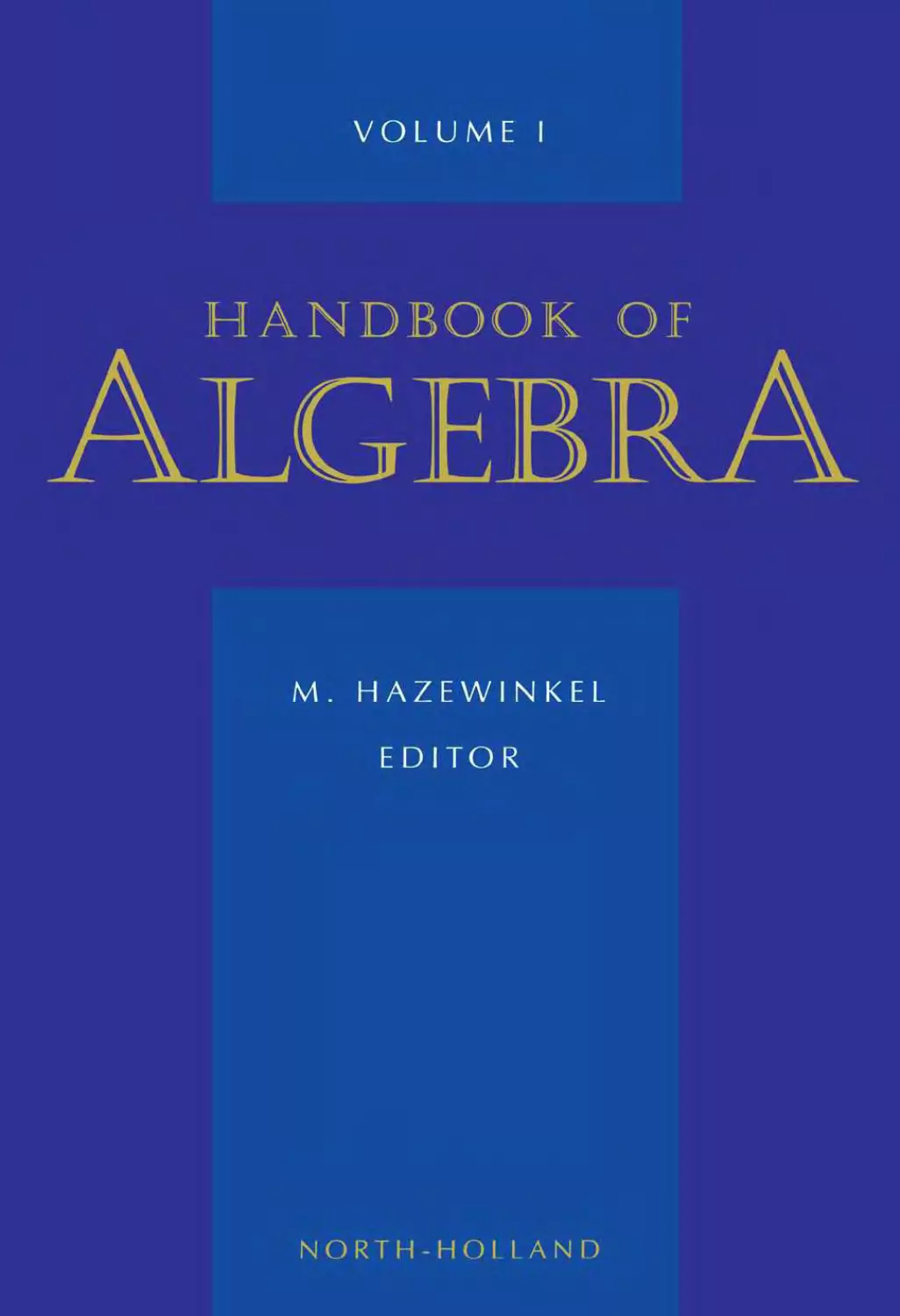
                    HANDBOOK OF ALGEBRA
VOLUME 1

Managing Editor
M. HAZEWINKEL, Amsterdam
Editorial Board
M. ARTIN, Cambridge
M. NAGATA, Okayama
C. PROCESI, Rome
O. TAUSKY-TODD, Pasadena
R.G. SWAN, Chicago
P.M. COHN, London
A. DRESS, Bielefeld
J. TITS, Paris
N.J.A. SLOANE, Mwrra}- /////
C. FAITH, New Brunswick
S.I. AD'YAN, Moscow
Y IHARA, 7b/lyo
L. SMALL, San Diego
E. MANES, Amherst
I.G. MACDONALD, Ojc/br^
M. MARCUS, Santa Barbara
L.A. BOKUT, Novosibirsk
i
ELSEVIER
AMSTERDAM • LAUSANNE • NEW YORK • OXFORD • SHANNON • TOKYO

HANDBOOK OF ALGEBRA
Volume 1
edited by
M. HAZEWINKEL
CWI, Amsterdam
1996
ELSEVIER
AMSTERDAM • LAUSANNE • NEW YORK • OXFORD • SHANNON • TOKYO

ELSEVIER SCIENCE B.V.
Sara Burgerhartstraat 25
P.O. Box 211, 1000 AE Amsterdam, The Netherlands
Library of Congress Cataloging-in-Publication Data
Handbook of algebra / edited by M. Hazewinkel.
p. cm.
Includes bibliographical references and index.
ISBN 0-444-82212-7 (v. 1 : acid-free paper)
1. Algebra. I. Hazewinkel, Michiel.
QA155.2.H36 1995
5I2-dc20 95-39024
CIP
ISBN: 0 444 82212 7
© 1996 Elsevier Science B.V. All rights reserved
No part of this publication may be reproduced, stored in a retrieval system, or transmitted, in any
form or by any means, electronic, mechanical, photocopying, recording or otherwise, without the
written permission of the Publisher, Elsevier Science B.V, Copyright & Permissions Department,
RO. Box 521, 1000 AM Amsterdam, The Netherlands.
Special regulations for readers in the U.S.A.: This publication has been registered with the
Copyright Clearance Center Inc. (CCC), 222 Rosewood Drive, Danvers, MA 01923. Information
can be obtained from the CCC about conditions under which photocopies of parts of this publication
may be made in the U.S.A. All other copyright questions, including photocopying outside the
U.S.A., should be referred to the Publisher, unless otherwise specified.
No responsibility is assumed by the Publisher for any injury and/or damage to persons or property
as a matter of products liability, negligence or otherwise, or from any use or operation of any
methods, products, instructions or ideas contained in the material herein.
This book is printed on acid-free paper.
Printed in The Netherlands

Preface
Basic philosophy
Algebra, as we know it today, consists of many different ideas, concepts and results.
A reasonable estimate of the number of these different "items" would be somewhere
between 50000 and 200000. Many of these have been named and many more could
(and perhaps should) have a *'name" or a convenient designation. Even the nonspecialist
is likely to encounter most of these, either somewhere in the literature, disguised as a
definition or a theorem or to hear about them and feel the need for more information.
If this happens, one should be able to find at least something in this Handbook and
hopefully enough to judge if it is worthwhile to pursue the quest. In addition to the
primary information, references to relevant articles, books or lecture notes should help
the reader to complete his understanding. To make this possible, we have provided an
index which is more extensive than usual and not limited to definitions, theorems and
the like.
For the purpose of this Handbook, algebra has been defined, more or less arbitrarily
as the union of the following areas of the Mathematics Subject Classification Scheme:
~ 20 (Group theory)
- 19 (ii'-theory; will be treated at an intermediate level; a separate Handbook of K-
theory which goes into far more detail than the section planned for this Handbook
of Algebra is under consideration)
- 18 (Category theory and homological algebra; including some of the uses of
categories in computer science, often classified somewhere in section 68)
~ 17 (Nonassociative rings and algebras; especially Lie algebras)
- 16 (Associative rings and algebras)
~ 15 (Linear and multilinear algebra. Matrix theory)
- 13 (Commutative rings and algebras; here there is a fine line to tread between
commutative algebras and algebraic geometry; algebraic geometry is not a topic
that will be dealt with in this Handbook; a separate Handbook on that topic is
under consideration)
- 12 (Field theory and polynomials)
- 11 (As far as it used to be classified under old 12 (Algebraic number theory))
~ 08 (General algebraic systems)
~ 06 (Certain parts; but not topics specific to Boolean algebras as there is a separate
three-volume Handbook of Boolean Algebras)

vi Preface
Planning
Originally, we hoped to cover the whole field in a systematic way. Volume 1 would
be devoted to what we now call Section 1 (see below), Volume 2 to Section 2 and
so on. A detailed and comprehensive plan was made in terms of topics which needed
to be covered and authors to be invited. That turned out to be an inefficient approach.
Different authors have different priorities and to wait for the last contribution to a volume,
as planned originally, would have resulted in long delays. Therefore, we have opted for
a dynamically evolving plan. This means that articles are published as they arrive and
that the reader will find in this first volume articles from three different sections. The
advantages of this scheme are two-fold: accepted articles will be published quickly and
the outline of the series can be allowed to evolve as the various volumes are published.
Suggestions from readers both as to topics to be covered and authors to be invited are
most welcome and will be taken into serious consideration.
The list of the sections now looks as follows:
Section 1: Linear algebra. Fields. Algebraic number theory
Section 2: Category theory. Homological and homotopical algebra. Methods from logic
Section 3: Commutative and associative rings and algebras
Section 4: Other algebraic structures. Nonassociative rings and algebras. Commutative
and associative rings and algebras with extra structure
Section 5: Groups and semigroups
Section 6: Representations and invariant theory
Section 7: Machine computation. Algorithms. Tables
Section 8: Applied algebra
Section 9: History of algebra
For a more detailed plan, the reader is reffered to the Outline of the Series following
the Preface.
The individual chapters
It is not the intention that the handbook as a whole can also be a substitute undergraduate
or even graduate, textbook. The treatment of the various topics will be much too dense
and professional for that. Basically, the level is graduate and up, and such material as
can be found in P.M. Cohn's three-volume textbook "Algebra" (Wiley) will, as a rule, be
assumed. An important function of the articles in this Handbook is to provide professional
mathematicians working in a different area with sufficient information on the topic in
question if and when it is needed.
Each chapter combines some of the features of both a graduate-level textbook and a
research-level survey. Not all of the ingredients mentioned below will be appropriate in
each case, but authors have been asked to include the following:
~ Introduction (including motivation and historical remarks)
~ Outline of the chapter

Preface vii
Basic concepts, definitions, and results (proofs or ideas/sketches of the proofs are
given when space permits)
Comments on the relevance of the results, relations to other results, and applications
Review of the relevant literature; possibly supplemented with the opinion of the
author on recent developments and future directions
Extensive bibliography (several hundred items will not be exceptional)
The future
Of course, ideally, a comprehensive series of books like this should be interactive and
have a hypertext structure to make finding material and navigation through it immediate
and intuitive. It should also incorporate the various algorithms in implemented form as
well as permit a certain amount of dialogue with the reader. Plans for such an interactive,
hypertext, CD-Rom-based version certainly exist but the realization is still a nontrivial
number of years in the future.
Bussum, September 1995 Michiel Hazewinkel
Kaum nennt man die Dinge beim richtigen Namen,
so verlieren sie ihren gefahrlichen Zauber
(You have but to know an object by its proper name
for it to lose its dangerous magic)
E. Canetti

This Page Intentionally Left Blank

Outline of the Series
Chapters which have a named author have been written and are ready for pubHcation.
The numbers after the title indicate in which volume the chapter either will appear or has
appeared. Topics printed in italics already have an author commissioned, and are in the
process of being written. For topics printed in roman type no author has been contracted
as yet.
No definite plans have been made for Sections 7, 8 and 9 at this stage.
Section 1. Linear algebra. Fields. Algebraic number theory
A. Linear Algebra
G.P. Egorychev, Van der Waerden conjecture and applications (1)
V.L. Girko, Random matrices (1)
A.N. Malyshev, Matrix equations. Factorization of matrix polynomials (1)
L. Rodman, Matrix functions (1)
Linear inequalities (also involving matrices)
Orderings (partial and total) on vectors and matrices (including positive matrices)
Matrix equations. Factorization of matrices
Special kinds of matrices such as Toeplitz and Hankel
Integral matrices. Matrices over other rings and fields
B. Linear (In)dependence
J.P.S. Kung, Matroids(l)
C. Algebras Arising from Vector Spaces
Clifford algebras, related algebras, and applications
D. Fields, Galois Theory, and Algebraic Number Theory
(There is an article on ordered fields in Section 4)
J.K. Denevey and J.N. Mordeson, Higher derivation Galois theory of inseparable
field extensions (1)
ix

Outline of the series
LB. Fesenko, Complete discrete valuation fields. Abelian local class field
theories (1)
M. Jarden, Infinite Galois theory (1)
R. LidI and H. Niederreiter, Finite fields and their applications (1)
W. Narkiewicz, Global class field theory (1)
H. van Tilborg, Finite fields and error correcting codes (1)
Skew fields and division rings. Brauer group
Topological and valued fields. Valuation theory
Zeta and L-functions of fields and related topics
Structure of Galois modules
Constructive Galois theory (realization of groups as Galois groups)
E. Nonabelian Class Field Theory and the Langlands Program
(To be arranged in several chapters by Y. Ihara)
F. Generalizations of Fields and Related Objects
U. Hebisch and H.J. Weinert, Semi-rings and semi-fields (1)
G.F. Pilz, Near-rings and near-fields (1)
Section 2. Category theory. Homological and homotopical algebra. Methods from
logic
A. Category Theory
S. MacLane and I. Moerdijk, Topos theory (1)
R.H. Street, Categorical structures (1)
Algebraic theories
Categories and databases
Categories in computer science (in general)
B. Homological Algebra. Cohomology. Cohomological Methods in Algebra. Homotopical
Algebra
J.F. Carlson, The cohomology of groups (1)
A.I. Generalov, Relative homological algebra. Cohomology of categories, posets,
and coalgebras (1)
J.F. Jardine, Homotopy and homotopical algebra (1)
B. Keller, Derived categories and their uses (1)
A. Helemskii, Homology for the algebras of analysis (2)
Galois cohomology
Cohomology of commutative and associative algebras
Cohomology of Lie algebras
Cohomology of group schemes

Outline of the series xi
C. Algebraic K-theory
Grothendieck groups
K2 and symbols
Algebraic K-theory of C*-algebras, EXT, etc.
Hilbert C* -modules
Index theory for elliptic operators over C" -algebras
Algebraic K-theory {including the higher Kn)
Simplicial algebraic K-theory
Chern character in algebraic K-theory
KK-theory
Noncommutative differential geometry
ii'-theory of noncommutative rings
Algebraic L-theory
Cyclic cohomology
D. Logic versus Algebra
Methods of logic in algebra
Logical properties of fields and applications
Recursive algebras
Logical properties of Boolean algebras
E. Rings up to Homotopy
Rings up to homotopy
Section 3. Commutative and associative rings and algebras
A. Commutative Rings and Algebras
J.-P. Lafon, Ideals and modules (1)
General theory. Radicals, prime ideals etc. Local rings {general). Finiteness and
chain conditions
Extensions. Galois theory of rings
Modules with quadratic form
Finite commutative rings and algebras
Homological algebra and commutative rings. Ext, Tor, etc. Special properties (p.i.d.,
factorial, Gorenstein, Cohen-Macauley, Bezout, Fatou, Japanese, Excellent, Ore,
Priifer, Dedekind, ... and their interrelations)
Lifting (Hensel properties) and Artin approximation
Localization. Local-global theory
Rings associated to combinatorial and partial order structures (straightening laws,
Hodge algebras, shellability, ...)
Witt rings, real spectra

xii Outline of the series
B. Associative Rings and Algebras
P.M. Cohn, Polynomial and power series rings. Free algebras, firs and semifirs (1)
V.K. Kharchenko, Simple, prime, and semi-prime rings (1)
V.K. Kharchenko, Fixed rings and noncommutative invariant theory (2)
A.R.P. van den Essen, Algebraic microlocalization and modules with regular singu
larities over filtered rings (1)
F. van Oystayen, Separable algebras (2)
K, Yamagata, Frobenius rings (1)
Classification of Artinian algebras and rings
General theory of associative rings and algebras
Rings of quotients. Noncommutative localization. Torsion theories
von Neumann regular rings
Lattices of sub modules
PI rings
Generalized identities
Endomorphism rings, rings of linear transformations, matrix rings
Homological classification of {noncommutative) rings
Group rings and algebras
Dimension theory
Duality. Morita-duality
Groups acting on associative algebras. Noncommutative invariant theory
Commutants of differential operators
Rings of differential operators
Graded and filtered rings and modules (also commutative)
Goldie's theo. "m, Noetherian rings and related rings
C. Co-algebras
Co-algebras and bi-algebras
D. Deformation Theory of Rings and Algebras {Including Lie Algebras)
Deformation theory of rings and algebras (general)
Deformation theory of Lie algebras
Section 4. Other algebraic structures. Nonassociative rings and algebras.
Commutative and associative rings and algebras with extra structure
A. Lattices and Partially Ordered Sets
Lattices and partially ordered sets
Frames and locales

Outline of the series xiii
B. Boolean Algebras
C. Universal Algebra
D. Varieties of Algebras, Groups, ...
V.A. Artamanov, Varieties of algebras (2)
Varieties of groups
Quasi-varieties
Varieties of semigroups
E. Lie Algebras
Yu.A. Bahturin, M.V. Zaitsev and A.A. Mikhailov, Infinite dimensional super Lie
algebras (2)
General structure theory. Free Lie algebras
Classification theory of semisimple Lie algebras over R and C
The exceptional Lie algebras
Nilpotent and solvable Lie algebras
Universal envelopping algebras
Modular (ss) Lie algebras (including classification)
Infinite dimensional Lie algebras (general)
Kac~Moody Lie algebras
F. Jordan Algebras (finite and infinite dimensional and including their cohomology
theory)
G. Other Nonassociative Algebras (Malcev, alternative, Lie admissible, ...)
H. Rings and Algebras with Additional Structure
Ordered and lattice-ordered groups, rings and algebras
X-rings, 'j-rings, ...
Difference and differential algebra. Abstract (and p-adic) differential equations.
Differential extensions
Ordered fields
Graded and super algebras (commutative, associative and Lie)
Topological rings
Hopf algebras
Quantum groups
Formal groups
Rings and algebras with involution. C*-algebras
J. The Witt Vectors

xiv Outline of the series
Section 5. Groups and semigroups
A. Groups
Simple groups, sporadic groups
Abelian groups
"Additive " group theory
Abstract (finite) groups. Structure theory. Special subgroups. Extensions and
decompositions
Solvable groups, nilpotent groups, p-groups
Infinite soluble groups
Word problems
Burnside problem
Combinatorial group theory
Free groups (including actions on trees)
Formations
Infinite groups. Local properties
Algebraic groups. The classical groups. Chevalley groups
Chevalley groups over rings
The infinite dimensional classical groups
Other groups of matrices. Discrete subgroups
Reflection groups. Coxeter groups
Groups with BN-pair, Tits buildings, ...
Groups and (finite combinatorial) geometry
Probabilistic techniques and results in group theory
B. Semigroups
Semigroup theory. Ideals, radicals, structure theory
Semigroups and automata theory and linguistics
C. Algebraic Formal Language Theory
D. Loops, Quasigroups, Heaps, ...
E. Combinatorial Group Theory and Topology
Section 6. Representations and invariant theory
A. Representations
A.U. Klimyk, Infinite dimensional representations of quantum algebras (2)
Representations of quantum groups
Representation theory of rings, groups, algebras (general)
Modular representation theory (general)

Outline of the series xv
Representation theory of finite groups in characteristic zero
Modular representation theory of finite groups. Blocks
Representation theory of the symmetric groups (both in characteristic zero and
modular)
Representation theory of the finite Chevalley groups (both in characteristic zero and
modular)
Representation theory of the classical groups. Classical invariant theory
Classical and transcendental invariant theory
Finite dimensional representation theory of the ss Lie algebras (in characteristic zero);
structure theory of semi-simple Lie algebras
Infinite dimensional representation theory of ss Lie algebras. Verma modules
Representations of solvable and nilpotent Lie algebras. The Kirillov orbit method
Orbit method, Dixmier map, ... for ss Lie algebras
Modular representation theory of Lie algebras
Representation theory of Kac~Moody algebras
Representations of semigroups
Representations of rings and algebras by sections of sheafs
Representation theory of algebras (Quivers, Auslander-Reiten sequences, almost split
sequences, ...)
Invariants of nonlinear representations of Lie groups
B. Representations, Commutative Algebra and Combinatorics
C Abstract Representation Theory
Section 7. Machine computation. Algorithms. Tables
Some notes on this volume: Besides some general article(s) on machine computation in
algebra, this volume should contain specific articles on the computational aspects of the
various larger topics occurring in the main volume, as well as the basic corresponding
tables. There should also be a general survey on the various available symbolic algebra
computation packages.
Section 8. Applied algebra
Section 9. History of algebra

This Page Intentionally Left Blank

Contents
Preface v
Outline of the Series ix
List of Contributors xix
Section lA. Linear Algebra 1
G.R Egorychev, Van der Waerden conjecture and applications 3
V.L. Girko, Random matrices 27
A.N. Malyshev, Matrix equations. Factorization of matrix polynomials 79
L. Rodman, Matrix functions 117
Section IB. Linear (In)dependence 155
J.RS. Kung, Matroids 157
Section ID. Fields, Galois Theory, and Algebraic Number
Theory 185
J.K. Deveney and J.N. Mordeson, Higher derivation Galois theory of
inseparable field extensions 187
LB. Fesenko, Complete discrete valuation fields. Abelian local class
field theories 221
M. Jarden, Infinite Galois theory 269
R. Lidl and H. Niederreiter, Finite fields and their applications 321
W. Narkiewicz, Global class field theory 365
H. van Tilborg, Finite fields and error correcting codes 395
Section IF. Generalizations of Fields and Related Objects 423
U. Hebisch and H.J. Weinert, Semi-rings and semi-fields 425
G.F. Pilz, Near-rings and near-fields 463
Section 2A. Category Theory 499
S. MacLane and L Moerdijk, Topos theory 501
R.H. Streety Categorical structures 529
XVI1

xviii Contents
Section 2B. Homological Algebra. Cohomology. Cohomologi-
cal Methods in Algebra. Homotopical Algebra 579
J.F. Carlson, The cohomology of groups 581
A.L Generalov, Relative homological algebra. Cohomology of
categories, posets, and coalgebras 611
J.F. Jardine, Homotopy and homotopical algebra 639
B. Keller, Derived categories and their uses 671
Section 3A. Commutative Rings and Algebras 703
J.-P. Lafon, Ideals and modules 705
Section 3B. Associative Rings and Algebras 729
P.M. Cohn, Polynomial and power series rings. Free algebras, firs
and semifirs 731
V.K, Kharchenko, Simple, prime, and semi-prime rings 761
A.R.P. van den Essen, Algebraic microlocalization and modules with
regular singularities over filtered rings 813
K. Yamagata, Frobenius rings 841
Subject Index 889

List of Contributors
Carlson, J.F., University of Georgia, Athens, GA
Cohn, P.M., University College London, London
Deveney, J.K., Virginia Commonwealth University, Richmond, VA
Egorychev, G.P., Krasnoyarsk State Technical University, Krasnoyarsk
Fesenko, LB., University of Nottingham, Nottingham
Generalov, A.I., Skt Petersburg University, Skt Petersburg
Girko, V.L., Kiev State University, Kiev
Hebisch, U., TU Bergakademie Freiberg, Freiberg
Jarden, M., Tel Aviv University, Tel Aviv
Jardine, J.F., University of Western Ontario, London, Ont.
Keller, B., Universite de Paris VII, Paris
Kharchenko, V.K., Institute of Mathematics, Novosibirsk
Kung, J.P.S., University of North Texas, Denton, TX
Lafon, J.-P, Universite de Paris XIII, Villetaneuse
Lidl, R., University of Tasmania, Hobart, Tasmania
MacLane, S., University of Chicago, Chicago, IL
Malyshev, A.N., Institute of Mathematics, Novosibirsk
Moerdijk, I., Rijksuniversiteit Utrecht, Utrecht
Mordeson, J.N., Creighton University, Omaha, NE
Narkiewicz, W., Wroclaw University, Wroclaw
Niederreiter, H., Austrian Academy of Sciences, Vienna
Pilz, G.F., Johannes-Kepler-Universitdt, Linz
Rodman, L., College of William & Mary, Williamsburg, VA
Street, R.H., Macquarie University, North Ryde, NSW
Van den Essen, A.R.P, Katholieke Universiteit Nijmegen, Nijmegen
Van Tilborg, H., Technische Universiteit Eindhoven, Eindhoven
Weinert, H.J., TU Clausthal, Clausthal-Zellerfeld
Yamagata, K., University ofTsukuba, Tsukuba
XIX

This Page Intentionally Left Blank

Section lA
Linear Algebra

This Page Intentionally Left Blank

Van der Waerden Conjecture and Applications
G.P. Egorychev
1
Chair of Software of Discrete Apparatus and Systems, Krasnoyarsk State Technical University,
St. Kirenskogo, 26, Krasnoyarsk, 660074, Russia
e-mail: gpe @ cckr krasnoyarsk. su
* * • *
Contents
Abstract
1. Basic notations and concepts 5
2. Introduction: some words about permanents 6
3. Origin of the van der Waerden conjecture 7
4. Summary of results 8
5. Structure of the minimizing matrix; the necessary conditions 9
6. Mixed discriminants (volumes) and geometric inequalities for permanents 11
7. Structure of the minimizing matrix: uniqueness of the solution and proof of the conjectures 14
8. Direct corollaries 16
9. Further results and new hypotheses 17
10. Prospects for investigation and conclusion 19
References 20
^Jointly supported by RFFI Grant 93-011-1560 and IFS-fSU Grant 1993.
HANDBOOK OF ALGEBRA, VOL. 1
Edited by M. Hazewinkel
© Elsevier Science B.V., 1996. All rights reserved

This Page Intentionally Left Blank

Van der Waerden conjecture and applications 5
Abstract
This chapter gives a proof and applications of the well known van der Waerden conjecture
about minimum permanents of a doubly stochastic matrix. The conjecture was proved in
the early 80s by G.P. Egorychev and the Kiev mathematician D.I. Falikman independently.
1. Basic notations and concepts
Some notation. per(A) is the permanent of a matrix A (for a definition see Section 2
below).
D(Ai,..., An) is the mixed discriminant of the matrices A\,... ,An-
V{K\,..., Kn) is the mixed volume of convex compacts K\,..., Kn in M".
Qn is the set of all doubly stochastic n x n matrices.
A^ is the set of all (0, l)-matrices of order n which have exactly k units in each row
and column.
P, Q are the permutation matrices of order n.
Eij is the matrix having 1 at place (z, j) and all other elements equal to 0.
e is the n-row of which each element is 1.
aj, ai are the j-th column and the i-ih row of the matrix A, respectively.
O, In are the null and identity nx n matrices, respectively.
Jn is the (n x n) matrix with each element equal to 1 /n.
A^, A, A* are the transpose, adjoint and complex conjugate matrices to the matrix A,
respectively.
A{i/j) is the (n — 1) X (n — 1) matrix derived from A by deleting the i-\\\ row and
the j-th column.
is the matrix of order n derived from A by replacing the i-ih column by the n-vector x
and the j-th column by the n-vector y.
Definitions. A matrix of order n with non-negative elements is called doubly stochastic
\i eA = e, Ae^ = e^; a matrix A G i7n is called minimizing if
min per(Js:) - per(A).
Let A = {aij) be a non-negative matrix of order n. The matrix A is called fully
indecomposable if it doesn't contain di k x (n -- k) null submatrix for k = l,...,n— 1.
The matrix A is called partially decomposable if it contains k x {n~ k) null submatrix.
Matrix A is called nearly decomposable if it is fully indecomposable and such that for
each positive element of the matrix A the matrix A — aijEij is partially decomposable.

6 G.R Egorychev
2. Introduction: some words about permanents
The concept of the permanent was first introduced independently and practically
simultaneously in the well known memoirs of J. Binet (1812) and A. Cauchy (1812). It was
at this time that Binet introduced the term ''permanent".
The permanent of a square n x n matrix A is defined to be the sum
per(A) := ^ ai^(i) • • •a„^(„), (2.1)
where the sum is taken over all permutations of the set {1,..., n} or, which is the same,
over all diagonals of the matrix A.
The permanent as a matrix function has the following characteristic properties
(Egorychev, 1980): if f{A) is a complex-valued function ofn x n-matrix A over the field C,
then f{A) = per A iff:
(a) f{A) is a homogeneous polynomial of degree nfrom the elements of the matrix A.
(b) f{A) is polyadditive and symmetric with respect to vector-rows and vector-columns
of matrix A.
(c) /(/„) = 1.
For the last decade and a half the theory of permanents has been intensively
developing, undergoing essential structural modifications. Among the most important
achievements of this period are, in our opinion, the proof of the van der Waerden conjecture
on permanents (Egorychev, 1980, 1981; Falikman, 1981), the proof of the Tverberg
conjecture on permanents (Friedland, 1982); remarkable results by V. Schevelev (1992) and
A. Kamenetsky (1990, 1991) concerned with the problem of calculation of the
permanents of cyclic matrices and, finally, the fundamental results by A. Razborov (1985) and
A. Andreev (1985) about lower estimates of complexity for the permanent of logical
matrices.
Many difficult problems of combinatorial analysis, graph theory, linear and polylinear
algebra, other areas of mathematics, statistical physics and physical chemistry can be
stated and solved in term:^ of permanents. They basically make use of the major
combinatorial properties of permanents of (0, l)-matrices to count the number of systems of
different representatives (transversals) of sets.
It is common knowledge that det A can be computed in poly(n) time. On the other
hand, the fastest algorithm known for computing per A runs in n2"~' time (Wilf, 1968;
Ryser, 1963). Solid grounds for arguing that computing per A even for (0, l)-matrices is
an inherently difficult problem were first provided by L. Valiant (1979) who showed that
the problem is P-complete. One implication of this result is that if P 7^ NP then there
is no poly(n) time algorithm for computing per A.
From there rises the problem of the development of new fundamental algebraic,
geometric, theoretical-functional and calculating ideas and methods of computation and
estimation of permanents for various classes of matrices. The celebrated van der
Waerden conjecture giving a precise lower estimate for the permanents on the convex compact
set i7n for a long time occupied a key position in this circle of questions. This problem,
in spite of many efforts, remained unresolved for over 50 years.

Van der Waerden conjecture and applications 1
3. Origin of the van der Waerden conjecture
Biographical data about van der Waerden were given by A.I. Borodin and A.S. Bugai
(1979, p. 95):
"Barten Leendert van der Waerden is a Dutch mathematician. He was born in
Amsterdam on February 2, 1903. He was a professor at the universities of Groningem,
Leipzig, Amsterdam, Zurich and was involved in algebra, algebraic geometry,
applications of methods of group theory to quantum theory and mathematical statistics (van der
Waerden criterion). His work also dealt with the history of mathematics and astronomy
in Ancient Egypt, Babylon and Greece. In 1959 his book "Science Awakening" was
translated into Russian. The book "Modern Algebra" (1930-1931) marked the
culmination of the creative period in "abstract algebra" developed by his teachers E. Noether,
E. Steinitz and E. Artin. This book had major influence in the training of specialists
in algebra everywhere in the world, defining the character and partially the directions
of further research in algebra. An expanded and modernized version titled "Algebra"
was published in 1976. B.L. van der Waerden applied the modern algebraic apparatus
to strong justification of basic concepts in algebraic geometry. His book "Mathematical
Statistics" (1957) is also widely known.
Van Lint, a well-known Dutch mathematician, wrote (1982, p. 72-76) about the
previous history of the van der Waerden conjecture:
"Much of the work on permanents is in some way connected to this conjecture and
about 75% of the work on permanents is less than 20 years old! ... In 1926 B.L. van der
Waerden proposed as a problem (!) to determine the minimal permanent among all doubly
stochastic matrices. It was natural to assume that this minimum is perc/^j, — ti\ti ". Let
us denote by Qn the set of all doubly stochastic matrices. The assertion
(A G i7n n A 7^ Jn) ^ (per A > per Jn)
— n
became known as the van der Waerden conjecture. Sometimes just showing that n\n'
is the minimal value is referred to as the conjecture.
"This note allows me to save for posterity a humorous experience of the late sixties.
Van der Waerden, retired by then, attended a meeting on combinatorics, a field he had
never worked in seriously. A young mathematician was desperate to present his thesis
in 20 minutes. I was sitting in the front row next to van der Waerden when the famous
conjecture was mentioned by the speaker and the alleged author inquired what this famous
conjecture stated!! The exasperated speaker spent a few seconds of his precious time to
explain and at the end of his talk wandered over to us to read the badge of the person
who had asked this inexcusable question. I could foresee what was to happen and yet,
I remember how he recoiled. You needn't worry - he recovered and now is a famous
combinatorialist. The lesson for the reader is the following. If you did not know of the
"conjecture" then it is comforting to realize that it was 40 years old before van der
Waerden heard that it had this name.
"What is the origin of the problem? Upon my request van der Waerden went far back
in his memory and came up with the following. One day in 1926 during the discussion
that took place daily in Hamburg O. Schreier mentioned that G.A. Miller had proved that

8 G.R Egorychev
there is a mutual system of representatives for the right and left cosets of a subgroup H
of a finite group G. At this moment van der Waerden observed that this was a property
of any two partitions of a set of size //n into // subsets of size n. This theorem was
published in "Hamburger Abhandlungen" in 1927. In the note, added in the proof, van
der Waerden acknowledged that he had rediscovered the theorem which is now known
as the Konig-Hall theorem...
"In the terminology of permanents we can formulate the problem Schreier and van
der Waerden were considering as follows. Let Ai (1 ^ i ^ fi) and Bk (1 ^ k ^ fi) be
the subsets in two partitions and let aik '■= \Ai fl Bk\- Then, A ~ (aik) is a matrix with
constant line sums (= n). The assertion that there is a mutual system of representatives
of the sets Ai respectively of the sets Bk is the same as to say that per A > 0. Ai this
point van der Waerden wondered what the minimal permanent, under the side condition
that all line sums are 1, is? He posed this as a problem in Jber. d. D.M.V. 35 and thus
the van der Waerden conjecture was born."
4, Summary of results
Most essential in proving the van der Waerden conjecture were the results obtained by
M. Marcus and M. Newman (1959). They show that:
(a) If A is a minimizing matrix, then per{A{i/j)) = per(A) for "ii^j G {1,... ,n},
where aij > 0;
(b) If A is minimizing then it is fully indecomposable;
(c) The permanent has a strong local minimum at point J^;
(d) If all elements of the minimizing matrix are positive, then it is equal to Jn-
Using these results D. London (1971) proved that if A is a minimizing matrix, then
per(A(z/j)) ^ per(A) for all z, j G {1,... ,n}. In 1976 T. Bang announced and in 1979
T Bang and S. Friedland proved lower bounds for the permanent on i?^, which are
essentially of the same order as the bound of van der Waerden.
D. Konig (1916) stated that the permanent of a doubly stochastic matrix A is always
positive; if A G yl};, then per(yl) > k. G. Frobenius (1917) proved that per A of a
non-negative matrix is equal to 0 if and only if A contains a null submatrix of order
kx (n — k-\- 1). D. Konig in his book (1936) devoted to graph theory and its applications
mentioned the van der Waerden problem as an unresolved one. Birkhoff in 1946 showed
that i7„ forms a convex polyhedron with the permutation matrices as vertices. This result
implies that per(A) ^ \/{{n- 1)^ + 1)""' for all A G i7n. M. Marcus and H. Mine
improved this bound in 1962 to n^", in 1974 O. Rothaus improved is to (n!)~^\ and
5. Friedland (1979) obtained the substantially better bound of 1/n!.
M. Marcus and M. Newman (1959) proved the validity of the van der Waerden
conjecture for n = 3; P. Eberlein and G. Mudholkar (1968) and A. Gleason (1970) proved it for
n = 4; P. Eberlein (1969) forn = 5. In 1962 M. Marcus and M. Newman proved the
conjecture for positive semi-definite symmetric matrices, and D. Sasser with M. Slater (1967)
extended this theorem to normal matrices of a certain type. The last result was somewhat
improved by M. Marcus and H. Mine (1968) and extended to a larger class of matrices

Van der Waerden conjecture and applications 9
by S. Friedland (1974). (For other results related to the van der Waerden conjecture until
1977 see the comprehensive bibliography in the book by Mine (1978).)
A proof of the van der Waerden conjecture appeared in 1980-1981. In his article of
1981 D. Falikman, by a method different from that of G. Egorychev (1980, 1981),
obtained the answer to the van der Waerden's question about the minimum of the permanent
on i7n, but he didn't prove the uniqueness statement of the conjecture. Another attempt
to prove this hypothesis was made by V. Reva (1981).
The proof of the Marcus-Newman and van der Waerden conjectures given here is
typical for the theory of mixed volumes. It is, on the one hand, connected with the
investigation of the structure of the minimizing matrix based on the results of D. Konig (1916),
M. Marcus and M. Newman (1969), D. London (1971). On the other hand, this proof
uses geometric inequalities for the permanent as a mixed discriminant (mixed volume)
which are a particular case of the well-known Aleksandrov's inequalities for mixed
discriminants (1937-1938). This interpretation of the permanent was used in the work of
Egorychev (1979-1980) dealing with obtaining a series of polynomial identities and
characteristic properties of permanents for plane and space matrices. The role of the
geometric inequalities in the theory of permanents was found to be identical to that of
Aleksandrov-Fenchel inequalities for mixed volumes, which allow the solving of many
important extremal problems and problems of uniqueness for convex bodies in M" (see
Buseman, 1960; Leichtweiss, 1980; Burago and Zalgaller, 1990; Mitrinovic, Pecaric and
Volenec, 1989).
The proof given here of the permanent conjectures is fairly simple and is accessible
to any reader familiar with the fundamentals of the linear algebra.
5. Structure of the minimizing matrix: the necessary conditions
This section considers several fine assertions on the structure of the minimizing matrix
that led D. London to his result (1971). The reader can find the proofs of the well-
known facts omitted here in, for example, the work of M. Marcus and H. Mine (1972),
A. Marshall, J. Olkin (1983), R. Rockafellar (1970), H. Mine (1978).
Theorem 5.1 (Birkhoff, 1946). A set of nxn doubly stochastic matrices forms a convex
polyhedron with permutation matrices as vertices. In other words, if A ^ i7„, then
s
A=^^,P„ (5.1)
where Pi, • • •, Ps are permutation matrices and Oi,... ,0s ^ 0, Xliz^i ^i = 1-
This theorem has many applications and is one of the main results in the theory of
doubly stochastic matrices. The next theorem is one of the most important results in the
theory of non-negative matrices.
Theorem 5.2 (Frobenius-Konig, 1917). Let A be an n x n matrix. A necessary and
sufficient condition for every diagonal of A to contain a zero entry is that A contains an
s X t zero submatrix such that s -\-t = n -\- 1.

10 G.P. Egorychev
In other words, if A is an n x n matrix, then per A = 0 iff A contains an s x i zero
submatrix such that s -\-1 = n + 1. (For the history of this theorem see (Mine, 1978,
pp. 31-34).)
Theorem 5.3 (Konig, 1916). If A e f2n, then per A > 0.
Assertion 5.4 (London, 1971). If A= (aij) is a minimizing matrix, then
pcr[A{z/j)) ^ per(A) for all i,j e 1,..., n. (5.2)
Assertion 5.5. A non-negative matrix A of order n, n ^ 2, is fully indecomposable iff
pcr{A{i/j)) > Ofor all i,j e l,n.
Assertion 5.6 (Marcus and Newman, 1959).
(a) If A is a minimizing matrix, then A is fully indecomposable.
(b) If A = (aij) is a minimizing matrix and some aij > 0, then pcr{A{i/j)) = per(A).
(c) If the minimizing matrix is positive, then A = J^.
It is easy to see that Theorem 5.3 is equivalent to the following assertion: any matrix
A 6 On contains at least one diagonal with positive terms, thus. Theorem 53 follows
from the Birkhoff theorem.
The proof of Assertion 5.6(b) in the work by Marcus and Newman (1959) used to
prove Assertion 5.4 adapted the classical Lagrange multipliers method assuming A 6 On-
The result of Assertion 5.5 is a direct corollary of the Frobenius-Konig theorem.
Assertion 5.4 is proved by taking derivatives in all directions in a neighborhood of a
minimizing matrix A. For any n x n permutation matrix P = (Pij)^ 0^0^ 1, define
the function fp{e) = per((l -0)A + OP).
Since A is a minimizing matrix, then /p(0) ^ 0 for any P. But
71
S,t = l
n
Y^ PstpcT{A{s/t)) -nper(A)
s,t = l
n
- Y^ per{A{s/a{s))) - nper(yl),
5 = 1
where a is the permutation corresponding to P. Hence,
n
^per(yl(s/CT(s))) ^ n per A, (5.3)
5 =
for every a. Since the matrix A must be fully indecomposable (Assertion 5.6(a)), therefore
(Assertion 5.5) any entry of A lies on a diagonal all of whose other entries are positive.
Thus, for every (z, j) there exists a permutation a such that j ~ a{i) and asa{s) > 0 for
all s 6 1,. .., n, s 7^ z.
Now, however. Assertion 5.6(b) ensures that pcT{A{s/a{s))) ~ per A for the same s.
Hence, from (5.3) and j = a{i) follows that per(A(z/j)) ^ per(A).

Van der Waerden conjecture and applications 11
6. Mixed discriminants (volumes) and geometric inequalities for permanents
Consider m quadratic forms
n
/fc = XI ^ij^^^j
in the variables xi,..., Xn. Any linear combination
771
f = Yl ^^^^
is again a quadratic form with coefficients
m
aij = y ^XkCiij'
fc=i
The discriminant of the form / is a homogeneous polynomial of degree n with respect
to Ai,..., Xfn with coefficients D{fk^, ■ • ■, Arx) of '^fci ■ ■ • Afc^ chosen not to depend on
the order /ci,..., A;„. These coefficients, studied by Aleksandrov (1937-1938), are called
mixed discriminants. They are expressed in terms of coefficients of the given forms as
follows
^(/i,---,/n) = -^ V det
/<; •■■ <;^
\<T ■■■ <nj
(6.1)
Because of (6.1) the mixed discriminants are symmetric and polyadditive functions of
its arguments and possess a series of other interesting properties (see also (Bapat, 1987)).
For us the most important is the following
■
Lemma 6.1 (Aleksandrov inequalities for mixed discriminants, 1937-1938).
(a) Let (fi), i = 1,..., n — 1, be n — 1 positive definite quadratic forms and let g be
an arbitrary quadratic form. Then,
D^{a\ fn-uQ)^D{a- /„_,,/n-i)L)(a;g,g), (6.2)
where a := (/i,...,/„_2).
(b) Equality holds in (6.2) iff
Q — Xfn-i, A a constant. (6.3)
Taking suitable limits in (6.2) of the coefficients in the forms, assertion (a) of Lemma 6.1
carries over to the case in which the (/i), i = 1,... ,n — 1, are non-negative definite
forms.

12
G,P. Egorychev
Lemma 6.2 (Geometric inequalities for permanents, Egorychev, 1980, 1981).
(a) Let (fi), i = 1,..., n — 1, be n-vectors with non-negative components and let q
be an arbitrary n-vector Then,
per^(a;/„_,,g) > per(a;/„_,,/n-,)per(a;g,g).
(6.4)
(b) Let (/i), i = 1,..., n — 1, /?e n-vectors with positive components and let g be an
arbitrary n-vector Equality holds in (6.4) iff
Q ~ ^fn-u ^ ^ constant.
(6.5)
The results of Lemma 6.2 follow directly from formulas (6.2), (6.3) if we note that
perA = n!D(/i,...,/n),
(6.6)
where fi is the quadratic form with matrix Ai ~ diag(aii,..., ani), i ~ 1,..., n. Indeed,
n
n
/ = ^>^kfk = ^(Aittii H \- Xnain)
X,
fc = l
i=l
and
n
n
det A = det diag ^ Aja^j,..., ^ ^j^nj
3 = 1
j=i
n
n
and it is easy to see that (cf. (6.1)) the coefficient at Ai,..., A^ in the last expression is
equal to per(A)/n!.
D. Falikman (1981) obtained an inductive proof of permanent inequalities equivalent
to inequalities (6.4).
Papers by A. Panov (1984, 1985) and R. Bapat (1989) investigated the case of equality
in (6.2) for non-negative definite forms and D. Knuth (1981) corrected the case of equality
in (6.4) by assumptions weaker than in (6.5). R. Bapat also obtained the combinatorial
interpretation of mixed discriminants from (0, l)-matrices, and proved a generalization
of the well-known Konig theorem.
Let a be a finite-dimensional linear space over E and 99 be a symmetrical bilinear
form on a. If (f has one positive eigenvalue and n — 1 negative eigenvalues we shall
speak of a Minkovsky {Lorentz) space.
Assertion 6.3 (van Lint, 1981; Rybnikov, 1985). If the vector-columns ai,... ,0^-2
have positive components, then, the quadratic form ip{x^x) ~ per(ai,... ,0^-2:^,3:),
X 6 M", has the signature of Minkovsky space. Under the same assumptions the
inequalities (6.4), (6.5) turn into the Cauchy-Bounjakowsky-Schwarz inequalities in Minkovsky
space.
In conclusion of this section we'll give the representation of the permanent as a mixed
volume yielding a family of geometric inequalities for the permanent as a mixed volume.

Van der Waerden conjecture and applications 13
Let A-\- B ~ {a -\- b: a e A, b e B} denote the vector sum (Minkovsky sum) of the
subsets A and B of EucHdean space E"» and let XA = {Xa: a e A} is the result of the
homothety of A with coefficients A.
Theorem 6.4 (Minkovsky, 1911). The volume of the linear combination of nonempty
convex compact sets i^i,..., Kg {s ^ n, in general) with non-negative coefficients
is a homogeneous polynomial of degree n with respect to Ai,..., A^;
n
y^AiiCi =^...^(i<:i,,...,i<:iJAi....Ai„, (6.7)
where it is assumed that for the products of Xi which differ only in the order of the
factors the coefficients have the same numerical value. The coefficients V{K\,... .K^)
in the expansion (6.7) are called the mixed volumes of convex compact sets K\,..., K^
in W.
Let A be a non-negative matrix of order n and let i^i, z 6 1,..., n, be the family of
rectangular parallelopipeds in E" induced by it
Ki~\^x = [x\,... ,Xn) 6 M", Q ^Xj ^ aij, j 6 1,... ,n}. (6.8)
In analogy with the representation (6.6) of the permanent as a mixed discriminant it
is easy to see that (Egorychev, 1980-1981)
Y^cx{A)=-.n\V{Kx,,,,,Kn)- (6.9)
Indeed, the volume of a rectangular parallelopiped
n ( n
K==^XiKi= Ja:= (a:,,...,a:„)eM", 0 ^ Xj ^^A^a,
i=l I, i=l
is equal to the product of the lengths of its sides
n / n
i^ij I 1
and the coefficient by Ai ■ • • A^ is equal to per(A)/n!.
Formula (6.9) allows one to obtain the following assertion for permanents of a non-
negative matrix.
Theorem 6.5 (cf. Egorychev, 1983). If A is a non-negative matrix, then, for per(A)
there hold the analogs of the Brunn-Minkovsky, Aleksandrov—Fenchel, Shephard, Santalo
and other inequalities, including the vector inequalities for mixed volumes in E", as well
as the corresponding analogs of the results for the various cases of equality (see Burago
and Zalgaller, 1984, Ch. 4).

14 G.P. Egorychev
The papers of G. Ewald (1985), B. Kind and P. Kleinschmidt (1979), P. McMullen
and G. Shephard (1971), M. Hochster (1972), R. Stanley (1980, 1981), L. Billera and
C. Lee (1981), A. Kouchnirenko (1976), D. Bernstein (1976), B. Teissier (1979, 1982)
contain several combinatorial connections of mixed volumes with combinatorial geometry
which by virtue of (6.9) are valid for the permanents of non-negative matrices as well.
7. Structure of the minimizing matrix: uniqueness of the solution and proof of the
conjectures
For the readers' convenience we repeat the assertions used to prove the conjectures.
Lemma 7.1 (Egorychev, 1980, 1981 - geometrical inequalities for permanents).
(a) Let ai, i ~ \,...,n—\,beasetofn—l n-vectors with non-negative components
and let g be an arbitrary n-vecton Then,
per^(a;a„_i,g) ^ per(a;an-i,an-i)per(a;g,g), (7.1)
where a := (ai,..., an-i)-
(b) Let {ai),i = 1,..., n — 1, /?e n-vectors with positive components and let g be an
arbitrary n-vector Equality holds in (7.1) iff
Q = Attn-i, A a constant. (7.2)
Theorem 7.2 (Konig, 1916). IfAe Qn> then, per(A) > 0.
Assertion 7.3 (London, 1971). If A is a minimizing matrix, then
per(A(z/j)) ^perA for alii, j ^ l,...,n. (7.3)
Theorem 7.4 (Egorychev, 1980). (Proof of the Marcus-Newman conjecture on
permanents (1965).) If A ^ Qn cind the inequalities
per(A(z/j)) ^perA for alii,j e {\,... ,n}, (7.4)
are valid, then,
per(A(z/j)) =perA for all ij e {\,... ,n}. (7.5)
Theorem 7.5 (Egorychev, 1980). (Proof of the van der Waerden conjecture on
permanents (1926).)
min (per(X)) = nl/n'', (7.6)
X e Qn and per(X) = n\/n'' iff X ^ J^. {1.1)
Proof of Theorem 7.4. Expanding
per ( A ( "" M ) and per (A f ' ^
di aij J \ \aj aj

Van der Waerden conjecture and applications 15
by the Laplace formula, over the j-th and z-th columns, respectively, and using (7.1) we
get
per^A = per^ f A f * ' D^perf^f' ' ]]pcriAi' '
ai ajj J y \ai aij j \ \aj aj
= iY^O'kiPQ^{A{k/j))](Y^akjpcT{A{k/i))
for alH,j e {l,...,n}. (7.8)
Inequalities (7.8) combined with assumption (7.4) give a system of n-^ inequalities for
the n? numbers pcr{A{i/j)), z, j 6 {1,... ,n}.
Weshowthat in this case per(>l(z/j)) = per A, i,j e {1,... ,n}. Assume theopposite,
i.e. that there exists a pair r, s 6 {1,..., n} such that per(>l(r/s)) > per A. Since A e On
there is some t e {1,..., n} such that art > 0. Then, by (7.8),
per-^A = per-^ ( A (
as at
> I '^aksPQr{A{k/t)) j ( ^afctper(A(A;/s))
^ ( ^aksP^T{A{k/t)) j (artpcr{A{r/s)) + ^afctper(A(A;/s))
> f ^afc5per(A) j f ^afctper(A) j = per^A,
where the strict inequality follows from inequalities (7.4), art > 0, per(>l(r/s)) >
per(A), per A > 0 (Theorem 7.2), and A e Qn- The contradiction obtained proves the
theorem. D
Let A be a minimizing matrix. Then, by London's result, the inequalities (7.4) hold.
From Theorem (7.4) follows
Lemma 7.6 (Egorychev, 1980). If A is a minimizing matrix, then
pcr{A{i/j)) =perA, for all i J e {l,...,n}. (7.9)
Lemma 7.7 (Egorychev, 1980). // A is a minimizing matrix, then for each i,j 6
{l,...,n}
Ae = A\ ^ / , 0<6'<1,
* <9ai + (1 - 0)aj (1 - 0)ai + Oa^
will be also minimizing matrix. Aq is obtained from the matrix A with the help of a
''0-transform" of the i-th and j-th columns of the matrix A.

16 G.P. Egorychev
Proof. It is easy to see that A' 6 i7n- The equality ^qx{Aq) ~ per(>l) follows
immediately from the fact that per(>l) is a multilinear symmetric function of the columns of the
matrix A, the Laplace formulas, the equalities (7.9), and A 6 i7n- D
Proof of Theorem 7.5. It is clear that a minimizing matrix cannot be (up to permutation
of rows and columns) a matrix of the form
where A^-x 6 On-\> since in this case (Lemma 7.6) per(>l(l/l)) = per(>l(l/z)) = 0
for alH 6 {2,..., n}, i.e. per A = 0, a contradiction with Theorem 7.2.
Now we show that if A is a minimizing matrix, then A ^ Jn- Let some column of
the matrix A, say a^i, be different from the n-column e^/n. Then, it is easy to see that
by Lemma 7.7 for alH, j 6 {1,..., n — 1}» z 7^ j, we can obtain in a finite number of
steps a minimizing matrix B ~ {h\,... ,6n-i,an), in which every component of the first
n — 1 columns is positive. This follows from the fact that A does not contain a 1. From
the inequalities (7.1), we have
By virtue of equalities (7.9) the minimizing matrix B (Lemmas 7.6 and 7.7) we obtain
equality in (7.10). The positivity of the components 61,..., 6^-1 allows us to assert
immediately (Lemma 7.1, the case of equality) that'an — Xihi for alH 6 {1, •.., n — 1}.
Since the sum of the components of the vector hi as well as of the vector a^ is equal
to 1, we have a^ — ^i for alH 6 {1,..., n — 1}. Since B 6 Qn^ we have
6, = 62 - • • • = hn~\ = an = e^/n,
a contradiction. Thus, A ~ Jn and the proof of the theorem is complete. D
Remark 7.8. The reduction from Theorem 7.4 to Theorem 7.5 was well known (see, for
example. Mine (1978, p. 101, Problem 18)). Here we gave a simple geometric proof of
this reduction.
The proof of conjectures given here, from the necessary conditions to geometric
inequalities (7.1), (7.2), is typical for the theory of mixed volumes in the solution of
isoperimetric problems. However, specialists usually use such mixed discriminants
(volumes) where only two, sometimes three, forms (convex compacts) are different: in our
proof all forms are used equally.
8. Direct corollaries
As a direct corollary of Theorem 7.5 we obtain the validity of some facts for permanents
(see Conjectures 2, 8, 16 and Problem 9 in the list of conjectures and problems in

Van der Waerden conjecture and applications 17
(Mine, 1978); also a generalization of the van der Waerden conjecture in (Gleason, 1970)).
Another direct corollary of Theorem 7.5 is that we obtain lower estimates for some
important combinatorial quantities previously expressed by other authors assuming the
validity of van der Waerden conjecture. These quantities admit representations in terms
of permanents of block (0, l)-matrices from A!^. Among them are the lower bounds
for the number of Latin rectangles and squares (see also (Erd6s and Kaplansky, 1946;
Yamamoto, 1951, 1956; Gessel 1987; Denes and Keedwell, 1991) etc.) for the number
of nonisomorphic Steiner triples (Wilson, 1974) and for the key constant A^ in the
d-dimensional dimer problem (Hammersley, 1968, 1969; Dubois, 1974; Mine, 1978a,
1980). These bounds are essential improvements of previously known bounds.
The results mentioned above brought about a structural reorganization of sections of
combinatorial theory connected with permanents. We should also note that the problem
of estimating A^ belongs to an extensive class of mathematical and physical problems
connected with finding the number of dimer coverings of the lattice that can be realized
by the permanent of special (0, l)-matrices (see, for example, the surveys (Percus, 1971)
and (Montroll, 1964) about applications of permanents in statistical mechanics and the
two-dimensional Ising model in ferromagnetism).
9. Further results and new hypotheses
One of the reasons for the interest in computing pcr{A) is that a (0, l)-matrix A ~ (aij)
can be viewed as an adjacency matrix of a bipartite graph, H ~ {X,Y,E), where
X corresponds to the rows in A, Y to the columns in A, and aij = 1 if there is an
edge between Xi and Yj. The value per(>l) is exactly the number of perfect match-
ings (1-factors) in H. This matter finds numerical applications in operations research.
A. Schrijver (1982, 1983) published a survey on recent developments of lower and upper
bounds for permanents including his interpretation of the van der Waerden conjecture and
the well-known Bregman-Minc upper bound (Bregman, 1973; Mine, 1978, Ch. 6). He
applied these results to obtain a series of new and hypothetical bounds for the number
of perfect matchings, 1-factorizations (edge-colorings), bipartite graphs, and the
number of Eulerian orientations of graphs. The reader can find other applications of the
permanent of (0,l)-matrices in estimating characteristics of various types of graphs in
numerous papers (see, for example, (Caianiello, 1953, 1956; Harary, 1969; Hartfiel and
Spellman, 1972; Dubois, 1974)).
D. London (1982) used the result of Theorem 7.6 to characterize real zeros of a
polynomial defined by the composition of two polynomials and T. Ando (1989) used it
to analyze majorization problems.
The van der Waerden conjecture, proved in the early 80s, generated numerous papers
(van Lint, 1981, 1982, 1983; Janos, 1977; Lagaris, 1982; Mine, 1982, 1983;
Schrijver, 1982, 1983; Friedland, 1982; Bapat, 1984, 1986; Rybnikov, 1985; London and
Mine, 1989) etc., discussing the history of the problem and giving improved and
modified versions of the proofs of Egorychev (1980) and Falikman (1981).
The main result and the method used in the work by Egorychev (1980) were
essentially used and developed to solve the problem of the permanent minimum at various

18 G.R Egorychev
faces of Qn (see the extensive survey of the current state of the problem in (Seok-Zun
Song, 1988, and Mine, 1987; also Knopp and Sinkhorn, 1982; Chang, 1984a; Mine, 1984;
Brualdi, 1985; Hwang, 1985; Foregger and Sinkhorn, 1986; Foregger, 1987; London and
Mine, 1989) ete.) An elegant eonjeeture for whieh the method proposed there didn't work
was stated by D. London and H. Mine (1989), Let Q^ denote a set of n x n doubly
stoehastie matriees with zero main diagonal; J^ = (1 — aij)/{n —1)6 Q^, where aij
is Kroneeker symbol. If A e Q^, then
per(A) » per(J«) = j^^ (^l + D-D'aA • (9.1)
What's more, equality in (9.1) holds only for A = J^.
Generalizing the previously obtained results, S. Hwang (1985) introduced for a
(0, l)-matrix A ~ (aij) of order n the eoneept of the baryeenter matrix A :=
{aijpcr{A{i/j)))/pcr{A) 6 Qn and the stairease matrix, and A. Brualdi (1985) stated the
problem of the characterization of these classes of matrices and formulated a question
of the characterization of faces at Q^ where the permanent minimum is achieved on the
baryeenter matrix (see also (Mine, 1987; Hwang, 1985)).
Finally, the main result and the methods of G. Egorychev (1980), including applications
of the geometric inequalities (7.1), (7.2), were efficiently used in numerous articles to
prove extremal conjectures for the permanent and other matrix functions on Q^ and
for other classes of matrices. Most successful in this direction was S. Friedland (1982)
proving the Tverberg conjecture (1963) about the minimum of the function cTk{A), 1 <
k ^ n, equal to the sum of the permanents for all k x k submatrices of a matrix A. That
article efficiently used a representation of function ak{A) by the permanent on On faces.
The next nontrivial generalization of the van der Waerden conjecture was proposed by
E. Dittert (Mine, 1983, Conjecture 28): let Kn be the set of non-negative nxn matriees
the sum of whose entries is n. Then,
n n
max '^ n^^ + n^-? " P^^(^) Ae Kn> =2- nl/n'', (9.2)
where Ci and Tj denote the z-th row and the j-th column sums of the matrix A,
respectively. Equality holds in (9.2) iff A= Jn- Partial progress in the proof of this conjecture
was achieved as the basis of Theorem 7.5 and inequalities (7.1), (7.2) (Sinkhorn, 1984;
Hwang, 1986, 1986a, 1987, 1989, 1990; Egorychev, 1994).
Many elegant problems and conjectures for permanents and related matrix functions
on various classes of matrices were published recently (Mine, 1978, 1993; Marcus,
Mine, 1965; Grone and Merris, 1987; Mine, 1978; book ^'Permanents: theory and
applications", Krasnoyarsk, 1990; Egorychev, 1994). Among them is an explicit representation
of a "problem of the century" and a dominant conjecture for Schur functions
("dominance conjecture"). The problems and conjectures for permanents have as a rule a simple
formulation but often are very difficult to solve, as is often the case with problems of
discrete mathematics. The difficulty in solving them lies not only and not so much in
enumerating a lot of variants but is inherent in combinatorial analysis as a whole. The

Van der Waerden conjecture and applications 19
practice of solving them shows that some conjectures appearing almost obvious from
their formulation turn out to be invalid. Practice shows also that to solve problems and
conjectures it is often necessary to use the apparatus of a series of fundamental models
and methods from various sections of modern mathematics.
10. Prospects for investigation and conclusion
The analysis of the conjectures and problems for permanents allows us to conclude that
research in this field holds much promise in the following interconnected directions:
- to study inequalities for permanents and mixed discriminants, including the case of
equality for (non-negative, symmetrical) matrices of arbitrary signature. These questions
arise in the analysis of necessary conditions in problems of extremality for matrix
combinatorial functions, and turn out to be immediately connected to various definitions of
convexity as applied to quadratic functions in E" (see Ponstein, 1967; Cottle and Fer-
land, 1971, 1972; Martos, 1969, 1971; Ferland, 1980). The latter direction emerged, in its
turn, from consideration of the problems of quadratic programming and approximation
theory (Micchelli, 1986) and finds application in probability theory (Bapat, 1988, 1989a).
Making use of several characterizations of the class of subpositive definite quadratic forms
(see, for example, (Ferland, 1980)), Bapat (1984) gave some improvement of the result
of Theorem 7.5. This research belongs to one of the more promising lines of the matrix
combinatorial analysis which has seen rapid progress in recent years (see Maybee, 1988;
Johnson, 1988; Brualdi, 1990 etc.);
- to pass to space matrices and the consideration of matrix functions. Analysis of
certain problems for permanents shows them to appear more natural when viewed in
terms of a problem for a space matrix permanent. This isn't surprising if for no other
reason than the representation (6.6) of the permanent as a mixed discriminant from
matrices Ai,... ,An can be considered as a representation of a space matrix with sections
Ai,..., An- A. Gasparyan (1984) and A. Hovansky (1984) found a series of new
inequalities for hyperbolic forms (polynomials) for space matrices, while B. Bapat (1986)
wrote down analogs of the inequalities (7.1) for "mixed Schur functions";
- it was Gilbert who noted that the relations of the mixed volumes with other fields of
mathematics have been settled completely. Aleksandrov (1937-1938) already noted that
the coefficients of the characteristic polynomial of a matrix A are mixed discriminants
of it and the unit matrix. However, this relationship remained unexploited in research
in linear and polylinear algebra. G. Egorychev (1990, 1993, 1994a) develops matrix
analysis on numerical fields with nontrivial operations. Introduced and studied are notions
and properties for a certain class of 99-mixed discriminants, polyadditive relative to the
operations introduced (for numbers and matrices); there are in particular relations with
the operation of parallel summation of matrices and the problem of ordering non-negative
definite matrices (Meenakshi, 1987; Anderson and Duffin, 1969; Mitra, 1991);
- to study definitions, properties, and inequalities of permanents and mixed
discriminants of matrices over different (partially ordered) algebraic systems. Permanents of a
distributive lattice emerged in the work of Skornyakov and Egorova (1984); for
permanents with logical variables, see (Razborov, 1985); permanents over finite fields emerged

20 G.P. Egorychev
in investigations of the four-color problem (see Shor, 1990); permanents over (partially)
ordered fields turned up in the work of Golovanov, Egorychev and Moiseenko (1987).
Still more permanents arise in studies of many other authors in the most varied fields
of mathematics. Y. Egorychev and Ja. Nuzhin» for example (in press), gave a definition
and studied the properties of permanents over noncommutative rings. Studies of 99-mixed
discriminants mentioned in the previous paragraph also allow one, in the opinion of the
author, to touch upon different aspects of the theory of matrix functions over different
algebraic systems presented in many articles of Vol. 1 of this series "Handbook of
Algebra". They also reveal relations with the classical spectral theory of matrices, graph
theory and electrical engineering (see, for example, (Egorychev and Moiseenko, 1990a;
the survey by Tsvetkovich, 1984, and Strok, 1990, on spectral theory of matrices; Ando
and Kubo, 1989, 1990));
- and, finally, of promise for the development of the geometric theory of mixed
discriminants (and permanents) is the research making use of their representation as the
valuation function in valuation rings (see the survey (MacMillan and Schneider, 1983;
Rota, 1973; Barnabei, Brini and Rota, 1986)). This research based on fundamental studies
of geometric nature going on for the last two centuries can, in my opinion, essentially
enrich the apparatus of enumerative combinatorial analysis as a whole.
The author is grateful to the participants of the seminar on discrete mathematics in
Krasnoyarsk for useful remarks concerning this chapter.
References
Alexandrov, A.D. (1937-1938). To the theory of mixed volumes of convex bodies, I-IV. Mat. Sb. 2, 947-972,
I205-I238; 3, 27^6, 227-251 (in Russian).
Anderson, W.N. and R.J. Dufifin (1969). Series and parallel addition matrices, J. Math. Anal. Appl. 26, 576-
594.
Ando, T. (1983). An inequality between symmetric function means of positive operators. Acta Sci. Math. 45,
19-22.
Ando, T. (1989). Majorization, doubly stochastic matrices, and comparison of eigenvalues. Linear Algebra
Appl. 118, 163-248.
Ando, T. and F. Kubo (1989). Some matrix inequalities in multiport network connections. Open Theory Adv.
Appl. 40, III-I3I.
Ando, T. and F. Kubo (1990). Inequalities among operator symmetric function means, Proc. of Int. Symp.
MTNS-89 vol. Ill, 535-542.
Andreev, A.E. (1985). About one method of obtaining the lower estimates complexity of individual monotone
functions, Dokl. Akad. Nauk SSSR 282, I033-I037 (in Russian).
Bang, T. (1976). On matrixfunctioner som med et numerisk little dificit viser vd. Waerdens permanent hypothese,
Proc. Scand. Congr. Turky, 1979: On matrix functions giving a good approximation to the Van der Waerden
permanent conjecture. Preprint 30, Math. Inst., Kobenhavn.
Bapat, R.B. (1983). Doubly stochastic matrices with equal subpermanents. Linear Algebra Appl. 51, 1-8.
Bapat, R.B. (1984). A stronger form of the Egorychev-Falikman theorem onpermanents. Linear Algebra Appl.
63, 95-100.
Bapat, R.B. (1986). Inequalities for mixed Schur functions. Linear Algebra Appl. 83, 143-149.
Bapat, R.B. (1988). The multinomial distribution and permanents. Linear Algebra Appl. 104, 201-205.
Bapat. R.B. (1989). Mixed discriminants of positive semidefinite matrices. Linear Algebra Appl. 126, 107-124.
Bapat, R.B. (1989a). Multinomial probabilities, permanents and a conjecture ofKarlin and Rinott, Manuscript.
Bapat, R.B. and V.S. Sunder (1985). On majorization and Schur products. Linear Algebra Appl. 72, 107-117.

Van der Waerden conjecture and applications 21
Bapat, R.B. and V.S. Sunder (1986). An extremal property of the permanent and the determinant. Linear
Algebra Appl. 76. 153-163.
Bamabei, M., Brini, A. and J.-C. Rota (1986). Theory of Mobius Junctions, Uspekhi Mat. Nauk 41 (3)(249),
113-157 (in Russian).
Bernstein, D.N. (1976). The number of roots of a system of equations. Functional Anal. Appl. 9. 183-185.
Billera. L.J. and C.W. Lee (1981). A proof of McMullen's conditions for f-vectors of simplicial convex polytopes,
J. Combin. Theory Ser. A 31. 237-255.
Binet. J.P.M. (1812). MSmoire sur un systeme de formules analytiques, et leur application a des considerations
ge'ometriques, J. Ec. Polyt., 9. Cah. 16. 280-302.
Birkhoff, G. (1946). Tres observaciones sobre el algebra lineal, Univ. Nac. Tucum^ Rev.. Ser A. 5. I47-I5I.
Borchardt. C.W. (1855). Bestimmung der symmetrischen Verbindungen vermittelst ihrer erzeugenden Function,
Monatsb. Akad. Wiss. Berlin. 165-171; Crelle's J. 53. 193-198; Gesammelte Werke, 97-105.
Borodin. A.I. and A.S. Bugai (1979). Biographical Dictionary of Activities in the Mathematics, Radjans'ka
Schkola. Kiev (in Russian).
Br6gman. L.M. (1973). Certain properties of non-negative matrices and their permanents, Dokl. Akad. Nauk
SSSR 211. 27-30 (in Russian).
Brualdi. R.A. (1985). An interesting face of the polytope of doubly stochastic matrices. Linear and Multilinear
Algebra 17, 5-18.
Brualdi, R.A. and P.M. Gibson (1977). The convex polyhedron of doubly stochastic matrices, /. Applications
of the permanent function, J. Combin. Theory Ser. A 22, 194-230.
Brualdi. R.A, (1990). The many facets of combinatorial matrix theory, Proc. Symp. Appl, Math, 40. 1-35.
Burago. Ju.D, and V.A. Zalgaller (1988), Geometric Inequalities, Springer, Berlin (Russian original: Nauka,
Leningrad 1980).
Busemann, H, (1958). Convex Surfaces. New York. Interscience,
Caianiello. E.R, (1953), On quantum field theory. I. Explicit solution of Dyson's equation in electrodynamics
without use of Fayman graphs, Nuovo Cimento 10 (9). 1634-1652.
Caianiello, E.R. (1956). Properiet^ pfaffiani e hafniani, Ricerca. Napoli 7, 25-31.
Cauchy, A.L. (1812). Memoire sur les fonctions qui ne peuvent obtenir que deux valeurs egales et de signes
contraires par suite des transpositions operSes entre les variables qu'elles renferment, J. Ec. Polyt., 10. Cah.
17, 29-112. Oeuvres (2)i.
Chan, N.N. and M.K. Kwong (1985), Hermitian matrix inequalities and a conjecture, Amer. Math. Monthly
92.533-541.
Chang, D.K. (1983). Notes on permanents of doubly stochastic matrices. Linear and Multilinear Algebra 14,
349-356.
Chang. D.K. (1984). Minimum permanents of doubly stochastic matrices with one fixed entry. Linear and
Multilinear Algebra 15. 313-317.
Chang. D,K, (1984a.) A note on a conjecture qfZH, Foregger, Linear and Multilinear Algebra 15. 341-344.
Chang. D,K, (1986). Permanents of doubly stochastic matrices. Discrete Math. 62. 211-213.
ChoUet, J, (1982). Is there a permanental analogue to Oppenheim's inequality?, Amer, Math. Monthly 89,
57-58.
Cook, D.J. and H.E. Bez (1984). Computer Mathematics, Cambridge Univ. Press. Cambridge.
Cottle, R,W, and J,A. Ferland (1971), On pseudo-convex functions of non-negative variable.s. Math,
Programming 1, 95-101,
Cottle, R,W. and J,A. Ferland (1972). Matrix-theoretic criteria for the quasi-convexity and pseudo-convexity
of quadratic functions. Linear Algebra Appl, 5, 123-136,
D6nes, J, and A.D, Keedwell (1991), Latin Squares and Their Applications, Publ, House Hungarian Acad,
Sciences, Budapest,
Docovic, D,Z. (1967), On a conjecture by van der Waerden, Mat. Vesnik 4. 272-276,
Donets, G.A, and N,Z, Shor (1982), Algebraic Approach to the Problem of Planar Graphs Coloring, Naukova
Dumka, Kiev <in Russian).
Dubois, J. (1974), A note on the van der Waerden permanent conjecture, Canad. J, Math. 6. 352-354.
Eberiein, P,J, (1969), Remarks on the van der Waerden conjecture, II, Linear Algebra Appl, 2, 311-320,

22 G.P. Egorychev
Eberlein, P.J. and G.S. Mudholkar (1968). Some remarks on the van der Waerden conjecture, J. Combin. Theory
5, 386-396.
Egorychev, G.P. (1977), Integral Representation and the Computation of Combinatorial Sums, NaiJca,
Novosibirsk (in Russian). English transl. Transl. Math. Monographs vol. 59, Amer. Math. Soc, Providence, RI,
1984; 2nd ed. in 1989.
Egorychev. G.P. (1979). Polynomial identity for the permanent. Math. Zametki. 26, 961-964 (in Russian).
Egorychev, G.P. (1979a). Family of identities for the permanent, Dokl. Akad. Nauk Armenian SSR 69, 3-7 (in
Russian).
Egorychev, G.P. (1980). The solution of problem Van der Waerden for permanents. Preprint, Inst. Fiziki Sibirsk.
Otd. Akad. Nauk SSSR N 13M, Krasnoyarsk (in Russian). English transl.: Adv. Math. 42, 299-305.
Egorychev, G.P. (1980a). New formulas for the permanent, Dokl. Akad. Nauk SSSR 254, 784-787 (in Russian).
Egorychev, G.P. (1981). Proof of van der Waerden conjecture for permanents, Siberian Math. J. 22. 65-71.
Dokl. Akad. Nauk SSSR 258. 1041-1044 (in Russian).
Egorychev, G.P. (1982). History and proof of van der Waerden conjecture about permanents. Math. Today,
Vyschtscha Shkola, Kiev, 44-75 (in Russian).
Egorychev. G.P. (1990). Mixed discriminants and parallel addition, Dokl. Akad. Nauk SSSR, 312, 528-531
(in Russian). English transl.: Soviet Math. Dokl. 41, 451^55.
Egorychev, G.P. and D.A. Moiseenko (1990a). Mixed discriminants in graph theory and electrotechnik, Perma-
nents: Theory and Applications, Mezhvuz. Sb., Krasn. Polytech. Inst., Krasnoyarsk, 138-157 (in Russian).
Egorychev, G.P. (1993). <p-mixed discriminants and extremal problems for the permanent, Conf. Math. Progr.
and Appl., Ural Otd. Russian Akad. Nauk, Sverdlovsk, 45 p. (in Russian).
Egorychev, G.P. (1994). Problems for the permanents and proof of van der Waerden conjecture, VINITI,
16.12.94, N 2909-B094, 1-208 (in Russian).
Egorychev, G.P. (1994a). Mixed discriminants on <p-addition. Algebraic Systems, Sb. Computer Center of
Sibirsk. Otd. Russian Akad. Nauk, Krasnoyarsk, 1-14 (in Russian).
Egorychev. G.P. and Ja.N. Nuzhin, Permanents over distinct algebraic systems. In press.
Egorychev, G.P., ed. (1990). Permanents: Theory and Applications, Mezhvuz. Sb., Krasn. Polytech. Inst.,
Krasnoyarsk.
Erd6s, P. and I. Kaplansky (1946). The asymptotic number of Latin rectangles, Amer. J. Math. 68, 230-236.
Erickson, K.E. (1959). A new operation for analyzing series parallel networks, IEEE Trans. Theory CT-6,
124-126.
Ewald, G. (1985). Convex bodies and algebraic geometry, Ann. New York Acad. Sci. 440, 196-204.
Falikman, D.I. (1981). Proof of van der Waerden conjecture about permanent of doubly stochastic matrix. Mat.
Zametki 29, 931-938 (in Russian).
Fenchel, W. (1936). InSgalitSs quadratiques entre les volumes mixtes des corps convexes, C. R. Acad. Sci.
Paris 203, 647-650.
Ferland, J.A. (1980). Positive subdefinite matrices. Linear Algebra Appl. 31, 233-244.
Flor, R (1966). Research Problem, Bull. Amer. Math. Soc. 72, 30.
Foregger, T.H. (1974). On facial minimizing matrices for the permanent functions. Notices Amer. Math. Soc.
Ser. A 21, 434.
Foregger, T.H. (1980). On the minimum value of the permanent of a nearly decomposable doubly stochastic
matrix. Linear Algebra Appl. 32, 75-85.
Foregger, T.H. (1987). Minimum permanents of multiplexes. Linear Algebra Appl. 87, 197-211.
Foregger, T.H. and R. Sinkhom (1986). On matrices minimizing the permanent on faces of the poyhedrom of
the doubly stochastic matrices. Linear and Multilinear Algebra 19, 395-397.
Formanek, E. (1991). The polynomial identities and invariants ofnxn matrices. Notices Amer. Math. Soc.
38, 150.
Friedland, S. (1974). Matrices satisfying the van der Waerden conjecture. Linear Algebra Appl. 8, 521-528.
Friedland. S. (1978). A study of the van der Waerden conjecture and its generalization. Linear and Multilinear
Algebra 6, 123-143.
Friedland. S. (1979). A lower bound for the permanent of a doubly stochastic matrix, Ann. Math. 110, 167-176.
Friedland, S. (1981). Convex spectral functions. Linear and Multilinear Algebra 9, 299-316.

Van der Waerden conjecture and applications 23
Friedland, S. (1982). A proof of generalized van der Waerden conjecture on permanents. Linear and Multilinear
Algebra 11, 107-120.
Frobenius, G. (I9I7). Uber zerlegbare Determinanten, Sber. Preuss. Akad. Wiss. 274-277.
Froberg, C.-E. (1988). On a combinatorial problem related to permanents, BIT 28, 406-411.
Gantmacher, F.R. (1967). Matrix Theory, Nauka, Moscow (in Russian).
Garey, M.R. and D.C. Johnson (1979). Computers and intractability: a guide to the theory of NP-completeness.
Freeman, San Francisco, California.
Gasparjan, A.S. {\9%y). About some applications of multidimensional matrices. Preprint N 18, Computer Center
Sibirsk. Otd. Akad. Nauk SSSR, Moscow (in Russian).
Gasparjan, A.S. (1984). Inequalities for hyperbolic polynoms, Dokl. Akad. Nauk SSSR 276, 1294-1296 (in
Russian).
Gessel, I. (1987). Counting Latin rectangles. Bull. Amer. Math. Soc. 16, 79-82.
Gibson, P.M. (1980). Permanental polytopes of doubly stochastic matrices^ Linear Algebra Appl. 12, 87-1II.
Gleason, A.M. (1970). Remarks on the van der Waerden permanent conjecture, J. Combin. Theory 8, 54-64.
Golovanov, M.L, G.P Egorychev and D.A. Moiseenko (1987). Geometric inequalities for permanent as mixed
discriminant over algebraic systems. Preprint 39M, Inst. Fiziki Sibirsk. Otd. Akad. Nauk SSSR (in Russian).
Grone, R. and R. Merris (1987). Conjectures on permanents. Linear and Multilinear Algebra 21, 419-427.
Grone, R. and S. Pierce (1988). Permanental inequalities for correlation matrices, SIAM J. Matrix Anal. Appl.
9, 194-201.
Gruber, P.M. and J.M. Wills, eds (1983). Convexity and Its Applications, Birkhauser. Basel.
Giinter, E. (1985). Convex bodies and algebraic geometry. Discrete geometry and convexity, Ann. New York
Acad. Sci. 440, 196-204.
Gyires, B. (1976). On permanent inequalities. Coll. Math. Soc. J^os Bolyai vol. 18, Combinatorics.
Hammersley, J.M. (1968). An improved lower bound for the multidimensional dimer problem, Proc. Cambridge
Philos. Soc. 64, 455^63.
Hammersley, J.M., A. Feuerverger, A. Izenman and S. Makani (1969). Negative Jinding for the
three-dimensional dimer problem, J. Math. Phys. 10, 443-446.
Harary, F (1969). Determinants, permanents and bipartite graphs. Math. Mag. 42, 146-148.
Hartfiel, D.J. (1970). A simplified form for nearly reducible and nearly decomposable matrices, Proc. Amer.
Math. Soc. 24, 388-393.
Hartfiel, D.J. and J.W. Spellman (1972). A role for doubly stochastic matrices in graph theory, Proc. Amer.
Math. Soc. 36, 389-394.
Hochster, M. (1972). Rings of invariants of tori, Cohen-Macaulay rings generated by monomials, and polytopes,
Ann. Math. 96, 318-337.
Holens, F. (1964). Two aspects of doubly stochastic matrices: permutation matrices and the minimum of the
permanent function (Thesis abstract), Canad. Math. Bull. 7, 509-510.
Hovansky, A.G. (1984). Analogs of Alexandrov-Fenchel inequalities for hyperbolic forms, Dokl. Akad. Nauk
SSSR 276, 1332-1334 (in Russian).
Hwang, S.G. (1985). Minimum permanent on faces of stair-case type of the polytope of doubly stochastic
matrices. Linear and Multilinear Algebra 18, 271-306.
Hwang. S.G. (1986). A note on a conjecture on permanents. Linear Algebra Appl. 76, 31-44.
Hwang, S.G. (1986a). The monotonicity and the Dokovic conjectures on permanents of doubly stochastic
matrices. Linear Algebra Appl. 79, 127-151.
Hwang, S.G. (1987). On a conjecture of E. Dittert, Linear Algebra Appl. 95, 161-169.
Hwang, S.G. (1989). On the monotonicity of the permanent, Proc. Amer. Math. Soc. 106, 59-63.
Hwang, S.G., Sohn Mun-gu and Kim Si-ju. (1990). The Dittert's function on a set of non-negative matrices,
Inst. J. Math, and Math. Sci. 13, 709-716.
Janos, P. (I977-I98I). Vegues terfogat es a van der Waerden's sejtes. Mat. Lapok 29, 46-60.
Johnston, C.R. (1988). Combinatorial matrix analysis and overview. Linear Algebra Appl. 107, 3-15.
Kamenetsky, A.M. (1990). Permanents and determinants of grouped matrices. Explicit and recurrent formulas
for permanents and determinants of arbitrary circulants. The solution of Lemer conjecture on coefficient
calculation ofcirculant determinant, Publ. Vsesojuz. Proektno-Izysk. Nil Ob'edin. Gidroproekt, Moscow (in
Russian).

24 G.P. Egorychev
Kamenetsky, A.M. (1991). Permanents and determinants of grouped matrices. The proof of Mime H. and
Metropolis N., Stein M.L, Stein RR. conjectures. Solving of generalized Kaplansky-Riordan problem on
calculation the rook polynom Y^-J^i^n circulant. Solving of generalized problem about matrimonial
pair. VINITI 19.08.91, N 3487-B91T 1^00 (in Russian).
Karlin. S. and Y. Rinott (1981). Entropy inequalities for classes of probability distributions, II. The multivariate
case. Adv. Appl. Probab. 13, 325-351.
Karmarkar. N., R. Kapp. R. Lipton. L. Loviisz and M. Luby (1993). A Monte-Carlo algorithm for estimating
the permanent, SIAM J. Comput. 22, 284-293.
Kind. B. and R Kleinschmidt (1979). Schiilbare Cohen-Macaulay-Komplexe und ihre Parametriesierung,
Math. Z. 167, 173-179.
Knopp. R and R. Sinkhom (1982). Minimum permanents of doubly stochastic matrices with at least one zero
entry. Linear and Multilinear Algebra 11, 351-355.
Knuth. D. (1981). A permanent inequality, Amer. Math. Monthly 88, 731-740.
Kouchnirenko, A.G. (1976). Polyidres de Newton et nombres de Milnor, Invent. Math. 32. 1-31.
KOnig, D. (1916). Ober Graphen und ihre Anwendung auf Determinatentheorie und Mengelehre, Math. Ann.
77. 453-465.
Konig. D. (1936). Theorie der Endlichen und Unendlichen Graphen, Leipzig, Akademie-Verlag.
Kwong. M.K. (1989). Some results on matrix rmmotone functionsy Linear Algebra Appl. 118, 129-153.
Lagans. J.C. (1982), The van der Waerden conjecture: two Soviet solutions. Notices Amer. Math. Soc. 29,
130-133.
Leichtweiss, K. (1980). Konvexe Mengen, VEB Deutscher Verlag der Wissenschaften, Berlin.
Lieb. E.H. (1966). Proofs of some conjectures on permanents, J. Math. Mech. 16. 127-134.
Lint, van J.H. (1981). Notices on Egoritsjev's proof of the van der Waerden conjecture. Linear Algebra Appl.
39. 1-8.
Lint, van J.H. (1982). The van der Waerden conjecture: two proofs in one year. Math. Intelligencer 4. 72-77.
Lint, van J.H. (1983). The van der Waerden conjecture, Ann. Discrete Math. 18, 575-580.
London. D. (1971). Some notes on the van der Waerden conjecture. Linear Algebra Appl. 4, 155-160.
London. D. (1981). On the Dokovid conjecture for matrices of rank two. Linear and Multilinear Algebra 9,
317-327.
London. D. (1982). On the van der Waerden conjecture and zeros of polynomials. Linear Algebra Appl. 45,
35^1.
London. D. and H. Mine (1989). On the permanent of doubly stochastic matrices with zero diagonal. Linear
and Multilinear Algebra 24. 289-300.
Lutwak, E. (1987). Rotation means of projections, Israel J. Math. Sci. 58, 161-169.
Lutwak, E. (1988). Intersection bodies and dual mixed volumes. Adv. Math. 71, I'il-ldX.
Lutwak. E. (1990). Centroid bodies and dual mixed volumes, Proc. London Math. Soc. 60, 1-27.
Marcus, M. and H. Mine (1964). A Survey of Matrix Theory and Matrix Inequalities, Boston.
Marcus. M. and H. Mine (1965). Permanents, Amer Math. Monthly 72, 577-591.
Marcus, M. and H. Mine (1967). On a conjecture of B.L. van der Waerden, Proc. Cambridge Philos. Soc. 63,
305-309.
Marcus, M. and M. Newman (1959). On the minimum on the permanent of a doubly stochastic matrix, Duke
Math. J. 26.61-72.
Marshall, A.W. and J. OIkin (1968). Scaling of matrices to achieve specified row and column sums. Num.
Math. 12, 83-90.
Marshall, A.W. and J. OIkin (1979). Inequalities: Theory of Majorization and Its Applications, Academic Press,
New York.
Martos, B. (1969). Subdefinite matrices and quadratic forms, SIAM J. Appl. Math. 17, I2I5-I223.
Martos, B. (I97I). Quadratic programming with a quasi-convex objective function. Open Res. 19, 87-97.
Maybee, J.S. (1988). Some possible new directions for combinatorial matrix analysis. Linear Algebra Appl.
107. 23-40.
McMuIIen, P. and G.C. Shepard (1971). Convex polytopes and the upper bound conjecture, Cambridge.
McMuUen, P. and R. Schneider (1983). Valuations on convex bodies. Convexity and Its Applications, 170-247.
Meenakshi. A.R. (1987). On the partial ordering of parallel summable matrices, Houston J. Math. 13, 255-262.

Van der Waerden conjecture and applications 25
Merris, R. (1987). The permanental dominance conjecture. Current Trends in Matrix Theory, Elsevier, New
York, 213-223.
Micchelli, C.A. (1986). Interpolation of scattered data: distance matrices and conditionally positive definite
matrices, Constr. Approx. 2, 11-22.
Mine, H. (1975). Subpermanents of doubly stochastic matrices. Linear and Multilinear Algebra 3, 91-94.
Mine, H. (1978). Permanents, Eneyelopedia of Math, and Appl. vol. 6, Addison-Wesley.
Mine, H. (1978a). An upper bound for the multidimensional dimer problem. Math. Proe. Cambridge Phil. Soe.
83, 461^62.
Mine, H. (1980). An asymptotic solution of the multidimensional dimer problem. Linear and Multilinear Algebra
8, 235-239.
Mine, H. (1982). A note on Egorycev's proof of the van der Waerden conjecture. Linear and Multilinear Algebra
111, 367-371.
Mine, H. (1983). Theory of permanents I978-I98I, Linear and Multilinear Algebra 12, 227-263.
Mine, H. (1984). Minimum permanents of doubly stochastic matrices with prescribed zero entries. Linear and
Multilinear Algebra 15, 225-243.
Mine, H. (1987). Theory of permanents I982-I985, Linear and Multilinear Algebra 21, 109-148.
Mine, H. (1988). Non-negative Matrices, Wiley. New York.
Minkowsky, H. (1911). Theorie der convexen Kiirper, unsbesondere Bergundung ihres Oberflachenbegriffs,
Ges. Abh. B. 2, Leipzig-Beriin, 131-229.
Mitra, S.K. (1991). Matrix partial orders through generalized inverses: unified theory. Linear Algebra Appl.
148, 237-263.
Mitrinovic, D.S., J.E. Pecaric and V. Volenec (1989). Recent Advances in Geometric Inequalities, Kluwer
Aeademie Press.
MontroU. E.W. (1964). Lattice statistics. Applied Combinatorial Mathematies, Wiley. New York, 9-60.
Panov, A.A. (1984). About signature and kernel of bilinear form connected with permanent, Uspekhi Mat.
Nauk 39, 202 (in Russian).
Panov, A.A. (1985). About mixed discriminants connected with positive semidefinite quadratic forms, Dokl.
Akad. Nauk SSSR 282, 273-276 (in Russian).
Pate. T.H. (1989). Permanental dominance and the Soules conjecture for certain right ideals in the group
algebra. Linear and Multilinear Algebra 24, 135-149.
Pereus, P. (1971). Combinatorial Methods, Springer, New York.
Pieree, S. (1987). Permanents of correlation matrices. Current Trends in Matrix Theory, Elsevier, Amsterdam.
Ponstein, J. (1967). Seven kinds of convexity, SIAM Rev. 9, 115-119.
Rammer, A. (1990). On even doubly stochastic matrices with minimal even permanent, Aeta Commentat.
Universitatis 878, 103-114.
Razborov, A.A. (1985). Lower estimates of monotone complexity of logic permanent. Mat. Zametki 37, 887-900
(in Russian).
Reva, V.V. (1981). To van der Waerden conjecture about bistochastic matrices, Aetual Problems of Computers
and Programming, Dnepropetrovsk, 121-123 (in Russian).
Roekafellar, R.T. (1970). Convex Analysis, Prineeton, NJ.
Rota, G.-C. (1973). The valuation ring of a distributive lattice, Proe. Univ. Houston, Lattiee Th. Conf. Houston,
574-628.
Rothaus, O.S. (1974). Study of the permanent conjecture and some of its generalizations, Israel J. Math. 18,
75-96.
Rybnikov, K.A. (1985). Introduction to Combinatorial Analysis, Moseow Univ. Press, Moseow (in Russian).
Ryser, H.J. (1963). Combinatorial Mathematics, Math. Assoe. Amer.
Sasser. D.W and M.L. Slater (1967). On the inequality y^a;i2/i^(l/n)Y^a;iY^2/i and the van der Waerden
conjecture, J. Combin. Theory 3. 25-33.
Sehevelev, V.S. (1992). Some questions of permutation theory with restricted positions. Results of Sei. and
Teehn. Probability Theory. Theor. Cybemeties. Dep. VINIT4 30, 113-177 (in Russian).
Sehneider, R. (1966). On A.D. Alexandrov's inequalities for mixed discriminants, J. Math. Meeh. 15, 285-290.
Sehor, N.Z. (1990). Permanents and the problem of planar graphs coloring, Permanents: Theory and Appli-
eations, Mezhvuz. Sb., Krasn. Polyteehn. Inst., Krasnoyarsk, 135-138 (in Russian).

26 G.R Egorychev
Schrijver, A. and W.G. Valiant (1980). On lower bounds for permanents, Proc. Kon. Ned. Akad. Wet. A83
(= Indag. Math. 42), A15-M1.
Schrijver. A. (1982). On the number of edge colourings of regular bipartite graphs. Discrete Math. 38, 297-301.
Schrijver, A. (1983). Bounds on permanents and the number of \-factors and {-factorizations of bipartite
graphs, London Math. Soc. Lect. Note Sen vol. 82. 107-134.
Schur, I. (1918). Ober endliche Gruppen und Hermitische Formen, Math. Z. 1, 184-207.
Sheim, D.E. (1974). The number of edge 3-colorings of a planar cubic graph as a permanent. Discrete Math.
8. 377-382.
Sinkhom, R. (1984). A problem related to the van der Waerden permanent theorem. Linear and Multilinear
Algebra 16, 167-173.
Skomjakov, L.A. and D.P. Egorova (1984). Normal subgroups of complete linear group degree 3 over
distributive structure. Algebra i Logika 23, 670-683 (in Russian).
Song, S.-Z. (1988). Minimum permanents of certain faces of matrices containing an identity submatrix. Linear
Algebra Appl. 108, 263-280.
Stanley, R. (1980). The number of faces of a simplicial convex polytope. Adv. Math. 35, 236-238.
Stanley, R. (1981). Two combinatorial applications of the Alexandrov-Fenchel inequalities, J. Combin. Theory
Sen A 31. 56-65.
Strok, V.V. (1990). Permanent polynomials and their application in graph theory. Permanent: Theory and
Applications, Mezhvuz. Sb., Krasn. Polytechn. Inst., Krasnoyarsk (in Russian).
Teissier, B. (1979). Du Theoreme de VIndex de Hodge aux inigalite's isoperimetriques, C. R. Acad. Sci. Paris
288. 287-289.
Teissier, B. (1982). Bonnesen-type inequalities in algebraic geometry, /. Introduction to the problem.
Proceedings, Seminar of Differential Geometry, Princeton, NJ, 85-105.
Tsvetkovich. D., M. Dub and H. Zahs (1984). Spectrums of Graphs. Theory and Application, Kiev (in Russian).
Tverberg, H. (1963). On the permanent of a bistochastic matrix. Math. Scand. 12, 25-35.
Valiant, L.G. (1979). The complexity of computing the permanent, Theor. Comput. Sci. 8, 181-201.
Voorhoeve, M. (1979). A lower bound for the permanents of certain (0, \)-matrices, Proc. Kon. Ned. Akad.
Wet. A82 (= Indag. Math. 41), 83-86.
Waeixien. van der B.L. (1926). Aufgabe 45, J. der Deutsch. Math. Verein. 35, 117.
Waerden, van der B.L. (1927). Ein Satz uber Klasseneinteilungen von endlichen Mengen, Abh. a.d. Math.
Seminar Hamburg 5. 185-188.
Waerden, van der B.L. (1957). Mathematische Statistic, Springer, Berlin (Russian transl. in 1960).
Wilf, H.S. (1968). A mechanical counting method and combinatorial applications, J. Combin. Theory 4, 246-
258.
Wilson, R.M. (1974). Nonisomorphic Steiner triple systems. Math. Z. 135, 303-313.
Yamamoto, K. (1951). On the asymptotic number of Latin rectangles, Japan J. Math. 21, 113-119.
Yamamoto, K. (1956). Structure polynomials of Latin rectangles and its application to a combinatorial problem,
Mem. Fac. Sci. Kyushu Univ. A. 10, 1-13.

Random Matrices
V.L. Girko
Department of Mathematics, Kiev State University, 252 017 Kiev, The Ukraine
Contents
Introduction 29
1. Distribution function of random matrices ........................................... 29
2. Haar measure on the group of orthogonal matrices 30
3. Maximum likelihood estimates of the parameters of a multivariate normal distribution 31
4. The Wishart density uJn{a,R) 31
5. Generalized variance 32
6. Moments of random Vandermonde determinants 32
7. Polar decomposition of random matrices 33
8. Symmetric and Hermitian random matrices . 34
9. Nonsymmetric random matrices 36
10. Reduction of random matrices to triangular form 38
11. Gaussian random matrices 39
12. Unitary random matrices 41
13. Distribution of eigenvalues and eigenvectors of orthogonal random matrices 43
14. Distribution of roots of algebraic equations with random coefficients 45
15. The logarithmic law 47
16. Limit theorems for random determinants 47
17. The spectral function of random matrices 48
18. Canonical spectral equation 51
19. The Wigner semicircle law 53
20. Limit theorems for determinants of random Jacobi matrices 53
21. The Dyson equation 54
22. The stochastic Sturm-Liouville problem 54
23. The central limit theorem for determinants of random Jacobi matrices 56
24. The Fredholm random determinants 57
25. Limit theorems for eigenvalues of random matrices . 58
26. The systems of linear algebraic equations with random coefficients 60
27. The arctangent law 61
28. The circle law 62
29. The elliptic law 63
30. The unimodal law 64
31. The distribution of eigenvalues and eigenvectors of random matrix-valued processes 64
HANDBOOK OF ALGEBRA, VOL. I
Edited by M. Hazewinkel
© Elsevier Science B.V.. 1996. All rights reserved
27

28 V.L. Girko
32. Perturbation formulas 65
33. Forward and backward spectral Kolmogorov equations for distribution densities of eigenvalues
of random matrix processes with independent increments 66
34. Spectral stochastic differential equations for random symmetric matrix processes with
independent increments 67
35. Spectral stochastic differential equations for random matrix-valued processes with
multiplicative independent increments 67
36. The stochastic Ljapunov problem for systems of stationary linear differential equations 68
37. Equation for the resolvent of empirical covariance matrices if the Lindeberg condition holds 69
38. Equation for the Stieltjes transformation of normalized spectral functions of the empirical
covariance matrix pencil 70
39. Consistent estimates of generalized variance 71
40. Consistent estimates of the Stieltjes transform of the normalized spectral function of covariance
matrices 73
41. Stochastic condition of complete controllability 74
42. Random matrices in physics: Spacing of eigenvalues 75
43. Band random matrices 76
References 77

Random matrices 29
Introduction
In this part of the Handbook of Algebra the main results of the theory of random matrices
are collected. Distributions of random matrices arise in many applications areas; perhaps
the most well-known areas are nuclear physics, multivariate statistics, and test matrices for
numerical algorithms. See [1—34] for references to some of these numerous applications.
Note that applications of random matrix theory are not exhausted by the application
in physics, in multivariate statistical analysis, and in the theory of nonordered structures.
At the moment, the theory of random matrices is also used in the theory of stability of
solutions of stochastic systems, in linear stochastic programming, in molecular chemistry,
in the theory of experiment planning, and in the theory of ring accelerators.
This part of the Handbook of Algebra is designed for statisticians, mathematicians
and physicists, scientists and engineers of different specialities, who use matrix and
probability theoretical methods in their work.
1. Distribution function of random matrices
A random matrix is a matrix with random entries. Its distribution function is a function
of the distributions of all its entries. The majority of formulas for the distribution of some
functions of random matrices contain some integrals with respect to invariant measure;
therefore, in order to study them, one needs to know properties of invariant measure.
Let G be a separable topological locally compact group, and let £^ be a space on which
the group of transformations G acts. A measure /^(A) defined on the Borel cr-algebra B
of the space E is called invariant with respect to G if for any A e B and s e G, such
that the sA is measurable, fJ'{sA) = /^(A). Here, sA is the set {sg: g 6 A}.
If the function /(p), p 6 E, is measurable with respect to the cr-algebra B and
non-negative, then, under the assumption that at least one of these integrals exists,
fip)Kdp)= / f{sp)fi{dp).
We call the measure fi a left-invariant Haar measure (left Haar measure) if the equations
fj^isA) = fi{A) and
f{x)fi{dx) = / f{sx)fi{dx)
hold. If /i is a left Haar measure, then the function u defined by. the equality u{K) =
fi{K'^) on a cr-algebra of measurable subsets of A" of G elements is a right Haar
measure. By the set K'^ we mean {K~^ : k 6 E}. Obviously, if /^ is a right Haar
measure, z^ is a left Haar measure.
We now state the basic results on Haar measures.
A left Haar measure exists on any separable topological locally compact group T. If
fi and /i' are two left Haar measures on T, then fi' = cfi, where c is a positive number.
We shall now give some examples of Haar measures on groups of matrices.

30 VL Girko
Let G be the locally compact group of invertible real matrices of order n, and B the
cr-algebra of Borel sets on it. There are left and right Haar measures defined on the group
G. The density of a Haar measure on G with respect to Lebesgue measure on G is equal
to cldetx]-"^, X eG.
Similarly, we consider Haar measure on the group K of complex invertible matrices
of order n. Here the densities of the left and right Haar measures, with respect to the
Lebesgue measure on K, are equal to jdetx]"-^"^, x 6 A", up to a constant positive
coefficient. Let T be the group of lower real triangular matrices of order n with positive
entries on the main diagonal, and let B be the cr-algebra of Borel sets on it. The density
of the left Haar measure is
n
~(n+l-i)
n^,^^"^'-^ ^..>o,
where c > 0 is some constant. The density of the right Haar measure with respect to the
Lebesgue measure on T, is
n
*^n^i^'' ^" ^ ^'
where c > 0 is an arbitrary constant.
2. Haar measure on the group of orthogonal matrices
Let G be the group of real orthogonal matrices of order n and let ^ be the invariant
normalized Haar measure on it. The entries of a matrix H C G satisfy n{n — l)/2
equations. Solving these equations, we obtain n{n — l)/2 independent parameters of the
matrix H. The so-called Euler angles are rather convenient parameters of the group G.
First, the functions by which the entries of the matrix H are expressed in terms of the
Euler angles, are almost everywhere differentiable with respect to these angles. Second,
the Haar measure expressed in terms of the Euler angles has a simple form.
The Haar measure fi of the group G of the matrices H, defined by means of the Euler
angles O^s is absolutely continuous with respect to the Lebesgue measure given on a set
of variations of Euler angles Oks with density
n~l n
k=\ i=\+k
0<Okn< 27r, 0<Oki<7T, A; e {l,...,n, }, i 6 {/c + 1,... ,n - 1},
where
n-l
Cn = 2-"+^ n ^(^^ ~ ^ + l)/2)7r-(—^+^>/l
A:=l

Random matrices 31
3. Maximum likelihood estimates of the parameters of a multivariate normal
distribution
In this section we consider the mean and covariance matrix formed from a sample from
a multivariate normal distribution. A normal distribution of random vectors is
(27r)-"^/^det/?-^/^exp|--(f-a)'^/?-^(f-a)|.
We will assume throughout Sections 3-5 that R is a. positive definite matrix. Let
X],..., fn be independent Njn{^, R) observations of a normally A^m(^5 R) distributed
random vector. Then the sample mean vector is
n
-1
a = n
^Xk,
and the sample empirical covariance matrix is
n
R= {n~ \) ^'^{xk- a){xk - a)^.
A:=l
—t A
The vector a and matrix R are stochastically independent.
For n > m the maximum likelihood estimates of a and R ait a and (n — \)n~^R.
4. The Wishart density a;n(a, R)
If iC]j .. . J djji arc independent observations of normally A^^(a,/?) distributed random
vectors and n > m then the Wishart density function of the distribution of the sample
covariance matrix
n+l n+1
R = tT^ yj {xi — a){xi — a) , where a = n'^ yj Xk
IS
r^f^Uet/?"/^
— 1 / ^ \ mn/l
2"
expj - iTrn/^-^5|(det5)^^-"^-^>/^
where S is positive definite matrix of order m, and rm{') denotes the multivariate gamma
function
"" / 1 \ 1
r^{a)=i,^^^-'^^'Y[rU-~~{i-~\)y Rea > ^(m- 1).

32
V.L. Girko
5. Generalized variance
If a multivariate distribution has covariance matrix R then one overall measure of the
spread of the distributions is the scalar quantity det R^ called the generalized variance by
Wilks.
If the matrix R has Wishart density Wn{oL^ -Rm). where n ^ m then det/?/det/? has
the same distribution as
m
n
Xn-i+1'
where the x^-i-\-\ for i = 1,..., m denote independent x^ random variables with n—1+1
degrees of freedom respectively.
This result gives a tidy representation for the distribution of generalized variance, it is
not an easy matter to obtain the density function of a product of independent x^ random
variables. It is, however, easy to obtain an expression for the moments
m
E [n^^det^] = det/?*^ J]^ i 2^r
i=\
n — i + 1
-\-k
r
-1
n — I + 1
fv — X*^**** •
6. Moments of random Vandermonde determinants
The determinant of a matrix (^^), i = 1,... ,n, j := 0,... ,n— 1, where ^i, i ~ 1,2,...,
are random variables is called a random Vandermonde determinant.
If the random variables ^i, i = 1,..., n, are independent, identically distributed, and
have a /^-distribution with density
[B{a,P)]'^x''-\\--x)^~\ 0<x< 1, a>0, /3 > 0,
then for n = 2,3,...,
2k
E[detfe^)]^ =E
n (^'-^^o
Ik
n
= n {^(1 + jk)r{a + {j - i)k)r{p + (j - i)k)
x[r{l+k)r{a + 0 + {n + j-2)k)]''}B-^{a,P),
where
Rea > 0, Re/3 > 0, Re/c > -min{n"\ Rea(n- \)~\ Re/3(n- 1)"^}.

Random matrices
33
The second moments of complex random Vandermond matrices (^;-~^), i,j =
1,..., n, where ^p ~ I'p -\- i/^p, ^'p, /^p, p — 1,..., n, are independent random variables
distributed according to the standard normal law, are equal to
n-l
E det(^r') • , -2-^--^)/2n!nj!.
J-1
If the random variables Oi, i = 1,... ,n, are independent and have a uniform
distribution on the interval (0,27r), then for any integer A; ^ 0,
E n
p,/:=l,...,n, Pt^I
J9p _ i^i
".rtx + 'Sl
n. + f
-\ —n
7. Polar decomposition of random matrices
Let E = {^ij), i = 1,..., n, j = 1,..., m, m ^ n, be a real rectangular random matrix.
We suppose that there is a joint distribution density of the entries ^^j, equal to p{X)^
where X is a real rectangular matrix. The polar decomposition of H is a representation
of S in the form S = SU, where S = VEE^ and U = S~^E. Let K\ be the set of
real (m x n) matrices, Ki the set of non-negative definite (n x n) matrices, ^"3 the set
of real orthogonal (m x m) matrices, Si and S2 the cr-algebras of Borel sets in K2 and
Ki,. Let G be the group of real orthogonal (m x m) matrices and fi normalized Haar
measure on it. Then the joint distribution of EE'^ and {EE'^)~^^^E is equal to
= C
where Li e ^i, L2 e S2, H = (hij) e G, i/^"-^ = (/lij), i = 1,... ,n, j = 1,... ,m,
*^n,m —
n
TT
n(n —0/4—nm/2
n^
m-h 1 — i
1=1
-1
, dZ = Y[ dz,,
ij
If p{y/ZiiH^'^^) = q{Zn), in addition to the previous hypotheses, then EE'^ and
(£'£'^)~^/-^£' are stochastically independent and have the distributions
FiEE'' e Ml} = Cn^m [ q{Zn)dtiZi^-^~'^^^dZn.
F{{EE^y'^^EeM2}== [ fi{dH).

34 VL Girko
8. Symmetric and Hermitian random matrices
Let En be a real symmetric (n x n) random matrix whose entries ^^j, i ^ j, i,j =
1,... ,n, have joint distribution density, which we denote in what follows by p{Zn),
where Zn = (zij) is a real symmetric matrix: let Ai ^ • • • > A^ be the eigenvalues
of En, and let 6i be the corresponding eigenvectors whose first nonzero component is
positive. If some eigenvalues A^ {i = 1,..., n) coincide, then we can choose the 0i
uniquely by fixing in addition some of their components.
The eigenvalues A^ (i = 1,... ,n) of 5'^ are distinct with probability 1.
Let On be the random matrix whose column vectors are equal to ^i, i = 1,..., n; let
G be the group of real nxn matrices; B the cr-algebra of Borel sets of orthogonal nxn
matrices on it, and fi normalized Haar measure on G.
If a real symmetric random matrix E has density p{Zn), then for any subset E of B
and any real numbers a^, /^^ (i = 1,..., n)
F{On ^ E, ai < Xi< Pi, i = l,...,n}
= C,n fpiXnVnXl) ^(y^ ' yj)f^{dXn)dYn,
where the integral is over the domain
{y\ > yi > "' > Vn, oci< Vi < Pi, i = l,...,n, xh > 0, i = l,...,n,
Xn e E},
n
yn = (SijVj), dYn = Y[dyi,
1=1
n
-1
c,„ = 2"7r"("+')/^n{^[("-^+l)/2]} •
i=\
If p{HnZnH^) = p{Zn) foT all Hn ^ G and Zn, then On is stochastically independent
of the eigenvalues of E and has the following distribution:
FiOn eE} = 2^ [ fi{dHn).
JHneE, /iii>0,i=l,...,n
The distribution density of the eigenvalues of En is
2~''C]nP{yn) Yl^y^ " ^i)' y\ > y2> ■■•> Vn-
i<j
Let Hn = iVij) be a Hermitian nxn matrix whose entries are complex random
variables, and let Xn be a nonrandom Hermitian nxn matrix. We assume that the real
and imaginary parts of entries of the matrix Hn located on the diagonal and above have

Random matrices 35
the joint distribution density p{Xn) (the function p{Xn) depends on the imaginary and
real parts of the X^ entries). The eigenvalues Ai ^ • • • ^ A^ of the matrix are real, do
not coincide with probability 1, and are random variables. The matrix 6 = (Oij) whose
columns are the eigenvectors of Hn is unitary. The eigenvectors Oi with probability 1
are defined from the system of equations
The vectors Oi can be chosen uniquely by fixing an argument of some nonzero element of
each vector Oi. We consider the matrix On being chosen so that arg ^u = c^, i = 1,..., n,
where Ci are nonrandom values, 0 ^ c^ ^ 27r, i = 1,..., n.
If a Hermitian random matrix H^. has the distribution density p{Xn), then
P{0n ^ E, ai < Xi < Pi, i = 1,... ,n}
= C2n / p{UnynUn)Y[(yi ~ Vjf^i^'^n \ ^gU\i = Ci, 1= l,...,n)dyn,
•^ i>3
where the integration is over the domain y\ > ■ ■ - > yn, Un ^ E C B, ai < yi <
Pi, i = l,...,n; u{U \ argzzu = Ci, ^ = l,-.-,n) is the regular conditional Haar
measure, and
C2n =
n -1
j=0 .
n-1
IT
If piUnYnUn) = ^(^71) ^^T all Unitary matrices Un € F, then On is stochastically
independent of the eigenvalues of Hn and has the following distribution
P{6»n e E} = iy{dUn 1 argzzH = Q, i = l,...,n)
Je
The density of the eigenvalues is
2/1 > • • • > yn-
p>l
An important special case of Hermitian random matrices are the matrices Hn for which
the real and imaginary parts of their entries are independent and distributed according to
standard normal laws. In this case the density of Hn is
p(X„) = 2-"/^7r-"'exp ( - l-'TvXnX:),
and the density of the eigenvalues has the form
n
n-l ^ -1
4„ exp ^ - 2-> ^ yl Hiy. - y,)\ 4„ = (27r)-"/^ n i''
i=l J i>3 \j = l

36
VL. Girko
9. Nonsymmetric random matrices
Let Sn = {^ij) be a real square random matrix with distribution density p{Xn)-, where
Xn = {'^ij) is a real (n x n) matrix. We introduce some notation: A^ + i/^fc, A^ —
\^k (^ = 1,... ,5), A/ (/ = 5 + 1,... ,n —25) are the eigenvalues of H'n, Zk = ^a: + iyA:,
ifc = Xk — iyk (^ = 1, • •., 5), i/ (/ = 5 + 1,..., n — 25) are the eigenvectors of
En. We arrange the complex eigenvalues of En in increasing order of their moduli.
If some of these complex numbers (among which there are no conjugate pairs) have
equal moduli, then we arrange them in increasing order of their arguments. Among
pairs of conjugate complex numbers the first is the number with positive imaginary part.
The real eigenvalues are arranged in increasing order. The eigenvalues thus chosen are
random variables. There are many other ways of ordering the eigenvalues, but we adhere
to this one as the most natural. We require that the vectors x^, Vk (^ = l,---,^),
xi (/ = 5 + 1,..., n — 25) are of unit length and the first nonzero component of every
vector is positive. With probability 1, En can be represented in the following form:
Hn = Tdiag
Ai /^i
-Ml Ai
,...,
T being a real matrix that is nondegenerate with probability 1 whose column vectors are
the f fc 5 yfc (^ = 15 • • • 5 5), f / (/ = 5 + 1,..., n — 25).
Let K be the group of real nondegenerate (n x n) matrices, B the cr-algebra of Borel
subsets of K, and ^i (i = 1,... ,n) the eigenvalues of En chosen as described above.
If a random matrix En has density p{Xn)y then for any subset E C B and any real
numbers a^, pi {i = 1,..., n)
P{Tn e E, RcOi < ai, ImOi < A, ^= l,...,n}
[n/2]
^cs f p{XnysX-')Js{YsMys)\dciXn
3=0 •^^-
—n
n
X
n >-E
n ^ -1/2
2
3^
dXndVs,
i=2 V ^ j=2
where the domain of integration K3 is
Xn € E, Xu =
1
n
E
i=2
lV2
X
31
n
, ^x^^ < 1 (i= l,...,n),
j-2
x\ < a\, y\ < Pi ,..., Xs < ais-i, -y^ < ais, Xs+\ < ais+i,
0 < P2s + \, ■ ■■■> Xn-ls < Q^n, 0 < Pn,
Ys = diag
3^1 2/1
-2/1 3^1
,...,
^s Vs
~ys ^s
'^s + l J • • • 5 '^n—2s

Random matrices
37
JsiYs) =
dXn = Yi ^^ij' ^^^ ^ n ^^^ ^y^'
the gp (p = 1,..., n) are the eigenvalues of Yg, and
¥'(n) = <^
' 1 if the eigenvalues Xk + iyk, ^k — ^Vk {^ = 1,. - -, 5) are in
increasing order of their moduli and among any two conjugate
numbers the first is that with y^ ^ 0, and the eigenvalues
xi (/ = 5 -h 1,..., n — 25) are ordered in increasing order;
^0 otherwise
and the Cs are some constants.
Suppose that E^ = {^pi + i%/) is a complex random nxn matrix of random variables
^pi and 7]pi (p, / = 1,..., n) which have a joint distribution density, which is denote by
p(Zn), where Zn is a complex nonrandom (nxn) matrix. We assume that the eigenvalues
Xi {i = \,... ,n) of En are ordered in increasing order of their arguments. Let ^1,..., ^n
be the matrix whose column vectors are Oi {i — 1,... ,n). With probability 1 we can
represent En in the form E^ = On-^n^n^^ where A^ = (XiSij). For On to be uniquely
determined with probability 1, we require that {Op, Op) = 1 and arg^/p = Cp {p =
1,..., n), where the Cp (0 < Cp < Itt) are arbitrary real numbers.
We denote by K the group of nonsingular complex (n x n) matrices and by B the
Borel cr-algebra of K.
If En has density p{Zn), then for any E e B and complex numbers a^, Pi {i —
l,...,n)
P{0n € E, Reafc < ReA^ < Re/^^, Ima^ < ImA^ < Im/^^, A; = 1,... ,n}
= c
n
JpiXnYnXn') JJ IVi ~ y,f |detXn
-2n
X n
i-2,...,n,j~\,...,n
Vijdrijdifij dVn,
where Xn = {rpic'"^^'), <P\i = ci (/ = l,...,n),
nz =
n
n 1/2
E
i=2
ji
and the integral is over the domain
argyi > argyi > •-- > argy^,

38
VL Girko
Reafc < Reyfc < Re/^^, Imafc < Imyk < Im/3fc, A; = 1,.. .,n,
n
Xne£:, ^r]- < 1, i= l,...,n, 0<(^ij <27r, i7^ 1,
3 = 1
n
dyn = n^^^ey^di"^^^' ^n = (Vy/)-
A:=l
The constant Cn is determined by the condition that the integral over the domain
n
ifn = ci, Xn e K, argyi > • - - > argyn, ^r]^ < 1
j-2
equals 1.
10. Reduction of random matrices to triangular form
The following theorem of Schur is well known in matrix theory. If A is a complex
(n X n) matrix, then there is a unitary (n x n) matrix Un such that T = U*AU is upper
triangular and the entries on the main diagonal of T are the eigenvalues of A. If A is
real with real eigenvalues, then U can be chosen to be real orthogonal. A is normal if
and only if T is diagonal. If the eigenvalues of A are distinct and arranged in any order
and the arguments of any nonzero component of every column vector of U are fixed,
then the representation A = UTU* of A is unique.
Suppose that Sn is a complex (n x n) random matrix and its entries have the
distribution density p{X). Let Sn = USU* be the Schur representation of E^, the diagonal
entries su {i = 1,..., n) of 5 being chosen so that their arguments are arranged in
nonincreasing order, arg zzi^ = c^ (i = 1,..., n), where q (0 < c^ < Itt) are arbitrary
real numbers. We denote by F the group of unitary (n x n) matrices, by B the Borel
cr-algebra of F, and by u the normalized Haar measure on F.
For any E e B and any measurable set C of complex upper triangular (n x n) matrices
F{U eE, SeC}
= c p{HYH'')Y[\ypp--yii\i'{dH I arg/lip = Cp, p= l,...,n)dy,
where the integration is over the domain argyn > ■ • • > arg ynn,
Y eC, H e E, dV = Y[ dReyijdlmy^j,
C =
n
-1

Random matrices
39
11. Gaussian random matrices
Let En = USU* be the Schur representation of En, the diagonal entries sa {i =
1,..., n) of 5 being chosen so that their arguments are arranged in nonincreasing order,
arg zzh = Ci (i = 1,..., n), where Ci (0 < q < Itt) are arbitrary real numbers.
If the distribution density of the random complex matrix En is invariant under a unitary
transformation X = UTU*, then the distribution density of S is
~yu
argyii > •■• > argynn,
'n
= (27r)
(n-l)n/2
n
n -1
2n(n+l)/2rT^-,
further, [7 is stochastically independent of S and has the distribution
Y{U e E] — / z^(di/I arg/lip = Cp), p=l,...,n.
If the real and imaginary parts of the entries of En are independent and distributed
according to the normal law A'^(0,1), then the distribution density of the eigenvalues
Cnexp^--^|yfc'^
k^\
n\ypp ~~ y^^\' ^"^^y^^ > • • > arg^nn,
C =
n
-^ -1
TT
— n
n^w
j=i
the real and imaginary parts of the entries Sij, i > j, of S are independent, do not
depend on 5^^ and [7, and are distributed according to the normal law A'^(0, 1).
The eigenvalues |A]
A
All > ••• > |A„|, are distributed as corresponding
members of order statistics, as obtained from independent random variables Xii^ '^ ~
1,..., n, with 2i degrees of freedom.
Let us consider the distribution of the eigenvalues of an asymmetric real random matrix
En whose entries are independent and distributed according to the standard normal law.
The density of such a matrix is
p(X) = (27r)-"V2exp|-lspXXT|.

40 V.L Girko
Let An be the matrix of the eigenvalues of En whose form is given in Section 9. If
En denotes the mathematical expectation or the number of real eigenvalues of random
matrix En, then
,- En [2
hm -r= = d-.
n-yoo y/n V TT
Let Ai,..., Afc be the real eigenvalues of the matrix En, let ^ be the average real
eigenvalue with distribution function
F{x)=E^x{K<x).
If ^ denotes a real eigenvalue of the random matrix En, then as n —)• cx), ^/\/n is
uniformly distributed on the interval [—1, 1].
Exact formulas for En, where n is even:
while if n is odd,
(n-l)/2
En^l + Vl Y^
{4k-3)U
..1 (^F=^-
The probability that a random matrix En has all real eigenvalues is
The joint density of the ordered real eigenvalues Xj and ordered complex eigenvalue
pairs Xj ± iy^, yj > 0, given that En has k real eigenvalues is
(n — fc n— k n — k
where A is the magnitude of the product of the differences of the eigenvalues of A.
Integrating this formula over the Aj, Xj and yj > 0 gives the probability that a matrix
En has exactly k real eigenvalues.
The density of an average random complex eigenvalue of a normally distributed matrix
is
Pn{x,y) - y2/7ryey'-^'erfc(y\/2)en-2(a:^ + y^),

Random matrices 41
where
n
e„(z) = ^zVfc!-
A:=0
Consider the generalized eigenvalue problem
det(Mi - AMi) = 0,
where M\ and M2 are independent random matrices, whose entries are independent and
distributed by a standard normal law. If A denotes an average real generalized eigenvalue
of this pair of independent random matrices, then its probability density is given by
that is, A obeys the standard Cauchy distribution.
12. Unitary random matrices
The entries of a unitary matrix Un can be expressed as almost everywhere
continuously differentiate functions of its Euler angles (pi {i = l,...,n^). The set D of
values of the (pi can be split into subsets so that in every measurable subset the
angles (pi characterize E^ uniquely. Suppose that the random variables (pi have joint
distribution density p(xi,... ,^^2). The density p{x\,... ^x^i) can be represented as
p(xi,... ,x^2) = p{Tn{x\,... ,Xni)), where Tn is a unitary matrix determined by the
angles x^, since the Euler angles Xi can be expressed in terms of the entries of Un- The
distribution of Un is
F{UneB}= [ p{Hn)dHn^
where 5 is a measurable subset of Fn,
n"
dHn = ]][dxi,
i=l
and the Xi are the Euler angles of Hn- The group Fn is compact, therefore, there is
normalized Haar measure ^ on Fn, which can be represented as follows:
M5)= / q{Hn)dHn,
'Hn€B
where q{Hn) is a function of the x^, which we call the density of fi.

42 V.L. Girko
Any unitary matrix Un can be represented as follows: Un = HnOH^, where Hn is
a unitary matrix, O^ = {cxp{iOp)Spi), and the exp(i^p) are the eigenvalues of Un- We
arrange the arguments of the eigenvalues in nonincreasing order 0 < ^i < ^2 ^ • • • ^
On ^ 27r. The eigenvalues thus chosen are random variables. To fix the eigenvectors hp
uniquely we require that arg/i^p = Cp (p = 1,... ,n), where the Cp, 0 < Cp < 27r, are
nonrandom numbers.
Let r be the group of unitary (n x n) matrices, u normalized Haar measure on it and
B the cr-algebra of Borel sets of F.
If the Euler angles of a random matrix Un have the distribution density p{Hn)y then
for any E e B and any real numbers a^, Pi {i = 1,... ,n)
F{Hne E, ak <0k< Pk. k= l,...,n}
= Cnl [p{XnynX:)/q{XnynX:)]
xY[\ty' -e'^f i^(dXn|argxip=Cp, p= l,...,n) dVn,
k<l
where q is the density of the Haar measure u,
n
dYn^Y[dy,, yn={ey-5pi),
and the integration is over the domain
0< 2/1 < 2/2 < ••• < yn < 27r, ak < Vk < Pk, k =^ \,...,n.
XneE, Cn^{n\{2iTYy\
If the distribution density of the Euler angles of Un is equal to the density of the Haar
measure u, then the eigenvectors of Un are stochastically independent of its eigenvalues.
The distribution density of the arguments of the eigenvalues of Un is
2
(n! (27r)^) ^ l^'''' ~ ^'''' I ' 0 < yi < • • • < y., < 27r.
The distribution of //„ is
Y{HneE]^ I z^(dXn I argxip - Cp, p=l,...,n).
If the distribution of the Un is absolutely continuous relative to the Haar measure v
with density p satisfying
p{XnynX*^) - p{Yn). where Xn er.Yn^ (c'^'Spi),

Random matrices 43
then the eigenvalues of Un are stochastically independent of its eigenvectors. The
distribution density of the eigenvalues of Un is
Y[ \ey' - e'^f p(yn)(n!(27r)")~\ 0 < yi < - - - < y^ < 27r.
13. Distribution of eigenvalues and eigenvectors of orthogonal random matrices
Let Hn be a real orthogonal (n x n) random matrix. Suppose that there is a joint
distribution density p{x\,... ,Xn{n-\)/2) of its Euler angles (pi. For almost all values of
Xi we can write p = p{Tn{xi, i = 1,..., n{n — l)/2)), since the Euler angles ipi can be
expressed in terms of the entries of the orthogonal matrix Tn{xi, i = 1,... ,n{n— l)/2).
It is easy to check that when the distribution density of the Euler angles of H^
exists, then the arguments of the eigenvalues of Hn are distinct with probability 1.
The eigenvalues of Hn are {e''='^'=, k = l,...,n/2} if n is even and {e''='^'=, k =
1,..., (n — l)/2} if n is odd, where the A^ are real numbers with 0 < A^ < 27r.
Let Ok be the eigenvectors that correspond to the eigenvalues e''^'^'^. The vectors Ok
corresponding to nonconjugate eigenvalues are orthogonal.
We order the eigenvalues as follows:
{e'^', e"'^',..., e'^-/2, e"'^-/^, 27r ^ Ai > • • • ^ Xn/i > 0}
if n is even, and it can happen that some eigenvalues are ±1. Since the eigenvalues
Xk are distinct with probability 1, the case of interest to us is that when two of the
eigenvalues A^ are +1 and —1. In this case we order the eigenvalues as follows:
{e'^', e~*^',...,e'^f--2)/S c~^^(^-^)/^^ +1, -1,
27r > Ai > • • • ^ A(n_2)/2 > O}.
For odd n we order them as follows
{e'^', e-'^',... ,e'^f-')/S e-'^f-')/^ ^, Itt ^ M ^ ■ ■ ^ X{n~\)ii > O},
the last eigenvalue ^ is a random variable which takes the values ±1.
The matrix Un can be represented almost surely in the following form:
^\\-smAi cosAiy' '\^-smAg cosA^y' '
for even n and
//.^e.diagjf ^^^^; ^^"M,...,f ^^^^^ '^"^^V^Ul
^ \ \ - sm Ai cos Ai y ' ' \ - sm \ cos Ap y ' ^ J ""

44
V.L. Girko
p=(n-l)/2,
for odd n, where O^ is an orthogonal matrix whose column vectors are Re^^, Im^^-
In the first of these equalities there may be no eigenvalues +1 or —1. However, such
a representation is not unique. To make it unique we must fix some entries of On- Let
Op = Xp -\- iyp. Then
HnXp = COS XpXp - sin XpVp, H^Vp = sin XpXp + cos XpVp.
From these equalities we find that Xp and yp are orthogonal and
[{Hn - COS Xpl)^ + / sin^ Xp] yp — 0.
The matrix {Hn = cos Xpl)^ has real eigenvalues — sin^ Xp of multiplicity 2. Therefore,
we can require that (xp.Xp) ~ 1, (yp.yp) = 1 and x\p = Cp, where Cp is a fixed number
with
'P
< 1.
If n is even and Hn has no eigenvalues +1, or -1 then we put x\p — Cp {p = 2,..., n)
if n is even, and if Hn has the eigenvalues +1 and — 1, then we put
X\p= Cp (p = 2, . . . ,n - 2), Xin-l ^ 0, X\n ^ 0,
if n is odd, we put x\p = Cp (p = 2,... ,n — 1), x\n ^ 0.
Let G be the group of real orthogonal (n x n) matrices, fi the normalized Haar measure
of G, B the cr-algebra of Borel subsets of G, and n an odd integer.
If the Euler angles of a random matrix Hn have the distribution density p, then for
any E e B and real numbers a^, Pi{i = 1,..., (n - l)/2) where 0 < ai,/3i < 27r,
P{0neE, aA:<AA:</3A:, /^ - 1, . . . , (n - l)/2, ^-±1}
'n
(n-l)/2
X n
s =
sin^y(l±l) + cos^y(lTl)
sinxs
X I I sm^ sin^ -
n
s>m
2 2
X ]J[dxs/i(dyn \t\p=- Cp, p = 2,...,(n- 1), t\n > 0),
±
Y^ = diag
COSXi
— sinx
sinxj
COSXi
,...,
C0SX(n_])/2 SmX(n_i)/2
-sinX(n_i)/2 C0SX(n_i)/2
, ±1
where c^ are some constant.

Random matrices
45
14. Distribution of roots of algebraic equations with random coefficients
In general, the entries of the random matrices can have no distribution density, but in
some cases the coefficients of the characteristic equation do have a distribution density.
Therefore, it is of interest to find the distribution of roots of random polynomials.
Let f{t): t^ + ^it"^"*"^ + • • • + ^n = 0 be the algebraic equation whose coefficients
^i, i = 1,..., n, are random variables. Consider the solution of such an equation in the
field of complex numbers. It is known from algebra that the equation f{t) = 0 has n
roots i>'i, i = 1,..., n, and the roots Ui, i = 1,..., n, are continuous functions of the
coefficients ^i, i = 1,..., n. Therefore, the roots Ui, i = 1,..., n, can be selected in
such a way that they will be random variables.
The roots of the equation f{t) = 0 have the following form:
iy\ = Ai +i/ii, . U2 = Ai - i//i,
^2k = Aa: - i/ifc, ^2k+\ = Ti,
l^2k~\ = Afc + i/^A:,
where Xi, fii, i = 1,... ,n, tj, j = 1,... ,n — 2/;;, are real variables, and the index k is
a random variable taking values from 0 to [n/2].
Arrange the complex roots in increasing order of their moduli. If the moduli of the
complex roots coincide, then we arrange them in increasing order of their arguments;
among the conjugate pairs of roots, the one with negative imaginary part comes first.
Real roots are arranged in increasing order. Roots selected in such a way are random
variables. Of course, there are many other ways of ordering eigenvalues, but we adhere
to this one as the most natural procedure.
If the random coefficients ^i, i = 1,... ,n, of the equation f{t) = 0 have a joint
distribution density p{x\,...,Xn), then for any real numbers a^, A, i = 1,..., n,
P {Re Ui < ai, Imui < Pi, i = 1,..., n}
[n/2]
Y[{Zi - Zj)
i>j
n
xY[dxidyi Yl d2,
i~2s+\
i=l
where -zip-i = Xp + iyp, zip = ^p - '^p, P = 1, -.., 5; z/, / = 25 + 1,..., n, are real
variables, the domain of integration Lg is equal to
{xi,yi,Zi: X] < au y\ < P\,...,Xs < ais^-Vs < hs,
Z2s + \ < Q:2s + 1, 0< P2s + \,---,Zn < ttn, 0 < /^^j,
and the
ii<i2<"-<ifc
^i\ J ^12 J • • • 5 ^ik
are the symmetric functions of the variables Zi, i = 1,..., n; ip{z\,..., Zn) = 1, if the
values Zi, i = 1,..., n, are ordered as described above, and (p{z\,..., z^) = 0 otherwise.

46
V.L. Girko
The probability that the equation f{t) =0 has exactly s pairs of conjugate complex
roots is
Y[{Zi - Zj)
i>j
n
Yi^^i^Vi n ^^'
i=l
i=2s+l
Let C be some measurable set of the complex plane whose Lebesgue measure given
on this plane is equal to zero and such that the linear measure of the Lebesgue set which
is equal to the intersection of the set C with the real line is also zero. Then the roots of
the equation f{t) = 0 get into C with zero probability. The probability that the roots of
the equation f{t) = 0 are on the real line is
z\>-->z.
n
p{A],..., An) Y[(^i ~ ^j) n ^^^■
Suppose that the coefficients of the equation f{t) =0 are complex random variables.
The roots of such an equation Vi^ i = 1,..., n, will be complex. Order the roots vi^ i =
1,..., n, in increasing order of their arguments. The density of the real and imaginary
parts of coefficients ^^, i = 1,..., n, will be denoted by p(ReZi, Imz^, i = 1,..., n),
where 2^, i = 1,..., n, are complex variables. Then the density of the roots Vi^ i ~
p(ReA-,ImA)]J[l'2z --^il^, argzi > ■-• > argz^,
i>3
where the Ai^ i = 1,... ,n, are the elementary symmetric functions of the complex
variables 2^, i=l,...,n.
Let the real function f{t) be continuous on the segment a < t < 6, let it have
continuous derivatives be on the interval a < t < b, and have a finite number of points
in which the derivative f{t) vanishes. Then the number of zeroes of the function f{t)
on the interval (a, b) is equal to
nia,b) = (iTrr' j dy j cos[yf{t)]\f'{t)\dt.
Moreover, a multiple zero is counted once but a zero coinciding with a or 6 gives the
contribution in n{a, 6), equal to 1/2. With the help of this formula the following result
was obtained. If En denotes the mathematical expectation of the number of real roots
of an algebraic equation with independent normally A'^(0,1) distributed coefficients, then
limr,_^nn En/^TITI = 27T~K
m—>-oo

Random matrices 47
15. The logarithmic law
(n)
For each n let the random elements Qj\iJ = 1,..., n, of a matrix En be independent,
E^^^ = 0, V^""^ = 1, E[4^^]4 = 3, and for some <^ > 0,
sup sup E ^>-
n i,j=l,...,n
(n) 4+5 ^
^3
Then
lim P{[lndet='^-ln(n- l)!](21nn)~^/2 < x}
n—>-oo
exp ( - 2/V2) dy,
-OO
lim P{signdetHn = +1} = 1/2,
n—>-oo
lim P{signdet Hn = -1} = 1/2.
n—>-oo
16. Limit theorems for random determinants
Let us call a set of random variables Q'^\ i,j = 1,... ,n, asymptotically constant if
there can be found nonrandom numbers a-7% such that for all £ > 0,
lim sup p{ki;'-ai;)|^£} = o.
"^°°M = l,...,n '
—*
The random vectors ^nfc, A; = 1, -.., n, n = 1,2,..., are called asymptotically
constant if there are constant vectors dnk, ^ = 1,..., n, such that for all £ > 0,
lim sup P{ (^nfc - anfc, 6ifc - anfc) ^ e} =0.
Let us consider the random variables u^'^^ = Qi - a\^i — Pii, where
Ij -sij "ij /-ij
^|X|<T
r > 0 is an arbitrary constant, and Fij{x) = P{Qj < x}. The square matrix Bn :=
{bi" ) is composed of the bi"^ := pf^^ + ar^\

48 V.L. Girko
If for each n, the vectors (d"\dr^), i ^ 3. ij = 1,..., n, are independent and the
column vectors and row vectors of the matrix En = {Qj ) are asymptotically constant,
=■ _ rci^)
^3
lim lim p( Tul:^ +T {ul^'^Y ^A = 0;
sup[|Tr^n|+Tr^n^^] < oo,
n
then
n n
where the symbol "~" means that for any sequences of random variables ^n and r/n and
for almost all x
lim [P{^n <x}- F{r]n < x}] = 0.
17. The spectral function of random matrices
Let En be a complex random matrix. Denote its eigenvalues by Ai, z = 1,... ,n. By
the spectral function of the matrix En is meant the expression
n
/i„(x,y) = C-' Y^^i^ ~ Re(Afc/6n))F(y - Im(Afc/6n)),
where F{x) = 0 as x < 0, and F{x) = 1 as x ^ 0, and Cn, hn are certain nonrandom
numbers. If Cn = n, then fini^^y) is the normalized spectral function of the matrix
Enb~K If the eigenvalues Ai of the matrix En are real, then the normalized spectral
function of the matrix En takes the form
n
fin{x)=n ^^F(x-Ai),
1=1
Obviously, the distribution functions are realizations of the function ^n{x)-
A random determinant can be represented in the form
c~Mn det(='n6~^) = // \n{x-\-iy)dfin{x,y),
assuming that the integral on the right-hand side of the equation exists.

^-n
Random matrices 49
Let Sn be a real random matrix, Ai, i = l,...,n. the eigenvalues of the matrix
£'^exp(—2a^). Denote the spectral function by
n
z.,(x) = (26n)-^ 5];F(x - A,MAO,
1=1
where (p{x) is a continuous function on (—00,00).
Then
f^ -1
[ln|det='n| -an]^;;;^ = / \nx{(p{x)) dun{x),
Jo
under the condition that the integral on the right-hand side of the equation exists.
By the notation ^n{^) => m(^) {Mn(a:) ^—)• m(^)} is meant the convergence of
the finite-dimensional distributions of the random spectral functions /^ni^) to the
corresponding finite-dimensional distributions of random spectral function fi{x) (at the points
of the stochastic continuity of the latter function).
Let the function f{x) (—00 < x < 00) be continuous and bounded on the whole real
line R\, let the fin{x) be the normalized spectral functions of the symmetric random
matrices Hn, Mn(^) => m(^) on some everywhere dense set C of the real line R\,
Mn(~oo) => /i(—00), /in(+oo) => /i(-|-oo), where/i(x) is a random distribution function.
Then
f{x)dfin{x) => / f{x)dfi{x).
Let the function /(x) be continuous on the real line R\] fin{^) => m(^) on some
everywhere dense set C of the real line R\] fin{—00) => /i(—00), /in(+oo) => /i(-l-oo)
for some a > 0,
supE / \f{x)\ "^'*d/in(a:) < 00.
n 7
Then //d/i^ => //d/i.
Let the Hn be symmetric random matrices, /in (3^) their normalized spectral functions,
fiji{x) => fi{x) on some everywhere dense set C of the real hne R\, fin{—oo)
/i(—00), /in(+oo) => /i(-l-oo) for some a > 0,
-i^rr, 11^1 i+a
supn ETr In |£'n|
< 00
n
Then
n ^ In |det£'n| => / In |x| d/i(x).

50 VL. Girko
It is convenient to prove limit theorems for iin{^)^ ^'n(^) with the help of the Stieltjes
transformation:
j{x - zy' d/in(x) = n'' Tr(^ - ziy\
where 2 is a complex number, Imz 7^ 0, 5" is a symmetric random matrix, and ^n{^)
is its normalized spectral function.
Write
Vnit) = / (1 + itxy'^ d/inW, in{z) = {x - z)'^ dfJ,n{x), llXlZ y^ 0.
The inversion formula at points of stochastic continuity x\ and X2 of the function /in(^)
has the form
P{Mn(a:2) ~Mn(a:i) < u} =]imP<7r ^ / Im^n(y + i^) dy <
Analogously, we obtain the inversion formula for finite dimensional distributions of
the function fin{^)
P{Mn(a:2) -Mn(a:f) < Ufc, k= l,...,m}
= limP<7r~^ / Im^n(y+ i£)dy < Uk, k= l,...,ml,
where xf, ^2, A; = 1,..., m, are points of stochastic continuity of the function Mn(^)-
Let fin{^) be a sequence of the random spectral functions and with probability 1,
lim supE/in(/i) = 0.
Then, in order that fin{^) ——>• m(^)i where /i(x) is some random spectral function, it is
necessary and sufficient that Cn{z) => ^(2), Im z ^ 0.
Let fin{^) be a sequence of the random spectral functions and
lim supEfin{h) = 0.
Then
a) in order that fin{x) ——>• m(^)i where /i(x) is some random spectral function, it is
necessary and sufficient that rin{t) => //(t);
b) in order that at every point of the continuity of the nonrandom distribution
function fi{x)p\imn-yoo fJ"n{^) = m(^)' ^^ is necessary and sufficient that for every t,
plimn-yoo Vn{t) = rf{t) where
rf{t) = /(I +itx)~M/i(x).

Random matrices 51
Let /in (3^) and A^(x) be sequences of random spectral functions given on a common
probability space, and with probability 1
lim sup/in (/i) = 0, lim sup An (/i) = 0,
—>■—00 n ^—^ — ^^ n
h—y—oo n «.—>■ —00 n
'mn{t)= /(I+itx)~M/i^, Pn{t)= {\ + itx)-^ dXn.
Then
a) in order that fin{^) ^ ^n{^) on some everywhere dense set C, it is necessary and
sufficient that 7nn{t) ~ Pn(0' — 00 < t < 00;
b) in order that plimn-yoo[/^n(a:) - An (a;)] = 0 for all x from some everywhere dense
set C, it is necessary and sufficient that for each t, plimn-yoo[^n(0 ~ Pn{t)] = 0.
Let fin{^) and An(a;) be the sequences of random spectral functions and with
probability 1, lim/i_y_oo sup^ Efin{h) = 0. In order that at every point of continuity of some
nonrandom distribution function /i(x) whose Stieltjes transformation equals
7]{t) = / (1 -\-itx) ^ d/i(x), lim ^n{x-) = /i(a;),
it is necessary and sufficient that with probability 1 for every t, limn_yoo Vni^) = vi'^)
18. Canonical spectral equation
A peculiar feature of the normalized spectral functions of a symmetric random matrix
with independent entries on the diagonal and above is their convergence to some non-
random function of distribution under the condition that the dimension of the matrices
is increasing. Let En = (Qj) be a symmetric random matrix and fini^) its normalized
spectral function.
If for every n the vectors ^i = {^l^\^^'^lv - - ■ ,^ln^). i = l,...,n, are given by
(n)
independent, random values Q^ , i,j,n= 1,2,..., on a common probability space, and
there exists a limit
lim n~^ETr(/ + it='n)~^ = m{t)
n—>-oo
and the function m{t) is continuous at zero, then with probability 1, limn-yoo /^n(a:) =
/i(x) at every point of continuity of the nonrandom function /i(a;), whose Stieltjes
transformation is equal to
/(l-hitx)-M/in = m(t).

52 VL. Girko
For every n, let the random entries ^JJ., i ^ j^ hj= 1,... ,n, of the matrix En =
iQ7 ~ ^i7 ) ^^ independent, infinitesimal,
dP{^ij < x}, r > 0, is an arbitrary constant,
J\X\<T
Kn{u,VyZ) => K{u^v,z), where
/z
y^(l + y^)~^ dF{^ij - aij < y}\
-oo
i/n < u < (z + l)/n; j/n ^ z; < (j + 1)/?^-,
with the K{u^ u, 2) a nondecreasing function with bounded variation on z and continuous
on u and v in the domain 0 < u, z; ^ 1. Then with probability 1 for almost all x
lim iin{x) = F(x),
n—>-oo
where F(x) is a distribution function whose Stieltjes transformation equals
■1 /vl
/ (1+iix)~MF(x) = lim / / xdGa{x,z,t)dz,
J "ioJo ./o
where Ga(^)-2,0 ^^ a distribution function onx(0^x< 1,0^2^ 1, —00 < t < 00),
satisfying the canonical spectral equation at the points of continuity
Ga{x^z,t) =F{[\ -\-t^^a{Ga{-r.t),z)]~' < x},
and ^a(G'a(', •,^),'2) is a random functional whose Laplace transformation of one
dimensional distributions equals
Eexp{-5^(G(.,-,t),2)}
= expi / / / (exp{-5yx^(l+a|x|)"^} - 1)
x(l -\-x'^)dK{v,z,x)
dG{y,v,t)dv}, a > 0, 5^0.
The solution of the canonical spectral equation exists and is unique in the class L of
the functions G(x, 2, t), which are distribution functions on x (0 < x ^ 1) for any fixed
0^2:< l,-oo<t<oo and such that for any integer A; > 0 and z the functions
jXkdGot{x^z,t) are analytical on t (excluding, perhaps, the point zero).

Random matrices 53
19. The Wigner semicircle law
Let En = (^}" )"j-=i, n = 1,2,..., be symmetric matrices,
fln{x) =71'^ ^ 1,
Xin<X
where Xin, i = 1,..., n, are the eigenvalues of En, and the random variables Qj , i,j =
1,..., n, 71= 1,2,..., given on a common probability space.
A semicircle law is any assertion which states that the normalized spectral function
/in (a:) converges, with probability 1 or in probability, to a nonrandom spectral function
fi{x) whose density has the semicircle form:
;.'(.)={ (2-^)-'V^^^^'
\x\ > 2cr, cr > 0.
If the random variables Qj, i > j, i^j = l,...,n, are independent for each
n, E^jy = 0, and Var^j^- = cr^/^, and 0 < cr^ < oo, then Mrxin^oo fJ-ni^) = m(^)
with probability 1 if and only if for every r > 0
n
lirnn->5:E[^(;)]^x(kri>-)=0
n—>-oo
20. Limit theorems for determinants of random Jacobi matrices
Many problems of theoretical physics and numerical analysis can be reduced to the
determination of the distribution function F{x) of the eigenvalues of a random Jacobi
matrix
-n = {^iSij + TfAj-l + Ci%+l),
where
is the Kronecker symbol.
In particular limit theorems for det En are very important.
For each n, let the random 3-vectors (^fc, rjk,C,k), ^ = 1, • • •, n, be independent and
with probability 1,
Ck- IVkCkl ^ 1, \r]k'\Ck-\\ < 1, ^n > 1, '^ = 1, •••,"-, n= 1,2,...;

54 YL Girko
sup sup E In^ (^fc ± l^fcCfcl ± 1%-iCfc-il) < 00.
n /c=l,...,n
Then
p lim n ^(Indet^'n — E IndetHn) = 0.
-1
n—>-oo
21. The Dyson equation
Let the random variables ^i, i = 1,2,..., of the matrices
^n = ((2 + ^i)5ij - Sij^i - Sij+\)
be independent, non-negative, and identically distributed, let the sequence of sums
n
^^fc, n = 1,2,...,
tend in probability to infinity, and let for some <5 > 0,
E|lnCip+'^ <oo.
Then
/•OO
p lim n~Mndet^n = / lnxdF(a;),
where the distribution function F{x) satisfies the Dyson integral equation
F{x) = 11 dF(z) dP{^, < y}.
2+i/-z-"'<x
22. The stochastic Sturm-Liouville problem
Let us study the distribution of eigenvalues of the differential equation
u"
{t) + {^{t) + X)u{t) = 0; u{0) = u{\) = 0,
where ^{t) is a real, continuous and bounded from below random process defined on
[0,L].
Sometimes, instead of boundary conditions, we use the following conditions
u{0) cos a — u'{0) sin a = 0,

Random matrices
55
u{L) cos 13-u'{L) sin/3 = 0.
In the case when such differential equation can be approximately reduced to a difference
equation in order to solve the stochastic Sturm-Liouville problem, it is necessary to use
limit theorems for determinants of random Jacobi matrices
The matrix Sn is a non-negative-positive definite matrix. Consider the random process
n
A„(a;) = ^A-'F(a;-Ai„),
1=1
where X\n ^ Xin ^ ■ ■ ■ ^ Ann are the eigenvalues of the matrix H'n(O). It is obvious
that
f d
/ (1 +Ax)-MAn(x) = — lndetH„(A).
Jo <jA
Let ^{t) be a measurable process on [0, L] such that
P| inf ^(t)>o)= 1,
lim p| sup ^{t) ^h] =0.
0<t<L
Then for all A > 0,
n-MndetHn(A)=> / |e
exps-^
/ (^(x) + A)a;2(x)dxj/a j dt,
An(a;) ~—)• A(x), 0 ^ x < oo,
where A(x) is a nondecreasing, random process, bounded with probability 1, whose
Stieltjes transform is
/•OO
/ (1 -\-tx)-^dX{x)
Jo
-i'^i:'^
exps-i
1^ {ax) + X)u;\x)dx\/a
-2
dt.
as n —)• 00, where u}{x) is a Brownian motion process which is independent of ^(t),
and a is the minimal cr-algebra, with respect to which the process ^{x) is measurable,
X e [0,L].

56
V.L. Girko
In order to find the limiting spectral functions of random Jacobi matrices, we have to
invert their Stieltjes transform, which is the solution of the Dyson equation. Note that
such an inversion, in general, is a very difficult task. The Sturm oscillation theorem makes
it possible to avoid this operation in some cases. We shall give one of its generalizations.
Let An be a symmetric real matrix of order n and let det Ai, z = 1,..., n, (det Aq= \)
be the sequence of its main minors, detAi 7^ 0, z = 0,..., n.
Then the number of negative eigenvalues of matrix A is equal to the number of changes
of the sign in the sequence det A", z = 0,..., n.
Let Sn = (Qj) be a random real symmetric matrix of order n, let dci Eq = 1,
det^i", z = 0,..., n, be its main minors, fin{^) the normalized spectral function of En.
If the random entries Qj , i ^ j, i,j= 1,..., n, are independent and have continuous
distributions for every n,
lim supEfin{h) = 0,
/i-y-oo n
then with probability 1 for almost all x,
lim (/in(a:) - E/i(x)) = 0,
n—>-oo
where
n
Efin{x) = n-^ ^P{det(^i_i - Ix){dci{Ei ~ Ix)) < 0}
1=1
23. The central limit theorem for determinants of random Jacobi matrices
Let En = i^iSij + Tji^ij-i + QSij+\), and let cr^ be the minimal cr-algebra with respect
to which the random variables ^irji, Q, / = A; + 1,..., n, are measurable. Suppose that
Eln^ I det^nl exists. Then
In I det£'n| - Eln I det£'n|
n
= E E
fc=i
In
dk-2 . ^ . K-{k+2)
die-
K-{k+\)
c^fc-i
-E[ln| ~ Vk-\Ck-\dk-2df^[^ +6-^fcCfc^n-(fc+2)^„l(fc+i)|/crfc] >,
where
dk = dci{^iSij + r}iSij-\ + (jSij+\), z, j = 1,...,/c,
bn-k = dei{^iSij + 7]iSij-] + QSij^]), ij = k,...,n.
On the basis of such representation the following assertion holds.

Random matrices 57
Let the random variables ^i, i = 1,2,..., of the matrix
En = ((2 + ^i)Sij - Sij+\ - Sij^i)
be independent, non-negative, identically distributed, and suppose Eln^^i < oo, and
cr^ > 0, where
/'OO /'OO r /'OO
,-1 . o . .. „-l
/oo /'OO r /'OO
/ / \n{-z-' +2-\-u-x'')dG{x)
n2
/OO /'OO
/ \n{-z'^ -\-2-\-u- x-^) dG{x) dF{u)
with the distribution function G{z) satisfying the integral equation
Gix) = ff dGiz) dFiv), Fiy) = P{^, < y}.
J J2+y-z-^<x,z'^\
dF{u)dG{z),
Then
lim P{n~^/V~^[lndet='n-E IndetHn] < x}
n—>-oo
= (27r)-'/2 r exp ( - J/V2) dy.
•/—OO
24. The Fredholm random determinants
Let En be a square random matrix. We call the random function dci{I + tEn), where t is
a real or complex variable, the Fredholm random determinant of the matrix En- Fredholm
random determinants carry important information about random matrices. With their help,
the limiting distributions for eigenvalues of the random matrices can be found. In this
section, on the basis of limit theorems for Fredholm random determinants, limit theorems
for the eigenvalues of symmetric and nonsymmetric random matrices are given.
Let En = (Qj) be square random matrices of the order n. Arrange the eigenvalues of
the matrix EnE'^ in nonincreasing order X\n ^ Xjn > ■ ■ ■ ^ Ann- Consider the random
process Xn{x) equal to the sum of eigenvalues belonging to the semi-interval [0, x). If
with probability 1, Tr EnE^ < oo, then
/'OO
/ (1 + tx)-^dXn{x) = dlndet (/ + tEnE'^)/dt := r]n{t).
Jo
If
lim Limn-).ooP{An(+oo) > /i} = 0,
h—^oo

58 VL. Girko
then in order that An (a;) ::^—)• A(x), x ^ 0, where X{x) is a random function, nonde-
creasing and of bounded variation with probability 1, it is necessary and sufficient that
rjn{t) => rj{t), t ^ 0, where rj{t) is some random function.
25. Limit theorems for eigenvalues of random matrices
Let En = {Cij ) be square random matrices of the order n. Arrange the eigenvalues
of the matrix H'nH'^ in nonincreasing order X\n ^ Xin ^ ■ ■ • ^ A^n- See notation in
Section 16.
For every n let the random entries ^^\ i,j = 1,... ,n, of the matrix En be
independent; let the vector rows and vector columns of the matrix E^. be asymptotically
constant,
lim Tr^n^^ = 0,
n—>-oo
where F^^\z) = Piuf^ < z), and the function K{z) is continuous and bounded for all
2 > 0.
Then for all integers k\ > kj > ■ ■ ■ > km > 0 and real numbers Xm ^ a;^-i > • • • ^
X] > 0,
lim P {Afc,n < Xi, . . . , Afc^n < ^m}
^—>-oo
= {-\r[{km-i)\r' r exp ( - K{z,)) dK{z,)
Jo
m—\
X n \[{ki-ki+,-\)\]
-1
"■» — "-t+l ' J r^/ \ I r r,^/ ^^ *"
X / [/f(zi)-/f(z,+ ,)] *^' d/f(-^i+l)H^(-^m)]
Zt
From this formula it follows that
lim P{Afc„<a;} = -[(fc-l)!] / exp [ -/f(z)] [/f (z)]''"'d/f(z),
n—yoo ^Q
X > 0,
and for every k> m, 0 < x < y,
lim P{Afcn < a;, Amn < y}
n—yoo
px
= [{m-\)\{k-m-\y]'^ j cxp[-K{zx)\dK{zx)
Jo

Random matrices 59
y
X / [Kiz,)-KiZ2)] [K{z2)r''dK{z2).
If the function K{z) is differentiable, then
lim F{Xkn <x} = cxp(-K{x)) V(m!)-^ii'^(x).
n—>-oo ^ ^ ^—'
Let A^^ < • • • < Ai be the eigenvalues of the covariance matrix R^^ and let the vec-
tors xi,..., Xn be independent observations of a random vector ^ distributed according
to the normal law N{a, Rm^), and /?^^ is the empirical covariance matrix:
n+l
^m. = ^"^ ^ (^fc - a) (£fc - a)
and a is the empirical expectation:
n
-1 "
a = n
Y.^^-
Assume that the conditions limsup^.^^^ rrinn ^ < 1, Xk{Rmr^) ^ c < oo hold. Then
p lim [Ai - a2] =0, p lim [A^ - ai] =0,
n—Voo n—yoo
where
, m
= i^i{\ -7) Yl^ii^'fc -^i) \ 1 ^runn \ i= 1,2,
m
k=\
i/\ — min{yi}, 1/2 = max{yi} and the yi are the real solutions of the equation
- m . m
1_^ YlVi{^k-Vi) ^ =—Yiv\{>^k - Vi) ^
If, in addition, A^ {Rm^) = 1, k= 1,..., m, then
p lim [A^(^^J - (1 - V7)'] = 0, p lim [Ai (^^J - (1 + ^7)'] = 0,
n—>-oo •■ ^ ' -• 7],_).Qo
p lim [Afc(^^„) -cfc] =0, /CT^ l,m.
n—>-oo
where c^ is the unique real solution of the equation
[k - l)m-^ = (27r7)-^ T ^-^[y - (1 - ^f\

60 VL. Girko
Consider the sequence of symmetric random matrices Sj^ = (^>y )^j=\ ^ ^ = 1,2,...,
whose entries ^^"^, z ^ j, z, j = 1,..., n, are independent for every n, and let
and for some f3 > 0
sup sup E|4")n'/2|''+''<oo,
n i,j = l,...,n
and sup„ sup^^j^ „ Wi \ < oo. Let Ai ^ • • • ^ An be the eigenvalues of this random
matrix. Then
plim(Ai - n) = 0, plim(An - ri) = 0,
n—>-oo n—>-oo
where
n
-^ = ^^ + iE'^'(^^-<V-
yi = max{z^i}, 2/2 = min{z^i}, and Ui are the real solutions of the equation
n
-1 "
n
5:(.-ai"vv=i.
If in addition a^^ =0, z = 1,..., n, cr^ = 1, then
p lim Ai = 2, p lim An = —2,
n—>-oo n—>-oo
plimlAfc - 6fc| =0, k^n,
n—>-oo
where the value 6^, k = 1,..., n — 1, is the unique real solution of the equation
(27r)-^6fc(l - bl/4y^^ + TT-^ arcsin(6fc/2) + 1/2 = kn'\
26. The systems of linear algebraic equations with random coefficients
By a system of linear random algebraic equations we mean a equality Ex{uj) = f]{uj),
where E = {^ij) is a random matrix, ^(a;) is a random vector, and x{u}) is a desired

Random matrices 61
vector from some set D of random vectors whose dimension is the same as that of the
vector x{uj).
We call the system of equations Bx{uj) = 7]{ijj) normal if the entries of matrix E or of
the vector // or if the entries of both of them are distributed according to a joint normal
law.
The equation Ex{(jj) = //(a;) has a unique solution if En is a square matrix and
PldetE" = 0} = 0. If the square matrix E^ and the vector rf have the joint distribution
density p{Zn,x) then the distribution density of the solution of equations Ex = tJ is
equal to
/
p{Zn,Zny)\dciZn\dZn,
on the assumption that this integral exists.
If the vector rfn does not depend on the matrix E^ and is distributed according to a
nondegenerate normal law with parameters dn, Tn and F{dciEn = 0} = 0, then the
distribution density of the solution Xn{uj) of the system EnXn{uj) = fjn{oj) is equal to
p{yn) := (27r)-"/2detT-^/2E|det^n|
Xexp{ -0.5{T~^{Enyn -an), {^nVn -an))}-
In this formula, we suppose the distribution of matrix E^ to be such that the density
PiVn) exists. For example, we can require that
E| detH^I < 00.
In particular the density of the solutions of some systems of normal linear algebraic
equations has an explicit form:
Let the vector 7]^ be normally distributed N{0,1), the column vectors ^i =
(^ii, ■ ■ ■, ^m), ^ = 1, - - ■, n, of matrix E^ be independent, not depending on the vector
7], and let they be normally N{0,Rn) distributed (the matrix Rn nondegenerate). Then
the distribution density of the solution Xn of the system of equations E^Xn = rfn is equal
to
piVn) = r{{n + l)/2) det/?y27r-(-+^)/2[l + {Rnyn^Vn)]
-(n+l)/2
27. The arctangent law
Let us consider systems of linear algebraic equations EnXn = fjn, where En = (Q?)
is a real random square matrix of order n, and r]n = ivi ^ ■ ■ ■ ■> Vn) is a random vector. If
det^ 7^ 0, then the solution of this system exists and equals Xn = ^n^Vn'^ if det En = 0,
(n)
then the solution cannot exist. Suppose, that the components x^. ^ of the vector Xn are
equal to some constant if dei{En) = 0.

62 VL. Girko
For every n, let the random variables ^^j, r/i, z, j = 1,... ,n, be independent, E^i, =
0, E T/i = 0, Var ^i, = Var ry^ = cr^, 0 < cr^ < oo, z, j = 1,..., n, for some (^ > 0
supE[|e,,|''+' + |7y,|''+^]<oo,
n,l,J
Then for any k ^ I, kj= 1,..., n,
lim P{xi^''^<2}= lim P{x^''V^|''^ <'2} = l/2 + 7r-Urctg2,
n—>-oo -^ n—>-oo
lim ^ix^"^^ < yi,. - -, a;^fc^ < y^}
n—yoo '
= 7r-(''+')/2r((ifc+l)/2)
V —OO 1
'Vi /"Vfc
X
-oo J-oo -^1
where zi,. - -, ifc are any distinct integer numbers from 1 to n.
28. The circle law
For every n, let the random entries Pj^ , l,P = l,...,n, of a complex matrix Hn =
(^^7^n-^/2) be independent, E ^^7^ = 0, E |^^7^ \^ = a^,0<a <oo and let the quantities
Re^^^\ Im^^^^ have distribution densities pki{x) and qik{x) satisfying the condition:
for some /3 > 1,
sup sup / [p^iix) + q^iix)] dx < oo,
n k,l = \,...,n J
and for some S > 0,
,(n) 2+5
< 00.
sup sup E|^^"
n k,l=\,...,n
Then for any x and y,
p lim ^'n(a:,y) = K^,y),
n—>-oo
where

Random matrices 63
for x^ + y^ < cr^, =0, x^ + y^ ^ cr^,
n
Un{x,y)=n ^ ^x(ReAfc < x)x(ImAfc < y),
fc=i
Afc are the eigenvalues of the matrix Hn-
29. The elliptic law
Assume that the random entries ^^^ and ^^^ of the matrix Hn = {Cii) are dependent.
Suppose that for every m = 1,2,... the random vectors iCpi.^ip ), P ^ I {pj =
1,..., n) are stochastically independent,
and that the real and imaginary parts of random elements C^ ,^}p have distribution
densities qpi {x\, X2, y\, yi) satisfying the condition
sup sup supqpi{x,y) < oo,
n p,i=l,...,n y,x
where
qpi{x,y) = // g(x,xi,y,yi)dxidyi.
Then
p lim Un{x,y) = A(x,y),
n—>-oo
where
{dydxdy)X{x,y)=7:-'[\-{a^ + b'f]-'
X x[(6a; - ai/)^(l - a^ - b^y^{a^ + 6^)-' + {ax + hyf
X {\ + a^ + b'Y\a^ + }?y' < 1],
a = Rep'/^ 6 = Imp'/^

64 y.L. Girko
30. The unimodal law
Suppose that for every n the entries of the random matrices A^ = {Qi)?i=\) Bn
(^Ij )L = i ^e independent, and
E^S')=Eryf)=0,
E[^W]^ = C, E[.,W]^ = aL,
0 < ci ^ a\^ < C2 < 00, 0 < ci < (5,^„ < C2 < oo,
and that for the random entries ^p"\ nij ^ the condition
sup sup E[|^^/| +|^>/l J <^
is satisfied, <5 > 0.
Then for almost all x, y,
p lim
n—foo
—oo J — oo
= 0,
where
n
.2\r2 1-2,
Pn(^i,l^) = n ^5Z['^^n + (^^ + ^^)*^fcn] «>
-1
a = I 7rn
-'E-.-V
n
^n{x,y) = n ^ ^x(ReAfcn < a;)x(ImAfc < y),
and the Xkn are the eigenvalues of the matrix A:^^Bn.
31. The distribution of eigenvalues and eigenvectors of random matrix-valued
processes
Let En{t) be a random symmetric square matrix of order n, with real random processes
^ii(0» ^ ^ 0, be as its elements. Let Ai(t),..., An(^), 0\{t),... ,On{t)y be respectively
the eigenvalues and eigenvectors of the matrix Bn{t). We arrange the eigenvalues so

Random matrices 65
that X\{t) ^ • • • ^ Xn{t) for every t and choose the eigenvectors Oi{t)y z = 1,..., n,
in such a way that their first nonzero component be positive. Assume that the finite-
dimensional k-ih dimensional distributions of the random process Sn{t) have the
densities p{t\,..., tfc, Xi,..., Xic), where ti,..., t^ are some values of the time parameter,
and the Xi, z = 1,..., A;, are real symmetric matrices of order n. The density of the
finite-dimensional /c-dimensional distributions of the eigenvectors {Ai (t),..., Xn{t)} is
equal to
k k
^ n n^^^^" ^i^) n /^(^^«)'
where Ys = {Sijyis)^ Hg = {h\j) are real orthogonal matrices of order n,
= 7r"("+')/''n{r((n-» + l)/2)}-'.
1=1
32. Perturbation formulas
If we assume the existence of a distribution density of a random matrix, its eigenvalues
with probability 1 will be different. Therefore, we need formulas for the perturbations of
different eigenvalues of matrices.
Let Xi{A -h eB) and lj{A -h eB) be the eigenvalues and eigenvectors of the matrix A,
where e is some arbitrary real parameter, with the eigenvalues Xj{A + eB)y satisfying the
relation lim£_yo Xj{A -h eB) = Xj. The coefficients of the characteristic equation for the
matrix A -h eB are analytical functions of e. Therefore, the eigenvalues of such a matrix
are analytical functions of e having only algebraic singularities. Then for e sufficiently
small, the following expansions hold:
oo
A,(A + £B) = 5]Af)£M, Af = A,,
m=0
oo
lj{A + eB)=J2l\"'^e"^, lf=L
m=0
If Xi ^ Xj, i ^ j, then
Xip) = J2 TT{SjBy'EjB{SjBy'EjB{SjBy'
+ TtEjB{SjB)"'-\ m^2,

66 V.L. Girko
\f =i:rEjB,
s\+S2=Tn— 1, s'^0
where
33. Forward and backward spectral Kolmogorov equations for distribution
densities of eigenvalues of random matrix processes with independent increments
Let Wn{t) be the symmetric matrix process of Brownian motion of order n, i.e. the
elements of the matrix Wn{t) are random processes of the form Sijfii -h Wij{t){l + Sij)/2,
where the 'Wij{t)y i ^ j, are independent processes of Brownian motion, and the
/ii > /i2 > • • • > Mn are arbitrary real nonrandom values. For the Markov process
A{t) = {X\ (t),..., Xn{t) ; Ai (t) ^ X2{t) ^ • • • ^ Xn{t)} the transition probabihty
density exists,
p{s,x,t,y), f = (xi,...,Xn), y= (yb-.-,yn).
Let f{x) be continuous and bounded,
u{s,x):= / f{y)p{s,x,t,y)dy,
M" := [x: Xi ^Xj, i^j}.
Then u{Syx) for x e M", 5 e (0, t) satisfies the equation
du{s,x) ^ du{s,x) l^^d^u{s,x)
ds ^-^ dxi 2 ^-^ 9x?
1=1 1=1
where
and the boundary condition lims^f u{s, x) — f{x).
The function p{s,x^t,y) in the domain s e {t^T), x e Rn, y 6 M" satisfies the
equation
n ^ n
i^\ ^* i=l ^*

Random matrices 67
This is the forward Kolmogorov equation for p{s, x, t, y) which is also called the Fokker-
Planck or Einstein-Smoluchowski equation.
For any fixed 5, the solution of this equation exists and is unique for all initial
functions p{s, X, t, y) belonging to the class of functions that are everywhere compact in the
metric of uniform convergence on the space of all continuous and differentiable functions
p{s, X, t, y), once with respect to s and twice with respect to y^, i = 1,..., n.
34. Spectral stochastic differential equations for random symmetric matrix
processes with independent increments
Let Wn{t) be a symmetric matrix process of Brownian motion. The eigenvalues Xk{t)
satisfy a system of spectral stochastic differential equations
dAfc(t) = i Yl (AfcW-A^(t)) 'dt + dwk{t).
2 ,
Afc(O) = /ifc, A; = l,...,n,
where wic{t) are independent random processes of Brownian motion. A weak solution
of the system of this equations exists and is unique in a strong sense.
35. Spectral stochastic differential equations for random matrix-valued processes
with multiplicative independent increments
Let Wq be a random matrix-valued process of dimension mxm satisfying the following
conditions; for any 0 < ti < ^2 < • • • < t^ < 5,
wl = wl'w\]...wl^, uPq = A, wl = I,
the random matrices t^J*"*"^, i = 1,2,..., are independent, and their distributions depend
only on the difference U^i — U, A is a real deterministic matrix, the eigenvalues a^ of
the matrix AA^ are different, a\ > a2 > • • ■ > an,
lim Eu;J+^* = A
AtiO ^
for any vectors x and y of dimension m, and
Let Xk{t) and lk{t)y respectively, be the eigenvalues and eigenvectors of the process
at) ■■= wiiwiy.

68 VL. Girko
Let L = {X := Xi{X) ^ Aj(X), i 7^ j}, where X are non-negatively definite
matrices of dimension mx m^
iy = inf {t ^0: w{t) e L}.
By using the perturbation formulas for the eigenvalues, we have that the eigenvalues
Xk{t) satisfy the following system of stochastic differential equations sls t < u,
dAfc(t) = J2 i^s{t) + Xk{t)) {Xk{t) - Xsit))"' dt + ndt + dw^it),
Afc(O) = ak, A; = l,...,n,
where the Wk {t) are independent processes of Brownian motion.
36. The stochastic Ljapunov problem for systems of stationary linear differential
equations
Let x'{t) = Ax{t), x{0) = xo, xq 7^ 0 be a system of linear differential equations with
a random matrix of coefficients A. The stochastic Ljapunov problem for such systems is
that of finding the probability of the event
{w: x{t) -^6, t^ 00}.
Let us consider a system {d/dt)x'{t) = Ax{t)^ x{0) = cof linear differential equations
with constant real coefficients, where A is a square matrix of order n, and x and c are
n-vectors. The solution of such an equation converges to the null vector, as t —)• 00, for
any vector c 7^ 0 if and only if ReAi < 0 where the Xi are the eigenvalues of A. A
matrix A for which Re A^ < 0 will be said to be stable. To prove the stability of A we
can use Ljapunov*s theorem: A is stable if and only if the matrix Y determined by the
equation A^Y + YA = -/ is positive-definite. However, if A is a random matrix, this
stability criterion is inefficient.
Let H" be a random symmetric matrix of order n with probability density p{X) and
let Xi be its eigenvalues. Then,
F{Xi < 0, Z = l,...,n} = C / p(- ^nx(n+l)^nx(n+l)^^nx(n+l),
where Znx{n+\) is an n x (n -h 1) real matrix, and
1=1 1=1,...,n, j=l,...,n+l

Random matrices 69
If the entries ^ij, i ^ j, of the symmetric matrix S are independent and have
N{aij,aj,) distributions {aj, ^ 0), then
^^3
P{Ai < 0, z = 1,... ,n}
= (2,)-n(n+I)/2jJ^-.^|... A ,pf 1
(n+1 \^ 1 " / n+1 ■
fc=l / 1=1 \ k=\
X ]J[ dzi j.
1=1,...,n, j=l,...,n+l
37. Equation for the resolvent of empirical covariance matrices if the Lindeberg
condition holds
Let R^^ be the covariance matrix of the rrin-dimensional random vector ^, E^ = a. The
expression
m
n
fc=l
is called the normalized spectral function of the matrix Rm^, where F{x — Xk) = 1 if
Xk < X and F{x - Xk) = 0 if A^ ^ x, and A^ are roots of the characteristic equation
det(/2 - R) = 0.
—*
Let x\yX2y... yXnhe the observations of the m-dimensional random vector ^. Suppose
this vector has covariance matrix R^^,
Ci = (6i, j =l,---,my = HR-;^p{xi - a),
where H = (/ii,..., /i^), hp is an eigenvector corresponding to the eigenvalue Ap, and
the random variables ^ij are independent,
0 < Ci < Afc < C2 < 00,
IfljlH
n—>-oo
lim rrinn ^ = c, 0 < c < 1.
Then, in order that for every t > 0,
p lim
n—>-oo
'OO
-1
{t + x) d/i(x, /?^„) - am^ {t)
IJO
= 0,

70 YL. Girko
where
n n
^m = (n - 1) ^ ^ (xfc - £) (xfc - £) , x = n ^ y^Xfc,
and the a^^ (t) are non-negative analytical functions satisfying the equation
/■OO
t ^ 0,
it is sufficient, and in the case of symmetric variables ^^j, it is also necessary, that the
Lindeberg condition holds, i.e. for every r > 0,
TTln n
1™ ^n' EEe^^.C"- l)-'/Tx(l^.,l(n- 1)-'/' > r) =0.
n—yoo
38. Equation for the Stieltjes transformation of normalized spectral functions of the
empirical covariance matrix pencil
Let R\ and R2 be nonsingular covariance matrices of two independent m-dimensional
—* —* —* —*
random vectors ^1 and the ^2, ^1 = E^i, 02 = E^2-
The expression
fin{x\,R\,R2) =m_i y^F(x-Afc)
is called the normalized spectral function of the R\ and R2 covariance pencil, where
F{x - Afc) = 1 if Afc < X, and F{x - Xk) = 0 if A^ ^ x; A^ are roots of the
characteristic equation
dci{Riz - R2) =0, 0<d\ ^ Xk^d2< 00.
—* —*
Let xi,..., Xn,, yi,..., yna be observations of the random vectors ^1 and ^2»
Vi = (^2j, 3 = i,...,m)'^ = R2^^^{yi-d2),
let the random variables ^ij, r/ij, z, j = 1,2,..., be independent
lim — = ci, lim — = C2, Ci + C2 < 1, ci 7^ l.
m—yoo m n—yoo 77,2

Random matrices
71
and let the Lindeberg condition be fulfilled, i.e. we have
lim
n—>-oo
m
J2E\^nin,-l)-^/^\\{\Cu\{n,-l)-^/^>T)
L 1=1
m
+ m-' ^E|ry„(n2 - ir'/'\x{\m\in2 - l)"'/' > r)
1=1
= 0,
for every r > 0. Then
p lim
m—yoo
■ oo
,-1
A. A.
{t + x) d/i^(x, Ri.Rz) - am{t)
= 0, t > 0,
where the function am(t), t > 0, is equal to
am(0 = -
'0
■oo / Q
— )6m(t,x)dx,
and the function 6^(t,x) satisfies the equation
/•oo
6^(t,a) = / [a +t(l -\-tc\bm{t,a)) + x[l - C2 + Q:C2
70
-1
X bm{t,a){a + tc]bm{t,a)) dfirn{x,R\, Ri)-
39. Consistent estimates of generalized variance
Let the independent observations xi,..., Xm of the rrin-dimensional random vector
—*
^, n > TTin, be given,
n
n
R:={n-l) ^^{xk-x){xk-x) , f=n ^^
n ^ > Xfc.
fc=i
fc=i
The expression dciR is called a generalized variance. If the vectors x^, i = 1,... ,n,
are independent and distributed according to the multidimensional normal law N{a, R),
then
n-l
deiR ^ deiR{n - l)'"^ Y[ X
2
I'
i=n —m
where x? ^^^ independent random variables distributed according to the x^-l^w with
z degrees of freedom. In the general case, the distribution of dciR is difficult to find,
and therefore finding consistent estimates for dciR is a very complicated problem. It

72 V.L. Girko
is proved, that under certain conditions the G-estimates for the variables c^ In det R,
where Cn is a sequence of constants such that
lim c^^ In n(n - rrin) ^ = 0,
can be represented in the form
-1
Gi(/?):=c;^{lndetft + ln[(n-ir(A;[Li) n{n-mny').
where A^^-^ = (n - 1) • • • (n - m).
For every value n > rrin, let the random rrin-dimensional vectors Xj ^,..., Xn be
independent and identically distributed with a mean vector a and nondegenerate covariance
matrices Rmy^ ^ such that for a certain <5 > 0
sup sup E|x>j- I < 00,
n 1=1,...,n, j= 1 ,...,ttiti
where the xf^ are the vector components of Xi = RmJ {^i — a),
lim (n — TTin) = 00, lim nm^^ ^ 1;
n—>-oo ■ n—>-oo
and for each value of n > rrin, the random variables x^^ , z = 1,..., n, j = 1,..., m^,
are independent.
Then
p lim [Gi {Rm^) - c~^ IndciRm^] = 0.
n—>-oo
If, in addition to the previous condition,
E{x\f) =3, z= l,...,n, i= 1,...,
then
lim F{{cnCi{Rm^) ~\ndciRm^){-2\n{l -rrinn'')) '^^ < x}
n—yoo
— oo

Random matrices 73
40. Consistent estimates of the Stieltjes transform of the normalized spectral
function of covariance matrices
Consider the main problem of statistical analysis of observations of large dimension: the
estimation of the Stieltjes transforms of normalized spectral functions
m
n
MmnW = m^^^x(Afc <x)
k=\
—*
of the covariance matrices Rm^ from observations of the random vector ^ with covariance
matrix Rm^, where the A^ are the eigenvalues of the matrix Rm^. Note that many analytic
functions of the covariance matrices that are used in multivariate statistical analysis can
be expressed through the spectral functions /irnn(^)- ^or example,
' /(x)d/i^Jx),
0
where f{x) is an analytic function.
The expression
Jo
is called the Stieltjes transform of the function /i^^(x). The consistent estimate of the
Stieltjes' transform ^{t,Rm^) is by definition the following expression: G2{t,Rm,^) =
^{9n{t),Rmy^), where 6n{t) is the positive solution of the equation
^(1 - mn{n - 1)-^ + mn{n - 1)~ V(^, -RmJ) = t, t > 0.
It is obvious that the positive solution of this equation exists and is unique as t ^ 0,
—*
Let the independent observations xi,..., Xn of the rrin-dimensional random vector ^
be given, and let the G-condition be fulfilled:
limsuprrinn"^ < 1, 0 < Ci ^ A^ < C2 < oo, z = 1,... .rrtn-,
n—yoo
let the components of the vector (r/ifc,... ,/yTnnfc)^ — ^m/ (^ — E^) be independent,
and
sup sup sup Elr/ifcl'*"'"'^ < 00, <5 > 0.
n /c=l,...,n i=l,...,Tnn
Then
lim P| [G2 - ^{t, RmJ] \/(n- l)mnan{t) + Cn{t) < x]

74 V.L. Girko
for t > 0, where an(t) and Cn{t) are some bounded functions.
41. Stochastic condition of complete controllability
The basis of the theory of linear stationary controllable systems is the following
mathematical model,
dx
— = Ax + Bu\ z = Cx,
at
where x{t) = {x\ (t),..., Xn{t)y is the state vector; u{t) = {u\ (t),..., Ur{t)y is the
input of the system, or control; z{t) = {z\ (t),..., Zm{t)y is the output of the system, or
observation; A = (aij) is an n x n matrix; B = (bij) is an n x r matrix; and C = (dj)
is an m X n matrix.
This system is "in general position" if and only if
dci{bi,Abi,...,A'''%) ^0, i= l,2,...,r,
—*
where hi is the z-th column of the matrix B.
If ^ = 6 is a vector, i.e. r = 1, then the condition
det(6A6...A^-^6) 7^0,
is a criterion for the system's complete controllability.
Thus the quantity det(6, M,..., A^^^h) = D^ plays a central role in the theory of
stationary controllable systems.
However, in real systems, because of a number of always existing factors (obstacles,
noise, inaccuracies in measurings, wrong information), the elements of the matrix A and
of the vector h cannot be regarded as deterministic quantities.
Obviously, if the elements of the matrix A and the vector h are continuous random
variables, then P{Dn 7^ 0} = 1. A much more interesting (but rather complicated)
problem is to find the probability
P{|Dn| >£}, £>0.
This problem, in general, is far from being solved. We shall consider only one particular
important case.
Let A be a random symmetric matrix which does not depend on the vector 6, and
such that the entries on the main diagonal and above it, are independent and distributed
according to the normal law /^(0,1); and such that the components of the vector h are

Random matrices 75
also independent and distributed according to the standard normal law. Then for every
k = 0,1,2,...
^ 2n{k+2)/2^-n{n+\)/4 JL ^fl + Mz)
42. Random matrices in physics: Spacing of eigenvalues
Energy levels of heavy atomic nuclei under high energy are arranged rather close to one
another, and it is practically impossible to find them even if the Hamiltonian of system is
known. In this connection, Wigner proposed a statistical model of highly excited states
of heavy atomic nuclei in which complex nuclei are regarded as some "black cavity",
and the particles, which make up a nucleus, interact according to an unknown random
law. The central problem is the choice of a mathematical model for such systems. As
a model of an ensemble of complex nuclei, Wigner chose a Hermitian matrix of large
dimension, the elements of which were independent random variables with zero mean,
identical variances, and bounded moments.
Wigner proposed the following hypothesis; In a sequence of a great numbers of levels,
on the average separated by distance D from one another and having identical values
for all quantum numbers considered for identification such as moments of the amount of
movement and even parity, the probability to find two levels at a distance between t and
t-\-At\^ equal to
Q{t) At := {2D)-\tcxp ( - irtH-^D-^) dt.
As the mathematical model for checking this Hypothesis, again Wigner's model was
chosen. Mehta and Gaudin obtained the density p{t) of the distance between two
neighboring eigenvalues of a random Hermitian matrix, of which the elements on the diagonal
and above it were independent and distributed according to the standard normal law. This
density differs from the value Q{t) but not too much, \Q{t) - p{t)\ ^ 0.0162.
Let Ai ^ A2 > • • • ^ An be the eigenvalues of a symmetric random matrix E and
suppose E is such that the random variables A^ have density p{x\,..., Xn), x\ > • • • >
Xny and the function p is symmetric, i.e. p is invariant under a simultaneous permutation
of the variables. We consider the spectral function for spacing of the eigenvalues of the
random matrix S
n-l
^n(a:)=n-^^EF(x-(A,-A,+i)),
1=1
where

76 YL Girko
Then
On{x) = n ^ / i^;^jp{u,v)u=y,v=z+y<^ydz
where p{u,v) is the probability that all eigenvalues lie outside the interval (u^v).
If 5" is a Gaussian Hermitian random matrix, then the limit of the probability that the
eigenvalues Xi of S do not lie in the interval (an~^/-^,/3n~^/-^) is equal to
Eexpjy r?'(z)dz| = fj(l -/i,)^
where /ii are the eigenvalues of the integral equation
7T W (x-y) ^ sm{x - y)t{y) dy = Xt{x), xe{a,f3).
J a
43. Band random matrices
The study of the characteristic properties of quantum systems whose classical limit is
chaotic has led to increased interest in Random Matrix Theory. A lot of interesting
problems in physics are described by matrices with a band-like structure. For example, the
quantum kicked rotator, which is the most popular model in quantum chaos, is described
by a unitary matrix which is very close to a band symmetric matrix: E = (^^"^ )^j^i
where £^^ = 0 if |z — j| > m, m = 1,2,
Let il^\ K~j| < m, z ^ j, be independent random variables, ^C^ = 0, Var^j"^^ =
^iWj K — j| > "^» for every i
E 4 = 1
and let the following Lindeberg conditions be fulfilled: for every r > 0
lim i Y. ^eijx{m>T) = Q.
K-iK^n, i,j=l,...,n
Then with probability 1 for every x
If
lim n"^ y'x(Afc < x) = — / \/4-y^dy,
^^°° i^ ^'^ J(y<x)n(\y\<2)
where the A^ are the eigenvalues of the matrix En-

Random matrices 11
References
[1] T.W. Anderson, An Introduction to Multivariate Statistical Analysis, Wiley, New York, London (1958).
[2] F.A. Berezin, Some remarks on the Wigner distribution, Theoret. and Math. Phys. 17 (1973), 1163-1175.
English transl. from the Soviet journal Teoret. Mat. Fiz. 17 (1973), 305-318.
[3] A.T. Bharucha-Reid, Probabilistic Method in Applied Mathematics, Vol, 2, Academic Press, New York
(1970).
[4] T.A. Brody, J. Flores, J.B. French, P. A. Mello, A. Pandey and S. Wong, Random-matrix physics: Spectrum
and strength fluctuations, Rev. Modem Phys. 53 (1981), 385.
[5] H. Cramer, Mathematical Methods in Statistics, Princeton Univ. Press, Princeton, NJ (1946).
[6] F.J. Dyson, The dynamics of disordered linear chain, Phys. Rev. 92(6) (1953), 1331-1338.
[7] F.J. Dyson, Statistical theory of the energy levels of complex systems, I-V, J. Math. Phys. 3 (1963),
701-712, 713-719 (Parts IV and V coauthored with Madan Lab Mehta).
[8] F.J. Dyson, A Brownian-motion model for the eigenvalues of a random matrix, J. Math. Phys. 3(6) (1962),
31-60.
[9] A. Edelman, E. Kostlan and M. Shub, How many eigenvalues of a random matrix are real!, J. Amer.
Math. Soc. (1994) (to appear).
[10] R. Fortet, Random determinants, J. Research Nat. Bur. Standards 47 (1951), 465-470.
[11] V.L. Girko, On the distribution of solutions of systems of linear equations with random coefficients. Theory
Probab. Math. Statist, no. 2 (1974), 41-44. English transl. from the Soviet joumal Teor. Verojatnost. i
Mat. Statist. 2.
[12] V.L. Girko, Random Matrices, Vishcha Shkola (Izdat. Kiev. Univ.), Kiev (1975) (in Russian).
[13] V.L. Girko, A limit theorem for products of random matrices. Theory Probab. Appl. 21 (1973). English
transl. from the Soviet joumal Teor. Veroyatnost. i Primenen. 21, 201-202.
[14] V.L. Girko, The distribution of the eigenvalues and eigenvectors of hermitian random matrices, Ukrainian
Math. J. 31 (1979), 533-537. English transl. from the Soviet joumal Ukrainian Mat. Zh. 31.
[15] V.L. Girko, The central limit theorem for random determinants. Theory Probab. Appl. 24 (1979), 129-140.
[16] V.L. Girko, Theory of Random Determinants, Kluwer Academic Publishers (1990).
[17] V.L. Girko, Distribution of eigenvalues and eigenvectors of unitary random matrices. Theory Probab.
Math. Statist. 25 (1981), 13-16. English transl. from the Soviet joumal Teor. Veroyatnost. i Mat. Statist.
25.
[18] V.L. Girko, The elliptic law, Teor. Verojatnost. i Primenen. 30(4) (1985), 640-651 (in Russian).
[19] N.R. Goodman, Distribution of the determinant of a complex Wishart distributed matrix, Ann. Math.
Statistics 34(1) (1963), 178-180.
[20] U. Grenander, Probabilities on Algebraic Structures, Wiley, New York, London (1963).
[21] M. Kac, Probability and Related Topics in Physical Sciences, Interscience Publishers, London, New York
(1957).
[22] T. Kato, Perturbation Theory for Linear Operators, Springer, Berlin (1966).
[23] J. Komlos, On the determinant of random matrices, Studia Sci. Math. Hungar. 3(4) (1968), 387-399.
[24] E. Kostlan, On the spectra of Gaussian matrices. Linear Algebra Appl. 162-164 (1992), 385-388.
[25] l.M. Lifshits, On the structure of the energy spectrum and quantum state of disordered condenser systems,
Soviet Physics Uspekhi 7 (1965), 549-573. English transl. from the Soviet joumal Uspekhi Fiz. Nauk 83,
617-655.
[26] VA. Marchenko and L.A. Pastur, Distribution of the eigenvalues in certain sets of random matrices.
Math. USSR-Sb. 1 (1967), 457-483. English transl. from the Soviet joumal Mat. Sb. 72 (1968), 507-536.
[27] M.L. Mehta, Random Matrices and the Statistical Theory of Energy Levels, Academic Press, New York,
London (1967).
[28] F.D. Mumaghan, The Theory of Group Representations, Johns Hopkins Press, Baltimore, MD (1938).
Reprint Dover, New York (1963).
[29] H. Nyguist, S. Rice and J. Riordan, The distribution of random determinants. Quart. Appl. Math. 12(2)
(1954), 97-104.
[30] L.A. Pastur, The spectra of random self-adjoint operators, Russian Math. Surveys 28(1) (1973), 1-67.
English transl. from the Soviet joumal Uspekhi Mat. Nauk 28(1) 4—63.

78 VL. Girko
[31] C.E. Porter, Statistical Theories of Spectra: Fluctuations, Academic Press, New York, London (1965).
[32] A. Prekopa, On random determinants, I, Studia Sci. Math. Hungar. 2(1-2) (1967), 125-132.
[33] E.P Wigner, Random matrices in physics, SIAM Rev. 9(1) (1967), 1-23.
[34] E.P. Wigner, On the distribution of the roots of certain symmetric matrices, Ann. Math. 67(2) (1968),
325-327.

Matrix Equations.
Factorization of Matrix Polynomials
A.N. Malyshev
Institute of Mathematics, Novosibirsk, 630090, Russia
e-mail: malyshev@math.nsk.su
Contents
\. Spectral characteristics of a regular linear matrix pencil 81
2. Linear matrix equations 86
2.1. The Lyapunov equations 88
3. Nonlinear matrix equations 92
3.1. The Riccati equation 94
3.2. Polynomial matrix equations 99
4. Factorization of matrix polynomials 100
4.1. Spectral characteristics of matrix polynomials 100
4.2. The factorization problem 103
4.3. Factorization of self-adjoint matrix polynomials 112
References 115
HANDBOOK OF ALGEBRA, VOL. 1
Edited by M. Hazewinkel
© Elsevier Science B.V., 1996. All rights reserved
79

This Page Intentionally Left Blank

Factorization of matrix polynomials 81
This chapter is devoted to the main results and methods in the theory of matrix
equations. The problem of factorization of matrix polynomials is essentially a problem
concerning special systems of matrix equations. It is not easy to describe the scope of
the theory of matrix equations. Rather the subject consists of a set of concrete equations
and algorithms to solve them. These algorithms are often useful for the theoretical study
of matrix equations and properties of their solutions.
The theory of such highly structured matrix equations as the Lyapunov and Riccati
equations, which are widely used in applications, represents an advanced part of matrix
analysis. A great many books and papers on this subject have already been published,
but the bibliography is still rapidly growing, mainly in publications on automatic control
and scientific computation.
Our attention here will be primarily directed to algebraic aspects of the theory of matrix
equations and matrix polynomials. As a rule, our main tool will be the use of invariant
subspaces of certain associated matrices and linear matrix pencils, thus reducing the
problem of solving matrix equations to certain spectral matrix problems. Nevertheless, it
is worthwhile to point out that more efficient approaches in one or other sense may be
applied to some highly structured problems.
This chapter is organized as follows. Section 1 prepares the ground for the sections that
follow. Mostly attention is paid to the definitions and properties of invariant subspaces
of regular linear matrix pencils, which are a straightforward generalization of invariant
subspaces of matrices.
Linear matrix equations are treated in Section 2. A brief survey of the theory of
linear matrix equations is followed by a summary of the main results on the Lyapunov
equations.
Nonlinear matrix equations are studied in Section 3. First the approaches based on
perturbation theory and iterative methods are discussed. Then the methods of reduction
of quadratic and other nonlinear equations to spectral problems for linear matrix pencils
are presented in detail. Considerable attention is paid to the algebraic Riccati equations.
Section 4 deals with the theory of factorization of matrix polynomials. It includes
a description of necessary and sufficient conditions for the existence of divisors and a
theoretical algorithm for computation of right polynomial divisors. Then the theorems
on symmetric factorization of self-adjoint matrix polynomials are discussed.
All scalars, vectors, and matrices in this chapter are complex.
1. Spectral characteristics of a regular linear matrix pencil
A regular linear matrix pencil is a A-matrix XB — A with N x N matrices A and B
provided that the scalar polynomial p{X) = dei{XB — A) is not identically zero.
Theorem 1 (The Weierstrass canonical form). For any regular matrix pencil XB — A
there exist nondegenerate matrices U and V such that
XB-A = V
XI -Jf 0
0 A Joo - /
-1
U-\ (1)

82 A.N. Malyshev
where Jp, Jqq cire in the Jordan canonical form and Jqo is nilpotent, i.e. it has only zero
eigenvalues.
Theorem 2 (The Schur canonical form). For any regular matrix pencil XB — A there
exist unitary matrices U and V such that
XB-A = V{XTb~Ta)U-\ (2)
where Ta, Tb are a pair either of upper triangular matrices or of lower triangular ones.
The roots of the polynomial p{X) = dei{XB — A) are called the finite eigenvalues of
a pencil XB — A. The set of all finite eigenvalues of a pencil XB — A will be referred
to as the finite spectrum of XB — A. It is clear from (1) that the finite spectrum of
XB — A is precisely the set of all eigenvalues of Jp. The Schur form (2) also yields
finite eigenvalues of the pencil XB — A: let a^ and Pi be equally located diagonal elements
of the triangular matrices Ta and Tb respectively, then the finite spectrum of XB — A
consists of all numbers ai/Pi with Pi ^ 0.
If the degree of the polynomial p{X) is less than A'' then the pencil XB ~ A is said to
have an infinite eigenvalue. Strictly speaking, the zero eigenvalues of the pencil B — fiA
are the infinite eigenvalues of XB — A and vice versa. Henceforth the matrix pencil
B — fiA is referred to as the dual pencil to XB — A. From (1) we derive that Joo
corresponds to the infinite spectrum of AS — A, i.e. all infinite eigenvalues of the pencil
XB ~ A. The set of all eigenvalues of a pencil XB ~ Ais called the spectrum of XB — A
and consists of the finite and infinite spectra of the pencil.
Let Ao be a finite eigenvalue of a regular matrix pencil XB ~ A. A sequence of vectors
xoyX\,..., xi-\ e C^, xq ^ 0, forms a right Jordan chain of XB — A corresponding to
Aoif
{XqB - A)xo = 0, {XqB ~ A)xi + Bxi-^ =0, i = 1,2,...,/- 1.
Analogously, a sequence of vectors xq, xi,..., xi-.\ e C^, xq 7^ 0, forms a right Jordan
chain of XB — A corresponding to the infinite eigenvalue if
Bxq = 0, Bxi — Axi-\ =0, 2=1,2,...,/—!.
Left Jordan chains are defined in a similar way.
It is not hard to verify that the columns of the matrix t/ in (1) are composed of right
Jordan chains of XB — A, and the columns of V consist of left Jordan chains.
Now we introduce the important notion of invariant subspace of a regular pencil
XB - A. A linear subspace C C C^ is called a right invariant subspace of XB — A if
dim(A£ + EC) < dim £, (3)
where AC -\- BC = {x e C^ \ x = Ay -\- Bz, y e C, z e C}. One can show that by
virtue of the regularity of the pencil XB — A only the equality sign occurs in (3). We

Factorization of matrix polynomials 83
note that a right invariant subspace £ of XB — A is an invariant subspace of the matrix A
if B = I, and is invariant for the matrix B if A = I. Moreover, if Q is a nondegenerate
matrix then the pencils XB — A and XQB ~ QA have the same invariant subspaces.
Left invariant subspaces of a regular pencil XB — A are defined in a similar way. In
what follows the word "right" before "invariant" will be often omitted.
We shall say that an N x d matrix X of rank d is a basis matrix for a d-dimensional
subspace £ C C if the linear span of the columns of X equals C.
Let X be a basis matrix for a d-dimensional invariant subspace £ of a pencil XB — A
and let the linear span of the columns of an A'' x d matrix Y contain the subspace
AC + BC. Since AC c AC-\- BC and BC c AC-\- BC, there exist dx d matrices Ac
and Be such that
AX = YAc, BX = YBc- (4)
Conversely, if (4) holds and rank(A') = d, then for the subspace C C C^ with basis
matrix X we obtain that dim{AC + BC) < ranky < dim£. Thus, (4) with a matrix X
of full rank is shown to be an equivalent definition of the invariant subspace C of the
pencil XB — A with basis matrix X.
The spectral characteristics of the d x d matrix pencil XBc — Ac are restrictions of
the spectral characteristics of the regular pencil XB — A. Indeed, the pencil XBc — Ac
is regular, the eigenvalues of XBc — Ac are eigenvalues of the pencil XB — A, i.e.
the spectrum of XBc — Ac is a subset of the spectrum XB ~ A. If zo,z\,... ,zi-\ is
a Jordan chain of the pencil XBc — Ac corresponding to an eigenvalue Aq, then Xzq,
Xz\,..., Xzi-x is a Jordan chain of XB — A corresponding to the eigenvalue Xq.
It is clear that full information on an invariant subspace C and the spectral properties
of the original regular pencil XB — A restricted to C is given by the four matrices
{X, y, Ac, Be)- But this structure is too inconvenient for our purposes, and we introduce
the following
Definition. A pair {X\T) consisting of an A'' x d matrix X of rank d and a d x d
matrix T is a monic block eigenpair of dimension d for a regular matrix pencil XB — A
if AX = BXT.
This definition implies that AX --= YT, BX = Y, i.e. Ac =T, Bc = L Therefore,
X is a basis matrix of an invariant subspace C of the pencil XB — A. It is obvious that the
invariant subspace C can be represented by a monic block eigenpair {X;T) if and only
if the matrix Be of the four matrices {X,Y,AcyBc) satisfying (4) is nondegenerate.
It is important to observe the fact that if two pairs {X;T) and {X',T') generate
the same invariant subspace C then there exists a nondegenerate matrix Q such that
X' = XQ, T' = Q~^TQ. As a consequence, monic block eigenpairs {X\T) and
{X'\T') are called similar when X' = XQ, T = Q'^TQ with some nondegenerate
matrix Q.
Definition. A pair {X; T) consisting of an A'' x d matrix X of rank d and Sidxd matrix
T is referred to as a comonic block eigenpair of dimension d for a regular matrix pencil
XB-A if AXT = BX.

84 A.N. Malyshev
In this case, Ac = I, Be = T,Y = AX. A comonic block eigenpair {X;T) can be
used if and only if the matrix Ac of the four matrices {X, Y, Ac, Be) is nondegenerate.
Two comonic block eigenpairs {X\T) and (X';T') are called similar when there exists a
nondegenerate matrix Q such that X' = XQ, T' = Q~^TQ. It is also obvious that if the
matrix T of a comonic block eigenpair {X\T) is nondegenerate then the pair {X\T~^)
is a monic block eigenpair for the dual pencil B — fxA.
Definition. If the matrix T of a monic (or comonic) block eigenpair {X\ T) for a pencil
XB — A is a Jordan matrix, then such a matrix pair {X\T) will be called a monic
(comonic) block Jordan pair.
Let {X;T) be a monic block Jordan pair of a regular matrix pencil XB — A and
T = block diag[Ti, T2,..., T^] be the partition of T into the Jordan blocks Tj of order
Ij^ j = 1,2, ...,A:, respectively. Let us also partition X = [X\X2.. .X^] into blocks
consistent with the partition of T, i.e. Xj will be a matrix of size N x Ij. Then the
columns of the matrix Xj form a Jordan chain corresponding to an eigenvalue of the
matrix Tj. The structure of a comonic block Jordan pair is analogous.
Yet it is not possible to represent all invariant subspaces of an arbitrary regular matrix
pencil XB — A by monic and comonic block eigenpairs only. It is instructive here to
exhibit the structure of an arbitrary invariant subspace £ of a pencil XB ~ A. Let X
be a basis matrix of C and AX = YAc, BX = YBc- We make use of the canonical
Weierstrass decomposition of XBc — Ac'.
XBr -Ar=V
XI- Jf 0
0 A Joo - /
U
-1
Then
AXU = YV\^^ °V BXU = YVr °
0 1] 10 J,
CX)
The matrices XU and YV are partitioned consistently with the sizes of the two blocks
Jf and J^o- XU = [XfXooV yv = [YfYoo]- Hence, AXf = YfJf, BXf = »,
AXoo = Yoo, BXoo = Voo-^c5o- Thus, we have defined a monic block Jordan pair
{Xf', Jf) and a comonic block Jordan pair {X^; J^) of the pencil XB — A, with the
columns of the composed matrix [Xf X^o] being a basis of C. If Jf ^ 0 and Joo 7^ 0
then, obviously, the subspace £ cannot be described only by means of monic or comonic
block eigenpairs.
Definition. A pair {X\,X2\T\,T2) consisting of an iV x d\ matrix Xi, an iV x ^2
matrix X2, Sid\ x d\ matrix T\ and a ^2 x ^2 matrix T2 is referred to as a decomposable
block eigenpair of dimension d = d\ -\- d2 for a regular linear matrix pencil XB — A if
rank[Xi X2] = d and AX^ = BX^Tu AX2T2 = BX2.
As was shown above, every invariant subspace of a regular pencil XB — A can be
represented by means of a certain decomposable block eigenpair, and, vice versa, every

Factorization of matrix polynomials 85
decomposable block eigenpair {X\,X2\T\^T2) corresponds to the invariant subspace
with the basis matrix [X\ Xj].
Monic and comonic block eigenpairs of a pencil XB — A are, evidently, particular
cases of decomposable block eigenpairs.
As distinct from the case of monic and comonic block eigenpairs, when all the pairs
corresponding to the smne invariant subspace £ are uniquely determined with due regard
for similarity, decomposable pairs associated with the same invariant subspace generally
are not uniquely determined up to similarity. However, if for two decomposable pairs
{XuX2\TuT2) and (X(,X^;T/,T;^) the spectrum of Tf, i = 1,2, coincides with the
spectrum of T/ and the spectrum of T\ does not intersect with the spectrum of T2 then
there exist nondegenerate matrices Q\ and Q2 such that
Xj = XiQi, ^2 = X2Q2, T{ = Qj" TiQi, T2 = Q2 T2Q2-
Finally, we introduce several more definitions. An invariant subspace £ of a regular
matrix pencil \B — A will be called a spectral invariant subspace if the spectrum of the
pencil XBc - ^£ with the multiplicities taken into account does not intersect with its
complement to the spectrum of XB — A with its multiplicities. In other words, £ is a
spectral invariant subspace of a regular pencil XB — A if and only if £ is a root subspace
of XB — A or the sum of several root subspaces. We remind that the root subspace of a
regular pencil XB — A corresponding to an eigenvalue Xq designates the linear span of
all Jordan chains of XB — A corresponding to the eigenvalue Xq. In view of the above
observations we shall say that a spectral invariant subspace £ corresponds to the part of
the spectrum of XB — A which is equal to the spectrum of XBc — Ac. If the spectrum of
XB - A'ls the union of two disjoint sets A] and A2, then, obviously, there exists a unique
spectral invariant subspace £\ of the pencil XB — A corresponding to A\. Respectively,
there exists a spectral invariant subspace £2 corresponding to yl2, with C being equal
to the direct sum of the spectral invariant subspaces £\, £2 of the pencil XB — A. For
instance, the finite and the infinite spectra of XB — A can be used as A\ and A2.
We shall say also that {X;T) is a block eigenpair of a matrix A when {X\T) is a
monic block eigenpair for the matrix pencil XI ~ A.
Notes and references
A proof of Theorem 1, which is really a suitable application of the classical theorem on
the Jordan canonical form of matrices, can be found in [13, 39]. Theorem 2 and methods
to compute the Schur form are discussed in [34]. It should be noted that in the literature
on numerical linear algebra the invariant subspaces for regular linear pencils are often
called the deflating subspaces [40, 41, 10, 27].
Block eigenpairs are intensively used in [18].
We do not discuss at all here the continuity properties of invariant subspaces of XB — A
with respect to perturbations of the elements of the matrices A, B. These are extremely
important for computational mathematics. General qualitative results on this subject are
presented in [19]; some quantitative estimates of the Lipschitz continuity for spectral
invariant subspaces can be found in [10, 39, 30].

86
A.N. Malyshev
2. Linear matrix equations
Let us consider the linear matrix equation of a general form with respect to X
AxXBx + A2XB2 + • • • + AnXBn = C,
(5)
where Ai, Bi are of size M x M, N x N, respectively. The way used to study (5) is
to represent the matrices X and C as vectors in C^^, with the linear operator in the
left-hand side of (5) being an MA'' x MA'' matrix.
Denote the columns of the matrix X by e C and introduce the
operation vec(A') = [xj xj--- ^Ji]'^ to represent a matrix X in column vector form.
Then \ec{AXB) = (S^ 0 A)\ec{X), where the Kronecker product M\ 0 M2 is by
definition the following block matrix:
Ml (g) M2 =
(Mi)iiM2 (Mi)i2M2
(Mi)2lM2 (Mi)22M2
* • • * * *
_(Mi)a:iM2 (Mi)a:2M2
(Mi)i/M2'
(Mi)2/M2
* • •
{M\)kiM2_
Here A: x / is the size of M\. Thus,
n
n
vec Y^AiXBi = Yl {Bf^A,) vec(X),
1=1
1=1
i.e. equation (5) is equivalent to the system of linear equations in the usual form:
n
Y^ Bf ® Ai vec(X) = vec(C).
(6)
i=\
The properties of the operator of equation (5) are entirely defined by properties of the
matrix
n
Y.Bf^Au
1=1
which are, in general, "hidden" at first glance.
Let us consider the problem in case n = 2, that is the equation
AiXSi -A2XB2 = C.
(7)
For convenience in the formulations of the subsequent results we put the minus sign in
(7). It is possible to simplify the structure of the matrix Bf ® A\ — Bj ® A2 by taking
advantage of the triangular canonical forms of the pencils A\ — XA2 and XB\ - S2. We

Factorization of matrix polynomials 87
suppose that these pencils are regular and use the Weierstrass canonical form (Theorem 1).
Similar results can be also obtained with the aid of the Schur form from Theorem 2.
So, using
A, - XA2 = Va{Ta, - \Ta,)U^\ ASi -82 = Vb{\Tb, - Tb^W^' (8)
with nondegenerate V^, Vb, t/^, Ub and triangular T^,, Ta2^ Tbi, Tb2^ (7) can be
rewritten as
VaTa,U^'XVbTb,U^' - VaTa^U^'XYbTb^U^' = C.
Therefore,
Ta,XTb,-Ta,XTb, = C, (9)
where X = U^^XVb. C = V^^CUb. Now
[Tj, ®Ta, - Tl^ ®Ta,] vec(X) = vec(C),
vec(X)= [yJ®t/^^]vec(X),
vec(C) = [Ul ® VX^] vec(C).
As a result, we have
BJ ®Ax ~ B2 ® A2
= H^VaT' [tI,®Ta,-tI^®Ta,] [vI®u^']
with nondegenerate matrices t/^ ® V^\ Vj ® t/^^ If, for instance,
Va = Ua, Vb = Ub.
then t/^ (g) V^^ = Vj (g) t/^^ and the matrices Bf ® A\ - Bj ® A2 and Tj^ (g Ta, -
Tg^ ® Ta2 ^^ similar.
In any case, the solvability of equation (7) is equivalent to the solvability of equation
(9), i.e. (in general) to nondegeneration of the matrix Tg^ ® T^, - Tg^ ® Taj- Without
loss of generality we assume that the matrices T^, and Taj are upper triangular and that
the matrices Tb^. Tbj are lower triangular. The matrix Tg^ ® T^, - Tg^ ® Taj is then
upper triangular.
Using the triangularity of the matrices involved we are able to analyze conditions for
the matrix Tj^ ®Tax - Tj^ ®Ta2 to be nondegenerate. Since T^, - \Ta2 and ATb, - Tb2
are in Weierstrass canonical form, any pair of equally placed diagonal elements of the
matrices T4, and Ta2 is of the form (A^, 1) for a finite eigenvalue of the pencil A\ — AA2
and (1,0) for an infinite one. Analogously, a pair of equally placed diagonal elements

88 A.N. Malyshev
of the matrices Tb^^ ^B2 is of the form (1,Ab) for a finite eigenvalue of the pencil
\B\ — Bi and (0,1) for an infinite one. As a result, we obtain the following table of all
possible cases:
eigenvalue of type of an eigenvalue type of an eigenvalue
^B. ® ^Ai - T|; (^ Ta, of A, - \A2 of ABi - Bz
Aa - ^B
1
1
0
finite Aa
finite
infinite
infinite
finite Xb
infinite
finite
infinite
Thus, the matrix Bj ® A\ ~ Bj ® Aj is nondegenerate if and only if the set of all
eigenvalues of the pencil A\ — XAj does not intersect with the set of all eigenvalues of
the pencil XB\ — Bi-
A particular case of equation (7) is the Sylvester equation frequently arising in matrix
analysis:
AX -~'XB = C. (10)
In order to obtain (10) one has to put A\ = A, Aj = /, B\ = I, Bj = B in (7).
Hence, Va = Ua^Vb = ^b^ and the Kronecker product matrices I ® A — B^ (g) / and
I ®Ta — Tq (g) / are similar. The eigenvalues of the matrix I ® A — B^ (g / are equal
to all possible differences of the form A^ — Ab, where A^, \b are eigenvalues of the
matrices A and B respectively. Therefore, (10) is solvable if and only if the spectra of
A and B are disjoint.
There is an integral formula for the unique solution of (10). Indeed, let 7 be a rectifiable
finite contour in the complex plane containing the eigenvalues of the matrix A inside
and the eigenvalues of B outside, then
^=^Ji>^'-A)-'C(X,-B)
■7
is the unique solution of equation (10).
2.1. The Lyapunov equations
We pay special attention to a particular case of equation (1), which is the so-called matrix
Lyapunov equation X:
A*X + XA = -C, (11)
Here A, X and C Sive N x N matrices. The previous arguments yield the following
necessary and sufficient condition for the unique solvability of equation (11): Ai +A2 7^ 0
for any eigenvalues Ai and A2 of the matrix A. This condition obviously holds if all

Factorization of matrix polynomials 89
eigenvalues of the matrix A lie in the open left half-plane, Re A^ < 0; in this case, A is
said to be a stable matrix.
Theorem 3 (Lyapunov). 1) If the matrix A is stable then equation (11) has a unique
solution for every right-hand side C, and the solution can be represented as
Z'CX)
X= e^^*Ce^^d£.
Jo
Furthermore, ifC = C* > 0, then the solution X of equation (11) satisfies X = X* > 0.
2) If equation (11) holds for some matrix X = X* > 0 and C = C* > 0, then the
matrix A is stable.
A more general result is contained in the following
Theorem 4 (Ostrowsky-Schneider). The matrix A has no pure imaginary eigenvalues
if and only if (11) has a solution for some Hermitian positive definite matrix C. If X is a
Hermitian solution of (l I) for some Hermitian positive definite matrix C then the number
of eigenvalues of the matrix A with negative (positive) real part equals the number of
positive {negative) eigenvalues of the matrix X.
There is another important generalization of Lyapunov's results. Consider the system of
matrix equations with respect to a pair of matrices P and X:
AP-PA = 0. (12)
XP- P*X = 0,
^A*X -\-XA= -P*CP + (/ - P*)C{I - P).
Theorem 5 (Godunov-Bulgakov). 1) If the matrix A has no pure imaginary eigenvalues,
then (12) has a unique solution (P, X) for every matrix C. Moreover, if C = C* > 0,
then X = X* >0.
2) If the system (12) is satisfied for some P, X and C, where X = X* > 0 and
C = C* > 0, then the matrix A has no pure imaginary eigenvalues and P is the
spectral projector onto the invariant subspace of the matrix A corresponding to the
eigenvalues in the left half-plane.
We recall that the spectral projector P onto the invariant subspace of a matrix A
corresponding to an isolated group of spectrum points is the linear operator
^ = i/^^^-^)"'^^'
(13)
7
where the integration is carried out along a rectifiable closed contour 7 enclosing the
isolated group of spectrum points and leaving the rest of the spectrum outside 7.

90 A.N. Malyshev
In the discrete case the Lyapunov equation takes the form
A*XA-X = -C, (14)
This is a particular case of equation (7) with A\ = A*, B\ = A, Ai = B2 = L The
eigenvalues of the matrix A^ ®A* — I®I are all possible expressions A^Aj — 1, where the
Ai, \j are eigenvalues of the matrix A. Hence equation (14) has a solution (for arbitrary
C) if and only if AjAj - 1 7^ 0 for any eigenvalues Ai, \j of A. This condition obviously
holds if all eigenvalues of the matrix A lie in the open unit disk |Ai| < 1. A matrix A is
said to be discrete stable if all its spectrum lies in the open unit disk.
In the discrete case there are also analogs of the theorems by Lyapunov and Ostrowsky-
Schneider. Indeed, one has to substitute in the formulations for the continuous case: stable
by discrete stable, the integral
/
CX)
e*^'Ce*^dt
by
CX)
^(A*)*^cA^
A:=0
the imaginary axis by the unit circle, negative (positive) real parts of eigenvalues by
the condition to lie inside (outside) the open unit disk. Generalizations of the Godunov-
Bulgakov theorem to the discrete case are rather nontrivial.
Notes and references
Linear matrix equations of the form (5) and the Kronecker products of matrices are
considered in most textbooks on matrix analysis [3, 21, 25].
The canonical Schur form is always used in practice instead of the canonical Weier-
strass form for numerical solution of equation (7) and its particular cases. This is
accounted for by the instability of the computation of the Weierstrass form. The method of
solution of (7) with the aid of the Schur form is called the Bartels-Stewart method [1].
Some additional developments of the idea of [1] are discussed in [20].
A description of all solutions of the equation AX = XB can be found in [13, 25].
Together with the necessity to solve just the equation (5) or (7), the need to study
and solve more general systems of linear matrix equations often appears. For example,
when studying perturbations of spectral invariant subspaces of regular matrix pencils or
singular subspaces of matrices, the generalized Sylvester equation
AiX -YBi =Cu
A2X - YBi = C2

Factorization of matrix polynomials
91
is widely used [10, 39]. The technique of the Kronecker products is also useful for the
generalized Sylvester equation: indeed,
I® Ax -Bj®I
I®A2 -BT®I
vec(X)
vec(y)
vec(Ci)
vec(C2)
The continuous Lyapunov equation (11) naturally arises in the study of stability in the
Lyapunov sense of a system of ordinary differential equations
dx
—-= Ax
d£
by the Lyapunov method of quadratic functions. The idea of this method consists in the
selection of a self-adjoint positive definite matrix X such that the quadratic form {Xx, x)
would decay along the solutions x{t) of the system
dx
—- = Ax.
d£
Since
d£
{Xx,x) = {[A*X-\-XA]x,x),
the self-adjoint matrix C = —[A*X + XA] is necessarily positive definite.
When studying the Lyapunov stability of solutions of a finite difference equation
Xn = Axji, the discrete Lyapunov equation (14) arises. Indeed, since
{XXn+\,Xn+\) - {Xn.Xn) = {[A*XA- l]Xn,Xn),
the matrix C = —[A*XA — I] has to be positive definite.
A thorough study of the Lyapunov equation is found in [13, 25]. The Ostrowsky-
Schneider theorem, published first in [36], is discussed in detail in [25].
The generalized Lyapunov equation (12) appeared for the first time in [14], then in
[6] the ultimate form (12) was derived. Discrete generalized Lyapunov equations were
derived and thoroughly studied in [30].
Special attention should be paid to one of the main directions in modern matrix
analysis: the study of the conditioning of matrix equations. By conditioning in numerical
linear algebra we mean a quantitative characterization of a problem that reflects the
degree of continuity of its solution to perturbations (mainly, infinitely small) of the problem
data (coefficients of equations and right-hand sides). For a discussion of the notion of
conditioning see, e.g., [42, 39]. For equations of the form (5) the condition number is
commonly defined as the condition number of the matrix M = Y17=\ ^T ® ^i-
condM = ||M||||M
-1
(15)

92 A.N. Malyshev
with an appropriate matrix norm. However, the condition number (15) is not always easy
for computations, and from time to time a great many attempts were undertaken to find
other condition numbers which are easier for computations; for the Lyapunov equations
see [5, 27].
While developing the approaches from [14, 6], it became possible to obtain condition
numbers for the generalized Lyapunov equations (12) and its discrete analogs [30].
3. Nonlinear matrix equations
It is worthwhile mentioning first a linearization method coupled with a perturbation
theory. This approach is rather general but only permits local, in a certain sense, results.
To demonstrate this, consider the equation
£(X) + /(X) = C, (16)
which inherits properties of the quadratic equation AX — XB — XDX = C. The linear
operator C: C^^ —)■ C^^ is supposed to be invertible. The continuous mapping /
satisfies the following estimates:
a) [[/(X)!! < K\\X\\ with some constant K\
b) ||/(X)-/(y)|| ^2/^max{||X||,||y||}||X-y|| with the same constant/^.
Any consistent matrix norm will do as the norm || • ||.
Theorem 6 (G.W. Stewart). Ifk = K\\C\\ ||>C"^|p < 1/4, then the matrix sequence
Xo = 0, Xk^,=C-'{C-f{Xk)). k = 0,\,...,
converges to the unique solution X of equation (16) in the ball
1 _ */i _ Ak
\\X\\ < \'^ ^"WCW ||£-'|| < 2||C|| ||£-'||. (17)
Furthermore, if equation (16) has a solution that does not belong to the ball (17), then
such a solution must be found outside the ball \\X\\ ^ (1 + y/\ — 4k)/{2\\£~^\\K).
Now we start to present the method of invariant subspaces for companion linear matrix
pencils which allows one in many cases to obtain global results. This method is applicable
to matrix equations with a certain structure, which, fortunately, include several important
matrix equations.
Consider the matrix equation
(18)

Factorization of matrix polynomials 93
with matrices Ai, Bj, X, A of appropriate size. This equality means that the pencil
^ I Si B2\ _ (a, A2
S3 B4) \A^ A4
has an invariant subspace with basis matrix
/
X
Suppose, for instance, that B\ + BjX is an invertible matrix, then, obviously, A =
(Si -\-B2X)-\A^ -\-A2X) and
A3 + A4X = (S3 + S4X)(Si + BjX)-^ (Ai + A2X). (19)
Conversely, if equation (19) is satisfied, then equality (18) holds with
A= (Si -\-B2X)-\A^ -\-A2X).
Thus, solving equation (19) is reduced to finding invariant subspaces of the matrix pencil
Si B2\_(a, A2
^'S3 B,) [a, a, J'
which possess basis matrices of the form
/
X
for some matrix X. All such matrices X are solutions of equation (19).
Let
Si S2,^^
S3 S4
in (19), then (19) turns into a quadratic equation (sometimes called the Riccati equation;
but we reserve the name of Riccati for equations of a more special kind):
A3, + A4X - XAi - XA2X = 0. (20)
As was shown above, X is a solution of (20) if and only if the matrix
'a, A2
A3 A4

94 A.N. Malyshev
has an invariant subspace with a basis matrix of the form
X
3.1. The Riccati equation
In applications structured nonlinear matrix equations often arise. One of the most
important such equations, the Riccati algebraic matrix equation, is widely used in the theory
of optimal control.
3.1.1. Continuous case
Let the state of a linear system be governed by the differential equation
—xit) = Ax(t) + Bu{t), (21)
at
where A is an A'' x A'' matrix, S is an A'' x M matrix. The cost of a control is defined
by the functional
Z'CX)
^{u) = / [{Qx, x) + {Ru, u)] dt, (22)
Jo
where R and Q are self-adjoint matrices, R is positive definite, and Q is non-negative
definite.
The matrix Riccati equation
XBR-'^B*X - A*X ~ XA~Q = 0 (23)
is associated to the system (21), (22).
Definition.
1) A pair of matrices {A, B) is called stabilizable if
xmk[[\I ~AB]) ^N
for all eigenvalues A of A with Re A ^ 0.
2) A pair of matrices (C, A) is called detectable if
rank
C
\I- A
= N
for all eigenvalues A of A with Re A ^ 0.

Factorization of matrix polynomials
95
Theorem 7. If the matrix pair {A, B) is stabilizable and the pair (C, A) is detectable,
where C is any matrix satisfying the equality C*C = Q, then equation (23) has a
unique self-adjoint solution Xq and the optimal control u* (£) is given by the formula
u* = '~R~^B*Xox. In addition, the closed loop matrix A = A- BR~^ B*Xq is stable,
and the minimal value of the cost equals ^nun = (A'oa;(0),a;(0)).
We also associate to equation (23) the block matrix of order 2A''
H=:
(24)
Since
H
I
X
I
X
A-BR-^B*X ~T
XBR-^B*X - A*X -XA~Q-\- X{A - BR-'^B*X - T)
solving (23) is equivalent to finding an invariant subspace of the matrix H with a block
eigenpair of the form
In
X
; T
-1
The matrix H is Hamiltonian, i.e. J ^H*J~~H with
J =
0
-In
In
0
This implies that together with every eigenvalue A the matrix H has an eigenvalue —A
of the same multiplicity. The conditions of Theorem 7 imposed on the matrices A, B,
Q guarantee that H has no pure imaginary eigenvalues. Moreover, the matrix H has a
unique invariant subspace with the block eigenpair
In
X
, A
where A is a. stable matrix and X is a solution of equation (23). Thus, solving (23) is
reduced to finding a basis matrix of the invariant subspace of the Hamiltonian matrix H
corresponding to the eigenvalues in the open left half-plane. If, for instance, this basis
matrix is equal to
^1
X2

96
A.N. Malyshev
then, obviously, the matrix X\ is invertible and X = XiX^^.
There exists another variant of the reduction of equation (23) to the problem of finding
invariant subspaces of regular matrix pencils. Namely, consider the pencil
XH') —- H\ ^ A
/ 0 0
0/0
0 0 0
—
A
-Q
0
0
-A*
B*
B
0
R
(25)
and note the following identity
A
-Q
0
0
-A*
B*
B
0
R
I
X
Z
—
7 0 0
0/0
0 0 0
/
X
z
A - BR~^B*X - T + B{R-^B*X + Z)
-Q - A*X ~XA-\- XBR-'^B*X + X{A - BR-'^B*X - T)
R{R-'^B*X + Z)
Under the conditions of Theorem 7 the pencil XHi — H\ has M infinite eigenvalues, A''
finite eigenvalues in the open left half-plane and A'' finite eigenvalues in the open right
half-plane. In fact,
/ 0
0 /
0 0
-BR-^
0
/
{\H2-
-H,)=\
/ 0 0
0/0
0 0 0
—
A
-Q
0
-BR~^B*
-A*
B*
0
0
R
and, therefore, the set of all eigenvalues of the pencil XHi — H\ coincides with the
union of the spectra of the pencils XI — H and A 0 — /?. As a result, finding a solution
X = -V'^of equation (23) is reduced to finding the unique invariant subspace of the
pencil XH2 — H\ with a monic block eigenpair of the form
/
v
'/'
X
z
\
; A
)
where A is stable.
3.1.2, Discrete case
Let the state of a discrete linear system be governed by the finite difference equation
x{k+ 1) = Ax{k)+Bu{k),
(26)

Factorization of matrix polynomials
97
where A is an A'' x A'' matrix and S is an A'' x M matrix. The cost of control for (26)
is given by the functional
CX)
^M = Y. [(Q^W^^W) + {Ru{k),u{k))],
(27)
A:=0
where R = R* is positive definite and Q = Q* is non-negative definite.
The discrete algebraic matrix Riccati equation
A*XA-X- A*XB{R+ B*XBy B*XA + Q = 0
corresponds to (26), (27).
Definition.
1) A pair of matrices {A, B) is discrete stabilizable if
rank([A/-A B]) = N
for all eigenvalues A of A with |A| ^ 1.
2) A pair of matrices (C, A) is discrete detectable if
(28)
rank
C
XI-A
= N
for all eigenvalues A of A with |A| ^ 1.
Theorem 8. If the matrix pair {A, B) is discrete stabilizable and the pair (C, A) is
discrete detectable, where C is any matrix satisfying C*C = Q, then there exists a
unique self-adjoint solution Xq of equation (28). Additionally, the optimal control is
expressed by the formula
u*{k) = -{R-\- B*XoB)'^B*XoAx{k),
the closed loop matrix A = A- B{R + B*XoB)~^B*XqA is discrete stable, and the
minimal value of^{u) is equal to {Xox{0),x{0)).
Equation (28) is associated with the regular matrix pencil
XS2 - 5*1 = A
/ BR-'B
-1 D*
0
-A
A 0
Q -I
(29)
so that the identity
A 0
Q -I
I
X
I BR-^B*
0 -A*
I
X

98
A.N. Malyshev
{I + BR-'^B*X)[A - B{R + B*XB)~^B*XA - T]
F{X) - A*X[A - B{R + B*XB)-^B*XA - T]
holds, where F{X) stands for Q - X + A*XA - A*XS(/? + B*XB)~^B*XA.
The regular 2A'' x 2A'' matrix pencil XB — A will be called symplectic if AJ~^A
BJ-^B* with
J =
0 In
-In 0
Obviously, the pencil XSj — S\ is symplectic. By virtue of this property, if the pencil has
an eigenvalue A, then 1/A is also an eigenvalue of this pencil with taking into account
multiplicities, i.e. the spectrum of a symplectic matrix pencil is located symmetrically
with respect to the unit circle.
Summarizing, finding a solution X = X* of equation (28) under the conditions of
Theorem 8 is reduced to finding the unique invariant subspace of the pencil (29) with a
monic block eigenpair of the form
In
X
; A
where A is discrete stable.
Finally, let us form the matrix pencil
XS2-
-s^ = x
I
0
0
0
-A*
-B*
0
0
0
—
A
Q
0
0 B
-I 0
0 R
(30)
for which the identity
A
Q
0
0
-/
0
B
0
R
I
X
z
—
I
0
0
0
-A*
~B*
0
0
0
/
X
z
[A - B{R + B*XB)~^B*XA - T] -f- B[{R + B*XB)-^B*XA + Z]
F{X) - A*X[A - B{R + B*XB)-^B*XA - T]
-B*X[A - B{R + B^XB)-^B^XA - T] + R[{R + B*XB)~-^B^XA + Z]
holds. By virtue of the identity
'/ 0 -S/?-^
0 / 0
0 0 /
{XS2-S,)=X
I BR-^B* 0
0 -A* 0
0 -S* 0
A 0 0
Q -/ 0
0 0/?

Factorization of matrix polynomials
99
the spectrum of XSi - 5*1 is the union of the spectra of XSi — S\ and \0— R taking into
account the multiplicities. Therefore, in order to find a solution X = X* of equation
(28) satisfying Theorem 8 one has to find the unique monic block eigenpair
/
v
'/'
X
z
\
; A
)
with a discrete stable A.
3.2. Polynomial matrix equations
A polynomial matrix equation for slu N x N matrix X looks as follows
Ao + AiX + --- + AnX" = 0
(31)
with NxN matrix coefficients Ai, i = 0,1,..., n. Let us associate to (31) the companion
regular linear matrix pencil
AC') — Ci ^ A
7
/
0
0
/
-^n_
0
Ao
I
0
-A,
I
•
*
» ■ ■
*
*
0
-^n-2
/
-An-\
Since, obviously,
(32)
C,
/
X
•
-C2
I
X
•
*
X''~\
X -T
X{X -T)
-Ao - A^X - ... - AnX"" + AnX^'-'iX - T)

100
A.N. Malyshev
solving equation (31) is equivalent to finding invariant subspaces of the pencil (32) with
monic block eigenpairs of the form
/
\
"t/,'
w
w
Pn.
\
, A
)
with an invertible matrix U\. In this case the matrix X
solution of equation (31).
To conclude, we mention the following simple result.
UiU^'
UiAU^-^ will be a
Theorem 9. A matrix X is a solution of (31) if and only if the matrix polynomial
A{X) = Ao-\-AiX-\-----\-AnX^ has the right divisor XI-X, i.e. A{X) = A2{X){IX-X)
for an appropriate matrix polynomial A2{X).
Notes and references
G.W. Stuart's theorem is proven in, e.g., [39]. Some applications of this theorem are in
[10,39,31].
A vast bibliography has been devoted to iterative methods of solution of nonlinear
equations whose particular case is (16). A detailed treatment of such methods is found,
e.g., in [35].
The quadratic equation (20) has been studied in many papers. A thorough treatment
of the theory of this equation, including such questions as continuity and analyticity of
its solution with respect to the coefficients A^ i = 1,2,3,4, is contained in [19].
The algebraic Riccati equations are probably the most deeply studied structured matrix
equations after the Lyapunov equations. Among the monographs entirely devoted to the
theory of the Riccati equations are [38, 33]. Of the articles on this subject we mention
[26, 37, 40, 32, 27, 15, 17]. Theorems about the Riccati equation are proven, e.g., in [43].
A vast bibliography about the Riccati equations is found in [38].
The use of the pencils (25), (30) is stimulated by the possibility of avoiding the
inversion of the matrix R, when forming the pencil. Details of the numerical implementation
of such an approach are discussed in [40].
Polynomial equations, as Theorem 9 (proved in [13]) shows, give rise to a particular
case of the problem of factorization of matrix polynomials. A nice exposition of the
theory of polynomial matrix equations is in [25].
4. Factorization of matrix polynomials
4.1. Spectral characteristics of matrix polynomials
We consider only regular matrix polynomials A{X) = Aq -\- A]X -\- • ■ ■ -\- A^A"^, i.e.
polynomials such that deiA{X) ^ 0. If A^ = /, then such a polynomial A{X) is called

Factorization of matrix polynomials
101
monic. \f Aq = I then A{\) is called comonic. In general, we admit the possibility of
An being equal to the zero matrix, but, usually, A^ ^ 0, and in this latter case n is
referred to as the degree of the polynomial A(A), n = deg A(A).
The roots of the scalar polynomial detA(A) are called finite eigenvalues of A{\).
A polynomial A{\) is said to have infinite eigenvalue if the dual polynomial A[^) =
fi'^A{l/fi) has zero eigenvalue.
Finite elementary divisors of the A-matrix A{X) are supplemented by infinite
elementary divisors which are defined as elementary divisors of the form /x"^ of the dual
polynomial A{fi). Thus, the multiplicities of eigenvalues of the polynomial A{X) are
accounted for by the elementary divisors of A{X) in a proper way.
A set of vectors xo,x\,... ,xi-\ e C^, xq 7^ 0, is a right Jordan chain of A{X)
corresponding to a finite eigenvalue Xq if
A{Xo)xi + ~A^'\Xo)xi., + • • • + -A^'\Xo)xo = 0,
1! 2!
(33)
Here ^(^^(A) stands for the p-ih derivative of A{X) with respect to A. Similarly,
xo,x\,...,xi-\ e C^, Xq 7^ 0, is a right Jordan chain of A{X) corresponding to the
infinite eigenvalue if
A{0)xi + ^A^'\0)xi^, + - - - + ~A^'\o)xo = 0,
1! i\
1/ — V/j . . . , t 1 .
(34)
Left Jordan chains of the polynomial A{X) are defined analogously. Henceforward we
usually omit the word "right" before "Jordan chains".
One of the main tools for the study of spectral properties of matrix polynomials is the
companion linear matrix pencil
CaW =
0 -/
0 -/
Aq ... An~2 An-\
+
/
/
A
n
A,
(35)
which is equivalent to the following A-matrix
7
/
/
A{X)j
Ui A2
I
An^\-\-AnX I_

102
A.N. Malyshev
X
\I I
XI I
CaW
0
-/ 0
XI
m '
• I
Due to this equivalence the set of elementary divisors of A{X) coincides with the set of
those of C^(A).
A decisive reason to introduce the companion linear matrix polynomial Ca{X) is the
structure of block eigenpairs for C^(A), particularly, that of block Jordan pairs.
Theorem 10. A decomposable block eigenpair of dimension dfor the pencil Ca{X) has
the following structure:
f
\
X^
X,T,
_XiT,"-'_
J
'X2t:^'^'
*
^2
\
; Ti, T2
/
where
AqX^ + AiXiTi + • • ■ + AnXiTi" = 0
and
m-l
AqX2T^ + Ai X2T2"-' + • • • + AnX2 = 0.
Here X[, X2, T\ and T2 are matrices of sizes Nxd[, N xd2, d\xd[, ^2 x ^2, respectively,
where ^2 = d — d[,
The proof of this theorem is obvious.
Definition. A pair {X[, A'2; T[, T2) consisting of an A'' x d[ matrix Xi, a A'' x ^2 matrix
X2, a di X d\ matrix Ti, a ^2 x ^2 matrix T2 is a decomposable block eigenpair of
dimension d for the matrix polynomial A{X) if
rank
/
v
Xi
•
*
•
XiT,"-'
XzTj"-'"
*
*
•
X2
\
)
= d = d[ -\- d2
and
AoXi + AiXiTi + • • • + AnX^Tl" = 0,

Factorization of matrix polynomials 103
AoX2T^ + A,X2T^-' + • • • + AnX2 = 0.
If dj = 0, then such a pair is called monic and it is called comonic when d\ = 0. Such a
(co)monic eigenpair is denoted by {X\T), where X = X\,T = T\ for the former case
and X = ^2, T = T2 for the latter one.
By Theorem 10, block eigenpairs of A{X) are nothing other than generators of the
block eigenpairs for C^(A).
The decomposable eigenpairs {X\^X2\T\^T2) and (XJ, A'2;T/,T2') for a polynomial
A{X) are said to be similar if there exist Q\ and Q2 such that X[ = X^Qi, T/ =
Qf^TiQi, X2 = X2Q2y T2 = Q2^T2Q2- It is easy to show that similar eigenpairs define
the same invariant subspace of the companion linear pencil.
If the matrices J\ and J2 in a decomposable block eigenpair (Xi, ^2; Ji, J2) are
Jordan, then such a pair is called a block Jordan pair for the polynomial A{\).
Let
Ji =
J
11
J\kx
where the J\j are Jordan blocks, then, partitioning X\ = [X\\ .. .X\k^], we obtain that
the columns of X\j form a Jordan chain of A{X) corresponding to the eigenvalue of the
block J\j. The matrix X2 has an analogous structure corresponding to the Jordan blocks
in J2.
Similar to the case of linear matrix pencils one can define block eigenpairs for a
matrix polynomial A{X) which are associated with isolated parts of the spectrum of
A{X), for instance the finite spectrum, i.e. with all finite eigenvalues of A{X). Indeed, if
the spectrum of A{X) is the union of two disjoint sets A\ and A2 with the multiplicities
taken into account, then a decomposable block eigenpair {X\,X2;T\,T2) is associated
with A\ when the spectrum of the pencil
including the multiplicities coincides with A
4.2. The factorization problem
Definition. A matrix polynomial A\ (A) = A\o + • • • + Aim A"^' ^^ order n\ is called
a right divisor of a polynomial A{X) of order n if there exists a matrix polynomial
A2{X) = A20 H h A2n2A"^2 of order n2, 712^ n-n\ such that A{X) = A2{X)A\ (A).

104 A.N. Malyshev
Theorem 11. Let {Xf,Tp) be a monic block eigenpair of a matrix polynomial A\{X)
corresponding to the finite spectrum of A\{X). The matrix polynomial A\{X) is a right
divisor of the polynomial A{X) if and only if
AoXp + Ai XfTf + • • • + AnXpT^ = 0. (36)
Proof. Since
712 — 1
A{X)= ^A2j{A,o + --' + A,nX')^'.
then
AoXp + A^XfTf + • ■ • + AnXpT^
712— 1
The inverse statement is more nontrivial. First of all, we carry out, if necessary, a
change of the variable A by a transformation A = A' + a, in order that the coefficient
A\q = A\{0) of the polynomial ^i(A') = A[{X' + a) is a nondegenerate matrix. Such
a transformation conserves the property of being a divisor: A{X) = A2{X)A\ (A) is
equivalent to A'(A') = A2{y)A\{X'). At the same time the pair {Xp^Tp - al) is a
monic eigenpair for the polynomial A\{X') corresponding to the finite eigenvalues, and
the equality AqXp-\ \-AnXpT^ = 0 holds iff the equality AqXp~\ \-A'^Xp{Tp-
al)^ = 0 holds. Therefore, without loss of generality, we can suppose in what follows
that A[ (0) is a nondegenerate matrix.
By virtue of the nondegeneration of A[ (0) the matrix Tp is also nondegenerate. Hence
the pair {Xp,T^^) is a monic block eigenpair for the dual polynomial Ai(/i) = Aio/i"^' +
■ • • + Ainp corresponding to all nonzero eigenvalues. Let (Xool^oo) be a monic block
eigenpair for the polynomial A\ (/x) corresponding to the zero eigenvalue, then the matrix
Too is, evidently, nilpotent, i.e. T^ = 0 for some positive integer u.
Let us divide the polynomial fx^A{fx) by A\{fx) with remainder: fx^A{fx) =
A2{fx)A\{fi) + R{fx). Here A{fi) = Aofi^ + • • • + A^ is the dual to the polynomial
A{X) and the degree of the polynomial R{fx) = Rofx^^ H 1- Rn^ is 713, 713 < m. It
follows from the conditions of Theorem 11 that AoXpT^^ ~\ 1- AnXp = 0. Therefore,
AoXp{T^')^+^ + ■ • • + AnXp{Tp'r = 0. Since T^ = 0,
AoX^TS;'' + ■ • ■ + AnX^iT^r = 0.
As a result, we obtain from i?(/i) = fi^A{fj) — A2{fJ')A\{fi) that
R^Xp{T^')''' + • ■ • + Rn.Xp = 0, R^XooiTooT' + • ■ • + -^713^00 = 0.

Factorization of matrix polynomials
105
It remains now to observe that these two equalities can be rewritten in a block form
as
[i?o -^1
R
Tl3
XfTp"' X^TT-'
XpTp
Xf
oo-^oo
^03
= 0,
and that the matrix
'XpTp' X^T^
XpTp ^03^00
Xf
X
CX)
is nondegenerate. The nondegeneration of this matrix is a consequence of the fact that
the pair
[^F X^]\
T^' 0
0 X
CX)
is a monic block eigenpair of dimension n\N for the polynomial A\{fx). As a result,
/^ = /?! = ... = /?^3 = 0 and R{fx) = 0.
From the identity fx^A{fx) = A2(/i)A2(/i) it follows that the polynomial A2{X), being
dual to ^2(/i), is the quotient of division of A{X) by A\{X) with no remainder. The
degree of the polynomial A2{X) equals to 712 = n-\- u — n\. Q
Using this theorem we consider the problem of the description of all right divisors for
a given matrix polynomial A{X) = Aq-i \-AnX'^. Let us choose an invariant subspace
of the companion pencil Ca{X) with a monic block eigenpair {X\T) of dimension d
such that
CX)
p|Ker(XT*^) = 0.
(37)
A:=0
Denote by n\ the minimal integer for which
n\ — 1
Pi Ker(XT*^) = 0,
A:=0

106
then obviously,
A.N. Malyshev
rank
X
XT
XT
n\ — \
= d^n\N.
(38)
According to Theorem 11 the following auxiliary problem arises: given a pair of
matrices X of size N x d and T of size d x d satisfying (38), one needs to construct
a matrix polynomial A\{X) of degree n\, for which {X\T) will be a monic block
eigenpair corresponding to the finite spectrum of A\{X). It turns out that this auxiliary
problem is always solvable. Furthermore, all its solutions are described by the formula
A\{X) = Q{X)A\{X), where A\{X) is a particular solution and Q{X) is any unimodular
A-matrix, i.e. detQ(A) = const ^ 0.
By Theorem 11 the polynomial A\{X), which is one of solutions to the auxiliary
problem, is a right divisor of A{X).
The most important is the case of d = Nn\ in (38). Then a particular solution A\ (A)
of the auxiliary problem can be chosen as a monic polynomial Bo -\- B\X-\- • • • -\- /A"^'
with coefficients Bi, i = 0, 1,..., ni — 1, calculated by the formula
[Bo 5]
Sn,_i] = -XT-'
X
XT
^ -1
XT
ni —1
(39)
which is derived from the identity
0
Bo
-I
* *
* «
* *
0
. . . ijji\ — 2
~I
■^ni-1
X
XT
*
*
*
VrptW — X
+
X
XT
*
*
*
XT^v
T = 0.
Thus, when d = Nn\, it is possible to find a unique monic right divisor of A{X) with
monic block eigenpair {X;T) of dimension Nn\.
This case also admits the following interesting geometric characterization. Namely,
there is a bijective correspondence between monic right divisors of the matrix polynomial
A{X) and invariant subspaces of the companion linear pencil C^(A) which satisfy two
properties:
a) the dimension d of the invariant subspace is a multiple of A'', i.e. d = n\N for
some integer n\\

Factorization of matrix polynomials
107
b)if
X2
is any basis matrix of the invariant subspace, where X\ is a. d x d matrix, then X\ is
nondegenerate.
The following uniqueness theorem is a consequence of this bijective correspondence.
Theorem 12 (Uniqueness of a monic divisor). Let A{X) = A2{X)Ai{X) = A^(A)A'i(A),
where A\ and A\ are monic. Suppose that the spectrum of A\ (A) does not intersect with
the spectrum of A2{\), the spectrum of A\{\) coincides with the spectrum of A\ (A), and
the spectrum of A2{\) coincides with the spectrum of A'2{\). Then A\{\) = A\{X).
Now we formulate a theorem about factorization of a monic N x N matrix polynomial
A{X) of degree n into linear monic divisors.
Theorem 13. Let {X\T) be a monic block eigenpair of dimension nN for a monic
polynomial A{X), where T can be diagonalized by similarity transformations; that is,
all elementary divisors of T are linear as well as elementary divisors of the polynomial
A{\) itself Then there exist matrices Ti, T2,..., Tn such that
A{\) = {IX -Tn)--- {IX - T2KIX - Ti).
The proof of Theorem 13 is based on the fact that out of the matrix
X
XT
XT
n-l
where T is diagonal, one can pick out a nondegenerate submatrix
X
XT
XT
n-l
where X is an A'' x \N{n — 1)] submatrix of X and T is a submatrix of T, thus defining
a left monic divisor of degree n - 1 for A(X),

108
A.N. Malyshev
Finally, we give a sketch of the solution to the auxiliary problem. We recall that we
are given a matrix pair {X, T) consisting of an A'' x d matrix X and d x d matrix T and
satisfying the following condition:
rank
X
XT
XT
i-\
= d < IN for some /.
First, one needs to construct a decomposable block eigenpair {X, Xoo\T, Too) of
dimension IN with a nilpotent matrix Tcx3- To this end, we consider a construction where Too
is of the shape of a Jordan matrix with zero eigenvalues.
It is not very hard to understand that it is sufficient to construct a sequence of matrices
Yi-\,..., lo of full column rank such that Yj = [Yj+i Zj], j = 1,2,...,/, and satisfying
the following properties: the sum of the linear span of the columns of the matrix
Yi-
0
Yi-:
0
Yi-
3.
and the linear span of the columns of the matrix
X
XT
1-1
XT^
is equal to all of the space C-' , and the intersection of these two linear spans equals the
null space {0}. Such a sequence Yj is constructed recursively. For j = 1 the columns
of the matrix X must simply be supplemented by a minimal set of vectors, which are
columns of Zi-\ = Vi-i, to a vector system linearly spanning C .
Let the matrices Yi_i have been constructed for all i = 1,2,... ,j, 1 ^ j < /. It is
somewhat nontrivial to observe that the intersection of the linear span of the columns of
the matrix
Zj 0
0 Yt^
with the linear span of the columns of the matrix Aj+\ is equal to the null space {0}. Let
us augment the direct sum of these two linear spans by a minimal set of vectors, which

Factorization of matrix polynomials
109
are columns of the matrix Zi^j-\, to a vector system linearly generating C ^^^^K Due
to the completeness of the columns of the matrix [Aj Ej] in C-' the matrix Zi-j-\ can
be taken to be of the following form
0
0
Having concluded the recursive procedure we obtain the following nondegenerate
square matrix
[A Ei] =
X
XT
Yi-
0
Yi-:
XT
/-I
0
Yc
0
After a suitable permutation of the columns of the matrix Ei one can define matrices
Xqo and Too such that after a column permutation the matrix Ei looks like
^oo^oo
X
CX)
The second step in the proof of the auxiliary proposition is to recover the matrix
polynomial A{\) = Aq-\-A\\-\ \-Ai\^ from the matrix pair {X,X^\T,Too) so that
this pair will be a decomposable block eigenpair for A{\). Getting ahead of ourselves,
we remark that this problem is always solvable; furthermore, if A{\) and A'{\) are
any two solutions of the problem, then there exists such a nondegenerate matrix Q that
A\\) = QA{X).
So, to solve the question at hand one has to find matrices Aq, A\,. .. ,Ai,W satisfying
the equation
XI
Ao
-I
XI -I
*
*
*
A\
'm
W
'\I
*
*
*
\I
Ai-2
-T
0
-/
A/_i +AA/,
0
AToo-/
)
(40)

no
where
A.N. Malyshev
S =
X XqoTqq
XT
i-\
X
CX)
M =
X
XT
XT
1-2
X
oo
and the matrix
M
W
is nondegenerate. There results the equivalent matrix system
[Ao A, ... Ai-i]S = W
[0 0 ... 0 Ai]S = W
-T 0
0 -/
/ 0
0 T,
OO
Having solved the latter equation with respect to Ai and W, the matrices Aq,
A\,..., Ai-^\ are uniquely determined from the former one because 5* is nondegenerate.
The matrix M is of full rank as 5* is nondegenerate. Let us choose a matrix V such
that
M
V
is nondegenerate. Define the matrices Z and Ai from the equality
As the matrix W we take W ~ V — ZM. Then with the aid of the obvious identity
Ml^ l\^(I 0)S.
the following chain of equalities is deduced:
W\^ ^ \={V- ZM)
0 Too / ' \0 Too
/. 0
0 Too/ \0 Too
= {Z Ai)S-{Z 0)5'= (0 ... 0 Ai).

Factorization of matrix polynomials
111
Since
'm'
w
—
' / o"
M
V
the matrix
M
W
is nondegenerate.
Further, let A{X) satisfy (40) for some W. Assume that M = {L 0)U with
nondegenerate L and U, and, therefore, W = {W\ W2)U. By virtue of the nondegeneration
of
M
W
the N X N matrix Wj is also nondegenerate. The identity
Mi'^ ° |=(/ 0)5
implies that
0 Too
L-' 0
Z\ Z2
for suitable Z\, Zj. Therefore,
'" ■^'' = "'(0 rl)^""'"-' "-''"(o tJ'-'
= {WiL-^ ^WiZx W2Z2).
From this we have Wx = -WiZiL, W = Wji-Z^L I)U. As a result,
[AoA, ... Ai^x] = W2{~Z,L IW\~^ „^jl^"'' ^i = ^2Z2-
If A'{X) is another matrix polynomial with the same decomposable block eigenpair, and,
consequently, with the same Z\, Z2, L, t/, then
[A',A\ ...A[_,] = Wi{-Z,L I)U{ ^ ^j\S~\

112
A.N. Malyshev
— U//U/-1
A[ = W{Z2. Hence A\\) = QA{X) with Q = WI^W:^
4.3. Factorization of self-adjoint matrix polynomials
Let A{X) = IX^'^ + A2n-iA^"^"^ + ••• + Ao be a monic matrix polynomial, whose
coefficients are self-adjoint matrices, i.e. A*- = A^, j = 0,1,..., 2n — 1. We also assume
that A{X) has no eigenvalues on the real axis. Since the coefficients of A{X) are self-
adjoint, the spectrum of the polynomial A{X) is symmetric with respect to the real axis.
Theorem 14. A self-adjoint monic matrix polynomial A{X) which has no eigenvalues
on the real axis factorizes into the product A{X) — L*(A)L(A), where the polynomial
L{X) = /A" -h • • • + Lo
has all its spectrum above the real axis and
L*(A) = /A" + --- + L2.
Proof. All arguments are based on the fact that GC = C*G, where
C =
0
Ao
-I
• •
• •
• •
0 -/
• • • A2n-2 A2n-l
G =
A\ .
A2 .
•
•
• •
/
• • Ajn-1
•
■
/
0
(41)
Let
0 J*
be a Jordan decomposition of the matrix C, with J containing all eigenvalues above the
real axis. Write
U*GU =
P Q
where P = P* and R~R* are matrices of size Nn x Nn, and obtain from the identity
GC = C*G the following system of matrix equations:
RJ* -JR = 0,
QJ* - J*Q = 0.

Factorization of matrix polynomials
113
Since the spectra of the matrices J and J* do not intersect one another, it follows from
the first two matrix equations that P = il = 0. By virtue of the nondegeneration of the
matrix G, the matrix Q is nondegenerate. Introduce the matrix
V = U
I 0
0 Q
-1
then
C = V
V
-1
G^V
—*
0 /
/ 0
V
-1
(42)
Let V = [Vi V2] be the block partition consistent with the blocks in (42), then
CV\ = Vi J, V^GV\ = 0. It is necessary for the existence of a right monic divisor
having its spectrum coinciding with the spectrum of J that the square matrix Vn in the
representation
^1 =
^11
^21
be nondegenerate. Nondegeneration of Vn follows from the identity V^GVi = 0 and the
structure of the matrices G and V\. Indeed, assume the opposite. Let x 6 Ker V\\,x ^ 0.
Since
V^ =
X
XJ
2n-l
Vix = y =
2/0
2/271-1
where yi = XJ^x\ moreover, yo = y\ = • • • = y-n-i = 0. Writing
G =
Gu G
G2X 0
12

114
A.N. Malyshev
we obtain the equality V^'^GnVw + VnGnVix + V^xGixYw = 0, and
Q^V^\GnV2\x = [X* rX
(J*r-^X*]Gi2
Vn
yin-x
Now calculate the scalar product of the latter identity with Jx to obtain
0=(0 ... 0 yl)Gx2
Vn
Vln-X
= VuVn^
which implies yn = 0. Multiplying then by J^x we obtain y*_^|yn+i = 0. Proceeding
similarly we find the equality y — 0. This contradicts the condition that rank(Vi) = nN.
Finally, let L{X) be a right monic divisor of A{X). From the equality A{X) =
Li(A)L(A) we deduce the equality A{\) = A*{X) = L*(A)L*(A). By the uniqueness
theorem L*(A) = L(A), therefore, A{\) = L*(A)L(A). D
There is another important result on self-adjoint matrix polynomials. Given a
trigonometric self-adjoint matrix polynomial
n
yl(<A) = Y. ^fc^"*'
k=—n
where A_k — A*^, and A{(j)) is nondegenerate for any real </>. Then there exists
a unique trigonometric polynomial B{(j)) = Bo + B\q^^ + ••• + Bn^^'^^ such that
A{(j)) = [B{(j))Y B{(l)) and B(A) = Bo + B21A -h • • • + B^A" has all its eigenvalues
inside the unit circle.
Notes and references
The main source of references for the theory of matrix polynomials is [18]. Other relevant
publications are [28, 23, 24, 29, 25, 19].
More general results about factorization of self-adjoint matrix polynomials can also
be found in [18] and references therein. A proof of the theorem on factorization of
trigonometric self-adjoint matrix polynomials is given, e.g., in [29].
The questions about continuity and analyticity of monic divisors are discussed in detail
in [19].
A stable algorithm for numerical factorization of matrix polynomials is proposed
in [30].
Additionally, in [18] there are results on the least common multiple and the greatest
common divisor of matrix polynomials.

Factorization of matrix polynomials 115
References
[1] R.H. Bartels and G.W. Stewart, Algorithm 432; the solution of the matrix equation AX — XB = C,
Comm. Assoc. Comp. Math. 8 (1972), 820-826.
[2] M.A. Beitia and I. Zaballa, Factorization of the matrix polynomial A{X) = A()A^ + Ai A^~' + • • • +
Afc^iA + At, Linear Algebra Appl. 121 (1989), 423-432.
[3] R. Bellman, Introduction to Matrix Analysis, McGraw-Hill, New York (1960).
[4] D.S. Bernstein, Some open problems in matrix theory arising in linear systems and control. Linear Algebra
Appl. 162-164 (1992), 409-432.
[5] A.Ya. Bulgakov, An efficiently calculable parameter for the stability property of a system of linear
differential equations with constant coefficients, Siberian Math. J. 21(3) (1980), 339-347.
[6] A.Ya. Bulgakov, Generalization of the matrix Lyapunov equation, Siberian Math. J. 30(4) (1989), 30-39.
[7] F.M. Caller, On polynomial matrix spectral factorization by symmetric extraction, IEEE Trans. Automat.
Control. AC-30(5) (1985), 453-464.
[8] S. Campbell and J. Daughtry, T/i^ stable solutions of quadratic matrix equations, Proc. Amer. Math. Soc.
74(1) (1979), 19-23.
[9] W.A. Coppel, Matrix quadratic equations. Bull. Austral. Math. Soc. 10 (1974), 377-401.
[10] J.W. Demmel and B. KSgstrom, Computing stable eigendecompositions of matrix pencils. Linear Algebra
Appl. 88/89 (1987), 139-186.
[11] J. Feinstein and Y. Bar-Ness, The solution of the matrix polynomial equation A{s)X{s) + B{s)Y{s) ~
C{s), IEEE Trans. Automat. Control. AC-29(1) (1984), 75-77.
[12] H. Flanders and H.K. Wimmer, On the matrix equations AX - XB ~ C and AX - YB ~ C, SIAM
J. Appl. Math. 32 (1977), 707-710.
[13] F.R. Gantmacher, The Theory of Matrices, Moscow, Nauka (1966). (In Russian; English translation of an
earlier edition in vols I and II, Chelsea, New York, 1959.)
[14] S.K. Godunov, The problem of dichotomy of the spectrum of a matrix, Siberian Math. J. 27(5) (1986),
649-660.
[15] S.K. Godunov, Norms of solutions to the Lourie-Riccati matrix equations as criteria of the quality of
stabilizability and detectability, Siberian Adv. Math. 2(3) (1992), 135-157.
[16] S.K. Godunov, Verification of boundedness for the powers of symplectic matrices with the help of
averaging, Siberian Math. J. 33(6) (1992), 939-949.
[17] S.K. Godunov, An estimate for Greenes matrix of a Hamiltonian system in the optimal control problem,
Siberian Math. J. 34(4) (1993), 70-80.
[18] I. Gohberg, P. Lancaster and L. Rodman, Matrix Polynomials, Academic Press, New York (1982).
[19] I. Gohberg, P. Lancaster and L. Rodman, Invariant Subspaces of Matrices with Applications, John Wiley,
New York (1986).
[20] G.H. Golub, S. Nash and C. Van Loan, Hessenberg-Schur method for the problem AX + XB ~ C,
IEEE Trans. Automat. Control AC-24(1979), 909-913.
[21] H.D. Ikramov, Numerical Solution of Matrix Equations, Moscow, Nauka (1984) (in Russian).
[22] V. lonesku and M. Weiss, On computing the stabilizing solution of the discrete-time Riccati equation.
Linear Algebra Appl. 174 (1992), 229-238.
[23] V.A. Jakubovic, Factorization of symmetric matrix polynomials, Soviet Math. Dokl. 11 (1970), 1261-1264.
[24] PS. Kazimirskii, Solution of the problem of extraction of a regular divisor of a matrix polynomial,
Ukranian Math. J. 32(4) (1980), 483-498.
[25] P. Lancaster and M. Tismenetsky, The Theory of Matrices with Applications, Academic Press, New York
(1985).
[26] A.J. Laub, A Schur method for solving algebraic Riccati equations, IEEE Trans. Automat. Control. 24(6)
(1979), 913-921.
[27] A.J. Laub, Invariant subspace methods for the numerical solution of Riccati equations. The Riccati
Equations, S. Bittani, A. Laub and J. Willems, eds. Springer, Berlin (1991).
[28] Ya.B. Lopatinskii, Factorization of a polynomial matrix, Nauch. Zap. L'vov Politekh. Inst., Ser. Fiz.-Mat.
38(1956), 3-9 (in Russian).
[29] A.N. Malyshev, Factorization of matrix polynomials, Siberian Math. J. 23(3) (1982), 136-146.

116 A.N. Malyshev
[30] A.N. Malyshev, Guaranteed accuracy in spectral problems of linear algebra, Siberian Adv. Math. 2(1)
(1992), 144^197; 2(2) (1992), 153-204.
[31] A.N. Malyshev, On iterative refinement for the spectral decomposition of symmetric matrices. East-West
J. Num. Math. 1(1) (1993), 27-50.
[32] V. Mehrmann, Existence, uniqueness, and stability of solutions to singular linear quadratic optimal control
problems. Linear Algebra Appl. 121 (1989), 291-331.
[33] V. Mehnnann, The Autonomous Linear Quadratic Control Problem: Theory and Numerical Solution,
Lecture Notes in Control and Information Sciences vol. 163, Springer, Heidelberg (1991).
[34] C. Moler and G.W. Stewart, An algorithm for generalized matrix eigenvalue problems, SIAM J. Numer.
Anal. 10(1973), 241-256.
[35] J.M. Ortega and W.C. Rheinboldt, Iterative Solution of Nonlinear Equations in Several Variables,
Academic Press, New York (1970).
[36] A. Ostrowski and H. Schneider, Some theorems on the inertia of general matrices, J. Math. Anal. Appl.
4(1962), 72-84.
[37] T. Pappas, A.J. Laub and N.R. Sandell, On the numerical solution of the discrete-time algebraic Riccati
equation, IEEE Trans. Automat. Control. AC-25(8) (1980), 631-641.
[38] S. Bittani, A. Laub and J. Willems, eds. The Riccati Equation, Springer, Berlin (1991).
[39] G.W. Stewart and Ji-guang Sun, Matrix Perturbation Theory, Academic Press, San Diego, CA (1990).
[40] P. Van Dooren, A generalized eigenvalue approach for solving Riccati equations, SIAM J. Sci. Statist.
Comp. 2(1981), 121-135.
[41] P. Van Dooren, Reducing subspaces: definitions, properties and algorithms. Matrix Pencils, B. KSgstrom
and A. Ruhe, eds, SLNM 973, Springer, Berlin (1983).
[42] J.H. Wilkinson, The Algebraic Eigenvalue Problem, Clarendon Press, Oxford, England (1965).
[43] W.M. Wonham, Linear Multivariate Control: A Geometric Approach, Springer, Berlin (1979).

Matrix Functions
L. Rodman*
Department of Mathematics, College of William and Mary, Williamsburg, VA 23187-8795, USA
e-mail: lxrodm@facstaff.wm.edu
Contents
1. Introduction 119
2. Functions of matrices 120
2.1. Basic definitions and properties 120
2.2. Formulas for the derivative of a function of matrices 125
2.3. Entrywise functions of matrices 125
2.4. Monotone matrix functions 127
3. Matrices dependent on parameters 129
3.1. Analytic matrix functions 129
3.2. Real analytic matrix functions 132
3.3. Matrices with entries in a function algebra 133
4. Matrix polynomials 134
4.1. The Smith form 135
4.2. Factorization of matrix polynomials 136
4.3. Bezoutian of matrix polynomials 141
5. Rational matrices 143
References 149
* Partially supported by NSF Grant DMS-9000839 and by the NSF International Cooperation Grant
with the Netherlands. This work was done while the author visited the Vrije Universiteit, Amsterdam.
HANDBOOK OF ALGEBRA, VOL. I
Edited by M. Hazewinkel
© Elsevier Science B.V., 1996. All rights reserved
117

This Page Intentionally Left Blank

Matrix functions 119
1. Introduction
In this chapter we take the point of view according to which matrices are considered
as changing quantities (rather than given and constant). We consider a matrix as an
independent variable and study functions of that matrix; on the other hand we also can
consider the set of matrices as the target space of a function, in which case a matrix
valued function appears. And, of course, one can combine both approaches and study
matrix valued functions of a matrix argument. We encompass all these situations by using
the term "matricial functions".
The need for matricial functions and their theory is apparent in many applications in
mathematics, sciences and engineering. The first such instance appears in the study of
systems of first order linear differential equations with constant coefficients
dx , , ,
where A is an n x n matrix. The solution is given in terms of the initial value x{0) by the
matrix exponential x{t) — cxp{tA}x{0). The theory of vibrating systems (mechanical
or electrical) with a finite number of degrees of freedom involves matrix polynomials
X^A2-\-XA\ -\-Ao, where A2, A], Aq arcnxn matrices with certain symmetry properties
(for example, positive definite). In engineering, the transfer function of a linear time
invariant multivariable control system is a matrix valued rational function. In numerical
analysis, one is often interested in the behaviour of various quantities derived from a
matrix (such as eigenvalues, singular values, eigenvectors, invariant subspaces etc.) if
the matrix is subject to small perturbations; in other words, the matrix is considered as
a variable quantity.
Driven by these and many other applications, as well as a simple mathematical interest,
the recent 30 years or so witnessed an explosion of research works on matricial functions,
scattered in mathematical, physical and engineering literature. In particular, several books
devoted solely to various aspects of matricial functions appeared recently. It is clear
therefore that the material selected for this chapter has to be severely restricted and
represents only a small fraction of the material available in the literature. For one thing,
we shall put aside all applications, and focus on the theoretical aspects of matricial
functions. It is hoped, however, that practitioners interested mostly in applications will
be able to relate at least some of the material to their needs. Even so, many interesting and
important theoretical developments are excluded from this chapter as well; in particular,
the perturbation theory of matrices and their derived quantities is not considered here
(the reader is referred to the texts Stewart and Sun (1990), Kato (1982), Bhatia (1987)
for this theory). A reasonably extensive bibliography (again, far from being complete),
should compensate somewhat for these exclusions.
Only finite matrices with entries in a fixed field F will be considered; since analytical
properties (such as continuity, differentiability etc.) of matricial functions will be
important here, the field often must be topological in this chapter. Simplicity of exposition and
uses in applications make it natural to choose either the real field F = E or the complex
field F = C.

120 L. Rodman
Some notation which will be frequently used: / (or In) stands for the n x n identity
matrix. The linear space of all m x n matrices with entries in a field F will be denoted
^mxn{F). For an m X n matrix A, we write
KerA = [xe F"": Ax = O}, Ranged = {Ax: x 6 F""}.
A'^ (resp. A*) stands for the transpose (resp. conjugate transpose) of a matrix A.
2. Functions of matrices
2.1. Basic definitions and properties
The simplest functions of an n x n matrix A are polynomials: for
m
/(A) = 5^a,A^ a,eF,
j~0
define
m
f{A) =^qjA^ ^aoi + aiA + .-. + a^A"'. (2.1)
The definition makes good sense for matrices over an arbitrary (commutative) field F,
or, more generally, for matrices over a unital ring (provided the coefficients aj belong
to the center of that ring).
Several basic properties of polynomials of matrices are summarized in the following
theorem. We denote by paW = det(A/ — A) the characteristic polynomial of A 6
Mnxn{F). The spectrum, or the set of eigenvalues of A 6 Mnxn{F) will be denoted
cr{A); thus,
a{A) = {XeFo\pA{X)=0},
where Fq is a fixed algebraic closure of the field F.
Theorem 2.1. Let F be afield, and let A be a fixed n x n matrix over F.
(a) The map f \-¥ f{A) defined by (2.1) is an algebra homomorphism from the algebra
F[A] of polynomials in one variable with coefficients in F into the algebra of all n x n
matrices over F.
(b) f{a{A)) = a{f{A)) for every f e F[X].
(c) f{T-^AT) = T-^ f {A)T for any nonsingularT e Mnxn{Fo), where Fq is a fixed
algebraic closure of F.
(d) Pa(^) = 0 {Cayley-Hamilton theorem).

Matrix functions
121
Proof. The parts (a) and (c) are easily verified. For part (b), recall a basic result in
linear algebra that for any A 6 Mnxn{F) there is an invertible T e Mnxn(-^o) such
that T~^AT is in the Jordan normal form:
T-'AT = J^,(Ai) © • • • © Jm,{Xk).
(2.2)
where Ai,...,Afc are (possibly with repetitions) all the elements in <7{A), and where
Jmi^o) Stands for the m x m upper triangular Jordan block with eigenvalue Xq:
/Ao 1 0
0 Ao 1
Jmi^o) =
\ 0 0
0
1
Ao/
(2.3)
Rewriting the polynomial /(A) in the form
f^x) = ±i^{x-Xoy,
i=0
j!
it easily follows by the definition of f{T~^AT) that
f{T-'AT) = /(J^,(Ai)) © • • • © /(J^,(Afc)),
(2.4)
where
f{JmAXj)) =
0 ajo
V 0
0
OCjrrij-l
ajo )
ajp
/^^Ha.)
p\
(2.5)
In particular, (7{f{T-^AT)) = {aw,a2o,.. .,ako} = {/(Ai),... ,/(Afc)}. But in view
of (c), a{f{T'^AT)) = cr{f{A)), and (b) follows.
Finally, to prove (d), let B{X) be the algebraic adjoint of XI — A; in other words, the
{i, k) element of B{X) is equal to (—1)*"^'^ {determinant of the (n — 1) x (n — 1) matrix
obtained from XI — A by crossing out the fc-th row and 2-th column}. The properties of
the determinant ensure that
{XI - A)B{X) = B{X){XI -A)= paWI-
(2.6)
The right-hand side of (2.6) is a polynomial with matrix coefficients which is divisible by
XI-A. The Bezout theorem (which is applicable in this situation as one can easily check
by using long division of polynomials with matrix coefficients) gives [pa(A)/] ._^ = 0,
i.c.pA{A) =0. D

122 L. Rodman
Observe that the parts (a), (c) and (d) of Theorem 2.1 are valid also for polynomials
of matrices over unital commutative rings (see, e.g., Brewer et al. (1986)).
Let us remark that the Jordan normal form (2.1) is a particular case of a more general
and very useful Kroneckernormalform of linear matrix functions XA-\-B, under the group
of transformations XA-\-B y^ P{XA^-B)Q. Here A,B e Mmxn{F), P e Mmxm{F).
Q ^ Mmxm{F) and P and Q are invertible. (The field F is assumed to be algebraically
closed.) We refer the reader to Gantmacher (1959), Gohberg et al. (1982b) for a full
description of the Kronecker normal form.
From now on until the end of Subsection 1.2 we assume F — C.
We now extend the definition of functions of matrices to more general classes of
functions (beyond polynomials). The possibilities for such extensions are suggested by
the formulas (2.4), (2.5). Let A e Mnxn(C), and let A{A) be the class of complex
valued functions which are defined and analytic in a neighborhood of (t{A). If
T-'AT = J^,(Ai) © • • • © Jm,{Xk) (2.7)
is the Jordan form of A, then for / 6 A{A) define
f{A) = T(/(J^,(Al)) © • • • © f{Jm,{Xk)))T-\ (2.8)
where /(Jmi(Ai)) is given by (2.5). This definition is correct, i.e. does not depend on
the choice of the nonsingular matrix T that reduces A to its Jordan form. Indeed, we
have
f{A) = i- y /(A) (A/ -A)-' dX, (2.9)
where the contour F consists of a small circle around each eigenvalue of A\ to verify
(2.7), use the reduction of A to its Jordan form and the easily verified formula
-1
{XI - Jfc(Ao)) =
/(A-Ao)-^ (A-Ao)-2 ... (A-Ao)-'= \
0 (A-Ao)-^ ... (A-Ao)-'=+^
\ 0 0 ... (A-Ao)-^ /
Thus, in view of (2.9), f{A) depends on A and /(A) only. The properties (a), (b), (c) of
Theorem 2.1 remain valid for / 6 A{A).
As it follows from (2.8), we have f{A) = g{A) for every /,5 6 A{A) such that
f^^K^j) = 9^"\^jy^ m=0,...,r,-l; j=l,...,p, (2.10)
where Ai,..., Ap are all the distinct eigenvalues of A and Vj is the maximal size of the
Jordan blocks corresponding to Xj {j = 1,... ,p). This observation allows us to write

Matrix functions 123
f{A) as a linear combination of certain polynomials of A, as follows. Let
p
r-,
be the minimal polynomial of A, with distinct roots Ai,..., Ap. For j — 1,..., p and
fc = 0,..., Tj - 1 denote by v^jfc(A) the polynomial of minimal degree such that
^fki^j) ^ 1; V^S(\) ^0 for ^ = 0,... ,r,- - 1 and ^ 7^ fc;
V^^fc (A5) =0; for ^ = 0,. ..,r5 - 1 and 5 = 1,.. .,p; 5 7^ j.
Clearly, such v^jfc(A) exists; in fact, c/^^fc has the form
for some polynomial ^^^{X) of degree less that Vj. Let
The matrices Zjfc are called components of A. Being polynomials in A, the matrices
Zjk commute with every matrix that commutes with A. One can show that Zj^ {j =
1,... ,p; fc = 0,... jTj — 1) are linearly independent. Now given / 6 A{A), let g{X) be
the polynomial defined by
Because of the construction of (fjk{X), the equalities (2.10) hold, and we have
/(^) = EE/^'^(^^)^^'^- (2.11)
This formula is convenient if many functions of the same A are to be studied, as, for
example, is the case when /(A) depends on parameters.
Besides the formulas (2.9) and (2.11), for many important functions a useful power
series representation is available. Thus, let /(A) be an analytic function given by a power
series
00

124 L. Rodman
which converges in a disc Z? = {|A - Ao| < r}. Then for any matrix A 6 Mnxn(C)
all eigenvalues of which are in the disc D we have / 6 A{A) and therefore f{A) is
defined. It turns out that in fact
oo
f{A)=Y.f3{A-Xoiy (2.12)
and the matrix series in the right hand side is absolutely convergent. One can verify (2.12)
by reduction of A to the Jordan form and by using the formula (2.5). For example, we
have the power series
e
^ An o° A2m-\-\
A V^ ^ . ^:^ A _ ST" f y\m -^
-Y.-r sinA=5:(-i)^
mV ^ ' (2m+1)!
valid for every nx n matrix A. The algebraic relations for scalar functions continue to
be valid when the variable is a matrix; for example
{sinA)^-\-{cosA)^ = 1
for any nx n matrix A.
For many applications the class A{A) is not sufficiently wide, and one would like
to extend the definition of f{A) to a wider class of functions. To do this in a coherent
fashion, we have to restrict the class of matrices. Let i? be an open interval of a straight
line in the complex plane, and denote by C^{f2) the class of p times differentiable
complex valued functions on i? (differentiability is understood in the sense of i7:
ffu \ iir., /W - /ftp) . ^ r>\
f [to) = lim — , to € f2).
Then for any A 6 Mnxni^) with eigenvalues in i7, and any / 6 C^~^{0), where p
is the biggest size of a Jordan block in the Jordan form of A, we can define f{A) by
the same formulas (2.8), (2.5), where the Jordan form of A is given by (2.7). Again, the
basic functorial properties (Theorem 2.1(a), (b),(c)) are valid for the class C^~\n). The
formula (2.11) is valid also, which proves, in particular, that f{A) is correctly defined
(i.e. is independent of the choice of the order of Jordan blocks in the Jordan form of A,
and of the choice of the similarity transformation that reduces A to its Jordan form).
Literature guide. The material of Section 2.1 is fairly standard and various parts of it
can be found in many texts (see, e.g.. Bellman (1970), Wedderburn (1964), Pease (1965),
Gohberg et al. (1986a)). More or less complete and detailed expositions of this and related
material are given in Gantmacher (1959), Lancaster and Tismenetsky (1985), Horn and
Johnson (1991). A thorough exposition of old and new results concerning solutions X
of the equation f{X) = A, where /(A) is a given analytic function and A e Mnxn{F),
F = R or F = C, is a given matrix, is found in Evard and Uhlig (1992).

Matrix functions 125
2.2. Formulas for the derivative of a function of matrices
Let A{t) be an n X n matrix depending on a real parameter t e (a, b). In this subsection
we will give formulas for the derivative of the composite function f{A{t)), where /(A)
belongs to a suitable class of functions.
In the next theorem it will be assumed that A{t) is continuously differentiable.
Theorem 2.2. (a) Assume that, for a fixed to 6 (a, b), /(A) is an analytic function in an
open set containing the eigenvalues of A{tQ). Then
f{A{t)) = ^l f{X){XI-A{t)) 'A\t){XI-A{t)) 'dX, (2.13)
_d^
di ^n jp
for all t sufficiently close to to, where F is a simple closed rectifiable curve that encloses
all the eigenvalues of A{tQ).
(b) Assume that all eigenvalues of A{t) lie in an open-ended interval i? C C, and
assume that /(A) is a complex valued continuously differentiable function of X ^ Q.
Assume, in addition, that A(t) is diagonalizable for all t 6 (a, 6). Then
jj{A{t)) = ± lM^lMp.A'it)P,, (2.14)
where X\ — Xi{t),... ,Xs = Xs{t) are all the distinct eigenvalues of A{t) and
Pj — -— I {XI - A)~^ dX {£ > 0 sufficiently small),
27r J\x-X,\^e
is the Riesz projector corresponding to the eigenvalue Xj.
The quotient (A^ - Xk)-\f{Xj) - /(Afc)) in (2.14) is interpreted as f{Xj) if j = k.
We emphasize that under the hypothesis of Theorem 2.2(b) the multiplicities of the
eigenvalues Xj{t), as well as their number 5, may depend on t.
Formula (2.13) is a rather simple consequence of (2.9). Formula (2.14) is a special
case of a general formula for ^ f{A{t)) obtained in Daleckii (1965) (without the diag-
onalizability assumption). An analogous formula for hermitian operators was obtained
in Daleckii and Krein (1965). Formulas for the second derivative of f{A{t)) are given
in Chapter 6 of Horn and Johnson (1991). The book Rogers (1980) contains formulas
for the derivative of scalar or matrix functions of a matrix variable, and several useful
applications, for example, the derivative of the generalized inverse, and the derivatives
of elementary symmetric functions.
2.3. Entrywise functions of matrices
In this subsection we adopt a completely different approach to define a function of a
matrix. We assume here F = E, as this is the case studied mostly (if not exclusively)

126 L. Rodman
in the literature. Given a function /: E -> E, we define for every m x n real matrix
/(^) = [/K-Ct^.r (2.15)
With this definition, a functorial property analogous to Theorem 2.1(a) holds with respect
to entrywise multiplication (also called Hadamard multiplication) of matrices:
r iTn.n \i iTn,n r„ i iTn^n
Kj]i=lJ=:l ° lOijJi=:l,j=:l = K" Oij J i=: 1J=. 1 •
We present here several results concerning entrywise functions of matrices which are,
in a sense, typical of problems that have been studied for such functions.
Theorem 2.3. Let A 6 Mnxn(E) be positive semidefinite with non-negative entries
(n ^ 2), and let f{x) = x". //"a ^ n — 2, f/ien f{A) defined by (2.15) is positive
semidefinite. IfO<a<n — 2 and a is not a positive integer, then for some positive
semidefinite Aq 6 Mnxn(E) with non-negative entries the matrix /(Aq) is not
semidefinite.
Theorem 2.3 was proved in FitzGerald and Horn (1977), (see also Section 6.3 in Horn
and Johnson (1991)).
Observe that (under the hypotheses of Theorem 2.3) f{A) is positive semidefinite for
every integer a > 0. This follows from the general and very important result (due to
Schur(1891)):
Theorem 2.4. The entrywise product of two positive {semi)definite matrices is again
positive {semi)definite.
A proof can be given by using the spectral theorem for a positive semidefinite n x n
matrix A:
n
i=i
where Xj ^ 0 and P\,... ,Pn are one-dimensional orthogonal projectors which are
orthogonal to each other. For a detailed proof see, e.g.. Section 5.2 in Horn and Johnson
(1991) or Section 7.5 in Horn and Johnson (1985).
Another useful result concerns the entrywise exponential. An n x n hermitian matrix
A is called conditionally positive semidefinite \f x*Ax ^ 0 for every
such that
n
^Xj=0.

Matrix functions 127
Theorem 2.5. Let A = [O'ijl^j^i ^^ ^ hermitian matrix. Then the entrywise exponential
[exp(taij)]^j^i is positive semidefinite for all t > 0 if and only if A is conditionally
positive semidefinite.
Proof. The proof of the "if part is found in Section 6.3 of Horn and Johnson (1991). For
the "only if part observe that the positive semidefiniteness of ['^^p{taij)]f-^ implies
the conditional positive semidefiniteness of t~^[cxp{taij)]Yj^^. It remains to pass to the
limit when t -> 0. See also Section 1 in Parthasarathy and Schmidt (1972). Q
We conclude this subsection with a result concerning spectral radii of entrywise
functions of matrices. Denote by p{A) the spectral radius (i.e. the maximal modulus of
eigenvalues) of an n x n matrix A, and denote f{A) by (2.10), i.e. entrywise.
Theorem 2.6. A function /: {x eR: x ^ 0} -^ {x eR: x ^ 0} satisfies the inequality
p{f{A)) < f{p{A))
for any n x n matrix A with real non-negative entries, and for any size n, if and only if
the following two conditions are satisfied:
(i) /(a) + f{b) < /(a + 6) for all a,b^O,
(ii) {f{a)f{b)y/^ ^ /((a6)^/2) for all a.b^O.
Theorem 2.6, as well as its generalization to functions of several real variables, and
a characterization of functions / satisfying the opposite inequality p{f{A)) > f{p{A)),
are proved in Eisner et al. (1990).
Literature guide. For additional information concerning entrywise powers of matrices,
with applications to infinitely divisible matrices, see Horn (1967, 1969). Various
applications of Theorem 2.5 and related properties of conditionally positive semidefinite
matrices are found in Bapat (1988), Parthasarathy and Schmidt (1972) (probability
theory), Donoghue (1974) and Micchelli (1986) (two dimensional data fitting). An in-depth
discussion of Theorem 2.4 and related results is given in Horn (1990).
2.4. Monotone matrix functions
Here we consider functions of hermitian matrices. An n x n hermitian matrix A is
diagonalizable with real eigenvalues; moreover, there exists a unitary matrix U such that
f/Mf/== [/-Uf/=
/Al 0 ... 0 \
0 A2 ... 0
....
\ 0 0 ... An /

128 L. Rodman
where Ai,..., An are (not necessarily distinct) eigenvalues of A. These properties allow
us to define f{A) for any complex valued function /(A) whose domain of definition
contains (t{A), by a formula analogous to (2.3):
f{A) = U
//(A,) 0 ... 0 \
0 /(A2) ... 0
• ■ . ■
■ • • «
. . • >
V 0 0 ... /(An)/
u
-1
We assume in this section that /(A) is real valued (this guarantees that f{A) is hermitian
as well) and is defined on a real interval (a, b) (—00 < a < 6 ^ 00).
There is a natural partial order (sometimes called Loewner partial order) on the set Hy^
of all n X n hermitian matrices. Namely, for A,B ^ Hn we define A ^ B {or B ^ A)
to mean that B — A\^ positive semidefinite. A real function /(A), A 6 (a, 6), is called a
monotone matrix function on Hn with respect to (a, 6) if A ^ B, where A,B ^ Hn and
a{A)\J(T{B) is contained in (a, 6), implies that f{A) < /(.B). Some important examples
of monotone matrix functions on Hn (for all n = 1,2,...) are:
1) f{^) = -A"^ with respect to (0,00) as well as with respect to (-00,0);
2) /(A) = \/A with respect to (0,00);
3) /(A) = log A with respect to (0,00), where the branch of the logarithm is chosen
so that /(A) is real valued for real positive A.
Functions that are matrix monotone on Hn for all n can be characterized as follows:
Theorem 2.7. The following statements are equivalent for a real valued function /(A),
A e (a, 6).
(i) /(A) is a monotone matrix function on Hn with respect to {a,b), for all n =
1 2
(ii) /(A) is analytic on (a, b), admits analytic continuation to the open upper halfplane
and the open lower halfplane, and {unless /(A) is constant) /(Ao) has positive imaginary
part for every \q in the open upper halfplane;
(iii) /(A) admits an integral representation
/oo
[(f-A)-'-f(f2+i)-']d/x(f), (2.16)
■00
where A ^ 0, /3 real, and fi{t) is a positive Borel measure on the real t-axis which has
no mass on (a, b) and such that
■00
/oo
(^2+ l)d/x(t) <oo.
-00
The equivalence (i) <^ (ii) is known as Loewner's theorem (Loewner (1934)). The
functions /(A) which are analytic in the open upper halfplane and map this halfplane into
itself are called Pick functions. The formula (2.16) is a well-known integral representation
of Pick functions, taking into account the additional analytic continuation properties stated
in (ii).

Matrix functions 129
We now restrict the matrix monotonicity property to a fixed Hn:
Theorem 2.8. Let /(A) be a continuously dijferentiable real valued function on (a^b).
Then /(A) is matrix monotone on H^ with respect to (a, 6) if and only if for all
Ai,..., An 6 (a, 6) the matrix
(Ai-A,)-'(/(AO-/(A,))l"
is positive semidefinite. {If Xi = Xj, the expression {Xi — Xj)~\f{Xi) — f{Xj)) is
interpreted as /'(Ai).)
Theorem 2.8 is again due to Loewner (1934) (in fact, every matrix monotone function
on Hn is (2n — 3) times continuously differentiable; thus, the differentiability hypothesis
in Theorem 2.8 is superfluous if n ^ 2). A relatively easy proof of Theorem 2.8 based on
formula (2.14) and on Schur's theorem 2.4 is found in Section 6.6 in Horn and Johnson
(1991).
Literature guide. The book Donoghue (1974) contains a full proof of Loewner's
theorems, as well as several important related results and subsequent developments. For
several other criteria (besides Theorem 2.7) for matrix monotonicity on Hn see Section
6.6 in Horn and Johnson (1991) and Bendat and Sherman (1955). Additional sources
containing information on monotone matrix functions include Davis (1963), Horn (1990).
A real function f{x), x 6 M, is called matrix convex if
/((I - \)A + \B) < (1 - \)f{A) + \f{B)
for every pair of n x n hermitian matrices A and B and every A 6 [0,1]. This class
of functions is closely related to matrix monotone functions (see Krauss (1936), Davis
(1963), Bendat and Sherman (1955), Section 16E in Marshall and Olkin (1979) and
Section 6.6 in Horn and Johnson (1991) for the basic results on matrix convex functions).
3. Matrices dependent on parameters
Let A{t) be an nxn complex matrix depending on parameters t. In applications, it is often
desirable to find out what is the nature of dependence of t of many important quantities
associated with A{t), such as eigenvalues, eigenvectors, Jordan form, triangular (Schur)
form, singular values, basis in Keryl(t), basis in Range yl(t) etc. Without attempting to
cover, or even mention, many important results in that area, we present here some basic
facts and ideas.
3.1. Analytic matrix functions
We start with the complex analytic dependence on t. Thus, assume that A{t) (i.e. every
entry of A{t)) is an analytic function of the complex variable t £ Q, where i? is a

130 L. Rodman
domain in the complex plane. Easy examples show that the eigenvalues of A{t) need not
be analytic functions of t (even if one allows for an arbitrary permutation of eigenvalues
for each t). Moreover, when the eigenvalues of A{t) are analytic (even constant) the
Jordan form of A{t) need not be analytic:
Example 3.1. The Jordan form of
/O 1
A{t) =0 0 0 I , teC,
\t 0
is
0 1 0\ /O 1 0
0 0 1 if 17^ 0 and 0 0 0 | if t = 0.
0 0 0/ \0 0 0
The set of points to 6 i7 at which the continuity of the Jordan form of A{t) breaks
down is at most countable with hmit points (if any) on the boundary of Q. Denote this
set Qq.
Theorem 3.1 (see Baumgartel (1985)). The eigenvalues {suitably ordered) X\{t),... ,
An(0 of A{t) are given in a neighborhood U{tQ) of every to £ f2 by the fractional
power series {p is a positive integer)
oo
Xj{t) =Y.'^^k{t-tQ)^^''\ ajk e C. (3.1)
fc=0
A basis x\{t),... ,Xn{t) in C"" consisting of chains of eigenvectors and generalized
eigenvectors {Jordan chains) of A{t) exists which is given by fractional Laurent series
oo
fc= —q
for t e U{to)\{to} {here q ^ 0 is an integer). Moreover, if to ^ i7o. ^h^^ p = 1» ^^d
q = 0, i.e. Xj{t) and Xj{t) are in fact analytic at to.
A generalization of Theorem 3.1 to matrices depending analytically on several complex
parameters is obtained in Baumgartel (1974).
Behaviour of eigenvalues and their multiplicities of analytic matrix functions under
small analytic perturbations was studied for hermitian valued function in Gohberg et al.
(1985, 1986b) (see also Gohberg et al. (1983) and references there), and for general
functions in Najman (1986), Langer and Najman (1989) (where the results and proofs
are given using Newton diagrams).
Since the Jordan form of A{t) is not necessarily analytic on i7, a natural question
arises: find a simplest possible form of A{t) (for every t e f2) which is guaranteed to

Matrix functions 131
be analytic on t, at least in a neighborhood of every t e f2. The answer is given by the
following result.
Theorem 3.2 (Arnold (1971)). Let to 6 O, and assume that A{to) is the Jordan form
A{to) = Jmn(Al) © • • • © Jm,., (Ai) e • • • © Jm.,(A.) © • • • © J„x_ (A,),
where Ai,..., A^ are the distinct eigenvalues of A{to), and rriji ^ • • • ^ rriir^ {i =
1,..., 5). (Jm(Ao) '-y defined by (2.2)). 7/ien f/iere exists an invertible matrix S{t)
depending analytically on t in a neighborhood of Iq such that S{t)A{t)S{t)~^ has the
form
S{t)A{t)S{t)-^ ^Kx^'-'^Ks. (3.2)
Here Kj has the same size as Jmji(Ai) © • • • © Jmj>. (Aj) and its structure is given by
'■3% J
J I 3 Jp,q=
where iiT • is a rrijp x rrijq matrix having all entries zero with the possible exception
of the bottom min(mjp,mjq) entries in the first column.
Theorem 3.2 holds verbatim for matrix functions that are analytic functions of several
complex variables.
A refinement of (3.2) is given in Kashchenko (1988) under additional hypotheses on
A{t). Other special cases are studied in Tovbis (1992).
In Krein and Tovbis (1990), Tovbis (1992) various forms are described that can be
obtained from A{t) by applying similarities S{t)A{t)S{t)~^ or transformations of the
form
A{t) ^ S{t)-^A{t)S{z) - z'^Sity^S'it),
where the invertible matrix S{t) is assumed to depend meromorphically on t, or have
expansion in fractional powers, in a neighborhood of a given point. The study of these
forms is motivated by transformations of systems of linear differential equations.
Another approach for studying analytic matrix functions concerns characterizations of
various types of similarities between such functions. We say that nxn matrix functions
A{X) and B{X) analytic at Ao are pointwise similar if A{X) is similar to B{X) for every
A sufficiently close to Xq; A{X) and B{X) are called analytically similar if A{X) =
T{X)'^B{X)T{X) for some matrix function T(A) which is analytic and invertible at
Xq. The pointwise similarity does not always imply analytic similarity. An important
problem (that arises in the study of singular ordinary differential equations) is to find
conditions on A{X) that guarantee the equivalence of pointwise and analytic similarity.
This problem was studied in Wasow (1962), Friedland (1980a, 1980b). Some of the results
of these papers have been interpreted and generalized in the framework of matrices over
commutative rings Guralnick (1981).

132 L. Rodman
3.2. Real analytic matrix functions
For some important classes of matrix functions (e.g., hermitian matrix valued) it is natural
to consider dependence on real rather than complex parameter. Here the main result
concerns analytic behaviour of eigenvalues and eigenvectors, and (as a consequence) of
a triangular form:
Theorem 3.3. Let A{t) be an n x n matrix which is an analytic function of a real
parameter t 6 (a, 6), —oo < a < 6 < oo. Assume that all the eigenvalues of A{t), for
all t 6 (a, 6), lie on a differentiable {i.e. having tangent at each point) curve F C C.
Then there exists an analytic {on t 6 (a, b)) n x n matrix function U{t) such that
u{tyu{t) = /
{i.e. U{t) is unitary valued) and
U{trA{t)U{t) = K(f)]".^, (3.3)
is triangular: Xij{t) = 0 for i > j.
Proof. Let to 6 (a,6). By Theorem 3.1 the eigenvalues Xj{t) of A{t) are given by
fractional power series (3.1) in a neighborhood of to. Assume that p > 2 and that at
least one of the coefficients a^fc, k not a multiple of p, is nonzero. Let ko be the smallest
integer, not a multiple of p, such that ajk^ y^ 0. Then letting t -^ Tq firstly for t > to
and secondly for t < to we obtain
lim [Xj{t) - Xj{to)]{t - to)-^/P = a,-fc„,
lim [X,{t) - Xj{to)]{t - to)-^/P = (-l)^/Pa,-fc,.
Clearly, the numbers ajko and {—'^)^^^ocjko ^^^^e arguments that either coincide with
the tangential direction to F at Xj{to), or are opposite to this direction. Hence (—l)'=f>/p
must be real, a contradiction. We have proved that the eigenvalues (suitably ordered)
of A{t) are analytic in a neighborhood of to. By analytic continuation, the eigenvalues
X\{t),... ,Xn{t) of A{t) are analytic on t e (a,6). Now we use a result (see, e.g..
Theorem 5.6.1 in Gohberg et al. (1978c)) according to which an analytic (on t e (a, 6))
column vector valued function y\ {t) can be found such that y\ {t) ^ 0 and {A{fy —
X\{t)I)y\{t) = 0 for all t e (a,6). In other words, y\{t) is an eigenvector of A{t)
corresponding to Ai {t). By the same result, there exists an analytic basis y2{t), •. •, yn{t)
in Ker(yi(t))* (at this point we use the fact that t is a real variable and therefore
{y\{t))* is analytic on t as well). Performing the Gram-Schmidt orthonormalization on
y\{t),... ,yn{t) (which does not spoil the analyticity) we obtain a unitary analytic (on
t 6 (a, 6)) matrix function U\ {t) whose first column is a scalar multiple of y\ {t). Clearly,

Matrix functions 133
for some (n — 1) x (n - 1) analytic matrix function A\ (t), and so on, until the proof is
completed. D
The most important particular cases of Theorem 3.3 are when T is a straight line
(e.g., the real axis) or a unit circle, or when A{t) satisfies additional hypotheses (e.g.,
being hermitian valued, or unitary valued) that make the hypothesis on the location
of eigenvalues of A{t) satisfied automatically. For hermitian valued A{t) the result of
Theorem 3.3 goes back to Rellich (1937, 1953); see also Porsching (1968), Kato (1966,
1982), Gohberg et al. (1978c), Gingold and Hsieh (1992).
Note that Theorem 3.3 is false if A{t) depends analytically on more than one real
variable. The following well-known example illustrating this fact can be found, for example,
in Section II.5.7 of Kato (1966):
Example 3.2. Let
A{tut2) =
A{t\, ^2) is obviously analytic and hermitian as function of {t\, ^2) 6 E^. However, the
eigenvalues ±{t] + t^Y^^ are not analytic at t\ = ^2 = 0.
3.3. Matrices with entries in a function algebra
Let K cW^ bca. connected compact set, and let X be an algebra (over C) of continuous
complex valued functions on K with the following properties:
(i) X admits partitions of unity: for every relatively open finite covering {V^}J^i of
K there exist non-negative functions (f\{t),...,<fr{t) i" ^ such that
r
sind<fj{t) ^0 fort e K\Vj.
(ii) if fit) e X and f{t) j^ 0 for all t e K, then (/(t))"^ 6 X.
Denote by Mmxpi^) the set of m x p matrices with entries in X.
A typical question one is interested in when studying matrices with entries in X is
whether a certain quantity associated with a matrix can be expressed in terms of the
algebra X. We state here one result in this spirit concerning the kernel and the range of
a matrix.
Theorem 3.4 (Gochberg and Leiterer (1976)). Let A{t) e Mmxpi^), t e K, and
assume that the dimension ofKcrA{t) {and therefore also the dimension of Range A{t)
is independent of t 6 K. If K is contractible, or if n < 2, then there exist a
basis x\{t)^... ^Xs{t) in Keryl(t) and a basis y\{t),... ,yq{t) in Range A{t)) such that
Xj e Mpx\{X) {fork=\,...,s)andyke Mmx\{X) (for k = \,...,q).

134 L Rodman
A example is given in Evard (1990) of a 2 x 2 hermitian valued matrix function A{t)
which is infinitely differentiable for parameter t e K, where K is the unit sphere in R^,
and such that rank A{t) = 1 for ail t e K; nevertheless, there is no continuous vector
function x{t) which is a basis in KcTA{t) for all t e K.
Literature guide. The theory of matrices with entries in function algebras is only at the
beginning of its systematic development. Gochberg and Leiterer (1976) is an early paper
on this subject, and some later work in this direction includes Gingold (1979), Evard
(1990), Evard and Gracia (1990). In particular, the following result is proved in Evard
and Gracia (1990): Let A{t) and B{t), t e f2 be two n x n matrix functions of the C^
class, where i? C E^ is an open set C^-diffeomorphic to E^, such that A{t) and B{t)
have constant Jordan structure for all t 6 i7, and for every fixed to £ Q the matrices
A{tQ) and B{to) are similar (here p is a non-negative integer or oo). Then there is a C^
class similarity between A{t) and B{t). A related result (known as Dolezal's theorem,
Dolezal (1964)) states that the kernel of a C^-class matrix function A{t), t e [0, oo) with
constant rank can be transformed to a constant subspace by means of a C^-class invertible
matrix function. This theorem and its generalizations are well-known and widely used
in control systems: Silverman and Bucy (1970), Weiss and Falb (1969). A far reaching
generalization of this result was obtained in Guralnick (1991) for matrices over certain
commutative reduced rings R. Without setting up the precise framework for such a
generalization, we just mention that the key property of the ring R needed here is that
every finitely generated projective i?-module is free. Many results concerning matrices
whose entries are continuous or analytic functions are exposed in Gohberg et al. (1986a).
A completely different problem - positive semidefinite completions of partial matrices
- was treated in Johnson and Rodman (1988) from the point of view of matrices over
function rings.
Analytic properties of singular values and singular value decompositions of analytic
matrix valued functions are studied in Boyd and Balakrishnan (1992), Bunse and Ger-
stner et al. (1992), Boyd and De Moor (1990). Derivatives (sensitivities) of eigenvalues
and eigenvectors of matrix functions depending analytically on several real or complex
variables are studied in Sun (1990), Andrew et al. (1992); and see Burke and Overton
(1991) for analogous questions concerning the maximum real part and the maximum
modulus of eigenvalues. We note also the paper Overton (1992) (and references therein),
devoted to the problem of minimization of the maximum eigenvalue of A{x) subject to
linear constraints and bounds on x 6 E^; here A{x) is a real symmetric matrix function
of X which is continuously differentiable.
4. Matrix polynomials
Let F be a field, F[X] the algebra of polynomials in one variable A with coefficients in
F. Matrices with entries in F[X] are called matrix polynomials, or polynomial matrices.

Matrix functions
135
4.1. The Smith form
We start with the Smith canonical form which plays an important role in the analysis of
matrix polynomials.
Theorem 4.1. Let A{X) e Mmxn{F[X]) be a matrix polynomial Then A{X) admits the
representation
A{X) = Ei{X)D{X)E2{X),
(4.1)
where
/di{X) 0
0 d2{X)
D(A) =
0\
0
dr{X)
0
V 0
0
(4.2)
0/
is a diagonal matrix polynomial with monic {i.e. having leading coefficient 1) scalar
polynomials dj{X) 6 F[X] such that di{X) is divisible by di-\ (A) (i = 2,..., r); E\ (A) 6
MmxmiFlX]) and E2{X) 6 Mnxn{F[X]) have constant {i.e. independent of X) nonzero
determinants. Moreover, the polynomials d\{X),d2{X),... ,dr (A) as well as their number
r, are uniquely determined by A{X).
The proof of Theorem 4.1 is accomplished by applying elementary row and column
operations (see, e.g., Thrall and Tornheim (1957), MacDuffee (1946), Gantmacher (1959)
or Gohberg et al. (1982a) for the proof)- The book Newman (1972) contains a detailed
exposition of the Smith form (4.1) as well as of other related forms.
The polynomials rfj(A) are called the invariant polynomials of A{X). They can be
determined by A{X) as follows: Let r x r be the maximal size of a square submatrix in
A{X) with not identically zero determinant, and for i = 1,..., r, let A (A) be the monic
greatest common divisor of alH x i minors (= determinants ofixi submatrices) of
A{X). Then
di(A)=Di(A)/A_,(A), z= l,...,r,
where we put Dq{X) = 1.
Two matrix polynomials A{X),B{X) 6 MmxniF'l}^) are called equivalent if A{X) =
Ex{X)B{X)E2{X) for some £:i(A) 6 Mmxm{F[X]) and £:2(A) 6 Mmxn{F[X]) with
constant nonzero determinants. Theorem 4.1 can be recast in the following alternative
form: A{X)^B{X) 6 Mmxn{E[}^) are equivalent if and only if they have the same
invariant polynomials.
The Smith form (4.1) has been studied in the more general framework of matrices
over rings. We call a commutative unital ring R without divisors of zero a Smith domain

136 L Rodman
if every matrix A over R has the Smith form: i.e. a representation A = ExDEi, where
E\ and Ej are invertible matrices (over R) and D = diag(di,..., d^, 0,..., 0), dj € R
is diagonal where dj is divisible by di-\ (i = 2,... ,r). It is known that every principal
ideal domain is a Smith domain (see Section III.8 of Jacobson (1964)); on the other hand,
every Smith domain is a Bezout domain, i.e. every finitely generated ideal is principal.
The ring Z[A] is an example of a Smith domain which is not a PID. These and other
properties of Smith domains and related rings are found in Brewer et al. (1986), Den
Boer (1981); see Kaplansky (1949) for results concerning rings admitting the Smith form
(in the general framework of not necessarily commutative rings possibly having divisors
of zero). The question whether every Bezout domain is a Smith domain seems to be still
open.
Since F[A] is a principal ideal domain, the ring Mny.n{F[^]) enjoys the divisibihty
properties common to matrix rings over principal ideal domains (or, more generally,
Bezout domains). Namely, every pair of n x n matrix polynomials A{X) and B{X) has a
greatest common right divisor D{X) (which also belongs to Mnxn(F[A])), and moreover
D{X) can be expressed in the form
D{X) = X{X)A{X) + Y{X)B{X)
for some X,Y ^ -^nxn(F[A]). Also, every pair of n x n matrix polynomials A{X) and
B{X) which are not divisors of zero in MnxniF'lX]) have a least common left multiple
C{X) 6 MtixtiC^I'^]); moreover, C(A) is unique up to left factor with constant nonzero
determinant. Proof of these facts can be found, for example, in MacDuffee (1946). In
the next section, we will study divisibility and factorization of matrix polynomials from
a different (geometric) point of view based on invariant subspaces.
4.2. Factorization of matrix polynomials
One of the main problems in the theory of matrix polynomials is the problem of
factorization:
A{X) = B(A)C(A), (4.3)
where A{X), B{X) and C(A) are n x n matrix polynomials. In the sequel we consider
factorization of matrix polynomials which are monic, i.e. with the leading coefficient /.
In contrast with scalar polynomials, even when F is algebraically closed, not
every monic matrix polynomial admits a factorization (4.3) into product if monic matrix
polynomials of smaller degrees:
EXAMPLE 4.1.
^W = (o i)

Matrix functions
137
has no factorization (4.3), where B{X) and C(A) are monic nonconstant polynomials.
This follows easily from the nonexistence (over any field containing F) of a square root
of the matrix
Let
m— 1
j=0
(4.4)
The mn x nm matrix
Ca =
( ^
0
*
*
>
0
*
w
*
0
*
*
*
0
0
*
*
*
\
(4.5)
\-Ao -A, -A
-^m-l/
is called the companion matrix associated with A{X). It turns out that the factorization of
A{X) can be described in terms of certain C^-invariant subspaces. A subspace M C F'^'^
is called CA-invariant if C^x 6 M for every x 6 M, where Ca is considered in the
natural way as a linear transformation F"^^ —> F"^^.
For A(A) e Mmxn(^[A]) with the invariant polynomials di (A),... ,dr(A), the roots of
dj{X) (in some algebraic closure of F) will be called the zeros of A(A); the multiplicities
of Ao as a root of d\ (A),..., ^^(A) are called the partial multiplicities of Aq as a zero of
A(A).
Theorem 4.2. L^f Z?^ g/v^n monic matrix polynomial A{X) (4.4) w/f/i /f^ companion
matrix (4.6). 7/ien the factorizations (4.3) w/f/i monic matrix polynomials B{X) and C{X),
where B{X) has degree k and C(A) has degree m~k, are in one-to-one correspondence
with CA-invariant subspaces M such that M is a direct complement to the subspace
{x e F^"^: the first (m — k)n components of x are zeros}.
(4-6)
Moreover, the zeros of C{X) coincide with the eigenvalues of the restriction Ca \ M,
and the partial multiplicities of a zero Xq of C{X) coincide with the multiplicities of Xq
as an eigenvalue ofCA \ M. Given the subspace M as above, the corresponding matrix
polynomials B{X) and C{X) are given by the formulas
m — k
C(A) = A'"-'=/ - [/ 0 ... 0]{Ca I M)'"-'=[V, +V2X + --- + V^-kX
m — k—l
]>
where
[V, V2 ... Vm-k] = {{lim-k)n 0) | M)
-1
(4-7)

138
L. Rodman
B{X) = X^I - (Z, + Z2A + • • • + ZkX^-')PC\PY,
where
Y =
*
*
*
0
P is the projector on the subspace (4.6) along M [understood as a linear transformation
from F"*" onto (4.6)), and
Z2
\zj
-1
= [PY,pcApy.-...pcYpy] •
(4.8)
Observe that the existence of inverses in (4.7) and (4.8) is guaranteed by the condition
that M is a direct complement to (4.6).
The proof on Theorem 4.2 is given in Gohberg et al. (1978c) (see also Chapter 3 in
Gohberg et al. (1982b)) for the case F = C; the general case is proved in the same way.
Of special interest are right divisors of A{X) of the form XI ~ Z, Z e Mnxn{P)- This
happens if and only if Z is a right solvent of A{X), i.e.
m—\
Z^+ ^ AjZ^ = 0.
Right solvents of matrix polynomials are studied in Markus and Mereutsa (1973),
Gohberg et al. (1978a), Maroulas (1985) using generalized Vandermonde matrices. In this
connection we note a result proved in Krupnik (1991) according to which A{X) admits
factorization
m
lliXI-Zj), ZjeMnxniF),
j = \
provided all elementary divisors of A{X) are either linear or quadratic (F is assumed
algebraically closed here).
Theorem 4.2 allows one to reduce factorization problems to invariant subspace
problems. This approach is especially useful when F is algebraically closed, or when A{X)
has a special structure. We shall illustrate this approach for an important class of matrix

Matrix functions 139
polynomials (over C) with hermitian coefficients.
Theorem 4.3. Let A{X) e Mnxn(C[A]) be a matrix polynomial given by (4.4) and
assume that Aj {j = 0,... ,m—l) are hermitian matrices. Then A{X) admits factorizations
A{X) = B(A)C(A) (4.9)
where C(A) is a monic matrix matrix polynomial of degree [^^y-^] such that all zeros
of C(A) have nonpositive imaginary part, and all zeros of B{X) have non-negative
imaginary part.
Proof. We provide only an outline of the proof, and refer the reader to Section II.3.2 in
Gohberg et al. (1983) for the full proof.
Let Ca be the companion matrix of A{X), and let
Ha -
/Al A2 ... I\
A2 0
/ 0
\ I 0 ... 0 0/
€ Mmn (C). (4.10)
Clearly, Ha is invertible and hermitian. A straightforward calculation shows that
HaCa^C\Ha- (4.11)
This equality can be interpreted in the following way: Introduce the indefinite scalar
product [-,-] onC^" by
The equality (4.11) means that Ca is selfadjoint with respect to [-,
[Cax.v] = [x.Cav], x.yeC
'Tnn
Now the theory of linear transformations that are selfadjoint in an indefinite scalar
product (see, e.g., Gohberg et al. (1983)) guarantees existence of an [^^^]n-dimensional
C^-invariant subspace M C C^'^ with the additional properties that
] > 0 for all xeM,
and that all eigenvalues of the restriction Ca \ M lie in the closed lower halfplane.
Moreover, it turns out that every such M is a direct complement to the subspace (4.6),
where k ~ [y]. It remains to apply Theorem 4.2. D
Under the hypotheses of Theorem 4.3, A{X) also admits factorizations (4.9) with all
zeros of C(A) having non-negative imaginary part.

140 L Rodman
Of special interest are matrix polynomials which are positive semidefinite on the real
line:
Theorem 4.4. The following statements are equivalent for a matrix polynomial (4.4)
{over C).-
(i) A{X) is positive semidefinite for every real X;
(ii) A{X) admits factorization of the form
A{\) = {M{\)yM{\),
where M{X) is an n x n matrix polynomial;
(iii) the degree m of A{X) is even, and, letting Ca ci^d Ha be matrices defined
by (4.5) and (4.10) respectively, there exists a C^-mvar/anf ^^-dimensional subspace
M C C^"^ which is HA-neutral: v^Hax = Ofor all x,y e M.
(iv) all partial multiplicities of real zeros {if any) of A{X) are even.
The proof of Theorem 4.4 is found in Section II.3.2 of Gohberg et al. (1983).
Literature guide. Much of the development of the theory of matrix polynomials (with
real or complex coefficients) was motivated by applications in mechanical and electrical
systems with finite number of degrees of freedom (see, e.g., Whittaker (1952), Frazer
et al. (1955) and especially Lancaster (1966)). Other important applications of matrix
polynomials are found in modern control theory (see the books Barnett (1983), Kailath
(1980), Rosenbrock (1970)). The spectral analysis of matrix polynomials (leading, in
particular, to Theorem 4.2) has been initiated in Gohberg et al. (1978c, 1978d); a
comprehensive exposition of this theory (including nonmonic matrix polynomials) is given
in Gohberg et al. (1982b); see also Lancaster and Tismenetsky (1985), Gohberg et al.
(1986a). Perturbation theory for divisors of monic matrix polynomials was developed in
Gohberg et al. (1979) in the context of both continuous and analytic perturbations. For
the theory of common multiples and divisors of matrix polynomials from the spectral
analysis point of view, see Gohberg et al. (1978a, 1978b, 1981, 1982a), also the book
Gohberg et al. (1982b). The book Kazimirskii (1981) contains the factorization theory
of matrix polynomials over a general field, from the algebraic point of view.
Matrix polynomials with hermitian coefficients, as well as with other symmetries, are
of special interest because of numerous applications, especially in vibrating systems and
linear control systems: Lancaster (1966), Coppel (1972), Gohberg et al. (1983). The
comprehensive spectral theory of hermitian matrix polynomials was developed starting with
Gohberg et al. (1980), also Gohberg et al. (1982c, 1982d) (it should be noted, however
that the spectral theory for certain classes of operator polynomials with selfadjoint
coefficients was developed before, see Krein and Langer (1978), Langer (1976)). The book
Gohberg et al. (1983) contains an exposition of this theory, as well as many applications;
see also the review papers Lancaster (1982), Rodman (1987).
Matrix polynomials of second degree with hermitian coefficients are especially
important in applications. Besides the above references, we mention here Gohberg et al.
(1986b) and Lancaster and Maroulas (1988), where the behaviour of zeros of such
polynomials is studied under analytic perturbations of the linear term and under feedback.

Matrix functions
141
respectively, and Lancaster and Maroulas (1987), where the problems concerning the
determination of such polynomials from the knowledge of their spectral properties are
studied.
We conclude with a brief mention of some other aspects of the theory of matrix
polynomials. The volume Kagstrom and Ruhe (1983) is devoted mainly to the computational
aspects of matrix polynomials; among numerous papers on this subject we mention only
Belyi et al. (1989), Khazanov and Kublanovskaya (1988), Van Dooren and Dewilde
(1983) (see also references in those papers), where algorithms are given for
computing the zero structure of rectangular matrix polynomials. Orthogonal matrix polynomials
have been studied in Delsarte et al. (1978), Fuhrmann (1987) and in the volume Gohberg
(1988a), (among others); in Gohberg and Lerer (1988) the spectral analysis of matrix
polynomials, and in particular connections with coprime and Wiener-Hopf factorizations,
play a prominent role.
4.3. Bezoutian of matrix polynomials
Let
j=0
m
a(A) =^aiX\ 6(A) = ^^ ^^A^ (m < i)
i=0
be scalar polynomials with coefficients in the field F (we assume at ^ 0, bm ^ 0).
The concepts of the resultant and Bezoutian matrices of a(A) and 6(A) are classical. The
resultant is the {£-\-m) x {£-\- m) matrix
Res (a, 6) =
/ao
0
0
6o
0
a\
*
*
*
0
6i
6o
* * •
a\
* * ■
• * *
at
* * *
■ * *
6m
0 ..
at
ao
0 ..
Ofji
. 0
. 0
*
■ ae
. 0
. 0
V
0 0
\
(4.12)
6o • • • ^m /
e-\
and the Bezoutian is the f x ^ matrix Bez(a, 6) = [xij]i ,-^o defined by
e-\
Y^ XijX'fi^ = (A - m)-* [a(A)6(/x) - a(/x)6(A)].
(4.13)
The fundamental property of these matrices is that the dimension of KerRes(a,6), as
well as the dimension of KerBez(a,6) is equal to the degree of the greatest common

142 L. Rodman
divisor of a(A) and 6(A). This property has been used, in particular, to prove various root
separation and inertia results for scalar polynomials (with real or complex coefficients).
Recently, the concepts of resultant and Bezoutian matrices and their fundamental
property have been extended to matrix polynomials. We will focus here on the Bezoutian
matrix.
Let Li(A) andL(A) be two nxn matrix polynomials with detLi (A) ^ 0, detL(A) ^ 0.
Since L\ and L generally do not commute, we cannot use the same definition as in the
scalar case based on (4.13). However, there exists a common left multiple of L\ and
L, i.e. nxn matrix polynomials Mi (A) and M(A) exist such that detMi(A) ^ 0,
detM(A) ^ 0 and the equality
M,(A)L,(A) = M(A)L(A) (4.14)
holds. The Bezoutian associated with the equality (4.14) is defined as the block matrix
B = imTJoyjo' (4.15)
where the block entries Fij are given by
m-i e-\
J2 J2^ij>^'l^' = (A-/x)-'[M,(A)L,(/x) - M(A)L(/x)],
j=0 j-0
and where i (respectively, m) is the maximal degree of L and L\ (respectively, of M
and Ml).
The fundamental property of the matrix Bezoutian can be stated as follows:
Theorem 4.5. Assume that one of the matrix polynomials L{X) and L\ (A) has invertible
leading coefficient, and one of them has invertible constant term. Further assume that
(4.14) holds. Then
dim Ker B = degree (det Lo(A)), (4.16)
where Lq{X) is the greatest common divisor of L{X) and L\{X).
This result as well as its analogue for the case when the hypotheses on the invertibility
of coefficients is omitted (in this case the equahty (4.16) should be modified), was proved
in Lerer and Tismenetsky (1982). (It was assumed there F = C, the generalization for
any field is immediate.) Furthermore, a description of Ker B in terms of the zeros of
Lo(A) and the corresponding eigenvectors and generalized eigenvectors is given also in
Lerer and Tismenetsky (1982).
Literature guide. For the theory and applications of resultant and Bezoutian matrices
for scalar polynomials see, e.g., the books Uspensky (1978), Lancaster and Tismenetsky
(1985) and review papers Krein and Naimark (1981), Helmke and Fuhrmann (1989).
The definition of the Bezoutian for matrix polynomials based on (4.14) was introduced

Matrix functions 143
in Anderson and Jury (1976), Bitmead et al. (1978), inspired by some problems in linear
control systems. The theory of Bezoutians for matrix polynomials and its applications and
connections to inertia and root separation of matrix polynomials and to various matrix
equations have been developed in a series of papers Lerer and Tismenetsky (1982, 1984,
1988), Lerer (1989), Lerer et al. (1991) (see also references in these papers). Other
applications of the Bezoutian are found in Barnett (1972), Wimmer (1988) (factorization
of matrices) and in Lerer and Tismenetsky (1986), Gohberg and Shalom (1990) (inversion
of structured matrices; the idea of this application goes back to Lander (1974)). See
Kailath and Sayed (1996), and the extensive bibliography therein, for applications of
Bezoutians and related matrix functions in developing fast computational algorithms for
structured matrices. Another concept of Bezoutian for matrix polynomials L\{X) and
L{X) based on the equality
^r,,-AV = (A - m)"* [■'^i(A) 0 L(/x) - L,(/x) 0 L(A)]
was also studied in the literature: Bitmead et al. (1978), Barnett and Lancaster (1980),
Heinig (1979), and see Wimmer (1989) for the concept of Bezoutian based on pairs
of coprime matrix polynomials. Very recently, the notion of the Bezoutian, and its key
properties and applications have been extended to rational matrix functions in Lerer and
Rodman (1996).
For results concerning generalization of the resultant matrix to the case of matrix
polynomials see Barnett (1969), Gohberg and Heinig (1975), Gohberg and Lerer (1976),
Gohberg et al. (1982a), Lerer and Tismenetsky (1982). In Helton and Rodman (1987)
the resultant matrices have been studied from the abstract point of view of matrices over
rings.
5. Rational matrices
In tins section we study rxn matrices W{X) whose elements are rational functions over
a fixed field F. Thus,
WW = [PvW/QvW]Zj=^ (5.1)
where Pij{X) e F[X], qij{X) e F[X] and qij are not identically zero. The matrices of the
form (5.1) are called rational matrices (over F).
Rational matrices appear in linear systems theory as follows (in this paragraph we
assume F = C): Consider a system of linear differential equations
— = Ax{t) + Bu{t); x{0) = 0; t > 0,
y{t) =-Cx{t)-\-Du{t);
where A e Mmxm(C), B e Mmxn(C), C e Mrxm(C), D e Mrxn(C) are constant
(i.e. independent of t), u{t) is an n-dimensional vector function that is at our disposal

144 L, Rodman
and is referred to as the input (or control), and y{t) is the output. Taking the Laplace
transform
■ oo
Z{X) = / c-^'z{s)ds
Jo
and denoting by the capital Roman letter the Laplace transform designated by the
corresponding small letter, the system (5.2) becomes
XX{X)=AX{X)-\-BU{X),
Y{X) = CX{X)-\-DU{X),
which can be solved for Y{X) in terms of U{X):
Y{X)= [D-\-C{XI~A)-^B]U{X). (5.3)
The matrix W{X) ~ D-\-C {XI ~ A)~ ^ B, csHlcd the transfer function of {5.2), is obviously
rational. Thus, the input-output map of a linear time invariant system of differential
equations is given (after Laplace transforms) in terms of a rational matrix. This fact, and
an analogous fact concerning systems of difference equations, explains the crucial role
the theory of rational matrices is playing in modern linear systems theory.
Let W{X) be a rational r x n matrix over the field F. A representation of the form
W{X) = D + C{XI - A)'^B, (5.4)
where D e Mrxn{F), C 6 Mrxm{F), A e Mmxm{F), D e Mmxn{F), is called a
realization of W{X) (cf. formula (5.3)).
Theorem 5.1. W{X) admits a realization if and only ifW{X) is finite at infinity, i.e.
degreepij (A) < degree g'ij (A) (5.5)
for every pair of indices i,j{l^i^r, 1 ^ j < n) such that Pij{X) ^ 0.
Proof. If W{X) has a realization (5.4), then the representation
, _Adj(A/-A)
^^^-^) - det(A/ - A) ' ^^-^^
where Adj(A/ —A) is the algebraic adjoint of XI —A, shows that (5.5) holds. Conversely,
assume that W{X) is finite at infinity. Let p{X) be a monic scalar polynomial such
that p{X)W{X) is a (matrix) polynomial. Denoting H{X) = p{X){W{X) - VK(oo)),
L(A) = p{X)Iny we have
W{X) = W{oo) + C{XI-A)-^B, (5.7)

Matrix functions
145
where
/o\
B =
( 0
/
0 \
*
*
*
0
\l)
, A =
>
*
*
0
\-^o
*
*
*
0
-U -
*
>
*
-■ Li^x /
C = [Ho,H\,... ,if^_i],
and where the matrices Hj and Lj are the coefficients of H{X) and I/(A):
e-i
e-\
H{X) = ^ X^Hj, L{X) = A^ J + ^ A^L.
j-O
j-O
A full proof of (5.7) is found in Bart et al. (1979) and in Gohberg et al. (1986a). n
A realization (5.4) is far from being unique. For example, one can replace A, B and C
in (5.4) by S~^AS,S~^B and CS, where S is an invertible matrix (this transformation
is called similarity. There is an important class of minimal realizations (to be defined
below), which enjoy many useful properties, and in particular, any two minimal
realizations are similar. A realization (5.4) is called minimal if the size m of the matrix A is
minimal among all realizations of W{X). The basic properties of minimal realizations
are summarized in the following theorem.
Theorem 5.2. (a) A realization (5.4) is minimal if and only if
rank [B, AB,..., A^-^B] = rank
/ C \
CA
\CAP-^ J
= m
for sufficiently large integers p.
(b) 7/(5.4) is a {not necessarily minimal) realization ofW{X), then, after a suitable
similarity transformation, A, B and C have the form
B =
C-(0 C, *), A =
(5-8)
where
-1
W{X) = D + Ci(A/ - Ai)-'Bi
is a minimal realization {the stars in (5.8) denote block entries of no immediate interest).
(c) Let
-1
W{X) = D + Cj{XI~Aj)''Bj (i-1,2)
(5.9)

146
L Rodman
be two minimal realizations ofW{X). Then there exists a unique invertible matrix S such
that
— 1
-1
Ax = S-'AiS, Bx = S-'Bi, C, = CiS.
(5.10)
The matrix S is given by
S =
( ^2 \
C2A2
-L
( ^' \
CxA,
\C2A\-'I \CxA\-'I
>-l
-1 D 1-fl
= \B2,A2B2,..,,Al-'B2\-\Bx,AxBx,,,,,A\-'Bx
(5.11)
where the subscripts "—L" and "—i?" denote left inverse and right inverse, respectively,
and the integer p is large enough so that the existence of the one-sided inverses is
guaranteed {by the part (a)).
Proof. We prove the part (c) only (see, e.g., Section 7.1 in Gohberg et al. (1986a) for a
complete proof). Using formula (5.6), we develop {XI — Aj)~^ into formal power series
00
(A/-A,)-»-^A-%fc (j = l,2)
fc=i
Write
00
/ = (A/_A,)^A-%fc
fc^i
fc-i
and compare coefficients; it follows that Ajk = A^ . Now (5.9) takes the form
CiA^Bx =C2A\B2, A; = 0,1,... .
For j = 1,2, let
C, \
Qj =
-1
; Zij — \_^3 5 -^3 ^3) • • •) -^j -^iJ •
C,A^-' )
We have Q\A\ = Qi^i- Premultiplying by i72 ^ ^"^ postmultiplying by A2, we verify
the second equality in (5.11). Now define S as in (5.11). The formulas
-fl'
{n-^n2)s = /, 5(z\,z\^^) = /
(5-12)

Matrix functions 147
hold; therefore, S is invertible. Furthermore,
which (in view of (5.12)) implies A2S = SA\. The other two equalities in (5.10) can be
verified directly. Finally, if S satisfies (5.10), then
S[BuA,Bu.-.^Ar'Br] = [B2, A2B2,..., Ap^^z]. (5.13)
By the part (a),
rank [Bi,A\B\,..., Af~*Bi] = {the size of Ai} = {the size of A2},
and therefore the matrix S satisfying (5.13) is unique. D
We pass to factorization of rational matrices. Here, the concept of a McMillan degree
will be fundamental. Let W{X) be an r x n rational matrix (not necessarily finite at
infinity), and write
VK(A) = P(A) + Wb(A),
where P(A) is a polynomial, and Wo(A) is finite at infinity. By Theorem 5.1 there exists
minimal realizations
P(A~»)=D,+C,(A/-A,)-»B,,
Wo{X) = D2 + C2(A/ - A2)-'B2,
where A\ (resp. A2) is m\ x m\ (resp. 7712 x 7712). The sum 77ii +7712 is called the McMillan
degree of W{X) and will be denoted 6{W). A factorization W{X) = Wx{X)W2{X) of
rational matrices is called minimal if 5{W) ~ ^{W\) + 6{W2). Informally, it means
that there is no pole-zero cancellation between the factors W\ and W2. and represents a
natural extension of factorization of matrix polynomials to the class of rational matrices.
It turns out that minimal factorizations can be described in terms of certain subspace
decompositions. For simplicity, we present here such description in case W{X) takes
value / at infinity; then W{X) admits a minimal reahzation
W{X) =/+C(A/-A)-*B,
where A is 771 x 771. Let A^ =^ A — BC. We say that a direct sum decomposition
F"^ = C^M (5.14)
is a supporting decomposition for W{X) if the subspace C is A-invariant, and the subspace
M is A ^-invariant.
Theorem 5.3. Let (5.14) be supporting decomposition for W{X). Then W{X) admits a
minimal factorization
W{X) = [/ + Ci:c{XI - Ay^-KcB] [I + Ci:m{XI - Ay^-KuB]

148 L. Rodman
- [/ + C{XI - A)-\cB\ [I + CttatCA/ - A)-^B\ (5.15)
where ttc is the projector on L along My and ttjs/ = / — tt/;. Conversely^ for every
minimal factorization W{X) = W\{X)W2{X) where the factors are rational matrices
with value I at infinity there exists a unique supporting decomposition F^ = C ■\- M
such that
Wx{X) = / + Ci:c{XI - A)'^i:cB, VK2 = / + Ci:u{XI - A)~\j^B.
Note that the second equality in (5.15) follows from the relations ircAi^c — Ai^c and
ttj^Att^/- = 7Tj\/A, which express the A-invariance of C
Theorem 5.3 (for the case F = C) is proved in Bart et al. (1979); see Section 7.3 of
Gohberg et al. (1986a) for another variant of this result that involves three factors. The
proofs given in these books for the case F = C are applicable verbatim to any field F.
Other relevant references are Bart et al. (1980) and Gohberg et al. (1984). The importance
of minimal factorizations is widely recognized and used in the modern theory of linear
systems; we refer to Van Dooren and Dewilde (1981), Vanderwalle and Dewilde (1978),
where minimal factorizations are studied from this point of view.
Literature guide. Realization theory is a major tool in modern control systems theory,
and is developed and used in many texts on control systems (Brockett (1970), Barnett
and Cameron (1985), Kailath (1980), Kalman et al. (1969), Rosenbrock (1970), Anderson
and Vongpanitlerd (1973) is a representative sample). The theory of rational matrices, in
particular, problems concerning various types of factorization and interpolation, and the
applications of this theory (notably in /foo-control) has been extensively developed during
the last twenty years or so. This development is based on the realization representation
of rational matrices. The theory and its applications are to be found in the books Bart
et al. (1979), Gohberg et al. (1983, 1986a), Ball et al. (1990a), several collections of
papers Gohberg (1988a, 1988b, 1990), Gohberg and Kaashoek (1986), and see also the
special issues Ball et al. (1990b), Fuhrmann et al. (1989) where many papers on this
subject appear. Besides these volumes, we will mention here only few selected topics
and references.
Rational matrices which enjoy certain symmetries (such as having hermitian values
on the imaginary axis, having unitary values on the unit circle, or having real
coefficients, etc.) play an important role in applications (see, e.g., Anderson and Vongpanitlerd
(1973)), and therefore attracted considerable attention in the engineering literature. Efi-
mov and Potapov (1973) is an early work on the factorization theory for a certain class
of symmetric matrix functions (motivated by applications in circuit theory). From the
standpoint of realization representations, the factorization and interpolation problems of
rational matrices with various symmetries have been studied in Ran (1982), Fuhrmann
(1983), Genin et al. (1983), Alpay and Gohberg (1988), Alpay et al. (1990, 1992); see
also the books Anderson and Vongpanitlerd (1973), Ball et al. (1990), Gohberg et al.
(1983).
The geometric approach to the minimal factorizations (Theorem 5.3) was extended
in Ball et al. (1987), where they have been described in terms of local pole and zero
structure of the rational matrices. Cascade decompositions of linear systems of the type

Matrix functions 149
(5.2) correspond to factorizations in a linear fractional form of the corresponding transfer
functions. In Helton and Ball (1982), such minimal linear fractional factorizations have
been characterized in terms of generalized invariant subspaces (see also Gohberg and
Rubinstein (1986)). In another direction, the result of Theorem 5.3 has been extended
to more general classes of rational matrices (not necessarily of square size and having
invertible value at infinity), see Cohen (1983), Van Dooren (1984).
Canonical factorization (defined below) is a very important special case of minimal
factorization (when applied to a rational matrix function). Let r* be a simple closed
rectifiable contour in C U {oo} dividing the set (C U {oo})\r' into two disjoint open sets
r^ and /*_. A matrix function W{X) is said to admit canonical factorization if it can be
represented in the form W{X) = W^{X)W^{X), where W±{X) is analytic in r±, and is
continuous and takes invertible values on r±ur. Canonical factorizations, as well as the
more general Wiener-Hopf factorizations W{X) = W^{X)D{X)W^{X), where D{X) is
a diagonal rational matrix function with poles and zeros allowed only in two preselected
points A-t 6 r±, are studied in numerous books and papers, of which we mention here
only Bart et al. (1979), Clancey and Gohberg (1981), Gohberg and Kaashoek (1986),
Litvinchuk and Spitkovskii (1987).
For a description of poles and zeros (including multiplicities) of a rational matrix in
module theoretic terms see the expository paper Wyman et al. (1991) and references
therein.
For the purpose of reference, the papers "to appear" are arbitrarily assigned year
(1996). The letters (a), (b) etc., are used to distinguish references having the same year
and the same authors (or the same first author if the number of authors is three or more).
References
Alpay, D., J.A. Ball, I. Gohberg and L. Rodman (1990). Realizations and factorizations of rational matrix
Junctions with symmetries. Operator Theory: Advances and Applications vol. 47, I. Gohberg, ed., Birkhauser,
Basel, 1-60.
Alpay, D., J.A. Ball, I. Gohberg and L. Rodman (1992). State space theory of automorphisms of rational matrix
Junctions, Integral Equations Operator Theory 15, 349-377.
Alpay, D. and I. Gohberg (1988). Unitary rational matrix Junctions, Operator Theory. Advances and
Applications vol. 33, I. Gohberg, ed., Birkhauser, Basel, 175-222.
Anderson, B.D.O. and E.I. Jury (1976). Generalized Bezoutian and Sylvester matrices in multivariable linear
control, IEEE Trans. Automat. Control AC-21, 551-556.
Anderson, B.D.O. and S. Vongpanitlerd (1973). Network Analysis and Synthesis, Prentice-Hall, Englewood
Cliffs.
Andrew, A.L., K.-W.E. Chu and R Lancaster (1993). Derivatives oj eigenvalues and eigenvectors oj matrix
functions, SIAM J. Matrix Anal. Appl. 14, 903-926.
Arnold, V.I. (1971). On matrices depending on parameters, Russian Math. Surv. 26 (2), 29-43.
Ball, J.A., I. Gohberg and L. Rodman (1987). Minimal factorization of meromorphic matrix functions in terms
of local data. Integral Equations Operator Theory 10, 309-348.
Ball, J. A., I. Gohberg and L. Rodman (1990a). Interpolation of Rational Matrix Functions, Operator Theory
vol. 45, Birkhauser, Basel.
Ball, J.A., L. Rodman and R Van Dooren, eds (1990b). Matrix Valued Functions {Special Issue), Linear Algebra
Appl. 137/138.

150 L. Rodman
Bapat, R.B. (1988). Multinomial probabilities, permanents and a conjecture ofKarlin and Rinott, Proc. Amer.
Math. Soc. 102, 467-472.
Bamett, S. (1983). Polynomials and Linear Control Systems, Dekker, New York.
Bamett, S. (1969). Regular polynomial matrices having relatively prime determinants, Proc. Cambridge Philos.
Soc. 65, 585-590.
Bamett, S. (1972). A note on the Bezoutian matrix, SIAM J. Appl. Math. 22, 84-86.
Bamett, S. and R.G. Cameron (1985). Introduction to Mathematical Control Theory, 2nd ed.. Clarendon Press,
Oxford.
Bamett, S. and P. Lancaster (1980). Some properties of the Bezoutian for polynomial matrices. Linear and
Multilinear Algebra 9, 99-111.
Bart, H., I. Gohberg and M.A. Kaashoek (1979). Minimal Factorization of Matrix and Operator Functions,
Operator Theory vol. 1, Birkhauser, Basel.
Bart, H., L Gohberg, M.A. Kaashoek and P. Van Dooren (1980). Factorizations of transfer functions, SIAM J.
Control Optim. 18, 675-696.
Baumgartel, H. (1985). Analytic Perturbation Theory for Matrices and Operators, Birkhauser, Basel.
Baumgartel, H. (1974). Theory of analytic perturbations of linear operators depending on several complex
variables. Mat. Issled. 9, 17-39 (in Russian).
Bellman, R. (1970). Introduction to Matrix Analysis, McGraw-Hill, New York, etc.
Belyi, V.A., V.B. Khasanov and V.N. Kublanovskaya (1989). Spectral problems for matrix pencils. Methods
and algorithms. III, Soviet J. Numer. Anal. Math. Modelling 4, 19-51.
Bendat, J. and S. Sherman (1955). Monotone and convex operator functions. Trans. Amer. Math. Soc. 79,
58-71.
Bhatia, R. (1987). Perturbation Bounds for Matrix Eigenvalues, Pittman Research Notes in Mathematics,
Longmann Scientific & Technical, Harlow, Essex.
Bitmead, R.R., S.Y. Kung, B.D.O. Anderson and T. Kailath (1978). Greatest common divisors via generalized
Sylvester and Bezout matrices, IEEE Trans. Automat. Control AC-23, 1043-1047.
Boyd, S. and V. Balakrishnan (1990). A regularity result for the singular values of a transfer matrix and a
quadratically convergent algorithm for computing its Loo-norm, Systems Control Lett. 15, 1-7.
Boyd, S. and B.L.R. De Moor (1990). Analytic properties of singular values and vectors, Katholieke Universiteit
Leuven, Dept. of Electrical Engineering, B-3030 Leuven (Heverlee) Belgium, Technical Report.
Brewer, J.W., J.W. Bunce and F.C. Van Vleck (1986). Linear Systems over Commutative Rings, Dekker, New
York and Basel.
Brockett, R. (1970). Finite Dimensional Linear Systems, Wiley, New York.
Bunse-Gerstner, A., R. Byers, V. Mehrmann and N.K. Nichols (1991). Numerical computation of an analytic
singular value decomposition of a matrix valued function, Numer. Math. 60, 1-39.
Burke, J.V. and M.L. Overton (1991). Differential properties of eigenvalues, NYU Computer Science
Department Technical Report 579.
Clancey, K. and I. Gohberg (1981). Factorization of Matrix Functions and Singular Integral Operators,
Operator Theory vol. 3, Birkhauser, Basel.
Cohen, N. (1983). On minimal factorizations of rational matrix functions. Integral Equations and Operator
Theory 6, 647-671.
Coppel, W.A. (1972). Linear Systems, Notes on Pure Mathematics vol. 6, The Australian National University,
Canberra.
Daleckii, Ju.L. (1965). Differentiation of non-hermitian matrix functions depending on a parameter, Amer.
Math. Soc. Transl. vol. 47, Providence, RI, 73-87 (Russian original: Izv. Vysg. Ucebn. Zaved. Mat. (1962),
52-64).
Daleckii, Ju.L. and S.G. Krein (1956). Integration and differentiation of functions of hermitian operators and
applications to the theory of perturbations, Amer. Math. Soc. Transl. vol. 47, Providence, RI (1965), 1-30
(Russian original; Voronei. Gos. Univ. Trudy Sem. Functional. Anal. 1, 81-105).
Davis, C. (1963). Notions generalizing convexity for functions defined on spaces of matrices. Convexity, V. Klee,
ed., Proc. of Symposia in Pure Math. VII, Amer. Math. Soc, Providence, RI, 187-203.
Delsarte, Ph., Y. Genin and Y. Kamp (1978). Orthogonal polynomial matrices on the unit circle, IEEE Trans.
Circuits Systems 25, 145-160.

Matrix functions 151
Den Boer, H. (1981). Block diagonalization of matrix functions, Ph.D. Thesis, Vrije Universiteit, Amsterdam.
Doleial, V. (1964). The existence of a continuous basis of a certain linear subspace of Er which depends on
a parameter^ Casopis Pfist. Mat. 89, 466-469.
Donoghue, W.F., Jr. (1974). Monotone Matrix Functions and Analytic Continuation^ Springer, Berlin.
Efimov, A. and V. Potapov (1973). J-expanding matrix functions and their role in the analytical theory of
electric circuits, Russian Math. Surv. 28, 69-140.
Eisner, L., D. Hershkowitz and A. Pincus (1990). Functional inequalities for spectral radii of non-negative
matrices, Linear Algebra Appl. 129, 103-130.
Evard, J.C. (1990). On the existence of bases of class CP of the kernel and the image of a matrix function.
Linear Algebra Appl. 135, 33-67.
Evard, J.C. and J.M. Gracia (1990). On similarities of class Cp and applications to matrix differential equations.
Linear Algebra Appl. 137/138, 363-386.
Evard, J.C. and F. Uhlig (1992). On the matrix equation f{X) = A, Linear Algebra Appl. 162-164, 447-519.
FitzGerald, C.H. and R.A. Horn (1977). On fractional Hadamard powers of positive definite matrices, J. Math.
Anal. Appl. 61, 633-642.
Frazer, R.A., W.J. Duncan and A.R. Collar (1955). Elementary Matrices, Cambridge Univ. Press, Cambridge.
Friedland, S. (1980a). Analytic similarity of matrices. Lectures in App. Math. 18, 43-85.
Friedland, S. (1980b). On pointwise and analytic similarity of matrices, Israel J. Math. 35, 89-108.
Fuhrmann, P.A. (1983). On symmetric rational transfer functions. Linear Algebra Appl. 50, 167-250.
Fuhrmann, P.A. (1987). Orthogonal matrix polynomials and system theory. Rend. Sem. Math. Univ. Politec.
Torino, Fasc. Spec. Control Theory, 68-124.
Fuhrmann, P.A., H. Kimura and J.C. Willems, eds (1989). Linear Systems and Control {Special Issue), Linear
Algebra Appl. 122/123/124.
Gantmacher, FR. (1959). The Theory of Matrices, 2 volumes, Chelsea, New York.
Genin, Y., P. Van Dooren, T Kailath, J.M. Delosme and M. Morf (1983). On E-lossless transfer functions and
related questions. Linear Algebra Appl. 50, 251-275.
Gingold, H. (1979). On continuous triangularization of matrix functions, SIAM J. Math. Anal. 10, 709-720,
Gingold, H. and P.F Hsieh (1992). Globally analytic triangularization of a matrix function. Linear Algebra
Appl. 169, 75-101.
Gochberg, LZ. and J. Leiterer (1976). Uber Algebren stetiger Operatorfunctionen, Studia Mat. 57, 1-26.
Gohberg, I., ed. (1988a). Topics on Interpolation Theory of Rational Matrix Valued Functions, Operator Theory
vol. 33, Birkhauser, Basel.
Gohberg, I., ed. (1988b). Orthogonal Matrix Valued Polynomials and Applications, Operator Theory vol. 34,
Birkhauser, Basel.
Gohberg, I., ed. (1990). Extension and Interpolation of Linear Operators and Matrix Functions, Operator
Theory vol. 47, Birkhauser, Basel.
Gohberg, I. and G. Heinig (1975). The resultant matrix and its generalizations, I. The resultant operator for
matrix polynomials. Acta Sci. Math. 37, 41-61 (in Russian).
Gohberg, I. and M.A. Kaashoek, eds (1986). Constructive Methods of Wiener-Hopf Factorization, Operator
Theory vol. 21, Birkhauser, Basel.
Gohberg, I., M.A. Kaashoek, L. Lerer and L. Rodman (1981). Common multiples and common divisors of
matrix polynomials, I. Spectral method, Indiana Univ. J. Math. 30, 321-356.
Gohberg, I., M.A. Kaashoek, L. Lerer and L. Rodman (1982a). Common multiples and common divisors of
matrix polynomials, II. The Vandermonde and the resultant matrix. Linear and Multilinear Algebra 12,
159-203.
Gohberg, I., M.A. Kaashoek, L. Lerer and L. Rodman (1984). Minimal divisors of rational matrix functions
with prescribed zero and pole structure. Operator Theory: Advances and Applications vol. 12, H. Dym and
I. Gohberg, eds, Birkhauser, Basel, 241-275.
Gohberg, I., M.A. Kaashoek and L. Rodman (1978a). Spectral analysis of families of operator polynomials and
a generalized Vandermonde matrix, I. The finite dimensional case. Topics in Functional Analysis, I. Gohberg
and M. Kac, eds. Academic Press, New York, 91-128.
Gohberg, I., M.A. Kaashoek and F. van Schagen (1978b). Common multiples of operator polynomials with
analytic coefficients, Manuscripta Math. 25, 279-314.

152 L Rodman
Gohberg, I., P. Lancaster and L. Rodman (1978c). Spectral analysis of matrix polynomials I. Canonical forms
and divisors. Linear Algebra Appl. 20, 1-44.
Gohberg, L, P. Lancaster and L. Rodman (1978d). Spectral analysis of matrix polynomials, 11. The resolvent
form and spectral divisors. Linear Algebra Appl. 21, 65-88.
Gohberg, I., P. Lancaster and L. Rodman (1979). Perturbation theory for divisors of operator polynomials,
SIAM J. Math. Anal. 10. 1161-1183.
Gohberg, I., P. Lancaster and L. Rodman (1980). Spectral analysis of selfadjoint matrix polynomials, Ann.
Math. 112, 33-71.
Gohberg, I., P. Lancaster and L. Rodman (1982b). Matrix Polynomials, Academic Press, New York, etc.
Gohberg, I., P. Lancaster and L. Rodman (1982c). Perturbations of H-selfadjoint matrices, with applications
to differential equations. Integral Equations Operator Theory 5, 718-757.
Gohberg, I., P. Lancaster and L. Rodman (1982d). Factorization of selfadjoint matrix polynomials with constant
signature. Linear and Multilinear Algebra 11, 209-226.
Gohberg, I., P. Lancaster and L. Rodman (1983). Matrices and Indefinite Scalar Products, Operator Theory
vol. 8, Birkhauser, Basel.
Gohberg, I., P. Lancaster and L. Rodman (1985). Perturbations of analytic hermitian matrix functions, Appl.
Anal. 20, 23-48.
Gohberg, I., P. Lancaster and L. Rodman (1986a). Invariant Subspaces of Matrices with Applications, Wiley,
New York.
Gohberg, I., P. Lancaster and L. Rodman (1986b). Quadratic matrix polynomials with a parameter. Adv. Appl.
Math. 7, 253-281.
Gohberg, I. and L. Lerer (1976). Resultants of matrix polynomials. Bull. Amer. Math. Soc. 82, 465^67.
Gohberg, L and L. Lerer (1988). Matrix generalizations of M.G. Krein theorems on orthogonal polynomials.
Operator Theory: Advances and Applications vol. 34, I. Gohberg, ed., BirkhSuser, Basel, 137-202.
Gohberg, I. and S. Rubinstein (1986). Stability of minimal fractional decompositions of rational matrix
functions. Operator Theory: Advances and Applications vol. 18, I. Gohberg, ed., BirkhSuser, Basel, 249-270.
Gohberg, L and T. Shalom (1990). On Bezoutians of nonsquare matrix polynomials and inversion of matrices
with nonsquare blocks. Linear Algebra Appl. 137/138, 249-323.
Guralnick, R.M. (1981). Similarity of matrices over local rings. Linear Algebra Appl. 41, 161-174.
Guralnick, R.M. (1991). Similarity of matrices over commutative rings. Linear Algebra Appl. 157, 55-68.
Heinig, G. (1979). Bezoutiante, Resultante und Spektralverteilungsprobleme fUr Operatorpolynome, Math.
Nachr. 91, 23-43.
Helmke, U. and RA. Fuhrmann (1989). Bezoutians, Linear Algebra Appl. 122/123/124, 1039-1097.
Helton, J.W. and J.A. Ball (1982). The cascade decomposition of a given system is the linear fractional
decompositions of its transfer function. Integral Equations and Operator Theory 5, 341-385.
Helton, J.W. and L. Rodman (1987). Vandermonde and resultant matrices: an abstract approach. Math. Systems
Theory 20, 169-192; Correction, 21, (1988), 61.
Horn, R.A. (1967). On infinitely divisible matrices, kernels and functions, Z. Wahrscheinlichkeitsth. 8, 219-230.
Horn, R.A. (1969). The theory of infinitely divisible matrices and kernels. Trans. Amer. Math. Soc. 136,
269-286.
Horn, R.A. (1990). The Hadamard product. Matrix Theory and Applications, C.R. Johnson, ed., Proc. of
Symposia in Applied Math. vol. 40, Amer. Math. Soc, Providence, RI, 87-169.
Horn, R.A. and C.R. Johnson (1985). Matrix Analysis, Cambridge Univ. Press, Cambridge.
Horn, R.A. and C.R. Johnson (1991). Topics in Matrix Analysis, Cambridge Univ. Press, Cambridge.
Jacobson, N. (1964). Lectures in Abstract Algebra, Van Nostrand, Princeton, NJ.
Johnson, C.R. and L. Rodman (1988). Chordal inheritance principles and positive definite completions of
partial matrices over function rings. Operator Theory: Advances and Applications vol. 35, I. Gohberg,
J.W. Helton and L. Rodman, eds, Birkhauser, Basel, 107-127.
KagstrOm, B. and A. Ruhe, eds (1983). Matrix Pencils, SLNM 973, Springer, Berlin.
Kailath, T (1980). Linear Systems, Prentice-Hall, Englewood Cliffs.
Kailath, T and A.H. Sayed (1996). Displacement structure: theory and applications, SIAM Review, to appear.
Kalman, R.E., P.L. Falb and M.A. Arbib (1969). Topics in Mathematical System Theory, McGraw-Hill, New
York.

Matrix functions 153
Kaplansky, I. (1949). Elementary divisors and modules. Trans. Amer. Math. Soc. 66, 464-491.
Kashchenko, S.A. (1988). On miniversal deformations of matrices, Uspekhi Mat. Nauk 43, 201-202 (in
Russian).
Kato, T. (1966). Perturbation Theory for Linear Operators, Springer, Berlin.
Kato, T. (1982). Introduction to Perturbation Theory for Linear Operators, Springer, Berlin.
Kazimirskii, P.S. (1981). Factorization of Matrix Polynomials, Kiev, Naukova Dumka (in Ukrainian).
Khazanov, V.B. and V.N. Kublanovskaya (1988). Spectral problems for matrix pencils. Methods and algorithms,
/, //, Soviet J. Numer. Anal. Math. Modelling 3, 337-371; 467-485.
Krauss, F. (1936). Uber konvexe Matrixfunktionen, Math. Z. 41, 18-42.
Krein, M.G. and H. Langer (1978). On some mathematical principles in the linear theory of damped oscillations
of continua, I, II, Integral Equations Operator Theory 1, 364-399; 539-566 (English translation; Russian
original: 1965).
Krein, M.G. and M.A. Naimark (1981). The method of symmetric and he rmitian forms in the theory of the
separation of the roots of algebraic equation. Linear and Multilinear Algebra 10, 265-308 (English translation;
Russian original: 1936).
Krein, S.G. and A.I. Tovbis (1990). Linear singular differential equations infinite dimensional and Banach
spaces, Leningrad Math. J. 2, 931-985.
Krupnik, I. (1991). Decomposition of a matrix polynomial into a product of linear pencils. Math. Notes.
Lancaster, R (1966). Lambda Matrices and Vibrating Systems, Pergamon Press, Oxford.
Lancaster, P. (1982). A review of some recent results concerning factorization of matrix and operator valued
functions. Nonlinear Analysis and Applications, S.P Singh and J.H. Burry, eds, Dekker, New York and
Basel, 117-139.
Lancaster, P. and J. Maroulas (1987). Inverse eigenvalue problems for damped vibrating systems, J. Math.
Anal. Appl. 123, 238-261.
Lancaster, P. and J. Maroulas (1988). Selective perturbations of spectral properties of vibrating systems using
feedback. Linear Algebra Appl. 98, 309-330.
Lancaster, P. and M. Tismenetsky (1985). The Theory of Matrices with Applications, 2nd ed.. Academic Press,
New York.
Lander, F. (1974). Bezoutian and inversion ofHankel and Toeplitz matrices. Mat. Issled. 9, 69-87 (in Russian).
Langer, H. (1976). Factorization of operator pencils. Acta Sci. Math. (Szeged) 38, 83-96.
Langer, H. and B. Najman. (1989). Remarks on the perturbation of analytic matrix functions, II, Integral
Equations Operator Theory 12, 392-407.
Lerer, L. (1989). The matrix quadratic equation and factorization of matrix polynomials. Operator Theory:
Advances and Applications vol. 40, H. Dym, S. Goldberg, M.A. Kaashoek and P. Lancaster, eds, Birkhauser,
Basel, 279-325.
Lerer, L. and L. Rodman (1996). Bezoutians for rational matrix functions, to appear.
Lerer, L., L. Rodman and M. Tismenetsky (1991). Inertia theorems for matrix polynomials. Linear and
Multilinear Algebra 30, 157-182.
Lerer, L. and M. Tismenetsky (1982). The eigenvalue separation problem for matrix polynomials. Integral
Equations Operator Theory 5, 386-445.
Lerer, L. and M. Tismenetsky (1984). Bezoutian for several matrix polynomials and matrix equations. Technical
Report 88.145, IBM-Israel Scientific Center, Haifa, November.
Lerer, L. and M. Tismenetsky (1986). Generalized Bezoutians and the inversion problem for block matrices, I.
General scheme. Integral Equations Operator Theory 9, 790-819.
Lerer, L. and M. Tismenetsky (1988). Generalized Bezoutian and matrix equations. Linear Algebra Appl. 99,
123-160.
Litvinchuk, G.S. and I.M. Spitkovskii (1987). Factorization of Measurable Matrix Functions, Operator Theory
vol. 25, Birkhauser, Basel.
Lowner, K. (1934). Uber monotone Matrix functionen. Math. Z. 38, 177-216.
MacDuffee, C.C. (1946). The Theory of Matrices, Chelsea, Naw York.
Markus, A.S. and I. Mereutsa (1973). On the complete n-tuple of roots of the operator equation corresponding
to a polynomial operator bundle, Izv. Akad. Nauk SSSR 37, 1105-1128.
Maroulas, J. (1985). Factorization of matrix polynomials with multiple roots. Linear Algebra Appl. 69, 9-32.

154 L. Rodman
Marshall, A.W. and I. OIkin (1979). Inequalities: Theory of Majorization and Its Applications, Academic Press,
New York.
Micchelli, C.A. (1986). Interpolation of scattered data: distance matrices and conditionally positive definite
fiinctions, Constr. Approx. 2, 11-22.
Najman, B. (1986). Remarks on the perturbation of analytic matrix functions. Integral Equations Operator
Theory 9, 593-599.
Newman, M. (1972). Integral Matrices, Academic Press, New York and London.
Overton, M.L. (1992). Large-scale optimization of eigenvalues, SIAM J. Control Optim., to appear.
Parthasarathy, K.R. and K. Schmidt (1972). Positive Definite Kernels, Continuous Tensor Products and Central
Limit Theorems of Probability Theory, Springer, Berlin.
Pease, M.C., III (1965). Methods of Matrix Algebra, Academic Press, New York and London.
Porsching, T.A. (1968). Analytic eigenvalues and eigenvectors, Duke Math. J. 35, 363-367.
Ran, A.C.M. (1982). Minimal factorization of selfadjoint rational matrix functions. Integral Equations Operator
Theory 5, 850-869.
Rellich, F. (1937). Stiirungstheorie der Spektralzerlegung, Math. Ann. 113, 600-619.
Rellich, F. (1953). Perturbation Theory of Eigenvalue Problems, Lecture Notes, New York University.
Rodman, L. (1987). Hermitian matrix polynomials. Current Trends in Matrix Theory, F. Uhlig and R. Grone,
eds, Elsevier, Amsterdam, 305-329.
Rogers, G.S. (1980). Matrix Derivatives, Dekken
Rosenbrock, H.H. (1970). State Space and Multivariate Theory, Nelson, London.
Schur, 1. (1911). Bemerkungen zUr Theorie der beschrdnkten Bilinearformen, J. Reine Angew. Math. 140, 1-29.
Silverman, L.M. and R.S. Bucy (1970). Generalizations of a theorem of Dolezal, Math. Systems Theory 4,
334-339.
Stewart, G.W. and J.-g. Sun (1990). Matrix Perturbation Theory, Academic Press, Boston etc.
Sun, J.-g. (1990). Multiple eigenvalue sensitivity analysis. Linear Algebra Appl. 137/138, 183-211.
Thrall, R.M. and L. Tomheim (1957). Vector Spaces and Matrices, Wiley, New York.
Tovbis, A.I. (1992). Normal forms of holomorphic matrix-valued functions and corresponding forms for singular
differential operators. Linear Algebra Appl. 162-164, 389-407.
Uspensky, J.V. (1978). Theory of Equations, McGraw-Hill, New York.
Van Dooren, P. (1984). Factorization of a rational matrix: the singular case. Integral Equations Operator
Theory 7, 704-741.
Van Dooren, P. and P. Dewilde (1983). The eigenstructure of an arbitrary polynomial matrix: computational
aspects. Linear Algebra Appl. 50, 545-579.
Van Dooren, P.M. and P. Dewilde (1981). Minimal cascade factorization of real and complex rational transfer
matrices, IEEE Trans. Circuits Systems, CAS-28, 390-400.
Vandewalle, J. and P. Dewilde (1978). A local I/O structure theory for multivariable systems and its application
to minimal cascade realization, IEEE Trans. Circuits Systems, CAS-25, 279-289.
Wasow, W. (1962). On holomorphically similar matrices, J. Math. Anal. Appl. 4, 202-206.
Wedderbum, J.H.M. (1964). Lectures on Matrices, Dover (first published: Colloquium Publications vol. SVII,
Amer Math. Soc, 1934).
Weiss, L. and PL. Falb (1969). Dolezal's theorem, linear algebra with continuously parametrized elements,
and time varying systems. Math. Systems Theory 3, 67-75.
Whittaker, E.T (1952). Analytical Dynamics, Cambridge Univ. Press, Cambridge.
Wimmer, H.K. (1988). A factorization of the generalized Bezoutian of polynomial matrices. Linear and
Multilinear Algebra 23, 255-261.
Wimmer, H.K. (1989). Bezoutians of polynomial matrices and their generalized inverses. Linear Algebra Appl.
122/123/124,475-481.
Wyman, B.F, M.K. Sain, G. Conte and A.M. Perdon (1991). Poles and zeros of matrices of rational functions.
Linear Algebra Appl. 157, 113-139.

Section IB
Linear (In)dependence

This Page Intentionally Left Blank

Matroids
Joseph RS. Kung
Department of Mathematics, University of North Texas, Denton, TX 76203, USA
Contents
1. Dependence 159
2. Cryptomorphisms 159
3. Geometric lattices and exchange closures 161
4. Minors, direct sums, and orthogonal duals 162
5. Some examples 164
6. Minor-closed classes 165
7. Basis exchange, matroid partitions, and determinantal identities 167
8. Geometric algebra and linear representability 169
9. Categories of matroids 170
10. Enumeration 172
References 174
HANDBOOK OF ALGEBRA, VOL. 1
Edited by M. Hazewinkel
© Elsevier Science B.V., 1996. AH rights reserved
157

This Page Intentionally Left Blank

Matroids 159
1. Dependence
Just as group axioms formalize the intuitive notion of symmetry, matroid axioms
formalize the notion of dependence. Steinitz in 1910 wrote down the defining properties of
a matroid in a recognizable form. His paper [280] was edited and reprinted as a book
in 1930 and through R. Baer (see [6]), it probably exerted a strong influence. Nakasawa
[235] and Whitney [328] postulated axiom systems for matroids in 1935. While Naka-
sawa's paper fell into obscurity, Whitney's paper founded a new subject in mathematics.
In this chapter, we will survey matroid theory with an algebraist's eye. We begin
with the basic axiom systems in Section 2. In Section 3, we take a geometric approach
and introduce exchange closures and geometric lattices. Two fundamental constructions -
minor and orthogonal duality - are the topics of Section 4. Sections 5 and 6 are concerned
with examples. Many important families of matroids are minor-closed. These families are
the subject of Section 6. Matroid theory is related to classical invariant theory through
basis exchange properties: this connection is explained in Section 7. Another connection,
described in Section 8, is with synthetic geometry and "geometric algebra". In Section 9,
we describe three commonly used categories, weak maps or specializations, strong maps,
and comaps. Finally, in Section 10, we survey enumerative results; these resuhs form a
major area of algebraic combinatorics. Applications of matroids to combinatorics, graph
theory, and optimization will be mentioned briefly. Some books about matroids are [37,
53, 77, 186, 248, 299, 311, 321-323]. Some general survey articles are [52, 66, 76, 118,
253, 297, 340].
2. Cryptomorphisms
One of the distinctive features of matroids is that they have many equivalent axiomati-
zations, or, in Birkhoff's terminology [15], p. 154, Cryptomorphisms. In [328], Whitney
gave axiom systems for matroids in terms of rank, independent sets, bases, and circuits.
2.1. Rank. A matroid M on the set S is specified by a rank function r from 2"^, the
collection of all subsets of 5, to the non-negative integers N satisfying the following
axioms:
(R,) r(0)=O.
(R2) If a e 5 and A C 5, then r{A) < r{A U {a}) ^ t{A) -h 1.
(R3) Submodularity. \f A,B <Z 5, then r{A \JB)+ r{A H 5) < r{A) -h r{B),
The rank r{M) of a matroid Mon S is the rank r{S) of its set of elements. By definition,
r{M) is finite.
2.2. Independent sets. A matroid M on the set 5 is specified by a collection X of finite
subsets of S called independent sets satisfying the following axioms:
(ii) 0 ex.
(12) If J C / and / e X, then J el,
(13) Independent set augmentation. If / and J are independent and |/| < | J|, then
there exists an element a in J but not in / such that / U {a} is independent.

160 J.RS. Kung
2.3. Bases. A matroid M on the set S is specified by a collection B of finite subsets
of S called bases satisfying the following axioms:
(Bi) If B\ and B2 are bases, then B\ <f. B2.
(B2) Basis replacement. If B\ and B2 are bases and a is any element in ^i, then there
exists an element a' in B2 such that (5i\{a}) U {a') is a basis.
2.4. Circuits. A matroid M on the set 5 is specified by a collection C of finite nonempty
subsets of S called circuits satisfying the following axioms:
(Ci) If C\ and C2 are circuits, then C\ <f. C2.
(C2) Circuit elimination. If Ci and C2 are circuits and a e C\ (1 C2, then there exists
a circuit C3 contained in {C\ U C2)\{a}.
By rephrasing proofs from linear algebra, it is not hard to prove that these axiom
systems are equivalent. Start with the independent set axioms as the standard axiomatization
and use the following translations; r{A) = size of a maximal independent set contained
in A, bases are maximal independent sets, and circuits are minimal dependent sets.
One of Whitney's examples in [328] is the linear matroid Mr on the set of columns
of a matrix T with independent sets the linearly independent sets. Thus, he considered
matroids to be combinatorial variants of matrices and therefore named them "matroids".
Despite attempts to rename matroids - "independence structures" and "combinatorial
pregeometries" have been suggested - they will perhaps always be called "matroids".
The other example in [328] arises from graphs. Let i^ be a graph on a finite vertex set
V and edge set 5. The cycle or polygon matroid M{r) of F is the matroid on S with
circuits the cycles of F. Cycle matroids suggest the following terminology. A loop is an
element a such that r{{a}) = 0, or, equivalently, {a} is a circuit. In Mt, the loops are
the columns all of whose entries are zero. Two elements a and b which are not loops
are said to be parallel if r({a,6}) = 1. In M{F), two edges are parallel whenever they
have the same endpoints. In Mr, two nonzero columns are parallel if and only if they
are scalar multiples of each other. A (combinatorial) geometry or simple matroid is a
matroid containing no loops or parallel elements.
Another natural way to axiomatize matroids is use the exchange and transitivity
properties of dependence relations [139, 280, 235, 305].
2.5. Dependence relation. A matroid on the set S is specified by a relation in 5x2"^,
a is dependent on A, satisfying the following axioms:
(Di) If a e A, then a is dependent on A.
(D2) Exchange. If a is dependent on >l U {6} but a is not dependent on A, then b is
dependent on >l U {a}.
(D3) Transitivity. If a is dependent on A and every element in A is dependent on B,
then a is dependent on B.
(D4) Finite rank. If a is dependent on A, then there exists a finite subset Aq C A such
that a is dependent on Aq.
A radically different axiomatization for finite matroids was discovered by
Edmonds [103]. Let 5 be a finite set, X a collection of subsets of 5 containing 0, and
w: S -^ M"*" a positive real-valued "weight" function on S.lf E C 5, the weight 'w{E)
is defined to be the sum ^^eE ^(^) ^f the weights of its elements. The greedy algorithm

Mat raids 161
attempts to find a subset / in X of maximum weight in the following way: Start with
/ = 0. Suppose that / has been chosen. Among all the elements in 5\/, choose an
element a such that / U {a} G X and w{a) is maximum. Replace / by / U {a}. Continue
until / is a maximal subset in X.
2.6. Greedy algorithm. A matroid M on the finite set S is specified by a collection X
of subsets of S called independent sets satisfying (Ii), (I2), and
(Gr) The greedy algorithm outputs a subset in X of maximum weight for every weight
function w: 5 -> M+.
This axiomatization is one of the reasons why matroids and, more generally, submod-
ular functions are important in combinatorial optimization. Key papers in this area
are [102, 103]; [313, 106] are useful surveys. Greedoids are matroid-like structures
motivated originally by how certain maximum-weight sets are constructed using the greedy
algorithm [170, 171]. A greedoid on the set S is specified by a collection X of subsets
of S satisfying (Ii), (I3) and the following weaker version of (I2): If J is a nonempty
subset in X, then there exists an element e e J such that J\{e} e X. Many dependence
structures in algebra which are not matroids are greedoids. Much work has been done
on greedoids; see [24] and [172] for an introduction to the subject.
Other axiomatizations of dependence have been studied. A very small sample can be
found in [51, 62, 99, 100, 123, 243]. Model- and recursion-theoretic aspects of
dependence structures not having the finite rank property are discussed in the survey [7].
3. Geometric lattices and exchange closures
A geometric way of defining matroids is to abstract the properties of taking linear span
[217]. A closure (operator) on a partially ordered set P is a function x ^-^ x defined
from P to itself satisfying: x ^ and X ^y ^ X ^y.
3.1. Exchange closure, A matroid M on the set S is specified by a closure A^^Aon
1^ (partially ordered by containment) satisfying the following axioms:
(CLi) MacLane-Steinitz exchange property. Let a and b be elements not in A. Then
a e A U {6} implies that 6 e A U {a}.
(CL2) Finite rank. For every subset >l C 5, there exists a finite subset ^0 such that
A = Aq. _
A subset X C 5 is diflat or closed set \f X = X. The flats of a matroid M form a
lattice L{M) called the lattice of flats of M under the partial order of set containment.
The meet and joint in L{M) are given by: X V y = XuY SiudX AY = X HY. The
minimum 0 of L{M) is 0 and the maximum 1 is 5. A flat Y covers a flat X if Y > X
and there is no flat Z such that Y > Z > X; equivalently, Y covers X if Y = X U {a}
for some element a.
A point or atom is a flat covering 0. A copoint is a flat covered by the maximum flat 5.
A bond or cocircuit is the set-theoretic complement of a copoint. A subset is spanning
if its closure is the entire set S. A matroid can be completely described in many ways:
by its rank function, its independent sets, its circuits, its copoints, its bonds, its spanning

162 J.RS. Kung
sets, etc. The algorithmic complexity of converting from one description to another is
studied in [141].
Lattices of flats satisfy two important properties:
(Li) Semimodularity. If X and Y cover X /\Y, then XyY covers X and Y.
(L2) Atomicity. Every flat is a join of points.
A chain Xq < X\ < X2 < - — < Xr of flats is saturated if for every i, Xi^\ covers Xi.
It follows from semimodularity that if Y and X are flats, then every saturated chain
Y = Xo < Xx < X2 < - < Xi = X from y to X has the same length L The rank
r{X) of a flat X in the matroid M equals the length of a saturated chain from 0 to X.
Because r{S) is finite, L{M) satisfies the additional property:
(L3) Finite rank. Every saturated chain from 0 to 1 is finite.
A lattice satisfying (Li), (L2), and (L3) is said to be geometric.
Theorem 3.1. The lattice L{M) of flats of a matroid M is a geometric lattice.
Conversely, a geometric lattice L defines a geometry G on the set S of points in L such that
L and L{G) are isomorphic lattices.
The geometry G is defined by the closure relation: for a set A of points,
A= <b: 6 is a point and h ^ \l a
^ aeA
If M is a matroid, then the geometry G defined on the points of L{M) is called the
simplification of M; G is the unique geometry (up to isomorphism) such that L{M) =
L{G); G can be obtained from M by removing all the loops and all but one element
from each class of parallel elements.
The lattice-theoretic approach to matroids was initiated by Birkhoff [13, 15]; [80-82,
169, 336, 338] are some early papers using this approach. Topological geometric lattices
are studied in [337, 132, 133]. See also [140]. Work has also been done on nonatomic
lattices satisfying semimodularity or analogous properties. See [105, 122, 257, 281, 304].
4. Minors, direct sums, and orthogonal duals
Let M be a matroid on the set S with rank function r^. If T C 5, the restriction M\T
of M to T is the matroid on T with rank function: ^m|t(^) ~ ^m(^) ^^^ ^ S ^' Three
other ways of describing this situation are: (a) M\T is a submatroid of M, (b) M is an
extension of M\T by the elements in S\T, and (c) M\T equals the deletion M\{S\T).
Now let U C S. The contraction M/U ofMbyU is the matroid on S\U with rank
function:
' M/U
{A) =r^{AuU)- r^ {U) for ACS\U.
Its lattice L{M/U) of flats is isomorphic to the upper interval
[17,T] = {Z eL{My. Z^U).

Matroids 163
If e is an edge with two distinct endpoints in the graph F, then M{r)l{e] is isomorphic
to M(r/{e}), where r/{e) is the graph obtained from F by deleting the edge e and
identifying the endpoints of e. If a is a nonzero column of a matrix T, then Mr/ja} is
the linear matroid of the matrix obtained as follows: (a) Reduce T by row operations so
that all but one of the entries in a, say the entry at row u, are zero, and, (b) Delete row
u and column a.
Contraction and deletion commute, in the sense that if T and U are disjoint subsets
of 5, then {M/U)\T and {M\T)/U are the same matroid on S\{T U U). A minor of
M is a matroid obtainable from M by a sequence of contractions and deletions [295].
If M and N are matroids on disjoint sets S and T with rank functions r^ and r^,
the direct sum M Q N is the matroid on 5 U T with rank function r^^^^ given by: for
A C 5 U T,
{A) = r^{AnS)+r^{Ann
If M = Ml 0 M2, then the lattice L{M) is the direct product L(Mi) x L(M2) [83].
A subset A C 5 is a separator of a matroid M on 5 if M = M\A 0 M|(5\>1). An
element a is an isthmus if r({a}) = 1 and {a} is a separator. A matroid M on 5 is
connected if M does not have any separators apart from 0 and 5, or, equivalently, given
any two distinct elements a and b in 5, there exists a circuit of M containing a and b.
Motivated from graph theory, notions of /^-connectivity have been defined. See [298].
Let M be a matroid on di finite set S with rank function r. Then, the formula
r^{A) = \A\ + r{S\A) - r{S) for A C 5
defines the rank function r-*- of a matroid M-*- on S called the (orthogonal) dual of M.
The dual Mjt of the linear matroid Mr of a matrix T is the linear matroid of any matrix
whose rows span the orthogonal complement of the row space of T. Duality can also be
defined using other cryptomorphisms ([328]). Three such definitions are:
(1) / is an independent set of M <^ S\I is a spanning set of M-*-.
(2) 5 is a basis of M <^ S\B is a basis of M-*-.
(3) C is a circuit of M <^ C is a bond of M-*-.
Minty [231] has given a self-dual axiomatization of matroids in terms of circuits and
bonds. Duality is involutory, i.e. (M-*-)-*- = M, and interchanges deletion and contraction,
i.e.
{M/T)-^ = {M-^)\T and {M\T)-^ = {M^)/T.
These two properties characterize duality [179, 27].
The cocycle or bond matroid M^{F) of F is the dual of the cycle matroid M{F).
Whitney [325, 327] characterized planarity of graphs using duality.
Theorem 4.1. A finite graph F can be drawn on the plane if and only if its bond matroid
M-^{F) is isomorphic to the cycle matroid of a graph A
The graph A is the dual graph formed on the regions of a planar drawing of F.

164 J.RS. Kung
A clutter C on the set 5 is a collection of subsets of 5 such that if C\ and C2 are in
C, then C\ <f. C2. The collection of circuits of a matroid is a clutter. Some papers on
matroids as clutters are [68, 203, 250, 265, 266].
5. Some examples
5.1. Projective geometries and modular lattices. Matroid theory differs from projective
geometry in that the intersection of two flats may not have the rank predicted by linear
algebra. A pair X and Y of elements in a lattice is a modular pair - symbolically,
(X, Y)M - if for every element Z ^ X, {X AY)\/ Z = X A{Y W Z). Symmetry of
the relation of being a modular pair [that is, (X, Y)M implies (y, X)M] is equivalent
to semimodularity. See [338, 222]. In a geometric lattice, (X, Y)M if and only if
r{X V y) + r{X AY) = r{X) + r{Y).
A flat X which forms a modular pair with every flat is said to be modular. A modular
lattice is one in which every element is modular.
The lattice L(n,F) of subspaces of the n-dimensional vector space F" over a skew
field F is a modular geometric lattice. The matroid defined on the points of L{n, F) is the
projective geometry PG(n — 1,F). Birkhoff [14] showed that a geometry has a modular
lattice of flats if and only if it is a direct sum of projective geometries and points. See
also [58].
5.2. Linear matroids. A representation of a matroid M on 5 over the skew field F
is a function p defined from S to an F-vector space V such that for all I Q S^ I is
independent in M if and only if \p{I)\ — \I\ and p{I) is linearly independent. A matroid
is said to be (F-)linear if it has a representation (over F).
5.3. Algebraic matroids. Let K be an extension field of the field F. A set {x\, 2:2,...,
Xn} of elements is algebraically dependent over F if there exists a nonzero polynomial
with coefficients in F such that p{x\ ) = 0. If DC has finite transcendence
degree over F, then any subset 5 C DC has a matroid structure given by algebraic
dependence. Such matroids are said to be algebraic. Much work has been done on finding
conditions on a matroid to be algebraic [150, 208, 209, 211]. The algebraic closure
geometry G{K/¥) is the simplification of the algebraic matroid on DC. These matroids
are analogues of projective geometries. MacLane [217-219] used them to find invariants
of field extensions. More recent work can be found in [22, 93, 104, 146, 147, 207]. Other
papers on algebraic matroids are [120, 121, 204, 206, 210-213, 308].
5.4. Transversal matroids. Let R Q 5 x T be a relation between 5 and T =
{1,2, ...,m}. A partial transversal in /? is a subset / C 5 for which there exists
an injection /: I -^ T such that the ordered pairs {a,f{a)) are in R. The transversal
matroid T{R) of the relation R is the matroid on S with independent sets the partial
transversals. The matroid T{R) can be represented over every "sufficiently large" field

Matroids 165
F [111, 233]. Let {X^q^^): (a,i) G /?} be a set of elements algebraically independent
over the prime field of F. Then the function 5 —> F'", a M- (ai,a2,... ^am). where
ai = X(^a,i) if (^,0 ^ -^ ^"*^ ^ otherwise is a representation of T{R) over F. Matroids
play a central role in transversal theory. For example, a unifying result in transversal
theory is Rado's extension of the marriage theorem [254]:
Let M be a matroid on S with rank function r and let R C S x T be a relation.
Then there exists an independent transversal I of size m if and only if for all subsets
J C {1,2,... ,m},
U ^w) ^ i^i.
Here, R{j) is the subset of elements in S related to j 6 T.
See [35, 36, 214, 232, 233] for surveys.
5.5. Arrangements of hyperplanes. A hyperplane H in F" is a subspace of codimen-
sion 1; equivalently, H is the kernel of a nonzero linear functional. An arrangement
of hyperplanes ^ is a finite collection of hyperplanes. The (intersection) lattice L{A)
of A is the lattice formed by all intersections of hyperplanes in A under reverse set-
inclusion. L{A) is a geometric lattice. Its associated geometry is the linear geometry on
the hyperplanes in A considered as linear functional. Many topological invariants of
arrangements (such as the singular cohomology ring of the complement of a complex
arrangement [240]) depend only on the lattice of intersection. See [63, 239, 241, 343]
for surveys.
5.6. Simplicial matroids. Simplicial matroids are generalizations of cycle matroids of
graphs where the "edges" are /c-element subsets of vertices. Dependence in simplicial
matroids is defined using a boundary operator. Two key papers are [78, 70].
6. Minor-closed classes
A minor-closed class C is a collection of matroids satisfying the conditions:
(Mini) If M e C and the lattice L{N) of flats is isomorphic to L(M), then N e C.
(Min2) If A?" is a minor of M and M e C, then N e C.
Examples of minor-closed classes are the class C{F) of F-linear matroids and the class
Q of cycle matroids of graphs. The class £(GF(g)), where GF(g) is the finite field of
order g, is usually denoted by C{q). A matroid is regular if it can be represented over
any field. The class IZ of regular matroids is minor-closed and equals the intersection
P|£(F). Two papers on matroid classes are [273, 303].
6.1. Forbidden minors. Let {N^} be a collection of matroids. Then the class €X{Na)
of matroids not having any of the matroids Na as minors is a minor-closed class.
Conversely, taking {Na} to be all the matroids not in C, every minor-closed class is of this

166 J,RS, Kung
form. A matroid A^ is sl forbidden minor for C if N is not in C but every proper minor
of N is in C. The classical forbidden-minor theorem is Kuratowski's theorem for planar
graphs [194]. In matroid terminology, this states: A graph F can be drawn on the plane
if and only if its cycle matroid does not contain as minors the cycle matroids M{Ks) and
M{Kt,i), (The complete graph K^ is the graph on {i'i,i;2,^3,^4,^5} and all 10 edges
between distinct vertices; the graph K-^^i, is the graph on {i'i,i'2>^3>^b^2,^3} with all
9 edges between Vi and Uj.)
A major research area is to determine whether the set of forbidden minors for the
classes C{q) is finite. The answer is known for £(2), the class of binary matroids [295],
and £(3), the class of ternary matroids [17, 161, 165, 267, 288]. The uniform matroid
Ur,s is the rank-r matroid consisting of s points "in general position": more specifically,
it is the matroid with s elements in which all the r-element subsets are bases.
Theorem 6.1. C{2) has one forbidden minor, the A-point line 1/2,4.
The Fano plane F-j is the binary projective plane PG(2,2).
Theorem 6.2. £(3) has four forbidden minors: the S-point line C/2,5, its dual {73^5, the
Fano plane Fj, and its dual F-^.
The forbidden minors are also known for the classes IZ and Q, Using a homotopy
theorem on a graph formed from the copoints, Tutte [295] found the forbidden minors
for IZ. See [16, 117, 267] for shorter proofs or extensions. Some papers on regular
matroids or generalizations are [5, 142, 187, 188, 193, 201, 202, 335].
Theorem 6.3. IZ has three forbidden minors: 1/2,4, Fq, and F-j^.
It follows from (6.3) that 7^ = £(2) H £(3). Direct proofs can be found in [42, 267].
The next theorem [296] is an extension of Kuratowski's theorem. See also [268, 306].
Theorem 6.4. Q has five forbidden minors: 1/2,4, Fj, F-j^, and the cocycle matroids of
the Kuratowski graphs, M-^{K5) and M-^(7^3,3).
The set of isomorphism classes of matroids is partially ordered by the relation of being
a minor. Robertson and Seymour [259] have shown that graphic matroids under the minor-
order is a well~quasi~order, that is, it is a partial order with no infinite strictly descending
chains or antichains (i.e. sets of mutually incomparable elements). This result shows that
every minor-closed class of graphic matroids has finitely many forbidden minors.
6.2. Gain-graphic matroids. Let ei,e2,...,e„ be a basis in the projective geometry
PG(n - 1,F). The rank-n Dowling geometry Qn{^^) over the multiplicative group F^
is the matroid consisting of the points ei,e2,... ,£„, and Ci — acj in PG(n — 1,F), for
all pairs i y^ j and all a G F^. Because the points in Qn(F^) are linear combinations of
at most two basis elements, the dependencies can be specified combinatorially without
using the additive structure of F. Thus, one can define a Dowling geometry Qn{A) for
any group A [86, 87]. See also [10, 29-31, 164, 193]. A matroid M is said to be gain-
graphic {with gains in the group A) if M is a restriction of Qn{A) for some n. The

Matroids 167
class Z[A) of all gain-graphic matroids over a group >l is a minor-closed class. Some
papers in this area are [343, 345, 346].
A variety V is a class closed under minors and direct sums satisfying: for every non-
negative integer n, there exists a unique geometry Tn such that the simplification of
every rank-n matroid in V is a submatroid of T„. The geometries Tn can be regarded as
"ambient spaces" for V.
Classification of Varieties 6.5 ([163]). There are five families of varieties of finite
matroids: three degenerate varieties constructed from lines, C{q), and Z{A).
Two papers on varieties are [184, 134].
6.3. Regular matroids and decomposition theory. Examples of regular matroids are
cycle and bond matroids of graphs. Seymour [269] proved a decomposition theorem for
regular matroids: every regular matroid can be put together by taking 1-, 2- or 3sums
{roughly speaking, gluing two matroids together at an empty set, a point, or a line) of
graphic matroids, cographic matroids, and copies of a I0~element rank~5 matroid R\o.
This resuh is the first of many decomposition theorems [245-247, 270, 272, 291, 292].
Seymour's theorem implies that cycle matroids of the complete graph Kn+\ are the
rank-n regular matroids having the maximum number ("J*) of points. This was proved
earlier in Heller's paper [142]. This paper initiated extremal matroid theory which is
concerned with determining the maximum number h{n) of points in a rank-n matroid in
a given class C of matroids. This area is surveyed in [189].
7. Basis exchange, matroid partitions, and determinantal identities
The best known application of the basis replacement axiom is to prove the following
elementary resuh.
Theorem 7.1. Bases of a matroid have the same size.
To prove that two bases B and B' have the same size, one starts with B, and, using the
basis replacement axiom, constructs a sequence of bases B = B\, Bj,... ,Bk = B' such
that Bi and Bi+\ differ in one element. The basis graph of a matroid M is the graph
with vertex set the set J3 of bases of M with two bases B and B' joined by an edge if
and only if B and B' differ in exactly one element. See [224] for resuhs (including a
homotopy theorem for paths) on basis graphs.
A deep result which can be proved by using basis exchanges is the following theorem
due to Edmonds [148, 101].
Matroid Partition Theorem 7.2. Let M\,M2,..., Mm be matroids with rank function
Vi on the finite set S. Then there exists a partition S\ U ■ ■ ■ U Sm = S such that Si is
independent in Mi if and only if for every subset AC.S,
m
^n{A)>\A\
i=l

168 J.RS. Kung
The basis monomial ring of a matroid M on the set S is the subring of the ring k[Xa] of
polynomials in |5| indeterminates Xa^a e 5, over a field k generated by the monomials
{HaeB -*^a'- -S is a basis of M}. White [319] has used Theorem 7.2 to show that basis
monomial rings are Cohen-Macauley. Applying Theorem 7.2 to the matroids M and
A^-^, one obtains the matroid intersection theorem [102]:
Let M and N be matroids with rank function r^ and r^ on the same finite set S. Then
the maximum size of a subset I independent in both M and N equals
min{r^(A)+r^(5): AUB = S).
The basis replacement axiom can be regarded as an abstraction of Laplace's expansion
for determinants. Let V be a vector space of dimension n. If xi, 2:2,..., x^ are n vectors
in V, their bracket is defined by:
yx\, X2-i ■ ■ ■) Xfi\ ^ clet^x^j ji^2j^Ti,
where Xi = {xij) relative to a chosen coordinate system. Brackets satisfy Laplace's
expansion:
n
[xi,..., 3^71][7/1,..., yn\ ^ / ^[yi^ ^^2) • ■ ■) 2j71J[7/1,..., yi—i) 2Ji, yi-\-\ j • • • j yn\-
1=1
If {xi,..., Xti} and {yi, ■ ■ ■, yn} are bases, then the left hand side of Laplace's expansion
is nonzero. This implies that for some i, the i-th term on the right hand side is nonzero,
that is, both {7/1,2:2,... ^x^} and {7/1,... ,7/1-1,2:1,7/1+1,... ,7/n} are bases. This is the
(symmetric) basis exchange property, a strong form of the basis replacement axiom
which holds in all matroids. Which determinantal identities translate combinatorially into
exchange properties holding in all matroids? There are two results in this direction: the
multiple exchange property [84, 125, 227, 341] (which allows subsets to be exchanged)
and the alternating exchange property [127, 174] (based on the fact that an alternating
multilinear form is zero on any dependent set of vectors). See [182] for a survey.
The fundamental theorems of classical projective invariant theory [314, 324] say that
(1) Brackets generate the relative invariants of the general linear group GL(V), and
(2) Every identity amongst brackets can be derived algebraically from Laplace's
expansion. Thus, structures similar to matroids can be defined for other classical group
actions [263]. For GL(V) acting on both vectors and dual vectors in V, one abstracts
the properties of nonsingularity of submatrices of a matrix to obtain a bimatroid or
linking system ([173, 264]; see also [64, 145, 234]). Many matrix properties can be carried
over to bimatroids; for example, using the Cauchy-Binet identity for determinants and
matroid intersection, one can define an analogue of matrix muhiplication. Two structures
have been proposed for the orthogonal group: symmetric bimatroids [173] and metroids
(or metric matroids) [33, 91, 92]. Both abstract nonsingularity properties of Gramians.
For the symplectic group, one has Pfaffian structures [173]. Another approach, using
greedoids, can be found in [115, 112, 113].

Matroids 169
Over an ordered field, one can also take into account the sign of the bracket.
7.1. Orientation. An rank-n oriented matroid M on the set S is given by a sign function
if defined from n-tuples of elements in S to {—,0,+} (with the usual muhiplication)
satisfying the following axioms:
(Oro) if is not identically zero.
(Ori) Alternation. For any permutation <j,
ip[xx ,X2,...,Xn] = sgn(a)^[2:^(,), 2:^(2),..., 2:^(„)].
(Or2) Signed basis exchange. If ^[x\^X2^.. • ^Xn]^[y\^y2^... ^yn] = ~, then there
exists i such that
(p[yi,3:2,... ,Xn](p[y\,y2,- ■■ ,2/^-1,2:1,7/^+1,... ,Xn] = -.
This axiomatization was discovered by Gutierrez Novoa [135] in 1965. Oriented matroids
were rediscovered in the 1970's [110, 28, 196, 198]. See also [98]. Oriented matroids
are used in linear programming [26] and the theory of combinatorial differential
manifolds [116]. An application of algebraic geometry to oriented matroids can be found in
[2]. See [25] for a comprehensive account of oriented matroids.
8. Geometric algebra and linear representability
8.1. Geometric algebra. The problem of representability was first considered by
Whitney in [328]. He showed that the Fano plane Fj is representable over a field F if and
only if F has characteristic 2. Using a method of von Staudt [279] which converts
addition and multiplication into geometric configurations, MacLane [216] showed that any
algebraic equation can be coded by a configuration. Hence given an algebraic number
a, there exists a matroid representable only over fields containing a.
An easy way to obtain matroids not representable over any field is to code the
equations m = 0, but A: 7^ 0 for 1 ^ k < m, where m is a positive composite integer
[124, 187, 256]. Another method is to start with a "suitable" theorem of projective
geometry, convert it into a geometric configuration, and modify the configuration so that
it remains a matroid but no longer satisfies the theorem. For example, by declaring the
three points on one of the lines in the Desargues configuration independent, one obtains
a nonrepresentable matroid. The informal method, called "relaxing a circuit", has yield
many useful examples. Some papers in this area are [149, 199, 220, 119].
8.2. Characteristic sets. The characteristic set x{^) of ^ matroid M is the set of
characteristic of fields over which M has a representation. Thus, x{^) ^ T^ ^ {0},
where V is the set of primes. Using algebraic number theory, Rado [255] proved that
if M is finite and 0 e x(-^)» then x{^) contains all sufficiently large primes. On the
other hand, the compactness theorem in logic implies that for a finite matroid M, x{^)
is infinite implies 0 e x{^) [301, 200, 308]. Kahn [160] showed that every finite subset

170 J.P.S. Kung
of primes is the characteristic set of some finite matroid. Related results can be found in
[47, 120, 121,204,206].
8.3. Bracket rings and abstract coordinates. Suppose M is a rank-n matroid on the
set 5. Let R be the polynomial ring over Z whose variables are symbolic brackets
], where 2:1,2:2,... ,2:„ ranges over all n-tuples of distinct elements in
5. The bracket ring Bm is the quotient of R by the relations: (a) [
sgn(a)[2:^(i),2:<^(2),...,2:<^(n)] for any permutation a, (b) [2:1,2:2,... ,2:n] = 0 if
{2:1,2:2,... ,2:„} is dependent in M, and (c) Laplace's expansion. A representation
p: 5 —> F" of M defines a homomorphism 77: Bm —^ ^ such that r]{[x\, 2:2,..., 2:^]) 7^ 0
if and only if {2:1,2:2,... ,2:^} is a basis in M, and conversely [318]. There are two other
rings with similar universal properties [300, 108]. These rings allow methods of
computational algebra (such as straightening and Grobner bases) to be applied to the problem of
characterizing linear matroids [59-61, 258]. (See also [320, 284].) Any purely matroid-
theoretic characterization must be complicated, since it is known that (a) there does not
exist a finite set of first-order axioms for the theory of linear matroids ([302]; see also
[7]), (b) the number of forbidden minors for the class of linear matroids is infinite (the
earliest reference is [216]), and (c) deciding linearity is highly complex algorithmically
[159, 260, 289]. Brackets are abstract coordinates; other ways to introduce abstract
coordinates can be found in [90, 94-98, 166, 307, 315-317]. Other papers on embeddings
and representations are [41, 48, 54, 82, 162, 167, 168, 252, 290, 309].
9. Categories of matroids
9,1. Weak maps. Weak maps formalize the idea of special position. To allow the
analogue of mapping a nonzero vector to the zero vector, we need to add a loop to every
matroid. This is done as follows: Let M be a matroid on the set S. Then Mo is the
matroid M 0 {0} on the disjoint union S U {o}, where {0} is the matroid of rank zero
on the set {o}. Suppose that M is a matroid on the set 5 and N is sl matroid on T.
A weak map r from M to // is a function r: 5 U {0} —> T U {o] mapping o io o
and satisfying the following condition: For every subset >l C 5, r^ {'^{^) ^ ^m(^)
[143]. When S = T and r is the identity function, wesay that N is sl specialization or
weak map image of M and write M -^ N. In particular, M -^ N if and only if every
//-independent set is also M-independent. The classical example of a specialization is
obtained by imposing extra algebraic relations on the coordinates of a set of vectors.
More precisely, let M be a matroid on a set S of elements in a module U over the
integral domain R under /^-linear dependence and let P be a prime ideal in R. Then
the matroid obtained by regarding 5 as a subset of U ^r R/P is a specialization of M.
Specializations define a partial order, called the weak order, on the set of all matroids
on a given set S by: M ^ N whenever M -^ N.
The weak cut of the specialization M -^ N is defined to be the collection of sets
independent in M but dependent in N. Weak cuts have been characterized. This
characterization can be used to construct all the minimal weak cuts containing a given collection
of independent sets. See [176, 191, 238]. A specialization M -^ N is simple if M covers

Matroids 171
N in the weak order. Lucas [215] determined the structure of simple specializations of
binary matroids.
Theorem 9.1. Let M be a binary matroid on the set S and let N be a simple
specialization of M having the same rank as M. Then there exists a subset F C S such that
N = M/F®M\F.
Other resuhs about weak maps can be found in [215, 237, 284, 316]. Weak maps
can be defined for oriented matroids [116] and are used in combinatorial calculations in
differential geometry.
9.2. Strong maps. Another category is obtained by abstracting the properties of linear
transformations. A strong map a from M to // is a function a: 5 U {o] —> T U {o]
mapping o io o and satisfying the condition: the inverse image of any closed set of No
is closed in Mq. The two basic examples of strong maps are injections and contractions.
Let M be a matroid on S and T C S. The injection T U {o} ^-> 5 U {o} is a strong
map from the restriction M\T to M. The function a: S U {o} -)• {S\T) U {o} defined
by a{a) equals o if a e T and a otherwise is a strong map from M to the contraction
M/T.
The Factorization Theorem for Strong Maps 9.2. Every strong map can be
factored into an injection followed by a contraction.
This result [144] implies that injections and contractions generate all strong maps, and
hence, strong maps form the smallest category with minors as subobjects.
When S = T and r is the identity function, we say that N is sl quotient of M. Quotients
can be represented by bimatroid products [173]. If r{N) ^ r{M) — 1, then N is said
to be an elementary quotient if M. Elementary quotients have been intensively studied.
Their weak cuts are called modular cuts and there are natural one-to-one correspondences
between elementary quotients, extensions by a single element, and modular cuts [71, 144].
A useful resuh proved using strong maps is the scum theorem [144]:
Let N be a simple minor of M. Then there exists an upper interval [U, 1] in L{M) such
that N is a submatroid of the simplification of M/U.
Two surveys are [49] on constructions and [183] on strong maps. Some recent papers
are [48, 67, 137, 221, 225, 226, 236, 293, 331, 334]. The automorphism group of a
matroid is studied in [32, 138, 228-230, 311].
9.3. Comaps. The third category has geometric lattices as objects. Let K and L be
geometric lattices. A {normalized) comap is a function j: K -^ L satisfying the following
conditions:
(Cmo) 7(0) = 0.
(Cmi) If X covers Y, then ^{X) covers or equals ^{Y).
(Cm2) If X and Y form a modular pair in K, then 7(X A y) = 7(X) A -y^Y).
Injections of submatroids are comaps. The retraction of K io sl modular flat Z in K
is the function p: K -^ [0, Z], X ^^ X f\ Z. Injections and retractions generate all

172 J.RS. Kung
comaps; indeed, any normalized comap can be factored into an injection followed by a
retraction to a modular flat [178]. The proof uses Crapo's construction [73] "joining"
two geometric lattices along a comap.
10. Enumeration
10.1. Mobius functions, characteristic polynomials, and Whitney numbers. The Mobius
function jx: P x P —> Z of a finite partially ordered set P is defined recursively by:
^{x, y) = 0 ifx^y, fx{x, x) = 1
and
2_] fJ'i^^ z) = 0 for x < y.
Mobius functions are used to invert summations. Let f^g: P -^ R, where R is sl
commutative ring with identity. Then
y: y^x y. y^x
Some papers on Mobius functions are [9, 126, 262, 275].
ROTA*S Theorem 10.1 ([262]). Let X be a fiat in a finite geometric lattice. Then
{-iyWfi{d,x)>o.
The characteristic polynomial x(^; A) of a finite rank-n geometric lattice L is the
polynomial in the indeterminate A defined by:
n
X€L m=0
The coefficients Wm are called Whitney numbers of the first kind. By Theorem 10.1,
Wm is positive. The Whitney numbers Wm have many combinatorial and homological
interpretations. For example, they count the number of m-simplices in the "broken-circuit
complex" [8, 11, 12, 45, 55, 56, 23, 158, 326, 339] and they are the dimensions of the
m-graded part of a quotient of the exterior algebra on the points [107, 240, 287]. (See
also [261].) Thejj^ also count acyclic orientations and similar objects [69, 130]. In addition,
'Wo{L) = 1^(0,1)|, the Mobius invariant of L, also has homological interpretations [4,
18, 19, 109, 114, 262]. See [21] for a survey.
Stanley [277] showed that//"X is a modular flat of L, f/ien x([0,-^]; A) divides xi^, X).
In particular, if L is supersolvable, that is, L contains a saturated chain of modular flats,
then all the roots of x{L',X) are positive integers [278]. Some papers in this area are

Matroids 173
[40, 45, 55, 56, 23, 128, 136, 157, 158, 164, 190, 243, 244, 276, 283, 285, 286, 309, 348-
350].
For the lattice L of flats of the cycle matroid of a graph F with k connected
components, c^x{^'y c) equals the number of ways of assigning c colors to the vertices of F
so that no two adjacent vertices are assigned the same color [262]. The critical problem
of Crapo and Rota [77] is a geometric variant of the graph coloring problem. Let S be
a set of nonzero vectors in the finite vector space [GF(g)]". A c-tuple {L\, L2,..., Lc)
of linear functional distinguishes S if for all vectors a e S, there exists i such that
Li{a) 7^ 0. The critical exponent of 5 is the minimum number c such that there exists a
c-tuple of linear functional distinguishing 5.
Theorem 10.2. Let S be a spanning set of nonzero vectors in [GF(g)]" and let L be the
lattice of flats of the linear matroid on S. Then xiL'.q^) equals the number of c-tuples
of linear functionals distinguishing S.
Finding critical exponents includes the fundamental problem of linear coding theory
(to determine given n and t the maximum dimension A: of a code in [GF(g)]" having
minimum weight greater than t) [85] and finding nowhere-zero flows on graphs [151].
Other papers on critical exponents are [34, 50, 152, 177, 185, 192, 223, 242, 310, 312,
329, 330, 332, 333].
The Whitney number W^ of the second kind of a finite geometric lattice L is the
number of rank-A: flats in L. There are many quite difficult conjectures about the Whitney
numbers of both kinds, chief among them is the logarithmic unimodality conjecture:
Wk-xWk+x < wl and Wk-\Wk+\ < Wl. See [282, 271]. For the Whitney numbers Wn,
Dowling and Wilson has obtained the following inequalities [89]: In a geometric lattice
of rank n,
for all k ^ n/2. See [1, 131, 181] for surveys of this and related areas. Other papers on
Whitney numbers are [3, 88, 44, 175, 180, 190, 344].
10.2. Tutte invariants. A function / defined from the class of finite matroids to a
ring R is said to be a Tutte or Tutte-Grothendieck invariant if it satisfies the following
conditions:
(TGo) If Ml is isomorphic to M2, then /(Mi) = /(M2).
(TGi) Direct-sum rule. f{Mx 0 M2) = /(Mi)/(M2).
(TG2) Deletion-contraction rule. For every point e that is neither a loop nor an isthmus,
/(M) = /(M\e) + /(M/e).
The Tutte polynomial t{M\ x, y) of a matroid M on 5 with rank function r is the
polynomial in the variables x and y defined by
t{M\x,y) = "^{x - \Y^^^-''^'^\y - \)\'^\-''^'^\
ACS

174 J.RS. Kung
Theorem 10.3. Every Tutte invariant is an evaluation of the Tutte polynomial.
Theorem 10.3 is due to Brylawski [38, 39]; it is implicit in [75, 294]. (See also [274].)
Theorem 10.3 can be proved by defining a Grothendieck ring. This is the method used
in Tutte's 1947 paper [294] which is perhaps the earliest paper in /^-theory.
Many numerical invariants are Tutte invariants. These include the number of bases of a
matroid and the characteristic polynomial x(^(M); A) of the lattice of flats. The number
of regions and the number of bounded regions in the complement of an arrangement A
of hyperplanes are Tutte invariants [43, 342]. The weight enumerator of a linear code is
related to a Tutte invariant of the linear matroid of its generator matrix [129]. Finally, the
Tutte polynomial is related to polynomials in knot theory [153, 156, 205, 347]. See [46]
for a survey. Related papers are [65, 72, 74, 154, 155, 177, 195, 197, 244, 251, 347].
References
[I] M. Aigner, Whitney numbers. Combinatorial Geometries, N.L. White, ed., Cambridge Univ. Press,
Cambridge (1987), 139-160.
[2] N. Alon, The number of polytopes, configurations and real matroids, Mathematika 33 (1986), 62-71.
[3] K. Baclawski, Whitney numbers of geometric lattices. Adv. Math. 16 (1975), 125-138.
[4] K. Baclawski, Cohen-Macauley connectivity and geometric lattices, European J. Combin. 3 (1982),
293-305.
[5] K. Baclawski and N.L. White, Higher order independence in matroids, J. London Math. Soc. (2) 19
(1979), 193-202.
[6] R. Baer, A unified theory of projective spaces and finite abelian groups. Trans. Amer Math. Soc. 52
(1942), 283-343.
[7] J.T. Baldwin, Recursion theory and abstract dependence, Ann. Pure Appl. Logic 26 (1984), 215-243.
[8] M.O. Ball and S.J. Provan, Bounds on the reliability polynomial for shellable independence structures,
SIAM J. Algebraic Discrete Methods 3 (1982), 166-181.
[9] M. Bamabei, A. Brini and G.-C. Rota, The theory of Mobius functions, Russian Math. Surveys 41 (3)
(1986), 135-188.
[10] M.K. Bennett, K.P. Bogart and J.E. Bonin, The geometry of Bowling lattices. Adv. Math. 103 (1994),
■ 131-161.
[II] L.J. Billera and S.J. Provan, Decompositions of simplicial complexes related to diameters of convex
polyhedra. Math. Open Res. 5 (1980), 576-594.
[12] L.J. Billera and S.J. Provan, Leontief substitution systems and matroid complexes. Math. Oper. Res. 7
(1982), 81-87.
[13] G. Birkhoff, Abstract linear dependence in lattices, Amer J. Math. 57 (1935), 800-804.
[14] G. Birkhoff, Combinatorial relations in projective geometries, Ann. Math. (2) 36 (1935), 743-748.
[15] G. Birkhoff, Lattice Theory, 3rd edn., Amer. Math. Soc, Providence, RI (1967).
[16] RE. Bixby, A strengthened form of Tutte \s characterization of regular matroids, J. Combin. Theory
Ser. B 20(1976), 216-221.
[17] R.E. Bixby, On Reid's characterization of the matroids representable over GF(3), J. Combin. Theory
Ser. B 26(1979), 174-204.
[18] A. Bjomer, Some matroid inequalities. Discrete Math. 31 (1980), 101-103.
[19] A. Bjomer, On the homology of geometric lattices, Algebra Universalis 14 (1982), 107-128.
[20] A. Bjomer, On matroids, groups and exchange languages, Matroid Theory (Szeged, 1982), CoUoq. Math.
Soc. Jdnos Bolyai vol. 40, North-Holland, Amsterdam (1985), 25-60.
[21] A. Bjomer, Homology and shellability of matroids and geometric lattices, Matroid Applications,
N.L. White, ed., Cambridge Univ. Press, Cambridge (1992), 226-283.
[22] A. Bj6mer and L. Lovjisz, Pseudomodular lattices and continuous matroids. Acta Sci. Math. (Szeged)
51 (1987), 295-308.

Matroids 175
[23] A. Bjomer and G.M. Ziegler, Broken circuit complexes: factorizations and generalisations, J. Combin.
Theory Sen B 51 (1991), 96-126.
[24] A. BjOmer and G.M. Ziegler, Introduction to greedoids, Matroid Applications, N.L. White, ed.,
Cambridge Univ. Press, Cambridge (1992), 284-357.
[25] A. Bjomer, M. Las Vergnas, B. Sturmfels, N.L. White and G.M. Ziegler, Oriented Matroids, Cambridge
Univ. Press, Cambridge (1992).
[26] R.G. Bland, A combinatorial abstraction of linear programming, J. Combin. Theory Ser. B 23 (1977),
33-57.
[27] R.G. Bland and B.L. Dietrich, An abstract duality. Discrete Math. 70 (1988), 203-208.
[28] R.G. Bland and M. Las Vergnas, Orientability of matroids, J. Combin. Theory Ser. B 24 (1978), 94-123.
[29] K.P. Bogart and J.E. Bonin, A geometric characterization ofDowling lattices, J. Combin. Theory Ser. A
56(1991), 195-202.
[30] J.E. Bonin, Modular elements of higher-weight Dowling lattices. Discrete Math. 119 (1993), 3-11.
[31] J.E. Bonin, Automorphism groups of higher-weight Dowling geometries, J. Combin. Theory Ser. B, to
appear.
[32] J.E. Bonin and J.P.S. Kung, Every group is the automorphism group of a planar geometry, Geom.
Dedicata 50 (1994), 243-246.
[33] A. Bouchet, A.W.M. Dress and TF. Havel, A-matroids and metroids. Adv. Math. 62 (1992), 136-142.
[34] A. Brini, Some remarks on the critical problem, Matroid Theory and Its Applications, Liguori, Naples
(1982), 111-124.
[35] R.A. Brualdi, Introduction to matching theory. Combinatorial Geometries, N.L. White, ed., Cambridge
Univ. Press, Cambridge (1987), 53-71.
[36] R.A. Brualdi, Transversal matroids. Combinatorial Geometries, N.L. White, ed., Cambridge Univ. Press,
Cambridge (1987), 72-97.
[37] V. Bryant and H. Perfect, Independence Theory in Combinatorics, Chapman and Hall, London and New
York (1980).
[38] T.H. Brylawski, The Tutte-Grothendieck ring. Algebra Universalis 2 (1972), 375-388.
[39] T.H. Brylawski, A decomposition for combinatorial geometries. Trans. Amer. Math. Soc. 171 (1972),
235-282.
[40] T.H. Brylawski, Modular constructions for combinatorial geometries. Trans. Amer. Math. Soc. 203
(1975), \^H.
[41] T.H. Brylawski, An affine representation for transversal geometries. Stud. Appl. Math. 54 (1975), 143-
160.
[42] T.H. Brylawski, A note on Tutte's unimodular representation theorem, Proc. Amer. Math. Soc. 52 (1975),
499-502.
[43] T.H. Brylawski, A combinatorial perspective on the Radon convexity theorem, Geom. Dedicata 5 (1976),
459^^46.
[44] T.H. Brylawski, Connected matroids with the smallest Whitney numbers. Discrete Math. 18 (1977),
243-252.
[45] T.H. Brylawski, The broken circuit complex. Trans. Amer. Math. Soc. 234 (1977), 417^W3.
[46] T.H. Brylawski, The Tutte polynomial. Part I: General theory, Matroid Theory and Its Applications,
Liguori, Naples (1982), 125-275.
[47] T.H. Brylawski, Finite prime-field characteristic sets for planar configurations. Linear Algebra Appl. 46
(1982), 155-176.
[48] T Brylawski, Coordinatizing the Dilworth truncation, Matroid Theory (Szeged, 1982), CoUoq. Math.
Soc. J^nos Bolyai vol. 40, North-Holland, Amsterdam (1985), 61-95.
[49] T Brylawski, Constructions, Theory of Matroids, N.L. White, ed., Cambridge Univ. Press, Cambridge
(1986), 127-223.
[50] T. Brylawski, Blocking sets and the MObius function. Symposia Mathematica vol. 28 (Rome, 1983),
Academic Press, London and New York (1986), 231-249.
[51] T.H. Brylawski and E. Dieter, Exchange systems. Discrete Math. 69 (1988), 123-151.
[52] T. Brylawski and D.G. Kelly, Matroids and combinatorial geometries. Combinatorics, G.-C. Rota, ed..
Math. Assoc. Amer., Washington, DC (1978), 179-217.

176 J.RS. Kung
[53] T. Brylawski and D.G. Kelly, Matroids and Combinatorial Geometries, Univ. North Carolina, Chapel
Hill, NC(1980).
[54] T.H. Brylawski and D. Lucas, Uniquely representable combinatorial geometries, CoUoquio Intemazionale
suUe Teorie Combinatorie (Roma, 1973), Tomo I, Accad. Naz. Lincei, Rome (1976), 83-104.
[55] T. Brylawski and J.G. Oxley, Several identities for the characteristic polynomial of a combinatorial
geometry. Discrete Math. 31 (1980), 161-170.
[56] T. Brylawski and J.G. Oxley, The broken-circuit complex: its structure and factorization, European
J. Combin. 2(1981), 107-121.
[57] T. Brylawski and J.G. Oxley, The Tutte polynomial and its applications, Matroid Applications,
N.L. White, ed., Cambridge Univ. press, Cambridge (1992), 123-225.
[58] S. Buechler, ^'Geometrical" stability theory. Logic Colloquium '85, North-Holland, Amsterdam (1987),
53-66.
[59] J. Bukowski and J. Richter, On the finding of final polynomials, European J. Math. 11 (1990), 21-34.
[60] J. Bukowski and B. Sturmfels, On the coordinatizatUm of oriented matroids. Discrete Comput. Geom.
1 (1986), 293-306.
[61] J. Bukowski and B. Sturmfels, Computational Synthetic Geometry, SLNM 1355, Springer, Berlin (1989).
[62] P.J. Cameron and M. Deza, On permutation geometries, J. London Math. Soc. (2) 20 (1979), 373-386.
[63] P. Cartier, Les arrangements d'hyperplanes: Un chapitre de geometric combinatoire, S6minaire Bourbaki,
1980/81, SLNM 901, Springer, Berlin (1981), 1-22.
[64] S. Chaiken, A matroid abstraction of the Bott-Duffin constrained inverse, SIAM J. Algebra Discrete
Methods 4 (1983), 467-475.
[65] S. Chaiken, The Tutte polynomial for ported matroids, J. Combin. Theory Sen B 46 (1989), 96-117.
[66] A.L.C. Cheung and H.H. Crapo, A combinatorial perspective on algebraic geometry. Adv. Math. 20
(1976), 388-414.
[67] A.L.C. Cheung and H.H. Crapo, On relative position in extensions of combinatorial geometries, J.
Combin. Theory Sen B 44 (1988), 201-229.
[68] R. Cordovil, K. Fukuda and M.L. Moreira, Clutters and matroids. Discrete Math. 89 (1991), 161-171.
[69] R. Cordovil, M. Las Vergnas and A. Mandel, Euler relations, Mobius functions and matroid identities,
Geom. Dedicata 12 (1982), 147-162.
[70] R. Cordovil and B. Lindstr6m, Simplicial matroids. Combinatorial Geometries, N.L. White, ed.,
Cambridge Univ. Press, Cambridge (1987), 98-113.
[71] H.H. Crapo, Single-element extensions of matroids, J. Res. Nat. Bur. Standards Sect. B 69B (1965),
55-65.
[72] H.H. Crapo, A higher invariant for matroids, J. Combin. Theory 2 (1967), 406-417.
[73] H.H. Crapo, The joining of exchange geometries, J. Math. Mech. 17 (1967/68), 837-852.
[74] H.H. Crapo, Mobius inversion in lattices. Arch. Math. (Basel) 19 (1968), 595-607.
[75] H.H. Crapo, The Tutte polynomial, Aequationes Math. 3 (1969), 211-229.
[76] H.H. Crapo, The combinatorial theory of structures, Matroid Theory (Szeged, 1982), CoUoq. Math. Soc.
Jdnos Bolyai vol. 40, North-Holland, Amsterdam (1985), 107-213.
[77] H.H. Crapo and G.-C. Rota, On the Foundations of Combinatorial Theory: Combinatorial Geometries,
M.I.T. Press, Cambridge, MA (1970).
[78] H.H. Crapo and G.-C. Rota, Simplicial geometries. Combinatorics (Proc. Sympos. Pure Math. vol. 19),
Amer. Math. Soc, Providence, RI (1971), 71-75.
[79] B.L. Dietrich, Matroids and antimatroids -A survey. Discrete Math. 78 (1988), 223-237.
[80] R.P. Dilworth, The arithmetic theory of Birkhoff lattices, Duke Math. J. 8 (1941), 286-299.
[81] R.P. Dilworth, Ideals in Birkhoff lattices. Trans. Amer. Math. Soc. 49 (1941), 325-353.
[82] R.P. Dilworth, Dependence relations in a semi-modular lattice, Duke Math. J. 11 (1944), 575-587.
[83] R.P. Dilworth, The structure of relatively complemented lattices, Ann. Math. (2) 51 (1950), 348-359.
[84] J. Donald and M. Tobey, A generalised exchange theorem for matroid bases. Bull. Austral. Math. Soc.
43 (1991), 177-180.
[85] T.A. Dowling, Codes, packing and the critical problem, Atti del Convegno di Geometria Combinatoria
e sue Applicazioni, Instituto di Matematica, Univ. di Perugia, Perugia (1971), 209-224.

Matroids 177
[86] T.A. Dowling, A q-analog of the partition lattice, A Survey of Combinatorial Theory, J.N. Srivastava,
ed., North-Holland, Amsterdam (1973), 101-115.
[87] T.A. Dowling, A class of geometric lattices based on finite groups, J. Combin. Theory Sen B 14 (1973),
61-86; erratum, ibid. 15 (1973), 211.
[88] T.A. Dowling and R.M. Wilson, The slimmest geometric lattices. Trans. Amer. Math. Soc. 196 (1974),
203-215.
[89] T.A. Dowling and R.M. Wilson, Whitney number inequalities for geometric lattices, Proc. Amer. Math.
Soc. 47 (1975), 504-512.
[90] A.W.M. Dress, Duality theory for finite and infinite matroids with coefficients. Adv. Math. 59 (1986),
97-123.
[91] A.W.M. Dress, On matroids which have precisely one basis in common, European J. Combin. 9 (1988),
149-151.
[92] A.W.M. Dress and T.F. Havel, Some combinatorial properties of discriminants in metric vector spaces.
Adv. Math. 62 (1986), 285-312.
[93] A.W.M. Dress and L. Lovdsz, On some combinatorial properties of algebraic matroids, Combinatorica
7 (1987), 39-48.
[94] A.W.M. Dress and W. Wenzel, Geometric algebra for combinatorial geometries. Adv. Math. 77 (1989),
1-36.
[95] A.W.M. Dress and W. Wenzel, On combinatorial and projective geometry, Geom. Dedicata 34 (1990),
161-197.
[96] A.W.M. Dress and W. Wenzel, Grassmann-Plucker relations and matroids with coefficients, Adv. Math.
86(1991), 68-110.
[97] A.W.M. Dress and W. Wenzel, Perfect matroids. Adv. Math. 91 (1992), 158-208.
[98] A.W.M. Dress and W. Wenzel, Valuated matroids. Adv. Math. 93 (1992), 214-250.
[99] F.D.J. Dunstan, A.W. Ingleton and D.J.A. Welsh, Supermatroids, Combinatorics (Proc. Conf.
Combinatorial Math., Math. Inst., Oxford, 1972), Inst. Math. Appl., Southend-on-Sea (1972), 72-122.
[100] P.H. Edelman and R.E. Jamison, Theory of convex geometries, Geom. Dedicata 19 (1985), 249-270.
[101] J. Edmonds, Minimal partition of a matroid into independent sets, J. Res. Nat. Bur. Standards Sect. B
69B (1965), 67-77.
[102] J. Edmonds, Submodular functions, matroids, and certain polyhedra. Combinatorial Structures and Their
Applications, Gordon and Breach, New York (1970), 69-97.
[103] J. Edmonds, Matroids and the greedy algorithm. Math. Programming 1 (1971), 127-136.
[104] M. Evans and E. Hrushovski, Projective planes in algebraically closed fields, Proc. London Math. Soc.
62(1991), 1-24.
[105] U. Faigle, Geometries on partially ordered sets, J. Combin. Theory Sen B 28 (1980), 26-51.
[106] U. Faigle, Matroids in combinatorial optimization. Combinatorial Geometries, N.L. White, ed.,
Cambridge Univ. Press, Cambridge (1987), 161-210.
[107] M. Falk, On the algebra associated with a geometric lattice, Adv. Math. 80 (1990), 152-163.
[108] N.E. Fenton, Matroid representations - an algebraic treatment. Quart. J. Math. Oxford (2) 35 (1984),
263-280.
[109] J. Folkman, The homology groups of a lattice, J. Math. Mech. 15 (1966), 631-636.
[110] J. Folkman and J. Lawrence, Oriented matroids, J. Combin. Theory Sen B 25 (1978), 199-236.
[Ill] G. Frobenius, Ober zerlegbare Determinanten, Sitzber. Preuss. Akad. Wiss. (1917), 274-277.
[112] I.M. Gelfand and V.V. Serganova, On the general definition of a matroid and a greedoid, Dokl. Akad.
Nauk SSSR 292 (1987), 15-20 (in Russian).
[113] I.M. Gelfand and V.V. Serganova, Combinatorial geometries and torus strata on homogeneous compact
manifolds, Russian Math. Surveys 42(2) (1987), 133-168.
[114] I.M. Gelfand and A.V. Zelevinskii, Algebraic and combinatorial aspects of the general theory of hyper-
geometric functions. Functional Anal. Appl. 20 (1986), 183-197.
[115] I.M. Gelfand, R.M. Goresky, R.D. MacPherson and V.V. Serganova, Combinatorial geometries, convex
polyhedra and Schubert cells. Adv. Math. 63 (1987), 301-316.
[116] I.M. Gelfand and R.D. MacPherson, A combinatorial formula for the Pontryagin classes. Bull. Amer.
Math. Soc. (N.S.) 26 (1992), 304-309.

78 J.RS. Kung
117] A.M.H. Gerards, A short proof of Tune's characterization of totally unimodular matrices. Linear Algebra
Appl. 114/115 (1989), 207-212.
118] K. Glazek, Some old and new problems in the independence theory, CoUoq. Math. 42 (1979), 127-189.
119] G. Gordon, Matroids over Fp which are rational excluded minors. Discrete Math. 52 (1984), 51-65.
120] G. Gordon, Constructing prime-field planar configurations, Proc. Amen Math. Soc. 91 (1984), 492-502.
121] G. Gordon, Algebraic characteristic sets of matroids, J. Combin. Theory Sen B 44 (1988), 64-74.
122] K.M. Gragg and J.P.S. Kung, Consistent dually semimodular lattices, J. Combin. Theory Sen A. 60
(1992), 246-263; Erratum, ibid. 71 (1995), 173.
123] W.H. Graves, A categorical approach to combinatorial geometry, J. Combin. Theory Sen A 11 (1971),
222-232.
124] C. Greene, Lectures in combinatorial geometries. Notes taken by D. Kennedy from the National Science
Foundation Seminar in Combinatorial Theory, Bowdoin College, Maine, unpublished (1971).
125] C. Greene, A multiple exchange property for bases, Proc. Amer. Math. Soc. 39 (1973), 45-50.
126] C. Greene, On the Mobius algebra of a partially ordered set. Adv. Math. 10 (1973), 177-187.
127] C. Greene, Another exchange property for bases, Proc. Amer. Math. Soc. 46 (1974), 155-156.
128] C. Greene, An inequality for the MObius function of a geometric lattice. Stud. Appl. Math. 54 (1975),
71-74.
129] C. Greene, Weight enumeration and the geometry of linear codes. Stud. Appl. Math. 55 (1976), 119-128.
130] C. Greene and T. Zaslavsky, On the interpretation of Whitney numbers through arrangements of hy-
perplanes, zonotopes, non-Radon partitions, and orientations of graphs. Trans. Amer. Math. Soc. 280
(1983), 97-126.
131] J.R. Griggs, The Sperner property in geometric and partition lattices. The Dilworth Theorems, K.P Bo-
gart, R. Freese and J.PS. Kung, eds, BirkhSuser, Boston (1990), 298-304.
132] H. Groh, Geometric lattices with topology, J. Combin. Theory Ser. A 42 (1986), 111-125.
133] H. Groh, Embedding geometric lattices with topology, J. Combin. Theory Ser. A 42 (1986), 126-136.
134] H. Groh, Varieties of topological geometries. Trans. Amer. Math. Soc, to appear.
135] L. Gutierrez Novoa, On n-ordered sets and order completeness, Pacific J. Math. 15 (1965), 1337-1345.
136] M.D. Halsey, Line-closed combinatorial geometries. Discrete Math. 65 (1987), 245-248.
137] M.D. Halsey, Extending a combinatorial geometry by adding a unique line, J. Combin. Theory Ser. B
46(1989), 118-120.
138] F. Harary, M.J. Piff and D.J.A. Welsh, On the automorphism group of a matroid. Discrete Math. 2
(1972), 163-171.
139] O. Haupt, G. NGbeling and C. Pauc, Ober AbhUngigkeitsrdume, J. Heine Angew. Math. 181 (1940),
193-217.
140] O. Haupt, G. Nobeling and C. Pauc, Sekanten und Paratingenten in topologischen Abhcingigkeitsrdumen,
J. Reine Angew. Math. 182 (1940), 105-121.
141] D. Hausmann and B. Korte, Algorithmic versus axiomatic definitions of matroids. Math. Programming
Stud. No. 14(1981), 99-111.
142] I. Heller, On linear systems with integral valued solutions. Pacific J. Math. 7 (1957), 1351-1364.
143] D.A. Higgs, Maps of geometries, J. London Math. Soc. 41 (1966), 612-618.
144] D.A. Higgs, Strong maps of geometries, J. Combin. Theory 5 (1968), 185-191.
145] S. Hocquenghem, Tabloides, J. Combin. Theory Ser. B 26 (1979), 233-250.
146] K.L. Holland, On finding fields from their algebraic closure geometries, Proc. Amer. Math. Soc. 116
(1992), 1135-1142.
147] K.L. Holland, Projective geometries of algebraically closed fields of characteristic zero, Ann. Pure Appl.
Logic 60 (1993), 237-260.
148] A. Horn, A characterization of unions of linearly independent sets, J. London Math. Soc. 30 (1955),
494-496.
149] A.W. Ingleton, Representations of matroids. Combinatorial Mathematics and Its Applications,
D.J.A. Welsh, ed.. Academic Press, London and New York (1971), 149-169.
150] A.W. Ingleton and R. Main, Non-algebraic matroids exist, J. London Math. Soc. (2) 7 (1975), 144-146.
151] F. Jaeger, Flows and generalized coloring theorems in graphs, J. Combin. Theory Ser. B 26 (1979),
205-216.

Matroids 179
[152] F. Jaeger, A constructive approach to the critical problem for matroids, European J. Combin. 2 (1981),
137-144.
[153] F. Jaeger, On Tutte polynomials and link polynomials, Proc. Amer. Math. Soc. 103 (1988), 647-654.
[154] F. Jaeger, On Tutte polynomials and bicycle dimensions of ternary matroids, Proc. Amer. Math. Soc. 107
(1989), 17-25.
[155] F Jaeger, On Tutte polynomials of matroids representable over GF{q), European J. Combin. 10 (1989),
247-255.
[156] F. Jaeger, D.L. Vertigan and D.J.A. Welsh, On the computational complexity of the Jones and Tutte
polynomials. Math. Proc. Cambridge Philos. Soc. 108 (1990), 35-53.
[157] M. Jambu and H. Terao, Free arrangements of hyperplanes and supersolvable lattices. Adv. Math. 52
(1984), 248-258.
[158] M. Jambu and H. Terao, Arrangements of hyperplanes and broken circuits, Singularities, R. Randell,
ed., Amer. Math. Soc, Providence, RI (1989).
[159] P.M. Jensen and B. Korte, Complexity of matroid property algorithms, SIAM J. Comput. 11 (1982),
184-190.
[160] J. Kahn, Characteristic sets of matroids, J. London Math. Soc. (2) 26 (1982), 207-217.
[161] J. Kahn, A geometric approach to forbidden minors for GF{3), J. Combin. Theory Ser. A 37 (1984),
1-12.
[162] J. Kahn, On the uniqueness of matroid representations over GF{4), Bull. London Math. Soc. 20 (1988),
5-10.
[163] J. Kahn and J.P.S. Kung, Varieties of combinatorial geometries. Trans. Amer. Math. Soc. 271 (1982),
485-499.
[164] J. Kahn and J.P.S. Kung, A classification of modularly complemented geometric lattices, European
J. Combin. 7 (1986), 243-248.
[165] J. Kahn and PD. Seymour, On forbidden minors for GF{3), Proc. Amer. Math. Soc. 103 (1988),
437^^40.
[166] FB. Kalhoff, The Tutte group of projective planes, Geom. Dedicata 43 (1992), 225-231.
[167] W.M. Kantor, Dimension and embedding theorems for geometric lattices, J. Combin. Theory Ser. A 17
(1974), 173-195.
[168] W.M. Kantor, Envelopes of geometric lattices, J. Combin. Theory Ser. A 18 (1975), 12-27.
[169] F. Klein-Barmen, Birkhoffsche und harmonische Verbdnde, Math. Z. 42 (1937), 58-81.
[170] B. Korte and L. Lovasz, Greedoids - a structural framework for the greedy algorithm. Progress in
Combinatorial Optimization, W.R. PuUeyblank, ed.. Academic Press, New York and London (1984),
221-243.
[171] B. Korte and L. Lovasz, Poset, matroids and greedoids, Matroid Theory (Szeged, 1982), CoUoq. Math.
Soc. Jdnos Bolyai vol. 40, L. Lovdsz and A. Recski, eds, North-Holland, Amsterdam (1985), 239-265.
[172] B. Korte, L. Lovdsz and R. Schrader, Greedoids, Springer, Berlin (1991).
[173] J.P.S. Kung, Bimatroids and invariants. Adv. Math. 30 (1978), 238-249.
[174] J.P.S. Kung, Alternating basis exchanges in matroids, Proc. Amer. Math. Soc. 71 (1978), 355-358.
[175] J.P.S. Kung, The Radon transforms of a combinatorial geometry, I, J. Combin. Theory Ser. A 26 (1979),
97-102; //. Partition lattices. Adv. Math. 101 (1993), 114-132.
[176] J.PS. Kung, On specialization of matroids. Stud. Appl. Math. 62 (1980), 183-187.
[177] J.PS. Kung, The Redei function of a relation, J. Combin. Theory Ser A 29 (1980), 287-296.
[178] J.P.S. Kung, A factorization theorem for comaps of geometric lattices, J. Combin. Theory Ser. B 34
(1983), 40-^7.
[179] J.P.S. Kung, A characterization of orthogonal duality in matroid theory, Geom. Dedicata 15 (1983),
69-72.
[180] J.P.S. Kung, Matchings and Radon transforms in lattices, /. Consistent lattices. Order 2 (1985), 105-112;
//. Concordant sets. Math. Proc. Cambridge Philos. Soc. 101 (1987), 221-231.
[181] J.P.S. Kung, Radon transforms in combinatorics and lattice theory. Combinatorics and Ordered Sets,
I. Rival, ed., Amer. Math. Soc, Providence, RI (1986), 33-74.
[182] J.P.S. Kung, Basis-exchange properties. Theory of Matroids, N.L. White, ed., Cambridge Univ. Press,
Cambridge (1986), 62-75.

180 J,RS, Kung
[183] J.P.S. Kung, Strong mapSy Theory of Matroids, N.L. White, ed., Cambridge Univ. Press, Cambridge
(1986), 224-253.
[184] J.P.S. Kung, Numerically regular hereditary classes of combinatorial geometries, Geom. Dedicata 21
(1986), 85-105.
[185] J.P.S. Kung, Growth rates and critical exponents of minor-closed classes of binary geometries^ Trans.
Amer. Math. Soc. 293 (1986). 837-857.
[186] J.RS. Kung (ed.), A Source Book in Matroid Theory, Birkhauser, Boston and Basel (1986).
[187] J.P.S. Kung, The long-line graph of a combinatorial geometry, II. Geometries representable over two
fields of different characteristics. J. Combin. Theory Ser. B 50 (1990), 41-53.
[188] J.P.S. Kung, Combinatorial geometries representable over GF{3) and GF(q), I. The number of points.
Discrete Comput. Geom. 5 (1990), 84-95.
[189] J.P.S. Kung, Extremal matroid theory. Graph Structure Theory, N. Robertson and PD. Seymour, eds,
Amer. Math. Soc., Providence, RI (1993), 21-61.
[190] J.PS. Kung, Flags and Whitney numbers of matroids, J. Combin. Theory Ser. B 59 (1993), 85-88.
[191] J.P.S. Kung and H.Q. Nguyen, Weak maps. Theory of Matroids, N.L. White, ed., Cambridge Univ. Press,
Cambridge (1986), 254-271.
[192] J.PS. Kung, M.R. Murty and G.-C. Rota, On the Ridei zeta function, J. Number Theory 12 (1980),
421-436.
[193] J.P.S. Kung and J.G. Oxley, Combinatorial geometries representable over GF{3) and GF{q), II.
Bowling geometries^ Graphs Combin. 4 (1988), 323-332.
[194] C. Kuratowski, Sur les problimes des courbes gauches en topologie, Fund. Math. 15 (1930), 271-283.
[195] M. Las Vergnas, Acylic and totally cyclic orientations of combinatorial geometries. Discrete Math. 20
(1977/78), 51-61.
[196] M. Las Vergnas, Bases in oriented matroids, J. Combin. Theory Ser. B 25 (1978), 283-289.
[197] M. Las Vergnas, On the Tutte polynomial of a morphism of matroids, Ann. Discrete Math. 8 (1980),
7-20; //. Activities of orientations. Progress in Graph Theory (Waterloo, Ont. 1982), Academic Press,
Toronto, Ont. (1984), 367-380.
[198] J. Lawrence, Oriented matroids and multiply ordered sets. Linear Algebra Appl. 48 (1982), 1-12.
[199] T. Lazarson, The representation problem for independence functions, J. London Math. Soc. 33 (1958),
21-25.
[200] I. Leader, A short proof of a theorem ofVdmos on matroid representation. Discrete Math. 75 (1989),
315-317.
[201] J. Lee, Subspaces with well-scaled frames. Linear Algebra Appl. 114/115 (1989), 21-56.
[202] J. Lee, The incidence structure of subspaces with well-scaled frames, J. Combin. Theory Ser. B 35
(1991), 265-287.
[203] A. Lehman, Matroids and ports (Abstract), Notices Amer. Math. Soc. 12 (1965), 342.
[204] M. Lemos, A extension of Lindstrom 's result about characteristic sets of matroids. Discrete Math. 68
(1988). 85-101.
[205] W.B.R. Lickorish, Polynomials for links. Bull. London Math. Soc. 20 (1988), 558-588.
[206] B. Lindstrom, A class of algebraic matroids with simple characteristic set, Proc. Amer. Math. Soc. 95
(1985), 147-151.
[207] B. Lindstrom, On harmonic conjugates in full algebraic combinatorial geometries, European J. Combin.
7(1986), 259-262.
[208] B. Lindstrom, A class of nonalgebraic matroids of rank three, Geom. Dedicata 23 (1987), 255-258.
[209] B. LindstrOm, A generalization of the Ingleton-Main lemma and a class of nonalgebraic matroids,
Combinatorica 8 (1988), 87-90.
[210] B. Lindstrom, On p-polynomial representations of projective geometries in algebraic combinatorial
geometries. Math. Scand. 63 (1988), 36-42.
[211] B. Lindstrfim, Matroids, algebraic and non-algebraic. Algebraic Extremal and Metric Combinatorics,
1986 (Montreal, PQ, 1986), Cambridge Univ. Press, Cambridge (1988), 166-174
[212] B. LindstrOm, Matroids algebraic over F{t) are algebraic over F, Combinatorica 9 (1989), 107-109.
[213] B. Lindstrfim, p~independence implies pseudomodularity, European J. Combin. 11 (1990), 489-490.
[214] L. Lovdsz and M.D. Plummer, Matching Theory, North-Holland, Amsterdam (1986).

Matroids 181
[215] D. Lucas, Weak maps of combinatorial geometries. Trans. Amen Math. Soc. 206 (1975), 247-279.
[216] S. MacLane, Some interpretation of abstract linear dependence in terms of projective geometry, Amer.
J. Math. 58 (1936), 236-240.
[217] S. MacLane, A lattice formulation for transcendence degree and p-bases, Duke Math. J. 4 (1938),
455-468.
[218] S. MacLane, Modular fields, Amer. Math. Monthly 47 (1940), 259-274.
[219] S. MacLane, Topology and logic as a source of algebra. Bull. Amer. Math. Soc. 82 (1976), 1-40.
[220] J.H. Mason, Matroids as the study of geometric configurationsy Higher Combinatorics, M. Aigner, ed.,
Reidel, Dordrecht (1977), 133-176.
[221] J.H. Mason, Gluing matroids together: a study ofDilworth truncations and matroid analogues of exterior
and symmetric powers. Algebraic Methods in Graph Theory (Szeged, 1978), CoUoq. Math. Soc. Jdnos
Bolyai vol. 25, North-Holland, Amsterdam (1981), 519-561.
[222] F. Maeda and S. Maeda, Theory of Symmetric Lattices, Springer, Berlin (1970).
[223] K.R. Matthews, An example from power residues of the critical problem of Crapo and Rota, J. Number
Theory 9(1977), 203-208.
[224] S.B. Maurer, Matroid basis graphs, I, J. Combin. Theory Sen B 14 (1973), 216-240; //, J. Combin.
Theory Sen B 15 (1973), 121-145.
[225] F. Mazzocca, On a characterization of Dilworth truncation of combinatorial geometries, J. Geometry
20(1983), 63-73.
[226] F Mazzocca, Extensions of combinatorial geometries by the addition of a unique line, J. Combin. Theory
Sen A 37 (1984), 32-45.
[227] C.J.H. McDiarmid, An exchange theorem for independence structures, Proc. Amen Math. Soc. 47 (1975),
513-514.
[228] E. Mendelsohn, Every group is the collineation group of some projective plane, J. Geometry 2 (1972),
97-106.
[229] E. Mendelsohn, Pathological projective planes: associated affine planes, J. Geometry 4 (1974), 161-165.
[230] E. Mendelsohn, On the groups of automorphisms of Steiner triple and quadruple systems. Proceedings
of a Conference on Algebraic Aspects of Combinatorics, Utilitas Math., Winnipeg (1975), 255-264.
[231] G.J. Minty, On the axiomatic foundations of the theories of directed linear graphs, electrical networks
and network-programming, J. Math. Mech. 15 (1966), 485-520.
[232] L. Mirsky, Transversal Theory, Academic Press, New York and London (1971).
[233] L. Mirsky and H. Perfect, Applications of the notion of independence to problems of combinatorial
analysis, J. Combin. Theory 2 (1967), 327-357.
[234] K. Murota, Eigensets and power products of a bimatroid. Adv. Math. 80 (1990), 78-91.
[235] T. Nakasawa, Zur Axiomatik der linearen Abhangigheit, I, Sci. Rep. Toyko Bunrika Daigaku 2 (1935),
235-255; U, Sci. Rep. Toyko Bunrika Daigaku 3 (1936), 123-136; ///, Sci. Rep. Toyko Bunrika Daigaku
3(1936), 45-69.
[236] H.Q. Nguyen, Functors of the category of combinatorial geometries and strong maps. Discrete Math.
20(1977/78). 143-158.
[237] H.Q. Nguyen, Projections and weak maps in combinatorial geometries. Discrete Math. 24 (1978), 281-
289.
[238] H.Q. Nguyen, Weak cuts of combinatorial geometries. Trans. Amen Math. Soc. 250 (1979), 247-262.
[239] P. Orlik, Introduction to Arrangements, Amen Math. Soc, Providence, RI (1989).
[240] P. Orlik and L. Solomon, Combinatorics and topology of complements of hyperplanes. Invent. Math. 56
(1980), 167-189.
[241] P. Orlik and H. Terao, Arrangements of Hyperplanes, Springer, Berlin (1992).
[242] J.G. Oxley, Colouring, packing and the critical problem. Quart. J. Math. Oxford (2) 29 (1978), 11-22.
[243] J.G. Oxley, Infinite matroids, Proc. London Math. Soc. (3) 37 (1978), 259-272.
[244] J.G. Oxley, On a matroid identity. Discrete Math. 44 (1983), 55-60.
[245] J.G. Oxley, A characterization of the ternary matroids with no M(K/{)-minor, J. Combin. Theory Sen B
42(1987), 212-249.
[246] J.G. Oxley, The binary matroids with no 4-wheel minor. Trans. Amen Math. Soc. 301 (1987), 63-75.
[247] J.G. Oxley, The regular matroids with no 5-wheel minor, J. Combin. Theory Sen B 46 (1989), 292-305.

182 J.P.S. Kung
[248] J.G. Oxley, Matroid Theory, Oxford Univ. Press, Oxford (1992).
[249] J.G. Oxley, Infinite matroids, Matroid Applications, N.L. White, ed., Cambridge Univ. Press, Cambridge
(1992), 73-90.
[250] J.G. Oxley and D.J.A. Welsh, The Tutte polynomial and percolation. Graph Theory and Related Topics
(Proc. Conf. Univ. Waterioo, 1977), Academic Press, New York (1979), 329-339.
[251] J.G. Oxley and G.P Whittle, A characterisation of Tutte invariants of 2-polymatroids, J. Combin. Theory
Sen B 59 (1993), 210-244.
[252] N. Percsy, Uwally embeddable geometries. Arch. Math. (Basel) 37 (1981), 184-192.
[253] H. Perfect, Independence theory and matroids. Math. Gaz. 65 (1981), 103-111.
[254] R. Rado, A theorem on independence relations. Quart. J. Math. Oxford 13 (1942), 83-89.
[255] R. Rado, Note on independence functions, Proc. London Math. Soc. (3) 7 (1957), 300-320.
[256] R. Reid, Obstructions to representations of combinatorial geometries. Appendix in Matroids and
Combinatorial Geometries, by T Brylawski and D.G. Kelly, Univ. North Carolina Press, Chapel Hill, NC
(1980).
[257] K. Reuter, The Kurosh-Ore exchange property. Acta Math. Hungar. 53 (1989), 119-127.
[258] J. Richter, Kombinatorische Realisierbarkeitskriterian fur orientierte Matroide, Mitt. Math. Sem. Geissen
No. 194 (1989).
[259] N. Robertson and PD. Seymour, Graph minors, VIII A Kuratowski theorem for general surfaces, J.
Combin. Theory Sen B 48 (1990), 255-288.
[260] G.C. Robinson and D.J.A. Welsh, The computational complexity of matroid properties. Math. Proc.
Cambridge Philos. Soc. 87 (1980), 29-45.
[261] L.L. Rose and H. Terao, Hilbert polynomials and geometric lattices. Adv. Math. 84 (1990), 209-225.
[262] G.-C. Rota, On the foundations of combinatorial theory, I. Theory of MObius functions, Z. Wahrsh. Verw.
Gebiete2(1964), 340-368.
[263] G.-C. Rota, Combinatorial theory and invariant theory. Notes taken by L. Guibas from the National
Science Foundation Seminar in Combinatorial Theory, Bowdoin College, Maine, unpublished (1971).
[264] A. Schrijver, Matroids and linking systems, J. Combin. Theory Sen B 26 (1979), 343-369.
[265] PD. Seymour, The forbidden minors of binary clutters, J. London Math. Soc. (2) 12 (1976), 356-360.
[266] P.D. Seymour, A forbidden minor characterization of matroid ports. Quart. J. Math. Oxford (2) 27
(1976), 407-413.
[267] RD. Seymour, Matroid representation over GF{3), J. Combin. Theory Sen B 26 (1979), 159-173.
[268] P.D. Seymour, On Tutte's characterization of graphic matroids, Ann. Discrete Math. 8 (1980), 83-90.
[269] PD. Seymour, Decomposition of regular matroids, J. Combin. Theory Sen B 28 (1980), 305-359.
[270] P.D. Seymour, Some applications of matroid decomposition. Algebraic Methods in Graph Theory
(Szeged, 1978), Colloq. Math. Soc. Jdnos Bolyai vol. 25, North-Holland, Amsterdam (1981), 713-726.
[271] P.D. Seymour, On the points-lines-planes conjectures, J. Combin. Theory Sen B 33 (1982), 17-26.
[272] P.D. Seymour, Applications of regular matroid decomposition, Matroid Theory (Szeged, 1982), Colloq.
Math. Soc. Jdnos Bolyai vol. 40, North-Holland, Amsterdam (1985), 345-357.
[273] J.A. Sims, A complete class of matroids. Quart. J. Math. Oxford (2) 28 (1977), 449-451.
[274] C.A.B. Smith, On Tutte's dichromatic polynomial, Ann. Discrete Math. 3 (1978), 247-257.
[275] L. Solomon, The Burnside algebra of a finite group, J. Combin. Theory 2 (1967), 603-615.
[276] L. Solomon and H. Terao, A formula for the characteristic polynomial of an arrangement. Adv. Math.
64(1987), 305-325.
[277] R.P Stanley, Modular elements of geometric lattices. Algebra Universalis 1 (1971), 214-217.
[278] R.P Stanley, Supersolvable lattices. Algebra Universalis 2 (1972), 197-217.
[279] G.K.C. von Staudt, Beitrcige zur Geometrie der Lage, Nuremberg (1856).
[280] E. Steinitz, Algebraische Theorie der Korper, J. Reine Angew. Math. 137 (1910), 167-309; Reprinted
as a book, de Gruyter, Berlin (1930).
[281] M. Stem, Semimodular Lattices, B.G. Teubnen Stuttgart and Leipzig (1991).
[282] J.R. Stonesifer, Logarithmic concavity for edge lattices of graphs, J. Combin. Theory Sen A 18 (1975),
36-46.
[283] J.R. Stonesifer, Modularly complemented geometric lattices. Discrete Math. 32 (1980), 85-88.
[284] B. Sturmfels, On the matroid stratification of Grassmann varieties, specialization of coordinates, and a
problem ofN. White, Adv. Math. 75 (1989). 202-211.

Matroids 183
[285] H. Terao, Arrangements of hyperplanes and their freeness, J. Faculty Sci., Univ. Tokyo, Sci. lA 27
(1980), 293-312; //. J. Faculty Sci., Univ. Tokyo, Sci. lA 27 (1980), 313-320.
[286] H. Terao, Modular elements of lattices and topological fibration. Adv. Math. 62 (1986), 135-154.
[287] H. Terao, Factorization of the Orlik-Solomon algebra, Adv. Math. 92 (1992), 45-53.
[288] K. Truemper, Alpha-balanced graphs and matrices and GF{3)-representability of matroids, J. Combin.
Theory Ser. B 32 (1982), 112-139.
[289] K. Truemper, On the efficiency of representability tests for matroids, European J. Combin. 3 (1982),
275-291.
[290] K. Truemper, Partial matroid representations, European J. Combin. 5 (1984), 377-394.
[291] K. Truemper, A decomposition theory for matroids, I. General results, J. Combin. Theory Sen B 39
(1985), 43-76; //. Minimal violation matroids, J. Combin. Theory Ser. B 39 (1985), 282-297; ///.
Decomposition conditions^ J. Combin. Theory Sen B 41 (1986), 275-305; IV. Decompositions of graphs,
J. Combin. Theory Ser. B 39 (1988), 259-292; V. Testing of matrix total unimodularity, J. Combin.
Theory Sen B. 49 (1990), 241-281; VL Almost regular matroids, J. Combin. Theory Sen B 55 (1992),
253-301; VII. Analysis of minimal violation matrices, J. Combin. Theory Sen B 55 (1992), 302-335.
[292] K. Truemper, Matroid Decomposition, Academic Press, New York (1992).
[293] J. Tflma, Dilworth truncations and modular cuts, Matroid Theory (Szeged, 1982), Colloq. Math. Soc.
Jdnos Bolyai vol. 40, North-Holland, Amsterdam (1985), 383-400.
[294] W.T. Tutte, A ring in graph theory, Proc. Cambridge Philos. Soc. 43 (1947), 26-40.
[295] W.T. Tutte, A homotopy theorem for matroids, I, Trans. Amen Math. Soc. 88 (1958), 144-160; II, ibid.
88(1958), 161-174.
[296] W.T. Tutte, Matroids and graphs. Trans. Amen Math. Soc. 90 (1959), 527-552.
[297] W.T. Tutte, Lectures on matroids, J. Res. Nat. Bun Standards Sect. B 69B (1965), 1-47.
[298] W.T. Tutte, Connectivity in matroids, Canad. J. Math. 18 (1966), 1301-1324.
[299] W.T. Tutte, Introduction to the Theory of Matroids, American Elsevier, New York (1971).
[300] P. V^os, A necessary and sufficient condition for a matroids to be linear, Mobius Algebras (Proc.
Conf., Univ. Waterloo, Waterloo, Ontario, 1971), Univ. of Waterloo, Waterloo, Ontario (1971), 162-169.
[301] P. V^os, Linearity of matroids over division rings (Notes by G. Roulet), Mcibius Algebras (Proc. Conf.,
Univ. Waterloo, Waterloo, Ontario, 1971), Univ. of Waterloo, Waterloo, Ontario (1971), 170-174.
[302] P. V^os, The missing axiom of matroid theory is lost forever, J. London Math. Soc. (2) 18 (1978),
403-409.
[303] D.L. Vertigan, Minor classes. Graph Structure Theory, N. Robertson and P.D. Seymour, eds. Amen Math.
Soc, Providence, RI (1993), 495-509.
[304] M. Wachs and J.W. Walken Geometric semilattices. Order 2 (1986), 367-385.
[305] B.L. van der Waerden, Moderne Algebra, 2 Aufl., Springer, Berlin (1937).
[306] D.K. Wagnen On theorems of Whitney and Tutte, Discrete Math. 57 (1985), 147-154.
[307] M. Wagowski, The Tutte group of a weakly orientable matroid. Linear Algebra Appl. 117 (1989), 21-24.
[308] S.S. Wagstaff, Infinite matroids. Trans. Amen Math. Soc. 175 (1973), 141-153.
[309] T. Wanner and G. Ziegler, Supersolvable and modularly complemented matroid extensions, European
J. Combin. 12 (1991), 341-360.
[310] P.N. Walton and D.J.A. Welsh, On the chromatic number of binary matroids, Mathematika 27 (1980),
1-9.
[311] D.J.A. Welsh, Matroid Theory, Academic Press, London and New York (1976).
[312] D.J.A. Welsh, Colourings, flows, and projective geometry, Nieuw Arch. Wisk. (3) 28 (1980), 159-176.
[313] D.J.A. Welsh, Matroids and combinatorial optimisation, Matroid Theory and Its Applications, Liguori,
Naples (1982), 323-416.
[314] H. Weyl, The classical groups, 2nd edn., Princeton Univ. Press, Princeton, NJ (1946).
[315] W. Wenzel, A group-theoretic interpretation ofTutte's homotopy theory. Adv. Math. 77 (1989), 37-75.
[316] W. Wenzel, Algebraic relations between matroids connected by weak homomorphisms, J. Combin. Theory
Sen A 54 (1990), 214-224.
[317] W. Wenzel, Projective equivalence of matroids with coefficients, J. Combin. Theory Sen A 57 (1991),
15-45.
[318] N.L. White, The bracket ring of a combinatorial geometry, I, Trans. Amen Math. Soc. 202 (1975),
79-95; //. Unimodular geometries. Trans. Amen Math. Soc. 214 (1975), 233-248.

184 J.RS. Kung
[319] N.L. White, The basis monomial ring of a matroid. Adv. Math. 24 (1977), 292-297.
[320] N.L. White, The transcendence degree of a coordinatization of a combinatorial geometry, J. Combin.
Theory Sen B 29 (1980), 168-175.
[321] N.L. White (ed.). Theory ofMatroids, Cambridge Univ. Press. Cambridge (1986).
[322] N.L. White (ed.). Combinatorial Geometries^ Cambridge Univ. Press, Cambridge (1987).
[323] N.L. White (ed.), Matroid Applications, Cambridge Univ. Press, Cambridge (1992).
[324] W. Whiteley, Logic and invariant theory, I. Invariant theory of projective properties. Trans. Amer. Math.
Soc. 177 (1973), 121-39; ///. Axioms systems and basic syzygies, J. London Math. Soc. (2) 15 (1977),
1-15; IV Invariants and syzygies in combinatorial geometry, J. Combin. Theory Sen B 26 (1979),
251-267.
[325] H. Whitney, Non-separable and planar graphs. Trans. Amer. Math. Soc. 34 (1932), 339-362.
[326] H. Whitney, The coloring of graphs, Ann. Math. (2) 33 (1932), 688-718.
[327] H. Whitney, Planar graphs. Fund. Math. 21 (1933), 73-84.
[328] H. Whitney, On the abstract properties of linear dependence, Amer. J. Math. 57 (1935), 509-533.
[329] G.P Whittle, On the critical exponent of transversal matroids, J. Combin. Theory Ser. B 37 (1984),
94-95.
[330] G.P Whittle, Quotients of tangential k-blocks, Proc. Amer. Math. Soc. 102 (1988), 1088-1098.
[331] G.P. Whittle, A generalization of the matroid lift construction. Trans. Amer. Math. Soc. 316 (1989),
141-159.
[332] G.P. Whittle, q-lifts of tangential k-blocks, J. London Math. Soc. (2) 39 (1989), 9-15.
[333] G.P. Whittle, Bowling group geometries and the critical problem, J. Combin. Theory Sen B 47 (1989),
80-92.
[334] G.P Whittle. Quotients of Dilworth truncations, J. Combin. Theory Sen B 49 (1990), 78-86.
[335] G.P. Whittle, A characterization of the matroids representable over GF(3) and the rationals, J. Combin.
Theory Sen B, to appear.
[336] L.R. Wilcox, Modularity in the theory of lattices, Ann. Math. (2) 40 (1939), 490-505.
[337] L.R. Wilcox, A topology for semi-modular lattices, Duke Math. J. 8 (1941), 273-285.
[338] L.R. Wilcox, Modularity in Birkhoff lattices. Bull. Amen Math. Soc. 50 (1944), 135-138.
[339] H.S. Wilf, Which polynomials are chromatic?, CoUoquio Intemazionale sulle Teorie Combinatorie
(Roma, 1973), Tomo I, Accad. Naz. Lincei, Rome (1976), 247-257.
[340] R.J. Wilson, An introduction to matroid theory. Amen Math. Monthly 80 (1973), 500-525.
[341] D.R. Woodall, An exchange theorem for bases of matroids, J. Combin. Theory Sen B 16 (1974), 227-228.
[342] T. Zaslavsky, Facing up to arrangements: Face-count formulas for partition of space by hyperplanes,
Mem. Amen Math. Soc. No. 154, Amen Math. Soc, Providence, RI (1975).
[343] T. Zaslavsky, The geometry of root systems and signed graphs. Amen Math. Monthly 88 (1981), 88-105.
[344] T. Zaslavsky, The slimmest arrangements of hyperplanes: I. Geometric lattices and projective
arrangements, Geom. Dedicata 14 (1983), 243-259; //. Basepointed geometric lattices and Euclidean
arrangements, Mathematika 28 (1981), 169-190.
[345] T. Zaslavsky, Signed graphs. Discrete Appl. Math. 4 (1982), 47-74; erratum, ibid. 5 (1983), 248.
[346] T. Zaslavsky, Biased graphs, I. Bias, balance, and gains, J. Combin. Theory Sen B 47 (1989), 32-52;
//. The three matroids, ibid. 51 (1991), 46-72; ///. Chromatic and dichromatic invariants, J. Combin.
Theory Sen B 64 (1995), 17-88; IV Geometric realizations, to appear.
[347] T. Zaslavsky, Strong Tutte fiinctions of matroids and graphs^ Trans. Amen Math. Soc. 334 (1992),
317-347.
[348] G.M. Ziegler, Combinatorial construction of logarithmic differential forms. Adv. Math. 76 (1989), 116-
154.
[349] G.M. Ziegler, Matroid representations and free arrangements^ Trans. Amen Math. Soc. 320 (1990),
525-541.
[350] G.M. Ziegler, Binary supersolvable matroids and modular constructions, Proc. Amen Math. Soc. 113
(1991), 817-829.

Section ID
Fields, Galois Theory,
and Algebraic Number Theory

This Page Intentionally Left Blank

Higher Derivation Galois Theory of Inseparable
Field Extensions
James K. Deveney
Department of Math. Sci., Virginia Commonwealth Univ., 1015 West Main Street, Box 2014, Richmond,
Virginia 23284-2014, USA
e-mail: jdeveney @ cabell. vcu. edu
John N. Mordeson
Department of Mathematics, Creighton University, Omaha, Nebraska 68178, USA
e-mail: mordes@blvejay.creighton.edu
Contents
1 190
2 196
3 202
4 213
References 217
HANDBOOK OF ALGEBRA, VOL. 1
Edited by M. Hazewinkel
© Elsevier Science B.V., 1996. All rights reserved
187

This Page Intentionally Left Blank

Galois theory of inseparable field extensions 189
Introduction
Let L/K denote a field extension of characteristic p / 0. If L is inseparable algebraic
over K, then there will not be sufficient automorphisms to construct a complete
correspondence between subgroups of Aui{L/K) and the intermediate fields. Indeed, if L
is purely inseparable over K^ the group Aui{L/K) will be trivial. This problem was
the motivation for developing derivations and higher derivations, but as we shall see
these maps not only provided information on the correspondence problem, but have led
to an understanding of the structure of inseparable field extensions, both algebraic and
transcendental.
A derivation d on L is an additive map of L into L such that d{ab) = d{a)b + ad(6).
The constants of a set of derivations will be a subfield of L containing L^. It had been
known that Derk{L), the space of derivations on L trivial on K, had field of constants
K{L^) and moreover that any intermediate field of L/K{L^) would be the field of
constants of a subspace. The problem of determining when a subspace was the space
of all derivations over its field of constants was first solved by Jacobson [55] for the
finite dimensional case and Gerstenhaber [38] for the infinite dimensional case. A key
ingredient for the higher exponent theory is the notion of a higher derivation due to Hasse
and Schmidt [45]. A rank t higher derivation on L is a sequence d = {di|0<z<t+l}
of additive maps of K into K such that
dr{ab) = y^ {di{a)dj{b) | i + j = r}
and do is the identity map. For purely inseparable Galois theory, higher derivations of
finite rank are used. Weisfeld [101] characterized the fields of constants of groups of
finite rank t higher derivations as those F over which L has a subbasis C, i.e. C = {xa}
and L is the tensor product over F of the simple extensions F{xa). One of the most
useful ingredients in the theory was provided by Sweedler [92]. He established that L
having a subbasis over F was equivalent to L^" and F being linearly disjoint^ over
their intersection for all n. This has proven versatile for two main reasons. Firstly, the
definition applies to arbitrary field extensions of characteristic p > 0, ones satisfying the
condition now being called modular. Secondly, Waterhouse [99] established the principle
that linear disjointness is preserved by intersections. These results have been the keys to
determining the structure of inseparable extensions which we shall discuss shortly.
Let L be a finitely generated purely inseparable modular extension of K. Then, as
noted, any intermediate field over which L is modular will be the field of constants of a
group of higher derivations and the remaining obstruction to establishing a Galois type
correspondence was to determine when a subgroup was actually a full group. This was
established by Gerstenhaber and Zaromp [40] and Heerema and Deveney [53] by
determining certain canonical generating sets. There is also a theory for special intermediate
fields and this is discussed in section two of the paper.
' Two subextensions L/K, H/K of a containing extension N/K are linearly disjoint over K if there is
a basis of L over K that is still independent over 17 (or vice versa). Or, equivalently if the natural map
L<^ K^ —^ ^n of the tensor product to the compositum is an isomorphism.

190 J.K. Deveney and J.N. Mordeson
Heerema [49] developed a theory which incorporated both the classical Galois theory
and the purely inseparable Galois theory in a single framework. The groups are essentially
groups of higher derivations where the first map of a higher derivation is allowed to
be an automorphism and not just the identity map. The fields of constants F of such
a group is characterized by the conditions that L is a normal modular extension of
F of bounded exponent. Mordeson [67] has developed a theory relating invariance of
subgroups to the structure of intermediate fields. The concept of linear disjointness and
its intersection preservation is also applied to extend the theory of distinguished subfields
to this setting.
The basic properties of infinite rank higher derivations, especially the iterative ones,
were developed by Zerla [103]. The fields of constants of these higher derivations are
the subfields F of L over which L is regular (separable and algebraically closed) and
f]F{Ln = F.
As such, they do not properly belong to the study of inseparable Galois theory. However,
Heerema [51] was able to combine both finite rank and infinite rank higher derivations
in a single group, the group of pencils, by using a direct limit technique. The fields
of constants in this theory are the fields F which are separably algebraically closed
in L and over which L is modular and of finite inseparability exponent. The
characterization of the full subgroups is once again in terms of certain canonical generating
sets.
Aside from the intrinsic value of having a Galois type correspondence, the information
obtained on the structure of the fields involved is also important. The Galois theories
of higher derivations and the concepts developed along the way have given a nice
picture of the structure of inseparable field extensions. As an illustration, let L be a finite
dimensional extension of K. If L is modular over K, then L = J ^k D where D
is separable over K and J is a tensor product of simple purely inseparable extensions
of K, In general, one uses Sweedler*s characterization of modularity and Waterhouse's
results to find a unique minimal intermediate field Q* over which L is modular. If
Q* is separable over K, then Q* is the unique minimal field over which L splits as
above.
1.
Throughout this section L/K denotes an arbitrary field extension of characteristic p > 0.
If L/K is not separable, then L/K is called inseparable.
Definition l.l. If 3 a non-negative integer e such that K{L^ )/K is separable, then
the smallest such non-negative integer is called the inseparability exponent of L/K and
is denoted by inex(L/X).
Definition 1.2. If
min {[L : 5] I 5 is a maximal separable intermediate field of L/K} < oo,

Galois theory of inseparable field extensions 191
then this number is called the inseparability order of L/K and is denoted by inor(L/X).
Maximal separable intermediate fields of L/K exist. If L/K is finitely generated, then
inoT(L/K) exists as does inex(L/K).
Definition 1.3. If L/K has a maximal separable intermediate field D such that L C
K^ (D)» then D is called distinguished.
It is shown in [13] that not every field extension has a distinguished maximal separable
intermediate field.
Theorem 1.4 ([35]). Suppose that L/K has finite inseparability exponent e. Then L/K
has distinguished maximal separable intermediate fields D.IfD is a distinguished
maximal separable intermediate field of L/K, then K{L^^) = K{D^^).
Proof. From a relative p-basis^ X of L/K select a subset Y such that Y^ is a relative
p-basis of K{L^ )/-^- Since the latter extension is separable, Y is algebraically
independent over K and since K{L^^)/K{Y^^) is separable so is K{Lp^){Y)/K{Y). Then
D = K{LP^){Y) is a distinguished maximal separable intermediate field of L/K. D
Although every field extension L/K has a maximal separable intermediate field 5,
not every such S need be distinguished [35]. Necessary and sufficient conditions for this
to be the case can be found in [27, 33]. In [52, 31, 34], conditions are determined for
the maximal separable intermediate fields to be of bounded codegree. For L/K such that
inoT{L/K) < 00, intermediate fields V of L/K with the property that inor(LV-^) =
inoT(L/K) are characterized in [24]. Other properties of distinguished maximal separable
intermediate fields are determined in [28, 30, 32, 50].
Theorem 1.5 ([62]). Suppose that L/K is finitely generated. Then for every
distinguished maximal separable intermediate field D of L/K, inoT(L/K) = [L : D].
Proof. Let 5 be a maximal separable intermediate field of L/K. Let r = inex(L/5).
Let D be a distinguished maximal separable intermediate field of L/K. Since r ^ e
where e = inex(L/X), K{Sp^) C K{Dp^). Thus
[L ■.S][S: K{DP^)] = [L:D][D: K{D^^)].
Now with t = trans.deg.(L/X),
[D : K{D^^)] =f' = [S : K{S^^)] ^ [S : K{Dp^)].
Thus [L:S]^ [L : D].
^ A relatively p-independent subset B of L/K is a subset B of L such that for all proper subsets S' of
B, K{L'P,B') g K{L^,B). A relative p-basis for L/K is a relatively p-independent subset B such that
L = K{LP,B).

192 J.K. Deveney and J.N. Mordeson
Definition 1.6. L/K is said to split if and only if L = J (g)^ D, i.e. L is the field
composite JD and J and D are linearly disjoint over K, where J and D are intermediate
fields of L/K such that J/K is purely inseparable and D/K is separable.
Definition 1.7. L/X is said to be modular if and only if K and L^' are linearly disjoint
over X n LP* fori = 1,2,
As we will see in the next section, finite modular purely inseparable field extensions play
a role like that of finite separable extensions which are their own splitting field.
Theorem 1.8 ([68]). L/K splits if and only if L/K has a distinguished maximal
separable intermediate field and L/ J is separable where J is the maximal purely inseparable
intermediate field of L/K,
Proof. If L/K has a distinguished maximal separable intermediate field D and L/J is
separable, then
. —00\ — OO
L{K^ )=KP ^jL
and so
. —OO ,„ ,-_ —OO
LC KP ^kD = Kp ^j (J ^K D)
Thus L = J^K D, D
In [13] an example is given showing that there exist L/K such that L/J is separable,
but L/K does not split.
Corollary 1.9 ([63]). If L/J is separable and J/K is of bounded exponent, then L/K
splits.
Proof. The result here follows from Theorems 1.4 and 1.8. D
Corollary 1.10. Suppose that L/K is modular Then L/K splits if and only if L/K
has a distinguished maximal separable intermediate field.
.—t
Proof. Since L/K is modular it follows that L/{K'p n L) is modular for z = 1,2,... .
Thus L/J is modular and so separable. D
Theorem 1.11 ([54]). If L/J has separating transcendence basis^ where J is the
maximal purely inseparable intermediate field of L/K, then L/K splits.
Proof. Let X be a separating transcendence basis of L/J and let S be the maximal
separable intermediate field of L/K{X). Then L/J{S) is separable algebraic and purely
inseparable. D
^ A separating transcendency basis for L/J is a transcendency basis B such that L/J(B) is separable.

Galois theory of inseparable field extensions 193
Theorem 1.12 ([54]). L/K is modular if and only if L/J is separable and J/K is
modular where J is the maximal purely inseparable intermediate field of L/K.
Proof. J n L^' = J^', i = 1,2,... . The result follows from definitions and [56],
Lemma, p. 162. D
Theorem 1.13 ([68, 97]). Suppose that L/K has a distinguished maximal
separable intermediate field. Then there exists a unique minimal intermediate field J* of
K^ /J where J is the maximal purely inseparable intermediate field of L/K such
that L{J*)/K splits, J* has the following properties.•
1. J* is the unique minimal purely inseparable field extension of J such that for every
distinguished maximal separable intermediate field D of L/K, L C J* ^f^ D.
2. J* is the unique minimal purely inseparable field extension of J such that L{J*)/J'*'
is separable.
3. If L/K has finite inseparability exponent e, then J* /K has exponent e.
4. If\nor{L/K) < oo, then [J* : K] < oo.
. —oo. ,,„—oo
Proof. L{K'^ ) = K^ ^k L) where D is a distinguished maximal separable
intermediate field of L/K. Thus
J = {f \ J' is an intermediate field of K^'^^ / J such that L{J')/K splits}
is not empty. It follows that
r = fi{j' I J' G J),
i.e. J* is the unique minimal purely inseparable field extension of J such that L{J*)/K
splits. If inex(L/X) - e, then J7X has exponent e since D C L C D(J*) C DiK^'^).
If [L : D\ < 00, then 3 a finite subset X C J* such that L C D{K{X)). By the
minimality of J*, J* = K{X). D
Theorem 1.14 ([53, 99]). Let K and Ft be subfields of some common field and suppose
that K is linearly disjoint from each Ft. Then K is linearly disjoint from f\Ft.
Proof. Suppose
3a:i,...,a:n € p|Ft
linearly independent over K n F, but linearly dependent over K where F = f]Ft. We
assume n is minimal. Now
y KiXi — U
with ki e K not zero. We may take fci = 1. With fci = 1, the ki are unique. Since the Xi
are each in Ft, they are linearly dependent over each K D Ft. Since the ki are unique,
the ki e K n Ft and so the ki e K D F, a. contradiction. D

194 J.K. Deveney and J.N. Mordeson
Theorem 1.15 ([92, 68]). In any field containing L{Kp'"^) 3 a unique minimal field
extension L^/L such that L^/K is modular. U^/L is necessarily purely inseparable.
PROOF. L{KP'"")/K is modular since L(Xp~^)/Xp~" is separable and Rp'^^/K is
purely inseparable and modular. Thus
C — {L' I L' is an intermediate field of L(^K^ '^)/L and L'/K is modular}
is not empty.
L'" =: p|{L' I L' € £}
is the desired field. Q
We call L*" the modular closure of L/K.
Theorem 1.16 ([68]). Suppose that L/K has a distinguished maximal separable
intermediate field. Let L^ be the modular closure of L/K. Then every distinguished maximal
separable intermediate field D of L/K is one of L"^/K and L^ = J*^ (g)^ D where
J*^ is the modular closure of J"" /K. Furthermore,
1) if L/K has finite inseparability exponent e, then L^/K has inseparability
exponent e;
2) if\nor{L/K) < oo, then \nor{L'^/K) < oo.
,—oo
Proof. D C L C L^ C K^ ^f^ D and so D is a distinguished maximal separable
intermediate field of L^/K. Since L^/K is modular and has a distinguished maximal
separable intermediate field D, L'^/K splits, say L^ = J' ^k L) where J' /K is purely
inseparable and modular. It follows that J*'" = J'. D
Theorem 1.17 ([18, 53]). 3 unique minimal intermediate fields H*, C*, andQ* of L/K
such that L/H* is regular, L/C is separable, andL/Q* is modular These intermediate
fields satisfy the properties H* D C* D Q*, H* = C"" ~ Q* (the algebraic closure of
C*. Q* in L, respectively), C*/Q* is purely inseparable modular, and H* = S^q* C*
where S is the maximal separable intermediate field of H"" /Q*.
Proof. Let H = {H | if is an intermediate field of L/K such that L/H is regular}.
Now L G H and L^ and H are linearly disjoint over H^ for all if € ?^. An application
of Theorem 1.14 yields L^ and
f]{H\He n}
are linearly disjoint over
f]{H\He n}J.

Galois theory of inseparable field extensions 195
It follows that
H* = f^{H \Hen}.
The existence of C* and Q* follow in a similar manner. D
Definition 1.18. 1. If L/K{M) is separable algebraic for every relative p-basis M of
L/K, then L/K is called relatively separated.
2. If L = K{M) for every relative p-basis M of L/K, then L/K is called reliable.
The characterization of relatively separated and reliable field extensions can be found
in [57].
Theorem 1.19 ([18]). IfL^/K is relatively separated, then C* has the following
properties:
1. C* is a maximal intermediate field which is reliable over K;
2. C* is the only intermediate field of L/K such that L/C is separable and C /K
is reliable.
Theorem 1.20 ([54, 18]). Suppose that C/K is reliable. Then L/Q" has finite
inseparability exponent, C*/Q* is purely inseparable modular with bounded exponent,
and L = F ^s {S ^q* C*) where S is the maximal separable intermediate field of
H* /Q* and F is an intermediate field of L/S which is regular over S and separable
over Q*.
The representation of L/K in Theorems 1.17 and 1.20 display the intermediate fields
if*, C*, and Q* which are related to the Galois theories discussed below.
Theorem 1.21 ([18]). Suppose that L/K is algebraic and let S denote the maximal
separable intermediate field of L/K. Then L/S is modular if and only if Q* is the
maximal separable intermediate field ofC*/K. If L/S is modular, then Q* is the unique
minimal intermediate field over which L splits.
Proof. L/Q* splits since L/Q* is modular and algebraic. Suppose that L/S is modular
and L/Q splits where Q is an intermediate field of L/K, say L = C ^q S' where C
and 5' are intermediate fields of L/Q such that C/Q is purely inseparable and S'/Q
is separable algebraic. Let Q' be the maximal separable intermediate field of Q/K. It
follows that L = C ®q' 5" where 5" is an intermediate field of S/Q' such that S" /K
is separable algebraic. Since L/S" is purely inseparable and S" C 5, S" = S. Since
L/S is modular, Q"" C S nC" C S nC = Q\ Thus Q* C Q. D
Results concerning the transitivity of modularity can be found in [54]. A discussion
of modularly perfect fields, i.e. fields which have only modular extensions can be found
in [63, 25].

196 J.K. Deveney and J.N, Mordeson
2.
Definition 2.1. A derivation on a field L is an additive map d\ L -^ L such that
d{ab) = d{a)b-\-ad{b).
An element c such that d{c) = 0 is called a constant of d. Since d(a:") = nx'^~^d{x),
elements of L^ are always constants. If 5 is a set of derivations on L, the set of constants
of 5 is {a: I d{x) = 0 for all d in 5}. It is straightforward that the set of constants of S
is a subfield of L which contains L^.
Theorem 2.2 ([47]). Let L/K be afield extension and let B be a relative p basis of
L/K, Let 5: B -^ L be an arbitrary map from B to L. Then there is one and only one
derivation d of L over K such that d{x) = 5{x) for every x ^ B.
Let L be purely inseparable exponent one over a subfield K and suppose 5 is a finite
relative p-basis for L over K. If x is an element of L not in K, then x is part of a
relative p-basis B' of L over K and hence by the last theorem is not a constant for
some derivation of L over K, Thus K is the field of constants of V{L/K), the set
of all derivations of L over K. However, K could also be the field of constants of a
smaller set of derivations. Thus to establish a Galois type correspondence it is necessary
to determine when a set of derivations is as large as possible.
Dehnition 2.3. A set of derivations V is called a restricted p-Lie algebra if
1) D is closed under addition;
2) V is closed under left multiplication by elements of L;
3) V is closed under pih powers;
4) V is closed under Lie commutation, [d\d2] — d\d2~' ^2^1-
Theorem 2.4 ([55]). Let L be afield of characteristic p / 0 and let V be a restricted
Lie algebra of derivations on L which is of finite dimension m as a vector space over
L, If K is the field of constants ofV, then L is purely inseparable of exponent ^ 1 over
K and [L : X] — p^. Ifd is any derivation of L over K, then d eV,
Gerstenhaber [38] has generalized this Galois theory to the infinite case and showed
that with the natural Krull-topology on DerL, there is a bijective correspondence between
closed restricted Lie algebras of derivations and subfields of L containing L^. Ojanguren
and Sridharan [74] show that a subspace which is closed under pth powers is automatically
closed under Lie product.
Definition 2.5. A rank t higher derivation on a field L is a sequence
d= {di\0^i<t-\-\}
of additive maps of L into L such that
dr{ab) = Y^ {di{a)dj{b) \ i-\-j = r}

Galois theory of inseparable field extensions 197
and do is the identity map.
Let X be an indeterminate and form L[x]/{x^'^^). There is a 1-1 correspondence
between finite rank t higher derivations d of L and algebra homomorphisms p: L -^
L[x]/{x^'^^) such that p{a) — a has zero constant term. If p is given by
p{^o) = o, -\- a\x + • • • + at a:*,
then d is specified by di{a) = ai. For infinite rank d one uses homomorphisms as above
from L to L[[a:]].
If 5 is a set of rank t higher derivations, the field of constants of S is
{ae L\ di{a) =0, z > 0, (df) e 5}.
Theorem 2.6. 1. ([47]). Let B be a p-basisfor L and let f: Z x B -^ L be an arbitrary
function. There is a unique (di) such that for each b e B and i ^ Z, di{b) = /(z, b).
2. ([101]). dip{a^) = (dj(a))P and ifp and j are relatively prime, then dj{a^) = 0.
Theorem 2.7 ([92]). Let L be a purely inseparable extension of K of finite exponent
The following are equivalent.
\. L is the tensor product of simple extensions of K.
2. K is the field of constants of a set of higher derivations on L.
3. L^" and K are linearly disjoint over L^" n K for all positive n.
Proof. (1) implies (2). Since the field of constants of a set of higher derivations is the
intersection of the respective fields of constants, it suffices to show if L = K{x) with
x^ =K
then K is the field of constants of a higher derivation on L. Let
[x^"} U B
be a p-basis of K and define a higher derivation {di) on L where d\{x) = 1, di(6) = 0
for all b e By di{y) = 0, y € {x} U 5, i / 1. The rank p""^ higher derivation
d = {di \0 ^i < p""^ + 1} will have field of constants K.
(2) implies (3). If they are not linearly disjoint, we can find a minimal length relation
of the form 0 = a:i + a2X2 H 1- atXt where {xi} c K is independent over L^" n K
and ai € L^ with i > 2. Since {xi} is independent over L^ D K, we can assume
a2 ^ LP"nX. Thus there is a higher derivation (d) with dm(^2) / 0, m > 1. Theorem 2.6
shows L^" is invariant under (d) and applying dm to the relation we get one of shorter
length.
(3) implies (1). If n > 1, the linear disjointness condition implies that if 5 is a p-basis
for RP'^ nl over K^'^^' nl, then S^ is p-independent in K^'^'^' OL over K^'^'^' r\L.
This condition allows one to construct a set of elements which will be the generators for
the single factors in the tensor product. D

198 J.K. Deveney and J.N, Mordeson
[101] provides the following example which shows not every purely inseparable
extension is modular. Let Zp be the prime field, and x, y, z be indeterminates. Let
K = Zp{x^,y^,z^ ) and L = K{z,xz + y). L has exponent 2 over K and is not
modular.
If modularity for purely inseparable extensions is to correspond to normality for
separable extensions, then there should be a minimal extension of a purely inseparable
extension which is modular. This is the content of the next result due to Sweedler.
Theorem 2.8 ([92]). Let L be a purely inseparable extension of K of exponent n. There
is a unique minimal field extension M of L which is modular over K. M is purely
inseparable of exponent n over K.If[L:K]< oo. [M : K] < oo.
. — n
Proof. K^ can be seen to be modular over K by using the linear disjointness condition
of Theorem 2.7. K^ ^ ^ L and the intersection of all subfields of K^ " which contain
L and are modular over K will be M. If [L : K] is finite, then a set of generators of L
over K will involve only a finite number of tensor product generators of K^ " over K,
and L will be contained in a finite dimensional modular extension of K.
The maps which give the Galois correspondence when the exponent is greater than one
are the higher derivations. The set H^{L) of all rank t higher derivations of L is a group
with respect to the composition doe = f where fj = Yli^m^n | m + n = j} [48], The
first nonzero map of positive subscript is a derivation. If d = (di) is a higher derivation
of rank t, the s-section of d is the higher derivation e = {di | z = 0,1,... ,s}, \ ^ s < t.
D
Definition 2.9. The index i{d) for a nonzero higher derivation is either 1 or, if d has
the property dg / 0 and dj = 0 if g f j, then z(d) — q. A d e H^{L) is iterative of
index q if
for all i and j < z, whereas dm = 0 if g f m. A finite rank t higher derivation is iterative
if it is the t-ih section of an infinite higher derivation. If d has index g, and a e L, then
ad — e where Cqi = a^dqi and Cj = 0 if g f j.
A complete description of iterative higher derivations has been given by Zerla [103].
However, it should be noted that his finite rank iterative higher derivations are only
required to satisfy the combinatorial identity and not be sections of infinite ones. This
extra requirement is needed to control the last map in a finite rank iterative higher
derivation. A set F = {d'* | a 6 ^} of higher derivations is abelian if dfdj — djdf
for all a,P e A, A set of nonzero higher derivations is independent if the set of first
nonzero maps of F with positive subscript is independent over L.
Before beginning the higher derivation Galois theory, we give a reformulation of the
exponent one theory which follows the intended approach.

Galois theory of inseparable field extensions 199
Theorem 2.10 ([40, 53]). Let F — {p\,..., p^} be derivations on L. The following are
equivalent.
\. F is abelian, independent, and pf = 0, 1 < i < n.
2. L ~ K{x\,... ,Xn) where K is the field of constants of F and pi{xj) — Sij.
The set {x\,..., a:n} is a relative p-basis of L/K.
Proof. (1) implies (2). The idea is to induct on n. For a single derivation p, choose x
with p{x) / 0. Since p^ = 0, there is an n < p such that p"(a:) / 0 and p"+^(a:) = 0.
Then p(p""^(a:)/p"~^(a:) = 1, so there is a y with p(y) = 1. If i^' is the field of
constants of p, then L = K{y). For if a: is a nonconstant, let p^ be the least power of p
which does not map x to 0. Then
Continuing this approximation process will express a: as a linear combination of
{1, y,..., y^~^} with p-constant coefficients.
Inductively, one can find x\^... ,Xn-\ a relative p-basis of L over i^'i, the field of
constantsofpi,... ,pn_ 1. By commutativity,p„(i<'i) c K\ and hence by induction i^'i =
K{xn) with Pni^n) = 1 and pi{xn) = 0 for z / n. Also by commutativity, Pni^i) 6 Kn-
By a similar approximation process as above, one can subtract an element Zi of Kn from
each Xi to force pni^i — Zi) = 0. The reverse implication is straightforward. D
Definition 2.11. A relative p-basis for L over K as in Theorem 2.10 will be called a
dual p-base with respect to {pi,..., Pn}.
The group generated over L by a subset F of higher derivations (or derivations) is the
subgroup generated by {ad \a e L, d e F}.
In view of Theorem 2.10, the exponent one Galois theory could be restated as; a
finite-dimensional subspace of Der{L) is Galois if and only if it is generated by a set
{pi). ■ ■) Pn} of commuting independent derivations such that p^ — 0, 1 < z < n.
Definition 2.12. For d / 0 in H^{L) with first nonzero map dr,
p{d) — min{s | p^r > r}.
An iterative d of rank t is normal if for some j > 0, i{d) is [t/p^] -\- 1, where [t/p^] is
the greatest integer less than one equal to t/p^,
Theorem 2.13 ([53]). Let F = {d^^\... ,d^"^} be an abelian set of independent
iterative derivations of finite rank t and let K be the field of constants of F. Then
[L : K] = pP^'^^'^^-^--^P^'^^^^\
Proof. The proof is by induction and the consequence of Theorem 2.6 that for any d / 0
in H^{L), p{d) is the exponent of L over the field of constants of d. For an iterative

200 J.K. Deveney and J,N. Mordeson
higher derivation the first nonzero map is a derivation d with <F = 0. Thus if K\ is
the field of constants of d, L = i^'i {x) and [L : K] = p. Since the higher derivation is
abelian, i^'i is an invariant field and if the first nonzero map has subscript r, the first
nonzero map of the higher derivation restricted to i^'i has subscript pr. n
Definition 2.14. Let F ~ {S^\... ,d^"^} be a set of rank t higher derivations on L.
{x\,... ,Xn} is a dual basis for F if
\) L — K{x\^... yXn)j K the field of constants of F,
2) dri{xi) — 1, where dr} is the first nonzero map of d^^^ and all other maps in F
with nonzero subscript take xi to zero.
Theorem 2.15 ([53]). Let F ^ {d^^),... ,d(")} be a subset of H\L). The following are
equivalent.
1. F is an abelian set of independent iterative higher derivations.
2. F has a dual basis {x\,... ,Xn}. If {x\,... ,Xn} is a dual basis, then
L = K{xi)^---^K{xn),
Ki = K{x\,... ,Xi,... jXn) is the field of constants of d^^\
Proof. The proof proceeds by induction. For a single abelian iterative higher derivation
d = {do,..., df} with first nonzero map d^, d^ is a derivation with d^ = 0. A lengthy
approximation process [103], Theorem 2, p. 411, is used to determine a dual basis for a
single higher derivation. Commutativity of the maps allows the induction to proceed.
Given d 6 H^{L) of index g, v{d) = e e H^{L) where 6(^+1)^ = dqi for (g+ \)i < t
and Gj = 0 if g + 1 t 3- The v closure v{F) of a set F in H\L) is F U {v\d) \ d e
F, i ^ 1}. A subgroup G of H^{L) with field of constants K, [L : K] < oo, will be
called Galois if G is the group of all higher derivations in H^{L) which contain K in
their fields of constants. D
Theorem 2.16. A subgroup G of H^{L) is Galois if and only if G is generated over L
by v{F) where F is a finite normal independent iterative subset of H^{L).
Proof. Let G have field of constants K. By Theorem 2.7,
L = K{x^) (8) K{x2) (8) ■ ■ ■ (8) K{xn)-
Let F be a normal set of higher derivations with dual basis {x\,... ,Xn}- Normality
insures that the first nonzero map of d^^^ has lowest possible positive subscript for a map
which does not map Xi to zero. The idea of the proof is to show that all higher derivations
can be obtained from F by using the v operation, scalar multiplication, and the group
operation. If d is an arbitrary higher derivation on L over K, the first nonzero map of
d is a derivation and as such is uniquely determined by where it maps {x\^.,, ^Xn}.
By using the v operation, scalar multiplication and product of elements in F one creates
a higher derivation e which has the same first nonzero map as d. The process is then
applied to de~^ which has first nonzero map of higher subscript. D

Galois theory of inseparable field extensions 201
Intermediate theory
If the higher derivation theory were to exactly parallel the classical Galois theory of
automorphisms, the distinguished intermediate fields F should be those which are invariant
under all higher derivations of L over K and such that all higher derivations on F over
K could be extended to L.
Theorem 2.17 ([11]). Let F be a Galois subfield of a Galois extension L/K. Then F
is invariant under H\^{L) of and only if F = K{L^ ) for some r.
Proof. Theorem 2.6 shows K{Lp'^) is an invariant subfield. To show the converse,
assume F C K{Lp^ but g K{Lp^^') (otherwise F = i^' and let a: 6 L \ K{Lp^^').
Using the ^generating set F one constructs a higher derivation (d) of index s such that
dspT{x) / 0. For any a e L, (ad) has sp^ map a^"^dspV. F being invariant forces
aP eF, i.e. F = K{Lp^). D
Theorem 2.18 ([11]). Let F be a Galois subfield of a Galois extension L / K and assume
F is modular over K. Then every rank t higher derivation on F/K extends to L if and
only if L — F <S>k J for some modular extension J of K.
Definition 2.19. Let F be a Galois subfield of L containing K. F is distinguished if
and only if there exists a standard generating set for H]^{L) which leaves F invariant.
Definition 2.20. L is an equiexponential modular extension of K if and only if L has
a subbasis over K all of whose elements have the same exponent over K.
Theorem 2.21. Assume L is an equiexponential modular extension ofK. IfL is modular
over an intermediate field F, then F is also modular over K.
Proof. For a modular extension a subbasis is a relative p-basis of minimal total exponent
and hence for an equiexponential modular extension any relative p-basis is a subbasis. Let
{x\,..., Xr} be a subbasis of L over F where Xi has exponent r^. Let {yi,..., yt) C F
be such that {x\,..., ar^, yi, ■ ■ ■, yt) is a relative p-basis, hence subbasis, of L over K.
A dimension argument shows
is a subbasis of F over K. D
Theorem 2.22 ([11]). An intermediate field F is distinguished if and only if L has a
subbasis T\ U ■ ■ ■ U Tn over K, the elements of Ti being of exponent i over K, and
F^FnK{Tx) ^■■■^FnK{Tn)
and K{Ti) is modular over Fr]K{Ti) for all i.

202 J.K. Deveney and J.N, Mordeson
3.
In this section we exhibit an automorphism group invariant field correspondence which
incorporates both the Krull infinite Galois theory [56], p. 147, and the purely inseparable
theory of the second section. The invariant subfields i^' of L are those for which L/K
is algebraic, normal, modular and the purely inseparable part has finite exponent. The
associated automorphism groups are subgroups of the automorphism group of the local
ring described below. They can also be described as groups of rank p^ higher derivations
with the modification that do is an automorphism of L rather than restricting do to be
the identity map. Let A denote the group of all automorphisms a of the local ring
L[x]^L[x]Ix^^^'l[x]
such that a{x) = x where x is an indeterminate over L, e is a non-negative integer,
x^ L[x\ is the ideal in L[x] generated by x^ , and x is the coset
X-\-x^ L[x].
We use the following notation: For a subgroup G of A,
Gl = {aeG\a{L) C L},
Go = {aeG \ a{c) -ce xL[x] Vc 6 L},
and
L^ ^{ce L\ a{c) ^cWaeG}.
For K a subfield of L,
G^ = {a 6 G I aic) = 0^0 e K},
For f{x) in L[x], let C{f{x)) = /(O). Then, for a e A, a^{= C^\l) is an
automorphism of L. For P an automorphism of L, P^ will denote its unique extension to
A. The map a i-> a^^ is a homomorphism of A onto Al- With a subgroup G of ^
we associate the groups G^ = {a^ \ a e G} and G^^ = {a^^ \ a e G}. Recall that
d = {di I 0 < z < p^} denotes a rank p^ higher derivation of L into L. Let H denote
the group of all rank p^ higher derivations on L.
Proposition 3.1. The map S: H ^-^ Aq given by
and S{d){x) = x is an isomorphism ofH with Aq.

Galois theory of inseparable field extensions 203
Proof. For a e Ao and c e L,
oc{c) = ^Cix'
and Co = c. For z = 0,... ,p^, let di{c) = c^. Then d = {di | 0 < z < p^} 6 ?{ and
S{d) = a. This and the fact that Y^x^di is an isomorphism for d in H can be found in
[45]. Also
S{d)S{d')\L^ J2 {^%{^'d'^) I 0 < i,j ^ p'}
- ^{^^(dod')i |0<z<p"} =S{dod')\L.
For JC a subgroup of H, let
L^ ^ {c 6 L I di{c) = 0, z > 0, Vd € /C}.
For i^' a subfield of L, let
n^ =. {den\ di{c) = 0, z > 0, Vc 6 i^'}.
Proposition 3.2. for /C a subgroup of H, L^ = L*^^, and for K a subfield of L,
Let L'^ = L^ where G is the group generated by a in G.
Proposition 3.3. L^"^' c L"" for a e Aq.
Proposition 3.4. Each a e A has a unique representation as a product Pj^ P e
Al^ 7 € ^0- In fact, P — a^^ and thus 7 = (a*^^)" a.
Proposition 3.5. L" = L"" n L^"")"'".
Corollary 3.6. f'or G a subgroup of A, let H be the group generated by G^^ and G.
Then L^ = L^ = L^^ n L^\
Proposition 3.7. If L/K is normal and L^ C S for some non-negative integer e, then
L= S^K J where X C K.
Proof. The proof follows from Corollary 1.9 and [56], Theorem 13, p. 52. n
Proposition 3.8. Let K be a subfield of L such that L/K is algebraic.
1. a(L'^«) ^ L^' for a e G"".
2. L is a normal extension of L^.
3. L*^' = J where G\ is the group of extensions to A of the automorphism group of
S/K and J is the maximal purely inseparable intermediate field of L/K.

204 J.K. Deveney and J,N. Mordeson
Proof. 1. Suppose for some a e G^ and c e L^^ that a{c) =b ^ L^^. Choose a 6 Go
for which a{b) / b. Then /3 — {a^y^aa^ e Go while /3(c) / c, a contradiction. Thus
a{L^') C L^^ and a'\L^') C L^o^ Hence a{L^') = L'^^.
2. By (1), the restriction to L^^ of a in C^ is an automorphism. Let H be the group
of all such automorphisms on L*^o. Since L^ ^ L*^^ n L*^o and Gl = <?''^ the subfield
of L^^ invariant under H is L^. Thus L^^/L^ is normal separable. By Proposition 3.3,
L^" C L*^" from which we conclude that L^^ is the separable closure of L^ in L. Let
c 6 L and let f{x) be its minimal polynomial over L^. Then f{x) = ^(ar^"^) where r is
the exponent of inseparability of c over L^ and so g{x) is separable over L^. Since ^(a:)
has c^ in L^^ as a root, g{x) splits over L*^**. It thus follows that f{x) splits over K,
3. Clearly J C L*^'. If c 6 L^\ then since i<'(LP''") C 5, cp"" 6 5 n L*^' = i<^.
Hence c^ J and so L*^' = J.
Lemma 3.9. Suppose L/K is an algebraic field extension such that L = J ®k S where
S is the maximal separable intermediate field of L/K and J is the maximal purely
inseparable intermediate field of L/K. Then the following conditions are equivalent:
1. L/K is modular;
2. L/S is modular;
3. J/K is modular
Proof. One first shows that {KnLP'){SP') = SnLP\ * =^ 1,2, Then an application
of [56], Lemma, p. 162, yields the equivalence of (1) and (2). The equivalence of (1)
and (3) follows from [72], Lemma 1.61 (c), p. 56.
We now give the Galois correspondence.
Theorem 3.10 ([49]). Let K be a subfield of L such that L/K is algebraic. The
following four conditions are equivalent.
\. K ^ L^ for a subgroup G of A.
2. L is a normal modular extension of K such that K{L^ )/K is separable.
3. There are intermediate fields S and J such that J^ C K, J/K is modular, S/K
is normal separable, and L = S ®k J-
4. There are intermediate fields S and J such that S/K is normal separable, J is
the tensor product over K of simple purely inseparable extensions of K having degree
<p^+^ and L== S^k J.
If L satisfies one of (l)-(4) and G = A^, then S = L^^ and J = L^^ where S and
J are given by (3) or (4).
Proof. (1) implies (2): L/K is normal by Proposition 3.8 (2). The field of constants of the
group S~ ^ {Go) of higher derivations is L^^ and thus L/L^^ is modular by Theorem 2.7.
An application of Proposition 3.7 and Lemma 3.9 yield the modularity of L/K.
(2) implies (3): The result here follows from Proposition 3.7 and Lemma 3.9.
(3) implies (4); The result here follows from Theorem 2.7 and Lemma 3.9.

Galois theory of inseparable field extensions 205
(4) implies (1): Let ?^i represent the group of all rank p^ higher derivations of J
into J which are trivial on K. Each d e H\ has a unique extension to L since L/J is
separable algebraic [47], Theorem 3. Then
H = {d\ d is Sin extension to L of an element of ?^i}
is a group of rank p^ higher derivations on L with the property 5 C L^. Let G be the
subgroup of A generated by G\ and 5H. By Corollary 3.6,
In establishing that (1) implies (2) it was shown that L^^ = 5. Proposition 3.8 (3)
yields L*^^ = J.
Definition 3.11. A subgroup G of ^ is Galois ifG^ A^ for a subfield K of L such
that L/K is algebraic.
Dehnition 3.12. A subfield i^ of L is Galois if
1) L/K is algebraic, and
2) K = L^ for a subgroup G of A,
Theorem 3.10 identifies those subfields of L which are Galois. The Krull infinite Galois
theory asserts that a subgroup G of Al is Galois if and only if G^ is compact in the
finite topology [56], Example 5, p. 151. For [L : K] < oo, those subgroups of H having
the form H^ and hence, via 5, those subgroups of ^o which are Galois have been
characterized in [7-9].
Theorem 3.13 ([49]). A subgroup G of A is Galois if and only if
1) G^^ C G, and
2) G^^ and Go are Galois,
Proof. Suppose that G is Galois. Then G ^ A^ and G ^ A-^ where L = J ^^g S, For
a 6 A^, a^ is an automorphism on L which is the identity on L^ C 5 and hence
the identity on L. Thus a 6 ^o or ^-^ C Go- By Theorem 3.10, Go Q A^, Let a e A-^
and /3 — {a^^)~^a. Then L/L^ is separable algebraic since J C L^ by Proposition 3.5.
Since L^ is the field of constants of a finite higher derivation, L = L^, a 6 Al or
A"^ C Al n G — Gl- Hence G^^ — Gl ^ A^ and G^^ is Galois. Conversely, suppose
that G satisfies (1) and (2). Using Proposition 3.8 (1) and the fact that L^'"^' C L^\ it
follows that L/L^ is algebraic. Let K ^ L^ ^xid H -^ A^, Then G C H, G"" C //^
and Go C Ho, By Theorem 3.10, L = J^k S, J ^ L*^^ = L^^ and S ^ L^^ = L^\
But L^^ and L^^ are the fields of invariants of C^ and H^, respectively, and since G^ is
Galois, G^ 2 H"". Hence G'-' = //^ Similarly, Go = //o and G ^ G^'^Go = W'^Ho = H.
D
Definition 3.14. Given subgroups H\ and //2 of a group //, we say H\ is //2 invariant
if for a 6 //2, a"^//ia C //i.

206 J.K. Deveney and J.N. Mordeson
Let H\ be a subgroup of Al and H2 a subgroup of ^o- Then H\ and H2 are compatible
in the sense that there is a group G m A for which Gl = H\ and Gq = H2 if and only
if H2H\ is such a group, and since //2 must be an invariant subgroup of G, H2 and H\
will be compatible if and only if H2 is H\ invariant.
Let Q be the set of groups of automorphisms on L and V the set of groups of rank p^
higher derivations on L.
Definition 3.15. A pair {H, D) in 5 x D is compatible if there is a subgroup G of A
such that G^ = H and Gq — S{D). A pair {H,D) is Galois if it is compatible and
H^S{D) is Galois.
Given {H, D) in Q x V, D is invariant under H if given a e H and d = {di} 6 D,
then a~^da — {a~^dia} 6 D.
Proposition 3.16. A pair (//, D) in QxV is compatible if and only if D is H invariant.
A compatible pair (//, D) is Galois if and only if H^ and S{D) are Galois.
We now consider the subgroup subfield correspondence. Let H C G he Galois subgroups
of A, We consider the consequences for L^ /L^ of invariance of Hq in G^ and of H^
in Gl. The objective is the identification of conditions on H relative to G equivalent to
L^/L^ being Galois.
Theorem 3.17 ([49]). Let G be a Galois subgroup of A. Then Gl is Gq invariant if and
only if Gl is G or {\}.
Proof. If Gl is Gq invariant, then Gl is invariant in G, Hence since Gl r\Go — {1},
G is the direct product of Gl and Gq, Thus for d e S~^{Go) and a e G%, adi = d^a^
i — 1,... ,p^. Assume that Gl and Gq are nontrivial. By Theorem 3.10 (4), J/Ky where
K = L^, has a subbasis B and C ^ {bP' \ b e B, i is the exponent of b over K} is
p-independent in K. Extend C to a p-basis C UC\ of 5. Then B U C\ is a p-basis of
L. By Theorem 2.6, a higher derivation d is determined by its action on a p-basis and
this action may be arbitrarily prescribed for each d. We defined d by the requirement
di{c) = 0 for c 6 B U C\ and i < p^. For c\ 6 B, we let dpe{c\) = s 6 5, s ^ J,
and let dpe map every other element of B U C\ to 0. Clearly d is trivial on B U C\
and hence S{d) 6 G^o since Go is Galois. However, a(c) / c for some c in Gl and
tt^p-^ (ci) = a{c) / c = dpea(ci). Thus if Gl is G^o invariant, either Gq or G^ must be
the trivial group.
Theorem 3.18 ([49]). Let H C G be Galois subgroups of A. Let L = J ^l<^ ^ ^s in
Theorem 3.10. Then L^ — J\ ®l^ ^\ ^'^^ S\ Q S and J\ C. J if and only if Hq is Gl
invariant. Moreover, if L^ — J\ ®l^ ^\> then L^^ = J\ <S>l^ ^ <^^^ L^^ = J ®l^ ^\-
Proof. Suppose that L^ = J\ <S>lo S\. Then L^" ^ J\®S and L^^ D J (8) 5i. But
L = L^"* (8)LH L^^ = (Ji (8) 5) ®L^ [J ^ 5'i).
Hence L^"" = J^ ^ S and L^^ = J (g) 5i. If a 6 Gl, then a{L) C L and a|j is
the identity. Hence a{L^^) = L^^ from which it follows that if d 6 6~\Hq), then

Galois theory of inseparable field extensions 207
a~^da e S'^Hq) or Hq is Gl invariant. Conversely, assume that Hq is Gl invariant.
By Theorem 3.13, Gl and Hq are Galois. Since {GlHqY^ = {GlY^{HqY^ = Gl
and {GlHq)o — -^o. G^Hq is also Galois. It follows that L^^ = J\ ®i^g S where
Ji = L^^nL^"^ and L^^ = J(8)lg 5i where 5i = L^^nL^\ [49], Lemma 3, p. 199.
Now
l^H ^ ^//l p i^Ho ^i^j^ Sx) (8) (Ji (8) 5) = Ji(8) 5i.
D
As a Corollary to Theorem 3.18, it is shown in [49] that if H is an invariant subgroup
of G, then L^ /L^ is normal, but not conversely. Let // C G be Galois subgroups of
A. We determine a necessary and sufficient condition for H ioh^ G invariant.
Lemma 3.19. Let E/K be a field extension and F an intermediate field. If E/K and
E/F are modular, then E/K{F n E^) is modular for j = 0,1,... .
Proof. Let j be a fixed non-negative integer. Suppose i is an integer such that i ^ j.
Then
FDEP' ^FnEP" nE^' C K{F n E^) DEP' CFn EP\
Thus
K{FnE^)nEP' ^FnE^\
Since also F D K{F D E^) and E/F are modular, K{F n E^) and E^' are linearly
disjoint over Fn£JP\ Now supposed < j.T\\^^.K{Ff^E'^) and £Jp* are linearly disjoint
over [K n E^'){F n E'p^) follows from the modularity E/K and use of [56], Lemma,
p. 162. D
Lemma 3.20. Let J/K be a purely inseparable field extension of bounded exponent e
and let F be an intermediate field of J/K. If J/K and F/K are modular and if for
every subbasis B of J/K every b £ B has the same exponent over F that it has over
K, then F = K.
Proof. We first prove the result when F/K has exponent < 1. There does not exist
ce{Fr\Jp')- K{KP~' n Jp*"") else it follows that c^"' is in a subbasis of J/K [72],
Proposition 1.55 (c), p. 49, and has exponent z-I-1 over K and exponent i over F. Since
J/K is modular, K and F D J^ are linearly disjoint over K D J^ , z = 0,1,... . Also
since J/F is modular, F and K{Jp ) are linearly disjoint over K{FnJP ), i =
0,1,..., by [72], Lemma 1.60 (c), p. 55. It follows that
K{FnJP'^') CK{FnJP')CK{jp'^')
and so K{Fr\Jp') =K{Fr\JP'^') for z = 0,1,... ,e. Thus
F = K(FnJP\ =■■■ ^ K(Fn.JP'\ = K

208 J.K. Deveney and J.N. Mordeson
Now suppose F has arbitrary exponent (< e) over K and F D K. Clearly every subbasis
of J/K has the same property concerning exponents over any intermediate field of F/K.
There exists a non-negative integer i such that K{FnjP') g K and K{FnJP'^') C K.
Then K{F n Jp')/K has exponent 1 and J/K{F n J^') is modular by Lemma 3.19.
By the exponent 1 argument, K(F n J^') — K, a. contradiction. Thus F = K,
Theorem 3.21 ([67]). Let H C G be Galois subgroups of A and let S denote the
maximal separable intermediate field of L/L^. Then H is G invariant if and only if
either L^ C 5 and Hi is G^ invariant, or L^ D S, L^ /L^ splits, and Hq is Gq
invariant.
Proof. Suppose that L/L^ is inseparable, but not purely inseparable. Let J denote the
maximal purely inseparable intermediate field of L/L^. Assume H is G invariant. Then
L^/L^ is normal by [49], Corollary 4.4, p. 200, and so L^/L^ splits. Also Hq is Gq
invariant and H^ is G^ invariant. Suppose L^ 2 ^ and L^ 2 ^' Since L^ % 5,
L^ n J D L^. Since H is Galois, L^ J is modular over L^ by Theorem 3.10. Thus
J/{L^ n J) is modular by Lemma 3.9. By Lemma 3.20, there exists a subbasis M of
J/L^ and an element m of M such that m has exponent n over L^ and exponent t
over L^ n J with n> t. There exists a subset X of L^ such that X U M is a p-basis
of J. Since L/J is separable algebraic, X U M is a p-basis of L. Set 5 = X U M and
C — {feP* I 6 6 -B, z is the exponent of h over L^}. Then C is a p-basis of L^ by
[72], Proposition 1.22, p. 14. Since L^ ^ S, S D L^ D S. Let s e S - L^ D S, Let
q be an integer such that p^~" < g < p^~""^^ Then 3d = {d^ | z = 0,1,... ,p^} in
H such that di(m) = 0, z — 1,..., g — 1, dq{m) = s, and di(6) = 0(z = 1,... ,p^)
for all 6 6 5 - {m}. For all c 6 C - {mP"}, di(c) = 0 for z = l,...,p^ Now
di(mP") = (dj(m))P" if z = jp" for some j and di(mP") = 0 otherwise. Consider those
z such that z = jp". Then 1 < j < p^~" < g whence di{mP ) = 0. Thus d 6 ?{^ .
Since s ^ L^, there exists /ii 6 //l such that /ii(s) = s' 6 5 with s' / s. Now
^e-n+t ^ ^^t ^ ^e-n+t+i ^ ^e ^j^^j ^^ ^^^^ j^ defined. Also mP' e L^nJ, mP' ^ L^,
and dqpt [wP ) — [dq{7n)Y = s^ . For any integer z such that 1 < z < gp*, we have that
di{7nP ) = (dj(m))P if z — jp* for some j and di{7nP ) = 0 otherwise. For those z such
that z = jp*, jp* < gp* so j < g. Thus di{'mF ) = 0 when 1 < z < gp*. One can show
h\go{7nP ) / go{mP ) where go = ^(d) and thus // is not G invariant, a contradiction.
Thus either L^ C 5 or L^ D S. Conversely, suppose L^ C 5 and ///, is G^ invariant.
One uses Proposition 3.4 to show H is G invariant. Now suppose L^ D 5, L^/L^
splits, and Hq is Gq invariant. Since L^ /L^ splits, we have that Hq is Gl invariant by
Theorem 3.18. From this and the fact that Hq is Gq invariant, it follows that Hq = H is
G invariant. D
[20], Theorem, p. 277, can be applied to Theorem 3.21 to give a necessary and
sufficient condition concerning group invariance.
Let H C G he Galois subgroups of A. Let Gh denote the group of all automorphisms
9H for

Galois theory of inseparable field extensions 209
such that 9h{^) = ^ and gn is the identity on L^. The proof of the next result follows
along lines similar to that of classical Galois theory.
Theorem 3.22 ([67]). Let H C G be Galois subgroups of A. If H is G invariant and
Ho = Go, then G/H 2^ Gh-
Proposition 3.23. Let H C G be Galois subgroups of A. If H is G invariant and
Ho = H, then Gl c^ (G'//)z.h.
Let G' = {geG\ g{L^[x]) == L^[x]} where H CG arc Galois subgroups of A. Then
G' is a subgroup of G and H C G',
Proposition 3.24. Let H C G be Galois subgroups of A such that H is G invariant
and Ho = H. If L — L^ ^s J' for some intermediate field J' of LjS such that L^ / S
and J'IS are modular, then G' jH c^ Gh-
Lemma 3.25. Let F/K be an inseparable but not purely inseparable, algebraic field
extension such that F — S <S)k J where S is the maximal separable intermediate field of
F/K and J is the maximal purely inseparable intermediate field of F/K and J/K has
a subbasis. Then there exists an intermediate field of F/K over which F is modular and
which is an exceptional [86] and reliable extension of K if and only if {K^ D J)/K
is not simple.
Theorem 3.26 ([67]). Suppose K is a Galois subfield of L. Then the following conditions
are equivalent.
1. Every Galois intermediate field of L/K splits over K.
2. Every intermediate field of L/K splits over K.
3. Every intermediate field of L/K is Galois and splits over K.
4. Every intermediate field of L/K is Galois, splits over K, and is modular over K,
5. L/S is simple where S is the maximal separable intermediate field of L/K.
Corollary 3.27. Suppose G is a Galois subgroup of A. Then L/S is simple where S
is the maximal separable intermediate field of L/L^ if and only if for every subgroup
HofG which is Galois, Ho is Gl invariant.
The description of a necessary and sufficient condition for every intermediate field of
L/K to be Galois where i^' is a Galois subfield of L can be found in [67], Section 4.
We now give a new characterization of the distinguished subfields for the purely
inseparable case in terms of linear disjointness properties to incorporate the purely inseparable
intermediate theory as a special case of the inseparable theory developed here.
Throughout the remainder of this section, K will be a given Galois subfield of L with
Galois group G. Let L^^ = 5, L*^^ = J, and 6{U^) = Go- We assume [L ; 5] < 00 in
order to apply the Galois theory in Section 2. In particular, S is normal over K and is
the maximal separable intermediate field of L/K, and J is a finite dimensional purely
inseparable modular extension of K.

210 J.K. Deveney and J.N. Mordeson
Lemma 3.28. Assume L/K is purely inseparable modular of exponent e. Let
be a subbasis for L/K where the elements of Ti are of exponent i over K. Let
{bij..., br} C L be such that {l^ ,... ,bP } is relatively p-independent in K^ D L
over {K^'"^^ n L)(LP*'^' n K^"). Then there exist T^^^ D {b\,...,br} such that
is also a subbasis for L/K.
Proof. Tg is a relative p-basis for L/{Kp~^^^ n L). Since Tg U • ■ ■ U Ti is assumed to
be a subbasis for L/K, we can proceed to the stage of constructing a relative p-basis for
K^'^'^"^ n L over i^^P"^*"^'^"" n L. Since L/K is modular,
is p-independent [92], Theorem 1, p. 403, and in fact is a relative p-basis for
over K^ * ^ nL. The set {6i,..., br} is in K^ * ' n L since
{6^\...,^'} ^K^" nL,
Moreover, it is p-independent over
Thus {6i,..., br} can be completed to a relative p-basis T^'^.| for K'^ ' ' D L over
Thus Te U ■ • ■ U T/^.^ is part of a subbasis for L/i^'. In constructing a relative p-basis for
KP"'' n L over K^'''^' n L where /i< z -h s,
Tr''u...U7;'jr"'u---U7t+,
will be a relative p-basis for {K^ n L)(Lp n i^^ ) over i^^ n L and hence can
be completed to a relative p-basis with Th. D

Galois theory of inseparable field extensions 211
Lemma 3.29. Assume L ^ M D K where L is purely inseparable modular of exponent
e over K. If
1) K^ n L and M are linearly disjoint over K^ H M for all r, and
2) {KP'"' n L){LP'^' n RP'""') and (Rp'^ n L)iLP' n Rp~^~' n M) are linearly
disjoint over {RP n L){LP r\RP DM) for all i and r, then any relative p-basis
for {RP~^ n M){LP' n RP"'~' n M) over {Rp~^ n M){Lp'^' n Rp'^~' n M) remains
p-independent over {RP~^ D L){LP^^' n Rp"^~').
Proof. The proof here uses [56], Lemma, p. 162. D
Theorem 3.30 ([23]). Assume L D M D R where L is purely inseparable modular of
exponent e over R. Then there is a subbasis B of L over R and a subset B' of B such
that C — {IP I 6 6 5', r is the exponent of b over M} is a subbasis of M over R if
and only if
1) RP n L and M are linearly disjoint over RP r\M for all r;
2) {RP"^ n V)(LP'^' n RP~'^~') and (Rp"^ n L){Lp' n RP"'^'' n M) are linearly
disjoint over {Rp"^ D L){Lp'^' D Rp~^'' n M) for all r, i.
Proof. The idea of the proof is to simultaneously construct subbases for L/R and M/R
with the desired property. Assume conditions (1) and (2) hold. Then M is modular over
R, [99], Proposition 1.4, p. 41. Let Ae be a relative p-basis for M over Rp~^ HM. By
(1), ^e remains p-independent over Rp HL and hence can be completed to a relative
—e —e+1
p-basis for Rp DL — L over Rp DL with Be\. We now construct a relative p-basis
for RP~^^ n M over Rp~' n M. Ap is p-independent in
{Rp~'^' n M) {LP n RP~^^' n m)/{rp~'^' n M)
since L/R is modular. Using Lemma 3.29, there exists Ce\ C L such that Ap U C^j is
p-independent in {Rp'^'^' D L){Lp n RP"'^') over
RP~^^' DL^ {RP"^^' n M) {LP' n RP~^^' n M)
and hence by Lemma 3.28, A^ U Be\ can be replaced with Ae U Ce\ U B^i- Let Ae~\ be
-e+l
a relative p-basis for Rp n M over
(i^-p" nM)(LPni<'P" nM).
By Lemma 3.29, ^e-i is p-independent in i^P "^'nL over (i^P '^"^ ^L){LPnRP '"^'),
— e+2
and hence j4jUC^| U5g2 U^e-i is p-independent over RP r\L and can be completed
to a relative p-basis for Rp ^ n L over i^^^ n L with 5e-i,i. Thus we now have
Te — A^yJ Ce\ U Bel-, Tg-i = ^e-1 ^ -^e-i,! as part of a subbasis for L/R and
Tg = ^e, T^_i =- Cfi U ^e-i as part of a subbasis for M/R. We assume that after the
completion of the (z - 1) stage, we have constructed partial subbases
Tr = Ar^J Cr\ U ■ ■ ■ U Cr,i~e+r-2 ^ ■Sr,i-e+r-l

212 J.K. Deveney and J.N. Mordeson
and
e — r
e > r > e—z+2. We now construct a relative p-basis for i^'P *" * nM o\qx K'^ *" 'nM,
This is done in i steps via the intermediate fields
and is done in descending order of j. Since L/K is of bounded exponent e, the desired
subbases are constructed in a finite number of steps.
Definition 3.31. Let G ~ A^ and let B = {a:ii,... ,x\j^^... ,a:„i,... ,Xnj^} be a
subbasis for L/S where Xij has exponent i over 5. Let
3-^ = 1(1^^ I l^n, 1 ^j^ji}
be the set of rank p^ higher derivations defined on L by dl;^{xrs) — *^(i,j),(r,s) if ^ =
p^~^ + 1 and 0 otherwise, and <5(i,j),(r,s) = 1 if i = r, j = s, and is 0 otherwise. Let
H-^ = S{B-^). Then GlH-^ = {a5(d^-^') \ a e Gl, S{d'^) e H-^} is called a standard
generating set for G with respect to B, An intermediate field F is distinguished if and
only if F[s] is invariant under some standard generating set.
The linear disjointness conditions of Theorem 3.30 yield a characterization of the
distinguished subfields. We now derive a characterization of the distinguished subfields for
the inseparable Galois theory.
Theorem 3.32 ([23]). Let K be a Galois subfield of L such that [L : S] < oo. Let
G — A^ and let F be a Galois intermediate field of L/K. Then the following conditions
are equivalent,
1. F/K is normal and F n J is homogeneous in J/K.
2. F[x] is invariant under a standard generating set for G.
3. F/K is normal and SF is homogeneous in L/S.
Proof. (1) implies (2): Let
be a subbasis of J/K such that for k\ < ji,..., fcn ^ jn^
P_ (^p''^ ^p''"^' ^P^"' ^p'="'="l
^ ~ l-^ll '■■■'-^Ifei '■■■'-^nl '••■''^nfen ;
is a subbasis of {Fr\J)/K. Let GlH"^ be a standard generating set for G with respect to
B and af^^ 6 GlH-^ where /'•? = 5{d^^). Since C generates F over SnF, it suffices to

Galois theory of inseparable field extensions 213
show aPixfJ'') e F[x] and aP^{s) e F where s e SnF. Clearly aP^{s) e S D F
since f^^ is the identity on 5 and {S D F)/K is necessarily normal. It follows that
aP^{xfJ'') e {FnJ)[x] since a is the identity on J[x].
(2) implies (3): Let GlH-^ be the standard generating set. Since the identity map is
in Gl, F[x] is invariant under H'^, Thus F[x] is invariant under G^. Since also L is
invariant under Gl, F[x]r\L = F is invariant under Gl and F/K is normal. Since F[x]
is invariant under H"^ and every element of /f*^ is the identity on 5, SF[x] is invariant
under H"^. Thus SF is invariant under S~^{H'^) which is a standard generating set for
L/S. Thus SF is homogeneous in L/S.
(3) implies (1): We show that F n J = M satisfies conditions (1) and (2) of
Theorem 3.30. Condition (1) follows using the fact that SF is homogeneous in L/S. To show
condition (2), we have (5^"' nL)(LP*'" 0 5^"'"') and {S^'^ D L){Lp' D S^'^'' n SF)
J, t4-l r I
are linearly disjoint over (5^ n L){L^ n S^ n SF) since SF is homogeneous
in L/S. Since 5^"' r\L = S{Kp~^ D J) and S = S^'^' ^kp'+' ^' ^^ follows that
(5P"' n L) (LP'""' n 5^"'"' n 5F) = 5(i<'P"' n J) (Jp'"" n i^-^"'"' n M).
Similarly,
. —r ^\/^„*+' -,«—^— ' \ _ / _ _«—^ _\ / _»,*+' __», — »'— 1
(5^ n L) (LP " n 5^ ) = 5(i^p n J) (jp " n i^p )
and
— r—1 V _/ „—r _\ / _„i „—T' —1
{SP~^ nL){LP' nsp~^~ nF) = S{KP~^ nj){jp'nKP~^~ nM).
It follows that {KP~^ n J)(JP''" n i^-P"'"') and (i^^P"' n J){Jp' n i^^P"'"' n M) are
linearly disjoint over {Rp^^ D J){Jp^^' n K^'^'' D M). Thus M = FnJ satisfies (1)
and (2) of Theorem 3.30. Hence F n J is homogeneous in J/K. D
Corollary 3.33. Let K be a Galois subfield of L. Let G = A^, S ~ L^\ and
J = L^^. Let F be a Galois intermediate field. Then F is distinguished if and only if
F = S\ <S>K J\ where S\ is normal over K and there exists a subbasis {x\,..., a:„} for
J over K such that {x^ ,..., a:P " } is a subbasis of J\ over K, s ^n.
4.
Theorem 4.1 ([53]). Let H be the field of constants of a set of infinite rank higher
derivations on L. Then L is regular over H.
Proof. We show L^ and H are linearly disjoint over H^. Let {z\,...,Zn) C H be
independent over H^ and assume we can find a relation of the form z\ -\-a2Z2-\ ha^Zg
of minimal length with a^ e L, a2 ^ H. If dj is a map of some higher derivation with
dj{a2) 7^ 0, applying djp to the relation yields a shorter one. Thus L is separable over

214 J.K. Deveney and J.N. Mordeson
H. An element of L separable algebraic over H can be expressed as an arbitrarily high
p"-th power, and hence is mapped to zero by any map in a higher derivation. n
The dimension of an infinite rank higher derivation is the transcendence degree of L
over its field of constants.
The following result is the infinite analogue of Theorem 2.10.
Theorem 4.2 ([53]). Let P — {d^^\ ■ ■ ■ ,d^"^} be an abelian set of one-dimensional
higher derivations on L over M and let their field of constants be H. Then
1) tr.d(L///) < n;
2) if F is independent, then iT.d{L/H) — n.
Proof. For (1) we use induction. Let H\ be the field of constants of d^^^ and Hn-\ the
field of constants of {d^^\ ..., d^"^}. By induction the transcendence degree of L over
H\ is one and over //n-i is at most n — 1 and H — H\ D Hn~\. The abelian condition
is used to show H\ and Hn~\ are linearly disjoint, and hence free. Let H\^r be the field
of constants of the first p^ maps of d^^^ and let Hn~\,r — H\,r n Hn~\. Then //„-! is
purely inseparable over Hn-\,r and since {d^^\... ,d^"^} restricted to H\^r have field
of constants Hn-\,r-, H\,r is a regular extension of Hn~\,r- Thus H\^r and Hn-\ are
linearly disjoint for all r and hence C\H\^r = H\ and Hn-\ are linearly disjoint. (2)
follows since the dimension of the space of derivations of L over H is n. D
We assume L is finitely generated over M.
The fields of constants in this section will be the fields of constants of sets of higher
derivations of finite or infinite rank. If 5 is such a set and Sn denotes the set of n-th
sections of 5, the field of constants of 5 will be the intersection of the fields of constants
of the Sn- Since L is modular over L*^", L is modular over L^. Since L/L^ is finitely
generated and modular, L = H<S>lsM where L/H is regular, H/Ls is purely inseparable
modular of finite exponent.
Definition 4.3. A set {a:i,..., ajn} C L will be called a tensor basis of L/M if
L = M{U''){xx)® ■■■® M{LP\xn))
for alH > 1, tensor product being over M{Lp ).
Theorem 4.4 ([49]). IfM is separably algebraically closed in L then M is afield of
constants if and only if L/M has a tensor basis. The tensor basis of L/M are the sets
SUT where S is a tensor basis {subbasis) for M/M and T is a separating transcendence
basis of L/M.
Proof. The idea of the proof is that L is modular over H and as such splits as a tensor
product M ®H R where M is purely inseparable with a subbasis over H and R has a
separating transcendence basis over H. D
To establish a Galois type correspondence it is necessary to make a group
generated by H^'iL/M) and H'^{L/M). For simplicity, [49] uses only the Hp^{L/M).

Galois theory of inseparable field extensions 215
,*l y — I- ,v -- — m
Define the maps Vm,n ■ H^ {LfM) -> m (L/M) where m > n by Kn,nW = (/);
/p^_„. = di for 1 <'z < p", and //== 0 for 1 < j < p^ and j fp""""- Then
l)Kn,n(/5)-Kn.n(/)Kn,n(5);
2) Vm,n is injective;
Thus {//P (i^/M), Kn.n I n > 0, m > 1} is a directed set of groups. Let H{L/M)
be the direct limit of this system. Let d be the element of H{L/M) containing d, d is
called the pencil of d. A d in H^ {L/M) is noncontractible if d does not have the form
Vm,n{f) for some n and /. The rank of the unique noncontractible d in any pencil is
the rank of the pencil.
A higher derivation d of rank n is the n-th section of / if rank f ^ n and di — fi,
1 < z < n. J is a section of / if each d 6 d is a section of some / 6 /. The extended rank
of J = sup{rank/ | J is a section of /}. Let H^{L/M) = {d e H{L/M)\ extended
rank d = oo}.
rOO
Theorem 4.5 ([49]). If H(L/M) is nontrivial, H (L/M) = H{L/H), where as usual
H is the unique minimal intermediate field of L/M over which L is regular.
Proof. If x is purely inseparable over M of exponent m, then
m -*"
o = dj^^{x'''")^{djix)y
for any map dj^m of a higher derivation. Thus if dj is a section of / 6 H^ (L/M) for
arbitrary m > 0, dj{x) = 0. Thus H {L/M) c H{L/H). The other containment is
straightforward. D
The fields of constants of our subgroups will be the subfields M over which L has
a tensor basis. Thus it remains to determine when a subgroup will be a full group. The
characterization will be similar to that in Section 2. However, in this section iterative
higher derivations are required to have index 1 or to be normal, i.e. di / 0. A higher
derivation d on L with constant field M is one dimensional if L has a tensor basis of 1
element. The proofs of the next two results are similar to those of Section 2.
Proposition 4.6. Let d be an iterative higher derivation on L with constant field M.
The following are equivalent,
1. d is one dimensional.
2. The constant field of the p^-th section of d is M{L^ ) for all n ^ 0.
3. The constant field of the p^-th section of d is M{L^ ) for some n > 0.
If ^ is a finite set of normal one dimensional higher derivations, let ^^ = {d | d 6 ^
and rank d < p* or d is the p*-th section of some / in A},
Theorem 4.7 ([49]). Let A be a finite set of one dimensional higher derivations on L.
The following are equivalent,
\. A is an abelian independent set of iterative higher derivations.

216 J.K, Deveney and J.N. Mordeson
2. At has a dual basis A* (see Section 2) for all t > 0. If A satisfies (l) or (2), then
A* is a tensor basis of L over the constant field of At-
Definition 4.8. A finite set of higher derivations satisfying the conditions of
Theorem 4.7 is called a standard set of generators.
Obtaining a set of generators of a Galois group from a standard set of generators
requires the following constructions and definitions. If d has rank t and g > 0 is an
integer then Vq{d) — / where rank / = qt, fqi = di and /i = 0 if g j j. If p"^ < g*
then c^(g,m) is the p"^-th section of Vq{d). Given a in L and a higher derivation d, then
ad = {a^di) is a higher derivation. Given a set D of higher derivations on L, let {LD)jn
be the group of rank p^ higher derivations generated by the set of all (ad)(g^^) for
a e L, d e D and any allowable q. (LD) represents the group of pencils generated by
{d\ d e {LD)jn for some m > 0}.
Theorem 4.9 ([49]). Let L/K be finitely generated. A subgroup Tl of H{L/K) has
the form H{L/M) if and only if H = (LA) where A is a standard set of generators
constant on M. Let T ~ {M \ L Z) M Z) K with L/M Galois) and Q = {{L'A) \ A
a standard set of generators on L with constant field L^ D K}. The map a\ J- -^ Q
where a{M) — H[L/M) and r: G -^ J- where t{{LA)) — L^ are inverse bijections.
Proof. The proof is an approximation process similar to that of Theorem 2.16, with
however many more technical obstacles to be overcome. D
Heerema developed the theory in the situation where L is finitely generated over M.
He also proved the following results on the intermediate theory in this situation.
Theorem 4.10 ([49]). Let L/M be Galois, An intermediate field H is invariant under
H{L/M), the set of all higher derivations on L/M if and only if H — M{L^ ) for some
r >0.
Theorem 4.11 ([49]). Given L/H and H/M Galois, every higher derivation on H/M
into L extends to a higher derivation on L if and only if there is a finite purely inseparable
modular extension T of M in K such that H{T) = H <S>m T and L/H{T) is regular
It is natural to attempt to extend the Galois theory of pencils of higher derivations to
the situation where L/M is not finitely generated.
Proposition 4.12 ([21]). Let K be a subfield of L, K is the field of constants of a set
{and hence a group) of pencils on L if and only if L/K is modular and p)^ K{L'p ) — K.
Corollary 4.13 ([21]). Let K be any subfield of L, The field of constants of the group
of all pencils on L over K is nQ*(^^ ) "^here Q* is the unique minimal intermediate
field over which L is modular
The following result gives the most general situation where a complete theory could
be developed.

Galois theory of inseparable field extensions 217
Theorem 4.14 ([21]). Suppose L/K is modular Then every intermediate field F such
that L/F is modular and F is separably algebraically closed in L is the field of constants
of a group of pencils on L if and only if K{L^ ) has a finite separating transcendence
basis over K for some non-negative e.
Proof. The essence of the proof is to construct two examples. The first is to show if L
is purely inseparable modular over K with a subbasis of unbounded exponent, then there
is a proper intermediate field F with L modular and relatively perfect, (L = F{L^)),
over F. Let B — \JBi with the elements of Bi of exponent i over K. Let Xij 6 5 be
such that Xij has exponent ij over K, ij < ij+i, 1 < j < oo. Then
F-= K{B\{xij,Xi^ -xl' ',...}
is the desired proper intermediate field since [72], p. 20, shows the intermediate fields
are chained and infinite in number. D
The second is to show that if L is regular over K with an infinite separating
transcendence basis, then there is a proper intermediate field F with L regular and relatively
perfect over F, We can assume L has {xi | 1 < z < oo} as a separating transcendence
basis. The {xi} is a relative p-basis of L over K. But {x\X2^x2X^^...} is also a
relative p-basis. Thus L is separable over K{{x\X2jX2X^^...}). But {x\X2^X2X^^...} is
algebraically independent over K, and hence L is regular and relatively perfect over the
algebraic closure of K{{x\X2i X2X^^...}) in L.
Let K C F he Galois subfields of L. [21] and [22] examine the question of when the
group of pencils of L/F will be a normal subgroup of the group of pencils of L/K, If
the characteristic of L is not 2, [22] shows that a necessary and sufficient condition is
that F ^ K{LP") for some n. _
Let K he 3. Galois subfield of L and K the algebraic closure of K in L. It is always
true that K is Galois over K, In the situation where K{L^ ) has a finite separating
transcendence basis over K, it is also true that L/K is Galois and L/K splits as a tensor
product of a purely inseparable modular extension and a regular extension. However, in
a general setting this is no longer true. L need not be Galois over K [22] and even if it
is, L/K need not split as a tensor product [22].
References
[1] M.F. Becker and S. MacLane, The minimum number of generators for inseparable algebraic extensions.
Bull. Amer. Math. Soc. 46 (1940), 182-186.
[2] P.P. Callahan, An identity satisfied by derivations of a purely inseparable extension, Amer. Math. Monthly
80(1973), 40-42.
[3] S. Chase, On inseparable Galois theory. Bull. Amer. Math. Soc. 77 (1971), 413-417.
[4] S.U. Chase and A. Rosenberg, A theorem of Harrison, Kummer theory, and Galois algebras, Nagoya J.
Math. 27 (1966), 665-685.
[5] S.U. Chase and M.E. Sweedler, Hopf algebras and Galois theory, SLNM 97, Springer, Beriin (1969).
[6] P.M. Cohn, On the decomposition of a field as a tensor product, Glasgow Math. J. 20 (1979), 141-145.
[7] R.L. Davis, A Galois theory for a class of purely inseparable field extensions. Dissertation, Florida State
University, Tallahassee, Florida, USA (1969).

218 J.K. Deveney and J.N. Mordeson
[8] R.L. Davis, A Galois theory for a class of purely inseparable exponent two field extensions. Bull. Amen
Math. Soc. 75 (1969), 1001-1004.
[9] R.L. Davis, Higher derivations and field extensions. Trans. Amer. Math. Soc. 180 (1973), 47-52.
[10] J.K. Deveney, Fields of constants of infinite higher derivations, Proc. Amer. Math. Soc. 41 (1973),
394^398.
[11] J.K. Deveney, An intermediate theory for a purely inseparable Galois theory. Trans. Amer. Math. Soc.
198 (1974), 287-295.
[12] J.K. Deveney, Pure subfields of purely inseparable field extensions, Canad. J. Math. 28 (1976), 1162-
1166.
[13] J.K. Deveney, A counter-example concerning inseparable field extensions, Proc. Amer. Math. Soc. 55
(1976), 33-34.
[14] J.K. Deveney, Generalized primitive elements for transcendental field extensions. Pacific J. Math. 68
(1977), 41-45.
[15] J.K. Deveney, Induced subspaces of derivations. Arch. Math. 35 (1981), 528-532.
[16] J.K. Deveney, uJo-generated field extensions. Arch. Math. 47 (1986), 410-412.
[17] J.K. Deveney and N. Heerema, Higher derivations and distinguished subfields, Canad. J. Math. 40
(1988), 131-141.
[18] J.K. Deveney and J.N. Mordeson, Subfields and invariants of inseparable field extensions, Canad. J.
Math. 29(1977), 1304-1311.
[19] J.K. Deveney and J.N. Mordeson, Invariants of reliable field extensions. Arch. Math. 29 (1977), 141-147.
[20] J.K. Deveney and J.N. Mordeson, Invariant subgroups of groups of higher derivations, Proc. Amer.
Math. Soc. 68 (1978), 277-280.
[21] J.K. Deveney and J.N. Mordeson, On Galois theory using pencils of higher derivations, Proc. Amer.
Math. Sot>. 72 (1978), 233-238.
[22] J.K. Deveney and J.N. Mordeson, Pencils of higher derivations of arbitrary field extensions, Proc. Amer.
Math. Soc. 74 (1979), 205-211.
[23] J.K. Deveney and J.N. Mordeson, Invariance in inseparable Galois theory. Rocky Mountain J. Math. 9
(1979), 395-403.
[24] J.K. Deveney and J.N. Mordeson, The order of inseparability of fields, Canad. J. Math. 31 (1979),
655-662.
[25] J.K. Deveney and J.N. Mordeson, Splitting and modularly perfect fields. Pacific J. Math. 83 (1979),
45-54.
[26] J.K. Deveney and J.N. Mordeson, Inseparable extensions and primary abelian groups. Arch. Math. 33
(1979), 538-545.
[27] J.K. Deveney and J.N. Mordeson, Distinguished subfields. Trans. Amer. Math. Soc. 260 (1980), 185-193.
[28] J.K. Deveney and J.N. Mordeson, Distinguished subfields of intermediate fields, Canad. J. Math. 33
(1981), 1085-1096.
[29] J.K. Deveney and J.N. Mordeson, Calculating invariants of inseparable field extensions, Proc. Amer.
Math. Soc. 81 (1981), 373-376.
[30] J.K. Deveney and J.N. Mordeson, Transcendence bases for field extensions, J. Math. Soc. Japan 34 (4)
(1982), 703-707.
[31] J.K. Deveney and J.N. Mordeson, Maximal separable subfields of bounded codegree, Proc. Amer. Math.
Soc. 88 (1) (1983), 16-20.
[32] J.K. Deveney and J.N. Mordeson, Subfields containing distinguished subfields. Arch. Math. 40 (1983),
509-515.
[33] J.K. Deveney and J.N. Mordeson, Uniqueness of subfields, Canad. Math. Bull. 29 (2) (1986), 191-196.
[34] J.K. Deveney and J.N. Mordeson, Modularity and separability of function fields, Chinese J. Math. 14
(1986), 125-131.
[35] J. Dieudonnd, Sur les extensions transcendantes separables, Summa Brazil Math. 2(1) (1947), 1-20.
[36] B.I. Eke, Special generating sets of purely inseparable fields of unbounded exponent. Pacific J. Math.
128 (1987), 73-79.
[37] M. Gerstenhaber, On the Galois theory of inseparable extensions. Bull. Amer. Math. Soc. 70 (1964),
561-566.

Galois theory of inseparable field extensions 219
[38] M. Gerstenhaber, On infinite inseparable extensions of exponent one. Bull. Amer. Math. Soc. 71 (1965),
878-881.
[39] M. Gerstenhaber, On modular field extensions, J. Algebra 10 (1968), 478-484.
[40] M. Gerstenhaber and A. Zaromp, On the Galois theory of purely inseparable field extensions. Bull.
Amer. Math. Soc. 76 (1970), 1011-1014.
[41] R. Gilmer and W. Heinzer, On the existence of exceptional field extensions. Bull. Amer. Math. Soc. 74
(1968), 545-547.
[42] G.F. Haddix, J.N. Mordeson and B. Vinograde, Lattice isomorphisms of purely inseparable extensions.
Math. Z. Ill (1969), 169-174.
[43] G.F. Haddix, J.N. Mordeson and B. Vinograde, On purely inseparable extensions of unbounded exponent,
Canad. J. Math. 21 (1969), 1526-1532.
[44] G.F. Haddix, J.N. Mordeson and B. Vinograde, On the two main intermediate field towers of purely
inseparable extensions. Math. Z. 119 (1971), 21-27.
[45] H. Hasse and R. Schmidt, Noch eine Begrundung der Theorie der hoheren Dijferentialquotienten in einem
algebraischen Functionenkiirper einem Vnbestimmten, J. Reine Angew. Math. 17 (1937), 215-237.
[46] N. Heerema, Derivations and embeddings of a field in its power series ring, Proc. Amer. Math. Soc. 11
(1960), 188-194.
[47] N. Heerema, Derivations and embeddings of a field in its power series ring, //, Michigan Math. J. 8
(1961), 129-134.
[48] N. Heerema, Convergent higher derivations on local rings. Trans. Amer. Math. Soc. 132 (1968), 31-44.
[49] N. Heerema, A Galois theory for inseparable field extensions. Trans. Amer. Math. Soc. 154 (1971),
193-200.
[50] N. Heerema, p-th powers of distinguished subfields, Proc. Amer. Math. Soc. 55 (1976), 287-292.
[51] N. Heerema, Higher derivation Galois theory of fields. Trans. Amer. Math. Soc. 265 (1981), 169-179.
[52] N. Heerema, Maximal separable intermediate fields of large codegree, Proc. Amer. Math. Soc. 82 (1982),
351-354.
[53] N. Heerema and J.K. Deveney, Galois theory for fields K/k finitely generated. Trans. Amer. Math. Soc.
189 (1974), 263-274.
[54] N. Heerema and D. Tucker, Modular field extensions, Proc. Amer. Math. Soc. 53 (1975), 1-6.
[55] N. Jacobson, Galois theory of purely inseparable fields of exponent one, Amer. J. Math. 66 (1944),
645-648.
[56] N. Jacobson, Lectures in Abstract Algebra, Vol. HI: Theory of Fields and Galois Theory, Van Nostrand,
Princeton, NJ (1964).
[57] G. Karpilovsky, Topics in Field Theory, Mathematics Studies 155, North-Holland, Amsterdam (1989).
[58] L.A. Kime, Purely inseparable modular extensions of unbounded exponent. Trans. Amer. Math. Soc.
176(1973), 335-349.
[59] L.A. Kime, Allowable diagrams for purely inseparable field extensions, Proc. Amer. Math. Soc. 41
(1973), 389-393.
[60] A. Kinohara, On the derivations and the relative dijferents in commutative fields, J. Sci. Hiroshima Univ.
16(1953), 441-456.
[61] K. Kosaki and H. Yanagihara, On purely inseparable extensions of algebraic function fields, J. Sci.
Hiroshima Univ. Sen A I 34 (1970), 69-72.
[62] H. Kraft, Inseparable Korperweiterungen, Comment. Math. Helv. 45 (1970), 110-118.
[63] H. Kreimer and N. Heerema, Modularity vs. separability for field extensions, Canad. J. Math. 27 (1975),
1176-1182.
[64] J. Lipman, Balanced field extensions, Amer. Math. Monthly 73 (1966), 373-374.
[65] S. MacLane, Modular fields, I. Separating transcendency bases, Duke Math. J. 5 (1939), 372-393.
[66] M. Miyanishi, A remark on an iterative infinite higher derivation, J. Math. Kyoto Univ. 8 (3) (1968),
411-415.
[67] J.N. Mordeson, On a Galois theory for inseparable field extensions. Trans. Amer. Math. Soc. 214 (1975),
337-347.
[68] J.N. Mordeson, Splitting of field extensions. Arch. Math. 26 (1975), 606-610.
[69] J.N. Mordeson, Modular extensions and abelian groups. Arch. Math. 36 (1981), 13-20.

220 J.K. Deveney and J.N. Mordeson
70] J.N. Mordeson, Algebraically compact field extensions. Arch. Math. 38 (1982), 175-183.
71] J.N. Mordeson and B. Vinograde, Generators and tensor factors of purely inseparable fields. Math. Z.
107(1968X326-334.
72] J.N. Mordeson and B. Vinograde, Structure of Arbitrary Purely Inseparable Extension Fields, SLNM
173, Springer, Berlin (1970).
73] M. Norris and W.Y. Velez, A characterization of the splitting of inseparable algebraic field extensions.
Amen Math. Monthly 85 (1978), 338-341.
74] M. Ojangurcn and R. Sridharan, A note on purely inseparable extensions. Comment. Math. Helv. 44
(1969), 457-561.
75] U. Orbanz, Tensorprodukte und hohere Derivationen, Arch. Math. 24 (1973), 513-520.
76] G. Paregis, Bemerkung iiber Tensorprodukte von KHrpern, Arch. Math. 31 (1970), 479-482.
77] F. Pauer, Invariante ZwischenkOrper endlicher Kdrperweiterungen, Manuscripta Math. 29 (1979), 147-
157.
78] G. Pickert, Inseparable Kdrperweiterungen, Math. Z. 52 (1949), 81-135.
79] G. Pickert, Eine Normalform fUr endliche rein-inseparable Kiirperweiterungen, Math. Z. 53 (1950),
133-135.
80] G. Pickert, Zwischenklirperverbande endlicher inseparabler Erweiterungen, Math. Z. 55 (1952), 355-
363.
81] P. Ponomarenko, The Galois theory of infinite purely inseparable extensions. Bull. Amen Math. Soc. 71
(1965), 876-877.
82] A. Popescu, Galois type correspondence for non-separable normal extensions of fields, Proc. Japan Acad.
Sen A Math. Sci. 62 (1986), 213-215.
83] A. Popescu, Galois correspondence for algebraic extensions of fields. Stud. Cere. Mat. 39 (1987), 187-
227.
84] E.L. Popescu and N. Popescu, On a class of intermediate subfields. Stud. Cere. Mat. 39 (1987), 156-162.
85] R. Rasala, Inseparable splitting theory. Trans. Amen Math. Soc. 162 (1971), 411^W8.
86] J. Reid, A note on inseparability, Michigan Math. J. 13 (1966), 219-223.
87] P. Rygg> On minimal sets of generators of purely inseparable field extensions, Proc. Amen Math. Soc.
14(1963), 742-745.
88] F.K. Schmidt and S. MacLane, The generation of inseparable fields, Proc. Nat. Acad. Sci. 27 (1941),
583-587.
89] S. Shatz, Galois theory, Proc. Battelle Conference on Categorical Algebra, SLNM 86, Springen Beriin
(1969).
90] E. SteiniU, Algebraische Theorie der Kiirper, de Gruyten Beriin (1930).
91] S. Suzuki, Some types of derivations and their applications to field theory, J. Math. Kyoto Univ. 21 (2)
(1981), 375-382.
92] M.E. Sweedlen Structure of inseparable extensions, Ann. Math. (2) 87 (1968), 401-410.
93] M.E. Sweedlen Correction to: Structure of inseparable extensions, Ann. Math. (2) 89 (1969), 206-207.
94] M.E. Sweedler, The Hopf algebra of an algebra applied to field theory, J. Algebra 8 (1968), 262-276.
95] M. Takeuchi, A characterization of the Galois subalgebras Hk{H/F), J. Algebra 42 (1976), 315-362.
96] O. TeichmUllen p-Algebren, Deutsche Mathematik vol. 1 (1936), 362-388.
97] D. Tucken Finitely generated inseparable field extensions. Notices Amen Math. Soc. 21 (1974), A-607.
98] K. Uchida. On fields that satisfy [K : Kp] = p, Sugaku 24 (1972), 313-316.
99] W. Waterhouse, The structure of inseparable field extensions. Trans. Amen Math. Soc. 211 (1975),
39-56.
[100] A. Weil, Foundations of Algebraic Geometry, Amen Math. Soc. CoUoq. Publ. vol. 29, Amen Math. Soc,
Providence, RI (1946).
[101] M. Weisfeld, Purely inseparable extensions and higher derivations. Trans. Amen Math. Soc. 116 (1965),
435^W9.
[102] D. Winter, Structure of Fields, Graduate Texts in Mathematics vol. 16, Springen Berlin (1974).
[103] F. Zerla, Iterative higher derivations infields of prime characteristic, Michigan Math. J. 15 (1968),
402-415.

Complete Discrete Valuation Fields.
Abelian Local Class Field Theories
LB. Fesenko
Department of Mathematics, University of Nottingham, NG7 2RG Nottingham, United Kingdom
e-mail: i.fesenko@maths.nott.ac.uk
Contents
1. Discrete valuation fields 224
1.1. Definitions and examples 224
1.2. Completion 226
1.3. The group of units 228
1.4. The Witt ring 229
2. Extensions of discrete valuation fields 231
2.1. The Hensel Lenmia 231
2.2. Extensions 232
2.3. Unramified and ramified extensions 234
2.4. Galois extensions and ramification groups 236
2.5. Structure theorems for complete fields 236
3. The norm 237
3.1. Cyclic extensions of prime degree 237
3.2. The Hasse-Herbrand function 239
3.3. The norm and ramification groups 240
3.4. The Fontaine-Wintenberger fields of norms 241
4. Local class field theory 242
4.1. Complete discrete valuation fields with a finite residue field 242
4.2. The Neukirch construction of the reciprocity map 243
4.3. The Hazewinkel construction of the reciprocity map 246
4.4. Cohomological approach 246
4.5. Existence theorem 246
4.6. Generalizations 247
5. Pairings on the multiplicative group 248
5.1. The Hilbert symbol 248
5.2. Explicit formulas for the Hilbert p"-th symbol 249
5.3. Pairings using the Witt vectors 251
5.4. Pairings using formal groups 251
HANDBOOK OF ALGEBRA, VOL. 1
Edited by M. Hazewinkel
© Elsevier Science B.V., 1996. All rights reserved
221

222 LB. Fesenko
6. The Milnor i<'-groups of local fields 253
6.1. The Milnor i<:-groups 253
6.2. The Milnor i<'-groups of a complete discrete valuation field 254
6.3. The Milnor i^'-groups of a complete n-discrcte valuation field 254
7. Higher local class field theory 255
7.1. Origins 255
7.2. The reciprocity map 256
8. Absolute Galois group of a local field 258
8.1. The maximal tamely ramified extension 258
8.2. Absolute Galois group 259
References 261

Local fields 223
Local behaviour of a 1-dimensional scheme X near a "nice" point x is described by
the local ring Ox,x whose completion is a complete discrete valuation ring with residue
field k{x). When the latter is finite this ring is the ring of integers of a local field.
The first local fields in characteristic zero - the p-adic fields Qp and their finite
extensions for a prime p were introduced by Hensel in a series of papers beginning from
1897. These fields possess some properties similar to those of formal power series fields
¥q{{X)) over a finite field Fg, q = p^, / ^ 1. Though there are essential distinctions,
common features are crucial. Numerous profound theories were borned as an attempt
to translate an existing theory from positive characteristic to characteristic zero and
conversely.
In general, the class of complete discrete valuation fields seems to be the next in
importance and comparatively simple after the class of finite fields. It is closely connected
with global fields - algebraic number and rational function fields. The famous Hasse
local-global principle solves global problems by appealing to local ones.
Local class field theory is one of the highest tops of classical algebraic number theory.
It establishes a 1-1 correspondence between abelian extensions of a complete discrete
valuation field F whose residue field is finite and subgroups in the multiplicative group
F*. Historically this theory appeared as a consequence of the global one in the 1930's
in the work of Hasse. Later F.K. Schmidt and Chevalley found an independent of global
exposition. Postwar period of the theory may be characterized as comprising the
incorporation of cohomological methods. A modem statement of class field theory employs
calculations in cohomology groups (see, e.g., [Se2]).
One can now observe a new period in evolution of class field theory. The first work
in this direction was a paper of Dwork [Dw]. He pointed out a way to compute values
of the reciprocity map. This trend was continued by Hazewinkel [Hazl, Haz2], who
gave a noncohomological exposition of the theory. A still more simple construction
for local and global fields was proposed by Neukirch [N3, N4]. The Hazewinkel and
Neukirch constructions were generalized for the case of arbitrary residue field of positive
characteristic (perfect [Fe5] and imperfect [Fe7]). As corollaries utmost generalizations
of classical results follow.
Proper objects which describe local behaviour of an n-dimensional scheme near a
closed point are so-called n-discrete valuation fields studied by Parshin and Kato in the
middle of the 1970-s. They developed two independent approaches to higher local class
field theory. Abelian extensions of complete n-discrete valuation fields are described
by closed subgroups in topological A'-groups. Later Koya found by using Lichtenbaum
complex a 2-dimensional formation classes approach. An easy and explicit higher local
class field theories is yielded if one extends the Hazewinkel and Neukirch constructions
[Fe3, Fe4, Fe9].
We discuss in this review only main topics connected with local fields. For proofs and
details see [FV]. For more details about higher local fields see [Fe7]. The bibliography
gives references to some topics uncovered in this review.
I am grateful to many mathematicians for their remarks on a preliminary version of
this work [Fe8] published in 1992.

224 LB. Fesenko
1. Discrete valuation fields
1.1. Definitions and examples
1.1.1. Let r be an additively written totally ordered group. Denote F' = F U {+oo},
where +oo is a formal element with properties: a ^ +oo, +oo ^ +oo, a+{+oo) = +oo,
(+oo) + (+oo) = +00. Let F be a field. A map v: F -^ F' with the properties:
v{a) = +00 ^ a = 0,
v{af3)=v{a)+v{f3),
v{a + /?) ^ min {y{a), v{f3))
is called a valuation on F, F is called a valuation field. The map v induces a homomor-
phism of F* to F. If v(F*) = {0} then v is called a trivial valuation.
1.1.2. For any valuation v one can define the ring of integers
D„ = {a G F*: t;(a) ^ 0}
and its ideal
DJl„ = {ae F*: t;(a) > O}.
Then DJl^ is the unique maximal ideal of Du and the field F^ = Du/OTu is called the
residue field of F with respect to v. The image of an element a G D^ in F^ is denoted by
a and is called the residue of a in F^. The set C/^ = Du — DJl^ forms the multiplicative
group of invertible elements of D^ and is called the group of units.
1.1.3. Let (mi,..., rrin) < (m'l,..., m^) if mi < m^ for the least index i with m^ ^^^ m[-.
Then the group
(Z)" = Z © . • • © Z
V V ^
n times
is ordered lexicographically. A valuation v is called n-discrete if the group F is
isomorphic as an ordered abelian group with (Z)" for some n ^ 1. The classical case is
n = 1, then v is called 1-discrete or discrete. It is convenient to assume that the map
v. F* -> (Z)" is surjective.
1.1.4. Examples. 1. For an integer n put Vp{n) = fc, where k is the highest integer such
thatp'^ divides n. For rational m/n ^ 0 with integer m, n put t;p(m/n) = Vp{m)—Vp{n).
Then Vp is well defined and the map Vp: Q* -> Z is 1-discrete valuation which is called
p-adic. The ring of integers is
^vp = {m/n: m^n e Z, (n,p) = l}

Local fields 225
and the residue field is Fp. The well-known Ostrowsky's theorem asserts that any metric
on Q is equivalent to the usual absolute value | | or to a metric \a\p = p^^p^*^) induced
by the p-adic valuation for some prime p.
2. Let F be a field of rational functions over a coefficient field K, F = K{X). Then
there is the 1-discrete valuation Vxjx on F:
vx/x {p{X)/q{X)) = deg p{X) - deg q{X) for p{X), q{X) e K\X].
The ring of integers with respect to v\/x is K[X] and the residue field is isomorphic
with K. For each monic irreducible polynomial p{X) of positive degree over A' there is
the 1-discrete valuation i'p(x) o" ^ which is an analog of the p-adic valuation:
v^^x){f{X)) = k,
where k is the highest integer such that p{X)^ divides f{X). The residue field with
respect to i'p(x) is the field K[X]/p{X)K[X] which is a finite extension of K. It is
obtained by adjoining a root of p{X). Any discrete valuation on F which is trivial on
K coincides with some i'p(x) or ^i/x-
3. Let Vi'. F* -> (Z)"S 1 < z ^ fc be ni-discrete valuations. Then
v = {v^,...,Vk): F*->(Z)"
is n-discrete valuation with n = n\ + • • • + n^.
4. Let V = {v^^\ ... ,v^^^): F* -> (Z)" be an n-discrete valuation. Then F is
1-discrete with respect to the first component v^"^ of f and the residue field Fn_i = F„(n) is an
(n—l)-discrete valuation field with respect to the induced valuation from f^"~^\ ... ,v^^\
Continuing in this way we get a tower of discrete valuation fields F = F„, F„_i,..., Fi
such that Fi is the residue field of Fi+i with respect to a 1-discrete valuation and the
residue field Fq of F\ coincides with F^.
5. Let F be a field with a valuation v.
a) For a polynomial f{X) = a^X'" + • • • + aMX^ e F[X] with a^ ^^ 0, m ^ M
put
v*{f{X)) = {m,v{am))eZxv{F').
One can naturally extend v* to F(X). Ordering the group Z x t;(F*) lexicographically
we get a valuation v* on F(X) with residue field isomorphic with Fv.
b) For a polynomial /(X) = a^X'" + • ■ • + c^m^^ e F[X] with a^ y^ 0, m ^ M
put
The residue field of the extension w to F{X) is Fu(X).

226 LB. Fesenko
c) For a polynomial f{X) = a^X"^ + ■ • • + au^^ e F[X] with a^ ^^ 0, m ^ M
put
V. {f{X)) = min {v{ai), i) G v{F*) x Z,
where v(F*) x Z is ordered lexicographically. Then the map v^ can be extended to F{X)
and the residue field with respect to v* is isomorphic with Fv.
6. A valuation v on F is said to be p-valuation of rank d for a prime p if char(F) = 0,
char(F) = p > 0 and Dv/pOv is of order p^. F is said to be a formally p-adic field if
it admits a nontrivial p-valuation. See [PR, Po].
1.1.5. Prime elements. Let F be a field and v be an n-discrete valuation. Let
v{7rn,... jTTi) = (1,..., 1) G (Z)". Then the elements TTn,... ,7ri are called local
parameters of F with respect to v. The maximal ideal DJty coincides with the ideal generated by
TTn,... jTTi. For n = 1 such an element tt = tti is called slprime (uniformizing) element
of F. The ring of integers Du is a principal ideal ring only for n = 1 and in this case
any proper ideal of D^ can be written as i^'^O^, m > 0.
Any element a G F* can be uniquely written as
TT^" • • • Trf £ with fli G Z, £ G C/^,
and we get a noncanonical decomposition F* ~ (Z)" x U^.
1.2. Completion
1.2.1. Let F be discrete valuation field with respect to v. A sequence (a:m)m^o of
elements in F is called Cauchy if for any integer c there exists m such that v(a^ — a/) > c
for k,l ^ m. Then there exists lim f (am) G Zu{+oo}. The set of all Cauchy sequences
forms a ring R with respect to componentwise addition and multiplication. The set of
all Cauchy sequences {am)m:^o such that \imv{am) = +oo forms a maximal ideal /.
The field F^ = F = R/I admits the discrete valuation v: v{{am)) = limf(am)- This
field Fy is called the completion of F with respect to v. F can be identified with a dense
subfield in F^ under the map: a -> (a)m^o ^ F^. The ring of integers Du is dense in
D^y the residue field F^ coincides with the residue field of Fy with respect to v.
A field F is called complete if any Cauchy sequence (am)m>o is convergent, i.e. there
exists a = lim am G F with respect to v. The completion of F can be treated as the
minimal up to an isomorphism over F complete field which contains F.
An n-discrete valuation field F for n > 1 is called complete if it is complete with
respect to the first component v^^^ of v and the residue field Fjj(n) is complete. The
completion of F is the minimal (up to an isomorphism over F) complete n-discrete
valuation field.
1.2.2. Examples. 1. (See Example 1 in 1.1.4.) The completion of Q with respect to p-
adic valuation Vp is denoted by Qp and is called the p-adic field. Note that the completion

Local fields 111
of Q with respect to | | is R. Imbedding Q in Qp for all primes p and in R permits
the solving of many problems. The famous Hasse local-global principle for a variety V
over Q declares that the existence of nontrivial R- and Qp-points in V for all prime p is
equivalent to the existence of a nontrivial Q-point in V. In general this principle doesn't
hold but there are important instances where it works. For example, this principle holds
for conies defined by an equation Y^aijXiXj = 0. Note that from the point of view of
model theory the complex number field C is locally equivalent for any prime p with the
algebraic closure Qp^ of Qp, see [Roq2].
The ring of integers of Qp is denoted by Zp and is called the ring of p-adic integers.
2. (See Example 2 in 1.1.4.) The completion of K{X) with respect to vx is the formal
power series field K{{X)) of all formal power series
+00
y^anXn,
— oo
an = 0 for n < no-
3. (See Example 5 in 1.1.4.) Let F be a field with an n-discrete valuation v, and let
Fu be its completion. Then the field F^{{X)) and the field Fu{{X}} of all formal power
series
— oo
am G F* such that inf{i;(am)} > -oo and v{am) -> +oo when m -> -oo are com-
plete (n + l)-discrete with respect to f*, f*. The field F^{X) is an n-discrete complete
valuation field with respect to w.
1.2.3. The completion F^ of F with respect to a 1-discrete valuation v coincides with
the completion of F with respect to the DJl^-adic topology (i.e. regarding OTJJ^, m > 0 as
a basis of neighborhoods of 0). In this case the ring of integers D^ is isomorphic
algebraically and topologically to lim Dv/n'^Dv with the discrete topology on D^/tt'^Du.
1.2.4. Let F be a n-discrete valuation field with the residue field F^. Let r: F^ -> D^,
r(0) = 0 be a map such that its composition with the residue map Dv -> F^ is the
identity map. The set R = r{Fv) is called a set of representatives (of Fv in F). If n = 1
and F is complete then there is a map
®R -> F, (ai)i^io -> X! ^^^'
where n is prime in F. This map is a topological bijection with respect to the discrete
topology on R. In general, one can introduce, following Parshin [Pa4], a topology on
a complete n-discrete valuation field F, which takes into consideration the topologies

228 LB, Fesenko
on the residue fields F„_i, ..., F\. Assume that char(F„(n)) ^ 0. This topology is the
strongest one in which any element a e F is uniquely expressed as a convergent sum
in in~l^/n-l(in) U^ Iliin^-'-M)
'- --Trr,
where TTn, ..., tti are local parameters, ^i-^,...,ii e R, (in?-- • j^i) ^ (^nj • • • j^i) G (Z)".
The multiplicative group F* ~ (Z)" x Uv is equipped with the product of the discrete
topology on (Z)" and the induced one from F onUv For n ^ 2 F* is not a topological
group with respect to this topology but the multiplication is sequentially continuous.
From now on we confine our attention to discrete (l-discrete) valuation fields until
Sections 6 and 1.
1.3. The group of units
Let F be a discrete valuation field, C/ = C/„, D = D„, DJl = DJl„, F = F„. Put
Ui = \ -\- QJT. U\ is called the group of principal units.
1.3.1. Fix a prime element tt and introduce maps Aq: U -^ F , Xi\ C/^ -> F by the
formulas Xo{a) = a, Ai(l + tt^/?) = /? for a G C/, /? G D. They induce isomorphisms
Ao: U/U,c^F\ A,: Ui/Ui+x^F.
Therefore, the group U\ is uniquely Z-divisible for (Z,char(F)) = 1.
1.3.2. We are interested in a description of the raising to p-th power, tp, with respect
to the filtration Ui. If char(F) = p then (1 + ay = 1 + a^ and therefore the following
diagram
Ui/Ui^x ^Upi/Upi+\
Ai
Api
F ^ F
is commutative.
If char(F) = 0 then (1 + a)^ = I + a^ +pa-\ , a G OT, where dots denote terms
of higher order than the preceding. Put e = v{p), e\ = e/{p — 1). Let p — rjir^ G DJl^"*"^
for a suitable rj e O. Then the following diagrams are commutative:
Ui/Ui+\ —^Upi/Upi+\
for 2 < ei Ai
Apt
tP
F -^^-^ F

Local fields
229
tP
UeJUei + \ ^UpejUpei + \
for 2 = ei Ae-
F
^pei )
F
for i > ei Ai
\'
tP
Ui/Ui^\ >-C/i+e/C/i+e+l
Ai+e
\'
F —^ F
1.3.3. Assume that F is complete with respect to its discrete valuation. Then it follows
from 1.3.1 that any element a ^U\ can be uniquely expressed as a convergent product
a=W{\+ei'K'), Oi eR.
i>\
If char(F) = p > 0 then the group of principal units U\ can be seen as a multiplicative
Zp-module: for a = \iman G Zp, an ^ ^ put e^ = lime*^". The commutative diagrams
of 1.3.2 imply that U\ is a free Zp-module of infinite rank when char(F) = p and is a
Zp-module of rank n (resp. n + 1 with one relation) if F is a p-adic field of degree n
over Qp and a primitive p-th root of unity doesn't belong (resp. belongs) to F.
1.3.4. Assume that F is complete with respect to a discrete valuation and char(F) =
p > 0. A representative aeDofaeFis called multiplicative if
The set of nonzero multiplicative representatives forms a group which is isomorphically
mapped onto the maximal perfect subfield
m
Fo = f]F'
in F. If the residue field F is perfect then any element a e F has a multiplicative
representative a e IZ in F. The corresponding map r: cE -> a is called the Teichmiiller
map. It induces an isomorphism of groups F ~ r{F*) = IV and an isomorphism of
fields F c::tTZ when char(F) = p. The group U is canonically decomposed as the product
n* xUx.
1.4. The Witt ring
Let a = Y^OiTT^, p = Y^rjiTT^ be expansions with Oi,7]i e IZ. Then a description of
coefficients of a + ^, aP naturally leads to the notion of the Witt vectors (see [Se2],
Chapter 2, §6).

230 LB. Fesenko
1.4.1. Let S be an arbitrary commutative ring with unity. For (ai)i^o» o.i ^ S, put
(a^')) = {wo{ao),w\{ao,a\),.. .)y where
n
n — i
Wn{Xo,...,Xn) = ^P'Xf .
The map (aj -> (a(^>) is a bijection of (5)+°° with (5)+°° if p is invertible in S. In this
case one can transfer the ring structure from (a^^^) e {S)q^ under the componentwise
addition and multiplication to (ai) e (S)^"^. Then for (a^), (bi) e {S)q'^
(ai) + (^0 = {ujQ*\ao,bo),uj\*\ao,a\,bo,bi),...), + = + or + = x.
Here lj^*^ is the image of the polynomial i/}*^ e Z[Xo,Xi,... ,YojY\,...] under the
canonical homomorphism Z -> 5, where i^l*^ are defined by the equations
Wn{Xo,...,Xn) *Wn{Yo,...,Yn)
= Wn{4*\---,^i*KXo,...,Xn:Yo,...,Yn)) (*)
The sequences (ai)i^o are called Witt vectors and the a^^^ for z ^ 0 are called the ghost
components of (ai)i^o- The set of Witt vectors is then a commutative ring. This is still
the case if p is not necessarily invertible. Indeed one shows without much trouble that
the polynomials i/}* , + = +, x defined by (+) above have their coefficients in Z. Thus,
the set of Witt vectors is a commutative ring with unity (1,0,...). This ring is called
the ring of Witt vectors W{S) of S. For ramified Witt vectors see [Haz4] and [FV],
Chapter I, Section 7.
1.4.2. Assume that p = 0 in 5. Then one can define maps
ro: S -> W{S),
V: W{S) -> W{S) (the "Verschiebung" map),
F: W{S) -> W{S) (the "Frobenius" map)
by the formulas
ro{a) = (a,0,0,...), V{ao,a\,...) = {0,ao,a\,...),
F{ao,a\,...) = (aj,a^,...).
Then F is a ring homomorphism and VF{a) = FV{a) = pa. The ring Wn{S) =
W{S)/V''W{S) consists of the Witt vectors (ao, • • •, fln-i) of length n.

Local fields 231
1.4.3. Assume that S = K is a, perfect field of characteristic p. For a Witt vector
a = (ao) ^1J • • •) ^ W{K) put
t;(a)=min{r a G l^^W^(A'), a ^ 1^^+^ W^(A')}, t;(0) =+oo.
Then the field of fractions Fq of Vr(A') is a complete discrete valuation field of
characteristic 0 with respect to the extension of v. The element p is a prime element of Fq
and its residue field is isomorphic with K. The set of multiplicative representatives IZ
coincides with ro{K). In particular, W{¥p) = Zp.
2. Extensions of discrete valuation fields
2.1. The Hensel Lemma
Let F be a valuation field with ring of integers D, maximal ideal DJl and residue field F.
For a polynomial f{X) = anX"" + • • • + ao G D[X] we shall denote by 7(^) ^ F[X]
the polynomial 'otnX^ + • • • + cEq. We shall write
f{X)=g{X) (modDJl-)
\f f{X)-g{X) GDJl"^D[X].
2.1.1. Proposition. Let F be a complete discrete valuation field. Let f{X), go{X),
ho{X) be polynomials over D and let f{X\ 9o{X) be monic polynomials. Let the
resultant R{go{X),ho{X)) i DJl^+^ and
f{X) = go{X)ho{X) (mod Djf'^')
for an integer s ^ 0. Then there is a polynomial h{X) and a monic polynomial g{X)
over O such that f{X) = g{X)h{X) and
g{X) = go{X) (mod DJl^+^), h{X) = ho{X) (mod DJl"+^),
dcgg{X) = dcggo{X).
The proof is carried out by constructing polynomials gi{X), hi{X) over D with the
properties: the gi{X) are monic polynomials, dcggi{X) = deg^oC-^)*
gi{X) = gi^,{X) (modOT^+^),
hi{X) = hi^:{X) (modOT'+"),
f{X) = gi{X)hi{X) (mod OT^+^s+i^

232 LB. Fesenko
and proceeding by induction on i. Then g{X) = \\vcigi{X), h{X) = \\vcihi{X) are the
desired polynomials.
2.1.2. Corollary (Hensel Lemma). Let F be as in 2.1.1 and F be the residue field of
F. Let f{X), go{X), ho{X) be monic polynomials over D and f{X) = 'gQ{X)ho{X).
Let 'gQ{X), ho{X) be relatively prime in F[X]. Then there are monic polynomials g{X),
h{X) with coefficients in D such that f{X) = g{X)h{X) and 5 = 5o» h = Hq.
Valuation fields satisfying the assertion of this corollary are called Henselian.
2.1.3. Corollary. Let F be as in 2.1.1 and f{X) be a monic polynomial over D. Let
f{ao) e Tf'-^\ f{ao) i OT^+^ for some ao G D, s ^ 0. Then there is a e O such
that a - ao G DJl^+^ and f{a) = 0.
Other characterizations of Henselian fields can be found in [Bou, Ra].
2.2. Extensions
2.2.1. Let F be a field and L be an extension of F with a valuation w: L* -> F. Then w
induces a valuation wq: F* -> T on F. In this context the extension L/F is said to be an
extension of valuation fields. The group wo{F*) is a totally ordered subgroup of w{L*)
and the index of w{F*) in w{L*) is called the ramification index e{L/F, w). The ring of
integers Dwq is a subring in Dw and Tl-w^ coincides with DJl-w C^Owq- Hence the residue
field FwQ can be regarded as a subfield of the residue field L-w. The residue of an element
a e Dtuo in F-wo can be identified with the image of a G D-w in L-^- The degree of
the extension Lw/F-^q is called the residue degree f{L/F, w). This immediately implies
that for F C M C L and the induced valuation wq on M from w on L
e{L/F, w) = e{L/M, w)e{M/F, wq),
f{L/F, w) = f{L/M, w)f{M/F, wo).
If L/F is a finite extension and wq is discrete for a valuation w on L then w is discrete.
In what follows we shall consider discrete valuations.
2.2.2. Let F and L be fields with discrete valuations v, w, F C L. The valuation w is
said to be an extension of v if the topology defined by wq is equivalent with the topology
defined by v. In this case we write w\v and use the notations e{w\v), f{'in\v) instead of
e{L/F,w)y f{L/F,w). Then e{w\v) = |Z: w{F*)\ and if tt^, tt-^ are prime elements
with respect to v, w then n^ = ttw ^^ with e G U-^-
If L is a finite extension of F then e{w\v)f{w\v) ^ \L : F\.
For instance if L is a finite extension of F in the completion F^ then e{w\v) ~
f{w\v) = 1. Therefore, in general the inequality is not an equality. However, if L is a
finite extension of a complete discrete valuation field F then L is complete and
e{w\v)f{w\v) = \L : F\.

Local fields 233
Moreover, if ^i,..., ^/ are elements of Dw of which the residues form a basis of Lw over
Fv and n-t^j is prime in L then Ow = ^vliOiTri,}], L = F{{6i7rij}) with 1 ^ i ^ fiM'^)^
0 ^ i ^ e{w\v) — 1.
2.2.3. Complete discrete valuation fields also possess the following property: there is
exactly one extension w of the discrete valuation v of F to a finite extension L of F.
It is defined by the formula w = {l/f)v o Ni^/p^ with / = f{w\v), where A^l/f is the
norm map from L to F, see [CF, Bou].
A general case now can be deduced from this one.
2.2.4. Proposition. Let F be a field with the discrete valuation v, F the completion
of F with respect to v. Let L = F{a) be a finite extension of F and f{X) the monic
irreducible polynomial of a over F. Let
fiX)^'[[giiXr
1=1
be the decomposition of the polynomial f{X) into irreducible monic factors in F[X]. Let
ai be a root of the polynomial gi{X) {a\ = a) and Li = F{ai). Let idi be the unique
extension ofv to Li. Then L is embedded as the dense subfield in the complete discrete
valuation field Li under F '^ F, a ^-^ ai. The restriction Wi of Wi to L is a discrete
valuation on L which extends v. The valuations Wi are distinct and any extension of v
on L coincides with some Wi for I ^ i ^ k.
Thus, this assertion establishes a connection between extensions of a discrete valuation
and the decomposition of the irreducible polynomial over the completed field.
In particular, there is a unique extension of a discrete valuation v of F on L for purely
inseparable extension L/F. Indeed, in this case L = F{a) and f{X) decomposes as
{X — a)P"* in the fixed algebraic extension of F, therefore k = I.
Now we are able to describe extensions of discrete valuations on Henselian fields.
2.2.5. Proposition. The following conditions are equivalent:
1) F is a Henselian field with respect to a discrete valuation v.
2) The discrete valuation extends uniquely to a finite algebraic extension L of F.
3) If L is a finite separable extension ofF of degree n then n = e{w\v)f{w\v), where
w is the extension ofv on L.
4) F is separably closed in F.
A proof follows from 2.2.4. The separable closure of a discrete valuation field F in
F is called the henselization F of F, it is the minimal Henselian field which contains
F. For instance, the elements in Qp algebraic over Q form a Henselian countable field,
but Qp is uncountable.
2.2.6. Corollary. Let F be a Henselian discrete valuation field and L an algebraic
extension of F. Then there is a unique valuation w: L* —> Q (not necessarily discrete)

234 LB. Fesenko
such that the restriction w\f coincides with the discrete valuation v on F. Moreover, w
is Hense Han.
2.2.7. Corollary. Let F be a Henselian discrete valuation field and L/F a finite
separable extension. Let w be a discrete valuation on L and a: L —> F^^^ be an imbedding
of L in a fixed algebraic closure F^^^ over F. Then w o a'^ is a discrete valuation on
al and TI^l = <^^l, O^l - ctOl-
2.3. Unramified and ramified extensions
Let F be a Henselian discrete valuation field and L be an algebraic extension over F.
If the unique extension w of the valuation v on F is discrete on L then we shall write
e(L|F), f{L\F) in_stead of e{w\v), f{w\v). We shall write D or Df. Tl or TIf, U or
UFy TT or ttf, and F instead of Du, 9Jlu, Uv, tt^, and F^.
2.3.1. A finite extension L of F is called unramified if L/F is separable of the same
degree as L/F. A finite extension L/F is called totally ramified if f{L\F) = 1. A finite
extension L/F is called tamely unramified if L/F is separable and if p = char(F) > 0
then (p,e(L|F)) = 1, e{L\F) < oo.
Then it follows from 2.2.2, 2.2.3 that f{L\F) = \L : F\ when L/F is unramified and
e{L\F) ^\L: F\ if L/F is totally ramified.
2.3.2. We first treat the case of unramified extensions. The next assertion follows from
the Hensel Lemma.
Proposition. 1) Let L/F be an unramified extension and L = F{6) for some 0 e L.
Let a G Dl be such that a = 0. Then L = F{a) is separable over F and D^ ~ Of[cc].
0 is a simple root of the irreducible over F polynomial f{X), where f{X) E Df[-^] is
the monic irreducible polynomial of a over F.
2) Let g{X) be a monic separable polynomial over F and f{X) a monic polynomial
over Df* f{X) = 9{X). If a is a root of f{X) in F^^^ then the extension L/F for
L = F{a) is unramified and L = F{0) for a root 0 = a of the polynomial g{X).
Corollary. 1) If M/F, L/M are unramified then L/F is unramified.
2) If L\/F, Li/F are unramified then LxLi/F is unramified.
2.3.3. An algebraic extension L of a Henselian discrete valuation field F is called
unramified if L/F, L/F are separable extensions and e{L\F) = 1. The compositum of all
finite unramified extensions of F in a fixed algebraic closure F^^^ is unramified and this
field is a Henselian discrete valuation field (not complete in general). This field is called
the maximal unramified extension F"'" of F. For instance, Qp'" is obtained from Qp by
adjoining of all roots of unity of order relatively prime to p.
2.3.4. By using Corollary 2 in 2.2.7 and the Hensel Lemma we deduce

Local fields 235
Proposition, l) Let L/F be unramified and Z/T be Galois. Then L/F is Galois.
2) Let L/F be unramified Galois. Then L/F is Galois. Let for an automorphism
a G Gal(L/F) the automorphism ~a in Gsi\{L/F) satisfy the relation a(a) = a{a) for
a G Dl- Then the map a ^'a induces an isomorphism of Gd\{L/F) onto Gal(L/F).
—scp —
Corollary. The residue field of F^^ coincides with the separable closure F of F and
Gal(F"7F) -Gal(F''V^)-
If L is an algebraic extension of F and L is a discrete valuation field then L^^ = LF^^
and Lq = Ln F^^ is the maximal unramified subextension of F in L.
2.3.5. Now we consider tamely ramified extensions.
Proposition. 1) Let L be a finite separable tamely ramified extension of a Henselian
discrete valuation field F and Lq/F be the maximal unramified subextension in L/F.
Then L = Lo(7r) and Dl = ^Lo[7f] >vff/i a prime element n in L satisfying an equation
X^ — TTo = Ofor a proper prime element no in Lq, where e — e{L\F).
2) Let L/F be a finite unramified extension and L = Lo{a) with a^ ^ f3 ^ Lq,
(p, e) =: 1 ifp = char(F) > 0. Then L/F is separable tamely ramified.
The proof follows from writing tti =: nj^s for prime elements n^ in L, tti in Lq and
e e Ul and the e-divisibility of the group of principal units.
The field Lq is called the inertia subfield of the extension L/F.
Corollary. 1) If M/F, L/M are separable tamely ramified then L/F is also tamely
ramified.
2) If L\/F, Li/F are separable tamely ramified then so is LxLi/F.
2.3.6. The last and most complicated case concerns totally ramified extensions.
Let F be a Henselian discrete valuation field. A polynomial
over D is called an Eisenstein polynomial if ao,... ^otn-\ G 971, ao ^ 971^.
Proposition. 1) An Eisenstein polynomial f{X) is irreducible over F.Ifa is a root of
f{X) then F{a)/F is a totally ramified extension of degree n and a is a prime element
in F{a), DF{a) ^ DfH-
2) Let L/F be a separable totally ramified extension of degree n and it be a prime
element in L. Then tt is a root of an Eisenstein polynomial over F of degree n.
Note that properties analogous to those in Corollary 2.3.2, 2.3.5 don't hold for totally
ramified extensions.

236 LB. Fesenko
2.4. Galois extensions and ramification groups
Let F be a Henselian discrete valuation field.
2.4.1. Let L be a finite Galois extension of F,G = Gal(L/F). Put for an integer z ^ — 1
Gi = {a eG: aa~ae Tl^^ for all a e Dl}-
Then G_i = G and Gi is a normal subgroup of G. If L/F is separable then the
subgroup Go corresponds to the field Lq which was defined in 2.3.5 and is called the
inertia subgroup of G. In this case the group G\ corresponds to the maximal tamely
ramified extension of F in L.
The definitions imply that Gi = {a e G: an ~ n e 9Jl^^} for a prime n in L,
Gi = {1} for sufficiently large i.
2.4.2. Let L be a finite Galois extension of F, L separable over F. Let n be prime in
L. Introduce maps
ipo: Go -> L*, ipn Gi-^Z (i > 0)
by the formulas ipi{a) = Xiian/ir), where the maps Xi were defined in 1.3.1. Then the
ipi, 2 > 0, induce injective homomorphisms Gq/G\ -> L , Gi/Gi^\ -> L for z > 0. By
the structure of the groups L , L this implies that the group Gq/G\ is cyclic of order
relatively prime with char(F) if char(F) > 0. If char(F) = 0 then G\ = \ and Gq is
cyclic. If char(F) = p > 0 then Gi/Gi+\ are abelian p-groups and G\ is the maximal
p-subgroup of Gq. Therefore, Gq is a solvable group and G is solvable if Gal(L/F) is
solvable.
2.4.3. For further properties of ramification groups see [Se2], Chapter 4, [Senl, Sen2].
There exists a metatheorem which claims that an assertion about properties of ramification
groups of totally ramified extensions which holds for a perfect residue field is true for a
finite residue field as well, see [Laul]. A case of an imperfect residue field is treated in
[Lo, Hy, Kat5].
2.5. Structure theorems for complete fields
Let F be a discrete valuation field. If char(F) =: p > 0 then p = 0 in F and char(F) = p.
Therefore, there are the equal-characteristic cases char(F) = char(F) = 0 or char(F) ==
char(F) = p > 0 and the unequal-characteristic case char(F) = 0, char(F) =: p. For
proofs of the following assertions see [Coh].
Now let F be a complete discrete valuation field.
2.5.1. The simplest case is char(F) = char(F) = 0. In this case there exists a (not
unique in general) field in Of which isomorphically mapped onto F. This field is a

Local fields 237
maximal one which is contained in Df and its existence is verified by using the Hensel
Lemma. Therefore, the field F is isomorphic algebraically and topologically to the field
F{{X))y where X corresponds to a prime element n in F.
2.5.2. The next case is char(F) — char(F) = p. If F is perfect then the set of
multiplicative representatives as was noticed in 1.3.3 is a field in Of which is mapped
isomorphically onto F. This field is the unique one which has this property. By using
the notion of a p-basis the existence of such a field can also be proved for F not perfect
(in this case there are many such fields). Therefore, in this case the field F is isomorphic
and homeomorphic with the field of formal power series F{{X)).
2.5.3. The most complicated case is char(F) — 0, char(F) = p. In this case e{F) = v{p)
is called the absolute index of ramification of F.
The preceding assertions show that in the equal-characteristic cases for an arbitrary field
K there exists a complete discrete valuation field F, whose residue field is isomorphic
to K. The same assertion holds for the unequal-characteristic case: if A' is a field of
characteristic p then there is a complete discrete valuation field F of characteristic 0 with
prime element p and residue field K. If K is perfect then one can take the quotient field
of W{K) by using 1.4.3. If K is imperfect, let
K'=[JK
n>0
n
be its extension. Then K' is perfect and one can take the subring S in W{K') generated
by the multiplicative representatives of K. Then the quotient field of S is complete with
prime p and its residue field is K.
2.5.4. Now let F, L be complete discrete valuation fields of characteristic 0 with the
residue field F of characteristic p and F = L. Let p be prime in F, Then there is a
homomorphism (p: F -^ L such that v^ o (p = e(L)f f and (f{a) = a. We deduce that
L can be regarded as a totally ramified extension of degree e over F. In particular, if
L is perfect then L can be regarded as a finite totally ramified extension of the quotient
field of W{L). If p is prime also in L then (p is an isomorphism. For more details see
[FV], Chapter II, Section 5.
3. The norm
From now on we treat complete discrete valuation fields.
3.1. Cyclic extensions of prime degree
To describe the action of the norm map A^l/f with respect to the filtration of 1.3 there
are four cases to consider: L/F is unramified, L/F is tamely and totally ramified.

238
LB. Fesenko
L/F is totally ramified of degree p ^ char(F) > 0, L/F is inseparable of degree
p = char(F) > 0 and e{L\F) ~ 1. We confine our attention to the first three cases.
3.1.1. For the proposition to follow it is convenient to use the next assertion: If L/F is
a separable finite extension and 7 G Ol then
iVL/F(l + 7) = 1 + Nl/f{i) + TvL/Fil) + TrLiF{6)
for some 6 G Ol with vl{^) ^ 2vl{i), where N^jp is the norm map, Tr^ip is the
trace map.
3.1.2. Proposition. Let L/F be an unramified extension of degree n. Then a prime
element ttjp in F is prime in L. Let Ui^l = 1 + tt^Dl, Ux^f = 1 + tt^Df ^^nJ Ai^f.
^i,L for F and L he as in 1.3.1. Then the following diagrams are commutative:
L
Nl/f
F
■"L
-^Z
* -^^^ z
ul '"" ^r
xn A^
L/F
N
L/F
\'
jj Ao,F _
Uf ^ F
a
i,L
N
L/F
\'
Ui
i,F
hi^I^^j;
Tr
L/F )
i > 1.
^i,F
^ F
3.1.3. Proposition. Let L/F be a totally and tamely ratified Galois extension of degree
n. Then for some prime element ttl in L the element ttf = 7r£ is prime in F. Let
Ui^L = 1 + '^\^Ol> Ui^F = 1 + '^]pOf cind A^^f- K,l for F and L be as in 1.3.1. Then
the following diagrams are commutative:
L* ^^^^Z
Nl/f
F
\'
id
* -^^^ z
Ul
N
L/F
Ui
A(),L * *
^L =F
tn
Ao,F
^ F
ifi^l
Uni,L ^ L = F
Nl/f
\'
xn
^i^ F
where id is the identity map, '[n is raising to the n-th power, xn is multiplication by

Local fields
239
3.1.4. Proposition. Let L/F be a totally ratified Galois extension of degree p =
char(F) > 0. Let a be a generator o/Gal(L/F) and for a prime element ttl in L
Then s doesn't depend on the choice of ttl. Let ttf = Nlif'Kl, then ttf is prime in F.
Let Ui^L = 1 + '^l.OLy Ui^F = 1 + '^]pOf cind Xi^Fy Xi^L for F and L be as in 1.3.1.
Then the following diagrams are commutative:
L
Nl/f
F
VL
■^Z
ul ^''" >r
id A^
* -^^^ Z
L/F
N^,
\'
jj Ao.F
Uf ^ F
if \ ^ i < s
a.
i,L
N
L/F
\'
a.
i,F
Ai.L _ _-
^L = F
Ai,F
3^
F
a
s,L
tP ^L/F
Us,F
\'
Xs.L —
^L = F
's,F *
—^ F
ifi>0
JJ ^s + pi,L —- —-
U.o4--ni. L >- L = F
s+pi,L
N
L/F
x(-^P-')
Us+i,F ^ F
nP Z=^-l
where ^{0) = 0"^ ~ Off-\
In particular, Us+\,f Q Nl/f^s+x.l-
3.2. The Hasse-Herbrand function
We now assume that F is a complete discrete valuation field whose residue field is
perfect.
3.2.1. Let the residue field F of F be infinite. Let L/F be a finite Galois extension,
^ = ^L/F' The commutative diagrams of 3.1 and the solvability of Gq in 2.4.2 imply
that there exists the unique function h = hi^/F'- N -^ N such that h{0) = 0 and
N {UHii)^L) C Ui,F. N (C/Mi).L) 2 f/z+l.F, N (C/Mi)+,,L) C C/,+ ,,F.

240 LB, Fesenko
Then h^iF = hi^ji^^. For the case of finite residue fields we put hLjF = ^rur/pLr'
where F^^ is the completion of the maximal unramified extension F^^ of F. If M is a
subextension in L/F then hi^/jp = h^iM o ^m/f- Consequently, for a finite separable
extension L/F we put /i^/F = ^e/l ° ^e/f for a finite Galois extension E/F, L C E.
Then /il/f is well-defined.
3.2.2. It is more convenient to extend the Hasse-Herbrand function to be defined not
only for natural numbers. For real a > 0 one sets h{a) = a, h{a) = \L : F\a,
h{a) = <
s{\ ~p) +pa, a^ s^
for L/F unramified, Galois totally ramified of degree prime to p — char(F) if char(F) >
0, Galois totally ramified of degree p ^ char(F) > 0, respectively. Then
h
is determined by employing these building block functions for any Galois or
separable extension. The function /i^/f is a well-defined, piecewise linear, continuous and
increasing [FV], Chapter III.
*
3.2.3. Let L/F be a finite Galois extension, G = Gal(L/F), h = h^/F, Let Ga for a
real a ^ 0 denote the ramification group Gm^ where m is the smallest natural ^ a. Let
h[, h!^ be the left and the right derivatives of h. Then
h[{a) = \Go : G^a)!, K{<^) - \Go • G^^a)! if h{a) i N,
K{a)^\Go'-GH{a)+x\ if%)eN.
3.2.4. The traditional notation for /i^/F is 'ipL/F- We call it Hasse-Herbrand, since
Hasse introduced it in this form and Herbrand was the first who studied it (in a different
form). This is the inverse function to (fL/F which plays a central role in expositions of
ramification theory, see [Kawl, Kaw2, Se3, Senl, Sen2, CF, Laul, Lau2, Lau3, Marl,
Mar2, Maul, Mau2, Mau3, Mau4, Mau5, Winl, Win2]. Introduce an upper numbering
of the ramification groups by setting G^ = Gf^i^^y a > 0. Then for a normal subgroup
H in G one can deduce by using the properties of h that {G/HY = G^H/H for a ^ 0.
For an infinite Galois extension L/F with group G the upper numbering is defined as
G"" = lim G{M/FY, where M/F runs over all finite subextensions in L/F.
3.3. The norm and ramification groups
Let F be as in 3.2.

Local fields 241
3.3.1. Let L/F be a finite Galois totally ramified extension, G = Gal(L/F), h = h^ip.
Then for any integer z ^ 0 the sequence
is exact, where il)h{i) is induced by the homomorphisms of 2.4.2, A^^ is induced by Nljf.
3.3.2. Abelian extensions have some additional properties.
Theorem (Hasse-Arf). Let L/F be a finite abelian extension with group G = Gal(L/F).
Then Gj = Gj+i for j eN such that j ^ /il/f(N).
For an assertion converse to the Hasse-Arf theorem see [Fe6].
3.4. The Fontaine-Wintenberger fields of norms
Let F be as in 3.2.
3.4.1. Let L be a separable extension of F with a finite residue field extension L/F,
Let L be the union of an increasing directed family of subfields Li, i ^ 0, which are
finite extensions of F. The extension L/F is said to be arithmetically profinite if the
composition • • • o hi^./i^._^ o • • • can be defined. In other words, taking into consideration
3.2.3 for any real c > 0 there is an integer j such that
^Li/Lj{o) = 0, for a< hi^./F{c), i > j.
We put hi^/F — * * *°^Li/Li_i o- • •. Then the function hi^/p^ doesn't depend on the choice
of Li and is piecewise linear, continuous, increasing. If M/F is a subextension in L/F
then M/F is arithmetically profinite. If, in addition, M/F is finite then /i^/F = ^l/m °
Hm/F' An extension L/F is arithmetically profinite if and only if G{F'^^/L)G{F'^^/Fy
is of finite index in G{F'^^/F) for any a ^ 0.
An important example of infinite arithmetically profinite extensions is a Galois
extension L/F with a finite residue field extension whose Galois group Gal(L/F) is a p-adic
Lie group, see [Sen2, Winl].
A Galois totally ramified extension L of a local field F with finite residue field is
arithmetically profinite if and only if G{L/F) has a discrete set of breaks with respect
to the upper numbering.
3.4.2. Let L be an infinite arithmetically profinite extension of F and Li be an increasing
directed family of subfields which are finite extensions of F, L = [jLi. Let
N{L\Fy = lim L*
be the projective limit of the multiplicative groups with respect to norm homomorphisms
^Li/Lj^ i ^ 3' Put N{L\F) ^ N{L\Fy U {0}. Then N{L\Fy doesn't depend on

242 LB. Fesenko
the choice of Li, Let A = {oiLi)i^ B — {PLi)i be elements of N{L\F). Then the
sequence Ni^./i^^{aLj + Plj)^ 7 -^ oo is convergent in Li. Let 7^^ be its limit. Then
put C = {iLiii = A + B, The set N{L\F) possesses the structure of a field under the
multiplication and addition thus defined.
For A = {ccLi)i put v{A) = i;(aLo), where Lo is the maximal unramified subextension
in L/F. Then the map i; is a discrete valuation and N{L\F) is complete of
characteristic p. There is an isomorphism of L onto a subfield in N{L\F) which is mapped
isomorphically onto the residue field of N{L\F).
3.4.3. If M/F is a finite subextension in L/F then N{L\F) = N{L\M). On the other
hand, if E/L is a finite separable extension then N{L\F) can be identified with a subfield
of N{E\F) and N{E\F)/N{L\F) is an extension of complete discrete valuation fields.
3.4.4. For an arbitrary separable extension E/L denote by N{EjL\F) the injective
limit of N{E^\F) for a finite separable subextension E'/L in E/L. If E/L is finite
then A/'(£;,L|F) = N{E\F). If E/L is Galois extension then Gal(£;/L) is isomorphic
with the Galois group of N{E,L\F) over N{L\F). Moreover, the group Gal(F'^P/L)
is isomorphic with the Galois group of N{L\Fy^^ over N{L\F).
Further properties of fields of norms can be found in [Winl, Win2, Win3, Lau4, Ke].
For some connections between complete discrete valuation fields of characteristic 0 and
p see [Del]. The objects that have been discussed are closely related with the theory of
p-adic representations and p-adic periods, see [Win3, Fol, Fo2, FI].
4. Local class field theory
We describe here abelian extensions of some classes of discrete valuation fields. In 4.1
4.5 we assume that F is a complete discrete valuation field with finite residue field.
4.1. Complete discrete valuation fields with a finite residue field
For a finite field ¥q its absolute Galois group Gal(Fg^^/Fg) is isomorphic with Z and
topologically generated by the automorphism ip: ¥^q^ -^ F^^^, ^{0) = 0^,
4.1.1. Let F = ¥qfoT q = p^, p = char(F). / is called the absolute inertia degree of F.
It follows from 2.5 that either char(F) = 0 or char(F) = p. In the first case e = v{p) > 0
and the restriction of i; to Q is equivalent to p-adic valuation by 1.1.4. Then F can be
regarded as containing the field Qp and F/Qp is a finite extension of degree n ~ ef.
Such a field is called a p-adic field. Fields of the second class are called local function
fields, they are isomorphic with ¥q{{X)), Complete discrete valuation fields with perfect
residue fields are often called local,
4.1.2. The ring of integers D of F and the unit group U are compact with respect to the
valuation topology, F is locally compact. The commutative diagrams of 1.3.2 imply that
subgroups of finite index n in F* are open if char(F) = 0 or if char(F) = p, (n,p) = \.

Local fields 243
Thus, topological properties of p-adic fields are determined by their algebraic structure.
This is not the case for local function fields.
4.1.3. One can deduce from 2.3.2 that there exists a uniquely determined unramified
extension L of F of degree n > 1: L = F(/Xgn_i), where /Xgn_i is the group of all
{q^ — l)-th roots of unity in F^^P. The extension L/F is cyclic and by 2.3.4 and the
previous remark the maximal unramified extension F^^ of F is Galois with the group
isomorphic to Z and topologically generated by an automorphism (p^ such that
(/?p(a) = a^ (mod TIf»') for a e Df^'-
The automorphism (fF is called the Frobenius automorphism of F.
4.1.4. By using 1.3.2 one can deduce that if char(F) = p then any element a ^U\ can
be uniquely expressed as a convergent product
«= n 11(1+%^T
ij
(i,p)=i j^j
with the index-set J enumerating / elements in Df of which the residues form a basis
of F over Fp, the elements Oij belonging to this set, tt is a prime element in F, aij e Zp.
Denote the polynomial X^ — X by p{X), Note that the subgroup p{F) is of index p
in F. If char(F) = 0 then any element a e U\ can be expressed as a convergent product
iei jeJ
with / — {1 < z < pe/{p — 1), (i,p) — 1}, the index-set J and Oij being as above,
aij G Zp. If there is no primitive p-ih root of unity in F then uj* = 1, a = 0 and the
writing is unique. If there is a primitive p-ih root of unity in F then uj* = 1 +^*7rP^/^P~*^
such that UJ* ^ F*^, a G Zp. In this case the expression above isn't unique.
4.1.5. The commutative diagrams of 3.1 imply that the norm group A^l/f-^* is of index
/ = |L : F| in F* for a cyclic extension L/F of degree /.
4.2. The Neukirch construction of the reciprocity map
4.2.1. Let L/F be a finite Galois extension. Denote by 0(L|F) the set of those
automorphisms a in Gal(L"'"/F) for which a\F»' is a positive integer power of (fF- Then
the set 0(L|F) is closed with respect to multiplication, but 1 ^ 0(L|F). The map
0(L|F) -^ Gal(L/F): 5 -^ a|L is surjective. The fixed field E of a e 0(L|F) is of
finite degree over F and a is the Frobenius automorphism of E, E^^ = L"^

244 LB, Fesenko
4.2.2. Let L/F be a finite Galois extension. Introduce the map
Tl/f: cj>{L\F) ^ F*/Nl/fL*
by the formula
^L/pi^) = Ns/jptte (mod Nl/fL*),
where E is the fixed field of a G 0(L|F), ttj; is prime in E, Then the map T^/f is well
defined.
The next assertion is of great importance in this exposition: let 5i,52 ^ 0(-^|-^) and
5^3 = 52?i ^ (l>mF) then
NE^/FT^-i = Nex/f'^x^Ei/f'^i (mod Nl/fL*),
where tt^ is a prime element in the fixed field Ei of 5^. This assertion is verified by
technical but not complicated computations, see [N3]. The congruence can be proved
easier if the Hazewinkel construction of the reciprocity map (4.3) comes into play. It
shows that the map T^l/f induces a homomorphism
Tl/f'- Gal(L/F) ^ F^/Nl/fL\
where Ti^/f{<^) = '^l/f^^) and 5 be any element of (j){L\F) such that a\L = cf.
4.2.3. The homomorphism T^jp has natural properties. If L/F is an unramified finite
extension then T^jf is an isomorphism and ^l/f('/'f|l) = ttf (mod N^/fL*) for a
prime element ttf in F.
If M/F is a finite separable extension and L/M a finite Galois extension,
aGGal(F^"P/F)
then the diagram
Gal(L/M) ^^^ ^M^Nl/mL'
CT^
"^aL/aM
Gal(aL/aM) ZJiI^^L^ {<7My/N,L/aM{<7L)
is commutative, where a*(T) = ara \crL for r G Gal(L/M).

Local fields 245
If M/F, E/L are finite separable extensions and L/F, E/M are finite Galois
extensions then the diagram
G2\{EIM)—^^^—^ M^/Ne/mE*
^M/F
"^L/F
Gal(L/F) ^-^ ^ F'/NlifL^
is commutative, where the left vertical homomorphism is the restriction (j\l of a G
Gal(£?/M) and the right vertical homomorphism is induced by the norm map Nm/f-
As the image of Ti^/f is abelian, one can define a homomorphism
Yl/f-. GaKL/F)"" ^ F*/Nl/fL\
where Gal(L/F)^*' is the maximal abelian quotient of Gal(L/F).
If L/F is a finite Galois extension and M/F si subextension in L/F then the diagram
Gal(L/F)^*' "^ ^ F^/Nl/fL'
Ver
Gal(L/M)^*' ^''^^ > M^/Nl/mL^
is commutative, where the right vertical homomorphism is induced by the imbedding
F "-^ M and Ver is the transfer map (Verlagerung) for finite groups.
4.2.4. It is easy to verify by using 4.1.5 that Tljf is an isomorphism for a cyclic
extension L/F. By induction on degree one can show that T^jf is an isomorphism for
an abelian extension L/F. Thus, the Neukirch map
Tl/f- Gal(L/F)^*' ^ F'/Nl/fL'
is an isomorphism.
4.2.5. The inverse to T^jf homomorphism induces a surjective homomorphism
( ,L/F): F* -^Gal(L/F)"^
Denote by F^^ the maximal abelian extension of F in F^^p. Passing to the projective
limit via 4.2.3 we get a well defined homomorphism
^F- F* -^ Gal(F'V-P'),
which is called the reciprocity map. Its image is dense in Gal(F^^/F) and its kernel
coincides with the intersection of all norm subgroups N^/fL* in F* for finite Galois
extensions L/F.

246 I.B. Fesenko
If L/F is a finite Galois extension then ^f{oc) for a G F* acts trivially on L ft F^^
if and only if a G N^/fL*,
For a G F*
The reciprocity map possesses natural functorial properties analogous to those in 4.2.3.
4.3. The Hazewinkel construction of the reciprocity map
Let, for simplicity, L/F be a cyclic totally ramified extension. Let e G Uf- By using the
surjectivity of the norm map A^: U-^ -^ ^c^* where L"^ F"'" are the completions of L^\
F"^ it can be verified that there exists an element P G C/^ such that NP = e. Let </? be a
continuous extension of the Frobenius automorphism (fi, on L"^ Then N{(p{0)/0) = 1.
By the Hilbert 90 theorem there exists an element a G L"'" such that a{a)/a = (p{/3)/p,
where a is a generator of Gal (L/F). Moreover, if n is prime in L then a{a)/a can be
written as (T(7r)/7r) {a{e)/e) for some r G Gal(L/F), £ G C/-^. Then the map e -^ r
induces the homomorphism
Uf/Nl/fUl ^ Gal(L/F)
which is an isomorphism and inverse to T^jf, see [Hazl, Haz2, Iw5].
4.4. Cohomological approach
Another construction of the reciprocity map follows also from considerations of the
Brauer group Br(F). A Theorem of Hasse asserts that Br(F) c^ Q/Z. There is a pairing
for char(F) = 0:
Hom(Gal(F'"P/F),Q/Z) x F* -^ H\F,q/Z) x Mm H\F, fin)-^
limif2(F,/Xn)^Q/Z "^
where the injective limit is taken with respect to the natural maps fin ~^ fJ'nmy ^ ^ 1
(there is also a pairing for char(F) = p, see 7.2.4). This pairing induces a homomorphism
F* -^ Hom (Hom (Gal(F'"P/F),Q/Z),Q/Z) = G2i\{F^^/F),
which coincides with the reciprocity map. For details see [Se3, Se4, CF].
4.5. Existence theorem
This theorem makes the description of abelian extensions more precise: there is a one-
to-one correspondence between open subgroups of finite index in F* and the norm

Local fields 247
subgroups Ni^/fL* of finite abelian extensions L/F, If L\, L2 are finite abelian
extensions over F then L\ C L2 if and only if A^L2/f-^2* Q -^Li/f-^i*- If -^3 = ■^i-^2»
L4 — L\ n L2 then
The proof employs the fact that any open subgroup of prime index in F* is a norm
group Ni^/fL* for a suitable cyclic extension L/F, see below 5.1.2, 5.3.2, 5.4.1.
Existence Theorem implies that the reciprocity map ^f is injective and continuous.
4.6. Generalizations
4.6.1. Existence Theorem can be extended to the case of abelian (not necessarily finite)
extensions of F. For an abelian extension L/F put
NL/FL^=^f]NM/FM\
M
where M runs over all finite subextensions in L/F. In particular, ^f maps the group Ui^F
isomorphically onto the ramification group Gal(F^^/F) , where the upper numbering was
defined in 3.2.4. See also 5.4.1 below.
4.6.2. The same theory can be established for a complete discrete valuation field F
whose residue field is quasi-finite, i.e.
Gal(F''VF) ^%
see [Mol, Mo2, Mo3, Whl, Wh2, Wh3, Wh4]. A distinction is that there are no canonical
generators of Gal(F^^P/F) as in the case of a finite residue field and an open subgroup
of finite index in F* isn't in general a norm subgroup and one has introduce a notion of
a normic subgroup, see [Whl].
4.6.3. If T is an infinite separable extension of F with finite residue extension then put
!F^ = lim M*, where M runs all finite subextensions of F in ^ and the projective limit
is taken with respect to the norm maps. For a finite separable extension C/!F one can
define the norm map Mcjt'- ^^ ~^ ^^ • There is an isomorphism
r^/^: Gal(£/jr)ab^jrx/A/-^/^£\
For more details see [Sch, Kaw2, N3], Chapter 2, §5. This isomorphism is compatible
with the construction of fields of norms in 3.4.
4.6.4. The same theory can be established for Henselian discrete valuation fields with a
quasi-finite residue field (existence theorem is different!), see [FV], Chapter V.

248 LB, Fesenko
4.6.5. Let F be a complete discrete valuation field with an algebraically closed residue
field. Serre's geometric class field theory describes abelian extensions of F in terms
of the fundamental subgroup 7r\{UF) regarding Ujp as a pro-algebraic group, see [Se2,
Hazl].
4.6.6. Generalizations for the case of a perfect residue field can be found in [Hazl]
(via Serre's theory). Another approach is described in [Fe5]. Let F be a local field
with perfect residue field F of characteristic p. Denote by F the maximal abelian un-
ramified p-extension of F. Then for a finite abelian totally ramified extension L/F
the group Hoincont(^(-F/F), G{L/F)) of continuous homomorphisms from the profinite
group G{F/F) (we assume F ^ F) to the discrete finite group G{L/F) is canonically
isomorphic to the quotient group U\^f/Nl/f^\,l [Fe5].
4.6.7. For the case of imperfect residue field see [Fe7] and Section 7 below.
4.6.8. Let iiT be a local field with finite residue field and let L be a Galois totally
ramified extension of K. Let F be a formal group over Ok which is isomorphic to G^
over the maximal unramified extension. Let A^(F),L/i<' be the formal norm from F(OTl)
to F{^k) (see Subsection 5.4.1 below). Then, according to Mazur [Maz] there is a
canonical isomorphism of the group F{^k)IN{f),l/kF{^l) onto the group
{G{LlKr''Yl{E~M){G{LIKr)\
where M G GLdC^p) is a twisted matrix of F, Its construction (see also [LR]) is a
generalization of the Hazewinkel homomorphism.
4.6.9. Using the theory of fields of norms one can derive (Koch, de Shalit) overcoming
technical difficulties the so-called metabelian local class field theory which describes a
maximal abelian extension of the maximal abelian extension of F,
5. Pairings on the multiplicative group
We assume that F is a complete discrete valuation field with a finite residue field.
5.1. The Hubert symbol
5.1.1. Let the group fin of all n-th roots of unity in F^^p be contained in F and n
be relatively prime with p if char(F) = p > 0, The Hilbert norm residue symbol
(, )n: F* X F* -^ /Xn is defined by the formula
{a,p)n = i-'^F{oc){i), where 7"-A ^ e F''^.
Proposition. The Hilbert symbol is well defined. It possesses the following properties:

Local fields 249
1) (, )n is bilinear;
2) (1 - a, a)n = 1 for a e F*, a ^ 1 {Steinberg property);
3) {~a,a)n= lforaeF\'
4){a,p)n = {P^a)-\'
5) {a,p)n = 1 if and only if a e A''p/n/^wp,F( v^)* and if and only if p e
6) (a, P)n = 1 for all P e F* if and only if a e F*";
7) (a,/?)-^ = («,/?)„/or m>l;
8) {a,P)n,L = {NL/Fa,P)n,Ffor aeL*, pe F*;
9) {cra,aP)n,<TL = cr{oc,P)n,L< where L is a finite separable extension of F, a e
Thus, the Hilbert symbol induces a nondegenerate pairing
(,)„: F*/F*-X F*/F*-^ fjin.
5.1.2. Let fjbn C F* and n be as in 5.1.1. The theory of Kummer extensions (see
[Lai], Chapter 8) asserts that abelian extensions L/F of exponent n are in one-to-one
correspondence with subgroups Bl ^ F* with F*^ C Bl'-
L^F{^L)=F{ii^l^eBL)
and the group Bl/F""^ has the same structure as Gal(L/F).
Now let A be a subgroup in F* such that F*"^ C A. Denote hy B — A^ its orthogonal
supplement with respect to the Hilbert symbol. Then A = N^/pL*, where L = F{ \/~B).
Conversely, if j5 is a subgroup in F* such that F*"^ C B then its orthogonal supplement
A = B^ coincides with Nl/fL* for L = F{ ^). It follows that any subgroup of a
prime index I in F*, I ^ char(F) if char(F) > 0, is a norm subgroup.
5.1.3. Hilbert's 9th Problem is to find explicit formulas for the global norm residue
symbol. In the case under consideration this means to discover a formula for the Hilbert
symbol (a,/3)n in terms of elements a, P of the field F.
There is a simple answer to this question when n is relatively prime with char(F)
Then {a,P)n = t(a,^)^^-*^/", where t: F* x F'' -^ /Xg_i is the tame symbol defined
by the formula
t{a,P) = pr{p''^^''^a-''^^^\~\y^^''^''^^^^)
with the projection pr: Up -^ Pq-\ induced by the decomposition Up — Pq-\ x f^i,F
as in 1.3.3.
5.2. Explicit formulas for the Hilbert p^-th symbdl
In his celebrated work [Sha2] Shafarevich proposed an explicit formula for the Hilbert
p-th symbol in terms of his basis of the group of principal units. His idea was then to

250 LB. Fesenko
apply this formula pairing for an independent construction of local class field theory. At
the end of the 70's Vostokov obtained explicit formulas for the Hilbert p^~\h symbol,
p>2.
Let F be a p-adic field, Cp** ^ primitive p^-ih root of unity which is contained in F,
n ^ 1. Let Do be the ring of integers of the field Fq = F n Q^^ Let tt be a fixed prime
element in F.
For an element a G F* let il){X) e 1 +XDo[[A']] be such that 7r'^0ip{7r) = a, where
meZ^ee /xg_,. Put a{X) = X'^OipiX),
Put
lx{a{X))= ('l-^')logV^(X),
where
log(l +X) = ^(-ir»XVz, ^x(^aixA = Y.^{ai)X^\
di € Do, and (f is the Frobenius automorphism of Qp,
For a,P e F* put
^aAX) = Ix {a{X))lx {P{X)y - Ix {a{X))p{Xy/p{X)
+ lx{P{X))a{Xy/a{X).
Let z{X) e 1 + XDo[[X]] be such that z{7r) = Cp-- Put s{X) = z{X)p^ - 1.
Let p > 2. Employing Shafarevich's canonical basis of the group of principal units,
Vostokov ([VI, V2]) established the following explicit formula for the p"^-th Hilbert
symbol;
f^ m _ .rrres<P«.^(X)/s(X)
where
res
(l]^^^') =^-1' ^^ = ^^Fo/Q,
For p = 2 the formulas are more complicated, see [VF, Fel, Fe2]. Details are in [FV],
Chapter VII.
Among various applications of the explicit formulas there is an exposition of the
correspondence between Kummer's extensions of F and open subgroups in F* that is
independent of class field theory, see [FV], Chapter VII. Independently, approximately
the same formula was obtained by Bruckner [Brul, Bru2] by using different methods.
This formula can be generalized for complete discrete valuation fields with quasi-finite
residue field. For other formulas for the Hilbert symbol in general and special cases see
[AHl, AH2, Kn, Iw3, Hennl, Henn2, Sen3].

Local fields 251
5.3. Pairings using the Witt vectors
Let F be a local function field with F = ¥q. We shall consider an analog of the Hilbert
symbol for such a field.
5.3.1. Define a map
(, ]: F*xF^Fp
by the formula (a, P] = !^f(<^)(7) — 7» where ^(7) = 7^ — 7 = /3, 7 G F^^p, see 4.1.4.
Proposition. This map is well defined and has the following properties:
1) {axa2,p] = (ai,^] + (a2,4 (*^>/^i + Pi] = {a,Px] + {a,P2];
2) (-a, a] = Oforae F\'
3) (a, p]=0 if and only if a e A''f(-^)/fF(7)*, where ^(7) = ^;
4) (a, ^] = 0/or fl// a G F* //"flnJ on/>' //"^ G p(F);
5) (a, ^] = 0/or all peF if and only if a e F*p.
Thus, this map determines the nondegenerate pairing
F7F*P X FIp{F) -^ Fp.
5.3.2. Any open subgroup A in F* of index p coincides with Ni^/^L*, where L =
F(7: p(7) G j5) and j5 = A-^ is the orthogonal supplement of A with respect to ( , ].
This assertion is applied for the proof of the Existence Theorem in 4.5.
5.3.3. There is a formula for the pairing ( , ];
{a,P] = Tr^jw^res {p{X)a{Xy/a{X)),
where a{X) e ¥q{{X)), p{X) e ¥q{{X)) such that a(7r) = a, Pin) ^ p, n prime in
F. Compare this formula with 5.2.
5.3.4. The pairing ( , ] can be generalized using the ring of Witt vectors:
( , ]n: F* X Wn{F) ^ Wn{¥p) ^ Z/p"Z,
(see 1.4.2) by the formula {a,y]n = ^F{oi){z) - 2, where z e V^n(F'^P), p{z) = y.
By using this pairing one can construct the reciprocity map independently, see [Sekl,
Sek2].
5.4. Pairings using formal groups
5.4.1. Let iiT be a p-adic field, K = Fg, n be prime in K.

252 I.E. Fesenko
Denote by J> the set of formal power series f{X) e XDii[[X]] such that f{X) =
TrX+X^g{X) with g{X) e Dk[[X]] and f{X) = X«+7r/i(X) with h{X) e Ok[[X]].
Then there exists a unique formal power series F{X,Y) G Dif[[X, y]] {Lubin-Tate
formal group) such that F{f{X), f{Y)) = f{F{X, Y)) and
F{X, 0) = F(0, X) = 0, F{X, F{Y, Z)) = F{F{X, Y),Z),
F{X,Y) = F{Y,X).
In particular, if tt = p then there is the multipHcative formal group F^(X, y) = X +
Y + Xy, which corresponds to multiplication.
Denote by Endo;c(F) the set
{g{X)eDK[[X]]: F{g{X),g{Y)) = g{F{X,Y))}.
There is a ring homomorphism £);<■ -^ Endo^C-^)- <^ ~^ Hf such that
[a]F{X)=^aX-\-'" ,
/ == [ttJf, see [CF], Chapter 6, [Iw5], §7.3, [N4], Chapter 3.
Let L be an algebraic extension of K, One can define on the set OTl a structure of
Dif-module F(OTl):
Denote by Kn the group of 7r"^-division points {a e OTi<-«p: [tt^^JfC*^) — ^}-
Then the field Ln = i^(Kn) isa totally ramified abelian extension of degree g"^~^(g—l)
over K and corresponds to the subgroup (tt) x Un,K in ■^*- Gal(Ln/i^) is isomorphic
with Uk/Uu^k^ Put
Then the field K^^ corresponds to the subgroup generated by tt and
Gal(ii:^V-^) - G2\{K'''/K) X G2\{K^/K),
^K{7r^e){C) = [e-V(C) for C ^ U '^n, a G Z, e g Uk-
In particular, putting K = Qp, F = F^, we deduce the local Kronecker-Weber theorem:
Q^ is generated by all roots of unity.
5.4.2. Let TTo be prime in K, F{X,Y) be a formal Lubin-Tate group for f{X) e T-^q-
Let L/K be a finite extension such that Kn C L. Define the generalized Hilbert pairing
( , )F,n: L* X F(OTl) ^ Kn

Localfields 253
by the formula
where 7 e F{TIk^) with [i^^\{i) = (3.
Explicit formulas for ( , )F,n and applications can be found in [V2, V3, VF, Fe2,
CWl, Wil, Kol, Coll, C0I2, Col3, dShl, dSh2, Sue]. This pairing can be generalized to
the case of Honda formal groups with corresponding explicit formulas, see [BeV].
6. The Milnor iiT-groups of local fields
6.1. The Milnor K-groups
6.1.1. Let F be a field. The n-th Milnor iiT-group of a field F is defined as
where In is the subgroup generated by the elements a\ <^ • • • <^ an with ai + a^- = 1
for some i ^ j. Put Kq{F) = Z. The image of ai (8) • • • (8) an in Kn{F) is denoted by
{ai,..., an}. There is a natural map Kn{F) x Km{F) -^ Kn+miF").
An imbedding of fields F "-^ L induces a map jf/l'- ^n{F) -^ Kn{L). The norm
map Nl/f'. L* -^ F* for a finite extension L/F induces a norm map
Nl/f- Kn{L) ^ Kn{F)
with the following properties: A^l/f acts on Ko{L) = Z as multiplication by |L : F|, on
K\{L) = L* as the norm map; A^l/f ^ Jf/l = 1-^ : -^1; if L/F is Galois then
3f/l^Nl/f=^ X! ^^'
cri€Gal(L/F)
where ai: Kn{L) -^ Kn{L) is induced by ai € Gal(L/F).
6.1.2. If F is a discrete valuation field, v its valuation, Fy its residue field then there is
a homomorphism
9,: Kn{F) ^ -ft:n(F,) ®-ft:n-i(n)
defined by the formula
where n is prime in F, ei^'qi e Uy, The second component 9^ of dT^ doesn't depend on
the choice of n. If F is a complete discrete valuation field with finite residue field then
dy{a,/3} = t(a,/3), where t is the tame symbol defined in 5.1.3.

254 LB. Fesenko
6.2. The Milnor K-groups of a complete discrete valuation field
Let F be a complete discrete valuation field, F = ¥q, q~ p^. A new role of the Hilbert
symbol consists in its application for a description of the Milnor iiT-groups.
6.2.1. The properties in 5.1.1 imply that the Hilbert symbol ( , )n induces a surjective
homomorphism Hn'- K2{F) -^ pin-
Proposition (C. Moore). Let m be the cardinality of the torsion group in F*. Then Hm
induces an exact splitting sequence
0 -^ mK2{F) -^ K2{F) -^ /x^ -^ 1.
The group 7nK2{F) is divisible.
6.2.2. Let a primitive Z-th root of unity C,i be contained in F. A general conjecture of
Tate for arbitrary field F asserts that if Zx = 0 for x G Kn{F) then x ~ {C,i]y for some
y G Kn-\ {F). It was proved forn = 2 by Suslin ([Sus3]). For a field F such as under
consideration here this assertion for Z relatively prime with p was elementarily verified by
Carroll ([Car]) and for Z = p was deduced by Tate from a similar result for global fields
([T6]). Employing this assertion Merkurjev proved that 7nK2{F) is a uniquely divisible
uncountable group ([Me]).
Sivitskii showed that Kn{F) for n > 3 is a uniquely divisible uncountable group
([Si]). For details and proofs see [FV], Chapter IX.
6.3. The Milnor K-groups of a complete n-discrete valuation field
6.3.1. Let F be a complete n-discrete valuation field with a finite residue field (see
1.2.1). Let T be the strongest topology on KmiF) for which the map
F* X '"XF\^Km{F)
m times
is sequentially continuous with respect to the topology on F* defined in 1.2.4 and Xi +
yi -^ X -\- y, ~Xi -^ —X in Km{F) if Xi -^ x, yi -^ y. Let yl^(F) be the intersection
of all neighborhoods of 0 in Kjn{F). Parshin introduced the topological iiT-groups as
for fields of characteristic p. The same definition is valid for char(F) = 0, char(Fn-i) =
p. In the general case
Am{F) = f]lK,r^{F)

Local fields 255
is the maximal divisible subgroup of iir^(F), see [Fe9].
Then -ft:7(F) = Ko{F\ i^;°P(F) = Ki(F), K'^l^{F) - /xp, where /xf is the torsion
group of F\ K'^^{F) = 0 if m ^ n + 2.
6.3.2. Let V be n-discrete valuation on F. For elements a,P e DJly the following equality
holds:
{1-a, 1 -^} = -{l+a^(l-a)-\a}-{l+a^(l-a)-*,l-^}.
Then the definition of i^T^^F) and 1.2.4 imply that this group is topologically generated
by the elements {l+Oirl^ • • • ttJ' , ttj, ,..., 7rj^_,}, where tt^i,. .., tti are local parameters,
0 e R, Ris 3. set of representatives of Fq = Fg in F, 1 < 7*1,..., 7m-1 ^ ^•
6.3.3. If char(F) = 0 then the conjecture of 6.2.2 holds for Kl^^{F), see [Fe3, Fe4]. If
char(F) = p then there is no nontrivial p-torsion in K]^{F) and a full description of
these groups can be obtained by generalizing the pairings of 5.3, see [Pa4].
6.3.4. One can define surjective homomorphisms
wf: K^{F) ^ K'Z,{Fn-i) ^ ... ^ Ko{Fo) - Z,
induced by 9^: Kjn{F) -^ Kjn-\{Fy), see 6.1.2.
7. Higher local class field theory
7.1. Origins
Let /c be a finite field. Then there is an injective homomorphism
Ko{k) = Z -^ Gal(/c^V^) - %
where k^^ = /c^^p is the maximal abelian extension of k.
Let iiT be a 1-dimensional complete discrete valuation field. Then there is an injective
homomorphism (the reciprocity map)
and the image of K\°^{K) is dense in Ga[{K^^/K).
We shall show that for a complete n-discrete valuation field there is a homomorphism
K'^^{F) -^ Gal(F^V-P^).
which is injective and such that the image is dense in Gal(F^*'/F).
The iiT-theoretic generalization of class field theory (not only local but global too) was
first studied by Parshin ([Pal, Pa2, Pa3, Pa4, Pa5]). A cohomological approach to such

256 LB. Fesenko
3. theory was proposed by Kato ([Katl, Kat2, Kat3, KtS]). For another construction of
the reciprocity map via an extension of the Neukirch map, see [Fe3, Fe4, Fe9].
Note that the residue field of a complete n-discrete valuation field F when regarding
it as 1-discrete is imperfect if n > 1, char(Fn-i) = p > 0. So higher local class field
theory may imply a description of abelian extensions of a complete discrete valuation
field with arbitrary residue field. For a class field theory of such fields without iiT-groups
see [Fe7].
7.2. The reciprocity map
Let F be a complete n-discrete valuation field with the residue field Fg, q ^ pf,
7.2.1. For any finite extension L of F there is a unique extension of the n-discrete
valuation to L, A separable extension L/F is called purely unramified if its degree
coincides with those of L/F, There is an analog of the assertion of 2.3.2 for purely
unramified extensions. The compositum of all finite purely unramified extensions of F
in a fixed separable closure is denoted by FP"^ Then
FP-= U F(CO,
where (i is a primitive l-ih root of unity. A generator (pF of Gal(FP"''/-^) which is
mapped on the generator (p of Gal(Fg^^/Fg) is called the Frobenius automorphism of F.
7.2.2. Let L/F be a finite Galois extension, a € Gal(L/F). Let a be an element of
Gal(LP"'"/F) such that 5|l = cr and 5|FPur is a positive integer power of the Frobenius
automorphism (pF- Let U be the fixed field of a and n^ e Kn^{E) be a "prime" element
of KT{I:). i.e. wsins) == 1 (see 6.3.3).
Then the map
a ^ N^/FTTE (mod Nl^fK'^'{L))
is well defined and is a homomorphism, where A^l/f for topological iiT-groups is
induced by the norm map for the Milnor iiT-groups. Moreover, this map determines an
isomorphism
GaKL/F)"" ~ K'°P{F)/NLfFK':o{L).
This isomorphism possesses natural functorial properties analogous to 4.2.3. The inverse
homomorphism induces a reciprocity map
^f: KHF") -^ Gal(F^V-P^)-
It is injective and continuous. This shows that An{F) is exactly the kernel of the
homomorphism Kn{F) -^ Ga\{F^^/F).

Local fields 257
In particular, the diagram
•'
— ^jr _ ,_ab
<^(^)-^Gal(F^V^
is commutative, where the left vertical homomorphism is induced by 9^(n), see 6.1.2,
and v^"^^ is the first component of v.
Existence Theorem for the fields under consideration asserts that any open subgroup of
finite index in Kn^{F) is a norm subgroup Ni^/pKn^{L) for a suitable abelian extension
L/F, see [Fe3, Fe4].
7.2.3. Parshin constructed the reciprocity map for the fields of positive characteristic
[Pa4, Pa5] especially elegant via his generalization of Artin-Schneider-Witt pairings and
Kawada-Satake's theory [KwS].
7.2.4. Another construction of the reciprocity map follows from cohomological
considerations due to Kato ([Katl, Kat2, Kat3, Kat4]).
If char(F) = 0 put
H'^iF) = lim if"^(F,/x^^"^-*^),
where fjbn is the group of all n-th roots of unity in F^^p, /Xn is the (m— l)-th tensor
power over Z/nZ, n ^ 1, and the homomorphisms of the injective system are induced
by the canonical injections /Xn -^ /x^ when n divides d. If char(F) := p > 0
put
W^iF) = lim if"^(F,/x^^"^-*^) elim i/p(F),
where n runs over all positive integers prime to p, d runs over all positive integers. Here
H^4F) = Wd{F) ® (F* ® •.. ® F*) /J,
m — \ times
where J is the subgroup generated by the elements (Fy ~ y) <^ P\ (8) • • • (8) /3m-i. where
y G Wd{F), Pi e F\ F as in 1.4.2; yi{pi) (8) A ® • • • ® Pm-\. where
y^(A) = (0,...,0,A,0,...,0)G W^d(F), 0<z<d;
i times
y<^/3\®"'<^ /3m-\^ where /3i = Pj for some z j^ j.
For any field F the group H^{F) is isomorphic to the group of all continuous
homomorphisms Gal(F^V-^) -^ Q/^ and i/^(F) is isomorphic to Br(F).

258 LB. Fesenko
If F is a complete n-discrete valuation field with a finite residue field then the canonical
homomorphism if "^"•"* (F) c:^ Q/Z is an analog of 4.5. Then by using the canonical pairing
H\F) X Kn{F) -^ H\F) X if"(F) -^ H''^\F) ^ Q/Z
one obtains a homomorphism Kn{F) -^ Gal(F^*'/F), which coincides with the
reciprocity map up to the projection Kn{F) -^ Kn^{F).
7.2.5. The Kato theory can be treated as a generalization of Tate's approach in classical
class field theory. Koya found a generalization of class formations to higher class field
theory using bounded complexes of Galois modules and their modified hypercohomology
groups [Koyl, 2]. For a 2-dimensional field a shifted Lichtenbaum complex satisfies
generalized axioms of formation classes, and thus 2-dimensional class field theory
follows.
7.2.6. For a description of abelian totally ramified p-extensions of an n-dimensional
complete field with arbitrary perfect residue field see [Fe9].
8. Absolute Galois group of a local field
Let F be a complete discrete valuation field with residue field ¥q.
8.1. The maximal tamely ramified extension
Let F'^P be a fixed separable closure of F and Gf = Gal(F'^P/F). Let F^' be the
maximal tamely ramified extension of F in F^^p. Then
F''^ U F-(^),
where tt is a prime element in F.
Let n\ < n2 < • • • be a sequence of natural numbers such that n^+i is divisible by
rii and for any natural m there exists an index i for which n^ is divisible by m. Put
l^ = q^^~\. Choose primitive Z^-th roots of unity C,i- and roots '^tt such that Q^. " = Oi'
^^hi-' = y^ for j > i. Take a e Gal(F^7F) such that a{ ^tt) = V^, a(Oj = C;^.
and T e Ga\{F^^/F) such that t( '^tt) = Q- '■^, t(OJ = Oi- Then a\F^' coincides with
the Frobenius automorphism of F and ara"* = r^. The theorem of Hasse-Iwasawa
(see [Hasl2, Iwl]) asserts that Gtr = Gal(F^'"/F) is topologically generated by a and r
with a relation ara"* = r^.

Local fields 259
8.2. Absolute Galois group
8.2.1. Now let / be an index-set and Fi be the free profinite group with a basis Zi,
i e I. Let Fi * Gtr be the free profinite product of F/ and Gtr. see [N2, BNW]. Let H
be the normal closed subgroup of Fi * Gtr generated by {zi)i^i and K be the normal
closed subgroup of H such that the quotient group H/K is the maximal p-factor group
of H. Put F(/,Gtr) = {Fn+\ * G)/K and denote by Xi the image of Zi in F(/,Gtr).
The group F(/, Gtr) has topological generators a, r, Xi, i e I with a relation ara"* =:
8.2.2. Assume first that char(F) = p (the function field case). Then Koch's
Theorem (see [Ko3]) asserts that the group Gjp is topologically isomorphic with F(N,Gtr)-
Note that in this case U\^f is a free Zp-module of rank = cardinality of N,
see 1.3.3.
8.2.3. Assume next that char(F) = 0 and there is no a nontrivial p-torsion in F*.
Shafarevich's Theorem ([Sha2, JW]) implies that the group G^ is topologically
isomorphic to F(n, Gtr)' where n = \F : Qp\, See also [Se4, Mikl, Mar2] for a case
of a perfect residue field. Note that in this case U\^f is a free Zp-module of rank n,
see 1.3.3.
8.2.4. Assume finally that char(F) = 0 and r > 1 is the maximal integer such that
Ppr C F*. This is the most complicated case. Let xo be the homomorphism of Gtr onto
(Z/p^Z)* such that p(Cp^) = C^'^ for P ^ ^tr^ where (pr is a primitive p^-ih root of
unity. Let x- ^tr -^ Z* be a lifting of xo- Let / be prime, {pi,P2)...} be a set of all
primes ^ L For m ^ 1 there exist integers a^, bm such that 1 = am^^^+^mPr^?^ * * * Pm-
Put
For an element p e Gtr and ^ e F(/, Gtr) put
If n = |F : Qpl is even, put
A = axQ^a'^xo.r)^^'^^ x\ x\X2x'[^x^^xi^x^x^^x^^ • • • Xn-ia:^^:"!,^"*.
If n = |F : Qpl is odd, let a, h be integers such that ~Xq{<^'t^) is a square modp and
-Xo(^T^) isn't. Put

260 LB. Fesenko
where aj — <7^^, tj = r^^. Put
For n + 1 we choose the index set / = {0,..., n}.
Jakovlev's theorem and Jannsen-Wingberg's theorem (see [Jal, Ja2, Ja3, Ja4,
Ja5], Koch [Kol, Ko2, Ko4, Ko5], [Jan, Wig, JW], Demushkin [Demi, Dem2],
Labute [Lab]) assert that for p > 2 the group Gp is topologically isomorphic to
F{n + l,Gtr)/(A), where (A) is the closed normal subgroup of F{n + l,Gtr)
generated by A. Note that U\^f is a Zp-module of rank n + 1 with one relation,
see 1.3.3.
8.2.5. For the case p = 2, V-1 G F see [Di, Ze]. See also [Gor, JR2] and [Mik2, Kom]
for a brief discussion of proofs. Jarden and Ritter ([JRl, Rit]) showed that two absolute
Galois groups Gp and Gl for p-adic fields F and L are topologically isomorphic if
and only if \F : Qp| = \L : Qp\ and F D Qp^^ = L n Qp^^ (for p > 2 or p = 2,
yf^ e F, L).
Comments on the bibliography
Textbooks on local fields and local class field theory: [AT, Hasll, Se3, Wei, N4, Iw5,
Iw6, Mi, CF, Cas, Ko4, Sch, Na, Chi, FV].
Textbooks on related subjects: formal groups [Fr, Haz3], cyclotomic fields [Wa, La3],
algebraic number theory [Ar, Wes, IR, BSh, La2, Ko6], valuation theory [E, Rib],
formally p-adic fields [PR], non-Archimedean analysis [BGR, Kobl, Kob2], iiT-theory [Bas,
Mill,Mil2].
Galois groups of local fields: [Shal, Iwl, Iw2, Iw4, Kol, Ko2, Ko3, Ko5, Demi,
Dem2, Lab, Jal, Ja2, Ja3, Ja4, Ja5, Jan, JW, Wig, Di, Mar2, Mikl, Mik2, Rit, MSh,
Sekl, Gor, Ze, Kom].
Ramification theory: [Her, Kawl, Laul, Lau2, Lau3, Lau4, Lau5, Marl, Mau2, Mau3,
Mau4, Mau5, Mik5, Mik6, Sa, Senl, Sen2, ST, Tam, Fe6, Hy, Kat5, Lo].
p-periods and Galois representations: [Fo2, FI, Tl, FM].
Fields of norms and related subjects: [Fol, FW, Winl, Win2, Win3, Del, Lau4, Ke].
Symbols and explicit formulas: [AHl, AH2, Hasl, Has2, Has3, Has4, Has5, Has6,
Has7, Has8, Has9, HaslO, Sha2, Kn, Brul, Bru2, Rot, VI, V2, V3, V4, V5, V6, V7,
Fel, Fe2, Iw3, Coll, Col3, Wil, CWl, dShl, dSh2, Hennl, Henn2, Sen3, Shi, Sue, Kol,
Kuz].
Milnor iiT-groups of local fields: [BT, Mil2, T5, Car, Me, MS, Si, Bog].
Explicit constructions of the reciprocity map: [Yal, Dw, Hazl, Haz2, N3].
Local class field theories: [Mik4, Kur, Fe5, Fe7, LR].
Higher local class field theory: [Pal, Pa2, Pa3, Pa4, Pa5, Katl, Kat2, Kat3, Kat4, Kat5,
Kol, Ko2, Fe3, Fe4, Fe9, FVZ].
Diophantine problems over local fields via logic: [AxK, Erl, Er2].

Local fields 261
References
[Am] S. Amano, Eisenstein equations of degree p in a p-adic field, J. Fac. Sci. Univ. Tokyo, Sect. lA 18
(1971), 1-22.
[Ar] E. Artin, Algebraic Numbers and Algebraic Functions, Gordon and Breach, New York (1967).
[AHl] E. Artin and H. Hasse, Uber den zweiten Ergdnzungssatz zum Reziprozitatsgesetz der l-ten Potenz-
reste im Korper fc^ der l-ten Einheitswurzeln und Oberkiirpern von fc^, J. Reine Angew. Math. 154
(1925), 143-148.
[AH2] E. Artin and H. Hasse, Die beiden Ergdnzungssatz zum Reziprozitdtsgesetz der I'^-ten Potenzreste im
Korper der I'^-ten Einheitswurzeln, Hamb. Abh. 6 (1928). 146-162.
[ASch] E. Artin and O. Schreier, Eine Kennzeichnung der reell abgeschlossen Korper, Hamb. Abh. 5 (1927),
225-231.
[AT] E. Artin and J. Tate, Class Field Theory, Harvard (1961).
[AxK] J. Ax and S. Kochen, Diophantine problems over local fields, /, Amer. J. Math. 87 (1965), 605-630;
//, Amer. J. Math. 87 (1965), 631-648; ///, Ann. Math. 83 (1966), 437^56.
[Bah] G. Bachman, Introduction to p-adic Numbers and Valuation Theory, Academic Press, New York and
London (1964).
[Bas] H. Bass, Algebraic K-theory, W.A. Benjamin, New York (1968).
[Bog] R.A. Bogomolov, Two theorems on divisibility and torsion in the Milnor K-groups, Mat. Sb. 130
(1986), 404-^12 (in Russian; Engl, transl. in Math. USSR Sbomik).
[Borl] Z.I. Borevich, On the multiplicative group of cyclic p-extensions of a local field, Proc. Steklov Inst.
Math. 80(1965), 15-30.
[Bor2] Z.I. Borevich, Groups of principal units of p-extension of a local field, Soviet Math. Dokl. 8 (1967),
359-361.
[Bou] N. Bourbaki, Algebre Commutative, Hermann, Paris (1965).
[Br] R. Brauer, IJber die Konstruktion der Schiefkiirper, die von endlichem Rang in bezug aufein gegebenes
Zentrum sind, J. Reine Angew. Math. 168 (1932), 44^64.
[Brul] H. Bruckner, Eine explizite Formel zum Reziprozitdtsgesetz fUr Primzahlexponent p, Alg. Zahlen-
theorie, Bibiliogr. Inst., Mannheim (1967).
[Bru2] H. Bruckner, Hilbertsymbole zum Exponenten p" und Pfaffische Formen, Prepubl., Hamburg (1979).
[Bu] D.J. Bums, Factorisability and the arithmetic of wildly ramified Galois extensions, S6m. Th^or.
Nombi^s Bordeax (2) 1 (1989), 59-65.
[BeV] D.G. Benois and S.V. Vostokov, Norm pairing informal groups and Galois representations. Algebra
i Analiz 2 (6) (1990), 69-97 (in Russian; Engl, transl. in Leningrad Math. J.).
[BoV] Z.I. Borevich and S.V. Vostokov, The ring of integers of a local field as Galois module in the case
of a prime degree extension. Zap. Nauch. Sem. Leningrad. Otdel. Mat. Inst. 31 (1973), 24-37 (in
Russian; English transl. in J. Soviet Math. 6 (1976)).
[BSh] Z.I. Borevich and I.R. Shafar^vich, Number Theory, New York (1966).
[BSk] Z.I. Borevich and A.I. Skopin, Extensions of a local field with normal basis for principal units, Proc.
Steklov Inst. Math. 80 (1965), 48-55.
[BT] H. Bass and J. Tate, The Milnor ring of a global field, SLNM 342, Springer, Beriin (1973), 349^W6.
[BGR] S. Bosch, U. Giinter and R. Remmert, Non-Archimedean Analysis, Springer, Beriin (1984).
[BNW] E. Binz, J. Neukirch and G.H. Wenzel, A subgroup theorem for free products of pro finite groups,
J. Algebra 19 (1971), 104-109.
[Car] J.E. Carroll, On the torsion in K2 of local fields, SLNM 342 (1973), 464-473.
[Cas] J.W.C. Cassels, Local Fields, Cambridge Univ. Press, London (1986).
[Chi] C. Chevalley, Sur la theorie du corps de classes dans les corps finis et les corps locaux, J. Fac. Sci.
Tokio Imp. Univ. 2 (1933), 363^76.
[Ch2] C. Chevalley, Class Field Theory, Nagoya Univ., Nagoya (1954).
[Coh] I.S. Cohen, On the structure and ideal theory of complete local rings. Trans. Amer Math. Soc. 59
(1946), 54-106.
[Coll] R. Coleman, Division values in local fields. Invent. Math. 53 (1979), 91-116.

262 LB. Fesenko
[Col2] R. Coleman, The dilogarithm and the norm residue symbol. Bull. Soc. Math. France 109 (1981),
373^02.
[Col3] R. Coleman, Arithmetic of Lubin-Tate division towers, Duke Math. J. 48 (1981), 449^66.
[CF] J.W.C. Cassels and A. Frohlich, (eds). Algebraic Number Theory, Thompsen Book Comp. Inc.,
Washington, D.C. (1967).
[CWl] J. Coates and A. Wiles, Explicit reciprocity laws, Ast^risque 41^2 (1977), 7-17.
[CW2] J. Coates and A. Wiles, On the conjecture of Birch and Swinnerton-Dyer, Invent. Math. 39 (1977),
223-251.
[Del] R Deligne, Les corps locaux des caracteristique p, limites de corps locaux de caracteristique 0,
Representations des Groupes R^ductifs sur un Corps Local, Hermann, Paris (1984).
[Demi] S.P. Demushkin, The group of the maximal p-extension of a local field, Dokl. Akad. Nauk SSSR 128
(1959), 657-660 (in Russian).
[Dem2] S.P Demushkin, On the maximal p-extension of a local field, Izv. Akad. Nauk SSSR, Sen Mat. 25
(1961), 329-346 (in Russian).
[Di] V. Diekert, Uber die absolute Galoisgruppe dyadischer Zahl/ufrper, J. Reine Angew. Math. 350
(1984), 152-172.
[Dw] B. Dwork, Norm residue symbol in local number fields, Abh. Math. Sem. Univ. Hamburg 22 (1958),
180-190.
[dShl] E. de Shalit, The explicit reciprocity laws in Lubin-Tate relative groups, Duke Math. J. 53 (1986),
163-186.
[dSh2] E. de Shalit, Iwasawa Theory of Elliptic Curves with Complex Multiplication, Academic Press, New
York (1987).
[DG] H. Demasure and P. Gabriel, Groupes Algebriques, vol. 1, North-Holland, Amsterdam (1970).
[DS] R.K. Dennis and M.R. Stein, K2 of discrete valuation rings. Adv. Math. 18 (1975), 182-238.
[E] O. Endler, Valuation Theory, Springer, Berlin (1972).
[Ep] H. Epp, Eliminating wild ramification. Invent. Math. 19 (1973), 235-249.
[Erl] Yu.L. Ershov, On the elementary theory of maximal normed fields, Soviet Math. Dokl. 6 (1965),
1390-1393.
[Er2] Yu.L. Ershov, On elementary theories of local fields. Algebra i Logika 4 (2) (1965), 5-30 (in Russian).
[Er3] Yu.L. Ershov, On the elementary theory of maximal valued fields. /, Algebra i Logika 4 (3) (1965),
31-70; //, Algebra i Logika 5 (1) (1966), 5^0; ///, Algebra i Logika 6 (3) (1967), 31-38 (in Russian).
[Fel] I.B. Fesenko, The generalized Hilbert symbol in 2-adic case, Vestn. Leningrad Univ., no. 22 (1985),
112-114 (in Russian; English transl. in Vestnik Leningrad Univ. Math. 18 (1985)).
[Fe2] I.B. Fesenko, Explicit constructions in local class field theory. Thesis, Leningrad Univ. (1987) (in
Russian).
[Fe3] I.B. Fesenko, Class field theory of multidimensional local fields of characteristic 0 with the residue
field of positive characteristic. Algebra i Analiz 3 (3) (1991), 165-196 (in Russian; Engl, transl. in
Leningrad Math. J.).
[Fe4] I.B. Fesenko, On class field theory of multidimensional local fields of positive characteristic. Adv.
Soviet Math. 4 (1991).
[Fe5] I.B. Fesenko, L(fcal class field theory: perfect residue field case, Izv. Russ. Akad. Nauk Ser. Mat. 57
(4) (1993), 72-91 (in Russian; English transl. in Russ. Acad. Sci. Izv. Math. 43 (1994), 65-81).
[Fe6] I.B. Fesenko, Hasse-Arf property and abelian extensions. Math. Nachr. 174 (1995).
[Fe7] I.B. Fesenko, Abelian extensions of complete discrete valuation fields, to appear in Paris Number
Theory Seminar, Cambridge Univ. Press, Cambridge (1996).
[Fe8] I.B. Fesenko, Local fields. Local class field theory Higher local class field theory via algebraic K-
theory. Algebra i Analiz 4 (3) (1992) (in Russian; English transl. in St. Petersburg Math. J. 4(3)
(1993), 403^38).
[Fe9] IB. Fesenko, Abelian local p-c lass field theory. Math. Ann. 301 (1995), 561-586.
[Fol] J.-M. Fontaine, Corps de series formelles et extensions galoisiennes des corps locaux. Sem. Theor.
Nombres Grenoble (1971-72), 28-38.
[Fo2] J.-M. Fontaine, Groupes p-divisibles sur les corps locaux, Ast^risque 47-48 (1977).
[Fr] A. Frohlich, Formal Groups. SLNM 74, Springer, Beriin (1968).

Local fields 263
[Fl] J.-M. Fontaine and L. Illusie, p-adic periods: a survey, Prepubl. Univ. Paris-Sud (1990).
[FM] J.-M. Fontaine and W. Messing, p-adic periods and p-etale cohomology, Contemp. Matli. vol. 67
(1987), 179-207.
[FV] l.B. Fesenko and S.V. Vostokov, Local Fields and Their Extensions: A Constructive Approach, Transl.
of Math. Monogr. vol. 121 (1993).
[FVZ] l.B. Fesenko, S.V. Vostokov and Zhukov, On multidimensional local fields. Methods and constructions.
Algebra i Analiz 2(3) (1990), 91-118 (in Russian; Engl, transl. in Leningrad Math. J.).
[FW] J.-M. Fontaine and J.-P. Wintenberger, Le "corps des normes" de certaines extensions algebriques
de corps locaux, C. R. Acad. Sci. Paris 288 (1979), 367-370.
[Gi] D. Gilbarg, The structure of the group of p-adic \-units, Duke Math. J. 9 (1942), 262-271.
[Gol] L.J. Goldstein, Analytic Number Theory, Prentice-Hall, New Jersey (1971).
[Gor] N.L. Gordeev, An infinity of relations in the Galois group of the maximal p-extension of a local field
with a boundered ramification, Izv. Akad. Nauk SSSR Sen Mat. 45 (1981), 592-607 (in Russian;
Engl, transl. in Math. USSR Izv.).
[Gr] D.R. Grayson, On the K-theory of fields, Contemp. Math. 83 (1989), 31-55.
[GR] H. Grauert and R. Remmert, Uber die Methode der diskret bewerteten Ringe in der nicht archimedi-
schen Analysis, Invent. Math. 2 (1966), 87-133.
[Hasl] H. Hasse, Vber die Normenreste eines relativ-zyklischen Korpers vom Primzahlgrad I nach Einem
Primteiler i von I, Math. Ann. 90 (1923), 262-278.
[Has2] H. Hasse, Das allgemeine Reziprozitatsgesetz und seine Ergdnzungssdtze in beliebigen algebraischen
Zahlkorpern fUr gewisse, nicht-primdre Zahlen, J. Reine Angew. Math. 153 (1924), 192-207.
[Has3] H. Hasse, Direkter Beweis des Zerleguns- und Vertauschungssatzes fur das Hilbertische Normenreste-
symbol in einem algebraischen Zahlkorper im Falle eines Primteiler i des Relativgrades I, J. Reine
Angew. Math. 154 (1925), 20-35.
[Has4] H. Hasse, Uber das allgemeine Reziprozitdtsgesetz der l-ten Potenzreste im Korper h^ der l-ten
Einheitswurzeln und in Oberkorpern von fc^, J. Reine Angew. Math. 154 (1925), 96-109.
[Has5] H. Hasse, Das allgemeine Reziprozitdtsgesetz der l-ten Potenzreste fur beliebege, zu I prime Zahlen
in gewissen Oberkorpern des Korpers der l-ten Einheitswurzeln, J. Reine Angew. Math. 154 (1925),
199-214.
[Has6] H. Hasse, Zum expliziten Reziprozitdtsgesetz, Hamb. Abh. 7 (1929), 52-63.
[Has7] H. Hasse, Normenresttheorie galoischer Zahlkorpern mit Anwendungen aufFuhrer und Discriminate
abelscher Zahlkorper, J. Fac. Sci. Tokio Imp. Univ. Ser. Math. 2 (1934), 477^98.
[Has8] H. Hasse, Die Gruppe der p^-primdren Zahlen fur einen Primteiler p von p, J. Reine Angew. Math.
176(1936), 174-183.
[Has9] H. Hasse, Zur Arbeit von I.R, Safarevic Uber das allgemeine Reziprozitdtsgesetz, Math. Nachr. 5
(1951), 302-327.
[HaslO] H. Hasse, Der l^-te Potenzcharacter von 2 im Korper der l^-ten Einheitswurzeln, Rend. Circ. Mat.
Palermo 7 (1958), 185-243.
[Hasl 1] H. Hasse, Zum expliziten Reziprozitdtsgesetz, Arch. Math. 13 (1961), 479^85.
[Hasl2] H. Hasse, Zahlentheorie, Akademie-Verlag, Berlin (1949).
[Hazl] M. Hazewinkel, Corps de classes local, [DG].
[Haz2] M. Hazewinkel, Local class field theory is easy. Adv. Math. 18 (1975), 148-181.
[Haz3] M. Hazewinkel, Formal Groups and Application, Academic Press, New York (1978).
[Haz4] M. Hazewinkel, Twisted Lubin-Tate formal group laws, ramified Witt vectors and {ramified) Artin-
Hasse exponentials. Trans. Amen Math. Soc. 259 (1980), 47-63.
[Hennl] G. Henniait, Lois de reciprocity explicates, S6m. Th^on Nombres, Paris 1979-80, Birkhauser, Boston
(1981), 135-149.
[Henn2] G. Henniait, Sur les his de reciprocite explicites, I, J. Reine Angew. Math. 329 (1981), 177-203.
[Her] J. Herbrand, Sur la theorie des groups de decomposition, d'inertie et de ramification, J. Math. Pures
Appl. 10(1931), 481^98.
[Ho] G. Hochshild, U)cal class field theory, Ann. Math. 51 (1950), 331-347.
[Hon] T. Honda, On the theory of commutative formal groups, J. Math. Soc. Japan 22 (1970), 213-243.
[Hy] O. Hyodo, Wild ramification in the imperfect residue case. Adv. Stud. Pure Math. 12 (1987), 287-314.

264 LB. Fesenko
[HSch] H. Hasse and F.K. Schmidt, Die Struktur discret bewerteten Kbrper, J. Reine Angew. Math. 170
(1934), 4-63.
[Iwl] K. Iwasawa, On Galois groups of local fields. Trans. Amer. Math. Soc. 80 (1955), 448^69.
[Iw2] K. Iwasawa, On local cyclotomic fields, J. Math. Soc. Japan 12 (1960), 16-21.
[Iw3] K. Iwasawa, On explicit formulas for the norm residue symbol, J. Math. Soc. Japan 20 (1968),
151-165.
[Iw4] K. Iwasawa, On Zfextensions of algebraic number fields, Ann. Math. 98 (1973), 246-327.
[Iw5] K. Iwasawa, Local Class Field Theory, Iwanami-Shoten, Tokyo (1980) (in Japanese; Russian transl.
by Mir, Moscow, 1983).
[Iw6] K. Iwasawa, Local Class Field Theory, Oxford Univ. Press & Clarendon Press, New York (1986).
[IR] K. Ireland and M. Rosen, A Classical Introduction to Modern Number Theory, Springer, Berlin (1982).
[Jal] A.V. Jakovlev, The Galois group of the algebraic closure of a local field. Math. USSR Izv. 2 (1968),
1231-1269.
[Ja2] A.V. Jakovlev, Remarks on my paper "The Galois group of the algebraic closure of a local field".
Math. USSR Izv. 12 (1978), 205-206.
[Ja3] A.V. Jakovlev, Symplectic spaces with operators over commutative rings, Vestn. Leningrad Univ.
Math., no. 3 (1976), 339-346.
[Ja4] A.V. Jakovlev, An abstract characterization of the Galois group of the algebraic closure of a local
field. Zap. Nauch. Sem. Leningrad. Otdel. Mat. Inst. 75 (1978), 179-199 (in Russian).
[Ja5] A.V. Jakovlev, Structure of the multiplicative group of a simply ramified extension of a local field of
odd degree. Math. USSR Sb. 35 (1979), 581-591.
[Jan] U. Jannsen, Uber Galoisgruppen lokaler Korper, Invent. Math. 70 (1982), 53-69.
[JRl] M. Jarden and J. Ritter, On the characterization of local fields by their absolute Galois groups,
J. Number Theory 11 (1979), 1-13.
[JR2] M. Jarden and J. Ritter, Normal automorphisms of absolute Galois group of p-adic fields, Duke Math.
J. 47(1980), 47-56.
[JW] U. Jannsen and K. Wingberg, Die struktur der absoluten Galoisgruppe p-adischer Zahlkorpers, Invent.
Math. 70(1982), 71-98.
[Kah] B. Kahn, L'anneau de Milnor d'un corps local, Th^se, Univ. Bordeaux (1983).
[Katl] K. Kato, A generalization of local class field theory by using K-groups. I, J. Fac. Sci. Tokio, Sect.
lA 26 (1979), 303-376; //, J. Fac. Sci. Tokio, Sect. lA 27 (1980), 603-683; ///, J. Fac. Sci. Tokio,
Sect. lA 29 (1982), 31^3.
[Kat2] K. Kato, The existense theorem for higher local class field theory. Preprint IHES (1980).
[Kat3] K. Kato, Galois cohomology of complete discrete valuation fields, SLNM 967, Springer, Berlin (1982),
215-238.
[Kat4] K. Kato, Swan conductors with differential values. Adv. Stud. Pure Math. 12 (1987), 315-342.
[Kat5] K. Kato, Swan conductors for characters of degree one in the imperfect residue field case, Contemp.
Math. vol. 83 (1989), 101-131.
[Kawl] Y. Kawada, On the ramification theory of infinite algebraic extensions, Ann. Math. 58 (1953), 24—47.
[Kaw2] J. Kawada, Class formations, Duke Math. J. 22 (1955), 165-178; IV, J. Math. Soc. Japan 9 (1957),
395^05; V, J. Math. Soc. Japan 12 (1960), 34-64.
[Ke] K. Keating, Galois extensions associated to deformations of formal A-modules, J. Fac. Sci. Tokio,
Sect. lA 37 (1990), 151-170.
[Kn] M. Kneser, Zum expliziten Reziprozitiitsgesetz von Safarevid, Math. Nachr. 6 (1951), 89-96.
[Kol] H. Koch, tjber Darstellungstrdume und die Struktur der multiplikativen Gruppe eines p-adischen
Zahlkorpers, Math. Nachr. 26 (1963), 67-100.
[Ko2] H. Koch, Uber Galoissche Gruppen von p-adischen Zahlkorpern, Math. Nachr. 29 (1965), 77-111.
[Ko3] H. Koch, Uber Galoissche Gruppen der algebraischen Abschliefiung eines Potenzreihenkorpers mit
endlichem Konstantenkorper, Math. Nachr. 35 (1967), 323-327.
[Ko4] H. Koch, Galoische Theorie der p-Erweiterungen, Deutscher Verlag Wissenschaften, Beriin (1970).
[Ko5] H. Koch, The Galois group of a p-closed extension of a local field, Soviet Math. Dokl. 19 (1978),
10-13.

Local fields 265
[Ko6] H. Koch, Algebraic Number Theory, Itogi Nauki i Techniki. Sovr. Probl. Mat. 62, VINITI, Moscow
(1990) (in Russian).
[Kobl] N. Koblitz, p-adic Analysis: A Short Course on Recent Works, London Math. Soc, Lect. Note Sen
46, London (1980).
[Kob2] N. Koblitz, p-adic Numbers, p-adic Analysis and Zeta-Functions, 2nd ed.. Springer, Beriin (1984).
[Kol] V.A. Kolyvagin, Formal groups and norm residue symbol. Math. USSR Izv. 15 (1980), 289-348.
[Kom] K. Komatsu, On the absolute Galois group of local fields, II, Adv. Stud. Pure Math. 2 (1983), 63-68.
[Koyl] Y. Koya, A generalization of class formation by using hypercohomology, Inv. Math. 101 (1990),
705-715.
[Koy2] Y. Koya, A generalization of Tate-Nakuyama theorem by using hypercohomology, Proc. Japan Acad.,
Sen A 69(3) (1993), 53-57.
[Krl] M. Krasnen Sur la representation exponentielle dans les corps relativement galoisiens de nombres
p-adiques. Acta Arithm. 3 (1939), 133-173.
[Kr2] M. Krasnen Rapport sur le prolongement analytique dans les corps values complets par la methode
des elements analytiques quasi-connexes. Bull. Soc. Math. France 39-40 (1974), 131-254.
[Kub] T. Kubota, Geometry of numbers and class field theory Japan J. Math. 63 (1987), 237-257.
[Kud] A. Kudo, On Iwasawa's explicit formulas for the norm residue symbol, Mem. Fac. Sci. Kyuchu Univ.,
Sen A 26 (1972), 139-148.
[Kur] M. Kurihara, Abelian extensions of an absolutely unramified local field with general residue field.
Invent. Math. 93 (1988), 451^80.
[Kuz] L.V. Kuzmin, New explicit formulas for the norm residue symbol and their applications, Izv. Akad.
Nauk SSSR, Sen Mat. 54 (1990), 1196-1228 (in Russian; Engl, transl. in Math. USSR Izv.).
[KnS] K. Kanesaka and K. Sekiguchi, Representation of Witt vectors by formal power series and its
applications, Tokyo J. Math. 2 (1979), 349-370.
[KtS] K. Kato and S. Saito, Two dimensional class field theory. Adv. Stud. Pure Math. 2 (1983), 103-152.
[KwS] Y Kawada and I. Satake, Class formations, II, J. Fac. Sci. Tokio, Sect. lA 7 (1956), 353-389.
[Lai] S. Lang, Algebra, Addison-Wesley, Reading, MA (1965).
[La2] S. Lang, Algebraic Number Theory, 2nd print., Springen Beriin (1986).
[La3] S. Lang, Cyclotomic Fields, 2nd ed., Springen Berlin (1986).
[Lab] J.-P Labute, Classification of Demushkin groups, Canad. J. Math. 19 (1967), 106-132.
[Laul] F. Laubie, Groupes de ramification et corps risiduels. Bull. Sci. Math. (2) 105 (1981), 309-320.
[Lau2] F. Laubie, Sur la ramification des extensions de Lie, Compositio Math. 55 (1985), 253-262.
[Lau3] F Laubie, Sur la ramification des extensions infinies des corps locaux, S6m. Th^on Nombres, Paris
1985-86, Birkhausen Boston (1987).
[Lau4] F. Laubie, Extensions de Lie et groups d'automorphismes de corps locaux, Compositio Math. 67
(1988), 165-190.
[Lau5] F. Laubie, La ramification des extensions galoisiennes est d^terminee par les discriminants de cer-
taines sous-extensions. Acta Arithm. 65 (1993), 283-291.
[Le] H.W. Leopoldt, Zur Approximation des p-adischen Logarithmus, Abh. Math. Sem. Univ. Hamburg
25(1961), 77-81.
[Lo] V.G. LomadzQ, On the ramification theory of two dimensional local fields. Mat. Sb. 151 (1979),
378-394 (in Russian; Engl, transl. in Math. USSR Sb.).
[LR] I. Lubin and M.I. Rosen, The norm map for ordinary abelian varieties, J. Algebra 52 (1978), 236-240.
[LT] J. Lubin and J. Tate, Formal complex multiplication in local fields, Ann. Math. 81 (1965), 380-387.
[Mah] K. Mahlen Introduction to p-adic Numbers and Their Functions, Cambridge Univ. Press, Cambridge
(1973).
[Man] Ju.l. Manin, Cyclotomic fields and modular curves, Usp. Mat. Nauk 26 (1971), 7-78 (in Russian).
[Marl] M.A. Marshall, Ramification groups of abelian local field extensions, Canad. J. Math. 23 (1971),
184-203.
[Mar2] M.A. Marshall, The maximal p-extension of a local field, Canad. J. Math. 23 (1971), 398^02.
[Maul] E. Maus, Arithmetisch disjunkte Korper, J. Reine Angew. Math. 226 (1967), 184-203.
[Mau2] E. Maus, Die gruppentheoretische Struktur der Verzweigungsgruppenreihen, J. Reine Angew. Math.
230 (1968), 1-28.

266 LB. Fesenko
[Mau3] E. Maus, On the jumps in the series of ramification groups. Bull. Soc. Math. France 25 (1971),
127-133.
[Mau4] E. Maus, Uber die Verteilung der Grundverzweigungszahlen von wild verzweigen Erzweiterungen
p-adischer Zahlkorper, J. Reine Angew. Math. 257 (1972), 47-79.
[Mau5] E. Maus, Relationen in Verzweigungsgruppen, J. Reine Angew. Math. 258 (1973), 23-50.
[Maz] B. Mazur, Rational points of abelian varieties with values in towers of number fields. Invent. Math.
18(1972), 183-266.
[McC] W.G. Mc Galium, Tate duality and wild ramification. Math. Ann. 288 (1990), 553-558.
[McL] S. MacLane, Subfields and automorphism groups of p-adic fields, Ann. Math. 40 (1939), 423-442.
[Me] A.S. Merkurjev, On the torsion in Kj of local fields, Ann. Math. 118 (1983), 375-381.
[Mi] I.S. Milne, Arithmetic Duality Theorems, Academic Press, New York (1986).
[Mikl] H. Miki, On Zp-extensions of complete p-adic power series fields and function fields, J. Fac. Sci.
Tokio, Sect. lA 21 (1974), 377-393.
[Mik2] H. Miki, On some Galois cohomology groups of a local field and its application to the maximal
p-extension, J. Math. Soc. Japan 28 (1976), 114-122.
[Mik3] H. Miki, On the absolute Galois group of a local fields. I, Adv. Stud. Pure Math. 2 (1983), 55-61.
[Mik4] H. Miki, On unramified abelian extensions of a complete field under a discrete valuation with arbitrary
residue field of characteristic p / 0 and its application to wildly ramified Zp-extensions, J. Math.
Soc. Japan 29 (1977), 363-371.
[Mik5] H. Miki, A note on Maus' theorem on ramification groups, Tohoku Math. J. (2) 29 (1977), 61-68.
[Mik6] H. Miki, On the ramification numbers of cyclic p-extensions over local fields, J. Reine Angew. Math.
328(1981), 99-115.
[Mill] J. Milnor, Introducion to Algebraic K-theory, Princeton Univ. Press and Univ. Tokyo Press, Princeton
(1971).
[Mil2] J. Milnor, Algebraic K-theory and quadratic forms. Invent. Math. 9 (1970), 318-344.
[Miy] K. Miyake, A fundamental theorem on p-extensions of algebraic number fields, Japan J. Math., N.S.
16, 307-316.
[Mol] M. Moriya, Einige Eigenschaften der endlicshen separablen algebraischen Erzweiterungen uber per-
fekten Korpern, Proc. Imper. Acad. Tokyo 7 (1941), 405^10.
[Mo2] M. Moriya, Die Theorie des Klassenkorper im Kleinen Uber diskret perfekten Korpern. I, Proc. Imper.
Acad. Tokyo 18 (1942), 39-44; //, Proc. Imper. Acad. Tokyo 18 (1942), 452^59.
[Mo3] M. Moriya, Zur theorie der Klassenk(')rper im Kleinen, J. Math. Soc. Japan 3 (1951), 195-203.
[Moo] C.C. Moore, Group extensions of p-adic and adelic linear groups, Inst. Hautes Etudes Sci. Publ.
Math. 35(1968), 157-221.
[MS] A.S. Merkurjev and A.A. Suslin, K-cohomology of Severi-Brauer varieties and the norm residue
homomorphism. Math. USSR Izv. 21 (1983), 307-340.
[MSh] O.V. Melnikov and A.A. Sharomet, The Galois group of multidimensional local field of positive
characteristic. Mat. Sb. 180(1989), 1132-1147 (in Russian; Engl, transl. in Math. USSR Sb).
[MW] R. Mackenzie and G. Whaples, Artin-Schreier equations in characteristic zero, Amer. J. Math. 78
(1956), 473^85.
[Nl] J. Neukirch, Kennzeichning der p-adischen and der endlichen Zahlkorper, Invent. Math. 6 (1969),
296-314.
[N2] J. Neukirch, Freie Produkte pro-endlicher Gruppen und ihre Kohomologie, Arch. Math. 12 (1971),
337-357.
[N3] J. Neukirch, Neubegrundung der Klassenkorpertheorie, Math. Z. 186 (1984), 557-574.
[N4] J. Neukirch, Class Field Theory, Springer, Beriin (1986).
[Na] M. Nagata, Local Rings, Interscience, New York (1962).
[Pal] A.N. Parshin, Class fields and algebraic K-theory, Usp. Mat. Nauk 30 (1975), 253-254 (in Russian;
Engl, transl. in Russian Math. Surveys).
[Pa2] A.N. Parshin, On the arithmetic of two dimensional schemes, L Repartitions and residues. Math.
USSR Izv. 10 (1976), 695-747.
[Pa3] A.N. Parshin, Abelian coverings of arithmetic schemes, Dokl. Akad. Nauk SSSR 243(4) (1978),
855-858 (in Russian; Engl, transl. in Soviet Math. Dokl.).

Local fields 267
[Pa4] A.N. Parshin, Local class field theory, Trudy Mat. Inst. Akad. Nauk SSSR 165 (1985), 143-170 (in
Russian; Engl, transl. in Proc. Steklov Inst. Math.).
[Pa5] A.N. Parshin, Galois cohomology and Brauer group of local fields, Trudy Mat. Inst. Akad. Nauk
SSSR 183 (1990), 159-169 (in Russian; Engl, transl. in Proc. Steklov Inst. Math).
[Po] F. Pop, Galoissche Kennzeichnung p-adisch abgeschlossener Korper, J. Reine Angew. Math. 392
(1988), 145-175.
[PR] A. Prestel and P. Roquette, Formally p-adic Fields, Springer, Berlin (1984).
[Ra] M. Raynaud, Anneaux Locaux Henseliens, Springer, Berlin (1970).
[Rib] P. Ribenboim, Theorie des Valuations, 2nd ed., Les Presses Univ. Montreal, Montreal (1968).
[Rit] J. Ritter, p-adic fields having the same type of algebraic extensions. Math. Ann. 238 (1978), 281-288.
[Roql] P. Roquette, Abspaltung des Radikals in vollstdndingen lokalen Ringen, Abh. Math. Sem. Univ.
Hamburg 23(1959), 75-113.
[Roq2] P. Roquette, Some tendencies in contemporary algebra. Perspectives in Math., Anniv. Oberwolfach
1984, Basel (1984) 393^04.
[Ros] M. Rosen, An elementary proof of the local Kronecker-Weber theorem. Trans. Amen Math. Soc. 265
(1981), 599-605.
[Rot] H. Rothgiesser, Zum Reziprotitdtsgesetz fUr p'^, Hamb. Abh. 11 (1934).
[RT] S. Rossett and J. Tate, A reciprocity law for K2-traces, Comment. Math. Helv. 52 (1983), 38^7.
[Sa] 1. Satake, On a generalization of Hubert's theory of ramifications, Sci. Papers Coll. Gen. Ed. Univ.
Tokyo 2 (1952), 25-39.
[Sch] O. Schilling, The Theory of Valuations, Amen Math. Soc, New York (1950).
[Schi] A. Schinzel, The number of zeros of polynomials in valuation rings of complete discretely valued
fields. Fund. Math. 124 (1984), 41-97.
[Sel] J.-P Serre, Croupes Algebriques et Corps de Classes, Hermann, Paris (1959).
[Se2] J.-P. Serre, Sur les corps locaux a corps residuel algibriqument clos. Bull. Soc. Math. France 89
(1961), 105-154.
[Se3] J.-P Serre, Corps Locaux, 2nd ed., Hermann, Paris (1968).
[Se4] J.-P. Serre, Cohomologie Galoissiene, 4th ed., Springer, Berlin (1973).
[Se5] J.-P. Serre, A Course in Arithmetic, Springer, Beriin (1978).
[Sekl] K. Sekiguchi, Class field theory of p-extensions over a formal power series field with a p-quasifinite
coefficient field, Tokyo J. Math. 6 (1983), 167-190.
[Sek2] K. Sekiguchi, The Lubin-Tate theory for formal power series fields with finite coefficient fields,
J. Number Theory 18 (1984), 360-370.
[Senl] S. Sen, On automorphisms of local fields, Ann. Math. 90 (1969), 33^6.
[Sen2] S. Sen, Ramification in p-adic Lie extensions. Invent. Math. 17 (1972), 44—50.
[Sen3] S. Sen, On explicit reciprocity laws, I, J. Reine Angew. Math. 313 (1980), 1-26; //, J. Reine Angew.
Math. 323(1980,68-87.
[Shal] l.R. Shafarevich, On p-extensions. Amen Math. Soc. Transl. Sen 2 vol. 4 (1956), 59-72 (original
Russian paper in Mat. Sb. 20 (62) (1947), 351-363).
[Sha2] l.R. Shafarevich, A general reciprocity law. Amen Math. Soc. Transl. Sen 2 vol. 4 (1956), 73-106
(original Russian paper in Mat. Sb. 26 (68) (1950), 113-146).
[Shi] K. Shiratani, Note on the Kummer-Hilbert reciprocity law, J. Math. Soc. Japan 12 (1960), 412^21.
[Si] l.Ya. Sivitskii, Torsion in Milnor's K-groups of a local field. Math. USSR Sb. 54 (1985), 561-567.
[Sue] Y. Sueyoshi, The explicit reciprocity law in Lubin-Tate relative groups. Acta Arithm. 55 (1990),
291-299.
[Susl] A.A. Suslin, Homology ofGLn, characteristic classes andMilnor K-theory, SLNM 1046, Springer,
Beriin (1984), 357-375.
[Sus2] A.A. Suslin, On the K-theory of local fields, J. Pure Appl. Algebra 34 (1984), 301-318.
[Sus3] A.A. Suslin, Torsion in Kj of fields, K-theory 1 (1987), 5-29.
[ST] S. Sen and J. Tate, Ramification groups of local fields, J. Ind. Math. Soc. 27 (1963), 197-202.
[Tl] J. Tate, WC-groups over p-adic fields, Sem. Bourbaki 156 (1957/58).
[T2] J. Tate, p-divisible groups Proc. Conf. Local Fields, Springen Beriin (1967), 158-183.
[T3] J. Tate, Symbols in arithmetic. Acta Congn Int. Math. Nice (1970), 201-211.

268 LB. Fesenko
[T4] J. Tate, Rigid analytic spaces. Invent. Math. 36 (1976), 257-289.
[T5] J. Tate, Relations between K2 and Galois cohomology. Invent. Math. 36 (1976), 257-274.
[T6] J. Tate, On the torsion in K2 of fields, Alg. Number Theory, Intern. Symp. Kyoto (1977), 243-261.
[Tarn] T. Tamagawa, On the theory of ramification groups and conductors, Japan J. Math. 21 (1951), 197-
215.
[Te] O. Teichmiiller, Diskret bewertete perfekte Korper mit unvollkommen Restklassenkiirper, J. Reine
Angew. Math. 176(1936), 141-152.
[VI] S.V. Vostokov, Explicit form of the law of reciprocity. Math. USSR Izv. 13 (1979), 557-588.
[V2] S.V. Vostokov, A norm pairing informal modules. Math. USSR Izv. 15 (1980), 25-51.
[V3] S.V. Vostokov, Symbols on formal groups. Math. USSR Izv. 19 (1982), 261-284.
[V4] S.V. Vostokov, The Hilbert symbol for Lubin-Tate formal groups, I, Zap. Nauch. Sem. Leningrad.
Otdel. Mat. Inst. 114 (1982), 77-95 (in Russian).
[V5] S.V. Vostokov, Explicit construction in class field theory for a multidimensional local field. Math.
USSR Izv. 26 (1986), 263-287.
[V6] S.V. Vostokov, Lutz filtration as Galois module in tamely ramified extensions. Zap. Nauch. Sem.
Leningrad. Otdel. Mat. Inst. 160 (1987), 182-192 (in Russian).
[V7] S.V. Vostokov, A note on cyclotomic units, Vestn. Leningrad Univ., no. 1 (1988), 14-17 (in Russian).
[VF] S.V. Vostokov and I.B. Fesenko, The Hilbert symbol for Lubin-Tate formal groups, II, Zap. Nauch.
Sem. Leningrad. Otdel. Mat. Inst. 132 (1983), 85-96 (in Russian).
[Wa] L.C. Washington, Introduction to Cyclotomic Fields, Springer, Berlin (1982).
[Wd] A.R. Wadsworth, p-Henselian fields: K-theory, Galois cohomology and graded Witt rings. Pacific J.
Math. 105 (1983), 473^96.
[Wei] A. Weil, Basic Number Theory, 3rd ed.. Springer, Berlin (1974).
[Wes] E. Weiss, Algebraic Number Theory, McGraw-Hill Book, New York (1963).
[Whl] G. Whaples, Generalized local class field theory, I, Duke Math. J. 19 (1952), 505-517; //, Duke
Math. J. 21 (1954). 247-256; ///, Duke Math. J. 21 (1954), 575-581; IV, Duke Math. J. 21 (1954),
583-586.
[Wh2] G. Whaples, Additive polynomials, Duke Math. J. 21 (1954), 55-66.
[Wh3] G. Whaples, Galois cohomology of additive polynomials and nth power mapping of fields, Duke
Math. J. 24(1957), 143-150.
[Wh4] G. Whaples, The generality of local class field theory {Generalized local class field theory, V), Proc.
Amer. Math. Soc. 8 (1957), 137-140.
[Wig] K. Wingberg, Der Eindentigkeitssatz fUr DemuSkinformationen, Invent. Math. 70 (1982), 99-113.
[Winl] J.-P. Wintenberger, Extensions de Lie et groupes d'automorphismes des corps locaux de caracteristi-
que p, C. R. Acad. Sci. Paris 288 (1979), 477^79.
[Win2] J.-P. Wintenberger, Extensions abdiennes et groupes d'automorphismes der corps locaux, C. R. Acad.
Sci. Paris 290 (1980), 201-204.
[Win3] J.-P. Wintenberger, Le corps des normes de certaines extensions infinies des corps locaux, applications,
Ann. Sci. Ecole Norm. Sup. 16 (1983), 59-89.
[Wil] A. Wiles, Higher explicit reciprocity laws, Ann. Math. 107 (1978), 235-254.
[Witl] E. Witt, Der Existenzsatz fUr abelsche Functionenkorper, J. Reine Angew. Math. 173 (1935), 43-51.
[Wit2] E. Witt, Zyklische Korper und Algebren der Characteristik p vom grade p", J. Reine Angew. Math.
176(1936), 126-140.
[Wit3] E. Witt, Schiefkiirper uber diskret bewerteten Korpern, J. Reine Angew. Math. 176 (1936), 153-156.
[Yal] K. Yamamoto, Isomorphism theorem in the local class field theory, Mem. Fac. Sci. Kyuchu Univ. 12
(1958), 67-103.
[Ya2] K. Yamamoto, On the Kummer-Hilbert reciprocity law, Mem. Fac. Sci. Kyuchu Univ. 13 (1959),
85-95.
[Ze] I.G. Zel'venskii, On the algebraic closure of a local field for p — 2, Izv. Akad. Nauk SSSR, Ser.
Mat. 40 (1976), 3-25 (in Russian; Engl, transl. in Math. USSR Izv.).

Infinite Galois Theory
Moshe Jarden
School of Mathematical Sciences, Raymond and Beverly Sackler Faculty of Exact Sciences,
Tel Aviv University, Ramat Aviv, Tel Aviv 69978, Israel
e-mail: jarden@math.tau.ac.il
Contents
Introduction 271
1. Infinite Galois theory 273
2. Profinite groups 275
3. Separably closed fields, real closed fields, and finite fields 276
4. More about profinite groups 278
5. Cohomology of profinite groups 280
8. Number fields 294
9. p-adically closed fields 296
10. Function fields of one variable 298
11. Hilbertian fields 302
12. PAC fields 307
13. Pseudo closed fields 311
14. Open problems 315
References 316
HANDBOOK OF ALGEBRA, VOL. I
Edited by M. Hazewinkel
© Elsevier Science B.V., 1996. All rights reserved
269

This Page Intentionally Left Blank

Infinite Galois theory 271
Introduction
The main problem of Galois theory is to find out whether or not each finite group
occurs as a Galois group over the field Q of rational numbers. The solution of this one
hundred years old problem is still out of reach. Yet one hopes for an affirmative solution.
This hope is based on a long list of finite groups which have been realized over Q.
Cyclotomic extensions supply all finite abelian groups as Galois groups over Q. The
Hilbert irreducibility theorem combined with the Riemann existence theorem gives many
nonabelian simple groups and quasi simple groups.
To go beyond this list, one has to solve 'embedding problems'. Here one starts with
a finite Galois extension L/Q and an epimorphism a: G ^ Q{L/Q) with G finite, and
one looks for a Galois extension N of Q which contains L and for an isomorphism
7-' G{N/Q) -^ G such that a o 'j =z res^. Not every embedding problem over Q is
solvable. So, in order to realize G one has to find another Galois extension L'/Q with
the same Galois group as L/Q such that the corresponding embedding problem has a
solution.
This method has led Scholz, Reichardt and Shafarevich to realize each finite /-group
(/ is a prime) and eventually each finite solvable group over Q.
Solving embedding problems with a nonabelian kernel is in some cases simpler. If a
finite nonabelian group C can be realized with some extra conditions (GAR-realization),
then each embedding problem as above with Ker(a) = C^ is solvable. For example, all
An with n > 5 and n ^ 6 and all sporadic groups with the possible exception of M24
have GAR-realization over Q.
One therefore faces the possibility to continue solving embedding problems infinitely
many times. In this way one arrives at infinity Galois extensions N of Q and eventually
at the algebraic closure Q of Q. We call G{Q/Q) the absolute Galois group of Q and
denote it by G{Q). This group is the inverse limit of all Galois groups of finite Galois
extensions L/Q. It is a profinite group. As such it is compact, Hausdorff, and totally
disconnected. In particular, G{Q) carries a natural unique Haar measure. Since not each
finite embedding problem over Q is solvable, G{Q) is not a free profinite group F^
on countably many generators (Iwasawa). The main problem of Galois theory becomes
therefore a partial problem of the more general problem about the structure of G{Q) as
a profinite group. Namely, are all finite groups quotients of G{Q)1
We are very far from understanding G{Q). Nevertheless, we know quite a bit about it:
(la) The only elements of finite order of G{Q) are involutions. They are conjugate to
each other. The closed subgroup generated by the involutions is isomorphic to the free
product of groups of order 2 over the Cantor set.
(lb) Each open subgroup of G{Q) (i.e. each absolute Galois group of a number field)
which contains no involutions has cohomological dimension 2.
(Ic) The only closed abelian subgroups are procyclic (i.e. generated as profinite groups
by one element).
(Id) Almost all e-tuples (<Ji,..., <Je) of G{Q) generate a free profinite group of rank e.
Moreover, the closed normal subgroup generated by almost all (<Ji,..., <Je) is F^, which
is the free profinite group on countably many generators.

272 M. Jarden
(le) The maximal abelian quotient of G{Q) (i.e. G{Qah/Q)) is isomorphic to the
direct product Yl ^f» where / ranges over all primes /, and where Z/ is the ring of /-adic
integers.
(If) There is a short exact sequence
oo
1 —> F^ —> G{Q) —> n ^" —^ 1-
n=2
(Ig) G{Q) has no closed normal nontrivial prosolvable subgroup. In particular, its
Frattini group and its center are trivial.
(Ih) Every isomorphism between open subgroups of G{Q) is induced by an inner
automorphism. In particular every automorphism of G{Q) is inner. So, every closed
normal subgroup of G{Q) is characteristic.
Infinite Galois theory extends the question about the structure of G{Q) to a question
about the structure of absolute Galois groups of other distinguished fields. In some cases
we have the full answer:
(2a) G{R) ^ Z/2Z if R is real closed;
(2b) G{K) ^ Z if i<: is a finite field or if i<: ^ C{{t)) with C algebraically closed of
characteristic 0;
(2c) For each prime p, G{Qp) is generated by 4 elements. If p y^ 2, generating relations
between them are explicitly given;
(2d) If C is an algebraically closed field, then G{C{t)) is the free profinite group of
rank card(C);
(2e) G{R{t)) is real free;
(2f) Let 5 be a finite set of rational primes and possibly oo. Denote the maximal
Galois extension of Q in which each p e S totally splits by Qtot,5- If S consists of one
finite prime p, we write Qtp instead of Qtot,5- If 5 = {oo}, we also write Qtr for Qtot,5*
Then G(Qtot,5) is the free product of the groups G(Qtp). P ^ S, and each G(Qtp) is a
free product of isomorphic copies of G{Qp), p e S (and where Qoo = 5^).
We have a partial knowledge about few other absolute Galois groups. They should be
next in line to be studied.
(3a) The maximal prosolvable quotient of G(Qab) is the free prosolvable group on
countably many generators. Shafarevich's conjecture says that G(Qab) — -^u;.
(3b) Each finite group occurs as a Galois group over Qp{t) but the cohomological
dimension of G{Qp{t)) is 3.
(3c) Again, each finite group occurs as a Galois group over C{t\, ^2) and the
cohomological dimension of C(ii,i2) is 2.
(3d) The same goes for C((ii,t2)).
(3e) The field Fp((t)) plays the analog to Qp in characteristic p. Its absolute Galois
group is prosolvable, and of infinite rank.
The theory of finite groups partially emerged out of Galois theory and has become
a subject of research in its own right. The theory of profinite groups is an outcome of
infinite Galois theory. As for finite groups, each profinite group occurs as a Galois group
of some Galois extension. The inverse problem of infinite Galois theory is to characterize

Infinite Galois theory 273
those profinite groups which occur as absolute Galois groups of fields.
There exist several partial results in this direction. They play off projectivity of groups
against pseudo finiteness of fields:
(4a) A profinite group G is isomorphic to the absolute Galois group of a PAC (resp.
PRC, PpC) field'if and only if G is projective (resp. real projective, p-adically projective).
In particular, every free profinite group is projective and therefore occurs as the absolute
Galois group of a PAC field.
(4b) A profinite group G of at most countable rank is isomorphic to the absolute Galois
group of a PAC (resp. PRC, PpC) field which is algebraic over Q if and only if G is
projective (resp. real projective, p-adically projective).
A good knowledge of the absolute Galois group of a field or of a family of fields is a
vital ingredient in the study of their model theory. For example, the Riemann hypothesis
for function fields of one variable over finite fields (= Weil's theorem) combined with
G{¥q) = Z are the basic facts in the decidability of the theory of finite fields. Likewise,
the indecidability of the theory of PAC fields is based on (4a).
The purpose of this survey is to expand the above mentioned points to the story
of infinite Galois theory as it stands when these lines are written. We have put the
main emphasis on the absolute Galois group of fields. Therefore, we have not covered
interesting results on relative Galois groups, like Wingberg's work on Galois extensions
of number fields and r'-extensions of number fields or the Galois groups of maximal
pro-2 extensions and their connection to quadratic forms.
Acknowledgement The author is indebted to Ido Efrat, Wulf-Dieter Geyer, Dan Haran,
and Aharon Razon for thorough reading and constructive criticism. He also thanks Helmut
Volklein and Michael Fried for useful remarks.
1. Infinite Galois theory
Consider a Galois extension N of a. field K, This is the splitting field of a set of separable
polynomials in K[X] over K, Let G = Q{N/K) be the group of all automorphisms of
A'' that fix each element of K, This is the Galois group of N/K. For each subgroup H
of G let
N{H) ^ {x e N\ ax ^x fox each a e H)
be the fixed field of H in A''. Unlike in the case where N/K is a finite extension, there
need not exist an intermediate field M between K and A'' such that Q{N/M) = H [Rib],
p. 3. Krull restored the Galois correspondence between subgroups and intermediate fields
by introducing a topology to G. A basis for the neighborhoods of 1 in this topology are
all the subgroups Q{N/L), where L ranges over all finite Galois extensions of K which
are contained in N. Under this Krull topology G is a Hausdorff, totally disconnected,
compact group [Rib], p. 7. It turns out that the fundamental theorems of Galois theory
of finite extensions remain unchanged if we replace each occurrence of 'subgroup' by
'closed subgroup':

274 M. Jarden
1.1. Theorem ([FrJ], Proposition 1.8). Let N be a Galois extension of a field K, Then
the map M ^ Q{N/M) is a bijection from the family of fields lying between K and N
onto the family of closed subgroups ofQ{N/K), The inverse map is given by H >-^ ^i^)-
As in finite Galois theory [La2], pp. 192-199, Theorem 1.1 gives the following rules
for the Galois correspondence:
(la) Ml C Ml if and only if Gi^N/Mt) < g{N/Mx)\
(lb) Hx < Hi if and only if Ar(if2) C N{Hx)\
(Ic) N{Hx) n N{H2) = N{{Hx,H2)). where (ifi,if2> is the closed subgroup of G
generated by the closed subgroups Hx and if2;
(Id) N{Hx nH2) - N{Hx)N{H2y.
(le) g{N/MxnM2) - {g{N/Mx),g{N/M2));
(If) g{N/MxM2) - g{N/Mx)ng{N/M2);
(\g) N{aHa-^) = aN{H);
(Ih) g{N/aM) = ag{N/M)(T-\ for each a € G;
(li) A closed subgroup if of G is normal if and only if L ~ -^(if) is a Galois
extension of K\
(Ij) If M is a Galois extension of K and M C N, then the map
res: g{N/K) -^ g{M/K)
that assigns to each a e g{N/K) its restriction to M is a continuous open epimorphism
with kernel g{N/M) and we have g{M/K) ^ g{N/K)/g{N/M);
(Ik) If E is any extension of K, then res: g{NE/E) -^ g{N/N n E) is an
isomorphism; and
(11) If in (Ik), E is also a Galois extension of K, then the map a ^ (resAr<j, res£;<j)
is an isomorphism
g{NE/N nE)'^ g{N/N nE)x g{E/N n E),
where the right hand side is equipped with the product topology, and
g{NE/K) ^ {(a,T) e g{N/K) X g{E/K) I res;vn£^ - res^vn^r},
that is, g{NE/K) is the fiber product g{N/K) Xgf^j^nE/K) Q{E/K),
This correspondence holds in particular in the case where A'' is the separable closure
Ks of K, We denote g{Ks/K) by G{K) and call it the absolute Galois group of K.
We also denote the algebraic closure of K by K and the maximal purely inseparable
extension of K by K-ms- If char(i<r) is p, then
i^^ins = W^^^l ae K, n-0,1,2,...}.
It is a perfect field and res: G{Kins) -^ G{K) is an isomorphism. So, when studying
absolute Galois groups of a field we may assume that it is perfect.

Infinite Galois theory 275
2. Profinite groups
Profinite groups are intimately connected to general Galois theory in the same way that
finite groups are linked to Galois theory of finite extensions. One considers a set / with
a partial order such that for each i,j e I there exists k e I with i,j ^ k. An inverse
system of finite groups over (/, ^) is a system {Gi,7rji)ij^j where Gi is a finite group
and TTji: Gj -^ Gi is a. homomorphism whenever j > i. These objects satisfy the rules
TTii = Identity(5. and Ttki = Ttji o Ttkj if i < j < fc. The inverse limit of this system is the
subgroup G — lim Gi of the direct product (equipped with the product topology) Hi^/ ^i
consisting of all elements g — {9i)iei such that Ttjigj = gi if j > i. This is a profinite
group. The group G is closed in Hi^/ ^^ ^^^ ^^ therefore compact. It is also Hausdorff
and totally disconnected [FrJ], Lemma 1.2. More precisely, the closed subgroups of G
of a finite index (— open subgroups) form a basis for the open neighborhoods of 1 in G.
The case where / consists of one element shows that each finite group is also a profinite
group. The simplest infinite profinite group is the group
Zp = lim Z/p'Z
of p-adic integers. The direct product of all Zp is the Priifer group
Z = lim Z/nZ
[FrJ], Lemma 1.12. Here we order the set of positive integers N by divisibility. If m | n,
then we take the map Z/nZ -^ Z/ttt-Z as the natural homomorphism.
The diagonal embedding embeds Z as a dense subgroup of Z. Thus Z is the closed
subgroup generated by 1. Moreover, for each profinite group G and each element g ^ G,
the map I i-^ g uniquely extends to a homomorphism of Z into G. Thus, Z is the
free profinite group generated by one element. Here and in general for profinite groups,
whenever we use the term 'homomorphism' we mean 'continuous homomorphism'.
In general, a profinite group which is generated by one element is procyclic. It is the
direct product Yl ^v> where p ranges over all primes and each Z-p is either Z/p"Z for
some n > 0 or Zp.
However, the most prominent example for a profinite group is the Galois group of a
Galois extension ISlfK. Indeed, we order the finite sub-Galois extensions LjK of NjK
by inclusion. If L C L', then we take res^: G{L'/K) -^ Q{L/K) as the corresponding
homomorphism. We find that Q{N/K) = lim Q{L/K), as topological groups.
Conversely, generalizing a construction of Emil Artin, Waterhouse constructed for each
profinite group G a Galois extension N/K with g{N/K) ^ G [FrJ], Corollary 1.11.
The inverse problem of (finite) Galois theory is to determine which finite groups occur
as Galois groups over the field Q of rational numbers, and more generally over other
distinguished fields K. In terms of infinite Galois theory this problem can be rephrased
as "which finite groups are quotients of G{K)T
Infinite Galois theory deals with two basic problems:
1. Given a distinguished field K, describe G{K) in group theoretic terms.

276 M. Jarden
2. Give a necessary and sufficient group theoretic conditions on a profinite group G
to be isomorphic to the absolute Galois group of some field K.
Both problems are very far from being settled. However, there are already quite a few
interesting results that shed light on both problems. This article surveys some of them.
3. Separably closed fields, real closed fields, and finite fields
There are three classes of fields with absolute Galois groups which are easy to describe.
3.1. Separably closed fields. A field K is separably closed if every irreducible separable
polynomial has a root in it. If char(iir) = 0, then separably closed and algebraically closed
are the same. If char(iir) = p, then these notions may differ. For example, the separable
closure of Fp(i) {t is transcendental over Fp) is different from its algebraic closure. The
fundamental theorem of algebra says that the field C is algebraically closed. This theorem
has been proved in many ways, e.g., in the theory of analytic functions as a consequence
of Cauchy's integral formula [Car], p. 80, or by Galois theory, as a consequence of Sylow
theorems [La2], p. 202. Finally, K is separably closed if and only if G{K) is trivial.
3.2. Real closed fields. A field K 'informally real if —1 is not a sum of squares in K.
Alternatively, K admits an ordering [La2], p. 274. For example, Q and Q{t) are formally
real but Q(v^), C and Fp are not. If K is formally real, then char(iir) = 0.
We say that a field K is real closed if it is formally real but no proper algebraic
extension of K is formally real. Then K admits a unique ordering. For example, M and
Q n IR are real closed fields. If iiT is a real closed field and Kq is a subfield which is
algebraically closed in K^ then Kq is also real closed [La2], p. 280.
The theory of Artin and Schreier says that iiT is a real closed field if and only if
G{K) is of order 2, i.e. G{K) ^ Z/2Z. Moreover, if K is an arbitrary field such that
[Ks : K] < 00, then K is either separably closed or real closed [La2], pp. 223 and 224.
The latter theorem gives the first necessary condition on a profinite group G to be
isomorphic to the absolute Galois group of a field K\ The only elements of G of finite
order are involutions (i.e. elements of order 2). Moreover, if char(iir) ^ 0, then G{K)
is torsion free.
3.3. Finite fields. So, we are forced now to consider fields with infinite absolute Galois
group. The easiest to handle among them are the finite fields. Recall, that if iiT is a finite
field, then it has q elements, where g is a power of p — char(iir). Moreover, K is the
splitting field over Fp = Z/pZ of the polynomial X^ — X.ln particular, there is, up to
an isomorphism, a unique field with q elements. We denote it by F^.
For each n the field F^ has a unique extension F^n of degree n. This extension is cyclic
(i.e. Galois with a cyclic Galois group). The map x i-> x^ is a canonical generator of
^(Fgn/Fg). It is the Frobenius automorphism and we denote it by Frob(Fgn/Fg) [La2],
p. 185. It follows that
G{¥q) ^ lim ^(Fgn/Fg) ^ lim Z/nZ = Z.

Infinite Galois theory 277
The inverse limit of the relative Frobenius automorphisms is the absolute Frobenius
automorphism Frob^. It is a (topological) generator of G{¥q).
3.4. Quasifinite fields. Unlike in the case of separably closed fields and real closed
fields, the absolute Galois group of finite fields does not characterize this class of fields.
For example, the compositum K of all F^i with I prime is an infinite field with G{K) =
Z. More interesting, by a theorem of Puiseux, if C is an algebraically closed field of
characteristic 0, then the absolute Galois group of the field C{{t)) of formal power series
over K is isomorphic to Z [Sel], p. 199. In Section 12 we explain that 'almost air
<j G G{Q) generate a subgroup of G{Q) which is isomorphic to Z. Each perfect field
with an absolute Galois group isomorphic to Z is quasifinite.
3.5. Model theory of algebraically closed fields. The simple structure of the absolute
Galois groups of the three classes that we have described here has a favorable impact on
their elementary theories. Here we assume that the reader is familiar with the basic notions
and results of Model theory and ultraproducts, say as presented in [FrJ], Chapters 6 and 7.
We consider the first order language, £(ring), of the theory of rings. Given a basic field
Ky we also add a constant symbol for each element of K to £(ring) and denote the
resulting language by C{nng,K). The elementary theory of a class J^ of fields (resp.
that contain K) is the set of all sentences in £(ring) (resp. C{nng,K)) that are true in
each F G J".
It turns out that the elementary theory of algebraically closed fields (resp. of fixed
characteristic) is decidable. Moreover, the division algorithm for polynomials leads to
a primitive recursive elimination of quantifiers procedure for these theories [FrJ],
Section 8.2. Thus, there is an effective procedure that determines whether a given sentence
of £(ring) is true in all algebraically closed fields (resp. of a given characteristic). It
follows that this theory is model complete, that is, if F C F' are algebraically closed
fields, then F' is an elementary extension of F.
3.6. Model theory of real closed fields. Similarly, the theory of real closed fields is
decidable and model complete. Moreover, if one adds a binary symbol for the ordering
relation to £(ring), then, by a theorem of Tarsky, the theory even has an elimination
of quantifiers [Prl], p. 48, or [Coh], Section 1. As an application one proves that an
absolutely irreducible variety V which is defined over a real closed field R has a simple
/^-rational point if and only if its function field over R is formally real [Prl], p. 59, or
[La2], p. 282.
3.7. Pseudo finite fields. Let C be either the class of algebraically closed fields of a fixed
characteristic or the class of real closed fields. Then C has a complete theory. That is, all
the fields in C satisfy exactly the same sentences (i.e. they are elementarily equivalent).
This is obviously not the case for the class of finite fields. Moreover, there exist infinite
models of the theory of finite fields. They are called pseudo finite fields. For example,
each nonprincipal ultraproduct of finite fields is pseudo finite.
Ax [Axl], p. 262, proves that a field K is pseudo finite if and only if it satisfies:

278 M. Jarden
(la) Each nonempty absolutely irreducible variety defined over K has a iiT-rational
point;
(lb) G{K) ^Z; and
(Ic) K is perfect.
These conditions are then used to establish a (recursive) decision procedure for the
theory of finite fields, for the theory of pseudo finite fields, for the theory of statements true
in all but finitely many fields Fp, and for some more related theories [Axl], Section 11.
A field which satisfies Condition (la) is said to he pseudo algebraically closed
(abbreviated PAC). In Section 12 we put these decidability results in the more general context
of decidability and undecidability results for PAC fields.
4. More about profinite groups
Several concepts and results of the theory of finite groups can be carried over to profinite
groups by 'taking limits'. Among those are the Sylow theorems, the Frattini subgroup,
and cohomology.
4.1. Pro-p groups. A profinite group G is a pro-p group if each of its finite quotients
is a p-group. If
1 —> A —> B —>C —> \ (1)
is a short exact sequence of finite groups, then S is a p-group if and only if A and C
are. The same is true for pro-p groups. Each profinite group G has a p-Sylow group Gp.
By definition, Gp is a closed subgroup of G which is pro-p and which is maximal with
this property. Every pro-p subgroup of G is contained in a p-Sylow subgroup and every
two p-Sylow groups of G are conjugate. Finally, an epimorphism of G onto a profinite
group H maps Gp onto a p-Sylow group of H [FrJ], Section 20.10.
4.2. Full families. In general, if C is a family of finite groups, then a pro-C group is a
profinite group all of its finite quotients belong to C. If in (1), B belongs to C if and only
if A and C belong to C, then this is the case for pro-C groups. We then say that C is full.
For example, the family abelian groups or of all finite groups, the family of p-groups,
and the family of solvable groups are full but the family of nilpotent groups is not full.
4.3. The Frattini group. The intersection of all closed maximal proper subgroups of
a profinite group G is a closed characteristic subgroup of G called the Frattini group
of G and denoted by ^{G). As for finite groups, ^{G) is the set of all nongenerators
of G. That is ^{G) is the set of dl\ g e G with the following property: for each subset
S of G, the relation {g, S) = G implies {S) = G. Here (S) is the closed subgroup of G
generated by S [FrJ], Section 20.1.
For example, if G is a pro-p group, then ^{G) is the intersection of all open subgroups
of index p. Thus ^{G) = G^[G,G] is the closed subgroup generated by all p-powers
and the commutators of G [FrJ], Lemma 20.36. In general ^{G) is the direct product of

Infinite Galois theory 279
its p-Sylow groups. This is equivalent to saying that ^{G) is an inverse limit of finite
nilpotent groups. In other words, ^{G) is pronilpotent. Likewise, a prosolvable group is
an inverse limit of finite solvable groups.
4.4. Finitely generated profinite groups. Obviously, every finite group has a finite set
of generators. We say that a profinite group G is finitely generated if it has elements
xi,..., Xe such that G = (xi,..., Xe). The minimal e with this property is the rank
of G. If G is a finitely generated profinite group, then for each n, G has only finitely
many open subgroups of index at most n [FrJ], Lemma 15.1. The intersection of all
these subgroups is a characteristic open subgroup G^ of G, and the intersection of all
Gji is 1. The former property implies, like for finite sets or for vector spaces of a finite
dimension, that if a: G —)■ G is an epimorphism of finitely generated profinite groups,
then a is an automorphism [FrJ], Proposition 15.3.
For each finite group G and a field K, the statement 'G occurs as a Galois group over
K' is equivalent to the truth in iiT of a sentence in £(ring) [FrJ], proof of Proposition
18.12. Hence, for each e, the statement 'the finite Galois groups over K have at most e
generators' is equivalent to the truth in iiT of a conjunction of a sequence of sentences
of £(ring). It follows that any ultraproduct of fields with absolute Galois groups of rank
at most e also has a Galois group of rank at most e.
4.5. Rank of a profinite group. A theorem of Douady, says that every profinite group G
has a system of generators X which converges to 1. That is, for each open normal
subgroup H of Gy all but finitely many elements of X belong to H [FrJ], Proposition 15.11.
If G is not finitely generated, then the cardinality of X is equal to the cardinality of
the set of all open normal subgroups of G. This is then the rank of G. In particular,
if rank(G) ^ b^o. then G has a descending sequence of open normal subgroups whose
intersection is 1. Also, if G is a pro-p group, then ^{G) is the intersection of all open
subgroups of index p, and G/^(G) is a vector space over Fp whose dimension is equal
to the rank of G [FrJ], Lemma 20.36.
4.6. Free profinite group. Given a set X, one constructs the free discrete group F on X.
Then one considers the inverse limit F = lim F/N, where A^ ranges over all normal
subgroups of F of finite index which contain almost all elements of X. This is the free
profinite group with basis X. The group F naturally embeds in F such that X becomes
a set of generators which converges to 1. The pair {F,X) has a universal property in
the category of profinite groups similar to the one that {F,X) has in the category of
discrete groups. Each map a of X into a profinite group G such that a{X) converges to
1 uniquely extends to a homomorphism of F into G. In particular, F is determined by
the cardinality of X up to an isomorphism. So, for each cardinal number m we denote
the free profinite group of rank m by Fm- In particular, F^, is the free profinite group
on countably many generators.
4.7. Embedding problems. The universal property of (F, X) is responsible for the solv-
ability of 'embedding problems' for F. In general, an embedding problem for a profinite

280 M. Jarden
group C is a pair
(c^: G ^ A, a: B ^ A), (2)
where ip and a are epimorphisms of profinite groups. If if is only a homomorphism, we
call (2) a weak embedding problem. The kernel of the embedding problem is the kernel
of a. If B is finite, then the embedding problem is finite. A weak solution to (2) is a
homomorphism j: G ^ B such that a o 7 = c^. We say that 7 is a solution if it is
surjective (then necessarily ip is surjective).
4.8. Characterization of F^j by embedding problems. Each embedding problem
(c^: F ^ A, a: B ^ A) for F in which rank(B) < rank(F) has a solution. The
proof of this result uses an argument of Iwasawa if rank(F) = 00 [FrJ], Lemma 24.14,
and a Lemma of Gaschiitz if rank(F) is finite [FrJ], Proposition 15.31. Iwasawa used
this argument to characterize F^j as a profinite group of rank ^0 for which every finite
embedding problem is solvable [FrJ], Corollary 24.2.
4.9. Free pro-C groups. Let C be a full family of finite groups. If we put the extra
condition on A^ (in §4.6) in the construction of F that F/N € C, then the resulting
inverse limit is the free pro-C group on X. We denote it by Fx{C) or also by Fm{C) if X
is of cardinality m. The notation and results of the preceding paragraph hold if we restrict
them to the category of pro^ groups. If C is the family of all p-groups (resp. sojyable
groups), then we also write Fxip) and Fm{p) (resp. Fx-(solv) and FTn(solv)) for Fx{C)
and Fm{C), respectively.
4.10. Index and order Like for finite groups one may speak about an *index' and an
'order' for profinite groups. Let M be a closed subgroup of a profinite group G. Then
{G : M) is defined as H^*^^^^' where I ranges over all primes and for each I, X{1) is
the maximal power of I which divides the index {G : H) of an open subgroup H of G
which contains M. If these powers are not bounded, we put A(/) = 00. Note that A(/)
may be different from 0 for infinitely many Vs. So, {G : M) is a super natural number.
The index is multiplicative: {G : N) ^ {G : M){M : N) if N ^ M ^ G. The order of
G is defined as #G' = {G : 1). For example, the order of an infinite pro-p group is p°°.
Finally, one translates indices of profinite groups to degrees of infinite algebraic field
extensions. If L/K is an algebraic extension, then [L : K] = {G{K) : G{L)).
5. Cohomology of profinite groups
The action of profinite groups and in particular Galois groups on discrete abelian groups
and the cohomology groups attached to this action capture valuable information about
them. In this section we briefly survey the main concepts and results of the cohomology
of profinite groups which enter into the study of Galois groups.
5.1. Cohomology groups. Let C be a profinite group. A G-module is a discrete abelian
group A (usually additive) on which G acts continuously (usually from the left). Con-

Infinite Galois theory 281
tinuous functions from C" to A are called (nonhomogeneous) n-cochains [Rib], p. 95.
They form an additive abelian group C'^{G,A). For each n there is a homomorphism
9n+i: C^iG.A) —)■ C"+^(G', ^), known as the coboundary operator.
(9n+l/)(^l5^2, • • • ,^n) =^1/(^2,^3,• • ■ ,^n+l)
n
+ (-ir+7(ai,a2,...,aO-
It satisfies the rule: 9n+2 o ^n+\ = 0. One considers the subgroup
of n-coboundaries and the subgroup
of n-cocycles. The n-r/i cohomology group of the C-module ^ is the quotient
//"(C,^) = Z"(G',^)/B"(G',^).
5.2. Low dimensions. In low dimensions, these groups have useful interpretation. For
n = 0 we have H^{G, A) = A^ = {a e A\ aa = a for all a € C}. In particular, if the
action of C on ^ is trivial (i.e. aa = a for all a € C and a € A), then H^{G, A) = A.
For n = 1, the cocycles are crossed homomorphisms. That is functions f.G^A such
that /{ar) = /(it) + *7/(r). A l-coboundary is a map a i-)- aa — a for some fixed
a € ^. In particular, if the action of C on ^ is trivial, then H\G^A) — Hom(G', ^).
Finally, for n = 2, there is a natural bijection between the elements of H^{G^A) and
equivalence classes of short exact sequences
0—)-^—)-5—J-C—)• 1, (1)
where the action of C on ^ through conjugation induces the given action of G on A.
Under this bijection, the zero element of H'^{G, A) corresponds to a split exact sequence.
In particular, if H'^{G,A) = 0, then each short exact sequence (1) with the prescribed
action of C on ^ splits.
5.3. Functorial properties. The n-cohomology group H^{G,A) is a contravariant
functor in G and covariant functor in A. That is, to each homomorphism /: G ^ H of
profinite groups there corresponds a homomorphism /*: H'^{H,A) —)■ H^{G,A) which
satisfies the rules id* = id and (fog)* = g*of*. Also, to each homomorphism f.A^B
of C-modules there corresponds a homomorphism /*: H'^{G, A) —)■ H'^{G, B) such that
id* = id and {f o g)^ = /* o^^. Accordingly, we can present the cohomology groups of
a profinite group as a direct limit of cohomology groups of finite groups:
H^'iG^A) = lim H''{G/N,A^)

282 M. Jarden
with A^ ranging over all open normal subgroups. Similarly, for direct limits of C-modules
we have the rule: //"(C, lim Ai) = lim H^'iG^Ai) [Rib], p. 109.
5.4. Exact sequences. Each short exact sequence of C-modules
0 —^ ^ —^ B —^ C —^ 0
naturally induces a long exact sequence
yH^'iG^A) -^ H^'iG.B) —y H^'iG.C)
-Uh''+\G,A) —^••■, n^O.
The map 5 is called the connecting homomorphism.
On the other hand, if A^ is a closed normal subgroup of G and ^ is a C-module, then
^^ is a ^ = G/N-modu\c. If in addition W{N,A) = 0 for all 0 < z < n, then we
have the 5-term exact sequence of Hochschild and Serre [Rib], p. 177:
0 -^ H^'iG^A^) -^ H'^iG.A) -^ H^'iN^Af
Here inf (inflation) is the homomorphism that corresponds to the canonical map G ^ G,
res (restriction) is the homomorphism that corresponds to the inclusion map N ^ G,
tr is a special map called transgression, and see [Rib], p. 173, for the action of G on
H'^{N,A). One derives this sequence from a spectral sequence whose initial elements
are the groups Ef^ = Hp(G,H^{N,A)) and which converges to //"(C,^) (see also
[Sht], Section 114).
5.5. Cup products. Another operation that connects cohomology groups of different
dimensions is the cup product. Given C-modules A and B there is for each m and n a
natural homomorphism a^b\-^ aUb:
H^{G, A) ®z H'^iG, B) -^ H'"+"((7, A ®zg B)
that for m = n = 0 is the identity map, and as a functor of both A and B commutes with
the connecting homomorphism. Moreover, the cup product is associative, it commutes
with restriction and inflation, and satisfies aUb ^ (—l)"^"6Ua [Rib], pp. 178-195.
5.6. Induced modules. A lemma of Shapiro connects the cohomology groups of a profi-
nite group G and those of a closed subgroup H of G. Each //-module B induces a
C-module
A = IndgB = {f:G^ B\ f{r]a) = r]f{a) for all r/ € // and a € G}.
The action of C on ^ is given by (r/)((7) = /(or). The lemma of Shapiro then states that
//"(C, A) ^ //"(//, B) for all n. In particular, for // = 1, we have //"(C, Indf B) = 0
for all abelian groups B [Rib], p. 146.

Infinite Galois theory 283
5.7. Cohomological dimension. An important invariant that cohomology theory
supplies is the cohomological dimension of a profinite group G. Given a prime p, cdp{G)
is the least positive integer n such that H^{G,A) = 0 for all g > n and all finite G-
modules ^ of a p-power order. (Note that the definition in [Rib], p. 196, asks A to range
over all torsion C-modules, but the proof of (iii) => (ii) on page 201 of [Rib] shows
that it suffices to consider only finite C-modules.) Then cd(G') is the supremum over all
cdp(G).
Several rules help to compute the cohomological dimension of a profinite group [Rib],
Chapter 4:
(2a) cdp(G') = cdp(G'p), where G p is a p-Sylow group of C;
(2b) cdp(G') = 0 if and only if Cp = 1;
(2c) if G has an element of order p, then cdp(G') = oo; in particular, cd(G') = oo if
C is a nontrivial finite group;
(2d) H ^G implies that cdp{H) < cdp(G');
(2e) equality holds in (2d) if p\{G : H)\
(2f) if H is an open subgroup of G and G has no element of order p, then cdp{H) =
cdp(G') [Se2], Theorem, or [Hal], Theorem A.
5.8. Projective groups. The interpretation of the second cohomology group as a
collection of equivalence classes of short exact sequences allows us to draw an important
consequence from the assumption cd(G') < 1. In this case H'^{G, C) = 0 for each finite
C-module C. Hence, each short exact sequence
1 —^ C —^ g —^ C —^ 1
splits. Suppose now that
(c^: G ^ A, a: B^ A) (2)
is a finite embedding problem with an abelian kernel C. Then the fiber product G =
B xaG gives rise to a commutative diagram of short exact sequences:
0 ^C ^G ^G ^1
0 ^C ^B—^^A ^1
The splitting of the upper exact sequence gives a homomorphism j: G ^ B such that
a o 7 = c^. Thus, (2) is weakly solvable. If this happens for each finite embedding
problem of C, we say that G is projective. The above argument can be reversed to prove
that, conversely, if G is projective, then cd(G') ^ 1. It turns out that if G is projective,
then each weak embedding problem for G (i.e. one in which A, B, and C are arbitrary
profinite groups) is weakly solvable [FrJ], Lemma 20.8. In particular, each epimorphism
it: G ^ G has a section, i.e. a homomorphism 0: G ^ G such that tt o ^ = id.

284 M. Jarden
If only cdp(G') < 1, then each weak embedding problem for G with a pro-p kernel is
weakly solvable [Rib], p. 211, Proposition 3.1. In particular, every epimorphism tt: C —)■
G with a pro-p kernel has a section.
In Section 4, we pointed out that each finite embedding problem for a free profinite
group F is solvable. Hence, F is projective. By (2d), each closed subgroup C of F is
projective. Conversely, each profinite group C is a quotient of some free profinite group
F (Douady [FrJ], Corollary 15.20). In particular, if G is projective, the conclusion of the
preceding paragraph implies that G is isomorphic to a closed subgroup of F. This gives
us the third characterization of projective groups.
The fourth characterization of projective groups comes from a theorem of Tate: Every
projective pro-p group is free pro-p [FrJ], Proposition 20.37. This, together with (2a) and
(2b), implies that a profinite group G is projective if and only if its p-Sylow groups are
free pro-p for all primes p.
Note that the intersection of all open normal subgroups H of a. profinite group G such
that G/H is a p-group is a closed normal subgroup A^ and G/N is the maximal pro-p
quotient of G. That is, each epimorphism of G onto a pro-p group factors through G/N.
If cdp(G') < 1, then G/N is a free pro-p group [Rib], Corollary 3.2.
5.9. Cohomology of pro-p groups. Cohomology is most useful to analyze pro-p groups.
If C is a pro-p group, then cd(G') is the minimal number n such that //"+^ (C, 'L/p'E) = 0,
where G acts trivially on Z/pZ. In general, each of the groups U.'^iG.'L/pl^ is
annihilated by p and can therefore be considered as a vector space over Fp. We have
H\G,Z/pZ) = Hom(G',Z/pZ) ^ G/^{G) and (XmiY^H\G,Z/pZ) = rank(G').
Also, dimpp H^{G,Z/pZ) is the relation rank of G. Thus, if e = rank(G') and k =
relation rank(G') are finite, then Fe(p) has k elements ri,..., r^ such that G = F^{p)/R,
where R is the smallest closed normal subgroup of Fe(p) that contains ri,..., r^. This
is a presentation of C by e generators and k relations r^ = 1.
6. Galois cohomology
Galois cohomology is the theory that applies cohomological methods to Galois groups
and their action on various modules which come up in a natural way in field theory.
6.1. The additive group of a field. Denote the additive group of a field by K'^ and its
multiplicative group by i^^. The normal basis theorem for finite Galois extensions and
Shapiro's lemma (Section 5.6) imply that
H"{g{L/K),L+)=0 (1)
for an arbitrary Galois extension L/K and each n ^ 1 [Rib], p. 246. In particular for
char(i^) = p, we may use the long exact sequence that corresponds to the short one
0 —)• Z/pZ -^ Ks-^ Ks^O

Infinite Galois theory 285
with p{x) = x^ - X, to conclude that H''{G{K),'L/pZ) = 0 for all n > 2. Thus
cdp(G') < 1. Now denote the maximal pro-p-extension of K by K^^^ and observe that
g{K^P^/K) is the maximal pro-p quotient of G{K). It follows that g{K^^^ /K) is a free
pro-p group (last paragraph of §5.8). Moreover, the first part of the above long exact
sequence shows that Hom(G'(i^),Z/pZ) = i^+/p(i^+). So, the rank of g{K^^^/K) is
the dimension d of K'^/p{K'^) over Fp. In particular, every finite p-group of rank at
most d occurs as a Galois group over K. This is a theorem of Witt [Wit], p. 237.
6.2. The multiplicative group of a field. The multiplicative counterpart of (1) is known
as Hilbert's theorem 90 [Rib], p. 246: For each Galois extension L/K
H\g{L/K),L^) = \.
(One uses 1 instead of 0, because L^ is a multiplicative module.) If L/K is a finite
cyclic extension with generator a, one obtains as a consequence that the norm of an
element a € L is 1 if and only if there exists b € L such that a = ab/b. Also, if n
is prime to char(i^) and the group fin of n-th roots of 1 is contained in K, we may
consider the short exact sequence
where n is the map x i-)- x". The beginning of the corresponding long exact sequence
gives Kummer's correspondence: K^/{K^)^ = Hom{G{K),pn)-
For arbitrary Galois extensions N D L D K v/c may write the following special case
of the Hochschild-Serre exact sequence:
1 -^ H^{g{L/K),L'')^H\g{N/K),N'') -^ H\g{N/L),N''f^^^^^
^ H\g{L/K,L'')) -^ H\g{N/K),N'').
In particular the first inflation map is injecfive.
The Brauer group of a field K is the group Bt{K) of all equivalence classes of finite
dimensional central simple i^-algebras. Here two such algebras A and A' are said to
be equivalent if there exist division rings D and D' over K and positive integers n
and n' such that A ^ Mnxn{D). A' ^ Mn'xn'{D'). and D ^k D\ The product
of the equivalence classes of two such algebras A and B is represented by A (g)/^ B.
There is a canonical isomorphism Br{K) ^ H^{G{K),K^) [Sel], X5, p. 165, or [Rib],
pp. 250-252. The latter group is the direct limit of the relative Brauer groups Br{L/K) =
H^{g{L/K),L^), where L ranges over all finite Galois extensions of K.
If L/K is a finite cyclic extension of degree n and a is a generator of g{L/K), then
the following sequence is exact:
1 ^ i^x ^ ^x Iz^ ^x ^±1^ ^x ^ gr(^) JSl^ gr(^)
Here x^~^ ^ x/x^, Nl/k is the norm map, and a associates with each a e K^ the
factor system c defined by c{a'^^a^) = 1 if z -H j < n and c((7^(7•^) = aifz + j >n
[Deu], p. 64.

286 M. Jarden
IfBr(L) = 0 for each finite separable extension of/C, then cd(G'(i^)) < 1. Conversely,
if K is perfect and cd(G'(i^)) < 1, then Br(L) = 0 for each finite extension L oi K
[Rib], p. 263. It follows that in this case, the norm map Nl/k- L^ —> K^ is surjective
for each finite Galois extension L/K.
6.3. Cohomological dimension. The rule (2) of Section 5.7 for arbitrary profinite groups
applies also to absolute Galois groups. In particular, since elements of order j» appear in
G{K) only if p = 2 and K is formally real, Condition (2f) of Section 5 improves to the
following one:
(2a) If L/K is a finite extension, then cdp(i^) = cdp(L), unless p = 2, i^ is a formally
real field but L is not.
In addition we have:
(2b) If t is transcendental over a field K and p ^ char(i^), then c<lp{G{K{t)) =
1 +cdp(G'(i^)) [Rib], p. 271, and [Ax2], p. 1221. _
(2c) Let {K, v) be a Henselian valued field with value group F and residue field K.
If p 7^ char(TC), then cdp(G'(i^)) = dimY^ir/pF) + cdp{G(K)). In particular, if v is
discrete, then cdp(G'(i^)) = 1 + cdp(G'(^)) [Me2], Theorem 3.
Recall that a valued field {K, v) is Henselian if it satisfies the lemma of Hensel and
Rychlik: Let O be the valuation ring of {K,v). If / € 0[X] and a € O satisfy v{f{a)) >
2v{f'{a)), then there exists a unique x € O such that f{x) = 0 and v{x — a) > v{f{a)).
Equivalently, v has a unique extension to each finite extension of K [CaF], p. 56, or
[Jal], Proposition 11.1. For example, Qp and the field Ko{{t)) of formal power series
over an arbitrary field Kq are Henselian.
If K is separably closed, then G{K) = 1 and therefore cdp(G'(i^)) = 0 for each p. By
(2b), cdp{G{K{t))) = 1 for p 7^ char(i^). Hence cd(G'(F)) = 1 also for all algebraic
extensions of K{t), except those which are separably closed.
If /C is a finite field, then G{K) = Z is free and therefore projective. By (2b),
cdp{G{K{t))) = 2 for all primes p ^ char(i^). By (2c), cdp{G{K{{t)))) = 2, and
cdp(G'(Qp)) = 2. It follows from (2a), that if F is a finite extension of any of these
three fields, then cdp(F) = 2.
Finally, we explain in §8.2 that if i^ is a number field, then cdp(i^) = 2, unless p = 2
and K is formally real. In the latter case cd2(i^) = oo.
6.4. Connection to Milnor's algebraic K-theory. Milnor's n-th K-group of a field F
is the quotient
K^{F) = (F^®---®F^)//,
with n factors F^ and where / is the additive subgroup generated by all elements
xi (g) • • • (g) Xn, with Xi -\- Xj = \ for some 1 ^ i < j ^ n (one writes Milnor's groups
additively). Milnor's conjecture states that if F contains a primitive root of 1 of order p,
then
K^iF)/pK^iF) - //"(G(F),Z/pZ).

Infinite Galois theory 287
For n = 1, this is the classical isomorphism F^/{F^Y ^ H\G{F),'Llp'L) (§6.2).
Denoting the element of W {G{F),I,/pI,) which corresponds to a coset x ■ {F^y with
X € F^ by (x), the conjectured isomorphism for arbitrary n maps
x\ ^ ■ ■ ■ ^ Xn-\-1 mod p
to the cup product (xi) U • U (xn). So, if SniF) denotes the subgroup of
H^{G{F),Z/pZ) ® • • • ® H\G{F),Z/pZ)
generated by all {x])(S>- ■ -^{xn) with Xi € F^ and Xi-\-Xj = 1 for some 1 < z < j < n,
then the following short sequence should be exact:
0 -^ Sn{F) -^ H\G{F),Z/pZ) ® • • • ® H\G{F),Z/pZ)
u
H''{G{F),Z/pZ) —^0.
Merkurjev and Suslin [MeS] prove Milnor's conjecture for n = 2. For n = 3, partial
results have been obtained by Merkurjev and Suslin and independently by Rost.
7. The field of p-adic numbers
A study of a 'global question' often starts with the study of 'local questions' associated
with it. In particular, a good understanding of G{Qp) leads to information about G{Q).
The former group is much simpler than the latter. Nevertheless, the structure of G{Qp)
is complicated enough to be the subject of numerous pieces of research.
7.1. The field Qp. The field Qp is the completion of Q with respect to the p-adic
valuation Vp:
if a, b, n are integers and p \ a,b. In particular, its value group is Z (so the valuation is
discrete), its valuation ring is Zp, its unique maximal ideal is pZp, and its residue field is
Fp. The completeness of Qp implies that Qp is Henselian. The finiteness of the residue
field is responsible for the compactness of Zp and hence for the local compactness of Qp
under the p-adic topology [CaF], p. 50. Consequently, Qp has for each n only finitely
many extensions of degree at most n [La3], p. 54.
7.2. Henselian fields. Let {K,v) be a Henselian field with residue field K of
characteristic p (which may be 0). Each finite extension L of i^ satisfies the formula
[L : K] = def, where f = [L : K] is the residue degree, e = {v{L^) : v{K^)) is
the ramification index, and dis a. p-power, called the defect of L/K. This formula is due
to Ostrowski [Rbn], p. 236. If d = I for each L, we say that K is defectless.

288 M. Jarden
Denote the unique extension of v to Ks also by v and let Os be the corresponding
valuation ring. Define the inertia group of G{K) as
I{K) = {ae G{K) I v{ax - x) > 0 for all xeOs}.
It is a closed normal subgroup of G{K) and we denote its fixed field in Ks by K'ur- For
each a € G{Kur/K) define a € G{K) by aa — oa for each a € K'ur with v{a) ^ 0.
Here a is the image of a under the residue map. The map a i-)- a is an isomorphism
Q{Kur/K) = G'(i^) [End], Theorem 19.13. In particular, K^r is the compositum of all
finite extensions L of K for which [L : i^] = / is the residue degree. If K is defectless,
KuT is the maximal unramified extension of K. That is, K^t is the compositum of all
finite extensions L of K for which L/K is separable and e = 1.
The ramification group of G{K) is
R{K) = i a € G{K)
i; ( — - 1 1 > 0 for all x € /C.^
It is a closed normal subgroup of G{K) which is contained in I{K). We denote its fixed
field in Kg by K'tr- If K is defectless, then K'tr is the maximal tamely ramified extension
of K. That is, K'tr is the compositum of all finite extensions L of K for which L/K
is separable and p \ e. Combined with the preceding paragraph, we have the following
exact sequence:
1 -^ g{K,r/K,r) -^ g{K,JK) -^ G(K) ^1. (1)
Let r = viK"") = v{K^^) and let A = v{K,^). For each
a e g{K,r/K,r) = I{K)/R{K)
we define a homomorphism hy. A/F —)■ K^ by
ha{v{x) + r) = ax/x, X e K^^.
:X
Then the map a ^ ha gives an isomorphism ^(i^tr/-^ur) = Hom{A/r,Kg ) [End],
Theorem 20.12, or [ZaS], p. 75, (18). Moreover,
Hom{A/r,K,)^l[zf^,
where I ranges over all primes j^ p and 5i ^ dimp, F/IF. Thus [Me2], Theorem 1,
g{K,r/K,r)^l[zf^-
In particular, ^(i^tr/^ur) is an abelian group of order prime to p. Moreover, the exact
sequence (1) splits. To describe the action of G{K) on ^(K'tr/-^ur) let ii{Ks) be the

Infinite Galois theory 289
group of roots of unity of Ks and let x- ^{^) ~^ Aut(/i(i^5)) be the cyclotomic
character: C^ = C^^^^- Then the action of each r € G{K) (viewed also as an element
of Q{Kir/K)) on Q{Ktr/Kur) is given by the following formula:
If p = 0, then Kir — ^5- Suppose therefore that p > 0. Then group G'(K'tr) is a
pro-p group [ZaS], p. 77, Theorem 24. Since the order of ^(K'tr/-^ur) is prime to p, the
Schur-Zassenhaus theorem [FrJ], Lemma 20.45, implies that the short exact sequence
1 -^ G{Kir) -^ G{K,r) -^ g{Kir/K,r) ^ 1
splits.
For the same reason the p-Sylow subgroup of Q{Kxr/K) are isomorphic to those of
Q{K^ir/K), hence to those of G{K). It follows that they are pro-p free (§6.1). Conclude
that cdp(^(K'tr/-^)) ^ 1 (fourth paragraph of §5.8). Since G{Kxt) is a pro-p group the
second paragraph of §5.8, implies now that the short exact sequence
1 -^ G{K,r) -^ G{K) -^ g{K,r/K) -^ 1
splits [KPR], Theorem 2.2. It follows that also the short exact sequence
1 -^ G{K^r) -^ G{K) -^ G(K) -^ 1
splits.
7.3. Finite extensions of Qp. We specialize now the results of §7.2 to a finite
extension K of Qp. It is defectless [CaP], p. 19, and K = ¥q where g is a power of p.
Hence Q{Kut/K) = Z. Moreover, the Frobenius automorphism Frobg of G{¥q) lifts
to a generator Frob(i^ur/-^) of ^(-^ur/-^)- It is uniquely determined by the condition
Vp{Frob{Kur/K)a - a^) > 0, for all a € K^r with v{a) > 0.
Since the valuation of K is discrete, ^(K'tr/-^ur) is also procyclic. More precisely, it is
isomorphic to Yiij^p ^^ [CaF], p. 31. The group Q{Kxr/K) is generated by two elements
(7, r, where a is a lifting of Frob(K'ur/-^) (as such (a) = Z), r generates ^(K'tr/-^ur)
and
ara-^ = r^. (2)
Indeed, Q{Kxr/K) is the free profinite group with two generators and the above relation.
That is, if f,a are elements of a profinite group G and afa~^ = f^, then the map
(a, r) H-)- (a,f) extends to a homomorphism Q{Ktr/K) —)■ G. Relation (2) is known as
the Hasse-Iwasawa relation.
By (5b) below, cd(G'(i^ur)) = 1. It follows that G'(K'tr) is a free pro-p group (Section
4.9). Its rank is ^o- Since each of the three factors g{K^,/K), g{KxjK^,), and G'(i^tr)
of G{K) is prosolvable, so is G{K).

290 M. Jarden
7.4. G{K) is finitely generated Consider now the maximal abelian extension K'tr.ab
of K'tr- Iwasawa proves that ^(K'tr.ab/-^) is generated by n + 3 elements, where n =
[K : Qp] [Iw3], Theorem 3 and use of local class field theory. Moreover, G'(K'tr,ab) is
contained in the Frattini subgroup of G'(-K'tr) and therefore also of G{K). Hence, G{K)
itself is generated by n + 3 elements [JaR], Introduction.
Jannsen [Jan], Satz 3.6, goes one step further and presents G{K) as a quotient of a
semidirect product Fn+\{p) xi Q{Kxt/K) by a subgroup A^ which is the closed normal
subgroup generated by one element. Thus, in addition to the Hasse-Iwasawa relation of
Q{Ktr/K), the generators of G{K) satisfy only one additional profinite relation.
7.5. Explicit presentation of G{K) by generators and relations. Jannsen and Wingberg
[JaW] improve earlier results of Jakovlev and Koch and give the exact structure of G{K)
by generators and relations in the case where p ^2. This depends on several invariants
of K. The first two are n = [i^ : Qp] and q — \K\. Then one proves that the group of
roots of unity of a p-power order in K[^ is finite. So, it is cyclic and generated by an
element C, of order p^. The Iwasawa generators a and r act on C, and define two positive
integers g and h modulo p^\
Also, let TT be the element of Z with /-coordinate 0 for each prime I ^ p and with
p-coordinate 1. In particular tt is divisible (in the ring Z) by p — 1. Then G{K) is the
free profinite group on the generators a,r,xq, ... ,a:„ with the following conditions and
relations:
(3a) The closed normal subgroup which is generated by xqj • • • J Xfi IS a free pro-p
group;
(3b) The elements a and r satisfy ara"^ = r^;
s
(3c) If n is even, then x^ = f{xo,TYx\ {x\,X2){xj,,xa) ■ ■ • {xn-\,Xn)\
(3c') If n is odd, then
a
^0 = fi^O^ry^] {x\,y\){x2,X^){x4,X^) ■ ■ ■ {Xn-\,Xn),
where,
h^-'^h^-' ^h\^
{x,y)=xyx ^y \ f{xo,T)^{x^ rx^ t---x^t)^ \
and y\ is an element in {x\,a,T) which is given in [JaW], p. 74.
Diekert [Die] completes the work of Jannsen and Wingberg in the case p = 2 and
s > 1 (that is, K{\/^)/K is unramified). He proves that G{K) is generated by n + 3
generators with relations (3a), (3b) and (3c) as above. Note that in this case n ^ [K : Qj]
is even (argue with the index of ramification). The structure of G{K) if y/^ ^ K and
in particular if i^ = Q2 is not known yet.
7.6. Characterization of finite extensions of Qp by their absolute Galois groups. The
description of the absolute Galois group of finite extensions of Qp by generators and

Infinite Galois theory 291
relations leads to characterizations of these fields by their absolute Galois groups [JaR]
and [Rit]:
Let K and L be finite extensions of Qp. Suppose that y/^ e K if p = 2 (actually
we could assume that K{y/^)/K is unramified). Then G{K) = G{L) if and only if
[K : Qp] - [L : Qp] and K D Qp,ab = Ln Qp.ab-
7.7. Demushkin groups. A forerunner to the results of 7.5 and an important ingredient
in their proof is the determination of the structure of the maximal pro-p-quotient of G{K)
by Demushkin and Labute. In other words, we let K^'^^ be the maximal pro-p extension
of K and study G — G{K^^^/K). Denote a primitive root of unity of order n by ^n- If
Cp ^ K, then G ^ Fn+\{p) [Shi] and [Se3], 4.1. In particular, if K = Qp and p ^ 2,
then G'^ F2{p).
If ^p € K, then G is isomorphic to a Demushkin group of rank n + 2. This means that
(4a) dimFp {H^ {G, Z/pZ)) = n + 2;
(4b) dimY^{H'^{G,Z/pZ)) = 1 (thus H'^{G,Z/pZ) ^ Z/pZ);
(4c) the cup product U: H\G,Z/pZ) x H\G,Z/pZ) -> Z/pZ is a nondegenerate
bilinear alternating form.
It follows that rank(G') = n + 2, and G is generated by elements x\,X2,..., Xn+i with
a single relation. Moreover, cd(G') = 2 [Se3], 9.1.
In order to write down this relation we consider the maximal power p^ of p such that K
contains Cp^ • Then the maximal abelian quotient of G has the form (Z/p^Z)0(Z/pZ)"+^.
If p^ 7^ 2, then the relation is:
a
X\ [X\ , Xi] • ■ • [Xn+\, Xn+l] = 1,
where [x,y\ = x~^y~^xy. If p^ — 2 and n is odd, then
X]X2[X2,X3,] ■ ■ ■ [a:n+l,3:n+2] = 1
[Se3], p. 4, or [Lbl], Theorems 7 and 8.
In the case where p^ = 2 and n is even, Labute considers L = i^(^4,^8,^i6,...).
Then Q{L/K) is isomorphic to the group U2 of invertible elements of Z2. Moreover,
L C i^(^) and so restriction gives rise to the cyclotomic character x- G' —)■ t/2. For each
a e G, x(*^) is the element a e U2 such that ^^ — ^^ for each root of unity of 2-power
order. Consider the image ^ of x in U2. There are two cases [Lbl], Theorem 9:
Case 1: ^ = (1 + 2-^Z2) with / ^ 2. In this case the single relation is:
a:f+^ [x2,X3]---[Xn+\,Xn+2] = '^'
Case 2: ^ = {±1} X (1 + 2-^Z2) with / > 2. Then the single relation of G has the
form:
x'^^[X],X2]xl [XJ,,X4] ■• ■ [Xn+\,Xn^2] = 1-

292 M. Jarden
In particular, if K = Q2, then G is generated by 3 elements x, y, z with the single relation
If we replace the condition (4a) on G by "rank(G') = ^0". we get a Demushkin group
of rank ^o- Labute [Lb2], Theorem 5, proves that the p-Sylow group of G{K) is a
Demushkin group of rank ^0 and determines the single profinite relation that defines that
group [Lb2], Corollaries 2 and 3.
Minac and Ware [MWl] and [MW2] determine all Demushkin groups C of a
countable rank which appear as the maximal pro-p Galois group over of some field F. The
analogous problem for Demushkin groups of finite rank is still open.
7.8. Local class field theory. A central tool in the proof of the above statements on the
absolute Galois group of K and its maximal p-quotient is the reciprocity law of local
class field theory. For each finite abelian extension L of K there is an exact sequence
1 -^ Nl/kL'' -^ K^ 'H^ g{L/K) -^ 1,
where Nl/k is the norm map [Nel], p. 42, or [CaF], p. 140. The reciprocity map^
ipL/K behaves 'weir under extensions of L and therefore gives rise to a continuous
homomorphism ipK- K^ —)■ G{Ka\)/K), which is injective. Note that K^r ^ -^ab- If
TT is a prime element of K, then iI)k{'^) is a lifting of Frob(i^ur/-^)- Let Ok be the
valuation ring of K, let Uk be its group of units, and let Uk,\ = 1 + t^Ok be the group
of 1-units of K. Then iPk{Uk) is the inertia group of ^(K'ab/-^)* while iPk{Uk,\) is
its ramification group [CaF], pp. 142-145.
The reciprocity map has good functorial properties. If L is a finite extension of K,
then Ka\)L C Lab and we have a commutative diagram:
Lx ^ ^G{L,^/L)
N
L/K
res
^x tJi ^G{K,^/K)
If a€ G{K), K^ = K\ Sind X e K"" Ahcn ipK'ix"") ^ipKix^ [Nel], p. 26.
7.9. The center of G{K). The latter property may be used to extend the power of local
class field theory beyond abelian extension. As an illustration we repeat here an argument
of Ikeda [Ike], proof of Lemma 2.1.8, which proves that the center of G{K) is trivial.
Let a be an element of the center of G{K) and let x € K^. Find a finite Galois
extension L of K which contains x. Then Lab is a Galois extension of K and iPl{x^) =
iI)l{xY = '0l(^)- Hence x^ = x. Conclude that a = \.
' Note that Neukirch [Nel], p. 22, uses the term 'reciprocity map* for the 'inverse' map r: Q(L/K)

Infinite Galois theory 293
7.10. Cohomological dimension. The cohomological dimension of an arbitrary
algebraic extension L of Qp obeys the following rules [Rib], p. 291:
(5a) cd/(G'(L)) = 0 if and only if 1\[%:L]\
(5b) cd/(G'(L)) = 1 if and only if l\[%: L] and /°° | [L : Qp];
(5c) cdi{G{L)) = 2 if and only if ;°° f [L : Qp].
They are used to prove that F = G{K) is in some sense determined by a finite 'big'
quotient [Ja2], Theorem 7.4:
(6) r has a finite quotient F such that if a closed subgroup // of i"" is a quotient of
F and T is a quotient of H, then H ^ F.
7.11. The field ¥q{{t)). Let g be a power of a prime number p. Then /C = Fg((i)) is
the field of all formal power series in t with coefficients in Fg. It is the completion of
Fg(i) with respect to the zero of t and shares many properties with Qp.
For example, let K'tr be the maximal tamely ramified extension of K. Then Q{Kxr/K)
is the free profinite group with the generators a, r and a unique defining relation (2).
The ramification group G'(K'tr) is isomorphic to Fu;(p)- The restriction map G{K) —)■
g{Kir/K) splits and therefore G{K) ^ F^{p) xi g{KulK). Moreover, the action of
Q{K[JK) on G'(K'tr) is free in the following sense: G'(K'tr) contains a closed subgroup
E such that (a) E = Fu;(p), (b) G{Kxt) is the closed normal subgroup of G{K) generated
by E, (c) if C = F XI Q{K[^/K) is a semidirect product and F is a pro-p group, then
each homomorphism E ^ F uniquely extends to a homomorphism G{K) —)■ G whose
restriction to Q{K[^/K) is the identity map [Koc], Satz 3.
7.12. Arithmetically profinite extensions of a local field. A valued field K is local if it is
locally compact under the topology which is determined by the valuation. If char(i^) — 0,
then i^ is a finite extension of Qp. If char(i^) — p, then K = Fg((i)), for some power
q oip [Bou], p. 433.
Let i^ be a global field with a residue field K of characteristic p. Using the closed
subgroups of G'(i^) with the "upper numeration", Wintenberger [Win], p. 62, distinguishes
among all algebraic separable extensions of K those which are strictly arithmetically
profinite (SAPF). We do not repeat here the definition of APF extensions but rather
quote some of its properties:
Let M and A^ be separable algebraic extensions of K such that M C N.
(6a) If M/K is finite, then it is SAPF [Win], 1.2.2.
(6b) If M/K is finite, then N/K is SAPF if and only if N/M is SAPF [Win], 1.2.3(i).
(6c) If N/M is finite, then N/K is SAPF if and only if M/K is SAPF [Win], 1.2.3(ii).
(6d) If N/K is SAPF, then so is M/J<.
(6e) If N/K is a Galois extension, A^ is a finite field, and Q{N/K) is a p-adic Lie
group,^ then N/K is SAPF [Win], 1.1.2.
(6f) If L/K is a SAPF extension, then the maximal tamely ramified subextension of
L/K has a finite degree [Win], 2.1.2. In particular, L is a finite field and the value group
of L is isomorphic to Z.
For a definition of a p-adic Lie group see, e.g., [DMS], Definition 9.17.

294 M. Jarden
(6g) For each infinite SAPF extension L/K there is a local field Xk{L) of
characteristic p [Win], Theorem 2.1.3(ii), with residue field isomorphic to L and with absolute
Galois group isomorphic to G{L) [Win], Corollary 3.2.3. Thus G{L) ^ G{L{{t))).
7.13. Infinite extensions ofQp with isomorphic Galois groups. Consider the field A^ =
Qp(Cpj Cp2 J Cp^ J • • •)' where Cp» is the p^-th root of unity. Then N/K is a totally ramified
infinite Galois extension and G{N/K) ^ Z^ [Sel], Chapter IV, Proposition 17. In
particular G{N/Qp) is a p-adic Lie group. By (6e), N/Qp is a SAPF extension. By
(6g), G{N) ^ G'(Fp((0))- Also, Z^ = Zp x A, where A ^ Z/2Z if p = 2 and
^ ^ Z/(p - 1)Z if p > 2. Let M be the fixed field of A in N. By (6d) (or by (6e)),
M/Qp is also SAPF and therefore G{M) ^ G'(Fp((0)) = G{N). Since M is a proper
subextension of N/Qp, it is not isomorphic to N over Qp [FrJ], end of proof of Lemma
18.19.
7.14. Conjecture. For every infinite algebraic extension M ofQp which is not Qp there
exists another algebraic extension M' ofQp such that G{M) = G{M') but M ^q M'.
8. Number fields
Our knowledge of the absolute Galois group of a number field i^ is a consequence of
the arithmetic of K and of the Hilbert irreducibility theorem, which K satisfies. In this
section we survey the consequences of the arithmetic and defer the discussion of Hilbert
irreducibility theorem to Section 11.
8.1. Primes. A prime p of i^ is either an equivalence class of valuations of K or of
archimedean absolute values. The latter correspond to the embeddings of K in C. We
denote the completion of i^ at p by Kp, embed i^ in i^p, and let i^p,aig = K r\ Kp. If
p is nonarchimedean, and lies over a rational prime p, then Kp is a finite extension of
Qp and -ft^p.aig is the Henselian closure of K with respect to p. If p is archimedean, then
-K'p.aig is either a real closure of K or the algebraic closure of K. In all cases -K'p.aig is
determined by p up to a i^-isomorphism. Also, KKp = Kp (by Krasner's lemma if p is
nonarchimedean). Hence res: G{Kp) —)■ G'(i^p^aig) is an isomorphism. So, we may and
we will identify G{Kp) with a closed subgroup of G{K).
8.2. Global class field theory. Local class field theory teaches us that the group Kp
controls the abelian extensions of Kp. To control the abelian extensions of the numbe
field K, global class field theory combines all groups Kp to the group of ideles of K:
X
//c = (a € JJ /Cp^ \ap eUp for all but finitely many p|.
Here Up is the group of units of i^p. The multiplicative group K^ embeds diagonally in
Ik and Ck = Ik/K^ is the group of idele classes of K. There is a natural topology on
Ck which makes it a locally compact group. The quotient map Ik —> Ck is injective on
each Kp . We can therefore view Kp as a closed subgroup of Ck- To each finite abelian

Infinite Galois theory 295
extension L/K global class field theory associates an Artin map iPl/k- Ck —> Q{L/K)
which is surjective and with kernel Nl/j^Cl [CaF], p. 172. The good functorial properties
of the Artin map allow us to take inverse limits on all iPl/k and to obtain an Artin map
i^K- Ck —^ G{Ka\)/K). This map is surjective and its kernel is the connected component
of 1. The restriction of ipL/K to Kp maps it into the decomposition group of p in K'ab*
that is into ^(K'abZ-^ab H Kp). It coincides then with the local Artin map.
One approach to class field theory is via Galois cohomology [CaF] (the other one is
through analytic methods [Gol]). The cohomology of number fields is partly associated
to the cohomology of its completions through the local global principle for the Brauer
groups: The map
H^{GiK),K-) ^l[H\G{K,),K,-) (1)
where p ranges over all primes p of i^" and res is the product of all local restriction maps
is injective [Ne4], p. 244. This extends also to the case where K is an arbitrary algebraic
extension E of Q [Rib], p. 296. Similarly, the map
H\G{E),Z/pl) ^\{H\G{Ep),Z/pZ) (2)
is injective for each algebraic extension £? of Q and each prime p (see [Se4], p. 12, for
the case £? = Q and [GJ2], proof of Lemma 4.3, for the general case). As a consequence,
one gets the following rules for the cohomological dimension of G{E) [Rib], p. 302:
(3a) cdp{G{E)) = oo if and only if p = 2 and E embeds into R;
(3b) Assume that either p ^2 or E does not embed into R. Then
(i) cdp(G'(£;)) = 0 if and only if p\[q: E]\
(ii) cdp{G{E)) = 1 if and only if p | [Q : E] and p°° | [Ep : Qp] for every extension
p of p to E; _
(iii) cdp{G{E)) = 2 if and only if p | [Q : £?] and there exists an extension p of p to
E such that p°° \ [Ep : Qp].
In particular the cohomological dimension of each number field which does not embed
into R is 2. Also, cdp(G'(Qab)) = 1 for each prime p. Thus G'(Qab) is a projective group.
8.3. Closed abelian subgroups. Geyer uses the information about the cohomological
dimension of closed subgroups of G'(Q) to prove that each closed abelian subgroup of
G{Q) is procyclic [Rib], p. 306.
8.4. Zi-extensions. Class field theory becomes concrete in the case K = Q. The Kro-
necker-Weber theorem states that the maximal abelian extension Qab of Q is obtained
by adjoining all roots of unity to Q [Nel], p. 46. Consequently
a(Qab/Q) = 2>< ^Y[Zf
In particular, for each prime I, Q has a unique Galois extension A^ such that G{N/Q) = Z/
(we call A^ a Zi-extension of Q). Iwasawa [Iw2], Theorem 2, considers the compositum

296 M. Jarden
N of all Z/-extensions of an arbitrary number field K. He proves that Q{N/K) is a free
Z/-module whose rank a{K) satisfies r2 + 1 ^ ^{^) ^ [^ '■ Q]> where r2 is the number
of nonconjugate imaginary embeddings of K into C.
8.5. Characterization of a number field by its absolute Galois group. The real closures
of Q and the p-adic closures of Q are characterized by their absolute Galois groups. If E
is an algebraic extension of Q and G{E) is isomorphic to G'(R), then E is isomorphic
over Q to Raig = Q H R (because Q has only one ordering). Similarly, Neukirch [Ne2]
proves that if G{E) = G'(Qp), then E ^ Qp,aig- He also proves that if K md L are
Galois extensions of Q such that G{K) = G{L), then K = L.li follows that every open
normal subgroup and hence every closed normal subgroup of G{Q) is characteristic.
Uchida [Ucl] and Iwasawa [Iwl] independently generalize Neukirch's result: If K and
L are number fields and G{K) = G{L)y then K and L are conjugate over Q. Moreover, if
a: G{K) —)■ G{L) is an isomorphism, then a can be extended to an inner automorphism
of G{Q). In particular, every automorphism of G{Q) is inner. Since G{Q) has a trivial
center (a result of F.K. Schmidt; see also Section 12), this means that G{Q) is a complete
group. The latter result is also proved by Ikeda [Ike].
8.6. Realization of finite solvable groups. Each embedding problem for G{K) induces
by restriction an embedding problem for G{Kp) for each prime p of K. The local global
principle (2) for the groups /f^(*,Z//Z) implies that a weak embedding problem for
G{K) with a finite abelian kernel has a weak solution if and only if it has locally a weak
solution [GJ2], Lemma 4.3. Scholz used this principle to realize each finite /-group with
/ 7^ 2 over Q [Se4], Chapter 2. Shafarevich extends this result to arbitrary number field
K and also to / = 2 [Sh2], p. 96, and finally proves that each split embedding problem
for G{K) with a nilpotent kernel is solvable [Sh2], p. 205. As a consequence he is able
to realize each finite solvable group over K [Sh2], p. 180.
9. p-adically closed fields
The field Qp of p-adic numbers behaves in many respects like the field R of real numbers.
The *p-adic' theory is an analog of the *real theory', which is however more complicated.
9.1. Definitions. To define 'formally p-adic field' one replaces —1 and squaring in the
definition of 'formally real' (§3.2), respectively, by p and the Kochen operator.
1 z^-z
7(2) = -
p {z'p - zY -V
A field K is ihcw formally p-adic if p~^ does not belong to the ring Z['y{K)].
Alternatively, K is formally p-adic if it admits a p-adic valuation v. That is, v{p) is the
least positive element of v{K^) and Ky = Fp. For example, Q and Qp are formally
p-adic fields. A formally p-adic field K is p-adically closed if it has no proper algebraic
formally p-adic extensions. In this case K has a unique p-adic valuation v and {K^v) is
Henselian.

Infinite Galois theory 297
9.2. Model theory. A natural language for valued fields is obtained from £(ring)
by adding a unary predicate for the valuation ring. We denote this language by
£(valued ring). As in the real case, the elementary theory of p-adically closed fields is
model complete in this language. Moreover all p-adically closed fields K are elementarily
equivalent in £(valued ring) to Qp (Ax, Kochen and Ershov [PrR], Theorem 5.1). In
particular, since G{Qp) is finitely generated, G{K) ^ G{Qp) (Section 4.4). Moreover, if i^o
is algebraically closed in K, then Kq is also p-adically closed and res: G{K) —)■ G{Ko)
is an isomorphism.
Again, as for real closed fields, an absolutely irreducible variety V which is defined
over a p-adically closed field K has a simple i^-rational point if and only if its function
field over K is formally p-adic [PrR], Theorem 7.2.
9.3. p-adic closure. Zorn's lemma implies that each p-adically valued field {K^ v) has a
p-adic closure (K^v). That is, (K^v) is ap-adically closed field and K/K is an algebraic
extension. For example, Qp,aig is the unique (up to isomorphism) p-adic closure of Q.
Unlike in the real case, two p-adic closures of {K^ v) need not be isomorphic. Macintyre's
isomorphism theorem says that if (E^v) and (F^v) are p-adic closures of (K^v), then
{E,v) =K {F,v) if and only if K D E"" = K D F"" for all positive integers n (here
^n ^ i^n I ^ ^ ^1^ [PrR], Corollary 3.11. As a result, the theory of p-adically closed
fields has an elimination of quantifiers in an extension of £(valued ring) which contains
an n-ary predicate symbol Pn for each positive integer n (Macintyre [PrR], Theorem 5.6).
For ap-adically closed field {K, v) one interprets P„ as the set of all n-powers of elements
of K.
As for real closed fields, G{Qp) characterizes Qp up to an elementary equivalence. In
other words, if i^ is a field such that
G{K)^G{Qp), (1)
then K is p-adically closed and is therefore elementarily equivalent to Qp (§9.1).
We have already mentioned (§8.5) that Neukirch proved this theorem for algebraic
extensions of Q. Pop [Po3], Theorem E9, proves that if in addition to (1), K is Henselian,
then K is p-adically closed. Efrat [Ef5], Proof of Theorem A, (for p ^ 2) and Koenigs-
mann [Koe], Proposition 4.4, (for arbitrary p) prove that indeed, (1) implies that K is
Henselian. Hence, (1) implies that p-adically closed.
The concept of *p-adically closed field' has been extended by Prestel and Roquette
[PrR] to take care of finite extensions of Qp. A valuation i; of a field K of characteristic
0 is generalized p-adic^ of rank d if its valuation ring O satisfies dimpp O/pO = d. We
say that K is generalized p-adically closed if it admits a generalized p-adic valuation
but no proper algebraic extension of K admits a generalized p-adic valuation with the
same rank. For example, every finite extension K of Qp is generalized p-adically closed
with rank [K : Qp] (This follows from the formula d = ef [PrR], p. 15.)
Most of the results for p-adically closed fields generalize to generalized p-adically
closed fields. For example, if i^ is a finite extension of Qp and L is another field
Prestel and Roquette use the term *p-adic'.

298 M. Jarden
with G{L) = G{K), then L is a generalized p-adically closed field of rank [K : Qp].
However, there exist pairs (E, F) of finite extensions of Qp such that G{E) = G{F) but
E '^ F; hence £? and F are not isomorphic [JaR], p. 10, and therefore not elementarily
equivalent. (One has to use here [FrJ], Lemma 18.19, Krasner's Lemma, and a theorem
of F.K. Schmidt.)
By the Chebotarev density theorem and a group theoretic argument [FrJ], Lemma
12.4, the intersection of Qp,aig» where p ranges over all primes and Qp,aig is a p-adic
closure of Q (one for each p), is Q. Suppose that K is sl field with G{K) ^ G{Q). Then
char(i^) = 0 (because cdp(G'(i^)) ^ 1 if char(i^) = p while cdp(G'(Q)) ^ 2). By the
theorem of Neukirch, Pop, Efrat and Koenigsmann, QO K = Q.
Conjecture. Let K be afield of characteristic 0. Suppose that G{L) = G{K) implies
that L is elementarily equivalent to K. Then K is an algebraically closed field, a real
closed field, or a finite abelian extension o/Qp.
The assumption that char(i^) = 0 is necessary. Indeed, Efrat [Ef5], Proposition 4.7,
proves that for every field K of positive characteristic there exists a field L of
characteristic 0 such that G{L) = G{K). Of course, K and L are not elementarily equivalent.
Similarly, for each field K there exists an algebraic extension L of K{{t)) such that
L/K is regular and G{L) = G{K) [GJl], Proposition 4.1. In particular L is Henselian.
It follows that L is non-Hilbertian (§11.5).
A theorem of Prestel [Pr3], p. 200, gives another evidence to Conjecture: Let K be
an algebraic extension of Q. Suppose that 'G{L) = G{K) and LQ = L' implies that
L is elementarily equivalent to K. Then K is isomorphic to Q, or to Q n R, or to an
algebraic extension of Qp.aig for some prime number p.
10. Function fields of one variable
Afiinction field of one variable over a field K (which we shorten in this section to just a
function field over K) is a finitely generated regular extension F of i^ of transcendence
degree 1. The elements of K are referred to as constants.
10.1. General field of constants. The arithmetic of F is due in the first place to the
set of discrete valuations which are trivial on K. A prime p of F/K is an equivalence
class of such valuations. The completion Fp of F with respect to p is isomorphic to the
field of formal power series L((u)), where L = Fp is the residue field and u is a prime
element of F with respect to p. It is a discrete Henselian valued field, which is defectless
[CaF], p. 19.
HereFp,ur = i^.Fp. By 7.2,
res: g{Fp^ur/Fp) ^ G{L)

Infinite Galois theory 299
is an isomorphism. If char(i^) = 0, then Fp^tr is the algebraic closure of Fp and
a(Fp,tr/Fp,ur) - ^- If char(/s:) = p > 0, then
a(Fp,jFp,ur)=n^^
and the restriction map res: G'(Fp) —)■ ^(Fp^tr/Fp) has a section (§7.2).
In the latter case one checks that the set {u~^ | p \ i} is linearly disjoint over Fp
modulo the additive group {x^ — x \ x € i^^Fp}. By 6.1 the maximal pro-p quotients
of G'(Fp) and of ^(Fp^ur) are free pro-p groups of infinite rank. Since, by definition,
p \ [Fp^tr : Fp,ur], the maximal pro-p quotient of ^(Fp^ur) is a quotient of ^(Fp^tr)- Hence,
rank(G'(Fp,tr)) = oo.
10.2. Finite field of constants. We now assume that i^ is a finite field. Class field theory
works for F in the same way as for number fields [CaF], 162-203. In particular the idele
class group of F controls the abelian extensions of F. One application of class field
theory follows Scholz and Reichardt and realizes every finite /-group over F, if I ^ p
and if 0 ^ F [GJ2]. One can probably follow Shafarevich and realize each /-group over
F also in the case where Q ^ -^•
10.3. Function fields with isomorphic absolute Galois groups. One of the distinctions
between number fields and function fields over finite fields is that the latter have no
smallest subfield. Thus, K{t) = K{y/i) although these fields do not have the same
degree over a common field, as is the case by number fields. Nevertheless, Uchida [Uc2]
proves that if F and F' are function fields of one variable over finite fields (of possibly
different characteristic) and #: G{F) —)■ G{F') is an isomorphism, then there is a unique
isomorphisms of fields ip: Fs —)■ Fj such that ^{a) = ipaip~^ for each a € G{F). In
particular c^(F) = F\ and so every automorphism of G{F) is inner.
Pop [Pol] proves the same result for function fields of one variable over number fields.
He falls short however in proving the conjecture that if F and F' are fields which are
finitely generated over their prime fields and G{F) ^ G{F'), then F ^ F'. Instead
he adds in [Po2], Theorem 2, a certain structure to G{F) and proves that if G{F) and
G{F') have isomorphic structures, then F = F'.
10.4. The absolute Galois group of€-{t). Algebraic topology teaches us that the
fundamental group of a sphere punctured in r points is generated by r elements ai,..., u^
with the single relation a\ ■ ■ ■ ar = 1. The theory of Riemann surfaces and in particular
Riemann existence theorem translates this result to a theorem about Galois groups over
C{t):
Let F be a finite Galois extension of C{t). Let pi,... ,pr be the prime divisors of
C{t) which are ramified in F. Then there exist generators ai,..., a^ of G{F/€-{t)) with
a] ■ ar = 1 such that a^ generates an inertia group over pi, z = 1,. .., r. Conversely,
if C is a finite group generated by ai,..., ar with a\ ■ ■ ■ ar = 1, then €-{t) has a finite
Galois extension F over C{t) which is unramified outside 5 = {pi,... ,pr} such that
ai generates an inertia group over pi, i = 1,... ,r [Mai], p. 31, Satz 1.

300 M. Jarden
It is not difficult to replace C in this theorem by an arbitrary algebraically closed
field C of characteristic 0. One then works with profinite groups to prove that the Galois
group of the maximal extension C{t)s of C{t) which is unramified outside S is generated
by r elements a\,... ,ar with a single relation a\ ■ ■ a^ = 1 [Vo2], Theorem 2.12. In
particular Q{C{t)s/C{t)) is isomorphic to the free profinite groups on r — 1 generators.
Finally, one lets S range over all finite sets of prime divisors of C{t) and proves that
G{C{t)) is isomorphic to the free profinite group of rank equal to the cardinality m of
C [Rib], pp. 70-80, or [Dou]. In particular, each finite groug^ occurs as a Galois group
over C{t). Since open subgroups of Fm are isomorphic to Fm [JaL], p. 217, we have
G{F) = Fjn for each finite algebraic extension F of C{t).
One may also start directly from a finite extension F of C(i). Let g be the genus
of F and let 5 = {pi,... ,pr} be a set of r prime divisors of F. Denote the maximal
extension of F which is unramified outside S by Fs- Then Fs/F is a Galois extension
and Q{Fs/F) is the group generated by f -\-2g generators ^i,..., a^., ri, Tj', ..., Tg, r^
with the single relation
^1 ■■'(^r[r\,T[]---[Tg,T'g] = 1.
Moreover, for each i between 1 and r there exists a prime divisor *Pi of Fs lying over
pi such that ai generates the inerfia group of ^i over F [Mai], p. 31, Satz 1 and p. 34,
Satz 2.
10.5. The absolute Galois group ofR{t). Krull and Neukirch [KrN] consider a finite
set S of prime divisors of R{t) and the maximal Galois extension Fs of R{t) which is
unramified outside S. They present GiFs/Rit)) by generators and relations. Schuppar
[Sch] replaces M in this result by an arbitrary real closed field R. If one lets S range over
all finite sets of prime divisors of R{t), one presents G{R{t)) as a real free profinite
group. More precisely, the set of involutions of G{R{t)) contains a closed subset X
which bijectively corresponds to the space of orderings of R{t) and there exists a closed
subset Y of G{R{t)) which is disjoint to X, contains 1 and bijectively corresponds to
the set {a + by/^ | a, 6 € i? and 6 > 0}, such that the following holds [HJl]:
Every continuous map if from X UY into a profinite group G such that (p{xy = 1
for each x e X and c^(l) — 1, uniquely extends to a homomorphism of G{R{t)) into
G. The set X U y is said to be a basis for G{R{t)). One also says that G is the free
product of the groups in {{x) \x€ X}U {{y) \ y e Y} [Ha2], p. 274.
10.6. Realization of finite groups over ¥p{t). Let now C be an algebraically closed
field of positive characteristic p. Grothendieck [Grt], XIII, Corollary 2.12, proves the
analog of the Riemann existence theorem (10.4) for C instead of C in the case where
p \ [F : C{t)]. Raynaud [Ray] (for r = 1) and Harbater [Hr2] (for r > 1) prove a
conjecture of Abhyankar [Abh]: Let S = {pi,..., p^} be a set of prime divisors of C{t).
Consider a finite group G and denote the subgroup generated by all p-Sylow subgroups
of G by p{G). Suppose that rank(G'/p(G')) ^ r — 1. Then C{t) has a Galois extension
F with G{F/C{t)) ^ G which is unramified outside S. In particular, each finite group

Infinite Galois theory 301
occurs as a Galois group over C{t). Nevertheless, unlike in characteristic 0, the structure
of G{C{t)s/C{t)) (in the notation of 10.4) is still unknown.
10.7. The absolute Galois group of ¥p{t). By 6.3 and in the notation of 10.6, G{C{t))
is projective. Since C{t) is Hilbertian (by 11.3), this implies, at least if C is countable, that
the maximal prosolvable quotient of G{C{t)) is free. In other words, G{C{t)^Q\^/C{i)) ^
Fu;(solv) (by 11.12).
Actually, we know now much more. Harbater [Hr3], Theorem 4.1, uses formal patching
to prove that if C is an algebraically closed field (of an arbitrary characteristic) of
cardinality m, then each finite embedding problem for C{t) has m solutions. This implies
that G{C{t)) is the free profinite group of rank m [Hr3], Theorem 4.4. In particular
G(Fp(0) = h.
Pop [Po5] proves the latter result by methods of rigid analytic geometry. The main
tool in his proof is a certain strengthening of his ^ Riemann existence theorem which
we present below.
Haran and Volklein [HaV] give a third proof to the isomorphism G{C{t)) = Fu;,
where C is a countable algebraically closed field. In addition to algebraic arguments,
only basic properties of convergent power series with coefficients in C{{t)) are used in
the proof.
10.8. Function fields over Henselian fields. Pop's 'j Riemann existence theorem'
considers a Henselian field K with respect to a nontrivial valuation v of rank 1. That is,
v{K^) is isomorphic to a subgroup of R. Let 5 be a finite set of prime divisors of
K{t), none of them is a pole of t. Denote the set of all extensions of S to K{t) by S.
Suppose that the set of residues of the primes in 5 at i can be ordered in pairs {xi,yi),
i = 1,..., n such that v{xi — yi) > v{xi — Xj) for all i ^ j. Let K be the residue field
of K at V. If char(i^) ^ 0 and char(i^) = p > 0, define e'^ to be the maximal integer
satisfying
v{xi -yi) > i e'i + ^—j- ]v{p) + v{xi - Xj) for all i ^ j,
and let e^ = max{0, e^}. Then K{t) has a Galois extension A^ which is ramified at most
in S and contains Ks- The Galois group Q{N/Ks{t)) is the free profinite group generated
by elements a^i, Tyj,..., a^^, Ty^ subjected to the relations cFxi'^yi = 1, i = 1, ■ •., n,
and to the condition
, . _ / Z if char(i^) = char(i^).
Z/p^^Z X riz^p ^z if char(i^) = 0 and char(i^) = p > 0.
The element Gx^ (resp. Ty^) belongs to an inertia group corresponding to Xi (resp. yi),
z = 1,... ,n.

302 M. Jarden
Moreover, Q{N/K{t)) is isomorphic to the semidirect product Q{N/Ks{t)) xi G{K)
and the action of G{K) on g{N/Ks{t) is defined by
-1\ , . /a . . ../o-\
Here x'. G{K) —)■ Z^ is the homomorphism defined by the action of the elements of
G{K) on the roots of unity.
The theorem describe^ a group which has approximately half of the rank of
Q{K{t)-/K{t)) (where K{i)- is the maximal Galois extension of K{t) which is
ramified at most at S). Also, S is not an arbitrary finite subset of K. So, it is not the full
analog of Riemann existence theorem in characteristic 0.
Nevertheless, this theorem is strong enough to deduce that each Hilbertian PAC field
F is cj-free (§12.9) and to describe the absolute Galois group of totally p-adic numbers
as a free profinite product of copies of G'(Qp) (§13.12).
11. Hilbertian fields
Elementary Galois theory teaches us that the Galois group of the general polynomial of
degree n,
/(T, X) = X" + r, X"-^ + • • • + Tn
is the symmetric group Sn- To explain this statement consider a polynomial g of degree
n with coefficients in a field F and assume that it has n distinct roots Then
F ~ F{x\,..., Xj^ is a Galois extension of F and Q{F/F) permutes x\^... ^x^. This
gives a permutation representation of Q{F/F) into Sn- We denote the image of Q{F/F)
in Sn by Q{g, F). This is the Galois group of g over F. The opening statement of this
section then means that if K is an arbitrary field, then 5(/(T, X), K{T)) ^ Sn-
11.1, Hilbert irreducibility theorem. Hilbert [Hil] proved in 1892 that it is possible to
specialize T to an n-tuple a e Q"" such that 5(/(a, X), Q) ^ Sn- By this he realized Sn
over Q. More generally, he proved that given a polynomial / e Q[T, X] with distinct
roots it is possible to specialize T to an n-tuple a € Q" such that
g(/(a,X),Q)-g(/(T,X),Q(T))
as permutation groups. This is one form of what we now call the Hilbert irreducibility
theorem. It turns out that this theorem alone is responsible for much of the structure of
Gm-
Hilbert himself and then others found that the same theorem holds for many other
fields. Consequently, all of them share common features of their absolute Galois groups.
They were therefore given the name 'Hilbertian fields'.

Infinite Galois theory 303
11.2, Separable Hilbert sets. Actually, the notion which is responsible for the structure
of the Galois group is 'separably Hilbertian field'. To make a precise definition let K be
a field and consider separable irreducible polynomials f\,- • •, fm ^ ^(^h • • •, Tr) [X]
and a nonzero polynomial g e i^[Ti,... ,Tr]. Denote the set of all a e K"^ such that
/i(a,X) is a separable irreducible polynomial in i^[X], 2 = l,...,m, and ^(a) ^ 0
by Hk {f\i- • • ■, fm\9) and call it a separable Hilbert subset of K^ (or just separable
Hilbert set of K). The field K is separably Hilbertian if each of its separable Hilbert
sets is nonempty.
If one omits the condition on the fi above to be separable, one obtains Hilbert sets
of K. Then K is Hilbertian if each of its Hilbert sets are nonempty. It turns out that
K is Hilbertian if and only if K is separably Hilbertian and imperfect [FrJ],
Proposition 11.16. Also, denote the maximal purely inseparable extension of K by Ki^^. A
simple observation shows that if K is Hilbertian, than K\j^s is separably Hilbertian. Since
res: G(i^ins) —> ^{^) is an isomorphism, one may always assume for the study of the
absolute Galois group that K is perfect.
11.3, Examples of Hilbertian fields. The following fields are Hilbertian: Q (Hilbert
[FrJ], Corollary 12.8, or [Lai], p. 148), Ko{T) [FrJ], Theorem 12.9, and Ko{{Ti,..., T^))
for r > 2 (Weissauer [FrJ], Example 14.3) for an arbitrary field Kq. If L is a finite
extension of a separably Hilbertian field, then each separable Hilbert subset of L^ contains
a separable Hilbert subset of K^ [FrJ], Corollary 11.7. The same is true if L is a Galois
extension of K and Q{L/K) is finitely generated [FrJ], Proposition 15.5. In particular
L is separably Hilbertian. If AT is a Galois extension of a separably Hilbertian field
and M is a finite proper extension of AT, then M is separably Hilbertian (Weissauer
[FrJ], Corollary 12.15). If L is an abelian extension of a separably Hilbertian field, then
L is separably Hilbertian (Kuyk [FrJ], Theorem 15.6). The compositum of two Galois
extensions of a separably Hilbertian field neither of which contains the other is Hilbertian
[HJ3]. If L is an algebraic extension of a separably Hilbertian field K whose degree is
divisible by at least two primes and L is contained in a pronilpotent extension N of K,
then L is separably Hilbertian [Uc3], Theorem 3.
11.4, Regular realization of finite groups. Hilbert himself proves in [Hil] that if / €
K[T, X] is a separable polynomial, then the set of all a e K^ such that
g{f{a,X),K)^g{f{T,X),K{T))
contains a Hilbert set of K [FrJ], Lemma 12.12. Thus, if iiT is a separably Hilbertian
field, each finite group which occurs over K{T) as a Galois group also occurs over K as
a Galois group. More interesting is the case where /(T, X) is an absolutely irreducible
polynomial which is Galois in X. The latter means that the splitting field F of /(T, X)
over K{T) is already generated by each single root of /(T, X). Hence
G = g{f{T,X),K{T)) - g(/(T,X),L(T))

304 M. Jarden
for each algebraic extension L of K. Equivalently, F is a regular extension of K, i.e. F
is linearly disjoint from K over K^ We then say that / is stable with respect to X and
that G is regular over K. (One may also say that G has a K-regular realization over
K{T).) In this case K has a linearly disjoint sequence of Galois extensions L\, L2, L3,...
such that Q{Li/K) ~ G [FrJ], Lemma 15.8. This rule applies in particular to 5^, to ^^
[Se4], Section 5.5, (at least if p|n(n— 1) where p = char(i^)) and to each finite abelian
group [FrJ], Lemma 24.46. Note also, that if G is regular over a field K, then G is also
regular over every extension of K.
11.5, On the absolute Galois group of a Hilbertian field. In particular G{K) has an
infinite rank and G{K) is not prosolvable. It follows that Ks, the maximal pro-p extension
K^^\ and the maximal prosolvable extension i^soiv of K are not Hilbertian. Hence, by
11.3, none of these fields is the compositum of two Galois extensions of K neither
of which contains the other. Moreover, Weissauer's theorem implies that G{K) has no
normal prosolvable closed subgroup. In particular, the Frattini subgroup of G{K) is
trivial, i.e. the compositum of all minimal separable algebraic extensions of K is Kg-
Here a proper algebraic extension of K is said to be minimal if there exists no field K'
such that K c K' c L. Also, the center of G{K) is trivial [FrJ], p. 186, Theorem 15.10.
Note also, that no Henselian field can be separably Hilbertian [FrJ], p. 181,
Exercise 8. In particular local fields and fields of formal power series of one variable are not
Hilbertian.
11.6, Embedding problems. Let K he a field and let t\,... ,tn be independent inde-
terminates. Let L be a finite Galois extension of K. Then each epimorphism a: H ^
Q{L/K) gives rise to two embedding problems:
(res: G{K) ^ g{L/K), 1 ^ C ^ /f -^ Q{L/K) —> l) (la)
(res: G{K{t)) -^ g{L/K), \ ^^ C ^ H ^ Q{L/K) -^ l) (lb)
We call (la) an embedding problem for K. We call (lb) a constant field extension
embedding problem for K{i). If 7 is a solution of (la) and M is the fixed field in
Ks of Ker(7), then M is a Galois extension of K which contains L and 7 induces an
isomorphism 7: Q{M/K) —)■ H such that a o 7 = res. We call M a solution field for
(la). Note that the map res: Q{L{t)/K{t)) —)■ Q{L/K) is an isomorphism. A solution
field for (lb) is therefore a Galois extension F of K{t) which contain L{t). We say that
it is regular if F/L is a regular extension.
If K is Hilbertian, and (lb) has a solution F, then so does (la). If in addition the
solution F is regular, then it can be specialized to an infinite sequence M\, M2, M3,...
of solutions of (la) which are linearly disjoint over L.
11.7, Abelian kernels. Suppose now that the embedding problems (1) split and their
kernel C is abelian. Then (lb) has a regular solution [FrJ], Lemma 24.46, and therefore
^ Some authors (e.g., Serre [Se4], Section 4.1) use the expression 'F is regular over /C(T)' to mean that F
is regular over K.

Infinite Galois theory 305
(la) has a solution. In particular, every finite Abelian group appears as a Galois group
over K.
As a consequence consider an automorphism # of G{K) which maps each a e G{K)
to a conjugate of a. That is, # is locally inner. The proof of [Ucl], Lemma 3, then shows
that # is an inner automorphism.
Nonsplit finite embedding problems with an abelian kernel for a Hilbertian field K are
not always solvable. For example, Q has no Galois group L that contains Q(\/^) with
Q{L/Q) ~ Z/4Z. In general, for an arbitrary field K of characteristic ^ 2, a quadratic
extension K{y/a) can be embedded in a cyclic extension of degree 4 if and only if a is
a sum of two squares in K [Se4], Theorem 1.2.4.
11.8. Wreath products. Let G and C be finite groups. Consider the direct product
c°=n ^"
<r€G
of \G\ copies of C. Let G acts on C^ by {c^Y = c^'^. Then, the semidirect product
C^ X G is known as the wreath product /f = C wr G of C and G. In the notation of
(11.6) (with C replaced by C^) let G = Q{L/K) and a: H ^ G be the projection on
the second factor. Assume that C is regular over K. Then (lb) has a regular solution
(e.g., [Ku2], p. 114, [Mai], p. 228, or [HJ2], the proof of Part B of Lemma 2.1). In
particular, if K is Hilbertian, then (la) has a solution.
Kuyk [Kul], Theorem 3, uses this construction to prove that each embedding problem
(la) over a Hilbertian field K can be solved after a certain *shift*. That is, there exists
a finite extension K' of K which is linearly disjoint from L over K such that the
embedding problem (res: G{K') -^ g{LK'/K'), a: H -^ g{LK'/K')) is solvable
(see also [Ja3], Theorem 15.1). He then applies it to prove that each profinite group G of
rank at most ^o occurs as a Galois group of a Galois extension F/E for some separable
algebraic extension E of K [Kul], Theorem 4.
11.9. GAR realizations. If the kernel C = Ker(a) of the embedding problem (lb) is
regular over K with some additional properties, then (lb) has a regular solution. We
follow Matzat [Mai] and Volklein [Vol] and consider a finite group C with a trivial
center and a field K. We say that C is GAr (resp. GARr, GATr) over K (we leave
out the subscript r unless we wish to specify it) if there exist algebraically independent
elements t\,... ,tr over K such that Condition (GA) (resp. (GA) and (R), (GA) and (T))
below is satisfied:
(GA) K{t) has a subfield E and an extension F such that F/K is regular, F/E is
Galois and there exists an isomorphism of Q{F/E) onto Aut(C) which maps Q{F/K{t))
onto Inn(C) ^ C.
(R) If a finite extension E" of E satisfies KsE' = Ks{t), then E' is purely
transcendental over E' nKs.^
(T) The K vector space spanned by t\,... ,tr is invariant under Q{K{i)/E).
^ The present formulation of Condition (R) is taken from a new book of Matzat and differs from the one that
appears on p. 234 of [Mai].

306 M. Jarden
Matzat [Mai], p. 235, proves that if a nontrivial finite group C is GARr over a field
K, then each constant field extension embedding problem (lb) for K{t) has a regular
solution. In general it is difficult to prove that C is GAR over K. However, one can
apply induction on the order of C and assume that it is a minimal normal subgroup of
H. Then
c^Hd
where Ci are isomorphic finite simple groups. Matzat [Mai], p. 243, proves then that if
C\ is GARi over K and C\ is nonabelian simple, then C is GAR^ over K and embedding
problem (lb) has a regular solution.
11.10. Free pro-V groups. Consider now a family Vo of finite simple groups and let V
be the family of all finite groups whose composition factors are in Vq. Construct the/ree
pro-V group F^jiV) — lim F^^/N, where F^ is the free discrete group on ^o generators
and AT ranges over all normal subgroups of F^^ with F^j/N e V. As in the case of Fuj, a
pro-D group F of at most a countable rank is isomorphic to F^^jiV) if and only if each
finite embedding problem for F with kernel in V is solvable (use [Mel], Lemma 2.2).
Suppose now that iiT is a Hilbertian field and take Vq to be the family GAR(i^) of
all finite nonabelian simple groups which are GAR over K. It follows from Matzat's
theorem, that F^^{V) occurs as a Galois group over K.
11.11. Examples of GAR-realizations. Matzat [Ma2], Satz 11.4(b), lists all finite simple
groups which were known by 1990 to be GAR over Q. Among them are: A^ for n ^ 6,
several other one parameter families of classical simple groups of Lie-type like PSL2(Fp)
for p ^ ±1 mod 24, PSLin-f i(p) for p ^ -1 mod 12 and all sporadic simple groups
except M23.
VClklein [Vol] proves that if a finite group C is GAT over a field K, then C is also
GAR over K. He notes that if C is GAT over AT, then it is GAT, hence also GAR,
over each extension of K. He then gives a two 2-parameter families of simple groups
which are GAT over Q. These are all the groups PSLn(4^) and PUn(4^), where s is odd
and n ^ max{4,4^~'} is an even integer such that gcd(n,4^ — 1) = 1 [Vol], Section
2.4, Corollary and Section 2.5, Corollary. These are the first GAR-realizations over Q of
nonabelian simple groups with an arbitrarily large outer automorphism group. Volklein
also proves that if q is an odd prime power and n^ q, then the *almost simple groups'
PGL(g) and F\Jn{q) are GAT over Q. Here a group G is almost simple if G lies between
a simple group and its automorphism group.
11.12. Projective absolute Galois groups. Embedding problems for K become much
easier if G{K) is projective. Indeed, each finite embedding problem for G{K) can then
be reduced to a split finite embedding problem with the same kernel [Mai], p. 231. If
in addition, K is Hilbertian, this leads to the solution of each finite embedding problem

Infinite Galois theory 307
for G{K) with abelian kernel. Thus, if in addition, K is countable, then G{Kso\^/K) =
F^(solv) [FrJ], Theorem 24.50.
Even finite embedding problems with nonabelian kernel profit from the assumption
'G{K) is projective*. Thus, if a finite nonabelian group C is GAi over K, then it is also
GAR [Mai], p. 238 (at least if char(Ar) ^ 2). It follows that if this were the case for each
such C and K is Hilberdan and countable, then G{K) = F^. The latter consequence is
a conjecture of Fried and Volklein [FV2], p. 470. However, not every finite simple group
S is GAi over K, because Out(5) does not always embed into PGL2(-^). So, one must
think of an alternative way to prove the conjecture of Fried and Volklein.
11,13. The field Qab- The most prominent case of a countable Hilbertian field with
projective absolute Galois group is that of Qab ([FrJ]^ Theorem 15.6, and §8.2). The result
G^(Qab,soiv/Qab) = -^uj(solv) is due to Iwasawa [Iw3], Theorem 6, and the conjecture
that G'(Qab) = Fuj is due to Shafarevich [Bel]. Many more finite nonabelian simple
groups belong to GAR(Qab) than to GAR(Q). They include all An. PSL2(p), other one
parameter families [Ma2], Satz 11.3, all sporadic simple groups, and two 2-parameter
families: PSLn(4^) and PUn(4^) mentioned in 11.11.
In the next section we discuss an important case in which the conjecture of Fried and
Volklein is true.
12. PAC fields
The existence of a AT-rational point on each absolutely irreducible algebraic variety has
a decisive influence on the absolute Galois group of a field K and on its model theory.
This section describes the main consequences of this assumption.
12.1. Dehnition. a field K is pseudo algebraically closed (abbreviated PAC)\f one of
the following equivalent conditions is satisfied:
(la) Each nonempty absolutely irreducible variety V defined over K has a iiT-rational
point.
(lb) For each function field F of several variables which is regular over K there exists
a place ip: F ^^ K U {oo} which fixes each element of K.
(Ic) For each absolutely irreducible polynomial / e i^[X,F] there exist a,b e K
such that /(a, 6) = 0 (Frey and Geyer [FrJ], Lemma 10.3).
12.2. First examples. In particular every separably closed field is PAC. The first non-
trivial examples for PAC fields come from Weil's theorem on rational points of absolutely
irreducible varieties over finite fields. It implies that each infinite algebraic extension of
a finite field and each nonprincipal ultraproduct of distinct finite fields is PAC (Ershov
[FrJ], Corollary 10.5, and Ax [FrJ], Corollary 10.6). The method of Descent due to Weil
implies that each algebraic extension of a PAC field is PAC (Ax and Roquette [FrJ],
Corollary 10.7).
12.3. The fields Ksia). Each separably Hilbertian field K, in particular Q, has a host of
algebraic extensions which are PAC. The first examples for such fields have a probabilistic

308 M. Jarden
nature. Each profinite group G and in particular G{K) has a unique Haar measure ^ such
that ii{G) = 1. We denote the fixed field in AT^ of ai,..., (Te e G{K) by Ks{(t). If K
is countable and we take cri,..., cTg at random (that is we leave out a set of measure 0),
then Ks{cr) is PAC [FrJ], Theorem 16.18. Moreover, G{Ks{cr)) = (cri,... ,cre) = Fe.
The latter result holds without the restriction on K to be countable [FrJ], Theorem
16.13, while the former one may become false [FrJ], Corollary 16.37. Also, if cri,..., cTg
are not chosen at random, then the above conclusion may be false. For example, if a is
the restriction to Q of the complex conjugation, then Q(cr) is a real closure of Q. As
such, it is not PAC [FrJ], Theorem 10.17.
12.4. The fields i^[a]. Choose again cri,... ,cre € G{K) at random. Let i^s[^] be the
maximal Galois extension of K which is contained in Ks{(t) and let i^[a] = i^s[a]ins.
Then K[(7] is PAC and G{k[(7]) ^ F^ [Ja4], Theorem 2.7. Hence k[<T] is separably
Hilbertian (§12.9).
12.5. Stable fields. The basic fact that allows Galois extensions of separably Hilbertian
fields to be PAC is the * stability of fields*. A field K is stable if each finitely generated
regular extension F of K o{ transcendence degree r has elements t\^... ,tr which are
algebraically independent over K such that F/K{i) is separable and its Galois closure F
is regular over K. It is known that every infinite perfect field is stable [GJ3], Corollary I.
Also, every PAC field is stable [FrJ], Theorem 16.41. Finally, Neumann's Thesis [Neu]
proves that every field is stable.
12.6. Symmetric extensions ofK. Suppose now that K is a perfect countable separably
Hilbertian field. Then K has a Galois extension AT which is PAC and
oo
QiN/K) = n 5„
By Weissauer's theorem (§11.3) N is also separably Hilbertian (Remark 1 on p. 476
of [FV2] which proves this result for char(i^) = 0 also holds in the general case).
Following this example, denote the compositum of all finite Galois extensions of K with
symmetric (resp. alternating) Galois group by i^symm (resp. i^ait). Then G(i^symm) is a
closed characteristic subgroup of G{K). By the extension theorem for PAC fields, i^symm
is PAC. Moreover, it is Hilbertian. It is not known if K^u is PAC [FV2], p. 176.
12.7. Henselian fields are not PAC. If t; is a valuation of a PAC field K, then the
Henselian closure of K with respect to v is separably closed (Frey and Prestel [FrJ],
Theorem 10.14). This implies that Qab and Qnii (= the maximal pronilpotent extension
of Q) are not PAC [FrJ], Corollary 10.15. However, all Henselian closures of Qsow are
algebraically closed. So, it is not known if Qsoiv is PAC [FrJ], Problem 10.16.
12.8. Regular realizations. Harbater [Hrl], Theorem 2.3, considers a complete local
domain R with a quotient field F such that i? ^ F. He proves that each finite group G
is regular over F. In particular, G is regular over Qp and over K{{t)), for an arbitrary

Infinite Galois theory 309
base field K. Haran and Volklein [HaV] supply a much simpler proof of the latter result
(see also 10.7). In particular, if K is PAC, then, by the Bertini-Noether theorem, G is
also regular over K [Ja5], Theorem 2.6. Hence, if in addition K is also Hilbertian, then
G occurs over AT as a Galois group. Since a nonprincipal ultraproduct of distinct finite
fields is PAC, there exists qo = qo{G) such that if g ^ go is a prime power, then G
is regular over Fg [Ja9] and [FVl], p. 784, Corollary 2. No upper bound is known on
qo{G). Fried [Fri], Proposition E4, says that qo{G) is computable but gives no concrete
formula for it.
12.9. Hilbertian and PAC imply co-free. The regularity of finite groups over Hilbertian
PAC fields of characteristic 0 was first obtained by Fried and Volklein by complex
analytic methods. Starting from the Riemann existence theorem, they construct for each
finite group G an absolutely irreducible variety Ti (that they call Hurwitz space) which
is defined over Q, such that if iiT is a field of characteristic 0 and q e li{K), then G
is regular over K [FVl], p. 772. The existence of q € l-i{K) is guaranteed if K is in
addition PAC.
[FV2], p. 474, improves on that and proves that each constant field extension
embedding problem over a PAC field K of characteristic 0 has a regular solution. If in
addition, K is Hilbertian, then every finite embedding problem for K is solvable. Thus,
by Iwasawa's theorem, if in addition K is countable, then G{K) ~ F^.
Pop [Po4], Theorem 1, applies his '\ Riemann existence theorem' (§10.8) to prove
that the implication 'K is countable PAC and Hilbertian implies G{K) ~ F^' holds in
general. ^
The converse of this result is also true. If AT is a PAC field with G{K) ~ F^j, then K
is separably Hilbertian (Roquette [FrJ], Corollary 24.38).
12.10. Characterization of projective groups. The absolute Galois group of a PAC
field is projective (Ax and Haran [FrJ], Theorem 10.17). Conversely, if G is a projective
group and iiT is a field, then there exists an extension F of K which is PAC such
that G{F) ^ G (Lubotzky and v.d. Dries [FrJ], Corollary 20.16). Moreover, if L/K is a
Galois extension and a: G —)■ Q{L/K) is an epimorphism, then F can be chosen together
with an isomorphism 7: G{F) —)■ G such that 7 o a = res. If in addition, rank(G) < ^0.
K hdi countable Hilbertian field and L/K is finite, then F can be chosen to be separable
algebraic over K [FrJ], Proposition 20.21. Replacing the latter F by F\^^ we may also
assume that F is algebraic over K and perfect.
The characterization of projective groups as absolute Galois groups of PAC fields
makes it possible to interpret the theory of finite graphs in the theory of PAC fields.
Since the former one is nonrecursive (i.e. undecidable), so is the latter. Thus, there is
no recursive decision procedure to determine whether a given sentence of the language
of rings is true in all PAC fields (Ershov and Cherlin, v.d. Dries and Macintyre [FrJ],
Section 22.10).
12.11. C{-fields. A field iiT is a C\-field if each form of degree d in more than d
variables over K has a nontrivial K-zcro. The absolute Galois group of K is then projective
[Rib], p. 269. If AT is a perfect PAC field and G{K) is abelian (hence, procyclic), then

310 M. Jarden
K is C\ (Ax [FrJ], Theorem 19.16). Ax' problem, whether each perfect PAC field is
C\ is still open. On the other hand, there are C\ fields, like finite fields (a theorem of
Chevalley), which are not PAC fields.
12.12. The algebraic nature of the theory of PAC fields. Let iiT be a countable Hilbertian
field. The characterization of projective groups of at most countable rank as the absolute
Galois groups of perfect PAC fields which are algebraic over K implies that the theory
of perfect PAC fields which contain K coincides with the theory of perfect PAC fields
which are algebraic over K [FrJ], Corollary 20.25.
12.13. The elementary equivalence theorem. Let iiT be a Hilbertian field and let F be
a perfect PAC which contains K. Then the elementary class of F is determined by the
equivalence class of the map res: G{F) —)■ G{K). Thus, if F' is another perfect PAC
field that contains K and there exists an isomorphism #: G{F) —)■ G{F') and if e G{K)
such that res^-^ o#(cr) = resA-^(cr)'^ for each a € G{F), then F and F' are elementarily
equivalent as structures of £{nng,K) [FrJ], Theorem 18.6. Note that ip maps KsO F
onto KsHF'.
12.14. Frobenius fields. There is one type of PAC fields where the isomorphism class
of the absolute Galois group and the algebraic part of the fields determine the equivalence
class of the field. To this end we say that a profinite group G has the embedding property
if every finite embedding problem (c^: G ^ A, a: 5 —)■ ^) in which 5 is a quotient
of G is solvable. We say that F is a Frobenius field if it is PAC and G{F) has the
embedding property. The elementary equivalence theorem then implies that if F and
F' are two perfect Frobenius fields which contain K, then F and F' are elementarily
equivalent as structures of £(ring, K) if and only if same finite groups occur as Galois
groups over both F and F\ and AT^ H F ^ AT^ H F'.
It turns out that the theory of all Frobenius fields (resp. of a given characteristic) is
decidable. Indeed, there is a primitive recursive procedure called Galois Stratification
which is based on explicit Galois theory and Algebraic Geometry which, in some sense,
eliminates quantifiers and allows one to determine for each given sentence of £(ring)
whether it holds, say, in all Frobenius fields [FrJ], Theorem 25.11.
Examples of Frobenius fields are PAC fields whose absolute Galois groups are free.
Thus, for each m between 1 and cj, and each prime p, Galois Stratification gives a
primitive recursive decision procedure for the class of PAC fields F of characteristic p
such that G{F) ^ F^ [FrJ], Theorems 25.15 and 25.17.
12.15. The probability of a sentence to be true. For a countable Hilbertian field K,
a sentence 0 of £(ring, AT) and a positive integer e, denote the set of all a e G{KY
such that 0 is true in K{a) by S{0). Denote the Haar measure of G{KY by ^. Galois
stratification implies that fi{S{0)) is a rational number and allows us to explicitly compute
it if K is a given global field.
In the latter case and for e = 1, let A{9) be the set of all primes of K such that
0 is true in the residue field Kp. The transfer theorem says that the Dirichlet density
S{A{9)) of A{9) is equal to fi{S{9)). (This is one of the main results of the thesis of the

Infinite Galois theory 311
author [FrJ], Theorem 18.26.) Moreover, this number is positive if and only if A{9) is
an infinite set (Ax [FrJ], Theorem 18.27).
Thus Galois Stratification gives a primitive recursive procedure for the theory of all
sentences which are true in all but finitely many residue fields Kp. This is not very far
from establishing a primitive recursive procedure for the theory of all finite fields [FrJ,
Theorem 26.9]. This improves earlier recursive procedures of Ax [FrJ], Corollary 18.28
ai^d Theorem 18.29.
13. Pseudo closed fields
Pseudo algebraically closed fields lack any kind of arithmetic. That is, they have no
orderings and all their Henselizations are separably closed [FrJ], Theorems 10.12 and
10.14. In this section we generalize the concept of PAC fields and bring arithmetic into
the game. The new definitions will involve local global principles.
13.1. ^KC fields. Let iiT be a field and let /C be a family of algebraic extensions of
K. We say that K is pseudo K-closed (and abbreviate it by P/CC) if every nonempty
absolutely irreducible variety V defined over K with a simple iiT-point for each K e ]C
has a iiT-rational point.
If /C C {Ks}, then K is PAC. If /C is the family of all real closures of K, then K
is PRC (pseudo real closed). If /C is the family of all p-adic closures of K (p a fixed
prime), then K is PpC (pseudo p-adically closed).
In each of these cases the family /C is closed in the space of separable algebraic
extensions of K (which we denote by Sext(i^)). A basic open neighborhood for E e
Sext(i^) in this space is determined by a finite Galois extension N of K. It is the set of
all separable algebraic extensions of K whose intersection with N is E n N. Thus this
space is the inverse limit of the finite spaces of all intermediate fields between K and
N. In other words, it is a profinite space (also called Boolean space), and as such it is
compact.
Also, each of the above families is closed under the action of G{K).
13.2. Relative projective groups. Let P be a set of closed subgroups of a profinite
group G. A weak V-embedding problem for G is a weak embedding problem (c^: G —)■
A, a: B ^^ A), such that for each H e V there exists a homomorphism 7//: H ^ B
such that aojff = ^\h- We say that G is V-projective if each finite weak P-embedding
problem is weakly solvable. That is, there exists a homomorphism ^•. G ^ B such that
a o 7 = c^. In other words, finite weak embedding problems for G are solvable if and
only if they are locally solvable for each H e V.
The set Subg(G) of all closed subgroups of G is the inverse limit of the finite spaces
Subg(G/Ar), where N ranges over all open normal subgroups of G. Thus Subg(G) is a
profinite space.
13.3. Extension theorems. Assume now that P is a closed subfamily of Subg(G) and
that G is P-projective. If V is the set of all subgroups H which are isomorphic to

312 M. Jarden
G(IR) = Ia/TL, we say that G is real projective (that V is closed in this case means that
1 is not a limit point of involutions of G). If V is the set of all subgroups of G which
are isomorphic to G(Qp), then G is p-adically projective.
Every algebraic extension of a PRC field is PRC (Prestel [Prl], Theorem 3.1). If K
is however a PpC field and L is an algebraic extension of K, then L is PpC if and only
if for each p-adic closure AT of AT we have: L <Z K ox KL = K |Ja6], Proposition 8.3.
For example, out of the algebraic extensions of Qp only Qp and Qp are PpC.
One uses these extension theorems in the proof of the following theorems:
13.4. Theorem ([HJ3], Theorem 10.4, and [HJ4], Theorems 15.1 and 15.4). A profinite
group G is real (resp. p-adically) projective if and only ifG is isomorphic to the absolute
Galois group of a PRC (resp. FpC) field F.
13.5. Theorem ([HJl], Theorem 5.1, and [Ja6], Corollary 9.4). Let K be a formally
real {resp. p-adic) countable Hilbertian field. Then, a profinite group G of rank at most
^^o is real {resp. p-adically) projective if and only if G is isomorphic to the absolute
Galois group of a PRC {resp. FpC) field F which is separably algebraic over K.
13.6. On the proofs of Theorems 13.4 and 13.5. Out of the two directions involved in
these theorems, the construction of a field F with a given absolute Galois group G is the
more difficult. It is done along the same line as for PAC fields. Starting from a formally
real (resp. p-adic) field i^one constructs^a regular extension E which is PRC (resp. PpC)
and a Galois extension E such that g{E/E) ~ G and res: G{E) -)■ g{E/E) maps the
set of involutions (resp. closed subgroups isomorphic to G{Qp) ) of G{E) onto the set of
involutions (resp. closed subgroups isomorphic to G{Qp)) of Q{E/E). One proves that
res has a section and so one gets an algebraic extension F of E such that G{F) ^ G.
These steps become more and more complicated as one moves from PAC fields to
PRC fields and from PRC fields to PpC fields. This difficulty is partially caused by the
growing complexity of the absolute Galois groups of the local fields associated with the
various pseudo closed fields. For PAC fields it is the trivial group, for PRC fields it
is the group Z/2Z, and for PpC fields it is the group G{Qp). What makes up for the
infiniteness of the latter group is the fact that it is finitely generated, has a trivial center,
and has a *big* finite quotient (see (5) of Section 7).
13.7. Examples of real {resp. p-adically) projective groups. First examples of real (resp.
p-adically) projective groups are 'free products* of several copies of Z/2Z (resp. G{Qp))
and of Z. In general, \hcfree product of profinite groups Gi,..., G^ is a profinite group
G = Gi + • • ■ + Gm which contains each Gi as a closed subgroup and such that each
system of homomorphisms
ai'. Gi ^^ H, 2 — 1,..., m,
uniquely extend to a homomorphism a: G ^ H. (See [FrJ], Lemma 20.18, for the
existence and [HeR] for several properties of free products.) In particular, take e copies
Gi,..., Ge of Z/2Z (resp. G(Qp)) and define De,m(real) (resp. De^m{p)) to be the free

Infinite Galois theory 313
product G\ + • • • + Ge * Fm- Then De,m(real) (resp. De^m{p)) is a real (resp. p-adically)
projective group.
13.8. The free product theorem. Let iiT be a countable Hilbertian field. For each i
between 1 and e let Ki be either a Hensehan field or a real closed field which is
separable algebraic over K. For a = (cri,..., cTg-fm) ^ G{K)^'^'^ consider the field
Ktr = K^^ n---n ATg' n A^(cre+l,...,cre^-m)■
Then, for almost all a,
G{K^) ^ G(Ki) * • • • * G(Ke) * Fm-
([Jal], the free product theorem, see also [Gey], Section 4.)
13.9. Examples of PRC and FpC fields. If in particular Ki is real (resp. p-adically)
closed, 2 = 1,..., e, and a is taken at random, then G{Ka-) is isomorphic to De,Tn(real)
(resp. De,m{p)) and Ker is PRC (resp. PpC). ([HJ3], Proposition 5.6, and [EfJ],
Intersection Theorem.) The latter result enters into the proof of the Characterization theorems
13.4 and 13.5.
It is an open problem whether the free product theorem holds for arbitrary separable
extensions K\,... .K^ with finitely generated absolute Galois groups.
13.10. Free products of pro-p groups. Efrat and Haran [EfH], Lemma 2.2, prove that
if pro-p groups Gi,..., Gm are isomorphic to the absolute Galois groups of fields, then
their free pro-p product is also isomorphic to the absolute Galois group of a field. It is
not known if the latter statement holds for arbitrary profinite groups.
13.11. Local primes. A local prime p of a field K is either an equivalence class of
archimedean absolute values of K or an equivalence class of discrete valuations of K
with finite residue fields. We refer to the first type as archimedean and to the second
as nonarchimedean. We denote the completion of K with respect to p by Kp and let
^p,aig ~ KsC\ Kp. If p is archimedean, then Kp is either M or C. In the first case
i^p^aig is a real closure of K with respect to the ordering of K that Kp induces. If p is
nonarchimedean, then Kp is locally compact [CaF], p. 41, and i^p.aig is a Henselization
of the valuation vp associated with p. In both cases i^p,aig is determined by p up to
iiT-isomorphism.
13.12. The field of totally S-adic numbers. Consider now a finite set S of local primes
of K. For each p e S choose a field -^p.aig as abQve and let
p€S<TeG{K)

314 M. Jarden
This is a Galois extension of K which we call the field of totally S-adic elements of
Ks- It is the maximal separable algebraic extension of K in which each p e S totally
splits. Pop [Po4], Theorem 6, proves that i<'tot,5 is PSC. That is, i^tot,5 is P/CC with
^={^p.aigl P^S, aeG{K)}.
In particular, take K = Q and let S consist of the unique archimedean prime of Q. In
this case, the field Qtr = Qtot,5 of totally real numbers is PRC. Fried, Haran and Volklein
[FHV], Corollary 6, prove that G(Qtr) is real free (§10.5) with a basis isomorphic to the
Cantor set consisting of involutions only.
By Weissauer's theorem [FrJ], Corollary 12.15, any proper finite extension F of Qtr
is Hilbertian. By Prestel's extension theorem it is PRC. If F is not formally real, it is
PAC. It follows that G{F) ^ F^. For example, this is the case for F = Qtr(\/^).
If S consists of a unique prime p, then Pop's theorem asserts that the field Qtp of
totally p-adic numbers is PpC.
Pop [Po4], Theorem 3, generalizes the theorem of Fried, Haran and Volklein to
arbitrary finite sets S. For each p e 5 let Xp be the set of all extensions of p to a local
prime of i^tot,5- For each q e Xp let Nq be a Henselization of i^tot,5 at q (It is one of
the fields ^^^aig which induces q on -K'tot.s-) It is possible to choose the various ATq in
such a way that {G{Nq) \ q e Xp} is closed in Subg(G(i^)) (a consequence of [HJ4],
Corollary 2.5). Theorem 3 of [Po4] then says that G(i^tot 5) is the free product of the
G{N,):
p€Sq€Xp
This means that for every finite group A, each continuous map
^0: U U Gi^^)^^
p€Sq€Xp
whose restriction to each <3(A^q) is a homomorphism uniquely extends to a homomor-
phism ip: G(A:tot,5) -^ ^•
13.13. References to the model theory of PSC fields. Like for PAC fields, the knowledge
of the absolute Galois group of PSC fields leads to an understanding of their model theory.
We do not elaborate on this point and refer the reader to a series of articles on this subject:
[Pr2, Ja7] and [Ja8] for PRC fields and [Gro, Ja6, Efl, Ef2] and [Ef3] for ?pC fields.
13.14. Generalization of Theorems 13.4 and 13.5. It seems not too difficult to
generalize Theorems 13.4 and 13.5 and to treat finitely many local primes and an ordering in
characteristic 0. Pop [P06] generalizes Theorem 13.4 even further to cover the case of
infinitely many local primes of characteristic 0. However, a main ingredient of the proof,
that 'relative projectivity* implies 'strong relative projectivity*, has yet to be cleared up.

Infinite Galois theory 315
14. Open problems
The first four problems on this lists are the basic problems of Galois theory. The results
of this survey can be viewed as partial solutions of these problems. Problems 5-18 are
specific problems of the theory. They are listed in the order of appearance of this survey.
1. Given a distinguished field K, list the set of finite groups which occur as Galois
groups over K.
2. Given a distinguished field K, describe G{K) in group theoretic terms.
3. Give necessary and sufficient group theoretic conditions on a profinite group G to
be isomorphic to the absolute Galois group of some field K.
4. Give a necessary and sufficient condition on a pro-p group to be isomorphic to
g{K^p'>/K) (= the maximal pro-p quotient of G{K)) for some field K.
5. Is every Demushkin group of a finite rank isomorphic to the absolute Galois group
of some field?
6. Present the Galois group G{Q2) by generators and relations.
7. Condition (1) below on a prosolvable group F is necessary for F to be isomorphic
to an open subgroup of G{Qp) for some prime p [Ja2], Theorem 7.2. Is it also sufficient?
(la) The center of F is trivial;
(lb) F is finitely generated;
(Ic) There exist distinct primes l,q such that /] is a torsionfree nonfree pro-/ group
and Fq is a nonfree pro-q group;
(Id) r has a finite quotient F such that if a closed subgroup H of F is a quotient of
F and T is a quotient of H, then H ^ F.
8. Let K be a field with the following property: if G{L) = G{K), then L is
elementarily equivalent to K. Is it true that K is real closed or a finite abelian extension of Qp,
for some pi _
9. For every infinite algebraic extension M of Qp which is not Qp there exists another
algebraic extension M' of Qp such that G{M) ^ G(M') but M ^q^ M'.
10. Let F be a function field of one variable over Fp and let 5 be a finite set of primes
of F. Denote the maximal extension of F which is unramified outside S by Fs- What
is the structure of Q{Fs/F) as a profinite group?
11. Let K he a field, E a function field of one variable over K, and S a finite set of
primes of K. Prove or disprove: For each positive integer n, E has a Galois extension
F of degree at least n which is unramified outside S and regular over K.
12. Let F = ¥q{t). Describe the structure of Q{F^\y/F).
13. Let AT be a field such that K\^^ is separably Hilbertian. Is K separably Hilbertian?
14. Let K he a countable separably Hilbertian field. Denote the compositum of all
Galois extensions of K with an alternating Galois group by i^ait- Is K^^x^ PAC?
15. Is Qsoiv PAC?
16. For each finite group G compute a positive integer qQ{G) such that q > qo{G) is
a prime power, then G occurs as a Galois group over ¥q{t).
17. Let iiT be a countable Hilbertian field and let G\,...,Ge be finitely generated
closed subgroups of G{K). Is it true that (Gf,..., G^^) ^ Gi + • • • + Ge for almost all
a e G{Kyi

316 M. Jarden
18. Suppose that G\,.. .,Ge are isomorphic to absolute Galois groups of fields. Is
G\ + - • • + Ge also isomorphic to an absolute Galois group of a field?
References
[Abh] S.S. Abhyankar, Coverings of algebraic curves, Amer. J. Math. 79 (1957), 825-856.
[Axl] J. Ax, The elementary theory of finite fields, Ann. Math. 88 (1968), 239-271.
[Ax2] J. Ax, Proof of some conjectures on cohomological dimension, Proc. Amer. Math. Soc. 16 (1965),
1214^1221.
[Bel] G.V. Belyi, On extensions of the maximal cyclotomic field having a given classical Galois group,
J. Reine Angew. Math. 341 (1980), 147-158.
[Bou] N. Bourbaki, Elements of Mathematics, Commutative Algebra, Chapters 1-7, Springer, Berlin (1989).
[Car] H. Cartan, Elementary Theory of Analytic Functions of One or Several Complex Variables, Addison-
Wesley, Reading, MA (1963).
[CaF] J.W.S. Cassels and A. Frohlich, Algebraic Number Theory, Academic Press, London (1967).
[Coh] P.J. Cohen, Decision procedures for real and p-adic fields, Comm. Pure Appl. Math. 22 (1969), 131-
151.
[Deu] M. Deuring, Algebren, Ergebnisse der Mathematik und ihrer Grenzgebiete vol. 4, Springer, Berlin
(1935).
[Die] V. Diekert, Ober die absolute Galoisgruppe dyadischer Zahlkorper, J. Reine Angew. Math. 350 (1984),
152-172.
[Dou] A. Douady, Determination d'un groupe de Galois, C. R. Acad. Sci. Paris 258 (1964), 5305-5308.
[DMS] J.D. Dixon, M.P.F. du Sautoy, A. Mann and D. Segal, Analytic pro-p Groups. London Mathematical
Society Lecture Notes Series vol. 157, Cambridge Univ. Press, Cambridge (1991).
[Efl] I. Efrat, The elementary theory of free pseudo p-adically closed fields of finite corank, J. Symbolic
Logic 56(1990,484-496.
[Ef2] L Efrat, On the model companion of e-fold p-adically valued fields, Manuscripta Math. 73 (1991),
259-371.
[Ef3] I. Efrat, Undecidability of pseudo p-adically closed fields. Arch. Math. 58 (1992), 444-452.
[Ef4] I. Efrat, Absolute Galois groups of p-adically maximal PpCF fields, Forum Math. 3 (1991), 437-460.
[Ef5] L Efrat, A Galois-theoretic characterization of p-adically closed fields, Israel J. Math. (91), 273-284.
[EfH] I. Efrat and D. Haran, On Galois groups over Pythagorean and semi-real closed fields, Israel J. Math.
85 (1994), 57-78.
[EfJ] L Efrat and M. Jarden, Free pseudo p-adically closed fields of finite corank, J. Algebra 133 (1990),
132-150.
[End] O. Endler, Valuation Theory, Springer, Berlin (1972).
[FHV] M.D. Fried, D. Haran and H. V6lklein, The absolute Galois group of the totally real numbers, C. R.
Acad. Sci. Paris, to appear.
[Fri] M.D. Fried, Introduction to Modular Towers, Contemp. Math.
[FrJ] M.D. Fried and M. Jarden, Field Arithmetic, Ergebnisse der Mathematik (3) vol. 11, Springer,
Heidelberg (1986).
[FVl] M.D. Fried and H. VGlklein, The inverse Galois problem and rational points on moduli spaces. Math.
Ann. 290(1991), 771-800.
[FV2] M.D. Fried and H. Volklein, The embedding problem over a Hilbertian PAC-field, Ann. Math. 135
(1992), 469^81.
[FV3] M.D. Fried and H. Vdlklein, The absolute Galois group of a Hilbertian pre field, Israel J. Math. 85
(1994), 85-101.
[Gey] W.-D. Geyer, Galois groups of intersections of local fields, Israel J. Math. 30 (1978), 382-396.
[GJl] W.-D. Geyer and M. Jarden, On the normalizer of finitely generated subgroups of absolute Galois
groups of uncountable Hilbertian fields of characteristic 0, Israel J. Math. 63 (1988), 323-334.
[GJ2] W.-D. Geyer and M. Jarden, Realization ofl-groups as Galois groups over global fields, /. The method
of Scholz-Reichardt, Manuscript, Tel Aviv (1995).

Infinite Galois theory 317
[GJ3] W.-D. Geyer and M. Jarden, On stable fields in positive characteristic. Geom. Dedicata 29 (1989),
335-375.
[Gol] L.J. Goldstein, Analytic Number Theory, Prentice-Hall, Englewood Cliffs (1971).
[GPR] B. Green, F. Pop and P. Roquette, On Rumely's local-global principle, Jahresber. Deutsch. Math.-Verein.
97 (1995), 43-74.
[Gro] C. Grob, Die Entscheidbarkeit der Theorie der maximalen pseudo p-adisch abgeschlossenen Korper,
Dissertation, Konstanz (1988).
[Grt] A. Grothendieck, Revetement Etales et Groupe Fondamental {SGA 1). SLNM 224, Springer, Berlin
(1971).
[Hal] D. Haran, A proof of Serre's theorem, J. Indian Math. Soc. 55 (1990), 213-234.
[Ha2] D. Haran, On closed subgroups of free products ofprofinite groups, Proc. London Math. Soc. 55 (1987),
266-289.
[HJl] D. Haran and M. Jarden, The absolute Galois group of a pseudo real closed algebraic field, Pacific J.
Math. 123 (1986), 55-69.
[HJ2] D. Haran and M. Jarden, Compositum of Galois extensions of Hilbertian fields, Ann. Sci. Ecole Norm.
Sup. (4)24(1991). 739-748.
[HJ3] D. Haran and M. Jarden, The absolute Galois group of a pseudo real closed field, Ann. Scuola Norm.
Sup. Pisa (4) 12 (1985), 449^89.
[HJ4] D. Haran and M. Jarden, The absolute Galois group of a pseudo p-adically closed field, J. Reine
Angew. Math. 383 (1988), 147-206.
[HaV] D. Haran and H. Vblklein, Galois groups over complete valued fields, Israel J. Math.
[Hrl] D. Harbater, Galois coverings of the arithmetic line, Number Theory, New York 1984—85, D.V. and
G.V. Chudnovsky, eds, SLNM 1240. Springer, Berlin (1987), 165-195.
[Hr2] D. Harbater, Abhyankxir's conjecture on Galois groups over curves. Invent. Math. 117 (1994). 1-25.
[Hr3] D. Harbater, Fundamental groups and embedding problems in characteristic p, Contemp. Math. 186
(1995), 353-369.
[Has] H. Hasse, Number Theory, Grundlehren der mathematischen Wissenschaften vol. 229, Springer. Berlin
(1980).
[HeR] W. Herfort and L. Ribes, Torsion elements and centralizers in free products ofprofinite groups, J. Reine
Angew. Math. 358 (1985), 155-161.
[Hil] D. Hilbert, (Jber die Irreduzibilitiit ganzer rationaler Funktionen mit ganzzahligen Koeffizienten,
J. Reine Angew. Math. 110 (1892), 104-129.
[Ike] M. Ikeda, Completeness of the absolute Galois group of the rational number field, J. Reine Angew.
Math. 291 (1977), 1-21.
[Iwl] K. Iwasawa, Automorphisms of Galois groups over number fields, Preprint (1976).
[Iw2] K. Iwasawa. On "Li-extensions of algebraic number fields, Ann. Math. 98 (1973), 246-326.
[Iw3] K. Iwasawa, On solvable extensions of algebraic number fields, Ann. Math. 58 (1953), 548-572.
[Jan] U. Jannsen, Uber Galoisgruppen lokaler Kdrper, Invent. Math. 70 (1982), 53-69.
[JaW] U. Jannsen und K. Wingberg, Die Struktur der absoluten Galoisgruppe p-adischer Zahlklirper, Invent.
Math. 70(1982). 71-98.
[Jal] M. Jarden, Intersection of local algebraic extensions of a Hilbertian field {edited by Barlotti et al),
NATO ASI Series C vol. 333, Kluwer, Dordrecht (1991), 343^05.
[Ja2] M. Jarden, Prosolvable subgroups of free products ofprofinite groups, Comm. Algebra.
[Ja3] M. Jarden, Algebraic extensions of finite corank of Hilbertian fields, Israel J. Math. 18 (1974). 279-307.
[Ja4] M. Jarden, Large normal extensions of Hilbertian fields. Math. Z.
[Ja5] M. Jarden, The inverse Galois problem over formal power series fields, Israel J. Math. 85 (1994),
263-275.
[Ja6] M. Jarden, Algebraic realization ofp-adically projective groups, Compositio Math. 79 (1991), 21-62.
[Ja7] M. Jarden, The elementary theory of large e-fold ordered fields. Acta Math. 149 (1982), 239-260.
[Ja8] M. Jarden, The algebraic nature of the elementary theory of PRC fields, Manuscripta Math. 60 (1988),
463^75.
[Ja9] M. Jarden, A letter to M. Fried, February 1990.

318 M. Jarden
[JaL] M. Jarden and A. Lubotzky, Hilbertian fields and free profinite groups, J. London Math. Soc. (2) 46
(1992), 205-227.
[JaR] M. Jarden and J. Ritter, On the characterization of local fields by their absolute Galois groups, J.
Number Theory 11 (1979), 1-13.
[Koe] J. Koenigsmann, From p-rigid elements to valuations {with a Galois-characterisation of p-adic fields).
Manuscript, Konstanz (1995).
[Koc] H. Koch, Ober die Galoissche Gruppe der algebraischen Abschliefiung eines Potenzreihnkorpers mit
endlichem Konstantenkdrper, Math. Nach. 35 (1967).
[KrN] W. KxuU and J. Neukirch, Die Struktur der absoluten Galoisgruppe Uber dem Kdrper R(i), Math. Ann.
193 (1971), 197-209.
[KPR] F.-V. Kuhlmann, M. Pank and P. Roquette, Immediate and purely wild extensions of valued fields,
Manuscripta Math. 55 (1986), 39-67.
[Kul] W. Kuyk, Generic approach to the Galois embedding and extension problem, J. Algebra 9 (1968),
393^07.
[Ku2] W. Kuyk, Extensions de corps hilbertiens, J. Algebra 14 (1970), 112-124.
[Lbl] J.P Labute, Classification ofDemushkin groups, Canad. J. Math. 19 (1967), 106-132.
[Lb2] J.P. Labute, Demushkin groups of rank Ho, Bull. Soc. Math. France 94 (1966), 211-244.
[Lai] S. Lang, Diophantine Geometry, Interscience Tracts in Pure and Applied Mathematics vol. 11, Inter-
science, New York (1962).
[La2] S. Lang, Algebra, Addison-Wesley, Reading, MA (1970).
[La3] S. Lang, Algebraic Number Theory, Addison-Wesley, Reading, MA (1970).
[Mai] B.H. Matzat, Konstruktive Galoistheorie, SLNM 1284, Springer, Berlin (1987).
[Ma2] B.H. Matzat, Der Kenntnisstand in der Konstruktiven Galoisschen Theorie, Manuscript, Heidelberg
(1990).
[Mel] O.V. Melnikov, Normal subgroups of free profinite groups. Math. USSR Izv. 12 (1978), 1-20.
[Me2] O.V. Mel'nikov, The absolute Galois group of a Henselian field, Dokl. Akad. Nauk BSSR 29 (1985),
581-583 (in Russian).
[MeS] A.S. Merkurjev and A. A. Suslin, K-cohomology of Brauer-Severi varieties and the norm residue
homomorphism. Math. USSR Izv. 21 (1983), 307-340.
[MWl] J. Min£ic and R. Ware, Pro-2 DemuSkin groups of rank Ho as Galois groups of maximal 2-extensions
of fields. Math. Ann. 292, 337-353.
[MW2] J. Min£ic and R. Ware, DemuSkin groups of rank Ho as Galois groups of automorphisms of algebraically
closed fields, Manuscripta Math. 73 (1991), 411^21.
[Nel] J. Neukirch, Class Field Theory, Grundlehien der mathematischen Wissenschaften vol. 280, Springer,
Berlin (1985).
[Ne2] J. Neukirch, Kennzeichnung der p-adischen undder endlichen algebraischen Zahlkorper, Invent. Math.
6(1969), 296-314.
[Ne3] J. Neukirch, Klassenkorpertheorie, Hochschulskripten, Bibliographisches Institut, Mannheim (1969).
[Ne4] J. Neukirch, Ober die absoluten Galoisgruppen algebraischer Zahlkorper, Ast^risque 41-42 (1977),
67-79.
[Neu] K. Neumann, Dissertation, Erlangen (1995).
[Pol] F Pop, On the Galois theory of function fields of one variable over number fields, J. Reine Angew.
Math. 406(1990), 200-218.
[Po2] F. Pop, On Grothendieck's conjecture of birational anabelian geometry, Ann. Math. 138 (1994), 145-
182.
[Po3] F Pop, Galoissche Kennzeichnung p-adisch abgeschlossener Korper, J. Reine Angew. Math. 392
(1988), 145-175.
[Po4] F. Pop, Embedding problems over large fields, Ann. Math.
[Po5] F. Pop, The geometric case of a conjecture of Shafarevich, - Gp^^^i^ is profinite free. Preprint, Heidelberg
(1993).
[Po6] F. Pop, Classically projective groups. Preprint, Heidelberg (1993).
[Prl] A. Prestel, Lectures on Formally Real Fields, SLNM 1093, Springer, Berlin (1984).

Infinite Galois theory 319
[Pr2] A. Prestel, Pseudo real closed fields. Set Theory and Model Theory, SLNM 872, Springer, Berlin
(1981X 127-156.
[Pr3] A. Prestel. Algebraic number fields elementarily determined by their absolute Galois group, Israel
J. Math. 73(1991), 199-205.
[PrR] A. Prestel and R Roquette, Formally p-adic Fields, SLNM 1050, Springer, Berlin (1984).
[Ray] M. Raynaud, Revetements de la droite affine en caracteristique p > 0 et conjecture d'Abhyankar,
Invent. Math.
[Rbn] P. Ribenboim, Theorie des Valuations, Les Presses de TUniversit^ de Montreal. Montreal (1964).
[Rib] L. Ribes, Introduction to Profinite Groups and Galois Cohomology, Queen's Papers in Pure and Applied
Mathematics vol. 24, Queen's University, Kingston (1970).
[Rit] J. Ritter, ^-adic fields having the same type of algebraic extensions. Math. Ann. 238 (1978), 281-288.
[Sch] B. Schuppar, Elementare Aussagen zur Arithmetik und Galoistheorie von Funktionenkcirpern, J. Reine
Angew. Math. 313 (1980), 59-71.
[Sel] J.-P. Serre, Corps Locaux, Actualit^s Scientifiques et Industrielles vol. 1296, Hermann, Paris (1968).
[Se2] J.-P. Serre, Sur la dimension cohomologique des groups profinis, Topology 3 (1965), 413-420.
[Se3] J.-P. Serre, Structure de certains pro-p groups {d'apres Demuskin), S^minaire Bourbaki 252 (1962-
1963), 1-11.
[Se4] J.-P. Serre, Topics in Galois Theory, Jones and Barlett, Boston (1992).
[Se5] J.-P. Serre, Cohomologie Galoisienne, SLNM 5, Springer, Heidelberg (1965).
[Shi] I.R. Shafarevich, On p-extensions, Amer. Math. Soc. Transl. Ser. 2 vol. 4 (1956), 59-72.
[Sh2] I.R. Shafarevich, On the construction of fields with a given Galois group of order l^. Collected
Mathematical Papers, Springer, Berlin (1989), 107-142.
[Sht] S. Shatz, Profinite Groups, Arithmetic, and Geometry, Ann. of Math. Studies vol. 67, Princeton Univ.
Press, Princeton (1972).
[Ucl] K. Uchida, Isomorphisms of Galois groups, J. Math. Soc. Japan 28 (1976), 617-620.
[Uc2] K. Uchida, Isomorphisms of Galois groups of algebraic function fields, Ann. Math. 106 (1977), 589-
598.
[Uc3] K. Uchida, Separably Hilbertian fields, Kodai Math. J. 3 (1980), 83-95.
[Vol] H. Volklein, Braid group action, embedding problems and the groups PGLn(q'), PUn(g^), Forum
Math., to appear.
[Vo2] H. Volklein, Groups as Galois groups - an Introduction, Manuscript, Gainesville (1995).
[Win] J.-P. Wintenberger, Le corps des normes de certaines extensions infinies de corps locaus; applications,
Ann. Sci. Ecole Norm. Sup. 16 (1983), 59-89.
[Wit] E. Witt, Konstruktion von galoisschen Korpern der Charakteristik p zu vorgegebener Gruppe der
Ordnung p^, J. Reine Angew. Math. 174 (1936), 237-245.
[ZaS] O. Zariski and P. Samuel, Commutative Algebra, II, Springer, New York (1975).

This Page Intentionally Left Blank

Finite Fields and Their Applications
Rudolf Lidl
Department of Mathematics, University of Tasmania, G.P.O. Box 252 C, Hobart, Tas. 7001, Australia
e-mail: rudi.lidl@admin.utas.edu.au
Harald Niederreiter
Institute for Information Processing, Austrian Academy of Sciences, Sonnenfelsgasse 19, A-IOIO Vienna,
Austria
e-mail: harald.niederreiter@oeaw.ac.at
Contents
1. Introduction 323
2. Bases 326
3. Irreducible and primitive polynomials and primitive elements 329
4. Permutation polynomials 333
5. Discrete logarithms 337
6. Linear recurring sequences 340
7. Finite fields in cryptology 346
8. Finite fields in combinatorics 349
9. Applications to pseudorandom numbers and quasirandom points 354
References 357
HANDBOOK OF ALGEBRA, VOL. 1
Edited by M. Hazewinkel
© Elsevier Science B.V., 1996. All rights reserved
321

This Page Intentionally Left Blank

Finite fields and their applications 323
1. Introduction
In this brief introduction we have chosen to trace the historical development of finite
fields, outlining some of the basic properties along the way and concluding with
comments on the books on, or involving in a significant way, finite fields and applications.
Throughout this article, Fq denotes the finite field of order q.
The origins of finite fields reach back into the 17th and 18th centuries, with such
eminent mathematicians as Pierre de Fermat, Leonhard Euler, Joseph-Louis Lagrange,
and Adrien-Marie Legendre contributing to the structure theory of special finite fields,
the finite prime fields Fp. The general theory of finite fields may be said to begin with
the work of Carl Friedrich Gauss and Evariste Galois. Amongst the fundamental
contributions of Gauss to this subject are arithmetic in polynomial rings Fp[3:], in particular
the Euclidean algorithm and unique factorization. In 1830 in Ferussac's Bulletin, Galois
constructed finite fields in his paper "On the theory of numbers":
"If one agrees to regard as zero all quantities which in algebraic calculations are found
to be multiplied by p, and if one tries to find, under this convention, the solution of an
algebraic equation Fx = 0, which Mr. Gauss designates by the notation Fx = 0, the
custom is to consider integer solutions only. Having been led, by my own research, to
consider incommensurable solutions, I have attained some results which I consider new."
Galois supposes Fx to be irreducible mod p and of degree u and asks to solve Fx ~ 0
by introducing new 'symbols', which might be just as useful as the imaginary unit i in
analysis. He forms p^ expressions a-\-a\i-\-- • -f aiy_ii^~\ where a and ak are integers
mod p. These p^ elements form a field, nowadays called a Galois field or finite field
of order p^. If ^ is an element of that form, not all a and ak zero, he shows that
are different if n is the smallest positive integer for which A^ is 1. Then
n divides p^ — 1 and A^ "^ ~ 1. (One proves that there exist primitive elements for
which n is exactly p^ — 1; all nonzero elements of the field are powers of a primitive
element.) All elements of the field are roots of x^" — x, and every irreducible polynomial
Fx of degree i/ is a divisor of this polynomial. If a is a root of Fx, then the others are
a^,..., a^" . At the end of his article Galois reverses the situation. He starts with a
field in which x^ — x can be completely factored, then restricts himself to the subfield
generated by a primitive element i. Every such i is a root of an irreducible polynomial
Fx, according to Galois, and no matter which irreducible of degree u one chooses,
one always obtains the same field Fpu of order p^. Gauss comments later "... perhaps
we shall have the opportunity to describe our views on this in detail", but apparently
he never did. Richard Dedekind, in a paper of 1857 on higher congruences (i.e. finite
fields), shows that a complete system of incongruent polynomials with respect to double
modulus congruences (congruences mod p and mod M) contains exactly p^ elements.
He writes such congruences sls A = B modd.p, M for A, B, M in Zfa:], deg(M) = n in
Fp[x\. If M is irreducible mod p, then finite fields of order p"^ are constructed as residue
class rings Fp[x\/{M). Thus, in his 1857 paper Dedekind put the theory of finite fields
on a sound basis. B.L. van der Waerden notes that "E. Galois and R. Dedekind gave
modern algebra its structure, the framework is due to them".
Also in 1857 we see the first general statement and proof of the Mobius inversion
formula, which can be used to show that the number of monic irreducible polynomials

324 R. Lidl and H. Niederreiter
of degree n over Fp is
n
d\n
This formula was also known to Gauss. Dedekind establishes the multiplicative form
of the Mobius inversion formula and proves that x^ — x equals the product of all
monic irreducible polynomials over Fp of degree dividing n. Moreover, he shows that
the product of all monic irreducible polynomials of degree n over Fp is
n (-"' - -)
d\n
fi{n/d)
which is now called Dedekind's formula. It was known by then how to construct a finite
field of any prime-power order. E.H. Moore proved in 1893 that finite fields must have
prime-power order and that finite fields of the same order are isomorphic.
Galois' approach via imaginary roots and Dedekind's approach via residue class rings
were shown to be essentially equivalent by Kronecker. It was also known then that if M
is an irreducible polynomial over Fp, then the group of units of Fp[x]/{M) is cyclic,
hence the existence of primitive elements for any finite field was established. By the end
of the 19th century Dickson was able to summarize in his book [34] the basic properties
of finite fields. These properties are:
1. In any finite field, the number of elements is a power of a prime and this prime is
the characteristic of the field.
2. If p is a prime and m is a positive integer, then there is a finite field of order p^
which is unique up to field isomorphisms.
3. The multiplicative group F* of nonzero elements of Fq is cyclic. Any generating
element is a primitive element of Fg.
4. Let q — p^. Then every subfield of Fg has order p^, where d is a positive divisor
of m. Conversely, if d | m, then there is exactly one subfield of Fq of order p^.
5. Any finite field Fq is isomorphic to the splitting field of x^ — x over Fp, where
g = p^.
6. Every element a e Fq satisfies a^ = a.
In Section 2 we shall make use of the trace function. Let p be a prime and q = p^
with m ^ 1. Let Fqn be the extension of degree n of the finite field Fq. The Galois group
G of Fqn over Fq is cyclic of order n and generated by the Frobenius automorphism
cr{a) = a^ for a e Fqn. The trace function of Fqn over Fq is defined as
In Section 3 we shall need the concept of a primitive polynomial. Let / be a nonzero
polynomial over a finite field Fq. If /(O) ^ 0, then the least positive integer e for which
f{x) divides x^ - 1 is called the order ord(/) of /. If /(O) = 0, then f{x) = x^g{x)

Finite fields and their applications 325
with h ^ 1 and g{0) ^ 0; then ord(/) is defined to be the order of g. A polynomial
/ e Fq[x] of degree n ^ 1 is called a primitive polynomial over Fq if it is the minimal
polynomial over F^ of a primitive element of F^n. According to [87], Theorem 3.16, / is
a primitive polynomial over Fq if and only if / is monic, /(O) ^ 0, and ord(/) = g"^ — 1.
As far as applications are concerned, the following sections of this article on finite
fields will include a number of different topics. The big area of coding will be covered
in a separate article. A number of applications could not be included because of space
limitations. They include: Boolean functions in n variables over finite fields, the discrete
Fourier transform and spectral theory, digital signal processing and systems designs,
precision measurements, radar camouflage, noise abatement, light diffusers, waveform
and radiation patterns, and concert hall acoustics. We refer to Lidl and Niederreiter [87]
and Schroeder [138] for some details on these topics.
We conclude with some comments on the book literature on finite fields. Journal
articles of a more specialized nature will be referred to in the subsequent sections. One
of the most important early books dealing with finite fields is Dickson [34]. The books
Lidl and Niederreiter [87, 88] and the Russian translation of [87] represented probably
the most comprehensive treatment of finite fields at the time, although several topics
had to be excluded because of the vastness of the subject. The books by McEliece [93]
and Small [149] emphasize specific topics in finite field theory; the former expands
on linear recurrences and maximal period sequences, the latter concentrates on topics
linking finite fields with number theory and algebraic geometry. See also Liineburg [90],
which emphasizes cyclotomy. A number of books contain substantial parts that address
finite field theory or applications. Pohst and Zassenhaus [133] gives an introduction to
constructive algebraic number theory, but it is also of interest to experimental number
theorists. Lidl and Pilz [89] contains some theory and a variety of applications of finite
fields, among other algebraic (discrete) structures. The book by Blake et al. [9] is devoted
entirely to finite fields, with some applications in algebraic geometry and cryptology.
Hirschfeld [65, 66] and Hirschfeld and Thas [67] deal with projective spaces over a
finite field. Fried and Jarden [49] cover more specialized topics involving finite fields, as
does Nechvatal [106] on irreducibility, primitivity, and duality. The book by Brawley and
Schnibben [14] deals with generalizations to arbitrary algebraic extensions of Fq. A very
recent book publication is the proceedings volume edited by Mullen and Shiue [100]. For
open problems see that book and also Lidl and Mullen [84, 85]. Another recent book is
Jungnickel [71] which emphasizes special bases and constructive aspects of finite fields.
The analogs in Fq[x] of the Waring problem and the Vinogradov 3-primes problem are
the main topics of Effinger and Hayes [38]. Schmidt [137] studies solutions of equations
over finite fields. Several books on abstract algebra or on some topics of applied discrete
mathematics contain at least brief summaries or surveys of finite field properties, e.g.,
Schroeder [138], van Tilborg [156], and Wallis [161]. Shparlinski [146] represents a
survey of the literature on finite fields from the computational and constructive point of
view.
Finally, a brief comment on computer systems with specific facilities for carrying out
computations in finite fields. There are now a number of computer algebra packages
available for dealing with a great variety of mathematical tasks. Large packages are, in
alphabetical order, Aides/Sac 2, Cay ley, Kant, Macsyma, Magma, Maple, Mathematica,

326 R. Lidl and H. Niederreiter
Reduce, and Scratchpad (now Axiom). They all allow computations in finite fields with
highly variable speed, efficiency, ease of use, and capabilities. There are also some
smaller, purpose-built packages such as APL Classlib, Galois, Macaulay, and Simath. For
references to the literature for these packages we refer to the survey article of Lidl [83].
2. Bases
Research in cryptology and coding theory, especially requirements for fast arithmetic in
large finite fields, have motivated some of the recent advances of exhibiting properties
of bases for finite fields. A careful choice of the representation of a finite field Fq may
assist in the algorithms for implementing arithmetic operations in Fq\ see Beth [4], Beth
and Fumy [5], and Beth and Gollmann [7]. We shall consider various bases of F^n over
Fq. The book Blake et al. [9] contains a wealth of details on bases.
There are
n (9- - 9')
ordered bases of F^n over Fq, since this number represents the order of the general
linear group GL(n, Fq). An ordered basis A = {a\,..., an} of Fqn over Fq is called a
polynomial basis if for some a e Fqn we have ai = a*~^ i = 1, 2,..., n. A normal
basis is a basis A where ai = a^ , i = 1,2,..., n, for some a e Fqn. If a denotes the
Frobenius automorphism a{a) = a^ for a e Fqn, then a normal basis is a basis consisting
of the orbit of a suitable a under a. The element a is said to generate a normal basis or is
called a normal element of Fqn over Fq. Normal bases are useful for implementing fast
arithmetic in Fqn, in particular exponentiation (see Itoh and Tsujii [70]), since computing
g-th powers in Fqn is just a cyclic shift of the corresponding coordinate vectors. The
additive order ord(a) € Fq[x\ of an element a € Fqn is defined as the monic generator
of the principal ideal {f ^ Fq[x\: f{a){a) ~ 0} of Fq[x]. It is a divisor of x"^ - 1. An
element a e Fqn is normal over Fq if and only if ord(a) = x^ — \. Von zur Gathen
and Giesbrecht [53] consider several aspects of normal elements. Since the existence of
normal bases is a classical result, attention has shifted to normal bases of special type.
Lenstra and Schoof [82] have shown that for every extension Fqn/Fq there exists a
primitive normal basis, i.e. a normal basis consisting of primitive elements of Fqn. For
primes q this was established earlier by Davenport [30], see also Carlitz [17]. Bshouty
and Seroussi [15] give a generalization of the normal basis theorem.
Other types of bases are obtained by making use of the trace function of F = Fqn
over K = Fq. If ^ = {a\,..., an} and B = {P],..., Pn} are ordered bases of F over
K, then B is called the dual basis of A if and only if
^^F/K{oiiPj) = Sij for 1 < ij < n.
The following is easy to verify.

Finite fields and their applications
327
Theorem 2.1. For any given ordered basis A = {a\,... ,an} of Fgn over Fq there
exists a unique dual basis.
It is also straightforward to show that the elements Qi,..., otji form a basis of Fq-n
over Fq if and only if the matrix
/ a
a
oti
a:
otn \
a
w
.n-l
.n-I
n
n-I
a:
^n—I
is nonsingular. This implies immediately that the dual basis of a normal basis is a normal
basis. The dual basis of a polynomial basis
A= {l,a,...,a"~^}
of Fqrx over Fq is obtained as follows. Let g G Fq\x\ be the minimal polynomial of a
over Fq and
9{^)
X — a
n~l
= l3Q-\-l3xx-V----Vl3n-\x'''' e Fqn[x].
Then the dual basis of A is {Poj ^ A7 ^■ • ■ ^Pn~\l ^}» where 7 ~ g'{ot).
In a normal basis A'' = {ao,..., an~i} we assume that the elements ai = a^\
i = 0, 1,..., n — 1, are given in that order. For any 0 < i, j < n — 1 the product aiaj
is a linear combination of ao,. •., otn~\ with coefficients in Fq. Multiplication of basis
elements can be represented by
a
m
m
m
\oin-\J
= T
/ ao \
a]
m
\an~\J
where T is an n x n matrix over Fq. The number of nonzero entries in T is called the
complexity Cn of the normal basis A''. A polynomial in Fq[x] is called an N-polynomial
if it is irreducible over Fq and its roots are linearly independent over Fq. The elements
in a normal basis are exactly the roots of an A^'-polynomial, thus A^'-polynomials describe
a normal basis. Important questions are: given n and g, construct a normal basis of Fqn
over Fq, or equivalently, construct an A^'-polynomial in Fq[x] of degree n. For practical
purposes, one is interested in constructing low-complexity normal bases. We shall return
to this topic later. A related question is how one can find normal elements efficiently.
The algorithmic aspects of this problem area will be described elsewhere in this series
of volumes. Therefore, we only refer to a few papers, such as von zur Gathen and

328 R. Lidl and H. Niederreiter
Giesbrecht [53], Lenstra [81], Semaev [141], and Stepanov and Shparlinski [150]. The
book by Shparlinski [146] contains further detailed references.
It is shown in [87], Theorem 2.39, that a is a normal element of F^n over Fq if and
only if the polynomial
ax""'^ +a^3:"~2 + --- + a^""' € Fqr.[x\
is relatively prime to x"^ — 1. Normal elements have been investigated further by
Pincin [132], Schwarz [139], and Semaev [141]. It is of interest to construct normal
bases of large finite fields, given normal bases of some smaller fields. Here the following
theorem is relevant; see Blake et al. [9], Pincin [132], Seguin [140], and Semaev [141]
for this result and for related ones.
Theorem 2.2. Let n = vt with coprime positive integers v and t and let a e Fqv, p G
Fqt. Then a(5 € Fq^ is a normal element of Fqn over Fq if and only if a and (3 are
normal elements of Fqv and Fqt, respectively, over Fq.
An ordered basis A of Fqn over Fq is called self-dual (or trace-orthonormal) if A is
its own dual basis. Seroussi and Lempel [142] showed that the extension Fqn/Fq has a
self-dual basis if and only if either q is even or both q and n are odd. Self-dual normal
bases are useful for special computational tasks. Lempel and Weinberger [79] proved
that Fqn/Fq permits a self-dual normal basis if and only if either n is odd, or q is even
and n = 2 mod 4. A polynomial basis of Fqn over Fq cannot be self-dual if n ^ 2, as
can be seen by elementary arguments. A polynomial basis
A= {l,a,...,a"-^}
of Fqn over Fq is called weakly self-dual if there exists an element 7 e Fqn such that
{jPoy... yjPn-i} is a permutation of the basis A, where {/So,... ,y5n-i} is the dual
of A. Geiselmann and Gollmann [54] show that A is weakly self-dual if and only if
the minimal polynomial of a over Fq is either a trinomial with constant term — 1 or a
binomial.
Enumeration theorems for ordered bases of various types are known. The number of
polynomial bases of Fqn over Fq is clearly n times the number of monic irreducible
polynomials over Fq of degree n and so equal to
J2Kn/d)q^.
d\n
The number of normal elements of Fqn over Fq, and thus the number of normal bases
of Fqn over Fq, is given by ^q{x^ — 1), where ^q{f) is the number of polynomials over
Fq of degree less than deg(/) and relatively prime to f e Fq[x] (see [87], Chapter 3).
According to [87], Lemma 3.69, if deg(/) = n > 1, then

Finite fields and their applications 329
where ni,..., n^, are the degrees of the distinct monic irreducible factors of / in Fg[x].
The number of normal bases of Fqn over Fg is also equal to the number of nonsingular
nxn circulant matrices over Fg. The number of self-dual bases of Fgn over Fg is equal
to the order of the group 0{n,Fg) of orthogonal nxn matrices over Fg. This latter
number is well known, namely
/■n—l
Y[{q' -di) if g even,
2 |T(g* — ai) if q and n odd,
1=1
0 otherwise,
|0(n,F<,)| =
where aj = 1 if i is even and ai = 0 otherwise; see Jungnickel, Menezes and Van-
stone [72]. The number of self-dual normal bases of Fgn over Fg is equal to the order
of the group of orthogonal nxn circulant matrices over Fg. The order of this group can
be determined, but the formula is quite involved; see Beth and Geiselmann [6].
We have already introduced the complexity Cat of a normal basis A'' of Fgn over Fg. It
is evident that a normal basis A'' with low complexity Cn facilitates fast arithmetic in the
extension field Fgn. Mullin, Onyszchuk, Vanstone and Wilson [104] showed that always
Cn ^ 2n - 1, and they called a normal basis N optimal if equality holds. Furthermore,
they gave the following constructions of optimal normal bases.
Theorem 2.3. If n -\- l is a prime and q is a primitive root modulo n H~ 1, then the n
primitive {n-\- l)-st roots of unity in Fgn are linearly independent over Fg and they form
an optimal normal basis of Fgn over Fg.
Theorem 2.4. Suppose that In -\-\ is a prime and that ^2*71+1 ^^ generated by — 1 and 2,
and let j be a primitive (2n + l)-st root of unity in Fjin. Then a = 7 + 7"^ is a normal
element of F2n over F2 which determines an optimal normal basis of F2n over F2.
Based on computer searches, it was conjectured in [104] that Theorems 2.3 and 2.4
describe essentially all optimal normal bases. Recently, Gao and Lenstra [50] verified
this conjecture. In fact, they confirmed the conjecture not only for finite fields, but even
for finite Galois extensions of general fields. We refer to Ash, Blake and Vanstone [2],
Seguin [140], and Wassermann [164] for constructions of low-complexity normal bases
of finite fields.
3. Irreducible and primitive polynomials and primitive elements
We saw in Section 1 that irreducible polynomials of degree n over Fg are important for
the construction of the field Fgn. In the constructive theory of finite fields, a problem
of particular importance is that of the effective construction of irreducible polynomials
over Fg. Thus for given n and q, it is desired to find an effective construction of an

330 R. Lidl and H. Niederreiter
irreducible polynomial of degree n over Fq. A similar problem can be posed for
primitive polynomials of degree n over Fq, which is basically equivalent to the problem of
effectively constructing a primitive element of the extension field F^n. Since the
publication of the book of Lidl and Niederreiter [87] there has been a spectacular development
of algorithmic and constructive aspects of the theory of finite fields; some of these
results will be covered in other volumes of this Handbook series. In this section we shall
emphasize these newer developments rather than go over the well-trodden territory of
factorization algorithms, root-finding algorithms, or irreducibility tests that is described
in the book Lidl and Niederreiter [87]. The book by Shparlinski [146] and several recent
survey articles, such as Lenstra [80], Lidl [83], and Niederreiter [116, 118], refer to the
'traditional' and the constructive aspects of finite field theory.
There is presently no deterministic polynomial-time algorithm known for the explicit
construction of irreducible polynomials of degree n over Fq. Adleman and Lenstra [1]
and Evdokimov [44] developed a deterministic polynomial-time algorithm under the
assumption of the generalized Riemann hypothesis. If probabilistic algorithms are allowed,
then the problem of constructing irreducible polynomials can be solved in polynomial
time; see Lenstra [80] and Shoup [143]. The best deterministic algorithm currently
available is due to Shoup [143], with running time approximately 0{n^p^^^) for irreducible
polynomials of degree n over Fp. Shoup [143] also shows that the problem can be de-
terministically reduced in time bounded by a polynomial in n and log p to the problem
of factoring polynomials over Fp. For sketching Shoup's approach, let n = p^' ■ ■ p^*,
where the pi are distinct primes and e^ ^ 1. For each 1 < i < t, one has to construct an
irreducible polynomial of degree p^' over Fp. Thus, the critical step in Shoup's algorithm
is to construct an irreducible polynomial of prime-power degree r^ for any given prime r
and e ^ 1. The cases r = p and r | (p — 1) are easy to tackle. The main task is achieved
through the following result due to Shoup [143].
Theorem 3.1. Let p be a prime, r ^ p an odd prime, m the multiplicative order of p
modulo r, and a e Fpm an r-th nonresidue in Fpm. Given a positive integer e, let (3 he
a root of x^ — a. Then
m —1
7 = E P'"
1=0
has degree r^ over Fp. Thus, the minimal polynomial of 7 over Fp is an irreducible
polynomial over Fp of degree r^.
The final step in Shoup's algorithm requires the irreducible polynomials of degree
p^* obtained from Theorem 3.1 to be combined to get an irreducible polynomial of
degree n over Fp. The papffer of Shoup [143] contains also a deterministic algorithm for
constructing irreducible polynomials over an arbitrary finite field Fq.
A special procedure for generating irreducible polynomials over the binary field F2 of
arbitrarily large degrees was recently analyzed by Meyn [96]. In this procedure we start

Finite fields and their applications 331
from a polynomial
n
f{x)^^ajX^ eF2[x]
of degree n ^ 2 and form the Q-transform
f^{x)=x^f(x-\-^
which is a self-reciprocal polynomial of degree 2n. By repeated applications of the Q-
transform we obtain a sequence /, /*^, (/*^)*^,... of polynomials. Meyn [96] has shown
that all polynomials in this sequence are irreducible over Fj if and only if / is irreducible
over Fj and a\ = a^-i = 1. This raises the question for which degrees n > 2 there
exist such /. Let the counting function A{n) be defined as the number of irreducible /
over Fj with deg(/) = n and a\ ~ an-i = 1. From a result of Hayes [61] we deduce
an asymptotic formula for A{n), namely
^(n) = -2"-2 + 0( -2^" ) for some (9 < 1.
n \n )
This implies that A(^n) > 0 for all sufficiently large n. An explicit formula for A{n)
was obtained by Niederreiter [115]. It follows from the formula for A{n) that A{n) > 0
for all n > 2 with n ^ 3, whereas it is seen by inspection that ^(3) — 0. Thus, the
procedure of generating irreducible self-reciprocal polynomials over Fj by iteration of
the Q-transform can be applied exactly for all initial degrees n > 2 with n ^ 3. This
procedure is also useful for so-called iterated presentations of infinite algebraic extensions
of F2 (compare with Brawley and Schnibben [14], Chapter 3, and Meyn [96]). Other
recursive procedures for generating irreducible polynomials over finite fields were studied
by Kyuregyan [75, 76] and Varshamov [159, 160].
Gao and Mullen [51] construct irreducible polynomials of arbitrarily large degrees
involving the Dickson polynomials
[n/2J / _ A
Dn{x,a) = V ^^ r . ^ (-a)^x--2J e F,[x],
where n ^ 1, a € F^, and [u\ denotes the greatest integer < u for real u. We refer to the
book of Lidl, Mullen and Turnwald [86] for a detailed treatment of Dickson polynomials.
The construction of Gao and Mullen [51] is based on necessary and sufficient conditions
for Dji{x, a) -{- b to be irreducible over F^, where a, 6 € Fg. In addition, they show that
if n is neither a prime power nor of the form 2-3'^, k ^ 1, then there are infinitely
many primes p such that Dn{x,a) does not permute Fp for any a e Fp and there are
no a, 6 € Fp so that Dn{x,a) + 6 is irreducible over Fp. This disproves a conjecture
of Chowla and Zassenhaus [21]. Gao and Mullen [51] prove also that the minimal

332 R. Lidl and H. Niederreiter
polynomials of elements which generate the optimal normal bases in Theorem 2.4 can
be derived from Dickson polynomials.
Niederreiter [122, 123] studies differential equations in the rational function field Fq{x)
over Fq which lead to new irreducibility tests and factorization algorithms. Two types
of procedures can be followed, depending on whether one wants to work with ordinary
derivatives or Hasse-Teichmiiller derivatives. For simplicity we describe only the first
approach, and we refer to Niederreiter [123] for the second approach. The starting point
is the ordinary differential equation
of order p — 1 in Fq{x), where p is the characteristic of Fq. The left-hand side of this
differential equation is an Fp-linear operator on Fq{x), and therefore the solutions form
an Fp-linear subspace of Fq{x). The solution space can be described explicitly: if we fix
a monic nonconstant / € Fq[x\, then the solutions y of the form y = h/f with h e Fq[x]
are exactly given by
m I
y = ^Ci~ with ci,...,Cm e -Fp,
i=l ^'
where g\,... ,gm ^ Fq[x\ are the distinct monic irreducible factors of / over Fq and
g[ denotes the first derivative of gi. If we keep / G Fq[x\ with d = deg(/) > 1 fixed
and view h e Fq[x] as the unknown, then the differential equation is equivalent to the
system of algebraic equations
Mp(/)h"^ + (h")"^ = 0,
where Mp{f) is a d x d matrix over Fq, h = {ho,... ,/id-i) ^ F^ is the coefficient
vector of h, and h^ — (/Iq, ..., /i^_i) € F^. If q = p, then h^ = h, and so this system
of algebraic equations reduces to a system of homogeneous linear equations. If g = p*
with t ^ 2, then the system of algebraic equations can be linearized by working with a
normal basis A'', preferably a low-complexity normal basis, of Fq over Fp. One expresses
the entries of Mp{f) and the unknowns hk, 0 < /c < d — 1, as Fp-linear combinations
of the elements of A'' and then carries out a comparison of coefficients of the elements
of A''. In this way one arrives at the system of homogeneous linear equations
ir,(/,iV)H'^-0,
where Kq{f,N) is a. dt x dt matrix over Fp and H e F^^ contains the unknowns
hy, 0</c<d-l, 0<i<t~l, that is, the coordinates of the hk relative to the basis
A''. Because of the equivalence of this system of linear equations with the differential
equation, the matrix Kq{f, N) has rank dt — m. This leads to the following irreducibility
criterion: / is irreducible over Fq if and only if gcd(/, /') = 1 and Kq{f, N) has rank
dt — 1. The case t = 1 can of course be included by formally putting Kp{f,N) =
Mp{f) -f Id with Id the d X d identity matrix over Fp.

Finite fields and their applications 333
We next turn to primitive polynomials of degree n over Fg. The problem of the
efficient construction of such polynomials, which is basically equivalent to that of
efficiently constructing a primitive element of the extension field Fgn, has been taken up
only very recently. Shparlinski [145] has shown that for any prime p we can find in time
0 (n^^^^) a subset of Fpn of cardinality 0{n^^) containing at least one primitive element
of Fpn, where the implied constants may depend on p. The currently best result is due
to Shoup [144] who replaced 0{n^^) by 0(n^+^).
Tables of primitive polynomials over finite fields can be found in the book Lidl and
Niederreiter [87], Chapter 10. More recent work on the search for primitive polynomials
was carried out by Hansen and Mullen [60] and Rybowicz [136]. Hansen and Mullen [60]
tabulate for each prime power p^ < 10^** with p < 97 a primitive polynomial of degree
n over Fp. They also state a conjecture on the existence of primitive polynomials with
one prescribed coefficient and an analogous conjecture for irreducible polynomials. The
chief theoretical result in support of the conjecture on primitive polynomials is a theorem
of Cohen [24] to the effect that if n ^ 2 and a € F^ with a7^0ifn = 2orifn = 3
and g = 4, then there exists a primitive polynomial over Fg of degree n for which the
coefficient of x'^~^ is equal to a.
The paper Golomb [57] stimulated considerable research activity from 1984 on by
posing some conjectures postulating that for sufficiently large q an element of F* could
always be expressed as the sum of two primitive elements. The context of these
conjectures was the construction of Costas arrays, which are useful for radar. A Costas array
is an n X n permutation matrix with the property that the (2) vectors connecting two
1 's of the matrix are all distinct as vectors. Golomb [57] stated that all known
systematic constructions for Costas arrays involve the use of primitive elements in finite fields.
Cohen and Mullen [26] provide a summary of the work related to Golomb's conjectures
and resolve some unanswered questions. Cohen [25] gives an even more recent survey
and shows that the first three of Golomb's conjectures can be subsumed by the following
more general conjecture: for all g, except those in a precisely identifiable small set, and
for all a, 6 € F*, there exists a primitive element c of Fg such that ac + 6 is also a
primitive element of Fg. Cohen [25] uses an alliance of careful character sum analysis
with sieve methods to obtain lower bounds for the cardinality of the set of primitive
elements with the desired property. We refer to that paper for details.
4. Permutation polynomials
Every mapping (j) from Fg into itself can be represented by a polynomial g e Fg[x], in
the sense that 0(c) = g{c) for all c e Fg. If we impose the condition deg(y) < g, then
g is uniquely determined and given by the formula
g{x)=^<P{c){l-{x-c)'>-').
CGFg
Two polynomials over Fg both represent 0 if and only if they are congruent modulo
x^ — X. Heisler [62] characterized finite fields as the only nonzero rings R for which any
mapping from R into itself can be represented by a polynomial over R.

334 R. Lidl and H. Niederreiter
A polynomial / € Fq[x\ is called a permutation polynomial of Fq if it represents a
bijection of Fq. In other words, / is a permutation polynomial of Fq if the cardinality
V{f) of its value set {/(c): c € -^q} is equal to q. For small q this condition can
be checked directly. The classical algebraic criterion for determining whether a given
polynomial is a permutation polynomial is due to Hermite [64] for finite prime fields and
Dickson [33] in the general case. As usual, we denote by p the characteristic of Fq.
Theorem 4.1. / G Fq[x\ is a permutation polynomial of Fq if and only if the following
two conditions hold:
(i) / has exactly one root in Fq;
(ii) for each integer t with 1 ^ t ^ q — 2 and t ^ 0 mod p, the reduction of
f{xy mod {x^ — x) has degree < g — 2.
Condition (i) may be replaced by the requirement that the reduction of
fixy^ mod (x^ - x)
has degree g — 1. It is an immediate consequence of Theorem 4.1 that there is no
permutation polynomial of Fq of degree d whenever d > 1 is a divisor of g — 1. To
test whether a polynomial of degree n is a permutation polynomial of Fq, von zur
Gathen [52] designed a probabilistic polynomial-time algorithm, i.e. one with running
time 0((nlog g)^^^^), and Shparlinski [147] developed a deterministic algorithm with
running time 0((ng)^/^(log ng)^^^^).
Obvious examples of permutation polynomials of Fq are linear polynomials. A more
interesting class of examples is obtained from the Dickson polynomials Dn{x,a)
introduced in Section 3. For a = 0 we have Dn{x,0) = x^, and this monomial is a
permutation polynomial of Fq if and only if gcd(n,g — 1) =: 1. For a ^ 0, Dji{x,a) is
a permutation polynomial of Fq if and only if gcd(n, g^ — 1) = 1. We note the simple
principle that the set of permutation polynomials of Fq is closed under composition,
which can be used to generate further examples of permutation polynomials of Fq.
Apart from these classical examples of permutation polynomials, there are also other
families of permutation polynomials that are known, but a complete classification of such
polynomials seems out of reach at present. Special classes of permutation polynomials
of Fq, such as linearized polynomials and polynomials of the form x'^{g{x^))^^~^^^^,
are described in the book of Lidl and Niederreiter [87], Chapter 7. Some attention has
also been devoted to permutation binomials ax'^ + bx^ with a,b e Fq and n > k ^ 1;
see, e.g., Niederreiter and Robinson [125] and Turnwald [158]. More recent examples
of families of permutation polynomials can be found in Cohen [23] and Tautz, Top and
Verberkmoes [155]. Several classes of permutation polynomials form interesting groups
under composition; we refer again to [87], Chapter 7, as well as to the recent paper of
Wan and Lidl [163].
For the deeper analysis of permutation polynomials, an important connection is that
between permutation polynomials and exceptional polynomials. A polynomial f ^ Fq [x]
of degree ^ 2 is exceptional over Fq if every irreducible factor of {f{x) — f{y))/{x — y)
in Fq[x, y] is reducible over some algebraic extension of Fq.

Finite fields and their applications 335
Theorem 4.2. Every exceptional polynomial over Fq is a permutation polynomial of Fg.
Conversely if f ^ ^q[^] ^^ ^ permutation polynomial of Fq with deg(/) = n ^ 2, if
gcd(n, q) = 1, and if q is sufficiently large relative to n, then f is exceptional over Fq.
A relatively elementary proof of the first part of Theorem 4.2 was recently given by
Wan [162]. For a proof of the second part we refer to [87], Section 7.4. Methods of
algebraic geometry lead to profound results such as the following criterion: if n is a
positive integer, if gcd(n, g) = 1, and if q is sufficiently large relative to n, then there
exists a permutation polynomial of Fq of degree n if and only if gcd(n, g — 1) = 1
(see [87], Corollary 7.33). For a detailed recent treatment of exceptional polynomials we
refer to Cohen [23].
The following conjecture of Carlitz on the degrees of permutation polynomials has
attracted a lot of attention: if n is a positive even integer and q is odd and sufficiently
large relative to n, then there are no permutation polynomials of Fq of degree n. A number
of papers treated various special cases, but in an important breakthrough the conjecture
was recently proved in full generality by Fried, Guralnick and Saxl [48]. Another famous
conjecture on permutation polynomials was settled much earlier by Fried [47], namely
Schur's conjecture to the effect that any / e Z[x] which is a permutation polynomial of
Fp (when considered modulo p) for infinitely many primes p must be a composition of
binomials ax^-\-b and Dickson polynomials; see also Turnwald [157] for some clarifying
remarks on Fried's result. Based on the work of Fried, Cohen [22] verified a conjecture
of Chowla and Zassenhaus [21] by proving that if / € Fp[x] with deg(/) = n ^ 2 and a
prime p > (n^ — 3n + 4)^, then f{x) + ex is a permutation polynomial of Fp for at most
one c € Fp. A more general result on permutation polynomials of the form f{x) H- cg{x)
was shown by Cohen, Mullen and Shiue [27].
If both f{x) and f{x) + x are permutation polynomials of Fq, then / is called a
complete mapping polynomial of Fq. This notion was studied in detail by Niederreiter and
Robinson [125] and allows interesting applications in combinatorics (see [32]) and in the
theory of check digits (see [37]). More generally, we can consider for any / e Fq[x] the
number C{f) of elements c e Fq for which f{x) + ex is a permutation polynomial of Fq.
Since C{f) depends only on the mapping properties of /, we can assume deg(/) < q. It
is trivial that C{f) = q-l whenever deg(/) < 1. For 1 < deg(/) < g, Chou [19, 20]
proved that
C(/)<g-l-deg(/),
and Evans, Greene and Niederreiter [43] showed that
C{f) < q -
9-1
deg(/) - 1
where \u] is the least integer > u. The latter paper contains also the proof of the
conjecture of Stothers which states that if C{f) > [9/2J, then / has the form f{x) =
ax + g{x^) for some a e Fq and g e Fq[x].

336 R. Lidl and H. Niederreiter
The cardinality V{f) of the value set of a polynomial / € Fq[x\ with deg(/) = n > 1
satisfies
n
< VU) < 9,
where the lower bound follows from the fact that a polynomial over Fq of degree n has
at most n roots in Fq. We can have equality in both bounds, with equality in the upper
bound corresponding of course to the case of a permutation polynomial. A discussion of
polynomials with small value set can be found, e.g., in Gomez-Calderon and Madden [59].
Birch and Swinnerton-Dyer [8] proved that if / is "general", in the sense that the Galois
group of the equation f{x) = y over Fq{y) is the symmetric group Sn, then
.=. ^'
where the implied constant depends only on n. Mullen [99] recendy proposed a
refinement of the Carlitz conjecture which can be expressed in terms of V{f): if / € Fq[x\
has even degree n ^ 2 and q is odd with q > n{n — 2), then
V{f) < q
1
n
Permutation polynomials have also been considered in other algebraic settings, for
instance over residue class rings Z/NZ (see the book of Narkiewicz [105], Chapter 2)
or over more general commutative rings with identity (see the book of Lausch and
Nobauer [78], Chapter 4). An interesting theory can also be developed for permutation
polynomials of matrix rings over finite fields, as the survey article by Brawley [12]
demonstrates.
Another extension of the theory of permutation polynomials concerns permutation
polynomials in several indeterminates. A polynomial / € Fq[x\,..., Xm] is called a
permutation polynomial in m indeterminates over Fq if the equation f{x\,..., x^) = a
has q^~^ solutions in F^ for each a e Fq. More generally, a system of polynomials
f\i- • ■ ■> fk ^ Fq[x\,..., Xm] with 1 < /c < m is orthogonal in Fq if the system of
equations
fi{x\,..., Xm) ~ Q-i for 1 < z ^ /c
has q^~^ solutions in FJ" for each (ai,..., afc) € F^. Every polynomial occurring in an
orthogonal system is a permutation polynomial. On the other hand, a system /i,. ■., A
is orthogonal in Fq if and only if for all nonzero (61,..., 6fc) € F^ the polynomial
fc
Y.^^fi
i^\

Finite fields and their applications 337
is a permutation polynomial over Fg (see [87], Corollary 7.39). Nontrivial examples of
orthogonal systems, and thus of permutation polynomials in several indeterminates, can be
obtained from Dickson polynomials in several indeterminates (see [87], Theorem 7.46). A
simple principle for the construction of permutation polynomials in several indeterminates
is the following: if f e Fg[x\,..., x^] has the form
J\X\ ) . . . ) Xfji) = 9\^\ ) ■ ■ ■ ) ^r) H~ fl\X-p^\ , . . • , Xfji)
with 1 < r < m and if at least one of g and /i is a permutation polynomial over F^, then
/ is a permutation polynomial over Fg. Useful applications of permutation polynomials
and orthogonal systems in several indeterminates arise in the work of Mullen [98] on
the construction of frequency squares for experimental designs in statistics.
Expository accounts of the theory and the applications of permutation polynomials are
given in the survey articles of Lidl and Mullen [84, 85] and Mullen [99] and in the book
of Lidl and Niederreiter [87], Chapter 7.
5. Discrete logarithms
The cyclic group F* is generated by a primitive element 6 of F^. Thus, for every a e F*
there exists a uniquely determined integer r with 0 < r < g — 2 and 6^ = a. This integer
r is called the discrete logarithm (or the index) of a relative to b and is denoted by
indfe(a). The computational problem of calculating indfe(a) given a and b is called the
discrete logarithm problem. Several cryptographic schemes are based on the presumed
difficulty of the discrete logarithm problem for large q (see Section 7). The discrete
logarithm problem can also be formulated for an arbitrary group G, in the sense that if
g lies in the cyclic subgroup of G generated by a given h e G, then we are asked to
find an integer s such that h^ ~ g. However, we will restrict the attention to the case
G = F*.
If q = p^ with p being the characteristic of F^, then indfe(a) has a digit expansion
ind6(a) = y^n^p'
i=0
in the base p, with integers 0 < n^ < p — 1 for 0 < i < t — 1. It suffices to know how to
determine the least residue no of indfe(a) modulo p. For if no has been calculated, then
indfe(a) = no + mp for some integer m > 0, hence with c = {ab~^^)^^^ we get
c= (6^P)^/P = 6^^ -6^,
and so m = indfe(c). Continuing in this manner, we can successively calculate ni,...,
nt-i, and so we obtain the value of indfe(a). There is an explicit formula for the least

338 R. Lidl and H. Niederreiter
residue of indfe(a) modulo p due to Mullen and White [102], namely
Q-2 .
ind6(a) = -1 + ^Z 5-j , ^ "^^^ ^
for any a e F* with g ^ 3. However, it is not yet clear whether this formula can somehow
be used for the efficient computation of discrete logarithms for large q. For further work
on explicit formulas for discrete logarithms we refer to Meletiou and Mullen [95] and
Niederreiter [114].
If g— 1 has no large prime factors, then the Silver-Pohlig-Hellman algorithm provides
an efficient technique for solving the discrete logarithm problem in Fq. Recall that r =
indfe(a) satisfies 0 < r < g — 2, and so it suffices to determine r modulo g — 1. If
g — 1 = gj . ■. g;^ is the factorization of g — 1 into pairwise coprime prime powers, then
in view of the Chinese Remainder Theorem it is enough to determine r modulo q^ for
1 < /i < /c. The latter task is solved by a procedure reminiscent of that in the previous
paragraph, namely by a reduction to the problem of calculating the least residue of r
modulo p/i, where ph is the prime of which q^ is a power. To determine the least residue
50 of r modulo p/i, we form
^(Q-l)/Ph ^ 5(Q~l)r/ph ^d^ C^",
where Ch = 6^^"^^/^'* is a primitive p/i-th root of unity in Fq. If the distinct powers of Ch
have been precomputed, then a^^~^y'P^ uniquely determines sq. For further information
we refer to Lidl and Niederreiter [88], pp. 350-351, and McCurley [92], pp. 58-60.
A powerful method for computing discrete logarithms in Fq is the index-calculus
algorithm. This algorithm is of interest in the important cases where g is a large prime or
a large power of a small prime. The algorithm proceeds in two stages. In the first stage,
we select special elements ai,..., a^n of F* and we generate identities of the form
m
n ^'=^'^
with integers eij and fi. These identities can be interpreted as a system of linear
congruences
m
^eijind6(aj) = fi mod (g - 1).
If sufficiently many congruences of this type have been collected, then we can expect
that the system can be solved uniquely for the unknowns indfe(aj), 1 < j < m. In
the second stage of the algorithm, we calculate a desired discrete logarithm indfe(a) by

Finite fields and their applications 339
constructing an identity of the form
m
with integers Qj and /, From this identity we obtain
m
indfc(a) = ^9jindb{aj) - / mod {q - 1),
and so indfe(a) is determined. The first stage of the index-calculus algorithm is a pre-
computation and thus has to be carried out only once for each finite field Fg,
The above paragraph describes only the rough outlines of the index-calculus algorithm.
The real difficulties are hidden in the details, namely how to select the special elements
ai,... ,a^ in the first stage and how to generate the identities required in both stages.
If q is large, then the generation of suitable identities can be made feasible only by a
probabilistic algorithm. In the case where q is prime, we identify the elements of F* with
positive integers less than q. Then (21}...} Q'TTi are chosen to be small primes (usually
the first m primes) and the desired identities are obtained by canonical factorization of
integers. Ifq—p^ with a primep and an exponents ^ 2, then we idehtify the elements of
F* with nonzero polynomials over Fp of degree less than t. Here we take ai,..., a^ to
be irreducible polynomials over Fp of small degree and we obtain the desired identities
by canonical factorization of polynomials. Detailed expositions of the index-calculus
algorithm can be found in the survey articles of McCurley [92] and Odlyzko [128] and
in the book of Lidl and Niederreiter [88], Chapter 9.
For q = 2^ the best available version of the index-calculus algorithm is that of
Coppersmith [28] which, under certain heuristic assumptions, can be shown to be a probabilistic
algorithm with a subexponential expected running time of the form 0(e'^* ^^^^ ) with
some constant c > 0. For the following it is convenient to put
L{q) ^Qi^<>&<iy^'i^<>^^<>^^y^'
for any prime power q. In the case where q is prime, the index-calculus algorithm
of Coppersmith, Odlyzko and Schroeppel [29] represents a probabilistic algorithm for
which a heuristic analysis yields an expected running time 0(L(g)^"'"*^^^^). A probabilistic
discrete logarithm algorithm that can be subjected to a rigorous complexity analysis
was designed by Pomerance [134]. This algorithm uses the elliptic curve method for
factoring integers as a subroutine. The algorithm of Pomerance has expected running time
0{L{q)^^'^^^^^) if either g = 2* or g is prime, and no unproved heuristic assumptions
are needed to derive this result.
For more extensive discussions of discrete logarithms, including their cryptographic
applications, we refer to Lidl and Niederreiter [88], Chapter 9, McCurley [92],
Odlyzko [128], and van Oorschot [130].

340
R. Lidl and H. Niederreiter
6. Linear recurring sequences
Let k be a positive integer and let ao,ai,... ,afc_i be fixed elements of a finite field
Fq. A sequence 5o, 5i,... of elements of Fq satisfying the (/c-th-order) linear recurrence
relation
fe-i
Sn+k = 5Z ^i^^+i forn = 0,1,
1=0
is called a {k-th-order) linear recurring sequence in Fq. We often abbreviate the sequence
5o,5i,... by (5n). The sequence {sn) is uniquely determined by the linear recurrence
relation and by the initial values 5o, 5i,..., s^-x. In electrical engineering, linear
recurring sequences in Fq are generated by special switching circuits called "linear feedback
shift registers" (compare with [88], Chapter 6), and so one speaks also of linear feedback
shift-register sequences. Linear recurring sequences have been studied for centuries from
the theoretical point of view, and in the last few decades they have become important in
applied areas such as algebraic coding theory, cryptology, digital signal processing, and
pseudorandom number generation.
Any linear recurring sequence {sn) in Fq is periodic, in the sense that there exists a
preperiod toq > 0 and a period r > 1 such that Sn+r = Sn for all n > tiq. If ao ^ 0,
then the sequence is purely periodic, i.e. we can take toq — 0. An easy way to prove
the periodicity, and also to obtain an upper bound on the least period, is based on the
consideration of the state vectors
Sn == (5n,5„+i,...,5n+fc-l) ^ F^ for n = 0, 1, . . . .
If the given linear recurring sequence is such that no state vector is the zero vector, then it
follows from the pigeon-hole principle that Sj = Sh for some h and j with 0 ^h < j ^
g'^ — 1. In view of the linear recurrence relation, this implies Sn+j-h = ^n for ^11 n^ h,
and so the linear recurring sequence is periodic with least period r^j — h^q^— \,
On the other hand, if one of the state vectors is the zero vector, then all subsequent state
vectors are zero vectors, and so the linear recurring sequence is periodic with least period
r = 1 ^ g'^ — 1, Thus, the least period of a /c-th-order linear recurring sequence in Fq is
always at most q^ — \.
State vectors are linked by the k x k matrix
A =
/O 0 0
1 0 0
0 1 0
\0 0 0
... 0 do \
0 a\
0 a2
* *
... 1 afc_i/

Finite fields and their applications 341
over Fg associated with the linear recurrence relation. Indeed, a straightforward induction
shows that
Sn — So A" for n = 0, 1,... .
Since A" can be calculated by 0(log n) matrix multiplications using the standard square-
and-multiply technique, the above identity leads to an efficient algorithm for computing
remote terms of the linear recurring sequence {sn)- The currently fastest algorithm for
this task is due to Fiduccia [45], Note that the matrix A is nonsingular if ao 7^ 0, and so
in this case the identity Sn = sqA^ implies that the least period of the linear recurring
sequence divides the order of A in the general linear group GL(/c, Fg),
From the linear recurrence relation for a linear recurring sequence (Sn) we obtain the
polynomial
fc-i
f{x) = x^ - ^aix' e Fg[x],
which is called a characteristic polynomial of (sn)- If A is the matrix above, then /
is also the characteristic polynomial of A, and on the other hand, A is the companion
matrix of /. Let F^ be the sequence space over Fg, viewed as a vector space over Fg
under termwise operations, and let T be the shift operator
Then for a characteristic polynomial / of (sn) we have
/(T)(s„) = (0),
with the zero sequence on the right-hand side. The set
{geF,[x]: g(T)(s„) = (0)}
of annihilating polynomials is a nonzero ideal in Fg[x] and is therefore generated by
a uniquely determined monic polynomial over Fg, called the minimal polynomial of
the linear recurring sequence (Sn)- It is clear that the minimal polynomial divides any
characteristic polynomial of (sn). A characteristic polynomial of degree k is the minimal
polynomial of {Sn) if and only if the corresponding state vectors so,Si,... ,Sfc_i are
linearly independent over Fg.
The minimal polynomial contains all the information about the periodicity properties
of a linear recurring sequence. We use the notion of the order ord(/) of a polynomial
/ over Fg introduced in Section 1. See [88], Chapter 3, for further information on the
order of polynomials and [88], Chapter 6, for the result below.
Theorem 6.1. Ifm G Fg[x] is the minimal polynomial of the linear recurring sequence
(Sn) in Fg, then the least period of (Sn) is equal to ord(m) and the least preperiod of
{Sn) is equal to the multiplicity of Q as a root of m.

342 R. Lidl and H. Niederreiter
A linear recurring sequence {sn) in Fq whose minimal polynomial m is a primitive
polynomial over Fq is called a maximal period sequence in Fq. If deg(m) = k, then
by Theorem 6.1 the maximal period sequence {sn) is purely periodic with least period
q^ —\. Note that by an earlier discussion, g'^ — 1 is the largest value that can be achieved
by the least period of a /c-th-order linear recurring sequence in Fq, From that discussion
it is also clear that the state vectors so,si,,. .,Sgfc_2 of a /c-th-order maximal period
sequence in Fq with k ~ deg(m) run exactly through all nonzero vectors in F^, This
property of maximal period sequences is basic for many applications of these sequences,
such as the construction of de Bruijn sequences (compare also with Section 9).
A very useful viewpoint in the theory of linear recurring sequences is that of generating
functions. In the classical approach described in [88], Chapter 6, the formal power series
oo
Y.SnX'' e Fg[[x]]
is associated with the sequence 5o, 5i,... of elements of Fq, However, it is often more
convenient to associate with this sequence the formal Laurent series
oo
J2snX-^-'€F,{{x-')).
n=0
For instance, according to Niederreiter [108] we then get the following simple
characterization of linear recurring sequences with given minimal polynomial.
Theorem 6.2. Let m € Fq[x] be a monk polynomial. Then the sequence Sq^S\^, ., of
elements of Fq is a linear recurring sequence with minimal polynomial m if and only if
oo / X
9{^)
E
bjiX
-n-1
with g e Fq[x] and gcd(y,m) ~ 1.
Thus, the formal Laurent series associated with a linear recurring sequence is a rational
function, and the monic denominator of the reduced form of this rational function is
the minimal polynomial of the linear recurring sequence. The approach via generating
functions yields important explicit formulas for the terms of a linear recurring sequence
(sji) in Fq with characteristic polynomial / e Fq[x], Let eo be the multiplicity of 0 as a
root of /, where we can have eo = 0, and let ai,..., a/i be the distinct nonzero roots
of / (in its splitting field F over Fq) with multiplicities ei,..., e/i, respectively. Then
'n - -n ^ / , / y , / PijC^7 for 71 = 0, 1, . . . ,

Finite fields and their applications 343
where all t„ € F^, t„ = 0 for n > eo, and all Pij e F, If f is irreducible over Fg, then
this formula can be put into the much simpler form
Sn = ^^F/Fg (^^") for n = 0, 1,..,,
where a e F is a fixed root of / and 0 e F is uniquely determined. We refer to [88],
Chapter 6, for the proof of these formulas.
For a monic / e Fq[x] let S{f) be the kernel of the linear operator /(T) on F^.
If deg(/) ^ 1, then S{f) consists exactly of all linear recurring sequences in Fg with
characteristic polynomial /, whereas S{\) = {(0)}. Any S{f) is a linear subspace
of F^ of dimension deg(/). The following result (see [88], Chapter 6, for its proof)
characterizes the spaces S{f),
Theorem 6.3. A subset E of F^ is equal to S{f) for some monic f ^ Fg [x] if and only
if E is a finite-dimensional subspace of F^ which is closed under the shift operator T.
The subspaces S{f) of F^ are linked by various identities. For instance, for any
monic f\^. • •■, fh ^ Fg[x] we have
^(/i)n...n5(A)-5(gcd(/i,...,A))
and
In particular, if a monic / € Fg[x] is factored in the form f = g\ • - - Qh with pairwise
coprime and monic g\y-. - ^gh ^ Fg[x], then S{f) is the direct sum
S{f)^S{g,)e"-eS{gt,),
An important operation is that of termwise multiplication of linear recurring sequences.
If ai =^ (5n ), 1 ^ 2 ^ /i, are /i sequences of elements of Fg, then their (termwise)
product a\' '-ah is the sequence (Sn) with terms Sn = Sn • • -Sn for n = 0, 1,... .
For monic polynomials f\y -^fh ^ Fg[x] let S{f\) • • • S{fh) be the subspace of F^
spanned by all products a\ - • -ak with ai e S{fi) for 1 ^ z ^ /i. Since S{f\) • • • S{fh)
satisfies the conditions in Theorem 6.3, it follows that
Sih)---Sih) = Sig)
for some monic g e Fg[x], The general problem of determining the polynomial g is not
easy. There is a trivial case, namely when fi — 1 for some z, since then obviously g =^ I.
Thus we can assume that f\y -y fh are nonconstant. Let /i V • • • V //i be the monic
polynomial whose roots are the distinct elements of the form a\ - - -a^, where each ai
is a root of fi in the splitting field of f\ • • - fk over Fg, Since the conjugates over Fg of
such a product a\ - -- a^ are again elements of this form, it follows that /i V • •• V //i is

344 R, Lidl and H, Niederreiter
a polynomial over Fq. If each Z^, 1 ^ z < /i, has only simple roots, then we have the
formula
^(/i)---^(A) = ^(/iV'-'VA).
The general case is considerably more complicated and is treated in Zierler and
Mills [166].
If a = {Sn) is a sequence of elements of Fq and d is a positive integer, then the
operation of decimation produces the decimated sequence a^^^ ~ {snd)- Thus, a^^^ is
obtained by taking every d-th term of a, starting from 5o. It turns out that if a is a linear
recurring sequence in Fq, then so is a^^\ In fact, it follows from a general result of
Niederreiter [110] that if / € Fq[x] is a characteristic polynomial of a and
fc
is the factorization of / in its splitting field over Fq, then
fc
which is again a polynomial over Fq, is a characteristic polynomial of a^^\ Moreover,
if / is the minimal polynomial of a and d is coprime to the least period of a, then g^
is the minimal polynomial of a^^\ Further information on characteristic polynomials of
a^^^ can be found in Duvall and Mortick [36],
A linear recurring sequence a in Fq which has a characteristic polynomial / € Fq[x\
and satisfies a(^) = a is called a characteristic sequence for /. Characteristic sequences
play an important role in the recent algorithm of Niederreiter for factoring polynomials
over finite fields; see Niederreiter and Gottfert [124] for this application of characteristic
sequences. In that paper, characteristic sequences are also described explicitly in terms
of their generating functions: {sn) is a characteristic sequence for / if and only if its
generating function
oo
n=0
has the form
m
1=1
Ci — with Cu...,Cm e Fq,
Pi
where p\y- • -yPm ^ ^q[x] ^^ the distinct monic irreducible factors of / and p'^ is the
first derivative of Pi. A consequence of this result is that the minimal polynomial of any
characteristic sequence has only simple roots.

Finite fields and their applications
345
Linear recurring sequences in Fq can be characterized in various ways. An obvious
criterion states that a sequence of elements of Fg is a linear recurring sequence if and only
if it is periodic. Another criterion follows from Theorem 6,2, namely that the sequence
(Sji) of elements of Fg is a linear recurring sequence if and only if its generating function
oo
n=0
SjijO
~n-\
is a rational function. Still another approach employs techniques from linear algebra. For
an arbitrary sequence (sn) of elements of Fg and for integers n ^ 0 and b > 1 define
the Hankel determinant
^1"' =
Sji
*
Sn+b-\
Sn+\
*
*
*
Sn+b '
^n+b-\
Sn+b
*
*
•
• Sn+2b-:
Then (sn) is a linear recurring sequence in Fg if and only if there exists an integer b > 1
such that Dn ^ =: 0 for all sufficiently large n. Also, (sn) is a linear recurring sequence
with minimal polynomial of degree k if and only if
D^^^ - 0 for all 6 ^ A: + 1
and /c + 1 is the least positive integer for which this holds. Proofs of these results can
be found in [88], Chapter 6.
If a linear recurring sequence in Fg is known to have a minimal polynomial of degree
/c > 1, then the minimal polynomial is determined by the first 2k terms of the sequence.
This is seen by writing down the linear recurrence relation for n — 0, 1,..., /c — 1, thereby
obtaining a system of k linear equations for the unknown coefficients ao, ai,,.., ak-\ of
the minimal polynomial. The determinant of this system is Dq \ which is 7^ 0 by one of
the criteria in the previous paragraph. Therefore, the system can be solved uniquely. More
generally, if a linear recurring sequence in Fg is known to have a minimal polynomial of
degree ^ k for some integer /c ^ 1, then the minimal polynomial is determined by the first
2k terms of the sequence. An algorithm which, under this condition, produces the minimal
polynomial from the first 2k terms of the sequence was developed by Berlekamp [3] and
Massey [91]. This algorithm is of importance in the decoding of cyclic codes and in
the analysis of keystreams used in stream ciphers (compare with Section 7 for the latter
application).
Detailed expository accounts of the theory of linear recurring sequences in finite fields
are given in the books of Lidl and Niederreiter [87], Chapter 8, [88], Chapter 6, and
McEliece [93], Chapters 9-11. A fundamental paper in the area is that of Zierler [165].
A good source for applications of linear recurring sequences is the book of Golomb [56].

346 R. Lidl and H, Niederreiter
7. Finite fields in cryptology
Finite fields have found many applications in cryptology, the theory of data security
and integrity, which is a subject of increasing importance in an era relying more and
more on electronic information and communication. This is not the place to present
an introduction to cryptology, for which we refer the reader to the textbook literature,
such as the mathematically oriented book of van Tilborg [156]. However, to provide some
background information we describe at least rudimentarily the concept of a cryptosystem,
this being the basic tool for data security that transforms data in original form (= plaintext
messages) into protected data in scrambled form (= ciphertexts) and vice versa.
Formally, a cryptosystem consists of an enciphering scheme E = {Ek} and a decipher-
ing scheme D = {Dk'}, both of which are families of injective functions parameterized
by keys. Given a (plaintext) message m and a key k, the enciphering scheme produces
the ciphertext c — Ek{m), The deciphering scheme recovers m by using a key k' and
producing Dk'{c) = m. If k = k\ or more generally if k and k' are computationally
equivalent in the sense that they can easily be obtained from each other, then we speak
of a symmetric cryptosystem. In this case, both keys k and /c' have to be kept secret from
unauthorized users. Examples of symmetric cryptosystems are the well-known block
cipher DES and stream ciphers. In a public-key cryptosystem, the encryption key is public
knowledge and only the decryption key /c' is kept secret. The security of a public-key
cryptosystem is based on the assumption that it is computationally infeasible to derive
/c' from k, A standard example of a public-key cryptosystem is the RSA cryptosystem
whose security rests on the difficulty of factoring large integers.
Several cryptographic schemes are based on the computational complexity of the
discrete logarithm problem (compare with Section 5). A simple scheme of this type is the
key-exchange system of Diffie and Hellman [35], which can be used to distribute secret
keys for symmetric cryptosystems. In this system, the large finite field Fg and the
primitive element b of Fg are publicly known. If two participants A and B want to establish
a common key for secret communication, they first select arbitrary integers r and 5,
respectively, with 2 ^ r, 5 ^ g — 2, and then A sends b^ to B, while B transmits b^ to A,
Now they take b'^^ as their common key, which A computes as {b^Y and B as {b'^y. An
opponent may observe 6'^ and b^ passing over the communication channel, but it seems
that the only way to infer from these data the secret key 6'^^ is to calculate the discrete
logarithms r and s of 6'^ and 6^, respectively, relative to b. If q is well chosen, then the
discrete logarithm problem for Fg can be regarded as computationally infeasible.
A public-key cryptosystem based on the difficulty of the discrete logarithm problem
was designed by El Gamal [42], As above, the large finite field Fg and the primitive
element b of Fg are supposed to be public knowledge. The secret key of a typical
participant A is an integer r with 2 ^ r < q~-2 and the public key of A is the element b'^ of
Fg. The admissible messages are nonzero elements of Fg. If another participant B wants
to send a message m e F* to A, then B selects an arbitrary integer s with 2 ^ s ^ q — l
and transmits the pair (6^,m6'^^) to A. For decryption, A calculates b'^^ = {b^Y and
recovers m = {mb'^^){b'^^)~^, A different type of public-key cryptosystem using a finite
field Fg was proposed by Chor and Rivest [18]; here q is chosen such that discrete
logarithms in Fg can be calculated with a reasonable effort, and the security is based on

Finite fields and their applications 347
the difficulty of a knapsack problem.
In view of the progress on solving the discrete logarithm problem for finite fields (see
Section 5), more general problems have been proposed as the basis for cryptographic
schemes. One direction of research aims to replace F* by seemingly more
complicated groups, such as the group of rational points on an elliptic curve over Fq (see
Koblitz [73], Chapter 6) or the class group of an algebraic number field (see Buchmann
and Williams [16]). Another idea is to view the elements 6'^, r = 0, 1,,,. , as stemming
from a first-order linear recurring sequence in Fg and to generalize by considering linear
recurring sequences in Fg of arbitrary order (compare with Section 6). The appropriate
generalization of the transition from 6'^ to 6'^^ is then the operation of decimation for
linear recurring sequences, and the analog of the discrete logarithm problem is the
problem of calculating - given a characteristic polynomial / of a linear recurring sequence a
and a characteristic polynomial gd of a decimated sequence a^^^ - the decimation index
d (compare again with Section 6). A family of cryptosystems based on these principles
was introduced by Niederreiter [111].
There are interesting applications of algebraic coding theory to the design of public-key
cryptosystems. The theoretical basis for these applications is the fact that the decoding
problem for general linear codes over Fg is NP-complete. The standard example of a
public-key cryptosystem based on linear codes over Fg is the Goppa-code cryptosystem
which is described in detail in [88], Chapter 9.
Extensive use of the theory of linear recurring sequences in Fg is made in the area
of stream ciphers, A stream cipher is a symmetric cryptosystem in which messages and
ciphertexts are strings of elements of a finite field Fg, and encryption and decryption
proceed by termwise addition, respectively subtraction, of the same secret string of
elements of Fg, This secret string, called the key stream, is generated by a (possibly known)
deterministic algorithm from certain secret seed data and should possess good statistical
randomness properties and a high complexity, so that the keystream cannot be inferred
from a small portion of its terms. Many keystream generators use linear recurring
sequences in Fg as building blocks; see Rueppel [135] for a survey of algorithms for
keystream generation.
Since most hardware-based keystream generators produce periodic sequences, a
relevant measure of complexity in this context is the linear complexity L{a), which is simply
the degree of the minimal polynomial of a periodic, and thus linear recurring, sequence a
of elements of Fg. In the periodic case, only sequences with a very large linear
complexity are acceptable as keystreams, A fundamental problem in the analysis of keystreams
is that of bounding the linear complexity of sequences obtained by algebraic operations
on periodic sequences. The following result contains the basic information.
Theorem 7.1. If a -\- r and ar denote, respectively, the termwise sum and the termwise
product of the periodic sequences a and r of elements of Fg, then
L{a -h r) ^ L{a) -h L{r) and L{ar) < L{a)L{r).
The first inequality follows immediately from the identity
Sif,) + Sih) = S{\cmifuh))

348 R, Lidl and H. Niederreiter
Stated in Section 6, and the second inequality can be found in Herlestam [63]. Refinements
of Theorem 7.1 are discussed in Rueppel [135].
A more subtle complexity analysis, which also allows the treatment of nonperiodic
sequences, is based on the following notions. If A'' is a positive integer and a is an
arbitrary (infinite) sequence of elements of Fq or a finite string of at least N elements of
Fq, then the N-th linear complexity Ln{o-) is the least linear complexity of any periodic
sequence whose first N terms agree with those of a. Furthermore, the linear complexity
profile of a is the sequence Li(a),L2(a),..., extended as long as Ln{(^) is defined.
Since Ln{(^) ^ Ln+\{(^), the linear complexity profile is a nondecreasing sequence of
non-negative integers. The linear complexity profile can be efficiently calculated by the
Berlekamp-Massey algorithm mentioned in Section 6. A crucial fact for the theory of
the linear complexity profile is the close connection with continued fraction expansions.
For simplicity, we describe this connection only for (infinite) sequences a of elements
5o,5i, . . . of Fq. Let
oo
5=^s„a;-"-' £F,{{x-'))
n=0
be the generating function of a. Then S has a unique continued fraction expansion
5= 1/(^1 + 1/(^2 + •••))
with partial quotients Aj € Fq[x] for which dj = deg(Aj) ^ 1 for j ^ 1. This expansion
is finite if 5 is a rational function, i.e. if a is a periodic sequence, and infinite otherwise.
We put dj = cx) whenever Aj does not exist, and also do = 0. Now we can state the
following special case of a result of Niederreiter [108].
Theorem 7.2. With the above notation we have
3{N)
1=0
for every N ^ I, where j{N) > 0 is uniquely determined by
j{N)-\ j{N)
2 ^ di-\- dj(jv) ^ N <2^di-\- (^j(iv)+i •
1=0 1=0
Therefore, the linear complexity profile of a has the form
0,..., 0, «!,..., ai, «! + a2j... J «i + «2j • • •
with 0 occurring d\ — I times and
1=1

Finite fields and their applications 349
occurring dj + dj+i times for all j ^ 1, where the positive integers ^1,^2,- • • are the
degrees of the partial quotients in the continued fraction expansion of the generating
function of a.
Theorem 7.2 is basic for the probabilistic theory of the linear complexity profile
developed by Niederreiter [112], This theory describes the behavior of the linear complexity
profile for random sequences of elements of Fg and establishes benchmarks for statistical
randomness tests using the linear complexity profile. We mention a typical result, namely
that - in a suitable stochastic model - for a random sequence a of elements of Fg we
have
Ljv(a) - — + 0(log N) for all N ^ 2,
A survey of this probabilistic theory is given in Niederreiter [119],
Algorithms for the generation of keystreams satisfying stronger complexity
requirements than those connected with linear complexity have also been developed, but the
verification of the desired properties is usually conditional on heuristic complexity-theoretic
hypotheses. For instance, the randomness properties of the keystream generator of Blum
and Micali [10] are based on the presumed difficulty of the discrete logarithm problem
for finite prime fields. Surveys of such cryptographically strong keystream generators
can be found in Kranakis [74] and Lagarias [77]. An algorithm for keystream generation
based on polynomials over finite prime fields was recently designed by Niederreiter and
Schnorr [126].
Permutation polynomials of finite fields of characteristic 2 and Boolean functions on
such fields are of interest in the design of cryptographic functions for block ciphers.
Desirable properties of such functions are a large deviation from linearity (which can
be measured by the Hamming distance to the set of affine functions), equidistribution
properties, and uncorrelatedness, among others. Recent papers on this topic, which contain
also further references, include Meier and Staffelbach [94], Mitchell [97], Nyberg [127],
and Pieprzyk [131].
For further information on cryptology we refer to the textbook of van Tilborg [156]
and to the state-of-the-art survey articles in the book edited by Simmons [148].
Applications of finite fields to cryptology are covered in more detail in the book of Lidl and
Niederreiter [88], Chapter 9, and in the review article of Niederreiter [119].
8. Finite fields in combinatorics
Combinatorics or combinatorial theory is a relatively young but very vigorous discipline
of mathematics and many parts of it represent interesting applications of finite fields
within mathematics. We shall only give some samples of these applications, such as
Latin squares, block designs, and difference sets.
A square array L = (oij), i, j = 1,2,... ,n, is called a Latin square of order n if
each row and each column contains every element of a set of n elements exactly once.
Two Latin squares (a^j) and (6^^) of order n are said to be orthogonal if the n^ ordered
pairs (dij^bij) are all different. Orthogonal Latin squares were first studied by L. Euler

350 R. Lidl and H. Niederreiter
who, in 1782 in a systematic study of designs, posed the 36 Officers Problem: "Given 6
officers from each of 6 different regiments so that a selection includes one officer from
each of 6 ranks, is it possible for the officers to parade in a 6 x 6 formation such that
each row and each column contains one member of each rank and one member of each
regiment?" Euler conjectured that there is no pair of orthogonal Latin squares of order 6.
This was verified by Tarry [154] in 1901. Euler conjectured also that there is no pair
of orthogonal Latin squares of order n for any n = 2 mod 4. This was disproved by
Bose and Shrikhande [11] in 1959 through the construction of a pair of orthogonal Latin
squares of order 22.
It is easy to see that a Latin square of order n exists for every positive integer n.
Simply let (a^j) be defined by aij = i-\- j mod n, 1 ^ a^j < n. If a collection of Latin
squares is orthogonal in pairs, we speak of mutually orthogonal Latin squares, or MOLS.
It can be shown that there are at most n — 1 MOLS of order n. The following theorem
represents an application of finite fields. Its proof is straightforward.
Theorem 8.1. Let n = q = p^, p a prime and k a positive integer Let ao = 0, ai, 02,...,
a„_i be the elements of Fg and define nxn arrays Lm = {af^ ), 0 ^ i^j ^n—\^ m ~
1,2,..., n — 1, where a\^ = amdi + clj- Then the n — 1 arrays Li,..., Ln-\ form a
set of MOLS of order n.
The following result shows, in particular, the existence of a pair of orthogonal Latin
squares of order n for any n > 1 with n ^ 2 mod 4.
Theorem 8.2. Let qi^- • • jQs be prime powers and let a^ = 0, a^ ,... ,%*._! be the
elements of Fq.. Define 6fc = (a^ ,... ,a^*^^)/or 0 ^ /c < r = mini^t^s(gt — 1) and let
hr+xt..., hn-\ with n = q\ ''' Qs be the remaining s-tuples that can be formed by taking
in the i-th coordinate an element of Fg-. Then the arrays Lk = (^l, )> 0 ^ ^ J ^ ^ ~ 1-
k = 1,2,..., r, with / ■ = bkbi + bj form a set of r MOLS of order n.
Most of the results on Latin squares are summarized in the comprehensive book by
Ddnes and Keedwell [31]. For a recent update see Ddnes and Keedwell [32]. Latin
squares can be generalized to d-dimensional hypercubes. For d ^ 2, a d-dimensional
hypercube of order q is a q x - • - x q array with q^ points based upon q distinct symbols.
For 0 ^ 2 ^ d — 1, such a hypercube has type i if, whenever any i of the coordinates
are fixed, each of the q symbols appears g^~*~^ times in that subarray. A collection of
d hypercubes of dimension d is called d-orthogonal if, when superimposed, each of the
q^ possible d-tuples appears once. A set of t > d hypercubes is d-orthogonal if every
subset of d hypercubes is d-orthogonal. When d = 2 and z = 0 we obtain the notion of
mutually orthogonal squares, and if z = 1 then they are MOLS. Golomb and Posner [58]
showed the equivalence between a set of t MOLS of order q and a code of word length
t-\-l and minimum distance t + 1 having q^ codewords over an alphabet with q symbols.
Mullen and Whittle [103] generalized this result to hypercubes. Brawley and Mullen [13]
give examples of some sets of MOLS of infinite order containing nested sets of MOLS
of finite order by using an iterated presentation of an infinite algebraic extension of Fp
as in Brawley and Schnibben [14].

Finite fields and their applications 351
Latin squares have also been generalized in a different way as frequency squares. An
F{n; Ai,..., A^) frequency square based on m symbols ai,..., am is an n x n array
such that, for each i = l,2,...,m, the symbol a^ occurs A^ times in each row and
column. Hence n = Ai + • • • + Am, and an F(n; 1,..., 1) frequency square is a Latin
square. If Ai = • • • = Am we write F(n; A) where n — Am. Two frequency squares
Fi(n; Ai,..., Am) based on ai,...,am and F2(n;/ii,... ,/i/) based on 6i,...,6/ are
orthogonal if on superposition each of the ordered pairs (ai^bj) occurs Xifij times for
z = 1,..., m, J = 1,..., /. If each of a set of t mutually orthogonal frequency squares
is of type F(n;A) with n — Am, then t ^ (n — l)^/(m — 1), and a set is complete
if equality holds. Mullen [98] gives the following construction of mutually orthogonal
frequency squares (MOFS). Let z ^ 1 be an integer. Label the rows of a g* x q^ square
using all z-tuples over Fg. Similarly, label the columns. Then any such square may be
viewed as a function /: F^^ —> Fg, where the element f{x\^... ^X2i) is placed at the
intersection of row (x],..., x^) and column (x^+i,..., 2:21).
THEOREM 8.3. The {q^ - \)^/{q~ 1) polynomials
/(ai,...,a2i)(^l>- • • >^20 = axXx -\ \-a2iX2i
over Fg, where
(i) (ai,...,ai) 7^ (0,. ..,0),
(ii) {ai+\,..., a2i) 7^ (0, ...,0),
(iii) no two sets of a's are scalar multiples of each other, i.e. {0-1 y • • • ^ Ci2i) ¥"
c{a\,..., a2i) for any c e Fg,
represent a complete set of MOFS of type F{q^\q^~^).
This technique has been developed further by Suchower [153] to construct sets of
mutually orthogonal (Youden) frequency hyperrectangles whose dimensions are prime
powers by using the theory of subfield permutation polynomials and orthogonal subfield
systems described in Suchower [152]. See also Mullen and Suchower [101] for a study
of certain complete sets of mutually orthogonal Youden frequency hyperrectangles and
their equivalence to error-correcting codes and fractional replication plans.
We now consider block designs, finite geometries, and difference sets and note a close
connection between them. A design based on the nonempty set V of points is a pair
(V^B), where B — {Bi'. z € /} is a nonempty family of subsets of V, called blocks.
The terminology that is normally used in this area has its origin in the applications
in statistics, namely the design of experiments. The points are called varieties. Usually
their number is denoted by v and the number of blocks by 6. A design in which every
block is incident with the same number k of varieties and every variety is incident
with the same number r of blocks is called a tactical configuration. Clearly vr — bk.
If V = b and hence r — /c, it is called symmetric. A tactical configuration is called
a balanced incomplete block design (BIBD) if v > k ^ 2 and every pair of distinct
varieties is incident with the same number A of blocks, and we refer to it as a BIBD with
parameters (t;,6,r,/c, A). Some basic relationships between the parameters of a BIBD
are: r{k — 1) = X{v — 1), X < r^v ^ b.

352 R. Lidl and H. Niederreiter
Finite fields come into play in construction methods for BIBDs. First we introduce
the basic definitions of finite geometries. A. finite afftne plane is a finite set V of objects
called points, together with a set of nonempty subsets of V called lines, which satisfy
the axioms:
(Al) given any two distinct points, there is exactly one line that contains them both;
(A2) there is a set of four points, no three of which belong to one common line;
(A3) given any point P and any line L that does not contain P, there is exactly one
line that contains P and contains no point of L.
Any finite affine plane must contain at least four points. There is a four-point plane
denoted by AG{2^2), which contains exactly six lines. In a finite affine plane there is
a parameter n such that every line contains exactly n points and every point lies on
exactly n -h 1 lines. This is expressed in the notation AG{2^n). If we identify points
with varieties and lines with blocks, then a finite affine plane AG{2^ n) becomes a BIBD
with parameters {n^,n^ -h n,n -h l,n, 1). In higher dimensions we define a finite afftne
geometry AG{d^ n) of dimension d over the finite field F„ to consist of the n^ vectors of
length d over F„, called points. If V is any /c-dimensional subspace of AG{d^n) and p
is any member of AG{dy n), then p -h ^ = {p -h v: v € V^} is called a /c-flat. Moreover,
1-flats are called lines. It is easy to see that an AG{d^n) with points as varieties and
lines as blocks forms a BIBD with parameters
Further BIBDs are obtained by taking /c-flats as blocks.
A finite projective plane consists of a finite set V of points and a set of nonempty
subsets of P called lines, which satisfy the axioms:
(PI) given two distinct points, there is exactly one line that contains them;
(P2) given two distinct lines, there is exactly one point that lies in both;
(P3) there are four points, no three of which are collinear.
In a finite projective plane every line contains exactly n-h 1 points for some parameter n.
Such a plane is denoted by PG{2^n). It is straightforward to show that PG{2^n) is a
symmetric BIBD with parameters
V = n -\- n -\- \y /c — n+l, A—1,
if points are identified with varieties and lines with blocks.
More generally, we define a finite projective geometry of dimension d ^ 2 over Fn,
or PG{d^n), to be a set of points which are {d -h l)-vectors over F„, where the zero
vector is not allowed, and two points are considered equal if the vector of one is a scalar
multiple of the vector of the other. Applying these rules to a (t -h l)-dimensional space,
we obtain a t-flat, where I -^t < d. Taking the t-flats of a PG{d^ n) as blocks and the
points as varieties, we obtain a BIBD with parameters
^.___, 6 = 11——J-, ^ = 11 n_l '
1=1 1=1

k^
Finite fields and their applications 353
n*+' - 1 . ^ 71''-*+' - 1
r- A = n
n — 1 f-*- n* — 1
1=1
where the last product is interpreted to be 1 if t — 1. The BIBD is symmetric in case
An oval of PG{2^ q) over F^ is a set of g + 2 points, no three of which are
collinear. An account of ovals can be found in the book by Hirschfeld [65], Ovals
exist in PG{2, q) if and only if q is even. They can be written as sets {(1, t, fi^))'- i ^
Fg} U {(0,1,0), (0,0,1)} for g > 2 even, where / is a permutation polynomial of Fg of
degree at most g — 2 satisfying /(O) = 0, /(I) = 1, and that for each s e Fg the
polynomial fs{x) — {f{x + 5) + f{s))/x is a permutation polynomial of Fg with /^(O) — 0.
See Glynn [55] and O'Keefe and Penttila [129] for further results.
A set Z) = {d\^...^dk} of k ^ 2 distinct residues modulo v is called a (t;,/c,A)
difference set if for every d ^ 0 mod v there are exactly A ordered pairs (di^dj) with
di^dj e D such that di ~ dj = d mod v. Let D be such a difference set. Then it is easy
to show that by interpreting all residues modulo v as varieties and with blocks given as
-Bf — {di + t,... ,dfc + t}, t = 0,1,... ,t; - 1,
we obtain a symmetric BIBD with parameters {v,v^k^k,X) under the obvious incidence
relation. If Z) is a {Vyk^ 1) difference set with /c ^ 3, then these varieties and blocks
satisfy the conditions of a finite projective plane P(7(2,/c — 1). Further construction
methods can be found in Lidl and Niederreiter [87], but in much more detail in Hughes
and Piper [68], Street and Street [151], and Wallis [161].
Hultquist, Mullen and Niederreiter [69] use the analog ^g of the Euler function in the
polynomial ring Fg[x] to construct a class of association schemes of prime-power order.
Let / e Fg[x] be monic of degree n > 1 and let ^g{f) be as in Section 2. Let Mf
denote the complete residue system modulo / containing all the g" polynomials over Fg
of degree < n. Suppose / — /f • • • fr"'^ where ej ^ 1 and the fj are distinct monic
irreducible polynomials over Fg. Let ti,..., t^ be the monic divisors of / except / itself,
then
r
For i = 1,...,5, let Ai - {g e Mf: gcd(y,/) = U} of cardinality ^g{f/ti). Two
polynomials g and h in Mf are said to be z-th associates if g — h e A. Given a set
of V elements called treatments, a symmetric relation is an association scheme with 5
association classes if:
(i) any two distinct treatments are z-th associates for a unique z = 1,..., 5;
(ii) each treatment has n^ z-th associates, n^ being independent of the treatment;
(iii) if two treatments g and h are k-ih associates, then the number p^j of treatments
which are z-th associates of g and j-th associates of h is independent of g and h.

354 R. Lidl and H. Niederreiter
Hultquist, Mullen and Niederreiter [69] prove that the relation of i-th associates of
polynomials in Mf yields an association scheme with
r
association classes and parameters v = q^ and n^ = ^q{f/ti) for 1 < z ^ s. They also
show that the number of nonisomorphic association schemes constructive in this way is
given by the number of factorization patterns of polynomials over Fg of degree n.
Because of space limitations we can only indicate some other applications of finite
fields in combinatorics by referring to the literature. For example, point sets in a unit cube
of R^ with special uniformity properties, called nets, are constructed in Niederreiter [107]
by relating them to systems of vectors in finite-dimensional vector spaces over Fg. Finite
fields are instrumental in the solution by Niederreiter [121] of Williams' problem on
special experimental designs. Some books on combinatorial designs, such as Street and
Street [151] and Wallis [161], describe the use of finite fields in the construction of
Room squares, Hadamard matrices, and other types of designs. Applications to chemical
balance weighing designs are referred to in Lidl and Pilz [89], Chapter 5. A separate
article on coding theory in this Handbook of Algebra also contains relevant material.
9. Applications to pseudorandom numbers and quasirandom points
Finite fields are eminently useful for the design of algorithms for generating
pseudorandom numbers and quasirandom points and in the analysis of the output of such algorithms.
Pseudorandom numbers and quasirandom points are frequently employed in various tasks
of scientific computing, such as simulation methods, computational statistics, numerical
integration, and the implementation of probabilistic algorithms. A sequence of
pseudorandom numbers is generated by a deterministic algorithm and should simulate a sequence
of independent and uniformly distributed random variables on the interval [0,1]. In order
to be acceptable, a sequence of pseudorandom numbers must pass a variety of statistical
tests for randomness. Quasirandom points are also generated by a deterministic
algorithm, but they have to satisfy only certain equidistribution properties that are required
for special applications such as numerical integration and global optimization. For further
background on pseudorandom numbers and quasirandom points we refer to the book of
Niederreiter [117].
A family of classical methods for the generation of pseudorandom numbers is formed
by shift-register methods. These are based on linear recurring sequences in finite fields,
and in most practical implementations on maximal period sequences (compare with
Section 6). For an integer k ^ 2 and a prime p, let yo, 2/1, • • • be a /c-th-order maximal period
sequence in Fp; it is purely periodic with least period p^ — I. This sequence has to be
transformed into a sequence of elements of the interval [0,1] to obtain pseudorandom
numbers. One transformation method is the digital multistep method in which we choose

Finite fields and their applications 355
an integer m with 2 ^m ^ k and gcd(m,p'^ — 1) — 1 and put
m
Xn = ^ymn+j-\P~^ for 71 = 0, 1,... .
Thus, we obtain the numbers Xn € [0,1) by splitting up the sequence yo>yb--- into
consecutive strings of length m and then interpreting each string as the p-ary expansion
of a number in [0,1). The sequence xq, xi,... is again purely periodic with least period
p^ — \. Another transformation method is the generalized feedback shift-register method
in which we choose integers m > 2 and h\^.., yhm ^0 and put
m
^n = ^ Vn+hjP'^ for n = 0, 1,...
This sequence xq, xi,... of numbers in [0,1) is also purely periodic with least period
p^ — I. The fact that the state vectors of the sequence yo, yi, • • • run exactly through all
nonzero vectors in F^ (see Section 6) leads to almost perfect equidistribution properties
of pseudorandom numbers generated by shift-register methods. Detailed discussions of
shift-register methods can be found in Niederreiter [113], [117], Chapter 9.
The general family of nonlinear congruential methods was introduced by Eichenauer,
Grothe and Lehn [39], These methods work with a large finite prime field Fp which
is identified with the set Zp = {0, 1,... ,p — 1} of integers. A sequence yo, 2/1, • • • of
elements of Fp is generated by the recurrence relation
Vn+i ^ fiVn) for n = 0,1,... ,
where the mapping / from Fp into itself is chosen in such a way that the sequence
yo, 2/1, • • • is purely periodic with least period p. Corresponding pseudorandom numbers
in [0,1) are obtained by setting
Xn — - Vn for n = 0,1,... .
p
One may also describe the yn by the uniquely determined polynomial g e Fp[x] such
that yn = 9{n) for all n e Fp and deg(y) < p. Since {yo,yi, • • • ,yp-i} ^ Fp, we
have {g{0)^g{\)y... ^g{p— 1)} — Fp, and so y is a permutation polynomial of Fp. The
polynomial g has to be chosen carefully to obtain pseudorandom numbers of good quality.
A recent proposal of Eichenauer-Herrmann [41], namely to take g{x) = {ax -h 6)^"^
with a^b e Fp and a 7^ 0, leads to very attractive properties. The specific choice f{x) =
ax^~^ -h 6, with a, 6 € Fp, for the feedback function / in the above recurrence relation
was suggested earlier by Eichenauer and Lehn [40]. Here there arises the problem of
characterizing those a^b e Fp for which the generated sequence yo,yi,-- is purely
periodic with least period p. According to a result of Rahive and Niederreiter [46], this
property holds if and only if the quotient of the roots of the polynomial x^ — bx— a is an

356 R. Lidl and H. Niederreiter
element of order p+1 in the group F\ - For further information on nonlinear congruential
methods we refer to Niederreiter [117], Chapter 8.
Multidimensional analogs of pseudorandom numbers arc pseudorandom vectors, which
can also be generated by means of finite fields. A standard algorithm is provided by the
matrix method. For a given dimension d ^ 2 we choose a large prime p and generate a
sequence zo,zi,... of row vectors in F^ by starting from an initial vector zq ^ 0 and
using the recurrence relation
z„+i = ZjiA for n = 0,1,...,
where A is a nonsingular d x d matrix over Fp. Then a sequence of d-dimensional
pseudorandom vectors is derived by identifying Fp with the set Zp of integers and
putting
Un = - Zn ^ [0,1)'' for n = 0,1,... .
P
The sequence uo,ui,... is purely periodic with least period at most p^ — 1. Its least
period is p^ — 1 if and only if the characteristic polynomial of A is primitive over Fp,
A nonlinear method for pseudorandom vector generation can be based on the recurrence
relation
7n+i = ajl~^ + 0 for n = 0, 1,...
in the finite field F^ of order q = p^, where a^f3 e Fq are selected suitably. The vector
z„ € Fp is then obtained as the coordinate vector of 7n relative to a fixed basis of
Fq over Fp, and pseudorandom vectors are derived as above by setting Un = p~^Zn
for n = 0,1,... , An expository account of these methods for pseudorandom vector
generation is given in Niederreiter [117], Chapter 10.
Quasirandom points in [0, 1]^ can be constructed by several methods based on finite
fields. We describe the method of Niederreiter [109] which produces quasirandom points
with the currently best equidistribution properties for d ^ 2, We choose an arbitrary finite
field Fq and d pairwise coprime polynomials Pxy -- yPd ^ ^q[^] with deg{pi) = Ci ^ I
for 1 ^ z < d. For I ^ i ^ d and integers j ^ 1 and u ^ 0 we have the Laurent series
expansion
■ = 5Za^'^(j>,r)x"
Pii^y
in Fq{{x ^)), where the integer w -^0 may depend on z,j, and u. Then we define
eg = a^'\Q{iJ) + lMhJ).r) eFq for 1 ^ z < d, j > 1, r ^ 0,
where j— 1 — Q{hJ)Gi + u{i^j) with integers Q{iyj) and u{i^j) satisfying 0 ^ u{i^j) <
ti. Next we choose bijections ^r-, r ^ 0, from the set Zg — {0,1,..., g — 1} of integers

Finite fields and their applications 357
onto Fg, with ipr{0) = 0 for all sufficiently large r, and bijections rfij from Fg onto Zg
for 1 ^ z ^ d and j ^ 1, with 7/ij(0) = 0 for 1 ^ z ^ d and all sufficiently large j. For
n = 0,1,... let
oo
with all ar(n) € Zg be the digit expansion of n in base q. Then we put
S = ^^i ( Z^4r ^^K(n)) j € Zg for n > 0, 1 ^ z ^ d, j ^ 1,
y
where the sum over r is actually a finite sum since ^r(O) = 0 and ar{n) = 0 for all
sufficiently large r. Now we set
oo
x^^^ = J2ynh~^ for n ^ 0 and 1 ^ z ^ d,
and then we obtain the quasirandom points
For fixed d and q this construction is optimized by letting Pi,... ,Pd be the "first d"
monic irreducible polynomials over Fg, i,e, the first d terms of a sequence in which all
monic irreducible polynomials over Fg are listed according to nondecreasing degrees.
An in-depth discussion of this construction of quasirandom points and of other
constructions using finite fields is presented in the book of Niederreiter [117], A review of
the material in this section can also be found in Niederreiter [120].
References
[1] L.M. Adleman and H.W. Lenstra, Jr., Finding irreducible polynomials over finite fields, Proc. 18th ACM
Symp. on Theory of Comp. (1986), 350-355.
[2] D.W. Ash, I.F. Blake and S.A. Vanstone, U>w complexity normal bases. Discrete Appl. Math. 25 (1989),
191-210.
[3] E.R. Berlekamp, Algebraic Coding Theory, McGraw-Hill, New York (1968).
[4] T. Beth, On the arithmetics of Galois fields and the like. Algebraic Algorithms and Error-Correcting
Codes (Grenoble, 1985), Lecture Notes in Computer Science vol. 229, Springer, Berlin (1986), 2-16.
[5] T. Beth and W. Fumy, Hardware-oriented algorithms for the fast symbolic calculation of the DFT,
Electronics Letters 19 (1983), 901-902.
[6] T. Beth and W. Geiselmann, Selbstduale Normalbasen uber GF{q), Arch. Math. 55 (1990), 44-48.
[7] T. Beth and D. GoUmann, Aspekte der technischen Realisierung von Public-Key-Verfahren, Elektrotech-
nik und Informationstechnik 105 (1988), 12-18.
[8] B.J. Birch and H.P.F. Swinnerton-Dyer, Note on a problem of Chowla, Acta Arith. 5 (1959), 417^23.
[9] I. Blake, X.H. Gao, A. Menezes, R. MuUin, S. Vanstone and T. Yaghoobian, Applications of Finite
Fields, Kluwer, Boston (1993).

358 R. Lidl and H. Niederreiter
[10] M. Blum and S. Micali, How to generate cryptographically strong sequences of pseudo-random bits,
SIAM J. Comput. 13 (1984), 850-864.
[11] R.C. Bose and S.S. Shrikhande, On the falsity of Euler's conjecture about the non-existence of two
orthogonal Latin squares of order At + 2, Proc. Nat. Acad. Sci. USA 45 (1959), 734^737.
[12] J.V. Brawley, Polynomial functions on matrices over a finite field. Finite Fields, Coding Theory, and
Advances in Communications and Computing, G.L. Mullen and P.J.-S. Shiue, eds, Dekker, New York
(1993), 15-31.
[13] J.V. Brawley and G.L. Mullen, Infinite latin squares containing nested sets of mutually orthogonal finite
latin squares, Publ. Math. Debrecen 39 (1991), 1-7.
[14] J.V. Brawley and G.E. Schnibben, Infinite Algebraic Extensions of Finite Fields, Contemp. Math. vol. 95,
Amer. Math. Soc, Providence, RI (1989).
[15] N.H. Bshouty and G. Seroussi, Generalizations of the normal basis theorem of finite fields, SIAM J.
Discrete Math. 3 (1990), 330-337.
[16] J. Buchmann and H.C. Williams, A key-exchange system based on imaginary quadratic fields, J. Cryp-
tology 1 (1988), 107-118.
[17] L. Carlitz, Primitive roots in a finite field. Trans. Amer. Math. Soc. 73 (1952), 373-382.
[18] B. Chor and R.L. Rivest, A knapsack-type public key cryptosystem based on arithmetic in finite fields,
IEEE Trans. Inform. Theory 34 (1988), 901-909.
[19] W.-S. Chou, Permutation polynomials on finite fields and combinatorial applications, Ph.D. Thesis,
Pennsylvania State University (1990).
[20] W.-S. Chou, Set-complete mappings on finite fields. Finite Fields, Coding Theory, and Advances in
Communications and Computing, G.L. Mullen and P.J.-S. Shiue, eds, Dekker, New York (1993), 33-41.
[21] S. Chowla and H. Zassenhaus, Some conjectures concerning finite fields, Norske Vid. Selsk. Forh.
(Trondheim) 41 (1968), 34^35.
[22] S.D. Cohen, Proof of a conjecture of Chowla and Zassenhaus on permutation polynomials, Canad. Math.
Bull. 33 (1990), 230-234.
[23] S.D. Cohen, Exceptional polynomials and the reducibility of substitution polynomials, Enseign. Math.
(2)36 (1990), 53-65.
[24] S.D. Cohen, Primitive elements and polynomials with arbitrary trace. Discrete Math. 83 (1990), 1-7.
[25] S.D. Cohen, Primitive elements and polynomials: existence results. Finite Fields, Coding Theory, and
Advances in Communications and Computing, G.L. Mullen and PJ.-S. Shiue, eds, Dekker, New York
(1993), 43-55.
[26] S.D. Cohen and G.L. Mullen, Primitive elements in finite fields and Costas arrays, Appl. Algebra Engrg.
Comm. Comput. 2 (1991), 45-53; Erratum, ibid. 2 (1992), 297-299.
[27] S.D. Cohen, G.L. Mullen and P.J.-S. Shiue, The difference between permutation polynomials over finite
fields, Proc. Amer. Math. Soc. 123 (1995), 2011-2015.
[28] D. Coppersmith, Fast evaluation of logarithms infields of characteristic two, IEEE Trans. Inform. Theory
30(1984), 587-594.
[29] D. Coppersmith, A.M. Odlyzko and R. Schroeppel, Discrete logarithms in GF(p), Algorithmica 1
(1986), 1-15.
[30] H. Davenport, Bases for finite fields, J. London Math. Soc. 43 (1968), 21-39; Addendum, ibid. 44 (1969),
378.
[31] J. D6nes and A.D. Keedwell, Latin Squares and Their Applications, Academic Press, New York (1974).
[32] J. D6nes and A.D. Keedwell, Latin Squares - New Developments in the Theory and Applications, Ann.
Discrete Math. vol. 46, North-Holland, Amsterdam (1991).
[33] L.E. Dickson, The analytic representation of substitutions on a power of a prime number of letters with
a discussion of the linear group, Ann. Math. 11 (1897), 65-120, 161-183.
[34] L.E. Dickson, Linear Groups with an Exposition of the Galois Field Theory, Teubner, Leipzig (1901);
Dover, New York (1958).
[35] W. Diffie and M.E. Hellman, New directions in cryptography, IEEE Trans. Inform. Theory 22 (1976),
644-654.
[36] P.F Duvall and J.C. Mortick, Decimation of periodic sequences, SIAM J. Appl. Math. 21 (1971), 367-
372.

Finite fields and their applications 359
[37] A. Ecker and G. Poch, Check character systems. Computing 37 (1986), 277-301.
[38] G.W. Effinger and D.R. Hayes, Additive Number Theory of Polynomials over a Finite Field, Oxford
Univ. Press, Oxford (1991).
[39] J. Eichenauer, H. Grothe and J. Lehn, Marsaglia's lattice test and non-linear congruential pseudo random
number generators, Metrika 35 (1988), 241-250.
[40] J. Eichenauer and J. Lehn, A non-linear congruential pseudo random number generator. Statist. Papers
27(1986), 315-326.
[41] J. Eichenauer-Herrmann, Statistical independence of a new class ofinversive congruential pseudorandom
numbers. Math. Comp. 60 (1993), 375-384.
[42] T. ElGamal, A public key cryptosystem and a signature scheme based on discrete logarithms, IEEE
Trans. Inform. Theory 31 (1985), 469^72.
[43] R.J. Evans, J. Greene and H. Niederreiter, Linearized polynomials and permutation polynomials of finite
fields, Michigan Math. J. 39 (1992), 405^13.
[44] S.A. Evdokimov, Factoring a solvable polynomial Over a finite field and generalized Riemann hypothesis.
Zap. Nauchn. Sem. Leningrad. Otdel. Mat. Inst. Steklov. 176 (1989), 104-117 (in Russian).
[45] CM. Fiduccia, An efficient formula for linear recurrences, SIAM J. Comput. 14 (1985), 106-112.
[46] M. Flahive and H. Niederreiter, On inversive congruential generators for pseudorandom numbers. Finite
Fields, Coding Theory, and Advances in Communications and Computing, G.L. Mullen and P.J.-S. Shiue,
eds, Dekker, New York (1993), 75-80.
[47] M. Fried, On a conjecture ofSchur, Michigan Math. J. 17 (1970), 41-55.
[48] M. Fried, R. Guralnick and J. Saxl, Schur covers and Carlitz's conjecture, Israel J. Math. 82 (1993),
157-225.
[49] M. Fried and M. Jarden, Field Arithmetic, Springer, New York (1986).
[50] S. Gao and H.W. Lenstra, Jr., Optimal normal bases. Designs, Codes and Cryptography 2 (1992), 315-
323.
[51] S. Gao and G.L. Mullen, Dickson polynomials and irreducible polynomials over finite fields, J. Number
Theory 49 (1994), 118-132.
[52] J. von zur Gathen, Tests for permutation polynomials, SIAM J. Comput. 20 (1991), 591-602.
[53] J. von zur Gathen and M. Giesbrecht, Constructing normal bases in finite fields, J. Symbolic Comput.
10(1990), 547-570.
[54] W. Geiselmann and D. GoUmann, Self-dual bases in ¥qn.. Designs, Codes and Cryptography 3 (1993),
333-345.
[55] D.G. Glynn, A condition for the existence of ovals in PG{2,q), q even, Geom. Dedicata 32 (1989),
247-252.
[56] S.W. Golomb, Shift Register Sequences, Aegean Park Press, Laguna Hills, CA (1982).
[57] S.W. Golomb, Algebraic constructions for Costas arrays, J. Combin. Theory Ser. A 37 (1984), 13-21.
[58] S.W. Golomb and E.C. Posner, Rook domains, latin squares, affine planes, and error-distribution codes,
IEEE Trans. Inform. Theory 10 (1964), 196-208.
[59] J. Gomez-Calderon and D.J. Madden, Polynomials with small value set over finite fields, J. Number
Theory 28 (1988), 167-188.
[60] T Hansen and G.L. Mullen, Primitive polynomials over finite fields. Math. Comp. 59 (1992), 639-643,
S47-S50.
[61] D.R. Hayes, The distribution of irreducible s in GF[q, x]. Trans. Amer. Math. Soc. 117 (1965), 101-127.
[62] J. Heisler, A characterization of finite fields, Amer. Math. Monthly 74 (1967), 537-538; Correction, ibid.
74(1967), 1211.
[63] T. Herlestam, On functions of linear shift register sequences. Advances in Cryptology - EURO-
CRYPT '85, F. Pichler, ed.. Lecture Notes in Computer Science vol. 219, Springer, Berlin (1986),
119-129.
[64] C. Hermite, Sur les fonctions de sept lettres, C. R. Acad. Sci. Paris 57 (1863), 750-757.
[65] J.W.P. Hirschfeld, Projective Geometries over Finite Fields, Oxford Univ. Press, Oxford (1979).
[66] J.W.P. Hirschfeld, Finite Projective Spaces of Three Dimensions, Oxford Univ. Press, Oxford (1985).
[67] J.W.P. Hirschfeld and J.A. Thas, General Galois Geometries, Oxford Univ. Press, Oxford (1991).
[68] D.R. Hughes and F.C. Piper, Design Theory, 2nd ed., Cambridge Univ. Press, Cambridge (1988).

360 R. Lidl and H. Niederreiter
[69] R.A. Hultquist, G.L. Mullen and H. Niederreiter, Association schemes and derived PBIB designs of
prime power order, Ars Combin. 25 (1988), 65-82.
[70] T. Itoh and S. Tsujii, A fast algorithm for computing multiplicative inverses in GF{V^) using normal
bases. Inform, and Comput. 78 (1988), 171-177.
[71] D. Jungnickel, Finite Fields: Structure and Arithmetics, Bibliographisches Institut, Mannheim (1993).
[72] D. Jungnickel, A.J. Menezes and S.A. Vanstone, On the number of self-dual bases of GF{q'^) over
GF{q\ Proc. Amer. Math. Soc. 109 (1990), 23-29.
[73] N. Koblitz, A Course in Number Theory and Cryptography, Springer, New York (1987).
[74] E. Kranakis, Primality and Cryptography, Wiley, Chichester (1986).
[75] M.K. Kyuregyan, Polynomial expansion and the synthesis of irreducible polynomials over finite fields,
Dokl. Akad. Nauk Armyan. SSR 81 (1985), 69-73 (in Russian).
[76] M.K. Kyuregyan, A new method for constructing irreducible polynomials over finite fields, Dokl. Akad.
Nauk Armyan. SSR 87(2) (1988), 51-55 (in Russian).
[77] J.C. Lagarias, Pseudorandom number generators in cryptography and number theory, Cryptology and
Computational Number Theory, C. Pomerance, ed., Proc. Symp. Applied Math. vol. 42, Amer. Math.
Soc, Providence, RI (1990), 115-143.
[78] H. Lausch and W. NGbauer, Algebra of Polynomials, North-Holland, Amsterdam (1973).
[79] A. Lempel and M.J. Weinberger, Self-complementary normal bases in finite fields, SIAM J. Discrete
Math. 1 (1988), 193-198.
[80] H.W. Lenstra, Jr., Algorithms for finite fields. Number Theory and Cryptography, J.H. Loxton, ed.,
London Math. Soc. Lecture Note Series vol. 154, Cambridge Univ. Press, Cambridge (1990), 76-85.
[81] H.W. Lenstra, Jr., Finding isomorphisms between finite fields. Math. Comp. 56 (1991), 329-347.
[82] H.W. Lenstra, Jr. and R.J. Schoof, Primitive normal bases for finite fields. Math. Comp. 48 (1987),
217-231.
[83] R. Lidl, Computational problems in the theory of finite fields, Appl. Algebra Engrg. Comm. Comput. 2
(1991), 81-89.
[84] R. Lidl and G.L. Mullen, When does a polynomial over a finite field permute the elements of the field!,
Amer. Math. Monthly 95 (1988), 243-246.
[85] R. Lidl and G.L. Mullen, When does a polynomial over a finite field permute the elements ofthefieldl,
11, Amer. Math. Monthly 100 (1993), 71-74.
[86] R. Lidl, G.L. Mullen and G. Tumwald, Dickson Polynomials, Pitman Monographs and Surveys in Pure
and Applied Math., Longman, Harlow, Essex (1993).
[87] R. Lidl and H. Niederreiter, Finite Fields, Addison-Wesley, Reading, MA (1983); now distributed by
Cambridge Univ. Press.
[88] R. Lidl and H. Niederreiter, Introduction to Finite Fields and Their Applications, rev. ed., Cambridge
Univ. Press, Cambridge (1994).
[89] R. Lidl and G. Pilz, Applied Abstract Algebra, Springer, New York (1984).
[90] H. Luneburg, Galoisfelder, Kreisteilungskorper und Schieberegisterfolgen, Bibliographisches Institut,
Mannheim (1979).
[91] J.L. Massey, Shift-register synthesis and BCH decoding, IEEE Trans. Inform. Theory 15 (1969), 122-127.
[92] K.S. McCurley, The discrete logarithm problem, Cryptology and Computational Number Theory,
C. Pomerance, ed., Proc. Symp. Applied Math. vol. 42, Amer. Math. Soc, Providence, Rl (1990),
49-74.
[93] R.J. McEliece, Finite Fields for Computer Scientists and Engineers, Kluwer, Boston (1987).
[94] W. Meier and O. Staffelbach, Nonlinearity criteria for cryptographic functions. Advances in Cryptology -
EUROCRYPT '89, J.-J. Quisquater and J, Vandewalle, eds. Lecture Notes in Computer Science vol. 434,
Springer, Berlin (1990), 549-562.
[95] G. Meletiou and G.L. Mullen, A note on discrete logarithms in finite fields, Appl. Algebra Engrg. Comm.
Comput. 3 (1992), 75-78.
[96] H. Meyn, On the construction of irreducible self-reciprocal polynomials over finite fields, Appl. Algebra
Engrg. Comm. Comput. 1 (1990), 43-53.
[97] C. Mitchell, Enumerating Boolean functions of cryptographic significance, J. Cryptology 2 (1990), 155-
170.

Finite fields and their applications 361
[98] G.L. Mullen, Polynomial representation of complete sets of mutually orthogonal frequency squares of
prime power order. Discrete Math. 69 (1988), 79-84.
[99] G.L. Mullen, Permutation polynomials over finite fields. Finite Fields, Coding Theory, and Advances
in Communications and Computing, G.L. Mullen and P.J.-S. Shiue, eds, Dekker, New York (1993),
131-151.
[100] G.L. Mullen and P.J.-S. Shiue (eds). Finite Fields, Coding Theory, and Advances in Communications
and Computing, Dekker, New York (1993).
[101] G.L. Mullen and S.J. Suchower, Frequency hyper rectangles, error-correcting codes, and fractional
replication plans, J. Combin. Inform. System Sci. 18 (1993), 5-18.
[102] G.L. Mullen and D. White, A polynomial representation for logarithms in GF{q), Acta Arith. 47 (1986),
255-261.
[103] G.L. Mullen and G. Whittle, A generalization of the Golomb-Posner code. Preprint (1992).
[104] R.C. MuUin, I.M. Onyszchuk, S.A. Vanstone and R.M. Wilson, Optimal normal bases in GF(p^),
Discrete Appl. Math. 22 (1988/89), 149-161.
[105] W. Narkiewicz, Uniform Distribution of Sequences of Integers in Residue Classes, SLNM 1087, Springer,
Beriin (1984).
[106] J. Nechvatal, Irreducibility, Primitivity, and Duality in Finite Fields, Book manuscript (1991).
[107] H. Niederreiter, Point sets and sequences with small discrepancy, Monatsh. Math. 104 (1987), 273-337.
[108] H. Niederreiter, Sequences with almost perfect linear complexity profile. Advances in Cryptology -
EUROCRYPT '87, D. Chaum and W.L. Price, eds. Lecture Notes in Computer Science vol. 304, Springer,
Berlin (1988), 37-51.
[109] H. Niederreiter, Low-discrepancy and low-dispersion sequences, J. Number Theory 30 (1988), 51-70.
[110] H. Niederreiter, A simple and general approach to the decimation of feedback shift-register sequences.
Problems of Control and Information Theory 17 (1988), 327-331.
[Ill] H. Niederreiter, Some new cryptosystems based on feedback shift register sequences. Math. J. Okayama
Univ. 30(1988), 121-149.
[112] H. Niederreiter, The probabilistic theory of linear complexity. Advances in Cryptology - EUROCRYPT
'88, C.G. GOnther, ed.. Lecture Notes in Computer Science vol. 330, Springer, Berlin (1988), 191-209.
[113] H. Niederreiter, Pseudorandom numbers generated from shift register sequences, Number-Theoretic
Analysis, E. Hlawka and R.F. Tichy, eds, SLNM 1452, Springer, Beriin (1990), 165-177.
[114] H. Niederreiter, A short proof for explicit formulas for discrete logarithms in finite fields, Appl. Algebra
Engrg. Comm. Comput. 1 (1990), 55-57.
[115] H. Niederreiter, An enumeration formula for certain irreducible polynomials with an application to the
construction of irreducible polynomials over the binary field, Appl. Algebra Engrg. Comm. Comput. 1
(1990), 119-124.
[116] H. Niederreiter, Finite fields and their applications. Contributions to General Algebra 7 (Vienna, 1990),
Teubner, Stuttgart (1991), 251-264.
[117] H. Niederreiter, Random Number Generation and Quasi-Monte Carlo Methods, SIAM, Philadelphia
(1992).
[118] H. Niederreiter, Recent advances in the theory of finite fields. Finite Fields, Coding Theory, and Advances
in Communications and Computing, G.L. Mullen and P.J.-S. Shiue, eds, Dekker, New York (1993), 153-
163.
[119] H. Niederreiter, Finite fields and cryptology. Finite Fields, Coding Theory, and Advances in
Communications and Computing, G.L. Mullen and PJ.-S. Shiue, eds, Dekker, New York (1993), 359-373.
[120] H. Niederreiter, Finite fields, pseudorandom numbers, and quasirandom points. Finite Fields, Coding
Theory, and Advances in Communications and Computing, G.L. Mullen and P.J.-S. Shiue, eds, Dekker,
New York (1993), 375-394.
[121] H. Niederreiter, Proof of Williams' conjecture on experimental designs balanced for pairs of interacting
residual effects, European J. Combin. 14 (1993), 55-58.
[122] H. Niederreiter, A new efficient factorization algorithm for polynomials over small finite fields, Appl.
Algebra Engrg. Comm. Comput. 4 (1993), 81-87.
[123] H. Niederreiter, Factorization of polynomials and some linear-algebra problems over finite fields. Linear
Algebra Appl. 192 (1993), 301-328.

362 R. Lidl and H. Niederreiter
[124] H. Niederreiter and R. Gottfert, Factorization of polynomials over finite fields and characteristic
sequences, J. Symbolic Comput. 16 (1993), 401^12.
[125] H. Niederreiter and K.H. Robinson, Complete mappings of finite fields, J. Austral. Math. Soc. Ser. A 33
(1982), 197-212.
[126] H. Niederreiter and C.P. Schnorr, Local randomness in polynomial random number and random function
generators, SIAM J. Comput. 22 (1993), 684-694.
[127] K. Nybeis, Perfect nonlinear S-boxes, Advances in Cryptology - EUROCRYPT '91, D.W. Davies, ed.,
Lecture Notes in Computer Science vol. 547, Springer, Berlin (1991), 378-386.
[128] A.M. Odlyzko, Discrete logarithms in finite fields and their cryptographic significance, Advances in
Cryptology (Paris, 1984), Lecture Notes in Computer Science vol. 209, Springer, Berlin (1985), 224-
314.
[129] CM. O'Keefe and T. Penttila, A new hyperoval in PG(2,32), J. Geometry 44 (1992), 117-139.
[130] PC. van Oorschot, A comparison of practical public key cryptosystems based on integer factorization and
discrete logarithms. Contemporary Cryptology - The Science of Information Integrity, G.J. Simmons,
ed., IEEE Press, New York (1992), 289-322.
[131] J. Pieprzyk, Bent permutations. Finite Fields, Coding Theory, and Advances in Communications and
Computing, G.L. Mullen and P.J.-S. Shiue, eds, Dekker, New York (1993), 173-181.
[132] A. Pincin, Bases for finite fields and a canonical decomposition for a normal basis generator, Comm.
Algebra 17 (1989), 1337-1352.
[133] M. Pohst and H. Zassenhaus, Algorithmic Algebraic Number Theory, Cambridge Univ. Press, Cambridge
(1989).
[134] C. Pomerance, Fast, rigorous factorization and discrete logarithm algorithms. Discrete Algorithms and
Complexity (Kyoto, 1986), Academic Press, Boston (1987), 119-143.
[135] R.A. Rueppel, Stream ciphers. Contemporary Cryptology - The Science of Information Integrity,
G.J. Simmons, ed., IEEE Press, New York (1992), 65-134.
[136] M. Rybowicz, Search of primitive polynomials over finite fields, J. Pure Appl. Algebra 65 (1990), 139-
151.
[137] W.M. Schmidt, Equations over Finite Fields: An Elementary Approach, SLNM 536, Springer, Berlin
(1976).
[138] M.R. Schroeder, Number Theory in Science and Communication, 2nd ed.. Springer, Berlin (1986).
[139] S. Schwarz, Construction of normal bases in cyclic extensions of a field, Czechoslovak Math. J. 38
(1988), 291-312.
[140] G.E. S6guin, Low complexity normal bases for F2mn, Discrete Appl. Math. 28 (1990), 309-312.
[141] I. A. Semaev, Construction of polynomials irreducible over a finite field with linearly independent roots.
Mat. Sb. 135 (1988), 520-532 (in Russian).
[142] G. Seroussi and A. Lempel, Factorization of symmetric matrices and trace-orthogonal bases infinite
fields, SIAM J. Comput. 9 (1980), 15%-l(n.
[143] V. Shoup, New algorithms for finding irreducible polynomials over finite fields. Math. Comp. 54 (1990),
435^147.
[144] V. Shoup, Searching for primitive roots in finite fields, Proc. 22nd ACM Symp. on Theory of Comp.
(1990), 546-554.
[145] I.E. Shparlinski, On primitive elements in finite fields and on elliptic curves. Mat. Sb. 181 (1990),
1196-1206 (in Russian).
[146] I.E. Shparlinski, Computational and Algorithmic Problems in Finite Fields, Kluwer, Dordrecht (1992).
[147] I.E. Shparlinski, A deterministic test for permutation polynomials, Comput. Complexity 2 (1992), 129-
132.
[148] G.J. Simmons (ed.). Contemporary Cryptology - The Science of Information Integrity, IEEE Press, New
York (1992).
[149] C. Small, Arithmetic of Finite Fields, Dekker, New York (1991).
[150] S.A. Stepanov and I.E. Shparlinski, Construction of a normal basis of a finite field. Acta Arith. 49
(1987), 189-192 (in Russian).
[151] A.P. Street and D.J. Street, Combinatorics of Experimental Design, Oxford Univ. Press, Oxford (1987).

Finite fields and their applications 363
[152] S.J. Suchower, Subfield permutation polynomials and orthogonal subfield systems in finite fields, Acta
Arith. 54 (1990), 307-315.
[153] S.J. Suchower, Polynomial representations of complete sets of frequency hyperrectangles with prime
power dimensions, J. Combin. Theory Sen A 62 (1993), 46-65.
[154] G. Tarry, Le probleme des 36 officiers, C. R. Assoc. Frangaise Avancement Sci. Nat. 1 (1900), 122-123;
ibid. 2(1901), 170-203.
[155] W. Tautz, J. Top and A. Verberkmoes, Explicit hyperelliptic curves with real multiplication and
permutation polynomials, Canad. J. Math. 43 (1991), 1055--1064.
[156] H.C.A. van Tilborg, An Introduction to Cryptology, Kluwer, Dordrecht (1988).
[157] G. Tumwald, On a problem concerning permutation polynomials. Trans. Amer. Math. Soc. 302 (1987),
251-267.
[158] G. Tumwald, Permutation polynomials of binomial type. Contributions to General Algebra vol. 6 (To
the Memory of W. Nobauer), Teubner, Stuttgart (1988), 281-286.
[159] R.R. Varshamov, A general method of synthesis for irreducible polynomials over Galois fields, Dokl.
Akad. Nauk SSSR 275 (1984), 1041-1044 (in Russian).
[160] R.R. Varshamov, A method for constructing irreducible polynomials over finite fields, Dokl. Akad. Nauk
Armyan. SSR 79 (1) (1984), 26-28 (in Russian).
[161] W.D. Wallis, Combinatorial Designs, Dekker, New York (1988).
[162] D.Q. Wan, A p-adic lifting lemma and its applications to permutation polynomials. Finite Fields, Coding
Theory, and Advances in Communications and Computing, G.L. Mullen and RJ.-S. Shiue, eds, Dekker,
New York (1993), 209-216.
[163] D.Q. Wan and R. Lidl, Permutation polynomials of the form x^f{x^^~^^^^) and their group structure,
Monatsh. Math. 112 (1991), 149-163.
[164] A. Wassermann, Konstruktion von Normalbasen, Bayreuth. Math. Schr. 31 (1990), 155-164.
[165] N. Zierler, Linear recurring sequences, J. Soc. Indust. Appl. Math. 7 (1959), 31-48.
[166] N. Zierler and W.H. Mills, Products of linear recurring sequences, J. Algebra 27 (1973), 147-157.

This Page Intentionally Left Blank

Global Class-Field Theory
W. Narkiewicz
Institute of Mathematics, Wroclaw University, pi Grunwaldzki 2/4, 50-384, Wroclaw, Poland
e-mail: narkiew@mathMni.wroc.pl
Contents
1. Introduction 367
2. The classical approach 368
3. The modem approach 373
4. Reciprocity laws 378
5. Density theorems 380
6. Kronecker's "Jugendtraum" and explicit class-fields 382
7. Class-field-tower problem 384
References 387
HANDBOOK OF ALGEBRA, VOL. 1
Edited by M. Hazewinkel
© Elsevier Science B.V., 1996. All rights reserved
365

This Page Intentionally Left Blank

Global class-field theory 367
1. Introduction
1.1. The aim of the class-field theory is to describe all Abelian extensions of a given
field k and at its source lies the Kronecker-Weber Theorem, which solves this problem
for k = Q, the field of rational numbers (L. Kronecker [72, 73], H. Weber [150]). The
first complete proof of it has been given by D. Hilbert [57] (see also [Zber], Satz 131).
An exposition of the early proofs is given in O. Neumann [104]. An elementary proof
can be found in M.J. Greenberg [40] and a proof which uses local methods was given
by I.R. Shafarevich [130]. This proof is exposed in [Na] and [Wa].
Theorem 1.1 (Kronecker-Weber). Every Abelian extension of Q is contained in a cy-
clotomic extension K/Q, i.e. one has K = Q(C)» ^here C, is a root of unity.
The problem of describing all Abelian extensions of an algebraic number field has been
stated as the twelfth problem in the famous list of problems given by D. Hilbert [60] in his
lecture at the Second International Congress of Mathematicians in Paris in August 1900.
The work of H. Weber [151], D. Hilbert [58], P. Furtwangler [32], T. Takagi [141] and
E. Artin [1] (subsumed in the report of H. Hasse [HBer]) in the first quarter of our
century led to its solution. In it Abelian extensions of an algebraic number field k have
been associated with certain ideal class-groups related to k. This classical approach will
be described in Section 2.
1.2. The analogy between the theory of algebraic numbers and the theory of algebraic
functions in one variable had already been observed in 1882 (R. Dedekind and H.
Weber [20]). This led later to the theory of Dedekind domains and culminated in the theory
of ideals in commutative rings. In 1931 F.K. Schmidt [117] succeeded in constructing
the analogue of the class-field theory for algebraic function fields in one variable over a
finite field. His result gave a biunique correspondence between finite Abelian extensions
K/k of a given algebraic function field k and certain subgroups of the divisor group
of fc.
1.3. Modern class-field theory begins with the invention of ideles by C. Chevalley [12]
who in C. Chevalley [13] reinterpreted classical class-field theory in terms of ideles, using
the theory of associative algebras. This approach led to a simultaneous proof of the class-
field theory in both cases. (The book [Weil] presents such a proof using algebras.) Later
development eliminated the use of algebras in the proofs of the main results of class-field
theory and replaced them by the formalism of cohomology. Expositions of this method
are given in [AT, Ch, CF, ly]. Recently a simplification in the theory was presented by
J. Neukirch [103, Nel, Ne2], whose axiomatical approach reduced the whole problematics
to purely group-theoretical reasonings utilizing only rudiments of cohomology. We shall
sketch the main ideas in Section 3 and the next sections will be devoted to a choice of
applications of the class-field theory.
1.4. Expositions of class-field theory can be found in [AT, CF, Ch, Ha, ly, Ja, La2, Nel,
Ne2, Weil].

368 W. Narkiewicz
Generalizations of the class-field theory to the non-Abelian case (the Langlands
program) and to other classes of fields are the subject of other chapters.
2. The classical approach
2.1. Let k be an algebraic number field, and let Zk be its ring of integers. Let H(k) be
the class-group of fc, i.e. the factor group of the group Id(fc) of all fractional ideals of
k by its subgroup formed by all principal ideals, let i^*(fc) be the narrow class-group
of ky i.e. the factor group of Id(fc) by the subgroup of all principal ideals having a
totally positive generator, and let h{k), h*{k) be the cardinalities of H{k) and i/*(fc),
respectively. A finite extension K/k is called unramified (more precisely, unramified at
finite places) if its relative discriminant equals the unit ideal, which is equivalent to the
statement that for all prime ideals P of Zk the ideal PZk of Zk is square-free. The
extension K/k is called unramified at all places provided it is unramified at finite primes
and moreover if <^ is an embedding of k into the field of complex numbers mapping k
into the field R of reals and ^ is an extension of <^ to K, then ^{K) C R.
In 1898 D. Hilbert [58] formulated a series of conjectures dealing with Abelian
extensions of k:
Hilbert's conjectures.
(i) There exists a unique maximal unramified Abelian extension K/k.
(ii) The Galois group of K/k is isomorphic with H*{k).
(iii) The decomposition in K of any prime ideal P of Zk depends only on the class
in H*{k) to which P belongs. In particular P splits completely in K/k if and only if P
is a principal ideal generated by a totally positive number.
(iv) (Principal ideal theorem, Hauptidealsatz). Every fractional ideal I of k becomes
a principal ideal in K, i.e. the ideal IZk is principal.
All these statements, with the exception of (iv), were established by P. Furtwangler [32]
in 1907 and the last by the same author in 1930 (P. Furtwangler [35]).
Hilbert called the field K occurring in (i) the class-field ofk. Today this field is called
the Hilbert class-field of k. Note that nowadays this name is often used to denote the
field which arises if one replaces in (i) the word "unramified" by "unramified at all
places". In that case the role of H*{k) in (ii) and (iii) is taken by the group H{k). For
fields k in which there exist units of all signatures, and in particular for totally complex
fields k these two notions of Hilbert class-field coincide. (Recall that a signature of a
nonzero element x e k is defined as the sequence of signs of these conjugates of x which
correspond to embeddings of k into the field of reals.)
In the case fc = Q it turns out that K = Q; m fact it has been stated by L. Kro-
necker [75] and proved by H. Minkowski [96] as a consequence of this convex body
theorem that there are no nontrivial unramified extensions of Q. (For other proofs see
J. Calloway [9], E. Landau [86], L.J. Mordell [99, 100], C. Muntz [101], I. Schur [124],
C.L. Siegel [138], H. Weber and J. Wellstein [152]).

Global class-field theory 369
2.2. The main idea of the classical version of class-field theory reveals itself even in the
simplest case, viz. k = Q, which we shall now describe.
If K/Q is Abelian and, according to the Kronecker-Weber Theorem, K is contained
in Q{Cf) with Q being a primitive root of unity of order / and / is as small as possible,
then / is called the conductor of K. The group G{f) of invertible residue classes (mod /)
can be identified with the Galois group of Q(C/)» residue m (mod/) corresponding to
that element of the Galois group which maps Q to C?^.
Theorem 2.1 (Class-field theory for the rational field). Let H be the subgroup of G{f)
corresponding to K by Galois theory. Then the following assertions hold:
(a) A rational prime p ramifies in K/Q if and only if p divides f.
(b) The Galois group of K/Q is isomorphic to G{f)/H.
(c) For every rational prime p the decomposition in K of pZk depends only on the
class in G{f)/H to which p (mod/) belongs and p splits in K/Q if and only if p lies
in H.
The first and the last assertion follow from the law of decomposition of rational primes
in cyclotomic fields and their subfields (which can be established in an elementary way,
see, e.g., [Na], Theorem 8.1) and the second is a trivial consequence of Galois theory.
We have moreover:
(d) If a positive integer f which is not congruent to 2 (mod 4) and a subgroup H of
G{f) is given then there exists a unique Abelian extension K/Q for which the conditions
(a)-(c) hold
(The congruence restriction is needed here, because if it is not satisfied then the fields
QiCf) and QiCf/i) coincide, hence there is no Abelian extension of the rationals with
conductor /.)
2.3. It is convenient to express the properties (a)-(d) in terms of characters of G{f)
(Dirichlet characters). Let X be the subgroup of the dual group of (?(/), consisting of
characters trivializing on H. One sees easily that if we apply the same procedure starting
with an embedding of K into an arbitrary cyclotomic field, not necessarily minimal, then
the group X will remain essentially the same, and hence in this way we can associate
with every Abelian extension K/Q a group X = X{K) of Dirichlet characters. To make
this statement precise we need the notion of the conductor of a character. If m, n are
positive integers and m divides n, then there is a natural surjection G{n) -^ G'(m) and
thus every character of G{m) has a canonical lift to a character of G{n). If XbXi are
characters of G'(m) and G{n) and there exists N and a character x of G{N) such that
both xi and X2 are such liftings of x then xi and X2 are called equivalent. One sees
easily that for every equivalence class C there exists a unique integer A'' and a character
X of G{N) such that all characters in C are liftings of x- Such a x is called a primitive
character (mod A'') and A'' is called the conductor of every character in C. One can
assume, by identifying equivalent characters, that X(i^) consists of primitive characters.
The value x{^) of a primitive character x is well-defined for all integers a prime to the
conductor of x- We adopt the convention that in other cases x(a) = 0.
The conditions (a)-(d) can now be reformulated in terms of character groups:

370 W. Narkiewicz
Theorem 2.2. There is a one-to-one and inclusion-preserving correspondence K/Q <=>
X{K) between finite Abelian extensions of Q and finite groups of primitive characters
X with the following properties:
(aa) A prime p is ramified in K/Q if and only if it divides the conductor of some
character in X{K).
(bb) The groups G3\{K/Q) and X{K) are isomorphic.
(cc) For every rational prime p the decomposition in K ofpZ^ depends only on the
set
{X{p): X 6 X{K)}.
More precisely: one has
where g is the number of x ^ -^i^) ^'^^ x{p) = 1, e equals the index in X{K) of the
group of characters vanishing at p and finally f = [K : Q]/eg.
2.4. The main theorems of class-field theory for an arbitrary algebraic number field k are
parallel to (a)-(d). To state them one needs an analogue of the groups G{f) in arbitrary
algebraic number fields and this has been provided by H. Weber [151] (cf. R. Fueter [31]):
For any ideal / of Zk let Gf be the group of all fractional ideals prime to / and let
Gfj be its subgroup consisting of all principal ideals of Gf having a totally positive
generator congruent to unity mod /. If C is a group lying between Gfj and Gf then one
says that G is defined (mod/) and the factor group H = H{G^f) = Gf/G is called
an ideal class-group (mod/). Two such groups Ci, G2, defined (mod/i) and (mod/2)
respectively, are called equivalent, provided there is an ideal / with the property that the
sets of ideals in G\ and G2 which are prime to / coincide. If G\ and G2 are equivalent,
then the corresponding class groups are isomorphic and for a given class-group H the
GCD of all ideals / for which H = H{f^ G) is called the conductor of H.
The group Gf/Gf^\ is called the ray-class-group (mod/). It forms the desired
analogue of G{f).
Using these notions H. Weber in the second part of [151] defined the class-field K (at
first only for quadratic k) associated with an ideal class-group i/(/, G) as an extension
of k such that a prime ideal P of Zk splits completely in K if and only if it lies in G, the
principal class. He was able to establish its existence for imaginary quadratic fields k.
2.5. The decisive step was made by T. Takagi [141]. His main results can be stated in
the following way;
Theorem 2.3 (Takagi's class-field theory). Let k be an algebraic number field.
(A) For every ideal class-group H there exists a unique class-field K = K{H). Two
such class-fields coincide if and only if the corresponding principal classes are equivalent.
(B) The extension K{H)/k is Abelian and its Galois group is isomorphic to H.
(C) A prime ideal ramifies in K{H)/k if and only if it divides the conductor of H.

Global class-field theory 371
(D) The degree of prime ideals of Z^ lying over an unramified prime ideal P of Z^
equals the order of the image of P in H. In particular P splits in K/k if and only if P
lies in the principal class.
(E) (The Existence Theorem) Every finite Abelian extension K/k is a class-field for a
suitable ideal class-group H.
Thus all Abelian extensions of k are described in terms of ideal class-groups H.
The class-field associated with the ray-class-group (mod/) is called the ray-class-field
(mod /) and one sees that every Abelian extension of k is contained in a suitable ray-
class-field. Thus the ray-class-fields play the same role as cyclotomic fields for Abelian
extensions of the rationals.
2.6. Actually Takagi used another definition of the class-field which is related to norm
residues:
An element a 6 fc*, prime to /, is called a norm-residue (mod /) in the extension K/k,
if in the residue class a (mod/) there is an element of Nf^^f^K*, i.e. the congruence
^K/kix) =a (mod/)
is solvable. The norm-residues (mod/) form a subgroup A'' of finite index in Gf. To
obtain Takagi's definition of the class-field one has first to observe that the following
inequality holds for all finite Galois extensions K/k:
[Gf :N] ^[K :k]. (*)
(It is called the Second Inequality of class-field theory. Its analogue in non-Abelian
case was later established by H. Hasse and A. Scholz [48].)
The first proofs of this inequality were analytical, based on properties of the series
L{s,x) = J2^iI)NiI)
~S
where x is a character of a subgroup of Gf/N.
It has been shown by H. Weber [We] that this series converges for Re(5) > c (with
a suitable c = c{K) < 1) in the case of nonprincipal x ^^^ ^^ the case of the principal
character xo it converges for Re(5) > 1 and there exists a nonzero limit
lim (5- l)L(5,xo).
s-i-H-O
Later it was established that L(5,xo) is meromorphic in the plane with a single pole
at 5 = 1 (E. Hecke [52]) and for x 7^ Xo the function L(5,x) is entire (E. Hecke [53],
where a much more general class of Dirichlet series has been dealt with). These functions
also satisfy certain functional equations, similar to that obeyed by Riemann's (^-function.
A modern proof of Hecke's result was given in 1950 in the thesis of J. Tate, published
in [CF]. For expositions of his proof see [Lai, Weil, Na].

372 W. Narkiewicz
If one has equality in (*), then K is called the Takagi class-field associated with A''.
(The two definitions of the class-field can be shown to be equivalent. See, e.g., [HBer].)
The proof of (A)-(E) is first reduced by an elementary reasoning to the case of cyclic
extensions of prime degree, which is then treated in a rather technical way. One of
the main steps involves the proof of the First Inequality of class-field theory for cyclic
extensions:
[Gf \N] > [K:k].
The argument, which seems now to be mainly of historic interest, is exposed with all
details in [HBer].
2.7. In 1923 E. Artin [1] established a canonical isomorphism in (B). He utilized a trick
used first by N.G. Chebotarev [11] in his proof of the density theorem, with which we
shall deal later.
To formulate Artin's result (now called Artin's Reciprocity Law) we need certain
definitions, the first being due to G. Frobenius [30]:
Let k be an algebraic number field and let K/k be a finite Galois extension with Galois
group G. If p is a prime ideal of Z^, the ring of integers of fc, which is unramified in
K/k and P is a prime ideal divisor of pZk then Galois theory implies the existence of
a unique automorphism s = s{P) 6 G (the Frobenius automorphism of P) satisfying
s{x) = x^'^/^^P^ (modP) for all x G Z^.
One sees easily that conjugate Frobenius automorphisms correspond to conjugate prime
ideals, and hence in the case of Abelian G the element s depends only on p. In this case
one defines the Artin symbol by
Theorem 2.4 (Artin's Reciprocity Law). If K/k is an Abelian extension with Galois
group Ga\{K/k) and K is the class-field with respect to H ^ H{f^ G), then the map
FK/k- P^ (
K/k
P
induces an isomorphism
H ^ Ga\{K/k).
For the proof one has to show that
a) the value Ff^^f^{p) depends only on the class in H containing p, and
P) if X,Y e H mdp e X, q eY, P e XY are prime ideals, then F^/kiP)
FK/k{p)FK/k{q)^

Global class-field theory 373
the full theorem being an easy consequence of a) and j3). These assertions are easy to
establish in the case when k is contained in a cyclotomic field and in the general case
their proof is based on a construction of certain auxiliary cyclotomic fields M. If the
prime ideals p\, p2 are in the same class of H then one constructs M with the property
that these ideals lie in the same class of the ideal class-group corresponding to kM/k.
This is achieved by means of an elementary number-theoretic lemma and then a short
computation leads to a). To obtain /?) a similar procedure is used.
The map Ff^/^ can be extended by multiplicativity to a map (denoted again by F^/k)
defined on the set of all ideals which do not have ramified prime divisors. This map we
shall use later on.
2.8. We now come to the last of Hilbert's conjectures, the Principal Ideal Theorem. It
has been observed by E. Artin [2] that (v) can be reduced to a purely group-theoretical
statement, which was later proved by P. Furtwangler [35]. It concerns the transfer map
which we shall now define:
Let C be a finite group and H its normal subgroup. Denote by G", H' the commutator
subgroups of G and H and let C be a full set of representatives of G/H. The transfer
map (Verlagerung)
yoTG,H- GIG' -^ H/H'
is defined in the following way: if p 6 C, c^ C^ gee c'H then define
and
V^x{g,G')=\{h{g,c)H'.
cec
The principal ideal theorem is a consequence of the triviality of the transfer map
VerG,G" for finite groups G with Abelian commutator group C".
Later other proofs were provided by Z.I. Borevich [5], S. lyanaga [63], Y. Kawada [66],
W. Magnus [89], H.G. Schumann [123], K. Taketa [142], E. Witt [155, 156].
There are many generalizations and analogues of this result. See, e.g., K. Iwasawa [62],
J.F. Jaulent [64], K. Miyake [97, 98] and the references on p. 203 of [Na].
3. The modern approach
3.1. To state the main theorem of class-field theory in modern form we have first to define
the adeles and ideles. Ideles were introduced by C. Chevalley [12], who in [13] used
them to reformulate class-field theory. Adeles occur under the name valuation vectors in
E. Artin and G. Whaples [3] and they were named "adeles" by A. Weil [153].
We start with notion of restricted product of topological groups. Let Gy be a sequence
of locally compact groups in almost all of which a compact and open subgroup Hy is

374 W. Narkiewicz
selected. (We use the phrase "almost all" to mean "all with at most a finite number of
exceptions".) The restricted product of the Gy's with respect to the Hy's is defined as
the subgroup of the direct product Yl^ Gy consisting of all sequences ydyjy, \Civ ^ Gyj
with ay 6 Hy for almost all t;'s. The topology in G is defined by taking for the basis of
open sets all products W^ Oy where Oy is open in Gy and Oy = Hy holds for almost
all V.
Let fc be a global field, i.e. either an algebraic number field or a field of algebraic
functions in one variable over a finite field and let V be a complete set of inequivalent
valuations of k normalized so that the product formula
vev
holds for all nonzero x 6 X. (Note that as shown in E. Artin and G. Whaples [3] the
existence of the product formula characterizes global fields.) Let ky be the completion
of k with respect to v and denote the extension of v to ky by the same letter v. In the
case of nonarchimedean v we put
Ry= {a e ky'. v{ay) ^ 1} and Uy=[^ae ky\ v{ay) = l}.
3.2. The group of adeles of k is defined as the restricted product of the additive groups
fc^ with respect to R^ and defining in it multiplication coordinate-wise we get the ring
Ak of adeles of k.
The group Ik of ideles of k is defined similarly as the restricted product of the
multiplicative groups fc* with respect to the groups Uy. One sees immediately that Ik equals
the group of invertible elements of Ak\ however, its topology differs from that induced
by that of A^.
One distinguishes two important subgroups in Ik', the group Uk of unit ideles consisting
of all ideles {ay)y with ay 6 Uy and the group Jk of all ideles {ay) satisfying
JJ v(ay) = 1.
vev
The embedding k '-^ ky induces an injection of k'^ in A^ mapping fc* into Jk and one
identifies k'^ and fc* with their images. The factor groups A'^/k'^ and C{k) = h/k*
are called adele and idele class-groups, respectively. The adele class group is compact.
If k is an algebraic number field and we denote by D{K) the connected component of
the unit element of C{K), then the factor group C{K)/D{K) is compact and totally
disconnected. This implies in particular that every character of C{K)/D{K) is of finite
order. In the functional case C{K) is totally disconnected.
If K/k is a finite extension then the norm maps K* -^ k* induce a map
^K/k'- ^K -^ Ik
which in turn leads to norm map A'': C{K) -^ C(k).

Global class-field theory 375
We need also the definition of the Artin map for ideles. Let a = {ay)y 6 Ik, and
let ay be a nonunit of ky for u 6 5 where 5 is a finite set of valuations containing all
Archimedean valuations. Then for u 6 5 we may write
ay e £t;7r^"
with a unit Sy and A''^ 6 Z and if py denotes the prime ideal corresponding to v then we
define the Artin map F^/fc in terms of the Artin map for ideals (which in the functional
case is defined analogously to the number case) by putting
3.3. The idelic formulation of the class-field theory gives the existence of a one-to-one
correspondence (given by the norm map) between Abelian extensions of k and closed
subgroups of finite index of C{k). More precisely we have the following assertions:
Theorem 3.1. I. Reciprocity Law. If K/k is Abelian then there exists a surjective
continuous homomorphism
ij: h-^Ga\{K/k),
with kernel equal to k*Nf^fk{lK), hence inducing a continuous isomorphism
C(fc)/iVKA(C(^))=Gal(X/fc),
and if a = {ay)y 6 Ik satisfies ay = \ for all v which are either Archimedean or ramified
in K/k, then
iP{a) = FK/k{a),
where F^/fc denotes the Artin map for ideles.
n. Existence Theorem. If N is a closed subgroup of finite index of C{k) then there
exists a unique Abelian extension K/k satisfying
NK/k{C{K)) = N.
This formulation is essentially due to C. Chevalley [13], who used the convenient
language of infinite extensions:
Let i^ be a field and let L/K be an infinite Galois extension. The Galois group G
of L/K has a natural topology, the Krull topology in which the Galois groups of L/K
(where M/K runs over all finite extensions contained in L) is taken as a fundamental
set of open neighborhoods of the unit element. In this topology G is compact and zero-
dimensional. It has been established by W. Krull [76] that there is, as in the usual Galois
theory, a biunique correspondence between fields lying between K and L and closed

376 W. Narkiewicz
subgroups of G. Denote by K"-^ the maximal Abelian extension of K, i.e. the union
(or the direct limit) of all finite Abelian extensions of K contained in a fixed algebraic
closure, and let G be the Galois group of K°'^/K. Chevalley established in the number
field case an isomorphism between the dual groups of the Galois group of K°-^/K and
C{K)/D{K) which behaves in a nice way with regard to the arithmetical properties of
K and from this Theorem 3.1 can be deduced.
It was later shown by G. Hochschild and T. Nakayama [61, 102] that the use of group
cohomology leads to an essential simplification of Chevalley's proof.
3.4. To show that the classical and idelic formulations of class-field theory in the number
case are equivalent one establishes a topological isomorphism of the groups C{K)/D{K)
and i/oo = liniinvi/(/, Cy^i). By Pontryagin duality it suffices to establish an
isomorphism for the corresponding (discrete) character groups.
Every character X of C{K)/D{K) is of finite order and can be regarded as a character
of Ik trivial on K*D{K). We can write
X{{Xy)y) = Y[Xy{Xv),
V
where each Xy is a character of finite order of fc*, which for almost all v satisfies
Xy{Uv) = 1. If ^1 denotes the set of all nonarchimedean v's, for which this equality
holds, 52 is the set of the remaining nonarchimedean v's and py denotes the prime ideal
of Zk inducing v, then for v e S2 the value Xy{{xy)) depends only on v{xy). Now for
each nonarchimedean v choose TTy e fc* generating py and define
XyilTy) if 1; G 52.
This defines a character of the group of all fractional ideals of K prime to
v€S\
and hence is a character of a suitable i/(/, Gf^\). This leads to a homomorphism of the
character group of C(i^)/D(i^) to limdiri/(/, G/^i) which is the dual group of i/oo (-^).
To show that it is in fact an isomorphism one uses the easily established isomorphism
H{f,Gf,,)^lK/IfUK,
where // denotes the group of principal ideles {Xy)y with x totally positive and congruent
to unity (mod/). (For details see, e.g., [Na], Chapter VII.)
There are several ways of proving the assertions I and II. Usually one deduces them
from the corresponding theorems of local class-field theory. Using cohomology groups
this has been done in [AT] and an exposition can be found, e.g., in [CF].

Global class-field theory 311
3.5. An important step towards simplification of the class-field theory has been made
by J. Neukirch [103, Nel, Ne2], who adopted an axiomatic approach utilizing only the
first few cohomology groups. One starts with a profinite group G and a degree map deg:
G -^ Z, where Z denotes the inverse (projective) limit of the cyclic groups Z/nZ with
the natural homomorphisms. The closed subgroups of G are denoted by Gk where K
runs over a set of indices. Abusing language a little one calls these indices K fields and
the index corresponding to G is called the ground field and denoted by k. The index
corresponding to the one-element group is denoted by k. One defines the intersection of
a family {Ki] of fields as the index of the group corresponding to the smallest closed
subgroup of G containing all groups C^. and the compositum of fields from this family is
defined as the index of the intersection of the corresponding groups. For every extension
K/k of finite degree one defines K as the compositum of K and k.
If Cl C Gk then the pair (L, K) is called a field extension and denoted by L/K.
The degree [L : K] of such an extension is defined as the index [Gk • Gl] and if this
index is finite then L/K is called a finite extension. If Gl is a nonnal subgroup of
Gk then L/K is called a normal extension and the factor-group Gk/G^ is denoted by
Gal(L/i^) and called the Galois group of L/K.
Finally let A be a multiplicative C-module and for every field K put Ak = A^^, the
set of elements invariant under Gk^ and for any finite extension L/K define the norm
map Nl/k'- Al -^ Ak by
where g runs over a system of representatives of right cosets of Gk with respect to Gl.
Now we may state the axioms:
Axiom I. If the extension L/K is finite and L c K {i.e. G~ C Gl), then
#H^{G^\{L/K),Al) = [L:K]
and
§H~^{G^\{L/K),Al) = 1-
Axiom II. If the extension L/K is finite and the group Ga\{L/K) is cyclic, then
#H^{G^\{L/K),Al) = [L:K]
and
§H'\Ga\{L/K),AL) = 1-
From these two axioms one deduces for every finite extension L/K the existence of
a canonical isomorphism of Ak/Nl/k^l and Gal(L/i^)'^^, the maximal abelian factor
group of Gal (L/i^).

378 W. Narkiewicz
To obtain the main theorems of the class-field theory for global fields let k be either
the field of rationals or the field of rational functions in one variable over Fq and let k be
an algebraic closure of k. One takes for G the absolute Galois group, i.e. G = Gd\{k/k)
and for the C-module A the union of the idele class groups of all finite extensions of k.
4. Reciprocity laws
4.1. If p is an odd prime then the unique quadratic character (modp), written after
Legendre usually in the form (|), obeys the following Quadratic Reciprocity Law,
stated first by L. Euler in 1772 and proved in 1801 by C.F. Gauss [DA] (§135-144):
//p, q are distinct odd primes then
©(-:)-(-•'*"•
P
where a{p^ q) = {p ~ ^){q ~ l)/4- (For its early history see [Wei2].)
The search for the analogue of it for higher powers formed one of the main topics
of research in number theory of the XlXth century. The case of biquadratic residues
has been considered by C.F. Gauss [36], who introduced complex integers, i.e. numbers
of the ring Z[i] to solve the problem. G. Eisenstein [28] obtained a kind of reciprocity
theorem (he assumed that one of the considered moduli is a rational integer) for p-ih
powers (with p prime) in the p-ih cyclotomic fields. A simpler proof of his result can be
found in [Zber] and a generalization to arbitrary exponents was given by H. Hasse [44],
using Artin's Reciprocity Law.
E.E. Kummer [80, 81] dealt with the reciprocity law for p-ih powers in the p-ih
cyclotomic field Q{Cp) in the case when p is a regular prime, i.e. p does not divide
the class-number of Q(Cp)- (We do not know, even today, whether there are infinitely
many such primes, but it has been established by K.L. Jensen [65] in 1915 that there are
infinitely many irregular primes. These numbers are related to Fermafs Last Theorem,
which is known to be true for every regular prime exponent (E.E. Kummer [79]). It
has been shown by E.E. Kummer [78] that a prime p is regular if and only if it does
not divide the numerator of any nonzero Bernoulli number with index ^ p — 3.) The
restriction on p has been removed by P. Furtwangler [33] and the case of an arbitrary
exponent has been settled by H. Hasse [45]. Part II of [HBer] contains all details and a
complete bibliography up to 1929.
The analogue of the Quadratic Reciprocity Law in arbitrary number fields has been
given by D. Hilbert [59] and E. Hecke [He, 54]. (See also L. Auslander, R. Tolimieri
and S. Winograd [4].)
4.2. Artin's reciprocity law of the class-field theory gives a common generalization of
all previously known reciprocity laws and brings several new aspects to this question.
Let k be an algebraic number field containing all n-th roots of unity and let a 6 A:*.
Denote by 5(a) the set of all these nonarchimedean valuations v for which v{a) = 1 and

Global class-field theory 379
l^t / = /(a) be the product of all prime ideals corresponding to i; 6 S{a). Put i? = a'^",
K = ki'd) and let
FK/k- Gf -^ Ga\{K/k)
be the Artin map (with Gf denoting the group of all fractional ideals prime to /). For
every ideal I e Gf the number
FK/k{im
is a root of unity, which we shall denote by
the n-th power-residue symbol. One sees that this symbol is a character of Gf having
the property that if P is a prime ideal of Zk not dividing /(a), then
holds if and only if the congruence
X" = a (modP)
is solvable in Zk, or, which in view of Hensel's Lemma means the same, a is an n-th
power in the completion of k, corresponding to P.
Artin's Reciprocity Law implies that if /i,/2 are ideals prime to /(a) lying in the
same ideal class and the ratio I\ /I2 (which is principal) has a generator b which for all
V ^ S{a) is an n-th power in ky, then
-) = (-) ■
I\ / 71 \l2/ n
In case n = 2, k = Q this leads after a short elementary computation to the Quadratic
Reciprocity Law. One can also similarly recover the reciprocity laws of Gauss, Eisenstein
and Kummer (see [HBer] for details).
4.3. To state the reciprocity law for n-th power residues we need the local Hilbert symbol
(a^h)y occurring in the local class-field theory. Here a, ?) 6 A:*, ky, the completion of k at
Vy is assumed to contain all n-th roots of unity and moreover the extensions ky{a^^^)/ky
and ky{W^^)/ky are both unramified.
The local class-field theory gives the existence of a canonical isomorphism
Gal(X/fc„) -^ K/NK/kiK*)

380 W Narkiewicz
for all Abelian K/ky and its inverse leads to a homomorphism
kl3x^ {x,K/ky) e Gsi\{K/ky).
The symbol ix^K/ky) is called the norm-residue symbol. The local Hilbert symbol
(a, h)y is now defined as that root C of unity for which one has
((a,fc„(6'/")/fc„))6'/" = C6'/".
In the case of Archimedean v the Hilbert symbol is defined in the following way:
Denote by ^y the embedding of k in the complex field corresponding to v and put
_ . -1 if i; is real and ^{ah) < 0,
1 otherwise.
Now we can state:
Theorem 4.1 (General Reciprocity Law for n-th powers). Let a, 6 € k* and denote by
A, B the principal ideals generated by them. If A, B are relatively prime and prime to
nZk then one has
l)„a)>nc.')..
where v runs through all valuations which either are Archimedean or satisfy v{n) < 1.
The usual proof utilizes the compatibility of the reciprocal Artin maps in the local and
global class-field theory. (See, e.g., [HBer, ly].)
4.4. To be able to apply the reciprocity law for power residues one needs explicit
formulas for the local Hilbert symbols. This belongs properly to the local class-field theory,
so we restrict ourselves to few bibliographical remarks. Such formulas were given by
I.R. Shafarevich [129] (see H. Hasse [46] for an exposition). Other deductions of explicit
reciprocity have been given by M. Kneser [67], W.H. Mills [94, 95], H. Bruckner [6],
S.V. Vostokov [146, 147, 148], S.V. Vostokov and V.A. Lecko [149], S. Sen [126],
E. de Shalit [132, 133], S. Helou [55]. There is a recent survey by S. Helou [56].
5. Density theorems
5.1. Let K be an algebraic number field and let "P be a set of prime ideals in its ring of
integers Zk- One says that V has natural density A, provided the number of prime ideals
in V with norms not exceeding x is asymptotically equal to Xx/ log x when x —)■ cx).
It has been shown by E. Landau [84] that the density of the set of all prime ideals, as
well as of the set of all prime ideals of degree one, equals 1 {Prime Ideal Theorem,

Global class-field theory 381
Primidealsatz)^ Later E. Hecke [53] proved that the density of the set of all prime ideals
lying in a given class of Hf{K) exists and is the same for each class {Heche's Theorem
on Progressions) and E. Landau [85] extended that to the classes of HUK).
A far-reaching generalization of these results is the following consequence of Art-
in*s Reciprocity Theorem, conjectured by G. Frobenius [30] and proved by N.G. Cheb-
otarev [11]:
Theorem 5.1. Let L/K be a finite Galois extension of an algebraic number field, denote
by G its Galois group and let A be an arbitrary class of conjugated elements in G, Let
Va be the set of all prime ideals P of Zk for which the Frobenius automorphism s{P)
lies in A, Then the set Va has a natural density, which is equal to §A/#G,
One considers first Abelian extensions L/K and in this case Artin*s Reciprocity Law
implies that the set Pa is a union of certain cosets (mod G/^ \) and hence Hecke*s Theorem
on Progressions (in Landau's form) may be used to obtain the assertion in this case. The
final step consists in reducing the general case to the case of a cyclic extension and this
is done by considering the subfield of L/K corresponding to the cyclic group generated
by any element of A and using the proper behaviour of the Frobenius automorphism
with regard to subextensions.
Chebotarev actually proved a weaker form of this theorem, since Artin's Reciprocity
Law was not yet at his disposal. (In fact Artin*s proof of his reciprocity depended on
ideas from Chebotarev's paper.) He showed namely that the set Pa has a Dirichlet density
equal to #A/#G'.
A set V of ideals are said to have the Dirichlet density A, provided the function f{s)
defined for Re(5) > 1 by
/(^) = Ei^
N{py
satisfies
lim f(x)/ log = A.
Note that the existence of the Dirichlet density does not imply the existence of the
natural density. This implication holds, however, if the difference
/(5)-Alog ^
5- 1
can be prolonged to a function regular in the closed half-plane Re(5) ^ 1. (Theorem of
Ikehara-Delange, see H. Delange [21].)
The original proof of Theorem 5.1 has been greatly simplified by O. Schreier [122],
A. Scholz [120], M. Deuring [24] and C.R. McCluer [92]. In certain special cases there
exist purely algebraic proofs (J. Wojcik [157], H.W. Lenstra Jr. and P. Stevenhagen [87]).
Proofs giving an effective bound for the smallest norm of an ideal lying in Va have

382 W Narkiewicz
been given by J. Lagarias, H.L. Montgomery and A. Odlyzko [82], J. Lagarias and
A. Odlyzko [83] (cf. J. Oesterle [109]) and V. Schulze [125].
Chebotarev*s result immediately implies two previously known density theorems, the
first due to L. Kronecker [74] and the second to G. Frobenius [30] (in both cases K is
an algebraic number field):
Theorem 5.2 (Density Theorem of Kronecker). // L/K is finite of degree n and Vk
denotes the set of all prime ideals P of Zk for which PZl has exactly k prime ideal
divisors of the first degree, then P^ has a Dirichlet density and
n n
^dk = ^kdk= 1.
k^O k=\
Theorem 5.3 (Density Theorem of Frobenius). If L/K is Galois, g e Gal(L/i^) and
A is the union of conjugacy classes of all powers of g, then the set Va has its Dirichlet
density equal to ^A/[L : K\
5.2. It has been shown by J.P. Serre [127] that Chebotarev's theorem can be applied in
the theory of modular forms and elliptic curves. These applications utilize the theory of
/-adic representations (P. Deligne [22], P. Deligne and J.P. Serre [23, Se]).
The analogue of Chebotarev's density theorem holds also in the case of algebraic
function fields in one variable over a finite field. If one defines the Frobenius automorphism
and Artin's symbol in the same way as in the case of number fields then the following
assertion holds:
Theorem 5.4. If K is a field of algebraic functions in one variable over a finite field
and L/K is a finite Galois extension with Galois group G and C is a fixed conjugacy
class in G then the set of all prime ideals of K unramified in L/K whose Frobenius
automorphism lies in C has Dirichlet density which is equal to §C/[L : K],
A special case of this theorem has been settled by H. Reichardt [113]. J.P. Serre [Se]
indicated the deduction of the general case. A proof has been given by M. Fried [29].
(See also [FJ], Theorem 5.6, and F. Halter-Koch [42].)
6. Kronecker's "Jugendtraum'' and explicit class-fields
6.1. The Kronecker-Weber theorem shows that every finite Abelian extension of the
rationals is contained in an extension generated by the value of e{z) = e^'^'^ at a rational
point. This leads to the problem of whether a similar result holds for other base-fields and
clearly one can limit the attention to ray class-fields. In the case of imaginary quadratic
base-fields this question has already been considered by L. Kronecker.
Let k be an imaginary quadratic field and let / be a fractional ideal. Clearly I can
be regarded as a lattice in C and hence we may associate with / an elliptic curve, viz.
E = C/L Fractional ideals from different ideal classes lead to nonisomorphic curves.

Global class-field theory 383
SO we get h = h{K) elliptic curves E\,.. .^Eh associated with k. Replacing them with
isomorphic curves one may assume that each of them can be written in the form
Y^ = 4X^ - aX - 6.
The invariant of E, j(^) is defined by
1728a^
and since every elliptic curve is isomorphic to one of the form C/{Z-i-zZ) with a suitable
z (Im(2) > 0), we obtain in this way a function j{z) defined in the upper half-plane. It
can also be given explicitly by the formula
= g-> + 744 + 196884g + 21493760^^ + * * *,
where q = e^'^'^ and 0-3(71) denotes the sum of cubes of positive divisors of n. (Note that
the coefficients 196884, 21493760, ... turned out to be closely related to the degrees of
irreducible representations of the Monster. See J. Conway and S.R Norton [19].)
Already L. Kronecker conjectured that every Abelian extension of an imaginary
quadratic field k is contained in a field generated by a value of j(-2) at a point from k.
{Kronecker's Youth Dream, Kroneckers Jugendtraum.) This conjecture is closely
connected with the theory of complex multiplication, the main result of which asserts that
the Hilbert class-field H{k) of k is generated by each of the values j{Ei), which are
conjugate algebraic integers of degree equal to h{k). H. Hasse [43], M. Deuring [25,
26], cf. [De, SCM, Shi, Fu, We].
The original conjecture of Kronecker turned out to be not true, but it has been shown
by H. Hasse [43] that the maximal Abelian extension of k can be obtained by adjoining
to H{k) a sequence of values at points in fc of a function r{z), which is related to the
Weierstrass p-function. (See, e.g., [SCM].) An important result was obtained in 1964 by
K. Ramachandra [112], who for every quadratic imaginary k constructed a holomorphic
function, whose values at points of k generate all ray class-fields of k.
6.2. The description of the Hilbert class-fields Hk of an imaginary quadratic field k given
by values of the function j{z) does not lead easily to an explicit algebraic description
of its generators. However, in certain cases it is possible to utilize purely algebraic
means to obtain such a description. This has been demonstrated by H. Hasse [47] in the
cases k = Q{y/^) with d = 23,31,47. See also H. Cohn [14, 15, 16], H. Cohn and
G. Cooke [17].
A description of Hilbert class-fields and ray class-fields for other classes of fields
still forms in general an open problem, although there have been important advances in
certain cases. It turned out that the generalization of complex multiplication to higher-
dimensional varieties leads in certain cases to class-fields for totally complex extensions

384 W. Narkiewicz
of totally real fields (the CM-fields). (See [ST, Sh], G. Shimura [134, 135, 136].) In [Shi]
one finds applications of modular functions to the construction of class-fields for real
quadratic fields.
6.3. The Kronecker-Weber theorem shows that the maximal Abelian extension of the
rational number field is generated by the torsion points of the mappings x h-> x" of the
multiplicative group of all algebraic numbers. (A point a is a torsion point for a map T
provided for some n one has T'^{a) = a, where T" denotes the n-th iterate of T.) An
analogous result in the function fields case has been obtained by D.R. Hayes [49] for
the maximal Abelian extension of the field k = Fq{X)Ai turned out that it is generated
(modulo certain extensions of the constant fields) by torsion points of a certain family
of maps of the additive group of the algebraic closure of k, which has been described
by L. Carlitz [10].
A description of Abelian extensions for arbitrary global function fields k has been given
by V.G. Drinfeld [27], who generalized the classical theory of complex multiplication by
introducing elliptic modules, which are certain homomorphisms of a suitable subring of k
into the ring of additive polynomials in k[X] with composition as multiplication. Using
these homomorphisms one can construct all ray class-fields of k, (See D. Goss [39],
D.R. Hayes [50].)
7. Class-field-tower problem
7.1. For a given algebraic number-field k one can construct a sequence k\ C ki C • • • of
fields by putting k\ = k and defining fci+i as the Hilbert class-field of ki. P. Furtwangler
(see [HBer], I, p. 46) asked whether this sequence contains only finitely many distinct
fields {class-field-tower problem, Klassenkorperturmproblem). Were it so then we could
infer that every algebraic number field can be embedded in a field with class-number
one and in particular the existence of infinitely many fields whose rings of integers have
unique factorization would follow. Unfortunately the answer to Furtwangler's question is
negative. At first A. Scholz [119] observed that the sequence ki may be arbitrarily long
and in 1964 E.S. Golod and I.R. Shafarevich [38] proved that the class-field-tower may
be infinite.
Let p be a prime. For any algebraic number field k define the p-class-field-tower as
the sequence
fc = fco C fci C ^2 C *" (1)
of fields where ki^\ is defined as the maximal unramified Abelian p-extension of ki.
If k has a finite class-field-tower then for every p the p-class-field-tower is also finite.
For any finite group G and prime p let dimp G be the number of p-primary factors in
a decomposition of the maximal Abelian factor group of G into cyclic summands. If
now the sequence (1) is finite, K denotes its last term, G = Gal(i^/fc) and K"-^ is the
maximal subfield of K which is Abelian over fc, then class-field theory implies
dimpG = dimp Gal(i^"V^) = dm-pH{k).

Global class-field theory 385
Golod and Shafarevich obtained an upper bound for this dimension in the case
of a finite class-field-tower (1). We state their result in a stronger version, obtained
by W. Gaschutz and E.B. Vinberg [145] (see P. Roquette [CF] for a presentation of
Gaschiitz's proof. Another proof has been given by H. Koch [68]):
Theorem 7.1. If[k:Q] = n and dirrip H{k) exceeds 2(1 + v^rTTT) then k has an
infinite p-class-fieId-tower.
7.2. The proof is based on the following auxiliary group-theoretic theorem:
Theorem 7.2. IfG is a finite p-group and g = g{G) is the minimal number of generators
ofG then the minimal number r = r{G) of relations among them which define G satisfies
r > g^/4.
(Golod and Shafarevich had here {g ~ 1)^ in place of g^.)
The exact sequences
1 -> ^^ -> C/k -> UkIi^k ~^ 1
and
1 -^ fZ/c/MK -^^K-^ ti{K) -^ 1
(where Uk denotes the unit group of K and p.^ the group of roots of unity contained
in K) imply with the use of Tate's theorem (J. Tate [143]), stating that for n > 2 the
groups H'^{G,Ik) and H'^~^{G,Z) are isomorphic, the isomorphisms
50(G,Mk) = H-\G,Uk/Hi,) = H-\GJk) = H-\G,Z).
Since for every finite p-group G one has dimpi/~-'(G, Z) = r{G) — g{G) and Dirichlet's
unit theorem implies
d{mpH\G,UK) = dimp {Uk/NK/kiUk)) < n
thus
r{G) - g{G) < n
and Theorem 7.2 leads finally to
g^/4 ~g<n,
thus in view of ^(G) = dimp(G) = 6\xnpH{k) the assertion follows.
It has been conjectured (J. Mennicke [93]) that one always has r > 5^/2 but it turned
out that the bound in Theorem 8.2 cannot be essentially improved, since there is a

386 W, Narkiewicz
sequence Gn to p-groups for which r{Gn)/g^{Gn) tends to 1/4 (J. Wisliceny [154]). For
previous results on this question see A.I. Kostrikin [71] and H. Koch [69]. The proof of
Theorem 8.2 given by Golod and Shafarevich used the theory of nilpotent algebras and
formed the basis of the solution of two old problems, obtained by E.S. Golod:
Theorem 7.3 (E.S. Golod [37]). (i) For every field k there exists a finitely generated
nil-algebra which is not nilpotent,
(ii) There exists an infinite, finitely approximated p-group every element of which has
finite order
Recall that a nil-algebra is an associative algebra in which all elements are nilpotent
and an algebra A is called nilpotent, provided there exists n > 0 such that for all x e A
one has x" = 0. (i) answers a question of J. Levitzky [88] and (ii) settles a problem posed
in 1902 by W. Burnside [8]. (It was established later by P.S. Novikov and S.I. Adjan [105]
that there exists a finitely generated infinite group every element of which has bounded
order. See [Ad] for an exposition of the proof.)
7.3. Gauss's Theorem on Genera (C.F. Gauss [DA], §286-287, see, e.g., [Na],
Theorem 8.8) implies that any imaginary quadratic field with at least six ramified primes and
any real quadratic field with at least eight such primes must have an infinite class-field-
tower. To obtain examples of such fields with higher degree one can utilize the following
result of A. Brumer [7]:
Theorem 7.4. If [k : Q] = n and there exist a rational prime p and at least t rational
primes q with the property that the ramification indices of all prime ideal divisors of q
in k are divisible by p, then
dimp H{k) ^t~n^.
(For improvements see P. Roquette and H. Zassenhaus [114], I. Connell and D. Suss-
mann [18, Na], Theorem 8.10.)
The existence of a finite class-field-tower for a field k induces severe restrictions on
the class-group of k. It has been shown in B.B. Venkov and H. Koch [144] that if K is
the last field in the finite p-class-field tower of an imaginary quadratic field k (with p
an odd prime), then the Galois group of K/k is either cyclic or has 2 generators and 2
relations.
R. Schoof [121] proved the existence of infinitely many both real and imaginary
quadratic fields with two ramified primes and an infinite class-field-tower (improving in
the imaginary case a result of B. Schmithals [118]), and gave examples of such fields
with only one ramified prime, e.g., Q(\/-3321607) and Q(V-39345017).
The paper of Schoof also contains examples of cyclotomic fields Q(Cn) with
infinite class-field-tower, with the smallest n being equal to 363 and the smallest prime n
being 877. It is apparently unknown whether these examples are minimal. His method
utilizes a generalization of a result of H. Koch and B.B. Venkov [70].

Global class-field theory 387
The negative solution of the class-field-tower problem led to the solution of another old
problem: denote by M(n) the minimal absolute value of the discriminant of an algebraic
number field of degree n and put
D = liminf M(n)'/".
n—i-oo
It has been conjectured that D is infinite but this contradicts Theorem 7.1. Indeed, if
ko C k\ C ''' C kn-' ■
is an infinite class-field-tower, rii denotes the degree of ki and di denotes the absolute
value of its discriminant, then the formula for the discriminant in a field-tower leads to
di — do', because ki/ko is unramified. This shows
MifiiY^'''^ ^d;/"^ =do<oo,
hence D < do. The proof of E.S. Golod and I.R. Shafarevich [38] leads to D ^ 4404.5,
and later one got D < 347 (A. Brumer [7]), D ^ 92.4 (J. Martinet [90]). On the other
hand one has D > 22.38 (A. Odlyzko [106, 107]) and even D > 44.7 (J.P. Serre [128]) if
the General Riemann Hypothesis is true. (Cf. G. Poitou [110, 111].) These lower bounds
are obtained by analytical means. This approach was initiated by H.M. Stark [139, 140].
Surveys of these methods were carried out by J. Martinet [91] and A. Odlyzko [108].
References
A, Books and Surveys
[Ad] S.l. Adjan, Burnside's Problem and Identities in Groups, Moscow (1975) (in Russian).
[AT] E. Artin and J. Tate, Class Field Theory, Harvard (1961).
[CF] J.W.S. Cassels and A. Frohlich (eds). Algebraic Number Theory, Academic Press, New York (1967).
[Ch] C. Chevalley, Class Field Theory, Nagoya (1954).
[CM] B. Chandler and W. Magnus, The History of Combinatorial Group Theory: A Case Study in the History
of Ideas, Springer, Berlin (1982).
[DA] C.F. Gauss, Disquisitiones Arithmeticae, Gottingae (1801).
[De] M. Deuring, Der Klassenkorper der komplexen Multiplikation, in Enzyklopadie der Math. Wiss., Bd.
12, Teubner (1958).
[FJ] M.D. Fried and M. Jarden, Field Arithmetics, Springer, Berlin (1986).
[Fu] R. Fueter, Vorlesungen iiber die singuldren moduls und die komplexe Multiplikation der elliptischen
Funktionen, Leipzig (1924-1927).
[Ha] H. Hasse, Vorlesungen iiber Klassenkiirpertheorie, Wurzburg (1967).
[HBer] H. Hasse, Bericht iiber neuere Untersuchungen und Probleme aus der Theorie der algebraischen
Zahlkxirpern, Jahresben DMV 35 (1926), 1-55; 36 (1927), 233-2311; VI Erg. Bd. 1930. Reprints:
Wien(1965, 1970).
[He] E. Hecke, Vorlesungen iiber die Theorie der algebraischen Zahlen, Leipzig (1923), reprinted 1954.
[ly] S. lyanaga. The Theory of Numbers, North-Holland, Amsterdam (1975).
[Ja] G. Janusz, Algebraic Number Fields, Academic Press, New York (1973).
[Ko] H. Koch, Algebraic Number Fields, in Number Theory, U, Encyclopaedia of Mathematical Sciences
vol. 62, Springer, Berlin (1992).

388 W. Narkiewicz
[Kos] A.l. Kostrikin, Around Burnside, Moscow (1986) (in Russian).
[Lai] S. Lang, Algebraic Numbers, Reading (1964).
[La2] S. Lang, Algebraic Number Theory, Reading, London (1970).
[MH] J. Milnor and D. HusemoUer, Symmetric Bilinear Forms, Springer, Berlin (1973).
[Na] W. Narkiewicz, Elementary and Analytic Theory of Algebraic Numbers, PWN (1974); 2nd ed. PWN
and Springer (1990).
[Nel] J. Neukirch, Class Field Theory, Springer, Berlin (1986).
[Ne2] J. Neukirch, Algebraische Zahlentheorie, Springer, Berlin (1992).
[SCM] A. Borel, S. Chowla, C.S. Herz, K. Iwasawa and J.P. Serre, Seminar on Complex Multiplication, SLNM
21, Springer, Berlin (1966).
[Se] J.P. Serre, Abelian l-adic Representations and Elliptic Curves, Benjamin (1968).
[Sh] G. Shimura, Automorphic Functions and Number Theory, SLNM 54, Springer, Berlin (1968).
[Shi] G. Shimura, Introduction to the Arithmetic Theory of Automorphic Functions, Iwanami Shoten and
Princeton Univ. Press (1971).
[ST] G. Shimura and Y. Taniyama, Complex Multiplication of Abelian Varieties and its Application to
Number Theory, Publ. Math. Soc. Japan vol. 6 (1961).
[Wa] L.C. Washington, Introduction to Cyclotomic Fields, Springer, Berlin (1982).
[We] H. Weber, Lehrbuch der Algebra, Braunschweig (1908).
[Weil] A. Weil, Basic Number Theory, Springer, Berlin (1967).
[Wei2] A. Weil, Number Theory, BirkhSuser, Basel (1983).
[Zber] D. Hilbert, Die Theorie der algebraischen Zahlkxkper, Jahresber. DMV 4 (1897), 175-546 = Ges.
Abhandl. 1, 63-363, Berlin (1932); reprinted by Chelsea (1965).
B. Papers
[I] E. Artin, Beweis des allgemeinen Reziprozitiitsgesetzes, Abh. Math. Sem. Hamburg 5 (1927), 353-363
= Coll. Papers, Reading (1965), 131-141.
[2] E. Artin, Idealklassen in Oberkxirpern und allgemeines Reziprozitdtsgesetz, Abh. Math. Sem. Hamburg
7 (1930), 46-51 = Coll. Papers, Reading (1965), 159-164.
[3] E. Artin and G. Whaples, Axiomatic characterization of fields by the product formula for valuations.
Bull. Amer. Math. Soc. 51 (1945), 469-492 = E. Artin, Coll. Papers, Reading (1965), 202-225.
[4] L. Auslander, R. Tolimieri and S. Winograd, Heche's theorem in quadratic reciprocity, finite nilpotent
groups and the Cooley-Tukey algorithm. Adv. Math. 43 (1982), 122-172.
[5] Z.l. Borevich, On the demonstration of the principal ideal theorem, Vestnik Leningrad Gos. Univ. 12
(1957) (13), 5-8 (in Russian).
[6] H. Bruckner, Explizites Reziprozitdtsgesetz und Anwendungen, Vorlesungen Fachbereich Math. Univ.
Essen 2 (1979).
[7] A. Brumer, Ramification and class-field-towers of number fields, Michigan Math. J. 12(1965), 129-131.
[8] W. Bumside, On an unsettled question in the theory of discontinuous groups. Quart. J. Pure Appl.
Math. 33 (1902), 230-238.
[9] J. Calloway, On the discriminant of arbitrary algebraic number fields, Proc. Amer. Math. Soc. 6 (1952),
482^89.
[10] L. Carlitz, A class of polynomials. Trans. Amer. Math. Soc. 43 (1938), 167-182.
[II] N.G. Chebotarev, Die Bestimmung der Dichtigkeit einer Menge von Primzahlen, die zu einer gegebener
Substitutionsklasse gehoren. Math. Ann. 95 (1926), 191-228.
[12] C. Chevalley, Generalisations de la theorie du corps de classes pour les extensions infinies, J. Math.
Pures Appl. 15 (1936), 359-371.
[13] C. Chevalley, La theorie du corps de classes, Ann. Math. 41 (1940), 394-418.
[14] H. Cohn, Iterated class fields and the icosahedron. Math. Ann. 225 (1981), 107-122.
[15] H. Cohn, The explicit Hilbert 2-cyclic class field for Q(v^)> J- Reine Angew. Math. 321 (1981),
64-77.
[16] H. Cohn, Some examples of Weber-Hecke ring class-field theory, Math. Ann. 265 (1983), 83-100.
[17] H. Cohn and G. Cooke, Parametric from of an eight class field. Acta Arith. 30 (1976), 367-377.

Global class-field theory 389
[18] 1. Connell and D. Sussman, The p-dimension of class groups of number fields, J. London Math. Soc.
(2) 2(1970), 525-529.
[19] J.H. Conway and S.R Norton, Monstrous moonshine. Bull. London Math. Soc. 11 (1979), 308-339.
[20] R. Dedekind and H. Weber, Theorie der algebraischen Funktionen einer Veriinderlichen, J. Reine
Angew. Math. 92 (1882), 181-290 == R. Dedekind, Ges. Math. Werke, 1, Vieweg (1930), 238-249.
[21] H. Delange, Generalisation du theoreme de Ikehara, Ann. Sci. Ecole Norm. Sup. (3) 71 (1954), 213-
242.
[22] R Deligne, Formes modulaires et representations l-adiques, S6m. Bourbaki 1968-1969, exp. 355,
SLNM 179, Springer, Berlin (1971), 139-172.
[23] R Deligne and J.R Serre, Formes modulaires de poids 1, Ann. Sci. Ecole Norm. Sup. (4) 7 (1974),
507-530.
[24] M. Deuring, Ober den Tchebotarejfschen Dichtigkeitssatz, Math. Ann. 110 (1935), 414-415.
[25] M. Deuring, Algebraische Begriindung der komplexen Multiplikation, Abh. Math. Sem. Hamburg 16
(1947), 32^7.
[26] M. Deuring, Die Struktur der elliptischen Funktionenkorper und die Klassenklirper der imagindr-
quadratischen Korper, Math. Ann. 124 (1952), 393^26.
[27] V.G. Drinfeld, Elliptic modules. Mat. Sb. 94 (136) (1974), 596-627 (in Russian).
[28] G. Eisenstein, Beweis der allgemeinsten Reziprozitdtsgesetze zwischen reellen und complexen Zahlen,
Mber. Preufi. Akad. Wiss. Berlin (1850), 189-198 = Math. Werke, 11, New York (1975), 712-721.
[29] M. Fried, On Hubert's irreducibility theorem, J. Number Theory 6 (1974), 211-231.
[30] G. Frobenius, Vber die Beziehungen zwischen den Primidealen eines algebraischen KOrpers und den
Substitutionen seiner Gruppe, SBer. Kgl. Preufi. Akad. Wiss. (1896), 689-703.
[31] R. Fueter, Die Theorie der Zahlstrahlen, J. Reine Angew. Math. 130 (1905), 197-237; 132 (1907),
255-269.
[32] P. Furtwangler, Allgemeiner Existenzbeweis fiir den Klassenklirper eines beliebigen algebraischen
Zahlkorpers, Math. Ann. 63 (1907), 1-37.
[33] P. FurtwUngler, Die Reziprozitdtsgesetze fiir Potenzreste mit Primzdhlexponenten, Math. Ann. 67 (1909),
1-31; 72 (1912), 346-386; 74 (1913), 413^29.
[34] P. Furtwangler, Vber das Verhalten der Ideale des Grundkorpers im Klassenklirper, Monatsh. Math.-
Phys. 27(1916), 1-15.
[35] P. Furtwangler, Beweis des Hauptidealsat7.es fiir die Klassenklirper algebraischer Zahlklirper, Abh.
Math. Sem. Hamburg 7 (1930), 14-36.
[36] C.F. Gauss, Theoria residuorum biquadraticorum, Comm. Soc. Reg. Gottingae 7 (1832) - Werke, 11,
Gmtingen (1863), 269-291.
[37] E.S. Golod, On nil-algebras and finitely-approximable p-groups, Izv. Akad. Nauk SSSR 28 (1964),
273-276 (in Russian).
[38] E.S. Golod and l.R. Shafarevich, On the class-field tower, Izv. Akad. Nauk SSSR 28 (1964), 261-272
(in Russian).
[39] D. Goss, The algebraists upper plane. Bull. Amer. Math. Soc. 2 (1980), 391^15.
[40] M.J. Greenberg, An elementary proof of the Kronecker-Weber theorem, Amer. Math. Monthly 81
(1974), 601-607; Corr., ibid. 82 (1975), 803.
[41] F. Halter-Koch, A note on ray class fields of global fields, Nagoya Math. J. 120 (1990), 61-66.
[42] F. Halter-Koch, Der Cebotarev'sche Dichtigkeitssatz und ein Analogon zum Dirichlet'schen Prim-
zahlsatzfiir algebraische Funktionenkxirper, Manuscripta Math. 72 (1991), 205-211.
[43] H. Hasse, Neue Begriindung der komplexen Multiplikation, J. Reine Angew. Math. 157 (1927), 115-
139; 165 (1931), 64-88.
[44] H. Hasse, Das Eisensteinsche Reziprozitdtsgesetz der n-ten Potenzreste, Math. Ann. 97 (1927), 599-
623.
[45] H. Hasse, Ober das Reziprozitdtsgesetz der m-ten Potenzreste, Math. Ann. 158 (1927), 228-259.
[46] H. Hasse, Zur Arbeit von l.R. ^afarevic Uber das allgemeine Reziprozitdtsgesetz, Math. Nachr. 5(1951),
301-327.

390 W Narkiewicz
[47] H. Hasse, Uber den Klassenkorper zum quadratischen Zahlkorper mit der Diskriminante -47, Acta
Arith. 9(1964), 419-434.
[48] H. Hasse and A. Scholz, Zur Klassenkorpertheorie auf Takagischer Grundlage, Math. Z. 29 (1929),
60-69.
[49] D.R. Hayes, Explicit class field theory fi)r rational function fields. Trans. Amer. Math. Soc. 189 (1974),
77-91.
[50] D.R. Hayes, Explicit class field theory in global function fields. Studies in Algebra and Number Theory,
Academic Press (1979), 173-217.
[51] E. Hecke, Vber die Konstruktion relativ-Abelscher Zahlkorper durch Modulfunktionen von zwei Vari-
ablen. Math. Ann. 74 (1914), 465-510.
[52] E. Hecke, Uber die Zetafiinktion beliebiger algebraischer Zahlkorper, Nachr. Ges. Wiss. Gottingen
(1917), 77-89.
[53] E. Hecke, Uber die L-Funktionen und den Dirichletschen Primzahlsatzfur einen beliebigen Zahlkxirper,
Nachr. Ges. Wiss. Gottingen (1917), 90-95.
[54] E. Hecke, Reziprozitdtsgesetz und Gausssche Summen in quadratischen Zahlkorpern, Nachr. Ges. Wiss.
Gottingen (1919), 265-278.
[55] S. Helou, An explicit 2^-th reciprocity law, J. Reine Angew. Math. 389 (1988), 64-89.
[56] S. Helou, Classical explicit reciprocity, Th. des Nombres (Quebec 1987), de Gruyter (1989), 359-370.
[57] D. Hilbert, Neuer Beweis des Kronecker'schen Fundamentalsatzes Uber Abelsche Zahlkxirper, Nachr.
Ges. Wiss. Gottingen (1896), 29-39.
[58] D. Hilbert, Uber die Theorie der relativ-Abelschen Zahlkorper, Nachr. Ges. Wiss. Gottingen (1898),
370-399 = Acta Math. 26 (1902), 99-132.
[59] D. Hilbert, Uber die Theorie des relativ-quadratisches Zahlkxirpers, Math. Ann. 51 (1899), 1-127.
[60] D. Hilbert, Mathematische Probleme, Nachr. Ges. Wiss. Gottingen (1900), 253-297.
[61] G. Hochschild and T Nakayama, Cohomology in class field theory, Ann. Math. 55 (1952), 348-366.
[62] K. Iwasawa, A note on the capitulation problem for number fields, Proc. Japan Acad. Sci. 65 (1989),
59-61; 183-186.
[63] S. lyanaga, Zum Beweis des Hauptidealsatzes, Abh. Math. Sem. Hamburg 10 (1934), 349-357.
[64] J.F. Jaulent, Uetat actuel du probleme de capitulation, S^m. Th. des Nombres Bordeaux, 1987/1988,
exp. 17.
[65] K.L. Jensen, Numbertheoretical properties of Bernoulli numbers, Nyt Tidsskr. Mat. 26 B (1915), 73-83
(in Danish).
[66] Y. Kawada, A remark on the principal ideal theorem, J. Math. Soc. Japan 20 (1968), 166-169.
[67] M. Kneser, Zum expliziten Reziprozitdtsgesetz von I.R. SafareviC, Math. Nachr. 6 (1951), 86-96.
[68] H. Koch, Zum Satz von GolodSchafarewitsch, Math. Nachr. 42 (1969), 321-333.
[69] H. Koch, Zum Satz von GolodSchafarewitsch, J. Reine Angew. Math. 274/275 (1975), 240-243.
[70] H. Koch and B.B. Venkov, Uber den p-Klassenkorperturm eines imagindr quadratischen Zahlkorpers,
Ast^risque 24/25 (1975), 57-67.
[71] A.l. Kostrikin, On the construction of groups by generators and defining relations, Izv. Akad. Nauk
SSSR 29 (1965), 1119-1122 (in Russian).
[72] L. Kronecker, Uber die algebraisch auflosbaren Gleichungen, MBer. Kgl. Preufi. Akad. Wiss. Berlin
(1853), 365-374; (1856), 203-215 = Werke, IV, Leipzig-Berlin (1929), 1-11, 25-37.
[73] L. Kronecker, Uber Abelsche Gleichungen, MBer. Kgl. Preufi. Akad. Wiss. Berlin (1877), 845-851 -
Werke, IV, Leipzig-Berlin (1929), 63-71.
[74] L. Kronecker, Uber die Irreduktibilitdt von Gleichungen, MBer. Kgl. Preufi. Akad. Wiss. Berlin (1880),
155-163 = Werke, 11, Leipzig (1897), 85-93.
[75] L. Kronecker, GrundzUge einer arithmetischer Theorie der algebraischen Griissen, J. Reine Angew.
Math. 92 (1882), 1-122 = Werke, 11, Leipzig (1897), 237-387.
[76] W. Krull, Galoissche Theorie der unendlichen algebraischen Erweiterungen, Math. Ann. 100 (1928),
687-698.
[77] E.E. Kummer, Uber die Zerlegung der aus Wurzeln der Einheit gebildeten complexen Zahlen in ihre
Primfactoren, J. Reine Angew. Math. 35 (1847), 327-367 = Coll. Papers, 1, Springer (1975), 211-251.
[78] E.E. Kummer, Bestimmung der Anzahl nicht Aquivalenter Classen fUr die aus X-ten Wurzeln der Einheit

Global class-field theory 391
gebildeten complexen Zahlen und die ideate Factoren derselben, J. Reine Angew. Math. 40 (1850),
93-116 = Coll. Papers, 1, Springer (1975), 299-322.
[79] E.E. Kummer, Allgemeiner Beweis des Fermatschen Satzes, dafi die Gleichung x^ + y^ ~ z^ durch
game Zahlen unlosbar ist, fUr alle diejenige Potenz-Exponenten X, welche ungerade Primzahlen sind
und in den Zdhlern der ersten ^ (A — 3) Bernoulli 'schen Zahlen als Factoren nicht vorkommen, J. Reine
Angew. Math. 40 (1850), 130-138 = Coll. Papers, 1, Springer (1975), 336-344.
[80] E.E. Kummer, Uber die allgemeinen Reciprocitdtsgesetze unter den Resten und Nichtresten der Poten-
zen, deren Grad eine Primzahl ist, Math. Abh. Kgl. Akad. Wiss. Berlin (1859), 19-159 = Coll. Papers,
1, Springer (1975), 699-839.
[81] E.E. Kummer, Zwei neue Beweise der allgemeinen Reciprocitdtsgesetze unter den Resten und
Nichtresten der Potenzen, deren Grad eine Primzahl ist, J. Reine Angew. Math. 100 (1887), 10-50 =
Coll. Papers, 1, Springer (1975), 842-882.
[82] J. Lagarias, H.L. Montgomery and A. Odlyzko, A bound for the least prime ideal in the Chebotarev
density theorem. Invent. Math. 54 (1979), 271-296.
[83] J. Lagarias and A. Odlyzko, Effective versions of the Chebotarev density theorem. Algebraic Number
Fields (Durham Symp.), Academic Press (1977), 409-464.
[84] E. Landau, Neuer Beweis des Primzahlsatzes und Beweis des Primidealsatzes, Math. Ann. 56 (1903),
645-670.
[85] E. Landau, Uber Ideale und Primideale in Idealklassen, Math. Z. 2 (1918), 52-154.
[86] E. Landau, Der Minkowskische Satz. Uber die Korperdiskriminante, Nachr. Ges. Wiss. Gottingen (1922),
80-82.
[87] H.W. Lenstra, Jr. and P. Stevenhagen, Primes of degree one and algebraic cases ofCebotarev's theorem,
Enseign. Math. 37 (1991), 17-30.
[88] J. Levitzki, On three problems concerning nil-rings. Bull. Amer. Math. Soc. 51 (1945), 913-919.
[89] W. Magnus, Uber den Beweis des Hauptidealsatz.es, J. Reine Angew. Math. 170 (1934), 235-240.
[90] J. Martinet, Tours de corps de classes et estimation de discriminants. Invent. Math. 44 (1978), 65-73.
[91] J. Martinet, Petits discriminants des corps de nombres, Joumees Arithm^tiques (1980), Cambridge
Univ. Press (1982), 151-193.
[92] C.R. McCluer, A reduction of Cebotarev density theorem to the cyclic case. Acta Arith. 15 (1968),
45^7.
[93] J. Mennicke, Einige endliche Gruppen mit drei Erzeugenden und drei Relationen, Arch. Math. 10
(1959), 409^18.
[94] W.H. Mills, The m-th power residue symbol, Amer. J. Math. 73 (1951), 59-64.
[95] W.H. Mills, Reciprocity in algebraic number fields, Amer. J. Math. 73 (1951), 65-77.
[96] H. Minkowski, Uber die positiven quadratischen Formen und Uber kettenbruchdhnlichen Algorithmen,
J. Reine Angew. Math. 107 (1891), 278-297 = Ges. Abh., Leipzig-Berlin (1911), lAA^im,
[97] K. Miyake, On the general principal ideal theorem, Proc. Japan Acad. Sci. 56 (1980), 171-174.
[98] K. Miyake, Algebraic investigations of Hubert's Theorem 94, the principal ideal theorem and the
capitulation problem. Exposition. Math. 7 (1989), 289-346.
[99] L.J. Mordell, On trigonometric series involving algebraic numbers, Proc. London Math. Soc. (2) 21
(1922), 493^96.
[100] L.J. Mordell, On Hecke's modular functions, zeta functions, and some other analytic functions in the
theory of numbers, Proc. London Math. Soc. (2) 32 (1931), 501-556.
[101] C. Miintz, Der Summensatz von Cauchy in beliebigen algebraischen Zahlkorpern und die Diskriminante
derselben. Math. Ann. 90 (1923), 279-291.
[102] T. Nakayama, Idele-class factor sets and class field theory, Ann. Math. 55 (1952), 73-84.
[103] J. Neukirch, NeubegrUndung der Klassenkorpertheorie, Math. Z. 186 (1984), 557-574.
[104] O. Neumann, Two proofs of the Kronecker-Weber theorem "according to Kronecker and Weber",
J. Reine Angew. Math. 323 (1981), 105-126.
[105] PS. Novikov and S.l. Adjan, On infinite periodic groups, Izv. Akad. Nauk SSSR 32 (1968), 212-244;
251-524; 709-731.

392 W. Narkiewicz
106] A. Odlyzko, Some analytic estimates of class numbers and discriminants. Invent. Math. 29 (1975),
275-286.
107] A. Odlyzko, Lower bounds for discriminants of number fields. Acta Arith. 29 (1976), 275-297; U,
Tohoku Math. J. 29 (1977), 209-216.
108] A. Odlyzko, Bounds for discriminants and related estimates for class numbers, regulators and zeros
of zeta functions: a survey of recent results, S6m. Th^or. Nombres, Bordeaux 2 (1990), 119-141.
109] J. Oesterl^, Versions effectives du theoreme de Chebotarev sous I'hypothese Riemann generalisee,
Ast^risque 61 (1979), 165-167.
110] G. Poitou, Minoration de discriminants, Stra. Bourbaki 28 (1975/76), SLNM 567, Springer, Berlin
(1977).
HI] G. Poitou, Sur les petits discriminants, Stra. Delange-Pisot-Poitou 18 (1976/77), exp. 6.
112] K. Ramachandra, Some applications of Kronecker's limit formula, Ann. Math. 80 (1964), 104-148.
113] H. Reichardt, Der Primdivisorensatz fUr algebraische Funktionenkorper Uber einem endlichen Kon-
stantenkorper. Math. Z. 40 (1936), 713-719.
114] P. Roquette and H. Zassenhaus, A class rank estimate for algebraic number fields, J. London Math.
Soc. 44 (1969), 31-38.
115] M. Rosen, The Hilbert class field in function fields. Exposition. Math. 5 (1987), 365-378.
116] M. Rosen, S-units and S-class group in algebraic function fields, J. Algebra 26 (1973), 98-108.
117] F.K. Schmidt, Die Theorie der Klassenkorper Uber einem Korper algebraischer Funktionen in einer
Unbestimmten und mit endlichem Koeffizientenbereich, SBer. Phys.-Med. Soz. Erlangen 62 (1931),
267-284.
118] B. Schmithals, Konstruktion imaginarquadratischer Korper mit unendlichen Klassenkorperturm, Arch.
Math. 34(1980), 307-312.
119] A. Scholz, Zwei Bemerkungen zum Klassenkorperturmproblem, J. Reine Angew. Math. 161 (1929),
201-207.
120] A. Scholz, Die Abgrenzungssdtze fiir Kreiskorper und Klassenkorper, SBer. Preufi. Akad. Wiss. 20/1
(1931), 417-426.
121] R. Schoof, Infinite class field towers of quadratic fields, J. Reine Angew. Math. 372 (1986), 209-220.
122] O. Schreier, Uber eine Arbeit von Herrn Tschebotareff, Abh. Math. Sem. Hamburg 5 (1927), 1-6.
123] H.G. Schumann, Zum Beweis des Hauptidealsatzes, Abh. Math. Sem. Hamburg 12 (1937), 42^7.
124] 1. Schur, Einige Bemerkungen Uber die Diskriminante eines algebraischen Zahlkorpers, J. Reine Angew.
Math. 167(1932), 264-269.
125] V. Schulze, Die Primteilerdichte von ganzzahligen Polynomen, III, J. Reine Angew. Math. 273 (1975),
144-145.
126] S. Sen, On explicit reciprocity laws, J. Reine Angew. Math. 313 (1980), 1-26; //. ibid. 323 (1981),
68-87.
127] J.P Serre, Quelques applications du theoreme de density de Chebotarev, Inst. Hautes Etudes Sci. Publ.
Math. 54(1981), 323-401.
128] J.P Serre, Minorations de discriminants, in J.P Serre, Coll. Papers, HI, 240-243, Springer (1986).
129] l.R. Shafarevich, General reciprocity law. Mat. Sb. 26(68) (1950), 113-146 (in Russian).
130] l.R. Shafarevich, A new proof of the Kronecker-Weber theorem, Trudy Mat. Inst. Steklov. 38 (1951),
382-387 (in Russian).
131] l.R. Shafarevich, Extensions with given ramifications, Inst. Hautes Etudes Sci. Publ. Math. 18 (1963),
71-95.
132] E. Shalit, de. The explicit reciprocity law in local class field theory, Duke Math. J. 53 (1986), 163-176.
133] E. Shalit, de, Making class field theory explicit. Number Theory, Proc. Conf. CMS, Providence (1987),
55-58.
134] G. Shimura, Moduli and fibre systems of abelian varieties, Ann. Math. 83 (1966), 294-338.
135] G. Shimura, Construction of class fields and zeta functions of algebraic curves, Ann. Math. 85 (1967),
58-159.
[136] G. Shimura, Algebraic number fields and symplectic discontinuous groups, Ann. Math. 86 (1967),
503-592.

Global class-field theory 393
[137] T. Shintani, On certain ray class invariants for real quadratic fields, J. Math. Soc. Japan 30 (1978),
139-167.
[138] C.L. Siegel, Uber die Diskriminanten total reeller Kiirper, Nachr. Ges. Wiss. Gottingen (1922), 17-24
= Ges. Abhandl. 1, Springer (1966), 157-164.
[139] H.M. Stark, Some effective cases of the Brauer-Siegel theorem. Invent. Math. 23 (1974), 135-152.
[140] H.M. Stark, The analytic theory of algebraic numbers. Bull. Amer. Math. Soc. 81 (1975), 961-972.
[141] T. Takagi, Uber eine Theorie des relativ-Abelsches Zahlkorpers, J. Coll. Sci. Tokyo 41 (1920), 1-133
= Collected Papers, Tokyo (1973), 73-167.
[142] K. Taketa, Neuer Beweis eines Satzes von Herrn Furtwdngler Uber die metabelsche Gruppen, Japan
J. Math. 9(1932), 199-218.
[143] J. Tate, The higher-dimensional cohomological groups of class field theory, Ann. Math. 56 (1952),
294-297-
[144] B-B. Venkov and H. Koch, The p-tower of class fields of an imaginary quadratic field. Zap. Nauchn.
Sem. Leningrad. Otdel. Mat. Inst. Steklov. 46 (1974), 5-13 (in Russian).
[145] E.B. Vinberg, On the theorem of infinite dimensionality of an associative algebra, Izv. Akad. Nauk
SSSR 29 (1965), 209-214 (in Russian).
[146] S.V. Vostokov, On the reciprocity law of a field of algebraic numbers, Trudy Mat. Inst. Steklov. 148
(1978), 77-81 (in Russian).
[147] S.V. Vostokov, Explicit form of the reciprocity law, Izv. Akad. Nauk SSSR 42 (1978), 1288-1321 (in
Russian).
[148] S.V. Vostokov, The second factor in the reciprocity law. Zap. Nauchn. Sem. Leningrad. Otdel. Mat.
Inst. Steklov. 75 (1978), 59^6 (in Russian).
[149] S.V Vostokov and V.A. Lecko, The Hilbert symbol in an extension of the field ofl-adic numbers. Zap.
Nauchn. Sem. Leningrad- Otdel. Mat. Inst. Steklov. 103 (1980), 58-61 (in Russian).
[150] H. Weber, Theorie der Abelscher Zahlkorper, Acta Math. 8 (1886), 193-263; 9 (1886/7), 105-130.
[151] H. Weber, Uber Zahlengruppen in algebraischen KOrpern, Math. Ann. 48 (1987), 433^73; 49 (1897),
83-100; 50(1898), 1-26.
[152] H. Weber and J. Wellstein, Der Minkowskische Sat?. Uber die Korperdiskriminante, Math. Ann. 73
(1913), 275-285.
[153] A. Weil, Sur la theorie du corps de classes, J. Math. Soc. Japan 3 (1951), 1-3.
[154] J. Wisliceny, Zur Darstellung der pro-p-Gruppen und Lieschen Algebren durch Erzeugende und Rela-
tionen. Math. Nachr. 102 (1981), 57-78.
[155] E. Witt, Bemerkungen zum Beweis des Hauptidealsatzes, Abh. Math. Sem. Hamburg 11 (1936), 221.
[156] E. Witt, Verlagerungen von Gruppen und Hauptidealsatz, Proc. ICM Amsterdam, U (1954), 71-73.
[157] J. W6jcik, A purely algebraic proof of special cases of Tschebotarev's theorem. Acta Arith. 28 (1975),
137-145.

This Page Intentionally Left Blank

Finite Fields and Error-Correcting Codes
Henk C.A. van Tilborg
Department of Mathematics and Computing Science, Eindhoven University of Technology, Eindhoven,
The Netherlands
e-mail: henkvt@win.tueMl
Contents
1. Introduction 397
2. Linear codes 400
3. Cyclic codes 406
4. Goppa and algebraic geometry codes 412
5. Further reading 418
References 420
HANDBOOK OF ALGEBRA, VOL. 1
Edited by M. Hazewinkel
© Elsevier Science B.V, 1996. All rights reserved
395

This Page Intentionally Left Blank

Finite fields and error-correcting codes 397
1. Introduction
One of the most appealing areas of application of abstract algebra is the theory of error-
correcting codes. This theory dates back to the fourties, but at that time the importance
of abstract algebra and in particular of finite fields for it was not clear at all.
Whenever information is communicated from one place to another (say be satellite) or
stored (e.g., on a magnetic tape or optical disc) for later retrieval - this can be viewed as
communication in time - the receiver will sometimes be faced with errors due to noise or
system errors. When this information is represented in a digital way, the use of so-called
error-correcting codes makes it possible to correct these errors.
What the full potential of error-correcting codes is, has been exactly determined in
the fundamental work of C.E. Shannon [48]. That one is nowadays still not even close
to those theoretical possibilities is cause for continuing and growing research in which
finite fields play an essential role, but in which all kinds of other algebraic tools have
been instrumental. The last few years for instance algebraic geometry has made quite an
impact on the development of coding theory.
In the context of this chapter there will always be two parties involved in the
transmission of information: the sender of the message(s) and the receiver. The medium over
which the information is sent, together with its characteristics, is called the channel.
These characteristics consist of an input alphabet X, an output alphabet Y and a
transition probability function P, which gives the probability P{y \ x) that a symbol y in Y
is received given that x in X was transmitted. Here we shall discuss the most common
case: the Binary Symmetric Channel (BSC), depicted in Fig. 1.
Definition l.l. The Binary Symmetric Channel has input and output alphabets equal to
{0,1}. The probability that a received symbol is actually equal to the transmitted symbol
is given by 1 — p, while the probability that they are not equal to each other is p, for
some 0 < p < 1. If the transmitted and received symbols are not equal to each other one
says that an error has occurred.
It shall always be assumed here that 0 < p < j. When using the BSC, one of course
has to convert the information into a stream of binary data and upon arrival recover the
original information. For that reason it is more convenient to represent the information
sequence as a binary sequence.
1 A
1 •--
o»-
p
p^
\'P
^
—^
^^,,J'^
^^^^^^
0
\'P
Figure 1. The binary symmetric channel.

398
H.C.A, van Tilborg
If one wants to transmit a 1 over the BSC, with error probability p, one can increase
the reliabihty of the transmission by repeating the transmission of each bit a few times,
say five. The receiver can use a simple majority vote on the received sequence to decide
what the most likely transmitted bit is. For instance, if 1,1,0,0,1 is received, the most
likely transmitted sequence is of course 1,1,1,1,1.
With this system, it is still possible that the receiver makes an error, namely if three
or more errors have occurred. If at most two errors occurred during the transmission
the receiver will make the correct estimate of the transmitted information. It may also
be clear that repeating each symbol a few times may not be the most efficient way
of protecting the messages against errors. Transmitting more symbols than is strictly
necessary to convey the message is called adding redundancy to the message. Regular
languages know the same phenomenon. The redundant letters make it possible to apply
error-correction techniques.
Definition 1.2. An [n,k] binary encoder is a mapping that transforms A;-tuples a of
binary (information) symbols to binary n-tuples c (called codewords). The collection of
all possible codewords is called an [n, k] binary block code C. The coordinates of the
codewords are the input symbols for the BSC. A decoder maps a received n-tuple back to
the most likely transmitted n-tuple c and further back to the original A;-tuple a (hopefully
a = a).
The channel, encoder and decoder together with the sender and receiver form a so-
called communication system (depicted in Fig. 2).
Note that the most likely transmitted codeword will be the codeword that differs from
the received vector in the fewest number of coordinates (since p ^ 0.5). A decoder that
always finds the closest codeword is called a maximum likelihood decoder.
The parameter n is called the length of the code. The 2^ possible outcomes of the
encoder are called codewords. Note that the encoder converts A;-tuples to n-tuples,
somehow adding n — k redundant bits. The information rate Rof C is the ratio k/n. It is the
relative information content of each transmitted bit.
By using block codes, the sender tries to get information to the receiver in a more
reliable way than without use of codes. By repeating each information symbol sufficiently
many times, one can achieve this and obtain a reliability arbitrarily close to 1. However,
the price that one pays is inefficient use of the channel: the rates of theses code tend to
zero when their length goes to infinity! For other families of codes, the information rate
does not go down to zero, but the fraction of errors per codeword that they are able to
sender
0,
^
encoder
^
channel
^
decoder
0.
^
receiver
Figure 2. A communication system.

Finite fields and error-correcting codes 399
correct tends to zero, while the BSC model gives an expected number of pn errors per
transmitted codeword.
What Shannon was able to prove in 1948 is that, by using sufficiently long codes,
information can be transmitted reliably while the rate of the codes does not tend to zero.
Let the entropy function h{p)^ 0 < p ^ 1, be defined by
h{p) = -p\og2P- (1 -p)log2(l -p),
if 0 < p < 1, and by 0 for p = 0 or 1.
Although it will not be further discussed here. Shannon's information theory makes it
possible to interpret h{p) as the uncertainty that the receiver of a specific binary symbol
(transmitted over the BSC with error probability p) still has about the actually transmitted
symbol. In other words, 1 — h{p) is the amount of information that the received symbol
carries about the transmitted symbol.
Theorem 1.3 (Shannon). Consider the BSC with error probability p and let C ^ \—h{p).
Then, for each rate R with R < C, an infinite sequence of [n/, ki] codes Ci exists, with
ki = IRni] {so Ci has rate > R), such that the corresponding maximum-likelihood
decoding algorithm has a probability of incorrect decoding that goes exponentially fast
to 0 for I —)■ oo.
For rates R greater than C, no encodings can be made with error probabilities tending
to zero.
The quantity C in Theorem 1.3 is called the capacity of the channel.
It is the ultimate goal of coding theory to find (families of) codes of which the rate
approaches the capacity of the BSC.
A result related to the entropy functions that can be proved by standard means and
that will be needed later is:
Lemma 1.4. LetO^a^ 0.5. Then
This chapter is organized in the following way. In Section 2 the basic concepts of
block codes are explained. Projective codes (no coordinate is a scalar multiple of another
coordinate) of maximal size are constructed and an important relation between a linear
code and its orthogonal complement is given. In Section 3 it is shown that ideals in
the residue class ring of g'-ary polynomials modulo x" — 1 define a very large class of
codes. The zeros of the generator polynomial of such an ideal determine their error-
correcting capability. In Section 4 generalizations of cyclic code are given by means of
algebraic geometry. They lead to a powerful error-correcting algorithm and to codes that
are asymptotically very interesting and may soon even be of practical value. In Section 5,
a brief discussion of the available books on coding theory will be given.

400 //.C.A. van Tilborg
2. Linear codes
Although the input and output alphabet of the BSC is simply the set {0,1}, this
assumption would be too restrictive to set up the theory of error-correcting codes. On the
other hand, assuming no structure at all about the input and output alphabet will make it
difficult or impossible to construct codes and prove properties regarding information rate
or error-correcting capability. For this reason, it is assumed that both the input and the
output alphabets have cardinality q, where q = p°', for some prime number p. In this way
the letters in the alphabet can be identified with the elements of the finite field of size q.
This field will be denoted by GF{q) or GF{p^) for Galois Field. In many applications,
p = 2 and a-tuples of binary symbols can now be identified with symbols in GF{2^).
The set {GF{q))^ of g'-ary sequences of length n can now be given the additional
structure of a n-dimensional vectorspace over GF{q). This will be denoted by Vniq)- If
one vector, also called word, is transmitted while another vector is received, the number
of errors made is simply the number of coordinates where the two vectors differ.
Definition 2.1. The Hamming distance d{Xjy) between x = (xi,X2,.. .,Xn) and y =
(2/1,2/2,... ,2/n) in Vn{q) is given by
d{x,y) = |{1 ^i<n\xi^yi}\, (2)
It is very simple to verify that (2) defines a metric on Vn{q).
Although a code can be defined as just any subset of Vn{q), in this chapter only linear
subspaces of Vn{q) will be considered. They are called linear codes. If a linear code C in
Vn{q) has dimension k, one simply speaks of a g'-ary [n, k] code. Its elements are called
codewords. To maximize the error-protection, one wants codewords to have sufficiently
large mutual distance.
Definition 2.2. The minimum distance d of sl nontrivial code C (i.e. of cardinality at
least 2) is given by
d = min{d{x,y) \x,ye C, x^y}. (3)
The error-correcting capability e of C is defined by
(4)
The reason for the name error-correcting capability is quite obvious. If d is the minimum
distance of a code C and if during the transmission of the codeword c over the channel
at most e errors have been made, the received word r will still be closer to c than to any
other codeword. So a maximum likelihood decoding algorithm applied to r will result in
c. If the minimum distance d of an [n, k] code»is known, one also speaks of an [n, k, d]
code.

Finite fields and error-correcting codes 401
A different interpretation of Definition 2.2 is that spheres of radius e around the
codewords are disjoint, where the sphere of radius r around x, is defined by Br{x) =
{y € Vn{q) I d{y,x) ^ r}. Clearly
l^^fe)hE(l)(^
-1)\
Since all spheres with radius e around the \C\ codewords are disjoint and there are only
q^ distinct words in Vn{q), one has:
Theorem 2.3 (Hamming bound). Let C be a q-ary [n, k\ code that is e-error-correcting.
Then
For g' = 2, it follows from a slight strengthening of (1) that the information rate R = k/n
of an [n, A;] e-error-correcting code C satisfies R ^ 1 —/i(e/n). If equality holds in (5), the
code is called perfect. With perfect codes the spheres with radius e around the codewords
partition the whole vector space Ki {q) - In [30] the reader can find a good survey on the
results regarding the (non-)existence of perfect codes. It turns out that all linear perfect
codes are already known. They are the binary [24, 12, 7] and ternary [12, 6, 5] Golay
codes, the g'-ary [n = ^ J,^, n — m, 3] Hamming codes and the binary repetition code
of odd length, consisting of 0 and L The Golay and Hamming codes will be defined in
the sequel. A full discussion can be found in for instance [37] but also in the remarkable
one-page article [19]. Perfect codes are also of great interest to algebraists because their
automorphisms groups are highly regular.
It is also possible to derive a (nonconstructive) lower bound on the size of a code.
Theorem 2.4 (Gilbert-Varshamov bound). There exist q-ary [n, k, d] codes satisfying
q'' ^ ^ , . (6)
Proof. A long as the product of the cardinality of a linear code C and the volume of a
sphere with radius (i — 1 is strictly less than g^, a word u at distance ^ d to C exists.
It follows from the linearity of C that the entire linear span of C and u forms a larger
linear code with minimum distance still at least d. D
It follows from (1) that for large values of n, binary [n,kjd] codes C exist with
information rate R = k/n satisfying R ^ \ — h{{d — l)/n). Despite the fact that
Theorem 2.4 looks rather wasteful in its approach, it was not until [20] that a family of
codes was constructed for which neither k/n nor e/n tended to zero. It was not until

402 H.C.A. van Tilborg
1982 that in [53] and [54] (nonbinary) classes of codes are described that perform better
than the Gilbert-Varshamov bound.
The Hamming weight 'w{x) of a vector x in V^ {q) is the number of nonzero coordinates
in X. So w{x) = c^(x,0) and d{x_^ y) = d{x_ - 2/,0) = w{x_ — y). The linearity of a code
now implies that;
Theorem 2.5. The minimum distance of a linear code C is equal to the minimum nonzero
weight in C,
The extended code C^^^ of a code C is defined by
n
C"^ = < Ci,C2,...,Cn,-^Ci C€ C^.
1=1
Note that sum of the coordinates of a codeword in the extended code is zero. The extended
code of a binary [n, k,2e-\- 1] code has parameters [n + 1, A;, 2e + 2].
There are two common ways of describing a fc-dimensional linear code: one by means
of k independent basis vectors, the other as the null space of n — A; linearly independent
equations.
Definition 2.6. A generator matrix G of an [n, k, d] code C is a A; x n matrix, of which
the k rows form a basis of C.
It follows that C = {aG \aeVk{q)}.
Definition 2.7. A parity check matrix H of an [n, A;, d\ code C is an (n — A;) x n matrix,
satisfying
ceC <^H^ ^Q^, (7)
Let (x,y) denote the regular inner product
n
1=1
in Vn{q). We shall say that two vectors are orthogonal to each other if they have inner
product zero. A word of warning is in place: in Vn{q) a word can be orthogonal to
itself without being 0. For instance, in Vi{2) the vector (1,0,1,0,0,1,1) is orthogonal
to itself!
Definition 2.8. The dual code C-^ of an [n, A;, d] code C is defined by
C^ = {xe Vn{q) I (x,c) = 0 for all ceC], (8)
It is quite clear that C""- is a linear code of dimension n — k. Also, it is straightforward to
check that (C-'-)-'- = C and that C-^ has as its generator matrix the parity check matrix
H of C and as its parity check matrix the generator matrix G of C.

Finite fields and error-correcting codes
403
Since a nonzero word can be orthogonal to itself, it is possible that a nonzero vector
can be in both C and C-^. Codes that are completely contained in their dual C are
called self-orthogonal. If C = C""-, the code is called self-dual.
It follows from (7) that the existence of a codeword c in a code C with parity check
matrix H implies that the columns in H where c has its nonzero coordinates must be
dependent and, conversely, if a set of columns in H is dependent, then C contains a
codeword with all its nonzero coordinates confined to the positions corresponding to
those columns. This proves the following theorem:
Theorem 2.9. The minimum distance d of a linear code C with parity check matrix H
satisfies:
d = \ -\- max{/ I each I columns of H are linearly independent}.
Example 2.10. The matrices
G =
/I 00 0
0 100
00 10
\0 00 1
1 1 0\
1 0 1
0 1 1
111/
and H =
/l 1 0 1
10 11
\0.1 1 1
1 0 0\
0 1 0
0 0 1/
are the generator resp. parity check matrix of a binary [7, 4, 3] code. Note that since G
has the form (/4 P), the matrix (—-P"^ h) is indeed a parity check matrix. That d = 3
follows directly from Theorem 2.9.
If a linear code has small dimension, one may decode a received word by simply
comparing it with all possible codewords and select the closest. If the dimension is very high,
a different technique can be used that will be explained now.
Let the syndrome 5 of a received word r be defined by s^ = Hr^. Since a linear
code C is a subgroup of Vn{q) and a word is in the code if and only if (iff) its syndrome
is 0, it follows that two words are in the same coset iff their syndrome is the same. To
find the closest codeword to r, one has to find the lowest weight error pattern e such
that r — e is in C, or, equivalently, one has to find the lowest weight e with the same
syndrome as r.
Algorithm 2.11 (Syndrome decoding). Let r be the received vector
1. Compute the syndrome ^ = Hr^ of the received vector r.
2. Find the coset leader e of the coset with syndrome s.
3. Decode r into c = r — e.
Often one simply makes a table of all error patterns of weight at most e together with
their syndrome (these are all different) and does not attempt to decode if the syndrome
of the received word does not occur in this list. The complexity of decoding a received
word by comparing it with all possible codewords from a binary [n, k] code is 2^", while
syndrome decoding has complexity 2^^"^^". In [14, 16] and [52] decoding algorithms

404 H.CA. van Tilborg
are described of complexity 2*^" with a smaller that min{/2,1 — /?}. An open question
still is how much further the constant a in this exponent can be reduced.
To state a surprising result in the theory of linear codes, a new definition is needed.
Definition 2.12. Let C be a code. Then the weight enumerator A{z) of C is given by
n
A{z) = Y.^i^'='T.^"^-
So, Ai^ 0 ^ i ^n, counts the number of codewords of weight i in C.
For instance, the code in Example 2.10 has weight enumerator 1 + Iz^ + Ix^ + z'^ and
its dual code has weight enumerator 1 + Iz^,
In 1963, F.J. Mac Williams [36] showed that the weight enumerators of a linear code
C and of its dual code C""- are related by a rather simple formula.
Theorem 2.13 (Mac Williams). Let A{z) be the weight enumerator of a q-ary [n, k] code
C and let B{z) be the weight enumerator of the dual code C""". Then
B{z) = \J2M\ - zr{^ + {<}- 1)^)""'. (9)
^ i=o
The proof of Theorem 2.13 follows by evaluating
ceCueVniq)
in two different ways. Here x denotes a nonprincipal character of the additive group of
GF{q) in the field of complex numbers. Since GF{q) has characteristic p it follows that
X^ = 1 and that
of X is the principal character, and equal to 0 otherwise. For further details the reader is
referred to [37].
For nonlinear codes with weight enumerator A{z), the right hand side of (9) can also
be evaluated. It is not clear at all what kind of interpretation can be given to the outcome
B{z) in this case. In particular, it would be of importance to know if the inequalities that
hold for A{z) (like for instance the Hamming bound on \C\ = A{\) in Theorem 2.3)
also hold for B{z).
It follows from Theorem 2.9 that for an [n, k, d] code C with parity check matrix H, d
is greater than or equal to 2 iff H does not contain the all-zero column. Similarly, d~^ 3
iff H does not contain two columns that are linearly dependent (H generates a code that
is often called a projective code).

Finite fields and error-correcting codes 405
In view of the above, we now know that the length of a g'-ary [n, k, 3] code is bounded
above by the maximum number of pairwise linearly independent vectors in Vr{q), where
r = n — A; is the redundancy of C. This is the same as the number of distinct points
in PG{r — l,q), the projective space of dimension r — 1 over GF{q), This number is
Definition 2.14 (Hamming code). The g'-ary Hamming code of length
n
= (g'--i)/(g-i)
and redundancy r is defined by the parity check matrix, that has as columns all the
projective points of PG{r - 1, g). It is a [n = {q'^ - \)/{q — l),n - r, 3] code.
Example 2.10 gives the parity check matrix of the binary [7, 4, 3] Hamming code. That
the Hamming codes are perfect is straightforward to check.
The dual code of a Hamming code is called Simplex code. With the properties of
PG{r — l^q) in mind it is not so difficult to show that all the nonzero codewords in a
Simplex code have weight q^~^. From the Mac Williams relations (Theorem 2.13) It now
follows that:
Theorem 2.15. The weight enumerator of the q-ary Hamming code of length n = [q^ —
\)/{q — 1) is given by
A{z) = U{\ + {q-\)zY
9'
+ {q^ - 1)(1 - zY'~' {\ + {q- 1)^)"""'"'}. (10)
Although nonlinear codes are not further discussed in this chapter, we would like to
draw the attention of the reader to the following recent development.
Kerdock codes [27] and Preparata codes [42] are two families of binary nonlinear
codes. Both have length n = 2^"^ with m ^ 2. They have cardinality 2^"-^"^ resp. 2^"^
and minimum distance 6 resp. T^~^ — 2"^/^~^ Both have a larger minimum distance
than any linear code of the same length and size.
The product of the cardinalities of the Kerdock codes and the Preparata code of length
n = 2^"* is 2". Further, their weight enumerators satisfy the MacWilliams relation.
Despite their nonlinearity, the above suggests some kind of mutual duality. Based on
intensive studies, researchers came to believe that the apparent relation between the
Kerdock codes and the Preparata codes is purely coincidental.
However, in 1994 Hammons, Kumar, Calderbank, Sloane and Sole [22] observed that
both codes can be described as the image under the Gray map of two mutually dual, linear
codes over Z4 of length 2^'^-\ The Gray map cj) is defined by (^^(0) = 00, (^^(1) = 01,
(j){2) =11, (j){3) = 10. To prove these statements one needs to develop the theory of
Galois Rings, just as Galois Fields will be heavily needed in the next two sections.

406
H.C.A. van Tilborg
3. Cyclic codes
To reduce the complexity of the encoding and decoding algorithms significantly as well
as to be able to construct more powerful codes, linear codes that are invariant under
cyclic shifts were the most natural to be looked at.
Definition 3.1. A linear code C is called cyclic if for each (cq, ci, C2, ..., Cn-i) in C
also {cn-1, Co, ci,..., Cn-i) is in C,
In this context it is more natural to number the coordinates from 0 to n— 1 and to identify
the words in Vn{q) with g'-ary polynomials over GF{q) in the following way:
(co,Ci,C2,.. .,C„_i) f> Co + CiX H hCn-lX
n-1
(11)
So, instead of writing c is in C, we shall often write c(x) is in C. Notice that multiplying
c(x) by X gives the polynomial corresponding to the cyclic shift of c if the result xc(x)
is reduced modulo x" — 1. For this reason the polynomials associated with (code)words
will be regarded as elements in the residue class ring GF{q)[x\/{x^ ~ 0-
Theorem 3.2. Let C be a code in Ki(g'). Then C is a cyclic code iff {when viewed as a
subset ofGF{q)[x]/{x'^ — 1)) it is an ideal.
There exists a unique monic polynomial g{x) dividing x" — 1 with the property
c(x) is in C iff g{x) divides c(x).
The polynomial g{x) is called the generator polynomial ofC.
(12)
Proof. The existence of a generator of the ideal (that C is) follows from the fact that
GF{q)[x]/{x^ — 1) is a principal ideal ring. The only monic generator of C dividing
x" — 1 is the nonzero (monic) polynomial of lowest degree in C. D
Theorem 3.3. Let C be a cyclic code in Vn{q) with generator polynomial g{x) = go +
pix + • • • + gn-k^^~^ ^ith g-n-k 7^ 0. Then C has dimension k and is generated by
G =
(go
0
0
•
*
9\
90
0
0
• • *
9\
90
• • *
• • •
» • •
9\
•
•
0
9n-k
• • •
• * •
•
•
•
90
0
9n-k
* t *
9\
0
0
9n-k
• * *
0 \
0
0
*
• •
9n-k/
(1
•
3)
A parity check matrix H of C is given by

Finite fields and error-correcting codes 407
/O ••• 0 0 hk hi ho\
0 • • • 0 hfc • • • • • • h\ ho 0
H =
\hk hi ho 0 ••• 0 0/
(14)
where h{x) = ho-\-h\x-\ 1- hkX^ is defined by g{x)h{x) = x" — 1 and is called the
parity check polynomial of C.
Again the proof is very elementary and will be omitted here. Note that the dual code of
a cyclic code with parity check polynomial h{x) is again cyclic and is generated by the
reciprocal of h{x). It also follows from the above that
c(x) is in C iff c{x)h{x) = 0. (15)
The complete factorization of x^^ — 1 in GF{2)[x] is given by
(x+ l)(x^+x+ l)(x^ + x+ l)(x^ + x^ + l)(x^ + x^+x2 + x+ 1).
Taking g{x) = (x+ l)(x'^ + x+ 1) gives a [15, 10] code of which the minimum distance
has not been determined yet.
To be able to say something about the minimum distance of cyclic codes, it will be
necessary to consider an extension field of GF{q) in which x" — 1 factors completely
into linear factors. This will be GF{q'^) with n dividing q"^ — \, Therefore one has to
assume (as will be done from now on) that q and n are coprime. Let a; be a primitive
element in GF{q'^). Then a = o;^^"""^^/" will be a primitive n-th root of unity in
GF{q^) and
n-l
X'" '
:"-l = n(^-"0-
It follows that the generator polynomial g{x) of a g'-ary cyclic code C of length n factors
into
g{x)=n (^ - ^0
over GF{q'^), where / is a subset of {0,1,... ,n — 1}, called the defining set of C with
respect to a.
Let /(x) be an irreducible g'-ary polynomial dividing x" — 1 and let a^ be a zero
of /(x) in GF{q'^), It is well known that its conjugates a^^^a^^ ,... are also zeros of
/(x). Of course the exponents have to be reduced modulo n, since a" = 1. The set

408 H,CA. van Tilborg
{iq^ mod n | j = 0,1,...} consisting of the exponents modulo n of these conjugates is
called the cyclotomic coset Ci of i modulo n.
The set of all conjugates of the zero a^ of an irreducible polynomial f{x) gives the
complete factorization of f{x) into linear factors:
fix) = II {x-a'),
leCi
This polynomial f{x) is called the minimal polynomial of a^ and will be denoted by
mi{x).
What we have shown above is that a generator polynomial of a cyclic code is the
product of some minimal polynomials and that the defining set of a cyclic code is the
union of the corresponding cyclotomic cosets. A necessary and sufficient condition for
this is that the defining set / has the property i e I ^ qi ^ I, where qi of course has to
be reduced modulo n.
Example 3.4 (To be continued). Let q = 3 and n = 11. To find the smallest extension
field of GF{3) that contains the 11-th roots of unity, one has to determine (the smallest)
m with 11 I {q'^ — !)• One obtains m = 5. So
10
x"-i=n(^-"0.
where a = co^^ ~^)/^^ for some (each) primitive element co in GF{3^).
There are three cyclotomic cosets. The first is Co = 0, giving rise to the ternary
polynomial mo(x) = x — 1. The other two are
Ci = {1,3,9,5,4}
and
C-i ={2,6,7,10,8}.
They correspond to the irreducible, ternary polynomials
Tn\{x) = {x — a)[x — a^)[x — a^) (x — a^)(x — a^)
= x^ + x^ - x'^ + x^ - 1
and
m_i(x) = (x - a^) (x - a^) (x - a^) (x - a^°) (x - a^)
= x^ - x-' + x^ - X - 1
(or the other way around depending on the choice of a;).
The code generated by mi(x) (or by m_i(x)) has dimension A; = 6.

Finite fields and error-correcting codes
409
In view of the above it is sufficient to give just one element of each cyclotomic coset in
the defining set I = {iijii,- - - j h}- One now has the following equivalent descriptions
of the cyclic code in Vn{q) with defining set /:
C = {c{x) I mi(x) divides c(x) for alH in /}, (16)
C = {c{x) I c{a') = 0 for all i in /}, (17)
C = {ceVn{q)\Hc^=0^},
(18)
where
/l a^'
a
2i,
H =
1 a
12
a
lii
V
a
H
a
2ii
... a("-^)^'\
... Q;("-l)i2
Let a be a primitive element in GF{T^). Clearly the n = 2"^— 1 elements a\ 0 ^ 2 < n,
are all distinct. It follows from (18) that the binary cyclic code of length n with defining
set {1}, which is generated by mi(x), is in fact a Hamming code.
The next (very general) class of cyclic codes will have certain guaranteed minimum
distance properties. This class is named after R.C. Bose, D.K. Ray-Chaudhuri and A. Hoc-
quenghem (the first two [9] found this class independently of the last [25]).
Definition 3.5. Let a be a primitive n-th root of unity in an extension field of GF{q)
and let / be the defining set of a g'-ary cyclic code C of length n.
If / contains dscH — 1 consecutive integers (taken modulo n), C is called a BCH
code of designed distance dscH-
If / contains {1,2,..., dscH — 1} as a subset, the code C will be called a narrow-sense
BCH code. If n = g'"* - 1, the BCH code C is called primitive.
The justification of the notation dscH will be given in the following theorem.
Theorem 3.6 (BCH bound). The minimum distance d of a BCH code with designed
distance dBCH satisfies d ^ dscH-
Proof. Let / contain {i + 1,2 + 2,..., i + dscH - !}• Then the parity check matrix H
contains the following dscH — 1 rows:
/I
a
H =
a
i+2
C,2{i+2)
^(n-l)(i+l) >^
^(n-l)(i+2)
M c^-^+^BCH-l Q,2(i+dBCH-l) f^{n-\){i+dBCH-i) I
Now the determinant of any {dscH - 0 >< {dBCH — 1) submatrix of // is a nonzero
Vandermonde determinant. It follows from Theorem 2.9 that the BCH code has minimum
distance at least equal to dscH- D

410 H.C.A. van Tilborg
How to decode up to escH = \SAbch — 1)/^J errors will be discussed in the next
section. There are many cyclic codes with a minimum distance that is actually more than
guaranteed by the BCH bound. This led researchers to look for techniques improving
on the BCH bound. See [23, 47] and [32]. A related question of course is how to
decode e errors algebraically if the cyclic code is indeed e > eBCH error-correcting. For
some results, see [17] and [10]. A third open question is the information rate and error-
correcting capability of BCH codes when n tends to infinity. See [3] and [4], Chapter 12.
Example 3.4 {Continued). Since the cyclic code C in Example 3.4 has a defining set
containing 3,4 and 5, its minimum distance is at least 4. Let G be the generator matrix
of C consisting of six cyclic shifts of g{x) = m\{x). Add as 12-th coordinate a -1 to
each row. This new matrix generates a [12,6, ^ 4] code which is the extended code C^^^
of C. It is in this small example easy to check that C^^^ is a self-dual code. In particular,
each word in C^^^ is orthogonal to itself. Over GF{3) this means that the weight of
each codeword in C^^^ is divisible by 3. Hence C^^^ is a [12,6,6] code and thus C is a
12,6,5] code. This code is perfect and is the ternary Golay code mentioned earlier.
Reed-Solomon codes are defined as narrow-sense g'-ary BCH codes of length n = q— \.
They have many additional properties that will not be discussed here (see [37],
Chapter 10). In many applications RS codes are implemented with q equal to a power of 2,
say 2^, so that a bits at a time can be regarded as one symbol in GF{q),
A very special class of cyclic codes is the following.
Definition 3.7. Let n be a prime such that n = ±1 (mod 8) and let QR and NQR
denote the set of quadratic residues resp. quadratic nonresidues modulo n (2 is in QR,
so QR and NQR are closed under multiplication by 2).
Then the binary cyclic codes of length n with defining set QR resp. QR U {0} are
both called quadratic residue codes (for short QR codes).
Let
q{^) ~ it (^ ~ ^^) ^"^ ^(^) ~ IT (^ ~ ^^)'
reQR reNQR
where a is a primitive n-th root of unity. Then x" — 1 factors into (x — l)g'(x)n(x).
Clearly the dimension of the two QR codes is (n -h l)/2 resp. (n — l)/2. Before giving
bounds on the minimum distance a different property of QR codes will be derived. To
this end, the coordinates of the QR code will be indexed by the elements in GF{n) and
the extra coordinate in the extended code by oo. That the QR code is invariant under the
cyclic shift 5: x —)■ x -I- 1 is obvious. With some more work, one can also show that
the extended QR code is invariant under the mapping T: x —)■ —x~^ Together, these
two coordinate permutations generate the projective special linear group P5L(2,n),
consisting of all mapping x —)■ (ax -I- b)/{cx -h d) with ad — be = 1.
Lemma 3.8. The extended QR code is invariant under PSL{2,n),

Finite fields and error-correcting codes 411
Since PSL{2, n) is a transitive group, it follows that the number of codewords of weight
2i - 1 and of weight 2i in the QR code are related by 2i{A2i-\ + A2i) = (n + l)A2i~\
(both expressions count the number of ones in the words of weight 2i in the extended
code). In particular, A2i-\ = 0 iff A2i = 0 and hence the minimum distance in the QR
code is odd. More can be said.
Theorem 3.9. The minimum distance d in the QR code with generator polynomial q{x)
is odd. Further
1) d'^ ^ n,
2) if 71 =-\ (mod 8), then d^ -d-\- \^n and d = 3 (mod 4).
Proof. Consider a codeword c(x) of (odd) weight d in QR, say
c(x) =x'' +x'' + "' + x'^.
Clearly c(x) is divisible by q{x), but not by x - 1.
Let u e NQR and consider the coordinate permutation tt^: i -^ ui (mod n). Then
TTu will map c(x) into a word c'(x) which is divisible by n(x), but not by x — 1. Since
q{x)n{x) = (x" — l)/(x — 1), it follows that
c(x)c'(x) = 1 + X + • • • + x""^ (mod x" - 1).
Since the left hand side has at most d^ terms (cancellations may occur), the first statement
follows.
If n = —1 (mod 8), one can take u = -1 above, so n(x) = x('^~^^/'^g'(l/x). This
implies that c(x)c'(x) has at most d^ — d-\-\ nonzero terms {d terms give a 1). Moreover
terms cancel four at a time: ifiu—iv = iu'—iv' (modn), also2„ —i^ = iv'—iu' (modn).
D
Example 3.10. The QR code of length 23 has parameters [23,12, ^ 7] by the above
theorem. For d = 1, the Hamming bound holds with equality. In other words; this code
is perfect, 3-error-correcting. It is the binary Golay code mentioned in Section 2. The
BCH bound in this example would only give d^ 5.
A surprising connection between QR codes and projective planes is given by the following
result (see [50], Chapter 3):
Lemma 3.11. Let the minimum distance d of a QR code of length n, n = — 1 (mod 8)
satisfy d^ — d+ \ = n. Then a projective plane of order d — 1 exists.
Proof. Continuing with the last part of the proof of Theorem 3.9, define n^ as the number
of nonzero exponents in 1 + x H 1- x'^"^ that appear exactly i times as iu — iv mod n.
Clearly the n^ are zero for even i. It follows that
d{d — 1) = yZ ^^i ^"^ n — 1 = yZ ^i •
iodd iodd

412 H,CA, van Tilborg
So equality in d{d— 1) = n— 1 shows that ni = 0 for i 7^ 1. In other words: each nonzero
j modulo n occurs exactly once as a difference of two exponents (the set {21,22,..., id)
is a so-called difference set mod n).
The n X n {0, l}-circulant with top row entries 1 at the coordinates i^, \ ^ u ^ d,
now is the incidence matrix of PG(2,d— \). Q
Apart from determining the actual minimum distance of QR codes, a completely
different (and open) problem of course is how to decode QR codes up to their error-correcting
capability. For some codes this problem has been solved. For the [24, 12, 7] (Golay),
[34, 16, 8] and [44, 21, 9] (extended) QR codes, the reader is referred to [15, 44], and
[45], respectively.
4. Goppa and algebraic geometry codes
In [37], Chapter 9, Section 5, it is shown that primitive BCH codes are asymptotically
bad, in the sense that either e/n ov R ~ k/n tends to 0 for n to infinity. To obtain
better asymptotical results (and possibly also shorter codes with improved performance)
a generalization is needed.
Now it is easy to check that the g'-ary narrow sense BCH code of length n with
designed distance dscH is equivalent under a -^ a~^ to the code
n-l
Ci
&^yn{q)\E-±-^0{modx'--"-')\,
„ X — a
1=0
where a is an n-th root of unity in an extension field of GF{q) and where the
denominator —^• simply should be interpreted as the multiplicative inverse of x - a^ modulo
j^dBCH—^
Definition 4.1. Let L = {ao, 0:1,..., an—1} be a subset of GF{g^^) of size n and let
G{x) be a g'-ary polynomial of degree s that is not zero in any of the elements at. The
Goppa code r{Ly G) is defined by
n-l
r{L,G) = {ceVn{q)\ ^—^ =0 (modG(x)) \. (19)
„ X - a
i=0
Take G{x) = x'^^'^'"'^ and ai = a\ 0 < i < n, in relation (19) to see that Goppa
codes contain BCH codes as a subclass. Quite clearly, Goppa codes are linear.
In the sequel, the coordinates with either be indexed by the numbers 2, 0 ^ 2 < n, or
by the elements in ai, 0 ^ i < n — 1.
Theorem 4.2. The Goppa code r{L^G) of length n with G{x) of degree s has
parameters [n^ k '^ n — mSy d'^ s -\- I].
Proof, i) Let c be a codeword of weight w > 0 and let the nonzero coordinates of c be
at coordinates {a^i, aij,..., cxi^ }.

Finite fields and error-correcting codes 413
Write the summation in (19) as one fraction. Then, because the denominator has no
factor in common with G(x), condition (19) is equivalent to
G(x) divides ^ Ci^ JJ {x-ai-).
However this numerator has degree at most w ~ \.\i follows that w — \ ^ s and thus
(by the linearity) also d^ s-\- \.
ii) Writing l/(x — a^), 0 ^ 2 ^ n — 1, as polynomial
5-1
G,(x) = ^G,,x^"
modulo G(x), condition (19) can be rewritten as
n-l
^CiGi(x) =0 (modG(x))
i=0
or, alternatively, by considering the coefficients of x-^, 0 ^ j ^ 5 — 1,
n-l
^ adj =0 for 0 ^ J ^ 5 - 1.
This means that r{L^ G) can be defined by 5 linear equations over GF{q'^) and thus by
^ 7ns linear equations over GF{q). Hence, r{L^G) has dimension at least n — ms. Q
In some cases, much better bounds on the minimum distance can be given than the
bound in Theorem 4.2.
Theorem 4.3. Let the defining Goppa polynomial G{x) of the Goppa code r{L^G) be
a polynomial over GF{2'^) of degree s that has no multiple zeros. Then, r{L^G) will
have minimum distance at least ^ 25 + 1.
Proof. Let c be a codeword of weight w > 0. Note that
n-l
^Ci/(x -ai)
can be written as /'(x)//(x), with
n-l
f{x) = l[{x-air.
i=0

414 H.C.A. van Tilborg
So equation (19) is equivalent to G{x) divides /'(x). But, because g' = 2, /'(x) is
a perfect square. Since G{x) has no multiple zeros, one now has that G(x) divides a
polynomial of degree {w — l)/2 and thus w —\ >2u^2s. Q
Goppa codes (and thus also BCH codes and Reed-Solomon codes) can be decoded
by an efficient decoding technique that makes use of Euclid's Algorithm. For the correct
decoding of a received word r, which is the sum of a codeword c and an error pattern
e, one needs to know two things; where the errors occurred and what their values are.
Define the set B of error locations hy B — {ai | ei 7^ 0} and for each P in B the
corresponding error value e^ = e^, where (3 = a^. The error locator polynomial (j(x)
and the error evaluator polynomial lo{x) of the error vector are defined by
a{x) = n (^ - ^)' (^^)
^6S 76S, 7#^
The error locations are simply the zeros of a{x). The corresponding error value follows
from e^ = uj{(3)/a'{(3)^ for P e B. So, the decoding problem reduces to finding a{x)
and a;(x) from L, G{x) and the syndrome 5(x) defined by
n-l
n
^(^) = Err:rHd^(^))-
1=0
The following relation (which can be verified by simply substituting the various
definitions) plays the key role in determining (j(x) and a;(x).
5(x)(t(x) = a;(x) (mod G(x)). (22)
Determining a{x) and cj{x) from (22) amounts to applying the extended version of
Euclid's Algorithm to the polynomials G{x) and 5(x). This would not uniquely define
(j(x) and a;(x), except for the fact that degree ((j(x)) =t = \B\, degree(a;(x)) < t, and
gcd(a(x),a;(x)) = 1.
Algorithm 4.4 (Euclid's Algorithm). Let a(x) and b{x) be two q-ary polynomials,
where degree(a(x)) ^ degree(6(x)).
Define the sequences of polynomials Si{x)^ ^i(x), Vi{x) and qi{x), where the degrees
of Si{x) are strictly decreasing, recursively as follows.
5o(x) = a(x), uo{x) = 1, vo{x) = 0,
5i(x) = 6(x), u\{x) = 0, v\{x) = 1,
2= 1.

Finite fields and error-correcting codes 415
While Si{x) ^ 0 do begin
2 := 2 + 1
write Si-2{x) = qi{x)si-\{x) + Si{x), degree{si{x)) < degree{si-i{x)).
Define Ui{x) and Vi{x) by
Ui-2{x) = qi{x)ui-i{x) + Ui{x), Vi_2{x) = qi{x)vi-i{x) + Vi{x).
end
n = 2.
Then
gcd{a{x),b{x)) = Sn-\{x) = Un-\{x)a{x) + Vn-\{x)b{x). (23)
A full discussion of the decoding algorithm of Goppa codes can be found in [38]. Here
it shall presented without the (rather technical) proof. Note that only the Vi's play a role
and not the Ui^s.
Algorithm 4.5 (Decoding Goppa codes). Let r(L,G) be a Goppa code with G{x) of
degree s and let r_ — (ro,ri,... ,rn-i) be a received vector
1. Compute the syndrome
n-l
Ti
^W^Er3;::Hd^(^))-
1=0
2. Apply Euclid's Algorithm to a{x) = G{x) and b{x) = S{x) until degree{si{x)) <
[s/2\ for the first time. Let u be the leading coefficient of Vi{x). Set (j(x) = Vi{x)/u
and Lo{x) = Si{x)/u.
3. Find the set B = {P in GF{q^) \ a{(5) = 0} of error locations.
4. Determine the error values e^ = uj{p)/a^{p) for all p in B.
5. Determine e = (eo, ei,..., en-1) from ei = 60 if P is in B and P = ai and ei = 0
otherwise.
6. Set c = r — e.
For BCH and Goppa codes it is known that in some/many cases the actual error-correcting
capability e is larger than the bound given in Theorem 4.2. For BCH codes it is in some
cases known how to decode up to e errors when e > eBCH- For Goppa codes results of
this type are unknown.
The code constructions thus far were asymptotically bad in the sense that either d/n —)■
0 or /? = A;/n —)■ 0 for n —)■ oo. The next theorem shows that with Goppa codes that
situation is over now.
Theorem 4.6. For each q there exists a sequence of q-ary Goppa codes meeting the
Gilbert—Varshamov bound.

416 H.C.A. van Tilborg
The proof will not be given in full detail but boils down to the following reasoning.
Take n = q^^ 5, d and L = GF{q'^). For each word u of weight w^ w < d, there are at
most [{w — l)/s\ < d/s irreducible polynomials g{x) of degree s over GF{q'^) with
u e r{Ly g). So if d/s times the volume of a sphere with radius d— 1 is strictly less than
the total number of irreducible polynomials of degree s over GF{q'^), one has shown that
there are polynomials G{x) left that define Goppa codes r(L, G) with minimum distance
at least equal to d. Using well known estimates on the number of irreducible polynomials
of given degree, one can show that the above mentioned inequality is satisfied if the rate
of the Goppa code meets the Gilbert-Varshamov bound (asymptotically).
It is important to notice that Theorem 4.6 still is nonconstructive in the sense that it
does not say how to choose G{x). Any further results in this direction would be extremely
important.
How Goppa codes can be further generalized to yield codes that are asymptotically
better than the Gilbert-Varshamov [53] will be the final topic of this section. Since
deep results from algebraic geometry are needed, a full discussion of this important
development is beyond the scope of this chapter. The reader is referred to [33-35, 39]
and [55]. Here [35] is followed closely.
For the class of g'-ary Reed-Solomon codes (with parameters [n — q^k^d^n — k+l])
the following yields an equivalent description:
{(/(0),/(l),/(a),...,/(a"-') l/€GF(g)[x], degree(/) < fc},
where a is a primitive n-th root of unity. Yet another notation will be needed. Consider
X = PG{\yF), the projective line over F, where F is the algebraic closure of GF{q).
Its points can be described by coordinates {x^y) with x^y ^ F and where (x^y) and
(xz, yz)y 2 7^ 0, denote the same point. Points on X with coordinates in GF{q) are called
rational points. They can be represented by P^ = (a^, 1), 0 ^ i < q, and Q = (1,0),
where the elements a^, 0 ^ i < q, form a particular numbering of the field elements
in GF{q).
Let IZ be the subset of rational forms a(x, y)/b{x^ y) on X (so both a(x, y) and 6(x, y)
are homogeneous polynomials of the same degree) that are defined on each Pi and have
coefficients in GF{q). Now, the code above can be described by
{{f{Po)J{Pi)J{P2). •••J{Pg-i) \f = a/ben, degree(a) < k)}.
To generalize this description of Reed-Solomon codes, X will now be an irreducible,
nonsingular projective curve in PG{Ny F) of genus g (see [39] or [55] for precise
definitions; here an intuitive concept of X is good enough, p is a number uniquely
determined by X).
Definition 4.7. A divisor D on X is a formal sum Ylponx'^p^' where the coefficients
np are integers and only finitely many of them can be nonzero.
The degree of a divisor D = XlponX ^p^ ^^ defined by Ylponx'^P'
Let / be a nonzero rational function on X and let P lie on X. Then / has order n

Finite fields and error-correcting codes 417
in P if P is a zero (of /) of multiplicity n and has order —n in P if P is a pole of
multiplicity n.
Example 4.8. Take q = 4, let GF{4) be generated by a;, a;^ + a; + 1 =0, and let F
be the algebraic closure of GF{4). The curve X in PG(2, F) is defined by the equation
x^ + 2/^ + 2^ = 0.
The rational function f = {y'^ + yz + z^)/{x^) has order 1 in (0,a;, 1) and order —2
in (0,1,1).
Note that in Example 4.8 / can also be written as x/{y + z), since
2/ + z = (2/3 + z^)/{y'^ + yz + z^) = xV(2/^ + yz + z^),
but that with that description the behavior of / in P cannot be determined.
For a divisor D = Xlpon x ^p^ ^^^ ^(^) ^^ ^h^ linear space of all rational functions /
on X such that the order of / in any point P on X is at least equal to —rip. For divisors
of negative degree C{D) only consists of 0. The Riemann-Roch theorem (a fundamental
result in algebraic geometry; for a proof see [39], Theorem 2.5) implies that the dimension
1{D) of C{D) satisfies
1{D) ^ degree(D) - g + 1. (24)
Let X be an irreducible, nonsingular projective curve in PG{N^ F) of genus p, where
F is the algebraic closure of the finite field GF{q), and let P^, 1 < i < n, and Q be the
rational points on X.
Definition 4.9. In the notation of above, choose m such that 2g ~2 < ttk n. Then
C={1= (/(Pi), fiPi),■■■, f{Pn) I / € -C(mQ))},
is called an algebraic geometry code (AG code).
Theorem 4.10. The AG code C in Definition 4.9 is a q-ary[n^k ^m—p+1, d^n — m\
code.
Proof. C is indeed a code over GF{q), since the points Pi are rational and / has its
coefficients in GF{q). The linearity of C is obvious.
Consider the codeword 0. The corresponding polynomial / in C{mQ) is in fact in
n
c[mQ~Y.^i
Since the divisor
n
mC
^Q-E^^

418 H.CA. vanTUborg
has negative degree, it follows that / = 0, which implies that the dimension of C is
the same as that of C{7nQ), By the Riemann-Roch theorem, this dimension is at least
m — g + I.
Let c be a codeword of weight d. The corresponding polynomial / in C{mQ) is zero
in n~ d points Pi, say P^,, Pi^^... ^ Pin-d^ so in fact / is in
rfrnQ-^P^.j.
3 =
Since the divisor
n~d
''Q-Y.P^^
1=1
has degree m — {n — d)^ which must be at least 0 (otherwise / would be 0), one may
conclude that d^ n — m. D
It is quite obvious that the particular choice of X above is vital in finding good AG
codes. For the construction of asymptotically good AG codes, an infinite sequence of
curves X is necessary. In [53] a sequence is described for q = p^'^ such that forn —)■ oo
I -- 1
n'^^~ gV2 - 1 •
For the AG codes defined by this sequence, write 5 = d/n^ 7 = g/n and R = k/n for
n —)■ 00. Then
k m a
/?-- ^
n n n
^1-^-^ = 1-5-^=1-5- _i_. (25)
n n q^/^ — I
It is now a matter of simple calculus that for q'^ 49 values of R satisfying inequality (25)
lie above the asymptotic version of the Gilbert-Varshamov bound in Theorem 2.4 in an
appropriate subinterval of [0, {q~ l)/q] for 5. In [35] it is shown that also the dual codes
of the AG codes defined above exceed the Gilbert-Varshamov bound.
That algebraic geometry codes can also be decoded efficiently, which may very well
make them of practical use in the near future, was demonstrated for the first time in [26].
5. Further reading
For the interested reader, quite a few books are available nowadays. A (very) brief
discussion of them will be given here.
[1] tries to minimize the role of algebra by presenting the concepts in coding theory in
terms of gates, shift registers and elementary linear algebra; well suited for undergraduate
students in electrical engineering and computer science.

Finite fields and error-correcting codes 419
[2] contains a series of papers presented at a conference on Cryptography and Coding
in 1986.
[4] is a thorough introduction to coding theory with an excellent chapter on finite
fields; it also includes ingenious circuits showing how to implement various functions.
[5] contains a collection of (reprints of) key papers in coding theory.
[6] is a very well written introduction to coding theory, discussing also rather new
developments as combined coding and modulation; does not assume a deep background
in mathematics and is, as such, well suited for electrical engineers.
[7] contains a collection of 35 "benchmark papers" on various aspects of algebraic
coding theory.
[8] assumes an introductory knowledge of modern algebra; it contains a chapter on
group codes for the Gaussian channel.
[11] is based on a series of lectures attended by mainly design theorists to present the
(for them) relevant developments in graph theory and coding theory.
[12] is a textbook on communications in general with chapters on coding theory and
also cryptography.
[13] is about digital communication but with an emphasis on coding, including soft
decision decoding and convolutional codes.
[18] is intended for graduate students in electrical engineering; it discusses various
channels, some coding theory and also contains a chapter on source coding.
[21] is an undergraduate textbook, well suited for students in electrical engineering.
[24] is an elementary treatment of the theory of error-correcting codes; well suited for
undergraduates in mathematics.
[28] discusses error-control coding in general, so also burst-correcting codes and
convolutional codes; it includes a chapter on finite geometry codes.
[29] is very suited for a graduate course for students in mathematics, but [31] is a
more up to date replacement for that.
[31] is well suited for a graduate course for students in mathematics; it contains a
large chapter on the nonexistence of perfect codes.
[34] is both an introduction to coding theory and algebraic geometry.
[37] The Bible of algebraic coding theory with over 1000 references.
[38] is an excellent graduate textbook on information theory and coding theory.
[39] is well suited for a course in algebraic geometry ending with a discussion of
algebraic geometry codes.
[40] is the second edition of one of the earliest books on coding theory; it also covers
arithmetic, burst correcting, and convolutional codes, it contains valuable tables on cyclic
codes and on irreducible/primitive polynomials.
[41] puts emphasis on the connections between coding theory and design theory and
can be used for undergraduate students in mathematics.
[43] is about codes for computer memories; it includes a chapter on asymmetric and
unidirectional codes.
[46] explains how the basic concepts and techniques of error control are applied to
digital transmission and storage systems.

420 H.C.A. vanTilborg
[49] is a textbook discussing topics like cyclic codes, convolutional codes, burst
correcting codes, but also combined coding and modulation and some error-detection
methods.
[51] is a textbook for coding theory, suited for students in mathematics, computer
science and electrical engineering.
[55] gives a introduction to algebraic curves, discusses algebraic geometry codes and
the relevant asymptotic results.
[56] gives a good introduction to linear codes; background in abstract algebra is not
assumed; it emphasizes the practical considerations of efficient encoding and decoding.
[57] is based on a course on the mathematics of communication theory for
undergraduate students; it covers error-correcting codes and cryptography (including a chapter on
complexity theory).
References
[1] B. Arazi, A Commonsense Approach to the Theory of Error Correcting Codes, MIT Press Series in
Computer Systems, Cambridge, MA (1988).
[2] H.J. Beker and F.C. Piper, Cryptography and Coding, Clarendon Press, Oxford (1989).
[3] E.R. Berlekamp, The enumeration of information symbols in BCH codes. Bell System Tech. J. 46 (1967),
1853-1859.
[4] E.R. Berlekamp, Algebraic Coding Theory, McGraw-Hill, New York (1968).
[5] E.R. Berlekamp, Key Papers in the Development of Coding Theory, IEEE Press Selected Reprint Series,
New York (1974).
[6] R.E. Blahut, Theory and Practice of Error Control CodeSy Addison-Wesley, Reading, MA (1983).
[7] I.F. Blake, Algebraic Coding Theory, Benchmark Papers in Electrical Engineering and Computer Science,
Hutchinson & Ross, Inc., Dowden (1973).
[8] I.F. Blake and R.C. Mullin, The Mathematical Theory of Coding, Academic Press, New York (1975).
[9] R.C. Bose and D.K. Ray-Chaudhuri, On a class of error correcting binary group codes. Inform, and
Control. 3(1960), 68-79.
[10] P. Bours, J.C.M. Janssen, M. van Asperdt and H.C.A, van Tilborg, Algebraic decoding beyond eBCH,
IEEE Trans. Inform. Theory 36 (1990), 214-222.
[11] P.J. Cameron and J.H. van Lint, Designs, Graphs, Codes and Their Links, London Math. Soc. Student
Texts vol. 22, Cambridge Univ. Press, Cambridge (1991).
[12] W.G. Chambers, Basics of Communications and Coding, Clarendon Press, Oxford (1985).
[13] G.C. Clark, Jr. and J.B. Cain, Error-Correction Coding for Digital Communications, Plenum, New York
(1981).
[14] J.T. Coffey and R.M. Goodman, The complexity of information set decoding, IEEE Trans. Inform. Theory
36(1990), 1031-1037.
[15] M. Ella, Algebraic decoding of the (23, 12,7) Golay code, IEEE Trans. Inform. Theory 33 (1987), 150-
151.
[16] G.S. Evseev, Complexity of decoding for linear codes, Problemy Peredachi Informatisii 19 (1983), 3-8.
[17] G.-L. Feng and K.K. Tzeng, Decoding Cyclic and BCH codes up to actual minimum distance using
nonrecurrent syndrome dependence relations, IEEE Trans. Inform. Theory 37 (1991), 1716-1723.
[18] R.G. Gallager, Information Theory and Reliable Communication, Wiley, New York (1968).
[19] M.J.E. Golay, Notes on digital coding, Proc. IEEE 37 (1949), 657.
[20] V.D. Goppa, A new class of linear error-correcting codes. Problems Inform. Transmission 6 (1970),
207-212.
[21] R.W. Hamming, Coding and Information Theory, Prentice-Hall, Englewood Cliffs, NJ (1980).
[22] A.R. Hammons, P.V. Kumar, A.R. Calderbank, N.J.A. Sloane and R So\6, The Z^-linearity of Kerdock,
Preparata, Goethals, and related codes, IEEE Trans. Inform. Theory 40 (1994), 301-319.

Finite fields and error-correcting codes 421
[23] C.R.P. Hartmann and K.K. Tzeng, Generalizations of the BCH bound. Inform, and Contr. 20 (1972),
489-498.
[24] R. Hill, A First Course in Coding Theory, Clarendon Press, Oxford (1986).
[25] A. Hocquenghem, Codes correcteurs d'erreurs, Chiffres (Paris) 2 (1959), 147-156.
[26] J. Justesen, K.J. Larsen, H.E. Jensen, A. Havemose and T. H0holdt, Construction and decoding of a class
of algebraic geometry codes, IEEE Trans. Inform. Theory 35 (1989), 811-821.
[27] A.M. Kerdock, A class of low-rate non-linear binary codes. Inform, and Contr. 20 (1972), 182-187.
[28] S. Lin and D.J. Costello, Jr., Error Control Coding; Fundamentals and Applications, Prentice-Hall, En-
glewood Cliffs, NJ (1983).
[29] J.H. van Lint, Coding Theory, SLNM 201, Springer, Beriin (1971).
[30] J.H. van Lint, A survey of perfect codes. Rocky Mountain J. Math. 5 (1975), 199-224.
[31] J.H. van Lint, Introduction to Coding Theory, Graduate Texts in Mathematics vol. 86, Springer, New York
(1982).
[32] J.H. van Lint and R.M. Wilson, On the minimum distance of cyclic codes, IEEE Trans. Inform. Theory
32(1986), 23-40.
[33] J.H. van Lint and T.A. Springer, Generalized Reed-Solomon codes from algebraic geometry, IEEE Trans.
Inform. Theory 33 (1987), 305-309.
[34] J.H. van Lint and G. van der Geer, Introduction to Coding Theory and Algebraic Geometry, DMV Seminar
Band 12, Birkhauser, Basel (1988).
[35] J.H. van Lint, Algebraic Geometry Codes, Coding Theory and Designs, Part 1, D. Ray-Chauduri, ed.,
IMA Volumes in Math, and its Appl. vol. 20, Springer, New York (1990), 137-162.
[36] F.J. MacWilliams, A theorem on the distribution of weights in a systematic code. Bell Syst. Tech. J. 42
(1963), 79-94.
[37] F.J. MacWilliams and N.J. A. Sloane, The Theory of Error-Correcting Codes, North-Holland, Amsterdam
(1977).
[38] R.J. McEliece, The Theory of Information and Coding, Encyclopedia of Math, and its Applications vol. 3,
Addison-Wesley, Reading, MA (1977).
[39] C.J. Moreno, Algebraic Curves over Finite Fields, Cambridge Tracts in Mathematics 97, Cambridge Univ.
Press, Cambridge (1991).
[40] W.W. Peterson and E.J. Weldon, Error-Correcting Codes, 2nd ed., MIT Press, Cambridge, MA (1972).
[41] V. Pless, Introduction to the Theory of Error-Correcting Codes, 2nd ed., Wiley, New York (1989).
[42] FP. Preparata, A class of optimum non-linear double-error correcting codes. Inform, and Control. 13
(1968), 378-400.
[43] T.R.N. Rao and E. Fujiwara, Error-Control Coding for Computer Systems, Prentice-Hall Series in
Computer Engineering, Prentice-Hall, Englewood Cliffs, NJ (1989).
[44] I.S. Reed, X. Yin and T.K. Truong, Algebraic decoding of the (32, 12,8) quadratic residue code, IEEE
Trans. Inform. Theory 36 (1990), 676-880.
[45] I.S. Reed, T.K. Truong, X. Chen and X. Yin, The algebraic decoding of the (41,21,9) quadratic residue
code, IEEE Trans, Inform. Theory 38 (1992), 974^986.
[46] M.Y Rhee, Error-Correcting Coding Theory, McGraw-Hill, New York (1989).
[47] C. Roos, A new lower bound for the minimum distance of a cyclic code, IEEE Trans. Inform. Theory 29
(1983), 330-332.
[48] C.E. Shannon, A mathematical theory of communication. Bell Syst. Tech. J. 27 (1948), 379-423; 623-656.
[49] P. Sweeney, Error Control Coding: An Introduction, Prentice-Hall, New York (1991).
[50] H.C.A. van Tilborg, On weights in codes, Eindhoven University of Technology Report 71-WSK-03 (1971).
[51] H.C.A. van Tilborg, Coding Theory, a First Course, Chartwell Bratt Studentlitteratur, Lund, Sweden
(1993).
[52] H. van Tilburg, On the McEliece public-key cryptosystem. Advances in Cryptography: Proc. of Crypto '88,
S. Goldwasser, ed.. Lecture Notes in Computer Science 403, Springer, Berlin (1989), 119-131.
[53] M.A. Tsfasman, Goppa codes that are better than the Gilbert-Varshamov bound. Problems Inform.
Transmission 18(1982), 163-165.
[54] M.A. Tsfasman, S.G. VlSduJ and Z. Zink, Modular curves, Shimura curves and Goppa codes better than
the Varshnmov-Gilbert bound. Math. Nachr. 109 (1982), 21-28.
[55] M.A. Tsfasman and S.G. ViaduJ, Algebraic-Geometric Codes, Kluwer, Dordrecht (1991).

422 H.C.A. vanTilborg
[56] S.A. Vanstone and P.C. van Oorschot, An Introduction to Error Correcting Codes with Applications,
Kluwer, Boston, MA (1989).
[57] D. Welsh, Codes and Cryptography, Clarendon Press, Oxford (1988).

Section IF
Generalizations of Fields
and Related Objects

This Page Intentionally Left Blank

Semirings and Semifields
Udo Hebisch
Inst. Theor. Math., TU Bergakademie Freiberg, 09596 Freiberg, Germany
e-mail: hebisch@koala.mathe.tu-freiberg.de
Hanns Joachim Weinert
Inst. Math., Erzstrafie I, 38678 Clausthnl, Germany
Contents
1. Basic concepts and examples 427
2. Cancellativity and zero-divisors 430
3. Elementary extensions of semirings 431
4. More about semifields 434
5. Extensions of semirings by quotients and differences 436
6. Congruences, ideals and radicals 440
7. Structural results on semiring semimodules and semirings 443
8. Partially ordered semirings 446
9. Generalized semigroup semirings and formal languages 449
10. Semirings with infinite sums 451
References 455
HANDBOOK OF ALGEBRA, VOL. 1
Edited by M. Hazewinkel
© Elsevier Science B.V., 1996. All rights reserved
425

This Page Intentionally Left Blank

Semirings and semifields All
1. Basic concepts and examples
There are many concepts of universal algebras generalizing that of a ring (/?,+,).
Among them are those called semirings, which originate from rings, roughly speaking,
by cancelling the assumption that {R^ +) has to be a group. Depending on how much other
ring-like properties are also cancelled or added, various different concepts of semirings
(5, +, •) have been considered in the literature since 1934, when the first abstract concept
of this kind was introduced by Vandiver [203]. (The list of papers given in our references
is by no means complete, and we thank K. Gtazek for his helpful collection [59].)
Nowadays, semirings with different properties have become important in Theoretical
Computer Science as we will see below. According to the following definition, we use
the term semiring here in a rather general meaning and assume further properties explicitly
if it is necessary or advisable to smooth our presentation.
Definition 1.1. a) A universal algebra S = (5,+,) with a nonempty set S and two
binary operations, written as addition and multiplication, is called a semiring if (5,+)
and (5, •) are arbitrary semigroups such that a{b -he) = ab-\- ac and {b -h c)a = ba-\- ca
hold for all a,b,c e S. In particular, (5, -h, •) is called a proper semiring if (5, -h) is not
a group. The meaning of an additively or multiplicatively commutative semiring is clear,
and (5, -h, •) is called commutative if it has both properties.
b) We denote by |^| the cardinality of a set A and call \S\ the order of the semiring
(5, -h, •)• A semiring (5, -h, •) is called trivial if \S\ = 1 holds.
c) If (5,-1-) [or (5, •)] has a neutral element, it is called the zero o [the identity e]
of the semiring (5,-1-, •). Notions as left zero and left identity are used accordingly. An
element O of a semiring (5, -h, •) is called multiplicatively absorbing if Oa = aO = O
holds for all a e S. (If such an element exists, it is unique and satisfies O -\- O = O.)
Note that the zero o of a semiring (5, -h, •) need not be multiplicatively absorbing (cf.
Example 1.9 c)). Otherwise we call o briefly an absorbing zero.
Remark 1.2. a) Except from some remarks, we always consider semirings as
universal {2,2)-algebras, and the class of all semirings clearly forms a variety. Consequently,
homomorphisms (or morphisms) and congruences of semirings are determined (cf.
Definition 6.1). Moreover, each subalgebra of a semiring is a subsemiring, and any direct
product of semirings is again a semiring (cf. Remark 3.13).
b) Whereas (associative) rings are exactly those semirings (5, -h, •) for which (5, -h)
is a commutative group, there are also various semirings with a noncommutative group
(5,-1-). They have been investigated as distributive nearrings (cf. Remark 1.11) or
"additively noncommutative rings" (cf. [81, 215] and [216]).
c) Some authors, e.g., [53, 125] and [142], use the term hemiring for additively
commutative semiring (5,-1-,). Sometimes, e.g., in [238, 26] and [197], also halfring is
used if (5,-1-) is commutative and cancellative and hence (5,-1-,) embeddable into a
ring (cf. Theorem 5.7). In both cases, assumptions concerning a zero of (5, -h, •) may be
added or not. Terms of this kind are hard to translate in other languages, which is one
reason not to use them here.

428 U. Hebisch and H.J. Weinert
d) Out of the scope of this chapter are topological semirings^ defined by the assumption
that both operations are continuous with respect to a (Hausdorff) topology (cf., e.g.,
[33, 35, 183, 154,96] and [27]).
Definition 1.3. a) An element a of a semiring (5, +, •) is called additively [multiplica-
tively] idempotent if it satisfies a-\- a = a [aa = a]. If all elements a e S have this
property, (5, +, •) is called an additively [multiplicatively] idempotent semiring.
b) Let (5, +, •) be a semiring with a zero o [an identity e]. If elements a,h e S satisfy
a-\-b=^b-\-a~o [ab = ba = e], we write b = —a [b = a~^] and call —a the opposite
element of a [a~^ the inverse of a].
c) For each semiring (5, +, •) we introduce the notation
^* ^ f'S' \ {o} if (5, +, •) has a zero o
1 S otherwise.
d) A semiring (5,+,) with a zero o is called zero-sum free if a + 6 = o implies
a = 6 = o for all a, 6 € 5, equivalently, if (5*, +) is either empty or a subsemigroup of
(5,+).
e) A semiring (5, +, •) is called semisubtractive if for all a^b ^ S such that a ^ b
there is some x e S satisfying a-\-x~b or x-\-a = b or b-\-x = a or x-\-b = a.
Remark 1.4. We illustrate the various elementary statements on calculations with
elements in semirings (cf. [165] or [89]) by the following one. If (5, +, •) has an absorbing
zero o and a e S has an opposite element —a € 5, then all elements as and sa for
s e S have an opposite, namely (—a)5 = —(as) and s{~a) = ~{sa).
Definition 1.5. A nontrivial semiring (5, +, •) is called a semifield if (5, •) is a group
or (5*, •) is a subgroup of (5, •), the latter clearly if (5, +, •) has a zero o.
Remark 1.6. a) Whereas a zero of a semiring may also be its identity, one easily checks
(cf., e.g., [89], 1.5) that a nontrivial semiring such that (5, •) is a group has no zero.
Hence, using (1.1), the two cases of the above definition can be combined: a nontrivial
semiring (5, +, •) is a semifield iff (5*, •) is a subgroup of (5, •).
b) Since the multiplication of a semifield is not assumed to be commutative, also the
term division semiring is used instead of semifield (cf., e.g., [30, 193] and [196]).
c) Sometimes also semirings consisting of one single element are considered as semi-
fields.
Example 1.7. a) Clearly, each ring is a semiring and each (not necessarily commutative)
field is a semifield. As usual, we denote by (Z, +, •) the ring of integers and by (Q, -h, •)
and (Rj -h, •) the fields of rational and real numbers.
b) The positive as well as the non-negative integers form, again with the usual
operations, semirings (N, -h, •) and (No, +, •). Likewise we denote by (H, H-j •) and (P, H-j •)
the semifields of positive rational and real numbers, and by (Ho, +, •) and (Pq, +, •) the
corresponding semifields including the number 0.
c) Let m be a transfinite cardinal and K the set of all cardinals less or equal to m. Then,
with the usual operations of cardinals, (Kj-h, •) is a commutative semiring containing

Semirings and semifields 429
(No, +, •) as a subsemiring. Note that each transfinite cardinal is idempotent with respect
to both operations and that m is additively absorbing.
EXAMPLE 1.8. a) Each distributive lattice (L, U, O) = (L, +, •) (and likewise (L, O, U) =
(L, +, •)) is a semiring, clearly commutative and idempotent with respect to both
operations. It has a zero or an identity iff it is bounded from below or above, respectively.
b) A special case is the semiring (P(X), U, O) of all subsets of a set X. For \X\ = 1,
it is a semifield consisting of an absorbing zero o = 0 and an identity e = X satisfying
e + e = e. This semifield is important for various applications and mostly called the
Boolean semiring B instead of Boolean semifield.
Example 1.9. a) Define on R another addition by a © 6 = min{a, b} with respect to the
usual total order on R and consider the usual addition a-l-6 as multiplication aQb = a-\-b.
Then (R, ©,0) = (R,min,-|-) is a semifield with 0 as identity. Adjoining an absorbing
zero (cf. Lemma 3.1), denoted in this case as oo, the semifield (R U {oo},min, +) is
one of the most important path algebras. It is used to deal with the problem of "shortest
paths" in a finite directed valuated graph (cf. Definition 10.6).
b) Likewise one obtains the semifields (R, max,+) and (R U {—oo},max,+). The
latter is the path algebra corresponding to the problem of "critical paths", and also called
the schedule algebra.
c) Another semifield is obtained on the set Po of non-negative real numbers by
(Po, max, •), where • denotes the usual multiplication. It has 1 as identity and 0 as
absorbing zero. Here the subsemiring ([0,1], max, •) is a path algebra corresponding to the
problem of "paths of greatest reliability". Other interesting subsemirings are ([c, oo),max, •)
for each c > 1, forming obviously a chain of subsemirings. Each of it has c as its
special zero, an element which is cancellable in ([CjOo),) and hence far away from being
absorbing. In particular, the identity 1 of ([l,oo),max, •) is at the same time the zero of
this semiring. (For semirings with such a "double-neutral" cf. [84].)
Example 1.10. a) Each semigroup (5, •) can be considered as a semiring (5,-h,)
together with the left absorbing addition on 5, defined by a -h 6 = a for all a, 6 € 5.
b) Likewise, each idempotent semigroup (5, -h) is part of a semiring (5, H-, •), where
the multiplication can be defined by a • 6 = a for all a,b e S.
c) A semiring {S,-\-,-) is called a mono-semiring (cf. [240] and [84]) if addition
and multiplication are the same operation. Obviously, mono-semirings correspond to
normal (or distributive) semigroups (5, •) defined by abc = abac and bca — baca for all
a,b,ceS (cf. [116,79] and [100]).
We mention already here that additively commutative semirings arise in a natural way.
from endomorphisms of a commutative semigroup (5, -h), and that each semiring of this
kind is isomorphic to such a subsemiring of endomorphisms (cf. Result 7.5 b)).
Remark 1.11. a) If one demands in Definition 1.1 only one of both distributive laws, one
obtains the concept of a (left or right distributive) seminearring (5, -h, •) and
correspondingly as in Definition 1.5 that of a seminearfield (cf., e.g., [206, 205, 217] and [220]).
Seminearrings and seminearfields share many properties with semirings and semifields.

430 U. Hebisch and H.J. Weinert
and allow a common treatment of the latter and of nearrings and nearfields, defined by
the assumption that (5,+) is a group (cf. [155]).
b) There are even concepts of semi(near)rings in the literature (e.g., [238, 221] and
[222]) such that multiplication or addition is not assumed to be associative.
c) Note that in papers dealing with projective planes sometimes another concept of
"semifield" is used, which means in fact "nonassociative division ring" (5,+,), i.e.
(5*,-) is a loop (cf., e.g., [97]).
2. Cancellativity and zero-divisors
Definition 2.1. a) An element a of a semiring (5, +, ■) is called additively [multiplica-
tively] left cancellable if a + 6=a + c=>6 = c [ah = ac^h ~ c\ holds for all b^c e S,
i.e. if a is left cancellable in the semigroup (5, +) [(5, •)].
b) A semiring (5j+,) is called additively [multiplicatively] left cancellative if each
a e S [a e 5*, cf. (1.1)] is additively [multiplicatively] left cancellable.
c) The corresponding concepts of right cancellativity and (two-sided) cancellativity
are obvious.
Result 2.2. a) If each element of a semiring (5, H-j •) is additively cancellable from at
least one side and if (5, +, •) has a zero o, then o is absorbing.
b) Let (5j-|-j) be additively cancellative. Then ah -\- cd = cd -\- ah holds for all
a, bjCjd ^ S. Hence, if there is one element in S which is multiplicatively cancellable
from one side, e.g., a one-sided identity, then (5, +) is commutative.
Definition 2.3. Let (5,+,) be a semiring with a (not necessarily absorbing) zero o.
An element a € 5 is called a left zero-divisor of{S,-\-,-) if ab ~ o holds for some b ^ o
of S. Moreover, (5, +,-) is called zero-divisor free if it has no left (and hence no right)
zero divisors different from o, equivalently, if (5*, •) is either empty or a subsemigroup
of (5,-).
Note that a nonabsorbing zero o need neither be a left nor a right zero-divisor, and
apply the next result also to the case where o is also the identity of (5, -h, •).
Result 2.4. For a semiring (5, -h, •) with a zero, a multiplicatively left cancellable
element is not a left zero-divisor In particular, a multiplicatively left cancellative semiring
is zero-divisor free. The converse statements (well known to be true for rings) do not
hold.
Remark 2.5. Concerning the latter, there are (even semisubtractive and additively
commutative) semirings with an absorbing zero which are multiplicatively right
cancellative and hence zero-divisor free, but not multiplicatively left cancellative. For example,
(Po,max,) with the multiplication defined by ab ~ a for all a,b e PandaO = Oa = 0
for all a € Po is such a semiring. However, suitable assumptions make the situation more
ring-like (for b) and c) below cf. [86], §4 and §3):

Semirings and semifields 431
Result 2.6. a) Let (5, +, •) be a semiring with zero which is additively cancellative
and semisubtractive. Then a ^ S is not a left zero-divisor iff it is multiplicatively left
cancellable. Consequently, such a semiring is multiplicative ly left cancellative iff it is
zero-divisor free and hence iff it is multiplicative ly right cancellative.
b) Let (5, +j •) have a zero and zero-sums. Then (5, +, ■) is multiplicatively left
cancellative iff it is multiplicatively right cancellative.
c) Let (5j +j •) be a finite semiring with an absorbing zero which is zero-divisor free.
Then (5, +, •) is either zero-sum free or a ring (and hence a commutative field).
The following theorem characterizes multiplicatively left, right and two-sided
cancellative semirings and shows that there are nine possible classes for those semirings, each of
which is in fact not empty (cf. [219] and [89], 1.4). Typical examples for the two-sided
class corresponding to b) are the semirings ([c, oo),max, •) considered in Example 1.9. c).
Theorem 2.7. A nontrivial semiring (5, +, •) is multiplicatively (left) cancellative iff one
of the following statements holds:
a) (5j +j •) has no zero, and (5, •) is (left) cancellative.
b) (5j +, •) has a zero, and (5, •) is (left) cancellative.
c) (5j+j) has an absorbing zero, and (5*j) is a (left) cancellative subsemigroup
of {S, •)•
3. Elementary extensions of semirings
By an extension (T, +, •) of a semiring (S, +, •) we mean a semiring (T, +, •) containing
(5j +j •) as a subsemiring. At first we state that an absorbing zero can be adjoined to any
semiring, and similarly a double-absorbing element oo.
Lemma 3.1. Let (5, +, •) be a semiring and z ^ S. Extend the operations on S to those
on T = SU {z} byz-\-a — a-\-z~a and z ■ a =^ a- z ~ z for all a ^ T. Then (T, +, •)
is an extension of (S, +, •) with z as absorbing zero. Clearly, (T, +, •) is zero-sum free
and zero-divisor free.
Remark 3.2. a) Omitting trivial statements concerning commutativity of the operations
and the existence of an identity we only state that (T, +, •) is additively cancellative iff
(5, +, •) is and has no zero os. Moreover, (T, +, •) is multiplicatively (left) cancellative
iff (5, +, •) is and satisfies a) or b) of Theorem 2.7 or \S\ == 1.
b) Clearly, Lemma 3.1 is extremely useful, and semirings with an absorbing zero are
the most important ones. However, it does not make it superfluous to investigate also
other semirings (cf., e.g., [132, 133, 161, 162] and [145]), in particular those ones with
a zero which is not absorbing or only absorbing from one side.
Lemma 3.3. Let (5, +, ■) be a semiring and oo ^ S. Extend the operations on S to those
onT =^ SU {oo} ^>'oo + a = a + oo = oo and oo • a = a • oo = oo for all a e T. Then
(T, +, •) is an extension of (5, +, •) for which the element oo is absorbing with respect
to both operations.

432 U. Hebisch and H.J. Weinert
For several applications it is more important to have semirings with an absorbing zero o
and an element oo which is double-absorbing with the exception of o • oo = oo • o = o.
Here we state (cf. [226], §5):
Lemma 3.4. Let (5, +, •) be a semiring with an absorbing zero o and oo ^ 5. Extend
the operations on S to those on T ^ S ij {oo) by
oo + a — a-|-oo = oo for all a eT,
00 • a = a ■ 00 = 00 for all a ^T\ {o}, and 000 = 000^0.
Then (T, -h, •) is a semiring and hence an extension of (5, +, •) as claimed above iff
(5, -hj •) is zero-sum free and zero-divisor free.
Next we deal with the embedding of a semiring (5j-l-,) into one with an identity.
If (5, +, •) is additively not commutative, this is not always possible. Counter-examples,
necessary and sufficient conditions and corresponding constructions are given in [66, 73]
and [227]. However, for each semiring with commutative addition there exist extensions
with an identity. This follows from Lemma 3.1 and the following construction which, in
the case of rings, is due to Dorroh [48].
Lemma 3.5. Let {S, -h, •) be an additively commutative semiring with an absorbing zero o
and (No J +, •) the semiring of non-negative integers. Define on D ^NqX S addition and
multiplication by {n, a)-\-{mJ b) = {n-\-mja-\-b) and{n,a)-{7n^b) = {n7n,raa-\-nb-\-ab),
where ma means X^^i a/or m € Nq and a e S. Then (D,-h, •) is an additively
commutative semiring with (0, o) as absorbing zero and (1, o) as identity, and a h^ (0, a)
defines an embedding of (5, H-j •) into (D, -h, •).
Remark 3.6. Let us call this semiring D the Dorroh-extension of S. Corresponding to the
same situation for rings (cf. [207]), the Dorroh-extension itself is in general not the right
one to reduce statements on a semiring S without an identity to those with an identity.
However, for each minimal extension T of S with an identity er there is an epimorphism
if: (Dj -hj •) -^ (Tj -hj •) leaving S elementwise fixed, and a suitable epimorphic image T
of this kind may share more properties with S than D does. For example, if S is
multiplicatively cancellative, D is in general not, whereas some (uniquely determined)
T has this property (cf. [194]). For more details also in the additively noncommutafive
case and the concept of the characteristic of an arbitrary semiring (involved in these
questions) we refer to [64, 65] and [218].
Next we turn to matrices over a semiring, defined as in the case of rings:
Lemma 3.7. Let (5, -h, •) be an additively commutative semiring and Mn,n{S) the set of
all n X n-matrices over S. Then, provided with the usual operations, (M„^„(5)j -h, •) is a
semiring. For |5| ^ 2 and n > 2, the multiplication on Mn^n{S) is neither left nor right
cancellative and, apart from very restrictive assumptions on (5, +, •), not commutative
either

Semirings and semifields 433
Remark 3.8. a) If S is nontrivial and has an absorbing zero, the same holds for Mn,n{S),
and Mn,n{S) has zero-divisors if n ^ 2. Under these assumptions, an identity of S yields
the usual identity E of Mn,n{S).
b) The assumption in Lemma 3.7 that (5, +) is commutative avoids all
difficulties concerning the associativity of the multiplication in Mn^n{S). Moreover, define
(M„ „(5)j +, •) as above over an arbitrary semiring (5, +, •) and assume that S has an
absorbing zero and an identity. Then (Mn,n('^)» ) is associative for some n ^ 2 only if
(5j +) is commutative.
c) A hard to prove result is due to [168]: Let 5 be a commutative semiring with
absorbing zero and identity and A,Be Mn^n{S). Then AB = E implies BA - E.
Now we consider polynomial semirings and other constructions of semirings.
Definition 3.9. Let S = {S,-\-,-) be an additively commutative semiring with an
absorbing zero o and an identity e ^ o. Then an element x of an extension (T, -h, •) of
(5, -h, •) is called an indeterminate over S if it has the following properties:
i) ax = xa holds for all a € 5 as well as ex = x.
ii) X^"^o ^'^^'^ ^ X^"=o ^'^^'^ ^^^ at^,K e S implies a^, = b,^ for all z/ = 0,..., n.
For each x of this kind, the subset
n
S[x] = < y^at^x'^
/y=0
a^e S, n € No > C T
forms a subsemiring (5[x]j H-j •) of (Tj-h,-) and an extension of (5,-h, •), called the
polynomial semiring over S in the indeterminate x.
Theorem 3.10. For each semiring S as above, such a polynomial semiring S[x] exists
and is, up to isomorphisms leaving S elementwise fixed, uniquely determined.
Remark 3.11. a) From ii) it follows that YlZ^o^i^^^ — ^ always implies Ci, = o for all
1/ = Oj... J n. For semirings, however, the latter does not imply ii).
b) The proof of Theorem 3.10 as well as further properties of polynomial semirings
are more or less similar to the ring case (cf. [89], ILl). The same holds for polynomial
semirings S[x\, X2j..., x„] or even S[X] in a set X = {xi \ i e 1} ^ 0 of independent
indeterminates Xi over 5. Each polynomial semiring S[X] can also be obtained as the
semigroup semiring over S of the free commutative semigroup with identity generated
by X (cf. Example 9.3).
Remark 3.12. As known for universal algebras, each variety V of semirings contains for
any set X / 0 afree V-semiring (Fy^x? +? ) over X. For the variety V of all semirings,
an elementary construction of these free V-semirings was given in [67]. For commutative
semirings with an absorbing zero and an identity, considered as a variety V of (2,2,0,0)-
algebras, the free V-semirings over X — {xi \ i e 1} are just the polynomial semirings
S[X] considered above (cf. also [15]).

434 U. Hebisch and H.J. Weinert
Remark 3.13. As already mentioned, the direct product of a family {{Si,-\-,-))i^j of
arbitrary semirings is again a semiring (T, +, •). It is defined in the usual way on the
Cartesian product
iei
by pointwise operations such that the projections tti: T -^ S become epimorphisms
TTf. (T, +, •) -^ (5ij +, •). However, injective homomorphisms
a: (5i,+,-)^(r,+,-)
can be defined only in the case that each (5^, +, ■) has an element si which is idempotent
with respect to both operations, for instance an absorbing zero oi. In the latter case,
(Tj +j •) can be considered as an extension of each (5ij +, •).
Remark 3.14. Sometimes it is useful to consider an inflation (Tj+j) of a semiring
(5, +j •). According to the corresponding concept for semigroups (cf. [43], Chapter 3),
associate to each a € 5 a set Ta such that all sets Ta and S are mutually disjoint. If
Ta / 0, the elements of Ta are called shadows of a. Extending the operations of S to
r-5u
by a + 6' - a' + 6 - a' + 6' = a + 6 and a • 6' = a' • 6 = a' • 6' = a • 6 for all a, 6 € 5,
a' e Ta and b' e T^, one obtains the extension (T, +, •).
Remark 3.15. Other constructions of semirings and semifields start with a set of disjoint
semigroups (5aj+) [or semirings or rings (5a,+,-)] ^^^ X e A, where (ylj+j-) is
assumed to be an additively [and multiplicatively] idempotent semiring. Depending on
further assumptions, various possibilities have been investigated to extend the given
operations to those on
xeA
in such a way that (T,+,■) is a semiring and a^ »-^ A for all ax ^ Sx Q T defines
an epimorphism of (T, +, •) onto {A, +, •) (cf., e.g., [210, 75, 57, 170, 58, 14, 15] and
[159]).
4. More about semifields
Remark 4.1. Besides the field of order 2 and the Boolean semifield (cf. Example 1.8b))
there are four other nonisomorphic semifields (5, +, •) of order 2 which have a zero. The
latter are given by the tables:

Semirings and semifields
435
+
o
e
o
o
e
e
e
e
•
o
e
o
o
e
e
e
e
•
o
e
o
e
e
e
e
e
•
o
e
o
o
e
e
o
e
•
o
e
o
o
o
e
e
e
For each of these semifields, the identity e of the group (5*, •) = ({e}, •) is neither the
identity of (5, +, •) nor cancellable in (5, •), and the zero o is not absorbing. Fortunately,
things become much better if one assumes |5*| ^ 2. However, these four exceptional
semifields show that the following two field-like theorems are not trivial. In fact, some
proofs (cf. [208] and [221]) are even somewhat sophisticated.
Theorem 4.2. Let (5, H-j) be a semifield such that \S*\ > 2. Then the identity e of
(5*, •) is the identity of {S, +, •), and (5, H-j •) is multiplicatively cancellative. If{S, -h, ■)
has a zero o, it is absorbing and (5, +, •) is zero-divisor free.
Theorem 4.3. Let {S, +, •) be a semiring such that |5*| ^ 2. Then {S, +, •) is a semifield
iff one of the following statements holds:
a) (5, -hj •) has an identity e, and each a ^ S* is invertible in (5, •).
b) (5,-hj •) has a left identity ei such that for each a ^ S* there is some y ^ S
satisfying ya = e/.
c) For all a ^ S* and b ^ S there are some x, y .€ S satisfying ax = b and ya = b.
d) For all a ^ S* and b G S there is some x € 5 satisfying ax = b, and S has
a right identity. (The latter can be replaced by the existence of a unique multiplicative
idempotent in 5*.)
Theorem 4.4. Let (5, +, •) be a semifield with a zero o and |5*| ^ 2. Then {S, +, •)
is either afield or zero-sum free and hence {S*, -h, •) a subsemifield of (5, +, •). In the
latter case, (S, +, •) is obtained from (5*, +, •) by adjoining an absorbing zero.
Remark 4.5. Consequently, excluding the six semifields of order 2, each proper semifield
occurs in two corresponding versions, one without a zero and one with an absorbing zero.
Hence investigations on proper semifields can be done considering only those with or
only those without a zero. In the latter case one investigates all semifields (5j-|-j)
such that (5, •) is a group. Clearly, these algebras form a variety of (2,2,0, l)-algebras,
provided that one includes the semirings of order 1 in the definition of semifields (cf.
[99, 201] and [228]). The following both theorems are due to [208].
Theorem 4.6. a) Let (5, +, •) be a proper semifield with commutative addition such that
\S*\ ^ 2. Then the group (5*, •) is torsion free and hence (5, +, •) is of infinite order,
whereas the semigroup (5, +) is uniquely divisible.
b) The finite semifields with commutative addition are the Galois-fields, the Boolean
semifield and the four semifields of order 2 described in Remark 4.1.
Theorem 4.7. Each additively commutative and idempotent semifield (5, +, ■) without a
zero is a lattice ordered group (5, •, ^), and conversely.
Note in this context, that a^b<F>a-\-b=b defines a partial order on S such that
sup{a,6} = aV b ~ a-\-b and inf {a, 6} = a A6 — (a~^ + b~^) exist for all a,b e S.

436 U. Hebisch and H.J. Weinert
Conversely, a-\-b = aVb defines an addition for (5, •, ^) such that the distributive laws
are satisfied.
Remark 4.8. a) There are various semifields (5, +, •) such that (5, +) is idempotent, but
not commutative. For instance, the direct product {G\, •) x {G2, •) of two groups (at least
one nontrivial) provides such a semifield defining (ai,a2) + (&1J&2) = (ai^bi). In fact,
all finite semifields with noncommutative addition and without a zero (cf. Theorem 4.4)
are obtained in this way (cf. [208] and [210]).
b) For other detailed investigations on semifields, including objects such as algebraic
or transcendental (simple) semifield extensions, we refer to [211, 118, 55, 220] and [99].
Here we only mention the following characterization of all subsemifields of an algebraic
number field.
Theorem 4.9. Let (K^ +, •) be an algebraic number field and (5, +, ■) a proper sub-
semifield containing the zero 0 of K. Let {K', +, •) be the smallest subfield of K which
contains 5. Then there exist finitely many subsemifields Ti,...,Tr of K' which are
semis ubtractive, hence determined as the positive cones of all total orders on (K', +, •),
and the T" — \ intersections
T],... J -?v, T\ n T2, • • •, Tr—\ ^ -M-j • • •} J1 n J2 n • • • n TV
are pairwise distinct subsemifields of K' and S is one of them. Moreover, S is a simple
semifield extension of Hq.
5. Extensions of semirings by quotients and differences
Recall that a semigroup of right quotients (briefly a Qr-semigroup) (T, •) ~ Qr{S, S)
of a semigroup (5, •) with respect to a subsemigroup E of (5, ■) is defined as follows:
(Tj •) contains (5, •) as a subsemigroup and has an identity e^, each a €: E has an
inverse a~^ € T, and the subset {aa~^ | a € 5, a e E} <^T coincides with T. (Note
that ct = es holds if S has an identity e^.) Given (S,-) and E, such a semigroup
(Tj •) = Qri^i ^) exists iff each a G E is cancellable in (5, •) and
aSDaE :^0 holds for all a € T, a € S. (5.1)
If this is the case, (T, •) is completely described by the rules
aa~^ = bP~^ <^ ax = /?^ and ax = b^ for some (x,^) e S x E
^au~(3v implies au ~ bv for all (u, v) e S x S, (5.2)
aa~^ 'b(3~^ = (ax)(/?0~^ for any {x,i) e S x E
satisfying ax = b^. (5.3)
This yields that a Qr-semigroup (T, •) of{S, •) with respect to E is, up to isomorphisms
leaving S elementwise fixed, uniquely determined by (5, •) and E, which justifies the

Semirings and semifields 437
notation (T, •) = Qr{S^ E). (For these results and most of the following ones we refer
to [144, 209, 212] and [222].) Clearly, (5.1) holds trivially if (5,-) is commutative (or
at least E is in the center of (5, •)), and in these cases (5.2) and (5.3) turn into the usual
rules on fractions.
Definition 5.1. An extension (Tj+j-) of a semiring (5j+,-) is called a Qr-semiring
(T, +j •) = Qr{S, E) of (5, +, •) with respect to a subsemigroup E of (5, •) if (T, •) is
a Qr-semigroup of (5, •) with respect to E.
Theorem 5.2. Let (T, +, •) = Qt{S^ E) be a Qr-semiring of a semiring (5, +, •). Then
the addition on T is uniquely determined by the addition on S according to
aa-^ + 6/?"^ = {ax + 60(/?0"^ for any {x,i) e S x E
satisfying ax = /?^. (5.4)
Conversely, let (5, +, •) be a semiring and (T, •) = Qri^i E) a Qr-semigroup of {S, •),
then (5.4) defines an addition on T such that (Tj+j-) is an extension of (5j+j-).
Hence a Qr-semiring (T, +, •) = Qri^i E) of (5, +, •) exists iff each element a ^ E is
cancellable in {S, •) and (5.1) holds, and {T, +, •) is then, up to isomorphisms leaving S
elementwise fixed, uniquely determined by (5, +, ■) and E.
Remark 5.3. The following statements on Q^-semirings are essentially those on Qr-
semigroups:
a) If (5j+j-) is multiplicatively left or right cancellative, the same holds for each
Q^-semiring (T, +, •) of (5, +, •)•
b) If the Qr-semiring (T, +, •) - Qr{S, E) of (5, +, •) exists and the left-right dual
of (5.1) is also true, then (T, +, •) = Qr{S, E) is also a Q/-semiring of (5, -h, •). In this
case we write (T, +, •) = Q{S, E) and call it a Q-semiring of (5, H-j ■).
c) There may be various subsemigroups Et of (5, •) such that (T, +, •) = Qr{S, Et)
holds. In this case there is a unique greatest one among these Et.
d) If (5, -hj •) has a Q^-semiring, then there is a subsemigroup Em of (5, *) such that
{Tm, H-j •) = Qr{S, Em) exists and E C Em holds for each E yielding a Q^-semiring
(Tj+j-) = Qr{S,E). Clearly, (T^j+j-) contains (an isomorphic copy of) each Qr-
semiring of (5, -hj •)• If (-^j ■) is commutative, Em consists of all cancellable elements
of (5,-).
Definition 5.4. The Qr-semiring {Tm, -h, •) = Qr{S, Em) of (5, +, •) just described is
called the maximal Qr-semiring of{S, H-j •) and denoted by Qr{S). In the following, we
also write (T, +, •) = Qr{S, Em) = Qr{S). In particular, we call it the Qr-semifield of
(5j -hj •) if it happens to be a semifield.
Theorem 5.5. Let (5, H-j •) be a nontrivial semiring which is multiplicatively
commutative. Then (5, H-j •) is embeddable into a semifield iff it is multiplicatively cancellative. In
this case, the Q-semifield {T, H-j •) = Q{S) = QiS, Em) is, unique up to isomorphisms
leaving S elementwise fixed, the smallest semifield-extension of (S, H-j •).

438 U. Hebisch and HJ. Weinert
Note that Em = S* holds iff (5, +, ■) has an absorbing zero, and Em — 5 in the other
cases of Theorem 2.7. In particular, each semiring (5, +, •) = ([c, oo)jmaXj •) with c as
its zero (cf. Example 1.9 c)) has the Q-semifield (P, max, ■) — Q{S) which has no zero.
Theorem 5.6. Let (T, +, •) = Qr{S, E) be a Qr-semiring of (5, +, •)•
a) If (5j +) is commutative, left [right] cancellative, idempotent or a group, (T, +)
has the same property. In particular, if {3,+,-) is a ring, then (T, +, •) = Qr{S^ E) is
the ring of right quotients of {S, +, •) with respect to E in the usual meaning.
b) (Tj +j •) has a zero ot iff {S,+r) has a zero os which satisfies osoc — os for all
a e E, and in this case ot = osoT^ = os holds for all a e E.
We apply statements on Qr-semigroups to the case that (5, +) is a commutative
semigroup and O a subsemigroup of S such that each u e O is cancellable in (5, +).
Then there exists, unique up to isomorphisms leaving S elementwise fixed, a semigroup
of differences (briefly a D-semigroup) {T, +) = D{S, O) of (5, +) with respect to O. It
consists of all differences a ~ u for a e S and u e O and is determined by a ~ u —
b~v^a + v = b + u and (a ~ u) -\- (b ~ v) = (a + b) ~ (u + v). For investigations on
the corresponding concept of a D-semiring {T, +, •) = D{S, O) of a semiring (S, +, •)
with respect to a subsemigroup O of (S, +) we refer to [209] and [89]. Here we restrict
ourselves to the case O — S:
Theorem 5.7. A semiring (5, +, •) is embeddable into a ring iff (5, +) is commutative
and cancellative. In this case, the minimal ring-extension (R, +, •) of{S, +, •) is, uniquely
up to isomorphisms leaving S elementwise fixed, given by the D-semigroup (-R,+) =
D{S, S) of (5j +), established with the multiplication
(a ~ b)' {c~ d) = {ac + bd) — {ad + be).
Definition 5.8. The ring {R, +, •) just described is called the ring of differences or the
D-ring of the semiring (5, +, •) and denoted by {R^ +, •) = D{S, S) ^ D{S).
Theorem 5.9. Let {R,-\-r) = D{S) be the D-ring of a semiring (5,+, •). Then each
a e S which is multiplicatively (left) cancellable in (5, +, •) has the same property in
{R, +j •). However, if (5, +, •) is multiplicatively (left) cancellative or even a semifield,
(R, +j •) = ^{S) need neither be multiplicatively (left) cancellative nor, in the second
case, a semifield and hence afield. The first property transfers from (S, +, •) to (R, +, •)
iff a :^ b and c ^ d implies ad +.6c / ac -\- bd for all a, 6, c, d € 5. A sufficient
condition such that both properties transfer from (5, +, ■) to (R, +, •) is that (5, +, •) is
semisubtractive.
Example 5.10. To illustrate the negative statements of Theorem 5.9, we consider the
residue class ring R = Q[x]/{x'^) of the polynomial ring Q[x] and denote its elements
by a-\-bx. Then T = {a-\-bx | a > 0} is a subsemiring of (^j +, •) satisfying R = D(T).
Since each a -\- bx ^ T has a~~^ — ba~~^x € T as its inverse, (T, +, •) is a semifield and
hence multiplicatively cancellative, whereas R is not even multiplicatively cancellative.

Semirings and semifields 439
Remark 5.11. For the semiring (N,+,-), one clearly obtains (Hj+j-) = Q(N) as its
Q-semifield and (Z, +, •) = D{H) as its D-ring. As two second steps, the D-ring
Z)(H) = Z)(Q(N)) turns out to be a field which contains Z)(N) = Z, and the Q-
semifield Q(Z) = Q{D{N)) is a field containing Q(N) = H, two ways to obtain the
field (Qj +j •) = Z)(Q(N)) = Q(Z)(N)). The first one is more appropriate in elementary
school education (mankind has calculated in N and H thousands of years before inventing
negative numbers), whereas the second way is preferred at universities. For this reason
the fact that Z)(Q(N)) = Q(Z)(N)) holds, sometimes considered to be self-evident, is
of some interest for training teachers. However, D{Q{S)) = Q{D{S)) need not be true
if one replaces (N, +, ■) by a commutative semiring (5, +, ■) for which the Q-semifield
(r,+r) = Q{S) = Q{S,Em) and the D-ring (R^+r) = D{S) exist (a sufficient
condition for D{Q{S)) = Q{D{S)) is that (5, +, ■) is semisubtractive). In general, the
situation is more complicated:
Q{R) = Q{R) = R
I
Q(R, Em) = R = D{T)
I \
R = D{S) = D{S, S) T = Q{S) = Q{S, Em)
\ I
S
Since (T, +, ■) = Q{S) is additively commutative and cancellative, the D-ring
{R, +, ■) = D{Q{S)) exists and is also the Q-(semi)ring Q{D{S), Em) of {R, +, ■) =
D{S) with respect to the subsemigroup Em = Em{S) of (5, •), cf. the first statement
of Theorem 5.9. However, the subsemigroup Em{R) of all elements a— b e R which
are cancellable in (Rr) niay contain Em{S) properly. Even if this is the case, the
maximal Q-ring (^,+, •) = Q{R) = Q{R, Em{R)) of (/?,+,-) may either coincide with
(^j -hj ■) or contain it properly, and Ror R may be fields or not (cf. [209] and [89], II.6,
also for the following examples).
EXAMPLE 5.12. a) According to Example 5.10, the ring R = Z[x]/{x^) is the D-ring
of its subsemifield S = {a + bx \ a > 0, 6^0}. Then the semifield T considered in
Example 5.10 is the Q-semifield T = Q{S), and R = D{T) = Q[x]/{x^) coincides with
the Q-ring Q{R,Em{S)). In this case we have Em{S) C Em{R). but R = Q{R) =
Q{R, Em{R)) coincides with R.
b) Let S = No[x] be a polynomial semiring. Then the Q-semifield T = Q{S) and the
D-ring R = Z[x] = D{S) exist, and R = ^(r) = Q{R, Em{S)) holds, where Em{S)
consists of all polynomials f{x) / 0 of No[x]. However, the Q-field R = Q(^) =
Q{R) = Q{R) contains R properly, such that R is merely a ring. Replacing x by any
transcendental real number r, these considerations take place within the totally ordered
field (R,-hr,<).

440 U. Hebisch and H.J. Weinert
6. Congruences, ideals and radicals
Definition 6.1. Let (5, +, ■) be a semiring and (T, +, •) a (2,2)-algebra.
a) According to Remark 1.2 a), a mapping (p: 5 -^ T is called a homomorphism of
(5, +, ■) into (T, +, •)' briefly denoted by (/?: (5, +, •) -^ (T, +, •)» if ^ satisfies
(/?(a + 6) = (/?(a) + ip{h) and (/?(a • h) = (/?(a) • (/?(6) for all a,b e S. (6.1)
b) Let K C 5 X 5 be an equivalence on S. Instead of (a, a') € k we write a k a', and
K is called a congruence on {S, +, ■) if, for all a, a', 6, b' € 5,
a K a' and b Kb' imply (a + 6) k (a' + b') and (a-b) k (a' • 6'). (6.2)
We denote by S/k the set of all n-classes [a]^ = {a' € 5 | a' k a} of S, by k*: S -^ S/k
the natural mapping according to k* (a) = [aj^, and by C(5^+^.j the set of all congruences
on(5,+,-)-
Remark 6.2. a) The homomorphic image ^{S) C T of (5j+j-) is a subsemiring
((/?(5)j+j-) of (Tj+j-) and shares all properties with (5,+, •) which are defined by
equations. Moreover, if (5, +, ■) has an (absorbing) zero o, then ^{o) is an (absorbing)
zero of {(f{S), +, ■), and likewise for an identity e of (5, +, ■).
b) Note that "(a k a') implies (a + 6) k (a' + b) and (6 + a) k (6 + a')" is equivalent
to the additive part of (6.2). Further, the congruences on (5, +, •) form a complete lattice
{C(^s,+,-)) Uj n), where the identical relation is on S is the smallest and 5 x 5 the greatest
element of C(^s,+,-)' Also C(^s,+,-) — ^{s,+) ^^{s,-) holds in an obvious interpretation.
c) If (t/j +j •) is a subsemiring of (5, +, •), then each congruence k on (5, +, •) induces
a congruence k n(t/ x U) on (t/, +, •).
d) The semiring (No, +, •) satisfies C(No_+_.) = C(No ^j. Hence each congruence k / tNo
is determined by a pair (i), 5) € No x N such that ana' holds iff either a — a' or a = a'
modulo 5 for a, a' > i), and conversely.
Theorem 6.3. a) Let k be a congruence on a semiring (5, +, •). Then
[a]« + [6]« - [a + 6]« an^ [a]« • [6]« = [a • 6]« (6.3)
define operations on S/k such that k*: (5,+, •) -^ (-S'/kj +, •) is an epimorphism and
hence {S/k, +, •) a semiring, the congruence class semiring of (5, +, •) by k.
b) Conversely, let {S, +, •) be a semiring, (p: (5, +, •) -^ (T, +, •) a homomorphism,
and ((/?(5)j+j-) f/ie homomorphic image. Then K — K^p defined by a k a' ^ (f{a) =
ip{a') is a congruence on (5, +, •), an^ there is a unique isomorphism
^■. {S/k,+,-)^{v{S),+,-)
such that (p = L o tpo K^ holds, where t is the identical embedding of <p{S) into T.
c) For K\,K2^ C(^s,+,-) there is a homomorphism
iP: (5/«i,+,.)-^(5/«2,+,-)
satisfying i^ ^ k\ — 1^ iff k\ C. K2 holds.

Semirings and semifields 441
Definition 6.4. Let (5, +, •) be a semiring. Then a subsemigroup L of (5, +) is called
a /e^ /^ea/ of (5, +j •) if 5a € L holds for all 5 € 5 and a € L. If ^ is a left and a right
ideal of (5, +, •), it is called a (two-sided) ideal of {S, +, •).
Remark 6.5. a) Each semiring (5,+,•) has S as an ideal, and if there is an ideal A
satisfying |^| = 1, it is unique and A = {O} consists of the multiplicatively absorbing
element O of (5, +, •). (Note that O — o holds if there is an absorbing zero o.) If O
exists, a left ideal L is called O-minimal if {O} c L holds and {O} C L' C L implies
L' = L for each left ideal L'. In general, a left ideal L of 5 is called minimal if L' C L
implies V ~ L for each left ideal L' of 5.
b) Each ideal of (N, +, •) or (No, H-j •) can be generated by a finite set {ai,..., a„},
but the number n of elements needed for this purpose is not limited (cf. [12, 146] and
[89], 1.8).
Definition 6.6. a) Let A be an ideal of an additively commutative semiring (5, +, •).
Then A = {a e S \ a-h a e A holds for some a e A} defines an ideal of (5, +, •)
satisfying A C A and A — Ay called the k-closure of A. In particular, if ^ = ^ holds,
A is called a k-ideal of (5, H-j •) or k-closed.
b) Likewise, A= {a€iS\a-\-a-\-s€iA-\-s{ox some a ^ A and 5 6 5} defines the
h-dosure of A and ^ = ^ an h-ideal of (5, +j •)• Clearly, ^ C ^ C ^ holds for each
ideal ^ of (5,+,-).
Remark 6.7. a) For these and the following concepts cf. [204, 32, 94] and [101].
b) Note that A and A can be defined in the same way for each subsemigroup ^ of a
semigroup (5, +). Hence Definition 6.6 applies also to left ideals.
c) Let (5,+,•) be a ring and A an ideal of (5j-|-j-) considered as a semiring, i.e.
in the meaning of Definition 6.4. Then A is an ideal of (5, +, •) in the ring-theoretical
meaning iff A is A:-closed.
Theorem 6.8. Let (5, H-j •) be an additively commutative semiring.
a) Each ideal A of (5, -h, •) defines a congruence ka on (5, H-j •) by
X ka x' '^ X -\- a\ = x' -\- a2 for some ai € A, (6.4)
for which the k-closure A of A is one congruence class, i.e. A = [o]ka holds for any
a € A This class is the absorbing zero of the semiring (S/KAi+j-)- Moreover, ka
coincides with k^, whereas k^ = Kq holds iff the k-ideals A and B are equal.
b) Each ideal A of (5, +, •) defines a congruence tja on (5, +, •) by
xrjAx' ^ X -\- a\ + 5 = x' + a2 + 5 for some a^ € ^, 5 6 5, (6.5)
for which the above statements hold with the h-closure A of A instead of the k-closure A.
In particular, the semiring {S/tja, +? •) i^ additively cancellative.
Remark 6.9. a) For each additively commutative semiring (T, +, ■), the congruence 7
defined by yjy' ^ y -\- t — y' -\- t for some t e T is the smallest congruence on
(Tj-hj-) such that (T/7,-|-,-) is additively cancellative. Applying this to a semiring

442 U. Hebisch and H.J. Weinert
(T,+, •) = {S/ka,+,')^ the congruence class semiring of S/ka with respect to 7 is
(isomorphic to) {S/tja, +, •)•
b) The congruences ka and tja coincide iff (5/k^,+,-) is additively cancellative,
which in turn implies A — A, but not conversely.
c) Even for a commutative semiring (5, +, •) with an absorbing zero and an identity,
there are in general various ideals with the same A:-closure or /i-closure. On the other
hand, there may be a lot of congruences on (5, +, •) which cannot be obtained by (6.4)
or (6.5). For instance, all A:-ideals of (No,+,*) are given by mNo for all m € No, and
these are also all /i-ideals (very few in view of Remark 6.5 b)). The corresponding
congruences KmNo ^g» apart from t^^, just those characterized in Remark 6.2 d) by the
pairs (0,^) € No x N.
Also the following result shows that, for semirings, ideals do not supply very much
knowledge about congruences:
Result 6.10. Let (p: (5,+,-) -^ (T,+,•) be a surjective homomorphism of semirings
and assume that (T, +, •) has an absorbing zero ot. Then
A = ^~^{ot) = {a € 5 I (/?(a) = ot]
is an ideal of (5, +, •), often called the "kernel" of ip. If (5, +) is commutative, A is
a k-ideal. However, even in this case the congruence ka of (6.4) is merely contained
in the congruence K^p belonging to (f (cf. Theorem 6.3 b)), and there are various cases
such that Ka C K^p holds.
Since subsemirings of rings are often used in applications, we state in this context
(cf. [99], §6, and [89], II.7):
Theorem 6.11. Let {R, +, •) = D{S) be the difference ring of a semiring (5, +, •).
a) Each congruence g on {R, +, •) defines a congruence g' = gr\{S x S) on (5, +, •)
such that {S/g\-\-^-) is again additively cancellative and (i?/^,+,•) is isomorphic to
the difference ring D{S/g') of {S/g\ +, •)•
b) Each congruence k on (5, +, •) generates a congruence R on {R, +, •) by
rhr' ^ r — r' = s — s' for some 5,5' € 5 satisfying s k s\
where B = {s ~ s' \ s^s' ^ S and s k s'} is the corresponding ring ideal B = [o]s of
{R.+rl _
c) Using these notations, we have {g') = g but merely («)' 3 k, and (k)' = k holds iff
{S/k, +, •) is additively cancellative. Hence a) defines an isomorphism of (C(/?,+,.), U, fl)
onto the lattice of those congruences k on (5, +, •) for which {S/k, +, •) is additively
cancellative.
Remark 6.12. a) There are various papers investigating semiring ideals, in particular
those called, e.g., principal, maximal, (O-)minimal, (completely) prime, primary,
irreducible etc., some of them assuming different chain conditions or considering "ideal free"

Semirings and semifields 443
or "congruence free" semirings (cf., e.g., [5-7, 11, 49, 53, 99, 103, 104, 108, 125, 141-
143, 184, 188, 197, 200, 224, 235] and [231]), Also the concepts of Green's relations
(cf., e.g., [68, 69] and [171]) and of quasi-ideals (cf. [110, 223] and [232]) have been
transferred to semirings.
b) We also mention various investigations on semirings (5, +, •) (or on ideals of them)
for which (5, +) or (5, •) or both are assumed to have particular semigroup-theoretical
properties as to be regular, inverse, orthodox, completely (O-)simple, a union of groups
etc. (cf., e.g., [10, 15, 76-78, 113, 114, 156, 239, 240] and [242]).
c) As a peculiarity we emphasize that semifields, which are clearly ideal free, may
have various congruences. Moreover, for each semifield (5, +, •) without a zero, a certain
set /C(5^+^.) of normal subgroups of (5, •) can be characterized in (5, +, •) such that each
congruence k € C(^s,+,-) corresponds uniquely to some K € /C(5^+^.), and conversely.
Hence each homomorphism of a semifield really has a "kernel" as it is true for groups
or rings (cf. [98, 99] and [228]).
Remark 6.13. a) Let (5, +, •) be an additively commutative semiring with an absorbing
zero. The first radical for such a semiring, called the Jacobson radical J{S), was
introduced in [28] as the sum of all "right semiregular" (right, left or two-sided) ideals of
(5, -h, •). Another characterization of J{S) by
f|(^: Mi)
iei
for all "irreducible representation 5-semimodules" Mi was given in [101]. Replacing
"right semiregular" above by "right quasiregular", one obtains the semiradical ct{S). It
was introduced in [32] using the Jacobson radical of the D-ring of (5/7, -h, •) (for 7 as
defined in Remark 6.9 a)). It was claimed in [32] that the inclusion J{S) C a{S) may
be proper; in fact, J{S) = (^{S) holds as was shown in [102]. In this context we also
refer to [34, 126, 213, 38] and [131].
b) Various other radicals for (certain classes of) semirings have been investigated, in
particular those corresponding to the nilradical, the Levitzki radical or the Brown-McCoy
radical in ring theory (cf., e.g., [11, 16, 109, 127, 129, 147, 185, 213, 214] and [236]).
Moreover, there are also some papers dealing with a Kurosh-Amitsur radical theory for
suitable classes of semirings or semifields (cf. [92, 147, 148, 228-230] and [237]).
7. Structural results on semiring semimodules and semirings
Definition 7.1. a) In the context of the following considerations, an arbitrary semigroup
(5, -h) is mostly called a semimodule.
b) Assume that (5, -h) has a zero o and let {(5^, -h) | i € /} be a set of subsemimodules
of (5, -h) satisfying o e Si for all i e I. Then (5, -h) is called the direct sum of the
subsemimodules {Si, -h) if a^ -h aj = aj -h a^ holds for all i ^ j, ai e Si and aj € Sj,
and if each a e S has a unique presentation
a ~ 2_\^i where almost all a^ € Si equal o, (7.1)

444 U. Hebisch and H.J. Weinert
in the obvious interpretation of (7.1) as a "formally infinite sum". For / = {1,... ,n}
we write 5 = 5i 0 • • • 0 5n. (Finite direct sums of this kind have been called "strong
direct sums", e.g., in [31, 193, 196] and [232].)
c) A semimodule (5, +) is called subcommutative if
a-\-h-\-c-\-d~a-\-c-\-h-\-d holds for all a, 6, c, d € 5. (7.2)
d) Let (5, +) be a semimodule, (J7, +, •) ^ semiring and J? x 5 -^ 5 a mapping which
assigns to each (a, a) € i7 x 5 an element aa € 5. Then (5, +) is called a semimodule
with J? a^ (/^yi^) operator domain, or a (/^^f) f2-semimodule (r^S, +), if
a(a + 6) = aa + aby (a + /?)a = aa + /3a and {oc(3)a = oc{(3a) (7.3)
hold for all a,/? € i7 and a,6 € 5. In particular, {qS^-\-) is called a unitary J7-
semimodule if (J7,+,-) has an identity £ and f:a = a holds for all a e S. Finally, if
(5, +) has a zero o and (J7, +, •) a zero cj, it is convenient to assume that
Lua = o and ao = o hold for all a € 5 and a € J7. (7.4)
e) Let {nSy+) and (/^T,+) be J7-semimodules. Then the meaning of an J7-
subsemimodule of (r^S, +) is clear, and a homomorphism (/?: (5, +) -^ (T, +) is called
an Q-homomorphism if (/?(aa) = a(/?(a) holds for all a € i7 and a € 5. In
particular, {qS^ +) and {qT^ +) are called operator-isomorphic or [2-isomorphic if there is an
J7-isomorphism (/?: (5, +) -^ (T, +).
Remark 7.2. a) Examples of J7-semimodules are abundant. In particular, each
semimodule (5, -h) is an N-semimodule for (N, -h, •) where na is defined by YLZ^\ ^- Moreover,
each semiring (5,-I-,-) can by considered as an 5-semimodule (^5,-h) defining sa
by the multiplication in (5,-I-,-). In this case the 5-subsemimodules are just the left
ideals of (5,-I-,-). Also the semimodule (M„^„(5),-|-) of each matrix semiring is an
5-semimodule in an obvious way, and another example is described in Remark 7.4.
b) There are various investigations on semiring-semimodules in the literature, dealing
with their structure or using them to investigate semirings (cf., e.g., [238, 193, 101, 194,
195, 157, 74, 111, 159] and [91]). Special objects of this kind are P-semimodules of a
ring {R,-\-,-) with identity, used to investigate representations of {R,-\-,-) by rings of
continuous functions (cf. [80, 51, 52, 21, 39] and [22]). The semirings (P, -h, •) occurring
in this context are certain subsemirings of {R, -h, •), called "primes" or "preprimes", and
have similar properties as positive cones of {R, -h, •) (cf. Definition 8.1).
Theorem 7.3. Let (5, -h) be a subcommutative {or even commutative) semimodule and
End(5,-h) = End(5) the set of all endomorphisms (/?: (5,-1-) -^ {S,-\-). Then, for all
ipjtp ^ End(5), the mapping (p -\- tp defined by
{ip -h tp){a) = <p{ci) + ■0(a) for all a ^ S (7.5)
is, due to (7.2), again an endomorphism of (5, -h), and the same holds for (tp o ip){a) =
tp{ip{a)). In this way one obtains an additively subcommutative (commutative) semiring
(End(5), -h, o) with the identical mapping is as identity, called the endomorphism
semiring of (5, -h). If (5, -h) has a zero o, the mapping (^ defined by (^(a) = ofor all a ^ S

Semirings and semifields 445
is a left absorbing zero of (End(5), +, o), whereas (fo( = ( holds for all (f € End(5)
satisfying <p{o) = o.
Remark 7.4. a) Considering the endomorphisms of (5, +) by (f{a) = (pa as (left)
operators, one obtains the endomorphism semiring (End(5), +, o) as an operator domain of
(5, +) and hence (End(5)*^> +) ^s a unitary End(5)-semimodule. If (5, +) has a zero o,
only C,a ~ o o{ (7.4) holds in general. If one restricts End(5) to those endomorphisms ^
which keep o fixed, also ^po = o'ls satisfied.
b) Conversely, if {qS,-\-) is any J7-semimodule, a ^-^ aa for each a € i7 and all
a e S defines an endomorphism of (5, +).
Theorem 7.5. a) Let (5, +, •) be an additively subcommutative semiring and (End(5),
+, o) the endomorphism semiring of {S^ +). Then each 5 6 5 defines by <ps{o) = sa for
all a ^ S an endomorphism (ps of (5, +), and the mapping ^: 5 -^ End(5) defined by
^{s) = (fs is a homomorphism of (5, +, •) into (End(5), +, o). The latter is injective iff
for all 5, i € 5 the following holds: sa = ta for all a ^ S implies s = t.
b) Together with Lemma 3.1 and Lemma 3.5 this yields that each additively
commutative semiring is isomorphic to a subsemiring of an endomorphism semiring of a suitable
semimodule.
We close this section with the following celebrated structural statements on
semirings. In the form presented here, they are essentially due to [193] and [196]. However,
basic versions of Theorem 7.8 and Theorem 7.9 (with more assumptions to obtain b)
of Theorem 7.8 and c) of Theorem 7.9, in particular that (5, -h, •) has no nilpotent left
or right ideals except {o}) have already been published in [31]]. We also emphasize
that (5,-I-,') has to be additively commutative in Theorem 7.8 and Theorem 7.9 as a
consequence of Remark 3.8 b). This assumption is not made in [193] and [196], and not
mentioned explicitly in [31].
Result 7.6. Let L be a left ideal of a semiring (5, -h, •) which is o-minimal if (5, -h, •)
has an absorbing zero o and minimal otherwise. If L contains an idempotent e = e^
such that e € 5* holds in the first case, then eL C. L is a semifield with e as identity
{where eL may consist of one single element in the second case).
Result 7.7. Let (5, -h, •) be a semiring with o as absorbing zero and a right identity e,
and assume
S = Li^-'-e Lr
for left ideals Li ^ {o} of S. Then the elements ei € Li occurring in the presentation
e ~ e\ -\- • • • -\- Cr satisfy eiCj = ofor i ^ j and CiCi ~ ti ^ o as well as Li = Sci for
all i^j e {1,... ,r}.
Theorem 7.8. For an additively commutative semiring (5, -h, •) with an absorbing zero o
the following statements are equivalent:
a) (5, -h, •) has an identity and is the direct sum 5 = Li 0 • • • 0 L^ of o-minimal left
ideals Lj of S.

446 U. Hebisch and H.J. Weinert
b) (5, +, •) is the direct sum of a finite number of ideals At ^ {o} of S, where each
{Ai, +, •) is isomorphic to a matrix semiring {Mn^^n^{Ti)^ +, •) over a semifield {Ti^ +, •)
for some n^ ^ 1.
Theorem 7.9. For an additively commutative semiring (5, +, •) with an absorbing zero o
the following statements are equivalent:
a) (5, +, •) has an identity and no ideals except {o} and S, and it is the direct sum
5 = Li 0 • • • 0 Lr of o-minimal left ideals Lj of S.
b) (5, +, •) has an identity and is the direct sum 5 = Li 0 • • • 0 L^ o/ o-minimal
left ideals Lj of S, which are, considered as S-subsemimodules of (^5, +), two by two
operator-isomorphic.
c) (5,+,*) is isomorphic to a matrix semiring (M„„(T),+,-) over a semifield
{T,+,-).
For further investigations in this direction, in particular those which include quasi-
ideals of semirings, we refer to [232, 143, 49] and [199].
8. Partially ordered semirings
Despite the existence of more general investigations in the literature, we restrict ourselves
here to semirings with commutative addition. All concepts and results in this section are
essentially due to [56, 25, 211, 212, 77] and [225]. We also refer to [89], Chapter III,
for a detailed presentation with all proofs.
Definition 8.1. a) Let (5, +) be a commutative semigroup and (5, ^) a partially ordered
(briefly p. o.) set. Then (5, +, ^) is called a/?, o. semigroup if a < b implies a-\-c ^ b-\-c
for all a, 6, c € 5. By P = {p € 5 | a + p ^ a for all a € 5} we define the positive cone
P and by A'" = {n € 5 I a + n < a for all a e 5} the negative cone N of (5, +, ^),
both of which may be empty. In particular, (5, +, ^) is called a totally ordered {t. o.)
semigroup if (5, ^) is a t. o. set. Moreover, a p. o. semigroup (5, +, ^) is cQW^d positively
[negatively] p. o. if P ~ S [N ~ S] is satisfied.
b) A semiring (5, +, •) is called a p. o. semiring (5, +, •, ^) if (5, +, ^) is a p. o.
semigroup and if it satisfies the (multiplicative) monotony law
a < b implies ac ^ be and ca ^ cb
for all a,be S and all c e P, (8.1)
where P is the positive cone as defined above, t.o. semirings are defined correspondingly.
c) Sometimes we will consider the strict version of (8.1) defined by
a < b implies ac < be and ea < eb
for all a, 6 € 5 and all c € P n S\ (8.2)
d) By M = {m e S \ a < b => am ^ bm and ma ^ m,b for all a, 6 € 5} and
by W = {w e S \ a < b => aw ^ bw and wa ^ wb for all a,b e 5} we define the
monotony domain M and the anti-monotony domain H^ of (5, •, ^).

Semirings and semifields 447
Remark 8.2. a) Note that (8.1) is equivalent to P C M, and that the anti-monotony law
New (well-known to be a consequence of P C M for p. o. rings) is not assumed and
need not be true for a p. o. semiring (5, -h, •, ^).
b) A concept also called "partially ordered semiring" in some papers which demands
(8.1) for all c € 5 is not meaningful, since it excludes any p. o. ring.
c) Clearly, A'" O P is either empty or consists of the zero o of (5, -h, ■, ^). If o exists,
one has N— {neS\n^o} and P = {peS\o^ p}, and P is a p. o. subsemiring
of (5, -h, •, ^) if o is absorbing.
Theorem 8.3. a) Let X be a subsemigroup of a commutative semigroup (5, -h). Then
a ^x b^a = bora-\-x = bfor some x e X (8.3)
defines a relation on S such that (S^+^^x) is ci p. o. semigroup iff
a -\- X -\- y ~ a implies a -\- x = a for all a ^ S and x^y ^ X. (8.4)
If this is the case, X (and also X L) {o} if o exists) may be properly contained in the
positive cone P of (5, -h, ^x), but ^x ^^d ^p coincide.
b) Applying a) to a subsemiring X of an additively commutative semiring (5, -h, •), one
obtains a p. o. semiring (5, -h, •, ^x) provided that PCM holds. Sufficient conditions
for the latter are:
i) X is an ideal of (5, +, •)• hence in particular X = S.
ii) (5, -h, •) has a zero satisfying oX, Xo C X. (This yields X U {o} — P.)
iii) (5, -h, •) has an absorbing zero. (This yields N C W.)
Remark 8.4. a) If A" - 5 satisfies (8.4), ^5 is called the difference order on (5, -h, •)•
In this case, ^5 is a total order iff (5, -h) is semisubtractive.
b) Let (5,-I-,-) be an additively cancellative semiring with a (by Result 2.2 a)
absorbing) zero o. Then a subsemiring X satisfies (8.4) iff either o ^ X holds or {X, +, •)
is zero-sum free. If this is the case, {S,-\-,-,^x) is a p. o. semiring by iii) and
satisfies X U {0} = P and N C W. However, there are even commutative t. o. semirings
(5, -h, •, <) of this kind, for which ^ can not be obtained by (8.3). For instance, the t. o.
subsemiring 5 = {0} U {5 € R | 5 ^ 1} of (R,-h,-,^) satisfies P =^ S, but ^5 is
properly contained in ^.
c) Let {X, -h, •) be an additively idempotent subsemiring of (5, -h, •). Then X satisfies
(8.4), and (5, -h, •, ^x) is a p. o. semiring according to Theorem 8.3 b) for instance if
X is an ideal of (5, +, •)•
d) If (5, +) itself is idempotent, then a ^s b and a+b —bare equivalent, and ^5 is the
partial order turning a commutative idempotent semigroup (5, -h) into a semilattice such
that a-l-6 = aVb holds. A p. o. semiring (5, -h, •, ^5) of this kind is a semilattice ordered
semigroup (5, •, ^5) (which usually includes a{b V c) ~ abV ac and (b V c)a = baV ca,
a stronger assumption than M = 5 for (5, •, ^5)), and conversely.
Remark 8.4 b) generalizes the well-known fact that for a ring {R, -h, •) each relation <
such that (i?,-h,-,^) is a p. o. ring is uniquely determined by its positive cone P
according to a ^ b <f> b — a e P. In this context we note:

448 U. Hebisch and H.J. Weinert
Result 8.5. Let P be a subset of a ring (R, +, •). Then there exists a relation ^ such
that P is the positive cone of the p. o. ring {R^ +, •, <) iff (P, +, •) is a subsemiring of
(R^ +, •) which contains the zero o of R and is zero-sum free, where the latter is equivalent
to P r\ —P = {o}. Moreover, {R, +, •, ^) is a t. o. ring iff (P, +, •) is semisubtractive,
and {R, +, •, ^) satisfies (8.2) iff (P, +, •) is zero-divisor free.
Finally, we give some typical results on the extension of partial orders, where the
main part of Theorem 8.6 a) are statements on semigroups (5, •) which are also t. o. sets
(5, <) and their Q^-semigroups (T, •) — Qr{S, S):
Theorem 8.6. a) Let (5,+,-,^) be a t. o. semiring and (T,+,•) = Qr{S,E) a Qr-
semiring of S for which E can be chosen such that E C M{S) holds. Then the total
order ^ on S can be extended to a partial order ^t on T satisfying M{S) ^ M{T)
iff ^c € M{S) implies c € M{S) for all ^ G E and c ^ S. If the latter condition holds,
there is exactly one extension ^t of this kind, determined by
aa~^ ^T bf3~^ ^ ax = /3x and ax ^ b^ for some (x,^) e S x E,
and ^T is in fact a total order on T. Moreover, (T, +, •, ^t) is a t. o. semiring.
b) If one additionally assumes that E is in the centre of (5, •) (in particular, if (5, •)
is commutative), the condition ^c € M{S) => c € M(S) is always satisfied and the total
order ^t is given by aa~^ ^t hp~^ <^ a/? < ha.
c) If (5, +, •, ^) is merely a p. o. semiring, the corresponding statements concerning
the extension of ^ to a (unique minimal) partial order <t on (T, +, •) = Qr{S, E) as
above need further assumptions even if (5, •) is commutative (cf. [90] and [89], III.3).
Theorem 8.7. Let (5, +, •, ^) be a p. o. semiring and (R, +, •) = D{S) its difference
ring. Then the partial order ^ on S can be extended to a partial order ^r on R such
that (R, +, •) ^-r) is a p. o. ring iff, for all a^b^c^d ^ S,
a < b and c < d => ad-\-be-\- s ^ ac-\-bd-\- s for some s e S. (8.5)
The minimal extension ^r of this kind is uniquely determined by
a — u^Rb — v^a-\-v-\-s^b-\-u-\-s
for some s G S. Moreover, (R, +, •, ^r) satisfies (8.2) iff the same holds for (5, +, -, ^)
and the conclusion o/(8.5) holds with < instead of ^. Finally, if ^ is a total order, the
same holds for ^r (but not conversely); in that case it is superfluous to add some s ^ S
in (8.5) and in the definition of ^r.
Example 8.8. a) It is indispensable to add some 5 € 5 in (8.5) and in the definition of
^H- An example is the p. o. subsemiring (Ho,+,*,^') of (Q,+,*,^), the latter with
the usual total order ^, whereas a <' 6 is defined by 0.25 ^ a < b (for details see [89],
Beispiel III.4.10).
b) The subsemiring S = {a -\- bx \ a > 0, 6 ^ 0} of the ring R = Z[x]/(x'^)
considered in Example 5.12 a) is a positively t. o. semiring (5,+,-,^) if one defines

Semirings and semifields 449
a-\-hx^c-\-dxhya<coxa=^c and b ^ d. Since 5 is multiplicatively cancellative,
(8.2) holds, and one checks straightforwardly that (8.5) is satisfied. The extension ^^ of
^ defined in Theorem 8.7 is given by a + bx ^r c + dx iff a < c or a = c and b ^ d
for all a^b^c.d € Z, and (i?,+, *, ^r) is a t. o. ring which clearly does not satisfy (8.2).
On the other hand, 5 U {0} is also a positive cone of {R, +, •), and the partial order
^ on R mentioned before Result 8.5 yields a p. o. semiring (i?,+,-,^) according to
a -\- bx ^ c-\- dx iff a ^ c and b ^ d for all a, b^c^d ^ Z.
9. Generalized semigroup semirings and formal languages
In the last 20 years semirings of formal power series have become an important algebraic
tool for investigations in the theory of formal languages and automata (cf. Example 9.4),
and in combinatorics (cf., e.g., [41]).
Definition 9.1. a) Let (5, +, •) be a nontrivial additively commutative semiring with uj
as absorbing zero, U ^ 0 a set, and S{{U)) the set of all mappings /: U -^ S. Define
/ + £/ and af for f,ge S{{U)) and a € 5 by
(/ + 5)(^) = /(^) + Oi'^) and {af){u) = af{u) for all u e U.
Then {sS{{U)),-\-) is an 5-semimodule, in fact the direct product of \U\ copies of
{sS, +). The mapping o defined by o{u) = u) for SiW u e U is the zero of S{{U)) and
satisfies (7.4). As usual in this context, we write the elements of S{{U)) in a formal way
as (possibly infinite) sums
f^^{f.u)u with/(u)-(/,u), (9.1)
ueu
and call supp(/) = {u e U \ (f^u) ^ uj} the support of f. The set S{U) of all
/ € S{{U)) with finite support is an 5-subsemimodule of {sS{{U)), +).
b) Now let (t/, •) be a semigroup satisfying the finite factorization property, which
means that each w e U has only a finite number of factorizations w ~ u-v for u^v e U.
Then
/•5=E( E (/>")(5,«))^ (9.2)
defines a multiplication on S{{U)) such that (5((t/)),+, •) is a semiring with o as
absorbing zero, called the generalized semigroup semiring of (t/, •) over S.
c) For each semigroup (t/, •) there exists the semigroup semiring {S{U), +? *)» defined
on {S{U), +) by (9.2). Clearly, if {U, •) has the finite factorization property, {S{U), +, •)
is a subsemiring of the generalized semigroup semiring (5((t/)),+, •). However, there
may be interesting subsemirings (T,+, •) of (*S'((t/)),+, •) containing S{U) properly,
cf. [88].
Remark 9.2. Note that so far U is not a subset of S{{U)). However, if (5,+,-) has
a (right) identity e, then each u e U can be identified with the mapping fu defined

450 U. Hebisch and H.J. Weinert
by /u(w) = £ and /u(^) = cj for ^]\ v ^ u in U. If this is done and if (t/, ■) has an
identity e, also (5, +, •) can be considered as a subsemiring of (5(f/), +, •), identifying
each ae S with ae e S{U).
In the following we use the term monoid for a semigroup with identity.
Example 9.3. The free monoid over a set X 7^ 0, in this context usually denoted by
X*, has the finite factorization property. The same holds for any partial commutative
free monoid over X and for the commutative free monoid over X, defined by assuming
XiXj = XjXi for certain pairs or for all elements xi.Xj € X (cf. [41]). Let us denote
these semigroups by VCX* or CX*, respectively. Then, for every such monoid and each
semiring 5 as above, the generalized semigroup semiring over 5 exists. In particular,
if 5 has an identity (cf. Remark 9.2), (5((X*)),+, •) is called the semiring of formal
power series over S, and (5(CX*),+,-) is just the polynomial semiring (5[X],+,-)
according to Remark 3.11 b).
Example 9.4. In the theory of formal languages, any (finite) set X 7^ 0 is called an
alphabet, and every subset L C X* a. formal language. If for Li, L2 C X* the addition
is defined by Li U L2 and the multiplication by L] - L2 = {w\W2 \ Wi e L^}, it is
straightforward to check that (P(X*), U, •) is a semiring, the semiring of formal languages
over the alphabet X. Now define for each L C X* a mapping xl from X* into the
Boolean semifield (cf. Example 1.8 b)) by Xhi"^) ~ eifw e L and Xhi"^) = o otherwise.
Then the mapping L \-^ xl shows that the semirings (P(X*), U, •) and (B((X*)), +, •)
are isomorphic. This isomorphism was the starting point for many investigations on
formal languages and automata theory by algebraic methods, cf. [178, 124, 24] and the
literature cited there.
For detailed investigations in the context of Example 9.3 we refer to [88]. Here we
only state the following theorem, for which a weaker version is due to [50].
THEOREM 9.5. For each subsemiring (T, +, •) of (5((PCA'*)), +, •) containing
(5(PCX*),+,.)
as considered in Example 9.3 {including the cases VCX* = X* andVCX* = CX*) the
following statements hold:
a) (T, +, •) is zero-divisor free iff (5, +, •) is zero-divisor free.
b) (T, +, •) is multiplicatively (left) cancellative iff{S^ +, •) has the same property and
is additively cancellative.
Remark 9.6. For more general considerations it is convenient to write the elements of
the semimodule A = S{U) in the form
a = N^ auU and h = N^ (3yV
ueu veu

Semirings and semifields 451
for Qu =" cl{u) and ^y =^ b{v). Then each mapping U x U -^ A, defined by
weu
with "structure constants" 7^^ € 5, defines a multiplication on A by
^•^^ E ( E «u/?.7u,.)^- (9.3)
In this way one obtains the concept of an S-semialgebra (5^,+,-), which is a
semiring iff certain associativity conditions are satisfied. Proceeding in the same way with
A ~ S{{U)) to obtain generalized S-semialgebras, one has to make (9.3)
meaningful. One possibility to do this is to choose almost all 7^^ = u) for each w eU. This
was done above assuming the finite factorization property for the semigroup {U, •) in
Definition 9.1 b). Otherwise, one has to assume, according to the next section, that the
infinite sums ^^veu^'^f^'^^u^v occurring in (9.3) are defined in (5,-I-,-). For more
details concerning these concepts we refer to [226] and [89], V.2 and V.3.
10. Semirings with infinite sums
Stimulated by [54], several concepts of semirings and other algebraic systems have been
considered in which (some or even arbitrary) infinite sums exist, cf., e.g., [233, 40,
95, 139, 174, 120, 226, 85] and [119]. These concepts have been defined by various
sets of axioms, where some of those definitions are equivalent and some not. For a
comprehensive investigation also of related concepts we refer to [87] and [89], IV. Here
we only sketch some of these concepts which are suitable for various applications.
Definition 10.1. a) Let {A,-\-) be a commutative semimodule with a zero o, and
a mapping, where S denotes a class of families {ai)i^j with ai e A for arbitrary index
sets /. Each family {ai)i^j in tS will be called summable with '^{(ii)iei — Yliei ^^ ^^
its sum. Then {A, -h, XI' *^)» ^^ briefly {A, -h, Yl)-> i^ called a '^-semimodule over {A, -h)
if the following three axioms hold:
(F) Each finite family {ai)i^j is summable and XliG/ ^^ equals the usual sum in
{A, -h), i.e. ai -h • • • + a„ for / = {1,... ,n}, including n — 1 and XltG0 ^^ ~ ^'
(GP) If {ai)i^j is summable and

452 U. Hebisch and H.J. Weinert
is any generalized partition of / (which means Ij fi Ij' = 0 for all j ^ j\ but allows
Ij = 0 for some j € J), then all sums on the right hand side of
iei jeJ ^ieij ^
do also exist and the noted equality holds.
[GP'p) Let {ai)i^i be a family with ai € ^ and (10.1) any generalized partition of /
where J is finite. Then, if all sums on the right hand side of (10.2) exist, (ai)i^i is also
summable and (10.2) is satisfied.
b) A ^-semimodule [A, +, ^) is called countably complete if every family {ai)i^j
with a countable index set / is summable, and complete, if every family is summable.
Remark 10.2. a) Let {ai)i^i be summable in {A, +, E) and {bk)keK obtained by bk —
^<p{k) for a bijection (p: K -^ I. Then the above axioms imply that also {hk)^^^ is
summable and that both families have the same sum.
b) If {ai)i^j for ai = o and some (infinite) / is summable, XliG/ ^ ~ ^ holds.
c) A ^-semimodule {A, +, ^) may satisfy the stronger axiom {GP'), obtained from
{GPp) by cancelling the restriction on J. If this is the case and one infinite sum as
considered in b) exists, then {A,-\-) is zero-sum free.
d) Note that {GP') follows from {GP) if {A, +, Yl) is complete, and also if one only
considers countably infinite sums and {A,-\-,Yl) is countably complete.
Example 10.3. a) Each commutative semimodule {A, +) with a zero o can be considered
as a ^-semimodule {A, -h, Yl^) i" ^ natural way: Let S° consist of all families {ai)i^j
such that I' ~ {% e I \ai^ o} \s finite and define Yl°'- S° -^ Ahy
iei iei'
including J^'tei ^ ~ ^ ^^^ ^' ~ ^* ^^^ (^>+)Zl*') is a Xl'Semimodule, called the
"^-semimodule of formal infinite sums of {A,-\-). Note that S° C S holds for any
^-semimodule (^,+,Xl) — (^)+)Z^>*^) over (^,+), and that J2 ^^^ Yl° coincide
b) Consider the semimodule {S{{U)), -h) of Definition 9.1 for a semiring (5, -h, •) and
let (5,-h,^) be any ^-semimodule over (5,-1-). Then the infinite sums in 5 define
infinite sums in S{{U)) in a natural way (cf. [226], §6, or [89], Satz V.1.14) such
that (5'((t/)),-l-,Xl) is also a ^-semimodule. Moreover, the infinite sums occurring in
the formal notation (9.1) are then defined in each ^-semimodule {S{{U)),-\-, ^) over
(5((t/)), -h) obtained from (5, -h, XI) i" ^^is way. Clearly, it is enough to start with the
^-semimodule (5, -h, Yl^) of formal infinite sums of (5, -h) in order to turn (9.1) into
well defined infinite sums.
Definition 10.4. a) An additively commutative semiring (^,-|-,*) with an absorbing
zero o is called a ^-semiring (^,+,X1'*) i^ (^j+jS) is ^ Xl'SC^inodule and the
following axiom is satisfied:

Semirings and semifields 453
{D) If {ai)i^j and {bj)j^j are summable families, then {Q'ibj)[ij)^jxj is also
summable and
iei ' ^jeJ ^ {ij)eixj
holds.
b) For every ^-semiring {A, +, J2^') ^i^h an identity a partial unary operation * on ^
is defined by
a* = 2_] ^ iff ^^ family (a^)ieNo is summable.
We call (^, +, ^, •) ""-complete if a* exists for each a € ^. This is clearly the case if
(^) +> S' *) is countably complete.
Remark 10.5. a) Axiom {U) implies the one-sided axioms [Di) and [Dr), defined by
|/| =^ 1 or |J| == 1 in (D), respectively. The converse holds if (^,+,Xl5*) satisfies
(GP') (cf. Remark 10.2 c) and d)), but not in general.
b) Every semiring {A, +, •) as above can be considered as a Xl'Semiring {A, +, ^^, •)
with respect to Example 10.3 a), and we will do this in the following if no other infinite
sums are defined on (^, +, •)•
c) A ^-semiring (^, +, ^, •) is called countably idempotent, if each family {ai)i^^
with ai ~ a for alH € N is summable and
iGN
holds. Clearly, this implies that {A, +, •) is additively idempotent, but not conversely. If
(^, +, •) has an identity, then an equivalent condition is that e* = e holds.
d) In Theoretical Computer Science countably complete ^-semirings (^,+,Xl'*)
with identity which are countably idempotent were called closed semirings (cf. [119] for
this and related concepts as (*-continuous) Kleene algebras, 5-algebras, and i^-algebras).
This name originates from the following example. Let 1Z{X) = F{X x X) denote the
set of all binary relations g on an arbitrary set X. If addition is defined as union U and
multiplication as composition o of relations, then it is obvious that (7^(X),U,|J,o) is
a complete ^-semiring such that g* is just the reflexive and transitive closure for any
g e TZ{X). Note that each semiring (P(X*), U, •) of formal languages (cf. Example 9.4)
is also a closed semiring.
e) Let {A,-\-,J2r) be a Xl-semiring and (M„^„(^),+, •) a matrix semiring over A.
Then ^ can be transferred to each family {Mk)keK of matrices M^ — {'^ij,k) €
Mn,n{A) for which
keK

454 U. Hebisch and H.J. Weinert
exists in {A, +, Yl) ^^^ ^^^ hj € {1,... ,n} by defining
keK
In this way one obtains a ^-semiring (M„^„(^),+,^, •). Clearly, if {A,-\-,^,-) is
countably complete, complete, countably idempotent or satisfies {GP'), the same holds
for any {Mn,n{A), +, Yl^ *)• The same can be proved for *-completeness provided that
{GP') is satisfied.
One reason for developing a theory of (countably complete) ^-semirings was to
formulate and prove the correctness of algorithms which solve the so-called algebraic
path problem which we are going to describe now.
Definition 10.6. a) We call a semiring {A, -h, •) with absorbing zero o and identity e^ o
a path algebra if {A, -h) is commutative (but not necessarily idempotent). With respect
to Remark 10.5 b) we will always assume that it is a ^-semiring.
b) By a finite directed graph G = {N, E) we mean a finite set N = {1,..., n} of
nodes and a set E C A'" x A'" of directed edges. If {A, -h, Yl^') is a path algebra, then
a valuation of G ~ {N,E) is given by a matrix M € M„^„(^) satisfying TUi^j = o
if (i,j) ^ E and rriij ^ o otherwise. For e^ — (i,j) € £? we call w{eu) = mjj the
value of Cu- Moreover, for every path p = (ei,..., e^) in G we define its value by the
product w{p) = li^(ei) • • 'w{er). Let P^j be the set of all paths in G from node i to
node y, including for each i € A'" the path {%) from i to i of order 0 with iy({i}) = e
for technical reasons. Then the algebraic path problem is to decide whether there exist
elements d^j € ^ such that
holds in (^, +, Xl' *)' ^"^ ^^ compute D = {di^j) € M„^„(^) if possible.
Remark 10.7. If {A, -h, •) is additively idempotent, then it determines a partial order on
A (cf. Remark 8.4 d)) and in this case
is a lower or upper bound of all values 'w{p) for paths p from node i to node j. For
some concrete examples cf. Example 1.9.
Theorem 10.8. Under the same assumptions as in Definition 10.6 the following
statements hold in the "^-semiring (M„,„(j4), -h, ^, •):
a) If D exists, then M* exists, too.
b) If {A, -h, XIj *) satisfies {GP'), then the converse of a.) is true.
c) In both cases a) and b), one has D = M*.

Semirings and semifields 455
In the literature, e.g., in [2, 40, 243] and [174], several algorithms were presented to
solve the algebraic path problem. A detailed investigation using the concepts sketched
here shows the following (cf. [87] and [89], IV.6). The proof of the correctness for
each of these algorithms needs at least that the path algebras under consideration are
^-semirings {A, +, ^, •) satisfying [GP'). For some algorithms even more assumptions
on {A, +, ^, •) are indispensable, e.g., that {A, +, ^, •) has to be countably idempotent.
Sometimes not all of these assumptions are mentioned explicitly.
References
[1] S.K. Abdali and B.D. Saunders, Transitive closure and related semiring properties via eliminants, The-
oret. Comput. Sci. 40 (1985), 257-274.
[2] A.V. Aho, J.E. Hopcroft and J.D. UUman, The Design and Analysis of Computer Algorithms, Addison-
Wesley (1974).
[3] J. Ahsan, Fully idempotent semirings, Proc. Japan Acad. 69 (1993), 185-188.
[4] F.E. Alarc6n and D.D. Anderson, Commutative semirings and their lattices of ideals, Houston J. Math.
20(1994), 571-590.
[5] P.J. Allen, A fundamental theorem of homomorphisms for semirings, Proc. Amer. Math. Soc. 21 (1969),
412-416.
[6] P.J. Allen, Cohen's theorem for a class of Noetherian semirings, Publ. Math. Debrecen 17 (1970),
169-171.
[7] P.J. Allen, An extension of the Hilbert basis theorem to semirings, Publ. Math. Debrecen 22 (1975),
31-34.
[8] P.J. Allen and L. Dale, Ideal theory inpolynomial semirings, Publ. Math. Debrecen 23 (1976), 183-190.
[9] P.J. Allen and L. Dale, An extension of the Hilbert basis theorem, Publ. Math. Debrecen 27 (1980),
31-34.
[10] E. AUevi, .4 class of {'\-)Anverse semirings, Istit. Lombardo Accad. Sci. Lett. Rend. A 119 (1985),
89-107.
[11] A. Almeida Costa, Sur la theorie generale des demi-anneaux, Publ. Math. Debrecen 10 (1963), 14-29.
[12] A. Almeida Costa and M.L. Noronha Galvao, Sur le demi-anneau des nombres naturels, Centro Estudos
Mat. Porto Publ. 45 (1965), 1-5.
[13] A. Almeida Costa, Cours d'Algebre Generale, Vol. Ill, Gulbenkian, Lisboa (1975).
[14] H.-J. Bandelt and M. Petrich, Subdirect products of rings and distributive lattices, Proc. Edinburgh Math.
Soc. 25 (1982), 155-171.
[15] H.-J. Bandelt, Free objects in the variety generated by rings and distributive lattices, SLNM 998,
Springer, Berlin (1983), 255-260.
[16] E. Barbut, On nil semirings with ascending chain conditions. Fund. Math. 58 (1970), 261-264.
[17] L. Beasley, Chi-Kwong Li and S. Pierce, Miscellaneous preserver problems. Linear and Multilinear
Algebra 33 (1992), 109-119.
[18] L. Beasley and N.J. Pullman, Linear operators strongly preserving idempotent matrices over semirings.
Linear Algebra Appl. 160 (1992), 217-229.
[19] L. Beasley and Sang-Gu Lee, Linear operators strongly preserving r-potent matrices over semirings.
Linear Algebra Appl. 162-164 (1992), 589-599.
[20] L. Beasley and N.J. Pullman, Polynomials which permute matrices over commutative antinegative
semirings. Linear Algebra Appl. 165 (1992), 167-172.
[21] E. Becker, Partial orders on afield and valuation rings, Comm. Algebra 7 (1979), 1933-1976.
[22] E. Becker and N. Schwartz, Zum Darstellungssatz von Kadison-Dubois, Arch. Math. 40 (1983), 421^28.
[23] D.B. Benson, Bialgebras: Some foundations for distributed and concurrent computation. Fund. Inform.
12(1988), 427^86.
[24] J. Berstel and C. Reutenauer, Rational Series and Their Languages, Springer, Berlin (1988).
[25] G. Birkhoff, Lattice Theory, Amer. Math. Soc, Providence, RI (1967).

456 U. Hebisch and H.J. Weinert
[26] M.N. Bleicher and S. Bourne, On the embeddability of partially ordered halfrings, J. Math. Mech. 14
(1965), 109-116.
[27] M. Botero de Meza and H.J. Weinert, Erweiterung topologischer Halbringe durch Quotienten- und
Differenzenbildung, Jahresber. Deutsch. Math.-Verein. 73 (1971), 60-85.
[28] S. Bourne, The Jacobson radical of a semiring, Proc, Nat. Acad. Sci. USA 37 (1951), 163-170.
[29] S. Bourne, On the homomorphism theorem for semirings, Proc. Nat. Acad. Sci. USA 38 (1952), 118-119.
[30] S. Bourne, On multiplicative idempotents of a potent semirings Proc. Nat. Acad. Sci. USA 42 (1956),
632-638.
[31] S. Bourne and H. Zassenhaus, On a Wedderburn-Artin structure theory of a potent semiring, Proc. Nat.
Acad. Sci. USA 43 (1957), 613-615.
[32] S. Bourne and H. Zassenhaus, On the semiradical of a semiring, Proc. Nat. Acad. Sci. USA 44 (1958),
907-914.
[33] S. Bourne, On compact semirings, Proc. Japan Acad. 35 (1959), 332-334.
[34] S. Bourne, On the radical of a positive semiring, Proc. Nat. Acad. Sci. USA 45 (1959), 519.
[35] S. Bourne, On locally compact halfrings, Proc. Japan Acad. 36 (1960), 192-195.
[36] S. Bourne, On locally compact positive halffields. Math. Ann. 146 (1962), 423^26.
[37] S. Bourne, On positive Banach halfalgebras without identity. Stud. Math. 22 (1963), 247-249.
[38] S. Bourne and H. Zassenhaus, Certain characterizations of the semiradical of a semiring, Comm. Algebra
3 (1975), 525-530.
[39] L. Brocket, Positivbereiche in kommutativen Ringen, Abh. Math. Sem. Univ. Hamburg 52 (1982), 170-
178.
[40] B. Carr6, Graphs and Networks, Clarendon Press, Oxford (1979).
[41] P. Cartier and D. Foata, Problemes combinatoires de commutation et rearrangements, SLNM 85,
Springer, Berlin (1969), 1-88.
[42] V.V. Chermnykh, Representation of positive semirings by sections, Russian Math. Surveys 47 (1992),
180-182.
[43] A.H. Clifford and G.B. Preston, The Algebraic Theory of Semigroups, Vol. 1, Amer. Math. Soc,
Providence, RI(1961).
[44] A.H. Clifford and G.B. Preston, The Algebraic Theory of Semigroups, Vol. II, Amer. Math. Soc,
Providence, RI (1967).
[45] T.C. Craven, Orderings on semirings. Semigroup Forum 43 (1991), 45-52.
[46] L. Dale, The structure of ideals in a polynomial semiring in several variables, Kyungpook Math. J. 26
(1986), 129-135.
[47] C. Donges, On quasi-ideals of semirings, Intemat. J. Math. Math. Sci. 17 (1994), 47-58.
[48] l.L. Dorroh, Concerning adjunctions to algebra. Bull. Amer. Math. Soc. 38 (1932), 85-88.
[49] R.E. Dover and H.E. Stone, On semisubtractive halfrings. Bull. Austral. Math. Soc. 12 (1975), 371-378.
[50] G. Duchamp and J.Y. Thibon, Theoremes de transfert pour les polynomes partiellement commutatifs,
Theoret. Comput. Sci. 57 (1988), 239-249.
[51] D.W. Dubois, .4 note on David Harrison's theory of preprimes. Pacific J. Math. 21 (1967), 15-19.
[52] D.W. Dubois, Second note on David Harri.son's theory of preprimes. Pacific J. Math. 24 (1968), 57-68.
[53] B.J. Dulin and J. Mosher, The Dedekind property for semirings, J. Austral. Math. Soc. 14 (1972), 82-90.
[54] S. Eilenberg, Automata, Languages, and Machines, Vol. A, Academic Press, New York (1974).
[55] R. Eilhauer, Zur Theorie der Halbkorper, I, Acta Math. Acad. Sci. Hungar. 19 (1968), 23^5.
[56] L. Fuchs, Partially Ordered Algebraic Systems, Pergamon Press, Oxford 1963; German edition: Vanden-
hoek & Ruprecht (1966).
[57] J.L. Galbiati and M.L. Veronesi, On Boolean semirings, Istit. Lombardo Accad. Sci. Lett. Rend. A 114
(1980), 73-88.
[58] E. Giraldes, Decomposition of a semiring into division semirings, Portugal. Math. 39 (1980), 349-356.
[59] K. Glazek, .4 short guide through the literature on semirings. Math. Inst. Univ. Wroclaw, Poland (1985).
[60] J.S. Golan, Linear Topologies on a Ring, Longman, Harlow (1987).
[61] J.S. Golan, Semirings for the ring theorist. Rev. Roumaine Math. Pures Appl. 35 (1990), 531-540.
[62] J.S. Golan, The Theory of Semirings with Applications in Mathematics and Theoretical Computer Science,
Pitman Monographs and Surveys in Pure and Applied Mathematics 54, Longman (1992).

Semirings and semifields 457
[63] D.A. Gregory and N.J. Pullman, Semiring rank: Boolean rank and non-negative factorizations, J. Corn-
bin. Inform. System. Sci. 8 (1983), 223-233.
[64] R.D. Griepentrog and H J. Weinert, Embedding semirings in semirings with identity^ CoUoq. Math. Soc.
J^os Bolyai vol. 20, Algebraic Theory of Semigroups, North-Ho Hand, Amsterdam (1979), 225-245.
[65] R.D. Griepentrog and H.J. Weinert, Correction and remarks to our paper "Embedding semirings in
semirings with identity"., CoUoq. Math. Soc. Jdnos Bolyai vol. 39, Semigroups^ Szeged, Amsterdam
(1981)» 491^93.
[66] M.P. Grillet, Embedding of a semiring into a semiring with identity. Acta Math. Acad. Sci. Hungar. 20
(1969), 121-128.
[67] M.P. Grillet, Free semirings over a set, J. Natur. Sci. Math. 9 (1969), 285-291.
[68] M.P. Grillet, Green's relations in a semiring, Portugal. Math. 29 (1970), 181-195.
[69] M.P. Grillet, A semiring whose Green's relations do not commute. Acta Sci. Math. 31 (1970)» 161-166.
[70] M.P. Grillet, Subdivision rings of a semiring. Fund. Math. 67 (1970), 67-74.
[71] M.P Grillet, Examples of semirings of endomorphisms of semigroups, J. Austral. Math. Soc. 11 (1970),
345-349.
[72] M.P. Grillet and P.A. Grillet, Completely O-simple semirings. Trans^ Amer. Math. Soc. 155 (1971), 19-33.
[73] M.P. Grillet, On semirings which are embeddable into a semiring with identity. Acta Math. Acad. Sci.
Hungar. 22(1971), 305-307.
[74] M.P. Grillet, Semisimple A-semigroups and semirings. Fund. Math. 76 (1972), 109-116.
[75] M.P. Grillet and P.A. Grillet, Building semirings, Estudos de Matematica, Lisboa (1974), 71-75.
[76] M.P. Grillet, Semirings with a completely simple additive semigroup, J. Austral. Math. Soc. 20 (1975),
257-267.
[77] D. Haftendom» Additiv kommutative und idempotente Halbringe mit Faktorbedingung, I, Publ. Math.
Debrecen 25 (1978), 107-116.
[78] D. Haftendom, Additiv kommutative und idempotente Halbringe mit Faktorbedingung, 11, Publ. Math.
Debrecen 26 (1979), 5-12.
[79] J. Hanumanthachari, K. Venu Raju and H.J. Weinert, Some results on partially ordered semirings and
semigroups. Algebra and Order, Proc. First Int. Symp. Ordered Algebraic Structures Luminy-Marseilles
1984, Heldermann, BerUn (1986), 313-322.
[80] D.K. Harrison, Finite and Infinite Primes for Rings and Fields, Amer. Math. Soc, Providence^ RI (1966).
[81] H.E. Heatherly, Distributive near-rings. Quart. J. Math. Oxford (2) 24 (1973), 63-70.
[82] U. Hebisch, On special Qr~filters of semigroups, semirings and rings. Semigroup Forum 30 (1984),
195-210.
[83] U. Hebisch and H.J. Weinert, On euclidean semirings, Kyungpook Math. J. 27 (1987), 61-88.
[84] U. Hebisch and L.C.A. van Leeuwen, On additively or multiplicatively idempotent semirings and partial
orders, SLNM 1320, Springer, Berlin (1988), 154-161.
[85] U. Hebisch, The Kleene theorem in countably complete semirings, Bayreuth. Math. Schr. 31 (1990),
55-66.
[86] U. Hebisch and H.J. Weinert, Semirings without zero divisors. Math. Pannon. 1 (1990), 73-94.
[87] U. Hebisch, Eine algebraische Theorie unendlicher Summen mit Anwendungen auf Halbgruppen und
Halbringe, Bayreut. Math. Schr. 40 (1992), 21-152.
[88] U. Hebisch and H.J. Weinert, Generalized semigroup semirings which are zero divisor free or multi-
plicatively left cancellative, Theoret. Comput. Sci. 92 (1992), 269-289.
[89] U. Hebisch and H.J. Weinert, Halbringe-Algebraische Theorie und Anwendungen in der Informatik,
Teubner, Stuttgart (1993) (English edition in preparation).
[90] U. Hebisch, Partial orders in semigroups and semirings of right quotients. Semigroup Forum 49 (1994),
165-174.
[91] U. Hebisch and H.J. Weinert, On the rank of semimodules over semirings. Collect. Math., to appear.
[92] U. Hebisch and H.J. Weinert, Radical Theory for Semirings, to appear.
[93] M. Henriksen, The a^^^^ = a theorem for semirings. Math. Japon. 5 (1958), 21-24.
[94] M. Henriksen, Ideals in semirings with commutative addition. Notices Amer. Math. Soc. 6 (1958), 321.
[95] D. Higgs, Axiomatic infinite sums -an algebraic approach to integration theory, Contemp. Math. vol. 2
(1980), 205-212.

458 U. Hebisch and H.J. Weinert
[96] K.H. Hofmann, Uber lolcalkompakte positive Halbkorper, Math. Ann. 151 (1963), 262-271.
[97] D.R. Hughes and EC. Piper, Design Theory, Cambridge Univ. Press, Cambridge (1985).
[98] H. Hutchins, Division semirings with 1 + 1 = 1, Semigroup Forum 22 (1981), 181-188.
[99] H.C. Hutchins and H.J. Weinert, Homomorphisms and kernels of semifields. Period. Math. Hungar. 21
(1990), 113-152.
1(X)] S.A. Huq, Distributivity in semigroups. Math. Japon. 33 (1988), 535-541.
101] K. lizuka. On the Jacobson radical of a semiring, Tohoku Math. J. 11 (1959), 409^21.
102] K. lizuka and I. Nakahara, A note on the semiradical of a semiring, Kumatoto J. Sci., Ser. A 4 (1959),
1-3.
103] K. Iseki, Ideal theory of semirings, Proc. Japan Acad. 32 (1956), 554-559.
104] K. Iseki and Y. Miyanaga, Notes on topological spaces, III, Proc. Japan Acad. 32 (1956), 325-328.
105] K. Iseki and Y. Miyanaga, Notes on topological spaces, IV, Proc. Japan Acad. 32 (1956), 392-395.
106] K. Iseki, Notes on topological spaces, V, Proc. Japan Acad. 32 (1956), 426-429.
107] K. Iseki and Y. Miyanaga, On a radical in a semiring, Proc. Japan Acad. 32 (1956), 562-563.
108] K. Iseki, Ideals in semirings, Proc. Japan Acad. 34 (1958), 29-31.
109] K. Iseki, On ideals in semirings, Proc. Japan Acad. 34 (1958), 507-509.
110] K. Iseki, Quasiideals in semirings without zero, Proc. Japan Acad. 34 (1958), 79-81.
Ill] J. Jezek and T. Kepka, Simple semimodules over commutative semirings. Acta Sci. Math. 46 (1983),
17-27.
112] G. Kamer, On limits in complete semirings. Semigroup Forum 45 (1992), 148-165.
113] P.H. Karvellas, Inversive semirings, J. Austral. Math. Soc. 18 (1974), 277-288.
114] P.H. Karvellas, Extension of a semigroup embedding theorem to semirings, Canad. Math. Bull. 18 (1975),
297-298.
115] A. Kaya and M. Satyanarayana, Semirings satisfying properties of distributive type, Proc. Amer. Math.
Soc. 82(1981), 341-346.
116] T. Kepka, Varieties of left distributive semigroups. Acta Univ. Carolin. Math. Phys. 25 (1984), 3-18.
117] S.C. Kleene, Representation of events in nerve nets and finite automata. Automata Studies, C.E. Shannon
and J. McCarthy, eds, Princeton Univ. Press, Princeton (1956), 3-42.
118] H. Koch, Uber Halbkorper, die in algebraischen Zahlkiirpern enthalten sind. Acta Math. Acad. Sci.
Hungar. 15 (1964), 439-444.
119] D. Kozen, On Kleene algebras and closed semirings. Lecture Notes in Comput. Sci. vol. 452 (1990),
26-47.
120] D. Krob, Monoides et semi-anneaux complets, Semigroup Forum 36 (1987), 323-339.
121] D. Krob, Monoides et semi-anneaux continus. Semigroup Forum 37 (1988), 59-78.
122] D. Krob, Models of a K-rational identity system, J. Comput. Syst. Sci. 45 (1992), 396-^34.
123] W. Kuich, The Kleene and the Parikh theorem in complete semirings. Lecture Notes in Comput. Sci.
vol. 267 (1987), 212-225.
124] W. Kuich and A. Salomaa, Semirings, Automata, Languages, Springer, Berlin (1986).
125] D.R. LaTorre, On h-ideals and k-ideals in hemirings, Publ. Math. Debrecen 12 (1965), 219-226.
126] D.R. LaTorre, A note on the Jacobson radical of a hemiring, Publ. Math. Debrecen 14 (1967), 9-13.
127] D.R. LaTorre, The Brown-McCoy radical of a hemiring, Publ. Math. Debrecen 14 (1967), 15-28.
128] D.R. LaTorre, .4 note on quotient semirings, Proc. Amer. Math. Soc. 24 (1970), 463^165.
129] H. Lee, A short proof of Barbut's theorem, J. Korean Math. Soc. 11 (1974), 141-142.
130] S.A. Lesin and S.N. Samborskii, Spectra of compact endomorphisms. Adv. Soviet Math. 13 (1992),
103-118.
131] L.D. Li, On the structure of hemirings, Simon Stevin 58 (1984), 91-113.
132] Y.-F. Lin and J.S. Ratti, The graphs of semirings, J. Algebra 14 (1970), 73-82.
133] Y.-F. Lin and J.S. Ratti, Connectivity of the graphs of semirings: lifting and product, Proc. Amer. Math.
Soc. 24 (1970), 411^14.
134] H. Lugowski, Uber die Vervollstcindigung geordneter Halbringe, Publ. Math. Debrecen 9 (1962), 213-
222.
135] H. Lugowski, Die Charakterisierung gewisser geordneter Halbmoduln mit Hilfe der Erweiterungstheorie,
Publ. Math. Debrecen 13 (1966), 237-248.

Semirings and semifields 459
136] H. Lugowski, Uber die Struktur gewisser geordneter Halbringe, Math. Nachr. 51 (1971), 311-325.
137] H. Lugowski, Vollstdndige JlV-Halbringe mit negativen Elementen, Math. Nachr. 61 (1974), 37^6.
138] B. Mahr, Iteration and summability in semirings, Ann. Discrete Math. 19 (1984), 229-256.
139] E.G. Manes and D.B. Benson, The inverse semigroup of a sum-ordered semirings Semigroup Forum 31
(1985), 129-152.
140] S.S. Mitchell and P. Sinutoke, The theory of semifields, Kyungpook Math. J. 22 (1982), 325-348.
141] S.S. Mitchell and P.B. Fengolio, Congruence-free commutative semirings. Semigroup Forum 37 (1988),
79-91.
142] J.R. Mosher, Generalized quotients of hemirings, Compositio Math. 22 (1970), 275-281.
143] J.R. Mosher, Semirings with descending chain condition and without nilpotent elements, Compositio
Math. 23(1971), 79-85.
144] K. Murata, On the quotient semi-group of a non-commutative semi-group, Osaka Math. J. 2 (1950), 1-5.
145] A. Nakassis, The diameter of the graph of a semiring, Proc. Amer. Math. Soc. 60 (1976), 353-359.
146] M.L. Noronha-Galvao, Ideals in the semiring N, Portugal. Math. 37 (1978), 113-117.
147] D.M. Olson and T.L. Jenkins, Radical theory for hemirings, J. Natur. Sci. Math. 23 (1983), 23-32.
148] D.M. Olson and A.C. Nance, .4 note on radicals for hemirings, Quaestiones Math. 12 (1989), 307-314.
149] D.M. Olson, G.A.P. Heyman and H.J. LeRoux, Weakly special classes of hemirings, Quaestiones Math.
15(1992), 119-126.
150] D.M. Olson, H.J. LeRoux and G.A.P. Heyman, Three special radicals for hemirings, Quaestiones Math.
17(1994), 205-215.
151] F. Pastijn and A. Romanowska, Idempotent distributive semirings, I, Acta Sci. Math. 44 (1982), 239-253.
152] F. Pastijn, Idempotent distributive semirings, II, Semigroup Forum 26 (1983), 151-166.
153] K.R. Pearson, Interval semirings on R\ with ordinary multiplication, J. Austral. Math. Soc. 6 (1966),
273-288.
154] K.R. Pearson, Certain topological semirings in R\, J. Austral. Math. Soc. 8 (1968), 171-182.
155] G. Pilz, Near-Rings, North-Ho Hand, Amsterdam (1977).
156] B. Piochi, Congruences on inversive hemirings, Studia Sci. Math. Hungar. 23 (1988), 251-255.
157] F Poyatos, Descomposiciones irreducibles en suma directa interna de ciertas estructuras algebraicas.
Rev. Mat. Hisp.-Amer. 27 (1967), 151-170.
158] F. Poyatos, The Jordan-Holder theorem for semirings. Rev. Mat.-Hisp. Amer. 40 (1980), 49-65.
159] F Poyatos, Archimedean decompositions of left S-semimodules and semirings, Studia Sci. Math. Hungar.
20(1985), 323-324.
160] V. Raju and J. Hanumanthachari, The additive semigroup structure of semirings. Math. Sem. Notes Kobe
Univ. 11 (1983), 381-386.
161] J.S. Ratti and Y.-F. Lin, The diameters of the graphs of semirings, J. Austral. Math. Soc. 11 (1970),
433-440.
162] J.S. Ratti and Y.-F. Lin, The graphs of semirings, //, Proc. Amer. Math. Soc. 30 (1971), 473^78.
163] J.S. Ratti and YF Lin» On anti-commutative semirings, Intemat. J. Math. Math. Sci. 12 (1989), 205-207.
164] L. R6dei, Die Verallgemeinerung der Schreierschen Erweiterungstheorie, Acta Sci. Math. 13 (1952),
252-273.
165] L. R6dei, Algebra, Geest & Portig (1959); English edition: Akad6miai Kiad6 (1967).
166] W.H. Reynolds, Embedding a partially ordered ring in a division algebra. Trans. Amer. Math. Soc. 158
(1971), 293-300.
167] W.H. Reynolds, .4 note on embedding a partially ordered ring in a division algebra, Proc. Amer. Math.
Soc. 37(1973), 37^1.
168] C. Reutenauer and H. Straubing, Inversion of matrices over a commutative semiring, J. Algebra 88
(1984), 350-360.
169] G. Rodriguez, Bande di semianelli monoidali. Boll. Un. Mat. Ital. 14 (1977), 569-591.
170] G. Rodriguez, Decomposition of a semiring in a semilattice of semirings. Boll. Un. Mat. Ital. Suppl.
(1980), 53-67.
[171] G. Rodriguez, Green equivalence in distributive semirings, Atti Accad. Sci. Lett. Arti Palermo Ser. (5)
2(1981/82), 181-193.

460 U. Hebisch and H.J. Weinert
[172] A. Romanowska, Free idempotent distributive semirings with a semilattice redact. Math. Japon. 27
(1982), 467^81.
[173] A. Romanowska, Idempotent distributive semirings with a semilattice redact. Math. Japon. 27 (1982),
483^93.
[174] G. Rote, A systolic array algorithm for the algebraic path problem {shortest paths; matrix inversion).
Computing 34 (1985), 191-219.
[175] D.E. Rutherford, The Cayley-Hamilton theorem for semi-rings, Proc. Roy. Soc. Edinburgh 66 (1963),
211-215.
[176] T. Saito, Ordered idempotent semigroups, J. Math. Soc. Japan 4 (1962), 150-169.
[177] T. Saito, The orderability of idempotent semigroups. Semigroup Forum 7 (1974), 264-285.
[178] A. Salomaa and M. Soittola, Automata-Theoretic Aspects of Formal Power Series, Springer, Berlin
(1978).
[179] M. Satyanarayana, On the additive semigroup structure of semirings. Semigroup Forum 23 (1981), 7-14.
[180] M. Satyanarayana, On the additive semigroup of ordered semirings. Semigroup Forum 31 (1985), 193-
199.
[181] M. Satyanarayana, Archimedean property of ordered semirings. Semigroup Forum 33 (1986), 57-63.
[182] M. Satyanarayana, J. Hanumanthachari and D. Umamaheswarareddy, On the additive structure of a class
of ordered semirings. Semigroup Forum 33 (1986), 251-255.
[183] J. Selden, .4 note on compact semirings, Proc. Amer. Math. Soc. 15 (1964), 882-886.
[184] M.K. Sen and M.R. Adhikari, On maximal k-ideals of semirings, Proc. Amer. Math. Soc. 118 (1993),
699-703.
[185] T. Shaheen and S.M. Yusuf, Radicals of additively inversive hemirings. Stud. Sci. Math. Hungar. 14
(1979), 303-309.
[186] J. Sichler and V. Tmkova, Automorphisms of semirings and of their reducts. Period. Math. Hung. 24
(1992), 167-177.
[187] H. Simmons, The semiring of topologizing filters of a ring, Israel J. Math. 61 (1988), 271-284.
[188] W. Slowikowski and W. Zawadowski, .4 generalization of maximal ideals method of Stone and Gelfand,
Fund. Math. 42 (1955), 216-231.
[189] DA. Smith, On semigroups, semirings, and rings of quotients, J. Sci. Hiroshima Univ. Sen A 30 (1966),
123-130.
[190] FA. Smith, .4 structure theory for a class of lattice ordered semirings. Fund. Math. 59 (1966), 49-64.
[191] FA. Smith, .4 subdirect decomposition of additively idempotent semirings, J. Natur. Sci. Math. 7 (1967),
253-257.
[192] F.A. Smith, i-semirings, J. Natur. Sci. Math. 8 (1968), 95-98.
[193] O. Steinfeld, Vber die Struktursdtze der Semiringe, Acta Math. Acad. Sci. Hungar. 10 (1959), 149-155.
[194] O. Steinfeld, Uber Semiringe mit multiplikativer KUrzungsregel, Acta Sci. Math. 24 (1963), 190-195.
[195] O. Steinfeld, €ber die Operatorendomorphismen gewisser Operatorhalbgruppen, Acta Math. Acad. Sci.
Hungar. 15 (1964), 123-131.
[196] O. Steinfeld and R. Wiegandt, Ober die Verailgemeinerung und Analoga der Wedderburn-Artinschen
und Noetherschen Struktursdtze, Math. Nachr. 34 (1967), 143-156.
[197] H.E. Stone, Ideals in halfrings, Proc. Amer. Math. Soc. 33 (1972), 8-14.
[198] H.E. Stone, Semirings with non-commutative addition, Kyungpook Math. J. 13 (1973), 141-151.
[199] H.E. Stone, Matrix representation of simple halfrings. Trans. Amer. Math. Soc. 233 (1977), 339-353.
[200] H. Subramanian, Von Neumann regularity in semirings. Math. Nachr. 45 (1970), 73-79.
[201] T. Tamura, Notes on semirings whose multiplicative semigroups are groups. Semigroup Theory and Its
Related Fields, Proc. 5th Symp. on Semigroups, Sakado Japan 1981 (1981), 56-66.
[202] J. Thibon, Integrite des algebres de series formelles sur un alphabet partiellement commutatif Theoret.
Comput. Sci. 41 (1985), 109-112.
[203] H.S. Vandiver, Note on a simple type of algebra in which the cancellation law of addition does not hold.
Bull. Amer. Math. Soc. 40 (1934), 916-920.

Semirings and semifields 461
[204] H.S. Vandiver and M.V. Weaver, .4 development of associative algebra and an algebraic theory of
numbers, /V, Math. Mag. 30 (1956).
[205] V.G. van Horn and B. van Rootselaar, Fundamental notions in the theory of seminear-rings, Compositio
Math. 18(1966), 65-78.
[206] B. van Rootselaar, Algebraische Kennzeichnung freier Wortarithmetiken, Compositio Math. 15 (1963),
156-186.
[207] H.J. Weinert, Ober die Einbettung von Ringen in Oberringe mit Einselement, Acta Sci. Math. Szeged
22(1961), 91-105.
[208] H.J. Weinert, Vber Halbringe und Halbkiirper, /, Acta Math. Acad. Sci. Hungar. 13 (1962), 365-378.
[209] H.J. Weinert, Ober Halbringe und Halbidirper, II, Acta Math. Acad. Sci. Hungar. 14 (1963), 209-227.
[210] H.J. Weinert, Ein Struktursatz fUr idempotente Halbkdrper, Acta Math. Acad. Sci. Hungar. 15 (1964),
289-295.
[211] H.J. Weinert, Ober Halbringe und Halbfu'irper, III, Acta Math. Acad. Sci. Hungar. 15 (1964), 177-194.
[212] H.J. Weinert, On the extension of partial orders on semigroups of right quotients. Trans. Amer. Math.
Soc. 142(1969), 345-353.
[213] H.J. Weinert, Zur Theorie Levitzkischer Radihile in Halbringen, Math. Z. 128 (1972), 325-341.
[214] H.J. Weinert, Halbringe mit aufsteigender Kettenbildung fUr Annullatorideale, J. Reine Angew. Math.
274/275(1975), 417^23.
[215] H.J. Weinert, Ringe mit nichtkommutativer Addition, I, Jahresber. Deutsch. Math.-Verein. 77 (1975),
10-27.
[216] H.J. Weinert, Ringe mit nichtkommutativer Addition, II, Acta Math. Acad. Sci. Hungar. 26 (1975), 295-
310.
[217] H.J. Weinert, Related representation theorems for rings, semirings, nearrings and seminearrings by
partial transformations and partial endomorphisms, Proc. Edinburgh Math. Soc. 20 (1976/77), 307-315.
[218] H.J. Weinert, .4 concept of characteristics for semigroups and semirings. Acta Sci. Math. 41 (1979),
445^56.
[219] H.J. Weinert, Multiplicative cancellativity of semirings and semigroups. Acta Math. Acad. Sci. Hungar.
35(1980), 335-338.
[220] H.J. Weinert, Zur Theorie der Halbfastkiirper, Studia Sci. Math. Hungar. 16 (1981), 201-218.
[221] H.J. Weinert, Seminearrings, seminearfields and their semigroup-theoretical background. Semigroup
Forum 24 (1982), 231-254.
[222] H.J. Weinert, Extensions of seminearrings by semigroups of right quotients, SLNM 998, 412-486,
Springer, Berlin (1983).
[223] H.J. Weinert, Uber Quasiideale in Halbringen, Contribution to General Algebra 2, Proc. of the Klagenfurt
Conference 1982, HSlder-Pichler-Temsky, Wien; B.C. Teubner, Stuttgart (1983), 375-394.
[224] H.J. Weinert, On O-simple semirings, semigroup semirings, and two kinds of division semirings.
Semigroup Forum 28 (1984), 313-333.
[225] H.J. Weinert, Partially ordered semirings and semigroups. Algebra and Order, Proc. First Int. Symp.
Ordered Algebraic Structures Luminy-Marseilles 1984, Heldermann, Berlin (1986), 265-292.
[226] H.J. Weinert, Generalized semialgebras over semirings, SLNM 1320, Springer, BerUn (1988), 380-416.
[227] H.J. Weinert and R.D. Griepentrog, Embedding semirings by translational hulls. Semigroup Forum 14
(1977), 235-246.
[228] H.J. Weinert and R.Wiegandt, A Kurosh-Amitsur radical theory for proper semifields, Comm. Algebra
20(1992), 2419-2458.
[229] H.J. Weinert and R. Wiegandt, Complementary radical classes of proper semifields, Colloq. Math. Soc.
Jdnos Bolyai vol. 61 (1991), 297-310.
[230] H.J. Weinert and R. Wiegandt, On the structure of semifields and lattice-ordered groups. Period. Math.
Hungar., to appear.
[231] H.J. Weinert, M.K. Sen and M.R. Adhikari, One-sided k-ideals and h-ideals on semirings. Math. Pannon.,
to appear.
[232] R. Wiegandt, Ober die Strukturscitze der Halbringe, Ann. Univ. Sci. Budapest. EStvSs Sect. Math. 5
(1962), 51-68.
[233] A. Wongseelashote, Semirings and path spaces. Discrete Math. 26 (1979), 55-78.

462 U. Hebisch and H.J. Weinert
[234] M. Yoeli, A note on a generalization of boolean matrix theory, Amer. Math. Monthly 68 (1961), 552-557.
[235] S.M. Yusuf, Ideals in additively inversive semirings, J. Natur. Sci. Math. 5 (1965), 45-56.
[236] S.M. Yusuf, The classical radical of an additively inversive semirings, J. Natur. Sci. Math. 5 (1965),
57-69.
[237] S.M. Yusuf and M. Shabir, Radical classes and semisimple classes for hemirings, Stud. Sci. Math.
Hungar. 23 (1988), 231-235.
[238] H. Zassenhaus, The Theory of Groups, Chelsea, New York (1949).
[239] J. Zeleznikow, Orthodox semirings and rings, J. Austral. Math. Soc. A 30 (1980), 50-54.
[240] J. Zeleznikow, Regular semirings. Semigroup Forum 23 (1981), 119-136.
[241] J. Zeleznikow, The natural partial order on semirings, SLNM 848, Springer, Berlin (1981), 255-261.
[242] J, Zeleznikow, On regular ring-semigroups and semirings. Comment. Math. Univ. Carolin. 25 (1984),
129-139.
[243] U. Zimmermann, Linear and Combinatorial Optimization in Ordered Algebraic Structures, Annals of
Discrete Mathematics vol. 10, North-Holland, Amsterdam (1981).

Near-rings and Near-fields
Gunter F. Pilz
Institut fiir Mathematik, Johannes-Kepler-Universitdt, Linz, Austria
e-mail: guenter.pilz@jk.uni'linz.ac.at
Contents
Abstract 465
1. Introduction to near-rings 465
2. Near-fields 469
3. The structure of near-rings 472
4. Polynomials 475
5. Matrix near-rings 479
6. What else near-rings can do for you 481
6.1. Near-rings and experimental designs 481
6.2. Efficient codes from near-rings 484
6.3. Near-rings, group partitions, and translation planes 485
6.4. Homogeneous maps on modules 488
6.5. Near-rings and automata 490
6.6. Near-rings and dynamical systems 492
6.7. Seminear-rings and rooted trees 494
References 496
HANDBOOK OF ALGEBRA, VOL. 1
Edited by M. Hazewinkel
© Elsevier Science B.V., 1996. All rights reserved
463

This Page Intentionally Left Blank

Near-rings and near-fields 465
Abstract
Near-rings are generalized rings: commutativity of addition is not assumed, and - more
important - only one distributive law is required. The most famous example is the
collection of all maps from an additive group into itself w.r.t. function addition and
composition. Compared with a standard class of rings, endomorphism rings of abelian
groups, one sees that rings describe "linear" maps on groups, while near-rings handle
the general nonlinear case.
The theory of near-rings is now a sophisticated theory which has found numerous
applications in various areas. In this article, we concentrate on a deep structure theorem
for near-rings, the density theorem for primitive near-rings. This result is applied to
interpolation theory, group theory and polynomials. Connections between other parts
of near-rings (especially near-fields) and geometry come up at several places. Efficient
block designs and codes can be constructed from finite near-rings. Finally we mention
connections to ring theory, computer science, graph theory and other parts of the "outside
world".
Only some easier proofs are given. For the others, references will be given; if these
results are available in book form, we cite this book and not the original paper. Up to
now, three books on near-rings and one on near-fields have appeared (see [1-4] in the
list of references).
N, Z, R denote the sets if natural numbers, integers and reals, respectively, and Zn
denotes the set of residue classes modulo n.
1. Introduction to near-rings
Endomorphisms h on groups fulfill the law h{x -\-y) = h{x) -h h{y), a property which
is very easy to check in most situations. But suppose now you have a collection M =
{fyQy /i,...} of maps on a group at hand. Can you find out within this system, if the
functions are "linear" (= endomorphisms), without referring to the arguments x^yl A
good first guess would be that these functions are linear iff (+) holds:
m\ o (m2 + m^) = m\ o m2-\-rri] o m^ for all mi, m2, m^ € M. (+)
(Recall that the other distributive law (mi -hmj) om3 = mi om3 -\-m20m3 is always
true, just by the definition of function addition!)
In fact, (+) comes pretty close to linearity, but there are "a few" situations where also
nonendomorphisms fulfill (+). The easiest example for that is the collection M = {A: id |
A: 6 Z} of all multiples of the identity function id on a nonabelian group G. Recall that
2 id is never an endomorphism if G is not abelian. But
{k id) o (s id -h i id) = {ks -h kt) id = {k id) o (s id) -h {k id) o {t id)
holds for all k^s^t € Z. The system {A:id | A: € Z} is also closed w.r.t. addition and
composition. Hence it is a (not very typical) example of a near-ring:

466 G.K Pilz
Definition 1.1. A near-ring is a set N together with two binary operations "+" and "o"
such that
(i) (A/", +) is a group (not necessarily abelian),
(ii) if-\-g) o h:= f o h-\-go h for ^W f,g,he N,
(iii) {fog)oh = fo{goh) for all f,g,he N.
Hence there are two axioms missing for near-rings compared with rings: addition is
not necessarily abelian and only one distributive law is assumed. It should be clear how
to define concepts like subnear-rings and near-ring homomorphisms. More precisely, we
have defined right near-rings. Using the law (ii)': f ^ {g -\- h) = f ^ g + f ^ h would
yield left near-rings.
Example 1.2. Near-rings are abundant. Let (G, -h) be a group (not necessarily abelian),
T a topological group, V a vector space, and R a commutative ring with identity. With
respect to addition -h and composition o, the following sets are near-rings:
M{G) -.^ {/ I /: G -> G}
Mo{G) := {/ e M{G) \ /(O) - 0}
Mc(G) := {/ e M{G) I / is constant}
Mcont(T) := {/ € M{T) I / is continuous}
-^aff(^) := {/ ^ M(y) I / is affine (= the sum of a linear and a constant map)}
P{R) :— {/ e M{R) I / is a polynomial function}
R[x\ (as (/?[x],-h,o)!)
Of course, every ring is a near-ring. If we define + on any group (G, -h) by a + 6 := a,
we get a near-ring (G, -h, *). Hence every group can be turned into a near-ring.
More examples will follow. We now show that every near-ring can be considered as
a subnear-ring of some M{G):
Theorem 1.3. For every near-ring N there is some group G with N C, M(G).
Proof. Let G be any group containing (A/", -h) properly. For n e N and y € G let (pn{g)
he— nog if geN and = n otherwise. Then the map ^: A/" —> M{G) sending n to </>„
is easily seen to be a monomorphism. D
Since M{G) contains an identity (the identity function id), we get from 1.3 instantly
Corollary 1.4. Every near-ring can he embedded in a near-ring with identity.
Note that 1.3 and 1.4 have their analogues in ring theory. Since every ring can be
embedded in the endomorphism ring of some abelian group, we might view a ring as
a "system of linear maps", while near-rings "consist of arbitrary mappings on groups".
This reveals the basic difference between rings and near-rings, and this point will become
even more apparent in the sequel. Unless indicated otherwise, we will, from now on,
write "products" fog simply as juxtaposition fg.
While 1.3 is basically shown as in ring theory, the proof of 1.4 drastically differs from
the one for rings (this is typical for some parts of near-ring theory). Also, it is not always
possible (as it is for rings) to embed a near-ring as an ideal in one with identity ([15]).

Near-rings and near-fields 467
Definition 1.5. A near-ring N = (A/",+,0) is a near-field if the set A/"* of nonzero
elements of N forms a group w.r.t. o.
Historically, the first near-rings considered were actually these near-fields which we
will study in more detail in Section 2. The early 30's saw the first ''proper" near-ring
considerations. If G is a nonabelian group and h\, hi are endomorphisms of G then
{h\ +/i2)(5i +52) = h\{g\) + /ii(52) + /i2(5i) + /i2(52),
which is in general not equal to
/ll(5l) + /l2(5l) + /ll(52) + /l2(52) = (/ll + /l2)(5l) + (/ll + h2){92).
Hence the sum of two endomorphisms is rarely an endomorphism again. Fitting [24]
studied cases in which the sum of two automorphisms is again an automorphism. We'll
return to this question later on.
In 1938, H. Wielandt [77] initiated a structure theory (semisimplicity) of near-
rings (which he called "Stamm" = tribe). Much work was done by him in unpublished
manuscripts. In a dissertation under the guidance of E. Artin, D.W. Blackett [16]
studied simple and semisimple near-rings around 1950. A dozen years later, G. Betsch [14]
defined and studied the first and still most important type of a Jacobson-type radical
for near-rings. Among several nice applications of near-rings, G. Ferrero and J.R. Clay
discovered the "down-to-earth-application" of constructing Balanced Incomplete Block
Designs from planar near-rings in the early 70's (see Section 6.1).
For near-rings we always have the law Ox = 0; this can be shown as for rings. The
lack of the second distributive law, however, does not allow us to show that xO = 0 in
general. An easy counterexample is M{G): not every function maps 0 into 0.
Definition 1.6. For a near-ring N, we call
Nq:^ {n ^ N \noO ^Qi} iht zero-symmetric part of A/", and
Nc'-= {n ^ N \noO ^ n} iht constant part of N.
N is called zero-symmetric {constant) if N = Nq (N = Nc, respectively).
In fact, if nO = n holds then we get nm = (nO)m — n(Om) = nO = n for each
m e N; this justifies the name "constant". If we apply 1.6 to A/" = M{G) we get
(M(G))o — Mo{G) and {M{G))c = Mc{G). Nq and Nc are easily seen to be subnear-
rings of N. Moreover, (ATq, -h) is normal in (A/", -h). The zero-symmetric near-ring Nq is
"closer" to the class of rings (sometimes it actually will be a ring - see, e.g., Maff(V)),
while Nc has a trivial multiplication nm = n, hence Nc is only interesting as a group.
Proposition 1.7. For every near-ring N, we have N = Nq -\- Nc and NonNc = {0}.
n= (n — noO)-l-noO does the decomposition job in 1.7. Hence (A/", -h) is a semidirect
sum of (A^o, -h) and (AT^ -h).

468 G.F. Pilz
Definition 1.8. For a near-ring N,
Nd := {n e N \ n(m + m') = nm + nm! for all m, m' € A/"}
is the distributive part of A/"; each n e Nd is called distributive. N is called distributively
generated (d.g.) if AT^^ generates (A/", +), and distributive if N = Nd- If AT^^ = ATq and if
{Ny +) is abelian then N is called an affine near-ring.
Clearly AT^ C Nq. If (A/", +) is abelian then Nd is a ring. If N = M^ff{V) (see 1.2)
then No = Nd = llom{V,V),Nc = Mc(V), so Maff(V) is an affine near-ring.
Important examples of d.g. near-rings will follow in Section 3. Distributive near-rings are the
place where near-rings meet semirings (see the article "Semirings and Semifields" by
U. Hebisch and H.J. Weinert in this volume of the Handbook of Algebra). The
corresponding diagram is given by
distributive near-rings
seminngs near-nngs
seminear-nngs
For seminear-rings see 6.7.1. We now take a brief look at ideals.
Definition 1.9. Let A/" be a near-ring and I a normal subgroup of (A/", -h). /is called a
right ideal iff z o n € / for alH € /, n € N, left ideal if n o (z -|- m) — n o m € I for
all i e I, nyTTi e N, and an ideal if / is a left and a right ideal. N is simple if has it no
ideals besides {0} and N.
Observe that the condition n{i -h m) - nm € / can only be reduced to m € / if
n € Nd- We now examine the case N = Mo{G). For proofs, see [31] or [3].
Theorem 1.10.
(i) All minimal left ideals of Mq{G) are given by
Lg := {/ € Mo(G) I f{g') = Q for all g'i^ g) {geG, gi^ 0).
(ii) All maximal left ideals of Mq{G) are given by
Mg := {/ € Mo(G) I fig) =0} {g€G, g^ 0).
(iii) Mo{G) is simple.
(iv) M{G) is simple unless \G\ = 2.

Near-rings and near-fields 469
Theorem 1.11. The following are equivalent for Mq{G):
(i) All left ideals are given by Lh := {/ € Mo{G) \ /{h = 0} with H C G.
(ii) Mo{G) is the direct sum of all Lg of l.lO(i).
(iii) Mo{G) fulfills the descending chain condition on left ideals.
(iv) Mo(G) fulfills the ascending chain condition on left ideals.
(v) Mo{G) is finite.
(vi) G is finite.
In near-ring theory, left ideals are much more important than right ideals. This is due
to the fact that left ideals are precisely the kernels of 'W-near-module" homomorphisms
(cf. Chapter 3), while nothing similar applies to right ideals.
We have seen (1.3) that near-rings "describe mappings on groups". More generally, we
might consider systems of mappings on semigroups (e.g., M(N)), vector spaces, lattices,
and so on. Proceeding in this way, we can start with a universal algebra (A, i7), form
the collection A^ of all mappings A -^ A, define the operations of i? pointwisely to
these functions, and add composition o as additional operation. We then get a "richer"
structure M{A) := (A^, i? U {o}). Examples:
A M{A)
set
semigroup
group
module
vector space
ring
near-ring
i7-group
lattice
semigroup
seminear-ring
near-ring
(-)
near-algebra
composition ring
(-)
i7-composition group
tri-operational lattice algebra
(—) means: not even a name was given to these structures. For instance, (R^, -h, •, o) is
a nice example of a composition ring: (R^,-|-,-) is a ring, (R^,-|-,o) a near-ring, and
(/ • 5) o /i = if ° h) • {g o h) holds for all f^g^h e M^. Much remains to be done in
these areas.
2. Near-fields
The whole thing started with a special class of near-rings: with near-fields. At the
beginning of this century, L.E. Dickson constructed in [22] the first example of "proper"
near-fields by "distorting" the multiplication in a field. More precisely, starting from a
field (F, -h, •) and a coupling map ^: F* —> Aut(F, -h), / —> </>/, with (pfO(pg = <P<pf{g)-f^
Dickson defined f-^g:= (pg{f) • g (and / -^ 0 := 0). Then F^ := (F, -h, •^), called the
^-derivation of F, is a near-field, and in general not a field.

470 G.K Pilz
Definition 2.1. A near-field A/" is a Dickson near-field if there is some field F with
N = F^ (for a suitable ^).
From the numerous deep results about near-fields we mention
Theorem 2.2 (B.H. Neumann [62], Karzel [39], et al.). IfN is a near-field then (A/", -h)
is ahelian.
Theorem 2.3 (Zemmer [81]). If N is a near-field then Nd is a field and char A/" =
char Nd (which is either 0 or a prime).
Theorem 2.4 (Zassenhaus [79], see also [4]). A finite near-field is either a Dickson
near-field, or it belongs to 8 exceptional near-fields of order 2, 5^, 7^, 11^ (two near-
fields), 232, 292 or 592.
The exceptional near-fields of orders p^ in 2.4 can easily be described by means of
2 X 2-matrices. The exceptional near-field of order 2 is (Z2,-l-,o) with x o y := x
for x,y e Z2. Hence all finite near-fields can considered to be "known". The smallest
"interesting" example is (GF(9), -h, o) with xoy := xy if y is a. square and xoy — x^y
otherwise. Its multiplicative group is the quaternion group.
The constant near-field (Z2, +, o) mentioned above is, by the way, the only near-field
N which is not zero-symmetric. In fact, let c be a nonzero constant element of AT*. If
n^n' are in N then con = c = con'; multiplication by c~^ yields n = n'. Hence
Ar-{0,l}^(Z2,+,o).
For many years, it was an open problem if there exist infinite non-Dicksonian near-
fields. A new (but complicated) construction method enabled H. Zassenhaus to show
Theorem 2.5 (Zassenhaus [80]). There exist infinite non-Dicksonian near-fields (for
every prime characteristic).
From 1907 on, Veblen, Wedderburn and many successors used near-fields N to coor-
dinatize geometric planes Q, so that the points of Q are just the elements of N x N and
the lines of Q are given by all {(x, xa-\-b) \ x e N} and {(c, x) \ x e N} for a e N*
and byC e N. Given any geometric plane, it is certainly a big achievement to find a
suitable "domain" that coordinatizes it. Descartes did that for the "real plane", using the
field R. For more general types of planes, more general "domains" that R are needed.
Two results in this direction are given in 2.7 below. For this, we need another concept. In
geometry, we usually want two lines y = xa-\-b and y = xc-\- d with a 7^ c to intersect
in precisely one point. Since xa-\-b = xc-\-d can be transformed into xa = xc-\-(d~b),
we find it natural to give the following
Definition 2.6. A near-field N is planar (or projective) if all equations xa = xb -\- c
(a, 6, c € A/", a^b) have a unique solution.
It can be shown (see, e.g., Zemmer [81]) that all finite near-fields are planar. But there
do exist (infinite) nonplanar near-fields [4].
Theorem 2.7. Let Q be an affine plane, coordinatized by N.
(i) Q is a translation plane iff N is a "Veblen-Wedderbum system" (i.e. a "multi-
plicatively nonassociative near-field").

Near-rings and near-fields 471
(ii) Q is a translation plane of the "Lenz-Barlotti-type IV.a.2" iff N is a planar
near-field.
The proof of (i) is, e.g., in M. Hall's book [30], while (ii) can be found (along with
many related results) in Dembowski [21].
Zassenhaus also initiated the study of the role near-rings play in group theory. A
group G of permutations on the set X is called sharply k-transitive if for all xi,..., x^
of pairwise different elements of X and all pairwise different y\y • • ^yk in X there is
exactly one g ^ G with g{xi) = yi {\ ^i ^ k).
Sharply 1-transitive permutation groups are just the regular ones. The sharply k-
transitive groups for A: ^ 4 were basically already known to C. Jordan (1872): they
are finite and isomorphic either to a symmetric group of degree n > 4 or to alternating
group of degree n > 6 or to one of the Mathieu groups of degree 11 or 12. Hence it
remained to determine the sharply 2- and 3-transitive groups. For proofs and more details
see, e.g., [44].
Theorem 2.8. If G is a sharply 2-transitive groups then there is a "near-domain" (i.e.
roughly spoken, an "additively nonassociative near-field") N such that G is isomorphic
to the group of all transformations x —> x o a -h 6 (a, 6 € A/", a^O).
Since all finite near-domains are known to be near-fields, 2.4 allows us to say that
all finite sharply 2-transitive groups are "known". The sharply 3-transitive groups were
shown to consist of "fractional affine transformations"
xoa^-h , , __ ,.,
X t-)- -, a^b^c^d ^ Ny ao d f: bo c,
X o c + d
where A/" is a "Karzel-Tits-field" (i.e. a certain near-domain). This finally concluded the
description of all sharply transitive groups.
The transformations xM-xoa-h^ina near-field also form important examples of
Frobenius groups. Recall that a group F of permutations on a set X is a Frohenius group
if each 7 € J', 7 7^ id, has at most one fixed point, and if the set of all fixed-point-free
7, together with id, forms a transitive proper normal subgroup Kp of F. This Kp is
called the Frobenius-kemel of F. If F is finite, Kp is known to be characteristic and
nilpotent. F is always a semidirect product of Kp and some "Frobenius complement".
Theorem 2.9 (Andre [11]). IfN is a planar near-field with more than two elements then
r' := {x —> X o a -h 6 I a, 6 € A/", a^O} is a Frohenius group on N, and its Frobenius
kernel is given by Kp = {x—>x-|-6|6€ N}.
Many important classes of Frobenius groups arise from planar near-fields in this
manner.
Another connection to geometry was developed by H. Karzel. It concerns projective
spaces in which the collineations (= automorphisms) have a simple algebraic description:
Definition 2.10. (PyC), is a projective incidence group if (P^C) is a projective space,
(P, •) a group, and each q -^ p • q is a collineation of (P, C).

472 G.E Pilz
Theorem 2.11 (Karzel [39]). Let N be a near-field and F a suhfield of N such that
F* is normal in (N*,-) and no {f -\- f) = no f -\-no f for all n e NJJ' e F.
If S denotes the set of all subspaces of pN of dimension 2 then (A/'*/F*,5', •) is a
Desarguesian projective incidence group.
Conversely, every Desarguesian projective incidence group arises in this way: the
near-field N is "essentially uniquely" determined by the incidence group.
For more on the recent developments in the theory of near-fields see the surveys [12]
and [42] and the book [4] by Wahling.
3, The structure of near-rings
As in ring theory, one can learn a lot about near-rings if one studies how they behave
on their "offsprings", i.e. on their "near-modules":
Definition 3.1. Let A/" be a near-ring and (G, +) a group such that for aW n e N and
g e G a "product" ng e G is defined. Then G is called an N-group or N-near-module
if (ni + n2)g = n\g -\- nig and {n\n2)g = n\ {nig) hold for all n\^n2^ N and g ^ G.
Example 3.2. Every (ring-) A/'-module is an A/'-group, of course. Every group (J', +) is
a Z-group and an M(r')-group in the natural sense. Hence every group can be considered
as an A/'-group in several ways.
Definition 3.3. An A/'-group G is called irreducible if NG ^ {0} and if there is no
nontrivial subgroup H of G with NqH C 'Y. Kernels of AT-group-homomorphisms
(which are defined as expected) are called N-ideals of G. If G only has the trivial
A/'-ideals then G is called N-simple.
If one transfers ideas from ring to near-ring theory, sometimes equivalent concepts for
rings become inequivalent for near-rings. Hence there are different possible definitions
for "irreducible". Our definition coincides with the concept of 'W-groups of type 2" in
the literature on near-rings.
We have to study the action of N upon its A/'-groups G. Especially disgusting will be
those n e N which "kill" everything in G. Also, we shall need the "A/'-automorphisms"
of G:
Definition 3.4. Let G be an A/'-group.
(i) A{G) := {ne N \ng = 0 for all g e G} is called the annihilator of G.
(ii) ^(G) := {(p e Aut(G, -h) I (p{ng) = n(P{g) for all n € No and 5 € G}.
For every A/'-group G, A{G) is an ideal of N. Those elements in N might be considered
to be the "'worst" ones which "liquidate" all "small" A/'-groups. We collect them in the
"radical":
Definition 3.5. The radical J{N) of the near-ring N is the intersection of all A{G)
where G is an irreducible A/'-group. N is called semisimple if J{N) = {0}. N is primitive

Near-rings and near-fields 473
if N has an irreducible AT-group G with A{G) = {0} (we then say that N is primitive
on G). An ideal / of A/" is called a primitive ideal if A/"// is a primitive near-ring.
As an intersection of ideals, J{N) is itself an ideal of N. Clearly, every primitive near-
ring is semisimple, since a primitive near-ring has A{G) = {0} for some G. Similar to the
remark after 3.3, we have defined what is known as "2-primitivity", "2-semisimplicity"
and the "2-radical, J2".
If one defines subdirect products similarly to ring theory (or according to universal
algebra) one can prove as in ring theory:
Theorem 3.6.
(i) For every near-ring N, N/J{N) is semisimple.
(ii) A near-ring is semisimple iff it is isomorphic to a subdirect product of primitive
near-rings.
So far, the theory runs along the same lines as ring theory. Theorem 3.6 tells us what
one has to split off from an arbitrary near-ring in order to get a semisimple one. These
near-rings, in turn, are in some way known if the primitive near-rings are known. The
complete determination 3.8 of all primitive near-rings will be the central result of this
chapter. We need some preparations:
Definition 3.7. Let N C M C M{G) and k eN. The set N is called k-fold transitive
w.r.t. M if for a\\ g\,... ^gk ^ G and all m € M there is some n e N with n{gi) = m{gi)
(1 < z < A:). A/" is dense in M if A/" is A:-fold transitive w.r.t. M for all A: € N.
If one introduces the "finite topology" in M by taking all
S{m,g) := {m' e M \ m'ig) ^ 7n{g)}
as a subbase then the density concept of 3.7 is just the topological concept of density.
In order to describe primitive near-rings completely, we need a new class of near-rings.
Definition 3.8. Let 5 be a semigroup of endomorphisms of the group (G, -h). Then
Ms{G) :- {/ e M{G) \ /(O) = 0 and / o s = s o / for all s e 5}
is called the centralizer near-ring on G w.r.t. S.
If S = {id} then Ms{G) = Mo(G). If /? is a ring, G an /^-module and
S = {g-^Xg\XeR}
then Ms{G) := Mr{G) consists of all "homogeneous functions" / (which fulfill
f{\g) ~ Xfig) for a\\ X e R and g e G). This type of near-ring will be explored
in Section 6.4. We are now able to state our fundamental structure theorem.

474 G.K Pilz
Density Theorem 3.9. Let the near-ring N with identity be primitive on G.
Case I: A^o is a ring. Then G is a vector space over the skew-field F := Hom;v(<j^, G)
and N is dense in UomF{G,G) (if N = No) or dense in M^ff{G) (if N ^ Nq).
Case II: A^o ^^ ^ot a ring. Then ^{G) is a fixed-point-free group of automorphisms of
G, and if S denotes ^(G) U {0}, N is dense in Ms{G) (if N = Nq) or, otherwise, dense
in Ms{G) -{- Mc{G).
The proof of 3.9 can be found in [3]. The first alternative in case I is just Jacobson's
Density theorem for rings. 3.9 does not give a new proof of Jacobson's result; case I has
to be split off by a careful investigation of the lattice of left ideals of N. In both cases,
either A^c = {0} or else A^c = Mc(G).
Corollary 3.10. Let N he primitive on G, containing an identity and with ^{G) ==
{id}. Then N is dense in one of the following near-rings:
Case I (A^o a ring): N is dense in llomp{G^G), or in Maff(G) ("linear case").
Case II (No a "nonring"): N is dense in Mo{G) (ifN = No) or in M(G) (ifN ^ No)
("nonlinear case").
If N fulfills the descending chain condition on left ideals then "density" is the same
as "equality". Let us take a look now at some applications of the Density theorem.
Given a near-ring N of mappings on a group G, it might be interesting to ask for
A: € N, for all given xi,..., x^ e G (distinct) and y\^.. .^yk € G when is there some
n € A/" with n{xi) = t/i for 1 ^ z < A:. Obviously N fulfills this ''k-interpolation
property" iff A/" is a A:-fold transitive subnear-ring of M(G) (see 3.7). If N is 3-fold
transitive on G then No is 2-fold transitive on G* = G\{0}. It is then clear that G
cannot have a proper subgroup H with NoH C H. Since A(G) = {0}, A/q is primitive
on G. It is easy to see that N is primitive on G with ^(G) = {id}. Hence Corollary 3.10
shows the nontrivial part of
Theorem 3.11. Let N ^ No be a subnear-ring of M (G) containing id and suppose that
No is not a ring. Then N is 3-fold transitive on G iff N is k-fold transitive on G for all
k e N (i.e. N is dense in M{G)).
Hence it is a consequence of the Density Theorem that "if N interpolates at 3 places
then at all (finitely many) places".
As remarked in Section 2, EndG is in general not a ring if G is not abelian, because
the sum of two endomorphisms is usually not an endomorphism anymore. Hence it is a
good idea to look at the additive closure.
Definition 3.12. Let (G,-h) be a group. Let E{G), A{G) and I{G) be the additive
closures in M{G) of EndG,AutG and InnG, respectively.
It is easy to show the following statements.
Theorem 3.13. For each group G, E{G), A{G) and I{G) are distributive^ (by EndG,
Aut G, Inn G, respectively) generated near-rings. So they are zero-symmetric. The E{G)-,

Near-rings and near-fields 475
A(G)-, and I {G)-subgroups ofG are precisely the fully invariant, the characteristic, and
the normal subgroups, respectively.
Hence I{G) is primitive on G iff G is simple. If ^{G) ^ id and G is finite, then ^(G)
contains a fixed-point-free automorphism of G of prime order. By a well-known theorem
of Thompson, G is then nilpotent and (since G is simple) nonabelian; so E(G) = EndG
is a ring in this case. Similar considerations apply to A(G) and E{G)\ so we have shown
the basic parts of
Theorem 3.14. Let G be a finite group, \G\ > 2.
(i) E{G) — Mq{G) ^ G is nonabelian and characteristically simple.
(ii) A{G) = Mq{G) ^ G is nonabelian and invariantly simple.
(iii) I{G) = Mo{G) ^ G is nonabelian and simple.
In a *'near-ring-free" language we can restate, e.g., 3.14 (iii) as
Corollary 3.15. Let G be a group with more than 2 elements. Every map from G to
G is the sum of inner automorphisms and a constant map ^ G is finite, simple and
nonabelian.
If /? is a commutative ring with identity then the near-ring P{R) of polynomial
functions on R is easily seen to be primitive on {R, -h) iff /? is a finite field. Then
^(R) = {id} and the Density Theorem gives a new proof (without using Lagrange's
interpolation formula) of
Theorem 3.16. Let R be a commutative ring with identity. Every map R -^ R is a
polynomial function ^ R is a finite field.
But that brings us right away into the next section.
4. Polynomials
If we look at a polynomial p = aQ-\- a\x -\- ajx^ -\ -h anx'^ over a commutative ring
R with identity, we can view p as a "typical element which can be generated by Ru{x}
using the operations and laws of commutative rings with identity". So the "shape" of p
depends not only on R, but also the class of algebras (commutative rings with identity,
in our case) from which R is taken. We will give a very general definition. Recall that
a variety of algebras is a class V of algebras of the same type which is closed w.r.t.
homomorphic images, arbitrary direct products and subalgebras. Equivalently, V is a
variety iff V can be "defined by identities". For instance, the classes of rings or of
commutative rings with identity are varieties, while the class of fields is not a variety.
For varieties and polynomials see [46].
Definition 4.1. Let A be an algebra of a variety V. Then the polynomial algebra Av[3:]
over A in V is defined as the free union of A with the free algebra over {x} in V.

476 G.K Pilz
Hence Avfa:] € V. It is clear that Av[x] is generated by A U {x}.
Example 4.2. (i) Polynomials over commutative rings with identity have the usual form
indicated above.
(ii) Polynomials of Aflfx], R = variety of all rings, are of the form
ao + aix + xai + a-^xa/^ -\- zx -\- a^x + • • • (a^ € A € JJ, z € Z).
(iii) Let G be the variety of all groups. If Ae G then
Ag[A = {^0 -\- z\x -\- a\ + Z2X H 1- ZnX + a„ I a^ e A, Zi € Z}.
(iv) If A = variety of abelian groups then, for A € A,
Aa[x] ~ {a-\- zx\a e a, z eZ}.
(v) In the variety M{R) of unitary /^-modules (R = ring with identity) we get
-^M(R)[^] = {a + rx I a € A, r € /?}.
The following is easy to see and ties us to near-ring theory. Recall that an i7-group
(in the sense of Higgins [33]) is a group (G, +), together with possibly other operations
tOi {i e I) such that u)i{0,0,..., 0) = 0 for alH € /.
Theorem 4.3. If V is a variety of Q-groups then Av[x\ is a near-ring w.r.t. addition +
and composition o.
For each p € Avf^:] we can associate the induced polynomial function p: A —> A in
the obvious way. Let P{A) be the set of all p {p Q Av[x]). Observe that polynomials
depend on V, while polynomial functions do not.
Theorem 4.4. For all A in a variety V of Q-groups, {P{A), +, o) is a near-ring and
the correspondence h: Av[x\ —> P{A)^ p >-^ p is an epimorphism. P{A) is generated
by the constant functions on A and the identity function. Each p € P{A) is compatible
in the sense that for each congruence 0 in A, we have aSb =>■ p{a)dp{b).
The proof is easy: since h can be considered as homomorphism from Avl^:] to
M{A) = A^, Im /i = P{A) is a near-ring. Since for a ^ A^ a is the constant function
with value a, and x = id, P{A) is generated by the constant maps and id. Since constants
and id are compatible, so are all polynomials.
We examine the varieties of commutative rings with identity and of groups more
closely. We omit V in Av[3:], since the meaning of V will be clear. Of course, within
the first variety the special case of fields deserves special interest. Proofs can be found
in [3].

Near-rings and near-fields All
Theorem 4.5 (Clay-Straus). If F is an infinite field then F[x\ is simple. If F is a finite
field with char F ^ 2 then all ideals of (-F[x], +, o) are precisely all principal ideals
(p) of{F[x], +, •) with p \po q for all q € F[x].
Polynomials p with p\po q for all q € F[x\ (F a finite field) are precisely the Icm's
of polynomials of the type {x^ — x)'^ {n^m € N).
The case of charF = 2 is considerably more complicated, see [3].
Theorem 4.6 (Nobauer). Let R be a commutative ring with identity. P{R) is simple
<^ R is a field with \R\ ^ 3.
Now we turn to the variety G. If p — ao + ^ix + • ■ • + ZnX + an is zero-symmetric
then p(0) = 0, hence X^ a^ = 0, and conversely. In this case, we are able to write
p= ao + z\x + ai H + ZnX + an
= (ao + z\x - ao) + ((ao + a\) + zix - (ao + ai)) H /^O'i
= Z]{ao + x - ao) -\- Z2{{ao + ai) +x - (ao + ai)) H
-\-Zn{a' -hx - a')
with a' = ao + ai + • • • + an-]. Hence we get for each G e G:
Theorem 4.7. Po{G) = I{G).
Theorem 4.8 (Lausch and Nobauer, see [46]). P{G) = M{G) = G^ ^ G ^ Zi or G
is finite, simple, and nonabelian.
This brings us back to the question of which functions are polynomial functions.
Definition 4.9. For n e N, let LnP(A) be the collection of all maps A-^ A which can
be interpolated by polynomial functions on any set of < n places in A.
LP(A) := fl LnP(A)
n€N
is the set of local polynomial functions. Let C{A) be the set of all compatible functions
(see 4.4).
Obviously, L2P(A) C C{A). The converse can also be seen; the remaining assertions
in 4.10 are easy:
Theorem 4.10. If A is an Q-group then
P{A) < LP(A) < • • • < LnP(A) < • • • < U^{A)
< L2P(A) = C{A) < LiP(A) = M{A)
is a chain of near-rings {w.r.t. + and o).

478 G.E Pilz
Definition 4.11. An algebra A is called locally polynomially complete if LP(A) =
M{A) and polynomially complete if P{A) = M{A).
So a finite field is polynomially complete while an infinite field is "only" locally
polynomially complete. Obviously an i7-group G is locally polynomially complete iff
P{G) is dense in M{G). Hence we might expect some help from the Density Theorem
if P{G) is primitive on G. Detailed considerations show that P{G) is primitive on G if
G is a simple i7-group. We then get
Theorem 4.12. Let G be a simple Q-group. If Pq(G) is a ring then G is a vector space
and P{G) is dense in Maff(G). If Po{G) is not a ring then G is locally polynomially
complete.
For which simple i7-groups can Po{G) be a ring (w.r.t. + and o)? We collect some
results. Much more on this and on related subjects can be found in the substantial paper
[73] by S.D. Scott.
Theorem 4.13 ([69]).
(i) If G is a simple group then Po{G) is a ring iff G is abelian.
(ii) If G is a simple ring then Po(G) is a ring iff G ^ Z2.
(iii) IfG is an R-{ring-)module then Po{G) is always a ring.
Hence the local completeness of fields can also be derived from 4.12 and 4.13.
For general algebras, L5?{A) = M{A) implies LP{A) = M{A), an almost total
collapse in the chain of 4.10. If A is an i7-group, however, it can be shown (see [3]) that
L3?{A) = M{A) implies that P{A) is primitive on (A,+) with ^{A) = {id}. Hence
P{A) is dense in M{A), which shows
Theorem 4.14. If A is an Q-group such that h-iV{A) = M{A) then LP(yl) = M{A),
and A is locally polynomially complete.
Polynomial functions are also useful to describe generated ideals in i7-groups. Take
the case of "plain" groups G, for instance. We have seen before that Po{G) consists of
the maps
9^ ^(/li +Zig~hi).
i
Hence the normal subgroup (= ideal) generated by y € G is given by {p{g) \ p € Po(G)}.
This turns out to be true in general:
Theorem 4.15 ([69]). IfG is an Q-group and g eG, S C G, then the ideals {g), {S)
generated by g^S, respectively, are given by
(5) = M5)|p€Po(G)},
g€S

Near-rings and near-fields 479
This is, for example, useful to get results about (sub)direct decompositions of
i7-groups (see, e.g., [64]). From 4.2 (ii) one instantly derives the well-known result
that the principal ideal (a) in a ring R is given by Ra + aR + RaR + Za (the items with
x^,... are redundant!).
Polynomial near-rings are also involved in the theory of algebraic equations over
i7-groups. Intuitively we think of an algebraic equation as p = 0, where p is a polynomial.
Now "p = 0" is not an identity (except if p is the zero polynomial), but a "command" to
find zeros of p. Since "p = 0" is completely determined by p we can more safely speak
of "the equation p". We confine our attention to equations in a single variable.
Definition 4.16. Let A be an algebra in a variety V of i7-groups. A system of equations
over A in V is a family {pi)iei of polynomials in Avf^:]. If B ^ A, B e V then b e B
is called a solution of (pi) if Pi{b) = 0 for all i e I. The system (pi) is solvable if it
has a solution in some suitable extension of A in V.
If 6 is a solution of pi and p2, then b is also a solution of pi + P2. More generally,
every solution of {pi)iei is also a solution of all p € {pi)iei =the ideal generated by
{pi \i e I}. Hence solving (algebraic) equations is equivalent to finding zeros of ideals.
For a fairly complete treatment on equations see [46].
There are two ties between equations and near-rings. The first is that from the last
lines it is clear that one has to generate ideals. Theorem 4.15 is "responsible" for this
process. The second connection is in the area of equations over groups. It turns out that
important classes of ideals (= classes of equations) of (Av[3:],+) turn out to be also
ideals of the near-ring (Avfa:], +, o), see [19], and the latter ideals are known in many
cases. We have yet just scratched the surface of this interesting interplay; much remains
to be done.
5, Matrix near-rings
Matrix rings play a central role in ring theory. In some sense, matrix rings are "the stuff
rings are made of". Hence it is natural to ask if a similar situation applies to near-ring
theory. The answer is: no and yes. No, because Heatherly showed in [32] that if one
starts with a near-ring N with identity and forms matrices as in the ring case, matrix
multiplication is associative iff A/" is a ring. Yes, because of the following lines. For quite
a while it was unclear how to define matrix near-rings "correctly".
It was mainly Andries Van der Walt who came up with a "good" definition in the mid-
80's. Observe that if A[ ■ is the matrix with r at the (z, j)-position and zeroes elsewhere
then A[,,(xi,... ,Xn) = (0,... ,0,rxj,0,.. .,0)* with rxj at the z-th position, and
every matrix is the sum of matrices of the Alj-iypc.
Convention. All near-rings in this section are zero-symmetric and have an identity.
Definition 5.1. Let R he a. near-ring (zero-symmetric, with identity), n e N, r e R
and 1 < i,i < n. Then /[a denotes the map from R^ to /?", mapping (xi,..., Xn) to

480 G,E Pilz
(0,..., 0, rxj, 0,..., 0) with rxj at the i-th position. The subnear-ring Mn{R) generated
by Fn(R) '-= {fii \r e R, 1 ^ i, j ^ n} of Mo(-R) is called the nxn-matrix-near-ring
over R; its elements are called (n x n)-matrices over R.
Observe that a matrix in Mn{R) might have different representations by elements of
Fn{R), in striking contrast to the ring-theoretical situation [76]. The following is easy
to see ([59]):
Proposition 5.2. Let the notation be as in 5.1.
a) /r, is distributive <=^ r is distributive.
b) Mn{R) is distributively generated <f> R is distributively generated.
c) Mn{R) is a ring ^ R is a ring {in this case, Mn{R) is isomorphic to the "usual"
n X n-matrix ring over R).
We now turn to ideals of Mn{R)- The nice situation in rings (all ideals of Mn{R) are
of the type Mn{I) with I < R) breaks down a bit.
Definition 5.3. a) Let / be an ideal of R. Then
r := (/^: i^^) = {/ G Mr,{R) \ /(i^^) C r},
and let /"^ be the ideal generated by all fl^ with r e I and 1 ^ i, j ^ n.
b) Let J be an ideal of MniR)- Then let J* be the set of all components of
j{x\,..., Xn) with j £ J and (xi,..., Xn) G R^.
Proposition 5.4 ([76]). Let the notation be as in 5.3.
a) /* and /"^ are ideals of Mn{R)> and J* is an ideal of R.
b) /"^ C /*, and /"^ C /* might be the case (but not if R is a ring).
c)(J*)+ C JC(J,)*.
d) Mn{R/I) = Mn{R)/I\
Due to 5.4 c), J* is sometimes called the enclosing ideal of J. The following results
on the structure of Mn{R) (see [76, 77]) are also very satisfactory:
Theorem 5.5. Let R be a near-ring and n G N.
a) Mn{R) is simple <=> R is simple.
b) Mn{R) is semisimple <=> R is semisimple.
c) Mn{R) is primitive <=> R is primitive.
d) Mn{R) is subdirectly irreducible <=^ R is subdirectly irreducible.
e) J{Mn{R)) = JiRy,
f) J is a primitive ideal of Mn{R) <=> J = I* for a primitive ideal I of R.
Other features don't come up that nicely. In ring theory one knows that, for a division
ring £>, Mn{D) has minimal condition, and every primitive ring with minimal condition
is isomorphic to some Mn{D). In contrast to that, Meyer has shown ([60]) that if R is
an infinite near-field, but not a field, then M2{F) does not fulfill the minimal condition

Near-rings and near-fields 481
on left ideals. And it is not true that every primitive near-ring with minimal condition
must be isomorphic to some M^i^R), But partial results are possible (note that, by 3.9,
primitive near-rings are dense in near-rings of the type Ms{G)):
Theorem 5.6 ([76]). Let R be a nonring, primitive on G, If S :— End^G has only
finitely many orbits on C then Mn{R) = MsiC),
Corollary 5.7. Let R be a finite near-field which is not a field. Then Mn{R) =
Mr{R^),
Finally, we mention a remarkable result which connects the /^-subgroups G with the
Mn(i^)-groups
Theorem 5.8. Suppose that the R-group G has the property that for each g\^gi G G
there is some g ^ G with {g\, ^2} £ Rg- Then
a) Each Mn{R)-ideal ofG^ is of the form H^ for some R-ideal H ofG,
b) G is R-simple iff G"^ is Mn{R)-simple.
c)EndR{G)^EndM^iR)iG^y
For more on matrix near-rings see the nice survey article [58].
6. What else near-rings can do for you
In this last section we take brief looks at several areas inside and outside of mathematics
which have connections to near-rings or even applications of near-rings to these fields. We
start with a down-to-earth application to the designs of statistical experiments developed
by G. Ferrero and J.R. Clay.
6.1. Near-rings and experimental designs
Certain near-rings give rise to interesting contributions to combinatorics. With a look
back to 2.6, we define planar near-rings:
Definition 6.1.1. In a near-ring A'^, we let, for a^b e N^ a = b iff na = nb for all
ji^N.hQiN^ := {n^N \n^ 0}. A^ is planar if |A^/=| ^ 3 and if all equations
xa — xb-\- c {a^b^c ^ N^ a ^ b)
have a unique solution.
A planar near-ring is zero-symmetric, since for all n e N,nO and 0 are both solutions
of xa = xO -\- 0 (for some a G A'^*), hence identical. See, e.g., [1] for the proof that if
= is the identity relation in a planar near-ring then A'^ is a planar near-field in the sense
of 2.6. In [1] it is also shown that planar near-rings and Frobenius groups are "basically
the same".

482
G.F. Pilz
There are good construction methods for obtaining planar near-rings. We exhibit the
following one, due to J.R. Clay, which is both easy and most useful.
Theorem 6.1.2. Let F be a field of order p^, where p is a prime and let t be a nontrivial
divisor ofp^ — X, so st = p^ — \ for some s. Choose a generator g of the multiplicative
group of F, Define g^ ©t g^ := ^^+^-[^1^^ where [a]s denotes the residue class of a
modulo s. Then N = (F, +, ©t) is a planar near-ring with N^ = A'"\{0}.
We will use the following example in the sequel.
Example 6.1.3. Let F be the field Z7. Then p^-\ = 6, we choose i = 3 and get s = 2.
This yields the planar near-ring (Z7, -h, •3):
+
0
1
2
3
4
5
6
0
0
1
2
3
4
5
6
1
1
2
3
4
5
6
0
2
2
3
4
5
6
0
1
3
3
4
5
6
0
1
2
4
4
5
6
0
1
2
3
5
5
6
0
1
2
3
4
6
6
0
1
2
3
4
5
•3
0
1
2
3
4
5
6
0
0
0
0
0
0
0
0
1
0
1
2
3
4
5
6
2
0
2
4
6
1
3
5
3
0
1
2
3
4
5
6
4
0
4
1
5
2
6
3
5
0
4
1
5
2
6
3
6
0
2
4
6
1
3
5
Definition 6.1.4. A balanced block design with parameters (v, 6, r, /c, A) G N^ is a set
P of points together with a set B of subsets (called blocks) of P such that
(i) \P\ = V,
(ii) |B| = 6.
(iii) Each p e P appears in exactly r blocks of B.
(iv) Each B eB has cardinality k.
(v) Each pair of different points belongs to precisely A blocks.
If b = (^), the design is ''complete" and rather uninteresting. Balanced incomplete
block designs are abbreviated by ''BIB-designs",
BIB-designs are, apart from combinatorics, widely used in the design of statistical
experiments. Several designs can be constructed from planar near-rings; an excellent
account on that can be found in [1]. Most of them turn out to be of a remarkable high
"efficiency". We concentrate on the "easiest" construction.
Theorem 6.1.5. Let N be a finite planar near-ring and
B = {aN* -\-b\a,beN, a ^ O}.
Then {N, B) is a BIB-design with parameters
where 6 = lA'"! and k is the cardinality of each aN* with a ^ 0.

Near-rings and near-fields
483
So if B is constructed as in 6.1.2, we get the parameters {p^^p^s^p^ — l,i,i — 1).
Example 6.1.6. The blocks of 6.1.5 are then given by all a #3 F* + 6 (a ^i^ 0); we write
juxtaposition instead of #3; observe that 2F* = 4F* = IF* and 5F* = 6F* = 3F*.
lF*+0
1F* + 1
IF* +2
IF*+3
IF*+4
IF*+5
IF*+6
{1,2,4}
{2,3,5}
{3,4,6}
{4,5,0}
{5,6,1}
{6,0,2}
{0,1,3}
:5i
: B,
:B4
:Bs
:B6
:Bi
3F*+0
3F* + 1
3F* + 2
3F* + 3
3F*+4
3F*+4
3F*+4
{3,5,6}=:
{4,6,0}=:
{5,0,1}=:
{6,1,2}=:
{0,2,3}=:
{1,3,4}=:
{2,4,5} =:
^8
B9
B\o
Bu
B\2
B\3
B\4,
This is a design with parameters {v, b, r, /c. A) = (7,14,6,3,2).
Designs constructed by planar near-rings as in 6.1.5 were recently actually used for
agricultural experiments in Scotland. The following example refers to 6.1.6.
Example 6.1.7. Suppose we want to test combinations of 6 out of 14 given fertilizers
£>i,..., £>i4, with each fertilizer used on exactly 3 of 7 experimental fields. Then we
can use the design just constructed in 6.1.6. We divide our field into 7 smaller test-fields
with numbers 0,1,2,..., 6, and apply the fertilizer D\ (1 ^ i ^ 14) on each field in the
block Bi',
field 0
D4
^6
D^
D9
Dio
Dn
field 1
Di
Ds
Di
Dm
Di3
field 2
Di
Di
^6
Ai
Dm
field 3
Di
D3
Dn
D12
Di3
field 4
^1
D3
Da
D9
Di3
Dm
fields
Di
Da
Ds
D^
Dm
Dh
field 6
D3
Ds
^6
^8
^9
^11
Then each field is supplied with 6 fertilizers, each fertilizer is applied to 3 fields, and
each pair of different fields has precisely X = 2 fertilizers in common. Try to write down
such a design without any theory!

484
G.E Pilz
6.2. Efficient codes from near-rings
Several ways have been discovered in which near-rings produce efficient error-correcting
codes. We list methods which yield nonlinear and linear codes.
The main goal of coding theory is the following. Given some alphabet A a message
over A is a word aia2... a^ of length k. If this is transmitted over a "long" channel,
errors might occur at the receiver's end. In order to detect and correct these messages,
they will be encoded (= prolonged) to aia2...afcOfc+i ,, ,an before transmission. The
test symbols a^+i ^,., ^an are to be computed in some way from ai,..., a^ so that, for
each other message 6162 ...fen> the resulting codewords a\ ,, ,an and b\ ,, ,bu are "very
distinct"; in this way, a "small" number of errors can be detected and even corrected. The
{Hamming) distance d{a\ ... a^ 61 ... bn) of two codewords is the number of places i in
which ai and bi differ. The (Hamming) weight wt(ai ,, ,an) of ai ... an is the number
of places i where a^ ^i^ 0 (if 0 G A), A code C of length n is a set of codewords of
length n; its minimal distance rfmin(C') is the minimal distance between two different
codewords. If d = d^niC) then up to rf — 1 errors can be detected and up to [^J
errors can even be corrected. Of course, one wants n — /c to be small and d to be large.
These are contradicting goals, and one seeks "optimal compromises". If A is a field and
C a subspace of A^ then C is called a linear code. If A = Z2 then C is called a binary
code. All our codes will be binary. For more on codes see, e.g., [52].
Definition 6.2.1. let (P = {p\,^.^,Pv}, B = {Si,...,^^}) be a BIB-design with
parameters (v, b, r, /c, A) and let Mb = {mij) be its v x 6-incidence matrix where TUij = 1
iff Pi G Bj and 0 otherwise. The rows and the columns can both be viewed as a binary
code, called the row code C^owB (column code Ccoib» respectively) of B.
Example 6.2.2. The design in 6.1.6 yields
Mb =
/o
1
1
0
1
0
\o
0
0
1
1
0
1
0
0
0
0
1
1
0
1
1
0
0
0
1
1
0
0
1
0
0
0
1
1
1
0
1
0
0
0
1
1
1
0
1
0
0
0
0
0
0
1
0
1
1
1
0
0
0
1
0
1
1
1
0
0
0
1
0
0
1
1
0
0
0
1
1
0
1
1
0
0
0
0
1
0
1
1
0
0
o\
0
1
0
1
1
0/
The row code has 7 codewords of length 14, each of weight 6; the column code is also
an equal-weight-code, consisting of 14 codewords of length 7, each having weight 3.
Proposition 6.2.3 ([27]). Let the notation be as in 6.2.1.
a) QowB has V codewords of length b, equal weight r and minimal distance l(r — A).
b) CcoiB has b codewords of length u, equal weight k and minimal distance (k — //),
where
m = maxl^i n Bj

Near-rings and near-fields 485
c) Neither Crow B nor Ccoi b can be linear
It is easy to see that if A = 1 then also // = 1. Planar near-rings with // ^ 2 (important
for coding theory!) are called circular (see [1, 13, 20]).
Theorem 6.2.4 ([27]). Ifp is prime with p~\ (mod6) and B is constructed as in 6A,2
then (P, B) is circular iff p ^ {7,13,19}.
Definition 6.2.5. Let A{n^d^w) be the maximal number of codewords in a code of
length n, equal weight w and minimal distance ^ rf. A code C is called maximal if
Id = A{n,d,w).
The determination of A{n, rf, w) and maximal codes is a discrete sphere packing
problem: If C is maximal then the spheres around all codewords with radius rfmin(C') do not
intersect and are maximal in number with this property. Only few formulas for A(n, d, w)
are actually known (see [57] and [17]).
Theorem 6.2.6 ([71]). Let (P, B) be a BIB-design, Then GowB and (ifX = 1) also Qoib
are maximal.
Corollary 6.2.7. Ifp"^ -\ = st then
A{p''s,2{p''~t),p''~\)=p'' and A(;)^,2(i - 1), i) = ;)^s.
See [25] for a decoding algorithm for these types of codes. Now we take a completely
different approach; this time we use polynomials. We identify bo + b\x-\ h bnX^ with
(6o,6i,...,6fc) and bob] ...6fc.
Definition 6.2.8. Let / = x -h x^ -h • • • + x"" g Z2[x], Let a message a\a2., ,az be
encoded as ai/ -h 02/ ox^ -\- - - - -\- azf o x^, and let C{7n, z) be the resulting code.
Theorem 6.2.9 ([66]). C{7n, z) is a linear binary code of length mz, dimension z and
7r(m) -h 2 ^ c?min(C'(m, z)) ^ m, where 7r(m) denotes the number of primes ^ m.
So far, no example is known where rfmin(C'(^5 ^)) < "^•
See [26] for a different method to use polynomial near-rings in coding theory.
6.3. Near-rings, group partitions, and translation planes
For the sake of completeness, we compile some well-known concepts of geometry. A
dilatation of an incidence structure is an automorphism (= collineation) which maps lines
onto parallel lines. A translation is a dilatation which is fixed-point-free or the identity.
An affine plane in which the translations form a group which is transitive on the points
is called a translation plane.
For the following considerations, we need a generalization due to C.J. Maxson [47].

486 G,F. Pilz
Definition 6.3.1. The triple (P, £, //) consisting of a set P of points, a set C of subsets
of P (the lines) and an equivalence relation // on £ {parallelism) is called a generalized
translation structure if
(i) Every two points are contained in at least one line G £.
(ii) There are at least two different lines, and each line has at least two points.
(iii) Euclid's parallelism axiom holds.
(iv) There exists an injective map ^ from P into the set of collineations of (P, £, //)
such that ^(P) is a group which acts transitively on P.
Definition 6.3.2. Let (P, £, //) be a generalized translation structure. If (i) in 6.3.1 is
replaced by (i)': Every two different points are contained in precisely one line of £, then
(P, £, //) is called a translation structure (Andr6). If, moreover, all lines are equipotent,
(P, £, //) is called a Spemer space (or weakly affine space).
We now tie these things with group theory.
Definition 6.3.3. A family J^ = {Gi)i^j of proper subgroups of a group G = (C, +)
is called a cover of G if
\jGi=G,
If no Gi is contained in another Gj, T is called a geometric cover. If moreover
Gi^Gj= {0} for ii-hT
is called sifibration of partition of G, A fibration with \Gi\ = \Gj\ for all i^j e I is
called an equal one. If Gi -\- Gj = G for all i 7^ j, ^ is a congruence fibration.
For instance, if G is the vector space P^, P a field, the collection of all lines through
(0,0) forms an equal congruence partition, while the set of all planes through (0,0,0)
is "only" a geometric cover of G = F^, This examples are typical, since "fibrations and
covers come from geometry";
Theorem 6.3.4 (Andre [10]). (i) If (P, £) is a translation plane then choose an arbitrary
point P and declare it as the zero point o. If the translations i, f are the ones which take
o to p, p\ respectively then t' ot maps o to a point which we denote by p-\-p'. Note that
p^p' determine i, i' uniquely. In this way, (P, +) becomes a group. The lines Gi through
o then form an equal congruence fibration of G,
(ii) Conversely, if T = {Gi)i^j is an equal congruence fibration of a group G then
one gets a translation plane whose points are the elements of G, and the lines are are
the cosets of the Gi !s. Furthermore, {x -\- Gi)//{y -\- Gj) <=> i = j.
The concepts in 6.3.1 and 6.3.2 allow us to generalize 6.3.4, using the same type of
constructions. We get a "dictionary" between geometry and group theory. For proofs see
[10, 38, 47] and [75];

Near-rings and near-fields 487
Generalized translation structure -H- geometric cover
Translation structure -H- fibration
Sperner space -H- equal fibration
Translation plane -H- equal congruence fibration
Desarguesian translation plane -H- vector space with all 1-dimensional
subspaces Gi as fibration
Now near-rings enter the scene. The kernel E{P,C,//) of a generalized translation
structure is the set of all endomorphisms a of (P, £, //) with a{L)//L for all L e C,
If (P, £, //) is a translation plane, E{P, £, //) is precisely the set (even group!) of all
dilatations; so a lot of geometric information is stored in the kernel.
If we make the transition to the group theoretic side,
E{P, £, //) = {a e EndG \ a{Gi) C Gi for all i} =: End{G, T),
as one can see ([47]; notations are as in 6.3.4). Information about the kernel can thus
be obtained both from geometry and group theory. But things now lead to rings and
near-rings, and algebra pays back some information to geometry. We collect some basic
results in this area. For proofs see the quoted papers. We use the group-theoretic version
of 6.3.4 (and the following lines).
Theorem 6.3.5. Let !F be a geometric cover of the abelian group G,
(i) The kernel End((j', J^) is a ring,
(ii) IfG is elementary abelian and End(G', !F) is semisimple then Q ^ = {0} ([41]).
(iii) Every finite semisimple ring with identity is isomorphic to a suitable End(G',^)
with G abelian, T geometric ([41]).
(iv) If T is a fibration then End((j', T^ is an integral domain ([10]).
(v) If {G^T) is a finite fibred group then End(G', ^) is a finite field ([10]).
In the last case of 6.3.5, the fact that the kernel is a finite field allows geometers
to use this field for coordinatizing the corresponding translation structure (see [21]). If,
however, G in 6.3.5 is not abelian, End(G', !F) is usually not a ring any more. From 3.12
we know what we have to do now.
Definition 6.3.6. Let {G,T) be a covered group.
E{G, ^) := { X^ ±hi I hi e End{G, JP*)}
is the extended kernel of (C, J^).
Observe that E{G, !F) = End(G', J^) if G is abelian. Some remarkable results are:
Theorem 6.3.7. Let (C, -h) be a finite group with a fibration T,
(i) If with each Gi ^ T all conjugates g -\- Gi — g {g e G) are again in T then
either E(G, T) = {0, id} or G is abelian ([40]).

488 G.E Pilz
(ii) E{G,T) is always a ring. Either End(G', ^) = {0, id} {then E{G,T) =
{0, id, 2id,,..} = Zn for some n e N) or else E{G, !F) is a {finite) field. In the latter
case, if p = char jE?(G', !F), pG = 0 and G is nilpotent of class ^ 2 ([51]).
(iii) IfJ^ is an equal fib ration and End((j', !F) ^ {0, id} then G is a finite vector space
([40]).
See [51] for an example of a nonabelian fibred group G (nilpotent of class 2) such that
E{G^ F) is a field, but not a prime field. Observe that in the second (= interesting) case
of 6.3.7 (ii), the elements ei, e2, €3 G E{G^ F) fulfill ei o {ei + €3) = ei o €2 + ei o €3,
although they are not endomorphisms in general! Cf. Section 1. Much work remains to
be done to explore the geometric significance of the appearance of fields as extended
kernels of nonabelian groups.
If we turn to E{G^ !F) for arbitrary covers T (instead of fibrations) we do get "proper"
near-rings in general, see [41] and [53]; we mention one result from [53]:
Theorem 6.3.8. Let {G,!F) be a finite covered group. Then E{G,T) is a field iff the
lattice Lat(G', !F) of all subgroups H ofG with f{H) C H for all f G E{G, !F) contains
afibration and exp(G') is a prime.
From a combinatorical view of incidence structures, or from a group-theoretic view
of covered groups, it is also interesting to study those endomorphisms which map lines
to possibly nonparallel lines, or "cells" G ^ to possibly other cells. Again, we use the
group-theoretic language.
Definition 6.3.9. Let {G,!F) be a covered group.
Mix(G',^) := {/i G EndC I Vi G / 3 i G /: h{Gi) C C^};
M{G,T):= V^±hi\ hi GMix(G',^)}.
Again, M(G', T) is a near-ring, but in general not a ring if G is not abclian. Even in
the abelian case, M{G^!F) is usually bigger than Mix(G', ^). For finite fibred groups,
there almost always exists some m G M{G,J^) which really mixes the fibers in J^:
Theorem 6.3.10 ([52] and [43]). If{G,T) isafinite fibred group then always E{G,T) <
M{G,T), unless G is of the type PSL(2,;)'").
This does not remain true if !F is allowed to be a cover. C.J. Maxson even found a
cover of (Z2)^^ with E{G,T) = M{G,T) = {0,id}.
6.4. Homogeneous maps on modules
This topic ties together centralizer near-rings (3.8) and covered groups (6.3.3). If R
is a ring with identity and rG a unitary /^-module then it is natural to consider the

Near-rings and near-fields 489
endomorphism fr: x ^^ rx on (C, +). If S := {fr | r G i^}, the corresponding cent-
ralizer near-ring is given by
Ms{G) = {f: G^G\ f{rg) = rf{g) W e R\/g e G},
Its elements are called the homogeneous maps on rG, If / G Ms{G) then it is clear
that its restriction to any cyclic submodule H of G acts as an endomorphism on H,
Hence each / G Ms{G) might be called a "piecewise endomorphism" on G, The cyclic
submodules form a cover of {G, +). If the maximal cyclic submodules also cover G then
they automatically form a geometric cover (6.3.3). Why not take other covers H of Gl
Definition 6.4.1. Let rG be a unitary /^-module and H sl cover of G, Then the elements
of FER{G,n) := {/ e Mr{G) \ f/H can be extended to some element of Endfi(G')
for each h e H} are called piecewise endomorphisms on G w.r.t. H.
There are two prominent covers (if they are covers at all): C = {H \ H is a. maximal
cyclic submodule of rG} and Ai = {H \ H is a. maximal submodule of rG}. In both
cases, FEr{G, ...) is a near-ring and
EndRG < FEr{G,M) ^ FEr{G,C) ^ Mr{G),
Equalities in this chain seem to be interesting for ring and near-ring theory. For instance,
[48] contains an example for EndfiC = 'PEr{G,M) < VEr{G,C) = Mr{G),
Definition 6.4.2. An /^-module rG is an mc-module if both Ai and C are covers and
Theorem 6.4.3 ([48]). Let rG be a semisimple mc-module. Then EndfiC = FEr{G, M)
andFER{G,C) = Mr{G),
The next two results - which can also be found in [48] - investigate PE/^(G',...) for
special types of rings.
Theorem 6.4.4. Let Rbe a commutative ring with identity. The following are equivalent:
a) R is a finite direct sum of fields,
b) R is noetherian and End^C = VEr{G^ M) for each mc-module rG,
c) R is noetherian and VEr{G^M.) is a ring for each mc-module rG,
Theorem 6.4.5. Let Rbe a PID, Then rG is a finitely generated module iff
FEr{G,C) = Mr{G),
We now turn to a closer look at Mr{G), Questions which come up naturally include:
When is Mr{G) a ring? When is Mr{G) = EndRG, i.e. when is every homogeneous
map already an endomorphism? What is the structure of Mr{G)1 Some results in this
area include

490 G,E Pilz
Theorem 6.4.6 ([50]). Let R be local and rG finitely generated. Then MR{G)d =
EndfiC.
Let TZ be the class of all rings with identity such that for all unitary /^-modules
G,Mr{G) is a ring.
Theorem 6.4.7 ([29]). For a ring R with identity, ReUiff Mr{G) = EndRG for all
unitary modules rG,
Theorem 6.4.8 ([29]). If R is a direct product ofua x Ua-matrix rings R^ then R e TZ
iff each Ua ^ 2.
In particular, a matrix ring Mn{R) is in IZiff n^ 2. For some rings, 6.4.8 is close to
a complete characterization:
Theorem 6.4.9 ([29]). Let Rbea semiperfect ring. Then ReU iffR/J{R) is a direct
product ofria x ria-matrix rings over division rings such that all n^ ^ 2.
Definitely not in IZ are rings which have a homomorphic image which is either
commutative or integral ([29]).
Theorem 6.4.10 ([28]). Let R be a PID and rG be finitely generated. Then Mr{G) is
semisimple iff G is free or elementary torsion.
Of special interest (and well studied) is the case G = R^,
Theorem 6.4.11 ([56]). Let Rx S be the (ring-theoretic) direct product of the rings R
and S with identity. Then Mr^sUR x Sf) ^ Mr{R^) x Ms{S^y
More on Mr{R^) can be found in [54] and [55].
6.5. Near-rings and automata
We now link near-rings with (semi-)automata.
Definition 6.5.1. A semiautomaton is a triple S = (Q, A, F) where Q and A are sets
(called the state and input set) and F is a function from Q x A into Q (called the
state-transition function). If Q is a group (we always write it additively) we call S a
group-semiautomaton and abbreviate this by OS A,
For any semiautomaton (Q, A,F) we get a collection of mappings fa'. Q ^^ Q, one
for each a e A, which are given by
faig) := F{q,a),
If the input a\ G A is followed by the input a2, the semiautomaton "moves" from the
state q e Q first into fa^{q) and then into fajifaM))-

Near-rings and near-fields 491
If we extend (as usual) A to the free monoid A* over A (consisting of all finite
sequences of elements of A, including the empty sequence A), we get
Ja\a2 — Jaj ° Ja\ j
i.e. the map a i-> /a is an anti-monomorphism from A* into the transformation monoid
over Q with /^ = id^. In the case of GSA's, we are also able to study the superposition
fax + faj (defined pointwisely) of two "simultaneous" inputs ai, 02 G A, Hence it is
natural to consider {fa | a G A} U {/^} and all of its sums and products (= composition
of maps). This yields a subnear-ring of M{Q):
Definition 6.5.2. If S is as in 6.5.1, N{S), the subnear-ring of M{Q) generated by all
fa (a G A) and id, is called the syntactic near-ring of S.
N{S) is always a near-ring with identity. If Q is finite (in particular, if S is finite), so
is N{S), Even for linear (semi-)automata, N{S) is almost never a ring:
Example 6.5.3. Linear semiautomata. Then Q^A are vector spaces and F is supposed
to be linear (on the product space Q x A), Because of
fa{q) = F{q,a) = F((g,0) + (0,a)) = F(g,0) + F(0, a),
we get /a = /o + a> where /q: q -^ F{q,0) is linear and a is constant with value
F(0, a) = /a(0). Hence fa G Mgff (Q), whence N{S) ^ Mgff (Q) for linear semiautomata
S, Only if each F(0, a) = 0, i.e. if no input can change the zero state, N{S) is a ring.
The situation of 6.5.3 remains basically unchanged if Q, A are just abelian groups and
F: Q X A ^^ Q is 3. homomorphism in the first component (second component = 0). In
this case one can show:
Proposition 6.5.4. IfS is as just described,
N{S) = {'^±fai\aieA*y
The proofs of 6.5.4 and the following two results can be found in [3], Chapter 9i.
Theorem 6.5.5. For every near-ring N with identity there is a suitable GSA S such that
N is isomorphic to N{S).
Theorem 6.5.6. For a near-ring N with identity there is a linear semiautomaton S with
N = N{S) iff {N, +) is abelian and there is some n e Nd such that Nq is generated
byihd}.
Obviously Q is a faithful A'" := A'"(«S)-group in the natural way. We say q\ G Q is
reachable from qi ^ Q if q\ G A'^g'2. The semiautomaton S is reachable or connected if

492 G.E Pilz
every state is reachable from every other state. The following is easy to see, but exhibits
the role nearrings play in automata theory.
Proposition 6.5.7. Let S be a GSA and N := N{S), S is reachable <=!^ NO = Q and
for each q £ Q, either Nq = Q or Nq = {0} holds.
A'^-groups with the property of 6.5.7 are called "strictly monogenic" in the near-ring
literature. We see from 6.5.7 that for a reachable GSA «S, A'^ must "move" 0 to each
other state. One gets more insight if one considers what A^o has to say:
Definition 6.5.8. A GSA S is strictly connected if for each q,q' e Q with g 7^ 0 there
is some n G Nq{S) with nijq) = q'.
Again, we can employ our Density Theorem 3.9. We only list the "nonlinear" case
(the "hard one").
Theorem 6.5.9 ([67]). Let S be a finite strictly connected GSA such that for N = N{S),
No is not a ring. Let
C{S) := {h G Endg I hfa = fah for all fa G A^o}
and c := |C'(«S)|. Then Nq = Mc{s){Q) is primitive on Q and
|7V| = |g|^^ ifN = No^
\N\ = \Q\^^^^ ifNi^No,
More information can be found, e.g., in [34] and [35], where among other things the
"radical" of N{S) is used to describe "how reduced" and "how reachable" S is.
6.6. Near-rings and dynamical systems
Definition 6.6.1. A (discrete, dynamical, time-invariant) system Z" is a quintuple E =
(Q, A, 5, F, C), where Q is a set (of states), A a set (of inputs), B a set (of outputs),
F a function Q x A ^^ Q (the state transition function) and G a function Q x A ^^ B
(the output function).
The description of E in Definition 6.6.1 is usually the "local description" of E, In
order to obtain the "global" description, we do not consider a single input, but a series
of input signals a^, which enter the system "at time i G Z". Hence we'll consider input
sequences {aiji^z- It is generally assumed that the inputs don't come in "since eternity";
so we assume that there exists an index /c G Z such that a^ = 0 for all i <k. Sequences
of this type are usually called "formal Laurent series":

Near-rings and near-fields 493
Definition 6.6.2. For any set X containing 0, let L{X) be the set of all sequences
{^i)i€^^ for which there is some k e Z such that Xi = 0 for all i < k. The elements of
L{X) are called {formal) Laurent series of elements of X,
In this context, the interpretation is as follows. At a certain "time" /c G Z (hence k
can be negative), the system is in state qk when the first input a^ arrives. The system
produces an output bk = G{qk,ak) and changes its state q^ into g^+i = F{qk^cik)' Then
afc+i arrives, and so on.
E, as in Definition 6.6.1, is again called linear if Q, A, B are vector spaces over some
field K and F, G are linear maps on the product spaces Qx AAn this case, F and G can
be decomposed into linear functions a: Q ^^ Q^ (3: A^^ Q^ 7: Q ^^ B and 5: A ^^ B
such that ^(7, a) = a{q) + /?(a), (^(7, a) = 7(7) + (5(a) hold for all {q, a) e Q x A. If
the vector spaces in question are finite dimensional, a, /?, 7, 5 are usually represented by
matrices.
It is not true, however, that these decompositions are only possible for linear systems.
We are going to introduce "separable" systems now. They are much more general than
linear ones, allow highly nonlinear transition and output functions, but we can do with
these systems most things we can do with linear ones.
Definition 6.6.3. E (as in Definition 6.6.1) is called separable if Q^A^B are groups
(written additively, but not necessarily abelian) and if there are maps a: Q ^^ Q, j: Q ^^
B, and homomorphisms (3: A ^^ Q^ 5: A ^^ B such that
F{q, a) = a{q) + /?(a), G{q, a) = j{q) + S{a)
hold for all g G Q, a G A, We then denote E by (Q, A,5,a,/?,7,5) or simply by
(a,/?, 7, (5).
Clearly, each linear system is separable. Separable systems fit into the classes of
nonlinear systems described by [18].
The map a: Q ^^ Q can be extended to a map (again denoted by a) a: L{Q) -^ L{Q)
by
«(7fc)7fc+b • ••) = (Q;(g'fc),a(g'fc+i),...).
The same can be done for /?, 7 and 5, Let s be the shift-to-the-left operator on L{Q),
given by
s(g'fc,g'fc+b •• •) = {Qk-\iQk^' ••)'
where g^.j = gfc, 7^ = 7fc+i,... .It can be shown (see [68]) that for E as in 6.6.3, the
map —a + s from L{Q) into L{Q) is always bijective. [68] also contains the proofs of
the following results.
Theorem 6.6.4. Let E be separable as in 6.6.3 and q^ = 0. Then an input sequence
{ak^dk+x^ "') produces an output sequence (6^, 6fc+i,...) with
(afc,6fc+i,...) = [70 (-a + s)"^ o/? + (5](afc,afc+i,...).

494 G.F. Pilz
The map in brackets hence gives a way to get the outputs directly from the inputs to
a "new" system {qk = 0) without the need to compute the various states in between.
This is an essential feature for many concrete situations: it is often very hard or even
impossible to conduct measurements of the internal states of systems. For instance, in
the case of a propulsion engine of an airplane it is virtually impossible to measure all
relevant data of the engine at any time in order to install feedback features (see below)
to stabilize the engine.
Definition 6.6.5. In a separable system E = (a,/?,7,5), the map
/^ :=^o(-a + s)"^ op+ 5
from L{A) into L{B) is called the transfer function of E,
f^ describes, in a far reaching sense, E itself and sometimes one identifies f^ and
E, If the series connection E\ -H- E2 and the parallel connection E\ ^ E2 are defined as
usual, we get
Theorem 6.6.6. If E\ and E, are separable, the same applies to E\ -H- E2 and (if the
output groups are abelian) also to E\ X E2, and we then get
JEx-t^Ej ~ JE2 ° JE\'
Hence, if we have input group A = output group B, we get
Corollary 6.6.7. If S{A) is the set of all separable systems with finite abelian input-
group = output group A then {S{A), [f;, -H-) is a near-ring.
In this case (and in contrast to the situation in the last subsection on automata) the
systems themselves form a near-ring. For instance, we can then say
Corollary 6.6.8. If {Ei)i^j is a collection of separable systems with finite, abelian
input-group = output group = A, then the set of systems which can be constructed from
the Ei's by means of series and/or parallel connections is precisely the subnear-ring N
of S{A) generated by {Ei \ i e I}. If we identify E with /^, A'" is the subnear-ring of
M{L{Q)) generated by {/^, | i G /}.
Many more topics in systems theory can then be transcribed to near-ring theory. For
example, questions of invertibility of systems (with delay) transfer to some extent to
questions of "von Neumann regularity" of near-rings of systems. Feedbacks and (again)
reachability questions can also be handled with near-rings. For this and more see [68].
6.7. Seminear-rings and rooted trees
We restrict our considerations to finite rooted trees, although the infinite case does not
create essential problems.

Near-rings and near-fields
495
Given two such trees, say
we can compose them in the following ways: Addition: Give T\ and T2 a new common
root:
T, + r^:
Multiplication: Connect T2 to each final node of T\
T,T,
It is easy to see that (Ti + T2)T3 = T^T^ + T2T3, holds for all Tx.Ti.T-^, We now
compare T2T2 + T2T2 and T2{T2 + T2) in our example
j.fj.f + j.fj.')
L2-t2
2-^2
^2(^2 + ^2)
One clearly sees the difference, so the other distributive law does not hold. We arrive
at a new structure (see again the article "Semirings and Semifields" by U. Hebisch and
HJ. Weinert in this volume of the Handbook of Algebra):
Definition 6.7.1. (5,+,-) is a seminear-ring if (5,+) and (5,-) are semigroups and
{s\ + 52)53 = si S3 + S2S3 holds for all s\, S2) S3 ^ S,

496 G.EPilz
A prominent example is (N"^, +, o). We get
Theorem 6.7.2. Rooted trees form a seminear-ring w,r.t. addition and multiplication (as
defined above).
The same can be done for valued trees and similar objects. The following interpretation
was pointed out by J.D.P. Meldrum.
Consider a nondeterministic machine which can take "actions", one at a time. These
are represented by nodes and lines going downward. Sometimes the machine has the
"choice" of several actions; this is represented by splits in the trees. Hence a rooted tree
can be though of a "computer program". In this interpretation one would identity
with
a
since the choice between b and b means that the machine has to do 6. So we get 6 + 6 =
b for all 6, and the corresponding seminear-ring has idempotent addition. People in
Computer Science (e.g., [61]) also add a "deadlock" (= neutral element for addition),
and so on.
Other interpretations include decision trees, travel plans, distributions of offsprings (an
idea of D.W. Blackett) and so on.
This ends our trip to the wonderful world of one-sided distributive systems. If you
want to keep in touch, please send your address to the author, and you will get a copy
of the "Near-Ring Newsletter" about twice a year.
References
Books
[I] J.R. Clay, Nearrings: Geneses and Applications, Oxford Univ. Press, Oxford (1992).
[2] J.D.P. Meldrum, Near-Rings and Their Links with Groups, Pitman, London (1985).
[3] G.F. Pilz, Near-Rings, 2nd ed., North-Holland, Amsterdam (1983).
[4] H. Wiihling, Theorie der Fastkorper, Thales-Verlag, Essen (1987).
Articles
[10] J. Andr6, Uber Parallelstrukturen, II. Translationsstrukturen, Math. Z. 76 (1961), 155-163.
[II] J. Andr6, Lineare Algebra uber Fastkorpern, Math. Z. 136 (1974), 295-313.
[12] J. Andr6, On finite non-commutative spaces over certain nearrings, in [102], 5-14.
[13] R. Baer, Partitionen endlicher Gruppen, Math. Z. 75 (1961), 333-372.
[14] G. Betsch, Ein Radikal fur Fastringe, Math. Z. 78 (1962), 86-90.
[15] G. Betsch, Embedding of a near-ring into a near-ring with identity, in [1(X)], 37-40.
[16] D.W. Blackett, Simple and semi-simple near-rings. Diss. Princeton Univ. (1950).
[17] A.E. Brouwer, J.B. Shearer, N.J. A. Sloane and W.D. Smith, A new table of constant weight codes, IEEE
Trans. Inform. Theory 36 (1990), 1334-1380.

Near-rings and near-fields 497
[18] J.L. Casti, Non-linear System Theory, Academic Press, New York (1985).
[19] J.R. Clay, Generating balanced incomplete block designs from planar nearringSy J. Algebra 22 (1972),
319-331.
[20] J.R. Clay, Circular block designs from planar near-rings, Ann. Discrete Math. 37 (1988), 95-106.
[21] R Dembowski, Finite Geometries, Springer, Berlin (1968).
[22] L.E. Dickson, Definitions of a group and a field by independent postulates. Trans. Amer. Math. Soc. 6
(1905), 198-204.
[23] G. Ferrero, Stems planari e BIB-disegni, Riv. Mat. Univ. Parma (2) 11 (1970), 79-96.
[24] H. Fitting, Die Theorie der Automorphismenringe abelscher Gruppen und ihr Analogon bei nicht kom-
mutativen Gruppen, Math. Ann. 107 (1932), 514-524
[25] P. Fuchs, A decoding method for planar near-ring codes, Riv. Mat. Univ. Parma (2) 17 (1991), 325-331.
[26] P. Fuchs, On the construction of codes using composition, in [102], 71-80.
[27] P Fuchs, G. Hofer and G. Pilz, Codes from planar near-rings, IEEE Trans. Inform. Theory 36 (1990),
647-651.
[28] P. Fuchs and C.J. Maxson, Centralizer near-rings determined by PID-modules, Arch. Math. 56 (1991),
140-147.
[29] P. Fuchs, C.J. Maxson and G. Pilz, On rings for which homogeneous maps are linear, Proc. Amer. Math.
Soc. 112(1991), 1-7.
[30] M. Hall, The Theory of Groups, McMillan, New York (1959).
[31] H.E. Heatherly, One-sided ideals in near-rings of transformations, J. Austral. Math. Soc. 13 (1972),
171-179.
[32] H.E. Heatherly, Matrix near-rings, J. London Math. Soc. (2) 7 (1973), 355-356.
[33] P.J. Higgins, Groups with multiple operators, Proc. London Math. Soc. (3) 6 (1956), 366-416.
[34] G. Hofer, Ideals and reachability in machines, in [1(X)], 123-131.
[35] W.M.L. Holcombe, A radical for linear sequential machines, Proc. Roy. Irish Acad. 84A (1984), 27-35.
[36] H. Hule and G. Pilz, Algebraische Gleichungssysteme uber universellen Algebren, Inst. Ber. 306, Univ.
Linz, Jan. 1986.
[37] H. Hule and G. Pilz, Equations over abelian groups. Contributions to General Algebra vol. 5, Teubner,
Stuttgart (1987), 197-212.
[38] I.M. Isaacs, Equally partitioned groups. Pacific J. Math. 49 (1973), 109-116.
[39] H. Karzel, Bericht uberprojektive Inzidenzgruppen, Jahresber. Deutsch. Math.-Verrein. 67 (1965), 58-92.
[40] H. Karzel and C.J. Maxson, Kinematic spaces with dilatations, J. Geometry 22 (1984), 196-201.
[41] H. Karzel, C.J. Maxson and G. Pilz, Kernels of covered groups. Results Math. 9 (1986), 70-81.
[42] H. Karzel and M.J. Thomsen, Near-rings, generalizations, near-rings with regular elements and
applications, a report, in [102], 91-110.
[43] O.H. Kegel, Review of the paper [52] (see below). Math. Reviews 90a 20056 (1990).
[44] W.E. Kerby, On Infinite Sharply Multiply Transitive Groups, Vandenhoeck & Ruprecht, Gottingen (1974).
[45] J. Krempa and D. Niewieczerzal, On homogeneous mappings of modules, in [102], 123-136.
[46] H. Lausch and W. Nobauer, Algebra of Polynomials, North-Holland, Amsterdam (1973).
[47] C.J. Maxson, Near-rings associated with generalized translation structures, J. Geometry 24 (1985),
175-193.
[48] C.J. Maxson, Piecewise endomorphisms of PID-modules, Results Math. 18 (1990), 125-132.
[49] C.J. Maxson, Near-rings of piecewise endomorphisms, in [102], 177-188.
[50] C.J. Maxson, Homogenous functions of modules over local rings, II, Submitted.
[51] C.J. Maxson and G. Pilz, Near-rings determined by fibered groups. Arch. Math. 44 (1985), 311-318.
[52] C.J. Maxson and G. Pilz, Endomorphisms of fibered groups, Proc. Edinburgh Math. Soc. 32 (1989),
127-129.
[53] C.J. Maxson and G. Pilz, Kernels of covered groups, II, Results Math. 16 (1989), 140-154.
[54] C.J. Maxson and A.P. Van der Walt, Piecewise endomorphisms of ring modules, Quaestiones Math. 14
(1991), 419-431.
[55] C.J. Maxson and A. P. Van der Walt, Homogeneous maps as piecewise endomorphisms, Comm. Algebra
20(1992), 2755-2776.

498 G.F. Pilz
[56
[57
[58
[59
[60
[61
[62
[63
[64
[65
[66
[67
[68
[69
[70
[71
[72
[73
[74
[75
[76
[77
[78
[79
[80
[81
[82
C.J. Maxson and L. Van Wyk, The lattice of ideals of Mr{R?-). R a commutative PIR, J. Austral. Math.
Soc. 52(1992), 368-382.
F.J. McWilliams and N.J.A. Sloane, The Theory of Error-Correcting Codes, I, II, North-Holland,
Amsterdam (1977).
J.D.P. Meldrum, Matrix near-rings, in [102], 189-204.
J.D.R Meldrum and A.P. Van der Walt, Matrix near-rings. Arch. Math. 47 (1986), 312-319.
J.H. Meyer, Matrix near-rings, Doct. Diss., Univ. Stellenbosch, RSA (1986).
R. Milner, A calculus of communicating systems. Lecture Notes in Comput. Sci. vol. 92, Springer, Berlin
(1983).
B.H. Neumann, On the commutativity of addition, J. London Math. Soc. 15 (1940), 203-208.
G. Pilz, Quasi-anelli: teoria ed applicazioni. Rend. Sem. Mat. Fis. Milano 48 (1978), 79-86.
G. Pilz, Near-rings of compatible functions, Proc. Edinburgh Math. Soc. 23 (1980), 87-95.
G. Pilz, Near-rings: What they are and what they are good for, Contemp. Math. vol. 9 (1982), 97-119.
G. Pilz, Algebra - ein ReisefUhrer durch die schdnsten Gebiete, Trauner-Verlag, Linz (1984).
G. Pilz, Strictly connected group automata, Proc. Roy. Irish Acad. 86A (1986), 115-118.
G. Pilz, Near-rings and non-linear dynamical systems, in [1(X)], 211-232.
G. Pilz, What near-rings can do for you. Contributions to General Algebra vol. 5, Teubner, Stuttgart
(1987), 11-29.
G. Pilz, Near-rings, 5 lectures, 2° Sem. Algebra non Commutativa, Siena (1987), 1-35. (Remark: Larger
parts of this article were taken from that paper.)
G. Pilz, Codes, block designs, Frobenius groups, and near-rings, Proc. Conf. Combinatorics '90, Gaeta
(1990).
G. Pilz, On polynomial near-ring codes, in [102], 233-238.
S.D. Scott, Tame Theory, Amo Publishing, Auckland Univ. (1983).
S.D. Scott, Linear Q-groups, polynomial maps, in [102], 239-294.
W. Seier, Kollineationen von Translationsstrukturen, J. Geometry 12 (1971), 183-195.
A.P. Van der Walt, Primitivity in matrix near-rings, Quaestiones Math. 9 (1986), 459-469.
A.P. Van Der Walt, On two-sided ideals in matrix near-rings, in [1(X)], 267-272.
H. Wielandt, Uber Bereiche aus Gruppenabbildungen, Dt. Mathematik 3 (1938), 9-10.
H. Zassenhaus, Uber endliche Fastkorper, Abh. Math. Sem. Univ. Hamburg 11 (1936), 187-220.
H. Zassenhaus, On Frobenius groups, II: Universal completion of near-fields of finite degrees over a
field of reference. Results Math. 11 (1987), 317-358.
J.L. Zemmer, Near-fields, planar and non-planar. Math. Student 31 (1964), 145-150.
J.L. Zemmer, The additive group of an infinite near-field is abelian, J. London Math. Soc. 44 (1969),
65-67.
Published Proceedings
[100] G. Betsch (ed.), Near-Rings and Near-Fields {Tubingen, 1985), North-Holland, Amsterdam (1987).
[101] G. Betsch, G. Pilz and H. Wefelscheid (eds), Near-Rings and Near-Fields {Obenvolfach, 1989), Thales-
Verlag, Essen (1993).
[102] G. Pilz (ed.). Contributions to General Algebra vol. 8 {Linz, 1991), Holder-Pichler-Tempsky, Wien and
Teubner, Stuttgart (1992).
[103] Y. Fong, W.E. Ke, G. Mason and G. Pilz (eds), Near-Rings and Near-Fields {Fredericton, Canada,
1993), Kluwer, Amstenlam (1995).

Section 2A
Category Theory

This Page Intentionally Left Blank

Topos Theory
S. MacLane
Department of Mathematics, University of Chicago, 5734 University av., Chicago IL 60637, USA
L Moerdijk
Universiteit Utrecht, Fac. Wiskunde <4 Informatica, Postbus 80010, 35 08 TA Utrecht, The Netherlands
e-mail: moerdijk@math.ruu.nl
Contents
1. Elementary topoi 504
2. Grothendieck topoi 506
3. Geometric morphisms 509
4. Locales 513
5. Some representation theorems 514
6. Cohomology 516
7. The fundamental group 522
8. Topoi and logic 524
References 527
HANDBOOK OF ALGEBRA, VOL. 1
Edited by M. Hazewinkel
© Elsevier Science B.V., 1996. All rights reserved
501

This Page Intentionally Left Blank

Topos theory 503
This chapter will introduce topos theory, which arose from two separate explorations;
first, Lawvere's proposal to replace the membership axioms for set theory by axioms
on the composition of functions; and second, the Grothendieck initiatives in algebraic
geometry. Indeed, Grothendieck and his collaborators [SGA4] needed to use cohomo-
logical ideas for algebraic varieties, not just for topological spaces, and in this context
they introduced the notion of a topos as a generalized topological space. In topology the
cohomology groups of a space, originally defined for a "constant" coefficient group, soon
required coefficients which varied; these were codified by Leray and Cartan as sheaves
on the space X\ they were sheaves of abelian groups or of modules, but they could be
described in terms of the more general (and simpler) sheaves of sets on the space. The
category Sh{X) of all such sheaves of sets on X is an example of a topos. For algebraic
geometry Grothendieck needed more general "tolopogies", defined not by open sets but
by more general "coverings", and the sheaves of sets defined by such coverings provided
the general notion of a "Grothendieck topos" (and the slogan: a topos is what a topologist
needs to study, [SGA4], p. 301).
For many purposes, a space X can be replaced by the corresponding topos Sh{X).
For example, continuous mappings X -^ Y between spaces correspond exactly to
"geometric" morphisms Sh{X) -> Sh{Y) of topoi. The generalization, from spaces X and
their sheaves to Grothendieck topoi, has proved extremely useful in algebraic geometry,
as for example in P. Deligne's 1974 solution of the famous Weil conjectures about the
solutions of Diophantine equations. These geometric ideas will be introduced in Section 6
(cohomologies for a topos) and Section 7 (the general fundamental group).
But a topos is not only a generalized space; it can also be viewed as a generalized
"universe" of sets - as indeed the sheaves on a one-point space form the classical category
of sets. This viewpoint appeared when Lawvere and Tierney developed an axiomatic
treatment of sheaf theory without explicit reference to the specific Grothendieck topology
used to define these sheaves. They also discovered that the process of turning a "presheaf"
into a sheaf was implicitly involved in the notion of forcing used by Cohen in his proof
of the independence of the Continuum Hypothesis - and by Scott and Solovay in the
corresponding "Boolean valued" models of set theory. This led to the discovery of the
more general "elementary" topoi described by first order (elementary) axioms. Any such
topos is a universe in which one can do mathematics, classical except for the restriction
that the logic in such a topos is in general "constructive" or "intuitionistic".
This chapter will begin with the Lawvere-Tierney definition of an elementary topos,
followed by the definition of Grothendieck topologies and their sheaves. The third section
of the chapter then describes the mappings between topoi, called geometric morphisms.
Since topologies can be described in terms of open sets, with little mention of points,
it is possible to discuss "pointless" spaces, or locales, and the corresponding topoi of
sheaves (Section 4). The next section discusses representations of topoi in terms of
such pointless spaces, including the theorem of Freyd showing how every topos can
be embedded, in a suitably nice way, in the category of equivariant sheaves on some
locale. In Section 6 the sheaf cohomology groups of an arbitrary topos are introduced.
Certain basic spectral sequences relate these groups to Cech cohomology and to Verdier*s
cohomology of "hypercovers". These can be employed to define certain pro-groups, which
are the "etale" homotopy groups of a topos, matching the Grothendieck fundamental

504 S. MacLane and I. Moerdijk
group, to be discussed in Section 7. The final section describes the intimate relation
between a topos and its "logic" - with Heyting (not Boolean) algebras of subobjects
and with quantifiers described as adjoints - plus the "typed" language associated with a
topos.
Our presentation is necessarily brief, and the interested reader is urged to consult
further references. The material in Sections 1-4 and 8 is treated in detail in our recent
book [MM], which also contains an extensive bibliography. Homotopy and cohomology
of topoi are discussed extensively in [SGAl] (for the fundamental group), [SGA4] (vol. 2)
and [AM]. For basic notions the reader may consult [CWM] for category theory, [M] for
homological algebra, and [Ha] for algebraic geometry.
1. Elementary topoi
In any category S there are the notions of finite limits and colimits, see [CWM].
Specifically, 8 has all finite limits iff it has a terminal object 1 (or 1^) and pullbacks X XzY
for any pair of arrows X -^ Z ^Y. For a fixed object X in such a category 8, taking
the product with X defines a functor X x (—): 8-^8. The object X is said to be
exponentiahle of this functor has a right adjoint, denoted {—)^. This means that for any
two objects y, Z in 8, there is a bijective correspondence between arrows X x Z -^Y
and arrows Z -^ Y^, natural in Y and Z. A cartesian closed category is a category
which finite limits, in which each object is exponentiahle.
A subohject classifier in a category 8 is an object i7, equipped with an arrow t: 1 -> i7
from the terminal object 1, so that for any monomorphism U -^ X '\x\8 there is a unique
arrow cij: X -^ Q which makes the square
U ^1
X^^Q
into a pullback. (One thinks of Q as an object of "truth-values", of t as "true", and of
cu as a "characteristic function" for U.) Thus there is a natural bijection
Sub{X) ^8{X,Q),
between subobjects of X and arrows X -^ Q.
1.1. Definition. An elementary topos is a cartesian closed category with a subobject
classifier.
1.2. Remarks, (i) In an elementary topos 8, the exponential Q^ is a "powerset" object
for X, and is also denoted PX. Arrows Y -> PX in 8 correspond naturally to subobjects
ofXxY.
(ii) It is a consequence of the axioms ^dX finite colimits exist in 8, [P].

Topos theory 505
1.3. Examples. Here is a short list of easiest examples of elementary topoi.
(a) Sets: this is the category of sets and functions. In this category, the exponential Y^
is the set of all functions X -^ Y, while the subobject classifier i? is {0,1}, with
t: 1 -> {0,1} the function from the one-element set with value 1. For a subobject
U ^^ X in Sets, cu\ X -> i? is the usual characteristic function.
(b) G'Sets: this is the category of sets with a (right) action by a fixed group G. The
arrows in this category are functions which preserve the action ("equivariant functions")-
For two sets with G-action X and Y, the exponential Y^ is the set of all functions
a\ X -^Y, equipped with the G-action defined as
{oi'g){x) ^a{x- g-^) • g.
In this topos, the subobject classifier i? is again the set {0,1}, with trivial G-action
(0 • 5 = 0 and 1 . 5 == 1 for all 5 G G).
(c) Sh{X): this is the topos of all sheaves (of sets) on a topological space X. Recall
that a sheaf £^ on X is given by a set E{U) for each open set U C X, and a restriction
operation E{U) -> E{V), denoted e j-^ e | \^, for each inclusion V C U between open
sets, such that the following two properties hold:
(i) (functoriality) For inclusions W CV C U and any e e E{U),
{e\V)\W ^e\W,
and e\U = e.
(ii) (amalgamation) For any open covering U = Uie/ ^^' ^"^ ^"^ family e^ G E{Ui)
(for 2 G /) of elements which are compatible in the sense that for any two i,j e I:
there is a unique e G E{U) with e\Ui ~ e^.
For example, for any continuous map tt: P -^ X there is the sheaf Fp of sections
of P, defined for each open t/ C X by
FpiU) = {s\ t/ -> P I 5 is continuous, and t:s{x) ~ x for all x G U}.
It can be shown that, up to isomorphism, every sheaf on X is of the form Fp where
tt: P -> X is a local homeomorphism (an "etale space over X"); up to isomorphism, this
etale space is uniquely determined by the sheaf. (Recall that a continuous map tt: P -> X
is a local homeomorphism if for every point y ^ P there are open neighborhoods U of y
and V of 7r(y) so that tt restricts to a homeomorphism tt: U ^ V.)
The sheaves E on X form a category, where an arrow a: E -^ E' between sheaves
is defined as a natural transformation, i.e. a family of functions au\ E{U) -> E'{U)
(for all open t/ C X) which commute with the restriction operations of E and E'.
This category Sh{X) is a topos. The correspondence between sheaves and etale spaces
over X is an equivalence of categories, and in practice one often identifies sheaves and
etale spaces.
More examples of topoi will be given below.

506 S. MacLane and I. Moerdijk
1.4. Slice topoi. An important fact is that for any topos S and any object X in S, the
comma (or "slice") category S/X is again a topos. Moreover, for any arrow f'.X-^Y
in S the pullback functor
/*: S/Y -^S/X
preserves the topos structure (finite limits, exponentials, subobject classifier) and has a
left adjoint ^. as well as a right adjoint W^^ (The functor ^^ is simply given by
composition with /, but Wj is harder to construct.)
1.5. Constructions of elementary topoi. There are many standard constructions of new
topoi from old ones, described in detail in any good book on the subject. We mention
the following: For two topoi S and T, the product category S x T i^ again a topos.
If j: i? -> i? is a so-called Lawvere-Tierney topology in S then the category Sj of
j'-sheaves is again a topos. If G = {G,e,5) is a left exact comonad on S then the
category Sq of G-coalgebras is a topos. If C is an "internal" category object in S, then
the category S^ of diagrams on C in £^ is a topos. If £^ is a topos and F is a filter of
subobjects of 1 m S, then the "filterquotient" S/'¥ (which is essentially the directed limit
lim S/U) is again a topos.
2. Grothendieck topoi
The notion of a topos as originally introduced by Grothendieck is more restrictive than
that of an elementary topos. Grothendieck's notion is based on the definition of a site: a
category C with a generalized notion of "covers", sufficient to define "sheaves" on C.
2.1. Grothendieck sites. Let C be a small category. A Grothendieck topology on C is
an operation J which assigns to each object C a collection J{C) of families of arrows
in C with codomain C, called covering families, such that the following three conditions
are satisfied:
(i) For any isomorphism /: D -^ C in C, the one-element family {/: D -> C}
belongs to J{C).
(ii) (Transitivity condition) Given a covering family {fi: Ci -> C}i^A ^^ J{P)^ ^^^
for each index i e A another covering family {gij-. Dij -> Ci}j^Bi in J{Ci), the family
of all composites {fi o gij: Dij -> C}ij belongs to J{C).
(iii) (Stability condition) Given a covering family {fi. Ci -> C}i and an arrow
g\ D -> C in C, there exists a covering family {hf Dj -> D}j, such that each ghj
factors through some fi (i.e. for each index j there is an index i and an arrow k so that
gohj = fio k).
A site is a category C equipped with a Grothendieck topology J.
2.2. Remark. In many examples of sites the category C has pullbacks, and the stability
condition is satisfied in the following stronger form: Given {fi: Ci -> C}i G J{C) and
g: D -> C as in (iii), the family of pullbacks {D Xc Ci -> D}i belongs to J{D).

Topos theory 507
2.3. Examples.
(i) (Topology) Let X be a topological space. Define a category 0{X) whose objects
are the open subsets U C X, and with exactly one arrow U -^ V in case U CV. Define
a Grothendieck topology J on 0{X) by
{Ui~^U} eJ{U) iff U = [jUi.
In other words, a family is covering in the sense of J iff it is covering in the usual sense.
(ii) (Algebraic geometry) Let X be a scheme (over a fixed groundfield /c), and consider
the category Et/X, with all etale morphisms /: y -> X as objects and all commuting
triangles as arrows. One obtains a Grothendieck topology on Et/X by defining a family
(1)
to be covering iff
y = [J9i{yi)
(as sets). The site thus defined is called the (small) etale site over the scheme X and is
denoted X^. (There is also a "big" etale site, [SGA4].)
2.4. Sheaves. The central notion of sheaf on a topological space can now be generalized
to any site. Let (C, J) be a site, and call a functor P: C°p -~> Sets a presheaf on C.
For an arrow f:C--^D and an element x e P{D), one also denotes P{f){x) by x\f.
Let {fi\ Ci -> C}i£i be a covering family for the Grothendieck topology J. A family
Xi € P{Ci), 2 G /, is called a compatible family of elements of P if for any commutative
diagram in C of the form
k
fi
the identity Xi\h = Xj\k holds. An amalgamation for such a family {xi} is an x G P{C)
so that x\fi ~ Xi, for each arrow fi in the covering family. The presheaf P is said to
be a sheaf (for the topology J) when, for each covering family, each compatible family
of elements of P has a unique amalgamation. With arrows between sheaves the natural
transformations, these sheaves form a category, denoted
Sh{C,J).

508 S. MacLane and I. Moerdijk
This is the category of sheaves (of sets) on the site (C, J). In a similar fashion one can
define sheaves of (abelian) groups, rings, modules, etc.
2.5. Definition. A category S is called a Grothendieck topos if there exist a site (C, J)
and an equivalence of categories
S^Sh{C,J).
For a topological space X and the associated site 0{X) described in 2.3(i), the category
of sheaves is the category Sh{X) already introduced in 1. For the small etale site X^
associated to a scheme X as in 2.3(ii), the corresponding topos Sh{X^i) is called the
(small) etale topos associated to the scheme X. One often simply writes Sh{X) for
Sh{X^i), and refers to sheaves on the 6tale site X^i simply as sheaves on X.
2.6. Remarks, (i) For a given category S, the "Giraud Theorem" gives conditions for S
to be a Grothendieck topos without any reference to sites (see [MM], p. 575).
(ii) Every Grothendieck topos is an elementary topos, but the converse is not true: An
elementary topos S is a. Grothendieck topos precisely when S has coproducts indexed by
arbitrary sets, as well as a (small) set of generators ([MM], p. 591).
(iii) Given a Grothendieck topos 8, there are many different sites for which there is
an equivalence as in Definition 2.5. The "Comparison Lemma" ([MM], p. 588) gives
conditions under which two sites (C, J) and (C, J') give rise to the same topos (or,
more precisely, to an equivalence of categories Sh{C, J) = Sh{C\ J')).
2.7. Examples. We list some more basic examples, in addition to the sheaves on a
topological space already mentioned below 2.5.
(i) For each small category C, there is the trivial topology T where the only covering
families are the one-element families {/: D ^ C} where / is an isomorphism. For this
topology T, every presheaf is a sheaf, and Sh{C, T) is the functor category Sets^''^ of
all presheaves.
(ii) (Boolean sheaves) If B = (-B,0,1, V, A) is a complete Boolean algebra ([H]), there
is a corresponding site: the objects are the elements b e M\ there is exactly one arrow
b-^Viffb^ b\ while a family {bi -> b} is covering iff b = \/bi in B. This site is
again denoted by B, and its topos of sheaves is Sh(B). This topos closely resembles the
category of sets, and is related to Boolean-valued models of set theory.
(iii) Let G be a topological group. A continuous G-set is a set S equipped with a right
action S x G -^ S by G, which is continuous when we give S the discrete topology.
The category of all continuous G-sets and equivariant functions is a topos denoted BG.
(A site for this topos has as objects the cosets G/U where U is an open subgroup of G.)
(iv) More generally, let X be a topological space equipped with a continuous action
by the topological group G. As above, we may identify sheaves on X with etale spaces
over X, i.e. local homeomorphisms p: E -^ X. An equivariant sheaf is such an 6tale
spacep: E -^ X equipped with a continuous action Ex G -^ E which makesp into an
equivariant map. The category of all such equivariant sheaves is a Grothendieck topos
(see [MM], p. 594), and is denoted ShciX).

Topos theory 509
3. Geometric morphisms
These morphisms extend the usual notion of continuous maps between topological spaces
(3.1 below). Let S and T be two topoi. A geometric morphism f\T--^S from T io S
is a pair of adjoint functors (called the inverse and direct image functors)
where /* is left adjoint to /*, with the additional property that /* is left exact (i.e.
preserves finite limits). One also refers to such geometric morphisms simply as morphisms,
or maps, from T to S.
For each topos S there is an "identity-morphism" 8-^8, given by the identity functor
on 8 which is adjoint to itself. And given two morphisms g: Q -^ T and /: T -^ 8,
one can construct a composite geometric morphism / o 5: Q -^ 8, simply by composing
the adjoints: (/ o 5)* = ^* o /* while (/ o g)^ = /* o 5*. Furthermore, for two topoi 8
and T, all the geometric morphisms from T \.q 8 form a category
Hom(^, £^),
with arrows a: / -> 5 in this category the natural transformations /* -> 5*. In this
way one obtains a so-called 2-dimensional category, with topoi as objects, geometric
morphisms as arrows, and such natural transformations as "2-cells".
This 2-categorical structure is always (at least) implicitly present in topos theory.
For example, in practice two topoi 8 and T are identified when they are equivalent as
categories (they are hardly ever isomorphic). This is already apparant in the definition of
a Grothendieck topos, which "is" a category of sheaves on a site. Similar remarks apply,
for example, to the construction of pullbacks of topoi.
We next give some easy examples of geometric morphisms, using our stock of first
examples of topoi from Sections 1 and 2.
3.1. Examples, (i) Let /: X -> y be a map between topological spaces. Then each etale
space P over Y pulls back to such a space /*(P) over X, while the map /~^: Oiy) ->
0(X) converts each sheaf £^ on X to a sheaf /*(£^) := E o f~^ on Y. Thus / induces
the so-called inverse and direct image functors on sheaves:
r:Sh{Y)t^Sh{X):f,,
and /* is left exact (see almost any book on sheaf theory). These two functors define a
geometric morphism of topoi, again denoted /: Sh{X) -> Sh{Y). Under mild separation
conditions on Y (e.g., Y Hausdorff), every geometric morphism of topoi Sh{X) ->
Sh{Y) comes from a unique map of spaces in this way.
(ii) A homomorphism ip: G -^ H of groups induces three functors between the
category of G-sets and that of H-scis:
^4
{G-Sets) ^ {H-Sets),
f-

510 5. MacLane and I. Moerdijk
with ip\ left adjoint to (p*, and (f* in turn left adjoint to (p^. Indeed, for an H-Sti Y, one
defines (f^iY) to be the same set Y with G-action induced by (p: G -^ H. In particular,
H itself is a right G-set in this way, and one defines for a G-set X,
<f,{X) = UomciH^X), if^XX) ^X(^gH.
Here HomG(i^,-^) is the set of G-equivariant functions H -^ X, while X (^g H
is the cartesian product X x H factored out by the equivalence relation {x • g,h) ~
{x,(f{g) * h), much as for the tensor product of modules. Since this functor (f\ is left
adjoint to (f*, the latter functor (p* must be left exact Therefore the pair (p*, (f^ defines
a geometric morphism (again denoted) ip: {G-Sets) -> {H-Sets). It can be shown that,
up to isomorphism between geometric morphisms, every map (G-Sets) -> {H-Sets) is
of this form.
(iii) If tt: P -^ X is 6tale over the topological space X, a "global cross section*'
of P is just a map s: X -^ P with tt o 5 = id; or, a map from the terminal object
(id: X -> X) to (tt: P -^ X) in the category of 6tale spaces over X. More generally,
consider for a topos S the global sections functor:
P: S -^ Sets,
defined by
PE = S{l,E) =Uom£{l,E),
the set of all arrows from the terminal object 1 to E. If 8 has small sums (e.g., if £^ is a
Grothendieck topos), then P has a left adjoint, the "constant sheaf functor",
A: Sets-^S, A{S) :=X^1'
ses
This left adjoint A is left exact. So the pair {A, P) defines a morphism 8 -> Sets. (It
is not difficult to see that, up to isomorphism, there can be at most one such geometric
morphism 8 -> Sets.)
(iv) Over a topological space, each presheaf can be made into an "associated"
sheaf. More generally, let (C,J) be a site, with associated topos Sh{C,J), and
write i: Sh{CyJ) -> Sets^''^ for the inclusion functor of sheaves into presheaves.
One can prove that this functor has a left exact left adjoint, the so-called associated
sheaf functor a: Sets^''^ -> Sh{C,J). The pair (a, i) defines a geometric morphism
Sh{C,J) --^Sets^'^\
Geometric morphisms between Grothendieck topoi are often constructed using flat
(or filtering) functors. To explain this, let 8 and T be Grothendieck topoi, and let us
fix an explicit site (C, J) for 8. (For convenience we will assume an actual equality
8 = Sh{C,J).) Any functor
A: C-^T

Topos theory 511
can be canonically extended to a functor
by "Kan extension". (Indeed, a presheaf £^ on C can be viewed as a right C-module - a
set equipped with an action by C from the right -, while the covariant functor A can be
viewed as a left C-module in T\ then fT^JE) is simply defined as the tensor product
E (g)c ^- See [MM].) Just as for modules, this "tensor product" has a hom-functor as
right adjoint. Specifically, A induces a functor, right adjoint to fT^y
f{A)*- T -^Sets^'\
sending an object F e T io the presheaf f{A)*{F) on C defined by
fiA)*{F){C) = Uom^{A{C),F).
By definition, the functor A: C -> ^ is said to be flat if the associated tensor product
functor fT^. = (—(g)c^) is left exact. Furthermore, the functor A is said to be continuous
if for every covering family {Ci -> C} in the site (C, J), the induced map
J2 Aid)-^ A{C)
is an epimorphism in the topos T. This ensures that the presheaf f{A)*{^) is actually
a sheaf. Thus when A is flat and continuous, the tensor-product functor ff^^ restricted
to sheaves, and the functor /(a)*. together yield a geometric morphism /(a): ^ ->
Sh{C, J). Every geometric morphism is of this form:
3.2. Proposition. The operation A ^ /(a) induces an equivalence of categories,
between the category of flat and continuous functors A: C -> ^, and that of geometric
morphisms T -> Sh{C, J).
3.3. Remark. The condition for a functor A: C -> ^ to be flat can be made more
explicit. In case the category C has finite limits, A is flat iff it preserves finite limits. In
general, A is flat iff it is "filtering", as defined in [MM].
3.4. Examples. We mention a "mixed" case of the examples (i) and (ii) in 3.1. Let
X be a topological space and let G be a group, viewed as a category with just one
object. A functor A: G -^ Sh{X) is the same thing as a sheaf (again denoted) A on X
equipped with a left G-action. When we view the sheaf A as the sheaf of sections of
an etale space p: Ea -> X (as in Example 2.7(iv)), then G acts on the fibers p~^{x).
The functor A: G -> Sh{X) is flat iff this action by G is free and transitive on each
fiber. In other words, Ea -^ X is a principal G-bundle, or a covering projection with
group G. Thus by Proposition 3.2, mappings of topoi Sh{X) -> (G-Sets) correspond to
principal G-bundles over X. One says: the topos (G-Sets) classifies principal G-bundles;
or, [G'Sets) is a classifying topos for principal G-bundles.

512 5. MacLane and I. Moerdijk
Similarly, it can be shown that there exists a classifying topos for rings. This is a
topos B, with a ring object R in B, such that for any other Grothendieck topos S, ring
objects in S correspond to morphisms 8 -^ B.
Many topoi can be viewed as classifying topoi for particular "structures" in this way.
And conversely, if a structure can be defined by so-called geometric axioms, then one
can prove that there is a classifying topos for this structure. This leads to an extensive
theory of classifying topoi, in which Proposition 3.2 plays a central r61e.
3.5. Morphisms of sites. Consider two sites (C, J) and (D, K) for which both C and
D have finite limits. A morphism of sites a: (C, J) -> (D, K) is a functor a: C -> D
which preserves both finite limits and covers. (The latter means: for every covering
family {Ci -> C} in (C, J), there exists a covering family {Dj -> a{C)} in {B,K)
which refines the family {a{Ci) -> a{C)}, in the sense that each Dj -> a{C) factors
through some a{Ci) -> a{C).) Such a morphism of sites yields a geometric morphism
between the topoi of sheaves: first form the composite
A^aoyoa: C-^D^ Sets^"' -^ Sh{B, K).
Here a is the associated sheaf functor (cf. 3.1(iv)), and y is the Yoneda embedding which
sends each object £> G D to the representable presheafD(—,£)). The conditions above
on a ensure that A is left exact and continuous, hence (cf. 3.3) flat and continuous.
Thus A induces a geometric morphism / = /(^), as in Proposition 3.2:
/: Sh{B,K) ~^Sh{C,J).
The direct image functor /* can be described simply in terms of composition with a:
For a sheaf F on (D, K) and an object C G C,
MF){C) ^ F{aC).
3.6. Example. In algebraic geometry, each morphism between schemes f: X -^ Y
induces by pullback a morphism of sites /*: X^i -> X^i, and hence a geometric morphism
between (small) 6tale topoi, (again denoted) /: Sh{X) -> Sh{Y).
3.7. Points. Motivated by the correspondence (3.1(i)) between continuous mappings
X -^Y between topological spaces and morphisms of topoi Sh{X) -> Sh{Y), together
with the observation that Sets is the category Sh{\) of sheaves on the one-point space,
one defines a point of a topos £^ to be a geometric morphism p: Sets -^ 8. A topos 8 is
said to have enough points if all the inverse image functors p*: 8 -^ Sets of points p are
collectively faithful; or in other words, if for any two distinct parallel arrows f,g: A-^ B
in 8 there exists a point p: Sets -^ 8 so that p*{f) and p*{g): p*{A) -> p*{B) are still
distinct.
For a topos 8, having enough points is a useful property, because it implies that any
statement expressible in terms of colimits and finite limits and true in Sets will be true
in 8. (For general topoi, Barr's Theorem (5.3 below) provides a similar useful result.)

Topos theory 513
Call a site (C, J) of finite type if C has pullbacks and every covering family in J is
finite. "Deligne's Theorem'' states that any topos Sh{C, J) of sheaves on such a site of
finite type has enough points.
3.8. Constructions oftopoi. The 2-dimensional category of Grothendieck topoi and
geometric morphisms has very good closure properties. For example, for two geometric
morphisms T -^ t and ^ -> £^ the pullback TXsG always exists (in some sense
appropriate for 2-categories), see [D] and Section 8 below, and many of its basic properties
have been studied. The same is true for limits of filtered inverse systems (see [Ml]).
Colimits of diagrams of Grothendieck topoi also exist, in a very general 2-categorical
sense, and can easily be constructed explicitly. (A good exposition can be found in [MP],
p. 108.) For example, for two maps /, 5: S ^ T, the "lax-coequalizer" is the universal
solution for a map of topoi q-. T -^ Q together with a 2-cell qo f =^ qoq (i.e. a natural
transformation /*g* -> g*q*). Such a universal Q exists, and is simply constructed as the
category of pairs (F, w) where F e T and u: f*{F) -> g*{F). This category is indeed
a topos. Furthermore, for two Grothendieck topoi S and T one can also construct their
exponential T^, provided S is "locally compact" in a suitable sense; see [JJ].
4. Locales
Locales are like topological spaces, but without points. They play a central role in topos
theory, partly because topoi need not have "enough" points (cf. 3.7). For example, in
the next section we shall present various covering theorems stating that for every topos
8 there exists a "space" X and a morphism Sh{X) -> 8 with good properties, but in
general one should allow this space to be a locale.
The formal definition starts from the properties of the open set lattice 0{T) of a
topological space T. Define a frame to be a complete lattice A, in which binary meets
distribute over arbitrary joins, as in the identity
U^\/V^ = \/UAV^, (1)
for any U e A and any collection {Vi: i e 1} of elements of A. Define a morphism of
frames <?: A -^ B io be a map which preserves finite meets and arbitrary joints:
^(u) = ib, m^v)-^{u)A^{v), ^(yu^^y^i)-
Here 1^ denotes the largest element of A (the empty meet). This defines a category
(Frames).
For example, for a topological space T the lattice 0{T) of open sets is a frame. And
for a continuous mapping /: T -^ S, the inverse image mapping f~^: 0{S) -> 0{T)
is a morphism of frames.

514 5. MacLane and I. Moerdijk
Motivated by this change of direction between / and /~\ the category of locales is
defined as the opposite (formal dual) of that of frames:
(Locales) ~ (Frames) °p.
In particular, the two categories have the same objects. However, to avoid possible
confusion about whether we are considering a given object as a locale or as a frame, and
to emphasize the similarity with topological spaces, we shall denote locales by X, y,...
and their corresponding frames by 0{X), Oiy)^.... Similarly, a morphism of locales
will be denoted /: X -^Y, while the corresponding morphism of frames will be denoted
/-^: 0{Y) -> 0{X). Thus, the two expressions
f\ X -^Y and /-^: 0{Y) -> 0{X)
denote the same data, but on the left in the category of locales and on the right in that
of frames.
For many properties of topological spaces and mappings there are analogous properties
for locales (but there are also surprising differences), and there is now an extensive
literature on locales. The reader may consult [SS], or the recent survey paper [J] with its
extensive bibliography.
Now recall that the definition of a sheaf on a topological space (1) only made use of
the open set lattice of the space. Thus one can define sheaves on a locale in exactly the
same way. More explicitly, for a locale X the corresponding frame 0{X) can be viewed
as a site: its objects are the elements U G 0{X), there is exactly one arrow t/ -> \^ if
U -^V, and a family {Ui -> U} is covering iff U = \/Ui (The distributivity law (1)
ensures that the stability axiom for Grothendieck topologies holds.) The topos of sheaves
on this site will be denoted
Sh{X),
As for topological spaces, every sheaf on a locale X can be represented as the sheaf of
sections of a local homeomorphism between locales E -^ X. This gives an equivalence
of categories between Sh{X) and the category of such E -^ X.
The construction of the topos Sh{X) of sheaves on a locale X is functorial. Indeed,
a map of locales f: X -^Y gives a morphism of sites (cf. 3.5) f~^: 0{Y) -> 0{X),
hence a geometric morphism Sh{X) -> Sh{Y).
5. Some representation theorems
Recall from Section 2 that for a topological space X equipped with a continuous action
X X G -^ X by a. topological group G, one can construct a topos ShciX) of G-
equivariant sheaves. Exactly the same construction can be given for a locale X equipped
with a continuous action by a localic group G (a group object in the category of locales).

Topos theory 515
5.1. Theorem (Freyd [F2]). For every Grothendieck topos S there exists a locale X
equipped with a continuous group action by a localic group G, and an atomic connected
map p: ShciX) -^ S.
We explain some of the terms: a geometric morphism p\ T -^ S i^ said to be surjective
of p*: S -^ T i^ di faithful functor, and connected if p* is also full. (Intuitively, this
means that p has connected fibers.) It is called atomic if p* preserves exponentials as
well as the subobject classifier (i.e. p*(B^) = p*(B)P*^^^ for any two objects A.BeS,
and p'*{f2s) — ^J^^)- Since any inverse image functor p* automatically preserves finite
limits and arbitrary colimits, Freyd's theorem states that for every Grothendieck topos S
there exists an embedding p* of 8 into a category of equivariant sheaves on a locale,
such that the embedding preserves "all" the topos structure.
It is possible to improve on this theorem, and get an actual equivalence of topoi
p\ ShciX) -4 S^ if one allows G to be a localic groupoid rather than a group. To be more
explicit, first recall that a groupoid is a category in which every arrow is an isomorphism.
Similarly, a topological groupoid is a groupoid in the category of topological spaces. It
is given by a space X of objects, a space G of arrows, source and target maps
5,t: G^X
and a composition map m: G Xx G -^ G denoted 7n{g^ h) = g o h, a. map i: X -^ G
assigning to each point x G X the identity arrow i{x), and a map r: G -^ G assigning
to each point ^^ G G its inverse r{g) ~ g~^. These maps are all required to be continuous
and to satisfy the usual identities. Now let £^ be a sheaf on X, represented as (the sheaf
of sections of) a local homeomorphism p: E -^ X. An action by G on E is given by a
continuous map on the pullback E Xx G along t: G -^ X,
a\ E Xx G -^ E, denoted a{e^g) = e • g.
Thus, this map is defined for every pair {e,g) such that p{e) ~ t{g), and satisfies the
usual identities for an action
p{e • g) = s{g), {e • g) • h ^ e • {g o h), e- i{x) = e (1)
(for any e e E, x e X and g,h e G for which these expressions are defined). A sheaf
on X with such an action is again called an equivariant sheaf. The category ShciX) for
all such equivariant sheaves, and action-preserving morphisms, is a Grothendieck topos.
(It is called the classifying topos of the groupoid G ^ X.)
These definitions never make essential use of the points of the topological spaces G,
X and E. Indeed, the equations (1) can also be expressed by commutative diagrams.
Therefore one can define, in exactly the same way, the notion of a localic groupoid
G =4 X, as a groupoid in the category of locales, given by locales X and G together
with appropriate morphisms of locales (5, t, m, i and r). Similarly, one can construct for
such a localic groupoid G ^ X a topos ShciX) of equivariant sheaves. Surprisingly,
every topos is of this form:

516 5. MacLane and I. Moerdijk
5.2. Theorem (Joyal and Tierney [JT]). For every Grothendieck topos S there exists a
localic groupoid G ^ X and an equivalence of topoi Sha{X) = S, between S and the
topos of G-equivariant sheaves.
The functor Sha{X) -> Sh{X), defined as "forget the action", is the inverse image
functor of a geometric morphism
q: Sh{X) -^ ShciX), (2)
surjective because this functor is faithful. Thus from Theorem 5.2 (or from 5.1) it follows
that for every topos S there exists a surjective geometric morphism of the form Sh{X) ->
S. Using the fact that the frame 0{X) can be suitably embedded into a complete Boolean
algebra B, one obtains "Barr's Theorem".
5.3. Theorem (Barr [B]). For every Grothendieck topos 8 there exists a surjective
morphism r: Sh{M) -> 8 from the topos of sheaves on a complete Boolean algebra to 8.
This result was of course originally proved without use of Theorem 5.2. Barr's theorem
is extremely useful in practice: Since a topos of the form Sh{M) is very much like the
topos of sets (cf. 2.7(ii)), and since r*: 8 -^ Sh{M) preserves colimits and finite limits,
one concludes that any property which can be expressed in terms of such colimits and
finite limits, true for sets, is true in any Grothendieck topos.
Various further refinements of Theorem 5.2 are possible. For example, given
representations ShciX) = 8 and ShG>{X') = 8' as in Theorem 5.2, one can describe geometric
morphisms 8 -^ 8' in terms of the localic groupoids G and G'. One thus obtains the
result [M2] that the category of Grothendieck topoi can be obtained as a category of
fractions (in the sense of [GZ]) from that of localic groupoids.
The representation Theorem 5.2 is further improved in [JM2, JM2], by showing that
it suffices to consider localic groupoids G =4 X of a very special form, namely those
where G is a groupoid of homotopy classes of paths in X (much as in the
fundamental groupoid of a topological space, or a subgroupoid thereof). Furthermore, for this
path-groupoid, the geometric morphism q\ Sh{X) -> ShciX) = 8 of (2) induces
isomorphisms in homotopy and cohomology. Thus although topoi originally arose for more
general cohomology theories than the cohomology of topological spaces, it suffices (in
theory!) to consider only cohomology of locales. We should add that there has so far
been little study of the locales so arising, and their possible applications.
6. Cohomology
In topology, one often uses cohomology groups of a space X with coefficients in a
varying abelian group A. This variation may consist in an action of the fundamental
group 7ri(X, xo) on A, and A is then said to be a "twisted" system of coefficients.
Such a system may also be viewed as a locally constant sheaf on X (see Section 7).
More generally, cohomology groups with coefficients in any abelian sheaf A can be
defined and used, as discussed extensively in [Go]. Generalizing such sheaf cohomology

Topos theory 517
groups, Grothendieck and his collaborators (M. Artin, J.-L. Verdier and others) introduced
cohomology groups for an arbitrary topos. The generality and flexibility of this framework
was successfully applied in the solution of the Weil conjectures about the number of zeros
of polynomial equations with integer coefficients modulo a prime number, by using the
so-called etale cohomology groups of schemes. These are the cohomology groups of
the etale topos associated to the scheme. They fit in well with Grothendieck's earlier
theory of the fundamental group of a scheme (Section 7 below), e.g., by the Hurewicz
formula (1) in Section 7.
In this section we will introduce these sheaf cohomology groups for an arbitrary topos,
and present some of their basic properties. In particular, we will introduce the more
explicit Cech cohomology groups associated to a cover of a topos, and explain Cartan's
criterion providing conditions for when these Cech cohomology groups agree with the
sheaf cohomology groups. Verdier's theory of hypercovers provides a generalized Cech
cohomology which always agrees with sheaf cohomology.
Let 8 he a. Grothendieck topos, and write Ab{S) for the category of abelian groups in 8.
Thus, if S is the topos 5'/i(C, J) of sheaves on a site (C, J), then an object A e Ab{S) is
sheaf A on C such that each A{C) has the structure of an abelian group, and each arrow
a: C -> D in C induces a group homomorphism A{D) -> A{C). This category Ab{S) is
an abelian category with enough injectives. Now write Ab — Ab{Sets) for the category
of abelian groups. The global sections functor F: 8 -^ Sets (see 3.1(iii)) sends abelian
group objects to abelian groups, so induces a functor (again denoted) F: Ab{8) -> Ab,
which is left exact and preserves injectives. Thus one can introduce the cohomology
groups H^{8y A) by using the standard resolutions of homological algebra:
6.1. Definition. For any group object A in 8, the cohomology groups H^{8,A) are
defined to be the right derived functors of F, as
H''{8,A) ■=R''F{A).
Thus H^{8,A) is the n-th cohomology of the abelian cochain complex
FI^ -> r/^ -> r/^ -> ...
obtained from an injective resolution 0 -^ A -^ I^ -^ P -> ■ ■ in Ab{8). The
construction of these groups H^{8^A) is functorial, contravariant in 8 and covariant in A,
as usual. For an object X e 8, one also considers the right derived functors of the
functor 8{X^ —) which sends an abelian group A to the group of arrows X -^ A in 8
("sections over X''). These groups are denoted H^{8, X; A). For such an object X e 8,
the product functor X*: 8 -^ 8/X (sending Y io Y x X -^ X) induces a functor
X*: Ab{8) -> Ab{8/X) which is exact and preserves injectives. Thus for A e Ab{8)
there is a canonical isomorphism
H''{8,X;A) ^H''{8/X,X%A)).
The latter group will also be denoted simply H^{8/X^A).

518 5. MacLane and I. Moerdijk
6.2. Examples.
(i) (Cohomology of spaces) For a topological space X, the functor F: AbSh{X) -> Ab
sends an abelian sheaf A to A{X). The cohomology groups H^{Sh{X)^A) are the usual
sheaf cohomology groups of X with coefficients in A, used extensively in topology, cf.
[Go, I].
(ii) (Cohomology of groups) Let G be a group, with its associated topos (G-Sets).
An object A of Ab{G'Sets) is an abelian group A equipped with an action by G, or
equivalently, a Z[G]-module. In this case r{A) is the subgroup A^ if fixed points. The
cohomology H^{G'Sets^ A) is the usual Eilenberg-MacLane cohomology of the group
with coefficients in A, [M].
(iii) (Algebraic geometry) Let X be a scheme, with associated etale topos Sh{X). The
etale cohomology groups H^{X^i, A) of the scheme X are by definition the cohomology
groups H^{Sh{X),A) of the (small) 6tale topos. (In fact, the big 6tale topos has the
same cohomology; [SGA4], 2, p. 353.)
(iv) (Cohomology of categories) Let C be a small category, with presheaf topos
Sets^''\ An object A of AbiSets'^''^) is simply a functor A: C°p -> Ab. The cohomology
groups H^{Sets^''^^A) are the cohomology groups of the category C, discussed, e.g.,
in[Q2], p. 91,[R].
In the rest of this section, we will simply outline some very basic properties of topos
cohomology. For further study the reader may consult, among others, [SGA4] (vol. 2),
[Mi, AM, B, T].
6.3. Leray spectral sequence. For any geometric morphism /: T -^ S between
Grothendieck topoi, the direct image functor /*: T -^ S also defines a functor
j^\ Ab(^) -> Nci(S). Grothendieck described a spectral sequence for the composite
of two functors. For the composite F o f^ this gives the Leray spectral sequence of /:
^P,Q ^ H^[S,Wf^{A)) => i/P+^(J?^,A).
For example, if / comes from a continuous map between topological spaces f\ X -^Y
(cf. 3.1(i)) then this is the usual Leray spectral sequence for sheaf cohomology [Go],
p. 201-202. For the geometric morphism ip: (G-Sets) -> (H-Sets) induced by a
group homomorphism as in 3.1(ii), the Leray spectral sequence is precisely the Lyndon-
Hochschild-Serre spectral sequence in group cohomology [M]. The Leray spectral
sequence in etale cohomology is discussed in [SGA4] (2), [Mi].
6.4. The basic spectral sequence associated to a simplicial object. Let ^ be a
Grothendieck topos. A simplicial object X. = {Xp}p^o ^^ ^ gives rise to an augmented
chain complex in Ab{S),
O^Z^Z-Xq^Z-Xx^ •■• . (6.4.1)
Here Z • (—): S -> Ab{S) is the free abelian group functor (left adjoint to the
forgetful functor), and 5 is defined as usual by alternating sums of the boundary operations

Topos theory 519
di'. Xn^\ -> Xn- The simplicial object X. is said to be locally acyclic if this
complex (6.4.1) is exact. (If S has enough points, X. is locally acyclic iff for each point
p: Sets -> 8 the simplicial set p*{X.) is acyclic, i.e. Hn{p*{X.)^Z) = 0 for each
n > 0.) For any such locally acyclic simplicial object X. there is a spectral sequence
^P.Q ^ £;P'9(x.) = H^H^S/X.^A) => H^-^^S.A). (6.4.2)
. . . ^
We will discuss two kmds of locally acyclic objects, Cech covers and the more general
hypercovers.
6.5. Cech cohomology. Any epimorphism t/ ^* 1 in a Grothendieck topos S gives
rise to a locally acyclic simplicial object U. = {Up}p^ with Up=^Ux---xU(p-\-l
times, the factors numbered 0,... ,p) and di'. Up -^ Up-\ the projection omitting the i-th
coordinate, for i = 0,... ,p. The £^2' -term of (6.4.2) is the cohomology of the complex
UomsiU.A) -^UomsiU xU,A) -> • • • (6.5.1)
and is called the Cech cohomology of 8 for the cover U, denoted H* (t/, A). For two such
epimorphisms U -> 1 and V -^ I, any map ("refinement") a: V -^ U induces a map
of cochain complexes a*: Hom^(t/., A) -> Hom^(\^., A). Up to homotopy, this map is
independent of a, so induces a well-defined homomorphism H*{U^ A) -> ii"*(V^, A). By
definition, the Cech cohomology H*{S,A) is the direct limit over all these U ^^ I:
HP{S,A) := \im^HP{U,A) = \im^ E^^\U.). (6.5.2)
(This direct limit is well-defined, because the system is directed, and a small set of epis
U ^^ I is cofinal, cf. (6.6.2) below.) The direct limit of (6.5.2) thus yields a spectral
sequence
£;f ^ = lim^ H^H\S/U., A) => i/P+^(^, A). (6.5.3)
This sequence has the special property that £^2'^ = 0 for g > 0. For g = Q, there is a
canonical edge homomorphism
e: E^'^ = H^iS.A) -> H^iS.A), (6.5.4)
which is an isomorphism for p = 0,1 and a monomorphism for p = 2.
6.6. Cech cohomology and sites. Let (C, J) be a site for 8. We assume that C has finite
limits, and that every representable presheaf C(-, C) is already a sheaf (in this case the
topology J is called "subcanonical"). Then, for each object C e C, the comma category
C/C, with the evident topology inherited from J, is a site for the topos S/C{—,C). Let

520 S. MacLane and I. Moerdijk
A\ C°P -> Ab be an object of Ab(^). For any covering family U = {Q -> 1}^^/ of the
terminal object 1 in C, one obtains a complex C'{U^A) defined by
C^{U,A)= H A{Ci,x---xCi^). (6.6.1)
(io,...,ip)
This is the complex (6.5.1) where
These covers coming from the site are cofinal in the system (6.5.2), so
HP{S,A) = \hn^ HP {C{U, A)), (6.6.2)
where U ranges over the covers of 1 in the site C, ordered by refinement {V = {Ds -^
l}ses refines {Ci -> l}ie/ if for each s e S there is an i g / and a map Dg -> Q).
For a specific cover U, the £^2'^-term of the spectral sequence (6.4.2) takes the form
HP( n H'>{S/Q„x---xQ^,A)]. (6.6.3)
Suppose now that there is a class of objects B in C, closed under products, such that
every object C G C is covered by objects from B. Then in the direct limit (6.6.2) it
suffices to consider covering families U consisting of objects B e B. Thus, if for each
B G ^ one has H'^^S/B.A) = 0 (g > 0), the spectral sequence (6.4.2) with £;2-term
(6.6.3) collapses, and the homomorphism (6.5.4) is an isomorphism
H^{S,A) ^ HP{8,A) {p > 0); (6.6.4)
i.e. Cech cohomology coincides with ordinary cohomology. If in addition B is closed
under pullbacks, a slightly more careful inspection of the basic spectral sequence will in fact
show that, to obtain an isomorphism (6.6.4), it is enough to assume that H^{S/B^A) = 0
for g > 0 (rather than H'^iS/B^A) = 0) for every B e B. This condition for the iso-
morphism between Cech cohomology and topos cohomology is called Cartan's criterion
[Go], p. 227. This criterion is often useful. For example, any manifold M has a basis
of contractible open sets, so the Cech and sheaf cohomology groups of M coincide,
for any locally constant sheaf A of abelian coefficients. Another example is provided
by the sheaves W{F) on the small etale site of a scheme X which are induced from
quasi-coherent sheaves F for the Zariski-topology on X\ cf. [SGA4] (2), p. 355.
6,7. Hypercovers. (Verdier [SGA4], Artin and Mazur [AM], Brown [Br].) It is possible
to obtain an isomorphism of the form (6.6.4) without any conditions on the site C, if one
allows more general covers U. in the direct limit (6.5.2) (or (6.6.2)). Recall from [Ql]

Topos theory 521
that a map /: X. -^ Y. between simplicial sets is a trivial fibration if any square of the
form
A[n] ^X
/
/
A\a\ ^Y
has a diagonal filling (as indicated by the dotted arrow). Here A\ri\ is the standard
n-simplex and A\ri\ is its boundary. In other words, /: X. -> y. is a trivial fibration if
the map
X. = Hom(zl[n],X.) ->Hom(zi[n],X.) ^,,,^^Ax^^y,^ Hom(zl[n],y.)
(6.7.1)
is surjective. If y. = 1, this is the familiar requirement that X. is a contractible Kan
complex. Call a map /: X. -> Y. between simplicial objects in £^ a local trivial fibration
if the corresponding map (6.7.1) is an epimorphism in S. (If S has enough points, this is
the case iff for every point p: Sets -> S the map p* (/) is a trivial fibration of simplicial
sets.) A simplicial object X. is called a hypercover of ^ if X. -> 1 is a local trivial
fibration. For example, for any object t/ ^* 1 in £^ the simplicial object U. described
above is a hypercover. Denote by HR{S) the category of hypercovers of S and ho-
motopy classes of maps. Clearly every hypercover is locally acyclic, and gives rise to
a basic spectral sequence (6.4.2). As for Cech cohomology, one can form a "Verdier
cohomology" direct limit over all hypercovers
^Ldier(^> ^) ••= !H5x..//h(5) ^^(Hom^(X., A))
= lim^ H^H^S/X.^A).
The direct limit over all hypercovers of the spectral sequence (6.4.2) gives another spectral
sequence
E^^"^ = YimHPH'^{8/X.,A) => i/P+^(^,A),
with edge homomorphism
e: H^^^,.JS,A)-^H''{e,A). (6.7.2)
This spectral sequence collapses (since lim H^{S/X.yA) == 0 for g > 0), and e is an
isomorphism. (One can also prove that (677.2) is an isomorphism along the lines of [Bn],
p. 427, by using that the local trivial fibrations in a topos form part of a "category of
fibrant objects" in the sense of [Br], see [Ja].)

522 S. MacLane and I. Moerdijk
7. The fundamental group
A map p: E -^ X between topological spaces is said to be a covering space of X if there
exists a covering of X by open sets U with the property that p~^ {U) is (homeomorphic
to) a disjoint sum ^^^s ^s ^^ ^P^" ^^^^ ^^^^ ^^^^ P restricts to a homeomorphism
p: Vs ^ U for each Vg. If the space X is connected and locally simply connected,
these covering spaces are "classified" by the fundamental group tti (X, xq) where xq is
any base point. Specifically, the functor which sends a covering space p: E -^ X io
the set p~^{xo), equipped with the action of 7ri(X,xq) defined by "pathlifting", is an
equivalence of categories.
These covering spaces can be described within the category of sheaves on X, when
we identify sheaves with local homeomorphisms (6tale spaces). Indeed, a local
homeomorphism p: E -^ X is a. covering space iff there is a surjective local homeomorphism
U ^^ X for which
ExxU^Y^U
ses
over U; in other words, the sheaf E -^ X becomes "constant" when pulled back to a
sheaf E Xx U -^U over U.
This description applies to any topos. Specifically, let S be a. Grothendieck topos, with
a "base point" p: Sets -> S. This topos is said to be connected if its terminal object
cannot be decomposed as the sum of smaller objects (equivalently, the unique geometric
morphism S -> Sets is connected, cf. just below Theorem 5.1). An object E of S is said
to be locally constant if there exists a set 5, an epi t/ ^* 1 in £^, and an isomorphism
ExU ^J2^
ses
over U. (Thus, viewing topoi as generalized spaces, S/E -^ S is a. "covering space"
of S.) Such a locally constant object is said to be finite if 5 is a finite set. In that case
the set p*{E) is finite as well since p*{E) = S. Let FLC{S) be the full subcategory of
S consisting of such finite locally constant objects. It can be shown that there exists a
profinite topological group G, unique up to isomorphism, such that FLC{S) is equivalent
to the category of finite continuous G-sets. The construction of G makes use of the
point p. This group G is the profinite fundamental group of the topos S with base
point p, and denoted 7r\{S^p) (or tt^ {S,p) for emphasis).
The explicit construction of this profinite group G proceeds in an indirect way, using
Grothendieck's categorical Galois theory [SGAl], Exp. V. This theory gives an axiomatic
characterization of categories of continuous G-sets for a profinite group G, as follows.
7.1. Definition. A Galois category is a category G equipped with a functor F\ Q -^
(finite sets), satisfying the following conditions:
(i) Q has finite limits, finite sums, and for every object X e Q and any finite group
H of automorphisms of X the quotient X/H exists in Q. Furthermore, every morphism

Topos theory 523
/: X -^ Y in G can be factored as an effective epi X -^ f{X) followed by a mono
f{X) ^ X. Finally, every mono T ^ X has a complement T ^ X (i.e. T-\-T ^ X).
(ii) The functor F preserves all the structure mentioned in (i): finite limits and sums,
quotients by such finite groups, epi-mono factorizations and complements.
(iii) For every arrow / in G, if F{f) is an isomorphism of finite sets then / is an
isomorphism in G-
If G is a profinite topological group, than the category C{G) of finite continuous
G-sets, with the "underlying set" functor U: C{G) -> (finite sets), is a Galois category.
Conversely, Grothendieck's theorem states that for any Galois category {G, F) there is, up
to isomorphism, a unique profinite group G and an equivalence of categories C{G) = G,
so that F corresponds to U under this equivalence (up to natural isomorphism). For a
connected Grothendieck topos S with a point p, the inverse image functor p* restricts to
a functor p*: FLC{S) -> (finite sets), and it is not difficult to verify that {FLC{S),p*)
is a Galois category. Thus Grothendieck's theorem for such categories gives the profinite
fundamental group 7r\{S,p) as described above.
7.2. Examples.
(i) Consider a connected locally simply connected topological space X with base
point xq, and its associated topos Sh{X). The point xq gives a point of this topos,
xq: Sets -> Sh{X). An object E of Sh{X) is locally constant iff, when viewed as
an 6tale space E -^ X, it is a. covering projection. As mentioned at the beginning
of this section, this category of covering projections is equivalent to the category of
sets with an action by the usual fundamental group tti {X, xq), constructed using paths. It
follows that the Grothendieck profinite fundamental group tti {Sh{X)^ xq) is the profinite
completion [GR] of tti (X, xq).
(ii) (algebraic geometry) Consider a connected scheme X, with associated (small) etale
topos Sh{X). A geometric point xq of X will again give a point xq of the topos Sh{X),
and one can form the profinite fundamental group tti {Sh{X)^ x)o)- In this case it follows
by descent theory [SGAl], VIII.7, that every finite locally constant object of Sh{X) is
actually representable by a finite etale cover X' -> X of schemes. Thus tti {Sh{X), xq)
is the usual fundamental group 7ri(X, xq) of the scheme X ([SGAl], Exp. V).
It is also possible to classify arbitrary covering spaces (not just finite ones) of a topos S,
provided 8 is locally connected. To define this, first call an object E of 8 connected if E
cannot be decomposed as a sum E = E\ + £^2, except in the trivial ways where E\ = 0
or E2 = 0. The topos 8 is said to be locally connected if every object E of 8 can be
decomposed as a sum of connected objects, say
This decomposition is essentially unique, and its index set / is the set of connected
components of E, denoted 7ro{E). In this way one obtains a functor ttq: 8 -> Sets.
(This functor is left adjoint to the functor A of 3.1(iii).) For example, for a topological

524 S. MacLane and I. Moerdijk
space X the topos Sh{X) is locally connected whenever X is locally connected; and for
a scheme X, the etale topos Sh{X) is locally connected when X is locally Noetherian.
For a locally connected topos S, the full subcategory SLC{S), consisting of sums of
locally constant objects of S, is again a Grothendieck topos. Furthermore, the inclusion
functor SLC{S) ^-^ S \^ the inverse image part of a geometric morphism S -^ SLC{S).
In particular, a point p of S gives by composition a point p of SLC{S). An infinite
version of Grothendieck's Galois theory ([M3], Proposition 3.2) shows that SLC{S) is
equivalent to a topos of the form BG {= continuous G-sets) where G is a prodiscrete
localic group; or equivalently, a (strict) progroup. This group G is essentially unique,
and the equivalence identifies p*: SLC{S) -> Sets with the underlying set functor
U\ BG -> Sets. One denotes G by 'K\{S,p).
This ^'enlarged" (when compared to the profinite one) fundamental group i^\{S^p)
shares many of the usual properties of fundamental groups of spaces. For example, for
any abelian group A there is a canonical isomorphism
//'(5,/i(A))^Hom(7ri(5,p),A), (1)
analogous to the Hurewicz theorem in topology which states that the first homology
group is the abelianization of the fundamental group.
Using Verdier's hypercovers, one can also define higher homotopy groups of a
connected locally connected topos S with base point p. These higher homotopy groups
are pro-groups, called the etale homotopy groups of (^,p), and denoted 7rn(^,p) (or
^n(^)P))- Po^ n = 1, this agrees with the enlarged fundamental group T^\{S,p) just
described. Their construction can be outlined as follows: For any hypercover X. of S, the
connected components functor ttq: S -> Sets gives a connected simplicial set 7ro(X.).
A base-point of such a hypercover ("over" the point p of S) is by definition a vertex xo
of the simplicial set p*(X.). The canonical map p*{X.) -> p*A'kq{X.) = 7ro(X.) will
then give a base-point xq of the simplicial set 7ro(-^-)' ^^^ ^^^ obtains homotopy groups
7rn(7ro(X.),xo). The 6tale homotopy groups are defined as the pro-groups ("formal"
inverse limits)
indexed by all the pointed hypercovers and homotopy classes of maps between them (or
rather, some small cofinal system of such, just as for Cech cohomology). These groups
are described in detail in [AM].
8. Topoi and logic
The starting point for the relation to mathematical logic is the following observation. Let
S be an elementary topos, and for each object X in S let Sub {X) denote the poset of
subobjects of X.
8.1. Proposition.
(i) For each object X the poset Sub(X) is a Heyting algebra.

Topos theory
525
(ii) For each arrow f: X -^ Y in S the pullback functor f~^\ Sub(y) -> Sub(X)
has both a left and a right adjoint, denoted 3f^\/f\ Sub(X) -> Sub(y).
(iii) For each pullback square
YxxZ^
TT\
Y
f
^Z
\'
^X
the identities g o V/
Vtts O TTj
-1
and g * o 3/ = 3
/ = =J7r2 O TTj
-1
hold.
In the topos of sets, Sub(X) is the Boolean algebra of all subsets of X, and for a
function f: X -^ Y the adjoints 3/ and V/ are defined in terms of the existential and
universal quantifiers: for any subset U C X, one has
3f{U) = {yeY\3xef-\y): x e U}
and
\/^{U) = {yeY \^xef-\y): xeU}.
Part (i) of this proposition states that the poset Sub(X) has a largest element Ix and a
smallest one Ox, as well as operations of infimum, supremum and implication, denoted
for U,V e Sub(X) by
Furthermore, one can define a negation -^U as -^U = (t/ => Ox)- The poset Sub(X) is
a Heyting algebra because these operations satisfy the laws of the intuitionistic proposi-
tional calculus.
The topos S is said to be Boolean if for every object X the Heyting algebra Sub(X)
is a Boolean algebra. This means that the laws of the ordinary ("classical") propositional
logic hold. Thus a topos S is Boolean if every subobject has a complement. An arbitrary
topos S always contains a "largest" (in some sense) Boolean subtopos S^^ (constructed
as sheaves for the Lawvere-Tierney topology given by "double negation"; cf. 1.5).
It follows from the proposition above that one can interpret formulas of predicate logic
in any topos. More specifically, one can associate to each topos S a language L{S) of
"typed" predicate logic. The types of this language are the objects of S. Furthermore, if
Xi,..., Xny Y are objects in S then any arrow /: X\ x ■■ ■ x Xn -> K is a function
symbol of the language (taking n arguments of types Xi,..., Xn respectively to a value
of type Y), and similarly every subobject R e Sub(Xi x • • ■ x Xn) in £^ is a relation
symbol of the language (taking n arguments of types Xi,... ,Xn). For any formula
ip{x\^... ,Xn) of this language, with free variables Xi of types Xi e S, one can then
build up an object (the "value" of (p).
{(Xi,...,Xn) I ^{x\,...,Xn)] G Sub(Xi X ••• X Xn),
(1)

526 S. MacLane and I. Moerdijk
by induction on the construction of (f, using Proposition 8.1. For example, typical
inductive clauses in the definition of this object (1) read
{x I (p{x) A tp{x)} = {x I <f{x)} A {x I tp{x)}^
{x I \/Xn+\(p{x,Xn+\)} = V^ ({(f, X^+i ) | (p{x,Xn+\)})\
here x stands for the sequence of variables x\,...,Xn, while V^r is the "quantification"
along the projection arrow tt: Xi x • • • x X„+i ^ Xi x • ■ ■ x X^ of S. This
valuation (1) obeys all the rules of intuitionistic predicate logic. Moreover, exponentials Y^
and power objects P{X) = Q^ give a corresponding structure on the types of this
language L{£), making it a "higher order" language. In this way, one obtains in fact
a suitable correspondence between elementary topoi on the one hand, and intuitionistic
theories in such higher order languages on the other. This correspondence and some of
its applications are exposed in detail in [LS].
Thus, any topos can be viewed as some universe of sets which obeys the rules of
intuitionistic logic. This can be exploited in two directions.
On the one hand, one can use topos theory to prove results about logical systems. These
will in general be systems of intuitionistic logic, unless the topoi involved are Boolean.
(But remember that any topos can be "Booleanized".) In order to model interesting logical
theories in a topos £, one generally assumes that £ has a natural numbers object (n.n.o.).
Such an n.n.o. is a universal object A'' equipped with arrows z: l^ ^ N (zero) and
s: N ^ N (successor). Universality in this case means that for any other object X in £,
with given arrows a: I ^ X and t: X ^ X, there is a unique arrow /: N ^ X so
that f o z = a and f o s = t o f. This property is essentially equivalent to the Peano
axioms for A'^. In the topos of sets, the usual set of natural numbers is an n.n.o., and the
unique arrow / is defined by "recursion". Any Grothendieck topos has an n.n.o.
For example, Cohen's famous proof of the independence of the Continuum Hypothesis
has a sheaf theoretic interpretation, due to Tierney [Ti]. Say that a monomorphism A^^ B
in a topos £ is strict of there is no nonzero object U in £ for which there exists an
epimorphism U x B ^ U x A over U. In the "internal" logic of £ this expresses that A
is a subset of B with cardinality strictly smaller than that of B.
8.2. Theorem. There exists a Boolean (Grothendieck) topos £, with an n.n.o. N, in
which there are strict monomorphisms N >—^ A >-^ -f(-^)-
From this theorem one can derive the independence of the Continuum Hypothesis
from the usual axioms of Zermelo Fraenkel set theory, by imitating the construction of
the cumulative hierarchy of sets
a
inside £; see [F].
In a similar vein, P. Freyd [Fl] gave a very elegant topos-theoretic proof of the
independence of the Axiom of Choice.

Topos theory 527
If any topos S with n.n.o., one can interpret the usual construction of the set of real
numbers in terms of Dedekind cuts in the language of that topos, and construct an object
Rg of real numbers in S. The intuitionistic aspect of the "logic of topoi" is illustrated very
strikingly by the fact that in many naturally arising topoi, the statement that all functions
are continuous ("Brouwer's theorem") holds. This is described in detail in [MM].
Most of the proposed models for intuitionistic logic can be seen as special cases of
the interpretation of logic in topoi. For example, Kripke models [Kr] describe truth in
the topos Sets^''^ of presheaves on a poset P, while Beth models [Be] describe truth
in the topos of sheaves on the Cantor space (or Baire space N'^). Kleene's recursive
realizability semantics [K] can also be viewed as the description of truth in a topos, the
so-called effective topos [H].
In the other of the two directions mentioned above, one can construct objects in
a topos and prove properties about them, just as if these objects were sets, provided
these constructions and proofs are intuitionistically valid (that is, all constructions must
be explicit, and use of the axiom of choice and the excluded middle is prohibited).
This is particularly effective when one studies geometric morphisms and pullbacks of
Grothendieck topoi ("change-of-base"). Thus, if /: ^ ^ £^ is a geometric morphism
between Grothendieck topoi, one may view S SiS a. "universe of sets" and construct a site
(C, J) inside this universe, so that T is (equivalent to) the topos of "internal" sheaves
on (C, J) constructed inside S, denoted 5/1^(C, J). If p: S' ^ S is another geometric
morphism, then the pullback S' Y^e^ can be constructed by first using the inverse image
functor p*: E ^ E' \.o obtain a site p* (C, J) in E', and then constructing internal sheaves
in E'\ thus
She\p\^,J)) = E' YeT,
up to equivalence of topoi over E'. This combination of exploiting the internal logic
and change-of-base provides a powerful technique, exploited, e.g., in the references [JT,
JMl, JM2, Ml, M2] already mentioned in Section 5.
References
[SGA4] M. Artin, A. Grothendieck and J.L. Verdier, Theorie de Topos et Cohomologie Etale des Schemas,
SLNM 269 and 270, Springer, Berlin (1972).
[AM] M. Artin and B. Mazur, Etale Homotopy, SLNM 100, Springer, Berlin (1969).
[B] M. Barr, Toposes without points, J. Pure Appl. Algebra 5 (1974), 265-280.
[Be] E.W. Beth, Semantical construction of intuitionistic logic, Kon. Ned. Ak. Wet., Afd. Let. Med., Nwe
Serie 19/11 (1956), 357-388.
[Br] L. Breen, Bitorseurs et cohomologie non-abdienne. The Grothendieck Festschrift I, Birkhauser (1990),
401^76.
[Bn] K.S. Brown, Abstract homotopy and sheaf cohomology. Trans. Amer. Math. Soc. 186 (1973), 419-458.
[D] R. Diaconescu, Change of base for toposes with generators, J. Pure Appl. Algebra 6 (1975), 191-218.
[F] M.R Fourman, Sheaf models for set theory, J. Pure Appl. Algebra 19 (1980), 91-101.
[Fl] P.J. Freyd, The axiom of choice, J. Pure Appl. Algebra 19 (1980), 103-125.
[F2] P.J. Freyd, All topoi are localic, or: why permutation models prevail, J. Pure Appl. Algebra 46 (1987),
49-58.
[GZ] P. Gabriel and M. Zisman, Calculus of Fractions and Homotopy Theory, Springer, Berlin (1967).

528 S. MacLane and I. Moerdijk
[Go] R. Godement, Topologie Algebrique et Theorie des Faisceaux, Hermann, Paris (1958).
[SGAl] A. Grothendieck, Revitements Etales et Groupe Fondamental, SLNM 224, Springer, Beriin (1971).
[GR] K. Gruenberg, Profinite groups, Algebraic Number Theory, J. Cassels and A. Frohlich, eds. Academic
Press, New York (1967).
[H] P Halmos, Boolean Algebras, Springer, Berlin (1974).
[Ha] R. Hartshome, Algebraic Geometry, Springer, Berlin (1977).
[HI] J.M.E. Hyland, The effective topos. The L.E.J. Brouwer Centenary Symposium, North-Holland,
Amsterdam (1982), 165-216.
[I] B. Iversen, Sheaf Cohomology, Springer, Berlin (1986).
[Ja] J.F. Jardine, Simplicial objects in a Grothendieck topos, Contemp. Math. 55 (1) (1986), 153-239.
[JJ] P.T. Johnstone and A. Joyal, Continuous categories and exponentiable toposes, J. Pure Appl. Algebra
25 (1982), 255-296.
[J] P.T. Johnstone, The art of pointless thinking: a student's guide to the category of locales. Category
Theory at Work, Herrlich and Porst, eds, Heldermann Verlag (1991).
[SS] P.T. Johnstone, Stone Spaces, Cambridge Univ. Press, Cambridge (1982).
[JT] A. Joyal and M. Tiemey, An extension of the Galois theory of Grothendieck, Mem. Amer. Math. Soc.
309(1984).
[JMl] A. Joyal and I. Moerdijk, Toposes as homotopy groupoids. Adv. Math. 80 (1990), 22-38.
[JM2] A. Joyal and I. Moerdijk, Toposes are cohomologically equivalent to spaces, Amer. J. Math. 112
(1990), 87-96.
[K] S.C. Kleene, On the interpretation of intuitionistic number theory, J. Symb. Logic 10 (1945), 109-124.
[Kr] S.A. Kripke, Semantical analysis of intuitionistic logic. Formal Systems and Recursive Functions,
J. Crossley and M. Dummett, eds. North-Holland, Amsterdam (1965), 92-130.
[LS] J. Lambek and P. Scott, Introduction to Higher Order Categorical Logic, Cambridge Univ. Press,
Cambridge (1986).
[LI] F.W. Lawvere, Quantifiers as sheaves, Proc. Int. Congress on Math., Gauthier-Viliars, Paris (1971),
1506-1511.
[L2] F.W. Lawvere, An elementary theory of the category of sets, Proc. Nat. Acad. Sci. USA 52 (1964),
1506-1511.
[MM] S. MacLane and I. Moerdijk, Sheaves in Geometry and Logic, Springer, Berlin (1992).
[CWM] S. MacLane, Categories for the Working Mathematician, Springer, Berlin (1971).
[M] S. MacLane, Homology, Grundlehren der math. Wissenschaften 114, Springer, Berhn (1963).
[MP] M. Makkai and R. Pare, Accessible Categories: The Foundations of Categorical Model Theory, Con-
temp. Math. vol. 104 (1989).
[Mi] J.S. Milne, Etale Cohomology, Princeton Univ. Press, Princeton (1980).
[Ml] I. Moerdijk, Continuous fibrations and inverse limits of topoi, Compositio Math. 58 (1986), 45-72.
[M2] I. Moerdijk, The classifying topos of a continuous groupoid. I, Trans. Amer. Math. Soc. 310 (1988),
629-668.
[M3] I. Moerdijk, Prodiscrete groups and Galois toposes, Indag. Math. 51 (1989), 219-234.
[P] R. Par6, Colimits in topoi. Bull. Amer. Math. Soc. 80 (1974), 556-561.
[Ql] D. Quillen, Homotopy Algebra, SLNM 43, Springer, Berlin (1967).
[Q2] D. Quillen, Higher order K-theory. I, SLNM 341, Springer, Berlin (1973), 85-147.
[R] J. Roos, Sur lesfoncteurs derives de lim. Applications, C. R. Acad. Sci. Paris 252 (1961), 3702-3704.
[T] R.W. Thomason, Algebraic K-theory and etale cohomology, Ann. Sci. Ecole Norm. Sup. 18 (1985),
437-552.
[Ti] M. Tiemey, Sheaf theory and continuum hypothesis, SLNM 274, Springer, Berhn (1972), 13-42.

Categorical Structures
Ross Street
School of Mathematics. Physics, Computing and Electronics, Macquarie University, New South V/ales 2109,
Australia
e-mail: street@macadam.mpce.mq.edu.au
Contents
Introduction 531
1. Graphs, and 2-graphs 531
2. Derivation schemes, sesquicategories, and 2-categories 534
3. Pasting, computads, and free 2-categories 536
4. Strings, and the terminal computad 539
5. Length 2-functors, and presentations of 2-categories 546
6. Cubes, and Gray's tensor product of 2-categories 550
7. Higher dimensions and parity complexes 554
8. The Yang-Baxter and Zamolodchikov equations 558
9. Bicategories 562
10. Nerves 571
References 574
HANDBOOK OF ALGEBRA, VOL. 1
Edited by M. Hazewinkel
© Elsevier Science B.V., 1996. All rights reserved
529

This Page Intentionally Left Blank

Categorical structures 531
Introduction
Category theory is a young subject yet has, by now, contributed its share of substantial
theorems to the vast body of mathematics. In certain areas, I consider that it has also
managed to revolutionize thinking. Examples of such areas, and the innovative categorical
concepts, are:
- homological algebra: abelian category [F, Sch, Gt];
- universal algebra: triple (= monad), sketch [ML2, Sch, BW];
- algebraic geometry: scheme, topos [SGA, Sch, Gd, Jt, MLM];
- set theory: elementary topos [Jt, BW, MLM];
- enumerative combinatorics: Joyal species [Joy].
These matters are well covered by the indicated accessible literature; therefore, it is not
the purpose of this article to repeat them. I shall be concerned more with categories as
vital mathematical structures (as emphasized by Ehresmann [Ehl, Eh2] and Lawvere [L]),
rather than with traditional category theory.
In topology texts, we read that the spaces were designed to carry continuity to a
useful conceptual level. Yet, categories are two steps away from naturality, the concept
they were designed to formalize. The intermediate notion, functor, is the expected kind of
morphism between categories. From the very study of the established practice of routinely
specifying morphisms along with each mathematical structure, we were presented, in the
1940*s, with an extra dimension: morphisms between morphisms. We were naturally led
by naturality to objects, arrow and 2-cells. Topology had its analogue: homotopies.
The reader will be assumed to have familiarity with categories, functors and natural
transformations. My starting point is the introduction of 2-cells. I consider a category
further equipped with 2-cells, but with no compositions apart from the composition of
arrows already existing in the category; this is called a derivation scheme. With such a
simple structure, this paper explores some fundamental interconnections involving:
- rewrite systems;
- free higher-order categories;
- cubes and simplexes;
- string diagrams, Penrose tensor notation, and braids;
- the (i-simplex equations arising in the study of exactly soluble models in statistical
mechanics and quantum field theory;
- homotopy theory;
- coherence in category theory.
Convention. The composite of arrows a: a ^ b, f5: 6 ^ c in a category A will
be written in the algebraic order a o /?; a ^ c. The other order may be regarded as
"evaluation", so that parentheses /?(a): a^ c will be used.
1. Graphs, and 2-graphs
Recall that a {directed) graph G consists of two sets Go, G\ and an ordered pair of
functions s, t: G\ -^ Go- Elements of Go are called objects, vertices, or 0-cells. Elements

532 R. Street
of Gi are called arrows, edges, or l-cells. Call 5(7) the source of the arrow 7, call ^(7)
its target and denote this by 7: 5(7) -^ ^(7). For objects a, b of G, we write G(a,6)
for the set of arrows 7: a ^ b. There is a category Grph whose objects are graphs;
the arrows /: G ^ H, called graph morphisms, are pairs of functions /o: Go -^ Hq,
f\\ G\ ^ H\ such that, if 7: a^b'm G, then /i(7): /o(a) -^ fo{b) in H.
The opposite of a graph G is the graph G°p obtained from G by interchanging the
functions s, t.
Each category A has an underlying graph (since a category has a set Aq of objects
and a set Ai of arrows) which we also denote by A. The free category on (or generated
by) a graph G is the category FG of paths in G, described as follows. The objects of
FG are the objects of G. A path from oq to an of length n > 0 is a (2n + l)-plet
(ao,7i,ai,72,.. .,7n,an):
71. 72^ 73, 7rt,
ao —)■ ai —> a2 —> • • • —> an
where 7^: ^m-i ^ a^^ in G for 0 < m ^ n. An arrow a: a ^ b in FG is a path
from a to 6 of any length £{a) > 0. Composition of paths is given by
(oo, 71, ai,..., 7n, an) o {bo, S\,b\,... ,6n, bn)
= (ao,7lj»lj • • • ^lnyan,S\,b\,. . . ^Srnbn)
for an = bo. So £{a o /?) = ^(a) + ^(/?). It is convenient to identify the edge 7: a ^ 6
of G with the path (a, 7,6): a ^ b, and to denote the path (a): a ^ a of length 0 by
la', a ^ a (as we do for identity arrows in any category). For n > 0, we then have
(ao,7i,ab72,---,7n,an) = 7i ° 72 o • • • o 7^.
A category is called free when it is isomorphic to a category FG of paths in some
graph G. For example, the category N which has one object 0, natural numbers n: 0 ^ 0
as arrows, and addition as composition, is free. Each free category A has a length functor
£: A^N;
the generating graph has the same objects as A, but only the arrows of length 1. The
generating graph for N is a terminal object in the category Grph.
Let 2 denote the free category on the graph with two objects 0, 1, and one arrow
0^1. Let 3 denote the free category on the graph with three objects 0, 1,2, and two
arrows 0 ^ 1 ^ 2. Let 5^: 2 ^ 3, z = 0,1,2, denote the functor which is injective on
objects and does not have z = 0,1,2 in the image.
A functor /: A ^ X is said to be ulf (for "unique lifting of factorizations") when
each commutative square of functors

Categorical structures 533
9i
H- 3
/
^X
has a unique filler, as shown by the dashed functor, making the two triangles commute.
A category A is free if and only if there exists an ulf functor £: A ^ N.
For any category A, there is a functor comp: FA -^ A given by "composing the
paths":
comp(0 = 71 °---°7n for ^= (00,71,^1,... ,7n,an).
In fact, the category structure on the graph A is encapsulated by the graph morphism
comp: FA -^ A\ the precise statement is that the underlying functor from the category
Cat of categories to Grph is monadic (or "tripleable")-
The chaotic graph Xch on a set X has source and target given by the first and second
projections X x X ^ X. There is a unique category structure on X^h so it is also called
the chaotic category on X. The discrete graph X^ on the set X has source and target both
given by the unique function 0 ^ X. The discrete category on X is the free category
FXd on X^\ its source and target are both the identity function Ix' X ^ X of X.
Let ttqG denote the set of connected components of G; it is obtained from Go by
identifying objects which have an arrow between them. Clearly ttqC = ttoFG.
A 2-graph G consists of three sets Go, G\, G2 and four functions s,t: G\ -^ Go,
si, t\: G2 -^ G\ such that s\ o s = t\o s and S2ot = t\ot. The last two functions are
denoted by s,t: G2 -^ Go. Terminology for the graph s,t: G\ -^ Go is used for the
2-graph. Also, the elements u of G2 are called 2-cells\ when 7,6: a ^ b and si (u) = 7,
t\{u) = S, we write either
u:y=^S:a —^ ft or a
Write G{a,b) for the graph whose objects are arrows 7: a ^ b, and whose arrows are
2-cells u: 7 => 5: a ^ b. The graph s\,t\: G2 ^ G\ is the disjoint union of the graphs
G{a,b), a,b e Go- There is a category 2-Grph of 2-graphs whose arrows /: G ^ H,
called 2-graph morphisms, are triplets of functions fc Gi -^ Hi, z = 0,1,2, such that
(/o,/i), ifiji) are graph morphisms.

534 R. Street
The opposite G°p of a 2-graph is obtained by interchanging s,t: G\ -^ Go- The
conjugate G^° of G is obtained by interchanging s\,t\\ G2 ^ G\. There is also G^°°p.
2. Derivation schemes, sesquicategories, and 2-categories
This section reviews concepts, selected from [S2] and [ES], which underpin 2-dimen-
sional categories.
A derivation scheme D consists of a 2-graph D together with a category {D) whose
underlying graph is s,t: D\ -^ Do- We shall often provide the data for a derivation
scheme £> in a diagram
s\,t\: M ^ A
where A is the category {D) and M is the set D2. There is a category DS of derivation
schemes whose arrows /: D ^ E, called derivation scheme morphisms, are 2-graph
morphisms for which (/o,/i): {D) -^ {E) is a functor.
Each 2-cell u: 7 => 5: a ^ 6 in a derivation scheme D can be thought of as a rewrite
rule which labels the directed replacement of 7 by 6. An application of the rule u is the
replacement of any arrow of the form aojopbyaoSop. We label this application
by the symbol auP: ao j o p ^ ao S o p^ and call it the whiskering of u by a,P as
suggested by the following diagram.
^b'
It is harmless to identify u with its whiskering by identities. This gives a derivation
scheme wD with the same category {D) and with the whiskered 2-cells; so wD
contains D. A derivation in D is a finite sequence of applications of rules; more precisely,
it is a path in the graph s\^t\: (w£>)2 -^ D\. We obtain another derivation scheme dD
with the same category {D) and with derivations as 2-cells. We write (d£))(a, b) for the
path category of the graph (w£>)(a, b). In fact, d£> is more richly structured than a mere
derivation scheme, it is an example of a "sesquicategory".
A sesquicategory S consists of a derivation scheme S and a functor
5'(-,-): {SY^x (5)^ Cat
whose composite with the functor obj\ Cat -^ Set is the homfunctor of the category (5),
and whose value at an object (a, 6) 6 (5)°^ x {S) is a category with underlying graph
S{a^ b). We now write S{a^ b) for the category and not just the graph; the composition of
S{a, b) is called vertical composition and denoted by •. For each pair of arrows a: a' -^

Categorical structures
535
a, /?: b ^ b\ a functor S{a,P): S{a,b) -^ S{a',b') has its value at tz: 7 => 5: a ^ b
denoted by
ao no (3: ao^o(3^aodof3: a' -^ b'
where o between 1-cells is composition in the category {S). Let ((5)) denote the
category whose underlying graph is s\,t\: S2 -^ S\ and whose composition is vertical
composition •.
There is a category Sqc of sesquicategories; the arrows, called sesquifunctors, are
2-graph morphisms which preserve all the compositions and identities.
Each sesquicategory S gives rise to a category qS, called the quotient category of S.
The objects are the objects of S. The set of arrows is the set of components of the
category ((5)). Composition is induced by that of {S) (this uses the compatibility of {S)
composition with existence of 2-cells).
A 2-category K [Ehl, Eh2] is a sesquicategory K such that, for all u: 7 => 7': a ^ b,
v: 5 => 5': b ^ c, the following equation holds:
{u o S)m (7' ov) = {'y ov) •{u o 5').
The 2-cell given by either side of the last equation is denoted by
uo v: 7 o 5 =^ 7' o 5': a ^ c
(and called the horizontal composite of the 2-cells u,v),
(HC)
yo S
yo V
yoS'
uo 8
UoS'
- y'oS
y o V
^y'oS'
It follows that the middle-four-interchange law holds: that is, for each diagram
a
'' \i^
l^u'
^h
8' U^
."
S"

536 R. Street
in K, there is an equality
{u m u') O (i; • v') = {uov)m [v! O v').
So, horizontal composition — o —: K{a^b) x K(b^c) -^ K{a,c) is a functor. There is a
category 2-Cat of 2-categories; the arrows, now called 2-functors, are sesquifunctors.
The basic example of a 2-category is Cat: its objects are categories (subject to some
size restriction, if the reader feels this is needed), arrows are functors, and 2-cells are
natural transformations [Gt], Appendix. Just as one considers additive categories, which
are categories whose homsets are enriched in the monoidal category of abelian groups,
we can describe 2-categories as categories whose homsets are enriched in Cat (with
cartesian product as tensor product); see [EK] for precise definitions. Some connection
between 2-categories and homotopy theory can be found in [GZ]. The connection between
2-categories and derivations in rewrite systems was made in [Bns].
Each sesquicategory S yields a 2-category f^ by forcing commutativity in the
squares (HC). This can be described by constructing a new derivation scheme E which
will provide rewrite rules for arrows in S. Take {E) = {{S)). Take E2 to be the
subset of S2 X S2 consisting of those pairs {u,v) of nonidentity 2-cells with t{u) = s{v),
and where s\yt\: E2 ^ {S)\ take {u,v) to the lower, upper paths around the above
square (HC).
('y ov) m(uo 6')
(u o d) • (7' o^;)
Then form the quotient category qd£^ of the sesquicategory dE. The objects of qd£^
are the arrows of S. Our 2-category f^ is given by (f^) = {S) and ((f^)) — qdE,
There is a canonical sesquifunctor S -^ f^, and composition with it establishes a
bijection between 2-functors fS ^ K and sesquifunctors S ^ K, for all
2-categories K.
For any derivation scheme D, we can apply the construction of the last paragraph to
the sesquicategory S = dD where the 2-cells are derivations in D and so have length.
It is possible then to replace the derivation scheme E by the sub-derivation-scheme t D
of E whose 2-cells {u,v) are restricted to those with u^v both derivations of length 1.
We call t D the lift of D.
For any derivation scheme D, we obtain a 2-category fdD. Two derivations in D are
called equivalent when they are identified by the canonical sesquifunctor dD -^ fd£>;
this means there is an undirected sequence of applications of the rules of t J^ taking one
derivation to the other.
3. Pasting, computads, and free 2-categories
Repeated horizontal and vertical composition in a 2-category K determine a more general
operation called pasting. For example, consider the following diagram in K.

Categorical structures
537
(P)
A 2-cell in a region means that its source and target are given by the composites of the
indicated paths: for example, we have v : Xop =^ t^m :r]otoK ^ e, and r : a => ^o A.
(Care is needed in placing the double arrow in each region so that it is clear which path
is intended to be the source and which the target. If the arrow for r had pointed from
left to right instead of downward, the result would be meaningless.) The 2-cells of the
diagram (P) can be whiskered in such a way as to obtain a path from aopoj to Joeo^
of length 5 in the underlying graph of the category K{a^ d); for example,
a o /? o 7 y ^ o A o/?o 7 y 6 o to^ y
SoTjoLon Somo^
5 o 77 o t o 7 y 6 Of] o to Ko (^ y 5 o e o (".
Another such path is
ao/3on ro/3oKO(^ uoAo/3o/co(^
a o /? o 7 y a o /? o K o C y 0 o Xo f3 o ko C, >
6or)ovonoQ SomoQ
6 o-qo Xo f3 o KO C, > 6 or]o to KO C, > 6 o e o (^.
We leave it as an exercise for the reader to check that these paths have the same composite
in the category /sr(a, d). Diagrams such as (P) are called pasting diagrams, and the 2-cell
(r o p o 'y) m [0 o V o 'y) m {u o i o 'y) m {S o T] o i o n) • {S o m o Q: ao p oj
6 o eo C,\ a ^ d
is called the pasting composite of the diagram. Notice that, if we reversed the direction
of the 2-cell r (say) in (P), we would no longer have a pasting diagram since no path in
/sr(a, d) could be made from it by whiskering the 2-cells.
A computad C consists of a graph s,t: C\ -^ Co, denoted by C*, together with a
derivation scheme s\^t\: C2 ^ FC*. The elements u of C2 can be pictured as diagrams

538 R. Street
\i-
0'm-\
K.<
Ym
^a„
K
"^ "^^X-^h
where the upper path is si{u) and the lower is t\{u). A computad morphism f: C ^ C
is a triplet of functions/i*. Q -^ C[, i = 0,1,2, for which there is a morphism (foyfl^fi)
of the derivation schemes such that /( agrees with f\ on arrows of length 1. This gives
a category Cptd of computads. Having given this precise definition, we can regard a
computad as a derivation scheme C with (C) a free category, so long as we take care
to remember that the computad morphisms preserve the length of 1-cells.
Each 2-category K has an underlying computad C = UK with C* the underlying
graph of the category (K), with
^2 = {(^5^)^) I ^)^ are paths in C* and u: comp(^) => comp(77) in /sT},
and with si,ti: C2 -^ F(i^) taking (^,^,77) to ^,77, respectively.
The free 2-category FC on the computad C is fdC. There is an obvious inclusion
computad morphism i: C ^ UFC For each 2-category K and each computad
morphism f:C^ UK, there exists a unique 2-functor g: FC -^ K such that the following
triangle commutes.
C ^ UFC
VK
This means that the functor U has a left adjoint F. Taking C = UK, we obtain a 2-functor
past; FVK -^ K, called the pasting operation for the 2-category K. A 2-category
structure on a computad C can be characterized in terms of an abstract pasting operation
UFC -^ C. More precisely, the functor U: 2-Cat -^ Cptd is monadic.
This pasting operation will now be related to our previous discussion of the
diagram (P). Suppose now that (P) is made up from data of a computad C. For example,
there are 2-cells
v\ (e,A,6,/?,c) ^ (e,t,c), m: {f,r],e,i,c,K,g)^{f,e,g),
and
r: (a, a, b) => (a, ^, e, A, b).

Categorical structures 539
Whiskering the five 2-cells in the derivation scheme D of C, we obtain 2-cells
r o (6, /?, c, 7, <i), (a, O,e)ovo (c, 7, <i), u o (e, t, c, 7, <i),
(a, 5, /, 77, e, t, c) o n, (a, 5J)omo (5, C, -i)
from {a^aybyP^Cyj^d) to {a^5^f^£^gX^d) in wD; they form a path in the graph
(wD)(a, (i). The connected component (with respect to (HC)) of this path gives a 2-cell
(a, a, 6, /?, c, 7, <i) =^ (a, 5, /, e, g, C, (i): a ^ <i
in FC. This is, of course, none other than the pasting composite of the diagram (P) in
the 2-category FC Conversely, any other representative of this 2-cell in FC by a path
in (wD)(a, d) leads us back to a planar diagram equivalent to (P). So a pasting diagram
in C seems to provide a geometrically invariant way of depicting a 2-cell of FC. For a
2-category K, the pasting operation past: FVK -^ K assigns the pasting composite to
the pasting diagram.
In general, however, when there are 2-cells which have source or target paths of
length 0 in the computad C, the faithful geometric representation of 2-cells of FC by
pasting diagrams breaks down. The reason is that the following three geometrically
inequivalent pasting diagrams all represent the same 2-cell when
t\ {u) = S\ (v) = lo- a ^ a.
la la
We shall see below that this problem can be overcome by using the string diagrams
which are planar dual to pasting diagrams.
4. Strings, and the terminal computad
Consider the planar dual of the pasting diagram (P) at the beginning of Section 3. Each
2-cell r^u^v^Tu^n becomes a node labeled by the same symbol; each arrow a^j3^...
becomes an edge, called a string. A string is attached to a node when the original arrow
formed part of the boundary of the region containing the 2-cell. Moreover, we require
that the strings progress down the page from nodes that were source 2-cells towards
nodes that were target 2-cells. The resultant graph, embedded in the plane, is called a
string diagram.

540
R. Street
The value of this string diagram is the 2-cell a o p o j => S o e o (^ obtained by
breaking the diagram into horizontal layers with nodes at different levels in different
layers. Reading from left to right, we obtain a horizontal composite of 2-cells from each
layer; each node contributes its 2-cell, and each nodeless string contributes the identity
2-cell of its arrow. This gives the value of each layer. Then the values of the layers are
composed vertically, reading down the page. For our example, we obtain:
{r o p o n) • {6 o V o K o Q m [u o i o K o a^) m {6 o m o Q.
The reader should enjoy checking that this agrees with the pasting composite of the
pasting diagram (P) using the axioms for a 2-category.
The above string diagram can be deformed in the plane (as below) so as to preserve
the strings' progression downward. The value remains the same [JS2].

Categorical structures
541
The value of this deformed string diagram is
(r o /? o 7) • (li o A o /? o 7) • (5 o 77 o i; o 7) • (5 o 77 o t o n) • (5 o m o C),
which is also equal to the pasting composite of (P).
Moreover, the string representation deals with the problem involving identities
described at the end of Section 3. For suppose we have 2-cells u, v with t\ {u) = s\ {v) =
la', a ^ a. Corresponding to the pasting diagram
a
la U
u
u
V
■*- a
we have the string diagram
0
V
whose value is umv and which can be deformed to
('^J C'^J ^^ C^y C^J

542 R. Street
which have the values uo v and v o u, respectively. This suggests that the geometry of
the string diagram provides a faithful representation of 2-cells in free 2-categories, which
is indeed the case [JS2] as we shall explain in more detail below.
Just as it is of particular interest to consider the free category N on the terminal graph,
it is also worth considering the free 2-category M on the terminal computad. Recall that
N is a one-object category, and so is really just a monoid. Similarly, M is a one-object
2-category, and so is really just a strict monoidal category (that is, a monoid in the
category Cat of categories and functors).
The terminal computad Ct is the terminal object in the category Cptd. The graph Cf
is the terminal graph. So FCf = N. There must be exactly one 2-cell for each possible
source and target path; so the derivation scheme of Ct is the chaotic graph on the set
{0,1,2,...} of natural numbers. We write the 2-cells of Cf as m/n: m ^n.
The derivation scheme wCt has 2-cells of the form (l,m/n,r): l+m + r=> 1+n + r
obtained by whiskering Tu/n on the left by 1 and on the right by v. Thus the free
2-category M on Ct is obtained by taking paths of these 2-cells and identifying subject
to condition (HC) of Section 2.
This gives the following direct description of M as a strict monoidal category. Consider
the graph W whose vertices are natural numbers and whose edges {l,7n/n,r): a ^ b
consist of natural numbers l,7n,n,r with l-^m-^r = a and l-^n + r = b. Then consider
the path category FW. We introduce the following "rewrite rule" on arrows of FW of
length 2:
(/,m/n,r)o(/',m7n',r') f^^/'^-^' ^ /
tor / + m < /,
(/', m'/n', r' — n + m) o (/ — m' + n',m/n, r)
and, to exclude the case where the top and bottom are equal, we ask that not all of / = /',
7n = n = m' = n' = 0 hold. This rule is a directed form of the condition (HC) as with
the 2-cells of the lift | Ct. An application of this rewrite rule is the replacement of a
path TT o (J o tt' by tt o r o tt' where a is the top path and r is the bottom path of the rule.
To obtain M, identify arrows of FW when one arrow can be obtained from the other by
a finite sequence of undirected applications of the rewrite rules. For objects c, d of FW,
we have functors
c+-,- + (/: FW^FW
taking (l.m/n.r): a ^ b io
(c + l,7n/n,r): c-^ a ^ c-^b, {l,7n/n,r + d): a + d ^ 6 + d,
respectively. The identification of arrows in FW was introduced precisely so that these
functors would induce partial functors for a functor
M X M ^ M
which provides the tensor product for M; it is given on objects by addition of natural
numbers.

Categorical structures 543
We briefly consider the question of whether the (directed) rewrite rule above can be
used to find "normal representatives" in FW for arrows in M. Notice that we do have
"confluence" for the rewrite rules in the sense that, starting with a path in W of length 3
for which two rewrite rules can be applied, we can begin by applying either rule, yet
continue applying rules to obtain a common result. For, suppose we have both /' + m' ^ /
and /" -f m" ^ /'. Then /" + m" ^ /' ^ / - m' ^ / - m' + n'; so we have the following
derivation.
{l,m/n,r)o(l\m'/n'y)o(l'\m"/n'\r)
(^,mVn^^^-n+m)o(^-m'-|-n^m/n,^)o(^^m"/n",^y
{L'iTn'/n'ir' — n+7n)o{l'\7n''/n'',r" — n+Tn)o(L — Tn'+n'—Tn''+n''iTn/n,r}
{I'^m" /n'\r''-n+m-n'+m')o{l'-m''+n'\m' /n' y-n+m)o{l-m'+n' -m''+n'\m/n,r)
Also, {V - m" + n") + m' = (/' + m') - m" + n" ^ / - m" + n"; so we have the
following derivation.
(^,m/n,^)o(^^mVn^^Oo(r^m"/n".^)
(Z,m/n,r)o(P',m"/n",r"-n'+m')o(r-m"+n",m'/n',r')
(^^m"/n'^^"-n^+m^-n+m)o(^-m"+n",m/n,^)o(^-m'^+n",m7n^^)
(^^m'Vn'^^''-n'^-m'-n^-m)o(P-m''+n'^m'/n^^'-n^-m)o(^-m''^-n''-m'^-n^m/n,^)
Notice that the derivations both lead to the same bottom line, yielding the desired
confluence.
A path in W is called reduced when the rewrite rules cannot be applied to it. So
a path {l^7n/n,r) o (l\m!/n!,t') of length 2 is reduced when either / < /' + m', or
7n = n = m' = n' = 0 and / = /'. An arbitrary path is reduced if and only if every path
of length 2 through which it factors is reduced. Notice that, if /' + m' ^ /, then the path
(/', m!/n', r' — n + m) o (/ — m' -f n', Tu/n, r')
is reduced if n' + m > 0; so in this case, for paths of length 2, a reduced path is obtained
in one application of a rewrite rule. For the case n' + m = 0, notice the derivation of
length 2:
(m^0/n,0)o(0,m70,n)
(0,m70,0)o(0,0/n,0)
(0,0/n,m')o(n,m70,0)*
This is why we need the second sentence of the following result.
Proposition 4.1 [ES]. Let n: a ^ b be a path of length k in the graph W. Suppose tt
does not contain both an edge {l,7n/n,r) with m = 0 and an edge (/',m'/n',r') with
n' = 0. Then all derivations with source tt, using the above rewrite rules, have length
^ k{k — l)/2. Moreover, tt is equivalent to a unique reduced path.
Remark. Without the second sentence of the Proposition 4.1, the upper bound k(k—\)/2
must be increased (as shown by the above derivation of length 2 with k = 2). David
Benson has advised me that k{k — 1) is an upper bound in the general case, and that this

544
R. Street
follows from his paper [Bns]. The complication is related to the one discussed at the end
of Section 3, which reminds us to look at a string model for M.
A plane graph F is a. compact topological subspace of E^ with a distinguished set /q
of points whose complement F ~ Fq in F is homeomorphic to a finite union of disjoint
open intervals. The elements of /q are called vertices and the connected components of
F — Fq are called edges. We say that (x, y) is above (x', y') in E^ when y' ^ y\ below
means the reverse. The plane graph F is called progressive when aboveness is a total
(linear) order on each edge. Progressive plane graphs are directed graphs: the source and
target of an edge are the vertices in the closure of the edge; the source is above the
target.
A progressive plane graph with boundary consists of a progressive plane graph F
with a distinguished set iF of vertices such that each vertex in dF = Fq —iF is in the
closure of precisely one edge, and iF is an interval in the aboveness order on Fq (that
is, if p, g,r are vertices with p above q and q above r, then p, r G i-T implies q G iF).
Notice that dF is the disjoint union of the subset sF of those vertices which are sources
and the subset iF of those vertices which are targets. For example, in the progressive
plane graph depicted below, the white nodes provide an acceptable set iF\ so the black
nodes constitute dF, the cardinality of sF is two, and the cardinality of iF is eight.
Of course, the size of the nodes is exaggerated for visibility. It is customary to omit the
boundary (black) nodes from the picture, leaving loose the single edge having it in the
closure.
Suppose F, F' are progressive plane graphs with boundary. We say that /^ is a
deformation of r" when there exists a homeomorphism h: E^ -^ E^ such that h{F) — F\
h{dF) = dF\ and h preserves the aboveness order on edges.

Categorical structures
545
Now we give the geometric model of the strict monoidal category M. The objects
are natural numbers. An arrow [F]: m -^ n is a deformation class of progressive plane
graphs with boundary such that the cardinalities of sF, tF are m, n, respectively. We
define the composite [F] o[A]: m -^ p of arrows [F]: m -^ n, [A]: n -^ p by choosing
representatives F, A such that
sF ^tA = {(/c,0): fc=: l,2,...,n},
with F ~tF contained in the upper half plane and A~sA in the lower half plane; then
put
[F] o [A] = [FUA]
where (ruyl)o = (roU/lo)-tr and d(ruyl) = (drud/l)-tr. We define the tensor
product
[F] (g) [r']: m-^m^ -^n + n^
of arrows [F]: m -^ n, [F^]: mf -^ n' by choosing the representatives F^F' to be
contained in the left, right half plane (respectively); then put
[F] ® [A] = [FUA]
where (ruyl)o = FqUAq and d{FuA) = dFUdA. There is a graph morphism W -^ M
which is the identity on objects and takes the edge {l,7n/n,r) in W to the deformation
class of the following graph.
m
n
This graph morphism extends to a functor FW -^ M which is the universal functor out
of FW identifying the rewrite rules for paths in W [JS2].

546
R. Street
Remark. When returning to the view of M as a 2-category, its single object will be
denoted by 0, and horizontal, vertical composition will be denoted by o,» as usual in a
2-category, rather than by (8), o with their usual meaning in a monoidal category.
5. Length 2-functors, and presentations of 2-categories
Each free 2-category A has a length 2~functor i: ^ -^ M induced by the unique computad
morphism between the generating computads; recall that the generating computad of M
is terminal. We now attempt to characterize free 2-categories in terms of the length
2-functor.
Each 2-functor ^: ^ -^ M determines a computad i~^{Ct) which is the subcomputad
of U^ with the same objects, the arrows 7 with ^(7) = 1, and the 2-cells u: a ^ (3
with i{u) represented by the edge (0,i{a)/i{P)^0) of W. If A is free and i is its length
2-functor then A is free on the computad i~\Ct)-
Let 22 and 32 denote the free 2-categories on the computads depicted by
0
\lw
1 and 0
a
\lu
P
3,
\i
V
respectively, and let d: 22 -^ 32 be the 2-functor which takes w to a o (u^v) o p. A
2-functor /: A -^ X is said to be MZ/when each commutative square
^3,
/
/
/
/
A
f
X
can be uniquely filled by a 2-functor as indicated by the dashed arrow.
A computad (or derivation scheme) is called tight when there are no 2-cells u: a
(3: a -^ a with a the identity of a. (From the rewrite view of C, this is a mild requirement,
since the possibility of rewriting nothing as something is seldom desirable as it leads

Categorical structures 547
to infinite derivations.) Let M' denote the free 2-category on the sub-computad of the
computad Ct consisting of those 2-cells m/n: m ^ n with m ^ 0.
Proposition 5.1. A 2~category A is free on a tight computad if and only if there exists
an ulf 2~functor
t A^ M'.
To characterize general free 2-categories, we take the string viewpoint. Let F denote
a progressive plane graph with boundary, and let D be any computad. A valuation
u: r -^ D of r in D consists of a pair of functions
uq: Ti -^ D\ and u\: iF -^ D2
such that, for each x e i-T, one has
u\{x): uo{e\) 01/0(62) o---ouo{em) =^ t^o(/i) ° i^oifi) o---oi/o(/n)
where ei,..., Cm are the edges with target x ordered from left to right in the plane, and
f\,- • -ifm are the edges with source x also ordered from left to right. A string diagram
in D is a pair {F, v) consisting of a progressive plane graph F with boundary and a
valuation v: F -^ D. If {F, u) is a string diagram in D and r" is a deformation of
F then there is an obvious way to obtain a valuation u^ on T'; in this case, {F',v') is
called a deformation of the string diagram {F, u). Write [F, u] for the deformation class
of(r,i/).
Proposition 5.2. A 2-category A is free on some computad if and only if there exists a
2~functor i: A -^ M such that, for each string diagram {F, u) in the computad i~ ^ {Ct),
there exists a unique 2-cell u in A with i{u) = [F^ u].
Suppose A in any 2-category. By a valuation u: F -^ A and a string diagram in A,
we mean a valuation and a string diagram in the computad VA. Suppose {F, u) is any
string diagram in A. By Proposition 5.2, there exists a unique 2-cell u in F\JA with
i{u) = [F, u]. The value u{F) of the string diagram {F, u) in A is the value of u under
the 2-functor past: F\JA -^ A\ that is,
u{F) =:past(u).
Now that we have some understanding of free 2-categories, we can contemplate
presentations of 2-categories. A presentation of a 2-category consists of a computad C and
a relation R on the set (FC)2 of 2-cells of the free 2-category FC. (The elements (a, P)
of R are often written as equations a = (3.) One obtains a 2-category A (unique up to
isomorphism) by constructing the universal 2-functor FC -^ A which identifies /^-related
2-cells; then (C, R) is called a presentation of A. Of course, C can be identified with a
subcomputad of \}A.

548
R. Street
Example 1. Monads. Consider the computad C with one object a, one arrow r: a -^ a,
and two 2-cells e: 1^ => r, m: r o r => r. While this computad is not tight, its
conjugate C^° is tight, so all views of FC are available. Consider the relations R given as
follows.
a
k
a
■*- a
m
^ ml).
T = T
a
a
a
■*- a
These relations can also be drawn using string diagrams, as follows.

Categorical structures
549
Let Mnd denote the 2-category with one object a, and with homcategory Mnd(a, a)
equal to the category of finite ordinals and order-preserving functions; horizontal
composition is ordinal sum. The {C,R) provides a presentation for the 2-category Mnd
via the interpretation of r as the ordinal 1, and e: 0 -^ 1, m: 2 -^ 1 as the unique
functions. To give a 2-functor Mnd -^ K into a 2-category K is to give a monad
in K.
Example 2. Distributive laws between monads and comonads. As a natural example of
a computad C which is neither tight nor has a tight conjugate, we take one object a,
two arrows r,7: a -^ a, and five 2-cells e: 1^ => r, m: r o r => r, /c: 7 => 1^,
d\ 7 => 7 o 7, r: 7 o r => r o 7. It will make the relations we are about to consider
look more geometrically appealing if, in the string diagrams, we depict the 2-cell r as a
cross-over of string 7 over string r, rather than as a node. Let R consist of the relations
for e: 1^ => r, m: ror => r as in Example 1, the relations given by inverting the string
diagrams for e, m and replacing e, m by /c, d, and the following four extra relations.
©
©

550
R. Street
For a 2-category A, the computad morphisms C -^ U^, which identify /^-related 2-cells,
are in bijection with objects a of A equipped with a monad r, comonad 7, and a
distributive law r between them [Be, SI, BW].
6. Cubes, and Gray's tensor product of 2-categories
By way of apphcation of the above ideas, we now consider structures arising from
consideration of cubes of all dimensions. What could be more basic than rewriting a
single given symbol, say "minus", by another, say "plus"? We begin with a computad
which, in a sense, is a combinatorial version of the interval, so we denote it by I. The
graph I has one vertex (which shall remain nameless), and two edges denoted by —
and +. Paths in this graph are words a in the symbols — and +; such words of length n
are in bijection with the 2" vertices of the n-cube. There is only one 2-cell in I which
we denote by 0 : - => +.
An application of the rewrite rule 0 : — => + to a word a of length n can be identified
with an edge of the n-cube; it is a word u of length n in the symbols — ,0, + with
precisely one 0 occurring. The position of the 0 in u is a position in a where there is a
symbol — and the target of u is obtained from a by changing this — to a -f. Derivations
in the derivation scheme I are paths around the edges of the cube. So the 2-cells of the
one object sesquicategory dl can be regarded as paths around some n-cube. Write l[n, 1]
for the subderivation scheme of dl consisting of the words a in the symbols —, + of
length n.
+0-
++0
-0 +
The3-cube l[3, 1].
For words a,/3 G l[n, 1], write a ^ P when a,/3 have the same length and a has
the symbol — in every position that P does. Clearly there exists a derivation a -^ /3 if
and only if a ^ /3. Moreover, any two derivations with the same source and target are
equivalent. It follows that the homcategory of the free 2-category fdl on dl is a partially
ordered set: it is a strict monoidal category whose tensor product is juxtaposition of

Categorical structures
551
words. If we take the full subcategory of this homcategory consisting of the words a of
length n, we obtain a category Cub[n, 1], called the n-cube with commutative 2-faces.
However, we may not wish the 2-faces to commute. In other words, we may not wish
to identify equivalent derivations. Let us examine the derivations in more detail. Suppose
a, (3 are words of the same length n in the symbols —, + and suppose a ^ p. Write a\P
for the set of positions where a has — and P has +. A derivation u of I from a to P
can be identified with a listing u = u\U2 ... u^ of iht elements of a\P (each application
determines an element of a\P which is the position of the symbol 0 and the order is that
forced by composibility of the applications making up the derivation). With this notation
it must be realized that the source and target of u: a -^ P must be specified in order to
fully determine the derivation. Put
V{u) = {{ui^Uj): i < j and Ui < Uj].
Notice that, for derivations u: a -^ P, v: /3 -^ 7, there is a partition of V{uv) as
V{uv) = V{u) + {{ui.Vj): Ui < Vj} +V{v).
We shall now describe the lift derivation scheme 11- The objects are words a in the
symbols —, +. The arrows are derivations u: a -^ /3 of I. The 2-cells are oriented 2-faces
of an n-cube which can be depicted in pure — ,0, + notation as
a 0 p - y
a - P - Y ^ a + p - y
a - p 0 y
a - p + y
a 0 p 0 y
a 0 p + y
a + P 0 y
■*^ a + p + y
or in "position of 0" notation as
a - p - y
u
^a + p - y
V
(U, V)
V
a - p + y
u
-^ a + P + y

552
R. Street
where u = i{a) +1, v = u-^ i{P) + 1. Notice in the last square that
V{VU) =: 0 C {{U,V)} = V{UV).
Write l[n, 2] for the sub-derivation scheme of 11 obtained by taking only the objects a
of length n.
The commuting 3-face relations are the following relations on 2-cells in the free
2-category F t I"- for each object a of 11 with the symbol - in positions u<v Kw,
ofti;
V
{y,w)
OfUtU
V
{u,v)
au
V
auv
aw
V
(u,v)
ofiJti;
auw
V
(v,w)
au
V
auv
where au denotes the result of changing — to + in position u of a.
There is a 2-category Cub[n, 2] defined as follows. The objects are words a of length n
in the symbols -, +. For a < /3, the homcategory Cub[n,2](a,/3) is the ordered set of
listings u = u\U2.. -Uk of the elements of a\P where u ^ u' if and only if Vu C Vu'.
Otherwise, Cub[n,2](a,/3) = 0. Horizontal composition
Cub[n,2]{a,p) x Cub[n,2](^,7) ^ Cub[n,2](a,7)
is concatenation of listings which is order preserving (by the formula for V{uv)).
Proposition 6.1. A presentation of the 2-category Cub [n, 2] is provided by the computad
l[n,2] subject to the commuting 3-face relations.
Consequently, the 2-category Cub[n, 2] is called the n-cube with commutative 3-faces.
This 2-category was given in terms of generators and relations by Gray [Gy2] who
used the positive part of the braid groups to show its homcategories were ordered
(strong Bruhat order of the symmetric groups). To make a connection here with
positive braids notice that the string diagrams for the commuting 3-face relations are as
follows provided we depict the nodes as crossovers. (More will be said on this in later
sections.)

Categorical structures
553
The cube 2-categories arose in Gray's work in order to prove that his tensor product
of 2-categories was a monoidal structure on the category 2-Cat. (That is, that the tensor
product is associative up to isomorphisms which satisfy certain axioms.) This tensor
product
(g): 2-Cat X 2-Cat -^ 2-Cat
is not the product in the category 2-Cat. One way to construct it is to first define it on
the cube 2-categories by putting
Cub[m,2] (g)Cub[n,2] = Cub[m + n,2].
Then we need to observe:
Proposition 6.2. The full subcategory o/2-Cat consisting of the 2-categories Cub[n, 2],
n = 0, 1,2,..., is dense. {In fact, Cub[3,2] alone suffices.)
This means that every 2-category ^ is a canonical colimit
^^colimiCub[mi,2]
of cube 2-categories. Since we wish the functors A
preserve colimits, we are forced to the formula
A® B ~ colimi^j Cub [mi + ny, 2].
-, ~ ®B: 2-Cat -^ 2-Cat to
The fact that this approach leads to a biclosed monoidal structure on 2-Cat follows
from a general result of Day [Da2, Da3] on Kan extending tensor products along dense
functors. Moreover, the 2-Cat-valued homs, which provide right adjoints for A® — and
— (g) 5, are easily described as "funny 2-functor 2-categories".
Before describing these, it is worth looking at the situation with the category Cat.
Any category V with products becomes a monoidal category by taking the product as
the tensor product; this is called the cartesian monoidal structure on V. Call V
cartesian closed when, for all objects B,C of V, there exists an exponential object [B,C]

554 R. Street
characterized up to isomorphism by the existence of a natural bijection between arrows
A X B -^ C and arrows A -^ [-B,C]. In the case V = Cat, of course, [B,C] is the
functor category whose objects are functors from A to B and whose arrows are natural
transformations. Categories with homs enriched in the cartesian closed category Cat are
precisely 2-categories.
However, for categories B, C, there is also the funny functor category {B,C} whose
objects are functors /: B -^ C, and whose arrows 6: f -^ g zxo. families of arrows
Ob'. f{b) -^ g{b) in C indexed by the objects b e B (no naturality requirement!). There
is Si funny tensor product A® B of categories A, B such that functors h: A® B -^ C
are in natural bijection with functors k: A -^ {B,C}. In fact, a category with homs
enriched in the monoidal category Cat with the funny tensor product is more general
than a 2-category; it is precisely a sesquicategory. (The funny tensor product was used
recently [BGl, BG2] in studying Petri nets.)
The category 2-Cat is cartesian closed. For 2-categories 5,C, the exponential
2-category [B,C] has 2-functors as objects, 2-natural transformations as arrows, and
modifications as 2-cells. A category with homs enriched in 2-Cat, with the cartesian
structure, is called a 3~category.
For 2-categories B, C, the funny 2~functor 2~category {B, C} has 2-functors f:B-^
C as objects, transformations 0: f —^ g as arrows, and modifications as 2-cells (this
terminology will be discussed in Section 9 in the context of bicategories). There is a
natural bijection between 2-functors h: A® B -^ C (where (8) is Gray's tensor product
of 2-categories) and 2-functors k: A -^ {B,C}. So {B,~} is a right adjoint for ~®B.
A right adjoint for A®~ is obtained using the canonical isomorphism
{A ^ By° ^ B""" ^ A''^
which can be seen for cubes and extended by taking colimits.
A category with homs enriched in 2-Cat, with Gray's tensor product, we call a Gray-
category: roughly speaking, this is a sesquicategory X with each homcategory X{x,y)
equipped with a 2-category structure, whose 2-cells are called 3~cells of X, such that
the squares (HC) have 3-cells in them, subject to appropriate axioms. Gray-categories
are more general than 3-categories. In unpublished work of A. Joyal and M. Tierney,
suitable algebraic models for homotopy 3-types are found to be Gray-categories in which
all 1-cells, 2-cells and 3-cells are invertible.
For more details on the Gray tensor product, the interested reader should consult [Gy 1,
Gy2]; and, for "strong" Gray-categories, see [GPS].
7. Higher dimensions and parity complexes
Returning to cubes, we consider the case where the 3-faces do not commute. We consider
the derivation scheme l[n, 3] given by
si, ti: {words 6 of length n in the symbols —, 0, +
with precisely three O's} -^ ((Fl[n,2]))

Categorical structures
555
where s\ (6) = left hand side of the commuting 3-face condition, and ti (6) — right hand
side of commuting 3-face condition, for 6 with O's in the positions u,v,w. From the
rewrite viewpoint, the words 6 give a directed distinction between confluence checks
beginning with the word obtained from 0 by replacing the three O's by ~'s. Recall
that the category ((Fl[n,2])) has the arrows of Fl[n,2] as objects and has the 2-cells as
arrows. While Fl[n, 2] is a free 2-category and (Fl[n, 2]) is a free category, the category
((Fl[n, 2])) is not free. So l[n, 3] is not a computad. It is really a "3-computad".
A 3-computad E (where we rename graphs as "1-computads", and computads as "2-
computads") is a computad Ef together with a derivation scheme
S2,t2: E^^{{¥Bf))-
elements of E-^ are called 3-cells of E. A 3-computad morphism E —^ E^ is &. computad
morphism E^ -^ E^^ together with a derivation scheme morphism for which the functor
{{FE^)) -^ {{FE'^ is induced by E^ -^ E'^. Each 3-computad E determines a free
3-category FE. A presentation of a 3-category is a 3-computad together with a set of
relations between 3-cells in FE.
Here is an example of a 3-computad with one 3-cell called 0 0 0.
— 0
0—
000
+++
Each 3-cell 6 e Ei, of a. 3-computad E determines two 2-cells S2(^), t2{0) in the free
2-category FE^. These 2-cells can be represented by string diagrams in the computad E^.
Write 6~ for the set of 2-cells of E^ which label the nodes of a string diagram for S2(^),
and write 6'^ for the set of 2-cells of E^ which label the nodes of a string diagram
for t2{0). (These sets are independent of the choices of string diagrams in the deformation
classes.) So we have two functions
where P(£?2) is the power set of the set of 2-cells of E^. In considering only the labels
on nodes of a string diagram, we are, in general, disregarding quite a lot of information
about the string diagram. Hence, it is a perhaps surprising consequence of the work
of [S5, Al, J, S6, ASn, Pwl, Pw2] that we have:

556 R. Street
Proposition 7.1. For 3~computads E arising from many convex polytopes such as l[n,3]
arising from cubes, the functions S2,t2: Ei, —^ {{FE^)) are uniquely determined by the
functions (-)", (-)"'": Ei, -^ FE2.
At the lower dimension, the corresponding result is easily understood. For, suppose C
is a (2-)computad. Then, for each 2-cell u G C2, we have paths s\ (u), t\ (u), and we can
write u~, u"*" for the sets of 1-cells of the graph C^ which occur in the respective paths.
Provided the graph C^ has no circuits, the only other information we need to reconstruct
the paths from the set is the order. However, the order is forced by knowledge of the
functions sq, to: C\ -^ Cq. So the 2-dimensional version of Proposition 7.1 is true. To be
consistent at even the lowest dimension, we can define a~ = {a}, a"*" = {6} for each
1-cell a: a -^ 6 of C.
In this way, each n-computad E leads to a graded set £^fc, 0 ^ /c ^ n, together
with functions (-)",(-)"*": E^ -^ F{Ek-\), 0 < /c < n. This is the basic structure
involved in the higher-dimensional combinatorial nption of circuit-free graph called panYy
complex [S6, S8]; however, a parity complex is to satisfy some axioms which are not true
of all such structures underlying n-computads. The axiom which somewhat reflects the
source-target equations in a computad is, for all cells x of dimension ^ 2, the equality
of sets
X U x"*""*" = x~"*" U x"*"~,
where the unions are disjoint, and, for example, S~ is the union of the sets x~, x G 5,
for any S C E^. The main result of [S6] is the construction of the free n-category on
an n-computad which is uniquely determined by the parity complex.
Following Aitchison's ideas [A2] for cubes and simplexes, we note that it is possible
to use string-like diagrams to keep track of facial relations in consecutive dimensions of
a parity complex. Specifically, suppose we have disjoint finite sets M, X and functions
(-)-,(-) + : M -^ P(X) such that, for all m ^^ n in M,
(m" nn")U(m+nn+) = 0.
Put
dM = {(-,a:): x e X, x ^ M+} U {(+,x): x e X, x ^ M"}.
Then there is a graph s,t: X -^ M U dM given by
X G s{x)~ ni(x)+ for X G M~ riM"^, s{x) = (-,x) for x ^ M+,
and
t{x) = (+,a:) for x ^ M
There is no reason why such a graph should be planar; however, we do draw it in the
plane, with edges directed down, sometimes crossing at non-nodes, with each inner node

Categorical structures
557
m e M labeled by m, with each outer node in dM left undistinguished, and with each
edge X e X labeled by x.
Returning to cubes, we look at the 3-computad l[4,3]. The set I[4,3]a: of /c-cells
contains the words of length 4 in the symbols —, 0, + where the symbol 0 occurs precisely
k times. In particular,
|[4,3]3 = {-000,0-00,00-0,000-,+000,0+00,00+ 0,000+}
and the parity complex structure is recorded by the string-like diagrams of [A2] as shown
below.
-00
-0+0
0++0 -00- 0+0- 00-
00++ 0-0+ +00+
0—0
+0-0
++00
-0+0
0++0
-00- 0+0- 00—
00++ 0-0+ +00+ 0—0
+0-0
++00

558 R. Street
By Proposition 7.1, each of these string-like diagrams represents a 2-cell in the 2-category
Fl[4,2]. The commuting 4-face relation is the equality between these two 2-cells. The
3-computad I [4,3] together with the commuting 4-face relation provides a presentation
of a 3-category Cub[4,3].
There is an explicit description of the free m-category on an m-dimensional parity
complex in [S6]. In particular, there is a combinatorial model for Fl [n,m]. Except in
the case m = 2, as described above, I do not know of a combinatorial model for the
n-cube Cub[n, m] with commuting (m + l)-faces. Of course, we do have a presentation
of the m-category Cub[n,m] (as the m-computad l[n,m] and the commuting m-face
relations), and this suffices for many purposes.
8. The Yang-Baxter and Zamolodchikov equations
In this section we study the connection between categories and the so-called "Bazhanov-
Stroganov d-simplex equations" which have arisen in statistical and quantum mechanics.
We discuss here only the algebraic generic forms of these equations as found in [MNl],
[MN2] where other references are provided and some of the physical significance is
explained (also see [Drl, T, JS3, JS4, Dr2, Z]):
d = 1 Matrix commutativity
d = 2 Yang-Baxter equation
Ak\k2 ]DJ\hry32h _ /-yk2ky o^li? AJ\J2
-^iiii ^k\iy^k2k^ "^iiiy ^i\k^'^k\k2^
d = 3 Zamolodchikov equation
Ak]k2k^ TD3\k4k5^J2J4kf, ryhjsjf, _ ryhk5kf,Qk2k4Jf>^k]J4J5A3\J2h
111213 k\i4i5 A:2 ^4 ifi «:3 fcs fcfi iyisid 1214^6 11^4^5 k\k2k^'
In these equations, observe that the subscript on a given subscript is the same as the
subscript on the superscript directly above it. Also, superscripts are all j's and k's while
subscripts are all k's and Vs\ in each case, there is a string of one letter followed by a
string of the other. So the informaUon in the equafions can be recorded schematically as
follows:
d= 1: (*1)(1*) - (1*)(*1),
d = 2: (*12)(1 * 3)(23*) - (23*)(1 * 3)(*12),
d = 3: (*123)(1 * 45)(24 * 6)(356*) = (356*)(24 * 6)(1 * 45)(*123).

Categorical structures
559
The symbol * indicates where the letter change-over occurs. The pattern here is made
clear by recording the bracketed terms on each side as rows of a matrix; this gives the
formal matrix identities:
* 1
1 *
1 *
* 1
"* 1 2"
1 * 3
2 3 *
—
"2 3 *"
1 * 3
* 1 2
*
1
2
4
1
*
3
5
2
4
*
6
3-
5
6
*.
■4
2
1
-*
5
3
*
1
6
*
4
2
*
6
5
3
So the Bazhanov-Stroganov 4-simplex equation can be reconstructed from the formal
matrix identity:
*
1
2
3
4
1
*
5
6
7
2
5
*
8
9
3
6
8
*
10
4 -
7
9
10
*
—
"4
3
2
1
.*
7
6
5
*
1
9
8
*
5
2
10
*
8
6
3
*
10
9
7
4
In fact, for building up these equations dimension by dimension and for dealing with the
nonsquare matrices corresponding to the other entries in Aitchison's Pascal triangle of
string-like diagrams, it is more convenient to renumber the strings so that the 4-simplex
equation, in matrix form, becomes:
*
1
2
4
7
1
*
3
5
8
2
3
*
6
9
4
5
6
*
10
7 -
8
9
10
*
—
"7
4
2
1
.*
8
5
3
*
1
9
6
*
3
2
10
*
6
5
4
*
10
9
8
7
These formal matrices are also related to the numerical matrices for which the vanishing
determinant condition [MN2] gives the dependence of the d{d + l)/2 parameters in the
parameterized version of the d-simplex equation.
Referring to the A,B,C,... form of the equations, Ian Aitchisom observed (1990)
that the Penrose diagrams (in the sense of [PR]) for these tensor equations occurred in
his "Pascal's triangle" of string-like diagrams [A2] associated with the oriented d-cubes
(not the d-simplexes). For d = 2, this reflects the well-known connections between the
Yang-Baxter equation, the Coxeter relations for the symmetric groups, and paths around
the edges of a cube. It should be recalled here that the ordering of the strings into, and
out of, nodes is ignored (as usual with parity complexes and with Penrose notation).

560
K. Street
1
1
1
1
Comparison with the string-Hke diagrams of Section 7 shows that the d-simplex
equation is allied with the commuting {d + l)-cube.

Categorical structures
561
It is possible to interpret the d-simplex equation as a morphism from a categorical
structure constructed from geometry to a categorical structure of the same kind
constructed from algebra. In particular, consider the Yang-Baxter equation (d = 2).
On the geometric side, recall that we have the derivation scheme l[n, 2] which involves
the 2-dimensional faces of the n-cube; this gives the free 2-category Fl[n,2].
On the algebraic side, we would like to consider a 2-category Z'Vectk whose only
object is a field k whose arrows V: k —> k are finite-dimensional vector spaces over k
and whose 2-cells t: V => W: k -> k are linear functions t: V -^ W. However, we
want the composition of arrows to be tensor product of vector spaces which is not strictly
associative. This really provides an example of a "bicategory" which is the subject of the
next section. For our present purposes, this problem can be avoided by using matrices
instead of linear functions. More precisely, let Z'Matk denote the 2-category with one
object k whose arrows are natural numbers and whose 2-cells A: m => n: k -> k are
m X n matrices A = {aij); the vertical composition is usual multiplication of matrices,
while the horizontal composite of A: m => n, B: r =^ 5 is their Kronecker product
A<S) B = (aijbpq): mr => ns.
Now suppose R: mm =^ m.m. is a 2-cell in i7Matk. We can extend this to a 2-functor
R^: Fl[n,2] -> TMatk
determined by the following assignment.
u
m
a
■*^ au
- k
V
(U, V)
V
It
■*- m
R
m
a V
■*^ a uv
*- k
u
m
The matrix R is called a Yang-Baxter matrix when it is invertible and the 2-functor R^
identifies the commuting 3-face relations for some (and hence all) n ^ 3. It should be
clear now how such a matrix R provides a solution to the Yang-Baxter equation. There
is an induced 2-functor R^\ Cub[n, 2] -> Z'Matk.
Now consider applying the same ideas to the Zamolodchikov equation. On the
geometric side there is no problem since we have the free 3-category Fl[n,3]. A small
difficulty arises on the algebraic side when we try to push the category of vector spaces
up another dimension. This time we would like to consider a 3-category Z'^Vectk whose
only object is a field k whose only arrow is the identity of k whose 2-cells V are finite-
dimensional vector spaces over k and whose 3-cells t\ V -^ M are linear functions.
This time two of the compositions are to be tensor product with the third taken to be

562 R. Street
composition of linear functions, as before. The problem of nonstrictness of associativity
of tensor product can be avoided as before by using matrices, however, now we also
require the middle-four-interchange law:
{U®V)<S){W<S)X) = {U®W)®(V® X)
which of course does not strictly hold; there is only a canonical isomorphism in place
of the equality. This problem cannot be avoided. In fact, Z'^Vectk is an example of a
tricategory in the sense of [GPS]. Using matrices, we obtain a Gray-category Z'^Matk.
(It is shown in [GPS] that, more generally, every tricategory is "triequivalent" to a Gray-
category.) As we mentioned at the end of Section 6, every 3-category is a Gray-category.
It is therefore meaningful to consider Gray-functors from a 3-category to a Gray-category.
In particular, each rrv' x rrv' matrix R induces such a Gray-functor
R^: Fl[n,3] -> T^Matk
we call R a Zamolodchikov matrix when it is invertible and R^ identifies the commuting
4-face relations for some (and hence all) n > 4. Such a matrix R provides a solution to
the Zamolodchikov equation.
Higher dimensions offer no new problems. For the d-simplex equation, there is an
appropriate structure Z'^^'Matk with precisely one i-cell for each i < d —2, whose (d —
l)-cells are natural numbers, whose d-cells are matrices, whose first d — 1 compositions
are Kronecker product (among which the middle-four-interchange law holds only up to
a coherent invertible d-cell), and whose remaining composition is usual matrix product
(which strictly satisfies the middle-four-interchange law with each earlier composition). A
d-simplex matrix is an invertible m^ x m^ matrix R which induces a structure-preserving
morphism
R^: Cub[d+ l,d] -^r^-'Matk.
9. Bicategories
Bicategories (and the appropriate 3-graph with bicategories as 0-cells) were first defined
by Benabou [Bnl, Bn2].
A hicategory B is a 2-graph equipped with the following extra structure:
(Ba) for each pair of objects a, 6, a category structure on the graph B(a, 6) with
composition called vertical and denoted by • ("invertibility" for 2-cells will mean with
respect to this composition);
(Bb) for each triple of objects a, 6, c a functor
o: B(a, 6) X B(6, c)-> B(a,c),
called the horizontal composition and written between the arguments;
(Be) for each object a, an arrow la: a -^ a called the identity for a;

Categorical structures
563
(Bd) invertible 2-cells
called associativity constraints, which are natural in a.P.j G B(a, b) x B(6, c) x B(c, d);
(Be) invertible 2-cells
la- la ° CK =^ ck: ci —> t, f^a- a o 1(, =:^ a: a -> 6,
called identity constraints, which are natural in a G B(a, 6);
subject to the following commutativity conditions:
(Bl) pentagon for associativity constraints
a
a o (P o (y o S))
a o ((P o y) o S))
(a o P) o (y o S)
y)
a o 1
(a o (^ o y))
(B2) triangle for identity constraints
a o (1(, o ^
a
-(a o 1^ o y3
r o 1
a o p
fi
Example 1. Let A be a category equipped with a choice of pushouts for each pair of
arrows with common source. There is a bicategory CospnA defined as follows. The
objects are the objects of A. For a, 6 G A, the category (Cospn A)(a, 6) has as objects
triples {po,t, pi), called cospansfrom a to 6, consisting of an object r and arrows po- ^ -^
r, p\\ 6 -> r of A; an arrow (p: {po,r, p\) -> {ao,s,a\) of cospans is an arrow (p: r -^ s
in A such that
Poo(j) = ao, pxo<f) = a\.

564
R. Street
Given {po,r,p\) G (Cospn A)(a, 6) and {ao,s,cr\) G (Cospn A)(6, c), define
(po,nPi) o(cro,5,(Ti) = {poouJo,p,a\ oa;i)
where the square
P\
a,
0
t
^
^
t
is the selected pushout of po, ai. Using the universal property of pushout, we can extend
this functorially to arrows of spans as required for (Bb). The identity cospan for a is
la = (la, a, la). Given cospans
(Po,^, Pi) e (CospnA)(a, 6),((To,5,(Ti) G (Cospn A)(6, c)
and
(ro,i,ri) G (CospnA)(c,d),
we can form the diagram
^
t
<Jf
0
(T,
■•- s
d.
P\
■»- r
UJ,
0
- p
UJ,
0
UJ
II
0
■*- Q
t
a/,
UJ
It

Categorical structures 565
of selected pushouts. Each of the cospans
(po,r,Pi) o ((cro,5,(Ti) o (ro,i,ri)), ((po,r,Pi) o (cro,5,(Ti)) o (ro,i,ri)
is canonically isomorphic to {pqoujqoujq^ m, p\ ouj^ oa;j'), and so, to each other, yielding
the associativity constraints. There are also canonical isomorphisms
lao(po,nPi) = (po,r,pi) ^ (po,r,pi) o 1(,
yielding the identity constraints. To check commutativity of (Bl), (B2), it suffices to
check after composition with the coprojections ujo^uj\ into the appropriate pushouts, and
we recommended this as an exercise.
Example 2. A monoidal (= "tensor") category V (in the sense of [EK]) can be defined
to be a bicategory B with one object. More precisely, if V is a monoidal category then
a bicategory with only one object a is defined by B(a, a) = V; the tensor product of V
is the horizontal composition o of B. While, if a is any object of a bicategory B then
B(a, a) becomes a monoidal category. For many purposes it is convenient to distinguish
V from the one-object B; the notation UY for B is not bad.
Example 3. A bicategory in which all the constraints are identities in a 2-category
(Section 2). As each category A can be regarded as a 2-category for which each category
A{a, b) is discrete, we can also regard categories as special bicategories.
Example 4. There is a bicategory Prof which stands in relation to the 2-category Cat
much as the category of sets and relations stands in relation to the category Set of sets and
functions. The objects of Prof are categories. An arrow M: A -^ B is a. profunctor (also
called "distributor" [Bn2], "bimodule" [L], or just "module" [S3]); that is, a functor
M: A°P X B -^ Set. The 2-cells M =:^ A^ are natural transformations between the
functors. Composition of profunctors M: A -^ B, N: A -^ B is given by the coend
formula (see [MLl, ML2] for the history of "ends"):
{MoN){a,c)= f M{a,b)x N{b,c).
Suppose B, X are bicategories. A lax functor (also called "morphism of bicategories")
T: B->X
is a 2-graph morphism which is functorial on vertical composition and is equipped with
the following extra structure:
(LFa) for each object a of B, a 2-celLia- ^T(a) =^ ^(la) of X;
(LFb) 2-cells ma.^: T{a)oT{p) =>T{aop) which are natural in (a,/3) G B(a,6) x
B(6, c); subject to the following commutativity conditions:

566
R. Street
(LFl)
m o 1
(r(a) o T(p)) o T(y) r(a o p) o T{y)
a
m
(r(a) o {T{p) o T(y))
1 o m
T(a) o T(P o y)
m
^ T(a o (^
r((a o ^ o y)
(LF2)
liXa) ° ^«)
io 1
t
i
m
- 7i;i„oa)
^«) ° lixb)
T(i) 1 o i
t
m
i
T(r)
Example 5. Suppose F: A -^ X is a. functor between categories with selected pushouts.
Then there is a lax functor T = Cospn(F): Cospn A -> Cospn X described as follows.
Let T take a general 2-cell (f>: {po,r,p\) => (ao, 5, a\): a -> 6 in Cospn A to the 2-cell
F{<t>): {F{po)^F{r),F{p,)) => {F{aolF{slF{ax)): F{a)-^ F{b)
in Cospn X. The 2-cells of (LFa) are identities. The universal property of pushouts in
X yields a canonical comparison arrow from the pushout of F{po), F{a\) to F{p) (in
the notation of Example 1). This gives the data for (LP^). The axioms (LFl), (LF2) are
easily verified.
Example 6. A monoidal functor F: V -> W (in the sense of [EK]) amounts precisely
to a lax functor T: UY -> UW (see Example 2).
Example 7. For bicategories B,X, a lax functor T: B -> X is called a pseudo functor
(also called "homomorphism" in [Bnl, Bn2]) when all the 2-cells
rria^p: T{a) oT{p) =^T{ao p)

Categorical structures 567
and ia'. ^T{a) =^ ^(la) are invertible. When these 2-cells are all identities, T is called
a 2-functor; when B, X are both 2-categories (see Example 3) this agrees with the
terminology in Section 2. It is perhaps of interest that, for any category C, pseudo
functors T: C°p -> Cat are equivalent, via the *'Grothendieck construction", to functors
P: E —> C which arefibrations; in particular, when C is a group (regarded as a category
with one object and all arrows invertible), such a T is a Schrcicr factor system as occur in
group cohomology (for example, see [Gd]). A lax functor T: B -> X is called normalized
when all the 2-cells ia- ^T{a) =^ ^(^i) ^c identities. Jean B6nabou [Bn2] has shown
how to construct, from every functor (not just fibrations!) P: E -^ C, a. normalized lax
functor T: C°p -> Prof (see Example 4); the Grothendieck construction generalizes to
reverse this construction.
Example 8. Let 1 denote the one-object discrete category. A lax functor T: 1 -> B
amounts to a monad in B (also see Section 5).
Example 9. Lax functors can be composed in a fairly obvious way (which we leave to
the reader) yielding a category Bicat whose objects are bicategories and whose arrows
are lax functors.
Example 10. Each object k of a bicategory B determines a pseudo functor
Hk =B(fc,-): B->Cat
called the pseudo functor represented by k. The category Hkia) is B(fc, a). The functor
//fc(a): B(fc, a) -> B(fc, 6) is given by composing on the right with a: a -> 6. For each
2-cell u: a => P, the natural transformation Hk{u): //fc(a) => Hk{P) has component
Hk{u)e = sou: £oa=^£o/3at£G B(fc, a). The natural transformation
^a- lB(fc,a) =^ - o la
is provided by the inverse of the identity constraint r. The natural transformation
ma.;3: Hk{oi)oHk{p) => Hk{aop)
has component {e o a) o p -^ e o [a o p) at e € B(fc,a) given by the inverse of the
associativity constraint a. Axiom (LFl) is a pentagon since Cat is a 2-category and it
amounts to axiom (Bl) for B. We leave (LF2) as an exercise.
Suppose 5, T: B -> X are lax functors. A transformation 6\ S => T consists of the
following data:
(Ta) for each object a of B, an arrow 6a'. S{a) -> T{a) of X;
(Tb) 2-cells Oa- S{a) oe^^^ 9aO T{a) which are natural in a G B(a, 6);
such that the following commutativity conditions hold:

568
R. Street
(Tl)
(S(a) o Sip)) o e^
a
m o 1
^ S(ao p)o e^
'ffo fi
S(a) o (Sip) o ^J
1 o e
S(a) o (^, o T(fi))
OaoT(aoP)
1 o m
e„ o (Tla) o T{p))
a
(S(a) o e^) o 7\^)
e„o\
a
-1
(^, o T{a)) o Tip)
(T2)
£(a) ° ^a
I o 1
■*- ^,
a
-1
1 o I
5(U°«a
ft
* «a°^U
A transformation 6: S => T is called strong when each of the 2-cells 6^'. S{a) o6^ =^
6a o T{a) is invertible.
Example 11. Suppose k\ /i -> fc is an arrow of a bicategory B. There is a strong
transformation 6 = //«: Hk =^ H^ whose component Oa- B(fc,a) -> B(/i,a) is
the functor given by composition on the left with k, and whose natural isomorphism
Oa'. Hk{oi) o Oh =^ Oa o Hh{a) has component at ^: k -^ a given by the associativity
constraint a: /t o (^ o a) -> (/t o ^) o a.
Suppose 0^(f): S => T: B —> X are transformations. A modification m: 0 —> (f) is sl
family of 2-cells
0
a
S(a)
li^a
na)
<Pa

Categorical structures
subject to the following commutativity condition:
(M)
569
S(a) o e,
\ o m^
S(a) o <f>^
e.
^^ OaolKct)
<t>a
m^o 1
^ 4>aoT(ct)
Example 12. Each 2-cell w: k=> X: k -^ h in a. bicategory B yields a modification
H^: //« -> Hx: Hf, => H^: B -> Cat
whose component at a G B is the natural transformation given by horizontal composition
on the left with the 2-cell w.
Modifications m: 0 -^ (p, n: (p -^ ijj can be composed to yield a modification
TYimn: 0 -^ ijj using pointwise vertical composition in X. Transformations 0: S => T,
6'\ T => U can be composed to yield a transformation 6 o6': S => U by putting
{e o e\ = Oaoe'^
and
/ Oc^ol
{OoO% =
S{a) o {6^ o 6'^) -^ (5(a) o Oi,) o 6^ ^-^' {Oa o T{a)) o 6'^
a
-1
\oe'
Oa o (r(a) o eQ ^ Oa o [6', o U{a)) -^ {Oa o 6',) o U{a)
this composition is not strictly associative, but the associativity and identity constraints of
X yield associativity and identity constraints here. This describes a bicategory Lax(B, X)
whose objects are lax functors, whose arrows are transformations, and whose 2-cells
are modifications. Write Psd(B,X) for the subbicategory of Lax(B,X) consisting of
the pseudo functors T: B -> X, the strong transformations between these, and the
modifications between these. Notice that Lax(B,X) and Psd(B,X) are 2-categories if X
is a 2-category (there is no need for B to be).
Exercise. Show that a lax functor 1 -> Lax(l, X) amounts to a pair of monads on the
same object of X together with a distributive law between the monads (see Section 5).
For each bicategory B, there is a pseudo functor
y: B->Psd(B,Cat)°P

570 R. Street
the letter "F" is for Yoneda since this is a generaHzation of the Yoneda embedding
of categories. The value of 3^ at a 2-cell w: k => X: k —> h in B is the displayed
modification in Exercise 11. The data (LFa), (LFb) for y are supplied by the identity
and associativity constraints of B.
For any pseudo functor T: B -> Cat, we shall describe a strong transformation
e: Psd(B, Cat)(3^, T)=>T: B -> Cat.
For each fc G B, the functor Cfc: Psd(B, Cat)(//fc, T) -> T{k) takes an arrow m: 6 -^ <j)
in the category Psd(B,Cat)(//fc,T) to the arrow mfc(lfc): ^fc(lfc) -> (pki^k) in the
category T{k). For each k: k -^ h in B, the natural isomorphism
e«: H^oeh=>ekoT{K): Psd(B,Cat)(//fc,r)-> r(/i)
whose component at the object 0 of Psd(B,Cat)(//fc,T) is the isomorphism
0^: Hk{K.)oOi,=>OkoT{K).
Proposition 9.1 (Bicategorical Yoneda Lemma [S3]). For each object k of the bicate-
gory B and each pseudo functor T: B -> Cat, the functor
Cfc: Psd(B,Cat)(//fc,r)->r(fc)
is an equivalence of categories.
An arrow a: a -> 6 in a bicategory B is called an equivalence when there exist an
arrow (5\ b -^ a and invertible 2-cells a o /3 => la, U =» /3 o a; write a: a -^ 6. For
example, using the axiom of choice, one can see that an arrow /: A -^ B in Cat is an
equivalence if and only if the functor /: A-^ B is full, faithful and each object b of B
is isomorphic to an object of the form /(a) for some a G A. As another example, an
arrow 0 in Psd(B,X) is an equivalence if and only if each arrow Oa is an equivalence
inX.
Hence, the bicategorical Yoneda lemma states that e is an equivalence in the
bicategory Psd(B,Cat). Notice that y and hence Psd(B, Cat)(3^,r) are 2-functors if B is
a 2-category, so we obtain the following result which is an example of a "coherence
theorem".
Corollary 9.2. If B is a 2-category then every pseudo functor T: B -> Cat is
equivalent, in the 2-category Psd(B, Cat), to a 2-functor.
A lax functor T: B -> X is called a biequivalence when it is a pseudo functor, each of
the functors T: B(a, 6) -> X(T(a), T(6)) is an equivalence, and, for each object x of X,
there exists an object a of B and an equivalence T{a) -^ x in X. Using the axiom of
choice, we can see that T: B -> X is a biequivalence if and only if there exists a lax
functor 5: X -> B and equivalences T o S -^ 1b, Ix ~~> S oT in the bicategories
Lax(B,B), Lax(X,X), respectively.

Categorical structures 571
The following proof is due to R. Gordon and A.J. Power and was made public at the
1991 Summer Category Theory Conference in Montreal.
Proposition 9.3 [MP]. For every bicategory B, there exists a 2-category K with a
biequivalence B -> K.
Proof. It follows from the bicategorical Yoneda lemma that the functors
y. B(a,6)->Psd(B,Catr(//a,//6)
are equivalences. So we can take K to be the sub-2-category of Psd(B, Cat)°P obtained
by restricting to those objects of the form //a. Then y gives the desired biequivalence.
D
A direct proof, based on the above recall (Example 2), that every monoidal
category is monoidally equivalent to a strict monoidal category, can be found in [JS5].
The result [GPS] for the next dimension is that every tricategory is "triequivalent" to
a Gray-category (not in general to a 3-category). These references also explain how to
extract from this result the coherence theorems in the more familiar form "all diagrams
commute".
10. Nerves
The purpose of forming the nerve of a categorical structure is to create an object which
contains all the information of the structure and yet is in a form more able to be compared
with familiar geometric structures. There is a notion of cubical nerve, but we shall deal
with the more usual simplicial nerve. In preparation for this, we need to modify our
discussion of cubes to extract simplexes. For each natural number r, consider the word
ar^n of length n in the symbols —, + which begins with r minuses and ends with n — r
pluses.
Let Smp[n,77i] denote the sub-m-category of Cub[n,m] obtained by taking only the
objects Oir^n- The m-category Smp[n,m] is the n-simplex with commuting (m + 1)-
faces. (There is an analogue of Proposition 4.1.) In particular, Smp[n, 1] is a linearly
ordered set with n + 1 elements; it is more usual to use the ordered set
[n] = {0,1,...,n}.
Also, we have the 2-categories (using "position" notation):

572
R. Street
Smp [0, 2] •
Smp[l,2] -
Smp [2, 2] 2
•-++
Smp[3,2]
- + +
123
123
+ + +
+ + +
Recall that (Cat) denotes the category of (small) categories and functors. The category
A of finite nonempty ordinals and order-preserving functions is the full subcategory A
of (Cat) consisting of the categories [n], A simplicial set is a functor S: A°^ -> Set;
its value at [n] is denoted by Sn- The nerve N{A) of a category A is the simplicial set
obtained by restricting the representable functor
{Cat)(-, A): {Cat)°P -> Set to ^°P;
so
7V(A)n = {Cat)([n],A).
This construction is obviously functorial in A G (Cat), so we obtain nerve as a functor
N: (Cat) -> [^°P,Set]
into the category [^°P,Set] of simplicial sets. It is easily seen that this functor is full,
faithful, and has a left adjoint which preserves finite products. The simplicial sets S

Categorical structures 573
which are isomorphic to nerves of categories can be characterized as those functors
S: A°^ -> Set which preserve pullbacks; but they can also be characterized as those S
for which each admissible horn has a unique filler (see [S4, S5, S7] for this terminology).
There is a canonical 2-functor Smp[n, 2] -> Smp[n, 1] which is the identity function on
objects and identifies the 2-cells. Each functor /: Smp[n, 1] -> Smp[n', 1] has a lifting
to a 2-functor /': Smp[n,2] -> Smp[n',2] uniquely determined by the condition that
each arrow f{r: ar^n -> o^r+i.n) is given by the natural ordering of f{ar,n)\f {oir-\-\,n)-
This gives a functor
j: A -> {2.Cat), [n] ^ Smp[n,2], / ^ /'.
The nerve N{K) of a 2-category K is the simplicial set obtained by composing the
functor j°P: A°^ -> {2-Cat)°P with the representable functor
{2.Cat)(-,/r): {2.Cat)°P-> Set.
So, an element of N{K) of dimension n is a 2-functor x: Smp[n, 2] -> K; we think of
this as an n-simplex in K with commuting 3-faces. We obtain a nerve functor
TV: {2-Cat) ->[^°P,Set]
with a left adjoint; but this time the functor is not full. We need to take account of more
structure on the simplicial set N{K)y namely, those elements of dimension 2 which are
commutative triangles. It is possible [S4] to characterize (up to isomorphism) nerves
of 2-categories as simplicial sets, with some distinguished elements (called "hollow" or
"thin")> satisfying some axioms the main one of which states that each admissible horn
should have a unique thin filler.
There is also a notion of nerve for a bicategory [DS] which has not received much
attention. Let Bicatnorm denote the category whose objects are bicategories and whose
arrows are normalized lax functors. As every category is a bicategory, we can regard A
as a subcategory of Bicatnorm- For each bicategory B, the composite of the inclusion of
A°^ in Bicatnorm(—,B) with the representable
Bicat„orm(-,B): Bicat^^-> Set
is defined to be the nerve N{B) of B; so
7V(B)n=Bicat„„rm(N,B).
Exercise. For a 2-category K, the nerve of A" as a 2-category is isomorphic to the nerve
of A" as a bicategory.
Exercise. Biequivalent bicategories have homotopically equivalent nerves. (See [GZ]
for homotopy for simplicial sets.)
The nerve of an m-category was made precise in [S5], and other approaches appear
in [Al, JW, ASn]. Essentially each proceeds as above after giving a precise description

574 R. Street
of Smp[n,m]. Verity [V] has shown that this nerve functor, defined on (m-Cat) and
viewed as landing in the category of simpHcial sets with distinguished "hollow" (or
"thin") elements, is fully faithful. A good deal of progress has been made by Michael
Zaks and Dominic Verity on the characterization (up to isomorphism) of these nerves;
but at the time of writing (November 1992), the conjecture of John Roberts (see [S5])
remains unproved.
Finally, we remark that categorical structures can be considered inside categories whose
objects are more geometric than sets. Nerves then are simplicial geometric objects whose
"geometric realizations" are "classifying spaces" [Sg].
Acknowledgement
While this paper is really neither a survey paper nor a joint paper, it contains my version of
ideas from several collaborations and discussions with Iain Aitchison, Samuel Eilenberg,
Michael Johnson, and Steve Schanuel.
Added In proof
This paper was completed in November 1992. The references have been updated during
proofreading and [SI, S8, S9] have been added. We point to [S9] as suitable for further
reading in the area.
There have been two notable developments in the last three years. In July 1993,
Dominic Verity completed the proof of the Roberts conjecture (see the end of Section 10).
Also, Verity and the author have developed the use of surface diagrams for tricategories
generalising the use of string diagrams for bicategories.
References
[SGA] M. Artin, A. Grothendieck and J.L. Verdier (eds), Thiorie des Topos et Cohomologie Etale des Schemas,
SLNM 269, Springer, Berlin (1972).
[Al] I. Aitchison, The geometry of oriented cubes, Macquarie Mathematics Reports 86-002 (December
1986).
[A2] I. Aitchison, String diagrams for non-abelian cocycle conditions. Handwritten notes. Talk presented at
Louvain-la-Neuve, Belgium (1987).
[AS] I. Aitchison and R. Street, The algebra of oriented cubes. Handwritten notes.
[ASn] F.A. Al-Agl and R. Steiner, Nerves of multiple categories, Proc. London Math. Soc. 66(1993), 92-128.
[BW] M. Barr and C. Wells, Toposes. Triples and Theories, Springer, Berlin (1985).
[Be] J. Beck, Distributive laws. Seminar on Triples and Categorical Homology Theory, SLNM 80, Springer,
Berlin (1969), 119-140.
[Bnl] J. B6nabou, Introduction to bicategories. Reports of the Midwest Category Seminar, SLNM 47,
Springer, Beriin (1967), 1-77.
[Bn2] J. B6nabou, Les distributeurs, Seminaires de Math. Pure, Univ. Catholique de Louvain, Rapport No. 33
(1973).
[Bns] D.B. Benson, The basic algebraic structures in categories of derivations. Inform, and Control 28
(1975), 1-29.

Categorical structures 575
[BKP] R. Blackwell, G.M. Kelly and A.J. Power, Two-dimensional monad theory, J. Pure Appl. Algebra 59
(1989), 1^1.
[BGl] C. Brown and D. Gurr, Refinement and simulation of nets - a categorical characterisation, Proc.
Application and Theory of Petri Nets, K. Jensen, ed., Lecture Notes in Comput. Sci. vol. 616, Springer,
Berlin (1992), 76-92.
[BG2] C. Brown and Doug Gurr, Timing Petri nets categorically, Proc. ICALP 1992, W. Kuich, ed.. Lecture
Notes in Comput. Sci. vol. 623, Springer, Berlin (1992), 571-582.
[BH] R. Brown and P.J. Higgins, The equivalence of crossed complexes and oo-groupoids, Cahiers Topologie
G6om. Diff6rentielle Cat6goriques 22 (1981), 371-386.
[BS] R. Brown and C.B. Spencer, G-Groupoids, crossed modules and the fiindamental groupoid of a topo-
logical group, Proc. Kon. Nederl. Akad. Wetensch. Ser. A, 79 (1976), 296-302.
[C] D. Conduch6, Modules croises generalises de longeur 2, J. Pure Appl. Algebra 34 (1984), 155-178.
[Dal] B.J. Day, On closed categories of functors. Midwest Category Seminar Reports IV, SLNM 137,
Springer, Berlin (1970), 1-38.
[Da2] B.J. Day, A reflection theorem for closed categories, J. Pure Appl. Algebra 2 (1972), 1-11.
[Da3] B.J. Day, On closed categories of functors, II, Category Seminar Sydney 1972/73, SLNM 420, Springer,
Berlin (1974), 21-54.
[DM] P. Deligne and J.S. Milne, Tannakian categories, Hodge cocycles, motives and Shimura varieties,
SLNM 900, Springer, Berlin (1982), 101-228.
[Drl] V.G. Drinfel'd, Quantum groups. Proceedings of the International Congress of Mathematicians at
Berkeley, California, USA 1986 (1987), 798-820.
[Dr2] V.G. Drinfel'd, Quasi-Hopf algebras and Knizhnik-Zamolodchikov equations. Problems in Modem
Quantum Field Theory, A.A. Belavin, A.U. Klimyk and A.B. Zamolodchikov, eds. Research Reports
in Physics, Springer, Berlin (1989).
[DS] J. Duskin and R. Street, Non-abelian cocycles and nerves ofn-categories. In preparation.
[Ehl] C. Ehresmann, Categories structurees, Ann. Sci. Ecole Norm. Sup. 80 (1963), 349^25.
[Eh2] C. Ehresmann, Categories et Structures, Dunod, Paris (1965).
[E] S. Eilenberg, On normal forms, Proceedings of the Fourth Biennial Meeting of SEAMS on Modem
Applications of Mathematics, S. Nualtarance and Y. Kemprasit, eds, Bangkok (1978), 1-9.
[EK] S. Eilenberg and G.M. Kelly, Closed categories, Proc. Conf. Categorical Algebra at La Jolla 1965,
Springer, Berlin (1966), 421-562.
[ES] S. Eilenberg and R.H. Street, Rewrite systems, algebraic structures, and higher-order categories.
Handwritten manuscripts.
[F] P. Freyd, Abelian Categories, Harper and Row (1964).
[FYl] P. Freyd and D. Yetter, Braided compact closed categories with applications to low dimensional
topology. Adv. Math. 77 (1989), 156-182.
[FY2] R Freyd and D. Yetter, Coherence theorems via knot theory, J. Pure Appl. Algebra 78 (1992), 49-76.
[GZ] P. Gabriel and M. Zisman, Calculus of Fractions and Homotopy Theory, Springer, Berlin (1967).
[Gd] J. Giraud, Cohomologie non Abilienne, Springer, Berlin (1971).
[Gt] R. Godement, Topologie Algebrique et Theorie des Faisceaux, Publications de L'Institut de Math de
L'Universit6 de Strasbourg XIII, Hermann, Paris (1964).
[GPS] R. Gordon, A.J. Power and R.H. Street, Coherence for tricategories, Mem. Amer. Math. Soc, to appear.
[Gyl] J.W. Gray, Formal Category Theory: Adjointness for l-Categories, SLNM 391, Springer, Berlin (1974).
[Gy2] J.W. Gray, Coherence for the tensor product ofl-categories, and braid groups. Algebra, Topology, and
Category Theory (a collection of papers in honour of Samuel Eilenberg), Academic Press, New York
(1976), 63-76.
[H] G. Huet, Confluent reductions: abstract properties and applications to term rewriting systems, J. Assoc.
Comput. Mach. 27 (1980), 797-821.
[J] M. Johnson, Pasting Diagrams in n-Categories with Applications to Coherence Theorems and
Categories of Paths, PhD Thesis, University of Sydney, October 1987.
[JW] M. Johnson and R. Walters, On the nerve of an n~category, Cahiers Topologie Geom. Differentielle
Cat6goriques 28 (1987), 257-282.
[Jt] P.T. Johnstone, Topos Theory, Academic Press, New York (1978).

576 R. Street
[Joy] A. Joyal, Foncteurs analytiques et especies de structures, Combinatoire Enum6rative, Proceedings,
Montr6al, Qu6bec 1985, SLNM 1234, Springer, Berlin (1991), 126-159.
[JSl] A. Joyal and R. Street, Braided monoidal categories, Macquarie Math. Reports #850067 (Dec. 1985);
Revised #860081 (Nov. 1986).
[JS2] A. Joyal and R. Street, The geometry of tensor calculus. /, Adv. Math. 88 (1991), 55-112.
[JS3] A. Joyal and R. Street, Tortile Yang-Baxter operators in tensor categories, J. Pure Appl. Algebra 71
(1991), 43-51.
[JS4] A. Joyal and R. Street, An introduction to Tannaka duality and quantum groups. Category Theory,
Proceedings, Como 1990; Part II of SLNM 1488, Springer, Berlin (1991), 411^92.
[JS5] A. Joyal and R. Street, Braided tensor categories. Adv. Math. 102 (1993), 20-78.
[JT] A. Joyal and M. Tiemey, Algebraic homotopy types. In preparation.
[KVl] M.M. Kapranov and V.A. Voevodsky, Combinatorial-geometric aspects of poly category theory:
pasting schemes and higher Bruhat orders {List of results), Cahiers Topologie G6om. Diff6rentielle
Cat6goriques 32 (1991), 11-27.
[KV2] M.M. Kapranov and V.A. Voevodsky, oo-groupoids and homotopy types. Preprint (1990).
[KV3] M.M. Kapranov and V.A. Voevodsky, 2-categories and Zamolodchikov tetrahedra equations, Proc.
Sympos. Pure Math. vol. 56 (1994), 177-259.
[K2] G.M. Kelly, On MacLane's conditions for coherence of natural associativities, commutativities, etc.,
J. Algebra 1 (1964), 397^02.
[KS] G.M. Kelly and R.H. Street, Review of the elements of 2-categories, Category Seminar Sydney 1972/73,
SLNM 420, Springer, Berlin (1974), 75-103.
[L] F.W. Lawvere, Metric spaces, generalized logic, and closed categories. Rend. Sem. Mat. Fis. Milano
43 (1973), 135-166.
[Lyu] VV Lyubashenko, Tensor categories and RCFT, I. Modular transformations; II. Hopf algebras in rigid
categories. Academy of Sciences of the Ukrainian SSR, Preprints ITP-90-30E and 59E.
[MLl] S. MacLane, Natural associativity and commutativity, Rice Univ. Studies 49 (1963), 28^6.
[ML2] S. MacLane, Categories for the Working Mathematician, Springer, Berlin (1971).
[MLM] S. MacLane and I. Moerdijk, Sheaves in Geometry and Logic: A First Introduction to Topos Theory,
Springer, Berlin (1992).
[MP] S. MacLane and R. Par6, Coherence for bicategories and indexed categories, J. Pure App. Algebra 37
(1985), 59-80.
[Mjl] S. Majid, Physics for algebraists: non-commutative and non-cocommutative Hopf algebras by a bi~
crossproduct construction, J. Algebra 130 (1990), 17-64.
[MNl] J.M. Maillet and F. Nijhoff, Multidimensional integrable lattice models, quantum groups, and the
d-simplex equations. Proceedings of the Kiev Conference on Nonlinear and Turbulent Processes in
Physics (1989).
[MN2] J.M. Maillet and F. Nijhoff, The tetrahedron equation and the four-simplex equation, Phys. Lett. A
134(4) (2 Jan 1989), 221-228.
[MS] Yu.I. Manin and VV. Schechtman, Arrangements of hyperplanes, higher braid groups and higher
Bruhat orders. Advanced Studies in Pure Mathematics vol. 17 (1989), 289-308.
[M] R. Moore, Apple Macintosh software implementing the excision of extremals algorithm for simplexes
and the like, Macquarie University (1989).
[MS] R. Moore and N. Seiberg, Classical and quantum conformal field theory, Comm. Math. Phys. 123(2)
(1989), 177-254.
[PR] R. Penrose and R. Rindler, Spinors and Space-Time, Vol. 1, Cambridge Univ. Press, Cambridge, UK
(1984).
[Pwl] A.J. Power, A 2-categorical pasting theorem, J. Algebra 129 (1990), 439-445.
[Pw2] A.J. Power, An n-categorical pasting theorem. Category Theory, Proceedings, Como 1990, SLNM
1488, Springer, Berlin (1991), 326-358.
[P] V. Pratt, Modeling concurrency with geometry. Preprint, Stanford University (August 1990).
[RT] N.Yu. Reshetikhin and V.G. Turaev, Ribbon graphs and their invariants derived from quantum groups,
Comm. Math. Phys. 127(1) (1990), 1-26.
[SR] N. Saavedra Rivano, Categories Tannakiennes, SLNM 265, Springer, Berlin (1972).

Categorical structures 577
[Rl] J.E. Roberts, Mathematical aspects of local cohomology, Proc. Colloquium on Operator Algebras and
Their Application to Mathematical Physics, Marseille (1977).
[R2] J.E. Roberts, Complicial sets. Handwritten notes (1978).
[Sch] H. Schubert, Categories, Springer, Berlin (1972).
[Sg] G. Segal, Classifying spaces and spectral sequences, Inst. Hautes Etudes Sci. Publ. Math. 34 (1968),
105-112.
[SMC] Shum Mei Chee, Tortile Tensor Categories, PhD Thesis, Macquarie University (November 1989);
J. Pure Appl. Algebra 93 (1994), 57-110.
[St] J.D. Stasheff, Homotopy associativity of H-spaces I, II, Trans. Amer. Math. Soc. 108 (1963), 275-312.
[Sn] R. Steiner, The algebra of directed complexes. Applied Categorical Structures 1 (1993), 247—284.
[SI] J.G. Stell, Modelling term rewriting systems by sesqui-categories. Technical Report TR94-02, Dept.
Computer Science, Keele University (January 1994).
[SO] R. Street, Two constructions on lux functors, Cahiers Topologie G6om. Diff6rentielle Categoriques 13
(1972), 217-264.
[SI] R. Street, The formal theory of monads, J. Pure Appl. Algebra 2 (1972), 149-168.
[S2] R. Street, Limits indexed by category-valued 2-functors, J. Pure Appl. Algebra 8 (1976), 148-181.
[S3] R. Street, Fibrations in bicategories, Cahiers Topologie G6om. Diff6rentielle Cat6goriques 21 (1980),
111-160; 28(1987), 53-56.
[S4] R. Street, Higher-dimensional nerves. Handwritten notes, April-May 1982.
[S5] R. Street, The algebra of oriented simplexes, J. Pure Appl. Algebra 49 (1987), 283-335.
[S6] R. Street, Parity complexes, Cahiers Topologie Geom. Diff6rentielle Cat6goriques 32 (1991), 315-343.
[S7] R. Street, Fillers for nerves, SLNM 1348, Springer, Berlin (1988), 337-341.
[S8] R. Street, Parity complexes: corrigenda, Cahiers Topologie G6om. Diff6rentielle Categoriques 35
(1994), 359-362.
[S9] R. Street, Higher categories, strings, cubes and simplex equations. Applied Categorical Structures 3
(1995), 29-77.
[T] V.G. Turaev, The Yang-Baxter equation and invariants of links. Invent. Math. 92 (1988), 527-553.
[V] D. Verity, Higher-dimensional nerves. Handwritten notes, 1991.
[Y] D.N. Yetter, Quantum groups and representations ofmonoidal categories. Math. Proc. Cambridge Phil.
Soc. 108(1990), 261-290.
[Z] A.B. Zamolodchikov, Tetrahedra equations and integrable systems in three-dimensional space, Soviet
Phys. JETP 52 (1980), 325; Comm. Math. Phys. 70 (1981), 489.

This Page Intentionally Left Blank

Section 2B
Homological Algebra.
Cohomology.
Cohomological Methods in
Algebra.
Homotopical Algebra

This Page Intentionally Left Blank

The Cohomology of Groups
Jon F. Carlson
Department of Mathematics, University of Georgia, Athens, Georgia 30602, USA
Contents
1. Introduction 583
2. Basic definitions and structures 584
3. Some applications in low dimensions 588
4. Some methods and their consequences 591
5. Topics in finite groups 598
6. Topics in infinite groups 601
References 605
HANDBOOK OF ALGEBRA, VOL. 1
Edited by M. Hazewinkel
© Elsevier Science B.V., 1996. All rights reserved
581

This Page Intentionally Left Blank

The cohomology of groups 583
1. Introduction
The cohomology of groups is one of those branches of mathematics which is regarded
by many, even some of its most enthusiastic proponents, as a tool for other areas of
study. Indeed part of the mystique is that it is a meeting point for so many different
subjects. It has had applications in homotopy theory, class field theory, representation
theory, ii'-theory and a host of other fields.
The origins and roots of the subject lie both in algebra and topology. First in algebra
during the early part of the century, the low dimensional cohomology groups were used
to classify objects such as projective representations [Scu] and group extension [See].
As a "theory", the cohomology of groups was born in the attempt to understand geomet-
ric/topological phenomena. In the mid 1930's, Hurewicz defined the higher homotopy
groups TTnC-^) for n > 2. In 1936 [Hur], he considered aspherical spaces, spaces X
with 'Kn{^) = 0 for n > 1. He showed that the homotopy type, and hence also the
homology and cohomology groups of such a space are completely determined by the
fundamental group G = 7ri(X), assuming that the space is path connected. Hurewicz
did not find the actual relationship between G and the (co)homology of X. The first step
in this direction was taken by Hopf [Hop]. The formulas which Hopf devised and the
geometry of Hurewicz served as an inspiration to write an algebraic definition of group
cohomology in terms of projective resolutions. More historical information can be found
in the article by MacLane [McL2].
The modern topologist associates, to any group G, a classifying space BG, which is a
K{Gj 1), an Eilenberg-MacLane space, a CW-complex with no homotopy in dimensions
above one and hence aspherical. The cellular chain complex of the universal cover, EG
of BGy is a free ZG-resolution of Z. Hence the (co)homology of BG = EG/G is the
same as that of G = 7r\{BG). Such spaces have long been a source of motivation and
examples in topology.
Yet the clearest indication of the connection between algebraic topology and
cohomology of groups is expressed in the more recent theorem of Kan and Thurston [KaT].
Roughly it says that given any connected space X there is a group G with the property
that X and G have the same homology and cohomology. Thus groups have a certain
universality with respect to homology of spaces. It should be said that the applications
of group cohomology and representation theory to topology are not limited to the
computation of homology. See [Cas] and [Lan] for just two examples.
From an algebraic viewpoint, the cohomology of groups is really two subjects which
share a common set of techniques and interests. For infinite groups, the cohomology
theory is very much a part of group theory itself. Groups are often classified
according to their homological properties such as cohomological dimension. By contrast, the
cohomology of finite groups is much more closely associated to modular and integral
representation theory. Here too it can be used as a classification device, but more often
for modules than for groups.
For reasons of space this survey will concentrate on the algebraic techniques and
applications of the subject. We will not discuss the connections to topology, i^-theory or
other areas beyond what has already been said. We will also not discuss noncommutative
cohomology, connections with varieties of groups or other cohomology theories such as

584 J.F. Carlson
those of Lie algebras, algebraic groups or relative theories. Many of these topics will be
treated elsewhere in the handbook.
The bibliography at the end of this article is not meant to be exhaustive. We have
tried to list, for each subject, a few recent papers from which other references can be
found. A lot of material on cohomology of groups can be found in the standard texts
on homological algebra such as [CaE, McLl] and [HIS]. Some texts such as [Gru, Lag,
Stm] and [Thm3] are aimed at specific aspects of group cohomology. The most modern
overall references are the books [Brwl] and [Ben2]. Even at 10 years old Brown's text is
close to being up to date particularly for the sections on infinite groups. For finite groups
and the connections to representation theory the best text is definitely that of Benson.
2. Basic definitions and structures
Throughout this essay it will be assumed that the reader is familiar with fundamental
techniques from homological algebra. Background can be found in any of the standard
texts on the subject.
2.1. Projective resolutions and homology. Let Z denote the ordinary integers and let G
be a group. We let Z also stand for the trivial ZG-module on which the group elements
act by multiplication by 1. To define the cohomology groups H^{GyZ) we begin by
taking a projective resolution (P*, 9) of Z. This is an exact sequence
in which each Pi is a projective ZG-module. If M is a ZG-module then the cohomology
of G with coefficients in M are the groups
//"((7,M) = //"(HomzG(n,M)) = ker9;^i/Image9;
of the complex
-\ •
■■■ i— HomzG(Pi,M) i-^ HomzG(Po,M) i— 0.
Likewise the homology of G is the homology
Hn{G,M) = Hn{P* ®ZG M) = ker(9n ® l)/Image(9n+i 0 1)
of the complex
> P] ®iG M ^ Po ®1G M ^ 0.
The n-cycles, n-boundaries, n-cocycles and n-coboundaries are respectively elements of
the groups ker(9n ® 1), Image(9Ti4.i ® 1), ker9*_j.j and Image9*.

The cohomology of groups 585
From the left exactness of the Hom^G functor it can be seen that
H^{G, M) ^ HomzG(^, M) = M^
where
M^ = {me M \ gm = m for a\\ g e G}
is the set of G-hxtd points of M. Likewise 0zG-^ is right exact and Ho{G^M) =
1* ®ZG ^y the set of cofixed points. In the terminology of category theory, H'^iG^ —) is
the n-th derived functor of the fixed point functor (see [HIS]).
2.2. Functoriality. It follows from standard arguments that the homology and
cohomology of G are independent of the choice of the projective resolution (P*, 9). The map
e: IjG —)■ Z with e{g) = 1 for all ^ G G is called the augmentation map. It is usual to
assume that Pq = ZG in any projective resolution.
The constructions are easily seen to be functorial. In particular, if a: M ^- N is a.
ZG-homomorphism then the chains
a* = HomzG(-P*, M) -^ HomzcC-P*, A^),
obtained by composing with a, and 1 (g) a: P* ®zG M ^f- P^ ®zg ^ induce a map
a.: H^'iG.M) -^ H^'iG.N) and a.: Hn{G,M) -^ Hn{G,N).
In particular if
is an exact sequence of ZG-modules, then we have a long exact sequence
0 ^ H%G, L) ^ H^{G, M) A //^G, N) -±^ H\G,L) ^ ■ ■ -
> H'^iG, M) A ^"(G, A^) A ^"+^ (G, L) -^ - ■ ■ .
There is a similar sequence for homology. The maps marked 6 are called the connecting
homomorphisms.
It is also true that the homology and cohomology are functorial in G, the group variable.
However the properties of this functoriality are much more subtle. The restriction and
inflation maps are involved. See Section 4.
2.3. Ext and Tor. The connection between group cohomology and module theory can
be seen from the construction. That is, the isomorphisms H'^{G^M) = Exi'^Q{Z,M)
and Hn{G,M) ^ Tor^'^(Z,M) are obvious from the definitions of Ext and Tor. But
further, M ®zN and Homz(M, A'') can be made into ZG^-modules by defining
g{m®n) = gm®gn and gf{m) = g- f{g~^m)

586 J.R Carlson
for Si\\geG,meM,neN,fe Homz(M, N). As such it can be seen that
UomzciL (g)z M, A^) ^ HomzG(^, Homz(M, A^))
by the homomorphism which sends /: L®z^ ^^ N io g where {g{i)){m) = f{i^n).
The extension to cohomology assures that
ExtScCM, N) ^ Ext^cC^ ®^ ^. ^) = ^"(<^. Homz(M, N)).
2.4. Example: Finite cyclic group. Suppose that G = (^ | ^" = 1) is a cyclic group of
order n. A projective resolution of Z is given by
>ZG ^ZG^ZG -^Z^O
where 9i(l) = ^ — 1 if i is an odd integer and 9i(l) = l+^ + --- + g^"^ if i is an
even integer. Now HomzGC^G^ Z) = Z is generated by the augmentation map e. So we
have that 9*: Z —>■ Z is the zero map if i is odd and is multiplication by n if i is even.
Hence H'^{G,Z) = 0 if m is odd and H'^{G,Z) = Z/nZ if m is even. Of course
H^{G, Z) ^ Z. Likewise ZG ®zg Z ^ Z and we have a similar result on homology.
If /c is a field of characteristic p > 0 and we regard /c as a ZG-module with trivial
G-action then, assuming p | n, H'^{G, k) = Hm{G, k) = k for all m ^ 0.
2.5. Example: Infinite cyclic groups. Suppose that G is an infinite cyclic group with
generator g. Then the homomorphism 0: ZG —)■ ZG which sends 1 to ^ — 1 can be seen
to be injective. So the sequence
O^ZG-^ZG-^Z^O
is exact. It follows that ^"^(G,Z) ^ ^^(G,Z) ^ Zif m = Oor 1 and is zero otherwise.
2.6. Direct products. Let G\ and Gi be groups and G = G\ x Gi the direct product.
Then ZG = ZG\ ^z ZGi with the obvious multiplication. Suppose that we are given
projective resolutions (X*, 9') of Z as a ZGj -module and (y*, 9") of Z as a ZG2-niodule.
Then by the Klinneth Theorem, the tensor product (over Z) of the two resolution is a
ZG-projective resolution of Z. The tensor product has the form (P*, 9) where
Pn= ^ ^i ®z Yj
i-\-j=n
and for x G Xi, y eYj,
b{x ^y) = 9'a:(g)y-f- (-l)'a:(8; 9"y.
It is now possible to construct some of the cohomology of G from that of G\ and G2-
For example, if a: Xm —>■ M and (3: Yn ^- N are cocycles for M a ZGi-module and

The cohomology of groups 587
A'' a ZG2-niodule, then the homomorphism a® p may be composed with the projection
P-m-vn -^ ^m ® ^n to yield a ZG-cocycle Pm-^n -^ M ®N.
2.7. Abelian groups. \f G = (zi,... ,Zn) is a free abelian group of rank n then G =
(zi) X ■ ■ - X (zn). It can be deduced from the above analysis that
Now suppose that E = G/{z^y..., z^) is an elementary abelian group of order p", p a
prime. Then E = {x\) x • • • x (xn) where Xi is the coset of z^. Each (xi) is cyclic of
order p. It can be seen that
H*{E,k) = H*{{x,),k) ^z ■ ■ ■ ^z H*{{xn),k)
for any field k of characteristic p. The computation of H*{E,Z) is a bit more tricky
because there are G-cocycles which cannot be written as products as in (2.6). Nevertheless
it can be accomplished with the same sort of analysis (e.g., see [Chpl]).
2.8. Low dimensional cohomology. In low dimensions the homology and cohomology
groups can be expressed in terms of the pieces of a presentation. Notice that if S C G
is a set of generators for G then the augmentation ideal I{G) = ker£ is generated as
a ZG-module by the set {s - 1 | s G 5}. The proof requires only induction and the
observation that if ^ = g's for g^g' e G, s e S then g ~ I = g'{s - 1) + ^' - 1. It
follows that the term Pi in a projective resolution (P*, 9) of Z can be taken to be a
free ZG-module with a basis T = {fs \ s e S} indexed by the set of generators. Then
assuming that Pq = ZG, 9i: Pi —)■ Po is given by ^\{fs) = s — 1. Of course if F is the
free group on the set T, then we have a presentation
1 ^/?^P-^G^ 1
where 0{fs) = s and R is the kernel of 0. With some argument in this direction, it is
possible to prove the formula of Hopf [Hop]:
H2{G,Z)^Rn[F,F]/[R,F].
Here [A,B] means the subgroup generated by all commutators [a,b] = aba~^b~^ for
a e A, b e B. Similar formulas exist for cohomology groups and for homology groups
in other dimensions (e.g., see Chapter 3 of [Gru]). In particular we mention the well
known formula H\ {G, Z) = G/[G, G]. Several other generalizations of the Hopf formula
can be found in the literature. The ones by Stohr [Sto] and by Brown and Ellis [BrE]
seem to be the most comprehensive.

588 J.R Carlson
2.9. Universal coefficients. The cohomology of groups has a universal coefficient
theorem as does the cohomology of spaces. It says that for n > 1 and any ZG-module M
with trivial G-action
H'^iG.M) ^ Homz{Hn{G,Z),M) eExiz{Hn-i{G,Z),M).
3. Some applications in low dimensions
The early algebraic applications of group cohomology were invented without the benefit
of a larger accompanying theory. They can be easily connected to the later-developed
theory by considering the standard (bar) resolution for computing the cohomology. As
noted earlier, the definitions are independent of the resolutions. So it makes sense to use
a specific resolution to fit a task at hand.
3.1. The standard resolution. Given the group G, the standard resolution of Z as a
ZG-module is given by (P*, 9) where for each i > 0, P^ = ZG ®z ■ • - ®z ZG, i + 1
factors. The action of G on Pi is defined as multiplication on the left most factor,
i.e.
g{oLo ® - -■ ®ai) = {goLo) ® a\ ® - • - ® ai.
Hence Pi is a free ZG-module having as ZG-basis the set
{^®9\®---®9i\gi,---,gi^G}.
So Po — ZG and e: Pq —)■ Z is the augmentation. The boundary map 9^: P^ —)■ Pm-i
is given by
m — \
^m{9o®9\ ®---®97n)= ^{-'^y 90 ® • • • ® 9j9j+\ ®---®9
3=0
+ {~l)'^9o®---®97n-\.
m
So for TTi = 1, b{9 ®h) = 9h~ 9 = 9{h — 1) € I{G), the proof that the resolution is
exact can be accomplished by showing that the boundary homomorphisms have partial
inverses as Z-modules.
3.2. Projective representations. Schur's earliest work on the subject of cohomology
concerned projective representations of finite groups [Scu]. Suppose that we are given a
vector space V over a field k. A projective representation of a finite group G on 1/ is a
homomorphism
p: G ^ PGL{V) ^ GL{V)/Z{GL{V)).
Here Z{GL{V)) ^ fc^ is the center of GL{V). So PGL{V) is the group of invertible
linear transformations on the projective space of V. Schur's discovery was that the

The cohomology of groups 589
obstruction to lifting a projective representation p to an ordinary representation is an
element of H'^{G, k"") where fc^ = Z{GL{V)) has trivial G-action.
The reasoning behind Schur's discovery works out as follows. Suppose that 6: G ^f-
GL{V) is a section of p. That is, ttO = p where tt: GL{V) —)■ PGL{V) is the
quotient map. Of course, 0 may not be a homomorphism. However, because /? is a homo-
morphism, for every pair g,h e G there must exist f{g^h) G Z{GL{V)) such that
0{g)e{h) = f{g, h)0{gh). Now we define a homomorphism V': P2 ^ Z(GL(y)) = fc^
by V'Cl ®5® ^) = fig^h). The associative law [{0{g)0{h))e{j) = 0{g){e{h)e{j))]
implies that
f{9,h).f{gh,j) = f{g,hj)-f{h,j).
The relation says precisely that V' ° ^3 = 0 or that V' is a 2-cocycle. (Notice that i()
maps an additive group to a multiplicative group.) Hence ?/? defines a cohomology class
cls(V') eH^G.k'').
On the other hand, suppose that we have two sections ^1 and O2, giving maps f\ and /2.
Then for some function 7: G ^- k^, d\{g) = j{g) ■ ^2(5) for all g e G. So for g^h ^ G
0^{g)0,{h) = 7{9h{h)02{g)02{h)
= l{g)l{h)h{g,h)d2{gh)
= 7{9h{hh{gh)-'f2{g,h)0,{gh).
Hence f\{g,h) = l{g)l{h)-i{gh)-^ f2{g,h). Let ^: Pi ^ /c^ be defined by fi{\®g) =
j{g). Then ^(9(1 ^g^h)) = l{g)l{h)^{gh)~^. Hence V'l and V'z* defined by ^1 and
62, differ by the coboundary /x and must represent the same cohomology class. Now if
the representation p lifts to an ordinary representation, then there is some 62 which is a
homomorphism. The corresponding maps ?/?2 and /2 are zero, and any cocycle V' defined
as above is in the zero class.
In addition to all of this Schur proved that for any element C ^ H'^{G^k^), there
exists a /c-space V and a projective representation on V which has ^ as its cohomology
class. Although his methods work for any field, Schur was actually only concerned with
the case k = C, the complex numbers. The group H'^{G,C^) is known as the Schur
multiplier. It was also proved that there exists an extension
0^ A-^ E^G ^l
where i{A) is in the center of E, A = /f^(G, C^), and every projective representation
of E lifts to an ordinary representation. The group E is called a representation group
of G. The functions /: G x G ^f- k^ are called factor sets and they arise again in the
following.
3.3. Classifying extensions. An extension of G by A is a group E such that there is an
exact sequence
7: 0^ A^ E^G ^\. (3.4)

590
J.F. Carlson
Here A is a G-module, an additive group, with the G-action defining the conjugation
action in E. That is, for a G A and s e E with 7r(s) = g then sj{a)s~^ = j{ga). Here
G can be any group. Two sequences, 7 and 7', are equivalent if there is a commutative
diagram
7:
7':
0
0
^A
E^^G
d
^A ^E'
^G
■^1
-^1
where the vertical maps on the ends are identities. The split extension is the one for
which there is a map a: G ^^ E with ttct = Ida- Notice however that in the split
extension, ct{G) is not normal in E unless the action of G on A is trivial.
The classification of such extensions by H^{G^A) goes back to Schreier [See]. It
is very similar to the development by Schur given above. Given an extension 7 as in
(3.4), let a: G —)■ £^ be a section, i.e. a function with ttct = Mq- Because a may
not be a homomorphism, there is a factor set /: G x G ^f- A defined by the
equation a{g)a{h) = f{g^h)a{gh). The associative law {a{g)a{h))a{k) = a{g){a{h)a{k))
implies that (changing multiplication to addition)
gf{h, k) + fig, hk) = fig, h) + figh, k).
(3.5)
Hence the function i(): P2 ^^ A by 7/^(1 ®g®h) = fig, h) is a cocycle. It can be checked
that two such cocycles differ by a coboundary if and only if they come from equivalent
extensions. Finally, suppose that we are given a factor set /: G x G ^^ A, defined by a
cocycle ipyijjil ®g ®h) = fig, h). Then, on the ^^i E = Ax G, the operation
(cti,5i) -(^2,^2) = (cti +a2 + /(5i,52), 9\9i)
makes E into a group. The projection n: E ^^ G makes E an extension of G by A, and
the section a: G ^^ E, given by aig) = (0, g) has / as the corresponding factor set.
There is an extensive literature on Schur multipliers. The lecture notes of Beyl and
Tappe [BeT] are reasonably up to date and give a picture of recent developments.
3.4. Other applications and higher cohomology. Some similar interpretations have been
found for the homology groups in degrees one and two and for the group cohomology in
degree one. A few interesting applications can be found in [AsG] and [Gur]. Computer
programs have been developed for calculating some of these groups [Hol3, Hol4].
Eilenberg and MacLane worked out a group theoretic interpretation of H^iG,A) in
terms of the obstruction to certain types of group extension of G by a nonabelian group
with center A. See MacLane's book [McLl] for an account. Although several
improvements were made on this work, there was no adequate interpretation of the higher
cohomology groups until the late 1970's. At that time several people independently showed
that the higher cohomology groups classified crossed extensions. The first of these re-

The cohomology of groups 591
suits is likely due to Huebschmann [Hue2], but see also [HoU, Hil] and, for a simplified
version [Con]. A brief historical account is given in [McL3].
Briefly we review the case with n = 3. Suppose that we are given a group G and
ZG-module A. A triple {B, C, 0) is a crossed module in this context, if there is an exact
sequence of groups
O^A^B-^C^G^ 1.
We are assuming that the action of C on A is induced by the given action of G on A. The
definition of the crossed module (5, C, 0) requires that C act on B and that the action
be completely compatible with the homomorphism 0: B ^^ C. Two crossed modules are
said to be equivalent if there is a commutative diagram
0 ^A ^B—^-^C ^G ^1
0 ^A ^B'—^C ^G ^1
The actual equivalence relation is the least equivalence relation which contains this one.
Note that the vertical maps on B and C need not be either injective or surjective, so
there is no hope of finding an inverse to the given morphism of exact sequences.
The theorem is that the set of equivalence classes of crossed modules is in one-to-one
correspondence with the elements of H^{G^A). The idea of the proof is sketched as
follows. To the extension of G by B/j{A), we may associate a factor set
/: GxG^B/j{A).
We must be careful here as B/j{A) may not be abelian. To lift the factor set to all of B,
we choose a section a: B/j{A) —)■ B. Let F = a o f and consider the cocycle relation
as in (3.5) for F. The two sides of the relation differ by an element ^(^, h^k) ^ A which
happens to be a 3-cocycle. This represents the corresponding cohomology class.
The interpretation of the higher dimensional cohomology groups is similar. It is very
reminiscent of the Yoneda definition of Ext^(C, A) as the set of equivalence classes of
n-fold extensions
0^ A^ Bn-\ -^ > Bo^C ^0
of /2-modules. However the noncommutativity in the group case necessitates many
complications.
4. Some methods and their consequences
As we mentioned in Section 2, the cohomology of groups /f*(—, M) enjoys some func-
torial properties in the group variables. Any homomorphism il^: G\ —)■ Gi of groups

592
J.R Carlson
can be factored as a surjection G\ —)■ G\/kQxip = V'(^i) followed by an
injection V'(^i) ~^ ^2- If M is a ZG2-niodule then the corresponding homomorphism
H'^{G2^M) —)■ H^{G\,M) is the composition of a restriction map followed by an
inflation map. Before defining these maps, we should state that there is no left or right
exactness of cohomology with respect to these maps in the group variable. Consequently
long exact sequences such as those in (2.2) do not exist. In low degrees there are some
substitute exact sequences which can best be explained using a spectral sequence.
4.1. Restriction. Let H he a. subgroup of G. The left module ZG when viewed as a
Z/f-module is a free module. A basis can be taken as any set of representatives of the
left cosets of H in G. Hence any projective ZG-module is also a projective Z/f-module
by restriction. In particular a projective ZG-resolution (P, 9) of Z is also a projective
Z/f-resolution. If i^: P^i —)■ M is a ZG-cocycle then it is likewise a Z/f-cocycle, and
similarly ZG-coboundaries are Z/f-coboundaries. Notice that it is possible for a ZG-
cocycle to be a Z/f-coboundary even when it isn't a ZG-coboundary. Consequently the
restriction map which sends the class of a ZG-cocycle to its class as a Z/f-cocycle is
well defined but not necessarily injective. We denote the restriction map by
resG,/f: ^"(C,M) ^ ^"(^,M).
4.2. Inflation. Let A'' be a normal subgroup of G. Any G/A''-module M is easily made
into a G-module by defining g ■ m = {gN) ■ m for g e G, m e M. This is the essence
of the inflation homomorphism. For the details we need to observe that if (Q, d') is
a projective Z(G/A'')-resolution of Z and if (P, 9) is a projective ZG-resolution, then
there is a chain map fi: (P, 9) —)■ (Q, 9') lifting the identity on Z as in the commutative
diagram
P
1
Ml
Po
Mo
Qo
-^Z
^Z
■^0
■^0
The inflation map
infG/;v,G: H^{G/N,M)^H^{G,M)
sends the class of a G/A''-cocycle C- Qn —>■ M to the class of the cocycle (^^n- The fact
that C^n is a cocycle follows from the commutativity. It is standard homological algebra
to check that the inflation is independent of the resolutions and of the choice of /x.
4.3. Transfer There is one other standard homomorphism of this type, called the
transfer or corestriction. The transfer dates back to Schur and is an idea inherited from the
theory of finite groups. To define it we must assume that H is sl subgroup of finite index
\G : H\inG. Most texts present it in terms of induction of modules but the definition can
be stated more simply. We begin by choosing a ZG-resolution (P, 9) of Z and make it

The cohomology of groups 593
into a Z/f-resolution by restriction. Let xi,..., or^ be any set of left coset representatives
of H \nG,r = \G : Hy Let /: P^ ^ M be a Z^-cocycle. Then the map
tr%U)- Pn -^ M, defined by tr^{f){u) = ^Xif{x-'u),
i=\
u G Pn» is a ZG-homomorphism and a ZG-cocycle. It is independent of the choice of
the coset representatives, and if / = g^n for 9 € Homz/f(Pn-j,-^) then tr^{f) =
tr^{g) o 9^1 is a ZG-coboundary. Therefore the map which sends ds{f) G H^{H^ M)
to cls{tr%{f)) e H'^{G,M) is well defined. This is the transfer homomorphisms and
we denote it by tr^.
4.4. Restriction-transfer applications. Notice that if /: P^i —)■ M is a ZG-homomor-
phism then tr^{f){u) = \G : H\f{u), u e Pn- Consequently if / is a G-cocycle then
irg(resG,/f(c/5(/))) =\G:H\- ds{f).
More generally, tr^ o Ttsa,H = \G : H\. Two applications of this fact follow.
Suppose that G is a finite group with order \G\. Let £^ = {1} C G be the identity
subgroup. Then H'^{E,M) = 0 for all n > 0 and any Z£;-module M. So if M is a
ZG-module, then
\G\ ■ H^'iG.M) = \G:H\- ^"(G,M) = irg(resG,£;(^"(G^,M))) = 0.
The second application shows that if\G:H\h not divisible by a prime number p and if
H'^{G, M)p denotes the p-torsion in H^{G, M), then resG,/f is injective on H^{G, M)p.
This is a simple result of the fact that tr^ o Tcsa,H is invertible on H^{G^M)p. In
particular if /c is a field of characteristic p and if P is a Sylow p-subgroup of a finite
group G then res^.p is injective on H^{G,k), because H'^{G,k) is a /c-vector space.
The same also holds if k is replaced by a /cG-module M, as coefficients.
4.5. Induction of modules. One other relation between the cohomology of G and a
subgroup is given by induction on the coefficient module. Let M be a Z/f-module. The
induced and coinduced modules of M are defined to be
Indg(M) = ZG ®zH M and Coindg(M) = Homz/f(ZG,M)
respectively. They are made into ZG^-modules by defining x{g ®m) = xg ® m and
{xf){g) = f{gx), for x,g e G, m e M, f e Hom^/f(ZG,M). If G is finite then the
induced and coinduced modules of M are isomorphic. The so-called "Shapiro-Lemma"
says that
H,{H,M) ^ ^.(G,Indg(M)) and H\H,M) ^ ^*(G,Coindg(M)).

594 J.E Carlson
In the cohomology case the isomorphism is induced from the isomorphism
V': HomzG(-Pn,Homz/f(ZG,M)) ^ Homz/f (Pn,M),
given by i(){f){u) = (/(u))(l) for u G Pn- The inverse is given by {'4^~^{f){u)){x) =
f{xu) for X G ZG. These isomorphisms respect cup products (see below).
4.6. Product structures. The cup product on group cohomology can be defined in any
of several equivalent ways depending on the situation with the coefficients. In /f*(G, Z)
a product can be given by the Yoneda splice on exact sequences representing cohomology
elements, or if we regard cohomology elements as chain maps on projective resolutions,
then the product can be defined by composition of the chain maps. For other coefficients
it is easiest first to define an "outer" cup product.
Given a ZG^-projective resolution (P, 9) of Z, we may form the tensor product (P ®z
P, 9) which is then a projective resolution of Z(8)Z = Z (see (2.6)). Then there is a chain
map ^: (P, 9) —)■ (P(8)P, 9) which lifts the identity on Z. The chain map ^ is sometimes
called a diagonal approximation. Suppose that M and A'' are /cG-modules and a: Pm —>■
M, P: Pn ^>- N are cocycles. The tensor product of the maps a®/?: Pm^Pn -^ M^N
when composed with the projection Pm,n'- {P ® P)m-^n —>■ Pm ® Pn and the chain map
fim+n'- Pm+n —>■ (P ® P)Tn+n is a cocycle. It is easy to check that it is a coboundary
if either a or /3 is a coboundary. So the product
H'^iG, M) ® H'^iC N) ^ ^'^+"(G, M ®z N)
is defined by cls{a) (g) cls{P) —)■ cls{{a 0 /3) o /?m,n o f^m+n)- If M = N = R is some
ring on which G acts by automorphisms, then the multiplication R®zR ^f^ R gives a
product
H'^iG, R) ® H'^iG, R) ^ ^'^+"(G, R®zR)^ ^'^+"(G, R).
The associativity of the product is guaranteed by the coassociativity of the diagonal
approximation. That is, the chain maps (^ (g) 1) o ^ and (1 (g) ^) o ^ which map (P, 9) to
(P (g P (g P, 9) are chain homotopic since they both lift the identity on Z. Consequently
they induce the same map on cohomology.
In the case that /? is a commutative ring of coefficients with trivial G-action, the cup
product satisfies the commutative law ^7 = (—1)"^"7C for ^^ = deg(C), n = deg(7). So
if C € H'^iG, R) and m is an odd integer then C^ = (-l)'^'C^ = -C^- Therefore either
^2 = 0 or C^ has (additive) order 2.
4.7. Examples of cohomology rings. Let G = (zi,..., Zn) be the free abelian group of
rank n (see (2.7)). For each i, we have that ^*((zi), Z) = Z[Ci]/{Ci)- That is, H*{{zi),Z)
is a free Z-module of rank 2 with generators 1 in degree 0 and Q in degree 1. Also Q = 0.
Then, as in (2.7),
//*((7,Z) = //*((zi),Z)®---®//*((Zn),Z).

The cohomology of groups 595
Let Vi = \®---®C,i®---®\ (Ci in ^-th spot). The commutativity relations says that
i/^i/j = —VjVi. Otherwise the multiplication respects the tensor product so that vl = 0.
It follows that
is the Z-exterior algebra on v\,... ,Vn-
Next suppose that G = (x | x^ = 1) as in (2.4). Assume that p is a prime and that k is
a field of characteristic p > 0. Then H^{G^ k) = k for all n > 0. Let -jn be a generator
for H'^{G,k). We have two possibilities.
a) If p = 2, then it can be shown that 7" ^^^ 0 and hence by adjusting scalars we have
that H*{G, k) = /c[7i] is a polynomial ring in 71.
b) If p > 2 then 7^ = 0 since 7^ must have additive order p / 2. However it can be
shown that 7^" / 0 and 717^/0 for all n > 0. So we have ^*(G, k) = ^[71,72]/(7?).
Finally let G = (xi,..., Xn) be an elementary abelian p-group {x^ = 1, xiXj = XjXi)
and let /c be a field of characteristic p > 0. Let
77^ = 1 {g) - - - {g) 7i {g) - - - {g) 1
where 71 G H^ {{xi),k) appears in the i-th position in the factorization
//*((7,/c) = //*((Xi),/c)®---®//*((Xn),/c)
(see (2.7)). If p = 2, then H*{G, k) = k[7]\, - -., r/n]- On the other hand if p / 2, then
r?? = 0. So let Ci = 1 0 • • • 0 72 ® ■ • • ® 1 (^-th position). Using case (b) above, we see
that
4.8. Spectral sequences. A spectral sequence is a sequence of complexes which, by
taking successive (co)homologies converges to the (co)homology of a given complex or
to some graded version thereof. Any of the standard texts on homological algebra or
cohomology of groups contains an account of the theory of spectral sequences. Probably
the most complete listing of the standard sequences is in [McC]. The most commonly used
spectral sequence in group cohomology is the Lyndon-Hochschild-Serre (LHS) spectral
sequence. One method of constructing the LHS sequence is outlined in the following.
4.9. The LHS spectral sequence. Suppose that H is a. normal subgroup of G. Let (P, 9)
and (Q, 9') be, respectively, a ZG- and Z(G/H)-projective resolution of Z. We regard
(Q, 9') as a complex of ZG-modules on which H acts trivially. The tensor product
(Q 0 P, 9) is a projective ZG-resolution of Z. This resolution provides a filtration of the
cohomology of G with coefficients in any ZG-module M. If C ^ H^{G^ M), then ( is
represented by a cocycle
m
/: {Q ® P)m = 0Qj ® Pm-j ^ M.
3=0

596 J.F. Carlson
We say that ^ is in the i-th filtration !Fi{H^{G^M)) if there exists a cocycle /
representing C such that / is supported on
m
^Qj^Pm-j-
j=i
That is, f{Qj®Pnt-j) = 0 if j < 2.
Now let Eq'^ = UomzciQr ® Pg^M). This is a double cochain complex with two
different boundary homomorphisms induced from the boundary homomorphisms on Q
and P. The cohomology of the total complex is, of course, H*{G^ M). We proceed to
the first page of the spectral sequence by taking the cohomology with respect to (1 (g) 9) *,
the coboundary homomorphism induced from that on (P, 9). Before doing this we should
recognize that
El^' = HomzGiQr ® P., M) ^ Homz(G//f) (Qr, Homz/f (P., M)),
where the isomorphism sends / to 0{f) such that 0{f){u)){v) = f{u ® v) for u G Qr»
V e Pg. Consequently the homology with respect to (1 (8) 9)* is
E\-' = Homz(G//f) {Qr, H\H, M)).
Next take the cohomology with respect to the boundary homomorphism of (Q, 9). This
is the di-differential and it maps d\: E\'^ —)■ E\'^ '^. Its cohomology gives the terms of
the El page and we can see that E2'^ ^ H'^{G/H,H\H,M)). The differential on the
I '^ 1
E2 page is 6,2'. -^2'^ —)■ E2 '^~ , and the cohomology gives the £^3-page. In general, the
Et page has a boundary homomorphism df. E^'^ —)■ £;^+^'^-^+' and the cohomology
gives the terms of the Et^i page. The spectral sequence converges because for any pair
r, s there are only a finite number of values of t for which either df. E^'^ —)■ £;^+^'^~^+^
or dt: £;r-t.^+t-i ^ g^'^ are not zero. That is E^'^ = 0 if either a < 0 or 6 < 0. In
particular, £;['" = E^'^^ = ■ ■ - = E^^ if t > r-\-s.
For i > n + 1, the terms of the Et page of the spectral sequence are precisely the
factors in the filtration T on H^{G,M). That is, we have
ocjr„(^"(G,M)) c ---c jro(^"(G,M)) =H'\g,m)
where
T^{H^{G,M))/Ti+,{H^{G,M)) ^ El""-' = E^'-\
4.10. The edge homomorphisms. On the Ei page of the LHS spectral sequence we
have
£;J'0 = H^{G/H,H^{H,M)) ^ H^{G/H,M^)

The cohomology of groups 597
where M^ is the G//f-module of /f-fixed points on M. For i > 2 the boundary dt is
zero on El'^. Hence E^ is a quotient of £'2'^- The edge homomorphism
E''/ = H^{G/H,M^) -^ E^^ C H^{G,M)
is the inflation H^{G/H,M^) -)■ W{G,M^) composed with the map induced by the
inclusion M^ C M. So
Tn{H^{GM))=ixifGiH,G {H^{G/H,M'')).
On the other edge we have that E2'^ = H^{G/H, H'{G, M)) is the set of fixed points
of H^{H,M) under the action of the factor group G/H. Moreover we have that
is a subgroup of H^{H, M). Of course, E^' = H'{G, M)ITx {H^{G, M)). The quotient
map H^{G^ M) —)■ Ef^ C H^{H^ M) is, in fact, the restriction homomorphism tcsg^h-
4.11. The Five term sequence. From the spectral sequence it is immediate to deduce
the standard five term exact sequence for low dimensional group cohomology. The exact
sequence is
0 ^ ^^ {G/H, M^) -^ H^ {G, M) A H^ {H, Mf^^
^H^[G/H,M^) -^H\G,M).
Here a is the inclusion E]^ C e]^^ into H\G,M), (3 is the quotient map by
T\{H\G,M)) followed by the inclusion into H\G,M)^^^ ^ ^'\ 7 is di, and
6 is the quotient by the image of di followed by the inclusion into H^{G, M). Several
extension and other versions of the sequence have been given as for example in [BrL]
and [Hue3] (see also [EIR] and [ChW]).
4.12. Remarks on LHS. In the original paper of Hochschild and Serre [HoS] the spectral
sequence was defined using the standard (bar) resolution. The construction certainly
duplicated some of the ideas of Lyndon [Lyn], though it is not clear that Lyndon had a
spectral sequence. Hochschild and Serre actually defined at least two spectral sequences.
It was long assumed that the constructions gave equivalent objects, but no proof was
offered until that of Evens [Eve2]. The equivalence has been further generalized by Beyl
[Bey], but the reader should see [Bar] for the most thorough treatment.
4.13. Other spectral sequences. There are several other spectral sequences which apply
to group cohomology. For example the Eilenberg-Moore sequence was used very
effectively in the calculations of Rusin [Rus2]. The hyper-cohomology spectral sequence was
useful in [BeC3] and might yet prove useful with constructions such as that in [Webl].
The Bockstein spectral sequence was used in the calculations [LPS] and [HaK]. It should

598 J.F. Carlson
also be mentioned that the LHS spectral sequence as well as some of the others have
multiplicative structures.
4.14. The norm map. When /f is a subgroup of finite index in G, it is possible to
define a multiplicative induction from Z/f-modules to ZG-modules. Just as ordinary
induction can be used to define the transfer map, which is an additive homomorphism
on cohomology, multiplicative induction defines a multiplicative map, the (Evens) norm
map
(see [Evel]). The norm map can be defined on H^'^{H^ M) for any Z/f-module M, but
the definition becomes very complicated whenever M is not a commutative ring with
trivial /f-action.
An outline of the construction starts with the fact that, because \G : H\ is finite,
there is an embedding of G into the wreath product G = G/H I H. An element of
H'^'^{H,Z) = Ext|'^(Z, Z) is represented by an exact sequence E of length 2n, that
begins and ends with Z. Taking the tensor product of \G: H\ copies of this sequence
(or more precisely, of the complexes formed by truncating the terminal copy of Z) we
get an exact sequence of length 2n\G:H\ on which G/H acts by permuting the copies.
Hence we may regard it as a sequence of ZG-modules. Now restrict the sequence to the
subgroup isomorphic to G. The cohomology class of the restriction, as an element of
fj2n\G:H\ (^^ ^) j^ defined to be the image under the norm map. The norm was originally
devised by Evens to prove the finite generation of cohomology rings of finite groups.
However it has been very useful in several other ways.
4.15. The Steenrod operations. The Steenrod operations were invented in a topological
setting as operations on the cohomology of spaces. The operations form an algebra and
the cohomology of any space or group is an algebra over the Steenrod algebra. Moreover
the action of the algebra is natural and commutes with such constructions as restriction,
inflation and spectral sequences. See [BeC4] for one example of applications of the
Steenrod algebra. Unfortunately, even a list of the properties of the Steenrod operations
is too long to include here. See [Benl] for a condensed list of properties without proof.
An algebraic development of the Steenrod operations can be found in [Ben2].
5. Topics in finite groups
In recent years there has been a great deal of activity in the area of cohomology of
finite groups. Much of it has been motivated by applications to the module theory for
group algebras and to topology. Unlike the case in many of the classical applications, the
relevant structures have been the more general ring and module theoretic constructions.
The methods have included some algebraic geometry and commutative ring theory, as
well as simplicial geometry and topology. In several cases the important calculations

The cohomology of groups 599
have first been made or theorems first been proved in the mod-p case for p a prime
dividing the order of the group.
5.1. Varieties and cohomology rings. The primary ingredient which is necessary to
begin a theory of cohomology rings is the finite generation theorem of Evens [Evel] (see
also [Ven]). It says that H*{G,Z) and H*{G,k), for k a field, are finitely generated.
Moreover if M is any finitely generated ZG-module (/cG-module), then H*{G^M) is
a finitely generated module over H*{G^Z) (respectively, /f*(G,/c)). The results were
proved by reducing to the case of a ;>-group, using the norm map, and then applying
induction on the group order. So when /c is a field of characteristic p, the /c-algebra
/f *(G, k) has an associated affine variety, Vc{k), its maximal ideal spectrum. Notice that
if p is odd then H*{G^ k) is not commutative. However this does not affect the spectrum,
because only elements of odd degree fail to commute and they are all nilpotent.
It was Quillen [Qun 1 ] who showed that the dimension of Va{k) is equal to the p-rank of
G. The components of Vc{k) correspond to the conjugacy classes of maximal elementary
abelian p-subgroups by way of the restriction maps. In particular, the intersection of the
kernels of the maps tcsc,e'- H*{G, k) —)■ H*{E, k), for E an elementary abelian p-group,
is a nilpotent ideal, and the map on varieties Ve(^) —>■ Vg(A:) is always finite-to-one.
The Dimension Theorem is a consequence of the fact that Ve(/c) is affine /c-space, /c",
if k is algebraically closed and E has p-rank n (see (4.7)). An algebraic proof of the
theorem is given in [QuV]. In [Qun2] it was shown that Voik) is stratified according to
the action of G on its elementary abelian p-subgroups.
5.2. Varieties and modules. Most of the results mentioned above have been extended
to the support varieties for finitely generated /cG-modules. If M is such a module, then
let J{M) denote the ideal in H'*{G, k), which is the annihilator of
^*(G,Homfc(M,M)) ^ExilciM.M).
Let Va{M) be the subvariety of Vc{k) corresponding to J{M). The first attempt at
generalizing Quillen's Dimension Theorem was set in the context of the complexity of
M [AlEl]. Roughly speaking, the complexity of M is the polynomial rate of growth of
the ring Exi^^{M, M) and is equal to the dimension of Va{M). Subsequent refinements
[A1E2, Avr] proved that
Vg{M) ^y^rcsh,e{Ve{M))
where the union is taken over the maximal elementary abelian p-subgroups of G.
In the case of an elementary abelian group G = E = (xi,..., Xn) of order p", the
variety Ve{M) can be computed directly from the structure of M. For this, suppose that
k is algebraically closed. For a = (ai,..., an) € /c", let
u
a
= 1 + ^ai(xi - 1) € kE.

600 J.R Carlson
Note that Ua. is a unit of order p in kE. Let [/^ = (uq), and let
Ve{M) = {0} U {a g fc" I M is not free as a fc[/-module}.
Then V^(M) is called the rank variety of M [Car2]. Under proper identification it is
equal to the cohomological variety Vg{M) [AvS]. The varieties of modules have several
interesting properties. A couple of the most significant are that Vg{M) = {0} if and
only if M is projective and that Vg{M ®k N) = Vg{M) n Vg{N). Hence it is possible
to discover whether the tensor product of two modules is projective without computing
the product. See [BeC2] for one application of this fact.
5.3. Depth and systems of parameters. Several recent investigations have looked at
regular sequences and systems of parameters for cohomology rings. It had been a folk
theorem (proved using LHS) that any element in H^'^{G^ k) whose restriction to a cyclic
subgroup in the center of a Sylow p-subgroup of G is nonzero, must be a regular element.
Duflot [Dufl] has extended the result to show that H'*'{G,k) has a regular sequence
whose length is at least equal to the rank of the center of the Sylow p-subgroup of
G. Landweber and Stong [LaS] have conjectured that the Dickson invariants, taken in
proper order, should provide a regular sequence of maximal length. In [BeC3] the authors
investigate the case in which the cohomology ring is Cohen-Macaulay and also offer
some speculation on the ring structure when the depth is smaller then the p-rank.
The cohomology rings of modules, Exil^{M, M) seem to be more problematic in that
they may not be graded commutative. However even here, some progress has been made
on the maximal idea structure [Niw].
5.4. Irreducible modules. One question which has attracted some attention is the role of
irreducible modules in the cohomology of groups. In particular, there is an old conjecture
that if M is a simple /cG-module in the principal block of kG, then H*{G,M) / 0. In
the last decade, Linnell [Lin] and Linnell and Stammbach [LiSl, LiS2] have succeeded
in proving the statement true under the assumption that G is p-solvable or p-constrained.
The proofs rely on the natural occurrence of the simple modules in things like the
composition series of the group itself. Of course, this does not happen in general and
the conjecture remains open. The question of when an arbitrary module in the principal
block has vanishing cohomology was investigated in [BCR]. However this may or may
not be applicable to the question about simple modules.
5.5. Chern rings. Some recent work has focused on subrings of the cohomology ring
^*(G, Z) or ^*(G, k). The Chern ring Ch{G) Q H%G, Z) is the subring generated by
the Chern classes coming from all complex representations of G. Given a representation
p of G over C, we may assume that p: G ^ f^(^) the unitary group of n x n matrices.
Now H*{U{n)^X) is a polynomial ring in classes in degrees 2,4, ...,2n. The pull-
backs of these classes under p are called the Chern classes of G for this representation.
If the representation is faithful then H'*{G^Z) is finitely generated as a module over
H'*{BU{n),Z). For more information see Thomas' book [Thm3] and the papers [Alz,
CaL, Lea, Thml] and [Thm2].

The cohomology of groups 601
5.6. Calculations. Recent years have witnessed a great many interesting and sometimes
very impressive calculations of cohomology groups and rings over both the ordinary
integers and fields of finite characteristic. Almost all of the computations make use of
some sort of spectral sequence. Some, such as [Rus2] have used computer technology.
The computations [AMM2] and [AdM] have used the work of Webb on the Brown
complex [Web2]. Others employed diagrammatic methods from representation theory
[BeCl, BCo]. Some of the computations which have been done are the following.
Extraspecial ;>-groups: [Die, BeC4, HaK, Lea, Lew] and [Qun3];
Other ;>-groups: [EvPl, MiM, Rusl] and [Rus2];
Classical simple groups: [AMMl, AMM2, Car2, Chp3, FiP, Hunl, Hun2, Kle, Qun4,
Tez, TeYl, TeY2] and [TeY3];
Sporadic simple groups: [AdM, Chp2] and [Lea].
Several other studies such as [Car2] and [CPS] have considered the cohomology with
coefficients in simple modules.
5.7. Other investigations. Finally we list a few of the other studies which are worth
mentioning. The exponents of integral cohomology have been investigated by a few
authors (e.g., [Adel, Car3]). The ring of universally stable elements in the image of
every restriction map were studied in [EvP2]. Varieties have been defined and studied
for many of the standard constructions such as the image of the transfer map in [EvF]. A
great deal of impressive work has been done on the connection between the cohomology
of finite groups and that of algebraic groups. See [Fre] for one example. Quillen proved
several of the results on varieties for compact Lie groups. For further results in this
direction see [Fesl] and [Fes2]. Adem has noted that many of the results on varieties
apply to groups with finite virtual cohomological dimension [Qunl, Ade2, Ade3].
6. Topics in infinite groups
For infinite groups the cohomology theory is a primary device for classification. It is
not surprising that the theory has been mixed with many methods from geometry and
topology. However the study of group actions on spaces and geometric objects such as
trees could be the subject of another whole essay. We mention some parts of it only
briefly here.
6.1. Cohomological dimension. From the early stages of homological algebra it was
natural to ask the question of what groups had finite cohomology or had cohomology in
only finitely many degrees. The cohomological dimension of a group G {cd{G)) is the
smallest natural number n for which there is a Z6^-projective resolution (P, 9) of Z with
Pi = 0 for all 2 > n. It is also the smallest n such that W{G, M) = 0 for alH > n
and all ZG-modules M. From the definition it is clear that cd{H) < cd{G) whenever
/f is a subgroup of G. Because nontrivial finite groups do not have finite cohomological
dimension, all groups with finite cohomological dimension must be torsion free. Serre
[Ser] has shown that \f H C G and G is torsion free then cd{H) = cd{G) provided
\G : H\ is finite.

602 J.F. Carlson
An easy topological argument proves that free groups have cohomological dimension
one. For example if G is free on n generators then the wedge of n circles is a K{G^ 1).
The converse of the statement for G finitely generated was proved in a celebrated paper
of Stallings [Sta2]. Swan [Swa] extended the work to show that cd{G) = 1 implies that
the group G is free. Dunwoody has pushed the result even further. Let cdfi{G) = n if
the coefficient ring /? as a trivial /2G-module has a projective resolution of length n. In
[Dun] it was shown that cdfi{G) < 1 if and only if G is the fundamental group of a
graph of groups in which no vertex group has a finite subgroup whose order fails to be
invertible in R.
6.2. Other finiteness conditions. A group G is said to be of type FP^ if there exists a
projective ZG-resolution
> Pi^ Po^l^O
such that Pi is finitely generated for i < n. It can be shown that the word "projective" can
be replaced by "free" with no loss. Recently Abels and Brown [AbB] (see also [Brw3])
gave examples of groups Gn such that Gn is of type FPn-\ but not of type FP^ for
n ^ 3. The examples had been previously known. Abels had proved that they were not
of type FP\ and Bieri had shown that Gn was not of type FPn- See the survey by Bieri
[Bie2] for more background.
A group G is of type FP if cd{G) < oo and also G is of type FPoo. It can be shown
that for such a group
cd{G) = max{n | ^"(G,ZG) / O}.
Brown and Geoghegan have found an example G with H^{G^ ZG) = 0 forn > 0, and
G torsion free, but G not of type FP. In this case G is of type FPoo but not of type
FP. For other work in this direction see [Abe, CuV, Krol] and [Rati].
Other groups of interest arise from the sort of combinatorics associated to computers.
Automatic groups were introduced in [CEHPT] where it was shown that they are of type
FPoo- The Anick-Groves-Squier Theorem states that a group with a finite complete
rewriting system is of type PPoo (see [Gro]). A more topological approach is given by
Brown [Brw4].
6.3. Duality groups. A group G of type FP is a duality group if there exists a ZG-
module D and a positive integer n such that W{G,M) = Hn-i{G,D ®zM) for all
i and all ZG-modules M. If G is a duality group with n = cd{G) then it can be
assumed that D = H'^{G^ ZG) with the right-handed G-action. Also D must be torsion
free as an abelian group. See Brown's book [Brwl] for details. The group G is said to
be a Poincar^ duality group if in addition D = Z. Examples include finitely generated
free abelian groups. Finitely generated free groups, knot groups (which always have
cohomological dimension 2) and arithmetic groups are duality groups but not Poincare
duality groups.
It is still an open question as to whether there must exist a finite dimensional K{Gy 1)
if G is a Poincare duality group. Eckmann, Mtiller and Linnell solve the problem in

The cohomology of groups 603
dimension 2 by showing that a Poincare duality group of dimension 2 must be the
fundamental group of a surface (see the survey article by Eckmann [Eck2]). Partial
results in dimension 3 have been given by Hillman [Him]. For other recent work on
duality groups see [KrR] and [Rot].
6.4. Other results on finite co homo logical dimension. Groups of cohomological
dimension 2 have been much studied but have yielded no spectacular results as for those of
dimension one. Background on this problem can be found in the notes [Biel] and [Bie2].
A classical theorem of Lyndon says that torsion free one-relator groups have
cohomological dimension two or less. No such theorem is valid for two-relator groups [How],
but see also [Huel]. Other related results include [Gil, HoS] and [Rat2].
Another notion which is of particular interest in knot theory is that of the ends of
groups. The ends of a group are defined topologically, but the number of ends is equal
to 1 + rank(/f^(G, ZG)). It is well known that a group has one, two or infinitely many
ends. Stallings [Stal] has settled some of the structure of groups with more than one
end. For other recent work on ends of groups see [Hol2] and [GeM].
6.5. Solvable and nilpotent groups. Kropholler [Kro2] has recently finished a problem
on solvable groups with finite cohomological dimension. He showed that for such a group
G the following are equivalent:
(i) G is constructive,
(ii) G is a duality group,
(iii) G is of type FP,
(iv) cdz{G) = torsion free rank of G,
and
(v) cdQ{G) = torsion free rank of G.
All but the implications (v) => (i) had been proved by Baumslag and Bieri. Kropholler
used the methods of [GiS] to finish this part.
A rank function has been defined for torsion free nilpotent groups. It is the sum of the
ordinary ranks of the quotients Gi-i/Gi where
1 = Gn C Gn-i Q ■ ■ ■ Q Gq = G
is a central series. This rank is called the Hirsh number and is denoted hG. It is easy
to show that cd{G) = hG. Kropholler has recently announced a proof that the rank of
any solvable group of type FPqo is finite [Kro4]. Several recent results have dealt with
the homology and cohomology of nilpotent groups [Rob2, Rob3]. See [Robl, Rob4]
for other references. In addition, the results of Huebschmann [Hue4, Hue5] provide nice
answers for groups of class 2. See also [BaD, BDG, Kro3] and [Lor] for other interesting
results.
6.6. Virtual ideas. A group is said to have a virtual property if it has a subgroup of
finite index with that property. The property may be something like finite
cohomological dimension or duality. In the case of a group G with finite virtual cohomological
dimension, there is the notion of Farrell cohomology, /f"(G, Z), which is defined for

604 J.R Carlson
all values of n [Far]. Farrell cohomology is a generalization of the Tate cohomology for
finite groups. It has all of the usual properties of ordinary cohomology with which it
coincides in large degrees. It vanishes if the group is torsion free, but it seems to depend
not only on the finite subgroups of G but also on the way in which they are embedded
in G [Ade2, AdC]. See Brown's book [Brwl] for a full account. For linear groups of
finite virtual cohomological dimension see [AIS]. Eckmann and Mtiller have extended
their work on Poincar^ duality groups of dimension 2 to virtual PD^-groups [EMu]. For
other similar considerations see [GeG].
6.7. Ranks and Euler characteristics. The Euler characteristic is another major invariant
for groups which are virtually FP. This notion coincides with the topological Euler
characteristic if the group G has a finite K{G^ 1) (which requires that G be torsion free).
The Hattori-StaUings rank (see [Brwl]) makes it possible to define Euler characteristic
using complexes of projective modules rather than free modules. Thus it is defined for
any group of type FP. If G is of virtual type FP then G has a subgroup H with
\G : H\ < oo and with torsion free of type FP. So the Euler characteristic of G is
defined as
X{G) = x{H)/\G : H\.
It need not be integral or even positive. In fact if G is finite then x(^) = Vl^l» while
x(5Z/2(Z)) = -1/12. Brown has shown that the denominator of x(^) divides the least
common multiple of the orders of the finite subgroups. For more recent results see [Brw2,
Dye] and [SmV].
6.8. Relation modules and related objects. There has been a lot of recent activity
concerned with the calculation of cohomology and structures related to the presentations of
a group G. If
I ^ N -^F ^G ^l
is an exact sequence and F is a free group, then the relation module for G is the
abelian group M = N/[N^N] made into a ZG-module by the conjugation action. The
corresponding extension
1 -^ M ^F/[N,N]^G ^ 1
is called the free abelianized extension. Several investigations have looked at the
homology and cohomology of this extension. Gupta [Gup] has shown that the homology can
have torsion even when G is torsion free. See [HaS, KKS, Kuz] and [PrSl] for other
references.
6.9. Miscellaneous results. Several results of interest do not fit neatly into the other
categories. They include the work of Mislin [Mis] and Eckmann and Mislin [EMi] on
Chern classes and the stable range results for congruence subgroups by Charney [Cha]

The cohomology of groups 605
and Arlettaz [Arl]. We should mention also the calculations [PrS2] and [ScV]. Finally
Baumslag, Dyer and Miller [BDM] have considered the inverse problem of finding a
group G whose n-th homology group is isomorphic to a previously given group A =
Hn{G,Z).
References
[AbB] H. Abels and K.S. Brown, Finiteness property for soluble S-arithmetic groups: an example, J. Pure
Appl. Algebra 44 (1987), 77-83.
[Abe] H. Aberg, BieriStrebel valuations {offinite rank), Proc. London Math. Soc. (3) 52 (1986), 269-304.
[Adel] A. Adem, Cohomological exponents of "LG-lattices, J. Pure Appl. Algebra 58 (1989), 1-5.
[Ade2] A. Adem, On the exponent of cohomology of discrete groups. Bull. London Math. Soc. 21 (1989),
585-590.
[Ade3] A. Adem, Euler characteristic and cohomology of p~local discrete groups, J. Algebra 149 (1992),
183-196.
[AdC] A. Adem and J.F. Carlson, Discrete groups with large exponents in cohomology, J. Pure Appl.
Algebra 66 (1990), 111-120.
[AMMl] A. Adem, J. Maginnis and R.J. Milgram, Symmetric invariants and cohomology of groups. Math.
Ann. 278(1990), 391-411.
[AMM2] A. Adem, J. Maginnis and R.J. Milgram, The geometry and cohomology of the Mathieu group, M\2,
J. Algebra 139 (1991), 90-133.
[AdM] A. Adem and R.J. Milgram, As-invariants, the cohomology of L-i{4) and related extensions, Proc.
London Math. Soc. (3) 66 (1993), 187-224.
[AlEl] J.L. Alperin and L. Evens, Representations, resolutions and Quillen's dimension theorem, J. Pure
Appl. Algebra 22 (1981), 1-9.
[A1E2] J.L. Alperin and L. Evens, Varieties and elementary abelian subgroups, J. Pure Appl. Algebra 26
(1982), 221-227.
[AIS] R.C. Alperin and P.B. Shalen, Linear group of finite cohomological dimension. Invent. Math. 66
(1982), 89-98.
[Alz] K. Alzubaidy, Rank 2 p~groups, p > 3, and Chern classes. Pacific J. Math. 103 (1982), 259-267.
[Arl] D. Arlettaz, On the homology and cohomology of congruence subgroups, J. Pure Appl. Algebra 44
(1987), 3-12.
[AsG] M. Aschbacher and R. Guralnick, Some applications of the first cohomology group, J. Algebra 90
(1984), 446-^60.
[Avr] G.S. Avrunin, Annihilators of cohomology modules, J. Algebra 69 (1981), 150-154.
[AvS] G.S. Avrunin and L. Scott, Quillen stratification for modules. Invent. Math. 66 (1982), 227-286.
[Bar] D.W. Barnes, Spectral sequence constructors in algebra and topology, Mem. Amer. Math. Soc. 53,
no. 317, (1985).
[BaD] G. Baumslag and E. Dyer, The integral homology of finitely generated metabelian groups, I, Amer.
J. Math. 104 (1982), 173-182.
[BDG] G. Baumslag, E. Dyer and J.R.J. Groves, The integral homology of finitely generated metabelian
groups, II, Amer. J. Math. 109 (1987), 133-155.
[BDM] G. Baumslag, E. Dyer and C.F. Miller, III, On the integral homology of finitely presented groups.
Topology 22 (1983), 27-46.
[Benl] D. Benson, Modular Representation Theory: New Trends and Methods, SLNM 1081, Springer, New
York (1984).
[Ben2] D.J. Benson, Representations and Cohomology, I and II, Cambridge Studies in Advanced
Mathematics, vols 30, 31, Cambridge Univ. Press, New York (1991).
[BeCl] D.J. Benson and J.F. Carlson, Diagrammatic methods for modular representations and cohomology,
Comm. Algebra 15 (1987), 53-121.
[BeC2] D.J. Benson and J.F. Carlson, Complexity and multiple complexes. Math. Z. 195 (1987), 221-238.

606 J.F. Carlson
[BeC3] D.J. Benson and J.F. Carlson, Projective resolutions and Poincare duality complexes. Trans. Amer.
Math. Soc. 342 (1992), 447-488.
[BeC4] D.J. Benson and J.F. Carlson, The cohomology of extraspecial groups. Bull. London Math. Soc. 24
(1992), 209-235.
[BCR] D.J. Benson, J.F. Carlson and G. Robinson, On the vanishing of cohomology, J. Algebra 131 (1990),
40-73.
[BCo] D.J. Benson and F.R. Cohen, Mapping class groups of low genus and their cohomology, Mem. Amer.
Math. Soc. 90, no. 443, (1991).
[Bey] F.R. Beyl, The spectral sequence of a group extension. Bull. Sci. Math. (2) 105 (1981), 417-434.
[BeT] F.R. Beyl and J. Tappe, Group Extensions, Representations, and the Schur Multiplicator, SLNM
958, Springer, Beriin (1982).
[Biel] R. Bieri, On groups of cohomological dimension 2, Topology and Algebra, Monograph Enseign.
Math. 26, Univ. Genieve, Geneva (1978), 55-62.
[Bie2] R. Bieri, Homological dimension of discrete groups, 2nd ed.. Queen Mary College Mathematics
Notes, London (1981).
[Brwl] K.S. Brown, Cohomology of Groups, Springer, New York (1982).
[Brw2] K.S. Brown, Complete Euler characteristics and fixed point theory, J. Pure Appl. Algebra 24 (1982),
103-121.
[Brw3] K.S. Brown, Finiteness properties of groups, J. Pure Appl. Algebra 44 (1987), 45-75.
[Brw4] K.S. Brown, The geometry of rewriting systems. A proof of the Anick-GrovesSquier Theorem,
Proceedings of the MSRI Workshop on Algorithms, Word Problems and Classification in Combinatorial
Group Theory (to appear).
[BrGl] K.S. Brown and R. Geoghegan, Cohomology with free coefficients of the fundamental group of a
graph of groups. Comment. Math. Helv. 60 (1985), 31-45.
[BrG2] K.S. Brown and R. Geoghegan, A infinite-dimensional torsion free FPqq group. Invent. Math.,
367-381.
[BrE] R. Brown and G.J. Ellis, Hopf formula for the higher homology of a group. Bull. London Math.
Soc. 20(1988), 124-128.
[BrL] R. Brown and J.L. Loday, Excision homotopique en basse dimension, C. R. Acad. Sci. Paris Sen I
Math. 298 (1984), 353-356.
[CEHPT] J.W. Cannon, D.B.A. Epstein, D.F. Holt, M.S. Paterson and W.P Thurston, Word processing in group
theory.
[CaL] H. Cardenas and E. Lluis, On the Chern classes of representations of the symmetric groups. Group
Theory, de Gruyter, Berlin (1989), 333-345.
[Carl] J.F. Carlson, The varieties and the cohomology ring of a module, J. Algebra 85 (1983), 104-143.
[Car2] J.F. Carlson, The cohomology of irreducible modules over SL{2^p^), Proc. London Math. Soc. (3)
47(1983), 480-^92.
[Car3] J.F. Carlson, Exponents of modules and maps. Invent. Math. 95 (1989), 13-24.
[Cas] G. Carlsson, G.B. Segal's Burnside ring conjecture for fZ/2)'=, Topology 22 (1983), 83-103.
[CaE] H. Cartan and S. Eilenberg, Homological Algebra, Princeton Univ. Press, Princeton (1956).
[Chpl] G.R. Chapman, The cohomology ring of a finite abelian group, Proc. London Math. Soc. (3) 45
(1982), 564-576.
[Chp2] G.R. Chapman, Generators and relations for the cohomology ring of Janko's first group in the first
twenty-one dimensions, Groups-St. Andrews 1981, London Math. Soc. Lecture Note Sen vol. 71,
Cambridge Univ. Press, Cambridge (1982), 201-206.
[Chp3] G.R. Chapman, A class of invariant polynomials and an application in group cohomology, Publ.
Sec. Math. Univ. Aut6noma Barcelona 28 (1984), 5-17.
[Cha] R. Chamey, On the problem of homology stability for congruence subgroups, Comm. Algebra 12
(1984), 2081-2123.
[ChW] C.C. Cheng and Y.C. Wu, An eight term exact sequence associated with a group extension, Michigan
Math. J. 28(1981), 323-340.
[CPS] E. Cline, B. Parshall and L. Scott, Cohomology of finite groups of Lie type, I, Inst. Hautes Etudes
Sci. Publ. Math. 45 (1975), 169-191.

The cohomology of groups 607
[Con] B. Conrad, Crossed n~fold extensions of groups, n~fold extensions of modules, and higher multipliers,
J. Pure Appl. Algebra 36 (1985), 225-235.
[CuV] M. Culler and K. Vogtmann, Modulii of graphs and automorphisms of free groups. Invent. Math.
(1986), 91-119.
[Die] T. Diethelm, The mod p cohomology rings of the nonabelian split metacyclic p-groups. Arch. Math.
44 (1985), 29-38.
[Dufl] J. Duflot, Depth and equivariant cohomology. Comment. Math. Helv. 56 (1981), 6TI~6yi.
[Duf2] J. Duflot, A Hopf algebra associated to the cohomology of the symmetric groups. The Areata
Conference on Representations of Finite Groups, Proc. Symp. Pure Math. vol. 47, Part 2, Amer. Math.
Soc, Providence, RI (1987), 171-186.
[Dun] M.J. Dunwoody, Accessibility and groups of cohomological dimension one, Proc. London Math. Soc.
(3)38 (1979), 193-215.
[Dye] M.N. Dyer, Euler characteristics of groups. Quart. J. Math. Oxford (2) 38 (1987), 35-44.
[Eckl] B. Eckmann, Poincare duality groups of dimension two are surface groups. Combinatorial Group
Theory and Topology, Ann. of Math. Stud. vol. Ill, Princeton Univ. Press, Princeton, NJ (1987),
35-51.
[Eck2] B. Eckmann, Some recent developments in the homology theory of groups {groups of finite and
virtually finite dimension), J. Pure Appl. Algebra 19 (1980), 61-75.
[EMi] B. Eckmann and G. Mislin, Chern classes of group representations over a number field, Compositio
Math. 44(1980,41-65.
[EMu] B. Eckmann and H. Miiller, Plane motion groups and virtual Poincare duality of dimension two.
Invent. Math. 69 (1982), 293-310.
[EIR] G.J. Ellis and C. Rodriguez-Fernandez, An exterior product for the homology of groups with integral
coefficients modulo p, Cahiers Topologie Geom. Differentielle Categoriques 30 (1989), 339-343.
[Evel] L. Evens, The cohomology ring of a finite group. Trans. Amer. Math. Soc. 101 (1961), 224-239.
[Eve2] L. Evens, The spectral sequence of a finite group extension stops. Trans. Amer. Math. Soc. 212
(1975), 169-111.
[EvF] L. Evens and M. Feshbach, Carlson's theorem on varieties and transfers, J. Pure Appl. Algebra 57
(1989), 39-45.
[EvPl] L. Evens and S. Priddy, The cohomology of the semidihedral group. Conference on Algebraic
Topology in Honor of Peter Hilton, Contemp. Math. vol. 37, Amer. Math. Soc, Providence, RI
(1985), 61-72.
[EvP2] L. Evens and S. Priddy, The ring of universally stable elements. Quart. J. Math. Oxford Ser (2) 40
(1989), 339-407.
[Far] F.T. Farrell, An extension of Tate cohomology to a class of infinite groups, J. Pure and Appl. Algebra
10(1977), 153-161.
[Fesl] M. Feshbach, Some general theorems on the cohomology of classifying spaces of compact Lie groups.
Trans. Amer. Math. Soc. 264 (1981), 49-58.
[Fes2] M. Feshbach, p-subgroups of compact Lie groups and torsion of infinite height in H*{BQ), II,
Michigan Math. J. 29 (1982), 299-306.
[FiP] Z. Fiedorowicz and S. Priddy, Homology of classical groups over finite fields and their associated
infinite loop spaces, SLNM 674, Springer, Berlin (1978).
[Fre] E.M. Friedlander, Multiplicative stability for the cohomology of finite Chevalley groups. Comment.
Math. Helv. 63 (1988), 108-113.
[GeG] TV. Gedrich and K.W. Gruenberg, Complete cohomological functors on groups. Topology Appl. 25
(1987), 203-223.
[GeM] R. Geoghengan and M.L. Mihalik, Free abelian cohomology of groups and ends of universal covers,
J. Pure Appl. Algebra 36 (1985), 123-137.
[Gil] D. Gildenhuys, Classification of solvable groups of cohomological dimension two. Math. Z. 166
(1979), 21-25.
[GiS] D. Gildenhuys and R. Strebel, On the cohomology of soluble groups, II, J. Pure Appl. Algebra 26
(1982), 293-323.

608 J.K Carlson
[Gro] J.R.J. Groves, Rewriting systems and homology of groups, Groups-Canberra 1989, SLNM 1456,
Springer, Beriin (1991), 114-141.
[Gru] K.W. Gruenberg, Cohomological Topics in Group Theory, SLNM 143, Springer, New York (1970).
[Gup] C.K. Gupta, The free centre-by~metabelian groups, J. Austral. Math. Soc. 16 (1973), 294-200.
[Gur] R.M. Guralnick, Generation of simple groups, J. Algebra 103 (1986), 381-401.
[HaK] M. Harada and A. Kono, On the integral cohomology of extraspecial 2-groups, Proceedings of the
Northwestern Conference on Cohomology of Groups, J. Pure Appl. Algebra 44 (1987), 215-219.
[HaS] B. Hartley and R. Stohr, Homology of higher relation modules and torsion in free central extensions
of groups, Proc. London Math. Soc. (3) 62 (1991), 325-352.
[Hil] R.O. Hill, Jr„ A natural algebraic interpretation of the group cohomology group H"(Q, A), n ^ 4,
Notices Amer. Math. Soc. 25 (1978), A-351.
[Him] J.A. Hillman, Seifert fiber-spaces and Poincare duality groups. Math. Z. 190 (1985), 365-369.
[HIS] PJ. Hilton and U. Stammbach, A Course in Homological Algebra, Springer, New York (1971).
[HoS] G. Hochschild and J.-P. Serre, Cohomology of group extensions. Trans. Amer. Math. Soc. 74 (1953),
110-134.
[Holl] D.F. Holt, An interpretation of the cohomology groups H^{G, M), J. Algebra 60 (1979), 307-320.
[Hol2] D.F. Holt, Uncountable locally finite groups have one end. Bull. London Math. Soc. 13 (1981),
557-560.
[Hol3] D.F. Holt, The mechanical computation of first and second cohomology groups, J. Symbolic Comput.
1(1985), 351-361.
[Hol4] D.F. Holt, A computer program for the calculation of a covering group of a finite group, J. Pure
Appl. Algebra 35 (1985), 287-295.
[Hop] H. Hopf, Fundamental gruppe und zweite Bettische Gruppe, Comment. Math. Helv. 14 (1942),
257-309.
[How] J. Howie, Two-relator groups with prescribed cohomological dimension, Proc. Amer. Math. Soc.
100(1987), 393-394.
[HoS] J. Howie and H.R. Schneebeli, Groups of finite quasiprojective dimension. Comment. Math. Helv.
54(1979), 615-628.
[Huel] J. Huebschmann, Cohomology theory of aspherical groups and of small cancellation groups, J. Pure
Appl. Algebra 14 (1979), 137-143.
[Hue2] J. Huebschmann, Crossed n-fold extensions of group cohomology. Comment. Math. Helv. 55 (1980),
203-313.
[Hue3] J. Huebschmann, Group extensions, crossed pairs and an eight term exact sequence, J. Reine Angew.
Math. 321 (1981), 150-172.
[Hue4] J. Huebschmann, Cohomology of nilpotent groups of class 2, J. Algebra 126 (1989), 400-450.
[Hue5] J. Huebschmann, Perturbation theory and free resolutions for nilpotent groups of class 2, J. Algebra
126(1989), 348-399.
[Hur] W. Hurewicz, Beitriige zur Topologie der Deformationen IV. Aspharische Riiume, Nederl. Akad.
Wetensch. Proc. 39 (1936), 215-224.
[Hunl] Pham Viet Hung, The mod 2 cohomology algebra of a Sylow 2-subgroup of the general linear group
GL(4,Z2), Acta Math. Vietnam 11 (1986), 136-155.
[Hun2] Pham Viet Hung, The algebra H*(GL(4,Z2),Z2), Acta Math. Vietnam 12 (1987), 51-60.
[KaT] D.M. Kan and W.P Thurston, Every connected space has the homology of a K{tv, 1), Topology 15
(1976), 253-258.
[Kle] S.N. Kleinerman, Cohomology ofChevalley groups of exceptional Lie type, Mem. Amer. Math. Soc,
no. 268, (1982).
[KKS] L.G. Kovacs, Yu.V. Kuz'min and R. Stohr, Homology of free abelianized extensions of groups. Mat.
Sb. 182(4) (1991), 526-542.
[Krol] P.H. KrophoUer, A note on the cohomology of metabelian groups. Math. Proc. Cambridge Philos.
Soc. 98(1985), 437^M5.
[Kro2] P.H. KrophoUer, Cohomological dimension of soluble groups, J. Pure Appl. Algebra 43 (1986),
281-287.

The cohomology of groups 609
[Kro3] P.H. KrophoUer, The cohomology of soluble groups of finite rank, Proc. London Math. Soc. (3) 53
(1986), 453-473.
[Kro4] P.H. KrophoUer, Soluble groups of type FPoo have finite torsion free rank. Bull. London Math. Soc.
25(1993), 558-566.
[KrR] PH. KrophoUer and M.A. Roller, Splittings of Poincar^ duality groups, III, J. London Math. Soc.
(2) (1989), 271-284.
[Kuz] Yu.V. Kuz'min, Homology theory of free abelianized extensions, Comm. Algebra 16 (1988), 2447-
2533.
[LaS] P.S. Landweber and R.E. Stong, The depth of rings of invariants over finite fields. Number Theory
(New York 1984-1985), SLNM 1240, Springer, Berlin (1987), 259-274.
[Lag] S. Lang, Rapport sur la Cohomologie des Groupes, W.A. Benjamin, New York (1966).
[Lan] J. Lannes, Sur la cohomologie modulo p des p-groupes abeliens elementaires, Homotopy Theory
(Durham, 1985), London Math. Soc. Lecture Notes No. 117, Cambridge Univ. Press, New York
(1987), 97-116.
[Lea] 1. Leary, The cohomology of certain finite groups, Ph.D. Thesis, Cambridge (1990).
[Lew] G. Lewis, The integral cohomology rings of group of order p^. Trans. Amer. Math. Soc. (1968),
501-529.
[Lin] PA. Linnell, Cohomology of finite soluble groups, J. Algebra 107 (1987), 53-62.
[Lis 1] PA. Linnell and U. Stammbach, On the cohomology of p-constrained groups. The Areata Conference
on Representations of Finite Groups, Proc. Symp. Pure Math. vol. 47, Part 1, Amer. Math. Soc,
Providence, Rl (1987), 467-469.
[LiS2] P.A. Linnell and U. Stammbach, The cohomology of p-constrained groups, J. Pure Appl. Algebra
49(1987), 273-279.
[LiS3] P.A. Linnell and U. Stammbach, The block structure of Ext of p-soluble groups, J. Algebra 108
(1987), 280-282.
[Lor] M. Lorenz, On the cohomology of poly cyclic-by-finite groups, J. Pure Appl. Algebra 40 (1986),
87-98.
[Lyn] R.C. Lyndon, The cohomology theory of group extensions, Duke Math. J. 15 (1948), 271-292.
[McLl] S. MacLane, Homology, Springer, New York (1963).
[McL2] S. MacLane, Origins of the cohomology of groups, Enseign. Math. (2) 24 (1982), 1-29.
[McL3] S. MacLane, Historical note, J. Algebra 60 (1979), 319-320.
[McC] J. McCleary, User's guide to spectral sequences. Mathematics Lecture Series vol. 12, Publish or
Perish, Inc., Delaware (1985).
[MiM] Phan Anh Minh and Huynh Mui, The mod p cohomology algebra of the group M{p^^), Acta Math.
Vietnam 7 (1982), 17-26.
[Mis] G. Mislin, Classes characteristiques pour les representations de groupes discrets, Paul Dubreil and
Marie-Paul Malliavin Algebra Seminar, SLNM 294, Springer, Berlin (1982), 296-309.
[Niw] T. Niwasaki, On Carlsons conjecture for cohomology rings of modules, J. Pure Appl. Algebra 59
(1989), 265-^277.
[PrSl] S.J. Pride and R. Stohr, Relation modules with presentations in which each relator involves exactly
two types of generators, J. London Math. Soc. (2) 38 (1988), 99-111.
[PrS2] S.J. Pride and R. Stbhr, The {co)homology of aspherical Coxeter groups, J. London Math. Soc. 42
(1990), 49-63.
[LPS] E. Lluis Puebla and V. Snaith, On the integral homology of the symmetric group, Bol. Soc. Mat.
Mexicana (2) 27 (1982), 51-55.
[Qunl] D. Quillen, The spectrum of an equivariant cohomology ring I, II, Ann. Math. (2) 94 (1971), 549-602.
[Qun2] D. Quillen, A cohomological criterion for p-nilpotence, J. Pure Appl. Algebra 1 (1971), 361-372.
[Qun3] D. Quillen, The mod-2 cohomology ring of extra-special 1-groups and the spinor groups. Math.
Ann. 194(1971), 197-212.
[Qun4] D. Quillen, On the cohomology and K-theory of the general linear group over a finite field, Ann.
Math. 96(1972), 552-556.
[QuV] D. Quillen and B.B. Venkov, Cohomology of finite groups and elementary abelian subgroups.
Topology 11 (1972), 317-318.

610 J.R Carlson
[Rati] J.G. Ratcliffe, Finiteness conditions for groups, J. Pure AppL Algebra 27 (1983), 173-185.
[Rat2] J.G. Ratcliffe, The cohomology ring of a one-relator group. Contributions to Group Theory, Contemp.
Math. vol. 33, Amer. Math. Soc, Providence, RI, (1984), 455-466
[Robl] D.J.S. Robinson, Applications of cohomology to the theory of groups, Groups-St. Andrews 1981,
London Math. Soc. Lecture Notes Sen 71, Cambridge Univ. Press, Cambridge (1982), 46-80.
[Rob2] DJ.S. Robinson, Cohomology of locally nilpotent groups, L Pure AppL Algebra 48 (1987), 281-300.
[Rob3] D.LS. Robinson, Homology and cohomology of locally supersolvable groups. Math. Proc. Cambridge
Philos. Soc. 102 (1987), 233-250.
[Rob4] D.J.S. Robinson, Cohomology in infinite group theory. Group Theory, de Gruyter, Berlin (1989),
29-53.
[Rot] J. Rotman, A remark on integral duality, Abelian Group Theory, SLNM 1006, Springer, Berhn
(1983), 711-719.
[Rusl] D.J. Rusin, The mod-2 cohomology of metacyclic 2 groups, J. Pure Appl. Math. 44 (1987), 315-327.
[Rus2] D.J. Rusin, The cohomology of the groups of order 32, Math. Comp. 53 (1989), 359-385.
[See] O. Schreier, Uber die Erweiterungen von Gruppen, I, Monatsh. Math. Phys. 34 (1926), 165-180.
[Scu] I. Schur, Uber die Darstellung der endlichen Gruppen durch gebrochene lineare Substitutionen,
J. Reine Angew. Math. 127 (1904), 20-50.
[ScV] J. Schwermer and K. Vogtmann, The integral homology of SLi and PSLi of Euclidean imaginary
quadratic integers. Comment. Math. Helv. 58 (1983), 573-598.
[Ser] J.-P. Serre, Cohomologie des groupes discrets, Ann. of Math. Stud. vol. 70 (1971), 77-169.
[SmV] J. Smillie and K. Vogtmann, Automorphisms of graphs, p-subgroups of Out(Fn) and the Euler
characteristic ofO\xi{Fn). J. Pure Appl. Algebra 49 (1987), 187-200.
[Stal] J.R. Stallings, On torsion-free groups with infinitely many ends, Ann. Math. 88 (1968), 312-334.
[Sta2] J. Stallings, Groups of cohomological dimension 1, Apphcation of Categorical Algebra, Proc. Sym-
pos. Pure Math. vol. 17, Amer. Math. Soc, Providence, RI (1970), 124-128.
[Stm] U. Stammbach, Homology in Group Theory, SLNM 359, Springer, Berlin (1973).
[StE] N.E. Steenrod and D.B.A. Epstein, Cohomology Operations, Ann. of Math. Stud. vol. 50, Princeton
Univ. Press, Princeton (1962).
[Sto] R. St(5hr, A generalized Hopf formula for higher homology groups. Comment. Math. Helv. 64 (1989),
187-199.
[Swa] R.G. Swan, Groups of cohomological dimension one, J. Algebra 12 (1969), 585-601.
[Tez] M. Tezuka, The cohomology of SLiiFp) and the Hecke algebra actions, Kodai Math. J. 9 (1986),
440-^55.
[TeYl] M. Tezuka and N. Yagita, The cohomology of subgroups of GLn(Fq), Proceedings of the
Northwestern Homotopy Theory Conference, Contemp. Math., Amer. Math. Soc, Providence, RI (1983),
379-396.
[TeY2] M. Tezuka and N. Yagita, The mod-p cohomology ring ofGLj,(Fp), J. Algebra 81 (1983), 295-303.
[TeY3] M. Tezuka and N. Yagita, The varieties of mod p cohomology rings of extra special p-groups for
an odd prime p. Math. Proc. Cambridge Philos. Soc. 94 (1983), 449-459.
[Thml] C.B. Thomas, Filtrations on the representation ring of a finite group. Proceedings of the Northwestern
Homotopy Theory Conference, Contemp. Math. vol. 19, Amer. Math. Soc, Providence, RI (1983),
297-405.
[Thm2] C.B. Thomas, Chern classes of representations. Bull. London Math. Soc. 18 (1986), 225-240.
[Thm3] C.B. Thomas, Characteristic Classes and the Cohomology of Finite Groups, Cambridge Univ. Press,
New York (1986).
[Yen] B.B. Venkov, Cohomology algebras for some classifying spaces, Dokl. Akad. Nauk SSSR 127 (1959),
943-944.
[Wal] C.T.C. Wall (ed.). List of problems, Homological Group Theory, London Math. Soc. Lecture Notes
36, Cambridge Univ. Press, Cambridge (1979), 369-394.
[Webl] P.J. Webb, Complexes, group cohomology, and induction theorems for the Green ring, J. Algebra
104(1986), 351-357.
[Web2] P.J. Webb, A local method in group cohomology. Comment. Math. Helv. 62 (1987), 135-167.

Relative Homological Algebra.
Cohomology of Categories, Posets and
Coalgebras
A.I. Generalov
Sankt Petersburg University, Bibliotechnaya pi. 2, Sankt Petersburg, Russia
Contents
Introduction 613
1. Proper classes in preabelian categories 614
2. Relative derived categories 616
3. Relative homological algebra in module categories 622
4. Cohomology of small categories 625
5. Cohomology of posets 631
6. Cohomology of coalgebras 633
References 637
HANDBOOK OF ALGEBRA, VOL. 1
Edited by M. Hazewinkel
© Elsevier Science B.V., 1996. All rights reserved
611

This Page Intentionally Left Blank

Relative homological algebra 613
Introduction
The origins of relative homological algebra can be found in different branches of algebra
but mainly in the theory of abelian groups and in the representation theory of finite
groups. Priifer introduced in 1923 the notion of purity which nowadays is one of the
most important notions of abelian group theory [F]. Generalizations of purity in the
category of abelian groups and in module categories have many applications and are
really tools of homological algebra.
In representation theory we have also the important notions of relative projectives and
relative injectives, and the analysis of their properties has led Hochschild in 1956 to the
discovery of "relative homological algebra" [Ho]. It is worth noting that ideas of relative
homological algebra were contained "internally" in the "Homological algebra" of Cartan
and Eilenberg [CE].
Finally, Buchsbaum [Be] and others (see [Mai]) have given axioms for a "proper
class" of short exact sequences in any abelian category and MacLane has rewritten in
his "Homology" [Mai] a part of homological algebra from the point of view of relative
homological algebra.
The first years after that have yielded many interesting examples of proper classes
which have been used for proving "relative" versions of "absolute" theorems. Thus in
representation theory Lam and Reiner [LR] discovered the relative Grothendieck group,
Warfield [W] introduced the notion of Cohn-purity in a module category which
generalized Priifer purity and he used it for researching the interesting class of algebraically
compact modules, Eilenberg and Moore [EM] generalized the notion of proper class
starting from a triple and this allows us to develop relative homological algebra in categories
more general than the abelian.
Mishina and Skornyakov in 1969 [MS] (see also the expanded English translation
in 1976) and then Sklyarenko in 1978 [Sk] have given good surveys of the development
of relative homological algebra at that time.
In this article we do not intend to give a review of all contributions to relative homo-
logical algebra but we only present the main ideas of the theory and also some recent
advances in it.
In Section 1 we introduce the notion of a proper class of cokernels in a pre-abelian
category. This generalization of the usual notion of a proper class of short exact sequences
will be used in Section 2 for defining relative derived categories. This construction was
made in [G7] to give a unified approach to homological algebra in pre-abelian categories
which allows to include the approaches in [RWl, Y] in the framework of a single theory.
Section 3 is devoted to relative homological algebra in module categories and we
discuss recent results on the classification of inductively closed proper classes which are
closely related with algebraically compact modules. Some results concern the structure
of such modules. We also discuss in this section the so-called "group of relations" of
relative Grothendieck groups.
The language of relative homological algebra is useful in defining the cohomology
of small categories (see [HiS]), and the corresponding theory is presented in Section 4.
Moreover, we discuss there a new cohomology introduced by Baues and Wirsching [BaW]
which generalizes the Hochschild-Mitchell cohomology [Mtl].

614 A.I. Generalov
Section 5 contains some applications of the results of the preceding sections to the
cohomology of partially ordered sets (= posets).
Section 6 contains the cohomology theory of coalgebras (including the relative case).
For simplicity we restrict ourselves to the case where the base commutative ring is a field.
Note that the general case has been considered in [J], which uses the relative homological
algebra developed in [EM].
1. Proper classes in preabelian categories
1.1. Let A be a preabelian category, i.e. A is an additive category in which every mor-
phism has a kernel and a cokernel. Any morphism /: X -)■ F in A admits a canonical
decomposition
coim / / im /
/: X > Coim / > Im / > Y (1)
where coim / = coker(ker /) is the coimage of /, im / = ker(coker /) is the image of
/ (cf., e.g., [BD]). Recall that an abelian category is a preabelian category such that for
any morphism / the morphism /in (1) is an isomorphism.
A morphism is called a kernel (respectively a cokernel) if it is a kernel (respectively
a cokernel) of some morphism. A morphism /: A ^ B is called a retraction if there is
a morphism g: B ^ A with fg= \b-
A sequence
A^B -^C (2)
is called a short exact sequence if i = kercr and a = cokeri.
1.2. A class u) of cokernels in a preabelian category A is said to be a proper class (in
short, p.c.) if the following axioms are satisfied:
PO. Every retraction in A belongs to u).
PI. If cr, r G a; and ar exists then ar G uj.
P2. For any pullback
a
A'-^'^B'
f
f (3)
A^'^B
if 0" G a; then a' G cu.
P3. If err, T e uj then a e uj.
A short exact sequence (2) is called a;-proper if cr G a;.
From the definition we derive the following statement.

Relative homological algebra 615
1.3. Proposition [G7]. Let u) be a p.c. in a preabelian category A. Then:
a) u) is closed with respect to (finite) direct sums of morphisms;
h) for any morphism r if ar e UJ then a e UJ.
We can define dually a p.c. of kernels. Usually we do not formulate (but freely use)
the dual statements concerning this notion.
1.4. Examples.
a) A cokernel cr is a preabelian category A is called semistable if for any pullback (3)
the morphism cr' is a cokernel. A semistable kernel is defined dually. A short exact
sequence (2) is called stable if 2 is a semistable kernel and cr is a semistable cokernel. In
this situation the morphisms i and a are called a stable kernel and a stable cokernel
respectively. The class of all stable cokernels (respectively stable kernels) is proper [RWl].
The class of all semistable cokernels (respectively semistable kernels) is also a
p.c. [G7]. Note that axiom P2 implies that every cokernel cr in a p.c. uj is semistable,
and so the class of semistable cokernels is the largest p.c. of cokernels.
b) Richman and Walker [RWl, RW2] have investigated stable and semistable
morphisms is specific preabelian categories such as: a) the category of topological (Hausdorff)
modules; 2) the category of valuated groups, and others.
c) The class of all retractions in a preabelian category A is a p.c.
Further examples of p.c.s (in abelian categories) are discussed below (especially for
module categories see Section 3).
1.5. Remarks.
1) In general the class of all cokernels in a preabelian category is not proper.
2) If a; is a p.c. of cokernels then the class {kercr | cr G a;} does not need to be a p.c.
of kernels.
1.6. Let a; be a p.c. of cokernels in a preabelian category A. An object P G A is called
a;-projective if P is projective w.r.t. all cr G a;, i.e. for any cr: M ^ N in uj the induced
homomorphism a^: HomA(-P, M) —)■ HomA(-P, A'') is surjective. If a; is a p.c. of kernels
then the notion of an a;-injective object is defined dually.
Let A^ be a class of objects in A. Denote by uj{M) the class of cokernels cr in A
such that all objects M G A^ are projective w.r.t. cr. Plainly uj{M) is a p.c, and we say
that uj{M) is projectively generated (by M).
A p.c. UJ of cokernels is said to be projective if for any object A e A there is a cokernel
cr: P ^ A in UJ with P a;-projective.
1.7. Proposition. Let uj be a projective p.c. Then uj is projectively generated by the
class Muj of uj-projective objects.
Proof. Plainly, we have uj C uj{Muj). Now if cr: A ^ B is in uj{Muj) consider a
cokernel r: P ^ B in uj with P a;-projective. By definition there exists r': P ^ A
such that err' = r, and by 1.3b we have cr G a;. D

616 A.I. Generalov
1.8. An object P G A is said to be cokernel-projective if P is projective w.r.t. all
cokernels in A. We say that a preabelian category A has enough cokernel-projective
objects if for any A G A there exists a cokernel a: P ^ A with P cokernel-projective.
1.9. Proposition [G7]. If a preabelian category A has enough cokernel-projectives then
any cokernel in A is semistable.
Hence in the situation of the proposition the class of all cokernels in A is proper and
additionally it is projectively generated by the class of cokernel-projectives (cf. 1.7).
1.10. The notion of a proper class is more familiar for abelian categories. A p.c. uj
of cokernels in an abelian category A is uniquely determined by the class of kernels
{kercr | cr G a;} which satisfies the dual axioms to P0-P3; we denote by PO'^^,... ^V^^^
these duals respectively. So one can define a proper class of short exact sequences in an
abelian category A using only some pairs of the dual axioms in this list. For example,
in [Mai] the axioms PO, PO°p, PI, P1°p, P3, P3°p (with slight modifications) are used.
Also the axioms of an exact category in the sense of Quillen [Q] are the reformulation
of the definition of a p.c. of short exact sequences.
1.11. Let T: A —)■ B be a functor between abelian categories which reflects epimorphisms
(i.e. T is faithful) and suppose that it has a left adjoint ^S: B —)■ A, i.e. there are
natural transformations a: Ids -)■ TS and 13: ST -)■ IdA such that {PS){Sa) = ids,
{TP){aT) = idT^. Let a; be a p.c. of cokernels in B. Define T"'(a;) as a class of
morphisms / in A with T{f) G uj. By assumption a;' = T"'(a;) consists of cokernels
in A.
1.12. Theorem [EM, HiS]. Under the hypotheses above, suppose additionally that u) is
a projective p.c. Then u)' is a projective p.c. of cokernels in A.
Slightly modifying the proof of this theorem we obtain the following result.
1.13. Theorem. Under the hypotheses above {see 1.11) let u) be a p.c. projectively
generated by a class of objects M C Ob(B). Then u)' = T"'(a;) is a p.c. projectively
generated by the class S{M) = {S{M) \M ^ M).
2. Relative derived categories
2.1. Fix any preabelian category A and any p.c. uj of cokernels in A. Denote by K{k) the
homotopy category of the category A, i.e. the quotient category of the category Kom(A)
of (cochain) complexes over A modulo homotopy equivalence. On the category Kom(A)
(and also K{K)) there is defined the shift operator M m- M[1] where (M[l])" = M"+',
^M[i] = ~dM- The inverse of this operator we denote as follows: M m- M[—1].
A sequence in Kom (A)
K' -^ U ^ M' (1)

Relative homological algebra
617
is called a short exact sequence if for every n G Z there is a short exact sequence in
A: /r" —> L" —> M". The short exact sequence (1) is called a;-proper if 5" G u) for
every n.
A complex M' = (M", d^) is called a;-acyclic if for any n G Z we have d^ = /i"i/"
with i/" G a; and /x" = kerd^'. Denote by C(A) the full subcategory of K{k) which
consists of a;-acyclic complexes.
2.2. Theorem [G7]. Given an uj-proper sequence (1) in Kom(A) such that some two
complexes in it lie in C(A) the third also lies in C(A).
If the category A is abelian this theorem can be derived from the long exact coho-
mology sequence which corresponds to the sequence (1). We have no such cohomology
sequence in our general context, and the role of the above theorem is to replace it (when
we can do so).
2.3. Corollary. Given a commutative diagram in A
A'
A
A
II
^B'
^a
^c
if all rows and any two columns in it are uj-proper short exact sequences then the third
column is also uj-proper provided the composition of the morphisms in the middle column
is zero.
This statement is a generalization of the well-known 3 x 3-lemma for abelian categories.
2.4. The mapping cone of a morphism f: M' ^ N' in Kom(A) is defined as the
complex
C(/)=(M"+'©iV",dc(/)), dcif) =
-dM 0
The cylinder Cyl(/) of / is defined as the mapping cone of the morphism
-1
/
: M' -^ M' ®N\
We have the following sequence of complexes
M
' / . AT- 9 ^/ ^x h
^N' -^C(/)-^M[l]

618 A.I. Generalov
where
and
C(/)" -^M"+'
are the canonical injection and projection respectively. The family of such sequences (up
to isomorphism the so-called "distinguished triangles") defines the structure of a
triangulated category on the homotopy category K{A) (see the details in [Ha, V] or [GeM]).
2.5. Proposition. C(A) is a triangulated subcategory of the triangulated category K (A).
Proof (sketch). We need only to prove that for any morphism /: M' —)■ A'" in C(A) the
mapping cone C{f) lies in C(A). We have the short exact sequence:
M-^Cyl(/)^C(/),
andasCyl(/) = N'BC{-Im) andC(-lM) ~ 0 the desired statement follows from 2.2.
D
2.6. A full triangulated subcategory C of a triangulated category V is said to be
epaisse [V] if the following condition is satisfied: given a composition in P /: X —)■
V ^ Y with V e C and such that in the distinguished triangle containing /
X -^Y ^ Z ^X[l]
Z e C v/c have also X,Y e C.
The following important fact allows simplification of the recognition of epaisse
subcategories.
2.7. Theorem [Ri]. The full triangulated subcategory C of a triangulated category V is
epaisse iff any direct summand (in V) of an object V G C also lies in C.
Using this general fact we can prove the following result.
2.8. Theorem [G7]. Let A be a preabelian category, u) be a p.c. of cokernels in A. Then
the full subcategory C(A) of u)-acyclic complexes over A is an epaisse subcategory of
the homotopy category K(A).
Sketch of the proof. Let Y G C{A) and X be a direct summand of Y in i^(A), i.e. we
have the morphisms /: X —)■ F, 5: Y ^ X such that gf ~ l^- Consider the morphism
(^: r -> C{gf) such that
O
n _ / " K yn _^xn+l ^ ^n_

Relative homological algebra 619
As C{g!) ^ C(U) ~ 0, C{gf) e C(A) and so by 2.5 C{ip) G C(A). As is easily
seen we have in Kom(A): C{ip) = X[\] &C{g), and consequently X G C(A). Now the
theorem follows from 2.7.
2.9. The significance of the notion of an epaisse subcategory is explained by the fact
that one can construct the category fractions of a triangulated category w.r.t. an epaisse
subcategory (cf. [V]). We discuss this construction for our situation.
2.10. A class S of morphisms in a category V is said to be right localizing ([GaZ]) if
the following conditions are satisfied:
a) Ix ^ *^ for any object X e V, and if 5, i G «5 then st e S (provided st exists).
b) for any morphism /: X ^ Y inV and any s: Z ^ Y in S there exists a morphism
t e S and a morphism g such that ft = sg.
c) if tf = 0 for a given morphism /, with i G «S, then there exists an 5 G «S such that
fs = 0.
A left localizing class is defined dually. A class of morphisms that is both right and
left localizing is called localizing.
For any right localizing class S of morphisms in V we can form the category of
fractions V [«S"'] (or the localization of V w.r.t. S): it has the same objects as P, and
morphisms from X to F in P [*S~'] are represented by diagrams of the form
X ^ Z ^Y with seS
(cf. [GaZ]).
2.11. A morphism /: X —)■ F in K{A) is called an a;-quasi-isomorphism if its mapping
cone C{f) is a;-acyclic. We denote by S^^ the class of all a;-quasi-isomorphisms in K{A).
Theorem 2.8 implies now the following result.
2.12. Proposition. The class of u)-quasi-isomorphisms S^j in K{A) is localizing.
2.13. By Proposition 2.12 we can construct the localization of i^(A) w.r.t. S^^ and we
define the (relative) derived category D{A) of A as this localization: D{A) = K{A) [«Sj'].
Note that D{A) inherits the structure of a triangulated category from K{A).
If we start with the homotopy category K'^{A) (respectively K~{A) or K^{A)) of
complexes bounded from below (respectively bounded from above or bounded
complexes) then we get in a similar way the derived categories D"'"(A) (respectively D"(A)
or D^{A)).
2.14. If we associate to every object A G A the complex • • • 0 —)■ A —)■ 0 • • • concentrated
at zero degree we obtain the functor /: A —)■ D{A) which is a full embedding.
Now we have the opportunity to introduce the "relative groups of extensions" as
follows:
ujExil{A,B) =Homo{A){HA)J{B)[n]) where A,B eA.

620 A.I. Generalov
2.15. Theorem. Given an uj-proper sequence in A:
E: A-^B^C
and an object X G A the following sequences of abelian groups are exact:
a) ... ^ a;Ext^ (C,X) ^ a;Ext^ {B,X) -^ ujExil {A,X) —> a;Ext^+'
(C,X)^--.
b) ... ^ a;Ext^ {X,A) -^ a;Ext^ {X,B) -^ a;Ext^ (X,C) —> a;Ext^+'
Proof. The statement follows from the fact that the functors Hom£)(^)(t7, —) and
Hom/)(^)(—, U), where U G -D(A), are cohomological (see [GeM]). D
2.16. When uj = ujst is the class of all stable sequences in a preabelian category A (or
even a subclass of uJst) Theorem 2.15 was established in [RWl]. This result is well-
known in the case where A is an abelian category [Mai]. Moreover, similarly to the
case of abelian categories, the elements of a;Ext^(A,5,) n ^ 1, with uj C uj^^ are
represented by a;-acyclic complexes of the form (see [G7]):
Q^B ^ M-"+' -^ M""+^ —> ). M^ —> A —> 0.
So, in the case uj C a;st the groups a;Ext^(>l,5) can be defined alternatively using
"Baer addition" on the set of equivalence classes of such complexes [RWl].
2.17. Let a; be a projective p.c. in a preabelian category A. For any object A G A we
can construct an a;-projective resolution, i.e. the a;-acyclic complex
>Pn^Pn~\^---^P0^A—^0 (2)
with all Pn a;-projective. The morphism e: Pq ^ A induces obviously a morphism
of complexes c. P. = {Pn->dn) —> A (here A denotes the complex concentrated in
zero degree). The complex P. = {Pn,dn) is also-called an a;-projective resolution. Any
two such a;-projective resolutions of A are homotopic. Moreover, the complex (2) is a
mapping cone of the morphism e: P. —)■ A, and so e is an a;-quasi-isomorphism.
Let K''{Vuj) be the homotopy category of complexes bounded from above over
the full subcategory "P^j of ^ consisting of a;-projectives. There is a natural functor
^: K~{Vu;) -> ^J(A) which takes P e K~{Vu;) C K~{A) to its image in Dj(A)
under localization.
2.18. Theorem [07]. Ifuj is a projective p.c. in a preabelian category A then the functor
4>: K^iVuj) —> -Dj(A) is an equivalence of categories.
Thus, every object in D~{k) is represented by a complex bounded on the right
over Vuj- Certainly one has also the dual result for an injective p.c. of kernels in A
(with Dj(A) being replaced by D+(A)).

Relative homological algebra 621
2.19. Let F: A —)■ C be an (additive covariant) functor from a preabelian
category A to an abelian category C. Define the functor K~{F): K~{Vuj) -)■ K~{C) by
K~{F){Pn^dn) = {F{Pn)^F{dn))\ this definition is correct since homotopic complexes
are taken to homotopic ones. Now we get an induced functor
D-{F)=QcoK-{F)o^: D~{A) ^ D-{C)
where Qc* K~{C) -)■ D~(C) is the corresponding localization functor and ^ is the
equivalence of categories quasi-inverse to <?. One can prove that D~{F) is exact (as a
functor between triangulated categories, i.e. D~[F) takes distinguished triangles to the
distinguished triangles). Moreover, D~ {F) solves some universal problem defining a "left
derived functor" (cf. [V]). Then we can get the classical (relative) left derived functors
as the restriction of D"(F) to A composed with the cohomology object functors i/":
L^F = i/"oD"(F)|A: A->C.
It is easily proved that forn > 0 L"F = 0, and so it is natural to introduce the notation
L^F = L-^'F forn^O.
A functor F: A —)■ C (where C is abelian) is called right a;-exact if for any a;-proper
sequence in A A -)■ 5 -)■ C the induced sequence F{A) -)■ F{B) -)■ F{C) -)■ 0 is
exact.
2.20. Theorem [G7]. Let uj be a projective p.c. in a preabelian category A, F: A —)■ C
be a right uj-exact additive functor to an abelian category C. Given an uj-proper sequence
in A A -^ B ^ C the following sequence is exact:
y L-F{A) -^ L-F{B) -> L-F{C) -> L-_,(A) -> - - -
-> L'^FiC) -^ F{A) -^ F{B) —> F{C) -^ 0.
Essentially this result is a consequence on the exactness of the functor D (F).
2.21. Remarks.
a) The (relative) right derived functors R^F of an additive covariant functor F
with UJ being an injective p.c. of kernels are defined similarly. The right and left
derived functors of contravariant functors can be defined by the duality. In particular we
can prove that for the contravariant functor F = HomA(—,-^): A —)■ ^?> we have
R'^F = a;Ext^(—, X) (where a; is a projective p.c). Also we may state a similar result
for the functor HomA(A', —).
b) In view of 1.9 the main result of [Y] is contained in 2.20.
2.22. (Relative) derived categories can be constructed in a more general context. Namely,
let A be an additive category. A class uj of cokernels in A is called proper if a; satisfies the
axioms P0-P3 from 1.1. The pair (A, a;) is said to be an epi-exact category. This notion
generalizes both the exact categories of Quillen and preabelian categories with fixed

622 A.l. Generalov
p.c. uj. In this setting we can repeat the definitions and constructions above which lead
us to the derived categories of bounded types, i.e. D^{A) and D^{A) [G8]. If A satisfies
additionally the condition of splitting of all idempotents then we can also construct the
unbounded derived category -D(A) [N, G8].
2.23. Remark. In [N] the derived categories of bounded types of an exact category are
constructed under the additional condition that "every weakly split idempotent splits",
but as easily seen any epi-exact (hence exact) category satisfies this condition [G8].
3. Relative homological algebra in module categories
3.1. Let R be an associative ring with identity. Denote by Modi? (respectively modi?)
the category of all (respectively finitely generated) right (unital) i?-modules. As we
pointed out in Section 1 a p.c. uj in Mod R may be given by a class of a;-proper
sequences or by the class of corresponding a;-proper epimorphisms or else by the class of
corresponding a;-proper monomorphisms.
3.2. We begin with one of the most famous p.c.s, namely, purity in the category Ab
of abelian groups. Recall that a subgroup H of an abelian group G is said to be pure
if for any natural number n we have H D nG = nH, A short exact sequence 0 ->
H -^ G -^ K -^ 0 in Ab is called pure if i{H) is the pure subgroup of G. The class
of the pure sequences is proper; usually it is called the (classical) purity. It has many
important applications in abelian group theory (see, e.g., [F]). This class is projectively
generated by the class of finite abelian groups and it is injectively generated by the same
class of groups [F, MS]. The a;-projective (respectively a;-injective) groups for the purity
UJ usually are called pure-projective (respectively pure-injective) groups. The class of
pure-injective groups coincides with the class of so-called algebraically compact abelian
groups [F].
It easily follows from the definition that a monomorphism H ~^ G is pure iff for any
abelian group X the induced homomorphism H^X-^G^X is a. monomorphism.
3.3. Let Mho a class of left i?-modules, uj be the class of monomorphisms i: A -^ B in
ModR such that for any M G A^ the induced homomorphism i^M: A^M -^ B^M
is injective. One can readily show that a; is a p.c, and we call uj the p.c. flatly generated
(by Ml
If we take for M the class of all modules (or even only finitely generated modules)
then we get the p.c. which usually is called the Cohn purity. This p.c. was profoundly
investigated in [W] and many properties of the classical purity in Ab were extended
there to this general context. In particular, the Cohn purity ujp is projective and injective,
moreover it is projectively generated by the class of finitely presented right i?-modules.
The a;p-projective (respectively a;p-injective) modules are called pure-projective
(respectively pure-injective).
3.4. From the properties of the tensor product, it is easy to see that any flatly generated
p.c. UJ is inductively closed, i.e. for any direct system {Ei \ i e 1} of a;-proper sequences

Relative homological algebra (il2>
in Modi? over a directed set / the colimit E = \\m Ei is also an a;-proper sequence.
The converse is not true in general, but it is true in the category Ah of abelian groups
[Mn, Ku]. More completely, we have the following result over a bounded HNP-ring R.
Recall that a ring R is said to be bounded if every essential onesided ideal of R contains
a nonzero (two-sided) ideal; here "HNP-ring" means "hereditary noetherian prime ring".
3.5. Theorem [Gl]. Let R be a bounded HNP-ring. Every inductively closed p.c. in
Modi? is flatly generated iff R is a Dedekind prime ring {i.e. R is a HNP-ring without
nontrivial idempotent ideals).
Moreover, in [Gl, G6] the classification of ail inductively closed p.c.s is given for the
cases where R is either a bounded HNP-ring or a time hereditary finite dimensional
algebra over a field. These results have interest in view of the still open question (see [MS]):
to describe all p.c.s in the category Ah of abelian groups.
Also note that over a bounded HNP-ring R every inductively closed p.c. in Modi?
is uniquely determined by its restriction to the subcategory mod R of finitely generated
modules [Gl], but the similar statement for the case where i? is a tame hereditary algebra
is false [G6].
Since every (Cohn-)pure sequence in Modi?, i? being any ring, is the colimit of a
direct system of split exact sequences, every inductively closed p.c. contains the Cohn
purity [Sk]; so the Cohn purity is the least inductively closed p.c.
By Kaplansky's theorem we have a good description of pure-injective (= algebraically
compact) abelian groups [F]. Generalizations of this theorem are proved in [Gl, G6] in
the cases where i? is either a bounded HNP-ring or a tame hereditary algebra.
Part of the results concerning the Cohn purity were generalized in [St] to the category
of functors from a small additive category into Ah (see also [Ca]).
3.6. Note that we can introduce the notion of a "relative" global dimension of a ring (or
even of a category) w.r.t. a projective p.c. u) similarly to the absolute case (cf. [Mai]). The
notion of the pure global dimension (i.e. w.r.t. the Cohn-purity) is the most interesting
among these global dimensions and has been investigated by many authors (see, e.g.,
[Si, GrJ, BaL]).
3.7. Let 7: 5' -> i? be a (unital) ring morphism and 7*: Modi? -> Mod^S be a
corresponding "forgetful" functor. Let a; be a p.c. of short exact sequences in Mods' and let
ijj' = (7*)"'(a;) be the class of short exact sequences in Modi? which being considered
over S are a;-proper. Plainly uj' is a p.c; we call it the p.c. induced by uj.
3.8. PROPOSITION.
b) If oj is a p.c. projectively generated by a class M of S-modules then the induced
p.c. uj' is projectively generated by the class of R-modules {M <S)s i? | M G M}.
b) If UJ is a p.c. injectively generated by a class M of S-modules then the induced
p.c. uj' is injectively generated by the class of R-modules {Hom5(i?,M) | M G M.}.
This result follows immediately from 1.13 (and its dual) since the forgetful functor 7*
has the functor — '^s R (respectively Hom5(i?, —)) as a left (respectively right) adjoint.

624 A.l. Generalov
3.9, If in the preceding construction a; = a;o is the p.c. in Mod^S consisting of split
sequences then the short exact sequences in ujq = (7*)~'(^o) are called (i?,5')-proper.
When S' is a (unital) subring of a ring R and 7: S -^ R is the inclusion the p.c. lUq
was used by Hochschild [Ho] in the construction of the relative cohomology theory of
associative rings (cf. 4.7 below). As a consequence of 3.8 and 1.12 we have the following.
3.10, Proposition [Ho], Let 7: S -^ R be a ring morphism and uj be the class of
[R^ S)-proper sequences. Then:
a) a right R-module M is uj-projective (respectively uj-injective) iff M is a direct
summand of an R-module of the form X <Sis R {respectively, }loms{R,X)) with an
S-module X;
b) uj is a projective and injective p.c.
3.11, Let a; be a p.c. of short exact sequences in a (small) abelian category A. Let F
be the free abelian group on the set of (representatives of) isomorphism classes [M] of
objects M in A. The relative Grothendieck group Ko{A,uj) is defined as the quotient of
the group F modulo the subgroup H of F generated by elements of the form r{E) =
[A] - [B] + [C] which correspond to a;-proper sequences E: 0 -> A -> 5 ^ C -> 0. If
ujQ (respectively, uji) is the p.c. of all split exact (respectively exact) sequences then we
denote Ko{A,(jJo) (respectively i^o(A,a;i)) as Ko{A,0) (respectively, Ko{A)). Plainly
Ko{A) is the (absolute) Grothendieck group of the category A.
Consider the short exact sequence
0-> E{A,uj) -> A'o(A,0) -^ Ko{A,uj) -> 0 (1)
where tt is the natural homomorphism. If the Krull-Schmidt theorem is satisfied in the
category A the group i^o(A, 0) is free and has as a set of free generators the (isomorphism
classes of) indecomposable objects in A. In this context the group E{A, uj) in (1) is called
usually "the group of relations" of the group Ko{A,uj) (indeed we have a presentation
of this group in terms of generators and relations). Denote also with E{A) ~ E(A,a;i),
the group of relations of Ko{A).
If i? is a right noetherian ring the category mod R of finitely generated right /^-modules
is abelian, and then we denote the group Ko{mod R,uj) (respectively, £^(modT, a;) and
£;(modi^)) by Ko{R,uj) (respectively, E{R,uj) and E{R)).
3.12, Historically the first example of a relative Grothendieck group was considered
by Lam and Reiner [LR]. Let G be a finite group, // be a subgroup of G, k be a
(commutative) field. Denote by i? = k[G] and S = k[H] the corresponding group
algebras. Let cu be the class of (i?, 5')-proper short exact sequences in modi? (3.9) (it
will be convenient to call these sequences also (G, //)-proper). Then the group Kq{R^ uj)
and its relations with KoiR^O) and Ko{R) was investigated in [LR].
3.13, When R is an artin algebra the groups of relations of the groups Kq{R^uj) is related
with so-called almost split sequences [Bu, A]. Recall that a ring R is said to be an artin
algebra if its center C is an artinian ring and i? is a finitely generated C-module. A ring

Relative homological algebra 625
R is said to be of finite representation type if it has only a finite number of isomorphism
classes of indecomposable modules. A nonsplit short exact sequence
is called an almost split sequence if A and C are indecomposable modules and for any ho-
momorphism h\ X -^ C which is not a split epimorphism there exists a homomorphism
h'\ X -^ B such that gh' = h.
3.14. Theorem. Let R be a ring of finite representation type, and let uj be the p.c. of
short exact sequences in modi?. Then the group E{R,uj) if freely generated by elements
of the form r{E) (see 3.11) where E runs through all uj-proper almost split sequences.
The absolute case of the theorem is proved for an artin algebra R in [Bu, A], and the
general case is proved in [G3].
Note also that over a ring R of finite representation type any inductively closed p.c.
in Modi? is uniquely determined by its restriction to modi? [G2] (cf. 3.5).
3.15. A similar problem is solved in [G4] for tame hereditary finite dimensional
algebras R. In this situation we add to the almost split sequences new classes of short exact
sequences in mod R and using them we obtain the set of free generators of the group
E{R,uj), Note that these new short exact sequences are also used in the classification of
all p.c.s in modi? (cf. 3.5).
Another set of free generators of absolute group E{R) for (tame or wild) hereditary
finite dimensional algebra i? was introduced in [Gei].
By the same methods the description of sets of free generators of E{R,uj) is given
for chain right noetherian rings i? in [G5].
3.16. Some additional information on relative homological algebra in a module category
can be found in the excellent review by Sklyarenko [Sk]. For brevity we do not discuss
the "relative" spectral sequences considered in [Sk] (see also [Khl]).
4, Cohomology of small categories
4,1, Let J; C -> D be a functor between small categories. We have the induced functor
J*: Ab^ -> Ab'^. r{T) = T • J for a functor T: D -> Ab. As the category Ab is
complete (i.e. every functor F\ ^ -^ Ab has a limit) the functor J* has a right adjoint
J: Ab^ -> Ab^\ it is called the right Kan extension [Ma2]. If a; is a projective p.c. in
Ab^ then we can construct the (relative) right derived functors i?" J: Ab^ -> Ab^ of the
functor J. Define the (relative) cohomology H^{J,T) of J with coefficients in a functor
T: C -^ Ab as follows:
H'^iJ^T) = RZJ{T).
In this context any functor T in Ab'^ is usually called a C-module.

626 A.I, Generalov
4.2. Consider the obvious functor /: C^ —)• C where C^ is the discrete category
corresponding to a category C (i.e. Ob(Q) = Ob(C), Cd{A,B) is empty if A / 5, and
Cd{A,A) = {lyi}). The induced functor /*: Alf -> Alf"" is faithful and has a left
adjoint /: Alf''^ -> AlP (since Ah is a cocomplete category). The category Alf"^ is a
product of copies of Ah and then the class uj^ of all epimorphisms in Ah^"^ is a
projective p.c. Clearly, (/*)~'(a;d) is a class of all epimorphisms in Ah^, and by 1.12 it
is a projective p.c. If we take in 4.1 a; = (/*)"'(a;^) we get the absolute cohomology
H*{J,T) defined in [HiS].
4.3. Let now J: C -> 1 be the obvious functor where 1 is the category with one object
and only one morphism. In this situation
h:{c,t) = h:{j,t) (1)
is called the (relative) cohomology of the category C with coefficients in T: C —)• Ah.
One gets the absolute cohomology H* (C, T) if one takes cu as the p.c. of all epimorphisms
in Ah^,
We can identify J*: Ah = Ah^ -> Ah'^ with the functor which associated to an abelian
group A the corresponding constant functor A: C ~^ Ah (i.e. A{X) = A for all objects
X in C).
4.4. Proposition. The right adjoint J: Ah^ -> Ah of the functor J* coincides {up to
isomorphism) with the functor Ah^{'L^ —).
Sketch of the proof. Let
a: Ah'^{A,F) -^ Ah{A,Ah'^(^,F))
be a map such that for a natural transformation rj'. A -^ F the natural transformation
a{rf){a): Z -> F is defined as follows: {a{rf))x{\) = ^x(a) where X e Ob(C),
a G A (1 is a generator of Z). The inverse r = a"' is a map which to a natural
transformation (^: A -^ Ah'^{Z,F) associates the natural transformation t{Q: A ^ F
such that t{C)y{x) = C{x)y{\),
4.5. PROPOSITION. //"(C,T) = ExtV(^.^)-
This statement follows from 4.3 and 4.4. Note that if P.: ■ ■ • ^ Pi -> Pq ^ 0 is an
a;-projective resolution of Z (in Ah'^) then we can compute //"(C, T) as the cohomology
of the complex Ah^{R, T).
4.6. If we consider a finite group G as a category G with one object then we get the
well-known result (or rather a definition!):
//"(G^T) = //"(G,T) = Exq^i^.T)
where Z is a trivial G-module, T is a G-module (cf. [HiS, Mai]).

Relative homological algebra dll
If // is a subgroup of the group G and u) is the p.c. of (G,//)-proper sequences
(see 3.12) then
//:}(G,T) = a;Ext2G(^,T),
that is the relative cohomology H^{G,T) coincides with the group H'^{G^H,T)
introduced in [Ho].
So we can compute the cohomology H^{G^T) (respectively, H^{G,T)) using the
standard (or bar) projective (respectively (G, //)-projective) resolution P. of Z (see [Ho]),
namely:
//"(G,T)-//"(HomzG(i".,T))
(and similarly in the relative case).
4.7. Another example is given by the relative Hochschild cohomology of algebras. Let
7: A -^ B be a i^-algebra homomorphism where i^ is a commutative ring. Define
S = A0kB''^, R = B0k ^°p, 7 = 7*2)1: S-^ R,
Let a; be a (i?, 5')-proper class (w.r.t. 7) (see 3.9). We have the natural ring
homomorphism
J: R-^ B, J{bi 0b2) = bM.
The ring R (respectively B) can be considered as an additive category R (respectively B)
with one object [Mtl] and then J is a functor between these categories. Following 4.1
we get the functor
J*: Ab^ = B-Mod -> i^-Mod = Ab^
and its right adjoint J: R-Mod -^ B-Mod. As in 4.4 we have J(—) = HomH(-B, —),
and hence for any 5-bimodule (= /^-module) T
HZ{J,T) = RZJ{T)=ujExil{B,T)=Exi^^^s){B,T).
Consequently these cohomology groups coincide with the groups H'^{B,A,T) defined
in [Ho].
For computation of this cohomology we may use the standard {R, 5')-projective
resolution of B (see [Ho]):
>Xn^ Xn-X ^-^ ^ Xo A 5 —> 0
where Xn = B ®a B '^a - ■ • '^a B {n-\-2 times),
n
dn{bo (H) ■ ■ • (H) bn+i) = ^(-1)'' {bo(^-"0 hkhk+\ <^ • ■ • 0 ?>n+i)
fc=i

628 A.l. Generalov
So we have
//:(J,T) = //*(Homfi(X,T)).
4.8. It is easy to see that for any C-module T: C-^ Ah lim T ^ AlPiZ^T) and hence
we get the following
4.9. Proposition. H''{C,T) = lim"T, the n-th derived functor of Wm.
4.10. Now we discuss a further generalization of the cohomology of small categories
introduced in [BaW], namely, cohomology with coefficients in a natural system. Let C
be a small category. The category of factorizations in C (denoted by F(C)) is defined
as follows. The objects of F(C) are morphisms in C and a morphism / ^ ^ is a pair
(a, (3) or morphisms in C such that afP = g\ composition is defined naturally.
A natural system (of abelian groups) on C is a functor D\ F{C) -> Ah,
The cohomology of a category C with coefficients in a natural system D is defined as
//*(C,D) = //*(F(C),D)
where the right side is the cohomology from (1) in 4.3.
4.11. Any functor M: C°p x C ^ Ah is called a C-bimodule. We have a forgetful
functor tt: F(C) -> C°p x C with associates to a morphism a: X -^ Y e Ob(F(C)) the
pair (X, y). Define the cohomology of the category C with coefficients in a C-bimodule
M as
//"(C,M) = //"(C,7r*M).
This cohomology (usually called Hochschild-Mitchell cohomology) was introduced
by Mitchell in [Mtl].
4.12. If C is a small category and i^ is a commutative ring then KC is defined as
the category whose objects are those of C and KC{A, B) is the free i^-module on the
set of morphisms £,{A,B). Composition in K£, is defined naturally so that we obtain
an additive category. It is easy to see that there exists an isomorphism of categories
KC ^ [ModKf-. Moreover, KC can be considered as a functor KC: C°p x C ^ Ah.
The case where K = % has particular interest.
4.13. Theorem [BaW]. For any C-bimodule M
H^'iCM) = ExtV(c)(Z,7r*M) = Ext^^cop,c(ZC, M).
If p: C°P X C -> C is the natural forgetful functor then we have for any C-module T
that
Ext^^p(c) (Z,p*7r*T) = Ext^i^c (Z, T) [BaW]

Relative homological algebra 629
and hence the definition in 4.10 is indeed a generalization of the definition of the coho-
mology in 4.3 (cf. 4.5).
4.14. Let C be a category and A^'C = {A^n(C)} be the nerve of C (see [GeM]) (for
example, Nn{C), n ^ 1, is the set of sequences {a\,... ,an) of n composable morphisms
Ao<^ Ai <^ ^ An; No{C) = Ob(C)). Let D be a natural system on C. Denote
a^ = D(a, 1), ?>* = D{l,b) for any morphisms a, b in C. Now we construct the following
cochain complex F' = {-F", S}: F" = F"(C, D) is the abelian group of all functions
■
/: Nn{C) -> (J D{g)
peMorC
(here U denotes a disjoint union) such that /(ai,... ,an) G D{a\ • ai • ... • a^); the
addition in F" is given "componentwise" in the abelian groups D{g)\ the coboundary
6: F"~' -> F" is defined by the formula:
n-\
(<5/)(ai,... ,an) = (ai)=,/(a2, ...,an) + y^(- l)"'/(ai,..., aiai+ \,...,an)
+ (-l)"a;/(au...,an_i).
4.15. THEOREM [BaW]. //"(C,D) = //"(F").
This result is proved in [BaW] with the use of a generalized bar resolution B^ =
{Bn, d} of Z in Ab^^"^^ for which we have F" ^ Ab^^^\Bn, D), and so
H^{F') = H^{Ab^^''\Bn,D)) = ExtV(c)(^,^) = H'^iC^D)
(see 4.4).
4.16. A function d e F^ (C, D) such that d{xy) = x^{dy)-\-y*{dx) is called a derivation
(from the category C to the natural system D). An inner derivation is a function d
for which there exists an a = F^{C,D) such that d{x) = x^a{A) - x*a{B) where
x: A -^ B. Denote by Der(C,D) and Ider(C, D) the abelian groups of all derivations
and all inner derivations, respectively.
4.17. Proposition [BaW]. //'(C,D) - Der(C,D)/Ider(C,D).
This statement follows immediately from 4.15 since derivations (respectively inner
derivations) are cocycles (respectively coboundaries) in F'.
4.18. Remark. As in the cohomology theory of groups the second cohomology
H^{C,D) can be described in terms of so-called linear extensions of a category C
by a natural system D [BaW]. An extension of this description is made in [Go] for any
n-th cohomology i/"(C, D),

630 A.I. Generalov
4.19. Let C be a small category and i? be a ring. Define the i?-cohomological dimension
of Cby
cdfiC = sup {k I Ext^c(^. -) / 0}
where for brevity i?C = {R — Mod)*^ (see 4.12), and R is the constant /^-valued functor
in RC When i? = Z we write simply cdC.
It follows immediately from the definition that (see [Mt3]):
a) if F: C -> D is any functor (between small categories) then cd^C ^ cd^D;
b) if 7: R -^ S is a ring homomorphism then cd5 C < cd^ C; in particular cd^ C <
cdC;
c) if C has an initial object then cd^ C = 0; the converse is true if additionally C is
a connected category in which all idempotents split.
4.20. The Hochschild-Mitchell i^-dimension dim^C of a small category C (where K
is a commutative ring) is defined as the projective dimension of KC (see 4.12) in the
category Ab'^"^^'^, i.e.
dim^C = sup {n | Ext^^c>Pxc(i^C, -) / O}.
When i^ := Z we write simply dimC. By 4.13 dimC can be described as
dimC = sup {n I //"(C, M) / 0 for some C-bimodule M}.
The Hochschild-Mitchell dimension is related to another dimensions. For example,
we have the following.
4.21. Theorem [Mtl, Mt3]. Let C be a small category, A be an abelian K-category
(i.e. for any pair (X, Y) of objects in A A(X, Y) is a K-module and the composition
in A is K-bilinear). If A has exact coproduct then for all T G A*^
pr.dim.T ^ dim^C H-sup {pr.dim.T(X) | X G Ob(C)}.
Consequently,
gl.dim. A^ < dim^C H- gl.dim. A.
If we take A = Mod K and T = K: KC -> Ab, a constant functor, we obtain
4.22. Proposition [Mt3]. cd/<:C < dim^C.
Note that in general cd/<: C / dim^C, but for example if C is a group (cf. 4.6) the
inequality in 4.22 is an equality [CE].
4.23. Theorem [Mt3]. Let C be a small category such that the only idempotents in C
are identities. Then dim C = OiffCis equivalent to a discrete category.

Relative homological algebra 631
We do not discuss other cases where C has a low Hochschild—Mitchell dimension and
note only that many interesting classes of categories with dim C ^ 2 are investigated
in [Mtl,Mt3] (cf. 5.10).
4.24. The Baues-Wirsching dimension DimC of a small category C is defined as
DimC = cd^(C) where ^(C) is the category of factorizations in C (4.10), i.e. DimC is
a projective dimension of the constant natural system Z. It easily follows from definition
and 4.13 that dimC < DimC (cf. 5.8 below).
4.25. Theorem [BaW].
a) //"C is a free category then DimC ^ 1.
b) //"C is a small category such that DimC < 1 and Z'"*C is a localization ofC with
respect to a subset E of morphisms in C then Dim Z'~^C ^ 1.
This result corresponds (and partly generalizes) a similar result for the Hochschild-
Mitchell dimension (see [CWM]).
5. Cohomology of posets
5.1, We can apply the results on the cohomology of small categories (see Section 4) if
we consider any poset (= partially ordered set) as a category o such that Ob(o) = / and
o{i,j) consists of only one morphism if i ^ j\ o{i,j) = 0 otherwise.
Recall that the cohomological /^-dimension cdn / of a poset / where i? is a ring is
the projective dimension of the constant functor R: I -^ Ab which has a value R on
every object in /, particularly cd/ = pr. dim. Z (see 4.19).
5.2. As for any functor T: I -^ Ab we have //"(/, T) = Exi\j (Z, T) = lim"(T) (4.9)
the groups H^{I,T) are isomorphic to the cohomology groups of the Roos complex
(cf. [Ro]):
Co Co<Ci Co<Ci< ■■■<€„
0-,J{T{co)^X{T{c,)^ > n ncn)^
where the differential dP- is defined by the formula:
n
(^"/)(C0< ••• <C„+,) = ^(-l)7(co< •••<Ci < ■•• <Cn+i)
2=0
+ (-l)"+^T(c„ < c„+,)/(co < • • • < cj.
The following result is an immediate consequence of this observation.
5.3, Proposition. Let I be a poset for which there exists a natural number n such that
every chain of the form Cq < ci < • • • < c^ has the length m ^ n. Then cd / < n.

632 A.l. Generalov
5.4. Let Mn be the poset defined as follows: as a set
Mn = {ai,...,a„}u{?>i,...,?>„}lj{l}
and a partial order on Mn is generated by the relations: hi ^ a^ and a^ < 1 for all i\
hi ^ ttj+i for i = 1,... ,n — 1; hn ^ clx-
5.5. Theorem [CM]. Let I be a poset with dec and let R be a ring. Then cdfi/ < 1 iff
I does not contain Mn cis a retract for any n ^ 2.
Recall that a subset J C / is said to be a retract if there exists a morphism of posets
77: / -> J such that 77 I j= Id J.
We notice additionally that an algorithm was given in [Ch] for determining when a
finite poset / has cdfi/ < 1.
5.6. Theorem [Mt2]. If P^ is a directed set and R is a ring then cdfi/ = n + 1 where
K„ is the smallest cardinal number of a cofinal subset of P^.
5.7. In general there exist finite posets for which cdfi/ is dependent on the ring R. In
fact, one can make the difference cd^/ — cd5/ as large as one likes for suitable /, R
and S [Mtl]. A similar result holds for g\ dim KI, the global dimension of the incidence
algebra KI of a poset / [Mtl, IZ].
5.8. Let dim / (respectively Dim /) be the Hochschild-Mitchell dimension (respectively
Baues-Wirsching dimension) of a poset / (cf. 4.20 and 4.24). In contrast to the inequality
dimC < DimC (4.24) we have the following.
5.9. Proposition [Kh3]. /// is a poset then dim I = Dim/.
5.10. Theorem [Mtl]. Let I be a poset and let K be a commutative ring. Then dim^I <
1 iff I is the free category generated by an oriented graph.
In particular if / = Z is a poset of integers then dim Z = 1.
Note that Mitchell [Mtl] gives also a description of some class of categories with
dim/<:C ^ 2 including all locally finite posets.
5.11. We discuss now the case of totally ordered sets. In this case the Hochschild-
Mitchell dimension is a monotone function: if / is a totally ordered set and J C / then
dimJ^dim/[Kh3].
5.12. Theorem [Mt3]. If I is a totally ordered set whose closed intervals all have
cardinal numbers at most K„ then dim / ^ n + 2.
This inequality is best possible in view of the following fact: if / contains H„ + 1 or
(K„ + 1)°P then dim^/ ^ n + 2 for any commutative ring K [Mtl]. In particular, if
/ = Q is the poset of rational numbers then dimQ = 2.

Relative homological algebra
633
5.13, The problem of determining the precise Hochschild-Mitchell dimension of any
totally ordered set / is still open (see [Mt3]). In the interesting case where / = R is
the poset of real numbers Mitchell proved that 2 < dim R < 3 (the latter inequality was
proved under assumption of the continuum hypothesis) and supposed that dim R depends
on the continuum hypothesis [Mtl, Mt3]. This problem was solved by Balcerzyk [Bar]
(independent solution was given by Khusainov [Kh2, Kh3]).
5.14. Theorem [Bar, Kh2, Kh3]. dimR = 3.
So dimR does not depend on the continuum hypothesis. In turn Khusainov [Kh3]
discusses a new hypothesis about connections between the Hochschild-Mitchell dimension
and the continuum hypothesis.
6. Cohomology of coalgebras
6.1. Let /c be a fixed field. We denote the tensor product (g)^ over k simply as (g). A
coalgebra (C, Z\, e) over a field /c is a /c-vector space C together with /c-linear maps
A: C -^ C<S)C and e: C -^ k such that the diagrams
C
c®c
A®\
c®c~^^^c®c®c
c
o^
k'^C^
£(8)1
c
c®c
c
\®E
Cai
^C<^k
are commutative (here C = k <S) C etc. is the canonical isomorphism). A is called the
comultiplication and e the counit of the coalgebra C, We usually simplify the notation
asC= {C,A,e),
A pair (M, m) (or simply M) where M is a /c-vector space and m is a /c-linear map
is called a left C-comodule if the following diagrams are commutative:
M
m
^C<^M
m
/i(8)l
C^M~^^^C^C^M
M
M
m
C^M-^^^k^M
A right C-comodule is defined similarly. Every right C-comodule can be considered as a
left C°P-comodule where C°p is the opposite coalgebra of C. Morphisms of left (or right)
C-comodules and morphisms of coalgebras are defined naturally. The category of left
(respectively right) C-comodules will be denoted by C-Comod (respectively Comod-C).
It is well known that the category C-Comod is abelian and has enough injectives (see,
e.g., [D]).
Let C, D be two /c-coalgebras. M is called (C, D)-bicomodule if there exist /c-linear
maps mi: M-> C(g)M and m^: M-> M(g)C such that (M,mi) (respectively (M,mr))
is a left C-comodule (respectively right D-comodule) and (1 0mr)m\ = (mi (g) \)mr.

634 A.I. Generalov
Every (C, C)-bicomodule is naturally a left C^-comodule where C^ = C 0 C°p is the
enveloping coalgebra of C. In particular C is a left C^-comodule.
6.2. Define the cohomology of a coalgebra C with coefficients in a (C, C)-bicomodule A'^
as
(see [D]). So if X is an injective resolution of C as a left C^-comodule then
//" {N, C) = //" (Homce (A^, X')).
6.3. We shall construct a standard complex which is similar to the standard complex
used in the computation of the Hochschild cohomology (cf. 5.7). Let K^ = C(g) ■ • • (g) C
(n + 2 times), n ^ 0, with the following (C, C)-bicomodule structure:
/Cl(co (H)--- ®Cn+\) = Z\(co)(H)Ci (g)--- (H)Cn+i,
and then define the differential d": K"" -^ 7^"+' by
n+l
f/"(co (g) • • • (g) Cn+i) := X^(-1)'C0 (g) • • • (g) A{ci) (g • • • (g Cn+i.
2 = 0
It is easy to see that
is an injective resolution of C as a left C^-comodule. As a consequence we have
//"(Ar,C) -Extg,e(A^,C) = //"(Homce(A^,A")).
6.4. We use the identifications in the standard complex K^ ^ C^ <S) K where K is
the n-fold tensor product of C (i^ = A;), and then
Homc« (A^, K"") = Homce (A^, C^ (g ^") ^ Homfc {N, 'K'') .
Hence the H^{N, C) are the cohomology groups of the complex
{Homfc (AT, :^"),5}^^^j where <5": Homfc (AT, Z") -> Homfc (AT, F""^')
is given by
<5"(/) = (1 (g /)n, - (Z\ (g 1 (g ■.. (g 1)/ + (1 (g Z\ (g . ■ ■ (g 1)/
+ (-l)"(l ®-"®\®A)f + (-l)"+'(/ 0 l)n^.

Relative homological algebra 635
6.5. A /c-linear map f:N~^C from a (C, C)-bicomodule A'' into C is called a coderiva-
tion if it satisfies the property Af = {\<S>f)n\ -\-{f<S> l)nr. The coderivation f:N-^C
is called inner if there exists a /c-linear map j: N ~^ k such that
/= (1(g) 7)n, -(7(g) l)nr.
Denote by Coder(A'', C) (respectively Incoder (A'', C)) the /c-space of all (respectively
inner) coderivations from A'^ into C.
6.6. Proposition. For any (C, C)-bicomodule N we have:
a) H^{N, C) ^ Homce (A^, C);
b) H\N,C) ^ Coder(Ar,C)/ Incoder(Ar, C).
This follows immediately from the description of H'^{N, C) in 6.4.
6.7. We note that Doi [D] establishes one-to-one correspondence between H^{N^ C) and
the set of equivalence classes of so-called "extensions over C with cokernel A'^", hence
the second cohomology group of a coalgebra is described in a manner which is similar
to the classical case of algebras.
6.8. A coalgebra C is called coseparable if there exists a (C, C)-bicomodule map tt: Cfg
C -^ C such that -kA = Ic-
6.9. Theorem [D]. Let C be a k-coalgebra. The following statements are equivalent:
a) C is coseparable;
b)for every (C, C)-bicomodule N we have H''{N, C) = 0 for all n ^ 1;
c) every coderivation from any {C^C)-bicomodule N into C is an inner coderivation.
6.10. Let M and A'' be (C, D)-bicomodules. A (left) cointegration from M into A'' is a
D-map F: M -> C®N which satisfies the property (Z\(g)l)/ = {\® f)m\-{\®n\)f.
A cointegration is called inner if there exists a D-map (f): M ~^ N such that / :=
(1 (g) (l))7n\ —n\(j). /c-spaces of cointegrations and of inner cointegrations from M into A''
will be denoted by Coint(M, A'') and Incoint(M, A'') respectively.
We have a connection between cointegrations and coderivations in the case where
N = C.
6.11. Proposition [Gu]. // M is {C^C)-bicomodule that there exists a natural
isomorphism a: Coint(M, C) —)• Coder(M, C) which restricts to a natural isomorphism
a: Incoint(M, C)->Incoder(M,C).
Proof. This isomorphism is given by the relation a{f) = (1 (g e)f where / G
Coint(M, C). The inverse map is given by P{g) = {g <S) l)mr where g G Coder(M, C).
n
6.12. Consider the short exact sequence of (C, D)-bicomodules
O^M^CfgM^ n{M) -^ 0,

636 A.l, Generalov
i.e. Q{M) = Coker(m,).
6.13. Proposition [Gu]. There exists a natural isomorphism of abelian groups
Homc-D{N, n{M)) := Coint(Ar, M).
6.14. Let (jj be p.c. of short exact sequences in the category C-Comod-D of (C, D)-
bicomodules which split over D. It is easy to see that the forgetful functor
S: C-Comod-D -> Comod-D
has as right adjoint
T ^C^-: Comod-D -> C-Comod-D.
So if (jjQ is the p.c. consisting of split exact sequences in Comod-D then uj = S~^{ujq)
(cf. 1.11). Using the dual versions of 1.12 and 1.13 we obtain
6.15. Proposition. The p.c. u) m 6.14 is injective and is injectively generated by the
class of comodules {C 0 X \ X ^ Comod-D}.
6.16. Let (jjExiQ_j^{N,-) (respectively i?"Coint (A'',-)) be the relative right derived
functors of the functor Homc-D(A'', -) (respectively Coint (A'', -)) (cf. 2.19 and 2.21).
6.17. Theorem [Gu]. For any {C — D)-bicomodules M, A'' there exist natural
isomorphisms of abelian groups:
Rl Coint(Ar, M) ^ ujExi^t^^iN, M), n ^ 1.
Proof. As C (g) M is a;-injective (6.15) we deduce from 6.12 that
ujExi^_^{N,n{M)) ^a;Ext^+'^(Ar,M), n ^ 1.
Now we see from 6.13 that
ujEn'^_^[N,n{M)) ^ R2Comi{N,M), n^ 1,
and the statement follows. D
6.18. Proposition [Gu]. LetR^^ Coder(M, -) be the relative right derived functor of the
functor CodQr{M, —) where M is (C, C)-bicomodule. We have the natural isomorphisms
of abelian groups:
i^^ Coder(M, C) ^ a; Ext^t'(M,C) ^ H'^^^M.C), n ^ 1.
This proposition follows from 6.17 and 6.11.
6.19. Remark. Some applications of the developed theory to the cohomology of Hopf
algebras can be found in [D].

Relative homological algebra 631
6.20, If we replace the base field k by a commutative ring then the category Comod C
of comodules over /c-coalgebra C is not in general an abelian category (and is even not
preabelian). Nevertheless the cohomology of such coalgebras was introduced in [J] using
the relative homological algebra developed in [EM]. The corresponding generalizations
of some results mentioned above and further investigations can be found in [Gu].
6.21, A different approach is presented in [Gr] to the development of cohomology theory
of commutative coalgebras. This theory is in many respects dual to the Andre-Quillen
cohomology theory of commutative rings.
References
[A] M. Auslander, Relations of Grothendieck group of artin algebra, Proc. Amer. Math. Soc. 91 (1984),
336-340.
[BaL] D. Baer and H. Lenzing, A homological approach to representations of algebras, I: the wild case,
J. Pure Appl. Algebra 24 (1982), 227-233.
[Bar] S. Baicerzyk, The cohomological dimension of the ordered set of real numbers equals three. Fund.
Math. Ill (1981), 37^W.
[BaW] H.-J. Baues and G. Wirsching, Cohomology of small categories, J. Pure Appl. Algebra 35 (1985),
187-211.
[Be] D. Buchsbaum, A note on homology in categories, Ann. Math. 69 (1959), 66-74.
[BD] I. Bucur and A. Deleanu, Introduction to the Theory of Categories and functors, Wiley, New York
(1968).
[Bu] M.C.R. Butler, Grothendieck groups and almost split sequences, SLNM 882, Springer, Berlin (1981),
357-368.
[Ca] B. Calvo, Purete des categories relatives, C. R. Acad. Sci. Paris Sen I 303 (1986), 379-382.
[CE] H. Cartan and S. Eilenberg, Homological Algebra, Princeton Univ. Press, Princeton, NJ (1956).
[Ch] C. Cheng, finite partially ordered set of cohomological dimension one, J. Algebra 40 (1976), 340-347.
[CM] C. Cheng and B. Mitchell, DCC posets of cohomological dimension one, J. Pure Appl. Algebra 13
(1978), 125-137.
[CWM] C. Cheng, Y.-C. Wu and B. Mitchell, Categories of fractions preserve dimension one, Comm. Algebra
8(1980), 927-939.
[D] Y Doi, Homological coalgebra, J. Math. Soc. Japan 33 (1981), 31-50.
[EM] S. Eilenberg and J.C. Moore, Foundations of relative homological algebra, Mem. Amer. Math. Soc.
55(1965).
[F] L. Fuchs, Infinite Abelian Groups^ vols 1, 2, Academic Press, New York (1970, 1973).
[GaZ] P. Gabriel and M. Zisman, Calculus of Fractions and Homotopy Theory, Springer, Berlin (1967).
[Gei] W. Geigle, Grothendieck groups and exact sequences for hereditary artin algebras, J. London Math.
Soc. 31 (1985), 231-236.
[GeM] S.I. Gel'fand and Yu.I. Manin, Methods of Homological Algebra, vol. 1, Nauka, Moscow (1988) (in
Russian).
[Gl] A.I. Generalov, Inductively closed proper classes over bounded hnp-rings. Algebra i Logika 25 (1986),
384-404. English transl. in Algebra and Logic 25(4) (1986).
[G2] A.l. Generalov, Inductive purities over rings of finite representation type, Abelian Groups and Modules,
no. 7, Tomsk (1988), 31-41 (in Russian).
[G3] A.I. Generalov, Butler-Auslander theorem and Hom-matrix over rings of finite representation type.
Algebraic Systems, Volgograd (1990), 60-71 (in Russian).
[G4] A.I. Generalov, Relative Grothendieck groups and exact sequences over tame hereditary algebras.
Algebra i Analiz 2 (1990), 47-72 (in Russian).
[G5] A.I. Generalov, Grothendieck groups and short exact sequences over noetherian rings, Abelian groups
and modules, no. 9, Tomsk (1990), 7-30 (in Russian).

638 A.I. Generalov
[G6] A.I. Generalov, Algebraically compact modules and relative homological algebra over tame hereditary
algebras. Algebra i Logika 30 (1991), 259-292 (in Russian).
[G7] A.I. Generalov, Relative homological algebra in preabelian categories, I: Derived categories. Algebra
i Analiz 4(1) (1992), 98-119. English transl. in St. Petersburg Math. J. 4(1) (1993).
[G8] A.I. Generalov, Derived categories of an additive category. Algebra i Analiz 4(5) (1992), 91-103 (in
Russian).
[Go] M. Golasinski, n-fold extensions and cohomologies of small categories. Math. Rev. D'Analyse Num.
Theor. Approxim. Acad. Rep. Soc. Roumanie, Fil. Cluj-Napoca 31 (1989), 53-59.
[Gr] L. Grunenfelder, {Co)-homology of commutative coalgebras, Comm. Algebra 16 (1988), 541-576.
[GrJ] L. Gruson and C.U. Jensen, Dimensions cohomologiques reliees aux foncteurs limt"), SLNM 867,
Springer, Berlin (1981), 234-294. ^
[Gu] F. Guzman, Cointegrations, relative cohomology for comodules and coseparable corings, J. Algebra
126(1989), 211-224.
[Ha] R. Hartshome, Residues and Duality, SLNM 20, Springer, Berlin (1966).
[HiS] P.J. Hilton and U. Stammbach, A Course in Homological Algebra, Springer, Berlin (1971).
[Ho] G. Hochschild, Relative homological algebra. Trans. Amer. Math. Soc. 82 (1956), 246-269.
[IZ] K. Igusa and D. Zacharia, On the cohomology of incidence algebras of partially ordered sets, Comm.
Algebra 18 (1990), 873-887.
[J] D.W. Jonah, Cohomology of coalgebras, Mem. Amer. Math. Soc. 82 (1968).
[Khl] A.A. Khusainov, On extension groups in a category of abelian diagrams, Sibirsk. Mat. Zh. 33(1),
(1992), 179-185 (in Russian).
[Kh2] A. A. Khusainov, On the Hochschild-Mitchell dimension of the set of real numbers, Dokl. Akad. Nauk
(Russia) 322 (1992), 259-261 (in Russian).
[Kh3] A.A. Khusainov, The Hochschild-Mitchell dimension of reals is equal to 3, Sibirsk. Mat. Zh. 34(4)
(1993), 217-227 (in Russian).
[Ku] V.l. Kuz'minov, On groups of pure extensions of abelian groups, Sibirsk. Mat. Zh. 17 (1976), 1308-
1320 (in Russian).
[LR] T.Y Lam and I. Reiner, Relative Grothendieck groups, J. Algebra 11 (1969), 213-242.
[Mai] S. MacLane, Homology, Springer, Berlin (1963).
[Ma2] S. MacLane, Categories for the Working Mathematician, Springer, Berhn (1971).
[Mn] A.A. Manovtsev, Inductive purities in abelian groups. Mat. Sb. 96 (1975), 416-446 (in Russian).
[MS] A.P. Mishina and L.A. Skomyakov, Abelian Groups and Modules, Nauka, Moscow (1969). English
transl. in Amer. Math. Soc. Transl. Ser. 2 vol. 107 (1976).
[Mtl] B. Mitchell, Rings with several objects. Adv. Math. 8 (1972), 1-161.
[Mt2] B. Mitchell, The cohomological dimension of a directed set, Canad. J. Math. 25 (1973), 233-238.
[Mt3] B. Mitchell, Some applications of module theory to functor categories. Bull. Amer. Math. Soc. 84
(1978), 867-885.
[N] A. Neeman, The derived category of an exact category, J. Algebra 135 (1990), 388-394.
[Q] D. Quillen, Higher algebraic K-theory I, SLNM 341, Springer, Berlin (1973), 85-147.
[RWl] F Richman and E.A. Walker, Ext in pre-abelian categories. Pacific J. Math. 71 (1977), 521-535.
[RW2] F. Richman and E.A. Walker, Valuated groups. J. Algebra 56 (1979), 145-167.
[Ri] J. Rickard, Derived categories and stable equivalence, J. Pure Appl. Algebra 61 (1989), 303-317.
[Ro] J.-E. Roos, Sur les foncteurs derives de lim. Applications, C. R. Acad. Sci. Paris 252 (1961), 3702-
3704. ^
[Si] D. Simson, On pure global dimension of locally finitely presented Grothendieck categories. Fund.
Math. 96(1977), 91-116.
[Sk] E.G. Sklyarenko, Relative homological algebra in categories of modules, Uspekhi Mat. Nauk 33(3)
(1978), 85-120. English transl. in Russian Math. Surveys 33 (1978).
[St] B. Stenstrom, Purity in functor categories, J. Algebra 8 (1968), 352-361.
[V] J.-L. Verdier, Categories derivees, SLNM 569, Springer, Berlin (1977), 262-311.
[W] R.B. Warfield, Purity and algebraic compactness for modules. Pacific J. Math. 28 (1969), 699-719.
[Y] A.V. Yakovlev, Homological algebra in pre-abelian categories. Zap. Nauchn. Sem. Leningrad. Otdel.
Mat. Inst. Steklov (LOMI) 94 (1979), 131-141. English transl. in J. Soviet Math. 19(1) (1982).

Homotopy and Homotopical Algebra
J.F. Jardine
1
Mathematics Department, University of Western Ontario, London, Ontario N6A 5B7, Canada
e-mail: jardine @uwo.ca
Contents
1. Combinatorial homotopy theory 641
2. Homotopical algebra 649
3. Simplicial presheaves 657
References 667
^Supported by NSERC.
HANDBOOK OF ALGEBRA, VOL. 1
Edited by M. Hazewinkel
© Elsevier Science B.V., 1996. All rights reserved
639

This Page Intentionally Left Blank

Homotopy and homotopical algebra 641
1, Combinatorial homotopy theory
The homotopy theory of simplicial sets and homotopical algebra have their roots in a
mistake of Poincare [60, 61]. He made something of a mess of the proof of his famous
duality theorem; this theorem asserts a relation
Op — Ofi—p
between the Betti numbers of a compact connected oriented manifold of dimension n. The
problem was that there was no good definition of Betti numbers - such things were only
talked about intuitively at the time. To correct the error, Poincare introduced the concept
of polyhedron, which to us is a finite CW-complex X with enough information about
the incidence relations between cells such that a chain complex C^X and its associated
homology groups H^X can be formed (he specialized to ordinary simplicial complexes
later). Then, for X, bp is the rank of HpX, He fixed his proof, and invented the theory of
chain complexes and homology in the process, although apparently the homology groups
themselves were not introduced until much later [15, 51] at a suggestion of Emmy
Noether.
One of the bothersome details left over was the question of whether H^X was
independent of the given triangulation of X. This was settled by Alexander, using the
simplicial approximation theorem of Brouwer. The theorem says, in modern terms, that
if /: |i^| -> |L| is a continuous map between the realizations of finite simplicial
complexes K and L, then, after sufficiently many subdivisions of K and L, / may be replaced
up to homotopy by the realization of a simplicial map. One of the three ways the
Alexander proves his result is by putting this theorem together with Poincare's "observation"
that there is an isomorphism
sd: H^{X) -^H^{sdX)
associated to barycentric subdivision.
This was the birth of a field of mathematics that came to be known as Combinatorial
Topology. Explicidy, this was the study of manifolds, triangulations of such, and
associated chain complexes and homology invariants. The subject languished under this name
until Lefschetz rechristened it "Algebraic Topology" in his book of 1942 [48], on the
grounds that, by this time, there was more algebra than combinatorics to be found in the
subject. The assumption was false, but the name stuck,
Eilenberg's introduction of singular homology theory in his Annals paper of 1944 [19]
was a decisive leap forward. I like to write
for the topological standard n-simplex. There are maps

642 J.F. Jardine
defined by
i
{to, . . . ,tn-l) ^ [to, ... ,0, ... ,tn-l)
which are now called cofaces, and which satisfy the fundamental relation
dU' ^d'd?-^ if i<j. (1)
A singular n-simplex of a topological space y is a continuous map a: |Z\"| -^ y, and
one defines the group Cn{Y; Z) of integral singular n-chains to be the free abelian group
on the set Sn{Y) of singular n-simplices. A boundary operator
9: Cn{Y;Z)^Cn-i{Y',Z)
is defined on generators by
n
3(a) = ^(-ir(aod^),
2 = 0
and it follows from (1) above that 9^ = 0. The resulting homology groups are the integral
singular homology groups H^{Y;Z) of the space Y.
This theory has important advantages: it is manifestly functorial, and in no way depends
on a triangulation of the space Y.
The structure S{Y), consisting of Sn{Y), n ^ 0, and all face maps
di: Sn{Y) ^ Sn-i{Y)
defined by
di{a) = a o d\ 0 < 2 < n,
is a type of generalized simplicial complex. Eilenberg and Zilber [20] call it a semi-
simpUcial complex.
Recall that a finite oriented simplicial complex K consists of a totally ordered set
{vo,.. -, Vf^} of vertices, together with simplices a = [vi^,..., Vi^\, which are elements
of the power set of {vo,..., i^at}, such that
(1) each Vi is a simplex of K, and
(2) if r C a and a is a simplex of K, then so is r.
Examples include:
Z\" — all nonempty subsets of the ordinal number n = {0,..., n}
(standard n-simplex), (2)
9Z\" = Z\" - [0,..., n] (boundary of Z\"), and (3)

Homotopy and homotopical algebra
643
A^ = subcomplex of Z\" generated by all faces [0,..., i — 1,2+ 1,..., n]
except the k-\h face (the k-\h horn of Z\"). (4)
A simplicial complex K may be identified with a semi-simplicial complex by putting in
the empty set in degrees above its dimension; the face maps are defined by
dj[vi^,..., Vi^\ = [vi^, ...,vi-,..., Vi^\ (i.e. remove the vertex Vi-).
Each such K has a canonical barycentric realization \K\\ this is the topological space
defined by
\K\ = I (to,... ,tAr) € R^+* I {vi I ti / 0} is a simplex of K and
Y^ti = 1, ti ^o|.
There is a natural map of semi-simplicial complexes K -^ S\K\, defined by
Eilenberg showed that this map induces a homology isomorphisip, but the most efficient
proof uses the fact that the standard /c-simplex A^ has a simplicial contracting homotopy
which can be viewed in categorical terms as the diagram
0
0
■^0
■^1
■^0
■^2
■^0
A map f:K^L of oriented simplicial complexes is defined to be an order-preserving
function on the vertices such that /(a) is a simplex of L whenever a is a simplex of K.
Such an / induces a map
/.: a(K)^a(L),
which is given by
/*(^) =
/(a) if dim(a)=dim(/(a)),
0 if dim(a) > dim(/(a)).
The simplices of K x A^ are defined to be sequences of pairs of the form
{yio^-'-^'^iJ X 0, {Vi^,,...,ViJ X 1,

644
J.F. Jardine
or
hj{vi^, ...,Vi^)= ((i^io^O),..., {v^.,0), {vi., 1),..., (i^i^, 1)),
where, in all cases, [vi^,..., i;i^] is a simplex of K.
Now let f,g\ K ^ Lbc maps of simplicial complexes. A simplicial homotopy from /
to g is defined to be a commutative diagram of maps of simplicial complexes of the form
^o
KxA^
(5)
ti
K
where I'o sends (i^to, • • • ,^i„) to (i^io, • • • ,^i„) x 0, and ii sends (i^io, • - • ,^i„) to
(i;^,,,..., Vi^) X 1. Then h determines a chain homotopy from /* to ^* defined by
n
^*Kj • • • J^^.] = X!(-l)'^i[^ioj ■ • • .^i.]
i=0
Most of these definitions appear, either in [19] or in the subsequent paper [20]. With the
appearance of [20], the foundations of singular homology theory are mostly in place.
In the contracting homotopy for Z\", the images of the hi[0,..., n] want to be (n + 1 )-
simplices of the form
r ^ ■ 1
It is convenient to keep such "degenerate" simplices (having repeats) around, together
with the means of producing them; the definition of
U C,{K)^C.{L)
above was, after all, quite artificial, as was the description of the hi operators. A simplicial
set X ("complete semi-simplicial set" in the language of [20]) is often defined to be a
sequence of sets Xn, n ^ 0, together with functions
di'. Xn -^ Xn-\, 0 ^i ^n, (face maps)
and
Sj: Xn -^ Xn+\, 0 < j < n, (degeneracies)

Homotopy and homotopical algebra
645
such that the following simplicial identities hold:
didj = dj-\di if 2 < Jj
(6)
SiSj = Sj^\Si if i ^ j,
Ctj Sj —
Si-\di
b "i (JLii
if i < j,
if 2 >i + l.
The singular complex S{Y) of a topological space y is a standard example; the 5^ are
induced by precomposition with the continuous maps
,3-
A
n+l
-^
^n
defined by
Any oriented simplicial complex K can be enlarged to a simplicial set in a canonical
way, by allowing symbols [vi^,-■ • ,Vir,] with repeats and decreeing that Sj puts in a
repeat in the j-th place. We shall keep the same notation for the simplicial sets Z\", 9Z\"
and Al.
One can (and should) also think of a simplicial set as a contravariant functor
X: A^^ -^ Sets, defined on the category A of finite ordinal numbers n = {0, 1,..., n}
and the functors between them. This is a consequence of the presentation of A in terms
of generators d^ 5-^ and relations dual to the simplicial identities which is given by
MacLane in [50]. From this point of view A^ is the contravariant functor which is
represented by the ordinal number n. Furthermore, and perhaps most importantly, maps of
simplicial sets are just natural transformations.
More generally, any category C has associated to it a simplicial set BC, called its
nerve, where BCn is defined to be the set of functors from n to C (we shall agree to
suppress set-theoretic conundrums here and now). The "space" EG associated to the
category with one object canonically associated to a group G is the standard model for
the Eilenberg-MacLane space K{G, 1).
One obtains the space in quotes by realizing the simplicial set BG. Explicitly, the
realization \X\ of a simplicial set X is defined, most properly in the category of compactly
generated Hausdorff spaces, by
X = lim Z\"
a
X
where the colimit is taken over the simplex category A \, X. The objects of the simplex
category are the simplicial set maps
CT
Z\" -^X

646
J.F. Jardine
(aka. simplices of X, by the Yoneda Lemma), and the morphisms of A \, X are the
commutative triangles
A
m
X
A^
of simplicial set maps.
The realization of a simplicial set was first constructed by Milnor (see [53]) although
not in this form. The definition given here appears in [26]. This functor is left adjoint to
the singular functor; this was the first discovered example of an adjoint pair of functors,
due to Kan [45], who formulated the concept.
This definition of the realization functor immediately implies that the realization of
the standard n-simplex A^ is canonically homeomorphic to the topological standard n-
simplex |^"|. Similarly, |9Z\"| is a triangulated (n — l)-sphere, and |yl^| is what is left
of this sphere after cutting out the interior of one of the top cells (it's also a cone on an
(n — 2)-sphere). Furthermore (see [26] again), the cell structure of AP' x Z\' can be used
to show that the canonical projection map
Z\" X Z\' ^ Z\"
X
A'
is an isomorphism, so that |X x ^' | is canonically homeomorphic to \X\ x |^' |, for any
simplicial set X. Finally, since simplicial sets are unions of skeleta in an obvious sense,
the realization of any simplicial set is a CW-complex.
In particular, since |Z\'| is a copy of the unit interval, any simplicial homotopy (5)
gives an ordinary homotopy of maps of CW-complexes when the realization functor is
applied.
Kan showed, in the mid 1950's [41-44], that it is possible to construct a "homotopy
theory" which is completely internal to the category S of simplicial sets. Let me try to
explain what might have been the intuition behind the theory, albeit from a modern point
of view. Note that all of the following constructions have topological analogues which
arise from applying the realization functor to everything in sight.
Everyone agrees that the homotopy extension property is a good thing. To see what it
means in the simplicial set world, suppose that L is a subcomplex of a simplicial set K,
and let X be a simplicial set. The homotopy extension property for the data consisting
of the diagrams
h
K
f
^X
L
f
^X
10
h
Lx Z\'

Homotopy and homotopical algebra
647
consists of the existence of a dotted arrow H which makes the following diagram
commute:
(/^xO)U(^,o)(.^^xZ\')^X
n
\'
H
Kx A^
In other words, // is a homotopy which restricts to /i on L x Z\' and starts out at g. X
has the homotopy extension property for all such maps g and inclusions i if and only if
the dotted arrow exists making the diagram commute in all diagrams of the following
form:
i\ Q
(Z\" X 0) U(azi"xo) (S^^^ X A')^^,X
n , -^
\'
Z\" X Z\'
In the one-dimensional case (n = 1) this requirement can be described using the
following picture of Z\' x Z\':
(0,0)^(1,0)
X
(0,1)
(1,1)
We have a simplicial map 6 taking values in X defined on the 1-simplices x, y, and z,
and which agrees on their common vertices. We want to extend the map 6 to all of
Z\' X Z\'. This amounts to solving two extension problems, namely
(0,0)
A] c A^:
(0,0)
c
(0,1) ^(1,1) (0,1)
(1,1)
(7)
and
(0,0) ^(1,0) (0,0)
Al C A^:
c
(1,1)
(1,0)
(1,1)
(8)
in that order.

\'
648 J.F. Jardine
More generally, if one can find the indicated extension in every diagram of the form
Al ^x
n ^
/ , (9)
/
then X has the homotopy extension property with respect to all inclusions of simplicial
sets.
Kan calls the property (9) the extension condition. Most homotopy theorists are in
the habit of saying that a simplicial set which satisfies the extension condition is a Kan
complex.
There is a rather dramatic source of examples of such, in that the singular set S{Y)
of every topological space y is a Kan complex. In effect, |yl^| is a strong deformation
retract of |^"|. The classifying object BG of a group G is also a Kan complex, since
the category C is a groupoid.
In general, however, the nerve BC of a category C is not a Kan complex. In particular,
Z\" is not a Kan complex for n > 2: try finding the dotted arrow in the category 2 which
makes the diagram
0 ^1
if
/
/
commute.
Kan's early work on cubical complexes suggested the possibility of defining homotopy
groups for a Kan complex directly, without passing to the associated realization [46]. This
was taken up by Moore in [58]. Let X be a Kan complex, and let * denote a choice of
base point (vertex or 0-simplex) and all of its degeneracies. Initially, the symbol 7rf^(A', *)
stands for the set of simplicial homotopy classes of maps of pairs (Z\", 9Z\") -^ (X, *)
in the category of simplicial sets. This set carries a group structure of n > 1, namely
the one which makes the homotopy addition theorem work (see [13, 53], for example),
and 7r^(X, *) is the n-th simplicial homotopy group, based at *. Of course, 7r^(X, *) is
abelian for n ^ 2, for the standard reason that the multiplication can be defined in two
ways satisfying an interchange law in those degrees.
An obvious adjointness argument implies that there is a group isomorphism
<(5(y),*)^7r„(y,*)
for all topological spaces Y, and so the simplicial homotopy groups coincide with
ordinary topological homotopy groups. It is a result of Milnor's (see [53] again) that the
natural unit map 7]: X ^ '^\^\ induces an isomorphism in all simplicial homotopy
groups for all Kan complexes X. On the other hand, the counit map e: \SY\ -^ Y was
well-known to be a homotopy equivalence for CW-complexes Y. Furthermore, S and

Homotopy and homotopical algebra 649
• I preserve the respective homotopy relations by adjointness. These results imply that
the homotopy category of CW-complexes is equivalent to the homotopy category of Kan
complexes. This observation appears in [44].
2. Homotopical algebra
The late 1950*s is the classical period of simplicial homotopy theory. Moore constructed
the natural Postnikov tower of a Kan complex in [58], and the theories of twisted cartesian
products and of simplicial fibre bundles were developed at that time [2].
Complaints remained about simplicial sets, however. The most serious (still being
heard in some circles) was that this homotopy theory only talked about Kan complexes.
Secondly, while the theory clearly demonstrated that homotopy theory in the large was
a combinatorial affair, the theory itself was too combinatorial from a practical point of
view. For example, Kan expressed the extension condition by saying that X satisfies
the condition if there is an n-simplex x such that dix — Xi, i ^ k, for every n-tuple
xo,. - - ,a;fc_i, Xfc+i,... ,Xn of (n — l)-simplices such that diXj ~ dj^iXi if i < j and
i,j 7^ k. The whole of the theory was phrased in similar terms, and everything was
proved by using "prismatic" arguments, which involved repeated explicit solution of
extension problems. This approach created special nastiness, for example, in discussions
of simplicial function spaces.
Both problems were addressed in the 1960's, with the axiomatization of the theory.
The process began with the introduction, by Gabriel and Zisman [26], of anodyne
extensions. They define a class A of simplicial set monomorphisms to be saturated if:
(1) all isomorphisms belong to A,
(2) A is closed under pushout,
(3) A is closed under retracts, and
(4) A is closed under countable composition and arbitrary disjoint unions.
An anodyne extension is a member of the smallest saturated class of monomorphisms
which contains the maps
A'l^C A"", n > 1, 0< A;<n.
The inclusions
(Z\' xK)u{exL)c (z\' x L), e = 0, 1,
associated to an arbitrary inclusion K C L of simplicial sets, are also anodyne extensions,
by the classical argument.
Now let B be another class of simplicial set maps. Consider the class A' of all simplicial
set maps which have the left lifting property with respect to all members of B. This means

650 J.F. Jardine
that a map i is a member of A' if and only if, for every solid arrow commutative diagram
U ^X
/ f
y / y
V ^Y
of simplicial set maps with f £ B, the dotted arrow exists making the diagram commute
(one also says in this case that / has the right lifting property with respect to i). The
key point is that this class A' is saturated. Thus, if B consists of maps having the right
lifting property with respect to all inclusions A^ C Z\", then the class A' contains all
anodyne extensions.
Most of the combinatorics (aka. obstruction theory) in the subject can be compressed
into this last observation. The simplicial function space {ox function complex) hom(t/, X)
for simplicial sets U and X is defined by
hom(t/, X)n = simplicial set maps from U x A^ to X.
The functor X \-^ hom(t/, X) is right adjoint to the functor Z ^ Z x U, and it is
now a formality to show that, if i: t/ ^ V is a monomorphism of simplicial sets and
p: X ^Y has the right lifting property with respect to all anodyne extensions, then the
induced map
hom(y, X) ^^ hom(t/, X) Xhom(f7,y) hom(y, Y) (10)
has the same lifting property. This is one of the more powerful properties of simplicial
function spaces.
It is now common to say that Kan fibration p: X ^ y is a map which has the right
lifting property with respect to all inclusions of the form yl^ C Z\", and hence with
respect to all anodyne extensions. A simplicial set X is a Kan complex if and only if the
unique map X ^ A^ is a. Kan fibration. Kan originally defined such fibrations in terms
of a relative extension condition.
Some readers will notice that I have started to use the language that Quillen introduced
in [62]. Let's just say that a Kan fibration is a fibration. A weak equivalence of simplicial
sets is a map f: X ^ Y whose realization |/|: IXI^IYjisa homotopy equivalence
of CW-complexes. A cofibration is a monomorphism of simplicial sets. Finally, a trivial
fibration is a map which is both a fibration and a weak equivalence; there is a
corresponding (dual) notion of trivial cofibration. The following theorem, due to Quillen [62],
is now the fundamental result of simplicial homotopy theory:
Theorem 1. With the definitions given above, the category S of simplicial sets is a closed
model category in the sense that the following axioms are satisfied:
CMl: S is closed under finite direct and inverse limits.
CM2: Suppose given maps X —> Y —> Z of simplicial sets. If any two of f^ g or go f
are weak equivalences, then so is the third.

Homotopy and homotopical algebra 651
CM3: The classes of fib rations, cofibrations and weak equivalences are closed under
retraction.
CM4: Suppose given a commutative solid arrow diagram
U ^X
/ p
/
V ^Y
where i is a cofibration and p is a fibration. If either i or p is trivial, then the dotted
arrow exists making the diagram commute.
CMS: Any map f of simplicial sets may be factored as
(a) / ~ pi, where p is a fibration and i is a trivial cofibration, and
(b) / — qj, where q is a trivial fibration and j is a cofibration.
In fact, more is true: these days, one most commonly summarizes the situation by
saying that the category of simplicial sets is a proper closed simplicial model category
(see [3]). The "simplicial" part means that there is a notion of function space (i.e. the
function complexes discussed above) which has good adjointness properties and satisfies
Quillen's axiom SM7. This axiom says that the map (10) is a fibration if i is a cofibration
and p is a fibration, and that this map is a trivial fibration if either i or p is trivial. It is
proved for simplicial sets by using the theory of anodyne extensions. The word "proper"
means, most succinctly, that weak equivalences are stable under base change by fibrations
and cobase change by cofibrations. In particular, if
P
^Y
f
is a pullback diagram in which p is a fibration and / is a weak equivalence, then /*
is a weak equivalence. The second part of the statement deals with pushouts of weak
equivalences by cofibrations. Such things are usually proved by applying the realization
functor. For this purpose (as well as for many others, including the proof of Theorem 1),
it is critical to know another result of Quillen [63]:
Theorem 2. The realization of a Kan fibration is a Serre fibration.
The proof of Theorem 2 is quite subtle, since it depends on the theory of minimal
fibrations (which goes back at least to [20]). All extant proofs of Theorem 1 use minimal
fibrations as well.
The homotopy category Ho{S) is obtained from the category S of simplicial sets by
formally inverting the weak equivalences. A homotopy category Ho{C) may similarly be
constructed by formally inverting the weak equivalences in any closed model category C.
This construction is essentially incidental to the theory, since associated homotopy
categories can almost never be studied directly. Theorem 1 and its relatives have a list of easy

652
J.F. Jardine
corollaries [62], whose proofs display the interplay between cofibrations, fibrations and
weak equivalences (and model categories of various descriptions) that homotopy theory
is really all about. The part of it that is valid in an arbitrary closed model category is
often called homotopical algebra.
To illustrate, the Whitehead theorem asserts that any weak equivalence /: X ^ y is a
homotopy equivalence if X and Y are both fibrant (Kan complexes) and cofibrant (note
that all simplicial sets are cofibrant). In view of the factorization axiom, it is enough to
assume that / is either a trivial cofibration or a trivial fibration. We shall assume that /
is a trivial fibration; the other case follows by duality.
But then the result is proved by finding, in succession, maps 6 and 7 making the
following diagram commute:
0
^X
Y
f
Y
(yxZ\')u(Xx9Z\')^^"^'°^''"Jix
1
X xZ\'
where cq is the constant homotopy
y xz\' ^y-%x
for the map 6. The point is that j is a trivial cofibration, since 6 x Ig^i is a trivial
cofibration, and trivial cofibrations are closed under pushout (this needs a separate proof).
Note as well that CW-complexes are topological spaces which are fibrant (since every
topological space X sits in a Serre fibration X ^ *) and cofibrant, so the Whitehead
Theorem given above specializes to the standard topological result.
There is also the original meaning of the word "closed":
Lemma 3.
(1) A map i: U ^ V is a cofibration of and only if i has the left lifting property with
respect to all trivial cofibrations.
(2) The map i is a trivial cofibration if and only if it has the right lifting property with
respect to all fibrations.
(3) A map p\ X ^ Y is a fibration if and only if it has the right lifting property with
respect to all trivial cofibrations.
(4) The map p is a trivial fibration if and only if it has the right lifting property with
respect to all cofibrations.
The point of Lemma 3 is that the various species of cofibrations and fibrations
determine each other via lifting properties.

Homotopy and homotopical algebra
653
For the first statement, suppose that i is a cofibration, p is a trivial fibration, and that
there is a commutative diagram
U
V
a
P
^X
p
(11)
^Y
Then there is a map 0: V ^ X such that pO = f3 and Oi = a, by CM4. Conversely
suppose that i: U ^ V is a map which has the left lifting property with respect to all
trivial fibrations. By CMS, i has a factorization
where j is a cofibration and ^ is a trivial fibration. But then, there is a commutative
diagram of the form
U
V
^W
V
and so 2 is a retract of j. CM3 then implies that i is a cofibration.
The remaining statements of Lemma 3 are proved the same way. The proof of the
lemma is as important as its statement: it contains one of the standard tricks that is used
to prove that the closed model axioms are satisfied in other settings.
It's hard to tell from this vantage point whether or not it was one of the original goals
of the theory, but it's major feature of homotopical algebra that the notion of homotopy
itself "explodes" in this context. Quillen defines a cylinder object for an object A in a
closed model category C to be a commutative triangle of the form
AuA
A
(12)
^A
where V: A U A ^ A is the canonical fold map which is defined to be the identity on A
on each summand, i is a cofibration, and a is a weak equivalence. Then a left homotopy

654
J.E Jardine
of maps, f.g: A ^ B is a commutative diagram
AuA
where (/, 5) is the map on the disjoint union which is defined by / on one summand
and g on the other, and the data consisting of
i z=z (io,ii): AuA -^ A
comes from some choice of cylinder object for A.
X X A^ is a cylinder object for the simplicial set X, and y x / is a cylinder object for
each CW-complex y, so that simplicial homotopy and ordinary homotopy of continuous
maps are examples of this phenomenon, but left homotopy is inherently much more
flexible, since there are many more cylinder objects around. Any factorization of V: Au
A ^ A into a cofibration followed by a trivial fibration that one might get out of CMS
does the trick. In general, though, not much can be said about left homotopy unless the
source object is cofibrant [62]:
Lemma 4.
(1) Suppose that A is cofibrant, and that (12) is a cylinder object for A. Then the
maps io, ii: A ^ A are trivial cofibrations.
(2) Left homotopy of maps A ^ B is an equivalence relation if A is cofibrant.
Dually, a path object for B is a commutative triangle of the form
(13)
where A is the diagonal map, 5 is a weak equivalence, and p (which is given by po 01^
one factor and by pi on the other) is a fibration.
Once again, the factorization axiom CMS dictates that there is an ample supply of path
objects. If the simplicial set X is a Kan complex, then the function complex hom(Z\', X)
is a path object for X, by Quillen's axiom SM7.
There is a notion of right homotopy which corresponds to path objects: two maps
/, 5: A ^ B are said to be right homotopic if there is a diagram
(pihPi)
(1,9)
rB X B

Homotopy and homotopical algebra 655
where the map (po,Pi) arises from some path object (13), and (/,5) is the map which
projects to / on the left hand factor and g on the right hand factor.
Lemma 5.
(1) Suppose that B is fib rant and that B is a path object for B as in (13). Then the
maps po and p\ are trivial fib rations.
(2) Right homotopy of maps A ^ B is an equivalence relation if B is fib rant.
Lemma 5 is dual to Lemma 4 in a precise sense. If C is a closed model category, then
its opposite C^^ is a closed model category whose cofibrations (respectively fibrations)
are the opposites of the fibrations (respectively cofibrations) in C. A map in C^^ is a weak
equivalence for this structure if and only if its opposite is a weak equivalence in C. Then
Lemma 5 is an immediate consequence of the instance of Lemma 4 which occurs in C^^.
This sort of duality is ubiquitous in the theory, and there are several veiled references to
it above.
Left and right homotopies are linked by the following result:
Proposition 6. Suppose that A is cofibrant. Suppose further that
(to,ii)
-^B
is a left homotopy between maps f^g: A ^ B, and that
is a fixed choice of path object for B. Then there is a homotopy of the form
(/>5)
This result has a dual, which the reader should be able to formulate independently.
Proposition 6 and its dual together imply
Corollary 7. Suppose given maps f^g: A ^ B, where A is cofibrant and B is fibrant.
Then the following are equivalent:
(1) / and g are left homotopic.
(2) / and g are right homotopic with respect to a fixed choice of path object.

656 J.F. Jardine
(3) / and g are right homotopic.
(4) / and g are left homotopic with respect to a fixed choice of cylinder object.
In other words, all possible definitions of homotopy of maps A^ B dXQ the same if A
is cofibrant and B is fibrant.
Quillen's proof of Proposition 6 is an elegant little miracle: iq is a trivial cofibration
since A is cofibrant, and (po,Pi) is a fibration, so that there is a commutative diagram
of the form
(PO.Pl)
for some choice of lifting K. Then the composite K oi^ is the desired right homotopy.
We can novi^, unambiguously, speak of homotopy classes of maps between objects C
and D which are both fibrant and cofibrant. Quillen denotes the corresponding set of
equivalence classes by 7t{C,D). There is a category ttCcJ associated to any closed
model C: the objects are the cofibrant and fibrant objects of C, and the morphisms
from C to D in ttCc/ are the elements of the set 7r(C, D).
For each object X of C, use CMS to choose, in succession, maps of the form
and
3X, nr-^v 9X.
QX -^ RQX -^ *
where ix is a cofibration, px is a trivial fibration, jx is a trivial cofibration, and qx is
a fibration. Then RQX is an object which is both fibrant and cofibrant, and RQX is
weakly equivalent to X, via the maps px and jx- Any map f: X ^ Y lifts to a map
Qf: QX -^ QY, and then Qf extends to a map RQf: RQX -^ RQY. Furthermore,
the assignment / h-^ RQf is well-defined up to homotopy and so a functor
RQ: C ^ TrCcf
is defined. This functor RQ is universal up to isomorphism for functors C ^ V which
invert weak equivalences, proving:
Theorem 8. For any closed model category C, the category ttCcj of homotopy classes
of maps between fib rant-cofibrant objects is equivalent to the homotopy category Ho{C)
which is obtained by formally inverting the weak equivalences ofC.
This result is an elaboration of various old stories: the category of homotopy classes of
maps between CW-complexes is equivalent to the full homotopy category of topological

Homotopy and homotopical algebra 657
spaces, and the homotopy category of simplicial sets is equivalent to the category if
simplicial homotopy classes of maps between Kan complexes.
Much of modern homotopy theory is based on Quillen's theorem, and its relatives.
The closed model structure on the category of cosimplicial spaces is one of the basic
technical devices underlying the Bousfield-Kan theory of homotopy inverse limits [5].
The category of bisimplicial sets carries several different closed model structures (see [5,
3, 57]), which are used, variously, for the theory of homotopy colimits, and the proofs
of Quillen's Theorem B and the group completion theorem [35, 65]. Some of the early
applications of the theory were in rational homotopy theory [4, 64]. More recently, the
closed model structure on the category of supplemented commutative graded algebras
over a field was an important technical device in Miller's proof of Sullivan's conjecture
on maps from classifying spaces to finite complexes [55]. Stable homotopy theory can
be axiomatized this way as well [3].
3. Simplicial presheaves
There is a growing list of applications of either the closed model theory or the axiomatic
point of view in subjects related to algebraic K-theory.
There is a long-standing (and still unsolved) conjecture of Friedlander and Milnor [22]
that asserts that the canonical map
BGln{C) -^ BGlniCy'P
of simplicial spaces induces an isomorphism in cohomology with torsion coefficients.
BGln{C) is endowed, in each degree, with the discrete topology, and so it may be
identified with the corresponding simplicial set. BGln{CY^^ can be identified with a
bisimplicial set by applying the singular functor in each degree. The unitary group Un
is the maximal compact subgroup of G'/n(C), so that BGl{CY^^ has the homotopy type
of the space BU of complex K-theory.
One way or another (use the Riemann existence theorem [56]), it is possible to show
that
is isomorphic to the etale cohomology
H:,{BGln,c.^/£)
of the simplicial scheme BGln,c- Since the integral group-scheme Gln,z is cohomolog-
ically proper [23],
H:,{BGln,c;^/£)

658 J.F. Jardine
may be identified up to isomorphism with the ring
//:,(BG'/n,fc;Z/£)
associated to Gln^k defined over any algebraically closed field k of characteristic prime
to £. Finally, the induced map in cohomology
H*{BGln{CY''^;Z/l) -^ H*{BGln{C);Z/l)
is a special case of a comparison map
£*: H*^{BGk\Z/£) ^ H*{BG{ky,Z/£)
associated to any reductive algebraic group Gk defined over k. The generalized
isomorphism conjecture [22] asserts that this map £* is an isomorphism.
A proper description of £* requires simplicial sheaves, and a homotopy theory thereof.
The theorem of faithfully flat descent implies that the simplicial scheme BGk represents
a simplicial sheaf on the big 6tale site {Sch\k)et of schemes over k which are locally
of finite type. The simplicial set BG{k) is the simplicial set of global sections of BGkj
and the counit of the global sections - constant sheaf adjunction is a map of simplicial
sheaves of the form
e: nBGik) -^ BGk-
The category SShv(5'c/i|fc)et of simplicial sheaves on {Sch\k)et carries a category
of fib rant objects structure that I call the local theory [9, 32, 33]. A local fib ration is
a map of simplicial sheaves which, for this example, induces Kan fibrations in each
stalk. Weak equivalences between locally fibrant objects are also defined stalkwise via
sheaves of simplicial homotopy groups (one has to be careful with this, because we are
not assuming that every section of a locally fibrant object is a Kan complex). These
two classes of maps satisfy a list of axioms which is essentially half of a closed model
structure, but which implies that the associated homotopy category //(9(SShv(5'c/i|fc)et)
may be constructed via a calculus of fractions. We capture sheaf cohomology in the
process: it follows from the Illusie conjecture (later. Van OsdoFs theorem) [30, 59, 32]
that there is an isomorphism
H2,{BGk;Z/£)^ [BG,K{Z/£,n)],
where the square brackets indicate morphisms in the homotopy category and
K{Z/£,n)
is the constant simplicial sheaf associated to the obvious choice of Eilenberg-MacLane
space.
There is a corresponding local homotopy theory for simplicial presheaves on arbitrary
Grothendieck sites [32, 33]. The Illusie conjecture asserts, in its most useful form, that

Homotopy and homotopical algebra 659
every weak equivalence of locally fibrant simplicial presheaves induces an isomorphism
on all homology sheaves. It is trivial to prove in cases where the associated Grothendieck
topos has enough points; in the general case, it reduces to showing that local fibrations
which are weak equivalences induce isomorphisms on homology sheaves, but then this
follows from the fact that such maps have a local right lifting property with respect to
all inclusions of finite simplicial sets.
Illusie's conjecture [59] can also be proved by using the method of Boolean
localization, which is a general trick that faithfully imbeds an arbitrary Grothendieck topos into
one that satisfies the axiom of choice (this is "Barr*s Theorem", [52], p. 513).
If A is a presheaf of abelian groups, the standard model for the Eilenberg-MacLane
object K{A, n) is a presheaf of simplicial abelian groups. The Illusie conjecture implies
the existence of a natural isomorphism
X,K(A,n)]^ [Z(X),A[n]],
valid for all simplicial presheaves X between morphisms in the homotopy category of
simplicial presheaves, and morphisms in the derived category from the presheaf of Moore
chain complexes Z{X) to the complex A[n] consisting of A concentrated in degree n.
The latter is identified with a hypercohomology group of X with coefficients in A. If X
is represented by a simplicial scheme in any of the standard geometric toposes, then
such hypercohomology groups can be identified with the standard cohomology groups
of X [21, 32] which arise from sheaves on the site fibred over X. Sheaf cohomology
can therefore always be identified with morphisms in a homotopy category.
The calculus of fractions approach to the construction of the set of morphisms
[X,K{A,n)] in the homotopy category implies that there is an isomorphism of the
form
'X,K{A,n)]^ lim 7r(Z(y),A[n]), (14)
where the (filtered) colimit is indexed over simplicial homotopy classes of maps [tt]
which are represented by maps
tt: Y ^ X
which are local fibrations and weak equivalences. This isomorphism (14) is a generalized
form of the Verdier hypercovering theorem [1,9, 32], and maps of the form tt are now
called hypercovers. Note that when I say simplicial homotopy classes in this context, it
means equivalence classes of maps for the relation which is generated by ordinary
simplicial homotopy, since simplicial homotopy of maps between locally fibrant simplicial
presheaves is not an equivalence relation in general.
The field k is algebraically closed, and is therefore a point in the eyes of etale
cohomology. It follows, by an adjointness argument, that there is an isomorphism
r*BG'(A:),K(Z/£,n)] ^ H''{BG{k);Z/£),

660 J.F. Jardine
and so the map e* above is just induced by precomposition with e in the homotopy
category.
The map e* has been proved to be an isomorphism when the group G is the general
linear group Gl [32], as well as for the infinite orthogonal group O and the infinite
symplectic group Sp [47], and in general when the underlying field k is the algebraic
closure of a finite field [22, 31]. The finite field case reduces, via a Kiinneth formula, to
a study of the interplay between the Lang isomorphism and the Hopf algebra structure of
//*j(BG'fc;Z/£). The stable results are consequences of the rigidity theorem of Gabber,
Gillet and Thomason [25, 27], one form of which says that the mod £ algebraic K-theory
sheaf on {Sch\k)et is weakly equivalent to the constant simplicial sheaf on the mod £
K-theory space associated to the field k (Suslin's results [72, 73] calculate the K-groups
K^{k\'L/t), so we know what the sheaves of homotopy groups look like). The rigidity
theorem implies - think about what it means stalkwise - that the adjunction map
e: r*BGL{k) ^ BGl
induces an isomorphism in mod £ homology sheaves, and so it's a cohomology
isomorphism as well.
Some readers might feel abused at this point by the fact that the general linear group
Gl is not exactly an algebraic group over k. It is most correctly viewed as a presheaf of
groups on the big etale site for k, given by the filtered colimit
Gl = lim Gin
in the presheaf category. Then the simplicial presheaf BGl is a filtered colimit of the
representable objects BGln, and so the cohomology of BGl may be computed from that
of the BC/n's by a lim' exact sequence.
The etale cohomology rings of the classifying simplicial schemes BG of various group-
schemes G have been calculated. Schechtman [68] has shown that, if 5 is a scheme whose
ring of global sections contains a primitive £-th root of unity, then there is an A^-algebra
isomorphism
H*, {BGln,S, ^/£) = ^5 [C], . . . , Cn]
where As denotes the etale cohomology ring H*^{S, Z/£) of the base, and the degree of
the Chern class Ci is 2i. If £ = 2 and the ring of global sections of S contains 1/2, then
the cohomology of the classifying object BO{n)s can also be calculated [37]: there is
an A^-algebra isomorphism
H:,{BO{n)s^Z/2) = As[HWu.. -.HW^i
where deg{HWi) = i. The classes HWi are called universal Hasse-Witt classes. If the
base scheme S is the spectrum of an algebraically closed field, then these classes
specialize the Stiefel-Whitney classes. Thus, you get what you would expect from classical
calculations for the cohomology of both BGln,s and BO{n)s.

Homotopy and homotopical algebra 661
Suppose that S = Sp{A) is an affine scheme such that A contains a primitive £-th
root of unity. Schechtman's result and the vanishing of certain lim' terms together imply
that there is an A^-algebra isomorphism of the form
where the degree of Cj is 2j. Any element
ae Hi{BGl{A),Z/£)
can be represented by an ordinary chain map
Z/£[i]-^Z/£{BGl{A)),
and so applying the constant presheaf functor gives a map gives rise to a composite
r*Z/£\i] ^ r''Z/£{BGl{A)) ^ Z/£{BGl)
of maps of presheaves of chain complexes. The Chern class Cj G H^^{BGl/Z/£) can be
identified with a map in the derived category (i.e. homotopy category of presheaves of
chain complexes) of the form cj: Z/£{BGl) -^ r*Z/£\lj], and so the composite Cj • e-
r*a represents an element of Hj~^{A,Z/£). The Chern class Cj therefore determines
a generalized cap product homomorphism
(c,).: Hi{BGl{A),Z/£) -^ Hlt\A,Z/£).
The composite of (c^)* with the mod £ Hurewicz map
Ki{A,Z/£) -^ Hi{BGl{A),Z/£)
is Soule's K-theory Chern class map
c,,,: Ki{A,Z/l)^Hlf{A,Z/£)
for mod £ etale cohomology. Bruno Kahn has observed that the universal Hasse-Witt
classes HWj e Hl^{BOn,Z/2) induce L-theory Stiefel-Whitney classes
,,Li{B,Z/2) ^Hii\B,Z/2)
for rings B containing 1/2, by exactly the same procedure.
Schechtman's calculation is more or less "motivic" in that it works for any decent
cohomology theory with coefficients in a suitable collection of sheaves T' [67]. In that
case, the Chern class maps, after twisting by certain factorial constants, induce a Chern
character map
ch: Ki{A)^^H^^'\AT'),

662 J.E Jardine
which then induces the Beilinson regulator on the eigenspaces of the Adams operations
on Ki{A).
I want to explain the name and the utility of the classes HWi, but it involves a foray
into the homotopical description of nonabelian //'. Suppose, quite generally, that G is
a sheaf of groups on an arbitrary Grothendieck site C. Then the nonabelian cohomology
object H^{C,G) has a homotopical classification, given by
Theorem 9. There is a natural isomorphism
where [*,BG] denotes morphisms in the simplicial sheaf homotopy category associated
to C from the terminal object * to the classifying simplicial sheaf BG.
Recall that H^{C,G) may also be identified with the set of isomorphism classes of
C-torsors over the point *.
Theorem 9 is proved in [36]. The essential idea is that the homotopy invariant
[^,BG]^ lim 7t{U,BG)
coincides with the Cech cohomology object
lim H\V,G),
and the latter is well known to coincide with H\C,G).
Elements of H^{V,G) can be identified with simplicial homotopy classes of maps
cosko{V) -^ BG, where the 0-th coskeleton cosko{V) is just the Cech resolution
V{ zV X V\ -V xV xV ...
of the object *. The simplicial sheaf map cosko{V) ^ * is a hypercover of the terminal
object, so there's an obvious comparison map
lim H\V,G) ^ lim 7t{U,BG). (15)
Finally, the map (15) is a bijection, since the set of simplicial homotopy classes 7r(t/, BG)
can be identified with natural isomorphism classes of functors from the sheaf of
fundamental groupoids of U to the groupoid C, and the sheaf of fundamental groupoids for U
is the trivial groupoid associated to the covering Uo -^ * of the terminal object by the
sheaf of 0-simplices of U. Note that the nerve of this last groupoid is just cosko{Uo).
To give a concrete example of Theorem 9 at work, suppose that K is a field of
characteristic not equal to 2, and let /? be a nondegenerate symmetric bilinear form of
rank n over K. The form /? trivializes over some finite Galois extension L/K, say via

Homotopy and homotopical algebra 663
a form isomorphism A\ f3 ^ l^. But, if G denotes the Galois group of L/K and ^ is a
member of C, then g{A) is also a form isomorphism, so that the composite
is an automorphism of the trivial form of rank n over L, and hence an element of the
orthogonal group On{L). The upshot of this construction is that a form /? gives rise to
cocycles
defined hy g \-^ g{A)A''^, for suitable choices of Galois extensions. Each such cocycle
can be identified with a map of simplicial presheaves on your choice of etale sites for K
of the form
fp: EGxGSp{L)^BOn^
where EG Xq Sp{L) is just notation for the Cech resolution associated to the 6tale
covering Sp{L) -^ Sp{K). The fact that this resolution actually is a Borel construction
in the homotopy theoretic sense for the action of G on Sp{L) is just undergraduate field
theory. The choices that have been made are invariant up to homotopy and refinement,
and it's well known that the resulting map from the set of isomorphism classes of
nondegenerate symmetric bilinear forms of rank n over K to the nonabelian cohomology
object Hl^[K, On) is a bijection. Theorem 9 therefore implies that isomorphism classes
of such forms may be identified with homotopy classes of maps, i.e. with elements of
the set [^,BOn].
From this point of view, any form /? and any element of the etale cohomology of
BOn,K together give rise to elements of the Galois (or 6tale) cohomology of K, via the
induced map
Thus, in the tradition of characteristic class theory in Algebraic Topology, the universal
classes
HWieHi,{BOn^K.m)
determine classes HWi{(5) = p*{HWi) in the mod 2 Galois cohomology of K, that I
call Hasse-Witt classes of the form /?.
The Hasse-Witt classes HWi{f3) coincide with the Delzant Stiefel-Whitney classes
of /?, by a homotopical reinterpretation of the fact that every nondegenerate symmetric
bilinear from over K diagonalizes over K. Furthermore, HW2{f3) is the classical Hasse-
Witt invariant of the form /?, whence the name for the classes HWi{P).
Let P and its trivialization A be as above, and recall that the group Op{K) of
automorphisms of /? is the group of K-points of a group-scheme Op\ On is a more tractable

664 J.F. Jardine
notation for the group-scheme of automorphisms 0\^ of the trivial form 1^, from this
point of view. Let G be the Galois group of L/K, as before, and let K be the algebraic
closure of K. Every representation
p: G^Op{K)
of G gives rise to two sets of Galois cohomological invariants, namely the Stiefel-
Whitney classes associated to the composite representation
G ^ Op{K) -4 Op{L) ^ On{L) -4 On(K),
and the Hasse-Witt invariants for the Frohlich twisted form, given by the cocycle
g^g{A)p{g)A''. (16)
There has been some activity in recent years relating these invariants to each other, and to
the Hasse-Witt classes of the underlying form /?, as well as to the classical spinor norm
[24, 37, 40, 70]. It started with Serre's formula for the Hasse-Witt invariant of the trace
form, followed by the various proofs of a complementary result of Frohlich, which was
a general formula for the HW2 class of the twisted form (16). There is a similar formula
for the HWii class of the twisted form, which can be obtained from the decomposability
of the spinor class, coupled with knowing that the Steenrod algebra [6, 37] acts on
everything in sight, and obeys the Wu formulae when applied to Stiefel-Whitney and
Hasse-Witt classes in particular.
One of the deep qualitative statements in the area is that the Stiefel-Whitney classes
of representations of the form p are decomposable; it can be proved by introducing a
total Steenrod squaring operation in mod 2 simplicial presheaf cohomology [37], or by
a Brauer lift argument that starts with Kahn's calculations [40]. Of course, if anybody
ever succeeds in proving the Milnor conjecture that the norm residue homomorphism
Kf {K) (g) Z/2 ^ H*t {K, Z/2)
defines an isomorphism from the mod 2 Milnor K-theory to the mod 2 Galois
cohomology of K, then this result about Stiefel-Whitney classes won't seem so interesting.
Apparently, Merkurjev has recently shown that this conjecture follows if one can show
that the Steenrod squaring operation Sq^ acts on H*^{K,'E) as though it were
decomposable.
Torsors are a sheaf-theoretic analogue of principal fibrations over some base, and
there is a classification theory for principal fibrations of simplicial sets. Theorem 9 could
lead one to expect a homotopical classification theory of principal fibrations of simplicial
sheaves under a sheaf H of simplicial groups. Such a theory almost certainly doesn't exist,
however, since it's not at all clear that a weak equivalence of simplicial sheaves induces
a bijection on the level of isomorphism classes of principal //-bundles. This property has
been singled out as a condition [39] to be placed on H for such a classification theory
to exist. The difficulty of importing the principal fibration theory from simplicial sets to

Homotopy and homotopical algebra 665
simplicial sheaves can be explained by observing that the simplicial set theory involves
pseudo cross-sections [53]. These are constructed by solving infinite lists of extension
problems, so that the Axiom of Choice is implicitly invoked, and this isn't legal in an
arbitrary Grothendieck topos.
This is one of the principal difficulties underlying the work on the characteristic classes
associated to symmetric bilinear forms and representations of Galois groups. Frohlich and
his followers proved the formula for the Hasse-Witt invariant of a twisted form, by using
an explicit 2-cocycle associated to the central extension
Z/2^ PiUn -^ On-
This central extension classifies the Hasse-Witt invariant HWi in some sense,
while HW\ can be recovered from the determinant homomorphism On -^ 'L/1. There
is no known corresponding geometric representation for any of the higher Hasse-Witt
classes HW\, i ^ 3, and hence no explicit cocycles that represent them. Finding
geometric interpretations of the standard higher characteristic classes is a major open problem
in many contexts (see [12], for example). Breen's recent work on nonabelian H^ and H^
[7, 8] can be viewed as progress in this direction, but it has not yet led to explicit
formulae. One might also hope for an analogue of Loday's work on n-types [49] in the
simplicial presheaf setting.
The failure of the Axiom of Choice on the topos level is serious business from a
homotopical point for view, since it forces the bifurcation of the ordinary homotopy
theory of simplicial sets into a local and a global theory. The local theory was partially
described above - recall that it does not arise from a closed model structure. The global
theory is due to Joyal [38, 33]; there is an antecedent in work of Brown and Gersten [11].
In the category of simplicial sheaves on a site, a cofibration is a monomorphism, a weak
equivalence is a map which induces an isomorphism in all sheaves of homotopy groups,
and a global fibration is a map which has the right lifting property with respect to all
trivial cofibrations. Joyal's result is that, with these definitions, the category of simplicial
sheaves on an arbitrary Grothendieck site has the structure of a closed model category.
Global fibrations are local fibrations. The converse is not true, essentially because
sheaf cohomology is nontrivial. Globally fibrant simplicial presheaves X have the coho-
mological descent property
meaning that the n-th homotopy group of the simplicial set of global sections of a globally
fibrant simplicial sheaf X coincides with a certain set of morphisms in the homotopy
category of simplicial sheaves. Thus, for example, choose a sheaf A of abelian groups
on an etale site for a scheme S, and suppose that the map
r. K{A,n) -^ GK{A,n)
is a globally fibrant model for the Eilenberg-MacLane presheaf K{A, n) in the sense

666 J.F. Jardine
that 2 is a (stalkwise) weak equivalence and GK{A,n) is globally fibrant. Then
iTsGK{A,n){S)'^ [^,f2'GK{A,n)\ ^ [*,K(A,n - 5)],
so that
7TsGK{A,n){S) = H2f'{S,A)
for 0 ^ 5 ^ n, and is 0 otherwise, whereas K{A^ i^){S) has only one nontrivial homotopy
group, namely the global sections group A{S) in degree n. Thus, if every locally fibrant
object were globally fibrant, then sheaf cohomology theory would be trivial.
Joyal's result was extended to simplicial presheaves in [33]. Any topology on a given
Grothendieck site gives rise to a closed model structure and a homotopy theory for
diagrams (presheaves) of simplicial sets on that site. This holds in particular for the chaotic
topology (meaning, no topology at all), so there is a sensible notion of global fibration
and so on for arbitrary diagrams of simplicial sets: cofibrations and weak equivalences
are defined pointwise, and global fibrations are defined by the lifting property (compare
[5, 16, 62]).
Similar results hold for presheaves of spectra [34], leading, for example, to generalized
etale cohomology theories. Such theories are represented by presheaves of spectra in the
homotopy categories associated to etale sites of schemes, and can be calculated as stable
homotopy groups of global sections of globally fibrant models. Etale K-theory is an
example [33]. Subject to the existence of certain bounds on cohomological dimension, these
groups can be recovered from the cohomology of the underlying site with coefficients
in sheaves of stable homotopy groups. This is achieved with the cohomological descent
spectral sequence [33, 34, 75], the existence of which is now a formal consequence of
the ambient homotopy theory.
The Lichtenbaum-Quillen conjecture can be formulated in the language of globally
fibrant models of presheaves of spectra. Suppose, for example, that L is a field of
characteristic not equal to £, which contains a primitive £-th root of unity and has Galois
cohomological dimension d < 00 with respect to ^-torsion sheaves. There is such a thing
as the mod £ K-theory presheaf of spectra K/£ on the etale site for L, with
7TjK/£{N) =^Kj{N,Z/£)
for all finite Galois extensions N/L. Now take a globally fibrant model
K/£ -S GK/£
in the category of presheaves of spectra, for the etale topology. Then the Lichtenbaum-
Quillen conjecture, in this setting, asserts that the induced map
7TjK/£{L) '^7TjGK/£{L)
is an isomorphism in ordinary stable homotopy groups for j > M, for some M thought to
vary linearly with d. It must be emphasized that the mod £ K-theory presheaf of spectra

Homotopy and homotopical algebra 667
itself could never be globally fibrant if d ^ 1: the spectrum K/£{L) is connective, so
it's missing some homotopy groups in negative degrees which its globally fibrant model
certainly has, on account of the descent spectral sequence.
The Lichtenbaum-Quillen conjecture would imply that the torsion part of the algebraic
K-theory of L could be recovered in high degrees from its Galois cohomology, via the
cohomological descent spectral sequence. The torsion K-theory of L would therefore
be periodic and effectively computable in all but finitely many degrees. The strongest
result in this area is Thomason's theorem [75], which asserts that if the field L has a
finite Tate-Tsen filtration, then the mod £ K-theory presheaf of spectra on et\L has the
cohomological descent property, after the Bott element has been formally inverted. This
conjecture is the focus of much of the current research in algebraic K-theory.
References
[1] M. Artin and B. Mazur, Etale Homotopy Theory, SLNM 100, Springer, Berlin (1969).
[2] M. Barratt, V.K.A.M. Guggenheim and J.C. Moore, On semi-simplicial fibre bundles, Amer. J. Math. 81
(1959), 639-657.
[3] A.K. Bousfield and E.M. Friedlander, Homotopy theory of P-spaces, spectra and bisimplicial sets, SLNM
658, Springer, Berlin (1978), 8(m50.
[4] A.K. Bousfield and V.K.A.M. Guggenheim, On PL de Rham theory and rational homotopy type, Mem.
Amer. Math. Soc. 179 (1976).
[5] A.K. Bousfield and D.M. Kan, Homotopy Limits, Completions and Localizations, SLNM 304, Springer,
Berlin (1972).
[6] L. Breen, Extensions du groupe additif, Inst. Hautes Etudes Sci. Publ. Math. 48 (1978), 39-125.
[7] L. Breen, Bitorseurs et cohomologie non-abelienne. The Grothendieck Festschrift, I, Progress in
Mathematics vol. 86, Birkhauser (1990), 401^76.
[8] L. Breen, Theorie du Schreier superieure, Ann. Scient. Ecole Norm. Sup. (4) 25 (1992), 465-514.
[9] K.S. Brown, Abstract homotopy theory and generalized sheaf cohomology. Trans. Amer. Math. Soc. 186
(1973), 419^58.
[10] K.S. Brown, Buildings, Springer, Berlin (1989).
[11] K.S. Brown and S.M. Gersten, Algebraic K-theory as generalized sheaf cohomology. Algebraic K-
theory 1: Higher /f-theories, SLNM 341, Springer, Berlin (1973), 266-292.
[12] J.-L. Brylinski, Loop Spaces, Characteristic Classes and Geometric Quantization, Progress in Mathematics
vol. 107, Birkhauser (1993).
[13] E.B. Curtis, Simplicial homotopy theory. Adv. Math. 6 (1971), 107-209.
[14] J. Dieudonn^, Les debuts de la topologie algebrique. Exposition. Math. 3 (1985), 347-357.
[15] J. Dieudonn^, A History of Algebraic and Differential Topology 1900-1960, Birkhauser, Basel (1989).
[16] E. Dror-Farjoun, Homotopy theories for diagrams of spaces, Proc. Amer. Math. Soc. 101 (1985), 181-189.
[17] W.G. Dwyer and E.M. Friedlander, Algebraic and etale K-theory, Trans. Amer. Math. Soc. 292 (1985),
247-280.
[18] W.G. Dwyer and D.M. Kan, Equivalences between homotopy theories of diagrams. Algebraic Topology
and Algebraic /f-theory, W. Browder, ed., Ann. Math. Stud. vol. 113, Princeton Univ. Press (1987),
18(^205.
[19] S. Eilenberg, Singular homology theory, Ann. Math. 45 (1944), AQfl-All.
[20] S. Eilenberg and J.A. Zilber, On semi-simplicial complexes and singular homology, Ann. Math. 51 (1950),
409-513.
[21] E. Friedlander, Etale Homotopy of Simplicial Schemes, Ann. Math. Stud. vol. 104, Princeton Univ. Press
(1982).
[22] E. Friedlander and G. Mislin, Cohomology of classifying spaces of complex Lie groups and related discrete
subgroups. Comment. Math. Helv. 59 (1984), 347-361.

668 J.F. Jardine
[23] E. Friedlander and B. Parshall, Etale cohomology of reductive groups, SLNM 854, Springer, Berlin (1981),
127-140.
[24] A. Frohlich, Orthogonal representations of Galois groups, Stiefel-Whitney classes and Hasse-Witt
invariants, J. Reine Angew. Math. 360 (1985), 85-123.
[25] O. Gabber, K-theory of Henselian local rings and Henselian pairs. Algebraic /f-theory. Commutative
Algebra, and Algebraic Geometry, Contemp. Math. vol. 126 (1992), 59-70.
[26] P. Gabriel and M. Zisman, Calculus of Fractions and Homotopy Theory, Springer, New York (1967).
[27] H. Gillet and R.W. Thomason, The K-theory of strict Hensel local rings and a theorem ofSuslin, J. Pure
Appl. Algebra 34 (1984), 241-254.
[28] J. Giraud, Cohomologie mm Abelienne, Springer, Berlin (1971).
[29] T.E.W. Gunnarsson, Abstract homotopy theory and related topics, Ph.D. thesis, Chalmers Tekniska
Hogskola, Goteborg, Sweden (1987).
[30] L. lUusie, Complexe Cotangent et Deformations, /, SLNM 239, Springer, Berlin (1971).
[31] J.F. Jardine, Cup products in sheaf cohomology, Canad. Math. Bull. 29 (1986), 469^77.
[32] J.F. Jardine, Simplicial objects in a Grothendieck topos. Applications of Algebraic /f-theory to Algebraic
Geometry and Number Theory, I, Contemp. Math. vol. 55(1) (1986), 193-239.
[33] J.F. Jardine, Simplicial presheaves, J. Pure Appl. Algebra 47 (1987), 35-87.
[34] J.F. Jardine, Stable homotopy theory of simplicial presheaves, Canad. J. Math. 39 (1987), 733-747.
[35] J.F. Jardine, The homotopical foundations of algebraic K-theory, Algebraic /f-theory and Algebraic
Number Theory, Contemp. Math. vol. 83 (1989), 57-82.
[36] J.F. Jardine, Universal Hasse-Witt classes. Algebraic /f-theory and Algebraic Number Theory, Contemp.
Math. vol. 83 (1989), 83-100.
[37] J.F. Jardine, Higher spinor classes, Mem. Amen Math. Soc. 528 (1994).
[38] A. Joyal, Letter to A. Grothendieck (1984).
[39] A. Joyal and M. Tiemey, Classifying spaces for sheaves of simplicial groupoids, J. Pure Appl. Algebra
89(1991), 135-161.
[40] B. Kahn, Classes de Stiefel-Whitney de formes quadratiques et de representations galoisiennes reelles.
Invent. Math. 78 (1984), 223-256.
[41] D.M. Kan, Abstract homotopy I, Proc. Nat. Acad. Sci. USA 41 (1955), 1092-1096.
[42] D.M. Kan, Abstract homotopy II. Proc. Nat. Acad. Sci. USA 42 (1956), 225-228.
[43] D.M. Kan, Abstract homotopy III, Proc. Nat. Acad. Sci. USA 42 (1956), 419^21.
[44] D.M. Kan, On c.s.s. complexes, Amer. J. Math. 79 (1957), 449-476.
[45] D.M. Kan, Adjoint functors. Trans. Amer. Math. Soc. 87 (1958), 294-329.
[46] D.M. Kan, A combinatorial definition of homotopy groups, Ann. Math. 67 (1958), 288-312.
[47] M. Karoubi, Relations between algebraic K-theory and hermitian K-theory, J. Pure Appl. Algebra 34
(1984), 259-263.
[48] S. Lefschetz, Algebraic Topology, Amer. Math. Soc, Providence, RI (1942).
[49] J.-L. Loday, Spaces with finitely many non-trivial homotopy groups, J. Pure Appl. Algebra 24 (1982),
179-202.
[50] S. MacLane, Categories for the Working Mathematician, Springer, Berlin (1971).
[51] S. MacLane, Origins of the cohomology of groups, Enseign. Math. XXIV (1978), 1-25.
[52] S. MacLane and I. Moerdijk, Sheaves in Geometry and Logic: A First Introduction to Topos Theory,
Springer, Berlin (1992).
[53] J.P. May, Simplicial Objects in Algebraic Topology, Van Nostrand, Princeton (1968).
[54] A.S. Merkurjev and A.A. Sushn, k-cohomology of Severi-Brauer varieties and the norm residue homo-
morphism. Math. USSR-Izv. 21 (1983), 307-340.
[55] H.R. Miller, The Sullivan conjecture on maps from classifying spaces, Ann. Math. 120 (1984), 39-87.
[56] J.S. Milne, Etale Cohomology, Princeton Univ. Press, Princeton (1980).
[57] I. Moerdijk, Bisimplicial sets and the group-completion theorem. Algebraic /f-theory: Connections with
Geometry and Topology, NATO ASI Series C vol. 279, Kluwer (1989), 225-240.
[58] J.C. Moore, Semi-simplicial complexes and Postnikov systems. Symposium Internationale de Topologica
Algebraica (1958), 232-247.
[59] D.H. Van Osdol, Simplicial homotopy in an exact category, Amer. J. Math. 99(6) (1977), 1193-1204.

Homotopy and homotopical algebra 669
[60] H. Poincar6, Analysis situs. Journal de I'Ecole Polytechnique, Paris (2) 1 (1895), 1-123.
[61] H. Poincar^, Complements a I'analysis situs, Rendiconti, Circolo Matematico, Palermo 13 (1899), 285-
343.
[62] D. Quillen, Homotopical Algebra, SLNM 43, Springer, Berlin (1967).
[63] D. Quillen, The geometric realization of a Kan fibration is a Ser re fib ration, Proc. Amen Math. Soc. 19
(1968), 1499-1500.
[64] D. Quillen, Rational homotopy theory, Ann. Math. 90 (1969), 205-295.
[65] D. Quillen, Higher algebraic K-theory I, Algebraic /f-theory I: Higher /f-theories, SLNM 341, Springer,
Beriin (1973), 85-147.
[66] D. Quillen, Homotopy properties of the poset of non-trivial p-subgroups of a group. Adv. Math. 28 (1978),
101-128.
[67] M. Rapoport, N. Schnappacher and P. Schneider (eds), Beilinson's Conjectures on Special Values of
L-functions, Perspectives in Mathematics vol. 4, Academic Press (1988).
[68] V.V. Schechtman, On the delooping of Chern character and Adams operations, SLNM 1289, Springer,
Beriin (1987), 265-319.
[69] G. Segal, Categories and cohomology theories, Topology 13 (1974), 293-312.
[70] V.P Snaith, Topological Methods in Galois Representation Theory, Wiley, New York (1989).
[71] D. SuUivan, Infinitesimal computations in algebraic topology, Inst. Hautes Etudes Sci. Publ. Math. 47
(1977), 269-332.
[72] A.A. Suslin, On the K-theory of algebraically closed fields. Invent. Math. 73 (1983), 241-245.
[73] A.A. Suslin, On the K-theory of local fields, J. Pure Appl. Algebra 34 (1984), 301-318.
[74] A.A. Suslin, Algebraic K-theory of fields. Proceedings, International Congress of Mathematicians, 1986,
vol. 1(1987), 222-244.
[75] R. Thomason, Algebraic K-theory and etale cohomology, Ann. Scient. Ecole Norm. Sup. (4) 18 (1985),
437-552.

This Page Intentionally Left Blank

Derived Categories and Their Uses
Bemhard Keller
U.F.R. de Mathematiques, U.R.A. 748 du CNRS, Universite Paris 7, 75251 Paris Cedex 05, France
e-mail: keller@mathp7.jussieu.fr
Contents
1. Introduction 673
1.1. Historical remarks 673
1.2. Motivation of the principal constructions 673
1.3. On the use of derived categories 675
2. Outline of the chapter 676
3. The derived category of a module category 677
4. Exact categories 679
5. Exact categories with enough injectives 681
6. Stable categories 682
7. Suspended categories and triangulated categories 685
8. Triangle functors 686
9. Localization of categories 688
10. Localization of triangulated categories 690
11. Derived categories 691
12. Derived categories of fully exact subcategories 693
13. Derived functors, restrictions, adjoints 694
14. Split objects, compositions of derived functors 698
15. Derived functors between derived categories 698
References 700
HANDBOOK OF ALGEBRA, VOL. 1
Edited by M. Hazewinkel
© Elsevier Science B.V., 1996. All rights reserved
671

This Page Intentionally Left Blank

Derived categories and their uses 673
1. Introduction
1.1. Historical remarks
Derived categories are a 'formalism for hyperhomology' [61]. Used at first only by
the circle around Grothendieck they have now become wide-spread in a number of
subjects beyond algebraic geometry, and have found their way into graduate text books
[33, 38, 44, 62].
According to L. Illusie [32], derived categories were invented by A. Grothendieck in
the early sixties. He needed them to formulate and prove the extensions of Serre's duality
theorem [55] which he had announced [24] at the International Congress in 1958. The
essential constructions were worked out by his pupil J.-L. Verdier who, in the course of
the year 1963, wrote down a summary of the principal results [56]. Having at his disposal
the required foundations Grothendieck exposed the duality theory he had conceived of
in a huge manuscript [25], which served as a basis for the seminar [29] that Hartshorne
conducted at Harvard in the autumn of the same year.
Derived categories found their first applications in duality theory in the coherent setting
[25, 29] and then also in the etale [60, 13] and in the locally compact setting [57-59, 22].
At the beginning of the seventies, Grothendieck-Verdier's methods were adapted to
the study of systems of partial differential equations by M. Sato [53] and M. Kashiwara
[37]. Derived categories have now become the standard language of microlocal analysis
(cf. [38, 46, 52] or [6]). Through Brylinski-Kashiwara's proof of the Kazhdan-Lusztig
conjecture [9] they have penetrated the representation theory of Lie groups [4] and finite
Chevalley groups [54]. In this theory, a central role is played by certain abelian
subcategories of derived categories which are modeled on the category of perverse sheaves [2],
which originated in the sheaf-theoretic interpretation [14] of intersection cohomology
[20, 21].
In their fundamental papers [1] and [3], Beilinson, and Bernstein and Gelfand used
derived categories to establish a beautiful relation between coherent sheaves on projective
space and representations of certain finite-dimensional algebras. Their constructions had
numerous generalizations [16, 34-36, 10]. They also led D. Happel to a systematic
investigation of the derived category of a finite-dimensional algebra [26, 27]. He realized
that categories provide the proper setting for the so-called tilting theory [7, 28, 5]. This
theory subsequently reached its full scope when it was generalized to *Morita theory' for
derived categories of module categories [48, 50] (cf. also [39-41]). Morita theory has
further widened the range of applications of derived categories. Thus, Broue's conjectures
on representations of finite groups [8] are typical of the synthesis of precision with
generality that can be achieved by the systematic use of this language.
1.2. Motivation of the principal constructions
Grothendieck's key observation was that the constructions of homological algebra do
not barely yield cohomology groups but in fact complexes with a certain indeterminacy.
To make this precise, he defined a quasi-isomorphism between two complexes over an

674 B. Keller
abelian category «4 to be a morphism of complexes s: L ^ M inducing an isomorphism
H"(5): H"(L) -^ H"(M) for each n e Z. The resuh of a homological construction
is then a complex which is 'well defined up to quasi-isomorphism'. To illustrate this
point, let us recall the definition of the left derived functor Tor^(M, N), where A is an
associative ring with 1, N a (fixed) left A-module and M a right A-module. We choose
a resolution
(i.e. a quasi-isomorphism P -^ M) with projective right A-modules P\ Then we consider
the complex P <S>a ^ obtained by applying ? <S>a ^ to each term P\ and 'define'
Tor^(M, N) to be the (-n)-th cohomology group of P <S>a ^- If P' ^ M is another
resolution, there is a morphism of resolutions P ^ P' (i.e. morphism of complexes
compatible with the augmentations P ^ M and P' -^ M), which is a homotopy
equivalence. The induced morphism P<^a^ -^ P''^a ^ is still a homotopy equivalence
and a fortiori a quasi-isomorphism. We thus obtain a system of isomorphisms between
the H~'^{P <^A A''), and we can give a more canonical definition of Tor^(M, N) as
the (inverse) limit of this system. Sometimes it is preferable to 'compute' Tor^(M, N)
using flat resolutions. If F ^ M is such a resolution, there exists a morphism of
resolutions P ^ F. This is no longer a homotopy equivalence but still induces a quasi-
isomorphism P<S>aN ^ F<S>aN. So we have H-"(P <S>a N) -^ H-"(F <^a N).
However, the construction yields more, to wit the family of complexes F 'Sia ^ indexed
by all flat resolutions F, which forms a single class with respect to quasi-isomorphism.
More precisely, any two such complexes F Sa ^ and F' S>a ^ are linked by quasi-
isomorphismsF(8)yiA'' -f- PSa^ -^ F^Sa^- The datum of this class is of course richer
than that of the Tor^{M,N). For example, if A is a flat algebra over a commutative
ring k, it allows us to recover Tor^(M, N Sk X) for each A:-module X.
Considerations like these must have led Grothendieck to define the derived category
iy{A) of an abelian category «4 by 'formally adjoining inverses of all quasi-isomorphisms'
to the category C{A) of complexes over A. So the objects of D(^) are complexes and
its morphisms are deduced from morphisms of complexes by 'abstract localization'. The
right (resp. left) 'total derived functors' of an additive functor F: A^B will then have
to be certain 'extensions' of F to a functor RF (resp. LF) whose composition with
H"(?) should yield the traditional functors R"F (resp. L"F).
It was Verdier's observation that one obtains a convenient description of the morphisms
of iy{A) by a 'calculus of fractions' if, in a first step, one passes to the homotopy
category H(«4), whose objects are complexes and whose morphisms are homotopy classes
of morphisms of complexes. In a second step, the derived category is defined as the
localization of H(^) with respect to all quasi-isomorphisms. The important point is that
in yi{A) the (homotopy classes of) quasi-isomorphisms M' ^ M (resp. L -f- V) starting
(resp. ending) at a fixed complex form di filtered category Em (resp. lE). We have
HomD(>i)(L,M) =limj;^HomH(>i)(L,M') = limi,i:HomH(^)(L',M).

Derived categories and their uses 675
The elements of the two right hand members are intuitively interpreted as *left fractions'
s~^ f or 'right fractions* gt~^ associated with diagrams
L^ M' ^ M or L^ V -^ M
of H(>4). This also leads to a simple definition of the derived functors: Examples suggest
that the derived functors RF and LF can not, in general, be defined on all of VA.
Following Deligne [12], 1.2, we define the domain of RF (resp. LF) to be the full
subcategory of D(^) formed by the complexes M (resp. L) such that
lim i;^FM' (resp. lim j;,i:FL')
exists in D(B) and is preserved by all functors starting from the category D(B). For such
an M (resp. L) we put
RFM := lim j:^FM' (resp. LFL := limi,i:FL').
The functors thus constructed satisfy the universal property by which Grothendieck and
Verdier originally [61] defined derived functors. When they exist, they enjoy properties
which apparently do not follow directly from the universal property.
1.3. On the use of derived categories
Any relation formulated in the language of derived categories and functors gives rise to
assertions formulated in the more traditional language of cohomology groups, filtrations,
spectral sequences .... Of course, these can frequently be proved without explicitly
mentioning derived categories so that we may wonder why we should make the effort of
using this more abstract language. The answer is that the simplicity of the phenomena,
hidden by the notation in the old language, is clearly apparent in the new one. The
example of the Kiinneth relations [61] serves to illustrate this point:
Let X and Y be compact spaces, R a commutative ring with 1, and T and Q sheaves
of /^-modules on X and Y, respectively. If i? = Z, and either ^ or 5 is torsion-free, we
have split short exact sequences
0^ 0 HP(X,jr)^^H'^(y,g)^H"(Xxy,jr^^g)
p-\-q=n
^ 0 Tor^(HP(X,^),H9(Y,e))^0. (1)
When the ring R is more complicated, for example R = Z/Z^Z, I prime, r > 1, and if
we make no hypothesis on J^ or Q, then in the traditional language we only have two
spectral sequences with isomorphic abutments whose initial terms are
'^2''= 0 ToT%{l¥'{X,J^),n%Y,g)), (2)
r-\-s=q

676 B. Keller
"i^f''^ =HP(X X y,Tor^^(J^,e)). (3)
However, these spectral sequences and the isomorphism between their abutments are just
the consequence and the imperfect translation of the following relation in the derived
category of /^-modules
Rr(x,j^)^^Rr(y,e) ^Rr(x xy,jr^L g)^ (4)
where Rr{X, ?) denotes the right derived functor of the global section functor and (g)^
denotes the left derived functor of the tensor product functor. (We suppose that X and Y
are spaces of finite cohomological dimension, for example, finite cell complexes.) The
members of (4) are complexes of /^-modules which are well determined up to quasi-
isomorphism, and whose cohomology groups are the abutment of the spectral sequences
(2) and (3), respectively. Of course, formula (4) still holds when J^ and Q are (suitably
bounded) complexes of sheaves on X and Y. The formula is easy to work with in practice
and also allows us to formulate commutativity and associativity properties when there
are several factors.
Extension of scalars leads to an analogous formula in the derived categories: If S is
an i?-algebra and J^ a sheaf of /^-modules on X, we have the relation
Rr(X, JT) (8)L 5 ^ Rr(X, jr(g)L gy
Metaphorically speaking, one can say that naive formulas which are false in the
traditional language become true in the language of derived categories and functors.
2. Outline of the chapter
The machinery needed to define a derived category in full generality tends to obscure
the simplicity of the phenomena. We therefore start in Section 3 with the example of
the derived category of a module category. The same construction applies to any abelian
category with enough projectives.
The class of abelian categories is not closed under many important constructions. Thus
the category of projective objects or the category of filtered objects of an abelian category
are no longer abelian in general. This leads us to working with exact categories in the
sense of Quillen [47]. We recall their definition and the main examples in Section 4.
Heller's stable categories [30] provide an efficient approach [26] to the homotopy
category. They also yield many other important examples of triangulated categories, and,
more generally, of suspended categories (cf. Section 7). We give Heller's construction in
Section 6. It is functorial in the sense that exact functors give rise to 'stable functors'.
The notion of a triangle functor (= 5-functor [42] = exact functor [12]) appears as the
natural axiomatization of this concept. Triangle functors, equivalences and adjoints are
presented in Section 8.
In Section 9, we recall basic facts on the localization of categories from [15]. These
are then specialized to triangulated categories in Section 10. Proofs for the results of
these sections may be found in [29, 6, 38].

Derived categories and their uses 677
In Section 11, we formulate Verdier's definition of the derived category [56] in the
context of exact categories.
In Section 12, we give a sufficient condition for an inclusion of exact categories to
induce an equivalence of their derived categories. This is a key result since it
corresponds to the theorem on the existence and unicity of injective resolutions in classical
homological algebra.
In Sections 13, 14, and 15, we develop the theory of derived functors following
Deligne. Derived functors are constructed using a 'generalized calculus of fractions'.
This approach makes it possible to easily deduce fundamental results on restrictions,
adjoints and compositions in the generality they deserve. Proofs for some nontrivial
lemmas of these sections may be found in [12].
3. The derived category of a module category
For basic module theoretic notions and terminology we refer to [31], I, IV. We shall
sometimes write C{X^Y) for the set of morphisms from X to y in a category C.
Let R be an associative ring with 1 and denote by Modi? the category of right R-
modules. By definition, the objects of D^(Modi?), the derived category of Mod R, are
the chain complexes
of projective right /^-modules P^, n G Z, such that we have P„ = 0 for all n <C 0
and Hn(P) = 0 for all n » 0, where Hn(P) denotes the n-th homology module of P.
If P and Q are such complexes a morphism P ^ Q of D^(Modi?) is given by the
equivalence class / of a morphism of complexes f:P^Q modulo the subgroup of
null-homotopic morphisms, i.e. those with components of the form
for some family of /^-module homomorphisms r^: Pn^ Qn~\, n G Z. The composition
of morphisms of D^(Modi?) is induced by the composition of morphisms of complexes.
The category of /^-modules is related to its derived category by a canonical embedding:
The canonical functor can: Modi? -^ D^(Modi?) sends an i?-module M to the complex
> Pn+l -^Pn^ > Pi^Po^O^O^
given by a chosen projective resolution of M. If /: M ^ N is an i?-module homo-
morphism, can / is the uniquely determined homotopy class of morphisms of complexes
g: can M -^ can N such that Ho{g) is identified with /.
We endow D (Modi?) with the endofunctor 5, called the suspension functor (or shift
functor), and defined by

678 B. Keller
on the objects P e D^ (Modi?) and by Sf = g^ g-n = /n-i, on morphisms /.
We omit the symbol can from the notations to state the fundamental formula
HomD(M, 5"AT) ^ Ext^(M, AT), n G N, (5)
where Hom£)(,) denotes morphisms in the derived category and M, N are /^-modules.
This isomorphism is compatible with the product structures in the sense that the
composition
corresponds to the 'splicing product' [31], IV, Exercise 9.3, of the n-extension determined
by / with the m-extension determined by g.
Example 3.1. Fields. Suppose that R = k is sl (skew) field. Then it is not hard to see that
each P G D^ (Mod k) is isomorphic to a finite sum of objects S^M, M G Mod k, n e Z.
Moreover, by formula (5) there are no nontrivial morphisms from S^M to S^ N unless
i ~ j, and
HomD(5W,5W) ^ Homfc(M, AT).
Thus, D^(ModA:) is equivalent to the category of Z-graded A:-vector spaces with finitely
many nonzero components. The equivalence is realized by the homology functor P m-
H,(P).
Example 3.2. Hereditary rings. Suppose that R is hereditary (i.e. submodules of
projective /^-modules are projective). For example, we can take for R a principal domain or
the ring of upper triangular n x n-matrices over a field. Then, as in Example 3.1, each
P G D^ (Modi?) is isomorphic to a finite sum of objects 5"M, M G Modi?, n G Z.
Formula (5) shows that
<H(
Homo(5W, 5^AT) = I Homfi(M, AT), j = i,
Example 3.3. Dual numbers. Let A: be a commutative field and let R = k[5]/{5^) be
the ring of dual numbers over k. The complexes
• • • ^ 0^ A —> A —> • •• —> A —^ A^ 0 ^ •• •
with nonzero components in degrees 0^...,N, N ^ 1, have nonzero homology in
degrees 0 and N, only, but they do not admit nontrivial decompositions as direct sums
in D^(Modi?).

Derived categories and their uses
679
4. Exact categories
We refer to [45] for basic category theoretic notions and terminology. A category which
is equivalent to a small category will be called svelte.
A pair of morphisms
A^B^C
in an additive category is exact if i is a kernel of;? and p a cokernel of i.
An exact category [47] is an additive category A endowed with a class £ of exact
pairs closed under isomorphism and satisfying the following axioms ExO-Ex2°p [39].
The deflations (resp. inflations) mentioned in the axioms are by definition the morphisms
p (resp. i) occurring in pairs {i^p) of S. We shall refer to such pairs as conflations.
ExO. The identity morphism of the zero object is a deflation.
Exl. A composition of two deflations is a deflation.
Exl°P. A composition of two inflations is an inflation.
Ex2. Each diagram
C
B
p
^C
where ;? is a deflation, may be completed to a cartesian square
B'
p
B
p
^C
C 5
^C
where ;?' is a deflation.
Ex2°P. Each diagram
A
^B
a
A'
where i is an inflation, may be completed to a cocartesian square
A
a
A
/ L
^B
b ,
^B'
where i' is an inflation.

680 B. Keller
An abelian category is an exact category such that each morphism / admits a
factorization / — ip, where p is a deflation and i an inflation. In this case, the class of
conflations coincides with the class of all exact pairs.
If A and B are exact categories, an exact functor ^ -^ ^ is an additive functor taking
conflations of A to conflations of B.
h fully exact subcategory of an exact category ^ is a full additive subcategory B <Z A
which is closed under extensions, i.e. if it contains the end terms of a conflation of A, it
also contains the middle term. Then B endowed with the conflations of A having their
terms in B is an exact category, and the inclusion ^ C ^ is a fully faithful exact functor.
Example 4.1. Module categories and their fully exact subcategories. Let R be an
associative ring with 1. The category Mod R of right i?-modules endowed with all short exact
sequences is an abelian category. The classes of free, projective, flat, injective, finitely
generated, ... modules all form fully exact subcategories of Mod R.
In general, any svelte exact category may be embedded as a fully exact subcategory of
some module category [47, 39]. As a consequence [39], in any argument involving only
a finite diagram and such notions as deflations, inflations, conflations, it is legitimate to
suppose that we are operating in a fully exact subcategory of a category of modules.
Example 4.2. Additive categories. Let A be an additive category. Endowed with all split
short exact sequences A becomes an exact category.
Example 4.3. The category of complexes. Let A be an additive category. Denote by
C(^) the category of differential complexes
over A. Endow C(^) with the class of all pairs {i,p) such that {i^,p^) is a split short
exact sequence for each n G Z. Then C(^) is an exact category.
Example 4.4. k-split sequences. Let A; be a commutative ring and R an associative
A;-algebra. Endowed with the sequences whose restrictions to k are split short exact the
category Mod R of Section 3 becomes an exact category.
Example 4.5. Filtered objects. Let A be an exact category. The objects of the filtered
category F{A) are the sequences of inflations
of A such that A^ =: 0 for p <^ 0 and Cokj^ = 0 for all p > 0. The morphisms
from A to B e F{A) bijectively correspond to sequences /^ G A{Ap,Bp) such that
/^^'j^ — j%f^ for all p e Z. The sequences whose components are conflations of A
form an exact structure on F(^). Note that if A contains a nonzero object, then F(^) is
not abelian (even if A is).
Example 4.6. Banach spaces. Let A be the category of complex Banach spaces. The
axioms for an exact structure are satisfied by the sequences which are short exact as
sequences of complex vector spaces.

Derived categories and their uses
681
5. Exact categories with enough injectives
Let A be an exact category. An object 7 G ^ is injective (resp. projective) if the sequence
A{B, I) A A{A, I)~^0 (resp. A{P, B) ^ A{P, C) -^ O)
is exact for each conflation {i,p) of A. We assume from now on that A has enough
injectives, i.e. that each A e A admits a conflation
lA
PA.
A^^IA^^SA
with injective I A. If A also has enough projectives (i.e. for each A e A there is a deflation
P -^ A with projective P), and the classes of projectives and injectives coincide, we
call A a Frobenius category.
Example 5.1. Module categories. The category of modules over an associative ring R
with 1 has enough projectives and injectives. Projectives and injectives coincide for
example if R is the group ring of a finite group over a commutative field.
Example 5.2. Additive categories. In Example 4.2, each object is injective and
projective, and we can take i^ to be the identity of A for each Ae A.
Example 5.3. The category of complexes. In Example 4.3, we define
(7A)" = A" 0 A"+\ ^7^ =
0 1
0 0
{^aT -
d^
^A
{SAr=A^+\ d^sA = -dT\ PA = l-d'Xl]-
It is easy to see that IA is injective in C(^). Now the inflation i^ splits iff A is
homotopic to zero. Thus, a complex is injective in C{A) iff it is homotopic to zero. Since
the complexes I A, A G C(^), are also projective, C(^) is a Frobenius category.
Example 5.4. k-split exact sequences. In Example 4.4 we can take for ij^ the canonical
injection
M -^ Homfc(i?, M), m i-> (r i-> rm).
If R~ k[G] for a finite group G, the fully exact subcategory of Mod R formed by finitely
generated A;-free i?-modules is a Frobenius category.
Example 5.5. Filtered objects. In Example 4.5 it is not hard to see that F(^) has enough
injectives iff A has, and in this case the injectives of F(^) are the filtered objects with
injective components [39]. Similarly, F(^) has enough projectives iff A has, and in this
case the projectives of F(^) are the filtered objects of A with projective components
and such that j^ splits for all p e Z.

682
B. Keller
Example 5.6. Banach spaces. As a consequence of the Hahn-Banach theorem, the one-
dimensional complex Banach space is injective for the category of Example 4.6. More
generally, the space of bounded functions on a discrete topological space is injective.
There are enough injectives since each Banach space identifies with a closed subspace of
the space of bounded functions on the unit sphere of its dual with the discrete topology.
6. Stable categories
Keep the notations and hypotheses of Section 5. The stable category A associated with
A has the same objects as A. A morphism of ^ is the equivalence class / of a morphism
/: A -^ B o{ A modulo the subgroup of morphisms factoring through an injective of
A. The composition of A is induced by that of A.
Example 6.1. The homotopy category. The homotopy category H(^) of an additive
category A is by definition the stable category of the category C(^) of complexes over
A (cf. Example 4.3). So the objects of H(^) are complexes over A and the morphisms
are homotopy classes of morphisms of complexes, by Example 5.3.
The stable category is an additive category and the projection functor ^ -^ ^4 is
an additive functor. However, in general, A does not carry an exact structure making
the projection functor into an exact functor. Nonetheless, in order to keep track of the
conflations of A, we can endow A with the following 'less rigid' structure:
First, we complete the assignment A i-> SA to an endofunctor of ^4 by putting 5/ — h,
where h is any morphism fitting into a commutative diagram
A
f
B
I- A Pa
^^lA^^SA
"B
^IB
p
B
h
^SB
Indeed, by the injectivity of IB, such diagrams exist. Clearly h does not depend on the
choice of g.
Secondly, we associate with each conflation e ~ {hp) of A a. sequence
A^B^C^SA
called a standard triangle and defined by requiring the existence of a commutative
diagram
A^-^B^^^C
, 9£ = e.
A
^lA
p
^SA

Derived categories and their uses
683
Again, g exists by the injectivity of I A, and e is independent of the choice of g.
If C is an arbitrary category endowed with an endofunctor 5: C -^ Cy an S-sequence
is a sequence
X^Y ^Z^SX
of C and a morphism of S-sequences from (u,iJ,ii;) to {u'^v\w') is a commutative
diagram of the form
X
u
^Y
V
^Z
w
^sx
X
Sx
X' ^^- y -^^ z
t liL
/
^SX'
With this terminology, we define a triangle of A to be an 5-sequence isomorphic
to a standard triangle. A morphism of triangles is a morphism of the underlying S-
sequences. Note that the standard triangle construction defines di functor from the category
of conflations to the category of triangles.
Theorem 6.2. The category A endowed with the suspension functor S and the above
triangles satisfies the following axioms SP0-SP4.
SPO. Each 5-sequence isomorphic to a triangle is itself a triangle.
SPl. For each object X, the 5-sequence
ix
0 -^ X ^^ X -^ 50
is a triangle.
SP2. If {u,v,w) is a triangle, then so is {v,w,—Su).
SP3. If (u, V, w) and (u', v', w') are triangles and x, y morphisms such that yu
then there is a morphism z such that
= u X,
zv = ij'y and {Sx)w = w' z.
X—^^^^Y—^^-^Z
w
X
y
^SX
Sx
X' -^^^ y -^^^ z'
UJ
*SX'
SP4. For each pair of morphisms
X^Y^Z

684
B. Keller
there is a commutative diagram
X—^^^^Y
X
X
Z'
V
^'
^Z
y
w
^Y'
^'
X'
^x'
\'
SY^^SZ'
^SX
^SX
Su ,
^SY
where the first two rows and the two central columns are triangles.
We refer to [26] for a proof of the theorem in the case where ^ is a Frobenius category.
Property SP4 can be given a more symmetric form if we represent a morphism X -^ SY
by the symbol
X ^SY
and write a triangle in the form
X
-^Y
With this notation, the diagram of SP4 can be written as an octahedron in which 4 faces
represent triangles. The other 4 as well as two of the 3 squares 'containing the center'
are commutative.
Y

Derived categories and their uses
685
7. Suspended categories and triangulated categories
A suspended category [42] is an additive category S with an additive endofunctor S: S -^
S called the suspension functor and a class of 5-sequences called triangles and satisfying
the axioms SP0-SP4 of Section 6.
A triangulated category is a suspended category whose suspension functor is an
equivalence.
By Theorem 6.2, the stable category of an exact category A with enough injectives
is a suspended category. If A is even a Frobenius category, it is easy to see that A is
triangulated.
Example 7.1. The mapping cone. Let A be an additive category. The homotopy category
H(^) is triangulated (6.1). Here the suspension functor is even an automorphism. Axiom
SP4 implies that for each morphism of complexes /: X ~^Y, there is a triangle
X My ^z ^sx.
Concretely, we can construct Z as the mapping cone Cf over /. It is defined as the
cokernel of the conflation [i-^ fY: X -^ IX 0 Y and hence fits into a diagram
X
l^X /]*. r^^.. [fcffl
^IXeY
Cf
X
"x
[10]
^IX
p
X
h
^SX
The standard triangle provided by this diagram is clearly isomorphic to {f^g, h).
Explicitly
(c/)" = x"+'0y", d^j =
0
d^
971^=
0
1
/i" = [-1 0]
The following properties of a suspended category S are easy consequences of the axioms.
Proofs may be found in [29, 6, 38].
a) Each morphism u. X -^ Y can be embedded into a triangle (u^v^w).
b) For each triangle
X^Y^Z^SX
and each V e S, the induced sequence
S{X, V) ^ S{Y, V) ^ S{Z, V) ^ S{SX, V) ^ S{SY, V)
is exact. In particular, vu = wv = {Su)w = 0.

686 B. Keller
c) If in axiom SP3 the morphisms x and y are invertible, then so is z.
d) If (u^v^w) and {u'^v^w') are triangles, then so is
X e X' "^' y e y' "-H z®z' "^' 5(x e x').
e)If
X ^ y ^ z ^ 5X
is a triangle, the sequence
is split exact iff u = 0.
f) For an arbitrary choice of the triangles starting with u, v and vu in axiom SP4, there
are morphisms w and z such that the second central column is a triangle and the whole
diagram is commutative.
Now suppose that S is a triangulated category. Then in addition we have
g) If {v^w^ —Su) is a triangle of 5, then so is {u^v,w).
h) If {u^v,w) and {u'^v'^w') are triangles and y,z morphisms such that zv = v'y^
then there is a morphism x such that yu = u'x and {Sx)w = w'z.
i) For each triangle
X ^Y ^Z ^SX
and each V G T the induced sequence
T{V,X) ^ r(V,Y) ^ r(V,Z) ^ 5(V,5X) ^ 5(V,SY)^---
is exact.
This implies in particular that our notion of triangulated category coincides with that
of [2], 1.1.
8. lYiangle functors
We shall denote all suspension functors by the same letter 5.
Let S and T be two suspended categories. A triangle functor from 5 to T is a pair
consisting of an additive functor F\ S ~^T and a morphism of functors a: FS -^ SF
such that
FX-^FY-^FZ ^""'^^""'^■^ SFX
is a triangle of T for each triangle {u,v,w) of S. This implies that a is invertible, as
we see by considering the case Y = 0 and using property b) of Section 7.

Derived categories and their uses 687
Example 8.1. Triangle functors induced by exact functors. Let A and B be two exact
categories with enough injectives. Let F: ^ -^ ^ be an exact functor preserving injec-
tives. Then F induces an additive functor £: A-^ B. For each A e A define aA to be
the class of a morphism a fitting into a commutative diagram
FA ^ FIA ^ FSA
a
FA —^^^ IF A -^^^ SFA
Then (F, a) is a triangle functor A~^B_. This construction transforms compositions of
exact functors to the compositions of the corresponding triangle functors.
A morphism of triangle functors (F, a) -^ (G, /3) is a morphism of functors fj,: F -^ G
such that the square
FS—^^SF
fiS
Sfi
GS—^SG
is commutative. A triangle functor (F^a): 5 -^ T is a triangle equivalence if there
exists a triangle functor (G,/3): T -^ S such that the composed triangle functors
{GF,{f3F){Ga)) and {FG,{aG){Ff3)) are isomorphic to the identical triangle
functors (1^,1^) and (1^,1^), respectively.
Lemma 8.2. A triangle functor (F^a) is a triangle equivalence iff F is an equivalence
of the underlying categories.
Let {R,p)- S -^ T and (L, A): T -^ S be two triangle functors such that L is left
adjoint to R. Let !Z^: \j- -^ RL and <?: LR -^ 1^ be two ^compatible' adjunction
morphisms, i.e. we have {^L){L^) = 1l and {R^){^R) = 1r. For X g T and Y e S,
denote by p{X, Y) the canonical bijection
S{LX, Y) ^ r(X, RY), f ^ {RfWX).
Then it is not hard to see that the following conditions are equivalent
i) A- {^SL){Lp'^L){LS^),
ii) p-' - {RS^){RXR){^SR).
iii) ^S={S^){XR){Lp),
iv) S^^ {pL){RX){^S),

688 B. Keller
v) The following diagram is commutative.
S{LX, Y) —^ S{SLX, SY) -^^ S{LSX, SY)
fi{X,Y)
fi{SX,SY)
T{X, RY) —^ T{SX, SRY) ^^^ T{SX, RSY)
If they are fulfilled, we say that <? and ^ are compatible triangle adjunction morphisms
and that (L, A) is a left triangle adjoint of {R., p).
Lemma 8.3. Let S and T be triangulated categories, {R, p): S ~^T a triangle functor,
L a left adjoint of R^ ^: LR -^ I5 and ^: 1^ -^ RL compatible adjunction morphisms
and A = {^SL){Lp'^ L){LS^). Then (L, A) is a triangle functor and is a left triangle
adjoint of {R^ p).
A proof is given in [40], 6.7.
Example 8.4. Infinite sums of triangles. Let T be a triangulated category and I a set.
Suppose that each family {Xi)i^i admits a direct sum 0^^/ Xi in T. This amounts to
requiring that the diagonal functor
D: T^l[T.
which with each object X e T associates the constant family with value X, admits
a left adjoint. Now the product category admits a canonical triangulated structure with
suspension functor S{Xi) = (SXi), and {D^ 1) is a triangle functor. Thus, by the lemma,
can be completed to a triangle functor. Loosely speaking this means that sums of families
of triangles indexed by / are still triangles.
9. Localization of categories
If C and V are categories, we will denote by Hom(C, V) the category of functors from
C to V. Note that in general, the morphisms between two functors do not form a set but
only a 'class'. A category C will be called large to point out that the morphisms between
fixed objects are not assumed to form a set.
Let C be a category and E a class of morphisms of C. There always exists [15], I, 1,
a large category CfZ""'] and a functor Q: C -^ CfZ""'] which is 'universal' among the
functors making the elements of E invertible, that is to say that, for each category P,
the functor
Hom(g,P): Hom(C[i:"'],P) -^Hom(C,P)

Derived categories and their uses
689
induces an isomorphism onto the full subcategory of functors making the elements of U
invertible.
Now suppose that E admits a calculus of left fractions, i.e.
Fl. The identity of each objects is in E.
F2. The composition of two elements of E belongs to E.
F3. Each diagram
X' ^x My
with s ^ E can be completed to a commutative square
X
f
^Y
X'
f
^r
with t e E.
F4. If f,g are morphisms and there exists s ^ E such that fs = gs, then there exists
t e E such that tf ~ tg.
Then the category CfZ""'] admits the following simple description: The objects of
CfZ""'] are the objects of C. The morphisms X -^ Y of C[E^^] are the equivalence
classes of diagrams
X My' ^Y,
where by definition (5, /) is equivalent to {t, g) if there exists a commutative diagram
y
h
ttt ■"
Y
Y"
such that u e E. Let (5 | /) denote the equivalence class of (5,/). We define the
composition of C[E^^] by
is\f)oit\g) = {s't\g'f),

690
B. Keller
where s' and g' fit into the following commutative diagram, which exists by F3
One easily verifies that C[E '] is indeed a category, that the quotient functor
Q: C^C[E''], X^X, /h^(1|/)
makes the elements of E invertible (the inverse of (1 | s) is {s \ 1)), and that it does
have the universal property stated above (cf. [15]).
If E also admits a calculus of right fractions (i.e. the duals of F1-F4 are satisfied),
the dual of the above construction yields a category, which, by the universal property, is
canonically isomorphic to CfZ""'].
Now let ^ C C be a full subcategory. Denote by E DB the class of morphisms of B
lying in E. We say that B is right cofinal in C with respect to E, if for each morphism
s: X' -^ X of E with X' e B, there is a morphism m: X -^ X" such that the
composition ms belongs to E nB. The left variant of this property is defined dually.
Lemma 9.1. The class E nB admits a calculus of left fractions. If B is right cofinal in
C w.rt. E, the canonical functor
B[{EnB)-^] ~^C[E-^]
is fully faithful.
10. Localization of triangulated categories
Let T be a triangulated category and J\f C T a. full suspended subcategory, i.e. a full
additive subcategory such that SJ\f C J\f and Af is closed under extensions, i.e. if the
terms X and Z of triangle {X, Y, Z) belong to J\f, then so does Y. We say that J\f is a.
full triangulated subcategory if we also have E~^M C M.
Let E be the class of morphisms s of T occurring in a triangle
N ~-^X ^X' ~-^SN,
with N eJ\f.
Lemma 10.1. The class E is a multiplicative system with SE C E. Moreover, if in the
setting of axiom SP3 {Section 6), the morphisms x and y belong to E, then z may be
found in E. If N is a full triangulated subcategory ofT, we have S^^E C E.

Derived categories and their uses 691
The localization T[E~^] is an additive category and the quotient functor Q: T -^
T[E~^] an additive functor (by [15], I, 3.3). We endow it with the suspension functor
S induced by 5: T ~^ T- We declare the triangles of T[E~^] to be those 5-sequences
which are isomorphic to images of triangles of T under the quotient functor.
By SPl and SP2, the morphisms N -^ 0 with N e J\f belong to E. Thus the quotient
functor annihilates J\f. We define
If 5 is a suspended category, denote by Homtria(7', 5) the large category of triangle
functors from T to 5.
Proposition 10.2. The category TjM endowed with the above structure becomes a
suspended category and (Q,l): T -^ T/Af a triangle functor For each suspended
category S, the functor
Homtria(Q,«^)- Homtria(T/A/',5) -^ Homtria(T,5)
induces an isomorphism onto the full subcategory of triangle functors annihilating J\f. If
M <ZT is a full triangulated subcategory, then T/M is triangulated.
Let 5 C T be a full triangulated subcategory. If
AT -^ X -^ X' -^ 57V
is a triangle with N e J\f and X, X' G S, then A'' lies in 5 H A/' as an extension of X
by S~^X'. So the multiplicative system of S defined hy S r\M coincides with EnS.
Lemma 10.3. If each morphism N -^ X' with N G M andX' G S admits a factorization
N -^ N' -^ X' with N' e Af nS, then S is right cofinal w.rt. E. In particular, the
canonical functor S/S nJ\f -^ T/J\f is fully faithful.
11. Derived categories
Let A be an exact category (cf. Section 4). A complex A'' over A is acyclic in degree n
if d^^ factors as
^n-l 2 ^ ^n
'n —1
where p" ' is a cokernel for d^ ^ and a deflation, and i" Ms a kernel for d^ and an
inflation. The complex A'' is acyclic if it is acyclic in each degree.

692 B. Keller
Example 11.1. A abelian. Then N is acyclic in degree n iff H^{N) - 0.
Example 11.2. Null-homotopic complexes. Let R be an associative ring with 1 and e ^ R
an idempotent. Let A be the exact category of free i?-modules (cf. Example 4.1). The
Aperiodic' complex
••• ^-^R-^ R^-^R-^--
is acyclic iff Ker e and Ker(l — e) are free i?-modules. Note, however, that this complex
is always null-homotopic. If A is any exact category it is easy to see that the following
are equivalent
i) Each null-homotopic complex is acyclic.
ii) Idempotents split in Ay i.e. Ker e and Ker(l — e) exist for each idempotent e: A -^
A of A.
iii) The class of acyclic complexes is closed under isomorphism in H(^).
Denote by J\f the full subcategory of H(^) formed by the complexes which are
isomorphic to acyclic complexes.
Lemma 113. J\f is a full triangulated subcategory ofli{A).
The morphisms s of H(^) occurring in triangles N -^ X -% X' -^ SN with N e J\f
are called quasi-isomorphisms. If A is abelian, a morphism 5 is a quasi-isomorphism if
and only if H"(5) is invertible for each n € Z. By definition (cf. Section 10) the
multiplicative system E associated with M is formed by all quasi-isomorphisms. The
derived category of A is the localization (cf. Section 10)
D(^) ■.^M{A)/M ^M{A)[E'^].
Example 11.4. The abelian case. If A is abelian, this definition of D(^) is identical
with Verdier's [56].
Example 11.5. The split case. If each conflation of A splits, we have J\f = 0 and
H(^) ^ D(^).
Let
e: X -^Y ^Z
be a sequence of complexes over A such that {i^,p'^) is a conflation for each n G Z.
We will associate with e a functorial triangle of D(^) which coincides with the image of
(T,^, de) if (z",p") is a split conflation for all n G Z (cf. Section 5). Form a commutative
diagram
X ^^^lJUix^y-^—^ci
[0 1] 5 '
X ^Y ^Z

Derived categories and their uses 693
where Ci is the mapping cone of Example 7.1. In the notations used there, the triangle
determined by e is then
X^Y^Z ""'m" SX,
where Q is the quotient functor and (Qs)^^ is well defined by the
Lemma 11.6. The morphism s is a quasi-isomorphism.
Let C+(^), C~(^) and C^(^) be the full subcategories of C(^) formed by the
complexes A such that A" = 0 for all n <$: 0, resp. n > 0, resp. all n > 0 and all n <C 0.
Let H'^(^), H~(^) and H^(^) be the images of these subcategories in H(^). Note
that these latter subcategories are not closed under isomorphism in H(^). Nevertheless
it is clear that their closures under isomorphism form full suspended subcategories (cf.
Section 10) of H(^). For * G {+, -, 6} we put
Note that we have canonical isomorphisms
H+(^«P) ^ H-(^)°P, D+(XP) ^ D-(^)°P
mapping a complex A to the complex B with B'^ = A"" and d"^ = '^^""^■
Lemma 11.7. The canonical functors
D*(^)^D(^), *e{+,-,b},
induce equivalences onto the full subcategories ofD{A) formed by the complexes which
are acyclic in degree nfor all n <^0, resp. n ^ 0, resp. all n^ 0 and all n <$: 0. The
subcategory H'^(^) {resp. H"(^)) is right {resp. left) cofinal in li{A) w.r.t. the class
of quasi-isomorphisms. The subcategory H^(^) is right cofinal in H"(^) w.rt. the class
of quasi-isomorphisms.
12. Derived categories of fully exact subcategories
Let A be an exact category and B c A a. fully exact subcategory (cf. 4). Consider the
conditions
CI. For each Ae A there is a conflation A~^ B -^ A with B e B.
C2. For each conflation B -^ A -^ A' of A with B e B, there is a commutative
diagram
B ^A ^A'
tt
B ^ B' ^ B

694 B. Keller
whose second row is a conflation of B.
Note that C2 is implied by CI together with the following stronger condition: For each
conflation B -^ B' -^ A!' of A with B and B' in B, we have A!' e B.
Theorem 12.1 (cf. [39], 4.1). a) Suppose CI holds. Then for each left bounded complex
A over A, there is a quasi-isomorphism A~^B for some left bounded complex B over
B. In particular, the canonical functor D'^(^) -^ D'^(^) is essentially surjective.
b) Suppose C2 holds. Then the category H'^(^) is right cofinal in H'^(^) w.r.t. the
class of quasi-isomorphisms. In particular, the canonical functor D'^(^) -^ D'^(^) is
fully faithful.
Example 12.2. Injectives. If A has enough injectives (cf. 5), conditions CI and C2 are
obviously satisfied for the full subcategory B ~ X formed by the injectives of A and
endowed with the split conflations. Thus we have
D+(^)^D+(J)^H+(J).
Example 12.3. Noetherian modules. Let i? be a right noetherian ring and modi? the
category of noetherian i?-modules. The dual of Condition C2 is clearly satisfied for the
fully exact subcategory mod R C Mod R. Thus the functor
D" (mod R) -^ D~ (Mod R)
is fully faithful.
Example 12.4. Filtered objects. Let S be an exact category and A the category of
sequences
A= ( ^ AP^AP+^ -^•••)
of morphisms of S with A^ = 0 for all p <$: 0 and /^ invertible for all p > 0. Let
B = F(£') be the category of filtered objects over S (cf. Example 4.5). It is not hard to
prove that B viewed as a fully exact subcategory of A satisfies the duals of CI and C2.
13. Derived functors, restrictions, adjoints
Let S and T be triangulated categories, and M <Z S and J\f C T full triangulated
subcategories (cf. Section 10). Let
{F,>py. S^T
be a triangle functor. We do not assume that FM. C M. Hence in general, F will not
induce a functor S/M -^ T/M. Nevertheless there often exists an 'approximation* to
such an induced functor, namely a triangle functor RF: S/M -^ T/M and a morphism

Derived categories and their uses
695
of triangle functors can: QF -^ {RF)Q. We follow P. Deligne's approach [12] to the
construction of RF.
Q
S/M
can
RF
T
Q
TIM
Let E be the multiplicative system associated with M. (cf. Section 10). Let Y be an
object of S/M.. We define a contravariant functor vFY from T/M to the category of
abelian groups as follows. The value of vFY at X G T/M is formed by the equivalence
classes (/ | s) of pairs
/
where / G {T/M){X^FY') and s e E. Here, two pairs (/,«) and {g,t) are considered
equivalent if there are commutative diagrams of T/N and S
FY'
Fw
FY'
such that u ^ E. We say that RFY is defined at Y if vFY is a representable functor. In
this case, we define RFY to be a representative of rFY. So RFY is an object of T/M
endowed with an isomorphism
{J/M){1,RFY) ^tFY.
The datum of such an isomorphism is equivalent to the following more explicit data:
• For each s\ Y -^ Y' o{ E, we have a morphism ps'. FY' -^ RFY such that
Pu{Fv) = Ps whenever u =^ vs belongs to E.
• There is some sq: Y -^ Yq and a morphism a: RFY -^ FYq such that {Ify' \
s) = {aps I Sq) for each s: Y ~^Y'.
In fact, if the isomorphism is given, ps corresponds to the class {Ifv \ s) and Irfy
to (a I Sq). Conversely, if the p^, 5o» and a are given, the associated isomorphism maps
g: X -^ {RF)Y to {ag \ sq), and its inverse maps (/ | s) to psf.
If we view Y as an object of 5, then, by definition, the canonical morphism
can: QFY -^ {RF)QY equals ps for 5 = ly.

696
B. Keller
Let a ^ {t \ g) he a. morphism Y -^ Z of S/M.. We define the morphism
vFa: tFY -^ vFZ by
where 5' and g' fit into a commutative diagram
FZ
tt
'II
Fg'
FY'
Y'
Z'
f
X
Y
which exists by F3 (cf. Section 9). One easily verifies that this makes rF into a functor
from S/M to the category of functors from T/M to the category of abelian groups.
Now suppose that RF is defined at Y and Z. We define the morphism RFa by the
commutative diagram
{T/M)il.rFY)
(RFa).
{T/M)i7,rFZ)
^rFY
rFa
■
^tFZ
Thus RF becomes di functor hi -^ T/My where U denotes the full subcategory formed
by the objects at which RF is defined. Suppose that RF is defined at F G S/M. The
following chain of isomorphisms shows that RF is defined at SY and that ^p: FS -^ SF
yields a canonical morphism R(/?: (RF)5 -^ 5(RF)
(rF)(5F) ^^ r(F5)(y) ^v{SF){Y) ^ {T/Af){7,SRFY).
Proposition 13.1 (cf. [12], 1.2). //
X^Y^Z^SX
is a triangle of S/M and RF is defined at X and Z, then it is defined at Y. In this
case (RFu, RFf, {R(p){X)RFw) is a triangle ofT/M.
In particular, ZY is a triangulated subcategory of S/M and (RF, R(/?): U -^ T/M is
a triangle functor. It is called the right derived functor of (F, if) (with respect to A4
and AT).
Let I denote the inclusion of the preimage of ZY in S.
Lemma 13.2. The canonical morphism can: QFI -^ {RF)QI is a morphism of triangle
functors.

Derived categories and their uses 697
The left derived flinctor {LF^Y.^) of {F^^f) is defined dually: For X G S/M, one
defines a covariant functor \FX whose value at F G T/M is formed by the equivalence
classes {s \ f) of pairs
X ^ X\ FX' M Y,
where / G {T /M){FX' ^Y) and 5 G E ■■ . The canonical morphism can: QFX -^
hFQX corresponds to the class (Ix | Ifx) • ■ • •
Example 13.3. Induced functors. If we have FM C J\f, then RF and LF are isomorphic
to the triangle functor S/M. -^ T/M induced by F, and can: QF -^ RFQ and
can: LFQ -^ QF are isomorphisms.
Suppose that (F', y?') is another triangle functor and /x: F -^ F' a morphism of triangle
functors. Then for each Y G S/M., the morphism /i induces a morphism
r/i: rFr -^ rF'r
and hence a morphism R/x: RFY -^ RFT if both, RF and RF', are defined at Y.
Note that the assignments /i i-> r/i and /i >-). R/i are compatible with compositions.
Lemma 13.4. The morphism Rp, is a morphism of triangle functors between the
restrictions ofRF and RF' to the intersection of their domains.
Keep the above hypotheses and let ZY C 5 be a full triangulated subcategory which is
right cofinal in S with respect to E. Denote by 7: U -^ S the inclusion functor. Recall
from Lemma 10.3 that the induced functor R7: U/{UnM) -^ S/M is fully faithful.
Lemma 13.5. Let U eU. Then RF is defined at U if and only ifR{FI) is defined at U
and in this case the canonical morphism
R{FI){U)~-^RFRI{U)
is invertible.
Keep the above hypotheses. Let {R, p): 5 -^ T be a triangle functor and (L, A): T -^
S a left triangle adjoint (cf. Section 8). Let X G T/J\f and Y G S/M be objects such
that LL is defined at X and RR is defined at Y.
Lemma 13.6. We have a canonical isomorphism
u{X,Yy. S/M{LLX,Y) ~^r/M{X,RRY).
Moreover the diagram
S/M (LLX, Y) -^-^ S/M (5LLX, SY) {Il^lL^ s/M {LLSX, SY)
i^{X,Y)
i^{SX,SY)
T/N{X, RRY) -^-^ T/M{SX, SRRY) ^J^^ T/M{SX, RRSY)

698 B. Keller
is commutative.
In particular, if RR and LL are defined everywhere, then LL is a left triangle adjoint
of RR (cf. Section 8).
14. Split objects, compositions of derived functors
Keep the hypotheses of Section 13. An object F of 5 is F-split with respect to M and
M if RF is defined at Y and the canonical morphism FY -^ RFY of T/M is invertible.
Lemma 14.1. The following are equivalent
i) Y is F-split.
ii) For each morphism s: Y -^ Y' of E, the morphism QFs admits a retraction
(= left inverse).
iii) For each morphism f: M -^ Y of S with M G My the morphism Ff factors
through an object of N.
Let lo be an object of S. If there is a morphism sq: Yq -^ Y o{ E with F-split Y,
then RF is defined at lo and we have
RFYo ^ RFY ^ FY.
Indeed, this is clear since rF(5o | ly) provides an isomorphism rFlo —-> rFY.
We say that S has enough F-split objects (with respect to M. and N) if, for each
lo G 5, there is a morphism sq: lo -^ 1^ of Z" with F-split Y. In this case RF is
defined at each object of S/M.
Let 7^ be another triangulated category, £ C 7^ a full triangulated subcategory and
G: 7^ -^ 5 a triangle functor. Suppose that for each object Zo of 7^, the multiplicative
system defined by C contains a morphism Zo -^ Z such that Z is G-split and GZ is
F-split.
Lemma 14.2. The functor RG is defined on 7i/£, the functor RF is defined at each
RGZo, Zo G 7^/£, and we have a canonical isomorphism of triangle functors
R{GF) ^ RGRF
15. Derived functors between derived categories
Let A and C be exact categories and F: ^ -^ C an additive (but not necessarily exact)
functor. Clearly F induces a triangle functor H(^) -^ H(C), which will be denoted by
(F, (/?). The construction of Section 13 then yields the right derived functor {RF,Rip)
of F defined on a full triangulated subcategory of D(^) and taking values in D(C).
Similarly for the left derived functor (LF, Lif).

Derived categories and their uses 699
If C is abelian, one defines the n-th right (resp. left) derived functor of F by
R^FX = H"(RFX) (resp. LnFX = H-^'iLFX)), n G Z.
Typically, RF is defined on D'^(^). Lemma 13.5 and Lemma 11 then show that the
restriction of RF to D'^(^) coincides with the derived functor of the restriction of F to
H+(^).
An object A e A is called (right) F-acyclic if A viewed as a complex concentrated
in degree zero is a (right) F-split object of H(^). The following lemma is often useful
for finding acyclic objects.
Lemma 15.1. Let B C A be a fully exact subcategory satisfying condition C2 of
Section 12 and such that the restriction of F to B is an exact functor Then B consists of
right F-acyclic objects.
Example 15.2. Injectives. If B is the subcategory of the injectives of A then each
conflation of B splits. So any additive functor restricts to an exact functor on B. Hence
an injective object is F-acyclic for any additive functor F.
Let ^c C ^ be the full subcategory formed by the F-acyclic objects.
Lemma 15.3. The category Ac is a fully exact subcategory of A and satisfies condition
C2 of Section 12. The restriction of F to Ac is an exact functor
Now suppose that A admits enough (right) F-acyclic objects, i.e. that for each A e Ay
there is a conflation
with F-acylic B. This means that Ac satisfies condition CI of Section 12. Hence for
each X G H'^(^) there is a quasi-isomorphism X -^ X' with X' G li'^(Ac).
Lemma 15.4. The functor RF is defined on D'^(^). If X a left bounded complex, we
have KFX -^ FX\ where X -^ X' is a quasi-isomorphism with X' G H'^(^c). Each
left bounded complex over Ac is right F-split.
Example 15.5. Injectives. If A has enough injectives, it has enough F-acyclic objects for
any additive functor F. The right derived functor is then computed by evaluating F on
an 'injective resolution' X' of the complex X constructed with the aid of Theorem 12.1.
Now let R: ^ -^ C be an additive functor and L: C -^ A a. left adjoint. Suppose that
A admits enough right i?-acyclic objects and that C admits enough left L-acyclic objects.
Then we have well defined derived functors RR: D+(^) -^ D(C) and LL: D~(C) -^
D(^).
Lemma 15.6. For X g D~(C) and Y G D'^(^), we have a canonical isomorphism
u(X,Y): D(A)(LLX,Y) ^D(C)(X,RRY)
compatible with the suspension functors as in Lemma 13.6.

700 B. Keller
References
[1] A. A. Beilinson, Coherent sheaves on P" and problems of linear algebra, Funktsional. Anal, i Prilozhen.
12 (1978), 68-69. English translation: Functional Anal. Appl. 12 (1979), 214-216.
[2] A.A. Beilinson, J. Bernstein and P. Deligne, Faisceaux pervers, Astdrisque 100 (1982).
[3] I.N. Bernstein, I.M. Gelfand and S.I. Gelfand, Algebraic bundles on P" and problems of linear algebra,
Funktsional. Anal, i Prilozhen. 12 (1978), 66-67. English translation: Functional Anal. Appl. 12 (1979),
212-214.
[4] J. Bernstein and V. Lunts, Equivariant Sheaves and Functors, SLNM 1578, Springer, Berlin (1994),
1-139.
[5] K. Bongartz, Wted algebras. Representations of Algebras, Puebla 1980, SLNM 903, Springer, Berlin
(1981), 26-38.
[6] A. Borel et al.. Algebraic D-modules, Perspectives in Mathematics vol. 2, Academic Press, Boston (1987).
[7] S. Brenner and M.C.R. Butler, Generalizations of the Bernstein-Gelfand-Ponomarev reflection functors.
Representation Theory II, Ottawa 1979, SLNM 832, Springer, Berlin (1980), 103-169.
[8] M. Brou6, Blocs, isomitries parfaites, categories dirivies, C. R. Acad. Sci. Paris 307 (1988), 13-18.
[9] J.-L. Brylinski and M. Kashiwara, Kazhdan-Lusztig conjecture and holonomic systems. Invent. Math. 64
(1981), 387^10.
[10] R.-O. Buchweitz, The Comparison Theorem, Appendix to R.-O. Buchweitz, D. Eisenbud and J. Herzog,
Cohen-Macaulay modules on quadrics. Singularities, Representations of Algebras, and Vector Bundles
(Lambrecht 1985), SLNM 1273, Springer, Berlin (1987), 96-116.
[11] H. Cartan and S. Eilenberg, Homological Algebra^ Princeton Univ. Press (1956).
[12] R Deligne, Cohomologie d supports propres, Expos6 XVII. SGA 4, SLNM 305, Springer, Beriin (1973),
252^80.
[13] R Deligne, Laformule de dualite globale, Expos6 XVII in SGA 4. SLNM 305, Springer. Beriin (1973).
481-587.
[14] R Deligne. Letter to D. Kazhdan and G. Lusztig dated 20 April 1979.
[15] P. Gabriel and M. Zisman, Calculus of Fractions and Homotopy Theory, Springer. Berlin (1967).
[16] W. Geigle and H. Lenzing, A class of weighted projective curves arising in representation theory of finite
dimensional algebras. Singularities, Representations of Algebras, and Vector Bundles (Lambrecht 1985),
SLNM 1273, Springer, Berlin (1987), 265-297.
[17] S.I. Gelfand and Yu.I. Manin. Methods of Homological Algebra, Vol. 1. Nauka, Moscow (1988) (in
Russian), Math. Reviews 90k: 18016.
[18] S.I. Gelfand and Yu.I. Manin, Homological Algebra, VINITI. Moscow (1989) (in Russian). Math. Reviews
92a: 18003a (translated in [44]).
[19] R. Godement. Topologie Algibrique et Theorie des Faisceaux, Hermann. Paris (1958).
[20] M. Goresky and R. MacPherson, Intersection homology theory. Topology 19 (1980). 135-162.
[21] M. Goresky and R. MacPherson. Intersection homology II, Invent. Math. 72 (1983), 77-130.
[22] P.R Grivel, Une demonstration du th^orime de duality de Verdier, Enseign. Math. 31 (1985), 227-247.
[23] A. Grothendieck. Sur quelques points d'algebre homologique, Tohoku Math. J. 9 (1957). 119-221.
[24] A. Grothendieck. The cohomology theory of abstract algebraic varieties, Proc. Int. Math. Cong. Edinburgh
(1958). 103-118.
[25] A. Grothendieck. Risidus et dualite, Pr6notes pour un sdminaire Hartshome, Manuscript (1963).
[26] D. Happel. On the derived category of a finite-dimensional algebra. Comment. Math. Helv. 62 (1987).
339-389.
[27] D. Happel. Triangulated Categories in the Representation Theory of Finite Dimensional Algebras, London
Math. Soc. Lecture Note Series vol. 119. Cambridge Univ. Press (1988).
[28] D. Happel and CM. Ringel. Tilted algebras. Representations of Algebras. Puebla 1980. Trans. Amer.
Math. Soc. 274 (1982). 399-443.
[29] R. Hartshome. Residues and Duality, SLNM 20. Springer. Beriin (1966).
[30] A. Heller, The loop space functor in homological algebra. Trans, Amer. Math. Soc. 96 (1960). 382-394.
[31 ] P.J. Hilton and U. Stammbach. A Course in Homological Algebra, Graduate Texts in Math. vol. 4, Springer,
New York (1971).

Derived categories and their uses 701
[32] L. lUusie. Categories derivees et dualite: travaux de J.-L. Verdier, Enseign. Math. (2) 36 (1990), 369-391.
[33] B. Iversen, Cohomology of Sheaves, Springer, New York (1986).
[34] M.M. Kapranov, The derived categories of coherent sheaves on Grassmannians, Funktsional. Anal, i
Prilozhen. 17 (1983), 78-79. English translation: Functional Anal. Appl. 17 (1983). 145-146.
[35] M.M. Kapranov, The derived category of coherent sheaves on a quadric, Funktsional. Anal, i Prilozhen.
20 (1986), 67. English translation: Functional Anal. Appl. 20 (1986), 141-142.
[36] M.M. Kapranov, On the derived categories of coherent sheaves on some homogeneous spaces. Invent.
Math. 92(1988), 479-508.
[37] M. Kashiwara, Algebraic study of systems of partial differential equations. Thesis, University of Tokyo
(1970).
[38] M. Kashiwara and P. Schapira, Sheaves on Manifolds, Grundlehren Math. Wiss. vol. 292, Springer, Berlin
(1990).
[39] B. Keller, Chain complexes and stable categories, Manuscripta Math. 67 (1990), 379-417.
[40] B. Keller, Derived categories and universal problems, Comm. Algebra 19 (1991), 699-747.
[41] B. Keller, Deriving DG categories, Ann. Sci. Ecole Norm. Sup. (4) 27 (1994), 63-102.
[42] B. Keller and D. Vossieck, Sous les categories dirivees, C. R. Acad. Sci. Paris 305 (1987), 225-228.
[43] S. Konig, Tilting complexes, perpendicular categories and recollements of derived module categories of
rings, J. Pure Appl. Algebra 73 (1991). 211-232,
[44] A.I. Kostrikin and I.R. Shafarevich (eds). Algebra V: Homological Algebra, with contributions by
S.I. Gelfand and Yu.I. Manin, Encyclopedia of Math. Sci. vol. 38, Springer, New York (1994).
[45] S. MacLane, Categories for the Working Mathematician, Graduate Texts in Math. vol. 5, Springer, New
York (1971).
[46] Z. Mebkhout, Le Formalisme des Six Operations de Grothendieck pour les Dx-*nodules Coherents,
Travaux en Cours 35, Hermann, Paris (1989).
[47] D. Quillen, Higher Algebraic K-theory. I. SLNM 341, Springer, Berlin (1973), 85-147.
[48] J. Rickard, Morita theory for derived categories, J. London Math. Soc. (2) 39 (1989), 436-^56.
[49] J. Rickard, Derived categories and stable equivalence, J. Pure Appl. Alg. 61 (1989), 303-317.
[50] J. Rickard, Derived equivalences as derived functors, J. London Math. Soc. (2) 43 (1991), 37^8.
[51] J. Rickard, Lifting theorems for tilting complexes, J. Algebra 142 (1991), 383-393.
[52] M. Saito, On the derived category of mixed Hodge modules, Proc. Japan Acad. (A) 62 (1986), 364-366.
[53] M. Sato, Hyperfunctions and partial differential equations, Proc. Intern. Conference on Functional
Analysis and Related Topics, Tokyo 1969, Univ. Tokyo Press (1969). 91-94.
[54] L. Scott. Simulating algebraic geometry with algebra, I. The algebraic theory of derived categories. The
Areata Conference on Representations of Finite Groups (Areata, Calif., 1986), Proc. Sympos. Pure Math.
vol. 47(1987), 271-281.
[55] J.-P. Serre, Cohomologie et giomitrie algebrique, Proc. Int. Cong. Math. vol. Ill, Amsterdam (1954),
515-520.
[56] J.-L. Verdier, Categories derivees, etat 0, SGA 4 1/2, SLNM 569, Springer, Beriin (1977), 262-311.
[57] J.-L. Verdier, Le theoreme de dualite de Poincare, C. R. Acad. Sci. Paris 256 (1963), 2084-2086.
[58] J.-L. Verdier, Dualite dans la cohomologie des espaces localement compacts, Seminaire Bourbaki 65/66
300, Benjamin (1966), 300-01-300-13.
[59] J.-L. Verdier, Theoreme de dualite pour la cohomologie des espaces localement compacts. Duality de
Poincard, S6minaire Heidelberg-Strasbourg 66161, Publ. Inst. Rech. Math. Av. 3 (1969), exp. 4.
[60] J.-L. Verdier, A duality theorem in the etale cohomology of schemes. Conference on Local Fields, Nuffic
Summer School held at Driebei^en in 1966, Springer, Berlin (1967), 184-198.
[61] J.-L. Verdier, Categories derivies, Thdse.
[62] C.A. Weibel, An Introduction to Homological Algebra, Cambridge Studies in Advanced Mathematics
vol. 38, Cambridge Univ. Press (1994).

This Page Intentionally Left Blank

Section 3A
Commutative Rings and Algebras

This Page Intentionally Left Blank

Ideals and Modules
J.P. Lafon
5, rue Andre Theuriet, 92340 Bourg La Reine, France
Contents
1. Why not only ideals? 707
2. Basic definitions 708
2.1. The functor Horn 711
2.2. Sums and products 712
2.3. Direct and inverse limits 713
3. Free modules 715
3.1. Free modules 715
3.2. Torsion modules 716
4. Projective modules 717
4.1. Projective modules 717
4.2. Miscellaneous 719
5. Hat modules 719
5.1. Tensor product 719
5.2. Hat modules 720
5.3. Characterization with ideals 721
5.4. Using linear equations 721
5.5. Lazard's characterization 722
5.6. Absolutely flat rings 723
6. Injective modules 723
6.1. Some history 724
6.2. Injective hull 725
7. Some generalizations 726
References 726
HANDBOOK OF ALGEBRA, VOL. 1
Edited by M. Hazewinkel
© Elsevier Science B.V., 1996. All rights reserved
705

This Page Intentionally Left Blank

Ideals and modules 707
1. Why not only ideals?
The theory of ideals in its present form was created by Dedekind [7] from the theory of
the so called ideal numbers of Kummer. But, even then, he introduced the more general
notion of fractionary ideals which are in fact modules and Kronecker [16] already used
modules over the ring of polynomials.
Let us say, before giving more precise definitions, that we get modules by using the
axioms of vector spaces but allowing the scalars to be in any ring, except that we shall
assume here that it is a commutative one.
Modules do appear quite naturally.
Look for instance at Hilbert's famous theorem on syzygys;
The data are a (homogeneous) ideal / of the ring R = k[Xi,..., X^] of polynomials
where A; is a field and a finite system {/i,..., fr} of generators of /.
The kernel of the map: (51,... ,5r) '-^ fi9\ + ••-!- fr9r of R^ into R is no longer
an ideal but a submodule of the i^-module R^ called the first module of syzygys of I.
It is finitely generated. So we can repeat the same procedure with a finite system of
generators of it and get the second module of syzygys of I and so on.
The theorem asserts we get 0 after at most n such operations.
So very often, as in the above example, we need to consider together with an ideal /
of a ring R the R-module R/I.
Another reason to introduce modules is the linearization of some a priori nonlinear
notions.
A very significant example is the example of integral elements [30].
Let R be a ring and S an overring. An element x ^ S is integral over R if it is a root
of a monic polynomial
f{X) = X" + a„_iX"-^ + ... + ao G R[X]
This does not seem at first to be a linear condition but ,you may translate it into the
following linear one: the R-module R[x] is finitely generated.
Using that condition you very easily get the main properties of integral elements,
for instance: sum and product of integral elements are integral, integral dependence is
transitive.
The notion of modules is also important in representation theory.
• Let G be a group. In its simplest form, a linear complex representation U of G is a
group morphism g \-^ U{g) of G into the additive group of linear transformations of
a C-vector space, e.g., C".
• It defines a structure of a group with operators G over C"; more precisely, we have a
map (g^x) \-^ U{g){x) from the product G x C" to C" with convenient properties.
• Considering the group ring R = C[G], we get on G the structure of an i^-module.
The extension to modules of natural notions or properties of ideals is called modulation.
This process was quite alive in the sixties, allowing clearest proofs in commutative
algebra. Here is an example:
Let Rbc a noetherian local ring and S = Riis completion. If / and J are two ideals

708 J.P. Lafon
of R, we get an equality
{InJ)R = IRnJR.
This is Si formal consequence of the fact that R is aflat module over R. The same process
gives the same result for instance when R is the ring of germs of analytic functions and S
the ring of germs of indefinitely differentiate functions in a neighborhood of the origin
of i?".
We shall see too that there exist very useful characterizations of rings by the properties
of some types of modules over them, e.g., the simplest one: A ring R is afield iff every
module over it is free.
After arguing a strong thesis, we may give a mild antithesis by asserting that the most
important notion is the notion of ideals.
Some very interesting books or papers do not need and do not use the notion of
modules: look, for instance at [23].
It is also worth saying that it is sometimes possible to get properties of a module from
properties of an ideal. Here is the principle of idealization c/Nagata ([22], p. 2).
Let Rbc a ring and M a module over R. On the additive group S = R^ M, define
a product by
(r, x)(r',x') = (rr'^rx' -\-r'x).
Thus one gets a commutative ring. The map x m- (0, x) identifies M with an ideal of S
and every submodule of M with an ideal contained in it.
For instance, M. Nagata gets the primary decomposition of modules from the primary
decomposition of ideals whichemergedatfirst in Lasker's works ([22], Exercise 1, p. 24).
2. Basic definitions
Here is a short and nonexhaustive sketch of definitions and basic properties of modules
over commutative rings, setting out the category of modules as an abelian category.
Most of them extend easily to modules over noncommutative rings but some extensions
are much more difficult!
Let us recall, for instance, that a ring R is simple if it is 7^ 0 and has no left ideal but
0 and R. A commutative ring is simple if it is a field but, if the ring is not commutative,
it is a matrix ring over a skew field !^
Let R be a commutative ring.
Definition 2.1. 1. An i^-module is an abelian group M (in additive notation) with an
external product: (a, x) \-^ ax from Rx M io M such that
• (A + ix)x = Xx-\- jjLx, VA, /j,e Ry Vx G M.
• X{x -\-y) = Xx-\- Ay, VA e R, Vx, y e M.
' You need also, and it is not always difficult, to extend the notions to sheaves of modules over sheaves of
rings but everything in its own time!

Ideals and modules 709
• A(/xx) = (A/x)x, VA,/x e R, Vx G M.
• IX = x,Vx e M.
2. A morphism of the i?-module M into the i^-module M' is a map f: M -^ M'
which is linear, i.e. such that
/(Ax + /xy) = A/(x) + /x/(y), VA, ^ e R, Vx.y e M.
3. A submodule of the i^-module M is an i^-module M' such that M' C M and the
natural injection M' -> M is a morphism, i.e. an additive subgroup such that
Xe R, xe M' ==>XxeM'.
4. We shall use the term overmodule, which is a little unusual, of a module M' to
indicate a module M admitting M' as a submodule.
Examples
• Let / be a set. The set R^ of maps from I to R has a natural structure of a module
over i? where f + g and A/ are defined by
(/ + ff)W=/W+ffW, (A/)(a;) = A/(a;), Va; e/.
You may write also
R^ = {{xi)i^i I Xi e R}.
• The support of f e R^ is the subset {i e I / f{i) i^ 0}.
The subset R^^^ of R^ of maps with finite support is a submodule of R^ called the
free i^-module generated by the set /.
If/is finite i?<^) = i?^.
• A submodule of the i^-module R is an ideal of the ring R.
• The submodule of the i^-module M generated by a subset X of M is the
intersection s(X) of all the submodules containing X. It is also the submodule of linear
combinations of elements of X.
• If s{X) = M we say that X is a set of generators of M.
• If there exists ^finite set X of generators of M, we say that M is finitely generated.
If / is infinite, the i^-module R^ is not finitely generated.
Here is a first characterization of rings by properties of modules:
Theorem 2.2 (Noetherian rings). Every submodule of every finitely generated module
over R is finitely generated iff every ideal of R is finitely generated.
Such a ring R is called noetherian.

710 J,P, Lafon
Morphisms
The composite of two morphisms is a morphism. The identity map 1m of a module M
is a morphism.
Definition 2.3. A morphism /: M -^ M' is an isomorphism if there exists a morphism
g such that 50/ = 1^; f og= 1m'-
The morphism / is an isomorphism if and only if the map / from the set M to the
set M' is bijective. We have then g = f~\
The composite of two isomorphisms is still an isomorphism. The identity map 1m is
an isomorphism.
Definition 2.4 (Kernel and Image). Let / be a morphism from the i^-module M to the
i^-module M'.
1. The kernel of / is the submodule ker(/) of M
ker(/) = {xeM\f{x) =0}.
2. The image of / is the submodule im(/) of M'
im(/) = {fix) \xeM}.
Dehnitions 2.5 (Cokemel and Coimage).
• Let TV be a submodule of the i^-module M. We define on the quotient group M/N a
structure of an i^-module by
Ax = Ax where x is a representative of x G M/N.
It is called the quotient module of M by N.
• The cokemel of a morphism f:M-^ M' is the module coker(/) = M'/im(/).
• The coimage of it is the quotient module coim(/) = M/ker(/).
The morphism / defines an isomorphism ^ \-^ f{x) from coim(/) to im(/), where x is
a representative of ^ G coim(/).
DehnitiON 2.6 (Exact sequences).
• A sequence M' -^ M A M" is exact if \itx(g) = im(/).
If M' = 0, this means that g is one to one.
If M" = 0, this means that / is onto.
• A sequence of morphisms is exact if every sequence of two consecutive morphisms of
it is exact.
• An exact sequence
0 -> M' -4 M 4 M" -> 0,
is called a short exact sequence.

Ideals and modules 111
A diagram of morphisms is commutative if the composite of morphisms from one module
to another does not depend on the path you take.
Here is a typical example of the use of these notions.
Proposition 2.7 (Snake lemma). Let there be a commutative diagram with exact rows
f
a
9
P
h
TV'—^^-^ TV—^^ TV"
with 5 onto and a one to one. The following sequence is exact:
ker(/) -> ker(5) ^ ker(/i) -> coker(/) -4 coker(5) -4 coker(/i)
where (f>, ip^ (f>\, ip\ are natural and d is defined as follows:
ifz" e ker(/i), let z e M be such that z" = 5{z); then P{g{z)) = 0; let u' e N' such
that g{z) = a{u'); then d{z") is the class ofu' modulo im(/).
The snake lemma has many corollaries. There exist also ih& five lemma, the four lemma
and others whose proofs use so-called diagram chasing. See for instance [5].
2.1. The functor Horn
We show here the property of left exactness of the functor Hom.
It is very important because from it we can deduce the exactness of some fundamental
functors, the so called representable functors, for instance the tensor product.
Let M, A'' be R-modules.
The set Homfl(M, A'') of morphisms from M to N has a natural structure of an
R-module.
Let us fix M. We get a covariant functor F = Homfl(M, —) from the category of
/^-modules into itself:
• If iV is an i^-module, F{N) = UomR{M,N).
• If (j): N -^ N' is a. morphism, F{(j)) is the morphism ip \-^ (j)oip.
Theorem 2.8. The functor HomnCM, -) is left exact.
This means that for every short exact sequence
0 -> iV' -4 TV 4 TV"
the sequence
Hom(M,/) Hom(M,c;)
0->HomR(M,iV') 5- HomH(M,iV) 5- HomH(M,7V")
is exact.

712 J.P, Lafon
Proof.
• As / is one to one, Hom(M, /) is one to one: fo(f) = 0=^(f) = 0,
• ker(Hom(M,5)) = im(Hom(M,/)):
(j) e ker(Hom(M,g))^go(j) = 0^ (j){N) C kcT{g) = im(/)
3ip I <j) = f oip.
In the same way, if we fix the i^-module A'', we get a contravariant functor \{omji{—,N)
which is also left exact, i.e. for every short exact sequence
M' Um -^ M" -^ 0,
the sequence
Hom(c;,Ar) Hom(/,Ar)
0->Homfi(M",7V) > Homfi(M,7V) v Homfi(M',iV)
is exact. D
2.2. Sums and products
Definitions 2.9. Let {Mi}i^i be a family of modules over the ring R.
• The product
iei
has a natural structure of a module over R.
• The direct sum is the submodule of P
S = y^Mi = {{xi}i^j \ Xi = 0 but for a finite number of i].
• A submodule TV of M is a direct summand if there exists a submodule P of M such
that M c^ N X P.
The modules P with the projections pi: P -^ Mi and S with the injections ji. Mi -^ S
have natural universal properties.
If the set / is finite, let us say / = {1,..., n}, we have P = S and there is a set of
natural formulas connecting those projections and injections:
n
i=\
Pi^ji = iMi, Pj <^3i = 0 if j 7^^-

Ideals and modules 713
If for every i, Mi = R, remark that the product is the module R^ and the sum the
module R^^^ defined before.
2.3. Direct and inverse limits
We introduce now two important notions: the first one, the inverse limit, is connected
with the notion of intersection and the second one, the direct limit, with that of union.
Let I be a preordered set by a relation < .
Definition 2.10 (Inverse system). An inverse system indexed by / consists of the data:
• A family {Mi}iei of i^-modules.
• For every i^j^I with z < j, of a morphism fij from Mj to Mi such that
- if i < j < A;, fik = fij o fjk,
- fa = iMi-
The submodule M of the product
n^.
iei
whose elements are the elements {xi)i^i such that i ^ j ^ Xi = fij{xj) is called the
inverse (or projective) limit of the inverse system, in notation M = Jim Mj.
Let aj be the restriction to Jim Mi of the projection from the product
iei
to Mj.
Theorem 2.11. For every R-module N we have the following isomorphism:
Homfl(./V,|im Mi) -> |im HomnCiV, Mj),
9^ {ocjOg)j^i.
Here is now the dual notion of direct system and limit.
Definition 2.12. A direct system indexed by / of /^-modules consists of the data;
• A family {Mi}i^i of /^-modules
• For every i^jel with i ^ j, of a morphism fji of Mi in Mj such that
- if i < j < A;, fki = fkj o fju
- fa = iMi for every iei.
The i^-module
^ iGl ^

714 J,R Lafon
where ^ is the submodule generated by the elements {yi)iei for which there exists
jyk e I with j ^ k such that yi = 0 if i ^^ j^k and yk = fkj{yj). is called the direct
limit (injective limit) of {Mi,fji)ij^j, in notation M = lim Mj.
Let Pj be the morphism from Mj to lim Mi which is the composite of the injection
of Mj into the direct sum
and the surjection from it to lim Mj.
Theorem 2.13. For every R-module N, the map
g^ {go(3j)j^i
is an isomorphism of Hom^(lini Mj, A'') onto Jim Homfi(Mj, A'').
Theorem 2.14 (Exactness of inverse and direct limits).
• The functor inverse limit is left exact.
• The functor direct limit is exact
Let us explain what exactness means for direct limits.
• A morphism cj) of the direct system (M/, fij)ijei into the direct system {Mi,fij)ij^j
is the data for every i e I of a. morphism (j)i of Ml into Mj such that if i < j
fjiO(l)i = (l>jOfj^.
• The notion of a short exact sequence
<h=(<i>i) V'=(V'i)
0 -^ {Mi /j,) . {Mu f,i) > {Ml', /;,) -^ 0
of direct systems indexed by / is the evident one.
Some remarks
1. If the set / is discretely ordered, i.e. if two distinct elements are incomparable, the
inverse limit is the product and the direct limit the direct sum.
2. Of great importance^ is the case where the ordered set / is directed, which means:
Vi,j G /, there exists k e I such that iyj < k.
Then we get the equality
ker(A)=UM/,i).
3. Mixing case 1 and case 2, you get any inverse or direct limit.
^ Look for that the study of Grothendieck abehan categories ([13], Axiome AB5).

Ideals and modules 715
4. You may look at a module M as the union of its finitely generated submodules but
it is often much better to look at it as a direct limit (not the union!) of finitely presented
modules, i.e. quotient modules of free finitely generated modules by finitely generated
submodules.
We now leave the general definitions to sink into more subtle notions which came from
the theory of abelian groups.
This theory of abelian groups goes back to Gauss, who in the Disquisitiones studied
the finite abelian group of the classes of quadratic forms with a given discriminant
This was extended to the theory of modules over principal ideal rings and then over
more general rings.
We shall sometimes introduce a notion for abelian groups and then extend it to modules
over any ring.
3. Free modules
3.1. Free modules
Elementary linear algebra begins with the study of vector spaces and the main theorem
asserts first that every vector space has a basis, maybe empty, and second that the
cardinal of such a basis only depends on the space.
Definition 3.1. An i^-module L is free if it has a basis, i.e. a subset {xi}i^i such that
every element of L may be written in only one way YLiei ^^^^ ^^^^ Aj G / and Aj = 0
but for a finite subset of /.
The R module R^^^ is free with basis {xi}i^/where Xj is the map I -^ R defined by
Xi{i) = 1 and Xi{j) = 0 if j ^ i. We shall identify i to Xi and so / to a basis of R^^\
The i^-module L is free with a basis indexed by / iff it is isomorphic to R^^\
In general, there exist modules which are not free. Here are two simple reasons for
that.
• First of all, note that if a module has a nonempty basis it is only cancelled by 0, i.e.
if A G i? and AM = 0 then A = 0.
If the ring R has an ideal / ^ (0) and R, which means that R is neither 0 nor a field,
the i^-module R/I has no basis because it is cancelled by /.
Hence a ring R is afield iff every R-module is free.
• On the other hand, note that an ideal of a domain R is a free module iff it is principal,
a quite useful characterization of principal!
For example the nonprincipal ideal (3, \/^) of the ring Z[\/^] is not free.
Theorem 3.2. Two bases of a free module have the same cardinality.
Proof is easy.
Let {xi)i^i be a basis of the free i^-module M. If the commutative ring R is not 0
it has a maximal ideal /. The quotient module M/IM gets a structure of vector-space
over the field R/I and, writing y for the class of y G M, we see that {xi}i^i is a basis
of this vector-space. So the cardinal of / depends only on M.

716 J.P. Lafon
We shall not list here all the extensions to free modules of properties of vector-spaces.
Let us give the following one coming from the isomorphism
Hom {R^^\M) - {Uom{R,M)y - M^:
Suppose that the sequence of i?-morphisms
M' -^M -^ M"
is exact and that A'' is a free i^-module.
Then the transformed sequence
HomnCiV, M') -> Hom^CiV, M') -> Hom^CiV, M")
is exact too.
Here are some properties connected with free modules.
• We saw that if the ring R is not a field, there exist modules which are not free.
Nevertheless, if R is not a field, any i^-module M is a quotient of a free i^-module L
for instance R^^\
• The module M is finitely generated iff we can chose the free module L with a finite
basis.
• We say it infinitely presented if it is of type L/N where L is free with finite basis and
A'' is a finitely generated submodule of L.
• The ring R is called coherent if every finitely generated i^-module is finitely presented.^
A noetherian ring is coherent but the converse is wrong:
An infinite product of fields is coherent but is not noetherian.
3.2. Torsion modules
If the ring R is an integral domain, an obstruction to an i^-module M being free is the
existence of nonzero elements a ^ R and x e M such that ax = 0.
If M is a finitely generated module over a principal ideal domain R, for instance a
finitely generated abelian group, this is the only obstruction.
To give a more precise structure theorem, let us give some definitions.
Definition 3.3. Let R be an integral domain and M be a module over R.
• The subset
T{M) = {xe M \3ae R, a 7^ 0;. ax = 0}
is a submodule of M called the torsion submodule of M.
• The module M is called torsion if T{M) = M and torsion free if T{M) = 0.
^ This notion is useful in the study of analytic spaces when the dimension is 00.

Ideals and modules 111
We remark that the quotient submodule M/T{M) is torsion free and that T{T{M)) =
T{M). So you can imagine the axiomatic definition of a general notion of torsion and
of what is called torsion theory: you give the class of modules you want to be torsion
with natural properties [8, 27].
For instance, if Z* is a multiplicative subset of R, one can take the class of modules
M such that Z'-^M = 0.
This theory is connected to localization and for instance to the localizing subcategories
of P. Gabriel [12].
Here is one of the oldest and most famous results.
Theorem 3.4. Let Rbe a principal ideal domain and M be a finitely generated module.
• M is the direct sum of its torsion submodule T{M) and a free module.
• If M is a torsion module, it may be written in only one way in the form:
n
M = Y,Rl{di)
where di ^ R and di-^\ divides di {i = 1,..., n — 1).
The elements di are called the invariant factors of the torsion module M.
The main example
Let k be afield, V a finite dimensional k-vector space and u an endomorphism ofV.
Define on the additive group V a structure of module M = Vu over the ring R = k[X]
of polynomials by setting, if f{X) e k[X] and x eV,
f{X)x = f{u){x).
Then Vu is finitely generated like V. It is a torsion module: the Hamilton-Cayley
theorem says that, if Xu{X) is the characteristic polynomial of u, Xu{'^) = 0 and so
Xu{X)Vu = (0).
4. Projective modules
4.1. Projective modules
If the ring R is principal, any submodule of a free module L and so any direct summand
M of L is free.
Fortunately, owing to the importance of the problems involved, even the last assertion
does not hold for any ring.
A direct summand of a free module is not necessarily free.
For instance, let R be the Dedekind ring Z[\/^] and M be the ideal (3,1 + 2-/^).
This ideal is not principal and so the i^-module M is not free but, as it is a quotient of
the free module R^, we shall see below that it is a direct summand of it.
Definition 4.1. A projective module is a direct summand of a free module.

718 J.P. Lafon
Theorem 4.2 (Projective ideals). If the ring R is an integral domain, an ideal I is
projective iff it is invertible and then it is finitely generated.
This means that there exist ai,..., a„, G / and /?i,..., /?„, d ^ 0 e R such that, in the
field of quotients of R:
n
(3iIcR\ l = ^ai(Ad-^).
Such an ideal is generated by ai,..., a„ and so is finitely generated.
Some definitions using projective modules
First of all let us give this easy result: every R~module is projective if and only if the
ring R is a finite product of fields.
Now we give two important definitions.
Definition 4.3.
• A ring R in which every ideal is projective is called hereditary.
• A ring R in which every finitely generated ideal is projective is called semi-hereditary.
If R is an integral domain, R is hereditary iff it is a Dedekind ring, i.e. a ring in which
every proper ideal is a product of prime ideals.
A semi-hereditary integral domain is called a Prufer ring, as is any Bezout domain,
i.e. a domain in which every finitely generated ideal is principal.
Here are two well known examples of such rings:
• the ring of entire functions in the complex plane
• the ring of all the algebraic integers.
The following structure theorems of modules over such rings generalize those for
principal ideal domains [6].
Theorem 4.4.
• If the ring R is semi-hereditary, every finitely generated submodule of a free R-module
is the direct sum of a finite number of modules each of which is isomorphic with a
finitely generated ideal of R
• If the ring R is hereditary, every submodule of a free module is the direct sum of
modules each of which is isomorphic with an ideal of R [6].
Connection between projective and free modules
The following question is quite natural and important:
Is every projective i^-module free?
We have to distinguish between the finitely generated and the nonfinitely generated
case.
• First of all, let us give the following result of I. Kaplansky [15] improved by C. Walker
[31]:
Every projective module is a direct sum of countably generated modules.

Ideals and modules 719
In [2], H. Bass proved that nonfinitely generated modules do behave better than the
finitely generated ones!:
If R is a connected^ commutative noetherian ring, every not finitely generated
projective R-module is free.
A famous problem of J.P. Serre connected with the problem of triviality of vector
bundles over affine spaces was solved independently by D. Quillen [24] and A. Suslin
[28] in 1976. They proved:
Every projective module over the ring k[X\,... ,X„] of polynomials over afield k is
free.
4.2. Miscellaneous
Is any i^-module (resp. finitely generated module) a quotient of a minimal projective
module, i.e. a so-called projective cover?
If the answer is yes, H. Bass says that the ring R is perfect (resp. semi-perfect) and
he gets structure theorems in the not necessarily commutative case [3].
Here they are in the much simpler commutative case.
• The ring R is semi-perfect iff it is a finite product of local rings.
• The ring R is perfect iff it is a finite product of local rings with T-nilpotent maximal
ideals. This means that for any sequence (a„)„eN of elements of the maximal ideal,
there exists m such that a\ • • • am = 0.
What about a direct product of projectives? S. Chase proved in 1960:
Every product of projectives is projective if and only if the ring R is artinian [9].
5. Flat modules
The notion of flat modules was introduced by J.P. Serre in a famous paper, often named
GAGA, [29], connecting classical algebraic geometry to so-called analytic geometry, the
study of zeros of analytic functions.
A very important example is that of the ring C{X\,... ,X„} of convergent power
series looked at as a module over the ring C[Xi,... ,X„] of polynomials.
In the same vein [20] is the example of the ring 5„ of germs of functions of class C°°
in a neighborhood of the origin in R" looked at as a module over the ring of germs of
analytic functions.
Let us first recall very briefly some facts about the tensor product.
5.1. Tensor product
Let M and N be two R-modules.
Consider the set product M x N and the free i^-module L = r(^^^)-^ so we may
identify the set {{x,y)}xeM,yeN to a basis of L.
This means without idempotent other than 0 or 1.

720 J,R Lafon
Then let ^ be the submodule of L generated by elements of one of the following
types:
• (xi + X2, y) - {x\, y) - (x2, y); xi, X2 G M; y eN
• (a:,yi +y2) - (a:,yi) -(x,y2); x e M\ yuyi G N
• (Ax,y) - A(x,y); X e R\ x e M\ y e N
• (x, Ay) - A(x, y); A G i?; x e M\ y e N
Finally put M(S>rN = L/^ and write x(8)y for the class of (x, y) G Mx iV c R^^^^)
modulo ^ and a for the bilinear map: (x, y) h-)- x (g) y from M x N to M (S>r N.
The R-module M (S>r N is called the tensor product of the two modules M and N.^
Theorem 5.1 (Universal property). For every bilinear map ip from the product M x N
to an R-module P there exists one and only one morphism ip from M (8)r M to P such
that Ip = Ip oa.
For a sketchy proof, remark that ip defines a morphism ip\ from L to P by ip\ ((x, y)) =
i^ii^^y))-
The module ^ has been chosen in such a way that the bilinearity of ip implies that
ip\{^) = 0. The morphism ip is then defined naturally by quotient.
Theorem 5.2. Tensor product is right exact but not always left exact.
You can prove this using the universal property and the left exactness of the functor
Hom [17].
5.2. Flat modules
Definitions 5.3. Let Rbe a ring and M a module over A.
1. The module M is fiat if, for every exact sequence
/.
0->iV'AiV AiV"->0, (1)
the transformed sequence
0-^M^rN'^ Mi^RN^ M^rN" -^0 (2)
is exact.
2. It is faithfully fiat if the exactness of (2) is equivalent to that of (1).
3. An i^-algebra S is fiat or faithfully fiat if the i^-module S is so.
As the tensor product is right exact, M is fiat if every injection remains an injection
when tensored by M and faithfully fiat if the converse holds.
^ You may define in the same way the tensor product of any number of modules and prove natural properties
of associativity.

Ideals and modules 721
Examples
• The i?-module R is (faithfully) flat.
• A direct sum of flat modules is flat.
• A direct summand of a flat module is flat.
• A free module is (faithfully) flat.
• A projective module is flat.
The characterization of finitely projective modules as finitely presented modules which
become free when localized at any prime ideal of the ring R gives a converse to the last
assertion above.
A finitely presented flat module is projective. ([5], Chapter II.5 2, Corollary 2 of
Theorem 1.)
5.3. Characterization with ideals
In fact, the special sequences (1) of type 0 -> a -> i? with a ideal of R are enough to
give flatness.
Theorem 5.4. The R-module M is flat if and only if for every ideal and even for every
finitely generated ideal, a of R the homomorphism
2_] Xi (^ tti (->■ \J a
from M ®R2i to M is injective.
As an easy corollary we get:
If the ring R is a principal ideal domain, the R-module M is flat if and only if it is
torsionless.
The tensor product commutes with direct sums and so every direct sum of flat modules
is still flat. What about products of flat modules?
S. Chase answered that question in [9]:
The ring R is coherent iff every product of flat modules is flat or iff for every set I
the R-module R^ is flat.
5.4, Using linear equations
Here is a rather concrete characterization of flat modules by homogeneous linear
equations. The characterization of faithfully flat modules is the same but with nonhomogeneous
linear equations.
It is worth applying it to the following examples of flat modules:
• i? is a field and the i^-module M is an overfield.
• i? is the ring of germs of analytic functions in a neighborhood of the origin of R" and
M is the ring S^ of germs of functions of class C°°.
• i? is a noetherian local ring and M is its completion.

722 J. P. Lafon
Theorem 5.5. Let j be an integer ^ 1
The following assertions are equivalent for an R-module M:
(i) The R-module M is flat.
(ii) For every aij G R and Xj G M (i = 1,..., r; j = 1,..., n) such that
r
i=\
there exist
5 gN*, bike Ry Vk eM; k=\,...,s
such that
r s
22 ^ij^ik =0; j = 1,..., n and ^i = 2_j ^ikVk-
(iii) The assertion (ii) only for j = 1.
Sketch of Proof ([5]).
(iii) => (i) Let ai,..., a^. be generators of a finitely generated ideal /. The condition
r
"^aiXi = 0
means that the element
22 ^i '^ ^1
is in the kernel of the morphism
r
'i'^i
A: 22 ^i'^^^i*-^ yj ^5
from M (g) / to M. The assumption implies that such an element is 0.
By induction on the number of elements of a minimal system of generators, you get:
(for instance, [17], p. 243-244).
Proposition 5.6. A finitely generated module M over a local ring R is fiat iff it is free.
5.5, hazard's characterization
Here now is a very nice result of D. hazard [18].
Theorem 5.7. Any Rfiat module M is a filtering direct limit of free R-modules.

Ideals and modules 723
We do not give the proof but only the inverse system of free modules involved.
Let yl be the set of finite subsets of the product M x N. If a G yl, note {^{m.n)){m,n)^oi
the natural basis of the i^-module R^^\
Let Ua be the morphism from i?^"^ into M such that Ua(e(Tn,n)) = ^•
Let / be the set of elements {a^No) with a e A and Na a finite subset of K^ =
ker(ua) naturally ordered.
For every i e I, let Mi be the finitely presented module R^^ys{Na) where s{X) is
the module spanned by X.
We prove then:
• M = \in^iMi)i^i.
• The subset J = {i e I \Mi is free} is cofinal to /.
• M = \in^{Mi)i^j.
5.6. Absolutely flat rings
It is natural to look at the rings Rfor which every R-module is flat.
Those rings are the regular rings of Von Neumann. To avoid the possible confusion
with the regular rings of commutative algebra, Bourbaki called them absolutely flat and
we shall agree with that terminology [5].
Dehnition 5.8 {Von Neumann). The (commutative) ring R is said to be absolutely flat
if it satisfies the following equivalent properties where a is any element of R\ 1. There
exists b e R such that a = ha?-, 2. The ideal aR is a direct summand of R. 3. The
i^-module R/aR is flat.
Here are some remarks:
• if a = ha?-, the idempotent Ca = ha generates the ideal aR. So every principal ideal of
an absolutely flat ring is generated by an idempotent.
• If e and / are idempotents of a ring R, e -\- f - ef is also one and the ideal (e, /) is
equal to the principal ideal (e + / — ef).
• Every finitely generated ideal of an absolutely flat ring R is principal, hence i? is a
Bezout ring. Such an ideal is generated by an idempotent and is a direct summand of
R.
Theorem 5.9. The ring R is absolutely flat iff every R-module is flat.
6. Injective modules
We introduce here the notion of injective modules, which is in duality with that of
projective modules. Some properties may be deduced from those of projective modules using
categorical duality but the most important ones, e.g., the fact that every module is a
submodule of an injective one, need a specific treatment.

724 J.R Lafon
6.1. Some history
The notion of divisible abelian groups was introduced by R. Baer [1] as a direct summand
of every abelian group which admits it as a subgroup.
He also gave the following more explicit definition.
Dehnition 6.1. a divisible abelian group is a group G such that
Vx G G, Vn G N*, 3y e G \ x = ny.
To extend that definition, it is worth translating it in the following way:
Any homomorphism f from (n) to G, given by x = f{n) e G, may be extended to a
homomorphism gofTL into G by g{\) = y with ny = x.
This is illustrated by the following commutative diagram:
Here are some easy consequences, where group means abelian group:
• A divisible torsionless group G is a vector-space over Q: define {n/rnjx with 71,171 e
N*, X G G, as ny where y is the only one element such that my = x.
• A quotient of a divisible group, for instance a direct summand, is divisible.
• A direct product of divisible groups is divisible.
• A divisible subgroup i/ of a group G is a direct summand of G.
Here is a sketch of the proof of the last assertion:
Zorn*s lemma gives us a subgroup i^ of G which is maximal for the property KnH =
(0). Check then i^ + i/ = G.
Theorem 6.2 (Divisible abelian group structure).
• A divisible abelian group is a direct sum of indecomposable divisible groups.
• An indecomposable divisible group is isomorphic to
- the additive group Q,
- the additive group ofp-adic integers Zpoo.
Using the property of extensions we get the following generalization of the notion of
divisible groups.
Definitions 6.3. An i^-module M is injective if it satisfies the following equivalent
conditions:
(i) M is a direct summand of any over-module A''.
(ii) The functor Hom^C-, M) is right-exact and so exact.
(iii) Any morphism to M from a submodule N' of a module A'' may be extended to
a morphism of A'' into M.

Ideals and modules 725
If the ring R is an integral domain, a torsion free-module is injective iff it is divisible.
The following characterization is noteworthy:
The integral domain is a Dedekind ring iff every divisible module is an injective one.
The structure theorem of indecomposable divisible groups was generalized to any
injective module over a noetherian ring R by E. Matlis.
Theorem 6.4 (E. Matlis). Let R be a noetherian ring.
• Any injective R-module is a direct sum of indecomposable injective modules.
• Any indecomposable injective module is isomorphic to the completion Rj of R in the
I-adic topology, i.e. the topology of powers of a prime ideal I.
Remark. A direct product of injective modules is injective. What about direct sums of
injectives?
H. Bass proved in his Ph.D. (1956): Every direct sum of injectives is injective if and
only if the ring R is noetherian [9].
6.2, Injective hull
The notion of injective hulls is dual of that of projective covers, and is quite important
in noetherian commutative algebra but also in other parts of mathematics, for instance
in algebraic topology.
Especially it allows computation of the injective dimension of a module. To
convince yourself look at the fundamental paper by H. Bass: On the ubiquity of Gorenstein
rings [4].
The existence of the injective hull was established first for abelian groups by Baer and
then extended by Eckmann and Schopf
Its connection with the primary decomposition of modules was proved by Matlis and
extended to abelian categories by P. Gabriel.
Theorem 6.5. For any R-module M, there exists an injective R-module E{M) which
is minimal among the injective over-modules of M.
It is unique up to automorphism and is called the injective hull of M.
Sketch of Proof.
An overmodule P of M is called an essential extension of M if for a submodule A''
of P the two following conditions are equivalent:
• iV = 0.
• AT n M = 0.
You may also say: for any nonzero element x of P there exists X e R such that Ax is a
non zero element of M.
The notion of essential extension is transitive.
The following lemma is the crux! But we leave its proof.
Lemma 6.6. The R-module P is injective iff it has no essential extension other than
itself.

726 J.R Lafon
Ordered by inclusion the set of essential extensions of M (except for isomorphism) is
inductive: every linearly ordered subset of it has an upper bound.
So Zorn*s lemma gives us a maximal essential extension E{M). By transitivity of
the notion of essential extension and the characterization of the lemma, we see that the
i^-module E{M) is injective.
It remains to check that it is a minimal injective over-module of M and that it is
unique except for isomorphism.
7. Some generalizations
The i^-module M is projective (resp. injective) if the functor HomnCM, —) (resp.
HomnC—, ^)) transforms every short exact sequence into another one.
It is difficult to resist the temptation to look at modules M such that HomnCM, —)
(resp. Homfi(—, M)) transforms into an exact sequence every element of a convenient
class of short exact sequences.
This gives rise for instance to the notions of quasi-projective or quasi-injective modules
[11, 10].
Here is a significant application [26]. Use the class of short exact sequences of type
0 -> a -> i? -> R/a -> 0.
You get the following characterization of finitely generated projective modules, dual to
that of injective modules using only ideals:
The finitely generated module P is projective iff, for every ideal SiofR, every morphism
of M into R/a comes from a morphism of M into R
References
[1] R. Baer, Abelian groups that are direct summands of every containing abelian group. Bull. Amen Math.
Soc. 46(1940), 800-806.
[2] H. Bass, Big projective modules are free, Ann. Math.
[3] H. Bass, Finitistic dimension and a homological generalization of semi-primary rings. Trans. Amen
Math. Soc. 95 (1960), 466-468.
[4] H. Bass, On the ubiquity of Gorenstein rings. Math. Z. 82 (1963), 8-28.
[5] N. Bourbaki, Algibre Commutative. Chap. 1 Modules Plats. Chap. 2 Localisation, Hermann, Paris
(1961).
[6] H. Cartan and S. Eilenberg, Homological Algebra, Princeton Univ. Press (1956).
[7] R. Dedekind, Gesammelte Werke, 3 vols, Brunswick (1930-1932).
[8] Dickson, A torsion theory for abelian categories. Trans. Amen Math. Soc. 121 (1966), 223-235.
[9] S. Chase, Direct products of Modules, Trans. Amen Math. Soc. 97 (1960), 457-473.
[10] G.C. Faith and Y. Utumi, Quasi-injective modules and their endomorphism rings. Arch. Math. 15 (1964),
166-174.
[11] K.R. Fuller and D.A. Hill, On quasi-projective modules via relative projectivity. Arch. Math. 21 (1970),
369-373.
[12] R Gabriel, Des categories abeliennes. Bull. Soc. Math France 90 (1962), 323-448.
[13] A. Grothendieck, Sur quelques points d'algebre homologique, Tohoku Math. J. 9 (1957), 119-221.
[14] I. Kaplansky, Infinite Abelian Groups, Univ. of Michigan Press, Ann Arbor (1954).

Ideals and modules 727
[15] I. Kaplansky, Projective modules, Ann. Math. 68 (1958) 372-377.
[16] L. Kronecker, Werk£, 6 vols, Leipzig (1895-1930), r^6d. 5 vols. New York (1968).
[17] J.P. Lafon, Les Formalismes Fondamentaux de I'Algibre Commutative, Hermann, Paris (1974).
[18] D. Lazard, Amour de la platitude. Bull. Soc. Math. France 97 (1968), 81-128.
[19] S. MacLane, Homology, Springer, Beriin (1963).
[20] B. Malgrange, Ideals of dijferentiable functions, Oxford Univ. Press (1966).
[21] E. Matlis, Injective modules over noetherian rings. Pacific J. Math. 8 (1958), 511-528.
[22] M. Nagata, Local Rings, Interscience Publishers (1962).
[23] D.G. Noithcott, Ideal Theory, Cambridge Univ. Press, Cambridge (1953).
[24] D. Quillen, Projective modules over polynomial rings. Invent. Math. 36 (1976), 167-171.
[25] S. Lang, Algebra, Addison-Wesley (1965).
[26] E. de Robert, Projectifs et injectifs, C. R. Acad. Sci. Paris S6r. A 286 (1969), 361-364.
[27] Stenstrom, Ring of Quotients, Springer, Beriin (1975).
[28] A. Suslin, Modules projectifs sur un anneau de polynOmes, Dokl. Akad. Nauk SSSR (1976).
[29] J.P. Serre, Geometrie algebrique et gometrie analytique, Ann. Inst. Fourier 6 (1955/56).
[30] B.L. van der Waerden, Modern Algebra, I and II, Springer (1940).
[31] C.P. Walker, Relative homological algebra and abelian groups, Illinois J. Math 10 (1966), 186-209.
[32] O. Zariski and P. Samuel, Commutative Algebra, I and II, Van-Nostrand (1960).

This Page Intentionally Left Blank

Section 3B
Associative Rings and Algebras

This Page Intentionally Left Blank

Polynomial and Power Series Rings.
Free Algebras, Firs and Semifirs
P.M. Cohn
University College London, Gower Street, London WCJE 6BT, UK
e-mail: pmc@math.uci.ac.uk
Contents
0. Introduction 733
1. Skew polynomial and power series rings 733
2. Firs, semifirs and generalizations 738
3. The weak algorithm, free rings 742
4. Modules over firs and semifirs 754
5. Coproducts of rings 757
References 759
HANDBOOK OF ALGEBRA, VOL. 1
Edited by M. Hazewinkel
© Elsevier Science B.V., 1996. All rights reserved
731

This Page Intentionally Left Blank

Polynomial and power series rings 733
0. Introduction
The guiding theme of this article is the Euclidean algorithm. First stated for the
integers in Euclid's Elements, Book VII, it was extended to polynomials in one variable
by S. Stevin (1585). Its extension to more than one variable is difficult if one allows
the variables to commute. But the weak algorithm, described in Section 3, provides a
counterpart to the Euclidean algorithm (to which it reduces when commutativity is
imposed) and it forms a natural tool for the study of polynomials in several noncommuting
indeterminates. Just as in a Euclidean domain every ideal is principal, so the (one-sided)
ideals in a ring with weak algorithm are free, as modules over the ring, and this leads
to firs and semifirs which form the subject of Section 2. Much of the module theory
for firs applies more generally to hereditary rings, and Section 4 summarizes what is
known, while Section 5 deals with coproducts, a natural extension of free algebras. In
this context it is interesting to note that the weak algorithm was first observed in the
coproduct of skew fields (Cohn 1960). I am indebted to M,L. Roberts for his comments
on a preliminary version.
1. Skew polynomial and power series rings
1,1, For any ring R the polynomial ring R[x] is a familiar construction, obtained by
adjoining to R an element x subject to the rule
ax =^ xa, for all a G /?. (1)
As is well known, every element of R[x] can be uniquely expressed as a polynomial in
X with coefficients from R:
/ = ao -f xa\ -f h x'^an, o-i G R. (2)
The degree of /, deg/, is defined as n if an ^ 0; by convention, degO = —cx).
We observe that
deg(/-5) <max{deg/,deg5}, (3)
deg/5<deg/-f deg^. (4)
If R is an integral domain, then equality always holds in (4) and it follows that in this
case R[x] is again an integral domain.
This situation may be generalized by giving up (1) but still demanding that every
polynomial can be written in the form (2), We now need to replace (1) by a commutation
rule which expresses ax in the form (2). If we wish to preserve (4), the most general
such rule has the form
ax = xa^ -h a ^ (5)

734 P.M. Cohn
where a i-> a*^, a M- a*^ are well-defined maps of R into itself (by the uniqueness of (2)).
The distributive law: (a -f b)x = ax -\- bx, shows that
x{a -f 6)" -h{a-h b)^ = xa" -h a^ -h xb"" -f b\
while the associative law: {ab)x = a{bx) entails
x{abY -f {abf = a(a;6" -f b^) = {xa"" -f a^)b'' -f a6^
Together with the rule l.x = x.l = a; this yields
(a-hb)'' = a''-hb'', {ab^ = a'^b'^, 1" = 1, a,b ^ R, (6)
(a -f 6)^^ = a^ -^ b\ (ab)^ = a^b"" -f ab\ \^ =0, a,b e R. (7)
By (6), a is an endomorphism of R\ its kernel is a proper ideal of R, hence a is injective
whenever J? is a simple ring, in particular, when J? is a field. Equation (7) shows 6 to
be a linear map called an a-derivation. For a given endomorphism a, any element m of
R defines an a-derivation 6m by the rule
a^-^ = am — ma°'\
6m is called the inner a-derivation induced by m. An a-derivation which is not inner is
said to be outer.
Given a ring R with an endomorphism a and an a-derivation 6, we can define a
multiplication on the set of all polynomials (2) by using the commutation rule (5) to
^straighten' products x^ax^b. Applying (5), we find
and an induction on n reduces the product to the form (2). The resulting rings is denoted
by R[x;a^6] and is called the skew polynomial ring', it has been defined here by the
presentation with defining relations (5) in addition to the relations in R. We still need
to show that the form (2) for its elements is unique; this follows by letting it act on the
right i?-module R^ consisting of all sequences (a^) indexed by N, by the rules
{ai)b = (aib), {ai)x = (af -f af_i), where a_i = 0.
For / — ao -f xa\ -h - - ■ -h x'^an applied to (1,0,0,...) just gives (ao,ai,...), so two
elements (5) which are equal in R[x\ a, 6] must have the same coefficients. We also note
that 6 is now inner, induced by x, as we see by writing (5) in the form a^ = ax ~ xa^.
If 6 happens to be inner on R, induced by m, then we can reduce 6 to 0:
R[x;a,6] = R[x — m;Q:,0].
In case 6 is zero, one often writes R[x; a] in place of R[x; a, 0].

Polynomial and power series rings 735
If all coefficients are written on the left, (5) takes the form xa = a'^x -h a^ and we
obtain a left skew polynomial rings. When a is an automorphism, this is the same as the
right skew polynomial ring R[x\ a"*, —a"*(5], but in general the two notions are distinct,
i.e. a left skew polynomial ring with a nonsurjective endomorphism cannot always be
expressed as a right skew polynomial ring.
If /C is a skew field with endomorphism a and a-derivation S, then K[x; a, S] is a right
Ore domain and so has a skew field of fractions, denoted by K{x\ a, S), More generally,
this holds when i^ is a right Ore domain (Curtis 1952), cf. (Cohn 1985, p. 54). However,
even for a field K, K[x', a, S] is not left Ore, unless a is an automorphism. For a right
Noetherian ring R with an automorphism a, the skew polynomial ring R[x', a, S] is again
right Noetherian (Hilbert basis theorem), but for a general endomorphism this need not
be so (Lesieur 1978; Cohn 1985, p. 58, 1990, p. 366).
Examples of skew polynomial rings
1. Let k be any field; the Weyl algebra Ai[k] is defined as the A:-algebra generated by
p,q over k with defining relation pq — qp = I. If B = k\p], then A\ [k] = B[q\ l^d/dp],
where d/dp is the derivation on B mapping / to its derivative df /dp. Every element
of A\[k] can be written as a linear combination of terms p^q^ and df /dp ^ fq~ qf\
similarly df /dq = pf ~ fp. It is easily checked that Ai [k] is a simple Noetherian domain
when char A: = 0. In prime characteristic r say, A\ [k] is of dimension r^ over its center
k[p^,q^].
2. Let A: be a field containing a primitive n-th root of 1, a; say. Then any cyclic algebra
A of degree n over k is generated by elements u, v such that
u" = a, v'^ = /3, where a^P e k, vu = ujuv.
If F = k{u) and x" — a is irreducible over A:, then the Galois group of F/k is generated
by a: u M- lju and A = F[v, ^]/(^"' ~ P)-
3. The two-dimensional soluble nonabelian Lie algebra over k has a basis x, y with
multiplication [x,y] = y. Its universal associative envelope may be described as ^[y;cr],
where A — k[x] and a is the shift automorphism, f{x) M- f{x -f 1). It has the defining
relation xy = y{x -f 1) and is also called the translation ring over k.
4. Let A: be a field of prime characteristic p and consider the set A of all polynomials
of the form
,m. „TTV —1
f{x) = aox^ -f a\x^ -f h am-\x^ -f amX,
with the usual addition and with substitution as multiplication: {fg){x) ~ f{g{x)). This
set ^ is a ring under these operations. If a: a \-^ a^ is the Frobenius endomorphism in A:,
then the map 77; A:[a;;cr] —> A defined by x^ M- x'^ and linearity is a homomorphism.
This ring was first defined and studied by Ore (1933).
5. If i? is a principal ideal domain with an automorphism a, then i?[a;; a] is right
Noetherian, but not principal unless i? is a skew field. Now Jategaonkar (1969) has
observed that when a is an endomorphism of R which maps every nonzero element
of i? to a unit, then R[x\ d\ is again right principal, and for a suitably chosen ring he

736 P.M. Cohn
has shown that this construction can be iterated transfinitely, to produce principal right
ideal domains which form a good source of counter-examples: (i) right Noetherian rings
whose Jacobson radical is not nilpotent, (ii) right but not left primitive rings, (iii) rings
with preassigned (different) left and right global dimensions. Moreover, Lenstra (1974)
has shown that the iterated skew polynomial rings constructed by Jategaonkar form the
precise class of integral domains with a unique remainder algorithm (cf. Cohn (1985),
p. 532ff.). They lead to examples of rings whose set of right ideals is well-ordered, which
have been studied by Brungs (1969).
1.2. Let R be any ring. If in (2) we allow infinite series, with multiplication rule (1),
/ = ao -f xai -f x^a2 H , (8)
we obtain a ring -R[[a:]], called the formal power series ring in x over R. It may be
considered entirely formally, or as the completion of the polynomial ring R[x] in the
x-adic topology obtained by taking the ideals (x") consisting of the powers of x as
system of neighborhoods of 0. This topological point of view is sometimes useful. Thus
if we want to define a skew power series ring, we find that the rule (5) cannot be used
when S ^ 0, because left multiplication by a G i? is not continuous. When 6 = 0,
we can define the skew power series ring R[[x; a]] as in the polynomial case, using the
commutation rule
ax — xa^. (9)
From R[[x^ we obtain the ring R{{x)) of formal Laurent series by localizing at x\ the
elements are now all Laurent series
c»
/ = X^ a;'ai,
i=-N
with the multiplication defined as before. When R = K isa. skew field, K{{x)) is again a
skew field, as is well known. To define skew Laurent series we shall need to assume that
a is an automorphism, because the commutation rule (9) now has to be supplemented
by
ax' = x' a^ .
In the context of Laurent series we can deal with derivations by rewriting (5) (with an
automorphism a) as a commutation rule for y = a;~*:
ya = a'^y -f ya^y.
By induction on n we obtain
ya = a'^y -f a^^'y^ -f a^'^'y^ -h • • --h a'^""'"^" -f ya^^y"". (10)

Polynomial and power series rings 737
As n —> cx), this expression converges to a series in y (with coefficients on the left!)
and this allows us to define the skew field of formal Laurent series in x'\ If we think
of X as inducing the derivation S, we see that derivation produces divergence while its
inverse produces convergence, a pattern familiar from analysis.
More generally, one can define skew power series over a skew field K for any sequence
of mappings (Sn) of K such that
az
= za^"" -f z^a^' -h-'-h z^+'a'^" -f • • •,
provided that
D.l. The Si are additive maps of K and So is injective,
D.2.
n
{ab)'-=^aA'lb'^ (n = 0,1,2,.,.),
where Z\" is the coefficient of t""*"' in (XI ^'^^'^fc)*'*'' (with a central indeterminate t).
In particular it follows that So is an endomorphism of K; the sequence (^O) ^i) ■ • ■) is
called a higher So-derivation.
For example, if S is an a-derivation which is nilpotent: J""*"* = 0, for some n, then
the sequence (a, Sa, S^a,.,,, J"q:,0, .,.) is a higher a-derivation, as follows from (10).
Conversely, any higher Jo-derivation {Si) with J^ = 0 for i > n is of this form, provided
that So is an automorphism and So,- •. ^Sn are right linearly independent over K (Smits
1968; Cohn 1985, p. 524). In the general case higher derivations are not well understood
and there have been a number of studies (Brungs and Torner 1984; Dumas and Vidal
1992).
1.3. An interesting generalization of power series, the Malcev-Neumann construction,
allows the group algebra of any ordered group to be embedded in a skew field. Let M
be a monoid, i.e. a semigroup with 1, and K any ring. The monoid ring K[M\ is the
free /C-module on M as basis, with multiplication
au.bv = ahuv a,b e K, u,v e M.
The general element of /C[M] has the form '^auu{au G K); it could also be described
as a family (a^) indexed by M, with almost all components 0. Then the multiplication
takes the form
{au){bv) = (cw), where c^ = ^0^6^-1^. (11)
Consider now the set of all series ^auUy i.e. all families (au)- Addition can be defined
as before, but we cannot use the multiplication (11), because it leads to infinite sums.
To overcome this problem, let us assume that our monoid M is ordered, i.e. a total
ordering < is defined, such that

738 P.M. Cohn
Let K{{M)) be the set of all series XI^u^ whose support {u € M | a^ 7^ 0} is well-
ordered. It can be shown that this set is a ring in which ^ a^u is invertible, provided
that its leading term agS (i.e. the first term in its support) is invertible. In particular, if K
is a field and G is an ordered group, then K{{G)) is a skew field, so the group algebra
K[G] has been embedded in a skew field (Malcev 1948; Neumann 1949), cf., e.g., (Cohn
1985, Chapter 8), These series are also called Malcev-Neumann series.
Any free group may be totally ordered, e.g., by writing its elements as infinite products
of basic commutators and using the lexicographic ordering of its exponents (Hall 1959,
Chapter 11), Thus the group algebra of a free group has been embedded in a skew field,
G,M, Bergman (1978) has obtained a useful normal form for series in K{{M)) under
conjugation: If / = '^o-uU has an invertible leading term agS and 5 7^ 1, then there
exists q with leading term 1 such that q~^ fq has its support in the centralizer of s in M.
Further, q may be chosen so that its support meets the centralizer of 5 in 1; under this
hypothesis q is unique (cf. (Bergman 1978) or (Cohn 1985, p, 529)). This result is most
useful when centralizers are small; e.g., in a free group the centralizer of any element ^ 1
is a cyclic subgroup, hence for a free group F any Malcev-Neumann series is conjugate
to a Laurent series in a single variable.
2. Firs, semifirs and generalizations
2.1. Let Rhea ring; if all right ideals are projective (i.e. R is right hereditary), then every
submodule M of a free right i?-module F is projective. This follows easily by restricting
the projections F —> R io M and noting that M splits over the image. Similarly, if all
finitely generated right ideals of R are projective (i,e, R is right semihereditary), then
every finitely generated submodule of a free module is projective.
In homological algebra the global dimension of a ring forms a means of classification,
and the hereditary rings, i,e, the rings of global dimension 1 are simplest after the familiar
case of global dimension 0 (the semisimple rings). A second mode of classification
looks at the form taken by projective modules. Here the simplest class is formed by the
projective-free rings, in which every finitely generated projective right module is free,
of unique rank. By the duality for projective modules; P* = }iomR{P,R), it comes to
the same to demand this condition for left modules. We shall be concerned with rings
that are hereditary as well as projective-free. They are just the firs, formally defined as
follows:
Definition 1. A right fir (= free ideal ring) is a ring R with invariant basis number in
which every right ideal is free, as right i?-module. Left firs are defined similarly and a
left and right fir is called a fir.
Theorem 2,1. Over a right fir R, any submodule of a free right R-module is free.
This follows like the corresponding assertion for hereditary rings mentioned earlier.
In the commutative case a fir is just a principal ideal domain (PID), for every ideal
is free and its rank cannot exceed 1 because any 2-element set is linearly dependent:
xy — yx = 0, so x, y cannot form a basis. Hence any nonzero (left or right) ideal is free

Polynomial and power series rings 739
on a 1-element basis, and this ensures that it is a PID. More generally, a right fir which
is also a right Ore domain is a principal right ideal domain. Of course every PID is a
fir; as examples of one-sided firs we have right but not left principal ideal domains, but
there are also examples of one-sided firs that are not Ore (cf. 3.5 below).
The condition of invariant basis number (IBN) was imposed from the beginning (Cohn
1964) to exclude pathology. Metafirs, for which IBN fails, exist in profusion (cf. 3.6
below), but have not really been studied. If we impose finite generation, we obtain a
notion which is automatically symmetric:
Definition 2. A semifir is a ring R with IBN in which every finitely generated right
ideal (or equivalently, every finitely generated left ideal) is free.
To study semifirs, we introduce another condition which is itself symmetric, A relation
xiyi -f •"-hxnyn = 0 (1)
in a ring R is called trivial if for each i = 1,.,. ,n either xi = 0 or yi = 0. We shall
call (1) an n-term relation and write it more briefly as
x,y = 0,
where a; is a row and y is a column. If there is an invertible matrix P such that on writing
x' = xP, y' = P'^y, the relation x'y' ~ 0 is trivial, then (1) is said to be trivializable.
For example, writing x = (3, —1,4), y = (2, 10,1)-^, we obtain a relation (1) which is
not trivial, but which can easily be trivialized over Z.
To prove the symmetry of semifirs, it is convenient to have another definition:
Definition 3, For any integer n ^ 0, an n-fir is a ring 7^ 0 in which every m-term
relation for m ^ n is trivializable.
Thus a 0-fir is a nonzero ring and a 1-fir is a nonzero ring in which ab — 0 implies
a = 0 or 6 = 0; in other words, a 1-fir is just an integral domain.
Theorem 2.2. For any nonzero ring R and any integer n ^ 0 the following conditions
are equivalent:
(a) every relation of at most n terms can be trivialized,
(b) every right ideal of R, on at most n generators, is free of unique rank,
(c) every submodule on at most n generators of a free right R-module is free of unique
rank,
(d) every matrix relation XY = 0, where X has at most n columns, can be trivialized,
the left-right analogues o/(a)-(d).
Here a matrix relation XY = 0, where X is r x m and Y is m x s say, is trivialized
by an invertible m x m matrix P if the relation XP.P~^Y = 0 is trivial, in the sense
that for each i = 1,... ,m, either the i-th column of XP or the i-ih row P~^Y is 0.
A proof of Theorem 2,2 (which is not difficult) may be found in Cohn (1990, p. 427) or
(1985, p. 66) or (1995, 1.6, p, 35f,).

740 P.M. Cohn
If Sn denotes the class of n-firs, we have the inclusions
5o D 5i D . • •, (2)
which are all proper (cf. 3,6 below), and 5 = pl«5n is the class of all semifirs, by (b) of
Theorem 2,2, Moreover, this theorem shows the symmetry of the definition of a semifir;
in fact we may define a semifir symmetrically as a nonzero ring in which every relation
is trivializable. By (2) we see that every semifir, in particular, every left or right fir is an
integral domain. It can be shown that every semifir can be embedded in a skew field (cf.
(Cohn 1971, p. 283, 1985, p. 417, 1995, 4.5, p. 182)). Since every class Sn is clearly
defined by elementary sentences, it follows from (2) by the compactness theorem of
logic that embeddability in a skew field cannot be defined by a finite set of elementary
sentences (Cohn 1974, 1981, 1995, 6,7, p, 328).
In the commutative case (or more generally, the Ore case) semifirs just reduce to
Bezout domains (i.e, integral domains in which every finitely generated ideal is principal).
In fact a commutative 2-fir is just a Bezout domain; thus the chain (2) collapses to
Sq 'D S\ D 52 = «S in the commutative case.
Over a local ring every finitely generated projective module is free (in fact, this holds
for any projective module, cf. Kaplansky (1958)), and a local ring always has IBN, hence
any local ring which is left (or right) semihereditary is a semifir. Such rings can also be
characterized as follows (Cohn 1992b):
Theorem 2.3. A local ring R is a semifir if and only if it satisfies the following trivial-
izability condition:
Given ai,.., ,a„ G R, if there is a nontrivial linear relation
2_] CLi^i =0, hi e Rj not all 0, (3)
then there exists a relation (3) in which one of the hi is a unit.
Since the Ore condition holds for all Noetherian domains, it is clear that general firs
will not be Noetherian. Nevertheless there is a chain condition satisfied by firs. A module
is said to possess the ascending chain condition on n-generator submodules, ACCn for
short, if any ascending chain of n-generator submodules becomes stationary. By a ring
with right ACCn we mean a ring satisfying ACCn as right module over itself; similarly
for left ACCn.
Theorem 2.4. Let R be a right fir Then any free right R-module satisfies ACCn for all
n > 1.
For let A^i C A^2 C • • • be an infinite strictly ascending chain of n-generator sub-
modules of a free module F. Then the union N = [JNi is countably but not finitely
generated, hence free of countable rank, with basis ui,U2,..., say. The submodule P
generated by ui,..., Un+i is a direct summand of A^ and is contained in some Ni^^, hence
a direct summand of A^^,,, but this contradicts the fact that A^^,, is free of rank n.

Polynomial and power series rings 741
The conclusion of Theorem 2.4 holds more generally for any finitely related i?-module.
Further, the result extends to Ho-firs, where a right a-fir is a ring in which every right
ideal with a generating set of cardinal at most a is free, of unique rank (Bergman 1967;
Cohn 1967, 1985, p. 72).
2.2. Semifirs satisfy a form of Sylvester's law of nullity, once the appropriate notion of
rank has been defined. Let ^ be an m x n matrix over any ring R\ there are various
ways of writing ^ as a product of an m x r by an r x n matrix:
A^PQ, Pe "^R^ Q G ^i?". (4)
If the factorization (4) of R is chosen so as to give r its least value, it is called a rank
factorization of A and r itself is called the inner rank or simply the rank of A, written
r{A). For example, an element of i?, as 1 x 1 matrix, has inner rank 1 unless it is 0,
for 0 can be written as a product PQ, where P is a matrix with no columns and Q a
matrix with no rows. When i? is a skew field, the above definition agrees with the usual
definition of rank; in more general cases the rank is usually not defined, and even when
it is (e.g., for commutative rings) it need not coincide with the inner rank.
It is clear that the inner rank of a product of matrices is bounded above by the ranks
of the factors: r{AB) ^ min{r{A),r{B)}. In a semifir we also have a lower bound on
the inner rank:
Sylvester's law of nullity. Let R be a semifir and A e "^R^, B e ^R^. Then
r{AB) ^ r{A) -f r{B) - n. (5)
The class of rings satisfying (5) has been studied by Dicks and Sontag (1978) (cf.
also (Cohn 1985, 5.5, 1989b)) under the name Sylvester domain. Formally a Sylvester
domain is defined as a ring ^ 0 such that
SD. For any A e ^i?", B e "i?^, if AB = 0, then r{A) -f r{B) ^ n.
From this special case of (5) the full form can be obtained by taking a rank factorization
of AB, say AB = PQ, where Q has r{AB) rows. Then
hence by SD,
r{A) -f r{B) ^ r{A P) -f r{B Q)^ ^ n + r{AB),
i.e. (5). By taking ^,5 to be 1 x 1, i.e. elements of R, we see that a Sylvester domain
is indeed an integral domain.
Every Sylvester domain has weak global dimension at most two and is projective-free;
in the commutative case the converse also holds, but in general it is not known whether

742 P.M. Cohn
every projective-free ring of weak global dimension at most two is a Sylvester domain.
But every projective-free ring of weak global dimension at most 1 which is also right
coherent is a semifir (cf. Dicks and Sontag (1978) or Cohn (1985, p. 256)).
A square matrix, say n x n, of inner rank n is said to be full. Thus over a skew
field, a square matrix is clearly invertible if and only if it is full, and it follows that
only full matrices can be inverted under a homomorphism to a skew field. If (/>: i? —>
i^ is a homomorphism to a skew field which keeps every full matrix full (an honest
homomorphism), then it is an embedding and the skew field generated by the image is a
universal skew field of fractions of R^ in a sense which can be made precise (cf. Cohn
(1985, 7.2)). It can be shown that every semifir has a universal skew field of fractions
inverting all full matrices. More generally (Dicks and Sontag 1978; Cohn 1985, p. 417):
Theorem 2.5. ^4 ring has an honest homomorphism to a skew field {and hence has a
universal skew field of fractions) if and only if it is a Sylvester domain.
In a Sylvester domain every full matrix is regular (i.e. a non-zero-divisor); for an Ore
domain the converse holds: If in an Ore domain R every full matrix is regular, then R
is a Sylvester domain.
As examples of Sylvester domains, apart from semifirs, we have polynomial rings in
two variables over a field: k[x,y], but not in more than two variables. For example, in
k[x,y,z] the matrix
0
—z
y
z
0
—a;
-y
X
0
is full, and so of inner rank 3, but it is a zero-divisor, since it annihilates the row (x, y, z)
(Dicks and Sontag 1978; Cohn 1985, 5.5, 1989b). The polynomial ring Z[x] is a Sylvester
domain; more generally, if ^ is a commutative PID, then the free algebra A{X) is a
Sylvester domain (Dicks and Sontag 1978; Cohn 1985, p, 260), The same method will
show that the group algebra A[F] of a free group F over a commutative PID ^ is a
Sylvester domain; that A[F] is projective-free was shown by Bass (1964).
3. The weak algorithm, free rings
3.1. Let R be a filtered ring, i.e. R has a sequence of additive subgroups
Ro Q R\ Q •' •, \^ Rh = R,
such that RiRj C Ri^j and 1 e Rq. Then Rq is a. subring and each R^ is an R^-
bimodule. Moreover, R is an /^-ring; this just means a ring with a homomorphism
from Ro into it (in this case an embedding). On R we define sl filtration v by putting
v(0) 1= —cx) and for a; 7^ 0 defining
v{x) — min{/i | x e Rh}'j

Polynomial and power series rings 743
we shall call v{x) the degree of x. It is clear that v{x) is an integer-valued function on
R^ satisfying:
V.l. v{x) ^ 0 for all x 7^ 0 {v{0) = -cx)),
V.2. v{x - y) < rmL\{v{x),v{y)},
V.3. v{xy) < i;(a;) -f i;(y),
V.4. v{\) = 0.
We shall mainly have to deal with the case where equality holds in V.3; then v is
called a degree function. Conversely, any Z-valued function satisfying V.1-4 leads to a
filtration on R. Every ring R is trivially filtered by the rule R ~ R^; the corresponding
filtration: v{x) = 0 for all a; 7^ 0, is said to be trivial.
With a filtered ring R we associate a graded ring (Hi) in the usual way by writing
Hi = Ri/Ri-\ and defining the product of a e Hi and P G Hj by taking representatives
a e Ri of a and b e Rj of P and putting aP equal to the coset ab -f Ri^j-\. Clearly
ap depends only on a, p and not on a, b and with this product [Hi) becomes a graded
ring, also written gr R. We shall need a notion of linear dependence; this will be defined
in terms of the filtration, though it is easily expressed in terms of gr R, a task left to the
reader.
If R is any filtered ring, with filtration v^ then a family (a^) of elements of R is said
to be right v-dependent if a^ = 0 for some i or there exist elements bi G R, almost all 0,
such that
V
^^aibi\ < vadiX {v{ai)-\-v{bi)].
A v-independent family is one that is not ^;-dependent. For example, any linearly
dependent family is right i;-dependent, though not conversely, and linear dependence is
the special case of t-dependence, where t is the trivial filtration.
An element a e R is said to be right v-dependent on a family (a^) if a = 0 or if there
exist Ci G R, almost all 0, such that
V
I a — 2_]^i^'i ) < '^(^)> ^(^i) -f ^(ci) ^ '^{o-) for all i.
Left V'dependence is defined analogously.
Using a degree function we can express the usual division algorithm as follows:
DA. Given a,b ^ R, b ^ 0, there exist q^r ^ R such that
a—bq-\~r, v{r) < v{b). (1)
An equivalent form turns out to be more convenient for us:
DA'. For any a^b £ R the one ofa^b of higher (or equal) degree is right v-dependent
on the other
If DA holds, and v{b) < v{a) say, then either 6 = 0 or (1) holds, so v{a — bq) <
v{b) < v{a), which shows a to be right i;-dependent on b. Conversely, assume DA' and

744 P.M. Cohn
let a, 6 G i? be such that 6 7^ 0. Choose q e R such that v{a — bq) is minimal; to satisfy
DA we must show that v{a — bq) < v{b). But if v{a — bq) > v{b), then by DA' there
exists q\ ^ R such that v{a — b{q -f q\)) < v{a — bq), and this contradicts the definition
of q. This shows DA and DA' to be equivalent.
The division algorithm is particularly suited to the study of polynomial rings, for we
have
Theorem 3.1. Let R be a ring with a degree function v. Then R satisfies the division
algorithm if and only if either R is a skew field or R = K[x', a, S] for a skew field K
with endomorphism a and a-derivation 6, where v{x) > 0 (cf. Jacobson (1934); Cohn
(1961, 1985, p. 92)).
For a generalization to several variables it is important not to require the variables to
commute. The division algorithm is then replaced by a relative dependence condition on
finite families:
WA„. A ring R with a filtration v is said to possess an n-term weak algorithm (WAn)
relative to v if in any right v-dependent family of at most n elements ai,..., a^^ (^^ ^ '^^)^
where
v{a\) ^ ••• < v{am)
say, some ai is right v-dependent on ai,... ,ai_i. If the n-term weak algorithm for all
n holds in R, then R is said to possess a weak algorithm (WA).
To take some simple cases, WAi states that v{ab) = v{a) -f v{b), for a, 6 7^ 0, i.e. v is
a degree function; WA2 states that i; is a degree function and for any a, b that are right
i;-dependent, where v{a) > v{b) say, there exists c e R such that v{a — be) < v{b). If
moreover, R is commutative, then any two elements are linearly dependent, as we have
seen, hence right i;-dependent, so for commutative rings WA2 reduces to the division
algorithm in the form DA'. More generally, this holds for any filtered Ore domain with
WA2 and it shows that in the commutative (and even Ore) case, WA2 implies WA. By
contrast, for general filtered rings the conditions WAn can be shown to be all distinct
(Bergman (1967); see also 3.6 below). In any filtered ring R with WA2 the subring Rq
is a skew field; for if a G Rq , then l,a are right i;-dependent, because l.a = a.l 7^ 0,
and v{a) = i;(l) — 0, so 1 is right i;-dependent on a: v{l — ab) < 0, hence ah — \.
Now b G Ro, so be = 1 for some c e R and c = ab.e = a.be = a, which shows a to be
invertible, as claimed.
By expressing the weak algorithm in terms of the associated graded ring, one can show
that WAn and hence WA is left-right symmetric, i.e. it holds for a ring R if and only if
it holds for the opposite ring (Cohn 1961; Bergman 1967; Cohn 1985, 2.3).
A familiar argument shows that any commutative filtered ring with a division algorithm
is a PID. Correspondingly one has
Theorem 3.2. A filtered ring with n-term weak algorithm is an n-fir with ACCn', ci
filtered ring with weak algorithm is a {left and right) fir

Polynomial and power series rings 745
To prove the second statement, one writes, for any right ideal a of R, ar =" a D Rr^
takes a maximal right i;-independent subset ^i of ai and defines B^ recursively as a
minimal spanning set of a^- over a'^, the set of elements of a^- right i;-dependent on a^—i;
in effect Br is an /^-basis for a^^/a'^. Now B = UB^ is a basis for a which is therefore
free, and the rank is easily verified to be unique, so that IBN holds in R. Thus R is a
right fir, and by the symmetry of WA it is also a left fir. Now the case WAn follows easily
as a special case, while ACC„ follows by associating with any right ideal generated by
ai,..., a^n the indicator (v(ai),..., v{(im)y cx)"~"^) and noting that these indicators are
well-ordered (in the lexicographic ordering) (Bergman 1967; Cohn 1985, 2.2).
3.2. Let A: be a commutative field and X any set. The free k-algebra on X, written k{X),
is the A:-algebra generated by X with an empty set of defining relations. Thus k{X)
consists of all linear combinations of products of elements of X and this expression is
unique:
/ = 2_]^i^iy ^i ^ ^> almost all 0, (2)
where xj ~ Xi^ ■ - - xi^ is a typical product of elements of X. The degree of /, defined
as max{|/| \ aj ^ 0} provides a degree function on X. More generally, we obtain a
degree function by assigning arbitrary positive integers as degrees to the elements of X.
If X* denotes the free monoid on X, then k{X) may also be described as A:[X*], the
monoid algebra on X*. When X consists of a single element x, then k{X) = k[x\ is
just the polynomial ring in x, but for \X\ > 1, k{X) is noncommutative. We recall the
characteristic property of k{X): Given any A:-algebra C and any mapping /: X ^ C,
Xi M- Ci, there is a unique homomorphism from k{X) to C extending /, namely
^a/Xi, • --Xi^ M- y^gj
Cii * * * Qn
By the uniqueness of the normal form (2) this is well-defined. Since A: is a field, it is
determined by k{X) as the set of all units, together with 0; X cannot be determined in
the same way, but its cardinal is an invariant of k{X), called the rank of the algebra.
Often a more general construction is needed, where the free generators need not
commute with the scalars. Let D be a skew field and k a central subfield. Then the free
D-ring on a set X over k is defined as the D-ring generated by X subject to the
defining relations
ax = xa^ for all a; G X, a e k. (3)
This ring is denoted by Dk{X); clearly it reduces to the previous case when D ~ k.
It has the universal property that any map of X into a D-ring extends to a unique
homomorphism; here it is essential for k to be contained in the center of D.
The elements of Dk{X) do not have quite as good a normal form as in (2) (to get a
reasonable form one has to choose a basis ux for D over k and consider the A:-linear
combinations of products of terms uxXi), but there is again a degree function, defined
as before.

746 P.M. Cohn
More generally, let U be any D-bimodule over k\ this means that au = ua for all
u eU^ a e k. Let us put
U^ = D, V = U^U ^-"^U with r factors, r ^ 1,
as D-bimodule, where the tensor product is taken over D. Then the direct sum
D{U) = U^eU^ ©••• (4)
can be defined as D-ring using the D-bilinear maps D^<^D^ —> D*"*"-^. This ring is called
the tensor D-ring on U\ confusion with the earlier notation k{X) is unlikely, since it
is usually clear whether [/ is a D-bimodule or a set. In particular, Dk{X) has the form
D{U), where U = (D^ (g)^ D)^^^ and D^ is the opposite ring of D. We again have a
degree function, defined by the natural grading of (4); more generally, U itself may be
a direct sum of terms of different positive degrees.
We now show that for any D-bimodule U over k, D{U) is a ring with a weak
algorithm:
Theorem 3.3. Let D be a skew field with a central subfield k and let U be a D-bimodule
over k. Then the tensor D-ring D{U) is a ring with weak algorithm relative to the degree
function defined by U. Hence D{U) is a fir
Proof. We put R = D{U), decompose U into its homogeneous components if necessary
and take a basis B of U as left D-space. Then each element of R can be written as
a linear combination of monomial terms au\ • • • u^-, where a e D^ m e B. Moreover,
when two such terms are multiplied:
bv\ • • -Vgau] • • -Uri
then the product can be brought to the form of a sum of monomial terms by rearranging
bv\''' Vga. When this has been done, all terms in the sum will clearly end in u\ ■ - -Ur-
We fix a particular monomial u\ • - -u^ of degree m (usually m = r, but this is not
essential) and define the left transduction for this monomial as the left D-linear mapping
/ M- /* of i? into itself which maps any monomial of the form wu\ -- -Ur io w and
all others (those not ending in ui • • • Ur) to 0. This is a well-defined map, because the
different monomials form a D-basis of R; for any f e R we have v{f*) ^ ^(/) ~ '^
and for /, ^ G J? we have
(/5)* = /5* (modT,(y)_,). (5)
For when ^ is a term of degree at least m, we actually have equality; when 5 is a
term of degree less than m, the right-hand side of (5) vanishes and (5) then holds as a
congruence, hence it holds generally by linearity.

Polynomial and power series rings 747
We can now verify the weak algorithm for R. Assume that ai,...,an is a right
i;-dependent family, i.e. 61,..., 6„ G i? exist such that
V
2_](^i^i ] < d = max {v{ai) -f v{bi)}.
We may assume that the a^ are numbered so that v{a\) ^ 1^(02) ^ • • • ^ v{an) and we
then have to show that some a^ is right i;-dependent on ai,..., a^-i. By omitting terms
if necessary we may assume that v{ai) -f v{bi) = d for all i\ then v{h\) ^ • • • > ^(^n)-
In terms of our basis 5 for [/ let ui • • • u^- be a product of maximal degree m — v{hn)
occurring in bn with a nonzero coefficient a and write * for the left transduction for
u\ ' ■ -Ur. In ^aih* the z-th term differs from {aihi)* by a term of degree < v{ai) <
v{an). Hence
V
( ^ aib* - ^{aibiY \ < v{arC),
while
V
^^{aihi)* ) ^ "^ ( X^ «i^i ) -m <d -m = v{an)
Thus v(^o-ib*) < v{an)y and this gives a relation of right i;-dependence of a„ on
ai,... ,an-i because 6* = a G D^. D
This result was first proved for free algebras (Cohn 1961); the above proof is modeled
on that of Bergman (1967). Conversely, it can be shown that any filtered D-ring with
a weak algorithm has a free generating set X for a left ideal complementing D such
that every element can be uniquely written in the form (2) (Cohn 1961). More generally,
Bergman has given a complete determination of all rings with weak algorithm (Bergman
1967; Cohn 1985, p. 113). We note that Theorem 3.3 shows in particular that Dk{X) with
the usual degree function (assigning degree 1 to all elements of X) has weak algorithm
and so is a fir.
3.3. Let R be any filtered ring for which /^ is a skew field K. If the terms
Rn/Rn-x of the associated graded ring are finite-dimensional as right /C-spaces, say
d.\mK{RnlRn-\) = c^n, then we can form the formal power series
H{R:K) = Y,^rit''.
It is called the Hilbert series (or also Poincare series) of R. For example, in the free
algebra k{X) let us assign positive degrees to the elements of X\ if there are A^ elements
of degree d^ we put H{X) — '^Xdt^- With this notation an easy counting argument
shows the truth of

748 P.M. Cohn
Theorem 3.4. The Hilbert series of a free algebra k{X)^ where X contains \d elements
of degree d and H{X) ~ ^ A^^t^, is
H{R:k)= (1 -H{X))~\
In particular, if X consists of m elements, all of degree 1, then H{R : A:) = (1 — mt)~*.
This should be compared with the corresponding formula H{A : k) =^ {\ —1)~'^ for the
polynomial ring A = k[x\,..., Xm]-
Similar results can be proved more generally for any ring with a weak algorithm (Cohn
1985, p. 107).
Any finitely presented module M over a semifir R has a resolution
0 —> i?^ —> i?" —> M —> 0.
Here the numbern —m depends only on M, not on the resolution (by Schanuel's lemma)
and it is called the characteristic of M, xi^)- ^^ R =^ ^{^) ^s in Theorem 3.4 and M
is a finitely presented i?-module, then it can be shown (Cohn 1985, p. 109) that
X(M)- (l-|X|)dimfc(M). (6)
For example, if R = k{x\^... ^Xm), a is a right ideal of rank r and dimk{R/o) = n,
then by applying (6) to R/a we find x{^/^) = 1 ~ r, hence
r~ 1 = (m~ l)n. (7)
This is the Schreier-Lewin formula (Lewin 1969; Cohn 1969); it is the analogue of
Schreier's formula for groups.
3.4. In the free algebra k{X) we have, besides the degree function, an order function,
defined as the least degree of terms in the support. This may be regarded as arising from
an inverse filtration, satisfying
1.1. v{x) e N, for X ^0, v{0) = cx),
1.2. v{x — y) > min{v{x)^v{y)}y
1.3. v{xy) > v{x) -f v{y).
An inversely filtered ring R is said to have an inverse weak algorithm (IWA) if the
corresponding graded ring gr R satisfies the weak algorithm, defined as before. This is
not an algorithm ending in a finite number of steps, but in general it has an infinite
number of steps and to obtain useful results one has to operate in the completion of R
relative to the given filtration. Just as the weak algorithm characterizes free algebras,
so the inverse weak algorithm (with completeness) characterizes free power series rings.
Here the free power series ring may be defined as,the completion of the free algebra k{X)
in the X-adic topology, i.e. the topology defined by the powers of the ideal generated
by X.
Theorem 3.5. A complete inversely filtered ring R satisfies an inverse weak algorithm
if and only if R/R\ is a skew field K and R\ contains a set X such that every element

Polynomial and power series rings 749
of R can be expressed as a convergent series in the products of elements of X with
coefficients in a set of representatives of K in R.
We have stated this result somewhat loosely to convey the flavor; for a precise form
further definitions are needed (cf. Cohn (1962, 1985, p. 129)).
A ring with IWA is a semifir but not generally a fir; all we can generally say is that
it is a 'topological' fir, in the sense that every right ideal a has a linearly independent
subset generating a right ideal dense in a.
As for the weak algorithm one can define the inverse n-term weak algorithm; in the
commutative (or more generally, the Ore) case the IWA is a consequence of the 2-term
IWA, and a complete inversely filtered ring with 2-term IWA is a discrete rank 1 valuation
ring (or a skew field).
A natural question asks when the a-adic filtration (by the powers of an ideal a) defines
an IWA. This is answered by
Theorem 3.6. Let R be a ring with an ideal a such that
(i) R/a is a skew field,
(ii) a (8)H a = a^
(iii) n a" = 0.
Then R has an inverse weak algorithm relative to the a-adic filtration.
Condition (ii) holds whenever a is flat as right (or left) ideal. Two important conditions
where these conditions are satisfied are:
1. i? is a fir with an ideal a such that R/a is a skew field.
2. i? is a semi hereditary local ring with maximal ideal m which is finitely generated
as right ideal, and whose powers intersect in zero.
Cf. Cohn (1970, 1985, p. 132, 1992b).
For an inversely filtered ring with IWA there is an important relation with its
completion. Let 5 be a ring and R a subring. Given a G 5", h G "5, the product
ab ~y Qibi
is said to lie trivially in R if for each i — 1,..., n either a^ and bi lie in R or ai = 0
or bi = 0. If for any families of rows (ax) in 5" and columns (6^) in "5 such that
axb^ G R for all A, jj, there exists an invertible n x n matrix P over S such that all
the products a\P.P'^b^ lie trivially in R, then R is said to be totally inert in S. If this
holds for all finite families (oa). {^^)-> ^ is said to be inert in S.
To illustrate this notion let us show that every inert embedding is honest. Let ^ be a
full matrix over R and suppose that A — UV is a rank factorization over S. Since R
is inert in 5, there exists an invertible matrix P such that all entries of the product
UP.P~^V lie trivially in R. Now no column of UP and no row of P'^^V can vanish,
because UV was a rank factorization. Hence all entries of UP and P~^V lie in R, and
this shows A to be full over 5, as claimed. Let us state two important cases of inertia:
Theorem 3.7 (Inertia theorem). Let R be a fir which is inversely filtered with inverse
weak algorithm and let R be its completion. Then R is totally inert in R.

750 P.M. Cohn
For a proof see Cohn (1985, p. 133). Special cases of this result were obtained by
Tarasov (1967) and Bergman (1967). For some purposes the following more elementary
result is sufficient:
Theorem 3.8 (Inertia lemma). Let R be a semifir. Then for any central indeterminate t,
R[[t]] is inert in R{{t)).
With the help of Amitsur's theorem on generalized polynomial identities this leads to
a useful property of full matrices:
Theorem 3.9 (Specialization lemma). Let D be a skew field with infinite center k such
that [D : k] is infinite. Then any full matrix over Dk{X) becomes invertible for some
choice of values of X in D (Cohn 1985, p. 285, 1990, p. 429, 1995, 6.2, p. 287).
The condition [D : k] = oo is clearly necessary; whether it is necessary for k to be
infinite is not known, but this is also needed in Amitsur's proof of his theorem on rational
identities (Amitsur (1966), or for a proof using the specialization lemma, Cohn (1972)).
3.5. Because of its symmetry the weak algorithm is unsuitable for constructing one-sided
firs. We therefore try to modify the definition of a degree function. In that definition,
V.1-4 of 3.1, we used the addition on N. Instead of N we shall use the ordinals as values.
Thus we consider a function w on a. ring R satisfying
T.l. w maps R^ to an initial segment of the ordinals, w{\) ~ 0, w{0) ~ -1,
T.2. w{a — 6) < vadix{w{a)^w{b)},
T.3. w{ab) > w{a) for any b e R"".
Such a function w will be called a transfinite degree function on R. Clearly its existence
implies that R is an integral domain (by T.3). We also note that the usual division
algorithm satisfies T. 1-3. Given a transfinite degree function w on R, a. family (a^) in R
is called right w-dependent if a^ = 0 for some i or there exist bi e R almost all 0, such
that
w
( ^aibij < max {w{aibi)},
and a e Ris said to be right w-dependent on a family (ai) if a — 0 or there exist ci e R
almost all 0 such that
w
I a — 2_. ^i^i I < '^{^)) u){aiCi) ^ w{a) for all i.
Now R is said to possess a right transfinite weak algorithm (TWA) if in any right
i(;-dependent family ai,..., a„ with w{a\) < * * * ^ w{an), some a^ is right i(;-dependent
on ai,..., ai-i. As for the WA one shows that a ring with right TWA for a function w
is a right fir and the set {x e R \ w{x) ^ 0} is a skew field.
To find examples of this notion let us turn to monoids. A monoid M is said to be
rigid if it satisfies cancellation and if au — bv, then either a = bs or b ~ as for some

Polynomial and power series rings 751
s e M. Further, if ab = 1 implies a = b = I, M is said to be conical, and M satisfies
right ACCi if any ascending chain of principal right ideals a\M C ajM C • • • breaks
off.
On any monoid M we can define a preordering by left divisibility:
u ^v if and only if v = us for some s e M.
If M is conical and has cancellation, this is actually a partial ordering, which satisfies
the minimum condition precisely when right ACCi holds in M. Suppose that M is a
conical monoid with right ACCi which moreover is rigid. Then for any s G M, the lower
segment generated by 5, viz. {x e M \ x ^ s} is totally ordered and so by ACCi is an
ordinal number, which we shall denote by w{s), and call the transfinite degree function
defined by left divisibility. It is easily verified that
w{u) ^ 'w{v) => 'w{cu) ^ w{cv) for u^v^c G M, (8)
w{b) < w^c) => w{bu) ^ w{cu) for 6, c, u G M. (9)
Let R = k[M] be the monoid algebra of M over a field k and extend w io Rby writing
w
( ^ A55 j == max {w{s) I Xs ^ O}.
Then (8), (9) still hold when b^c e R, u,v e M, and T.1-3 can be verified, as well as
the transfinite weak algorithm. Thus we have
Theorem 3.10. Let M be a conical rigid monoid with right ACC\. Then the monoid
algebra k[M] satisfies the transfinite weak algorithm with respect to the left divisibility
ordering of M, and hence k[M] is a right fir
For details of the proof see Cohn (1985, p. 141). This construction developed from an
earlier one (Cohn 1969a) which was suggested by a method of Skornyakov (1965) for
constructing one-sided firs.
By way of example consider the monoid M generated by y^Xi {i G Z) with the
defining relations
yxi — Xi—1.
Every element of M can be written in the form
^i] • •-^irU'^i ip eZ, r,m^ 0,
and this form makes it easy to verify that M is a conical rigid monoid and satisfies right
ACCi. Thus the monoid algebra R = k[M] is a right fir, but it is not a left fir, because
left ACCi fails to hold: Rxq C Rxi c - • - (Cohn 1985, p. 142).

752 P.M. Cohn
If in Theorem 3.10 we omit right ACCi, the ring need not even be a 2-fir, as Cedo
(1988) has shown by taking the group G ~ {x^y \ yxy = x). The submonoid H
generated by x and y is conical and rigid, but k[H] is not a 2-fir, since the relation
{I - x){\ - y) = {I - y){\-h xy)
is not trivializable.
To exclude this case, let us define a monoid M to be irreflexive if for any a,b^c e M
such that a is a nonunit and a = hac, it follows that b = c= 1. Then the monoids whose
monoid algebra is a right fir can be characterized as rigid irreflexive monoids with right
ACCi whose group of units is free (Kozhukhov 1982). The monoid algebra of M is a
two-sided fir if and only if M is the free product of a free monoid and a free group
(Wong 1978).
3.6. For any filtered ring R with a degree function v we can define the dependence
number Xv{R) of R relative to v as the largest number n for which WA„ holds, or cx) if
WAn holds for all n. The larger Xv{R), the more we can prove about R, and it would
be desirable to be able to read off A^; from a presentation of R. This is too much to
expect, but for presentations of a certain prescribed form, basically to ensure that no
"short" relations occur, it is possible to establish a lower bound for Xv{R). We shall
not describe the precise result here (cf. Cohn (1969b, 1985, p. 145)), but state a simple
consequence which is often useful. It requires a basic construction which itself is of
independent interest and is not as widely known as it should be.
Let Rg be the category of rings and Rgn the category of all n x n matrix rings (over
some other ring). Thus an object of Rgn consists of a ring R with n? distinguished
elements e^j, the matrix units, which satisfy the relations
A morphism in Rgn is just a ring homomorphism preserving the matrix units. We have
a functor M„: Rg —> Rgn which associates with each ring R its n x n matrix ring
Mn{R). This functor has a left adjoint, the n-matrix reduction functor Wn'.
Rg{R,Mn{S))^Rg{Wn{R),S). (11)
This functor Wn may also be defined explicitly: Let Fn{R) be the ring generated by R
and n^ elements Cij satisfying the equations (10) for matrix units, and in case i? is a
A:-algebra, the relations acij — dja {a e k). In terms of coproducts (Section 5) we have
Fn{R) = RlMn{k).
Now Fn{R) contains n? matrix units, by construction, and so is of the form Fn{R) =
Mn{P)y where P is the centralizer of all the Cij in Fn{R) (cf., e.g., Cohn (1989a,
p. 136)). This ring P is denoted by Wn{R). so that
Fn{R)=Mn{Wn{R)).

Polynomial and power series rings 753
Intuitively Wn{R) may be described as follows: take the elements of R, treat them
as n X n matrices and form the ring consisting of all their entries. Explicitly this means
that for each a G i? we have n? elements a^j, given by
By the properties of matrix rings we have
R9{R,Mn{S))^Rgn{Fn{R),Mn{S))=Rgn{Mn{Wn{R)),Mn{S))
^Rg{Wn{R),S).
Thus Wn{R) as defined here satisfies (11), and, as is well known, this determines it up
to natural equivalence.
Now the theorem mentioned (but not quoted) above can be used to establish
Theorem 3.11. Let R be a nonzero k-algebra. Then the matrix reduction Wn{R) has
a filtration v for which the (n — \)-term weak algorithm holds. Hence Wj^{R) is an
{n-\)-fiK
For a proof see Bergman (1974b, p. 57) or Cohn (1985, p. 148, or 1995, 5.7, p. 247).
More generally this method shows that if R is an (r — l)-fir but not an r-fir, then Wr^{R)
is an {nr — l)-fir, but not an nr-fir. Another possible generalization consists in replacing
the elements of R by rectangular matrices such that for any product ab occurring in a
defining relation the number of columns of a and rows of b is u, where i/ > n.
As an application we construct, for any n > 1, (n — l)-firs that are not n-firs. Let R
be generated by a, b with defining relation a6 — 1. Then T = Wr^{R) is an (n — l)-fir,
but there are two n x n matrices A, B over T such that AB = /, BA ^ I. Explicitly,
this means that T" - T" © /C as right T-modules, where K ^ 0, and it shows that
T is not an n-fir. Similarly one can show (using the remark after Theorem 3.11) that
the A:-algebra with 2mn generators ai^ybri {i = 1,... ,m, r ~ 1,... ,n) satisfying the
relations (in matrix form, writing A ~ {air), B ~ (bri)),
AB^Im, BA = In
is an r-fir, where r = min(m,n) — 1. For m < n say, this algebra R is an (m — l)-fir,
but it is not an m-fir, since R'^ = R^. However, R can be shown to be a metafir, using
the methods of Bergman (1974a, 1974b), see Cohn (1995), 5.7, p. 246ff.
Another example illustrates the construction of Sylvester domains (cf. 2.2 above). For
any integers m, n, r denote by R{m, r, n) the A:-algebra generated by r{m -f n) elements
forming the entries of an m x r matrix A and an r x n matrix B, with defining relations (in
matrix form) AB = 0. By the remark after Theorem 3.11, i? is an (r — l)-fir. Moreover,
Dicks and Sontag (1978) show (using results from Bergman (1974b)) that R{m^ryn)
(i) is a Sylvester domain if and only if r ^ m -f n,
(ii) has every full matrix regular if and only if r > max(m, n),

754 P.M. Cohn
(iii) has every full matrix left regular if and only if r > n.
There is another result for estimating the dependence number, due to Hedges (1987).
Let R be any ring and n > 1; an element c G i? is said to be n-irreducible if it is not
zero or a unit and in any representation as a sum of terms
n
= yjajb^
either ^ aiR = R ox ^ Rbi = R. For example, in an integral domain an element is
1-irreducible precisely when it is an atom (i.e. unfactorable). Now Hedges (1987) proves
the following result relating to algebras with a single homogeneous defining relation:
Theorem 3.12. Let F = k{X) be the free k-algebra on a graded set X and let c be an
element of F which is homogeneous for the given grading and n-irreducible. Then the
l-relator graded algebra R = F/FcF satisfies the n-term weak algorithm relative to
the degree function induced from F. In particular, if c is an atom, then R is an integral
domain.
More precisely. Hedges shows that the n-irreducibility of c is necessary as well as
sufficient for WAn and both are equivalent to the condition that R is an n-fir.
4. Modules over firs and semifirs
4.1. Let R be any ring. An i?-module M is said to be bound if
M* =HomR{M,R) = 0,
unbound if it contains no bound submodule apart from 0. The pair of classes consisting
of all bound and all unbound modules form the torsion theory cogenerated by R (cf.,
e.g., Stenstrom (1975, p. 219)). For example when R = Z, the finitely generated bound
modules reduce to torsion modules and generally bound modules play a similar role
to torsion modules (though the term 'torsion module' will in general be used here in a
specific way, defined below). Over a semihereditary ring any finitely generated projective
module is unbound; Theorem 4.1 below gives conditions under which the converse holds.
Given any i?-module M (for any ring R), we can form the sum of all bound submod-
ules of M to obtain a submodule Mb, the bound component of M. It is characterized
as the largest bound submodule of M, or also as the smallest submodule such that the
quotient M/Mh is unbound. To state conditions for M to split over M^ we shall need a
finiteness condition (Cohn 1992a). A ring R is said to possess bounded decomposition
type (BDT) if for each n > 1 there exists r = T{n) such that R^ cannot be written as a
direct sum of more than r terms. For example, any projective-free ring has BDT (with
r{n) = n); this includes all semifirs.

Polynomial and power series rings 755
Theorem 4.1. Let R be a right semihereditary ring with bounded decomposition type
and let M be a finitely generated right R-module with bound component Mt,. Then there
is a decomposition
M = Mb®P, (1)
where P is projective.
For if M is unbound, then an induction on the number of generators of M shows M
to be isomorphic to a direct sum of right ideals, hence projective. For general M this
shows M/Mb to be projective and this leads to the splitting (1).
The characteristic of a finitely presented module has already been defined in 3.3. More
generally, for any semihereditary ring R with an embedding in a skew field K we can
define a rank function on projective modules by taking r{P) to be the dimension over K
of P <^R K. This rank function is integer-valued and faithful (i.e. r{P) 7^ 0 for P 7^ 0)
and it satisfies Sylvester's law of nullity ((5) of 2.2). Conversely, a faithful integer-valued
rank function (with r{R) = 1) for which Sylvester's law of nullity holds, leads to an
embedding in a skew field (Schofield 1985, p. 106). In terms of such a rank function we
can again, on a semihereditary ring, define a characteristic xi^) for finitely presented
modules. In addition we put x{^) ~ ~oo if M is finitely generated but not finitely
related, and xi^) = 00 if M is not finitely generated. The characteristic so defined
is non-negative for commutative rings, but in general it may take negative values, e.g.,
when R = k{x, y), M = R/{xR -f yxR -f y'^xR), then x{M) = -2.
Over a semihereditary ring R with such a rank function we define a torsion module
as an i?-module M such that xi^) = 0 and x(M') > 0 for all submodules M' of M.
Over a semifir every finitely presented module is defined by a matrix and here M is a
torsion module precisely when the defining matrix is full (cf. 2.2 above). Generally, in
any homomorphism between torsion modules, /: M —> N, the kernel and cokernel are
again torsion, by the exact sequence
0 —> ker/ —> M ^ N —> coker/ —> 0,
which leads to the inequalities 0 ^ x(ker/) = x(coker/) ^ 0.
For any semihereditary ring the transpose functor Tr (M) ~ Ext^(M, R) establishes
a duality between left and right torsion modules and Tr^(M) = M (in fact, Tr can be
defined more generally and plays a role in the representation theory of algebras). For
hereditary rings the torsion modules satisfy both chain conditions (cf. Theorem 2.4 for
the case of firs, Cohn (1985, p. 231) for the general case). This leads to the following
description of the category of torsion modules (Cohn 1992a).
Theorem 4.2. Let Rbea semihereditary ring with an embedding in a skew field. Then the
category of Tr of right torsion modules is an abelian category closed under extensions
and the functor Tr(M) = Ext;j(M, J?) establishes a duality between Tr and rT, the
category of left torsion modules. If R is hereditary, all the objects ofTR and rT are of
finite length.

756 P.M. Cohn
In the special case of firs, Theorem 4.2 can be translated into matrix language and it
then yields a theorem on the factorization of matrices. Two matrices A^ B (not necessarily
square) over a ring R are said to be associated if there exist invertible matrices P, Q
over R such that A = PBQ. If ^©/ is associated to 5©/, where the unit matrices need
not be of the same size, then A and B are stably associated. Any mxn matrix A defines
a mapping of free left i?-modules /: R^ -^ R^ or of free right i?-modules ^R -^ ^^R.
The map / is injective precisely when A is left regular, i.e. XA = 0 implies X = 0,
and the left i?-module defined by A is bound if and only if A is right regular. Two
regular matrices define isomorphic modules precisely when they are stably associated
(Cohn 1985, p. 27f.). Another equivalent condition can be stated in term of comaximal
relations. Two matrices A^ B each with m rows are right comaximal if their columns
span the free right i?-module '^R\ 'left comaximal' is defined similarly and a matrix
relation AB' = BA' is called comaximal if A^B are right and A'^B' left comaximal.
We recall that a ring R is weakly finite if R^ ~ R^ ^ K (as left i?-modules) implies
K = 0; in terms of matrices this means that AB ~ I implies BA = / for any square
matrices A^ B. For example, any semifir is clearly weakly finite. Now the isomorphism
of modules defined by matrices is described in the following theorem (cf. Cohn (1985,
p. 28)):
Theorem 4.3. Let R be a weakly finite ring and A^ A' any matrices over R. Then (a),
(b) below are equivalent and imply (c):
(a) A and A' satisfy a comaximal relation AB' = BA',
(b) A and A' are stably associated,
(c) the left modules defined by A and A' are isomorphic.
When A^ A' are left regular, all three conditions are equivalent.
To translate Theorem 4.2 in the case of firs into matrix language, let us define an atomic
matrix or atom as a square matrix which is not a unit and which cannot be written as a
product of (square) nonunits. In particular, such a matrix must be full, since otherwise
we could write it as a product of matrices with zero rows and columns.
Theorem 4.4. Let R be a fir Then any full matrix is either a unit or its admits a
factorization into atoms. Any two such factorizations have the same number of terms; if
they are C = A\ - -- Ar = B\ - - - Br, then for some permutation i \-^ i' of \^... ^r, Ai'
is stably associated to Bi.
This result can be proved more generally for full n x n matrices over a 2n-fir with
left and right ACC„ (Cohn 1985, p. 168).
For a PID there is a stronger conclusion; in this case the full matrices are just the regular
square matrices, and the inner rank can then be defined as the order of the largest regular
square submatrix. We shall say that a is a total divisor of 6, a||6, if aR ^ Re ~ cR ^ bR
for some c ^ R.
Theorem 4.5. Let R be a principal ideal domain and A an n x n matrix of rank r
over R. Then there exist invertible n x n matrices P, Q over T such that
PAQ = diag(ai,... ,ar,0,... ,0), where ai\\ai^\. (2)

Polynomial and power series rings 757
Moreover, this form is unique up to association for r ^ 2, and unique up to stable
association for r = 1.
The existence (in a weak form) was proved for Euclidean domains by Wedderburn
(1932) and in the full form by Jacobson (1937). The step to PID's was taken by Teich-
miiller (1937), and Nakayama (1938) showed that the form (2) is unique up to stable
association, but the question remained whether any two forms (2) are associated. This
was answered affirmatively for r > 2 by Guralnick, Levy and Odenthal (1987), who also
give examples to show that 'stable' cannot be omitted for r = 1.
In terms of modules Theorem 4.5 shows that any finitely generated module over a PID
is a direct sum of a finite number of cyclic modules: M = Ci © • • • © C^, where Ci-.\
is a homomorphic image of C^. For Euclidean domains the matrices P, Q in (2) can
be taken to be products of elementary matrices, but this may not be possible in general
PID's, e.g., the ring of integers in Q{yf^) (cf. Cohn (1966)).
4.2. We can use modules to embed firs in skew fields. Let R he sl fir; an /^-module
will be called prime if it has characteristic 1 and any nonzero submodule has positive
characteristic; e.g., R itself is prime. It is easily checked that for any prime module M,
Endij(M) is an integral domain. Now let C be the category whose objects are homomor-
phisms R -^ M (M a prime left /^-module) and whose morphisms are maps M -^ N
forming a commutative triangle with the canonical maps. Between any two objects of
C there can be at most one morphism, thus £ is a preordering, which moreover, can
be shown to be directed. Its direct limit t/ is a left /^-module with R as submodule
and the i^-endomorphisms of U are transitive on the nonzero elements of U, hence
E = EndR{U) is a skew field with R as subring. This proof is due to Bergman (1984)
(cf. Cohn (1985, p. 243)).
5. Coproducts of rings
The customary notion of a isT-algebra (with unit element) may be briefly described as a
ring R with a homomorphism from K to the center of R. Often a more general concept
is needed and we define a K-ring as a ring R with a homomorphism K -^ R. For
example, the free D-ring Dk{X) defined in 3.2 is a D-ring in this sense. A isT-ring R is
faithful if the canonical map K -^ Ris injective.
Let Ri, R2 by any isT-rings; their coproduct over K, Ri tRi, is defined as the pushout
of the diagram with the canonical maps A^:
K~-^-^Ri
A2
f
Ri ^P
To see that it exists we simply take presentations of Ri, Ri and add the relations
-yAi = 7A2 for all 7 € isT.

758 P.M. Cohn
Let us take two faithful /sT-rings R\^ Ri and form their coproduct P — R\ "t Ri- The
first questions are:
Q.I. Is P faithful as i^-ring?
Q.2. Are the natural mappings of R\, Ri in P embeddings?
Q.3. If R\, Ri are embedded in P, is their intersection in P equal to Kl
It is easy to see that in general the answers are negative, e.g., an element of K may
have an inverse in R\ and be a zero-divisor in R2. If Q.2 has an affirmative answer, the
coproduct P is called/aifA/u/; if Q.3 has an affirmative answer, P is called separating (in
Cohn (1959) a faithful separating coproduct was called a 'free product' by analogy with
the group case, where these conditions always hold). A isT-ring R is called left faithfully
fiat if i? is a faithful isT-ring and, identifying K with its image in R, we have R/K flat
as left isT-module. The following existence theorem was proved in Cohn (1959):
Theorem 5.1. Let R\ be a family of K-rings. If each R\ is left faithfully fiat, then their
coproduct over K is left faithfully fiat and separating.
In particular, this theorem can be applied when isT is a skew field or more generally a
semisimple ring. In the skew field case there is a direct (nonhomological) proof, obtained
by taking left isT-bases for each R\ adapted to the inclusion K C Rx. This fact can be
used to show that the coproduct of a family of skew fields over a common subfield
is a fir (Cohn 1960). This proof was greatly generalized by Bergman (1974a) to obtain
estimates for the global dimension and information on projective modules for a coproduct
over a semisimple ring. For any ring R we denote by V{R) the *monoid of projectives',
i.e. the set consisting of all isomorphism types [Q] of finitely generated projective left
/^-modules Q, which forms a commutative monoid for the operation [P] + [Q] = [P©Q].
Each ring homomorphism R -^ S induces a homomorphism V{R) -> V{S) by the rule
P^ S<S>rP.
Theorem 5.2 (Bergman's coproduct theorem). Let K be a semisimple ring, (Rx) a
family of faithful K-rings and P = */^a their coproduct over K. Then
1 H* P — / sup(r.gl.dim.i?A) if this is positive,
\^ \ if all Rx have gl.dim.zero.
Secondly, the monoid V{P) of projectives is the pushout of the maps V{K) -> ^{Rx)
induced by the canonical maps K —^ Rx.
For a proof see Bergman (1974a) or Cohn (1995, 5.3, p. 218ff.) (cf. also Schofield
(1985, Ch. 2)). These results were further extended to direct limits of rings by Dicks
(1977).
Theorem 5.2 was applied by Bergman (1974b) to construct a hereditary ring R with
prescribed monoid of projectives; here V{R) can be any finitely generated abelian monoid
which is conical with order-unit, i.e. an element E such that for each x G V{R) there
exists y € V{R) and an integer n such that x -\-y = nE.

Polynomial and power series rings 759
References
Amitsur, S.A. (1966). Rational identities, and applications to algebra and geometry, J. Algebra 3, 304-359.
Bass, H. (1964). Projective modules over free groups are free, J. Algebra 1, 367-373.
Bergman, G.M. (1967). Commuting elements in free algebras and related topics in ring theory. Thesis, Harvard
University.
Bergman, G.M. (1974a). Modules over coproducts of rings. Trans. Amer. Math. Soc. 200, 1-32.
Bergman, G.M. (1974b). Coproducts and some universal ring constructions. Trans. Amer. Math. Soc. 200,
33-88.
Bergman, G.M. (1978). Conjugates and n-th roots in Hahn-Laurent group rings. Bull. Malaysian Math. Soc.
(2) 1, 29-41. Historical addendum, ibid. 2 (1979), 41-42.
Bergman, G.M. (1984). Dependence relations and rank functions on free modules. Preprint 19.
Brungs, H.-H. (1969). Generalized discrete valuation rings, Canad. J. Math. 21, 1404-1408.
Brungs, H.-H. and G. Tomer (1984). Skew power series rings and derivations, J. Algebra 87, 368-379.
Ced6, F. (1988). A question of Cohn on semifir monoid rings, Comm. Algebra 16(6), 1187-1189.
Cohn, P.M. (1959). On the free product of associative rings. Math. Z. 71, 380-398.
Cohn, P.M. (1960). On the free product of associative rings, II. The case of skew fields. Math. Z. 73, 433-456.
Cohn, P.M. (1961). On a generalization of the Euclidean algorithm, Proc. Cambridge Phil. Soc. 57, 18-30.
Cohn, P.M. (1962). Factorization in non-commutative power series, Proc. Cambridge Phil. Soc. 58, 452-464.
Cohn, P.M. (1964). Free ideal rings, J. Algebra 1, 47-69.
Cohn, P.M. (1966). On the structure of the GL2 of a ring, Inst. Hautes Etudes Sci. Publ. Math. 30, 5-53.
Cohn, P.M. (1967). Torsion modules over free ideal rings, Proc. London Math. Soc. (3) 17, 577-599.
Cohn, P.M. (1969). Free associative algebras. Bull. London Math. Soc. 1, 1-39.
Cohn, P.M. (1969a). Rings with a transfinite weak algorithm. Bull. London Math. Soc. 1, 55-59.
Cohn, P.M. (1969b). Dependence in rings, II. The dependence number. Trans. Amer Math. Soc. 135, 267-279.
Cohn, P.M. (1970). On a class of rings with inverse weak algorithm. Math. Z. 117, 1-6.
Cohn, P.M. (1971). Free Rings and Their Relations, LMS Monographs no. 2, Academic Press, London and
New York.
Cohn, P.M. (1972). Generalized rational identities, Proc. Conf. in Ring Theory at Park City, Utah, 1971,
R. Gordon, ed.. Academic Press, New York, 107-115.
Cohn, P.M. (1974). The class of rings embeddable in skew fields. Bull. London Math. Soc. 6, 147-148.
Cohn, P.M. (1981). Universal Algebra, 2nd ed., Reidel, Dordrecht.
Cohn, P.M. (1985). Free Rings and Their Relations, 2nd ed., LMS Monographs no. 19, Academic Press, London
and New York.
Cohn, P.M. (1989a). Algebra, 2nd ed., vol. 2, Wiley, Chichester
Cohn, P.M. (1989b). Around Sylvester's law of nullity. Math. Sci. 14, 73-83.
Cohn, P.M. (1990). Algebra, 2nd ed., vol. 3, Wiley, Chichester
Cohn, PM. (1992a). Modules over hereditary rings, Contemp. Math. 130, 111-119.
Cohn, P.M. (1992b). A remark on power series rings, Publ. Math. 36, 481-484.
Cohn, P.M. (1995). Skew Fields, Encyclopedia of Mathematics and its Applications vol. 57, Cambridge Univ.
Press, Cambridge.
Curtis, C.W. (1952). A note on non-commutative polynomial rings, Proc. Amer Math. Soc. 3, 965-969.
Dicks, W. (1977). Meyer-Vietoris presentations over colimits of rings, Proc. London Math. Soc. (3) 34, 557-
576.
Dicks, W. and E.D. Sontag (1978). Sylvester domains^ J. Pure Appl. Algebra 13, 243-275.
Dumas, F. and R. Vidal (1992). Derivations et hautes derivations dans certains corps gauches de series de
Laurent, Pacif. J. Math. 153, 277-288.
Guralnick, R.M., L.S. Levy and C. Odenthal (1988). Elementary divisor theorem for noncommutative pids,
Proc. Amer. Math. Soc. 103, 1003-1011.
Hall, M., Jr. (1959). The Theory of Groups, Macmillan, New York.
Hedges, M.C. (1987). The Freiheitssatz for graded algebras, J. London Math. Soc. (2) 35, 395-405.
Jacobson, N. (1934). A note on non-commutative polynomials, Ann. Math. 35, 209-210.
Jacobson, N. (1937). Pseudo-linear transformations, Ann. Math. 38, 484-507.

760 P.M. Cohn
Jategaonkar, A.V. (1969). A counter-example in ring theory and homological algebra, J. Algebra 12, 418-440.
Kaplansky, I. (1958). Projective modules, Ann. Math. 68, yil-yil.
Kozhukhov, I.B. (1982). Free left ideal semigroup rings. Algebra i Logika 21(1), 37-59 (in Russian).
Lenstra, H.W., Jr. (1974). Lectures on Euclidean rings, Universitat Bielefeld.
Lesieur, L. (1978). Conditions Noetheriennes dans I'anneau de polynomes de Ore A[X,a,6], S^m. D'Alg.
P. Dubreil 30^me annee (Paris, 1976-77), SLNM 641, Springer, Beriin, 220-234.
Lewin, J. (1969). Free modules over free algebras and free group algebras: the Schreier technique. Trans.
Amer. Math. Soc. 145, 455-465.
Malcev, A.I. (1948). On the embedding of group algebras in division algebras, Dokl. Akad. Nauk SSSR 60,
1499-1501 (in Russian). (Coll. Works, I, 211-213.)
Nakayama, T. (1938). A note on the elementary divisor theory in non-commutative domains. Bull. Amer. Math.
Soc. 44, 719-723.
Neumann, B.H. (1949). On ordered division rings. Trans. Amer. Math. Soc. 66, 202-252.
Ore, O. (1933). On a special class of polynomials. Trans. Amer. Math. Soc. 35, 559-584.
Schofield, A.H. (1985). Representations of rings over skew fields, LMS Lecture Notes no. 92, Cambridge Univ.
Press, Cambridge.
Skomyakov, L.A. (1965). On Cohn rings. Algebra i Logika 4(3), 5-30 (in Russian).
Smits, T.H.M. (1968). Nilpotent S-derivations, Indag. Math. 30, 72-86.
Stenstrom, B. (1975). Rings of Quotients, Grundl. Math. Wiss. vol. 217, Springer, Beriin.
Stevin, S. (1585). Arithmetique, Antwerp. (Vol. II of Coll. Works, 1958.)
Tarasov, G.V. (1967). On free associative algebras. Algebra i Logika 6(4), 93-105 (in Russian).
Teichmiiller, O. (1937). Der Elementarteilersatz. fur nichtkommutative Ringe, S.-Ber. Preuss. Akad. Wiss.,
169-177.
Wedderbum, J.H.M. (1932). Noncommutative domains of integrity, J. Reine Angew. Math. 167, 129-141.
Wong, R. (1978). Free ideal monoid rings, J. Algebra 53, 21-35.

Simple, Prime and Semiprime Rings
V.K. Kharchenko
I
Institute of Mathematics, Academy of Sciences, University prosp. 4, 630090 Novosibirsk, Russia
e-mail: kharchen@math.nsk.su
vlad@servidor.dgsca.unam.mx
Contents
1. Simple rings 763
2. Prime rings 781
3. Semiprime rings 797
References 810
^The paper was done under the support of International Science Foundation grants RPS 000 and
RPS 300.
HANDBOOK OF ALGEBRA, VOL. I
Edited by M. Hazewinkel
© Elsevier Science B.V., 1996. All rights reserved
761

This Page Intentionally Left Blank

Simple, prime and semiprime rings 763
1. Simple rings
We shall start with the definition of a simple ring and examples of simple rings.
Definition. A ring R is called simple if it has no proper two sided ideals and R? / 0.
First of all any field and any skew field are simple rings. The following lemma shows
that the ring of n by n matrices over a (skew) field is simple.
1.1. Lemma. The ring of n X n matrices over a ring R is simple if and only if R is
simple.
Proof. Let R be simple and / a nonzero ideal of the ring of n by n matrices Rn. Let
us denote for an element r e R by vij the matrix whose (i, j) coefficient is r and all
others are zero. For a matrix M € Rn we denote by Mij its {i^j) coefficient.
If M is a nonzero matrix from /, Mij / 0 then RMijR is a two sided ideal of R.
This is a nonzero ideal. Indeed, the left annihilator L = {I e R \ IR = 0} is a. two
sided ideal which is not equal to R (because R^ / 0) and so L = 0. If RMijR = 0
then MijR € L = 0. Analogously, the right annihilator of R is zero, and Mij = 0. Thus
RMijR = R.
If TV is an arbitrary matrix, then Ntv € RMijR, or in detail
Ntv = Xl^t'^Mij^,
and in matrix form
Inversely, if R is not simple and A is proper ideal of it then the set An of all matrices
with coefficients from A is a proper ideal of Rn- D
1.2. Rings of infinite matrices and simple rings. For a given ring R and infinite set U
two types of rings of U x U matrices can be defined: the ring of column-finite matrices
LiUciR) ^^^ ^^^ ™E of row-finite matrices Linr{R).
If M, A^ are infinite matrices with coefficients Muv>Nuv> u,v e U, respectively, then
addition and multiplication are defined by the usual formulae
{M±N)uv = Muv±Nuv, (1)
{MN)^y = J2^ukNkv (2)
The summation in the second formula would be well defined if k runs over a finite set.
It will be so if any of matrices M, A^ has a finite number of nonzero coefficients in any

764 VK. Kharchenko
column Mfc = {Muk \u ^U} (respectively Nk — {Nuk I ^ ^ ^})- Thus formulae (1),
(2) define the ring of column-finite matrices
LiUciR) = {M I VA; the set {u \ Muk / 0} is finite}.
In the same way if both of matrices M, A^ has only a finite number of nonzero
coefficients in any row M" = {Muk \ ^ ^ U} then this formula is also well defined and we
obtain the ring of row-finite matrices
LiUriR) = {M I Vu the set {A; I Muk / 0} is finite}.
Evidently the intersection L{R) = LindR) 0 Linr{R) is also a ring. If R has a unit
element 1 then each of these three rings has a unit element - this is the infinite matrix
E with Euu = Ij Euv = 0, u^ V.
None of these rings is simple. The set Sc{R) of all matrices M each of which has only
a finite number of nonzero rows is a two sided ideal in the ring LindR). Analogously
the set Sr{R) of all matrices M each of which has only a finite number of nonzero
columns is a two sided ideal of the ring LindR). Evidently SdR) H Sr{R) < L{R).
More generally, if a is an infinite cardinal then we can define the ideal S^{R) and,
symmetrically, the ideal S^{R) of all matrices M such that a cardinality of the set of all
nonzero rows (respectively columns) of M is less than a.
1.2.1. Theorem. If R is a simple ring with 1 then SdR) ^f^d Sr{R) are simple rings.
Proof. Let / be a nonzero ideal of SdR) and 0 / M € /. If, for instance, Mij / 0
then RMijR = R and we can find a presentation of the unit element
It follows
l„ = ^(r('=))^,M(.('=)LG/
for all t ^ U.lf N is an element of SdR) and n is a number of nonzero rows of TV then
N= (f2^tt)NeINCL
n
In particular if R= F is sl field (or, more generally, skew field) then the rings SdR)
and Sr{R) are two more examples of simple rings. If the set U is infinite then these
rings have no unit elements.

Simple, prime and semiprime rings 765
1.2.2. If R = F is a. (skew) field then the ring Linr{R) can be characterized as the
complete ring of linear transformations End^r V^ of a left linear space V of dimension
equal to the cardinality of the set U (the space of rows of length \U\ with a finite number
of nonzero elements). Respectively, the ring Lc{R) can be identified with the complete
ring of linear transformations End Vf of a right linear space of the same dimension (the
space of columns of depth \U\ having a finite number of nonzero coefficients).
Indeed, for any linear transformation / of V^ and a fixed basis {v'^ \ u G U} we can
define a finite-column matrix M^-^^ whose coefficients M]^^ = ^luk are uniquely defined
by the following formula
keu
Inversely, any finite-column matrix M formula (3) with ^,uk = Muk defines a linear
transformation /^^). The correspondences / M- M^^\ M (-)■ /^^) define the
isomorphism which gives the desired characterization.
Formula (3) shows immediately that under this characterization the ideal S^{F) is
identified with the set of all linear transformations / which have images im f of
dimension < a (note that here a is an infinite cardinal). Recall that the dimension of imf is
called the rank of /. So S^{F) is the ideal of all transformations of rank less than a.
This characterization allows one to construct another important example of simple
rings.
1.2.3. Theorem. Let F be a (skew) field and U be any set of cardinality a. Then S^{F)
is a maximal ideal of Lc{F). In particular the factor ring Lc{F)/S^{F) is a simple
ring with unit element 1 + S^{F).
Proof. For a subspace W of V let us denote by W-^ a direct supplement of W in
V, i.e. a subspace such that W + W-^ = V, W n W-^ = 0. If W^ is of dimension a
then it is isomorphic to V and we can define a linear transformation pw'- V -^ V such
that impw == W and it is an isomorphism of V onto W. So there exists an inverse
linear map p^: W -> V. Let us define p^y = p^ on W and p^^ = 0 on W-^. Then
p^ € EndFiV) = LiUciF).
A transformation / does not belong to S^{F) iff it has rank a. Let W ~ (ker f)-^.
The restriction of / to W^ is an isomorphism of W with im f and it is possible to define
a transformation /* which is equal to /"' on imf and zero on (imf)-^. We have
^=Pw ' f ' f* 'Pw
It follows that if an ideal / contains an element / of rank a then it contains 1 and
therefore it is equal to LindF). D
Note. Of course the same statement is true for the ring Linr{F).
1.3. Algebra of differential operators (Weyl algebra). Let F be any field and A =
F[t\,... ,tn] be the algebra of polynomials in n variables. For any element a G A we
define an operator of (right) multiplication Va'. A -^ A. This is the linear transformation

766 VK. Kharchenko
acting by the formula {f)ra = fa. Any variable U defines a partial derivative d/dU
which is also a linear transformation, d/dti € End A.
The subalgebra of End A generated by these two types of transformations is called
the Weyl algebra or the algebra of differential operators An.
Let us denote by Xi the multiplication by U and by yi the operator d/dU. We have
(Di^iyj) = {{f)^i)yj = {fU)yj = ifuy,.
Therefore Xiyj = yjXi if i ^ j and Xiyi = yiXi + 1. Evidently yiyj = yjyi and
i by definition. Thus the algebra A^ is generated by the elements x\j...j Xjij
y\j''' ■fVn with the following relations
XiXj = XjXi^ ViVj ^^ VjVi' \^)
1.3.1. Theorem. If the field F has zero characteristic then An is a simple ring.
Proof. Let / be a nonzero ideal of An- By using relations (4) one can transform any
element u of An to the form
where i — (^ij-..j^n)j J = (jij---jin) are multi-indices. Let u € / be a nonzero
element with the smallest possible degree, where the degree is the maximum of the sums
i\ -\- \-in + j\ + \- jn with aij / 0. If u has zero degree then u = a:o,o / 0 and
1 = uaQQ G /; therefore I = An-
Finally, the monomial Uij = y|' • • • yn"^"?' • • • x^^ commutes with Xk and y^ according
to the formulae
UijXk-xkUij = ik-y\' •••y'k'^ •••y'n^\' ••*<"»
Uijyk - VkUij = 3k'y\''"y'nx\''• •4'"' • • •<"•
This implies that if u has nonzero degree then one of the commutators [u, Xk], [u, yk] is
nonzero and has lower degree. D
1.4. General structure. Now we are going to consider a structure of an arbitrary simple
ring. The first steps show in fact that any simple ring is an algebra over a field.
1.4.1. Lemma. A center of a simple ring is either a field or zero. In the former case a
unit of the center is a unit of the ring.

Simple, prime and semiprime rings Idl
Proof. Recall that the center Z{R) of a ring R is the set {z € /? | Vr € i? {zr = rz)}.
If 0 / z € Z then zR is a nonzero ideal of R, so zR = R and for any z\ e Z there
exists an element r e R such that zr = z\. It is enough to show that r € Z. We have
0 — [z\,x] = [zr,x] = z[r,x] and therefore zR[r,x]R = 0. Here [r,s] is short for
rs — ST. So either R\r,d^R = 0 and r G Z or i?[r, x]i? = R and z — 0.
Finally, if e is a unit of the center then e(ex — x) = 0 and ReR(ex — x) = 0, so
R{ex — x) = 0 and ex — x = 0. D
This lemma shows in particular that any simple ring with a unit can be considered as
an algebra over a field (its center). If the center of a simple ring is zero then it still has
an algebra structure over a field - its centroid. Recall that the centroid C{R) of a ring R
is defined as the subring of the endomorphism ring of the abelian group {R, +), which
commutes with left and right multiplications:
C{R) = {^ € End{R,-\-) \ ^{axb) = a^ix)b, a,be Ru{l}}.
It is easy to see that if a ring has a unit then the centroid is equal to the center.
1.4.2. Lemma. The centroid of a simple ring is a field.
Proof. First of all the centroid has a unit 1 which is the identity endomorphism 1 (x) = x.
If 0 / ^ € C{R) then i{R) is a nonzero ideal of R. Therefore i{R) = R. Moreover if
^(r) ~ 0 then ^{RrR) = 0 which implies that r — 0 and ker^ = 0. Thus there exists
an inverse map ^~': R -^ R, which is also an element from the centroid: ^~'(ax6) =
r'K(r'W)6) = i-'i{cii'\x)h) = ar\x)b. n
Any simple ring becomes an algebra over its centroid with linear space structure
^x = ^(x). Therefore without loss of generality in general theory one can consider only
simple algebras over a field.
Definition. A simple algebra is called central if the base field is equal to its centroid.
The following result is one of the fundamental facts in the theory of simple algebras.
1.4.3. Theorem. The tensor product of a central simple algebra with a simple one is
simple. If both algebras are central then the product is central as well.
A proof of this fact can be obtained with the help of the following useful property of
linearly independent sets in central simple algebras.
1.4.4. Lemma. If d\,... ,dn are linearly independent elements of a central simple
algebra R and a is an arbitrary element of this algebra then there exist elements
y ^ Sid\ti = a, 2^. SidjU =: 0, ..., y. Sidnti = 0. (5)
This lemma easily follows from the Jacobson-Chevalley density theorem: the algebra
R should be considered as an irreducible module over a tensor product L ~ R^^ (g) R,

768 V.K. Kharchenko
with the action d - (3 = J2^i^^i^ where /3 = J2^i ^ ^i ^^^ ^^^ is the /^-opposite
algebra, i.e. the linear space R with a new multiplication s * s\ = s\s. In this case the
statement of the lemma means that R^^ ^ R is a. dense subring in the ring EndR of
linear transformations of the space R.
1.5. Embeddings. In this section we will see, in particular, that a general structure of
a simple ring can be quite complicated.
1.5.1. Theorem. Any algebra over a field can be embedded into a simple ring.
Proof. Let A be an algebra of dimension d over a field F. Let V^ be a linear space of
the polynomial algebra R = >l[-^]j where X is an infinite set of cardinality a^ d. We
can embed A into the algebra of linear transformations End V by right multiplications
^: a I-)- Ta, where (/)ra = fa. The rank of any right multiplication Va.cb ^ A is equal
to a because imra contains the linearly independent set {xa, x G X}. This implies that
the composition
A -> Linc{F) -> LinciF)/S^{F)
has zero kernel and by Theorem 1.2.3 we are done. D
This theorem was first obtained by L.A. Bokut' [Bo63]. His method is a little bit
complicated and more general. It is based on the Shirshov composition lemma (or the
diamond lemma). This lemma allows one to find a basis of an algebra R{X \\ U)
generated by a set of variables X with a set of relations U of the type Wi = fi{X),
where Wi is a monomial in X and fi is a polynomial in X with all monomials less then
Wi with respect to the natural ordering of monomials. The composition lemma gives
sufficient conditions for a set of all monomials T which have no submonomials Wi to be
linearly independent in the algebra R (see details in [Bo76] or in [Bo77]).
By means of this method L.A. Bokut' obtained, in particular, the following unexpected
results.
1.5.2. Theorem. Any algebra R can be embedded in a simple algebra A which is a sum
of four subalgebras Ax^Ai^A-^^A^ with zero multiplication A^ = 0, i.e. any element a
of A has a form a = a\ -\- aj -\- aj, -\- a4, with a^ € A^.
1.5.3. Theorem. Any countable algebra can be embedded in a simple algebra with three
generators.
1.5.4. Theorem. Any algebra can be embedded in a simple algebra which is a sum of
three nilpotent subalgebras.
This result is completed by the following theorem of O. Kegel [Ke63].
1.5.5. Theorem. Any algebra which is a sum of two nilpotent subalgebras is nilpotent
itself.
Needless to say that no nilpotent algebra is simple.

Simple, prime and semiprime rings 769
The following result of P.M. Cohn [Co58] can also be obtained with the help of the
composition lemma.
1.5.6. Theorem. Any algebra with no zero divisors can be embedded in a simple algebra
with no zero divisors.
1.6. Radicals and simple rings. Recall that a radical is a map p which associates to
every ring R an ideal p{R) with the following properties
(1) If ^: i? -> A is a homomorphism, then ^{p{R)) C p{^{A)).
(2) The ideal p{R) is the biggest ideal with the property p{I) = I.
(3) For any R the relation p{R/p{R)) = 0 is valid.
If R = p{R) then R is called a p-radical ring. If p{R) = 0 then the ring R is called
a p-semi-simple ring. Evidently any simple ring R is either p-radical or p-semi-simple.
Therefore it is a question of interest to describe all simple p-radical rings.
To any ring property can be associated the map which associates to a ring the biggest
ideal (if any) obeying as a ring this property. If such a map proves to be a radical, then
the property is called a radical property.
We are going to consider a problem of existence of simple p-radical rings for the
three most important radicals: the Levitzki locally nilpotent radical, the Koethe upper
nil-radical and the Jacobson one. The corresponding three questions can be formulated
in the following way. Does there exist a simple locally nilpotent ring (i.e. a simple ring
such that every finitely generated subring S C R is nilpotent 5" =0)? Does there exist
a simple nil ring (i.e. a simple ring such that each element a is nilpotent a" = 0)? Does
there exist a simple Jacobson radical ring (i.e. a simple ring such that for any element a
of it there exists an x such that ax + a + x = 0)?
The answers are very different: no, nobody knows, yes.
1.6.1. Theorem. There exist no locally nilpotent simple rings.
Proof. It is enough to note that in a locally nilpotent ring R every nonzero element a
does not belong to the ideal RaR. This would imply that in a simple locally nilpotent
ring RaR = 0 and R^ = 0, which contradicts the fact that R= R^ = R^ in any simple
ring.
Thus, let
a = r\at\ + • • • + r^atn- (6)
The subring S generated by the elements ri,...,rn is nilpotent S'^ = 0, i.e. ruVij
... Tim = 0 for any 1 < i 1,..., im ^ n.
By iterating equality (6) we have
n
Ti\ri2 • • • rimdtijn ' ' ' UlUx = 0.
l^il,...,in=7n^n
n
E

770 VK. Kharchenko
1.6.2. Does there exist a simple nil-ring? This is an open problem. By 1.6.1 a simple
nil-ring cannot be locally nilpotent. The existence problem of a nil-ring which in not
locally nilpotent was set by J. Levitzki in 1945. This problem and the Kurosh
problem [Ku41] concerning the existence of an algebraic algebra which is not locally finite
was solved only in 1964 by E.S. Golod in a famous paper [Go64]. So far there is not
another known way to construct a nil-ring which is not locally nilpotent. Therefore for
a construction of a simple nil-ring one has to either find a new solution of the Kurosh-
Levitzki problem or investigate deeply the Golod construction. We will make here only
a first small step.
1.6.3. Lemma. There exists a simple nil-ring if and only if there exists a nil-ring with an
element a such that 0 / a € RaRaR.
Proof. Of course if R is sl simple nil-ring, then RaRaR is a nonzero (if a / 0) ideal
and therefore R = RaRaR, so a € RaRaR.
Inversely, let 0 / a € RaRaR = S and Ris a. nil-ring. The set M of all ideals I<R
such that a ^ I and I C S is not empty, 0 € M. This set is inductive, i.e. for every
chain of any cardinality
/i C /2 C ... C /« C ...
of its elements the union U la belongs to M. Therefore we can apply the Zorn lemma to
M, which says that M has a maximal element U. In this case the factor-ring S = S/U
is a simple nil-ring.
Indeed, it is nil as any subring of a nil-ring is nil and any factor-ring of a nil ring
is nil. As a ^ U then d / 0, where d = a + t/ in the factor-ring. Also we have
a € Rn.RaR C RSRSR C S^ and therefore a € S^. This implies -^V^
If W^ is a proper ideal of S, then one can find eiSCiW ^U such that W ~ W -\-U in
the factor-ring S. Now SWS is an ideal of R as so is S. Moreover SWS C W sls W
is an ideal of S. By the choice of U either a e SWS + U or SWS C U. In the former
case S = RaRaR C SWS + U CW -sl contradiction.
In the last case we consider the sci £ = {x e S \ xS C U}, which is evidently an ideal
of R, containing both SW and U. If a e £ then aS C U Bind a e RaRSR C aS C U
- a contradiction. This implies a ^ £ and therefore ^ € M. By the choice of U we have
£ = UAn particular SW C U.
Finally, the sci £' = {x e S \ Sx C U} is an ideal of R, which contains both W and
U.lf a e £', then ^a C t/ and a € RSRaR C SaCU -di contradiction. So ^' € M
and by the maximality of U we have £' = U, which is impossible because £' ^W ^U.
Thus 5 is a simple nil-ring. D
By this lemma all we need for a solution of the problem is to add the one additional
relation
X = X\XX2XXj, + X^XXsXX^
to the Golod system of relations, which gives a nil but not nilpotent finitely generated
algebra R = {x, x\,xi, x-^.x^,xs, x^), and prove that in the result x is not zero. Nobody

Simple, prime and semiprime rings 771
has proved this to date. The A.Z. AnanMn paper [An85] has something to do with this
matter. In this paper there is constructed a finitely generated nil algebra A over a field,
such that A<Si A is not equal to its Jacobson radical, and the intersection
is not zero. This is a step in the right direction, because for a simple nil-ring R we would
have R 0 R^^ is primitive, in particular its Jacobson radical is zero, and
oo
f]R'' = R.
n=l
(Note that the Anan'in example A has an involution and therefore it is isomorphic
to A^P.)
1.6.4. Simple Jacob son-radical rings. The first example of a simple ring which
coincides with its Jacobson radical was found by E^ S^siada in 1961. It was published in a
joint paper with P.M. Cohn [SC67] in a simplified and slightly generalized form. This
example is based on the following lemma.
1.6.5. Lemma. Let R be the ring of formal power series in two noncommuting indeter-
minates x and y over a field F. Denote by I the ideal of R generated by x — yx^y\ then
X ^ I.
This lemma shows that in the factor-ring A — R'/I of the ring of formal power series
R' with zero constant terms by the ideal /, the element x is nonzero and x = yx^y. The
ring A is radical because this is the case for R'. If we note that Lemma 1.6.3 is also
valid for the Jacobson radical (in the proof we have used only the fact that an ideal of a
radical ring is radical), then the relations 0 / x — yx^y = y^x^y^x'^y^ G AxAxA would
imply the existence of a simple Jacobson radical ring.
After the construction of a simple radical ring there arises a natural problem of
embedding of an arbitrary radical algebra in a simple radical ring. Attempts towards a positive
solution of this problem led P.M. Cohn [Co73] to the following embedding theorem.
1.6.6. Theorem. Any radical algebra over a field embeddable in a division algebra is
embeddable in a simple radical ring.
A complete soluUon of this problem was obtained by A.I. Valitskas [Va88] by
construction of a big collection of radical algebras which cannot be embedded in simple
rings. He also found necessary and sufficient conditions for an algebra to be embedded
in a radical algebra.
Recently new examples of simple radical algebras were found by N.I. Dubrovin
[DuSO]. His examples have a number of addiuonal properties. In particular he has
constructed a simple radical chain Ore domain. This construction is based on the old
D.M. Smirnov example [Sm66] of a right ordered group.

772 V.K. Kharchenko
1.7. Subdirect decompositions and simple rings. Recall that a ring R is called a subdi-
rect product of a family of rings {Ra, ot ^ A) \f there exists an embedding -k of R into
the direct product
oteA
such that its compositions with the natural projections
Voc- WRoc-^ Roc
result in epimorphisms. In this case we write R = SaeA^a-
Notice that the subdirect product is not uniquely defined by the family {Ra, a e A}.
For instance, any intermediate subring 5,
/ ^ f^a Q S C ^^R^^
is a subdirect product of {Ra, oc € A}. Here J2^a is the subring of all elements
f ^JJRa which have only a finite number of nonzero components
1.7.1. Definition. A ring R is said to be approximated by a family of rings {R^, a e A}
if there exists a family {/^j a e A} of ideals of R such that
f]la = 0, R/I^^R^.
oteA
1.7.2. Proposition. A ring R is approximated by the family {Ra, a e A} iff R =
^aeARa-
Proof. If R= SaeA^a then the family of all kernels {kernpa} is the required family
of ideals. Inversely the map n: r -> (... ,r + /^j • • •) is a homomorphism of R to
riaeyi ^a* ^^^ kernel is equal to f]^ la — 0. So it is an embedding. Evidently,
r • npa = (..., r + /aj • • •) = r -\-1^
and therefore irriTrpa = R/Ia- D
1.7.3. Definition. A decomposition /? = SaeARa is called trivial if one of the
projections Trpa is an isomorphism. A ring R is said to be subdirectly indecomposable if it
has no nontrivial decomposition in a subdirect product. Proposition 1.7.2 implies
immediately that a ring R is subdirectly indecomposable iff the intersection of all its nonzero
ideals is nonzero, or, equivalently, the ring R has a smallest nonzero ideal. This ideal is
called a heart of the ring R.

Simple, prime and semiprime rings 713
1,7A. Theorem. Any ring is a subdirect product of subdirectly indecomposable rings.
Proof. For any nonzero element a let us denote by Ma the set of all ideals I < R such
that a ^ I. This set is inductive. By the Zorn lemma there exists a maximal element la
in Ma- Evidently Clo^^aeR-^^ ~ ^ (because a ^ la). So, it is enough to note that the
factor-ring Ra = R/Ia is subdirectly indecomposable.
Any nonzero ideal J of this factor-ring is defined by an ideal J of R, properly
containing the ideal /a- As la is a maximal ideal from Ma, then J ^ Ma. i.e. a € J. It
implies that a = a + /a is a nonzero element in the heart of the ring Ra- D
Finally, the following lemma of Andrunakievic gives the connection between subdirect
decompositions and simple rings.
1.7.5. Lemma. The heart H of any subdirectly indecomposable ring is either simple or
it has zero multiplication H^ = 0.
Proof. Let H^ / 0. For any ideal / of the ring H the set HIH is an ideal of R,
contained in H. Therefore either HIH = 0 or / 3 HIH = H. In the former case the
left annihilator 1{H) ~ {h ^ H \ hH ~ 0} is an ideal of R, properly contained in H
(as H-^ / 0) and therefore it is equal to zero. We have HI C 1{H) — 0. Analogously
r{H) = {/i € i/ I i//i = 0} is equal to zero and / C r{H) =0. D
1.8. Simple artinian rings. Recall that a ring R is called left {right) artinian if it satisfies
the following Descending Chain Condition (DCC) for left (right) ideals: any strictly
descending chain of left (right) ideals
has finite length.
Simple left (right) artinian rings are characterized by the classical Wedderburn-Artin
theorem, which plays a fundamental role in ring theory.
1.8.1. Wedderburn-Artin theorem, a simple ring R is left {right) artinian iff it is
isomorphic to a ring of n x n matrices over a skew field. The number n and the skew
field are uniquely determined {up to isomorphism).
The modern proof of this theorem is based on the Schur lemma and the Jacobson-
Chevalley density theorem. First of all the DCC allows one to find a minimal nonzero left
ideal V. The Schur lemma says that a ring D of all endomorphisms of the left /^-module
y is a skew field. Therefore V can be considered as a right vector space over D. With the
help of DCC one now proves that this space has finite dimension n. Then, any element
r e R acts like linear transformation on this space by left multiplication r{v) = rv. So
we have a homomorphism ^: R -^ Endo V- The kernel of this homomorphism is an
ideal of the simple ring R. This means that either ^ is an embedding or RV = 0. In
the latter case the right annihilator p of i? is an ideal containing V and, by simplicity,
p = R, which implies R^ = 0 in contradiction with the definition of a simple ring. Thus

774 V.K. Kharchenko
^ is an embedding of R into the ring Endo V- The last is isomorphic to the ring of n x n
matrices over the skew field D. Finally the Jacobson-Chevalley density theorem shows
that the image of ^ is equal to Endo ^j which completes the main part of the proof.
The uniqueness part in the Wedderburn-Artin theorem is no more than the statement
that an isomorphism Dn = ^m implies D ~ A and n = m, which can be proved in a
number of ways.
The following fundamental Skolem-Noether theorem also plays an outstanding role
in ring theory as well as in the theory of presentations of finite groups.
1.8.2. Skolem-Noether theorem. If f^g are two unitary {i.e. taking the unit element
to the unit element) homomorphisms of a simple finite dimensional algebra B to a
central simple artinian algebra A, then there exists an invertible element a G A, such
that g{x) = a~^f{x)a.
This theorem implies a number of important properties of simple finite dimensional
algebras. For example any two abstractly isomorphic simple finite dimensional unitary
subalgebras in an artinian central simple algebra are conjugate in this algebra. Another
corollary says that any automorphism ^ of a central simple finite dimensional algebra is
inner, i.e. it has a form ^(x) = a~^xa.
Note that the unitarity of the homomorphisms as well as the centrality of the algebra
A are essential in the Skolem-Noether theorem. For instance any ring of n x n matrices
over a (skew) field D has the following embeddings in the ring of 2n x 2n matrices:
f: M -^ diag{M, M) and g: M -^ diag{M, 0). For any invertible a e Din we have
a~'/(ln)a = a~'l2na = l2n / g{^n)- Also, if A,B are fields not equal to the base
field (so they are noncentral simple algebras) then evidently any two different embeddings
f,g: B -^ A are not conjugate in A.
1.9. Simple finite dimensional algebras, the Brauer group. The most important
examples of simple artinian algebras are finite dimensional simple algebras. By the
Wedderburn-Artin theorem such an algebra A has a form £)„, where D is a skew field
of finite dimension over the base field or, in other words, a finite dimensional division
algebra (which is called a component of the algebra A). Therefore, the theory of finite
dimensional simple algebras is closely related to classical field theory and, in particular,
to Galois theory. We see that the structure of a simple finite dimensional algebra
essentially reduces to that of finite dimensional division algebra. It shows that the following
definition is rather natural.
1.9.1. Definition. Two central simple finite dimensional algebras A,B are called
similar, A^B/\f their division algebras are isomorphic, i.e. A ~ Dn, B — Dm-
We have seen (1.4.3) that a tensor product of central simple algebras is central and
simple. Moreover, if A,A\ are similar A = £)„, A\ = Dm and B,B\ are similar
B ~ As, Bx ~ Ar then A®B^A\®Bx. Indeed,
A®B^{D®A)ns --{D<S>A)mr = A^ 0 B^.

Simple, prime and semiprime rings 775
Therefore we can define a well-defined operation on the set of classes of similar central
simple finite dimensional algebras (over a fixed field F): [A\ + [B] = [A (g) 5], where
[A\ is the set of all central simple finite dimensional algebras similar to A.
1.9.2. Theorem. The set Br F of classes of similar central simple finite dimensional
algebras over a field F is an abelian torsion group under the addition just defined.
This group is called the Brauer group, or the class group of the field F.
Proof. It is evident that [F] + [A\ = [A\, which implies that [F] is the zero element. For
any A let us consider the opposite algebra A^^, which has the same linear structure and
the opposite multiplication x * y = yx. Let us show that [A^^] + [A] = [F]. For this it
is enough to show that A^p ^A^F^.
The dimension of the algebra A^^ 0 A is n^. Let L be the algebra of all linear
transformations of the space A over F. This algebra has dimension n^ also and it is
similar to zero L ~ Fn ^ F. Any element
V
= ^ai<S>bie A''^ ^A
defines a linear transformation
p{v): X —> y ^ajxbi.
It is easy to see that p is a homomorphism:
Xpi ^ai<S>bi\pi ^Cj<S>dj\ = i ^aiXbijpl ^Cj<S>d.
= ^Cjf ^aiXbijdi = ^{ai*Cj)X{bidi) (7)
= Xp
ii^ai^bij • i^Cj^djjY
Its kernel is an ideal of a simple algebra, therefore p is an embedding. The image of p has
dimension n^ in the space L of the same dimension. It means that p is an isomorphism.
It can be shown that the order of the element [A] divides ^Jdimp D, i.e.
[A] y/dirriF D = 0
in the Brauer group, where, as usual, A = Dn- D
Now we are going to consider the most important construction of central simple finite
dimensional algebras.
1.9.3. Crossed products. Let G be a finite group of automorphisms of a field K, and
F be the subfield of fixed elements F = {a e K \ \/g e G a^ = a}. In other words

776 VK. Kharchenko
isT is a normal separable extension of the field F with Galois group G. Let us consider
a linear space {K,G) over the field F with basis {ug \ g € G}, where the Ug are new
symbols. This means that any element of {K,G) has a form
E
geG
Ugag,
where a^ € K. The following formulae, with the help of the distributive rule, define a
multiplication on the space {K,G):
aug = Uga^ J (8)
UgUh = Ughi{9,h), (9)
where ^: G x G -^ K* is a function of two variables on the group G with the values in
the group of nonzero elements K* of the field K. In such a way we obtain an algebra
(isT, G,^), in general nonassociative, over the field F with the multiplication
Ugag
heG ' g,h^G
For the associative rule to hold it is necessary and sufficient that the equations
{'^g'^h)uf = Ug{uhUf) are valid. By using formulae (8) and (9) we have that the
following conditions on the function ^ are equivalent to the associativity of the algebra
{K,G,0'
i^{9. h)i{9K f) - i{9. hf)i{K /), (10)
where by definition £,^{g,h) = {^{g,h))^.
A function ^: G x G -¥ K* which satisfies formula (10) is called a {G,K)-factor
set. The associated algebra {K,G,^) is called the crossed product of the field F with
the group G and factor set ^. The following theorem is very important.
1.9.4. Theorem. The crossed product {K, G, £) is a central simple algebra over the field
F = K^.
Proof. The proof of this fundamental result is based on the classical linear independence
of automorphisms theorem:
^f 9\j''' j9n ^f^ different automorphisms of a field K then no linear combination
k\g\ + • • • + kng-n over K is zero but the one with k\ = • • • = kn = 0.
Due to this fact it is easy to see that the crossed product with the trivial factor set
^o{h,g) = 1 is isomorphic to the matrix algebra Fn. Indeed, the algebra {K,G,^o) has
dimension n^ over the field F. The correspondence
M
: X^^ff^ff -^ Y1^99

Simple, prime and semiprime rings 111
is a homomorphism of (isT, G,^o) to the algebra of linear transformations of K over F
(which also has the dimension n^):
x{kg-kxgx) = {kx3){kx9x) = kx{kx3y' ^kxk^'x^^' = k^'k^x^^^
By the linear independence of automorphisms theorem the kernel of this homomorphism
is zero. Thus, fi is an isomorphism {K,G,^o) = Fn-
Another fact from Galois theory we need is that there exist elements ai,..., a^nj ^i j • • •,
bm € K, such that
a^fei + --- + a^6^-(5f, (11)
where (5f is the Kronecker delta: 5^ = 0 if ^ / 1, and (5f = 1 if ^ = 1. This can be
proved in two small steps.
a) Let us consider the linear map fi: K (S>f K -> K^ defined by the formula
^^{y^ai^hA = I ...,^af 6i,
All we need is to show that there exists a tensor v e K 0f K, such that ^{v) ~
(1,0,... ,0). We suppose here that {^i — ^,9i,- • • ,9k^- • • ^9n} is the group G. As the
dimension of K ^p K and that of K^ are both equal to n^, it is enough to prove that
the kernel of fi is zero. If
then in the algebra {K.G.io) for any Ug we have
0 = Wff 2l^a?^i =" y^ajUghj.
As {ug} is a basis of the algebra {K,G,^o) then Y^aiXhi = 0 for any X G {K,G,^o)-
We have seen that the algebra (isT, G,^o) is isomorphic to the matrix algebra Fn and
therefore it is enough to prove the second step:
b) If ax J... J am are n x n matrices over F, such that ^ aiXhi = 0 for any n x n
matrix X, then ^ai<Sibi = 0 in the tensor product Fn® Fn-
Indeed, we can define a linear map p: Fn® Fn -^ LinF{Fn) by the formula
Xpf ^Ci(8)dij =^'^c\Xdi,
where c* is a matrix transposed to c. This is a homomorphism: see (7). The tensor product
Fn (8) i^n is a simple algebra (it is the algebra of n^ x n^ matrices), therefore the kernel
of p is zero, i.e.
^ a* (8) 6i = 0.

778 VK. Kharchenko
As
y^ g^ tg) fej -> y^ gj <8) fej
is an isomorphism of linear spaces, the second step is done and the existence of the g^s
and biS in (11) is proved.
Let, finally.
-E
V = y Ugag
be a nonzero element in an ideal / of (isT, G,^). By multiplying if necessary with Ug-i
we can suppose that a\ / 0. For the elements defined in (11), we have
so u\ e I and Ug = u\Ug^{\,g)~^ € / for all g e G. This means that / = {K,G,^)
and {K,G,^) is a simple algebra.
The center of {K,G,^) is equal to uiF ^ F. Indeed, if
is a central element then for an arbitrary A; € isT, we have
V
k — kv = /~~]wy(A; — k^)ag = 0.
So ay = 0 if ^ / 1. Analogously, 0 = vUg — UgV = Ug{a\ — af) and therefore ai = af
for all g ^ G, which implies ai € i^ = /sT*^. Thus, the crossed product {K,G,^) is a
central simple algebra. D
1.9.5. Theorem. Any finite dimensional central simple algebra is similar to a crossed
product.
This theorem shows the importance of a crossed product construction but it surely
doesn't means that any finite dimensional central simple algebra is isomorphic to a
crossed product. In fact it was an open problem for a long time whether any finite
dimensional central simple algebra is isomorphic to a crossed product. The answer is
"yes" in many important cases. The following theorem is an achievement of algebraic
number theory. Recall that a field F is called afield of algebraic numbers if it is a finite
extension of the field Q of rational numbers.
1.9.6. Theorem. Any finite dimensional central simple algebra over afield of algebraic
numbers is isomorphic to a crossed product with a cyclic Galois group.
The first example of a finite dimensional central division algebra which is not a crossed
product with cyclic Galois group was found by A.A. Albert. This division algebra is of

Simple, prime and semiprime rings 779
dimension 16. Nevertheless any division algebra of dimension 16 is a crossed product.
The final solution of the problem was found by S.A. Amitsur [Am72] with the help of
a generic matrix construction.
Let Xi ~ I \x^-^ II be an nX n matrix with coefficients x^-^ that are algebraically
independent over Q. S.A. Amitsur proved that the algebra of generic matrices Q[X\^..., Xm]
has no zero divisors and satisfies the Ore condition. It follows that this algebra has a
classical ring of quotients D^"^ ^ Q(-^i, • • • ,-^m) which is a division algebra. This
division algebra has finite dimension over its center (this can be proved by Pl-theory
methods). Finally, if n is divisible neither by 8 nor by any square of a prime number
then D^"^ is not a crossed product. Note that in this example the structure of the base
field (this is the center of D^"^) is not absolutely clear.
Details of the theory of finite dimensional simple algebras can be found in the classical
monographs [A161, Pi82]. Relations of this theory to the theory of Pi-rings are
considered in the books [Ja75, RoSO, Pr73]. In addition there are a lot of relations between
classical problems and modern algebraic isT-theory and number theory (see volume 1 and
2 of this Handbook of Algebra).
We will finish this section with two old open problems concerning the structure of
skew fields. First of all there is the Kurosh problem for division algebras.
1.9.7. Kurosh problem. Is any algebraic division algebra locally finite?
Recall that an algebra is said to be algebraic if any of its element is a root of some
polynomial with coefficients from the base field. To date there is known only one way
to construct algebraic nonlocally finite algebras. That is the Golod method. How can one
modify it in order to make the result a skew field? This is the problem.
There have been a number of positive results with this problem. First of all the solution
essentially depends on the base field F. Indeed, if for instance F has only finite algebraic
field extensions (like the field of real numbers) then an algebraic division algebra over
it has bounded degree. This means that there exists a number n such that any element
is a root of a polynomial of degree n. In this case the well-known Levitzki-Shirshov
theorem answers the problem in the affirmative.
1.9.8. Theorem. Any algebraic algebra of bounded degree is locally finite.
Another problem is concerned with the well-known fact that any commutative finitely
generated ring (not algebra over a field) which is a field is finite.
1.9.9. Problem. Is a skew field which is finitely generated as a ring, commutative?
1.10. Simple noetherian rings. Recall that a ring R is called left {right) noetherian if
it satisfies the following Ascending Chain Condition (ACC) for left (right) ideals: any
strictly ascending chain of left (right) ideals
il C /2 C • • • C in C • • •
has a finite length.

780 VK. Kharchenko
Any artinian ring with a unit element is noetherian (this is an old result of Hopkins
[Ho39]). In particular, any simple artinian ring is noetherian, which is completely clear
as a matrix ring over a skew field has a finite dimension over this skew field as a left
linear space. We have already constructed an example of a simple noetherian ring which
is not artinian. It is the Weyl algebra - algebra of differential operators (see 1.3). Passing
to matrices preserves both ACC and simplicity. Moreover these properties are stable with
respect to Morita-equivalence.
Recall that two unitary rings R^ S are called Morita-equivalent if the categories of left
modules L{R),L{S) over these rings are equivalent.
The following Zalesskii-Neroslavskii construction of a simple noetherian ring results
in a ring which is not Morita-equivalent to a domain (i.e. a ring with no zero divisors).
1.10.1. Theorem. Let Rbea commutative noetherian domain and a be an automorphism
such that I^ ^ I for any proper ideal I of R. If R is not a field then A = R[x^ x~', a]
is a simple noetherian domain.
Recall that A = i?[x,x~',a] is the ring of polynomials in x,x~' with the relations
xx~' = x"'x = 1, rx = XT^, Tx~^ = x~^T^ , r e R.
Let F be a field of characteristic 2, K — F{t) the field of rational functions, R =
Kly.y"^] be the localization of the polynomial ring K[y] with respect to y. If a is the
automorphism of R defined by y^ = ty then Theorem 1.10.1 can be applied to R and
therefore the ring A = R[x,x~\a] is a simple noetherian domain. Let finally h be the
automorphism of A taking x to x~' and y to y~'. The automorphism h generates a
group H with two elements. We can define a trivial crossed product (or in other words,
a skew group ring) A(H) = u\A-\- u^A where the multiplication is defined by formulae
(8), (9)withe(5,/^) = l-
1.10.2. Theorem. The crossed product ZN = A(H) is a simple noetherian ring which
is not Morita-equivalent to a domain.
Simple left (right) noetherian rings have no complete characterization like artinian
rings. The Zalesskii-Neroslavskii example shows that the situation is much more
complicated than in the artinian case. Nevertheless a number of structural facts are known.
First of all like any prime left Goldie ring, a simple left noetherian ring R is a, left
order in a simple artinian ring. This means that the set of all left regular elements
T =^ {t e R \ ^x e R xt = 0 => x = 0} is an Ore set and the classical left ring of
quotients T~^R is simple artinian.
In the theory of simple noetherian rings the notions of Morita-equivalence, global
dimension, Krull dimension and Goldie dimension play an important role.
The following theorem of C. Faith and G.O. Michler gives a sufficient condition for
a simple noetherian ring to be Morita-equivalent to a domain.
1.10.3. Theorem. Any simple noetherian ring of global dimension ^ 2 is
Morita-equivalent to a simple noetherian domain.
Another interesting result in the characterization of simple noetherian rings up to
Morita-equivalence is due to J.T Stafford.

Simple, prime and semiprime rings 781
1.10.4. Theorem. Let R be a simple noetherian ring of finite global dimension. If the
left Krull dimension of R is less than a natural number n then R is Morita-equivalent
to a simple noetherian ring with Goldie dimension less than n.
It should be noted that any noetherian ring has a Krull dimension (possibly infinite)
and that the Zalesskii-Neroslavskii example has infinite global dimension.
Details of the structure theory of simple noetherian rings can be found in the special
monograph [CF75], which contains lots of examples. The Zalesskii-Neroslavskii
examples can be found in the original papers [ZN75, ZN77] or in a monograph by D.
Passman [Pa89] on crossed products. Rings with different chain conditions are considered in
[CH80].
2. Prime rings
2.0. Baer radical and prime and semiprime rings. The Baer radical is defined by the
smallest radical class, which contains all rings A with zero multiplication, A^ = 0. The
Baer radical B{R) of a ring R is the union of the transfinite chain of ideals
{0)== NoCNiCN2C---NaC---,
where the ideal A^a+i is chosen in such a way that the sum of all the nilpotent ideals of
the factor-ring R/Na is Na+\/Na and the equality
holds for limit ordinals a.
Recall that an ideal / is called nilpotent if there exists a number n such that
x\X2- • • Xn = 0 for all xi, X2,.. •, x^ G /.
2.0.1. Definition. A ring is called semiprime if it has no nonzero ideals with zero
multiplication, i.e., for an ideal / the equality 1^=0 implies / = 0. It is easy to see that
a semiprime ring has no nonzero nilpotent ideals as well. Indeed, if /"^ = 0 then 7"^"'
is an ideal with zero multiplication.
2.0.2. Definition. An ideal I of the ring R is called semiprime if the factor-ring R/I is
semiprime.
We see that the Baer radical of a ring is a semiprime ideal: if B{R) = Na then
^a = A^a+i, which means that the factor-ring R/B{R) has no nonzero nilpotent ideals.
The Baer radical can be defined as the smallest semiprime ideal of a ring as well.
To see this we can use transfinite induction. If 7 is a semiprime ideal then No C 7,
which gives a basis for the induction. The inclusion N^ C 7 implies that any nilpotent
modulo Na ideal is nilpotent modulo 7 and due to the semiprimeness of 7 the inclusion

782 VK. Kharchenko
Na+\ £ I holds. Finally if a is a limit ordinal and Np C / for any P < a, then evidently
N^^lJNpCL
2.0.3. Definition. A ring R is called prime if the product of any two of its nonzero
ideals is nonzero. Accordingly, an ideal / is called prime if the factor-ring R/I is prime.
Therefore, the ring R is prime iff (0) is a prime ideal. The following characterization of
prime and semiprime rings in terms of the ring elements often proves to be useful.
2.0.4. Lemma. A ring R is prime iff for any nonzero a^b e R there exists an x £ R^
such that axb ^ 0.
A ring R is semiprime iff for any nonzero element a e R there exists x e R, such that
axa ^ 0.
Proof. If in a prime ring axb = 0 for each x e R, then the ideal (a) = aZ + aR -\-
Ra + RaR generated by a and the ideal J = Rb-\- RbR satisfy (a) ■ J = 0, therefore
either (a) = 0 or J = 0. In the former case a = 0; in the latter case R • (b) = 0 and
6 = 0. Inversely, if AB = 0 for two nonzero ideals, then aRb = 0 for nonzero elements
a e A, b e B.
If in a semiprime ring aRa = 0, then {Ra -\- RaR)^ = 0, so Ra = 0; in particular
aZaZ = 0 and (a)^ = 0. Inversely, if >1^ = 0 and a e A, then aRa C A^ = 0. D
The most important fact which connects the Baer radical and prime rings is the
following theorem.
2.0.5. Theorem. Any semiprime ring is a subdirect product of prime rings.
Proof. Let a = ao be a nonzero element of the ring R. According to Lemma 2.0.4, we
can find an element x\ e R^ such that a\ = ax\a ^ 0. Using the element a\ we find
an element xj such that a2 = a\X2a\ ^ 0. Continuing this process, we can construct a
countable sequence of nonzero elements ao,ai,... ,an,... such that an+i = anXn-\~\ar^
for certain elements xi, X2,..., Xn,. • • of the ring R.
Let us consider the set M of all ideals containing no elements of the sequence thus
constructed and ordered by inclusion. This set is not empty since it contains the zero
ideal as an element. Moreover, the set is directed, thus, according to the Zorn lemma, the
set M contains maximal elements. Let Pa be one of them. In this case the ideal Pa does
not intersect the sequence ao,ai,... ^aj^^... but any ideal strictly containing Pa has a
nonempty intersection with this sequence. Since a ^ Pa,
and it remains to show that Pa is a prime ideal.
Let A and B be ideals of the ring R not contained in Pa. Then A\ = A-\- Pa ^ Pa,
B\ = B -{- Pa D Pa, and, since Pa is maximal in the set M, the ideals A\ and B\ do not
belong to M, i.e. there can be found natural n, m, such that an ^ A\, a^n ^ B\. Let, for
instance, n > m. In this case, since a^+i = afcX^+ia^ e (a^), fln ^ (om)- Then we get:
an+i - anXn+\an G A\B\ C AB -h Pa.

Simple, prime and semiprime rings 783
Therefore, the ideal AB -\- Pa is not contained in Pa and, hence, AB is not zero
modulo Pa^ n
It is a question of interest how far the Baer radical can be away from being nilpotent
because of the transfinite process of its construction. To a certain extent this question is
answered by the following theorem.
2.0.6. Theorem. The Baer radical of a ring is locally nilpotent
Proof. Let us consider the inductive construction. We have Nq is locally nilpotent. Let
a be a limit ordinal,
A^a = U ^^
l3<OL
and let us suppose that all the ideals N^ are locally nilpotent. If ai,..., an are elements
from TVa, then there exist transfinite numbers P\,...,Pn which are less than a and
such that a\ G Np^,. -. ,an G Np^. Let /? be the largest from the numbers /?i, • •. ,^n,
then, since the ideals {A^7} form a chain, we get ai,..., an € Np and, due to the local
nilpotency of Np, these elements generate a nilpotent subring.
If a is not a limit ordinal, a = P -{- I and the ideal Np is locally nilpotent, then
by the definition Na is a sum of nilpotent modulo Np ideals. As a sum of any finite
number of nilpotent ideals is nilpotent we have that any finite set si,..., Sn of elements
of the ideal Na generates a subring S, such that S^ C Np . However, the subring S
is generated by a finite set of elements {s^Si^Si^ ■ ■ ■ Si^ \ I ^ ij ^ n} and, hence, S
and, consequently, also S, are nilpotent. D
2.1. General structure, Martindale quotient ring. Let R be 3, prime ring and consider
the set of all left i^-module homomorphisms f: I -^ R where / ranges over all nonzero
two-sided ideals of R. Two such homomorphisms are said to be equivalent if they agree
on their common domain, which is a nonzero ideal since the intersection of two nonzero
ideals in a prime ring contains their product and therefore is nonzero. It is easy to see
that this is an equivalence relation. Indeed, what is needed here is the observation that
if /: I -^ R with // — 0 and if / is defined on r e R, then rf = 0. This follows since
Ir C I so 0 = {If)f ~ I{rf) and hence rf = 0 in this prime ring. We let / denote the
equivalence class of / and let Rj? be the set of all such equivalence classes.
The arithmetic of Rp is defined in a fairly obvious manner. Suppose f: I -^ R and
g: J -^ R. Then / + ^ is the class of/ + /i: lOJ -^ R and /^ is the class of the product
function fg: JI -^ R. It is easy to see that these definitions make sense and that they
respect the equivalence relation. Furthermore, the ring axioms are surely satisfied so Rp
is a ring with 1. Finally let r^: R -^ R denote right multiplication by r e R. Then the
map r -^ r^ is easily seen to be a ring homomorphism from R into Rp. Moreover, if
r y^ 0 then Rrp ^ 0 and hence r^ y^ 0 by the observation of the preceding paragraph.
We conclude therefore that R is embedded isomorphically in Rp and we will view Rp
as an overring of R. It is the left Martindale ring of quotients of R.
m
m

784 VK. Kharchenko
Suppose f: I -^ R and a e I. Then apf is defined on R and for all r e R we have
r{anf) = {ra)f = r{af) = r{af)n.
Hence cl^ f = {cif)p and the map / translates in Rp to right multiplication by /. With
this observation, the following theorem is an elementary exercise. It is very important
that the properties of the quotient ring described in this theorem define the left Martindale
quotient ring uniquely up to isomorphism over R.
2.1.1. Theorem.
(a) R C Rp.
(b) If q e Rp cind Iq = 0 for some nonzero ideal I of R, then q = 0.
(c) If q\ 1 qii ■' 1 qn ^ -^F, then there exists a nonzero ideal I of R with Iq\,
Iq2,... ,Iqn Q R-
(d) If I is a nonzero ideal of R and ^: I -^ R is a homomorphism of left R-modules,
then there exists an element q G Rp such that ^(a) = ciq for all a e I.
These properties can be considered as axioms for a left Martindale ring of quotients.
Using these axioms one can prove the following useful facts.
2.1.2. Lemma.
(a) The ring Rp is prime.
(b) The center of Rp is a field.
(c) The left Martindale ring of quotient of any nonzero ideal I of R is equal to that
of R, i.e. Ip = Rp.
The extended centroid C = C{R) of a prime ring R is defined as the center of Rp.
The central closure CR of the ring R is the linear space over the extended centroid
generated by R. In the case of a ring without 1 it is natural to consider the unitary
central closure S = C -\- CR.
Another important subring in Rp is the symmetrical quotient ring
Q{R) = {q e Rp \ ql C R for some nonzero ideal / of R}.
In some sense it is the intersection of the left and right Martindale quotient rings. Here
the right Martindale quotient ring is defined in an obvious way by changing left to right
in the construction.
The extended centroid of a prime ring plays in the theory of prime rings the same
role the centroid does in the theory of simple rings. This role is defined by the following
statement which is analogous to the important Lemma 1.4.4.
2.1.3. Lemma. Jfd\,...,dn are linearly independent over C elements of Rp then there
exist elements si,. .., Sm, ^i, • • •, ^m ^ R-, such that
^S^dit^y^O, ^S^d2^r=0, ... , ^S^dn^r = 0. (12)

Simple, prime and semiprime rings 785
2.1.4. Examples. Now we are going to consider a number of examples. Let i? be a simple
ring with 1. In this case the collection of all nonzero ideals has only one element, R. Any
left module homomorphism ^: R -^ R is defined by the right multiplication by ^(1):
^(r) = ^{rl) = ^C(l)) which implies Rp = R. We have seen an example of a simple
ring with a unit element; it is the Weyl algebra An{F). This algebra has a classical
quotient division ring, while the Martindale quotient ring is equal to An{F).
If a simple ring R has no unit element then surely Rj? ^ R as the quotient ring has
a unit. In this case R is a, right ideal of Rj? and a two-sided ideal of Q{R). Indeed,
the collection of all nonzero ideals of R still has only one element, R. Therefore, for
any element q e Rp we have Rq C R\ if additionally q G Q{R), then also qR C
R. Moreover both of the rings Rp and Q{R) are subdirectly irreducible prime rings.
Evidently the heart of Q{R) is R, while the heart of Rp is the two-sided ideal RpR
generated by R: any nonzero ideal / of Rp contains RI <R and therefore RQ I- The
following example shows that the heart of Rp might not be equal to R.
Let i? be a ring of all infinite matrices over a field K having only a finite number
of nonzero elements. This is a simple subring in both the row-finite, Linr{K), and
column-finite, Linc{K), rings of matrices. It is easy to see that R is a, right ideal of
Linr{K) and a left ideal of Linc{K), which implies at least that its left Martindale
quotient ring contains Linr{K) and the right one contains Linc{K). Moreover R is
not a two-sided ideal either in Linr{K) or in Linc{K)\ so R cannot be an ideal either
in the left Martindale quotient ring or in the right one. Note that it can be shown that
Rp = Linr{K) and Q{R) = Linr{K) D Linc{K).
Another useful example is given by a free algebra. If K{X) is the free algebra
generated by a set X in two or more elements then its symmetrical quotient ring is equal to
K{X) (this is not a trivial fact), while the left Martindale quotient ring is quite large. For
instance it contains zero divisors. Note here that the symmetrical quotient ring of a ring
with no zero divisors has no zero divisors: if qs = 0, then for suitable ideals Iq C R^
sJ C R and so IqsJ = 0 in the ring R, which implies /g = 0 or sJ = 0, i.e. q = 0 or
s = 0.
2.2. Generalized polynomial identities. A generalized polynomial over a prime ring R
is a polynomial in noncommutative variables with coefficients in R (or more generally
in Rp).
By this definition, any generalized polynomial / can be presented as a sum of
monomials
/ = 5]df'xi,4''x,2- ••dWx„4'|,, (13)
where d^^^ e Rp, Xij G X. Let a\,... ,an be some elements from Rp. Then the value
of the polynomial f{x\,..., Xn) ai x\ = a\,... ,Xn = (in is the element of ring Rp
obtained by replacing Xi with a^ in formula (13).
2.2.1. Definition. A generalized polynomial / = f{x\,..., Xn) is said to be a
generalized identity of the ring R if f{r\,... ,rn) = 0 for all ri,...,rn € R. The identity

786 VK. Kharchenko
f is called trivial if it is a consequence of the identities defined by the ring properties
(distributivity, associativity, etc.) and the identities of the type xc = ex where c is an
arbitrary element of the generalized centroid C.
The definition of a trivial identity can be stated in terms of free products: a generalized
polynomial / is trivial if it is zero as an element of the free product Rf*C{X) of algebras
over C, where C{X) is the free algebra with free generators {xi, X2,..., Xn, ...}== X.
By this definition any generalized polynomial can be reduced modulo the trivial ones
(i)
to the form (13)» where the d)^ ^ are elements of a given basis of Rp over the field C. In
this case / is the trivial identity iff in this reduced form all the monomials cancel.
Another very important criterion of nontriviality for a multilinear generalized
polynomial is based on the observation that all the simplest trivial identities do not change
the order of the variables in the monomials. It follows that a multilinear generalized
polynomial is trivial iff all its, so called, generalized monomials are trivial. Recall that
any multilinear f{x\,..., Xn) is a sum of n! generalized monomials f — Y^f-n, where
TT ranges over all permutations of {1,... ,n} and a generalized monomial /^r is a sum of
all monomials of / which have the fixed order of variables ^^^(i), X7r(2), • • •, ^■^{n)- The
criterion is based on the following
2.2.2. Lemma. A generalized monomial is an identity if and only if it is a trivial identity.
2.2.3. Thus we have the criterion: A multilinear generalized polynomial is nontrivial iff
one of its generalized monomials has a nonzero value.
The proof of Lemma 2.2.2 follows from Lemma 2.1.3 by an easy induction on degree.
Indeed, any generalized monomial with the order of variables xi,X2,.-.,Xn can be
written in the form
f = 5Z^ja:i6j-5j(x2,.. .,Xn),
where the d\,... ,dk are linearly independent over C elements of Rj?. By induction
we can suppose that b]g] is not an identity. Lemma 2.1.3 says that there exist elements
51,..., Sm, t\,... ,tm ^ R, such that
ai = 2^^^^'^^ ^ ^' zZ^^^^^i =0, ..., 2_]sidn^i = 0
we have that the generalized monomial
^S^/(t^Xi,X2,...,Xn) = aiXl6]5l(x2,...,Xn)
is identically zero on R (if / is). As h\g\ is not an identity, we can find a2,... ,an ^ -R,
such that V = h\g\{a2^ ■ • • ,an) 7^ 0. This implies a\Rv = 0, which is impossible in a
prime ring.
2.2.4. Martindale theorem. If a prime ring R satisfies a nontrivial generalized
identity, then its central closure RC has an idempotent e, such that eRCe is a
finite-dimensional sfield over C.

Simple, prime and semiprime rings 1%1
Recall that the "sfield" is the short for skew field (= division ring = quasifield).
With the help of Lemma 2.1.3 we will prove a number of important corollaries.
2.2.5. Lemma. A center of the sfield T = eRCe is equal to Ce.
Proof. Let t be a central element of T. Then for any x e Rv/c have
f{x) = txe — exet = 0.
If the elements e and t are linearly independent over C in the ring Rj?, then, by
Lemma 2.1.3 there can be found elements Vi,ri e R, such that
0 = ^ Vievi ^ ^ Viivi = a.
Then
0 = ^^i/(rix) = axe
for all X, which is impossible. Therefore, t = ce. □
2.2.6. Lemma. For any linear over C transformation I: T -^ T there exist elements
di^hi G T, such that
l{x) = y^aixbj.
Proof. If n is the dimension of the sfield T over the center Ce, then the dimension of the
space of all linear transformations is n^. On the other hand, the n^ linear transformations
lij: X —)• aixaj, where aj,..., a^ is a basis of T over the center, are linearly independent.
Indeed, if
f(^) = X^ Cijaixaj =0, X eT,
then
Y^aix{ Yl^iJ^j) ^^
and, applying Lemma 2.1.3 to T and the system of its linearly independent elements
d\ = ai, ..., dn = On, we get Cij =0. D
2.2.7. Theorem. If a ring with no zero divisors satisfies a nontrivial generalized identity,
then its center is nonzero and the central closure is a finite-dimensional sfield.
Proof. According to the Martindale theorem, RC has a primitive idempotent, but the
ring Q{R) with no zero divisors can have only one nonzero idempotent; it is 1. Therefore,
RC = 1 • RC • 1 = T is a finite dimensional sfield over C.

788 VK. Kharchenko
on
Let us consider a linear over C projection /; T -^ C and assume that 1{T) OR = 0.
Then, by Lemma 2.2.6 there are elements ai^bi G T, such that
l{x) = y ^ cgxhi
for all X e T. For the elements ai.bi one can find a nonzero element q £ R, such that
aiQ.qbi G R, since T C Q{R). We have l{qRq) C R and, therefore, C = 1{T) =
l{qTq) = l{qRCq) = l{qRq)C C (/(T) n R)C = 0. This contradiction proves the
corollary. □
2.2.8. The Martindale quotient ring arose as a tool for the investigation of prime rings
in the original paper [Ma69] where he proves Theorem 2.2.4 as a generalization of a
theorem of Amitsur [Am65]. The construction of the quotient ring as a direct limit is
quite old (see, for example the survey [E173]). Criterion 2.2.3 and Lemma 2.2.2 are due
to L. Rowen [Ro75].
2.3. Prime rings with a primitive idempotent In this paragraph we describe the structure
of the rings arising in the Martindale theorem. A primitive idempotent is an idempotent
e = e-^ y^ 0 such that eRe is a sfield. In the literature prime rings with a primitive
idempotent are called primitive with a nonzero one-sided ideal or primitive with a nonzero
socle or quite primitive rings. The structure of such rings was investigated in detail by
N. Jacobson in his classical papers and monographs. Here we are going to present a
small piece of the subject.
The socle Soc{R) of a prime ring with a primitive idempotent R is the two-sided ideal
generated by all its primitive idempotents.
2.3.1. Lemma. The socle Soc{R) of a quite primitive ring R is equal to its heart. In
particular, the socle is generated by any primitive idempotent and is a simple ring.
Proof. If / is a nonzero ideal and e is an arbitrary primitive idempotent, then 0 ^ ele C
/ n eRe. As a sfield has no proper ideals, / n eRe 3 e and, hence, / 2 Soc{R). D
It should be recalled that a module M over the ring R is called irreducible if it contains
no proper submodules (i.e. submodules other than (0) or M).
2.3.2. Lemma. Let e, / be primitive idempotents of a prime ring R Then the sfields eRe
and fRf are isomorphic. The right ideals, fR and eR, as well as the left ideals, Re
and Rfj are mutually isomorphic as modules over R and they are irreducible.
Proof. Since the ring R is prime, there can be found an element u, such that fue ^ 0.
By the same reason, the set fueRf forms a nonzero right ideal of the sfield fRf,
i.e. there exists an element u', such that fue ■ eu'f = /. Squaring both parts of the
latter equality, we see that ^ = eu'f fue ^ 0. Therefore, ^ is a nonzero idempotent
(^^ = eu'f{fue ■ eu'f) fue = £) lying in the sfield eRe. Thus, eu'f • fue = e. It is now
absolutely clear that the mappings
ere >-)■ fuereu'f, frf >-)■ eu'frfue

Simple, prime and semiprime rings 789
give the sought isomorphism of sfields.
Let A^ be a nonzero right ideal contained in eR. Then eN = TV" and, hence, since the
ring Rh prime, eNe = Ne ^ 0. However, eTVe is a right ideal of the sfield eRe and,
therefore, e G eNe C N and eR = N so that eR (and, analogously. Re) is an irreducible
module.
Let us now consider the mapping ip: eR -^ fR given by the rule er -^ fuer, where
u is the element determined above. As fue ^ 0, ip is a. nonzero homomorphism of right
i^-modules. As the kernel of (^ is a submodule of eR, then due to irreducibility, ip is
an embedding. The image of (^ is a nonzero submodule in fR, coinciding, due to its
irreducibility, with fR. Thus, ip is an isomorphism of modules. The lemma is proved, n
The lemma proved above makes it possible to determine the sfields of a quite primitive
ring R as the sfield T, which is isomorphic to eRe for a certain primitive idempotent
e. Moreover, the lemma states that the module V = eR is also independent of the
choice of a primitive idempotent. Since eRe • eR C eR, this module can be viewed as
a left vector space over the sfield T = eRe. In this case the elements of the ring R
turn to transformations of the left vector space V over the sfield T. Indeed, the element
r is identified with the mapping v >-)■ vr. This presentation is exact, since Vr = 0
implies r = 0, as i? is prime. There now naturally arises the ring Linr{T) of all linear
transformations of the left space V over the sfield T (see 1.2.2).
The embedding of a quite primitive ring R into the ring Linr{T) is, by itself, not
enough information. The most essential is the fact that at such an embedding R proves
to be a dense subring in Linr{T).
A subring S C Linr{T) is called dense, if for any finite-dimensional subspace W C V
and any linear transformation / G Linr{T), there exists an element s e S which coincides
with / on W. In terms of matrices this is equivalent to the fact that for any finite subset
J C U and any J x J-matrix / = ll^a^ll there exists a matrix \\sap\\ G S, extending /,
i.e. such that s^p = lap at a, ^ G J.
It should also be added that on the ring Linr{T) there is a natural topology, called the
finite topology, such that a subspace is dense in this topology if and only if it is dense in
the sense defined above. Namely, in the finite topology the basis of zero neighborhoods
are the sets W-^ =^ {I e Linr{T) \ Wl = 0} where W ranges over all finite-dimensional
subspaces of V.
2.3.3. Theorem. A quite primitive ring R is dense in Linr{T). A set of all finite rank
transformations I G R coincides with Soc{R).
With the help of this theorem it is possible to obtain the result of M. Hacque ([Ha82],
Lemma 11, and [Ha87], Remark 4.9) on quotient rings of a prime ring with a primitive
idempotent.
2.3.4. Theorem. The left Martindale quotient ring of a prime ring with a primitive
idempotent coincides with the ring Linr{T).
2.3.5. The symmetrical quotient ring. Let us now make a small diversion into general
topology. Let us consider an arbitrary set X and a set F of its transformations. Of special

790 VK, Kharchenko
interest are the topologies for which F proves to consist of continuous transformations.
It is evident that if {t^, a € A} is the class of such topologies (a topology is considered
to be given by a set of open sets), then their intersection
n-«
will also be a topology for which all the functions / G F are continuous.
Recall that the linear space V (supplied with a topology) over a topological sfield T
is called a topological linear space, provided the linear operations (addition and scalar
multiplication T x K —)• V), as well as the mappings tv \-^ t for all i; y^ 0 are continuous
(here t ranges over T).
Let us consider T as a topological sfield with the discrete topology.
2.3.6. Theorem.
(a) There is a weakest topology on V, which turns it into a topological linear space
over the sfield T, such that R consists of continuous transformations.
(b) A set of all linear continuous transformations in this topology equals Q{R).
(c) A set of all continuous finite rank transformations coincides with the socle of the
ring R.
2.4. Essential polynomial identities, prime Pl-rings. The criterion 2.2.3 of nontriviality
of a generalized identity inspires the following notion. A multilinear generalized identity
/ of a prime ring R is called essential if the ideal of Rj? generated by all values of all
its generalized monomials, while the variables range over Rj?, contains 1 (i.e. it is equal
to Rp).
2.4.1. Theorem. // a prime ring R satisfies an essential generalized identity, then its
central closure RC is a finite-dimensional central simple algebra over C. The center Z
of R is nonzero. The extended centroid C is the quotient field of Z.
Proof. By the criterion 2.2.3 and the Martindale Theorem 2.2.4, RC is a prime ring
with a primitive idempotent. Theorem 2.3.3 shows that this ring is a dense subring of the
row-finite matrix ring L = LirtriT) over a finite-dimensional central division algebra
T. As the ring operations are continuous in the finite topology, all generalized identities
can be extended from RC to L. Moreover any multilinear identity of R is also valid on
RC. Indeed,
f{x\,... ,c\Xi ^- ciyu ... ,Xn)
Thus the ring L also satisfies the essential identity /. Let a be the dimension of the
space V. We will prove that a is a finite number.
If a is not finite then the factor-ring R\ = L/S^{T) is a simple ring with 1 (see
1.2.3). The generalized polynomial / induces a generalized polynomial / over the ring
R\, which evidently is an identity of R\. By the criterion 2.2.3 this is a nontrivial

Simple, prime and semiprime rings 791
identity because the ideal generated by all values of its generalized monomials is the
homomorphic image of the ideal generated by all values of generalized monomials of
/ and the last one contains 1. So we can apply the Martindale theorem to R\. This is
a simple ring with 1 and therefore it coincides with its left Martindale quotient ring.
Therefore it is a prime ring with a primitive idempotent and by 2.3.4, R\ = Linr{T\).
The row-finite matrix ring is simple only if the cardinality jS of matrix size is finite, as
in the opposite case S^{T\) is a proper ideal. Thus we have proved that R\ is the ring
of n X n matrices over a sfield, which is a contradiction as it is easy to see that for an
infinite a the factor-ring L^{T)/S^{T) is not artinian.
So the number a — n is finite and RC is a dense subring in the nxn matrix ring over
the skew field T. The finite topology is discrete in-this case and therefore RC = Tn-
Finally, the considerations in statements 2.2.5-2.2.7 show that the center Z of i? is
nonzero (one should replace T with RC in the proofs). If c G C is an arbitrary element,
then cl is a nonzero ideal of R for a suitable I < R. The center of / is nonzero as this
ring satisfies the same identity and Ip = Rp. As Z{I) C Z{R) we can find nonzero
central elements z\,Z2, such that cz\ ~ Z2- D
2.4.2. Definition. A ring R is called a Pl-ring if it satisfies a polynomial identity with
integer coefficients
^ OiiXi\Xi2 ■Xin=0 (14)
i
with one of the coefficients a^ equal to 1.
2.4.3. Theorem. The center Z of a prime Pl-ring R is nonzero. The quotient ring RZ~^
is a finite-dimensional central simple algebra over the quotient field C ~ ZZ~^,
Proof. The standard linearization process allows one to find a multilinear identity of the
type (14). This identity considered as a generalized polynomial identity is essential: the
generalized monomial a^x^^ 1^x^(2) ''' ^i{n) ^t x^^^j = 1 is equal to a^. Due to Theorem
2.4.1 we are done. D
Note that the fact that the center of a prime Pl-ring is nonzero is very important
for the structure theory of Pl-rings. This fact was firstly discovered independently by
E. Formanek and Ju. Razmyslov with the help of so called central polynomials. These
are polynomials with only central values, and which are not identities. Theorem 2.4.3 in
fact was obtained by L. Rowen [Ro75]. He proved that any ring with 1 (not necessarily
prime) satisfying an essential identity is a Pl-ring. This fact is also valid for identities
with automorphisms [Kh75] and even for differential identities with automorphisms under
some additional restrictions (see [Kh91]).
2.5. Galois theory of prime rings. The Galois theory of noncommutative rings is a
natural outgrowth of the classical Galois theory of fields. Let G be the group of
automorphisms of a ring R. Then we are concerned with the relationship between R and the

792 V.K, Kharchenko
fixed ring R^ = {r G i? | r^ = r for all 5 G G} and with the relationship between the
subgroups of G and intermediate rings Rd S ^ R^. Let
A{S) = {geAutR\s^ = s for all s e S}.
The ring R^ is called the Galois subring of a group G and the group A{S) the
Galois group of a subring S. The correspondences G >-)■ R^ and S >-)■ A{S) invert
the inclusion relations, i.e. if G\ C G2, then R^^ D R^^ and if ^i C ^2, then
A{Si) D A{S2)- We also have A{R^) D G, R"^^^^ 2 'S', which immediately yield
rMR"") = i^G^ A(i?^t*^)) = ^(5). Therefore, the mappings under discussion set up a
one-to-one correspondence between Galois groups and Galois subrings.
In order to prove the correspondence theorem in a class of rings U it is necessary (and
sufficient) to answer the following questions;
(1) Under what conditions does a Galois subring of a group G of automorphisms of a
ring Re E belong to El
(2) When will a group G which satisfies condition (1) be a Galois group?
(3) Under what conditions an intermediate ring S e E, R^ C S C R, is sl Galois
subring?
2.5.1. Basic notions. Any automorphism 5 of a prime ring R has a unique extension
to the symmetrical quotient ring Q{R), therefore we can suppose that all the
automorphisms are defined on Q{R). This is a pleasant fact. An unpleasant one is that in this
situation there arises the problem of how to distinguish automorphisms of R in the group
AutQ{R). The straightforward answer: "by the property R^ = R\ is not good enough.
The point is that from the Q{R)-po'mt of view the ring R is in no way better than any of
its nonzero ideals as Q{I) = Q{R), while the automorphism groups can be essentially
different. This leads us to the following notion
A{R) = {geAutQ{R) \3I,J<R, I ^O^J, J CI^ CR}.
One can prove that A{R) is a group and A{R) = A{I) for any nonzero ideal /. We
will look at elements of the group A{R) as the automorphisms under investigation. This
approach involves only a little difficulty with the proofs while the results become general
enough to be applied to noninvariant nonzero ideals without any trouble.
Algebra of a group. The main special effect in noncommutative Galois theory is that
there arise so-called inner automorphisms. If b is an invertible element then b: x -^
6~'x6 is an automorphism. It is easy to see that the group A{R) contains all inner
automorphisms of Q{R). The algebra of a group G C A{R) is defined as the linear
space over the extended centroid C generated by all elements b invertible in Q{R) such
that b e G. This space is a subalgebra of Q{R)- We will denote the algebra of a group
G by B{G). It is an inner part of the group in a ring form.
If G is a finite group, then its algebra B{G) will be finite-dimensional over C. Of the
finite order will also be the factor-group G/Ginn, where Ginn is the normal subgroup
of all inner for Q automorphisms (such automorphisms are sometimes called X-inner).

Simple, prime and semiprime rings 793
Reduced order. A group G is called reduced-finite if its algebra B{G) is finite-
dimensional, while the factor-group G/Ginn is finite. In this case the number dime ^{G) ■
I G/Ginn\ is called the reduced order of the group G.
Noether groups. Let G be a Galois group, G = A{S), If 6 = X^c^fei, bi e G, is an
invertible element of B{G) then it commutes with all elements of S as do the fe^s and
therefore b e A{S) — G. This means that any Galois group is an TV-group in the sense of
the following definition. A group G is called an N-group {a Noether group) if any inner
automorphism of the ring Q corresponding to an invertible element of B{G) belongs
ioG.
Regular groups. A reduced-finite group G is called an M-group (Maschke group) if
its algebra B{G) is semisimple. With the help of the well known Maschke theorem it is
easy to see that any finite group of order invertible in C is an M-group.
A Maschke group G is called regular if it is also a Noether group.
A reduced-finite TV-group with simple algebra is called quite regular.
We need the notion of a finite-dimensional quasi-Frobenius algebra (see the paper
"Frobenius algebras" by K. Yamagata in this volume).
2.5.2. Theorem. The following statements on a finite-dimensional algebra B with 1 are
equivalent:
(1) the left: B-module B is injective;
(2) the right B-module B is injective;
(3) for every left ideal X and right ideal p of the algebra B the following equalities
are valid:
anni(^annr{X)) = A, annr{anni{p)^ = p\
(4) the sum of all right ideals conjugate with left ones coincides with the whole
algebra B;
(5) the sum of all left ideals conjugate with right ones coincides with the whole
algebra B.
Here anni{p) is the left annihilator of p, and annr{X) is the right annihilator of A.
Recall also that left and right modules A, p are conjugate if there exists a bilinear nonde-
generate associative form p x A -^ C It is easy to see that all simple and all semisimple
finite-dimensional algebras are quasi-Frobenius (even Frobenius). In particular all regular
and any quite regular groups have quasi-Frobenius algebras.
2.5.3. Theorem. Any reduced-finite N-group with quasi-Frobenius algebra is a Galois
group.
The proof of this theorem is based on two important considerations. One of them
is a generalization of 2.1.3, which is a noncommutative analog of the automorphism-
independence theorem.

794 VK, Kharchenko
2.5.4. Proposition. Let d\, d2,..., dn G Rf be linearly independent over C elements,
and let si,S2,...,Sm € Rp be arbitrary elements. If none of the automorphisms
Qi^gij • " J 9m ^ A{R) is inner for Q{R) then there exists ai,... ,afc;6i,... ,6^ G R,
such that
^aid\bi y^O, ^aidjbi =0, Y^aiS^'bi = 0,
where j = 2,... ,n; t = 1,2,... ,m.
Another fundamental consideration is the construction of trace forms. Let T be a
transversal for Ginn in a reduced finite group G. If A, p are conjugate left and right
ideals of B{G), with basis ai,..., an of A and dual basis a*,..., a* , of p then the form
n
geT i=\
is invariant, i.e. Tx,p{x) e {Q{R))^ for all x e Q{R). Moreover there exists a nonzero
ideal I < R, such that 0 ^ Tx,p{I) ^ R^■ Such a form is called a trace form.
The above theorem implies that all regular and all quite regular groups are Galois.
An important example of M-groups is concerned with the case when the ring R has no
zero divisors. Indeed, the algebra of any reduced-finite group G is contained in the ring
Q{R), which also has no zero divisors and therefore B{G) is a division ring. Thus we
have a corollary.
2.5.5. Corollary. If a ring R has no zero divisors then the Galois closure of a reduced-
finite group G is the group G • B* generated by G and the inner automorphisms
corresponding to invertible elements of B{G).
The following theorem with 2.5.3 gives us the solution of questions (1) and (2) above.
2.5.6. Theorem. Let G be a reduced-finite group with quasi-Frobenius algebra, then
(a) the Galois subring R^ is semiprime if and only if G is an M-group.
(b) the Galois subring R^ is prime if and only if the algebra B{G) has no proper G
invariant ideals.
Note that the group G naturally acts on B{G) because an inner automorphism defined
by h^ equals g~ bg.
2.5.7. Theorem. Let G be a regular group. An intermediate ring S, R^ S ^ R^, is a
Galois subring of an M-subgroup ofG if and only if it satisfies the following properties
BM, RC, SI
BM (Bimodule property). Let e G B{G) be an idempotent, such that se = ese for all
s e S. Then there exists (an idempotent) /, such that ef — f, fe — e and fs = sf for
all se S.

Simple, prime and semiprime rings 795
RC {Rational completeness). If A is a two-sided ideal of S with zero annihilators in
S and Ar C S for a certain r e R, then r e S.
(This condition is equivalent io SpC] R — S.)
SI (Sufficiency of invertible elements).T\\q. centralizer
Z = {ze B{G) \\/seS zs = sz}
is generated by its invertible elements and if for an automorphism g e G there is a
nonzero element b e B{G), such that sb = bs^ for all s e S, then there exists an
invertible element with the same property.
In relation to the first part of condition SI, we should at once remark that if a field C (the
generalized centroid of R) contains at least three elements, then any finite-dimensional
algebra with 1 over C is generated by its invertible elements. Therefore, this part of the
condition is restrictive only in the case when C is a two-element field. The second part
of the condition is automatically satisfied if R has no zero divisors or, generally, if the
algebra of the group G is simple.
We can now formulate the traditional Galois theory correspondence theorems.
2.5.8. Theorem. Let G C A{R) be a regular group of automorphisms of a prime ring R.
Then the mappings H i—)■ R^, S i—)■ A{S) set up a one-to-one correspondence between
all regular subgroups of the group G and all intermediate subrings obeying conditions
BM, RC and SI
2.5.9. Theorem. Let G C A{R) be a finite group of X-outer automorphisms of a prime
ring R. Then the mappings H i—)■ R^, S i—)■ A{S) set up a one-to-one correspondence
between all subgroups of the group G and all intermediate rationally-complete subrings
ofR.
2.5.10. Theorem. Let G C A{R) be a reduced-finite N-group of automorphisms of a
domain R. Then the mappings H i-)- R^ ^ S >-)■ A{S) set a one-to-one correspondence
between all N-subgroups of the group G and all the intermediate rationally-complete
subrings.
In addition there is a somewhat unexpected Galois correspondence theorem, which is
based on the fact that the symmetrical quotient ring of a free algebra coincides with this
algebra.
2.5.11. Theorem. Let G be a finite group of homogeneous automorphisms of a free
algebra F(X) in more than one variable. Then the mappings H i—)■ R^, S i—>■ A{S) set
a one-to-one correspondence between all subgroups of the group G and all intermediate
free subalgebras.
A traditional problem of the Galois theory is that of finding criteria for an intermediate
subring 5 to be a Galois extension over R^. The conditions for a general case being quite
complex, we are not going to discuss them here. The considerations of this problem are

796 VK, Kharchenko
based on the theorem of extension of isomorphisms. Let us begin with a simple example
which shows the extension of isomorphisms over R^ between intermediate subrings to
be not always possible for arbitrary M-groups.
2.5.12. Example (D.S. Passman). Let R be the ring of all matrices of the order four
over a field F ^ GF{2) and let G be the group of all (inner) automorphisms of this
algebra. Let us set S = {diag{a,a,a,b) \ a,b e F} and let ^i = {diag{a,a,b,b) \
a,b e F}. Then S = S\, and the corresponding isomorphism is the identity on
R^ = {diag{a,a,a^a)}. Both rings are Galois subrings, since their centralizers Z,Z\
are generated by invertible elements. At the same time, the isomorphism between 5, S\
cannot be extended to an automorphism of R^ as Z is not isomorphic to Z\.
The situation is better under the assumption that S, S\ are Galois subrings of groups
with simple algebras.
2.5.13. Theorem. Let G be a regular group of automorphisms of a prime ring, 5, ^i be
intermediate Galois subrings of quite regular groups. Then any isomorphism ip\ S -^ S\,
which is the identity on R^, can be extended to an automorphism (p e G.
2.5.14. Corollary. Let G be a reduced-finite group of automorphisms of a domain.
Then any isomorphism over R^ between intermediate subrings can be extended to an
automorphism g G A{R)-
2.5.15. Corollary. Let G be a finite group of outer (for Q) automorphisms of a prime
ring R. Then any isomorphism over R^ between intermediate subrings can be extended
to an automorphism g e G.
2.5.16. Work on noncommutative Galois theory was begun by E. Noether [No33] in her
study of inner automorphisms of central simple algebras. This was continued in the 1940s
and 1950s where the work still concerned rather special rings R. For example the Galois
theory of division rings was initiated by N. Jacobson [Ja40] and [Ja47], H. Cartan [Ca47],
and G. Hochschild [Ho49]. Complete rings of linear transformations were investigated
by T Nakayama and G. Azumaya [NA47] and J. Dieudonne [Di48], and somewhat later
A. Rosenberg and D. Zelinsky [RZ55] studied continuous transformation rings. Much
of this can be found in Jacobson's book [Ja56]. In addition, simple artinian rings were
considered by G. Hochschild [Ho50], T Nakayama [Na52] and in a long series of papers
by H. Tominaga and T Nagahara leading to their monograph [TN70].
In the 1960s a great deal of work was done on the Galois theory of separable algebras.
Among the many papers on this subject, we note in particular [Mi66] by Miyashita,
[CM67] by L.N. Childs and F.R. DeMeyer, [VZ69] by Villamayor and D. Zelinsky and
[Kr70] by Kreimer.
The results presented here are basically due to the author. They were first proved in
general form for semiprime rings in a series of papers [Kh75, Kh77, Kh78]. The case of
prime rings was revised with new achievements by S. Montgomery and D.S. Passman
in [MP84] from where we obtained this history information. A somewhat new point of
view of the subject is presented in the book [Kh91].

Simple, prime and semiprime rings 797
3. Semiprime rings
Recall that a ring is called semiprime if it has no nonzero ideals with zero multiplication.
Evidently a semiprime ring contains no nilpotent ideals: if I^ =0 then I^~^ has a
zero multiplication. Moreover a semiprime ring has no one-sided nilpotent ideals: if for
instance L is a left nilpotent ideal, L"^ = 0, then (L + LRY'^^ = 0.
Another important consequence of the definition is that any ideal has zero intersection
with its annihilator / n ann I ~ 0, while left and right annihilators of a two-sided ideal
coincide. In this case the sum / + ann I is direct and this sum has zero annihilator, in
particular it intersects any nonzero ideal, i.e. it is an essential ideal in the sense of the
following definition.
Definition. An ideal / is called essential if it has nonzero intersection with any nonzero
ideal. Respectively a left (right) ideal is called essential if it has nonzero intersection
with any nonzero left (right) ideal.
The Martindale quotient ring of a semiprime ring is defined in the same way as that
of a prime ring, where instead of nonzero ideals one should consider essential two-sided
ideals. This quotient ring as well as the symmetrical one have an axiomatic definition in
the spirit of Theorem 2.1.1.
3.0.1. Theorem. Let R be a semiprime ring. There exists a unique (up to isomorphism
over R) ring Rp such that:
(a) R C Rp.
(b) If q ^ Rp cind Iq = 0 for some essential ideal I of R, then q = 0.
(c) If qi,q2j ■ ■ ■ ,qn ^ Rp, then there exists an essential ideal I of R with /gi,
Iqi.-.-Jqn Q R-
(d) If I is an essential ideal ofR and ^: I -^ Ris a homomorphism of left R-modules,
then there exists an element q G Rf such that ^(a) = ciq for all a e I.
Using these axioms one can prove the following useful facts.
3.0.2. Theorem.
(a) The ring Rp is semiprime.
(b) The center of Rp is a commutative self injective von Neumann regular ring.
(c) The left Martindale ring of quotients of any essential ideal I of R is equal to that
of Ry i.e. If = Rf-
The extended centroid C — C{R) of a semiprime ring is also defined as the center of
Rf^ and the symmetrical quotient ring
Q{R) = {q ^ Rf \ ql Q R for some essential ideal I of R}.
Lemma 2.1.3 also remains valid, but instead of linear independence one should take
the condition d\ ^ Cdj -\- Cdj, -f- ■ ■ ■ -f- Cdn-
3.1. Goldie and prime dimensions. The prime dimension of a ring R is the largest
number n, such that R contains a direct sum of n nonzero two-sided ideals.

798 VK. Kharchenko
The prime dimension of a prime ring is equal to one. A semiprime ring can have either
finite or infinite prime dimension. However, if this dimension equals one, then the ring
is prime: if IJ = 0, then the sum / + J is direct.
3.1.1. Theorem. The following statements are equivalent for a semiprime ring R.
(1) The prime dimension of the ring R is n.
(2) The ring R contains an essential direct sum of ideals /i 0 • • • 0 /n, each of which
is a nonzero prime subring.
(3) The ring of quotients Rp is isomorphic to a direct sum of n nonzero prime rings.
(4) The ring of quotients Q{R) is isomorphic to a direct sum ofn nonzero prime rings.
(5) The generalized centroid of R is isomorphic to a direct sum of n fields.
(6) The ring Rp has exactly 2^ different central idempotents.
We have seen in 2.0.5 that any semiprime ring is a subdirect product of prime rings. It
can be proved that a semiprime ring is presented as a subdirect product of n prime rings
if and only if its prime dimension is less than or equal to n. In this case the following
uniqueness theorem is valid.
3.1.2. Theorem. If the prime dimension of a semiprime ring R equals n, then:
(a) Any irreducible presentation of the ring R as a subdirect product of prime rings
contains exactly n factors.
(b) A presentation of R as a subdirect product of n prime rings is unique, i.e. if
R = Sf^^Ri = S^^^R^^ then there exists a permutation a such that R^ = ^a{i) ^^d
kern^ = fcerTT^^^j, where Tr^^Tr^ are the approximating projections.
(c) The ring R has exactly n minimal prime ideals and their intersection equals zero.
The left Goldie dimension of a left module V is the biggest number n, such that
V contains a direct sum of n nonzero submodules. This dimension is also often called
uniform dimension.
One can prove (it is not obvious) that if a module does not contain a direct sum of an
infinite number of nonzero submodules, then it has finite Goldie dimension.
A ring R of finite Goldie dimension is called a left Goldie ring if it satisfies the
Ascending Chain Condition for left annihilator ideals.
It is obvious that a semiprime left Goldie ring has finite prime dimension. In this case
the prime subdirect factors of the irreducible presentation are prime Goldie rings.
The following statement presents a very important property of semiprime Goldie rings.
3.1.3. Proposition. A left ideal of a semiprime left Goldie ring is essential if and only
if it has a regular element.
It should be recalled that an element r e Ris called regular if sr y^ 0, rs y^ 0 for all
se R, s^O.
Most important is the connection of semiprime Goldie rings with the classical quotient
ring construction.
3.1.4. Definition. Let i? be a subring of a ring S. The ring S is called a classical
quotient ring of the ring R, and the ring R is called a left order in S iff the following
conditions are met:

Simple, prime and semiprime rings 799
(1) all regular elements of the ring R are invertible in the ring S;
(2) all elements of the ring S have the form a"'6, where a,b e R and a is a regular
element of the ring R.
An arbitrary ring does not always have a classical left quotient ring. Indeed, if a ring
R has a classical quotient ring and a,b e R with b is regular, then a6~' = c~'d, where
c, d e R and c is regular. Hence, ca = db and we come to the necessity of the following
left Ore condition.
For any elements a^b G R^ where b is a regular element, one can find elements
c^d e R where c is a regular element, such that ca = db.
This condition is known to be sufficient for the existence of a left classical quotient
ring (the Ore theorem). Moreover, the Ore condition guarantees the uniqueness of the
left classical quotient ring, this ring being denoted by Qci{R)-
3.1.5. GOLDIE THEOREM, (a) A ring R is a left order in a simple artinian ring if and
only if R is a prime left Goldie ring.
(b) A ring R is a left order in a semisimple artinian ring if and only if R is a semiprime
left Goldie ring.
Semiprime left Goldie rings have some interesting characterizations. One of them
replaces the ACC with a nonsingularity condition. Recall that a ring R is called left
nonsingular if every essential left ideal has a zero right annihilator.
3.1.6. Johnson theorem. A semiprime ring R is a left Goldie ring if and only if it is
nonsingular and contains no infinite direct sums of nonzero left ideals.
3.2. A topology on a semiprime ring of infinite prime dimension. In this paragraph we
are going to define a topology on a semiprime ring. This topology becomes discrete if the
ring has finite prime dimension. Therefore this construction as well as the constructions
in the next paragraph are special tools for the investigation of semiprime rings with
infinite prime dimension.
Recall that a partially ordered set A is called directed if for any two elements ai, a2 €
A there exists an upper bound P e A: ^ > ai, 02-
The set of all central idempotents of the ring Q{R) is partially ordered: ei ^ 62 iff
G\e2 = e\. Moreover, it can be easily seen (and it is important) that any subset Ex has
an exact upper bound sup Ei. Let E be 3, subring of C generated by all its idempotents.
In this case the rings Rj?, Q{R)y C^ EndziRp) ^^ modules over E. Here EndzRp
is the ring of endomorphisms of the additive group of the ring Rp. This ring is a right
module over C, but it may be not an algebra over it. The action of the central elements
is defined by the formula x{ipc) = {xip)c.
3.2.1. Definition. Let M be a module over the ring E and A be a directed partially
ordered set. Let us call an element m G M a limit of the family {nia G M, a e A} if
there exists a directed family of idempotents {ea, a e A} such that
(a) Ca ^ ep for a ^ P,
(b) supea = 1,
(c) for all a G A the equalities mca = TUa^a ^re valid.

800 VK. Kharchenko
In this case we shall write
m = lim nia-
A
Accordingly, a set T C M is called closed if any limit of any family of elements from
T belongs to T. The closure of a set is the least closed set containing the given one.
Therefore, the operation of closure determines a certain topology on the £?-module M.
Let now ip: M\ -^ M be a certain mapping of £?-modules. We shall call if quite
continuous if the equality
m = lim nia
A
yields
(^(m) = lim ^{ruot)'
A
It should be remarked that any quite continuous mapping ip is continuous. Indeed,
in this case the total preimage of a closed set is closed and, hence, (^ is a continuous
mapping. It is evident that if ^ preserves the operators of multiplication by the central
idempotents: ip{me) = ip{ra)e^ then ip is quite continuous. In particular any E-module
as well as C-module homomorphism is continuous, while an isomorphism is a homeo-
morphism.
It follows that the operators of left and right multiplication x >-)■ rx, x >-)■ xr are
continuous transformations of the ring Rj?. Moreover it can be seen that the transformations
77a'. X I-)- X + a, as well as all automorphisms and derivations of the ring Rj? are quite
continuous. It is also important that the closure of any subring of Rf is a subring, as
well as that the closure of an ideal of a subring S is an ideal of the closure of S.
The above definition does not imply that the directed family of elements {m^} cannot
have more than one limit.
3.2.2. Lemma. Any directed family of elements of a module M over C has at most one
limit iff M is a nonsingular module.
The main examples of nonsingular modules are Rp, EndziRp) and all their submod-
ules.
3.2.3. Definition. A family {rua \ a e A} is said to be self consistent if there exists a
directed family of idempotents {ca}, such that
(a) sup ea = 1,
(b) if a ^ ^ then the relations rriaep = mpep, and e^ ^ ep are valid.
A subset S C M is called complete if any self consistent family of its elements has a
limit.
It is very important that the modules Rp, Q{R), C and Endz{RF) are complete.
Evidently any closed subset of a complete module is complete. Moreover any factor-
module of a complete module by a closed submodule is complete.

Simple, prime and semiprime rings 801
3.2.4. Theorem. Any complete nonsingular module over C is injective and, vice versa,
any injective module over C is complete.
This theorem immediately implies that the closure of any C-submodule of Rp as well
as that of any submodule of a complete nonsingular module is equal to its injective hull.
3.3. Canonical sheaf. In this paragraph we shall present the closure RE in the topology
described above as a ring of global sections of a certain sheaf over the structure space of
the extended centroid. Such a presentation is useful since it enables one to see clearly the
function-theoretic intuition employed when studying a semiprime ring. It is worthwhile
adding that in the case of a prime ring all these constructions degenerate and their essence
and meaning is to reduce the process of studying semiprime rings to that of studying
prime rings (i.e. stalks of a canonical sheaf)-
Roughly speaking, the ring of global sections of a sheaf is a set of all continuous
functions on a topological space, the only difference being that at every point these
functions assume values in their own (local) rings. Let us give the exact definitions.
3.3.1. Definition. Let there be given a topological space X, and for any open set U
let there be given a ring (group or, more generally, an object of a certain fixed
category) 5R(t/), and let for any two open sets U C V there be given a homomorphism
p^: m{V)~^m{U).
This system is called a presheaf of rings, provided the following conditions are met:
(1) if U is empty, then 5R(t/) is the zero ring;
(2) p^ is the identity mapping;
(3) for any open sets U CV CW wc have p^ = p)^p^ •
Such a presheaf will be denoted by one letter, 5R.
The simplest example of a presheaf is the presheaf of all functions on X with the
values in a ring A. In this case R{U) consists of all functions on U with values in A,
and for [7 c K the homomorphism p^ is the restriction of the function determined on
V to the subset U.
In order to extend the intuition of this example to the case of any presheaf, the
homomorphisms p^ are called restriction homomorphisms. The elements of (the ring)
5R(t/) are called the sections of the presheaf 5R over U. Sections of 5R over X are called
global. Thus, 5R(t/) is a ring of sections of the presheaf 5R over U\ 'R{X) is a ring of
global sections.
Returning to the example of the presheaf of all functions on X, let us assume the
topological space X to be the union of open sets Ua- Then any function on X is uniquely
determined by its restrictions to the sets Ua- Moreover, if on every Ua a function fa is
given, such that the restrictions of fa and fp coincide on Ua^Up, then there exists a
function on X, such that every fa is its restriction to Ua-
These properties can be formulated for any presheaf and they single out an extremely
important class of presheaves.
3.3.2. Definition. A presheaf 5R on a topological space X is called a sheaf if for each
open stt U C X and every open cover U = [JUa the following conditions are met:

802 VK. Kharvhenko
(1) if Pfj^(si) = Pc/^(52) for s\,S2 G 5R(t/) and all a, then s\ = S2;
(2) if Sot € 5R(t/a) are such that for any a, ^ the restrictions of s^ and s^ on t/a H t/^
coincide, then there exists an element s G 5R(t/), whose restriction to Ua is equal to s^
for all a.
Let us try to consider an arbitrary sheaf as a sheaf of functions on the space X. To
this end it is necessary to determine the value of s{x) for the section s G 5R(t/) at any
point X e U. We have the elements s{V) = Py{s) for all open neighborhoods V of the
point X which are contained in U. Thus it is natural to consider their *limit\ and so we
have to introduce the direct limit
m^ = lim m{V)
with respect to the system of homomorphisms
p^ : 5R(t/) ~^m{V).
This limit is called the stalk of the sheaf (or a presheaf) K at the point x.
Thus, a stalk element at the point x is determined by any section over an open
neighborhood of X. And two sections, u,v eR (t/), define the same element of the stalk at x
if their restrictions to some open neighborhood of x coincide.
For any open sciU 3 x this gives a natural homomorphism p^\ 5R (U) -^ 5Rx» which
maps a section to the stalk element determined by it. Thus we can define the value of a
section s at the point x as p^{s).
3.3.3. The construction. Let us now go over to constructing the canonical sheaf. Let
C be a generalized centroid of a semiprime ring R, Let us denote by X the set of all its
prime ideals but C This set is called a spectrum of the ring C and is often denoted by
SpecC. The elements of the spectrum are called points of the spectrum or simply points.
In order to put a topology on X, it is necessary to define the operation of closure. For
SL set A C X let us define the closure A as a set of all points containing the intersection
Op-
The topology obtained in this way is called the spectral topology.
In order to construct the sheaf over X, it is useful to know the structure of open sets
in X (they are also called domains).
If e e E is 3, central idempotent, then by U{e) we denote a set of all points p, such
that e ^ p.
Allowing for the fact that the product e (1 — e) = 0 belongs to any prime ideal, we
see any point of the spectrum contains either e or 1 — e, but not both simultaneously.
Therefore,
U{e) \JU{l~e) = X, U{e) DU {I - e) = 0. (15)

Simple, prime and semiprime rings 803
On the other hand, the closure of U{e) contains only points q containing the intersection
r\v= n V.
The latter intersection contains the element 1 — e and, hence, 1 — e € g, which implies
e ^ g, i.e. by definition, q € U{e).
Now relations (15) show U{e) to be an open and closed set simultaneously. Such a
set is called a clopen set.
3.3.4. Lemma. Each clopen subset of X has the form U{e) for suitable idempotent
ee E.
3.3.5. Lemma. The sets t/(e), e € E form a fundamental system of open neighborhoods
of X^ i.e. any open set is presented as a union of sets of the type U{e).
Lemma 3.3.4 shows the set of central idempotents to be in a one-to-one correspondence
with the set of closed domains of X. One can easily prove that this correspondence
preserves the lattice operations and order relation:
t7(eie2) = t/(ei)nt/(e2); t/(ei + e2 - eies) = t/(ei) U t/(e2),
t/(ei)C t/(e2)<^ ei < e2. (16)
This circumstance allows one in a number of cases to identify central idempotents
with closed domains and consider idempotents as objects consisting of points, which
makes many considerations extremely vivid. The correspondence under discussion also
preserves the exact upper bounds
t/(sup{e„})=Ut/(e„),
a
a
where on the right we have the closure of the union of the domains U{ea).
3.3.6. Theorem. The space X = Spec C is an extremely disconnected, compact and
Hausdorff topological space.
Recall that a topological space is called extremely disconnected if the closure of each
open set is open (and of course closed).
3.3.7. Definition. Now we are completely ready to determine the canonical sheaf P ~
r{R). Let U be an open set. By formula (15), its closure U is open and has the form
U{e) for some central idempotent. Let us set
r{U) = r{U) = eRE.

804 VK. Kharchenko
Since the inclusion W <ZU implies W <ZU, and this inclusion by formula (16) gives the
inequality / < e for the corresponding idempotents U{f) = W^ t/(e) = t/, then the
homomorphism x -> x/ acting from eRE onto fRE is defined, which will be viewed
as the restriction homomorphism p^.
The validity of axioms (l)-(3) of a presheaf for F is absolutely obvious.
3.3.8. Theorem. The presheaf F determined above is a sheaf.
So, we have achieved our goal: the ring RE is presented as the ring of global sections
of a sheaf F. This sheaf is called the canonical sheaf of the ring R.
This sheaf satisfies another important condition: any section can be extended to a global
one (sheaves satisfying this condition are called flabby) and, moreover, the restriction
homomorphisms are retractions, so that the ring of global sections naturally contains all
the rings of local sections eRE C RE.
3.3.9. Definition. The support of a global section 5, or more generally, the support of
a subset S C RE of global sections is defined as the difference 1 — /, where / is the
largest central idempotent with Sf — 0.
From the function point of view the support of 5 is a set of all points where the
function s has nonzero values.
This definition allows one to describe the stalks of the canonical sheaf.
3.3.10. Theorem. A section s belongs to the kernel of the natural homomorphism pp iff
the support of the element s belongs to p or, which is equivalent, s € pRE. The stalk
Fp is a prime ring, isomorphic to the factor-ring
RE/REnpRE.
3.4. A metatheorem. The metatheorem is a theorem about theorems, which can be
transferred from prime rings to semiprime ones using a canonical sheaf. In fact almost
all logical theorems deal with classes of statements and theorems. Therefore our goal is
a logical theorem which describes a possibly widest class of properties, which can be
transferred from stalks of a canonical sheaf to a ring of global sections. Let us recall
briefly the basic definitions of the language of elementary logic.
3.4.1. Definition. An n-ary predicate on a set A is a mapping P of the Cartesian power
A" to a two-element set {T, F} ( T o 'true', F o 'false') and an n-ary operation is a
mapping / from A" to A. Predicates of the same name (i.e., those with one name, P, and
the same arity, n) or operations of the same name can be defined on different sets. In this
case we speak about the values of the same predicate, F (operation, /) on different sets.
A signature is a set i? of names of predicates and operations put in correspondence with
arities. An algebraic system of signature i? is a set with given values of the predicates
and operations from i? of the corresponding arity. Sometimes both zero-ary operations
and zero-ary predicates are considered. A zero-ary operation on set A is a fixed element
of this set, while a zero-ary predicate is either true or false.

Simple, prime and semiprime rings 805
The predicates and operations from Q defined on an algebraic system of this signature
are called principal or basic. With their help one can construct new predicates: formula
predicates.
The simplest formula predicates are those given by atomic formulas
P(xi,...,Xn), Xi = X2, F(xi,...,Xn) = X„+i, (17)
where P, F are basic predicates and functions.
A formula predicate is given by a formula of the elementary language, i.e. it is
^obtained' from the simplest formula predicates by employing logical connectives,
&, V, ^, -> and by quantification by 3, V of subject variables Xi.
Let us finally describe the class that is most important for us; that of Horn formulas.
The simplest Horn formulas are the following ones:
Ax8lA28l■ ■ ■ 8lA-p -> Ap+i; Ai\ -^Ax V ^^2 V • • • V ^Ap,
where the Ai are formulas of type (17). An arbitrary Horn formula is a quantification
of a conjunction of simplest Horn formulas. The predicate defined by a Horn formula is
called a Horn predicate.
3.4.2. Definition. A flabby sheaf 5R over an extremely disconnected space X is called
correct if 5R(t/) = 5R(t/) for any domain t/, i.e. the mappings p^ are isomorphisms.
According to the construction the canonical sheaf F is correct. Let us now fix a correct
sheaf 5R of algebraic systems of a signature Q (the reader can view 5R as a sheaf of rings
in an extended signature).
3.4.3. Definition. Let us call an n-ary predicate P a sheaf predicate provided its values
are given on all rings of sections and on all stalks of 2R and the following conditions are
met.
(a) If P{s\,..., Sn) ~ T for Si e Rt^ then there exists a neighborhood W of the point
t and preimages Si € ^{W), such that P{Pij {s\),... ,p^{sn)) ~ T for every domain
U CW.
(b)lfU = IJt/a and5i,...,5n € 5R(t/), in which case P{Py^{s\),. • •, Py^{sn)) = T
for all domains Va Q Ua, then P{s\, • •., Sn) = T.
The following statement shows that it is sheaf predicates that are of primary interest
to us.
3.4.4. Proposition. Let P be a sheaf predicate, 5i,... ,5n be sections over a domain
U. Then, if the set of points t € U^for which P{pt{s\)^... ^ptisn)) = T is dense in t/,
then P{s\,... ,Sn) = F. In particular, if a certain theorem is given by a zero-ary sheaf
predicate and is valid in all (or almost all) stalks, then it is also valid in the ring of
global sections.

806 VK. Kharchenko
The proof can be directly obtained by first applying condition (a) to the stalks on
which predicate P is true, followed by employing condition (b).
3.4.5. MetatheOREM. Any Horn predicate is a sheaf predicate. In particular, if the
formulation of a theorem can be presented as a Horn formula, then the truth of this theorem
in almost all stalks of the canonical sheaf implies its truth in the ring of global sections
of this sheaf
The importance of this theorem is strengthened by the fact that in the class of prime
rings every elementary formula is equivalent to a Horn one. Indeed, when constructing
Horn formulas, it is only forbidden to use disjunctions, but in the class of prime rings
/ = OVy = Ois equivalent to Vx fxg ~ 0. In more detail, it is necessary to reduce
the quantorless part of the given formula to a conjunctive normal form, and then every
subformula of the type
/7^0V/2 7^0V-.-V/fc^0Vyi=0V.--Vy„-0
should be replaced with the Horn formula
VxiX2. ..Xn-l(/l =0& ••• &/n - 0 -> g\X\g2 . . . Xn-XQu = 0).
The following two facts are also useful. The first allows one to reduce theorems from
the ring of global sections to theorems about the stalks and the second is a consequence
of the compactness of the spectrum.
3.4.6. Proposition. Let P be a sheaf predicate, and Q be a strict sheaf predicate, and
let us assume that the predicate P ~^ Q is true on all algebraic systems (rings) of
sections. Then this predicate is true on all the stalks as well.
Recall that a predicate P is said to be strict sheaf if its values are given on all algebraic
systems (rings) of sections and stalks of the sheaf 5R, so that 5R remains a sheaf in the
category of algebraic systems with the additional predicate P.
3.4.7. Proposition. Let P\,P2,... ^Pm- • ■ be a sequence of m-ary Horn predicates,
such that the implications P^ —> Pn-^\ ^^^ tf^e on certain global sections 5i,..., 5m
of a canonical sheaf F. Then, if for every point p one of the predicates Pi is true on
s\ = Pp{s\)i... ,5m = Pp{sm)i then one of the predicates Pi is true on S\,... ,Sm-
The following theorem concerning Martindale quotient rings can be easily proved with
the help of the metatheorem.
3.4.8. Proposition. Let p be an arbitrary point of the spectrum. Then the following
inclusions are valid:
FpiR) c FpiQ) c rpiRp) c {rp{R))^, r^iQ) c Q{rp{R)).

Simple, prime and semiprime rings 807
3.5. Galois theory. We start with an example, vividly illustrating variations in the basic
notions of Galois theory when going over to a semiprime case.
Let
R=X{F.
a
be a direct product of isomorphic fields F^ = F and ^ be a finite group of
automorphisms of the field F. Let us define the action of H on the product i^ in a componentwise
manner, f^{oL) = {f{oc))^, i-e. (. •. ,/a, • • O'^ = (• • • ,/ai • • •)• On the other hand, on R
one can naturally define the action of the direct product
of the groups Ha isomorphic to H: f^{a) = /(q:)^^"\ i.e.
( f \(.-,5a,-..) — ( fQcx \
\' ■ ■ i J OCi ■ • -J V • • i Joe i ■ ■ •)•
In this case the subrings of fixed elements for the group H and for the group G coincide
and are isomorphic to the direct product of copies of F^.
3.5.1. Conjugation modules. For an automorphism g e A{Ry of a semiprime ring R
the conjugation module is defined by the formula 0g = {a e Q \ "ix e R xa ~ ax^}.
It can be proved that this module is a cyclic C-submodule ^g — ipgC and that the ring
Q has a direct decomposition Q — i{g)Q^ f Q, where i{g), f are central idempotents,
such that the action of the automorphism g on i (g) Q coincides with the conjugation by
the invertible (in i (g) Q) element ipg. Moreover, for any e ^ i{g) the automorphism g
is inner on eQ, which, in particular, implies that Ge = {g ^ G \i{g) ^ e} \^ di subgroup
of the group G (for a given e).
3.5.2. The algebra of a group of automorphisms G C A{R) is equal to the sum of all
conjugation modules
It is clear that it is an algebra over the extended centroid C.
3.5.3. Reduced finiteness. The most natural and direct transfer of this notion is as
follows: the module B{G) is finitely generated over C and a factor-group G/Ginn is
finite. Such a definition, however, excludes from consideration in the above example the
group G, which is the Galois closure of the finite group H. For this reason we have to
pass to a "local" variation of this notion.
' For a semiprime ring R the group A(R) is defined by the formula A(R) — {g ^ AutQ{R) \ 31, J <i K,
annpi I — annpi J = 0, J Q I^ C R}, see 2.5.1 for prime rings.

808 VK. Khurchenko
A group G C A{R) is called reduced-finite if its algebra B{G) is a finitely generated
C-module and sup{e | |G : Gel < 00} = 1.
3.5.4. Closure of a group. Returning to the starting example, we should remark that
the action of every g e G on the factor Fa coincides with that of a certain h e H, which
is a-dependent. It is this peculiarity that results in the coincidence of the invariants of G
and those of H. Under general conditions we, by analogy, come to the notion of a local
belonging to a group: the automorphism g locally belongs to a group //, provided there
exists a dense family of idempotents {ca e C \ a e A}, such that the action of g on
GaQ coincides with that of a certain ha € //, i.e. sup{e: g\eQ € H\eQ} = 1.
A group G is called closed if any automorphism locally belonging to the group G lies
in G.
3.5.5. Lemma. Any Galois group is closed.
3.5.6. Example. We are going to consider an example which illustrates the notion of the
closure operation in the case of rings with finite prime dimension. Let
n
where Qi = Qo is a prime ring.
If a group H acts on Qo, then on Q we have, first, the product //" = Hx- • xH acting
in a componentwise manner and, second, the group of permutations S'„, rearranging the
summands
(gi 0 • • • 0 qnV = Qn-^O) 0 • • • 0 <77r-'(n)-
Therefore, an action of the semidirect product G = //" oc Sn is defined on Q. It is
obvious that G is a closed group. The inverse statement is also valid.
3.5.7. Lemma. Let a closed group G C Aut Q act transitively on the components of Q.
In this case the rings Qi can be identified in such a way that G = //" oc S^-
It is obvious that in the preceding lemma the fixed ring Q^ is isomorphic to Q^,
where the isomorphism is defined by a diagonal mapping q ~^ q^^ + • • H- q^"^ with the
help of identification isomorphisms ct\, ... ,an-
3.5.8. Noether groups (N-groups). This notion remains unchanged: a group G C A{R)
is called an N-group provided every invertible element of its algebra B(G) determines an
automorphism from G. It is easy to see now that any Galois group is a closed A'^-group.
3.5.9. Maschke groups (M-groups). The definition is preserved: a reduced-finite group
G is called an M-group provided its algebra is semiprime.

Simple, prime and semiprime rings 809
3.5.10. Regular groups. If an M-group H is given, then we can extend it to an A''-group
by adding all inner automorphisms corresponding to invertible elements from B(^). The
obtained group will have the same algebra B(G) = B(^) and will, therefore, be reduced-
finite, the fixed ring Q^ — Q^ remaining unchanged. We can now extend G to a closed
group G by adding all the automorphisms locally belonging to G. In this case we also
have Q^ = Q^ and B(G) = B(//), but the group G can be not reduced-finite.
An A'^-group G is called regular if it is a closure of an M-group.
It can be proved that each closed A''-subgroup of a regular group is a closure of a
certain reduced-finite group with the same algebra.
3.5.11. Theorem. An automorphism h belongs to the Galois closure of an MN-group
G iff h locally belongs to G, i.e. A (R^) = G.
The proof of this theorem is based on the metatheorem. The canonical sheaf cannot be
used here directly because the group acts nontrivially on the space Spec C and therefore
there is no natural action of G on the stalks. Instead of the canonical sheaf one should
consider the so-called invariant sheaf. It is defined over the space of orbits SpecC/G
of the spectrum. If tt is a map which takes a point p to its orbit p — {p^ \ g ^ G],
then any open set of SpecC/G has the form 7r(y), where V is an open set of SpecC,
which allows one to define rings of sections and restriction homomorphisms of the
invariant sheaf respectively as r{7T'^{W)) and P^~\(^\- In this way we obtain a correct
(see 3.4.2) sheaf as the space of orbits is extremely disconnected. Thus one can apply
the metatheorem to the invariant sheaf. For this purpose the structure of stalks of the
invariant sheaf is important.
3.5.12. Theorem. Almost all stalks of the invariant sheaf for a reduced-finite group G
have a decomposition
^7t{p) = -Ti H- r2 H- !- -T^,
where the Fi are prime rings, isomorphic to the stalk Pp of the canonical sheaf and the
group induced by the closure of G has the form //" oc S'„, (see Example 3.5.6) where
H is a reduced finite group of automorphisms of the prime ring Pp. If G is respectively
a Maschke, Noether or regular group then so is H.
3.5.13. Galois subrings. Let G be a regular group of automorphisms of a semiprime
ring R, and let S be an intermediate ring, R^ S ^ R^.
It can be shown that the centralizer of S in the ring Rp is contained in the algebra
B{G) of the group G. This centralizer will be denoted by Z.
Let us reformulate the conditions on an intermediate ring arising in the prime ring
case in the semiprime ring situation.
BM. Let e be an idempotent from B(G), such that se — ese for any s e S. Then there
is an (idempotent) f e Z, such that ef = f, fe = e.
SI. The C-algebra Z is generated by its invertible elements and if for an automorphism
g ^ G there is an element b € B(G), such that sb = bs^ for all s e S, then there is an
invertible in e{b)Q element with the same property. Here e{b) is the support of e.

810 y.K. Kharchenko
RC. If A is an essential ideal of S, and Ar Q S for a certain r e R, then r e S.
3.5.14. Theorem. Any intermediate Galois subring of an M-subgroup of the group G
satisfies conditions BM, SI and RC.
3.5.15. Theorem. Let G be a regular group. Then any intermediate ring satisfying
conditions BM, SI and RC is a Galois subring of a regular subgroup of the group G.
The proofs of these theorems are also based on the metatheorem for the invariant
sheaf.
3.5.16. Extension theorem. Let G be a regular group of automorphisms of a semiprime
ring R and let 5", 5"' be intermediate Galois subrings of M-subgroups. Ifip: S' -> S"
is an isomorphism that is the identity on R^, and the ring S' satisfies condition SI for
all mappings from ipG^ then if can be extended to an isomorphism from G.
It is interesting to note that the proof of this theorem can be easily obtained as a
corollary of the correspondence theorem. In this case one should consider the semiprime
ring 'R= ReR with the group G = G^ oc Si. Then S ={s®s^, s e 5"} will be an
intermediate subring and one can apply Theorem 3.5.15.
3.6. The topology considered in 3.2 was introduced in paper [Kh79] as a tool for the
investigation of derivations in semiprime rings. The metatheorem was discovered
independently in three different forms by K.I. Beidar and A.V. Mikhalev [BM85], S. Burris and
H. Werner [BW79], and V.A. Lyubetzky and E.I. Gordon [LG82, Ly86] at approximately
the same time. The first approach was based on the notion of orthogonal completeness
and was oriented to applications in ring theory. The second one was concerned with
investigations of sheaves of algebraic systems independent of applications in ring theory.
The last approach is based on nonstandard analysis. Within this framework a semiprime
orthogonal complete ring (or a closed ring in the topology defined in 3.2) can be viewed
as a nonstandard prime ring. The formulation of the metatheorem here is taken from the
book [Kh91] where the background intuition of all three approaches is presented. In this
book the Galois theory for semiprime rings is considered in detail from the modern point
of view.
References
[A161] A.A. Albert, Structure of Algebras. Amer. Math. Soc, Providence, RI (1961), pp. 205.
[Am65] S.A. Amitsur, Generalized polynomial identities and pivotal monomials, Trans. Amer. Math. Soc.
114(1) (1965), 210-226.
[Am72] S.A. Amitsur, On central division algebras. Israel J. Math. 12(4) (1972), 408^20.
[An85] A.Z. Anan'in, Nil-algebras with nonradical tensor square, Sibirsk. Mat. Zh. 26(2) (1985), 192-194.
[BM85] K.I. Beidar and A.V. Mikhalev, Orthogonal completeness and algebraic systems, Uspekhi Mat. Nauk
40(6) (246) (1985), 79-115.
[Bo63] L.A. Bokut', Some embedding theorems for rings and semigroups, Sibirsk. Mat. Zh. 4(3) (1963),
500-518; //, Sibirsk. Mat. Zh. 3(5) (1963), 729-743.
[Bo76] L.A. Bokut', Embeddings in simple associative rings. Algebra i Logika 15(2) (1976), 215-246.

Simple, prime and semiprime rings 811
[Bo77] L.A. Bokut', Ass(fciative Rings I, II. Novosibirsk, Novosibirsk State University (1977, I98I).
[BW79] S. Bums and H. Wemer, Sheaf constructions and their elementary properties, Trans. Amen Math.
Soc. 248(2) (1979), 269-309.
[Ca47] H. Cartan, Theorie de Galois pour les corps non commutatifs, Ann. Sci. Ecole Norm. Sup. (3) 64
(1947), 59-77.
[CF75] J. Cozzens and C. Faith, Simple Noetherian Rings, Cambridge Univ. Press, Cambridge (1975), pp. 135.
[CH80] A.W. Catters and C.R. Hajamavis, Rings with Chain Conditions, Pitman, Boston (1980), pp. 198.
[CM67] L.N. Childs and F.R. DeMeyer, On automorphisms of separable algebras. Pacific J. Math. 23(1)
(1967), 25-34.
[Co58] P Cohn, On a class of simple rings, Matematika 5(10) (1958), I03-II7.
[Co73] P. Cohn, The embedding of radical rings in simple radical rings. Bull. London Math. Soc. 3(8) (I97I),
185-188; Correction, ibid. 4 (1972), 54; 2nd correction, ibid. 5 (1973), 322.
[Di48] J. Dieudonne, La theorie de Galois des anneaux simples et semi-simples. Comment. Math. Helv. 21(2)
(1948), 154-184.
[Du80] N.I. Dubrovin, Chain domains, Vestnik MGU, Matem., Mekh., no. 2 (1980), 51-54.
[EI73] V.P. Elizarov, Strong pretorsions and strong filters, quotient rings and modules, Sibirsk. Mat. Zh. 4(3)
(1973), 549-559.
[FO80] J.W. Fisher and J. Osterburg, Finite group actions on noncommutative rings: a survey since 1970,
Ring Theory and Algebra III, Dekker, New York (1980), 357-393.
[Go64] E.S. Golod, On nil-algebras and finitely approximated p-groups, Izv. Akad. Nauk SSSR, Sen Mat.
28(1964), 273-276.
[Ha82] M. Uacqwe, Anneauxfidelment representes sur leur socle droit, Comm. Algebra 10 (1982), 1027-1072.
[Ha87] M. Hacque, Theorie de Galois des anneaux pres que-simples, J. Algebra 108(2) (1987), 534—577.
[Ho49] G. Hochschild, Double vector spaces over division rings. Amen J. Math. 71(2) (1949), 443^60.
[Ho50] G. Hochschild, Automorphisms of simple algebras. Trans. Amen Math. Soc. 69 (1950), 292-301.
[Ho39] C. Hopkins, Rings with minimal condition for left ideals, Ann. Math. 40(3) (1939), 712-730.
[Ja40] N. Jacobson, The fundamental theorem of the Galois theory f>r quasifields, Ann. Math. 41(1) (1940),
1-7.
[Ja47] N. Jacobson, A note on division rings. Amen J. Math. 69(1) (1947), 27-36.
[Ja56] N. Jacobson, Structure of Rings, AMS CoUoq. Publ. vol. 37, Amen Math. Soc, Providence, RI (1956,
revised 1964).
[Ja75] N. Jacobson, Pl-algebras. An Introduction, SLNM 441, Springen Berlin (1975), pp. 115.
[Ke63] O. Kegel, Zur nilpotent gewissen assoziativer Ringe, Math. Ann. 149(3) (1963), 258-260.
[Kh75] V.K. Kharchenko, Generalized identities with automorphisms of associative rings with a unite. Algebra
i Logika 14(6) (1975), 681-696.
[Kh77] V.K. Kharchenko, Galois theory of a semiprime ring. Algebra i Logika 16(3) (1977), 313-363.
[Kh78] V.K. Kharchenko, Algebras of invariants of free algebras. Algebra i Logika 17(4) (1978), 478^87.
[Kh79] V.K. Kharchenko, Differential identities of semiprime rings. Algebra i Logika 18(1) (1979), 86-119.
[Kh91] V.K. Kharchenko, Automorphisms and Derivations of Associative Rings, Kluwen Dordrecht (1991),
pp. 385.
[Kr70] H.F. Kreimen On the Galois theory of separable algebras. Pacific J. Math. 34(3) (1970), 729-740.
[Ku41] A.G. Kurosh, Ring theory problems connected with Burnside problem on periodic groups, Izv. Akad.
Nauk SSSR, Sen Mat. 5 (1941), 233-241.
[Le45] J. Levitzki, On three problems concerning mil-rings. Bull. Amen Math. Soc. 51(12) (1945), 913-919.
[LG82] V.A. Lyubetsky and E.I. Gordon, Imbedding of sheaves in a Geiting-sign universum, Dep. VINITI,
n. 4782-82, Moscow (1982), 1-29.
[Ly86] V.A. Lyubetsky, Some applications oftopos theory in investigations of algebraic systems, Appendix in
the translation to Russian of the book: PT. Johnstone, Topifs Theory, Moscow, Nauka (1986), p. 440.
[Ma69] W.S. Martindale, Prime rings satisfying a generalized polynomial identity, J. Algebra 12(4) (1969),
567-584.
[Mi66] Y. Miyashita, Finite outer Galois theory of noncommutative rings, J. Fac. Sci. Hokkaido Univ. Sen I,
19(1966), 115-134.

812 V.K. Kharchenko
[MP84] S. Montgomery and D. Passman, Galois theory of prime rings, J. Pure Appl. Algebra 31 (1984),
139-184.
[Na52] T. Nakayama, Galois theory of simple rings, Trans. Amen Math. Soc. 73(2) (1952), 276-292.
[NA47] T. Nakayama and G. Azumaya, On irreducible rings, Ann. Math. 48(4) (1947), 949-965.
[No33] E. Noether, Nichtkommutative algebra. Math. Z. 37 (1933), 514-541.
[Pa89] D. Passman, Infinite Crossed Products, Academic Press, Boston (1989), pp. 468.
[Pi82] R.S. Pierce, Associative Algebras, Springer, Berlin (1982), pp. 436.
[Pr73] C. Procesi, Rings with Polynomial Identities, Dekker, New York (1973), pp. 190.
[Ro75] L. Rowen, Generalized Polynomial Identities, J. Algebra 34(3) (1975), 458^80.
[Ro80] L. Rowen, Polynomial Identities in Ring Theory, Academic Press, New York (1980), pp. 364.
[RZ55] A. Rosenberg and D. Zelinsky, Galois theory of continuous linear transformation rings. Trans. Amer.
Math. Soc. 79(2) (1955), 429^52.
[SC67] E. S^iada and RM. Cohn, An example of a simple radical ring, J. Algebra 5(3) (1967), 373-377.
[Sm66] D.M. Smimov, Right ordered groups. Algebra i Logika 5(5) (1966), 41-59.
[TN70] H. Tominaga and T. Nagahara, Galois Theory of Simple Rings, Okayama Math. Lectures, Okayama
University (1970).
[Va88] A.I. Valitskas, Examples of radical rings not embeddable in simple radical rings, Dokl. Akad. Nauk
SSSR 294(4) (1988), 790-792.
[VZ69] O.E. Villamayor and D. Zelinsky, Galois theory with infinitely many idempotents, Nagoya Math. J.
35 (1969), 83-98.
[ZN75] A.E. Zalesskii and O.M. Neroslavskii, On simple noetherian rings, Izv. Akad. Nauk BSSR, Sen
Fiz.-Mat. 5 (1975), 38^2.
[ZN77] A.E. Zalesskii and O.M. Neroslavskii, There exist simple noetherian rings with zero divisors and
without idempotents, Comm. Algebra 5(3) (1977), 231-244.

Algebraic Microlocalization
and Modules with Regular Singularities
over Filtered Rings
A. van den Essen
Department of Mathematics, Catholic University of Nijmegen, Toernooiveld, 6525 ED Nijmegen,
The Netherlands
e-mail: essen@sci.kun.nl
Contents
Introduction 815
0. Preliminaries 816
0.1. Filtered rings and modules 816
0.2. The topology defined by a filtration 818
0.3. Strongly filtered rings 818
0.4. Strongly filtered rings associated to filtered rings 819
1. Algebraic microlocalization 821
1.1. Introduction 821
1.2. Definition of algebraic microlocalization and some properties 821
1.3. Examples 823
1.4. More properties of microlocalizations 823
1.5. Algebraic microlocalization as a completion of a localization 824
2. Modules with regular singularities over filtered rings 825
2.0. The characteristic ideal 825
2.1. X^i-modules with regular singularities 825
2.2. Modules with regular singularities over strongly filtered rings 826
2.3. Modules with regular singularities over filtered rings 827
2.4. The characteristic ideal is involutive 828
2.5. Holonomic K-modules 828
2.6. A local-global theorem for modules with regular singularities 830
2.7. An important involutiveness result for strongly filtered rings 831
2.8. A local-global finiteness result for modules over strongly filtered rings 832
2.9. The proof of Theorem 2.6.1 for strongly filtered rings 833
2.10. Modules with regular singularities and short exact sequences 835
2.11. How to construct very good filtrations from good filtrations? 836
HANDBOOK OF ALGEBRA, VOL. 1
Edited by M. Hazewinkel
© Elsevier Science B.V., 1996. All rights reserved
813

814 A. van den Essen
2.12. An application: Modules with regular singularities on a curve 837
3. Final remarks 838
References 838

Algebraic microlocalization and modules 815
Introduction
During the seventies a new branch of mathematics was born: the theory of V-
modules. Roughly speaking it is an algebraic frame work in which systems of
linear partial differential equations can be studied. The theory grew rapidly, in
particular the study of modules with regular singularities got much attention and
culminated in the so-called Riemann-Hilbert correspondence (a generalization of Deligne's
solution of Hilbert's 21st problem) ([Mel, Me2] and [KK]). Application of the
theory to several parts of mathematics, [Bel, Be2, BeiBe, Brl, Br2, Br3, BrK, Sail,
Sai2, Sai3], stimulated many people to study the theory. Some nice survey papers
are [v.D, LeMe] and [Od]. Also several books on X>-modules appeared [Bjl, Bo,
P, Sch] and [Me3]. However the theory is not as algebraic as an algebraist would
like, since at several places analysis and in particular micro-local analysis is used to
obtain deep results (see, for example, [KO] and [KK]). One of the origins of the
theory is the highly nontrivial fact that the characteristic variety of a X>-module is
involutive. This result was first proved in [SKK] by micro-local analysis. Later in
1981 O. Gabber gave a purely algebraic proof of this important result [Ga]. His
paper was the starting point of a purely algebraic study of X>-modules: in fact it was
Springer who, after reading Gabber's paper introduced the algebraic counter-part of
the analytic microlocalization, the so-called algebraic microlocalization ([Sp]): let R
be a filtered ring such that the associated graded ring grR is commutative and S
a multiplicatively closed subset of R. Then it is not always possible to localize at
S. However if (j{S) is a multiplicatively closed set of gvR (a denotes the
principal symbol map), then it is possible to lift the localization of grR at a{S) to a
kind of localization of R at S. This result has been generalized by the author in
[v.El] to arbitrary filtered rings (i.e. grR need no longer be commutative) in
order to generalize several of the results of the analytic X>-module theory to a large
class of filtered rings ([v.E2]). This chapter is an account on algebraic
microlocalization and its application to the study of (holonomic) modules with regular
singularities.
The efforts to generalize results from the X>-module theory to filtered rings has revealed
some new approach to filtered rings. This is exposed in Section 0 where we introduce
two principles for studying filtered rings and their modules (we also refer to the papers
[Gi] and [ABO] where a similar kind of approach is described).
In Section 1 algebraic microlocalization is introduced and several of its
properties are given (universal property, the graded ring of microlocalization, flatness of
microlocalization, ...). In Section 2 we introduce holonomic /^-modules, based on the
involutiveness of the characteristic variety. Furthermore we define /^-modules with
regular singularities and give several equivalent descriptions of this notion. One of them
is the existence of a very good filtration, which makes the link with results obtained in
[KK]. The main result. Theorem 2.6.1 gives a local-global description of regular
singularities in terms of the minimal prime components of the characteristic variety. This
theorem should be considered as the algebraic analogue of Theorem 4.1 of Deligne in
[D]. Finally in Section 3 we mention some other applications of algebraic
microlocalization.

816 A. van den Essen
0. Preliminaries
All rings are associative with identity. A module is always a left module, unless mentioned
otherwise.
0.1. Filtered rings and modules
A ring R is called a filtered ring if there exists an ascending chain FR:
••• C F^^RcFoRc F^Rc ■••
of additive subgroups of R such that 1 € FqR and F^RFy^R c Fn+^-R for all n^m eZ.
The chain FR is called a filtration of R. Observe that FqR is a subring of R. A left
i^-module M is called sl filtered module if there exists an ascending chain FM:
•-- C F-iM C FqM C F\M C ••-
of additive subgroups of M such that FnRFmM c Fn+^M for all n^m eZ. The chain
FM is called a filtration of M. Throughout this paper all filtrations considered will be
exhaustive, i.e.
{JFnR=R and |jFnM = M.
For a filtered ring R one defines the so-called associated graded ring, denoted grR, by
gvR = ^gVnR, where gVnR = FnR/Fn~\R-
The ring structure on grR is given by the formula
R.
We define the symbol map a: R ~^ grR by
a(r)=0 if reClFnR,
a{r)=r-\-Fn~\R if r e FnR\Fn~\R-
Similarly, if M is a filtered /^-module, replacing i^ by M in the definitions above, we
can define grM = ^gVnM where gVnM = FnM/Fn~\M and also the symbol map
(j: M -> grM, The formula
(r + Fn_iM)(m + Fp_iM) = rm^Fn+p^\M
equips grM with the structure of a graded yr/^-module. The importance of the associated
graded ring, module and the symbol map a, comes from the following principle.

Algebraic micro localization and modules 817
Lifting principle. It is often possible to lift a property of the associated graded module
(resp. ring) to the filtered module (resp. ring) via the symbol map a,
Example 0.1.1. Suppose
f]FnR={0},
If grR has no zero-divisors, then R has no zero-divisors.
Proof. Let rr' = 0 for some r,r' e R not both zero. Say r € FnR\Fn~\R and
r' € FTnR\Ffn~\R- Then a{r)a{r') = rr' -h F„+m-i-R = 0. So gvR has zero-divisors,
a contradiction. D
Corollary 0.1.2. The ring of differential operators with polynomial coefficients
the n-th Weyl algebra, has no zero-divisors {since gvA^ — C[x\,.. ., Xn, Ci > • • - ? Cn]> <^
polynomial ring in 2n variables, where the filtration on An is the usual d-filtration, see
[Bjl], Chapter 3, for more details).
Example 0.1.3. Let FR be complete and separated (see 0.2 for the definitions) and grR
left noetherian. Then R is left noetherian.
This is a special case of
Example 0.1.4. Let FR be complete and M a filtered /^-module with FM separated
(i.e. f]^ FnM — {0}). If grM is a finitely generated yri^-module, then M is a finitely
generated /^-module. More precisely, there exist a finite number of elements m^ in M
and Vi e Z such that FnM = EFn-viR'^^i (cf. [v.El], Proposition 6.5).
The type of filtrations described in Example 0.1.4 play a crucial role in the theory of
filtered modules:
Definition 0.1.5. Let R be an arbitrary filtered ring and M a filtered i^-module. A
filtration FM on M is called good if there exist a finite number of elements mi in M
and elements Vi e Z such that F„M := EFn~viRf^i for all n € Z.
An i^-module possesses a good filtration if and only if it is finitely generated over R,
Furthermore, if FM and F'M are two good filtrations on M, then one easily verifies
that they are equivalent, i.e.
Definition 0.1.6. Let FM and F'M be two arbitrary filtrations on a filtered /^-module
M. Then they are called equivalent if there exists an integer c € N such that
Fn^cM C F'^M C Fn+cM,
for all n € Z.

818 A. van den Essen
0.2. The topology defined by a filtration
Let i^ be a filtered ring with filtration FR and M a filtered /^-module with filtration
FM. On M we have an order function v: M -> Z U {—00} defined by v{m) ~ —00 if
m € f]FnM, v{m) = n if m € FnM\Fn~\M.
This gives a nonarchimedean pseudo-norm on M (called the associated pseudo-norm)
defined by \m\ =2'^^'^\
The topology induced on M by this pseudo-norm is called the topology defined by the
filtration FM, The filtration FM is called discrete, resp. separable, resp. complete if the
topology defined by FM has the respectively mentioned properties. So more concretely,
FM is discrete if there exists an integer A'' such that F„M = 0 for all n < N, FM
is separated if f]FnM = {0} and FM is complete if FM is separated and all Cauchy
sequences in the FM-topology converge in M. Finally observe that FM is separated if
and only if | | is a norm on M.
0.3. Strongly filtered rings
Definition 0.3.1. A filtered ring R with filtration FR is called strongly filtered if there
exists an element s € F\R\FqR invertible in R such that s~^ € F^\R.
Example 0.3.2. The localized polynomial ring 'L[X,X~'^] with the natural filtration
defined by v{X~'^a) = dega — n {a ^ '^[X]^ n € Z) is a strongly filtered ring; just take
s = X,
Example 0.3.3. Let A" be a complex analytic manifold and p e T*X\TxX. Then the
ring Ep of germs of microlocal differential operators is a strongly filtered ring. ([Bjl],
Chapter 4, Theorem 3.5.)
Filtrations on modules over strongly filtered rings are easy to describe. To see this let
i^ be a strongly filtered ring. Then we have the following (easy to verify) formulas:
FnR = s^'FoR = FoRs"" for all n € Z.
Furthermore, if M is a filtered /^-module with filtration FM, then
FnM = 5"FoM ^ FnRFoM for all n € Z.
So M = RFqM, since M = \J FnM and i^ = IJ FnR. From these formulas we see that
a filtration FM on M is completely determined by the Foi^-module FqM. Conversely,
an arbitrary Foi^-submodule Mq of M satisfying RMq = M gives rise to a filtration
FM on M by putting FnM := FnRMo. Summarizing: we get a bijection T between the
set of Foi^-submodules Mq of M generating M, i.e. RMq = M and the set of filtrations
of M, given by
JT: Mo ^ :r(Mo) := (FnRMo)

Algebraic microlocalization and modules 819
One easily verifies that restriction of T to the set of Foi^-submodules of M of finite
type gives a bijection with the good filtrations of M (see Definition 0.1.5).
0.4. Strongly filtered rings associated to filtered rings
The importance of strongly filtered rings comes from the fact that to every filtered ring one
can associate a strongly filtered ring which can be used to reduce problems over arbitrary
filtered rings to problems over strongly filtered rings (see the reduction principle below).
Let R be an arbitrary filtered ring with filtration FR and X an indeterminate. Consider
the localized polynomial ring Rx '■= R[X, X~^] which becomes a filtered ring by putting
FnRx = {^riX' I v{ri) + z ^ n for alH € Z}.
One readily verifies that Rx is a strongly filtered ring and call it the strongly filtered
ring associated to R. Similarly, if M is a filtered /^-module with filtration FM we can
form Mx '■= M[X,X~^] which is a filtered Rx-modu\c with filtration
FnMx = {l^rriiX' \ v{mi) + z < n for alH € Z}.
The associated strongly filtered ring plays a crucial role in describing and finding
properties of arbitrary filtered rings and modules.
This is expressed in the following principle.
Reduction principle. To find properties for arbitrary filtered rings (resp. modules over
filtered rings) first find them for strongly filtered rings (resp. modules over strongly
filtered rings) and then rewrite the result for the strongly filtered ring Rx (resp. for
modules over Rx) in terms of the filtered ring R (resp. in terms of /^-modules).
Let us first illustrate the reduction principle with two simple examples
Example 0.4.1. Good filtrations.
Suppose we only defined good filtrations for strongly filtered rings by the condition
that FqM is a finitely generated Foi^-module. According to the reduction principle the
corresponding notion of a good filtration for modules over an arbitrary filtered ring R
would be FqMx is a finitely generated Foi^x-^iodules. Then rewriting this condition
in terms of the filtration FM of M would give us exactly the condition formulated in
Definition 0.1.5.
Example 0.4.2. Equivalent filtrations.
Suppose we only defined the notion of equivalent filtrations for strongly filtered rings
by the condition that their induced topologies are the same. Then one readily verifies that
this is equivalent to the existence of an integer c € N satisfying F^c^ C F^^M C FcM.
According to the reduction principle the corresponding notion of equivalent filtrations
on a module over an arbitrary filtered ring would be that F^c^x C FqMx C FcMx

820 A. van den Essen
for some c € N. Rewriting this condition in terms of the filtrations FM and F'M of M
would give us exactly the condition formulated in Definition 0.1.6.
Remark. For an arbitrary filtered ring the condition that two filtrations are equivalent is
stronger then asking that their topologies are the same.
Now we give two more results obtained by using the reduction principle (these results
will be very useful in the sequel, cf. Section 2).
Let R be an arbitrary filtered ring and M an /^-module with filtration FM. Let M'
be an i^-submodule of M. On M' we have the induced filtration defined by F^M' =
M' n FnM and the quotient filtration defined by FnM/M' = M' -\- FnM/M'. One
readily verifies that if FM is good on M the quotient filtration is good on MjM'.
However in general the induced filtration of a good filtration need not be good. So we
can ask
Question 1. Under which conditions on FR good filtrations on M induces good
filtrations on submodules M' of M?
To solve this question we apply the reduction principle. So first assume that R is strongly
filtered and FqM is a finitely generated Foi^-module. Then Question 1 amounts to ask:
under which conditions on FR is the Foi^-module M' O FqM a finitely generated F^^R-
module?
A natural condition is to assume that F^R is a (left) noetherian ring, since then
obviously M' n FqM is finitely generated over F^R. Now assume that R is an arbitrary
filtered ring. Then according to the reduction principle we consider the condition: F^Rx
is a (left) noetherian ring. Indeed, if FqRx is left noetherian then using the formula
FnM'x ^ M'x n FnMx we in particular have that FqM^ = M^ H FqMx, so FqM^
is a finitely generated left Fq/^x-module and hence FqM' is good by Example 0.4.1.
The ring FqRx = EFuRX'"" = EFuRT"". where T = X~\ is a graded ring with
the obvious T-grading^It is called the Rees ring of R and denoted R. So the previous
arguments show that R is left noetherian is a sufficient condition for Question 1. In a
completely analogous way one can show that the condition R is left noetherian is also a
sufficient condition for
Question 2. Under which conditions on FR filtrations equivalent with good filtrations
are good?
So summarizing we have
Proposition 0.4.3. If R is left noetherian then good filtrations induces good filtrations
on submodules and filtrations equivalent with good filtrations are good.
Remark 0.4.4. In [ABO, LiO] and [Lil] an extensive study is made of filtered rings
and their interplay with both the Rees ring and the associated graded ring (observe
that gvR '^ EFuRX'""/EFn~\RX~'' = FqRx/F^iRx = gr^Rx)- In particular
Proposition 0.4.3 was obtained in [LiO], Proposition 2.1.

Algebraic microlocalization and modules 821
Using Proposition 0.4.3 we get a nice correspondence between the good filtrations on
M and the good filtrations on M^: if FM is a filtration on M let Tx{FM) denote
the filtration FMx defined above on M^. Conversely, if F denotes a filtration on
Mx G{F) denotes the filtration on M defined by FnG{F) = M n Fn. Observe that
G!Fx{FM) = FM and that FM is good on M if and only if !Fx{FM) is good on
Mx (see Example 0.4.1). For the applications in Section 2 we need
Proposition 0.4.5. Let R be left noetherian and M a finitely generated left R-module,
If F = {Fn)n^z '-y ^ good filtration on Mx then G{F) is a good filtration on M.
Proof. Choose a good filtration FM on M. By Proposition 0.4.3 it suffices to prove that
G{F) is equivalent with FM. Since !Fx{FM) is good on Mx there exists an integer
c € N such that Fn~cMx C Fn C Fn+cMx. for all n € Z.
Since FnMx O M = FnM for all n € Z, we get Fn^cM C FnG{F) C Fn+cM for
all n € Z, i.e. G{F) is equivalent with FM, as desired. D
1. Algebraic microlocalization
1.1. Introduction
Let R be any ring (containing 1) and S C R a multiplicatively closed subset of R.
Then one can not always form the left ring of fractions. This is only possible if S is
a left Ore set^ (cf. [Ste]). However, if i^ is a filtered ring with filtration FR and S is
a multiplicatively closed subset of R such that o-{S) is an Ore set in grR (i.e. we can
localize at the graded level), then it turns out that there exist a filtered ring, denoted
Es{R) and called the left algebraic microlocalization of R with respect to S, and a
filtered morphism ip: R ~^ Es{R) such that each element (^(5), s e S is invertible
in Es{R). So roughly speaking, we can lift the localization at the graded level to a
microlocalization at the ring level (the lifting principle!).
Algebraic microlocalization was introduced by TA. Springer in his seminar on V-
modules in the autumn of 1982. His construction assumed that grR was commutative
([Sp]). Other constructions of microlocalizations using the assumption that grR is
commutative, where given in [La] and [Gi]. In [v.El] the construction of Springer was
extended to the general case, i.e. without any condition on the filtered ring R. More
constructions of algebraic microlocalizations where given in [WK] and [ABO]. This last
construction generalizes ideas of [Gi]. The results of [v.El] where used in [v.E2] to
develop a purely algebraic theory of modules with regular singularities over a large class of
filtered rings (see Section 2 for details), including the rings of differential and micro-local
differential operators considered in [KO, KK] and [SKK].
1.2. Definition of algebraic microlocalization and some properties
In the remainder of Section 1 we assume:
^ A multiplication subset S is an associative ring R is called a left Ore set if for all s € S, r € K then exist
s' e S, r' e R such that s'r - r's.

822 A, van den Essen
i^ is a filtered ring with filtration FR, S a multiplicatively closed subset of R such that
(t{S) is a multiplicatively closed subset of grR with 0 ^ cf{S) and satisfying the (left)
Ore conditions. Furthermore M denotes a filtered (left) /^-module with filtration M,
Theorem 1.2.1 ([v.El], Theorems I and II). There exist Es{R), resp. Es{M), a
complete separated filtered ring, resp. a complete separated filtered Es{R)-^odule, and a
canonical morphism of filtered rings (pR: R -> Es{R) satisfying (Pr{s) is invertible in
Es{R)forall s e S and(pR{s)~^ e F-nEs{R) ifo'is) € gVnR, resp. a morphism of
filtered R-modules ^m'- ^ —> Es{M), having the following universal property: for every
filtered morphism Kr: R -^ R', resp. for every filtered morphism of filtered R-modules
Hm'- M -> M', such that FR', resp. FM', is complete and separated and such that
for every s e S /ifi(s) is invertible in R' with hR{s)~^ 6 F-nR' if cf{s) 6 gTnR» there
exist a unique morphism of filtered rings Xr. Es{R) —> R' satisfying Xr o (pR = Hr,
resp. a unique morphism of R-modules X^'- Es{M) —> M' satisfying Xm ^<Pm = ^M-
The ring Es{R) resp. the module Es{M) is called the left algebraic microlocalization of
R resp. M with respect to S. One easily verifies that the properties stated in the theorem
characterize the algebraic microlocalizations with respect to 5.
Remark. The module Es{M) depends on the filtration FM. So it would be better to
write Es{M,FM) instead. However if no confusion is possible we write Es{M).
To get a more concrete description of microlocalizations and their filtrations, we list the
following properties ([v.El]):
1.2.2. The norm on Es{M) defined by the filtration on Es{M) satisfies
'^h(5)~Vm("^)II = |5|"^|m|5, for all s € 5, me M,
where | \s denotes the localized pseudo-norm on M (cf. [v.El]) defined by
\m\s := inf |p| ^\pm\
p€S
(it is shown in [v.El], Proposition 3.2, that \sm\s = l^l^lml^ and \s\s = |5| for all
m e M and all s e S).
1.2.3. From 1.2.2 we can describe the kernel of (pM'- M -> Es{M):
^m(^) = 0, if and only if ||<^m(^)|| = 0 if and only if inf |p| \pm\ — 0.
pes
1.2.4. The elements (^^(s)" Vm(^) form a dense subset in Es{M) with respect to the
II II-topology.

Algebraic microlocalizadon and modules 823
1.3. Examples
1° Let 5 be a left Ore set in R. Then Es{R) ~ 5~^ ^'^, where As denotes the completion
of S~^R with respect to the following pseudo-norm on S~^R: \s~W\s — |5|~^|r|5, all
r e Rj s e S where | \s is as in 1.2.2. (The proof follows readily from the universal
property of microlocalization. See also [ABO], Remark 3.11.3.)
2° Completion. Taking 5 = {1} in 1° we get E^iy{R) ~ R (the Fi^-completion
of i^).
3° Noncommutative localization. If 5 is a left Ore set of R and FR is trivial (i.e.
FnR = R for all n > 0 and FnR = 0 for all n < 0) then Es{R) = S-^R (this follows
from 1° by observing that the filtration on S~^R is trivial and hence complete).
1.4. More properties of microlocalizations
Proposition 1.4.1 ([v.El], Proposition 5.24). There exists an isomorphism ipR of graded
rings from a{S)~^ grR to grEs{R) defined by
ipR{a{s)-'a{r)) = ipR{s)-'ipR{r) + Fn-^Es{R),
foralla{s)-^a{r) e {a{S)-^grR){n).
More generally: there exists an isomorphism ipM of graded a{S)~^ grR-modules from
a{S)~^grM to grEs{M) defined by
ipM{<j{s)-^a{7n)) = (pR{s)-^(pM{7n) + Fn-\Es{M),
for all a{s)-^a{m) e {a{S)-^grM)(n).
An immediate consequence of this proposition and the Examples 0.1.3 and 0.1.4 is
Corollary 1.4.2. 1) If gvR is left noetherian, then grEs{R) is left noetherian.
2) If gvM is a finitely generated grR-module, then grEs{M) is a finitely generated
grEs {R)-module.
3) If FM is good on M, then FEs{M) is good on Es{M).
Proposition 1.4.3 ([ABO], Corollary 3.20). Let R be left noetherian. Then
1) The functor Es{R)^R-preserves strict maps and is exact on R-modules.
2) IfFM is good, then Es{R) (8)h M ~ Es{M), as filtered R-modules.
Remark 1.4.4. If FM and F'M are equivalent filtrations on M, then Es{M,FM) =
Es{M,F'M) ([v.El], Proposition 6.3). Consequently if M is an /^-module of finite
type we can take any good filtration on it (since they are all equivalent) and apply
Proposition 1.4.3 to the filtered module obtained in this way, to get an isomorphism of
i^-modules:
Es{R)^rM'^Es{M).

824 A. van den Essen
1.5. Algebraic microlocalization as a completion of a localization
Finally we mention a result (Corollary 1.5.3 below) obtained in [WK] and [ABO] which
shows that in many practical cases microlocalization is just a suitable completion of a
localization at some Ore set of R, i.e. the example 1° in 1.3 is almost always the general
case.
We say that the filtration FR satisfies the (left) comparison condition if for any finitely
generated (left) ideal / in R, say
s
there exists an integer c such that
s
FnR n / C ^ Fn+cTj, for all n € Z.
Let S be as stated in the beginning of Section 1. Since 0 ^ a{S) we get a{s)a{s') ~
a{ss') for all s,s' e S ([v.El], Corollary 1.1 li)). Then we have the following beautiful
example of the lifting principle
Proposition 1.5.1 ([WK], Proposition 17). If R satisfies the left comparison condition
and S = a~^ ('^('^)) ('■^- •^ '-^ saturated) then S is a left Ore set in R.
LEMMA 1.5.2. Put 5sat = a-\a{S)). Then Es(R) = Es,^,{R).
Proof. By the universal property it suffices to prove that (Pr{s) is invertible in Es{R)
for every s G »^sat-
Write 5 = 5sat. So let s e S_. Since a{s) = a{s) for some s e S,
say v{s) = n, we have that s — se Fn-\R. Hence (Pr{s) — (Pr{s) € Fn-\Es{R)-
Since v{(pr{s)~^) = —n we get z := (Pr{s)~^(Pr{s) — 1 € F-\Es{R). It is well
known that the completeness of Es{R) implies that each element of the form 1 + z,
with z e F-\Es{R) is invertible in Es{R). So (Pr{s)~^(Pr{s) is invertible in Es{R),
so (Pr{s) is invertible in Es{R), implying the lemma. □
Now combining the example 1° of 1.3 with Proposition 1.5.1 and Lemma 1.5.2 we
obtain
Corollary 1.5.3. If R satisfies the left comparison condition, then for any multiplica-
tively closed subset S of R (as in the introduction of Section 1)
Fs{R) = S~^ R ,
/. e. microlocalization is just a suitable completion at some Ore set of K
Remark l .5.4. This Corollary was obtained in [ABO] under the assumption that R is left
noetherian. However the condition R is left noetherian implies the comparison condition
but is not equivalent with it (see [Lil], Theorem 3.5.4 and 3.6(D)).

Algebraic microlocalization and modules 825
2. Modules with regular singularities over filtered rings
In this section we develop an algebraic theory of modules with regular singularities for a
large class of filtered rings, including the rings of micro-local differential operators and
differential operators over the formal and convergent power series in several variables
over C. Modules with regular singularities will be introduced in steps. First we define
regular singularities for strongly filtered rings and then we deduce the definition for the
general case by using the reduction principle.
In this section we assume: i^ is a filtered ring with filtration FR such that gvR is a
commutative ring.
2.0. The characteristic ideal
Let M be a finitely generated filtered i^-module with filtration F = FM. Let If{M)
denote the annihilator of the pri^-module gvM and let Jp be the radical of I p. Suppose
that F' is any filtration on M equivalent with F, then one can show that Jp = Jf'
(see [Ga]). Consequently if F is a good filtration on M then Jp does not depend on the
choice of the good filtration (since all good filtrations are equivalent). We therefore may
denote this ideal by J{M): it is called the characteristic ideal of M.
2.1. T>\-modules with regular singularities
To motivate Definition 2.2.1 below we first recall the classical definition of a "Di-module
with regular singularities, also called a Fuchsian "Di-module (cf. [Ma]), where V\ is
the ring of differential operators over the convergent power series in one variable t. So
r>i = 0[dl where O = C{t} and 9 = ^.
An ordinary differential equation is called Fuchsian or an equation with regular
singularities at 0 if it is of the form
{{tdy + ar-iitdy-' + ■ ■ ■ + ao)y = 0, ^^ ^ ^^
for some r 6 N and a^ € O.
Let M be a left "Di-module. Then, following [Ma], M is called a Fuchsian "Di-module
or a V\'module with regular singularities if every m e M satisfies an equation of the
form (2.1.1). One easily verifies that it is equivalent to say that for each m 6 M the
O-module
oo
Y^oitdym
i=0
is finitely generated.

826 A. van den Essen
Assume now that M is a finitely generated (left) "Di-module, say
Q
iTTly.
Let
oo
Then one readily verifies that V\Mo ^ M and tdMo c Mq. Furthermore, if M has
regular singularities then Mq is a finitely generated O-module. So if M has regular
singularities it contains an O-submodule of finite type Mq which generates M as a "D-
module and which is stable under the action of td. It is not difficult to prove that the
converse also holds. The condition tdMo C Mq can be expressed in the following way:
put
J = {re Derc O \ r{Ot) C Ot}.
Then J = Otd. So tdMo C Mq if and only if JMq C Mq. Summing up
Proposition 2.1.2. Let M be a finitely generated left V\-module. Then M has regular
singularities if and only if their exists an O-submodule Mq of M of finite type such that
VMq = M and JMq c Mq.
2.2. Modules with regular singularities over strongly filtered rings
Let A" be a complex analytic manifold and E_ the sheaf of micro-local differential
operators on A". In [KO] and [KK] ^-modules with regular singularities were introduced
and extensively studied. If p € T*X\TxX then Ep is a strongly filtered ring (Example
0.3.3). An Ep-module of finite type M is said to have regular singularities along J{M)
if there exists a finitely generated Fo£^p-submodule Mq of M generating M as a left
Fo£^p-module and which is stable under the action of the elements P e F\Ep such that
cf\{P) vanishes on V{^J{My), the characteristic variety of M.
Now let i^ be a strongly filtered ring and M a finitely generated left /^-module.
Generalizing the discussion above we put
J = J{M) = {re FxR I ai(r) € J(M)}.
Definition 2.2.1. M has regular singularities along J{M) (abbreviated R.S) if and only
if there exists a finitely generated Foi^-submodule Mq of M such that RMq = M and
JMq C Mo.

Algebraic microlocalization and modules 827
2.3. Modules with regular singularities over filtered rings
Now let again R be an arbitrary filtered ring with grR commutative. We use the reduction
principle to find the definition of /^-modules with regular singularities. Therefore we need
to rewrite "Mx is an i^x-niodule with regular singularities along J^MxY' in terms of
the i^-module M. The result is
Proposition 2.3.1. Suppose R is left noetherian. Then Mx is an Rx-module with
regular singularities along J{Mx) if and only if M possesses a very good filtration, i.e. a
good filtration such that AnngrM is a radical ideal, i.e. AnngrM = J{M).
Proof, i) Suppose Mx is an i^x-niodule with R.S. So there exists an Foi^x-submodule
of finite type Mq of Mx generating Mx which is stable under J{Mx)- So as observed
in 0.3 the filtration T{Mo) is good on Mx and hence by Proposition 0.4.5 the filtration
G := G{!F{Mo)) is good on M. We claim that this filtration is very good. Therefore
let a{r) e J{M) fl grkR and m e FnG, i.e. m € M fl FnRxMo. We must show
that rm e Fn^r-\G, i.e. we must show that rm € Fn-\-r~\RxMo. Obviously we
may assume v{r) = k. Now observe that a{r) € J{M) C J{Mx)- So X^^^'^^r €
J{Mx)- Consequently X~^^~^^rMo C Mq. Finally since X^^m e Mq we get rm e
X^+'^-^Mo C FnJ^k-iRxMo, as desired.
ii) Conversely, let FM be a very good filtration on M. Then FMx is a good filtration
on Mx- So it remains to show that AnngrMx is a radical ideal. Therefore we first
observe that grRx = grR[X,X ] the external homogenization of grR (see [NO]),
where X denotes the class of X in grRx- Then one easily verifies that
AnngrMX = grR \X, X ] AnngrM
and this is a radical ideal in grRx since AnngrM is a radical ideal in grR {FM is
very good). D
Definition 2.3.2. Let M be a finitely generated left i^-module. Then M has regular
singularities along J{M) (abbreviated M has RS) if M possesses a very good filtration.
Remark 2.3.3. It is not difficult to show that in case i^ is a strongly filtered ring.
Definition 2.2.1 coincides with Definition 2.3.2 ([v.E2], Proposition 5.4). More precisely an
Foi^-submodule Mq of M satisfies the conditions of Definition 2.2.1 if and only if the
corresponding filtration !F{Mo) on M is very good.
An almost immediate consequence of the definition is that R.S is preserved under mi-
crolocalizations: let 5 be a multiplicatively closed set such that ct{S) is a multiplicatively
closed subset of grR not containing 0. Then
Proposition 2.3.4. If M is an R-module with KS, then Es{M) is an Es{R)-module
with R.S.
Proof. Let FM be a very good filtration on M. Then FEs{M) is a good filtration on
Es{M) (Corollary 1.4.2). So J{Es{M)) = r{AnngrEs{M)) = r{a{S)~^ AnngrM)

828 A. van den Essen
(by Proposition 1.4.1) = a{S)~^r{AnngrM) = a{S)~^AnngrM (FM is very good)
= AnngrEs{M) (by Proposition 1.4.1). So FEsM is very good, as desired. n
2.4. The characteristic ideal is involutive
Since grR is commutative we have [r,r'] := rr' — r'r e Fn+^-i-R for all r e FnR and
r' e FmR- This enables us to equip grR with the structure of a Lie-ring by putting
{r + Fn^iRy + F^-xR) := [ry] + Fn^m-iR-
So for every n,me Z we get a Z-bilinear map {,}: gVnR x gVmR -> 5^n+m-R which
can be extended to a Z-bilinear map {,}: grRxgrR -> grR, called the Poisson-product.
In fact {,} is a bi-derivation, i.e. it is a derivation in the first variable if the second is
kept fixed (the same holds for the second variable). An ideal / c grR is called involutive
if {r,r'} e /for all r,r' e I.
Example 2.4.1. If / is any ideal in grR, then P (or more general /" for n ^ 2)
is involutive since {a6, cd} = a{6, c}d -h 6{a, c}d -h a{6, d}c -h 6{a, d}c € /^ for all
a,b,c,d € /.
Example 2.4.2. Let M be a finitely generated /^-module with good filtration FM. Then
one easily verifies that AnngrM is an involutive ideal.
Example 2.4.3. The radical of an involutive ideal is in general not involutive. For
example take R = C[x, 9] the first Weyl algebra with the usual 9-filtration. Then / = (x, £)
is not an involutive ideal in C[x,^](= grR). So by Example 2.4.1, I^ is an involutive
ideal whose radical is not involutive.
The more surprising is the following result
Theorem 2.4.4 ([Ga]). If grR is a noetherian Q-algebra, then J{M) is involutive.
Remark 2.4.5. Suppose i^ is a strongly filtered ring. Using the special element s it is not
difficult to verify that J{M) is involutive if and only if J{M) (see 2.2) is a Lie-algebra.
2.5. Holonomic R~modules
In this section we want to introduce holonomic /^-modules for a large class of filtered
rings R. Therefore we first consider the classical case that R = "D^, the ring of differential
operators over the convergent power series over C Let X* be the set of involutive prime
ideals of grVn- Then it is well known that the height of each element of X* is ^ n
and that sup htp, p 6 X*, equals n.^ A "Dn-module M of finite type is called holonomic
^ The height of a prime ideal p is a commutative ring A is the largest number h such that there exists a chain
of different prime ideals po C Pi C • • ■ C Ph = p; i.e. ht(p) = dim(Ap).

Algebraic microlocalization and modules 829
if the minimal prime components of J{M), which are all involutive by Theorem 2.4.4
have the maximal height n.
Let now i^ be a filtered ring satisfying the following conditions
a) grR is a commutative noetherian Q-algebra.
b) all good filtrations are separable.
Furthermore we put X (resp. X*) the set of all involutive (resp. homogeneous
involutive) prime ideals of grR and i/r = suphtp, p € X (resp. fj,R = suphtp, p e X*).
Definition 2.5.1. A finitely generated /^-module M 7^ 0 is called holonomic if hip =
jjLji for all minimal prime components of J{M). Also M = 0 is called holonomic.
Remark 2.5.2. Condition b) implies that for any finitely generated (left) i^-module M
with good filtration FM, grM = 0 if and only if M = 0 and hence that J{M) ^ grR.
From condition a) we conclude that J{M) is involutive and hence so are all its minimal
prime components. In particular X* is not empty since for any finitely /^-module M ^ 0
the minimal prime components of J{M) belong to X*.
In order to have the following proposition we put one more condition on R:
c) good filtrations induces good filtrations on submodules.
Proposition 2.5.3. Let 0 -^ M\ -^ M -^ M2 ~> 0 be an exact sequence of R-modules
of finite type. Then M is holonomic if and only if M\ and M2 are holonomic.
Proof. Let FM be a good filtration on M. Then the quotient filtration is good on M2
and the induced filtration is good on M\ (by c)). It follows that J{M) = J(Mi)n J(M2),
which implies the proposition. D
Remark 2.5.4. A filtered ring such that grR is left noetherian, good filtrations induces
good filtrations on submodules and good filtrations are separated, is called a Zariskian
ring and FR a Zariskian filtration ([Lil], Definition 3.5.5, or [LiO], Theorem 3.3). So
the conditions a), b), c) above imply that i^ is a Zariskian ring. It is proved in [Lil],
Theorem 3.5.4, or [LiO], Theorem 3.3, that i^ is a Zariskian ring if and only if R is left
noetherian and F-\R c J{FoR), where J{FqR) denotes the Jacobson radical of FqR.
A complete filtered ring is an example of a Zariskian ring, so in particular all discrete
rings and all algebraic microlocalizations are examples of Zariskian rings. For more
details on Zariskian rings the reader is referred to [LiO] and [Lil]. The last reference is
an enormous source of facts concerning Zariskian rings.
In order to be able to use the reduction principle we need that M is a holonomic
i^-module if and only if Mx is a holonomic i^x-module, (observe that Rx satisfies
the conditions a) and b): a) is obvious. To see b) take any good filtration on M. The
corresponding filtration on Mx is good and separated. Since any good filtration on Mx
is equivalent to this good and separated filtration, condition b) is satisfied.)
Proposition 2.5.5 ([v.E2], Corollary 6.10 and Proposition 6.11). There is equivalence
between

830 A. van den Essen
\) M is a holonomic R-module if and only if Mx is a holonomic Rx-module.
2) fJ^R = UR.
Therefore we put on R the condition
d) fJ^R = UR.
Remark 2.5.6. It is shown in [v.E2], §8, that condition d) is satisfied if i^ = V{B), the
ring of differential operators with the usual filtration when B is either
i) the ring On of formal or convergent power series over a field of characteristic
zero (a complete field in the convergent case) or
ii) A{V) the coordinate ring of an irreducible nonsingular affine variety of
dimension n.
It is shown that fJ^-piB) = ^v{B) = gldimT>{B) = n. Furthermore it is proved that the
notion of a holonomic 'D(5)-module as defined above, coincides with the one defined
in the literature, i.e. Extp(5)(M,X>(5)) = 0 for all v ^ n.
2.6. A local-global theorem for modules with regular singularities
From now on (unless mentioned otherwise) we assume: i^ is a filtered ring satisfying the
conditions a), b), c) and d) above.
Let p be a prime ideal of gvR. Put Sp = {r e R\ a{r) ^ p}. Then Sp (resp. a{Sp)) is
a multiplicatively closed subset of R (resp. grR) and since grR is commutative (j(5p)
satisfies the Ore conditions. Furthermore 0 ^ cr{Sp). So we can define Ep{R) := Esp{R)
and Ep{M,FM) := Es^iM.FM) for any filtered i^-module M with filtration FM.
If FM is good on M we write Ep{M) instead of Ep{M,FM) and by Remark 1.4.4
and Remark 2.5.4 we have Ep{M) ~ Ep{R) ^r M. Now we are able to formulate the
main result of this paper concerning modules with regular singularities (which should be
considered as the micro-local analogue of Deligne's Theorem 4.1 in [D]).
Theorem 2.6.1 ([v.E2], Theorem 7.3). Let M be a holonomic R-module. Then there is
equivalence between
1) M is an R-module with R.S.
2) Ep{M) is an Ep{R)-module with KS_for every prime ideal p of grR.
3) Ep{M) is an Ep{R)-module with RS_for every minimal prime component p of
J{M).
Proof (Sketch). 1) -> 2) follows from Proposition 2.3.4. 2) -> 3) is obvious. So it
remains to prove 3) -> 1). By using results like M has R.S if and only if Mx has
R.S, Ep{M) has R^ if and only if Ep{M)x has R.S, and Proposition 2.5.5 and some
technical lemmas, we can reduce the proof of this theorem to the case that i^ is a strongly
filtered ring (cf. [v.E2], §7, for details or [v.E4]). The remainder of Section 2 is devoted
to the proof of this theorem in the strongly filtered ring case.
Proposition 2.6.2. Let M be a finitely generated (left) R-module. Then Ep{M) ^ 0 if
and only ifpD J{M).

Algebraic micro localization and modules 831
Proof. Ep{M) = 0 if and only if grEp{M) = 0 (since FEp{M) is separated) if and
only if a{Sp)~^grM = 0 (Proposition 1.4.1) if and only if a{Sp) C^AnngrM 7^ 0 if
and only if p j!> J{M). D
Remark 2.6.3. This proposition is the algebraic analogue of the well-known fact that
the characteristic variety of a coherent sheave of V_ modules A4 equals the support of
the sheaf of ^-modules E_ ^-p Ai-
2.7. An important involutiveness result for strongly filtered rings
Let i^ be a strongly filtered ring with special element s € F\R\FoR, invertible in
R and with s~^ € F-\R. On grR we have defined the Poisson product. Since
grR ~ groR[X,X~^] ([v.E2], Proposition 4.3) all crucial information of grR is
already contained in groR = FqR/F-\R. Therefore we bring the Poisson product, which
we have on grR, over to groR, by putting
{ro + F.^R^Q -h F.^R} := 5[ro,r^] + F.^R.
One checks again that this Poisson product on groR is a bi-derivation. An ideal / in
groR is called involutive if {a, b} e I for all a, b in /. The following lemma is not
difficult to verify
Lemma 2.7.1. Let po be a prime ideal of gr^R. Put p = grRpo.
i) p is a homogeneous prime ideal of grR.
ii) p is involutive in grR if and only ifpo is involutive in groR.
([v.E2], Proposition 4.3, Proposition 9.9 and Proposition 4.7).
As before we assume that R satisfies the conditions a) and c). We don't need d) for
Theorem 2.7.2 below. Since grR = ^grnR is noetherian it follows easily that groR is
noetherian and furthermore that R and FqR are noetherian ([v.E2], Corollary 4.5). Let
M be a finitely generated left /^-module and N an FqR submodule of M. In the sequel
we will need a criterion to decide if TV is a finitely generated Foi^-module. Therefore
choose a good filtration FM on M. So FqM is a finitely generated Foi^-module (by
0.3) and since FnAI — s^FqAI it follows that each FnAI is finitely generated over FqR.
Since FqR is noetherian and M = \J F^M we therefore get:
N is finitely generated over FqR if and only if TV c Fn^M for some no if and only if
g(n, N) := FnM n N/Fn^\M n TV = 0
for all n > no- Observe that s^^FnM n TV) c Fn~\M n TV, so Q(n,7V) is a groR =
FoR/F-\R'modu\c. It is straightforward to prove that the left multiplication by s~^
induces a groR linear map from Q{n -h l^N) into Q{n,N). So if we put /(n) =
AnngrQ(R)Q{n, N) and J{n) = r[l{n)) then we get ascending chains /(I) C /(2) c
• • • C groR and J(l) C J(2) C • • • C groR. Since groR is noetherian there exists an

832 A. van den Essen
integer no > 0 such that /(n) = /(no) for all n > no and hence J{n) = J(no) for all
n > no- So J(no) = U J{n). We denote this ideal in gr^R by J.
Theorem 2.7.2. J is an involutive ideal in groR.
This result was presented by O. Gabber during the Luminy Congress on "D-modules, July
1983 (see [Bj2] for a proof)-
2.8. A local-global finiteness result for modules over strongly filtered rings
The notations are the same as in 2.7. So N is an Foi^-submodule of M, which is a
finitely generated /^-module with a good filtration FM and i^ is a strongly filtered
ring satisfying a), b) and c). For each prime ideal p of grR we define N{p) to be the
Fo£^p(i^)-submodule of Ep{M) generated by the elements (pp{n), with n e N and we
put
Q{n,N{p)) = FnEp{M)nN{p)/Fn-iEp{M)nN{p).
Now we show the following remarkable finiteness result.
Theorem 2.8.1. Let M be a holonomic R-module. Then N is a finitely generated FqR-
module if and only if N{p) is a finitely generated FoEp{R)-module for each minimal
prime component p of J{M).
Proof. If ni,...,n^ generate N as an Foi^-module, then (pp{ni),...,(pp{ns) generate
N{p) as an Fo£^p(i^)-module. Conversely, suppose N is not finitely generated over FqR
but N{p) is finitely generated over FoEp{R) for every minimal prime component of
J{M). From the observations in 2.7 we deduce that 1 ^ J. So we can choose a minimal
prime component po of J. Then
Po D J D J(n) D I{n) for all n € N,
whence Q{n, N)pQ ^ 0 for all n € N. By Lemma 2.7.1 p := grRpo is a prime ideal in
grR and from Lemma 2.8.2 below we obtain that
Q{n, N{p)) ^ 0 for all n € N (*)
implying that Ep{M) ^ 0. So p D J{M) by Proposition 2.6.2. Since M is holonomic it
follows that p contains some minimal prime component p' of J{M) with htp' = jjlr. So
hip ^ jjLR. However by Theorem 2.7.2 J is involutive, hence so is po and this implies
that p is involutive (Lemma 2.7.1), so hip ^ jjlr. Consequently hip — fj,R implying
p = p'. So p is a minimal prime component of J{M). By our hypothesis it follows that
N{p) is finitely generated over FoEp{R) and hence there exists some no € N such that
Q{n,N{p)) = 0 for all n > no (arguing as in 2.7). But this contradicts (*). So is N
finitely generated over FqR, as desired. D

Algebraic microlocalization and modules 833
Lemma 2.8.2. Let po be a prime ideal in groR and p = grRpo. Then p is a prime ideal
in grR and the canonical morphism of groR-modules X\ Q{n, N) —> Q(n, N{p)) can
be extended uniquely to an injective morphism of {groR)pQ-modules
X: Q{n,N)j^-^Q{n,N{p)).
Proof, i) Let ro + F-\R e groR\po. Then tq € Sp and since ||<^p(ro)|| = |ro| = 1
^p(^o) + F_\Ep{R) is invertible in groEp{R). Hence the canonical map groR ->
groEp{R) extends to a ringhomomorphism ip: {groR)pQ -> groEp{R). Since by ip
Q(n, N(jp)) is a left {groR)pQ-modv\Q, X extends uniquely to a {groR)pQ~modv\t homo-
morphism X: Q{n,N)pQ -> Q{n,N{p)).
ii) It remains to verify that X is injective. Let me F^M C] N and suppose (Pp{m) e
Fn-\Ep{M). Then \m\p = \(Pp{m)\ < 2""^ So by 1.2.2 there exists t e Sp, say
v{t) = k, with Itl'^ltml < 2"■'^ Observe that for the special element s e F]R\FoR
with s~^ € F-\R, a{s) is a unit in grR with inverse a{s~^). In particular a{s) and
(j(s~^) do not belong to p, so s and s~^ belong to Sp. Consequently s^ e Sp and ct{s^)
is a unit in grR for all r € Z. Now put p = s~^t. So p € Sp. If tm ^0 then a{tm) ^ 0
and hence a{s~^)a{tm) ^ 0 (since (t{s~^) is a unit) whence \s~^tm\ = \s~^\ \tm\. So
|p|-i|pm| = |t|->|'=|s|-'=|tm| < 2"-\ i.e. \pm\ < 2""^ since |p| = 1 (obviously if
tm = 0 then also \pm\ = 0 < 2""^). So in any case we have a{p)fn == 0 in Q{n, N)
implying that m = 0 in Q(n, N)pQ since a{p) € groR\po. So X is injective. n
2.9. The proof of Theorem 2.6.1 for strongly filtered rings
Notations as in 2.8. To prove the implication 3) -> 1) of Theorem 2.6.1 we use one
more characterization of modules with regular singularities based on the involutiveness
of J(M). Recall (2.2)
J = J{M) = {r € F^R I ai(r) e J(M)}.
Since FqR is noetherian and J C F\R= FqRs, ^ is a finitely generated Foi^-module.
Furthermore ^ is a Lie-algebra since
Lemma 2.9.1. J{M) is involutive if and only if J is a Lie-algebra.
Proof. Using the special element s it is not difficult to verify that the result follows from
ai([r,r']) = {ai(r),ai(r')} - {<j{T\a{r')) if r,r' € F,R\FoR.
D
Corollary 2.9.2. M has R^ if and only if
oo
i=0
Yl FoRr'

834 A. van den Essen
is a finitely generated FoR-module for each m e M and each r e J.
Proof, i) Suppose M has R^. So there exists a finitely generated Foi^-submodule Mq
of M such that RMq = M and JMq c Mq. Let r € ^ and m € M and put
oo
1=0
N = J2FoRt''
Since RMq = M there exists an integer k such that m 6 F^RMq. Furthermore since
rrm = rrm + [r, r]m for all r € FkR and [r,r] e F^R it follows that rFkRMo C
FkRMo. Consequently TV c FkRMo = s^Mq. Since FqR is noetherian and Mq is
finitely generated over FqR, hence so is TV.
ii) Conversely, since J is finitely generated over FqR we have
d
J = ^FoRTi
i=0
for some r^ € y. Finally
Q
M = y^ i^m j
for some m^ € M. By the hypothesis we can find a positive integer k such that
k-\
rimje^FoRrfmj
for each 1 ^ z ^ d, 1 ^ j ^ g. Then using that ^ is a Lie-algebra one readily verifies
that the Foi^-module generated by the elements rj^' ■ ■ • r'^/raj with 0 ^ ii,..., id ^ k— 1
and 1 ^ j ^ g is stable under J (and of course generate M as an /^-module). D
Remark 2.9.3. In the proof of Corollary 2.9.2 we only used that FqR is noetherian and
that grR is a commutative noetherian Q-algebra.
Proof of Theorem 2.6.1 {for strongly filtered rings). It remains to prove 3) -> 1). Let
m e M and r e J. By Corollary 2.9.2 it suffices to prove that TV = UFoRr'^m is a
finitely generated Foi^-module. We want to apply Theorem 2.8.1. So let p be a minimal
prime component of J{M). Then N{p) = UFoEp{R)ipp{ryipp{m). Since
it follows from Corollary 2.9.2 and the hypothesis that N{p) is a finitely generated
FoEp{R)-module, whence A'' is a finitely generated Foi^-module by Theorem 2.8.1.

Algebraic micro localization and modules 835
2.10. Modules with regular singularities and short exact sequences
Let i^ be a filtered ring satisfying the conditions a), b), c) and d). Let M be an /^-module
with R.S. So it possesses a very good filtration. Let M' be an i^-submodule of M. Then
the induced filtration and the quotient filtration are again good, however they need not
be very good. Nevertheless we have
Theorem 2.10.1. L^r 0 -> M' -> M -> M" -^ 0 be an exact sequence of holonomic
R-modules. Then M has RS_ if and only if M' and M" have KS.
Proof, i) We use the reduction principle. The sequence
0 -> M^ -> Mx -> M^ -> 0
is an exact sequence of holonomic i^x-niodules (Proposition 2.5.5). So by Proposition
2.3.1 and Definition 2.3.2 we may assume that i^ is a strongly filtered ring.
ii) Assume first that M has R.S. We show that M' has R^ by showing that Ep{M')
has R.S for every minimal prime component of J{M') (Theorem 2.6.1). So let p be
a minimal prime component of J{M'). Then p is also a minimal prime component of
J{M) (since each minimal prime component of J{M') and each of J(M) has height
jjiji). Using that microlocalization is exact we obtain the exact sequence
0 -> Ej,{M') -> Ej,{M) -> Ej,{M") -> 0.
If p is not a minimal prime component of J{M") then Ep{M") = 0 (by Proposition
2.6.2) hence Ep{M') ':^ Ep{M), so Ep{M') has R^ since Ep{M) has R^ by Proposition
2.3.4. So we may assume that p is also a minimal prime component of J{M"). Now
observe that
J{Ep{M)) = a{Sp)-'J{M) = a{Sp)-'p
and similarly
J{Ep{M')) = J{Ep{M'')) = a{Sp)-'p.
So
j{Ep{M)) = j{Ep{M')) = j{Ep{M")).
Then the result follows easily from Corollary 2.9.2 and Lemma 2.10.2 below. The proof
that M" has R^ is similar. Finally if both M' and M" have R^ then by arguing in
a similar way we can show that Ep{M) has R^ along J{Ep{M)) for every minimal
prime component of J{M). Then apply Theorem 2.6.1.
Lemma 2.10.2. Let R be a strongly filtered ring such that FqR is noetherian and r €
F\ R. Let
0 -> M' -> M -> M" -> 0

836 A. van den Essen
be an exact sequence of R-modules. Then EFoRr'^m is a finitely generated FoR-module
for all m e M if and only if EFoRr^m' and UFoRr'^m" are finitely generated FqR-
modules for all m' e M' and m" € M".
The proof of this elementary lemma is left to the reader.
2.11. How to construct very good filtrations from good filtrations?
The main result of this section (Theorem 2.11.1) gives a new characterization of R-
modules with R.S which enable us to construct very good filtrations from generators of
the i^-module M and generators of its characteristic ideal. In fact the result follows from
Corollary 2.9.2 using the reduction principle. _
In this section we only assume: i^ is a filtered ring such that R is noetherian and gvR
is a commutative Q-algebra (it follows from R noetherian that grR is noetherian too). It
follows that FqRx is noetherian and that gvRx is a commutative noetherian Q-algebra.
Theorem 2.11.1 ([v.E3], Theorem 2). There is equivalence between
1) M has R.S.
2) For every m e M and every D e R with (j{D) 6 J{M) there exists a positive
integer p € N such that
p-\
DPm e ^F(p_i)(^_i)i^D^m, where r = v{D). (2.11.2)
More precisely, let m\,... ,mi generate the R-module M and a{D\),...,cf{Dq) the
ideal J{M). If 2) is satisfied then there exists p € N such that (2.11.2) holds for all
Dj, all rat ^^d the filtration FM on M defined by
i q p-\
is a very good filtration on M.
Proof. 1) -> 2). If M has M then Mx has R3.-If D e R with a{D) g J{M), say
v{D) — r, then
r:=X-^'^-^^DeJ{Mx).
So if me M then by Corollary 2.9.2 there exists an integer p € N with
p-\
T^m e y^ FpRxr^m.
i=0

Algebraic microlocalization and modules 837
Multiply this equation with Xp^'^~^\ Then
p-\
DPm = XP^''~^\Pm e Y, X^P-'^^''-^^FoRxD'm O M
i=0
which implies formula (2.11.2).
2) -> 1) (sketch). Since J{M) = (a(Di),... ,a(Dg)) we get
J{Mx) = (^(ri),---,a(rg))
with Tj = X-^^>-^)Dy and ry = v{Dj). Hence
j(Mx) = FoRxr^ + • • • + Foi^xr^ + Fq/^x-
Furthermore
e
Mx = ^i^xm*.
t=\
Then from the proof of Corollary 2.9.2 we know that
I q p-\
Mo := im E ^oi^xr/' ■ • • ri^^nit
is stable under J{Mx) and hence the corresponding filtration {FnRxMo)n^-L is
very good in Mx (Remark 2.3.3). Then one readily verifies that the filtration (M O
FnRxMo)nez on M has the form described above and is very good. D
2.12. An application: Modules with regular singularities on a curve
Let O = k{t) be the ring of formal or convergent power series in one variable t over a
field k of characteristic zero, K its quotient field on yl a subring of O such that dimjt O/A
is finite. By V{K) we denote the set of meromorphic differential operators of the form
Eai^'^ with ai e K and by V{A) the set of D € V{K) satisfying D{A) C A. It is
shown in [St Sm] that V{A) and V = V{0) are Morita equivalent. The equivalence is
given by the functor P^-d-, where P is the set of D € T>{K) satisfying D{0) C A.
Using Theorem 2.11.1 it is shown in [v.E5] that under the Morita equivalence holonomic
"D-modules with R^ correspond with holonomic 'D(yl)-modules with R.S. Furthermore
the following remarkable theorem is proved
Theorem 2.12.1 ([v.E5], Theorem 3.10). Let N be a finite V{A)-module and D in V{A)
satisfying cr{D) = t^" where n = ordD. Then N is a holonomic T>{A)-module with R.S
if and only if N is D-regular (i.e. each element m e N satisfies an equation of the form
(2.11.2)).

838 A. van den Essen
3. Final remarks
Remark 3.1. In [Gi] algebraic microlocalization is used to give a new proof of the
Gabber-Kashiwara theorem ([Gi], Theorem V8). In fact the key point of that proof is to
show that the well-known Kashiwara filtration DqM C D\M C ■■■ C D^M = M, d =
d{M) is compatible with microlocalization, i.e. Es{R) ^r DjM ~ Dj{Es{R) ^r M)
([Gi], Proposition V9). For more details on pure modules we refer to [EkH, Bj3, Ekl,
Ek2].
Remark 3.2. It was shown in [C] that if i^ is a separated filtered ring such that gvR
is an Ore domain then R can be embedded in a skew field. More generally one can
show: if i^ is a separated filtered ring and S a multiplicatively closed subset of R, not
containing 0, such that the elements of a{S) form a regular Ore set in gvR, then the
map (pR\ R -> Es{R) is injective. Furthermore, if grR is a domain and (j(i^\{0}) is
an Ore set in grR, then Efi\^oy{R) is a skew field. It has been shown in [Li2] that in
case L is any Lie-algebra then the skew field D constructed in [C] (in which U{L) can
be embedded) is isomorphic to Eu(^i^\^oy{U{L)).
Remark 3.3. Historically the first paper containing microlocalization goes back to
I. Schur in 1905 [Schu]: let K be the algebraic closure of C((X)), the field of
formal Laurent series (so K = IJp^i C((X^/p))) and let R = K[dl where 9 = ^. Then
Schur constructs the algebraic microlocalization Es{R), where 5 = {9" | n € N} in
R. Using this ring he shows that if P e R then any two elements Qx.Qi^ R which
commute with P commute with each other, i.e. [Qi, Q2] = 0.
References
[ABO] J. Asensio, M.v.d. Bergh and F.v. Oystaeyen, A new approach to microlocalization of filtered rings.
Trans. Amen Math. Soc. 316(2) (1989), 537-553.
[Bel] I.N. Bernstein, Modules over rings of differential operators. Study of fundamental solutions of
equations with constant coefficients, Funct. Anal, Appl. 5 (1971), 89-101.
[Be2] I.N. Bernstein, The analytic continuation of generalized functions with respect to a parameter,
Funct. Anal. Appl. 6 (1972), 273-285.
[BeiBe] A.A. Beilinson and I.N. Bernstein, Localisation de g-modules, C. R. Acad. Sci. Paris 292 (1981),
15-18.
[Bjl] J.-E. Bjork, Rings of Differential Operators, North-Holland, Amsterdam (1979).
[Bj2] J.-E. Bjork, Notes distributed at the Autumn School Hamburg Univ. Oct. 1-7 (1984).
[Bj3] J.-E. Bjork, The Auslander condition on noetherian rings, S6m. Dubreil-Malliavin, SLNM 1404,
Springer, Beriin (1987-88), 137-173.
[Bo] A. Borel et al.. Algebraic V-modules, Perspectives in Math. vol. 2, Academic Press, New York
(1987).
[Bri] J.-L. Brylinski, Differential operators on the flag manifold. Tableaux de Young et foncteurs de Schur
en algebre et geometrie, Ast^risque 87-88 (1981), 43-60.
[Br2] J.-L. Brylinski, Modules holonomes a singularites regulieres et filtration de Hodge, I, Algebraic
Geometry (Proc. La Rdbida), SLNM 961, Springer, Berlin (1982), 1-21.
[Br3] J.-L. Brylinski, Modules holonomes a singularites regulieres et filtration de Hodge, II, Analyse et
Topologie sur les Espaces Singuliers (Il-Ill), Ast^risque 101-102 (1983), 75-117.
[BrK] J.-L. Brylinski and M. Kashiwara, Kazhdan-Lusztig conjecture and holonomic systems. Invent. Math.
64(1981), 387-410.

Algebraic microlocalization and modules 839
[C] P.M. Cohn, On the embedding of rings in skew fields, Proc. London Math. Soc. (3) 11 (1961),
511-530.
[D] P. Deligne, Equations Dijferentielles a Points Singuliers Reguliers, SLNM 163, Springer, Berlin
(1970).
[v.D] R. van Doom, Classification of regular holonomic V-modules, Thesis, Catholic Univ., Nijmegen
(1987).
[EkH] E.K. Ekstrom and Ho Dinh Duan, Purity and equidimensionality of modules for a commutative
Noetherian ring with finite dimension. Report Univ. Stockholm 18 (1986).
[Ekl] E.K. Ekstrom, Pure modules over Auslander-Gorenstein rings. Preprint.
[Ek2] E.K. Ekstrom, The Auslander condition on graded and filtered Noetherian rings, Sem. d'Algebre,
Dubreil-Malliavin, SLNM 1404, Springer, Berlin (1987-88), 220-245.
[v.El] A. van den Essen, Algebraic micro-localization, Comm. Algebra 14 (1986), 971-1(X)0.
[v.E2] A. van den Essen, Modules with regular singularities over filtered rings, Publ. Res. Inst. Math. Sci.
22(1986), 849-887.
[v.E3] A. van den Essen, Vne construction de filtrations reduites pour les modules reguliers sur un anneau
filtre, C. R. Acad. Sci. Paris 303 (1986), 741-743.
[v.E4] A. van den Essen, Modules with regular singularities over filtered rings and algebraic micro-
localization, S6m. Dubreil-Malliavin, SLNM 1296, Springer, Beriin (1986), 125-157.
[v.E5] A. van den Essen, Modules with regular singularities on a curve, J. London Math. Soc. (2) 40
(1989), 193-205.
[Ga] O. Gabber, The integrability of characteristic varieties, Amer. J. Math. 103 (1981), 445-468.
[Gi] V. Ginsburg, Characteristic varieties and vanishing cycles. Invent. Math. 84 (1986), 327-402.
[KK] M. Kashiwara and T. Kawai, On holonomic systems with regular singularities. 111, Publ. Res. Inst.
Math. Sci. 17(1981), 813-879.
[KO] M. Kashiwara and T. Oshima, Systems of differential equations with regular singularities and their
boundary value problems, Ann. Math. 106 (1977), 145-200.
[La] G. Laumon, Transformations canoniques et specialisations pour les D-modules filtres. Systems
Diff^rentiels et Singularites, Ast^risque 130 (1985), 56-129.
[LeMe] D.T. Le and Z. Mebkhout, Introduction to linear differential systems, singularities, Proc. of Symposia
in Pure Math. vol. 40, part 2, Amer. Math. Soc, Providence, RI (1983), 31-63.
[Lil] Li HuiShi, Non-commutative Zariskian rings. Thesis, Univ. Antwerpen (1989).
[Li2] Li HuiShi, Note on microlocalizxitions of filtered rings and the embedding of rings in skew fields.
Preprint (1990).
[LiO] Li HuiShi and F.v. Oystaeyen, Zariskian filtrations, Comm. Algebra 17(12) (1989), 2945-2970.
[LiOWK] Li HuiShi, F.v. Oystaeyen and E. Wexler-Kreindler, Microlocalisation, platitude et theorie de torsion,
Comm. Algebra 16 (1988), 1813-1852.
[Ma] Y. Manin, Moduli Fuchsiani, Ann. Scuola Norm. Pisa (3) (1965), 113-126.
[Mel] Z. Mebkhout, Une equivalence de categories, Compositio Math. 51 (1984), 51-62.
[Me2] Z. Mebkhout, Une autre equivalence de categories, Compositio Math. 51 (1984), 63-88.
[Me3] Z. Mebkhout, Le formalisme des six operations de Grothendieck pour les coefficients de de Rham,
Sem. de Plans-sur-Bex, march 1984, Travaux en Cours, Hermann, Paris (1986).
[NO] C.V. Nast^escu and F.v. Oystaeyen, Graded Ring Theory, North-Holland Publ. Comp. 28.
[Od] T. Oda, Introduction to algebraic analysis on complex manifolds. Algebraic varieties and analytic
varieties. Adv. Studies in Pure Math. vol. 1, North-Holland, Amsterdam (1983), 29-48.
[P] F. Pham, Singularites des systemes differentiels de Gauss-Manin, Prog, in Math. vol. 2, Birkhauser,
Basel (1979).
[Sail] M. Saito, Gauss-Manin systems and mixed Hodge structure, Proc. Japan Acad., Sen A 58(1) (1982),
29-32.
[Sai2] M. Saito, Hodge filtrations on Gauss-Manin systems, 1, J. Fac. Sci. Univ. Tokyo, Sect. lA 30,
489-498.
[Sai3] M. Saito, On the derived category of mixed Hodge modules, Proc. Japan Acad., Sen A (9) 62 (1986),
364-366.

840 A. van den Essen
[SKK] M. Sato, M. Kashiwara and T. Kawai, Microfunciions and pseudodijferential equations. Hyperf'unc-
lions and pseudodijferential equations, SLNM 287, Springer, Berlin (1973), 265-529.
[Sch] P. Schapira, Microdijferential Systems in the Complex Domain, Grundlehren der Math. Wis-
senschaften 269, Springer, Berlin (1985).
[Schu] 1. Schur, Ober vertauschbare lineare DijferentialausdrUcke, Sitzungsber. Beriiner Math. Gesellsch.
(1905).
[Sp] T.A. Springer, Micro-localisation algebrique, S6m. d'Algfebre Dubreil-Malliavin, SLNM 1146,
Springer, Beriin (1985).
[StSm] J.T. Stafford and S.P. Smith, Differential operators on an affine curve, Proc. London Math. Soc. (3)
56(1988), 229-259.
[Ste] B. Stenstrom, Rings of Quotients, Springer, Beriin (1975).
[WK] E. Wexler-Kreindler, Microlocalisation. platitude et theorie de torsion, Comm. Algebra 16 (1988),
1813-1852.

Frobenius Algebras
Kunio Yamagata
Institute of Mathematics. University ofTsukuba, Tsukuba, Ibaraki 305, Japan
e-mail: yamagata@sakura.ccJsukuba.ac.jp
Contents
1. Preliminaries (Morita theory) 845
2. Frobenius algebras 848
2.1. Frobenius algebras 848
2.2. Quasi-Frobenius algebras 850
2.3. Symmetric algebras 852
2.4. Nakayama automorphisms 855
2.5. Hochschild extension algebras 858
3. Generalizations and the Nakayama conjecture 865
3.1. Thrall's generalizations 865
3.2. A construction of QF-3 algebras 867
3.3. QF-3 maximal quotient algebras 868
3.4. The Nakayama conjecture 870
3.5. QF-1 algebras 877
References 882
HANDBOOK OF ALGEBRA, VOL. 1
Edited by M. Hazewinkel
© Elsevier Science B.V., 1996. All rights reserved
841

This Page Intentionally Left Blank

Frobenius algebras 843
All algebras in this article are finite dimensional associative algebras over a field k,
unless otherwise stated. In 1903, Frobenius [F03] studied algebras for which the left
and the right regular representations are equivalent, and gave a necessary and sufficient
condition for this equivalence. As a natural generalization of group algebras, Brauer and
Nesbitt [BNe37, Ne38] pointed out the importance of the algebras studied by Frobenius
and named them Frobenius algebras. They gave a simple characterization of Frobenius
algebras in the following form: an algebra A is Frobenius if and only if there is a
/c-linear map A -^ k whose kernel contains no nonzero one sided ideals. Nakayama
[N3941] defined quasi-Frobenius algebras, and studied the structure of Frobenius and of
quasi-Frobenius algebras. Moreover, in his paper [N58] he conjectured that a /c-algebra
A is quasi-Frobenius if it has the infinite dominant dimension, namely there is an infinite
exact sequence
0 -> >1 -> /i -> /2 -> • "
where all /„ are injective and projective modules over the enveloping algebra
A^ •=A6^A''^.
Generalizations of quasi-Frobenius algebras were proposed by Thrall [Th48] by
introducing the three kinds of algebras called QF-1, QF-2 and QF-3 algebras, and Morita
studied them extensively [Mo58a, Mo58b]. Among them, QF-3 algebras were studied
deeply in connection with the above conjecture by Nakayama. Tachikawa [Ta64]
considered another definition of dominant dimension by substituting a given algebra A for
the enveloping algebra A^ in the Nakayama's definition. However, B. Miiller [Mu68a]
pointed out that the two dimensions are the same, and proved that the conjecture is
equivalent to say that a generator-cogenerator M over an algebra A is projective when
Ext^(M, M) = 0 for all i > 0. QF-1 algebras seem to be more difficult algebras. The
QF-1 algebras with squared zero radical or with faithful serial modules are characterized
ideal-theoretically by Ringel [Rin73] and Makino [Ma91]. But the problem posed by
Thrall to characterize the QF-1 algebras ideal-theoretically is not yet solved completely,
and, because of the difficulty probably, the study now seems to be not so popular. An
important class of QF-2 algebras, surprisingly, appeared in the representation theory of
vector space categories which were introduced by Nazarova and Rojter to prove the
second Brauer-Thrall conjecture. This was discovered and developed by Simson [Si85a,
Si85b]. On the other hand, generalizations to Artinian or Noetherian, or general rings
without chain conditions were one of the main themes in ring theory in the 1960's and
in the early 1970's. See [Os66a] and [F76]. Results before 1973 on the generalizations
by Thrall and on the Nakayama conjecture were propagated by Tachikawa in his lecture
notes [Ta73]. In particular, he proposed two conjectures by dividing Muller's
restatement above of the Nakayama conjecture. Another homological conjecture was proposed
by Auslander and Reiten [AR75b], called the generalized Nakayama conjecture, which
is apparently stronger than the Nakayama conjecture. Those conjectures are implied by
the finitistic dimension conjecture. In the representation theory of algebras, Riedtmann's

844 K. Yamagata
work, starting with her paper [RieSOa], put quasi-Frobenius algebras on the stage as a
main theme in the representation theory of algebras, and the quasi-Frobenius algebras
of finite representation type were classified. In the representation theory of finite groups,
the defect groups of blocks were determined for tame representation type (including
finite representation type) by Higman [Hi54], Bondarenko and Drozd [BD77] and Brenner
[B70]. The work of Dade, Janusz and Kupisch enabled us to treat the group algebras
of finite representation type as algebras independent of the given groups [G73]. In fact,
Gabriel and Riedtmann [GR79] classified by quivers and relafions the symmetric algebras
with stable Auslander-Reiten quivers of the form luAmln for arbitrary integers m and
n, and showed that the blocks of finite representation type belong to the class of these
symmetric algebras. The shape of stable Auslander-Reiten components of blocks was
studied mainly by Webb [We82], using the ideas of Riedtmann [RieSOa] and Happel,
Preiser and Ringel [HPR80]. By making use of Webb's theorem and methods of the
representation theory of algebras, Erdmann [Er90] described by quivers and relations some
symmetric algebras including all blocks of tame infinite representafion type. Moreover
she characterized stable Auslander-Reiten components of wild blocks [Er94].
The aim of this arficle is to survey recent developments in quasi-Frobenius algebras
over a field, but we devote ourselves to the general ring theory of these algebras. For
developments in the representafion theory, we refer to survey papers by Gabriel [G79]
for algebras of finite representafion type, Skowroriski [Sk90] for algebras of infinite
representation type, and lecture notes by Erdmann [Er90] and Benson [Be84] for group
algebras.
This arficle consists of three sections. In the first preparatory section, we recall Morita
theory and some homological definitions for modules. The second secfion includes the
original definition of (quasi-)Frobenius algebras and classical structure theory. We
emphasize the Nakayama automorphisms to clarify the difference between Frobenius algebras
and symmetric algebras. Trivial extension algebras are known as an important class of
quasi-Frobenius algebras. The study of the trivial extensions of hereditary algebras of
finite representafion type was proposed by Tachikawa, and the Auslander-Reiten quivers
were studied by the author [Y81a82] for the trivial extensions of arbitrary hereditary
algebras of finite or infinite representation type. These ideas were used by Simson and
Skowroiiski [SiSk81, Sk82] in the study of some classes of QF-3 algebras and their repre-
sentafions. They were developed further by Hughes and Waschbiisch [HW83] where they
introduced repefifive algebras (canonical Galois coverings of trivial extension algebras),
playing an important role in the representafion theory of quasi-Frobenius algebras (e.g.,
[H87, ASk88, Sk89, PSk91, ErSk92, SkY2]). Happel studied the relafion between the
category of modules over the repefifive algebra of an algebra A and the derived category
of bounded complexes of A-modules, and gave a necessary and sufficient condition on
the derived category for the global dimension of A to be finite [H87, H89]. Moreover
Morita theory for derived categories was established by Rickard [Ric89a, Ric89b, Ric91]
and applied to quasi-Frobenius algebras. Happel's theorem on derived categories and
Rickard's theorem on quasi-Frobenius algebras are introduced in this secfion, as well as
the main results in [Y81a82]. The Riedtmann's classification theorem of quasi-Frobenius
algebras of finite representafion type is given [Rie80a]. As an example of quasi-Frobenius
algebras appearing in other branches of mathematics, we shall introduce a theorem of

Frobenius algebras 845
Mikio Sato concerning a characterization of Frobenius algebras in terms of the associated
prehomogeneous vector spaces.
The third section is devoted to generalizations of quasi-Frobenius algebras by Thrall.
The Nakayama conjecture and some related conjectures are put here, because they are
well stated using QF-3 algebras. This section has two main subjects. One is the Nakayama
conjecture, but the definition of the dominant dimension is slightly changed. Namely, an
algebra A is said to be of dominant dimension n (^ 0) when, for a minimal injective
resolution of A as a left A-module
O^A^/o^/l -^ > In-l -^ In^
li is nonzero projective for 0 ^ i < n and /„ is zero or nonprojective. Then a quasi-
Frobenius algebra has the dominant dimension one, and the Nakayama conjecture means
that every algebra has finite dominant dimension. Moreover we can state a finitisfic
dimension conjecture for dominant dimensions of algebras with a given number of simple
modules. First we shall show a characterization by Morita [Mo58a] of the endomor-
phism ring of a generator-cogenerator and, via Muller's theorems on dominant
dimension [Mu68a], we shall show some relations between the Nakayama conjecture and the
other conjectures stated above. Ideas or sketches of the proofs will be given to all results
related to those conjectures. This section is based on my talk at Bielefeld in 1989, and
it may serve as a selfcontained and shorter introduction to both research workers and
graduate students interesting in the Nakayama conjecture. The second aim is to introduce
the work of Ringel and Makino on QF-1 algebras. Usually it is not easy to know whether
a given module has the double centralizer property, but there is an important criterion
by Morita [Mo58b] which will be given with a sketch of the proof.
In some examples, we shall consider algebras defined by quivers and relations. See
Gabriel [G80] or Ringel [Rin84] for the definition of quivers with relations.
The author wishes to express his appreciation to H. Tachikawa for his encouragement
and suggestions, to D. Simson and A. Skowroiiski for reading the manuscript and their
helpful suggestions, to R. Makino for valuable discussions; and to J. Rickard for his
permission to include his unpublished result.
1. Preliminaries (Morita theory)
Throughout this article all rings are finite dimensional associative algebras with unit
element over a (commutative) field fc, unless otherwise stated. We denote by Mod A the
category of left modules over a ring A and by mod A the category of finitely generated left
A-modules. By M" we denote the direct sum of n copies of a module M. For a module
M, by Add(M) (resp. add(M)) we denote the family of modules isomorphic to direct
summands of the direct sums of copies (resp. finitely many copies) of M. Morphisms
of a module operate from the left on the module, and for a ring A the opposite ring is
denoted by A°^. Usually, by a module we understand a finitely generated left module.
Let A be an algebra and M a nonzero (finitely generated) left A-module. The Jacobson
radical of M is denoted by radM. By socM (the socle of M) we denote the sum of all

846 K. Yamagata
simple submodules of M and, by topM (the top of M) the factor module M/radM. In
particular, soc(^A) is called the left socle of the ring A, and soc(A^) the right socle. An
idempotent e\ of A is isomorphic to ej when Ae\ is isomorphic to Ae2 {Ae\ c^:. Aei), or
equivalently e\A c^^ e2A. By I{M) or an embedding M M- I{M) we denote the injec-
tive hull (envelope) of M. Since A is finite dimensional over fc, I{M) is the module of
minimal composition length among the injective modules having submodules isomorphic
to M. The projective cover of M is denoted by P{M) or by an epimorphism p: P{M) —^
M, that is, P{M) has a minimal composition length among the projective modules
having factor modules isomorphic to M. I{M) and P{M) are uniquely determined by M
up to isomorphism. Let {5i}i^i^n be a set of all nonisomorphic simple A-modules.
Then the sets {P{Si)}i and {I{Si)}i give all nonisomorphic indecomposable projecfive
A-modules and nonisomorphic indecomposable injective A-modules, respectively.
Clearly, topP{Si) c^ Si c^ soc/(5i), and
I {Si) c^ Horn {HomA{P{Si), A), k).
A module M is faithful if aM ^ 0 for any 0 ^ a e A. This is equivalent to say that the
canonical ring morphism (p: A —^ Endz(M) with {(p{a)){x) = ax for a e A^ x e M,
is monomorphic, where Endz(M) denotes the endomorphism ring of M as an addifive
group. For a finitely generated faithful left A-module M, since the right A-module
Hom(M, fc) is faithful, there is a monomorphism A —> Hom(M, fc)" for some integer
n, and we have an epimorphism Hom(u, fc): M" —^ Hom(A, fc). An A-module M is
called a generator if there is an epimorphism M" —^ A for some n, or equivalently,
M" 2:^ A 0 X as left A-modules for some A-module X. A module M is a cogenerator
if for any finitely generated injective module X there is a monomorphism X -^ M"
for some n. Any generator and any cogenerator is faithful. The endomorphism ring of
an indecomposable module is a local ring (i.e. it has a unique maximal left or right
ideal). The Krull-Schmidt theorem holds for indecomposable decompositions of finitely
generated modules.
For a finitely generated module M over an algebra A, the kernel of the projective
cover of M is denoted by f2A{M) or Q{M) simply, and Q^{M) or Q~{M) denotes
the cokernel of an injective hull I{M)\
0 -^ n{M) -^ P{M) ^ M ^ 0,
0 ^ M ^ I{M) -^ n-{M) -^ 0.
Let n^{M) = M, n\M) = n{M), n-\M) = n-{M). inductively we define
/?"+»(M) = /?(/?"(M)) and /?""-»(M) = /?-(/?-"(M))
for all non-negative integers n. The operation Qa is called the Heller function and plays
an important role in the category mod A over a self-injective algebra A. Here, an arbitrary
ring (associative with 1) A is said to be left self-injective when ^A is injective. The self-

Frobenius algebras 847
injective for an algebra is left-right symmetric (Theorem 2.2.1). Now assume that A is a
left self-injective algebra and let
be a short exact sequence in mod A. Then X is nonprojective indecomposable and v is
a projective cover if and only ifY is noninjective indecomposable and u is an injective
Am//(Heller [He61]).
We say that two rings A and B are Morita equivalent when there is a category
isomorphism between Mod A and ModjB, denoted by Mod A ^ ModB.
Morita Equivalence Theorem.
(1) Let P be a left module over an algebra A and B = End^(P)°P. Then (i) Pb
is a generator if aP is finitely generated projective; Pb is finitely generated projective
and A = EndB(P) if aP is o. generator (ii) If aP is a finitely generated projective
generator, then so is Pb cind A c:^ EndB{P) canonically.
(2) Two algebras A and B are Morita equivalent if and only if there is a finitely
generated projective generator aP ^nd B c^ End^(P)°P. In this case, the equivalence
functor S: Mod A —^ ModB is isomorphic to
Horna{P, -) - Horna{P, A) 0b -•
A typical example is given by basic algebras. Let
m
i-E
i=\
be the sum of orthogonal primitive idempotents of A and let e be a sum of all non-
isomorphic idempotents from {e^}. Then the algebra A is Morita equivalent to eAe;
the projective generator Ae defines the equivalence. The idempotent e is called a basic
idempotent and the algebra eAe is said to be a basic subalgebra of A, which is uniquely
determined up to algebra isomorphism. In case e — 1^, the algebra A is called a basic
algebra. A basic module M is by definition a direct sum of nonisomorphic
indecomposable submodules. A property of modules is said to be Morita invariant if it is preserved
by any category equivalence functor.
Example. For an algebra A, every matrix ring (A)„ is Morita equivalent to A. (Take
aM = ^A".) More generally, let M and N be A-modules such that M is similar to iV,
i.e. add(M) = add(iV). Then
B := End{My^ and C := End(iV)
op
are Morita equivalent. In this case, under the equivalence Mod B°^ ^ Mod C^, the right
jB-module M corresponds to the right C-module N. Thus we have that EndB(M) c:^
Endc(iV) as algebras.

848 K. Yamagata
MORiTA Duality Theorem.
(1) Let Q be a left A-module and B = End(Q)°P. Then (i) Qb is a cogenerator if
aQ is finitely generated injective\ Qb is finitely generated injective and A c:^ EndB{Q)
if aQ is a cogenerator (ii) If aQ is a finitely generated injective cogenerator, then so is
Qb and A c^i EndsiQ) canonically.
(2) Let D\: mod A -^ mod B°^ and D2'. mod 3°"^ -^ mod A be contravariantfunctors.
Then the functors define a duality {i.e. D1D2 — lmodB°p ^f^d D2D1 c^i Imod^) if and
only if there is an {A, B)-bimodule aQb satisfying the following two conditions: (a)
D\ c:^ Hom^(-,(5)) ^2 — HomB(-,Q), and (b) aQ and Qb are finitely generated
injective cogenerators, and B 2:^ End^(Q), A 2:^ EndB(Q) canonically.
A finitely generated injective module / is a cogenerator in mod A if and only if the
injective left A-module Hom(eA, k) is isomorphic to a submodule of / where e is a
basic idempotent of A\ an injective module isomorphic to the module a Hom(eA, k) is
called a minimal injective cogenerator. A typical example of a Morita duality is defined
by Hom(—, k), and by the Morita duality theorem it should be induced by an A-bimodule
Q. In fact, we have that Hom(—,fc) 2:^ Hom^(-,Hom(A, fc)) on mod A and modA^^,
cf. Proposition 2.4.2. See Morita [Mo58a] and Azumaya [Az59] for further results on
duality.
2. Frobenius algebras
2.1. Frobenius algebras
Let A be an algebra and {ui,..., Un} a fc-basis of A. Then for each a G A we have the
two matrices L[a) and R{a) over k such that
a{u\,.. .,Un) = {u\,... ,Un)L{a), {ui,... ,Un)'^a = R{a){ui,... ,Un)
T
The correspondences L: A —^ {k)n and R: A —^ {k)n are fc-algebra homomorphisms
called the left and the right regular representations. By linear algebra, there is an A-bi-
linear form jS: A x A —^ k (i.e. /3(a6,c) = /3(a,be) for a^b^c e A) exactly when there
is a matrix P such that R{a)P = PL{a) for all a e A. {P is the matrix with (i,y)-entry
p{ui,Uj).) Moreover, in this case, p is nondegenerate if and only if P is nonsingular.
For example, the group algebra kG of a finite group G with coefficients in k has a
nondegenerate fcG-bilinear form p (let p{x,y) = d^^y-i (Kronecker 6) for a:,y G G).
Now the canonical A-bimodule isomorphism
Hom(A, k) ^ Hom(A <S>a A, k)
induces an A-bimodule isomorphism
6: Hom(A, k) ^ Hom(A x^ A, k),
where Hom(A x^ A, fc) is the set of all A-bilinear forms. We denote by ^(A) =
/3a, 0~\P) = A^ for any A G Hom(A, fc) and /3 e Hom(A x^ A, fc), respectively.

Frohenius algebras 849
Then clearly p{x,y) — Xp{xy), and p is nondegenerate if and only if Xp{xA) is not
zero for any 0 ^ x e A, if and only if Xp{Ax) is not zero for any 0 ^ x e A. Moreover
an A-bilinear form p: A x A^ k defines two A-homomorphisms
Pi: aA-^ A^om{A,k), pr'. A^^Hom(A,fc)^
such that pi{x) = p{~,x), pr{x) = P{x,~). Thus A^ = P{~A) = /5(1,-) and
Pi{x) = xXp^ Pr{x) = Xpx for any x e A. Taking account of these observations, we
have the following equivalent properties, where we note that the associated A-bilinear
form px is nondegenerate for any element A G Hom(A, k) such that Hom(A, k) = AX
or XA.
Definition 2.1.1. An algebra A is called a Frobenius algebra if the following equivalent
conditions hold.
(1) There is a nondegenerate A-bilinear form.
(2) There is an isomorphism A c::: Hom(A, k) as left A-modules.
(3) There is an isomorphism A c:^ Hom(A, k) as right A-modules.
(4) Hom(A, k) is a cyclic module as a left or right A-module.
For a subset X of an algebra A, by ^^{X) we denote the left annihilator set of X in
A, that is,
f^(X) = {aeA\ax = 0].
Similarly, t^{X) denotes the right annihilator set of X in A. For a Frobenius algebra A
with a nondegenerate A-bilinear form p\ Ax A ^ k and A := A^, we denote by ^I the
set {a G A I /3(a, /) = 0} and by I^ the set {a G A | /?(/, a) = 0} for a subset I <z A.
Then, by definition of A,
r (/) = {aG A| A(/a)=0}=/
X
for a left ideal /. Similarly, ^J = ij^{J) for a right ideal J. Moreover we have that
/ = ^^^^(/) and dimfc A = dimfc/ + dimfcr^(/) for any left ideal /. The following
theorem is a main theorem in Nakayama [N3941], I. Cf. Theorem 2.2.3.
Theorem 2.1.1 (Nakayama). An algebra A is Frobenius if and only if, for a left ideal I
and a right ideal J, ^^^^(-^) = I^ ^a^a(^) ~ ^ ^^^
dimfc A ~ dimfc / + dimfc r^(/) = dimfc J + dimfc ^^(J).
Moreover, in this case, r^{I) = /"^ and ^^(J) = '^J for the defining A-bilinearform p.
Let A be a Frobenius algebra with a nondegenerate A-bilinear form p: Ax A ^ k.
Let P: A X A ^ fc be the bilinear form such that P{x,y) = P{y^x) for x, y G A.
Then, since ^ is a nondegenerate fc-bilinear form, there is a fc-linear map u: A ^ A
such that p{y^ —) = /3(y^, —) for any y ^ A. Observe that u is an algebra isomorphism.

850 K. Yamagata
Thus there is an algebra automorphism u depending on j3 such that (3{x^y) = l3{y^^x),
which is called a Nakayama automorphism of A. See (2.4) for another definition. The
next theorem shows that such an automorphism is uniquely determined up to an inner
automorphism.
Theorem 2.1.2. Let Abe a Frobenius algebra with a nondegenerate A-bilinear form p
with Nakayama automorphism u. Then for any nondegenerate A-bilinear form j3' with
Nakayama automorphism iy\ there is an invertible element cof A such that u' ou~^ = c,
where x^ := c~^xcfor any a: G A
This follows, because there is an elements c such that /?'(—, 1) = /3(—, c) (linear algebra)
and then c has no nonzero annihilator in A since (3' is nondegenerate. Observe that any
element without nonzero annihilator in A is invertible and that
for x, y G A.
Nakayama proved furthermore that an algebra is uniserial if and only if each of
its factor algebras is Frobenius. Here we recall the definition of the uniserial algebra.
A module is said to be uniserial when it has a unique composition series, and a serial
module is a direct sum of uniserial modules. In particular, an algebra A is said to be left
serial in case ^ A is serial, and is said to be serial if A is left and right serial. A uniserial
algebra is by definition a direct product of finitely many local serial algebras.
2.2. Quasi-Frobenius algebras
The defining properties in Definition 2.1.1 of Frobenius algebras are not Morita invariant,
but they imply the injecfivity of A as an A-module, which is Morita invariant.
Definition 2.2.1. An algebra A is said to be quasi-Frobenius when ^A is injecfive.
A basic quasi-Frobenius algebra is Frobenius obviously. The theorem below shows
that this definition is independent of the side of operation of A on itself [N3941]. The
permutation tt in the theorem is called the Nakayama permutation of A.
Theorem 2.2.1 (Nakayama). For an algebra A with basic idempotent e = Ym=\ ^^' ^^^
following statements are equivalent and tt' = 7r~*.
(1) A A is injective.
(2) Ae 2:^ Hom(eA, k) as left A-modules.
(3) There is a permutation tt on {1,..., n} such that soc(Ae^) 2:^ iop{Ae^(^i^).
(4) There is a permutation tt on {1,..., n} such that aAci c:^ a Hom(e7r(i)A, k).
(1') A A is injective.
(2') eA 2:^ Hom(Ae, k) as right A-modules.
(3') There is a permutation tt' on {1,... ,n} such that soc{eiA) c^^ top(e7r'(i)A).
(4') There is a permutation tt' on {1,... ,n} such that ciAa — Hom(Ae7r'(i), k)A-

Frobenius algebras 851
In fact, (4) => (2) is trivial, and (4) 4=> (4') and (2) => (1) follow from the duality
Hom(—,fc). The implications (1) => (4) => (3) are easy (see Preliminaries). Thus it
suffices to show (3) => (4). Now assume that A = eAe and suppose (3). Then, since
soc{Aei) c:^ top(Ae7r(i)) — socHom(e7r(i)^j^),
there is a monomorphism from soc{Aei) to Hom{eT^(^i^A^k), which is extended to a
monomorphism
fi: AAei -^ A Hom(e7r(i) A, k)
because ^Hom(e7r(i)A, fc) is injective. Hence we have a monomorphism
/ = G3/i- AA = ^Aei ^^Hom(e^(i)A,A:) = ^Hom(A,A:),
which implies that, by comparing the dimensions, / and so each fi is isomorphic.
Theorem 2.2.2. An algebra A is quasi-Frobenius if and only if Hom^(—, A) is a duality
functor between mod A and mod A°^, if and only if every left and every right simple
A-module is reflective.
The first statement of the theorem follows from Theorem 2.2.1 and the Morita
duality theorem; see Morita [Mo58a] or Azumaya [Az59] for the second statement.
Here, a module ^M is said to be reflexive when the canonical morphism M -^
Hom^(Hom^(M, A), A) is an isomorphism.
Now, if an algebra A safisfies that Tj^^j^{J) — J for any right ideal J, then we know
that Hom^(A//,A) is a simple right A-module for a maximal left ideal / (because
Hom^(A//, A) ^^ ^^(-^) naturally). On the other hand, in case A is quasi-Frobenius,
applying Hom^(—, A) twice to the exact sequence
0 ^ / ^ A ^ A// ^ 0,
we have the canonical morphism
/: / ^ Hom^ (A/r(/), A) = ^^r^(/)
and
g: A//^ Hom^ (Hom^(A//, A), A),
each of which is an isomorphism if the other is. Thus, thanks to Theorem 2.2.2, we have
the following theorem which is one of the main theorems in [N3941].
Theorem 2.2.3 (Nakayama). A necessary and sufficient condition for an algebra A to
be quasi-Frobenius is that it satisfies the following annihilator condition: ^aTa^^) ~ ^
for any left ideal I and ^^^^(^) = J for any right ideal J.

852 K. Yamagata
NOTES.
(1) Since every injective (not necessarily finitely generated) module over an algebra A
is a direct sum of indecomposable injective modules (E. Matlis), A is quasi-Frobenius
if and only if every injective module in Mod A is projective (Faith and Walker [FW67]).
(2) Suppose that A is an arbitrary (not necessarily finite dimensional) ring (associative
with 1). Then A is left and right Artinian, and right self-injective if it is left or right
Noetherian, and left self-injective. (See Faith [F76].) A self-injective Artinian ring is said
to be quasi-Frobenius. But, in case A is neither left Noetherian nor right Noetherian, self-
injectivity is not necessarily left-right symmetric. For example, the endomorphism ring
of any nonfinitely generated free left module over a quasi-Frobenius k-algebra A {e.g.,
A = k) is left self-injective but not right self-injective (Osofsky [Os66b], Sandomierski
[San70]). See Kambara [K87] for another example. Goodearl [Go74] gave examples of
simple, left and right self-injective rings which are not Artinian. We refer to [Mo58a]
and [Az59] for other homological characterizations of quasi-Frobenius Artinian rings,
and [Os66a, F76] for some generalizafions.
(3) It is still open whether a left or a right self-injective semi-primary ring is quasi-
Frobenius ([Os66a], cf. [F90]). Note that a left and right self-injective semi-primary ring
is quasi-Frobenius.
(4) The problem whether a self-injective cogenerator ring on the left side (left PF-ring)
is a right PF-ring was unsolved until the middle of the 1980's (see Azumaya [Az66],
Faith [F76]). Dischinger and W. Mtiller [DM86] gave a counterexample in 1986 to this
problem.
2.3. Symmetric algebras
A Frobenius algebra A with a symmetric >l-bilinear form /3: A x A ^ A is called
a symmetric algebra, i.e. there is a symmetric nonsingular matrix P such that R{a) =
P~^L{a)P for any a e A [BNe37]. The bilinear form /3 defined in 2.1 for a group
algebra kG is symmetric. We refer to Kupisch [Ku6570] for the structure of symmetric
algebras.
The following theorem clarifies a homological difference between Frobenius algebras
and symmetric algebras (see Theorem 2.4.1 and Nakayama [N3941], Theorem 12).
Theorem 2.3.1. An algebra A is symmetric if and only if A is isomorphic to Hom(A, k)
as an A~bimodule.
In fact, assume that A is symmetric and /3 is a symmetric A-bilinear form. There is an
isomorphism f: A ^ Hom{A,k) as left A-modules such that /(a) = aX for a G A,
where A G Hom(A, fc) and P{x,y) = X{xy). Then it suffices to show that aX = Xa for
a e A: easy. Conversely assume that there is an A-bimodule isomorphism
f: A^ Hom{A,k)

Frobenius algebras 853
and let /(I) = A. Obviously aX — Xa for any a e A. Then the corresponding A-bilinear
form Px is clearly nondegenerate and symmetric.
Example. A semi-simple algebra is symmetric [BNe37, Ne38, EN55].
In fact, assume that A is a simple algebra and let C be the center of A. Then A 0c A°^
is a simple C-algebra which has a unique simple left module a0A<'pA (with canonical
operation), and a unique simple right module A^^^op. Hence, there is an isomorphism
A ^^ Homc(A, C) as left A!S>c A°^-modules or as A-bimodules. Moreover, since kis a
subfield of C, the canonical map Homjt(A, k) —^ Home (A, C) is clearly an A-bimodule
isomorphism. Thus we have that an A-bimodule isomorphism A ^^ Homfc(A, k).
Now, consider an A-bimodule isomorphism f: A ^ Hom(A, k) for a symmetric
algebra A. Then, for a basic idempotent
n
= E
of A, we have that
AAei ^^ A Hom(A, k)ei ^^ a Hom(e^A, k)
^^Hom(Hom(Ae^-i(i),A:),A:) ^ ^Ae^-i(i).
This implies that i = 7r{i) for any i, hence tt is identity. A quasi-Frobenius fc-algebra A
with identity Nakayama permutation is said to be weakly symmetric. In [NN38] there is
an example of nonsymmetric and weakly symmetric algebra. Another examples will be
given in 2.5.
Rickard developed the Morita theory (equivalence) for derived categories of bounded
complexes of modules [Ric89a, Ric89b, Ric91]. In particular, he characterized the
symmetric algebras in terms of derived categories:
Theorem 2.3.2 (Rickard). An algebra derived equivalent to a symmetric algebra is itself
symmetric.
Here two algebras A, B are said to be derived equivalent if D^(mod A) ^ D^(mod B),
where D^(mod R) is the derived category of bounded complexes of i?-modules in mod R.
Proposition 2.3.1. For a symmetric k-algebra A, Q^{M) c^ DTr(M) and i7~^(M) c^
Tt D{M) for any indecomposable nonprojective module M.
Here, Tr(M) is the transpose of M, i.e. Tr(M) := Coker(Hom^(/, A)) for a minimal
projective resolution
Pi ^ Po^ M^O.
Hence there is an exact sequence
0^ DTr(M) ^Hom(Hom(P,,A),A:) ^ Hom (Hom(Po,^),^),

854 K. Yamagata
where / = Hom(Hom^(/, A),k). But, since A c^ Hom(A, k) as A-bimodules by
Theorem 2.3.1, we have an exact sequence
0 -^ DTr(M) ^ P, ^ Po ^ M ^ 0
and hence n'^{M) c^ DTr(M).
A module M over a quasi-Frobenius algebra A is said to be bounded if the lengths
of f2\{M) (n > 0) have a common upper bound, and periodic if M is isomorphic to
f2\[M) 0 P for some n > 0 and a projective >l-module P. For the group algebra kG
of a finite group G, Alperin [A177] proved that every bounded fcG-module is periodic in
case k is algebraic over its prime field, and Eisenbud [Ei80] proved it for any field k.
Theorem 2.3.3 (Alperin-Eisenbud). Let kG be the group algebra of a finite group G
with coefficients in a field k. Then every bounded kG-module is periodic.
Thanks to Proposition 2.3.1, a nonprojective indecomposable periodic fcG-module M
is DTr-periodic, i.e. M c^ (DTr)"(M) for some n > 0 and D = Hom(-,A:). DTr-
periodic modules over an algebra are very important in the representation theory of
algebras. See Happel, Preiser and Ringel [HPR80], Ringel [Rin84], and Auslander, Platzeck
and Reiten [APR77]. Schulz [Schu86], using an idea of Evens [Ev61], gave a condition
for a bounded module over a quasi-Frobenius algebra to be periodic. We refer to [A177,
Ei80] and Carlson [Ca79a, Ca79b] for further results, problems and examples of periodic
modules. See also Okuyama [Ok87], Erdmann and Skowroriski [ErSk92, LS93, AR94].
As to Frobenius algebras appearing in other branches of mathemafics, see Humphreys
[Hu82] for Lie algebras, Pareigis [Pa71] for Hopf algebras, and Kimura [Ki86] for Mikio
Sato's theory of the prehomogeneous vector spaces associated with finite dimensional
algebras. From there let us discuss Sato's theorem on Frobenius algebras from around
1962.
Assume that k is an algebraically closed field of characteristic zero, and let the dual
space of a fc-vector space V be denoted by V*. Let G be a connected linear algebraic
group over k and p a rational representation of G on a finite-dimensional vector space
V. Suppose that the triplet (G, p, V) is a prehomogeneous vector space (simply P.V.), i.e.
V has a Zariski-dense G-orbit Y ~V ~ S. Let g = Lie{G) and g\ = Lie{G\), where
Gi is the subgroup of G generated by the commutator subgroup [G, G] and a generic
isotropy subgroup Gx{x G Y). Then it is known that for u e g* there is a rational map
^u: Y ^V* such that
ipu;{p{g)x) = p*{g)ip^{x) for g eG, x e Y.
Moreover, in this case
{(Pu;{x)) {dp{a)x) =u}{a)
for a\\ X e Y and a e g if and only if a;(^i) = 0, where dp is the infinitesimal
representation of p (hence ^ p(exp ta)x\t=o = dp{a)x). A PV. (G,p, V) is said to be

Frohenius algebras 855
regular if it has a nondegenerate relative invariant (a relative invariant f{x) is said to be
nondegenerate if its Hessian Hessf{x) = dci{d^f/dxidxj) is not identically zero), and
the P.V. is quasi-regular if there exists u G {g/g\)* such that if^^: y ^ V* is dominant.
Note that a regular P.V. is quasi-regular.
Now let A be a fc-algebra and A^ the multiplicative group of all invertible elements
of A. Then G := A^ acts on V := A by p{g)v = gv for g e G,v e V so that the triplet
(G, p, V) is a P.V. which is called the P.V. of A. Sato's theorem is now stated as follows.
Theorem 2.3.4 (Mikio Sato). Let {G,p,V) be the P.V. of an algebra A.
(1) The algebra A is Frobenius if and only if dual triplet (G, p*, V*) is a P.V
(2) The algebra A is symmetric {resp. semisimple) if and only if its P.V. (G, p, V) is
quasi-regular {resp. regular).
2.4. Nakayama automorphisms
For an automorphism a of an algebra A and a left A-module M, ^M is understood to be
the A-module whose underlying additive group is M with the operation of A: a-m =
a^m for a e A, m e M. Similarly N^ is defined for a right A-module N. For an
A-bimodule M and a e A, a^: M ^ M and a^: M ^ M stand for the left and the
right multiplication of a: a^(a^) = ax, a^(a^) = xa for x G M.
Let A be a Frobenius algebra with a nondegenerate A-bilinear form p and let u be
the Nakayama automorphism associated with /3; p{x,y) — p{y^,x) for x,y e A. We
know that /3 induces (one-sided) A-isomorphisms Pe and Pr from A to Hom(A, k) (2.1).
Moreover it is easy to see that they are (after twisfing) in fact A-bimodule isomorphisms,
i.e.
Pe'- A^Hom(A,fc)i, and Pr'. A ^ ^-i Hom(A,fc).
Since the right A-module Hom(A, k) is faithful, the automorphism v is uniquely
determined with respect to the property that Pf. A —^ Hom(A, k)i, is an isomorphism of right
A-modules. Thus we have the following theorem, generalizing Theorem 2.3.1, which
follows from Theorem 2.1.1 and the fact that
Hom {A/J'', k) c^{aeA\ p{J'', a) = 0} = {a G A | /3(a, J) = 0} = ^J.
Theorem 2.4.1. For a Frobenius algebra A, an automorphism v of A is Nakayama if
and only if there is an A-bimodule isomorphism
A ^ Hom(A, k)i,, or A ^ ^-i Hom(A, k).
Moreover, in this case,
A/J^~Hom(£^(J),fc),, AA/r~' ~^Hom(r^(/),fc)
for any left ideal I and any right ideal J. In particular, A is symmetric if and only if u
is inner

856 K. Yamagata
As an application we can prove the following Skolem-Noether Theorem.
Example. An automorphism of a central simple fc-algebra is an inner automorphism.
Proof. For an automorphism (^ of A, ^ = (^ 0 1 is an automorphism of the central
simple algebra A 0fc A°p. Since A (resp. Ajp) is the unique simple left (resp. right)
A 0fc A°P-module (up to isomorphism), we have an A-bimodule isomorphism
A -^ Hom(y,A, k) = Hom(A, k)^.
As A is symmetric (2.3), it follows from the above theorem that ^p is inner. D
Theorem 2.4.2. Let A be a Frobenius algebra and u its Nakayama automorphism. Let
n
= E
be a basic idempotent of A. Then Ae^^^^i^ c:^ A{eiY for any i.
Proof. Let e- = 1 - e^. Since A = e\A 0 (e!>f'A, it follows from Theorems 2.4.1
and 2.2.1 that
<A = A/(eO^A = A/(e^A)^ - Hom (f^(e^A), fc) = Hom(Aei, fc) - e^(^)A.
D
Theorem 2.4.3. Let Abe a Frobenius algebra with Nakayama automorphism u. Then
soc(^A) = soc(A^) =: soc(A) and soc(A) 2:^ top(A)iy
as A-bimodules. In particular soc(A) is a cyclic module as a left and a right A-module.
Proof. Let P be an A-bilinear form defining u. Then it follows from Theorem 2.1.1 that
soc(aA) =r^(radA) = (radA)-^ = ((radA)^)"^
= {xe A\ /3((radA)^,a:) =0} = {xe A\ /3(a:,radA) = 0}
= -^(rad A) = ^^(rad A) = soc(A^).
Moreover p induces isomorphisms
soc(^A^) 2:^ Hom (top(A^), A:)^ c^ Hom (top(^A^), fc) c:^ top(^A)^.
D
The Nakayama automorphism first appeared in [N3941], II, as well as the Nakayama
permutation. The importance of the automorphisms is realized mainly in representafion

Frohenius algebras 857
theory (e.g., Skowroilski [Sk89], Skowroriski and Yamagata [SkYl, SkY2]). The
following fact was quite recently pointed out in [SkY2].
Proposition 2.4.1. Let j3: Ax A ^ k be a nondegenerate A-bilinear form of a k-
algebra A with Nakayama automorphism u. Then v = /3~'-/3^: A -^ ^A^ is an
A-bimodule isomorphism.
Proof. First note that pr = D/3r ()**, where D = Hom{-,k) and ()**: A -^ D^A is
the canonical map (()**(a))(/) = /(a) for a G A and / G DA. Let a** = ()**(a).
Then /3r(l) = 1**- A» and we have that for any a e A,
(/3,(l))(a) = r*{Ma)) = r*(aA(l)) = (a/3,(l))(l) = (A(l))(a)
and hence /3~*/3^(l) = 1. Hence
(/?-'■/?,)(«) = p;\pe{a)) = /3-'(a/3,(l)) = a'^(/3-'A(l)) = a^
Therefore we have that u = (3~^- (3i. D
Now we describe the Nakayama automorphisms of Frohenius algebras as a special
case of general relations between the modules defining Morita dualities and the outer
automorphism group (Morita [Mo58a]; cf. Yamagata [Y88], Cohn [Co66]).
Let A be a basic fc-algebra and
n
i-E
i=I
a sum of orthogonal primitive idempotents. By the Morita duality theorem, a duality
D: mod A -^ modA^^ is defined by the following A-bimodule Q: aQ and Qa are
minimal injective cogenerators and End(^Q)°P ^ A, End(Q^) c:^ A naturally. We shall
call such a module Q a duality module which is denoted by DA for a self-duality D,
namely D = Hom^(—,DA). Two self-dualities Dx.Dj are isomorphic if and only if
D\A c:^ D2A as A-bimodules. The Nakayama permutation tt of a given A-bimodule
DA (or of D) is by definition a permutation of the index set i? = {1,..., n} such that
soc(DA)e^ 2:^ topAe7r(i) for i e f2. The module Hom(A,fc) is a typical duality module
with identity permutation. Since there is an isomorphism a;: aDA -^ ^Hom(A,fc) as
left A-modules, for any a e A there is a unique element a^ of A such that
Hom {{o'^) i^^k) = uj-aj^'UJ~^: ^Hom(A, fc) —^ ^Hom(A,fc).
It is easy to see that the correspondence u: A —^ A is an algebra automorphism so
that a;: DA —^ Hom{A,k)i, is an A-bimodule isomorphism. In particular, u is inner
if and only if DA is isomorphic to Hom(A,fc) as an A-bimodule. We call such an
automorphism u the Nakayama automorphism of A defined by uj (or by DA or D). In
case A is Frohenius, the permutations and the automorphisms coincide with those in 2.1
and 2.2.

858 K. Yamagata
Proposition 2.4.2. The isomorphism classes of duality modules over a k-algebra A
correspond bijectively to the outer automorphism group Aut(A)/Inn(A): DA i-^ u
under the condition that DA c:^ Hom(A, k)i, as A-bimodules, where Aut(A) and Inn(A)
denote the automorphism group and the inner automorphism group of A, respectively.
Let u be the Nakayama automorphism associated with a duality module DA over an
algebra A. It induces naturally a Morita equivalence u\ Mod A -^ Mod A such that
u{M) = yM, with inverse i>~^{M) = ^.-iM. Then it follows from the proposition
above that z> c:^ Hom(DA,fc) ®a - and z>~* ~ Hom^(Hom(DA, fc),-). The functor
D is isomorphic to the identity if and only if u is inner. Moreover, D is isomorphic to
Hom(A, k) ®A - (which is called the Nakayama functor (Gabriel [G80])) if and only if
A is Frobenius with Nakayama automorphism v.
Example. Let A and T be fc-algebras with the same quiver and the following relations:
1 T-^ 2; A: ap = pa = 0, T: {apf = [paf = 0.
Let DA be the ideal rad^T. Then A c:i T/DA as algebras and DA is a duality
A-module with Nakayama permutation (12). This is also the Nakayama permutation
of T. The Nakayama automorphism z/ of A by DA is the automorphism given by
u{a) = /3, u{p) = a.
2.5. Hochschild extension algebras
An important class of quasi-Frobenius algebras is given by extension algebras of algebras
by duality modules. Let A be an algebra and DA a duality module. Then an algebra T
is called an extension algebra of A by DA if there is an exact sequence
such that p is an algebra morphism and k is a T-bimodule monomorphism from p{DA)p
to T. If we identify DA with Kerp, then DA is a T-ideal with (DA)^ = 0 and the factor
algebra T/DA is isomorphic to A by p. Since DA is nilpotent in T, a set of orthogonal
idempotents {e^} with
i. = E
n
i=\
can be lifted to a set of orthogonal idempotents of T, which are denoted by {e^}, so that
1t = E
n

Frobenius algebras 859
and Ci = p{^i) for any i. Hence the Nakayama permutations 7r^,7r^ are the same
permutations of the set {1,2,..., n}. For a^ G Aut(A) and a^ G Aut(T), a^ is called
an extension of a^ (a^ is a restriction of a^) if a^p = pa^. An extension of A by DA
corresponds to a 2-cocycle a: Ax A^ DA, namely, a satisfies the relation
aa{h^ c) + a{a^ be) = a{ab, c) + a{a^ b)c
for all a,b,c G A and it defines associative multiplication on the fc-space A 0 DA by
the rule:
{a,x){b,y) = {ab,ay + xb + a{a,b)) for (a,a:), (6,y) G A 0 DA.
Two extensions
are equivalent if there is an algebra morphism r: T ^ T such that k' = tk and p = p'r
(so T is an automorphism of T). The equivalence classes of extensions of A by DA form
the Hochschild cohomology group H^(A, DA), in which the zero element is the class of
splittable extensions (an extension
O^DA^T-^A^O
is said to be splittable if there is an algebra morphism p': A —^ T with pp' — 1 G
Aut(A)). (See [CE56].) Every A-module M is naturally considered as a T-module by
p: tm = p{t)m for t G T, me M. Hence Mod A is naturally isomorphic to the full
subcategory of ModT whose objects are annihilated by DA. The full subcategory (of
modT) of T-modules which are not annihilated by DA is denoted by mod(T\A). An
essential property of extension algebras is the following [Y81a82].
Proposition 2.5.1. Let
O^DA^T-^A^O
be an extension. Then, for any idempotent eofT and e — p(e), p canonically induces
isomorphisms:
Tel{DA)e c^ Ae, soc(TTe) = soc {T{DA)e) c^ soc^ {{DA)e),
top(Te) ^ top(Ae).
Moreover, T is a quasi-Frobenius algebra with the same Nakayama permutation as the
Nakayama permutation of DA, and the Nakayama automorphism of A defined by DA
extends to T.

860 K. Yamagata
We shall show briefly how to prove the last statement on automorphisms (the others
are easy). Let a;: DA -^ Hom(A, k)^^ be an A-bimodule isomorphism with Nakayama
automorphism u of A. Since t^ is an injective hull of DA by the first assertion, the
morphism
Hom(p, fc)a;: tDA^ T^om{T,k)
extends to an isomorphism
J: tT ^ T^om{T,k)
along Ky i.e. Hom(p, k)u} = uj'k. Hence, for the automorphism u' of T such that
J: T^Hom(T,A:)^/
as T-bimodules, the morphism uj induces an isomorphism DA -^ Hom(A, k)^^' as T-bi-
modules. Consequently, u is the restriction of u' by the definifion of u.
Every splittable extension is equivalent to the trivial extension
0 ^ DA ^ A X DA -^ A ^ 0,
where k and p are the canonical injecfion and projection, respectively. The trivial
extension algebra A x DA is the fc-vector space A 0 DA with muUiplicafion
(a, x) (6, y) = (a6, ay + xh)
for a^h ^ A and x,y G DA. Note that T{A) := A x Hom(A,fc) is a symmetric algebra
because the map
<^: T{A) ^ Horn (T(A), fc), (<^(a, /)) (6, ff) = /(6) + ff(a),
is clearly a T(A)-bimodule isomorphism [IW80]. Moreover, by the following theorem
[Y88], symmetric extension algebras of A by DA exist only in the case where the duality
module DA is isomorphic to Hom(A, k) as an A-bimodule.
Theorem 2.5.1. Let u be an automorphism of a k-algebra A. Then there is a symmetric
extension algebra T of A by Hom(A, k)^^ if and only if A^ Hom(A, k)i, is a symmetric
algebra, if and only if u is inner
For example, let K/k be a finite normal separable field extension with Galois group
G 7^ {1}, and let A = i^ and take u{^ 1) G G. Then the above theorem implies that
K X Hom(i^, fc)iy is a nonsymmetric and weakly symmetric algebra.
To state some results on the module categories of extension algebras, let us recall
the definition of the Auslander-Reiten quiver [AR75a77]. A nonsplittable short exact
sequence

Frohenius algebras 861
in mod A, where X and Z are indecomposable, is called an almost split sequence if it
satisfies the condition: for any nonsplittable morphism u": W ^ X \n mod A, there
is a morphism u'\ W ^ Y such that u" = uu', or equivalently, for any nonsplittable
morphism v"\ Z ^ W in mod A there is a morphism v': Y —^ W such that v" = v'v.
Auslander and Reiten proved that any nonprojective (resp. noninjective) indecomposable
module M has a unique almost split sequence {up to isomorphism) of the form 0 -^
t{M) -^ X ^ M ^ 0 {resp. 0 ^ M ^ Y ^ r-{M) ^ 0) where t{M) =
Hom^(Tr(M), k) and t-{M) = Tr(Hom^(M, k)) [AR75a77]. A morphism f: X ^Y
between indecomposable modules is said to be irreducible if for any decomposition of
/: X ^W ^Y
in mod A, u is a splittable monomorphism or t; is a splittable epimorphism. Thus
/ is irreducible if and only if / G radHom^(X, y) but not in rad^ Hom^(X, y),
where radHom^(X,y) denotes the set of nonisomorphisms from X to Y, and
rad^Hom^(X,y) is the set of all / G Hom^(X,y) with / = /"/', where /' G
radHom^(X, M), /" G radHom^(M, y) for some A-module M. The Auslander-
Reiten quiver r{A) is the oriented graph whose vertices are the isomorphism classes
of indecomposable A-modules, and the number of arrows from [X] —^ [Y] is a{X,Y),
where a{X,Y) is the dimension of radHom(X, y)/rad^Hom(X, y) over F{X) :=
End(X)/rad End(X) or equivalently over F{Y) (see [Rin84]). The stable subquiver
rs{A) denotes the full subquiver (of r{A)) of those vertices [X] such that t"X is
neither projective nor injective for any integer n. A regular component is a component
without any projective modules and any injective modules. The following was proved
by Auslander and Reiten [AR75a77], V.
Proposition 2.5.2. Let
0^ Z ^YqP ^X ^0
be an almost split sequence over a quasi-Frobenius algebra A, where Y has no nonzero
projective direct summands and P is projective. Then there is an almost split sequence
of the form
0 ^ t{z) ^ t{y) e q ^ t{x) -^ 0,
where Q is injective.
Modules over a trivial extension algebra T{A) :— A x Hom(A, k) with rad^ A = 0
were first studied by W. Muller [MuW74] (and Green and Reiten [GrRe76]). Tachikawa
asked if the trivial extension algebra T{A) is of finite representation type (i.e. the
number of isomorphism classes of indecomposable modules is finite) for a hereditary
fc-algebra A of finite representation type. As to this problem, the theorem below,
concerning a correspondence of indecomposable modules in mod A and in mod(T(A)\A)
and concerning the Auslander-Reiten quiver r{T{A)), was first proved by the author

862 K. Yamagata
[Y81a82], I. Then Tachikawa gave another proof of (1) in the theorem and announced it
at a meeting (Tsukuba, October 1978) and reported in [Ta80] with additional (2), by
using the description of T(A)-modules by Fossum, Griffith and Reiten [FGR75] (namely,
the T(A)-module is characterized as the pair (M, (^) with an A-module M and an
A-homomorphism ^p\ Hom(A, k) ®aM ^ M such that ^- (Hom(A, k) ®^) ~ 0). It
should be noted that the theorem below treats the Auslander-Reiten quivers of
hereditary algebras of any representation type (cf. the inaccurate introduction of Section 4 in
[Ta80]), and that the proof is valid without any change for not only trivial extensions
but also all extensions of hereditary algebras by a duality module.
For an algebra A, ind A (resp. proj A, inj A) denotes the isomorphism classes of
indecomposable (resp. indecomposable projective, indecomposable injective) A-modules, and
indT\ ind A is denoted by ind(T\A) for an extension algebra T of A by a module DA.
Theorem 2.5.2 (Yamagata). Let Abe a hereditary k-algebra and let DA = Hom(A, k),
T = At< DAand n = Qt- Then
(1) i? and Q~ induce the following bijective correspondences:
Q\ proj A -^ inj A, Q: ind A\ proj A -^ ind(T\A)\ proj T,
Q~: inj A ^ proj A, Q~: indA\inj A ^ ind(T\A)\injT.
(2) The irreducible maps and the almost split sequences in mod A remain so in mod T.
The Auslander-Reiten quiver r{T) is obtained from r{A) by using Q. In particular, in
case A is basic and of infinite representation type, any regular component of r{A) is a
component of r{T)y and
FsiT) = FsiA) U n{rs{A)) U P^ U I5 {disjoint union),
where P {resp. I) is the component containing all projective {resp. injective) A-modules.
The proof was given in [Y81a82], I, Theorems 2.12, 4.1 and pp. 425-426; the statements
on the Auslander-Reiten quivers and the facts that f2{rs{A)) = f2~^ {rs{A)) are trivial
consequences of the first statement in (2) and Proposifion 2.5.2 (also see [Y88], Remark
on p. 39). Moreover, P and I are the components of r{T) obtained from p(A)Ui7(i(A))
and i7(p(A)) U i(A) by locating T-projective modules, where p(A) (resp. i(A)) is the
component of r{A) containing all projective (resp. injective) A-modules (i.e. the prepro-
jective (resp. preinjective) component, where one needs to remember that A is supposed
to be basic and hereditary). See Ringel [Rin86], p. 68, for a generalization of the
statements in (2).
An important feature of trivial extension algebras is that it implies a relation between
the finiteness of global dimension of an algebra A and the derived category D^(mod A) of
bounded complexes of A-modules (Happel [H87, H89]). Consider the trivial extension
algebra T{A) as a Z-graded algebra whose elements (a,0) and (0,/)(a G A, / G
Hom(A, k)) are of degree 0 and 1, respectively. By mod T{A) we denote the category
of finitely generated Z-graded T(A)-modules with morphisms of degree zero.

Frobenius algebras 863
Theorem 2.5.3 (Happel). An algebra A is of finite global dimension if and only if
D^{modA) is equivalent to moci^T(A) as a triangulated category.
Here, the stable category of mod A, denoted by mod A, has the same objects as mod A.
For X,Y e mod A, the set of morphisms Hom(X, y) in mod A is the factor group
of Hom^(X,y) by the morphisms factoring through projective A-modules. The
category mod^T(A) above is similarly defined and becomes a triangulated category in the
following way: For a module X, let
O^X ^ I{X) -^ /?-*(X) ^ 0
be the injective hull of X. For a morphism /: X —^ Y, form the pushout
X ^Y -^Z = X ^ I{X) -^ Z
and the corresponding short exact sequence
o^Y -^ z -!^n-\x)^o.
Then i7~* is an automorphism of mod^T(A) and
X ^Y -^ Z -^n-\X)
is a triangle in mod^ T(A). The algebras A, B are stably equivalent when there is a
category equivalence mod A ^ mod B. Obviously, a Morita equivalence induces both
a derived equivalence and a stable equivalence, but the converse is not true in general.
Morita theory for stable categories is not known yet, but, as mentioned in 2.3, Rickard
developed Morita theory for derived categories [Ric89b] and proved the following.
Theorem 2.5.4 (Rickard). Derived equivalent quasi-Frobenius algebras are stably
equivalent. Moreover, in case A and B are derived equivalent algebras, T{A) and T{B)
are derived equivalent.
Thus we know that T{A) and T{B) are stably equivalent if A and B are derived
equivalent algebras. By the following theorem, for example, we know when two algebras
have stably equivalent trivial extension algebras [TaW87].
Theorem 2.5.5 (Tachikawa-Wakamatsu). For two algebras A and B, T{A) and T{B)
are stably equivalent if there is a tilting (A, B)'bimodule.
Here a finitely generated left A-module M is called a tilting module when it satisfies the
following conditions:
(1) proj.dim^M < 1,
(2) Ext^ (M,M) =0, and
(3) there is an exact sequence 0 -^ aA -^ Mo ^ Mi -^ 0 with Mo, Mi G add(M).

864 K. Yamagata
If aM is tilting and B = End^(M)°P, then Mb is also a tilting module and A =
EndB(M) (Brenner and Butler [BB80], Happel and Ringel [HR82]); aMb is called a
tilting (A, jB)-bimodule. The above theorem is also obtained as a corollary of Rickard's
theory of derived categories [Ric89b]. We refer to Happel [H88] for the derived categories
for algebras, Reiten [R76] and Martinez Villa [Mar89] for algebras stably equivalent to
quasi-Frobenius algebras, and to Wakamatsu [Wak90, Wak93] for more general discussion
and further results.
Quasi-Frobenius algebras of finite representation type are closely related to trivial
extension algebras. For this, see Hughes and Waschbiisch [HW83] and Bretscher, Laser and
Riedtmann [BrLR81]. This fact is based on tilting module theory and the classification
theorem by Riedtmann [Rie80a]: Let A be a quasi-Frobenius algebra of finite
representation type. For the stable Auslander-Reiten quiver FsiA) let x^ denote the r-orbit of a
vertex x. Let A be the graph whose vertices are the r-orbits of A (A), and there is an
edge x'^ —y'^ \n A when there is an arrow a ^ 6 in FsiA) such that x'^ = a^, y^ = b^
or x^ =\f, y'^ = a^. Then A is called the type of A (A).
Theorem 2.5.6 (Riedtmann). Let A be a quasi-Frobenius algebra over an algebraically
closed field of finite representation type. Then the type of Fs{A) is a disjoint union of
Dynkin diagrams.
For example, let A be a hereditary algebra whose quiver is of Dynkin type A. Then the
trivial (or any) extension algebra T of A by Hom(A, k) has a stable Auslander-Reiten
quiver of type A (Theorem 2.5.2), and so has T{B) for an algebras B with a tilting
(A, B)-bimodule (Theorem 2.5.5). We refer to [Rie80a, G79] for details and for further
references, and Webb [We82], Linnel [Li85], Okuyama [Ok87], Erdmann [Er91, Er94],
and Erdmann and Skowroiiski [ErSk92] for the graph structure of stable Auslander-Reiten
components of group algebras. See Riedtmann [Rie80b, Rie83] and Waschbiisch [Was80,
Was81 ] for the classification of quasi-Frobenius algebras of finite representation type, and
Kupisch [Ku6570, Ku75]. For quasi-Frobenius algebras of infinite representation type,
see Skowroiiski [Sk89, ErSk92], Erdmann [Er90] and [ANS89, Neh89, NehS89].
Examples.
(1) A purely separable extension field K of k has a nonsplittable extension [Y81a82]:
0 -^ Hom(i^, k) ^T^K ^0.
More generally, there is a hereditary algebra A, with an arbitrary quiver, which has a
nonsplittable extension of A by Hom(A, k). A concrete example will appear in [SkYl].
(A hereditary algebra A over an algebraically closed field k has no nonsplittable
extensions over Hom(A, k).)
(2) Let A be a factor algebra of a hereditary algebra (i.e. an algebra without oriented
cycles in its quiver) and let DA be any duality A-module. Then any two extension
algebras of A by DA are stably equivalent [Y88].

Frobenius algebras 865
(3) Let To and Ti be the algebras with the same quiver and the following relations;
% ' Ti: ap = p\ p^ = 0, /3a = /3pa.
Then, in case charfc = 2, the algebras To and T\ are not isomorphic (Riedtmann).
Moreover, for the algebra A with the same quiver as the T^ (i = 0,1) but with the relation that
the composite of any two arrows is zero, we have that A c:^ To/ rad^ TQ':::iT\/ rad^ T\ nat-
urally as algebras, and, by these isomorphisms, rad To and rad T\ become A-bimodules
that are isomorphic to each other. Let DA be a duality A-bimodule isomorphic to
rad^To(^ rad^Ti) as A-bimodules. Then To and T\ both are nonsplittable extension
algebras of A over DA. It is not difficult to see that To and T\ are symmetric algebras
(e.g., use Theorem 2.3.1). Hence, in case charfc = 2, there are at least two nonisomorphic
symmetric nonsplittable extensions of A by DA.
(4) Let A be a nonzero element of a field k and let A{X) be the local fc-algebra defined
by two arrows a, /3 with the relaUon: a^ = /3^ ~ a/3 + X(3a = 0. Every A{X) is then a
local Frobenius algebra on four dimensional fc-vector space and a nonsplittable extension
algebra of the Frobenius fc-algebra k[x\l{x^) by itself (with indeterminate x). In the case
where char(fc) = 2, A(l) is the group algebra of Klein's 4-group with coefficients in k.
It seems that, as a natural degeneration of A(l), these algebras A{X) were first observed
by Nakayama [N3941], I, where he showed that A{X) is symmetric exactly when A = 1
by checking all ideals (in fact, A :~ A(A),rad A,rad^ A,0 and Aa = aA = klA + ka
for a e ka-\- kp are the only ideals). As to the Nakayama automorphisms of A(A), let
^{a) = Xa and zv(/3) = A~*/3. Then u induces an automorphism of A{X) naturally, so
that there is an A(A)-bimodule isomorphism A{X) ^^ Hom(A(A), fc)^^. It is easily seen
that u is inner if and only if A = 1. Hence we know again that A{X) is symmetric exactly
when A = 1 (Theorem 2.4.1). Moreover we have the following interesfing fact which
was discovered by Rickard (unpublished).
Theorem (Rickard). A{X) and A{X') are stably equivalent if and only if X' = X or
A' = A~*, in which case A{X) and A{X') are isomorphic.
3. Generalizations and the Nakayama conjecture
The Nakayama conjecture is a characterization problem of quasi-Frobenius algebras and
is deeply related to a class of QF-3 algebras introduced by Thrall [Th48].
3.1. Thrall's generalizations
Let A be a fc-algebra, M an A-module and let B = End(M)°P. Then M is said to be
balanced (or have the double centralizer property) if the canonical algebra morphism
ifij^: A -^ EndB(M) is epimorphic. A module M is said to be minimal faithful if
it is faithful and any proper direct summand of M is not faithful. Note that aA has

866 K. Yamagata
projective minimal faithful submodules and a Hom(A, k) has injective minimal faithful
submodules.
Example. A module M is balanced if M^ contains aA as a direct summand for some
m > 0 (Nesbitt and Thrall (1946); see Section 1, Example, and Morita [Mo58a],
Theorem 16.5).
Definition 3.1.1.
(1) A is a left QF-1 algebra if every faithful left A-module is balanced.
(2) A is a left QF-2 algebra if every indecomposable projective left A-module has a
simple socle.
(3) A is a left QF-3 algebra if there is a unique minimal faithful left A-module up to
isomorphism.
The definition of QF-1, QF-3 algebras does not depend on the side of modules.
Because, faithful left A-modules are in a 1-1 correspondence by Hom(—,fc) with faithful
right A-modules. (See Harada [Ha66], Morita [Mo69] for the side problem for QF-3
Artinian rings, see also Masaike [Mas92].) It is clear that any quasi-Frobenius algebra
is QF-1 (use the above example), QF-2 and QF-3. Conversely, Floyd [F168] proved that
commutative QF-\ algebras are quasi-Frobenius. (Cf. [DF70, C70, Rin74].) See Morita
[Mo69] and Fuller [Fu69] for the Morita duality induced by an arbitrary QF-3 algebra.
The following characterization was proved by Thrall [Th48], Theorem 5 (see Jans
[J59]).
Proposition 3.1.1. An algebra A is QF-3 if and only if there is a projective, injective
and faithful left A-module, and if and only if the injective hull I{aA) of aA is projective.
Proof. Assume that A is QF-3, and let P and Q be minimal faithful summands of aA
and A Hom(A, k), respectively. Then, by uniqueness, P -^ Q as A-modules which implies
that P is injective. Conversely, assume that P is a projective injective faithful module,
and let M be a faithful module. There is a monomorphism (p: A ^ M^"^ for some n.
Clearly we may assume that P is basic, so that P :^ Ae for some e = e^ e A. Since
P is injective, the restricUon ip\p: P M- M^"^ is splittable and hence P is isomorphic
to a summand of M because P is basic. Thus the basic module P is a unique minimal
faithful module. The last statement is obviously equivalent to the second statement.
Now assume that A is left and right QF-2. Then there are minimal faithful modules ^P
and aQ^ which are projective and injective respectively, such that any indecomposable
summand has both a simple top and a simple socle. Let ^P = 0^ Pi and aQ = 0, Qj
be indecomposable decompositions. Then every Pi is embedded into some Qa{i)^ because
Q is faithful and socP^ is simple, so that Q^ii) is projecfive (note: the projective cover
of Q(t{%) has a simple socle because A is left QF-2). Hence we have that the module aQ
is projecfive, injecfive and faithful. Thus we know that every left and right QF-2 algebra
is QF-3. D
Notes. QF-2 algebras play an important role in the representafion theory of vector space
categories [Si85a, Si85b]. We refer to Simson [Si92] for a general discussion of vector
space categories and their representafions. See also [Ha82, Ha83].

Frohenius algebras 867
3.2. A construction of QF-3 algebras
There is an important construction of QF-3 algebras as the endomorphism rings of
generator-cogenerators over an algebra A. This was first studied by Morita [Mo58a].
Let M be a module over an algebra A. Recall that M is a generator if and only
if aA € add(M), and M is a cogenerator if and only if ^Hom(A,fc) € add(M).
For a generator-cogenerator M, decompose it as M = Mo 0 Mi 0 M2 0 M3 such
that Mo has neither nonzero projective summands nor nonzero injective summands, M\
is projective without nonzero injective summands, M2 is projective and injective, and
My, is injective without nonzero projective summands. Let M{p) = Mi 0 M2 and
M{k) = M2 0 M3. Let B = End^(M)°P and let e^(p): M -^ M{p) M- M and
e^(K): M —^ M{k) m- M be idempotents of B which are composites of a canonical
projection and a canonical injecfion. Now assume that A and aM are basic. Then, since
aM is supposed to be a generator-cogenerator, we have that ^M(p) 2:^ aA,aM{k) c:^
^Hom(A, fc), and e^{p)BB ^ Mb. A c^ e^{p)Bej^{p) as algebras. Hence e^{p)BB
is a projective, injecfive and faithful right jB-module, because so is Mb by Morita theory.
On the other hand, B is naturally identified with End^(M*) and then
where ()* := Hom(—,fc). Moreover,
M%p) = M{k)\'^Aa.
M*{k) = M{p)\ - Hom(A,A:)^, e^.{p) = e^(/c)*,
and
BBeM{f^) = bBcm- {p) ^ bM*.
This implies that BBeM{f^) is also projective, injective and faithful. Thus we know that
B is a. QF-3 algebra with minimal faithful jB-modules BeM{f^) and e^{p)B, which
proves the next theorem.
Theorem 3.2.1 (Morita). Let M be a generator-cogenerator over an algebra A and
B = End^(M)°^. Then B is a QF-3 algebra with projective, injective and faithful
modules BeM{f^) cind ej^{p)B. Moreover, A and ej^{p)Bej^{p) are Morita equivalent.
Corollary 3.2.1. End^(A 0 Hom(A, k)) is a QF-3 algebra for any algebra A.
Another important example of endomorphism algebras in the above theorem is given
by Auslander algebras. Here an Auslander algebra is by definition the endomorphism
algebra of an A-module M such that add M = add M(A), where A is an algebra of finite
representafion type and M{A) is the direct sum of all nonisomorphic indecomposable
A-modules. In this case, obviously aM is a generator-cogenerator, and we know that

868 K. Yamagata
gl dmB ^ 2 for B = End^(M)°P. Indeed, for this it suffices to show that Ker^ is
projective for any morphism h: P\ -^ Pq where Pq and Pi are projective jB-modules.
Let F = BHom^(M,-) and G = aM ®b -- Then, since KerG(^) G add(^M) (by
the definition of aM) and FG 2:^ 1 on the subcategory of projective jB-modules, we
have that
Ker^2^ P(KerG(^)) G addP(M) = add(BB).
This implies that Ker h is projective as desired. A characterization of Auslander algebras
is given in Theorem 3.3.2 below, which is proved by Auslander [A71, A74]. Ringel and
Tachikawa proved it for Artinian rings [RinT75]. Tachikawa related Auslander algebras
with the problem when the category of projective modules is abelian with generators and
products [Ta73].
3.3. !3F-3 maximal quotient algebras
Not every QF-3 algebra is the endomorphism ring of a generator-cogenerator. In fact,
for A, M and B as in Theorem 3.2.1, let 0 —)- M —)- /q —)- /i be a minimal injective
presentation of the A-module M. Then /q and I\ belong to add(^ Hom(A,/c)). Here
note that ^Hom(A,/c) is in add(^M). Applying Hom^(M,-) to the sequence, we
have an exact sequence of left B-modules such that 0 -^ bB -^ Pq -^ P\ where Pi =
Hom^(M,/i) belongs to add(BBe(K)). Hence both Pq and Pi are projective, injecfive
and belong to add(/(BB)), where I{bB) is the injective hull of bB. Thus B is a left
maximal quotient algebra. Here recall that the left maximal quotient ring Qi{R) of a
{general) ring R is the endomorphism ring of the right EndH(/(HP))'^^-niodule I{rR)
(i.e. Qe{R)) is the double centralizer of /(hP))- Since each element of R defines an
endomorphism (as a left multiplication) of EndH(/(HP))'^^-niodule I{rR), there is a
canonical ring homomorphism (fe: R -^ Qe{R)- A ring R is called a left maximal
quotient ring if the canonical morphism (fie is an isomorphism. A right maximal quotient
ring Qr{R) is defined similarly. A ring R is said to be maximal quotient when it is left
and right maximal quotient, i.e. both (fe and (fr are isomorphisms. This definition is due
to Lambek (originally defined by Utsumi, Osaka Math. J. 8 (1956)) and he proved the
following effective characterization [L86], §4.3, Proposition 1, which is a special case of
Theorem 3.5.1.
Proposition 3.3.1 (Lambek). A ring R is a left maximal quotient ring if and only if
there is an exact sequence 0 —¥ rR —¥ Iq —¥ I\ of R-modules such that Iq and I\ are
direct summands of a direct product of copies of I{rR). In case R is a finite dimensional
algebra over afield we can take as Iq and I\ direct summands of I{rR)'^ for some m.
{Note: we can take I{rR) as Iq.)
Now we are in a position to state a characterization of the endomorphism algebra of a
generator-cogenerator by Mtiller [Mu68a], Theorem 2, and Morita [Mo69], Theorem 1.2.

Frobenius algebras 869
Theorem 3.3.1. The following statements for an algebra A are equivalent.
(1) A is the endomorphism algebra of a generator-cogenerator over an algebra.
(2) A is a QF'3 maximal quotient algebra.
(3) For a minimal injective presentation 0 -^ aA -^ Iq -^ I], both Iq and I\ are
projective.
This follows from Theorem 3.2.1, Propositions 3.1.1, 3.3.1, and the following lemma.
Lemma 3.3.1. Let A be a QF'3 algebra, and let aAc and f Aa he unique minimal
faithful A-modules. Then A is left maximal quotient if and only if it is right
maximal quotient. Moreover, in this case, AceAe <^^d /AffA are generator-cogenerators,
A ^ Ende^e(^€) — End/^/(/A)'^P as algebras, and Home^e(^e, —) ®a Ae :^ 1 on
add(Aee^e).
Proof. I{aA) and Ae are similar, so Q^ c^ Ende^e(Ae) as algebras (Section 1,
Example). Similarly, Qr(A) — End/^/(/A)'^P. On the other hand, since fA :^ Hom(Ae,/c)
as right A-modules, their double centralizers are isomorphic, i.e.
EndfAf{fAY^c^EndeAe{Ae).
Hence ^f. A -^ Q^{A) is isomorphic if and only if so is ^r'- A -^ Qr{A). In
particular, by Morita theory, AeeAe is a generator-cogenerator because ^Ae is projective and
injective. D
Proposition 3.3.2. Let A be the endomorphism algebra of a generator-cogenerator bM
over an algebra B. Then the following assertions hold.
(1) Exi^Q{M,M) = 0 for some i if and only ifExi^j-^j-{fA,fA) = 0, where fA is a
unique minimal faithful right A-module.
(2) sM is projective if and only if A is quasi-Frobenius.
This is an easy consequence of Morita Theory. First note that Ma is projective, injective
faithful. (1) By Theorem 3.3.1 there is a unique minimal faithful right A-module/A. Then
Ma and /A^ are similar. This implies that B{= End^(M)) and fAf{= End^(/A))
are Morita equivalent, so the assertion (1) follows (Section 1, Example). (2) Assume that
bM is projective. Then Ma is a generator by the Morita equivalence theorem. Hence
Aa is a summand of M^ for some n > 0 and so Aa is injective. Conversely, if A is
quasi-Frobenius, an embedding Aa '-^ M^ for some m > 0 is splittable because Aa
is injective. Hence Ma is a generator and so, by the Morita equivalence theorem again,
bM is projective.
As an application of Theorem 3.3.1 and Lemma 3.3.1 we can prove a
characterization of Auslander algebras as mentioned in 3.2, where one direction is clear from
Theorem 3.3.1 and the observation after Corollary 3.2.1.
Theorem 3.3.2 (Auslander). An algebra A is an Auslander algebra if and only if
gl dim A ^ 2 and there is an injective presentation 0 —¥ aA —¥ Iq —¥ I\ such that
Iq , I] are projective A-modules.

870 K. Yamagata
Proof. Assume that gl dim A ^ 1 and A satisfies the equivalent conditions in
Theorem 3.3.1. Let Ae be a unique minimal faithful A-module, and F = Home^e(^e,—)
and G = — ®a Ae. Then, to show that A is an Auslander algebra it suffices to show that
any indecomposable right eAe-module M belongs to add(Aee^e) (Lemma 3.3.1). Now,
since Ae^Ae is a cogenerator, there is an exact sequence of right eAe-modules;
for some integers m.n. Then we have that KerF(^) is a projective right A-module, i.e.
KerF(^) G add(A^), because F{Ae)A - Aa (Lemma 3.3.1) and gl dim A ^ 2. Hence
KtrGF{h) - G{KtrF{h)) G add {G{Aa)) = add(Aee^e).
On the other hand, since 1 ^ GF on add(Aee^e) by Lemma 3.3.1, h is isomorphic to
GF{h), so that Ker^ ^ KerGF(^). In consequence, we have that M G add(Aee^e) as
desired. D
Notes. For an arbitrary ring A, QeiA) is a left self-injective ring if and only if Qe{A)
is an injective left A-module ([L86], Proposition 3).
(1) Masaike [Mas71] gave an ideal theoretical characterization on A for Qe{A) to be
quasi-Frobenius: QeiA) is quasi-Frobenius if and only if A satisfies the ascending chain
condition for left I{AA)-annihilators and r^{L) = 0 for any left ideal L of A such that
there is an A-homomorphism from L to A which is not extended properly to any left
ideals. For example, the ring of triangular matrices over a quasi-Frobenius ring is a left
and right QF-3 Artinian ring whose maximal left and maximal right quotient rings are
quasi-Frobenius. Sumioka [Su75] proved the converse under some additional condition.
(2) Kambara [K90] characterized a (von Neumann) regular ring A with Qi{A) being
left and right self-injective. In fact, in this case, Qe{A) is a regular and maximal right
quotient ring. This answers a question posed by Goodearl and Handelman [GoH75].
(3) B. Miiller [Mu68b] proved a structure theorem for QF-3 algebras: An algebra A
is a QF-3 algebra if and only if A is a subalgebra of a QF-3 maximal quotient algebra
R such that A contains suitable minimal faithful ideals rRc, /Rr and the unit 1 of R.
See [RinT75] for a generalization to arbitrary QF-3 rings.
3.4. The Nakayama conjecture
Nakayama [N58] conjectured that an algebra A is quasi-Frobenius if there exists an
infinite exact sequence
0 -^ A-^ X\ -^ ' ■' -^ Xn -^ " ■
of projective and injective A-bimodules Xi, and he proved this for serial algebras (=
generalized uniserial algebras, see 2.1). Tachikawa [Ta64] considered similar sequences
where the Xi are projective and injective left A-modules. He defined the left dominant

Frobenius algebras 871
dimension of A to be greater than or equal to n, l.dom.dim A > n, when there exists an
exact sequence
0 -)• A -)• Xi -^ ^ X.
n
of projective and injective left A-modules Xi (1 ^ i ^ n). B. Miiller [Mu68a] proved that
the Nakayama conjecture is equivalent to say that A is quasi-Frobenius if l.dom.dim A =
oo (i.e. ^ n for any n). However, compared to the usual homological dimensions (e.g.,
projective dimension, injective dimension), we define it in a slightly different way.
Definition 3.4.1. The left dominant dimension of an algebra A, l.dom.dim A, is n + 1
if for a minimal injective resolution of aA
li {0 ^ i ^ n) are nonzero projective but /n+i is not. Similarly r.dom.dimA is defined
and l.dom.dim A = 0 if I{aA) is not projective.
Then, l.dom.dim A > 0 means just that A is left QF-3, and A is a QF-3 maximal
quotient algebra if and only if l.dom.dim A > 1 (Theorem 2.3.1). Since the dominant
dimension of quasi-Frobenius algebras is 1, the Nakayama conjecture can be stated as
follows:
Nakayama Conjecture (NC). Every algebra has finite dominant dimension.
A crucial theorem for dominant dimensions was first proved by Miiller [Mu68a],
Lemma 3, where D = Hom(—,/c).
Theorem 3.4.1 (B. Miiller). Suppose that l.dom.dim A > 1, and let aAc./Aa be
unique minimal faithful modules. Then l.dom. dim A > n + 1 if and only if
Ext}^^(/A,/A) =0 forO<i<n-\-l,
if and only if
Ext*^^^ (D(Ae),D(Ae)) =0 for 0 < i < n-\-I.
Now suppose that l.dom.dim A > 1 as in the theorem. Then it follows from Theorem 3.3.1
and Lemma 3.3.1 that
A = EndfAfifAr^ = EndeAeiAe),
and jajJAa — e^e-C'(Ae)^ as bimodules via the canonical isomorphism
/A/ = End^(/A) - End^(D(Ae)) = eAe.

872 K. Yamagata
Thus the above theorem is obtained immediately from the first assertion in the next
lemma which is used essentially in [Mu68a]. For a module M, a minimal injective (resp.
projective) resolution is denoted by /.(M): 0 —)- M —)- h{M) -^ I\{M) -^ • • • (resp.
P.(M): ^ Pi{M)-^ Po{M)-^ M-^ 0).
Lemma 3.4.1. Let A be an algebra A and M an A-module.
(1) The following statements are equivalent for a projective A-module Pa and B =
End a{P).
(a) Ii{M) e addUHom(P,A:))/or 0 ^ i ^ n.
(b) M ^ HomB(P, P 0A ^) canonically as A-modules and
Ext'5(P,P0^M) =0 forO<i<n.
(2) The following statements are equivalent for a projective A-module aQ and B =
EndAiQy^.
(a) Pi{M) e add(^Q) forO^i^n.
(b) M ^ Q 0B Hom^(Q, M) canonically as A-modules and
Torf (Q, Hom^ (Q, M)) = 0 for OK i < n.
It is enough to show (1) because of the dual argument, and it is a routine task: Let
(^^: X —)- HomB(P, P 0^ X) be a canonical A-morphism for an A-module X.
(a) => (b): Since ^Hom(P,/c) is injective and ^^ is an isomorphism for X =
Hom(P, k) and so for X e add^(Hom(P, k)), it follows that UomB{P,P0A h{M)) is
isomorphic to /,(M) up to n.
(b) => (a): Any injective ^-module J is a direct summand of Hom(B,/c)"^ for
some m > 0. Hence, as A-modules, Horns{P, J) is a direct summand of HomsiP,
Uom{B,k))'^ and HomB(P,Hom(B, A;)) ^ Hom(P,A;). Thus it follows from the
assumption in (b) that HomB(P, UisP^A ^)) contains Ii{M) as a direct summand for
Example 1. For any /c-algebra A, there is an idempotent / such that
/n{A)
add^ Hom(/A, k) = add 0 /i(^A)
where n{A) is a natural number such that
/n{A)
/,UA)G add ^h{AA)
i=.
for all j ^ 0. Then it follows from the Morita equivalence theorem and Lemma 3.4.1(1)
that fAffA is a generator, A ^ End/^/(/A) and Ext}^y(/A, /A) = 0 for all i > 0.

Frobenius algebras 873
We know that l.dom.dim A > 0 if and only if r.dom.dim A > 0 (Theorem 3.3.1). But,
in this case, it is true that both dimensions are equal [Mu68b].
Proposition 3.4.1. //" l.dom.dimA > 0 and r.dom.dimA > 0, then l.dom.dimA =
r.dom.dimA
Proof. Assume that l.dom.dim A > n + 1 for a non-negative integer n. We have only
to show that Pj(D(A^)) G add(Ae) for 0 ^ i ^ n + 1, where Ae is a unique minimal
faithful A-module. Hence, by Lemma 3.4.1, it suffices to show that Tor^^^(Ae, e{DA)) =
0 for 0 < I < n + 1, because applying D := Hom(—,/c) to the algebra isomorphism
A c^ Y{omeAe{Ae, Ae) we have that ^DA ^ Ae ®eAe e{DA). But this follows from
Theorem 3.4.1 and the isomorphism
DTor^^^ {Ae,e{DA)) ^ Ext^^, (D(Ae),D(Ae)).
D
The following is a direct consequence of Proposition 3.3.2 and Theorem 3.4.1.
Theorem 3.4.2 (B. Muller). Let bM be a nonprojective generator-cogenerator over an
algebra B, and A = EndB(M)'^P. Then l.dom. dim A < oo if and only if
Ext's (M, M) 7^ 0 for some i > 0.
By using this theorem, the Nakayama conjecture is restated as follows (B. Muller).
(NC-M) A generator-CO generator M over an algebra A is projective if
En\{M, M) = 0 for all i > 0.
There are other several conjectures related to the Nakayama conjecture.
(FDC) The finitistic dimension conjecture. For an algebra A, there is a bound for the
finite projective dimensions of finitely generated A-modules.
See [Zi92] for a brief history and the recent development of the conjecture.
(SNC) Strong Nakayama conjecture [CF90]. For any nonzero finitely generated left
module M over an algebra A, there is an integer n > 0 such that Ext^(M, A) ^ 0.
(GNC) Generalized Nakayama conjecture [AR75b]. For an algebra A, any
indecomposable injective A-module belongs to
IJadd/iUA),
where 0 —^ ^A —^ /o(^A) -^ I\{aA) -^ • • • is a minimal injective resolution of ^A.

874 K. Yamagata
This is equivalent to the next statement because Exi\{S,A) 7^ 0 for a simple module
S if and only if 5 C /i(^A):
(GNC) For any simple module S over an algebra A, there is an integer n ^ 0 such
thatExi'XiS.A) ^ 0.
The following is an analogue of NC-M, which is also equivalent to GNC [AR75b].
(GNC-M) A generator M over an algebra A is projective if Ext^(M, M) = 0 for all
i >0.
Tachikawa divided Miiller's restatement NC-M into the following two statements,
where DA = Hom(A,/c), and by NC-T we understand the two statements NC-Tl, T2
together.
(NC-Tl) An algebra A is quasi-Frobenius provided that Exi\{DA^ A) = 0 for all i > 0.
(NC-T2) A finitely generated module M over a quasi-Frobenius algebra A is projective
if Ext^(M, M) = Ofor all i > 0.
Now our aim is to show the following implications among those statements, where the
implication FDC=>NC was first noted by Muller and the last equivalence is in [Ta73].
THEOREM 3.4.3. FDC => SNC => GNC <^ GNC-M => NC <^ NC-M <^ NC-T.
FDC => SNC: Let n be a bound for the finite projective dimensions, and assume that
Ext*^(M, A) = 0 for some nonzero A-module M and all i ^ 0. Let
be a minimal projective resolution of M and F = Hom^(—, A). Then, by assumption
we have the exact sequence
0-^F(Po)"-^'f(P,)^-^'...,
where all F{Pi) {i > 0) are projective right A-modules. Hence we have a projective
resolution of ImF(/n+2):
0 -^ F{Po) ^^ F(P,) -^ ... -^ F(Pn+i) -^ ImF(/n+2) -^ 0.
Since the projective dimension of ImF(/n+2) is bounded by n by assumption, F(/i)
and so /i = F{F{f\)) must be splittable. Hence ^M is projective and Hom(M, A) ^ 0,
a contradiction.
SNC => GNC is trivial (use GNC = GNC).
GNC => GNC-M: Let aM be a generator such that Ext^ (M,M) = 0 for all i >
0 and B = Endj\{My^. By the Morita equivalence theorem, Mb is projective and
A = EndB(M). Take an idempotent f in B such that add(MB) = add(/BB). Then
A and fBf are Morita equivalent, under which ^M corresponds to fBffB (Section 1,

Frobenius algebras 875
Example). Hence it suffices to show that fsffB is projective. Now Exty-5y(/B, fB) = 0
for alH > 0 because of the assumption for ^M, which implies that
liiBB) e addBllomifB,k)
for alH > 0 (Lemma 3.4.1(1)). Consequently, b Hom(/B, k) is a cogenerator by GNC
for B, i.e. /Bb is a generator and so jBffB is projective by the Morita equivalence
theorem.
GNC-M => GNC: For an algebra A take an idempotent / of A as in Example 1 above.
Then /AffA is projective by GNC-M and hence /Aa is a generator by the Morita
equivalence theorem because A :^ End/^/(/A). Hence a Hom(/A, k) is a cogenerator.
GNC=>NC: By GNC any indecomposable injective module ^/ appears in some
/j(^A) as a summand. Hence, if dom.dimA = oo, then every ^/ is projective and
so A A is injective, i.e. dom.dimA = 1, a contradiction. (Note: GNC-M =>NC-M is
trivial.)
NC-M=>NC-(T1+T2): First, assume that Ext^(DA,A) = 0 for all i > 0, and let
M = A 0 DA. Since M is a generator-cogenerator and
Ext^(M, M) = Ext^(DA, A) = 0,
it follows from NC-M that ^M is projective and so aDA is projective, i.e. Aa is
injective. Second, let A be quasi-Frobenius and M an A-module such that Ext^ (M, M) ~
0 for i > 0. Then
Ext^(MeA,MeA) =0
for all I > 0 because ^A is injective. Hence, by NC-M, ^(M 0 A) and so M are
projective.
NC-(T1+T2)=> NC-M: Let ^M be a generator-cogenerator such that Ext^(M, M) =
0 for I > 0. We shall show that ^M is projective. Since M is a generator-cogenerator,
there is a summand aN such that add(iV) = add(A 0 DA). Then Ext^(iV, N) = 0 for
i > 0 implies that
0 = Ext^ {A 0 DA, A 0 DA) = Ext^ {DA, A)
for i > 0. Hence, by NC-Tl, A is quasi-Frobenius and so, by NC-T2, ^M is projective.
Remark. All implications, except GNC ^ GNC-M, in Theorem 3.4.3 are true for a given
algebra A. But the proof of the equivalence GNC <^ GNC-M involves the conjectures
for the endomorphism algebras of some generators over a given algebra A.
Example 2. There is a simple construction of algebras with large dominant dimension
[Y90] (cf. Theorem 3.4.1). Let V be the class of A-modules M such that Ii{M) (i = 0,1)
is projective, and D = Hom(—,/c). Assume the following two conditions:
(i) aA =^ P\ Q Q\ as left A-modules and Aa = Pi^Qi as right A-modules, where
every submodule of Pi is projective noninjective and Qi is injective.

876 K. Yamagata
(ii) Hom(X, M) = Ofor any M ^T> and any indecomposable nonprojective injective
A-module X.
Then, for B = End^(^A 0^ DA^^, we have that
l.dom. dim A + 1 ^ l.dom. dim B ^ l.dom. dim A + 2,
gl dimA+ 1 ^ gl dimB ^ gl dimA + 2,
and
0 < gl dim B - l.dom. dim B ^ (gl dim A - l.dom. dim A) -\-\.
For example, taking a hereditary algebra A as A\ and the endomorphism algebras
Ai+i \=EndA^{Ai®DAi)
consecutively, we have then that
l.dom. dim Ai < • • • < l.dom.dim An < • • • .
By this method, the number of simple modules is increasing. However, there is not
known any class of algebras with arbitrarily large dominant dimension and with the
same number of simple modules. We conjecture that there is an upper bound for the
dominant dimensions of algebras having finite dominant dimension and with a given
number of simple modules. This is still open for the class of algebras (having finite
dominant dimension) with only two simple modules, see [KK90] and [Zi93]. We state a
similar problem related to GNC.
Problem. Find a number n{A) for an algebra A such that
/n{A)
/,(^A)Gadd 0A(^A)
for all j > 0. If we take n{A) minimal, is there an upper bound among those numbers
n{A) of algebras A with a given number of simple modules?
Green and Zimmermann-Huisgen [GZ91] proved FDC for algebras A with rad"^ A = 0,
hence by Theorem 3.4.3 (see the above Remark) these algebras also satisfy GNC and
NC. This was partially generalized recently by Draxler and Happel [DH92] as follows:
Proposition 3.4.2. An algebra A satisfies the generalized Nakayama conjecture
provided that, for some natural number n, rad^^"*"^ A = 0 and A/rad^ A is representation
finite.

Frobenius algebras %11
Notes. Wilson [Wi86] proved that positively graded algebras satisfy the generalized
Nakayama conjecture. See Auslander and Reiten, and Solberg [AR91, AR92, AS92],
Fuller and Zimmermann-Huisgen [FuZ86], and Martinez Villa [Mar92] for general
discussion on GNC. It is known that NC-T2 holds for the group algebra kG of a finite
group over a field k. This is a consequence of the work of Evens [Ev61] and Alperin
and Evens [A1E81]. It was first proved for finite p-groups by Tachikawa [Ta73]; see
also Schulz [Schu86] and Donovan [D088]. See also Hoshino [Ho82] for NC-T2 for the
trivial extension algebras considered in Theorem 2.5.2.
3.5. QF-\ algebras
There is a homological characterization of balanced modules by Morita [Mo71] and
Suzuki [Suz71]. Cf. [MoTQ], Theorem 3.4.
Theorem 3.5.1. Let a^ be a {not necessarily finitely generated) faithful A-module,
and let B = End^(M)'^P and C = EndB(M). Then ^M is balanced if and only if M
satisfies the following two conditions:
(a) the canonical morphism c^b -^ cHom^(^Cc,^ Mb) is an isomorphism,
(b) there is an exact sequence 0 —)- ^A —)- Mq. —)- M\, where each Mi is a direct
product of copies of aM {in case M is finitely generated, we can take both Mi G
add(^M)).
In fact, if ^M is balanced, then (a) is trivial and (b) follows by applying HomB(—, Mb)
to a projective presentation of Mb-
0^B -^ 0^B -^Mb~^0.
To prove the converse, first observe that ^'^{f) = fu for / G Hom^(C,M) and the
inclusion w. A ^-^ C, where if: M -^ Hom^ (C,M) is the canonical isomorphism.
Then, applying Hom^(C, —) to the exact sequence in (b), we have an isomorphism
Hom(C, A) -^A: / h-> fu,
in particular, the composite identity
aA^ aC ^ aA
for some /. Let
AC = AAeAC'.
Then Hom^(C', M) = 0 by (a), which forces that C = 0 because CM c M and cM
is faithful. Thus we know that u is an isomorphism.

878 K. Yamagata
Although the theorem does characterize balanced faithful modules, to study QF-1
algebras there is more effective criterion by Morita [Mo58b] to check if a module is
balanced. Up to this time, it is the most important tool to study QF-1 algebras. In fact,
the main results mentioned below were obtained by using the criterion effectively.
Morita'S Criterion. Let M be a faithful balanced A-module. Then, for an
indecomposable A-module N, M Q N is balanced if and only if M either generates or cogenerates
N {i.e. there is an epimorphism M^ —¥ N or a monomorphism N -^ M^ for some
m).
Proof. Let
aL = M®N, B = End^(L)°P,
and
e^: L -^ M ^ L, Cj^: L -^ N ^ L
be the composites of a canonical projection and a canonical injection. Let
Nx := 52{lm/ I / G Hom^(M,iV)},
and
iVo := n { K^^5 I 5 ^ Hom^(iV, M)}.
Note that N\ = M{ej^BeN) Q MB. Since N is indecomposable, D := End^(iV) is a
local ring. Let 'D = D/ rad D, iVf = iVi + iV rad D and
N^ = ^^^(radD)(= {a; G iVo I 3;(radD) = 0}) y^ 0.
Now assume thatJVi y^ N and Nq y^ 0. Then N/N^ and Nq are nonzero (A,D)-
bimodules. Since D is a division ring, there is a nonzero D- morphism from N/N* to
A^o, so that we have a nonzero D-homomorphism (p: N -^ N such that ^{N*) = 0 and
^{N) C N^. Let
^: L -^ N -^ N ^ L
be the composite of (p and canonical morphisms. Observe that ^ is a B-homomorphism.
Moreover, since 4>{M) =0, ^ is not a left multiplication of any element of A because
aM ^ 0 for any 0 ^ a e A. Hence we know that ^L is not balanced. Conversely,
take any B-homomorphism ^: Lb -^ Lb, and assume that A^i = N or Nq = 0. Since
4>{M) C M, the restriction ^\m'- M —)- M is a C-monomorphism, where
C •.= ej^BeM ^End^(M)

Frobenius algebras 879
canonically. Then ^\m = o,^ (left multiplication) for some a e A, because ^M is
balanced. Let
4>' =4> - a^'. Lb -^ Lb-
Then ^'{M) = 0, and it suffices to show that ^'{N) = 0. In fact, in case N = N], N C
MB and so ^'(iV) C ^'{M)B = 0. In case N\ = 0, there arcb\,... ,bm e B such that
{bu--.,bmy- N-^M"^
is a monomorphism for some m > 0. If ^{N) ^ 0, then there is some bi such that
^'{N)bi y^ 0 because ^'{N) C N (note that 4>' is a B-homomorphism). But, in this
case,
^\N)bi = ^'{Nbi) C ^'(M) = 0,
a contradiction. D
Corollary 3.5.1. An algebra A is QF-l if and only if the following two conditions
hold:
(a) every minimal faithful A-module is balanced,
(h) for any minimal faithful A-module M, eve?y indecomposable A~module is either
generated or cogenerated by M.
Thus the condition for all faithful modules in the definition of a QF-l algebra is
reduced to some conditions for the minimal faithful modules. Obviously every quasi-
Frobenius algebra has a unique minimal faithful module. Floyd [F168] conjectured that
QF-l algebras have at most finitely many indecomposable faithful modules. But, in
1986, Makino [Ma86] constructed QF-l algebras having infinitely many minimal faithful
balanced modules. Before introducing his example, we mention some results on QF-l
algebras related to the problem of Floyd. A general structure theorem of QF-l algebras
was first proved by Ringel [Rin73].
Theorem 3.5.2 (Ringel). Assume that A is a QF-l algebras and let e and f be primitive
idempotents with /(soc(^A) U soc(A^))e ^ 0. Then
(1) either \ soc(A^)e| = \ or \f soc(^A)| = 1,
(2) I soc(^A)e| X 1/ soc(A^)| ^ 2, and
(3) I soc(^A)e| = 2 implies that soc(A^)e C soc(^A)e.
Note that, for a primitive idempotent e of an algebra A, soc(A^)e is not zero if and only
if Ae is a direct summand of a minimal faithful projective A-module. (This is used in
several papers, e.g.. Fuller [Fu70], Makino [Ma86]). Indeed, let Af be a minimal faithful
projective module with an idempotent /, and let J = soc(A^). Clearly Je ^ 0 if and
only if JeAf ^ 0, because Af is faithful. But JeAf ^ 0 just means that eAf is not
contained in rad A, or equivalently Ae is a direct summand of Af.
By using the above theorem, Ringel answered Floyd's question as follows.

880 K. Yamagata
Theorem 3.5.3. A QF-l algebra having an indecomposable faithful module is Morita
equivalent to a local quasi-Frobenius algebra.
Thus QF-l algebras have at most one indecomposable faithful module, and any QF-l
algebra which is not quasi-Frobenius has no indecomposable faithful module.
The structure of QF-l algebras and of QF-l serial algebras are known as follows:
Theorem 3.5.4 (Ringel). Let A be an algebra such that rsiS A = 0, and let L =
soc(a^) cind J = soc{Aa)' Then the following conditions are equivalent:
(1) Ais a QF-l algebra.
(2) A satisfies the following conditions:
(i) for primitive idempotents e and f with f{Lr\J)e ^ 0, we have that(sL) \Je\ = I
or \fL\ = 1, and (b) \Le\ x \fj\ < 2,
(ii) Je C Lefor every primitive idempotent e with \Le\ =2,
(iii) fL C fJ for every primitive idempotent f with \fj\ = 2.
(3) Every indecomposable A-module has either a simple top or a simple socle, and A
is a left maximal and a right maximal quotient algebra.
Fuller [Fu68] gave a necessary and sufficient condition for a serial algebra to be QF-l.
The following theorem by Ringel and Tachikawa [RinT75] implies a construction of
serial QF-l algebras.
Theorem 3.5.5. An algebra A over afield k is a serial QF-l algebra if and only if A
is isomorphic to the endomorphism algebra of a module M over a serial k-algebra B
such that
(a) add(M) = add(B 0 Hom(B, k)) and
(b) Hom(X,y) = ^ for any indecomposable nonprojective and any indecomposable
noninjective direct summand X and Y of M, respectively.
Moreover, every indecomposable left module over a left serial QF-1 algebra has a simple
socle (Tachikawa [Ta75]). It should be noted that both algebras with squared zero radical
and left serial algebras have faithful serial modules. Thus the class of algebras in the
following theorem contains the algebras in Theorem 3.5.4 and left serial QF-l algebras.
Theorem 3.5.6 (Makino). Let A be an algebra over an algebraically closed field. If A
is a QF-l algebra with faithful serial modules, then every indecomposable A-module has
either a simple top or a simple socle.
Moreover, in fact, he gave a necessary and sufficient condition for an algebra to be a
QF-l algebra with a faithful serial module (see Makino [Ma91], Theorem II).
Now we shall give an example of an algebra with infinitely many minimal faithful
balanced modules (see [Ma86] for further information).

Frobenius algebras
Let A be the algebra over a field k with the following quiver and relations:
881
Then
W2 W\
b ^ O' ^ 1
U5U4, U4U3, W3W2J U2U\
V5V2, V2V1,, i;3i;4, i;4i;5
Vt^U2U\, UiWi^ 'W\'W2
V2U2 — U\U5V2^ U2V3 — V^U-^,
U->,V4 — VsU^^ U^Vs — V2U\U$.
U2
U3
A = Aeu^ Aca 0 Aei 0 Ae2 0 • • • 0 Aes,
where Aeb, Aei (2 ^ i ^ 5) are injective, and Aca, Ae\ are not injective. Hence, every
faithful yl-module should have a summand isomorphic to
Moreover, a module of the form
Aeb^ I 0^ei] 0-^
with noninjective indecomposable module X is minimal faithful if and only if Aca
is isomorphic to a submodule of X. Now, taking account of this fact, let Xn be the
indecomposable module below and consider the module
Mn = Aei, 0 vlei 0 • • • 0 yle5 0 Xn for n > 0.
Then we have that every Mn is minimal faithful because Aca ^-> Xn-
Theorem 3.5.7 (Makino). The algebra A is QF~\, and every Mn {n > 0) is a minimal
faithful balanced module.

882
K. Yamagata
X
n
where
0
■^ k
h
^ k
fc" ^
In
k
n -^
^n
0
0
In
k
n
m
0
k
n
Vn =
/o
\o
o\
1 oy
^^ = (10... 0) and In is the nx n identity matrix.
The following list of papers is not intended as a comprehensive bibliography of quasi-
Frobenius algebras. I have selected those articles most relevant to the areas covered in this
article, which were published after 1970 basically. Articles before 1970, can be found in
various books or lecture notes, e.g., Curtis and Reiner [CR62, CR8187], Lambek [L86],
Faith [F76] or Tachikawa [Ta73], Erdmann [Er90], etc. For articles on the representation
theory of quasi-Frobenius algebras, see Gabriel [G79] and Skowrotiski [Sk90].
References
[A177]
[A1E81]
[ANS89]
[ASk88]
[A71]
[A74]
[APR77]
[AR75a77]
[AR75b]
J.L. Alperin, Periodicity in groups, Illinois J. Math. 21 (1977), 776-783.
J.L. Alperin and L. Evens, Representations, resolutions and Quillens dimension theorem, J. Pure
Appl. Algebra 22 (1981), 1-9.
1. Assem, J. Nehring and A. SkowroAski, Domestic trivial extension of simply connected algebras,
Tsukuba J. Math. 13 (1989), 31-72.
1. Assem, and A. Skowroriski, Algebras with cycle-finite derived categories. Math. Ann. 280 (1988),
441^63.
M. Auslander, Representation dimension of Artin algebras. Queen Mary Coll. Notes, London
(1971).
M. Auslander, Representation theory of Artin algebras, I, Comm. Algebra 1 (1974), 177-268; //,
ibid. (1974), 269-310.
M. Auslander, M.l. Platzeck and 1. Reiten, Periodic modules over weakly symmetric algebras,
J. Pure Appl. Algebra 11 (1977), 279-291.
M. Auslander and 1. Reiten, Representation theory of Artin algebras. III, Comm. Algebra 3 (1975),
239-294; IV, ibid. 5 (1977), 519-554; V, ibid. 5 (1977), 519-554.
M. Auslander and 1. Reiten, On a generalized version of the Nakayama conjecture, Proc. Amer.
Math. Soc. 52 (1975), 69-74.

Frobenius algebras
883
[AR91] M. Auslander and 1. Reiten, Applications of contravariantly finite subcategories. Adv. Math. 86
(1991), 111-152.
[AR92] M. Auslander and 1. Reiten, k-Gorenstein algebras and syzygy modules. Preprint, Mathematics No.
12/1992, The University of Trondheim (1992).
[AR94] M. Auslander and 1. Reiten, DTr-periodic modules and functors. Preprint, Mathematics No.
16/1994, The University of Trondheim (1994).
[AS92] M. Auslander and 0. Solberg, Gorenstein algebras and algebras with dominant dimension at least
2, Preprint, Mathematics No. 14/1992, The University of Trondheim (1992).
[Az59] G. Azumaya, A duality theory for injective modules {Theory of quasi-Frobenius modules), Amer.
J. Math. 81 (1959), 249-278.
[Az66] G. Azumaya, Completely faithful modules and self injective rings, Nagoya Math. J. 27 (1966),
697-708.
[Be84] D.J. Benson, Modular Representation Theory: New Trends and Methods, SLNM 1081, Springer,
Beriin (1984).
[BD77] V.M. Bondarenko and J.A. Drozd, The representation type of finite groups. Zap. Nauchn. Sem.
Leningrad. Otdel. Mat. Inst. Steklov. 57 (1977), 24-41. English translation: J. Soviet Mat. 20
(1982), 2525-2528.
[BNe37] R. Brauer and C. Nesbitt, On the regular representations of algebras, Proc. Nat. Acad. Sci. USA
23(1937), 236-240.
[B70] S. Brenner, Modular representations ofp-groups, J. Algebra 15 (1970), 89-102.
[BB80] S. Brenner and M.C.R. Butler, Generalizations of the Bernstein-Gelfand-Ponomarev reflection
functors. Representation Theory, II, SLNM 832, Springer, Beriin (1980), 103-169.
[BrLR81] O. Bretscher, C. Laser and C. Riedtmann, Self-injective and simply connected algebras, Manuscripta
Math. 36(1981), 253-307.
[C70] V.P. Camillo, Balanced rings and a problem of Thrall, Trans. Amer. Math. Soc. 149 (1970), 143-
153.
[CF72] V.P. Camillo and K.R. Fuller, Balanced and QF-\ algebras, Proc. Amer. Math. Soc. 34 (1972),
373-378.
[Ca79a] J.F. Carlson, Periodic modules with large periods, Proc. Amer. Math. Soc. 76 (1979), 209-215.
[Ca79b] J.F. Carlson, The dimensions of periodic modules over modular group algebras, Illinois J. Math.
23(1979), 295-306.
[CE56] H. Cartan and S. Eilenberg, Homological Algebra, Princeton Univ. Press, Princeton (1956).
[Co66] P.M. Cohn, Morita Equivalence and Duality, University of London, Queen Mary College, London
(1966).
[CF90] R.R. Colby and K.R. Fuller, A note on the Nakayama conjectures, Tsukuba J.. Math. 14 (1990),
343-352.
[CR62] C.W. Curtis and 1. Reiner, Representation Theory of Finite Groups and Associative Algebras,
Interscience, New York (1962).
[CR8187] C.W. Curtis and 1. Reiner, Methods of Representation Theory, I, II, Wiley, New York (1981, 1987).
[DF70] S.E. Dickson and K.R. Fuller, Commutative QF-\ Artinian rings are QF, Proc. Amer. Math. Soc.
24(1970), 667-670.
[DM86] F. Dischinger and W. MOller, Left PF is not right PF, Comm. Algebra 14 (1986), 1223-1227.
[DR73] V. Dlab and CM. Ringel, The structure of balanced rings, Proc. London Math. Soc. 26 (1972),
446-462.
[DR72a] V. Dlab and CM. Ringel, Rings with the double centralizer property, J. Algebra 22 (1972), 480-
501.
[DR72b] V. Dlab and CM. Ringel, Balanced rings, SLNM 246, Springer, Beriin (1972), 74-143.
[DR72c] V. Dlab and CM. Ringel, A class of balanced non~uniserial rings. Math. Ann. 195 (1972), 279-291.
[Do88] P.W. Donovan, A criterion for a modular representation to be projective, J. Algebra 117 (1988),
434-436.
[DH92] P. Draxler and D. Happel, A proof of the generalized Nakayama conjecture for algebras with
j2i^\ ^ 0 and A/J^ representation finite, J. Pure Appl. Algebra 78 (1992), 161-164.

884
K, Yamagata
[EN55] S. Eilenberg and T. Nakayama, On the dimension of modules and algebras, II {Frobenius algebras
and quasi-Frobenius rings), Nagoya Math. J. 9 (1955), 1-16.
[Ei80] D. Eisenbud, Homological algebra on a complete intersection, with an application to group
representations. Trans. Amer. Math. Soc. 260 (1980), 35-64.
[Er90] K. Erdmann, Blocks of Tame Representation Type and Related Algebras, SLNM 1428, Springer,
Beriin (1990).
[Er91] K. Erdmann, On Auslander-Reiten components for wild blocks, Progr. Math. vol. 95 (1991), 371-
387.
[Er94] K. Erdmann, On Auslander-Reiten components for group algebras. Preprint, Oxford (1994).
[ErSk92] K. Erdmann and A. SkowroAski, On Auslander-Reiten components of blocks and self-injective
biserial algebras. Trans. Amer. Math. Soc. 330 (1992), 169-189.
[Ev61] L. Evens, The cohomology ring of a finite group. Trans. Amer. Math. Soc. 101 (1961), 224—239.
[F76] C. Faith, Algebra, II, Ring Theory, Springer, Beriin (1976).
[F90] C. Faith, When self-injective rings are QF: A report on a problem. Preprint, Univ. Autdnoma
Barcelona (1990).
[FW67] C. Faith and E.A. Walker, Direct sum representations of injective modules, J. Algebra 5 (1967),
203-221.
[F168] C.R. Floyd, On QF-\ algebras. Pacific J. Math. 27 (1968), 81-94.
[FGR75] R.M. Fossum, RA. Griffith and 1. Reiten, Trivial Extensions of Abelian Categories, SLNM 456,
Springer, Beriin (1975).
[F03] G. Von Frobenius, Theorie der hyperkomplexen GrOjien, Sitzung der phys.-math. Kl. (1903), 504-
538, 634-645.
[Fu68] K.R. Fuller, Generalized uniserial rings and their Kupisch series. Math. Z. 106 (1968), 248-260.
[Fu69] K.R. Fuller, On indecomposable injective over Artinian rings. Pacific J. Math. 29 (1969), 115-135.
[Fu70] K.R. Fuller, Double centralizers ofinjectives and projectives over Artinian rings, Illinois J. Math.
14(1970). 658-664.
[FuZ86] K.R. Fuller and B. Zimmermann-Huisgen, On the generalized Nakayama conjecture and the Cartan
determinant problem. Trans. Amer. Math. Soc. 294 (1986), 679-691.
[G72] R Gabriel, Unzerlegbare Darstellungen, I, Manuscripta Math. 6 (1972), 71-193.
[G73] R Gabriel, Unzerlegbare Darstellungen, II, Symp. Math. 1st. Naz. Alta Mat. (1973), 81-104.
[G79] P. Gabriel, Algebre auto-injectives de representation finie (d'apris Christine Riendtmann),
S6minaire Bourbaki, 32e ann6e (1979/80), no. 545.
[G80] P. Gabriel, Auslander-Reiten sequences and representation-finite algebras, SLNM 831, Springer,
Beriin (1980), 1-71.
[GR79] P. Gabriel and C. Riedtmann, Group representations without groups. Comment. Math. Helv. 54
(1979), 240-287.
[Go74] K.R. Goodearl, Simple self-injective rings need not be Artinian, Comm. Algebra 2 (1974), 83-89.
[GoH75] K.R. Goodearl and D. Handelman, Simple self-injective rings, Comm. Algebra 3 (1975), 797-834.
[GrRe76] E.L. Green and 1. Reiten, On the construction of ring extensions, Glasgow Math. J. 17 (1976),
1-11.
[GZ91] E.L. Green and B. Zimmermann-Huisgen, Finitistic dimension of artinian rings with vanishing
radical cube. Math. Z. 206 (1991), 505-526.
[H87] D. Happel, On the derived category of a finite-dimensional algebras. Comment. Math. Helv. 62
(1987), 339-389.
[H88] D. Happel, Triangulated categories in the representation theory of finite-dimensional algebras, 119
Cambridge Univ. Press, Cambridge-New York (1988).
[H89] D. Happel, Auslander-Reiten triangles in derived categories of finite-dimensional algebras, Proc.
Amer. Math. Soc. 112 (1991), 641-648.
[HPR80] D. Happel, U. Preiser and CM. Ringel, Vinberg's characterization of Dynkin diagrams using
subadditive functions with applications to DTr-periodic modules, SLNM 832, Springer, Berlin
(1980), 280-294.
[HR82] D. Happel and CM. Ringel, Tilted algebras. Trans. Amer. Math. Soc. 274 (1982), 399^M3.
[Ha66] M. Harada, QF-3 and semiprimary PP-rings, II, Osaka J. Math. 3 (1966), 21-27.

Frobenius algebras
885
[Ha82] M. Harada, Self mini-injective rings, Osaka J. Math. 19 (1982), 587-597.
[Ha83] M. Harada, A characterization of QF-algebras, Osaka J. Math. 20 (1983), 1^.
[He61] A. Heller, Indecomposable representations and the loop-space operation, Proc. Amer. Math. Soc.
12(1961), 640-643.
[Hi54] D. Higman, Indecomposable representations at characteristic p, Duke J. Math. 21 (1954), 377-381.
[Ho82] M. Hoshino, Modules without self-extensions and Nakayama's conjecture. Arch. Math. 43 (1984),
493-500.
[HW83] D. Hughes and J. WaschbUsch, Trivial extensions of tilted algebras^ Proc. London Math. Soc. 46
(1983), 347-364.
[Hu82] J.E. Humphreys, Restricted Lie algebras {and beyond), Contemp. Math. vol. 13, Amer. Math. Soc.
(1982), 91-98.
[1W80] Y. Iwanaga and T. Wakamatsu, Trivial extension of Artin algebras, SLNM 832, Springer, Berlin
(1980), 295-301.
[J59] J.P. Jans, Projective injective modules. Pacific J. Math. 9 (1959), 1103-1108.
[K87] H. Kambara, Examples of a directly finite self-injective regular rings which is not left self-injective,
Proc. the 20th Symp. Ring Theory, Okayama (1987), 141-145.
[K90] H. Kambara, On directly finite regular rings, Osaka J. Math. 27 (1990), 629-654.
[Ki86] T. Kimura, A classification theory of pre homogeneous vector spaces. Adv. Stud. Pure Math. 14
(1986), 223-256.
[KK90] E. Kirkman and J. Kuzmanovich, Algebras with large homological dimensions, Proc. Amer. Math.
Soc. 109(1990), 903-906.
[Ku6570] H. Kupisch, Symmetrische Algebren mit endlich vielen unzerlegbaren Darstellungen, I, J. Reine
Angew. Math. 219 (1965), 1-25; //, ibid. 245 (1970), 1-13.
[Ku75] H. Kupisch, Quasi-Frobenius algebras of finite representation type, SLNM 488, Springer, Berlin
(1975), 184-200.
[L86] J. Lambek, Rings and Modules, Chelsea, New York (1986).
[Li85] P.A. Linnell, The Auslander-Reiten quiver of a finite group. Arch. Mat. 45 (1985), 289-295.
[LS93] S. Liu and R. Schulz, The existence of bounded infinite DTr-orbits, Research Report No. 552/1993,
National University of Singapore (1993).
[Ma74] R. Makino, Balanced conditions for direct sums of serial modules, Sci. Rep. Tokyo Kyoiku Daigaku
Sec. A 12(1974), 181-201.
[Ma85a] R. Makino, QF-\ algebras of local-co local type. Math. Z. 189 (1985), 571-592.
[Ma85b] R. Makino, Double centralizers of minimal faithful modules over left serial algebras, J. Algebra
96(1985), 18-34.
[Ma86] R. Makino, QF-\ algebras which have infinitely many minimal faithful modules, Comm. Algebra
14(1986), 193-210.
[Ma91] R. Makino, QF-\ algebras with faithful direct sums of uniserial modules, J. Algebra 136 (1991),
175-189.
[Mar89] R. Martinez Villa, The stable group of a selfinjective Nakayama algebras, Monogr. Inst. Mat.
U.N.A.M. (1989), 192.
[Mar92] R. Martinez Villa, Modules of dominant and codominant dimension, Comm. Algebra 20 (1992),
3515-3540.
[Mas71] K. Masaike, Quasi-Frobenius maximal quotient rings, Sci. Rep. Tokyo Kyoiku Daigaku Sec. A 11
(1971), 1-5.
[Mas92] K. Masaike, Reflexive modules over QF-3 rings, Canad. Math. Bull. 35 (1992), 247-251.
[Mo58a] K. Morita, Duality for modules and its applications of the theory of rings with minimum condition,
Sci. Rep. Tokyo Kyoiku Daigaku Sec. A 6 (1958), 83-142.
[Mo58b] K. Morita, On algebras for which every faithful representation is its own second commutator.
Math. Z. 69 (1958), 429-434.
[Mo69] K. Morita, Duality in QF-3 rings. Math. Z. 108 (1969), 237-252.
[Mo70] K. Morita, Localizations in categories of modules, I, Math. Z. 114 (1970), 121-144.
[Mo71] K. Morita, Flat modules, injective modules and quotient rings. Math. Z. 120 (1971), 25-40.

886
K. Yamagata
[Mu68a] B. Mtiller, The classification of algebras by dominant dimension, Canad. J. Math. 20 (1968),
398^09.
[Mu68b] B. MUller, On algebras of dominant dimension one, Nagoya Math. J. 31 (1968), 173-183.
[Mu68c] B. Miiller, Dominant dimension of semi-primary rings, J. Reine Angew. Math. 232 (1968), 173-
179.
[MuW74] W. Muller, Unzerlegbare Moduln Uber artinschen Ringen, Math. Z. 137 (1974), 197-226.
[N3941] T. Nakayama, On Frobeniusean algebras, I. Ann. Math. 40 (1939), 611-633; //, ibid. 42 (1941),
1-21.
[N58] T. Nakayama, On algebras with complete homology, Abh. Math. Sem. Univ. Hamburg 22 (1958),
300-307.
[NN38] T. Nakayama and C. Nesbitt, Note on symmetric algebras, Ann. Math. 39 (1938), 659-668.
[Neh89] J. Nehring, Polynomial growth trivial extensions of non-simply connected algebras. Bull. Polish
Acad. Sci. 9/10 (1989).
[NehS89] J. Nehring and A. Skowroriski, Polynomial growth trivial extensions of simply connected algebras.
Fund. Math. 132 (1989), 117-134.
[Ne38] J. Nesbitt, Regular representations of algebras, Ann. Math. 39 (1938), 634-658.
[Ok87] T. Okuyama, On the Auslander-Reiten quiver of a finite group, J. Algebra 110 (1987), 425-430.
[Os66a] B.L. Osofsky, A generalization of quasi-Frobenius rings, J. Algebra 4 (1966), 373-387; Erratum
9 (1968), 120.
[Os66b] B.L. Osofsky, Cyclic injective modules of full linear rings, Proc. Amer. Math. Soc. 17 (1966),
247-253.
[Pa71] B. Pareigis, When Hopf algebras are Frobenius algebras, J. Algebra 18 (1971), 588-596.
[PSk91] Z. Pogorz^y and A. Skowroiiski, Selfinjective biserial standard algebras^ J. Algebra 138 (1991),
491-504.
[R76] 1, Reiten, Stable equivalence of selfinjective algebras, J. Algebra 40 (1976), 63-74,
[Ric89a] J. Rickard, Morita theory for derived categories, J. London Math. Soc. 39 (1989), 436-456.
[Ric89b] J. Rickard, Derived categories and stable equivalence, J. Pure Appl. Algebra 61 (1989), 303-317.
[Ric91] J. Rickard, Derived equivalences as derived functors, J. London Math. Soc. 43 (1991), 37-48.
[Rie80a] C. Riedtmann, Algebren, DarstellungskUcher, Oberlagerungen und zuriick, Comment. Math. Helv.
55 (1980), 199-224.
[Rie80b] C. Riedtmann, Representation-finite selfinjective algebras of type An, SLNM 832, Springer, Beriin
(1980), 449-520.
[Rie82] C. Riedtmann, Preprojective partitions for selfinjective algebras, J. Algebra 76 (1982), 532-539.
[Rie83] C. Riedtmann, Representation-finite selfinjective algebras of type Dn, Compositio Math. 49 (1983),
231-282.
[Rin73] CM. Ringel, Socle conditions for QFX rings. Pacific J. Math. 41 (1973), 309-336.
[Rin74] CM. Ringel, Commutative QF-\ rings, Proc. Amer. Math. Soc. 42 (1974), 365-368.
[Rin84] CM. Ringel, Tame Algebras and Integral Quadratic Forms, SLNM 1099, Springer, Beriin (1985).
[Rin86] CM. Ringel, Representation theory of finite-dimensional algebras, London Math. Soc. Lecture
Notes 116, Cambridge Univ. Press, Cambridge-New York (1986), 7-79.
[RinT75] CM. Ringel and H. Tachikawa, QF-3 rings, J. Reine Angew. Math. 272 (1975), 49-72.
[San70] F.L. Sandomierski, Some examples of right selfinjective rings which are not left selfinjective,
Proc. Amer. Math. Soc. 26 (1970), 244-245.
[Sam87] M. Sato, On simply connected QF-3 algebras and their construction, J. Algebra 106 (1987), 206-
220.
[Schu86] R. Schulz, Soundness and periodicity of modules over QF rings, J. Algebra 101 (1986), 450-469.
[Si85a] D. Simson, Special schurian vector space categories and ^hereditary right QF-2 rings. Comment.
Math. 25(1985), 135-147.
[Si85b] D. Simson, Vector space categories, right peak rings and their socle projective modules, J. Algebra
92(1985), 532-571.
[Si92] D. Simson, Linear Representations of Partially Ordered Sets and Vector Space Categories, Algebra,
Logic and Applications 4, Gordon and Breach Sci. Pub., London (1992).

Frobenius algebras
887
[SiSkSl] D. Simson and A. SkowroAski, Extensions ofartinian rings by hereditary infective modules, SLNM
903, Springer, Beriin (1981), 315-330.
[Sk82] A. Skowroriski, A characterization of a new class of Artin algebras, J. London Math. Soc. 26
(1982), 53-63.
[Sk89] A. Skowronski, Selfinjective algebras of polynomial growth. Math. Ann. 285 (1989), 177-199.
[Sk90] A. Skowroriski, Algebras of polynomial growth. Topics in Algebra, Banach Center Publications
vol. 26, part 1, (1990), 535-568.
[SkYl] A. Skowroriski and K. Yamagata, Socle deformations of selfinjective algebras, Proc. London Math.
Soc, to appear.
[SkY2] A. Skowroriski and K. Yamagata, Selfinjective algebras and generalized standard components. In
preparation.
[Su75] T. Sumioka, A characterization of the triangular matrix rings over QF-rings, Osaka J. Math. 12
(1975), 449-456.
[Suz71] Y. Suzuki, Dominant dimension of double centralizers. Math. Z. 122 (1971), 53-56.
[Ta64] H. Tachikawa, On dominant dimensions of QF-3 algebras. Trans. Amer. Math. Soc. 112 (1964),
249-266.
[Ta73] H. Tachikawa, Quasi-Frobenius Rings and Generalizations^ SLNM 351, Springer, Berlin (1973).
[Ta75] H. Tachikawa, Balancedness and left serial of finite type, SLNM 488, Springer, Berlin (1975),
351-378.
[Ta80] H. Tachikawa, Representations of trivial extensions of hereditary algebras^ SLNM 832, Springer,
Beriin (1980), 579-599.
[TaW86] H. Tachikawa and T. Wakamatsu, Applications of reflection functors for selfinjective algebras,
SLNM 1177, Springer, Beriin (1986), 308-327.
[TaW87] H. Tachikawa and T. Wakamatsu, Tilting functors and stable equivalence for selfinjective algebras
J. Algebra 109 (1987), 138-165.
[Th48] R.M. Thrall, Some generalizations of quasi-Frobenius algebras. Trans. Amer. Math. Soc. 64 (1948),
173-183.
[Wak90] T. Wakamatsu, Stable equivalence of selfinjective algebras and a generalization of tilting modules,
J. Algebra 134 (1990), 298-325.
[Wak93] T Wakamatsu, Tilting theory and selfinjective algebras. Preprint, Saitama University (1993).
[Was80] J. Waschbiisch, A class of selfinjective algebras and their indecomposable modules, SLNM 832,
Springer, Beriin (1980), 632-647.
[Was81] J. Waschbiisch, Symmetrische Algebren von endlichen Modultyp, J. Reine Angew. Math. 321 (1981),
78-98.
[We82] R Webb, The Auslander-Reiten quiver of a finite group. Math. Z. 179 (1982), 79-121.
[Wi86] G. Wilson, The Cartan map on categories of graded modules, J. Algebra 86 (1983), 390-398.
[Y80] K. Yamagata, On extensions over Artinian rings with self-dualities, Tsukuba J. Math. 4 (1980),
67-75.
[Y81a82] K. Yamagata, Extensions over hereditary Artinian rings with self-dualities, I, J. Algebra 73 (1981),
386-433; //, J. London Math. Soc. 26 (1982), 28-36.
[Y81b85] K. Yamagata, On algebras whose trivial extensions are of finite representation type, I, SLNM 903,
Springer, Berlin (1981), 364-371; //, J. London Math. Soc. 32 (1985), 203-216.
[Y88] K. Yamagata, Representations of nonsplittable extension algebras, J. Algebra 115 (1988), 32-45.
[Y90] K. Yamagata, Dominant dimension of algebras. Colloquium talk at Paderbom University, January
1990.
[Zi92] B. Zimmermann-Huisgen, Homological domino effects and the first Finitistic Dimension
Conjecture, Invent. Math. 108 (1992), 369-383.
[Zi93] B. Zimmermann-Huisgen, Bounds on global and finitistic dimension for finite dimensional algebras
with vanishing radical cube, J. Algebra 161 (1993), 47-68.

This Page Intentionally Left Blank

Subject Index
O-cells 531
1-cells 532
1-coboundary 281
1-computad 555
1-factor 17
1-fir 739
1-irreducible element 754
2-category 535
2-category of topoi 509
2-cells 509, 533
2-computad 555
2-dimensional category 509
2-functor 536, 567
2-graph 533
2-priinitivity 473
2-radical 473
2-semisimplicity 473
3 X 3-lemma 617
3-category 554
3-computad 555
3-computad morphism 555
3-fold transitive 474
36 officers problem 350
4-point line 166
5-point line 166
A-bilinear form 848
a-derivation 734
abelian category 531,614,680
abelian set of higher derivations 198
absolute cohomology 626
absolute cohomology of a category 626
absolute cohomology of a functor 626
absolute Frobenius automorphism Frob^
absolute Galois group 271, 274
absolute index of ramification 237
absolute inertia degree 242
absolutely flat rings 723
absorbing zero 427
abstract coordinates 170
ACCn 740
acyclic complex 691
acyclic in degree n 691
277
acyclicity in an abelian category 692
Adams operations 662
addition of rooted trees 495
additive closure 474
additive closures of near-rings 474
additive order of an element a € Fqn 326
additively absorbing 429
additively commutative semiring 427
additively idempotent element in a semiring 429
additively idempotent semiring 429
additively left cancellable element in a semiring 430
additively noncommutative rings 427
adele class-group 374
adeles 373
adjointness of realization and singular chain functor
646
adjunction of a double-absorbing element to a
semiring 431
adjunction of an absorbing zero to a semiring 431
adjunction of an identity to a semiring 432
admissible horn 573
affine near-ring 468
affine plane 470
AG code 417
Aleksandrov inequalities for mixed discriminants 11
algebra of a group 792, 807
algebra of differential operators (Weyl algebra) 765
algebraic adjoint 121
algebraic algebra 779
algebraic closure geometry 164
algebraic geometry code 412, 417
algebraic matroids 164
algebraic microlocalization 815
algebraic models for homotopy 3-types 554
algebraic path problem 454
algebraic study of X>-modules 815
algebraic system of signature i? 804
algebraic topology 641
algebraically compact abelian groups 622
algebraically compact modules 613
almost simple group 306
almost split sequence 625, 861
alphabet 450
alternating exchange property 168
889

890
Subject index
alternation 169
amalgamation of a compatible 507
amalgamation sheaf axiom 505
Amitsur's theorem on generalized polynomial
identities 750
analytic matrix functions 129
analytic similarity of matrices 131
Andr6-Quillen cohomology theory of commutative
rings 637
Anick-Groves-Squier theorem 602
annihilator 472
anodyne extensions 649
anti-monotony domain 446
application of a rewrite rule 534
approximation of a ring 772
archimedean absolute values 294
archimedean field 313
arctangent law 61
arithmetically profinite extension 241
arrangement of hyperplanes 165
arrows 532
Artin algebra 624
Artin map 295
Artin map for ideles 375
Artin symbol 372
Artin's reciprocity law 372
Artinian ring 773
ascending chain condition (ACC) 779
ascending chain condition on n-generator
submodules 740
ascending chain condition on left ideals 469
associated graded ring 743, 816
associated matrices 756
associated pseudo-norm 818
associated sheaf functor 510
associated sheaf to a presheaf 510
association classes 353
association scheme 353
associativity constraints 563
asymptotically good AG codes 418
atom 754, 756
atom in a matroid 161
atomic formulas 805
atomic geometric morphism 515
atomic matrix 756
atomicity 162
augmentation map 585
Auslander algebra 867
Auslander-Reiten quiver 860
automatic groups 602
automorphism group of a matroid 171
Ax' problem 310
axiom systems for matroids 159
Baer addition 620
Baer radical 781
balanced block design 482
balanced incomplete block design 351, 482
balanced incomplete block designs from planar
near-rings 467
balanced module 865
band random matrices 76
bar {G, i/)-projective resolution 627
bar projective resolution 627
bar resolution 588
Barr's theorem 512, 516
Bartels-Stewart method 90
base change by fibrations 651
bases 160
bases axioms for matroids 160
basic algebra 847
basic idempotent 847
basic module 847
basic operation 805
basic predicates 805
basic properties of finite fields 324
basic spectral sequence associated to a simplicial
object 518
basic subalgebra 847
basis 300
basis exchange property 168
basis monomial ring of a matroid 168
basis monomial rings are Cohen-Macauley 168
basis replacement 160
Baues-Wirsching cohomology 613
Baues-Wirsching dimension 631
Bazhanov-Stroganov 4-simplex equation 559
Bazhanov-Stroganov d-simplex equation 558
BCH bound 409
BCH code of designed distance 409
BCH codes 409
BDT 754
Beilinson regulator 662
Bergman's coproduct theorem 758
Berlekamp-Massey algorithm 345, 348
Bernoulli number 378
Bertini-Noether theorem 309
Beth models 527
Bezout domain 136,718,740
Bezout theorem 121
Bezoutian for matrix polynomials 143
Bezoutian matrix of two polynomials 141
Bezoutian of matrix polynomials 141
B IB-designs 482
BIBD 351
bicategorical Yoneda lemma 570
bicategory 562

Subject index
891
biequivalence 570
big 6tale site for k 660
bimatroid 168
bimodule 565
bimodule property 794
binary block code 398
binary code 484
binary matroids 166
binary repetition code 401
binary symmetric channel 397
bipartite graphs 17
Birkhoff's theorem and doubly stochastic matrices 9
block eigenpair 85
block Jordan pair for a matrix polynomial 103
blocks 482
BM 794, 809
Bockstein spectral sequence 597
bond in a matroid 161
Boolean semifield 429
Boolean semiring 429
Boolean space 311
Boolean topos 525
Boolean valued models of set theory 503
Bott element 667
bound component 754
bound on discriminants of number fields 387
bound /^-module 754
boundary operator 642
boundary operator for singular homology 642
bounded complexes 619
bounded decomposition type 754
bounded module over a quasi-Frobenius algebra 854
bounded ring 623
Bousfield-Kan theory of homotopy inverse limits
657
bracket of a set of vectors 168
bracket rings 170
Brauer group 246, 285, 775
Br6gman-Minc upper bound 17
Brouwer's theorem 527
Brou6's conjectures on representations of finite
groups 673
Brown complex 601
Brown-McCoy radical for semirings 443
BSC 397
C-Comod has enough injectives 633
C-comodule 633
Ci-field 309
C^-invariant subspaces 137
(C, D)-bicomodule 633
C-bimodule 628
C-module 625
*-complete J3-semiring 453
calculus of fractions 658, 674
calculus of left fractions 689
calculus of right fractions 690
cancellativity 430
canonical barycentric realization 643
canonical embedding 677
canonical factorizations 149
canonical sheaf 804
canonical spectral equation 51
capacity of channel 399
Cartan's criterion 520
cartesian closed 553
cartesian closed category 504
cartesian monoidal structure 553
cartesian square 679
categories of matroids 170
category C(A) of complexes over A 674
category FG of paths 532
category of bisimplicial complexes 657
category of complexes 680
category of complexes as a Frobenius category 681
category of factorizations in C 628
category of fibrant objects 521, 658
category of fractions 619, 689
category of Grothendieck topoi as a category of
fractions of localic groupoids 516
category of homotopy classes of maps between
fi brant-cofibrant objects 656
category of perverse sheaves 673
category of sheaves 508
category of supplemented commutative graded
algebras 657
category of Z-graded fc-vector spaces 678
category theory 531
Cauchy distribution 41
Cauchy-Binet identity for determinants 168
Cauchy-Bounjakowsky-Schwarz inequalities in
Minkovsky space 12
Cay ley-Hamilton theorem 120
center of a ring 767
central algebra 767
central closure 784
central limit theorem for determinants of random
Jacobi matrices 56
centralizer near-ring 473
centroid of a ring 767
chain homotopy 644
channel 397
chaotic category on X 533
chaotic graph on a set X 533
chaotic topology 666
characteristic classes associated to representations of
Galois groups 665

892
Subject index
characteristic classes associated to symmetric bilinear
forms 665
characteristic equation of a pencil of matrices 70
characteristic for finitely presented modules 755
characteristic ideal 825
characteristic of a module 748
characteristic of a semiring 432
characteristic polynomial 120
characteristic polynomial of a finite rank-n geometric
lattice 172
characteristic polynomial of a linear recurring
sequence 341
characteristic property of k{X) 745
characteristic sequence for a polynomial 344
characteristic set of a matroid 169
characteristic variety 826
characteristic variety of a X>-module 815
characterization of Auslander algebras 869
characterization of finitely generated projective
modules 726
characterization of flatness 721
characterization of free power series rings 748
Chem character map 661
Chem class 661
Chem class maps 661
Chem classes of G 600
Chem ring 600
Chevalley theorem 310
Chinese remainder theorem 338
choice of cylinder object 654
circle law 62
circuit axioms for matroids 160
circuit elimination 160
circuits 160
circuits in a matroid 161
circulant matrix 329
circular planar near-rings 485
class group 775
class of algebras defined by identities 475
class-field 370
class-field of k 368
class-field-tower problem 384
class-group 368
classical period of simplicial homotopy theory 649
classical projective invariant theory 168
classical quotient ring 798
classical (relative) left derived functors 621
classification of group extensions 589
classification of varieties of matroids 167
classifying object 660
classifying simplicial schemes 660
classifying space 583
classifying space BU of complex /C-theory 657
classifying topos 511
classifying topos of a groupoid 515
clopen set 803
closed group 808
closed model category 650
closed semiring 453
closed set in a matroid 161
closed under extensions 680, 690
closure (operator) on a partially ordered set 161
closure of a group 808
clutter 164
CM-fields 384
coalgebra 633
coassociativity of the diagonal approximation 594
cobase change by cofibrations 651
coboundary operator 281
cocartesian square 679
code 484
coderivation 635
codes from near-rings 484
codewords 398, 400, 484
coface 642
coface map 641
cofibrant 652
cofibration 650
cogenerator 846
Cohen-Macau lay ring 600
coherent ring 716
Cohn purity 613, 622
cohomological descent property 665
cohomological descent spectral sequence 667
cohomological dimension 283, 601
cohomological variety 600
cohomology groups for an arbitrary topos 517
cohomology of a category C with coefficients in a
C-bimodule 628
cohomology of a category C with coefficients in a
natural system 628
cohomology of a coalgebra 634
cohomology of a group 584
cohomology of categories 518
cohomology of coalgebras 633
cohomology of G with coefficients in M 584
cohomology of groups 518,583
cohomology of Hopf algebras 636
cohomology of posets 631
cohomology of small categories 613, 625
cohomology theory of coalgebras 614
cohomology theory of commutative coalgebras 637
cohomology with coefficients in a natural system 628
coimage 614, 710
coinduced module 593
cointegration between bicomodules 635
cokemel 710

Subject index
893
cokemel morphism 614
CO kernel-projective object 616
collineation 471, 485
column code of a BIB 484
comaps 171
comaximal matrix relation 756
comaximal relation 756
combinatorial geometry 160
combinatorial homotopy theory 641
combinatorial pregeometries 160
combinatorial topology 641
comma category 506
communication system 398
commutation rule 733
commutative 2-fir 740
commutative diagram 711
commutative free monoid 450
commutative semiring 427
commuting 3-face relation 552
commuting 4-face relation 558
CO monad 506
comonic block eigenpair for a matrix polynomial 103
comonic block eigenpair of dimension d for a regular
matrix pencil 83
comonic block Jordan pair 84
compactness theorem in logic 169
companion linear matrix pencil 101
companion matrix 341
companion matrix associated with A(l) 137
companion regular linear matrix pencil 99
comparison lemma 508
compatible family of elements 507
compatible pair of subgroups 206
compatible triangle adjunction morphisms 688
complete balanced block design 482
complete Boolean algebra 508
complete determination of all rings with weak
algorithm 747
complete filtration 818
complete group 296
complete mapping polynomial of Fq 335
complete n-discrete valuation field 226
complete ^[^-semimodule 452
complete semi-simplicial set 644
complete set of orthogonal frequency squares 351
complete subset global section 801
complete theory 277
completion 226
complex multiplication 383
complexes bounded from above 619
complexes bounded from below 619
complexity C/v of a normal basis N 327
complexity of decoding 403
component 774
component of an algebra 775
components of a matrix 123
composed triangle functors 687
composition in a localized category 689
composition lemma 768
composition of paths functor 533
composition ring 469
computad 537
computad morphism 538
computational aspects of matrix polynomials 141
comultiplication 633
conditionally positive semidefinite 126
conductor 369
conductor of a character 369
conductor of a class groups 370
conflations 679
confluence for rewrite rules 543
congruence class semiring 440
congruence fibration 486
congruence in a semiring 427
congruence on a semiring 440
conical monoid 751
conjecture of Friedlander and Milnor 657
conjugate 2-graph 534
conjugate left and right modules 793
conjugate transpose of a matrix 120
conjugation module 807
connected components 533
connected geometric morphism 515
connected matroid 163
connected object of a topos 523
connected semiautomaton 491,492
connecting homomorphism 282, 585
consistent estimate of the Stieltjes transform of the
normalized spectral function 73
consistent estimates of generalized variance 71
constant field extension embedding problem 304
constant near-ring 467
constant of a derivation 196
constant part of a near-ring 467
constant sheaf functor 510
constants in a function field 298
constructible group 603
construction methods for obtaining planar near-rings
482
construction of QF-3 algebras 867
continuity of the Jordan form 130
continuous functor 511
continuous Lyapunov equation 91
continuum hypothesis 503
contractible Kan complex 521
contraction and deletion 163
contraction of a matroid 162, 171

894
Subject index
contravariant functor 281, 712
convergence of a spectral sequence 596
coordinatization of geometric planes by near fields
470
coproduct of skew fields 733
coproducts of rings 757
corestriction 592
correct sheaf 805
correspondence between elementary topoi and
intuitionistic theories 526
coseparable coalgebra 635
coskeleton 662
cospans from a to 6 563
Costas array 333
counit 633
countably complete ^[^-semimodule 452
countably idempotent ^[^-semiring 453
coupling map 469
covariant functor 281, 711
cover of a group 486
covering families 506
covering projection with group G 511
covering space 522
Coxeter relations 559
critical exponent of a set of vectors 173
critical path problem 429
critical problem of Crapo and Rota 173
crossed extensions 590
crossed homomorphisms 281
crossed module 591
crossed product 776
cryptology 346
crypto morphisms 159
cryptosystem 346
cup product 282
cup product in group cohomology 594
CW-complex 646
cycle matroid of a graph 160
cyclic codes 406
cyclic extension 276
cyclotomic character 289
cyclotomic coset 408
cylinder 617
cylinder object 653
Cech cohomology 519
Cech cohomology and sites 519
Cech cohomology object 662
Cech cohomology of £ for the cover (7 519
Cech resolution 662
D-bimodule over k 746
d-dimensional dimer problem 17
d-dimensional hypercube 350
d-orthogonal d-dimensional hypercubes 350
D-regularP(>l)-module 837
D-ring 438
D-semigroup 438
D-semiring 438
d-simplex matrix 562
D^(Mod/?) 677
P-modules 815
X>-projective group 311
X>i-module with regular singularities 825
d.g. near-rings 468
DA 743
deadlock 496
decimation of a sequence 344
deciphering scheme 346
decoder 398
decoding Goppa codes 415
decomposable block eigenpair 84
decomposable block eigenpair of dimension d for a
matrix polynomial 102
decomposition theorem for regular matroids 167
Dedekind domains 367
Dedekind prime ring 623
Dedekind ring 718, 725
Dedekind's formula 324
defect 287
defectless field 287
defining set of a cyclic code 407
deflating subspaces 85
deflations 679
deformation of a string diagram 547
deformation of progressive plane graphs 544
degeneracies 645
degree defined on a filtered ring 743
degree function 743
degree map 377
degree of a divisor on an algebraic curve 417
degree of a matrix polynomial 101
degree of a polynomial 733
degree of an element of a free fc-algebra 745
deletion of a matroid 163
Deligne's theorem 513
Delzant Stiefel-Whitney classes 663
Demushkin group 291
Demushkin group of rank Ho 292
dense set in M{G) 473
dense subring 789
dense subring of linear transformations 789
density of a Haar measure 30
density theorem for near-rings 474
density theorem of Frobenius 382
density theorem of Kronecker 382
density theorems 380
dependence number of a filtered ring 752

Subject index
895
dependence relation 160
dependence relation axioms for matroids 160
derivation 189, 196, 534, 629
derivation of L over K 196
derivation scheme 531, 534
derivation scheme morphisms 534
derivatives of eigenvalues of matrix valued functions
134
derived categories of fully exact subcategories 693
derived category 661, 673, 674, 691, 692
derived category of a finite-dimensional algebra 673
derived category of Mod R 677
derived category of the category of modules 678
derived category of the category of modules over a
hereditary ring 678
derived category of the category of vector spaces 678
derived equivalent algebras 853
derived functors 694
derived functors between derived categories 698
Desarguesian projective incidence group 472
descending chain condition (DCC) 773
descending chain condition on left ideals 469
design 351
design of experiments 351
detectable pair of matrices 94
determinantal identities 168
diagonal approximation 594
diagram chasing 711
diamond lemma 768
Dickson invariants 600
Dickson near-field 470
Dickson polynomials 331
dictionary between geometry and group theory 486
difference order 447
difference set 353, 412
digital multistep method 354
dilatation of an incidence structure 485
dimension theorem 599
direct image functor 509
direct limit of modules 714
direct product of semirings 427
direct sum of matroids 163
direct sum of modules 712
direct sum of sub semi modules 443
direct summand 712
direct system 713
directed graph 531
directed set 799
Dirichlet characters 369
Dirichlet density 381
Dirichlet series 371
discrete algebraic matrix Riccati equation 97
discrete category corresponding to a category 626
discrete category on X 533
discrete detectable pair of matrices 97
discrete filtration 818
discrete graph X^ on a set X 533
discrete logarithm 337
discrete logarithm problem 337
discrete Lyapunov equation 91
discrete stabilizable pair of matrices 97
discrete stable matrix 90
discrete valuation 287
discrete valuation fields 224
discrete, dynamical, time-invariant system 492
distingaished Galois subfield 201
distinguished intermediate field 212
distinguished maximal separable intermediate field
191
distinguished triangles 618
distinguishing set of linear functionals 173
distribution of eigenvalues and eigenvectors of
orthogonal random matrices 43
distribution of eigenvalues and eigenvectors of
random matrix-valued processes 64
distribution of roots of algebraic equations with
random coefficients 45
distributive element of a near-ring 467
distributive lattice 429
distributive laws between monads and comonads 549
distributive near-ring 427, 468
distributive part of a near-ring 467
distributively generated near-ring 468
distributor 565
divisible abelian group 724
divisible group 724
division algorithm 743
division semiring 428
divisor 416
divisor on an algebraic curve 417
Dole^al's theorem 134
domain 780
dominant conjecture for Schur functions ("dominance
conjecture") 18
Dorroh-extension of a semiring 432
double centralizer property 865
double negation 525
double stochastic matrix 5
double-neutral element in a semiring 429
Dowling geometry 166
Dow ling-Wilson inequalities for Whitney numbers
173
dual bases of finite fields 326
dual basis 326
dual basis for a set of higher derivations 200
dual code 402
dual code of a cyclic code 407

896
Subject index
dual matroid 163
dual numbers 678
dual p-base 199
dual pencil 82
duality 848
duality between left and right torsion modules 755
duality for projective modules 738
duality group 602
duality module 857
duality of matroids interchanges 163
Dyson equation 54
Dyson integral equation 54
e-error-correcting code 401
edge homomorphism 519, 596
edge-colorings 17
edges 454, 532, 544
effective construction of irreducible polynomials
over Fq 329
effective topos 527
efficient construction of primitive polynomials
over Fq 333
Egorychev-Falikman theorem 14
eigenvalues of a pencil 82
Eilenberg-MacLane space 583, 645
Eilenberg-Moore sequence 597
Einstein-Smoluchowski equation 67
element in a semiring 429
elementarily equivalent fields 277
elementary quotient matroid 171
elementary theory of a class T of fields 277
elementary topos 503, 504, 531
elementary topos versus Grothendieck topos 508
elliptic law 63
elliptic modules 384
embeddability in a skew field 740
embedding problem 279, 304
embedding property 310
embedding theorem for svelte exact categories 680
enciphering scheme 346
enclosing ideal 480
encoder 398
end of a group 603
endomorphism semiring of a semimodule 445
enlarged fundamental group 524
enough cokemel-projective objects 616
enough injectives 681
enough F-split objects 698
enough points 512
enriched hom sets 536
entropy function 399
entrywise functions of matrices 125
dpaisse full triangulated subcategory 618
epi-exact category 621
equal fibration of a group 486
equation for the resolvent of empirical covariance
matrices if the Lindeberg condition holds 69
equation for the Stieltjes transformation of normal
spectral functions of the empirical covariance
matrix pencil 70
equation with regular singularities at 0 825
equiexponential modular extension 201
equivalence in a bicategory 570
equivalent algebras 285
equivalent characters 369
equivalent filtration 817
equivalent matrix polynomials 135
equivalued ideal class group 370
equivariant functions 505
equivariant sheaf 515
error 397
error evaluator polynomial 414
error locations 414
error locator polynomial 414
error pattern 414
error value 414
error-correcting capability 400
error-correcting codes 397
essential extension 725
essential ideal 797
essential polynomial identities 790
dtale cohomology 657
dtale cohomology groups 518
dtale cohomology groups of schemes 517
dtale homotopy groups 524
dtale space 505
dtale topos 508
Euclid's algorithm 414
Euclidean algorithm 733
Euler angles 30
Euler characteristic 604
Euler function 353
Eulerian orientations of graphs 17
Evens norm map 597
exact categories of Quillen 621
exact categories with enough injectives 681
exact category 679
exact category in the sense of Quillen 616
exact category of an additive category 680
exact category of complex Banach spaces 680
exact category of filtered objects 680
exact category of fc-split sequences 680
exact functor 680
exact pair of morphisms 679
exact sequences 710
exactness of inverse and direct limits 714
exactness property of tensor product 720

Subject index
897
examples of morphisms of topoi 509
examples of near-rings 466
examples of skew polynomial rings 735
exceptional near-fields 470
exceptional polynomial over Fq 334
exchange 160
exchange axiom for matroids 160
exchange closure axioms for a matroid 161
exchange closures 161
exhaustive filtration 816
existence of infinite non-Dicksonian near-fields 470
existence of perfect codes 401
existence of the product formula characterizes global
fields 374
existence theorem 257, 375
existence theorem of global class field theory 371
existence theorem of local class field theory 246
explicit class-fields 382
exponentiable object 504
exponential object 553
Ext in group cohomology 586
extended centroid 784, 797
extended code of a code 402
extended kernel of a covered group 487
extension condition 648
extension of a discrete valuation 233
extension of a matroid 162
extension of a semiring 431
extension of G by ^ 589
extremal matroid theory 167
extremely disconnected 803
F-acyclic object 699
F-split object 698
face maps 642
factorization of matrix polynomials 81, 100, 136
factorization of rational matrices 147
factorization of self-adjoint matrix polynomials 112
factorization problem 103
factorization theorem for comaps 172
factorization theorem for strong maps 171
Faith-Michler theorem 780
faithful coproduct 758
faithful module 846
faithfully flat algebra 720
faithfully flat module 720
family of elements in a presheaf 507
family self consistent 800
Fano plane 166
Farrell cohomology 604
fiber product 274
fibrant 652
fibration 567, 650
fibration of a group 486
field of algebraic numbers 778
field of constants of a set of derivations 196
field of constants of a set of higher derivations 197
filtered category 674
filtered module 816
filtered objects 680
filtered ring 742, 816
filtering functor 511
filtration 742, 816
filtration of a module 816
filtration of a ring 816
filtrations equivalent to a good filtration 820
finite affine geometry 352
finite affine plane 352
finite at infinity 144
finite colimits 504
finite CW-complex 641
finite directed graph 454
finite embedding problem 280
finite factorization property 449
finite field 475
finite field characterization result 475
finite generation theorem of Evens 599
finite locally constant object in a topos 522
finite ordinal numbers 645
finite p-class-field tower 386
finite projective geometry of dimension d ^ 2 352
finite projective plane 352
finite rank 160
finite representation type 625, 861
finite semifields with commutative addition 435
finite semifields with noncommutative addition 436
finite simplicial complex 642
finite spectrum of a matrix pencil 82
finite topology 473, 789
finite virtual cohomological dimension 603
finitely generated group 279
finitely generated module 709
finitely presented module 715, 748
finitistic dimension conjecture 843, 873
fir 733, 738
first inequality of class-field theory 372
first module of syzygys 707
five lemma 711
five term exact sequence for low dimensional group
cohomology 597
five term sequence 597
fixed field 273
flabby sheaf 804
flat functor 511
flat in a matroid 161
flat module 708, 720
flatly generated proper class 622

898
Subject index
flatness and linear equations 721
Fokker-Planck equation 67
Fontaine-Wintenberger fields of norms 241
forbidden minors 165
forbidden-minor theorem 166
forcing 503
formal language 450
formal Laurent series 493, 736
formal power series ring 736
formalism for hyperhomology 673
formally p-adic field 226, 296
formally real field 276
formula 805
formula predicates 805
forward and backward spectral Kolmogorov equations
for distribution densities of eigenvalues of
random matrix processes with independent
increments 66
forward Kolmogorov equation 67
four lemma 711
four-point plane 352
frame 513
Frattini group 278
Fredholm random determinants 57
free 2-category 538
free 3-category FE 555
free abelianized extension 604
free category 532
free D-ring on a set X 745
free ideal ring 738
free fc-algebra 745
free monoid 450
free monoid on X 745
free pro-C group 280
free pro-X> group 306
free product 300, 314,758
free product of profinite groups 312
free profinite group 279
free V-semiring 433
frequency hyperrectangles 351
frequency square 351
Freyd's topos embedding theorem 515
Fried, Haran, and Volklein theorem 314
Fried-VOlklein conjecture 307
Frobenius algebra 849
Frobenius automorphism 243, 276, 324, 372
Frobenius category 681
Frobenius complement 471
Frobenius endomorphism 735
Frobenius field 310
Frobenius group 471
Frobenius kernel 471
Frobenius map 230
Frobenius-Konig theorem 9
FrOhlich twisted form 664
Fuchsian X>i-module 825
Fuchsian ordinary differential equation 825
full family of finite groups 278
full matrix 742
full suspended subcategory 690
full triangulated subcategory 690
fully exact subcategories of module categories 680
fully exact subcategory 680
fully indecomposable matrix 5
function complex 650
function field of one variable over a field 298
function field over K 298
functional equations 371
functions of a matrix argument 119
functions of matrices 120
functoriality sheaf axiom 505
fundamental formula for Ext 678
fundamental problem of linear coding theory 173
fundamental result of simplicial homotopy theory 650
fundamental structure theorem for near-rings 474
funny 2-functor 2-category 554
funny functor category 554
funny tensor product 554
G-condition 73
G-fixed points cofixed points 585
G-Sets 505
G-torsors 662
G-coalgebras 506
Gabber-Kashiwara theorem 838
gain graphic matroid 166
Galois category 522
Galois cohomology of K 664
Galois extension 200, 273
Galois field 323, 400
Galois group 273
Galois group of g over F 302
Galois pair of subgroups 206
Galois polynomial 303
Galois stratification 310
Galois subfield 205
Galois subgroup 205
Galois subgroup of the group of higher derivations
200
Gauss's theorem on genera 386
Gaussian random matrices 39
general polynomial of degree n 302
general reciprocity law for n-th powers 380
generalization of the van der Waerden conjecture 18
generalized cap product homomorphism 661
generalized eigenvectors (Jordan chains) 130
generalized feedback shift-register method 355

Subject index
899
generalized identity 785
generalized isomorphism conjecture 658
generalized monomials 786
generalized Nakayama conjecture 843, 873
generalized p-adic valuation of rank d 297
generalized p-adically closed field 297
generalized partition 452
generalized polynomial 785
generalized 5-semialgebras 451
generalized semigroup semiring 449
generalized simplicial complex 642
generalized Sylvester equation 90
generalized translation structure 486
generalized variance 32, 71
generating graph 532
generating graph of free category 532
generation of all ray-class-fields of k 383
generator 846
generator matrix of a code 402
generator polynomial of a cyclic code 406
geometric algebra 169
geometric cover of a group 486
geometric inequalities for permanents 12
geometric lattice 161, 162
geometric morphism 509
geometry 160
(G, /f )-proper exact sequences 624
ghost components 230
Gilbert-Varshamov bound 401
Giraud theorem 508
(G, iC)-factor set 776
global dimension 0 738
global fibration 665
Golay codes 401
Goldie ring 798
Goldie theorem 799
good filtration 817
good filtrations on submodules 820
Goppa code 412
Goppa polynomial 413
Goppa-code cryptosystem 347
graded set 556
graph coloring problem 173
graph morphisms 532
graphic matroid 160
Gray-category 554
greatest common right divisor of matrix polynomials
136
greedoid 161
greedy algorithm 160
greedy algorithm axioms for matroids 161
Grothendieck group 624
Grothendieck ring 174
Grothendieck sites 506, 658
Grothendieck topology 506
Grothendieck topos 508, 659
Grothendieck's categorical Galois theory 522
Grothendieck's theorem an Galois categories 523
group cohomology of a finite cyclic group 586
group cohomology of a product of groups 587
group cohomology of Z 586
group cohomology rings, examples 595
group completion theorem 657
group of higher derivations 198
group of ideles 374
group of principal units 228
group of relations 613, 624
group of relations of Ko{A) 624
group of type FP 602
group of type FPn 602
group of unit ideles 374
group of units 224
group with operators 707
group-semiautomaton 490
GSA 490
/i-closure 441
/i-ideal 441
/foo-control 148
Ho{C) 651
Ho{S) 651
Haar measure on the group of orthogonal matrices 30
Hadamard matrices 354
Hadamard multiplication of matrices 126
Hahn-Banach theorem 682
halfring 427
Hamilton-Cayley theorem 717
Hamiltonian matrix 95
Hamming bound 401
Hamming code 401, 405
Hamming distance 400, 484
Hamming weight 402, 484
Hankel determinant 345
Hasse local-global principle 227
Hasse-Arf theorem 241
Hasse-Herbrand function 239
Hasse-Iwasawa relation 289
Hasse-Iwasawa theorem 259
Hasse-Teichmtiller derivatives 332
Hasse-Witt classes of the form p 663
Hasse-Witt invariant 663
Hattori-Stallings rank 604
Hazewinkel construction of the reciprocity map 246
heart of a ring 773
Hecke's theorem on progressions 381
height of a prime ideal 828
Heller function 846

900
Subject index
hemiring 427
Hensel lemma 232
Henselian closure 294
Henselian field 232, 286
henselization 233
hereditary noetherian prime ring 623
hereditary ring 678,718,733
Heyting algebra 524
higher (5o-derivation 737
Hilbert 90 theorem 246, 285
Hilbert basis theorem 735
Hilbert class-field of k 368
Hilbert irreducibility theorem 302
Hilbert norm residue symbol 248
Hilbert series 747
Hilbert sets 303
Hilbert symbol 248
Hilbert syzygy theorem 707
Hilbert's 9th problem 249
Hilbert's 21st problem 815
Hilbert's conjectures concerning Abelian extensions of
number fields 368
Hilbertian field 303
Hirsh number 603
HNP-ring 623
Hochschild cohomology group 859
Hochschild extension algebras 858
Hochschild-Mitchell cohomology 613, 628
Hochschild-Mitchell K-dimension 630
holonomic X>n-module 829
holonomic i?-modules 828
holonomic i?n-module 829
Hom functor 711
homogeneous maps 489
homogeneous maps on modules 488
homological characterization of balanced modules
877
homology groups 641
homology of a group 584
homomorphism 566
homomorphism of semirings 427, 440
homotopical algebra 641, 652
homotopy addition theorem 648
homotopy category 616, 674
homotopy category Ho{S) 651
homotopy category of an additive category 682
homotopy extension property 646
homotopy theory of simplicial sets 641
honest homomorphism 742
Hopf algebra structure of H*^ {BGk; S/^) 660
Hopf formula for HiiG, Z) 587
horizontal composite 535
horizontal composition 562
Hom formulas 805
Hom predicate 805
Hunvitz space 309
hyper-cohomology spectral sequence 597
hypercohomology 673
hypercover 520,521,659
ideal 441
ideal class-group (mod /) 370
ideal in a near-ring 468
idele 294, 367, 373
idele class-groups 374
idele classes 294
identical triangle functors 687
identity 427
identity constraints 563
identity in a semiring 427
Ikeharar-Delange theorem 381
Illusie conjecture 658
image 614, 710
incidence algebra 632
independence of the axiom of choice 526
independence of the continuum hypothesis 526
independence of triangulation 641
independence structures 160
independent set augmentation 159
independent set axioms for matroids 159
independent sets 159
indeterminate 433
index of a higher derivation 198
index of a relative to 6 in a finite field 337
index-calculus algorithm 338
induced filtration 820
induced functors 697
induced module 282, 593
induced polynomial function 476
induction of modules 593
inductively closed proper class 613, 622
inert subring of a ring 749
inertia group 288
inertia lemma 750
inertia subfield 235
inertia subgroup 236
inertia theorem 749
infinite eigenvalue of a matrix pencil 82
infinite p-class-field-tower 385
infinite rank higher derivations 190
infinite sums 451
infinite sums of triangles 688
inflation 282, 592, 679
inflation map in group cohomology 593
inflation of a semiring 434
information rate 398
injection of matroids 171

Subject index
901
injective Banach space 682
injective dimension of a module 725
injective envelope 846
injective hull 725, 846
injective module 723, 724
injective modules and essential extensions 725
injective object 681
injectives in module categories 681
inner a-derivation 734
inner automorphisms 792
inner coderivation 635
inner cointegration 635
inner derivation 629
inner rank of a matrix 741
input set 490
inputs 492
inseparability exponent 190
inseparability order 191
inseparable field extension 190
integral domains with a unique remainder algorithm
736
integral element over a ring 707
integral representation of Pick functions 128
integral singular homology groups 642
integral singular n-chains 642
intersection cohomology 673
intersection lattice of an arrangement of hyperplanes
165
interval computad 550
invariant basis number (IBN) 739
invariant factors of the torsion module 717
invariant polynomials of A(A) 135
invariant subgroup relative to another subgroup 205
invariant subspace of a regular pencil 82
inverse 428
inverse filtration 748
inverse image functors 509
inverse limit 275
inverse limit of modules 713, 714
inverse system 275, 713
inverse weak algorithm 748
inversion of summations 172
invertible ideal 718
involutions 276
involutive characteristic variety 815
involutive ideal 828, 831
involutiveness of a characteristic ideal 828
involutivity for strongly filtered rings 831
irreducible morphism between indecomposable
modules 861
irreflexive monoid 752
irreducible N-group 472
isomorphic idempotents 845
isomorphism of modules 710
isthmus element of a matroid 163
iterative higher derivation 198
IWA 748
j-sheaf 506
Jacobson radical 770
Jacobson radical for semirings 443
Jacobson's density theorem for rings 474
Jacobson-Chevalley density theorem 767
Jacobson-type radical for near-rings 467
Jakovlev's theorem 260
Jannsen-Wingberg's theorem 260
Johnson theorem 799
Jordan block 121
Jordan chains 130
Jordan normal form 121
Joyal species 531
Joyal-Tiemey Grothendieck topos 516
fc-closed ideal 441
fc-closure 441
fc-flat in finite geometry 352
fc-fold transitive set 473
fc-fold transitive subnear-ring 474
fc-ideal 441
fc-interpolation property 474
i<'-regular realization over K{T) 304
K-ring 757
fc-split sequences 680
iC-theory 174
Kan complex 648, 650
Kan extension 511
Kan-Thurston theorem 583
Karzel-Tits field 471
Kashiwara filtration 838
Kazhdan-Lusztig conjecture 673
kernel morphism 614
kernel of a generalized translation structure 487
kernel of a homomorphism 442
kemel of a morphism of modules 710
kernel of the embedding problem 280
key-exchange system of Diffie and Hellman 346
keystream 347
Klassenkorperturmproblem 384
Kleene's recursive realizability semantics 527
Koch's theorem 259
Kochen operator 296
Koethe upper nil-radical 769
Kripke models 527
Kronecker normal form 122
Kronecker's "Jugendtraum" 382
Kronecker's Youth Dream 383
Kronecker-Weber theorem 295, 367

902
Subject index
Krull topology 196, 273, 375
Krull-Schmidt theorem 624, 846
Kummer extensions 249
Kunneth relations 675
Kunneth theorem 586
Kuratowski's theorem for planar graphs 166
Kurosh problem for division algebras 779
Kurosh-Amitsur radical theory for semifields 443
Kurosh-Amitsur radical theory for semirings 443
L-theory Stiefel-Whitney classes 661
Lang isomorphism 660
Langlands program 368
Laplace transform 144
Laplace's expansion for determinants 168
large category 688
largest Boolean subtopos 525
Latin rectangles 17
Latin square 349
lattice of flats 161
lattice ordered group 436
Lawvere-Tiemey topology 506, 525
lax functor 565
lax-coequalizer 513
Lazard's characterization of flat modules 722
least common left multiple of matrix polynomials 136
left absorbing addition 429
leftACCn 740
left adjoint functor 616
left adjoint functor of the matrix functor 752
left adjoint of pullback functor 506
left algebraic microlocalization 821, 822
left and right global dimensions 736
left annihilator set 849
left comparison condition 824
left derived functor 621, 698
left derived functor Tor;^ (M, N) 674
left dominant dimension 871
left dominant dimension of an algebra 871
left exactness 711
left faithfully flat 758
left fir 738
left Goldie dimension of a left module 798
left Goldie ring 798
left Haar measure 29
left homotopy of maps 654
left ideal 441
left ideal in a near-ring 468
left identity 427
left identity in a semiring 427
left invariant subspaces 83
left inverse 698
left Jordan chains 82
left Jordan chains of the polynomial ^(A) 101
left lifting property 649
left localizing class 619
left maximal quotient ring 868
left near-rings 466
left order 798
left Ore condition 799
left Ore domain 735
left Ore set 821
left PF-ring 852
leftQF-l algebra 866
left QF-2 algebra 866
left QF-3 algebra 866
left regular representation 848
left self-injective ring 846
left serial algebra 850
left skew polynomial ring 735
left socle 846
left transduction 746
left triangle adjoint 688
left i;-dependence 743
left zero 427
left zero in a semiring 427
left zero-divisor 430
left-invariant Haar measure 29
Legendre symbol 378
length 2-functor 546
length of a chain of flats 162
length of a code 398
length of a path 532
Lenz-Barlotti type 471
Leray spectral sequence 518
Levitzki locally nilpotent radical 769
Levitzki radical for semirings 443
Levitzki-Shirshov theorem 779
LHS sequence 595
LHS spectral sequence 595
Lichtenbaum-Quillen conjecture 666
Lie-ring 828
lift of a derivation scheme 536
lifting principle 817
limit theorems for determinants of random Jacobi
matrices 53
limit theorems for eigenvalues of random matrices 58
limit theorems for random determinants 47
Lindeberg condition 70
linear code 400, 484
linear complexity 347
linear complexity profile 348
linear dynamical system 493
linear feedback shift-register sequences 340
linear independence of automorphisms theorem 776
linear matroids 164
linear recurring sequences 340

Subject index
903
linear semi automata 491
linear space of all m x n matrices 120
linear systems theory 143
linearly disjoint 189
linking system 168
Ljapunov's theorem 68
local class-field theory 376
local fibration 658
local field 242, 293
local global principle 295
local Hilbert symbol 379
local homeomorphism 505
local Kronecker-Weber theorem 252
local parameters 226
local polynomial functions 477
local prime of a field 313
local theory 658
local trivial fibration 521
local-global finiteness result for modules over
strongly filtered rings 832
local-global principle 227
local-global theorem for modules with regular
singularities 830
locales 503, 513
localic group 514
localization 674, 717
localization of categories 688
localization of triangulated categories 690
localized pseudo-norm 822
localizing class of morphisms 619
localizing subcategories 717
locally belonging to a group 808
locally connected topos 523
locally constant object in a topos 522
locally inner automorphism 305
locally nilpotent ring 770
locally polynomially complete algebra 478
Loewner partial order 128
Loewner's theorem 128
logarithmic law 47
logarithmic unimodality conjecture 173
long exact sequence 585
long exact sequence in group cohomology 586
loop in a matroid 160
Lorentz space 12
Lubin-Tate formal group 252
Lyapunov's theorem 89
Lyndon-Hochschild-Serre spectral sequence 518, 595
M-group 793, 808
OJlu-adic topology 227
Macintyre's isomorphism theorem 297
MacLane-Steinitz exchange property 161
MacWilliams relation 404
majorization problems 17
Malcev-Neumann construction 737
Malcev-Neumann series 738
map of oriented simplicial complexes 643
mapping cone 617, 685
mapping quite continuous 800
Marcus-Newman conjecture on permanents 14
marriage theorem 165
Martindale ring of quotients 783
Martindale theorem 786
Maschke group 793, 808
Maschke theorem 793
Mathieu groups 471
matrices dependent on parameters 129
matricial functions 119
matrix Bezoutian 142
matrix commutativity 558
matrix convex real function 129
matrix equation 81
matrix exponential 119
matrix Lyapunov equation 88
matrix method for pseudorandom vectors 356
matrix polynomials 120, 134
matrix polynomials which are positive semidefinite on
the real line 140
matrix Riccati equation 94
matrix semiring 432
matrix valued functions 119
matroid 159
matroid intersection theorem 168
matroid of a matrix 160
matroid partition theorem 167
matroids as combinatorial pregeometries 160
maximal code 485
maximal independent sets 160
maximal period sequence in Fq 342
maximal pro-p qoutient 284
maximal Qr-semiring 437
maximal quotient 868
maximal tamely ramified extension 258
maximal unramified extension 234, 288
maximum likelihood decoder 398
maximum likelihood estimates 31
maximum likelihood estimates of parameters of a
multivariate normal distribution 31
mc-module 489
McMillan degree 147
message 484
metafir 739
metric matroids 168
metroids 168
micro-local analogue of Deligne's theorem 830
micro-local analysis 673, 815

904
Subject index
middle-four-interchange law 535
Milnor conjecture 664
Milnor i<'-group 253
Milnor i<'-theory 664
Milnor's conjecture 286, 287
Milnor's n-th i<'-group 286
minimal dependent sets 160
minimal distance of a code 484
minimal factorization of rational matrices 147
minimal faithful module 865
minimal injective cogenerator 848
minimal left ideal 441
minimal polynomial 408
minimal polynomial of a linear recurring sequence
341
minimal proper algebraic extension 304
minimal realization of a rational matrix 145
minimizing double stochastic matrix 5
minimizing matrix 5
minimum distance of a nontrivial code 400
Minkovsky space 12
Minkovsky sum 13
minor of a matroid 163
minor-closed class 165
mixed discriminants 11
mixed volumes 13
Mobius function 172
Mobius invariant 172
Mobius inversion formula 323
mod i Hurewicz map 661
model complete theory 277
model- and recursion-theoretic aspects of dependence
structures 161
modification 554, 568
modular closure 194
modular cuts 171
modular field extension 189, 192
modular fiat 164
modular lattice 164
modular pair 164
modulation 707
module 280, 565
module twisted by an ring automorphism 855
modules with regular singularities 815
modules with regular singularities and short exact
sequences 835
modules with regular singularities on a curve 837
modules with regular singularities over filtered rings
827
modules with regular singularities over strongly
filtered rings 826
moments of random Vandermonde determinants 32
monad 531
monad matrix polynomial 548
monic 136
monic block eigenpair for a matrix polynomial 103
monic block eigenpair of dimension d for a regular
matrix pencil 83
monic block Jordan pair 84
monic matrix polynomial 101
mono-semiring 429
monoid 450, 737
monoid of projectives 758
monoid ring 737
monotone matrix function 128
monotony domain 446
Moore proposition 254
Morita duality theorem 848
Morita equivalence theorem 847
Morita equivalent rings 780, 847
Morita invariant 847
Morita theory 673
morphism in a derived category of modules 677
morphism of bicategories 565
morphism of frames 513
morphism of i?-modules 709
morphism of 5-sequences 683
morphism of triangle functors 687
morphism of triangles 683
morphisms between topoi 509
morphisms of coalgebras 633
morphisms of left (or right) C-comodules 633
morphisms of sites 512
multilinear generalized polynomial 786
multiple exchange property 168
multiplication of rooted trees 495
multiplicative form of the Mobius inversion formula
324
multiplicative monotony law 446
multiplicative representation 229
multiplicative system 690
multiplicative system associated with A4 695
multiplicatively absorbing element 427
multiplicatively commutative semiring 427
multiplicatively idempotent element in a semiring 429
multiplicatively idempotent semiring 428
multiplicatively left cancellable element in a semiring
430
mutually orthogonal Latin squares 350
n-ary operation 804
n-ary predicate 804
n-boundary in group homology 584
n-coboundary 281
n-coboundary in group cohomology 584
n-cochain 281
n-cocycle 281

Subject index
905
n-cocycle in group cohomology 584
n-cube with commutative 2-faces 551
n-cube with commutative 3-faces 552
n-cycle in group homology 584
n-discrete valuation 224
n-fir 739
AT-group 472, 793, 808
N-group primitive on G 473
N-groups of type 2 472
N-ideal in an N-group 472
n-irreducible element of a ring 754
n-matrix reduction functor 752
N-near-module 472
N-polynomial 327
N-simple N-group 472
n-simplex with commuting (m + I)-faces 571
n-term weak algorithm 744
nth cohomology group 281
n-th derived functor of a fixed point functor 585
N~ih linear complexity 348
nth Milnor i<'-group of a field 253
n-th power-residue symbol 379
n-th simplicial homotopy group 648
n X n matrix 480
n X n-matrix-near-ring 480
n X n matrix over a near-ring 480
Nakayama automorphism 857
Nakayama automorphism of A 850
Nakayama conjecture 843, 870, 871
Nakayama functor 858
Nakayama permutation 850, 857
narrow class-group 368
narrow-sense BCH code 409
natural density A 380
natural mapping 440
natural numbers object 526
natural system (of abelian groups) on C 628
near-domain 471
near-field 467, 469
near-ring 465, 466
near-ring homomorphisms 466
near-rings and automata 490
near-rings and experimental designs 481
nearfields 430
nearly decomposable matrix 5
nearrings 430
negative cone 446
negatively p.o. semigroup 446
nerve as a functor 572
nerve for a bicategory 573
nerve N{A) of a category 572
nerve N{K) of a 2-category 573
nerve of a categorical structure 571
nerve of a category 645
nerve of an m-category 573
nerve of C 629
nets 354
Neukirch construction 243
Neukirch-Pop-Efrat-Koenigsmann theorem 298
Niederreiter algorithm 332, 344
nil ring 770
nil-algebra 386
nilpotent algebra 386
nilpotent ideal 781
nilradical for semirings 443
nodes 454
Noether group 793, 808
noetherian ring 709, 779
nonabelian cohomology object 662
nonabelian H^ 665
nonabelian H^ 665
nonarchimedean field 313
noncommutative localization 823
nondegenerate relative invariant 855
nonlinear congruential methods 355
nonsymmetric random matrices 36
nontrivial unramified extensions of Q 368
norm map 233, 598
norm on the left algebraic microlocalization 822
norm residue 371
norm residue symbol 248, 380
normal basis 326
normal distribution of random vectors 31
normal element 326, 328
normal form under conjugation for Malcev-Neumann
series 738
normal iterative higher derivation 199
normal representatives 543
normal system of random linear equations 61
normalized comap 171
normalized spectral function 48, 69
normalized spectral function of the Ri and R2
covariance pencil 70
notion of dependence 159
nowhere-zero flows on graphs 173
null-homotopic complexes 692
null-homotopic morphisms 677
number of monic irreducible polynomials of degree n
over Fp 324
number of normal bases of Fq^i over Fq 329
number of polynomial bases of Fqn over Fq 328
number of real eigenvalues of a random matrix 40
number of self-dual normal bases of Fqn over Fq 329
O-minimal left ideal 442
uj-acyclic complex 617
uj-injective object 615

906
Subject index
uj-projective object 615
a;-proper short exact sequence 614
uj-proper short exact sequence in a category of
complexes 617
a;-quasi-isomorphism 619
j7-composition group 469
j7-group 476
j7-homomorphism 444
j7-isomorphic j7-semimodules 444
j7-semimodule 444
objects 531
obstruction theory 650
obstruction to Hfting a projective representation 589
operation 804
operator-isomorphic J7-semimodules 444
opposite 2-graph 534
opposite element 428
opposite of a graph 532
optimal normal basis 329
order 280, 416
order function of a filtration 818
order function on a free algebra 748
order of a pole of a rational function 417
order of a polynomial 324
order of a semiring 427
order of a zero of a rational function 417
ordered monoid 737
Ore conditions 822
Ore set 821
Ore theorem 799
oriented matroid 169
oriented matroid axioms 169
oriented simplicial complex 642
origin of the van der Waerden conjecture 7
orthogonal circulant matrix 329
orthogonal frequency squares 351
orthogonal Latin squares 349
orthogonal matroid of a matroid 163
orthogonal system of polynomials over Fq 336
orthogonal vectors 402
Ostrowsky's theorem 225
Ostrowsky-Schneider theorem on the Lyapunov
equation 89
outer a-derivation 734
outer automorphism group 858
output function 492
outputs 492
oval 353
overmodule 709
p-adic field 226
p-adic integers 227
p-adic valuation 224, 296
p-adically closed field 296
p-adically projective group 312
p-class-field-tower 384
p-Sylow group 278
^-derivation 469
p.c. (proper class) 614
p.c. induced by uj 623
p.c. of kernels 615
p.o. semigroup 446
p.o, semiring 446
P.V. 854
PAC 278, 307
parallel connection 494
parallel elements in a matroid 160
parity check matrix 402
parity check matrix of a cyclic code 407
parity check polynomial 407
parity complex 556
partial commutative free monoid 450
partial multiplicities 137
partially decomposable matrix 5
partially ordered (p.o.) semigroup 446
partially ordered (p.o.) semiring 446
partition 486
partition of a group 486
partition of unity 133
Pascal's triangle of string-like diagrams 559
pasting 536
pasting composite 537
pasting diagrams 537
pasting operation 538
path algebra 429, 454
path object 654
paths of greatest reliability 429
Peano axioms 526
pencil 215
Penrose diagrams 559
pentagon for associativity constraints 563
perfect code 401
perfect matchings 17
perfect ring 719
periodic linear recurring sequence 340
periodic module over a quasi-Frobenius algebra 854
permanent of a square n x n matrix 6
permutation polynomial 333
permutation polynomial in m indeterminates over Fq
336
permutation representation 302
perturbation formulas 65
perturbation theory for divisors of monic matrix
polynomials 140
Petri nets 554
Pfaffian structures 168
Pl-ring 791

Subject index
907
Pick functions 128
PID 738
piecewise endomorphisms 489
planar near-field 470
planar near-ring 481
planar near-rings and Frobenius groups are "basically
the same" 481
plane graph 544
Poincard duality group 602
Poincard series 747
point in a matroid 161
point of a topos 512
pointless spaces 503
points of a spectrum 802
pointwise similarity of matrices 131
Poisson product 828, 831
polar decomposition of random matrices 33
pole-zero cancellation 147
polygon matroid of a graph 160
polynomial basis 326
polynomial in x 733
polynomial matrix 134
polynomial matrix equations 99
polynomial ring 733
polynomial semiring 433
polynomially complete algebra 478
polynomials in knot theory 174
polynomials with small value set 336
Pop's '^ Riemann existence theorem' 301
Pop's theorem 314
positive cone 446
positively p.o. semigroup 446
Postnikov tower of a Kan complex 649
powerset object 504
PpC 311
PRC 311
preabelian category 614
predicate 804
prehomogeneous vector space 854
prehomogeneous vector space of an algebra 855
presentation 284
presentation of a 2-category 547
presentation of a 3-category 555
preservation of RS under microlocalization 827
presheaf 507, 801
presheaf on a site 507
primary decomposition of ideals 708
primary decomposition of modules 708
prime dimension of a ring 797
prime ideal 782
prime ideal theorem, Primidealsatz 381
prime of a field 294
prime of a function field 298
prime i?-module 757
prime ring 781
prime (uniformizing) element 226
primitive BCH code 409
primitive character 369
primitive element of Fq 324
primitive ideal in a near-ring 473
primitive idempotent 788
primitive near-ring 473
primitive normal basis 326
primitive polynomial over Fq 325
primitive with a nonzero one-sided ideal 788
primitive with a nonzero socle 788
principal ideal domain 715,738
principal ideal theorem 373
principal ideal theorem, Hauptidealsatz 368
principal G-bundle 511
principal operation 805
principal predicates 805
principal right ideal domain 739
principle of idealization of Nagata 708
pro-C group 278
pro-p group 278
procyclic group 275
product formula 374
product of modules 712
profinite fundamental group of the topos E 522
profinite group 271, 275
profinite space 311
profunctor 565
progressive plane graph 544
progressive plane graph with boundary 544
projective code 404
projective cover 719, 846
projective geometries 164
projective group 283
projective ideals 718
projective incidence group 471
projective module 717
projective near-field 470
projective object 681
projective proper class of cokemels 616
projective representations of finite groups 588
projective spaces 471
projective-free ring 738
projectivity with respect to a class of short exact
sequences 616
pronilpotent group 279
proper class 614
proper class generated by a set of objects 616
proper class of cokemels axioms 614
proper class of cokemels in a pre-abelian category
613
proper class of short exact sequences 613

908
Subject index
proper classes in preabelian categories 614
proper closed simplicial model category 651
proper semiring 427
properties of a suspended category 685
properties of a triangulated category 686
properties of microlocalizations 823
properties of the n x n matrix near-ring 480
properties of the theory of linear matroids 170
prosolvable group 279
PrCifer group 275
Priifer purity 613
Pruferring 718
pseudo algebraically closed field 278, 307
pseudo cross-sections 665
pseudo finite fields 277
pseudo functor 566
pseudo >C-closed field 311
pseudo p-adically closed field 311
pseudo real closed field 311
pseudorandom numbers 354
pseudorandom vectors 356
public-key cryptosystem 346
pullback functor 506
pure global dimension 623
pure short exact sequence of abelian groups 622
pure subgroup 622
pure-injective groups 622
pure-injective modules 622
pure-projective groups 622
pure-project ive modules 622
purely unramified extension 256
q-ary Hamming code 405
q-ary [n, k] code 400
Q-semiring 437
Q-transform 331
Qr-semifield 437
Qr-semigroup 436
Qr-semiring 437
QR codes 410
quadratic reciprocity law 378
quadratic residue codes 410
quasi-finite field 277
quasi-finite residue field 247
quasi-Frobenius algebra 850
quasi-Frobenius ring 852
quasi-injective module 726
quasi-isomorphism between two complexes 673
quasi-isomorphisms 692
quasi-projective module 726
quasi-random points 354
quasi-random points in [0, 1]^ 356
quasi-regular prehomogeneous vector space 855
Quillen's axiom SM7 651
Quillen's dimension theorem 599
Quillen's theorem 657
Quillen's theorem B 657
Quillen-Suslin theorem 719
quite primitive ring 788
quite regular N-group 793
quotient category of a sesquicategory 535
quotient filtration 820
quotient functor 691
quotient matroid 171
i?-cohomological dimension of C 630
fl-module 708
{R, 5)-proper short exact sequences 624
/3-semi-simple ring 769
R.S 826
R.S 827
radical 769
radical of a near-ring 472
radical property 769
Rado's extension of the marriage theorem 165
ramification group 240, 288
ramification index 232, 287
random Jacobi matrix 53
random matrix 29
rank 279
rank factorization 741
rank factorization of a matrix 741
rahk function 159
rank function axioms for matroids 159
rank function for torsion free nilpotent groups 603
rank function on projective modules 755
rank of a flat 162
rank of a free algebra 745
rank of a matrix 741
rank of a matroid 159
rank t higher derivation 189, 196
rank variety of M 600
rational completeness 795
rational homotopy theory 657
rational matrices 143
rational points 416
ray-class-field 371
ray-class-group (mod /) 370
RC 795, 810
reachable state 491, 492
real analytic matrix functions 132
real closed field 276
real closure 294
real free profinite group 300
real projective group 312
realization 144
realization (representation) theorem 516

Subject index
909
realization of a rational matrix 144
realization of a simplicial set 645
realization of near-rings by GSA's 491
realization of the standard n-simplex 646
receiver of a message 397
reciprocity law 292, 375
reciprocity map 245, 292
reduced finiteness 807
reduced order 793
reduced path 543
reduced-finite group 793
reduction of random matrices to triangular form 38
reduction principle 819
redundancy 398
Reed-Solomon codes 410
Rees ring 820
reflexive module 851
regular component 861
regular element 798
regular extension 304
regular field extension 190
regular groups 793, 809
regular linear matrix pencil 81
regular matrix polynomials 100
regular matroid 165
regular A'^-group 809
regular over K Galois group 304
regular prehomogeneous vector space 855
regular prime 378
regular singularities 826
regular singularities along J{M) 827
regular solution field 304
relation module 604
relation rank 284
relative Brauer groups 285
relative cohomology 625
relative cohomology of a functor with coefficients in
an abelian group valued functor 625
relative cohomology of the category C 626
relative derived categories 613
relative derived category 619
relative global dimension of a category 623
relative global dimension of a ring 623
relative Grothendieck group 624
relative groups of extensions 619
relative Hochschild cohomology of algebras 627
relative homological algebra 613
relative homological algebra in module categories 622
relative injectives 613
relative p-basis 191
relative projectives 613
relative right derived functors 621, 625
relative spectral sequences 625
relatively p-independent subset 191
relatively separated field extension 195
relaxing a circuit method 169
reliable field extension 195
representation group of G 589
representation of a matroid 164
residue degree 232, 287
residue field 224
restricted p-Lie algebra 196
restriction 282, 592
restriction map in group cohomology 593
restriction of a matroid 162
resultant 141
resultant matrix of two polynomials 141
retract 632
retract in a poset 632
retraction 614, 698
retraction comap of a matroid to a flat 172
rewrite rule 534
Riccati algebraic matrix equation 94
Riccati equation 94
Riedtmann classification theorem for quasi-Frobenius
algebras 864
Riemann existence theorem 299, 657
Riemann hypothesis for function fields 273
Riemann's ^-function 371
Riemann-Hilbert correspondence 815
Riemann-Roch theorem 418
Riesz projector 125
right a-fir 741
right ACCn 740
right adjoint functor 616
right adjoint of pullback functor 506
right annihilator set 849
right but not left primitive rings 736
right C-comodule 633
right C-module 511
right cancellativity 430
right cofinal in C with respect to E 690
right coherent 742
right comaximal matrices 756
right derived functor 696, 698
right F-acyclic object 699
right fir 738
right hereditary ring 738
right homotopic maps 654
right ideal in a near-ring 468
right invariant subspace 82
right Jordan chain of a matrix pencil 82
right Jordan chain of a matrix polynomial 101
right Kan extension 625
right lifting property 650
right localizing class of morphisms 619
right maximal quotient ring 868

910
Subject index
right near-ring 466
right noetherian rings whose Jacobson radical is not
nilpotent 736
right Ore domain 735, 739
right PF-ring 852
right regular representations 848
right semi hereditary ring 738
right skew polynomial ring 735
right socle 846
right solvent of ^(/) 138
rigid monoid 750
right i;-dependence 743
right i;-dependence of an element on a family 743
right u-dependent family 743
right lu-dependence 750
rigidity theorem of Gabber, Gillet and Thomason 660
ring left nonsingular 799
ring of adeles 374
ring of differences 438
ring of differential operators 817
ring of differential operators over the convergent
power series over C 828
ring of dual numbers 678
ring of integers 224
ring of p-adic integers 227
ring of universally stable elements 601
ring of upper triangular n x n-matrices 678
ring of Witt vectors 230
rings of global dimension 1 738
rings of infinite matrices 763
rings whose set of right ideals is well-ordered 736
rings with preassigned left and right global dimensions
736
Robertson-Seymour graph minor theorem 166
Room squares 354
Roos complex 631
root subspace of a regular pencil 85
Rota's theorem 172
row code of a BIB 484
Rowen's theorem on Pl-rings 791
RSA cryptosystem 346
s-section of a higher derivation 198
5-semialgebra 451
5-semimodule 449
5-sequence 683
5]^-semimodule 451
5]^-semimodule of formal infinite sums 452
5];-semiring 452
sample empirical covariance matrix 31
sample mean vector 31
saturated chain of flats 162
saturated left Ore set 824
Schanuel's lemma 748
schedule algebra 429
scheme 531
Schreier factor system 567
Schreier's formula for groups 748
Schreier-Lewin formula 748
Schur canonical form 82
Schur lemma 773
Schur multiplier 589
Schur theorem 38
scum theorem 171
second inequality of class-field theory 371
second module of syzygys 707
section 283, 801
self-dual basis of a finite field 328
self-dual code 403
self-duality 857
self-injective algebra 846
self-orthogonal code words 403
semi-hereditary ring 718
semi-perfect ring 719
semi-prime ideal 781
semi-prime ring 781
semi-simplicial complex 642
semiautomaton 490
semicircle law 53
semifield 428, 430, 468
semifir 733, 739
semigroup of differences 438
semigroup of right quotients 436
semigroup semiring 449
semimodularity 162
semimodule 443
semi near-field 429
seminear-ring 429, 468, 469, 495
seminear-rings and rooted trees 494
semiprime ring 781,797
semiring 427, 468
semiring of formal languages over an alphabet 450
semiring of formal power series 450
semiring of right quotients 437
semisimple mc-module 489
semisimple near-ring 472
semisimple rings 738
semistable cokemel 615
semistable kernel 615
semisubtractive semiring 428
sender of a message 397
separable dynamical input-output system 493
separable filtration 818
separable Hilbert set 303
separable Hilbert subset 303
separably closed field 276
separably Hilbertian field 303

Subject index
911
separated filtration 817
separating coproduct 758
separating transcendence basis 192
separator of a matroid 163
serial algebra 850
serial module 850
series connection 494
Serre fibration 651
Serre's duality theorem 673
Serre's formula for the Hasse-Witt invariant of the
trace form 664
sesquicategory 534
sesquifunctors 535
set of eigenvalues of a matrix 120
set of generators 709
set of morphisms from X to y in a category C 677
set of representatives 227
set of simplicial homotopy classes 648
Sexi{K) 311
shadows of an element 434
Shafarevich's theorem 259
Shannon theorem 399
Shannon's information theory 399
Shapiro lemma 593
sharply 2-transitive groups 471
sharply 3-transitive groups 471
sharply fc-transitive group of permutations 471
sharply fc-transitive groups for fc ^ 4 471
sheaf 505, 801
sheaf axioms 505
sheaf cohomology groups 518
sheaf cohomology groups of a Grothendieck topos
517
sheaf rp of sections 505
sheaf of micro-local differential operators 826
sheaf on a site 507
sheaf predicate 805
shift operator 616
shift-register methods 354
Shirshov composition lemma 768
short exact sequence 614, 710
shortest path problem 429
SI 795, 809
signature 804
signature of a nonzero element 368
signed basis exchange 169
Silver-Pohlig-Hellman algorithm 338
similar algebras 774
similar central simple algebras 775
similar monic block eigenpairs 83
simple finite group characterization result 475
simple finite nonabelian group 475
simple locally nilpotent ring 769
simple matroid 160
simple near-ring 468
simple nil ring 769
simple ring 708, 763
simple specialization 171
simplex 642
simplex category 645
simplex code 405
simplicial approximation theorem of Brouwer 641
simplicial complex 641, 642
simplicial contracting homotopy 643
simplicial fibre bundles 649
simplicial function space 649, 650
simplicial homotopy 644
simplicial homotopy classes 659
simplicial homotopy groups 648
simplicial identities 645
simplicial matroids 165
simplicial object 518
simplicial presheaf 657
simplicial set 572, 644
simplicial set as a contravariant functor 645
simplicial set of a category 645
simplification of a matroid 162
singular cohomology ring of the complement of a
complex arrangement 165
singular complex of a topological space 645
singular homology theory 641
singular n-simplex 642
singular set of a topological space 648
singular value decomposition of matrix valued
functions 134
singular values of matrix valued functions 134
site 506
site axioms 506
site of a complete Boolean algebra 508
site of finite type 513
sketch 531
skew Laurent series 736
skew polynomial ring 734
skew power series ring 736
Skolem-Noether theorem 774, 856
slice category 506
slice topos 506
small dtale site 507
Smith canonical form 135
Smith domain 135
snake lemma 711
socle 788, 845
solution 280
solution field 304
solution of a system of equations over an algebra in a
variety 479
Sould's i<'-theory Chem class map 661

912
Subject index
source 532
spacing of eigenvalues 75
specialization 170
specialization lemma 750
spectral characteristics of matrix polynomials 100
spectral function of random matrices 48
spectral invariant subspace 85
spectral radius of a matrix 127
spectral sequence 595
spectral stochastic differential equations for random
matrix-valued processes with multiplicative
independent increments 67
spectral stochastic differential equations for random
symmetric matrix processes with independent
increments 67
spectrum 802
spectrum of a matrix 120
spectrum of a matrix pencil 82
Spemer space 486
spheres of radius e 401
splicing product 678
split field extension 192
split objects, compositions of derived functors 698
splittable extensions 859
stability site axiom 506
stabilizable pair of matrices 94
stable categories 682
stable category of a Frobenius category 685
stable category of an exact category with enough in-
jectives 685
stable category of mod A 863
stable cokemel 615
stable field 308
stable homotopy theory 657
stable kernel 615
stable matrix 68, 89
stable short exact sequence 615
stable with respect to X polynomial 304
stably associated matrices 756
stably equivalent algebras 863
Staffoixl's theorem 780
stalk 802
Stamm 467
standard complex for coalgebra cohomology 634
standard (G, /f )-projective resolution 627
standard n-simplex horns 642
standard projective resolution 627
standard {R, 5)-projective resolution 627
standard resolution 588
standard set of generators 216
standard triangle 682
state set 490
state transition function 490, 492
states 492
Steenrod algebra 598
Steenrod operations 598
Steenrod squaring operation 664
Steinberg property 249
Steiner triples 17
Stiefel-Whitney classes 660
Stieltjes transform 50, 73
stochastic condition of complete controllability 74
stochastic Ljapunov problem 68
stochastic Sturm-Liouville problem 54
straightening products 734
straightening rule 734
stream cipher 347
strict monoidal category 542
strictly arithmetically profinite extension 293
strictly connected GSA 492
strictly monogenic N-group 492
string diagram 539, 547
string diagram in a 2-category 547
strong Bruhat order of the symmetric groups 552
strong filtration 818
strong maps 171
strong Nakayama conjecture 873
strong transformation between lax functors 568
strongly filtered rings associated to filtered rings 819
structure of divisible abelian groups 724
structure of divisible modules 725
structure theorem for modules over principal ideal
rings 717
structure theorem for modules over semi-hereditary
rings 718
structure theory of near-rings 467
Sturm oscillation theorem 56
subalgebra of a semiring 427
subbasis 201
subcanonical Grothendieck topology 519
subcommutative semimodule 444
subdirect product 473, 772
subdirectly indecomposable 772
submatroid 162
submodularity 159
submodule 709
submodule of finite type 826
subnear-ring 466
subobject classifier 504
subsemiring 427
sufficiency of invertible elements 795
Sullivan's conjecture on maps from classifying spaces
to finite complexes 657
summable family 452
super natural number 280
supersolvable geometric lattice 172
support of a global section 804

Subject index
913
supporting decomposition 147
suijective geometric morphism 515
suspended categories 685
suspended category axioms 683
suspension functor 677, 683
svelte category 679
Sylvester domain 741
Sylvester equation 88
Sylvester's law of nullity 741,755
symbol map 816
symmetric and Hermitian random matrices 34
symmetric bimatroids 168
symmetric cryptosystem 346
symmetric tactical configuration 351
symmetrical quotient ring 784, 797
symplectic matrix pencil 98
syndrome decoding 403
syndrome of a received word 403
syntactic near-ring 491
system of equations 479
system of generators converges to I 279
systems of linear algebraic equations with random
coefficients 60
T-nilpotent maximal ideals 719
tactical configuration 351
Takagi class-field 372
Takagi's class-field theory 370
Takagi's definition of the class-field 371
tame symbol 249
tamely ramified extension 288
tamely unramified extension 234
target 532
Tate cohomology 604
Tate conjecture 254
Tate's theorem 385
Tate-Tsen filtration 667
Teichmiiller map 229
tensor basis of field extension 214
tensor D-ring 746
tensor product 719
tensor product of 2-categories 553
terminal computad 542
ternary Golay code 410
ternary matroids 166
ternary polynomials 408
theory of chain complexes 641
Thomason's theorem 667
tight computad 546
tight derivation scheme 546
tilting module 863
tilting theory 673
top of M 846
topological i<'-groups 254
topological groupoid 515
topological semiring 428
topological standard n-simplex 641
topology defined by a filtration 818
topos 531
topos of a complete Boolean algebra 508
topos of a topological group 508
topos of sheafs on a locale 514
Tor in group cohomology 586
Tor:^ {M,N) 674
torsion free module 716
torsion module 716, 755
torsion submodule 716
torsion theory 716
torsion theory cogenerated by R 754
total divisor 756
totally inert subring of a ring 749
totally ordered semigroup 446
totally ordered semiring (t.o. semiring) 446
totally p-adic numbers 314
totally ramified extension 234
totally real numbers 314
totally 5-adic Galois extension 314
trace function 324
trace-orthonormal basis of a finite field 328
transfer function 119, 144, 494
transfer map 373
transfer map in group cohomology 593
transfinite degree function 750
transfinite degree function defined by left divisibility
751
transfinite weak algorithm 750
transformation 567
transformation between lax functors 567
transgression 282
transitivity 160
transitivity site axiom 506
translation 485
translation plane 471, 485
translation ring 735
translation structure 486
transpose functor 755
transpose of a matrix 120
transversal matroids 164
transversal theory 165
tri-operational lattice algebra 469
triangle equivalence 687
triangle for identity constraints 563
triangle functors 686
triangle functors induced by exact functors 687
triangle in a stable category 683
triangulated category 618, 685
triangulated (n — I)-sphere 646

914
Subject index
tribe 467
trinomial polynomial 328
triple 531, 613
trivial cofibration 650
trivial extension algebra 860
trivial fibration 650
trivial fibration of simplicial sets 521
trivial filtration 743
trivial relation in a ring 739
trivial semiring 427
trivializable relation in a ring 739
Tutte invariants 173
Tutte polynomial 173
Tutte-Grothendieck invariant 173
TWA 750
twisted cartesian products 649
twisted system of coefficients 516
typed predicate logic language of a topos 525
ulf 532
ulf 2-functor 546
ulf functor 532
unbound i?-module 754
uniform dimension 798
uniform matroid 166
uniformizing element 226
unimodal law 64
unique lifting of factorizations 532
uniqueness of monic divisors of a matrix polynomial
theorem 107
uniserial algebra 850
uniserial module 850
unitary central closure 784
unitary random matrices 41
unitary j7-semimodule 444
universal coefficient theorem 588
universal cover 583
universal Hasse-Witt classes 660
universal properties 712
universal property of a tensor product 720
universal property of algebraic microlocalization 822
universal property of derived functors 675
universal skew field of fractions 742
universality property of a natural numbers object 526
unramified 368
unramified at all places extension 368
unramified at finite places extension 368
unramified extension 234
upper numbering ramification groups 240
u-independent family 743
valuation 224
valuation field 224
valuation in a 2-category 547
valuation of a graph 454
valuation of a progressive plane graph 547
valuation vectors 373
value of a string diagram 547
van Osdol's theorem 658
variants of matrices 160
variety 427
variety of a group cohomology ring 598
variety of algebras 475
variety of matroids 167
Veblen-Wedderbum system 470
vector sum (Minkovsky sum) 13
Verdier cohomology 521
Verdier hypercovering theorem 659
Verlagerung 373
Verschiebung map 230
vertical composition 534, 562
vertices 531, 544
very good filtration 827
very good filtrations from good filtrations 836
Vinogradov 3-primes problem 325
virtual FP group 604
virtual property 603
von Neumann regular ring 723
von Staudt's method 169
WA 744
WA] 744
WA2 744
WAn 744
Waring problem 325
weak algorithm 733, 744
weak algorithm characterizes free algebras 748
weak cut 170
weak X>-embedding problem 311
weak embedding problem 280
weak equivalence of simplicial sets 650
weak equivalences between locally fibrant objects 658
weak global dimension 741
weak map image 170
weak maps 170
weak order on a collection of matroids on a set 170
weak solution 280
weakly affine space 486
weakly finite ring 756
weakly self-dual basis of a finite field 328
weakly symmetric algebra 853
Weierstrass canonical form 81
weight enumerator of a code 404
weight enumerator of a linear code 174
weight of a code word 402

Subject index
915
Weil conjectures 503
Weil's theorem 273, 307
Weissauer's theorem 304, 308, 314
welUquasi-order 166
Weyl algebra 735,765, 817
whiskering of u by a, p 534
Whitehead theorem 652
Whitney number of the first kind 172
Whitney number of the second kind 173
Wiener-Hopf factorizations 141, 149
Wigner semicircle law 53
Williams' problem on special experimental designs
354
Wishart density ujn (ct) R) 31
Witt vectors 230
Witt vectors of length n 230
word 400
word over GF{q) 400
wreath product 305
Wu formulae 664
Yang-Baxter equation 558
Yang-Baxter matrix 561
Yoneda definition of Ext^(C, A) 591
Yoneda embedding 512
Yoneda embedding of categories 570
Yoneda lemma 646
Yoneda splice 594
Zf-extension 295
Zalesskii-Neroslavskii construction 780
Zamolodchikov equation 558, 561
Zamolodchikov matrix 562
Zariskian filtration 829
Zariskian ring 829
zero 427
zero in a semiring 427
zero-divisor free 430
zero-sum free 428
zero-symmetric near-ring 467
zero-symmetric part of a near-ring 467
zeros of ^(0 137