/


Автор: Fry H..
Теги: algorithms computers artificial intelligence digital technology personal computers
ISBN: 978-0-393-35736-3
Год: 2018


Текст
                    Digitized by the Internet Archive
In 2023

https://archive.org/details/helloworldbeinghOOOOhann

Further praise for HELLO WORLD
“Hannah Fry is one of the best STEM explainers and popularizers today”

—Forbes, “Top Ten Technology Books of 2018”
“For a reader unfamiliar with the technical aspects of AI, this book offers
among the best lay explanations of how algorithms work.”
—Science
“Hannah Fry makes algorithms sound not only quite interesting but an
idea that we must understand better as they dominate more and more of
our daily lives in ways we see and in many ways we dont.”
—Amazon Book Review

“Mixing mathematics and storytelling, this book asks the big questions
about algorithms and humans—and their future together.”
—Literary Hub

“A well-constructed tour of technology and its discontents—timely, too,
given the increasing prominence of AI in our daily lives.”—Kirkus Reviews
“A lucid and timely analysis.”

—Booklist, starred review

“A readable work of complicated computer science and mathematical

treatments of data that engages, delights, and informs.”
—Library Journal, starred review
“An intriguing take on a timely topic.”

—Publishers Weekly

“Expertly told, wise and with a lightness of touch, Hannah Fry’s brilliant
exploration of how we live our lives in the age of AI will prompt arguments
in pubs and over dinner tables for years to come.’
—Adam Rutherford, author of A Brief History of
Everyone Who Ever Lived

“Computers used to be tools, then they were toys, and now they’re all
around us. You couldn't ask for a better guide to this bewildering new
world than Hannah Fry, who fills Hello World with wit, storytelling, and
superbly clear insight. Bravo!”
—Tim Harford, author of Fifty Inventions That

Shaped the Modern Economy
“Hannah Fry is one of the best explainers on the planet. In Hello World,

she takes a serious subject and leavens it delightfully with her clear writing and captivating stories, and her trademark sense of humor and fun,”
—Steven Strogatz, professor of mathematics,
Cornell University, and author of The Joy of x

“Hello World is a brisk and friendly guidebook to the algorithms all around us’
—Jordan Ellenberg, author of How Not to Be Wrong
“Hello World is a gem of accessible science writing. With eloquence and
charm, Hannah Fry outlines the math of computer algorithms and explains how they are transforming fields such as health, justice, transport,
and the arts. She is a wise guide to the benefits—and horrors—of our increasingly data-driven world.”
—Alex Bellos, author of Here’s Looking at Euclid

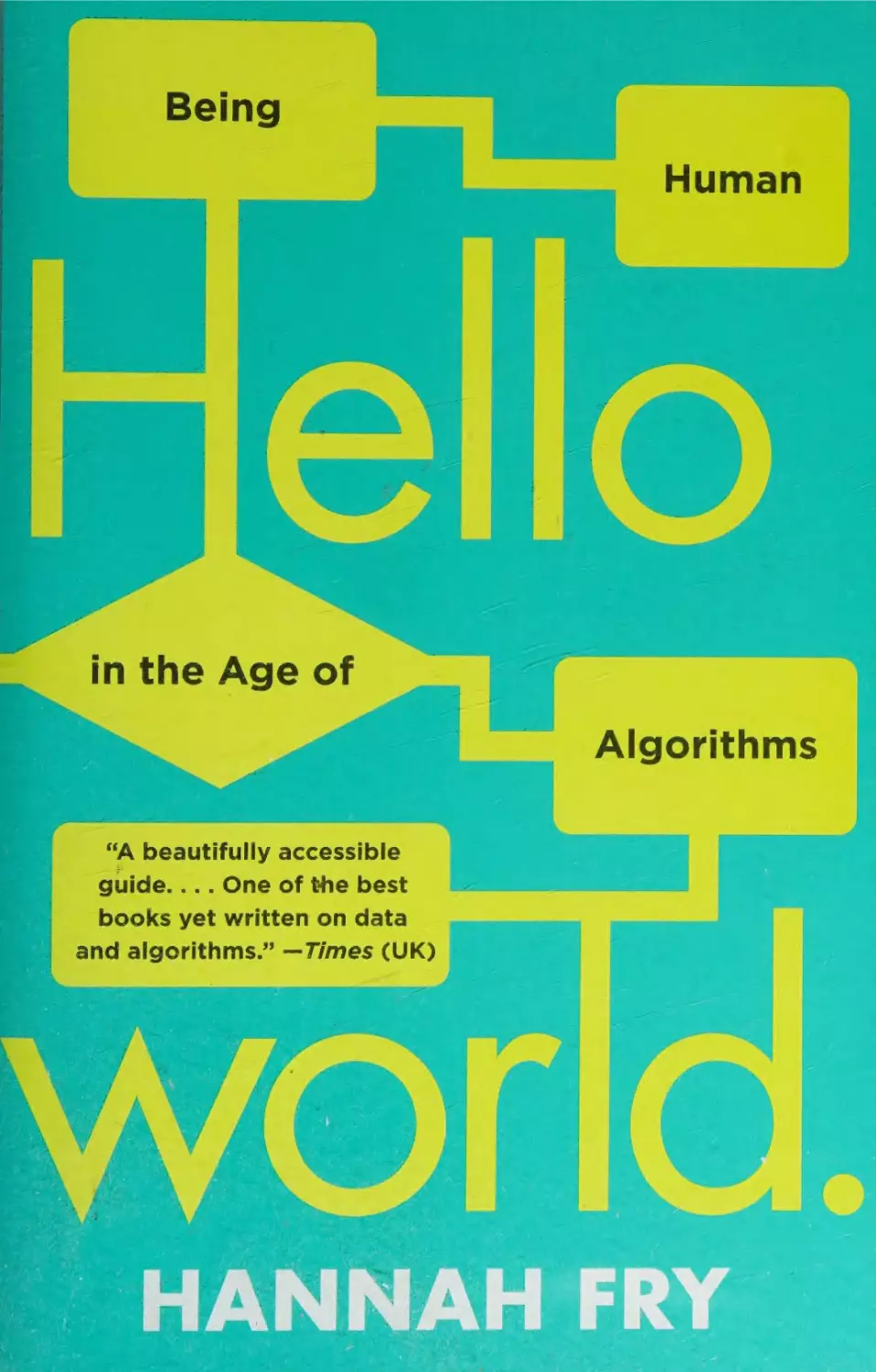
Hello
World

Also by Hannah Fry
The Mathematics of Love

(with Dr. Thomas Oléron Evans)

The Indisputable Existence of Santa Claus: The Mathematics of Christmas

Hello
Worl
Being Human

in the Age of Algorithms

HANNAH

ERY

_
W. W. NORTON & COMPANY
Independent Publishers Since 1923

For Marie Fry.
Thank you for never taking no for an answer.

Copyright © 2018 by Hannah Fry Limited
All rights reserved
Printed in the United States of America
First published as a Norton paperback 2019
For information about permission to reproduce selections from this book, write to
Permissions, W. W. Norton & Company, Inc., 500 Fifth Avenue, New York, NY 10110
For information about special discounts for bulk purchases, please contact
W. W. Norton Special Sales at specialsales@wwnorton.com or 800-233-4830
Manufacturing by LSC Communications, Harrisonburg
Library of Congress Cataloging-in-Publication Data
Names: Fry, Hannah, author.
Title: Hello world : being human in the age of algorithms / Hannah Fry.
Description: First edition. |New York: W. W. Norton & Company, [2018]
Identifiers: LCCN 2018029663 |ISBN 9780393634990 (hardcover)

Subjects: LCSH: Technology—Social aspects. |Technology—Moral and ethical
aspects. |Algorithms.
Classification: LCC T14.5 .F788 2018 |DDC 303.48/3—dc23

LC record available at https://Iccn.loc.gov/2018029663
ISBN 978-0-393-35736-3 pbk.

W. W. Norton & Company, Inc.
500 Fifth Avenue, New York, N.Y. 10110
www.wwnorton.com

W. W. Norton & Company Ltd.
15 Carlisle Street, London W1D 3BS
BNC

eRe oa

eh

Ch MG)

Contents
A note on the title ix
Introduction
Power

5

Data

25

Justice

49

Medicine
Cars

79

113

Crime
Art

1

141

175

Conclusion

197

Acknowledgements

203

Photograph Credits

207

Notes

209

Index 235

a %, Yyingurncdy BY

A note on the title
AVAVaan I was 7 YEARS old, my dad brought a gift home for me
and my sisters. It was a ZX Spectrum, a little 8-bit computer — the first time we’d ever had one of our own. It was probably
already five years out of date by the time it arrived in our house,
but even though it was second-hand, I instantly thought there
was something marvellous about that dinky machine. The Spectrum was roughly equivalent to a Commodore 64 (although only
the really posh kids in the neighbourhood had one of those) but I
always thought it was a far more beautiful beast. The sleek black
plastic casing could fit in your hands, and there was something
rather friendly about the grey rubber keys and rainbow stripe running diagonally across one corner.
For me, the arrival of that ZX Spectrum marked the beginning
of a memorable summer spent up in the loft with my elder sister,

programming hangman puzzles for each other, or drawing simple
shapes through code. All that ‘advanced’ stuff came later, though.
First we had to master the basics.

A note on the title

Looking back, I don’t exactly remember the moment I wrote my
first ever computer program, but I’m pretty sure I know what it was.
It would have been the same simple program that I’ve gone on to
teach all of my students at University College London; the same as
you'll find on the first page of practically any introductory computer
science textbook. Because there is a tradition among all those who
have ever learned to code - a rite of passage, almost. Your first task
as a rookie is to program the computer to flash up a famous phrase
on to the screen:
‘HELLO WORLD’
It’s a tradition that dates back to the 1970s, when Brian Kern-

ighan included it as a tutorial in his phenomenally popular programming textbook. The book - and hence the phrase —- marked
an important point in the history of computers. The microprocessor had just arrived on the scene, heralding the transition
of computers from what they had been in the past - enormous
great specialist machines, fed on punch cards and ticker-tape — to
something more like the personal computers we're used to, with
a screen, a keyboard and a blinking cursor. “Hello world’ came
along at the first moment when chit-chat with your computer was
a possibility.
Years later, Brian Kernighan told a Forbes interviewer about his

inspiration for the phrase. He’d seen a cartoon showing an egg and
a newly hatched chick chirping the words “Hello world!’ as it was
born, and it had stuck in his mind.
It’s not entirely clear who the chick is supposed to be in that scenario: the fresh-faced human triumphantly announcing their brave
arrival to the world of programming? Or the computer itself, awakening from the mundane slumber of spreadsheets and text documents, ready to connect its mind to the real world and do its new
master’s bidding? Maybe both. But it’s certainly a phrase that unites

A note on the title

all programmers, and connects them to every machine that’s ever
been programmed.
There's something else I like about the phrase - something that
has never been more relevant or more important than it is now. As

computer algorithms increasingly control and decide our future,
‘Hello world’ is a reminder of a moment of dialogue between human
and machine. Of an instant where the boundary between controller and controlled is virtually imperceptible. It marks the start of a
partnership - a shared journey of possibilities, where one cannot
exist without the other.
In the age of the algorithm, that’s a sentiment worth bearing in
mind.

Introduction
NYONE WHO HAS EVER VISITED Jones Beach on Long Island,

New York, will have driven under a series of bridges on their
way to the ocean. These bridges, primarily built to filter people on
and off the highway, have an unusual feature. As they gently arc over

the traffic, they hang extraordinarily low, sometimes leaving as little
as 9 feet of clearance from the tarmac.
There’s a reason for this strange design. In the 1920s, Robert
Moses, a powerful New York urban planner, was keen to keep
his newly finished, award-winning state park at Jones Beach the
preserve of white and wealthy Americans. Knowing that his preferred clientele would travel to the beach in their private cars, while
people from poor black neighbourhoods would get there by bus,
he deliberately tried to limit access by building hundreds of lowlying bridges along the highway. Too low for the 12-foot buses to
pass under.’
Racist bridges aren't the only inanimate objects that have had
a quiet, clandestine control over people. History is littered with

HELLO WORLD

examples of objects and inventions with a power beyond their
professed purpose.” Sometimes it’s deliberately and maliciously
factored into their design, but at other times it’s a result of thoughtless omissions: just think of the lack of wheelchair access in some
urban areas. Sometimes it’s an unintended consequence, like the
mechanized weaving machines of the nineteenth century. They
were designed to make it easier to create complicated textiles, but
in the end, the impact they had on wages, unemployment and
working conditions made them arguably more tyrannical than
any Victorian capitalist.
Modern

inventions are no different. Just ask the residents of

Scunthorpe in the north of England, who were blocked from opening AOL accounts after the internet giant created a new profanity
filter that objected to the name of their town.* Or Chukwuemeka
Afigbo, the Nigerian man who discovered an automatic hand-soap
dispenser that released soap perfectly whenever his white friend
placed their hand under the machine, but refused to acknowledge

his darker skin.* Or Mark Zuckerberg, who, when writing the code
for Facebook in his dorm room in Harvard in 2004, would never
have imagined his creation would go on to be accused of helping
manipulate votes in elections around the globe.°
Behind each of these inventions is an algorithm. The invisible
pieces of code that form the gears and cogs of the modern machine
age, algorithms have given the world everything from social media
feeds to search engines, satellite navigation to music recommendation systems, and are as much a part of our modern infrastructure
as bridges, buildings and factories ever were. Theyre inside our hos- .
pitals, our courtrooms and our cars. They’re used by police forces,
supermarkets and film studios. They have learned our likes and
dislikes; they tell us what to watch, what to read and who to date.

And all the while, they have the hidden power to slowly and subtly
change the rules about what it means to be human.

Introduction

In this book, we'll discover the vast array of algorithms on which
we increasingly, but perhaps unknowingly, rely. We'll pay close
attention

to their claims, examine

their undeclared

power

and

confront the unanswered questions they raise. We'll encounter algorithms used by police to decide who should be arrested, which

make us choose between protecting the victims of crime and the
innocence of the accused. We'll meet algorithms used by judges to
decide on the sentences of convicted criminals, which ask us to de-

cide what our justice system should look like. We'll find algorithms
used by doctors to over-rule their own diagnoses; algorithms within
driverless cars that insist we define our morality; algorithms that are
weighing in on our expressions of emotion; and algorithms with the
power to undermine our democracies.
I’m not arguing that algorithms are inherently bad. As you'll see
in these pages, there are many reasons to be positive and optimistic
about what lies ahead. No object or algorithm is ever either good
or evil in itself. Its how they’re used that matters. GPS was invented to launch nuclear missiles and now helps deliver pizzas. Pop
music, played on repeat, has been deployed as a torture device. And
however beautifully made a garland of flowers might be, if I really
wanted to I could strangle you with it. Forming an opinion on an
algorithm means understanding the relationship between human
and machine. Each one is inextricably connected to the people who
build and use it.
This means that, at its heart, this is a book about humans. It’s
about who we are, where were going, what’s important to us and
how that is changing through technology. It’s about our relationship
with the algorithms that are already here, the ones working alongside us, amplifying our abilities, correcting our mistakes, solving
our problems and creating new ones along the way.
It’s about asking if an algorithm is having a net benefit on society.
About when you should trust a machine over your own judgement,

HELLO WORLD

and when you should resist the temptation to leave machines in
control. It’s about breaking open the algorithms and finding their
limits; and about looking hard at ourselves and finding our own.
About separating the harm from the good and deciding what kind
of world we want to live in.
Because the future doesn’t just happen. We create it.

Power
ei KASPAROV KNEW EXACTLY HOw to intimidate his rivals.
At 34, he was the greatest chess player the world had ever seen,
with a reputation fearsome enough to put any opponent on edge.
Even so, there was one unnerving trick in particular that his com-

petitors had come to dread. As they sat, sweating through what was
probably the most difficult game of their life, the Russian would
casually pick up his watch from where it had been lying beside the
chessboard, and return it to his wrist. This was a signal that everybody recognized - it meant that Kasparov was bored with toying
with his opponent. The watch was an instruction that it was time
for his rival to resign the game. They could refuse, but either way,
Kasparov’s victory was soon inevitable.’
But when IBM’s Deep Blue faced Kasparov in the famous match
of May 1997, the machine was immune to such tactics. The outcome

of the match is well known, but the story behind how Deep Blue

secured its win is less widely appreciated. That symbolic victory, of
machine over man, which in many ways marked the start of the
algorithmic age, was down to far more than sheer raw computing
power. In order to beat Kasparov, Deep Blue had to understand him
not simply as a highly efficient processor of brilliant chess moves,
but as a human being.
For a start, the IBM engineers made the brilliant decision to de-

sign Deep Blue to appear more uncertain than it was. During their

infamous six-game match, the machine would occasionally hold off
from declaring its move once a calculation had finished, sometimes

HELLO WORLD

for several minutes. From Kasparov's end of the table, the delays
made it look as if the machine was struggling, churning through
more and more calculations. It seemed to confirm what Kasparov
thought he knew; that he’d successfully dragged the game into a
position where the number of possibilities was so mind-bogglingly
large that Deep Blue couldn't make a sensible decision.’ In reality,
however, it was sitting idly by, knowing exactly what to play, just letting the clock tick down. It was a mean trick, but it worked. Even in
the first game of the match, Kasparov started to become distracted
by second-guessing how capable the machine might be.’
Although Kasparov won the first game, it was in game two
that Deep Blue really got into his head. Kasparov tried to lure the
computer into a trap, tempting it to come in and capture some

pieces, while at the same time setting himself up - several moves
ahead - to release his queen and launch an attack.* Every watching
chess expert expected the computer to take the bait, as did Kasparov himself. But somehow, Deep Blue smelt a rat. To Kasparov's
amazement, the computer had realized what the grandmaster was
planning and moved to block his queen, killing any chance of a
human victory.°
Kasparov was visibly horrified. His misjudgement about what
the computer could do had thrown him. In an interview a few days
after the match he described Deep Blue as having ‘suddenly played
like a god for one moment.® Many years later, reflecting on how
he had felt at the time, he would write that he had ‘made the mistake of assuming that moves that were surprising for a computer to
make were also objectively strong moves.’ Either way, the genius
of the algorithm had triumphed. Its understanding of the human
mind, and human fallibility, was attacking and defeating the all-

too-human genius.
Disheartened, Kasparov resigned the second game rather than
fighting for the draw. From there his confidence began to unravel.

Power

Games three, four and five ended in draws. By game six, Kasparov
was broken. The match ended Deep Blue 3% to Kasparov's 2.
It was a strange defeat. Kasparov was more than capable of working his way out of those positions on the board, but he had underestimated the ability of the algorithm and then allowed himself to be intimidated by it. ‘I had been so impressed by Deep Blue’ play; he wrote
in 2017, reflecting on the match. ‘I became so concerned with what
it might be capable of that I was oblivious to how my problems were
more due to how badly I was playing than how well it was playing’®
As we'll see time and time again in this book, expectations are
important. The story of Deep Blue defeating the great grandmaster
demonstrates that the power of an algorithm isn't limited to what
is contained within its lines of code. Understanding our own flaws
and weaknesses - as well as those of the machine - is the key to
remaining in control.
But if someone like Kasparov failed to grasp this, what hope is there
for the rest of us? Within these pages, we'll see how algorithms have
crept into virtually every aspect of modern life - from health and crime
to transport and politics. Along the way, we have somehow managed
to be simultaneously dismissive of them, intimidated by them and in
awe of their capabilities. The end result is that we have no idea quite
how much power were ceding, or if we've let things go too far.

Back to basics

Before we get to all that, perhaps it’s worth pausing briefly to question
what ‘algorithm actually means. It’s a term that, although used frequently, routinely fails to convey much actual information. This is partly because the word itself is quite vague. Officially, it is defined as follows.’
algorithm (noun): A step-by-step procedure for solving a problem or accomplishing some end especially by a computer.

HELLO WORLD

That's it. An algorithm is simply a series of logical instructions
that show, from start to finish, how to accomplish a task. By this
broad definition, a cake recipe counts as an algorithm. So does a list
of directions you might give to a lost stranger. IKEA manuals, YouTube troubleshooting videos, even self-help books — in theory, any
self-contained list of instructions for achieving a specific, defined
objective could be described as an algorithm.
But that’s not quite how the term is used. Usually, algorithms refer to something a little more specific. They still boil down to a list
of step-by-step instructions, but these algorithms are almost always
mathematical objects. They take a sequence of mathematical operations — using equations, arithmetic, algebra, calculus, logic and
probability - and translate them into computer code. They are fed
with data from the real world, given an objective and set to work
crunching through the calculations to achieve their aim. They are
what makes computer science an actual science, and in the process
have fuelled many of the most miraculous modern achievements
made by machines.
There's an almost uncountable number of different algorithms.
Each has its own goals, its own idiosyncrasies, its clever quirks and
drawbacks, and there is no consensus on how best to group them.
But broadly speaking, it can be useful to think of the real-world
tasks they perform in four main categories:!°
Prioritization: making an ordered list
Google Search predicts the page you're looking for by ranking
one result over another. Netflix suggests which films you might
like to watch next. Your TomTom selects your fastest route. All
use a mathematical process to order the vast array of possible
choices. Deep Blue was also essentially a prioritization algorithm,
reviewing all the possible moves on the chessboard and calculating which would give the best chance of victory.

Power

Classification: picking a category
As soon as I hit my late twenties, I was bombarded by adverts
for diamond rings on Facebook. And once I eventually got married, adverts for pregnancy tests followed me around the internet. For these mild irritations, I had classification algorithms to
thank. These algorithms, loved by advertisers, run behind the
scenes and classify you as someone interested in those things
on the basis of your characteristics. (They might be right, too,
but it’s still annoying when adverts for fertility kits pop up on
your laptop in the middle of a meeting.)
There are algorithms that can automatically classify and remove inappropriate content on YouTube, algorithms that will
label your holiday photos for you, and algorithms that can scan
your handwriting and classify each mark on the page as a letter of
the alphabet.
Association: finding links
Association is all about finding and marking relationships between things. Dating algorithms such as OKCupid have association at their core, looking for connections between members and
suggesting matches based on the findings. Amazon's recommendation engine uses a similar idea, connecting your interests to
those of past customers. It’s what led to the intriguing shopping
suggestion that confronted Reddit user Kerbobotat after buying a
baseball bat on Amazon: ‘Perhaps you'll be interested in this balaclava?’!

Filtering: isolating whats important
Algorithms often need to remove some information to focus on
what’s important, to separate the signal from the noise. Sometimes they do this literally: speech recognition algorithms, like
those running inside Siri, Alexa and Cortana, first need to filter
out your voice from the background noise before they can get to
work on deciphering what you're saying. Sometimes they do it

HELLO WORLD

figuratively: Facebook and Twitter filter stories that relate to your
known interests to design your own personalized feed.

The vast majority of algorithms will be built to perform a combination of the above. Take UberPool, for instance, which matches
prospective passengers with others heading in the same direction.
Given your start point and end point, it has to filter through the
possible routes that could get you home, look for connections with
other users headed in the same direction, and pick one group to assign you to — all while prioritizing routes with the fewest turns for
the driver, to make the ride as efficient as possible.’
So, that’s what algorithms can do. Now, how do they manage
to do it? Well, again, while the possibilities are practically endless,
there is a way to distil things. You can think of the approaches taken

by algorithms as broadly fitting into two key paradigms, both of
which we'll meet in this book.
Rule-based algorithms
The first type are rule-based. Their instructions are constructed
by a human and are direct and unambiguous. You can imagine
these algorithms as following the logic of a cake recipe. Step one:
do this. Step two: if this, then that. That’s not to imply that these
algorithms are simple — there's plenty of room to build powerful
programs within this paradigm.
Machine-learning algorithms
The second type are inspired by how living creatures learn. To
give you an analogy, think about how you might teach a dog
to give you a high five. You don't need to produce a precise list
of instructions and communicate them to the dog. As a trainer,
all you need is a clear objective in your mind of what you want
the dog to do and some way of rewarding her when she does
the right thing. It’s simply about reinforcing good behaviour,

Power

ignoring bad, and giving her enough practice to work out
what to do for herself. The algorithmic equivalent is known as
a machine-learning algorithm, which comes under the broader
umbrella of artificial intelligence or AI. You give the machine
data, a goal and feedback when it’s on the right track - and leave
it to work out the best way of achieving the end.

Both types have their pros and cons. Because rule-based algorithms
have instructions written by humans, they’re easy to comprehend.
In theory, anyone can open them up and follow the logic of what’s
happening inside.'* But their blessing is also their curse. Rule-based
algorithms will only work for the problems for which humans know
how to write instructions.
Machine-learning algorithms, by contrast, have recently proved
to be remarkably good at tackling problems where writing a list of
instructions won't work. They can recognize objects in pictures,
understand words as we speak them and translate from one language to another - something rule-based algorithms have always
struggled with. The downside is that if you let a machine figure
out the solution for itself, the route it takes to get there often won't
make a lot of sense to a human observer. The insides can be a mystery, even to the smartest of living programmers.
Take, for instance, the job of image recognition. A group of Japanese researchers recently demonstrated how strange an algorithm's
way of looking at the world can seem to a human. You might have
come across the optical illusion where you can't quite tell if you're
looking at a picture of a vase or of two faces (if not, there's an example in the notes at the back of the book).'* Here's the computer
equivalent. The team showed that changing a single pixel on the
front wheel of the image overleaf was enough to cause a machinelearning algorithm to change its mind from thinking this is a photo
of a car to thinking it is a photo of a dog.””

HELLO WORLD

For some, the idea of an algorithm working without explicit instructions is a recipe for disaster. How can we control something we

don't understand? What if the capabilities of sentient, super-intelligent
machines transcend those of their makers? How will we ensure that
an AI we don't understand and can't control isn’t working against us?
These are all interesting hypothetical questions, and there is no
shortage of books dedicated to the impending threat of an AI apocalypse. Apologies if that was what you were hoping for, but this book
isn't one of them. Although AI has come on in leaps and bounds of
late, it is still only ‘intelligent’ in the narrowest sense of the word. It
would probably be more useful to think of what we've been through
as a revolution in computational statistics than a revolution in intelligence. I know that makes it sound a lot less sexy (unless you're
really into statistics), but it’s a far more accurate description of how
things currently stand.
For the time being, worrying about evil AJ is a bit like worrying
about overcrowding on Mars.* Maybe one day we'll get to the point
* This is paraphrased from a comment made by the computer scientist and machinelearning pioneer Andrew Ng in a talk he gave in 2015. See Tech Events, ‘GPU Technology
Conference 2015 day 3: What's Next in Deep Learning, YouTube, 20 Nov. 2015, https://
www. youtube.com/watch?v=qP9TOX8T-kI.

12

Power

where computer intelligence surpasses human intelligence, but were

nowhere near it yet. Frankly, we're still quite a long way away from
creating hedgehog-level intelligence. So far, no one’s even managed
to get past worm.”

Besides, all the hype over Al is a distraction from much more
pressing concerns and ~ I think - much more interesting stories.
Forget about omnipotent artificially intelligent machines for a mo-

ment and turn your thoughts from the far distant future to the here
and now - because there are already algorithms with free rein to
act as autonomous decision-makers. To decide prison terms, treat-

ments for cancer patients and what to do in a car crash. They're
already making life-changing choices on our behalf at every turn.
The question is, if we're handing over all that power - are they
deserving of our trust?

Blind faith

Sunday, 22 March 2009 wasn't a good day for Robert Jones. He had
just visited some friends and was driving back through the pretty
town of Todmorden in West Yorkshire, England, when he noticed
the fuel light on his BMW. He had just 7 miles to find a petrol station before he ran out, which was cutting things rather fine. Thank-

fully his GPS seemed to have found him a short cut - sending him
on a narrow winding path up the side of the valley.
Robert followed the machine’s instructions, but as he drove, the
road got steeper and narrower. After a couple of miles, it turned

into a dirt track that barely seemed designed to accommodate

* Simulating the brain of a worm is precisely the goal of the international science project
OpenWorm. They're hoping to artificially reproduce the network of 302 neurons found
within the brain of the C. elegans worm. To put that into perspective, we humans have
around 100,000,000,000 neurons. See Open Worm

= Ww

website: http://openworm.org/.

HELLO WORLD

horses, let alone cars. But Robert wasn't fazed. He drove five thousand miles a week for a living and knew how to handle himself
behind the wheel. Plus, he thought, he had ‘no reason not to trust
the TomTom:.'®
Just a short while later, anyone who happened to be looking up
from the valley below would have seen the nose of Robert's BMW
appearing over the brink of the cliff above, saved from the hundredfoot drop only by the flimsy wooden fence at the edge he'd just
crashed into.
It would eventually take a tractor and three quad bikes to recover Robert’s car from where he abandoned it. Later that year,
when he appeared in court on charges of reckless driving, he admitted that he didn't think to over-rule the machine's instructions.
‘It kept insisting the path was a road, he told a newspaper after the
incident. ‘So I just trusted it. You don't expect to be taken nearly
over a cliff?!”
No, Robert. I guess you don't.
There’s a moral somewhere in this story. Although he probably
felt a little foolish at the time, in ignoring the information in front
of his eyes (like seeing a sheer drop out of the car window) and attributing greater intelligence to an algorithm than it deserved, Jones
was in good company. After all, Kasparov had fallen into the same
trap some twelve years earlier. And, in much quieter but no less
profound ways, it’s a mistake almost all of us are guilty of making,
perhaps without even realizing.
Back in 2015 scientists set out to examine how search engines
like Google have the power to alter our view of the world.!* They
wanted to find out if we have healthy limits in the faith we place in
their results, or if we would happily follow them over the edge of a
metaphorical-cliff.
The experiment focused around an upcoming election in India.
The researchers, led by psychologist Robert Epstein, recruited

Power

2,150 undecided voters from around the country and gave them
access to a specially made search engine, called ‘Kadoodle; to help
them learn more about the candidates before deciding who they
would vote for.
Kadoodle was rigged. Unbeknown to the participants, they
had been split into groups, each of which was shown a slightly different version of the search engine results, biased towards
one candidate or another. When members of one group visited
‘the website, all the links at the top of the page would favour one
candidate in particular, meaning they'd have to scroll right down
through link after link before finally finding a single page that was
favourable to anyone else. Different groups were nudged towards
different candidates.
It will come as no surprise that the participants spent most of
their time reading the websites flagged up at the top of the first page
- as that old internet joke says, the best place to hide a dead body
is on the second page of Google search results. Hardly anyone in
the experiment paid much attention to the links that appeared well
down the list. But still, the degree to which the ordering influenced
the volunteers’ opinions shocked even Epstein. After only a few
minutes of looking at the search engine's biased results, when asked
who they would vote for, participants were a staggering 12 per cent
more likely to pick the candidate Kadoodle had favoured.
In an interview with Science in 2015,'° Epstein explained what was
going on: “We expect the search engine to be making wise choices.
What they’re saying is, “Well yes, I see the bias and that’s telling
me ... the search engine is doing its job.” Perhaps more ominous,
given how much of our information we now get from algorithms
like search engines, is how much agency people believed they had in
their own opinions: ‘When people are unaware they are being manipulated, they tend to believe they have adopted their new thinking voluntarily, Epstein wrote in the original paper.”

HELLO WORLD

Kadoodle, of course, is not the only algorithm to have been accused of subtly manipulating people's political opinions. We'll come
on to that more in the ‘Data chapter, but for now it’s worth noting
how the experiment suggests we feel about algorithms that are right
most of the time. We end up believing that they always have superior judgement.’ After a while, we're no longer even aware of our
own bias towards them.
All around us, algorithms provide a kind of convenient source
of authority. An easy way to delegate responsibility; a short
cut that we take without thinking. Who is really going to click
through to the second page of Google every time and think critically about every result? Or go to every airline to check if Skyscanner is listing the cheapest deals? Or get out a ruler and a road
map to confirm that their GPS is offering the shortest route? Not
me, that’s for sure.

But there's a distinction that needs making here. Because trusting a usually reliable algorithm is one thing. Trusting one without
any firm understanding of its quality is quite another.

Artificial intelligence meets natural stupidity
In 2012, a number of disabled people in Idaho were informed that
their Medicaid assistance was being cut.” Although they all qualified
for benefits, the state was slashing their financial support - without
warning — by as much as 30 per cent,” leaving them struggling to
pay for their care. This wasn't a political decision; it was the result of
a new ‘budget tool’ that had been adopted by the Idaho Department
of Health and Welfare - a piece of software that automatically calculated the level of support that each person should receive.”
The problem was, the budget tool’s decisions didn’t seem to
make much sense. As far as anyone could tell from the outside, the
numbers it came up with were essentially arbitrary. Some people

Power

were given more money than in previous years, while others
found their budgets reduced by tens of thousands of dollars, putting them at risk of having to leave their homes to be cared for in
an institution.”
Unable to understand why their benefits had been reduced, or

to effectively challenge the reduction, the residents turned to the
American Civil Liberties Union (ACLU) for help. Their case was

taken on by Richard Eppink, legal director of the Idaho division,”
who had this to say in a blog post in 2017: ‘I thought the case would
be a simple matter of saying to the state: Okay, tell us why these dollar figures dropped by so much?’ In fact, it would take four years,
four thousand plaintiffs and a class action lawsuit to get to the bottom of what had happened.”
Eppink and his team began by asking for details on how the algorithm worked, but the Medicaid team refused to explain their calculations. They argued that the software that assessed the cases was a
‘trade secret’ and couldn't be shared.” Fortunately, the judge presiding over the case disagreed. The budget tool that wielded so much
power over the residents was then handed over, and revealed to be
— not some sophisticated AI, not some beautifully crafted mathematical model, but an Excel spreadsheet.”
Within the spreadsheet, the calculations were supposedly based

on historical cases, but the data was so badly riddled with bugs and
errors that it was, for the most part, entirely useless.*! Worse, once
the ACLU team managed to unpick the equations, they discovered
‘fundamental statistical flaws in the way that the formula itself was
structured. The budget tool had effectively been producing random
results for a huge number of people. The algorithm — if you can call
it that — was of such poor quality that the court would eventually
rule it unconstitutional.”
There are two parallel threads of human error here. First, someone wrote this garbage spreadsheet; second, others naively trusted

HELLO WORLD

it. The ‘algorithm’ was in fact just shoddy human work wrapped up
in code. So why were the people who worked for the state so eager
to defend something so terrible?
Here are Eppink’s thoughts on the matter:
It’s just this bias we all have for computerized results - we don’t
question them. When a computer generates something - when
you have a statistician, who looks at some data, and comes up
with a formula — we just trust that formula, without asking ‘hey
wait a second, how is this actually working?’

Now, I know that picking mathematical formulae apart to see
how they work isn't everyone's favourite pastime (even if it is mine).

But Eppink none the less raises an incredibly important point about
our human willingness to take algorithms at face value without
wondering what's going on behind the scenes.
In my years working as a mathematician with data and algorithms, I’ve come to believe that the only way to objectively judge
whether an algorithm is trustworthy is by getting to the bottom of
how it works. In my experience, algorithms are a lot like magical
illusions. At first they appear to be nothing short of actual wizardry, but as soon as you know how the trick is done, the mystery
evaporates. Often there’s something laughably simple (or worryingly reckless) hiding behind the facade. So, in the chapters that
follow, and the algorithms we'll explore, Pll try to give you a flavour of what's going on behind the scenes where I can. Enough to
see how the tricks are done - even if not quite enough to perform
them yourself.
7
But even for the most diehard math fans, there are still going
to be occasions where algorithms demand you take a blind leap
of faith. Perhaps because, as with Skyscanner or Google's search

results, double-checking their working isn’t feasible. Or maybe,
like the Idaho budget tool and others we'll meet, the algorithm is

Power

considered a‘trade secret. Or perhaps, as in some machine-learning
techniques, following the logical process inside the algorithm just
isn’t possible.
There will be times when we have to hand over control to the un-

known, even while knowing that the algorithm is capable of making
mistakes. Times when we are forced to weigh up our own judge-

ment against that of the machine. When, if we decide to trust our
instincts instead of its calculations, we're going to need rather a lot
of courage in our convictions.

When to over-rule

Stanislav Petrov was a Russian military officer in charge of monitoring the nuclear early warning system protecting Soviet airspace. His

job was to alert his superiors immediately if the computer indicated
any sign of an American attack.**
Petrov was on duty on 26 September 1983 when, shortly after
midnight, the sirens began to howl. This was the alert that everyone
dreaded. Soviet satellites had detected an enemy missile headed for
Russian territory. This was the depths of the Cold War, so a strike
was certainly plausible, but something gave Petrov pause. He wasn't
sure he trusted the algorithm. It had only detected five missiles,
which seemed like an illogically small opening salvo for an American attack.*°
Petrov froze in his chair. It was down to him: report the alert, and
send the world into almost certain nuclear war; or wait, ignoring
protocol, knowing that with every second that passed his country's
leaders had less time to launch a counter-strike.
Fortunately for all of us, Petrov chose the latter. He had no way
of knowing for sure that the alarm had sounded in error, but after

23 minutes — which must have felt like an eternity at the time when it was clear that no nuclear missiles had landed on Russian

19

HELLO WORLD

soil, he finally knew that he had been correct. The algorithm had
made a mistake.
If the system had been acting entirely autonomously, without
a human like Petrov to act as the final arbiter, history would undoubtedly have played out rather differently. Russia would almost

certainly have launched what it believed to be retaliatory action
and triggered a full-blown nuclear war in the process. If there's
anything we can learn from this story, it’s that the human element
does seem to be a critical part of the process: that having a person
with the power of veto in a position to review the suggestions of
an algorithm before a decision is made is the only sensible way to
avoid mistakes.
After all, only humans will feel the weight of responsibility for
their decisions. An algorithm tasked with communicating up to
the Kremlin wouldn't have thought for a second about the potential ramifications of such a decision. But Petrov, on the other hand?
‘T knew perfectly well that nobody would be able to correct my mistake if I had made one-*6
The only problem with this conclusion is that humans aren't always that reliable either. Sometimes, like Petrov, they'll be right to
over-rule an algorithm. But often our instincts are best ignored.
To give you another example from the world of safety, where stories of humans incorrectly over-ruling an algorithm are mercifully
rare, that is none the less precisely what happened during an infamous crash on the Smiler rollercoaster at Alton Towers, the UK’s biggest theme park.*’
Back in June 2015, two engineers were called to attend a fault
on a rollercoaster. After fixing the issue, they sent an empty car-

riage around to test everything was working - but failed to notice it never made it back. For whatever reason, the spare carriage
rolled backwards down an incline and came to a halt in the middle
of the track.

20

Power

Meanwhile, unbeknown to the engineers, the ride staff added an
extra carriage to deal with the lengthening queues. Once they got the
all-clear from the control room, they started loading up the carriages
with cheerful passengers, strapping them in and sending the first car
off around the track, completely unaware of the empty, stranded carriage sent out by the engineers sitting directly in its path.
Luckily, the rollercoaster designers had planned for a situation
like this, and their safety algorithms worked exactly as planned. To
avoid a certain collision, the packed train was brought to a halt at
the top of the first climb, setting off an alarm in the control room.

But the engineers - confident that they'd just fixed the ride - concluded the automatic warning system was at fault.
Over-ruling the algorithm wasn't easy: they both had to agree
and simultaneously press a button to restart the rollercoaster. Doing so sent the train full of people over the drop to crash straight
into the stranded extra carriage. The result was horrendous. Several people suffered devastating injuries and two teenage girls lost
their legs.
Both of these life-or-death scenarios, Alton Towers and Petrov’s
alarm, serve as dramatic illustrations of a much deeper dilemma.

In the balance of power between human and algorithm, who - or
what - should have the final say?

Power struggle
This is a debate with a long history. In 1954, Paul Meehl, a professor of clinical psychology at the University of Minnesota, annoyed
an entire generation of humans when he published Clinical versus
Statistical Prediction, coming down firmly on one side of the argument.**
In his book, Meehl systematically compared the performance of
humans and algorithms on a whole variety of subjects — predicting

4

HELLO WORLD

everything from students’ grades to patients’ mental health out-

comes — and concluded that mathematical algorithms, no matter how simple, will almost always make better predictions than
people.

Countless other studies in the half-century since have confirmed
Meehl’s findings. If your task involves any kind of calculation, put
your money on the algorithm every time: in making medical diagnoses or sales forecasts, predicting suicide attempts or career satis-

faction, and assessing everything from fitness for military service
to projected academic performance.” The machine wont be perfect, but giving a human a veto over the algorithm would just add
more error.”
Perhaps this shouldn't come as a surprise. We're not built to
compute. We don’t go to the supermarket to find a row of cashiers
eyeballing our shopping to gauge how much it should cost. We get
an (incredibly simple) algorithm to calculate it for us instead. And

most of the time, we’d be better off leaving the machine to it. It’s
like the saying among airline pilots that the best flying team has
three components: a pilot, a computer and a dog. The computer is
there to fly the plane, the pilot is there to feed the dog. And the dog
is there to bite the human if it tries to touch the computer.
But there's a paradox in our relationship with machines. While
we have a tendency to over-trust anything we dont understand,
as soon as we know an algorithm can make mistakes, we also have
a rather annoying habit of over-reacting and dismissing it completely, reverting instead to our own flawed judgement. It’s known

* Intriguingly, a rare exception to the superiority of algorithmic performance comes from
a selection of studies conducted in the late 1950s and 1960s into the ‘diagnosis’ (their
words, not mine)-of homosexuality. In those examples, the human judgement made far
better predictions, outperforming anything the algorithm could manage - suggesting
there are some things so intrinsically human that data and mathematical formulae will
always struggle to describe them.

22

Power

to researchers as algorithm aversion. People are less tolerant of an
algorithm's mistakes than of their own - even if their own mistakes
are bigger.
It’s a phenomenon that has been demonstrated time and time
again in experiments,” and to some extent, you might recognize it
in yourself. Whenever Citymapper says my journey will take longer than I expect it to, I always think I know better (even if most of
the time it means I end up arriving late). We've all called Siri an
idiot at least once, somehow in the process forgetting the staggering technological accomplishment it has taken to build a talking
assistant you can hold in your hand. And in the early days of using
the mobile GPS app Waze Id find myself sitting in a traffic jam,
having been convinced that taking the back roads would be faster
than the route shown. (It almost always wasn't.) Now I’ve come to
trust it and - like Robert Jones and his BMW - I'll blindly follow
it wherever it leads me (although I still think I’'d draw the line at
going over a cliff).
This tendency of ours to view things in black and white - seeing
algorithms as either omnipotent masters or a useless pile of junk presents quite a problem in our high-tech age. If we're going to get
the most out of technology, we're going to need to work out a way to
be a bit more objective. We need to learn from Kasparov’s mistake
and acknowledge our own flaws, question our gut reactions and be
a bit more aware of our feelings towards the algorithms around us.
On the flip side, we should take algorithms off their pedestal, examine them a bit more carefully and ask if they're really capable of
doing what they claim. That’s the only way to decide if they deserve
the power they've been given.
Unfortunately,

all this is often much

easier said than done.

Oftentimes, we'll have little say over the power and reach of the
algorithms that surround us, even when it comes to those that
affect us directly.
23

HELLO WORLD

This is particularly true for the algorithms that trade in the most
fundamental modern commodity: data. The algorithms that silently
follow us around the internet, the ones that are harvesting our personal information, invading our privacy and inferring our character with free rein to subtly influence our behaviour. In that perfect
storm of misplaced trust and power and influence, the consequences have the potential to fundamentally alter our society.

24

Data
BS IN 2004, SOON'AFTER College student Mark Zuckerberg created Facebook, he had an instant messenger exchange with a
friend:
Zuck: Yeah so if you ever need info about anyone at Harvard
ZUCK: Just ask.

Zuck: I have over 4,000 emails, pictures, addresses . . .
[REDACTED FRIEND'S NAME]: What? How'd you manage that
one?

ZUCK:
ZucK:
Zuck:
Zuck:

People just submitted it.
I don't know why.
They ‘trust me’
Dumb fucks!

In the wake of the 2018 Facebook scandal, these words were repeatedly reprinted by journalists wanting to hint at a Machiavellian
attitude to privacy within the company. Personally, I think we can
be a little more generous when interpreting the boastful comments
of a 19-year-old. But I also think that Zuckerberg is wrong. People
werent just giving him their details. They were submitting them as
part of an exchange. In return, they were given access to an algorithm that would let them freely connect with friends and family, a
space to share their lives with others. Their own private network in
the vastness of the World Wide Web. I don’t know about you, but at
the time I certainly thought that was a fair swap.
There’s just one issue with that logic: we're not always aware of
the longer-term implications of that trade. It’s rarely obvious what

HELLO WORLD

our data can do, or, when fed into a clever algorithm, just how valuable it can be. Nor, in turn, how cheaply we were bought.

Every little helps
Supermarkets were among the first to recognize the value of an individual’s data. In a sector where companies are continually fighting
for the customer’s attention — for tiny margins of preference that will
nudge people’s buying behaviour into loyalty to their brand —- every
slim improvement can add up to an enormous advantage. This was
the motivation behind a ground-breaking trial run in 1993 by the
British supermarket Tesco.
Under the guidance of husband-and-wife team Edwina Dunn
and Clive Humby, and beginning in certain selected stores, Tesco
released its brand-new Clubcard - a plastic card, the size and
shape of a credit card, that customers could present at a checkout when paying for their shopping. The exchange was simple.
For each transaction using a Clubcard, the customer would collect points that they could use against future purchases in store,
while Tesco would take a record of the sale and associate it with
the customer’s name.”

The data gathered in that first Clubcard trial was extremely limited. Along with the customer’s name and address, the scheme only
recorded what they spent and when, not which items were in their
basket. None the less, from this modest harvest of data Dunn and
Humby reaped some phenomenally valuable insights.
They discovered that a small handful of loyal customers
accounted for a massive amount of their sales. They saw, street by
street, how far people were willing to travel to their stores. They
uncovered the neighbourhoods where the competition was winning and neighbourhoods where Tesco had the upper hand. The
data revealed which customers came back day after day, and which

26

Data

saved their shopping for weekends. Armed with that knowledge,

they could get to work nudging their customers’ buying behaviour,
by sending out a series of coupons to the Clubcard users in the post.
High spenders were given vouchers ranging from £3 to £30. Low
spenders were sent a smaller incentive of £1 to £10. And the results
were staggering. Nearly 70 per cent of the coupons were redeemed,
and while in the stores, customers filled up their baskets: people
who had Clubcards spent 4 per cent more overall than those who

didn't.
On 22 November

1994, Clive Humby presented the findings

from the trial to the Tesco board. He showed them the data, the re-

sponse rates, the evidence of customer satisfaction, the sales boosts.
The board listened in silence. At the end of the presentation, the
chair was the first person to speak. ‘What scares me about this} he
said, ‘is that you know more about my customers in three months

than I know in 30 years.”
Clubcard was rolled out to all customers of Tesco and is widely
credited with putting the company ahead of its main rival Sainsbury’s, to become the biggest supermarket in the UK. As time wore
on, the data collected became more detailed, making customers’
buying habits easier to target.
Early in the days of online shopping, the team introduced a feature known as ‘My Favourites; in which any items that were bought
while using the loyalty card would appear prominently when the
customer logged on to the Tesco website. Like the Clubcard itself,
the feature was a roaring success. People could quickly find the
products they wanted without having to navigate through the various pages. Sales went up, customers were happy.
But not all of them. Shortly after the launch of the feature, one
woman contacted Tesco to complain that her data was wrong. She’d
been shopping online and seen condoms among her list of “My Favourites. They couldn't be her husband’s, she explained, because he

HELLO WORLD

didn't use them. At her request, the Tesco analysts looked into the
data and discovered that her list was accurate. However, rather than
be the cause of a marital rift, they took the diplomatic decision to
apologize for ‘corrupted data’ and remove the offending items from
her favourites.
According to Clive Humby’s book on Tesco, this has now become an informal policy within the company. Whenever something
comes up that is just a bit too revealing, they apologize and delete
the data. It’s a stance that’s echoed by Eric Schmidt, who, while serving as the executive chairman of Google, said he tries to think of
things in terms of an imaginary creepy line. “The Google policy is to
get right up to the creepy line but not cross it’*
But collect enough data and it’s hard to know what you'll uncover. Groceries aren't just what you consume. They're personal. Look
carefully enough at someone's shopping habits and they'll often reveal all kinds of detail about who they are as a person. Sometimes as in the case of the condoms - it'll be things you’d rather not know.
But more often than not, lurking deep within the data, those slivers
of hidden insight can be used to a company’s advantage.

Target market
Back in 2002, the discount superstore Target started looking for
unusual patterns in its data.° Target sells everything from milk and
bananas to cuddly toys and garden furniture, and — like pretty much
every other retailer since the turn of the millennium - has ways of
using credit card numbers and survey responses to tie customers to
everything they've ever bought in the store, enabling them to analyse what people are buying.
In a story that —- as US readers might know - became infamous
across the country, Target realized that a spike in a female customer’s purchases of unscented body lotion would often precede her

28

Data

signing up to the in-store baby-shower registry. It had found a signal
in the data. As women entered their second trimester and started to
worry about stretch marks, their buying of moisturizer to keep their
skin supple left a hint of what was to come. Scroll backwards further in time, and these same women would be popping into Target
to stock up on various vitamins and supplements, like calcium and

zinc. Scroll forwards in time and the data would even suggest when
the baby was due - marked by the woman buying extra-big bags of
cotton wool from the store.®
Expectant mothers are a retailer's dream. Lock in her loyalty
while she’s pregnant and there’s a good chance she'll continue to use
your products long after the birth of her child. After all, shopping
habits are quick to form when a hungry screaming baby is demanding your attention during your weekly shop. Insights like this could
be hugely valuable in giving Target a head start over other brands in
attracting her business.
From there it was simple. Target ran an algorithm that would
score its female customers on the likelihood they were pregnant. If
that probability tipped past a certain threshold, the retailer would
automatically send out a series of coupons to the woman in question, full of things she might find useful: nappies, lotions, baby
wipes and so on.
So far, so uncontroversial. But then, around a year after the
tool was first introduced, a father of a teenage girl stormed into a
Target store in Minneapolis demanding to see the manager. His
daughter had been sent some pregnancy coupons in the post and
he was outraged that the retailer seemed to be normalizing teenage pregnancy. The manager of the store apologized profusely
and called the man’s home a few days later to reiterate the company’s regret about the whole affair. But by then, according to a
story in the New York Times, the father had an apology of his own
to make.

2g

HELLO WORLD

‘Thad a talk with my daughter; he told the manager. ‘It turns out
there’s been some activities in my house I haven't been completely
aware of. She’s due in August:
I don’t know about you, but for me, an algorithm that will inform
a parent that their daughter is pregnant before they've had a chance
to learn about it in person takes a big step across the creepy line. But
this embarrassment wasn't enough to persuade Target to scrap the
tool altogether.
A Target executive explained: “We found out that as long as a
pregnant woman thinks she hasn't been spied on, she'll use the
coupons. She just assumes that everyone else on her block got the
same mailer for diapers and cribs. As long as we don't spook her,
it works.”
So, at least as early as 2012, Target had a pregnancy predictor
running behind the scenes - as most retailers probably do now. The
only difference is that it will mix in the pregnancy-related coupons
with other more generic items so that the customers don't notice
they've been targeted. An advertisement for a crib might appear opposite some wine glasses. Or a coupon for baby clothes will run
alongside an ad for some cologne.
Target is not alone in using these methods. Stories of what can
be inferred from your data rarely hit the press, but the algorithms
are out there, quietly hiding behind the corporate front lines. About
a year ago, I got chatting to a chief data officer of a company that
sells insurance. They had access to the full detail of people's shopping habits via a supermarket loyalty scheme. In their analysis,

they'd discovered that home cooks were less likely to claim on their
home insurance, and were therefore more profitable. It’s a finding
that makes good intuitive sense. There probably isn’t much crossover between the group of people who are willing to invest time,
effort and money in creating an elaborate dish from scratch and
the group who would let their children play football in the house.

30

Data

But how did they know which shoppers were home cooks? Well,
there were a few items in someone’ basket that were linked to low
claim rates. The most significant, he told me, the one that gives you
away as a responsible, houseproud person more than any other,

was fresh fennel.
If that’s what you can infer from people’s shopping habits in the
physical world, just imagine what you might be able to infer if you
had access to more data. Imagine how much you could learn about
someone if you had a record of everything they did online.

The Wild West

Palantir Technologies is one of the most successful Silicon Valley
start-ups of all time. It was founded in 2003 by Peter Thiel (of PayPal
fame), and at the last count was estimated to be worth a staggering
$20 billion.’ That’s about the same market value as Twitter, although
chances are you've never heard of it. And yet - trust me when I tell
you — Palantir has most certainly heard of you.
Palantir is just one example of a new breed of companies
known as data brokers, who buy and collect people’s personal information and then resell it or share it for profit. There are plenty

of others: Acxiom, Corelogic, Datalogix, eBureau - a swathe of
huge companies you've probably never directly interacted with,
that are none the less continually monitoring and analysing your
behaviour.’
Every time you shop online, every time you sign up for a newsletter, or register on a website, or enquire about a new car, or fill out

a warranty card, or buya new home, or register to vote — every time
you hand over any data at all - your information is being collected
and sold to a data broker. Remember when you told an estate agent
what kind of property you were looking for? Sold to a data broker, Or those details you once typed into an insurance comparison

HELLO WORLD

website? Sold to a data broker. In some cases, even your entire
browser history can be bundled up and sold on.”
It’s the broker’s job to combine all of that data, cross-referencing
the different pieces of information they've bought and acquired,
and then create a single detailed file on you: a data profile of your
digital shadow. In the most literal sense, within some of these
brokers’ databases, you could open up a digital file with your ID
number on it (an ID you'll never be told) that contains traces of

everything you've ever done. Your name, your date of birth, your
religious affiliation, your vacation habits, your credit-card usage,
your net worth, your weight, your height, your political affiliation, your gambling habits, your disabilities, the medication you
use, whether you've had an abortion, whether your parents are divorced, whether you're easily addictable, whether you are a rape
victim, your opinions on gun control, your projected sexual orientation, your real sexual orientation, and your gullibility. There are
thousands and thousands of details within thousands and thousands of categories and files stored on hidden servers somewhere,
for virtually every single one of us."!
Like Target's pregnancy predictions, much of this data is inferred.
A subscription to Wired magazine might imply that you're interested

in technology; a firearms licence might imply that you're interested in
hunting. All along the way, the brokers are using clever, but simple,
algorithms to enrich their data. Its exactly what the supermarkets
were doing, but on a massive scale.
And there are plenty of benefits to be had. Data brokers use their
understanding of who we are to prevent fraudsters from imperson-|
ating unsuspecting consumers. Likewise, knowing our likes and
dislikes means that the adverts we're served as we wander around
the internet are as relevant to our interests and needs as possible.
That almost certainly makes for a more pleasant experience than
being hit with mass market adverts for injury lawyers or PPI claims

32

Data

day after day. Plus, because the messages can be directly targeted
on the right consumers, it means advertising is cheaper overall,
so small businesses with great products can reach new audiences,
something that’s good for everyone.
But, as I’m sure you're already thinking, there’s also an array of
problems that arise once you start distilling who we are as people
down into a series of categories. I'll get on to that in a moment, but
first I think it’s worth briefly explaining the invisible process behind
how an online advert reaches you when youre clicking around on
the internet, and the role that a data broker plays in the process.
So, let's imagine I own a luxury travel company, imaginatively
called Fry’s. Over the years, I have been getting people to register
their interest on my website and now have a list of their email addresses. If Iwanted to find out more about my users - like what kind
of holidays they were interested in - I could send off my list of users’
emails to a data broker, who would look up the names in their system, and return my list with the relevant data attached. Sort of like
adding an extra column on to a spreadsheet. Now when you visit
my Fry’s website, I can see that you have a particular penchant for
tropical islands and so serve you up an advert for a Hawaii getaway.
That’s option one. In option two, let’s imagine that Fry’s has a
little extra space on its website that we're willing to sell to other advertisers. Again, I contact a data broker and give them the information I have on my users. The broker looks for other companies who
want to place adverts. And, for the sake of the story, let's imagine
that a company selling sun cream is keen. To persuade them that
Fry’s has the audience the sun-cream seller would want to target,
the broker could show them some inferred characteristics of Fry's
users: perhaps the percentage of people with red hair, that kind
of thing. Or the sun-cream seller could hand over a list of its own
users’ email addresses and the broker could work out exactly how
much crossover there was between the audiences. If the sun-cream

HELLO WORLD

seller agrees, the advert appears on Fry’s website - and the broker
and I both get paid.
So far, these methods don’t go much beyond the techniques that
marketers have always used to target customers. But it's option
three where, for me, things start to get a little bit creepy. This time,
Fry’s is looking for some new customers. I want to target men and
women over 65 who like tropical islands and have large disposable
incomes, in the hope that they'll want to go on one of our luxurious new Caribbean cruises. Off I go to a data broker who will look
through their database and find me a list of people who match my
description.

So, let’s imagine you are on that list. The broker will never share
your name with Fry’s. But they will work out which other websites
you regularly use. Chances are, the broker will also have a relationship with one of your favourites. Maybe a social media site, or a
news website, something along those lines. As soon as you unsuspectingly log into your favourite website, the broker will get a ping
to alert them to the fact that you're there. Virtually instantaneously,
the broker will respond by placing a little tiny flag - known as a
cookie - on your computer. This cookie* acts like a signal to all
kinds of other websites around the internet, saying that you are
someone who should be served up an advert for Fry’s Caribbean
cruises. Whether you want them or not, wherever you go on the
internet, those adverts will follow you.
And here we stumble on the first problem. What if you don’t want
to see the advert? Sure, being bombarded with images of Caribbean
cruises might be little more than a minor inconvenience, but there —

* Adverts aren't the only reason for cookies. They're also used by websites to see if you’re
logged in or not (to know if it’s safe to send through any sensitive information) and to
see if you're a returning visitor to a page (to trigger a price hike on an airline website, for
instance, or email you a discount code on an online clothing store).

34

Data

are other adverts which can have a much more profound impact on
a person.
When Heidi Waterhouse lost a much-wanted pregnancy,!? she
unsubscribed from all the weekly emails updating her on her baby’s
growth, telling her which fruit the foetus now matched in size. She
unsubscribed from all the mailing lists and wish lists she had signed
up to in eager anticipation of the birth. But, as she told an audience
of developers at a conference in 2018, there was no power on earth
that could unsubscribe her from the pregnancy adverts that followed
her around the internet. This digital shadow of a pregnancy continued to circulate alone, without the mother or the baby. ‘Nobody who
built that system thought of that consequence; she explained.
It’s a system which, thanks to either thoughtless omission
or deliberate design, has the potential to be exploitative. Payday lenders can use it to directly target people with bad credit
ratings; betting adverts can be directed to people who frequent
gambling websites. And there are concerns about this kind of
data profiling being used against people, too: motorbike enthusiasts being deemed to have a risky hobby, or people who eat
sugar-free sweets being flagged as diabetic and turned down
for insurance as a result. A study from 2015 demonstrated that
Google was serving far fewer ads for high-paying executive jobs
to women who were surfing the web than to men.'* And, after
one African American Harvard professor learned that Googling her own name returned adverts targeted on people with a
criminal record (and as a result was forced to prove to a potential employer that she’d never been in trouble with the police),
she began researching the adverts delivered to different ethnic
groups. She discovered that searches for “‘black-sounding names’
were disproportionately likely to be linked to adverts containing
the word ‘arrest’ (e.g. ‘Have you been arrested?’) than those with

‘white-sounding names.“

HELLO WORLD

These methods aren't confined to data brokers. There's very little difference between how they work and how Google, Facebook,
Instagram and Twitter operate. These internet giants don't make
money by having users, so their business models are based on the
idea of micro-targeting. They are gigantic engines for delivering
adverts, making money by having their millions of users actively
engaged on their websites, clicking around, reading sponsored
posts, watching sponsored videos, looking at sponsored photos. In
whatever corner of the internet you use, hiding in the background,
these algorithms are trading on information you didn't know they
had and never willingly offered. They have made your most personal, private secrets into a commodity.

Unfortunately, in many countries, the law doesn't do much to
protect you. Data brokers are largely unregulated and - particularly in America - opportunities to curb their power have repeatedly been passed over by government. In March 2017, for instance,
the US Senate voted to eliminate rules that would have prevented
data brokers from selling your internet browser history without
your explicit consent. Those rules had previously been approved in
October 2016 by the Federal Communications Commission; but,
after the change in government at the end of that year, they were
opposed by the FCC’s new Republican majority and Republicans
in Congress.’°
So what does all this mean for your privacy? Well, let me tell you
about an investigation led by German journalist Svea Eckert and
data scientist Andreas Dewes that should give you a clear idea."
Eckert and her team set up a fake data broker and used it to buy
the anonymous browsing data of 3 million German citizens. (Getting hold of people's internet histories was easy. Plenty of companies
had an abundance of that kind of data for sale on British or US cus-

tomers — the only challenge was finding data focused on Germany.)
The data itself had been gathered by a Google Chrome plugin that

36

Data

users had willingly downloaded, completely unaware that it was
spying on them in the process.*
In total, it amounted to a gigantic list of URLs. A record of everything those people had looked at online over the course of a month.
Every search, every page, every click. All legally put up for sale.
For Eckert and her colleagues, the only problem was that the
browser data was anonymous. Good news for all the people whose

histories had been sold. Right? Should save their blushes. Wrong.
As the team explained in a presentation at DEFCON in 2017,
de-anonymizing huge databases of browser history was spectacularly easy.
Here's how it worked. Sometimes there were direct clues to the
persons identity in the URLs themselves. Like anyone who visited
Xing.com, the German equivalent of LinkedIn. If you click on your
profile picture on the Xing website, you are sent through to a page
with an address that will be something like the following:
www.xing.com/profile/Hannah_Fry?sc_omxb_p

Instantly, the name gives you away, while the text after the username signifies that the user is logged in and viewing their own profile, so the team could
be certain that the individual was looking at
their own page. It was a similar story with Twitter. Anyone checking their own Twitter analytics page was revealing themselves to
the team in the process. For those without an instant identifier in
their data, the team had another trick up their sleeve. Anyone who
posted a link online — perhaps by tweeting about a website, or sharing their public playlist on YouTube - essentially, anyone who left
a public trace of their data shadow attached to their real name, was

inadvertently unmasking themselves in the process. The team used

* That plugin, ironically called “The Web ofTrust; set out all this information clearly in
black and white as part of the terms and conditions.

37

HELLO WORLD

a simple algorithm to cross-reference the public and anonymized
personas,” filtering their list of URLs to find someone in the dataset
who had visited the same websites at the same times and dates that
the links were posted online. Eventually, they had the full names of
virtually everyone in the dataset, and full access to a month's worth
of complete browsing history for millions of Germans as a result.
Among those 3 million people were several high-profile individuals. They included a politician who had been searching for medication online. A police officer who had copied and pasted a sensitive case document into Google Translate, all the details of which
then appeared in the URL and were visible to the researchers. And
a judge, whose browsing history showed a daily visit to one rather
specific area of the internet. Here is a small selection of the websites
he visited during one eight-minute period in August 2016:
18.22: http://www.tubegalore.com/video/amature-pov—ex-wife-inleather-pants-gets-creampie42945.html
18.23: http://www.xxkingtube.com/video/pov_wifey_on_sex_
stool_with_beaded_thong_gets_creampie_4814.html
18.24: http://de.xhamster.com/movies/924590/office_lady_in_
pants_rubbing_riding best_of_anlife.html

18.27: http://www.tubegalore.com/young_tube/5762-1/page0

18.30: http://www.keezmovies.com/video/sexy-dominatrixmilks-him-dry-1007114?utm_sources

In among these daily browsing sessions, the judge was also regularly searching for baby names, strollers and maternity hospitals
online. The team concluded that his partner was expecting a baby —
at the time.
Now, lets be clear here: this judge wasn't doing anything illegal.
Many — myself included — would argue that he wasn't doing anything
wrong at all. But this material would none the less be useful in the hands
of someone who wanted to blackmail him or embarrass his family.

38

Data

And that is where we start to stray very far over the creepy line.
When private, sensitive information about you, gathered without
your knowledge, is then used to manipulate you. Which, of course,
is precisely what happened with the British political consulting firm
Cambridge Analytica.

Cambridge Analytica
You probably know most of the story by now.
Since the 1980s, psychologists have been using a system of five
characteristics to quantify an individual’s personality. You get a
score on each of the following traits: openness to experience, conscientiousness, extraversion, agreeableness and neuroticism. Collectively, they offer a standard and useful way to describe what kind

of a person you are.
Back in 2012, a year before Cambridge Analytica came on the
scene, a group of scientists from the University of Cambridge and
Stanford University began looking for a link between the five personality traits and the pages people ‘liked’ on Facebook.'* They built
a Facebook quiz with this purpose in mind, allowing users to take
real psychometric tests,,while hoping to find a connection between a
person’s true character and their online persona. People who downloaded their quiz knowingly handed over data on both: the history
of their Likes on Facebook and, through a series of questions, their
true personality scores.
It’s easy to imagine how Likes and personality might be related.
As the team pointed out in the paper they published the following
year,” people who like Salvador Dali, meditation or TED talks are
almost certainly going to score highly on openness to experience.
Meanwhile, people who like partying, dancing and Snooki from
the TV series Jersey Shore tend to be a bit more extraverted. The research wasa success. With a connection established, the team built

HELLO WORLD

an algorithm that could infer someone’s personality from their Facebook Likes alone.
By the time their second study appeared in 2014,” the research
team were claiming that if you could collect 300 Likes from someone’s Facebook profile, the algorithm would be able to judge their
character more accurately than their spouse could.
Fast-forward to today, and the academic research group - the
Psychometrics Centre at Cambridge University - have extended
their algorithm to make personality predictions from your Twitter feed too. They have a website, open to anyone, where you can
try it for yourself. Since my Twitter profile is open to the public anyway, I thought I'd try out the researchers’ predictions myself, so uploaded my Twitter history and filled out a traditional
questionnaire-based personality study to compare. The algorithm
managed to assess me accurately on three of the five traits. Although, as it turns out, according to the traditional personality
study Iam much more extraverted and neurotic than my Twitter
profile makes it seem.”
All this work was motivated by how it could be used in advertising. So, by 2017,” the same team of academics had moved on to
experimenting with sending out adverts tailored to an individual’s
personality traits. Using the Facebook platform, the team served up
adverts for a beauty product to extraverts using the slogan ‘Dance
like no one’s watching (but they totally are); while introverts saw an

image of a girl smiling and standing in front of the mirror with the
phrase ‘Beauty doesn't have to shout.
In a parallel experiment, targets high in openness-to-experience —
were shown adverts for crossword puzzles using an image with

the text: ‘Aristoteles? The Seychelles? Unleash your creativity and
* That particular combination seems to imply that I'd post more stuff
ifIdidn’t get so
worried about how itd go down.

40

Data

challenge your imagination with an unlimited number of crossword
puzzles!’ The same puzzles were advertised to people low in openness, but using instead the wording: ‘Settle in with an all-time favorite! The crossword puzzle that has challenged players for generations’ Overall, the team claimed that matching adverts to a person's
character led to 40 per cent more clicks and up to 50 per cent more
purchases than using generic, unpersonalized ads. For an advertiser, that’s pretty impressive.
All the while, as the academics were publishing their work,

others were implementing their methods. Among them, so it is alleged, was Cambridge Analytica during their work for Trump’s election campaign.

Now, let's backtrack slightly. There is little doubt that Cambridge
Analytica were using the same techniques as my imaginary luxury
travel agency Fry’s. Their approach was to identify small groups of
people who they believed to be persuadable and target them directly, rather than send out blanket advertising. As an example they
discovered that there was a large degree of overlap between people
who bought good, American-made Ford motor cars and people
who were registered as Republican party supporters. So they then
set about finding people who had a preference for Ford, but weren't
known Republican voters, to see if they could sway their opinions
using all-American adverts that tapped into that patriotic emotion.
In some sense, this is no different from a candidate identifying a
particular neighbourhood of swing voters and going door-to-door

to persuade them one by one. And online, it’s no different from
what Obama and Clinton were doing during their campaigns. Every
major political party in the Western world uses extensive analysis
and micro-targeting of voters.
But, if the undercover footage recorded by Channel Four News
is to be believed, Cambridge Analytica were also using personality profiles of the electorate to deliver emotionally charged political

41

HELLO WORLD

messages — for example, finding single mothers who score highly on
neuroticism and preying on their fear of being attacked in their own
home to persuade them into supporting a pro-gun-lobby message.
Commercial advertisers have certainly used these techniques extensively, and other political campaigns probably have, too.
But on top of all that, Cambridge Analytica are accused of
creating adverts and dressing them up as journalism. According
to one whistleblower’s testimony to the Guardian, one of the most
effective ads during the campaign was an interactive graphic titled
‘10 inconvenient truths about the Clinton Foundation.” Another
whistleblower went further and claimed that the ‘articles’ planted by Cambridge Analytica were often based on demonstrable
falsehoods.”
Let’s assume, for the sake of argument, that all the above is true:
Cambridge Analytica served up manipulative fake news stories on
Facebook to people based on their psychological profiles. The question is, did it work?

Micro-manipulation
There is an asymmetry in how we view the power of targeted political adverts. We like to think of ourselves as independently minded
and immune to manipulation, and yet imagine others — particularly
those of a different political persuasion - as being fantastically gullible. The reality is probably something in between.
We do know that the posts we see on Facebook have the power
to alter our emotions. A controversial experiment run by Facebook |
employees in 2013 manipulated the news feeds of 689,003 users
without their knowledge (or consent) in an attempt to control their
emotions and influence their moods.“ The experimenters suppressed any friends’ posts that contained positive words, and then
did the same with those containing negative words, and watched to

42

Data

see how the unsuspecting subjects would react in each case. Users
who saw less negative content in their feeds went on to post more
positive stuff themselves. Meanwhile, those who had positive posts
hidden from their timeline went on to use more negative words
themselves. Conclusion: we may think were immune to emotional
manipulation, but we're probably not.
We also know from the Epstein experiment described in the
‘Power’ chapter that just the ordering of pages on a search engine
can be enough to tip undecided voters into favouring one candidate
over another. We know, too, from the work done by the very academics whose algorithms Cambridge Analytica repurposed, that
adverts are more effective if they target personality traits.
Put together, all this does build a strong argument to suggest that
these methods can have an impact on how people vote, just as they
do on how people spend their money. But - and it’s quite a big but
- there’s something else you need to know before you make your
mind up.
All of the above is true, but the actual effects are tiny. In the
Facebook experiment, users were indeed more likely to post positive messages if they were shielded from negative news. But the

difference amounted to less than one-tenth of one percentage point.
Likewise, in the targeted adverts example, the makeup sold to
introverts was more successful if it took into account the person's

character, but the difference it made was minuscule. A generic advert got 31 people in 1,000 to click on it. The targeted ad managed
35 in 1,000. Even that figure of 50 per cent improvement that I cited
on page 41, which is boldly emblazoned across the top of the academic paper, is actually referring to an increase from 11 clicks in
1,000 to 16.

The methods can work, yes. But the advertisers aren't inject-

ing their messages straight into the minds of a passive audience.
We're not sitting ducks. We're much better at ignoring advertising or

HELLO WORLD

putting our own spin on interpreting propaganda than the people
sending those messages would like us to be. In the end, even with
the best, most deviously micro-profiled campaigns, only a small
amount of influence will leak through to the target.
And yet, potentially, in an election those tiny slivers of influ-

ence might be all you need to swing the balance. In a population
of tens or hundreds of millions, those one-in-a-thousand switches
can quickly add up. And when you remember that, as Jamie Bartlett
pointed out in a piece for the Spectator, Trump won Pennsylvania
by 44,000 votes out of six million cast, Wisconsin by 22,000, and
Michigan by 11,000, perhaps margins of less than 1 per cent might
be all you need.”
The fact is, it’s impossible to tell just how much of an effect all
this had in the US presidential election. Even if we had access to all

of the facts, we can't look back through time and untangle the sticky
web of cause and effect to pinpoint a single reason for anyone's voting decisions. What has gone has gone. What matters now is where
we go in the future.

Rate me

It’s important to remember that we've all benefited from this model of the internet. All around the world, people have free and easy

access to instant global communication networks, the wealth of
human knowledge at their fingertips, up-to-the-minute information

from across the earth, and unlimited usage of the most remarkable
software and technology, built by private companies, paid for by adverts. That was the deal that we made. Free technology in return for
your data and the ability to use it to influence and profit from you.
The best and worst of capitalism in one simple swap.
We might decide we're happy with that deal. And that’s per-

fectly fine. But if we do, it’s important to be aware of the dangers

44

Data

of collecting this data in the first place. We need to consider where
these datasets could lead - even beyond the issues of privacy and
the potential to undermine democracy (as if they weren't bad
enough). There is another twist in this dystopian tale. An application for these rich, interconnected datasets that belongs in the
popular Netflix show Black Mirror, but exists in reality. It’s known
as Sesame Credit, a citizen scoring system used by the Chinese
government.

_ Imagine every piece of information that a data broker might have
on you collapsed down into a single score. Everything goes into it.
Your credit history, your mobile phone number, your address the usual stuff. But all your day-to-day behaviour, too. Your social
media posts, the data from your ride-hailing app, even records from
your online matchmaking service. The result is a single number
between 350 and 950 points.
Sesame Credit doesn't disclose the details of its ‘complex’ scoring algorithm. But Li Yingyun, the company’s technology director,
did share some examples of what might be inferred from its results
in an interview with the Beijing-based Caixin Media. ‘Someone
who plays video games for ten hours a day, for example, would be
considered an idle person. Someone who frequently buys diapers
would be considered as probably a parent, who on balance is more

likely to have a sense of responsibility-7°
If you're Chinese, these scores matter. If your rating is over 600
points, you can take out a special credit card. Above 666 and you'll
be rewarded with a higher credit limit. Those with scores above 650
can hire a car without a deposit and use a VIP lane at Beijing airport. Anyone over 750 can apply for a fast-tracked visa to Europe.”

It’s all fun and games now while the scheme is voluntary. But
when the citizen scoring system becomes mandatory in 2020, people

with low scores stand to feel the repercussions in every aspect of
their lives. The government's own document on the system outlines

45

HELLO WORLD

examples of punishments that could be meted out to anyone deemed
disobedient: ‘Restrictions on leaving the borders, restrictions on the
purchase of ... property, travelling on aircraft, on tourism and holidays or staying in star-ranked hotels’ It also warns that in the case
of ‘gravely trust breaking subjects’ it will ‘guide commercial banks
... to limit their provision of loans, sales insurance and other such
services.”* Loyalty is praised. Breaking trust is punished. As Rogier
Creemers, an academic specializing in Chinese law and governance
at the Van Vollenhoven Institute at Leiden University, puts it: “The
best way to understand it is as a sort of bastard love child of a loyalty
scheme.”
I don't have much comfort to offer in the case of Sesame Credit,
but I don’t want to fill you completely with doom and gloom, either.
There are glimmers of hope elsewhere. However grim the journey
ahead appears, there are signs that the tide is slowly turning. Many
in the data science community have known about and objected to
the exploitation of people's information for profit for quite some
time. But until the furore over Cambridge Analytica these issues
hadn't drawn sustained, international front-page attention. When
that scandal broke in early 2018 the general public saw for the first
time how algorithms are silently harvesting their data, and acknowledged that, without oversight or regulation, it could have dramatic
repercussions.

And regulation is coming. If you live in the EU, there has
recently been a new piece of legislation called GDPR - General

Data Protection Regulation — that should make much of what data
brokers are doing illegal. In theory, they will no longer be allowed
to store your data without an explicit purpose. They wont be able to
infer information about you without your consent. And they won't
be able to get your permission to collect your data for one reason,
and then secretly use it for another. That doesn't necessarily mean
the end of these kinds of practices, however. For one thing, we

46

Data

often don't pay attention to the T&Cs when we're clicking around
online, so we may find ourselves consenting without realizing. For
another, the identification of illegal practices and enforcement of
regulations remains tricky in a world where most data analysis and
transfer happens in the shadows. We'll have to wait and see how
this unfolds.
Europeans are the lucky ones, but there are those pushing for
regulation in America, too. The Federal Trade Commission published a report condemning the murky practices of data brokers
back in 2014, and since then has been actively pushing for more
consumer rights. Apple has now built ‘intelligent tracking prevention’ into the Safari browser. Firefox has done the same. Facebook
is severing ties with its data brokers. Argentina and Brazil, South
Korea and many more countries have all pushed through GDPRlike legislation. Europe might be ahead of the curve, but there is a
global trend that is heading in the right direction.
If data is the new gold, then we've been living in the Wild West.
But I’m optimistic that - for many of us - the worst will soon be
behind us.
Still, we do well to remember that there’s no such thing as a free
lunch. As the law catches up and the battle between corporate profits and social good plays out, we need to be careful not to be lulled
into a false sense of privacy. Whenever we use an algorithm - espe-

cially a free one — we need to ask ourselves about the hidden incentives. Why is this app giving me all this stuff for free? What is this
algorithm really doing? Is this a trade I’m comfortable with? Would
I be better off without it?
That is a lesson that applies well beyond the virtual realm, because the reach of these kinds of calculations now extends into virtually every aspect of society. Data and algorithms don't just have
the power to predict our shopping habits. They also have the power
to rob someone of their freedom.
AT

sithat fea

SK

seca

PSone ah obaoesiete2

i

Ap
r

tg
b
1

HERS,
EVEGE
OT xtea.Rake

lie AP6

¥

f

gang

4

Peter renee
Pig

ren

v

4

ay

‘Caren

Fo

,
oy Mecau

a

Be

wu

othe

at

‘

i

t

t

\
4

,

‘

F

i

*

y

\

‘

¥

ay

ee

any
.

‘

j

Oe RR

;

a

»

.

i

‘

es

ira
hs

‘i

;

Be obit tate
exis
=ed
:
ehh dnt haw f at maa
ana Teh sweetie9,aie ue

ee

een

AE

ae

Woe

Sat
"i

Diane.
\

Be
a

e
,

nN
Xess

i

=

Justice
rl NOT UNUSUAL TO FIND good-natured revellers drinking on
a summer Sunday evening in the streets of Brixton, where our
next story begins. Brixton, in south London, has a reputation as

a good place to go for a night out; on this particular evening, a
music festival had just finished and the area was filled with people
merrily making their way home, or carrying on the party. But at
11.30 p.m. the mood shifted. A fight broke out on a local council
estate, and when police failed to contain the trouble, it quickly
spilled into the centre of Brixton, where hundreds of young people
joined in.
This was August 2011. The night before, on the other side of the
city, an initially peaceful protest over the shooting by police of a
young Tottenham man named Mark Duggan had turned violent.
Now, for the second night in a row, areas of the city were descending
into chaos — and this time, the atmosphere was different. What had
begun as a local demonstration was now a widespread breakdown
in law and order and a looting free-for-all.
Just as the rioting took hold, Nicholas Robinson, a 23-year-old
electrical engineering student who had spent the weekend at his
girlfriend’s, headed home, taking his usual short walk through
Brixton.' By now, the familiar streets were practically unrecognizable. Cars had been upturned, windows

had been smashed,

fires had been started, and all along the street shops had been
broken into.’ Police had been desperately trying to calm the situation, but were powerless to stop the cars and scooters pulling
49

HELLO WORLD

up alongside the smashed shop fronts and loading up with stolen
clothes, shoes, laptops and TVs. Brixton was completely out of
control.

A few streets away from an electrical store that was being
thoroughly ransacked, Nicholas Robinson walked past his local
supermarket. Like almost every other shop, it was a wreck: the glass
windows and doors had been broken, and the shelves inside were
strewn with the mess from the looters. Streams of rioters were running past holding on to their brand-new laptops, unchallenged by
police officers. Amid the chaos, feeling thirsty, Nicholas walked into
the store and helped himself to a £3.50 case of bottled water. Just as
he rounded the corner to leave, the police entered the supermarket.
Nicholas immediately realized what he had done, dropped the case
and tried to run.’
As Monday night rolled in, the country braced itself for further
riots. Sure enough, that night looters took to the streets again.‘
Among them was 18-year-old Richard Johnson. Intrigued by what
he’d seen on the news, he grabbed a (distinctly un-summery) balaclava, jumped into a car and made his way to the local shopping centre. With his face concealed, Richard ran into the town’s gaming store,
grabbed a haul of computer games and returned to the car.° Unfortunately for Richard, he had parked in full view of a CCTV camera. The
registration plate made it easy for police to track him down, and the
recorded evidence made it easy to bring a case against him.°
Both Richard Johnson and Nicholas Robinson were arrested for

their actions in the riots of 2011. Both were charged with burglary.
Both stood before judges. Both pleaded guilty. But that’s where the
similarities in their cases end.
Nicholas Robinson was first to be called to the dock, appearing before a judge at Camberwell Magistrates’ Court less than a week after
the incident. Despite the low value of the bottled water he had stolen,

despite his lack of a criminal record, his being in full-time education,

50

Justice

and his telling the court he was ashamed of himself, the judge said
his actions had contributed to the atmosphere of lawlessness in Brixton that night. And so, to gasps from his family in the public gallery,
Nicholas Robinson was sentenced to six months in prison.’
Johnsons case appeared in front of a judge in January 2012. Although he’d gone out wearing an item of clothing designed to hide
his identity with the deliberate intention of looting, and although
he too had played a role in aggravating public disorder, Johnson escaped jail entirely. He was given a suspended sentence and ordered
to perform two hundred hours of unpaid work.’

The consistency conundrum
The judicial system knows it’s not perfect, but it doesn’t try to be.
Judging guilt and assigning punishment isn’t an exact science, and
there’s no way a judge can guarantee precision. That’s why phrases
such as ‘reasonable doubt’ and ‘substantial grounds’ are so fundamental to the legal vocabulary, and why appeals are such an important part of the process; the system accepts that absolute certainty
is unachievable.
Even so, discrepancies in the treatment of some defendants — like

Nicholas Robinson and Richard Johnson - do seem unjust. There
are too many factors involved ever to say for certain that a difference in sentence is ‘unfair’, but within reason, you would hope that
judges were broadly consistent in the way they made decisions. If
you and your imaginary twin committed an identical crime, for instance, you would hope that a court would give you both the same
sentence. But would it?
In the 1970s, a group of American researchers tried to answer a

version of this question.? Rather than using twin criminals (which
is practically difficult and ethically undesirable) they created a
series of hypothetical cases and independently asked 47 Virginia

|

HELLO WORLD

State district court judges how they would deal with each. Here's
an example from the study for you to try. How would you handle
the following case?
An 18-year-old female defendant was apprehended for possession of marijuana, arrested with her boyfriend and seven other
acquaintances. There was evidence of a substantial amount of
smoked and un-smoked marijuana found, but no marijuana was
discovered directly on her person. She had no previous criminal
record, was a good student from a middle-class home and was
neither rebellious nor apologetic for her actions.

The differences in judgments were dramatic. Of the 47 judges,
29 decreed the defendant not guilty and 18 declared her guilty. Of
those who opted for a guilty verdict, eight recommended probation,
four thought a fine was the best way to go, three would issue both
probation and a fine, and three judges were in favour of sending the
defendant to prison.
So, on the basis of identical evidence in identical cases, a defendant could expect to walk away scot-free or be sent straight to jail,
depending entirely on which judge they were lucky (or unlucky)
enough to find themselves in front of.
That's quite a blow for anyone holding on to hopes of courtroom
consistency. But it gets worse. Because, not only do the judges disagree with each other, they’re also prone to contradicting their own
decisions.
In a more recent study, 81 UK judges were asked whether

they'd award bail to a number of imaginary defendants.'? Each
hypothetical case had its own imaginary back-story and imaginary
criminal history. Just like their counterparts in the Virginia study,
the British judges failed to agree unanimously on a single one of
the 41 cases presented to them." But this time, in among the 41
hypothetical cases given to every judge were seven that appeared
twice — with the names of the defendants changed on their second
52

Justice

appearance so the judge wouldnt notice they'd been duplicated. It
was a sneaky trick, but a revealing one. Most judges didn’t manage
to make the same decision on the same case when seeing it for the
second time. Astonishingly, some judges did no better at matching
their own answers than if they were, quite literally, awarding bail
at random.”
Numerous other studies have come to the same conclusion:
whenever judges have the freedom to assess cases for themselves,
there will be massive inconsistencies. Allowing judges room for discretion means allowing there to be an element of luck in the system.
There is a simple solution, of course. An easy way to make sure
that judges are consistent is to take away their ability to exercise
discretion. If every person charged with the same offence were dealt
with in exactly the same way, precision could be guaranteed - at
least in matters of bail and sentencing. And indeed, some countries
have taken this route. There are prescriptive sentencing systems in

operation at the federal level in the United States and in parts of
Australia.'* But this kind of consistency comes at a price. For all that
you gain in precision, you lose in another kind of fairness.
To illustrate, imagine two defendants, both charged with stealing
from a supermarket. One is a relatively comfortable career criminal stealing through choice; the other is recently unemployed and
struggling to make ends meet, stealing to feed their family and full
of remorse for their actions. By removing the freedom to take these
mitigating factors into account, strict guidelines that treat all those
charged with the same crime in the same way can end up being unnecessarily harsh on some, and mean throwing away the chance to
rehabilitate some criminals.
This is quite a conundrum. However you set up the system for
your judges, you have to find a tricky balance between offering
individualized justice and ensuring consistency. Most countries
have tried to solve the dilemma by settling on a system that falls

Palus

HELLO WORLD

somewhere between the prescriptive extreme of US federal law and
one based almost entirely on judges’ discretion - like that used in
Scotland.!* Across the Western world, sentencing guidelines tend
to lay down a maximum sentence (as in Ireland) or a minimum
sentence (as in Canada) or both (as in England and Wales),’° and

allow judges latitude to adjust the sentence up or down between
those limits.
No system is perfect. There is always a muddle of competing unfairnesses, a chaos of opposing injustices. But in all this conflict and
complexity an algorithm has a chance of coming into its own. Because ~ remarkably - with an algorithm as part of the process, both
consistency and individualized justice can be guaranteed. No one
needs to choose between them.

The justice equation
Algorithms can’t decide guilt. They can’t weigh up arguments from
the defence and prosecution, or analyse evidence, or decide whether
a defendant is truly remorseful. So don't expect them to replace
judges any time soon. What an algorithm can do, however, incredible as it might seem, is use data on an individual to calculate their
risk of re-offending. And, since many judges’ decisions are based on
the likelihood that an offender will return to crime, that turns out to
be a rather useful capacity to have.
Data and algorithms have been used in the judicial system for
almost a century, the first examples dating back to 1920s America.
At the time, under the US system, convicted criminals would be

sentenced to a standard maximum term and then become eligible
for parole* after a period of time had elapsed. Tens of thousands
* Fun fact: ‘parole’ comes from the French parole, meaning ‘voice, spoken words’ It
originated in its current form in the 1700s, when prisoners would be released if they gave
their word that they would not return to crime: https://www.etymonline.com/word/parole.

54

Justice

of prisoners were granted early release on this basis. Some were
successfully rehabilitated, others were not. But collectively they
presented the perfect setting for a natural experiment: could you
predict whether an inmate would violate their parole?
Enter Ernest W. Burgess, a Canadian sociologist at the University

of Chicago with a thirst for prediction. Burgess was a big proponent
of quantifying social phenomena. Over the course of his career he
tried to forecast everything from the effects of retirement to marital
success, and in 1928 he became the first person to successfully build
a tool to predict the risk of criminal behaviour based on measurement rather than intuition.
Using all kinds of data from three thousand inmates in three IIlinois prisons, Burgess identified 21 factors he deemed to be ‘possibly
significant’ in determining the chances of whether someone would
violate the terms of their parole. These included the type of offence,
the months served in prison and the inmate’s social type, which with the delicacy one would expect from an early-twentieth-century
social scientist — he split into categories including ‘hobo, ‘drunkard,
‘neer do-well; ‘farm boy’ and ‘immigrant.!®
Burgess gave each inmate a score between zero and one on each
of the 21 factors. The men who got high scores (between 16 and 21)
he deemed least likely to re-offend; those who scored low (four or
less) he judged likely to violate their terms of release.
When all the inmates were eventually granted their release,
and so were free to violate the terms of their parole if they chose
to, Burgess had a chance to check how good his predictions were.
From such a basic analysis, he managed to be remarkably accurate.
Ninety-eight per cent of his low-risk group made a clean pass
through their parole, while two-thirds of his high-risk group did
not.!” Even crude statistical models, it turned out, could make better
forecasts than the experts.

HELLO WORLD

But his work had its critics. Sceptical onlookers questioned how
much the factors which reliably predicted parole success in one place
at one time could apply elsewhere. (They had a point: I’m not sure
the category ‘farm boy’ would be much help in predicting recidivism
among modern inner-city criminals.) Other scholars criticized Burgess for just making use of whatever information was on hand, without investigating if it was relevant.'* There were also questions about
the way he scored the inmates: after all, his method was little more
than opinion written in equations. None the less, its forecasting power

was impressive enough that by 1935 the Burgess method had made its
way into Illinois prisons, to support parole boards in making their decisions.’? And by the turn of the century mathematical descendants of
Burgess’s method were being used all around the world.”
Fast-forward to the modern day, and the state-of-the-art riskassessment algorithms used by courtrooms are far more sophisticated than the rudimentary tools designed by Burgess. They are not
only found assisting parole decisions, but are used to help match
intervention programmes to prisoners, to decide who should be
awarded bail, and, more recently, to support judges in their sentencing decisions. The fundamental principle is the same as it always was:

in go the facts about the defendant - age, criminal history, seriousness of the crime and so on - and out comes a prediction of how risky
it would be to let them loose.
So, how do they work? Well, broadly speaking, the best-performing
contemporary algorithms use a technique known as random forests,
which - at its heart - has a fantastically simple idea. The humble
decision tree.

Ask the audience

You might well be familiar with decision trees from your schooldays. They’re popular with math teachers as a way to structure

56

Justice

observations, like coin flips or dice rolls. Once built, a decision tree
can be used as a flowchart: taking a set of circumstances and assessing step by step what to do, or, in this case, what will happen.
Imagine youre trying to decide whether to award bail to a particular individual. As with parole, this decision is based on a straightforward calculation. Guilt is irrelevant. You only need to make a prediction: will the defendant violate the terms of their bail agreement,
if granted leave from jail?
To help with your prediction, you have data from a handful of
previous offenders, some who fled or went on to re-offend while

on bail, some who didn't. Using the data, you could imagine constructing a simple decision tree by hand, like the one below, using
the characteristics of each offender to build a flowchart. Once built,
the decision tree can forecast how the new offender might behave.
Simply follow the relevant branches according to the characteristics of the offender until you get to a prediction. Just as long as they
fit the pattern of everyone who has gone before, the prediction will
be right.

Offence type

|Shoplifting

| Criminal damage

i Does not ry
\ violate bail

|

| Anti-social behaviour

Previous offences
a
Se

First time
offender

“ Violates
bail

“; /

Doesnot

! 4 violatebail

+
;

{

Doesnot

\ violatebail

|

|

2+ offences

\ < Violates
/; «bail

*

HELLO WORLD

But this is where decision trees of the kind we made in school
start to fall down. Because, of course, not everyone does follow the
pattern of those who went before. On its own, this tree is going to
get a lot of forecasts wrong. And not just because were starting
with a simple example. Even with an enormous dataset of previous cases and an enormously complicated flowchart to match,
using a single tree may only ever be slightly better than random
guessing.

And yet, if you build more than one tree - everything can change.
Rather than using all the data at once, there is a way to divide and
conquer. In what is known as an ensemble, you first build thousands
of smaller trees from random subsections of the data. Then, when
presented with a new defendant, you simply ask every tree to vote
on whether it thinks awarding bail is a good idea or not. The trees
may not all agree, and on their own they might still make weak predictions, but just by taking the average of all their answers, you can
dramatically improve the precision of your predictions.
It's a bit like asking the audience in Who Wants To Be A Millionaire? A room full of strangers will be right more often than the
cleverest person you know. (The ‘ask the audience’ lifeline had a
91 per cent success rate compared to just 65 per cent for ‘phone a
friend.?)”’ The errors made by many can cancel each other out and
result in a crowd that’s wiser than the individual.
The same applies to the big group of decision trees which, taken
together, make up a random forest (pun intended). Because the algorithm’s predictions are based on the patterns it learns from the
data, a random forest is described as a machine-learning algorithm,
which comes under the broader umbrella of artificial intelligence.
(The term ‘machine learning’ first came up in the ‘Power’ chapter,
and we'll meet many more algorithms under this particular canopy later, but for now it’s worth noting how grand that description
makes it sound, when the algorithm is essentially the flowcharts you

58

Justice

used to draw at school, wrapped up in a bit of mathematical manipulation.) Random forests have proved themselves to be incredibly
useful in a whole host of real-world applications. They’re used by
Netflix to help predict what you'd like to watch based on past preferences;” by Airbnb to detect fraudulent accounts;”’ and in healthcare
for disease diagnosis (more on that in the following chapter).
When used to assess offenders, they can claim two huge advantages over their human counterparts. First, the algorithm will always give exactly the same answer when presented with the same
set of circumstances. Consistency comes guaranteed, but not at the
price of individualized justice. And there is another key advantage:
the algorithm also makes much better predictions.

Human vs machine

In 2017, a group of researchers set out to discover just how well a
machine’ predictions stacked up against the decisions of a bunch of
human judges.”
To help them in their mission, the team had access to the records of every person arrested in New York City over a five-year
period between 2008 and 2013. During that time, three-quarters of
a million people were subject to a bail hearing, which meant easily
enough data to test an algorithm on a head-to-head basis with a
human judge.
An algorithm hadn't been used by the New York judicial system
during these cases, but looking retrospectively, the researchers got
to work building lots of decision trees to see how well one could

have predicted the defendants’ risk of breaking bail conditions
at the time. In went the data on an offender: their rap sheet, the
crime they'd just committed and so on. Out came a probability of
whether or not that defendant would go on to violate the terms of
their bail.

HELLO WORLD

In the real data, 408,283 defendants were released before they
faced trial. Any one of those was free to flee or commit other
crimes, which means we can use the benefit of hindsight to test
how accurate the algorithm’s predictions and the humans’ decisions were. We know exactly who failed to appear in court later
(15.2 per cent) and who was re-arrested for another crime while
on bail (25.8 per cent).

Unfortunately for the science, any defendant deemed high risk
by a judge would have been denied bail at the time - and hence,
on those cases, there was no opportunity to prove the judges’ assessment right or wrong. That makes things a little complicated. It
means there’s no way to come up with a cold, hard number that captures how accurate the judges were overall. And without a ‘ground
truth’ for how those defendants would have behaved, you can't state
an overall accuracy for the algorithm either. Instead, you have to
make an educated guess on what the jailed defendants would have
done if released, and make your comparisons of human versus
machine in a bit more of a roundabout way.
One thing is for sure, though: the judges and the machine didn't
agree on their predictions. The researchers showed that many of the
defendants flagged by the algorithm as real bad guys were treated by
the judges as though they were low risk. In fact, almost half of the
defendants the algorithm flagged as the riskiest group were given
bail by the judges.
But who was right? The data showed that the group the algorithm was worried about did indeed pose a risk. Just over 56 per
cent of them failed to show up for their court appearances, and 62.7
per cent went on to commit new crimes while out on bail — includ-

ing the worst crimes of all: rape and murder. The algorithm had
seen it all coming.
The researchers argued that, whichever way you use it, their algo-

rithm vastly outperforms the human judge. And the numbers back

60

Justice

them up. If you're wanting to incarcerate fewer people awaiting trial,
the algorithm could help by consigning 41.8 per cent fewer defendants to jail while keeping the crime rate the same. Or, if you were
happy with the current proportion of defendants given bail, then
that's fine too: just by being more accurate at selecting which defendants to release, the algorithm could reduce the rate of skipping bail
by 24.7 per cent.
These benefits aren’t just theoretical. Rhode Island, where the
courts have been using these kinds of algorithms for the last eight
years, has achieved a 17 per cent reduction in prison populations and a 6 per cent drop in recidivism rates. That’s hundreds of
low-risk offenders who aren't unnecessarily stuck in prison, hundreds of crimes that haven't been committed. Plus, given that it

costs over £30,000 a year to incarcerate
- while in the United States spending
prison can cost about the same as going
dreds of thousands of taxpayers’ money
everyone.
Or is it?

one prisoner in the UK”
a year in a high-security
to Harvard” - that’s hunsaved. It’s a win-win for

Finding Darth Vader
Of course, no algorithm can perfectly predict what a person is going to do in the future. Individual humans are too messy, irrational
and impuisive for a forecast ever to be certain of what's going to
happen next. They might give better predictions, but they will still
make mistakes. The question is, what happens to all the people
whose risk scores are wrong?
There are two kinds of mistake that the algorithm can make.
Richard Berk, a professor of criminology and statistics at the University of Pennsylvania and a pioneer in the field of predicting recidivism, has a noteworthy way of describing them.

61

HELLO WORLD

‘There are good guys and bad guys, he told me. “Your algorithm
is effectively asking: “Who are the Darth Vaders? And who are the
Luke Skywalkers?”
Letting a Darth Vader go free is one kind of error, known as a
false negative. It happens whenever you fail to identify the risk that
an individual poses.
Incarcerating Luke Skywalker, on the other hand, would be a false
positive. This is when the algorithm incorrectly identifies someone
as a high-risk individual.
These two kinds of error, false positive and false negative, are not
unique to recidivism. They'll crop up repeatedly throughout this book.
Any algorithm that aims to classify can be guilty of these mistakes.
Berk’s algorithms claim to be able to predict whether someone
will go on to commit a homicide with 75 per cent accuracy, which
makes them some of the most accurate around.** When you consider how free we believe our will to be, that is a remarkably impressive level of accuracy. But even at 75 per cent, that’s a lot of Luke
Skywalkers who will be denied bail because they look like Darth
Vaders from the outside.
The consequences of mislabelling a defendant become all the more
serious when the algorithms are used in sentencing, rather than just
decisions on bail or parole. This is a modern reality: recently, some
US states have begun to allow judges to see a convicted offender's calculated risk score while deciding on their jail term. It’s a development
that has sparked a heated debate, and not without cause: it’s one thing
calculating whether to let someone out early, quite another to calculate how long they should be locked away in the first place.
Part of the problem is that deciding the length of a sentence involves consideration of a lot more than just the risk of a criminal
re-offending —-which is all the algorithm can help with. A judge also
has to take into account the risk the offender poses to others, the deterrent effect the sentencing decision will have on other criminals,

62

Justice

the question of retribution for the victim and the chance of rehabilitation for the defendant. It’s a lot to balance, so it’s little wonder
that people raise objections to the algorithm being given too much
weight in the decision. Little wonder that people find stories like
that of Paul Zilly so deeply troubling.”
Zilly was convicted of stealing a lawnmower. He stood in front of
Judge Babler in Baron County, Wisconsin, in February 2013, knowing that his defence team had already agreed to a plea deal with the
prosecution. Both sides had agreed that, in his case, a long jail term
wasnt the best course of action. He arrived expecting the judge to
simply rubber-stamp the agreement.
Unfortunately for Zilly, Wisconsin judges were using a proprietary risk-assessment algorithm called COMPAS. As with the Idaho
budget tool in the ‘Power’ chapter, the inner workings of COMPAS are considered a trade secret. Unlike the budget tool, however,
the COMPAS code still isn’t available to the public. What we do
know is that the calculations are based on the answers a defendant
gives to a questionnaire. This includes questions such as: ‘A hungry
person has a right to steal, agree or disagree?’ and: ‘If you lived
with both your parents and they separated, how old were you at the
time?’° The algorithm was designed with the sole aim of predicting how likely a defendant would be to re-offend within two years,
and in this task had achieved an accuracy rate of around 70 per
cent.*! That is, it would be wrong for roughly one in every three
defendants. None the less, it was being used by judges during their
sentencing decisions.
Zilly’s score wasn't good. The algorithm had rated him as a high
risk for future violent crime and a medium risk for general recidivism. ‘When I look at the risk assessment; Judge Babler said in
court, ‘it is about as bad as it could be’
After seeing Zilly’s score, the judge put more faith in the algorithm
than in the agreement reached by the defence and the prosecution,

63

HELLO WORLD

rejected the plea bargain and doubled Zilly’s sentence from one year
in county jail to two years in a state prison.

It’s impossible to know for sure whether Zilly deserved his
high-risk score, although a 70 per cent accuracy rate seems a remarkably low threshold to justify using the algorithm to over-rule
other factors.
Zilly’s case was widely publicized, but it’s not the only example.
In 2003, Christopher Drew Brooks, a 19-year-old man, had consensual sex with a 14-year-old girl and was convicted of statutory
rape by a court in Virginia. Initially, the sentencing guidelines suggested a jail term of 7 to 16 months. But, after the recommendation
was adjusted to include his risk score (not built by COMPAS in this
case), the upper limit was increased to 24 months. Taking this into
account, the judge sentenced him to 18 months in prison.*
Here’s the problem. This particular algorithm used age as a factor
in calculating its recidivism score. Being convicted of a sex offence
at such a young age counted against Brooks, even though it meant
he was closer in age to the victim. In fact, had Brooks been 36 years
old (and hence 22 years older than the girl) the algorithm would
have recommended that he not be sent to prison at all.**
These are not the first examples of people trusting the output of a computer over their own judgement, and they won't be
the last. The question is, what can you do about it? The Supreme
Court of Wisconsin has its own suggestion. Speaking specifically
about the danger of judges relying too heavily on the COMPAS
algorithm, it stated: “We expect that circuit courts will exercise
discretion when assessing a COMPAS risk score with respect
to each individual defendant.** But Richard Berk suggests that
might be optimistic: “The courts are concerned about not making
mistakes — especially the judges who are appointed by the public.
The algorithm provides them a way to do less work while not being accountable.*®

64

Justice

There's another issue here. If an algorithm classifies someone as
high risk and the judge denies them their freedom as a result, there
is no way of knowing for sure whether the algorithm was seeing
their future accurately. Take Zilly. Maybe he would have gone on
to be violent. Maybe he wouldn't have. Maybe, being labelled as a
high-risk convict and being sent to a state prison set him on a different path from the one he was on with the agreed plea deal. With no
way to verify the algorithm's predictions, we have no way of knowing whether the judge was right to believe the risk score, no way of
verifying whether Zilly was in fact a Vader or a Skywalker.
This is a problem without an easy solution. How do you persuade people to apply a healthy dose of common sense when it
comes to using these algorithms? But even if you could, there’s another problem with predicting recidivism. Arguably the most contentious of all.

Machine bias
In 2016, the independent online newsroom ProPublica, which first

reported Zilly’s story, looked in detail at the COMPAS algorithm
and reverse-engineered the predictions it had made on the futures
of over seven thousand real offenders in Florida,** in cases dating
from 2013 or 2014. The researchers wanted to check the accuracy of
COMPAS scores by seeing who had, in fact, gone on to re-offend.
But they also wanted to see if there was any difference between the
predicted risks for black and white defendants.
While the algorithm doesnt explicitly include race as a factor,
the journalists found that not everyone was being treated equally

within the calculations. Although the chances of the algorithm
making an error were roughly the same for black or white offenders overall,itwas making different kinds of mistakes for each racial

group.

65

HELLO WORLD

If you were one of the defendants who didn't get into trouble
again after their initial arrest, a Luke Skywalker, the algorithm was
twice as likely to mistakenly label you as high risk if you were black
as it was if you were white. The algorithm's false positives were disproportionately black. Conversely, of all the defendants who did go
on to commit another crime within the two years, the Darth Vaders,

the white convicts were twice as likely to be mistakenly predicted
as low risk by the algorithm as their black counterparts. The algorithm’s false negatives were disproportionately white.
Unsurprisingly, the ProPublica analysis sparked outrage across
the US and further afield. Hundreds of articles were written expressing sharp disapproval of the use of faceless calculations in human
justice, rebuking the use of imperfect, biased algorithms in decisions
that can have such a dramatic impact on someone's future. Many of
the criticisms are difficult to disagree with - everyone deserves fair
and equal treatment, regardless of who assesses their case, and the
ProPublica study doesn't make things look good for the algorithm.
But let’s be wary of our tendency to throw ‘imperfect algorithms
away for a moment. Before we dismiss the use of algorithms in the
justice system altogether, it’s worth asking: What would you expect
an unbiased algorithm to look like?
You'd certainly want it to make equally accurate predictions for
black and white defendants. It also seems sensible to demand that
what counts as ‘high risk’ should be the same for everyone. The
algorithm should be equally good at picking out the defendants
who are likely to re-offend, whatever racial (or other) group they
belong to. Plus, as ProPublica pointed out, the algorithm should
make the same kind of mistakes at the same rate for everyone —
regardless of race.
None of these four statements seems like a particularly grand
ambition. But there is, nevertheless, a problem. Unfortunately, some
kinds of fairness are mathematically incompatible with others.

66

Justice

Let me explain. Imagine stopping people in the street and using
an algorithm to predict whether each person will go on to commit
a homicide. Now, since the vast majority of murders are committed
by men (in fact, worldwide, 96 per cent of murderers are male)”, if
the murderer-finding algorithm is to make accurate predictions, it
will necessarily identify more men than women as high risk.
Let's assume our murderer-detection algorithm has a prediction
rate of 75 per cent. That is to say, three-quarters of the people the
algorithm labels as high risk are indeed Darth Vaders.
Eventually, after stopping enough strangers, you'll have 100
people flagged by the algorithm as potential murderers. To match
the perpetrator statistics, 96 of those 100 will necessarily be male.
Four will be female. There’s a picture below to illustrate. The men
are represented by dark circles, the women shown as light grey
circles.
Now, since the algorithm predicts correctly for both men and
women at the same rate of 75 per cent, one-quarter of the females,
and one-quarter of the males, will really be Luke Skywalkers: people
who are incorrectly identified as high risk, when they don’t actually
pose a danger.

HELLO WORLD

False positives

True positives

Once you run the numbers, as you can see from the second image
here, more innocent men than innocent women will be incorrectly
accused, just by virtue of the fact that men commit more murder

than women.
This has nothing to do with the crime itself, or with the algorithm: it’s just a mathematical certainty. The outcome is biased because reality is biased. More men commit homicides, so more men
will be falsely accused of having the potential to murder.*
Unless the fraction of people who commit crimes is the same
in every group of defendants, it is mathematically impossible to
create a test which is equally accurate at prediction across the
board and makes false positive and false negative mistakes at the
same rate for every group of defendants.
Of course, African Americans have been subject to centuries of
terrible prejudice and inequality. Because of this, they continue to
* An outcome like this can happen even if you're not explicitly using gender as a factor
within the algorithm. As long as the prediction is based on factors that correlate with
one group more than another (like a defendant’s history of violent crime), this kind of
unfairness can arise.

68

Justice

appear disproportionately at lower levels on the socio-economic
scale and at higher levels in the crime statistics. There is also some

evidence that — at least for some crimes in the US - the black population is disproportionately targeted by police. Marijuana use, for
instance, happens in blacks and whites at the same rate, and yet
arrest rates in African Americans can be up to eight times higher.**
Whatever the reason for the disparity, the sad result is that rates of
arrest are not the same across racial groups in the United States.
Blacks are re-arrested more often than whites. The algorithm is
judging them not on the colour of their skin, but on the all-toopredictable consequences of America’s historically deeply unbalanced society. Until all groups are arrested at the same rate, this
kind of bias is a mathematical certainty.
That is not to completely dismiss the ProPublica piece. Its analysis

highlights how easily algorithms can perpetuate the inequalities of
the past. Nor is it to excuse the COMPAS algorithm. Any company
that profits from analysing people's data has a moral responsibility
(if not yet a legal one) to come clean about its flaws and pitfalls.
Instead, Equivant (formerly Northpointe), the company that makes
COMPAS, continues to keep the insides of its algorithm a closely
guarded secret, to protect the firm’s intellectual property.”
There are options here. There’s nothing inherent in these algorithms that means they have to repeat the biases of the past. It all
comes down to the data you give them. We can choose to be ‘crass
empiricists’ (as Richard Berk puts it) and follow the numbers that
are already there, or we can decide that the status quo is unfair and
tweak the numbers accordingly.
To give you an analogy, try doing a Google Images search for
‘math professor. Perhaps unsurprisingly, you'll find the vast majority of images show white middle-aged men standing in front of
chalk-covered blackboards. My search returned only one picture of
a female in the top twenty images, which is a depressingly accurate

69

HELLO WORLD

reflection of reality: around 94 per cent of math professors are
male.*° But however accurate the results might be, you could argue
that using algorithms as a mirror to reflect the real world isn’t always
helpful, especially when the mirror is reflecting a present reality that
only exists because of centuries of bias. Now, if it so chose, Google
could subtly tweak its algorithm to prioritize images of female or
non-white professors over others, to even out the balance a little and

reflect the society we're aiming for, rather than the one we live in.
It’s the same in the justice system. Effectively, using an algorithm
lets us ask: what percentage of a particular group do we expect to
be high risk in a perfectly fair society? The algorithm gives us the
option to jump straight to that figure. Or, if we decide that removing all the bias from the judicial system at once isn't appropriate, we
could instead ask the algorithm to move incrementally towards that
goal over time.
There are also options in how you treat defendants with a highrisk score. In bail, where the risk of a defendant failing to appear
at a future court date is a key component of the algorithm's prediction, the standard approach is to deny bail to anyone with a highrisk score. But the algorithm could also present an opportunity to
find out why someone might miss a court date. Do they have access
to suitable transport to get there? Are there issues with childcare
that might prevent them attending? Are there societal imbalances
that the algorithm could be programmed to alleviate rather than
exacerbate?
The answers to these questions should come from the forums
of open public debate and the halls of government rather than |
the boardrooms of private companies. Thankfully, the calls are
getting louder for an algorithmic regulating body to control the
industry. Just as the US Food and Drug Administration does for
pharmaceuticals, it would test accuracy, consistency and bias
behind closed doors and have the authority to approve or deny

70

Justice

the use of a product on real people. Until then, though, it’s incredibly important that organizations like ProPublica continue
to hold algorithms to account. Just as long as accusations of bias
don’t end in calls for these algorithms to be banned altogether.
At least, not without thinking carefully about what we’d be left
with if they were.

Difficult decisions

This is a vitally important point to pick up on. If we threw the
algorithms away, what kind of a justice system would remain? Because inconsistency isn’t the only flaw from which judges have been
shown to suffer.
Legally, race, gender and class should not influence a judge’s
decision. (Justice is supposed to be blind, after all.) And yet,
while the vast majority of judges want to be as unbiased as possible, the evidence has repeatedly shown that they do indeed
discriminate. Studies within the US have shown that black defendants, on average, will go to prison for longer,*' are less likely
to be awarded bail,” are more likely to be given the death penalty,** and once on death row are more likely to be executed.
Other studies have shown that men are treated more severely
than women for the same crime,** and that defendants with low
levels of income and education are given substantially longer
sentences.**
Just as with the algorithm, it’s not necessarily explicit prejudices
that are causing these biased outcomes, so much as history repeating itself. Societal and cultural biases can simply arise as an automatic consequence of the way humans make decisions.
To explain why, we first need to understand a few simple things
about human intuition, so let’s leave the courtroom for a moment
while you consider this question:

HELLO WORLD

A bat and a ball cost £1.10 in total.
The bat costs £1 more than the ball.
How much does the ball cost?

This puzzle, which was posed by the Nobel Prize winning economist and psychologist Daniel Kahneman in his bestselling book
Thinking, Fast and Slow,” illustrates an important trap we all fall
into when thinking.
This question has a correct answer that is easy to see on reflec-

tion, but also an incorrect answer that immediately springs to mind.
The answer you first thought of, of course, was 10p.*
Dont feel bad if you didn't get the correct answer (5p). Neither

did 71.8 per cent of judges when asked.** Even those who do eventually settle on the correct answer have to resist the urge to go with
their first intuition.
It's the competition between intuition and considered thought
that is key to our story of judges’ decisions. Psychologists generally
agree that we have two ways of thinking. System 1 is automatic, instinctive, but prone to mistakes. (This is the system responsible for
the answer of 10p jumping to mind in the puzzle above.) System 2 is
slow, analytic, considered, but often quite lazy.
If you ask a person how they came to a decision, it is System 2
that will articulate an answer - but, in the words of Daniel Kahneman, ‘it often endorses or rationalizes ideas and feelings that were
generated by System 1°°°
In this, judges are no different from the rest of us. They are human, after all, and prone to the same whims and weaknesses as we —
all are. The fact is, our minds just aren't built for robust, rational
assessment of big, complicated problems. We can't easily weigh up
the various factors of a case and combine everything together in a
* A ball at 10p would mean the bat was £1.10, making £1.20 in total.

72

Justice

logical manner while blocking the intuitive System 1 from kicking
in and taking a few cognitive short cuts.
When it comes to bail, for instance, you might hope that judges
were able to look at the whole case together, carefully balancing
all the pros and cons before coming to a decision. But unfortunately, the evidence says otherwise. Instead, psychologists have
shown that judges are doing nothing more strategic than going
through an ordered checklist of warning flags in their heads. If
any of those flags - past convictions, community ties, prosecu-

tion’s request - are raised by the defendant's story, the judge will
stop and deny bail.*!
The problem is that so many of those flags are correlated with
race, gender and education level. Judges can't help relying on intuition more than they should; and in doing so, they are unwittingly
perpetuating biases in the system.
And that’s not all. Sadly, we've barely scratched the surface of
how terrible people are at being fair and unbiased judges.
If you've ever convinced yourself that an extremely expensive
item of clothing was good value just because it was 50 per cent off
(as I regularly do), then you'll know all about the so-called anchoring effect. We find it difficult to put numerical values on things, and
are much more comfortable making comparisons between values
than just coming up with a single value out of the blue. Marketers
have been using the anchoring effect for years, not only to influence
how highly we value certain items, but also to control the quantities
of items we buy. Like those signs in supermarkets that say ‘Limit of
12 cans of soup per customer’. They aren't designed to ward off soup
fiends from buying up all the stock, as you might think. They exist
to subtly manipulate your perception of how many cans of soup you
need. The brain anchors with the number 12 and adjusts downwards.
One study back in the 1990s showed that precisely such a sign could
increase the average sale per customer from 3.3 tins of soup to 7.”

HELLO WORLD

By now, you wont be surprised to learn that judges are also susceptible to the anchoring effect. They're more likely to award higher
damages if the prosecution demands a high amount,” and hand
down a longer sentence if the prosecutor requests a harsher punishment.** One study even showed that you could significantly influence the length of a sentence in a hypothetical case by having a
journalist call the judge during a recess and subtly drop a suggested
sentence into the conversation. (‘Do you think the sentence in this
case should be higher or lower than three years?’)* Perhaps worst of
all, it looks like you can tweak a judge's decision just by having them
throw a dice before reviewing a case.*° Even the most experienced
judges were susceptible to this kind of manipulation.”
And there's another flaw in the way humans make comparisons
between numbers that has an impact on the fairness of sentencing.
You may have noticed this particular quirk of the mind yourself.
The effect of increasing the volume on your stereo by one level diminishes the louder it plays; a price hike from £1.20 to £2.20 feels
enormous, but an increase from £67 to £68 doesn't seem to matter;
and time seems to speed up as you get older. It happens because
humans’ senses work in relative terms rather than in absolute val-

ues. We don't perceive each year as a fixed period of time; we experience each new year as a smaller and smaller fraction of the life
we've lived. The size of the chunks of time or money or volume we
perceive follows a very simple mathematical expression known as
Weber's Law.
Put simply, Weber's Law states that the smallest change in a stimulus that can be perceived, the so-called ‘Just Noticeable Difference,

is proportional to the initial stimulus. Unsurprisingly, this discovery has also been exploited by marketers. They know exactly how
much they can get away with shrinking a chocolate bar before customers notice, or precisely how much they can nudge up the price
of an item before you'll think it’s worth shopping around.

74

—

Justice

The problem in the context of justice is that Weber’s Law influences the sentence lengths that judges choose. Gaps between
sentences get bigger as the penalties get more severe. If a crime is
marginally worse than something deserving a 20-year sentence,
an additional 3 months, say, doesn’t seem enough: it doesn't feel

there's enough of a difference between a stretch of 20 years and
one of 20 years and 3 months. But of course there is: 3 months in
prison is still 3 months in prison, regardless of what came before.
And yet, instead of adding a few months on, judges will jump to
the next noticeably different sentence length, which in this case is
25 years.”
We know this is happening because we can compare the sen-

tence lengths actually handed out to those Weber’s Law would
predict. One study from 2017 looked at over a hundred thousand
sentences in both Britain and Australia and found that up to 99 per
cent of defendants deemed guilty were given a sentence that fits the
formula.”
‘Tt doesn’t matter what type of offence you'd committed; Mandeep
Dhami, the lead author of the study, told me, ‘or what type of defendant you were, or which country you were being sentenced in,
or whether you had been given a custodial or community sentence:
All that mattered was the number that popped into the judge’s mind
and felt about right.
Sadly, when it comes to biased judges, I could go on. Judges
with daughters are more likely to make decisions more favourable
to women.” Judges are less likely to award bail if the local sports
team has lost recently. And one famous study even suggested that
the time of day affects your chances of a favourable outcome." Although the research has yet to be replicated,” and there is some
debate over the size of the effect, there may be some evidence that
taking the stand just before lunch puts you at a disadvantage: judges
in the original study were most likely to award bail if they had just

~ uy

HELLO WORLD

come back from a recess, and least likely when they were approaching a food break.
Another study showed that an individual judge will avoid making too many similar judgments in a row. Your chances, therefore, of
being awarded bail drop off a cliff if four successful cases were heard
immediately before yours.®
Some researchers claim, too, that our perceptions of strangers
change depending on the temperature of a drink we're holding. If
youre handed a warm drink just before meeting a new person, they
suggest, youre more likely to see them as having a warmer, more
generous, more caring personality.”

This long list is just the stuff we can measure. There are undoubtedly countless other factors subtly influencing our behaviour which
don't lend themselves to testing in a courtroom.

Summing up
Pll level with you. When I first heard about algorithms being used
in courtrooms I was against the idea. An algorithm will make mistakes, and when a mistake can mean someone loses their right to
freedom, I didn't think it was responsible to put that power in the
hands of a machine.
I’m not alone in this. Many (perhaps most) people who find them-

selves on the wrong side of the criminal justice system feel the same.
Mandeep Dhami told me how the offenders she’d worked with felt
about how decisions on their future were made. ‘Even knowing that
the human judge might make more errors, the offenders still prefer
a human to an algorithm. They want that human touch?
So, for that matter, do the lawyers. One London-based defence
lawyer I spoke to told me that his role in the courtroom was to exploit the uncertainty in the system, something that the algorithm

76

Justice

would make more difficult. “The more predictable the decisions get,
the less room there is for the art of advocacy’
However, when I asked Mandeep Dhami how she would feel herself if she were the one facing jail, her answer was quite the opposite:
‘I don't want someone to use intuition when they're making a
decision about my future. I want someone to use a reasoned strategy. We want to keep judicial discretion, as though it is something
so holy. As though it’s so good. Even though research shows that it’s
not. It’s not great at all?
Like the rest of us, I think that judges’ decisions should be as
unbiased as possible. They should be guided by facts about the individual, not the group they happen to belong to. In that respect,
the algorithm doesn't measure up well. But it’s not enough to simply
point at what’s wrong with the algorithm. The choice isn't between a
flawed algorithm and some imaginary perfect system. The only fair
comparison to make is between the algorithm and what we’d be left
with in its absence.
The more I’ve read, the more people I’ve spoken to, the more I’ve
come to believe that we're expecting a bit too much of our human
judges. Injustice is built into our human systems. For every Christopher Drew Brooks, treated unfairly by an algorithm, there are
countless cases like that of Nicholas Robinson, where a judge errs
on their own. Having an algorithm - even an imperfect algorithm
- working with judges to support their often faulty cognition is,
I think, a step in the right direction. At least a well-designed and
properly regulated algorithm can help get rid of systematic bias
and random error. You can't change a whole cohort of judges, especially if they’re not able to tell you how they make their decisions
in the first place.
Designing an algorithm for use in the criminal justice system
demands that we sit down and think hard about exactly what the
justice system is for. Rather than just closing our eyes and hoping

HELLO WORLD

for the best, algorithms require a clear, unambiguous idea of exactly what we want them to achieve and a solid understanding of the
human failings they’re replacing. It forces a difficult debate about
precisely how a decision in a courtroom should be made. That's
not going to be simple, but it’s the key to establishing whether the
algorithm can ever be good enough.
There are tensions within the justice system that muddy the
waters and make these kinds of questions particularly difficult to
answer. But there are other areas, slowly being penetrated by algorithms, where decisions are far less fraught with conflict, and the
algorithm's objectives and positive contribution to society are far
more clear-cut.

78

Medicine
[ 2015, A GROUP OF pioneering scientists conducted an unusual
A study on the accuracy of cancer diagnoses.' They gave 16 testers a touch-screen monitor and tasked them with sorting through
images of breast tissue. The pathology samples had been taken
from real women, from whom breast tissue had been removed by a
biopsy, sliced thinly and stained with chemicals to make the blood
vessels and milk ducts stand out in reds, purples and blues. All the
tester had to do was decide whether the patterns in the image hinted
at cancer lurking among the cells.
After a short period of training, the testers were set to work, with
impressive results. Working independently, they correctly assessed
85 per cent of samples.
But then the researchers realized something remarkable. If they
started pooling answers,— combining votes from the individual testers to give an overall assessment on an image - the accuracy rate
shot up to 99 per cent.
What was truly extraordinary about this study was not the
skill of the testers. It was their identity. These plucky lifesavers
were not oncologists. They were not pathologists. They were
not nurses. They were not even medical students. They were
pigeons.

Pathologists’ jobs are safe for a while yet —- I don't think even
the scientists who designed the study were suggesting that doctors
should be replaced by plain old pigeons. But the experiment did
demonstrate an important point: spotting patterns hiding among

HELLO WORLD

clusters of cells is not a uniquely human skill. So, if a pigeon can
manage it, why not an algorithm?

Pattern hunters

The entire history and practice of modern medicine is built on the
finding of patterns in data. Ever since Hippocrates founded his

school of medicine in ancient Greece some 2,500 years ago, observation, experimentation and the analysis of data have been fundamental to the fight to keep us healthy.
Before then, medicine had been - for the most part — barely distinguishable from magic. People believed that you fell ill if you’d
displeased some god or other, and that disease was the result of an
evil spirit possessing your body. As a result, the work of a physician
would involve a lot of chanting and singing and superstition, which
sounds like a lot of fun, but probably not for the person who was

relying on it all to stop them from dying.
It wasn't as if Hippocrates single-handedly cured the world of
irrationality and superstition for ever (after all, one rumour said he
had a hundred-foot dragon for a daughter),’ but he did have a truly
revolutionary approach to medicine. He believed that the causes of
disease were to be understood through rational investigation, not

magic. By placing his emphasis on case reporting and observation,
he established medicine as a science, justly earning himself a reputation as ‘the father of modern medicine.*
While the scientific explanations that Hippocrates and his colleagues came up with don't exactly stand up to modern scrutiny
(they believed that health was a harmonious

balance of blood,

phlegm, yellow bile and black bile),* the conclusions they drew from
their data certainly do.* (They were the first to give us insights such
as: ‘Patients who are naturally fat are apt to die earlier than those
who are slender:)It's a theme that is found throughout the ages. Our

80

Medicine

scientific understanding may have taken many wrong turns along
the way, but progress is made through our ability to find patterns,
classify symptoms and use these observations to predict what the
future holds for a patient.
Medical history is packed with examples. Take fifteenthcentury China, when healers first realized they could inoculate

people against smallpox. After centuries of experimentation,
they found a pattern that they could exploit to reduce the risk
of death from this illness by a factor of ten. All they had to do
was find an individual with a mild case of the disease, harvest
their scabs, dry them, crush them and blow them into the nose
of a healthy person.® Or the medical golden age of the nineteenth
century, as medicine adopted increasingly scientific methods,
and looking for patterns in data became integral to the role of
a physician. One of these physicians was the Hungarian Ignaz
Semmelweis, who in the 1840s noticed something startling in the
data on deaths on maternity wards. Women who gave birth in
wards staffed by doctors were five times more likely to fall ill to
sepsis than those in wards run by midwives. The data also pointed
towards the reason why: doctors were dissecting dead bodies and
then immediately attending to pregnant women without stopping
to wash their hands.’
What was true of fifteenth-century China and nineteenthcentury Europe is true today of doctors all over the world. Not just
when studying diseases in the population, but in the day-to-day role
of a primary care giver, too. Is this bone broken or not? Is this headache perfectly normal or a sign of something more sinister? Is it
worth prescribing a course of antibiotics to make this boil go away?
All are questions of pattern recognition, classification and prediction. Skills that algorithms happen to be very, very good at.
Of course, there are many aspects of being a doctor that an algorithm will probably never be able to replicate. Empathy, for one

81

HELLO WORLD

thing. Or the ability to support patients through social, psychological, even financial difficulties. But there are some areas of medicine
where algorithms can offer a helping hand. Especially in the roles
where medical pattern recognition is found in its purest form and
classification and prediction are prized almost to the exclusion of all
else. Especially in an area like pathology.
Pathologists are the doctors a patient rarely meets. Whenever
you have a blood or tissue sample sent off to be tested, they're the
ones who, sitting in some distant laboratory, will examine your
sample and write the report. Their role sits right at the end of the
diagnostic line, where skill, accuracy and reliability are crucially
important. They are often the ones who say whether you have cancer or not. So, if the biopsy they’re analysing is the only thing between you and chemotherapy, surgery or worse, you want to be
sure they're getting it right.
And their job isn't easy. As part of their role, the average pathologist will examine hundreds of slides a day, each containing tens of
thousands - sometimes hundreds of thousands - of cells suspended between the small glass plates. It’s the hardest game of Where's
Waldo? imaginable. Their job is to meticulously scan each sample,
looking for tiny anomalies that could be hiding anywhere in the vast
galaxy of cells they see beneath the microscope’s lens.
‘Its an impossibly hard task, says Andy Beck,’ a Harvard
pathologist and founder of PathAI, a company created in 2016 that
creates algorithms to classify biopsy slides. ‘If each pathologist were
to look very carefully at five slides a day, you could imagine they
might achieve perfection. But that’s not the real world?
It certainly isn't. And in the real world, their job is made all the
harder by the frustrating complexities of biology. Let’s return to
the example of breast cancer that the pigeons were so good at spotting. Deciding if someone has the disease isn’t a straight yes or no.
Breast cancer diagnoses are spread over a spectrum. At one end

82

Medicine

are the benign samples where normal cells appear exactly as they
should be. At the other end are the nastiest kind of tumours - invasive carcinomas, where the cancer cells have left the milk ducts and

begun to grow into the surrounding tissue. Cases that are at these
extremes are relatively easy to spot. One recent study showed that
pathologists manage to correctly diagnose 96 per cent of straightforward malignant specimens, an accuracy roughly equivalent to

what the flock of pigeons managed when given a similar task.°
But in between these extremes — between totally normal and obviously horribly malignant - there are several other, more ambiguous categories, as shown in the diagram below. Your sample could
have a group of atypical cells that look a bit suspicious, but aren't
necessarily anything to worry about. You could have pre-cancerous
growths that may or may not turn out to be serious. Or you could
have cancer that has not yet spread outside the milk ducts (so-called
ductal carcinoma in situ).

Which particular category your sample happens to be judged
as falling into will probably have an enormous impact on your
treatment. Depending on where your sample sits on the line, your
doctor could suggest anything from a mastectomy to no intervention at all.
4
The problem is, distinguishing between these ambiguous categories can be extremely tricky. Even expert pathologists can disagree

Normal duct

Intraductal!
hyperpiasia

Intraductal
hyperplasia
with atypia

a iy

Intraductal
carcinoma
in situ

Invasive
ductal cancer

HELLO WORLD

on the correct diagnosis of a single sample. To test how much the
doctors’ opinions varied, one 2015 study took 72 biopsies of breast

tissue, all of which were deemed to contain cells with benign abnormalities (a category towards the middle of the spectrum) and

asked 115 pathologists for their opinion. Worryingly, the pathologists only came to the same diagnosis 48 per cent of the time.”
Once you're down to 50-50, you might as well be flipping a coin
for your diagnosis. Heads and you could end up having an unnecessary mastectomy (costing you hundreds of thousands of dollars if
you live in the United States). Tails and you could miss a chance to
address your cancer at its earliest stage. Either way, the impact can
be devastating.
When the stakes are this high, accuracy is what matters most. So
can an algorithm do better?

Machines that see

Until recently, creating an algorithm that could recognize anything
at all in an image, let alone cancerous cells, was considered a notoriously tricky challenge. It didn't matter that understanding pictures
comes so easily to humans; explaining precisely how we were doing
it proved an unimaginably difficult task.
To understand why, imagine writing instructions to tell a computer whether or not a photo has a dog in it. You could start off with
the obvious stuff: if it has four legs, if it has floppy ears, if it has fur
and so on. But what about those photos where the dog is sitting
down? Or the ones in which you can't see all the legs? What about
dogs with pointy ears? Or cocked ears? Or the ones not facing the

camera? And how does ‘fur’ look different from a fluffy carpet? Or
the wool of a sheep? Or grass?
Sure, you could work all of these in as extra instructions, run-

ning through every single possible type of dog ear, or dog fur, or

84

Medicine

sitting position, but your algorithm will soon become so enormous
it ll be entirely unworkable, before you've even begun to distinguish
dogs from other four-legged furry creatures. You need to find another way. The trick is to shift away from the rule-based paradigm
and use something called a ‘neural network.!!
You can imagine a neural network as an enormous mathematical
structure that features a great many knobs and dials. You feed your
picture in at one end, it flows through the structure, and out at the
other end comes a guess as to what that image contains. A probability for each category: Dog; Not dog.
At the beginning, your neural network is a complete pile of junk.
It starts with no knowledge — no idea of what is or isn’t a dog. All
the dials and knobs are set to random. As a result, the answers it

provides are all over the place - it couldn't accurately recognize an
image if its power source depended on it. But with every picture you
feed into it, you tweak those knobs and dials. Slowly, you train it.
In goes your image of a dog. After every guess the network
makes, a set of mathematical rules works to adjust all the knobs
until the prediction gets closer to the right answer. Then you feed in
another image, and another, tweaking every time it gets something
wrong; reinforcing the paths through the array of knobs that lead
to success and fading those that lead to failure. Information about
what makes one dog picture similar to another dog picture propagates backwards through the network. This continues until — after
hundreds and thousands of photos have been fed through - it gets
as few wrong as possible. Eventually you can show it an image that
it has never seen before and it will be able to tell you with a high
degree of accuracy whether or not a dog is pictured.
The surprising thing about neural networks is that their operators usually don’t understand how or why the algorithm reaches
its conclusions. A neural network classifying dog pictures doesn't
work by picking up on features that you or I might recognize as

85

HELLO WORLD

dog-like. It’s not looking for a measure of ‘chihuahua-ness’ or ‘Great
Dane-ishness’ - it’s all a lot more abstract than that: picking up on
patterns of edges and light and darkness in the photos that don't
make a lot of sense to a human observer (have a look at the image
recognition example in the ‘Power’ chapter to see what I mean).
Since the process is difficult for a human to conceptualize, it means
the operators only know that they've tuned up their algorithm to
get the answers right; they don't necessarily know the precise details of how it gets there.
This is another ‘machine-learning algorithm, like the random
forests we met in the Justice’ chapter. It goes beyond what the operators program it to do and learns itself from the images it’s given. It’s
this ability to learn that endows the algorithm with ‘artificial intelligence. And the many layers of knobs and dials also give the network
a deep structure, hence the term ‘deep learning’
Neural networks have been around since the middle of the twentieth century, but until quite recently we've lacked the widespread
access to really powerful computers necessary to get the best out of
them. The world was finally forced to sit up and take them seriously
in 2012 when computer scientist Geoffrey Hinton and two of his
students entered a new kind of neural network into an image recognition competition.’* The challenge was to recognize —- among other

things — dogs. Their artificially intelligent algorithm blew the best of
its competitors out of the water and kicked off a massive renaissance
in deep learning.
An algorithm that works without our knowing how it makes its
decisions might sound like witchcraft, but it might not be all that
dissimilar from how we learn ourselves. Consider this comparison.
One team recently trained an algorithm to distinguish between
photos of wolves and pet huskies. They then showed how, thanks
to the way it had tuned its own dials, the algorithm wasn’t using
anything to do with the dogs as clues at all. It was basing its answer

86

Medicine

on whether the picture had snow in the background. Snow: wolf.
No snow: husky.’*
Shortly after their paper was published, I was chatting with Frank
Kelly, a professor of mathematics at Cambridge University, who told
me about a conversation he’d had with his grandson. He was walking
the four-year-old to nursery when they passed a husky. His grandson
remarked that the dog ‘looked like’ a wolf. When Frank asked how
he knew that it wasn'ta wolf, he replied, ‘Because it’s on a lead’

An Al alliance

There are two things you want from a good breast cancer screening algorithm. You want it to be sensitive enough to pick up on the
abnormalities present in all the breasts that have tumours, without
skipping over the pixels in the image and announcing them as clear.
But you also want it to be specific enough not to flag perfectly normal breast tissue as suspicious.
We've met the principles of sensitivity and specificity before, in
the ‘Justice’ chapter. They are close cousins of false negatives and
false positives (or Darth Vader and Luke Skywalker - which, if you
ask me, is how they should be officially referred to in the scientific
literature). In the context we're talking about here, a false positive
occurs whenever a healthy woman is told she has breast cancer, and

a false negative when a woman with tumours is given the all-clear.
A specific test will have hardly any false positives, while a sensitive one has few false negatives. It doesn’t matter what context your
algorithm is working in - predicting recidivism, diagnosing breast
cancer or (as we'll see in the ‘Crime’ chapter) identifying patterns
of criminal activity - the story is always the same. You want as few

false positives and false negatives as possible.
The problem is that refining an algorithm often means making a choice between sensitivity and specificity. If you focus on

HELLO WORLD

improving one, it often means a loss in the other. If, for instance,
you decided to prioritize the complete elimination of false negatives, your algorithm could flag every single breast it saw as suspicious. That would score 100 per cent sensitivity, which would
certainly satisfy your objective. But it would also mean an awful
lot of perfectly healthy people undergoing unnecessary treatment. Or say you decided to prioritize the complete elimination
of false positives. Your algorithm would wave everyone through as
healthy, thus earning a 100 per cent score on specificity. Wonderful! Unless you’re one of the women with tumours that the algorithm just disregarded.
Interestingly, human pathologists don't tend to have problems
with specificity. They almost never mistakenly identify cells as cancerous when they're not. But people do struggle a little with sensitivity. It’s worryingly easy for us to miss tiny tumours - even obviously malignant ones.
These human weaknesses were highlighted in a recent challenge
that was designed to pit human against algorithm. Computer teams
from around the world went head-to-head with a pathologist to find
all the tumours within four hundred slides, in a competition known
as CAMELYON16. To make things easier, all the cases were at the
two extremes: perfectly normal tissue or invasive breast cancer.
There was no time constraint on the pathologist, either: they could
take as long as they liked to wade through the biopsies. As expected,
the pathologist generally got the overall diagnosis right (96 per cent
accuracy)'* — and without identifying a single false positive in the
process. But they also missed a lot of the tiny cancer cells hiding
among the tissue, only managing to spot 73 per cent of them in 30

hours of looking.
The sheer number of pixels that needed checking wasn't necessarily the problem. People can easily miss very obvious anomalies
even when looking directly at them. In 2013, Harvard researchers

88

Medicine

secretly hid an image of a gorilla in a series of chest scans and asked
24 unsuspecting radiologists to check the images for signs of cancer.
Eighty-three per cent of them failed to notice the gorilla, despite
eye-tracking showing that the majority were literally looking right
at it. Try it yourself with the picture above."
Algorithms have the opposite problem. They will eagerly spot
anomalous groups of cells, even perfectly heaithy ones. During
CAMELYONIG6, for instance, the best neural network entered managed to find an impressive 92.4 per cent of the tumours,” but in doing
so it made eight false-positive mistakes per slide by incorrectly flagging normai groups ofcells as suspicious. With such a low specificity,
the current state-of-the art algorithms are definitely leaning towards

HELLO WORLD

the ‘everyone has breast cancer!’ approach to diagnosis and are just
not good enough to create their own pathology reports yet.
The good news, though, is that we're not asking them to. Instead,
the intention is to combine the strengths of human and machine.
The algorithm does the donkey-work of searching the enormous
amount of information in the slides, highlighting a few key areas
of interest. Then the pathologist takes over. It doesn’t matter if the
machine is flagging cells that aren't cancerous; the human expert
can quickly check through and eliminate anything that’s normal.
This kind of algorithmic pre-screening partnership not only saves
a lot of time, it also bumps up the overall accuracy of diagnosis to a
stunning 99.5 per cent.”*
Marvellous as all this sounds, the fact is that human pathologists have always been good at diagnosing aggressive cancerous
tumours. The difficult cases are those ambiguous ones in the middle, where the distinction between cancer and not cancer is more
subtle. Can the algorithms help here too? The answer is (probably)
yes. But not by trying to diagnose using the tricky categories that
pathologists have always used. Instead, perhaps the algorithm which is so much better at finding anomalies hidden in tiny fragments of data - could offer a better way to diagnose altogether. By

doing something that human doctors can't.

The Nun Study
In 1986, an epidemiologist from the University of Kentucky named
David Snowden managed to persuade 678 nuns to give him their
brains. The nuns, who were all members of the School Sisters of
Notre Dame, agreed to participate in Snowden’s extraordinary scientific investigation into the causes of Alzheimer’s disease.
Each of these women, who at the beginning of the study were
aged between 75 and 103 years old, would take a series of memory

90

Medicine

tests every year for the rest of their lives. Then, when they died,
their brains would be donated to the project. Regardless of whether
they had symptoms of dementia or not, they promised to allow
Snowden’s team to remove their most precious organ and analyse it
for signs of the disease."
The nuns’ generosity lead to the creation of a remarkable dataset.
Since none of them had children, smoked, or drank very much, the

scientists were able to rule out many of the external factors believed
to raise the likelihood of contracting Alzheimer’s. And since they
all lived a similar lifestyle, with similar access to healthcare and so-

cial support, the nuns effectively provided their own experimental
control.
All was going well when, a few years into the study, the team discovered this experimental group offered another treasure trove of
data they could tap into. As young women, many of the now elderly
nuns had been required to submit a handwritten autobiographical
essay to the Sisterhood before they were allowed to take their vows.
These essays were written when the women were — on average - only
22 years old, decades before any would display any symptoms of
dementia. And yet, astonishingly, the scientists discovered clues in
their writing that predicted what would happen to them far in the
future.
The researchers analysed the language in each of the essays for
its complexity and found a connection between how articulate the
nuns were as young women and their chances of developing dementia in old age.
For example, here is a one-sentence extract from a nun who
maintained excellent cognitive ability throughout her life:
After I finished the eighth grade in 1921 I desired to become an
aspirant at Mankato but I myself did not have the courage to ask
the permission of my parents so Sister Agreda did it in my stead
and they readily gave their consent.

Oi

HELLO WORLD

Compare this to a sentence written by a nun whose memory
scores steadily declined in her later years:
After I left school, I worked in the post-office.

The association was so strong that the researchers could predict
which nuns might have dementia just by reading their letters. Ninety per cent of the nuns who went on to develop Alzheimer’s had
‘low linguistic ability’ as young women, while only 13 per cent of the
nuns who maintained cognitive ability into old age got a ‘low idea

density’ score in their essays.”
One of the things this study highlights is the incredible amount
we still have to learn about our bodies. Even knowing that this connection might exist doesn't tell us why. (Is it that good education
staves off dementia? Or that people with the propensity to develop
Alzheimer’s feel more comfortable with simple language?) But it
might suggest that Alzheimer’s can take several decades to develop.
More importantly, for our purposes, it demonstrates that subtle
signals about our future health can hide in the tiniest, most unexpected fragments of data - years before we ever show symptoms of
an illness. It hints at just how powerful future medical algorithms

that can dig into data might be. Perhaps, one day, they'll even be
able to spot the signs of cancer years before doctors can.

Powers of prediction
In the late 1970s, a group of pathologists in Ribe County, Denmark,
started performing double mastectomies on a group of corpses. The
deceased women ranged in age from 22 to 89 years old, and 6 of

them, out of 83, had died of invasive breast cancer. Sure enough,
when the researchers prepared the removed breasts for examination

by a pathologist - cutting each into four pieces and then slicing the
tissue thinly on to slides - these 6 samples revealed the hallmarks

92

Medicine

of the disease. But to the researchers’ astonishment, of the remaining 77 women - who had died from completely unrelated causes,
including heart disease and car accidents — almost a quarter had
the warning signs of breast cancer that pathologists look out for in
living patients.
Without ever showing any signs of illness, 14 of the women had
in situ cancer cells that had never developed beyond the milk ducts
or glands. Cells that would be considered malignant breast cancer
if the women were alive. Three had atypical cells that would also be
flagged as a matter of concern in a biopsy, and one woman actually
had invasive breast cancer without having any idea of it when she
died.”!
These numbers were surprising, but the study wasnt a fluke.
Other researchers have found similar results. In fact, some estimate that, at any one time, around 9 per cent of women could be
unwittingly walking around with tumours in their breasts” - about
ten times the proportion who actually get diagnosed with breast
cancer.”
So what’s going on? Do we have a silent epidemic on our hands?
According to Dr Jonathan Kanevsky, a medical innovator and resident in surgery at McGill University in Montreal, the answer is no.
At least, not really. Because the presence of cancer isn’t necessarily
a problem:
If somebody has a cancer cell in their body, the chances are their
immune system will identify it as a mutated cell and just attack
it and kill it —- that cancer will never grow into something scary.
But sometimes the immune system messes up, meaning the body
supports the growth of the cancer, allowing it to develop. At that
point cancer can kill.”

Not all tumours are created equally. Some will be dealt with by
your body, some will sit there quite happily until you die, some

93

HELLO WORLD

could develop into full-blown aggressive cancer. The trouble is,
we often have very little way of knowing which will turn out to be
which.
And that’s why these tricky categories between benign and horribly malignant can be such a problem. They are the only classifications that doctors have to work with, but if a doctor finds a group of
cells in your biopsy that seem a bit suspicious, the label they choose
can only help describe what lies within your tissue now. That isn't
necessarily much help when it comes to giving you clues to your
future. And it’s the future, of course, that worried patients are most
concerned about.
The result is that people are often overly cautious in the treatment they choose. Take in situ cancers, for instance. This category
sits towards the more worrying end of the spectrum, where a cancerous growth is present, but hasn't yet spread to the surrounding
tissue. Serious as this sounds, only around one in ten ‘in situ’ cancers will turn into something that could kill you. None the less, a
quarter of women who receive this diagnosis in the United States
will undergo a full mastectomy - a major operation that’s physically
and often emotionally life-changing.”
The fact is, the more aggressively you screen for breast cancer,
the more you affect women who otherwise would’ve happily got
on with their lives, oblivious to their harmless tumours. One inde-

pendent UK panel concluded that for every 10,000 women who'll
be invited to a mammogram screening in the next 20 years, 43
deaths from breast cancer will be prevented. And a study published.

in the New England Journal of Medicine concluded that for every
100,000 who attend routine mammogram screenings, tumours that
could become life-threatening will be detected in 30 women.”* But
— depending which set of statistics you use — three or four times
as many women will be over-diagnosed, receiving treatment for
tumours that were never going to put their lives in danger.”

94

Medicine

This problem of over-diagnosis and over-treatment is hard to
solve when you're good at detecting abnormalities but not good at
predicting how they'll develop. Still, there might be hope. Perhaps just as with the essay-writing nuns — tiny clues to the way someone’s
health will turn out years in the future can be found hiding in their
past and present data. If so, winkling out this information would be
a perfect job for a neural network.
In an arena where doctors have struggled for decades to discover why one abnormality is more dangerous than another, an algorithm that isn't taught what to look for could come into its own.
Just as long as you can put together a big enough set of biopsy
slides (including some samples of tumours that eventually metastasized — spread to other parts of the body - as well as some that
didn’t) to train your neural network, it could hunt for hidden clues
to your future health blissfully free of any of the prejudice that
can come with theory. As Jonathan Kanevsky puts it: ‘It would be
up to the algorithm to determine the unique features within each
image that correspond to whether the tumour becomes metastatic
or not.”
With an algorithm like that, the category your biopsy fitted into
would become far less important. You wouldn't need to bother with
why or how, you could just jump straight to the information that
matters: do you need treatment or not?
The good news is, work on such an algorithm has already begun. Andy Beck, the Harvard pathologist and CEO of PathAI we
met earlier, recently
let his algorithm loose on a series of samples
from patients in the Netherlands and found that the best predictors
of patient survival were to be found not in the cancer itself but in
other abnormalities in the adjacent tissue.” This is an important
development - a concrete example of the algorithms themselves
driving the research forwards, proving they can find patterns that
improve our powers of prediction.

HELLO WORLD

And, of course, there’s now an incredible wealth of data we can
draw on. Thanks to routine mammogram screening around the
world, we probably have more images of breast tissue than of any
other organ in the body. I’m not a pathologist, but every expert I’ve
spoken to has convinced me that being able to confidently predict
whether a troublesome sample will become cancerous is well within our sights. There’s a very real chance that by the time this book
is published in paperback, someone somewhere will have actually
made this world-changing idea a reality.

Digital diagnosis
These ideas apply well beyond breast cancer. The neural networks
that Andy Beck and others are building don’t particularly care what
they’re looking at. You could ask them to categorize anything: dogs,
hats, cheeses. As long as youre letting them know when they're get-

ting it right and wrong, they'll learn. And now that this family of
algorithms are good enough to be usable, they're having an impact
on all sorts of areas of modern medicine.
One big recent success, for instance, comes from the Google Brain
team, who have built an algorithm that screens for the world’s biggest
cause of preventable blindness — diabetic retinopathy. It’s a disease that
affects the blood vessels in the light-sensitive areas of the eye. If you
know you have it, you can be given injections to save your sight, but if
it’s not caught early it can lead to irreversible blindness. In India, where
access to experts capable of diagnosing the condition is limited, 45 per.
cent of people with diabetic retinopathy will lose some of their sight
before they know they have the disease. The Google team’s algorithm,
which was built in a collaboration with doctors from India, is now just
as good at diagnosing the condition as a human ophthalmologist.

Similarly, there are algorithms that look for cardiovascular diseases in the heart,*° emphysema in the lungs,” strokes in the brain”

96

Medicine

and melanomas on the skin.** There are even systems that diagnose
polyps during a live colonoscopy in real time.
The fact is, if you can take a picture of it and stick a label on
it, you can create an algorithm to find it. And youre likely to end
up with a more accurate (and possibly earlier) diagnosis than any
human doctor could manage.
But what about the messier forms of medical data? Can the suc‘cess of these algorithms be taken further, to something beyond
these kinds of highly specialized, narrowly focused tasks? Could a
machine search for meaning in your doctor’s scribbled notes, for

instance? Or pick up on tiny clues in how you describe the pain
youre experiencing?
How about the ultimate healthcare science-fiction fantasy, where
a machine in your doctor’s surgery would carefully listen to your
symptoms and analyse your medical history? Can we dare to imagine a machine that has a mastery of every scrap of cutting-edge
medical research? One that offers an accurate diagnosis and perfectly tailored treatment plan?
In short, how about something a little like IBM’s Watson?
*

Elementary, my dear
In 2004, Charles Lickel was tucking into a steak dinner with some

colleagues in a New York restaurant. Partway through the meal,
the dining area began to empty. Intrigued, Charles followed the
crowd of diners and found them huddled

around a television,

eagerly watching the popular game show Jeopardy!. The famous
Jeopardy! champion Ken Jennings had a chance to hold on to his
record-breaking six-month winning streak and the diners didnt
want to miss it.*
Charles Lickel was the vice-president of software at IBM. For the
past few years, ever since Deep Blue had beaten Garry Kasparov

97

HELLO WORLD

at chess, the IBM bosses had been nagging Charles to find a new
challenge worthy of the company’s attention. As he stood in the
New York restaurant, watching the diners captivated by this human
Jeopardy! champion, Lickel began to wonder if a machine could be
designed to beat him.
It wouldn't be easy. The machine known as “Watson’ that Charles
imagined in that restaurant took seven long years to build. But eventually Watson would challenge Ken Jennings on a special episode of

Jeopardy! and convincingly defeat him at the game he’d made his
own. In the process, IBM would set themselves on the path to their
attempt to build the world’s first all-singing, all-dancing diagnosis
machine. We'll come back to that in a moment. But first, let me walk
you through some of the key ideas behind the Jeopardy!-winning
machine that formed the basis of the medical diagnosis algorithms.
In case you've never heard of it, Jeopardy! is a well-known Amer-

ican game show in the form of a kind of reverse general knowledge
quiz: the contestants are given clues in the form of answers and have
to phrase their responses in the form of questions. For instance, in
the category ‘self-contradictory words’ a clue might be:
A fastener to secure something; or it could be to bend, warp & give
way suddenly with heat or pressure.

The algorithmic player would have to learn to work through a

few layers to get to the correct response: ‘What does “buckle” mean?’
First, Watson would need to understand language well enough to
derive meaning from the question and realize that ‘fastener’ ‘secure’,
‘bend, ‘warp and ‘give way suddenly’ are all separate elements of the
clue. This, in itself, is an enormous challenge for an algorithm.

But that was only the first step. Next, Watson would need to hunt
for potential candidates that fitted each of the clues. ‘Fastener’ might
conjure up all manner of potential answers: ‘clasp, ‘button, ‘pin’ and
‘tie, as well as ‘buckle; for instance. Watson needs to consider each

98

Medicine

possibility in turn and measure how it fits with the other clues. So
while you're unlikely to find evidence of ‘pin’ being associated with
the clues ‘bend’ and ‘warp; the word ‘buckle’ certainly is, which in-

creases Watsons confidence in it as a possible answer. Eventually,
once all of the evidence has been combined, Watson has to put its
imaginary money where its metaphorical mouth is by choosing a
single response.
Now, the challenge of playing Jeopardy! is rather more trivial
than that of diagnosing disease, but it does require some of the same
logical mechanisms. Imagine you go to the doctor complaining of
unintentional weight loss and stomach aches, plus a bit of heart-

burn for good measure. In analogy with playing Jeopardy!, the challenge is to find potential diagnoses (responses) that might explain
the symptoms (clues), look for further evidence on each and update
the confidence in a particular answer as more information becomes
available. Doctors call this differential diagnosis. Mathematicians
call it Bayesian inference.*
Even after Watson the quiz champion had been successfully created, building Watson the medical genius was no simple task. None
the less, when IBM went public with their plans to move into health-

care, they didn’t hold back from making grand promises. They told
the world that Watson's ultimate mission was to ‘eradicate cancer,*>

and hired the famous actor John Hamm to boast that it was ‘one of

the most powerful tools our species has created.
It’s certainly a vision of a medical utopia to inspire us all. Except
— as you probably know already - Watson hasnt quite lived up to
the hype.
First a prestigious contract with the University of Texas M. D.
Anderson Cancer Center was terminated in 2016. Rumour had it
that even after they had shelled out $62 million on the technology”
* More on Bayes in the ‘Cars’ chapter.

99

HELLO WORLD

and spent four years working with it, Watson still wasn't able to do
anything beyond heavily supervised pilot tests. Then, in late September 2017, an investigation by the health news website STAT
reported that Watson was ‘still struggling with the basic step of
learning about different forms of cancer.”
Ouch.
To be fair, it wasn’t all bad news. In Japan, Watson did manage
to diagnose a woman with a rare form of leukaemia, when doctors

hadn't.* And analysis by Watson led to the discovery of five genes
linked to motor neurone disease, or ALS.*’ But overall, IBM’s programmers haven't quite managed to deliver on the promises of their

excitable marketing department.
It’s hard not to feel sympathy for anyone trying to build this kind
of machine. It’s theoretically possible to construct one that can diagnose disease (and even offer patients sensible treatment plans), and
that’s an admirable goal to have. But it’s also really difficult. Much
more difficult than playing Jeopardy!, and much, much more difficult than recognizing cancerous cells in an image.
An all-purpose diagnostic machine might seem only a simple
logical step on from those cancer-spotting image-based algorithms we met earlier, but those algorithms have a big advantage: they get to examine the actual cells that might be causing a
problem. A diagnostic machine, by contrast, only gets information several steps removed from the underlying issue. Maybe a
patient has pins and needles caused by a muscle spasm caused
by a trapped nerve caused by too much heavy lifting. Or maybe.
they have blood in their stool caused by haemorrhoids caused
by constipation caused by poor diet. An algorithm (or a doctor)
has to take a single symptom and trace the route backwards to an
accurate diagnosis. That is what Watson had to do. It is a monumentally difficult task.
And there are other problems too.

100

Medicine

Remember that dog/wolf neural network? Training that was easy.
All the programmers had to do was find a stack of photos labelled
‘dog’ or ‘wolf’ and feed them in. The dataset was simple and not ambiguous. “But, as Thomas Fuchs, a computational pathologist, told
MIT Technology Review, ‘in a specialized domain in medicine, you
might need experts trained for decades to properly label the information you feed to the computer.”
That might be a surmountable problem for a really focused question (such as sorting breast cancer pathology slides into ‘totally benign’
and ‘horribly malignant’). But an all-seeing diagnostic machine like
Watson would need to understand virtually every possible disease.
This would require an army of incredibly highly qualified human
handlers prepared to feed it information about different patients and
their specific characteristics for a very long time. And generally speaking, those people tend to have other stuff on their plate — like actually
saving lives.
And then we come to the final problem. The most difficult of all
to overcome.

The trouble with data

Tamara Mills was just a baby when her parents first noticed something wasn't right with her breathing. By the time she was nine
months old, doctors had diagnosed her with asthma - a condition
that affects 5.4 million people in the UK and 25 million in the US.”
Although Tamara was younger than most sufferers, her symptoms
were perfectly manageable in the early years of her life and she grew
up much like any other kid with the condition, spending her childhood playing by the sea in the north of England (although always
with an inhaler to hand).

When she was 8, Tamara caught a nasty bout of swine flu. It
would prove to be a turning point for her health. From that point

101

HELLO WORLD

on, one chest infection followed another, and another. Sometimes,
during her asthma attacks, her lips would turn blue. But no matter
how often Tamara and her mother went to her doctor and the local
hospital, no matter how often her parents complained that she was
getting though her supply of inhalers faster than they could be prescribed,” none of the doctors referred her to a specialist.

Her family and teachers, on the other hand, realized things were
getting serious. After two near-fatal attacks that put Tamara in hospital, she was excused from PE lessons at school. When the stairs at
home became too much to manage, she went to live with her grandparents in their bungalow.
On 10 April 2014, Tamara succumbed to yet another chest infection. That night her grandfather found her struggling for breath. He
called an ambulance and tried his best to help her with two inhalers
and an oxygen tank. Her condition continued to deteriorate. Tamara died later that night, aged just 13 years old.
Asthma is not usually a fatal condition, and yet 1,200 people

across the UK die from it every year, 26 of whom are children.® It’s
estimated that two-thirds of those deaths are preventable - as was
Tamara’. But that prevention depends entirely on the warning signs
being spotted and acted upon.
In the four years leading up to her final and fatal attack, Tamara
visited her local doctors and hospital no fewer than 47 times. Her
treatment plan clearly wasn't working, and yet each time she saw
a healthcare professional, they only treated the immediate problem. No one looked at the bigger picture. No one spotted the pat- »
tern emerging in her visits; no one noticed that her condition was
steadily deteriorating; no one suggested it was time to try something new.
There was a reason for this. Believe it or not (and anyone who
lives here probably will), the UK’s National Health Service doesn’t
link its healthcare records together as a matter of standard practice.

102

Medicine

If you find yourself in an NHS hospital, the doctors won't know
anything about any visits you've made to your local GP. Many records are still kept on paper, which means the method of sharing

them between doctors hasn't changed for decades. It’s one of the
reasons why the NHS holds the dubious title of the world’s biggest
purchaser of fax machines.*
Crazy as this sounds, we're not alone. The United States has a
plethora of private doctors and large hospital networks that are not
connected to each other; and while other countries, such as Germany, have begun to build electronic patient records, they are a long
way from being the norm around the world. For Tamara Mills, the
lack of a single, connected medical history meant that it was impossible for any individual doctor to fully understand the severity
of her condition. Any solution to this profound shortcoming will
come sadly too late for Tamara, but it remains a huge challenge for
the future of healthcare. A machine like Watson could help save any
number of Tamaras, but it'll only be able to find patterns in the data
if that data is collected, collated and connected.
There is a stark contrast between the rich and detailed datasets
owned by data brokers and the sparse and disconnected datasets
found in healthcare. For now, medical data is a mess. Even when our
detailed medical histories are stored in a single place (which they
often aren't), the data itself can take so many forms that it’s virtually
impossible to connect the information in a way that’s useful to an
algorithm. There are scans to consider, reports to include, charts,
prescriptions, notes:,the list goes on. Then you have the problem of
how the written data is recorded. You need to be able to understand
all the acronyms and abbreviations, decipher the handwriting, iden-

tify the possibilities for human error. And that’s before you even get
to symptoms. Does this person mean ‘cold’ as in temperature? Or
‘cold’ as in cough? Is this person’s stomach ‘killing them literally?
Or just hurting a bit? Point is, medicine is really, really complicated,

HELLO WORLD

and every single layer of complexity makes the data a little less penetrable for a machine.”
IBM aren't the only blue-chip big boys to have struggled with
the messy, unstructured problem of healthcare data. In 2016, DeepMind, the artificial intelligence arm of Google, signed a contract
with the Royal Free NHS Trust in London. DeepMind was granted
access to the medical data from three of the city’s hospitals in return
for an app that could help doctors identify acute kidney injuries.
The initial intention was to use clever learning algorithms to help
with healthcare; but the researchers found that they had to rein in
their ambitions and opt for something much simpler, because the
data just wasn't good enough for them to reach their original goals.
Beyond these purely practical challenges, DeepMind’s collaboration with the NHS raised a more controversial issue. The researchers only ever promised to alert doctors to kidney injuries, but the
Royal Free didn’t have a kidney dataset to give them. So instead
DeepMind was granted access to everything on record: medical histories for some 1.6 million patients going back over a full five years.
In theory, having this incredible wealth of information could
help to save innumerable lives. Acute kidney injuries kill one thousand people a month, and having data that reached so far back could
potentially help DeepMind to identify important historical trends.
Plus, since kidney injuries are more common among people with
other diseases, a broad dataset would make it much easier to hunt

for clues and connections to people’s future health.
Instead of excitement, though, news of the project was met with .
outrage. And not without justification. Giving DeepMind access to
everything on record meant exactly that. The company was told who
was admitted to hospital and when. Who came to visit patients during their stay. The results of pathology reports, of radiology exams.
Who'd had abortions, who’d had depression, even who had been

diagnosed with HIV. And worst of all? The patients themselves were

104

Medicine

never asked for their consent, never given an opt-out, never even
told they were to be part of the study.”
It's worth adding that Google was forbidden to use the information in any other part of its business. And - in fairness - it does
have a much better track record on data security than the NHS,
whose hospitals were brought to a standstill by a North Korean ransomware computer virus in 2017. But even so, there is something

‘rather troubling about an already incredibly powerful, world-leading technology company having access to that kind of information
about you as an individual.

Probiems with privacy
Let’s be honest, Google isn’t exactly short of private, even intimate
information on each of us. But something feels instinctively different - especially confidential - about our medical records.
For anyone with a clean bill of health, it might not be immediately obvious why that should be: after all, if you had to choose
between releasing your medical data and your browser history to
the world, which would you prefer? I know I'd pick the former in
a heartbeat and suspect that many others would too. It’s not that I
have anything particularly interesting to hide. But one is just a bland
snapshot of my biological self, while the other is a window straight
into my character.
Even if healthcare data might have less potential to be embarrassing, Timandra Harkness, author of Big Data: Does Size Matter?
and presenter of the BBC Radio 4 programme Future Proofing, argues that it is still a special case.
‘First off, a lot of people's healthcare data includes a narrative of
their life; she told me. ‘For instance, one in three women in Britain

have had a termination — there might be people in their own lives
who don't know that: She also points out that your medical record

105

HELLO WORLD

isn’t just relevant to you. ‘If someone has your genetic data, they
also know something about your parents, your siblings, your children? And once it’s out, there’s no getting away from it. “You cannot
change your biology, or deny it. If somebody samples your DNA
you can't change that. You can have plastic surgery on your face, you
can wear gloves to cover your fingerprints, but your DNA is always
there. It’s always linked to you:
Why does this matter? Timandra told me about a focus group
she'd chaired in 2013, where ordinary people were asked what concerned them most about their medical data. ‘On the whole, people

werent that worried about their data being hacked or stolen. They
were concerned about having assumptions made about them as a
group and then projected on to them as individuals.
Most of all, they were concerned with how their data might be
used against them. ‘Suppose someone had linked their supermarket
loyalty card to their medical records. They might go for a hip opera-

tion, the doctor would say, ‘Oh, I’m sorry, we see here that you've
been buying a lot of pizzas or you've been buying a lot of cigarettes
and therefore I’m afraid we're going to have to send you to the back
of the waiting list.
That's a very sensible fear in the UK, where some cash-strapped
NHS hospitals are already prioritizing non-smokers for knee and
hip operations.” And there are many countries around the world
where insurance or treatment can be denied to obese patients.
There's something of a conundrum here. Humans, as a species,
could stand to benefit enormously from having our medical records
opened up to algorithms. Watson doesn't have to remain a fantasy.
But to turn it into reality, we'll need to hand over our records to
companies rich enough to drag us through the slog of the challenges
that lie between us and that magical electronic doctor. And in giving up our privacy we'll always be dancing with the danger that our
records could be compromised, stolen or used against us. Are you

106

Medicine

prepared to take that risk? Do you believe in these algorithms and
their benefits enough to sacrifice your privacy?
Or, if it comes to it, will you even particularly care?

Genetic giveaway
Francis Galton was a Victorian statistician,

a human geneticist, one

of the most remarkable men of his generation — and the half-cousin

of Charles Darwin. Many of his ideas had a profound effect on modern science, not least his work that essentially laid the foundations

for modern statistics. For that, we owe Galton a sincere debt of gratitude. (Unfortunately, he was also active in the burgeoning eugenics
movement, for which we certainly do not.)
Galton wanted to study human characteristics through data,
and he knew even then that you needed a lot of it to really learn
anything of interest. But he also knew that people had an insatiable
curiosity about their own bodies. He realized that - when whetted
in the right way - people's voracious appetite for an expert's assessment of themselves could over-ride their desire for privacy. What's
more, they were often willing to pay for the pleasure of feeding it.
And so, in 1884, whén a huge exhibition was held in London un-

der the patronage of Queen Victoria to celebrate the advances Britain had made in healthcare, Galton saw his opportunity. At his own
expense, he set up a stand at the exhibition — he called it an ‘Anthropometric Laboratory’ - in the hopes of finding a few people among
the millions of visitors who'd want to pay money to be measured.
He found more than a few. Punters queued up outside and
thronged at the door, eager to hand over a threepenny bit each to
enter the lab. Once inside, they could pit their skills against a series
of specially designed instruments, testing, among other things, their
keenness of sight, judgement of eye, strength of pull and squeeze,
and swiftness of blow.*! Galton’s lab was so popular he had to take

107

HELLO WORLD

two people through at a time. (He quickly noticed that it was best
to keep parents and children apart during the testing to avoid any
wasted time on bruised egos. Writing in a journal article after the
event, he commented: “The old did not like to be outdone by the
young and insisted on repeated trials.’)*?
However well or badly each person performed, their results were
scribbled on to a white card that was theirs to keep as a souvenir.

But the real winner was Galton. He left the exhibition with a full
copy of everything - a valuable set of biometric measurements for
9,337 people — and a handsome profit to boot.
Fast-forward 130 years and you might just recognize some simi-

larities in the current trend for genetic testing. For the bargain price
of £149, you can send off a saliva sample to the genomics and biotechnology company 23andMe in exchange for a report of your
genetic traits, including answers to questions such as: What kind of
earwax do you have? Do you have the genes for a monobrow?*? Or
the gene that makes you sneeze when you look at the sun?™ As well
as some more serious ones: Are you prone to breast cancer? Do you
have a genetic predisposition for Alzheimer’s disease?°°
The company, meanwhile, has cleverly amassed a gigantic database of genetic information, now stretching into the millions of
samples. It’s just what the internet giants have been doing, except
in handing over our DNA as part of the trade, we're offering up the
most personal data we have. The result is a database we all stand to
benefit from. It constitutes a staggeringly valuable asset in terms of
its potential to advance our understanding of the human genome. .
Academics, pharmaceutical companies and non-profits around the
world are queuing up to partner with 23andMe to hunt for patterns
in their data — both with and without the help of algorithms - in
the hope of answering big questions that affect all of us: What are
the hereditary causes of different diseases? Are there new drugs

108

Medicine

that could be invented to treat people with particular conditions? Is
there a better way to treat Parkinson's?
The dataset is also valuable in a much more literal sense. Although the research being done offers an immense benefit to society, 23andMe isn't doing this out of the goodness of its heart. If you
give it your consent (and 80 per cent of customers do), it will sell
on an anonymized version of your genetic data to those aforementioned research partners for a tidy profit.*° The money earned isn’t a
happy bonus for the company; it’s actually their business plan. One
23andMe board member told Fast Company: “The long game here
is not to make money selling kits, although the kits are essential to
get the base level data’ Something worth remembering whenever
you send off for a commercial genetic report: youre not using the
product; you are the product.”
Word of warning. I'd also be a bit wary of those promises of anonymity. In 2005 a young man,” conceived through a completely
anonymous sperm donor, managed to track down and identify his
birth father by sending off a saliva swab to be analysed and picking
up on clues in his own DNA code.” Then in 2013 a group of academics, in a particularly famous paper, demonstrated that millions
of people could potentially be identified by their genes using nothing more than a home computer and a few clever internet searches.”
And there’s another reason why you might not want your DNA in
any dataset. While there are laws in place to protect people from the
worst kinds of genetic discrimination - so we're not quite headed
for a future where a Beethoven or a Stephen Hawking will be judged
by their genetic predispositions rather than their talent — these rules
don’t apply to life insurance. No one can make you take a DNA test
if you don't want to, but in the US, insurers can ask you if you've already taken a test that calculates your risk of developing a particular
disease such as Parkinson’s, Alzheimer’s or breast cancer and deny
you life insurance if the answer isn’t to their liking. And in the UK

109

HELLO WORLD

insurers are allowed to take the results of genetic tests for Huntington’s disease into account (if the cover is over £500,000).°! You could

try lying, of course, and pretend you've never had the test, but doing
so would invalidate your policy. The only way to avoid this kind of
discrimination is never to have the test in the first place. Sometimes,
ignorance really can be bliss.
The fact is, there’s no dataset that would be more valuable in understanding our health than the sequenced genomes of millions of
people. But, none the less, I probably won't be getting a genetic test
any time soon. And yet (thankfully for society) millions of people
are voluntarily giving up their data. At the last count 23andMe has
more than 2 million genotyped customers,” while MyHeritage,
Ancestry.com - even the National Geographic Genographic project
- have millions more. So perhaps this is a conundrum that isn't.
After all, the market has spoken: in a straight swap for your privacy,
the chance to contribute to a great public good might not be worth
it, but finding out you're 25 per cent Viking certainly is.*

The greatest good?
OK, I’m being facetious. No one can reasonably be expected to keep
the grand challenges of the future of human healthcare in the forefront of their minds when deciding whether to send off for a genetic
test. Indeed, it’s perfectly understandable that people don't - we
have different sets of priorities for ourselves as individuals and for
humankind as a whole.
|
But this does bring us to a final important point. If a diagnostic machine capable of recommending treatments can be built, who
* You can't actually tell if someone is Viking or not, as my good friend the geneticist
Adam Rutherford has informed me at length. I mostly put this in to wind him up. To
understand the actual science behind why, read his book A Brief History of Everyone Who
Ever Lived: The Stories in Our Genes (London: Weidenfeld & Nicolson, 2016).

110

Medicine

should it serve? The individual or the population? Because there
will be times where it may have to choose.

Imagine, for instance, you go into the doctor with a particularly
annoying cough. You'll probably get better on your own, but if a
machine were serving you - the patient - it might want to send
you for an X-ray and a blood test, just to be on the safe side. And it
would probably give you antibiotics too, if you asked for them. Even
-if they only shortened your suffering by a few days, if the sole objective was your health and comfort, the algorithm might decide it was
worth the prescription.
But if a machine were built to serve the entire population, it
would be far more mindful of the issues around antibiotic resistance. As long as you weren't in immediate danger, your temporary discomfort would pale into insignificance and the algorithm
would only dole out the drugs when absolutely necessary. An
algorithm like this might also be wary of wasting resources or
conscious of long waiting lists, and so not send you for further
tests unless you had other symptoms of something more serious.
Frankly, it would probably tell you to take some aspirin and stop
being such a wimp.
Likewise, a machiné working on behalf of everyone might prioritize ‘saving as many lives as possible’ as its core objective when
deciding who should get an organ transplant. Which might well
produce a different treatment plan from a machine that only had
your interests in mind.
A machine working for the NHS or an insurer might try to minimize costs wherever possible, while one designed to serve a pharmaceutical company might aim to promote the use of one particular
drug rather than another.
The case of medicine is certainly less fraught with tension than
the examples from criminal justice. There is no defence and prosecution here. Everyone in the healthcare system is working towards

fa

HELLO WORLD

the same goal - getting the patient better. But even here every party
in the process has a subtly different set of objectives.
In whatever facet of life an algorithm is introduced, there will always be some kind of a balance. Between privacy and public good.
Between the individual and the population. Between different challenges and priorities. It isn’t easy to find a path through the tangle of
incentives, even when the clear prize of better healthcare for all is at

the end.
But it’s even harder when the competing incentives are hidden
from view. When the benefits of an algorithm are over-stated and
the risks are obscured. When you have to ask yourself what you're
being told to believe, and who stands to profit from you believing it.

112

Cars
HE SUN WAS BARELY uP above the horizon first thing in the
morning of 13 March 2004, but the Slash X saloon bar, in the
middle of the Mojave desert, was already thronging with people.!
The bar is on the outskirts of Barstow, a small town between Los
Angeles and Las Vegas, near where Uma Thurman was filmed
crawling out of a coffin for Kill Bill II? Its a place popular with
cowboys and off-roaders, but on that spring day it had drawn the
attention of another kind of crowd. The makeshift stadium that
had been built outside in the dust was packed with crazy engineers, excited spectators and foolhardy petrolheads who all shared
a similar dream. To be the first people on earth to witness a driverless car win a race.
The race had been organized by the US Defence Advanced Research Projects Agency, DARPA (nicknamed the Pentagon's ‘mad
science’ division).? The agency had been interested in unmanned
vehicles for a while, and with good reason: roadside bombs and tar-

geted attacks on military vehicles were a big cause of deaths on the
battlefield. Earlier that year, they had announced their intention to
make one-third of US ground military forces vehicles autonomous

by 2015.4
Up to that point, progress had been slow and expensive. DARPA

had spent around half a billion dollars over two decades funding research work at universities and companies in the hope of achieving
their ambition.’ But then they had an ingenious idea: why not create a competition? They would openly invite any interested people

HELLO WORLD

across the country to design their own driverless cars and race them
against each other on a long-distance track, with a prize of $1 million for the winner.® It would be the first event of its kind in the
world, and a quick and cheap way to give DARPA a head start in
pursuing their goal.
The course was laid out over 142 miles, and DARPA hadn't made
it easy. There were steep climbs, boulders, dips, gullies, rough terrain
and the odd cactus to contend with. The driverless cars would have
to navigate dirt tracks that were sometimes only a few feet wide.
Two hours before the start, the organizers gave each team a CD of

GPS coordinates.’ These represented two thousand waypoints that
were sprinkled along the route like breadcrumbs - just enough to
give the cars a rough sense of where to go, but not enough to help
them navigate the obstacles that lay ahead.
The challenge was daunting, but 106 plucky teams applied in that
first year. Fifteen competitors passed the qualifying rounds and were
considered safe enough to take on the track. Among them were cars
that looked like dune buggies, cars that looked like monster trucks,
and cars that looked like tanks. There were rumours that one con-

tender had mortgaged their house to build their car, while another
had two surfboards stuck on their vehicle roof to make it stand out.
There was even a self-balancing motorbike.*
On the morning of the race, a ramshackle line-up of cars gathered at Slash X along with a few thousand spectators. Without any
drivers inside, the vehicles took turns approaching the start, each
one looking more like it belonged in Mad Max or Wacky Races

than the last. But looks didn’t matter. All they had to do was get
around the track, without any human intervention, in less than
ten hours.
Things didn’t quite go as planned. One car flipped upside down

in the starting area and had to be withdrawn.’ The motorbike barely
cleared the start line before it rolled on to its side and was declared

114

Cars

out of the race. One car hit a concrete wall 50 yards in. Another got
tangled in a barbed-wire fence. Yet another got caught between two
tumbleweeds and - thinking they were immovable objects — became trapped reversing back and forth, back and forth, until some-

one eventually intervened.'® Others still went crashing into boulders and careering into ditches. Axles were snapped, tyres ripped,
bodywork went flying." The scene around the Slash X saloon bar
began to look like a robot graveyard.
The top-scoring vehicle, an entry by Carnegie Mellon University,
managed an impressive 7 miles before misjudging a hill - at which
point the tyres started spinning and, without a human to help, carried on spinning until they caught fire.” By 11 a.m. it was all over.
A DARPA organizer climbed into a helicopter and flew over to the
finish line to inform the waiting journalists that none of the cars
would be getting that far.’*
The race had been oily, dusty, noisy and destructive - and had

ended without a winner. All those teams of people had worked for
a year on a creation that had lasted at best a few minutes. But the
competition was anything but a disaster. The rivalry had led to an
explosion of new ideas, and by the next Grand Challenge in 2005,
the technology was barély recognizable.
Second time around, all but one of the entrants surpassed the 7

miles achieved in 2004. An astonishing five different cars managed
to complete the full race distance of 132 miles without any human
intervention.
Now, little more than a decade later, it’s widely accepted that the
future of transportation is driverless. In late 2017, Philip Hammond,
the British Chancellor of the Exchequer, announced the government’s intention to have fully driverless cars - without a safety attendant on board - on British roads by 2021. Daimler has promised
driverless cars by 2020,'° Ford by 2021,'° and other manufacturers
have made their own, similar forecasts.

HELLO WORLD

Talk in the press has moved on from questioning whether driverless cars will happen to addressing the challenges we'll face when
they do. ‘Should your driverless car hit a pedestrian to save your
life?’ asked the New York Times in June 2016;!” and, in November

2017: ‘What happens to roadkill or traffic tickets when our vehicles

are in control?’!* Meanwhile, in January 2018, the Financial Times
warned: “Trucks headed for a driverless future: unions warn that
millions of drivers jobs will be disrupted’
So what changed? How did this technology go from ramshackle incompetence to revolutionary confidence in a few short years?
And can we reasonably expect the rapid progress to continue?

What’s around me?

Our dream of a perfect autonomous vehicle dates all the way back
to the sci-fi era of jet packs, rocket ships, tin-foil space suits and ray
guns. At the 1939 World Fair in New York, General Motors unveiled
its vision of the future. Visitors to the exhibition strapped themselves into an audio-equipped chair mounted on a conveyor that
took them on a 16-minute tour of an imagined world.” Beneath
the glass, they saw a scale model of the GM dream. Superhighways
that spanned the length and breadth of the country, roads connecting farmlands and cities, lanes and intersections —- and roaming over all of them, automated radio-controlled cars capable of
safely travelling at speeds of up to 100 miles an hour. ‘Strange?’ the
voiceover asked them. ‘Fantastic? Unbelievable? Remember, this is
the world of 1960!
There were numerous attempts over the years to make the dream
a reality. General Motors tried with the Firebird I] in the 1950s.”
British researchers tried adapting a Citroén DS19 to communicate
with the road in the 1960s (somewhere between Slough and Reading, you'll still find a 9-mile stretch of electric cable, left over from

116

Cars

their experiments).” Carnegie’s ‘Navlab’ in the 1980s, the EU’s $1
billion Eureka Prometheus Project in the 1990s.%* With every new
project, the dream of the driverless car seemed, tantalizingly, only
just around the corner.
On the surface, building a driverless car sounds as if it should be
relatively easy. Most humans manage to master the requisite skills to
drive. Plus, there are only two possible outputs: speed and direction.
It's a question of how much gas to apply and how much to turn the
wheel. How hard can it be?
But, as the first DARPA Grand Ae demonstrated, building an autonomous vehicle is actually a lot trickier than it looks.
Things quickly get complicated when you're trying to get an algorithm to control a great big hunk of metal travelling at 60 miles
per hour.
Take the neural networks that are used to great effect to detect
tumours in breast tissue; you'd think they should be perfectly suited
to help a driverless car technology ‘see’ its surroundings. By 2004,
neural networks (albeit in slightly more rudimentary form than today’s state-of-the-art versions) were already whirring away within
prototype driverless vehicles,” trying to extract meaning from the
cameras mounted on top of the cars. There's certainly a great deal
of valuable information to be had from a camera. A neural network
can understand the colour, texture, even physical features of the
scene ahead — things like lines, curves, edges and angles. The question is: what do you do with that information once you have it?
You could tell the car: ‘Only drive on something that looks like
tarmac. But that won't be much good in the desert, where the roads

are dusty paths. You could say: ‘Drive on the smoothest thing in the
image - but, unfortunately, the smoothest thing is almost always
the sky or a glass-fronted building. You could think in quite abstract
terms about how to describe the shape of a road: ‘Look for an object
with two vaguely straight borders. The lines should be wide apart at

iLL

HELLO WORLD

the bottom of the image and taper in towards each other at the top.
That seems pretty sensible. Except, unfortunately, it's also how a tree
looks in a photograph. Generally, it isn’t considered wise to encourage a car to drive up a tree.
The issue is that cameras can't give you a sense of scale or distance. It’s something film directors use to their advantage all the
time — think of the opening scene in Star Wars where the Star Destroyer slowly emerges against the inky blackness of space, looming dramatically over the top of the frame. You get the sense of it
being a vast, enormous beast, when in reality it was filmed using
a model no more than a few feet long. It’s a trick that works well
on the big screen. But in a driverless car, when two thin parallel
lines could either be a road ahead on the horizon or the trunk of
a nearby tree, accurately judging distance becomes a matter of life
and death.
Even if you use more than one camera and cleverly combine the
images to build a 3D picture of the world around you, there’s another potential problem that comes from relying too heavily on neural
networks, as Dean Pomerleau, an academic from Carnegie Mellon
University, discovered back in the 1990s. He was working on a car
called ALVINN, Autonomous

Land Vehicle In a Neural Network,

which was trained in how to understand its surroundings from the
actions of a human driver. Pomerleau and others would sit at the
wheel and take ALVINN on long drives, recording everything they
were doing in the process. This formed the training dataset from
which their neural networks would learn: drive anywhere a human
would, avoid everywhere else.”
It worked brilliantly at first. After training, ALVINN was able to
comfortably navigate a simple road on its own. But then ALVINN
came across a bridge and it all went wrong. Suddenly, the car
swerved dangerously, and Pomerleau had to grab hold of the wheel
to save it from crashing.

118

Cars

After weeks of going through the data from the incident, Pomerleau worked out what the issue had been: the roads that ALVINN
had been trained on had all had grass running along the sides. Just
like those neural networks back in the ‘Medicine’ chapter, which
classified huskies on the basis of snow in the pictures, ALVINN’s
neural network had used the grass as a key indicator of where to
drive. As soon as the grass was gone, the machine had no idea what
to do.
Unlike cameras, lasers can measure distance. Vehicles that use a
system called LiDAR (Light Detection and Ranging, first used at the
second DARPA Grand Challenge in 2005) fire out a photon from
a laser, time how long it takes to bounce off an obstacle and come
back, and end up with a good estimate of how far away that obstacle
is. It’s not all good news: LiDAR can’t help with texture or colour, it’s
hopeless at reading road signs, and it’s not great over long distances.
Radar, on the other hand - the same idea but with radio waves does a good job in all sorts of weather conditions, can detect obstacles far away, even seeing through some materials, but is completely
hopeless at giving any sort of detail of the shape or structure of the
obstacle.
On its own, none of these data sources - the camera, the LiDAR,

the radar - can do enough to understand what's going on around a
vehicle. The trick to successfully building a driverless car is combining them. Which would be a relatively easy task if they all agreed
about what they were actually seeing, but is a great deal more difficult when they dont:
Consider the tumbleweed that stumped one of the cars in the
first DARPA Grand Challenge and imagine your driverless car finds

itself in the same position. The LiDAR is telling you there is an obstacle ahead. The camera agrees. The radar, which can pass through
the flimsy tumbleweed, is telling you there's nothing to worry about.

Which sensor should your algorithm trust?
119

HELLO WORLD

What if the camera pulls rank? Imagine a big white truck crosses
your path on a cloudy day. This time LiDAR and radar agree that the
brakes need to be applied, but against the dull white sky, the camera
can see nothing that represents a danger.
If that weren't hard enough, there’s another problem. You don’t
just need to worry about your sensors misinterpreting their sur-

roundings, you need to take into account that they might mismeasure them too.
You may have noticed that blue circle on Google Maps that surrounds your location - it’s there to indicate the potential error in
the GPS reading. Sometimes the blue circle will be small and accurately mark your position; at other times it will cover a much larger
area and be centred on entirely the wrong place. Most of the time, it
doesn't much matter. We know where we are and can dismiss incorrect information. But a driverless car doesn't have a ground truth
of its position. When it’s driving down a single lane of a highway,
less than 4 metres wide, it can’t rely on GPS alone for an accurate

enough diagnosis of where it is.
GPS isn’t the only reading that’s prone to uncertainty. Every
measurement taken by the car will have some margin of error: radar
readings, the pitch, the roll, the rotations of the wheels, the inertia
of the vehicle. Nothing is ever 100 per cent reliable. Plus, different

conditions make things worse: rain affects LiDAR;” glaring sunlight can affect the cameras; and long, bumpy drives wreak havoc
with accelerometers.”
In the end, youre left with a big mess of signals. Questions that
seemed simple - Where are you? What’s around you? What should

you do? - become staggeringly difficult to answer. It’s almost impossible to know what to believe.
Almost impossible. But not quite.
Because, thankfully, there is a route through all of this chaos - a
way to make sensible guesses in a messy world. It all comes down to

120

Cars

a phenomenally powerful mathematical formula, known as Bayes’
theorem.

The great Church of the Reverend Bayes
It’s no exaggeration to say that Bayes’ theorem is one of the most
influential ideas in history. Among scientists, machine-learning experts and statisticians, it commands an almost cultish enthusiasm.
Yet at its heart the idea is extraordinarily simple. So simple, in fact,
that you might initially think it’s just stating the obvious.
Let me try and illustrate the idea with a particularly trivial
example.
Imagine youre sitting having dinner in a restaurant. At some
point during the meal, your companion leans over and whispers
that they've spotted Lady Gaga eating at the table opposite.
Before having a look for yourself, you'll no doubt have some
sense of how much you believe your friend’s theory. You'll take into
account all of your prior knowledge: perhaps the quality of the establishment, the distance you are from Gaga's home in Malibu, your
friend’s eyesight. That sort of thing. If pushed, it’s a belief that you
could put a number on.A probability of sorts.
As you turn to look at the woman, you'll automatically use
each piece of evidence in front of you to update your belief in your
friend’s hypothesis. Perhaps the platinum-blonde hair is consistent
with what you would expect from Gaga, so your belief goes up. But
the fact that she’s sitting on her own with no bodyguards isn't, so
your belief goes down. The point is, each new observation adds to
your overail assessment.
This is all Bayes’ theorem does: offers a systematic way to up-

date your belief in a hypothesis on the basis of the evidence.” It
accepts that you can’t ever be completely certain about the theory
you're considering, but allows you to make a best guess from the

121

HELLO WORLD

information available. So, once you realize the woman at the table
opposite is wearing a dress made of meat - a fashion choice that
you're unlikely to chance upon in the non-Gaga population — that
might be enough to tip your belief over the threshold and lead you
to conclude that it is indeed Lady Gaga in the restaurant.
But Bayes’ theorem isn’t just an equation for the way humans already make decisions. It’s much more important than that. To quote
Sharon Bertsch McGrayne, author of The Theory That Would Not
Die: ‘Bayes runs counter to the deeply held conviction that modern
science requires objectivity and precision’! By providing a mechanism to measure your belief in something, Bayes allows you to draw
sensible conclusions from sketchy observations, from messy, incomplete and approximate data - even from ignorance.
Bayes isn't there just to confirm our existing intuitions. It turns
out that being forced to quantify your beliefs in something often
leads to counter-intuitive conclusions. It’s Bayes’ theorem that explains why more men than women are falsely identified as future
murderers, in the example on page 67 in the Justice’ chapter. And
it's Bayes’ theorem that explains why - even if you have been diagnosed with breast cancer - the level of error in the tests means you
probably don't have it (see the ‘Medicine’ chapter, page 94). Across
all branches of science, Bayes is a powerful tool for distilling and
understanding what we really know.
But where the Bayesian way of thinking really comes into its own
is when youre trying to consider more than one hypothesis simultaneously — for example, in attempting to diagnose what’s wrong with
a patient on the basis of their symptoms,* or finding the position
of a driverless car on the basis of sensor readings. In theory, any

* Watson, the IBM machine discussed in the ‘Medicine’ chapter, makes extensive use of
so-called Bayesian inference. See https://www.ibm.com/developerworks/library/os-indwatson/.

122

Cars

disease, any point on the map, could represent the underlying truth.

All you need to do is weigh up the evidence to decide which is most
likely to be right.
And on that point, finding the location of a driverless car turns
out to be rather similar to a problem that puzzled Thomas Bayes,
the British Presbyterian minister and talented mathematician after
whom the theorem is named. Back in the mid-1700s, he wrote an
essay which included details of a game he’d devised to explain the
problem. It went something a little like this:*
Imagine youre sitting with your back to a square table. Without you seeing, I throw a red ball on to the table. Your job is to
guess where it landed. It’s not going to be easy: with no information to go on, there’s no real way of knowing where on the table
it could be.
So, to help your guess, I throw a second ball of a different colour
on to the same table. Your job is still to determine the location of
the first ball, the red one, but this time ll tell you where the second
ball ends up on the table relative to the first: whether it’s in front,

behind, to the left or right of the red ball. And you get to update
your guess.
Then we repeat. I throw a third, a fourth, a fifth ball on to the
table, and every time I'll tell you where each one lands relative to the
very first red one — the one whose position you're trying to guess.
The more balls I throw and the more information I give you, the
clearer the picture of the red ball’s position should become in your
mind. You'll never be absolutely sure of exactly where it sits, but you
can keep updating your belief about its position until you end up
with an answer you're confident in.
In some sense, the true position ofthe driverless car is analogous
to that of the red ball. Instead of a person sitting with their back
to the table, there’s an algorithm trying to gauge exactly where
the car is at that moment in time, and instead of the other balls

Ww

HELLO WORLD

thrown on to the table there are the data sources: the GPS, the
inertia measurements and so on. None of them tells the algorithm
where the car is, but each adds a little bit more information
the algorithm can use to update its belief. It’s a trick known as
probabilistic inference - using the data (plus Bayes) to infer the
true position of the object. Packaged up correctly, it’s just another
kind of machine-learning algorithm.
By the turn of the millennium, engineers had had enough practice with cruise missiles, rocket ships and aircraft to know how to

tackle the position problem. Getting a driverless car to answer the
question ‘Where am I?’ still wasn’t trivial, but with a bit of Bayesian
thinking it was at least achievable.
Between the robot graveyard of the 2004 Grand Challenge and
the awe-inspiring technological triumph of the 2005 event - when

five different vehicles managed to race more than 100 miles without
any human input - many of the biggest leaps forward were thanks
to Bayes. It was algorithms based on Bayesian ideas that helped
solve the other questions the car needed to answer: “What's around
me?’ and “What should I do?’*

So, should your driverless car hit a pedestrian to
save your life?
Let's pause for a moment to consider the second of those questions. Because, on this very topic, in early autumn 2016, tucked
away in a quiet corner of an otherwise bustling exhibition hall at
the Paris Auto Show, a Mercedes-Benz spokesperson made a rather
exceptional statement. Christoph von Hugo, the manager of driver

* The eventual winner of the 2005 race, a team from Stanford University, was described
rather neatly by the Stanford University mathematician Pesri Diaconis: ‘Every bolt of that
car was Bayesian:

124

Cars

assistance systems and active safety for the company, was asked in
an interview what a driverless Mercedes might do in a crash.

‘If you know you can save at least one person, at least save that
one; he replied.
Sensible logic, you would think. Hardly headline news.
Except, Hugo wasn't being asked about any old crash. He was

being tested on his response to a well-worn thought experiment
dating back to the 1960s, involving a very particular kind of collision.
The interviewer was asking him about a curious conundrum that
forces a choice between two evils. It’s known as the trolley problem,
after the runaway tram that was the subject of the original formulation. In the case of driverless cars, it goes something like this.
Imagine, some years into the future, you're a passenger in an autonomous vehicle, happily driving along a city street. Ahead of you

a traffic light turns red, but a mechanical failure in your car means
youre unable to stop. A collision is inevitable, but your car has a

choice: should it swerve off the road into a concrete wall, causing
certain death to anyone inside the vehicle? Or should it carry on
going, saving the lives of anyone inside, but killing the pedestrians
now crossing the road? What should the car be programmed to do?
How do you decide who should die?
No doubt you have your own opinion. Perhaps you think the
car should simply try to save as many lives as possible. Or perhaps
you think that ‘thou shalt not kil? should over-ride any calculations,
leaving the one sitting in the machine to bear the consequences.*
Hugo was clear about the Mercedes position. ‘Save the one in the
car? He went on: ‘If all you know for sure is that one death can be
prevented, then that’s your first priority.
* A number of different versions of the scenario have appeared across the press, from the
New York Times to the Mail on Sunday: What if the pedestrian was a 90-year-old granny?
What if it was a small child? What if the car contained a Nobel Prize winner? All have the
same dilemma at the core.

125

HELLO WORLD

In the days following the interview, the internet was awash with
articles berating Mercedes’ stance. “Their cars will act much like the
stereotypical entitled European luxury car driver,** wrote the author
of one piece. Indeed, in a survey published in Science that very summer, 76 per cent of respondents felt it would be more moral for
driverless vehicles to save as many lives as possible, thus killing the
people within the car. Mercedes had come down on the wrong side
of popular opinion.
Or had they? Because when the same study asked participants

if they would actually buy a car which would murder them if the
circumstances arose, they suddenly seemed reluctant to sacrifice
themselves for the greater good.
This is a conundrum that divides opinion - and not just in what
people think the answer should be. As a thought experiment, it remains a firm favourite of technology reporters and other journalists, but all the driverless car experts I interviewed rolled their eyes
as soon as the trolley problem was mentioned. Personally, I still
have a soft spot for it. Its simplicity forces us to recognize something
important about driverless cars, to challenge how we feel about an
algorithm making a value judgement on our own, and others; lives.
At the heart of this new technology - as with almost all algorithms
— are questions about power, expectation, control, and delegation of
responsibility. And about whether we can expect our technology to
fit in with us, rather than the other way around. But I’m also sympathetic to the aloof reaction it receives in the driverless car community. They, more than anyone, know how far away we are from.
having to worry about the trolley problem as a reality.

Breaking the rules of the road
Bayes’ theorem and the power of probability have driven much
of the innovation in autonomous vehicles ever since the DARPA

126

Cars

challenge. I asked Paul Newman, professor of robotics at the University of Oxford and founder of Oxbotica, a company that builds
driverless cars and tests them on the streets of Britain, how his latest autonomous vehicles worked, and he explained as follows: ‘It’s

many, many millions of lines of code, but I could frame the entire
thing as probabilistic inference. All of it?**
But while Bayesian inference goes some way towards explaining
how driverless cars are possible, it also explains how full autonomy,
free from any input by a human driver, is a very, very difficult nut
to crack.
Imagine, Paul Newman suggests, ‘you've got two vehicles approaching each other at speed’ - say, travelling in different directions down a gently curved A-road. A human driver will be perfectly
comfortable in that scenario, knowing that the other car will stick to
its own lane and pass safely a couple of metres to the side. ‘But for
the longest time, Newman explains, ‘it does look like you're going
to hit each other’? How do you teach a driverless car not to panic
in that situation? You don't want the vehicle to drive off the side of
the road, trying to avoid a collision that was never going to happen.
But, equally, you don’t want it to be complacent if you really do find
yourself on the verge of a head-on-crash. Remember, too, these cars
are only ever making educated guesses about what to do. How do
you get it to guess right every single time? That, says Newman, ‘is a
hard, hard problem:

It’s a problem that puzzled the experts for a long time, but it does
have a solution. The trick is to build in a model for how other - sane
~ drivers will behave. Unfortunately, the same can't be said of other
nuanced driving scenarios.

Newman explains: “What's hard is all the problems with driving that have nothing to do with driving. For instance, teaching
an algorithm to understand that hearing the tunes of an ice-cream
van, or passing a group of kids playing with a ball on the pavement,

HELLO WORLD

might mean you need to be extra cautious. Or to recognize the confusing hopping of a kangaroo, which, at the time of writing, Volvo

admitted to be struggling with.” Probably not much ofa problem in
rural Surrey, but something the cars need to master if they’re to be
roadworthy in Australia.
Even harder, how do you teach a car that it should sometimes
break the rules of the road? What if you're sitting at a red light and
someone runs in front of your car and frantically beckons you to
edge forwards? Or if an ambulance with its lights on is trying to get
past on a narrow street and you need to mount the pavement to let

it through? Or if an oil tanker has jack-knifed across a country lane
and you need to get out of there by any means possible?
‘None of these are in the Highway Code; Newman rightly points
out. And yet a truly autonomous car needs to know how to deal
with all of them if it’s to exist without ever having any human intervention. Even in emergencies.

That's not to say these are insurmountable problems. ‘I don't believe there's any level of intelligence that we won't be able to get a
machine to, Newman told me. “The only question is when?’

Unfortunately, the answer to that question is: probably not any
time soon. That driverless dream we're all waiting for might be quite
a lot further away than we think.
Because there's another layer of difficulty to contend with when
trying to build that sci-fi fantasy of a go-anywhere, do-anything,
steering-wheel-free driverless car, and it’s one that goes well beyond
the technical challenge. A fully autonomous car will also have to
deal with the tricky problem of people.
Jack Stilgoe, a sociologist from University College London and an
expert in the social impact of technology, explains: ‘People are mischievous. They're active agents, not just passive parts of the scenery.**
Imagine, for a moment, a world where truly, perfectly autonomous vehicles exist. The number one rule in their on-board

128

Cars

algorithms will be to avoid collisions wherever possible. And that
changes the dynamics of the road. If you stand in front of a driverless car — it has to stop. If you pull out in front of one at a junction
~ it has to behave submissively.
In the words of one participant in a 2016 focus group at the
London School of Economics: ‘You're going to mug them right off.
They're going to stop and youre just going to nip round? Translation: these cars can be bullied.
?
Stilgoe agrees: “People whove been relatively powerless on
roads up ’til now, like cyclists, may start cycling very slowly in
front of self-driving cars, knowing that there is never going to be
any aggression.
Getting around this problem might mean bringing in stricter
rules to deal with people who abuse their position as cyclists or pedestrians. It’s been done before, of course: think of jay-walking. Or it
could mean forcing everything else off the roads - as happened with
the introduction of the motor car - which is why already you wont
see bicycles, horses, carts, carriages or pedestrians on a highway.
If we want fully autonomous cars, we'll almost certainly have to
do something similar again and limit the number of aggressive drivers, ice-cream vans, kids playing in the road, roadwork signs, difhcult pedestrians, emergency vehicles, cyclists, mobility scooters and
everything else that makes the problem of autonomy so difficult.
That's fine, but it’s a little different from the way the idea is currently

being sold to us.
‘The rhetoric of autonomy and transport is all about not changing the world) Stilgoe tells me. ‘Its about keeping the world as it is
but making and allowing a robot to just be as good as and then bet-

ter than a human at navigating it. And I think that’s stupid.
But hang on, some of you may be thinking. Hasn't this problem
already been cracked? Hasn’t Waymo, Google’s autonomous car,
driven millions of miles already? Aren't Waymo’s fully autonomous

129

HELLO WORLD

cars (or at least, close to fully autonomous cars) currently driving
around on the roads of Phoenix, Arizona?
Well, yes. That’s true. But not every mile of road is created
equally. Most miles are so easy to drive, you can do it while daydreaming. Others are far more challenging. At the time of writing,
Waymo cars aren't allowed to go just anywhere: they're ‘geofenced’ into a small, pre-defined area. So too are the driverless cars
Daimler and Ford propose to have on the roads by 2020 and 2021
respectively. They're ride-hailing cars confined to a pre-decided
go-zone. And that does make the problem of autonomy quite a lot
simpler.
Paul Newman thinks this is the future of driverless cars we can
expect: “They'll come out working in an area that’s very well known,
where their owners are extremely confident that they'll work. So
it could be part of a city, not in the middle of a place with unusual
roads or where cows could wander into the path. Maybe they'll work
at certain times of day and in certain weather situations. They're
going to be operated as a transport service.
That's not quite the same thing as full autonomy. Here's Jack
Stilgoe’s take on the necessary compromise: “Things that look like

autonomous systems are actually systems in which the world is constrained to make them look autonomous:
The vision we've come to believe in is like a trick of the light. A
mirage that promises a luxurious private chauffeur for all but, close
up, is actually just a local minibus.
If you still need persuading, I'll leave the final word on the matter to one of America’s biggest automotive magazines — Car and
Driver:
No car company actually expects the futuristic, crash-free utopia
of streets packed with driverless vehicles to transpire anytime
soon, nor for decades. But they do want to be taken seriously
by Wall Street as well as stir up the imaginations of a public

130

Cars

increasingly disinterested in driving. And in the meantime, they
hope to sell lots of vehicles with the latest sophisticated driverassistance technology.”

So how about that driver-assistance technology? After all, driverless cars are not an all-or-nothing proposition.

Driverless technology is categorized using six different levels:
from level 0 - no automation whatsoever - up to to level 5 — the
fully autonomous fantasy. In between, they range from cruise control (level 2) to geo-fenced autonomous vehicles (level 4) and are
colloquially referred to as level 1: feet off; level 2: hands off; level 3:

eyes off; level 4: brain off.
So, maybe level 5 isn't on our immediate horizon, and level 4

wont be quite what it’s cracked up to be, but there’s a whole lot of
automation to be had on the way up. What's wrong with just slowly
working up the levels in our private cars? Build cars with steering
wheels and brake pedals and drivers in driver’s seats, and just allow
a human to step in and take over in an emergency? Surely that'll do
until the technology improves?
Unfortunately, things aren't quite that simple. Because there’s one
last twist in the tale. A whole host of other problems. An inevitable
obstacle for anything short of total human-free driving.

The company baby
Among the pilots at Air France, Pierre-Cédric Bonin was known
as a ‘company baby’. He had joined the airline at the tender age
of 26, with only a few hundred hours of flying time under his belt,
and had grown up in the airline's fleet of Airbuses. By the time he
stepped aboard the fated flight of AF447, aged 32, he had managed to clock up a respectable 2,936 hours in the air, although
that still made him by far the least experienced of the three pilots
on board.”

HELLO WORLD

None the less, it was Bonin who sat at the controls of Air France
flight 447 on 31 May 2009, as took it off from the tarmac of Rio de
Janeiro—Galedo International Airport and headed home to Paris.”
This was an Airbus A330, one of the most sophisticated commercial aircraft ever built. Its autopilot system was so advanced that it
was practically capable of completing an entire flight unaided, apart
from take-off and landing. And even when the pilot was in control,

it had a variety of built-in safety features to minimize the risk of
human error.
But there’s a hidden danger in building an automated system that
can safely handle virtually every issue its designers can anticipate.
If a pilot is only expected to take over in exceptional circumstances,
they'll no longer maintain the skills they need to operate the system
themselves. So they’ll have very little experience to draw on to meet
the challenge of an unanticipated emergency.
And that’s what happened with Air France flight 447. Although
Bonin had accumulated thousands of hours in an Airbus cockpit,

his actual experience of flying an A330 by hand was minimal. His
role as a pilot had mostly been to monitor the automatic system.
It meant that when the autopilot disengaged during that evening's
flight, Bonin didn’t know how to fly the plane safely.*
The trouble started when ice crystals began to form inside the
air-speed sensors built into the fuselage. Unable to take a sensible
reading, the autopilot sounded an alarm in the cabin and passed
responsibility to the human crew. This in itself was not cause for
concern. But when the plane hit a small bump of turbulence, the
inexperienced Bonin over-reacted. As the aircraft began to roll
gently to the right, Bonin grabbed the side-stick and pulled it to
the left. Crucially, at the same time, he pulled back on the stick,
sending the aircraft into a dramatically steep climb.”
As the air thinned around the plane, Bonin kept tightly pulling
back on the stick until the nose of the aircraft was so high that the

132

Cars

air could no longer flow slickly over the wings. The wings effectively
became wind-breakers and the aircraft dramatically lost lift, freefalling, nose-up, out of the sky.
Alarms sounded in the cockpit. The captain burst back in from
the rest cabin. AF447 was descending towards the ocean at 10,000
feet per minute.
By now, the ice crystals had melted, there was no mechanical
“malfunction, and the ocean was far enough below them that they
could still recover in time. Bonin and his co-pilot could have easily
rescued everyone on board in just 10-15 seconds, simply by pushing the stick forward, dropping the aircraft’s nose and allowing the
air to rush cleanly over the wings again.*
But in his panic, Bonin kept the side-stick pulled back. No one
realized he was the one causing the issue. Precious seconds ticked
by. The captain suggested levelling the wings. They briefly discussed
whether they were ascending or descending. Then, within 8,000 feet
of sea level, the co-pilot took the controls.“
‘Climb ... climb ... climb ... climb ..’ the co-pilot is heard
shouting.
‘But I’ve had the stick back the whole time!’ Bonin replied.
The penny dropped for the captain. He finally realized they had
been free-falling in an aerodynamic stall for more than three minutes and ordered them to drop the nose. Too late. Tragically, by
now, they were too close to the surface. Bonin screamed: ‘Damn it!
We're going to crash. This can’t be happening!’*” Moments later the
aircraft plunged into the Atlantic, killing all 228 souls on board.

lronies of automation
Twenty-six years before the Air France crash, in 1983, the psychologist Lisanne Bainbridge wrote a seminal essay on the hidden dangers of relying too heavily on automated systems.** Build a machine

HELLO WORLD

to improve human performance, she explained, and it will lead ironically — to a reduction in human ability.
By now, we’vve all borne witness to this in some small way. It’s
why people can’t remember phone numbers any more, why many
of us struggle to read our own handwriting and why lots of us can't
navigate anywhere without GPS. With technology to do it all for us,
there’s little opportunity to practise our skills.
There is some concern that the same might happen with selfdriving cars - where the stakes are a lot higher than with handwriting. Until we get to full autonomy, the car will still sometimes
unexpectedly hand back control to the driver. Will we be able to
remember instinctively what to do? And will teenage drivers of
the future ever have the chance to master the requisite skills in the
first place?
But even if all drivers manage to stay competent* (allowing for
generous interpretation of the word ‘stay’), there's another issue
we'll still have to contend with. Because what the human driver is
asked to do before autopilot cuts out is also important. There are
only two possibilities. And - as Bainbridge points out — neither is
particularly appealing.
A level 2, hands-off car will expect the driver to pay careful atten-

tion to the road at all times.® It’s not good enough to be trusted on its
own and will need your careful supervision. Wired once described
this level as ‘like getting a toddler to help you with the dishes.*°
At the time of writing, Tesla’s autopilot is one such example of
this approach.* It’s currently like a fancy cruise control - it'll steer —
and brake and accelerate on the highway, but expects the driver to
be alert and attentive and ready to step in at all times. To make sure
* There are things you can do to tackle the issues that arise from limited practice. For
instance, since the Air France crash, there is now an emphasis on training new pilots
to fly the plane when autopilot fails, and on prompting all pilots to regularly switch
autopilot off to maintain their skills.

134

Cars

youre paying attention, an alarm will sound if you remove your
hands from the wheel for too long.
But, as Bainbridge wrote in her essay, that’s not an approach
that’s going to end well. It’s just unrealistic to expect humans to
be vigilant: ‘It’s impossible for even a highly motivated human
to maintain effective visual attention towards a source of information, on which very little happens, for more than about half
‘an hour.°?
There's some evidence that people have struggled to heed Tesla’s insistence that they keep their attention on the road. Joshua
Brown, who died at the wheel of his Tesla in 2016, had been using
Autopilot mode for 37% minutes when his car hit a truck that
was crossing his lane. The investigation by the National Highway
Traffic Safety Administration concluded that Brown had not been
looking at the road at the time of the crash.*? The accident was
headline news around the world, but this hasn't stopped some

foolhardy YouTubers from posting videos enthusiastically showing how to trick your car into thinking you're paying attention.
Supposedly, taping a can of Red Bull** or wedging an orange* into
the steering wheel will stop the car setting off those pesky alarms
reminding you of your responsibilities.
Other programmes are finding the same issues. Although Uber’s
driverless cars need human intervention every 13 miles,” getting
drivers to pay attention remains a struggle. On 18 March 2018, an
Uber self-driving vehicle fatally struck a pedestrian. Video footage
from inside the car showed that the ‘human monitor’ sitting behind
the wheel was looking away from the road in the moments before
the collision.”
This is a serious problem, but there is an alternative option.
The car companies could accept that humans will be humans, and

acknowledge that our minds will wander. After all, being able to
read a book while driving is part ofthe appeal of self-driving cars.

HELLO WORLD

This is the key difference between level 2: ‘hands off’ and level 3:
‘eyes off’
The latter certainly presents more of a technical challenge than
level 2, but some manufacturers have already started to build their
cars to accommodate our inattention. Audi’s traffic-jam pilot is one
such example.** It can completely take over when you're in slowmoving highway traffic, leaving you to sit back and enjoy the ride.
Just be prepared to step in if something goes wrong.*
There's a reason why Audi has limited its system to slow-moving
traffic on limited-access roads. The risks of catastrophe are lower in
highway congestion. And that’s important. Because as soon as a human stops monitoring the road, you're left with the worst possible
combination of circumstances when an emergency happens.
A driver whos not paying attention will have very little time to
assess their surroundings and decide what to do. Imagine sitting
in a self-driving car, hearing an alarm and looking up from your
book to see a truck ahead shedding its load into your path. In an
instant, you'll have to process all the information around you: the
motorbike in the left lane, the van braking hard ahead, the car in the
blind spot on your right. You’d be most unfamiliar with the road at
precisely the moment you need to know it best; add in the lack of
practice, and you'll be as poorly equipped as you could be to deal
with the situations demanding the highest level of skill.
It’s a fact that has also been borne out in experiments with driver-

less car simulations. One study, which let people read a book or play
on their phones while the car drove itself, found that it took up to 40
seconds after an alarm sounded for them to regain proper control
* A step up from partial automation, level 3 vehicles like the Audi with the trafficjam pilot can take control in certain scenarios, if the conditions are right. The driver
still needs to be prepared to intervene when the car encounters a scenario it doesn’t
understand, but no longer needs to continuously monitor the road and car. This level is a
bit more like persuading a teenager to do the washing up.

136

Cars

of the vehicle.® That's exactly what happened with Air France flight
447. Captain Dubois, who should have been easily capable of saving the plane, took around one minute too long to realize what was
happening and come up with the simple solution that would have

solved the problem.”
Ironically, the better self-driving technology gets, the worse these
problems become. A sloppy autopilot that sets off an alarm every 15
minutes will keep a driver continually engaged and in regular practice. It's the smooth and sophisticated automatic systems that are
almost always reliable that you've got to watch out for.
This is why Gill Pratt, who heads up Toyota’s research institute,
has said:
The worst case is a car that will need driver intervention
every 200,000 miles ... An ordinary person who has a
car every 100,000 miles would never see it [the automation
over control]. But every once in a while, maybe once for

once
[new]
hand
every

two cars that I own, there would be that one time where it sud-

denly goes ‘beep beep beep, now it’s your turn!’ And the person,
typically having not seen this for years and years, would ... not be
prepared when that happened.”

Great expectations
Despite all this, there’s good reason to push ahead into the self-driving
future. The good still outweighs the bad. Driving remains one of the
biggest causes of avoidable deaths in the world. If the technology is
remotely capable of reducing the number of fatalities on the roads

overall, you could argue that it would be unethical not to roll it out.
And there’s no shortage of other advantages: even simple selfdriving aids can reduce fuel consumption® and ease traffic congestion. Plus — let’s be honest - the idea of taking your hands off the
steering wheel while doing 70 miles an hour, even if it’s only for a
moment, is just ... cool.
137

HELLO WORLD

But, thinking back to Bainbridge’s warnings, they do hint at a
problem with how current self-driving technology is being framed.
Take Tesla, one of the first car manufacturers to bring an autopilot to the market. There’s little doubt that their system has had a
net positive impact, making driving safer for those who use it - you
don't need to look far to find online videos of the ‘Forward Collision
Warning’ feature, recognizing the risk of accident before the driver,
setting off an alarm and saving the car from crashing.”
But there’s a slight mismatch between what the cars can do —- with
what’s essentially a fancy forward-facing parking sensor and clever
cruise control - and the language used to describe them. For instance,
in October 2016 an announcement on the Tesla site® stated that ‘all Tesla cars being produced now have full self-driving hardware.* According to an article in The Verge, Elon Musk, product architect of Tesla,
added: “The full autonomy update will be standard on all Tesla vehicles
from here on out. But that phrase ‘full autonomy’ is arguably at odds
with the warning users must accept before using the current autopilot:
‘You need to maintain control and responsibility of your vehicle:’®”
Expectations are important. You may disagree, but I think that
people shoving oranges in their steering wheels - or worse, as I
found in the darker corners of the Web, creating and selling devices
that ‘[allow] early adopters to [drive, while] reducing or turning off

the autopilot check-in warning” - are the inevitable result of Tesla’s
overpromises.

* At the time of writing, in February 2018, the ‘full self-driving hardware’ is an optional
extra that can be paid for at purchase, although the car is not currently running the
software to complete full self-driving trips. The Tesla website says: ‘It is not possible to
know exactly when each element of the functionality described above will be available’
See https://www.tesla.com/en_NZ/modelx/design/referral/cyrus275?redirect=no.
+ This is a real product called “The Autopilot Buddy’ which you can buy for the bargain
price of $179. It’s worth noting that the small print on the website reads: ‘At no time
should ‘Autopilot Buddy™ be used on public streets? https://www.autopilotbuddy.com/.

138

Cars

Of course, Tesla responds to reports of such devices by repeating
the need for the driver to control the car, and they aren't the only
company in the car industry to make bold promises. Every company on earth appeals to our fantasies to sell their products. But for
me, there's a difference between buying a perfume because I think
it will make me more attractive, and buying a car because I think its
full autonomy will keep me safe.
Marketing strategies aside, I can’t help but wonder if we're thinking about driverless cars in the wrong way altogether.
By now, we know that humans are really good at understanding
subtleties, at analysing context, applying experience and distinguishing patterns. We're really bad at paying attention, at precision, at consistency and at being fully aware of our surroundings.
We have, in short, precisely the opposite set of skills to algorithms.
So, why not follow the lead of the tumour-finding software in
the medical world and let the skills of the machine complement the
skills of the human, and advance the abilities of both? Until we get
to full autonomy, why not flip the equation on its head and aim for
a self-driving system that supports the driver rather than the other
way around? A safety net, like ABS or traction control, that can patiently monitor the road and stay alert for a danger the driver has
missed. Not so much a chauffeur as a guardian.
That is the idea behind work being done by the Toyota research
institute. They’re building two modes into their car. There's the ‘chauffeur mode, which - like Audi's traffic-jam pilot - could take over in
heavy congestion; and there's the ‘guardian’ mode, which runs in the
background while a human drives, and acts as a safety net,® reducing
the risk of an accident if anything crops up that the driver hasn't seen.
Volvo has adopted a similar approach. Its Autonomous Emergency Braking’ system, which automatically slows the car down if it
gets too close to a vehicle in front, is widely credited for the impressive safety record of the Volvo XC90. Since the car first went on sale

139

HELLO WORLD

in the UK in 2002, over 50,000 vehicles have been purchased, and

not a single driver or passenger within any of them has been killed
in a crash.”
Like much of the driverless technology that is so keenly discussed, we'll have to wait and see how this turns out. But one thing
is for sure — as time goes on, autonomous driving will have a few les-

sons to teach us that apply well beyond the world of motoring. Not
just about the messiness of handing over control, but about being
realistic in our expectations of what algorithms can do.
If this is going to work, we'll have to adjust our way of think-

ing. Were going to need to throw away the idea that cars should
work perfectly every time, and accept that, while mechanical failure
might be a rare event, algorithmic failure almost certainly won't be
any time soon.

So, knowing that errors are inevitable, knowing that if we proceed we have no choice but to embrace uncertainty, the conundrums within the world of driverless cars will force us to decide how
good something needs to be before we're willing to let it loose on
our streets. That’s an important question, and it applies elsewhere.
How good is good enough? Once you've built a flawed algorithm
that can calculate something, should you let it?

140

Crime
[ WAS A WARM JULY day in 1995 when a 22-year-old university
student packed up her books, left the Leeds library and headed
back to her car. She’d spent the day putting the finishing touches
to her dissertation and now she was free to enjoy the rest of her
summer. But, as she sat in the front seat of her car getting ready to
leave, she heard the sound of someone running through the multi-

storey car park towards her. Before she had a chance to react, a man
leaned in through the open window and held a knife to her throat.
He forced her on to the back seat, tied her up, super-glued her eyelids together, took the wheel of the car and drove away.

After a terrifying drive, he pulled up at a grassy embankment.
She heard a clunk as he dropped his seat down and then a shuffling

as he started undoing his clothes. She knew he was intending to
rape her. Fighting blind, she pulled her knees up to her chest and
pushed outwards with all her might, forcing him backwards. As

she kicked and struggled, the knife in his hand cut into his fingers
and his blood dripped on to the seats. He hit her twice in the face,
but then, to her immense relief, got out of the car and left. Two
hours after her ordeal had begun, the student was found wander-

ing down Globe Road in Leeds, distraught and dishevelled, her
shirt torn, her face red from where he’d struck her and her eyelids

sealed with glue.'
Sexual attacks on strangers like this one are incredibly rare, but
when they do occur they tend to form part of a series. And sure
enough, this wasn’t the first time the same man had struck. When

141

HELLO WORLD

police analysed blood from the car they found its DNA matched
a sample from a rape carried out in another multi-storey car park
two years earlier. That attack had taken place some 100 kilometres
further south, in Nottingham. And, after an appeal on the BBC
Crimewatch programme, police also managed to link the case
to three other incidents a decade before in Bradford, Leeds and
Leicester.’
But tracking down this particular serial rapist was not going to
be easy. Together, these crimes spanned an area of 7,046 square
kilometres —- an enormous stretch of the country. They also presented
the police with a staggering number of potential suspects — 33,628
in total - each one of whom would have to be eliminated from their
enquiries or investigated.’
An enormous search would have to be made, and not for the
first time. The attacks ten years earlier had led to a massive manhunt; but despite knocking on 14,153 front doors, and collecting
numerous swabs, hair samples and all sorts of other evidence, the
police investigation had eventually led nowhere. There was a serious risk that the latest search would follow the same path, until a

Canadian ex-cop, Kim Rossmo, and his newly developed algorithm
were brought in to help.*
Rossmo had a bold idea. Rather than taking into account the vast
amount of evidence already collected, his algorithm would ignore
virtually everything. Instead, it would focus its attention exclusively
on a single factor: geography.
Perhaps, said Rossmo, a perpetrator doesn’t randomly choose
where they target their victims. Perhaps their choice of location
isnt an entirely free or conscious decision. Even though these attacks had taken place up and down the country, Rossmo wondered
if there could be an unintended pattern hiding in the geography of
the crimes - a pattern simple enough to be exploited. There was a
chance, he believed, that the locations at which crimes took place

142

Crime

could betray where the criminal actually came from. The case of the
serial rapist was a chance to put his theory to the test.

Operation Lynx and the lawn sprinkler
Rossmo wasn't the first person to suggest that criminals unwittingly create geographical patterns. His ideas have a lineage that dates
back to the 1820s, when André-Michel Guerry, a lawyer-turned-

statistician who worked for the French Ministry of Justice, started
collecting records of the rapes, murders and robberies that occurred

in the various regions of France.°
Although collecting these kinds of numbers seems a fairly standard thing to do now, at the time math and statistics had only ever
been applied to the hard sciences, where equations are used to ele-

gantly describe the physical laws of the universe: tracing the path of
a planet across a sky, calculating the forces within a steam engine that sort of thing. No one had bothered to collect crime data before.
No one had any idea what to count, how to count or how often they
should count it. And anyway - people thought at the time - what
was the point? Man was strong, independent in nature and wandering around acting according to his own free will. His behaviour
couldn’ possibly be captured by the paltry practice of statistics.®
But Guerry’s analysis of his national census of criminals suggested otherwise. No matter where you were in France, he found,
recognizable patterns appeared in what crimes were committed,
how - and by whom. Young people committed more crimes than
old, men more than women, poor more than rich. Intriguingly, it
soon became clear that these patterns didn't change over time. Each
region had its own set of crime statistics that would barely change
year on year. With an almost terrifying exactitude, the numbers of
robberies, rapes and murders would repeat themselves from one
year to the next. And even the methods used by the murderers

143

HELLO WORLD

were predictable. This meant that Guerry and his colleagues could
pick an area and tell you in advance exactly how many murders by
knife, sword, stone, strangulation or drowning you could expect in
a given year.’
So maybe it wasn't a question of the criminal’s free will after all.
Crime is not random; people are predictable. And it was precisely
that predictability that, almost two centuries after Guerry’s discovery, Kim Rossmo wanted to exploit.
Guerry’s work focused on the patterns found at the country and
regional levels, but even at the individual level, it turns out that
people committing crime still create reliable geographical patterns.
Just like the rest of us, criminals tend to stick to areas they are familiar
with. They operate locally. That means that even the most serious of
crimes will probably be carried out close to where the offender lives.
And, as you move further and further away from the scene of the
crime, the chance of finding your perpetrator’s home slowly drops
away,® an effect known to criminologists as ‘distance decay’.
On the other hand, serial offenders are unlikely to target victims who live very close by, to avoid unnecessary police attention
on their doorsteps or being recognized by neighbours. The result
is known as a ‘buffer zone’ which encircles the offender’s home, a

region in which there'll be a very low chance of their committing
a crime.”
These two key patterns — distance decay and the buffer zone — hidden among the geography of the most serious crimes, were at the
heart of Rossmo’ algorithm. Starting with a crime scene pinned on
to a map, Rossmo realized he could mathematically balance these two
factors and sketch out a picture of where the perpetrator might live.
That picture isn’t especially helpful when only one crime has
been committed. Without enough information to go on, the socalled geoprofiling algorithm won't tell you much more than good
old-fashioned common sense. But, as more crimes are added, the

144

Crime

picture starts to sharpen, slowly bringing into focus a map of the
city that highlights areas in which you're most likely to catch your
culprit.
It’s as if the serial offender is a rotating lawn sprinkler. Just as it
would be difficult to predict where the very next drop of water is
going to fall, you can’t foresee where your criminal will attack next.
But once the water has been spraying for a while and many drops
have fallen, it’s relatively easy to observe from the pattern of the
drops where the lawn sprinkler is likely to be situated.
And so it was with Rossmos algorithm for Operation Lynx the hunt for the serial rapist. The team now had the locations of
five separate crimes, plus several places where a stolen credit card
had been used by the attacker to buy alcohol, cigarettes and a video

game. On the basis of just those locations, the algorithm highlighted two key areas in which it believed the perpetrator was likely to
live: Millgarth and Killingbeck, both in the suburbs of Leeds.’°
Back in the incident room, police had one other key piece of evidence to go on: a partial fingerprint left by the attacker at the scene
of an earlier crime. It was too small a sample for an automatic fingerprint recognition system to be able to whizz through a database of

convicted criminals’ prints looking for a match, so any comparisons
would need to be made meticulously by an expert with a magnifying glass, painstakingly examining one suspect at a time. By now the
operation was almost three years old and - despite the best efforts
of 180 different officers from five different forces - it was beginning
to run out of steam. Every lead resulted in just another dead end.
Officers decided to manually check all the fingerprints recorded in the two places the algorithm had highlighted. First up was
Millgarth: but a search through the prints stored in the local police
database returned nothing. Then came Killingbeck - and after 940
hours of sifting through the records here, the police finally came up
with a name: Clive Barwell.

HELLO WORLD

Barwell was a 42-year-old married man and father of four, who
had been in jail for armed robbery during the hiatus in the attacks.
He now worked as a lorry driver and would regularly make long
trips up and down the country in the course of his job; but he lived

in Killingbeck and would often visit his mother in Millgarth, the
two areas highlighted by the algorithm.” The partial print on its
own hadn't been enough to identify him conclusively, but a subsequent DNA test proved that it was he who had committed these
horrendous crimes. The police had their man. Barwell pleaded
guilty in court in October 1999. The judge sentenced him to eight
back-to-back life sentences.”
Once it was all over, Rossmo had the chance to take stock of how
well the algorithm had performed. It had never actually pinpointed
Barwell by name, but it did highlight on a map the areas where the
police should focus their attention. If the police had used the algorithm to prioritize their list of suspects on the basis of where each
of them lived - checking the fingerprints and taking DNA swabs of
each one in turn - there would have been no need to trouble anywhere near as many innocent people. They would have found Clive
Barwell after searching only 3 per cent of the area."
This algorithm had certainly been proved effective. And it
brought other positives, too. As it only prioritizes your existing list
of suspects, it doesn't suffer from bias of the kind we met in the Justice’ chapter. Also, it can't override good detective work, only make
an investigation more efficient; so there's little chance of people ee
ting too much trust in it.

It is also incredibly flexible. Since Operation Lynx, it has been
used by more than 350 crime-fighting agencies around the world,
including the US Federal Bureau of Investigation and the Royal Canadian Mounted Police. And the insights it offers extend beyond

crime: the algorithm has been used to identify stagnant water pools
that mosquitoes use as breeding grounds, based on the locations

146

Crime

of cases of malaria in Egypt.'* A PhD student of mine at University College London is currently using the algorithm in an attempt
to predict the sites of bomb factories on the basis of the locations
where improvised explosive devices are used. And one group of
mathematicians in London have even used it to try to track down
Banksy,'* the reclusive street artist, on the basis of where his paint-

ings have been found.
The kinds of crimes for which geoprofiling works best - serial
rapes, murders and violent attacks - are, fortunately, rare. In reality
the vast majority of infractions don't warrant the kind of man-hunt
that the Clive Barwell case demanded. If algorithms were to make
a difference in tackling crime beyond these extreme cases, they'd
need a different geographical pattern to go on. One that could be
applied to a city as a whole. One that could capture the patterns and
rhythms of a street or a corner that every beat officer knows instinctively. Thankfully, Jack Maple had just the thing.

Charts of the Future

A lot of people would think twice about riding the New York City
subway in the 1980s. It wasn't a nice place. Graffiti covered every
surface, the cars stank of stale urine, and the platforms were rife

with drug use, theft and robbery. Around 20 innocent people were
murdered below ground every year, making it practically as dangerous a place as any in the world.
It was against this backdrop that Jack Maple worked as a police
officer. He had recently earned himself a promotion to transit lieutenant, and in his years in the force he’d grown tired of only ever
responding to crime, rather than fighting to reduce it. Out of that
frustration was born a brilliant idea.
‘On 55 feet of wall space, I mapped every train station in New
York City and every train; Maple told an interviewer in 1999. “Then

147

HELLO WORLD

I used crayons to mark every violent crime, robbery and grand larceny that occurred. I mapped the solved versus the unsolved."°
They might not sound like much, but his maps, scrawled out
on brown paper with crayons, became known as the ‘Charts of the
Future’ and were, at the time, revolutionary. It had never occurred
to anyone to look at crimes in that way before. But the moment
Maple stepped back to view an entire city’s worth of crime all at
once, he realized he was seeing everything from a completely new
perspective.

‘It poses the question, Why?’ he said. “What are the underlying causes of why there is a certain cluster of crime in a particular
place?’ The problem was, at the time, every call to the police was
being treated as an isolated incident. If you rang to report an aggressive group of drug dealers who were hanging out on a corner,
but they ducked out of sight as soon as the cops arrived, nothing
would be recorded that could link your complaint to other emergency calls made once the gang retook their positions. By contrast,
Maple’s maps meant he could pinpoint precisely where crime was
a chronic problem, and that meant he could start to pick apart the
causes. ‘Is there a shopping centre here? Is that why we have a lot
of pickpockets and robberies? Is there a school here? Is that why
we have a problem at three oclock? Is there an abandoned house
nearby? Is that why there is crack-dealing on the corner?!”
Being able to answer these questions was the first step towards
tackling the city’s problems. So in 1990, when the open-minded Bill
Bratton became head of the New York Transit Police, Maple showed
him his Charts of the Future. Together they used them to try to
make the subway a safer place for everyone.!®
Bratton had a clever idea of his own. He knew that people begging, urinating and jumping the turnstiles were a big problem on
the subway. He decided to focus police attention on addressing
those minor misdemeanours rather than the much more serious

148

Crime

crimes of robbery and murder that were also at epidemic levels below ground.
The logic was twofold. First, by being tough on any anti-social
behaviour at the crime hotspots, you could send a strong signal
that criminal activity was not acceptable in any form, and so hopefully start changing what people saw as ‘normal’ Second, the people
evading fares were disproportionately likely to be criminals who
would then go on to commit bigger crimes. If they were arrested
for fare evasion they wouldn't have that chance. ‘By cracking down
on fare evasion, we have been able to stop serious criminals carry-

ing weapons at the turnstiles before they get on the subways and
wreak havoc; Bratton told Newsday in 1991.”
The strategy worked. As the policing got smarter, the subways
got safer. Between 1990 and 1992, Maple’s maps and Bratton’s tactics cut felonies on the subway by 27 per cent and robberies by a
third.”°
When Bratton became Police Commissioner for the New York
Police Department, he decided to bring Maple’s Charts of the Fu-

ture with him. There, they were developed and refined to become
CompStat, a data-tracking tool that is now used by many police departments, both in the United States and abroad. At its core remains
Jack Maple’s simple principle - record where crimes have taken
place to highlight where the worst hotspots are in a city.
Those hotspots tend to be quite focused. In Boston, for instance,
a study that took place over a 28-year period found that 66 per cent
of all street robberies happened on just 8 per cent of streets.) Another study mapped 300,000 emergency calls to police in Minneapolis: half of them came from just 3 per cent of the city area.”
But those hotspots don't stay the same over time. They constantly
move around, subtly. shifting and morphing like drops of oil on
water, even from one day to the next. And when Bratton moved to
Los Angeles in 2002, he began to wonder if there were other patterns

149

HELLO WORLD

that could tell you when crime was going to occur as well as where.
Was there a way to look beyond crimes that had already happened?
Rather than just responding to crime, the source of Maple’s frustration, or fighting it as it happened, could you also predict it?

The flag and the boost
When it comes to predicting crime, burglary is a good place to
start. Because burglaries take place at an address, you know precisely where they happened - unlike pickpocketing, say. After all,
it’s quite possible that a victim wouldn't notice their phone missing
until they got home. Most people will report if they've been burgled,
too, so we have really good, rich datasets, which are much harder
to gather for drug-related offences, for instance. Plus, people often
have a good idea of when their homes were burgled (perhaps when
they were at work, or out for the evening), information you won't
have for crimes such as vandalism.
Burglars also have something in common with the serial murderers and rapists that Rossmo studied: they tend to prefer sticking
to areas they're familiar with. We now know youre more likely to
be burgled if you live on a street that a burglar regularly uses, say
on their way to work or school.”? We* also know that there’s a sweet
spot for how busy burglars like a street to be: they tend to avoid
roads with lots of traffic, yet home in on streets with lots of carefree
non-locals walking around to act as cover (as long as there aren't
also lots of nosey locals hanging about acting as guardians).**
But that’s only the first of two components to the appeal of your
home to a burglar. Yes, there are factors that don’t change over time,
like where you live or how busy your road is, that will ‘flag’ the steady
* On this occasion, when I say ‘we’ I actually mean it. This particular study was a paper I
worked on with my marvellous PhD student Michael Frith.

150

Crime

appeal of your property as a target. But before you rush off to sell your
house and move to a quiet cul-de-sac with a great Neighbourhood
Watch scheme, you should also be aware that crime hotspots don’t
stay still. The second component of your home’ appeal is arguably
the more important. This factor depends on what exactly is going on
right now in your immediate local neighbourhood. It’s known as the
‘boost.
If you've ever been broken into twice within a short space of time,
you'll be all too familiar with the boost effect. As police will tell you
after you've first been victimized, criminals tend to repeatedly target
the same location - and that means that no matter where you live,
you're most at risk in the days right after you've just been burgled. In
fact, your chances of being targeted can increase twelvefold at this
time.”
There are a few reasons why burglars might decide to return to
your house. Perhaps they've got to know its layout, or where you
keep your valuables (things like TVs and computers are often replaced pretty quickly, too), or the locks on your doors, or the local escape routes; or it might be that they spotted a big-ticket item

they couldn't carry the first time round. Whatever the reason, this
boost effect doesn't just apply to you. Researchers have found that
the chances of your neighbours being burgled immediately after you

will also be boosted, as will those of your neighbours’ neighbours,
and your neighbours’ neighbours’ neighbours, and so on all the way
down the street.
You can imagine these boosts springing up and igniting across
the city like a fireworks display. As you get further away from the
original spark, the boost gets fainter and fainter; and it fades away
over time, too, until after two months - unless a new crime reboosts the same street — it will have disappeared entirely.”°
The flag and the boost in crime actually have a cousin in a natural
phenomenon: earthquakes. True, you can’t precisely predict where

151

HELLO WORLD

and when the first quake is going to hit (although you know that
some places are more prone to them than others). But as soon as the

first tremors start, you can talk quite sensibly about where and how
often you expect the aftershocks to occur, with a risk that is highest
at the site of the original quake, lessens as you get further away, and
fades as time passes.
It was under Bratton’s direction that the connection between

earthquake patterns and burglary was first made. Keen to find a
way to forecast crimes, the Los Angeles Police Department set up
a partnership with a group of mathematicians at the University of
California, Los Angeles, and let them dig through all the data the
cops could lay their hands on: 13 million crime incidents over 80
years. Although criminologists had known about the flag and the
boost for a few years by this point, in searching through the patterns in the data the UCLA group became the first to realize that the
mathematical equations which so beautifully predicted the risk of
seismic shocks and aftershocks could also be used to predict crimes
and ‘aftercrimes. And it didn't just work for burglary. Here was a
way to forecast everything from car theft to violence and vandalism.
The implications were indeed seismic. Rather than being able to
say that a recently victimized area of the city was vaguely ‘more at
risk, with these equations, you could quantify exactly what that risk
was, down to the level of a single street. And knowing, probabilistically speaking, that a particular area of the city would be the focus
of burglars on a given night, it was easy to write an algorithm that
could tell police where to target their attention.
And so PredPol (or PREDictive POLicing) was born.

The crime tipster

You might well have come across PredPol already. It’s been the subject of thousands of news articles since its launch in 2011, usually

152

Crime

under a headline referencing the Tom Cruise film Minority Report.
It's become like the Kim Kardashian of algorithms: extremely famous, heavily criticized in the media, but without anyone really understanding what it does.
So before you fill your mind with images of seers lying in pools
of water screaming out their premonitions, let me just manage your

expectations slightly. PredPol doesn’t track down people before they
commit crimes. It can’t target individual people at all, only geography. And I know I’ve been throwing the word ‘prediction’ around,
but the algorithm can’t actually tell the future. It’s not a crystal ball.
It can only predict the risk of future events, not the events themselves — and that’s a subtle but important difference.
Think of the algorithm as something like a bookie. Ifa big group
of police officers are crowded around a map of the city, placing bets
on where crime will happen that night, PredPol calculates the odds.

It acts like a tipster, highlighting the streets and areas that are that
evening's ‘favourites’ in the form of little red squares on a map.
The key question is whether following the tipster’s favourite can
pay off. To test the algorithm’s prowess,” it was pitted against the
very best expert human crime analysts, in two separate experiments; one in Kent in southern England, the other in the Southwest Division of Los Angeles. The test was a straight head-to-head
challenge. All the algorithm and the expert had to do was place 20
squares, each representing an area of 150 square metres, on a map
to indicate where they thought most crime would happen in the
next 12 hours.
Before we get to the results, it’s important to emphasize just how
tricky this is. If you or I were given the same task, assuming we don't
have extensive knowledge of the Kentish or Californian crime landscapes, we'd probably do no better than chucking the squares on to
the map at random. They’d cover pathetically little of it, mind — just
one-thousandth of the total area in the case of Kent** — and every

153

HELLO WORLD

12 hours you’d have to clear your previous guesses and start all over
again. With this random scattering, we could expect to successfully
‘predict less than one in a hundred crimes.”
The experts did a lot better than that. In LA, the analyst managed
to correctly predict where 2.1 per cent of crime would happen,”
and the UK experts did better still with an average of 5.4 per cent,”
a score that was especially impressive when you consider that their
map was roughly ten times the size of the LA one.
But the algorithm eclipsed everyone. In LA it correctly forecast
more than double the number of crimes that the humans had managed to predict, and at one stage in the UK test, almost one in five
crimes occurred within the red squares laid down by the mathematics.** PredPol isn't a crystal ball, but nothing in history has been able
to see into the future of crime so successfully.

Putting predictions into practice
But there's a problem. While the algorithm is relatively great at predicting where crime will happen over the next 12 hours, the police
themselves have a subtly different objective: reducing crime over the
next 12 hours. Once the algorithm has given you its predictions, it’s
not entirely clear what should be done next.
There are a few options, of course. In the case of burglary, you
could set up CCTV cameras or undercover police officers and catch
your criminals in the act. But perhaps it would be better for everyone
if your efforts went into preventing the crime before it happened.
After all, what would you prefer? Being the victim of a crime where
the perpetrator gets caught? Or not being the victim of a crime in
the first place?
You could warn local residents that their properties are at risk,

maybe offer to improve the locks on their doors, maybe install burglar alarms or timers on their light switches to trick any dodgy people

154

Crime

passing by into thinking there’s someone at home. That’s what one
study did in Manchester in 2012,*3 where they managed to reduce
the number of burglaries by more than a quarter. Small downside,
though: the researchers calculated that this tactic of so-called ‘target
hardening’ costs about £3,925 per burglary it prevents.* Try selling
that to the Los Angeles Police Department, which deals with over
15,000 burglaries a year.*°
~

Another option, which deviates as little as possible from tradi-

tional policing, is a tactic known as ‘cops on the dots’.
‘In the olden days; Steyve Colgan, a retired Metropolitan Police
officer, told me, ‘[patrols] were just geographic, you got the map,
cut it up into chunks, and divvyed it up. You're on that beat, youre
on that beat. As simple as that’ Problem was, as one UK study calculated, a police officer patrolling their randomly assigned beat on
foot could expect to come within a hundred yards of a burglary just
once in every eight years.*°
With cops-on-the-dots, you simply send your patrols to the
hotspots highlighted by the algorithm instead. (It should be called
cops-on-the-hotspots, really. I guess that wasn't as catchy.) The idea
being, of course, that ifthe police are as visible as possible and in the
right place at the right time, they're more likely to stop crime from
happening, or at least respond quickly in the immediate aftermath.
This is exactly what happened in Kent. During the second phase
of the study, as the evening shift started, the sergeant printed off the
maps with red squares highlighting the at-risk areas for that evening.
Whenever the police’on patrol had a quieter moment, they were to
go to the nearest red box, get out of their cars and have a walk around.
On one particular evening, in an area they would never normally
go to, police found an east European woman and her child in the
street. It turned out that the woman was in an abusive relationship
and, just minutes before, the child had been sexually assaulted. The
sergeant on duty that night confirmed that ‘they found these people

HELLO WORLD

because they were in a PredPol box.” The suspect was arrested
nearby later that night.
That mother and her child weren't the only people helped by the
algorithm during the cops-on-the-dots trial: crime in Kent overall
went down by 4 per cent. Similar studies in the United States (conducted by PredPol itself) report even bigger drops in crime. In the
Foothill area of Los Angeles, crime dropped by 13 per cent in the
first four months of using the algorithm, despite an increase of 0.4
per cent in the rest of the city, where they were relying on more
traditional policing methods. And Alhambra, a city in California
not far from LA, reported an extraordinary 32 per cent drop in burglaries and a 20 per cent drop in vehicle theft after deploying the
algorithm in January 2013.**
These numbers are impressive, but it’s actually difficult to know
for sure whether PredPol can take the credit. Toby Davies, a mathematician and crime scientist from UCL, told me: ‘It’s possible that
merely encouraging policing officers to go to places and get out of
their cars and walk around, regardless of where, actually could lead
to reductions [in crime] anyway.
And there's another issue here. If, the harder you look for crime,

the more likely you are to find it, then the act of sending police out
could actually change the crime records themselves: “When police
are in a place, Davies told me, ‘they detect more crime than they
would have done otherwise. Even if an equal value of crime is happening in two places, the police will detect more in the place they
were than the one that they weren't’
That means there is one very big potential downside of using
a cops-on-the-dots tactic. By sending police into an area to fight
crime on the back of the algorithm's predictions, you can risk getting into a feedback loop.
If, say, a poorer neighbourhood had a high level of crime in the
first instance, the algorithm may well predict that more crime will

156

Crime

happen there in future. As a result, officers are sent to the neigh-

bourhood, which means they detect more crime. Thus, the algorithm predicts more still, more officers are sent there, and so on
it goes. These feedback loops are more likely to be a problem for
crimes that are linked to poorer areas such as begging, vagrancy and
low-level drug use.
In the UK, where some sections of society regularly complain
about a lack of police presence on the streets, focusing police attention on certain areas might not immediately seem unfair. But
not everyone has a positive relationship with the police. ‘It is legitimate for people who see a police officer walking in front of their
house every day to feel oppressed by that, even if no one’s doing
any crimes, even if that police officer is literally just walking up and
down, Davies told me. “You almost have a right not to be constantly

under pressure, under the eye of the police’
I’m rather inclined to agree.
Now, a well-tuned algorithm should be built so that it can take

account of the tactics being used by the police. There are ways, theoretically at least, to ensure that the algorithm doesn't disproportionately target particular neighbourhoods - like randomly sending
police to medium-risk areas as well as high-risk ones. But, unfortunately, there's no way to know for sure whether PredPol is man-

aging to avoid these feedback loops entirely, or indeed whether it
is operating fairly more generally, because PredPol is a proprietary
algorithm, so the code isn’t available to the public and no one knows
exactly how it works:
PredPol is not the only software on the market. One competitor is HunchLab, which works by combining all sorts of statistics
about an area: reported crimes, emergency calls, census data (as
well as more eyebrow-raising metrics like moon phases). HunchLab
doesn’t have an underlying theory. It doesn’t attempt to establish
why crime occurs in some areas more than others; it simply reports

157

HELLO WORLD

on patterns it finds in the data. As a result, it can reliably predict
more types of crime than PredPol (which has at its heart theories
about how criminals create geographical patterns) — but, because
HunchLab too is protected as intellectual property, it is virtually impossible from the outside to ensure it isn’t inadvertently discriminating against certain groups of people.”
Another opaque predictive algorithm is the Strategic Subject
List used by the Chicago Police Department.” This algorithm
takes an entirely different approach from the others. Rather than
focusing on geography, it tries to predict which individuals will be
involved in gun crime. Using a variety of factors, it creates a ‘heat
list’ of people it deems most likely to be involved in gun violence
in the near future, either doing the shooting or being shot. The
theory is sound: today’s victims are often tomorrow's perpetrators.
And the programme is well intentioned: officers visit people on
the watch list to offer access to intervention programmes and help
to turn their lives around.
But there are concerns that the Strategic Subject List might not
be living up to its promise. One recent investigation by the nonprofit RAND Corporation concluded that appearing on it actually
made no difference to an individual’s likelihood of being involved
in a shooting.*' It did, however, mean they were more likely to be
arrested. Perhaps — the report concluded — this was because officers
were simply treating the watch list as a list of suspects whenever a
shooting occurred.
Predictive policing algorithms undoubtedly show promise, and
the people responsible for creating them are undoubtedly doing so
in good faith, with good intentions. But the concerns raised around
bias and discrimination are legitimate. And for me, these questions

are too fundamental to a just society for us simply to accept assurances that law enforcement agencies will use them in a fair way. It’s
one of many examples of how badly we need independent experts

158

Crime

and a regulatory body to ensure that the good an algorithm does
outweighs the harm.
And the potential harms go beyond prediction. As we have already seen in a variety of other examples, there is a real danger that

algorithms can add an air of authority to an incorrect result. And
the consequences here can be dramatic. Just because the computer
says something doesn't make it so.

Who do you think you are?
Steve Talley was asleep at home in South Denver in 2014 when he
heard a knock at the door.” He opened it to find a man apologizing
for accidentally hitting his car. The stranger asked Talley to step outside and take a look. He obliged. As he crouched down to assess the
damage to his driver's side door,* a flash grenade went off. Three men
dressed in black jackets and helmets appeared and knocked him to
the ground. One man stood on his face. Another restrained his arms
while another started repeatedly hitting him with the butt of a gun.
Talley’s injuries would be extensive. By the end of the evening
he had sustained nerve damage, blood clots and a broken penis." ‘I
didn’t even know you could break a penis, he later told a journalist at The Intercept. ‘At one point I was actually screaming for the
police. Then I realized these were cops who were beating me up.”
Steve Talley was being arrested for two local bank robberies. During the second robbery a police officer had been assaulted, which is
why, Talley thinks, he was treated so brutally during his arrest. ‘J

told them they were crazy, he remembers shouting at the officers,
‘You've got the wrong guy!’
Talley wasn't lying. His arrest was the result of his striking resemblance to the right guy - the real robber.
Although it was a maintenance man working in Talley’s building who initially tipped off the police after seeing photos on the

to?

HELLO WORLD

Comparison chart 12

K1 Images of Steven Talley

iorot USA Bank Lobby camera image

local news, it would eventually be an FBI expert using facial recognition software*® who later examined the CCTV footage and
concluded that ‘the questioned individual depicted appears to be
Talley.”
Talley had a cast-iron alibi, but thanks to the FBI expert's testimony, it would still take over a year to clear his name entirely. In
that time he was held in a maximum-security pod for almost two
months until enough evidence surfaced to release him. As a result,
he was unable to work, and by the time his ordeal was over he had

lost his job, his home and access to his children. All as a direct result
of that false identification.

Seeing double
Facial recognition algorithms are becoming commonplace in modern policing. These algorithms, presented with a photograph, footage or snapshot from a 3D camera, will detect a face, measure its

160

Crime

characteristics and compare them to a database of known faces with
the aim of determining the identity of the person pictured.
In Berlin, facial recognition algorithms capable of identifying known terrorism suspects are trained on the crowds that pass
through railway stations.“ In the United States, these algorithms
have led to more than four thousand arrests since 2010 just for
fraud and identity theft.in the state of New York alone.” And in the
UK, cameras mounted on vehicles that look like souped-up Google
Street View cars now drive around automatically cross-checking our
likenesses with a database of wanted people.” These vans scored
their first success in June 2017 after one drove past a man in south
Wales where police had a warrant out for his arrest.»
Our safety and security often depend on our ability to identify

and recognize faces. But leaving that task in the hands of humans
can be risky. Take passport officers, for instance. In one recent study,
set to mimic an airport security environment, these professional

face recognizers failed to spot a person carrying the wrong ID a
staggering 14 per cent of the time - and incorrectly rejected 6 per
cent of perfectly valid matches.” I don't know about you, but I find
those figures more than a little disconcerting when you consider the
number of people passing through Heathrow every day.
As we shall see, facial recognition algorithms can certainly do
better at the task than humans. But as they're applied to hunt for
criminals, where the consequences of misidentification are so serious, their use raises an important question. Just how easily could
one person’ identity be confused with another's? How many of us
have a Steve Talley-style lookalike lurking out there somewhere?

One study from 2015 seems to suggest the chances of you having
your own real-life doppelganger (whether they’re a bank robber or
otherwise) are vanishingly small. Teghan Lucas at the University of

Adelaide painstakingly took eight facial measurements from photographs of four thousand people and failed to find a single match

HELLO WORLD

among them, leading her to conclude that the chances of two people having exactly the same face were less than one in a trillion.”
By that calculation, Talley wasn’t just ‘a bit’ unlucky. Taking into
account that his particular one-in-a-trillion evil twin also lived
nearby and happened to be a criminal, we could expect it to be tens
of thousands of years before another ill-fated soul fell foul of the
same miserable experience.

And yet there are reasons to suspect that those numbers don’t
quite add up. While it’s certainly difficult to imagine meeting someone with the same face as yourself, anecdotal evidence of unrelated
twin strangers does appear to be much more common than Lucas's
research might suggest.
Take Neil Douglas, who was boarding a plane to Ireland when
he realized his double was sitting in his seat. The selfie they took,
with a plane-load of passengers laughing along in the background,
quickly went viral, and soon redheads with beards from across the
world were sending in photos of their own to demonstrate that they

162

Crime

too shared the likeness. ‘I think there was a small army of us at some
point, Neil told the BBC.™
I even have my own story to add to the pile. When I was 22, a
friend showed me a photo they'd seen on a local band’s Myspace
page. It was a collage of pictures taken at a gig that I hadn't attended,
showing a number of people all enjoying themselves, one of whom
looked eerily familiar. Just to be sure I hadn't unwittingly blacked
out one night and wandered off to a party I now had no recollection
of attending, I emailed the lead singer in the band, who confirmed
what I suspected: my synth-pop-loving doppelganger had a better

social life than me.
So that’s Talley, Douglas and me who each have at least one doppelganger of our own, possibly more. We're up to three in a population of 7.5 billion and we haven't even started counting in earnest
- and were already way above Lucas’ estimate of one in a trillion.
There is a reason for the discrepancy. It all comes down to the
researcher's definition of ‘identical: Lucas’s study required that
two people's measurements must match one another exactly. Even

though Neil and his lookalike are incredibly similar, if one nostril
or one earlobe were out by so much as a millimetre, they wouldn't
strictly count as doppelgangers according to her criteria.
But even when you're comparing two images of the same person,
exact measurements wont reflect how each one of us is continually
changing, through ageing, illness, tiredness, the expressions we're
pulling or how our faces are distorted by a camera angle. Try to
capture the essence of a face in millimetres and you'll find as much
variation in one person's face as you will between people. Put sim-

ply, measurements alone can’t distinguish one face from another.
Although they might not be perfectly identical, Ican none the less
easily imagine mixing up Neil and his twin-stranger in the photograph. Likewise in the Talley case — poor Steve didn’t even look that
similar to the real robber, and yet the images were misinterpreted

163

HELLO WORLD

by FBI experts to the point where he was charged with a crime he
didn’t commit and thrown into a maximum-security cell.
As the passport officers demonstrated, it’s astonishingly easy to
confuse unfamiliar faces, even when they bear only a passing resemblance. It turns out that humans are astonishingly bad at recognizing strangers. It’s the reason why a friend of mine claimed she
could barely sit through Christopher Nolan’s beautifully made film
Dunkirk - because she struggled to distinguish between the actors.
It's why teenagers find it worthwhile to ‘borrow an older friend’s ID
to buy alcohol. And it’s why the Innocence Project, a non-profit legal
organization in the United States, estimates that eyewitness misidentification plays a role in more than 70 per cent of wrongful convictions.”
And yet, while an eyewitness might easily confuse Neil with his
travel companion, his mother would surely have no problem picking out her son in the photo. When it comes to people we know, we
are tremendously good at recognizing faces - even when it comes
to real-life doppelgangers: a set of identical twins might be easily
confused if they are only your acquaintances, but just as easily distinguished once you know them properly.
And herein lies a critical point: similarity is in the eye of the beholder. With no strict definition of similarity, you can’t measure how
different two faces are and there is no threshold at which we can say
that two faces are identical. You can't define what it means to be a
doppelganger, or say how common a particular face is; nor - crucially - can you state a probability that two images were taken from
the same individual.
This means that facial recognition, as a method of identification,
is not like DNA, which sits proudly on a robust statistical platform.
When DNA testing is used in forensics, the profiling focuses on
particular chunks of the genome that are known to be highly variable between humans. The extent of that variation is key: if the DNA

164

Crime

sequence in a sample of body tissue found at the scene of a crime
matches the sequence in a swab from a suspect, it means you can
calculate the probability that both came from the same individual.
It also means you can state the exact chance that some unlucky soul
just happened to have an identical DNA sequence at those points.
The more markers you use, the lower your chances of a mismatch,
and so, by choosing the number of markers to test, every judicial
‘system in the world has complete power to decide on the threshold
of doubt they’re willing to tolerate.*’
Even though our faces feel so intrinsically linked to who we are,
without knowing the variation across humans the practice of identifying felons by their faces isn’t supported by rigorous science. When
it comes to identifying people from photos — to quote a presentation
given by an FBI forensics unit - “Lack of statistics means: conclusions are ultimately opinion based’°8
Unfortunately, using algorithms to do our facial recognition for
us does not solve this conundrum, which is one very good reason
to exercise caution when using them to pinpoint criminals. Resem-

blance and identity are not the same thing and never will be, however accurate the algorithms become.
And there’s anothet good reason to tread carefully with facerecognition algorithms. They’re not quite as good at recognizing
faces as you might think.

One in a million?

The algorithms themselves work using one of two main approaches.
The first kind builds a 3D model of your face, either by combining
a series of 2D images or by scanning you using a special infrared
camera. This is the method adopted by the Face ID system that
Apple uses in its iPhones. These algorithms have worked out a way
to get around the issues of different facial expressions and ageing by

HELLO WORLD

focusing on areas of the face that have rigid tissue and bone, like the
curve of your eye socket or the ridge of your nose.
Apple has claimed that the chance of a random person being able
to unlock your phone with Face ID is one in a million, but the algorithm is not flawless. It can be fooled by twins,” siblings, and
children on their parents’ phones. (Soon after the launch of Face ID,
a video appeared of a ten-year-old boy who could hoodwink the facial recognition on his mother’s iPhone. She now deletes her texts if
there is something she doesn't want her son to look at.)*' There have
also been reports that the algorithm can be tricked by a specially
built 3D printed mask, with infrared images glued on for the eyes.
All this means that while the algorithm might be good enough to
unlock your phone, it probably isn’t yet reliable enough to be used
to grant access to your bank accounts.
Nor are these 3D algorithms much use for scanning passport
photos or CCTV footage. For that you need the second kind
of algorithm, which sticks to 2D images and uses a statistical
approach. These algorithms don't directly concern themselves with
landmarks that you or I could recognize as distinguishing features,
but instead build a statistical description of the patterns of light
and dark across the image. Like the algorithms built to recognize
dogs in the ‘Medicine’ chapter, researchers realized recently that,
rather than having to rely on humans to decide which patterns will
work best, you can get the algorithm to learn the best combinations for itself, by using trial and error on a vast dataset of faces.
Typically, it's done using neural networks. This kind of algorithm
is where the big recent leaps forward in performance and accuracy
have come in. That performance, though, comes with a cost. It isn’t
always clear precisely how the algorithm decides whether one face
is like another.
That means these state-of-the-art algorithms can also be pretty
easily fooled. Since they work by detecting a statistical description

166

Crime

of the patterns of light and dark on a face, you can trick them just
by wearing funky glasses with a disruptive pattern printed on them.
Even better, by designing the specific disruptive pattern to signal
someone else's face, you can actually make the algorithm think you
are that person - as the chap in the image above is doing, wearing glasses that make him look ‘like’ actress Milla Jovovich.® Using
glasses as a disguise? Turns out Clark Kent was on to something.
But, targeted attacks with funky glasses aside, the recognition
abilities of these statistical algorithms have prompted many admiring headlines, like those that greeted Google's FaceNet. To test
its recognition skills, FaceNet was asked to identify five thousand
images of celebrities’ faces. Human recognizers had previously attempted the same task and done exceptionally well, scoring 97.5
per cent correct identifications (unsurprisingly, since these celebrity
faces would have been familiar to the participants). But FaceNet
did even better, scoring a phenomenal 99.6 per cent correct.
On the surface, this looks as if the machines have mastered superhuman recognition skills. It sounds like a great result, arguably
good enough to justify the algorithms being used to identify criminals. But there’s a catch. Five thousand faces is, in fact, a pathetically

HELLO WORLD

small number to test your algorithm on. If it’s going to be put to
work fighting crime, it’s going to need to find one face among millions, not thousands.
That’s because the UK police now hold a database of 19 million
images of our faces, created from all those photos taken of individuals arrested on suspicion of having committed a crime. The FBI,
meanwhile, has a database of 411 million images, in which half
of all American adults are reportedly pictured.® And in China,
where the ID card database gives easy access to billions of faces,
the authorities have already invested heavily in facial recognition.
There are cameras installed in streets, subways and airports that
will supposedly spot everything from wanted criminals to jaywalkers as they travel through the country’s cities.®° (There’s even
a suggestion that a citizen’s minor misdemeanours in the physical
world, like littering, will form part of their Sesame Credit score attracting all of the associated punishments that we uncovered in
the ‘Data’ chapter.)
Here's the problem: the chances of misidentification multiply
dramatically with the number of faces in the pile. The more faces
the algorithm searches through, the more chance it has of finding
two faces that look similar. So, once you try using these same algorithms on bigger catalogues of faces, their accuracy plummets.
It would be a bit like getting me to match ID cards to ten strangers and - when I got full marks - claiming that I was capable of
correctly identifying faces 100 per cent of the time, then letting me
wander off into the centre of New York to identify known criminals..
It’s inevitable that my accuracy would drop.
It's just the same with the algorithms. In 2015, the University
of Washington set up the so-called MegaFace challenge, in which
people from around the world were invited to test their recognition algorithms on a database of 1 million faces.” Still substantially
smaller than the catalogues held by some government authorities,

168

Crime

but getting closer. Even so, the algorithms didn’t handle the challenge well.
Google’s FaceNet - which had been close to perfect on the celebrities - could suddenly manage only a 75 per cent* identification
rate.* Other algorithms came in at a frankly pathetic 10 per cent
success rate. At the time of writing, the world’s best is a Chinese
offering called Tencent YouTu Lab, which can manage an 83.29 per
cent recognition rate.”
To put that another way, if you're searching for a particular
criminal in a digital line-up of millions, based on those numbers,
the best-case scenario is that you wont find the right person one in
six times.
Now, I should add that progress in this area is happening quickly.
Accuracy rates are increasing steadily, and no one can say for certain what will happen in the coming years or months. But I can

tell you that differences in lighting, pose, image quality and general
appearance make accurately and reliably recognizing faces a very
tricky problem indeed. We're some way away from getting perfect
accuracy on databases of 411 million faces, or being able to find that
one-in-a-trillion doppelganger match.
-

Striking a balance
These are sobering facts, but not necessarily deal-breakers. There
are algorithms good enough to be used in some situations. In Ontario, Canada, for instance, people with a gambling addiction can
voluntarily place themselves on a list that bars them from entering a casino. If their resolve wavers, their face will be flagged by
* This number relates to how many true matching faces the algorithm missed when it was
tuned to avoid misidentification. There’s more on the kinds of errors an algorithm can
make in the ‘Justice’ chapter, and the different ways to measure accuracy in the ‘Medicine’

chapter.

169

HELLO WORLD

recognition algorithms, prompting casino staff to politely ask them
to leave.” The system is certainly unfair on all those mistakenly prevented from a fun night on the roulette table, but I’'d argue that's a
price worth paying if it means helping a recovering gambling addict
resist the temptation of their old ways.
Likewise in retail. In-store security guards used to have offices
plastered with Polaroids of shoplifters; now algorithms can crossreference your face with a database of known thieves as soon as you
pass the threshold of the store. If your face matches that of a wellknown culprit, an alert is sent to the smartphones of the guards on
duty, who can then hunt you out among the aisles.
There's good reason for stores to want to use this kind of technology. An estimated 3.6 million offences of retail crime are committed every year in the UK alone, costing retailers a staggering £660
million.”” And, when you consider that in 2016 there were 91 vio-

lent deaths of shoplifting suspects at retail locations in the United
States,” there is an argument that a method of preventing persistent
offenders from entering a store before a situation escalates would be
good for everyone.
But this high-tech solution to shoplifting comes with downsides:
privacy, for one thing (FaceFirst, one of the leading suppliers of this
kind of security software, claims it doesn't store the images of regular
customers, but shops are certainly using facial recognition to track
our spending habits). And then there’s the question of who ends up
on the digital blacklist. How do you know that everyone on the list
is on there for the right reasons? What about innocent until proven.

guilty? What about people who end up on the list accidentally: how
do they get themselves off it? Plus again there's the potential for misidentification by an algorithm that can never be perfectly accurate.
The question is whether the pros outweigh the cons. There's
no easy answer. Even retailers don't agree. Some are enthusiastically adopting the technology, while others are moving away from

170

Crime

it — including Walmart, which cancelled a FaceFirst trial in their
stores after it failed to offer the return on investment the company
were hoping for.”
But in the case of crime the balance of harm and good feels a lot
more clear cut. True, these algorithms aren't alone in their slightly
shaky statistical foundations. Fingerprinting has no known error
rate either,” nor do bite mark analysis, blood spatter patterning”
or ballistics.’”° In fact, according to a 2009 paper by the US National
Academy of Sciences, none of the techniques of forensic science
apart from DNA

testing can ‘demonstrate a connection between

evidence and a specific individual or source.” None the less, no one
can deny that they have all proved to be incredibly valuable police
tools — just as long as the evidence they generate isn’t relied on too
heavily. But the accuracy rates of even the most sophisticated facial
recognition algorithms leave a lot to be desired. There's an argument
that if there is even a slight risk of more cases like Steve Talley, then
a technology that isn’t perfect shouldn't be used to assist in robbing
someone of their freedom. The only problem is that stories like Talley’s don't quite paint the entire picture. Because, while there are
enormous downsides to using facial recognition to catch criminals,
there are also gigantic upsides.

The tricky trade-off
In May 2015, a man ran through the streets of Manhattan randomly
attacking passers-by with a black claw hammer. First, he ran up to
a group of people near the Empire State Building and smashed a
20-year-old man in the back of the head. Six hours later he headed south to Union Square and, using the same hammer, attacked a
woman quietly sitting on a park bench on the side of the head. Just
a few minutes later he appeared again, this time targeting a 33-yearold woman walking down the street outside the park.” Using

HELLO WORLD

surveillance footage from the attacks, a facial recognition algorithm
was able to identify him as David Baril, a man who, months before
the attacks, had posted a picture on Instagram of a hammer dripping with blood.” He pleaded guilty to the charges stemming from
the attacks and was sentenced to 22 years in prison.
Cold cases, too, are being re-ignited by facial recognition breakthroughs. In 2014, an algorithm brought to justice an American
man who had been living as a fugitive under a fake name for 15
years. Neil Stammer had absconded while on bail for charges including child sex abuse and kidnapping; he was re-arrested when

his FBI ‘Wanted’ poster was checked against a database of passports
and found to match a person living in Nepal whose passport photo
carried a different name.*°
After the summer of 2017, when eight people died in a terrorist
attack on London Bridge, I can appreciate how helpful a system that
used such an algorithm might be. Youssef Zaghba was one of three
men who drove a van into pedestrians before launching into a stabbing spree in neighbouring Borough Market. He was on a watch
list for terrorist suspects in Italy, and could have been automatically
identified by a facial recognition algorithm before he entered the
country.

But how do you decide on that trade-off between privacy and
protection, fairness and safety? How many Steve Talleys are we willing to accept in exchange for quickly identifying people like David
Baril and Youssef Zaghba?
Take a look at the statistics provided by the NYPD. In 2015, it reported successfully identifying 1,700 suspects leading to 900 arrests,
while mismatching five individuals.*' Troubling as each and every
one of those five is, the question remains: is that an acceptable ratio?
Is that a price we're willing to pay to reduce crime?

As it turns out, algorithms without downsides, like Kim Rossmos geoprofiling, discussed at the beginning of the chapter, are the

172

Crime

exception rather than the rule. When it comes to fighting crime,
every way you turn you'll find algorithms that show great promise in one regard, but can be deeply worrying in another. PredPol,
HunchLab, Strategic Subject Lists and facial recognition — all promising to solve all our problems, all creating new ones along the way.
To my mind, the urgent need for algorithmic regulation is never
louder or clearer than in the case of crime, where the very existence of
these systems raises serious questions without easy answers. Some-

how, we're going to have to confront these difficult dilemmas. Should
we insist on only accepting algorithms that we can understand or
look inside, knowing that taking them out of the hands of their proprietors might mean they’re less effective (and crime rates rise)? Do
we dismiss any mathematical system with built-in biases, or proven
capability of error, knowing that in doing so we’d be holding our

algorithms to a higher standard than the human system we're left
with? And how biased is too biased? At what point do you prioritize
the victims of preventable crimes over the victims of the algorithm?
In part, this comes down to deciding, as a society, what we think
success looks like. What is our priority? Is it keeping crime as low as
possible? Or preserving the freedom of the innocent above all else?
How much of one would you sacrifice for the sake of the other?
Gary Marx, professor of sociology at MIT, put the dilemma well
in an interview he gave to the Guardian: “The Soviet Union had

remarkably little street crime when they were at their worst of their
totalitarian, authoritarian controls. But, my God, at what price?’®
It may well be that, in the end, we decide that there should be
some limits to the algorithm’s reach. That some things should not be
analysed and calculated. That might well be a sentiment that eventually applies beyond the world of crime. Not, perhaps, for lack of
trying by the algorithms themselves. But because — just maybe there are some things that lie beyond the scope of the dispassionate
machine.

i7s

s

e Sige
a

4.

we

Ry RGt >

Art
|Ree WAS IN A REFLECTIVE mood. On 4 February 2018, in the

living room of his home in Memphis, Tennessee, he sat watching
the Super Bowl, eating M&Ms. Earlier that week he’d celebrated his

37th birthday, and now - as had become an annual tradition - he
was brooding over what his life had become.
He knew he should be grateful, really. He had a perfectly comfortable life. A stable nine-to-five office job, a roof over his head
and a family who loved him. But he’d always wanted something
more. Growing up, he’d always believed he was destined for fame
and fortune.
So how had he ended up being so ... normal? ‘It was that boyband; he thought to himself. The one he'd joined at 14. ‘If we'd been
a hit, everything would have been different: But, for whatever reason, the band was a flop. Success had never quite happened for poor
old Justin Timberlake.

Despondent, he opened another beer and imagined what might
have been. On the screen, the Super Bowl commercials came to an
end. Music started up for the big half-time show. And in a parallel
universe — virtually identical to this one in all but one detail — another
37-year-old Justin Timberlake from Memphis took the stage.

Many worlds
Why is the real Justin Timberlake so successful? And why did the
other Justin Timberlake fail? Some people (my 14-year-old-self

7S

HELLO WORLD

included)* might argue that pop-star Justin’s success is deserved: his
natural talent, his good looks, his dancing abilities and the artistic
merit of his music made fame inevitable. But others might disagree.
Perhaps theyd claim there is nothing particularly special about
Timberlake, or any of the other pop superstars who are worshipped
by legions of fans. Finding talented people who can sing and dance
is easy — the stars are just the ones who got lucky.
There’s no way to know for sure, of course. Not without build-

ing a series of identical parallel worlds, releasing Timberlake into
each and watching all the incarnations evolve, to see if he manages
success every time. Unfortunately, creating an artificial multiverse
is beyond most of us, but if you set your sights below Timberlake
and consider less well-known musicians instead, it is still possible
to explore the relative roles of luck and talent in the popularity of a
hit record.
This was precisely the idea behind a famous experiment conducted by Matthew Salganik, Peter Dodds and Duncan Watts back
in 2006 that created a series of digital worlds.' The scientists built
their own online music player, like a very crude version of Spotify,
and filtered visitors off into a series of eight parallel musical websites, each identically seeded with the same 48 songs by undiscovered artists.
In what became known as the Music Lab,’ a total of 14,341 music
fans were invited to log on to the player, listen to clips of each track,
rate the songs, and download the music they liked best.
Just as on the real Spotify, visitors could see at a glance what music
other people in their ‘world’ were listening to. Alongside the artist
name and song title, participants saw a running total of how many
times the track had already been downloaded within their world.

* Then again, my 14-year-old-self was also a big fan of PJ and Duncan, so what does she
know?

176

Art

All the counters started off at zero, and over time, as the numbers
changed, the most popular songs in each of the eight parallel charts
gradually became clear.
Meanwhile, to get some natural measure of the ‘true’ popularity
of the records, the team also built a control world, where visitors’
choices couldn't be influenced by others. There, the songs would
appear in a random order on the page - either in a grid or in a list but the download statistics were shielded from view.
The results were intriguing. All the worlds agreed that some
songs were clear duds. Other songs were stand-out winners: they
ended up being popular in every world, even the one where visitors
couldn't see the number of downloads. But in between sure-fire hits
and absolute bombs, the artists could experience pretty much any
level of success.
Take 52Metro, a Milwaukee punk band, whose song ‘Lockdown’

was wildly popular in one world, where it finished up at the very top
of the chart, and yet completely bombed in another world, ranked
40th out of 48 tracks. Exactly the same song, up against exactly the
same list of other songs; it was just that in this particular world,
52Metro never caught on.* Success, sometimes, was a matter of luck.
Although the path to the top wasn't set in stone, the researchers found that visitors were much more likely to download tracks
they knew were liked by others. If a middling song got to the top of
the charts early on by chance, its popularity could snowball. More
downloads led to more downloads. Perceived popularity became
real popularity, so that eventual success was just randomness magnified over time.
There was a reason for these results. It’s a phenomenon known
to psychologists as social proof. Whenever we haven't got enough
information to make decisions for ourselves, we have a habit of
copying the behaviour of those around us. It’s why theatres sometimes secretly plant people in the audience to clap and cheer at

177

HELLO WORLD

the right times. As soon as we hear others clapping, we're more
likely to join in. When it comes to choosing music, it’s not that
we necessarily have a preference for listening to the same songs
as others, but that popularity is a quick way to insure yourself
against disappointment. ‘People are faced with too many options,
Salganik told LiveScience at the time. ‘Since you can’t listen to all
of them, a natural short cut is to listen to what other people are
listening to.*
We use popularity as a proxy for quality in all forms of entertainment. For instance, a 2007 study looked into the impact of an
appearance in the New York Times bestseller list on the public perception of a book. By exploiting the idiosyncrasies in the way the list
is compiled, Alan Sorensen, the author of the study, tracked the success of books that should have been included on the basis of their
actual sales, but - because of time lags and accidental omissions werent, and compared them to those that did make it on to the list.

He found a dramatic effect: just being on the list led to an increase
in sales of 13-14 per cent on average, and a 57 per cent increase in
sales for first-time authors.
The more platforms we use to see what’s popular — bestseller lists,
Amazon rankings, Rotten Tomatoes scores, Spotify charts - the bigger the impact that social proof will have. The effect is amplified
further when there are millions of options being hurled at us, plus
marketing, celebrity, media hype and critical acclaim all demanding
your attention.

All this means that sometimes terrible music can make it to the
top. That’s not just me being cynical. It seems that the music industry itself is fully aware of this fact. During the 1990s, supposedly
as the result of a wager to see who could get the worst song possible into the charts, a girl group called Vanilla emerged. Their debut
song, ‘No way no way, mah na mah na, was based on the famous
Muppets ditty. It featured a performance that could only generously

178

Art

be described as singing, artwork that looked like it had been made
in Microsoft Paint and a promotional video that had a good claim
to being the worst ever shown.> But Vanilla had some powerful allies. Thanks to a few magazine features and an appearance on BBC’s
Top of the Pops, the song still managed to get to number 14 in the
charts.*
Admittedly, the band’s success was short-lived. By their second
single, their popularity was already waning. They never released a
third. All of which does seem to suggest that social proof isn’t the
only factor at play - as indeed a follow-up experiment from the Music Lab team showed.
The set-up to their second study was largely the same as the first.
But this time, to test how far the perception of popularity became
a self-fulfilling prophecy, the researchers added a twist. Once the
charts had had the chance to stabilize in each world, they paused
the experiment and flipped the billboard upside down. New visitors
to the music player saw the chart topper listed at the bottom, while
the flops at the bottom took on the appearance of the créme de la
créme at the top.
Almost immediately, the total number of downloads by visitors
dropped. Once the songs at the top weren't appealing, people lost
interest in the music on the website overall. The sharpest declines
were in downloads for the turkeys, now at the top of the charts.
Meanwhile, the good tracks languishing at the bottom did worse
than when they were at the top, but still better than those that had
previously been at the end of the list. If the scientists had let the
experiment run on long enough, the very best songs would have
recovered their popularity. Conclusion: the market isn’t locked into
a particular state. Both luck and quality have a role to play.°
* It’s unfortunate that this book’s format doesn't lend itself to include musical excerpts,
because I really want you to hear how hilariously bad this song is. Google it, will you?

179

HELLO WORLD

Back in reality - where there is only one world’s worth of data
to go on - there’s a straightforward interpretation of the findings
from the Music Lab experiments. Quality matters, and it’s not the
same thing as popularity. That the very best songs recovered their
popularity shows that some music is just inherently ‘better. At one
end of the spectrum, a sensational song by a fantastic artist should
(at least in theory) be destined for success. But the catch is that the
reverse doesnt necessarily hold. Just because something is successful, that doesn’t mean it’s of a high quality.
Quite how you define quality is another matter altogether, which
well come on to in a moment. But for some, quality itself isn't
necessarily important. If you're a record label, or a film producer,
or a publishing house, the million-dollar question is: can you spot
the guaranteed successes in advance? Can an algorithm pick out
the hits?

Hunting the hits
Investing in movies is a risky business. Few films make money, most
will barely break even, and flops are part of the territory.’ It’s a highstakes business: when the costs of making a movie run into the tens
or hundreds of millions, failure to predict the demand for the product can be catastrophically expensive.
That was a lesson learned the hard way by Disney with its film
John Carter, released in 2012. The studio sank $350 million into

making the movie, determined that it should sit alongside the likes
of Toy Story and Finding Nemo as their next big franchise. Haven't
seen it? Me neither. The film failed to capture the public’s imagination and wound up making a loss of $200 million, resulting in the
resignation of the head of Walt Disney Studios.®
The great and the good of Hollywood have always accepted that
you just can't accurately predict the commercial success of a movie.

180

Art

It's the land of the gut-feel. Gambling on films that might bomb in
the box office is just part of the job. In 1978, Jack Valenti, president
and CEO of the Motion Picture Association of America, put it this

way: ‘No one can tell you how a movie is going to do in the marketplace. Not until the film opens in a darkened theatre and sparks fly
up between the screen and the audience.? Five years later, in 1983,
William Goldman - the writer behind The Princess Bride and Butch
Cassidy and the Sundance Kid - put it more succinctly: ‘Nobody

knows anything’”®
But, as we've seen throughout this book, modern algorithms
are routinely capable of predicting the seemingly unpredictable.
Why should films be any different? You can measure the success of
a movie, in revenue and in critical reception. You can measure all
sorts of factors about the structure and features of a film: starring
cast, genre, budget, running time, plot features and so on. So why

not apply these same techniques to try and find the gems? To uncover which films are destined to triumph in the box office?
This has been the ambition of a number of recent scientific studies that aim to tap into the vast, rich depths of information collected
and curated by websites like the Internet Movie Database (IMDb)

or Rotten Tomatoes. And — perhaps unsurprisingly — there are a
number of intriguing insights hidden within the data.
Take the study conducted by Sameet Sreenivasan in 2013.'' He
realized that, by asking users to tag films with plot keywords, IMDb
had created a staggeringly detailed catalogue of descriptors that
could show how our.taste in films has evolved over time. By the
time of his study, IMDb had over 2 million films in its catalogue,
spanning more than a century, each with multiple plot tags. Some
keywords were high-level descriptions of the movie, like ‘organizedcrime’ or ‘father-son-relationship’ others would be location-based,
like ‘manhattan-new-york-city; or about specific plot points, like

‘held-at-gunpoint’ or ‘tied-to-a-chair:
181

HELLO WORLD

On their own, the keywords showed that our interest in certain
plot elements tends to come in bursts; think Second World War
films or movies that tackle the subject of abortion. There'll be a spate
of releases on a similar topic in quick succession, and then a lull for
a while. When considered together, the tags allowed Sreenivasan to
come up with a score for the novelty of each film at the time of its
release — a number between zero and one - that could be compared

against box-office success.
If a particular plot point or key feature - like female nudity or
organized crime - was a familiar aspect of earlier films, the keyword would earn the movie a low novelty score. But any original
plot characteristics - like the introduction of martial arts in action
films in the 1970s, say - would earn a high novelty score when the
characteristic first appeared on the screen.
As it turns out, we have a complicated relationship with novelty.
On average, the higher the novelty score a film had, the better it
did at the box office. But only up to a point. Push past that novelty
threshold and there's a precipice waiting; the revenue earned by a
film fell off a cliff for anything that scored over 0.8. Sreenivasan’s
study showed what social scientists had long suspected: we're put
off by the banal, but also hate the radically unfamiliar. The very best
films sit in a narrow sweet spot between ‘new and ‘not too new.
The novelty score might be a useful way to help studios avoid
backing absolute stinkers, but it’s not much help if you want to know
the fate of an individual film. For that, the work of a European team
of researchers may be more useful. They discovered a connection

between the number of edits made to a film’s Wikipedia page in
the month leading up to its cinematic release and the eventual boxoffice takings.” The edits were often made by people unconnected
to the release — just typical movie fans contributing information to
the page. More edits implied more buzz around a release, which in
turn led to higher takings at the box office.

182

Art

Their model had modest predictive power overall: out of 312
films in the study, they correctly forecast the revenue of 70 movies
with an accuracy of 70 per cent or over. But the better a film did, and
the more edits were made to the Wikipedia page, the more data the
team had to go on and the more precise the predictions they made.
The box-office takings of six high-earning films were correctly forecast to 99 per cent accuracy.

These studies are intellectually interesting, but a model that
works only a month before a film’s release isn’t much use for investors. How about tackling the question head-on instead: take all the
factors that are known earlier in the process — the genre, the celebrity status of the leading actors, the age guidance rating (PG, 12,

etc.) - and use a machine-learning algorithm to predict whether a
film will be a hit?
One famous study from 2005 did just that, using a neural network to try to predict the performance of films long before their
release in the cinema.'? To make things as simple as possible, the
authors did away with trying to forecast the revenue exactly, and
instead tried to classify movies into one of nine categories, ranging from total flop to box-office smash hit. Unfortunately, even with
that step to simplify the problem, the results left a lot to be desired.
The neural network outperformed any statistical techniques that
had been tried before, but still managed to classify the performance
of a movie correctly only 36.9 per cent of the time on average. It was
a little better in the top category - those earning over $200 million
— correctly identifying those real blockbusters 47.3 per cent of the
time. But investors beware. Around 10 per cent of the films picked
out by the algorithm as destined to be hits went on to earn less than
$20 million — which by Hollywood's standards is a pitiful amount.
Other studies since have tried to improve on these predictions,
but none has yet made a significant leap forward. All the evidence
points in a single direction; until you have data on the early audience

HELLO WORLD

reaction, popularity is largely unpredictable. When it comes to
picking the hits from the pile, Goldman was right. Nobody knows
anything.

Quantifying quality
So predicting popularity is tricky. There's no easy way to prise apart

what we all like from why we like it. And that poses rather a problem
for algorithms in the creative realm. Because if you can't use popularity to tell you what's ‘good’ then how can you measure quality?
This is important: if we want algorithms to have any kind of
autonomy within the arts - either to create new works, or to give
us meaningful insights into the art we create ourselves - we're going to need some kind of measure of quality to go on. There has to
be an objective way to point the algorithm in the right direction, a
‘ground truth’ that it can refer back to. Like an art analogy of ‘this
cluster of cells is cancerous’ or ‘the defendant went on to commit
a crime. Without it, making progress is tricky. We can't design an
algorithm to compose or find a ‘good’ song if we can’t define what
we mean by ‘good.
Unfortunately, in trying to find an objective measure of quality, we come up against a deeply contentious philosophical question
that dates back as far as Plato. One that has been the subject of debate for more than two millennia. How do you judge the aesthetic
value of art?
Some philosophers - like Gottfried Leibniz - argue that if there
are objects that we can all agree on as beautiful, say Michelangelo’s
David or Mozart’s Lacrimosa, then there should be some definable,

measurable, essence of beauty that makes one piece of art objectively better than another.
But on the other hand, it’s rather rare for everyone to agree. Other
philosophers, such as David Hume, argue that beauty is in the eye

184

Art

of the beholder. Consider the work of Andy Warhol, for instance,
which offers a powerful aesthetic experience to some, while others
find it artistically indistinguishable from a tin of soup.
Others still, Immanuel Kant among them, have said the truth is
something in between. That our judgements of beauty are not wholly subjective, nor can they be entirely objective. They are sensory,
emotional and intellectual all at once - and, crucially, can change

over time depending on the state of mind of the observer.
There is certainly some evidence to support this idea. Fans of
Banksy might remember how he set up a stall in Central Park, New
York, in 2013, anonymously selling original black-and-white spraypainted canvases for $60 each. The stall was tucked away in a row
of others selling the usual touristy stuff, so the price tag must have
seemed expensive to those passing by. It was several hours before
someone decided to buy one. In total, the day’s takings were $420."
Buta year later, in an auction house in London, another buyer would
deem the aesthetic value of the very same artwork great enough to
tempt them to spend £68,000 (around $115,000 at the time) on a
single canvas.’
Admittedly, Banksy isn’t popular with everyone. (Charlie
Brooker — creator of Black Mirror - once described him as ‘a guffhead [whose] work looks dazzlingly clever to idiots:)'® So you might
argue this story is merely evidence of the fact that Banksy's work
doesnt have inherent quality. It’s just popular hype (and social
proof) that drives those eye-wateringly high prices. But our fickle
aesthetic judgement has also been observed in respect of art forms
that are of undeniably high quality.
My favourite example comes from an experiment conducted by
the Washington Post in 2007.’ The paper asked the internationally
renowned violinist Joshua Bell to add an extra concert to his sched-

ule of sold-out symphony halls. Armed with his $3.5 million Stradivarius violin, Bell pitched up at the top of an escalator in a metro

HELLO WORLD

station in Washington DC during morning rush hour, put a hat on
the ground to collect donations and performed for 43 minutes. As
the Washington Post put it, here was one of ‘the finest classical musicians in the world, playing some of the most elegant music ever
written on one of the most valuable violins ever made’ The result?
Seven people stopped to listen for a while. Over a thousand more
walked straight past. By the end of his performance, Bell had collected a measly $32.17 in his hat.
What we consider ‘good’ also changes. The appetite for certain
types of classical music has been remarkably resilient to the passing of time, but the same can't be said for other art forms. Armand

Leroi, a professor of evolutionary biology at Imperial College London, has studied the evolution of pop music, and found clear evidence of our changing tastes in the analysis. “There's an intrinsic
boredom threshold in the population. There’s just a tension that
builds as people need something new."*

By way of an example, consider the drum machines and
synthesizers that became fashionable in late-1980s pop - so
fashionable that the diversity of music in the charts plummeted.
‘Everything sounds like early Madonna or something by Duran Duran, Leroi explains. ‘And so maybe you say, “OK. We've
reached the pinnacle of pop. That’s where it is. The ultimate format has been found.’ Except, of course, it hadn't. Shortly after-

wards, the musical diversity of the charts exploded again with the
arrival of hip hop. Was there something special about hip hop
that caused the change? I asked Leroi. ‘I don't think so. It could
have been something else, but it just happened to be hip hop. To
which the American consumer responded and said, “Well, this is
something new, give us more of it.”
The point is this. Even if there are some objective criteria that
make one artwork better than another, as long as context plays a
role in our aesthetic appreciation of art, it’s not possible to create

186

Art

a tangible measure for aesthetic quality that works for all places
in all times. Whatever statistical techniques, or artificial intelligence tricks, or machine-learning algorithms you deploy, trying to
use numbers to latch on to the essence of artistic excellence is like

clutching at smoke with your hands.
But an algorithm needs something to go on. So, once you take
away popularity and inherent quality, you're left with the only thing
that can be quantified: a metric for similarity to whatever has gone
before.
There’s still a great deal that can be done using measures of similarity. When it comes to building a recommendation engine, like
the ones found in Netflix and Spotify, similarity is arguably the ideal
measure. Both companies have a way to help users discover new
films and songs, and, as subscription services, both have an incentive to accurately predict what users will enjoy. They can't base their
algorithms on what's popular, or users would just get bombarded
with suggestions for Justin Bieber and Peppa Pig The Movie. Nor
can they base them on any kind of proxy for quality, such as critical
reviews, because if they did the home page would be swamped by
arthouse snooze-fests, when all people actually want to do is kick off
their shoes after a long“day at work and lose themselves in a crappy
thriller or stare at Ryan Gosling for two hours.
Similarity, by contrast, allows the algorithm to put the focus
squarely on the individual's preferences. What do they listen to,
what do they watch, what do they return to time and time again?
From there, you can use IMDb or Wikipedia or music blogs or magazine articles to pull out a series of keywords for each song or artist
or movie. Do that for the entire catalogue, and then it’s a simple
step to find and recommend other songs and films with similar tags.
Then, in addition, you can find other users who liked similar films
and songs, see what other songs and films they enjoyed and recommend those to your user.

187

HELLO WORLD

At no point is Spotify or Netflix trying to deliver the perfect
song or film. They have little interest in perfection. Spotify Discover
doesn’t promise to hunt out the one band on earth that is destined

to align wholly and flawlessly with your taste and mood. The recommendation algorithms merely offer you songs and films that are
good enough to insure you against disappointment. They're giving
you an inoffensive way of passing the time. Every now and then they
will come up with something that you absolutely love, but it’s a bit
like cold reading in that sense. You only need a strike every now and
then to feel the serendipity of discovering new music. The engines
don't need to be right all the time.
Similarity works perfectly well for recommendation engines.
But when you ask algorithms to create art without a pure measure for quality, that’s where things start to get interesting. Can an
algorithm be creative if its only sense of art is what happened in
the past?

Good artists borrow; great artists steal Pablo Picasso
In October 1997, an audience arrived at the University of Oregon to
be treated to a rather unusual concert. A lone piano sat on the stage
at the front. Then the pianist Winifred Kerner took her place at the
keys, poised to play three short separate pieces.
One was a lesser-known keyboard composition penned by the
master of the baroque, Johann Sebastian Bach. A second was com-.
posed in the style of Bach by Steve Larson, a professor of music at
the university. And a third was composed by an algorithm, deliberately designed to imitate the style of Bach.
After hearing the three performances, the audience were asked to
guess which was which. To Steve Larson's dismay, the majority voted that his was the piece that had been composed by the computer.

188

Art

And to collective gasps of delighted horror, the audience were told
the music theyd voted as genuine Bach was nothing more than the
work of a machine.
Larson wasn't happy. In an interview with the New York Times
soon after the experiment, he said: ‘My admiration for [Bach's] music is deep and cosmic. That people could be duped by a computer
program was very disconcerting’
_ He wasn't alone in his discomfort. David Cope, the man who
created the remarkable algorithm behind the computer composition, had seen this reaction before. ‘I [first] played what I called the

“game” with individuals; he told me. ‘And when they got it wrong
they got angry. They were mad enough at me for just bringing up
the whole concept. Because creativity is considered a human endeavour.!°
This had certainly been the opinion of David Hofstadter, the
cognitive scientist and author who had organized the concert in
the first place. A few years earlier, in his 1979 Pulitzer Prize winning book Gédel, Escher, Bach, Hofstadter had taken a firm stance
on the matter:
Music is a language of emotions, and until programs have emotions as complex as ours, there is no way a program will write
anything beautiful ... To think that we might be able to command
a pre-programmed ‘music box’ to bring forth pieces which Bach
might have written is a grotesque and shameful mis-estimation of
the depth of the human spirit.”

But after hearing the output of Cope’s algorithm - the so-called
‘Experiments in Musical Intelligence’ (EMI) - Hofstadter conceded
that perhaps things weren't quite so straightforward: ‘I find myself
baffled and troubled by EMI; he confessed in the days following the
University of Oregon experiment. “The only comfort I could take at
this point comes from realizing that EMI doesn't generate style on
its own. It depends on mimicking prior composers. But that is still

189

HELLO WORLD

not all that much comfort. To my absolute devastation [perhaps]

music is much less than I ever thought it was."
So which is it? Is aesthetic excellence the sole preserve of human endeavour? Or can an algorithm create art? And if an audience
couldn't distinguish EMI’s music from that of a great master, had
this machine demonstrated the capacity for true creativity?
Let’s try and tackle those questions in turn, starting with the last
one. To form an educated opinion, it’s worth pausing briefly to understand how the algorithm works.* Something David Cope was
generous enough to explain to me.
The first step in building the algorithm was to translate Bach's
music into something that can be understood by a machine: “You
have to place into a database five representations of a single note:
the on time, the duration, pitch, loudness and instrument: For each

note in Bach’s back catalogue, Cope had to painstakingly enter
these five numbers into a computer by hand. There were 371 Bach
chorales alone, many harmonies, tens of thousands of notes, five
numbers per note. It required a monumental effort from Cope: ‘For
months, all I was doing every day was typing in numbers. But I’m a
person who is nothing but obsessive:
From there, Cope’s analysis took each beat in Bach’s music and
examined what happened next. For every note that is played in a
Bach chorale, Cope made a record of the next note. He stored everything together in a kind of dictionary —- a bank in which the algorithm could look up a single chord and find an exhaustive list of all
the different places Bach's quill had sent the music next.
In that sense, EMI has some similarities to the predictive text

algorithms you'll find on your smartphone. Based on the sentences
you've written in the past, the phone keeps a dictionary of the words
*Td also thoroughly recommend looking up some of Cope’s music online. I think
the orchestra piece in the style of Vivaldi is my favourite: https://www.youtube.com/
watch?v=2kuY3BrmTfQ.

190

Art

youre likely to want to type next and brings them up as suggestions
as youre writing.*
The final step was to let the machine loose. Cope would seed the
system with an initial chord and instruct the algorithm to look it up
in the dictionary to decide what to play next, by selecting the new
chord at random from the list. Then the algorithm repeats the process — looking up each subsequent chord in the dictionary to choose
the next notes to play. The result was an entirely original composition that sounds just like Bach himself.*
Or maybe it is Bach himself. That’s Cope’s view, anyway. ‘Bach
created all of the chords. It’s like taking Parmesan cheese and putting it through the grater, and then trying to put it back together
again. It would still turn out to be Parmesan cheese:
Regardless of who deserves the ultimate credit, there’s one thing
that is in no doubt. However beautiful EMI’s music may sound, it is
based on a pure recombination of existing work. It’s mimicking the
patterns found in Bach’s music, rather than actually composing any
music itself.
More recently, other algorithms have been created that make aesthetically pleasing music that is a step on from pure recombination.
One particularly successful approach has been genetic algorithms
— another type of machine learning, which tries to exploit the way
natural selection works. After all, if peacocks are anything to go by,
evolution knows a thing or two about creating beauty.
* You can also use predictive text to ‘compose’ some text in your own style. Just open a
new note and seed the algorithm with a few words to kick you off, like ‘I was born. Then
just repeatedly hit the words that pop up on the screen. Here's mine (genuinely). Starts
off fine, gets a bit more stressed towards the end: ‘(I was born) to be a good person and I

would be happy to be with you a lot of people I know that you are not getting my emails
arid I don't have any time for that:
+ Cope also found it was necessary to keep track of a number of other measures as the
algorithm went along. For instance, the length of aphrase and the length of a piece
proved to be integral to a Bach-like output.

HELLO WORLD

The idea is simple. Within these algorithms, notes are treated like
the DNA of music. It all starts with an initial population of ‘songs’
- each a random jumble of notes stitched together. Over many generations, the algorithm breeds from the songs, finding and rewarding ‘beautiful’ features within the music to breed ‘better’ and better
compositions as time goes on. I say ‘beautiful’ and ‘better’, but — of
course — as we already know, there’s no way to decide what either
of those words means definitively. The algorithm can create poems
and paintings as well as music, but - still - all it has to go on is a
measure of similarity to whatever has gone before.
And sometimes that’s all you need. If you’re looking for a background track for your website or your YouTube video that sounds
generically like a folk song, you don't care that it’s similar to all
the best folk songs of the past. Really, you just want something
that avoids copyright infringement without the hassle of having
to compose it yourself. And if that’s what you're after, there are a
number of companies who can help. British startups Jukebox and
AI Music are already offering this kind of service, using algorithms
that are capable of creating music. Some of that music will be useful. Some of it will be (sort of) original. Some of it will be beautiful,
even. The algorithms are undoubtedly great imitators, just not very
good innovators.
That's not to do these algorithms a disservice. Most human-made
music isn't particularly innovative either. If you ask Armand Leroi,
the evolutionary biologist who studied the cultural evolution of pop
music, were a bit too misty-eyed about the inventive capacities of
humans. Even the stand-out successes in the charts, he says, could
be generated by a machine. Here’s his take on Pharrell Williams
‘Happy, for example (something tells me he’s not a fan):
‘Happy, happy, happy, I’m so happy I mean, really! It’s got about,
like, five words in the lyrics. It’s about as robotic a song as you

WS

Art

could possibly get, which panders to just the most base uplifting
human desire for uplifting summer happy music. The most moronic and reductive song passable. And if that’s the level — well
it’s not too hard.

Leroi doesn’t think much of the lyrical prowess of Adele either:
‘If you were to analyse any of the songs you would find no sentiment
_in there that couldn't be created by a sad song generator:
You may not agree (I’m not sure I do), but there is certainly an
argument that much of human creativity — like the products of the
‘composing’ algorithms -— is just a novel combination of pre-existing
ideas. As Mark Twain says:
There is no such thing as a new idea. It is impossible. We simply
take a lot of old ideas and put them into a sort of mental kaleidoscope. We give them a turn and they make new and curious combinations. We keep on turning and making new combinations
indefinitely; but they are the same old pieces of colored glass that
have been in use through all the ages.”

Cope, meanwhile, has a very simple definition for creativity,
which easily encapsulates what the algorithms can do: ‘Creativity
is just finding an association between two things which ordinarily
would not seem related’
Perhaps. But I can't help feeling that if EMI and algorithms
like it are exhibiting creativity, then it’s a rather feeble form. Their

music might be beautiful, but it is not profound. And try as |
might, I can’t quite shake the feeling that seeing the output of these
machines as art leaves us with a rather culturally impoverished
view of the world. It’s cultural comfort food, maybe. But not art
with a capital A.
In researching this chapter, I've come to realize that the source

of my discomfort about algorithms making art lies in a different

HELLO WORLD

question. The real issue is not whether machines can be creative.
They can. It is about what counts as art in the first place.
I’m a mathematician. I can trade in facts about false positives and
absolute truths about accuracy and statistics with complete confidence. But in the artistic sphere I'd prefer to defer to Leo Tolstoy.
Like him, I think that true art is about human connection; about
communicating emotion. As he put it: ‘Art is not a handicraft, it is
the transmission of feeling the artist has experienced.” If you agree
with Tolstoy’s argument then there's a reason why machines can't
produce true art. A reason expressed beautifully by Douglas Hofstadter, years before he encountered EMI:
A ‘program’ which could produce music ... would have to wander around the world on its own, fighting its way through the
maze of life and feeling every moment of it. It would have to understand the joy and loneliness of a chilly night wind, the longing for a cherished hand, the inaccessibility of a distant town,
the heartbreak and regeneration after a human death. It would
have to have known resignation and world-weariness, grief and
despair, determination and victory, piety and awe. It would have
had to commingle such opposites as hope and fear, anguish and
jubilation, serenity and suspense. Part and parcel of it would have
to be a sense of grace, humour, rhythm, a sense of the unexpected - and of course an exquisite awareness of the magic of fresh
creation. Therein, and only therein, lie the sources of meaning in
music.”

I might well be wrong here. Perhaps if algorithmic art takes on
the appearance of being a genuine human creation — as EMI did we'll still value it, and bring our own meaning to it. After all, the

long history of manufactured pop music seems to hint that humans
can form an emotional reaction to something that has no more than
the semblance of an authentic connection. And perhaps once these
algorithmic artworks become more commonplace and we become
aware that the art didn’t come from a human, we wont be bothered
194

Art

by the one-way connection. After all, people form emotional relationships with objects that don’t love them back - like treasured
childhood teddy bears or pet spiders.
But for me, true art can't be created by accident. There are boundaries to the reach of algorithms. Limits to what can be quantified.
Among all of the staggeringly impressive, mind-boggling things
that data and statistics can tell me, how it feels to be human isn't one

of them.

195

oa

aan — waht
~~ Pa

aot finda

Conclusion
Ree
IBRAHIM WAS AN ARCHITECT with four children, a
usband who lived overseas, a job volunteering at a local hospital and a PhD at Stanford to complete. As if her life wasn’t busy
enough, she had also just undergone an emergency hysterectomy
and - although she was pretty much back on her feet by now - was
still struggling with standing unaided for any length of time without medication. None the less, when the 38th annual International

Conference on System Sciences rolled around in January 2005 she
booked her flights to Hawaii and organized herself to present her
latest paper to her academic peers.'
When Ibrahim arrived at San Francisco airport with her daughter, first thing on the morning of 2 January 2005, she approached
the counter, handed oyer her documents and asked the staff if they
could help her source some wheelchair assistance. They did not
oblige. Her name flashed up on the computer screen as belonging
to the federal no-fly list - a database set up after 9/11 to prevent
suspected terrorists from travelling.
Ibrahim’s teenage daughter, left alone and distraught by the desk,
called a family friend saying they'd marched her mother away in
handcuffs. Ibrahim, meanwhile, was put into the back of a police
car and taken to the station. They searched beneath her hijab, refused her medication and locked her in a cell. Two hours later a
Homeland Security agent arrived with release papers and told her
she had been taken off the list. Ibrahim made it to her conference
in Hawaii and then flew on to her native Malaysia to visit family.

197

HELLO WORLD

Ibrahim had been put on the no-fly list when an FBI agent ticked
the wrong box on a form. It might be that the mistake was down
to a mix-up between Jemaah Islamiyah, a terrorist organization

notorious for the Bali bombings of 2002, and Jemaah Islam, a professional Malaysian organization for people who study abroad.
Ibrahim was a member of the latter, but had never had any connection with the former. It was a simple mistake, but one with dramatic
consequences. As soon as the error had made its way into the automated system, it had taken on an aura of authority that made it all
but immune to appeal. The encounter at San Francisco wasn't the
end of the story.
On the return leg of her journey two months later, while flying home to the United States from Malaysia, Ibrahim was again
stopped at the airport. This time, the resolution did not come so
quickly. Her visa had been revoked on the grounds of suspected
connections to terrorism. Although she was the mother of an
American citizen, had her home in San Francisco and held a role at
one of the country’s most prestigious universities, Ibrahim was not
allowed to return to the United States. In the end, it would take almost a decade of fighting to win the case to clear her name. Almost
a decade during which she was forbidden to set foot on American
soil. And all because of one human error, and a machine with an

omnipotent authority.

Human plus machine
There's no doubting the profound positive impact that automa-

tion has had on all of our lives. The algorithms we've built to
date boast a bewilderingly impressive list of accomplishments.
They can help us help diagnose breast cancer, catch serial killers and avoid plane crashes; give each of us free and easy access
to the full wealth of human knowledge with our fingertips; and

198

Conclusion

connect people across the globe instantly in a way that our ancestors could only have dreamed of. But in our urge to automate,
in our hurry to solve many of the world’s issues, we seem to have
swapped one problem for another. The algorithms —- useful and
impressive as they are — have left us with a tangle of complications to unpick.
Everywhere you look - in the judicial system, in healthcare, in
policing, even online shopping - there are problems with privacy,
bias, error, accountability and transparency that aren't going to
go away easily. Just by virtue of some algorithms existing, we face
issues of fairness that cut to the core of who we are as humans, what

we want our society to look like, and how far we can cope with the
impending authority of dispassionate technology.
But maybe that’s precisely the point. Perhaps thinking of algorithms as some kind of authority is exactly where we're going
wrong.
For one thing, our reluctance to question the power of an algorithm has opened the door to people who wish to exploit us.
Despite the weight of scientific evidence to the contrary, there are
people selling algorithms to police forces and governments that
claim to ‘predict’ whether someone is a terrorist or a paedophile
based on the characteristics of their face alone. Others insist their
algorithm can suggest changes to a single line in a screenplay that
will make a movie more profitable at the box office. Others boldly
state — without even a hint of sarcasm - that their algorithm is capable of finding your one true love.*
* There's a trick you can use to spot the junk algorithms. I like to call it the Magic
Test. Whenever you see a story about an algorithm, see if you can swap out any of the

buzzwords, like ‘machine learning’ ‘artificial intelligence’ and ‘neural network, and
swap in the word ‘magic. Does everything still make grammatical sense? Is any of the

meaning lost? If not, I'd be worried that it’s al! nonsense. Because I’m afraid — long into
the foreseeable future — we're not going to ‘solve world hunger with magic’ or ‘use magic
to write the perfect screenplay’ any more than we are with Al.

199

HELLO WORLD

But even the algorithms that live up to their claims often misuse
their authority. This book is packed full of stories of the harm that
algorithms can do. The ‘budget tool’ used to arbitrarily cut financial
assistance to disabled residents of Idaho. The recidivism algorithms
that, thanks to historical data, are more likely to suggest a higher
risk score for black defendants. The kidney injury detection system
that forces millions of people to give up their most personal and
private data without their consent or knowledge. The supermarket

algorithm that robs a teenage girl of the chance to tell her father that
she’s fallen pregnant. The Strategic Subject List that was intended to
help victims of gun crime, but was used by police as a hit list. Examples of unfairness are everywhere.
And yet, pointing out the flaws in the algorithms risks implying that there is a perfect alternative we're aiming for. I’ve thought
long and hard and I’ve struggled to find a single example of a perfectly fair algorithm. Even the ones that look good on the surface
- like autopilot in planes or neural networks that diagnose cancer — have problems deep down. As you'll have read in the ‘Cars’
chapter, autopilot can put those who trained under automation
at a serious disadvantage behind the wheel or the joystick. There
are even concerns that the apparently miraculous tumour-find-

ing algorithms we looked at in the ‘Medicine’ chapter don’t work
as well on all ethnic groups. But examples of perfectly fair, just
systems aren't exactly abundant when algorithms aren’t involved
either. Wherever you look, in whatever sphere you examine, if
you delve deep enough into any system at all, you'll find some
kind of bias.
So, imagine for a moment: what if we accepted that perfection

doesn't exist? Algorithms
unfair. That should in no
them more accurate and
haps acknowledging that

will make mistakes. Algorithms will be
way distract us from the fight to make
less biased wherever we can - but peralgorithms aren't perfect, any more than
200

Conclusion

humans are, might just have the effect of diminishing any assumption of their authority.
Imagine that, rather than exclusively focusing our attention on
designing our algorithms to adhere to some impossible standard
of perfect fairness, we instead designed them to facilitate redress
when they inevitably erred; that we put as much time and effort into
ensuring that automatic systems were as easy to challenge as they
-are to implement. Perhaps the answer is to build algorithms to be
contestable from the ground up. Imagine that we designed them to
support humans in their decisions, rather than instruct them. To
be transparent about why they came to a particular decision, rather
than just inform us of the result.
In my view, the best algorithms are the ones that take the human
into account at every stage. The ones that recognize our habit of
over-trusting the output of a machine, while embracing their own
flaws and wearing their uncertainty proudly front and centre.
This was one of the best features of the IBM Watson Jeopardy!winning machine. While the format of the quiz show meant it had
to commit to a single answer, the algorithm also presented a series
of alternatives it had considered in the process, along with a score
indicating how confident it was in each being correct. Perhaps if
likelihood of recidivism scores included something similar, judges

might find it easier to question the information the algorithm was
offering. And perhaps if facial recognition algorithms presented a
number of possible matches, rather than just homing in on a single
face, misidentification might be less of an issue.
The same feature is what makes the neural networks that
screen breast cancer slides so effective. The algorithm doesn't
dictate which patients have tumours. It narrows down the vast
array of cells to a handful of suspicious areas for the pathologist to check. The algorithm never gets tired and the pathologist
rarely misdiagnoses. The algorithm and the human work together

201

HELLO WORLD

in partnership, exploiting each other’s strengths and embracing
each other's flaws.
There are other examples, too ~ including in the world of chess,
where this book began. Since losing to Deep Blue, Garry Kasparov
hasn't turned his back on computers. Quite the opposite. Instead,
he has become a great advocate of the idea of ‘Centaur Chess,
where a human player and an algorithm collaborate with one another to compete with another hybrid team. The algorithm assesses
the possible consequences of each move, reducing the chance of a
blunder, while the human remains in charge of the game.
Here’s how Kasparov puts it: “When playing with the assistance
of computers, we could concentrate on strategic planning instead
of spending so much time on calculations. Human creativity was
even more paramount under these conditions.” The result is chess
played at a higher level than has ever been seen before. Perfect
tactical play and beautiful, meaningful strategies. The very best of
both worlds.
This is the future I’m hoping for. One where the arrogant, dictatorial algorithms that fill many of these pages are a thing of the past.
One where we stop seeing machines as objective masters and start
treating them as we would any other source of power. By questioning their decisions; scrutinizing their motives; acknowledging our
emotions; demanding to know who stands to benefit; holding them
accountable for their mistakes; and refusing to become complacent. I think this is the key to a future where the net overall effect
of algorithms is a positive force for society. And it’s only right that’
it’s a job that rests squarely on our shoulders. Because one thing is
for sure. In the age of the algorithm, humans have never been more
important.

202

Acknowledgements
HERE ARE SOME PEOPLE, I| imagine, who find writing easy. You
know the sort - the ones who jump out of bed before sunrise,
have a chapter written by lunch and forget to come down to dinner
because they’re so at one with their creative flow that they just didn't
realize the time.
Tam definitely not one of those people.
Getting through this process involved a daily battle with the side
of my character that just wants to sit on the sofa eating crisps and
watching Netflix, and an all-out war with the tsunamis of worry and
panic that I thought Id left behind when I finished my PhD. I didn't
really write this book so much as drag it out of myself, kicking and
screaming. Sometimes literally.
So Pm all the more grateful to the remarkable group of people
who were willing to help me along the way. My fantastic publishing
team, who have been so generous with their time and ideas over
the past year: Susanna Wadeson, Quynh Do, Claire Conrad, Emma
Parry, Gillian Somerscales, Emma

Burton, Sophie Christopher,

Acknowledgments

Hannah Bright, Caroline Saine and all the people at Janklow and
Nesbit, Transworld and Norton who have been helping behind the
scenes. Likewise, Sue Rider, Kat Bee and Tom Copson. Id be lost
without you.
Enormous thanks, too, to my interviewees, some of whom are
quoted in the text, but all of whom helped shape the ideas for the
book: Jonathan Rowson, Nigel Harvey, Adam Benforado, Giles
Newell, Richard Berk, Sheena Urwin, Steyve Colgan, Mandeep
Dhami, Adrian Weller, Toby Davies, Rob Jenkins, Jon Kanevsky,
Timandra Harkness, Dan Popple and the team at West Midlands
police, Andy Beck, Jack Stilgoe, Caroline Rance, Paul Newman,
Phyllis larmi, Armand Leoni, David Cope, Ed Finn, Kate Devlin,
Shelia Hayman, Tom Chatwin, Carl Gombrich, Johnny Ryan, Jon

Crowcroft and Frank Kelly.
There's also Sue Webb and Debbie Enright from Network Typing and Sharon Richardson, Shruthi Rao and Will Storr, whose
help in wrestling this book into shape was invaluable. Plus, once I
had finally something approaching sentences written down, James
Fulker, Elisabeth Adlington, Brendan Maginnis, lan Hunter, Omar
Miranda, Adam Dennett, Michael Veale, Jocelyn Bailey, Cat Black,

Tracy Fry, Adam Rutherford and Thomas Oléron Evans, all helped
me find the biggest flaws and beat them into submission. And Geoff
Dahl, who, as well as offering moral support throughout this entire
process, also had the very clever idea for the cover design.

Very many thanks to my peer reviewers: Elizabeth Cleverdon,
Bethany Davies, Ben Dickson, Mike Downes, Charlie and Laura
Galan, Katie Heath, Mia Kazi-Fornari, Fatah Ioualitene, Siobhan
Mathers, Mabel Smaller, Ali Seyhun Saral, Jennifer Shelley, Edward
Steele, Daniel Vesma, Jass Ubhi.

I am also unimaginably grateful to my family, for their unwavering support and steadfast loyalty. Phil, Tracy, Natalie, Marge &
Parge, Omar, Mike and Tania - you were more patient with me than

204

Acknowledgments

I often deserved. (Although don’t take that too literally, because I
probably am going to write another book, and I need you to help
me again, OK?)
And last, but by no means least, Edith. Frankly, you were no help
whatsoever, but I wouldn’t have had it any other way.

aoe Neetin£Prin
e ak Ki=
eh
P
2 ITS fe
‘

‘

a

ig sng
Te.

SE
ey

my

> Ee

a tee Wik: bie Ses ters bei
a

SACS

a

a Sie

Ee

RNA Rassoad) wisi: a
*

pee

ee

ably oe was mes secant Peweehe

ee

TO

EIRL Sern

sm,

sy

eheee oe ade eer, tones

bation: ees ta PagSenes

Photograph Credits
Page 12: ‘Car-dog, reproduced by permission of Danilo
Vasconcellos Vargas, Kyushu University, Fukuoka, Japan.
Page 89: ‘Gorilla in chest, reproduced by permission of Trafton
Drew, University of Utah, Salt Lake City, USA.
Page 160: ‘Steve Talley images’ © Steve Talley (left) and FBI.
Page 162: ‘Neil Douglas and doppelganger, reproduced by
permission of Neil Douglas.

Page 167: “Tortoiseshell glasses, reproduced by permission of
Mahmood Sharif, Carnegie Mellon University, Pittsburgh, USA;
‘Milla Jovovich at the Cannes Film Festival’ by Georges Biard.

207

«5 a ox
&bs a8‘i
Reet ‘%"SS

Notes

A note on the title
1. Brian W, Kernighan and Dennis M. Ritchie. The C Programming Language (Upper
Saddle River, NJ: Prentice-Hall, 1978).

Introduction
1. Robert A. Caro, The Power Broker: Robert Moses and the Fall of New York (London:
Bodley Head, 2015), p. 318.
2. There are a couple of fantastic essays on this very idea that are well worth reading.
First, Langdon Winner, ‘Do artifacts have politics?’ Daedalus, vol. 109, no. 1, 1980,
pp. 121-36, https://www.jstor.org/stable/20024652, which includes the example of
Moses’ bridges. And a more modern version: Kate Crawford, ‘Can an algorithm be
agonistic? Ten scenes from life in calculated publics, Science, Technology and Human
Values, vol. 41, no. 1, 2016, pp. 77-92.
3. Scunthorpe Evening Telegraph, 9 April 1996.
4, Chukwuemeka Afigbo (@nke_ise) posted a short video of this effect on Twitter.
Worth looking up if you haven't seen it. It’s also on YouTube: https://www.youtube.
com/watch?v=87 QwWpzVy7I.
5. CNN interview, Mark Zuckerberg: ‘I’m really sorry that this happened, YouTube, 21
March 2018, https://www.youtube.com/watch?v=G6DOhioBfyY.

Notes to pp. 5-11

Power
. From a private conversation with the chess grandmaster Jonathan Rowson.

Feng-Hsiung Hsu, ‘IBM’s Deep Blue Chess grandmaster chips, IEEE Micro, vol. 19,
no. 2, 1999, pp. 70-81, http://ieeexplore.ieee.org/document/755469/.
Garry Kasparov, Deep Thinking: Where Machine Intelligence Ends and Human
Creativity Begins (London: Hodder & Stoughton, 2017).
TheGoodKnight, ‘Deep Blue vs Garry Kasparov Game 2 (1997 Match), YouTube, 18
Oct. 2012, https://www.youtube.com/watch?v=3Bd1Q2rOmok&t=2290s.
Ibid.
Steven Levy, ‘Big Blue’s Hand of God, Newsweek, 18 May 1997, http://www.newsweek.
com/big-blues-hand-god-173076.
Kasparov, Deep Thinking, p. 187.

Ibid., p. 191.

According to Merriam-Webster. The Oxford English Dictionary’s definition makes
more of the mathematical nature of algorithms: ‘a process or set of rules to be
followed in calculations or other problem-solving operations, especially by a
computer.
10. There are lots of different ways you could group algorithms, and I have no doubt
that some computer scientists will complain that this list is too simplistic. It’s true
that a more exhaustive list would have included several other category headers:
mapping, reduction, regression and clustering, to name a few. But in the end, I
chose this particular set of categories - from Nicholas Diakopoulos, Algorithmic
Accountability Reporting: On the Investigation of Black Boxes (New York: Tow Center
for Digital Journalism, Columbia University, 2014) — as it does a great job at
covering the basics and offers a useful way to demystify and distil a vast, complex
area of study.
We Kerbobotat, “Went to buy a baseball bat on Amazon, they have some interesting
suggestions for accessories, Reddit, 28 Sept. 2013, https://www.reddit.com/r/funny/
comments/1nb16l/went_to_buy_a_baseball_bat_on_amazon_they_have/.
die Sarah Perez, “Uber debuts a “smarter” UberPool in Manhattan, TechCrunch, 22 May

2017, https://techcrunch.com/2017/05/22/uber-debuts-a-smarter-uberpool-inmanhattan/.
13: I say ‘in theory’ deliberately. The reality might be a little different. Some algorithms
have been built over years by hundreds, even thousands, of developers, each
incrementally adding their own steps to the process. As the lines of code grow, so
does the complexity of the system, until the logical threads become like a tangled
plate of spaghetti. Eventually, the algorithm becomes impossible to follow, and far too
complicated for any one human to understand.
In 2013 Toyota was ordered to pay $3 million in compensation after a fatal
crash involving one of its vehicles. The car had accelerated uncontrollably, despite
the driver having her foot on the brake rather than the throttle at the time. An expert
witness told the jury that an unintended instruction, hidden deep within the vast
tangled mess of software, was to blame. See Phil Koopman, A case study of Toyota
unintended acceleration and software safety (Pittsburgh: Carnegie Mellon University,
18 Sept. 2014), https://users.ece.cmu.edu/~koopman/pubs/koopman14_toyota_ua_
slides.pdf.

210

Notes to pp. 11-16

14. This illusion (the example here is taken from https:// commons.wikimedia.org/wiki/

File: Vase_of_rubin.png) is known as Rubin's vase, after Edgar Rubin, who developed
the idea. It is an example of an ambiguous image - right on the border between two
shadowed faces looking towards each other, and an image of a white vase. As it’s
drawn, it’s fairly easy to switch between the two in your mind, but all it would take is
a couple of lines on the picture to push it in one direction or another. Perhaps a faint
outline of the eyes on the faces, or the shadow on the neck of the vase.

The dog/car example of image recognition is a similar story. The team found a
picture that was right on the cusp between two different classifications and used the
smallest perturbatior. possible to shift the image from one category to another in the
eye of the machine.
15. Jiawei Su, Danilo Vasconcellos Vargas and Kouichi Sakurai, ‘One pixel attack for
fooling deep neural networks; arXiv:1719.08864v4 [cs.LG], 22 Feb. 2018, https://arxiv.

org/pdf/1710.08864.pdf.
16. Chris Brooke, “I was only following satnav orders” is no defence: driver who ended
up teetering on cliff edge convicted of careless driving, Daily Mail, 16 Sept. 2009,
http://www.dailymail.co.uk/news/article-1213891/Driver-ended-teetering-cliff-edgeguilty-blindly-following-sat-nav-directions.html#ixzz59vihbQ2n.
17. Ibid.
18. Robert Epstein and Ronald E. Robertson, “The search engine manipulation effect
(SEME) and its possible impact on the outcomes of elections, Proceedings of the
National Academy ofSciences, vol. 112, no. 33, 2015, pp. E4512-21, http://www.pnas.
org/content/112/33/E4512.
19. David Shultz, ‘Internet search engines may be influencing elections, Science, 7 Aug.
2015, http://www.sciencemag.org/news/2015/08/internet-search-engines-may-beinfluencing-elections.
20. Epstein and Robertson, “The search engine manipulation effect (SEME)’
21. Linda J. Skitka, Kathleen Mosier and Mark D. Burdick, ‘Accountability and
automation bias, International Journal of Human-Computer Studies, vol. 52, 2000,

pp. 701-17, http://Iskitka.people.uic.edu/IJHCS2000.
pdf.
22. KW v. Armstrong, US District Court, D. Idaho, 2 May 2012, https://scholar.google.
co.uk/scholar_case?case=17062168494596747089&hl=en&as_sdt=2006.

N saan

Notes to pp. 16-26
‘

23. Jay Stanley, Pitfalls of Artificial Intelligence Decision making Highlighted in Idaho ACLU
Case, American Civil Liberties Union, 2 June 2017, https://www.aclu.org/blog/privacytechnology/pitfalls-artificial-intelligence-decisionmaking-highlighted-idaho-aclu-case.
24. ‘K.W. v. Armstrong’, Leagle.com, 24 March 2014, https://www.leagle.com/decision/
infdco20140326c20.
25. Ibid.

26. ACLU Idaho staff, https://www.acluidaho.org/en/about/staff.
27. Stanley, Pitfalls of Artificial Intelligence Decision-making.
28. ACLU, Ruling mandates important protections for due process rights of Idahoans with
developmental disabilities, 30 March 2016, https://www.aclu.org/news/federal-courtrules-against-idaho-department-health-and-welfare-medicaid-class-action.
29. Stanley, Pitfalls of Artificial Intelligence Decision-making.
30. Ibid.
31. Ibid.
32. Ibid.
33. Ibid.

34. Kristine Phillips, “The former Soviet officer who trusted his gut - and averted a global
nuclear catastrophe; Washington Post, 18 Sept. 2017, https://www.washingtonpost.
com/news/retropolis/wp/2017/09/18/the-former-soviet-officer-who-trusted-his-gutand-averted-a-global-nuclear-catastrophe/?utm_term=.6546e0f06cce.
35, Pavel Aksenoy, ‘Stanislav Petrov: the man who may have saved the world, BBC News,
26 Sept. 2013, http://www.bbc.co.uk/news/world-europe-24280831.
36. Ibid.

37. Stephen Flanagan, Re: Accident at Smiler Rollercoaster, Alton Towers, 2 June 2015:
Experts Report, prepared at the request of the Health and Safety Executive, Oct. 2015,
http://www.chiark.greenend.org.uk/~ijackson/2016/Expert%20witness%20report%20
from%20Steven%20Flanagan.pdf.
38. Paul E. Meehl, Clinical versus Statistical Prediction: A Theoretical Analysis and a Review
of the Evidence (Minneapolis: University of Minnesota, 1996; first publ. 1954), http://
citeseerx.ist.psu.edu/viewdoc/download?doi=10.1.1.693.6031 &rep=rep
1 &type=pdf.
39. William M. Grove, David H. Zald, Boyd S. Lebow, Beth E. Snitz and Chad Nelson,
‘Clinical versus mechanical prediction: a meta-analysis, Psychological Assessment,
vol. 12, no. 1, 2000, p. 19.
40. Berkeley J. Dietvorst, Joseph P. Simmons and Cade Massey. ‘Algorithmic aversion:
people erroneously avoid algorithms after seeing them err, Journal of Experimental
Psychology, Sept. 2014, http://opim.wharton.upenn.edu/risk/library/WPAF201410Algorithm Aversion-Dietvorst-Simmons-Massey.pdf.

Data
1. Nicholas Carlson, “Well, these new Zuckerberg IMs won't help Facebook's privacy
problems, Business Insider, 13 May 2010, http://www.businessinsider.com/well-thesenew-zuckerberg-ims-wont-help-facebooks-privacy-problems-2010-5?IR=T.
2. Clive Humby, Terry Hunt and Tim Phillips, Scoring Points: How Tesco Continues to
Win Customer Loyalty (London: Kogan Page, 2008).

ZZ

;

Notes to pp. 27-42

So Ibid., Kindle edn, 1313-17.
4. See Eric Schmidt, “The creepy line, YouTube, 11 Feb. 2013, https://www.youtube.com/
watch?v=o-rvER6YTss.
5. Charles Duhigg, ‘How companies learn your secrets, New York Times, 16 Feb. 2012,
html.
https://www.nytimes.com/2012/02/19/magazine/shopping-habits.
6. Ibid.
7. https://nytimes.com/2012/02/19/magazine/shopping-habits.html.
8. Sarah Buhr, ‘Palantir has raised $880 million at a $20 billion valuation, TechCrunch,

23 Dec. 2015.

-9. Federal Trade Commission, Data Brokers: A Call for Transparency and Accountability,
(Washington DC, May 2014), https://www.ftc.gov/system/files/documents/reports/
data-brokers-call-transparency-accountability-report-federal-trade-commissionmay-2014/140527databrokerreport.pdf.
10. Ibid.

11. Wolfie Christl, Corporate Surveillance in Everyday Life, Cracked Labs, June 2017,
http://crackedlabs.org/en/corporate-surveillance.
12. Heidi Waterhouse, “The death of data: retention, rot, and risk, The Lead Developer,
Austin, Texas, 2 March 2018, https://www.youtube.com/watch¢v=mXvPChEo9iU.
13. Amit Datta, Michael Carl Tschantz and Anupam Datta, ‘Automated experiments on ad
privacy settings, Proceedings on Privacy Enhancing Technologies, no. 1, 2015, pp. 92-112.
14, Latanya Sweeney, ‘Discrimination in online ad delivery, Queue, vol. 11, no. 3, 2013,
p. 10, https://dl.acm.org/citation.cfm?id=2460278.
15. Jon Brodkin, ‘Senate votes to let ISPs sell your Web browsing history to advertisers,
Ars Technica, 23 March 2017, https://arstechnica.com/tech-policy/2017/03/senatevotes-to-let-isps-sell-your-web-browsing-history-to-advertisers/.
16. Svea Eckert and Andreas Dewes, “Dark data, DEFCON Conference 25, 20 Oct. 2017,
https://www.youtube.com/watch?v=1nvYGi7-Lxo.
17. The researchers based this part of their work on Arvind Narayanan and Vitaly
Shmatikoy, ‘Robust de-anonymization of large sparse datasets, paper presented to
IEEE Symposium on Security and Privacy, 18-22 May 2008.
18. Michal Kosinski, David Stillwell and Thore Graepel. ‘Private traits and attributes are
predictable from digital records of human behavior; vol. 110, no. 15, 2013, pp. 5802-5.
19. Ibid.
20. Wu Youyou, Michal Kosinski and David Stillwell, ‘Computer-based personality
judgments are more accurate than those made by humans, Proceedings of the National
Academy of Sciences, vol. 112, no. 4, 2015, pp. 1036-40.
21.8. C. Matz, M. Kosinski, G. Nave and D. J. Stillwell, ‘Psychological targeting as an
effective approach to digital mass persuasion, Proceedings of the National Academy of
Sciences, vol. 114, no. 48, 2017, 201710966.
22. Paul Lewis and Paul Hilder, ‘Leaked: Cambridge Analytica’s blueprint for Trump
victory, Guardian, 23 March 2018.
23. ‘Cambridge Analytica planted fake news, BBC, 20 March 2018, http://www.bbc.co.uk/
news/av/world-43472347/cambridge-analytica-planted-fake-news.
24. Adam D. I. Kramer, Jamie E. Guillory and Jeffrey T. Hancock, ‘Experimental evidence
of massive-scale emotional contagion through social networks, Proceedings of the
National Academy ofSciences, vol. 111, no. 24, 2014, pp. 8788-90.

213

Notes to pp. 44-52
“

25. Jamie Bartlett, ‘Big data is watching you - and it wants your vote, Spectator, 24 March
2018.

26. Li Xiaoxiao, ‘Ant Financial Subsidiary Starts Offering Individual Credit Scores,
Caixin, 2 March 2015, https://www.caixinglobal.com/2015-03-02/101012655.html.
27. Rick Falkvinge, ‘In China, your credit score is now affected by your political opinions
- and your friends’ political opinions, Privacy News Online, 3 Oct. 2015, https://www.
privateinternetaccess.com/blog/2015/10/in-china-your-credit-score-is-now-affectedby-your-political-opinions-and-your-friends-political-opinions/.
28. State Council Guiding Opinions Concerning Establishing and Perfecting Incentives for
Promise-keeping and Joint Punishment Systems for Trust-breaking, and Accelerating
the Construction of Social Sincerity, China Copyright and Media, 30 May 2016,
updated 18 Oct. 2016, https://chinacopyrightandmedia.wordpress.com/2016/05/30/
state-council-guiding-opinions-concerning-establishing-and-perfecting-incentivesfor-promise-keeping-and-joint-punishment-systems-for-trust-breaking-andaccelerating-the-construction-of-social-sincer/.
29, Rachel Botsman, Who Can You Trust? How Technology Brought Us Together - and
Why It Could Drive Us Apart (London: Penguin, 2017), Kindle edn, p. 151.

Justice
1. John-Paul Ford Rojas, “London riots: Lidl water thief jailed for six months, Telegraph,
7 Jan. 2018, http://www.telegraph.co.uk/news/uknews/crime/8695988/London-riotsLidl-water-thief-jailed-for-six-months.html.
2. Matthew Taylor, ‘London riots: how a peaceful festival in Brixton turned into a
looting free-for-all, Guardian, 8 Aug. 2011, https://www.theguardian.com/uk/2011/
aug/08/london-riots-festival-brixton-looting.
3. Rojas, ‘London riots’
4. Josh Halliday, “London riots: how BlackBerry Messenger played a key role, Guardian,
8 Aug. 2011, https://www.theguardian.com/media/2011/aug/08/london-riotsfacebook-twitter-blackberry.
5. David Mills, “Paul and Richard Johnson avoid prison over riots, News Shopper, 13 Jan.
2012, http://www.newsshopper.co.uk/londonriots/9471288.Father_and_son_avoid_
prison_over_riots/.

6. Ibid.
7. Rojas, ‘London riots. ‘Normally, the police wouldn't arrest you for such an offence. They
wouldn't hold you in custody. They wouldn't take you to court; Hannah Quirk, a senior ~
lecturer in criminal law and justice at Manchester University wrote about Nicholas’s case
in 2015: Carly Lightowlers and Hannah Quirk, “The 2011 English “riots”: prosecutorial
zeal and judicial abandon, British Journal of Criminology, vol. 55, no. 1, 2015, pp. 65-85.
8. Mills, “Paul and Richard Johnson avoid prison over riots’

9. William Austin and Thomas A. Williams III, ‘A survey of judges’ responses to
simulated legal cases: research note on sentencing disparity; Journal of Criminal Law
and Criminology, vol. 68, no. 2, 1977, pp. 306-310.
10. Mandeep K. Dhami and Peter Ayton, ‘Bailing and jailing the fast and frugal way’,
Journal of Behavioral Decision-making, vol. 14, no. 2, 2001, pp. 141-68, http://
onlinelibrary.wiley.com/doi/10.1002/bdm.371/abstract.

214

Notes to pp. 52-59

11. Up to half of the judges differed in their opinion of the best course of action on any
one case.
12. Statisticians have a way to measure this kind of consistency in judgments, called
Cohen's Kappa. It takes into account the fact that - even if you were just wildly
guessing - you could end up being consistent by chance. A score of one means perfect
consistency. A score of zero means you're doing no better than random. The judges’
scores ranged from zero to one and averaged 0.69.
13. Diane Machin, ‘Sentencing guidelines around the world’, paper prepared for Scottish
Sentencing Council, May 2005, https://www.scottishsentencingcouncil.org.uk/
media/1109/paper-31a-sentencing-guidelines-around-the-world.
pdf.
14. Ibid.
15. Ibid.

16. Ernest W. Burgess, ‘Factors determining success or failure on parole, in The Workings

of the Intermediate-sentence Law and Parole System in Illinois (Springfield, IL: State
Board of Parole, 1928). It’s a tricky paper to track down, so here is an alternative
read by Burgess’s colleague Tibbitts, on the follow-up study to the original: Clark
Tibbitts, ‘Success or failure on parole can be predicted: a study of the records of 3,000
youths paroled from the Illinois State Reformatory, Journal of Criminal Law and
Criminology, vol. 22, no. 1, Spring 1931, https://scholarlycommons.law.northwestern.
edu/cgi/viewcontent.cgi?article=2211&context=jclc. The other categories used by
Burgess were ‘black sheep, ‘criminal by accident; ‘dope’ and ‘gangster. ‘Farm boys’
were the category he found least likely to re-offend.
1 “I. Karl F. Schuessler, ‘Parole prediction: its history and status, Journal of Criminal Law
and Criminology, vol. 45, no. 4, 1955, pp. 425-31, https://pdfs.semanticscholar.org/4c
d2/31dd25321a0c14a9358a93ebccb6f15d3169.pdf.

18. Ibid.
19. Bernard E. Harcourt, Against Prediction: Profiling, Policing, and Punishing in an
Actuarial Age (Chicago and«London: University of Chicago Press, 2007), p. 1.
20. Philip Howard, Brian Francis, Keith Soothill and Les Humphreys, OGRS 3: The
Revised Offender Group Reconviction Scale, Research Summary 7/09 (London:
Ministry of Justice, 2009), https://core.ac.uk/download/pdf/1556521.pdf.
21.A slight caveat here: there probably is some selection bias in this statistic. Ask the
audience’ was typically used in the early rounds of the game, when the questions were
a lot easier. None the less, the idea of the collective opinions of a group being more
accurate than those of any individual is a well-documented phenomenon. For more
on this, see James Surowiecki, The Wisdom of Crowds: Why the Many Are Smarter
than the Few (New York: Doubleday, 2004), p. 4.
LenN Netflix Technology Blog, https://medium.com/netflix-techblog/netflix-

recommendations-beyond-the-5-stars-part-2-d9b96aa399f5.
23. Shih-ho Cheng, ‘Unboxing the random forest classifier: the threshold
distributions, Airbnb Engineering and Data Science, https://medium.com/airbnbengineering/unboxing-the-random-forest-classifier-the-threshold-distributions22ea2bb58ea6.
24. Jon Kleinberg, Himabindu Lakkaraju, Jure Leskovec, Jens Ludwig and Sendhil
Mullainathan, Human Decisions and Machine Predictions, NBER Working Paper no.

23180 (Cambridge, MA: National Bureau of Economic Research, Feb. 2017), http://

215

Notes to pp. 59-64
‘

www.nber.org/papers/w23180. This study actually used ‘gradient boosted decision
trees, an algorithm similar to random forests. Both combine the predictions of lots of
decision trees to arrive at a decision, but the trees in the gradient-boosted method are
grown sequentially, while in random forests they are grown in parallel. To set up this
study, the dataset was first chopped in half. One half was used to train the algorithm,
the other half was kept to one side. Once the algorithm was ready, it took cases from
the half that it had never seen before to try to predict what would happen. (Without
splitting the data first, your algorithm would just be a fancy look-up table).
25. Academics have spent time developing statistical techniques to deal with precisely
this issue, so that you can still make a meaningful comparison between the respective
predictions made by judges and algorithms. For more details on this, see Kleinberg
et al., Human Decisions and Machine Predictions.
26. ‘Costs per place and costs per prisoner by individual prison, National Offender
Management Service Annual Report and Accounts 2015-16, Management Information
Addendum, Ministry of Justice information release, 27 Oct. 2016, https://www.gov.

uk/government/uploads/system/uploads/attachment_data/file/563326/costs-perplace-cost-per-prisoner-2015-16.pdf.
27. Marc Santora, ‘City’s annual cost per inmate is $168,000, study finds, New York Times,
23 Aug. 2013, http://www.nytimes.com/2013/08/24/nyregion/citys-annual-cost-perinmate-is-nearly-168000-study-says.html; Harvard University, “Harvard at a glance’,
https://www.harvard.edu/about-harvard/harvard-glance.
28. Luke Dormehl, The Formula: How Algorithms Solve All Our Problems ... and Create
More (London: W. H. Allen, 2014), p. 123.
29. Julia Angwin, Jeff Larson, Surya Mattu and Lauren Kirchner, ‘Machine bias;
ProPublica, 23 May 2016, https://www.propublica.org/article/machine-bias-riskassessments-in-criminal-sentencing.

30. ‘Risk assessment’ questionnaire, https://www.documentcloud.org/documents/

2702103-Sample-Risk-Assessment-COMPAS-CORE.html.
3 — . Tim Brennan, William Dieterich and Beate Ehret (Northpointe Institute), “Evaluating

the predictive validity of the COMPAS risk and needs assessment system, Criminal
Justice and Behavior, vol. 36, no. 1, 2009, pp. 21-40, http://www.northpointeinc.com/
files/publications/Criminal-Justice-Behavior-COMPAS.pdf. According to a 2018
study, the COMPAS algorithm has a similar accuracy to an ‘ensemble’ of humans. The
researchers demonstrated that asking a group of 20 inexperienced individuals to predict
recidivism achieved an equivalent score to the COMPAS system. It’s an interesting
comparison, but it’s worth remembering that in real courts, judges don’t have a team
of strangers making votes in the back room. They’re on their own. And that’s the only
comparison that really counts. See Julia Dressel and Hany Farid, “The accuracy, fairness,
and limits of predicting recidivism, Science Advances, vol. 4, no. 1, 2018.
32. Christopher Drew Brooks v. Commonwealth, Court of Appeals of Virginia,
Memorandum Opinion by Judge Rudolph Bumgardner III, 28 Jan. 2004, https://law.
justia.com/cases/virginia/court-of-appeals-unpublished/2004/2540023.html.
33. ‘ACLU brief challenges constitutionality of Virginia's sex offender risk assessment
guidelines, American Civil Liberties Union Virginia, 28 Oct. 2003, https://acluva.org/
en/press-releases/aclu-brief-challenges-constitutionality-virginias-sex-offender-risk-

assessment.

216

Notes to pp. 64-72

34, State v. Loomis, Supreme Court of Wisconsin,13 July 2016, http://caselaw.findlaw.
com/wi-supreme-court/1742124.html.
35. Quotations from Richard Berk are from personal communication.
36. Angwin et al., ‘Machine bias.
37. Global Study on Homicide 2013 (Vienna: United Nations Office on Drugs and Crime,
2014), http://www.unodc.org/documents/gsh/pdfs/2014_GLOBAL_HOMICIDE_
BOOK_web.pdf.
38. ACLU, “The war on marijuana in black and white’ June 2013, www.aclu.org/files/
assets/aclu-the waronmarijuana-vel2.pdf
39. Surprisingly, perhaps, Equivant’s stance on this is backed up by the Supreme Court
of Wisconsin. After Eric Loomis was sentenced to prison for six years by a judge
using the COMPAS risk-assessment tool, he appealed the ruling. The case, Loomis v.
Wisconsin, claimed that the use of proprietary, closed-source risk-assessment software
to determine his sentence violated his right to due process, because the defence
can't challenge the scientific validity of the score. But the Wisconsin Supreme Court
ruled that a trial court’s use of an algorithmic risk assessment in sentencing did not
violate the defendant's due process rights: Supreme Court of Wisconsin, case no.
2015AP157-CR, opinion filed 13 July 2016, https://www.wicourts.gov/sc/opinion/
DisplayDocument.pdf?content=pdf&seqNo=171690.
40. Lucy Ward, ‘Why are there so few female maths professors in universities? Guardian,
11 March 2013, https://www.theguardian.com/lifeandstyle/the-womens-blog-withjane-martinson/2013/mar/11/women-maths-professors-uk- universities.
41. Sonja B. Starr and M. Marit Rehavi, Racial Disparity in Federal Criminal Charging and
Its Sentencing Consequences, Program in Law and Economics Working Paper no. 12002 (Ann Arbor: University of Michigan Law School, 7 May 2012), http://economics.
ubc.ca/files/2013/05/pdf_paper_marit-rehavi-racial-disparity-federal-criminal.pdf.
42. David Arnold, Will Dobbie and Crystal S. Yang, Racial Bias in Bail Decisions, NBER
Working Paper no. 23421 (Cambridge, MA: National Bureau of Economic Research,
2017), https://www.princetoh.edu/~wdobbie/files/racialbias.pdf.
43. John J. Donohue III, Capital Punishment in Connecticut, 1973-2007: A Comprehensive
Evaluation from 4686 Murders to One Execution (Stanford, CA, and Cambridge, MA:
Stanford Law School and National Bureau of Economic Research, Oct. 2011), https://
law.stanford.edu/wp-content/uploads/sites/default/files/publication/259986/doc/
slspublic/fulltext.pdf.

44, Adam Benforado, Unfair: The New Science ofCriminal injustice (New York: Crown, 2015), p. 197.
45. Sonja B. Starr, Estimating Gender Disparities in Federal Criminal Cases, University of
Michigan Law and Economics Research Paper no. 12-018 (Ann Arbor: University of

Michigan Law School, 29 Aug. 2012), https://ssrn.com/abstract=2144002 or http://
dx.doi.org/10.2139/ssrn.2144002.
46. David B. Mustard, ‘Racial, ethnic, and gender disparities in sentencing: evidence
from the US federal courts’ Journal of Law and Economics, vol. 44, no. 2, April 2001,
pp. 285-314, http://people.terry.uga.edu/mustard/sentencing.pdf.
47, Daniel Kahneman, Thinking, Fast and Slow (New York: Farrar, Straus & Giroux, 2011), p. 44.
48. Chris Guthrie, Jeffrey J. Rachlinski and Andrew J. Wistrich, Blinking on the Bench:

How Judges Decide Cases, paper no. 917 (New York: Cornell University Law Faculty,
2007), http://scholarship.law.cornell.edx/facpub/917.

217

Notes to pp. 72-76
.

49. Kahneman, Thinking, Fast and Slow, p. 13.

50. Ibid., p. 415,
51. Dhami and Ayton, ‘Bailing and jailing the fast and frugal way’
52. Brian Wansink, Robert J. Kent and Stephen J. Hoch, ‘An anchoring and adjustment
model of purchase quantity decisions, Journal of Marketing Research, vol. 35, 1998,
pp. 71-81, http://foodpsychology.cornell.edu/sites/default/files/unmanaged_files/
Anchoring-JMR-1998.pdf.
53. Mollie Marti and Roselle Wissler, ‘Be careful what you ask for: the effect of anchors on
personal injury damages awards, Journal of Experimental Psychology: Applied, vol. 6,

no. 2, 2000, pp. 91-103.

54. Birte Englich and Thomas Mussweiler, ‘Sentencing under uncertainty: anchoring
effects in the courtroom, Journal of Applied Social Psychology, vol. 31, no. 7,
2001, pp. 1535-51, http://onlinelibrary.wiley.com/doi/10.1111/j.1559-1816.2001.
tb02687.x.

55. Birte Englich, Thomas Mussweiler and Fritz Strack, ‘Playing dice with criminal
sentences: the influence of irrelevant anchors on experts’ judicial decision making,
Personality and Social Psychology Bulletin, vol. 32, 2006, pp. 188-200, https://www.
researchgate.net/publication/7389517_Playing_Dice_With_Criminal_Sentences_
The_Influence_of_Irrelevant_Anchors_on_Experts%27_Judicial_Decision_

Making?enrichId=rgreq-f2fedfeb7 laa83f8fad80cc24df3254d-XXX &enrichSource=Y2
92ZXJQY WdlOzczODk1 MTc7 QV M6MTAZODIzNjIwMTgyMDIyQDEOMDE3NjQ4
ODgzMTA%3D&el=1_x_3&_esc=publicationCoverPdf.
56. Ibid.
57. Ibid.

58. Mandeep K. Dhami, lan K. Belton, Elizabeth Merrall, Andrew McGrath and Sheila
Bird, ‘Sentencing in doses: is individualized justice a myth?, under review. Kindly
shared through personal communication with Mandeep Dhami.
59. Ibid.

60. Adam N. Glynn and Maya Sen, ‘Identifying judicial empathy: does having
daughters cause judges to rule for women’s issues?, American Journal of
Political
Science, vol. 59, no. 1, 2015, pp. 37-54, https://scholar.harvard.edu/files/msen/files/
daughters.pdf.
61. Shai Danziger, Jonathan Levav and Liora Avnaim-Pesso, ‘Extraneous factors in judicial
decisions, Proceedings of the National Academy ofSciences of the United States of
America, vol. 108, no. 17, 2011, pp. 6889-92, http://www.pnas.org/content/108/
17/6889.

62. Keren Weinshall-Margel and John Shapard, ‘Overlooked factors in the analysis
of parole decisions, Proceedings of the National Academy ofSciences of the United
States of America, vol. 108, no. 42, 2011, E833, http://www.pnas.org/content/108/42/
E833.long.
63. Uri Simonsohn and Francesca Gino, ‘Daily horizons: evidence of narrow bracketing
in judgment from 9,000 MBA-admission interviews, Psychological Science, vol. 24,
no. 2, 2013, pp. 219-24, https://ssrn.com/abstract=2070623.
64. Lawrence E. Williams and John A. Bargh, “Experiencing physical warmth promotes
interpersonal warmth, Science, vol. 322, no. 5901, pp. 606-607, https://www.ncbi.nlm.
nih.gov/pmc/articles/PMC2737341/.

218

Notes to pp. 79-85

Medicine
We Richard M. Levenson, Elizabeth A. Krupinski, Victor M. Navarro and Edward

A. Wasserman. ‘Pigeons (Columba livia) as trainable observers of pathology and
radiology breast cancer images, PLOSOne, 18 Nov. 2015, http://journals.plos.org/
plosone/article?id=10.1371/journal.pone.0141357.
. ‘Hippocrates’ daughter as a dragon kills a knight, in “The Travels of Sir John
Mandeville”’, British Library Online Gallery, 26 March 2009, http://www.bl.uk/
onlinegallery/onlineex/illmanus/harlmanucoll/h/011hrl000003954u00008v00.html.
Eleni Tsiompanou, ‘Hippocrates: timeless still} JLL Bulletin: Commentaries on the
History of Treatment Evaluation (Oxford and Edinburgh: James Lind Library, 2012),
http://www.jameslindlibrary.org/articles/hippocrates-timeless-still/.
David K. Osborne, ‘Hippocrates: father of medicine’, Greek Medicine.net, 2015, http://
www.greekmedicine.net/whos_who/Hippocrates.html.
Richard Colgan, ‘Is there room for art in evidence-based medicine?, AMA Journal

of Ethics, Virtual Mentor 13: 1, Jan. 2011, pp. 52-4, http://journalofethics.ama-assn.
org/2011/01/msocl-1101.html.
Joseph Needham, Science and Civilization in China, vol. 6, Biology and Biological
Technology, part VI, Medicine, ed. Nathan Sivin (Cambridge: Cambridge University
Press, 2004), p. 143, https://monoskop.org/images/1/16/Needham_Joseph_Science_
and_Civilisation_in_China_Vol_6-6_Biology_and_Biological_Technology_Medicine.

pdf.
‘Ignaz Semmelweis, Brought to Life: Exploring the History of Medicine (London:
Science Museum n.d.), http://broughttolife.sciencemuseum.org.uk/broughttolife/
people/ignazsemmelweis.
Quotations from Andy Beck are from personal communication.
Joann G. Elmore, Gary M. Longton, Patricia A. Carney, Berta M. Geller, Tracy
Onega, Anna N. A. Tosteson, Heidi D. Nelson, Margaret S. Pepe, Kimberly H.
Allison, Stuart J. Schnitt, Frances P. O'Malley and Donald L. Weaver, ‘Diagnostic
concordance among patholégists interpreting breast biopsy specimens, Journal of
the American Medical Association, vol. 313, no. 11, 17 March 2015, 1122-32, https://
jamanetwork.com/journals/jama/fullarticle/2203798.
10. Ibid.
11. The name ‘neural network came about as an analogy with what happens in the brain.
There, billions of neurons are connected to one another in a gigantic network. Each
neuron listens to its connections and sends out a signal whenever it picks up on another
neuron being excited. The signal then excites some other neurons that are listening to it.
A neural network is a much simpler and more orderly version of the brain. Its
(artificial) neurons are structured in layers, and all the neurons in each layer listen
to-all the neurons in the previous layer. In our dog example the very first layer is
the individual pixels in the image. Then there are several layers with thousands of
neurons in them, and a final layer with only a single neuron in it that outputs the
probability that the image fed in is a dog.
The procedure for updating the neurons is known as the ‘backpropagation
algorithm. We start with the final neuron that outputs the probability that the image
is a dog. Let’s say we fed in an image of a dog and it predicted that the image had a 70
per cent chance ofbeing a dog. It looks at the signals it received from the previous layer

Notes to pp. 85-92
‘

and says, “The next time I receive information like that I'll increase my probability that
the image is a dog’ It then says to each of the neurons in the previous layer, “Hey, if
youd given me this signal instead I would have made a better prediction. Each of those
neurons looks at its input signals and changes what it would output the next time. And
then it tells the previous layer what signals it should have sent, and so on through all the
layers back to the beginning. It is this process of propagating the errors back through
the neural network that leads to the name ‘the backpropagation algorithm.
For a more detailed overview of neural networks, how they are built and trained,
see Pedro Domingos, The Master Algorithm: How the Quest for the Ultimate Learning
Machine Will Remake Our World (New York: Basic Books, 2015).

12. Alex Krizhevsky, Ilya Sutskever and Geoffrey E. Hinton, ‘ImageNet classification
with deep convolutional neural networks, in F. Pereira, C. J. C. Burges, L. Bottou
and K. Q. Weinberger, eds, Advances in Neural Information Processing Systems
25 (La Jolla, CA, Neural Information Processing Systems Foundation, 2012),
pp. 1097-1105, http://papers.nips.cc/paper/4824-imagenet-classification-withdeep-convolutional-neural-networks.pdf. This particular algorithm is known as
a convolutional neural network. Rather than the entire image being fed in, the
algorithm first applies a host of different filters and looks for local patterns in the
way the picture is distorted.
13. Marco Tulio Ribeiro, Sameer Singh and Carlos Guestrin, ““Why should I trust
you?” Explaining the predictions of any classifier’, Proceedings of the 22nd ACM
SIGKDD International Conference on Knowledge Discovery and Data Mining, San
Francisco, 2016, pp. 1135-44, http://www.kdd.org/kdd2016/papers/files/rfp0573ribeiroA.pdf.
14. This was compared to the assessment of a panel of experts, whose collective analysis
was considered to be the ‘ground truth’ for what was contained in the slides.
15. Trafton Drew, Melissa L. H. Vo and Jeremy M. Wolfe, “The invisible gorilla strikes
again: sustained inattentional blindness in expert observers, Psychological Science,
vol. 24, no. 9, Sept. 2013, pp. 1848-53, https://www.ncbi.nlm.nih.gov/pmc/articles/
PMC3964612/.

16. The gorilla is located in the top-right-hand side of the image.
17. Yun Liu, Krishna Gadepalli, Mohammad Norouzi, George E. Dahl, Timo Kohlberger,
Aleksey Boyko, Subhashini Venugopalan, Aleksei Timofeev, Philip Q. Nelson, Greg
S. Corrado, Jason D. Hipp, Lily Peng and Martin C. Stumpe, ‘Detecting cancer
metastases on gigapixel pathology images, Cornell University Library, 8 March 2017,
https://arxiv.org/abs/1703.02442.
18. Dayong Wang, Aditya Khosla, Rishab Gargeya, Humayun Irshad and Andrew. H.
Beck, ‘Deep learning for identifying metastatic breast cancer, Cornell University
Library, 18 June 2016, https://arxiv.org/abs/1606.05718.
19. David A. Snowdon, “The Nun Study’ Boletin de LAZOS de la Asociacion Alzheimer
de Monterrey, vol. 4, no. 22, 2000; D. A. Snowdon, ‘Healthy aging and dementia:
findings from the Nun Study, Annals of Internal Medicine, vol. 139, no. 5, Sept. 2003,

pp. 450-54.

20. The idea density — a proxy for linguistic complexity - was calculated by counting
up the number of unique ideas each nun used per string of ten words. There’s a nice
overview here: Associated Press, ‘Study of nuns links early verbal skills to Alzheimer’s,

220

Notes to pp. 92-97

Los Angeles Times, 21 Feb. 1996, http://articles.latimes.com/1996-02-21/news/mn38356_1_alzheimer-nuns-studied.
21. Maja Nielsen, Jorn Jensen and Johan Andersen, ‘Pre-cancerous and cancerous

breast lesions during lifetime and at autopsy: a study of 83 women’, Cancer, vol. 54,
no. 4, 1984, pp. 612-15, http://onlinelibrary.wiley.com/woll/doi/10.1002/10970142(1984)54:4%3C612::AID-CNCR2820540403%3E3.0.CO;2-B/abstract.

22. H. Gilbert Welch and William C. Black, ‘Using autopsy series to estimate the disease
“reservoir” for ductal carcinoma in situ of the breast: how much more breast cancer
can we find? Annals of Internal Medicine, vol. 127, no. 11, Dec. 1997, pp. 1023-8,
www.vaoutcomes.org/papers/Autopsy_Series.pdf.
23. Getting an exact statistic is tricky because it depends on the country and demographic
(and how aggressively your country screens for breast cancer). For a good summary,
see: http://www.cancerresearchuk.org/health-professional/cancer-statistics/statisticsby-cancer-type/breast-cancer.
24. Quotations from Jonathan Kanevsky are from personal communication.
25. ‘Breakthrough method predicts risk of DCIS becoming invasive breast cancer,
Artemis, May 2010, http://www.hopkinsbreastcenter.org/artemis/201005/3.html.
26. H. Gilbert Welch, Philip C. Prorok, A. James O’Malley and Barnett S. Kramer, ‘Breastcancer tumor size, overdiagnosis, and mammography screening effectiveness, New

England Journal of Medicine, vol. 375, 2016, pp. 1438-47, http://www.nejm.org/doi/
full/10.1056/NEJMoa1600249.
27. Independent UK Panel on Breast Cancer Screening, “The benefits and harms of

breast cancer screening: an independent review, Lancet, vol. 380, no. 9855, 30 Oct.

2012, pp. 1778-86, http://www.thelancet.com/journals/lancet/article/PIIS01406736(12)61611-0/abstract.

28. Personal communication.

29. Andrew H. Beck, Ankur R. Sangoi, Samuel Leung, Robert J. Marinelli, Torsten
O. Nielsen, Marc J. van de Vijver, Robert B. West, Matt van de Rijn and Daphne
Koller, ‘Systematic analysis of breast cancer morphology uncovers stromal
features associated with survival’, Science Transitional Medicine, 19 Dec. 2014,
https://becklab.hms.harvard.edu/files/becklab/files/sci_transl_med-2011-beck-

108ral13.pdf.
30. Phi Vu Tran, ‘A fully convolutional neural network for cardiac segmentation in shortaxis MRI’, 27 April 2017, https://arxiv.org/pdf/1604.00494.pdf.
31. Emphysema; Imaging Analytics, Zebra Medical, https://www.zebra-med.com/
algorithms/lungs/.
32. Eun-Jae Lee, Yong-Hwan Kim, Dong-Wha Kang et al., ‘Deep into the brain: artificial
intelligence in stroke imaging, Journal of Stroke, vol. 19, no. 3, 2017, pp. 277-85,
https://www.ncbi.nlm.nih.gov/pmc/articles/PMC5647643/.
33. Taylor Kubota, ‘Deep learning algorithm does as well as dermatologists in identifying

skin cancer, Stanford News, 25 Jan. 2017, https://news.stanford.edu/2017/01/25/
artificial -intelligence-used-identify-skin-cancer/.
34, Jo Best, ‘IBM Watson: the inside story of how the Jeopardy-winning supercomputer
was born, and what it wants to do next’, Tech Republic, n.d., https://www.techrepublic.
com/article/ibm-watson-the-inside-story-of-how-the-jeopardy-winningsupercomputer-was-born-and-what-it-wants-to-do-next/.

i) NI BN

Notes to pp. 99-105

35. Jennings Brown, ‘Why everyone is hating on IBM Watson, including the
people who helped make it} Gizmodo, 14 Aug. 2017, https://www.gizmodo.com.
au/2017/08/why-everyone-is-hating-on-watsonincluding-the-people-who-helpedmake-it/.
36. https://www.theregister.co.uk/2017/02/20/watson_cancerbusting_trial_on_hold_
after_damning_audit_report/
37. Casey Ross and Ike Swetlitz, ‘IBM pitched its Watson supercomputer as a revolution
in cancer care. It’s nowhere close, STAT, 5 Sept. 2017, https://www.statnews.
com/2017/09/05/watson-ibm-cancer/.
38. Tomoko Otake, ‘Big data used for rapid diagnosis of rare leukemia case in Japan,
Japan Times, 11 Aug. 2016, https://www.japantimes.co.jp/news/2016/08/11/national/
science-health/ibm-big-data-used-for-rapid-diagnosis-of-rare-leukemia-case-injapan/#.Wf8S_hO0OMQ8.
39. ‘Researchers validate five new genes responsible for ALS, Science Daily, 1 Dec. 2017,
https://www.sciencedaily.com/releases/2017/12/171201104101.htm.
40. John Freedman, ‘A reality check for IBM’s AI ambitions, MIT Technology Review,
27 June 2017.

41. Asthma facts and statistics, Asthma UK, 2016, https://www.asthma.org.uk/
about/media/facts-and-statistics/; Asthma in the US, Centers for Disease
Control and Prevention, May 2011, https://www.cdc.gov/vitalsigns/asthma/index.
html.
42. ‘Schoolgirl, 13, who died of asthma attack was making regular trips to A&E and
running out of medication — but was NEVER referred to a specialist even when her
lips turned blue, mother tells inquest, Daily Mail, 13 Oct. 2015, http://www.dailymail.
co.uk/news/article-3270728/Schoolgirl-13-died-asthma-attack-not-referredspecialist-lips-turned-blue.html.
43. My Data, My Care: How Better Use of Data Improves Health and Wellbeing (London:
Richmond Group of Charities, Jan. 2017), https://richmondgroupofcharities.org.uk/
publications.
44, Terence Carney, ‘Regulation 28: report to prevent future deaths; coroner's report on
the case of Tamara Mills, 29 Oct. 2015, https://www.judiciary.gov.uk/publications/
tamara-mills/.
45. Jamie Grierson and Alex Hern, ‘Doctors using Snapchat to send patient scans
to each other, panel finds, Guardian, 5 July 2017, https://www.theguardian.com/
technology/2017/jul/05/doctors-using-snapchat-to-send-patient-scans-to-eachother-panel-finds.
46. Even if you get around all of those issues, sometimes the data itself just doesn’t
exist. There are thousands of rare diseases with an underlying genetic cause that are
effectively unique. Doctors have enormous difficulty spotting one of these conditions
because in many cases they will have never seen it before. All the algorithms in the
world won't solve issues with tiny sample sizes.
47. Hal Hodson, ‘Revealed: Google AI has access to huge haul of NHS patient data,
New Scientist, 29 April 2016, https://www.newscientist.com/article/2086454-revealedgoogle-ai-has-access-to-huge-haul-of-nhs-patient-data/.
48. Actually, much of the blame for this so-called ‘legally inappropriate’ deal has
been laid at the door of the Royal Free Trust, which was probably a bit too eager

2202

Notes to pp. 105-10

to partner up with the most famous artificial intelligence company in the world.
See the letter from Dame Fiona Caldicott, the national data guardian, that was
leaked to Sky News: Alex Martin, ‘Google received 1.6 million NHS patients’
data on an “inappropriate legal basis”, Sky News, 15 May 2017, https://photos.
google.com/share/AF1QipMdd5V TKORNQ1AC3Dda1526CMGO0vPD4P3x4x6__
qmj0Zf101rbKyxfkfyputSPvqdA/photo/AF1QipP1_rnJMXkRyy3luFHasilQHYEknK
gnHFOFEy4T?key= U2pZUDM4bmo5RHhKY VptaDIkbEhfVEh4RmliVUVR.
49. Denis Campbell, ‘Surgeons attack plans to delay treatment to obese patients and
smokers, Guardian, 29 Nov. 2016, https://www.theguardian.com/society/2016/
nov/29/surgeons-nhs-delay-treatment-obese-patients-smokers-york.
50. Nir Eyal, “Denial of treatment to obese patients: the wrong policy on personal
responsibility for health, International Journal of Health Policy and Management,
vol. 1, no. 2, Aug. 2013, pp. 107-10, https://www.ncbi.nlm.nih.gov/pmc/articles/
PMC3937915/.

51. For a description of the procedures, see http://galton.org/essays/1880-1889/galton-

1884-jaigi-anthro-lab.pdf.
52. Francis Galton, ‘On the Anthropometric Laboratory at the late international health
exhibition, Journal of the Anthropological Institute of Great Britain and Ireland, vol. 14,

1885, pp. 205-21.

53. “Taste; https://permalinks.23andme.com/pdf/samplereport_traits.pdf.
54. ‘Sneezing on summer solstice? 23andMeBlog, 20 June 2012, https://blog.23andme.
com/health-traits/sneezing-on-summer-solstice/.
55. ‘Find out what your DNA says about your health, traits and ancestry, 23andMe,
https://www.23andme.com/en-gb/dna-health-ancestry/.
56. Kristen v. Brown, ‘23andMe is selling your data but not how you think, Gizmodo,
14 April 2017, https://gizmodo.com/23andme-is-selling-your-data-but-not-how-youthink-1794340474.

57. Michael Grothaus, ‘“How23andMe is monetizing your DNA, Fast Company, 15 Jan.
2015, https://www.fastcompany.com/3040356/what-23andme-is-doing-with-all-thatdna.
.

58. Rob Stein, ‘Found on the Web, with DNA: a boy’s father, Washington Post, 13
Nov. 2005, http://www.washingtonpost.com/wp-dyn/content/article/2005/11/12/
AR2005111200958.html.

59. After having his DNA tested, the young man learned that a particular pattern on his
Y-chromosome - passed from father to son - was also shared by two people with the
same surname (distant relatives on his father’s side). That surname, together with the

place and date of birth of his father, was enough to track him down.
60. M. Gymrek, A. L. McGuire, D. Golan, E. Halperin and Y. Erlich, ‘Identifying personal
genomes by surname inference, Science, vol. 339, no. 6117, Jan. 2013, pp. 321-4,
https://www.ncbi.nlm.nih.gov/pubmed/23329047.
61. Currently, genetic tests for Huntington's disease are not available from any
commercial DNA testing kits.
62. Matthew Herper, ‘23andMe rides again: FDA clears genetic tests to
predict disease risk, Forbes, 6 April 2017, https://www.forbes.com/sites/
matthewherper/2017/04/06/23andme-rides-again-fda-clears-genetic-tests-to-predictdisease-risk/#302aea624fdc.

Notes to pp. 113-16

Cars
1. DARPA, Grand Challenge 2004: Final Report (Arlington, VA: Defence Advanced
Research Projects Agency, 30 July 2004), http://www.esd.whs.mil/Portals/54/
Documents/FOID/Reading%20Room/DARPA/15-F-0059_GC_2004_FINAL_

RPT_7-30-2004.pdf.
2. The Worldwide Guide to Movie Locations, 7 Sept. 2014, http://www.movie-locations.
com/movies/k/Kill_Bill_Vol_2.html#.WkYigrTQoQ8.

3. Mariella Moon, What you need to know about DARPA, the Pentagon’ mad science
division, Engadget, 7 July 2014, https://www.engadget.com/2014/07/07/darpa-explainer/.
4, DARPA, Urban Challenge: Overview, http://archive.darpa.mil/grandchallenge/
overview.html.
5. Sebastian Thrun, ‘Winning the DARPA Grand Challenge, 2 August 2006, YouTube, 8
Oct. 2007, https://www.youtube.com/watch?v=j8zj5IBpFTY.
6. DARPA, Urban Challenge: Overview.
7. ‘DARPA Grand Challenge 2004 - road to ..?, YouTube, 22 Jan. 2014, https://www.
youtube.com/watch?v=FaBJ5sPPmcl.
8. Alex Davies, ‘An oral history of the DARPA Grand Challenge, the grueling robot race
that launched the self-driving car, Wired, 8 March 2017, https://www.wired.com/
story/darpa-grand-challenge-2004-oral-history/ .
9. ‘Desert race too tough for robots, BBC News, 15 March, 2004, http://news.bbc.
co.uk/1/hi/technology/3512270.stm.
10. Davies, ‘An oral history of the DARPA Grand Challenge’
11. Denise Chow, ‘DARPA and drone cars: how the US military spawned self-driving car
revolution, LiveScience, 21 March 2014, https://www.livescience.com/44272-darpaself-driving-car-revolution.html.
12. Joseph Hooper, ‘From Darpa Grand Challenge 2004 DARPAs debacle in the desert,
Popular Science, 4 June 2004, https://www.popsci.com/scitech/article/2004-06/darpagrand-challenge-2004darpas-debacle-desert.
13. Davies, ‘An oral history of the DARPA Grand Challenge.
14. DARPA, Report to Congress: DARPA Prize Authority. Fiscal Year 2005 Report
in Accordance with 10 U.S.C. 2374a, March 2006, http://archive.darpa.mil/
grandchallenge/docs/grand_challenge_2005_report_to_congress.pdf.
15. Alan Ohnsman, ‘Bosch and Daimler to partner to get driverless taxis to
market by early 2020s, Forbes, 4 April 2017, https://www.forbes.com/sites/
alanohnsman/2017/04/04/bosch-and-daimler-partner-to-get-driverless-taxis-tomarket-by-early-2020s/#306ec7e63c4b.
16. Ford, Looking Further: Ford Will Have a Fully Autonomous Vehicle in Operation by
2021, https://corporate.ford.com/innovation/autonomous-2021.html.
17. John Markoff, ‘Should your driverless car hit a pedestrian to save your life? New York
Times, 23 June 2016, https://www.nytimes.com/2016/06/24/technology/should-yourdriverless-car-hit-a-pedestrian-to-save-your-life.html.
18. Clive Thompson, Anna Wiener, Ferris Jabr, Rahawa Haile, Geoff Manaugh, Jamie

Lauren Keiles, Jennifer Kahn and Malia Wollan, ‘Full tilt: when 100 per cent of
cars are autonomous, New York Times, 8 Noy. 2017, https://www.nytimes.com/
interactive/2017/11/08/magazine/tech-design-autonomous-future-cars-100-percentaugmented-reality-policing.html#the-end-of-roadkill.

224

Notes to pp. 116-26

19. Peter Campbell, “Trucks headed for a driverless future: unions warn that millions of
drivers’ jobs will be disrupted, Financial Times, 31 Jan. 2018, https://www.ft.com/
content/7686ea3e-e0dd-11e7-a0d4-0944c5f49e46.
20. Markus Maurer, J. Christian Gerdes, Barbara Lenz and Hermann Winner, Autonomous

Driving: Technical, Legal and Social Aspects (New York: Springer, May 2016), p 48.
21. Stephen Zavestoski and Julian Agyeman, Incomplete Streets: Processes, Practices, and
Possibilities (London: Routledge, 2015), p. 29.
22. Maurer et al., Autonomous Driving, p. 53.

23. David Rooney, Self-guided Cars (London: Science Museum, 27 Aug. 2009), https://
blog.sciencemuseum.org.uk/self-guided-cars/.

24. Blake Z. Rong, ‘How Mercedes sees into the future, Autoweek, 22 Jan. 2014, http://
autoweek.com/article/car-news/how-mercedes-sees-future.
25. Dean A. Pomerleau, ALVINN: An Autonomous Land Vehicle In a Neural Network,
CMU-CS-89-107 (Pittsburgh: Carnegie Mellon University, Jan. 1989), http://
repository.cmu.edu/cgi/viewcontent.cgi?article=2874&context=compsci.
26. Joshua Davis, ‘Say hello to Stanley, Wired, 1 Jan. 2006, https://www.wired.
com/2006/01/stanley/; and, for more detail, Dean A. Pomerleau, Neural Network
Perception for Mobile Robot Guidance (New York: Springer, 2012), p. 52.
27. A. Filgueira, H. Gonzalez-Jorge, S. Lagiiela, L. Diaz-Vilarifio and P. Arias,
‘Quantifying the influence of rain in LIDAR performance, Measurement, vol. 95, Jan.
2017, pp. 143-8, DOI: https://doi.org/10.1016/j.measurement.2016.10.009; https://
www.sciencedirect.com/science/article/pii/S02632241 16305577.
28. Chris Williams, ‘Stop lights, sunsets, junctions are tough work for Google's robo-cars,
The Register, 24 Aug. 2016, https://www.theregister.co.uk/2016/08/24/google_self_
driving_car_problems/.
29. Novatel, IMU Errors and Their Effects, https://www.novatel.com/assets/Documents/
Bulletins/APN064.pdf.
30. The theorem itself is just an equation, linking the probability of a hypothesis, given
some observed pieces of evidence, and the probability of that evidence, given the
hypothesis. A more comprehensive introductory overview can be found at https://
arbital.com/p/bayes_rule/?l=1zq.
31. Sharon Bertsch McGrayne, The Theory That Would Not Die: How Bayes’ Rule Cracked
the Enigma Code, Hunted Down Russian Submarines, and Emerged Triumphant from
Two Centuries of Controversy (New Haven: Yale University Press, 2011).

32. M. Bayes and M. Price, An Essay towards Solving a Problem in the Doctrine of
Chances. By the Late Rev. Mr. Bayes, FR.S. Communicated by Mr. Price, in a Letter to
John Canton, A.M.ER.S. (1763), digital copy uploaded to archive.org 2 Aug. 2011,
https://archive.org/details/philtrans09948070.
33. Michael Taylor, ‘Self-driving Mercedes-Benzes will prioritize occupant safety over
pedestrians, Car and Driver, 7 Oct. 2016, https://blog.caranddriver.com/self-drivingmercedes-will-prioritize-occupant-safety-over-pedestrians/.
34. Jason Kottke, Mercedes’ Solution to the Trolley Problem, Kottke.org, 24 Oct. 2016,
https://kottke.org/16/10/mercedes-solution-to-the-trolley-problem.
35, Jean-Francois Bonnefon, Azim Shariff and Iyad Rahwan (2016), “The sociai dilemma

of autonomous vehicles} Science, vol. 35, 24 June 2016, DOI 10.1126/science.aaf2654;
https://arxiv.org/pdf/1510.03346.pdf.

Notes to pp. 127-37
x

36. All quotes from Paul Newman are from private conversation.
oye Naaman Zhou, ‘Volvo admits its self-driving cars are confused by kangaroos,

38.
3),

40.
41.

42.
43.
44.
45.

46.
47.
48.
49.
50.

Guardian, 1 July 2017, https://www.theguardian.com/technology/2017/jul/01/volvoadmits-its-self-driving-cars-are-confused-by-kangaroos.
All quotes from Jack Stilgoe are from private conversation.
Jeff Sabatini, ‘The one simple reason nobody is talking realistically about driverless
cars, Car and Driver, Oct. 2017, https://www.caranddriver.com/features/the-onereason-nobody-is-talking-realistically-about-driverless-cars-feature.
William Langewiesche, ‘The human factor’, Vanity Fair, 17 Sept. 2014, https://www.
vanityfair.com/news/business/2014/10/air-france-flight-447-crash.
Bureau d’Enquétes et d’Analyses pour la Sécuritié de [Aviation Civile, Final Report on
the Accident on Ist June 2009 to the Airbus A330-203 registered F-GZCP operated by
Air France Flight AF447 Rio de Janeiro - Paris, Eng. edn (Paris, updated July 2012),
https://www.bea.aero/docspa/2009/f-cp090601.en/pdf/f-cp090601.en.pdf.
Ibid.
Langewiesche, “The human factor.
Ibid.
Jeff Wise, ‘What really happened aboard Air France 447; Popular Mechanics, 6 Dec.
2011, http://www.popularmechanics.com/flight/a3115/what-really-happenedaboard-air-france-447-6611877/.
Langewiesche, “The human factor’
Wise, ‘What really happened aboard Air France 447’
Lisanne Bainbridge, ‘Ironies of automation, Automatica, vol. 19, no. 6, Nov. 1983,
pp. 775-9, https://www.sciencedirect.com/science/article/pii/0005 109883900468.
Ibid.
Alex Davies, ‘Everyone wants a level 5 self-driving car — here’s what that means,

Wired, 26 July 2016.
oil Justin Hughes, ‘Car autonomy levels explained’ The Drive, 3 Nov. 2017, http://www.

thedrive.com/sheetmetal/15724/what-are-these-levels-of-autonomy-anyway.
D2: Bainbridge, ‘Ironies of automation.
o3: Jack Stilgoe, ‘Machine learning, social learning and the governance of self-driving

cars, Social Studies of Science, vol. 48, no. 1, 2017, pp. 25-56.
54. Eric Tingwall, “Where are autonomous cars right now? Four systems tested, Car and

Driver, Oct. 2017, https://www.caranddriver.com/features/where-are-autonomouscars-right-now-four-systems-tested-feature.
Soe Tracey Lindeman, ‘Using an orange to fool Tesla’s autopilot is probably a really
bad idea, Motherboard, 16 Jan. 2018, https://motherboard.vice.com/en_us/article/

a3na9p/tesla-autosteer-orange-hack.
56. Daisuke Wakabayashi, “Uber’s self-driving cars were struggling before Arizona

Crash, New York Times, 23 March 2018, https://www.nytimes.com/2018/03/23/
technology/uber-self-driving-cars-arizona.html.
57. Sam Levin, “Video released of Uber self-driving crash that killed woman in Arizona,
Guardian, 22 March 2018, https://www.theguardian.com/technology/2018/mar/22/
video-released-of-uber-self-driving-crash-that-killed-woman-in-arizona.
58. Audi, The Audi vision of autonomous driving, Audi Newsroom, 11 Sept. 2017, https://
media.audiusa.com/en-us/releases/184.
29). P. Morgan, C. Alford and G. Parkhurst, Handover Issues in Autonomous Driving: A

226

Notes to pp. 137-44

60.
61.

62.

63.

64.
65.

Literature Review. Project Report (Bristol: University of the West of England, June
pdf.
2016), http://eprints.uwe.ac.uk/29167/1/Venturer_WP5.2Lit%20ReviewHandover
Langewiesche, “The human factor’.
Evan Ackerman, “Toyota's Gill Pratt on self-driving cars and the reality of full
autonomy, IEEE Spectrum, 23 Jan. 2017, https://spectrum.ieee.org/cars-that-think/
transportation/self-driving/toyota-gill-pratt-on-the-reality-of-full-autonomy.
Julia Pyper, ‘Self-driving cars could cut greenhouse gas pollution, Scientific
American, 15 Sept. 2014, https://www.scientificamerican.com/article/self-drivingcars-could-cut-greenhouse-gas-pollution/.
Raphael E. Stern et al., ‘Dissipation of stop-and-go waves via control of autonomous
vehicles: field experiments, arXiv: 1705.01693v1, 4 May 2017, https://arxiv.org/
abs/1705.01693.
SomeJoe7777, “Tesla Model S forward collision warning saves the day, YouTube, 19
Oct. 2016, https://www.youtube.com/watch?v=SnRp56XjV_M.
https://www.tesla.com/en_GB/blog/all-tesla-cars-being-produced-now-have-fullself-driving-hardware.

66. Jordan Golson and Dieter Bohn, ‘All new Tesla cars now have hardware for “full self-

driving capabilities”: but some safety features will be disabled initially, The Verge, 19
Oct. 2016, https://www.theverge.com/2016/10/19/13340938/tesla-autopilot-updatemodel-3-elon-musk-update.
67. Fred Lambert, “Tesla introduces first phase of “Enhanced Autopilot”: “measured and
cautious for next several hundred million miles” — release notes, Electrek, 1 Jan 2017,

https://electrek.co/2017/01/01/tesla-enhanced-autopilot-release-notes/.
68. DPC Cars, “Toyota Guardian and Chauffeur autonomous vehicle platform, YouTube,
27 Sept. 2017, https://www.youtube.com/watch?v=IMdceKGJ9Oc.
69. Brian Milligan, “The most significant development since the safety belt, BBC News,
15 April 2018, http://www.bbc.co.uk/news/business-43752226.

Crime
Me Bob Taylor, Crimebuster: Inside the Minds of Britain’s Most Evil Criminals (London:

Piatkus, 2002), ch. 9, ‘A day out from jail:
tbid.
wnNick Davies, ‘Dangerous, in prison — but free to rape, Guardian, 5 Oct. 1999, https://
www.theguardian.com/uk/1999/oct/05/nickdavies1.
Joao Medeiros, ‘How geographic profiling helps find serial criminals, Wired, Nov.
2014, http://www.wired.co.uk/article/mapping-murder.
Nicole H. Rafter, ed., The Origins of Criminology: A Reader (Abingdon: Routledge,

2009), p. 271.
Luke Dormehl, The Formula: How Algorithms Solve All Our Problems ... and Create
More (London: W. H. Allen, 2014), p. 117.
N

Dormehl, The Formula, p. 116.
D. Kim Rossmo, ‘Geographic profiling, in Gerben Bruinsma and David
Weisburd, eds, Encyclopedia of Criminology and Criminal Justice (New York:
Springer, 2014), https://link.springer.com/referenceworkentry/10.1007%
2F978-1-4614-5690-2_678.

227

Notes to pp. 144-53

9. Ibid.

10. Joao Medeiros, ‘How geographic profiling helps find serial criminals.
11. Ibid.
12. “Sadistic” serial rapist sentenced to eight life terms, Independent (Ireland), 6 Oct.
1999, http://www.independent.ie/world-news/sadistic-serial-rapist-sentenced-toeight-life-terms-26134260.html.
13. Ibid.
14, Steven C. Le Comber, D. Kim Rossmo, Ali N. Hassan, Douglas O. Fuller and John
C. Beier, ‘Geographic profiling as a novel spatial tool for targeting infectious disease
control’, International Journal of Health Geographics, vol. 10, no.1, 2011, p. 35, https://
www.ncbi.nlm.nih.gov/pmc/articles/PMC3123167/.
15. Michelle V. Hauge, Mark D. Stevenson, D. Kim Rossmo and Steven C. Le Comber,
‘Tagging Banksy: using geographic profiling to investigate a modern art mystery,
Journal of Spatial Science, vol. 61, no. 1, 2016, pp. 185-90, http://www.tandfonline.
com/doi/abs/10.1080/14498596.2016.1138246.

16. Raymond Dussault, ‘Jack Maple: betting on intelligence, Government Technology,
31 March 1999, http://www.govtech.com/featured/Jack-Maple-Betting-onIntelligence.html.
17. Ibid.
18. Ibid.

19. Nicole Gelinas, ‘How Bratton’s NYPD saved the subway system, New York Post, 6 Aug.
2016, http://nypost.com/2016/08/06/how-brattons-nypd-saved-the-subway-system/.
20. Dussault, ‘Jack Maple: betting on intelligence’
21. Andrew Guthrie Ferguson, ‘Predictive policing and reasonable suspicion, Emory
Law Journal, vol. 62, no. 2, 2012, p. 259, http://law.emory.edu/elj/content/volume-62/
issue-2/articles/predicting-policing-and-reasonable-suspicion.html.
22. Lawrence W. Sherman, Patrick R. Gartin and Michael E. Buerger, “Hot spots of
predatory crime: routine activities and the criminology of place, Criminology, vol. 27,
no. 1, 1989, pp. 27-56, http://onlinelibrary.wiley.com/doi/10.1111/j.1745-9125.1989.
tb00862.x/abstract.
23. Toby Davies and Shane D. Johnson, ‘Examining the relationship between road
structure and burglary risk via quantitative network analysis, Journal of Quantitative
Criminology, vol. 31, no. 3, 2015, pp. 481-507, http://discovery.ucl.ac.uk/1456293/5/
Johnson_art%253A10.1007%252Fs10940-014-9235-4.pdf.
24. Michael J. Frith, Shane D. Johnson and Hannah M. Fry, ‘Role of the street network in

burglars’ spatial decision-making, Criminology, vol. 55, no. 2, 2017, pp. 344-76, http://
onlinelibrary.wiley.com/doi/10.1111/1745-9125.12133/full.
25. Spencer Chainey, Predictive Mapping (Predictive Policing), JDI Brief
(London: Jill Dando Institute of Security and Crime Science, University
College London, 2012), http://discovery.ucl.ac.uk/1344080/3/JDIBriets_

PredictiveMappingSChaineyApril2012.pdf
26. Ibid.

27. A slight disclaimer. The PredPol algorithm itself isn't publicly available. The
experiment we're referring to here was conducted by the same mathematicians who
founded PredPol, using a technique that matches up to how the proprietary software

228

Notes to pp. 153-59

is described. All the clues suggest they're the same thing, but strictly speaking we can’t
be absolutely sure.
28.G. O. Mohler, M. B. Short, Sean Malinowski, Mark Johnson, G. E. Tita, Andrea L.

Bertozzi and P. J. Brantingham, ‘Randomized controlled field trials of predictive
policing’ Journal of the American Statistical Association, vol. 110, no. 512, 2015,
pp. 1399-1411, http://www.tandfonline.com/doi/abs/10.1080/01621459.2015.107
7710.

29. Kent Police Corporate Services Analysis Department, PredPol Operational Review,
2014, http://www.statewatch.org/docbin/uk-2014-kent-police-predpol-op-review.pdf.
30. Mohler et al., ‘Randomized controlled field trials of predictive policing’
31. Kent Police Corporate Services Analysis Department, PredPol Operational
Review: Initial Findings, 2013, https://www.whatdotheyknow.com/request/181341/
response/454199/attach/3/13%2010%20888%20Appendix.pdf.
32. Kent Police Corporate Services Analysis Department, PredPol Operational Review.
33. This wasn't actually PredPol, but a much simpler algorithm that also used the ideas of
the ‘flag’ and ‘boost’ effects. See Matthew Fielding and Vincent Jones, ‘Disrupting the
optimal forager: predictive risk mapping and domestic burglary reduction in Trafford,
Greater Manchester’, International Journal of Police Science and Management, vol. 14,
no. 1, 2012, pp. 30-41.

34. Joe Newbold, “Predictive policing’, “preventative policing” or “intelligence led
policing”. What is the future?’ Consultancy project submitted in assessment for
Warwick MBA programme, Warwick Business School, 2015.
35. Data from 2016: COMPSTAT, Citywide Profile 12/04/16-12/31/16, http://assets.
lapdonline.org/assets/pdf/123116cityprof.pdf.
36. Ronald V. Clarke and Mike Hough, Crime and Police Effectiveness, Home Office
Research Study no. 79 (London: HMSO, 1984), https://archive.org/stream/
0p1276605-1001/o0p1276605-1001_djvu.txt, as told in Tom Gash, Criminal: The Truth
about Why People Do Bad Things (London: Allen Lane, 2016).
37. Kent Police Corporate Services Analysis Department, PredPol Operational Review.
38. PredPol, ‘Recent examples of crime reduction’ 2017, http://www.predpol.com/results/.
39. Aaron Shapiro, ‘Reform predictive policing, Nature, vol. 541, no, 7638, 25 Jan. 2017,
http://www.nature.com/news/reform-predictive-policing-1.21338.
40. Chicago Data Portal, Strategic Subject List, https://data.cityofchicago.org/PublicSafety/Strategic-Subject-List/4aki-r3np.
41, Jessica Saunders, Priscilla Hunt and John Hollywood, ‘Predictions put into practice:
a quasi-experimental evaluation of Chicago’s predictive policing pilot, Journal of
Experimental Criminology, vol. 12, no. 3, 2016, pp. 347-71.
42. Copblock, ‘Innocent man arrested for robbery and assault, spends two months in
Denver jail’, 28 April 2015, https://www.copblock.org/122644/man-arrested-forrobbery-assault-he-didnt-commit-spends-two-months-in-denver-jail/.
43, Ibid.
44, Ava Kofman, ‘How a facial recognition mismatch can ruin your life’, The Intercept, 13
Oct. 2016.

45, Ibid.

229

Notes to pp. 160-65
‘

46. Copblock, ‘Denver police, “Don't f*ck with the biggest gang in Denver” before beating
man wrongfully arrested - TWICE!!’ 30 Jan. 2016, https://www.copblock.org/152823/
denver-police-fck-up-again/.
47. Actually, Talley’s story is even more harrowing than the summary I've given here.
After spending two months in jail for his initial arrest, Talley was released without
charge. It was a year later - by which time he was living in a shelter — that he was
arrested for a second time. This time the charges were not dropped, and the FBI
testified against him. The case against him finally fell apart when the bank teller, who
realized that Talley lacked the moles she’d seen on the robber’s hands as they passed
over the counter, testified in court: ‘It’s not the guy who robbed me’ He's now suing
for $10 million. For a full account, see Kofman, “How a facial recognition mismatch
can ruin your life’
48. Justin Huggler, ‘Facial recognition software to catch terrorists being tested at Berlin
station, Telegraph, 2 Aug. 2017, http://www.telegraph.co.uk/news/2017/08/02/facialrecognition-software-catch-terrorists-tested-berlin-station/.
49. David Kravets, “Driver’s license facial recognition tech leads to 4,000 New York
arrests, Ars Technica, 22 Aug. 2017, https://arstechnica.com/tech-policy/2017/08/
biometrics-leads-to-thousands-of-a-ny-arrests-for-fraud-identity-theft/.
50. Ruth Mosalski, “The first arrest using facial recognition software has been made,
Wales Online, 2 June 2017, http://www.walesonline.co.uk/news/local-news/firstarrest-using-facial-recognition-13126934.
51. Sebastian Anthony, “UK police arrest man via automatic face recognition tech, Ars
Technica, 6 June 2017, https://arstechnica.com/tech-policy/2017/06/police-automaticface-recognition.
52. David White, Richard I. Kemp, Rob Jenkins, Michael Matheson and A. Mike Burton,

‘Passport officers’ errors in face matching, PLOSOne, 18 Aug. 2014, http://journals.
plos.org/plosone/article?id=10.1371/journal.pone.0103510#s6.
53. Teghan Lucas and Maciej Henneberg, ‘Are human faces unique? A metric approach
to finding single individuals without duplicates in large samples, Forensic Science
International, vol. 257, Dec. 2015, pp. 514e1-514.e6, http://www.sciencedirect.com/
science/article/pii/S0379073815003758.
54. Zaria Gorvett, “You are surprisingly likely to have a living doppelganger, BBC Future,

55.
56.

57.

58.

13 July 2016, http://www.bbc.com/future/story/20160712-you-are-surprisingly-likelyto-have-a-living-doppelganger.
Eyewitness misidentification, The Innocence Project, https://www.innocenceproject.
org/causes/eyewitness-misidentification.
Douglas Starr, ‘Forensics gone wrong: when DNA snares the innocent, Science, 7
March 2016, http://www.sciencemag.org/news/2016/03/forensics-gone-wrong-whendna-snares-innocent.
This doesn’t mean that false identifications are out of the question with DNA - they
do happen; it just means you have a weapon on your side to make them as rare as
possible.
Richard W. Vorder Bruegge, Individualization of People from Images (Quantico, Va.,
FBI Operational Technology Division, Forensic Audio, Video and Image Analysis
Unit), 12 Dec. 2016, https://www.nist.gov/sites/default/files/documents/2016/12/12/
vorderbruegge-face.pdf.

230

Notes to pp. 166-70

59. Lance Ulanoff, “The iPhone X can't tell the difference between twins, Mashable UK,
31 Oct. 2017, http://mashable.com/2017/10/31/putting-iphone-x-face-id-to-twintest/#A87kA26aAqqQ.
60. Kif Leswing, ‘Apple says the iPhone X’s facial recognition system isn’t for kids’
Business Insider UK, 27 Sept. 2017, http://uk.businessinsider.com/apple-says-theiphone-xs-face-id-is-less-accurate-on-kids-under-13-2017-9.
61. Andy Greenberg, “Watch a 10-year-old’s face unlock his mom’s iPhone X’, Wired,
14 Nov. 2017, https://www.wired.com/story/10-year-old-face-id-unlocks-mothersiphone-x/.
62. ‘Bkav’s new mask beats Face ID in “twin way”: severity level raised, do not use Face ID
in business transactions, Bkav Corporation, 27 Nov. 2017, http://www.bkav.com/dt/
top-news/-/view_content/content/103968/bkav%EF%BF%BDs-new-mask-beats-face-

id-in-twin-way-severity-level-raised-do-not-use-face-id-in-business-transactions.
63. Mahmood Sharif, Sruti Bhagavatula, Lujo Bauer and Michael Reiter, ‘Accessorize to a
crime: real and stealthy attacks on state-of-the-art face recognition, paper presented
at ACM SIGSAC Conference, 2016, https://www.cs.cmu.edu/~sbhagava/papers/facerec-ccs16.pdf. See also: https://commons.wikimedia.org/wiki/File:Milla_Jovovich_
Cannes_2011.jpg.
64. Ira Kemelmacher-Shlizerman, Steven M. Seitz, Daniel Miller and Evan Brossard,
The MegaFace Benchmark: 1 Million Faces for Recognition at Scale, Computer Vision
Foundation, 2015, https://arxiv.org/abs/1512.00596
65. ‘Half of all American adults are in a police face recognition database, new report
finds, press release, Georgetown Law, 18 Oct. 2016, https://www.law.georgetown.edu/
news/press-releases/half-of-all-american-adults-are-in-a-police-face-recognitiondatabase-new-report-finds.cfm.
66. Josh Chin and Liza Lin, ‘China's all-seeing surveillance state is reading its citizens’
faces, Wall Street Journal, 6 June 2017, https://www.wsj.com/articles/the-all-seeingsurveillance-state-feared-in-the-west-is-a-reality-in-china- 1498493020.
67. Daniel Miller, Evan Brossard, Steven M. Seitz and Ira Kemelmacher-Shlizerman, The
MegaFace Benchmark: 1 Million Faces for Recognition at Scale, 2015, https://arxiv.org/

pdf/1505.02108.pdf.

68. Ibid.

69. MegaFace and MF2: Million-Scale Face Recognition, ‘Most recent public results, 12
March 2017, http://megaface.cs.washington.edu/; ‘Leading facial recognition platform
Tencent YouTu Lab smashes records in MegaFace facial recognition challenge, Cision
PR Newswire, 14 April 2017, http://www.prnewswire.com/news-releases/leadingfacial-recognition-platform-tencent-youtu-lab-smashes-records-in-megaface-facialrecognition-challenge-300439812.html.
70. Dan Robson, ‘Facial recognition a system problem gamblers can't beat?, TheStar.com,
12 Jan. 2011, https://www.thestar.com/news/gta/2011/01/ 12/facial_recognition_a_

system_problem_gamblers_cant_beat.html.
71. British Retail Consortium, 2016 Retail Crime Survey (London: BRC, Feb. 2017),

https://bre.org.uk/media/116348/10081-brc-retail-crime-survey-2016_all-graphicslatest.pdf.
72. D&D Daily, The DeéD Daily’s 2016 Retail Violent Death Report, 9 March 2017, http://
www.d-ddaily.com/archivesdaily/DailySpecialReport03-09-17F. htm.

No ty ae

Notes to pp. 171-79
‘

73. Joan Gurney, ‘Walmart’s use of facial recognition tech to spot shoplifters raises
privacy concerns; iQ Metrix, 9 Nov. 2015, http://www.iqmetrix.com/blog/walmartsuse-of-facial-recognition-tech-to-spot-shoplifters-raises-privacy-concerns; http://
fortune.com/2015/11/09/wal-mart-facial-recognition.
74. Andy Coghlan and James Randerson, ‘How far should fingerprints be trusted?, New
Scientist, 14 Sept. 2005, https://www.newscientist.com/article/dn8011-how-farshould-fingerprints-be-trusted/.
75. Phil Locke, ‘Blood spatter — evidence? The Wrongful Convictions Blog, 30 April 2012,
https://wrongfulconvictionsblog.org/2012/04/30/blood-spatter-evidence/.
76. Michael Shermer, ‘Can we trust crime forensics?, Scientific American, 1 Sept. 2015,
https://www.scientificamerican.com/article/can-we-trust-crime-forensics/.
77. National Research Council of the National Academy of Sciences, Strengthening
Forensic Science in the United States: A Path Forward (Washington DC: National
Academies Press, 2009), p. 7, https://www.ncjrs.gov/pdffiles1/nij/grants/228091.pdf.
78. Colin Moynihan, ‘Hammer attacker sentenced to 22 years in prison, New York Times,
19 July 2017, https://www.nytimes.com/2017/07/19/nyregion/hammer-attackersentenced-to-22-years-in-prison.html?mcubz=0.
79. Jeremy Tanner, ‘David Baril charged in hammer attacks after police-involved
shooting, Pix11, 14 May 2015, http://pix11.com/2015/05/14/david-baril-charged-inhammer-attacks-after-police-involved-shooting/.
80. ‘Long-time fugitive captured juggler was on the run for 14 years, FBI, 12 Aug. 2014,
https://www.fbi.gov/news/stories/long-time-fugitive-neil-stammer-captured.
81. Pei-Sze Cheng, ‘I-Team: use of facial recognition technology expands as some
question whether rules are keeping up, NBC 4NewYork, 23 June 2015, http://www.
nbcnewyork.com/news/local/Facial-RecognitionNY PD-Technology-Video-CameraPolice-Arrest-Surveillance-309359581.html.
82. Nate Berg, ‘Predicting crime, LAPD-style, Guardian, 25 June 2014, https://www.
theguardian.com/cities/2014/jun/25/predicting-crime-lapd-los-angeles-police-dataanalysis-algorithm-minority-report.

Art
1. Matthew J. Salganik, Peter Sheridan Dodds and Duncan J. Watts, ‘Experimental study
of inequality and unpredictability in an artificial cultural market’, Science, vol. 311, 10
Feb. 2006, p. 854, DOI: 10.1126/science.1121066, https://www.princeton.edu/~mjs3/
salganik_dodds_watts06_full.pdf.

2. http://www.princeton.edu/~mjs3/musiclab.shtml.
3. Kurt Kleiner, ‘Your taste in music is shaped by the crowd; New Scientist, 9 Feb. 2006, https://
www.newscientist.com/article/dn8702-your-taste-in-music-is-shaped-by-the-crowd/.
4, Bjorn Carey, “The science of hit songs, LiveScience, 9 Feb. 2006, https://www.
livescience.com/7016-science-hit-songs.html.
5. ‘Vanilla, indeed, True Music Facts Wednesday Blogspot, 23 July 2014, http://
truemusicfactswednesday.blogspot.co.uk/2014/07/tmfw-46-vanilla-indeed.html.
6. Matthew J. Salganik and Duncan J. Watts, “Leading the herd astray: an
experimental study of self-fulfilling prophecies in an artificial cultural market,

232

Notes to pp. 179-90

Social Psychology Quarterly, vol. 74, no. 4, Fall 2008, p. 338, DOI: https://doi.
org/10.1177/019027250807100404.

7. S. Sinha and S. Raghavendra, ‘Hollywood blockbusters and long-tailed distributions:
an empirical study of the popularity of movies, European Physical Journal B, vol. 42,
2004, pp. 293-6, DOI: https://doi.org/10.1140/epjb/e2004-00382-7; http://econwpa.
pdf.
repec.org/eps/io/papers/0406/0406008.
8. ‘John Carter: analysis of a so-called flop: a look at the box office and critical reaction
to Disney’s early tentpole release John Carter’, WhatCulture, http://whatculture.com/
film/john-carter-analysis-of-a-so-called-flop.
9. J. Valenti, ‘Motion pictures and their impact on society in the year 2000; speech given
at the Midwest Research Institute, Kansas City, 25 April 1978, p. 7.
~ 10. William Goldman, Adventures in the Screen Trade (New York: Warner, 1983).

11. Sameet Sreenivasan, ‘Quantitative analysis of the evolution of novelty in cinema
through crowdsourced keywords, Scientific Reports 3, article no. 2758, 2013, updated
29 Jan. 2014, DOT: https://doi.org/10.1038/srep02758, https://www.nature.com/
articles/srep02758.
12. Marton Mestyan, Taha Yasseri and Janos Kertész, ‘Early prediction of movie box office
success based on Wikipedia activity big data, PLoS ONE, 21 Aug. 2013, DOI: https://
doi.org/10.1371/journal.pone.0071226.
13. Ramesh Sharda and Dursun Delen, ‘Predicting box-office success of motion pictures
with neural networks, Expert Systems with Applications, vol. 30, no. 2, 2006, pp.
243-4, DOI: https://doi.org/10.1016/j.eswa.2005.07.018; https://www.sciencedirect.
com/science/article/pii/S0957417405001399.
14. Banksy NY, ‘Banksy sells work for $60 in Central Park, New York - video, Guardian,

14 Oct. 2013, https://www.theguardian.com/artanddesign/video/2013/oct/14/banksycentral-park-new-york-video.
15. Bonhams, ‘Lot 12 Banksy: Kids on Guns; 2 July 2014, http://www.bonhams.com/
auctions/21829/lot/12/.
16. Charlie Brooker, ‘Supposing ... subversive genius Banksy is actually rubbish,
Guardian, 22 Sept. 2006, https://www.theguardian.com/commentisfree/2006/sep/22/
arts.visualarts.
17. Gene Weingarten, ‘Pearls before breakfast: can one of the nation’s greatest musicians
cut through the fog of a DC rush hour? Let’s find out, Washington Post, 8 April 2007,
https://www.washingtonpost.com/lifestyle/magazine/pearls-before-breakfast-canone-of-the-nations-great-musicians-cut-through-the-fog-of-a-de-rush-hour-letsfind-out/2014/09/23/8a6d46da-4331-11e4-b47c-f5889e061le5f_story.html?utm_

term=.a8c9b9922208.
18. Quotations from Armand Leroi are from personal communication. The study he
refers to is: Matthias Mauch, Robert M. MacCallum, Mark Levy and Armand M.
Leroi, “The evolution of popular music: USA 1960-2010, Royal Society Open Science,
6 May 2015, DOL: https://doi.org/10.1098/rsos.150081.
19, Quotations from David Cope are from personal communication.

20. This quote has been trimmed for brevity. See Douglas Hofstadter, Godel, Escher, Bach:
An Eternal Golden Braid (London: Penguin, 1979), p. 673.
21. George Johnson, ‘Undiscovered Bach? No, a computer wrote it, New York Times, 11
Nov. 1997.

Notes to pp. 193-202
‘

22. Benjamin Griffin and Harriet Elinor Smith, eds, Autobiography of Mark Twain, vol. 3
(Oakland, CA, and London, 2015), part 1, p. 103.
23. Leo Tolstoy, What Is Art? (London: Penguin, 1995; first publ. 1897).
24. Hofstadter, Gédel, Escher, Bach, p. 674.

Conclusion
1. For Rahinah Ibrahim’ story, see https://www.propublica.org/article/fbi-checkedwrong-box-rahinah-ibrahim-terrorism-watch-list; https://alumni.stanford.edu/get/
page/magazine/article/?article_id=66231.
2. GenPact, Don’t underestimate importance ofprocess in coming world of AI, 14 Feb.
2018, http://www.genpact.com/insight/blog/dont-underestimate-importance-ofprocess-in-coming-world-of-ai.

234

Index
Endnotes in the index are denoted by an ‘rv after the page number e.g. ‘ambiguous images 211n13
23andMe 108-9

profit 109
promises of anonymity 109
sale of data 109
volume of customers 110
52Metro 177

AI Music 192
Air France 131-3

Airbnb, random forests 59
Airbus A330 132-3

algebra 8
algorithmic art 194

“algorithmic regulating body 70
abnormalities 84, 87, 95

acute kidney injuries 104
Acxiom 31
Adele 193

advertising 33
online adverts 33-5
exploitative potential 35
inferences 35
personality traits and 40-1
political 39-43
targeted 41
AF447 (flight) 131-3, 137

Afigbo, Chukwuemeka 2
Al (artificial intelligence) 16-19

algorithms 58, 86
omnipotence13

threat of 12
see also DeepMind

algorithms aversion 23
Alhambra 156
Alton Towers 20-1
ALVINN
(Autonomous Land
Vehicle In a Neural
Network) 118-19
Alzheimer’s disease 90-1, 92
Amazon 178

recommendation engine 9
ambiguous images 211n13
American Civil Liberties
Union (ACLU) 17
Ancestry.com 110

anchoring effect 73
Anthropometric Laboratory
107-8

antibiotics 111
AOL accounts 2

235

>

Apple 47
Face ID system 165-6
arithmetic 8
art 175-95
algorithms 184, 188-9
similarity 187
books 178
films 180-4

popularity 183-4
judging the aesthetic value
of 184
machines and 194
meaning of 194
measuring beauty 184-5
music 176-80
piano experiment
188-90

popularity 177, 178, 179
quality 179, 180
quantifying 184-8
social proof 177-8, 179
artifacts, power of 1-2
artificial intelligence (AI)
see AJ (artificial intelligence)

Index

association algorithms 9
asthma 101-2
identifying warning signs
102

preventable deaths 102
Audi
slow-moving traffic 136
traffic jam pilot 136
authority of algorithms 16,
198, 199, 201

misuse of 200
automation

aircraft 131-3
hidden dangers 133-4
ironies of 133-7
reduction in human ability
134, 137

see also driverless cars
Autonomous Emergency

Braking system 139
autonomy 129, 130

full 127, 130, 134, 138

autopilot systems
A330 132

driverless cars 134
pilot training 134
sloppy 137
Tesla 134, 135, 138

beauty 184-5
Beck, Andy 82, 95
Bell, Joshua 185-6

Berk, Richard 61-2, 64
bias

of judges 70-1, 75
in machines 65-71
societal and cultural 71
biometric measurements 108
blind faith 14-16, 18°
Bonin, Pierre-Cédric ‘com-

pany baby‘ 131-3
books 178
boost effect 151, 152
Bratton, Bill 148-50, 152
breast cancer
aggressive screening 94
detecting abnormalities 84,

60

success of algorithms 60-1
high-risk scores 70
Bainbridge, Lisanne 133-4,
135, 138

balance 112
Banksy 147, 185
Baril, David 171-2
Barstow 113
Bartlett, Jamie 44

Barwell, Clive 145-7
Bayes’ theorem 121-4, 225n30
driverless cars 124
red ball experiment 123-4
simultaneous hypotheses

cancer
benign 94
detection 88-9
and the immune system 93
malignant 94
‘in situ’ 93, 94
uncertainty of tumours
see also breast cancer
cancer diagnoses study 79-80
Car and Driver magazine

94, 96

over-diagnosis and overtreatment 94-5

research on corpses 92-3
‘in situ’ cancer cells 93
screening algorithms for 87
tumours, unwittingly
bridges (route to Jones Beach)
racist 1

unusual features 1
Brixton
fighting 49

looting and violence 49-50
Brooks, Christopher Drew
64, 77
Brown, Joshua 135

browser history
see internet browsing

history
buffer zone 144
Burgess, Ernest W. 55-6
burglary 150-1
the boost 151, 152
connections with earthquakes 152
the flag 150-1, 152

122-3

Bayes, Thomas 123-4
Bayesian inference 99

88, 89
cameras 119-20

93-4

87,95

diagnoses 82-4
mammogram screenings

carrying 93

bail
comparing algorithms to
human judges 59-61
contrasting predictions

calculus 8
Caldicott, Dame Fiona 223n48
Cambridge Analytica 39
advertising 42
fake news 42
personality profiles 41-2
techniques 41-2
whistleblowers 42
CAMELYON16 competition

130-1

Carnegie 117

Carnegie Mellon University 115
cars 113-40

driverless see driverless cars
see also DARPA (US

Defence Advanced
Research Projects
Agency)
categories of algorithms
association 9

classification 9
filtering 9-10
prioritization 8

Centaur Chess 202
Charts of the Future 148-50
chauffeur mode 139
chess 5-7
Chicago Police Department
158

China 168
citizen scoring system 45-6

breaking trust 46
punishments 46
Sesame Credit 45-6, 168
smallpox inoculation 81
citizen scoring system 45-6

Caixin Media 45
calculations 8

236

Citroen DS19 116, 116-17

Citymapper 23

Index

classification algorithms 9
Clinical vs Statistical Prediction
(Meehl) 21-2
Clinton Foundation 42
Clubcard (Tesco) 26

Cohen’s Kappa 215n12
cold cases 172
Cold War 18
Colgan, Steyve 155
Commodore 64 ix
. COMPAS algorithm 63, 64
ProPublica analysis
accuracy of scores 65

false positives 66
mistakes 65-8
racial groups 65-6
secrecy of 69
CompStat 149

computational statistics 12
computer code 8
computer intelligence 13

recognizable patterns 143-4

retail 170
Strategic Subject List 158
target hardening 154-5
see also facial recognition
crime data 143-4
Crimewatch programme 142
criminals
buffer zone 144
distance decay 144
knowledge of local geographic area 144
serial offenders 144, 145
customers
data profiles 32
inferred data 32-4
insurance data 30-1
shopping habits 28, 29, 31
supermarket data 26-8
superstore data 28-31
cyclists 129

see also AI (artificial intel-

ligence)
computer science 8
computing power 5

considered thought 72
cookies 34
Cope, David 189, 190-1, 193

cops on the dots 155-6

Corelogic 31
counter-intuition 122
creativity, human 192-3

Creemers, Rogier 46
creepy line 28, 30, 39
crime 141-73

algorithmic regulation 173
boost effect 151, 152
burglary 150-1
cops on the dots 155-6

geographical patterns 142-3
gun 158

hotspots 148, 149, 150-1,
1S,

HunchLab algorithm 157-8
New York City subway
147-59

predictability of 144
PredPol algorithm 152-7,
158

proximity of offenders’
homes 144

Daimler 115, 130

DARPA (US Defence

Advanced Research
Projects Agency)
driverless cars 113-16
investment in 113

Grand Challenge (2004)
113-14, 117
course 114

diversity of vehicles 114
GPS coordinates 114
problems 114-15
top-scoring vehicle 115
vehicles’ failure to finish

DeepMind 104-5
disconnected 102-3
misuse of data 106
privacy 105-7
patterns in 79-81, 108

personal 108
regulation of
America 46-7
Europe 46-7

global trend 47
sale of 36-7
Sesame Credit 45-6, 168

shopping habits 28, 29, 31
supermarkets and 26-8
superstores and 28-31
data brokers 31-9
benefits provided by 32
Cambridge Analytica 39-42
data profiles 32
inferred data 32-4, 35

murky practices of 47
online adverts 33-5
rich and detailed datasets 103
Sesame Credit 45-6
unregulated 36
in America 36

dating algorithms 9
Davies, Toby 156, 157
decision trees 56-8
Deep Blue 5-7, 8
deep learning 86
DeepMind
access to full medical
histories 104-5
consent ignored 105
outrage 104

contract with Royal Free

115

Grand Challenge (2005) 115
targeting of military vehi-

cles 113-14
data 25-47
exchange of 25, 26, 44-5
dangers of 45
healthcare 105
insurance 30-1

internet browsing history
36-7, 36-8
internet giants 36
manipulation and 39-44

medical records 102-7
benefits of algorithms 106

25s,

NHS Trust 104

dementia 90-2
Dewes, Andreas 36-7
Dhami, Mandeep 75, 76

diabetic retinopathy 96
Diaconis, Pesri 124
diagnostic machines 98-101,
110-11

differential diagnosis 99
discrimination 71
disease
Alzheimer’s disease 90-1, 92
diabetic retinopathy 96
diagnosing 59, 99, 100

Index

disease (continued)

hereditary causes 108
Hippocrates’s understanding of 80
Huntington's disease 110
motor neurone disease 100

pre-modern medicine 80
see also breast cancer

Uber 135
Waymo 129-30

driverless technology 131

measurements 163

Dubois, Captain 133, 137
Duggan, Mark 49

MegaFace 168-9

Dunn, Edwina 26

distance decay 144

early warning systems 18
earthquakes 151-2

DNA (deoxyribonucleic acid)

eBureau 31

106, 109
testing 164-5

Eckert, Svea 36-7

doctors 81
unique skills of 81-2
Dodds, Peter 176-7
doppelgangers 161-3, 164, 169
Douglas, Neil 162-3
driver-assistance technology
131

driverless cars 113-40
advantages 137
algorithms and 117
Bayes’ red ball analogy
123-4
ALVINN (Autonomous

Land Vehicle In a Neural Network) 118-19

autonomy 129, 130
full 127, 130, 134, 138

Bayes theorem 121-4
breaking the rules of the
road 128
bullying by people i129
cameras and 117-18
conditions for 129
cyclists and 129
dealing with people 128-9
difficulties of building
117-18, 127-8

early technology 116-17
framing of technology 138
inevitability of errors 140
measurement

119, 120

neural networks 117-18
potential issues 116
pre-decided go-zones 130
sci-fi era 116
simulations 136-7
speed and direction 117
support for drivers 139
trolley problem 125-6

FaceNet (Google) 167,
169

statistical approach 166-7
Tencent YouTu Lab 169
in China 168
cold cases 172
David Baril incident 171-2
differences from DNA testing 164-5

empathy 81-2
ensembles 58

doppelgangers 161-3, 164,

Eppink, Richard 17, 18

gambling addicts 169-70

Epstein, Robert 14-15

identical looks 162-3, 164,
165

169

equations 8

Equivant (formerly Northpointe) 69, 217n38
errors in algorithms 18-19,
61-2, 76, 159-60,
197-9, 200-201
false negatives 62, 87, 88

false positives 62, 66, 87, 88
Eureka Prometheus Project 117
expectant mothers 28-9
expectations 7
Experiments in Musical Intelligence (EMI) 189-91,
193

Face ID (Apple) 165-6
Facebook 2, 9, 36, 40
filtering 10
Likes 39-40
news feeds experiment 42-3
personality scores 39
privacy issues 25

misidentification 168
neural networks 166-7
NYPD statistics 172

passport officers 161, 164
police databases of facial
images 168
resemblance 164, 165
shoplifters 170
pros and cons of technology 170-1
software 160
trade-off 171-3

Youssef Zaghba incident
ee?
fairness 66-8, 201

tweaking 70
fake news 42
false negatives 62, 87, 88

false positives 62, 66, 87, 88

FaceFirst 170, 171

FBI (Federal Bureau of Investigation) 168
Federal Communications
Commission (FCC) 36
Federal Trade Commission 47 .

FaceNet (Google) 167, 169

feedback loops 156-7

facial recognition

films 180-4

severing ties with data
brokers 47

accuracy 171

falling 168
increasing 169

algorithms 160-3, 165,
201-2

algorithms for 183
edits 182-3
IMDb website 181-2
investment in 180

John Carter (film) 180

2D images 166-7

3D model of face 165-6
Face ID (Apple) 165-6
FaceFirst 170

238

novelty and 182
popularity 183-4
predicting success 180-1
Rotten Tomatoes website 181

Index

study 181-2
keywords 181-2
filtering algorithms 9-10
Financial Times 116

Harvard researchers experiment (2013) 88-9

healthcare
common goal 111-12

fingerprinting 145, 171

exhibition (1884) 107

Firebird II 116
Firefox 47
Foothill 156

linking of medical records
102-3

free technology 44

sparse and disconnected
dataset 103
healthcare data 105
Hinton, Geoffrey 86

Fuchs, Thomas 101

Hippocrates 80

Ford 115, 130

forecasts, decision trees 57-8

Hofstadter, Douglas 189-90,
Galton, Francis 107-8
gambling addicts 169-70
GDPR (General Data Protection Regulation) 46

General Motors 116
genetic algorithms 191-2
genetic testing 108, 110
genome, human 108, 110
geographical patterns 142-3

geoprofiling 147
algorithm 144
Germany

facial recognition
algorithms 161
linking of healthcare
records 103
Goldman, William 181, 184

Google 14-15, 36

creepy line 28, 30, 39
data security record 105

FaceNet algorithm 167, 169
high-paying executive jobs 35
see also DeepMind
Google Brain 96
Google Chrome piugins 36-7
Google Images 69
Google Maps 120
Google Search 8

home cooks 30-1
homosexuality 22
hotspots, crime 148, 149,
150-1, 155

Hugo, Christoph von 124-5
human characteristics, study

of 107

211n13

inferred data 32-4, 35
personality traits 40
Innocence Project 164
insurance 30-1

genetic tests for Huntington’s disease 110
life insurance stipulations
109

unavailability for obese
patients 106

internet browsing history 36-8

prediction 22, 59-61, 62-5

tion 47
anonymous 36, 37

de-anonymizing 37-8
personal identifiers 37-8
sale of 36-7
Internet Movie Database

struggle between 20-4
understanding the
human mind 6
domination by machines 5-6
vs machines 59-61, 62-4
power of veto 19

jay-walking 129

PredPol (PREDictive

Jemaah Islam 198

POLicing) 153-4
strengths of 139
weaknesses of 139
Humby, Clive 26, 27, 28
Hume, David 184-5
HunchLab 157-8
Huntington's disease 110

(IMDb) 181-2
intuition see human intuition

Jemaah Islamiyah 198
Jennings, Ken 97-8
Jeopardy! (TV show) 97-9
John Carter (film) 180
Johnson, Richard 50, 51
Jones Beach 1
Jones, Robert 13-14

judges
anchoring effect 73

see also Deep Blue
Ibrahim, Rahinah 197-8
Idaho Department of Health
and Welfare
budget tool 16
arbitrary numbers 16-17
bugs and errors 17
Excel spreadsheet 17

Hammond, Philip 115

image recognition 11, 84-7,

humans
and algorithms
opposite skills to 139

potential errors 120
guardian mode 139

Harkness, Timandra 105-6

Illinois prisons 55, 56

intelligence tracking preven-

IBM 97-8

Hamm, John 99

16-17

Medicaid team 17
secrecy of software 17

human genome 108, 110
human intuition 71-4, 77, 122

Google Translate 38

gun crime 158 _

naive trust 17-18

random results 17
cuts to Medicaid assistance

Instagram 36

194

GPS 3, 13-14, 114

Guerry, André-Michel 143-4

legally unconstitutional 17

239

bail, factors for consideration 73

decision-making
consistency in 51
contradictions in 52-3
differences in 52
discretion in 53
unbiased 77

Index

judges (continued)

discrimination and bias
70-1, 75

intuition and considered
thought 72
lawyers’ preference over
algorithms 76-7
vs machines 59-61
offenders’ preference over
algorithms 76
perpetuation of bias 73

reasonable doubt 51
rehabilitation 55
risk-assessment algorithms
56
sentencing
consistency in 51

mitigating factors in 53
substantial grounds 51

use of algorithms 63, 64

Kadoodle 15-16
Kahneman, Daniel 72
Kanevsky, Dr Jonathan 93,
95

Weber's Law 74-5

kangaroos 128

sentencing 53-4, 63

Jukebox 192

Kant, Immanuel 185

junk algorithms 200

Kasparoy, Gary 5-7, 202

Just Noticeable Difference 74
justice 49-78

Kelly, Frank 87
Kerner, Winifred 188-9
Kernighan, Brian x
Killingbeck 145, 146

algorithms and 54-6
justification for 77
appeals process 51
Brixton riots 49-51
by country

Australia 53
Canada 54
England 54
Ireland 54
Scotland 54
United States 53, 54

Wales 54
discretion of judges 53
discrimination 70-1
humans vs machines 59-61,
62-4

hypothetical cases (UK
research) 52-3

defendants appearing
twice 52-3

differences in judgement
DZ,.99)

hypothetical cases (US
research) 51-2

differences in judgements 52

differences in
sentencing 52
inherent injustice 77
machine bias 65-71

Los Angeles Police Department 152, 155

Lucas, Teghan 161-2, 163
machine-learning algorithms
10-11
neural networks 85-6
random forests 58-9
machines
art and 194
bias in 65-71
diagnostic 98-101, 110-11

domination of humans 5-6
vs humans 59-61, 62-4
paradoxical relationship
with 22-3

recognising images 84-7

superior judgement of 16
symbolic dominance over
humans 5-6
Magic Test 199

Larson, Steve 188-9

magical illusions 18

lasers 119-20
Leibniz, Gottfried 184

mammogram screenings 94, 96

Leroi, Armand 186, 192-3

level 0 (driverless technology)
131

level 1 (driverless technology)
131

level 2 (driverless technology)
131, 136

careful attention 134-5
level 3 (driverless technology)
131

technical challenge 136
level 4 (driverless technology)
131

level 5 (driverless technology)
131

Li Yingyun 45
Lickel, Charles 97-8

LiDAR (Light Detection and
Ranging) 119-20
life insurance 109
‘Lockdown (52Metro) 177

logic 8
logical instructions 8
London Bridge 172

maximum terms 54

London School of Economics

purpose of 77-8
re-offending 54, 55

Loomis, Eric 217n38

(LSE) 129

240

manipulation 39-44
micro-manipulation 42-4
Maple, Jack 147-50
Marx, Gary 173
mastectomies 83, 84, 92, 94

maternity wards, deaths on 81
mathematical certainty 68
mathematical objects 8
McGrayne, Sharon Bertsch 122
mechanized weaving
machines 2
Medicaid assistance 16-17
medical conditions, algorithms for 96-7
medical records 102-7

benefits of algorithms 106
DeepMind 104-5
disconnected 102-3
misuse of data 106
privacy 105-7
medicine 79-112
in ancient times 80
cancer diagnoses study
79-80

complexity of 103-4
diabetic retinopathy 96
diagnostic machines
98-101, 110-11

Index

choosing between
individuals and the
population 111
in fifteenth-century China 81
Hippocrates and 80
magic and 80
medical records 102-6
neural networks 85-6, 95,
96, 219-20n11

in nineteenth-century
Europe 81

pathology 79, 82-3
patterns in data 79-81
predicting dementia 90-2
scientific base 80
see also Watson (IBM
computer)
Meehl, Paul 21-2

MegaFace challenge 168-9
Mercedes 125-6
microprocessors x
Millgarth 145, 146
Mills, Tamara 101-2, 103

MIT Technology Review 101
modern inventions 2
Moses, Robert 1

movies see films
music 176-80

choosing 176-8
diversity of charts 186
emotion and 189
genetic algorithms 191-2
hip hop 186
piano experiment 188-90

algorithm 188, 189-91
popularity 177, 178
quality 179, 180
terrible, success of 178-9
Music Lab 176-7, 179, 180

Musk, Elon 138
MyHeritage 110

neural networks 85-6, 95, 119,
201, 219-20n11

driverless cars 117-18
in facial recognition 166-7
predicting performances of
films 183
New England Journal of
Medicine 94
New York City subway crime
147-50

anti-social behaviour 149
fare evasion 149
hotspots 148, 149
New York Police Department

(NYPD) 172
New York Times 116
Newman, Paul 127-8, 130

NHS (National Health Service)

computer virus in hospitals
105

data security record 105
fax machines 103

linking of healthcare records 102-3
paper records 103
prioritization of non-smokers
for operations 106
nuclear war 18-19
Nun Study 90-2

dbesity 106
OK Cupid 9
Ontario 169-70
openworm project 13
Operation. Lynx 145-7
fingerprints 145

overruling algorithms
correctly 19-20
incorrectly 20-1
Oxbotica 127
Palantir Technologies 31

National Geographic
Genographic project
110

National Highway Traffic
Safety Administration
135
Navlab 117
Netflix 8, 188

random forests 59

Paris Auto Show (2016) 124-5

parole 54-5
Burgess’s forecasting power
55-6

violation of 55-6
passport officers 161, 164
PathAI 82
pathologists 32
vs algorithms 88

breast cancer research on
corpses 92-3

correct diagnoses 83
differences of opinion
83-4
diagnosing cancerous
tumours 90

sensitivity and 88
specificity and 88
pathology 79, 82
and biology 82-3
patterns in data 79-81, 103,
108

payday lenders 35
personality traits 39
advertising and 40-1
inferred by algorithm 40
research on 39-40
Petrov, Stanislav 18-19

piano experiment 188-90
pigeons 79-80

Pomerleau, Dean 118-19
popularity 177, 178, 179,
183-4
power 5-24

blind faith in algorithms
13-16

overruling algorithms
19-21

struggle between humans
and algorithms 20-4
trusting algorithms 16-19
power ofveto 19
Pratt, Gill 137
precision in justice 53

prediction
accuracy of 66, 67, 68
algorithms vs humans 22,
59-61, 62-5

Burgess 55-6

of crime
burglary 150-1
HunchLab algorithm
157-8

PredPol algorithm 152-7,
158

risk factor 152
Strategic Subject List
algorithm 158
decision trees 56-8
dementia 90-2

Index

prediction (continued)
development of abnormalities 87, 95

homicide 62
of personality 39-42
of popularity 177, 178, 179,
180, 183-4
powers of 92-6
of pregnancy 29-30
re-offending criminals 55-6
recidivism 62, 63-4, 65
of successful films 180-1,
182-3, 183

superiority of algorithms 22
see also Clinical vs Statistical
Prediction (Meehl);
neural networks
predictive text 190-1
PredPol (PREDictive POLicing) 152-7, 158,
228-9n27

assessing locations at risk
153-4

cops on the dots 155-6
fall in crime 156
feedback loop 156-7
vs humans, test 153-4
target hardening 154-5
pregnancy prediction 29-30
prescriptive sentencing systems 53, 54

prioritization algorithms 8

difficulty of 184
Washington Post experiment
185-6

Salganik, Matthew 176-7, 178

racial groups
COMPAS algorithm 65-6

Schmidt, Eric 28
School Sisters of Notre Dame
90, 91

rates of arrest 68
radar 119-20

Science magazine 15
Scunthorpe 2

RAND Corporation 158

search engines 14-15

random forests technique
56-9
rape 141, 142

re-offending 54
prediction of 55-6
social types of inmates 55, 56
recidivism 56, 62, 201
rates 61

risk scores 63-4, 65

regulation of algorithms 173
rehabilitation 55
relationships 9
Republican voters 41
Rhode Island 61
Rio de Janeiro—Galedo Inter-

national Airport 132

Kadoodle 15-16
Semmelweis, Ignaz 81
sensitivity, principle of 87,
87-8

sensors 120
sentencing

algorithms for 62-4
COMPAS 63, 64
considerations for 62-3
consistency in 51

length of 62-3
influencing 73
Weber's Law 74-5
mitigating factors in 53
prescriptive systems 53, 54

serial offenders 144, 145

Robinson, Nicholas 49, 50,

serial rapists 141-2

50-1, 77

imprisonment 51
Rossmo, Kim 142-3

algorithm 145-7

cost of incarceration 61
Illinois 55, 56

distance decay 144

reduction in population 61

flexibility of 146

privacy 170, 172

experiment 14-15

risk scores 63-4, 65

assessment of 146
bomb factories 147
buffer zone 144

prisons

Safari browser 47
Sainsbury's 27

stagnant water pools

Sesame Credit 45-6, 168

sexual attacks 141-2
shoplifters 170
shopping habits 28, 29, 31
similarity 187
Slash X (bar) 113, 114, 115

smallpox inoculation 81
Snowden, David 90-2
social proof 177-8, 179
Sorensen, Alan 178

false sense of 47
issues 25
medical records 105-7

Operation Lynx 145-7
Rotten Tomatoes website 181

detection of enemy missiles

overriding of 107

Royal Free NHS Trust

protecting air space 18

sale of data 36-9
probabilistic inference 124, 127

probability 8
ProPublica 65-8, 70

quality 179, 180
‘good’
changing nature of 184

defining 184
quantifying 184-8

Soviet Union

146-7

222-3n48

contract with DeepMind

18
retaliatory action 19

specificity, principle of 87,
87-8

104-5

access to full medical
histories 104-5
outrage at 104
Rubin’s vase 211n13

speech recognition

rule-based algorithms 10,

Sreenivasan, Sameet 181-2
Stammer, Neil 172

11,85

Rutherford, Adam 110

242

algorithms 9

Spotify 176, 188

Spotify Discover 188

Standford University 39-40

Index

STAT website 100
statistics 143

computational 12
modern 107
NYPD 172
Stilgoe, Jack 128-9, 130
Strategic Subject List 158
subway crime
see New York City subway
crime

supermarkets 26-8
superstores 28-31

Supreme Court of Wisconsin
64, 217n38

swine flu 101-2

Timberlake, Justin 175-6
Timberlake, Justin (artist)
175-6

University of Washington 168
unmanned vehicles
see driverless cars

Tolstoy, Leo 194

URLs 37, 38

TomTom sat-nav 13-14

US National Academy of

Toyota 137, 210n13
chauffeur mode 139
guardian mode 139
trolley problem 125-6
true positives 67

Trump election campaign
41, 44

trust 17-18

tumours 90, 93-4
Twain, Mark 193

Sciences 171

Valenti, Jack 181
Vanilla (band) 178-9

The Verge 138
Volvo 128

Autonomous Emergency
Braking system 139
Volvo XC90 139-40
voting 39-43

Twitter 36, 37, 40

Talley, Steve 159, 162, 163-4,
171, 230n47
Target 28-31

analysing unusual data
patterns 28-9

expectant mothers 28-9
algorithm 29, 30
coupons 29

justification of policy 30

teenage pregnancy incident 29-30
target hardening 154-5
teenage pregnancy 29-30

Tencent YouTu Lab algorithm
169

Tesco 26-8

filtering 10

Walt Disney 180
Uber
driverless cars 135

Warhol, Andy 185
Washington Post 185-6

human intervention 135
uberPOOL 10
United Kingdom (UK)
database of facial images 168
facial recognition algorithms 161
genetic tests for Huntington’s disease 110
United States of America
(USA)
database of facial images 168

Waterhouse, Heidi 35

* facial recognition algo-

Clubcard 26, 27
customers
buying behaviour 26-7
knowledge about 27

rithms 161
life insurance stipulations

loyalty of 26
vouchers 27
online shopping 27-8
‘My Favourites’ feature

records 103
University of California 152
University of Cambridge
research on personality

27--8

removal of revealing
items 28

Tesla 134, 135
autopilot system 138
full autonomy 138
full self-driving hardware
138
Thiel, Peter 31

thinking, ways of 72

Walmart 171

109

Watson (IBM computer) 101,

106, 201

Bayes’ theorem 122
contesting Jeopardy! 98-9
medical genius 99
diagnosis of leukaemia
100

eradication of cancer 99

grand promises 99
motor neurone disease 100
termination of contract
99-100

patterns in data 103
Watts, Duncan

linking ofhealthcare

traits 39-40

and advertising 40-1
algorithm 40
personality predictions

176-7

Waymo 129-30
Waze 23

Weber's Law 74-5
whistleblowers 42

Williams, Pharrell 192-3
Windows XP 105
Wired 134
World Fair (1939) 116

Xing.com 37

40

and Twitter 40

University of Oregon 188-90
University of Texas M. D.
Anderson Cancer
Center 99--100

243

Zaghba, Youssef 172
Zilly, Paul 63-4, 65

Zuckerberg, Mark 2, 25
ZX Spectrum ix

1

hota

Meas Ash lets Akg
PASE

Sede

:

;

+}

»

eis

wes

+
Sn

:

aa

a

via!

Shere?

ie

*

et
,

>.

IPT

she

a‘

<3
2

titi
~

ry

mi

CESS AY be
ES ae

re2

Ag

af}

ete

ae

ck

;
p eben:

enh

nie
oe!

=
+

-

Ting

r

OU

2
=

ieee

oer

cin

u
a

7

=

a

9

3
ae

ig Sb

ie

iad

ahree

flidie

?
}

HY

© Sea

Genet:

‘y
5

RMSE

Seah

ies

N

<A-29

A

ok

5

AEA

A

ec potent byes

—

"fe pares
:
rts

0B

BE

a,

eae 2ae

;

SHORTLISTED FOR THE 2018 ROYAL SOCIETY
INVESTMENT SCIENCE BOOK PRIZE
SHORTLISTED FOR THE 2018 BAILLIE GIFFORD PRIZE

When

it comes

on earth

to artificial intelligence, we either hear of a paradise

or of our

imminent

extinction.

It’s time

we

stand

face-to-

digital-face with the true powers and limitations of the algorithms that
already
crime,

automate
and

important

commerce.

Hello

decisions
World

in healthcare,

is indispensable

transportation,
preparation

for

the moral quandaries of a world run by code, and with the unfailingly
entertaining Hannah

Fry as our guide, we’ll be discussing these issues

long after the last page is turned.

“Fascinating and funny.

“With refreshing simplicity,

| learned something on

Fry explains what Al, machine

every page.”

learning and complicated

—Tom

Chivers, BUZZFEED

algorithms really mean.”

—GUARDIAN

“An action-packed

read during which you

will be outraged, provoked, and challenged.”

—Cathy O’Neil, author of Weapons of Math Destruction

“This short, sharp book on the power and dangers of
algorithms offers one of the clearest explanations of a
complex

HANNAH

subject.”—F/NANCIAL

TIMES

FRY is an associate professor in the mathematics of cities at the

Centre for Advanced

Spatial Analysis at University College London. A reg-

ular presenter for the BBC, she lives in London and tweets @FryRsquared.
MATHEMATICS

ISBN

978-0-393-35736-3

|
|
OMS OS 9SNS 57 S65
9
$15.95

USA

$21.95

i
|
|
CAN.