/
















Теги: weapons military affairs military equipment army soviet army
Год: 1982

Текст
                    ;UpA--L-±.HV •. IrCjkini’l J.VHU XlXJ?<-IUVLH.±±kJl‘i
ROOM5 2204, BLDG A	iti/iti  .vn
.A&lfcTbN- ‘HALL STATION	iJcJC/Xvill 1
jograoa22212-5051	----Ma to Foreign Nationals fiTr pp 9RRn nR ft9 Cv ohm
Q026130OJex. sum. ev2	6	ATC-PP-2odu-U5-83- EX. SUM
я	ASSISTANT CHIEF OF STAFF FOR INTELLIGENCE
WASHINGTON, D.C.
Prepared by:
OFFICE OF THE ASSISTANT CHIEF OF STAFF FOR INTELLIGENCE
1 NOVEMBER 1982
SECRET
Regraded UNCLASSIFIED on
31 March 2014
by USAINSCOM FOIflPA
Auth para 4-102, DOD 5200-1R
0 01
SECRET
Not Releasable to fuieigii Ndliuiiab
ATC-PP-2660-05-83-EX. SUM
(ГГАС TN M8760XWP)
OFFICE OF THE ASSISTANT CHIEF OF STAFF FOR INTELLIGENCE
WASHINGTON, D.C.
The Soviet Battlefield Development Plan
EXECUTIVE SUMMARY (U)
DATE OF PUBLICATION
1 November 1982
Information Cutoff Date
August 1982
This product was prepared by the Office of the Assistant
Chief of Staff for Intelligence, with contributions from
the US Army Intelligence and Threat Analysis Center, the
Foreign Science and Technology Center, and the Missile
Intelligence Agency. It has been reviewed and approved by
the Assistant Chief of Staff for Intelligence, Department
of the Army.
WARMING NOTICE
intelligence Souu№
antfUethods Ip^olwed
(WNINJEL)
(Reverse Blank)
(This page is UNCLASSIFIED)
0 02
SECRET
PREFACE
1.	(U) The Soviet Battlefield Development Plan (SBDP) is Army
Intelligence's response to the request by the Commander of TRADOC for a
Soviet counterpart to the U.S. Battlefield Development Plan. The SBDP
provides an integrated and comprehensive analysis of Soviet military
thinking, doctrine, and combined arms force development from, the present to
the turn of the century. As such, it will give Army doctrine and combat
developers a long-range view of the competition they face so that they can
design U.S. Army doctrine and forces in a dynamic perspective. Ideally,
Army planners will be able to exploit our understanding of Soviet doctrine
and force modernization, thereby giving the U.S. Army advantages in equip-
ment, weapons, training, and tactics.
2.	(U) This Executive Summary is designed to give senior officers the key
findings of the SBDP in a form they can read in a couple of hours. It is
intended to integrate the mass of intelligence information we have on
Soviet military affairs in an interpretive framework.» For details, and sup-
porting evidence, a reader must refer to the appropriate volumes that make
up the SBDP.
3.	(U) Although the OACSI coordinated the SBDP and designed its structure,
all of the major Army Intelligence production organizations provided the
analysis. ITAC, FSTC. MIA. AFMIC. and the OACSI Red Team were the nrimarv
Army contributors, | (b)(3) per DIA
(b)(3) per DIA
Such a comprehensive undertaking inevitably has inadequacies and conten-
tious conclusions in its first variant. Work on the next version is
already under way, and it is directed toward refinement, filling gaps, and
improving the forecasts.
4.	(U) In designing a research structure for the SBDP, it became clear
that some of the present production activities are not organized to support
such an effort. It also was apparent that the SBDP design, if worked out
in detail, could answer many other Intelligence Production Requirements
(IPR) in addition to the original TRADOC IPR. It is hoped, .therefore, that
DARCOM and other MACOMs will examine the SBDP carefully and help OACSI
review their IPRs to determine which of them are answered by the SBDP and
which can be answered by improvements in the next version. The present
version, as a comprehensive view of Soviet doctrine and force development,
may also assist in the writing of future IPRs so that they can be answered
properly and on a timely schedule.
5.	(U) The SBDP is a forecast of what we believe is the Soviet General
Staff's force development plan for "combined arms" operations in land war-
fare. It is not a prediction but rather an attempt to understand the
Soviet General Staff's vision of the next two decades for planning and
programming. It is an attempt to provide a Soviet view, not a U.S. mirror
image. The Soviet General Staff does not have an "AirLand Battle" doctrine.
Regraded-UNCLASSIFIED on
31 March 2014
by USAJNSCOM FO№A
An(h para 4-102, DOD 520Q-1R
iii
SECRET
г 0 03
SECRFF
It has a "combined arms" doctrine of warfare under the conditions of both
conventional weapons and weapons of mass destruction» While there is much
in common between these two types of doctrine, it is fafr more important to
understand the differences.
Б. (U). The basic assumption for the SBDP is the probable Soviet assumption
that there will be no significant adverse changes in the present inter-
national order that will cause major changes in the Soviet development
strategy for combined arms forces. The SBDP does take into account economic
and demographic constraints that are reasonably predictable by Soviet plan-
ners. .And it tries to anticipate the impact of new technologies on force
development.
7.	(U) While combined arms operations in Europe are clearly the central
issue, Soviet planners must also worry about the Par. East, Southwest Asia,
and power projection to noncontiguous regions. These non-European concerns,
therefore, are also treated.
8.	(U) Because Soviet combined, arms doctrine is not-, conceptually
restricted to the theater of operations but also concerns the "rear," that
is, the entire continental USSR as a mobilization and production base, the
SBDP deals with this aspect of force planning. Preparation of the "rear"
for both nuclear and nonnuclear conflict is seen by the General Staff as
the first and most important step without which, combined arms force
development makes little sense.
9.	(U) Finally, the SBDP Executive Summary devotes more attention than
some readers may believe appropriate to the historical record of Soviet
development of doctrine and force structure. Without this perspective,
however, we may fail to grasp the key rationale and motivations for Soviet
force planning. With this perspective, we will have less, of a tendency to
"mirror image" and a much better sense of where the Soviet General Staff
believes it must go in its preparations for war. Our readers' indulgence,
therefore, will be rewarded.
Regraded UNCLASSIFIED on
31 March 2014
by USAINSCOM FOIL A
Auih para 4-102, DOD 5200-1R
Cu 0 -
iv
SECRET
0 04
SECRET
Table of Contents
page
Preface
Section
1.	Introduction ...... .......... ..*.1
2.	Doctrine ...........................3
A, Preview ....... ..................3
B. Military Reforms: The 1920s ...............3
C.	Revolution in Military Affairs: 1950s . ... . .... .4
D. Evolutionary Initiatives in 1970s - 1980s. ........ 5
E.	Doctrinal Forecast .................. . . .5'
3.	Forecast on Preparation of the ’'Rear”. ..... .......7
A. Concept of the Rear. . ........... ...... , 1
B. The Military Five-Year Plan. .............. ,8
C. Manpower: Postwar Policy and the Future . . . . .... .9
Dl R&D Science and Technology: Today and in the Future ... 11
E. Military Industry and Transportation ........... 12
F.	Civil Defense. ...... ... ........	14
G.	Anti-Ballistic Missiles (ABM). ..............16
H. Air Defense. .......................16
I. Summary. ............ .............17
4. Forecast of Ground Force Order of Battle ...........18
A. Background ....................... ..18
B. Force Structure. ...............’......18
C. Force Modernization System ................19
D. Conclusion ... ..................... .21
5. Forecast of Soviet Weapons ................. .22
A. Background .................. ......22
B. Tanks..........................  25
C.	Infantry Fighting Vehicles .......... ..27
D.	Artillery. ................^.......28
E.	Air Defense Weapons. . .. . . .. . ... .... ..... .30
F.	Short and Intermediate Range Ballistic Missiles. ..... 31
G. Assault Helicopters. ...................32
H.	Tactical Air ....... . ...........	33
I.	New Technology Weapons .................. 34
J. Other Weapon Systems ...................34
6.	Forecasts for Organizations. .................35
A. Background ................... .....35
B. Division Changes .....................35
C. Army, Front, and Theater .................38
Regraded UNCLASSIFIED on
31 March 2014
by USAINSCOM FOIZPA
Atiffijpaii 4-102, DOD 5200-1R
V
SECRET
0 05
SECRET-
7.	Forecasts for Operations ....................40
A.	Background ................... . .40
B.	TheOgarkov Era. ......................41
C. Division .......................... 44
D. Army ................ ............ 44
E.	Front. .. . .	.... ............45
F.	Theater of Military Operations (TVD) ......... ... 45
8.	Mission Versus Capabilities. .................. 50.
A.	Background .........................50
B.	Europe ...........................50
C. Southwest Asia.......................50
D.	The Far East ........................ 54
E. Conclusion ....... ..................54
9.	Constraints, Weaknesses, and Vulnerabilities . .........55
A.	Introduction .............. ...........55
B.	Strategic Weaknesses ...................  55
C.	Tactical Weaknesses. . . . .... . '. . .. .. . . . . . . .57
D.	Summary. .......................... 58
10.	Conclusions: Long-Range Forecasts .... .... 59
Regraded UNCLASSIFIED on
31 March 2014
by USAINSCOM FOJ7PA	vi
Auth para 4-102, DOD 5200-1R
SECRET
0 06
SECRET
Section 1:	Introduction
A. (U) In order to forecast Soviet military planning, it is necessary to
know at least two things. First, we must understand the Soviet doctrinal
view of warfare, and we must do that in a historical perspective. In other
words, we must take Soviet ideological perspectives and follow them through
their historical development, focusing on how they interacted with Soviet
political, economic, social, and cultural realities. This intellectual
development of Soviet doctrine is the prism through which their General
Staff views Soviet and Western military potentials and their future growth.
It provides the bases for the General Staff to determine missions in sup-
port of political objectives and required military capabilities. •
В» (U) Second, we must know the history of Soviet.weapons, equipment and
organizational development. Snch knowledge gives us a dynamic view of the
direction and momentum of Soviet force development, allowing us to make
forecasts of its future growth. Only by knowing where the Soviets have
come from in these developments can-we estimate where they are going in the
next two decades.
С».	(‘U)- Today, dur confidence in projections can be much greater than it
could have been 20 or 30 years ago. A very large and comprehensive mili-
tary inventory and industrial base has grown up in the postwar decades.
Its general directions cannot be changed easily, cheaply, or quickly in the
next 10 or 20 years. That was not true 30 years ago. In the 1950s;, the
General Staff had a wider range of choices for the development of weapons
and equipment because they had not yet invested heavily in a development
infrastructure. That is no longer true. They have chosen development
paths and have invested so heavily in them that both momentum and resource
constraints make significant deviations extremely unlikely- While they
could slow down due to a number of economic constraints, they could not
significantly speed up or shift directions radically in less than two or
three' five-year planning cycles. We consider the likelihood of these kinds
of deviations quite low. The greatest danger of error in our forecasts
lies in our comprehension of Soviet doctrinal views about organizing,
equipping, and training for war.
D. (U) The SBDP as a whole provides an integrated approach to under-
standing and evaluating Soviet force development. Each of the eight
volumes, taken separately, attempts to evaluate a major area having a
significant influence on the overall force development.
(1)	To reduce the danger of inaccurate inferences about Soviet military
planners* views, Volume I of the SBDP explores the ideological and histori-
cal heritage that forms their outlook. The Soviet .General Staff is far
more history minded than most general staffs and planning groups in other
armies. They believe in grounding every planning decision in comprehensive
historical analysis of both military and political experience.
Regraded UNCLASSIFIED oil
31 March 2014	1
by USAINSCOM FOIZPA
Auth para 4-102, DOD 5200-1R	SECRET
' и (J
0 07
SEGRfT
(2)	From that historical perspective, Volume II flows logically as a
study of the preparation of the homeland, or the "rear," for war.
(3)	Volume III provides a detailed "order of battle»" an inventory, o'f
all Soviet ground forces. |
(b) (1)& (b)(3) per CIA
(4)	Volume IV provides a history of Soviet weapons systems that have
been produced. From this record it infers development cycles and makes
projections of the kinds of new or improved systems to expect in the
future.
(5)	Volume V is a study of trends in organization, and doctrine for
"combined arms" operations. It elucidates key organizational changes that
can be expected.
(6)	Volume VI reviews command and control trends in :the same fashion.
It provides a picture of the geographical command, structure. Additionally,
it discusses Soviet force projection capability beyond its Eurasian borders.
(7)	Volume VII is a study of Soviet exercises in the three major
theaters: Europe, Southwest Asia, and the Far East. From the patterns of
these exercises, it is possible to infer something of Soviet general war
missions.
(8)	Finally, Volume VIII is an attempt to discern the shortfalls be-
tween what seems to be Soviet military missions and the. present Soviet
capabilities for combined arms operations. Such an analysis gives us .a
stronger sense of the requirements the Soviet General Staff probably sees
for building forces over the coming decades.
0 08
SLGRE-T-
Section 2.	Doctrine
A.	Preview (U) Volume 1 of the SBDP discusses the - fundamentals of
Soviet, military doctrine in detail. This Executive Summary presents a
brief review of Soviet doctrinal development as a means of constructing a
basis from which to present the SBDP’s doctrinal forecast. This discussion
emphasizes that future doctrinal evolution is anchored in present and past,
doctrinal decisions.
B.	Military Reforms: The 1920s
(1)	(U) Following the widespread destruction of World War I and the
Civil War, the new Soviet leaders had to construct a new socialist state
from the ruins of imperial Russia. . The tasks were enormous. The men who
were to accomplish these tasks were leaders of a political party that .-had
.all the characteristics of a military organization. Their leadership
experience was developed in underground revolutionary activities until 1917,
and thereafter, in war until 1921-. Although revolutionaries (Lenin,
Trotsky, and Stalin) provided the top. military leadership of the new Red
Army, about 47,000 imperial officers were retained in its ranks. A number
of these were extremely gifted, well educated, and battle-tested officers
(Frunze, Tukhachevsky, Shaposhnikov, et al). • They, quickly combined, the
Bolshevik ideological view of history and revolutionary development with
sophisticated military professionalism. They set to work assessing the
nature of future war, the role of new technology, the political and econo-
mic realities of the young Soviet State. From that, they developed a
doctrine for operations and force development in support of Bolshevik revo-
lutionary objectives.
(2)	(U) The writings of M. V. Frunze, who succeeded Leon Trotsky as
head of the Red Army in 1925, provide the best synthesis of the feverish
endeavors and debates in the early 1920s on the "military question" for the
young "socialist" state. Frunze’s vision of future war was based on the
technological advances he saw taking place at the end of the last war,
especially advances in the fields of chemistry, aviation, and motorization.
For Frunze the new technology meant that the positional warfare of World
War I was a thing of the past and that mobile, combined arras warfare would
characterize future war. .This meant that future military farces, par-
ticularly air forces, would probably be able to penetrate deep into the
rear of enemy forces, into the very heartland of the enemy's country.
Thus, the old demarcation between "front" and "rear" would be swept away.
The "rear-," the entire home front, would be part of the battlefield; there-
fore, the "rear" had to be militarized. Thus Frunze developed, and his
successors implemented, an economic and manpower mobilization structure by
which the whole of the country's political, military, and economic efforts
could be primarily directed to its protection and survival. This meant in
fact that the Soviet economic and administrative substructure was from the
very beginning primarily designed to create military power. A revolution,
after all, is a military operation. Expanding the Bolshevik revolution
Regraded UNCLASSIFIED on
31 March 2014
by USAINSCOM FOIflPA
Auth para 4-102, DOD 5200-1R
и
з
SECRET
0 09
SEGREF
logically required military power, above all, not consumer satisfaction of
the working class.
(3)	(U) In addition to preparing the "rear"—building a military-
industrial base, training military manpower, developing a force structure,
adapting new technology to military use, and providing a mobilization
system—Frunze understood the need to develop an operational doctrine for
employing forces in the kind of highly mobile war he forecast, for the
future. His "Unified Military Doctrine" essay expressed this need, and
Soviet combat and materiel developers responded in the late 1920s and early
1930s with advanced tank designs, the pioneering use of airborne troops,
and the unfolding of a tactical aviation infrastructure.
(4)	(U) Although the Soviets were surprised by the "Act" of the German
invasion in 1941, they had correctly anticipated its nature, i.e., "the
nature of future war." The "rear" came under both air and ground attack.
Yet, Soviet industry mobilized, survived, and expanded. Armored warfare,
deep.operations, and air support (although weak) characterized the Eastern
Front. In retrospect, the Soviet .military felt vindicated. Their fore-
casts, doctrine, materiel development, and manpower policies stood the test.
Gaps and inadequacies, of course, were filled by Allied support, particular-
ly the American Lend-Lease Program.
C.	Revolution in Military Affairs; The 1950s
(1)	(U) Following WW II, Soviet military leaders found themselves
facing essentially the same predicament that confronted their predecessors
in the 1920s. Once again, new military technologies had emerged—nuclear
weapons, rockets, and cybernetics. The Soviet Union was far behind, the
West in all these areas of weapons, development, particularly in their R&D
base. The technical-cultural level of their officer corps was much too low
to deal with such technologies. The industrial base had to be rebuilt.
(2)	(U) Their response in the 1950s has many parallels with, the
response in the 1920s and 1930s. First, they demobilized and cut their
force structure sharply. Second, they began an expansion and upgrading of
the military educational system. Third, they began reconstruction of the
industrial base across the board, not just military industry. ' Fourth, R&D
in nuclear and rocket weaponry proceeded faster than all Western intelli-
gence estimates had expected. Finally, discussion of new military doctrine
emerged in the open .press in the 1950s, revealing that rather comprehensive
classified.analysis had been conducted on how to adapt operations and force
structure to exploit new technologies in any future war.
(3)	(U). A group of military authors under the editorship of Marshal
V.D. Sokolovsky produced a synthesis of the new analysis in Military
Strategy, a book twice revised in the 1960s. Like Frunze's work four
decades earlier, it defined the probable character of future war, . par-
ticularly the impact of nuclear and chemical/biological weapons. It set
forth the realities of new weaponry that Soviet force development and
doctrine would have to take into account and exploit. Read with hindsight,
4
SEGREF
Regraded UNCLASSIFIED on
31 March 2014
by IJ3ATOS.COM FOIZPA
Auth para 4-102, DOD 5200-1R
0 10
SECRET
it appears rather clearly to have been a guide, setting the tasks for the
1960s and 1970s: first, to develop a "combined arms" doctrine valid for
both NBC and non-NBC conditions; and second, to establish the technical,
organizational, and operational requirements to implement this doctrine..
D.	Evolutionary Initiatives: 1970s and 1980s
(1)	(0) With Marshal N.V. Ogarkov’s emergence as Chief of the General
Staff in 1977, a number of new initiatives, more evolutionary than revolu-
tionary, were launched. Like Frunze and Sokolovsky before him, Ogarkov has
expressed his views on the nature of future war in writing. His slim
volume, "Always in Readiness to Defend the Homeland," is not as detailed or
as sweeping as the previous doctrinal works. However, it bears the same
synthesizing, authoritative, and directive character. It outlines the
tasks Ogarkov sees as necessary to eliminate the gap between Sokolovsky’s
doctrinal goals of combined arms and deep operations and the existing
Soviet capabilities to achieve these goals.
(«)
(2)	тет Ogarkov’s concept for achieving the convergence between
doctrine and capability is the "theater-strategic operation." This concepit
is discussed in more detail in section 7 of the Executive Summary, but in
brief it calls for operational improvements that, when accomplished, could
give the USSR the capability to occupy Europe in approximately 30 days.
E.	Doctrinal Forecast
(1)	(U) Given the past Soviet record of reviewing their military
experience, assessing the probable impact of new technologies on future war,
and elaborating doctrinal concepts for guiding force development, we can
have reasonable confidence that Ogarkov’s initiatives give us a valid idea
of where Soviet military developments are headed, probably to the year 2000
and..-.beyond. Actions and statements following Ogarkov’s becoming chief of
staff provide significant insight into future force developments:
(a)	(U) The "theater of military operations" must be developed
as the key level of command and control for achieving "theater-strategic"
objectives.
(b)	(U) Troop control, i.e., troop-leading procedures, staff
operations, automation^ and logistics, must be improved, with the intent of
greatly reducing the time required to conduct operations.
(c)	(U) Perfecting capabilities for "operational maneuver
groups." (See section 7.)
(d)
(U) Reorganizing air and artillery support to give it more
effectiveness in "combined arms operations.’
(u)
(e)
"rear" through civil defense, air defense
missile defense.
Achieving an effective strategic defense of the Soviet
and, possibly, anti-ballistic
Regraded UNCLASSIFIED on
31 March 2014
by USAINSCOM FOIL A
Auih para 4-102, DOD 5200-1R
5
SECRET
0 11
SECRET
.(«) ....
(2)	. (~S)~ . We forecast that the Soviet Union will very likely achieve
this "strategic-theater operations" capability in the late 1990s. The
remainder of this Executive Summary highlights projected improvements in
equipment, organization, operations, and  strategic defense that will move
the Soviet military toward Ogarkov's goal.
degraded UNCLASSIFIED on
31 March 2014
by USAINSCOM FOIL A
6	Auth para 4-102? DOD 5200-1R
SECRET-
0 12
SECRET
Section 3.	Forecast on Preparation of the "Rear"
A.	Concept of the "Rear"
(1)	(U) The Soviet concept of the "rear" is both broad and unique.
At the front and array level, it means supply and logistics capabilities.
But it also has a specific meaning for the entire Soviet home front deriving
from both the ideological concept, of "socialism in one country" and the
nature of modern war.
(2)	(U) When socialist revolutions failed to break out in the most
advanced parts of Europe during and after WW I, the Bolsheviks found them-
selves holding power not in an advanced industrial state with a strong
working class, but rather in a backward state with largely a peasant economy
and a weak working class. All Russian Marxists had expected Germany to
lead the socialist revolution. Lenin was convinced that the Russian
Revolution would spark revolution in Germany, France, and England, pro-
viding the young socialist camp with a strong political and economic base
from which to easily and quickly expand the socialist revolution to the
entire world. Trotsky was so convinced that revolution in Europe was
necessary that he—and many of the young "Red Commanders" in the Red Army—
believed it essential to carry war and revolution on Bolshevik' bayonets
straight to Western Europe before the forces of capitalism could regroup
and launch an intervention that would stifle the new Soviet regime. Lenin
had a different view. He sought a "breathing spell" for the new regime
with his policy of "peaceful coexistence" in 1921, and turned his party to
building a material and political base in Russia from which the revolution
could be spread gradually, starting in the less developed states of the Far
East. .In the meantime, by a diplomatic opening to the industrial West, the
Soviet economy could acquire credits and advanced technology for rapid
Soviet development. Eventually, this siphoning of aid from the West while
continuing the "international class struggle"' by other than direct military
means would shift the correlation ..of political, economic, and military
forces in favor of the Soviets making possible the destruction, of capitalism
in its strong Western bastion. Stalin articulated this strategy shortly
after Lenin’s death as building "socialism in one country" before a direct
revolutionary assault on the West.
(3)	(U) This early Soviet development is critical to an understanding
of contemporary Soviet foreign and military policy. Not only did it
explain away many seeming ideological paradoxes, but it also put military
factors as primary in Soviet economic and social policy. Because the
socialist revolution in Russia was encircled.by hostile forces and because
it had an international military mission—i.e., revolution—building mili-
tary potential was put ahead of all other purposes. Industrial policy,
education policy, trade policy, and foreign policy were all subordinated•to
long-term revolutionary, and thus military, goals. Consumer satisfaction
became an overhead cost while military potential became the end social pro-
duct. This unusual ordering of social preferences ensured that the Soviet
Regraded UNCLASSIFIED on
31 March 2014
by USAINSCOM FOIZPA
Auth j)ara 4,->L02f DOD 5200-1R
7
SECRET
0 13
SE€RE£
economy would be primarily that of a military-industrial complex, that
foreign trade would be aimed at overcoming Soviet military-technical back-
wardness, and that "peaceful coexistence" would remain a tactic for
altering the international status quo, not an acceptance of it. Today,,
that strategy persists, modified only in tactical details and not in polit-
ical purpose or substance.
(4)	(U) The nature of modern war meant for the Soviet homeland
vulnerability to attack by aerial bombing and deep mobile force operations.
Frunze made it clear in his "Front and Rear in War of the Future" that the
old distinction between front and rear would no longer be valid. The rear
would be part of the combat zone. The implications for the organization of
the entire state and economy in peacetime as well as war were enormous:
— Rapid transition to war required "militarization even in peace-
time of the work of the entire civil apparatus."
— Training of military manpower had to proceed on a universal basis
supported by civil schools .as well as a military school system.
— The motorization and transport sectors of the economy had to
grow primarily to support military requirements.
— All industry and the entire economy had to be capable of mobil-
ization for war in days and weeks. (Russia had no economic mobil-
ization plans for WW I, a failing that gripped the attention of
Soviet military writers in the 1920s.)
— Although the military could not run the industrial sector of the
economy, as some Red Commanders desired, it had to "influence the
very character of production, based on the requirements of defense."
(5)	(U) As Frunze summed it up: "The significance of the 'rear,' i.e.,
preparation, of the entire economic and state apparatus, presents the most
serious tasks for the workers of civil institutions'—in the sense of
accounting for the demands of future war and adaptation of production to
meet them—and for workers of the military department, the task of estab-
lishing the tightest relations with appropriate civil institutions." This
explicitly called for the Soviet state to become a modern military-industrial
complex; above all else, this became the central core of Soviet policy.
B.	The Military Five-Year Plan .
(1)	(U) By 1927, the first military "five-year plan" was drawn up and
apparently used to influence the design of the first Soviet Five-Year
Economic Plan of 1927/28. Much had already been done, however, in restruc-
turing the Red Army:
— Active-duty military manpower had been reduced drastically,
shifting to a large "territorial militia" system and building a
new officer training base.
Regraded UNCLASSIFIED on	8
31 March 2014
by USAINSCOM FOM? A
Audi parO-102, DOD 5200-1R	SteRET	~ _
SECRET
— The R&D sector was harnessed to military needs, and the
Commissariat of Foreign Trade was acquiring advanced technology
for military applications.
— Accumulation of large stocks of war reserves had been avoided in
favor of a "militia" approach to industrial mobilization that could
create a great surge of modern military production just before and
during a war.
— Plans were developed to locate industry in the Urals, beyond the
reach of aerial attack.
-r An elementary air-attack warning system and a civil defense
program were being developed.
(2)	(U). The Russian economy had shifted radically during W I, -greatly
emphasizing machine building, metallurgy, transportation, and. energy. That
structure was not greatly altered in the 1920s during Lenin’s "New Economic
Policy" (NEP). Collectivization of agriculture and the state economic
five-year plans, beginning in 1927/28, essentially continued that inherited
economic .profile and its military rationale. It remains intact today, in-
cluding military primacy in all its aspects over economic affairs, planning,
R&D, foreign trade priorities, and production. The Mobilization and Organi-
zation Directorate of the General Staff today retains more fully than Frunze
would have dreamed the capacity that he believed necessary to ."influence
the very character of production, based on the requirements of defense."
(3)	(U) World War II turned out to be not very different from the
Soviet descriptionsof future war in the 1920s. The Soviet "rear” indeed
suffered attack, and most of the European part of the USSR became a combat
zone. While all mobilization and defense plans did not work smoothly, the
military preparation work for defending and mobilizing the military poten-
tial of the rear proved the salvation of Soviet power. The official post-
war view has been one of praise for the military doctrine for the "rear"
that had been developed.in the 1920s and a commitment to sustain and improve
it. Thus, the post-WW II response to the new military conditions was also
remarkably analogous to the response in the 1920s. Science and industry
grew primarily according to military requirements. Foreign, trade became,
the primary source . of new technology. The military school system grew
quickly to over 120 academies and colleges. By the mid-1970s, the colleges
expanded from two-year commissioning courses to five-year courses with much
higher-quality education, creating a virtual sociological revolution in the
educational level of the officer corps.
0. Manpower: The Postwar Policy and the Future
(1) (U) After WW II, although active-duty manpower levels were reduced
dramatically, a large mobilization structure was retained in the form of
Category III divisions, which contained 90-100% of major combat equipment
but less than 50% of authorized personnel. In many cases, strength was
only 10—15%. of that authorized. Expansion and quality upgrade in the
Regraded UNCLASSIFIED on
31 March 2014
by USAINSCOM FOIL A
Au$i(pai$ 4-102, DOD 5200-1R
SECRET
SECRET-
officer schooling system has been enormous. Today there are approximately
120 four- and five-year commissioning schools with' high-quality courses in
engineering, mathematics, and military subjects. At no earlier time in
Russian or Soviet history has there been such a well-educated officer
corps. This change is a virtual .sociological revolution, which may. even-
tually have adverse political consequences for the Soviet system.
(2) (U) The growth of elementary and secondary schools has produced a
manpower pool of literate soldiers also unparalleled in Soviet and Russian
history. Additionally, by putting a large part of basic training into these
secondary schools, the General Staff has dispersed the training base greatly,
making it more resilient should there be a nuclear attack on the USSR.
(u)
. (3) • (0) The 1967 Universal Military Service. Law has led to a large
trained military manpower base, totalling over 50 million reservists. Of.
these, over 5 million have been on active duty with Soviet ground forces
within- the past five years, providing enough personnel to bring to full
strength the entire present structure of.about 190 active and 20 mobiliza-
tion divisions.
(u)
. (A) Hr? The heart of the manpower system is the Military Commissariat
structure. A Military Commissariat exists at the lowest administrative
level of the Soviet state system, the. "district,” about the size of a US
county. The. local Military Commissariat keeps track of all reservists
and all youth coming of military service age. It also follows and assists
the preservice military training in high schools and factories. Responding
to General Staff directions each year, the Military Commissariat system
calls up about 2.1 million youths for active duty.
(u)
. (5) fit)" While the system experiences local corruption and inefficien-
cies, as revealed by exercises, it is deeply rooted historically in the
USSR, generally accepted by the public, and overall an effective adminis-
trative way to access the total manpower pool. It is able to ensure that
the industrial labor force is not crippled by a military mobilization, a
very sensitive point with the Soviet military because of the experience in
WW I, when the few Russian military arsenals lost all their skilled workers
to the mobilization and did not recover many of them until as late as 1916,.
The decentralized Military Commissariat system,, therefore, is the linchpin
in all. aspects, of mobilization of manpower for both.military and industrial
purposes.
fa)  :
(6)	VST There has been much speculation in the West about a Soviet
manpower shortage in the late 1960s, especially among draft-age young men.
Figure 1 does, in fact, show a decline in available 18-ydar-olds beginning
around 1980; but it bottoms out about 1986-1987 and returns to . higher
levels by the mid-1990s.
10
Regraded UNCLASSIFIED, on
31 March 2014
by USAINSCOM FOIL A
Auth para 4-102, DOD 5200-1R
SEGREF
0 16
SECRET
If the 2-million-man yearly conscription requirement continues as the norm,
some manpower shortages can be expected in the mid- and late-1980s. However,
several actions can be taken to alleviate the problem, such as extending
time in service, decreasing deferments, cutting back the number of
construction and support troops, and changing the conscript-career mix. It
is likely that some steps will be taken in all these areas.
(7)	Forecast (U) The military manpower pool will continue to improve
in quality. With respect to quantity, demographic trends will put marginal
constraints on the pool of Slavic officers and soldiers, but contrary to
popular assertions in the Western press, these constraints do not portend
serioua problems in maintaining a military manpower base through the year
2000. The Soviet manning system permits mitigation of the problem by
several means, as noted above. The greatest manpower problems for the
Soviet military are likely to arise from ethnic animosities and rising edu-
cational levels.. In the two decades ahead, the Soviet military will.be
dealing with a wholly different kind of soldier, one who does not remember
WW II and one who has a greatly expanded intellectual - development. The
traditional system, designed to manage semiliterate peasant soldiers and
unsophisticated officers, may generate discontent that will manifest itself
in individual dissident political views and support for dissident circles.
D.	R&D, Science, and Technology: Today and in the Future
(1)	IU) The Soviet economy and R&D sector received a large infusion of
Regraded UNCLASSIFIED on
11	31 March 2014
by USAINSCOM FOIflPA
Auth para 4-102, DOD 5200-1R
SECRET	0 17
со;
-SECRET
|g|g»ES
Western technology during the course of WW II, including transfers through
Lend-Lease from the U.S. and from war reparations from Germany. This infu-
sion provided a spurt in the new military technology sectors, rockets and
nuclear weapons. The economy itself recovered rapidly, achieving a growth
rate in the 6-9& range in the 1950s. Lack of. continuing access, to Western
technology, however, under the Western COCOM embargo of strategic goods,
and inherent inefficiencies in the centrally planned economy, brought a
slowing of growth to 2-3Z in the early 1960s. By the 1970s , Soviet foreign
policy had achieved extensive new access to Western economies, thereby en-
abling a sustained modernization of key military industrial and B&D sectors.
(2)	Forecasts
Ta) The recent slowdown in East-West trade and the increase
in the Soviet foreign trade deficit have raised uncertainties about the
future rates of growth in the R&D sector. The Soviet leadership will have
to make difficult choices to sustain technology transfer, but their
espionage approach to Western science and technology, combined with our
allies' unwillingness to renew and implement effective embargoes, makes it
likely that Soviet military, modernization can continue more or less una-
bated. The future in this regard depends as much on Western policies as on
Soviet policy and capabilities.
Ы
E.	Military Industry and Transportation
(u)
(1)	Ш Unlike in the 1920s and- 1950s, when the Soviets decided
against building large war stocks in peacetime, in the 1960s and 1970s they
shifted toward larger inventories. That is vividly demonstrated in the
Regraded CONFIDENTIAL on
31 March 2014
by U^AIN^COM FOTTA
Auth para 4-102, DOD 5200-1R
12
SECRET
0 18
SEGRFF-
projections we show for major weapons systems. At the same time, they have
also retained something of the old ’’militia” approach to industrial mobi-
lization for wartime. For example, tank production surge potential can now
reach approximately 18,000 per year. For infantry fighting vehicles it is
about 17,000.
(2)	(U) The Soviet assessment of the nature of future war^ as expressed
in numerous open sources, places great emphasis on the "initial period."
The length of the "initial period” has hot been clearly defined. It could
be weeks., or even months, judging from Soviet discussions of it. But it
will likely be too short to permit adequate buildup of stocks of weapons
after the beginning of hostilities. . Therefore, the enormous reserve inven-
tories of division sets of equipment are clearly consistent with this revised
view. of the character of future war. At the same time, industrial surge
capacity is deemed essential for the succeeding phases of a general war.
(3)	(U) Transportation remains and will continue to be a bottleneck in
the. preparation of the ’’rear.’’ The highway system has been improved but it
is far from adequate to meet Soviet goals to support wartime contingencies.
The railways have been allowed to decay, and rolling stock shortages for
the national economy, remain acute. Recent shifts in Soviet- investment
plans give the transportation sector much higher priority, but it would
have to be sustained at an even higher level of investment for the next
20 years to produce a sufficient network of routes and means adequate for
high-speed offensives in all theaters.
(4)	(U) The European part of the USSR is best developed for transpor-
tation, although even this area does not 'have adequate excess capacity.
The Far East is impoverished notwithstanding the massive undertaking of the
Baikal-Amur Railway, a line parallel to the Siberian line but located
farther north so it will be less vulnerable to a Chinese invasion. The
Southwest Asia region is also quite impoverished in transportation. Growth
in this region would not contribute to the peacetime economy as it would in
the European region. It is unlikely, therefore, that significant improve-
ments will occur there in the coming decades.
(5)	Forecast for Transportation and Military Industry
(a) W While transportation will remain a critical problem, it
will slow, but ,not prevent effective Soviet deployments for the initial
phase of combined arms operations in Europe and the Far East. In Southwest
Asia it will be more constraining, and initial deployments will require
several'weeks or longer. The weak transport infrastructure overall will, of
course, significantly limit rapid shifts of ground forces from one theater
to another. Airlift for airborne, divisions is the major inter—theater
mobility capability, and it is limited at present to a capacity to move
only one division at one time. Soviet acquisition of wide-body airlift in
the 1980s and 1990s will probably increase this lift capacity, even though
Soviet airborne divisions are expected to increase both in size and in
number of equipment pieces.
Redacted UNCLASSIFIED on
13
31 March 2014
by USAINSCOM FOIL A
Auth para 4-102, DOD 5200-1R
SECRET
0 19
(b) W" The military-industrial base includes approximately 120
major assembly plants involved in final weapons production. Tank produc-
tion alone could average between 2000 and 3000 per year through 1995 and
probably beyond. The industrial capacity and production forecasts for other
types of ground combat weapons suggests that these weapons will also con-
tinue to be produced at approximately current levels.
(c)	(U) It is more difficult to project growth throughout the
military-industrial base. Certainly, this growth will not be as rapid as
in the past 20 years because the additional investment for each percent of
growth will have to be larger at a time when demands for capital outlays
are growing in all other economic sectors. If the present rates of defense
investment, 12-14% of national income, continue while the remainder of the
economy slackens to the 2% predicted growth rate, the defense proportion
will rise to about 20% of national income by 1990. (See Figure 2) This may
not be as intolerable to Soviet economic planners as many Western.' special-
ists believe in the light of Soviet views about acceptable levels of allo-
cation to the defense sector, but it does force, difficult choices', on the
leadership. G.S. Kravchenko, the dean of Soviet ’'military-economics"
history, wrote in 1970:
"In our epoch of international tensions, when the expenditures on
preparations for war in peacetime reach 20%, and expenditures in
wartime reach 60-70% of national income, and when these enormous
expenditures cause such highly, substantive impact on the increased
production of the. total social . product and production, relations
with all the ensuing sharp economic and political consequences,
there arises the objective need of an acconnt and analysis of the
relation and interaction of production of military goods with, pro-
duction of goods in the investment and consumer branches."
(d)	(U) In the next two decades, "the sharp economic and
political consequences" will grow even sharper, but we do not .predict a
major shift away from the military sector for investment, rather a probable
slowing of the rate of expansion.
F.	Civil Defense
14
.SECRET
0 20
SECRET
Ь1
G.	Anti-Ballistic Missiles (ABM)
Ы
(2) Forecast Г&Т The Soviet potential for breakout with a country-
wide ABM system is a matter of debate within the Intelligence Community.
Although it is entirely possible that they could expand quickly to defend a
few more high-value areas, it seems more likely that the Soviet military
leaders would prefer for the near-term to abide by the ABM treaty and
thereby retain the constraint on the U.S. ballistic missile defense
program. In the 1990s, however, the likelihood of a country-wide program
will be greater. Without it, the enormous Soviet air defense investments
would not seem to make sense.
H.	Air Defense
Ы
16
0 22
SECRET
(2)	Forecast Х&ДюРёИГ)
ы
Ь1
I.	Summary	[
Ы
Ы
17
' 0 23
SECRET
Section 4.	Forecast of Ground Force Order of Battle
A.	Background
(1)	(U) In the light of Soviet military doctrine and political objec-
tives, the present and projected very large growth of Soviet ground.forces
should not occasion surprise. The USSR is very large, and maintaining
internal order is a secondary role for the Soviet armed forces» Until the
last decade, it was considered a primary role. However, this role does not
fully explain the . size of the forces. Such large forces for a. purely
defensive external mission is also difficult to explain-. Client or neutral
states border most of the Soviet Union, with the exception of Turkey, Iran,
Norway, and China. Of these, only China has great military potential, and
even it has marginal offensive capacity. Thus, we are inclined to give
considerable validity, to the analysis of the Soviet. ideological and doctri-
nal views of war that call for such a large military establishment (Volume
1 of the SBDP 2000) as the guide to Soviet force development.
fa) .
(2)	-(St- Since the 1950s, we have witnessed an unusually large buildup
of ground forces. The numbers of divisions have grown, particularly in the
Far East on the border with China. Two distinct trends evident in the
buildup can be expected to persist for the next two decades. First, the
full-strength ready divisions are fairly numerous but have leveled off in
growth. Second, the lower-strength divisions that require a few days, to
mobilize and a few weeks to train are increasing. These trends fit the
Soviet doctrinal view that very large ready forces will be needed in the
"initial period" of war, a period that will probably be "decisive." At the
same time, a general war in which nuclear weapons are used will probably
not be short. Thus, mobilization units for subsequent phases of the war are
imperative. It appears that the Soviets believe they have an adequate
number of ready divisions for the "initial period" if it is only a matter
of weeks. For longer, campaigns, they apparently judge their needs as not
yet fulfilled. Thus, we see the continued growth of forces that can be
quickly mobilized and. a leveling off of forward deployed fully ready forces.
B.	Force Structure
(1)	(U) As indicated by Table 1, active force structure is forecast
to increase from the 185 active divisions in 1980 to approximately 221
divisions by the year 2000. This will be a 36-division increase*
fa) SEGftET Year	Table 1. (UJ Soviet Order of Battle Trends
	60		65	70	75	80	85	90	95	2000
Active	MRD	105	105	113	120	132	152	157	159	160
Divisions	TD	39	40	43	45	46	52	53	53	53
by	A BSD	7	7	8	8	7	7	8	8	8
тУРе		TOTAL	151	152	164	173	185	211	218	220	221
0
Regraded UNCLASSIFIED on
18	31 March 2014
by USAINSCOM FOIflPA
SECRET Auth para 4-102, DOD 5200-1R
0 24
Table 1. (U) Soviet Order of Battle Trends — Cont'd
Year	60		65	70	75	80	85	90	95	2000
	I	33	33	40	43	45	45	46	46	46
	II	22	24	29	30	34	39	39	40	42
Divisions	HI	96	95	95	100	106	127	132	.133	133
by	SUBTOTAL	151	152	164	173	185	211	217	219.	221
Categories	Mob base	0	1	8	19	23	2	3	10	19
	TOTAL	151	153	172	192	208	213	220	224	.240
tccasT- ^j)
(u)
(2)	However, the overall force structure, including both active
divisions and mobilization bases., will increase" from 206 divisions in 1980
to approximately 240 divisions in 2000, for an overall increase of only 32
divisions. What the Soviets appear to be doing is upgrading mobilization
bases (division equipment packs) to low level category III divisions with
manning of 5% to 10Z. Such a program increases the overall number of active
divisions and decreases the time required during a crisis to upgrade a
mobilization base to a combat-ready division.
C.	Force Modernization System
(i)	I	ы	•	I
Ы
J(u)
(2)	Xtrr The divisions that work with the combat developers and equip-
ment developers we call "bellwether" divisions. At least three, and
possibly seven, such divisions exist, as indicated in Figure 3. They are
essentially R&D and test divisions.
(u)
(3)	VS9 The "leading edge" division is the name the LAMM.project has
given to the units in each military district that first reorganize, sup-
ported by a training division, to introduce modem equipment and organiza-
tion into the regular forces. This apparently allows the supply system and
training system of each military district to adapt fully to' the requirements
of a new organization before expanding the modification to the entire
force.
7 \ Й •	...
(4)	Soviet training divisions have a twofold mission. They train
troops during peacetime, and they also become line divisions for combat
deployment in wartime.
19
0 25
i\5
MRD = MOTORIZED RIFLE DIV
DIV = DIVISION
Figure 3, Soviet Force Modernization System
SECRET
(5)	(Sj- This system of modernization seems to be' continuously at work,
carrying through the combat and materiel development and introducing it
into the forces. Because each new type of weaponry is not always produced
in sufficient quantity to equip the entire force before the next-new models
appear, several generations of TO&Es are found in Soviet divisions. Older
weapon systems are pushed down to the lower category divisions and even-
tually to mobilization divisions and units that have equipment but few: per-
sonnel. Insofar, as we have correctly inferred this system, it explains
some of the anomalies we have long observed from division to division,
sometimes involving significantly different organizations in different
locations and different units.
D.	Conclusion (U) A detailed, discussion of the force structure forecast
can be found in Volume III. The main point here is that the increase in
Soviet forces, i.e., numbers of divisions, is only one index of the growing
Soviet capability in ground combat power. The other important index is the
sustained modernization of both the TO&Es and the weaponry in divisions.
By 2000, the total force will have gone entirely through at least the pre-
sent modernization sequence, and many divisions will be well along in yet a
second sequence. A third, more advanced-modernization sequence will have
been developed and will be in the early stages of deployment.
21
SECRET
Regraded UNCLASSIFIED on
31 March 2014
by USAINSCOM FOIZPA
Auth para 4-102, DOD 5200-1R
0 27
SECRET
Section 5.	Forecast of Soviet Weapons
A. Background
(1)	(U) The Soviets have established an effective weapons design, de-
velopment, and acquisition process that enables them to rapidly introduce
large numbers of qualitatively' improved ground force systems. The overall
process is characterized by long-term stability, continuity, and regu-
larity. Over the past 20 years, a very large R&D and production base has
been'built. To change it dramatically would not only be costly but would
require many years. Thus, by documenting the history of the major weapons
systems, we can learn the timing and sequence of the fielding of new.Soviet
equipment. Projecting this pattern over the next two decades is the basis
for our weapons systems forecast. Barring major changes in Soviet military
policyj we can have high confidence in the quantities forecast and we can
set reasonably accurate upper and lower limits to quality.improvements.
(u)
(2)	(c)- The Soviet development process is user-driven. The evolu-
tionary development of Soviet ground force doctrine provides a unifying
framework, a stable direction, and a strong demand pull for weapon develop-
ment activities. When reviewed from the Soviet’s structured doctrinal
viewpoint, weapons developments reveal a balanced, coherent pattern aimed
at assessing the combat potential of new technologies, and then adapting
them both to Soviet production capabilities and to the technical-cultural-
level of their military manpower base.
(u)
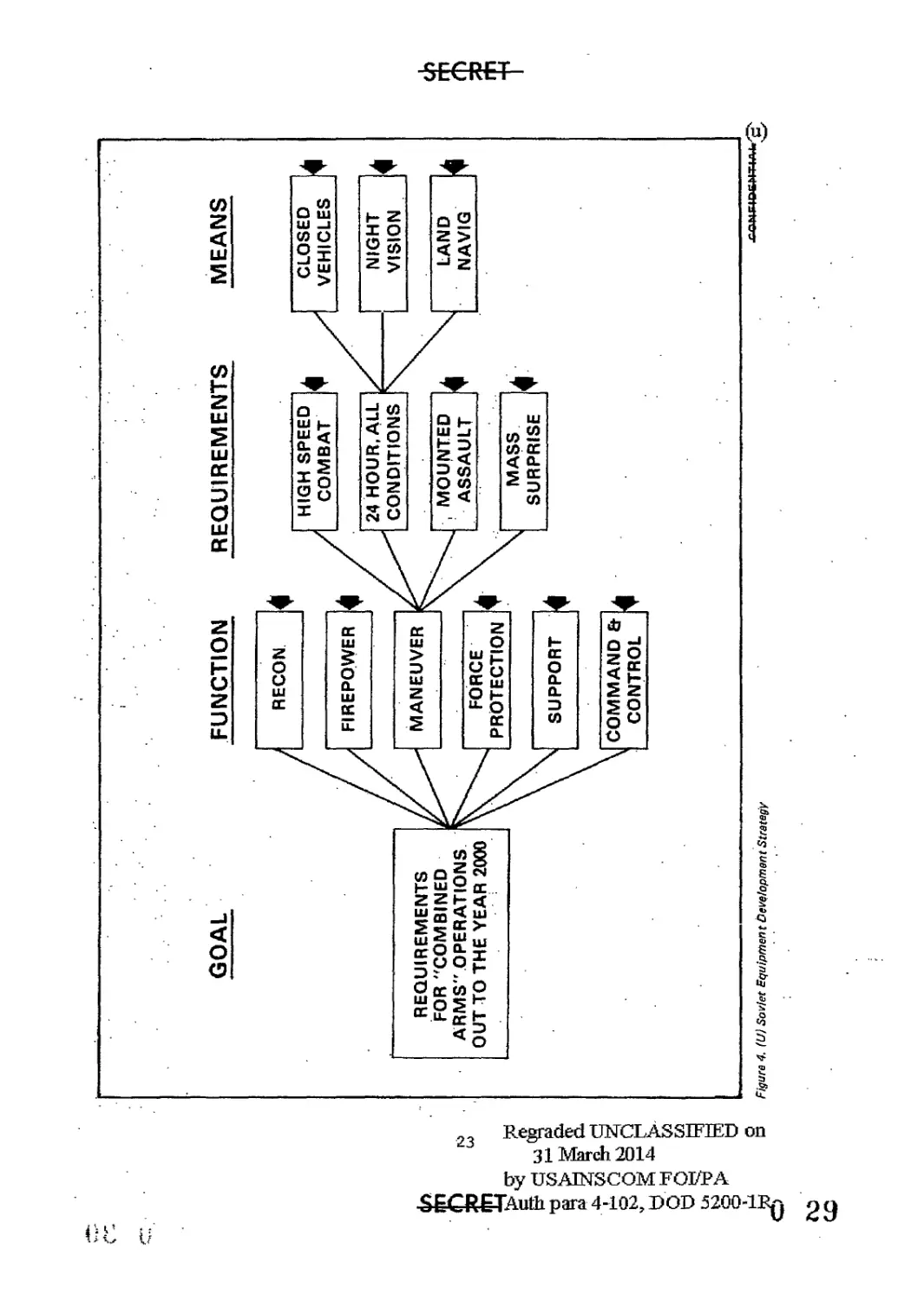
(3)	The functional requirements of this system are discussed in
detail in Volume IV of the SBDP but are highlighted here in Figure 4. As
indicated, the goal of ground force doctrine is to fight a "combined arms"
operation, i.e., a deep, continuous, high-speed penetration into the depths
of the enemy rear under NBCor non-NBC conditions. To achieve this goal,
Soviet forces must be able to perform the six functions in support of the
combined arms goal. To execute the maneuver function for example, Soviet
forces must be capable of at least the four required operations depicted on
the-chart. Selecting just one of these requirements, e.g., to perform under
"all conditions," means that the Soviets require fighting vehicles that can
remain closed during combat to avoid NBC contamination, have night vision
capability, and have internal navigation'systems for use if communications
are disrupted or if unit leaders become disoriented. That essentially de-
scribes the present Soviet infantry fighting vehicle, the BMP. By using this
approach and working backward, we can now take almost every piece of Soviet
military equipment and see what function it performs in helping the Soviets
achieve their overall goal of combined arms operations. Had we done this in
the early 1960s, taking account of new technologies, we might have been able
to anticipate the general character of the present Soviet ground force.
(u)
(4)	As suggested by Figure 5 this method also highlights areas
where new capabilities and equipment must be developed for the next
sequence of force modernization,. By analyzing and prioritizing these
22 Regraded UNCLASSIFIED on
31 March 2014
by USAINSCOM ЕО1ФА
c p	SECRET Auth para 4-102, DOD5200-1R U 28
FUNCTION REQUIREMENTS MEANS
Regraded UN CLASSIFIED on
31 March 2014
by USAINSCOM ROMP A
SSCRETAuth para 4-102, DOD 5200-1Б
Figure 4. (U) Soviet Equiptnen t Development Strategy
CQMriPSMTIrtl.
GOAL
FUNCTION
о
со
о
CAPABILITY
OF “COMBINED
ARMS” OPERATION
OUT TO 2000
Figure 5. (Ul Soviet Science and Technology
RECON
MANEUVER
FIREPOWER
FORCE
PROTECTION
SUPPORT
COMMAND AND
CONTROL
S&T REQUIREMENTS
SPACE SENSORSj
REAL-TIME DATA
PRESENTATION
ELECTRO-OPTICAL ADVANCES |
NUCLEAR MINIATURIZATION~|
SMART munitions!
SS MISSILE MINIATURIZATION
AND MILITARIZATION
MICRO-CIRCUITRY |
C0MMUNicATi0N^LWTR0Nic?j
COMPUTERIZATION |
SBgHET,

areas, we should be able to anticipate future Soviet fielding of new tech-
nologies in new or improved weapons systems and equipment. Steps could
then be taken, of course, to deny Soviets access to scientific or technical
information if we judge this information to be critical to future military
developments.
Ь1
B. Tanks
(1)	(C) The weapons development-acquisition process is a many-faceted
mechanism that provides a. well balanced array of a large number of high
quality weapons; its stellar product has been the tank. The Soviet Army
has a large economic investment and institutional commitment to the tank.
Although the viability of the tank on the modern battlefield is under
question, the Soviets will attempt to prolong the operational life of. its
tanks, by both material improvements and operational innovations. However,
the technical advancements in target acquisitions and munitions delivery
systems suggest the tank of the future will become a more integrated part of
the combined armed force, interacting more with other systems rather than
being supported by them.
* NST = NEW SOVIET TANK, OFTEN REFERRED TO AS T-80
*’ FST = FUTUR ESOVIET TANK
E = YEAR ENGINEERING DEVELOPMENT BEGINS
D = YEAR FULL-SCALE DEPLOYMENT BEGINS
P = YEARPRODUCTIONSTOPS
25
scewcT hui einn
(U)
0 31
SECRET
(2)	As indicated in Table 2 two new tanks are forecast for produc-
tion before the year 2000. These forecasts are made within the historical,
cyclical context of Soviet weapons development. Detailed estimates have
been made of the characteristics of the NST, while those of the more
distant FST are, naturally, much more general.
(u)
(3)	(ВУКОГОКМ-У As indicated in Table 3, the T-80 is estimated to pack
the same firepower as the current T-64 and T-72, but is more maneuverable
and has more armor protection. As discussed above, these improvements in
mobility and armor are defensive measures designed to retain the tanks
viability on future battlefields. Its offensive capabil-ity should also be
improved as a result of advances in fire control.
Table 3. (U) Comparative Characteristics of Soviet Tanks
Characteristics	T-64A	T-72M	NST (T-80)
Mobility Weight	38T	41T	42T .
Power	750 HP	780 HP	1,000-1,200 HP
Top speed	85 km/hr	60 km/hr	85km/hr
Firepower Main gun	125mm	125mm	125mm
Bounds	39	39	40
Protection
Hull: KE	370-440mm	350mm	500mm
Turret: KE	370-440mm	400-450mro	500mm
.SECRET HCirUHH (u)
(4)	Soviet doctrine not only requires a high quality tank but
requires these tanks in large numbers. Current estimates indicate the pre-
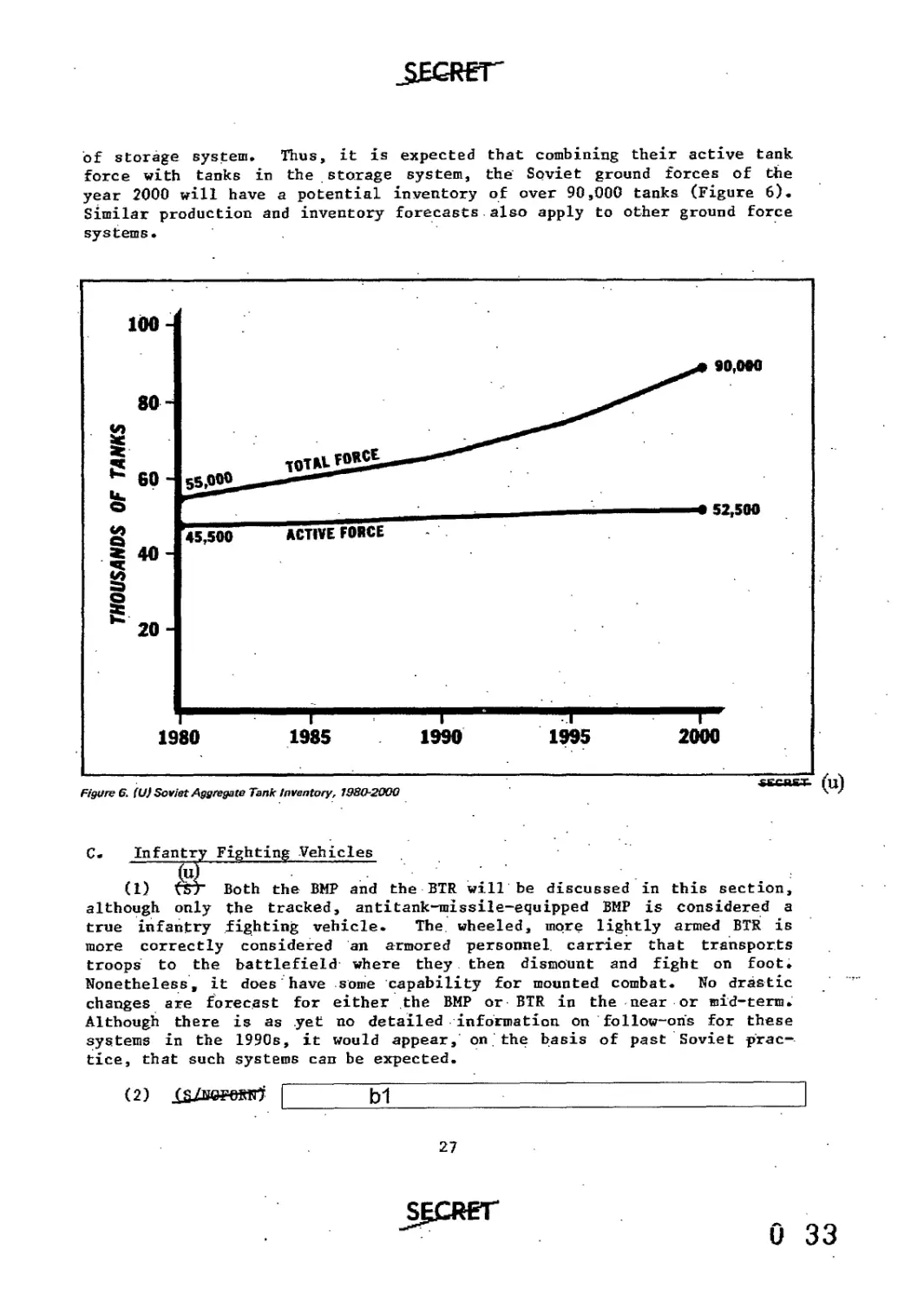
sent active ground force structure contains approximately 45,000 tanks.
The expected increase in force structure.by the year 2000 should result in
an overall increase of tanks in the active force to approximately 52,500,
or by about 15Z.
(5)	(-&У However, although the overall number of tanks in the active
force structure will increase by only 15Я, the increase in overall tank
capability should be much greater due to the high degree of force turnover.
Present production forecasts indicate that the Soviets will produce
approximately 57,000 NST and FST tanks by the year 2000, or enough to
replace the entire present tank force with new tanks. There is much dis-
cussion within the intelligence community as to the reliability of present
tank production forecasts. However, even if these forecasts are overstated
by 1/3, approximately 40,000 new tanks will enter the force by 2000, enough
to replace all the tanks in both the Western and Eastern theaters.
(u)
(6)	Future tank production presents another problem. Even taking
the low production forecast, the arrival of new tanks will cause about
40,000 T-55/64/72 tanks to drop out of the force. Previous Soviet practice
suggests that a large majority of these tanks will be retained in some type
Regraded UNCLASSIFIED on
26	31 March 2014
by USAINSCOM FOIL A
crr[-T Auth para 4-102, DOD 5200-1R
n Q9
of storage system. Thus, it is expected that combining their active tank
force with tanks in the storage system, the Soviet ground forces of the
year 2000 will have a potential inventory of over 90,000 tanks (Figure 6).
Similar production and inventory forecasts also apply to other ground force
systems.
C. Infantry Fighting Vehicles
(1)	VST Both the BMP and the BTR will be discussed in this section,
although only the tracked, antitank-missile-equipped BMP is considered a
true infantry fighting vehicle. The wheeled, more lightly armed BTR is
more correctly considered an armored personnel, carrier that transports
troops to the battlefield where they then dismount and fight on foot.
Nonetheless, it does'have some capability for mounted combat. No drastic
changes are forecast for either the BMP or BTR in the near or mid-term.
Although there is as yet no detailed information on follow-oris for these
systems in the 1990s, it would appear, on the basis of past Soviet prac-
tice, that such systems can be expected.
(2) XS/NOFeifltf
Ь1
27
0 33
Ь1
(3) In the SBDP, we forecast the continued production and use of
the BTR in Soviet MRDs. However, it is probable that certain MRDs, with
specific offensive missions, may eventually contain core configurations:of
1 tank regiment and 3 BMP regiments. This and other organizational changes
are discussed.in greater detail in Volume V.
D.
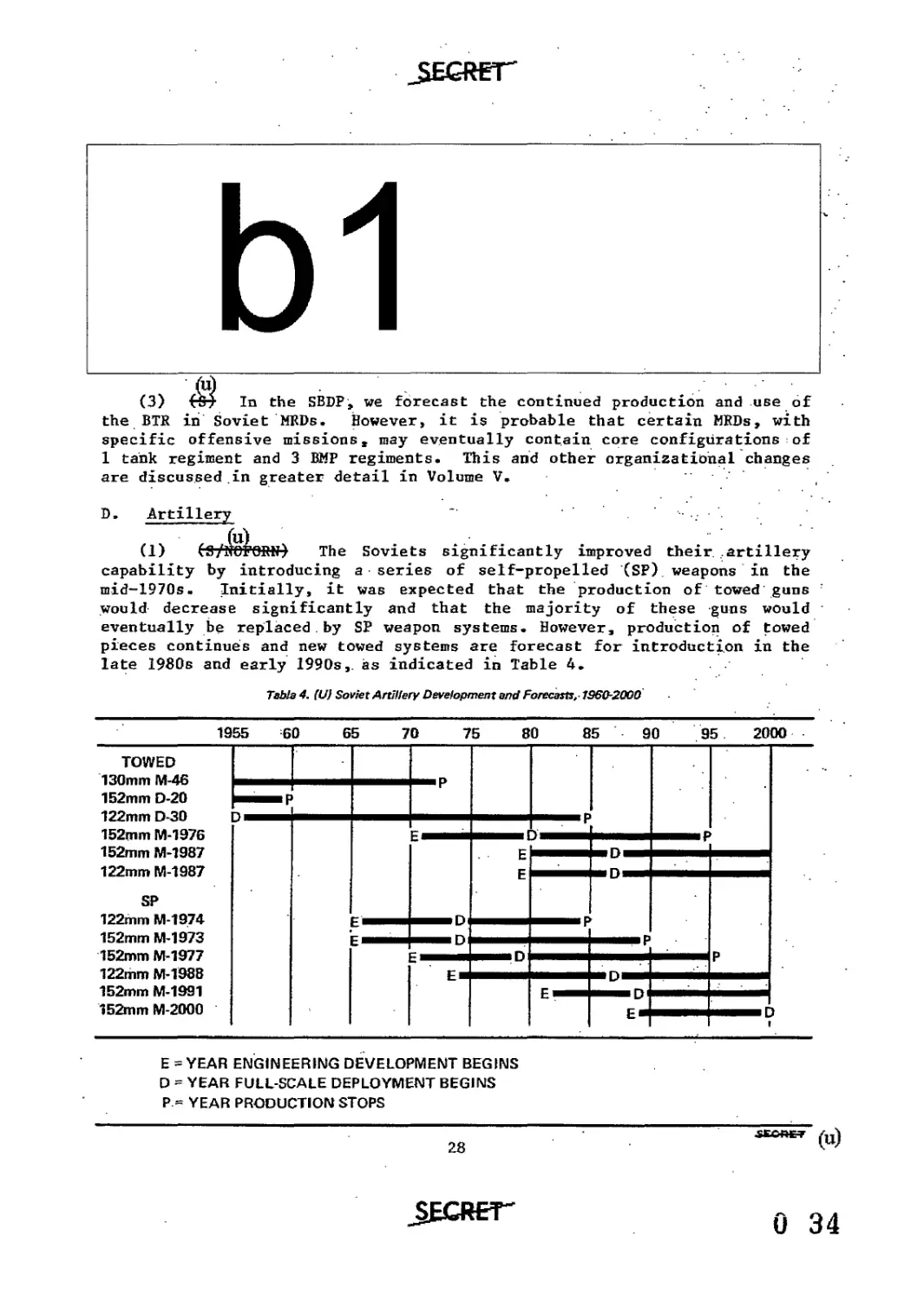
(1) (C/RO^ORN) The Soviets significantly improved their artillery
capability by introducing a series of self-propelled (SP) weapons in the
mid-1970s. Initially, it was expected that the production of towed guns :
would decrease significantly and that the majority of these guns would •
eventually be replaced by SP weapon systems. However, production of towed
pieces continues and new towed systems are forecast for introduction in the
late 1980s and early 1990s,. as indicated in Table 4.
E =YEAR ENGINEERING DEVELOPMENT BEGINS
D = YEAR FULL-SCALE DEPLOYMENT BEGINS
P = YEAR PRODUCTION STOPS
28
(U)
JEGRer
0 34
Table 4 also indicates that the first follow-ons to the recently introduced
SP systems will begin appearing in 1988 with the introduction of a new
122mm howitzer. Two new 152mm SPs are also expected, the first about 1991
and the second about the turn of the century.
(2) (tf) The specific improvements to each of these weapons are
discussed in SBDP, Volume IV. As a norm, however, most of these systems
will be improved over their predecessors in mobility, range, arid accuracy.
(u)
• (3) ($}• Projecting Soviet artillery production through the year 2000
provides the same type of pictur.e as we see for tank production, in terms
of growing fire power capabilities (Figure 7). Although the activer-force
artillery park is expected to increase by about 25X, the total force assets
should increase by more than 50Z to a total of approximately 57,000 tubes.
29
0 35
SECRET
(5)	| ы
Ы
(6)	(4fT Although this section of the SBDP Executive Summary is pri-r
marily concerned with forecasts concerning . equipment improvements, an
overall forecast for Soviet artillery capabilities must, also include
changes in organizations and operations. These changes will have an equal
if not greater impact on Soviet artillery capability than technical equip-
ment improvements. Analysis reveals that the Soviets are currently reorgan-
izing the artillery support for-both tank and motorized rifle divisions.
Some long-range forecasts call for a 10% increase, in artillery guns in sup-
port of MRDs and a 20% increase for tank divisions. However, these
increases are considered conservative! high forecasts call for 40% to 60%
increases in artillery/cannon weapons. Similar increases are also called
for in other artillery weapons, such as mortars, multiple-rocket-launchers,
and short-range ballistic missiles (SRBMs).
(7)	(U) These increased numbers of weapons, plus changing concepts in
target lethality norms and fire control techniques, reflect a developing
adaptation of Soviet artillery methods to the demands of future battle-
fields. Changes now underway will allow the Soviets to engage both static
and mobile targets more quickly and . with higher density barrages. This,
increased, more mobile, highly flexible fire support is designed to signi-
ficantly disrupt NATO's lightly armored antitank defenses. When enemy fire
positions cannot be targetted with sufficient accuracy, these increased
artillery weapons would then be able to also flood the battlefield with
obscurants and agents that would hinder NATO devices for both detection and
destruction of Soviet forces.
E. Air Defense Weapons
(u)
(1) (S/N0F0RN) As indicated in Table 5, follow-on models are expected
for air defense weapons at all unit levels from platoon to Army before the
year 2000. These new models will improve the already impressive mobile
air-defense umbrella now protecting Soviet ground forces.
(u) ч
(2)	(G/N0F0RN) Table 5 underscores the extensiveness of the Soviet
equipment improvement programs. Not only.are improvements planned in all
weapons areas, but even within a single weapons area extensive and coor-
dinated improvements are planned. Air defense units from platoon to Army
can expect at least one new generation of weapons, and. some,probably even
two new systems, before 2000 AD.
30
0 36
SECRET
fable 5. fUj Soviet Tactical Air Defense Development and Forecasts, 1S60-2000
UNIT TYPE | 60	65	70	75	80	85	90	95	2000
PLT/CO	SA-7 SA-14 SA-14F0	E"							D


REGT	ZSU-23-4 ZSU-X ZSU-Y SA-9 SA-13 SA-13FO		—E					-

									•	 Dmmb
							r


DIV	SA-6 SA-8 SA-8FO SA-11 SA-11 FO LASER	Е»


									—D


ARMY	SA-4 SA-12 SA-12FO

									M	>D"mmb
E = YEAR ENGINEERING DEVELOPMENT BEGINS
D = YEAR FULL-SCALE DEPLOYMENT BEGINS
P = YEAR PRODUCTION STOPS
ДЕеИЕТ NOT-ORN . /ц)
F. Short and Intermediate Bange Ballistic Missiles
Jill
.. (1) ГЗт Short and intermediate range ballistic missiles can be found'
at division through theater level. As indicated in Table 6, the Soviet
research, development, and acquisition process provided initial systems in
the early 1960s, updated versions in the mid-1970s, and is forecast to pro-
vide another follow-on series before the turn of the century.
Regraded UNCLASSIFIED on
31 March 2014
•	by USAINSCOM FOIZPA
Auth para 4-102, DOD 5200-1P.
SECRET
0 37
E = YEAR ENGINEERING DEVELOPMENT BEGINS
D = YEAR FULL-SCALE DEPLOYMENT BEGINS
P = YEAR PRODUCTION STOPS
FO = FOLLOW-ON MODEL
-seewEi- (u)
(u)
(2) (-SW- The SS-21 and SS-23 models located at division and army are
estimated to have nuclear, chemical, and high explosive warheads. Those at
front and theater are believed to have nuclear and chemical warheads.
(3) Improvements forecast for the follow-on models expected in the
1990s are mainly in accuracy, with (B(i)&(b)(з)percia expected for all of
these missiles. This improvement in accuracy will allow for more effective
use of HE and lower-yield nuclear warheads. Thus, operational commanders
in critical situations will be able to deliver highly accurate fires to the
depths of opposing enemy forces without depending on air-attack support
that is vulnerable to antiair defenses.
G. Assault Helicopters
(u)
(1)	Soviet operational interest in assault helicopters increased
in the late 1960s and early 1970s, as Soviet indnstrial facilities began
producing them in significant numbers. The HIP (MI-8) is the workhorse of
the helicopter fleet. Well over 8,000 having been produced since its IOC
in 1966. Numerous modifications have been applied to the basic HIP,
enabling it to perform a variety of roles, such as command snd control,
communications relay, and close air support. The HIP-E variant, for example,
is the world's most heavily armed helicopter, with a 12.7mm nose gun, six
32-shot, 57mm rocket pads, and four anti-tank guided missile rails.
32
.SECRET
0 38
SECRET
(u)
(2)	(C) A second assault helicopter, the HIND, appeared on the scene
in 1972. The HIND is a smaller, faster gunship and like the HIP it has
undergone several.modifications. . The HIND E has an impressive array of
armaments, mounting a 12.7mm, 4-barrel Gatling gun, 4x32-shot 57mm rocket
pads, and 4x AT-6 antitank guided missiles.
(u)
(3)	A totally new ground attack helicopter (MI-28) is now in
development and may enter the force in the 1983-1985 timeframe. The MI-28
has been described as a two-seat attack helicopter without the. usual Soviet
provisions for cargo or passengers. Information indicates the MI-28 is a
copy of the US AH-64. G. P. Smirnov, who in 1977 was Chief of the Trans-
mission Department in the bureau where the MI-28 was being.designed, report-
edly stated, "We are not designing a new helicopter but are copying the US
design."' The copy will probably not be exact but the -resemblance will no
doubt be unmistakable.
(4)	CSj The helicopter is becoming an important Soviet battlefield
weapons platform. It is forecast that by 1990s first-line'divisions will
have helicopter squadrons of 18 aircraft to support division operations.
Moreover, lead divisions will receive additional helicopter support from
army and front air assault or airmobile assault brigades. .These forces
will secure bridgeheads, attack, and secure isolated objectives, move inter-
diction forces* and provide fire support. Their presence on the battle-
field provides the Soviet commander with another asset to influence the
battle. More importantly,, growing use and increased knowledge of its capa-
bilities will provide that commander with an .appreciation for flexible
operational planning and quick response initiatives.
H.	Tactical Air
fu)
(1)	(-£)- The Soviets are reemphasizing the ground- support role of
fighter-bomber aircraft; In 1980, a reorganization of the national air
force structure took a significant number of aircraft away from direct
nationa-l level control and placed them under the control of front comman-
ders. Moreover, the emphasis appears to be moving away from a purely
air-defense/air-superiority role toward more emphasis on deep-attack sup-
port role.
.......>)
(2)	(8/НОНеИГ-) At present, the Soviets have four primary ground-support
aircraft. The SU-17 (Fitter) and MIG-27 (Flogger) are single-seat, single-
engine, variable geometry wing (VGW) fighter-bombers. They both have some
adverse-weather and night-attack capability against area targets. The
SU-24 (Fencer) is a two-seat, twin-engine VGW fighter-bomber' designed spe-
cifically for the . ground-attack role. It is believed to have a
navigational/attack radar and a terrain avoidance capability that enables
it to bomb with appropriate point-target accuracy under all' weather con-
ditions at altitudes down to 300 meters. The latest addition to Soviet
ground-support aircraft is the SU-25 (Frogfoot), a subsonic fighter with
the primary mission of close air support and the capability of operating
from highways or prepared sod fields. Regraded UNCLASSIFIED OH
31 March 2014
byUSAINSCOMFOIflPA
33 Auth para 4-102, DOD 5200-1R
SECRET
0 39
SECRET
(3)	'('S') It is forecast that the aging SU-17 (Fitter) and MIG-27-
(Flogger), and eventually the SU-24 (Fencer), will be replaced by a new
fighter-bomber, with a possible deployment date of 1987. This aircraft
will incorporate improved aerodynamics and new avionic subsystems and will
probably have a low-altitude penetration capability.
I.	New Technology Weapons
(u)
(1)	(S) In addition to improvements and follow-ons to present systems,
the Soviets are expected to field new-technology weapons in.the 1990s. The
areas of most promising potential appear to be radiofrequency weapons and
lasers. . .
(U)
(2)	(3) We also forecast that the Soviets will field-test, laser, proto-
type weapons by the mid-1980s. These lasers are expected to be mounted on.
both ground and airborne platforms. These systems are expected to' be
effective out to 15 kms against targets such as personnel, optical equip-
ment, helicopters, tactical missiles, and unarmored vehicles.
J.	Other Weapon Systems
(1)	(U) This Executive Summary cannot present all forecasts for.Soviet
ground force systems, and the reader is therefore directed to Volume .IV,
SBDP for additional detailed forecasts.
(2)	(0) It is important to point out here that it is not just new and
improved major weapons that should be taken into account when planning to
counter the future Soviet threat. Equally important are improvements in
supporting equipment and system components, such as munitions, fire control
systems, and command and control. Forecasts in these areas are also con-
tained in -Volume IV.
Regraded UNCLASSIFIED on
31 March 2014
by USAINSCOM FOI/PA
Auth para 4-102, DOD 5200-1R
-SECRET	Q 40
SECRET
Section	6. Forecasts for Organizations
A.	Background
(u)
(1)	vv? Forecasts of organizational developments are markedly more
difficult than those in techological areas, where potentials for ..future
progress are often similar for both the East and West and where progress
can often be more easily monitored, thus providing more credible forewarn-
ings of Soviet advances. Organizational changes can result from changes
in equipment, in operational concepts, in operational areas, in resource
constraints, in enemy tactics, or the like.
(2)	(U) Organizational forecasts in the SBDP volumes are centered oh
divisional forces. Volume V of the SBDP contains both mid-term forecasts
for Soviet motorized rifle, tank, and airborne divisions in. 1990 and long-
term forecasts for these divisions out to the year 2000. Some .forecasts of
Army and front changes, especially in helicopter and air support were also
attempted.
(«) . . . ' .
(3)	No major organizational changes between the 1990 divisions and
the "best" year 2000 divisions are forecast. Additionally, the forecasts
contained in this Executive Summary and in Volume V relate, to the. top'
Soviet divisions, i.e., the type of division found facing NATO along the
German borders. Organizational forecasts will not be made for Soviet divi-
sions in other geographical areas. However, the present organizational and
equipment differences among these other divisions can be determined by
reviewing individual division equipment holdings, as summarized in Volume
III of the SBDP. Although all divisions will probably be improved over the
long-term, the relative degree of the disparities that exist today between
top- and bottom-line divisions will probably extend into the future.
B.	Division Changes
(1)	The major changes that will characterize the divisions of 1990
are already being implemented. In the late 1970s, new organizational con-
cepts were developed and tested. In 1980, the Soviets began implementing
those concepts that proved most successful in field tests.
(u)
(2)	The major changes to the MRD are indicated in Table 7.
(3)	1?$ The major changes to the tank division are indicated in Table
8.
Regraded UNCLASSIFIED on
31 March 2014
by USAINSCOM FOIZPA
35 Auth para 4-102, DOD 5200-1R
SECRET	0 41
SECRET
Table 7.	(U) Changes in the Organization of the Soviet MRD, 1990
6 An artillery battalion added to the tank regiment,
(increase of 18 firing units.)*
о Artillery regiment reorganized to include:
-	three 152шш SP battalions
-	one multiple rocket launcher (MEL) battalion
(increase in SP mobility, and 18 MEL units)*
о Helicopter squadron formed:
-	six HIND type helicopters
-	eight HIP type helicopters
-	six HOPLITE helicopters
(a new air support capability)*
о . Laser weapons units formed: .	.
-	one SP high-energy laser per maneuver regiment
-	one SP low-energy laser per maneuver battalion
(a new capability)
*compared to 1980 MED .
ввели- (u)
Table 8.	(U) Changes in the Organization of the Soviet TD, 1990
o Motorized rifle company in each tank regiment expanded to a
battalion, (increase of 78 BMPs)*
о An artillery battalion added to each tank regiment,
(increase of 54 firing units)*
о Artillery regiment reorganized to include:
-	three 152mm SP battalions
-	one multiple rocket launcher (MRL) battalion
(increase in SP mobility and 18 MEL units)*
о Helicopter squadron formed:
-	six HIND type helicopters
-	eight HIP type helicopters
-	six HOPLITE helicopters
о Laser weapons units formed:
-	one SP high-energy laser per regiment
i — one SP low-energy laser per maneuver battalion
(a new capability)
*compared to 1980 TD
'(»)
Regraded UNCLASSIFIED on
31 March 2014
by USAINSCOM FOKPA
Auth para 4-102, DOD 5200-1R
SECRET
0 42
SEGRFT
(4)ф)-£8) The major changes to the airborne division are indicated in
Table 9, below.
Table 9. fUI Changes in- the Organization of the Soviet ABND, 1990
o All three regiments equipped with BMD armored fighting vehicles. .
(increase of 210 BMDs)*
о Airborne assault gun battalion expanded from 31 to 40 guns
(increase of 9 guns; upgrade from 85 to 100-125nnn)*
о Laser weapons units formed:
- one low-energy laser per maneuver battalion
(new capability)*
*compared to 1980 ABM)
ч	«6ПБТ (u)
(u)
(5) tfB The divisions of 1990 are characterized by significant
increases in firepower and mobility resulting from increases in infantry
fighting vehicles, attack, and transport helicopters, Arid self-propelled
artillery. More speculative, but possible nevertheless, is the infusion of
laser weapons into the battlefield which would significantly increase the
Soviet division's capability to impede enemy intelligence functions. The
overall impact of these changes would be in providing the Soviets the
potential for greater battlefield quickness and flexibility.
(u) . . .
(6) w) The divisions of the year 2000 are expected to change organ-
izationally from those of 1990 in two specific areas: Laser units and the
helicopter support squadron, both of which should almost double in size as
production of these systems comes more closely into line with operational
demands.
(u)
.(7)	Other improvements of.the year-2000 division over the 1990
division should result mostly from refinements of changes undergone in the
late 1980s and early 1990s. The divisions will also benefit from incre-
mental quality improvements in their weapon systems. Finally, command and
control procedures tested over time should significantly enhance the
"combined-arms”.capability of Soviet forces by the year 2000.
37
SECRET
0 43
Ь1
C. Army, Front, and Theater
(1)	(U) Our efforts in compiling SBDP-2000 revealed that some of the
most significant Soviet organizational and operational developments over
the next 10-15 years will occur at army, front, and theater level.
(u)
(2)	(S’)’ The present SBDP discusses the impact of some of the more
significant organizational changes at levels above division. An example of
such a change is indicated in Figure 8. As a result of the 1980 reorgani-
zation of both the Soviet Air Force and the Troops of National Air Defense
(PVO), some tactical aircraft have now been placed under the direct control
of the front coninanderi Such assets 1 increase his battlefield power and
flexibility.
(u)
(3)	Additionally, since 1980., the Soviets have formed about
12 air assault brigades and have apparently placed one in support of each
front commander. Thus, he now has a large, flexible, well-armed force that
can be employed early in the battle against targets deep in the enemy’s
38
.SECRET
0 44
SECRET
operational and/or tactical rear» Brigade air-assault units will seize,
disrupt, or destroy nuclear weapons, airfields, C^, logistics facilities,
and key terrain such as river-crossing sites and road junctions and thereby
help shift the focus of the battle'away from the FEBA. If successful, the
activities of the brigades should first facilitate, rapid penetration by
first-echelon units through the enemy's forward defensive zone and, second,
directly, support the high-speed movement of large exploitation forces
advancing into the depths of the enemy's‘defenses»
(u)
(4)	In addition to the fronts r- armies are also acquiring more air
assets, thus improving their deep strike and combined arms capabilities.
An aviation organization has recently been established in tank and. combined
arms armies. Although not a lot of detail is known about this unit, it
does- include an attack helicopter regiment. As a highly mobile fire sup-
port platform, the MI-24 HIND helicopter constitutes the backbone of this
organization. In the future, this unit may also include the new SU-25
ground support fighter.
(«)
(5)	(-S4 It has also become clear over the past year that nondivisio.nal
Soviet artillery units are undergoing major structural change. Some
artillery regiments have been upgraded from, three 16-gun battalions to
brigades of four 24-gun battalions. This represents an 802 increase in
artillery, assets. Similar changes also appear to be underway in some
artillery divisions subordinate to fronts.
(u)
(6)	(S/WOFORNj Finally, the Soviets are in the midst of a major program
to modernize their entire inventory of theater nuclear missiles. As noted
under equipment forecasts, the mobile SS-20 is being complemented by a new
generation of tactical- and operational-level missiles. In addition to
equipment modernizations, the Soviets are also reorganizing Army level
missile brigades, upping the number of launchers from 18 to 27, a 502
increase in launch capability. Figure 9 depicts the depths to which these
missile systems can bring nuclear and conventional fires-.
ч (U)
(7)	(-&) These marked increases in the quantity of artillery, missiles,
and aviation assets, as well as their improved quality, enhance the ability
of the combined-arms commander to -quickly mass' conventional and/or nuclear
fires in conjunction with ground maneuver operations. These enhanced capa-
bilities are critical to the success of the Soviets’ new operational con-
cepts, presented in the following chapter.
Regraded UNCLASSIFIED on
31 March 2014
by USAINSCOM FOIZPA
Auth. para 4-102, DOD 5200-1R
0 45
-SEGREF
Section 7. Forecasts for Operations .
A.	(U) Background
(1)	(U) As the previous' discussion of Soviet doctrinal development
made clear, by the early 1960s the Soviet General Staff had developed clear
ideas of the impact advances in nuclear weapons, rocketry, cybernetics, and
motorization would have on battlefield operations. Among the most. impor-
tant concerns, as underscored by Sokolovsky in his work, Military Strategy,
were the following three: First, a need to protect forces from NBC effects.
Second, a requirement to concentrate and/or rapidly shift combat forces to
breakthrough enemy defenses, yet not present lucrative targets for enemy
nuclear weapons; and thirdly, a need for speed of execution in order to
exploit fully the enormous increases in fire power, both in range and
explosive potential, and also to exploit the significant improvements in
ground force mechanization. In the early 1960s the General Staff, viewed
these operational requirements primarily in a nuclear context. By the
mid-1970s, they began to realize that their new operational concepts for
the nuclear battlefield greatly enhanced their conventional war-fighting
capability as well.
(2)	(U) The first requirement for the modern battlefield noted above,
protection from NBC effects, was provided in three general ways. First,
armor protection, which already made the tank troops a potent nuclear
force, was provided to infantry and then to the artillery. Next, NBC
defensive gear, both personnel and collective, was developed arid decon-
tamination devices were introduced. Finally, protection was enhanced
through dispersion, aimed at denying the enemy concentrated, high-value
force groupings. This dispersion was, and still is, achieved through
"echelonment," i.e., the dispersal of forces rearward, in intervaled
columns, which are separated laterally in order to reduce nuclear as well
as conventional weapons effects.
(3)	(U) Bnt dispersal for protection tends to limit or reduce one's
ability to concentrate and/or shift combat power rapidly. Soviet theoreti-
cians have tried to resolve the dispersal-concentration trade-off in two
ways. First, operationally decisive (i.e., nuclear) fires capable of de-
stroying enemy defensive positions could be massed on objectives from widely
separated locations by air and rocket delivery. This capability represents
a revolutionary change in battlefield tactics. No longer would there neces-
sarily be a direct relationship between power and massed troops. Instead
of troops, supported by artillery fires, destroying enemy defenses at the
critical point, nuclear fires could now destroy these defenses.and could
then be followed up and exploited by ground forces moving through the'
breach in closed fighting vehicles and striking deep into the enemy's rear.
(4)	(u) Mass could also be achieved by ground forces as well as fires.
In this method, the echeloned columns of mechanized forces advance at high
rates of speed toward the enemy’s defenses;. As the offensive goes forward,
Regraded UNCLASSIFIED on
31Mateh2014
by USAINSCOM FOI/PA
Auth para 4-102, DOD 5200-1R
0 46
40
SECRET
SECRET
the density of combat forces builds up dramatically and quickly at the
FEBA. Enemy defenses should be overwhelmed before significant enemy
reserves can reach the point of main attack. Succeeding echelons of fresh,
high-speed mechanised forces quickly exploit the breakthrough' and achieve
redispersion by deep penetrations into the enemy’s rear.
(5)	(U) Both of the previous requirements for battlefield success,
i.e., protection of forces and concentration of power, are highly dependent
on the third, i.e., speed of- execution. This operational concept clearly
places great reliance on quick and effective troop-leading procedures, ade-
quate intelligence, and robust cormnunications—in other words, what we call
C^I (command, control, communications, and intelligence). Increased speed
of operations is the primary goal for present Soviet leaders.
(u)
(6)	'£9} Soviet writings about nuclear weapons have'dwelt extensively
on their "decisiveness” and on the greater importance of the "initial period"
of war when nuclear weapons are used. This view is very.'consistent with
high speed, deep operations. And it implies well coordinated, large, ini-
tial nuclear fires throughout the theater, which will create the possibility
of decisiveness if the ground offense is swift and deep enough.to exploit
them. It does not, however, imply the necessary use of nuclear weapons,
but it does compel Soviet leaders to try to avoid being surprised by an
opponent's nuclear first-use and to seek to beat the opponent to the punch
by large devastating lay downs of nuclear weapons. Precisely how to
preempt the eneny's "first-use" has long been an ambiquity in Soviet opera-
tional doctrine. Their force structure, however, suggests that they want
to retain as much choice as possible not to use nuclear weapons, for as
long as possible. They do not want choices predetermined or automatic as" a
result of force design and doctrine. But once the nuclear use is decided,
the first blow is, in their view, possibly decisive. Their forces are
designed to provide successive strikes over days and weeks. How signifi-
cant these lay-downs will be is not so clear to them. They are not even
clear about whether to include them in the "initial period." The length of
the "initial period," it seems, could be hours, days, or even, weeks or
months in length. We are inclined to see this ambiquity in Soviet doctrine
not as a weakness but rather as a realistic appreciation of the uncertain-
ties nuclear weapons present to military planners and of the necessity to
keep open as many options as possible in the event of war.
B.	The Ogarkov Era
(1)	(U) Marshal Ogarkov’s assignment as Chief of the General Staff in
1977 marked the beginning of a new series of initiatives to carry
Sokolovsky's "force development plan" further and to achieve it faster. In
reviewing Soviet military development since the 1960s., Ogarkov' praised the
progress made in equipment and organizational development. However, he
expressed concern over the failure of operational concepts to keep pace
with equipment developments. Operational planners were not maximizing the
battlefield potential of new improved weapon systems.
(u)
(2)	(&} Figure 9 presents the kinds of improved weapon capabilities
Regraded ^CLASSIFIED on
31 March 2014
by USAINS COM FOM’A
Auih para 4-102, DOD 5200-1R.
0 47
SECRET
SECRET
(«)
Figures, (Ui Ranges of Soviet Division-, Army-, and Front-Level Organic Missiles
Regraded UNCLASSIFIED on
31 March 2014	42
- .by USAINSCOMFOIZPA
' Aulfi para 4-102, DOD 5200-1R SECRET
О 48
SECRET
Ogarkov had in mind. It indicates the depths to which Soviet commanders at
various organizational levels can place nuclear or conventional fires by
using their organic missile assets. When these•ranges are superimposed on
a map of Europe, we see that Soviet army— and front-level commanders, from
the very beginning of the conflict, have the capability to target fires
against objectives west of the Rhine. Additionally, the combat radii of
front-controlled ground support aircraft have significantly •increased over
the last decade and further support Ogarkov's contention that present capa-
bilities "substantially exceed the framework of (current) front operations;"
ч («)
(3)	1 (S')' In order to improve the operational capabilities of Soviet
forces and ensure that they maximize the combat potential of the new and
improved, weapons systems, Marshal Ogarkov has implemented the following
changes since becoming chief, of the General -Staff in 1977:
-	1976: A new theater command was established in the Far East,
creating a more balanced semi-independent war fighting capability
on both the USSR’s western and eastern borders.
-	1979-80: The most significant shuffle of high-level commanders
and staff officers in almost a decade occurred. Critical positions
for doctrinal developments and troop training were taken over by a
new generation of military leaders.
-	1980: Reorganization of Air Defense Troops resulted in improved
integration with ground forces.
-	1980: Reorganization of Frontal Aviation also resulted in
improved integration with ground forces.
-	1980: Air Assault Brigades were created and assigned to fronts.
-	1981: A major exercise, ZAPAD-81, was conducted and formalized, the
acceptance of new organizational and operational concepts that had
been under test since at least 1977. Among these concepts were:
— Operational Maneuver Groups (ONG)
— Increased Tactical Artillery Support for Divisions.
—Increased Helicopter Support for Divisions.
-	1981: The new concept of a "theater-strategic operation" was
announced-.
(4)	(U) A review of these' changes reveals significant innovation
emerging at each level of organization from division up to "theater of
military operations" (or TVD, the Soviet abbreviation). From what we have
already uoted concerning organizational developments, and from what Ogarkov
has provided in overall operational guidance, we can infer rather con-
fidently the main thrusts of future operational developments.
Regraded UNCLASSIFIED on
43	31 March 2014
by USAINSCOM FOEPA
Auth para 4-102, DOB 5200-1R
SECRET	° 49
SECRET
С. .. Piyisi on	. The 1978—80 period saw the /’bellwether" .phase „{Figure. 3)
of ..the; )пеНч;1®Р»?>Тр.э-, and aifborne. division, structures.» Present activity
indieates j .vthat, divisions, are- well .into the "leading edge^ phase''.; of . the
•force -mp.dernization .,,:'. system.Division ; .reorganization.- has. tesulte.d.\ in
greater;;artillery: :shppSrf.-; for. all. ..divisions .and increased-imptorized .rifle
support - for fttank ^regiments;.-:, Moreover» organic helicopter :s.quadrons will: be
part ?of-:;;all .-.frontrline .divisions • . From an operational standpoint, these
ae^. divisions .веет... tp.v..require little cross-attaching.*. or .-ta.skrt.ailoring-...as
missions-, change». .At. , the. same time, they have more armor.^protection,
improved air-defense, and will probably receive laser weaponry by 1990.
Thus»; when - they finally existin significant numbers iearly ;1990s) they
will comprise-. a; ..faster;-, mor e :versatile, ,better -protected, "combined.. .arms’’
force»:one more-....capable of. operating to the full doctrinal, potential
outlined by Sokolovsky,.
D . - ; The,-Army
’ (jl) = \	.	.
(1) '('3J Armies» ; usually. composed of 3 to 6 divisions,- seem- to be the
level at which most "task force tailoring" will occur in order to achieve
the .-.bestj-mix;: ;of . tank and motorized rifle divisions -necessary ;to accomplish
a-.;. .specific^.?missipn.. ;Mpr.eover, increased assault helicopter-assets and
improved. surfaee-tprsurface,missiles will also provide- improved- operational
potential, in two ways» First, the improved range and. accuracy of deep
fire support gives the commander a capability to strike targets deep in his
area, of responsibility. What Ogarkov appears to be. ;calling for is an
improved operational capability for support.weapons to quickly.strike deep,
but in such a way that the strike facilitates the attack and exploitation
phases, of. . either .the... front-line division's or the army’s operational
maneuver groups (OMGs) as early in their deployment as possible» .
.(2)-	(U). Second, while SSMs and aircraft are striking deep^ increased
assault helicopter assets will allow more support operations at shorter
distances--from-the. front of the attacking divisions.. These helicopters can
alsofacilitate the army's "operational maneuver groups" by:swiftly trans-
porting heavy fire power or supplies to assist them deep behind enemy lines.
(3)	(U) The OMG concept, can be found in early Soviet military writ-
ings. However, since Ogarkov has become Chief of Staff, the OMG concept of
forming a tailored, high-speed. exploitation force at army and front level
has achieved increased emphasis» This force is flexibly structured,
depending on the. battlefield situation and is designed to move deep into
the enemy rear area and achieve critical objectives, normally before
second-echelon Soviet formations are committed to combat,»	'
(4)	(U) Although the composition of OMGs appears to be highly
situation dependent, an army. OMG could be as large. as a reinforced, divi-
sion, while a front. . OMG could be as large as an army. OMGs may. be
established before an operation as part of the initial plan -or during an
operation, to .exploit an unforeseen opportunity. It is most likely to be
used when the enemy’sdefenses are perceived to be at a low state of readi-
ness or when these defenses are relatively shallow and not supported by
Regraded UNCLASSIFIED on
44	31 March 2014
?. ..	by USAINSCOMFOIZPA
SECRET Auth para 4102f DOD 52o°0LR5
SECRET
large reserves. The OMG has the mission of. penetrating lightly defended
areas along the FEBA in order to get behind enemy lines to disrupt
logistics, troop movements, and the like. OMGs would make lateral rein-
forcement or movement by NATO units extremely difficult. Additionally, the
OMG has a good chance of confusing NATO intelligence. While moving to the
FEBA, the OMG, if detected, might confuse NATO intelligence organizations
attempting early determination of the area of main frontal attack, or it
might be mistaken for the second echelon moving forward.
,fa)
(5)	(S) The OMG concept, when coupled with other operational changes
such as increased artillery support, emergence of air assault brigades,
etc., results in forecasts of increased flexibility for the Soviet ground
forces commander. He will- now have more ways to respond to operational
tactical problems and more assets to achieve his missions. The high speed,
and increased tempo of operations apparently essential to the "theater-
strategic operation" seems to require more flexibility on the part of regi-
mental and divisional commanders. The requirement for detailed planning
before the initiation of the operation still remains. However, more flexi-
bility in option selection appears probable when operations do not go as
planned or when operations unexpectedly provide favorable opportunities for
quick exploitation. The degree of flexibility allowed, however, can only
be determined by analyzing Soviet exercises over time.
E.	The Front
fa)
(1)	The front appears to be receiving all of the same upgrades
that we see in the army, plus additional ones. The frontal aviation and
air defense reorganization discussed earlier is providing front commanders
with organic aviation and air defense that were previously under the control
of Moscow. In other words, in addition to better deep fire support with
surface-to-surface missiles and helicopters, the front will also have its
own aviation and air defense. The front, it seems, is evolving into a true
"combined arms" organization.
(2)	(U) The operational aim of this reorganization, Ogarkov has made
explicit, is faster frontal operations♦ Ogarkov has specifically commented
in published articles that during World War II fronts often halted for days
and weeks between operations. This operational characteristic- has continued
to the present. However, Ogarkov insists that in future wars, frontal opera-
tions.must be continuous, the second following almost immediately upon the
first. .
F.	The Theater Military Operations (TVD)
fa)
(1)	The Soviet General Staff seeks to achieve this continuity in
frontal operations by establishing increased command and control capability
at the theater (TVD). level. The concept of a'TVD operation is not new; the
term, has been in use at least since WW II. However, now we are seeing it
emerge as a fully developed and staffed command level, managing two or more
fronts and being directed either by the General Staff or the theater command.
At the moment, we know very little concerning the details of this 'new
RegradedUNCLASSIFIED on
45	31 March 2014
by USAINSCOM FO3ZPA
________Auth para 4-102, DOD 5200-1R
SECRET	~
U 51
SECRE-T-
operational concept. However, we do have a sense of the importance it has •
begun to assume.
(2)	(U) In his published articlest Ogarkov explains from a historical
view why the theater operation is so important to.future warfare.. He states
that whereas a country’s highest combat grouping during the 16th century
was a regiment, developments in weapons, support equipment, and lines of
communication forced these groupings to grow to brigades in the 17th cen-
tury and to divisions in the 18th century. During the Napoleonic period of
the early 19th century, armies emerged as the highest, operational command..
Wars then became a series of army operations.
(3)	(U) As the 20th century began, this evolutionary process con-
tinued. During the Russo-Japanese War in 1904, there arose again the need
to find new ways to centralize control of even larger masses of troops, and
for the first time a ’’front ,*' consisting of two or more armies, emerged.
WW II became a series of front operations, and as the war ended, fronts
were beginning to be combined into groups of two or more. . Thus was laid
the foundation for the next higher operational level , for the theater-
strategic operation.
(4)	(U) Based on the just-described historical evolution of military
operations and on the extremely significant, technological advancement in'
weapons and support equipment over the past 10 years, Marshal Ogarkov comes
to this conclusion in a 1982 article:
"Thus one should evidently consider as the principal.
operation in war today not the Front but rather a larger-
scale form of military operations—the theater-
strategic operation. In the course of such an
operation, each Front can conduct two or more front
operations in succession with brief pauses and even
without pauses." (Emphasis added).
(5)	(U) Although many details of this new operational concept are
unknown, it is clear from Ogarkov's words that at least oneobjective is to
do away with major pauses in offensive operations. Thus, operational empha-
sis will now be placed on the concept of continuous land combat, conducted
relentlessly, day and night until deep objectives are achieved. The opera-
tional emphasis here is not only on improving night fighting capabilities,
although that is part of it. The primary emphasis is on the concept of
"continuous" combat. This means the ability to gather more and more infor-
mation in shorter periods of time in order to make quicker decisions in
more complex situations. Most importantly, all this must be done.while the.
operational units are on the move under combat conditions.
(u)
(6)	(SJ In order to shorten the time during which the rigors of
"continuous combat" will be required, it is probable that, almost simulta-
neous strikes will be conducted throughout the depths of the TVD. Special
operations forces (SPETZNAZ) infiltrated into the enemy's rear prior to
D-Day, will begin the offensive with disabling attacks against command,
Regraded UNCLASSIFIED on
46	31 March 2014
by USAINSCOM FO1ZPA
Auth para 4-102, DOD 5200-1RU 5 2
SECRET
SECRET
PRESENT ESTIMATES
600—800Ktn
OBJECTIVE C
12-15 DAYS
— 600—800Km
. PAUSE
FRONT I3_5 DAys
FRONT
250Km -H
OBJECTIVE В
12-15 DAYS
OBJECTIVE A
5-7 DAYS
TOTALS:
1200-1600Kms
27-35 DAYS
POSSIBLE RESULTS UNDER THE THEATER-STRATEGIC CONCEPT
600—800Km
FRONT
OBJECTIVE C
10-13 DAYS
600-800Km
PAUSE
±1 DAY
OBJECTIVE A
5-7 DAYS
TOTALS:
1200-1600Kms
22-28 DAYS
Figure 10. fUJ Front Operations
47
Regraded UNCLASSIFIED on
31 March 2014
by USAINSCOM FOIZPA
Auth para 4-102, DOD 5200-1R
SECRET	0 53
SECRET
control, communications and nuclear targets located throughout the battle
area. These attacks will be coordinated with and closely followed by
attacks by aircraft and missiles against targets deep in the enemy’s rear,
while ground forces •attack the forward area. Airborne and air-assault
forces and operational maneuver groups will begin operations against targets
to the rear of the forward area. These attacks throughout the depths of
the battle zone are designed.to prevent the marshaling of the enemy's coun-
terattack capabilities, and. at the same time to prevent an orderly
withdrawal of his front-line forces. The intent is to avoid long, .drawn-
out, successive stages of an offensive by compacting these stages into an
almost simultaneous act. Although the factors of time, space, and maneuver
will not achieve immediate victory, the driving concepts of "attack,
throughout the depths" and "continuous land combat" will shorten the time
required to achieve the results desired.
W
(7)	It is difficult to represent quantifiably the battlefield
changes that might result from the development of this "theater-strategic
operation.” However, Figure 10 shows one possible result. The top half of
this figure depicts presently accepted time and distance goals for frontal
operations. The bottom half indicates expected changes resulting from the
new theater-strategic operation. In comparing the top and bottom halves
of the chart, we see that the time to reach the first major front objective
(OBJB) was cut by one day as a result of the emphasis on continuous • combat
and the removal of any short pause that which might occur after the front1s
first intermediate objective (OBJA), 250-280 km from the FEBA, has been
achieved. The pause between major operations was reduced from approxi-
mately 5 days to 1 day. Then the time to the subsequent front objective
(OBJC) was cut by two days, one for the deleted pause after achieving its
intermediate objective (not shown) and one for the probable cumulative
negative effect suffered by the defenders as a result of continuous combat
against successive attacking echelons of fresh Soviets units. By simply
eliminating or decreasing these pauses, 5 to 7 days, or 18% of the total
time required, can be saved in successive frontal operations.
(8)	(U) These effects of the new "theater-strategic operation" are
purely speculative. Actual time-distance factors for front and theater
operations would depend on the particular terrain, the enemy forces,
weather conditions, and the utilization of nuclear or chemical weapons.
(u)
(9)	<53- It is also possible that the currently held time-distance
figures of 1,200-1,600 kms in 27—35 days have always represented an opera-
tional goal that the ground forces have not yet been able to achieve.
Thus, the new theater-strategic operations concept might result not in the
shortening of these time- factors but rather in making possible their
attainment (as depicted in Figure 9 "Present Estimates").
(10)	(U) In any case, the actions taken by Marshal Ogarkov and his
staff since 1977, especially in organizational changes, have increased the
battlefield impact of equipment developments since Sokolovsky's time.
Ogarkov now sees the next step, perhaps the final step, in the convergence
of Soviet offensive doctrine with capabilities, as improvements in the
Regraded UNCLASSIFIED on
48	31 March2014
by USAINSCOM FOI/PA
Auth para 4-102, DOD 5200-1R
SECRET
0 54
5EGREF
means and methods of command and control, which he perceives to be the key
to improved operational effectiveness. He views improvements in this area
as critical to the successful management of large numbers of- troops
dispersed across several theaters and engaged in extremely fluid opera-
tions. To achieve this end, Ogarkov has called for significant improvements
and new concepts in staff organizations and operations at all levels. Such
improvements are needed to give the commander the necessary assistance in
interpreting the increasing volume of battlefield data reaching the opera-
tions centers. He emphasizes the need for increased computerization and
automation of all combat functions, but especially for the activities of
commanders and staffs. The Soviets are already heavily involved in devel-
oping such automation programs, and increased battlefield applications can
be. expected. Finally, Ogarkbv underscores the need for new and improved
concepts for logistical support, not only in the theater of operations but
in the home front as well.
(11)	(U) Thus, it is clear from Marshal Ogarkov's own discussion that
although we can' expect continued improvements in the development of weapons
of war, the most significant changes in. Soviet capabilities over the next
decade will occur in the execution of.new operational concepts at front and
theater level. These operations will exhibit the combined arms interactive
process from regiment through theater. Enemy targets' will be struck
throughout the depth of front and theater areas by aircraft, missiles, air-
borne troops, SPETZNAZ, operational maneuver groups, air assault brigades,
battalions, and front-line troops.
Regraded UNCLASSIFIED on
31 March 2014
by USAINSCOM FOI'PA
Auth p^a.4-|02, DOD 5200-lR
49
SECRET
0 55
SECRET
Section 8. Missions Versus Capabilities
A.	Background
(1)	(U) The preceding sections have discussed the present and fore-
casted capabilities of Soviet ground forces. The SBDP effort concludes that
the Soviet General Staff is attempting to achieve the capability to carry
out a theater-strategic level operstion in which its forces-will be. able to
assert military control over an area 1,600 kms deep in less than 30 days.
(u)
(2)	i-3)~ This new operational capability is not being developed to
serve its own ends, but rather in support of higher strategic concepts. As
noted previously, shortly after Ogarkov became Chief of Staff in 1977, a
new theater-coranand was established in the Far East. This new. command
structure leads to a more balanced, semi-independent war fighting capabil-
ity oh both the USSR's western and eastern borders. Subsequent to the..-
establishment of the Far East Command, the Soviets improved., their position
along their southern border by occupying Afghanistan and improving con-
tingency plans relative the Persian Gulf.
(u)
(3)	1(0). These actions suggest that Soviet strategic doctrine, gives
the . General Staff the mission of developing the capability to fight: two-
and-a-half wars simultaneously, one in the west against NATO; one in the
east against a Chinese-Japanese-American axis, and a more limited action in
Southwest Asia. Within each of these theaters of war, the new "theater-,
strategic operation" will be the key to the Soviet war fighting strategy.
(u)
B.	Europe	Figure 11 depicts the requirements of the theater-
strategic operation overlayed on the map of Western Europe as viewed from
the Soviet perspective. The mission: to occupy militarily the Benelux
countries, Northern Italy, Germany, and France in less than 30.days. As
Ogarkov himself implies, the Soviets do not yet have this capability, but
their doctrine and actions indicate that they are attempting to develop
such a capability by the year 2000.
C.	Southwest Asia
(u)
(1) 'гЭу Figure 12 depicts the requirements of the theater-strategic
operation overlayed on a map of the Persian Gulf area. The mission: to
occupy militarily Iran and the Persian Gulf littoral in less than 30 days.
,(u)
(2)	There is little open-source information on Soviet operational
concepts against Iran. However, it is logical to assume that a.major mili-
tary- campaign in this area would be primarily structured within the general
framework of the theater-strategic operation as specifically modified for
enemy, weather, and terrain peculiarities. It is doubtful, however, that
the Soviets would, at present, be able to achieve such operational objectives
in a 30-day period. The main constraints appear to be deficiencies in trans-
portation networks and the lack of sufficient forward disposed air fields.
Regraded UNCLASSIFIED on
31 March 2014
50 by USAINSCOM FOIZPA
Auth para 4-102., DOD 5200-1R л r; g
-SECRET
SECRET
Figure 11. !U) Theater-Strategic Operations: Europe
Regraded UNCLASSIFIED on
31 March 2014
5 Lby USAINSCOM FOIflPA
Auth para 4-102, DOD 5200-lR
SECRET
0 57
SECRET
by USAINSCOM FOIZPA
52 Auth para 4-102, DOD 5200-1R
0 58
SECRET

SECRET
D.	The Far East
fa)
(1)	TO- The Far East provides the Soviets, with an array of complex
problems. As indicated by Figure 13, the border with China дв over 6,000
miles long. The Soviets have traditionally maintained a primarily defen-
sive posture along the border. However, since the establishment of -a Far
East theater command in 1977, a more offensive capability has begun to
develop. Yet, because of the amount and type of terrain to occupy and the
number of people to be subdued, the Soviets are not credited with a current
capability to conduct successful nonnuclear theater-strategic operations
in the Far East.
(2)	(U) The Soviets' primary concern in this area is the possible
establishment of a strong coalition consisting of a numerically superior
and developing China allied with a technically advanced and expanding
Japan, supported by an aggressive United States. While using diplomatic
channels to prevent such' an axis from developing, the Soviets General Staff
is building a force structure capable of dealing with it. Should such an
alliance not be formed, growing Soviet military capability will probably
result in increased political influence to separate Japan and China from
the US. This military force structure is already establishing air and sea
capabilities that expand Soviet military power and influence into the
Pacific.
(u)
E.	Conclusion (5 J At present, the Soviets do not have the capability to
execute a theater-strategic operation in any of the three areas discussed.
This does not mean they cannot conduct successful operations in these
areas, only that they could not now achieve the time-distance goals that we
believe we required by the new operational directives. The General Staff
is taking steps to bring the operational capabilities into line with the
strategic missions. However, it is unlikely that such capabilities will be
achieved before the mid-1990s.
Regraded UNCLASSIFIED on
31 March 2014
by USAINSCOM FOIZPA
Auth para 4-102, DOD 5200-1R
0 60
54
SECRET
SECRET
Section 9. Constraints, Weaknesses, and Vulnerabilities
A.	Introduction
(1)	(U) No state's plan for military force development is unconstrained.
Nor is any military force structure without weaknesses and vulnerabilities.
Throughout the SBDP 2000, constraints and weaknesses have been mentioned in
passing. This section pulls them together and puts them in a coherent
overall perspective.	We warn against taking individual apparent
weaknesses and vulnerabilities .out of context and drawing significant
conclusions for U.S. Battlefield Development Plans. The Soviet military
leaders are fully aware of most of them, and have attempted to compensate
for them. For example, the Soviets have historically realized that they
lag behind the West technologically and in quality of weaponry and man-
power. They have tried to compensate for this weakness in quality through
increases in quantity. That is readily apparent today in their large order
of battle; Compensating for weaknesses is a deeply imbedded mode of Soviet
military thought. This is not to argue, however, that weaknesses and limi-
tations in Soviet forces, doctrine, and materiel cannot be exploited.
They can. But this exploitation must be done with a full awareness of the
overall Soviet force structure and its doctrinal integration.
(2)	(U) This first version of the SBDP does not provide an exhaustive
inventory of constraints, weaknesses, and vulnerabilities. It offers a few
examples by class and type. In subsequent versions, a fuller inventory
will be presented. A sound analysis of flaws and constraints will require
time and care, but it is a highly promising analytical’ perspective, one. we
have not rigorously exploited heretofore.
B.	Strategic Weaknesses
(1)	The Reliability of Warsaw Pact Forces (U) The present Polish
situation again emphasizes the underlying tensions that exist- between the
peoples of Eastern Europe and their Soviet occupiers. If a general war.
with the West were going badly for the Soviets or causing severe damage to
East European countries, elements within Eastern Europe might take advan-
tage of the Soviets weakened position or that of the national Communist
parties, and revolt. Such uprisings would require significant forces to
restore and maintain control.
(«)
(2)	The potential for such events requires the Soviets to prepare
for them now. For example, men and supplies must be allocated for rear
control, thus limiting those available for the offensive. Alternate supply
routes must be prepared. For example, work is currently underway on the
construction of a large, modern 500 km rail-ferry tfacility across the
Baltic Sea between the USSR and East Germany, bypassing land routes across
Poland. Although primarily designed for economic reasons, its use in time
of war or social unrest, was undoubtedly a positive factor in obtaining
approval for its construction.	Regraded UNCLASSIFIED on
31 March 2014
55 by USAINSCOM FOITA
Auth para 4-102, DOD 5200-lR
SECRET	° 61
SECRET
(3)	(O/NOFOHKJl Soviet problems of political control in Eastern Europe
are reflected in the NSWP states* unwillingness to modernize their forces
as fast as the Soviets demand.
(u)
(4)	-((?) Eastern Europe, if exploited by U.S. policies in peacetime,
can contribute enormously to overall "deterrence" of war in Europe.
(5)	Discipline and Morale Among Soviet National Minorities (U) The
multi-lingual, mnlti-^ethnic character of the Soviet military manpower pool
creates a series of weaknesses and constraints we only partially understand.
Language alone causes serious training limitations. It also limits flexibil-
ity in the assignment of non-Eussian speaking troops to the highly technical
branches of service, e.g., rocket troops, signal troops, etc. Political
experience with hegemonic Bussian policies in the past create serious
loyalty problems in some cases. For example, few troops from the Baltic
ethnic groups are assigned to Soviet forces in Eastern Europe, particularly
the GSGC in East Germany and the NGF in Poland. Many of these soldiers
might sympathize with the German and East European cultures, which they
have traditionally considered superior to Bussian influences* Troops from
Central Asian ethnic areas are considered quite reliable in Germany and
Poland, but they bring other problems: language, hostility to the predomi-
nately Slavic officer corps, and Islamic religious sentiments.
(u)
(6)	Discipline Problems -in General	Reports of disorders,
shootings, mutinies, and suicides are frequent. Whether the overall trend
is up. is not known, but we do know that several high-level command and party
meetings have been' held in Moscow to address these problems. So-called
"second year" soldiers haze "first-year". soldiers cruelly in many cases.
Suicides are known to have occurred as a result of such pressure on first-
year recruits in GSFG. Alcoholism is a problem. It is a training distrac-
tor and a source of discipline problems. However, alcohol does not
severely impair overall combat capabilities. Corruption through black-
market activities is a problem throughout the Soviet forces. Clearly, it
is growing, if the complaints in the Soviet press are an indication. The
problem is endemic to Soviet society; therefore, the military is afflicted
as well. This kind of deviant behavior may well affect the Level of Soviet
stocks (like fuel and spare parts for trucks) and in turn the readiness of
equipment for mobilization. We do not, however, have even a subjective
estimate of the scale of this effect. Finally, political reliability
within some elements of the officer corps will become a greater problem.
As better higher education is provided, the most able of.the younger offi-
cers will reflect more critically on the true nature of the Soviet regime.
Dissident officers have already engaged in organizational activities, as
exemplified by the "Riga Naval Officers Group," which attempted to organize
dissent; by a major at the tank school in Kharkov who supported dissidents;
and by MG Grigorenko of the Frunze Military Academy who became a key dissi-
dent leader. The greatest impact of this sociological trend may not be
within the military; rather, dissident officers may be driven out of the
military and then join their civilian dissident counterparts. That has
been the pattern to date, as seen in the limited evidence available.
Regraded UNCLASSIFIED on
31 March 2014
56 by USAINSCOM FOEPA
1 d {!	Auth para 4-102, DOD 5200-1R
-SECRET
62
SECRET
(7)	Transportation: Roads, Bail, and Airlift. The limited Soviet
transportation network, especially in the non-European area, puts a serious
constraint on the number of units that can move in a given time during
mobilization under the conditions of a general war. The limitations of
this system will probably prevent quick, undetected, forward deployment of
large numbers of mobilized units, thus providing the West with significant
warning time in other than a "standing start" scenario.
(8)	Prospects for the Soviet Economy (U) Can the Soviet economy con-
tinue to - bear the weight of the large Soviet military programs? This
question has become central to much discussion in the West about limits on
Soviet military power. As the first two volumes of SBDP 2000 try to make
clear, the Soviet economy is a military-industrial complex. It was ini-
tially designed to build and support a strong military force structure, and
that has remained its primary objective. The structure of that economy and
•the ideological justifications for it are so fundamental to the nature of
the Soviet regime that talk of a "guns-butter" trade-off becoming a central
issue on the post-Brezhnev leadership agenda is basically misleading. The
issue will not be: guns or butter—what mix for social satisfaction? It
will be: how little must be done to maintain worker satisfaction and thus
keep up the high level of military programs? Indeed, the new leadership
must face sharp economic issues, and economic constraints may limit the
speed and size of some 'military programs; but we do not foresee a
slackening of the overall leadership support for military programs. In
fact, to the extent that the West helps the USSR ease general economic
problems by selling grain, technology, and intermediate industrial pro-
ducts, the pressure to slacken military programs will be mitigated.
C.	Tactical Weaknesses
. . (u)
(1)	The Criticality of Operational Timing (S) Soviet operational
plans call for a large number of units to conduct highly coordinated opera-
tions . over limited geographic areas in relatively short•periods of time.
The success of such operations depends on highly developed command and
control procedures and precise timing. NATO operations that disrupt the
required flow and tempo of the Soviet offensive could result, in some Soviet
units not being sufficiently reinforced in the forward areas while other
units could quickly become concentrated to the rear, providing lucrative
targets to NATO interdiction aircraft, and long-range fires.
(2)	Equipment—Examples of Shortcomings
(u)
(a)	(3-) Soviet armor, specifically the T-64 and T-72 tanks, was
designed, produced, and fielded within.very strict weight limitations.
(u)
(b)	(3)" These limitations have resulted in heavy frontal armor .
but very thin top and side protection.
(u)
(с)	4Й" Fuel and ammunition are stored together in these tanks,
presenting an increased likelihood of fire should perforation occur.
Regraded UNCLASSIFIED on
31 March 2014
57	by USAINSCOM FOIZP A
Auth para 4-102, DOD 5200-lR
SEeRET	0 63
SECRET
(«) . z
(d)	Surface-to-air missiles (SAMs).
(u)
(1)	“(S') Surface-to-air missiles (SAMs) are susceptible to .
blast and fragmentation damage.
(u)
(2)	(B) SAM-associated radars can be degraded to varying
degrees . by electronic jamming, chaff, and in some cases anti-radiation
missiles (ARMs).
(e)	(U) Electronic Warfare Equipment.
(u)
(1) '("S")' Soviet electronic, warfare' (EW) jamming equipment is
generally unsophisticated and has great difficulty operating in dense
signal environments.
z(u) .	.	.
(2)	Soviet jammers, resorting to wideband jamming modes
in an effort to jam effectively in dense signal environments, present good
targets for attack by ARMs.
D. Summary (U) The above is a broad discussion of Soviet constraints,
weaknesses, and vulnerabilities. However, it does point out that Soviet
weaknesses do exist , at strategic, operational, and tactical levels. These
weaknesses provide some constraints on the Soviet ability to improve its
military capabilities as fast as it would like to. The exploitation of
these weaknesses could significantly contribute to tbe defeat of Soviet
forces on the battlefield. Many of them contribute to deterrence today.
Regraded UNCLASSIFIED on.
31 March 2014
by USAINSCOM FOI/PA
Auth para 4-102, DOD 5200-1R
0 64
58
SECRET
SECRET
Section 10. Conclusions
A.	(U) The Soviet Union will continue striving, to develop a military
capability second to none. The ground forces will continue to be an
important part of that military capability. Moreover, since the. strategic
arsenals of the U.S. and USSR have attained a rough parity, the growing
size and capabilities of ground forces will significantly increase their
importance in the Kremlin’s strategic plans for the future.
B.	(U) In the early 1960s, Marshal Sokolovsky’s book, Military Strategy,
forecast the current capabilities of today's ground forces. Sokolovsky
called for a. totally mechanized' force of tanks, infantry fighting vehicles,
self-propelled artillery, and helicopters. He also’, provided an
operational-doctrine outline describing how such forces would ' be used.
Soviet military doctrinal statements of this kind usually relate to future
goals, not present capabilities. Thus, the Soviet Union has spent the last
15-20 years creating the type of force called for in Military Strategy.
C.	(U) It appears that in the. mid-1970s the Soviets' began to assess the
progress they had made in achieving the military capabilities called for by
Sokolovsky. A review of this assessment and our forecast of Soviet actions
resulting from it are presented below.
1977-78	(U) The General Staff probably completed its evaluation in
late 1977 or 1978» Marshal Ogarkov, as the new Chief of the General Staff,
found that the Soviet military has gone far in developing and acquiring the
types of equipment called for by the military theorists of the early 1960s.
However, he concluded that strategic, operational, and tactical thinking
had not kept pace with equipment developments. He therefore charged his
theorists, planners, and commanders to develop new operational concepts
that would maximize equipment potential.
(u)
E. 1979-1982	(Я)' During this interval, the following events occurred
and are believed to be directly related to Ogarkov’s emphasis on developing
new operational concepts.
° -Or) A new theater command was established in the Far East.
’ ;(U) There was the highest turnover of leaders in key positions in
almost a decade.
(u)
°	-(-кт There was a reorganization of Soviet Air Force assets,
resulting in better air integration with operations.
(«)
°	(S’): There was a reorganization of Soviet air defense forces,
resulting in better air defense integration with ground operations.
‘ . (u) ' ’ . .
° 4&) Mobilization bases were activated to Cat III Divisions, thereby
improving force-wide mobilization capability.degraded TTNCT ASSISTED ПП
31 March 2014
59 by USAINSCOM FO3ZPA
Auth para 4-102, DOD 5200-1R
SECRET
SECRET
. (w
°  CO)- There was a reorganization of divisions and division support to •
improve "combined arms" operations on modern battlefields.
° (U) There was a renewal of emphasis on deep operations through OMGs.
° (U) Ogarkov announced a new operational concept--the "theater-
strategic operation." This operation emphasizes theater-level warfare.
Whereas ’ strategic goals were previously attained by a series of. .front
operations, they would now be achieved by simultaneous theater operations,
hot successive, front operations. Battlefield management at this higher
level is designed to. increase speed in achieving operational goals.
F.	1983-1993: Forecast
(1)	(U) In announcing the "theater-strategic operation,” Ogarkov does
not claim that Soviet forces now have the capabilities to conduct such opera-
tions. Bather, just as Sokolovsky did 20 years ago, Ogarkov is stating now
the doctrinal goals for Soviet forces of the future and directing tbat
actions be taken now to develop the capabilities to achieve those.goals.
(2)	(U) Thus, the "theater-strategic operation" is the doctrinal con-
cept that will guide the planning, development, and training of Soviet
ground forces over.the next decade, and probably longer.— To imp!ernent this
new concept, Soviet forces require both quantitative and, especially,
qualitative improvements.
(3)	(U) Marshal Ogarkov, in his work outlining this new concept, placed
primary’emphasis on improvements in command and control as. critical to its
success. He specifically called for improvements in:
— troop control procedures
— staff concepts
— automation and computerization
—logistics
(u)
(4)	4#) Over the next decade,’ Soviet forces will strive to achieve this
"theater-strategic" operational capability. We forecast that it will take
the Soviets at least until the early 1990s to. perfect this concept, and,
more probably, it will take until the middle or late 1990s.
.	(5)	When perfected, the theater-strategic operation will require
coordinated, successive front operations, with little or no pauses between
them. Additionally, strategic planning will be characterized by multi-
theater not multifront requirements. The time—distance requirements for
these operations will result in Soviet control of areas up to 1,600 kms in
depth in approximately 25 days. In Europe, this would mean control of the
Netherlands, Belgium, Denmark, Luxemburg, Germany, France, and Northern
Italy in less than зо days.	Regraded UNCLASSIFIED on
31 March 2014
60	by USAINSCOM FOIL A
Auth para 4402, DOD 5200-lR
SECRET	0 66
SECRET
G.	1993-2000 Forecast
(u)
(1)	In the early to mid-1990s, we expect the Soviet General Staff
to again make a thorough reassessment of military capabilities» Technical
and scientific advances over .the next 10-15 years should result in signifi-
cant weapon improvements. These new weapon capabilities should lead to new
changes in organization and operations. New concepts will again have to be
developed to maximize the potential of these new technological advances.
- ,(»)
(2)	-(Sj- Between 1995 and 2000, we expect the Soviets to begin testing
the new concepts resulting from- their reassessment. These new concepts
should require fine tuning of the "theater-strategic operation." Emphasis
will be on better coordination between the Western and Eastern theaters,
resulting in increased Soviet confidence in their ability to fight a two
front war. Additionsl emphasis will also be placed on force projection,
providing the Soviets with capabilities to intervene militarily anywhere in
the world.
NOTE; The reverse side of this
page is blank.
Regraded UNCLASSIFIED on
31 March 2014
by USAINSCOM FOIZPA
si	Auih para 4-102f DOD 5200-1R
0 67
SECRET
JSEGRET-
DISTRIBUTION LIST
EXECUTIVE SUMMARY (SBDP)
DIA
B134	DIA	b3 per DIA	(1)
B575	DIA		(2)	,
B15O	DIA (DT) (1)
ARMY
COOS	DUSA (OR) (1)
C015	Chief of Staff, Army (1)
CO21	DALO-PLO (1)
C045	INSCOM (1)
C242	FORSCOM (2)
C500	TRADOC (254)
C-512	DARCOM (25)
C591	FSTC (2)
C617	CAA	(1)
C619	MIA	(5)
C646	CACDA (1)
C748	DAMI-FRT (1		)
C749	DAMI-FIR (50)
C763	DAMI-FIT (1		)
C768	ITAC (35)
NAVY
D301	HQ NAVY (OP-		009) (1)
AIR FORCE
E001 HQ AIR FORCE (AF/IN) (1)
OTHER
DAMO-ZA	(1)
DAMO-ZD	(1)
DAMO-FDZ	(1)
DAMO-FQZ	(1)
DAMO-C4	(1)
DAMO—SSL.	(1)
DAMO-RQR	(1)
DAMO-SSY	(1)
DAMO-SSP	(1)
DAMO-SSW	(1)
DAMO-NC	(1)
DAMO—TR	(1)
DAPE-PS	(1)
DAMA-PP	(1)
DAMI-FII	(1)
DAMA-ZA	(1)
DAMA-ZD	(1)
DAMA-WSW	Cl)
DAMA-WSM	(1)
DAMA-WSA	(1)
DAMA-CSC	(1)
DAMA-CSM	(1)
DAMA-CSS	(1)
DAMA-ARZ-E	(1)
CIA I	Ь)
СТА X,	(1)
Vice Chief bf Staff, Army (1)
Director of the. Army Staff (1
X (b)(1) a (b)(3) per cia
USAREUR
H005 H006	CINCUSAREUR (2) EUCOM (1)
КЗ 00	IPAC (1)	Regraded SECRET on
P090	NSA (2)	. 29 April 2008
by USAINSCOM FOIZPA
Auth para 4-102, DOD 5200-1R
0 63