/


Автор: Yerushalmi Y.H.
Теги: jewish history jewish apologetics sephardic jews 17th century judaism spanish inquisition crypto-judaism iberian jews
ISBN: 0-231-03286-2


Текст
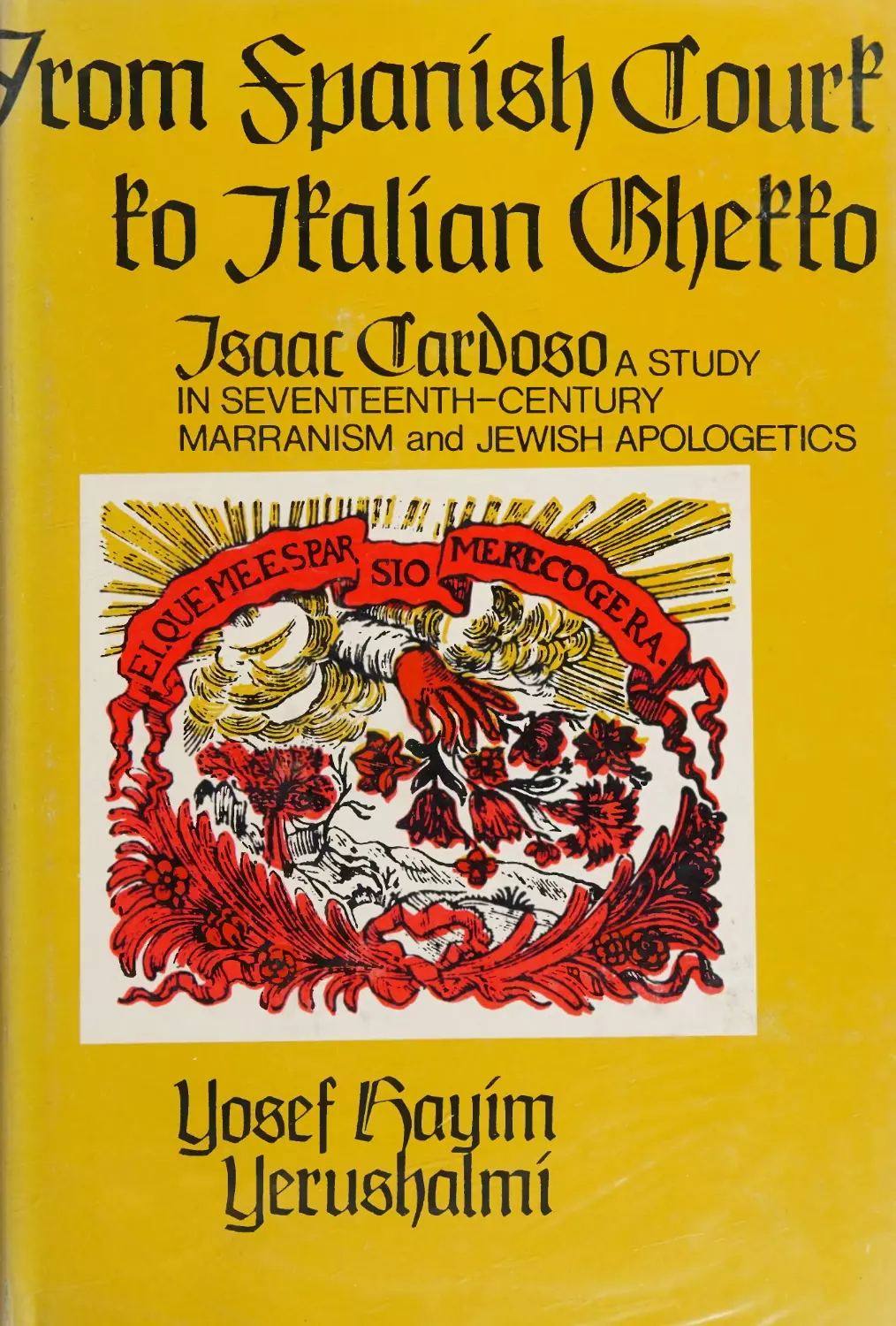
                    to Italian Wffo
Jsnac Qurboeo A STUDY
IN SEVENTEENTH-CENTURY
MARR AN ISM and JEWISH APOLOGETICS
LJosef Bayim
LjEruetjalrni
From Spanish Court to Italian Ghetto
Isaac Cardoso, A Study in
Seventeenth-Century Marranism
and Jewish Apologetics
Yosef Hayim Yerushalmi
This is a pioneering study that
traces the remarkable career of the
seventeenth-century Marrano physi-
cian and Jewish apologist, Isaac
Cardoso. Born in Portugal in 1604,
Cardoso was raised and educated in
Spain, where he lived for several dec-
ades as a nominal Christian. After
teaching philosophy and medicine at
the University of Valladolid, he came
to Madrid, where he rapidly gained
access to its vibrant social and intel-
lectual life, and ultimately rose to be
physician at the royal court. In 1648,
at the height of his fame, he abruptly
Idft Spain for Italy. In Venice he
emerged openly as a professing Jew,
and subsequently settled in Verona as
physician in the ghetto. There he
summed up his scientific and philo-
sophic views in his Philosophia libera,
and finally wrote his magnificent de-
fense of the Jews and Judaism, Las
excelencias de los hebreos.
Though focused on Cardoso, Pro-
fessor Yerushalmi’s study is not only a
biography but also a history of
“Marranos,” the crypto-Jews of Spain
and Portugal, in the seventeenth cen-
tury. It explores the wide range of the
Marrano phenomenon, its social mi-
lieu, the nature of Iberian anti-semi-
tism, the relationship between Mar-
ranism and Jewish Messianism, and
important aspects of the Judeo-Christ-
ian polemic. New insights are offered
into the scope of Jewish knowledge
available to Marranos in Spain and
(Con tinued on back flap)
Columbia University Studies
in Jewish History, Culture,
and Institutions
EDITED UNDER THE AUSPICES OF THE
CENTER FOR ISRAEL AND JEWISH STUDIES
COLUMBIA UNIVERSITY
NUMBER ONE
From Spanish Court to Italian Ghetto
Las
EXCELENCIAS
DE LOS HEBREOS,
Por el Do flor
YSHAC CARDOSO.
Impreflb en AMSTERDAM encafade
DA7ID DE CASTRO T AORTAS.
El Ano de 167 9.
Title page of Isaac Cardoso’s Las Excelencias de los Hebreos (Amsterdam, 1679)
Biblioteca Nacional, Madrid
From Spanish
Court to
Italian Ghetto
ZSAAC CARDOSO:
A Study in Seventeenth-Century
Marranism and Jewish Apologetics, by
YOSEF HAYIM YERUSHALMI
Ф
NEW YORK 6? LONDON
Columbia University Press
*97z
Yosef Hayim Yerushalmi is Professor of Hebrew
and Jewish History at Harvard University.
This study, prepared under the Graduate Faculties of Columbia
University, was selected by a committee of those faculties to receive
one of the Clarke F. Ansley awards given annually by Columbia
University Press.
Copyright © tO?1 Columbia University Press
Library of Congress Catalog Card Number: 76-109544
isbn 0-231-03286-2
Printed in the United States of America
For Ophra
J1? ’ЛПЭТ
•p-nsn ion
ЛЗЛХ
73735 ’“inx -[ЛЗ1?
HS7I7T xb упхз
Contents
Foreword, by Salo W. Baron	ix
Preface	xii
Abbreviations	xx
Chapter i. Marranos in the Seventeenth Century	i
The “Portuguese” in Spain', The “Men of the Nation”', Mar-
ranism: Some Methodological Problems', Persistence of Mar-
ranism; The Emigrants
Chapter n. Beginnings of a Career	51
Beira Alta', Into Castile', The University Years', To the Capital
Chapter in. Madrid: Debuts and Collisions	93
A Roman Entertainment', Vesuvius', Terror in the Calle de las
Infantas', The Alcalde Don Juan de Quinones', The Mask
Chapter iv. Madrid: Fame and Flight	137
Inquisitorial Witness', Social and Artistic Circles’, At the Tomb
of Lope de Vega', Under the Patronage of Olivares', The Mar-
rano
Chapter v. Italy: Reclaiming a Birthright	194
Haven in Venice', Home in Verona
Chapter vi. Philosopher in the Ghetto	216
Philosophus Doctissimus', Of Atoms and Unicorns', Theology',
Jewish Strands: A Backward Glance
Vll
Contents
Chapter vn. Abraham, Isaac, and the Messiah	302
Marranism and Messianism; Sabbatianism and Sebastianism;
Brother Against Brother; The Aftermath
Chapter vm. Spokesman for Judaism	350
The Place and Scope of the Excelencias; Sources and Method;
Personal Orientations and Marrano Echoes; The Jewish People;
The Law; Anti-Christian Polemics
Chapter ix. Defender of Israel	413
Iberian Focus; The Burden of Antiquity; In Defense of the
“Hebraic Truth”; Jewish Physical Defects; Jewish Misan-
thropy; Jewish Subversion; The Blood Libel; “ A Republic Apart”
Epilogue	473
Bibliography	481
Index	505
Illustrations
Title page of Isaac Cardoso’s Las Excelencias de los Frontispiece
Hebreos
Title page of Cardoso’s treatise on the eruption of	100
Mount Vesuvius
Title page of Juan de Qpinones’ treatise on Mount	135
Vesuvius
Title page of Cardoso’s oration on the death of Lope	156
de Vega
Title page of Cardoso’s treatise on the use of water	170
and snow
Title page of Cardoso’s treatise on intermittent fever	174
Title page of Cardoso’s Philosophia libera	217
Title page of the second part of the Excelencias	414
Vlll
Foreword
Recent years have witnessed a reawakening of interest, both scholarly
and popular, in the history of the Spanish Inquisition and of some
of its main victims, the Marranos. On the one hand, from among the
Spanish historians and theologians there have emerged a number
of gifted apologists for that institution, which had fallen into great
disrepute during the nineteenth century. Some of them felt that the
price Spain had paid for the hard regime of its Holy Office had not
been too high. Led by German-trained Bernardino Llorca, these
scholars insisted that because, with the Inquisition’s aid, the country
had maintained its historic continuity from its medieval orderliness
and consistently Catholic Weltanschauung, Jt had been spared much of
the confusion and intermittent inner upheavals which characterized
the evolution of the Western democracies. Some of their disciples in
other Spanish-speaking countries as far away as Argentina now began
speaking in Torquemadean terms of the “redemptive” quality of
violence.
At the same time another school of Spanish historians, led by
Атёпсо Castro, penetrated more deeply into the roots of Spanish
culture and attributed much of its uniqueness and richness to its
assimilation of many ingredients of Iberia’s glorious Jewish and
Moorish heritage. Still another group of more dispassionate students
of Spain’s extraordinary past, under the guidance of Francisco
Cantera Burgos and Jose Maria Millas Vallicrosa, began sifting the
enormous mass of archival and literary records preserved in Spain.
IX
Foreword
For more than a quarter century, their Institute Arias Montano
at the Universities of Madrid and Barcelona has published a number
of excellent books and a fine specialized quarterly, Sefarad, which
have helped illumine many vital factors of Spanish Jewish history,
literature, and thought.
On their part, Jewish historians, who in the nineteenth century
with a few noteworthy exceptions had been predominantly Germano-
centric in their approach and even later extended their horizons in
the main only to the East European segment of the Jewish people,
have begun evincing greater interest in the Sephardic world. Yitzhak
Baer and his disciples paved the way for a keen reappraisal of the
achievements and failures of the great medieval Jewish communities
on the Iberian Peninsula and their offshoots in many lands. Other
scholars have begun to analyze more searchingly the roots of the
West European and American Jewish communities which to a very
large extent owed their modern foundations to the Marrano disper-
sion. After all, today more than half of world Jewry lives in the
Western Hemisphere alone. Simultaneously, there has been a
growing scholarly involvement in the historic fate of the North
African and Middle Eastern Jewries, intensified by the growing
concentration of Jews in Mandatory Palestine and, still more, in the
new State of Israel. Here, too, one half of Israel’s population has
been recruited from the eastern communities with their high ratio
of descendants of the erstwhile exiles from Spain and Portugal.
Moreover, as other great diasporas—for example, those of the
French Huguenots, the English Puritans, the Polish patriots of the
early nineteenth century, or the twentieth-century Jewish refugees
from Hitler’s Europe—the Marrano dispersion in the early modern
period in its sheer struggle for survival had to perform great pioneering
services for its own people and for civilization at large. Yet the story
of both the respective pioneering groups and the individual path-
finders in the economic as well as in the cultural sphere has only
begun to be elucidated by recent authors.
Professor Yerushalmi’s excellent biography of Isaac Cardoso is an
important landmark in this field. In his dramatic presentation he
shows the transition of this talented physician and thinker from a life
among the privileged minority of intellectuals in royal Madrid to
X
Foreword
a more obscure and precarious existence as a secret Judaizer and
later as a professing Jew in Venice and Verona. From being a friend
of the confirmed anti-Jewish dramatist, Felix Lope de Vega, whose
death he mourned in a moving oration, Cardoso gradually developed
into one of the most brilliant apologists for modern Judaism and
a wide-ranging philosopher building bridges between his Jewish
heritage and Western culture. He accomplished all that while
retaining his rational frame of mind, in contrast to his brother
Abraham who became a leading Hebrew mystic and a follower of the
pseudo-Messiah, Sabbatai Zevi.
In his own modest and calm, yet searching and deeply felt,
reappraisal of Jewish life in the dispersion, Isaac became one of the
outstanding pioneers in the Jewish entry into Western culture which
ultimately, in a way unforeseen by him, paved the way for Jewish
Emancipation. Described in an equally restrained and persuasive
manner, on the basis of extensive research in many widely scattered
sources, published and unpublished, Yerushalmi’s biography of this
distinguished pioneer is, indeed, an illuminating exemplar vitae
humanae and a fascinating contribution to learning.
Salo W. Baron
XI
Preface
The “Marranos” are today once more in the forefront of historical
research, and this after more than a century of scholarship has
already yielded a veritable library on the subject. In the last decade
or so, intensified archival work in the Peninsula has brought to light
materials of prime importance, and has revealed how far we have
yet to go before even the documentary basis for future study may
be regarded as satisfactory. There has been a renewed emphasis on
the history of the Marranos in the sixteenth and seventeenth cen-
turies. Important studies have been undertaken on their economic
role, in both Spain and Portugal, as well as abroad. The social and
idealogical impact of converses and their descendants on the cultural
history of Spain is the subject of searching and often dramatic
investigations. The influence of Marrano emigrants on certain re-
ligious and intellectual trends in the Jewish world has begun to be
studied in depth. These and other ramifications of the problem are
surveyed in the opening chapter of the present study and need not
detain us here. It is the particular nature of the study itself which
requires some preliminary explanation.
Despite all the advances which have been made, Marrano research
has not yet overcome some basic dichotomies which could not but
affect its results.
In part this has been due to the very nature of the subject. The
Marranos have, after all, both a “Peninsular” and a “Jewish”
history, and it is not surprising that the two aspects have often been
treated as separate entities. The cleavage is perhaps most evident
in the case of those Marranos who, over a span of several centuries,
xii
Preface
fled from Spain and Portugal, and emerged elsewhere as professing
Jews. These had, in a sense, two lives, one prior to their departure,
and another subsequent to it. Inevitably, it is the former which has
generally attracted the historian of Spain, and the latter which
has engaged the Jewish scholar. By and large each has brought to
bear on the subject his own distinct methodology, frame of reference,
and technical equipment. Most archival research on the post-Ex-
pulsion period has been the work of Peninsular scholars, while it
is the Jewish historian who has had access to the Hebrew sources,
and hence to the inner life of the Sephardic diaspora. Another serious
division which has often characterized the study of the Marranos
is between their literary history and their social history, with the
heaviest concentration on the first. Even then, the writings of former
Marranos have usually been treated and discussed with little refer-
ence to the lives of the authors.
It should hardly require special pleading, I think, to insist that
all these elements are merely different facets of the same phenom-
enon, and that ultimately one cannot be understood without the
other. Inquisitorial documents must be integrated with rabbinic
sources, Iberian with Hebrew literature, Peninsular social history
with Jewish communal history, if genuine perspective is to be
attained.
This study is an exploratory attempt to combine such various
approaches, and to see what can be learned by applying them
to one man: the seventeenth-century Marrano physician, philoso-
pher, and apologist, Isaac Cardoso.
While the method and aim are deliberate, the specific choice of
subject was somewhat fortuitous, the result of a sudden personal
interest. I first knew of Isaac Cardoso only as a name which I
encountered often in the course of my reading, and as the brother
of the Sabbatian mystic Abraham Cardoso, to whom so much
attention has been devoted by Professor Gershom Scholem and his
disciples. Some years ago I saw a reproduction of the frontispiece
of Isaac’s Las excelencias de los hebreos in the catalogue of an Oxford
bookseller, but, as with most of the other tempting items of Spanish
and Portuguese Judaica which were offered for sale, I found the
price rather prohibitive. Only weeks later, by a stroke of luck, a
xiii
Preface
X
somewhat inaccessible corner of a bookshop in New York yielded
a copy which I was able to ransom from the dust for a mere pittance.
As I finally began to read the text itself, I was captivated by what
appeared to me a major classic of Jewish apologetics. Turning back
to the scholarly literature I found that the book had been frequently
mentioned, but never even adequately described—praised, but not
analyzed. Kayserling and others gave some bare biographical facts
about Cardoso’s life in the Peninsula, quite insufficient to illumine
the work itself, but enough to intrigue me all the more. The author
of the Excelencias, I learned, had apparently moved in the highest
society in Madrid, had written a number of medical and scientific
works in Spanish and Latin, had even published a funeral oration
on Lope de Vega. I became extremely curious to find out more
about the two lives of Cardoso, that of the Spanish physician and
that of the passionate Jewish apologist, and to seek out, if possible,
some of the strands that united the two in the same person. This
study is the result.
Lacunae, of course, remain, and no one can be more aware of
them than I. It would perhaps have been the better part of prudence
to choose to study a Marrano with some prior indication as to what
documentary sources might be available for him. Instead, I first
chose the man, and resolved to learn what I could. My quest for
Cardoso led me to retrace his own journeys, and I have thus searched
through the proverbial haystack in the archives and libraries of
Portugal, Spain, and Italy. He has often proved to be an elusive
quarry. Two potentially major sources on which I at first based
high hopes proved to be nonexistent. The most abundant font of
information for the Peninsular life of a Marrano is usually to be
found in his inquisitorial dossier. Cardoso, however, was never tried
by the Inquisition, and in this respect we can hardly allow our
thirst for documents to begrudge him his good fortune. More
frustrating is the disappearance of the registers of the Sephardic
community of Verona, when the city was occupied by the Nazis
during the Second World War, for me a small symbol of the larger
human tragedy.
Nevertheless, my search has brought its compensations as well,
some of them quite unexpected, both in the materials I have been
XIV
Preface
able to examine, and in the various methodological approaches
which those materials compelled me to adopt as I went along. It
is for others to judge whether I have adequately coped with the
questions that have arisen. I hope, at least, that the right questions
have been asked, and that their implications are not confined to
Cardoso alone.
A number of technical observations may be of use to the reader.
For reasons which will be explained in the first chapter, I have
used the term “Marrano” to denote only those men and women
whose Judaizing propensities are either established or highly prob-
able. Otherwise I have employed the religiously neutral term “New
Christian” which here merely indicates that the person is of known
Jewish descent, but implies no ideological evaluation. I have, how-
ever, frequently referred to Iberian “antisemitism” and “antisem-
ites,” well aware that such nineteenth-century terms are essentially
anachronistic, and perhaps especially so in the Peninsula, where,
in the period we are discussing, there were formally no Jews. To
have done otherwise would have been to make a fetish of semantics.
“Anti-Converso” or “anti-New Christian” is not really satisfactory,
being too restrictive, while “anti-Conversoism” or “anti-New Chris-
tianism” is too clumsy to tolerate. If the term “antisemitism” is
anachronistic, it is so in the very same way that the New Christian
was called “Jew” by his Iberian adversaries, and in that sense alone
it is even appropriate.
In quoting from primary sources, especially Latin, Spanish, and
Portuguese, I have generally transcribed the texts as they appear
in the original, with no attempt to modernize the orthography or
introduce all the necessary accents. I have departed from this
practice in cases of obvious misprints, and in instances where a
word, as given, may prove ambiguous or unclear to the reader.
Citations from the Bible in English have been given according to
the Jewish Publication Society translation, except in a few instances
where I felt the use of the citation required that the translation
be altered.
While adhering to a biographical framework, this study is not,
strictly speaking, a biography. It is rather, as the subtitle indicates,
a study of seventeenth-century Marranism and Jewish apologetics
XV
.Preface.
—as reflected in the life of one man. This will explain, for example,
why I have gone into considerable detail in discussing such matters
as the case of the Cristo de la Paciencia, or the antisemitic tract of
Juan de Quinones. Both illumine important aspects of the milieu
which Cardoso knew. If the book lays any particular claim to
novelty, it is precisely in its attempt at a comprehensive study of
an individual Marrano, taking account of both his life in the
Peninsula and his later Jewish career, his experience and his thought,
seen as an organic whole. Should it persuade others of the need
for similar investigations. I shall consider my labors amply rewarded.
My first book also provides a first opportunity to indicate my
indebtedness to those who have so great a share in it.
It is more than ordinary bonds of filial obligation which move
me to begin by expressing my profound gratitude for the high
privilege of being the son of Hava and Yehuda Yerushalmi. I cannot
write publicly of the measure of their love and self-sacrifice, but I
must record something of what they gave me besides. In our home
in New York my mother brought me the rich Jewish traditions of
Pinsk, and my father, the Hebrew humanism of Odessa. Together
they led me into an enchanted palace of Jewish learning, folklore,
and song from which I shall always draw sustenance. East European
Ashkenazim both, they had no inkling that I would someday devote
myself to Sephardic studies. Yet it was they who gave me my very
first awareness of “Marranos” when I was ten years old, in a
children’s biography of Don Isaac Abravanel, written in Yiddish.
My mother, alas, did not live to see this book appear. She passed
away five months ago, on the eve of Passover, when I had already
begun the final revisions. May the book prove a source of some
consolation to my father.
I have been equally fortunate in the teachers I have had. To
my revered master Professor Salo Wittmayer Baron, foremost of
Jewish historians in our time, I owe more than I can say. He was
my guide and mentor throughout my years of graduate study at
Columbia University, and both my master’s thesis and the present
work were written under his direction. In the finest tradition of
Jewish teaching he has been more than a teacher. From the day
xvi
Preface
I first stepped into his office he has taken the closest interest in
my progress at every turn, and his solicitude and efforts for my
personal welfare have never ceased. The Foreword he has graciously
added to my book is thus only the latest link in the long succession
of his favors to me. My fondest hope is that I shall prove worthy
to be numbered among his disciples.
Three other teachers must be singled out among the many from
whom I have profited. My historical studies with Professor Zvi
Ankori at the Jewish Theological Seminary of America and later
at Columbia were decisive experiences. The erudition and enthu-
siasm which he communicated had much to do with my own
decision to become an historian, and the friendship into which our
relationship soon ripened enabled me to learn as much from him
in private conversation as in class. Professor Shalom Spiegel of the
Seminary remains indelibly in my mind, not only for his unfor-
gettable lectures on Hebrew poetry in medieval Spain, but as a
truly Renaissance figure to whom nothing in Jewish or universal
culture is alien. The “sea of the Talmud” was charted for me at
the Seminary by Professor Saul Lieberman. His unrivaled ability
to make an ancient text come to life remains an inspiration.
My work on this book was greatly facilitated by Sr. Pierre
Audubert of Madrid. Together with his charming wife Betty and
their young son Jose, he opened to me his home and made it my
own. When I was back in New York, and as I needed more materials,
he undertook to procure the microfilms and photostats for me. I
extend my warm thanks also to Sra. Mina Ry ten of Lisbon for
making my stay in Portugal such a pleasant one; to Mr. Rod
W. Horton, Cultural Attache at the United States Embassy, and
Prof. Kurt Jacobsohn of the University of Lisbon; to D. Luis
Silveira, Inspector General of Portuguese Archives and Libraries,
whose letter opened all doors to me; and to Sr. Alfonso Cassuto
for a memorable evening spent in his home, when he showed me
his magnificent library of rare Sephardica. In Madrid D. Ramon
Paz, the distinguished director of the Manuscript Division of the
Biblioteca Nacional, offered not only help, but friendship. Professor
Cecil Roth, formerly of Oxford, was kind enough to send me some
useful notes on the Venetian archives, and I received important
xvii
Preface
information on the Verona pinkasim from Professor Shlomo Simonson
of Tel-Aviv University. Professors Haim Beinart of Jerusalem and
I. S. Revah of Paris sent me some very encouraging letters. Their
prompt replies to the queries of a stranger were for me an affecting
reminder of the bonds that can link the international scholarly
community.
Both my graduate work and my research trips abroad were
facilitated at various times by financial assistance from individuals
and institutions. I wish to thank Mrs. Joy Ungerleider and Mr.
Richard Scheuer of Larchmont, N. Y., for their early faith in me;
the Society for Religion in Higher Education for awarding me a
Kent Fellowship; and the National Foundation for Jewish Culture,
for its very generous travel grant.
I am deeply beholden to Dr. Milton Rosenbaum and Dr. Maurice
S. Nadelman for their encouragement and support.
My debt to my alma mater, Columbia University, is great on
many counts. I am grateful to the University for naming me to a
President’s Fellowship, and for affording me my first opportunity
to teach while still a doctoral student; to the Ansley Awards
Committee for having chosen my dissertation to receive the 1966
Ansley Award, thus making possible the pubheation of this book;
to Columbia University Press, and especially to Messrs. Henry
Wiggins and Harry W. Segessman for their patience and genuine
understanding in undertaking the arduous task of publication. In
addition to Professor Baron, Professors Isaac Barzilay, Gerson D.
Cohen, and Gonzalo Sobejano turned my doctoral “defense” into
a creative scholarly conversation. Their helpful comments have been
incorporated in this book.
I owe my invitation to join the Harvard University faculty two
years ago largely to the initiative of Isadore Twersky, Littauer
Professor of Hebrew Literature and Philosophy, and chairman of
the Department of Near Eastern Languages and Literatures. Our
close professional association and personal friendship in a stimulating
intellectual environment continue to be for me a major source of
gratification, while his keen interest in my work has been a welcome
spur in bringing this book to its final completion.
Two generous friends in the university community gave me more
xviii
Preface
help than I had the right to expect. Anne Whitman, who had
already placed her rich classical erudition at my disposal in trans-
lating some of the Latin texts, also read the final draft with in-
comparable devotion and vigilance. Raimundo Lida, Professor of
Romance Languages and Literatures at Harvard, readily agreed to
my last-minute request that he merely review the Spanish citations.
Instead, in the midst of his own very busy schedule, he went on
to read the entire book. As though this were not enough, he then
spent hours with me at his home in a discussion which made me
wish I had known him when I first embarked on this study.
It remains my pleasant duty to thank those individuals, archives,
and libraries, who have furnished the materials for my work: The
Keeper of Oriental Books, Bodleian Library, Oxford; Dr.a Cariota
Gil Pereira of the Biblioteca Nacional and Dr.a Maria Francisca
de Oliveira Andrade of the Arquivo Nacional da Torre do Tombo,
Lisbon; the Archivo Historico Provincial у Universitario, Valla-
dolid; the Archivo Universitario, Salamanca; the Archivo Historico
Nacional and Biblioteca Nacional, Madrid; the Bibliotheca Mar-
ciana and Archivio di Stato, Venice; the Biblioteca Comunale and
Archivio di Stato, Verona; Nello Pavoncello, formerly Chief Rabbi
of Verona; the Jewish National and University Library, Jerusalem;
the staffs of the libraries of Columbia University, Jewish Theological
Seminary of America, New York Public Library, New York Acad-
emy of Medicine, and Hispanic Society of America, and of the
Widener and Houghton Libraries, Harvard University.
Miss Sybil Wyner of Elizabeth, New Jersey, typed the manuscript
in record time. A grant from the Clark Fund at Harvard made
the additional revisions possible. Miss Elisabeth Shoemaker, my
editor at Columbia University Press, has enhanced the whole with
her good taste and vast technical experience. All have my heartfelt
thanks.
Finally, in dedicating this book to my wife, I merely formalize
what already belongs to her.
Yosef Hayim Yerushalmi
Cambridge, Massachusetts
Elul, 5728)September, 1968
xix
Abbreviations
AHN AHP AUS Antt AUV B.A.E. BEPJ BNM HSA HUCA JE JQR MGWJ	Archivo Historic© Nacional (Madrid) Arquivo Historic© Portugues (or: Portuguez) Archivo Universitario, Salamanca Josephus, Antiquities Archivo (Provincial y) Universitario, Valladolid Biblioteca de Autores Espanoles Biblioteca Espanola-Portugueza-Judaica Biblioteca Nacional (Madrid) Hispanic Society of America (New York) Hebrew Union College Annual The Jewish Encyclopedia Jewish Quarterly Review Monatsschrift fur Geschichte und Wissenschaft des Juden- tums
(N.S.) (O.S.) PL	New Series Old Series Patrologia Cursus Completus, series Latina, ed. by J. P. Migne
REJ Responsa	Revue des etudes juives (for any collection of She"elot u-teshubot which bears no other title)
Semanario erudite	Semanario erudite, que comprehende varias obras ineditas, crfticas, morales, instructivas, politicas, historicas, satiricas у jocosas de nuestros mejores autores antiguos у modernos
SNS ТВ TP ZGJD	Sefer Si$at Nobel Sebi Babylonian Talmud Palestinian Talmud Zeitschrift fur die Geschichte der Juden in Deutschland
XX
MARRANOS IN THE
SEVENTEENTH CENTURY
And what will it profit our lord and king
to pour holy water on the Jews, calling
them by our names, ‘Pedro,’ or ‘Pablo,’
while they keep their faith like Akiba or
Tarfon? . . . Know, Sire, that Judaism is
one of the incurable diseases.
—Solomon ibn Verga, Shebet Yehudah
There are even today areas in the Iberian Peninsula
where, more than four and one half centuries after the
Expulsion from Spain and conversion in Portugal, the
name “Jew” elicits only an uncertain response from
the local inhabitants. Returning from a trip through the Spanish
or Portuguese provinces, a Jewish traveler can still regale his friends
by describing how, upon identifying himself as a Jew, the villagers
could associate the term only with the Jews of the Bible. It is to
be presumed that with the continuing expansion of tourism and the
further settlement of Jews in the Peninsula such experiences will
soon be a thing of the past. Until quite recently, however, the
anecdote was a common one. For the masses in Spain and Portugal
the namejWzo (or judeu) had become, at best, an exotic and archaic
evocation; it no longer corresponded to a reality.
But this was not always so. The Jew did not disappear suddenly
from the mind of the Spanish people in 1492, nor did Judaism lose
I
Marranos in the Seventeenth Century
all significance in Portugal after the mass baptism of 1497. In the
sixteenth and seventeenth centuries, and even later, Peninsular
presses still sent forth books and tracts directed contra los judios de
nuestros tiempos (against the Jews of our times [!]). Alleged Judaizers
continued to be penanced or relaxed for burning by the inquisitorial
tribunals, and the populace flocked to the public spectacle of the
auto-da-fe. Long after the last synagogues had been dedicated to the
Virgin, Spanish and Portuguese pulpits rang with denunciations of
the Jewish perfidy. The ‘Jew” was still an object of satire on the
stage and in the doggerel of urchins in the streets. Rumors of Jewish
plots to subvert Spain could yet pass swiftly through the barrios of
Madrid. A Spaniard or Portuguese who aspired to honors or offices
had very much to worry, in presenting his genealogy for inspection,
lest a Jew be found clinging to a remote branch of the family tree.
The sambenitos which had been worn by those reconciled by the
Inquisition hung afterwards through decades and generations in
the churches where their grandchildren prayed. Broadsides posted
in public places still displayed a list of characteristic Jewish cere-
monies, and called upon the faithful to denounce those whom they
knew to be following the execrable rites of the Law of Moses.
To a Spaniard or Portuguese of the seventeenth century the phrase
“Jews of our times” was neither an abstraction nor a euphemism.
It might well apply to some of his own neighbors, even though they
bore authentic Iberian Christian names, and he saw them regularly
at Mass in the cathedral, and the walls of their homes were adorned
with the conventional pious pictures. There was no guarantee that
this seemingly unimpeachable orthodoxy was not a mere fagade,
and that among themselves these people did not practice occult
Jewish rites. For they were, after all, cristianos nuevos (Port., cristdos
novos), “New Christians,” descendants of those many Jews who had
been baptized in the fourteenth and fifteenth centuries. In the
seventeenth century these New Christians still constituted a distinct
and important class within Iberian society, and in the popular mind
the line between “New Christian” and “Jew” was often blurred.
The one seemed merely a metamorphosis of the other. Had not the
Inquisition consistently revealed how many of the seed of the original
Conversos were still Jews at heart? One might perhaps be somewhat
2
The “Portuguese” in Spain
wary of hurling the epithet marrano or judio at a person, for this
was considered to be so grave an insult as to be prohibited by law.
But it did not really matter which term one chose to use. In the
consciousness of seventeenth-century Spain and Portugal the “Jew”
was not merely an historical reminiscence; he was, in effect, a con-
temporary. How are we to understand this phenomenon?
THE “PORTUGUESE” IN SPAIN
The long campaign to obliterate Spanish Judaism which began with
the pogroms of 1391 appeared, by the latter half of the sixteenth
century, to be finally crowned with success. Isolated after the
expulsion in 1492 of all professing Jews, the Converses in the ensuing
decades ultimately lost the strength, and perhaps the will, to main-
tain their Jewish ties in the midst of a ruthless program of persecution
and repression. The available evidence, admittedly incomplete,
indicates that by this time crypto-Judaism had been atomized by
the hammer blows of the Inquisition, and that Spanish Marranism
had lost its former elan, except perhaps in certain small and remote
localities.1 Those Conversos who did not flee to other lands, and
who had not perished at the stake, appeared, to the degree that
they were accepted, largely merged into the general population, and
attempting to live as faithful Catholics. From the mid-sixteenth
1 On the waning of Spanish Marranism in the 16th century see Henry Charles
Lea, A History of the Inquisition of Spain (New York, 1907), III, 234 f. Cf. Cecil
Roth, A History of the Marranos (Philadelphia, 1947), pp. 85 f.; Julio Caro Baroja,
Los judios en la Espana moderna у contempordnea (Madrid, 1961— ), I, 452 f., 460.
An interesting example of the survival of crypto-Judaism in a relatively isolated
community is that of Badajoz in Estremadura, near the Portuguese border. The
list of sambenitos of that town has been published and analyzed by Antonio
Rodriguez-Monino in his “Les Judaisants a Badajoz de 1493 a 1599,” Revue des
etudes juives, CXV (1956), 73-86. More such instances could undoubtedly be
found were it not for the fact that the surviving records of the Spanish Inquisition
are quite incomplete. See the remarks of I. S. Revah, “Les marranes,” RE J,
CVIII (1950-60), 35 f. n. 1, noting also the need for a comprehensive study of
the Spanish Inquisition up to 1580.
3
Marranos in the Seventeenth Century
century onward, the Spanish Inquisition turned increasingly from
the prosecution ofjudaizers to that of Protestant and other heresies.
Those nonconformist impulses which still retained some vitality
among the offspring of the Conversos seem to have found an outlet
in mystical or Erasmian currents within Spanish Catholicism itself.2
While the presence of this leaven is of considerable interest for the
intellectual history of Spain, the fact remains that in the course of
the sixteenth century the Spanish Conversos disappear, progres-
sively, from the ken of Jewish history.
If Spain in the seventeenth century was obsessed once again with
a Judaizing heresy, that was due to the massive influx, beginning
after 1580, of the Portuguese New Christians.
Both the genesis and the development of the Converso problem
in Portugal differed significantly from that of Spain. Lusitanian
Jewry had not suffered the slow debilitative process of erosion which
their Hispanic brethren had endured from 1391 to 1492. Their inner
strength had not been sapped by periodic massacre, waves of
conversionist panic, and a culminating expulsion of those who had
remained constant. When, in 1497, the death knell sounded for open
2 The New Christian share in the propagation of 16th-century Erasmian and
allied tendencies has been fully demonstrated by Marcel Bataillon in his study
of Erasme et I’Espagne (Paris, 1937). Cf. also Eugenio Asensio, “El erasmismo у
las corrientes espirituales afines,” Revista de filologia espanola, XXXVI (1952),
especially pp. 56-69.
In recent decades Spanish scholars have evinced an ever growing interest in
the Converso provenance of various major figures in the spiritual and intellectual
history of their country. Thus, it has been ascertained by Abd6n M. Salazar that
the father of Luis Vives was burned at the stake in 1526, and that before the age
of ten the philosopher himself attended clandestine Jewish services. (Cited by
Americo Castro, The Structure of Spanish History (Princeton, 1954), p. 577, n. 42).
Similarly, the grandfather of Santa Teresa of Avila was reconciled for Judaizing
by the Inquisition of Toledo in 1485. See Narciso Alonso Cortes, “Pleitos de los
Cepedas,” Boletin de la Real Academia Espanola, XXV (1946), 85-110; cf. H. Serfs,
“Nueva geneologia de Santa Teresa,” Nueva revista de filologia hispdnica, X (1956),
364-84. The real or alleged Converso ancestry of other Spanish luminaries is
examined by Antonio Dominguez Ortiz, La close social de los conversos en Castilla
en la edad moderna (Madrid, 1955), pp. 155-89, by Castro {Structure, pp. 569, 575)
and by Caro Baroja {Judios, vol. II, pt. iii, chs. 9-10), all with ample biblio-
graphies.
4
The “Portuguese” in Spain
Jewish life in Portugal, it came in the form of a sudden and total
conversion by force of all Portuguese Jewry. The mass baptism
decreed by King Manoel engulfed both the native Portuguese Jews
and those Jewish exiles from Spain who, some five years earlier,
had refused to pay the price of conversion and had sought refuge
across the frontier.3
Crypto-Judaism among the New Christians of Portugal was to
prove hardy enough to survive for centuries. In attempting to
explain this remarkable endurance scholars have usually stressed two
factors. In contrast to Spain it is argued that conversion in Portugal,
being entirely and literally forced, overcame thousands of faithful
Jews and not only the religiously weak, while at the same time it
included some of the most tenacious elements from Spain itself.
Moreover, after 1497 some four decades were to elapse before the
introduction of the Portuguese Inquisition. This respite allowed
the Converses ample time to accommodate themselves to conditions
and to create viable forms of crypto-Jewish life.4 However, while
these factors certainly played a part in the formation of Portuguese
Marranism, they are insufficient to explain the phenomenon as a
whole. After all, in Spain, at least in 1391, it was not only the weakest
elements who were converted. And, while the Portuguese Conversos
faced no Inquisition between 1497 and 1536, the same was true
of the Spanish Conversos from 1391 to 1478. Moreover, the latter,
during all this time, had before their eyes the example of a living
Judaism professed in the homes, schools, and synagogues of the
aljamas. In Portugal, conversion and the extinction of open Jewish
life occurred simultaneously.
But perhaps it is precisely here that the key should be sought.
What was of decisive import in Portugal was the fact that there
the community itself was converted, in toto, whereas in Spain the
3 Portuguese Jewry in the 15th century is surveyed by Meyer Kayserling,
Geschichte der Juden in Portugal (Leipzig, 1867), chs. 4-7, and J. Mendes dos
Remedies, Os Judeus em Portugal, I (Coimbra, 1895), chs. 4-5. A study of
Portuguese Jewish history prior to 1497, based on extensive archival research
comparable to that which has been lavished on the Jews of medieval Spain, is
still a major desideratum.
4 See Roth, Marranos, pp. 61 f.; cf. Revah, “Les marranes,” p. 36.
5
Marranos in the Seventeenth Century
community had remained throughout, even though eroded and
diminished in number, outside the pale of conversion. Schematically,
we might outline the progression in both countries as follows:
In Spain:	a) Before 1391 The Jewish community.
b) 1391-1492	Conversos plus the Jewish community,
c) After 1492 Conversos minus the expelled Jewish
community.
In Portugal: a) Before 1497 The Jewish community.
b) After 1497 A converted Jewish community, mi-
nus individual exiles.
In effect, Portugal skipped the intermediate phase through which
Spain had passed: the existence, side by side, of Conversos and a
normative Jewish community. Consequently, the intervals between
conversion and the establishment of the Inquisition (1391-1478 in
Spain, 1497-1536 in Portugal) are, although superficially parallel,
not at all analogous in the two countries. We must try to envision
at least some of the implications of this fundamental datum. It means
first that in Portugal, unlike Spain, there was no period of tension
between Conversos and professing Jews, for after 1497 all who had
been Jews were suddenly converts. Portuguese Jewry thus evaded
the corrosive intracommunal and intrafamilial ruptures which con-
version had brought to Spanish Jewry, and which had plagued the
latter through much of the fifteenth century. Moreover, in Spain,
where conversion had engulfed only a part of Jewry, the energies
of those who had remained professing Jews were still channeled into
the normative community and its institutions up to the very time
of the Expulsion. In Portugal all Jewish energies were immediately
absorbed in 1497 into the converted community. Individual social
ties remained intact. Though formal instruments of social control
abruptly lost their force, age-old communal bonds could not be
unraveled overnight. Surely in the wake of the great catastrophe
the unwillingly baptized rabbis and scholars did not suddenly cease
to teach and guide, albeit surreptitiously, nor did the men who had
been prominent in the community immediately lose their influence.
Undoubtedly there were Jews who had previously lacked only the
6
The (cPortuguese” in Spain
initiative or the courage to convert voluntarily as individuals, and
who now welcomed the forced mass baptism as an opportunity to
live as Christians with a clear conscience. But for the many who
remained constant at heart, the possibility of a viable crypto-Jewish
life must have been vastly enhanced by the fact that the social base
so essential to such a life had been transmuted, but not really
obliterated.
Apart from its social consequences, the simultaneous conversion
in Portugal of the entire Jewry of the country must have had an
even deeper impact on the self-image of the Conversos themselves.
We have already noted that the presence in fifteenth-century Spain
of an ongoing Jewish community provided the Conversos with an
example of living Judaism. Of this the Portuguese convert was
deprived. But, by the same token, there was no normative com-
munity in Portugal to serve him daily as a visible reminder that
he was now outside its fold, or to place his Jewish identity in doubt.
Here conversion was, in a real sense, normative for the corporate
Jewish group. This was now ‘Jewry”; there was no other. It is that
very corporate character of conversion in Portugal which invested
the Portuguese converts with the cohesion and solidarity of having
shared one destiny from the very outset. A Spanish New Christian
in later times might well speculate whether his forbears had accepted
baptism under duress during a pogrom in 1391, or perhaps out of
conviction at the time of the Disputation of Tortosa, or in order
to remain in Spain at the time of the Expulsion. The Portuguese
New Christian was not prey to such ambiguities. He knew, or he
could assume, the collective origins of his entire group, indeed of
all the New Christians in the land. His fathers had not entered
Christianity as individuals; they had been swept' up in the common
fate of all Jewry. Thus, to a degree not paralleled by the Spanish
New Christians, those of Portugal possessed a genuinely historical
group character of which, as we shall see, Portuguese society was
itself instinctively aware. In terms of sheer number, it may well be
that more Jews had been converted in Spain than in Portugal. But
the essential difference between conversion in the two countries was
not quantitative, but qualitative. Despite the collapse of its tradi-
tional structure and institutions, a converted Portuguese Jewry
7
Marranos in the Seventeenth Century
retained, at least initially, much of the vital force and solidarity
of the community itself.
Possessed of this strength, the Portuguese Conversos could take
full advantage of the years prior to the establishment of the In-
quisition. It is in the period from 1497 to 1536 that the New
Christians penetrated into the highest echelons of Portuguese com-
merce and finance. But it is also during this time that various modes
of crypto-Jewish life became firmly entrenched among thousands of
them. The group vitality which we have stressed was amply mani-
fested time and again in the elaborate negotiations of the New
Christians to prevent the introduction of the Inquisition. Through-
out the transactions with king, Pope, and Curia, involving the most
arduous diplomatic activity abroad and the raising of huge sums
of money at home, the Conversos moved collectively through their
spokesmen and representatives. They acted, in fact, as a group in
whom the earlier communal traditions of Portuguese Jewry still
manifested a considerable measure of their original vigor. It was
not for lack of common effort or leadership that the endeavor ended
in failure. In 1536 John III obtained papal consent for the establish-
ment of the Inquisition in his domains. The first formal auto-da-fe
was held in Lisbon in 1540. By 1547, after some temporary setbacks,
the Portuguese Inquisition was in full and unimpeded operation.
It was often to exceed in ferocity its Spanish prototype and counter-
part.5
Through an unexpected development in the Peninsula, however,
the destinies of the New Christians in the two kingdoms were fated
to converge and to attain a new dimension. In 1580 Portugal was
annexed to Spain in a personal union under Philip II. The Por-
tuguese New Christians, who had by now endured more than forty
years of intense inquisitorial harassment, placed great hopes in the
union, though these were not immediately realized. When the Por-
tuguese Cortes met to swear its allegiance to Philip, the estates
insisted that no Conversos be admitted to any office. At the same
time the latter petitioned the king for the total abolition of legal 6
6 The period 1497-1536 is treated in great detail in Alexandre Herculano’s
classic, Da origem e estabelecimento da Inquisigdo em Portugal (3 vols., Lisbon, 1854—59).
8
The “Portuguese” in Spain
distinctions between New and Old Christians, and asked also that
the Crown intervene to obtain for them a General Pardon from the
Holy See. Philip denied both these requests. When he came to
Lisbon to be crowned, he personally attended an auto-da-fe held on
April i, 1582. All the legal disabilities remained in force.6
Nevertheless, the union ushered in a new era. As, periodically,
freedom of movement was obtained, there began an ever-increasing
emigration of New Christians from Portugal into Spain.6 7 This influx,
which eventually reached massive proportions, was doubly mo-
tivated. Compared to the radical decline of the Portuguese economy,
Spain, wealthier and politically dominant, seemed now a land full
of opportunities. Again, relative to the fury of inquisitorial perse-
cution in Portugal, Spain must have appeared, in the eyes of many,
almost a refuge. Though Portugal had been annexed, the Portuguese
Inquisition was not merged with that of Castile, but remained
autonomous. Only the nomination of the Inquisitor General be-
longed to the Spanish Crown. Between 1581 and 1600 the three
Portuguese tribunals held no less than fifty autos-da-fe. Most signifi-
cantly, however, the Spanish Inquisition did not punish crimes
against the faith which were committed in Portugal. At least as late
as 1630, a decade before Portugal regained its independence, there
was still no formal provision for extradition, and Castilian tribunals
did not usually honor such requests from the Portuguese inqui-
sitors.8
Thus the lure of new economic horizons and the desire to find
some measure of relief from religious persecution combined, after
1580, to alter radically the geographical distribution of the Penin-
sular New Christians. Around 1599 the Spanish Dominican Fray
Augustin Salucio, pleading for the elimination of legal discrimina-
tions between New and Old Christians, could still muster the
6 J. Lucio d’Azevedo, Hist6ria dos Christaos-Novos portugueses (Lisbon, 1921),
PP- 149 f.
7 On emigration after 1580 and its effects, see Lea, Inquisition, III, 266 f.;
Roth, Marr emos, pp. 85 f.; Dominguez Ortiz, Close social, p. 82.
8 Lea, Inquisition, III, 265 f., 278.
9
Marranos in the Seventeenth Century
argument that Judaizers hardly exist in the Spain of his time.9 By
1640 the royal chronicler Jose Pellicer у Tovar cries out in frustration
that “one of the calamities which must be considered with the
greatest attention and grief is to see Spain filled on all sides with
Jews, enemies of our Holy Catholic Faith!”10 His voice is only one
among many. A Spain which, in the late sixteenth century, had
thought itself largely freed of Jewish concerns, now found itself in
the seventeenth century obsessed once more with the age-old prob-
lem. The pendulum, after completing its arc, had swung back to
its point of origin. The incursion into Spain of Portuguese New
Christians was of such dimensions and impact that, to the Spaniards
of the seventeenth century, “Portuguese” was virtually synonymous
with “Jew.” So close was the identification that in 1646 the Jesuit
Sebastian Gonzales could describe several Portuguese, who had been
arrested by the Inquisition in Madrid, as having been imprisoned
simply for what they are.11 The Portuguese people themselves com-
plained that often, when traveling abroad, they were automatically
stigmatized as Judaizers, simply because of their land of origin.12
9 “Pues quien no ve en quan diferente estado se halla ahora el reyno, у quanta
seguridad hay en general de la gente que tiene alguna raza ?” in Augustin Salucio,
Discurso acerca de lajusticiay buen gobierno de Espana en los estatutos de limpieza de sangre,
printed in Semanario eruditey XV (Madrid, 1788), 165.
10 “De verdad, una de las desdichas que se deben reparar con mas atencidn
у lastima, es ver a Espana tan Пепа por todos lados de Judios, enemigos de nuestra
Santa fe Catolica,” in Jose Pellicer у Tovar, Avisos historicos, que comprehenden las
noticias у sucesos particulares, ocurridos en nuestra monarquia desde al ano de 163g, in
Semanario erudito, XXXI (Madrid, 1790), 165.
According to the calculations of Albert Girard there were, around the year
1640, some 2,000 Portuguese merchants in Seville alone, and most of them were
New Christians. See his Le commerce frangais d Seville et Cadix au temps des Hapsbourg
(Paris, 1932), pp. 39 f.
11 “Tres dias ha prendieron tambien por la Inquisicion a siete ti ocho portu-
gueses por lo que suelen” (Cartas de algunos PP. de la Compania de Jesus sobre los sucessos
de la monarquia entre los anos de 1634 у 1648, in Memorial Historico Espanol, XVIII
[Madrid, 1864], 420; letter of October 23, 1646).
12 “Portuguezes e judeus ja sao syndnimos,” writes the great 17th-century
Portuguese Jesuit, Padre Antdnio Vieira. See his Obras ineditas (Lisbon, 1856),
III, 93. For other similar citations see Edward Glaser, “Referencias antisemitas
IO
The “Portuguese” in Spain
One of the effects of the entry of the Portuguese New Christians
was the recrudescence of the activity of the Spanish Inquisition
which, as we have noted, had shown a diminishing interest in
Judaizers in the decades prior to 1580. Already in 1595 ninety-
eight Judaizers appeared at an auto in Seville.13 Beginning in 1625
the majority of those charged with Judaizing by the Inquisition of
Cordoba were “Portuguese” living in Andalucia.14 Throughout the
seventeenth century no Spanish auto de fe will lack them. Most of
the accused will be of Portuguese origin and will bear Portuguese
names. To some degree, the advent of the “Portuguese” also revived
crypto-Jewish tendencies among the Spanish New Christians. In any
case, as far as may be learned from the partially preserved records
of the Spanish Inquisition, the problem of Judaizing heresies did
not recede again until the middle of the eighteenth century.15 16
“Marranism” in Spain during this second phase thus exhibited
a remarkable tenacity. Nevertheless, it should be clear that, although
all New Christians may have been generically suspected of Ju-
daizing, they were by no means all of them Judaizers. The “Mar-
en la literatura peninsular de la Edad de Oro,” Nueva revista de Jilologia hispdnica,
VIII (i954), 4b n- 5-
The Spaniards themselves often suffered from being called “Marranos” by
foreigners. There is abundant material on this in Arturo Farinelli’s Marr ano:
storia di un vituperio (Geneva, 1925), especially pp. 67-71. Nevertheless, there was
a difference. In the case of the Portuguese the identification as Jews was already
so complete that no other epithet was required. “Portuguese” alone sufficed.
13 Dominguez Ortiz, Clase social, p. 83.
14 See Coleccion de los autos generales у particulares de fe, celebrados por el Tribunal
de la Inquisition de Cordoba. Anotados у dados a luz en 1836 por el Lie. Gaspar Matute
у Luquin (Madrid, 1912).
16 As late as 1720 a secret “synagogue” of some twenty families, whose members
had held services since 1707, was uncovered in Madrid. In 1714 they had elected
a rabbi, whose name was sent to the Jewish community of Leghorn for confirma-
tion. Probably as a result of this scandalous revelation, there began a new wave
of inquisitorial activity in which, between 1721 and 1727s at least 820 cases of
Judaizing were tried in Spain. See Lea, Inquisition, III, 30 f. Compare now, in
greater detail, Caro Baroja, Judios, III, 46-79 (“Los judaizantes de Madrid en
los primeros anos del reinado de Felipe V”), and 80-118 (“La gran represion
final”).
II
Marranos in the Seventeenth Century
ranos” were a part of the New Christian group, but were not
coextensive with it. Only if we bear this distinction in mind can
we hope to arrive at an appreciation of Marranism itself, especially
as it was manifested in the seventeenth century.
THE “MEN OF THE NATION”
Let us first examine the larger entity.
Against the background of Peninsular life in the seventeenth
century the New Christians confront us, before all else, as a social
class which had been compelled, through the generations, to bear
the curse and stigma of its Jewish origins. While individual families
of Converse descendants in this period could be absorbed success-
fully into the Old Christian society, the majority remained a sepa-
rate, unintegrated group. The basic pattern had already crystallized
in the fifteenth century with the formulation in Spain of the first
statutes of so-called limpieza de sangre (purity of blood), barring those
of Jewish or Moorish ancestry from various offices, titles, and
honors. These discriminatory provisions, which can be traced for-
mally to the famous Sentencia-Estatuto of Toledo (1449), were them-
selves the expression of a deeply ingrained resentment of the Con-
versos. Alien to traditional Christian teaching, essentially subversive
of the tremendous missionary effort previously exerted against
Spanish Jewry by church and state, the statutes of limpieza incarnated
the paradoxes posed by the very success of that effort.16 16
16 The most comprehensive study of the statutes, their development, and the
debates they engendered is available in Albert A. Sicroff’s important monograph
Les controverses des statuts de purete de sang en Espagne du XVе au XVIIе siecle (Paris,
i960). Much of Dominguez Ortiz, Close social, is devoted to the same subject.
Cf. also Caro Baroja, Judios, II, 267-323. Americo Castro’s contention {Structure,
PP- 525 ff-) that Spanish ideas on limpieza de sangre were a heritage derived from
the Jews of Spain is, I believe, effectively refuted by Sicroff (p. 88, n. 98). For
another criticism see Caro Baroja, II, 297. Sicroff also rejects the suggestion of
Dominguez Ortiz that the antecedents are to be sought in the statutes of certain
military brotherhoods of the 13th and 14th centuries, for these were patently
12
The “Men of the Nation”
Until masses of its Jews had been brought to the baptismal font,
Spain, along with the rest of medieval Europe, had viewed the
Jewish problem in one dimension: as a problem of religious con-
version. It was precisely when conversion had been achieved on an
unprecedented scale that there had ensued a realization of the basic
inadequacy of the conversionist solution. For in the eyes of the rest
of the population nothing beneficial had been accomplished thereby.
Names had been altered, religious allegiances had shifted, but, even
discounting the question of religious sincerity, today’s Christian was
still recognizable as yesterday’s Jew. What was even worse, his
conversion had only made him more dangerous as a competitor,
and, because he could now present a Christian fagade, his influence
appeared all the more insidious. A comparable reaction followed
in Portugal in the wake of the forced baptism of 1497.17 In both
countries the professing Jew had at least been a clearly defined
entity. He had lived in his own quarter. He could be hedged about
with restrictive laws and be made to pay special taxes. An individual
convert could always be welcomed. But, when thousands of Jews
had been baptized within the space of a few decades, it seemed
to many as though the Jews had been transported bodily, though
under another guise, into the very midst of the Christian social
fabric. Here was a new and ambiguous breed that fitted into no
familiar category, somehow neither Jew nor Christian. Baptism,
whether forced or voluntary, appeared to have served primarily to
motivated by political and social, rather than religious and racial, considerations.
An analogue may be found, however, in the discriminatory provisions against
Jewish converts in the Visigothic codes. Curiously, none of the aforementioned
scholars has seen fit to discuss the Visigothic legislation in this context. Castro’s
general insistance on the break in continuity between Visigothic and later
Christian Spain does not affect the importance of Visigothic legal precedents.
Unfortunately, beyond the treatment of the Jews in Visigothic law, we know
almost nothing of Jewish life in Spain during that period. For a succinct analysis
of all available information on Visigothic Jewry, see Salo W. Baron, A Social
and Religious History of the Jews (2d ed.; New York, 1957),	33 “4 6-
17 Hostility to the Portuguese New Christians reached its initial climax in
April, 1506, when violent anti-Converso riots erupted in Lisbon. See Mendes
dos Remedies, Judeus em Portugal, I, 308-20; D’Azevedo, Christ dos-Novos, pp. 59 f.
13
Marranos in the Seventeenth Century
invalidate all the former legal disabilities. The Jewish chronicler
Solomon ibn Verga, himself an exile from Spain, undoubtedly
reflects the mood of many Spanish Christians in his day when, in
a fictitious dialogue, he records the advice allegedly given by a
courtier to a king of Spain:
There is nothing to be gained by their conversion. They will rather
become overweening against the true Christians, without fear, once they
are held to appear as Christians. And the laws of the kingdom which
used to be given while they were Jews will no longer be issued.18
The statutes of limpieza must be understood in this context. They
originated as an attempt, ultimately successful, to find new juridical
means to impose legal restrictions against the Converso, now that
the old laws which had been formulated against professing Jews no
longer applied. Thus they mark the ironic retaliation of Iberian
society against the intrusion of the Jew through a conversion toward
which that same society had labored so assiduously.
The older Jewry laws had been predicated on a distinction in
religion. The Jew belonged to a different community of faith which
was tolerated within the Christian state, but for which a special
body of legislation was necessary and justifiable. If new barriers were
to be erected they could no longer be based on a divergence of
faith which, theoretically at least, no longer existed. Though it
might conceivably be embellished with theological rationales, the
only foundation remaining for special legislation against the Con-
verso and his descendants was necessarily an ethnic one. Not faith
but blood was to be the decisive factor. In subsequent centuries
apologists for the statutes would try to justify them by general
allegations concerning the heretical proclivities of the descendants
of the Jews. But significantly, anyone of known Jewish ancestry,
regardless of his personal piety, belonged automatically to the class
of those subject to the statutes. Limpieza de sangre came to over-
shadow limpieza, de fe.
Despite the alarm over the Converso threat Spain did not easily
18 Solomon ibn Verga, Shebet Yehudah, ed. A. Shohat (Jerusalem, 1957), no.
64, p. 129.
14
The “Men of the Nation”
accept the statutes of limpieza in the initial phases. For a religion
which had come into the world proclaiming its indifference to the
distinction between Jew and Greek, the theological objections were
obvious. In addition, some authorities sensed immediately the po-
tential dangers of such laws for a land in which Christian, Jewish,
and Moorish blood had mingled for centuries. When the Sentencia-
Estatuto, excluding persons of Jewish extraction from municipal
offices in Toledo, was passed in 1449 at the instigation of the alcalde
mayor Pedro Sarmiento, the subsequent outcry caused it to fall into
abeyance. It was opposed by the king, by the Pope, and by
prominent clergy and statesmen. But although the controversy over
limpieza de sangre was to continue for centuries in both Spain and
Portugal, the progress of the statutes was inexorable. The century
following 1449 saw a gradual multiplication of the statutes, adopted
sporadically by various corporate bodies in Spanish society.19
The most serious impetus came in 1547, when a new statute,
instituted by the archbishop Juan Martinez Siliceo, was promul-
gated in the Cathedral Chapter of Toledo. Again, as before, there
was considerable vocal opposition. But this statute was destined to
stand and, indeed, to serve as the classic model. In 1555 it was
ratified by Pope Paul VI and a year later it was upheld by Philip II,
thus setting the seal of royal and papal approval on a practice that
was already firmly established.20 It is noteworthy that this develop-
ment took place just at the time when the last discernible vestiges
of crypto-Judaism were disappearing and the Spanish New Chris-
tians seem to have been on the threshold of complete assimilation.
Yet from this point on limpieza de sangre rapidly became an official
requirement for entry into almost any important honor or office
in Spain. As the network of statutes multiplied, it was hard to find
a significant area of Spanish public life which did not require of
the candidate pruebas de limpieza, certifying him to be free of the stain
of Jewish or Moorish blood. From Spain the statutes passed to
19 On the Sentencia-Estatuto and the reactions to it see Sicroff, Controverses,
pp. 32-62. The proliferation of statutes of limpieza up to 1547 is traced ibid.,
pp. 88-94. Cf. Dominguez Ortiz, Close social, pp. 26-50.
20 Sicroff, Controverses, ch. Ill, pp. 95-139-
15
Marranos in the Seventeenth Century
Portugal. When the Portuguese New Christians began to flow into
Spain after 1580, they found the statutes rampant everywhere. By
the seventeenth century the corporations in Spain with requirements
of limpieza included: the military orders (Santiago, Calatrava, Al-
cantara, and others); judicial tribunals, among them the Inquisition
itself; cathedrals and Chapters; various religious orders; the colegios
mayores at the universities; certain provinces and towns; public and
municipal offices; brotherhoods and confraternities.
The statutes, and the mentality they represented, perpetuated the
distinction between New and Old Christians for centuries. They thus
helped to maintain a class consciousness even among those descen-
dants of the original Conversos whose Jewish awareness had atro-
phied. The fact is that few of them were able to forget their origins
completely, even if they may have wished to do so. The statutes
were as forceful a reminder of their Jewish extraction as the insults
to which they were often subjected in daily life. For the term “New
Christian” was both a social stigma and a legal category. The two
pressures reinforced one another sufficiently to mark the entire group
as a class apart.
But there was also another factor which contributed significantly
to the self-awareness of this class. If legal disabilities and social
barriers provided the negative impulses, the economic sphere pro-
vided a positive catalyst.
It is no accident that in sixteenth- and seventeenth-century Por-
tugal one of the recurring synonyms for cristaos novos is homens de
negocios—“Men of Affairs.” The phrase is a terminological witness
to the fact that in the Portuguese mind the New Christians were,
above all, the men of business and commerce.21 This appraisal was
not unjustified, for in these centuries the New Christians were
ubiquitous in every area of Portuguese commerce and high finance.
21 A striking parallel is to be found in Southern Italy several centuries earlier.
There, subsequent to the mass conversion of Jews in 1290-93, official usage
tended to designate the descendants of the converts not merely as neofiti but,
synonymously, as mercanti. See Vito Vitale, “Un particolare ignorato di storia
pugliese: neofiti e mercanti,” in Studi di storia napoletana in onore di Michelangelo
Schipa (Naples, 1926), pp. 233—46.
l6
The “Men of the Nation”
At times, indeed, they seemed in a position of almost total control.22
Much of overseas trade was in their hands. They virtually mono-
polized the traffic in sugar, slaves, spices, and other colonial com-
modities.23 Their commercial links extended to the mercantile colo-
nies of New Christian emigres scattered throughout the world, as well
as to the Jewish centers of Europe and the Near East. Often these
also proved to be family ties. Various members of the same families
could be found living in Portugal as New Christians, in France as
“Portuguese,” and in Holland, Italy, or the Ottoman Empire as
Jews. Far from being an obstacle, the dispersion and diverse religious
affiliations of the various relatives often gave them all a decided
advantage over their commercial rivals in the international arena.24
Within Portugal itself the New Christians of the sixteenth and
seventeenth centuries may be regarded as approximating a bour-
22 “Porque esse poco о mucho dinero que tiene el Reyno, ellos [i.e., the New
Christians] lo manejan ...” writes Duarte Gomez Solis in 1622 in his Discurso
sobre los comercios de las dos Indios, ed. Moses Bensabat Amzalak (Lisbon, 1943),
p. 20. Speaking of the Portuguese empire, he continues: “Y de todo esto es el
nerbio el comercio, que solo se sustenta entre los mercaderes de la casta Hebrea, que con
sus industrias lo ilustraron, у sin ellos quedavan todos los comercios perdidos,
у acabados, porque la nobleza de los Cristianos viejos no se precia de mercaderes,
ni quando lo sea no tiene la industria de los de la casta Hebrea.” (Ibid., pp. 120 f.
My italics.)
23 Antonio Dominguez Ortiz, Politico у hacienda de Felipe IV (Madrid, i960),
p. 127.
24 An instructive example of the worldwide dispersion of one family with an
extreme diversity of religious commitments will be found in I. S. Revah’s
genealogical reconstruction of “Une famille de ‘Nouveau-Chretiens’: les Bocarro
Frances,” REJ, CXVI (1957), 73-87. The complex networks of many New
Christian mercantile enterprises may now be examined in Hermann Kellenbenz’s
massive study of Sephardim an der Unteren Elbe: Ihre wirtschaftliche und politische
Bedeutung vom Ende des 16. bis zum Beginn des 18. Jahrhunderts (Wiesbaden, 1958).
Focusing mainly on the Sephardic communities of Hamburg, Gluckstadt, Altona,
and some lesser satellites, Kellenbenz has been able to trace their lines of com-
mercial contact with the Iberian Peninsula and around the world. Particularly
rich in genealogical information, the book should serve as a model for much
needed economic histories of other Sephardic centers in Holland, France, and
Italy.
17
Marranos in the Seventeenth Century
geoisie. They were, classically, the urban middle class.25 26 After the
union of 1580 they came to occupy a similar position in Spain. In
both countries the New Christians were particularly suited to fill
the vacuum between a peasantry which could not rise and an
aristocracy whose disdain for all forms of commercial activity was
proverbial. From this vantage point, we should also understand an
aspect which has perhaps not been sufficiently stressed—that in the
sixteenth and seventeenth centuries the New Christians performed
an economic function and occupied a socioeconomic position some-
what analogous to that of their Jewish forebears in the Middle Ages.
The homem de neg6cios, whether a modest tradesman, tax farmer,
or court financier, was descended by more than blood alone from
the Jew of the aljama.2*
Bonds of economic interest and endeavor must have enhanced
significantly the sense of group cohesion among the New Christians
of the Peninsula. Though representatives of all occupations were
to be found among them, and a considerable number were simple
artisans and petty merchants, they were on the whole a prosperous
class. Some, indeed, amassed huge fortunes. Although their wealth
was a perpetual subject for attack and propaganda by their enemies,
25 On the generally urban and bourgeois character of the New Christians see
Dominguez Ortiz, Close social, pp. 143—45; Frederic Mauro, “La bourgeoisie
portugaise au XVIIе si£cle,” XVIIе siecle (Bulletin of the Societe d’Ltude du
XVIIе Siecle), no. 40 (1958), pp. 235-57; A. J. Saraiva, Historia da cultura em
Portugal, III, 30. Saraiva’s thesis that the Portuguese New Christians were
exclusively a socioeconomic entity, with no real religious or ethnic significance of
their own, is analyzed and rejected by Revah, “Les marranes,” pp. 47-52.
26 One is tempted to speculate further that this continuity of economic function
may contribute to an understanding of the different fates suffered by the Jews
of Spain and Portugal in the climactic last decade of the 15th century. In the final
analysis Ferdinand and Isabella may have found it possible to expel all professing
Jews from Spain precisely because the large Converse group would still remain
to fulfill the traditional Jewish economic roles. By the same token, Manoel’s
reluctance to expel the Jews from Portugal becomes more comprehensible in
view of the absence of a Converse class in his realm. His final decision to enforce
mass baptism resolved the dilemma, for, while destroying open Jewish life in his
realm, it enabled him to retain his Jews. Certainly it was only because they were
indispensable to the economy that the New Christians of the 17th century did
not share the fate of the Moriscos, expelled by Philip III in 1609.
18
The “Men of the Nation ’
the New Christians were very much aware that their economic
usefulness and power constituted their greatest safeguard. Privileges
and pardons affording them some respite from the Inquisition, or
granting them permission to emigrate, had to be bought from the
Crown, and money was essential to any negotation. As in their
general position within the economy, so in their particular relation
to the royal treasury, the position of the New Christians as a class
was not without parallel to that of their medieval Jewish forebears.27
But in the final analysis the essence of the group is not to be
grasped through the role it played, nor can it be defined merely
within a sociological framework. The economic, social, and even
religious configurations of the Conversos, are but the variables which
derive from a fundamental substructure, whose character is con-
veyed with particular force in the use of another term throughout
the Portuguese documents of the sixteenth and seventeenth centu-
ries. The equation cristaos novos = homens de negocios yields simply:
homens da nag do—“the Men of the Nation.”28 No qualifying adjective
27 The granting of such privileges to the New Christians in the 16 th century,
their periodic revocations and renewals, and the fiscal manoeuvres which attended
the transactions, are described by Herculano, Origem, passim.; cf. J. Mendes dos
Remddios, “Os Judeus e os perdoes gerais, de D. Manoel ao Cardeal-Rei,”
Biblos, I (1925), 631-55, reprinted as ch. 2 of his Judeus em Portugal, II (Lisbon,
1928), 43-67. In the 17th century, during the reigns of Philip III and Philip IV,
the avarice of the Crown in exploiting the Pardons became even more obvious.
See infra, ch. II.
28 Variants: gente da nagdo, os da nagdo Hebrea (or merely os da nagdo), etc. For
the interesting conflate os da nagdo dos christaos novos, see the edict of 1579 issued by
Dom Henrique in Mendes dos Remedies, Judeus em Portugal, II, 60.
A preference among the Conversos themselves to be called homens da nagdo is
alleged by one of their most virulent adversaries in the 17th century, the
Portuguese Vicente da Costa Mattos. (He claims that they avoid the use of
cristaos novos because they abhor any form of the name “Christian”.) See his
Breve discurso contra a heretica perfidia do iudaismo (Lisbon, 1623), PP* f- Though
the reason adduced by him is suspect, he may have been correct about the
practice itself. In an anti-inquisitorial tract of the 17th century, often erroneously
attributed to Padre Vieira, we are told of a conversation between several New
Christians after a peasant had offered to sell them some hares and one of them
had refused to buy. His friend wanted to know the reason, and said to him:
“Todos somos de uma nagao; bem podeis dizer porque nao quisestes aquellas lebres.”
19
Marranos in the Seventeenth Century
was necessary. Everyone understood what was meant. If the term
cristaos novos had a theological ring to it, and homens de negocios
emerged directly from the economic realm, the phrase homens da
nagdo had an exclusively ethnic impact. The “Nation” is the Jewish
nation, understood in Portugal as including anyone of Jewish origin.
No more eloquent testimony is needed to demonstrate for us that
the primary category with which we are dealing is an ethnic one,
though it is conditioned by socioeconomic factors.29 Here, then, is
the profounder meaning of that conversion of the total community
in Portugal, whose significance in another context we have already
remarked. As the medieval Jewish community represented a “na-
tional” unit of a nation in exile, so the converted community is
not a mere agglomeration of individuals. It continues in the eyes
of the Portuguese to possess a national characteristic, which indeed
it bequeaths to subsequent generations.30
(Noticias reconditas do modo de proceder da Inquisifdo com os seus presos, in Antonio
Vieira, Obras escolhidas, ed. Antonio Sergio and Hernani Cidade, IV [Lisbon,
1951], 211. My italics.)
29 While there was considerable intermarriage at various times, the ethnic
continuity of the New Christians was generally reinforced by endogamous
tendencies, especially among those who Judaized. See the evidence in Revah,
“Les marranes,” pp. 49-50, and Caro Baroja, Judios, I, 395-403. The subject
is also treated in rabbinic responsa of the 17th century. Thus Yom Tob Zahalon
asserted that, if a Converso family in the Peninsula was found to intermarry with
Old Christians, it was ostracized by the others. See his Responsa (Venice, 1694),
no. 148. A similar opinion was held by Joseph ibn Leb (d. 1579), Responsa
(Amsterdam, 1762), I, no. 15, adding that, though reluctant to marry Christians,
many Conversos had Christian paramours. Joseph Trani, Responsa (Venice, 1645),
Eben ha-’ezer no. 18, agreed that the Conversos were largely endogamous, but
insisted it was simply out of fear that an Old Christian spouse would betray
their secrets.
30 That there is some fundamental reality of the Jewish nation which may
survive religious conversion was already grasped intuitively by Isaac Abravanel,
though he discussed the implications only in a messianic context. See, inter alia,
his Mashm?a yeshu1ah (Offenbach, 1767), fols. 24V, 52V—54г, and Commentary on
Isaiah 43:2—7. In effect, according to Abravanel, religious conversion cannot
bring about the ethnic assimilation of the Jews, and the Conversos are by no
means removed from the collective destiny of the Jewish people. That destiny
continues to be shared by all who are of Jewish origin, i.e., “the Ingathering shall
20
Marranism: Some Methodological Problems
It should be stressed that this survival of the ethnic “national”
group provided the very ground on which Marranism might flourish,
and that without it the phenomenon of Marrano religion would
have been ephemeral at best. In other words, it was the continuing
existence in the Peninsula of a metamorphosed Jewish “nation” which
was basic to the very possibility of a metamorphosed “Judaism” in
whatever form that might assume.
MARRANISM:
SOME METHODOLOGICAL PROBLEMS
That a secret Judaism indeed existed among the New Christians,
and that many of the “Men of the Nation” were really crypto-Jews,
has generally been accepted as axiomatic in Marrano historio-
graphy. It is only in recent years that some voices have been raised
to deny radically the very notion of the Jewish character of the
Marranos. Marranism, it is claimed, died out very rapidly among
the Conversos, actually in the first generation. The Spanish Inqui-
sition was only the instrument employed in an attempt to destroy
the Converso class, and it fabricated the charge of crypto-Judaism
in fifteenth-century Spain merely in order to proceed against the
Conversos. At most, inquisitorial persecution may have stimulated
a short-lived revival of Jewish awareness. On the whole, however,
what we call “Marranism” was a fiction deliberately created and
retained as a weapon by the enemies of the New Christians.31
Though I firmly disagree with these propositions, the present
be for the Children of Israel who are called Jacob, and also for the Marranos who
are of their seed (Comm, ad Isa. 43:7). (My italics.) Cf. the remarks of Yitzhak
Baer, Galut (New York, 1947), p. 64, and B. Netanyahu, Don Isaac Abravanel:
Statesman and Philosopher (Philadelphia, 1953), pp- 203 f.
31 So Ellis Rivkin, “The Utilization of Non-Jewish Sources for the Reconstruc-
tion of Jewish History,” JQR (N.S.), XLVIII (i957~58)> especially pp. 191-203.
“The documents of the Inquisition cannot be used as evidence for the religious
life of the Conversos, but as a source only for what the Inquisition wanted the people
to believe about the Conversos” (ibid., p. 191). (My italics.) See the critique of Rivkin’s
21
Marranos in the Seventeenth Century
study would derive scant benefit from a detailed polemic on the
reality of Marranism in the fifteenth century.32 Even if it were
demonstrated conclusively that the Spanish Marranos had effec-
tively shed their Jewish identity prior to the establishment of the
Inquisition, this would by no means rule out the existence of a
clandestine Judaism in subsequent periods. Conversely, I assume
that no array of evidence for a genuine Marranism in the seventeenth
century will necessarily persuade the proponents of the thesis as
to its existence in the fifteenth. For the fact is that any crypto-
Jewish phenomenon after 1478 is automatically attributed by them
to the stimulus of the Inquisition itself.33 Nonetheless, the thesis does
have implications for the later periods as well. Despite the obvious
differences between the fifteenth- and seventeenth-century situa-
tions, such methodological problems as the comparative reliability
of rabbinic responsa and inquisitorial documents are common to
both.34 Above all, the question of defining so essentially vague a
construction by Revah, “Les marranes,” pp. 45-47. The most serious and
thorough attempt to sustain such a thesis is B. Netanyahu’s exhaustive study of
The Marranos of Spain from the Late XIVth to the Early XVIth Century According to
Contemporary Hebrew Sources (New York, 1966). A companion volume on non-
Hebrew sources is in preparation.
32 The reader is referred to the review of Netanyahu’s book by Gerson D. Cohen
in Jewish Social Studies, XXIX (1967), 178—84, with whose strictures my own
generally coincide.
33 E. g., Netanyahu, Marranos of Spain, p. 3: “It was not a powerful Marrano
movement that provoked the establishment of the Inquisition, but it was the
Inquisition that caused the temporary resurgence of the Spanish Marrano
movement.” Cf. infra, n. 62.
34 Netanyahu recognizes that the forced conversion of Portuguese Jewry in 1497
introduced a new configuration to the Marrano problem. However, since he
makes no real distinction between Spanish and Portuguese Marranism, he argues
that this new “cycle” of Marranism ended “a century later with the same evalua-
tion of the Portuguese Marranos that we found expressed regarding their Spanish
predecessors when the former were about to complete their cycle” (Marranos of
Spain, pp. 74 f.). As proof he cites the denial of the Jewishness of the Marranos
by R. Jacob de Boton and by R. Isaac Gershon. With the exception of R. Joseph
ibn Leb, he neglects to mention other equally prominent 17th-century rabbis
who regarded the Marranos as Jews (see, e.g., infra, nn. 37, 39, 42). In any case,
the problem of evaluating the responsa, be they pro or contra, remains.
22
Marranism: Some Methodological Problems
term as the “Jewishness” of the Marranos merits our close attention,
if only because it forces us to consider the nature of Marrano religion,
and the peculiar circumstances of Marrano life.
Let us recognize at the outset that few phenomena can be more
elusive of historical scrutiny than a secret religion whose subter-
ranean life has been documented largely by its antagonists. In the
case of Marranism we are, of course, largely dependent on the
inquisitorial dossiers preserved in the Spanish and Portuguese ar-
chives. Here are recorded myriad interrogations and confessions of
New Christians which are replete with the most minute details
concerning their Jewish beliefs and practices. On the other hand,
there exist also a considerable number of responsa written by rabbis
of the sixteenth and seventeenth centuries, which impugn the Jewish
character of the Marranos, or regard them as total Christians. How
are these conflicting testimonies to be properly evaluated and re-
conciled ?
The basic credibility of the inquisitorial documents is the more
easily established, and to do so it is not necessary to enter into the
controversy on the original aims of the Spanish Inquisition itself.
We can easily concede that its purposes were not exclusively religious
but were mixed with certain political and pragmatic considerations.
Still, one fact is germane: the archival records of the Inquisition
were kept in the very strictest secrecy for the use of inquisitors alone,
and remained so until the abolition of the Holy Office in the nine-
teenth century. To regard these documents as a means of spreading
the fiction of crypto-Judaism for propaganda purposes presents a
strange dilemma. It would mean that, in recording the details of
Judaizing practices into the dossiers of the accused, the inquisitors
were purposely transcribing a tissue of lies for the perusal of other
inquisitors who were engaged in the same conspiracy. But this is
manifestly absurd. Certainly we must approach these documents
critically, bearing in mind the possibility of false denunciations,
motives of confiscation, confessions extracted under torture, and
similar factors. This is merely an invitation to the exercise of
scholarly caution. It cannot possibly justify an a priori rejection of
masses of inquisitorial documents spanning some three centuries and
ranging from Spain and Portugal to Goa in the east and Chile in
23
Marranos in the Seventeenth Century
the west. Of distortions there may be many, but the recording of
Judaizing confessions was not an intramural game.35 To view the
inquisitors as involved in what amounts to a universal conspiracy
of fabrication is to ignore the mentality of men of a bygone day,
and to flatter them with Machiavellian intentions and capabilities
somewhat beyond their reach. Indeed, in one seventeenth-century
case which I shall analyze in detail in chapter III, that of the
so-called Cristo de la Paciencia, there seems to be little doubt that
the victims were innocent of the specific charge on which they were
convicted. However, that conclusion is to be derived not from a
generic dismissal of the reliability of inquisitorial documents but,
quite to the contrary, by examining the internal evidence contained
in the comprehensive dossiers so meticulously assembled in the case.
As we shall see, the inquisitorial notaries did not level the recorded
testimonies of witnesses to conform to one another, nor did they
omit or disguise the doubts which even some of the inquisitors
themselves entertained as to the guilt of the accused. Even in this
case, where justice was perverted, the documents were not.
The problem of the rabbinic Responsa is more complex.36 One
can certainly present an array of rabbis, from Spanish exiles of the
fifteenth century to Turkish authorities of the seventeenth, who
expressed their dismay at the Marranos of Spain and Portugal and
denied that they were to be any longer considered as Jews. One
can also point to a significant number who thought otherwise.37 But
36 For a similar approach to the reliability of Jewish information recorded in
the 13th and 14th centuries by the Papal Inquisition, see my study, “The
Inquisition and the Jews of France in the Time of Bernard Gui,” Rutgers Hebraic
Studies, I (1965), especially pp. 34-60 (on the Jewish information in Gui’s Practica
Inquisitionis).
36 The standard surveys of the Responsa literature bearing on the Marranos
are H. J. Zimmels’ Die Marranen in der Rabbinischen Literatur (Berlin, 1932), and
Simha Assaf, “The Marranos of Spain and Portugal in the Responsa Literature”
(Hebrew), Me'assef (of the Palestine Historical and Ethnographical Society),
V, 19-61; reprinted in his Be-oholey Ya'akob (Jerusalem, 1943), pp. 145—80.
37 See, e.g., Samuel b. Abraham Aboab (1610-94), Debar Shemuel (Responsa;
Venice, 1702), no. 45, fol. i8f. Asked whether the descendants of the original
Conversos are apostates, Aboab replied that this was true only of those who had
24
Marranism: Some Methodological Problems
before one marshals a wealth of citations from rabbinic literature
on either side, one should really consider that these sources have
only a limited bearing on the Marrano situation in the Peninsula.
When the rabbis of the Sephardic diaspora dealt with the question
of the “Jewishness” of the Marranos in their Responsa, their frame of
reference was quite clear. They were almost invariably preoccupied
with the very real problem of the legal status of the Marrano as it
affected their own communities. They were forced to deal with the
concrete problems which arose whenever Marrano emigrants arrived
in a Jewish center and difficult cases had to be settled concerning
marriage and divorce, levirate ties, inheritance, and a host of
other legal complications. In assessing, whether positively or nega-
tively, the Jewish status of the Conversos who were still in Spain
or Portugal, each rabbi must have had in mind the practical
consequences of his broad definition for the specific cases which came
before him. The rabbinic evaluations of the Jewishness of the
Conversos were therefore derived from a consideration of the prob-
lems of the emigrants interacting with the diaspora communities,
rather than an objective appraisal of Marrano life within the
Peninsula. This, in turn, often presented the rabbis with a frustrating
alternative. For what might seem to be leniency and tolerance with
regard to the theoretical status of the Conversos who remained in
Spain and Portugal might necessarily mean an unmitigated harsh-
ness toward those who fled and returned openly to the Jewish fold.
To give but one common example: It frequently occurred that
a Converso woman whose husband had died, and whose brother-
in-law remained in the Peninsula, would arrive in an Italian or
a personal knowledge of Judaism and knew that “idolatry” is forbidden. But
their children, who never knew the light of the Torah, are no different from
Jewish children who live captive among non-Jews or among Karaites, whom
Maimonides treats leniently. Cf. Yom Tob Zahalon, Responsa, no. 148, emphasizing
the constancy of the Marrano women of Portugal, “from whom Torah and
Judaism shall yet go forth!” (On this Responsum see infra, n. 39.) By far the
harshest voice in the 17th century is that of Jacob de Boton (d. 1687), who claims
that the Spanish Conversos are worse than Christians, and are to be treated
more severely than ordinary apostates. See his 'Edut be-Yaakob (Salonika, 1720),
no. 72, fol. 222.
25
Marranos in the Seventeenth Century
Turkish Jewish community and desire to remarry. Should the
rabbinic authorities put forth the view that the Conversos of Spain
and Portugal were still considered as Jews, the results for this woman
could be disastrous, for then she would still be subject to levirate
marriage with the brother of her deceased husband. If he should
refuse to leave the Peninsula and perform the ceremony of release
(halisah), she might remain an 'agunah for the rest of her life, unable
ever to marry according to Jewish law.38
Can one really doubt that such practical and humane consider-
ations, rather than sober historical appraisals, were prominent in
the minds of those rabbis who ruled the Marranos to be Christians ?
These negative Responsa are of great value for the study of the
impact of Marrano emigration in the Jewish world from the fifteenth
to the eighteenth centuries; they are most often irrelevant to an
understanding of the realities of Marranism within the confines of
the Peninsula itself. If Responsa be used at all, greater weight in the
discussion may well be given to those of the rabbis who, despite
the legal hazards involved, persisted in regarding the Peninsular
Conversos as Jews. It is hard to conceive that rabbis such as Yom
Tob Zahalon in the seventeenth century insisted on the Jewish status
of the Conversos out of asperity toward those who fled and returned
to open Jewish life.39 If these rabbis were willing to risk a harsh
38 Such cases in the 17th century are widely recorded. Partial references in
Zimmels, Marranen, p. 14, n. 7.
The problem of the force of levirate ties was, of course, contingent on the more
basic question of the validity of Converso marriages performed in the Peninsula.
The answer to either of these problems would necessarily require taking a stand
on the general issue of defining the theoretical status of the Peninsular Conversos
in Jewish law.
39 One of the most comprehensive discussions in the 17th century of the Jewish
status of the Marranos is to be found in Yom Tob Zahalon’s Responsa, no. 148,
fols. 123г—125г. Written sometime between 1604 and 1615, it contains summaries
of the literature on the subject until that time, and, what is more important,
reflects the divergent opinions of contemporary rabbinic authorities.
The question brought before Zahalon had already been treated by several
rabbis, and its tone reveals the opinion which had already been formed by those
who asked it: “There were two brothers among the Marranos of Portugal who
already these past 120 years are born outside the Faith, and [Jewish] rites of
26
Marranism: Some Methodological Problems
decision in the individual case in order to sustain the general
principle, it at least suggests that they considered the Jewishness
of the Iberian Marranos to be a reality which could not, in all
conscience, be ignored.
But the relevance of the Responsa to Peninsular realities is also
suspect on the theoretical plane. Even a casual reading reveals
immediately that the rabbis who regarded the Conversos adversely
were judging them by traditional canons of Jewish behavior and
observance. From the Responsa one can generally abstract three
major considerations which moved many rabbis to deny the entire
Converso group a place in the House of Israel. They are: a) the
progressive decline of Jewish observance; b) the violation of Jewish
law not only in public, but also “in private, where there is no fear”;
marriage have been forgotten by them, for they do not marry [Jewishly] at all,
and they serve idols, and violate the Sabbath in public. And one of the brothers
came from there with his wife and married her in our presence according to the
laws of Moses and of Israel, and died childless. And the unfortunate young woman
wrote to her levir [i.e., the brother-in-law] to come here [Venice?] since the
door is open to come without fear, for the Marranos have paid a large sum of
money to the king for permission to emigrate where they please. And the brother
replied that he does not desire to come. ...” Is such a woman subject to her
levir (and hence to a halisah which cannot be obtained) ?
Isaac Gershon, to whom the case was first presented, cited all the authorities
who held that the Marranos are no longer Jews and ruled that, since the original
marriage was invalid, the woman had no levirate ties. Two colleagues, Moses
Galante and Abraham Gabriel, attached their approbations to this decision.
Zahalon, however, rejected all their arguments, and concluded that the
Marranos in the Peninsula are Jews “even unto a thousand generations,” that
their marriages are valid, and that their levirate ties must be sustained. There is
no suspicion that they intermarry with Christian women, for such instances are
extremely rare.
Sometime before Zahalon’s decision was received, the woman remarried. The
question now arose as to whether the couple should be forced to separate. In
reply, Zahalon wrote another Responsum (no. 201, fol. 157г) in which he accepted
this marriage as a fact and ruled that, while efforts should continue to bring the
levir from Portugal to perform halisah, the woman might remain with her husband.
Thus, in the final analysis, even Zahalon felt obliged to ignore his theoretical
position out of concern for the plight of the woman. For further details on both
responsa, cf. Zimmels’ Marranen, pp. 152 ff.
27
Marranos in the Seventeenth Century
c) failure to emigrate from the Peninsula at those times when
the means and opportunity were present.
The artificiality of these criteria is readily apparent. They are
based on fixed categories from which the human and psychological
dimensions are entirely absent. Undoubtedly, within the framework
of that which the Jewish halakha expects of a professing Jew, the
Conversos and their descendants were very poor Jews indeed. But
is observance of precepts a realistic standard by which to judge
them? Surely, if they were renegades from the point of view of a
contemporary rabbi, this still does not mean that they could not
also have been heretics in the eyes of an Inquisitor. “Public” and
“private” also hardly provide an illuminating distinction in an
atmosphere of universal fear where even children intentionally or
unwittingly betrayed their own parents to the Holy Office. As for
the pragmatic test of emigration and flight, we can apply it only
in retrospect to those who actually took the step. For those who
remained behind this test is inadequate. It glosses over the com-
plexity of human motivations, and displays little tolerance for human
frailties.
We have but to apply the rabbinic standards to Marrano figures
in the seventeenth century of whose Jewish aspirations there is no
doubt. Thus, it is relatively easy to perceive the “Jewishness” of
those who had already emigrated, simply by considering their
subsequent Jewish careers. But how would the rabbinic criteria avail
us in assessing the life of the very same persons prior to their
emigration ? Had Uriel da Costa been apprehended before reaching
Amsterdam, could these standards enable us to make any positive
statement about his Jewish character? We should find no external
manifestation of Jewish behavior in the young man who was treas-
urer of a church in Oporto and who, as he himself later wrote,
was “educated in the Catholic Faith and observed all its precepts.”40
40 “Institutes fui, quemadmodum mos est illius regni, in religione Christiana
Pontifica; et cum jam essem adolescens ac valde timerem damnationem aeternam,
cupiebam exacte omnia observare.” (Uriel da Costa, Exemplar Humanae Vitae,
printed as an appendix to Philip van Limborch, De Veritate Religionis Christianae
[Gouda, 1687], p. 346.)
28
Marranism: Some Methodological Problems
But at the same time we should also have no inkling of the stirrings
and yearnings in his troubled soul, which finally led him to reject
Christianity and flee to Holland. By the same token, Isaac Cardoso
emerges in the ghetto of Verona as a major Jewish figure. But as
Dr. Fernando Cardoso in Madrid he would hardly be considered
a Jew, if tested by the norms of some of the Responsa.41
What are we to say then, of the thousands of New Christians
who did not take the decisive step of emigrating from the Peninsula ?
How many other Da Costas or Cardosos were there who did not
have the courage to leave? Surely this does not of itself prove
anything as to their secret beliefs and hopes. There were numerous
factors behind this reluctance to depart which, though perhaps
inadequate in the view of many rabbis, were still real enough. The
universal hesitation of human beings to uproot themselves and brave
the unknown is too obvious to require comment. The deep attach-
ment of the Spanish and Portuguese New Christians to the lands
of their birth should also come as no surprise when we ponder the
tenacity and nostalgia with which Sephardic Jewry itself perpetuated
its Iberian heritage through the centuries and throughout the world.
But there were also mundane problems which must be taken into
serious account. The real dangers to be faced in attempting to flee
the Peninsula are underscored both by those who took the step and
by some of the rabbis themselves.42 So pervasive was the fear of
41 Abravanel certainly understood that no outward signs of Jewish observance
were to be expected from the Marranos, but rather the fulfillment of “with all
thy heart and with all thy soul” (Deut. 6: 2). See Mashmi'a yeshu'ah, p. 54г:
Kb ^>5K ‘я ЛК IPpan 031КП ’ЗВ»	П1139П ЯЛ1К *|1Л»	— DP» вл^рзз
.-|t?B3 ^331 *|33^ ^33 DK ’5 ,ЯПВП ’ЗВ» ,ЛТ13»Я ЯР»»5 ПТ Л’Я’
42 Da Costa, Exemplar, р. 347, speaking of his flight from Portugal: “Itaque
navem adscendimus, non sine magno periculo, (non licet illis qui ab Hebraeis
originem ducunt a regno discedere sine speciali Regis facultate). ...” (My
italics.)
In a Responsum written in 1655, Jacob Sasportas speaks of “those [Marranos]
whose entire effort is to come [to a Jewish community], and who have risked
their lives and endangered themselves . . . and the ‘Uncircumcised’ detected them
and caught them like thieves in the act, and decreed death upon them . . . and
they gave up their lives for the sanctification of His Name.” See his collected
Responsa, ’Ohel Ya’akob (Amsterdam, 1737), no. 3.
29
Marranos in the Seventeenth Century
inquisitorial reprisal that, even at those times when royal permission
to emigrate was granted, we hear that some did not take advantage
of the opportunity lest it prove a deliberate trap to expose them
as Judaizers.43 Considerations of livelihood and family were even
more important. There were New Christians who desired to leave,
but who persuaded themselves that it would be best first to amass
a sum of money, so they would later have the means with which
to begin a new life in another land. We hear even of some who,
through their commercial contacts, managed periodically to transfer
funds to Italy or Holland in preparation for their eventual depar-
ture.44 We may regard their caution as misguided and their pru-
dence as lacking idealism, but such behavior is essentially no different
from that manifested by Jews in other times and places. Certainly
the family problem provided the most emotional and heartbreaking
alternatives, especially when the impulse to flee was not shared by
all. Sometimes the spouse was of Old Christian stock, and the
problem all the more acute. In a Responsum of the seventeenth
century we read of a Converso whom “they requested to come three
times, and he could flee without fear, but he does not desire to
come, saying, T love my wife and children who are Christian.’ ”45
43 Assaf, Be-oholey Га’акоЬ, p. 165.
44 The physician Felipe de Najera, reconciled for Judaizing by the Inquisition
of Toledo in 1610, affirmed that the goal of many Portuguese New Christians was
to make a fortune of eight or ten thousand ducats in Spain, and then to flee to
a Jewish community abroad. See Caro Baroja, Judios, I, 458. His trial is discussed
ibid., II, 197-206. On Marranos transferring funds to Italy see the Responsa of
Rafael Meldola (d. 1748), Mayirn rabbim (Amsterdam, 1737), II, no. 30.
Of unusual interest is the case of Manuel Cortizos de Villasante, perhaps
the most powerful and influential of the “Portuguese” at the court of Philip IV,
and a Caballero of the Order of Calatrava, who died in 1651. In the inquisitorial
proceedings which were then begun, it was discovered that he had been a
Judaizer well known to the Amsterdam community, and had even deposited
there a fund of 600,000 escudos to be held for him in trust. For his career see Caro
Baroja, Judios, II, 103-22.
45
---	,«3^» ЛТН 13’81 ,ППЭ ’^3 WS3 0^ ^13’1 D’»VS vbv ЛТ R3^> 1Л81р1 »
«♦•♦m’uaw ’аз лкп ’лрк лк ’лзлк
(Yom Tob Zahalon, Responsa, no. 148). On the case, see supra, n. 39.
Persistence of Marranism
In the absence of any other information about such a man we are
simply not in a position to judge him categorically as totally bereft
of Jewish consciousness. Nor can we pronounce this verdict over
the many who, even though married within the New Christian
group, were faced with a similarly painful choice.
If we are to perceive the meaning of Marranism in the seventeenth
century, we must not approach the problem with preconceived
notions as to what constitutes “Jewishness” nor, least of all, with
legalistic definitions. Rather than superimpose external criteria which
derive from traditional Jewish life and behavior, thereby ignoring
the genuine peculiarities of the Converso position, we should try
to confine ourselves to an inductive method.
PERSISTENCE OF MARRANISM
That Marranism was not a figment of the inquisitorial imagi-
nation, but a living current of crypto-Judaism, first becomes evident
when we contemplate what the Marranos contributed to the Jewish
world of the seventeenth century. Any student of the period must
encounter at every step a galaxy of illustrious Jewish personalities
who were either themselves born as New Christians in the Peninsula,
or who had New Christian parents. To give a full and detailed
account of a long and impressive list would be an idle venture.
Suffice it to say that the catalogue would include eminent rabbis,
physicians, polemicists, communal leaders, men of letters, gram-
marians and scholars, mystics and messianic enthusiasts. But even
then it would include only the famous, those who left a marked
imprint on Jewish life. Around them were the anonymous, the
thousands who came from the Peninsula to various Jewish centers,
whose biographies have not been preserved. Traces of their migra-
tion may be found in the Responsa literature itself. To be sure, some
fled for fear of their lives or because of harassment by the Inquisition.
But others came of their own volition, out of an active desire to
live as Jews. Had they sought only safety, they could have found
it as well outside the ghetto or the Jewish street. Certainly at the
31
Marranos in the Seventeenth Century
time of their arrival their Jewish knowledge was often minimal and
distorted. Yet the yearning which impelled them to seek the God
of Israel in Amsterdam, Venice, or Constantinople, remains difficult
to understand unless there existed a continuing crypto-Jewish tra-
dition in the Peninsula itself. If, between one hundred and two
hundred years after the extinction of the last vestiges of organized
Jewish life in Spain and Portugal, this force was still strong enough
to graft these withered branches back onto the trunk of the Jewish
people, it must have been considerable.46
This and more. If the emigration of New Christians was motivated
solely by fear or convenience, we should expect that, once across
the border, the emigrants would have been content to live in the
various Christian lands as Catholics. Clearly, there were many
individuals who chose this path. Beyond the Peninsula there were
no statutes of limpieza to vex them.47
46 In this connection we should also consider the dramatic discovery in the
twentieth century of Marrano communities in northern Portugal. However
atrophied or distorted their Jewish beliefs and practices, the very existence of
these pathetic remnants of Portuguese Jewry is a monument to the power of the
original impulses, which did not completely die out despite the ravages of more
than four centuries. On these communities see Samuel Schwarz, Os Cristaos-
Novos em Portugal no seculo XX (Lisbon, 1925); Nahum Slouschz, Ha-anusim be-
Portugal (Tel-Aviv, 1932); J. Leite de Vasconcellos, Etnografia portuguesa, ed.
M. Viegas Guerrero, IV (Lisbon, 1958), ch. 4: “Cristaos-Novos do nosso tempo
em Tras-os-Montes e na Beira” (pp. 162-255).
47 There is ample material in rabbinic and general sources of the 17th century
on Converso emigrants who continued to live as Catholics. This was so even in
cities where there existed open Jewish communities. For example, Joseph ibn Leb
(Responsa, no. 19) refers to such persons not only in “Flanders,” but in Venice
itself:
18 РПЗкЬвЗ ЛТ’ЗЭ ВЛТ’Ла В’ОТЗКЛ 'fV ЛТ’ТГВЛ	рк
Jacob Sasportas tells of a Marrano who fled with his three sons to Amsterdam.
Both he and the two youngest returned to Judaism. The oldest son, however,
remained a Christian even then. See Sasportas, 'Ohel Ya'akob, no. 59:
чл’лл^ n,zv’	via юл кат ття лк ‘л Я’»л ]птл ’отзкп рткл
р ка»э лт»^ ^пзл ’а ,о’зврл рза ’зви ктл лю» рт «в’пв? лтэ^» вл’^» *>aph
лтт тл^лва iwn -)^л
The reluctance of some New Christians to embrace Judaism even after emigra-
tion was often the subject of intense propaganda activity by Sephardic Jews, of
whom many were themselves former Marranos. See, e.g., the letters of Elijah
32
Persistence of Marranism
It is therefore all the more impressive to see how groups of New
Christians, throughout the sixteenth and seventeenth centuries and
in all parts of the world, strove successfully to establish Jewish
communities, often through great hardships and perseverance. The
pattern is almost everywhere the same. At the end of the sixteenth
century the small group of New Christians who arrived in Amster-
dam took immediate steps to found a real Jewish community which
was rapidly to become one of the glories of the Jewish world. Again,
in Hamburg, or in Leghorn, Jewish communities were established.
In the south of France, in Bordeaux, Bayonne, and other localities,
the New Christian immigrants entered into a protracted struggle
to erect their synagogues, over the vehement opposition of the
Church. In Brazil the New Christians of Pernambuco took im-
mediate advantage of the Dutch conquest to emerge as professing
Jews. After the Portuguese reconquest the exiles who came to the
West Indies and to New Amsterdam again established Jewish com-
munities. The examples can be multiplied. The phenomenon as a
whole must seem strange indeed unless we recognize that, however
we define them, there existed intense Jewish motivations among
thousands of New Christians in the seventeenth century.48
Mon tai to to Dr. Pedro Rodriguez in St. Jean de Luz (Cecil Roth, “Quatre
lettres d’Elie de Montalto: contribution a 1’histoire des marranes,” RE J,
LXXXVII (1929), 137—65), and the similar efforts of Immanuel Aboab among
the New Christians in Southern France and Antwerp (Roth, “Immanuel Aboab’s
Proselytization of the Marranos,” JQR (N.S.), XXIII (1923-33), 121—62. There
is only a partial truth in Padre Vieira’s sweeping assertion that, once abroad, even
the sincere Catholics among the New Christians invariably succomb to Judaism:
“porque, saindo de Portugal muitos que eram verdadeiros cristaos . . . vendem e
perdem a Fe . . . porque e certo que uns resistem seis meses, outros um ano e dois,
e quase todos andam primeiro vacilando entre uma e outra crencja, ate que final-
mente se rendem e se circuncidam con grande triunfo do Demonio e da perfidia,
e afronta do baptismo e Fe catolica de Cristo ” (Obras escolhidas,ed. Antonio Sdrgio
and Hemani Cidade, IV (Lisbon, 1951), 3° £)•
48 On the Marrano beginnings of the various communities see the following
For Amsterdam: J. S. da Silva Rosa, Geschiedenis der Portugeesche Joden te Amsterdam
(Amsterdam, 1925) and, for later and more specialized studies, the “Literatuur-
lijst” in Hk. Brugmans and A. Frank, eds., Geschiedenis der Joden in Nederland,
Pt. I (Amsterdam, 1940). For Hamburg: A. Cassuto, “Neue Funde zur altesten
Marranos in the Seventeenth Century
The New Christian panorama, however, was as large and \*arie-
gated as life itself. Within the Peninsula the situation differed
according to time and place. The Spanish Conversos of the fifteenth
century, recently baptized, and in contact with open Jewish com-
munities, can hardly be equated with those of a century or two
after the Expulsion. The Portuguese New Christians in the early
sixteenth century, prior to the introduction of the Inquisition, faced
a different array of forces than did their contemporaries in Spain.
At any time, the life of the New Christians in the large cities was
different from that in the more remote rural areas where they
formed smaller but more compact clusters.
One can also broadly distinguish several different types among
the descendants of the original Conversos with reference to the
degree of their assimilation. Many New Christians in the seventeenth
century were convinced Catholics and sought nothing more than
to fuse quietly into the general population. Others, though equally
sincere in their Catholic convictions, w’ere subjected to inquisitorial
pressures and fled abroad, where they continued by choice to live
as Christians. Some were simply opportunists, indifferent to religious
or ideological issues, whose actions were determined exclusively by
practical self-interest. Of this category some even left to join Jewish
communities and later, having failed to make their fortunes, returned
to Spain or Portugal to be reconciled to the Church. Both among
the convinced Catholics, at home and abroad, and among the
cynics there were always those who did not hesitate to serve as
informants for the Inquisition.49 * *
Geschichte dcr portugiesischen Juden in Hamburg,” ^eitschrifi fir dif Geschichte der
Juden in Deutschland, III (1931), 58 ff.; Cecil Roth, “Neue Kunde von der
Marranen-Gemeinde in Hamburg,” ibid., II (1930), 228 ff.: further literature in
the rich bibliography to Kellenbenz, Sephardim an der Unteren Elbe. For Leghorn:
Cecil Roth, “Notes sur les marranes de Livourne,” REJ, XCI (1931), 1-27. For
Bordeaux: Theophile Malvezin, Histoire des juifs de Bordeaux (Bordeaux, 1875).
For Bayonne: Henry Leon, Histoire des juifs de Bayonne (Paris, 1893). For Brazil:
Arnold Wiznitzer, The Jews of Colonial Brazil (New York, i960).
49 A striking instance of a New Christian who returned to the Peninsula, after
living abroad as a Jew, and who delivered important information to the Inquisi-
tion, may be found in Cecil Roth’s, “The Strange Case of Hector Mendes Bravo,”
34
Persistence of Marranism
binally, many New Christians were “Marranos.” But here again
we are not dealing with a uniform or static image. The Marrano
is himself a complex variable. What has been termed the “religion
of the Marranos” displays only a few fundamental traits which can
be isolated.* 60 One may speak at best of common conditioning factors
—primarily, the need for secrecy, the general absence of Jewish
books or actual models of normal Jewish life, and the pervasive
influence of generations of Christian education and environment.
As for expression, one can point to an inner deprecation of Chris-
tianity as idolatrous and a consequent rejection of its salvational
claims; the atrophy or disappearance of traditional Jewish obser-
vances; a fairly obvious syncretism, natural under the circumstances;
a reliance on the Old Testament as the most readily available
textbook of Judaism; a tendency toward messianism. Beyond this
point it becomes increasingly difficult to generalize, and one finds
that even the characteristics already mentioned must be modified
to take account of many individual cases which do not fit such
patterns. My study of Cardoso, for example, ultimately forced me
to open afresh the question of how much postbiblical Jewish in-
formation was available to certain Marranos in the Peninsula, in
a way that I did not at all anticipate when I began. But here,
precisely, lies the value of studying the individual Marrano.
For Marranism, though arising out of a common matrix, and
apparently subject to a given set of limitations, expressed itself in
many ways. We can all too readily concede that by the seventeenth
century most Marranos were completely cut off from an organic
Jewish tradition. But we are thereby ignoring those who were
exposed to some Jewish life and teaching during business trips
Hebrew Union College Annual, XVIII (1934-44), 221-45. In 1617 Mendes Bravo
presented to the Inquisition of Lisbon a denunciation of Portuguese living as
Jews in Venice, Hamburg, and Amsterdam, with a detailed list of names. Cf.
the important denunciations given in 1635 to the Inquisition of Toledo by Capt.
Estevan Arcs da Fonseca in Caro Baroja, Judios, III, App. xxix, pp. 332-36.
60 Information on religious practices and beliefs may be found scattered through
almost any study of the Marranos. Cecil Roth’s “The Religion of the Marranos”
(JQR, N.S., XII (1931), 1-35) remains the only monograph devoted entirely to
the subject, but synthcsiz.es data from a span of more than three centuries.
Marranos in the Seventeenth Century
abroad.51 The Marrano prayers which have come down to us show
that, while there was a heavy reliance on the Psalms, other prayers
seem to have been created by Marranos themselves, and there were
also some prayers which mirrored various texts of the traditional
Jewish liturgy.* 52 In the midst of the decay of Jewish observances,
some rituals showed a surprising resiliency, at times long after their
61 The possibilities inherent in such excursions are vividly illustrated by the
testimony of Diego Nunez Silva before the Inquisition of Toledo in 1661. Nunez
Silva farmed the royal rents in Avila, but had traveled on occasion to Bayonne
in France. There he had been present at various Jewish ceremonies and services,
notably those in the house of Diego Rodriguez Cardoso, a leader of the Marrano
community. In his testimony (published in part by Caro Baroja, Judios, III,
App. xxxvi, pp. 350-52) he was able to recall almost verbatim many passages
from the liturgy, especially from the 'Amida. Cf. the case of Gonzalo Baez de
Paiba who, after being released in 1657 from an inquisitional prison, determined
to go to Rome. On the way he stopped in Bayonne, where his sister, in an effort
to bring him to Judaism, had him read the Ferrara Bible and various other
Jewish works in Spanish. On him see ibid., I, 470—74.
Undoubtedly there were a significant number of other Spanish and Portuguese
Conversos who were exposed to similar experiences when visiting cities which
contained Jewish communities. That there was considerable mobility back and
forth across the French border can be amply documented. Cf., in this connection,
Z. Szajkowski, “Trade Relations of Marranos in France with the Iberian Penin-
sula in the 16th and 17th Centuries,” JQR (N.S.). L (1959—60), 69—78.
52 In his deposition of 1624 to the Inquisition of Goa, Antdnio Bocarro Frances
stated that the Psalms and the “Song of the Three Children” (“trium puerorum,”
from the apocryphal Additions to Daniel, placed in the Vulgate after ch. 3) are
popular prayers among the Portuguese Marranos. See Pedro A. d’Azevedo,
“O Bocarro Frances e os Judeus de Cochim e Hamburgo,” Arquivo historico
portugues, VIII (1910), 189. From the same testimony we have an example of an
original Marrano prayer, to be recited in Church while the Host was raised
(“Solo altissimo domino Deo Israel debetur omnis honor et gloria, quia ipse est
Deus super omnes Deos . . .” etc. {Ibid., p. 187.) Cf. also the moving prayers of
Brites Henriques, a twenty-one-year-old girl, recorded in 1674 by the Inquisition
of Lisbon. (Schwarz, Os christdos novos, pp. 95-105.) The following prayer to be
said upon rising in he morning, recorded in 1590 by the Inquisition of Toledo in
the case of one Juan L6pez de Armenia, may contain an echo of the traditional
Modeh >Ani: “Alabado sea el Senor que me a amanecido bivo у sano у seguro у
en paz de la tiniebla de la noche; me de su luz у vida у gracia para que le sirva.
Amen.” (Cited by Caro Baroja, Judios, I, 423.)
36
Persistence of Marranism
original meaning had been forgotten.53 The rite of circumcision
represented the utmost danger, as it was potentially an indelible
death warrant for its bearer. We may therefore confidently assume
that most Marranos refrained from the practice. And yet—both
inquisitorial and Jewish sources insist that even in the seventeenth
century there were still cases of circumcision in the Peninsula.54
53 An especially intriguing example is that of “sweeping the house the wrong
way” (varrer a casa as avessas), i.e., sweeping the dirt from the entrance toward
the inside of the room, rather than out through the door. In his valuable analysis
of the Portuguese sermons preached at autos-da-fe (“Invitation to Intolerance,”
HUCA, XXVII [1956], 353 f.), Edward Glaser has noted that this is the Judaizing
rite most frequently discussed and ridiculed by the inquisitors. Glaser found no
explanation for the practice in the sermons and could only cite, with some mis-
giving, the assertion of Francisco Manoel de Mello that “the Jews sweep toward
the inside of the house so that they shall not. . . throw out their possessions.”
However, the real origin of the rite is clearly stated in a contemporary Jewish
source. Referring to the inquisitorial allegation, Moses Hagiz (1671-1750)
explains that long ago it was a custom of the Spanish Jews not to sweep through
the doorway out of reverence for the “mezuzah” on the doorpost. See his Mishnat hak-
hamim (Wandsbeck, 1713), p. 53г:
ГЯ ЛЛВЯ К$»К	В’ЗВ$>» Л’ЗЛ лзэ^» В’ЛЛТЗ •ря» ЛЛВОЗ Л’Л вттр run
’л»1э ^зпвттвз я» лт в»в»з ♦литая лззэ^ ,в’зв^» лв^кл	л’зл лк лзэ^>
Л ПУ	ВЯ^» В’ППЗКР ,ЛТ КП ВЗ”П^> ПЭ В’ОЗЗКП	pb’BBtP ЛЗВТРКЛ» лпк птрля
♦В’ЗВ^З ПЛВЯ	Л’ЗЛ лк впзэп вл»
If the Marranos really observed this custom long after there were no mezuzot to
be seen on their doorposts, and if they were at all aware of its original intent, its
retention seems particularly poignant.
64 The grave risks incurred through circumcision in the Peninsula are self-
evident. Certainly every suspected Judaizer brought before the Inquisition was
physically examined as a matter of routine. In three cases before the Inquisition
of Toledo, during a span of some eighteen years, we find the name of the same
examiner, which suggests that this may have been part of his permanent function.
Thus in 1652 the surgeon Pablo Collago (or Collazos) examined the aged Manuel
Cardoso for circumcision, with negative results (Caro, Judios, I, 469). In 1656
he examined Juan Lopez de Castro, accused of spitting at an image of the Virgin
(ibid., I, 463). Again, in 1670, he examined Fernando Gil de Espinosa, and found
him circumcised (ibid., I, 476, n. 54).
According to the denunciation delivered on May 15, 1635, by Capt. Estevan
Ares de Fonseca (supra, n. 49) certain rich “Jews” in Madrid had contracted with
a “master of circumcision” in Amsterdam named Isaac Farque to come to the
capital and perform the operation on their sons. Farque came under the assumed
37
Marranos in the Seventeenth Century
Some Marranos kept their Jewish feelings locked in their hearts.
Others appear to have met together for regular liturgical services.56
There were Marranos who managed successfully to rationalize their
religious position by evolving what might be termed a theology of
secrecy.56 On the other hand, others were prey to an overwhelming
name of Antonio de Aguiar and allegedly received much money for his services.
For further information along these lines see Roth, Marranos, p. 390, n. 1. That
some Marranos circumcised while still “in the land of their foes” was asserted in
1604 by Joseph Trani {Responsa, ’Eben ha-’ezer, no. 18) although they transgressed
many other commandments because they read the Bible without its oral inter-
pretation. Cf. Assaf, Be-*oholey Ya'akob, p. 147, n. 13; Zimmels, Marranen, p. 79,
n. 1; Solomon Amarillo (d. 1722), Kerem Shelomo (Salonika, 1719), no. 27, on an
eight-day-old child circumcised in the Peninsula despite the great danger. One
must, however, also entertain the possibility that, due to the risks involved, some
circumcisers may not have performed an actual circumcision, but may have
merely drawn a drop of blood (hatafat dam berit}. For allegations concerning such
a practice in receiving adult proselytes in 14th-century France, see my study of
Bernard Gui, pp. 58-60.
56 Such was the group discovered in Coimbra in the early 17th century, in a
case which achieved wide notoriety. In 1619 Antonio Homem, famous as a preacher
and professor of canon law at the university, was imprisoned by the Inquisition
and accused of being the high priest of a crypto-Jewish congregation formed since
the Pardon of 1605. The alleged practices of the group show an extreme degree of
syncretism, and included a confraternity patterned after the Catholic cult of the
saints, to revere the martyred Judaizer Fray Diogo da Assumpgao. Homem was
garroted and burned in 1624. The case has been studied extensively. See especially
Antonio Jose Texeira, Ant6nio Homem e a Inquisigdo (Coimbra, 1895), and Ant6nio
Baiao, Episodios dramdticos da Inquisicao portuguesa, I (Porto, 1919), 109-29.
56 This rationalization assumed various forms. According to Diego de Simancas
(Pseud.: Didaco Velasquez), Defensio statuti Toletani (Antwerp, 1575), fol. 70 f.,
the Conversos explained their not having chosen martyrdom by citing Deut. 5: 30
(“so that ye may live”), which is indeed a locus classicus. More elaborate was
the typological use of the Book of Esther which transformed the Jewish queen,
hiding her true faith in order to save her people, into the archetypal Marrano.
See Roth, “Religion of the Marranos,” pp. 26 f.
Similar use was made of the Apocrypha. Samuel Aboab {Debar Shemuel, no. 45)
states that the Marranos hold Christianity to be forbidden only as belief, but that
when one believes in one’s heart that this idolatry is nothing, there is no divine
punishment for the external observation of its rituals. The proof text for this
notion was the “Letter of Baruch ben Neriah” (i. e., the so-called Epistle of Jeremy
in the Apocrypha, especially w. 5-6). This interpretation is discussed at length
38
Persistence of Marranism
sense of guilt which accompanied them even long after they had
returned to Judaism elsewhere in the world.57
The “religion of the Marranos” thus ran the entire gamut, from
the most attenuated awareness of Jewish roots, to a readiness to
endure martyrdom for the “Law of Moses.”58 Perhaps the most
felicitous term for the phenomenon as a whole has been proposed
by I. S. Revah. He has called Marrano religion “a potential Judaism,
which entry into a Jewish community transformed most often into
a real Judaism.”59 This characterization is certainly valid. Its only
deficiency lies in beginning at the point when the Marrano is already
“Judaizing” in one form or another. I believe that, with a slight
shift of emphasis, we should go back farther. Paraphrasing Professor
Revah’s statement, it is perhaps even more fundamental to recognize
that, even before he began to Judaize, every New Christian was a
and vigorously combated by Immanuel Aboab in his Nomologia (Amsterdam,
1629), Pt. II, ch. 18, pp. 213-17. That, given conditions in Spain, dissimulation
of religion was a necessity, is categorically maintained by another prominent
Jewish figure who had undergone the Marrano experience, Isaac (Balthasar)
Orobio de Castro. See Limborch, De veritate religionis christianae, p. 178.
67 On penances sought by former Marranos see the references in Assaf,
Be'oholey Ta'akob, pp. 179 f. Cf. the example of the former Marrano Isaac b.
Nahmias, who habitually signed his name as bd*al teshubah (The Penitent), RE J,
LXXXVII, 216.
The penitential personality is particularly manifest in the wealthy Abraham
Israel Pereyra (d. 1699), at one time president of the Portuguese Jewish community
in Amsterdam, who was born Thomas Rodriguez Pereyra in Madrid. See the
moving invocation in his La certeza del camino . . . dedicada al Senor Dios de Israel,
en lugar de sacrijicio sobre su Ara, por expiation de peccados del autor (Amsterdam, 1666),
and especially pp. 141 ff. (“De la miserable vida de los que viven en idolatria”).
68 Admittedly most Judaizers convicted by the Inquisition chose, if possible,
to be reconciled and penanced. Yet the 17th century produced its real martyrs as
well. See the section entitled “Testigos de la unidad de Dios” in Isaac Cardoso’s
Las excelencias de los hebreos (pp. 316 ff.), and my discussion infra, ch. VIII.
59 “En realite . . . le ‘Judaisme’ des marranes etait essentiellement un Judaisme
potentiel que I’entree dans une communaute juive transformait le plus souvent en
Judaisme reel.” (“Les marranes,” p. 55). Revah has found this idea already
adumbrated in the 16th century by the Portuguese writer Joao de Barros. See
his edition of the latter’s Ropica Pnefma, I (Lisbon, 1952), 123.
39
Marranos in the Seventeenth Century
potential Marrano, whom any of a variety of circumstances could
transform into an active Marrano.
An examination of the lives of seventeenth-century Marranos
reveals how different the stimuli could be. Even New Christians
who were, from childhood, the products of a thoroughly Catholic
education, and who regarded themselves as Catholics, could be
suddenly awakened to reclaim their Jewish birthright. The Inquisi-
tion itself certainly had a ramified effect in this regard. Many who
might have been content to live undisturbed as Christians were
moved to despise the Christian faith after they had experienced
inquisitorial persecution. In his poetic paraphrase of the Psalms,
written in the safe haven of Amsterdam, David Abenatar Melo
(d. ca. 1646) declared that the Inquisition and its prisons were “the
school where he was taught the knowledge of God.”60 The grim
drama of the autos-da-fe, though a festive occasion for most of the
crowd, could well lead the more sensitive to reject a religion in whose
name such horrors might be unleashed. There were also many who,
finding their way into the mainstream of Spanish society blocked
by the statutes of limpieza or by other forms of discrimination,
proceeded out of this negative collision to a positive examination
and acceptance of their ancestral roots. Others rejected the Christian
faith on intellectual and ideological grounds. Once this occurred,
it was natural for these New Christians at least to entertain the
possibility of the Jewish faith as a viable alternative.
Finally, there were those who possessed an active family tradition
of crypto-Judaism. The poet Joao (Moseh) Pinto Delgado speaks
movingly of his parents in Portugal, who “planted in my soul the
trees of the Most Holy Law, whose fruits were late in coming.”61
60 “La Inquisicion habia sido para el escuela a donde se le habia ensenado el
conocimiento de Dios.” See Jose Amador de los Rios, Estudios histdricos, politicosy
literarios sobre los Judios en Espana (Madrid, 1848), pp. 521 ff.; Meyer Kayserling,
Sephardim: Romanische Poesien der Juden in Spanien (Leipzig, 1859), PP- 169 ff.
el “Por aver ya mis progenitores plantado en mi alma los drboles de la San-
tissima Ley, de que tardaron los frutos.” (I. S. Revah, “Autobiographic d’un
Marrane: edition partielle d’un manuscrit de Joao [Moseh] Pinto Delgado,”
RE J, CXIX [1961], 93).
40
Persistence of Marranism
We shall see that there is reason to suppose some such family
tradition in the upbringing of Isaac Cardoso as well.
In sum, the Marrano potential existed in any New Christian of
the seventeenth century, so long as he was even barely aware that
he was of Jewish extraction. Given such an awareness, no matter
whence it derived nor how minimal it was, the potential could be
activated at any time by either positive or negative forces, often
by a combination of both. To be sure, hatred of the Converso played
an important part. But it is futile to speculate as to how much
Marranism owed to external pressures or to inner impulses. It surely
varied with the individual. To state blandly that the Inquisition
or the statutes of limpieza preserved Marranism in the Peninsula is
merely to offer a new twist to the old theory that hatred alone has
preserved the Jewish people.62 Already the ancient Talmudic parable
62 That discrimination against the New Christians preserved crypto-Judaism in
the Peninsula was already a favorite dogma of those who, from the 16th to the
18th century, argued for the abolition of the statutes of limpieza (see infra, ch. III).
The same notion was advanced on other grounds by Spinoza in a well-known
passage of the “Theological-Political Treatise.” There it was used as an illustra-
tion of his general principle: “quod autem Nationem odium eos (i.e., the Jews)
admodum conservet. . . .” Ignoring, whether willfully or by inadvertence, the
statutes of limpieza in Spain, Spinoza wrote: “Cum Rex Hispaniae olim Judaeos
coegit Regni Religionem admittere, vel in exilium ire, perplurimi Judaei pontifi-
corum Religionem admiserunt; sed quia iis qui religionem admiserunt, omnia
Hispanorum naturalium privilegia concessa sunt, iique omnibus honoribus digni
existimati sunt, statim ita se Hispanis immiscuerunt ut pauco post tempore
nullae eorum reliquiae manserint, neque ulla memoria. At plane contra iis
contigit quos Rex Lusitanorum religionem sui imperii admittere coegit, qui
semper, quamvis ad religionem conversi, ab omnibus separati vixerunt, nimirum
quia eos omnibus honoribus indignos declaravit.” (Tractatus Theologico-Politicus, in
Opera, ed. Carl Gebhardt, III (Heidelberg, 1926), ch. 3, pp. 56 f.).
Yet it is precisely the presence of intense social discrimination and inquisitorial
terror in both countries which raises the question as to why the fate of Marranism
was different in each. One cannot have it both ways. If the statutes or the Inquisi-
tion preserved Marranism, then Marranism should not have declined in Spain.
Conversely, if Marranism was destroyed by the Spanish Inquisition of the 15th
and 16th centuries, why could not the Portuguese Inquisition accomplish the
same in the 16th and 17th? Since the external pressures were similar, one must
assume an internal difference in the very genesis and character of the two New
Christian groups.
41
Marranos in the Seventeenth Century
had compared the Jews to the olive which only when beaten and
crushed yields its oil. While such adages may serve a homiletic
purpose, they do not really illumine a specific historical situation
which, when it confronts us with the concrete individual, seems both
to sustain and confute the rule.
THE EMIGRANTS
The vicissitudes of those Marranos who emigrated to other lands
were quite as variegated as their experience in the Peninsula itself,
and had ramified effects on the Jewish communities which attempted
to integrate them.
For the general history of the seventeenth century, the extreme
importance of exiles has long been appreciated. “In every country
in Europe,” writes Sir George Clark, “were men driven from home
by the persecution of their religious beliefs . . . with their own ideas
striking against those they found in their foreign homes like steel
on flint.” Within Jewry, the great era of exiles and wanderers had
commenced even earlier with the cataclysm of the Spanish expulsion,
and was augmented during the next two hundred years by an
ongoing exodus of Spanish and Portuguese Marranos. While some
of these became the vanguard of Jewish resettlement in Western
Europe or the pioneers of Jewish colonization in the New World,
thousands of others were absorbed by the established communities
of the now far-flung Sephardic diaspora.
In the fifteenth and early sixteenth centuries the arrival of the
Spanish exiles and their interaction with local Jewries had often
been fraught with difficulties. Wherever they came, the Sephardic
Jews constituted a new and dynamic element which generated
considerable friction and generally gained a rapid ascendancy. But,
after all, those exiles had been professing Jews who arrived and
mingled with other Jews from whom they differed only in custom
and culture. A much more volatile potential was represented by
the Marranos who came in their wake to return to Judaism during
the sixteenth and seventeenth centuries, bringing with them ideas
and attitudes which derived, not merely from a different Jewish
42
The Emigrants
environment, but from a life lived in a totally gentile world. It was
through these emigrants that Marranism became a critical factor
in Jewish history.
For Jewry, no less than for Christendom, the seventeenth century
was an era of profound ideological ferment, in which the effects
of forces unleashed during the previous century became ever more
manifest. The great trauma of the Spanish expulsion had been
spiritual as well as physical, and had affected not only the Sephardic
Jews but the entire people. At the very core it had raised the
perennial problem of Jewish exile and suffering to a new level of
urgency. Jews in the sixteenth century had groped for a new under-
standing of the ancient enigmas, and had responded with novel
departures in historiography, mysticism, and messianism.63 In the
seventeenth century the messianic passion stimulated earlier by the
spread of Lurianic Kabbalah would finally erupt in the worldwide
explosion of the Sabbatian movement, with its concomitant anti-
nomian elements. In the social and economic spheres wealthy mer-
chants with international horizons and allegiances already chafed
at the provincial limitations of a corporate Jewish community which
retained its medieval structure and character. Nor was Jewry im-
mune to the raging intellectual conflicts of the age. Within the
communities of Holland, France, and Italy were individuals and
small groups of Jews who had been deeply affected by the rationalist
and skeptical currents of the times, though they did not often risk
excommunication by avowing their ideas in public. At the same
time even those who remained firmly within the bounds of tradition
and community often revealed a decidedly modern intellectual and
cultural orientation. The secular culture of many Dutch and Italian
Jews anticipated the Berlin Haskalah of the eighteenth century and
was, in some respects, more naturally acquired, mature, and broadly
based.64
63 For some of these developments see Baer, Galut, pp. 69 ff.; Abraham
Neuman, “The Shebet Yehudah and Sixteenth Century Historiography,” in
Louis Ginzberg Jubilee Volume, English Section (New York, 1954): Gershom
Scholem, Major Trends in Jewish Mysticism (3d ed.: New York, 1954), pp. 245 ff.
64 In a stimulating discussion of what he has termed “Italian and Dutch
Haskalah,” Salo Baron has stressed that “all the fundamentals of the Haskalah . . .
43
Marranos in the Seventeenth Century
In all the welter of competing ideas the Marrano emigrants played
an unusually vital role. Against the backdrop of an age which
produced a number of significantly “modern” developments in
Jewry, they stand out as perhaps the first modern Jews. By virtue
of the years each had spent in the Peninsula, these former Marranos
constituted the first considerable group of European Jews to have
had their most extensive and direct personal experiences completely
outside the organic Jewish community and the spiritual universe
of normative Jewish tradition. Moreover, as nominal Christians in
Spain and Portugal they had enjoyed full access to the mainsprings
of Western theological, philosophic, and scientific learning. In a time
when Jews were barred from most European universities, or allowed
only sporadic attendance at some, many former Marranos were
alumni of Coimbra, Salamanca, Alcala, or even Toulouse and Paris.
Their emotional, religious, and educational experiences as Marranos
were hardly calculated to prepare them for life in a Jewish society
which, despite the cracks and breaches in its spiritual ramparts,
still preserved largely intact the integrity of its traditions. In the
return of Marranos to open Jewish life these antitheses were bound
to produce interesting, and sometimes violent, repercussions.
The problematics inherent in the reaction of Marrano emigrants
to Jewish life were clearly perceived by Orobio de Castro, and stated
by him with the force of one who had himself stepped forth from
Marranism into Judaism:65 * 66
had become more and more marked in Italy and Holland long before Mendelsohn.”
See his Social and Religious History of the Jews, II (ist ed.: New York, 1937), 205-12,
139 £, n. 13).
66 The passage appears in the prologue to his Epistola invectiva contra Prado,
written at the end of 1663 or early in 1664.
Dr. Juan de Prado, the object of Orobio’s polemic, was a physician and former
Marrano who had fled from Spain and had become a Deist while in Antwerp.
He arrived in Amsterdam around 1655 and soon succeeded in gathering about
him a small group of young men from the Yeshiva to whom he expounded his
ideas. Twice, in 1656 and in 1657, Prado was censured by the Mahamad, the second
time being placed under the Ban. Unwilling, for personal reasons, to sever his ties
with the community, he formally recanted his views, though continuing to hold
them in private. Thanks to the researches of Carl Gebhardt and I. S. Revah we
44
The Emigrants
Those who withdraw from Idolatry66 66 to the Provinces67 where liberty
is granted to Judaism are of two kinds:
Some who, upon reaching the desired haven and receiving the seal
(of circumcision), direct all their will to love the Divine Law and try
to learn, within the grasp of their understanding, that which is necessary
in order to observe scrupulously the sacred precepts, laws, and ceremo-
nies, which they and their forefathers had forgotten in Captivity. They
humbly listen to those who, raised in Judaism and having learned the
Law, are able to explain it. As soon as they can, they make themselves
proficient, each one according to his state and capability, in the laudable
modes, traditions, and customs, which Israel observes throughout the
world, so as to order their lives in the service of God and avoid the
errors which were formerly caused by ignorance. They come, ill with
ignorance, but, since they are not accompanied by the horrible sickness
of pride, they recuperate easily, tasting the holy and healing medicine
which the compassion of their brothers offers to them. For, when they
arrive, all of the latter, from the greatest rabbi to the most minor layman,
try to teach them so that they shall not err in the observance of the
Divine Law.
Others come to Judaism who, while in Idolatry, had studied various
profane sciences such as logic, physics, metaphysics, and medicine. These
now know that he exerted a marked influence on Spinoza in the critical period
preceding and following the latter’s excommunication. It was Gebhardt who
recognized the importance of the Epistola invectiva and of Prado himself for an
understanding of the heterodox circles in the Jewish community of 17th-century
Amsterdam, and for the impact of this milieu on the young Spinoza. In 1922 he
published excerpts from the Epistola in his Die Schriften des Uriel da Costa (= Biblio-
theca Spinozana, vol. II), pp. 242 f. He cited it again in his special study of‘Juan
de Prado,” Chronicon Spinozanum, III (1923), pp. 271 f. The entire relationship has
now been reexamined and amplified with new documentary and literary materials
by Revah in his Spinoza et le Dr. Juan de Prado (Paris, 1959). In my translation I
follow Revah’s Spanish text (ibid., pp. 89 f.).
For a strikingly similar passage in a letter of Abraham Cardoso, see infra,
ch. VII.
66 In Marrano apologetics and polemics, “Idolatry” commonly denotes
Catholicism.
67 Probably the United Provinces of the Netherlands are specifically meant
here. In any event, Orobio’s remarks would hold true for any Jewish community
to which Marranos made their way.
Marranos in the Seventeenth Century
arrive no less ignorant of the Law of God than the first, but they are
full of vanity, pride, and haughtiness, convinced that they are learned
in all matters, and that they know everything; and even though they
are ignorant of that which is most essential, they believe they know it
all. They enter under the felicitous yoke of Judaism and begin to listen
to those who know that of which they are ignorant, [but] their vanity
and pride do not permit them to receive instruction so that they may
emerge from their ignorance. It seems to them that their reputation as
learned men will diminish if they allow themselves to be taught by those
who are truly learned in the Holy Law. They make a show of great
science in order to contradict what they do not understand, even though
it be all true, all holy, all divine. It seems to them that, by making
sophistic arguments without foundation, they are reputing themselves
to be ingenious and wise. And the worst of it is that they also spread
this opinion among some who, because of either their youth or bad nature,
presume themselves clever, and who, even though they don’t understand
a thing of that which the foolish philosopher says against the Law of
God, act nonetheless as if they understood him, in order not to admit
that they do not understand him, and thus still to be regarded as under-
standing. These succeed in making such a philosopher even more prideful.
His pride grows, and so does his impiety, so that without much effort
the ignorant philosopher, as well as those who hold him in affection,
falls into the abyss of apostasy and heresy.
So much for the basic cleavage. In reality, however, the responses
of Marrano emigrants betrayed a number of additional subtleties.
Orobio himself goes on to enumerate three subdivisions among the
heretics. The worst are labeled “atheists,” and defined as those “who
dare deny Sacred Scripture, although they exculpate themselves by
admitting a First Cause.” Then there are Jews who “believe in God,
give their assent to the Sacred Text, but hold in abomination the
explanation which God Himself, in His supreme providence, has
given to the Law.” Finally, those who believe in both the written
and the Oral Law, but who reject the “hedges” of ordinances which
the rabbis erected around the Law.68 To these categories we must
add at least one other, that of the Marranos who found their deepest
68 The text in Revah, Spinoza, pp. 126 f.
46
The Emigrants
spiritual affinity with Jewish mysticism, most notably the heretical
mysticism of the Sabbatian movement.69
Orobio’s observations were made in the heat of a polemic in which
there was no room for empathy with those he attacked, nor any
attempt to evaluate their underlying motivations. It is at this point
that he fails us. For the collision of many Marrano emigrants with
traditional Judaism was clearly due to more than mere pride or
perverse obstinacy. If we recall their Peninsular background, we
must recognize that the problem of adjusting to their new lives
within the Jewish community was truly enormous. The Marrano
who arrived as an adult had not only to undergo circumcision, but
also to acquire rapidly a large fund of Jewish skills and knowledge
without which even minimal participation in the life of the com-
munity would be impossible. The habits, ideas, and attitudes which
other Jews had inherited naturally, and in which they had been
educated during their formative years, had now to be compressed
and assimilated by mature men in a very short time.
To help meet this critical need there arose in the sixteenth and
seventeenth centuries an extensive literature whose central aim was
to make the storehouse of Jewish knowledge available in the Spanish
and Portuguese languages.70 It was the first large corpus of Jewish
ee On the Marrano element in Sabbatian ideology, especially after the con-
version of the messiah, see infra, ch. VII.
70 Since the pioneering efforts in the mid-19th century of Amador de los Rios
(Estudios hist6ricos, politicos у literarios sobre los judios en Espana') and Kayserling
(Sephardim), both antiquated in many respects, there has been no attempt at a
comprehensive study of Hispano-Portuguese Jewish literature. Much spadework
still needs to be done even in bibliography. An exhaustive and scientifically
ordered bibliography of printed books and pamphlets with complete collations
would be a boon to scholarship. There is an even more serious need for a catalogue
of the manuscripts scattered in libraries and collections around the world.
At the moment Kayserling’s Biblioteca Espanola-Portugueza-Judaica (Strasbourg,
1890) remains the standard guide. It is to be supplemented by J. S. da Silva Rosa,
Die spanischen und portugiesischen gedruckten Judaica in der Bibliothek des Jiidischen
Portugiesischen Seminars Ets Haim in Amsterdam: Eine Erganzung zu Kayserling's
Biblioteca, etc. (Amsterdam, 1933). See also the additions to Kayserling by Antonio
Elias de Molins in Revista critica de historia у literatura, VI (1901), 210-18. The
serious student must still have recourse to some of the great older Spanish and
Portuguese bibliographies, which often contain more ample information.
47
‘Marranos in the Seventeenth Century
thought to be rendered by Jews into a modern European tongue,
and covered a wide range of material. Included were translations
of the Bible, of classical rabbinic literature, and of the major
philosophic works of the Middle Ages. From Jewish law and liturgy
there were translations of the prayerbook, treatises on the 613 com-
mandments, halakhic manuals, and abridgments of the Shulhan
’Arukh. In general we may regard the ends to which this literature
was addressed and the method it applied as the reverse of those
which were later to characterize the Berlin Haskalah. For if the
disciples of Mendelsohn employed Hebrew as a means to spread
secular enlightenment among the Jews of Germany, here the secular
Spanish and Portuguese vernaculars were being used to spread
Jewish enlightenment among the returning Marranos.
The Hispano-Portuguese literature of the sixteenth and seven-
teenth centuries was not confined to translations and summaries of
classics. Original works were produced in history and theology.
Belles-lettres were represented by poetry and drama on Jewish
themes. But by far the most important creation was in the area of
polemics and apologetics. Here the needs of the day and the special
qualities of Marrano experience combined to produce a contribution
of unusual force and relevance. The polemics were aimed simul-
taneously in several directions. While actually intended to refute
the claims of Christianity and often addressed to Christian ad-
versaries, they could serve at the same time as an arsenal from which
to convince wavering Marranos of the need to embrace Judaism
fully and openly. If the writer was himself a former Marrano, his
critique of Christianity was in essence also a personal testimonial,
a justification of his own choice of Judaism. The defense of Judaism
was also conducted on two planes, for while it was important to
vindicate the Faith in the eyes of the outside world, it was sometimes
even more imperative to defend the Oral Law from the attacks to
which it was subjected within Jewry itself. In any case, the issues
which were hammered out in Spanish and Portuguese were not the
subjects of an academic exercise, but the burning problems of
thinking and feeling men. If the Marranos had so large a share
in this apologetic and polemical activity, that is because they were
themselves the bridge which had brought the age-old confrontation
4 8
The Emigrants
between Jewry and Christendom to a new pitch of intensity and
intimacy. The Jew who had been born in Lisbon and now lived
in the Amsterdam Jodenbreestraat, or he who had spent his child-
hood in Madrid and now worshiped in the Scuola Spagnuola in
the Venetian Ghetto, spanned both worlds. Certainly there had been
Jewish apologists and polemicists in the past who displayed wide
erudition in Christian sources (though not quite comparable to that
of seventeenth-century Marranos who had studied theology under
Spanish Jesuits). But the novelty of Marrano apologetics and po-
lemics goes far beyond the relative degree of its Christian learning.
The knowledge which these writers had of Christianity was derived
not merely from books, but from their own personal experience of
Christian life, ritual, and liturgy. They are thus the first body of
Jewish writers contra Christianos to have known Christianity from
within, and it is this which endows their tracts with special interest.
In Marrano apologetics and polemics we have a mirror to the
turbulence of the age and the difficulties of the Marrano adjustment
to Jewish life. Orobio de Castro was dismayed that the encounter
engendered heretical reactions among the emigrants. We must look
at the matter differently. That these Marranos often found it
impossible to make the transition to a Judaism alien in so many
respects to their experience and expectations is in no way remarkable.
The real marvel is that some Marranos were able, despite their
background, to embrace a complete Jewish orthodoxy, to immerse
themselves thoroughly in Jewish tradition, and to become intellectual
and communal leaders in seventeenth-century Jewry. Our astonish-
ment should be elicited not by the discontented, the disillusioned,
the “heretics,” but rather by those who managed “to direct all their
will to love the Divine Law.”
Isaac Cardoso is a prime case in point, and in choosing him as
the object of my study I need hardly emphasize that he is repre-
sentative of only one segment in the broad spectrum of seventeenth-
century Marranism. Nevertheless, the stage on which his life unfolds
will prove to be wide indeed. His is an odyssey which will lead us
through two seemingly irreconcilable civilizations: those of Iberian
Catholicism and Italian Judaism. We shall have to pause along the
way to enter some of the bypaths of Peninsular science, medicine,
49
Marranos in the Seventeenth Century
and philosophy, of courtly and literary circles in the Spanish capital,
of Jewish messianism, of ghetto life in the city of Romeo and Juliet.
We shall encounter Spanish grandees and men of letters, rabbis and
antisemites, and Marranos whose lives followed different courses
than his. Throughout, we shall try to keep attuned to the changing
nuances in Cardoso’s personal evolution, and yet bear in mind that
he who ultimately wrote one of the most eloquent and passionate
of Jewish apologia is the same man who in his youth had com-
memorated, in elegant Castilian verse, the death of a bull in the
arena. Insofar as we are able, we must try to uncover the factors
of continuity which made the transition possible. It is an intricate
way from the one to the other. Let us begin the journey.
Chapter ij
BEGINNINGS OF A CAREER
Como se da caso de um advogado, um
homem de negocio de trato grosso . . .
um medico, um fidalgo nos livros de El-
Rei, сото sao muitos cristaos novos, haja
de por seu filho ao oficio de sapateiro ou
outro semelhante?
—Padre Antdnio Vieira, Papel a favor dos
cristaos-novos
Even the bare outlines of Isaac Cardoso’s life have hitherto
been blurred. Though it was generally agreed that he was
born in Portugal, the exact date and place have been
disputed. Kayserling wrote that he was born in Celorico
da Beira in 1615, a view which was subsequently adopted by most
modern scholars.1 On the other hand, Amador de los Rios and the
medical historian Anastasio Chinchilla asserted that he was born
in Lisbon.2 In his classic bibliography of Spanish medicine, Her-
nandez Morejon also designated Lisbon as Cardoso’s native city,
but placed his birth at the beginning of the seventeenth century.
1 See Kayserling, BEP J, p. 33, and his article on Cardoso in JE, III, 574.
Cf. Augusto d’Esaguy, Apontamentos da historia da medicina (Lisbon, 1931), p. 22;
Harry Friedenwald, The Jews and Medicine (Baltimore, 1944), II, 716.
2 Amador, Estudios, p. 565; Anastasio Chinchilla, Anales histdricos de la medicina
en general, у biogrdfico-bibliogrdficos de la espanola en particular: Historia de la medicina
espanola, I (Valencia, 1841), 84. Lisbon was also proposed by E. H. Lindo, The
History of the Jews of Spain and Portugal (London, 1848), p. 3^7*
51
Beginnings of a Career
Curiously, both he and Chinchilla assumed that Cardoso, who later
emerged openly as a Jew in Italy, had originally converted from
Judaism to Christianity.3 Neither recognized the incongruity of such
a “conversion” in seventeenth-century Spain or Portugal where
there were no professing Jews to begin with. Menendez у Pelayo
cited both Lisbon and Celorico as possible birthplaces, without
specifying a date.4 To compound the confusion, it was occasionally
suggested that some of the books published in Madrid by Fernando
Cardoso, as he was then known, may have been the work of another
physician, Fernando Rodrigues Cardoso.5
We can most easily pick our way through the tangle of conflicting
opinions by tracing them back to their ultimate roots in the refer-
ences to Cardoso by the early bibliographers. That Cardoso was
born in Celorico da Beira was already stated in his own lifetime
by Nicolas Antonio, who recorded this information in 1672, but gave
3 Chinchilla, Anales historicos; Antonio Hernandez Morejon, Historia bibliogrdfica
de la medicina espanola, I (Madrid, 1842), 110.
4 Historia de los heterodoxos, II, 595.
6 Such reservations were expressed by August Hirsch, Biographisches Lexicon der
Hervorragenden Aerzte aller ^eiten und Voelker (Vienna and Leipzig, 1884-88).
Cf. Harry Friedenwald, Jewish Luminaries in Medical History (Baltimore, 1946),
P- 52.
However, there can be no doubt that our Cardoso composed the works attri-
buted to him and published in Madrid in the 1630s. The other, Fernando
Rodrigues Cardoso, died in 1608. Barbosa {Biblioteca lusitana, II, 52) lists only
two printed works of his, neither of which was published in Spain. The confusion
arises only from his mention of two works in manuscript, a Discurso del Vesuvio,
and a Vida de Lope de Vega, both of them subjects treated by our Cardoso as
well. Kayserling remarked that it is difficult to conceive such a double coincidence
(see Sephardim, p. 344, n. 238) and suggested that the MSS. which Barbosa cited
were probably those of Fernando Cardoso himself. This is surely the case, and
it is therefore unfortunate that Barbosa gave no indication as to the location of
the manuscripts. But in the end there is no need even to speculate. The works of
the 1630s can all be linked to one another by internal evidence. Moreover, their
subjects and ideas appear in Cardoso’s major philosophic treatise, published
years later when he was living in Italy as a professing Jew, and one work may have
been incorporated therein in toto. The possibility remains that Fernando Cardoso
and Fernando Rodrigues Cardoso were somehow related.
Beginnings of a Career
no date for his birth.6 Antonio’s notice, the first to appear, was
followed directly by that of Bartolocci, writing in 1683, who relied
on it completely. (The notion that Cardoso had first passed from
Judaism to Christianity, and subsequently reverted, obviously arose
much later from a hasty misreading of Bartolocci’s statement that
he was descended from those Jews who had formerly adopted the
Christian faith and then denied it.)7 In the eighteenth century
neither Basnage, Wolf, nor Barbosa Machado deviated from what
had been written previously about Cardoso’s origins.8 The first to
propose Lisbon as his birthplace was Rodriguez de Castro, but he
was writing almost a century after Cardoso’s death, and offered no
facts to sustain his contention.9 Nor, in common with those who
had preceded him, did he propose a date. In fact, no specific date
was suggested until late in the nineteenth century. Kayserling’s
statement that Cardoso was born in 1615 appears, on closer exam-
ination, to have been taken from Graetz.10 While the latter men-
tioned Cardoso only peripherally, it is rather strange that Kayserling
did not find this date incompatible with the fact that by 1632
Cardoso was already something of a celebrity in Madrid and had
commenced to publish his scientific works.
The key to a sound documentation of Cardoso’s origins was
6 Nicolas Antonio, Biblioteca hispana nova (Rome, 1672), I, 283: “Ferdinandus
Cardosus, Lusitanus de Celorico Beirae oppido. ...”
7 Giulio Bartolocci, Bibliotheca magna rabbinica, III (Rome, 1683), no. 1008,
p. 921: “R. Isaac Cardosus Lusitanus, progenie ludaeus ex ijs qui olim fidem Christi
susceperant, postea abnegarunt. Nascitur Celorici de Fruta Pagi Provinciae Beyrae.
In S. Baptismi unda vocatur Ferdinandus. . . .” (My italics.) As a matter of fact,
any ambiguity is dispelled by Bartolocci’s Hebrew superscription to the entry:
♦П1Л’	12 *IHK1 ’П’РП ГГЯР	KBV) ,!>КМВ"НВ» ютпкр pns’ ‘n
8 J. Basnage, Histoire des Juifs depuis Jesus Christ jusqu'd present (The Hague, 1716),
IX, Pt. 2, pp. 737 f.; Johann Christoph Wolf, Bibliotheca Hebraea, III (Hamburg
and Leipzig, 1727), 612 f.; Diogo Barbosa Machado, Bibliotheca lusitana, II (Lisbon,
1747), 20.
9 Joseph Rodriguez de Castro, Biblioteca espanola, I (Madrid, 1781), 582.
10 Graetz, Geschichte, X, 232. Before the appearance of Graetz’s history, Kayser-
ling merely stated that Cardoso was born at the beginning of the seventeenth
century. See his Sephardim, p. 189, and Geschichte der Juden in Portugal, p. 302.
Beginnings of a Career
already available more than sixty years ago, but no one made use
of it. In 1903 Richard Gottheil published a number of documents
from Spanish inquisitorial archives. One of these was a list of
“Portuguese” in Madrid who had testified at various trials in defense
of others accused of Judaizing in 1634.11 Among the persons so
mentioned was a Dr. Fernando Cardoso, described as a “native of
Trancoso, physician in the Calle de las Infantas,” who had testified
in the trial of one Bartolome Febos.12 By coincidence, in 1903 there
also appeared the catalogue of the documents of the Inquisition of
Toledo preserved in the Spanish national archives, which listed the
trial of Febos in the section of Judaizantes, with precise indications
for the dossier.13 All the necessary materials were therefore available
for further investigation. Unfortunately Gottheil published his list
without comment, and it was ignored by other scholars. So the
matter rested until recently.
Although unaware of Gottheil’s monograph, Julio Caro Baroja
came across the same list and realized its significance.14 Turning
to the actual testimony in the trial of Febos, he found that Cardoso
described himself then (1634) as being thirty years old.15 16 Thus, while
11 Memoria de algunos portugueses que viven en Madrid que han dicho sus dichos en
defensas de reos portugueses presos en el S.t0 off.0 con nombres de vecindady naturaleza dellos
ano de 1634. See Richard J. H. Gottheil, “The Jews and the Spanish Inquisition
(1622-1721),” JQR (O.S.), XV (1903), 229-32.
12 “El doctor Fernando Cardoso natural del Trancoso medico en la calle de las
Infantas” (Ibid., p. 231).
13 Archive Hist6rico National: Catalogo de las causas contra la fe seguidas ante el
Tribunal del Santo Oficio de la Inquisicidn de Toledo (Madrid, 1903), p. 180: “Febos
(Bartolome}, negociante, portugues, vecino de Madrid. Se le aplico el tormento.
Resultado de la causa: Condenado. Anos: 1632-1636. Legajo 146, numero 238.”
(Under a new system of classification the signature at present is Leg. 146, num. 4.)
14 The Memoria (supra, n. 11) printed by Gottheil appears as Appendix xxvii
(“Lista de ‘Sospechosos’: 1634”) in Caro Baroja’s Judios en la Espana moderna, III,
326-29. It should be noted also that Appendix xxx, ibid., pp. 336-44 (“Una lista
de Judaizantes portugueses con conexiones con Francia, hecha en tiempos de
Felipe IV”) is identical with the list published by Gottheil, “Jews and the Spanish
Inquisition,” pp. 224-29.
16 Cardoso’s deposition is printed in Caro Baroja, Judios, III, App. xxviii (“Los
doctores Fernando Cardoso у Miguel de Silveira declaran a favor de un procesado
54
Beira Alta
the notation in the list gave the place of his birth, the testimony
itself easily enables us to fix the date as well. Cardoso was born
in Trancoso in 1603/4. The date 1615, unacceptable for logical
reasons, and the suggestion of Lisbon, may be confidently dismissed.
On the other hand, the tradition initiated by Nicolas Antonio that
Cardoso was born in the Portuguese province of Beira, is vindicated
in essence. Both Trancoso and Celorico are situated there, and their
proximity may easily have led to a confusion of the two.
BEIRA ALTA
The town of Trancoso, in the district of Pinel (Pinhel), is situated three
leagues from Celorico in a spacious and gay countryside whose verdure
continually preserves its freshness. It is surrounded by walls, with a
beautiful castle, five gates, 300 residents and nobility, divided into six
parishes. [It contains] a convent of Franciscan Friars, another of nuns
of the same Order, a Casa de Misericordia, and a good hospital. It holds
a preeminent vote in the Cortes, has its Fair on Saint Bartholomew’s
Day the twenty-fourth of August, market on Thursdays each week, for
its arms a castle and an eagle on a shield, and is abundant in grain,
wine, greens, game, fowl and cattle. . . .”16
The description is by Rodrigo Mendez Silva, himself a native
of Celorico who became royal historiographer to the king of Spain
and whose life was to be intimately affected by Cardoso. He * 16
por el Santo Oficio”), pp. 330-32. On Febos cf. Caro’s remarks in his inaugural
address at the Real Academia de la Historia entitled La sociedad criptojudia en
la carte de Felipe IV (Madrid, 1963), pp. 45 f. His special study of the case was to
appear in the second volume of the Homenaje a Don Ramon Carande у Thovar. On
Cardoso’s participation in the trial cf. infra, ch. IV.
16 Rodrigo Mendez Silva, Poblacion general de Espana (Madrid, 1645), fol. 191г.
For its size, Trancoso was an important town in the Portuguese Middle Ages.
The affluence of some of its residents in Cardoso’s time is evident in some beautiful
17th-century houses which have survived. On its general history see the elaborate
article in the Enciclopedia Luso-Brasileira (s.v. Trancoso) which does not, however,
deal with any Jewish aspects.
Beginnings of a Career
undoubtedly saw Trancoso in his youth, and his lines conjure up
a pleasant image of a small but prosperous town in Beira Alta, the
northern portion of the province. Viseu, the chief city of Beira Alta,
is situated some 45 kilometers to the west. Within a radius of
25 kilometers are the town of Pinhel directly to the east, and the
city of Guarda to the south. Celorico is but “three leagues” (about
15 kilometers) away, also to the south. Eastward from Trancoso it
is only about 30 kilometers to the Spanish border.
Here, as we know now, in 1603/4, Fernando Cardoso was born
of a New Christian family. Though this is the name by which he
was to be known in Spain, it is likely that at his baptism it was
given to him in its Portuguese form: Fernao (Fernam), The surname,
Cardoso, is extremely common in Portugal to this day. To my
knowledge, it is not to be encountered among medieval Portuguese
Jewry. Presumably it was one of the Christian surnames adopted
by converted Jews after the mass baptisms of 1497.17
There had been an established Jewish community in Trancoso
17 In this connection it may be of interest to note that a definite link exists
between the name Cardoso and certain branches of the famous Aboab family.
The latter had been one of the most distinguished Jewish families in medieval
Spain, and some of its members arrived in Portugal in 1492, only to be caught in
the mass baptisms of 1497. At least four different Portuguese names were appar-
ently adopted by various Aboabs after their conversion: Dias, Fonseca, Faleiro,
and Cardoso. (See Roth’s remarks in JQR, XXIII (1932-33), 124, n. 8.) Con-
versely, after fleeing from the Peninsula and settling in Jewish communities, the
name Aboab would be reassumed, or sometimes coupled with the Portuguese
name by which such former Marranos continued to be known to the municipal
authorities. We have, for example, a list of members of the Hamburg Jewish
community delivered in 1644 to the Inquisition of Lisbon, in which, for once, both
the Portuguese and the Jewish surnames are recorded. There we find a Gongalo
Cardoso, alias Abraham Aboab, and a Joao Gomez Cardoso, alias Uzua (sic)
Aboab. (The list was published by Pedro A. d’Azevedo in the Arquivo historico
portuguSs, VIII (1910), and reprinted by Roth in ZPJD, II (193°), 234.) Similarly,
Eliau Aboab Cardoso is reputed to have organized the first synagogue in Hamburg
(see BEP J, p. 2), while another of the same name was to be found in Brazil
(Wiznitzer, Colonial Brazil, p. 137). On an Abraham Aboab Cardoso in Verona,
see infra, ch. V. Of course we have no proof that Fernando Cardoso’s parents were
related to any of these particular Cardoso families of the Marrano diaspora, but
the possibility cannot be ruled out.
56
Beira Alta
in the Middle Ages, of which almost nothing is known. Its existence
is attested by the fact that in 1395 the Jews of Trancoso are recorded
as having to pay a new servigo to the king.18 After 1497 it 1S certain
that a considerable number of Jewish converts continued to reside
in the town. But this New Christian community was to suffer a
sudden and brutal disruption in the sixteenth century. In 1543, at
a time when the violence of the Portuguese Inquisition began to
be felt, numerous denunciations were being gathered in the districts
of Viseu and Aveiro, which also implicated the communities in the
eastern part of Beira province. Shortly afterwards an inquisitorial
commissioner appeared in Trancoso and forbade all New Christians
to leave the town, adding that anyone who disobeyed would auto-
matically be branded a heretic. This order, together with the calls
for denunciations which began to be issued by the local clergy,
apparently produced a mass hysteria among the New Christians.
Most of them abruptly fled and left everything behind, even, we
are told, their children. Thirty-five adults who remained in the town
were arrested. As the news spread through the countryside some
five hundred armed peasants from the surrounding area rushed into
Trancoso to pillage the homes of the fugitives. Many children were
seen wandering in the neighborhood, clamoring for their parents.
The New Christians who had been imprisoned were transferred to
Evora and cast into the dungeons of the Inquisition.19
Thus, in the mid-sixteenth century, New Christian activity in
Trancoso had come to a complete halt. The community into which
Cardoso was born must have been reconstituted in the decades after
1550. Though some of the former inhabitants may have returned
when conditions became more favorable, the new community must
have also included many New Christians who were not indigenous
18 A. Braamcamp Freire, “Tombo da comarca da Beira,” Arquivo historico
portugues, X (1916), 215.
19 Herculano, Da origem, III, 142 f. We may note at this point that Trancoso was
also the birthplace of Bandarra, the cobbler-prophet, who initiated a Portuguese
messianic movement in the previous decade (1530“4®)* Though himself apparently
an Old Christian, his movement had very wide currency among the New
Christians of the area. For details, see infra, ch. VII.
57
Beginnings of a Career
to the place. We cannot know for certain to which group the Cardoso
family belonged. Following the establishment of the Inquisition
there was a progressive migration of thousands of Portuguese New
Christian families from the large cities to small hamlets in rural
areas. While the pattern is still not entirely clear, the north appears
to have been particularly attractive to them, especially the north-
eastern provinces of Beira and Tras-os-Montes, and the towns which
lay not far from the Spanish frontier. Even within Beira itself there
was a perceptible movement northward. It has been noted that in
the sixteenth century the New Christian concentration within the
province was mostly in Beira Baixa.20 By the seventeenth century
Beira Alta became one of the centers of New Christian settlement.
Moreover, the small towns of Beira sent forth a considerable
number of important personalities in seventeenth-century Mar-
ranism. Even if we focus our attention on Celorico and Trancoso
alone, we are confronted with several intriguing examples. From
Celorico came the aforementioned Rodrigo Mendez Silva, who was
to end his days in an Italian ghetto, as well as the physician and
poet Miguel de Silveyra (Port.: da Silveira), author of the epic El
Macabeo.21 Among the most prominent New Christians born in
Trancoso and later prosecuted for Judaizing was Juan Nunez Sa-
ravia, one of the most affluent and powerful of the assentadores in
Madrid during the reigns of Philip III and Philip IV.22 We may
20 See, e.g., Maximiano Lemos, Amato Lusitano: a sua vida e a sua obra (Porto,
I9°7)> PP- 2 f.
21 On Rodrigo Mendez Silva see infra, chs. IV and V; on Miguel de Silveyra,
ch. IV. For a discussion of the New Christians in Celorico see Manoel Ramos de
Oliveira, Celorico da Beira e о seu concelho atraves da historia e da tradi$ao (Celorico,
1939). As might be expected, the author considers Cardoso a native of the
place (p. 168).
22 Born ca. 1580, Juan Nunez Saravia passed most of his life at the court in
Madrid, where his wealth and influence were very great. In 1607 his father had
gone to live in Bordeaux, presumably in order to Judaize. Already in 1612
Juan Nunez was denounced to the Inquisition, but he managed to elude punish-
ment. A new investigation was begun in 1630, and numerous depositions against
him were collected in the next few years. The charges included the practice of
Jewish rites, aiding Portuguese fugitives from the Inquisition, conspiring in the
assassination of a New Christian woman who was about to turn informer, sup-
58
Beira Alta
further consider, parenthetically, that in the list of “Portuguese”
defense witnesses in the inquisitorial trials of 1634 to which allusion
has already been made, several are recorded as having been born
in Trancoso.23 Also a native of Trancoso was the scholar Tomas
de Pinedo (1614—79), a figure of considerable interest for us.24 His
father, as he informs us, was of the Pinheiro family, and his mother
a Fonseca. At an early age he came to Madrid, where he received a
superior education in Jesuit schools, and counted Nicolas Antonio
among his friends. At some point, however, he fell prey to the
grudges of enemies who denounced him to the Inquisition. Fortu-
nately he was able to elude arrest and flee to Holland where he
settled as a professing Jew and took the name Isaac. In 1678 he
published his magnum opus in Amsterdam, a voluminous commentary
to the work of the sixth-century geographer Stephen of Byzantium
porting Jews who came to Madrid from abroad, distributing funds to synagogues
in Holland, etc. Throughout the proceedings, and even under torture, he denied
everything. On October 13, 1637, he appeared with his brother at an auto
held in Toledo, where he abjured de vehementi, and was sentenced to pay a fine of
20,000 ducats. This comparatively light sentence was undoubtedly due to the
intervention of powerful friends. The case has been studied independently by
Antonio Dominguez Ortiz, “El proceso inquisitorial de Juan Nunez Saravia,
banquero de Felipe IV,” Hispania, No. 61 (1955) pp. 559-81, and Caro Baroja,
Judios, II, 60-67.
23 See the documents in Gottheil, “Jews and the Spanish Inquistion,” pp. 229 ff.
(= Caro, Judios, III, 326 ff.). The witnesses, and the trials in which they testified,
are listed as follows: In defense of Enrique Nunez Saravia (the brother of Juan
Nunez Saravia), “Balthasar enrriquez natural del Trancoso hermano de Jorge
enrriquez en la calle de Alcala de 52 a.8,” and ‘Fran.co de Amezqueta natural del
Trancoso posa en la calle de S. migel сото sale a la de alcala de 56 anos.” In
defense of Simon L6pez Mendez, “Antonio suarez natural del Trancoso anda en
comissiones. Viue en la calle del soldado casas de Catug.0 de 70 a.8.” Furthermore,
in the list of Judaizers, mostly Portuguese in southern France, which the inquisitors
culled in 1637-38 from the case of Manuel Rodriguez (Gottheil, pp. 224 ff.;
Caro, Judios, III, 337 ff.), we find a Gaspar Trancoso in Biarritz, and a Trancoso
Lopez in Bordeaux, the latter described as “grande doctor.” For the very interest-
ing case of the physician Felipe de Najera, also a native of Trancoso, already
alluded to in passing (supra, ch. I, n. 44), see Caro, II, 197-206, and infra, ch. VII.
24 Kayserling had already drawn attention to him in his “Thomas de Pinedo,
eine Biographie,” MGWJ, VII (1858), 191-202.
59
Beginnings of a Career
on the cities of the world.25 The huge tome, containing the Greek
epitome, a Latin translation, and detailed glosses to every rubric,
also in Latin, reveals Pinedo as a master of classical erudition who
possessed also a good working knowledge of Hebrew. Though Pinedo
wrote no specifically Jewish work, the Amsterdam Jewish poet
Daniel Levi (Miguel) de Barrios, also a former Marrano, speaks
of him as a faithful Jew, and there can be no doubt that he died
within the fold of the Jewish community.26
26 The full title reads: ЕТЕФАИЮЕ ПЕР1 IJOAEQN. Stephanus de Ur bibus quern
primus Thomas de Pinedo Lusitanus Lati jure donabat & Observationibus Scrutinio
Variorum Linguarum, ac praecipue Hebraicae, Phoeniciae, Graecae et Latinae detectis
illustrabat. . . (Amsterdam, 1678). The title page also contains an engraving of
bees gathering pollen from flowers, above which appears the Hebrew motto:
’Л-1ПЭ D’51t3H«
The information that Pinedo was born in Trancoso is found in the epitaph
which he composed for himself and placed at the end of his “Admonitio ad
Lectorem”: Advortite mortales/ hie jacet/ Thomas de Pinedo Lusitanus/ qui
primum orientem solem vidit/ in Lusitanie oppido Trancozo/ ortus/ ex nobili
illius regni familia/ paterna Pinhera/ materna Fonseca/ Madrid penes patruum
educatus/ literis apud Jesuitas operam dedit/ domo profugus/ nullius criminis at
invidiae reus/ has oras appulit/ antequam abiret ad plures/ in sui memoriam/ hoc
cenotaphium per Stephanum sibi excitavit/ id volebat vos scire/ Valete.” For his
bitter attacks on the Spanish Inquisition see fols. 106, 319, 364.
26 Pinedo was lauded in his lifetime by De Barrios, Coro de las Musas (Brussels,
1672), p. 224. In his Triumpho del govierno popular en la Casa de Jacob (n.p., n.d.; ca.
1684?), p. 18, the latter refers to “mi amigo Thomas de Pinedo” and speaks
explicitly of “el zelo que lo atropella por la ley mosaica.”
On the other hand, the 17-century German scholar Johann Wiilfer wrote that
he heard Pinedo himself give great praise to Jesus. (See his Theriaca Judaica
[Nuremberg, 1681], p. 44.) Kayserling dismissed this allegation completely,
pointing out that the only two references to Jesus in Pinedo’s book (the correct
indications are: fol. 163, n. 3, s.v. Betlema, and fol. 198, n. 51, s.v. Galilaei)
mention Jesus simply as one of the famous men of those places. Yet Wiilfer’s
assertion is perhaps not entirely without foundation. Although, after his entry
into the Jewish community, Pinedo certainly did not concede the divinity of
Jesus, it is quite possible that he was prepared to grant him, as a spiritual figure,
an honored place in human history. We have a clue in Pinedo’s treatment of
Christianity itself, to which he was willing to attribute an important role in the
religious advancement of civilization. Thus, after describing the monstrous super-
stitions of Egypt, he states (fol. 37, n. 50, s.v. Aegyptus): “Non satis etiam aestimari
60
Beira Alta
Even these few indications may serve to give us some insight into
the nature of the New Christian communities of Celorico, Trancoso,
and their environs. Though the area was somewhat remote, the
towns small, and the general economy agrarian, we are patently
dealing here with neither an ignorant peasantry nor a debased
proletariat, but with a fairly affluent and cultured group. It is a
society which has both the desire and the means to give some of
its sons the best education then available in the Peninsula. Others
are channeled into commerce and high finance. The group is
dynamic, mobile, ambitious. When the horizons of Beira prove too
confining, these New Christians find a broader field of activity in
other places. Some make brilliant careers in the Spanish capital and,
presumably, in other large cities. We may surmise, moreover, that
it was a tightly knit society, probably small in number, and united
by an intricate web of family ties. Among those persons mentioned
earlier, Pinedo, born in Trancoso, and Silveyra, born in Celorico,
were related.27 It must have been a common phenomenon. When
potest, quantum Christianae religioni debeatur, quae tot religionum monstra
sustulit.” But, significantly, Pinedo conceded this role to the Christian religion
only in its youth. Most revealing in this respect is his biting comment on a history
of Germany whose author claimed that the primitive Germans knew the Catholic
mystery of the Trinity, and a Spanish work which attempted to prove that the
patriarch Jacob, as well as Muhammad, adored the Cross: “Quae quando uterque
illorum scripserunt, pace eorum dixerim, vel dormitabant, vel delirabant. Quasi
hujusmodi deliramenta religioni Christianae vires adderent, quae sua adoles-
centia adeo fuit robusta, ut omnia religionum monstra sustulerit. At ilia Cluverii,
ac D. Joannis de la Portilla magis movent risum, quam stomachum . . .” (fol. 59,
n. 80, s.v. Alamani).
Wiilfer certainly knew Pinedo as a Jew, and described him as such. Similarly
Johann Albert Fabricius, Bibliotheca Graeca, III (Hamburg, 1708), 53: “A. 1678
Amstelodami fol. lucem adspexit Stephani Epitome illustrata animadversionibus
copiosis et Latina versione Judaei Lusitani Thomae de Pinedo. ...” Also
germane with regard to his Jewish sympathies is Pinedo’s summary refutation of
ancient antisemitic charges (fol. 331, n. 94, s.v. Judaea).
27 Pinedo, Stephanas de urbibus, fol. 532, n. 72, s.v. Paros: “Earn etiam honoravit
Michael da Silveyra, cognatus noster, qui pariter cum Epicis Hispaniae Poetis in
bicipiti Parnasso decertavit (hac honorifica mentione ei parentare volumus) sic
enim de Paro canit in suo Maccabeo. ...”
6l
Beginnings of a Career
Rodrigo Mendez Silva, writing of Celorico, tells us that it contains
three hundred inhabitants (i.e., heads of families), “the greater
part of them noble families," the list reads at times like a catalogue
of some of the most famous New Christian families of the seventeenth
century.28 Since many of the original Conversos of Spain and
Portugal had adopted the names of noble houses this is hardly
surprising, though it makes the problem of establishing genealogical
relations all the more difficult. The Cardosos, whom Mendez Silva
includes in his survey, were indeed to be found in Celorico. The
name occurs frequently in archival documents of the town, and some,
to least, may have been related to the Cardosos of Trancoso.29
28 Mendez Silva, Poblacion general de Espana, fol. 189г (on Celorico): “Habitanla
trecientos vezinos, la mayor parte nobles familias, Aragones, Cabrales, Cardosos,
Almeydas, Ossorios, Coellos, Abreos, Tabares, Rosas, Fonsecas, Sarabias, Cunas,
Carballos, Pimenteles, Meyreles, Herreras, Arauxos, Belosos, Salvados, Macedos,
Sousas, Gamas, Pinas, Paez, Diaz, Mendez, Andradas, Siqueiras, Azevedos,
Escobares, Silvas, Gomez, Figueredos, Costas, Amarales, Vaez, Fernandez,
Pachechos, Lopez, Silveyras, Valles, Antunez, у Feijos.”
It is well known that both in Spain and in Portugal many of the original
Conversos tended to adopt the names of the nobility. This is one of the New
Christian practices which so galled the Spanish antisemite Francisco de Torre-
joncillo. See his Centinela contra judios (Pamplona, 1691), p. 194, where he says of
them: “Muchos vemos que se honran con dezir, que son Guzmanes, Mendozas,
Zunigas, у Toledos; у сото рог otra parte no dizen sus acciones con el nombre,
ellas descubren la ficcion de su nobleza.” He then proceeds to compare them to
the chameleon.
29 The baptismal registers of Celorico da Beira from the end of the 16th century
are preserved in Lisbon in the parish archives (Arquivo dos Registros Paroquiais} of
the Arquivo da Torre do Tombo. Of the three parishes of Celorico I have
examined the following registers which are extant. (In each instance B. =
baptisms, C. = marriages, O. = deaths.)
Santa Maria. Liv. 1: B. 1590-1623; C. 1590-1622; O. 1575-1622. (One volume
is missing. The next begins in 1650.)
Sao Martinho. Liv. 1: B. 1560-1620; C. 1558-1620; O. 1561-1620. Liv. 2:
B. 1620-1698; C. 1620-1699; O. 1621—1698.
Sao Pedro. Liv. 1: B. 1606-1660; C. 1606-1658; O. 1606-1659.
In the baptismal register of Santa Maria alone, the following Cardosos appear
between 1593 and 1606.
fol. 12г: Bernardo Cardoso, godfather (1593); fol. i8v: Antonio Cardoso,
godfather (1596); fol. 24V: Bernardo Cardoso, godfather (at the baptism of Joao,
62
Beira Alta
When actual family ties did not exist between the New Christians
of the two towns, there must have been other links of business or
friendship. Certainly, given the special nature of the New Christian
group, many must at least have been known to one another. Thus
we learn that Tomas de Pinedo knew Rodrigo Mendez Silva. (It
is to be hoped, however, that Pinedo held the latter’s character in
son of Antonio and Caterina Saraiva, 1599); fol. 25V: Isabel Cardosa and Duarte
Rois, parents of the child Branca. Domingas Cardosa, godmother, (1599);
Isabel, daughter of Manoel Cardoso Coelho and Felippa d’Almada (1599);
fol. 26г: Mathias, son of Antonio da Fonseca de Pina and Illena Cardosa (1600);
fol. 27V: Isabel Cardosa, godmother (1601); fol. 29г: Francisca Cardosa, daughter
of Bernardo Cardoso, and Antonio Saraiva, godparents at the baptism of Simao,
son of Antonio Fernandez and Maria Nunez (1601); fol. 29V: Domingas Cardosa,
godmother (1602); fol. 30г: Beatris, daughter of Duarte Roiz and Isabel Cardosa.
Joao Roiz and Domingas Cardosa, godparents (1602); Francisca Cardosa, god-
mother of Manoel, son of Antonio Saraiva (1602); Bernardo Cardoso Cabral,
and Helena Cardosa, wife of Antonio da Fonseca, godparents (1602); fol. 30W.
Domingas Cardosa, godmother (1603); Elias, son of Manoel Cardoso d’Almeida
(Isabel Saraiva, godmother) (1603); fol. 31г: Maria, daughter of Luis Cardoso
and Maria Fernandez (1603); fol. 31V: Isabel Cardosa, godmother (1603);
Felipe, son of Antonio Gomez Alvarez and Domingas Cardosa (1603) ?); fol. 33г:
(illegible), son of Duarte Roiz and Isabel Cardosa (1604); Antonio Cardoso do
Toural, godfather (1604); Paulina, daughter of Antonio da Fonseca de Pina and
Illena Cardosa (1604); fol. 33V: Antonio Cardoso, godfather of Francisco, son of
Antonio Saraiva (1604); Leonor, daughter of Antonio Gomes Alvares and
Domingas Cardosa (1606).
We cannot be certain, of course, that these and other Cardosos of Celorico were
related to those of Trancoso, or that they were even necessarily New Christians.
However, given the proximity of the two towns, and the close association revealed
in the register between Cardosos, Saraivas, Nunez, etc., the latter is at least a
strong possibility. It must also be pointed out that combinations of the name
Cardoso with some of those which appear as relatives or godparents in the baptis-
mal lists of Celorico can be found throughout the Marrano diaspora of the seven-
teenth century. For example, the family Ruiz Cardoso appears in the early
Jewish communities of Amsterdam and Hamburg, Fernandez Cardoso in the
latter city, and Cardoso de Fonseca among persons tried for Judaizing by the
Inquisition. Nor is New Christian provenance ruled out by the appearance in the
register (fols. 35V, 36V, 40V, 43г) of a priest, “o padre Manoel Cardoso,” described
in one place as a subdeacon, brother of Maria Cardosa, who served as godfather
several times between 1606 and 1611. (On the popularity of the priesthood as
a career for New Christians see Roth, Marianos^ pp. 79
Beginnings of a Career
higher esteem than he did his knowledge of Latin, Greek, and
Hebrew).30
Nowhere in his writing does Cardoso speak of his early childhood,
and we are therefore left to speculate that in most respects it was
probably similar to that of thousands of other sons of New Christian
families. The boy must have gone with his parents to church, learned
the catechism, and received his first instruction from the priest, just
like any young Catholic. All this is to be expected. The real question
is not one of standardized outward behavior, but of the inner life
of the Cardoso household. After all, there were Marranos in the
seventeenth century who judaized in their maturity, but whose
parents and families were devout Catholics, and there were others
whose judaizing tendencies first derived from within their family
circle. To which type can we assign the family of Fernando Cardoso?
We possess one small but precious clue ip an autobiographical
passage written many decades later by Fernando’s younger brother
Miguel, in which he states flatly: And when I was six years old, my
parents told me that I am a Jew.31 To be sure, these words were written
in retrospect, long after Miguel had left Spain and had emerged
as a professing Jew. But that is no reason to reject his testimony
outright. Many other Marranos in the Peninsula were informed by
their parents of their Jewish lineage and faith in the same abrupt
manner. The only point which elicits some surprise is the early age
which he mentions. Generally, Marranos seem to have waited until
their children had passed the age of thirteen before initiating them
into their secret heritage.32 Indeed, Orobio de Castro notes that the
greatest danger to Marranos comes from the children, and that
therefore the parents divulge such information to them only at the
30	Pinedo, Stephanus de urbibus, fol. 507 n. 15, s.v. Odysseis: “Rodericum Mendez
Silva in libro, cui titulum fecit Poblacion general de Espana, virum in Hispaniae rebus
doctum, sed qui Latinas, Graecas, Hebraeas literas numquam salutaverat.”
31	The passage occurs in MS. Adler no. 1653, 10 (beginning япэ»я ’лк), most of
which was published by Carlo Bernheimer, “Some New Contributions to Abraham
Cardoso’s Biography,” JQR (N.S.), XVIII (1927-28), 112:
’*пя’ ’акр ’max nisnin в’л» ‘1 ja ’лрлзч»
32	Roth, Marranos, pp. 179 f.
64
Beira Alta
age of twenty.33 Yet, although the possibility remains that Miguel
may have been exaggerating on this score, we cannot deny that the
Cardosos may have been an exception. In any event the question
of age is of secondary importance. The real relevance of Miguel’s
statement is that it enables us to assume that the same information
was revealed to Fernando years before, when he was himself a child.
It would imply, at least, that the parents were in some sense active
Marranos, and that their “Marranism,” whatever its form and
content, was a family tradition transmitted from one generation to
the next. Of his early education at home Miguel found it significant
to relate only that at the age of twelve he read the Bible in Latin
for himself, and that later his father was able to resolve his per-
plexity concerning the Tetragrammaton and its relation to the
nameless First Cause of the philosophers. Such problems are ad-
mittedly not the usual concern of twelve-year-olds. But even were
we to accept the statement at face value, we have no evidence from
Miguel of a teaching in the home which was nurtured, however
remotely, from postbiblical Judaism. Naturally we must bear in
mind that this supposition, derived ex silentio, is hardly conclusive.
It is to be regretted that Miguel did not see fit to discuss some of
the Marrano customs and rituals which may have been practiced
in the Cardoso household, for it was here, rather than on the level
of ideas, that Jewish traditions often manifested their greatest tena-
city. In sum, we can learn from Miguel only that the family felt
themselves in some sense to be Jews, that religious questions were
discussed, and that the home was obviously a cultured one. It must
suffice us to know that the seed of Jewish consciousness may well
have been planted in Fernando Cardoso by his parents, though
we must be careful not to exaggerate its importance. Such a seed
was poor enough and could easily have remained barren.
33 See Nahum Sokolow, Barukh Spinoza u-zemano (Paris, 1929), pp. 167 f. Cf.
Zimmels, Marranen, pp. 77 f., 143 f-
65
Beginnings of a Career
INTO CASTILE
At some point in Cardoso’s youth the family left Portugal and
settled in Spain. The move definitely took place before 1623 when,
as we shall see, he was at the University of Valladolid. Since by that
time he had already received baccalaureate degrees in arts and
medicine, almost certainly from a Spanish university, we may place
the terminus ad quem for his arrival in Spain around 1615. However,
it may yet be possible to narrow the date even further. Indeed,
though it cannot be proved with absolute certainty, there are strong
grounds to suppose that Fernando Cardoso reached Spain as a very
young child. Some weight may be given the fact that in his writings
Cardoso’s culture reveals itself as almost exclusively Hispanic, and
is expressed in an idiom devoid of Portuguese echoes. It is almost
superfluous to add, in this regard, that his books and poems were
all written in Latin or Spanish, never in Portuguese. Admittedly,
these are insufficient criteria, since there were other authors in Spain
who had spent their entire youth in Portugal and yet wrote purely
in Castilian. In Cardoso’s case, however, such factors may assume
some additional significance when they are viewed in conjunction
with the unfolding of events in Portugal itself.
It was early in the reign of Philip HI (1598-1621) that the hopes
of the Portuguese New Christians for an amelioration of their
condition began to be fulfilled. Unlike his father, the new monarch
and his ministers were amenable to financial persuasion. In fact,
the period in which Cardoso was born was marked by some notable
transactions and concessions. Already in 1601, three years before
his birth, the New Christians of Portugal were granted permission
to emigrate, with a promise never again to renew the prohibition.
The privilege was bought, of course, with a huge sum of money,
a pattern which would be repeated time and again. Always eager
for funds, Philip and his minister Lerma were temporarily satisfied,
and when a delegation of Portuguese prelates journeyed to Spain
the following year to complain, they were rebuffed.34 Nor was this
34 On the granting of the permit and the mission of the clergy, see D’Azevedo,
66
Into Castile
all. Upon the promise of further sums the Crown had interceded
with the Holy See. On August 23, 1604, Clement VIII issued a
Brief of Indulgence to the New Christians for crimes then pending
before the Inquisition. The pardon was published in the three
Portuguese inquisitorial centers on January 16, 1605, and as a result
several hundred prisoners were released. Reaction followed swiftly.
In Portugal riots broke out in Lisbon and Coimbra, while in Spain
too there were manifestations of strong popular disapproval.35 Ne-
vertheless, the royal permit to emigrate and the papal pardon had
the effect which might have been anticipated. New Christian emi-
gration from Portugal to Spain, noticeable since the union of 1580,
though still somewhat surreptitious, now swelled to such proportions
as to cause grave alarm.36 For the next several years the migration
continued unabated. But this phase of the Portuguese influx into
Spain was to draw to a close. Philip, after all, was not in the least
concerned about the personal problem of the New Christians, and
was becoming very much worried about the money they had
promised but which was being paid too slowly for his liking. In
1607, impatient with the progress that had been made, he ordered
that the descendants of Jews now residing in Spain must contribute
to the payment for the pardon. In 1610, probably because the
promised sum had still not been paid, the permission to leave
Portugal was revoked.37
Christdos novos, pp. 155 ff.; Lea, Inquisition, III, 267; Mendes dos Remedies,
Judeus em Portugal, II, 70 ff.
36 The Brief (“Postulat a nobis”) is published in the Corpo Diplomdtico Portu-
guez, XII (Lisbon, 1902), pp. 121-29. On the Portuguese riots see D’Azevedo,
Christdos nooos, p. 162. In Seville an auto had been scheduled for Nov. 7, when a
messenger arrived from Valladolid with a sudden order for its suspension. There
was great disappointment among the populace. However, after the intervention
of the Inquisitor General, the auto was finally celebrated (Dominguez, Close social,
p. 86).
36 In 1605, for example, the province of Guipuzcoa, traditionally hostile to
New Christian incursions, accused the immigrants of illegal commerce, exporting
precious metals, and usurping the profits and business of the local inhabitants.
See Dominguez, Politico у hacienda, p. 128.
37 On the decree of 1607 see Dominguez, Close social, p. 87; for the withdrawal
pf the permit, idem, Politico у hacienda, p. 128.
67
Beginnings of a Career
We shall therefore consider it most likely that the Cardosos took
advantage of the new opportunities prior to that date, and crossed
the frontier into Castile between 1604 and 1610. This would mean
that Fernando left Portugal before the age of six.
Patently, the parents did not choose to flee abroad to a Jewish
center though they could have done so. We know, in fact, that the
development of the pardons in this period was followed with intense
interest abroad by the Sephardic Jewish communities. It was fully
expected that the Portuguese Marranos would seize the opportunity
to come to the lands where Judaism was openly recognized.38 That
the Cardoso family did not elect to leave the Peninsula merely
indicates that, even if they were aware of their Marrano heritage,
it was not sufficient to overcome whatever practical and private
motivations restrained them from taking such a decisive step. I have
attempted to demonstrate earlier that Marranism and a reluctance
to abandon the Peninsula are by no means incompatible attitudes.
Whether immediately or subsequently, it is certain that in Spain
the family settled in the Castilian town of Medina del Rioseco, for
38 Both the expectation abroad and the subsequent disappointment are well
reflected in a question addressed to Joseph b. Moses Trani, in which we read
{Responsa [Venice, 1645], no. 18, fol. 20г):
пзтр ‘о p Kim пзтр (?) ip пт idjrw d»oi3rh Dipna пк л»» our H^RIP
W DS1 ,ЯЗЭ’ ЛЗЗВ^ птя D’3TP ‘т TIDD ]ЛЗ Я"Л’ ^ПЯТР О» R3^» “lORnm
♦ ♦♦DTP 13 TIPI ,*T’»R R1H1 zintPRI 1DR1 *I’3R
(The period of “120 years” since the beginnings of Marranism is undoubtedly an
error. Zimmels [Marranen, p. 154] is correct in assuming that the pardon men-
tioned here is that of 1604.) For another reference to it see Yom Tob Zahalon,
Responsa, no. 148 (supra, ch. I, n. 39). In general among the Sephardic communi-
ties there was a tendency to look askance at those who, it was presumed, had the
means or chance to flee, but remained nonetheless. In the case of Diego Gomez
de Salazar, which we shall consider later, a witness who had been in Amsterdam
asserted that when the Jews heard of his imprisonment (1659), some stated that
God had permitted it, because, although he had held to the law of Moses while
poor, when he became rich he did not come to Holland in order to observe the
Law freely (Caro, Judios, I, 421).
On the other hand, the violently antisemitic Padre Francisco de Torrejoncillo
alleged, with obvious exaggeration, that after the pardon of 1604 some 2,000 New
Christian families left for Holland (Centinela contra Judios, p. 150).
68
Into Castile
it was there, in 1627, that Miguel Cardoso was born.39 The fact
that the two brothers were thus separated in age by some twenty-
three years is certainly noteworthy, and may prove of some value
to us when we consider their personal relations later in life. It should
not impel us, however, to postulate that the two were necessarily
born of different mothers.40 At a time when marriages were con-
tracted at a comparatively early age, brides of fifteen or sixteen
being very common, there is nothing intrinsically improbable in
such a gap. When she gave birth to Miguel, Fernando’s mother
may not yet have attained the age of forty. Of other siblings we
know definitely of a girl but, other than the fact that she was blind
many years later, we possess almost no information about her.41
Unless the Cardosos had some relatives or special acquaintances
39 The place of birth is given by Miguel himself in the aforementioned biogra-
phical sketch published by Bernheimer (JQR, XVIII, 112). The baptismal
register (Libro de B. no. 8, anos 1624-44) in the Parroquia de Santa Maria of
Medina de Rioseco was examined by Padre Gabriel Pellitero Fernandez, but he
was unable to find a Miguel Cardoso. Nevertheless there can be no doubt that
Miguel really meant Rioseco, since he also translated the name into Hebrew as
“Dry River.” Thus:
J» wmitp	DH")3K	DVD1 DH")3K p	Л""1 К"ЗП DVS П31ЭОП ’3K
♦♦♦Pl’ ")ЯЗ	’ПТ^ЗЗ «T1SD3 WK О’ОЗЗКП
The phrase “of the Marranos who are in Spain” led Bernheimer to doubt that
the family originated in Portugal. But Miguel is simply referring here to the actual
situation of the family, which was indeed in Spain when he was born.
The date, 1627, Is furnished by an epistle written by Miguel in 1669. There he
states that in 1649 he was twenty-two years old. See Gershom Scholem, “A letter
of Abraham Michael Cardoso to the Rabbis of Smyrna” (Hebrew), XIX
(1954), 15.
40 Caro Baroja’s speculation (Sociedad criptojudia, p. 106, n. 17) that Fernando
and Miguel were perhaps not brothers at all may be dismissed completely. The
Jewish sources, inaccessible to him, offer conclusive proof. See infra, ch. VII.
41 She apparently followed Miguel (Abraham) to the Near East in later years,
and may have lived in his house. In a letter enumerating the signs and wonders
which have occurred in his household, Miguel relates that she was able miracu-
lously to regain her sight during the night on which his son Ephraim was born,
and again on the day of his circumcision. See Isaac Raphael Molho and Abraham
Amarillo, “Autobiographical Letters of [Abraham] Cardoso” (Hebrew), Sefunot,
III/IV (Jerusalem, 1959-60), 230 f.
69
Beginnings of a Career
in Rioseco, their reasons for choosing this particular place of resi-
dence remain a puzzle. Located in the province of Valladolid, but
pertaining to the archdiocese of Palencia, Medina del Rioseco is
situated between the two cities, almost two hundred kilometers
north of Madrid. There is evidence that some Jews lived in the
town during the fifteenth century, though apparently not in suffi-
cient number to constitute a separate aljama*3 If Rioseco had any
special meaning for New Christians in the seventeenth century, it
has hitherto not come to light. Yet it was there, if our previous
suppositions have been correct, that Fernando Cardoso may well
have passed the remainder of his childhood. It would not be very
long before he would dedicate his first book to the titular duke of
Rioseco. But that was after he had already entered a wider and
more vibrant world than Trancoso or Rioseco could ever offer.
THE UNIVERSITY YEARS
“Why is a swordmaker automatically considered limpio, while a
physician is invariably held to be a Jew?”
Such is the plaintive question posed early in the reign of Philip IV
by the authors of a petition for reforms in the investigation of
limpieza de sangre.*3 Though the popular opinion was certainly an
exaggeration, it could not have arisen but for the fact that many
New Christians were unusually prominent in the medical profession.
Despite recurring antisemitic attacks, New Christian physicians were
widely employed in the Peninsula, and their presence was strongly
and specifically felt. When, at the beginning of the seventeenth * *
42 In a list of tax apportionments drawn up in 1474 for Don Enrique IV we
find the Jews of Medina del Rioseco, along with those of some other towns,
subsumed in conjunction with the aljama of Aguilar de Campoo (J. Amador de
los Rios, Historia social, politico у religiosa de los judios de Espana [reprint; Madrid,
i960], III, Appendix III, p. 998). On two Jews from Rioseco who refused in 1490
to pay a tax, see Fritz Baer, Die Juden im Christlichen Spanien, II: Kastillienj Inquisi-
tionsakten (Berlin, 1936), no. 388, p. 428.
43 Cited by Sicroff, Controverses, p. 211.
70
century, there took place a considerable emigration of such physi-
cians from Portugal, the movement was sufficiently marked to attract
the serious attention of the authorities. A census taken in 1614
revealed that many New Christian doctors had passed over into
Spain, others had left the Peninsula entirely, and some had even
migrated beyond Europe.44 The investigations of Friedenwald and
others have amply revealed how many Spanish and Portuguese
physicians, some of them with international reputations, emerged
from the New Christian group.45 It need hardly be reiterated by
now that not all of them were Marranos. Yet the frequent ap-
pearance of physicians prosecuted for Judaizing by the Inquisition
is more than mere accident.46 Definite evidence of Marranism is
afforded by the considerable number of important physicians who
were active in the Peninsula and later professed Judaism elsewhere.47
The popularity of the medical profession among New Christians
in Spain and Portugal was due to a variety of factors, among which
the long and venerable tradition of Jewish medicine which lay
behind them should not be ignored. In a number of New Christian
families we find successive generations of physicians, the vocation
passing directly from father to son. It would be most interesting
to know if this was true of the Cardosos as well, since both Fernando
and later Miguel chose the same field. But we must be careful to
recognize that the phenomenon in general is not to be viewed as
44 Pedro A. d’Azevedo, “Medicos cristaos novos que se ausentaram de Portugal
no principio do seculo XVII,” Arquivos de historia da medicina portuguesa (N. S.),
v (1914), 153-72.
46 See, e.g., the convenient catalogue of “Spanish and Portuguese Physicians
after the Expulsion at the End of the Fifteenth Century” in Friedenwald, Jews
and Medicine, II, 704-71.
46 Some information will be found in the volume entitled Medicos perseguidos por
la Inquisici6n Espanola (Madrid, 1855), and in almost all the important studies of
peninsular medicine. A list of 239 physicians was culled by Alexander Marx from
records of the Portuguese Inquisition now in the library of the Jewish Theological
Seminary of America. Cf. Friedenwald, Jewish Luminaries in Medical History
(Baltimore, 1946), p. 162.
47 Friedenwald, Jews and Medicine, passim.
Beginnings of a Career
merely atavistic. Jewish participation in medicine has always been,
at least in part, a product of social forces. A dynamic and articulate
minority, so often blocked from other spheres of activity, channeled
its energies into those forms of business and commerce which were
open to it, while some of its intellectual elite was drawn to a higher
profession which was not only attractive but accessible as well. This
was as true of the New Christians in the sixteenth and seventeenth
centuries as it had been of the Jews in the Middle Ages. What
they inherited was not a set of mental characteristics but a somewhat
analogous social situation to which they responded in kind. A maxim
cited by Lope de Vega had it that the way to glory in Spain was
via “ciencia у mar у Casa Real.” For an intelligent and ambitious
New Christian youth who might not be interested in trade and
finance, and who found himself cut off by the statutes of limpieza
from honors and dignities to which others could aspire, the first of
the three paths could easily appear the most promising. With talent,
diligence, and some luck, it might even lead to the “Royal House”
itself.
It has often been asserted, though with no documentation, that
Cardoso was an alumnus of the University of Salamanca and
acquired his medical training there.48 For the moment, however,
we have conclusive proof only that he taught at the University of
Valladolid, and it is practically certain that there he was also
awarded his doctorate in medicine. To attempt a reconstruction of
the progress of Cardoso’s university years, it is necessary to begin
with the evidence available for his connection with the latter in-
stitution.
Cardoso himself referred explicitly to his university career on but
two occasions, and mentioned only his teaching. The more ample
information is contained in the dedication of his first important
work, in which he states that he had known Valladolid from the
age of twenty-one, when he held the chair of philosophy at its
48 So, e.g., d’Esaguy, Apontamentos, p. 23; Friedenwald, Jews in Medicine, II, 716.
Menendez у Pelayo, Heterodoxos, IV, 296, stated that he received his doctorate
there.
72
university, and that when he was twenty-three years old he was a
pretendiente at its major chairs of medicine.49 *
The archives of the University of Valladolid have preserved the
records of Cardoso’s first teaching appointment. They show that he
was granted the Cdtedra de Filosofia in May of 1624.60
Cardoso’s own remarks and the university documents thus support
one another, and both incidentally corroborate the date we have
fixed for his birth. If he was born in 1603/4, then indeed, as he
stated, he was approximately twenty-one when he became a cate-
dratico. But the same documents yield further information. At the
time he was granted the chair, Cardoso is described as a Licenciado,
an intermediate grade between the baccalaureate and the doctorate
which required a separate examination. We shall see, however, that
already in 1625 he referred to as “Dr. Cardoso,” and that he
must therefore have been awarded the doctorate at Valladolid
sometime during that year.51
It remains for us to inquire whether he had studied at Valladolid
from the very outset. Here an important clue is provided by Car-
doso’s application for his first teaching post, in which he describes
himself as “Fernan Cardoso, Bachelor of Arts incorporated in this
university.”52 The term clearly implies that Cardoso completed his
baccalaureate at another institution, since an act of incorporation
was required at Valladolid of all those who had received prior
degrees elsewhere. According to the statutes, courses were recog-
nized as valid for incorporation only if they were pursued at certain
49 “i aviendome conocido de veinte i un anos Valladolid Catedratico de Filo-
sofia en su Universidad, i de veinte i tres pretendiente a sus may ores Catedras de
Medicina . . .” (Discurso sobre el Monte Vesuvio [Madrid, 1632], fol. ir-v of the
preliminary material). That Cardoso taught at Valladolid was already stated by
Antonio, Bibl. hisp. nova, “Pincianus olim medicae artis professor. . . .”
60 AUV., Leg. 238 (3-7), fol. i2v. Cf. infra, n. 75.
All the pages in this and subsequent folders are unnumbered. For the sake of
convenience I have assigned a pagination which follows the order in which they
are found, even though the entries were not always made in the proper chrono-
logical sequence. The handwriting, I might add, is generally abominable.
61 See infra, n. 81.
62 AUV., Leg. 238 (3-7), fol. 5г. For the text of the application see infra, n. 63.
73
Beginnings of a Career
of the other Spanish universities, depending on the subject. Courses
in theology and arts were accepted from Alcala, Granada, and
Seville; those in civil or canon law, as well as medicine, from Alcala
or the Spanish College in Bologna. Courses in all subjects and all
degrees were accepted if they had been taken at the University of
Salamanca.53
The only reference which Cardoso himself ever made to a stay
in Salamanca is found in a casual remark which appears in a book
he published many decades later:
At Salamanca we knew Zamora, an outstanding professor of medicine
and mathematics, totally unfortunate in treating the sick, intent more
on constellations and aspects of the stars than on opportunities for
remedies, just as we have known many others remarkable for the same
vanity and the same misfortune.54
As in any of his infrequent autobiographical remarks, this one
is characteristically laconic. It does seem most probable that he is
referring, not to a mere visit to the city of Salamanca, but to a
period of study at its university. The depiction of the professor
further indicates that he studied medicine there. If we join to this
our knowledge of his incorporation at Valladolid after receiving
earlier degrees at another school, we may safely assume, I think,
that the latter was indeed the University of Salamanca.55
63 On the general necessity for incorporation see statute no. 84 in Mariano
Alcocer Martinez, Anales universitarios: Historia de la Universidad de Valladolid,
I (Libro de Bezerro and Estatutos; Valladolid, 1918), Ixxxvii. For the universities
from which the various courses were recognized, cf. ibid., no. 150, p. cxxv,
and no. 173, p. cxxxiii.
64 Philosophia libera (Venice, 1673), p. 177.
65 My examination of the archives of the University of Salamanca has brought
to light a Fernando Cardoso who, in 1621, received the baccalaureate in medicine.
He appears annually in the student registers of the Faculty of Medicine during
the years 1616-21. (Each volume is entitled Matriculas de todos los estudiantes en
todas facultades desta Universidad de Salamanca, the relevant section beginning:
“Estudiantes у Bachilleres que digeron ser en la facultad de medicina.”) The
precise references are: AUS., Leg. 321 (Matriculas . . . 1616—17), fol. 144г;
Leg. 322 (1617-18), fol. 141г; Leg. 323 (1618-19), fol. 142г; Leg. 324 (1619-20),
fol. 140г; Leg. 325 (1620-21) fol. 141V. He successfully passed his examination
74
That Cardoso commenced his university studies at a relatively
early age may be ascertained by simple computation. In 1625, at
the age of about twenty-one, he possessed his doctorate in medicine.
This was obviously preceded by a baccalaureate and licenciatura in
the same subject which, in turn, required a preliminary degree of
Bachelor of Arts. Even if all his studies had been continuous and
without interruption, we must assume a total period of at least eight
or nine years’ study prior to the doctorate. Cardoso could not have
been more than thirteen years old when he began, and may well
have been even younger.
Examining more closely this important formative period in Car-
doso’s life one is immediately impressed by his precocity. An ado-
lescent when he entered the university, he had barely passed his
adolescence when he began to teach. It may be taken for granted
that he did not unduly dissipate his time in the frivolities and
escapades so notorious among the students depicted in the Spanish
literature of the day. The encyclopedic erudition he displayed in
later years must have been largely acquired at this time in long
hours spent over his books. That learning which would eventually
ornament his published works, with their innumerable citations of
authorities famous and obscure, is of a content, and reflects a
mentality, which will reveal themselves to us only if we consider
the curriculum and training he absorbed during his student years.
The instruction offered by the Spanish universities in this period
on Friday, May 26, 1621, as may be seen in the Libros de actas de Bachillcramien-
tos (Leg. 745, fol. 128 and Leg. 747, fol. 246).
Though it would not be difficult to reconcile this date with the information that
our Cardoso was in Valladolid by 1623, several factors militate against identifying
the two Cardosos as one and the same: a) The Cardoso in the Salamancan archives
is listed throughout as a native of the Portuguese city of Viseu (“Fernan Cardoso,
nal. de Viseo”); b) Already in Nov., 1616, when he began his medical studies, he
is recorded as possessing his B.A. This means that he must have entered the
university in the fall of 1612, at which time our Cardoso was only eight or nine
years old. To be sure, neither of these points in isolation would present an in-
surmountable obstacle. Cardoso may have had some reason not to disclose his true
place of birth. He may also have been an even greater prodigy than we think. But
taken together, and in the absence of further evidence, these difficulties are
sufficiently serious to render such an identification suspect.
75
Beginnings oj a Career
was thoroughly traditional. Outwardly, to be sure, the schools were
still flourishing, with rich endowments and many students. Of the
three major universities Salamanca still retained primacy, boasting
its seventy chairs, and continuing to attract an international student
body to its halls. Alcala could yet bask in the reflected glory of
its heyday in the previous century. Valladolid was still an important
center of study, and its alumni were to be found in high places
throughout the realm. But the ferment of the sixteenth century was
gone, and the Spanish universities had become, by now, cautious
and conservative. A decadence was already manifest which, by the
eighteenth century, would be total. In this respect, however, Spain
was not unique. The other European universities of the time were
hardly more daring or creative. Throughout Europe the universities
of the seventeenth century saw their task not in innovation, but
rather in the transmission of an approved body of past knowledge.
There may be some merit to the common charge that in Spain the
spirit of inquiry and experimentation suffered from a stifling atmos-
phere of absolutism and religious conformity. But for the sake of
perspective it should be borne in mind that beyond the Peninsula
conditions were often no more promising. If Galileo’s recantation
of 1632 was due to another Inquisition, that of Rome, let us
remember that professors at Paris were later to be forbidden by
the Parlement to express Cartesian views, and that the Sorbonne
consistently condemned and refused to license almost all the im-
portant scientific works of the age. Those pioneers of the seventeenth
century who laid the foundations of modern science, mathematics,
and philosophy were often university graduates. But their most
important work was generally done outside the university’s confines.
Finally, we should also consider that when Cardoso was a student
in Spain the profound intellectual revolutions of the century were
only on the horizon, and had not yet come into full view.56
56 On the development of the Spanish universities in our period see C. M.a Ajo
G. у Sainz de Zuniga, Historia de las universidades hispdnicas (Avila, 1958), especially
vols. II and III. For student life, based largely on Salamanca, Gustave Reynier’s
La vie universitaire dans fancienne Espagne (Paris-Toulouse, 1902) offers a vivid
portrait. I know of no single work which gives a richer insight into the remarkable
76
The curriculum which Cardoso followed at the university did not
differ radically from that which he might have pursued had he lived
a hundred years before, nor from that which was studied by his
contemporaries in Paris or Bologna. A typical course in a Spanish
Faculty of Arts, considered a corridor towards admission to the
higher professional faculties, normally lasted four years. It com-
prised, besides rhetoric, the following major subjects: The first year
was devoted to “Sumulas,” based on the Swnulas logicales of the
thirteenth-century Petrus Hispanus; the second, to further studies
in logic from Porphyry’s Introduction to the Categories of Aristotle,
and from the Topics; the third, to “natural philosophy,” which
included Aristotle’s Physics, Meteorologica, and De Anima; the fourth
year was given over to the Metaphysics.57 Of course, all these were
taught with commentaries and supercommentaries, some of them
quite recent. But it was an essentially scholastic education, the ladder
climbing from logic to metaphysics, just as it had in the Middle Ages.
Equally bound to the past was the study of medicine. For an
insight into its content we have only to glance at the medical chairs
at the University of Valladolid, of which there were five in Cardoso’s
time. In addition to a Cdtedra de Visperas de Medicina, one of Metodo,
and another of yyrujia, it included a Cdtedra de Prima de Medicina
de Avicena and a Cdtedra de Prima de Hipocrates.58 The latter chair
had been founded as recently as 1618 by the court physician
Dr. Miguel Polanco, and was endowed by Philip III. The instruc-
tion of the chair in surgery, established in 1594, drew its texts almost
exclusively from Galen.59 At Valladolid, as elsewhere, the book still
took precedence over clinical observation. Significantly, in 1630 the
mixture of old and new in 17th-century knowledge than vols. VI and VIII of
Lynn Thorndike’s monumental History of Magic and Experimental Science (New
York, 1958).
67 Reynier, Vie universitaire, p. 167.
68 The chairs in medicine are described in Alcocer, Universidad de Valladolid, I,
yo-yy, 101. The Catedra de Prima de Medicina de Avicena was not abolished
until 1771, when another chair, “conforming more to Hippocrates,” was sub-
stituted (z7>z’<7., p. 253).
69 Ibid., p. 75. For material taught in the other medical courses, see pp. cxvii f.
Beginnings of a Career
students found it necessary to petition for the teaching of anatomy
(presumably by dissection) in the Cdtedra de Metodo.^ Yet it would
be unfortunate were we to lose sight of the fact that what appears
quaint and archaic to us from the vantage point of our age did
not seem so to Cardoso and the men of his time. This was medicine
in the early seventeenth century. Even William Harvey (1578—1657)
spoke with absolute reverence of “the divine Galen.” Besides its
proximity to the family home in Rioseco, the University of Valla-
dolid must have attracted Cardoso by virtue of the substantial
medical reputation it had acquired during the sixteenth century,
when its faculty included such a major figure as Dr. Luis de
Mercado,60 61 physician to Philip II and later to Philip III. Of
Cardoso’s own teachers in medicine at Valladolid he singles out
Dr. Antonio Ponce de Santa Cruz, himself a disciple of Mercado,
and one of the most renowned physicians of his time.62
The steps by which one mounted the academic pyramid at the
Spanish universities were, on the whole, minutely regulated and
rigidly defined. Having taken his baccalaureate in arts, and most
60 Ibid., p. 73. An anatomical theater was apparently not established until 1771
(p. 253). At Salamanca the theater which had been opened in 1568 was closed
eight years later.
61 Mercado, a native of Valladolid, died some time before 1611 at the age of
seventy-six. That he was a New Christian may be gathered from his inclusion in
the list of famous Peninsular physicians of Jewish extraction compiled by Benedict
de Castro in his apologetic work Flagellum Calumniantium (Amsterdam, 1631).
There is no evidence that he judaized. For his works see Friedenwald, Jews and
Medicine, I, 327-31. On other eminent physicians associated with the university,
see Narciso Alonso Cortes, Misceldnea Vallesolitana, 3d ser. (Valladolid, 1921),
PP- 133-46.
62 Cardoso, De febri syncopali (Madrid, 1639), p. 35V. He held the Cdtedra de
Prima de Avicena from 1618 until his death and was, in addition, a court physician
to Philip III and Philip IV. See Alcocer, Universidad de Valladolid, VII (Biobiblio-
grafias de medicos notables; Valladolid, 1931), 106-10. He was the author of the
following medical treatises: Tratado de las causasу curation de lasfiebres (Valladolid,
1600); Dignotio et сига affectuum melancholicorum (Madrid, 1622); Exactissimae
disputationes de pulsibus quibus Galeni et Avicennae doctrina philosophica perpenditur
(Madrid, 1622); In Avicennae Primam Primi (Madrid, 1622); Praelectiones Vallisole-
tanae in librum magni Hipp. Coi de morbo sacro (Madrid, 1631).
78
probably in medicine as well. Cardoso had also passed his examina-
tion for the licenciatura by the end of 1623. Though he must have
been preparing for the doctorate as well, he felt himself ready for
his first teaching post. The documents show that on December 9,
1623, notices were posted in Valladolid which proclaimed that three
chairs in the Faculty of Arts had recently been vacated: in Logic,
Sumulas, and Philosophy. Cardoso applied for the latter two, prom-
ising that, whichever one he should receive, he would then relinquish
all claims to the other.63 A similar application for the same chairs
was submitted by another physician, the Licenciado Joseph Gon-
zales.64 The chair in Logic was sought solely by Dr. Juan Carrillo
de Salcedo, a member of the powerful Colegio Mayor de Santa Cruz
at Valladolid.65 It may be that this alone discouraged others from
opposing him. Cardoso and Gonzales, however, would have to
compete against one another.
Such competitions were usually conducted according to estab-
lished procedures. Until that very year it had been the tradition
at Valladolid, as at Salamanca and Alcala, that it was not the
professors who chose their colleague, but rather the students who
chose their teacher. For each vacant chair an oposicion, consisting
of model lectures and debate on the part of the aspirants, was held
publicly before the matriculated students of the respective faculty,
after which they voted for the candidate of their choice. However,
some months before Cardoso announced his own candidacy, an
important change had taken place. Alarmed at frequent reports of
irregularities and abuses in the election of catedrdticos, Philip IV
63 The notices on the vacant chairs are in AUV Leg. 238 (3-7), fols. ir-3v.
Cardoso’s application, written in his own hand (ibid., fol. 5г), reads as follows:
“Fernan Cardoso bachiller artista encorporado en esta universidad digo q. a mi
noticia es venido q. V.md. tiene vacas tree cathedras de artes Sumulas, Logica, у
Philosophia, yo me oppongo a las cathedras de Sumulas у Philosophia, у estoi
presto de hazer los actos en declaracion q. llevando qualquiera de las dos cathedras
me aparto del derecho de la otra. Supplico a V.md. me aya por oppuesto у me lo
mande dar por testim.0 pido iusticia.
(Signed) Fernan Cardoso”
64 Ibid., fol. 6r.
65 Carrillo’s application, ibid., fol. 6r.
Beginnings of a Career
issued a decree on May 26, 1623, which entirely deprived the
students of their vote, and placed the final award of university chairs
in the hands of the Royal and Supreme Council in Madrid.66 The
actual procedure involved in this new means of selection was not
spelled out in the decree, but it may be ascertained from a request
for information sent to Valladolid by the council and preserved
among our documents. It becomes clear that, although the students
no longer voted, the oposiciones themselves were still held in much
the same manner as before. Only now, in order to help the Council
make its decision, it was the doctors, counselors, and catedrdticos of
the university who were to vote. Without being opened and counted,
the sealed ballots were to be sent to Madrid along with other
information on the qualifications of the candidates.67
Thus, despite the shift in final authority, the venerable institution
of the oposicion remained in all its details. The documents yield a
fairly vivid picture of the proceedings.
On Sunday, December 17, 1623, Cardoso and Gonzales were told
to present themselves the next morning to choose a text for the
oposici6n. Being “more recent” at the university than his adversary,
Cardoso would be the first to lecture.68 Accordingly, on Monday
at 8:00 a.m. the two candidates came to the house of the rector.
There, as was the custom, one of Aristotle’s treatises (apparently
the Metaphysics') was opened three times at random by a young boy,
66 On this development see Alcocer, Universidad de Valladolid, I, 94, and Ajo,
Hist, de las universidades, II, 48, III, 602 f., no. DXLVI.
In 1632 the king ordered a reversion to the old system, with the exception of
chairs in theology and medicine. Provision of the latter remained in the hands of
the council.
67 AUV, Leg. 238 (3-7), fol. tor-v.
68 Ibid., fol. 6v: “En valladolid a diez у siete dias del mes de diziembre de mil у
seis у vte у tres el sr. Rtor mando se notifique a los lidos. Joseph gs. у fernan cardoso
venir manana lunes a tomar puntos para leer de opossn. сото son obligados
primero el mas nuebo у ansi lo mando. (Signed) Antonio arias.”
Cf. fol. 7v: “son ambos medicos examinados у sin duda de bllrs. у el gs. de
licenciado. es mas antigo gs.”
On the rules and procedure for oposiciones at Valladolid, see Alcocer, Universi-
dad de Valladolid, I, xcvii, cii f.
80
and Cardoso was asked to indicate his preference. Of the three
passages which were shown to him, he chose the one “on Sub-
stance.”69
Cardoso must have spent the rest of the day in intensive prepa-
ration. The next morning (Tuesday, the 19th) he delivered his
lecture in the hall of Canon Law, and Gonzales “argued” the points
he had made.70 Then it was the latter’s turn to choose one of three
passages taken from the same work and selected, as before, by
chance. He chose the passage “on the Qualities”71 and lectured on
it the following day, while this time Cardoso delivered the critique.72
Of course both lectures and arguments were given in Latin.
After this the opositores were given a day’s respite. On Friday,
December 22d, they were summoned again to choose their texts
for the final stage of the competition. On this occasion the book
to be opened was Aristotle’s Physics. Cardoso selected the section
“on the Infinite” (Bk. Ill, ch. 4), and that afternoon Gonzales chose
69 AUV, Leg. 238 (3—7), fol. 5V: “Lunes a los ocho de la manana diez у ocho
dias del mes de diz.e del dh° ano los dhos opositores fernan cardoso у joseph gs. se
allaron en casa del Rtor у al dh° fernan cardoso сото mas nuebo se le dio tres
puntos para aver de leer en oposn en un libro Uamado aristoteles [jzc/] у se abrio
en tres puntos у de los que salieron escoxio el capitulo de sustancia que enpieza
sustancia autem.” No further details are given. The text was apparently read in
Latin translation. That a young boy should open the books was specified in the
university statutes, obviously to ensure the random quality of the choices.
70 Ibid.: “Doy fee que en martes diez у nuebe del dh° mes el dh° fernan cardoso
leio en opsn. en el general de canones de nuebe a diez de la manana de los puntos
que hubo excoxido preste [ ?] el dh° joseph gs. que le arguyo сото es costumbre.
(Signed) Antonio arias.”
71 Ibid. fols. 6v-7r: “Martes diez у nuebe dias del mes de diziembre del ano de
mil у seis у vte у tres a los ocho de la manana el dh° joseph gs. opositor . . . tomo
puntos en el mismo libro llamado aristoteles que se abrio tres veces у de los que . . .
salieron escoxio para leer de oposicion el siguiente dia de quali & qualitate que
enpieza quali tatem bero. ...”
72 Ibid. fol. 7г: “Doy fee que oy miercoles veinte del dh° mes у ano de ocho a
nuebe de la manana el dh° joseph gs. leio en oposn. en el general de canones de
los puntos que excoxio preste [?] el dh° fernan cardoso que le arguyo сото es
costumbre. Antonio arias.”
Beginnings of a Career
to discuss the Continuum (Bk. VI, ch. i).73 They gave their lectures
on Saturday, Cardoso speaking from 9:00 to 11:00 a.m., and Gon-
zales from 3:00 to 5:00 p.M.74 * 76Each lecture must have been followed
again by criticism and debate. As far as their own effort was
concerned, the candidates had now completed the somewhat grueling
process which was expected of them. They had only to await the
final decision which, since it was to come from Madrid, took some
time. On March 23, 1624, the Royal Council sent its request for
information to Alonso Nino, the rector of the university, and it was
not until May that it rendered its verdict. The Council took the
most simple course open to it under the circumstances, especially
as it had no personal knowledge of either candidate. Since each
had applied for both chairs, it decided to divide them between the
two. Gonzales was granted the chair in Sumulas, and Cardoso that
of Philosophy. Formal title was given to Cardoso by the claustro of
the university on May 7th, and he was thus invested, for the first
time, with the special hat of a catedrdtico.™
73 Ibid.: “En Valladolid viernes vte у dos de diziembre de mil у seis у veinte у tres
as. tomo segunda vez puntos en un libro llamado los phisicos de aristoteles fernan
cardoso opositor у se abrio el dh° libro tres veces у de los que salieron escoxio para
leer de oposn. del capitulo 40 cum autem cientia naturalis.
“En el mismo dia a las dos de la tarde tomo puntos en el mismo libro el ld0
joseph gs. oppositor у se abrio tres veces у de los que salieron escoxio para leer de
oposn. en el libro sexto el capitulo primero si autem . . . continuum sunt.”
74 Ibid., fol. yv: “Leio de oposicion el ldo fernan cardoso sabado veinte у tres de
diziembre de nuebe a once de los puntos que escoxio.”
76 Ibid., fol. i2v: “En el pleito que ante nos el Rector у consiliarios de la Und
real desta ciudad de Vd apendido у pende sobre la provision de la catedra trienia
da artes en filosofia a que an leido opositores los licenciados joseph gs. у fernan
cardoso. . . . Fallamos que la dicha cathedra de artes en philosophia asi vaca en
esta Und es devida у perteneciente al licenciado fernan cardoso por la haber hecho
de ella md su magd у senores de su supremo у real consejo у сото a tai se la
devemos de adjudicar у adjudicamos у de ella le hacemos titulo у colacion у
canonica institucion por imposicion de un bonete que sobre su cabeca ponemos
para que la tenga goce i usa por tiempo у espacio de tres as que corren у se
quentan desde el pronunciamto desta nuestra ssentencia en adelante ...” (The
date May 7, 1624, is given in the report of the claustro, fol. 12г).
The award of the chair in Sumulas to Joseph Gonzales is stated in similar terms
(fol. 1 ir). Since he was the only candidate, Juan Carrillo de Salcedo was granted
82
The University Years
The chair which he had earned was a temporary one awarded,
as usual, for three years. But Cardoso was not to take advantage
of his prerogative for the full span of time. It is possible that he
began to teach immediately, in May, but our documentary infor-
mation commences only in October, at the start of the new academic
year. It was the custom at Valladolid for the bedel of the university
to check on the number of lectures which the professors failed to
deliver each month, and to record these, along with the fines
incurred, in the Libro de cuentas de catedraticos. This register
reveals that Cardoso taught from October, 1624, but that in each
of the subsequent months he was absent from a significant number of
lectures. It records further that in January, 1625, his chair became
vacant, and that on May 17 it was given to the Licenciado Juan
Gomez del Pinar.76
Lacking any information as to Cardoso’s activities at this time,
it is virtually impossible to determine what actually happened.
Presumably he was relieved of the chair because his absences had
been excessive. The university statutes specified that this penalty
was to be imposed, in addition to the monetary fines, on any
catedrdtico who absented himself from fifteen consecutive lectures
without the express permission of the rector, which was given only
in case of illness.* 76 77 On the other hand, we hear at one point that
the chair of Logic earlier, on February 7th (fols. 8r, 9г). The notice given by
Alcocer, {Universidad de Valladolid, III, Expedientes de provisiones de catedras [Valla-
dolid, 1921], p. 273) that Cardoso was given the chair in Logic is therefore
incorrect. He does not mention Cardoso among the catedraticos in philosophy
where, as the documents show, he belongs; nor does he cite Joseph Gonzales
among the catedraticos in Sumulas.
76 AUV, Lib. 291, Libro de cuentas de catedraticos 1616-1629, fol. 256V: “Cata
de curso de Artes tienela el Sr. Licend0 Cardoso leese a las oras que las demas
de artes у vale lomismo.”
Cardoso missed 9 lectures in October, 20 in November, and 17 in December.
In January the bedel, Pedro Velez, noted: “Ubo vte у un dias lectivos у рог la
dicha aussa no se leyeron у se baco esta cata por estar en un sal0 [ ?] el dho licendo
cardoso en 15 deste mes, son del area 21.” The entry for May reads: “Ubo diez у
siete dias lectivos Uevo esta cathedra у se la dio posson al licend0 Juan gomez del
pinar savado diez у siete deste mes de mayo . . . .”
77 Alcocer, Universidad de Valladolid, I, xxviii, cxviii.
83
Beginnings of a Career
the chair became vacant because of Cardoso’s “resignation,” which
may imply that his departure was voluntary.78 At any rate, absences
were a frequent phenomenon at Valladolid, and the register shows
that almost every other chair was mulcted to a greater or lesser
extent.79 Perhaps because faculty absences were so rampant, no
particular stigma seems to have attached to them. How else are
we to explain the fact that this incident proved no serious obstacle
to Cardoso’s further advancement? For indeed at this very time
Cardoso was invested with another position. The dossier which
contains the documents of Juan Gomez del Pinar informs us that
he received his chair when Cardoso ascended to that of Prima de
Filosofia.80
Sometime in 1625 Cardoso also received his doctorate in medi-
cine.81 He must certainly have aimed for it all along, but in any
event the statutes demanded that anyone who held a chair must
78 AUV, Leg. 238 (3-8), fol. 3г (Application of Pedro de Ayngo): “digo que
a mi noticia es venido сото en esta Universidad esta vaca una cathedra de las
trienias de artes por dexacion del D.or Cardosso su vlo. posedor. ...”
79 This may be seen in the annual summary of fines (Oct. 1624-Aug. 1625
recorded by the bedel (AUV, Lib. 291, fol. 257r-v). Cardoso’s chair was mulcted
for a total of 16,360 maravedis, but this included the months between January
and May, when the chair was empty. Fines for other chairs ranged from 903 to
12,534 maravedis. They may have been deducted from salary payments.
80 AUV, Leg. 238 (3-8): “Provision de la catedra de Sumulas vacante por
ascenso del Lie. Fernando Cardoso a Prima de Filosofia, en el Lie. Juan Gomez
del Pinar a 4 enero—17 mayo 1625.”
There seems to be some confusion in the documents as to precisely which chair
it was that Cardoso vacated. Here it appears to have been that of Sumulas. But
the documents cited earlier from Leg. 238 (3-7) leave absolutely no doubt that
Cardoso had received the chair of Philosophy, while the chair of Sumulas had
gone to Joseph Gonzales. The summary of fines (supra, n. 79) refers to three
separate chairs, each called by the generic name “Cathedra de curso de Artes,”
one of them held by Juan Carrillo de Salcedo, the second by Joseph Gonzales,
and the third by Cardoso. From Leg. 238 (3-7), it is clear that these are, respec-
tively, the chairs of logic, sumulas, and philosophy, in the Faculty of Arts. If the
attribution to Cardoso of the chair in Stimulas is not an error, the reasons for it
elude me.
81 He is already referred to as “Dr. Cardoso” by Pedro de Ayngo in his applica-
tion for Cardoso’s chair, January 16, 1625 (supra, n. 78).
acquire the doctorate within two years. Once he had the title it
was not long before Cardoso turned his eyes to the medical faculty.
Though he may have begun to practice medicine in the city,
apparently he was still intent on a university career. From his own
remarks we have already noted that at the age of twenty-three
(1626/7) he was a pretendiente for the Cdtedra de Prima de Medicina^
a position somewhat analogous to that of the Privatdozent at central
European universities in modern times. Unfortunately, the docu-
ments of this phase in Cardoso’s association with the university seem
to have been lost. We can well imagine that just as he had earlier
to lecture on Aristotle in the contest for his first chair in philosophy,
so now he had to do the same with a text selected from Hippocrates,
Galen, or Avicenna.
The effect of some ten years of university study and teaching on
Cardoso’s development can hardly be overestimated. Here was an
intellectual world in which the ancients were the arbiters of truth,
in which the mind was nourished by classical and medieval thought,
Latin was the language of study and instruction, and wits were
sharpened in dialectical duels over the most abstruse of subtleties.
All this was to leave on Cardoso an indelible imprint whose traces
are strong throughout the works he wrote decades later. Even as
he asserted his independence, even after he had undergone a pro-
found ideological reorientation, something of the Spanish acade-
mician was to remain in him to the end of his days. If the environ-
ment in which the mind first reaches maturity is always hard to
leave behind, this is doubly difficult when it has also provided the
first taste of glory. And yet, despite his academic success, as a New
Christian Cardoso could not have been oblivious of other, less
pleasant aspects of life at Valladolid, even if they did not yet affect
him personally.
It is no small matter to realize that Cardoso almost certainly
witnessed his first auto de fe at Valladolid. Such an auto was held *
82 Discurso sobre el monte Vesuvio (see supra, n. 49); he speaks of it again in his
Defebre syncopali (fol. 2r of the preliminary material): “Despues de aver sido . . .
Catedratico de Filosofia en Valladolid, у hecho a la Catedra de Prima de Medicina
de las mayores demostraciones que se han visto en aquella Universidad. . . .”
Beginnings of a Career
in the city on October 4, 1623, a month before he submitted his
application for the Cdtedra de Filosofia** Along with the municipal
and ecclesiastical dignitaries and corporations, the university marched
in the procession.83 84 Most of the victims were accused of crimes
ranging from Protestant heresy to bigamy, and were given a variety
of penances. Of the two unfortunates who were burned at the stake,
one was “a witch of Rioseco, a Jewess, who died in her Law.”85 86
The woman, in other words, had incurred the death penalty by her
refusal to abjure, and even then had remained steadfast to the end.
But there were also other less dramatic, though more constant,
reminders at Valladolid to make a New Christian sensitive to his
situation. The colegios may ores affiliated with the major Spanish
universities had been intended by their founders to serve an elite
of poor but promising young men by providing them with support
so that they might have an austere and tranquil milieu in which
to pursue their studies. However, thanks in part to the immense
funds which were lavished upon them, the colleges had changed
their character completely by the seventeenth century. Far from
being a means of equalizing opportunity they became a haven for
sons of important families, closed and aristocratic corporations which,
through powerful connections, favored their alumni with a sure
avenue to the most desirable positions. While the universities them-
selves were generally more lax with regard to purity of blood, the
colegios mayores almost from the outset required the very strictest
proofs of limpieza not only from the candidates who wished to enter,
but even from all those who worked there. The Colegio de San
83 A contemporary romance on this auto has been published with a brief introduc-
tion by Narciso Alonso Cortes in his Misceldnea Vallisoletana, 5th series (Valladolid,
1930), PP- 5-21- A detailed description is to be found in BNM, MS 2354 (Relation
del auto de la fe que se celebro en la ciudad de Vallid dia de San fra.co 4 de
octubre deste ano de 1623).
84 “Luego vino acompanando/que ha sido la vez primera/la ilustre Universidad
donde florecen las ciencias / Los senores regidores / que la ciudad representan / tras
las escuelas vinieron . . .” (N. Alonso Cortes, Miscelanea Vallisoletana, p. 16).
86 “Las de los quemados heran de un beneficiado de balbeni. . . por apostata;
la otra hera de una bruja de Rioseco, judia, que murio en su ley” {Cartas de
Andres de Almansay Mendoza, cited ibid., p. 6).
86
Bartolome at Salamanca demanded it even of the cook and the
water carrier.86
In Valladolid the Colegio de Santa Cruz possessed statutes of
limpieza dated April 24, 1488, which had been established by the
founder and the first students.87 There could of course be no question
of Cardoso belonging to this college, for the genealogical investiga-
tions conducted by the colegios mayores were known to be the most
rigorous in all Spain. Perhaps he would not have wanted to enter
in any case. But the very knowledge that, because of his ancestry,
it was impossible was thereby already part of his consciousness. We
shall never know what remarks about New Christians or “Jews”
he may have heard in his contacts with fellow students or teachers.
His daily life at the university may have been quiet enough, and
we are not to imagine necessarily that he was preoccupied with such
problems. But surely he must have been aware at various times of
the intense hostility to New Christians which existed around him.
Though not himself a member of Santa Cruz, it is hardly imaginable
that he did not know of a practice which amply reflects the virulent
racialism of the colegiales, and is reported by Torrejoncillo in the
following words:
In the renowned Colegio de Santa Cruz of Valladolid, from which
have emerged so many important and illustrious men that to refer to
them all would consume much time and paper . . . there is an immemorial
custom worthy to be pondered and publicized, to wit: that every year
on Good Friday all the collegians gather in their refectory where, during
the meal, the Passion of the Lord is read devoutly in Latin; and, after
completing the meal, all those who have served and administered the
meal leave the room or refectory, while the collegians remain alone behind
closed doors. They place themselves in two rows in the said room or
refectory, and the rector says the following words in a loud voice: Quid
vobis videtur de illis perfidis ludaeis, qui hodie Christum Dominum nostrum
88 On the concern for limpieza at the Colegios Mayores see Dominguez Ortiz,
Close social, pp. 57-59; Sicroff, Controverses, pp. 89 ff., 222; Caro Baroja, Judios,
II, 271 -73; Mana Anunciacion Febrero Lorenzo, La pedagogia de los colegios
mayores a traves de su legislation en el Siglo de Oro (Madrid, i960), pp. 63—68.
87 Sicroff, Controverses, p. 90.
87
Beginnings of a Career
crucifixerunt? What shall we say, or what judgment can be made of those
perfidious Jews who today crucified our Lord Jesus Christ? And, be-
ginning soon with the oldest, each is obliged to say and refer to some
family of tainted lineage, the place where it is found, and that all should
beware of it. And thus, all the collegians having spoken that which they
know, and having made a mockery of the Jews, they terminate the
gathering, and leave the refectory.88
Beyond possible exposure to actively hostile elements in the en-
vironment, Cardoso naturally lived his life in conformity with that
which was expected at a most Christian university, with its cycle
of holy days and religious celebrations, especially those which the
institution held in particular veneration. Along with all the other
members of the university community, whose attendance was man-
datory on such occasions, he walked in solemn procession each
December on the Fiesta de San Nicolas from the Plaza de Santa Maria
to the church in the city which bore the saint’s name, for Vespers,
High Mass, and the customary sermon. In the same month the Fiesta
del Angelico Doctor Santo Tomas was celebrated in the convent of San
Pablo, and the Fiesta de San Juan Evangelista in the university chapel.
Similar solemnities were observed throughout the other months of
the school year89. Each time he received an academic degree Car-
doso had not only to take the oath upon the Gospels and the Cross
but also, because of a recent development, to swear that he believed
in the Immaculate Conception.90
That he read very extensively in the entire range of Christian
thought from the Church Fathers to his own day becomes evident,
88 Francisco de Torrejoncillo, Centinela contra judios, fol. 67!. Cf. fol. 190.
89 On religious celebrations at the University of Valladolid see Alcocer, Univer-
sidad de Valladolid, I, 165—77, xxxix f. (For complete list, see pp. cxix f.)
90 Philip III took it upon himself to promote the cause of the Immaculate Con-
ception in 1617. Between July and October he sent circular letters to Valladolid
and other universities, asking them to manifest their sentiments on this matter
to the Pope, “para que la aclamacion de todos obligue a Su Santidad a caminar en
este negocio.” In 1618 the oath was imposed upon graduates of almost all the
Spanish universities. See Ajo, Universidades, II, 47. The text of the oath at
Valladolid is given ibid., n. 117, and Alcocer, I, 175, n. 2. For the text of Philip’s
letter see Ajo, III, 571; Alcocer, I, 173.
88
The University Years
as we shall see, upon perusal of his published works. Even though
he was never formally enrolled in a theological faculty, he may have
audited lectures in theology without matriculating.
Finally, it is interesting to consider that Cardoso could even have
had the opportunity, if he so wished and thought it prudent, to
study some Hebrew at Valladolid. The chair in Hebrew was first
established in 1564, and seems to have been in fairly continuous
use, although in 1584 and 1594 there was some problem in paying
the professor. On May 21, 1610, the chair was consigned to a Don
Pedro de Castro, Hebreo, at an annual salary of 20,000 maravedis.
Some interesting data on this person are given in a royal order issued
on October 30, 1612. Philip HI wrote to the university that Pedro
de Castro, “Hebreo de nazion,” had reported the following: he was
the son of a rabbi of Fez, and had formerly been very wealthy.
But he had left everything behind in order to come to Spain together
with two of his servants and accept the Catholic Faith. Having all
been baptized, the servants received from the king a merced of
16 escudos per month, but he himself had not yet been granted
anything. Since he is expert in the Hebrew language and holds the
chair in that subject at the university, he requests the same, so that
he may more easily continue with his work. Philip asked the univer-
sity to assist De Castro each year “with what is just,” but before
acceding to his request he desired more information. The university
replied that the chair was extremely useful, especially for Sacred
Letters, and that Pedro de Castro was a most qualified person. They
had assigned to him a salary of 12,000 maravedis for lack of more
ample funds, and asked the king that the merced which he would
grant should be subject to fines like all regular professorial salaries.91
We are not informed as to how many years after this De Castro
continued to occupy the chair. But it is nonetheless piquant to
entertain the possibility that, among his varied experiences at the
University of Valladolid, Cardoso may even have come into contact
with a baptized Morrocan Jew.
91 Alcocer, I, 82 f.; Ajo, III, 555, no DHL
89
TO THE CAPITAL
Sometime between 1627 and 1630 Cardoso left Valladolid and
went to Madrid.92 It may well be that he had reached an impasse
at the university and therefore saw in the capital a wider field for
his ambitions. To be a pretendiente in the Faculty of Medicine may
have been temporarily gratifying for a young man. But the salary
was small, and the position often proved a frustrating trap in which,
for years, one had “nothing more than hope.”93 The medical chairs
with tenure, the so-called cdtedras de propriedad were held at this time
by men of greater seniority. Despite the fact that Cardoso reports,
with no pretense of modesty, that he delivered some of the finest
lectures in medicine ever heard at the university,94 the prize of a
tenured professorship apparently eluded him.
Though a causal connection need not necessarily be sought, it
should be remarked also that Cardoso’s arrival in Madrid coincided
with an important external development. At this very time the
movement of Portuguese New Christians to Madrid reached its
greatest height, the result of a complex of political and economic
factors. Increasingly enmeshed in the intricate convolutions of the
Thirty Years War, drifting toward a major encounter with France,
Spain had already overextended its commitments and was fighting
on several scattered fronts. The drain on the resources of the treasury
was enormous. In January, 1627, Ле country suffered the shock
of a severe monetary crisis. Even before this there had been thoughts
of replacing the Genoese bankers, who played such an important
role in court finance, by the Portuguese. The plan seems to have
emanated from the prime minister, Olivares, who virtually ruled
92 The date 1630 as a terminus ad quern for Cardoso’s arrival in Madrid is
derived from his testimony at the inquisitorial trial of Bartolome Febos (March,
1634)5 in which he stated that he had known the latter for the past four years.
(AHN, Inq. de Toledo, Leg. 146, num. 238, 4, fol. 174г; Caro, Judios, III,
33°-)
93 Reynier, La vie universitaire, p. 22.	94 De febre syncopali. (See supra, n. 82
90
the land in Philip’s name. Already in 1626 a group of wealthy
Portuguese in Lisbon, New Christians with but one exception, had
offered to provide 400,000 escudos for the war in Flanders in return
for certain concessions in Madrid.95 Thus begun, the negotiations
led to the issuance on June 26, 1627, °f a temporary Indulgence
from the Inquisition to the New Christians of Portugal, together
with a permit to emigrate.96 Further transactions, often conducted
over the active protests of the Portuguese clergy, produced additional
benefits. With the intention of excluding foreigners from the com-
mercial orbit of the Americas, in 1628 Philip qualified the hombres
de negocios of Portugal to deal freely by land and sea, and to change
their domicile.97 On November 17, 1629, a royal decree again
granted them liberty of movement and permission to dispose of their
goods at will.98 Though the intricacies of these and later negotations
95 Dominguez, Politico, у hacienda, pp. 129 f.; Caro, Sociedad, p. 41. Among the
concessions requested was a permit to bring to Lisbon and to work 200,000 ducats
of silver, as well as to engage in other transactions of a purely financial nature.
96 Dominguez, pp. 129 f. The Indulgence was granted for three months. The
exit permit specified that if they went to lands where Catholicism was forbidden,
they could not return without royal license.
97 Caro, Judios, II, 56, regards this measure as of “exceptional importance in
the history of the New Christians.” It should be noted that as a result of this
decree, though many settled in Spain, some went to the Low Countries and the
German port cities.
98 Girard, Le commerce fran$ais d Seville, p. 29; Dominguez, Politica у hacienda.
While the negotiations were still in progress, on May 23, 1629, the Portuguese
bishops and theologians met at Tomar to protest. The discussions were characteri-
zed by antisemitic propaganda of the most vulgar kind. See J. Lucio d’Azevedo,
Christ dos-Novos, pp. 194 ff. Apparently opposition in Portugal to any amelioration
of the status of the New Christians was sufficiently fierce to subvert, at times, the
decrees which came from Madrid. For the continuing complaints of the Portuguese
New Christians, see the documents published by Elkan Adler in his “Les marranes
d’Espagne et de Portugal sous Philippe IV,” REJ, XLVIII-LI, which, despite
the title, concerns only those of Portugal. The documents consist of petitions to
the Junta formed in 1629 to consider the requests of the Portuguese conversos, and
its own deliberations. Most of the members were generally in favor of concessions.
The documents break off on January 1, 1632. On March 25th Philip sent a letter
in which he stated that the amnesty to the Portuguese New Christians cannot be
negated after 240,000 ducats have been accepted from them. He also defended
91
Beginnings of a Career
remain obscure at some points, the general outlines are sufficiently
clear. Given the new opportunities, there took place after 1627 an
exodus of New Christians from Portugal to Spain which was of truly
unprecedented proportions. In particular, Madrid, because it was
the seat of the court, and Seville, the center of overseas trade, were
veritable lodestones, attracting perhaps the bulk of the emigrants.
In 1633 Thomas de Cardona could report soberly from Lisbon that
“commerce has ended in this city, and all the businessmen of sub-
stance have moved to this court (Madrid) and to Seville.”99 Even
earlier, of course, Madrid had contained a significant New Christian
population, and by 1622 the Portuguese antisemite Vicente da Costa
Mattos was prepared to call it a “great refuge of Judaism.”100 Be
that as it may, the real heyday of New Christian influence in Madrid,
both by sheer number and by the power some New Christians
wielded, may be placed in the decades of the thirties and forties,
the very years when Cardoso made his home there. It was an
auspicious time.
the sincerity of their conversion. Dominguez (Close social, p. 114) does not think
that even this letter finally resolved the controversy, since there is no corresponding
legislative text.
99 Dominguez, Politico у hacienda, p. 132. Francisco Manoel de Mello tells of
a parish in Lisbon from which more than 2,000 inhabitants, all wealthy, have
departed for Madrid and Seville (ibid., p. 138, n. 7). Nevertheless, Dominguez is
justified in cautioning that only a tiny minority of the emigrants possessed great
fortunes, and that the multitude were much less opulent, contenting themselves
with farming the royal rents or with various forms of commerce (p. 131).
100 Costa Mattos, Discurso, fol. 135г: “Madrid (grade valhacouto do
ludaismo . . . sem culpa das justi$as que nao tern tanto conhecimento deste . . .).”
In the margin: “ludeos em Madrid estao сото em seu sentro.”
92
MADRID: DEBUTS AND COLLISIONS
Tu bolcan portentoso verifica
Teatro funeral de los mor tales.
—Cardoso, Soneto al Vesuvio
Madrid, at the time of Cardoso’s arrival, was a fascina-
tion and a paradox. Often somber in its architecture,
swollen with a constantly growing population, many
of its streets unpaved and filthy, it could yet astonish
any newcomer with a seemingly endless succession of brilliant spec-
tacle and pageantry. For Madrid was “la Corte”—“The Court”
—and in that word lay both its designation and its justification.
Devoid of resources, of industry, even of the mellow venerability
which long memories had conferred upon Toledo or Valladolid,
Madrid could ignore those pedestrian qualifications which logic
ordinarily demands of capital cities. Here only one supreme fact
was important: the presence of the monarch made the city possible,
as a queen bee makes the hive. “Solo Madrid es corte”—“Only
Madrid is the Court”—was the proud boast of the Madrilenos. And
this was true, not only because the city had been restored to its
primacy since 1606, but also because it was indeed a striking contrast
to the rest of the country. At the end of the first decade of the
reign of Philip IV Madrid was the capital of a Spain sinking steadily
into ruin; but in the city itself one could easily have the illusion
that this was rather a capital worthy of the virile empire of a
Philip II. Here was channeled whatever was left of the wealth of
Spain and its colonies. Hither were drawn the idle, the ambitious,
93
Madrid: Debuts and Collisions
the seekers of pleasure or privilege, courtiers and courtesans, and
a stream of curious foreigners eager to spend their time and their
money in what was still, perhaps, the liveliest and most colorful
court in Europe. As one historian has written, Madrid was then
“like the last phosphorescent spot in a decaying body, and attracted
by its brilliancy, when all the rest of Spain was dark.”1
It must be noted, however, that in one respect the glitter was
not merely external. If, around the year 1630, Spain was ap-
proaching the end of its political and economic prime, it was still
basking in the golden age of its culture; and if Madrid was indeed
the capital of a decaying empire, she was nonetheless still queen
of a splendid domain in the arts. Amid the debauchery, the con-
spicuous waste and shallow exhibitionism which characterized so
much of the social life of the city, there was also a genuine love
of culture and a lavish patronage and enjoyment of the arts in all
their forms.
For the sake of perspective it will help us to recall that the Madrid
to which Cardoso came numbered among its residents Pedro Cal-
deron, Francisco de Quevedo, Juan Ruiz de Alarcon, and Lope de
Vega, the latter now an old man but still active. Around such
luminaries were a host of lesser satellites, poets and dramatists who,
if they did not quite possess the genius of the giants, were certainly
endowed with important talents. The theaters of Madrid were
exciting and packed to capacity, and the literary academies provided
a congenial meeting ground for the creators and the connoisseurs.
Among the nobility and the merely wealthy there raged a passion
for the collection of paintings and other art treasures which brought
1 Martin Hume, The Court of Philip IV: Spain in Decadence (London, 1907; new
ed., New York, n. d.), p. 193.
For Madrid at this time, see Ramon de Mesonero Romanos, El antiguo Madrid
(2 vols.; Madrid, 1881), and the illustrations in Federico Carlos Sainz de Robles,
Historiaу estampas de la villa de Madrid, Vol. I (Madrid-Barcelona, 1933). Abundant
data on many aspects of daily life, society, and customs, will be found in the
various volumes of Jose Deleito у Pinuela’s series on La Espana de Felipe IV, e.g.,
El Rey se divierte (Madrid, 1935); Solo Madrid es corte (1942); Tambien se divierte el
pueblo (1944). See also Hugo Albert Rennert, The Spanish Stage in the Time of Lope
de Vega (New York, 1909).
94
A Roman Entertainment
to Madrid the work of the finest Italian and Flemish masters. And
at the court itself Diego Velasquez had already begun to record
the entire human panorama which surrounded him, from the mon-
arch to the dwarfs, in those inspired canvases which would someday
confer on the court of Philip IV an unearned immortality.
A ROMAN ENTERTAINMENT
Cardoso must have come to Madrid bearing excellent recom-
mendations and letters of introduction to important personages, for
we find within a very short time he had gained access to the most
fashionable courtly and artistic circles in the city. Though he earned
his living from his medical practice, he had the broad intellectual
interests of many physicians of his day, in an age when men of
medicine were also serious amateurs of the arts and figures of some
standing in society. By 1632, as we shall see, he was enjoying the
patronage of the most august of the Spanish grandees, Don Juan
Alonso Enriquez de Cabrera, the Admiral of Castile. Indeed, Car-
doso may very well have had the latter’s sponsorship from the very
outset, since the Admiral was also the Duke of Medina de Rioseco,
and the family may have been known to him from that town.2
At any rate, Cardoso’s first printed work, a sonnet written in 1631,
already places him in the company of some of the most prominent
figures of the capital, and the circumstance for which it was written
reveals some interesting facets of the milieu in which he now found
himself.
We have observed that the court of Philip IV was known for
the extravagance of its spectacles. Upon the slightest pretext, fabu-
lous entertainments and theatricals were held in which Their Majes-
ties eagerly participated. At other times the court was addicted to
more strenuous amusements: equestrian displays, boar hunts in the
2 Some such prior relationship may perhaps be inferred from the end of
Cardoso’s dedication to the Admiral of his book on Vesuvius, in which he speaks
of his “obligation” to him. See infra, n. 10.
95
Madrid: Debuts and Collisions
Pardo, and, of course, the bullfights which accompanied almost
every noteworthy event, and some not so worthy, and which were
the delight of the populace. In one such fight held the year before,
on June 19, 1630, no less than twenty bulls (and three men) had
been killed in celebration of the peace treaty with England. Now,
however, Olivares had a new diversion to offer his sovereign.
Perhaps bullfights, by their very frequency, were already too com-
monplace for the jaded senses of the court. In anticipation of the
second birthday of Prince Balthasar Carlos, heir to the Spanish
throne, the prime minister decided upon something truly original:
“to renew that exercise which was so applauded by the Roman
Forum, and to regale their Catholic Majesties ... by arranging
for them a fiesta according to the ancient custom of Rome. . . .”
The event, scheduled for October 13, 1631, would normally have
taken place in the Plaza Mayor. However, a few months earlier,
in July, half of that great square had been destroyed in a terrible
fire which lasted three days. No sooner had the conflagration been
extinguished—indeed, the ashes were still smoldering—than another
bullfight had been held in the presence of the king and his court.
During this corrida a house in the square caught fire again, and in
the frantic rush of the panic-stricken crowd many were trampled
and killed. By October the rebuilding of the Plaza Mayor had not
yet been completed, and so Olivares’ fiesta in Roman style was held
on the thirteenth of that month in the Plaza del Parque.
The spectacle was certainly planned to display a ferocity which
might rival that of the arenas in the ancient world. Its purpose was
to see what would be the outcome of a general and spontaneous
battle of diverse animals, and as usual everything had been prepared
with elaborate care. Into the makeshift arena were sent a tiger, a
bear, a bull, a horse, and a greyhound, as well as “other less im-
portant animals which might enhance the laughter and entertain-
ment.” The event had been well publicized. A huge crowd looked
on as the beasts attacked one another, and the success, we are
informed, was “beyond expectation.” To the surprise and delight
of all it was the bull which triumphed. After killing some of the
other creatures “he traversed the circus as if he were the lord of
it . . . and caused the rest to flee.” So great was the terror now
96
A Roman Entertainment
inspired by the bull that when certain men, covered with an in-
genious wooden armor, entered the arena to goad the remaining
animals, they still refused to fight.
And then came the unanticipated climax. “His Majesty saw the
valor of that beast [the bull]. . . . He asked for an arquebus . . .
took it gracefully, and, vigorously adjusting his cape, he took aim
with such dexterity, and placed the shot so effectively, that he
killed the bull.”
In a court noted for the exuberance of its adulation, such a
prodigious feat could not be passed over in silence. That single royal
shot called forth no less than 90 laudatory poems by 89 poets, nobles,
and courtiers. Within two or three weeks they were all published,
together with a preface describing the event, by the royal chronicler
Don Joseph Pellicer de Tovar, in a book which bore the resounding
title: Amphitheater of Philip the Great, Catholic King of the Spanish
Realms, Sovereign Monarch of the Indies, East and West, always
August, Pious, Felicitous, and Supreme, Containing the Eulogies
Which Have Celebrated the Fate He Has Dealt the Bull, in the
Agonal Celebration of the Thirteenth of October, [etc.]3
Cardoso too was represented in the volume.4 His poem, which
followed one by the playwright Francisco de Rojas Zorrilla, was a
sonnet. Though possessing a certain ingenuity, it reflects the extrava-
gant conceits of the time. The king is envisioned in quasi-divine
terms. He is the “Spanish Numa” (a reference to Numa Pompilius,
the legendary second king of Rome), and the “Christian Mars.”
He sends forth rays of light. The bull is depicted as gratefully
3 Anfiteatro de Felipe el Grande, Rey Catolico de las Espanas, monarca soberano de las
Indios de Oriente у Occidente, siempre Augusto, Pio, Feliz, i Maximo, contiene los elogios
que han celebrado la suerte que hizo en el Toro, en la Fiesta Agonal de treze de otubre, deste
ano de M.DC.XXXI. Dedicale a su magestad Don loseph Pellicer de Tovar senor de la
casa de Pellicer. Cronista de sus Reynos de Castilla i Leon con la proteccion del Excelentissimo
Senor Don Gaspar de Guzman Conde, Duque, i Gran Canciller, con privilegio. En Madrid,
por luan Gonsalez. My descriptive quotations have been taken from fols. 3-11.
At the end of the book there is an aprobacion dated Nov. 3, 1631. A complete list of
the poets is given by Bartolome Jose Gallardo, Ensayo de una biblioteca espanola de
libros rarosу curiosos (Madrid, 1863—89), III, col. 1119.
4 Pellicer, Anfiteatro, fol. 43V.
Madrid: Debuts and Collisions
accepting its wound at the hands of the monarch, and dies happily,
for in such a death it has earned a more triumphant life. Heaven,
which has thus favored the king’s right hand, announces thereby
that lightning bolts from this shot shall become the “fulminating
fire” of the world. Thus, the poet implies, this feat presages victories
in Philip’s wars as well.
We have, of course, no inkling from all this as to Cardoso’s real
mood when he watched the bloody doings in the arena.5 Certainly
he did not take Philip’s shot as seriously as his sonnet would seem
to indicate. Flattery of the king and the writing of occasional poems
were fixed conventions of the time, useful for anyone who desired
advancement and a place in society. Cardoso surely did not mind
having his name associated with some of the others who appeared
in the same volume, which included: Lope de Vega, Quevedo (two
poems), Alarcon, Calderon, Cardoso’s compatriot Miguel de Sil-
veyra, the diplomat and political writer Diego de Saavedra Fajardo,
Lope’s disciple Juan Perez de Montalvan, the dramatist Antonio
Mira de Amescua, the historian and playwright Antonio de Solis.
If it was not beneath the dignity of such personalities to applaud
the royal prowess in verse, we cannot expect that Cardoso, twenty-
seven years old and ambitious, should have quibbled at what was,
after all, an opportunity.
VESUVIUS
But a reputation is not built on a sonnet. A more serious occasion
was soon to come which would impel Cardoso to publish, for the
first time, a book of his own.
On Tuesday, December 16, 1631, there began one of the most
violent eruptions of Mt. Vesuvius in recorded history. The volcanic
activity did not subside until February, and even then there were
periodic eruptions and earthquakes of diminishing intensity. During 6
6 Cardoso’s remarks much later in life about such contests will be examined
infra, ch. VIII.
98
Vesuvius
the worst of the cataclysm several thousand people lost their lives,
and some 40 towns and villages in the vicinity were devastated.6
The eruption, and the terrifying upheavals which had accompanied
it, made an enormous impression throughout Europe. Between 1631
and 1634 more than 140 separate accounts of the eruption appeared.
Most of these were eyewitness reports written in Italian, but there
were others in French, German, Dutch, Latin, and even one in
Polish.6 7 Since Naples was, of course, a Spanish domain, it was only
natural that the tragic event should arouse much interest in Spain
itself. Madrid must have hummed with talk about the catastrophe,
and in 1632 two treatises devoted to Vesuvius were published there.
One of them was written by Cardoso.8
This work, entitled Discurso sobre el Monte Vesuvio, was completed
by him sometime before June, 1632, and was dedicated, as was
noted earlier, to the Admiral of Castile.9 There is both a graceful
6 The most thorough modern study of this eruption is that of M. H. Le Hon,
“Eruption du Vesuve de 1631,” Bulletins de Г Academic Rqyale des Sciences, des Lettres
et des Beaux Arts de Belgique (2d series), XX (1865), 483-538.
7 I have analyzed the following lists: a) Henry James Johnston-Lavis, Biblio-
graphy of the Geology and Eruptive Phenomena of the More Important Volcanoes of Southern
Italy (2d ed; London, 1918), which yields 132 items on the eruption of 1631; b)
Luigi Riccio, “Nuovi documenti sull’incendio Vesuviano dell’anno 1631,”
Archivio storico per le province Napoletane, XIV (1889), 489-555 (bibliography,
PP* 539"55)« Of a total of 232 items listed by Riccio, 142 were published between
1631 and 1634 and constitute separate works.
8 Johnston-Lavis records 10 Spanish works of which 8 appeared in Naples.
Riccio gives 8 in Spanish, 7 of them printed in Naples. Only the former lists
Cardoso’s Discurso.
Reports of the disaster reached Madrid in several languages. In a volume
entitled Sucesos del ano 1631 in the Biblioteca Nacional, Madrid, (MS 2363),
I found the following bound together with other materials: Descripcion de la
montana de Soma у del incendio que empezo en ella a 16 de Deze 1631 (fols.
234-38; in manuscript); Giulio Cesare Braccini, Relazione dell'incendio fattosi nel
Vesuvio alii 16 di decembre 1631 (Naples, 1631); Metheorologicus discursus circa
portentissimum et monstruosum partum Vesuvii (yulgo monte de Somma) . . . (n.p., n.d.),
by “Doctoris Vincenti Molis, regis familiae medici.”
9 Discursof sobre el monte/ Vesuvio, insigne por sus/ ruinas, famoso por la muerf te de
Plinioj del prodigioso incendioI del ano passado de 1631 i de sus causas natu/rales, i el
origen verdadero de los terremotos, vientos, i tempestades.f Al Excelentissimo senorf Almirante
99
DISCVRSO
SOBRE EL MQNTE
VESVVIO, INSIGNE POR SVS
EVINAS, FAMOSO FOR LA MVEK-
T E DE P L I N 10,
DEL PRO DIG 10SO 1NCENDI0
del anopafiado de 16defits caufas natu~
rales, i el origen •verdadero de los terre'i
motoswientosj tempejiades.	'fii
AL EXCELENTISSIMO SENO^
Almirante de Castilla.
Con hccncia . Al A D\1 D.
। Por Francisco Martinez.
Ano M.DC.XXXII.
Vesuvius
deference and a secure pride in the dedicatory preface, in which
Cardoso does not hesitate to underscore the precocity of his achieve-
ments at the University of Valladolid, and offers to his patron “in
a little work, great goodwill.”* 10
Cardoso’s scientific theories concerning volcanic phenomena need
not, in themselves, detain us at this point. For the moment it is
more important to remark that the theme which he treated was
one which, of necessity, he could not have observed at first hand.
That he chose to write about it is characteristic not only of Cardoso,
but of the age in which he worked, and was a result of the education
he had received. Direct observation was not yet of the essence;
rather, erudition in the scientific authorities of the past, and evalua-
tion and criticism of various opinions. The discourse necessarily
moves on the theoretical rather than the experimental plane.
Once we accept these assumptions, we find that the work is written
concisely, lucidly, and with a great deal of charm. In a time when
the science of vulcanology had not yet been born, there is at least
de Castilla./ Por el Doctor Fernando Cardoso./ Con licencia. En Madrid./ Por Francisco
Martinez./ Ano M.DC.XXXII. 33 fols (numbered recto, 2-17) + Censura (June 21,
1632) and Licencia (June 23, 1632). The reader is asked to note that in this, as
well as in all future first references to Cardoso’s printed works, the diagonal
slashes indicate the spacing of the lines as they appear on the title page.
10 The full text of the dedication reads: “Los incendios del Vesuvio (Excelen-
tissimo Senor) que con violencia suma destruyeron lo mas ameno de Campania,
han sido ruina memorable a los siglos passados, i funesta tragedia a la posteridad.
Sus secretos oculta la ignorancia, i atiende la admiracion, i tantos prodigios
incitan justamente al conocimiento de sus causas, pues desvelado el gran Plinio
en su noticia le costo la curiosidad la vida. Al temeroso Volca que abrio el ano
passado de 1631 acompanaron varios temblores, vientos, pluvias, nieve, arco, i
otras impressiones del aire, que debe cotemplar el Filosofo, сото lo hizo felizmente
Calistenes discipulo de Aristoteles, i tambien Maestro de Alexandro, sobre el
terremoto de Acaya: i aviendome conocido de veinte i un anos Valledolid
Catedratico de Filosofia en su Universidad, i de veinte i tres pretendiente a sus
mayores Catedras de Medicina, me parecio digna empresa discurrir en esta
materia tan propria, i ofrecer a V. Excelencia en obra pequena voluntad grande,
siendo en mi obligacion lo que en otros cuidado. Divierta a V. Excelencia este
breve Discurso, entre tanto que ofrezco assumptos mayores. Dios guarde a V.
Excelencia muchos anos.—El Dor Fernando Cardoso.”
Title page of Cardoso’s treatise on the eruption	IОI
of Mount Vesuvius (Madrid, 1632)
Biblioteca Nacional, Madrid
Madrid: Debuts and Collisions
an earnest effort to discover the natural causes of volcanic phenom-
ena. The book is divided into seven short chapters, dealing with
the following subjects: i. A physical description of Vesuvius, its
vegetation prior to the eruption, and its surroundings. 2. A survey
of past eruptions, of which Cardoso counts eight before 1631.
Rejecting the notion that the first eruption was the famous one in
which Pliny the Elder perished, he places it in the time of Abraham,
“in the year 1857 of the Creation.” 3. A description of the eruption
of 1631, obviously derived from some of the written reports which
had come from Naples to Madrid. 4. The cause of volcanoes.
5. Causes of earthquakes. 6. Causes of winds. 7. Causes of the
accompanying noises, and of the rainbow.
Among a number of interesting features of the work, several
deserve particular mention.
Cardoso’s attitude to his learned authorities is, on the whole,
reverential. Most of his citations are from ancient Greek and Roman
writers, with a few references to the Church Fathers. Of the moderns
he singles out for particular approval Lorenzo Ramirez de Prado’s
commentary on Martial, and, perhaps significantly, Stephen de
Castro’s work on meteors.11 Other than that, with but one exception,
he does not cite his own contemporaries by name. Yet he betrays
a definite desire to take an independent and critical stand toward
the ancients themselves. “Freely did Aristotle philosophize, and
freely do his disciples philosophize!”12 Cardoso takes Aristotle to
task on a number of points, but one can detect a feeling of trepida-
tion when he does so. We hear almost a sigh of relief when he
states: “Having argued with the common master, Aristotle, the
battle with our contemporaries will be less difficult. . . .”13 There
is, on the other hand, a decided attraction to “the divine Plato,”
the Timaeus being quoted more frequently than any other work.14
But always there is a marked reluctance to depart from Aristotle
11 Discurso, fols. 3г, 15г. In the latter he has in mind Estevao Rodrigues de
Castro (1559—1627), De meteoris microcosmi libri quator, published in Florence in
1621. De Castro, born a New Christian in Lisbon, was later professor of medicine
at the University of Pisa. See, on him, Friedenwald, Jews in Medicine, II, 453—55.
12 Discurso, fol. 15V.	13 Ibid., fol. 12V.	14 Ibid., fols. 9г, юг, 13V, 16г.
102
Vesuvius
decisively. The imprint of the Valladolid curriculum is evident
throughout.
The same hesitation is to be remarked in two other areas: as-
trology, and the relation between natural and supernatural causes.
Cardoso notes that the astrologers (along with Macrobius, Seneca,
Pythagoras, Democritus, and Avicenna) believe that by a certain
conjunction of heavenly bodies there can take place “naturally” a
universal deluge, conflagration, or earthquake. Cardoso will have
none of this, and he goes to some lengths to refute it. He observes
that the astrologers “lightly attribute more power to the sky than that
which its Creator infused into it at the beginning. ...” They further
presume to know that of which prophets themselves are ignorant.
“Astrology always usurps more license than its originators granted
to it and, if left unreprimanded, it precipitates itself into the greatest
absurdities.”15 In another section Cardoso attacks the astrological
explanation of the origin of winds, and states emphatically that “in
this case it is not necessary to have recourse to the stars,” since a
more natural and simple explanation is at hand.16 In essence,
however, Cardoso’s verdict on astrology remains qualified. “The
constellations do not have power over all the earth, only upon part
of it.”17 It becomes clear that the abuse, not the use, of astrological
explanations is the reason for his irritation.
For if Cardoso objects to the astrologers’ postulate of a potential
universal destruction, it is not merely because logic negates their
arguments, and certainly not because such a phenomenon is itself
impossible. Indeed, such destruction could take place, but then it
would be due neither to the constellations nor to a terrestrial
causality. “It is an established matter in true philosophy that, just
as there can be no universal fire or flood of water produced by
natural causes, in the same fashion there can be no general earth-
quake, unless it be miraculous. ”18 Though the bulk of Cardoso’s treatise
constitutes a search for natural explanations, the reality of divine
intervention in the natural order is accepted as a matter of course.
16 Ibid., fol. iov. For his criticism of astrology in later years, see infra, ch. VI.
16 Ibid., fol. 15V.	17 Ibid., fol. iov. 18 Ibid., fol. 13V. (Italics mine.)
103
Madrid: Debuts and Collisions
God has often used destruction through upheavals in nature as a
means to instill awe in man, to humble human pride, or to punish
sin. Scriptural examples are given, from Sodom to the death of
Aaron’s sons. “Desiring to plant terror in the hearts of Israel, God
presented Himself majestically amid thunder and lightning so that
they might revere as terrifier Him whom they deprecated as lover.”19
The eruptions of Vesuvius itself are regarded by many authors as
heralding various calamities. “And notwithstanding that this effect
is natural, and proceeds from natural causes, rare prodigies of nature
always carry with them great secrets, which Divine Wisdom has
reserved unto itself. . . .”20
It remains for us to note one other element in the Discurso which
gives some insight into Cardoso’s theological and philosophical views
at this time. At several points in the work Cardoso digresses to focus
upon Pliny the Elder as a special target of attack. The latter’s
presence in a treatise on Vesuvius is, of course, quite natural, since
he perished in an eruption. But Cardoso uses the opportunity to
assail that unfortunate Roman with biting irony. What so arouses
his ire is Pliny’s well-known rejection of the afterlife, and especially
his denial of the immortality of the human soul.21 After briefly
relating the story of Pliny’s death, he writes: “He who in life was
an impugner of immortality saw himself in death a witness to his
own dung; eternalized by his evil [is] he who in his ignorance
imagined himself perishable. . . .”22 Shortly afterward Cardoso
inserts a poetic “Epitaph” for Pliny which, he says, he had composed
on another occasion.23 Referring to Pliny’s curiosity at the volcano,
it concludes: “More attentive to his pen than to his doom/ he
contemplated the secrets of nature/ and in so much absorption forgot
19 Ibid., fol. i ir. 20 Ibid.
21 Cardoso was evidently referring to such attacks of Pliny against the afterlife
as that in which he argues that, had there been infernal regions, zealous miners
would already have reached them with their tunnels (Historia. naturalis, II.63.158).
or his passionate declaration (ibid., VII.55.190), “Unhappy one, what folly is
thine that thou renewest life! Where will creatures ever find rest if souls in heaven,
if shades in the infernal regions still have feeling?”
22 Discurso, fol. 5r-v.	23 Ibid., fol. 5V.
IO4
Terror in the Calle de las Infantas
the risk./ Once dead, from another world he saw his error/ for though
he denied the immortal souls/ his death devised eternal life for him.”
Thus, in his first book Cardoso had already touched upon a
variety of themes which would prove of abiding concern to him:
questions of natural science, the authority of Aristotle, the limits
of astrology, the problem of causality, and, most interesting in a
young man of twenty-eight, the immortality of the soul. We have
every reason to suppose that the Discurso pleased not only the patron
but also the learned public to which it was addressed. It must have
marked for Cardoso a significant step forward. As his star began
to rise, Madrid seems indeed to have begun to fulfill all the high
expectations which he must have carried with him from Valladolid.
But merely to trace the upward curve of Cardoso’s career in the
capital would display to us only one facet of his experience. To
the young physician and author life may have appeared suffused
with the springtime of hope. To the New Christian, however, all
was by no means joy and light. On the contrary, the same Madrid
offered to his view an uglier and indeed tragic aspect. No sooner
had Cardoso completed his study of Vesuvius than there occurred,
perilously close to him, an eruption of a very different kind, with
serious implications for his own existence.
TERROR IN THE CALLE DE LAS INFANTAS
On June 20, 1632, a day before Cardoso’s Discurso received the
censor’s approval for publication, Madrid began to stir with inten-
sive preparations for one of the greatest autos de fe ever to be held
in the city.24 *
On that day, in accordance with established procedure, public
notices were posted which announced that the auto would be held
two weeks later. The standard of the Inquisition was carried through
24 The details which follow are all taken from the anonymous Relaci6n del auto
de la fe que se celebr6 en Madrid Domingo a quatro de Julio de MDCXXXII, n.p.
(Madrid?), i632(?). For other contemporary reports see infra, n. 61.
105
Madrid: Debuts and Collisions
the streets, and a proclamation was read to the populace. In the
following days the Plaza Mayor resounded with the noise of ham-
mers and saws as workmen constructed the necessary platforms and
scaffolding. Care was taken to place the seats for the king and
queen in those balconies which would afford them both shade and
unobstructed vision. Others were busy preparing apartments in the
houses around the square to provide Their Majesties and the royal
entourage with opportunities for eating and refreshment. Meanwhile
the prisoners were secretly transferred in one night from Toledo,
where they had been held until now, to the new prisons of the
Inquisition in Madrid. The work in the Plaza Mayor was completed
with a final touch when awnings were stretched over the balconies
and platforms reserved for royalty and nobility, “for the sun at that
time was great, and vast the concourse of people which would be
present on this occasion.”25
On Saturday, July 3d, at 5:00 p.m., the Procession of the Green
Cross emerged from the Colegio de Dona Maria de Arago. It was
preceded by the standard of the Holy Office, displaying the arms
of the Inquisition (“Misericordia et Justitia”) on one side, and the
arms of the king on the other, carried aloft by Cardoso’s patron
Don Alonso Enriquez de Cabrera, who was a familiar of the
Inquisition. Next came the banners of the Cruz Blanca and the Cruz
Verde. The procession wound its way to the royal palace and thence
to the Plaza Mayor, where the Cruz Verde was placed at a specially
constructed altar, and a guard stationed around it for the night.
Before dawn on July 4, the day of the auto, masses began to be
celebrated at the altar, with a large crowd of people already in
attendance. The various platforms began to be decorated with
damasks of various colors, and when dawn broke another mass was
sung by the Dominicans. The Spanish and German guard corps
arrived to maintain order, and the Company of Archers to protect
the king. By now the great square was almost filled. The councils
of Castile, Aragon, Italy, Portugal, Flanders, and the Indies were
seated. At 7:00 a.m. Their Majesties and the Infante Don Carlos
left the palace in a coach, together with Olivares and other grandees, 26
26 Relation, fol. 18 f.
IO6
Terror in the Calle de las Infantas
their wives, and attendants. Entering the Plaza Mayor through the
houses of the Count of Barajas, they too took their places. Meanwhile
the procession of the accused had left the prisons of the Inquisition.
As they made their way toward the square, along the route “there
was such a number of people gathered for the occasion at the
windows, doors, roofs, and scaffolds, that the imagination could not
encompass it. . . .”26
The prisoners were finally marched into the Plaza Mayor, followed
by the officials and dignitaries of the Holy Office and of the city
of Madrid. The very last to enter was Cardinal Antonio Zapata,
Inquisitor-General of the kingdoms of Spain. Ascending to the royal
balcony he administered to Philip the oath that he would continue
to defend the Faith and give all possible support to the Holy Office.
With this ceremony the auto, which was to last until evening, was
officially begun. A sermon was preached by Fray Antonio de
Sotomayor, at this time confessor to the king, but himself soon to
become the Grand Inquisitor. After the judges were sworn in, the
sentences began to be read. As they stepped forward in turn, each
of the prisoners held a yellow candle and wore the peaked paper
hat (the coroza') on his head. Those who were to be relaxed for
burning held a green cross in their hands. In all, 40 prisoners
appeared in person. Twenty-four received penances for crimes other
than Judaizing,26 27 while nine were penanced for it. But of the seven
who were sentenced to be burned at the stake, the proportion was
reversed. Six of them were condemned Judaizers, and only one was
not: a Genoese friar who had been convicted of heresy and sacri-
lege.28 Finally, four Judaizers (two of them already dead, and the
others having fled the country) were sentenced to be burned in
effigy.
26 Ibid., fol. 32.
27 Twelve for magic, witchcraft, pacts with demons, etc.; five for blasphemy;
four for bigamy; two imposters, including one who had pretended to be an
inquisitorial official.
28 Fray Domingo Ramairon, arrested seven years earlier. “Sus errores fueron
grandes, у en particular en los tocante al Santissimo Sacramento, no creyendo en
las palabres de la consagracion” (Relation, fol. 70).
107
Madrid: Debuts and Collisions
The core around which this great auto had been assembled was
the ramified case of a group of Judaizers convicted of ritually
beating an image of the Savior. Since the scandal had rocked
Madrid, the figure had come to be known as El Cristo de la Paciencia
—“The Patient Christ.”
The broad facts of which the Madrid public was aware can be
briefly stated. About a year and a half earlier, sometime before
September, 1630,29 a group of Portuguese New Christians residing
in Madrid, both men and women, were arrested by order of the
Inquisition and imprisoned in the dungeons of Toledo. It was
alleged that they were all Judaizers, and that each week they would
gather in the house of one Miguel Rodriguez and flagellate an image
of Christ Crucified. Miraculously, the figure bled and wept on
several occasions, asking his tormentors why they were mistreating
him, but they callously ignored his pleas. In the months following
their arrest most of the conspirators confessed their crimes and
implicated others. All stood now in the Plaza Mayor, before an
immense multitude, to hear the punishment for their heinous affront
to God.
The penances meted out to those allowed to be reconciled to the
Church were as follows:30 *
Sentenced to abjure de vehementi, to wear the sambenito, and to
life imprisonment without any possibility of appeal, were: Luis de
Acosta, native of Villaflor, forty-five years old; Francisco de An-
drada, native of Alcobaz, twenty-eight years old; Guiomar de Vega,
native of Viseu; Violante Nunez Mendez, “Portuguese,” twenty-
eight years old; Beatriz Enriquez, daughter of Miguel Rodriguez,
sixteen years old. In addition, the twelve-year-old Catalina Mendez,
born in Lisbon, was sentenced to wear the sambenito and to six
months’ imprisonment, after which she was to be placed in the house
of some family who would instruct her in the Catholic Faith. On
Simon Luis, a native of Gradis, thirty-nine years old, were imposed
29 The date is revealed by the archival documents described infra, n. 36.
30 Relation, fols. 57-64. In the list which follows the author has omitted one
name, that of Victoria Mendez. Her dossier is extant in the inquisitorial archives
(see infra, n. 36).
IO8
Terror in the Calle de las Infantas
the sambenito, two hundred lashes, six years in the galleys, and then
imprisonment for life. Elena Nunez, born in the same town, was
to be similarly imprisoned after receiving one hundred lashes. And
another twelve-year-old girl, Ana Rodriguez, the sister of Beatriz
Enriquez, was to wear the sambenito and be imprisoned for one year.
Those for whose salvation the Inquisition had given up all hope
and consequently “relaxed” to the state for execution were:
Beatriz Nunez, of whom we are told that “four friars of the orders
of St. Francis and the Capuchins helped to support her, for being
of the age of seventy years, her forces were few”;31 Fernan Baez,
native of Torre de Moncorvo, sixty-six years old; Isabel Nunez
Alvarez, wife of Miguel Rodriguez, native of Viseu, forty-five years
old, of whom we are informed that “she showed signs of great repent-
ance”;32 Leonor Rodriguez, wife of Fernan Baez, fifty-five years old;
Miguel Rodriguez, the alleged leader of the group, native of Fer-
reirin, seventy years old; and Jorge Quaresma, native of Fermosilla,
thirty-five years old.33
These six, together with the condemned Italian friar, were im-
mediately turned over to the secular authorities. Riding on “humble
beasts” they were led out through the Calle de los Boteros, flanked
by soldiers on horseback to guard them from the angry crowd. The
auto itself continued with the abjurations de levi of the bigamists,
sorcerers, and imposters, and de vehementi of the remaining Judaizers.
The hours dragged on. Those to be reconciled were submitted to
the routine questioning of Cardinal Zapata: “Dost thou believe that
God is One in essence and Three in person. . .?” “Yes, I be-
lieve. . . .” The Exorcism was intoned (“Immunde Spiritus . . .”).
The Royal Choir chanted the psalm “Miserere mei Dominus.” In
a crescendo of prayer, including that for the turning of men from
heretical error and depraved apostasy, “that is, from the Jewish
’I Ibid., fol. 65 f. 32 Ibid., fol. 66 f.
33 Quaresma is the only one among those relaxed who does not seem to have
been involved in the Cristo de la Paciencia, though he was condemned for Judaizing.
He is described as letrado, and we are told: “assistieronle quatro Frailes Franciscos,
у en su conversion passaron muchos lances, queriendo defender su opinion”
(Relation, fol. 68).
IO9
Madrid: Debuts and Collisions
superstition, the Mohammedan sect, and the Lutheran hersey,” the
auto came to an end at 6:oo p.m. The Plaza Mayor was emptied,
the penanced were returned to their cells, and the Dominicans took
the Cruz Verde to the Monastery of St. Thomas.
Later in the evening the condemned were brought to the brasero,
the place of execution which had been rebuilt for the occasion
outside the Puerta de Alcala. The seven men and women were tied
to stakes and exhorted by monks to confess. However,
although close to the fire, the hardness of their hearts was such that even
at this point some of them did not wish to confess their crime. May God
have mercy on their souls.
The confusion and crowd on this day were great throughout, and in
the field they were even greater, the fire was huge, completing a punish-
ment so well deserved precisely at 11 :oo p.m. when the element dis-
integrated them into ashes, so that no memory even shall remain of such
evil people. . . .34
But for some the memory did remain. Cardoso, for one, would
remember the event to the very end of his days. We can easily
imagine that any Portuguese New Christian living in Madrid at
the time must have been terrified, wondering if the auto did not
presage a general persecution. Moreover, the house of Miguel
Rodriguez, as well as those of some of the other accused, stood in
the Calle de las Infantas. We have already pointed out that this
was the street in which Cardoso was living in 1634, and it is
reasonable to assume that he had resided there earlier as well.
Though he did not necessarily have personal contact with any of
the group, for as we shall see they belonged to a vastly inferior
social level, and although he himself was certainly never implicated
in the matter, like other New Christians in the city he must have
followed it with the keenest interest. We do not know if he was
among the huge crowd in the Plaza Mayor on the day of the auto,
or if he witnessed the burning. But the depth of his feeling is in-
dicated above all by one salient fact. All of Cardoso’s later works
are characterized by a reticence to reveal autobiographical details
34 Ibid., fols. 94 f. The floggings were administered the next day.
IIO
Terror in the Calle de las Infantas
which amounts to almost total silence. This is especially true of the
two last great works which he composed when he was living as a
Jew in Italy, and in which he rarely alludes to his prior life in Spain.
We may be sure that on those few occasions when Cardoso does
tell some personal anecdote, or when he refers to events of which
he had personal knowledge, it points to an experience which was
so intense that he cannot contain himself, but must speak of it. One
such passage, inserted into a book he published fully forty-seven
years later, constitutes Cardoso’s own account of the events we have
just described:
But so that one may see of how much the implacable hatred against
a humble nation is capable, and how uncertain are the proofs which
are derived from personal confession through tortures, let us conclude
these unhappy events with that which occurred in Madrid in the year
one thousand six hundred and thirty-two.
There came from Portugal to the Court some Portuguese Jews with
their wives and little children. These were sent to school and, while
conversing with the other children, the latter gave them dainties and
delicacies and began to ask them if they were Jews, and whether at home
their parents mistreated or whipped a Christ. At first they denied it.
But, persuaded by the sweets which the others gave them, and by the
teacher, who had little affection for this nation, and possessed more
feigned than perfect piety, without realizing what they were saying they
came to admit that which was imputed to them. And although these were
minors of five or six years of age, when testimonies are null and void,
for those influenced and prompted statements they arrested the parents
who were ill in bed with tertiary fever brought on by the summer heat
and the hardships of the journey, and submitted them to torture, old,
poor, and infirm, exhorting them to confess and thereby be dealt with
mercifully. Unable to endure the pain, they confessed that of which they
were accused. Six or seven persons were burned, the sentences first being
read to them in a public auto, at which it was declared that they flagellated
a Christ, that they afterward burned it, and that between the lashes
which they gave it, it said to them: “Why do you mistreat me?”
However, the physician who used to treat them, and the surgeon who
bled them, saw clearly that in their house they had no figure or image
whatsoever, of wood, metal, or paper.
The house was duly destroyed, and on its site was put as a memorial
an infamous marker in the Calle de las Infantas, which referred to the
III
Madrid: Debuts and Collisions
episode of a Christ having been whipped and burned- But afterwards,
since it seemed unbecoming, they took it away, and established on the
site a Convent of Capuchin Friars. Such is the power of false testimonies
and rigorous tortures that there are many who crave a single death,
rather than to suffer interminable pains.35
The original dossiers of eight of the accused in the case of the
Cristo de la Paciencia have been preserved in the inquisitorial ar-
chives.36 Although Cardoso’s account cannot be proved in every
detail, there is enough information among these voluminous docu-
ments to sustain it and give it a large measure of credibility.
In reality we possess the documents of seven prisoners, since one
dossier is that of a fugitive, Beatriz Rodriguez, who escaped before
she could be apprehended.
We find, to begin with, that two of these seven persons, Fernan
Baez and Victoria Mendez, were indeed tortured severely. Baez had
voluntarily admitted to his interrogators that he practiced Jewish
rites such as keeping the Sabbath, abstaining from pork, observing
the Fast of Esther, etc. But even after his torture he denied the
main charge of flagellating the Christ, and he continued to do so
to the very end.37 Victoria Mendez, a young woman of twenty-nine
36 Las excelencias de los Hebreos (Amsterdam, 1679), PP- 4°5“6-
36 Archive Historico National (Madrid): Inquisition de Toledo, Leg. 140, no. 4:
“Cristo de la Paciencia.” (See also Catdlogo de la Inq. de Tol., pp. 171-72). The
dossiers are found in the following order:
(1) Beatriz Enriquez (numbered recto, 1-105).
(2) Fernan B£ez (numbered recto, 1-136).
(3) Victoria Mendez (numbered recto, 1—130).
(4) Violante Mendez (numbered recto, 1-137).
(5) Isabel Nunez Alvarez (no pagination; 157 fols.).
(6) Elena Nunez (no pagination; 105 fols.).
(7) Beatriz Rodriguez (no pagination; 61 fols.).
(8) Miguel Rodriguez (numbered recto, 1-163).
Caro Baroja has already noted that “la tesis de Cardoso tiene muchos visos de
verosimilitud” (Judios, II, 450). I am preparing a study of the entire case based
on all the inquisitorial documents.
37 AHN, Inq. de Toledo, Leg. 140, no. 4 (Dossier of Fernan Baez). His torture:
fols. 97r-99v; his continued denial of the flagellation: fols. I2or-v; the sentence:
fols. 123V-125г.
112
Terror in the Calle de las Infantas
and mother of five children, denied at first that she was even a
Judaizer, but then she acknowledged that she had observed the
“Law of Moses” in Portugal.38 Put to the torture, she still declared
that she had no further information to offer. Her replies to her
tormentors provide one of the most moving documents in the entire
case.39 She was extremely ill afterwards, and was visited in her cell
by the Inquisitor Don Christobal de Ybarra у Mendoza, but still
she said that she had nothing to add. Even when the testimonies
against her were read for the fifth time, she denied whipping the
image. Only after a prolonged period of physical and mental agony,
and when the inquisitorial counsel, Dr. Miguel Sanchez, advised
her to confess or face dire consequences, did she finally agree to
do so.40
Violante Mendez and Isabel Nunez Alvarez confessed only in the
torture chamber, just before the torment was to begin.41 The latter’s
husband, Miguel Rodrfguez, confessed at his second hearing that
he had Judaized since the age of fourteen, but denied the flagellation.
Eight months later he admitted that as well. However, he still
rejected certain details—the number of flagellations, passing the
image through the fire, whipping it also in another house, that the
image had spoken, etc. He was brought to the torture chamber on
March 6, 1632, but he was not tortured. The physician in attendance
advised that it would certainly kill him, and the inquisitors obviously
wanted him alive for the impending auto.42
The statement by Cardoso that the group was poor, and the
38 AHN, Ing. de Toledo, Leg. 140, no. 4, (Dossier of Victoria Mendez), fols. 62г ff.
39 Her torture is recorded in the most vivid detail, ibid., fols. 94V-99V.
40 Her illness: ibid., fol. 99V; continued denial of the charge: fol. 102г; Dr.
Sanchez’ advice, and her confession: fols. 110г ff.
41 AHN, Inq. de Toledo, Leg. 140, no. 4, dossiers of Violante Mendez and
Isabel Nunez Alvarez.
42 AHN, Inq. de Toledo, Leg. 140 no. 4 (Dossier of Miguel Rodriguez). His
initial confession to Judaizing: fols. 71г ff.; denial of the flagellation: fol. 8iv.
He confessed to this charge as well on August 13, 1631. His denial of details: fols.
11 ir ff.; the scene in the torture chamber: fols. 123г ff.
It is to be noted that Ferreirin, Rodriguez’ birthplace, is near Trancoso.
14
Madrid: Debuts and Collisions
general impression that these people were on a low social plane,
can also be substantiated. The documents show that almost all of
them were illiterate.43 As for occupations, Miguel Rodriguez was,
characteristically, a peddler.
But at the very heart of Cardoso’s account is the story of how
the entire affair began when the children babbled in school about
their parents. True, we do not find this particular detail in the
documents. But then, the dossiers themselves commence, in each
instance, with the accused already in prison. The circumstances
which led to the initial arrests are, except for the statement of the
charge itself, glossed over in silence. Nevertheless, the documents
do prove emphatically that some children certainly had a major
role in bringing about the tragic fate of their own parents, and of
the other adults as well.
Two such children were the young son and daughter of Miguel
Rodriguez and Isabel Nunez Alvarez. The following facts are a
summary of the information contained in the relevant documents.
On September 14, 1630, a certain Augustin de Vergara came
before the Inquisitor Don Juan Dionisio Portocarrero in Madrid,
to submit a voluntary deposition.44 He related that during that very
morning a Negro woman had appeared at his house, leading by
the hand a little Portuguese boy whom he guessed to be about ten
years old, and asked him if he had any use for the child, who was
abandoned because his parents were imprisoned by the Inquisition.
When De Vergara asked the boy why his parents had been arrested,
the latter said it was because they had whipped a Christ in their
apartment. Among other details, he said that they would also pass
the image through a fire and then whip it again. These things were
done in the presence of a large group of Portuguese men and women,
some of whose names he recalled.45 De Vergara thought the matter
43 E.g., Dossier of Fernan Baez, fol. 46г: “Dixo que no sabe leer ni escribir ni
a estudiado ninguna facultad, solo sabe acer una mala firma, que aun el no la
sabe leer, у que no tiene libros prohibidos.”
44 Dossier of Miguel Rodriguez, fols. 25Г-26Г.
45 He named Carlos Lopez, Diego Feros, and Julian Diaz, none of whom
appeared in the auto of 1632.
Terror in the Calle de las Infantas
worthy of investigation, and had therefore brought the child to the
Holy Office.
The Inquisitor now personally interrogated the boy,46 who seemed
to him also to be aged nine or ten. Because he was so young, no
oath was administered to him.
The boy said his name was Andres Nunez, and that he was a
son of Miguel Rodriguez “who sells Portuguese thread in the
streets,” and of Isabel Nunez, and that they lived in the Calle de
las Infantas. (On another occasion the father himself told the
inquisitors that Andres was seven years old).47 He was aware that
his parents and siblings had been arrested about a week before, and
were imprisoned in Toledo. He himself had remained in a neighbor’s
house, but had slept the night before in a field, lying in a wagon
and covered with a sack. He also volunteered the information that
near the family home there had lived a certain Dona Juana who
had a little boy called Manuelillo. That woman had been killed.
Asked once more to state the reason for his parents’ arrest, he
answered that he had heard it was because they did not eat pork,
but in reality it was because they tied a Christ with a rope and
whipped him with thorns. Then his father had taken the figure by
the feet, while his mother held its head, and they passed it through
a fire. During these acts they did not allow him to enter the kitchen,
but he was able to observe them from outside through an opening.
He added that his parents did not go to mass. In the days after
46 Dossier of Miguel Rodriguez, fols. 26r-28r.
47 The children of Miguel Rodriguez and Isabel Nunez Alvarez were enumer-
ated by him at his first interrogation (fol. 68r) as follows:
i. Sim6n Rodriguez, 22 years old, “que no tiene off., q. esta casado con una
mo^a de ferreir. у no la save el nombre. (On fol. 79г we learn that he lived in
Madrid.)
2. Andres, “de hedad de siete anos.”
3. Leonor Nunez, 20 years old, married to Manuel Niinez. She had been impris-
oned by the Inquisition of Coimbra. (Documents from her case were sent by the
Portuguese inquisitors to Toledo, and are placed in the dossier of her mother,
Isabel Niinez Alvarez).
4. Beatriz Enriquez, 15 or 16 years old.
5. Ana (Rodriguez), 12 or 13 years old.
115
Madrid: Debuts and Collisions
their arrest he had been in the house of Carlos Lopez, one of those
who was present at the flagellations. As for the woman who had
been killed, she was a relative. Lopez had warned him not to visit
her house or speak of her to anyone.
“Andresillo,” as he was sometimes called, was now placed tem-
porarily in the house of Pedro de Salazar, an inquisitorial func-
tionary. There he encountered Manuelillo, who had been detained
for examination regarding the murder of his mother, Dona Juana
de Silva. In the course of the conversation it was stated that
Andresillo’s brothers and sisters had avoided arrest by fleeing with
the aid of an uncle.48 An official report on the death of Juana de
Silva brought the news that apparently she had been assassinated
because she informed to the Inquisition.49
On September 8 Portocarrero took Andresillo to his parents’
home in the Calle de las Infantas.50 * The plan and arrangement
of the various apartments was noted, and the inquisitor satisfied
himself that the boy could have peered into the kitchen while
standing in the garden of the patio. Nearby was a rosebush which,
according to the boy, had furnished the thorns for the flagellations.
On September io Portocarrero informed the Inquisition of Toledo
of his visit to the house, and forwarded Andresillo’s testimony. The
Toledan inquisitors were requested to search the confiscated pro-
perty of Miguel Rodriguez and his wife, to see if there were an
image of Christ hidden in some chest. No such object was ever
found. On September 13 one Joseph de Cervantes, a weaver,
presented himself before the inquisitorial commissioner in Madrid,
Dr. Juan de la Pena. It seems that the Negro woman had first
48 This information proved later to be incorrect. Of Andresillo’s siblings only
his brother Simon Rodriguez escaped arrest. His sister Beatriz Enriquez was
arrested in August of 1631, and his other sister Ana Rodriguez at about the same
time. Only Beatriz Rodriguez who, despite her name, was the daughter of
Fernan BAez, succeeded in fleeing, along with Catalina de Acosta. As we have
seen, they were later burned in effigy at the auto.
49 Dossier of Miguel Rodriguez, fol. 29г.
60 Ibid., fols. 29V-30V. (There is a plan of the house and its garden patio on
fol. 31.)
Il6
Terror in the Calle de las Infantas
brought Andresillo to him before she had gone to Augustin de
Vergara. In general he duplicated De Vergara’s information, as did
his wife, Juana de Moya.51
A most important development took place on September 17, when
Andresillo was again brought to his parents’ home, but this time
in the company of Don Pedro Pacheco, a member of the Council
of the Inquisition.52 Now, under much closer questioning, he elabo-
rated more details and became enmeshed in a host of contradictions
and implausibilities. When asked to describe the size, color, and
material of the image which had been whipped, he could only point
to Pacheco and say that the Christ was as large as he, was dressed
in black like him, and that he didn’t know if it was made of wood
or something else. “And soon the said Sr. Don Pedro Pacheco saw
and examined the place where the said Andres had declared they
suspended the Christ . . . and there was not enough room there
to hold a Christ of the size he had described.” Pacheco also began
to find other flaws in his testimony, and Andresillo became flustered.
The questioning ceased, and the boy was returned to his cell.
In the following months there seems to have been much hesitation
as to whether Andresillo’s testimony was of any value and could
be used. A note written in Toledo as late as May 23, 1631, remarks
that, aside from being a child, he is also “of little capacity, and
even variable in his depositions.”53
By June 28, 1631, these qualms had been overcome. Since, in
the normal procedure of the Inquisition, the accused was never
confronted personally with the witness and was not even told his
name, the problem was not serious. Andresillo was brought before
the inquisitors in Madrid for the formal ratification of his testimo-
nies.54 He was told they would be used against his parents, and
he confirmed them. Before the signatures of the adults present were
affixed, he added spontaneously that the thorns used in whipping
the Christ had been brought from Portugal, or so he had been
advised to say, but that he had really seen them gathered near the
house. Suddenly he produced a further refinement. His parents, he
61 Ibid., fols. 34-r-35v.	61 62 Ibid., fols. 36Г-39Г.	53 Ibid., fol. 43г.
64 Ibid., fols. 45r-46v.
Madrid: Debuts and Collisions
said, would first attach pins to the thorns. During the flagellation
the Christ spoke and asked why they were whipping him, and they
replied that, although it sorrowed and vexed him, they had to do
so, “and that is the truth of which he knows.”
Some months later, on September 5, 1631, Andresillo’s sister, Ana
Rodriguez, was brought from Madrid and placed in the inquisitorial
prison of Toledo. The girl was twelve years old. The dossier of her
own trial is not extant, but summaries of her testimony were placed
in the dossier of her father.55 It is clear that at the beginning she
knew nothing of the charge of whipping an image. On September 17
she admitted, “to unburden her conscience,” that some years ago
she had been initiated into the “Law of Moses” by the widow
Beatriz Niinez. Then, on September 24, presumably after she be-
came acquainted with the central charge, she asked for a hearing
and confessed that her parents had whipped a Christ three or four
times. She also implicated her sister Beatriz Enriquez, as well as
Fernan Baez and his wife Leonor Rodriguez. But she denied that
she had herself participated in the flagellation, as had been alleged
in one of the testimonies against her. Once, when the image was
whipped in her sister’s bedroom, the Christ did speak. On May 15
she admitted her father had twice ordered her and her sister to
hold the Christ while he and the others beat it. Since she was only
an ignorant and obedient child, she had complied. She was now
deeply sorry, and pleaded for mercy. We must understand that the
surviving documents only summarize her admissions, but say nothing
of the questions and promptings to which she was subjected in
between. Obviously the terrified girl was by now more than willing
to make any confession required of her. We have already noted that
her sentence at the auto was comparatively light.
A full study of the case of El Cristo de la Paciencia would reveal
an extremely tangled web of testimonies,56 since most of the accused
66 Ibid., fols. 5ir-52v.
66 Among other charges, it was alleged that some members of the group had
flagellated an image not only in Madrid, but also in Gradis, Portugal (Dossier of
Victoria Mendez, fols, nor ff.). However, there is no mention of this charge in
the Portuguese inquisitorial documents concerning Leonor Nunez (supra, n. 47).
Il8
Terror in the Calle de las Infantas
were already imprisoned in August and September of 1630. We have
focused only on the children, since they are the objects of our
immediate concern.
For central to a proper understanding of the case is the fact that
it unfolded in two consecutive but distinct stages, and we must
distinguish between them. The group was first arrested on ordinary
charges of Judaizing and, had no other factor intervened, the
prosecution would have proceeded along normal lines. Not until
the advent of Andresillo was the motif of the scourged Christ
introduced, soon to completely overshadow all other aspects. On
a purely theoretical plane one would be hard put to make a
definitive judgement about this accusation one way or the other.
Bizarre though it might appear, there is nothing intrinsically im-
possible in the notion that a group of mostly illiterate Marranos
of the lowest classes might, out of crude superstition, express their
hatred of Christianity through such a ritual. The inquisitorial docu-
ments make it clear, however, that this stage of the case revolved
entirely around the testimony of Andresillo, and we find indeed that
his denunciations were used in interrogating every one of the other
prisoners.57 This, despite his self-contradictions and blatant inven-
tions ; despite the fact that details of his statements are inconsistent
with others given by his sister; despite his tender age and the
recognition, even by the inquisitors, that his intelligence was low.
The testimony of a child is not to be discredited merely because
of age, for even children do tell the truth. But when the child is
an Andresillo, and when his allegations are presented and developed
in the manner we have traced, we must reject them.
In the light of all we have seen, it would thus be difficult to deny
the basic credibility of Cardoso’s account. Miguel Rodriguez, his
wife, and the others may well have Judaized. Cardoso himself does
not take issue with this. But the sensational charge of flagellating
the Christ was surely false. Some of the inquisitors obviously believed
67 Andresillo’s depositions appear in their original form prefixed to the dossier
of Miguel Rodriguez. In a summarized form they are found in all the other
dossiers, e.g.: Beatriz Enriquez, fol. 8r; Fernan Baez, fol. 27r-v; Victoria Mendez,
fol. 36г.
119
Madrid: Debuts and Collisions
it; others were not really deceived. In November, 1630, for example,
the Council of the Inquisition in Madrid was not at all persuaded
that Andresillo’s testimony had much substance.58 As one studies
the case in depth, one receives the mounting impression that the
auto of 1632 was above all a great show of strength on the part of
the Inquisition, alarmed at the recent New Christian influx from
Portugal. The theme of the flagellated Christ, probably originating
in the unbridled fancies of children, was seized upon as a perfect
means to arouse the passions of Madrid, and transform an otherwise
ordinary case of Judaizing into a shocking cause celebre.
In this the inquisitors succeeded. The emotional repercussions
were explosive. Two days after the auto the house in the Calle de
las Infantas was torn down, “and even the crowd, which had no
tools, tore out stones and blocks from the foundations with their
bare hands.”59 On its site was later erected the Capuchin Convento
de la Paciencia to which Cardoso alluded.60 Fiestas in honor of Christ
Crucified, some of them lasting eight consecutive days, were held
late into September throughout the capital. Several printed relaciones
appeared, giving every detail of the auto. Poems and books on the
scandal were published even years later. And in the immediate wave
of outraged feeling which enveloped Madrid, Lope de Vega applied
the greatest pen in Spain to a poem of one hundred and one stanzas:
“Sentiments at the Offenses Done unto Our Good Christ by the
Hebrew Nation”61 of whose verses these examples will suffice:
68 This may be gathered from the following note sent to Toledo by Portocarrero
on Nov. 26, 1630:
“Un muchacho llamado Andres hijo de Miguel Rodriguez у de Isabel Nunez
q. estan presos en este santo officio a hecho contra sus Padres las declaraciones
q. remito a Vs. у aun q. al conss. no le an parecido de mucha sustancia parece se deven
juntar con el proceso de sus Padres de donde resultara el credito que se les deve
dar . . .” (Dossier of Miguel Rodriguez, fol. ir. my italics).
69 Relation, fol. 100.
80 It was torn down in 1837. For a picture of the edifice see Mesonero Romanos,
El antiguo Madrid, II, 104, and Caro Baroja, Judios, II, 329.
81 Sentimientos a los agravios de Cristo nuestro bien por la nacidn Hebrea. It was first
published in Part II of Lope’s La vega del Pamasso (Madrid, 1637), but undoubtedly
120
Terror in the Calle de las Infantas
What wearies you, infidel? What fatigues you?
If He is a shadow, then whom do you punish ?
If He is a block of wood, whom do you whip ?
If He is a man, and dead, whom do you propose to kill ?
—Unless you believe it is God whom you affront?!
Obdurate nation, whom Hadrian exiled,
And who, for our ruin, coming to Spain,
So oppresses and injures today
The Christian Empire
circulated earlier in manuscript. I have used the text in the Coleccion de las obras
sueltas. . . de D. Frey Lope de Vega Carpio, X (Madrid, 1777), 16-35.
Among other Spanish works inspired by the case of the Cristo de la Paciencia are
the following: Juan G6mez de Mora, Auto de la Fe celebrado en Madrid este ano de
MDCXXXII, al Rey Don Philippe IIII N.S. (Madrid, 1632); a manuscript report
of the auto by Diego de Soto у Aguilar, in B.N. Madrid, MS 6751 (Auttos gener-
ales у partticulares, zelebrados por el Santto Ofizio en distinttas Ynquisiziones de
estos Reynos de Espana, desde los Anos de 1555 Astta el ano de 1721), fols.
53r-62v (see Caro, Judios, II. 421, nn. 155-56; 422, n. 157); Juan Antonio de
Pena, Discurso en exaltation de los improperios que padecio la imagen de Cristo a manos de
la perfidia ludaica. Con Relation de la magnifica Octava, Sermones, Letrasy Procession que
a estos Catolicos intentos hizo en el Real Convento de las Deseal fas la Serenissima у Reli-
giosissima Infanta Sor Margarita de la Cruz (Madrid, 1632); Juan de Ayala Fajardo,
Oration panegirica Christo desagraviado de los Oprobrios que unos Hebreos le hizieron en
su Sacrosanta Imagen . . . Aviase de Recitar al Rey nuestro Senor en el Convento de la
Santissima Trinidad donde se hizo esta Fiesta, estorvolo el estar enfermo su Magestad
(Madrid, 1639); Fray Matheo de Anguiano, La nueva Jerusalen, en que la perfidia
hebraica reitero con nuevos ultrages la passion de Christo, Salvador del mundo, en su sacrosanta
imagen del Crucifixo de la Paciencia en Madrid; у augustos у perennes desagravios de
nuestros Catholicos Monarcas, D. Phelipe IV el Grande, у D. Isabel de Borbon у de sus
successores en su real Convento de la Paciencia de Christo de Menores Capuchinos (Madrid,
1709)-
The auto of 1632 also made a profound impression on the Sephardic diaspora.
Manasseh ben Israel, Esperanza de Israel (Amsterdam, 1650). p. 109, regarded
the death of Philip’s brother, the Infante Don Carlos, in the same month, as
divine retribution for that event.
121
Madrid: Debuts and Collisions
Like Cain, who, because he killed his brother,
Wandered and fled, abhorred,
And lived for his infamy,
So with empty thought
Wanders the Hebrew, perfidious murderer,
Who took the life of the innocent Abel.
Since the Talmud exceeds one hundred precepts,
How has its observance not wearied you?
This sweet crucified Lord
Whom you insultingly whipped in His image . . .
Is the same you still expect.
You neither understand nor interpret
Divine Scripture,
Deceived by barbarous rabbis,
With so many fabulous madnesses.
О ingrate! О madman! О blind one!
That even blood does not move you!
We shall consider Cardoso’s own relations with Lope de Vega
in the next chapter. But we have not yet done with the Cristo de
la Paciencia. A treatise written, like Lope’s poem, in the climate of
hatred which the case left in its wake, opens to our view still another
dimension of the highest significance. It casts a new light, not only
on Cardoso’s reaction to the auto of 1632, but on the essential
ambivalence of his life in Madrid.
THE ALCALDE DON JUAN DE QUINONES
If, as we presume, Cardoso’s sparse later references to events he
knew in Spain are generally to be taken as a reflection of profound
impressions, the passage we are about to cite is doubly important.
122
The Alcalde Don Juan de Quinones
The account of the auto, though personal, still refrained from giving
any details about his own activities at the time it occurred. The
following lines, written in the same work, constitute something even
more precious—a rare autobiographical anecdote:
But we must not omit a charming episode which occurred in Madrid
about thirty [яс] years ago, more or less. There was an alcalde of the
Court named Don Juan de Quinones, a curiously learned man of variable
erudition and a huge library, who wrote several treatises and specialized
books on such topics as the gypsies, the Bell of Velilla, and Vesuvius.
And, among others, he compiled one concerning the material which we
are discussing, proving that Jews have a tail, and that like women they
are subject to menstrual periods, and blood, as punishment for the grave
sin which they committed.
Within a very short time he developed hemorrhoids in certain parts,
so great and huge, and accompanied by blood and pain, that they
actually seemed tail-like. In the company of a surgeon I then said to him:
“Your honor must also be liable in the sin of that death [i.e., of Christ],
for we see in you the same affliction, and just as you have written that
the Jews have a tail and blood, you too have the same.”
And so, the conversation continuing in jest, he began to laugh and
said that he did not agree with this, for he has been well proved to be
an hidalgo of La Mancha, and the discussion moved on. But he remained
with the defect which he imputed to the Jews.62
It is now possible to reconstruct the background of this passage,
itself so uncharacteristic of Cardoso’s usual lofty and solemn style.
Though posterity has hardly remembered him, Dr. Juan de
Quinones de Benavente was a well-known figure in the Madrid of
Cardoso’s time.63 Born in Chinchdn, he had a career which consisted
of a slow but steady climb through the Spanish bureaucracy. Since
1614, when Philip III had appointed him alcalde mayor in the
Escorial, he had served in various capacities. He had been an alcalde
62 Las excelencias de los Hebreos, pp. 345-46, in the chapter entitled “Cola у
sangre.”
63 This is the name as it appears in Nico Ids Antonio, Bib. Hisp. Nova, II, 764.
In addition to an ample, though incomplete, list of Quinones’ publications,
Antonio, like Cardoso, also makes special mention of his library.
123
Madrid: Debuts and Collisions
of the court in Madrid since 1625, a position which charged him
with the maintenance of law and order, the pursuit of criminals,
and a host of other functions in the king’s service.64 His duties often
brought him into collaboration with the Inquisition, which depended
on the secular authorities for much of its police work, and for the
actual sentencing and execution of those whom it “relaxed.” On
several occasions Quinones had apprehended Judaizers and handed
them over to the inquisitors.65 Nor was his zeal confined to them.
Once he succeeded in capturing a “great Calvinist heretic” who
attempted to bring Protestant books into Spain.66 At an auto held
in Madrid in January, 1624, a Catalan Franciscan, Benito Ferrer,
received his sentence from Quinones.67 In 1631, near Sepulveda,
gypsies had allegedly intercepted and robbed a mail shipment from
Flanders. Quinones went to the area and succeeded in capturing
thirty-four of the group. Five men were hanged and quartered.
64 The date, as well as other autobiographical information, is provided by
Quinones himself on fol. 22 of a work which summarizes his services to the Crown:
Memorial de los servicios que hizo al Rey Don Felipe III nuestro Senor, que santa gloria
aya, у que ha hecho a V. magestad, que Dios guarde; El Doctor Don luan de Quinones
Alcalde de Casa у Corte mas antiguo, en diferentes jomadas, causas graves que ha averiguado
contra delinquentes, у castigos que se les dieron. у de otras ocupaciones que ha tenido, tocantes
al bien publico (n.p., n.d; [Madrid, 1643?]. The date of publication may be ascer-
tained from fol. 27: “Aora este ano de 643. . . .”
Quinones died sometime before March 15, 1646. See Archivo Hist6rico Nacional,
Consejo de Castilla, Sala de Castilla, Sala de Alcaldes de Casa у Corte: Catdlogo por
materias (Madrid, 1925). p. 756: “Valcarcel Velasquez (Francisco de), Titulo de
Alcalde de Casa у Corte . . . en lugar de Juan de Quinones, defun to. 15 Marzo
1646.”
65 “En la Corte, siendo luez Ordinario, prendi unos ludios retajados ... у les
entregue a don Andres Pacheco, Inquisidor General de la Suprema, que entonces
era” {Memorial, fol. 31).
66 Memorial, fols. 28-30.
67 Ferrer, expelled from two convents, became a “Lutheran and a Calvinist”
and was alleged to be the son of a Jewess. One day, in a fit of madness, he destroyed
a host in church during the mass. Relaxed by the Inquisition he was sentenced by
Quinones and another judge to the inevitable execution by burning. At the auto
itself, held on January 21, 1624, Lope de Vega led the procession of inquisitorial
familiars and commissioners. See on this Hugo A. Rennert and Americo Castro,
Vida de Lope de Vega (Madrid, 1919). pp. 298 f, and Caro, Judios, I, 176.
124
The Alcalde Don Juan de Quinones
Others were flogged and sent to the galleys. The women and
children were banished from the country.68 Upon his return to
Madrid Quinones wrote a work directed to the king in which he
urged that all gypsies be expelled from Spain.69
For, as we have already learned from Cardoso, Don Juan de
Quinones was also an author. He never wrote a sustained work,
but rather treated any subject which struck his fancy, usually those
which were occasioned by some immediate experience of his own.
A treatise on locusts, published in 1620, was prompted by a plague
in Castile which he had helped to eradicate in 1618.70 Among his
other works we find a study of some recently discovered Roman coins,
which also appeared in 1620;71 a discourse on the Bell of Velilla,
which had allegedly rung again, by itself, in 1625;72 an attack on
a Frenchman who doubted that Francis I had been imprisoned in
Madrid after the Battle of Pavia;73 a treatise on the carbuncle and
its virtues, after it was reported in 1634 that one had been found
in Santander.74 *
We already have something of a composite picture of the man.
He is a conscientious servant of the state, a bibliophile, an antiquary,
68 Memorial, fols. 58-60.
89 Al Rey nuestro Senor el Doctor Don luan de Quinones Alcalde de su Casa у Corte
Discurso contra los Gitanos (Madrid, 1631). He wanted them only expelled, but not
killed: “No es mi intento, Senor, se les quite la vida . . .” {Ibid., fol. 23г).
70 Tratado de las langostas (Madrid, 1620). For the circumstances see Memorial,
fol. 37.
71 Explicaciones de unas monedas de oro de Emperadores Romanos que se hallaron en el
Puerto de Guadarrama (Madrid, 1620). See Memorial, fols. 36 f.
72 Discurso de la сатрапа de Velilla (Madrid, 1625). See Memorial, fol. 38. On
the popular belief in the miraculous ringing of the bells of Velilla, see Jose
Deleito у Pinuela, La vida religiosa espanola bajo el cuarto Felipe (Madrid, 1952),
pp. 196-202.
73 Suceso de la batalla memorable de Pavia (Madrid, 1634). According to Nicolas
Antonio he also translated from the French a Tratado de la contrariedad de Espana у
Francia, and published it in 1635 under the anagram “Dr. Senonqui.” This was
probably the work which brought forth his own reply.
74 Tratado del Carbunco, donde se tratan sus virtudes,y de las otras piedr as que estavan en
el Rational del Sumo Sacerdote (Madrid, 1634). See Memorial, fol. 38.
125
Madrid: Debuts and Collisions
a dilettante of the arts. Lope de Vega devoted to him a stanza of
his Laurel de Apolo.™ He is an honored member of the community,
a zealous patriot, a man convinced of the justness of his actions
and the reward merited by his many services. His prejudices are
very much those of the Spain of his time. That his country is superior
to all others, that convicted heretics should be burned, are for him
axioms which he would never think of questioning. “No greater
offering or sacrifice [to God] can be made,” he writes, “than to
punish the iniquitous and perverse man.”76 Though Quinones was
not himself an inquisitor, we can ask for no better insight into the
rationalizing mechanism of the inquisitorial mentality than this
statement:
My purpose is not to glorify myself through the punishments which I
have carried out, nor to delight myself by them . . . but only to give
glory to God because crimes have been punished. For judges are called
most saintly when evildoers are castigated. . . . And all that goes well
is to be attributed neither to our talent nor our power, but to God alone,
with much thanks to Your Majesty, because in your time, being so great
a lover of justice and reverer of those who guard it, the deserved punish-
ments have been meted out to the wicked and the delinquent.77
With these observations in mind, we may now approach the work
which occasioned Cardoso’s biting anecdote.
Quinones did indeed compose a treatise which attempted to prove
that Jewish males menstruate. Though never printed, the manuscript
must have circulated widely at the time it was written.78 The
76 Lope de Vega, Obras sueltas, I, 21. He also mentions Quinones in a letter to
the Duque de Sessa dated Madrid, June 18-21, 1628 (Cartas completas [Buenos
Aires, 1948]), no. 507, pp. 168 f.
76 Memorial, fol. 40.	77 Ibid., fol. 43.
78 Nicolas Antonio records it simply as: “Memorial a la Inquisici6n sobre un
Judio que tenia menstruo. In 4.” Gallardo (Ensay0, IV, col. 12) quoted Quinones’
own reference to this work in the Memorial (fol. 38). Caro Baroja, who was struck
by Cardoso’s anecdote, states: “He tenido algun interes en seguir la pista al libro
sobre los judios de don Juan de Quinones. No lo he hallado” (Judios, II, 448,
n. 87).
It was my good fortune to stumble upon a copy of Quinones’ manuscript while
126
The Alcalde Don Juan de Quinones
treatise, in the copy we have found, bears no formal title. It opens
with a dedication to Fray Antonio de Sotomayor, confessor to the
king and Inquisitor-General of Spain, and immediately relates
the event which prompted its composition:
When, with majestic pomp, great solemnity, and the gravest authority,
there was celebrated in this Court the Auto de la Fe on the fourth day
of July, 1632, among other defendants who appeared in it was Francisco
de Andrada79 of whom it was said that he suffered every month the flux
of blood which nature has given to women, and which is called men-
struation. Some people doubted if this was certain, either because it
seemed to them a rare thing, seldom seen, or because of not having read
and pursued it. And so to satisfy them, and in order that they may know
what has been written about this, it seemed to me proper to discuss it
briefly and to state what I have found in this material. . . .80
The work may thus be considered another striking epilogue to
the affair of the Cristo de la Paciencia. In a Spain preoccupied with
purity of blood, accustomed to blood in the bull ring, and to the
so-called disciplinantes de sangre, who in processions on Good Friday
would whip themselves until their robes were stained with blood,
there was perhaps sufficient psychological preparation for any phe-
nomenon in which blood was involved. Then too, belief in miracles
abounded, and knew no practical limits. If the flagellated image
in the Calle de las Infantas could bleed and weep, why was it not
equally plausible that Jewish males should bleed in punishment for
the death of Him whom such images represent? Here is Quinones:
In this perfidious mob of the Jews, that rebellious nation, incredulous
tyranny, infamous cruelty, ferocious molestation, perj urous, obstinately
proud, pertinacious, debased, without honor anywhere, but always seeking
examining certain inquisitorial materials at the Biblioteca Nacional in Lisbon.
Only later did I realize that this MS had already been noted, but not discussed,
by D’Azevedo (Cristaos-Novos, p. 218).
Quinones’ work is contained in B.N. Lisbon MS 868 (Colecfdo Moreira, II), fols.
73Г-89Г.
79 He was one of the nine Judaizers penanced at the auto (Relation, fol. 57).
His case is no longer extant in the inquisitorial archives.
80 B.N. Lisbon, MS 868, fol. 73r-v.
127
Madrid: Debuts and Collisions
it, deprived of kingdom and priesthood, exiled, a vagrant captive placed
in perpetual servitude and abhorred by all . . . among other maledictions
both corporal and spiritual, within and upon its body, for having so
persecuted the true Messiah Christ our Redeemer as to put Him on a
cross, there is one which is: that every month many of them show a
flux of blood in the posterior parts as a perpetual sign of ignominy and
opprobrium. . . .
The allegation itself was not new. It appears repeatedly in the
Middle Ages,81 and in various antisemitic Spanish and Portuguese
books of the sixteenth and seventeenth centuries.82 Its symbolic and
psychological implications are exceedingly complex. Easily per-
ceived is the fact that here the Jews are not merely punished for
their crime by exile and the loss of kingdom and priesthood, as in
traditional Christian theology. If Jewish males menstruate they are,
in effect, no longer men but women, and the crime of deicide has
been punished by castration. We shall, however, leave it to those
more competent in psychoanalysis to investigate such matters, and
confine ourselves to a literal summary of Quinones’ work, which
has the distinction of being the only one in which this allegation
is not a peripheral aside, but the central theme.
Except for the initial outburst quoted above, Quinones’ method
betrays two fundamental characteristics. One is to adopt a calm
and erudite tone, garnishing the arguments with whole paragraphs
consisting solely of learned names, and thus exhuding an air of
scientific and scholarly reliability; the other, to assume a seemingly
dispassionate attitude, offering several alternative explanations for
each point, as though leaving it to the reader to make up his own
mind. A virulently antisemitic explanation of a phenomenon will
be followed by the qualifying phrase “Others say. . . .” It is a
technique used effectively in antisemitic literature at least since
Tacitus. Beyond that, the work is quite confused, full of arbitrary
81 Joshua Trachtenberg, The Devil and the Jews (New Haven, 1943; reprint,
New York, 1961), pp. 51, 148.
82 So, e.g., Costa Mattos, Breve discurso contra a heretica perfidia do iudaismo, fol.
i3ir-v; Torrejoncillo, Centinela contra judios, fol. 174.
128
The Alcalde Don Juan de Quinones
digressions into other antisemitic charges, as well as matters which
are totally irrelevant to the Jews.
Desiring to prove conclusively that Jewish men really menstruate,
Quinones is at first hard put to find a basis for it in Scripture. He
refers lamely to the curse in Deuteronomy that God will send upon
the Jews the “sore” of Egypt, and states immediately that he is
aware, of course, that many interpret this as meaning one of the
Egyptian plagues, namely, boils.83 Without pausing to explain why
the verse should therefore be interpreted in any other manner, he
goes on to cite “that which David said in a Psalm, that He smote
His enemies in the posterior parts, giving them eternal shame,”84
and adds: “I am not unaware that this verse has in mind the
Philistines, when God struck them in the posterior parts, as is related
in Scripture in the Book of Kings, because they took the Ark to
Azoto, which some say is derived from azote [i.e., “whip”] . . . for
which there came upon them such a great infirmity in so filthy
a part of the body.”85 But it does not really matter, since “some
cite the words in both places (i.e., Deuteronomy and Psalms) and
apply them to that which must afflict the Jews for having persecuted
and killed Christ our Lord.”
Having exhausted the Old Testament, Quinones turns to the New.
Many authors say that when Pilate declared himself innocent of
Christ’s blood, those Jews who clamored that His blood be upon
them and their children, together with their descendants, remained
83 Quinones was obviously thinking of Deut. 28: 27, but gives a typically lax
paraphrase. The Vulgate has: “Percutiat te Dominus ulcere Aegypti, et partem
corporis, per quam stercora egeruntur, scabie quoque et prurigine: ita ut curari
nequeas.”
84 The reference is to Ps. 77: 66 in the Vulgate (= 78: 66 in the Hebrew):
“Et percussit inimicos suos in posteriora opprobrium sempiternum dedit illis.”
Quinones has taken in posteriora to mean “en las partes posteriores.”
85 The affliction of the Philistines with hemorrhoids after their capture of
the ark is narrated in I Reg. (= I Sam.) 5-6. “Azoto” is of course the Phillistine
city of Ashdod which the Vulgate translates as Azotus. In general, one cannot
help wondering how much Quinones’ concern with these dubious “proofs”
stemmed from a morbid fixation on his own malady.
I29
Madrid: Debuts and Collisions
with “the plague, stain, and perpetual sign of being affected each
month by a menstrual flux.”86
But now he offers an alternative, “natural” explanation. Some
say that the Jews are simply exposed to the malady which the
physicians call hemorrhoids, and that this in turn is caused by their
food, which they ordinarily eat without salt. “Gordonio” states three
reasons for the Jewish illness: they are ordinarily an indolent people,
and thus possess a superfluity of melancholic humors; they are
always full of fear and fatigue, and this multiplies their melancholic
blood; and finally, it is also a divine punishment.87 Other cases of
male menstruation, not necessarily Jewish, are now reported. The
authority of San Vincente Ferrer is adduced to show that the
descendants of those who killed Christ are born with the right hand
stuck to the head and covered with blood.88 Others have stated that
Jews menstruate on Good Friday, and that is why they are so pale,
yellow, and discolored.
The Jews, however, have sought a potent cure in the ritual murder
of Christian children, whose blood they drink in the vain hope that
it will heal them.89 They do not realize that it is only that blood
which is offered daily in the mass which can cure them of the curse
inherited from their fathers. Quinones next presents a series of
examples of ritual murder, full of vivid anecdote and the most lurid
86 B.N. Lisbon, MS 868, fol. 74V. According to Quinones, many cite St.
Augustine as their authority for this interpretation, but he has not succeeded in
finding the passage in the latter’s writings.
87 “Gordonio” is probably a reference to Bernardus de Gordonio, Lilio de
medicina (anonymous Sp. translation of his Lilium medicinae} (Seville, 1495).
88 So also Costa Mattos, Discurso, fol. 13iv: “que os filhos dos ludeos desta
casta, quado nascem trazem a mao direita chea de sangue, e pegada na cabe^a.”
Quinones and others had available to them a recently published Spanish transla-
tion of this work, by Fr. Diego Gavilan Vela: Discurso contra los Judios, traducido
de lengua portuguesa en Castellano (Salamanca, 1631).
89 B.N. Lisbon, MS 868, fol. 76г, citing Alonso de Espina’s Fortalitium fidei,
as well as “Thomas Cantipratano.” The latter is Thomas of Cantimpre (13th
cent.), whose Вопит universale de apibus (II, col. 29, no. 23) contains perhaps the
first literary reference to the accusation of ritual murder against the Jews. An
edition of this work appeared in Douai in 1627.
130
The Alcalde Don Juan de Quinones
detail. Then, carried away in his attempt to demonstrate the Jewish
lust for Christian blood, he offers his reader nothing less than a
version of the Shylock legend. Here the setting is Turkey. A Jew
lent money to a Christian to be returned on a certain date, but
specified, in lieu of usury, “two ounces of flesh.” Portia does not
appear, but Suleiman, the Turkish sultan, saves the day in the
familiar manner.90
With this, the discussion of male menstruation is temporarily
halted. Having done with one infirmity, Quinones goes on to
elaborate on another: the Jewish odor.91 For this, too, the Jews
vainly drink Christian blood. Conversion to Christianity, however,
can cure any of the Jewish diseases. Examples are given of mirac-
ulous cures after baptism, even among pagans. Of course, the Jewish
odor has also been explained on natural grounds (the Jews eat
strong-smelling foods like garlic and onions, etc.) but Quinones
insists that it, too, is a punishment from God, who wished this
rebellious people to carry eternal signs of their guilt. There are many
other physical signs. For example, the descendants of those Jews
who spat at Christ cannot spit forward, and so the spittle runs down
their beards and chests; and the progeny of those who blasphemed
at the Cross cannot lift their heads to see the sky and stars.92 Yes,
90 B.N. Lisbon, MS 868, fols. yyv-ySr, citing Martin del Rio and “Adamo
Kellerio.” See Del Rio’s Disquisitionum magicarum libri sex (Lyon, 1604), II, 116.
I have been unable to identify Adam Keller.
91 B.N. Lisbon, MS 868, fols. 78Г-79Г.
92 B.N. Lisbon, MS 868, fol. 8or-v. Cf. Costa Mattos, Discurso, fol. 135г.
Torrejoncillo (Centinela, pp. 174, 178-82) cites a work by Antonio Caraffa,
described as a converted Jew, which gives minute details of the curses placed on
the descendants of each of the twelve tribes of Israel. E.g., Judah: 30 men of
the tribe die each year as a result of betrayal; Reuben: all green vegetation around
them withers in three days, and wherever they are buried, nothing grows; Gad:
each March 25th, from morning to evening, they develop 15 thorns on the body
which drip blood; Asher: their right hands are shorter than their left by a palm;
Naftali: their children are born with four teeth, like pigs; Manasseh: at each new
moon they feel pain throughout the body and bleed all day; Simeon: wounds
develop on their hands and feet each March 25th; Levi: they cannot spit on the
ground, only into the air, whence the spittle flies back in their faces. Caraffa
allegedly saw all this among his Jewish contemporaries in Turkey. A work by
131
Madrid: Debuts and Collisions
there are some sincere Catholics among the New Christians, but
they are few, and not descended from the aforementioned Jews of old.
Jews have notoriously large noses.93 Some think they also have
tails. Quinones does not insist upon it, since he has found no other
author who says so. But, on the other hand, there have been
references to men with tails in Java and in Chile.
He now begins a lengthy excursus on physical signs in general
as signifying divine punishment. In particular, Quinones has elab-
orate information on the statue of salt into which God transformed
Lot’s wife when she looked back at Sodom.94 Quinones is, in fact,
so obsessed with this statue that soon he cannot resist discussing
its miraculous character. Pilgrims, for example, would break off
pieces of salt from it, and yet the cavities would immediately be
refilled. And, among its other marvelous capacities, the statue
menstruated each month.
The murderers of St. Thomas Becket first cut off the tail from
his horse, and so, after the murder, God caused all their descendants
to be born with tails. “And if God has done such a thing for His
servants, one should not be surprized that He has permitted the
Jews to be born with the aforementioned stigma and mark of a
flux of blood.”95
There are also humanly imposed signs, analogous to the divine.
Antonio Caraffa entitled Los [sic] doce malediciones [sic] de los Judios is mentioned
by Kayserling {BEPJ, p. 115) as existing in MS, but with no further indications.
In the Lee M. Friedman Collection now in the Houghton Library of Harvard
University I found an Italian pamphlet consisting of only a frontispiece and two
pages, which lists the 12 curses of the tribes without further comment. The
title page reads: Dodici maleditioni quali ereditomo gli Hebrei per la morte da loro
procurata e data al nostro Signore Giesii Christo sotto Plmperio di Tiberio Cesare (Perugia,
1617).
To place all 12 tribes in 1 st-century Judea is, of course, a gross anachronism.
I suspect that we have here an interesting, though absurd, polemical reaction to
the claim, voiced by some Spanish and other Jews, that their ancestors were
exiled from Judea long before the Crucifixion, and so could not have participated
in it.
93 B.N. Lisbon, MS 868, fol. 8ir. 94 B.N. Lisbon, MS 868, fols. 8ir-82v.
96 Ibid., fol. 83г.
IJ2
The Alcalde Don Juan de Quinones
Such are the Jewish Badge, ordained by some kings of Castile, and
the sambenito worn by those who are penanced by the Inquisition.
Strange physical signs are also found among other peoples, as are
miraculous cures. In France some who claim descent from St. Hubert
affirm that they can cure rabies. In Spain there are others who
say they are of the family of St. Paul, that they have the mark of
a serpent on their bodies, and are immune to snake bites. But,
Quinones adds indignantly, these and others “certainly deserve to
take a cure in the galleys, because ordinarily they are lost, vagrant
people, and what they do or say is either feigned or full of diabolical
superstition, and therefore far from the Christian religion. . . !”9e
(This does not inhibit an elaborate discussion of the curative powers
possessed by certain Catholic kings of France and Spain.)
After another dissertation on the nature of signs (the mark of
Cain; the costumes of soldier, cleric, king, priest, and magistrate;
the stigmata; the lopped-off ears of the thief and the pierced ear
of the slave), Quinones finally arrives at a practical conclusion: in
examining suspects, the Inquisition should pay close attention to
occult signs on the body. There should certainly be an examination
for circumcision. The author himself was able to arrest three men
in Madrid and deliver them to the Inquisition because they were
circumcised.97 Abstention from pork is another important sign. But
the Inquisition must also be on the watch for something else as well:
If any are found who have this flux of blood they should be handed
over to the Inquisition, since they cannot have ceased to be Jews or
apostates. For if they have it they are not baptized, since with baptism
it disappears; and if they are baptized and it happens to them each
month, they are apostates . . . and thus, being always a manifestation
of their sin and guilt ... it seems to me . . . that an inquisition can be
instituted against them, to verify which Law they observe, and which
ceremonies they practice.98
With a final peroration to the Inquisitor-General, the work draws
to a close. 96
96 Ibid., fol. 84V.	97 Ibid., fol. 88r.	98 Ibid., fol. 88v.
133
Madrid: Debuts and Collisions
THE MASK
It has been necessary to dwell in some detail on Quinones’ treatise
in order to gain some insight into the reality of Spanish antisemitism,
as well as to appreciate the concrete quality of the work which must
have so revolted Cardoso at the time. Only a reading of this
manuscript could explain why he so vividly remembered the alcalde
when writing his own culminating work decades later in Italy and,
indeed, devoted a special section to the refutation of this particular
libel against the Jews. The anecdote of the visit to Quinones’ sickbed
is, despite its comic aspects, permeated with Cardoso’s loathing for
this man. Whether or not Cardoso really said what he claimed to
have said to him is quite irrelevant. If he did not say those words
to Quinones, they are the words he wanted to say. If he did, then
in essence he had to hide his revulsion in a jest. That aspect is of
paramount importance.
For one thing has remained unstated until now. In 1632, at about
the same time that Cardoso published his Discurso sobre el Monte
Vesuvio, there appeared in Madrid another work on the same subject,
entitled El Monte Vesuvio, dedicated to Philip IV." Its author was
Dr. Juan de Quinones. A comparison of the two books would reveal
many differences in content and detail, but the same universe of
discourse. In Quinones’ book the treatise proper is followed by an
appendix of poems devoted to Vesuvius, written expressly for this
purpose by twenty-two different persons. Among them, in the
company of Lope de Vega, Quevedo, Montalvan, Silveyra, Velez
99 El Monte Vesuvio, aora la montana de Soma. Dedicado a Don Felipe el Grande nuestro
Senor, Rey Catolico de las Espanas, Monarca Soberano de las Indios Orientates, у Occiden-
tales. Por el Doctor Don luan de Quinones, Alcalde de su Casa у Corte [Arms of Philip IV]
Con Licencia. En Madrid. Por luan Gonsalez. Ano 1632. 2 unnumbered fols, of
preface + 56 numbered fols, of the treatise + 15 fols, of poems.
It is possible that, shortly before, Cardoso had already published his own
Discurso, for Quinones states in the preface: “Bien se que aunque se han hecho
otras relaciones у doctas, se podia agradezer este discurso.”
134	Title page of Juan de Quinones’ treatise
on Mount Vesuvius (Madrid, 1632)
VESVVIO
AORA LA MONTANA
DE SOMA.
)EDICADO A DON FELIPE
^varto el Grande nueftro Senor , ReyCato-
lico de las Elpanas, Monarca Soberano
de las Indias Orientales , у
Occidentales.
>0% EL DO СТ О J DO^ /УЛЫ DE
Quinones, Alcalde de Ju Cajay Corte,
CON LICENCIA
Madrid: Debuts and Collisions
de Guevara, Pellicer, and members of the military orders and of
the Inquisition, is a sonnet by Cardoso.100
Only now do we begin to appreciate the situation in its totality.
To contribute a poem to another’s book in seventeenth-century
Spain, whether it be offered or solicited, constituted, by convention
at least, an act of friendship or a mark of esteem. We have thus
arrived at the heart of the paradox. The future author of one of
the most monumental apologia for Judaism contributes a sonnet to
enhance a work by the author of a treatise on the menstruation
of Jewish males. Both write scientific works on Vesuvius, and both
could and probably did speak to each other often on matters of
common interest. They move in the same social circles. If the
anecdote is an indication, Cardoso may well have treated Quinones’
hemorrhoids as a physician. Outwardly all is politeness and gracious
conviviality. And all the while the real thoughts and attitudes, the
contempt he must have felt are concealed beneath a smile and
locked in the recesses of the heart. We need no better illustration
of what it meant to live as a New Christian in Madrid.
100 The pages on which the poems appear are unnumbered. Cardoso’s sonnet
is placed between one by Don Luis Remirez de Arellano and another by Miguel
de Silveyra.
I36
Chapter iv
MADRID: FAME AND FLIGHT
Los que quieren vivir con la libertad de
las gentes entre delicias у regalos abun-
dantes de bienes temporales, no pueden
observar la Ley del Senor. . . .
—Cardoso, Las excelencias de los Hebreos
Despite the tragic events of 1632, Cardoso was to remain
in Madrid for fully fifteen years more, and to enjoy a
brilliant career. Notwithstanding the waves of hostility
against the New Christians which would rise and ebb
periodically, he must have felt that he had nothing to fear. This
is all the more striking when we consider that on at least one
occasion, less than two years after the great auto, he himself became
involved in a case then pending before the Holy Office.
INQUISITORIAL WITNESS
In 1632 the Inquisition had arrested Bartolome Febos, a wealthy
young merchant then residing in Madrid as representative of his
father, Rodrigues Lamego, who lived in Rouen in France. The latter
was bound up with other Portuguese merchants of that city in an
extensive network of commercial interests.
Febos had been trapped through a chain of unfortunate circum-
stances. It appears that in Rouen there were, in effect, two groups
of Portuguese New Christians. The one with which Rodrigues
137
Madrid: Fame and Flight
Lamego was associated openly Judaized, while the members of the
other, led by one Antonio da Fonseca, considered themselves good
Catholics. Some time before, Fonseca’s son, a friar, was prosecuted
by the Inquisition in Galicia, and denounced his father as a Judaizer.
However, his brother Jeronimo, a merchant in Madrid, decided to
clear the father’s reputation. To do so, he paid an inquisitor, Juan
Bautista de Villadiego, to travel to Rouen and investigate the matter
personally. Villadiego took the opportunity to draw up a detailed
report on the religious situation among the New Christians in Rouen
and in several other French cities. As a result, a number of Por-
tuguese merchants in Madrid were gravely compromised, Febos
among them. He was accused of Judaizing, and of being in cor-
respondence not only with the Judaizers in Rouen, but with certain
Jews in Amsterdam.1
Imprisoned in Toledo, Febos naturally gave the inquisitors a list
of friends and acquaintances who, he felt, would testify in his behalf
and help to clear him of the charge. One of those to be summoned
was Fernando Cardoso.
On March 7, 1634, Cardoso appeared in Madrid before an
inquisitorial tribunal of investigation presided over by the com-
missioner Dr. Juan de la Pena у Nisso. He was the tenth witness
to be called, and his testimony is included in Febos’ dossier in the
usual summarized form. I have already made some use of the
information contained therein concerning Cardoso’s age, place of
birth, and residence in Madrid. The rest of the testimony follows:
Asked if anyone had advised him beforehand to make a statement in
favor of any prisoner of the Inquisition, he said no.
To the first question of the interrogation, he replied that he does not
know the advocate of the Inquisition, that it is about four years that
he has known Bartolome Febo the Portuguese defendant, because he
cured his illnesses and was frequently in touch with him, and that he has
no other knowledge of this case beyond the fact that the aforesaid has
1 On Febos see Caro, Sociedad, pp. 45—47. The case is preserved in AHN,
Inq. de Tol., Leg. no. 4 (cf. supra, ch. II, p. 00, n. 13). Though Febos was twice
tortured, Caro says his final sentence was not severe.
138
Inquisitorial Witness
been imprisoned. [He declares] that he is legally competent to be a
witness, and is thirty years old.
It was made known to him that the said Bartolome Febo had presented
him as a witness for his defense, that he should wait for that which was
asked of him, and answer that which he knows.
To the eighth question of the interrogation for which he had been
summoned, he said that he does not know that the said Bartolome Febo
had received or lodged Jews in his house, nor has such a thing come
to his notice, and that many times this witness had entered his house
at dinnertime and other times, that he dined with him, and always he
saw that his guests were honorable people, musicians, poets, ladies, and
persons of good taste, and he never saw that there should be ten or twelve
strangers, or less in number, dining with him, but rather that they were
always well-known persons; and in particular, Pero Mendez the poet
. . . Don Juan de Quesada of the Order of Santiago, Don Jacinto de
Lemos, and others, and that the house of the said Bartolome Febo was
always one of good conversation, where usually day and night friends
gathered to play and be entertained and, as stated, never did this witness
see nor hear anything said to the contrary, and this is the truth by the
weight of his oath.
His statement was ratified and he signed it, as did the aforesaid com-
missioner, and he was told, under pain of major excommunication, to
keep it secret.2
To appear as a defense witness before the Holy Office, and to
admit a friendly relationship with a prisoner prior to his arrest, did
not mean, of course, that one was implicated in the crime. True,
one of the other witnesses had stated, in passing, that he had seen
Febos eating meat during Lent on the advice of Dr. Cardoso and
another physician, but their counsel had been purely medical, since
Febos was then afflicted with a malady of the eyes.3 There was
nothing unusual in all this. Cardoso was dismissed after signing his
deposition, and was not troubled further in the case.
2 The text (AHN, Inq. de Tol., Leg. no. 4, fols. 173г-174V) is published in Caro,
Judios, III, pp. 330 f.
3 Testimony of Simon Faia (Faya), a native of Alemtejo, (AHN, Inq. de Tol.,
Leg. no. 4, fol. 176г): “у no se acuerda de otra cosa, у que la mitad de la quaresma
comio came por q se lo mando asi el D.or Tamaio у el D.or Cardoso q le curaban.”
49
Nevertheless, in seventeenth-century Madrid it was preferable, if
possible, to have no contact at all with the Inquisition. Once a name
had entered the inquisitorial records, no matter how casual the
context, the person could never be quite certain of the use that
might be made of it later. One may imagine that Cardoso did not
feel quite comfortable about the incident. And indeed, although he
could not have known of it, his name was copied shortly afterwards
into another record, for the inquisitorial bureaucracy was nothing
if not thorough. Culling through the dossiers of various cases in-
vestigated that year, the inquisitors compiled, undoubtedly for
future reference, a “Record of various Portuguese who live in
Madrid and who have testified in favor of Portuguese defendants
imprisoned by the Holy Office, with their places of residence and
of birth, in the year 1634.” Cardoso’s name appeared in the list
of those who had testified for Bartolome Febos.4
That this list could prove more than a routine formality may be
deduced from the fact that of the other Portuguese defense witnesses
in the Febos case, at least three were eventually prosecuted by the
Inquisition.5 Only a year later, in 1635, a Jesuit writing from
Madrid observed that Judaizers were being caught so often that
it was no longer considered a novelty.6 Throughout this time, and
in the succeeding years, Cardoso remained unmolested.
4 AHN, Inq. de Tol., Leg. 189 no. 35, fols. ir-2r (cf. supra, ch. II, p. 54, nn. 11,
14). Published in Caro, Judios, III, 326-29. A complete list of witnesses in the
Febos case is to be found in Leg. 146 no. 4, fols. 203Г-204Г.
6 In the margin of the list, next to the name of Sim6n Faya, is added the note
“reconciliado.” For the later prosecution of two of the other witnesses mentioned
in the list, Francisco Enriquez of Talavera and his brother Gabriel, see Catdlogo
de ... la Inq. de Toledo, p. 177.
* “Antes de ayer, el teniente de la villa, el licenciado Ramos, сото ministro de
la Inquisici6n, fue por su orden A buscar un delincuente en casa de unos portu-
gueses, al cual no hall6; mas con esta ocasion se llevo el dueno de la casa у otras
siete personas u ocho las mas de ellas mujeres que estaban actualmente judaizando,
cogiendolos con las manos en el hurto. No hace novedad esto, que hay tanto,
despues que esta gente vino a Castilla, que ya no se repara сото es tan ordinario”
(Mem. hist, esp., XIII (1861-62), p. 294). The letter is dated Oct. 2, 1635.
140
Social and Artistic Circles
SOCIAL AND ARTISTIC CIRCLES
However, Cardoso’s testimony is interesting not only as an en-
counter with the Inquisition, but also for what it reveals of his life
in society. His brief description of the gatherings in Febos’ home
must hold true as well for other houses he frequented in Madrid.
The scene he depicts is engaging: A rich house always filled with
guests, its owner a young merchant who is obviously a man of
fashion, a brilliant company, sophisticated conversation, poetry and
music. Here mingle men of commerce, artists, members of the great
chivalric orders of Spain, and aristocratic ladies. The young phy-
sician is obviously at home in their midst.
The dossier of Bartolome Febos also leads us to meet other
acquaintances and friends of Cardoso.
A frequent guest at Febos’ salon was Dr. Miguel de Silveyra, who
was also called as a witness in his behalf.7 In the document he is
described as a native of Celorico in Portugal, fifty-four years old,
a physician to His Majesty, “and he was master of mathematics
to the kings his fathers.”8 Silveyra’s testimony generally paralleled
that of Cardoso. He had known Febos for some six or seven years
and, especially during the last two, he would come to his house
in the evening, “because they played there, and there was conversa-
tion about music.” Of course he knew Febos only as a Catholic
Christian, and in fact they had often attended mass together.
Shortly after delivering this testimony to the Holy Office, Silveyra
left Spain and settled in Naples. There, in 1638, he published his
epic poem El Macabeo 9 In the Peninsula and elsewhere the work
was hailed as a masterpiece.
7 AHN, Inq, de Tol., Leg. 146 no. 4, fols. i85v-i86r; Caro, Judios, III, 331 f.
8 On Miguel de Silveyra (Port., da Silveira) see Kayserling, Sephardim, pp.
182—88; Amador, Estudios, pp. 534-46; Caro, Sociedad, pp. 93-101. See also
Joaquin de Entrambasaguas у Pena, Una guerra literaria del Siglo de Oro: Lope de
Vega у los preceptistas aristotelicos (Madrid, 1932), p. 273 n. 61.
9 El Macabeo, poema heroico (Naples, 1638). Another edition appeared in Madrid
in 1731, and an Italian translation in 1810.
141
Madrid: Fame and Flight
Despite a considerable difference in age, Silveyra and Cardoso
had been friends. In his treatise on Vesuvius the latter had cited
Silveyra’s opinion on the origin of earthquakes, calling him “a friend
for whom Fame already prepares an immortal laurel, more ac-
claimed for his Macabeo than Vergil for his Aeneid. . . .”10 11 Some
forty years later, in a discussion of astrology, Cardoso was to recall
this friendship. His esteem for the poet is obvious, despite some
good-natured jibes at his astrological prowess, and the passage
incidentally adds some colorful details to our picture of the social
milieu in which they used to meet:
Two very outstanding astrologers were friends of ours. One was Sil-
veira, whom we knew in Madrid, Royal Mathematician and a poet of
great worth, who loftily sang the renowned poem of the Maccabees in
Spanish verse. We used to come together with him from time to time
at the home of a certain very beautiful Portuguese lady who was
abounding in wealth, eager for literature, cultivated in Rhetoric and
Poetry. She lost a female puppy whom she considered among her favorite
delights, and lamented over its theft. The hour of the theft having been
revealed, we asked Silveira to note the stars and to compose a celestial
scheme.
He, very quickly indulging the woman with whom he was uniquely,
platonically, but desperately in love, and whom he used to woo with
innumerable poems, now contemplates the stars, arranges the celestial
houses, and afterward, arising happy and joyful, firmly declares that the
puppy is being kept in one of the neighboring houses. But good God,
with what remarkable untruth! The dog, as was subsequently discovered,
had already traveled more than a hundred miles, taken by the man who
had stolen her to a certain high-born woman. At that point I said to
him: “O most excellent Astrologer, who miss your aim by no less than
a hundred miles, were you as good a birdcatcher or hunter as you are
an astrologer, you would never have tasted a partridge or a deer, but
would always be hungry. . . .”n
In view of this relationship, it would be interesting to know
something of Silveyra’s own religious attitudes. Unfortunately the
10 Cardoso, Discurso sobre el monte Vesuvio, fol. I2v.
11 Cardoso, Philosophia libera, p. 181. The other “astrologer” was Manoel
Bocarrro Frances, on whom see infra, ch. VII.
142
Social and Artistic Circles
problem still awaits a definitive solution. That Silveyra was a New
Christian may be regarded as certain since, as we will recall, he
was a relative of Tomas de Pinedo.12 His abrupt departure from
Spain after 1634 leaves little doubt that the move was precipitated
by fear of the Inquisition. Still, neither of these circumstances can
be adduced as proof that he ever Judaized. He was surely not an
active Judaizer, for then he would not have gone to Naples, a city
which at that time harbored no Jewish community, and in which
he had perforce to continue to live as a Christian. Furthermore,
it has been demonstrated convincingly that the Macabeo could have
been written by a believing Catholic, for neither in Silveyra’s
selection of details nor in his treatment is there any special emphasis
which must necessarily be regarded as “crypto-Jewish.”13
Yet there is also some slight weight to place on the other side
of the balance. Silveyra’s initial choice of the Maccabean Revolt
as the theme for his epic is of some moment and should not be
entirely discounted. He could not have been blind to the fact that,
while the so-called Maccabean saints were venerated by the Church,
in essence the story of the Maccabees was one of a great moment in
Jewish history. Again, while among medieval Jewry the Maccabean
Revolt had been generally quite underrated (except by the author
of the Yosippori), among the Marranos themselves, perhaps because of
their reliance on the Apocrypha, the Maccabean tradition seems
to have played a certain role.14 It should also be noted that the
12 Supra, ch. II, p. 61, n. 27. Silveyra was also to be lauded in 1645 by Rodrigo
Mendez Silva in his description of Celorico: “Ha procreado senalados hombres
en Letras, сото el Doctor Miguel de Silveyra, canOro cisne de Europa, bien
conocido por su Poema Heroyco del Macabeo” (Poblacion general de Espana, fol.
190 V).
13 See Edward Glaser’s examination of “Miguel da Silveira’s El Macabeo,”
Bulletin des etudes portugaises et de Vlnstitut Fran$ais en Portugal, XXI (Coimbra, 1959),
5-41 •
14 See, e.g., Caro, Judios, I, 401 f., for a Marrano woman of Trancoso in the
17th century who was considered a “saint,” and was held to be a descendant of
the Maccabees. A similar instance is recorded in Brazil in 1591, of a mother and
two daughters known as “Machabeas” (D’Azevedo, Christdos Novos, p. 226).
Among the Judaizing rites charged against Antonio Homem and his circle in
143
Madrid: Fame and Flighty
biblical epic in the Iberian Peninsula was a genre cultivated almost
exclusively by authors of Jewish ancestry.15 As for the Maccabean
revolt itself, besides Silveyra only one other Iberian writer, an
anonymous poet who called himself “Estrella Lusitano,” wrote on
this theme.16 The latter, indeed, displayed pronounced Jewish
nuances which are absent in Silveyra’s epic. But may this not have
been precisely because “Estrella Lusitano” published his poem
under a pseudonym, while Silveyra, using his own name, was more
cautious? Perhaps this might also help to explain the curious fact
that although the manuscript of the Macabeo had already been
circulating privately for years, Silveyra did not actually publish it
until he left Spain.17 Finally, let us consider also that Miguel de
Barrios saw fit to include Silveyra in his enumeration of Hispano-
Jewish poets. Since De Barrios wrote this work for the Sephardic
Jewish community of Amsterdam, and was himself a former Mar-
rano, it seems unlikely that he would have placed Silveyra’s name
on an illustrious roster of Jewish men of letters if he were known
to have been a sincere Christian. Any further elucidation of the
riddle of Silveyra’s inner feelings must be postponed until additional
information is uncovered.
We are in a position, however, to trace the relationships of both
Silveyra and Cardoso to other New Christians in Madrid who
certainly Judaized at some point in their lives. For example, when
De Barrios later mentioned Silveyra in his pamphlet, he put him
with Jacob Uzziel and Antonio Enriquez Gomez.18 It is clear that
Coimbra was a vestigial observance of Hannukah, called there “a Paschoa das
Candelilhas” (Texeira, Antonio Homem, p. 157).
16 Glaser, “Miguel da Silveira,” p. 31.
16 La Machabea, dividida en dose cantos, compuesta por Estrella Lusitano (Leon, 1604).
Cf. Glaser’s remarks, “Miguel da Silveira, pp. 21, 29.
17 That the manuscript, in whole or in part, was circulating privately long before
Silveyra left Spain may be seen from a reference to it as early as 1623 (Glaser,
“Miguel da Silveira,” p. 35). Cardoso, as we have seen, praised it in 1632. So
also Juan Perez de Montalven in his Para todos, written in 1633.
18 Daniel Levi (Miguel) de Barrios, Relaci6n de los poetasу escritores de la nacidn
judayca amstelodama, ed. Kayserling, “Une histoire de la litterature juive,” REJ,
XVIII (1889), 285 f: “Entre otras celebras Poesias el Doctor Miguel de Silveyra
144
Social and Artistic Circles
he associated these three because each had written a Biblical epic.
However, there is an additional reason for us to link the latter with
Silveyra.
Antonio Enriquez Gomez was also a member of the group that
met in the home of Bartolome Febos and, like Silveyra and Cardoso,
was called upon to testify in the case in 1634.19 His own life illustrates
some of the more glaring contradictions in the career of certain New
Christians. Born in Cuenca, he had married a woman of Old
Christian stock. He went into business, established relations with
certain commercial figures in Rouen, and apparently began to
Judaize during his trips to France. Between 1642 and 1649 he was
to publish a series of Spanish works in Rouen, and, in 1656, his
epic poem Sanson Nazareno.20 In this work he consciously modeled
himself after Silveyra and betrayed unbridled enthusiasm for the
Macabeo.21 Until quite recently it was believed that he was burned
in effigy in 1660 at an auto in Seville while he was safe in Amsterdam.
However, it has been discovered that this was far from being the
case. Enriquez Gomez was to return to Spain with the assumed
name of Fernando de Zarate, settling in Seville, and publishing a
number of plays on Christian hagiographical themes. The Inquisi-
tion discovered his true identity, and prosecuted him for having
Judaized in Peyrehorade, Bordeaux, and Rouen. He died in the
dungeons of Seville while waiting to appear at the auto of 1660.22
Of the three persons whom Cardoso mentioned by name in the
course of his own testimony, it may be possible to identify one.
haze el Poema de los Machabeos, Jacob Uziel el de David, у Antonio Enriquez
Gomez el de Sanson . . .” The second reference is to Jacob Usiel, David, Poema
eroico (Venice, 1624). See Kayserling, BEP J, p. 106.
19 Caro, Sociedad, p. 119. His testimony was adverse to Febos.
20 Sanson Nazar eno, poema heroico (Rouen, 1656). For his other works see Kayser-
ling, В EP J, pp. 49-51. An elegy by Enriquez Gomez on the martyrdom of Don
Lope de Vera у Alarcon, burned at the stake in Valladolid in 1644, is mentioned
by De Barrios, and is extant is manuscript. See A. Neubauer, Catalogue of the Hebrew
Mss. in the Bodleian Library, no. 2481.
21 Sanson Nazareno, fol. зг-v of the preliminary material.
22 Revah, Les marranes, pp. 50 f.
145
Madrid: Fame and Flight
Jacinto de Lemos is most probably the person whom Pellicer was
to mention seven years later in this vivid anecdote:
This afternoon, while Don Francisco de Meneses was riding in a coach
with Don Jorge Manuel to see the procession, there passed by close to
them two Portuguese, Don Jacinto de Lemos, of the Order of Santiago
of Portugal, and a brother of his, Fernando Manuel, a financier. Because
the latter did not lift his hat to him, he [Meneses] called him, among
other insults, a Jew. Fernando Manuel drew his sword, and the two hurled
themselves out of the coaches. Meneses dangerously wounded Fernando
Manuel and, placing his foot on the latter’s face, and wishing to wound
him again, he pierced his foot with his own sword. . . . The pride with
which these Portuguese businessmen go about Madrid is incredible.
Those who in Portugal would not even dare to look at Caballeros desire
here, not only to equal them, but to exceed them.23
Having caught a partial glimpse of Cardoso’s mode of life and
milieu by means of the Febos case, we must turn now to other
aspects of his activity which fall into the same period. Several
bibliographical notices on Cardoso list among his works one entitled
Panegyrico у excelencias del color verde, said to have been published in
Madrid in 1635.24 I have searched in vain for this book in praise
of the color green, in libraries both here and abroad. Nevertheless,
the facts we do possess about the work permit us to learn a good
deal about it.
In 1637 there appeared in Madrid a little book entitled Color verde
23 Pellicer, Avisos (June 26, 1641), cited by Dominguez, Politico у hacienda,
PP- 132 f.
24 De Barrios, Relation, p. 284: “El Doctor у Poeta Ishac Cardoso, que en
Madrid se llamo Fernando Cardoso, hizo con notable elegancia у erudition
los libros que intitulo el primero Del color verde, dedicado a Dona Isabel
Henriques . . Bartolocci, Bibliotheca magna rabbinica, III, fol. 921, refers to it as:
“Tractatu de colla verde. Excus. Madrid 1635.” See also Kayserling, Sephardim,
pp. 191, 344, n. 238; BEP J, p. 34, listing it as: Panegyrico у excelencias del color verde,
symbolo de esperanfa, hieroglifico de victoria. Madrid, Fr. Martins, 1635. 8. From this
elaborate indication it would appear that Kayserling saw a copy, but he did not
say where. It is not to be found in Madrid or Lisbon. My correspondence with
libraries in Germany and Austria has so far yielded no results.
I46
Social and Artistic Circles
a la divina Celia, by Manuel Fernandez Villareal.25 The author has
long been known as a figure of some importance in Marrano history.
Born in Lisbon in 1608, he had served in the army in Tangiers,
where he rose to the rank of captain. Upon his return to Portugal
he engaged in various financial enterprises in Alemtejo, Lisbon, and
Coimbra. Then he went to Spain, where he lived at various times
in Seville, Madrid, and Malaga. Although, in the period under
discussion, he was in the Spanish capital, he eventually left the
Peninsula and settled in France. In Rouen, Le Havre, and Paris
he pursued an active career as a diplomatic agent in the service
of the House of Braganza, and also became a political writer. He
finally decided to return to Lisbon, presumably in order to receive
the reward and recognition due him for his services. Instead, on
October 30, 1649, he was to be imprisoned by the Inquisition, and
was even subsequently alleged to observe Jewish rites in his cell.
On December 1, 1652, he was burned at the stake as a Judaizer.26
The circumstance which prompted Fernandez Villareal to write
his book on the color green in 1637 is stated in his prologue to
the reader: “This discourse is a reply to another on the color blue,
which was written by Doctor Fernando Alvarez Brandon (Brandam),
a distinguished jurist, an illustrious Lusitanian talent, and an in-
timate friend of mine.”27 Turning to the text itself we find a state-
ment, written near the very beginning, that “the advantages of the
color green are already known today in all their elegance from
learned discourses,” and in the immediate margin the reference
26 Color verde a la divina Celia, por el Capitan Manuel Fernandez Villareal, Gratiam
& speciem desiderabit oculus tuus, et super hoc Virides Sationes. Ecclesiast. cap. 40. Con
licencia. En Madrid, por la viuda de Alonso Martin, Ano de 1637. 4 fols, of preliminary
material -f- fols. 1-32, numbered recto.
26 Various aspects of his life and work are treated in Barbosa Machado, Bib.
Lus., Ill, 264; Kayserling, Sephardim, pp. 229-32; BEP J, p. 109; Jos6 Ramos-
Coelho, Manoel Fernandes Villa Real e 0 seu processo na Inquisi$ao de Lisboa (Lisbon,
1894); Caro, Judios, II, 128 f. See now especially I. S. Revah, “Manuel Fernandes
Villareal, adversaire et victime de 1’Inquisition portugaise,” Iberida (Rio de
Janeiro), no. 1 (April, 1959), pp. 33-54, no- 3 (December, 1959), pp. 181-207.
27 Fernandez Villareal, Color verde, fol. 2v of the preliminary material.
147
Madrid: Fame and Flight
reads: “Doctor Cardoso in his elegant and learned panegyric on
the color green, which he dedicated to Dona Isabel Henriquez.”28
This is interesting, but there is yet another piece of information
to be fitted in with the rest. In his brief entry on Fernando Alvares
Brandam in the Biblioteca Lusitana, Barbosa Machado states that the
latter had originally written his defense of the color blue “in
competition with Doctor Fernando Cardoso who had written of the
excellences of the color green.”29 The triangle is thus complete.
Cardoso had first praised the green, Alvarez Brandam the blue, and
Fernandez Villareal the green again. An odd rivalry indeed!
One can hardly avoid the conclusion that we have been plunged
here into the atmosphere of the contemporary literary academies
of Madrid. Only such a setting would explain the preciousness and
baroque quality of a competition between several important writers
on so ephemeral a theme as the virtues of the various colors. In
the only one of the three works available to us, that of Fernandez
Villareal, we feel very well the attitude of mock solemnity with
which the members of the academias literarias would gather of an
evening to hold their courtly and poetic tournaments.30 This im-
pression is heightened by the fact that both Cardoso and Fernandez
Villareal dedicated their works to ladies. It is confirmed, when we
discover that an analogous theme was actually treated in a Spanish
literary academy, though not in Spain itself. In 1683 there was
28 Ibid., fol. iv: “El Doctor Fernando Cardoso en su florido у docto Panegyrico
del color verde, que dedico a la senora Dona Isabel Henriquez.” Menendez у
Pelayo (Heterodoxos, IV, 297, n. iA) thought, erroneously, that the work con-
tained a poem by Cardoso.
29 Barbosa Machado, Bib. Lus., II, 17: “Fernando Alvares Brandam, douto
medico e muito peri to nas letras humanas, a quern о Capitao Manoel Fernandes
Villa Real no Discurso del color verde intitula: Insigne у ilustre ingenio. Compoz
em competencia do Doutor Fernando Cardozo que escreveo as excellencias da
cor verde, Tratado em defensa da cor azul. Ms., em cuja obra mostra muita
discri^ao, sciencia, e galantaria.”
30 On the academies see most recently Jose Sanchez, Academias liter arias del
Siglo de Oro espanol (Madrid, 1961), and Willard F. King, Prosa novelistica у
academias literarias en el siglo XVII (= Anejos del Boletin de la Real Academia Espanola,
X; Madrid, 1963).
I48
Social and Artistic Circles
published in Antwerp the Rumbos peligrosos of Joseph Penso de la
Vega. Its three novels were based in part on materials which had
been presented in one of the literary academies of the Sephardic
diaspora.31 In the third narrative we are introduced to a typical
scene in an academy. The princess “Aurora of Thrace” has four
suitors who must prove themselves in a contest for her hand. Each
of them delivers a discourse on “which is the color most appropriate
for a lover to wear if he wishes to express his affection through the
color itself.”32 The praise of the colors in the Rumbos peligrosos and
that of Fernandez Villareal in his Color verde betray a common
background.
If we may assume, therefore, that Cardoso belonged for a time
to one of the literary academies in Madrid, we can perhaps better
evaluate another reference to a work of his which has not been
found. It is listed as Origen j restauracion del mundo, and according to
Kayserling it was published in Madrid in 1633.33 This appears to be
an error. We believe that no work by Cardoso with this title was
ever published. It is not mentioned by Nicolas Antonio, De Barrios,
Bartolocci, or Barbosa Machado. Kayserling may have simply con-
fused Cardoso with Isaac de Castro, who wrote a book with a similar
title.34
But in his Discurso sobre el Monte Vesuvio Cardoso himself refers
31 Rumbos peligrosos, por donde navega con titulo de novelas la Qosobrante nave de la
temeridad, temiendo las peligrosos escollas de la censura (Antwerp, 1684). Two other
works of Penso de la Vega with a background of the academies are the Discurso
academico, moral, у sagrado, hecho en la insigne Academia de los Sitibundos (Amsterdam,
1683), and his Discursos academicos, morales, ret6ricos,y sagrados, que recito en laflorida
Academia de los Floridos (Antwerp, 1685). Both these Sephardic academies, modeled
after those of Spain, were founded in Amsterdam by Isaac Niinez (Baron Manuel)
de Belmonte. Another Academia de los Sitibundos was established by Penso de
la Vega in Leghorn.
32 Rumbos peligrosos, fol. 168. Cf. King Prosa novelistica, pp. 187 f. Miss King is
unaware of the Sephardic academies, which are discussed by Kayserling,
Sephardim, passim, and Roth, Marranos, pp. 337 f.
33 Kayserling, Sephardim, p. 344.
34 Kayserling seems to have caught his own error, for he does not mention the
work in his final list of Cardoso’s writings in BEP J, p. 34. Isaac de Castro’s work,
149
Madrid: Fame and Flight
to a work of his own, obviously composed prior to 1632, which may
be the work in question. Attacking Pliny’s negation of immortality,
he adds “as we have stated against the Atheist in our work of the
Six Days in defense of the soul” and quotes from it two verses of
a poem.35 This work, then, was at least partly in verse, but there
is no indication that it was a published book or pamphlet. We
suspect that it too was a discourse delivered in a literary academy.
While it is possible that the “Six Days” to which he alludes formed
the theme of the work, which may therefore have dealt with the
creation of the world, we should guess it might equally refer to a
division of the work itself into “six days,” in the manner of various
other compositions which were destined for the academies.36
Be that as it may, Cardoso’s dedication of his “panegyric on the
color green” to Isabel Henriquez is of overriding interest. This
woman was eventually to occupy an honored position in the Se-
phardic community of Amsterdam, and in the light of our discussion
thus far it is significant that in 1684 De Barrios was to describe
her in these words: “Dona Isabel Henriquez, celebrated in the academies
of Madridfor her rare talent, came to the Judaism of Amsterdam... .”37
We shall have occasion to see that Cardoso resumed his contacts
entitled Sobre 0 principle e restaorafdo do mundo (Amsterdam, 1612) is cited in J.
Mendes dos Remedies, Os judeusportugueses em Amsterdam (Coimbra, 1911), p. 71.
36 Discurso sobre el Monte Vesuvio, fol. 5r-v.
36 Such, for example, is the division of Juan Perez de Montalvan’s Para todos:
ejemplos morales, humanosy divinos. En que se tratan diversas ciencias, materiasy facultades.
Repartidos en los siete dias de la semana (Huesca, 1633). On Montalvan cf. infra, n. 70.
There exists, to be sure, a work by Jacob [Francisco] de Caceres entitled Los siete
dias de la semana sobre la creacion del mundo (Amsterdam, 1612), listed in В EP J, p. 32.
But according to Rodriguez de Castro {Biblioteca Espanola, I, 571) this was merely
a translation of a French mystical work.
37 De Barrios, Relation de los poetas, p. 285 (italics mine). Several women bearing
this name appear in the inquisitorial archives. A certain Isabel Henriquez
escaped to Bayonne and arrived in the Amsterdam Jewish community sometime
before 1655. See the information contained in the case of her son Fernando (alias
Benjamin) Gil de Espinosa in Caro, Judios, I, 475-77. Another, the wife of
Andres Fonseca, appeared at an auto in Cuenca on June 28, 1654 {Ibid., II, 79).
She is mentioned also in a list of confiscations in AHN, Inq. de Cuenca, Leg. 1931
no 21, paragraph 42. It is possible that either of these two women may be the
150
At the Tomb of Lope de Vega
with her after he had himself departed from Spain.38 But of the
group we have discussed it was not only Cardoso who maintained
a friendship with her. A sonnet by Dona Isabel Henriquez was
printed at the beginning of Miguel de Silveyra’s poem Partenope
or ante, which appeared in Naples in 1639.39 Obviously they had
known each other well prior to his departure for Italy, and one
wonders whether she was not the “Portuguese lady” with whom,
as Cardoso has informed us, Silveyra was in love. In any case, this
information serves to round out the picture I have hitherto at-
tempted to sketch. We see once more how the lines interweave
constantly among the intellectuals, many of them New Christians,
to whom Cardoso was close in Madrid. That a number of them
later Judaized, or were hounded by the Inquisition, is a marked
feature in the lives of these men and women with whom he shared
his esthetic interests, and engaged in “buena conversation.”
AT THE TOMB OF LOPE DE VEGA
We must now extend our view to another circle into which
Cardoso had entered, one not unrelated to that which we have just
encountered, but which reveals more fully the success he had
achieved in the space of but a few years.
On Monday, August 27, 1635, Lope de Vega died in Madrid
at the age of seventy-three. The sad event stirred the entire city,
and especially Lope’s many friends and admirers. Though his body
was interred in the Church of San Sebastian, the next morning, the
funerary solemnities continued for no less than nine days. During
this time three memorial sermons were preached in this and other
person to whom Cardoso dedicated his work, but a positive identification cannot
be made at this time. She is definitely not to be equated with an Isabel Enriquez
who was prosecuted in 1638—49 {AHN, Inq. de Toledo, Leg. 189 no. 862), and again
in 1658 {Ibid., Leg. 170 no. 613).
38 See infra, ch. VII.
39 Gallardo, Ensayo, IV, no. 3943. Cf. Caro, Sociedad, p. 100.
151
Madrid: Fame and Flight
churches and were subsequently published.40 Within three months
after the great playwright’s death, Cardoso also published his own
eulogy, an Oraci6n funebre en la muerte de Lope de Vega.*1 Shortly
afterward there appeared a commemorative volume by Lope’s
disciple Juan Perez de Montalvan, entitled Fama posthuma a la vida
у muerte del Doctor Frey Lope Felix de Vega Carpio, which, like Cardoso’s
work, was dedicated to Lope’s longtime friend and patron the Duke
of Sessa.42 In addition to other materials, the Fama posthuma con-
tained compositions by 153 persons in honor of Lope. Among them
was a sonnet by Cardoso.43
These bare facts are already sufficient to establish Cardoso’s
connection with the circle of “Lopistas” in Madrid, and his deep
feelings at the passing of the master. There is, of course, nothing
intrinsically surprising in all this. Lope’s art had been admired by
many, even from afar. In 1636 a collection of Italian eulogies was
published in Venice. It is only when we read Montalvan’s account
of Lope’s last days that we encounter the unexpected. By a rather
40 These sermons were by Dr. Francisco de Quintana, Fray Ignacio de Vitoria,
and Fray Francisco de Peralta. They are described by Cayetano Alberto de la
Barrera, Nueva biografia de Lope de Vega {= Obras de Lope de Vega publicadas por la
Real Academia Espanola, Vol. I; Madrid, 1890), pp. 502—4. All three sermons are
reprinted in Lope de Vega, Obras sueltas, XIX, 317-466.
41 Oration funebre) en la muerte de Lope de Vega) ingenio laureado de las musasf
prodigiosa maravilla de Espana) etema admiration de las edadesf Al Excelentissimo)
Senor Duque de Sessa, Conde Cabra, y) gran Almirante de Napo-f les, & c.) El Dotor
Fernando Cardoso) dedica, consagra, qfrece.) Con licencia) En Madrid, por la viuda de
luan) Gonsalez- Ano 1635. Fol. 1: Full page engraved arms of the Duke of Sessa,
with the motto “Tuis auspiciis”, + fols. 2-28, numbered recto.
The Oration is reprinted in Lope de Vega, Obras sueltas, XIX, 467-92. All
citations that follow are from the first edition.
42 Fama p6sthuma a la vida у muerte del Doctor Frey Lope Felix de Vega Carpio у
elogios panegyricos a la inmortalidad de su nombre. Escritos por los mas esclarecidos
ingenios solicitados por el Dr. Juan Perez de Montalvan que al Excelentissimo Senor
Duque de Sessa, heroyco, magnifico у sober ano Mecenas del queyaze, qfrece, presenta, sacrifica
у consagra. En Madrid, en la Imprenta del Reyno. Ano 1636. A costa de Alonso Perez de
Montalvan, Librero de su Magestad. 12 fols, of preliminary material + fols. 1—211.
Reprinted as vol. XX of Lope de Vega, Obras sueltas.
43 Fama posthuma, fol. 55г.
152
At the Tomb of Lope de Vega
dramatic coincidence, the death of Lope de Vega was to be linked
in an unusual way with Cardoso’s name. Montalvan writes:
On Friday, Saint Bartholemew’s Day [August 25], he arose early in
the morning, prayed the Divine Office, recited mass in his oratory,
watered the garden, and shut himself in his study. At midday he felt
himself catching cold, perhaps because of the effort he had made in
refreshing the flowers, or (as the members of his household affirm) be-
cause of another, more lofty exercise, made while scourging himself (a
custom he observed every Friday in memorial of the passion of Christ
our Lord) and verified by there being seen, in a room where he had
retired, that the walls were flecked and the whip had traces of recent
blood. . . .
In the afternoon he was present at a lecture on certain theses of
medicine and philosophy which were being sustained for three days by
Doctor Fernando Cardoso, a great philosopher and very learned in the
higher disciplines, in the Scottish Seminary {Seminario de los Escoceses).
While Lope was there, he suddenly became faint, and it was necessary
to carry him between two gentlemen to the quarters of his good friend
Don Sebastian Francisco de Medrano, which were located within the
Seminary, and where he rested a bit until they took him in a sedanchair
to his house.44
Three days later Lope de Vega was dead. In his Oracibn funebre
Cardoso referred to the same incident:
But let us ponder his death which, like his life, was mysterious. On
St. Bartholemew’s Day, when my modest attainments were able to earn
some luster in lectures which continued for four days on various sciences,
he came, an illustrious listener, to honor me among that most grave
audience of the great and the erudite . . . when, either because of the
odors in the church, or the density of the crowd, the famous man fainted,
and, taken to his house, died on the third day. Intellectual events claimed
his attention to the last, and the discursive arenas attracted his ultimate
steps. It is a debt which I shall always owe to his memory. . . .
His illness began in the view of princes and sages, and in all of them
already commenced the sorrow of losing him. On the very night he died
the moon was eclipsed, so much shadow can be cast by such a corpse.
44 Fama posthuma, fol. 6v. Montalvan erroneously places St. Bartholomew’s Day
on the 18th of August.
Madrid: Fame and Flight
In that darkness Spanish poetry itself appeared eclipsed, and in that
dimness, eloquence put on the veil of mourning.45
Lope de Vega’s last public appearance had thus taken place at
a lecture by Cardoso. We now understand perhaps more fully how
strong and immediate was the motive which impelled him to write
his funeral oration. Other significant details emerge as well. Mon-
talvan’s allusion to Cardoso as “gran fildsofo у muy noticioso de
las buenas letras,” Cardoso’s own references to the large and distin-
guished audience which was present when he defended his medical
and philosophic theses, combine to indicate the esteem which the
thirty-one-year-old physician now enjoyed. The fact is that Lope
himself, though already feeling ill earlier in the day, made the effort
to come to hear him. It was indeed a signal honor for Cardoso,
and points to some prior contact between the two.
The extent of their relationship is difficult to determine. In his
Laurel de Apolo, written in 1628-29 and published in 1630, Lope did
not mention Cardoso among some 280 Spanish and Portuguese
writers whom he praised. This is certainly understandable since at
that time Cardoso had but recently come to Madrid. Nevertheless,
it must have been shortly after the publication of this work that
Cardoso’s name first came to Lope’s attention. The circumstances
are somewhat curious. In 1631 there appeared in Lisbon a slim
volume entitled Elogio de poetas lusitanos by one Jacinto Cordeiro,
of whom little seems to be known beyond the fact that he was an
ensign, a poet, and had lived for some time in Spain.46 The work
45 Cardoso, Oration funebre, fols. 2iv-22r.
46 Elogio de poetas Lusitanos; Al Fenix de Espana Fr. Lope Felix de Vega Carpio, en su
laurel de Apolo, por el Alferes lacinto Cordero, con una carta en repuesta al Autor, del mismo
Fenix de Espana. Dirigido a la Senora Dona Cecilia de Meneses. Ano 1631. En Lisboa
con todas las licencias necessarias por large Rodriguez- Fols. 1-16, numbered recto.
The work seems to be of the utmost rarity. In the HSA copy which I have
used, a notation on the flyleaf states: “Solo existe otro ejemplar de este folleto. . ..”
It is listed in Domingo Garcia Peres, Catdlogo razonado biogrdfico у bibliogrdfico de los
autores portugueses que escribieron en Castellano (Madrid, 1890). However, I was some-
what surprised to find no mention of the work in any study of Lope which I have
consulted, including those of Rennert-Castro and La Barrera. The latter does cite
Cordeiro’s name among those whom Lope should have included in the Laurel,
154
At the Tomb of Lope de Vega
is, in essence, a grieved but respectful reply to Lope’s Laurel de Apolo
of the previous year, chiding him for having omitted a number of
Portuguese poets “whom with much justice he could have named.”47
Cordeiro goes on to rectify Lope’s omissions by praising 62 Portu-
guese poets in a series of more than 70 octaves.48 One of these is
devoted to Dr. Fernando Cardoso.49
It is not really necessary to speculate as to which writings Cardoso
could possibly have produced by 1631 to merit being considered
a poet by Cordeiro. The Portuguese patriot was anxious to expand
his list to the utmost, and even a few occasional poems by Cardoso,
of the type included in Pellicer’s Anfiteatro, sufficed.50 Similarly,
Cordeiro’s conception of Cardoso as a Lusitanian poet has reference
only to the latter’s birth in Portugal, and not to the length of time
he had lived there. In any case, Lope de Vega took sufficient notice
of the Elogio to send an epistle in reply.51 His personal acquaintance
with Cardoso may have begun shortly thereafter.
but gives nothing further about him (Nuevo biografia, p. 423). There is only a very
brief notice in the Enciclopedia Luso-Brasileira, s.v. Cordeiro.
47 In his Portuguese preface addressed to the poets of his native land, Cordeiro
writes: “Senhores Poetas: Este Elogio escrivi em Tercetos, ao Fenix de Espanha
Lopo de Veiga Carpio, pera q tivesse noticia de v. ms. aviendose esquesido no seu
laurel de Apolo de muytos que aqui vao, que con muyta justicia pudera
nomear ...” (Elogio de poetas Lusitanos, fol. 2r).
48 The verses are in Spanish. In a play on his own name, Cordeiro includes
himself, but says he is a “lamb” among lions (fol. 16г).
49 Luego el doctor Cardoso en el desgarro
con prevenida accion al premio asiste
que a darle Febo el luminoso carro
no lloraras lampecie al caso triste,
del hermano Faeton quando bizarro
muerte a tus ojos con un rayo viste
que el Doctor con su ingenio le domara,
у el, ALTAPETIS, sin vigor quedara.
(Ibid., fol. i2v)
60 Cordeiro’s Lusitanian pride is well illustrated when he says (fol. 5V): “Honrar
la patria en mi, no es desatino/ que es ley, у obligacion. ...” After the
Portuguese revolt of 1640 he wrote a Silva a el rey Dom loam IV (Lisbon, 1641).
61 This is evident from the title page of the Elogio (supra, n. 46). Unfortunately,
it is missing from the HSA copy.
155
ORACION FVNEBRE
En Ja tnucrte de Lope de Vega.
Jngenio laureado de las A4ufas9
Prodigtofa marauilla de Efyana*
Eterna admiraciett de las Edades.
AL E X CE LE NTI S S 1 M О
Senor Duque de Scfla,Conde Cabra,y
gran Almiranre de Napo-
IcSj&c.
El Dttor Fernando Car doji
IDedicajCenfdgrai
CON LICENCIA
9 ___
En Madrid^ Por la viuda de luan
Gonsalez, /хйо 1635.
At the Tomb of Lope de Vega
Cardoso’s own feelings toward Lope find their fullest expression
in the Oration funebre. From the very first lines it is clear that his
admiration for Lope’s genius was boundless:
Lope de Vega has died! The name alone suffices to evoke admiration
and feeling! The delights of the Muses will now be lacking! The laurel
remains without a triumph, and the ivy without glory! Withered is the
fertile plain which he inundated with fruits and flowers! Sorrow pours
itself out in tears, and anguish in laments! Other dear friends hear and
bewail the death of this prodigy of Spain, while I, with even more loving
obligation, owe to his final passage the first acclamation. Like a humble
listener he carefully heard me speak of the virtues of the human heart;
let me now repay his last attentions with eulogies more felt than ex-
pressed. . . . Dead do we see the splendor of poetry, the father of the
theater, the symbol of fertility, and the honor of eloquence . . . !52
Lope, writes Cardoso, encompasses more subtleties than all the
poets of antiquity together.53 Scripture attributes 5,000 verses to
Solomon; Lope wrote more scenes than that, and his prolific output
in no way impaired the quality of his work.54 As for his style:
He devoted himself to the study of languages in order to discover the
treasures in their mines. Expert in Latin and in the vernaculars, Italian,
French, and Portuguese, he was so mellow in his own Castilian, that,
just as the pagans said that had Jupiter spoken Greek he would have
spoken it like Plato, and the Muses would have spoken Latin like Plautus,
so, in speaking Spanish, they would have spoken like Lope.55
How much dost thou owe, Madrid, to thy son ?! How much, О Court,
to thy courtier?!56
The very rivers, the Tajo and the Manzanares, together with the
vegetation on their banks, join in commemorating the poet:
Lope is written in the trees, where he celebrated the delights of the
grove; Lope in the plants, where he painted the lushness of their flowers;
Lope in the sands, where he stamped the imprint of his footsteps. The
entire river bank adorns itself with epigrams and epitaphs. On the leaves
of certain plants can be read: ‘Here he sang the loves of Angelica1; ‘here
62 Cardoso, 0raci6n funebre, fols. 5r-6r.	63 64 * Ibid., fol. 9г.
64 Ibid., fol. 12г.	66 Ibid., fols. I7v-i8r. 66 Ibid., fol. 15г.
Title page of Cardoso’s oration on the death	157
of Lope de Vega (Madrid, 1635)
Biblioteca Nacional, Lisbon
Madrid: Fame and Flightч
the tenderness of Arcadia1; ‘here the captious cunning of Circe*; ‘here the
repeated complaints of Philomena* There we discover the valors of Dra-
gontea and the Triumphos de Jerusalem, while here are seen portrayed a
Peregrino, and a grateful Isidro. On the violets are inscribed the sorrows
of the Rimas humanas, and on the lilies, those of the divinas. . . ,57
Interspersed between such affectionate hyperboles we find Car-
doso’s serious defense of the theater. Attacks on the pernicious effects
of both plays and performers on public morals had been frequent
in Spain since the end of the sixteenth century. The Church in
particular was often opposed. In 1598, 1600, 1603, and 1615, royal
decrees had been promulgated which aimed at the stringent sur-
veillance and reformation of the stage, but these had no lasting effect.
The reign of Philip IV was more favorable since the king him-
self, like the mass of his subjects, was a passionate devotee of
the theater. But, though Philip encouraged and patronized the
playwrights, often for private theatricals in his own palace, criticism
did not subside. In the years following Lope’s death the theaters
were to be closed on a number of occasions, and in 1646 a council
of theologians would advise the banning of nearly all the comedias
which had been produced until then, “especially those of Lope de
Vega, which have worked such harm in the customs of the people.”58 *
Cardoso defends Lope’s plays for their realism, their essential
morality, and, as might be expected, by an appeal to the example
of the ancients:
His comedies were an illustration of our customs, a mirror of life, a
disclosure of the times, and a persuasion to virtue. What does it matter
that the severe Lacedaemonians did not welcome poets, and exiled
Archilochus for wanting to settle within their walls, or that Plato did
not allow them in his Republic, when the more sensitive Aristotle not
only does not exclude them, but sets down rules whereby they may attain
eminence? . . . The Greek and Roman states, which were known
throughout the world for their polity, admitted comic and tragic play-
wrights, and constructed opulent theaters in which were often present
67 Ibid., fol. 25r-v.
58 Rennert, Spanish Stage, p. 246. For a general discussion of opposition to the
theater, see ibid., ch. X.
158
At the Tomb of Lope de Vega
Augustus in his grandeur and other emperors. ... In the theater are
depicted human passions which temper us by their very excess. To see
in the theater the actions of the violent, the disobedient, the avaricious,
the lascivious—what are these if not exemplary documents for a with-
drawal from these transgressions, and a vivid representation of the
miserable end to which they lead?59
The entire Oracion funebre ends on a triumphant note:
О courageous champion of the theater! ... A pilgrim through all ages,
the world admires thee, reaps thy eloquence, honors thy thoughts . . .
Comedians and tragedians celebrate the day of thy birth, as of old Silius
Italicus honored that of Vergil. Immortality acclaims thee Phoenix of
Spain. ... О abundant field (Vega) where the fruits competed with the
flowers, the ripe with the beautiful, felicitous (Felix) in a genius which
merited so much, and in a melodiousness which was able so to resound,
adorned now with glories whose luster fortune cannot dim! Repose with
these celestial sapphires: that Spain dedicates to thee its reverent cult;
the world, well-earned eulogies; Fame, loud trumpets; princes, immortal
purples; the talented, eternal inscriptions; and the heavens, sacred
splendors.60
Such is Cardoso’s tribute to that same Lope de Vega who was
also the author of the poem on the Cristo de la Paciencia which we
examined earlier. This alone sufficiently indicates the complexities
of Cardoso’s personal relationships in Madrid. The dualities inherent
in New Christian life crop up at every turn. Different levels of
awareness intertwine, coexist, contradict each other, and the psyche
manages to separate them, at least temporarily. In the Oracion
funebre Cardoso is able to see only the genial aspects of a great artist,
and to ignore the rest.
But this is a duality which, in an analogous way, extends also
to Lope de Vega himself, and to others like him. Even a cursory
study of Lope’s works and letters will reveal a full measure of the
prejudice and hostility of his age against “Jews” and New Christians.
That Lope was a familiar of the Holy Office has already been stated. 69
69 Cardoso, Oracion funebre, fol. i8r-v. 60 Ibid., fols. 27v-28r.
159
In a letter written to Gongora in 1617 he boasts of a relative who
had a reputation for burning heretics.61 His plays are perhaps the
best examples of his attitudes. El Brasil restituido revolves around
the treacherous collaboration of the Jews with the Dutch in Per-
nambuco.62 The famous El nino inocente de la Guardia is based on the
notorious trial for ritual murder held in 1490, and offers a jus-
tification for the expulsion of the Jews.63 The latter theme also
appears in El mejor mozo de Espana, which deals with the engagement
of Ferdinand and Isabella, and the consequent union of Aragon
and Gastile.64 At the end of one of Lope’s autos sacramentales, entitled
La siega, and written during the reign of Philip IV, “Hebraismo”
is cast into the eternal fires.65 66 In general, Lope’s views seem to be
61 Cited by Caro, Sociedad, p. 55. Some ambivalence in Lope’s attitude to the
autos de fe may be gathered from a letter written to the Duke of Sessa in 1615:
“Aqui se esta esperando el Auto, fiesta de quien dice el Cardenal que es сото
la mar, que, pasada la primera admiracion, entristece. . .” (Cartas completas I,
no. 194, p. 255). On the other hand, the auto sacramental entitled “La santa Inquisi-
tion” is attributed to Lope (Obras, ed. Real Academia, Vol. III). For some doubts
as to the authorship see Rennert-Castro, Vida de Lope de Vega, p. 322.
62 Obras, ed. Real Academia, Vol. XIII. Cf. the remarks of Glaser, Invitation to
Intolerance, p. 360.
63 Obras, ed. Real Academia, Vol. V. For Lope’s sources see M. Menendez у
Pelayo, Estudios sobre el teatro de Lope de Vega (Madrid, 1949), II, 85 ff. The play has
been analyzed by Edward Glaser in his “Lope de Vega’s El Nino Inocente de la
Guardia,” Bulletin of Hispanic Studies (Liverpool), XXXII (1955), 140-53, which
also contains ample bibliographies.
64 Obras, ed. Real Academia, Vol. X. In Act I, Spain, personified as a woman
dressed in mourning, is held between a Moor and a Jew. She turns to Isabella
and says: “Y quien librar/ puede mi cuello, tu eres,/ del того у del fiero hebreo/
que has de desterrar de Espana . . .” (ibid., p. 331). M. Herrero Garcia has ob-
served, with some justification: “Imitil seria encontrar en el siglo XVII espanol
un solo autor contrario al extranamiento de los judios” (Ideas de los espanoles,
p. 619).
66 Autos sacramentales desde su origen hasta fines del siglo XVII, ed. by E. Gonzales
Pedroso (= B.A.E., LXVIII; Madrid, 1924), pp. 171-81. At the end of the
drama, after “Herejia,” “Seta,” and “Idolatria” have submitted to Christ, the
latter turns to Hebraismo:
(Senor): Y tii, que dices?/ (Hebraismo): Que aguardo el Mesias prometido./
(Senor): Oh rebelde porfiado! Tu solo me niegas, tii,/ que has visto tantos milagros/
l6o
At the Tomb of Lope de Vega
well summarized in the words of his character Ruperto, in the
comedy San Nicolds de Tolentino'. “No Jew can do anything good.
How hateful to me is this line of men!”66
And yet Lope was capable of maintaining close literary and
personal friendships with a number of known New Christians. He
thought highly enough of Silveyra to praise him in the Laurel de
Apolo.* 66 67 Antonio Enriquez Gomez was certainly part of the circle
of Lope’s admirers, as was the playwright Dr. Felipe Godinez. The
latter, to be sure, sometimes became the butt of Lope’s jokes because
of his ancestry, but this did not interfere with their relations. Like
Cardoso, Godinez published an Oration funebre on Lope’s death.68
Moreover, Lope’s favorite disciple, Juan Perez de Montalvan, was
himself the subject of repeated rumors concerning his Jewish descent.
las profecias cumplidas,/ у que vives desterrado/ sin templo, ni sacerdote,/ sin rey,
sin amoro humano?/ Echadle en el fuego eterno!
In general the autos sacramentales were a major vehicle for attacks against
Judaism. The volume just cited contains several examples by other writers,
including Calderon de la Barca. On antisemitism on the secular Spanish stage, see
Edward Glaser, “Referencias antisemitas en la literatura peninsular de la Edad
de Oro,” Nuevo, revista de filologia hispdnica, VIII (1954), 39-62, passim.
66 Obras, ed. Real Academia, IV, 340.
67 Laurel de Apolo, Silva III, in Obras sueltas, I, 56. Lope also praised Silveyra in
his epistle to D. Francisco de Rioja, entitled “El jardin,” and published in 1621 as
part of the volume containing La Filomena (see Obras sueltas, I, 487).
68 Antonio Enriquez Gomez’ poem on Lope’s death appears in Montaivan’s
Fama posthuma (Obras sueltas, XX, 146), as does Felipe Godinez’ Oration (ibid.,
pp. 147-65). The latter was born ca. 1585 in Moguer, of New Christian parents.
He was known as a preacher in Seville, and later as a playwright. Having expressed
some vaguely unorthodox ideas in his sermons, he was arrested by the Inquisition
and reconciled at an auto in Seville in 1624. (See Adolfo de Castro, “Noticias de
la vida del doctor Felipe Godinez,” Memorias de la Real Academia Espanola, VIII
(1902), 277-83.) Soon thereafter he came to Madrid. Among his plays there are
several on Old Testament themes (printed in Dramdticos contemporaneos de Lope de
Vega, ed. R. Mesonero Romanos, II, [B.A.E. KIN (1853), pp. 199 ff]). See on
him Caro, Sociedad, pp. 115-18.
Lope’s pun, occasioned by a new play of Godinez which appeared in 1628,
occurs in a letter to D. Antonio de Mendoza: “La comedia que llamavan La
Godina, por ser su autor el dotor Godinez . . . se represent6 ayer. Dizenme que
es mas judia que de los Godos ...” (La Barrera, Nueva biografia, p. 654).
l6l
Madrid: Fame and Flight
On at least two separate occasions he was attacked on this score
by Quevedo.69 We have already seen Montalvan’s high estimate
of Cardoso, and we may assume they were friends. The appearance of
Cardoso’s sonnet in the Fama posthuma was undoubtedly by invita-
tion. Yet if Montalvan may have been a New Christian, he was
also a convinced Catholic. This may be seen most vividly in an
auto sacramental which he wrote around 1628, entitled El Polifemo.
For a further understanding of Cardoso’s environment, it may be
appropriate to summarize Montalvan’s rather crudely allegorical
plot: Polifemo is the Devil, and has as his servants four Cyclops:
Judaism, Mockery of God, Deception, and Natural Feeling. He
wants to avenge himself on Ulysses (Christ) because the latter had
sought him out in his cave (Hell), had put him to sleep with the
odor of a strong wine concocted out of His blood, and had then
gouged out his eye with a glowing staff shaped in the form of a
Cross. Polifemo has now learned that Ulysses, disguised as a Shep-
herd, is wooing Galatea (The Human Soul), whom he also covets.
Appetite, a servant of Galatea, persuades her to accept Polifemo.
As he serenades her, the Shepherd appears and they begin to fight.
A blow of the Cross fells the attending Cyclops, but Polifemo will
renounce Galatea only if the Shepherd buys her from him. The
latter agrees, and offers to sell his blood so that he may redeem
her. As the Shepherd goes off, there ensues a dialogue between
Galatea, Polifemo, and Judaismo, in which she upholds the divinity
of the Shepherd, the argument following the outlines of the life of
Christ. In a mechanical alteration of the stage an altar with a Cross
appears. When Galatea and Appetite approach, the Cross is trans-
formed into a chalice, and a Host. A child (the risen Christ) emerges
from the chalice, offers his hand to Galatea, and they pledge them-
selves to one another. As Polifemo moans, “Therefore I suffer and
69 Quevedo, Poema heroyco de las necedades у locuras de Orlando, referring to
Montalvan as a marrano. See Obras de d. Francisco de Quevedo Villegas, in B.A.E.
LXIX [1877], 287; and again in La Perinola B.A.E., XLVIII [1859], 467), where
he also attacks Godinez {ibid., p. 469). Cf. Caro, Judios, I, 291.
l62
At the Tomb of Lope the Vega
hurt,” and Judaismo responds, “Therefore I sigh and weep,” the
sacred drama is ended.70
We are now perhaps even better equipped to appreciate how far
the social reality of the New Christian in seventeenth-century Madrid
transcended any strict categories which might be delineated simply
on the basis of avowed beliefs and attitudes. If, for the moment,
we look upon the many contributors to Mon taivan’s Fama posthuma
as providing a microcosm of that society, we have a case in point.
The editor himself, said to be a New Christian, is also the author
of the Polifemo, whose anti-Jewish character needs no further com-
ment. In the memorial volume are mingled, in addition to Cardoso’s
sonnet, verses and compositions by clerics, government officials,
scholars, artists, soldiers, and nobles. Some of the contributors bear
the most irreproachable pedigrees in Spain; others are New Chris-
tians. A considerable number of persons have appeared with Car-
doso in other volumes. Pellicer has submitted a eulogy in prose, a
“Sacred Urn Erected to the Immortal Ashes of Frey Lope Felix
de Vega Carpio.” Even Don Juan de Quinones is present, with a
poem in Latin, the first letters of each verse forming an acrostic
of Lope’s name.71 Whatever their private feelings and hates they
are all here, gathered together and bowed in homage to the “Phoenix
70 El Polifemo, auto sacramental del Dotor luan Perez de Montalvan, incorporated
afterwards as part of the fifth day’s entertainment in his Para todos. I have used
the copy of the Polifemo in the HSA Library which, though carrying no date on
the title page, appears to be the original edition. It is paginated fols, i i8r (read
214г)-226V. At the end: “Tocan у buelvese a cerar todo, co que se da fin al Auto
de Polifemo. Madrid у Abril de 1628.”
Quevedo, who must have seen the actual performance, was revolted. He writes
in La Perinola of Montalvan’s representation of Christ as Ulysses: “Esta no es
alegorfa sino algarabfa; no hiciera cosa tan mal sonante ni indecente un того
bunolero . . .” (B.A.E., XLVIII, 474). The Polifemo has been analyzed by Hiram
Pflaum, Die Religiose Disputation in der Europaischen Dichtung des Mittelalters. Erste
Studie: Der allegorische Streit zuuischen Synagoge und Kirche (Geneva, 1935). pp. 87-91.
For a comprehensive study of Montalvan, see George William Bacon, “The Life
and Dramatic Works of Doctor Juan Perez de Montalvan (1602-1638),” Revue
hispanique, XXVI (1912), 1-474*
71 Fama posthuma (Obras sueltas, XX, 85): “Dominus D. loannes de Quinones,
Magni Philippi IV Curiae Domusque Regiae Praetor.”
163
Madrid: Fame and Flight
of Spain.” It is, in its own way, an interesting assembly of mourners,
incongruous only if we choose to ignore the many other incongruities
in the normal life of Madrid.
UNDER THE PATRONAGE OF OLIVARES
Though by 1636 Cardoso’s career displays no mean accomplish-
ments for so young a man, it was in the decade following the death
of Lope de Vega that he came into the plenitude of his powers.
In 1637 he published a book which was to give him a secure
place of honor in the annals of Spanish medicine. This work, entitled
Utilidades del aguay de la nieve, was a treatise on the medicinal uses
of water and melted snow, and on certain related subjects.72 It was
by far the most ambitious work he had yet undertaken and at the
same time it was linked to an important change which now occurred
in his own life.
The book is dedicated to the “Conde-Duque,” who is of course
Don Gaspar de Guzman, Count of Olivares, Prime Minister of
Spain, and whose arms are engraved on the title page. In the
elaborate dedication Cardoso calls him “a prince who is equally
attentive to arms and to letters.” It is doubly appropriate, he writes,
to offer him a work on such a theme, for not only does a minister
who works so hard during the summer months require a flask of
cold water, but also water is the symbol of purity, and the Psalmist
has written that the pure of hand and of heart shall ascend the
mountain of the Lord. With another metaphorical turn, Cardoso
provides Olivares with an obvious hint as to his own expectations
72 Utilidadesf del agua i de la nieve) del bever frio i caliente/ al Ecm0 Sor Conde Duque/
El Dotor Fernando Cardoso/ [arms of Olivares]/ ofrece, dedica consagra.) Con privilegio)
En Madrid, por la viuda de Albso Martin, ano 1637. 7 fols, of preliminary material,
including: Aprovacion of Fr. Ignacio de Vitoria (Jan. 29, 1637). and of Dr. Juan
Gutierrez de Solorzano, “medico de camara de su magestad” (March 26, 1635);
an engraved page showing a hand holding a heart over a body of water, with
the motto: “Quis ascendit in mon tern Domini? innocens manibus & mundo
corde”; Dedication to Olivares; etc. The text: fols. 1-108, numbered recto.
164
Under the Patronage of Olivares
of reward. At the time of the Creation, before even there was light,
the Spirit of God hovered over the waters to make them fecund.
Similarly, whatever coldness there is in the book will be diminished
when it has a spirit which moves it, and a warmth which foments
it. He excuses himself for writing the book in the vernacular rather
than in Latin, explaining that it is because he wanted it to be of
use to all, “and in this way the toughness of its scholarship shall
be softened by the smoothness of the reading.”73
It is clear that between 1635, when the book was completed, and
1637, when it was published, Cardoso had sought and found in
Olivares a new patron. Two years later, when he published his
treatise on fevers, this patronage was confirmed. As we have seen,
however, Cardoso had earlier enjoyed the patronage of Enriquez
de Cabrera, the Admiral of Castile. While it was not uncommon
in Madrid to change one’s patron, or to seek the favor of several
simultaneously, Cardoso’s step was more serious. The Admiral was
a mortal enemy of Olivares, and, in soliciting the patronage of the
Prime Minister, Cardoso must necessarily have broken with his
former benefactor.74
In approaching Olivares, Cardoso could well have shared the
motives which prompted many others to do the same. Though
already surrounded by foes, the Count-Duke in 1635 was still secure
in his power, and his, not the king’s, was the real power in Spain.
He was also known widely as a great patron of art and literature,
and the creator of a magnificent private library.75 For Cardoso,
however, such attractive considerations may have been outweighed
by an even more decisive factor. Olivares had already become
notorious in the eyes of many, as a protector of New Christians,
and even as sympathetic to professing Jews. Satirical poems, often
anonymous, repeatedly hurled such charges against him.76 Quevedo
73 Utilidades, fol. 6r of the preliminary material.
74 On the Admiral’s hostility to Olivares see Gregorio Marandn, El Conde-
Duque de Olivares: La pasion de mandar (4th ed.; Madrid, 1959)» P- 254, n. 41.
76 Olivares’ cultural pursuits are discussed by Maranon, Ibid., ch. XII (“El
Intelectual”), esp. pp. 144-66.
76 See the examples cited by Dominguez, Close social, pp. 115 f.
165
Madrid: Fame and Flight ч
in particular would go so far as to depict him in 1639 as taking
part in a council of Salonikan Jews, meeting to discuss the steps
by which they might appropriate the wealth and power of Spain,
and would insinuate that important offices were already in Jewish
hands.77 Of course such extreme statements were the product of sheer
malice. Nevertheless, other rumors are so persistent that they cannot
be attributed to enmity alone. Though the relations between Oli-
vares and the New Christians require further research and evalua-
tion, the available data are sufficient to show that behind the
accusations there lay a reality.78
It is not at all necessary to assume that Olivares had any personal
love for conversos nor even a benevolent interest in their condition.
His actions, such as they were, derived from his general tendency
to subordinate domestic affairs to the exigencies of foreign policy.
Absorbed in his goal of assuring Spanish hegemony in the world,
he was ready to adopt any internal measures he felt necessary,
regardless of their unpopularity. Olivares knew that the bankers,
contractors, and farmers of royal rents which the treasury required
could not be recruited in Spain alone. There was no alternative
but to enlist the services of Germans, Italians, or—Portuguese New
Christians. The latter had a singular advantage. Since Spain and
Portugal were still united, and the “Portuguese” were thus vassals
of the same monarchy, the money they made could not be considered
lost. Olivares was also very much aware that the New Christians,
and the Marranos among them, were an important factor in inter-
national affairs and commerce. Especially vital was their influence
in the Low Countries, then one of the most sensitive spots in Europe.
77 Quevedo, Isla de los Monopantos, written in 1639, later inserted in his La hora
de todos (B.A.E., XXIII [1852], 415 f.).
78 The first modern scholar to draw attention to Olivares as a protector of
conversos was Adolfo de Castro, in his El Conde-Duque de Olivares у el rey Felipe IV
(Cadiz, 1846), esp. pp. 133 ff. Among other instances, he states that Olivares
clashed with the Inquisitor-General by asking him to hand over the records of
various prisoners. Unfortunately De Castro did not cite the documentary sources
from which he drew much of his information. See also his Historia de los judios de
Espana (Cddiz, 1847), pp. 219 f.; Maranon, Olivares, p. 180; Caro, Judios, II,
42 ff.
l66
Under the Patronage of Olivares
He desired, naturally, to harness this potential for the Spanish
side.79
Such considerations provide the background for the curious me-
lange of events and rumor in Madrid between 1634 and 1641. On
August 4, 1634, the Jesuits reported that actual negotiations were
in progress to allow Jews to enter Spain, and that one Jew dressed in
a white headdress, apparently oriental, was seen at the door of the
king’s quarters.80 Similarly, Matias de Novoa, the king’s chamber-
lain, wrote that he had heard of a plan to bring professing Jews
from Oran and other North African localities and to allow them,
in exchange for a vast sum of money, to live in a special suburb
of Madrid with freedom to practice their religion openly.81 Ac-
cording to one report the negotiations broke down because of the
intervention of the papal nuncio, Cardinal Monti.82
Whatever the actual details, one thing is certain: During the
premiership of Olivares there were individual Jews who came to
Madrid sporadically and with impunity, and who had dealings with
him. The most striking case is that of Jacob Cansino, a Jew whose
family was in the Spanish service in Oran, and whose career has
yet to be fully elucidated. Cansino is known to have been in Madrid
in 1625, 1637, and, although imprisoned in 1646, again in 1656.
In 1637, at least, Cansino had in his possession a special license
79 See Dominguez, Close social, pp. 110-12.
80 “Valido anda que entran los judios en Espana; lo cierto es que entran у
salen a hablar al Rey у darle memoriales, у hoy vi uno con toca blanca a la puerta
del cuarto Rey; репа me dio” {Mem. hist, esp., XIII, 85).
81 “He oido decir que los judios de Oran у los que habitan la tierra adentro del
Africa tienen aqui sus pretendientes para que los admitan a los contornos de
Madrid у les den tierra у suelo en que viven a su libertad у en su ley у a todos los
demas que quisieron habitar con ellos, у se empadronarian у darian muchos
millones por la permision . . . Ay de las familias nobles de Castilla ... 1”
{Memorias de Matias de Novoa, ayuda de camara de Felipe IV, II (= Coleccion de
documentos ineditos para la historia de Espana, LXXVII, 38°) • Cf. Lea, Inq. of Spain,
III, 292 f.; Dominguez, Close social, pp. 114 f.; Caro, Judios, II, 42 f.
82 De Castro, El Conde-Duque de Olivares, pp. 133-34; Dominguez, Close social,
p. 115.
167
Madrid: Fame and Flight
from the Holy Office, and was in close contact with Olivares.83
Perhaps even more remarkable is the book he published a year later.
He had abridged a description of Constantinople by the sixteenth-
century Salonikan Rabbi Moses Almosnino, written in Judeo-
Spanish, and transcribed it into Roman characters. In 1638 he
offered to the Madrid public a book with this fascinating title page:
The Extremes and Grandeurs of Constantinople, Composed by
Rabbi Moses Almosnino, a Hebrew, and Translated by Jacob
Cansino, Vassal of His Catholic Majesty, and His Interpreter of
Language in the Places of Oran. This book is dedicated to Olivares,
and contains a full-page engraving of the minister piercing with his
sword the dragon of his enemies.84 * In such an atmosphere we are
not at all surprised to find a rumor current in Madrid, in August
83 These and other data on Cansino have been assembled by Caro Baroja
(Judios, II, no f.) mostly from the testimony of Luis de Acosta in the case of
the widow of Manuel Cortizos (A.H.N, Inq. de Toledo, Leg. 148 no. 5; Catdlogo,
p. 182). The comings and goings of individual professing Jews in Madrid and
elsewhere during the reign of Philip IV still await a comprehensive study, for
which both inquisitorial and Jewish materials are available. It is interesting to
note, for example, that in 1649 the famous Rabbi Jacob Sasportas was sent on a
diplomatic mission to Spain by the king of Morocco. See the introduction of
Abraham Sasportas to his father’s responsa, Ohel Ya’akob (Amsterdam, 1737).
Jacob Sasportas was himself a native of Oran. Graetz (Geschichte, X, p. 422, n. 2),
has plausibly identified him with the Jaho Qaportas who competed with Jacob
Cansino for the post of interpreter for the Spanish crown in that city after the
death of the latter’s brother, Aron Cansino, in 1633. It was to claim the position
for himself as a hereditary right that Jacob Cansino came to Madrid in 1636.
The affair is described by him in the prefaces to his edition of the Extremos у
grandezas de Constantinople! (see the following note), in which he also includes an
order of Philip IV restoring the post to him.
84 Extremos у grandezas de Constantinopla, compuesto por Rabi Moysen Almosnino,
Hebreo, traducido por lacob Cansino Vassallo de su Magestad Catolica, interprete suyo, у
Lengua en las Plafas de Oran. Al Exc. Senor Conde de Olivares, Duque de Sanlucar la
MAYOR, camarero MAYOR,у cavallerizo MAYOR de su Magestad,у de su Consejo de
Estado, <2? co. (Filium triplicatum non rumpetur, & c. Eccles, cap. 7. 12.) Con privilegio.
En Madrid. En la imprensa de Francisco Martinez. Ano de M.DC. XXXVIII. Further
data on the original work, of which Cansino’s transcription is an abridgment,
will be found in my “Moses Almosnino’s Mission to Constantinople,” now in
preparation.
168
Under the Patronage of Olivares
of 1636, that no less a personage than the Duke of Medinacelli is
studying Hebrew with a “rabbi” whom he lodges in his house, and
that he has progressed to the point of reading without vowels.85 In
1641 another project was to be discussed, similar to that of 1634,
but this time to bring Jews from the Low Countries into Spain,
which failed because of the opposition of the Holy Office.86
From the very outset the Inquisition kept its finger on the pulse
of events, alarmed at the gossip, and equally upset at the further
immigration of Portuguese New Christians into the Spanish capital.
In 1637, when Cardoso’s Utilidades was published, the Jesuits re-
ported that a plan had been presented to establish a complete
inquisitorial tribunal in Madrid which would be independent of
Toledo.87 Though nothing came of this, it does reveal that the
position of the New Christians remained, potentially at least, quite
precarious.
In the light of all these factors it is not difficult to surmise that,
by offering his work to Olivares, Cardoso was seeking not merely
a patron, but a protector. The book itself was fully worthy of the
minister’s attention and, indeed, evoked great admiration in Spain
well into the nineteenth century.88 Though we cannot pause to
analyze the work in detail, it may be of interest to summarize the
various themes which Cardoso discusses:
86 “El Duque de Medinaceli estudia valientamente la lengua hebrea, teniendo
en su casa un rabi para este efecto, у ha hecho tan grandes progresos que ya sabe
leer sin puntos” (A. Rodriguez Villa, ed., La corte у la monarquia de Espana en los
anos de 1636 a 1637 ([Madrid, 1886], p. 38).
86 “He sabido por cosa cierta que se trata de restituir у traer los judios que
estan en las sinagogas de Holanda у otras partes; para lo qual se han propuesto en
un papel veinte у ocho medios. Oponese a ellas constantemente la Santa Inquisi-
cion” (Pellicer, Avisos, in Semanario erudito, XXXII, 16).
87 “Dicese por muy cierto se pone tribunal de Inquisicion aqui, particular, por
las muchas causas que cada dia hay de cristianos nuevos venidos de Portugal....
Mucho lo sentiran los de Toledo, si esto tiene efecto . . . ”(Mem. hist, esp., XIV
(1862), 6).
88 See, e.g., Anastasio Chinchilla, Historia de la medicina espahola, I, 86: “Este
libro en mi concept© no tiene igual, ni en merito, ni en filosofia, ni en critica, ni
en erudici6n, ni en hechos. Creo que si se reimprimiera, no desmereceria de los
libros que se han publicado sobre el agua en los siglos posteriores.”
169
w д д В— •
)EL AGVA I DE LA NIEVE,'
DEL BEVER FRIO 1 CAL1BNT1.
L L EC™ S« CONDE DVQVE
El (Dotor Fernando tardojo
Ofrece, Dedtea, Co^fagra-
,.................-**
СЛМ D R I V 1 f E n I n
Under the Patronage of Olivares
i.	“The utility of water and its excellences, collected from various
writings.” (fols, ir-yr.)
2.	“Of thirst, and whether it kills more quickly than hunger. That
many have remained ‘naturally’ many months and years without
eating or drinking.” (fols. 7Г-12Г.) Cardoso argues that thirst is more
serious, and that the exaggerated accounts of years without food
and water are likely the tales of superstitious women.
3.	“Whether it is correct to drink water abundantly during
fevers.” (fols. i2v-2ir.) We tend to doubt the most certain remedies
and search for the most difficult. Water alone during some fevers
can effect more than four concocted medicines.
4.	“At which times, whether ordinarily or during fevers, should
one drink copiously.” (fols. 21Г-27Г.)
5.	“Whether boiled water is finer than crude water.” (fols. 27г-
28v.) Cardoso recommends that water be boiled.
6.	“The necessary conditions which water must have in order to
be good.” (fols. 2qr-32v.)
7.	“Which is healthier, rain water or water of the fountain?”
(fols. 33Г-39Г.)
8.	“On the water of rivers, and whether the Nile has the virtue
of turning to blood.” (fols. 3qr-4iv.)
9.	“The marvels of water, and the cause of the flux and ebb of
the sea. On the rare secret of the tides. That people die only when
the tide ebbs.” (fols. 42Г-51Г.)
10.	“On the antiquity and use of snow among the Romans,
Greeks, and Hebrews, and the praises of cold drinks collected from
the physicians.” (fols. 5ir-6ov.)
11.	“On the different methods for making a drink cold, and the
instruments employed.” (fols. 6ir-68r.)
12.	“On the persons for whom snow is useful or dangerous, and
whether he who has never drunk cold may drink so during illness.”
(fols. 68r~76v.)
13.	“On the abuses of [melted] snow, against those who forbid
it in summer, against those who drink it in winter, and those who
drink it very cold.” (fols. 77r-8iv.)
Title page of Cardoso’s treatise on the uses
of water and snow (Madrid, 1637)
171
Madrid: Fame and Flight
14.	“Objections against snow.” (fols. 82Г-93Г.)
15.	“On the use which the ancients made of drinking hot drinks,
and that many persons in our time are accustomed to it.” (fols. 93г-
ioov.)
16.	“Whether it is healthy to drink hot drinks. Chocolate is
discussed. What is the drink most natural to man, the hot or the
cold?” (fols. ioir-io8v.)
The book must have been very well received by Olivares, for less
than two years later Cardoso dedicated to him another medical
treatise, this time in Latin, from whose preface we learn that the
relationship between them was by now fixed. This work, entitled
De febre syncopali, appeared in Madrid in 1639, and Cardoso’s
dedication is worth quoting in full:
After having been (most excellent Sir) Professor of Philosophy in
Valladolid, and having offered in the chair of Prima de Medicina the
greatest demonstrations which have ever been witnessed in that Univer-
sity, I presented in this Court theses in various sciences on four consecutive
days with the approval of the learned, dedicated to you last year the
book on snow, and now I devote to you this treatise on Intermittent
Fevers. . . .
Whoever once chooses such a good patron knows that the choice itself
involves also constancy, for it would be frivolous to exchange a master
toward whom one’s affection has not changed, and when it has been
the good fortune of our age to have a Minister with whom the most
dedicated masters of the sciences can speak, and whose sleepless vigil
often owes more to the school than to the palace. Much happiness was
in store for the monarchy when it found such a counselor, who united
personal disinterest with his talent, and who is the greatest joy of the
Prince who sees, better than all, that we have a king’s favorite with whom
the theologian delights to discuss his purity, the jurist his justice, the
philosopher his problems, the humanist his erudition, the physician his
care of health, the politician the health of the republic, and finally, all
the arts the best of their virtues.
We see fulfilled Plato’s wish that the realm shall be fortunate when
the philosophers govern, or the governors philosophize. Influenced by
example, the nobility of Spain has already begun to shine in Letters and
to form libraries, so that those hot and fervid talents of the Spaniards
(as Lipsius says) may revive the sublime in their erudition. As Cassiodorus
172
Under the Patronage o_f Olivares
has stated, it is easier for Nature itself to go astray than for Republics
to keep from imitating the customs of their rulers.
Recently the Court has been infested with fever, to the dismay of many,
and the confusion of all. The physicians are at variance in its diagnosis
and cure, some believing the fever to be Intermittent, and others,
Malignant. And so, having examined its nature, observed various cases,
and discussed it with our own frail talent, we desire to devote to Your
Excellency this Discourse, which can merit the praise of being the first,
though not the most polished.
Small is the work, great the subject, greater still the intention which
dedicates it. I know of nothing more useful to offer, though in the resolu-
tion of these doubts many mortal risks may be incurred. If the arrange-
ment, the style, and the fact of having treated anew this dreaded and
obscure fever are not sufficient to gain renown, at least we shall have
pleased by leaving the field open to greater minds. Other writers treat
it very casually, forgetting the many difficulties which time and the
experts have raised. We have always based ourselves on the princes of
the art, since it would be childish to deviate from them except with
proofs. But we have done so in such a manner that, as Seneca says, to
them we owe the major part of judgment, while reserving something also
to our own. Multum magnorum virorum iudicio credo, aliquid et meo vindico.
May God watch over Your Excellency, for the honor of letters, and
the glory of arms.
Doctor Fernando Cardoso89
The circumstances under which the book was written are stated
by Cardoso at the very beginning. In the autumn of 1637 Madrid
was struck by an epidemic of fever which continued into the
89 De febref syncopali/ tractatio noviter discussa,) utiliter disputata.f Controversies,
observationibus, historijs referta.j Ad excelentissium [sic] heroem) Comitem de Olivares,
Principum exemplar, Hispa-f norum lumen, & numen.f Ferdinando Cardoso authored
olim professore Pintiano.) [Arms of Olivares]/ Superiorum Permissud Matriti, Ex
Typographia Didaci Diaz de la Carrera) M.DC. XXXIX. 2 fols, of preliminary mate-
rial: Approbation of “D. Petri Cortesij Regij Medici”; engraved page showing
a hand holding a heart over a body of water, with motto “Quis ascendit in
montem ...” (etc.); Dedication to Olivares. The text: fols. 1-40, numbered
recto.
The date 1634 given by Kayserling (Sephardim, p. 344) and obviously based on
Nicolas Antonio, Bib. Hisp., II, 371, is incorrect.
173
DE FEBRE
SYNC ОРЛ^ 1,2<л
Т^АСТЛТЮ
F’tiliter difpulnta.
Controverts,obfervationibus.HiftorijsreferaL
AD E X C E L E N T I S S IMVM HEROEM
Comitem dt Olivaret,Principum exempUr, Hjffn-
norum lumtn, Numen.
FERD1NAND0 CARDOSO
Olim profeffore 'Tintuno.
Svperiorvm Permiss v«
M л т RI т I, Ex Typographia Didaci DUz de la Carrera,
w тч/^ wvtv
Under the Patronage of Olivares
following year and attacked people of all classes and ages.90 The
bulk of the work is concerned, of course, with the description,
diagnosis, and cure of the disease. But Cardoso also saw fit to include
three case histories. In the first, that of a young man of twenty-four,
he relates how Dr. Santa Cruz was called in for consultation. This
can refer only to his former teacher at Valladolid, whom he describes
as being now an octogenarian, and who died shortly after.91 The
second case was that of one Joseph Belardo, a public notary of whom
we have no further information. The last, however, concerned the
illness of Simon Tinoco, whom Cardoso describes as a beloved
friend, a member of the Order of Christ, forty-two years of age.92
Such a friendship is perfectly in accord with what we already know
of Cardoso’s connections in Madrid. The Tinoco family, though
stanch Catholics, were apparently of Portuguese New Christian
stock. Along with his brother and two relatives, Simon Tinoco had
been, at least since 1637, one of the most important financiers of
the realm.93
With the publication of his Utilidades del agua у de la nieve and
De febre syncopali under the sponsorship of Olivares, Cardoso had
reached the summit of his career in Madrid. In fact, there are
reports that in 1640, a year after the appearance of the latter work,
90 Defebre syncopali, fol. ir: “Anno millesimo trigesimo septimo cum aestas esset
fervida, & Autumnis ardes grassata est Matriti Epidemica Febris Syncopalis,
pernitiosa, mortifera, quae plurimos utriusque sortis homines illustres, & vulgares
iugulavit; subsequeti anno trigesimo octavo eadem, vel maiori strage persistens
acutie tanta, & immani clade saevijt, ut multi quarta, vel quinta accessione
perierint. Praecesserat anno antecedent! ingens morbillorum, & Variolarum copia,
quae non solu infantes, & pueros, sed virilis solidiorisque aetatis homines
affecit. ...”
The gravity of the epidemic is underscored in a letter written by the Jesuit
Sebastian GonzAlez to Padre Pereyra in October of 1637: “Muertas violentas
tenemos cada dia ademas de las enfermedades que este ano han sido tantas que ha
muchos que tai cosa no se ha visto en Madrid. Dicese por cierto, han llegado a ser
los enfermos veinte mil...” (Mem-, hist, esp., XIV [1862], 203).
91 De febre syncopali, fols. 35V-36V. On Dr. Ponce de Santa Cruz see supra, ch. II,
n. 62.
92 De febre syncopali, fol. 38г.
93 See Dominguez, Politico у hacienda, p. 139, n. 17.
Title page of Cardoso’s treatise on intermittent fever	175
(Madrid, 1639)
Madrid: Fame and Flight
his achievements were crowned by an appointment as royal phy-
sician.94 In that year, too, he published another medical work, on
pregnancy.96 He was still only thirty-six years old. Some eight years
later he would flee Spain forever.
THE MARRANO
At no time in his later works does Cardoso mention the reasons
which induced him to abandon the Peninsula, nor does he even
refer directly to the move itself. Yet, although we shall probably
never know the full story, it is possible to reconstruct at least some
of the circumstances which preceded so drastic a step.
Certainly the general situation of the Portuguese New Christians
living in Spain began to deteriorate after 1640. In that year Portugal
revolted successfully and cast off the Spanish rule which it had
endured for six decades. The repercussions in Spain were immediate.
Anger and frustration at so grievous a loss expressed themselves in
widespread resentment of the Portuguese immigrants, especially the
New Christians. Not long after the revolt, on December 28, 1640,
a royal decree took note of sporadic outbreaks against the Portuguese
“of the Nation” in Seville, Bilbao, and other places. Clearly con-
cerned lest further violence spark a mass exodus of Portuguese
which might result in a grave economic collapse, the king ordered
94 So Francisco Antonio Martins Bastos, Nobiliarchia medica. Noticia dos medicos e
cirurgides mores da real cdmara, dos physicos mores do Reino, Armada, Exercito e Ultra-
marinos, etc. desde os tempos mais remotos da monarchia (Lisbon, 1858), p. 42, and the
references cited there. While I have been unable to corroborate this by documen-
tary evidence from Spain, see the information contained in the Venetian archives,
infra, ch. V.
95 This work is usually listed as Si el parte de 13 e 14 mezes es natural у legitimo
(Madrid, 1640). See Kayserling, Sephardim, p. 345; В EP J, p. 34. I have not
succeeded in locating a copy. The work is not mentioned by Nicolas Antonio,
Bartolocci, or Barbosa Machado. Some of the material may be incorporated in
Cardoso’s Philosophia Libera (Venice, 1673), Lib. VI, especially Quaest. XCIX,
fol. 689.
I76
The Marrano
all authorities to protect them from vexation and molestation.96 On
April 2, 1641, Pellicer reported a rumor in Madrid that a “Portu-
guese” cleric had whipped a child, and that because of the ensuing
scandal the Portuguese contractors in the city had prudently stayed
away from their usual places of business.97 98 Though in the decade
1640-50 the influence of the Portuguese in the chaotic Spanish
economy became even more marked than before, a great number
went bankrupt.
Meanwhile, other developments contributed to render the posi-
tion of the New Christians less secure than it had been in recent
years. In 1643 Olivares, whose policies had long been heavily
attacked, was finally dismissed. At about the same time the In-
quisitor-General Antonio de Sotomayor was replaced by the much
harsher Diego de Arce Reinoso, who was to hold office until 1665,
and whose biographer claimed that because of his zeal 12,000 families
of Jewish origin left Spain. During his term no less than 17 autos
generates were held, and a most rigorous reaction set in favoring the
enforcement of the statutes of limpieza.93
Yet, although the fall of Olivares, the increased hostility to New
Christians, and the acceleration of inquisitorial activity must have
made Cardoso uneasy, and may even have combined to serve as a
catalyst in his final decision to depart, we cannot explain his be-
havior simply as a negative reaction stemming from fear of the
Inquisition. He does not exhibit any of the patterns that can be
observed in those New Christians who did flee the Peninsula merely
out of fear for their persons. Had we no other information, his
subsequent Jewish career alone would incline us to assume that he
had already Judaized to some extent in the Peninsula. The fact is,
however, that on this point we need not even speculate. Evidence
exists that prior to his departure Cardoso was actively propagan-
dizing for Judaism in Madrid.
This information, so important for a proper evaluation of the great
96 Dominguez, Politico, у hacienda, p. 133.
97 Pellicer, Avisos, in Semanario erudito, XXXII, 22 f. See also Caro, Judios, I,
175, 202.
98 See on this period Caro, Sociedad, pp. 60 ff.; Dominguez, Close social, p. 121.
177
turning point in Cardoso’s life, was revealed in testimony given to
the Inquisition more than a decade after he had left Spain.
In 1659 Diego Gomez de Salazar, a wealthy financier and tax
farmer, was imprisoned by the Inquisition of Toledo on a charge
of Judaizing. Though considered a “Portuguese” he was born in
Ciudad Rodrigo in 1606, began to make his fortune in Andalucia,
and came to Madrid in 1637. After a series of false starts in the
capital, including a term in prison because he had been bondsman
for another financier who had gone bankrupt, he devoted himself
to farming various royal rents and taxes. During the ministry of
Luis de Haro he was part of a group which advanced between seven
and eight million ducats to the government. At the time of his arrest
in 1659 he was administrator general del tabaco for Castile and Leon
and held, in addition to this monopoly, that of the alcabala and
millones of Granada. The Inquisition, which had been surveying him
for many years, charged Gomez de Salazar with the observance of
Jewish fasts, holidays, and other rites. It was further alleged that
for a long time the family ambition had been to increase its fortune
and go to a country where Judaism could be practiced freely. After
he had married off his fourth daughter, he made concrete plans
to transfer his rents for a good price and then to depart."
Among those whose depositions were used in evidence against him
was Rodrigo Mendez Silva, whom we have already encountered
as a compatriot of Cardoso, and who had himself been arrested for
Judaizing on May 11, 1659, by the Inquisition of Cuenca.99 100
99 For details of the case see Caro, Judios, II, 84-91, and III, App. xliv,
pp. 365 f.; Sodedad, pp. 81-84. The dossier of G6mez de Salazar is incomplete.
On the cover it is noted that he was reconciled, but in reality the case dragged
on long after 1659. He appeared at an auto in Valladolid on Oct. 30, 1664, and
was sentenced to irrevocable life imprisonment. His daughters appeared at
another auto in Toledo on Oct. 31, 1667. Somehow G6mez de Salazar and other
members of his faily were released from prison and reunited. They fled to Bayonne
where, at the end of 1671, he died, apparently as a professing Jew. At the great
auto held in Madrid on June 30, 1680, he was burned in effigy.
100 On Mendez Silva see the information assembled by Caro, Judios, II, 97-102,
34&-5°- The record of his torture was transcribed and placed in the dossier of
Diego Gomez de Salazar, and is published ibid., Ill, App. xliii, pp. 359—65.
During my stay in Spain I suspected that the original dossier of Mendez Silva’s
178
The Marrano
Mendez Silva was born in Celorico da Beira around 1606, and
was thus only slightly younger than Cardoso.* 101 Like the latter he
had left Portugal and settled in Madrid, where he rose to become
Royal Chronicler to Philip IV. He had held this position since 1635,
and since 1640 had also been a member of the royal council. Between
1635 and 1659 he published many works on Spanish and Portuguese
geography, history, and genealogy.102 In addition he engaged in
various financial ventures, and appears to have gathered a small
but comfortable fortune. From the lists drawn up when his goods
were confiscated we can form an idea of his library and especially
his extensive collection of paintings. The latter included a large
number of canvases on Christian religious themes, as well as a
portrait of Olivares, sixteen of various members of the House of
Austria, and one which the Inquisitors described as depicting a
“Jew.”103 Since the dossier of Mendez Silva’s own case has not been
available to us, we do not know the sequence of events which led
to his arrest. The fact that he had been in close relation with the
immensely wealthy Manuel Cortizos may have contributed to his
downfall, for after the latter’s death in 1651 inquisitorial proceedings
began against his widow and other members of the family.104 *
own case might still be extant in the archives of the Cathedral of Cuenca, but
was told that due to a process of reorganization they were inaccessible. Since then
a catalogue has appeared (Sebastian Cirac Estopanan, Registros de los documentos del
Santo Oficio de Cuenca у Siguenza, I: Registro general de los procesos de delitos у de los
expedientes de limpieza [Cuenca-Barcelona, 1965]). The dossier is listed here as
included in Legajo 511 (Cat. no. 6692, p. 355.) For reasons which remain obscure,
all my efforts through various channels to secure a microfilm have failed.
101 When he first testified in 1659 he gave his age as fifty-three. He also claimed
to be of Old Christian stock, but this was patently false. Mendez Silva himself had
earlier no compunction in attesting to the limpieza of the son of Manuel Cortizos
for entry into the Order of Calatrava. See the documents in Caro, Judios III,
App. xxxiv, pp. 347 f. On Silva as a common converso name, and its derision on
the stage, see Glaser, Referencias antisemitas, p. 49.
102 For his works, see Nicolas Antonio, Bib. hisp., II (s.v.), and HSA List, II,
401 f.
103 For further details, see Caro, Judios II, 99» n. 119.
104 On Cortizos see supra, ch. I. Mendez Silva dedicated to him his Poblacion
general de Espana (Madrid, 1645)’
179
Madrid: Fame and Flight
Mendez Silva was perhaps also compromised when, in 1658, two
women imprisoned for Judaizing in Toledo addressed to him a letter
in which they begged him to aid in obtaining their release.105
The extract from the dossier of Mendez Silva which was placed
in that of Diego Gomez de Salazar informs us that some two weeks
after his arrest, on May 14, 1659, he voluntarily requested an
audience and confessed that he had indeed observed the Law of
Moses. Though he repeated this on May 19, in the following months
he did not add enough new information to impress the inquisitors.
Therefore, on February 27, 1660, he was brought to the torture
chamber, and it is the record of the torture which occupies the bulk
of the document. While the interrogation, as we have it, is necessarily
divorced from its original context in Mendez Silva’s own case, it
is clear that the inquisitors wanted more facts about other persons
with whom he had Judaized.
We are intrigued to find that the very first name which Mendez
Silva mentioned when he had been stripped and threatened with
the rack was none other than that of Dona Isabel Henriquez. He
described her as a widow, and said that some eight or ten years
earlier (i.e., in 1650-52) they had revealed themselves to one another
in his house, along with others, as followers of the Law of Moses.106
This was surely the same Isabel Henriquez to whom Cardoso had
earlier dedicated his Panegyrico del color verde.
Once upon the rack, and exposed to the torture itself, Rodrigo
Mendez Silva began to give further information:
His right hand was tied.
He said: “Ay, Dios mio, ay, watch out! Ay, Dios mio, Senor Don
Gregorio, now I remember! Ay, unhappy me, a wretched paralytic, ay!”
He was told to tell the truth, and he need not see himself in such trouble.
He said: “I remember and it is true that there were two persons there,”
and that he was ill, and he doesn’t know who they are, although it seems
106 Caro, Judios, III, App. xli, pp. 356 f.
ioe “Dijo qUe estaban alii dos mugeres la una D.a Isabel Henriquez viuda que
vivia al Carmen у abra que se declaro con ella en casa de este presente su mug.r
abra ocho о diez anos por obserbantes de la ley de Moyses ...” (Caro, Ibid., Ill,
360 f).
l8o
The Marrano
to him they were present there, but not who they were. And that he
thinks one day, about ten or twelve years ago, he communicated with
Diego Gomez de Salazar in the Prado, and he is a short thin man, a rentor
of tobacco who lived in the Calle de Alcala. And presently he said that
he remembers well that he reached an understanding with Diego Gomez
de Salazar about ten or twelve years ago, and it was around the time
that Doctor Cardoso persuaded him to be a follower of the Law of Moses,
Diego Gomez de Salazar first having spoken to him that they avow
themselves to one another as followers of that Law, holding it to be the
best through which one may be saved. All this while they were walking
alone in the Prado. But the said Diego Gomez de Salazar had not told
him who had taught him that Law. And all this came to pass because
they were good friends. And this one [Mendez Silva] told him that he
will keep it because Dr. Cardoso had taught it to him.107
And again, some minutes later, after further threats:
He said that he remembers the two persons were two men, one of them
Manuel de Amezquita, and that it was at the time of Dr. Cardoso, in
his [Mendez Silva’s] house, and he said to [Amezquita] that the afore-
mentioned Dr. Cardoso had told him that the Law of Moses was good.
And the said Manuel did not reveal himself to him, although there
entered another brother of his, Diego de Amezquita, and it seems to him
that he did not reach an understanding with him. And he thinks that
when that which he has said of Manuel de Amezquita came to pass,
his [Mendez Silva’s] wife was present and declared herself and confided
in the said Manuel de Amezquita because he often visited their house
and was a Portuguese, and well known, and he knows no more, by the
exalted God! And he said to the aforementioned Manuel de Amezquita,
when he revealed himself to him, that the said Dr. Cardoso had told
him that for the observance of the said Law it would also be good to
undertake a fast, but the said Manuel de Amezquita did not divulge his
thoughts to him.108
107 Ibid., p. 361.
108 Ibid., p. 362. For a Francisco de Amezquita, a native of Trancoso, and
perhaps of the same family, see supra, ch. II, p. 59 n. 23. Manuel de Amezquita’s
dossier appears to be extant at Cuenca. See Cirac, Registros, p. 355, leg. 510,
no. 6687: “Amezquita, Manuel de. Portugal. Madrid, 1659. Judaismo; relapso.
Suspenso. Fue reconciliado en la Inquisicion de Logrono en 1635.”
l8l
Madrid: Fame and Flight
Despite the somewhat garbled manner in which the notary recorded
this information, it is obvious that Rodrigo Mendez Silva claimed
he was first persuaded to follow the “Law of Moses” by Cardoso.
This occurred, according to his own recollection, ten or twelve years
before, that is, between 1648 and 1650. Since, as we shall see, by
1649 Cardoso had already left the country, it must have been
shortly before his departure. The details of this “Law” which
Cardoso taught Mendez Silva are not specified, with the single
interesting exception of the advice to begin a fast, undoubtedly as
a preliminary penance for having lived hitherto as a conforming
Christian. Probably Mendez Silva more than once regretted having
listened to Cardoso. After being tortured quite severely on the rack,
he was remitted to the dungeons. On June 25, 1662, he appeared
together with his wife, Dona Clara Feijoo, at an auto held in Cuenca,
and they were both formally reconciled to the Church. We shall
have occasion to meet Mendez Silva again, in Italy.109
But let us return to Cardoso himself. The information just elicited
concerning his attempt to win over the Royal Chronicler to the
“Law of Moses,” sparse as it is, puts his entire departure into a
perspective it might otherwise lack. If Mendez Silva was telling the
truth, then patently Cardoso was already an active Marrano before
his flight, and was even ready to incur the gravest risk by persuading
others to Judaize. It could be argued, of course, that Mendez Silva
implicated Cardoso under torture knowing, in any case, that the
latter was long out of the country and therefore safely out of reach.
Such an objection cannot be completely dismissed. We can only
state that Cardoso’s whole subsequent career is in perfect harmony
with what his unfortunate friend revealed on the rack. There is no
reason to impugn Mendez Silva’s information, if we consider that
the person of whom he spoke was no ordinary Marrano, but the
future author of Las excelencias de los Hebreos. If Cardoso’s departure
was at all due to fear of the Inquisition, it was a fear which resulted
from his Judaizing. He does not belong to that type of New Christian
who, after living as a good Catholic, suddenly finds himself harassed
by the Inquisition, flees abroad, and only then begins to Judaize.
109 See infra, ch. V, pp. 205 f.
l82
The Marrano
In fact, there is not the slightest sign that Cardoso was ever pro-
secuted by the Holy Office. There is rather some indication that
he was able to depart without undue haste, and even to take some
of his possessions with him.110 Curiously, in later decades he seems
never to have been mentioned or burned in effigy at any of the
numerous autos held in Spain.
The real problem concerns his development as a Marrano. Car-
doso had known Rodrigo Mendez Silva at least since 1637. In that
year he had contributed to the latter’s Chatdlogo real de Espana a
sonnet in honor of Prince Baltasar Carlos.111 Now if the Royal
Chronicler’s recollection was accurate, it was not until a decade
after this that Cardoso induced him to Judaize. Was Cardoso’s own
belief in the “Law of Moses” then of only recent origin, or had
he been a Marrano all along, perhaps ever since, as we have
concluded, his father divulged his Jewish ancestry to him? Were
there any important fluctuations in his beliefs between the time he
left his father’s house and his departure from Spain ? And if he had
long been a Marrano, what personal circumstances or hesitations
had delayed that departure for so long?
Some of these questions cannot be answered, for we possess no
open window to Cardoso’s soul during the decades in Spain, no private
diary or personal letters in which to trace his inner thoughts. All
we can do in order to cast some light on the problem is to turn
back to the works Cardoso published in Madrid, and seek some
clue by scanning them closely for whatever hints they may contain.
Perhaps in this way we may deduce, however tentatively, something
of his beliefs and attitudes. The method admittedly entails its own
perils, but it is the only one at our disposal. Remarkably, such a
survey proves more fruitful than we have anticipated, and yields
some very important results. In brief, we find that those Christian
110 See infra, p. 198.
111 Chatalogo Real de Espana, Al Serenissimo D. Baltasar Carlos de Austria, Principe
de las espahas у nuevomundo, dedica, consagra у ofrece Rodrigo Mendes Silba lusitano,
becino de esta corte. Anno 1637. Cardoso’s sonnet is printed on fol. 5г of the preli-
minary material (fol. 6r in the augmented ed. of 1639, entitled Catalogo real
genealogico de Espana}.
183
Madrid: Fame and Flight
elements which one would normally expect to abound in any work
of a seventeenth-century Spaniard, are in general conspicuously
absent, or significantly altered, in the books which Cardoso pub-
lished in Madrid.112
The investigation must be pursued on several related levels. We
have found, to begin with, that in the four major works which
Cardoso produced in his Spanish period there are, by actual count,
a total of twenty-three direct quotations of verses from the Old
Testament, and only three from the New. In such a work as the
Discurso sobre el monte Vesuvio (1632) there are fully ten verses cited
from the Old Testament without even a single reference to a verse
from Christian Scripture. These computations do not include illus-
trative material taken from the Old Testament but without the
quotation of a particular verse.
Of course such statistics would, in themselves, prove little. How-
ever, they assume an added significance when viewed in conjunction
with other characteristics. When we pause to analyze the three direct
scriptural references to the New Testament, all of them contained
in the Utilidades del aguaу de la nieve, we find the following features:
Two of these passages are cited in a completely neutral context,
with no religious overtones at all. Thus, discussing the benefits to
be derived from drinking cold water, Cardoso writes: “Its praises
are sealed by Christ’s promising happiness to him who shall give
112 Cardoso’s normal citations from Christian writers may be disregarded as
irrelevant to this analysis, since they are merely drawn from the common store of
Iberian erudition, and involved philosophic or scientific points with no specifically
religious color. If, for example, he cites Petrus Hispanus, “that famous Portuguese
physician . . . who became Pope John XXI” {Utilidades, fol. 35V), it is only for
a scientific opinion the latter expressed in his commentary on the medical works
of Isaac Israeli. In other words, we must be careful to emphasize, not the proven-
ance of a particular authority, but the content of the statement itself, and the use
Cardoso makes of it. Thus I have also refrained at this point from deducing any-
thing as to Cardoso’s religious sympathies from similar citations of Jewish authori-
ties, e,g., Filon Hebreo {Utilidades, fols. 4V. 8v, 95V), Amatus Lusitanus (esp. De
febre syncopali, fol. 4or-v, in which he cites Amatus’ case history of the grandson of
Judah Abravanel), or even Maimonides’ Aphorisms according to Galen (“Rabbi
Moyses in suis aphorismis,” ibid., fol. 24г). For the significance of such citations in
another context, see infra, ch. VI, p. 293.
184
The Marrano
His disciples a cup of cold water. Et quicumque calice dederit aquae
frigidae, non perdet mercedem suam ”113 114 * Again, while rejecting those who
are opposed to the drinking of hot water, he writes:
To those who say that the ancients were not accustomed to drink hot
water, and to the reasons they give, we reply that such drinking does
not induce vomiting, but rather lukewarm water does so because it tends
to relax the stomach, which retains much better either the very cold,
or the very hot. And so it is written in the Apocalypse: Utina. frigidus,
aut calidus esses, sed quia tepidus, neq. calidus neq. frigidus, incipiam te evomere
ex ore meo.11*
It is evident that Cardoso is bringing both these citations merely
to round off a scientific argument, and not to express a religious
idea or feeling. This is particularly striking in his use of the latter
verse which, in its original context in the Book of Revelation,
records the words addressed to the Angel of the Church of Laodicea,
and in which the “lukewarm” refers not to tepid water but to those
who were indifferent to Christ.
In only one of the three solitary New Testament passages is there
some real religious use made of the verse. But this use is singular
indeed. While discussing the virtues of myrrh wine, supposed to be
a delicacy in ancient times, Cardoso states:
To this idea there may be opposed several verses in Scripture which seem
to prove that myrrh wine was neither delicate nor enjoyable. For Saint
Mark says that the Jews gave Christ myrrh wine, and Saint Matthew,
wine mixed with gall.116 But as Padre Maldonado has learnedly com-
113 Cardoso, Utilidades, fol. 6ov., citing Matt, io: 42.
114 Ibid., fols. ioiv-io2r, quoting from Apoc. 3: 15-16: “I would thou wert cold
or hot. So, then, because thou art lukewarm, and neither cold nor hot, I will spew
thee out of my mouth.”
116 Mark 15: 23 (“And they gave him to drink wine mingled with myrrh
(myrrhatum vinum), but he received it not”); Matt. 27: 34 (“They gave him wine
mingled with gall (yinum . . . cum felle mistum), and when he had tasted of it, he
would not drink”). Since both verses deal with the same event, it seemed obvious
to most that the two verses were to be equated, and that the myrrh wine men-
tioned in St. Mark must have been as bitter as the wine mixed with gall in
St. Matthew.
185
Madrid: Fame and Flight
mented, these were different drinks, one of them with myrrh before he
was placed on the Cross, which they used to give to those whom they
executed so that, the senses transported by the ardor of that wine, the
pain would be less felt. The second drink was wine, or vinegar, with
gall. But the interpreters concede that the first wine (which was offered
by the charity of certain men, or of the women who, piously moved,
accompanied Him) was in order to strengthen and fortify, so that with
senses less aware of the pains, the severity of the torment would be
diminished. . . .lie
In other words, in the one New Testament passage which he does
treat in its original context, Cardoso seizes the opportunity to point
out that at the Crucifixion those Jews who gave Christ wine with
myrrh were not evil torturers, as the verse clearly implies and as
was commonly assumed, but, rather, merciful and compassionate!
We cannot very well expect more than this from a Marrano in a
published work in Madrid. Short of an attempt to exonerate the
entire Jewish people, which would have been suicidal, this is surely
the utmost liberty which Cardoso could allow himself.
But let us go on now to some other intriguing facets of his writings.
It is surely significant that, whenever Cardoso mentions a miracle,
it is invariably a miracle from the Old Testament. Thus in the work
on Vesuvius, when he wishes to demonstrate that prodigies of earth-
quake, fire, and similar catastrophes are often God’s means of
punishing men or instilling awe in them, he mentions in suc-
cession the overthrow of Sodom, the earth swallowing Korah and
his band, the destruction by divine fire of the captains of Ahaziah
when they doubted the prophet Elijah (I Kings i: io), and the
death of Aaron’s sons at the altar.117 One might, of course, object
that such examples are more readily found in the Old Testament
than in the New. But this argument is not really satisfying. For
Cardoso ends the series with the example of God having revealed
Himself to Israel at Sinai amid thunder and lightning. He could
just as easily have continued into the New Testament and chosen,
for example, Christ’s own description of His future return: “For
as the lightning cometh out of the east ... so shall also the coming
116 Ibid., fols. 98Г-99Г.
l86
117 Discurso, fols. lov-nr.
The Marrano
of the Son of Man be. . . Immediately after the tribulation of those
days shall the sun be darkened, and the moon shall not give her
light, and the stars shall fall from heaven. . . .”118 Or perhaps
the apocalyptic vision: “And there were voices, and thunders, and
lightnings; and there was a great earthquake, such as was not since
men were upon the earth, so mighty an earthquake, and so great.”119 120
Surely, with such materials readily available, there was no technical
need to stop at Sinai. If he did so, it must have been by choice,
and out of an inner necessity.
To be sure, in another place Cardoso does once mention a miracle
from the New Testament, but on this single occasion his presentation
of the miracle is couched in somewhat paradoxical terms. We have
already noted his argument in the Discurso that a general flood or
conflagration cannot take place naturally, but rather only by super-
natural means. In this vein he concludes:
Similarly the second one philosophizes badly when he says that there
can occur naturally a universal earthquake; for besides the fact that this
would remove the luster of the miraculous which the common agreement of authors
places at the death of Christ (since a miracle must exceed the limits of Nature),
it is also against the view of the Philosopher, who only admits particu-
lars. . . .12°
Cardoso is referring, of course, to the earthquake which “rent the
veil of the Temple” after Christ expired on the Cross. One is struck
first by Cardoso’s curiously bland manner in pointing to the miracle
as a matter of “la comun de los autores,” as though it were merely
that, when in fact it is a firm statement of revealed Christian
Scripture. But beyond this there is something else which eludes one
at first glance and then proves to be even more significant. In effect,
118 Matt. 26: 27, 29. Cf. Mark 13: 24-26; Luke 17: 29-30, 21: 25-27. Cardoso
could also have referred to the earthquake which accompanied the opening of
Christ’s tomb. See Matt. 28: 2: “And behold there was a great earthquake; for
the angel of the Lord descended from heaven, and came and rolled back the stone
from the door. ...”
119 Apoc. 16: 18.
120 Discurso sobre el Monte Vesuvio, fol. 13г. (Italics mine.)
187
Madrid: Fame and Flight
when Cardoso simply wanted to illustrate seriously the divine in-
tervention into the natural order he chose, as we have seen, all his
examples from the Old Testament. But now when he is raising,
however indirectly, the problem of a possible rational explanation
of miracles, he suddenly chooses as his example, the upheaval which
followed the Crucifixion. It does not matter that technically he
rejects this rational interpretation; he could hardly have done
otherwise in print. There is, at the very least, a psychological
mode revealed to us here. Of a devout Christian we would have
expected the very converse: to illustrate divine intervention—in
addition to Old Testament miracles—at least a listing of some
miracles from the New Testament, including the earthquake after
the death of Christ. And then, when stating that a universal up-
heaval of natural origin would diminish the stature of biblical
miracles, he could have chosen any of the examples from the Old
Testament. Why, when in essence he is raising a momentary doubt
in the reader’s mind, does Cardoso focus on the one miracle which
is linked directly to the Crucifixion?
But our analysis can proceed even further. It could be maintained
that the themes of Cardoso’s works were such that they simply did
not lend themselves to the inclusion of much specifically Christian
material, and that to emphasize the absence of such elements is to
present an argumentum ex silentio. Fortunately, in the case of two of
these works we can directly compare Cardoso’s treatment with those
of other writers on the very same subjects, and so feel the full
difference.
Cardoso’s funeral oration finds its exact parallel in occasion,
theme, and even title, in Dr. Felipe Godinez’ Oration funebre en la
muerte del Doctor Frey Lope de Vega Carpio, to which I have already
alluded.121 In Cardoso’s Oraci6n there is only one reference which
has any Christian character at all. He merely says of Lope that
“being Christian, being loyal, being moral, he directed his inten-
tions to the most worthy and the most just.”122 But this statement
occurs in the context of his defense of the morality of Lope’s plays,
121 Supra, n. 68.	122 Cardoso, 0raci6n funebre, fol. 19V.
l88
The Marrano
and is addressed to a Christian audience. Other than a passing
reference to the “holy pastor” Pope Urban VII having granted Lope
the Order of St. John, which simply reports a fact of Lope’s life,
we hear nothing more of Christianity.123
It is hard to imagine a greater contrast than that provided by
Godinez’ 0 radon, all the more striking when we remember that the
author was also a New Christian. To see in what terms someone
other than Cardoso could praise Lope de Vega, we have only to
read this characteristic passage:
The Eternal Word which was hidden in the thought of the Father
was articulated temporally in the flesh, and soon revealed itself to simple
shepherds. All flesh must see him, says Isaiah, for so clearly does God
manifest his thought that all see it. Before incarnation, says St. Ambrose,
He was a perfume in the mind of God, as in a hidden vessel, and in
becoming Christ, who is God and man, the Church in the Songs of
Solomon called Him a “wafted perfume,” and then the great Archbishop
of Milan added elegantly: “The mouth of the Father exhaled, and gave
forth this prepared perfume.”
The Son was incarnated, and communicated His fragrance to human
nature; the Holy Spirit blew, and scattered over all the earth the
sweetness of this confection, all things being filled with the scent of its
perfume. For the word of God, when it is pronounced, is so perceptible,
is so much for all, that it can be smelled, touched, seen, heard, and so
that no sense be deprived, He even wished that they taste it in the
Eucharist. Let those who desire to do so speak obscurely. To express
concepts clearly is the style of our Lope, of the heavens, of the angels,
of God Himself.124
What is Cardoso’s passing allusion to Lope’s Christian morality
in comparison to this?
Similar results await us when we compare Cardoso’s treatise on
Vesuvius with that of Juan de Quinones. Both works contain a
section describing the great eruption of 1632. In his El monte Vesuvio
Quinones devotes a major part of his description to a detailed and
enthusiastic account of the miracles which took place in Naples
123 Ibid., fol. 14 v.
124 Godinez, 0raci6n funebre, in Lope de Vega, Obras sueltas, XX, 161.
189
Madrid: Fame and Flight
and its vicinity: the Church of the Annunciation in Trochia was
reduced to ashes, but a priest found the casket containing the
Sacrament despite the appearance of the Devil to prevent it, and
the casket contained one large host and twelve smaller ones; in
another church an image of the Virgin prevented the flames from
entering, and thereafter the people would not depart until they could
take her with them; the Virgin also saved a woman in her own
house; a gentleman left his home and later found the house intact,
because he had placed a statue of the Virgin at the door; a poor
woman put an image of the Virgin of Constantinople on her bundle
of cloth, and it was not burned; a physician found his house
unscathed because of his Rosary; several other churches were mi-
raculously saved; at the Church of San Anielo the fiery torrents
reached their terminal point, unable to pass farther into Naples,
because relics of San Gennaro turned the lava back.125
There is not one word of a miracle, nor even a mention of any
church that was saved, in Cardoso’s Discurso. This is doubly revealing.
I have already emphasized that since neither Cardoso nor Quinones
had witnessed the eruption of Vesuvius, they must have both relied
on the many printed reports which had been received from Naples.
Such reports were generally replete with miraculous tales, and were
as available to Cardoso as they were to Quinones. Yet Cardoso
supressed any mention of them, and gave in his description only
the facts concerning the eruption and the havoc it caused. His silence
on the other aspects must surely be regarded as deliberate.
We find other meaningful silences in Cardoso’s works. Stock
phrases which abound in the books of his contemporaries are entirely
absent. We have seen that Christ is mentioned only twice, and have
analyzed the context. It should be added that on neither occasion
does Cardoso employ such standard expressions as “Christ our
Redeemer,” or “Christ our Lord.” The Virgin is never mentioned
in his books at all, even in passing. He never uses such phrases as
“Catholic Spain” or “The Catholic Monarchy.” When Quinones
gives the date of the eruption in which Pliny died, he states it as
126 Quinones, El monte Vesuvio, fols. 23V-28V.
IQO
The Marrano
“ano de Christo 81,” while Cardoso merely states “ano de 81,” and
this omission of Christ from the date is consistent throughout his
writings. More striking still, in attempting to establish the first
eruption of Vesuvius, Quinones and Cardoso both base themselves
on a report by Berosus that it occurred in the time of “Alarius,
seventh king of Assyria.” But while Quinones fixes it as “in the
year of the Creation 2,159, which is 1,894 before our Redemption,”
Cardoso presents it as “in the year of the Creation 1,857, which
coincides with Abraham.”12*
Taken in their totality we find it impossible to regard the elements
enumerated as merely coincidental. The books Cardoso wrote in
Spain do not betray any Christian feeling. On the contrary, there
is a marked reluctance even to employ the conventional Christian
terminology which appears in other Spanish writers as a matter of
course.
In the final analysis one can discover perhaps only two points
at which Cardoso made statements that might prove exceptions to
this overriding impression. In the poem written in 1631 for Pellicer’s
Anfiteatro, when Philip shot the bull in the arena, Cardoso called
him the “Christian Mars.” But this was at best a poetic conceit
written to flatter His Catholic Majesty. The other passage is more
important. In the Oration funebre Cardoso writes: “Stammering, the
Castilian tongue began to loosen itself after the time of the Catholic
Kings (those who corrupted its purity and our customs being
expelled).”126 127 How seriously are we to take this reference to the
expulsion of the Jews by Ferdinand and Isabella as an expression
of Cardoso’s real feelings? In view of all we know about him, we
find it incongruous to believe that Cardoso meant to malign his
forefathers out of Christian convictions. We should rather hazard
the guess that this single isolated sentence represents a concession
to the universal prejudice of his contemporaries, and was probably
126 Quinones, El Monte Vesuvio, fols. 6v-yr; Cardoso, Discurso sobre el Monte
Vesuvio, fol. 4V. Both are citing Berosus, De regibus Assiriorum. (Italics mine.)
127 “Balbuciente la lengua Castellana comen^o a desatarse desde los Reyes
Catolicos (expulsos los que corrompian su pureza, у nuestras costumbres)”
(Cardoso, Oration funebre, fol. 6v).
191
Madrid: Fame and Flight
intended to safeguard himself. Such concessions on the part of a
New Christian were sometimes necessary if one was to survive.
Indeed, in a passage written after he had left Spain, Cardoso’s
brother Miguel (Abraham) recalled:
The Christians worship the woman Miriam, whom they call Maria . . .
and they mention her more than the Lord. For while I was in Spain
among the Christians it was their practice that when a man entered his
fellow’s house he should not say “Praised be God” (“Alabado sea Dios”),
to remove any suspicion that he is Jewish, but rather “Ave Maria.” . . ,128
Whether Miguel exaggerated or not is unimportant in comparison
with the general atmosphere he evokes. It is in terms of such an
atmosphere, with its perennial demands for proofs of orthodoxy, that
we can understand Fernando Cardoso’s statement on the expulsion.
This concession is not surprising. We are rather amazed that he
did not make such concessions more frequently.
In sum, a close scrutiny of all Cardoso’s works in Spain reveals
nothing that we would not expect to find in a committed Marrano
who practiced elementary caution. While he may have begun to
proselytize only shortly before his departure, consistent indications
of his own Marranism may be traced through the writings of almost
two decades. We cannot even venture to speculate as to the actual
character of his Judaizing, or the specific reasons which kept him
in Spain those many years. I affirm only that there are good grounds
for regarding his proselytizing of Rodrigo Mendes Silva, and his
subsequent departure, as the culminations of a long and steady inner
process.
The date of Cardoso’s flight from Spain can be fixed with some
precision. We have seen that Mendez Silva placed his discussions
with Cardoso concerning the Law of Moses in 1648-50. Miguel
Cardoso informs us definitely that he was already in Venice in 1649,
and it is practically certain that the two brothers left Spain to-
128 The text from which this quotation is taken has been published by Gershom
Scholem, “Contributions to the History of Sabbatianism from the Writings of
[Abraham] Cardoso” (Hebrew), £ion, VII (1942), 26.
I92
The Marrano
gether.129 They must therefore have departed sometime in 1648.130
Fernando Cardoso was then a mature man of forty-four. He left
at the very height of his fame, though with his two greatest works
yet to be written. As had happened repeatedly during the previous
150 years, the Peninsula now lost another gifted son, soon to be
reclaimed by the Jewish people. In a bygone age, both might have
claimed him equally. That he, and others like him, had to choose
decisively between the two is of the essence of the Ibero-Jewish
tragedy. On August 24, 1650, the great Portuguese writer and
diplomat Francisco Manuel de Mello wrote to the Vicar General
of Lisbon of a project for a bibliography of modern Portuguese
authors, a Biblioteca Lusitana, which would show to the world the
achievements of writers born in Portugal in every field of learning,
and gave short exemplary lists of those to be included. In medicine,
the second name he mentioned was that of Fernando Cardoso.131
One wonders if he knew, at the time he wrote the letter, that Cardoso
was already in the Ghetto of Venice, and had begun a new life. . . .
129 Abraham Cardoso gives the date in his letter to the rabbis of Smyrna written
in 1669 (text in £ion, XIX (1954), 15). From the autobiographical sketch
published by Bernheimer (JQR, (N.S.), XVIII (1927-28), 115, we know that at
this time he made use of Isaac (Fernando) Cardoso’s library. For further details,
see infra, ch. V, where these matters will be discussed in their proper context.
130 By an interesting coincidence, two other Cardoso brothers, both businessmen
and financiers, and therefore not to be confused with Fernando and Miguel, fled
from Madrid seven years later, in 1655. See Avisos de D. Jeronimo de Barrionuevo
(1654-1658}, ed. A. Paz у Melia, I (Madrid, 1892), 325-26, 332. It was said they
had departed because enemies were blackmailing them with threats to denounce
them to the Inquisition. They made their way first to France, and subsequently
to Amsterdam. Unfortunately, Barrionuevo did not record their first names, and
we cannot determine if there was any family relationship.
131 Immediately after Estevao (Stephen) de Castro. See Francisco Manuel de
Mello, Cartas familiares, ed. M. Rodrigues Lapa (Lisbon, 1942), p. 231.
193
Chapter v
ITALY: RECLAIMING A BIRTHRIGHT
In Italy the Jews are generally protected
by all the Princes. Their principall resi-
dence is in the most famous City of Venice;
so that in that same City alone they pos-
sesse about 1400 houses; and are used
there with much courtesy and clemency.
Many also live in Padoa and Verona. . . .
—Manasseh ben Israel, Humble Addresses
Toward the mid-seventeenth century, a Marrano who left
Spain intent on practicing Judaism fully in an open
Jewish community would normally proceed to one of
several areas. He could undertake the long journey to
Turkey or some other part of the Ottoman Empire; or, if he desired
to remain in Western Europe, he generally had the option of going to
Holland, to Hamburg, or to Italy. Cardoso chose the latter course,
perhaps because he felt it more congenial to reside in another Latin
country or, as seems more likely, because he already had contacts
or relatives in Italy itself.1
1 Though many of the Marranos who had settled in France were already living
as Jews, they were not yet officially recognized as such by the government, and
Cardoso could well have hesitated to make his home there. Manasseh b. Israel’s
appeal for Jewish readmission to England was not to take place until several years
later, and for the time being Marrano life in that country was still clandestine.
Hamburg and its satellites already had flourishing Sephardic communities, but
the largest by far were to be found in Holland and Italy.
Several Cardosos, related to those of Hamburg, resided in Venice in the first
194
Haven in Venice
HAVEN IN VENICE
He arrived in Venice in 1648, apparently together with his
brother. To any who may have seen them when they came, Fer-
nando and Miguel Cardoso must have appeared, in dress and
manner, as merely two more Spanish travelers. As they made their
way to the Ghetto over the innumerable tiny bridges which span
the watery thoroughfares of the city, they alone must have realized
that with each step they were also approaching the lost world of
their forefathers.
They were not the first to come in this way and for this purpose.
Venice in 1648 harbored one of the most important Jewish com-
munities in the world. It was still a center of Jewish learning, of
Hebrew printing, and of international Jewish philanthropy. Within
the Ghetto itself there were several autonomous congregations which
remained distinct and worshiped in their own synagogues according
to their own rites. The first Sephardim to take their place alongside
the already established Italian and German communities had been the
“Levantine” Jews, Sephardic merchants from Turkey who came in
1540. At about the same time, Marranos fleeing from Portugal also
began to arrive in Venice, but these came as individuals, and were
sometime vexed by the Venetian authorities. Late in the sixteenth
century, however, the situation changed decisively. With the dis-
solution in 1581 of the Ferrara community, hitherto the most
important Marrano refuge in Italy, the influx of Marranos into
Venice accelerated. In 1589 a considerable number of Portuguese
Marranos were authorized to establish themselves in the city for
the purpose of trade. Shortly afterwards they created in the Ghetto
half of the 17th century (see Kellenbenz, Sephardim an der unteren Elbe, p. 115).
The Bibliotheca Marciana in Venice possesses a medical manuscript of the
sixteenth century in which treatments and medicines of various physicians have
been assembled. One of these is inscribed: “Ex magistro Cardoso portugesi,
Medicina mirabile provata alia spilentia.” (MS It. Ill, 10. (5003), Libro de arti
segretti, fol. 3ov).
195
Italy: Reclaiming a Birthright
a formal congregation of their own, which came to be known as
Talmud Tora. These Ponentine Jews, as they were called, worshiped
in the most opulent of the Venetian synagogues, the Scuola Spag-
nuola, built in 1584, and enlarged in 1635. It was in this synagogue
that most of the Marranos who fled the Peninsula had their first
experience of authentic Judaism.2
By the time Fernando and Miguel Cardoso arrived, the Marrano
origin of many of the Ponentine Jews was no longer a secret. Though
the Papacy had tried to force the Venetian Republic to take action
against these apostates, the Serenissima paid little heed. In this way
Venice became known among the Marranos themselves as one of
the more liberal cities for those who wished to return to Judaism.
As early as 1607 we hear of a Marrano woman from Portugal who,
when she arrived in Florence, was told “that she ought to go to
Venice, where she could live better and more freely.”3 By 1651 a
Venetian curate would point out, in vain, that there were in the
Ghetto many Portuguese Jews who had even been priests in their
native land.4 A document in the archives of the Venetian Inquisition
illustrates vividly the audacity with which some persons flaunted
their Marrano past. In 1654 a friar, Giovanni Battista Palliani,
deposed that on the 16th of April he and a colleague were passing
near the Ghetto when a Jew, speaking Spanish, approached them
and asked if they wanted to buy anything. In the ensuing con-
versation it was ascertained that he had come from Madrid. When
they asked him the reason, he replied, with delicious irony: “I have
come to this city in order to put on my head this Cardinal’s hat,
for in Spain this was prohibited.”5 He was referring, of course, to
2 On the development of the Sephardic community of Venice and Marrano
immigration to the city, see Cecil Roth, “Les marranes a Venise,” REJ, LXXXIX
(1930), 201-23; idem, Venice (Philadelphia, 1930), pp. 63-71.
3 She was the mother of Hector Mendes Bravo, who gave this information to
the Inquisition of Lisbon ten years later. See Roth in HUCA, XVIII, 229 f.
4 Roth, Marrones a. Venise, p. 210.
6 Archivio di Stato di Venezia, Santo Uffizio, Busta 107 (dossier of Pietro
d’Acosta; no pagination). When the friars suggested to him that his original
baptism was still valid, he vehemently denied it, pointing out that in Spain those
priests who baptized his people were themselves Jews, and, though they performed
I96
Haven in Venice
the red hat which all the Jews of the Venetian Ghetto were required
to wear.
For the Marranos who came to Venice, as well as for the Jewish
community, the problem of their transition to Judaism was more
immediate than the question of the attitude of the Venetian author-
ities. Direct information on the initial period following the arrival
of the Cardosos is provided by Miguel. He writes: “In the year
5,409 [1648-49], in the city of Venice, I was occupied with the
Torah, for there was the beginning of my studies.”6 It is clear, then,
that his formal Jewish education only began at this point. This must
have been true also of Fernando. In another passage, Miguel offers
a fuller account of what occurred, and incidentally sheds some light
on his older brother as well. After giving some details on his child-
hood in Spain which we have examined earlier, he states that when
he came to Venice he studied “Bible, Mishna, and Gemara” with
the rabbis Abraham Valencia, Samuel Aboab, and Moses Zacuto.7
Then, however, he began to be tormented by doubts, especially
concerning the duality which seemed to be implied in God by the
terms ’Elohim and THWH, and by some of the anthropomorphisms
in the Talmud. To add to his confusion, he attended a conversionist
sermon by a Catholic priest, in which the latter taunted the Venetian
rabbis with another duality, that of God and the Shekina. Miguel
Cardoso was impressed with the argument and felt, at the time,
that “there was no one to resolve these problems among all the
rabbis of Venice.”8 At this point his account becomes confused in
its chronology. He writes that he went to Egypt, whereas it is known
from other writings of his that he first spent several years in Leghorn.
Farther on he states that in one of his efforts to resolve his doubts,
the ceremony, did so without intention (“lui mi rispose padre il nro: no e vero
battessimo, p che [li] ministri, et sacerdoti, che si battezzano sono pure delli
nostri Hebrei, quali non intendono battezzarssi... et p consequenza noi non
siamo christiani ma hebrei. . .”).
8 Abraham’s letter to the rabbis of Smyrna. See Scholem, Z^on> XIX, 15.
7 See Bernheimer, JQR, XVIII, 113.
8 Ibid., p. 114. The priest was probably a Jewish convert, since he made ample
use of rabbinic sources.
197
Italy: Reclaiming a Birthright
he “returned to read in the books of the gentiles,” adding: “for
my brother had six thousand books in Venice.”9
There is no question but that Miguel could have made use of
Fernando’s library only before 1653 for, as we shall see, in that
year the latter himself left Venice. In the first few years, therefore,
the two must have been together. Now even if the figure of six
thousand books is not to be taken seriously, Fernando’s library must
have been large enough to give rise to such an exaggeration. This
casual detail is of some importance. For if Fernando Cardoso had
in his possession a large collection of books while he was in Venice,
he could not have accumulated it in the short time since his arrival,
but must have transferred the bulk of it from Spain. This, in turn,
was possible only if the move had been carefully calculated and
planned for some time, and tends to confirm our impression that
Cardoso’s departure from the Paninsula was not a panicked flight
from the Inquisition.
Since both brothers arrived in Venice together, they most probably
began their Jewish instruction under the same teacher. Fernando
may therefore have been taught by any of the three rabbis whom
Miguel mentioned. Certainly in the case of one of these, Rabbi
Samuel Aboab, it would seem most likely. We shall see that there
was a close relationship between them even decades later.
Aboab was one of the more remarkable spiritual leaders of Italian
Jewry in the seventeenth century. From 1637 to 1650 he lived in
Verona, and in the latter year he was called to become the rabbi
of the Ponentine community of Venice. He already had a reputation
for both his scholarship and his deep ascetic piety. For Fernando
Cardoso he may have been an ideal instructor, since he was also
acquainted with secular culture and knew several languages.10 More-
over, he seems to have had an abiding concern for the reintegration
of Marranos into the Jewish community. In an ethical treatise
published in 1650, after dealing with the necessity for every man
9 Ibid., p. 115.
10 On Samuel Aboab (1610—94),see Leopold Lowenstein, “Die Familie Aboab,”
MGWJ, XLVII (1904), 674-77, an<l M. Kayserling in JE, I, 75.
I98
Haven in Venice
to counsel his fellow and direct him to righteous ways, Aboab
wrote:
And how much more so with our brothers the Children of Israel who
come from the lands of the dispersion, who have neither known nor seen
the path on which any person who is called by the name of Israel should
walk! For these above all require many teachers and exhorters who shall
set the truth before them and teach them the road in which to tread
and the deed to be done. And I have heard many God-fearing, wise, and
understanding men, who are grieved at the insufficient enthusiasm for
this task among this wise and understanding nation. For to tell the truth,
there should be in each and every city in Israel a special brotherhood
for this purpose, and just as there are brotherhoods for every other holy
task, so there should be none lacking for this. And this one is really the
cornerstone.
For what shall they do, those who come from servitude to spiritual
liberation, and from pitch and utter darkness to the pure light of the
Torah which enlightens the eyes (May the Redeemer and Savior be
exalted!), and when they arrive, there is no one there to teach them
adequately the principles of the faith and the commandments of God’s
law ? And this is equally true of those [precepts] which require constancy,
such as . . . forbidden foods, and the garments one wears, and the
observance of Sabbath and festival, and the holiness and purity pertaining
to them. . . . And the inquirer asks of his nearest neighbor that which
he requires, and the woman inquires of her neighbor, but these are
commandments taught by men and women, and sometimes there is little
distinction between the knowledge of him who asks and him who is
asked. And there are a number of matters of which they are innocent,
and they do not even know what to ask, for they believe them to be
permitted, since they were not raised to regard them as forbidden. . . .
But it would be fitting for them to ask and ask, each one of the great
scholars of his city, for such is the duty of each and every man in Israel.
However, the greatest punishment is placed, and the collar hangs, on
the neck of anyone who can teach and encourage, but does not do so,
who sees and hears, but retires to his house. . . .
And why should there not be a holy brotherhood of scholars to aid
in redeeming the souls of their brethren whom the Holy One has drawn
up from slavery to freedom, and from anguish to joy; and let them also
have one book in which there will be written both the principles which
are the foundation of the faith, and the general and detailed laws which
199
Italy: Reclaiming a Birthright
every man requires, with which they may be taught, each one according
to his capacity, from day to day, until he may be made aware of the
essence of these matters. . . .
One must also remove from them the vain idea which has spread among
almost all the sons of our people who come from the servitude of the
soul, and which has become for them a snare and a trap, for they think
that so long as a man is not circumcised he is not a part of Israel, that
his sins are no sins, and his transgressions as though nonexistent. . . .
Consequently there are those who have prolonged this transgression . . .
and I have seen one who was already in the place of freedom, who erred
in his foolishness with the argument that he was going to bring his
family, and therefore he didn’t return, for he drowned in the sea, and
that was his punishment. . . .
And some claim that the day of their circumcision is, according to
them, the first day on which their sins begin to count, and so no one
regrets his past evils, and that with which he angered the Lord for many
years, except perhaps one out of a city, and two in a family. But this
opinion is erroneous and against the principles of our holy faith, for it
is clear that “even though he has sinned, he remains a Jew” with regard
to all penalties and prohibitions, for circumcision is a commandment like
all the rest in the Torah, and even though “this is the gate of the Lord
through which the righteous enter,” and it is the sign of the convenant
with God’s congregation, the rest of the Torah does not depend upon
it. And if so, he who is of the seed of Israel and is not sealed with this
sign cannot, because of its absence, be rid of the other commandments
of the Torah. . . .u
It is not known whether Aboab ever put into effect his plan for
a brotherhood devoted to the reeducation of Marranos, but in any
case, he himself had a special solicitude for such instruction. He
was also, as we see, very aware of some of the specific difficulties
involved. These were real enough. The case which Aboab mentions,
of the Marrano who postponed his circumcision because he wanted
to return to the Peninsula and bring his family, has its parallels.
In a seventeenth-century responsum we hear of a Marrano who
11 Sefer ha-zikhronot (n.p., n.d. [ca. 1650]), fol. 75r-v. The author’s name is not
given, but the book is generally ascribed to Samuel Aboab. See Sefer liemdat
yamim, ed. Leghorn, 1762-64, II, fol. uor-v, and the responsa of Samson
Morpurgo, Sefer shemesh sedakah (Venice, 1743), Yoreh de’ah, no. 61.
200
Haven in Venice
returned to Judaism in Italy but stipulated that he could not yet
be circumcised because he must go back and collect his debts.12
The reluctance of some Marranos to be circumcised gave rise to
various means of inducement and coercion. There was, for example,
a tendency to bar them from certain religious rites, such as putting
on the phylacteries, until they had submitted to it.13 Nor were
ideological problems wanting. The Italian Jewish convert Giulio
Morosini, who became a zealous missionary to his former coreli-
gionists, reports a discussion which took place in Venice in 1649
in the presence of Rabbi Simone (Simha) Luzzato. A Marrano who
had returned to Judaism and his brother, who had remained a
Christian, were arguing the meaning of the “seven weeks” in the
Book of Daniel, an interesting example of intense religious conflicts
within the same family.14
However, while the problem of reintegrating the Marranos was
certainly serious, one wonders if Aboab was not unduly alarmed.
12 The problem was whether he is to be allowed to raise the Torah scroll in
the synagogue. Jacob b. Moses Senior of Pisa, along with several other rabbis,
replied that he may. Rafael Meldola later disagreed. See the latter’s collected
responsa, Mayim rabbim, II, fols. 51-53.
13 Ibid. In the latter part of the 17th century the new Sephardic community of
London adopted an ordinance not to bury an uncircumcised male in the com-
munal cemetary except by special dispensation of the Mahamad. See Lionel
D. Barnett, El libro de los acuerdos (Oxford, 1931), p. 23.
14 Morosini’s introduction to his Via della fede mostrata agli Ebrei (Rome, 1683).
Cf. Roth, Marranes a Venise, p. 216, n. 3. Morosini’s original name was Samuel
Nahmias. He states that his final decision to convert came as a result of this
incident. In the Venetian archives I found a deposition which he gave to the
Inquisition in 1661, in which he states that his baptism took place on Dec. 22,
1649 (Archivio di Stato di Venezia, Busta 106, dossier of Fra Raimondo Tasca,
unpaginated).
Regrettably, Morosini failed to record the names of the two Marrano brothers.
Could they have been Fernando and Miguel Cardoso? In 1649 they had indeed
just arrived in Venice. Miguel himself has informed us of religious doubts aroused
by a Catholic priest. Perhaps he has not disclosed the full extent of those doubts ?
We shall see that on another, not unrelated plane, the brothers later clashed
violently over messianic interpretation. For this, as well as for latent and sublim-
ated Christian elements in Miguel’s thinking, see in/ra, ch. VII.
201
Italy: Reclaiming a Birthright
There is, after all, no clear evidence that such Marranos as he
describes constituted more than a minority of those who came. The
heretic will invariably draw more attention to himself than the
believer, and dissidents will always achieve a notoriety which is out
of proportion to their number.
It is to be assumed that, like most returning Marranos, both
Cardosos underwent circumcision shortly after their arrival. Other-
wise Fernando’s later panegyric of the rite, and Miguel’s frequent
allusion to gentiles as “the uncircumcised,” would be hard to
explain.15 Probably at this time they also began to use the Jewish
16 Concerning Miguel, however, there are some unresolved problems. In later
years rumor had it that he remained uncircumcised. In the polemical Sefer
meribat kodesh, ed. A. Freimann (Inyeney Shabbetay Sebi, p. 32) we read that he had
“a fleshy wart {yabelet} on his foreskin . . . and he admits part of the charge that
he has a foreskin, rather than being without one since birth.” Such an allegation
from an extremely hostile source might of itself be readily dismissed. But in a
Hebrew letter written by Miguel sometime after 1687, he tells a bizarre story.
Once (in Constantinople?) a woman came to him from Adrianople and asked
him if he were circumcised. “I told her,” Miguel writes, “in order to get rid of
her, that I have something like a lentil [Heb. ’adashah] or a tiny wart [Sp.
verruga}.” But the woman insisted that in a vision Moses and Aaron had sent her
to tell him to “correct” his circumcision so that the redemption of Israel might
begin. From this, according to Miguel, the entire confusion arose. The woman
continued to proclaim him uncircumcised, and when he came to Adrianople
she shouted to him in the market place: “Until when shall you detain the Jewish
people in Exile? Circumcise yourself and have pity on this people!” So rampant
had the rumor become that once, while debating in public, he asked three
mohalim to examine him in private, but they, he claims, refused. Miguel’s own
explanation to his correspondent is as follows: “I was born without a foreskin
(noladeti mahul) and when I came from Spain to Leghorn the Mohel Joseph Gabbai
maimed me, for he circumcised me, when he had only [i.e., by Jewish law] to
take some blood. And when I was healed there remained some scar tissue in one
place, about the size of a lentil, far from the crown [jic/] and near the body, and
I thought it was about this that the woman had asked.” See Isaac Molkho and
Abraham Amarilio, “Autobiographical Letters of [Abraham] Cardoso” (Hebrew),
Sefunot, III-IV (i960), 220 f. The entire account must, of course, arouse some
suspicion. It is strange that, as he claims repeatedly, Miguel could not persuade
some mohel to examine him and give his testimony. And even if his basic anatomical
claim were correct, why did he not simply reject at the very outset any aspersions
concerning his circumcision, instead of entering into convoluted explanations?
One gets the uneasy feeling that he protests too much.
202
Haven in Venice
names by which they were henceforth to be known. Fernando and
Miguel became, respectively, Isaac and Abraham. It is to be re-
marked that this choice of Jewish names is somewhat odd. Con-
sidering the fact that Fernando was by far the older of the two,
it might be expected that he, and not Miguel, would have assumed
the name Abraham. We must reckon with the possibility that these
may already have been their clandestine names in the Peninsula
although, to be sure, there is no way to prove this.16
Aboab definitely exaggerated the lack of available resources for
the instruction of Marranos, especially when he lamented the absence
of a book which could convey to them religious laws and principles.
Indeed, not only one but a number of such books already existed.
Beside the productions of the Amsterdam press, the returning Mar-
rano had at his disposal a series of works printed in Venice itself.
In the early seventeenth century two Spanish condensations of the
great legal code of Joseph Caro were published in the city. The
first, entitled Sefer shulkhan ha-panim, or Mesa de el alma, was printed
in vocalized Hebrew characters (Ladino), and appeared in 1602.17
The other, which was printed in 1609, was the work of Rabbi Moses
Altaras, and was called Libro de mantenimiento de la alma. Unlike the
previous work, it was printed entirely in Roman characters.18 Fur-
thermore, in 1627, Rabbi Isaac Athias published in Venice his
16 In the autobiographical account published by Bernheimer (JQR, XVIII),
Abraham Cardoso writes: «оллэк p Ькэ’П л"л ,к"зп о»в лззэпл ’as Unfor-
tunately we cannot deduce from the abbreviation that his father’s name was
Abraham, for he may here be hiding the other meaning of К"3» — “Mashiah
ben Efraim.”
17 The full title: лп^к n лп» рк	злз’^ о’звл р^>© чво
тпгп6©к"1’в ’лзазк ллкв озк’лко’О’з о’зп ©з}> ©тле п ю©’кт1взр ©’к ’р-на
ЛЛКЗЛ pit Т’ bv	30© ЛЗ©.....ЛЛ'^Т шкр П01’ "1"»Я1ПЭ рю
♦ЗЛ’ЭЗЗ
This was a new edition by R. Isaac Gershon, of a work which first appeared
in Salonika in 1568. See Kayserling, В EP J, p. 34.
18 Libro de mantenimiento de la alma en el qual se con-tiene el modo con que se a de regir
el ludio en todas sus actiones traduzido dal hebraico al spagnol por Mose Altaras. Con
Licencia dei Superiori. Ano 5369 (Venice, 1609). Cf. Kayserling, BEP J, p. 11. The
book has also been described by Moses Bensabat Amzalak, A tradu$ao espanhola do
livro de Joseph Caro . . .feita por Mose Altaras . . . (Lisbon, 1927).
203
Italy: Reclaiming a Birthright
Thesoro de preceptos which, in the manner of the age-old genre of
the Sefer ha-misvot, gave the full list of the 613 biblical command-
ments, together with an explanation of each in the light of rabbinic
tradition.19 In his introduction Athias had stated the purpose of his
work quite explicitly, and it is interesting to compare his remarks
with those of Aboab. After pointing out that, in the past, various
authors had already composed similar works in Hebrew, Athias
writes:
However, God having castigated the most noble nation of Spain with
expulsions, calamities, deaths, and extreme troubles, there remained, as
we all know, a great part of it miserably entombed in the darkness of
perdition; until the Lord delivered them with the rod of His compassion,
and they turned to adore His blessed cult, and served His most holy
Name. But, as they emerged from such a bitter captivity, without having
been instructed since childhood in the discipline of the Law and the
doctrine of the Holy Tongue—they remained, even up to now, deprived
of its treasures, lacking its mysteries, and, most important, not knowing
in particular the wisdom of the commandments, and being consequently
unaware of the highways and roads to their happiness. And until now
they have enjoyed only the Bible, with no commentary whatever, and
the holy prayers, and some few other compilations. But never have they
had someone to point out to them this great foundation of the command-
ments, making these known to him who, for lack of the language, cannot
see them in their original source. . . .
All of which, being considered by me, made me zealous for the Name
of the Lord of Hosts, zealous for the good and happiness of my maternal
and natural nation, and, finally, I felt myself obligated by the essential
and true love which I owe to my fellow. And so, confiding myself in the
Mighty One of all worlds, I decided to imitate those pious men and,
with their method, to write a book of the commandments, together with
their entire explanation, in the vernacular. . . .20
19 I have used the second edition: Thesoro de preceptos adonde se encierran las
joyas de los seis cientos у treze preceptos que encomendo el Senor a su Pueblo Israel. Con su
declaration, razon, у dinim, conforme a la verdadera tradition, recibida de Mose: у ensenada
por nuestros sabios de gloriosa memoria . . . por el excelente у doctissimo senor R. Ishac Atias
su memoria para bendicion . . . En Amsterdam, Ano 5409 [1649]. For the Venice ed.
see BEP J, pp. i4 f.
20 Athias, Thesoro de preceptos, Preface (fols. 2v-3r of the preliminary material).
204
Haven in Venice
When Abraham Cardoso recalled the beginnings of his studies
in Venice as being in Bible, Mishna, and Gemara, he actually
glossed over the first stage. For until competence could be acquired
in the original languages, each of the brothers must have commenced
his study of traditional Judaism in such works as we have mentioned.
Indeed, in the case of the Thesoro de preceptos we know definitely
that Isaac Cardoso had studied it, since he later alluded to it, and
it retained its influence over him.21 Perhaps even the first Jewish
prayers they offered in Venice were in the Spanish language.22 The
Judeo-Spanish literature was thus the vehicle for their immediate
transition into Jewish life. Once that had been accomplished, it was
a matter of deepening further both knowledge and awareness. But
here, at an early juncture, the brothers parted and went their
separate ways. There is absolutely nothing to indicate that Isaac
Cardoso’s confrontation with the normative Judaism of Venice was
in any way violent or particularly problematic. Had he shared any
of Abraham’s initial doubts, the latter would not have failed to
mention it in his later polemics. This in no way lessens the drama
of Isaac’s leap from the Spanish to the Jewish milieu, and it remains
to be seen how his background colored in specific ways his under-
standing of Judaism. It merely indicates that, unlike Abraham,
whatever difficulties he encountered were of detail, and did not serve
to obstruct his remarkably successful adaptation to a life so radically
different from that which he had known.
One may well ponder, however, if this was due so much to the
quality of the instruction Isaac received as to the determination and
mental preparation he had already brought with him from Spain.
A poignant contrast to Cardoso’s adjustment is provided by Rodrigo
21 E. g., in Las excelencias de los Hebreos, fol. 155. See infra, ch. VIII.
22 For Spanish translations of the liturgy, see BEP J, pp. 59-64. Samuel Aboab
was once sent a question which had first been addressed to Solomon Ayalon in
Leghorn: “Concerning ten vernacular-speaking Jews (yehudim lo'aziim) who do
not know the holy tongue and live in a place where no one knows the holy tongue,
whether, to fulfill their obligation, they can pray together in the vernacular and
recite the Kaddish and the Kedusha in the vernacular?” Aboab was inclined to
permit it. See his Debar Shemuel, no. 321, f°l. 84r-v.
205
Italy: Reclaiming a Birthright
Mendez Silva, who was himself to come to Venice sometime after
1662. Here, to be sure, he was circumcised and took the name
Jacob. But he was never seen in the synagogue, and he never wore
phylacteries. Out of long habit, he continued to lift his hat at the
mention of Jesus or Mary, and kissed the robe of any priest with
whom he spoke. He soon became known as a skeptic, and it was
bruited about that he doubted the immortality of the soul.23 Ridi-
culed for marrying in his old age a girl of eighteen, obviously un-
comfortable as a Jew, and yet, out of his bitter experience with
the Inquisition, unable to be a Christian either, Mendez Silva in
Italy is a pathetic figure, fleeing his past, and yet enmeshed in it.
Abraham Cardoso would find the resolution of his own doubts in
Jewish mysticism and a heretical messianism, and would ultimately
be hounded in every Jewish community to which he came. Isaac’s
life would ply a more direct and unwavering course.
HOME IN VERONA
He remained in Venice less than five years. On August 25, 1652,
in response to prior negotiations which had been initiated on his
behalf, the Vaad or governing body of the Jewish community of
Verona granted him permission to come and settle in their midst.
The document stated:
There have come before their aforementioned excellencies, his honor
Moses Cohen, and his honor Jacob Navarro, representing the doctor,
his honor R. Isaac Cardoso, and have requested from their excellencies
that they should consent for him to come to live here in the holy com-
munity of Verona, him and his wife.
And as they have heard these things from the aforementioned men,
they issue a decision that the aforementioned doctor (may his Rock and
Redeemer guard him) may come to dwell here, as stated; and he shall
pay for the right of settlement only twenty-five ducats, for they are
23 All this information is given by the missionary to the Jews, Luigi Maria
Benetelli, in his I dardi rabbinici infranti; cited by Roth, Marranes a Venise, p. 222.
Home in Verona
certain that his honor will show his benevolence to the sick poor; and
he shall be obliged to come before the assessors like all the other
inhabitants of the holy community of Verona, and defray his share for
the debts of the holy community which have accumulated because of
conflicts with the merchants and speculators, etc.; and similarly he
obliges himself, to observe, to do, and to uphold, all decisions, decrees,
and agreements of the holy community, both old and new.24 *
The Sephardic community of Verona was of relatively recent
origin, and had developed in a rather interesting way. Though the
first Sephardic Jew had come in 1587, until 1625 the Jewish com-
munity had consisted almost exclusively of Germans and Italians.
In the latter year, and especially after 1630, when Venice was struck
by plague, the immigration of Sephardic Jews increased. These
joined the Ashkenazic community. In so doing, they had necessarily
to forego any special claim for the retention of their own corporate
identity. They had to conform to Ashkenazic custom, worship
together with the German Jews in their synagogue, and be re-
presented in all communal decisions merely as individuals, rather
than as an ethnic group with a collective voice. Their very presence
in Verona, however, prepared the way for a new development. In
1637 yet another group of Sephardim contracted to come and settle
in Verona. These were led by the Aboab family, which included
Jacob Aboab, the father of Samuel, and his sons. Unlike the previous
immigrants, however, these were not prepared to compromise their
Sephardic traditions. They demanded the right to form a distinct
congregation, with a Sephardic synagogue, a school, and a com-
munal autonomy of their own. In view of the wealth of some of
these families, and the distinguished scholarly reputation of others,
the Ashkenazic Jews were not loath to admit them on these terms.
Nevertheless, in the agreement which was drawn up in 1638, the
Ashkenazic Jews still found it possible, while granting communal
recognition to the newcomers, to deny them a vote in the affairs
of the community at large. Thus there now existed two separate
24 The document is one of several published by Isaiah Sonne from the communal
archives. See his “Sources for the History of the Jews of Verona” (Hebrew),
Zion, HI (1938), 153.
207
Italy: Reclaiming a Birthright
strata of Sephardic Jews in Verona, with the new arrivals forming
a genuine Sephardic community, while those who had come between
1625 and 1638 were still absorbed in the general community and
subject to its sway.
Such an anomalous situation could not long endure. In effect it
meant that the original Sephardim had equal but not ethnic rights,
while the later arrivals had ethnic but not equal rights. The latter
were the first to begin the struggle with the Ashkenazim by de-
manding their due representation in the general community, and
in this they were able to enlist powerful support from outside. For,
just as the city of Verona was under Venetian hegemony, so the
Sephardim of Verona were a “colony” of the Ponentine community
of Venice from whence most of them had come. They turned now
to their Venetian brethren with an appeal for aid, and the latter
used their considerable connections with the Venetian government
to good effect. In 1644 the authorities in Venice ordered that the
Veronese Jewish community grant the Sephardim the voice they
had sought. This accomplished, it was now the turn of the original
Sephardic settlers to demand the right to withdraw from the Ash-
kenazic community, and to join the Sephardic community. In this
struggle, as well, the Venetian Jews rendered their assistance, and
on July 27, 1653, the agreement was formally ratified between the
Sephardic and Ashkenazic communities. There would now exist a
threefold division: an Ashkenazic, a Sephardic, and a general com-
munity, the latter to include representatives of both. Henceforth any
Sephardic Jew who lived in Verona, or who would come in the
future, would belong to the Sephardic community, which thereby
achieved its final crystallization.25
As we have seen, Isaac Cardoso had received his residence permit 26
26 These developments are treated by Sonne, “Sources,” pp. 145—54. Cf- also
Shlomo Simonson, “The Communal Registers of Verona” (Hebrew), Kirjath sefer,
XXXV (1959-60), especially pp. 133-36. Subsequent relations between the
Ashkenazic and Sephardic communities remained calm until the very end of
the century, when a new dispute broke out. For the latter see Salo W. Baron,
“A Communal Conflict in Verona” (Hebrew), in Sefer ha-yobel le-Prof. S. Kraus
(Jerusalem, 1937), pp. 217-54.
2O8
Home in Verona
in October of the previous year. However, he did not come to Verona
immediately. We know only that he was in the city by mid-July,
shortly before the final agreement between the communities was
about to be promulgated. In an entry preserved in the Jewish
registers of Verona, dated July 17, 1653, we find that Cardoso and
several others had not affixed their signatures to the document
which had authorized the representatives of the Sephardic com-
munity to ratify the pact with the Ashkenazim. Obviously he was
not yet in Verona when that document was drawn up. Now, in
the presence of three witnesses, he expressed his accord with the
authorization. In turn, he and the others were assured that, despite
the absence of their signatures, they were included in the terms
of the agreement, and that neither they nor their successors would
ever be vexed on this score by the Ashkenazic community.26 Since
Cardoso must have made his declaration shortly after his arrival,
we may place his settlement in Verona sometime in July of 1653.
From the residence permit itself we see that Cardoso was married,
and came to Verona with his wife. There is no mention of children.
A certain nuance which we shall later find in Abraham Cardoso’s
polemic leads us to believe that the couple may have always been
childless.
The terms under which Cardoso was accepted are significant. A
community which was constantly pressed for funds, and in which
tax assessments were always a major source of friction, saw fit to 26
26 “A. di 17 luglio 413, Verona 653: Alla presenza di noi sotto scritti testimoni
confessorono in modo valido e sufitiente 1. ecc:mo D. Abraham Israel de Vega
Passarigno et 1. ecc: mo D. Isach Cardoso et il S. lacob navarro, et il. s.r losef
Israel Forti hebrei che ancor che non habiano sotto scritto l.autorita datta dall.
hon:da natione ponentina abitanti qui in Verona all ecc.mo S.r D. Abraham
Cabezon et il s.r moise Gaon di concluder confermar convention! con 1. hon.da
natione Tedesca in virtu dell, autorita datoli delli ss.ri del mahamad de 1. c.c. de
ponentini di Venetia, che sono prontissimi e dispostissimi alia ratefic:ne de
capitoli contenuti [in] d.u convention! ne mai inquietar non loro ne sucesori la
d.ta natione Thedescha e sucesori di esta per diffetto della loro sottoscritione.”
(Signed)
.’-I-)» 1WSH in П31И-ПК ’П DH-)3S П’ВЗЛ	e)OV I’SZSH
— Jewish National and University Library, Jerusalem: MS Heb. 40 551 (Pinkas
Verona, 1653-1706), fol. 3г.
209
Italy: Reclaiming a Birthright
reduce considerably the sum which he must pay for the right of
settlement. It was understood, in return, that Cardoso would provide
his medical services to the indigent for small fees or none. We shall
yet see that he more than kept his side of the bargain.
But Cardoso was, after all, too famous a personality to slip into
Italy entirely unnoticed. On October 16, 1657, Jacopo Zachios de
Zarbona, a friar, appeared before the Venetian Inquisition to enter
a voluntary deposition. To the comissioner of the Holy Office, Fra
Raymondo Maria da Vicenza, he related that the week before,
traveling from Verona to Venice, he had met a Jew named Joseph,
who holds a concession on tobacco in the terra ferma. He took the
opportunity to ask him about the many Spanish Jews who live in
the Ghetto of Verona, and the latter replied that they were all
baptized in Spain. On the basis of the information he was able to
elicit he now wished to inform the Inquisition of several facts: That
“Dr. Pinto” has died in Verona, and that a son of his lives in
Amsterdam; that the Veronese physician Dr. Castro, “a Jew who
became a Christian,” had been in Spain a pupil of Dr. Cardoso;
and, finally, “that the physician Dr. Cardoso was for many years
a Christian in Spain . . . that in Madrid he had been physician
to the royal court of His Majesty, and that at present this Doctor
Cardoso is in the Ghetto of Verona, where he is living as a Jew.”27
Had such a deposition been given to the Inquisition in Spain,
the results would inevitably have been disastrous. In Venice it was
different. There is no sign that this information ever led to the
27 Archivio di Stato di Venezia, Santo Uffizio, Busta 106 (Dossier of Fra
Raimundo Tasca):
“P° Che il Dottor Pinto era morto in Verona, e c’havia un figlo in Absterdam. ..
2° Ch’il Dottor Castro medico Veronese ebreo fatto xno. fu in Spagna scolaro
del Dottor Cardoso.
3° Ch’il Dottor Cardoso sud:° fosse visciuto molt’ani xno. in Spagna et qui vi
battezato; et che in Madrid fosse Medico della Corte Reale di sua maesta, et
q.to Dottor Cardoso al presente e in Verona, ove vive da ebreo.”
I wish to thank Professor Cecil Roth for directing my attention to Busta 106
prior to my departure for Venice. He earlier had used this information to
establish the identity of Pedro de Castro (see infra, n. 31), but did not publish
the text.
210
Home in Verona
initiation of inquisitional proceedings against Cardoso, or that any
further action was taken. Already in the Middle Ages the Venetian
state had consistently circumscribed the powers of the Holy Office,
and in the seventeenth century its power declined even further.28
Besides, unlike the situation in Spain, Judaizers seem to have been
among the least of the concerns of the Venetian inquisitors.29
But although Zarbona’s deposition had no practical consequences
for Cardoso, the information it contains about him is valuable. It
provides a contemporary confirmation of the report that Cardoso
had been court physician in Madrid, and it draws our attention
to two significant figures. The deceased Dr. Pinto to whom the friar
referred was Antonio Dias Pinto, a Portuguese New Christian who
had been brought to Italy in 1609 by the Grand Duke of Tuscany.
At the University of Pisa he had lectured on both canon and Roman
law, and was later transferred to Florence as a member of the
ecclesiastical court of appeal. Around 1630 he suddenly went to
Venice, professed Judaism, and subsquently settled in Verona. An
inquisition was instituted against him in 1651, which apparently
led to no conclusion.30
Since Dr. Pinto could have died at any time between 1651 and
1657, we cannot establish whether Cardoso had the opportunity to
know him when he arrived in Verona. However, in the case of the
other person mentioned in the deposition, there is no doubt what-
ever. Dr. Pedro de Castro, a famous physician in his day, was long
an enigma to scholars. The available information is still rather
meager. It has been reasonably proposed that De Castro was born
28 See Henry Charles Lea, A History of the Inquisition of the Middle Ages (London,
1888), II, 249 ff.; Roth, Marranes d Venise, p. 214.
29 In the index volume to the records of the Santo Uffizio in the Venetian
archives I counted a total of 1,447 cases for the 17 th century, of which only
28 were for Judaizing. Of the latter, only ten are persons listed as natives of Spain
and Portugal, or bearing Iberian names.
30 On Pinto, see Roth, Marranes a Venise, pp. 220 f. His case is extant in Santo
Uffizio, Busta 106 no. 1. Two relatives in Venice, Giorgio and Franco (Francisco)
Diaz, had been condemned as Judaizers in 1621, but were shortly afterward
absolved by the Venetian Senate (Roth, Ibid., p. 214). Their case is found in
Busta 77, n. 7.
211
Italy: Reclaiming a Birthright
in Bayonne in 1603, and was the son of a New Christian physician,
Luis de Castro. He went to the Peninsula to study, and later
practiced medicine in the South of France, especially at Avignon.
Around 1639 he came to Verona and avowed himself a Jew. After
a decade or so, however, he reverted to Catholicism, as the deposi-
tion indicates. As a Jew he signed his published works with the name
Ezechiele de Castro. After he returned to Christianity, he resumed
the name Pedro (or Pietro).31
The three medical works which De Castro published as a Jew
appeared in 1642 and 1646. His next work, Imber aureus, was
completed in 1651, and published in 1652. Here he again began
to employ the name Pedro, and dedicated the book to the College
of Physicians of Verona, of which, as a Christian, he could now
be a member.32 His reversion to Catholicism must have occurred
shortly before this, perhaps around 1650.
We may now better appreciate the circumstances which brought
Cardoso to Verona. His private reasons for leaving Venice can only
be surmised. It may be that after the very active life he had led
in Spain he now wished to live more quietly than would be
31 De Castro was at one time believed to have been born in Coimbra. That he
practiced medicine in Avignon was shown by Alfonso Cassuto in his “Notes sur
Pedro alias Ezechiele de Castro,” REJ, XCIII (1932), 215-17; that he was born
in Bayonne in 1603, and was the son of a Dr. Luis de Castro, was suggested by
Ernest Ginsburger, “Pedro alias Ezechiele de Castro, REJ, XCIV, (1939), 90-95.
Cecil Roth established that De Castro had indeed lived as a Jew by publishing a
document from Verona in which, in 1640, the physician rented a house in the
Ghetto (“Encore un mot sur Pedro (Ezekiel) de Castro,” ibid., pp. 96 f.). Finally,
Roth confirmed Ginsburger’s hypothesis by his discovery that in one of his works
De Castro referred to himself as “Petri a Castro Bayonatis.” He also brought from
the Venetian archives the information that De Castro had subsequently returned
to Christianity, and had become a member of the College of Physicians in Verona.
See his “Un dernier mot sur Pedro alias Ezekiel de Castro,” REJ, XCIV, 82—85.
Incidentally, from the fact that De Castro had been a pupil of Cardoso Roth
had already raised a doubt that the latter was born in 1615 (ibid., p. 84, n. 3).
32 A complete list of De Castro’s works is given by Friedenwald, Jews in Medicine,
II» 452 £ In 1643 he appeared as signatory to a document in which various
Sephardim demanded a vote in the general community in Verona. See Sonne,
“Sources,” pp. 141-51.
212
Home in Verona
possible in the larger community. Perhaps, too, he had some relatives
in Verona. In a list of Sephardic householders in 1660 we find an
Abraham Aboab Cardoso, who obviously belonged to the same
family which included Samuel Aboab, and to whom Isaac Cardoso
may also have been related.33 But whatever his own motives for
wishing to settle in Verona, the move would have been difficult,
if not impossible, unless there was a real opportunity for him to
practice medicine. It would seem that this opportunity presented
itself largely as a consequence of De Castro’s apostasy. The order
of events would thus be as follows: In the decade 1640-50 Ezechiele
de Castro served the Sephardic community of Verona as their
physician. When he abandoned the Jewish faith and left the Ghetto,
the community required a new physician to replace him. At about
the same time, Cardoso, perhaps already informed of what had
occurred in Verona, began to contemplate leaving Venice. Nego-
tiations were begun and, as we have seen, the Va'ad in Verona
eagerly accepted his services.
The irony implicit in the entire situation should not be missed.
From Zarbona’s deposition it is clear that De Castro was known
to have been at one time a pupil of Cardoso. This could only have
occurred at the University of Valladolid, during the years 1624-27,
when Cardoso was teaching there. An indirect corroboration of a
period of study at that university comes to us from De Castro
himself. In 1652 he published a medical work of Dr. Antonio Ponce
de Santa Cruz which he edited and emended.34 We will recall that
Ponce de Santa Cruz was himself professor of medicine at Valla-
dolid, and was probably Cardoso’s teacher as well.35 36 Obviously, in
editing a book of his, De Castro was repaying a debt which harked
back to his own student days. Now, in 1653, De Castro and Cardoso
were both in Verona, after not having seen one another for some
33 The list in Sonne, “Sources,” p. 155. On Aboab-Cardosos in Hamburg and
Brazil, cf. supra, ch. II, n. 17.
34 Antonius Ponce de Santacruz, De impedimentis magnorum auxiliorum in morborum
curatione libri III. . . Secundis curis emendationes e museo Petri a Castro (Padua, 1652).
See Friedenwald, Jewish Luminaries, p. 136.
36 Supra, ch. II, n. 62; cf. ch. IV, n. 91.
Italy: Reclaiming a Birthright
twenty-seven years.36 But under what paradoxical circumstances! In
effect, Cardoso had come to Verona to replace, as physician to the
Jewish community, a former pupil who had gone from Christianity
to Judaism and then reversed himself once more. Cardoso had made
his home in the Ghetto, while De Castro was living in the Christian
community, enjoying all the prerogatives to which his professional
stature entitled him, and was a member of the College of Physicians
from which Cardoso, as a Jew, was barred. But Cardoso had made
his choice, and it was a final one. One can imagine that each time
the two met in the streets Cardoso must have been reminded anew
of what his choice had entailed.
He had come to the end of all his journeys. For the next thirty
years he lived and worked in the Ghetto of Verona, an honored
member of the Sephardic community. Something of the great esteem
in which Cardoso was held among his fellow Jews may be seen from
the manner in which he is recorded in the list of tax assessments
for the entire community in 1660, which included both the Sephar-
dim and the Ashkenazim. The list enumerates 104 taxable house-
holders, and both the Hebrew and vernacular names of each are
recorded. Aside from one of the two rabbis, Cardoso’s is the only
name which is preceded by the honorific Eccellentissimo and, in
Hebrew, by an even more elaborate equivalent.36 37 Next to his
Hebrew name we find the added note: “and he has taken it upon
himself to visit the sick among the poor in the Ghetto square for
nothing.”38
We should like, of course, to learn more such details about
36 Cardoso later mentioned De Castro in his Philosophia libera (Lib. IV, quaest.
vii, fol. 204), but merely to cite the latter’s book Ignis lamberts, which had been
published in Verona in 1642.
37 Sonne, “Sources,” p. 155. The rabbi is Nathan Pincherle (p. 156). The other
rabbi, Mordecai Bassan, has the honorific title only in Hebrew (p. 157).
38 Ibid., p. 155. This also explains why Cardoso’s tax was fixed at the unusually
low rate of only 2 ducats, when the other assessments ranged up to 75. Rabbi
Pincherle was assessed for 2 ducats but, even so, “only on condition that he shall
have no other claim on anything for the next two years.”
In 1664 another physician, Dr. Isaac L6pez, took up residence in the Sephardic
community, together with his children (ibid., p. 158).
214
Home in Verona
Cardoso’s ordinary activities in Verona, but here we encounter an
insurmountable obstacle. In Spain, where Cardoso had lived as a
Christian and had mingled constantly in high society in Madrid,
it was possible to trace many of his activities through Spanish
documents and sources. In Verona, however, his life was lived
within the confines of the Ghetto. The only documents in which
we could have expected to find real information about him are those
which were kept in the Jewish communal archives. Indeed, well
into our own time the registers of the Sephardic community of
Verona were still extant, but these are now lost.39
There is every reason to believe that the last three decades which
Cardoso spent in Verona were, with one major exception which we
shall consider in chapter VII, passed in peace. How he spent his
time when he was not performing his medical duties, or taking part
in communal affairs, becomes evident only when we open the
remarkable work which he completed some fifteen years after his
arrival.
39 Most of the registers disappeared during the Second World War. Nothing is
left in Verona itself. Eight registers (pinkasim) which survived have been trans-
ferred to the Jewish National Library in Jerusalem, and are described in detail by
Simonson in his aforementioned article in Kirjath Sefer. Unfortunately for us, these
registers are either of the Ashkenazic or of the “general” community. Not one
register of the Sephardic community is extant, and even those which Sonne saw
have perished.
There is a great deal of Jewish material in the Archivio di Stato di Verona, and
I have examined that which pertains to the latter half of the 17th century.
However, these documents generally deal with the Jewish community as a whole,
and rarely with individuals. A very useful index to the documents dealing with
Jews was compiled some years ago by an archivist in Verona, and is found in the
Jewish Historical General Archives in Jerusalem (No. R 8/I-1).
215
PHILOSOPHER IN THE GHETTO
Ipse enim dedit mihi horum quae sunt,
scientiam veram, ut sciam dispositionem
orbis, terrarum, & virtutes elementorum,
initium, & consummationem, & medieta-
tem temporum, vicissitudinem, permuta-
tiones, & commutationes temporum, anni
cursus, & stellarum dispositions, naturas
animalium, & iras bestiarum, vim vento-
rum, & cogitationes hominum, differen-
tias virgultorum, & virtutes radicum.
—Liber Sapientiae, 7:17—20
In 1673 there appeared in Venice a sumptuous Latin tome of
more than 750 folio pages entitled Philosophia libera, by “the
most distinguished physician and philosopher, Isaac Cardoso.”1
From the approbation of the Paduan censors we learn that
the book was ready for the press in 1670. Obviously individual
sections had been written long before. One has only to leaf through
1 Philosophiaf Liberal in septem libros distribvtaf In quibus omnia, quae ad Philosophum
naturalem spectant,! methodice colliguntur, & accurate disputantur.j Opus non solum
medicis, & philosophis, sed omnium disciplinarumf studiosis vtilissimum: I Auctore Isac
Cardoso) medico, ac philosopho praestantissimo: / Cum duplici Indice, Quaestionum, ac
Rerum Notabilium,/ Ad Serenissimvm Venetiaromf Principem) Amplissimosque & Sapien-
tissimosf Reipvblicae Venetaef Senatores.f [Engraving: Pastoral scene with fish, animals,
and birds, flanked by two female figures, “Philosophia,” holding a globe, “Liber-
tas,” holding a dove. Verses: above, Eccles. 3: 11, below, Job, 36:25]/ Venetiis,
Bertanorum sumptibus, MDCLXXIII) Superiorvm permissv, et privilegio. 7 unnumbered
preliminary fols. J- pp. 1-758 + 10 unnumbered fols.
216	Title page of Cardoso’s Philosophia libera (Venice, 1673)
Columbia University Libraries
PHILOSOPHY
L I В ERA
IN SEI'TEMLIBROS DISTR IВ VTA.
In quibus omniaad PhOofophum naturakm
methodic? co lliguncur, 5c accurate difpucantur.
4 > non/Ыцп| Medicii » &Philofophis f fed omnium ddctplmarum
9 ш	ftudiofis vtiliHimum :
/£*Г1	- A V С T О R E
A C CARDOSO
Medico , ЯС Phikrfopho pw?ftandflimo:
Ctanthtphct lndict\ Qtuflionum, ac Rtrum Notab ilium.
AD SERENISSIMVM VENETI AR. VM
P RIN С IP E M
Amplifiimolque э & Sapicntilsimos
REIPVBLICAE VENETAE
S E NA TORES.
►
VE№TE&Bertanomffi Sumptibut JsMDC LXXIII.
S rPERlOlLVM PERMISS^ ET PUVTLECIO-
**	f
Philosopher in the Ghetto
this voluminous book, printed in double columns, to realize that
Cardoso must have been fully engaged in writing it at least ever
since coming to Verona, if not even earlier.
The Philosophia libera may be aptly characterized as Cardoso’s
Summa. Completed when he was about sixty-five years old, it em-
braces the final conclusions of a lifetime of thought in science,
medicine, philosophy, and theology. There is a sense of symmetry
and comprehensiveness about this work which marks it as his
intellectual legacy.2
But it also displays another quality. Being, as it were, an ingath-
ering of Cardoso’s entire intellectual past, it also represents his
valediction to that past. It is as though there, in the Ghetto of
Verona, having made the fateful transition from Christian Spain,
he could not fully rest until he had somehow bridged and unified
past and present. A Jew at last, he must nonetheless salvage his
prior intellectual development and reintegrate it. Thus we encounter
in this book almost all the subjects he had already treated in the
works published in Madrid, often in an expanded form.3
If, however, Cardoso has incorporated his past into this book,
he has done so with a major difference. Here, for the first time, he
is writing as a Jew, and this is always manifest, beginning with the
title page itself. He proudly gives his name as Isac Cardoso, no longer
Fernando, and, as we shall see, it is with the voice of Isaac that
he speaks throughout.
Cardoso dedicated the Philosophia libera to the Doge and Senate
of Venice. His profound gratitude to the city which had granted
him asylum is expressed in glowing words of praise:
2 The book has been often mentioned, sometimes described, but never really
studied. See on it, for example, Zeferino Gonzalez, Historia de la filosofia, III
(Madrid, 1886), 81-84; Menendez у Pelayo, Heterodoxos, II, 595 ff.; Thorndike,
Magic and Experimental Science, VII, 683—88; Caro, Sociedad, pp. 107—12.
3 E.g., Discurso sobre el Monte Vesuvio = Phil, lib., IV, xi (“De ventis”), xii
(“De terraemotu”), xiii (“De iride”), pp. 215-30; Utilidades del agua = Phil, lib.,
I, xii (“De aqua”), pp. 36 f., xvi (“De fluxu & refluxu maris”), pp. 45-51, and
especially xviii (“De aquarum bonitate & praestantia”), pp. 57-65; Panegyrico del
color verde, cf. Phil, lib., p. 312; Si el parte de 12 у 13 meses es natural у legitimo, cf.
Phil, lib., VI, xcix (“De partu undecimestri, annuo, & c.”), pp. 689—91.
2l8
Philosopher in the Chetto
To the Most Serene
Prince
and to the Most Honorable and Wise
Senators
of the Venetian Republic
Free Wisdom befits a Free Republic, most Serene Prince, most hon-
orable Senators, whom Freedom of their spirits has rendered outstanding
for preserving the security of their Fatherland. The same freedom, seated
in noble minds, will open the way to dig truth out of the pit and to
free the sciences from the yoke of slavery, so that not a sect, but Reason,
may promote assent, and judgment, not preconceived opinion, may
confirm truth.
There are indeed two marvelous things which greatly exalt your most
Serene and outstanding Republic and are celebrated by the commen-
dations of all men: Wisdom, and Liberty. It is they which laid the
foundations of the renowned city, they which formed the increases of
her empire, and which now hold her firm as the marvel of the world.
The wisdom of the Senators and the prudence of the Nobles, proclaimed
for so many generations, glorious in so many praises, gleam like a most
shining radiance, are worshiped, venerated, looked up to by all, in such
a way that the Venetians seem to have been born for counsel, for
governing, to be just appraisers of things. Whence it occurs that they
have always been suited by their own nature for empires, illustrious in
peace, vigorous in war. A city—either the avenger or the rival of Roman
Liberty—Queen of the Sea, marvel of the world. She is in command
of waters and lands, flourishing in Counsel, prominent in Forces, never
violated, always untouched, tireless champion of Christians,4 placed in
the middle of Europe so that she might repress the inroads of Barbarians
and balance the power of others by arms and judgment. A city of whom
the Psalmist seems to have sung the verse Thou hast founded her upon the
seas,5 6 as though, elevated above the swelling pots of the seas, she casts
4 This phrase is obviously intended to please the Venetian authorities. For
Cardoso’s real views on Christianity see our analysis of Las excelencias de los Hebreos,
infra, chs. VIII and IX.
6 Ps. 23 in the marginal notation, which corresponds to the Vulgate (Ps. 24 in
the Hebrew Bible). Cardoso has changed the reading of the verse from the third
to the second person.
2I9
Philosopher in the Ghetto
down the proud spirits of the exalted. Moreover, the waters stood above
the mountains, that is, above the highest mountains of virtue and nobility
the clear waters of purity, wisdom, splendor, and health will most fully
persist.
Deservedly, therefore, are Free Wisdom and Philosophy dedicated to
the Free Prince and wise and free Leaders, so that those who in political
matters are outstanding defenders of liberty may be also in natural
matters splendid guardians of the same. For so the sciences grow and
put forth pleasant and most sweet fruits: not by slavishly following in
the footsteps of their elders without choice, but by freely and wisely
winnowing the decisions of Ancients and Moderns. Therefore, Most
Serene Prince, receive our efforts with a merry brow as illustrious signs
of good will, and an eternal monument of allegiance. And may lovers of
Liberty and truth always call upon the most flourishing Republic for
refuge, and may the learned forever revere a Maecenas.
At Verona, 28 June 1673.
Of your Serenity
The Most Humble Servant,
Isac Cardosus
For one who, while in Spain, was accustomed to offer his works
to the high and the mighty, who had already dedicated books to
Olivares and to Philip IV, this dedication to the Doge and Senate
of Venice seems part of a familiar pattern. However, considering
the rather special circumstances which had brought Cardoso to
Venice, and the fact that he was now writing as a professing Jew,
we must wonder if this dedication does not also reflect some special
relationship to the Venetian authorities. The reference to a “Mae-
cenas” may be merely a flattering cliche, but it may also indicate
some actual patronage of the book. In short, if the dedication be
taken in earnest, it is possible that Cardoso had some access to the
very highest Venetian circles. This would explain not only the ease
with which he first obtained asylum in the city, but also the fact
that although the Venetian Inquisition had taken cognizance of
him, he was left unmolested.
220
Philosophus Doctissimus
PHILOSOPHUS DOCTISSIMUS
But let us turn to the book itself.
The Introduction (Prohaemium) to the Philosophia libera brings
us into immediate contact with some of the most vital centers of
Cardoso’s thought. It is, in essence, a schematic survey and critique
of the history of philosophy and, as such, a key to his own attitudes
and assumptions.
Cardoso begins by positing the Jewish origins of philosophy and
science. Philosophy began with Adam, was carried forth by Noah
after the Flood, and thereafter was cultivated only by the Hebrews.
The Greeks, Egyptians, and Chaldeans were not its founders. Abra-
ham first taught the Egyptians mathematics, and later Joseph
educated them. Jewish philosophic and scientific endeavor continued
up to the Babylonian Exile. At that point, “with the aging of the
sciences among the Hebrews, they began to stammer among the
Greeks.”6
Now, while such notions are to be found in Jewish literature, it
is significant that Cardoso has taken them directly from Clement
of Alexandria and Eusebius of Caesarea, as he himself declares.
What is more astonishing is the very extent to which he is indebted
to the Church Fathers. As one reads the Prohaemium one begins to
realize that it is saturated with Patristic materials even when Car-
doso does not cite the Fathers by name. The full implications of
this dependence will emerge only later, when we shall have reviewed
some of the Jewish elements scattered throughout the book.
Cardoso continues his survey by noting that, after philosophy
had passed to the Greeks, two schools arose, the “Ionian” and the
“Italian.” The former was founded by Thales, who was succeeded
by Anaximander, Anaximenes, Anaxagoras, Archelaus, and Soc-
rates. Pythagoras was the founder of the Italian school. He is not
6 Fol. i г of the Prohaemium. That Abraham taught mathematics and astronomy
to the Egyptians is stated by Josephus, Antt., I, 8:2, and is cited by Eusebius,
Praeparatio Evangelica, IX: 14.
221
Philosopher in the Ghetto
to be identified with the prophet Ezekiel.7 Socrates, “whom the
Pythian oracle judged most wise, spurning natural philosophy as
uncertain, embraced moral philosophy.” According to Augustine,
Plato studied with the prophet Jeremiah in Egypt.8 This, Cardoso
asserts, is chronologically impossible, but Plato could have learned
much about natural and divine matters from other Jews who were
there.9 Plato was “outstanding in all disciplines” and endowed with
great eloquence. “He wrote divinely and learnedly about divine
things . . . and what some authors have revealed seems certain,
that he leafed through the sacred volumes of Moses and watered
his gardens from those fountains.” Pythagoras also read them.10
The scope and method of teaching in the Academy are followed
by a review of Antisthenes and the “Cynic Sect,” Aristippus and
the “Cyrenaic Sect,” Zeno and the “Stoic Sect,” with a list of famous
Stoics culminating in Seneca. We are then introduced to the Epi-
cureans. Epicurus was “an outstanding natural philosopher” who
followed Democritus in the principia, that is, concerning atoms and
the void. But Lucretius praises him too extravagantly, for he was
a philosopher “who cared neither for gods nor for the immortality
of the soul.” “The most learned Gassendi illustrated the philoso-
phy of Epicurus with most erudite commentaries, diligently refuting
the errors into which he had fallen.”11
7 On the Ionian and Italian schools cf. Clement of Alexandria, Stromata, I, 14, 6
et seq. That Pythagoras is not to be identified with Ezekiel is stated by Clement,
Ibid., I, 15, 70.
8 Augustine, De Doctrina Christiana, II, 28, 43, citing Ambrose. The same idea
in Abravanel, Commentary on Jeremiah 1:6; Gedalyah ibn Yahya, Shalshelet
ha-kabbalah. (Venice, 1586), fols, qgv-ioor.
9 So Augustine, De Civ. Dei, VIII, 11, retracting his earlier opinion.
10 On Plato as influenced by Jewish Scripture, see especially Eusebius, Praep.
Evang., Bks. XI-XII, passim. For Pythagoras’ appropriation of Jewish doctrines
see Josephus, Contra Apionem, I, 163.
11 Pierre Gassendi’s most important works on Epicurus were his Animadversiones
in decimum librum Diogenis Laertii (3 vols.; Lyon, 1649), and his Syntagma philo-
sophicum complectens logicam, physicam et ethicam, published posthumously in vols.
I-II of his Opera omnia (Lyon, 1658). Cf. the study of Bernard Rochot, Les travaux
de Gassendi sur Epicure et sur Patomisme (1619-1658} (Paris, 1944).
222
Pbilosophus Doctissimus
After a brief description of the Skeptics, founded by Pyrrho and
represented notably by Sextus Empiricus, Cardoso turns to the
Peripatetics. He gives the main outlines of Aristotle’s life and praises
him elaborately. Quoting the famous passage from Clearchus of Soli
in Josephus’ Contra Apionem, Cardoso avers that Aristotle was taught
by a Hebrew sage.12 Indeed, some maintain that at the end of his
life Aristotle became a proselyte.13 Aristobolus has shown that the
entire Peripatetic philosophy was taken from the Law of Moses, and
asserts that Plato and Pythagoras both borrowed heavily from the
Hebrews. As a matter of fact, Numenius even referred to Plato as
a Greek-speaking Moses.14 More praises of Aristotle are brought
forth, from Plato, Cicero, Plutarch, Pliny, Apuleius, Quintilian,
Averroes, Maimonides, and Aquinas. Having mentioned Maimo-
nides, Cardoso seizes the opportunity to laud his achievements as
well, noting that the scholastics themselves had utilized his works,
and citing the well-known Jewish maxim that “from Moses to Moses
there arose none like Moses.” The passage on Aristotle from Mai-
monides’ Guide for the Perplexed is quoted in Buxtorf’s Latin trans-
lation.15 16
12 Josephus, Contra Apionem, I, 176.
13 “Porro eruditus Gafarellus in suis annotationib. desumptis ab Hispano
quodda Rab. in sua Catena Cabalistica inquit, Aristotele se ipsum in fine dieril
suorum fecisse proselytum iusticiae, et ad primam causam conversum coactum
fuisse fateri in ultima vitae suae periodo verissima omnino esse ea omnia, quae
scripta sunt in libro legis Moysis, transisseque ad partes peregrinorum iustorum . . .
quae omnia late prosequitur Lycetus lib. de pietate Aristotelis erga Deum” (Fol.
2r-v of the Prohaemium; cf. pp. 121, 605). On Jacques Gaffarel see infra, n. 186.
“Catena Cabalistica” is clearly the Shalshelet ha-kabbalah. of Ibn Yahya (on Aris-
totle’s conversion see fol. 102b of the Venice ed.). Cardoso later returns to the
subject in Las excelencias de los hebreos, p. 363. For “Lycetus,” as well as further
references, see my remarks infra, ch. IX, n. 85.
14 Aristobolus and Numenius in Clement, Stromata, I, 22, 150, cited again by
Eusebius, Praep, Evang., IX, 6.
16 Fol. 2v of the Prohaemium: “Rabbi Moyses eodem fere tempore aut paulo
post Averroem uterq; Cordubensis in omnib. scientiis clarissimus eximius,
Theologus, Philosophus praeclarus, Medicus insignis, in lege, ac iure Civili, &
Canonico Haebreorum consultissimus, & quern saepe citant Scolastici Thomas,
Albertus, Henricus, & de quo illud vulgare proverbium circumfertur apud
223
Philosopher in the Ghetto
Discussing the fate of Aristotle’s works, Cardoso observes that
many were lost in the course of time. He traces Aristotle’s successors
and some of his interpreters up to Boethius of Sidon. Thereafter
the Peripatetic philosophy “became silent” for several centuries until
it revived with Alexander of Aphrodisias. Later Peripatetics were
Themistius and, in Justinian’s reign, Simplicius.
But the Arabs, after their invasions of Greece in the time of Leo
the Isaurian, appropriated the Greek books, and under this impetus
they began to study Greek philosophy themselves, especially in
Tunis, Fez, and Cordoba. From Spain the Aristotelian philosophy
was carried over into France. The books of Aristotle and Averroes
were eagerly received in Paris, where Alexander of Hales and
Albertus [Magnus] were the first to cultivate them, and later
Thomas Aquinas, Duns Scotus, and “an infinite number of monks
in the cloisters.” These finally divided into “Thomist, Scotist, and
Nominalist sects,” but without retreating from the Peripatetic phi-
losophy itself.16 With a brief discussion of the Eleatics the historical
portion of the Prohaemium is concluded, and Cardoso passes on
to a critique of the “errors of the philosophers.”
The keynote is sounded in the opening sentence: “All those sects,
and the philosophers their leaders, have their own peculiar errors
and, deprived of the light of true religion, they fell into many
absurdities. ...” Thus it is essentially a religious critique which
is to be offered at this juncture. Philosophic and scientific strictures
are reserved for the main body of the work although even there,
as we shall see, religious and scientific criticisms often mingle with
one another.
Haebreos, a Mose usque ad Mosem non surrexit alter Mose, id est a Mose prophetarum
Principe, usque ad Rabbi Mosem, non surrexit alter sapiens, sicut iste Moses, de
quo multa Bustrofius in praefatione ad librum Directory dubitantium R. Mosis
quern ex Haebreo in Latinum Sermonem noviter post alias translationes vertit.”
The younger Buxtorf’s translation of the Guide had appeared in Basel in 1629 under
the title Doctor perplexorum. The title Cardoso cites here is essentially that of the
translation which was published a century earlier, entitled Dux seu Director dubitan-
tium aut perplexorum (Paris, 1520). He obviously knew both.
16 Fols. 2v~3r of the Prohaemium.
2 24
Philosophies Doctissimus
The errors of Pythagoras are the doctrine of the transmigration
of souls,17 as well as the Pythagorean numbers “which obscure
philosophy.” Democritus erred in thinking the world was made by
accident from the concourse of atoms, that infinite worlds come into
being when the atoms unite, and that the atoms themselves are
eternal.18 Although Plato thinks the world has a beginning, he
“constructed it from a certain eternal matter, or foundation, or
Chaos.” He embraced the Pythagorean transmigration of souls. In
his Republic he asserted that women ought to be held in common.
He affirmed that God is the soul of the world, that our knowledge
is reminiscence, and believed in a revolving time cycle of ten
thousand years, “so that Achilles would again assemble at Troy,
and Plato teach in the Academy.”19
Cardoso’s more elaborate censure of Aristotle follows along the
same lines. Aristotle was wrong in maintaining the eternity of
the world, in fixing the prime mover to the East and claiming that
it operates out of necessity, as well as in denying the immortality
of the soul and divine providence. (On the latter score he cites the
Stromata of Clement of Alexandria, and Epiphanius’ Adversus hae-
reses.) Referring to various Aristotelian works Cardoso notes also that
the philosopher denies the divine origin of dreams, that he regards
divine reward and punishment as fables invented for the common
people, that in the Politics he advocates euthanasia and abortion,
and that he does not admit the resurrection of the dead.20
Epicurus displays three significant errors: that the world was not
created by God, that it is not governed by Him, and that the soul
of Man is mortal. Zeno the Stoic commits similar errors. In his
Republic, like Plato, he advocates a communality of wives and
children, as well as other such matters which are described by
Diogenes Laertius.21
17 Cf. Cardoso’s detailed arguments against transmigration, Phil, lib., lib. VI,
quaest. Ixxviii, “De transmigratione animarum,” pp. 616 ff.
18 Cf. the very similar discussion of the Greek atomists by Dionysius of
Alexandria, preserved in Eusebius, Praep. Evang., XIV, chs. 23—26.
19 Fol. 3г of the Prohaemium. 20 Ibid. 21 Ibid., fol. зг-v.
225
Philosopher in the Ghetto
Which school, then, among the many that have existed, should
one follow? The fact is that “the sects have their own times and
fates, just as empires, for when some are overturned others begin
to dominate.” But it is specifically with Aristotle that Cardoso is
most concerned, and it is against the Aristotelian philosophy that
most of his barbs are aimed:
From the time of Averroes up to our generation—five hundred years,
forsooth!—the Peripatetic sect has acquired great authority, and Aristotle
is preferred to all philosophers, the discipline of all the [other] ancients
being less esteemed. Only Aristotle is listened to, he alone is interpreted
. . . his dogmas are received as oracles with miraculous approbation,
and he is thought to have surpassed all men in genius. . . .22
The verbal assault grows in intensity. Although Aristotle was
indeed a man of the highest genius, he handled many things “with
the obscurity of Heraclitus.” His ambiguity is often such that “like
a waxen nose, he can be turned in any direction.” He has been
compared to “a cuttlefish which mocks and blackens fishermen by
pouring out ink or a blackening fluid lest it be caught.” Moreover,
“corrosion from dampness and moths increased the obscurity of his
writings as they lay hidden,” as did the versions of interpreters and
the emendations of inexperienced editors. Many works, written
either by his pupils or others, were wrongly attributed to him. Nor
is his genius, however great, sufficient to place him before all others,
“for, although he went beyond Plato in natural matters, he is far
surpassed by him in things divine.” Even in the investigation of
nature Democritus is either his equal or his better. Cardoso reiterates
the praises of Democritus by Hippocrates, Seneca, Eustathius, Ci-
cero, and Aristotle himself. In proposing atoms as the principles
of natural things Democritus “discoursed more subtly and truly than
did Aristotle with his matter, form, and privation. . . .” Nor was
Aristotle truly original. Patrizi has written that he derived his entire
natural philosophy from Hippocrates and Ocellus Lucanus.23
22 Ibid.., fol. 3V.
23 Ibid. On Francesco Patrizi (1529—97) see Thorndike, Magic and Experimental
Science, VI, 373-77.
226
Philosophies Doctissimus
The endorsement of Aristotle by the Christian scholastics, by
Aristobolus and Maimonides among the Jews, and by Averroes
among the Arabs, is no validation of his philosophy. Others no less
wise, and of equal or superior authority, felt differently about him.
The early doctors of the Church were little attached to him.
Augustine, in Book VIII of the City of God, preferred the Platonic
philosophy. Jerome preferred the Stoic, because in most respects it
agrees with true religion, and in his work against Pelagius he says
that the heretics have set up their seat among the thorns and
thickets of Aristotle and Chrysippus. Aristotle is censured also by
Gregory of Nazianzus, Tertullian, and Justin.24 Similarly, against
the Jewish Aristotelians, Cardoso ranges Philo, Hasdai Crescas, and,
rather irrelevantly, “the Talmudists, who have a great silence about
Aristotle, although they discourse at length about natural, moral
and divine matters. . . .”25
Writing in the latter half of the seventeenth century it is still
possible for Cardoso to state flatly that a majority clings to Aristotle,
and to warn that numbers in themselves are no recommendation.
What sect, then, ought to be embraced ? None. Which philosopher ought
to be followed? None, and all. For it behooves a wise man to swear to
the words of no master, but to choose out of all what appears better,
what appears nearer to reason and more probable, lest we seem slavish
rather than free minds.
These are bold words indeed, and they are followed by others
in the same vein. There are two hindrances, we are informed, to
the search for truth. The first is to devote oneself entirely to one
school of thought:
What liberty is it to run about through the opinions of the Thomists,
Scotists, and Nominalists, if they are detained in the workhouses of
24 Prohaemium, fol. 3V.
25 Ibid.-. “Aristobulo & Rabi Mosi opponimus Philonem disertissimum Platonis
aemulum, Talmudistas, qui de Aristotele magnum habent silentium, cum tamen
in opere vastissimo, & multiplicis doctrinae, de rebus naturalibus, moralibus, &
divinis fuse diesserant, Rabi Xasdai doctum valde inter Haebreos Recentiores
(& quern interdum citat eruditus comes Mirandulus Franciscus Picus) Aristoteli
& Rabi Moysi parum affectum, qui quaedam Aristotelis dogmata evertit.”
Philosopher in the Ghetto
Aristotle, like those who can run about anywhere they like—within the
prisons—and boast that they are very free; while Aristotle always keeps
them beneath his rod and allows them, like birds shut in a cage, to dance
about through twigs, but does not permit them to unfold their wings
in a free sky?
The second obstacle to truth is “the handling of useless and most
vain questions”:
They argue anxiously whether a form of corporeity exists, what properties
it has, whether the form of a corpse exists and what it’s like . . . whether
a visive power placed in a stone elicits the act of vision. All the questions
they inanely mix in about the possible, whether matter through the
absolute power of God is able to exist without form, whether form without
matter! With their “subsistential relations,” “formalities,” “modes,”
“this-nesses” (haecceitatibus) . . . they have disfigured universal philosophy,
and of them Isaiah (59: 5) says: they weave the spider's web, and Job (8: 14):
as the web of the spider so is his trust. . . .26
The emancipation from old patterns of thought which such pas-
sages so resoundingly proclaim must inevitably arouse high expec-
tations for the independence and novelty of the work itself. However,
the attentive reader of the Prohaemium will already be forewarned
by certain nuances to temper these expectations in advance. We
have noted Cardoso’s heavy reliance on the Church Fathers and
his essentially religious strictures against the philosophers in general
and Aristotle in particular. Now, as the task of natural philosophy
is defined, we hear that “it contemplates the visible world and seeks
into the hidden causes of the effects which it sees, and from the
operations of Creation, its appearance, beauty, and variety, it
celebrates with marvelous praises God as the Creator of Nature.”
Significantly, Cardoso chooses two scriptural texts to describe the
ideal philosopher. The first, which I have used as a superscription
for this chapter, is from the Book of Wisdom: (“For He has given
me the true knowledge of the things that are, that I may know
the disposition of the whole world and the virtues of the elements, the
beginning, end, and middle of times, the alterations of their courses
26 Ibid., fol. 4г.
228
Philosopbus Doctissimus
and changes of seasons, the circuits of the year and dispositions of
stars, the natures of animals and anger of beasts, the force of winds
and thoughts of men, the diversities of plants and virtues of roots ...”);
the other is taken from ch. 5 of I Kings (“and he spoke of trees,
from the cedar that is in Lebanon to the hyssop which comes out
of the wall; he spoke also of beasts and of fowl, and of creeping
things, and of fishes”). It is by no means coincidental that both
passages were quoted long ago by Eusebius in his chapter on the
natural science of the Hebrews.27
Cardoso complains that the “modern philosophers” (by which
he means the medieval writers as opposed to the ancients) neglected
the study of nature, and that even in approaching Aristotle they
largely ignored those of his works which concentrated on the natural
sciences. They also despised the mathematical disciplines. But in
recent generations some men had freed themselves from the “Peri-
patetic slavery.” They selected the more probable opinions of De-
mocritus, Empedocles, Plato, and other ancients, “sweated over the
investigation of natural things,” shattered many doctrines, and
“renewed” others.
Cardoso’s list of these innovations is again interesting for what
it reveals about his own mentality. Thus: “Count Franciscus Picus
Mirandulanus, illustrious in birth and learning,” confutes many of
Aristotle’s “dogmas” in his book on the consideration of the vanity
of the doctrines of the nations.28 Petrus Dolese, “a doctor in Spain
and Valencian knight,” published a summa of philosophy and medi-
cine, in which he follows the philosophy of Democritus.29 Fran-
ciscus Patritius, both in his own philosophy and in his Peripatetic
Discussions “fiercely tears Aristotle apart.”30 Bernardinus Telesius
27 Ibid.', cf. Eusebius, Praep. Evang., XI, 7.
28 Giovanni Francesco Pico della Mirandola, Examen vanitatis doctrinae gentium
et veritatis Christianae disciplinae, distinctum in libros sex, quorum tres отпет philosophorum
sectam universim, reliqui Aristoteleam et Aristoteleis armis particulatim impugnant, ubicunque
autem Christiana et asseritur et celebratur disciplina (Mirandola, 1520).
29 I am, unfortunately, unable to identify Pedro Dolese. Cardoso regards him
as the first of the modern atomists (Phil, lib., p. 10).
30 Patrizi’s “own philosophy” probably refers to his Nova de universis philosophia
229
Philosopher in the Ghetto
introduced a new philosophy.31 Gomezius Pereira in his Antonian
Pearl deserts Aristotle and betakes himself to Democritus’ camp.32
Bassonus is completely absorbed in assaulting Aristotle,33 and Mag-
nenius in his book on atoms defends Democritus.34 Gassendi, in his
philosophy of Epicurus and in the Aristotelian exercises “follows the
ancient philosophers, censures Aristotle, and abundantly teaches and
extols freedom of philosophizing.”35 The Dominican Tomasso Cam-
panella, “remarkable for his erudition,” very often assails Aristotle’s
philosophy.36 Beligardus, a Frenchman by nationality but a distin-
guished professor of philosophy at Padua, published a Pisan Circle
and worked out a new philosophy in accordance with Democritus’
opinions, rejecting Aristotle.37 Stephanus Cosmus, “noted for his
eloquence and philosophy, and a noble defender of freedom,”
(Ferrara, 1591). Vol. I of his Discussionum Peripateticarum tomi iv appeared in Venice
in 1571, all four volumes in Basel, 1581.
31	Bernardino Telesio (1508-88), De natura iuxta propria principia (Rome, 1565).
Augmented editions, Naples, 1570 and 1586.
32	Gomez Pereira, Antoniana Margarita, opus nempe physicis, medicis et theologis, non
minus utile quam necessarium (n.p., 1554). It should be noted that Gomez is the
author’s personal name, not his surname. On the book, see Menendez у Pelayo,
La ciencia espanola, II, 277 ff.
33	Sebastien Basso, Philosophiae naturalis adversus Aristotelem libri XII, in quibus
abstrusa veterum physiologia restauratur et Aristotelis errores solidis rationibus refelluntur
(Geneva, 1621).
34	Jean Chrysostome Magnen, Democritus reviviscens, sive de atomis; addita Demo-
criti vita et philosophia (Pavia, 1646).
36	Gassendi, Exercitationum paradoxicarum adversus Aristoteleos libri septem (Bk. I,
Grenoble, 1624; Bks. I and II in vol. Ill of his Opera omnia, Lyon, 1658). Both
books have now been edited with a French translation by B. Rochot, Dissertations
en forme de paradoxes centre les Aristoteliciens (Paris, 1959). For the works on Epicurus
see supra, n. 11.
36	Campanella (1568-1639) sharply criticizes Aristotle in his De sensu rerum et
magia libri quatuor (Frankfurt, 1620). On the work itself, see Thorndike, Magic and
Experimental Science, VII, 292 ff.
37	Claude Guillermet de Berigard (1591 ?—1667?), a Frenchman called to Pisa
in 1628 and to Padua in 1640. His anti-Aristotelian work, Circuli Pisani, seu de
veterum et peripat. philosophia dialogi, appeared in Udine, 1643-47, and in Padua,
1661. Earlier, in 1632, he had published a refutation of Galileo.
ZJO
Pbilosophus Doctissimus
published a universal physics and, disapproving of Aristotle’s doc-
trines, illustrated those of Democritus.38 Cardoso goes on to laud
Descartes and Digby for promulgating “a new philosophy relying
on mathematical principles.” Galileo “subtly and most earnestly
treated of many things concerning motion and the stars.” Vives and
Ramus are mentioned together with Giovanni Francesco Pico and
Gassendi as having pointed out many philosophical abuses.39
In his own work, Cardoso promises, many of the abuses of the
past will be rectified. He will gather together all things pertaining
to natural philosophy, many of which philosophers tend to omit.
He will not devote himself exclusively to the opinions of any school,
nor will he receive any opinions as articles of faith or as demon-
strated proofs. As far as possible he will flee from purely dialectical
discussions which are “trifles and subtleties similar to spiders’ webs.”
His goal is stated in more positive terms as follows:
We shall investigate Nature and its Founder, so that from the world and
its multitude of things, as if by a ladder, with enlightened and instructed
mind, we may be lifted to God its Maker; for His creatures are the
ladder by which we ascend to God, the organ with which we praise God,
and the school in which we learn God.
The themes of the seven books of the Philosophia libera are then
briefly sketched, beginning with the principles of natural things, and
ending with God, the latter to be treated with “humility, brevity, and
reverence.” Generally it is the physicians who appropriate the
greater part of philosophy in dealing with “the elements, tempera-
38 I am unable to identify this person. A Stefano Cosmi, Archbishop of Spalato
in the 17th century, published several funeral orations which are listed in the
catalogue of the Bibliotheque Nationale, Paris, but he hardly fits Cardoso’s
description.
39 Cardoso probably has in mind the Two Treatises of Sir Kenelm Digby (1603-
65) of which the Latin translation appeared in Paris in 1655 as Demonstratio
immortalitatis animae rationalis sive Tractatus duo philosophici (see Thorndike’s
analysis, Magic and Experimental Science, VII, 49$ If)* Needless to say, Cardoso has
vastly overrated Digby’s originality. Petrus Ramus (d. 1572) published two
works against Aristotle in 1543: Dialecticae partitiones ad academiam Parisiensem,
and Aristotelicae animadversiones.
231
Philosopher in the Ghetto
ments, humors, the admirable fabric of man, and the economy of all
nature,” whereas the theologians “snatch the more divine and
sublime part,” debating about God, albeit too profusely. Cardoso
intends to overcome this dichotomy, for “it behooves the philosopher
to handle both, the human things, that is, and the divine, so that
from the visible to the invisible, from the perishable to the immortal,
from the temporal to the eternal, we may train, uplift, and kindle
the mind.”
We are suddenly on familiar terrain. The very arrangement of
the books of the Philosophia libera points to its ultimate source in the
intellectual tradition which Cardoso had absorbed in his youth.
The order is hierarchical, ascending from physics to metaphysics,
just as it had been long ago in the Valladolid curriculum. The
statements concerning the ultimate aims of philosophy were
obviously acceptable to the censors of Padua who allowed the work
to be published. They would have been approved in Madrid as well.
OF ATOMS AND UNICORNS
Like any other scientific work of the age, the Philosophia libera can
be approached in two ways. One may consider it vertically, in terms
of its position within the history of science, and inquire whether it
contains any innovations of significance to future scientific progress.
Viewed thus, Cardoso’s effort falls short of the mark. It is simply not
in a class with the work of such true seventeenth-century pioneers
as Galileo, Descartes, Harvey, Pascal, Huygens, or Newton. No
major discovery is announced or anticipated in the Philosophia libera,
no new path in scientific method is blazed in its pages. Indeed, some
recent discoveries are either ignored or rejected. Cardoso’s own
proclaimed independence from any particular “sect” tends to lead
him into eclecticism, while his vaunted liberation from Aristotle often
means a license, not to strike out on a new course of investigation, but
rather merely to choose the view of another ancient instead. Nor, as
we shall see, has Cardoso entirely abandoned Aristotle himself.
Finally, despite his promise not to become entangled in “vain”
232
Of Atoms and Unicorns
discussions, many of the problems treated in the Philosophia libera
must strike us now as so much tilting at windmills.
But then—almost three centuries have passed since the book
appeared. Posterity has inevitably been highly selective in the
elements of seventeenth-century thought which it has chosen to
remember and preserve. Topics which were of vital concern to the
men of that age, raging controversies long since resolved or proved
irrelevant, have been forgotten. Indeed, posterity shows little con-
cern even for the archaic elements which were still an integral part
of the thought of the innovators themselves. Who chooses to recall
today that Kepler was a practicing astrologer, or that Newton
performed alchemical experiments? To judge the Philosophia libera
solely in its vertical relations is to succumb to historical “precur-
sorism,” and thereby to miss an important dimension.
Examined horizontally, the Philosophia libera offers us a broad view,
not only of Cardoso’s private intellectual world, but of that age of
transition which witnessed the birthpangs of modern science. As
such the book has even a certain poignancy, reflecting, beneath its
stately Latin prose, the tensions between the claims of the past and
the lure of a barely visible future. If, time and again, the “Free
Philosophy” returns to the lecture hall of the Spanish university, if,
while obviously yearning for the new, Cardoso persists in clinging
to the old, he is perhaps on that very score more representative of
his age than were the innovators.
Book I of the Philosophia libera, devoted to an analysis of the
principles of natural things {De principiis rerum naturalium) opens with
three chapters on the elements. Cardoso still accepts the traditional
four, but with several differences. He lashes out against the Aris-
totelian postulates of primal matter, form, and privation.40 The
elements are simple bodies composed, not of matter and form, but of
atoms.
Although it had been adumbrated earlier, the revival of atomism
was a significant feature of seventeenth-century science, and an
important expression of its anti-Aristotelian trends. Cardoso’s
espousal of atomism would thus seem to range him squarely on the
40 Phil, lib., I, quaest. i, p. 2.
^33
Philosopher in the Ghetto
side of the “new.”41 However, we must not overestimate the novelty
of his position. By the time the Philosophia libera was completed,
various atomic theories had already been propagated by a number
of thinkers, among whom Gassendi had undoubtedly the widest
impact. It is therefore unfortunate that, although Cardoso’s brief
references to the principal expounders of atomism reveal something
of his own indebtedness, we cannot know how early he came to hold
such views. After relating that the reputed inventor of the theory
was Moschus the Phoenician,42 who lived before the Trojan War
(and learned it from the Hebrews), Cardoso mentions some of the
Greek atomists, and later names some of those who have revived
atomism in modern times. In addition to Pedro Dolese, Basso,
Gassendi, Magnen, and Berigard, all of whom had figured promin-
ently in the Prohaemium, he lists also Rodrigues de Castro and
Sennert.43
41 On the history of atomism the basic work is still Kurd Lasswitz, Geschichte der
Atomistik vom Mittelalter bis Newton (2 vols.; Hamburg, 1892). Suggestive treat-
ments of various aspects of 17th-century atomism are also to be found in E. J.
Dijksterhuis, The Mechanization of the World Picture (Oxford, 1961), pp. 418-30,
and in Andrew van Melsen’s compact survey, From Atomos to Atom (New York,
i960), chs. II and III. Cardoso is nowhere mentioned in these or similar works,
but this is hardly surprising when we consider the omission of many other figures.
In this respect, the recent remarks of Robert Hugh Kargen are particularly apt:
“In the light of its undisputed importance, it is surprising that the historians of
atomism are almost all ‘ahistorical’. They tend to remove the ideas and concepts
of atomism from their historical context. ... In these works atomism is treated
as an ideological development of a few major figures. . . . The secondary figures
who were crucial to the reception and dissemination of atomistic doctrines are
either ignored or mentioned only in passing” (Atomism in England from Hariot to
Newton [Oxford, 1966], p. viii).
42 Phil, lib., I, quaest. iv (“De atomis et illarum natura”), p. 9. Cardoso’s
attribution of atomism to Moschus is taken from Sextus Empiricus.
43 Phil, lib., p. 10. Cf. Stephani Roderici Castrensis Lusitani medici ac philosophi
praestantissimi et in Pisani schola meuicinam primo loco docentis, De meteoris microcosmi
libri quatuor (Florence, 1621). At the end of Bk. I he argues for atoms but, unlike
Cardoso, rejects the four elements. See, on him, Friedenwald, Jews in Medicine,
II, 453 ff- Cardoso’s other reference is to the German Daniel Sennert (1572—1637),
Hypomnemata physica, first published in 1636 and reprinted in Vol. I of his Opera
omnia (Paris, 1641). Sennert essentially attempted to adapt a modified atomism
234
Of Atoms and Unicorns
According to Cardoso the atoms are “solid, individual, indivisible,
insensible, and invisible corpuscles.” As the unit is the principium of
number, the point that of a line, the moment that of time, so the
atoms are the principia of bodies and composites. They have
varying figures, those of fire most resembling a spherical shape. But
having made this beginning, Cardoso does not carry it forth with
any real consistency into his treatment of natural phenomena. His
atomism is almost exclusively philosophical, with no real application
to mechanics. Its point of departure is the postulate that “nihil faciat
ex nihilo, neque redigat in nihilum.” The atoms are thus for him
primarily an explanation of generation and degeneration. However,
like most of the atomists of the time, Cardoso is also careful to divorce
himself from the atheistic implications of Greek atomism. In this he
follows a path which had been cleared by Gassendi, who was a Jesuit.
Like the latter, Cardoso departs from the atomism of Democritus
and Epicurus by denying both the infinity and eternity of atoms,
their accidental conjunction, and the possibility of infinite worlds.
The atoms were themselves created by God, and did not exist before.
These themes are further amplified in other sections of the book.44
The chapter on atoms is followed by two on the primary and
secondary qualities. As in the elements, Cardoso still recognizes four
primary qualities and argues against Girolamo Cardan’s rejection of
cold as being mere privation of heat. The qualities are not accidents,
to an Aristotelian framework. Lasswitz (Gesch. der Atomistik, I, 441) sees in him
the renewer of atomism, a view roundly criticized by Thorndike (Magic and Ex-
perimental Science, VII, 206). See further, Van Melsen, Atomos to Atom, pp. 81-89.
44 Phil, lib., p. 10: “Sed Atomorum doctrina ut sana euadat, et a calumnijs
liberetur, debet aliter explicari ac Democritus et Epicurus sentiebant, illi enim
atomos infinitas existimabant, aeternas, et fortuito casu coniunctas elementa
conflare, et oberrantes per inane infinitu, infinites mundos conficere, et seiunctas
dissolvere, quae omnia falsa sunt, absurda, et a vera fide aliena, cum nihil sit
infinitum ac aeternum praeter Deum, et si atomi aeterne essent, atq. a se ipsis et
non ab alio haberent esse tot essent Dij. quot atomi, neq. mundus casu, aut
fortuito fuit atomorum concursu productus, sed providentia & potentia Dei, ex
nihilo creatus, ilia atomos, & elementa produxit, in quo non minus aberrarunt
alij veteres philosophi. . . .” Similar statements are made by Gassendi, Animad-
versiones, I, 725-28.
235
Philosopher in the Ghetto
as Aristotle thought, but substances.45 The rest of Book I is devoted
successively to detailed discussions of the four elements, each con-
sisting of several or more chapters. The internal arrangement is
somewhat arbitrary, Cardoso using each element almost as a pretext
to treat any topic which may in some way be associated with it.
With reference to earth, for example, we have chapters on the
element proper, on the shape and size of the globe, its immobility, its
division into zones and climates, and the habitability of its various
parts.46
Of these the chapter entitled “De terrae immobilitate” is of
surpassing interest, as it offers a particularly telling illustration of
the melange of old and new in Cardoso’s thought. As the title
indicates, we have here a rejection of the Copernican theory. This
should not, of itself, surprise us. Although, following the work of
Kepler and Galileo, the heliocentric theory was by now widely
accepted, its victory among both Christians and Jews was far from
complete. Particularly in Italy, the censure of Galileo by the Church
had created an atmosphere in which his successors either took issue
with the new astronomy, or else confined themselves to less contro-
versial matters. If Giovanbattista Riccioli’s Almagestum novum,
published in 1651, was the last great defense of the older system, it
was certainly not the last word on the subject. In Italy the latter
half of the seventeenth century saw repeated attacks and criticisms
leveled against the Copernican world view. A few examples will
suffice. In his De triplici philosophia (Bologna, 1653), Benedetto
Mazzotta maintained the immobility of the earth at the center of the
universe “against what Copernicus said and the Church condem-
ned.” Orazio Maria Bonfioli published in Bologna in 1667 a work
entitled plainly De immobilitate terrae. Honoratus Fabri in his Physica
(Lyon, 1669-71) conceded the ingenuity of the Copernican system
but stoutly maintained that the earth did not move. It is to be noted
45 Phil, lib., I, quaest. v (“De calore, & frigore, humore & siccitate”); quast. vi
(“De secundis qualitatibus”). The criticism of Aristotle and Cardan, pp. 11 f.
46 Ibid., pp. 16—36, as follows: Quaest. vii (“De terra”); viii (“De figura &
magnitudine terrae”); ix (“De terrae immobilitate”); x (“De terrae divisione”);
xi (‘De terrae habitatione”).
236
Of Atoms and Unicorns
that publication of this work was completed only two years before
that of the Philosophia libera. A quarter of a century after Cardoso’s
book appeared, Antonio Francesco Bertini wrote an important, sane,
and generally progressive review of the progress of medicine, La
medicina difesa dalle calumnie degli uomini volgari e dalle opposizioni de*
doth (Lucca, 1699). But the Copernican system, he insisted, is justly
condemned by the Holy Office and rejected by many philosophers.47
There is no indication that Cardoso’s own rejection of the Coper-
nican theory was due to fear of the Church. On the contrary, his
treatment of the subject bears every mark of genuine conviction.
At the very outset Cardoso takes a firm stand in favor of the
primacy of the experience of the senses, and marshals Aristotle to
his aid:
Aristotle wisely says (De Caelo, 2: 72) that certain men do not accom-
modate theories and causes to things that are seen, but force experiences
and senses to fit certain theories and opinions of their own. . . . It is
indeed the height of madness to entangle the evidences of the senses with
sophistic reasonings and empty subtleties. Zeno denied motion, Heraclitus
and Cratylus denied rest, and they are refuted by no stronger argument
than that rest and motion are perceived by the senses.
The theory of the earth’s movement, he avers, is not really new.
Despite our manifest experience of its perpetual rest at the center of
the universe, a diurnal rotation was already posited by some of the
ancients, such as the Pythagoreans, Philolaus, Heraclides Ponticus,
Nicaeas of Syracuse, Aristarchus of Samos, Seleucus, and Cleanthes.
The opinion of Philolaus and Aristarchus was revived by “two
Nicholases”—i. e., by Nicholas of Cusa in his De docta ignorantia and
later, with great acclaim, by Nicholas Copernicus.48
47 On Mazzotta, Bonfioli, Fabri, and Bertini, see Thorndike, Magic and Experi-
mental Science, VII, 644, 666 f., VIII, 622, respectively. The list is by no means
exhaustive. Nor were anti-Copernican stances confined to Italy. As late as 1690
Pierre Sylvain Regis, who taught Cartesian philosophy at several French
universities, published a Systeme de philosophic based on Descartes, in which he also
offered to explain the universe on the assumption of either the immobility of
the earth or its revolution around the sun (Thorndike, VIII, 614).
48 Phil, lib., p. 21: “Hanc Philolai & Aristarchi opinionem de motu terrae
237
Philosopher in the Ghetto
After enumerating some of the more prominent Copernicans,
Cardoso gives a fairly detailed twelve-point exposition of their views.
Of interest here is the fact that, while philosophical and even mathe-
matical arguments for the heliocentric theory are well summarized,
we hear almost nothing of the actual experimental data which had
been accumulating in favor of it. And this, even though Cardoso
knows and quotes Galileo’s Dialoghi directly! To complete the
exposition he adds the views of the Copernicans on the fallibility of
human vision, as well as two scriptural verses which seem to allude
to the movement of the earth.49
Cardoso opens his own presentation with the terse statement that
the immobility of the earth is confirmed by Scripture, reason, and
the senses. He cites the Hippocratean maxim that it is far better to
trust the eyes than opinions. But his discussion of the evidence of
the senses is only a preamble to his actual proofs, of which there are
thirteen (as opposed to the twelve attributed to the Copernicans).
Significantly, what had been a mere appendage in his exposition of
the latter becomes for him the very first proof: the evidence from
Sacred Scripture, “in which the highest truth shines, and many
arcana of natural things are hidden.” We need not review the actual
verses (a total of nineteen) which he musters to his cause. So far as
he is concerned, “all of sacred letters recall the earth’s immobility.”
Nor, within the framework of our study, must we concern ourselves
with his scientific proofs, which range from the incompatibility of
linear motion on a rotating globe, through proofs from the motion
of birds and projectiles, to the argument that no living creatures or
plants could sustain themselves on a moving earth. A further point-
plurimis iam saeculis emortuam suscitarunt duo Nicolius. ...” According to
Nicholas of Cusa, judgments about motion are relative. Every point in the world
may, with equal right, be called the center, or placed on the periphery. “The
earth, which cannot be the center, cannot be without motion.” See his De docta
ignorantia libri tres, ed. P. Rotta (Bari, 1913), Bk. II, pp. 11-12. Though he does not
say explicitly that the earth revolves around the sun, he does maintain that both
earth and sun move, each with a different velocity.
49 Phil, lib., p. 23. In the Vulgate, which Cardoso quotes, Job. 9: 6 (Qui commovet
terram de loco suo . . .) and Ps. 113:7 (И facie Domini mota est terra).
238
Of Atoms and Unicorns
by-point refutation of the Copernican system leads him to conclude
that it is more absurd than the Ptolemaic.50
In sum, the order in which Cardoso presents his proofs is perhaps
more significant than the proofs themselves. The religious factor,
exemplified in the scriptural argument, remains the motive force
behind the scientific and philosophic criticisms. But if, in the Coper-
nican controversy, Cardoso is to be found on the same side as the
Holy Office, it should be stressed that most Jews shared the same
opinion. In a work published more than thirty years after the Philo-
sophia libera the famous Jewish physician Tobias Cohen assured his
readers that Copernicus is “in the caldron of Satan.” Indeed, as late
as 1714 David Nieto, Haham of the Sephardic community of
London, a man of broad culture and sophistication, rejected the
Copernican system in toto. Cardoso’s stand would undoubtedly have
been endorsed by most of his Jewish contemporaries.51
The chapters devoted to “earth” are followed by nine on water and
all that pertains to it. Cardoso examines the seas, tides, islands, as
well as marvelous springs, rivers, and fountains.52 Throughout we
find a curious mixture of archaic notions and empirical observations.
He is firmly convinced, for example, that the tides are to be attri-
buted to the action of the moon, but he is not sure as to the exact
nature of its influence; and so he entertains various possibilities,
among them, that the moon somehow acts to arouse the “spirits” in
the waters themselves.53 That men die at ebb tide is something he has
60 Phil, lib., pp. 24-27.
61 Tobias Cohen, Ma'aseh Tobiah (Venice, 1705), Pt. II, entitled ’Olam ha-
galgalim (The world of the spheres), chs. 2-4, fols. 49v~53r. The fourth chapter
bears the heading:
л»пзлп рпря лл’»» Ъъ пл»’оп опр’пвпр^ "wk лгкппп лпзввп к’з»
♦ кпп рэр "нэз ’э •б awne? п»
For David Nieto’s views, see his Matteh Dan у segunda parte del Cuzari (London,
1714), pp. 143 ff.: “Pero no nos es permitido seguir esse Sistema, en la Circun-
stancia de negar el Movimiento del Sol, leyendose que Yehosuah dixo al Sol
que Parasse en Guibhon. ...” See also ibid., pp. 197, 199 ff.
62 Phil, lib., Lib. I, quaest. xii-xx, pp. 36-70.
63 Ibid, quaest. xvi (“De fluxu & refluxu maris”), pp. 50 f.: “Effectus cogno-
scuntur Lunae, quamvis modus influendi ignoretur. . . .”
239
Philosopher in the Ghetto
often witnessed, a correspondence voiced decades earlier in his
Utilidades del agua у de la nieve.It should be noted, however, that
some of the foremost scientists of the seventeenth century were in
error concerning the tides. Galileo attributed them to the movement
of the earth itself, and did not even refer to the phases of the moon.55
We gain in perspective, too, when we set some of Cardoso’s more
exotic digressions against the preoccupations of his contemporaries,
and realize they are not digressions at all. His two chapters on air
are followed by three on fire, in the last of which he argues vehement-
ly against the notion of a fire that is inextinguishable. Specifically,
he rejects the tales of perpetually burning sepulchral lamps cited by
Augustine and others, claiming that those are either works of the
Devil or exhalations which are ignited suddenly when the tombs are
opened. But even Descartes dealt with this problem, and in 1684 a
paper on the subject was published in the Philosophical Transactions
of the Royal Society. Similarly, if Cardoso devotes space to the
question of whether the salamander can extinguish fire, and con-
cludes that it may temporarily extinguish nearby coals by its own
humidity but must ultimately die, it is useful to remark that exactly
a decade later a German savant found it necessary to devote an entire
tome to “Salamandrologia,” in order to lay this type of lore to rest.56
Book II, “De affectionibus rerum naturalium” (on the affections
of natural things), begins with a chapter on space and another on
the problem of two bodies in one place or one in two, both latter
notions being rejected.57 Next we have a discussion of the vacuum in
which there is no reference to Torricelli’s experiment, but others
against the existence of a vacuum are mentioned, among them one
demonstrated to the king of Poland in 1647.58 There follow eight
64 Utilidades, fol. 47r-v.
66 See his Discorso del flusso e reflusso del mare, in Le opere di Galileo Galilei, V
(Florence, 1895), 378-95.
66 Phil, lib., p. 80. On Descartes, see Thorndike, Magic and Experimental Science,
VII, 556 f.; on the paper of 1684, see ibid., VIII, 395. Johann Wurffbain’s
Salamandrologia, descriptio historico-philologico-philosophico-medica (Nurnberg, 1683) is
described ibid., VIII, 47.
67 Quaest. ii (“De duobus corporibus in uno loco, & uno in duobus”), pp. 84 f.
68 Quaest. iii (“De vacuo”), pp. 85 f.
24O
Of Atoms and Unicorns
chapters on various aspects of movement in which, especially on
falling bodies, Cardoso displays more accurate information. He
knows that both heavy and light bodies increase in velocity, and
cites Galileo and others to the effect that the increase is in the propor-
tion of odd numbers.59 Despite his avowed emancipation from
Aristotle he explains the motion of projectiles as produced by the
air.60 Moreover, after completing his survey of motion he continues
in an essentially Peripatetic order, with chapters on time, the
infinite, the composition of a continuum, whether quantity is to be
distinguished from substance, alteration, the action of natural
bodies, the necessity of contact between agent and patient, resistance
and reaction, and rarefaction.61 62
The very title of Book III, De coelo et mundo, is, of course, Aristote-
lian, but this does not reflect its variegated contents. The first five
chapters deal with the creation and duration of the world. In ch. i
(“De Auctore mundi”) Cardoso argues against the mechanistic
implications of atomism. This develops, in the next chapter, into a
refutation of the eternity of matter. According to Cardoso, Aristotle
vacillated but upheld its eternity until, at the end of his life, and as
a result of Hebrew teaching, he came to admit creation ex nihilo.^
Ch. 3, on the uniqueness and perfection of the world, asserts that
monsters do not impair that perfection, nor do worms, scorpions, or
spiders deform its beauty. But it is mainly devoted to a rejection of
the existence of prior worlds as claimed by the ancient atomists.
“Unus Deus unum mundum creavit,” Cardoso insists; had there
been another world before ours, Moses would have taught it to us.63
69 Quaest. vi (“De velocitate & tarditate motus”), pp. 91 f. In the next chapter
(“Utrum omnia gravia aequaliter descendant”) he presents both Arriaga’s
experiments in favor of the equal descent of all weights, and Riccioli’s experiment
at the Asinelli Tower in Bologna to the contrary.
60 Quaest. viii (“De motu proiectorum, seu violento”), p. 95.
61 Quaest. xii-xx, pp. 99-117.
62 Lib. Ill, quaest. ii (“De mundi principiis”), p. 121. Cardoso also cites
Maimonides, Guide, II, ch. 15, to the effect that, in any case, Aristotle did not
claim to have proved the eternity of matter (pp. 121 f.).
63 Quaest. iii (“De mundi unitate, & perfectione”), p. 124. Cardoso shows no
awareness of midrashic speculations concerning the creation of prior worlds. Cf.
24I
Philosopher in the Ghetto
Inevitably, the borderline between religious and scientific interests
remains somewhat arbitrary, especially in questions of cosmology. In
a chapter inquiring as to when the world was created, Cardoso refers
to the Talmudic dispute between Rabbi Eliezer, who claimed it
occurred in the month of Tishri, and Rabbi Joshua, who maintained
it was in Nisan. Following the consensus of later Jewish tradition,
Cardoso adopts the former view and places it “in September.”
Characteristically, he finds support in the fact that other nations
seem to have preserved such a tradition, and are alleged to begin
their year in September. Such were the Persians, Chaldeans,
Indians, Egyptians, as well as the Etruscans (citing Festus Pompeius
and Livy), the Ethiopians (citing Damiao de Goes), and the
Muscovites (citing Mercator’s Muscovid).^
In an interesting discussion of the duration of the world Cardoso
rejects various Greek theories of its progressive degeneration or
ultimate destruction and conflagration. For the incorruptibility of
the world he cites the Bible, Philo’s De aeternitate mundi, and Mai-
monides’ Guide, besides adding “rational reasons” of his own. He
claims, for example, that the minerals of the earth “have the virtue
of replenishing themselves.” The human race itself has not degener-
ated in the last three thousand years. The span of human life is the
same. He recently knew two Jews aged, respectively, one hundred
and ten, and one hundred and fifteen. To prove that the world is
just as populous as it ever was, he presents both biblical and recent
statistics. Man is no less strong nor large than before. Even if the
'Anakim, Refaim, Goliath, and Gog lived long ago, there are also *
the statement of R. Abbahu in Bereshit Rabbah, 3: 7 and 9: 2, that God created and
destroyed many worlds before creating this one. Judah Halevi entertains the
possibility in Kuzari, I, 67. Cardoso’s firm rejection of the idea may have been
influenced by his reading of Bk. XII of Augustine’s De civ. Dei.
64 Quaest. iv (“De anni tempore quo fuit creatus mundus”). p. 126. The dispute
between R. Eliezer and R. Joshua is recorded in ТВ Rosh ha-shanah, 10b—11a.
Cardoso also uses this occasion to explain the Ten Days of Penitence of the Jews,
and the Day of Atonement. Further proofs for the creation in Tishri are sought in
alphabetical permutations, e.g., that Tishri can be transposed into reshit (begin-
ning), an idea common among medieval Jewish writers (cf. Pa'aneah raza [Prague,
1607], ad Gen. 1: 1), or into tirosh (new wine).
242
Of Atoms and Unicorns
giants today among the Patagonians in the Straits of Magellan, in
Sumatra, and in China.65 The Golden Age of which the classical
poets spoke is a myth. It was really the age of Cain. One can only
apply the term, if at all, to the brief sojourn in Paradise before Man
sinned. Cardoso quotes Ecclesiastes: “Say not how was it that the
former days were better than these, for it is not out of wisdom that
thou enquirest concerning these.”
The sixth chapter, which denies the existence of a world soul, is
followed by thirteen on the heavens and their bodies. Cardoso deals
with the sun, moon, planets, new stars, and galaxies. He shows
himself well aware of the new discoveries made by the telescope, such
as sunspots and lunar mountains, and notes that this instrument has
finally settled the controversy over the nature of the Milky Way.66
He denies the existence of men or creatures on the moon, and
dismisses various ancient superstitions concerning eclipses. We find
now that the works and observations of Tycho Brahe, Kepler, and
Galileo are quite familar to him, but that his own geocentric presup-
positions prevent him from drawing the logical conclusions from the
latter. Interspersed among his more sober reflections are chapters and
passages which could easily have been written a century before,
with discussions of whether the stars are moved by Intelligences, and
whether the heavens are animated. Both are denied. The stars move,
but of themselves.67 In addition to the Hebrew names of the planets,
Cardoso sees fit to give also the names of the seven angels who preside
over them.68 A good example of Cardoso’s predilection for analogic
65 Quaest. v (“De mundi duratione”), pp. 129 f. On the incorruptibility of
the world and on the equal span of human life, cf. Maimonides, Guide, II, chs.
28-29 and 47. However, Maimonides does not regard the eternal duration of the
world as an essential axiom, though he believes it. Those who hold that it will
someday be destroyed are at liberty to think so (ibid., ch. 27).
66 On sunspots, quaest. xiv, p. 150; lunar mountains, quaest. xv, p. 155; the
Milky Way, quaest. xviii, p. 170.
67 Quaest. x (“An sydera moveantur a se, vel ab intelligentijs”), p. 139; quaest.
xii (“An coeli sint animati”), p. 142.
68 Quaest. xvi (“De reliquis planetis”), p. 160: “Septem planetas tradunt
generatim sapientes illisq. assignant septem alios Angelos praesides, quorum typus
243
Philosopher in the Ghetto
thinking is his chapter on the number of the heavens. After reviewing
various theories he notes that some modern astronomers claim one
heaven which is continuous and fluid. Though the problem is
difficult the Bible, after all, uses the phrase “heaven of heavens,” and
also distinguishes between “heaven” and “firmament.” From this he
proceeds to the analogy between the cosmos and the Tabernacle.
Just as the latter had ten curtains, so there are ten heavens, while the
seven planets correspond to the seven-branched candelabrum.
Finally, he approves the opinion of Ibn Ezra that the verse “When
I see the heavens, the work of Thy fingers ...” hints at the ten
spheres.69
Such passages, however, serve to render all the more striking
Cardoso’s discussion of heavenly influences. Ancient philosophy, he
observes, spoke only of the light and motion of the stars, and did not
use the term “influence.” But “now we take frequent refuge in these
occult virtues as at a sacred anchorage.” He readily admits that the
heavenly bodies exert myriad influences on the earth, and even
speaks of the heavens as a “universal cause.” But he denies the
occult character of such influences. To be sure, his catalogue of
heavenly effects is inflated and often distorted. Not only does the
moon, for example, affect the tides, but it also causes changes in
plants and induces lunacy. The long list continues down to the
proposition that from the varied influence of the heavens come the
various conditions and temperaments of men and regions. But all
this proves merely that the heavenly bodies act on inferior ones.
It does not prove that these effects are the result of anything more
than the motion and light of the heavenly bodies themselves. Light
in particular, whether solar, lunar, or stellar, can have the most
fuit candelabrum septem lucernis distinctum exod. 26 nominaq. illorum descri-
bunt Micael, (qui sicut Deus), Gabriel (fortitude Dei), Rafael (medicina Dei),
Uriel (ignis Dei), Saaltiel (oratio Dei), Yeudiel (laus seu confessio Dei), Baruchiel
(benedictio Dei).” A similar tradition, though without the analogy to the can-
delabrum, and with some different names, is recorded by Yehudah b. Barzilay
al-Barceloni. See his Perush Sefer Yesirah, ed. S. Z. H. Halberstamm (Berlin, 1885),
p. 247.
69 Quaest. viii (“De numero coelorum”), p. 136. Cf. Ibn Ezra ad Ps. 8: 4.
244
Of Atoms and Unicorns
ramified effects on different substances. There is no need, therefore,
to speak of occult virtues.70
The way is thus prepared for Cardoso’s fierce attack against the
“vanity of the astrologers,” a theme which already figured in his
Discurso sobre el Monte Vesuvio of 1632, but which is now greatly
elaborated and sharpened.71 The intervening forty years have, if
anything, removed any ambiguity or hesitation on the subject. His
condemnation of astrology is now unequivocal, and inevitably
contains some new nuances. Writing now as a professing Jew,
Cardoso cites Isaac Israeli and Maimonides among the opponents of
astrology.72 He dismisses Kabbalists (and alchemists) along with the
astrologers, and we shall return to this point when we examine his
relations with his brother. His tone throughout is one of sheer scorn.
Navigators, he states caustically, do not prognosticate storms out of
Jupiter or Saturn, but from the winds, clouds, and condition of the
air. As for physicians, their diagnosis is based not on the stars, but on
pulse and urine. If we consider the hold that astrological medicine still
had on so many of his contemporaries, the statement is one of genuine
emancipation.73 The details of his argument need not be repeated
here. Cardoso is well versed in the antiastrological literature from
Pico della Mirandola’s In astrologiam to Gassendi’s Syntagma philosoph-
icum, and draws heavily on his sources both for his reasoning and for
his catalogue of false predictions.74
70 Quaest. xx (“De coelorum influentijs”), pp. 173-76. Thorndike (Magic and
Experimental Science, VII, 686) conveys the erroneous impression that Cardoso
accepts occult heavenly influences. He is therefore suprised that in the next
chapter Cardoso attacks astrology. But he has missed the point. Concerning the
heavenly influence on the diversity of men, which Thorndike cites as his example,
Cardoso writes explicitly on the very next page: “Ex diverso coelorum influxu
varios esse hominum et regionum status verissimum est, sed id non occultae
influentiae tribuendum, sed calori aut frigori,” etc.
71 Quaest. xxi (“De astrologorum vanitate”), pp. 176-89. On the criticism of
astrology in the Discurso, see supra, ch. III.
72 “ex Haebreorum Isac Israelita & Rabi Moyses astrologicas observationes
contempserunt. . .” (Phil, lib., p. 177).
73 Ibid. On astrological medicine in the seventeenth century see Thorndike,
Magic and Experimental Science, VII, ch. 5, and VIII, ch. 32» passim.
™ Phil, lib., pp. 18 f.
Philosopher in the Ghetto
As subsequent sections of the Philosophia libera reveal, other anti-
quated but still cherished notions are not so easily discarded. In
Book IV, devoted to “mixed” bodies, we find chapters on their
generation; their affections, crudity, and putridity; on meteors,
thunder, and lightning; comets, winds, earthquakes, the rainbow,
and other meteorological as well as many mineralogical matters.75
But between a chapter on the corona and other luminous pheno-
mena, and one on clouds, there is a chapter on “prodigious apari-
tions.” Cardoso gives both modern and ancient references to the
sight of men fighting in the sky, such as the appearance of cavalry
over Jerusalem while Antiochus Epiphanes was in Egypt, and
accepts the reports at face value. He dismisses those “atheists” who
claim that these are merely reflections on the clouds of battles
actually taking place on earth.76
It has been observed by historians of science that in the seventeenth
century the Bible was not only accepted by many as authoritative in
scientific matters but to some extent even guided scientific curiosity.
Cardoso is no exception to this tendency. Part of one chapter is
devoted, along with an examination of honey and sugar, to a “scien-
tific” analysis of the nature of the manna which the Israelites ate in
the wilderness.77
Alchemy in general is attacked, and its claims dismissed. The
alchemists cannot produce gold, the philosophers’ stone, though
ever sought, is never found.78 Nevertheless, gold itself possesses
marvelous properties, and in the following chapter Cardoso embarks
on a ramified discussion of the curative virtues of gems and precious
stones, still an accepted part of medical lore.79
75 Lib. IV, De mixtis, pp. 190-268.
76 Quaest. xv (“De prodigiosis apparentijs”), pp. 232 f. On the cavalry over
Jerusalem see II Масс. 5: 1—4. Cardoso also speaks of the “arcana of nature”
(P’ 233) which exceed the forces of nature itself, and are the product of some
directing Intelligence. Examples of this are strange rumblings and birds fighting
in air, which usually presage slaughter and wars.
77 Quaest. xxiii (“De melle, manna, & saccaro”), pp. 244 f.
78 Quaest. xxviii (“De transmutatione metallorum”), pp. 260-62.
79 Quaest. xxix (“De lapidibus”), pp. 262-68.
246
Of Atoms and Unicorns
Book V, “On the Soul and on Living Things,” brings us to the
world of plants and animals. Characteristically, it opens with four
chapters on the soul—its nature, the different kinds of soul (vegeta-
tive, sensitive, and rational), its “seat” (he places it in the heart),
and the question as to whether its potentialities are separable from
itself (he denies this).80 The three categories of soul provide the
organizing structure for the rest of Book V. Thus Cardoso first
presents a botany, with chapters on the vegetative soul, on the parts
and species of plants, and on the “marvels of plants.” The latter
includes a section on analogies between plants and animals, descrip-
tions of exotic plants and herbs, and a discussion of chocolate, coffee,
and tea.81 Concerning spontaneous generation Cardoso is somewhat
equivocal. He is willing to admit it, but with the major qualification
that it all derives from seed, whether conspicuous or latent, “for
seminal virtues are hidden in the earth itself, and in water.”82
With the sensitive soul as a point of departure Cardoso treats of
animal nutrition, the humors, blood, phlegm, bile, melancholia, and
vital spirits.83 These are followed by eight chapters on the external
senses and seven on the internal, including discussions of hunger,
thirst, and prolonged abstinence.84 * The rest of Book V is devoted to
such physiological topics as perspiration, sleep and wakefulness,
insomnia, respiration, pulse and movement, as well as detailed
classifications of animals, fish, birds, and insects. Scattered throug-
hout are advanced observations, but as always they compete with
regressive ones. Cardoso knows, for instance, that color does not
reside in objects, but is merely “light refracted, reflected, and
80 Lib. V, De anima, & viventibus, quaest. i-iv (“De natura animae”; “Quotuplex
sit anima”; “De animae sede”; “An potentiae distinguantur ab anima”), pp.
269-73.
81 Quaest. vii (“De mirabilibus plantarum”), pp. 278-81. As he had done
almost forty years earlier, Cardoso warns against overindulgence in drinking
chocolate (pp. 279 f.). Cf. his Utilidades del agua, fols. io6r-io7v.
82 Phil, lib., p. 281.
83 Quaest. ix-xix, pp. 282—304.
84 Quaest. xx-xxxiv, pp. 304-51. Hunger, thirst, etc., had been dealt with in
the Utilidades {supra, ch. IV).
247
Philosopher in the Ghetto
distributed.”85 But he is very far from an understanding of the real
nature of perception. In Book II he had put forth the notion that a
lion is terrified by a crowing cock, and an elephant by a grunting
sow, because the discrepancy between the corpuscles of sound and
their organs of hearing causes the latter to be irritated.86 Similarly, the
difficulties which seventeenth-century scientists still encountered in
attempting to systematize the seemingly endless and bewildering
variety of nature are well reflected in Cardoso’s own classification of
animal species. He feels constrained to employ no less than 60
classifying principles, from generation, habitat, movement, and size,
through modes of vision, types of tails, milk, sounds emitted, diseases,
nutrition, “fortitude,” all the way to longevity and “purity.”87
Moreover, in common with so many men of his time, he is quite
preoccupied with the “arcana” of nature, and pauses continually
along the way to point them out. To be sure, we have already seen
that he is capable of dismissing specific myths and fables. But a
discussion of the rhinoceros is followed by a sober note on the unicorn,
and he does not confuse the two.88
The sixth and longest book in the Philosophia libera, comprising
108 chapters, is devoted to Man. It begins, appropriately, with a
disquisition “On the Dignity and Excellence of Man,” in which
Cardoso hymns the praises of the human being and lauds his
achievements. Both the title and the symbolism he employs are
replete with echoes of the Renaissance. Man is the microcosm of
the universe. He shares many attributes with the animals, and yet far
transcends them. He is, as Scripture indicates, the image of God. As
God is the “infinite circle,” the center of the universe from whence
86 “Lux refracta, reflexa ac disposita” (Phil, lib., p. 311).
88 Phil, lib., p. 114. Gassendi explained the fright of the lion by proposing that
the corpuscles emitted by the cock hurt his eyes (Thorndike, Magic and Experimental
Science, VII, 453).
87 Lib. V, quaest. xii (“De differentijs animalium”), pp. 370—78.
88 Quaest. xlii (“De natura animalium”), p. 378: “Monoceros atrocissima
bellua longe diversa a Rhinoceronte equi magnitudine. . . . Cornu unum ingens
e media eius fronte protenditur cubitorum duum. . . . Vivus non capitur.”
Cardoso does add that “multa de unicornu praedicantur, sed plura animalia
unicornua sunt.” The statement itself is a direct paraphrase of Pliny, 8.21.31.
248
Of Atoms and Unicorns
all proceeds, so Man is the “finite circle,” the center of the world.
God is the supreme monarch of all things; Man is His vicar and
legate, a kind of earthly god {deus terrenus). He was produced unarmed
and naked, so that he might make us of all arms, and clothe himself
with all garments. Two things have rendered him admirable: his
reason and his hand, which excel those of all other animals. Cardoso
lists some of the most remarkable human achievements, from the
Colossus of Rhodes and the Pyramids, to more “recent miracles”
such as the invention of printing and various mechanical models of
astronomical phenomena.89
Twenty-four chapters now deal with pregnancy, birth, and
related gynecological subjects such as menstruation, conception,
sterility, the formation of the fetus, twins and multiple conceptions.
But interspersed among these are some more exotic topics. In the
eighth chapter, for example, Cardoso takes up the question as to the
precise time when the soul enters the fetus. After reviewing the
opinions of Hippocrates, Empedocles, Aristotle, Galen, Avicenna,
and more recent writers (most of them Spaniards), he quotes the
Talmudic anecdote in the tractate Sanhedrin in which Rabbi Judah
the Prince learns from the Emperor Antoninus that the soul enters
at the time of conception. He goes on to cite Rashi’s commentary on
Genesis, in which it is indicated that the fetus is formed in forty days,
and a sermon of the Amsterdam rabbi Saul Levi Morteira which
states that the soul does not enter until the moment of birth. With all
these conflicting opinions, it is difficult to determine the exact date
and hour. If he must give an opinion, Cardoso feels that the soul
probably enters within the first three days after conception, in accor-
dance with the Talmudic passage cited earlier.90 The fourteenth
chapter deals with mutations of sex, followed in succession by
89 Lib. VI; De homine, quaest. i (“De hominis dignitate & excellentia”), pp.
409-12.
90 Quaest. viii (“De foetus animatione, seu tempore quo anima rationalis in
corpus infunditur”), pp. 436—44. Cf. ТВ Sanhedrin, XI, fol. 91b; Rashi, commen-
tary ad Gen. 7:4; Saul Levi Morteira, Gib'at Sha'ul (Amsterdam, 1645), no. xxxiii,
entitled “Nishmat ’adam” (fol. io8r-v in ed. of Warsaw, 1912, which I have
used).
249
Philosopher in the Ghetto
chapters on the hermaphrodite, giants, pygmies, and monsters, the
latter with the admonition that “our stupidity admires not the
order but the error of nature.”91 Chapter 19 discusses “Satyrs, Fauns,
Centaurs, Tritons, etc.” While accepting the descriptions reported
of these creatures, Cardoso tries to explain them in “natural” terms.
They are either demons (the satyrs may be the se'irim mentioned in
Lev. 17: 7) or abnormal animals and men.92 Chapter 20 deals with
monsters produced by the unnatural crossbreeding of different
species, something which Scripture has forbidden the Jews to allow
among their own animals.93 To the question of whether the human
being can be generated except through the union of a man and a
woman, Cardoso replies firmly in the negative.94
Chapters 26 through 69 offer a complete human anatomy, with
a separate discussion of every limb and organ. Chapters 70 to 75 deal
with the human body as a whole, focusing on the body as a micro-
cosm, on its proportions and its beauty.95 96 The next 16 chapters may
best be characterized as a “psychology,” in the old comprehensive
sense of all that concerns the soul, its activities, and even its somatic
effects. Here are included chapters on the rational soul and on
immortality, one chapter devoted to a categorical denial of the
transmigration of souls, others on intellect and will, memory, natural
and diabolical divination, prophecy, speech, language, laughter,
weeping and tears, and even graying and baldness. Of these, the
chapter on prophecy will prove to be of central importance when
we come to examine Cardoso’s conflict with his brother over the
91 Quaest. xviii (“De monstris”), p. 473.
92 Quaest. xix (“De satyris, faunis, centauris, tritonibus, & similibus”). See
especially p. 477.
93 Quaest. xx (“De monstris ex diversae speciei animalibus”), pp. 478—82.
94 Quaest. xxi (“Utrum homo possit aliter generari quam ex coniunctione maris
& foeminae”), pp. 482—89. In a work completed after the Philosophia libera and
published posthumously in 1709, Christian Friedrich Germann claimed that
Augustus Caesar was born of a woman and a serpent, and reported the same of
Luther and Scipio Africanus. See Thorndike, Magic and Experimental Science, VIII,
632.
96 See especially quaest. Ixxi-lxxiii (“De analogia hominis ad mundum”; “De
proportione corporis humani”; “De pulchritudine corporis humani”), pp. 576—87.
250
Theology
messianic claims of Sabbatai Zevi.96 Chapters 92 to 101 deal with
various aspects of obstetrics.96 97 Finally, chapters 102 to 108 survey
the stages of man’s existence on earth: the span of life, the number
of ages, puberty and adolescence, youth, maturity and old age,
natural death, whether the term of life may be prolonged or dimin-
ished, and finally—the Resurrection.98 From this, the transition to
Book VII, devoted to God, is both logical and inevitable. The
correspondence of the sevenfold division of the Philosophia libera to
the seven days of Creation, while not strictly applied, is obvious
nonetheless. Man, created on the sixth day, has been discussed in
the sixth book; God, who rested on the Sabbath, in the seventh book.
The symmetry is complete.
Before we go on to examine Cardoso’s view on matters divine, we
should consider one salient point which emerges from our survey
thus far. Whatever else his transition from Spanish Marrano to
Italian Jew may have involved, it is clear that from Valladolid to
Verona his intellectual world is a continuum. His science and his
philosophy are basically what he acquired in Spain and carried with
him from Spain. As we shall see when we analyze his Excelencias de los
hebreos, he may have arrived at a different evaluation of his Iberian
intellectual heritage. But he has had to relinquish none of its
contents. His scientific views were as compatible with the Judaism of
Italy in 1673 as ^ey had been with the Catholicism of Spain four
decades earlier.
THEOLOGY
Nor did the theological views expressed in the Philosophia libera
contain anything which might unduly upset the Paduan censors. To
be sure, Cardoso presents a theology which is thoroughly Jewish,
appeals often to Jewish authorities, and illustrates a number of his
96 See infra, ch. VII.
97 Phil, lib., pp. 671-95.
98 Ibid., pp. 695-725.
251
Philosopher in the Chetto
theses from Jewish sources. But given the initial recognition that the
author is a Jew, that he limits himself largely to those aspects of
Jewish theology which are common also to Christianity, and that he
refrains from any active anti-Christian polemic, the book could not
be considered dangerous. For example, to extol the unity of God is of
itself, after all, not anti-Christian, unless it be accompanied by
specific or implied derogations of the Trinity. Here, undoubtedly,
caution played an important role. In the Philosophia libera Cardoso
consciously repressed anti-Christian elements which would come to
the fore six years later in Las excelencias de los hebreos.
To sequester Cardoso’s views concerning God and other religious
questions in a separate section under the rubric of “theology” is, of
course, to violate his own scheme. The dichotomy is not his, but ours.
For him these theological elements are all a part of “natural
philosophy,” and if we isolate them now, it is only for analytic
purposes. It has already become apparent that the entire Philosophia
libera is permeated by a religious outlook. We shall confine ourselves
here to an examination of his views on immortality, resurrection, and
God.
Cardoso’s views concerning immortality have recently come into
question through the publication of a polemical tract by Orobio de
Castro against the Amsterdam heretic Dr. Juan de Prado. There,
Orobio cites a reference by De Prado to a “Dr. Cardoso” who main-
tains that the human soul is no different from that of the animal, and
that hence it is mortal." Professor Revah, who published this text,
suggests that the reference is apparently to Isaac Cardoso, though he
is somewhat surprised that such a view is here attributed to so
orthodox an apologist as the author of Las excelencias de los hebreos. *
99 “Pesame de que solo Escoto le persuada a Vmd. la immortalidad del alma у
mas me pesa que confiesse Vmd. que la consequencia sacada por el Doctor Cardoso
de que su alma no se distingue de la rugible sea solo contra Escoto. Es decir que
solo Escoto defiende su alma de Vmd. de brutal, pues solo contra el milita la
opinion contraria de Cardoso. Yo no se сото diablos se ha communicado tanto
con Escoto, sino es que ha cobrado amistad con algun frayle franciscano у le ha
encajado esso en los cascos” (I. S. Revah, Spinoza et Juan de Prado, appendix B,
P- 139)-
252
Theology
“If Prado’s reference is exact, it shows how great was the diffusion of
heterodox tendencies in Marrano circles.”100
It is almost certain, however, that Isaac Cardoso never held such
a view, and that some other explanation must be sought for this
passage in Orobio de Castro’s epistle. If indeed Juan de Prado had
Isaac Cardoso in mind, he was surely misinterpreting him. On the
other hand, Orobio may have misread what De Prado had written.
We do not possess the latter’s original text, and thus have our
information at third hand. But the most logical assumption is simply
that the Dr. Cardoso mentioned without further specification was
another physician of that name.
That Isaac Cardoso never questioned the immortality of the soul
is fairly demonstrable. Certainly the chapter “De immortalitate ani-
mae” in Book VI of the Philosophia libera is, as we shall see presently,
a thorough defense of the doctrine. The chapters on the soul itself also
show a clear distinction between the animal and the human soul. It
could be argued, of course, that these represent views at which
Cardoso arrived late in life. But fortunately we also possess direct
evidence from his early writings as well. We will recall now that in
the very first of his published books, the Discurso sobre el Monte Vesuvio,
which appeared in Madrid in 1632, Cardoso fiercely attacked Pliny
for his rejection of the soul’s immortality. He also included a poetic
epitaph for Pliny, written even earlier, again criticizing the latter’s
error. Moreover, in the same book Cardoso cited several verses from
yet another work which he had written “against the atheist... in
defense of the soul.”101 When the Discurso was published Cardoso
was some twenty-eight years old; when the Philosophia appeared he
was close to seventy. The view of the soul’s immortality is the same in
the one as in the other. There is no reason to suppose that his opinion
on the matter was anything but consistent throughout his life.102
100 Revah, Spinoza, p. 45. He adds parenthetically: “Il ecrivit aussi un ouvrage,
Philosophia libera, qui semble important, mais qui n’a jamais ё1ё convenablement
6tudie.”
101 Discurso sobre el Monte Vesuvio, fol. 5r"v*
102 Caro Baroja (Sociedad, p. 108) suggests that Cardoso may have denied
immortality when he was a student, “con el radicalismo propio de la juventud.”
253
Philosopher in the Ghetto
Contrary to the assertion of Menendez у Pelayo, Cardoso never
wrote directly against Juan de Prado, and there is no indication that
they even knew one another.103 But his chapter on the immortality of
the soul certainly had in mind the Prado type, which he must have
encountered both within and beyond104 the Peninsula: “The assertors
of the mortality of the soul, whom I have myself known, were
wicked men, devoted to vices, and bound to no law. . . .”105 Accord-
ing to Cardoso the certain knowledge of the soul’s immortality which
Adam possessed was lost in the course of time, recovered by the
Hebrews, and subsequently taught by Moses to the other nations.
As a result, there has been among them an almost universal con-
sensus on the subject. The immortality of the soul has been accepted
by the Chaldeans, the ancient Hermetics, the Egyptian kings and
In view of what we know of Cardoso’s attitude as early as 1632, this explanation
also seems unlikely. Besides, Juan de Prado, whose polemic with Orobio de Castro
took place in 1663-64, was hardly referring to the student opinions of “Doctor
Cardoso.” The possibility remains that De Prado may be alluding to Isaac’s
brother Abraham who was, after all, also a physician. Was the immortality of
the soul among the theological problems with which Abraham wrestled when he
arrived in Venice? Did Juan de Prado pass through Italy while the latter was
still there, and could they have met ? We know little of De Prado’s whereabouts
between 1638, when he received the doctorate in medicine at Toledo, and 1657,
when he asked the Sephardic community of Hamburg to intervene on his behalf
with that of Amsterdam. See Revah, Spinoza, pp. 24 f.
103 Menendez у Pelayo, Heterodoxos, II, 601. The error is noted by Revah,
Spinoza, p. 46, n. 1.
104 For Spain, see Quevedo’s attacks against the “ateistas” cited by Caro,
Sociedad, pp. 112 f. We recall the rumors in Italy concerning Rodrigo Mendez
Silva’s denial of immortality {supra, ch. V, n. 23). The problem had agitated
Sephardic Jewry especially since the early 17th century, largely as a result of
heterodox currents among the Marrano emigrants, of whom Uriel da Costa is
only the most famous example. Two Sephardic works devoted to the subject stand
out: Samuel da Silva’s reply to Da Costa, the Tratado da immortalidade da alma
(Amsterdam, 1623), an<i Manasseh b. Israel’s Nishmat hayyim (Amsterdam, 1651).
Though certain of Cardoso’s arguments are inevitably similar, he does not display
any direct acquaintance with either of these works. Da Silva’s treatise, now of
the most extreme rarity, is excerpted, along with other pertinent materials, in Carl
Gebhardt’s Die Schriften des Uriel da Costa (Amsterdam, 1922).
105 Phil, lib., VI, quaest. Ixxvii (“De immortalitate animae”), p. 611.
254
Theology
priests, the Druids of Gaul, Persian Magi, Indian Brahmins,
Thracians, Arabs, Romans, and Goths, as well as by the poets.
Beginning with Thales, most of the Greek philosophers have main-
tained it. Aristotle knew it, and admitted it at the end of his life.106
The doctrine is proved by Scripture, of which Cardoso discusses
30 verses, often employing Jewish midrashic interpretations.107 Signi-
ficantly, he also utilizes three verses from the Second Book of
Maccabees,108 although the Apocrypha are not part of the Jewish
canon. On the other hand, he never cites the New Testament. It is
a pattern that we might perhaps expect of a former Marrano.
Immortality of the soul can also be proved “rationally.” Among
the 12 rational proofs that are offered, our attention is caught not
merely by philosophical ones, but by such arguments as the universal
human craving for immortality which expresses itself in the erection
of pyramids, obelisks, mausoleums, and statues; the great care which
all peoples lavish on the dead; the visitations of the spirits of the
dead recorded both in Scripture and among the nations; and—not
least—the proof “out of human misery,” for, unless the soul be
immortal, then Man is surely the most miserable of all the animals.109
Those so foolish as to reject immortality, and thereby to “forget
the dignity of man,” are few, and they deviate from the norm of
humanity. The first to do so was Cain in his argument with Abel
prior to the murder.110 Later impugners of the doctrine were
Epicurus, Dicaearchus, the Sadducees, Lucretius, Pliny, Protagoras,
and finally (leaping to the Renaissance) Pietro Pomponazzi.111 Ten
106 Ibid., pp. 604-6.
107 E. g., on Gen. 2:7: “Etformavit Deus hominem de terra rubra . . . ubi notandum
est, quod pro illo verbo formavit hebraice positum est Vayser cum duplici lod seu
I cum in formatione ceterorum animantium unicum tantum I apposuisset ad
demonstrandum ut annotarunt Haebreorum sapientes duplicem vitam homini
fuisse concessam hanc caducam, & aliam immortalem” {Phil, lib., p. 606). The
interpretation is to be found in Bereshit Rabbah, 14: 8.
108 II Масс. 6: 26, 7:9, 12: 43-45.
109 Phil, lib., pp. 609-11.
110 Ibid., p. 613. Cardoso cites the “Paraphrastes Caldeus Ankelos.” It is,
however, not Targum Onkelos, but Targum Jonathan (ad Gen. 4: 8).
111 Ibid. Protagoras is included because “he reduced the soul to the senses, which
Philosopher in the Ghetto
arguments against immortality are reviewed in order, and refuted.
At the very end of the chapter Cardoso comes to grips with the basic
problem as to why there is apparently no explicit discussion of
immortality in Scripture. This, he notes, has given weapons to the
atheists and Epicureans. To solve the problem he cites the opinions
of three Jewish authorities. Maimonides wrote that the true recom-
pense of the soul is entirely spiritual, and God did not explain the
details, for He did not desire that men serve Him out of desire for
reward. Also that, though the prophets describe the messianic era,
they did not depict the future glory of the soul, for it is truly indes-
cribable, and any metaphor would diminish it.112 Ibn Ezra claimed
that Scripture was written in such a manner as to be comprehensible
not only to the learned, but to ignorant women as well. Hence
temporal rewards were made explicit, while the rest could be
inferred by the wise.113 Finally, Joseph Albo explained that the
promises expressed in the Torah were addressed to the entire people
collectively, whereas immortality of the soul concerns only the
individual as such.114
As enthusiastic as Cardoso shows himself in upholding the immor-
tality of the soul, he is equally firm in rejecting metempsychosis. He
observes that, unlike resurrection and immortality, transmigration of
souls is not an essential article of Jewish faith, even among those
“Kabbalists and Talmudists” who believe in it.115 Although, from a
are perishable.” (Cardoso is referring to the discussion of knowledge and per-
ception in Plato’s Theaetetus.} The attack against Pomponazzi is occasioned by
the views expressed in his De immortalitate animae of 1516.
112 Phil, lib., p. 616. Cardoso refers, respectively, to chs. 9 and 8 of Maimonides’
“Tractatus de penitentia” (i.e., Mishneh Torah, “Hilkhot teshubah”). A Spanish
translation had appeared in 1613 (Tratado de la thesuvah 0 contrici6n compuesto por
Rabbennu Moseh Egypcio, traduzido palabra por palabra de lengua hebrayca en Espanol,
por el Doctor Samuel da Sylva, portugues. En Amsterdam, Anno 5373 de la creation del
mundo). The translator is the same Da Silva who polemicized against Uriel da
Costa (supra, n. 104).
113 Cf. Ibn Ezra ad Gen. 32: 39.
114 Cf. Albo, Sefer ha-ikkarim, IV, ch. 40.
116 Phil, lib., VI, quaest. Ixxviii (“De transmigratione animarum”), p. 616:
“Invaluit etiam haec opinio apud nonnullos Haebreos Cabalistas & Talmudistas.
256
Theology
purely formal point of view, there is some truth to this assertion,
Cardoso’s negative attitude to transmigration still merits attention.
We shall find in his Excelencias de los hebreos that he accepts with
equanimity quite a number of other Jewish doctrines which are no
more central than this. Moreover, in the seventeenth century belief
in transmigration was so widespread among Jews that, whatever its
status as an article of faith, any direct attack on it could be regarded
as somewhat suspect. It had become, in Gershom Scholem’s words,
“an integral part of Jewish popular belief and Jewish folklore.”116
Manasseh ben Israel certainly treated it as a basic dogma, in both
his treatise on the soul, and on resurrection.117 Conversely, the
opponents of the doctrine in the seventeenth century were often
those whose views in general were considered radical or even
heterodox. Cardoso’s rejection of metempsychosis thus ranges him
curiously on the side of figures with whom he otherwise has little real
affinity—for example, with Leone Modena and even Uriel da
Costa.118 It may be that Cardoso’s attitude flowed from his avowed
antagonism to the Kabbalah as a whole. It is also possible that he
was already strongly predisposed against metempsychosis by reading
some of the Church Fathers while still in Spain.119 If this be so, then
nam inter illos solum resurrectio & immortalitas animarum est de fide, animarum
vero transmigratio nihil apud illos ad fidem pertinet. ...”
116 Major Trends in Jewish Mysticism, p. 283.
117 See his Nishmat hayyim, Pt. IV, chs. 6-23, fols. 155г-174г; cf. his De resurrec-
tione mortuorum libri III (Amsterdam, 1636), II, 18.
118 For Leone’s attack on metempsychosis see especially his Sefer Ben David,
ve-hu ma'amar neged 'emunat gilgul ha-nefashot, first published in Eliezer b. Solomon
Ashkenazi’s Ta'am zekenim, ed. R. Kirchheim (Frankfurt, 1854), fols. 6ir-64v. Da
Costa regarded the doctrine as one of the evils resulting from belief in the soul’s
immortality: “os Pharisees que somente a gertas almas deram immortalidade,
bem aventuranga eterna & tambem males eternos para nam condenarem essas
almas facilmente aos tormentos disseram & dizem que quando acontecia fazer
hua alma num corpo obras por onde merecia ser condenada, ou faltandolhe para
cumprir algu mandamento, a tornava Deus a mandar em segundo e terceiro
corpo ganhe сото elles dizem о pam que no ceo ha de comer” (Gebhardt, Die
Schriften des Uriel da Costa, p. 61).
119 E. g., Augustine, De Trinitate, XII, 151; De civ. Dei, X, 30; XII, 21.
257
Philosopher in the Ghetto
his rejection of the idea after becoming a professing Jew was merely
facilitated by his discovery that Jewish tradition was itself far from
unanimous on the subject.
In brief, Cardoso presents metempsychosis as a Pythagorean and
Platonic doctrine, though he also alludes to other sources and quotes,
at one point, a passage from the Hermetic Poimandres on the soul’s
ascent and liberation from the body. He notes that among the Jews
the transmigration of souls is known as gilgul, which he renders as
a “rotation” or “circumgyration,” the soul revolving from one body
to another, just as a perpetually rotating heavenly sphere is called in
Hebrew galgal. It is not known whether the Pythagoreans took the
notion from the Hebrews, or vice versa. The first indication of such
a belief among Jews occurs before the Maccabean age, when the
Sadducean and Essene sects first arose. The Essenes did derive their
notion of transmigration from the Pythagoreans. Josephus relates that
the Pharisees also adhered to it.120
Against transmigration Cardoso invokes the authority of Saadia
Gaon, Joseph Albo, and David Kimhi.121 It is possible, he observes,
to interpret the Pythagorean or Platonic doctrines metaphorically,
as referring to the fact that men often assume animal characteristics
and so can be said to be changed into brutes. But even this type of
direct metaphor has little basis in Scripture, which tends merely to
use comparatives, e. g., “Man abideth not in honor; he is like the
beasts that perish” (Ps. 49: 13). Among the more “recent” Jewish
120 Phil, lib., p. 616: “Vocant illi hanc animarum migrationem Gilgul, id est
rotatio vel circumgiratio quia de corpore in corpus circumvoluuntur. ...” The
analogy between the doctrines of Essenes and Pythagoreans, as well as the reference
to Pharisaic belief in transmigration {ibid., p. 617) are taken from Josephus, Antt.,
XV, 10; Bell. Jud., II, 8.
121 Phil, lib., p. 617:, “Saadia Gaon Princeps Academiarum Haebreorum in
Persia [лс], & eximius sacrorum Bibliorum interpres, qui Arabicam paraphrasim
ex Haebreo doctissime conscripsit. . . Iste igitur Philosophus & Theologus lib. de
fide improbat eos qui animas ante corpora praeexistere affirmant & transmigra-
tionem, quod etiam faciunt loseph Albus & David Kimchi Theologi praestan-
tissimi. ’ Cf. Saadia, 'Emunot ve-deot, VI, ch. 8; Albo, 'Ikkarim, IV, ch. 29. Kimhi’s
remarks on gilgul occur in his commentary on Ps. 104: 30, but the passage appears
only in the editio princeps of 1487.
258
Theology
writers, Abravanel cites various reasons and scriptural verses in
confirmation of metempsychosis, “but this is neither the time nor
place to refute them.”122
The chapter on the resurrection of the dead123 defends a doctrine
which was, unlike metempsychosis, fundamental to both Judaism
and Christianity. Within the Jewish community itself, however,
resurrection was as much impugned by the skeptics as the immortal-
ity of the soul. Against these “Sadducees” Manasseh ben Israel had
already been impelled to write a special treatise on the subject.124
Cardoso’s treatment of the problem betrays some curious features.
To begin with, some of the most salient elements in Jewish discussions
of resurrection down through the ages are entirely absent. We hear
nothing on such questions as whether Israel alone will be resurrected,
or all mankind. There is no mention of Maimonides’ reinterpretation
of the doctrine nor, indeed, of the classic problem of the relation
between resurrection and the immortality of the individual soul.
Cardoso says nothing on the nature of life during the period of the
Resurrection, nor does he discuss any possible limit to its duration.
He completely glosses over the nexus between resurrection and the
redemption of Israel. His silence on these and similar matters may be
attributed in large measure to the fact that he was writing for a
gentile audience, but we must also bear in mind the character of the
Philosophia libera. As has been emphasized, Cardoso is dealing with
theological problems within the framework of natural philosophy.
Because his overwhelming concern at this point is to prove the very
122 Ibid. Abravanel argues for the transmigration of the human soul into a
human body in a lengthy discourse on the mystical meaning of levirate marriage.
See his Commentary on Deut. 25: 5. However, he rejects transmigration into the
body of an animal. See the discussion of Daniel 4: 29 ff. in his Ma'ayene ha-yeshuah
(Amsterdam, 1647), VI, 5, fols. 33v-34r.
123 Lib. VI, quaest. cviii (“De resurrectione”), pp. 719-25.
124 De resurrectione mortuorum libri III. Quibus animae immortalitas & corporis resur-
rectio contra Zaducaeos comprobatur; caussae item miraculosae resurrectionis exponuntur;
deque judicio extremo, <2? mundi instauratione agitur; Ex Sacris Literis, & veteribus
Rabbinis (Amsterdam, 1636). In general, “Sadducees” in 17th- and 18th-century
Sephardic literature is a term applied to contemporary deniers of the Oral Law
and, in particular, of immortality and resurrection.
259
Philosopher in the Ghetto
possibility of bodily resurrection, he is inevitably more intent on the
process than on the state of being after it has been achieved. In
taking this course, however, he is not the first to become embroiled in
the dilemma of simultaneously defending the supernatural charac-
ter of resurrection while seeking proofs through analogies in nature
itself.
Cardoso defines resurrection succinctly as “the recalling to life of
the same body and soul at the same time.” He is careful to distinguish
this from the cyclical annus magnus of the ancient philosophers, an
idea which he attacks on several occasions.125 Two opinions on
resurrection are reviewed: a) that it can occur naturally, and b) that
through Divine power it can occur only in Man. Both are rejected.
Cardoso asserts that resurrection is a Divine work, and brings biblical
verses to prove it. It is, in fact, the peculiar province of God, and is
accomplished directly by Him, though other miracles need not be.
There are those who argue that the soul can “naturally” return to
the body because, being immortal, it survives the body, and the two
have a mutual longing for one another. But all such arguments are
dismissed. “We must say that the soul of Man was freely introduced
by God into the body, is freely recalled only by Him, and only the
Will which created it can bring it back.”126 The opinion that resur-
rection is possible only in Man asserts that his soul alone, being
immortal, is not corrupted. Corrupted things cannot be revived,
because the same things cannot have a double existence and double
duration, “since if it were reproduced it would now begin to be in
another duration . . . and hence would not be the same, but similar.”
To which Cardoso replies that, while the same thing cannot have
a double duration and existence at the same time, it will be able to
do so at different times. This leads to a discussion as to whether
resurrection necessarily involves the return of past time. Cardoso
maintains that reproduction of time is not required for the reproduc-
tion of a thing. Time will not return with the Resurrection. Things
themselves do not depend upon time for their existence. In any case
such objections are really groundless, for “it must be held as certain
that all things, corrupted or permanent, or successive, as motion and
125 Phil, lib., p. 719. Cf. p. 724, cols, a and b.
2бо
126 Ibid., p. 721.
Theology
time, can return the same through the power of God, since it is easier
to recall what was, than to produce what never was.”127
Cardoso proceeds to present some curious analogues to resurrection
in the natural world. Drowned flies revive if buried in warm ashes or
exposed to the sun for a short time. Lucian affirms the soul of a fly to
be immortal, though he mocks the immortality of the human soul.
Some people concede only that the fly is asleep. Others maintain that
a new soul has been produced, since flies are easily born from rotting
matter, water, and dust. However, though the soul of a fly be
dissolved, its parts are not corrupted, just as the boards, stones, and
bricks of a house fall apart when it is destroyed, but can be rebuilt
into a house. Paradoxically, certain living things are revived because
of their own imperfection, while others which are more perfect do not
return to life.128
Resurrection is reasonable. Both body and soul should receive
punishment or reward for vice or virtue. Christians, Jews, and
Muslims believe it. The Jews say that three classes of men have no
share in the world to come: those who deny the existence of God, the
Divine Law, or the Resurrection.129 For his solace, God has already
given Man some prototypes of resurrection: Enoch, Elijah, and
Moses, who was not dead, but “was taken body and soul into the
paradise of immortality.”130 Quotations from Scripture follow, to
127 Ibid. The argument that the restoration of something which has once existed
is more plausible than creatio ex nihilo had already been voiced by Saadia {’Emunot
ve-deot, VIII, 3).
128 Ibid. Ideas on the resuscitation of the fly and other insects were widespread
in th 17th century. Cf. Thorndike, Magic and Experimental Science, VII, 4I3-
129 Phil, lib., p. 722, paraphrasing the famous statement in Mishna Sanhedrin,
10: 1.
130 Phil, lib., p. 722. The assumption of Enoch and Elijah is of course indicated
in the Bible, though we shall have occasion to take note of the Rabbinic reticence
concerning it. The legend that Moses too entered heaven alive is reported or
hinted in a number of Rabbinic sources. See, e. g., ТВ Sotah, 13b (“Some maintain
that Moses did not die”). It is far more likely, however, that Cardoso first learned
this tradition from the quotations of the Greek fragments of the Assumption of
Moses preserved by the Church Fathers. See, e. g., Clement, Stromata, VI, 15;
Origen, In Josuam homiliae, II, 1.
261
Philosopher in the Ghetto
show that resurrection is possible, has already been performed for
some, and will be performed again at a time determined by God.
Because the Sadducees and Samaritans accepted only the Law of
Moses and not the other writings of the prophets, the Jews proved the
Resurrection from the Pentateuch.131
In a rather rhapsodic passage Cardoso speaks of the alternation of
death and rebirth in nature. As trees seem to be dead in the winter
months, without fruit and leaves, and yet are easily revived from dry
seeds “dead” in the earth, so can be the bodies of men. Mixing
metaphor, myth, and scientific “fact,” he speaks of bulls and oxen
“degenerating” into bees, horses into beetles, the phoenix renewed
from its ashes, the silkworm stirring from a tiny lukewarm egg. Why,
then, cannot Man revive? The Scriptures speak of death as sleep.
The Greeks call tombs cemeteria, that is—“dormitories.” But “the
Jews even more appropriately and divinely call the place of tombs
bet ha-hayyim, literally ‘the house of the living,’ indicating that souls
are immortal and that bodies will again return to life.”132
How does resurrection occur ? Does God create new bodies similar
to the first, or do all the parts which belonged to a body reunite ? For
the first opinion Cardoso refers to Hasdai Crescas, Kimhi, and
Abravanel. For the second he cites Saadia Gaon.133 Cardoso opts for
Saadia’s view, and explains the process in some detail. Bones are the
solid foundation of the human edifice, and in the Resurrection, as in
the first creation, the forming of bodies will begin from them. There
131 Phil, lib., p. 722. Cf. ТВ Sanhedrin, 90b: “The heretics asked Rabban
Gamliel: From whence [do you know] that the Holy One revives the dead? He
replied: From the Torah, the Prophets and the Hagiographa. And they did not
receive [his proofs].” Cardoso’s proof texts are to be found in the subsequent
Talmudic discussions, e. g. (Exod. 15: 1): “Tunc cecinit Moses & filij Israel etc.,
ubi in Haebreo est pro cecinit, cantabit, yasir in futuro, significans quod adhuc in
tempore resurrectionis iterum cantabit Moses mirabilia Domini. . . This is
the proof brought by R. Meir {Sanhedrin, 91b).
132 Phil, lib., p. 722: “sed proprius & divinius Haebrei appellant locum sepul-
chrorum Betaxaim. . .
133 Phil, lib., p. 723. See Abravanel’s remarks on the “fourth principle” of the
Resurrection in his Introduction to his Commentary on Isaiah. There he also
quotes Crescas’ view in support of his own. For Saadia, see 'Emunot ve-deot, VII, 7.
262
Theology
is, in fact, a Jewish tradition concerning a bone called Luz which is
indestructible.134 The body, even if eaten by beasts, or cremated and
scattered, shall return to its original flesh, through the power of God.
All this will happen, not gradually and successively, but in a
moment of time. Origen erred in thinking that resurrected men might
be round, for that would be indecorous. Man is to have an erect
figure when he is raised, just as before, so that his head shall aim
toward heaven, his feet toward earth. Impious and wicked men will
be resurrected, along with the righteous, not for salvation and life,
but for punishment and death.135
Returning to the question of natural resurrection Cardoso asserts
that this is impossible for man and the “perfect” animals, since by
nature they come to life only through generation. Less perfect
creatures can, however, be aroused. He denies the tales of lion cubs
and weasels being roused from death by their fathers’ breath; they
may simply be asleep. Marvelous stories of men who have slept for
months and years may well be true. There are many miracles of
nature which foolish men ridicule because they have no knowledge
of nature’s virtues or the disposition of natural causes. But the ancient
pagan stories of dead men brought back to life are fictions. Similarly,
the rebirth of the phoenix is either a fable, or else it is not a real
resurrection but a new bird. Nothing can be deduced concerning
natural resurrection from the rejoining of a severed ear, since here
the soul is still extant in the body.136
Finally, two symbols of resurrection are noted: mercury, because
it scatters into tiny parts and reunites, and seed, which lies dead in
the ground and sprouts forth again.
And it is a greater miracle for Man to be born than to rise again, since
it is more miraculous for the soul to be created out of nothing and
134 Phil, lib., p. 723. The legend concerning the luz, the nucleal bone from which
the resurrection of the body will commence, is found in a number of rabbinic
sources, as well as in the Z°^ar- It was widely accepted by Christian and Arab
theologians and anatomists. See the references cited in JE, VIII, 219, and
Ginzberg, Legends of the Jews, V, 363. Cardoso himself refers to Bereshit rabba,
the Z°har, and Pirke de R. Eliezer, though it is to be suspected that he does so at
second hand.
Зб Phil, lib., pp. 723 f. 136 Ibid., p. 724.
263
Philosopher in the Ghetto
introduced into the body, than for it to be called back to the body after
it is already created. And yet we marvel that Man is revived, since it
is unusual; we do not marvel that he is born, since it is frequent. Thus
we admire eclipses of the sun and moon because they do not commonly
occur, but forget their perpetual motion, outstanding speed, and the
skillfully arranged order of the stars. We do not care for them with such
eagerness since, continually appearing before our eyes, they keep us less
in suspense.137
Book VII of the Philosophia libera is, as has been indicated, devoted
entirely to a discussion of God.138 No philosophical innovations are
to be found here. Cardoso’s approach to God is thoroughly tradi-
tional, his arguments are culled largely from medieval Jewish and
Christian philosophy. Here above all he stands revealed before us as
a man of the most firm and intense faith. His philosophical attitudes
are easily integrated with his religious beliefs. I shall summarize the
general thrust of his argument, pausing only occasionally to take note
of specific nuances.
The first of the 11 chapters into which the seventh book is divided
deals, inevitably, with the existence of God, for which Cardoso
presents ten proofs. He begins with an argument from consensus.
All men, however fierce or uncivilized they may be, have in their
hearts a presentiment of some divinity.139 The existence of God is
also manifest from the marvels and awesomeness of the universe
itself. Cardoso offers data on the sun (it is 166 times bigger than the
earth, and covers more space in one hour than could a bullet in five
thousand). Among the fixed stars some are 50 to 100 times bigger
than the earth. With the aid of the telescope we now know of the
phases of Venus and four satellites of Jupiter.140 The third proof is
the argument from the design and order of the universe; the fourth,
from the beauty and sublimity of creatures; the fifth, from the need
for a First Cause. In the sixth we are informed that spirits and demons
137 Ibid., p. 725.	138 Lib. VIII, De Deo, pp. 726-58.
139 Ibid., p. 726. The ninth proof (p. 729) is again an argument from consensus,
the natural fear of some divinity implanted in all men. However, it was love, not
fear, which first led men to a knowledge of God.
140 Ibid.
264
Theology
exist; there must therefore be one supreme power to govern them
all, else they would make a shambles of the world.141 Other proofs are
those miracles which could have no natural origin, the phenomenon
of prophecy, and, of course, the Scriptures. However, Cardoso insists
that God is not merely a proposition of faith, but a “universal axiom
of nature.”142
Since knowledge of God is implanted in all men, and since His
existence is far more self-evident than that every whole is greater than
its part, anyone who is an atheist is insane and ought to be tied up,
flogged, cured with drugs, and banished from the consort of men
until he regains his senses.143 In view of the widespread abhorrence
of the atheist, even among tolerant men of the age, Cardoso’s
remark hardly comes as a surprise. The apparent harshness of his
stance is somewhat mitigated by the fact that he would have the
atheist regarded merely as a lunatic. It is further softened when,
after giving a list of ancient atheists, he suggests that they were called
so, not because they denied a supreme divinity, but because they
rejected the polytheistic faiths of the time. Similarly, the gentiles
labeled the Jews and Christians as atheists.144
For no one really denies God. To demonstrate this, Cardoso cites
Strabo’s reference to the Galicians, Asturians, and Cantabrians, who
feared a god whose name they did not know, as well as a report of
a cannibalistic Brazilian tribe, the Tapuya, said to be utter bar-
barians, who nonetheless recognize in thunder a manifestation of
divine power. One can encounter those who deny or doubt the
immortality of the soul, but not true atheists who deny God. Even
Epicurus, Lucretius, Pliny, and the Sadducees were not atheists in
that strict sense of the term.145 146
The second chapter, on the Essence of God, is mainly concerned
141 Ibid., p. 728.	142 Ibid., p. 729.	143 Ibid.
144 Ibid., pp. 729 f., quoting Pliny, Tacitus, and Juvenal, on the charge of Jewish
and Christian “atheism.”
146 Ibid., p. 730. As further proof he cites Ps. 14: 1 (“The fool hath said in his
heart, ‘There is no God’ ”), noting that here the Hebrew word for God is not
the Tetragrammaton, but ’Elohim, which also signifies “judge.” Hence, not
God Himself, but rather His providence, is being denied.
265
Philosopher in the Ghetto
to show that this aspect cannot really be known. “God, insofar as
He Himself is concerned, is light itself, but insofar as we are con-
cerned, is darkness itself. There is nothing more clear than He, yet
nothing more obscure, supremely knowable unto Himself, and
supremely unknown to us.”146 Yet any knowledge of God, however
slight, is most pleasing and noble. The via negativa is outlined, mainly
along Maimonidean lines, followed by a long discussion of the
incorporeality of God. Included here is a long list and elaborate
praise of those who believe God should not be adored in the form of
any image, of temples without statues, and of worship without
temples.146 147 Among almost all nations the name of God contains four
letters, because the ineffable Name which signifies His essence has
four letters in Hebrew. Cardoso presents a list of them which, if not
entirely accurate or germane, is at least impressive.148
The Unity of God is the subject of the third chapter, six proofs
being offered in its support. A list is given of ancient philosophers who
realized the unity of God, beginning with Hermes Trismegistus, and
extending through the Pythagoreans, various Pre-Socratics, and
Orpheus.149 After discussing the meaning of God’s unity Cardoso
analyzes the origin of polytheism and idolatry in the world, beginning
in the time of Enosh.150 The short fourth chapter on God’s immuta-
bility offers the classic proofs, and advances the Maimonidean
etymology of the Hebrew Shadday as “sufficient unto Himself.”151
146 Ibid., p. 731.	147 Ibid., pp. 733 f.
148 Ibid., p. 735: “Apud Graecos dicitur Teos, apud Assirios Adad [яс], id est
unus, Latini vocant Deus, Persae sire, Magi Orsi, Arabes Alla, Turcae Agdi,
Indi Zimi, Etrusci Esar . . . Goti Thor, Germani Gott. . . Aegiptij nomen summi
lovis Amun, quod corrupt© vocabulo dicitur Amon, Itali Idio [яс/], Galli Dieu,
Hispani Dios, Lusitani Deus. ...”
149 Quaest. iii (“De unitate Dei), p. 737. For Orpheus, see Eusebius, Praep.
Evang., XIII, 7.
160 Phil, lib., pp. 738-40. In his Excelencias de los Hebreos the history of idolatry is
linked to a discussion of Israel’s mission in the world. Cf. infra, ch. IX.
161 Quaest. iv (“De immutabilitate Dei”), p. 741: “Saddai hoc est sibi sufficiens,
& abundantissimus.” Cardoso does not indicate his source, which is obviously
Maimonides, Guide, I, ch. 63: “The name Shadday, therefore, signifies ‘He who
is sufficient’. ...”
266
The Infinity of God is treated in chapter 5. Since the essence of
God is infinite, so are His attributes. Immensity is infinity as to place,
eternity as to duration, omnipotence as to power, and omniscience
as to knowledge. Although the divine perfections are intrinsically one
and the same, they are conceived by us as distinct and separate
because of the weakness of our minds, which must operate by analogy
to created things.152 Four chapters now follow, each devoted to one
of the infinite attributes. Thus infinity as to place means an infinite
diffusion in every dimension, through essence, and not through
parts. If there existed an immeasurable body it would indeed exist
everywhere, but only through its parts, and it would not exist
totally in every place. However, in all individual points of space
God’s total essence, His power, wisdom, and every perfection, are
present. Nor does diffusion imply an expansion, but rather an indi-
visible and continuous presence everywhere. Among the Jews God is
therefore called Makom (Place), for He is indeed the Place of all
things.153 Is God, then, also outside the world in imaginary spaces?
Beyond the heavens there are no corporeal spaces or intervals, but
there are found uncreated and spiritual intervals, not to be distin-
guished from the infinity of God Himself. When we say that God is
outside the world diffused through infinite spaces, or that He is in
imaginary spaces, we mean neither that He is in some fictitious place
nor that He is in some space distinct from Himself, but that He is in
space which is an extension of His own “immensity.” Created space
exists through corporeal extension; uncreated space is the very
immeasurability of God. It is “imaginary” only because our minds
cannot conceive it other than by imagining an infinite space
essentially similar to our own. On the other, hand, some people,
thinking they honor God thereby, actually diminish His immensity
by claiming He cannot be present in unseemly places. But the sun’s
rays are not befouled by shining on unclean things. God, being
everywhere, is immobile. To speak of His “descent,” as does
Scripture, is to speak metaphorically.154 The chapters devoted to
162 Quaest. v (“De infinitate Dei”), p. 741.
163 Quaest, vi (“De immensitate Dei”), p. 742.
164 Ibid., pp. 743 f.
Philosopher in the Ghetto
God’s eternity, power, and wisdom, as well as that which concerns
His truth, life, goodness, and other attributes, employ the same
general approach and need not detain us here. Like the discussion of
immensity they consist in the main of philosophic arguments for the
infinity of each attribute, with digressions into scientific and classical
literature.155
The longest chapter in Book VII is the very last, which deals with
the Providence of God.156 This is to be expected. A perennial
religious problem, the question of Divine Providence continued to
exercise the minds of men, especially at a time when it was perhaps
more openly attacked than before. Not a few seventeenth-century
Sephardic works in the vernacular were entirely devoted to sus-
taining the belief in the face of those who denied it.157 But these were
largely concerned with the problem of God’s providence in relation
to the Jewish people and its tribulations. This aspect is absent in the
chapter under review. Cardoso deals here only with the general
problem of God’s justice toward humanity, and especially the
individual human being. He will take up God’s unique relation to
Israel only in his “Jewish” book, Las excelencias de los hebreos.
Twelve reasons are advanced to justify belief in Divine providence,
and they are fairly standard. Even stupid animals, for example, do
not neglect their young. How much more so God, who created
everything, and loves his works. The sea keeps the same measure,
and does not overflow the land. From Synesius of Cyrene, Cardoso
brings the amusing tale of the man who complained that large fruits
like gourds and melons grow on the ground, while small ones like
pears, apples, and almonds, grow on high trees. But lo, as he was
speaking a little pear fell on his unsuspecting head, and he realized
166 Quaest. vii-x: “De aeternitate Dei” (pp. 744 f.); “De potentia Dei” (pp.
745 f) > “De sapientia Dei” (pp. 746-48); “De veritate, vita, bonitate, & alijs
attributis Divinis” (pp. 748-50).
166 Quaest. xi (“De providentia Dei”), pp. 750—57.
167 E. g-, Daniel Levi (Miguel) de Barrios, Providentia particular de Dios sobre el
Pueblo de Israel, in Arbol de la vida (Amsterdam, 1689) (BEPJ, p. 25); Saul Levi
Morteira, Providencia de Dios con Ysrael (in manuscript; BEP J, p. 74); Isaac
Jesurun, Livro da Providencia Divina (Amsterdam, 1663) (BEPJ, p. 53). Cf. also
David Nieto, De la Divina Providencia (London, 1704, 1716).
268
Theology
that had it been a melon his wound would have been far more
serious!158 The “standard-bearer” of the enemies of providence was
Epicurus. He did not utterly deny the existence of God, but argued
that He has no care for His creatures. Lactantius traces this doctrine
back to Democritus. But in any case, an improvident god is not God,
and so some men accuse Epicurus of atheism, and from his ideas
some rush headlong into it. Epictetus distinguished among the
various errors which have sprung up concerning God. Some say
that no divinity exists, others that He exists, but rests and cares for
nothing; others that He cares only for the celestial things, not for
the terrestrial; others that He even cares for the latter, but only
collectively. Some deny providence only over human affairs, in
order to maintain human freedom; others assert, on the contrary,
that God cares only for men.159 Cardoso next reviews the arguments
of the opponents of divine providence, from the unjust differences
among men, to the question of why there are so many poisonous
things on earth, and the utility of moths, mice, and serpents. It is
said that a viper burned to ashes is a cure for the bite of the same
beast. How much better it would have been for it not to have existed
at all, than for a remedy against it to be sought from itself!160
But “all the weapons with which the Epicureans and atheists
besiege the divine citadel of providence are weak and fragile.” Men
deny providence because they do not know the deepest secrets of
God. Far from diminishing it, the inequality of degrees strengthens
providence. As a sculptor does not make everything in his statue to
be eyes, so God does not make all to be angels or men. A painter does
not paint equally beautiful colors everywhere on his canvas, but
gives to each part one which is suitable to it. Who would criticize a
comedy or a tragedy because all the characters are not heroes? No
state would be more unfortunate than one in which everyone were
equal, rich and noble. Furthermore, in the truly essential things
everyone is almost equal. Rich and poor alike breathe the air and
feel the heat of the sun; no less rain falls on the fields of either. God
permits evil and sin for the exercise of human freedom. In a black-
smith’s shop, even if not understanding the reason for all the
158 Phil, lib., pp. 750 f. 169 Ibid., p. 752.	160 Ibid., p. 753.
269
Philosopher in the Ghetto
bellows, anvils, and hammers, we would not find fault with the
craftsman; yet in the world we dare reproach God! He was at liberty
to create man or not. Had He refrained, it would have been no
great injury. But it would be a very great injury indeed to have
created him and then to show no concern for him. The complaints
about the troubles of the righteous and happiness of the wicked arise
out of the perversity of human judgment, which considers only
perceptible goods to be good, and tangible evils to be evil. Seneca
has shown that true felicity lies within. It is often useful for good men
to suffer, since wealth would corrupt them. Nothing is truly good
except virtue, and the observance of the Law of God. The wicked
are tortured by conscience, which is far worse than corporal punish-
ment. It may be that even the impious, or their parents, have done
some good, and are being rewarded in this life with a fragile and
perishable convenience, while God reserves eternal good for the
pious. The impious are often the rod and scourge of God to try the
righteous in constancy, patience, and virtue.161
And so on, right to the very end. For the modern reader all this
hardly constitutes an answer to Job. But then, which theodicy shall?
Cardoso stands squarely in the mainstream of a venerable tradition.
If he has nothing new to add, that is because, given the presupposi-
tions of a God who is both omnipotent and perfectly just, the argu-
ments have long been exhausted. Of the radically new solution to
the problem of evil advanced by sixteenth-century Lurianic
Kabbalah, Cardoso may have had no knowledge, or else he wanted
no part of it. In closing, he suggests the following works for further
reading: The selections from Philo concerning providence which are
quoted by Eusebius;162 Epictetus, as cited by Arrian; Plutarch’s De
sera numinis vindicta; Seneca’s De providentia; Photius’ citations of
Himerius; Synesius’ De fato; Boethius’ De consolatione philosophiae;
Book IV of Joseph Albo’s 'Ikkarim; and Maimonides’ Guide, Bk. Ill,
chs. 17 and 18. The juxtaposition of classical, Christian, and Jewish
authors is characteristic. And with this the Philosophia libera is
concluded, “ad Laudem et Gloriam Omnipotentis Dei.”
161 Ibid., pp. 754-58.	162 Praep. Evang., VIII, 14.
270
Jewish Strands: A Backward Glance
JEWISH STRANDS: A BACKWARD GLANCE
There is thus no hint in the Philosophia libera, nor in any of his
earlier works, that Cardoso was ever susceptible to the new skeptical
currents of the age. We must conclude that in those elements of
religious faith which are common to Christianity and Judaism his
transition from Marrano to professing Jew must have posed no
particular difficulties. The significance of this continuum in smooth-
ing his path to Judaism is surely not to be underestimated. On the
other hand, such particular dogmatic points of contention between
the two faiths as the Trinity, the Messiahship of Christ, the chosen-
ness of Israel, and the validity of the Law had certainly demanded
of him a clear choice. In our analysis of Cardoso’s flight from Spain
we have found good reason to suppose that he had already made
such choices quite some time before his actual departure. But, as has
been stressed, it is precisely the conflicting claims of Judaism and
Christianity which are not discussed in the Philosophia libera, being
reserved for Cardoso’s Jewish book, Las excelencias de los hebreos.
And yet the Philosophia is, in its own way, also a ‘Jewish book.”
It is so as much by what it chooses to omit as by what it includes.
Even if he were initially unaware of the identity of “Isac” Cardoso,
no gentile reader could have failed to note the absence of any men-
tion of Jesus or, indeed, any reference to the New Testament, in the
theological discussions, while the frequent interspersing of allusions
to Rabbinic literature would have dispelled any lingering doubts as
to the author’s religious allegiance. We have observed such Jewish
strands all along. Now we must take a closer look at them, for they
may offer us a new insight, not only into Cardoso, but into a crucial
aspect of the entire Marrano problem in the seventeenth century.
We shall choose our examples at random, without attempting a
comprehensive catalogue.
Throughout the book Cardoso is fond of using Hebrew words,
which he transliterates, and of offering Hebrew etymologies. Some
of this is merely playful. In his discussion of animals he notes that
the Jews are careful to employ four different Hebrew words for
271
Philosopher in the Ghetto
the lion, depending on his age: gur, kefir, 'ari, and labi.1^ Speaking of
the dog, he observes that its loyalty is already indicated in the etymo-
logy of the Hebrew word keleb, which can be vocalized as ka-leb and
translated as “like a heart.”163 164 He is equally fond of citing maxims
from Rabbinic literature. Thus, while commenting on Psalm 115:7
(“The dead praise not the Lord”) in his discussion of immortality, he
writes: “And the Hebrew sages observe that one hour of contrition in
this world is better than a thousand in the world to come.”165 In
dealing with astral influences on the span of human life, Cardoso cites
the Talmud, Rabbi Solomon ben Abraham ibn Adret (“Arisba” =
ha-RaShBA), and Ibn Ezra, to the effect that Israel is not subject to
the constellations.166 Aggadic explanations also abound. The word
’ish (man) contains the letteryod, while 'ishah (woman) contains the
letter heh. The two letters form the name of God. When God is not
163 Phil, lib., p. 379. He also cites yet another word: layish.
164 Ibid., p. 380: “Hebraice canis dicitur keleb, id est quasi cor, caleb, leb enim cor
significat.”
165 Ibid., p. 615. See also Kohelet Rabb., 4: 10.
166 Phil, lib., p. 714: “& sapienter inquit Arisba in suis consultationibus,
Adebaquim bamisvot em le maala min amazal, id est, qui adhaerent praeceptis, sunt
super planetas, & Thalmudistae illam proferunt praeclaram sententiam, En mazal
le Israel, id est, non est planeta Israeli; tollitur vero repugnantia cum Abenesra
supra cap. 34 Exodi, En mazal le Israel col zeman se em somerim a tora, veim lo ismerua,
islot baem amazal, hoc est, non est planeta Israeli omni tempore quo legis sunt
observantes, at si legem non obseruauerint, dominabitur illis planeta”. Cf.
Solomon b. Adret, Responsa, V, 48; ТВ Shabbat, 156a; Ibn Ezra, Commentary ad
Ex. 34: 21.
It seems most probable, however, that Cardoso derived this information from
Manasseh b. Israel, who writes as follows: “omnes uno ore asserunt cum Arisba
Han n^va^ ап msan o’ponn qui adhaerunt praeceptis sunt supra planetas. . . Hine
Thalmudici doctores alicubi ajunt Ha pR, id est, non est planeta Israeli;
& alio rursus in loco contrarium dicunt Ha e?’, id est, Est planeta Israeli.
Quoru facta distinctione, liquet utrumque verum esse; nam uti inquit doctus
Aben Esra super cap. xxxiv Exodi r*> dri zn“nnn ’law nw jar H	Ha pR
Han ona m^E?’ ninatP’ id est, non est Israeli planeta, omni illo tempore quo
legis sunt observantes; At si legem no observaverint, dominatur illis planeta” {De
termino vitae, libri tres. Quibus veterum Rabbinorum, ac recentium doctorum, de hac
controversia sententia explicatur [Amsterdam, 1639], p. 18).
Jewish Strands: A Backward Glance
present in the relations between man and woman, all that remains
in each is the word ’esh (fire), by which they are consumed.167
When the occasion presents itself, Cardoso also displays an eager-
ness to discuss certain aspects of Jewish law and practice. In
analyzing the various calendars among the nations, he can hardly
refrain from stating that the Jews were the first to reconcile the solar
and lunar years, and then proceeding to explain certain aspects of
the Jewish calendar.168 In this instance the Jewish material is at
least placed in an organic context. At other times, however, the
theme which is treated serves merely as a pretext for the insertion of
Jewish matters. Such is very often the case in passages which deal
with purely medical topics. On the subject of Caesarian section, for
example, Cardoso gives as the Hebrew equivalent the term dofen
from the Mishnah.169 He also cites two Mishnaic passages, one which
suspends the ordinary period of purification after childbirth in the
case of a woman who gave birth “from the side,” the other denying
rights of primogeniture to one so born.170 While discussing virginity,
Cardoso cites two cases from the Talmud. One concerns a Jerusale-
167 Phil, lib., p. 447. Cf. ТВ Sotah, 17a, and Rashi ad loc.
168 Phil, lib., pp. 148 f. The reconciliation was first effected by Moses and then
“infallibly arranged by Hillel.” The Hebrew word “year,” shanah (sanna),
indicates “mutavit, iteravit repetijt.” There is also a discussion of the four tekufot
of the year (ibid., p. 149).
169 Ibid., lib. VI, quaest. c (“De partu Caesareo”), p. 691: “Yose dofen, hoc est
extractus a latere, de quo in Misna seu traditionibus Hebraicis fit mentio.” The
phrase occurs in Mishnah Zebakim 8:1, where it is applied to animals; in Mishnah
Bekorot T. T, referring both to animals and to the High Priest; ibid., 8: 2, referring
to male children; Niddah, 5: 1, referring to children of both sexes. In the latter,
both Rashi and Obadiah of Bertinoro explain the birth as induced by drugs
(no n’ hs), but cf. Maimonides ad loc.: •«	Rim ». That the term
was used in the 17th century by Jewish physicians as the literal equivalent of
Caesarian section is clear from the discussion of Tobias Cohen. See his Ma'aseh
Tobiah, “Gan na’ul,” ch. 18, p. 138 ff.
170 Phil, lib., p. 692. Cf., respectively, Mishnah Niddah 5: 1, and Bekorot 8: 2.
Cardoso also relates here that he observed what appears to have been a hysterec-
tomy performed in Verona. The fifty-year-old wife of Isaac Carpi had her
uterus removed by the surgeon Paulo Cortesio, and had lived so for the past
five years.
273
Philosopher in the Ghetto
mite family whose women neither menstruated nor bled when the
hymen was ruptured. The other tells of a complaint once brought
before R. Judah by a husband who claimed that no tokens of
virginity had appeared on his wedding night. It was a time of
drought, and the couple was told merely to bathe, eat, and drink,
and all would be well.171 In this connection, too, Cardoso notes
that the verse “and they shall spread the garment before the elders
of the city” (Deut. 22: 17) was interpreted metaphorically by Rabbi
Ishmael. This, in turn, gives him the opportunity to point out also
the rabbinic interpretation of the biblical lex talionis.1™
More significantly, despite Cardoso’s general restraint of his Jewish
passions in the Philosophia libera, there are passages in which we can
already detect an anticipation of Las excelencias de los hebreos. For
example, the praise of Palestine will be taken up again in the
Excelencias, where an entire chapter will be devoted to it. Indeed,
some lines in the latter are direct quotations from the Philosophia
libera, rendered into Spanish. The major difference, characteris-
tically, is that in the Excelencias there will be much on Palestine
belonging forever to the Jewish people, while this note is entirely
absent in the Philosophia.173 174 * At one point, in his survey of the animal
kingdom, Cardoso offers to classify them also by their “purity” and
“impurity,” and enters into a discussion of the Jewish dietary laws,
another major theme in the Excelencias.1™ At times a seemingly casual
Jewish reference in the Philosophia proves, in retrospect, to contain
important overtones. Thus, in the discussion of virginity to which we
referred above, Cardoso cites the injunction that the High Priest must
marry a virgin (Lev. 21: 13). This is, of itself, innocuous enough.
But then he proceeds to note that the Vulgate has a somewhat
different reading from the Hebrew, a theme to be expanded at great
length in the Excelencias. Moreover, he takes pains to specify that in
171 Phil, lib., p. 567. Cf. ТВ Ketubot, 10b.
172 Phil, lib., p. 568. For R. Ishmael’s opinion see Mekilta, Nezikin, VI, 45 and
XIII, 16; Sifre, Deut., 237.
173 Phil, lib., pp. 34 f. Cf. Excelencias, Pt. I, ch. 9.
174 Phil, lib., pp. 375-78, quoting Maimonides, Guide, III, ch. 48. For Cardoso’s
treatment of the dietary laws in the Excelencias, see the discussion infra, ch. VIII.
274
Jewish Strands: A Backward Glance
Hebrew a girl up to the age of twelve is called na^arah, afterwards
bogeret, and that the word for “virgin” is betulah.™ No conclusions
are drawn from this exercise in philology. But it may very well be an
oblique reference to that classic crux in Judaeo-Christian polemic,
the Vulgate reading of Isaiah 7: 14 as ecce virgo concipiet.
Finally, in rare instances we encounter a passage which is evocative
of the very tone of the Excelencias. In the midst of a discussion of the
Hebrew language, Cardoso pointedly observes that while an indepen-
dent Jewish kingdom existed Jewish children spoke Hebrew and
“imbibed it with their milk.” Once carried off into captivity, the
Jews necessarily adopted the languages of the nations they served.
But even now the first thing they teach their children is the Hebrew
verse “Shema Yisrael, Adonay ’elohenu, Adonay ’ehad!”, and it is
with these words that Jews also die.176 Similarly, in his attack on
astrology Cardoso seizes the opportunity for a thrust, not only against
the belief itself, but against those who have persecuted his people.
As one of the many fallacies of astrology he offers the fact that the
English, the Germans, and the Jews are all placed by many astro-
logers under the sign of Aries. “But what,” he cries, “have the English
and the Jews in common, save the love of the wolves for the lambs ?!”
And he proceeds to tell of the expulsion of the Jews from England.177
These examples could be easily multiplied, but in essence they all
lead us to the same basic problem: From whence did Cardoso derive
his Jewish information ?
176 Phil, lib., p. 565. The discrepancies between the Vulgate and the Hebrew
text are the subject of Excelencias, Pt. II, ch. 8, to be discussed infra, ch. IX.
176 Phil, lib., p. 649: “Pueri Haebrei dum stetit eorum respublica, & Regnum,
Haebraice loquebantur, & cum lacte earn linguam a nutricib. sugebant, at vero
in captivitates abducti, perdita libertate, & servituti addicti, linguis gentium
quibus serviunt ab initio propter necessitatem imbuuntur, verum tamen est quod
prima verba quibus edocentur sunt ilia Haebraica Semach Israel A. eloenu A. Eiad
[jic], id est audi Israel, Dominos Deus noster Deus unus est, eisdemque ultimis moriuntur
omnes Haebrei inviolabili more, vel moribundis proferentibus, vel assistentibus
dictantibus.”
177 Ibid., p. 178. Shortly afterwards he attacks Cardan (for whom he generally
displays the highest respect) because he places the Jewish Law under the sign of
Saturn.
275
Philosopher in the Ghetto
It is obvious that the more than twenty years which had elapsed
between his arrival in Italy and the completion of the Philosophia
libera provided ample time for Cardoso to have acquired a fund of
Jewish knowledge directly from Jewish books. In this case the ques-
tion still remains whether he had access to primary Jewish sources in
the original Hebrew and Aramaic, or whether he drew his informa-
tion from Jewish books available in the vernacular languages. We
shall return to this question more appropriately when we analyze
the Excelencias.
In the Philosophia libera the problem assumes a different and even
more intriguing aspect. For it is obvious, almost from the very
beginning of the work, that at least some of his Jewish materials are
drawn from non-Jewish sources. At times Cardoso himself supplies
the reference; at other times we can trace the source ourselves.
Most impressive, initially, is the reliance on Jewish motifs drawn
from the writings of the Church Fathers. This is the case, as we have
seen, with Cardoso’s discussion of the Jewish origins of philosophy.
We have also observed several instances in which what would appear
to be an aggadah drawn directly from Rabbinic literature is actually
taken from Patristic writings. Is it possible to determine when
Cardoso first came across such information ?
I think we may reasonably assume that Cardoso did not spend his
time reading the Church Fathers in the Ghetto of Verona in order to
glean Jewish data from their works. As a professing Jew he could
now go directly to Jewish sources, or consult one of the local rabbis.
Indeed much of the Jewish information in the Philosophia libera, and
certainly in the Excelencias, bears witness to his Jewish reeducation
since leaving Spain. His deep acquaintance with Patristic literature is
obviously the result of his former education in Spain itself.
Nor is it to be argued that in the Philosophia libera Cardoso cites
Jewish themes from Christian sources merely because he is writing
for a gentile public. At no time in the book does he display the least
hesitation in recording direct Jewish references, where these are
available to him. We must rather conclude that when he presents
non-Jewish references for Jewish materials it is because he himself
first learned them from Christian sources, most probably while still
in Spain.
276
Jewish Strands: A Backward Glance
In this connection, let us pause to examine some further illustra-
tions.
In Book VI of the Philosophia libera an entire chapter is given over
to the problem of language. It opens with a general discussion in
which Cardoso affirms that, although no language is natural to man,
none is preternatural either. While none is native to him, Man has
a propensity for all, and can acquire them through industry and
labor. Just as he is born unarmed and naked, but acquires weapons
and clothes, so he is born deaf and mute, but can acquire all sounds.
After reviewing an experiment, reported by the Jesuits, of raising a
child in silence, he notes that God taught Adam the Hebrew letters
and roots, but that Adam derived from them expressions for all
natural things. At this point Cardoso begins a praise of the Hebrew
language (encomia linguae hebreae) in which several details are relevant
to our inquiry. Among the singular qualities of the language, Cardoso
stresses that not only nouns but even letters in the Hebrew language
have a meaning. Alef signifies “doctrine”; bet, “house”; gimel,
“retribution”; dalet, “door.”178
Now certainly the meaning of the Hebrew letters plays an impor-
tant role in both Rabbinic and Kabbalistic literature. But there is
absolutely no reason to suppose that Cardoso first learned of this
interpretation from Jewish sources. His Portuguese contemporary
Francisco Manoel de Mello is equally aware of it.179 Furthermore,
the mode of interpretation had found its way into Christian literature
ever since the Church Fathers. With only slightly different etymolo-
gies, Eusebius writes that
each letter among the Hebrew has its name from some significant idea,
a circumstance which it is not possible to trace among the Greeks; on
178 Ibid., lib. VI, quaest. Ixxxvi (“De linguarum diversitate & praestantia”),
p. 649: “Tandem illud habet singulare lingua sancta, quod in ilia non solum
nomina sed etiam littere aliquid peculiare significant, ut Alef doctrinam, Bet
domum, Ghimel retributionem, Dalet portam, & sic de ceteris. ...”
179 See his posthumously published Tratado da sciencia Cabala (Lisbon, 1724),
pp. 128-30, with only a slight variation: “Mas os Rabinos com singular eruditjao
das Escrituras Sagradas explicao assim seu Alphabet© ... & dizem: Aleph sit
via, seu Institutio . . . Beth, Domus . . . Ghimel, Retributio . . . Daleth, Ostium, fores,
vel Janua. ...” He continues thus through the entire alphabet.
277
Philosopher in the Ghetto
which account especially it is admitted that the letters are not originally
Greek. Now the Hebrews have, in all, twenty-two letters, of which the
first is Alph, which translated into the Greek language would mean
“learning”; and the second Beth, which is interpreted “of a house”; the
third is Gimel, which is “fullness”; the fourth Delth, which signifies “of
tablets.” . . .18°
Further on Cardoso posits that one of the important factors in the
perfection of a language is its economy, rather than a superfluous
multiplication of synonyms. In this respect, too, Hebrew is superior,
for what appear to be synonyms are really quite different words
with precise nuances of their own. Thus the various terms for “man”
are not at all the same. 'Adam is “Man” proper; 'ish, an illustrious
man; 'enosh, a sick man; geber, a strong man. Parallel distinctions in
the terms for “man,” though again with different etymologies, are
to be found in Eusebius.180 181
When we turn to another genre, we are faced with equally
interesting configurations. For example, in a discussion of Palestine
Cardoso introduces a well-known aggadah which relates that Adam,
Abraham, Isaac, and Jacob, together with their wives, were all
buried in Hebron. That is why it is called Kiryat- Arba, the “City of
the four.” But while the legend is found in several places in Rabbinic
literature, it is also recorded in Jerome’s Commentary on Genesis,
and that may very well be where Cardoso first encountered it.182
180 Praep. Evang. X, 5 (cf. also XI, 6). Jerome discusses the meaning of the
Hebrew letters in several places, and attempts to extract a Christian sense from
them. So in his letter to Paula he writes: “Aleph interpretatur ‘doctrina,’ Beth
‘domus,’ Gimel ‘plenitudo,* Deleth ‘tabularum’. . . . Post interpretationem
elementorum intelligentiae ordo dicendus est. Prima conexio est ‘doctrina domus
plenitudo tabularum ista,’ quo videlicet doctrina ecclesiae, quae domus Dei est,
in librorum repperiatur plenitudine divinorum . . .” (“Ad Paulam”, in Lettres, ed.
and tr. by J. Labourt, II (Paris, 1951), 33). Cf. his even more elaborate comments
on the Hebrew alphabetical acrostic in the Book of Lamentations (In Lamentationes
Jeremiae Tractatus, Migne, PL, XXV, 787—92). The acrostic was, of course, re-
tained in the Vulgate itself.
181 See Praep. Evang. XI, 6, distinguishing between 'adam, 'enosh, and 'ish.
182 Phil, lib., p. 34. Cf. Jerome, Quaestiones in Genesim, 23: 2 (Migne, PL, XXIII,
1022): “hoc est quatuor, quia ibi Abraham, & Isaac, & Jacob, conditus est;
278
Jewish Strands: A Backward Glance
That Patristic literature is replete with motifs from the Jewish
aggadah, is a fact too well known to require further demonstration
here. But what of other types of Jewish material scattered throughout
the Philosophia libera, such as citations of Talmudic law, or medieval
Jewish philosophy and biblical exegesis?
Here too, if one looks closely, some very revealing references are
to be found. It is no accident that, whenever Cardoso cites Maimon-
ides’ Guide for the Perplexed, he gives the precise reference to book and
chapter, and often quotes substantial passages from the text. The
Guide, of course, was available in Latin translation, and it is clear
throughout that Cardoso knew the work intimately. His references
to Maimonides’ Mishneh Torah, however, present a different
problem. Only some sections of it had been translated into Latin,
and one, by a Jew, into Spanish. We may assume that Cardoso could
have read these parts only after leaving Spain. And yet—citations
from the Mishneh Torah were also to be found in Catholic works
available within Spain itself. Indeed, on one occasion Cardoso gives
us the source from which he drew his information. Discussing the
relative distances covered by the daily movement of the sun and
the stars, he cites not only Maimonides’ code, but other Jewish
writers such as Abraham Zacuto, Ibn Ezra, and Gersonides. But
Cardoso has not consulted these works directly. He himself informs
us that his source for all these opinions is Augustinus Ricius’ De
motu octavae spherae.™2
& ipse princeps humani generis Adam. . . .” For the Jewish sources, see Bereshit
Rabb., 58: 4; ТВ * Erubin, 53a; Sotah, 13a.
183 “At vero Albategnus cap. 51 affirmat Stellas fixas conficere unum Gradum
non centum sed sexaginta sex annis, eandemque sententiam habet Abraham
Zacutus ut refert eius discipulus August. Riccius tract, de motu octavae spherae
cap. 5 & 43 quem docentem audivit Salmanticae anno 1474 hoc est 223 post
Alfonsum, ipseque Riccius citat Rabi Moysem in lib. Misnetora seu iteratae legis,
Abenesra in lib. Taanim (sic) seu rationem dixisse fixas annis 70 Gradum unum
peragere . . .” (Phil, lib., p. 168). Maimonides’ statement is to be found in Mishneh
Torah, “yesodey ha-Torah,” 3: 7.
Ricius was a 15th-century convert to Christianity. The work to which Cardoso
refers was first published in 1512 as De motu octavae spherae, opus mathematica atque
philosophia plenum. Ubi tarn antiquorum quam iuniorum errores luce clarius demonstratur,
in quo & quam plurima Platonicorum & antiquae magiae (quam Cabalam Hebraei dicunf)
^79
Philosopher in the Ghetto
We are thus led in yet another direction, for quotations from
Jewish literature were by no means restricted to Christian theological
or even philosophical works. As in the case of Ricius’ treatise, such
materials can be found scattered throughout the scientific literature
of the sixteenth and seventeenth centuries, and indeed sometimes in
the most unlikely places. In his chapter on hermaphrodites, Cardoso
devotes a paragraph to the status of the androgynes in Jewish law, and
refers the reader to Gaspard Bauhin’s De hermaphroditorum natura. This
is of itself sufficiently interesting. But, when we turn to the actual
work, we find that Bauhin not only discusses Jewish law; he quotes
in Latin part of a baraita which often appears in printed editions of
the Mishnah as Ch. 4 of the tractate Bikkurim.1**
We have already had occasion to note that when Cardoso cites
the sixteenth-century Jewish chronicler Gedalya ibn Yahya’s
Shalshelet ha-kabbalah {Catena cabbalistic a} it is from the writings of
Jacques Gaffarel.* 184 185 We cannot be certain whether Cardoso was
generally acquainted with Gaffarel’s works. However, having cited
one, he may well have known others. All contain a plethora of
quotations from Rabbinic and Kabbalistic literature.186
dogmata videre licet intellectu suavissima. A second edition appeared in Paris in 1521.
See M. Steinschneider, Catalogus Librorum Hebraeorum in Bibliotheca Bodleiana, cols.
2143-45. Ricius himself speaks of studying with Zacuto not only in Salamanca but
later in “Carthage” (apparently Tunis, to which Zacuto came after fleeing from
Portugal). Ricius’ work was known in Spain in the 17th century, being cited by
Antonio de Leon Pinelo in his Epitome de la biblioteca oriental i occidental, nautica i
geografica (Madrid, 1629).
184 Phil, lib., p. 466. See Bauhin, De hermaphroditorum monstrosorumq. partuum
natura ex Theologorum, Jureconsultorum Medicorum, Philosophorum, & Rabbinorum
sententia (Oppenheim, 1614), lib. I, cap. xxix (“De Hermaphroditorum apud
Judaeos Jure”), pp. 388 ff. The baraita is given on p. 392: “Rabbi Meir dixit:
Androgynus est creatura per se ipsa ac specialis, neque voluerunt sapientes definire
ac statuere, an vir, an mulier judicari deberet. ...”
186 See supra, n. 13.
186 For a sketch of Gaffarel’s life, concentrating on the largely ineffective
condemnation of his Curiositez inouyes by the University of Paris, see Thorndike,
Magic and Experimental Science, VII, 304-9. Among his works, the Abdita divinae
cabalae mysteria (Paris, 1625) seems to be important, but has been unavailable to
me. It was Gaffarel who published the unauthorized first edition of Leone
280
Jewish Strands: A Backward Glance
Data from medieval Jewish philosophers whose works had not
been translated were also available to Cardoso in Christian sources.
We recall his mention of Hasdai Crescas’ critique of Aristotle, in
which he himself remarks that Crescas “is occasionally cited by
Count Franciscus Picus Mirandulus.”187 In fact, the latter cites
Crescas no less than five times in his Examen vanitatis doctrinae
gentium, including a separate chapter on Crescas’ argument in favor
of the vacuum.188
Perhaps a uniquely instructive example of Cardoso’s use of Jewish
material embedded in Christian sources may be seen in his citation of
the aggadah concerning the 6,000 years’ duration of the world. In
this instance, it is important to examine the full text of the passage
in the Philosophia libera. Cardoso writes:
Some people indeed, with deeper speculation, contemplate the reno-
vation or end of the world; for, since the world was created in six days
and God rested on the seventh, so the world will last for six thousand
years, and in the seventh thousand there will be rest, and the Sabbath
of the earth. So say the Talmudists in the book Sanedrim [яс], that is,
“Of the Judges,” from the tradition of Elijah, that the world will be of
six thousand years: two thousand of emptiness, two thousand of law, two
thousand of the days of the Messiah. . . . They prove also that the first
six parents, Adam, Seth, Enos, Cain, Malalael, lared, are dead, but the
seventh, Enoch, was translated into heaven. Therefore, after six millenia
in which there are toil and death, there will be a seventh of immortal
life. And just as a thousand years are the same with God as one day,
according to the verse in Psalm 79, “a thousand years before Thine eyes
are as yesterday which has passed,” and just as He rested after six days
of the world, so after six thousand years’ rest will be the reward of the
just and the good.
Modena’s Riti (Paris, 1637), as well as a catalogue of the Kabbalistic MSS in Pico
della Mirandola’s library (Paris, 1651). An ample list of his writings may be found
in J. A. Fabricius’ preface to the Latin translation of the Curiositez which I have
utilized, entitled Curiositates inauditae, sive selectae observations de variis superstitionibus,
veterum, orientalium maxime, Judaeorum, Persarum & c. (Hamburg, 1706).
187 Cf. supra, n. 25.
188 Giovanni Francesco Pico della Mirandola, Examen vanitatis doctrinae gentium
et veritatis Christianae disciplinae, lib. VI, cap. 6, fol. 179г: “Quid pro vacuo adversus
Aristotelem attulerit Rabi hasdai.” See also fols. 95г, 175V, 176V, 184V.
28l
Philosopher in the Ghetto
Justin, Contra gentes, 7, mentions the same opinion, as do Lactantius,
Bk. 2, ch. 2, Augustine, De civit., 20: 7, Genebrardus in his Chronolog.,
Sixtus Senensis, Bibliotheca, Bk. 5, annot. 190; and Lactantius relates that,
among the gentiles, Hidaspes, Trismegistus, and the Sybils handed down
the same opinion about the duration of the world.189
Upon close analysis, this passage betrays several interesting
characteristics. To be sure, the aggadah itself is found in the tractate
Sanhedrin of the Talmud, but Cardoso has specified neither folio nor
chapter.190 This already indicates that he has taken it from some
secondary source. The first clue as to what that source might be is
provided by the references to Patristic literature. In Lactantius and
in Augustine we do find the tradition of the six thousand years to be
followed by the “Sabbath” of one thousand, but there is no mention
of the three periods of two thousand years each.191 On the other
hand, the analogy with Enoch’s translation into heaven in the
seventh generation is entirely absent in the Talmudic passage. As a
matter of fact, in the whole Tannaitic literature and in the two
Taimuds Enoch is not even mentioned, while in the Midrash there
are attempts to deny his translation altogether.192 The comparison to
Enoch is drawn by Augustine in another passage. In effect, what we
have in the Philosophia libera is a weaving together of the Talmudic
aggadah with the Augustinian analogy, but of course without the
Christological context of the latter.193
189 Phil, lib., p. 131. Psalm 79 should read Psalm 89 (in the Vulgate; Psalm 90
in the Hebrew).
190 See ТВ Sanhedrin, ch. XI (“Helek”), fol. 97a:	tvov чя’Ьи ’зя кзл
•п’ювя m»’ D’s^« ’зю п*пл П’вЬк w плл а’в^к ’зю ’in The “Sabbath” of
1,000 years is not mentioned in this statement, but in that which immediately
precedes it.
191 See Lactantius, Divinae Institutiones, VII, 14; Augustine, De civ. Dei, XX, 7
(where the tradition is mentioned in the context of an attack on the “carnal”
views of the millenarians). The reference to Justin does not seem to be correct.
The millenium is dealt with in his Dialogus cum Tryphone Judaeo, Ixxx, but with
no mention of 6,000 years.
192 See especially Ber. Rabb., 25: 1.
193 See Augustine, De civ. Dei, XV, 19 (“De significatione quae in Enoch
translatione monstratur”).
282
Jewish Strands: A Backward Clance
It is a combination which Cardoso did not create himself. The
tradition recorded in Sanhedrin was sufficiently diffused in later
Christian sources, and Cardoso has indicated two, at least, with
which he was familiar.
His reference to the Chronographia of the sixteenth-century French
Hebraist Gilbert Genebrard already supplies us with an ample
source.194 On the very first page of this work, while surveying
different schemes for the periodization of world history, Genebrard
points out that the tradition of six thousand years’ duration is found
in the Talmudic tractate Sanhedrin, and even gives the title of the
chapter. He then goes on to present the analogy with Enoch.195
The only element missing in the Chronographia, namely, the actual
quotation of the Talmudic text, is supplied in the other sixteenth-
century work to which Cardoso has referred, the Bibliotheca sancta, by
the Italian Jewish convert Sixtus Senensis.196 Indeed, Sixtus quotes
the passage not only in Latin, but in the original as well, and even
adds a transliteration!197
194 The work appeared in 1580 and 1585. I have used the third, augmented
edition, Gilb. Genebrardi Theologi Parisiensis Divinarum Hebraicarumque literarum
prqfessoris regii, Chronographiae libri quatuor. . . subiuncti sunt libri Hebraeorum Chrono-
logici eodem interprete Genebrardo (Paris, 1600).
196 Chronographia, p. 1: “Mundum sex mille annis duraturum non est Elie
Tesbitis Prophete vaticinatio, sed cuiusdam Eliae Rabbini ludaeorum Cabbalici
commentum, in Talmud, tractatu Sanedrin, cap. Helec. ...” On p. 2 he writes:
“Deus sex diebus absoluit mundum, septimo quieuit, ac sabbatum consecrauit.
lam mille anni sunt apud Deum sicut dies hesterna quae praeteriit. Postremo sex
primi parentes . . . mortui sunt. Septimus Enoc vivus in coelum translatus est.
Post igitur millenarios sex, quibus labor & mors viguerit, septimus initium erit
quietae & immortalis vitae.”
199 Sixtus Senensis (1520-69) was deeply involved in conversionist and anti-
Talmudic activity. He was largely responsible for the burning of the Talmud
in Cremona in 1559, though he claims to have saved the Zohar from the flames.
See, on him, Graetz, Geschichte, IX, 343-45. The Bibliotheca was first published in
Venice in 1566. I have used the third edition, Bibliotheca sancta a F. Sixto Senensi,
Ordinis Praedicatorum, ex praecipuis Catholicae Ecclesiae authoribus collecta, et in octo
libros digesta . . . (Cologne, 1586). For the Cremona book-burning see ibid., p. 313;
for the rescue of the Zohar, p. 315.
197 Bibliotheca sancta, lib. V annot. cxc, p. 400: “Apud Hebraeos vero antiquis-
sima Heliae prophetae traditio habetur in Thalmudicis voluminibus, ordine
283
Philosopher in the Ghetto
Nor do Cardoso’s explicit references exhaust the possibilities. The
text from Sanhedrin is quoted in other Christian works of the sixteenth
and seventeenth centuries. And lest we entertain any doubts as to
the currency of such an aggadah in books available in the Iberian
Peninsula, we have only to contemplate its appearance in a “con-
versionist” work aimed at the New Christians, written in Portuguese,
and published in Lisbon in 1621: the Didlogo entre discipulo e mestre
catechizante of Joao Baptista d’Este.198
What we have learned thus far brings our initial question into
even sharper focus. Having sampled some concrete instances in which
Cardoso draws his Jewish information from Christian sources, we
must again ask why, after having lived as a Jew in Verona for so
many years, he should do so at all. Why cite the Mishneh Torah from
an astronomical work by a Jewish apostate? Why introduce Hasdai
Crescas through Pico della Mirandola, Gedalyah ibn Yahya through
Gaffarel, a Talmudic passage through Genebrard or Sixtus Senensis?
I believe only one answer can be adequate. When Cardoso records
Jewish data from Christian sources, it is primarily because this is how
he first became aware of such data. Happily for us, in writing the
Philosophia libera he did not bother to check every Jewish item for its
authentic source with the Veronese scholars and rabbis. He was
content, as in the examples we have reviewed, to cite the sources
which he had known before coming to live among Jews. In short,
quarto, tractatu 4, cui titulus est SANEDRIN, hoc est, Judicium, in haec verba:
[there follows the original quotation in Hebrew characters, but the lines have been
confused in the type-setting. Then:] scitta alphe sene leheue alma, vechad char eb, be
alaphim tohu, be alaphim tora, be alaphim iemot Hamasciach, hoc est, Sex millia annorum
erit mundus, & iterum destruetur: duo millia inanitatis, duo millia legis, duo
millia dierum Messiae.” The same passage is also quoted on p. 65.
198 Fol. 164г: “No tratado dos Sanhedrin cap. Chelec, diz assi: Sentenga da
casa de Elias. Seis mil annos permanecera о mundo, & mil estara posto em ruina,
dous mil estar vazio, ou sem ley, & dous mil com ley, & dous mil annos serao os
dias do Messias.” On the book and its author see infra, ch. IX, n.4. It is to be noted
that the aggadah also appears in Gaffarel’s Curiositez (p. 44 in the Latin ed. of 1706),
and in one of the Iberian anti-Jewish works which Cardoso cites elsewhere, Jaime
Perez de Valencia’s Tractatus contra ludaeos (Valencia, 1484), unpaginated,
quaest. 2.
284
Jewish Strands: A Backward Glance
these are the shards of his Marrano experience in Spain, and with a
keen and vigilant eye we can still find them strewn about on the
surface of the Philosophia. A thorough archaeology, alas, is beyond
our reach. It would require that we should have read all that Cardoso
read while still in Spain. Were it possible to do so, I have no doubt
that we would find a fund of Jewish information quite beyond our
expectations.
As it is, though we are unable to recapture Cardoso’s entire
“library” prior to his flight from the Peninsula, we can proceed
somewhat farther than we have done. We can peruse some of the
Christian works to which Cardoso directly refers and, not contenting
ourselves with his actual citations, we can see what else they contain.
Genebrard’s Chronographia, for example, includes a host of the
most varied kinds of Jewish information. Beyond the biblical period,
there is a good deal on the transmission of the Oral Law among the
rabbis of the Mishna and the Talmud.199 Occasionally Genebrard
pauses to explain a Jewish custom.200 An entire page is devoted to
the Kabbalah.201 Above all, there are numerous references to events
in medieval Jewish history. 202 203 These are usually quite succinct, in
common with the general style of the work, but they are drawn
directly from authentic Jewish sources, and they are presented in a
straightforward manner. For his notes on the intellectual history of
medieval Jewry Genebrard’s most frequent source is the Sefer ha-
kabbalah of Abraham ibn Daud, while for the history of persecutions
he relies on Joseph ha-Kohen’s Dibre ha-yamim le-malke Sarfat
u-malke bet Ottoman ha-Togar.™3 The interest evinced in Jewish
199 E. g., Chronographia, p. 229. Cf. the Index, s.v. “Talmud.”
200 Ibid., p. 221, on the construction of an ‘erub for the Sabbath.
201 Ibid., p. 317. Genebrard is hostile to it. For a partial change in his attitude,
see Francois Secret, Le Zohar chez les kabbalistes chretiens de la Renaissance (Paris,
i964)> PP- 88-91.
202 In general, see the Index s.v. “ludaei,” “ludaeorum,” etc., but even here
the listings are incomplete.
203 E. g., p. 567: “R. Abraham in Cabbala” (on the Geonim Hai and Sherira);
p. 590: “R. loseph Sacerd. in Chro. regum Franciae & Turciae” (on the Crusader
massacres).
285
Philosopher in the Ghetto
literary history is certainly not what one would expect from a
chronicle of the history of the world. We can only try to imagine
what it could have meant to an active Judaizer in Spain, eager for
any scrap of Jewish information, to be able to read an account,
however brief, of the flowering of Hebrew poetry among his fore-
bears. And if, in another passage, he found a note on “ludaeorum
fabulae & mendacia contra Christum,” surely that was not unwel-
come either.204
Was the Chronographia available and known in the Iberian Penin-
sula? A glance at the Spanish editions of the Index of Prohibited
Books may prove helpful in this as in other instances.
Although the French editions of the Chronographia carried the
approbation of the Theological Faculty of the University of Paris,
the work is already listed in the Index published in Madrid in 1583
by the Inquisitor-General Gaspar de Quiroga. However, it was by
no means to be prohibited absolutely; only certain passages were to
be purged.205 What those objectionable passages might be is seen in
the supplementary Index expurgatorum which Quiroga published the
following year. Though two appendices (which will be discussed
later) were expunged, only the mention of Ulrich von Hutten was to
be eliminated from the text of the Chronographia proper. Significantly,
none of the Jewish information in the book was touched.206 Two
other minor expurgations from the text were ordered in the Index
edited in 1612 by Bernardo de Sandoval у Rojas, and again, neither
of these concerned the Jewish materials.207 Nothing more was added
204 On Hebrew poetry in Spain, see Chronographia, p. 573; for the “Jewish
fables and lies against Christ,” see p. 203 (with references to the Talmudic
tractates).
206 Index et catalogus librorum prohibitorum, mandate Illustriss. ac Reverendiss.
D.D. Gasparis a Quiroga, Cardinalis Archiepiscopi Toletani, ac in regnis Hispaniarum
Generalis Inquisitoris, denuo editus, Cum Consilio Supremi Senates Sanctae Generalis
Inquisitionis (Madrid, 1583), fol. igv: “Chronographia Genebrardi, nisi repur-
getur.”
206 Index librorum expurgatorum. . . D.D. Gasparis Quiroga . . . (Madrid, 1584),
fol. i2ov: “Ex Genebrardi Chronographia: Pag. 406 ubi nomerantur Theologi
catholici, expurgetur nomen Huldrichi Hutteni, equitis Germani.”
207 Index librorum prohibitorum et expurgatorum Illmi. ac Rm*. D.D. Bernardi de
286
Jewish Strands: A Backward Glance
by the time the Madrid Index of 1640 appeared, some eight years
before Cardoso’s departure from Spain.208 In sum, Genebrard’s
Chronographia could be read virtually intact, and indeed the work is
cited by Spanish writers of unimpeachable orthodoxy in the seven-
teenth century.209
Jewish information is scattered also through the pages of the
Bibliotheca of Sixtus Senensis, a work which never even appeared on
the Index. Here, certainly, the animus of the apostate against his
former faith, and especially against the Talmud, is very apparent.
Nevertheless, the Jewish materials are there. The work contains a
discussion of “true” and “false” Kabbalah, an entire section devoted
to a description of Talmudic literature, and a catalogue of Rabbinic
writers.210
In order better to appreciate the significance of such works for
Spanish Marranos, some remarks of Orobio de Castro are relevant.
Sandoval et Roxas . . . Archiepisc. Toletani Hispaniarum Primatis . . . Generalis Inquisi-
toris . . . auctoritate et iussu editus (Madrid, 1612), p. 364, referring to the edition of
the Chronographia published in Lyon, 1609.
208 I have used the edition of 1667 which is an exact reprint of that of Madrid,
1640: Index librorum prohibitorum et expurgandorum novissimus, pro Catholicis Hispaniarum
Regnis Philippi IV, Regis Cathol., III. ac R. D.D. Antonii a Sotomaior . . . (Madrid,
1667), p. 461. (Though bearing “Matriti” as its place of publication, this reprint
may have been made outside the Peninsula. See F. H. Reusch, Der Index der
Verbotenen Bticher [Bonn, 1883-86], II, p. 50). In the Portuguese Index of 1624 we
have substantially the same minor expurgations. See Index auctorum damnatae
memoriae. . . editus auctoritate Illmi. Domini D. Ferdinandi Martins Mascaregnas,
Algarborum Episcopi. . . ac Regnorum Lusitaniae Inquisitoris Generalis (Lisbon, 1624),
pp. 125 and 624.
209 E. g., Fray Benito de Penalosa у Mondragon, Las cinco excelencias del espanol
(Pamplona, 1629), p. 25. On the book, see infra, ch. VIII.
210 On the Kabbalah see Bibliotheca, p. 90, and Index s.v. For the Talmud see
pp. 122 ff. (s.v. “Traditiones”); pp. 126-28 (“Catalogue voluminum totius
Thalmud”), listing and describing each Talmudic tractate; pp. 128-30 (“Index
errorum aliquot, quos ex innumeris stultitijs, blasphemijs, & impietatibus Thal-
mudici operis collegimus”), beginning with “Adversus Christum Deum nostrum.”
It was apparently the wide currency of Sixtus’ work in the 17th century which
prompted Saul Levi Morteira to write a Repuesta a las objeciones con que el Sinense
injustamente calumnia al Talmud (1646), available in several MSS. See Kayserling,
BEPJ, p. 75.
287
Philosopher in the Ghetto
In his Carta apologetica, addressed to Juan de Prado, Orobio
observes:
In Spain I read with deep attention the Fortalitium fidei, an old and very
erudite book against Judaism and Mohammedanism . . . then, el Bur-
gense211 ... as well as the Bibliotheca of Sixtus Senensis with its invective
against the Talmud, and many others of this type, both printed and in
manuscripts, which we call reconditae eruditionis, and it would be too much
trouble to refer to them all. This has always been my concern, this the
greates anxiety of my deliberations, not in order to investigate what faith
may be, or in what it may consist, for this was not (or did not appear
to me) necessary, but rather whether this or that dogma of the Christian
was believable, whether his doctrines were credible. . . .212
Orobio thus informs us that in Spain he had read the books of
Alonso de Espina, Paul of Burgos, Sixtus Senesis, as well as other
anti-Jewish and Christian theological books, “in order to know how
the others believe, and to know how I must believe” (para saber
сото creyan los otros у saber сото yo havia de creer). This was, of
course, hardly the intention of the authors themselves. It is essen-
tially a highly selective and specialized reading of the anti-Jewish
literature, in which the Christian assault is not taken for granted, but
rather in which the very doctrines attacked are pitted against the
attacker in an effort to weigh the truth of each.
We must bear in mind that Orobio’s remarks are not intended
to give an account of his Jewish knowledge in Spain, but occur
almost parenthetically in an attempt to convince Juan de Prado that
the real issue is not faith per se, but the claims to truth of particular
revealed religions. We should remember, too, that there were some
significant differences in the careers of Cardoso and Orobio. The
latter fled abroad after his imprisonment by the Inquisition. Cardoso
was never prosecuted. Before his departure he was secretly proselyti-
zing for the “Law of Moses.” It is quite possible that at some time
Cardoso too wavered between Christianity and Judaism and read
the anti-Jewish literature in the manner which Orobio has described.
211 I. e., the Scrutinium scripturarum of Pablo de Santa Maria (Solomon ha-Levi),
the 15th-century convert who became bishop of Burgos.
212 For the Spanish text see Revah, Spinoza et Juan de Prado, p. 132.
288
Jewish Strands: A Backward Glance
But given that at some point this particular problem had been
solved, that a firm choice had been made in favor of Judaism, could
not this same literature (and other genres as well) yield something
further, with only a slight additional focus on the part of the reader ?
Committed in his heart to Judaism, could not a Marrano now also
find, in these very works, some substantive information about the
doctrines and practices of Judaism itself?
Of course he could—if he so desired. And in books circulating in
Spain and Portugal. We have already examined some particular
instances in detail, and may now summarize more broadly the
different genres in which Jewish information was available. Restrict-
ing ourselves to those which are represented in works actually cited
by Cardoso, we have: a) the Jewish literature of the Hellenistic
period, notably the Apocrypha, Philo, and Josephus; b) the Targum
(available in both Aramaic and Latin in the Complutensian and
Regian polyglot Bibles); c) Patristic literature; d) the ramified anti-
Jewish literature; e) the works of Catholic Hebraists, notably, but
not exclusively, the Spanish; f) various general works of the sixteenth
and seventeenth centuries on history, theology, philosophy, and
science, which, though not primarily concerned with Judaism,
contain remarks on Jews and Jewish rituals as well as quotations from
Rabbinic and medieval Jewish literature.
Ironically, we can enhance our understanding of the potential for
Marranism in two of these genres, by turning again to the Spanish
Indices.
All the editions of the Index in Spain to which we have referred
are, of course, unanimous in prohibiting the Talmud, its commen-
taries, and any other Rabbinic works considered inimical to
Christianity. However, they also agree in exempting the Tar gum
from this prohibition.213 But this is not all. In the Madrid edition of
the Index in 1640, the exemption is coupled with an added proviso
that “at the beginning of it there be placed, as an antidote, that
which is noted in the Expurgatorio of this Index under the word
213 “Y no por esto se entiende ser prohibido el Thargum, que es la Paraphrasis
Chaldaica” {Index, [1583], fol. 2v). Cf. ed. of 1612, p. 2; ed. of 1640 (1667),
p. xii.
289
Philosopher in the Ghetto
Thargum. . . .”214 Turning to that rubric we find the text of the
proposed preface, as follows:
We warn the orthodox reader [of] a fact which has been noted by many
pious and learned men, that the Thargum . . . which is circulated into
almost all the books of the Old Testament and which, it is certain, arose
from various Jewish and not Christian authors, is corrupt and depraved,
and in most cases is sprinkled with Jewish fables and nonsense of the
Talmudists, contains praises and eulogies of the treacherous people of
the Jews, twists not a few testimonies of Sacred Scripture from the true
and Catholic sense, sometimes even mixes in perverse dogmas, and
sometimes disagrees with the true and genuine reading and interpretation
which the Church approves. Therefore it should neither be considered
of such great importance, nor from its authority should a sufficiently firm
argument be derived, but it ought to be read everywhere cautiously and
with judgment.215
There can be little doubt that such an “admonition” would be
regarded by a Marrano intellectual almost as an invitation to study
the Targum, indeed, “cautiously and with judgment!” We have here
another illustration of that paradoxical Spanish tendency to keep
Jewish elements alive through the very process of combating them.
That the anti-Jewish polemical literature might similarly subvert
its own purposes is something of which the Indices, at least, do show
some awareness. All the various editions contain a general rule which
prohibits the reading of books of “controversy” or “disputation”
with heretics which are written in the vernacular (en lengua vulgar),
except by pious and learned men (hombres pios у doctos), presumably
clerics, who must obtain for this a special written license from the
Inquisitors.216 Apparently books in Latin, being innaccessible to
most, were considered less dangerous. Yet the fact remains that
polemics in the vernacular continued to be published in Spain and
Portugal, and that they bore the approbations of the Holy Office.
214 Index (1640), p. xii.
215 Ibid., p. 945.
216 Index (1583), fol. 3v; ed. of 1612, p. 4; ed. of Lisbon, 1624, P- 82; ed. of
Madrid, 1640, p. ix.
29O
Jewish Strands: A Backward Glance
However it may have been justified, this was one rule in the Index
which was observed most often in the breach.
I have thus far deliberately postponed the most difficult and
tantalizing question of all—the possibility of a direct confrontation
in Spain, not merely with Jewish fragments embedded in Christian
works, nor with the Tar gum, but with any of the integral Jewish
texts which had been translated into Latin by the seventeenth
century. Even if, a priori, we were to rule out those translations
which were the work of Protestant Hebraists, the number extant in
Cardoso’s time was still considerable. Unfortunately, so far as I know,
the availability of such Latin translations in the Peninsula has never
been seriously investigated. Within the limited scope of this study
and of the materials available to us we cannot hope to find a definitive
solution to the problem. However, certain considerations move us to
propose that, in this regard as in others, the situation in Spain was
far more complex than is generally conceded. We must reckon with
the possibility that at least some Latin versions of authentic post-
biblical Jewish texts were accessible to those who wished to consult
them.
We may well begin, as a case in point, with the aforementioned
work of Genebrard. The various French editions of the Chronographia
contain at the end a separate series of his Latin translations of
Jewish texts. These include: the Seder 'olam rabba and Seder 'olam zuta
(“Ghronologia Hebraeorum maior . . . et minor”); Ibn Daud’s
Sefer ha-kabbalah (Historica cabbala . . . Rabbi Abraham Levitae
Davidis filii”) up to the Geonic Period; Eldad ha-Dani’s account of
the Lost Tribes (“Eldad Danius Hebraeus historicus de ludaeis
clausis”); Chapters 11-12 of “hilkhot melakhim” from Maimonides’
Mishneh Torah, dealing with the Messianic era; the discussions of
the advent of the Messiah in Sanhedrin, fol. gya-b; Maimonides’
analysis of the thirteen principles of the faith in his Commentary to
the Mishnah; various prayers from the liturgy of the Roman Mahzor;
and Maimonides’ enumeration of the 613 commandments.217
The Chronographia itself was, as we saw above, only lightly censored,
217 In the Chronographia (Paris, 1600), these texts are placed at the end with a
separate pagination and frontispiece.
29I
Philosopher in the Ghetto
and none of its Jewish materials were thereby affected. What was
the fate in Spain of the “appendices” ?
Already in the Madrid Index of 1584 we find a demand for the
total elimination of two of the appended texts: the chapters on the
Messianic Kingdom from the Mishneh Torah, and the report of Eldad
ha-Dani.218 Eight years later we encounter, in an inquisitorial
document, an interesting judgment by Fray Hernando de Castillo
on the Cronologia de los hebreos del libro de Gilber [jic] Genebrardo. “It is,”
he writes, “a dangerous book, so that the confesos in whom the blood
[of their Jewish ancestors] still churns, may know new prayers, rites,
etc. taken from the Talmud. . . .”219 220
We could ask for no keener assessment. But although, given such
an awareness, we might have expected all the appended Jewish
works to be expunged forthwith, the Indices reveal that this was
accomplished neither immediately nor thoroughly. To the provisions
of the Index of 1584, that of 1612 adds only a call for the expurgation
of a marginal note from the Seder 'olam rabba.22Q Only in later editions
is there finally a supression of all the texts.221
In essence, however, the Indices are really more useful in deter-
mining the availability of certain works than their unavailability.
Even in Spain, and despite the Inquisition, the mere listing of a book
as forbidden by the Index was far from an absolute guarantee that it
would not be read. The inquisitorial archives themselves contain
numerous documents of cases in which prohibited books were found
in private libraries confiscated from owners who had been arrested
for other causes, or simply in libraries about to be sold after their
218 Index (1584), fol. 120V.
219 A. Paz у Melia, Papeles de Inquisition: Catdlogo у extractos, ed. Ramon Paz
(Madrid, 1947), p. 419, no. 1.256, dated Valladolid, October 15, 1592.
220 Index (1612), p. 364: “Ex eiusdem Gilberti Genebrardi, Chronologia
Hebraiorum maiore quae seder olam Rabba inscribitur (Lugduni. . . 1608) . . . dele
notum marginalem, Mendose in nostra, & c.” The note in question reads: “Mendose
in nostra editione bibliorum Latina annis.”
221 Index (1640), p. 461: “Quia vero in fine eiusdem Chronographiae, habentur
nonnulla Opuscula ludaica, quae Genebrardus Latinitati donavit, & fere ad
nullum usum fidelium, videntur quoque expungenda ...” (there follows a list of
the Jewish texts). Cf. also Index, ed. of Lisbon, 1624, p. 624.
292
Jewish Strands: A Backward Glance
owners had died.222 Rodrigo Mendez Silva, for example, was found
to have possessed a manuscript copy of the Tizon de la nobleza
espanola as well as other forbidden works.223 Among the 2,424 books
left by the deceased D. Jose Antonio de Salas, a knight of the Order
of Calatrava, the Madrid Inquisition in 1651 discovered no less than
250 prohibited works when it inspected the library prior to its sale.224
Surely it is possible that some complete and unexpurgated copies of
Genebrard found their way into private hands, the Index and the
inquisitors notwithstanding.
Nor should it be assumed that those who might have most reason
to fear the Inquisition necessarily shunned any contact with prohi-
bited books or works of suspect authors. An interesting sidelight is
provided in the case of Cardoso himself. The works of Amatus
Lusitanus, the great Portuguese Marrano physician of the sixteenth
century, were heavily censored in the various editions of the Index.225 226
The author was known throughout Europe as one who had openly
reverted to Judaism after leaving the Peninsula. His Centuria con-
tained a physician’s oath of a definitely Jewish character, its fifth
book was dedicated to Don Joseph Nasi, the powerful ex-Marrano
at the Turkish court, and in fact these were among the Jewish
materials ordered expunged by the Index. But since the work as a
whole was not prohibited, Cardoso had no hesitation in citing the
Centuria while still in Spain, in his De febre syncopali of 1639. In the
same book Cardoso also cited Maimonides’ Aphorisms 225 Both works,
of course, were of a medical nature, and therefore innocuous in
themselves. Their provenance, however, might have inspired greater
caution in a Marrano. I suspect that their open citation by Cardoso
is to be seen as resulting from his relative sense of security during the
ministry of Olivares. Thus even fear of the Inquisition seems to have
varied in different periods.
222 For such cases in the 17th century see Paz у M61ia, Papeles, pp. 463-65.
223 In the list of property confiscated from Mendez Silva after his arrest in 1659,
cited by Caro, Judios, II, 100.
224 Paz у Melia, Papeles, p. 463, no. 1.455.
226 See, e. g., the Index (1640), pp. 43-45.
226 For Amatus see De febre syncopali, fol. 31г; for Maimonides, ibid., fol. 24г.
293
Philosopher in the Ghetto
At any rate, we obviously face a much graver problem than that
of Maimonides’ Aphorisms when we inquire whether Cardoso could
have had access in Spain to Maimonides’ Guide for the Perplexed.
At the outset, such a possibility seems almost inconceivable. We
are accustomed to think of seventeenth-century Spain as completely
quarantined, by the diabolical efficiency of the Inquisition, from
contact with anything that possessed the faintest Jewish echo, let
alone such a work as the Guide. But just as we may sometimes
overestimate the totalitarian successes of the Inquisition, we tend,
perhaps even more often, to ignore its complexities. On the question
of the Guide in Spain, albeit in Latin translation, we must again have
recourse to the Index.
As we have observed, all editions of the Spanish Index absolutely
prohibit the Talmud and Rabbinic literature generally. The Index of
1612 also adds Kabbalistic works (los Cabalisticos, i los otros impios i
nefarios libros de los Hebreos).221 Exemption is made for the Targum.
In addition, “learned and pious men” may apply to the inquisitors
for permission to consult Rabbinic commentaries on the Bible
(though not on the Talmud).227 228 However, in the Madrid Index of
1640 we find, for the first time, a further clause which we would
hardly expect. As with the aforementioned exemptions from the ban
on Rabbinic literature, so also the following works are not forbidden:
those which are “merely historical or grammatical,” such as
Masoretic works of the type published by Johann Buxtorf; the
biblical concordances of Mordecai Nathan, “and other similar
works of philosophy, dialectics, or grammar, which Sebastian
Munster has translated from Elias Levita, Rabbi David Kimhi,
227 Index (1612), p. 2. Curiously, there is no mention of Kabbalistic works in
the corresponding rule of the Index of 1640.
228 Index (1583), fol. 2v: “Pero bien se podran permitir a hombres doctos, assi
estos, сото algunos Rabbinos, q. escriven sobre la divina Escriptura, aviendo
para ello expressa licecia in scriptis de los Inquisidores.” Cf. Index (1612), p. 2;
Ibid. (1640), p. xii. In the Lisbon Index of 1624 we have a somewhat different text
in the “regras geraes” (no. 1, p. 81). In accordance with the Roman Index it
specifically prohibits Commentaria Rabbi Salomonis (i.e., Rashi), Chimi (i.e., David
Kimhi), and others, whether in Hebrew or Latin. The writings of no Rabbi can
can be kept, “sem licen^a in scriptis.”
294
Jewish Strands: A Backward Glance
and others”; the Book of the Roots of Rabbi David; and the “Ductor or
Doctor Dubitantium of Rabbi Moses the Egyptian, and other similar
works which treat neither of religion, nor of the Jewish sect, nor of
its ceremonies.”229
Though we might have thought that such a singular provision was
merely copied mechanically from some Roman Index, this was not
the case. The clause was really indigenous to Spain. In general, it
should be noted, the Spanish Indices exhibit a suprising independ-
ence from the Roman editions, in both their inclusions and their
omissions. Only the Spanish Index, and not the Roman, was authori-
tative for Spain and its territories. Besides, according to Spanish law
the decrees of the Holy Office in Rome, and the Roman Congrega-
tion of the Index, were subject to review by the Spanish Inquisition.
Even when the latter accepted them, the decrees were promulgated
in its own name.230
It does not matter that this provision does not seem to accord
with some actual prohibitions listed in the very Index in which it is
229 Index (1640), p. xii: “Como no tampoco se entiende estar prohibidos los libros
de los Rabinos que meramente son Historiales, о Gramaticales, сото son los
Masoretas, у la Masora magnay Parva, con algunas otras Anotaciones de Rabinos,
que hizo imprimir у publicar Ioan Buxtorfio; las Concordancias Hebraicas de
Rabbi Mardocai Nathan, у otros semejantes de Philosophia, Dialectica, о Gram-
matica, que traduxo en Latin Sebastiano Munstero, de Elias Levita, Rabbi
Salomon, R. David Kimhi, у otros; El libro de las Raizes de R. David; el Ductor
о Doctor Dubitantium, de R. Moyses Aegyptio, у otros semejantes, que no tratan de
Religion, ni de la secta ludayca, ni de sus Ceremonias.”
Mordecai Nathan (Isaac b. Kalonymos Nathan) is the author of the biblical
concordance Me'ir netib, which was published several times in Latin, and served
as the basis of Buxtorf’s Concordance of 1632. The “Libro de las Raizes” is
Kimhi’s Sefer ha-shorashim. The title by which the Index here refers to the Latin
version of Maimonides’ Guide is essentially a conflation of that published in Paris
in 1520 and Buxtorf’s translation of 1629. Cf. supra, n. 15.
230 The clause exempting the Guide is not to be found in any of the 16th- and
1 yth-century Roman Indices which I have consulted, nor in any of those analyzed
by Reusch, though he is aware of its presence in the 1640 Madrid edition (see
Der Index, I, 53). The only exemption which the Spanish Indices appropriated
from the Roman is, oddly enough, the Hebrew Mahzor, forbidding only vernacular
translations of it. On the general independence of the Spanish Indices see Reusch,
Der Index, I, 2; II, 21, 55.
295
Philosopher in the Ghetto
found. For example, if “historical” works were to be allowed, why
should Genebrard’s translation of Ibn Daud have been expunged ?
The fact is that inconsistencies in censorship were ever present. They
in no way alter the central datum, that in a Spanish Index published
in Madrid while Cardoso still lived in the city, it is explicitly stated
that the Latin translation of the Guide is a permitted book. Nor is
the contradiction as blatant as may appear at first glance. The
rationalization offered is apparently to be interpreted as meaning
that the Guide belongs in the category of general religious philosophy
or biblical exegesis.231 Whatever the merits of such a rationale, we
still have to reckon with the permission of the book itself. Farther
than this we cannot proceed. We have, at present, no way of knowing
to what degree practice corresponded to theory, whether the book
actually circulated, and if so, among whom it was to be found. But at
least we must henceforth seriously entertain the possibility that Cardoso
read the Guide in Spain. This must, for the moment, suffice us.
Our basic contention, however, remains, Even without
Maimonides’ Guide or any other integral Jewish works such as those
contained in Genebrard’s appendices, we have seen how a seven-
teenth-century Marrano like Cardoso could, while reading non-
Jewish works, and without danger to himself, glean much more
Jewish information than might be suspected in a Spain devoid of
open Jewish life since 1492. As such, it was a kind of study of Judaism
by retrieval, a garnering of lost elements from alien and often hostile
sources. But then—this method, if such it may be called, would not
be so far removed from that employed long ago by some of the
Church Fathers in ransacking pagan literature for Jewish references
suited to their own purposes. Eusebius is himself a prime example.
Indeed, for a man who, like Cardoso, was steeped in Patristic litera-
ture, this approach may even have been particularly congenial.
Of course, even such information was not accessible to all. It
should be perfectly clear that only the Marrano intellectual, the
231 Part III of the Guide, which deals with the significance of the biblical
commandments, could also be considered, from a Christian point of view, as
“historical.” On the other hand, Ibn Daud’s Sefer ha-Kabbalah is not merely an
historical chronicle, but contains some anti-Christian polemic.
2,96	.
Jewish Strands: A Backward Glance
university graduate, is being considered and, even among this group,
only the highly motivated. The mass of Marranos, those of the lower
classes, were hardly equipped to read such books in the first place.
Nor can we assume necessarily that Cardoso himself devoted his time
to systematic “research” along these lines, though he may well have
done so. Generally the information came in the course of wide read-
ing, almost incidentally, but its impact was surely felt by those who
were already predisposed to be sensitive to it. We must also be wary
of exaggerating the scope and content of the Jewish knowledge thus
acquired. By its very nature such knowledge would be fragmentary,
an incomplete mosaic of bits and pieces gathered over the years. A
Jewish “reeducation” would still be necessary once one fled the
Peninsula.
But let the importance of such knowledge not be underestimated
either. One thing should be emphasized above all. The common
view of the Marranos a century or more after the Expulsion as her-
metically sealed off from any but the most vestigial notions of the
reality of Judaism is in need of revision. It is a view which tends to
generalize about the entire Marrano situation from the all too
notorious case of an Uriel da Costa. Carl Gebhardt, with Da Costa in
mind, neatly defined the third generation Marrano as “a Catholic
without faith, and Jew without knowledge, though a Jew by
desire.”232 It is the middle clause which is troublesome. Gebhardt
made his meaning plain. He wrote that Da Costa had “a fixed pic-
ture of Judaism solely from the Law and the Prophets. The post-
biblical religious sources were inaccessible to him because of his
unfamiliarity with the Hebrew language. However, the Judaism
which he found in Amsterdam was the Judaism formed through a
two thousand years’ tradition.”233
It is not clear, however, why a Marrano such as Uriel da Costa,
who had studied canon law at the University of Coimbra, had to
limit his Jewish knowledge to the Bible once his curiosity about
Judaism had been aroused. To be sure, it is easy to conclude from
232 Gebhardt, Die Schriften des Uriel da Costa, p. xix: “Der Marrane ist Katholik
ohne Glauben, und Jude ohne Wissen, doch Jude im Willen.”
233 Ibid., p. xxvii.
297
Philosopher in the Ghetto
Da Costa himself that all he encountered in the Judaism of Amster-
dam was a complete novelty, and therefore a traumatic shock to him
who knew Judaism only from Scripture. But if we closely examine
his so-called theses against the Tradition234 we find ourselves in-
creasingly perplexed. Certainly some of the ritual and legal details,
which he uses to demonstrate his contention that the Rabbinic
tradition had distorted biblical law, may have come to him only
through direct observation of Jewish life after his flight. But was
there nothing in Christian works available in Portugal on the very
practices which he later impugned ? Indeed, was there not a
venerable tradition of Christian attack against these very elements
of the Oral Law of the Jews, and even utilizing a similar argument?
Surely one can find the details of the phylacteries (the substance of
Da Costa’s first “thesis”) in Christian sources.235 The same is true
even of so esoteric a detail as the “Chair of Elijah” used at circum-
cisions.236 The criticisms of Jewish tradition by an Uriel da Costa
are not those of one who necessarily knew nothing of it before, but
rather of one who could not free himself from the Christian view of
that tradition. For Da Costa is not content with internal criticisms.
At one point he adds the chagrined exclamation: ’’And with this we
give the gentiles occasion to ridicule us” (e que damos com isto aos
gentios de zombarse de nos).
All of which suggests that the Da Costa case could bear some
reexamination. To put it bluntly, why should the erstwhile student
234 “Propostas contra a tradigao,” ibid., pp. 22-26.
236 See, for example, the comprehensive description of the phylacteries in
Sixtus Senensis, Bibliotheca, pp. 92 f.; s.v. “Phylacteria Scribarum &
Pharisaeorum. ’ ’
236 Da Costa (Gebhardt, Die Schriften, p. 23): “diz: que se offende a Ley, com
preparar hua cadeira para Eliau, sendo cousa acressentada. ...” See Sixtus
Senensis, Bibliotheca, p. 591; “Hunc ludaei Heliam esse putant: quia ille zelum
habuit pro foedere circuncisionis, proindeque semper cum puerum circumcidunt,
in omni circuncisione adornant Heliae sellam. . . .” See also Jaime Perez de
Valencia, Tractatus contra ludaeos, quaest. 5: “unde quando circuncidunt pueros in
synagoga, praeparant duas sedes, unam pro helya quern credunt venire et ibi
adesse in circuncisione, et alteram sedem praeparant pro rabino qui exercet
actum circuncisionis.”
298
Jewish Strands: A Backward Glance
of canon law have been so shocked to find that the Judaism of
Amsterdam was not quite that of Moses, when he was quite aware
that the Catholicism of Coimbra was hardly the Christianity of
Jesus? On the other hand, if his rejection of Catholicism itself had
been even partly due to a realization that it was not New Testament
Christianity, then his “biblical” stance vis-a-vis Judaism was
essentially a consequence of a mentality which he had developed
while still in Portugal. The attitude with which he came, rather than
his alleged ignorance, would thus prove to have been far more the
decisive factor.237
Be that as it may, for us Da Costa is important only insofar as he
has been presented as something of an archetypal Marrano. Cer-
tainly Cardoso’s remarkable adjustment to normative Jewish life
would be almost inexplicable if he had come to Italy a postbiblical
tabula rasa. As we indicated in our introductory chapter we really
have, at present, no way of knowing which type predominated, nor
how many other variations were present. Cardoso may well have
been an exception to the rule, and he even shows marked differences
from his brother Miguel. More intensive investigation of individual
Marrano figures may eventually pave the way toward a synthesis.
The task, as may be readily seen, is fraught with difficulties. At no
time did Cardoso himself set down a forthright account of his Jewish
knowledge in Spain. When he was living as a Marrano he could not
do so. Once he was living as a Jew it may have seemed pointless. As
a result, we have had to attempt a reconstruction out of hints which
he only inadvertently left behind.
237 I now find my intuition concerning Da Costa partly confirmed in an impor-
tant article by I. S. Revah which had hitherto escaped my attention (“La religion
d’Uriel da Costa, Marrane de Porto,” Revue de Vhistoire des religions, CLXI (1962),
45-76). He too has concluded that Da Costa’s notion of Judaism while still in
Portugal was not limited to Scripture. However, while I have raised the question of
the knowledge which Da Costa could have derived from books, Professor Revah
has approached the problem from a different angle. As a result of his researches in
the Portuguese inquisitorial archives concerning various members of Da Costa’s
maternal family, he is able to show that the Marranism which the latter knew in
Porto contained a number of postbiblical Jewish practices. See especially the
summary of these rites, ibid., p. 74.
299
Philosopher in the Ghetto
Cardoso published the Philosophia libera as a Jew and, for all that
the public was meant to know, as one who had lived all his life as
a Jew. The novelty in this respect must finally be appreciated.
Viewed in perspective, the book marks a certain milestone. With
the exception of the works of Elijah del Medigo at the end of the
fifteenth century, consisting mainly of translations and commen-
taries, and the Dialoghi d'amore of Leone Ebreo, which appeared
posthumously in 1535, the Philosophia libera is the first major work in
general philosophy to be written and published by a professing Jew
in a secular language, and intended from the outset to reach a wide
European audience.238 Quite apart from its merits, the very
appearance of this book must have had an impact on both Jews and
Christians, if only as a phenomenon.239 That its author grandly
claimed his share as an equal in the common intellectual tradition,
while by choice he was living the restricted life of a ghetto Jew with
all its disabilities, was an incongruity which could not have escaped
his contemporaries.
Cardoso, however, could not have paid much attention to such
apparent paradoxes. Considered subjectively, his life must have
seemed to show in retrospect a consistent, almost providential
pattern. By coming to Italy he had at last unified his inner and his
outer existence. At the same time that he was broadening his know-
ledge of Judaism, he had also harvested the fruits of all his specula-
tions in the wisdom of the gentiles. From his former life he had
salvaged everything that was of value to him. Now, having set his
spiritual house in order, he could look forward tranquilly to the
sunset of his years.
And yet he was not to enjoy the full measure of peace which he had
earned. Just in the period when the Philosophia libera was nearing its
238 I am, of course, discounting Spinoza, whose work on Descartes appeared in
1663, some seven years after his excommunication.
239 For citations of the Philosophia libera by Christians, see the Epilogue, infra.
A copy of the book in the Biblioteca Comunale of Verona contains an inscription
in Cardoso’s hand, apparently to a fellow physician who is not named: “Comiti
Illustrissimo, Medico excellentissimo, Philosopho doctissimo, Auctor Donat Ex
Animo.” I have thought it fitting to apply one of the dedicatory phrases to the
author himself; hence the title of the first section of this chapter.
300
Jewish Strands: A Backward Glance
completion, the Jewish world was being shaken by events which
could not but affect Cardoso as well, especially when his brother
became one of the leading protagonists. From the point which we
have reached we must now retrace our steps a few years in time, and
direct our attention to this central episode.
JOI
Chapter vij
ABRAHAM, ISAAC, AND THE MESSIAH
Tane con sophar grande para nuestra al-
forria, у alga pendon para apanar nuestros
captiverios, у apananos a una ayna de
quatro partes de toda la tierra a nuestra
tierra. Bendito tu A[donay] apanan der-
ramados de su pueblo Ysrael.
—Or den de oraciones
Ya viene mashiah
de los altos cielos,
shofar d’oro en mano
lo viene tanendo. . . .
—From an old Ladino folksong
(M. Attias, Romancero Sefaradi, no. 136)
The year 1666 witnessed the climax of the greatest
messianic movement in Jewish history. Led by Sabbatai
Zevi and his prophet Nathan of Gaza, it unleashed a
messianic passion among the Jewish people which knew
no bounds of geography or class. And then, at the very height of
the frenzied expectation of an imminent return to the Land of Israel
and the establishment of the messianic kingdom, with brutal
suddenness the annus mirabilis became for many an annus terribilis. In
September of the same year, the Messiah himself converted to Islam.
The history of the Sabbatian movement has already been unfolded
in magisterial detail by Professor Gershom Scholem.1 Our concern
1 Gershom Scholem, Shabbetai Sebi veha-tenuah ha-shabbetait bi-yemei hayyav (2 vols.;
302
Marranism and Messianism
here is not with the movement as such, but rather with Isaac
Cardoso’s attitude toward it, as revealed in his conflict with his
brother Abraham.
MARRANISM AND MESSIANISM
In a now classic pioneering essay on Sabbatian ideology which
appeared in 1932, Scholem drew a fruitful parallel between the crisis
which followed the apostasy of Sabbatai Zevi, and that which had
ensued immediately after the Crucifixion. In both instances the
believers were faced with a tormenting choice. Having experienced
briefly, but intensely, the full reality of the messianic presence, they
had now either to accept the verdict of “history” and regard that
presence as having been an illusion, or to insist on the validity of
their innermost spiritual experience, and to reinterpret history in its
light. In the case of the believers in Sabbatai Zevi the paradox to be
dealt with was even more grim than that which had faced the nascent
Christian community, for, as Scholem pointed out, the paradox of
a crucified messiah can be exceeded only by that of an apostate
messiah. Yet, although the majority became disillusioned in the
shock that followed the news of Sabbatai Zevi’s conversion, others,
and they were by no means few, continued to believe. His tragic step
was soon interpreted as a preordained act of divine necessity.
Ultimately, evil could not be conquered from without. Before the
final salvation of the world could be accomplished, the Messiah,
with great risk and immense sacrifice, had himself to plunge by his
conversion into the realm of darkness and evil, so that he might
deliver the holy sparks which are embedded therein. With the
emergence of this profound, but explosive, rationalization of the
catastrophe, Sabbatianism was transformed from a messianic mass
movement into an esoteric “mystical heresy.”* 2
Tel-Aviv, 1956-57). Forthcoming volumes on the course of the movement after
Sabbatai Zevi’s death will undoubtedly include a comprehensive discussion of
Abraham Cardoso.
2 See Scholem, “A Commandment Which Is Fulfilled through Its Violation”
(Hebrew: “Misvah ha-ba’ah ba-’aberah”), in Knesset, II (1937), 347~92. See also
303
Abraham, Isaac, and the Messiah
The prime architect of postconversion Sabbatian ideology, after
Nathan of Gaza himself, was Abraham Cardoso. Indeed, he later
became its most prolific and passionate spokesman. Until his death
in 1706, Abraham poured forth a veritable flood of letters and tracts
which amount, in sum, to an entire mystic theology of vast boldness
and power. For our limited purpose, the point of departure must be
to consider his activity, not so much within the framework of
Sabbatianism, as within that of Marranism. It is under the latter
aspect that his clash with Isaac reveals its particular problematics.
That Sabbatianism, especially after the conversion, found a par-
ticularly strong response among former Marranos, was already
underscored by Scholem in his aforementioned essay. In fact, it was
from a letter sent by Abraham to Isaac Cardoso, which we shall
consider presently, that Scholem sought to demonstrate an intimate
correlation between the heretical ideology of Sabbatianism and the
spiritual preparation afforded by the Marrano experience. A former
Marrano would be particularly receptive to the rationalization of
the Messiah’s conversion. Marranos could understand, perhaps
better than other Jews, that conversion might simply be a mask for
an inner existence of a radically different order. Moreover, if the
Messiah himself had to convert to another religion and live, in effect,
the life of a “Marrano,” then by extension their own past as
Marranos seemed susceptible of a new and positive reevaluation.
These points are indeed well taken, and can even be elucidated
further. Along with the “Marrano” psychology which is revealed in
postconversion Sabbatianism, we must also take into account the
powerful strain of messianism which always existed among the
Marranos. This can be documented even before the Expulsion of
1492. Throughout the sixteenth century messiahs, prophets, and
prophetesses continued to appear among the Peninsular Marranos.
One need only cite the response in Portugal to the arrival of David
Reubeni in 1525, and the emergence of the truly messianic figure of
Solomon Molkho, in order to appreciate how readily some Marranos
were swayed by messianic impulses.
his Major Trends in Jewish Mysticism, 3d rev. ed. (New York, 1954), ch. 8 (“Sab-
batianism and Mystical Heresy”), especially pp. 307 ff.
304
Marranism and Messianism
Less known, perhaps, is the fact that in the seventeenth century a
perceptible current of Marrano messianism still existed. Marrano
credulity and ready acceptance of “false messiahs” comprised a
theme which contemporary Spanish and Portuguese antisemites did
not cease to emphasize.3 On the stage and in literature the same was
true, so much so that ultimately the verb esperar (to hope) became a
catchword with which to identify the character who is of Jewish
descent. Esperanza is the Jewish characteristic par excellence, and the
satiric use of such terms is a leitmotiv in the Spanish drama of the
Golden Age.4 Now and again among the Marranos of the seventeenth
century there are obscure echoes of the birth of a presumed Messiah.5
Of equal interest are the messianic myths which continued to
circulate among them. A particularly touching example is a
Marrano legend of the coming of the Messiah which expresses well
their pent-up longing for deliverance. When the Messiah comes to
Spain, it is said, he will arrive in the guise of a fish for, if he appeared
as a man, the inquisitors would catch and burn him. As a fish, he will
enter by swimming up the river Tajo (or the Guadalquivir), and
then accomplish the redemption.6 While such notions provided
ample opportunity for ridicule, we can perhaps distinguish two
important features which, compressed in the legend, also serve to
illustrate the Marrano mentality. The obvious is that so overwhelm-
ing was their fear of the Inquisition that finally they could only
conceive of the Messiah himself as having to enter the Peninsula
surreptitiously. But the choice of the fish is also interesting, for it
3 E. g., Costa Mattos, Discurso, fols. 47v-4gr, mainly on 16th-century messiahs
among the Marranos. Cf. Torrejoncillo, Centinela, fol. 138 and passim.
4 See the quotations from Lope de Vega, Tirso de Molina, Quevedo, Calderon,
etc., in Herrero Garcia, Ideas de las espaiioles, pp. 626—31. Additional data from
Portuguese writings appears in Glaser, Invitation to Intolerance, p. 329, n. 5; see
also his Referencias antisemitas, pp. 55—61.
6 E. g., in Antequera, in 1642. See Caro, Judios, I, 481.
6 The legend appears, with variations, in the following: Lope de Vega, El nino
inocente (Act I), where one of the Jews says a relative told him the story; in Torre-
joncillo, Centinela, fol. 103: “Dizen otros, que ha de venir en figura de peze por el
rio Guadalquivir, temeroso de que los inquisidores le cojan, le prendan, у le
quemen.” For a 16th-century reference, see Sicroff, Controverses, pp. 161 f.
3°5
Abraham, Isaac, and the Messiah
seems to fuse a Christian symbol with a dim recollection of the
ancient Jewish folk motif of the messianic Leviathan.7 Similarly, it
can be shown that myths concerning the messianic role of the Lost
Tribes were also current among the Marranos. To choose but one
example, there was a tradition concerning the pueblo cerrado, which is
none other than the Lost Tribes of Israel, enclosed now in a remote
land, and waiting to emerge in the time of the Messiah to aid in the
redemption of their brethren. In the confessions of the physician
Felipe de Najera (1607), such ideas were most prominently dis-
played. He avowed that the nine and one half tribes whom Shal-
manessar exiled are still living in an area near the Ganges, or in the
empire of the Grand Turk, together with the prophets Enoch and
Elijah, ready for the advent of the Messiah. Even more interesting is
Najera’s insistence that they shall liberate not only the Jews, but
Portugal itself.8
SABBATIANISM AND SEBASTIANISM?
This raises also the vital question of the confluence of Marrano
messianism and Portuguese messianism. The Portuguese people
became, in the sixteenth century, as fervently “messianic” as the
Jews themselves. In its most important form, this messianism arose
after the death of the young king Dom Sebastian in 1578 at the
Battle of Alcazarquivir in Morocco. This terrible finale to Sebastian’s
rash crusade against Islam cost Portugal the flower of her manhood,
and enabled Spain to assume control less than two years later. After
the battle, however, the few survivors could not recover the king’s
body, and in Portugal itself there were many who simply would not
7 That the Leviathan motif was still remembered among some of the Marranos
is indicated by satires on the subject in sermons preached by the Portuguese
inquisitors. See Glaser, Invitation to Intolerance, p. 349.
8 See the excerpts from NAjera’s dossier in Caro, Judios, I, 414. Najera himself
believed that he was of the tribe of Zebulun. There may be a connection between
such ideas and the Prester John legends which were very widespread among the
Portuguese.
306
Sabbatianism and Sebastianism?
accept the fact that he had died. A belief arose, which was to grip
the Portuguese until well into the nineteenth century, that Sebastian
would return to liberate his people. Time and again imposters
emerged, each claiming to be Sebastian, but, despite repeated
disillusionments, faith in him survived. In the eighteenth century the
great Sephardic rabbi of London, David Nieto, would write in his
reply to a sermon preached at an auto-da-fe by the Archbishop of
Cranganore, a remarkably telling retort: a nation like the Portu-
guese, who still await the return of King Sebastian, should better
understand the Jewish willingness to accept a few false messiahs!9
The Portuguese historians of Sebastianism have stressed how
much Marrano messianism contributed to its development.10 How-
ever, the possible subsequent effects of Sebastianism in preparing the
mentality of some of the Marranos who later embraced the messianic
movement of Sabbatai Zevi have yet to be explored. The parallels
between Sebastianism and postconversion Sabbatianism are mani-
fest. We may even note, parenthetically, that shortly before 1666
the appearance of Sebastian and the messianic transformation of
the world were eagerly anticipated by Padre Antonio Vieira.11
9 Cited by Glaser, Invitation to Intolerance, p. 335, n. 44.
10 The most comprehensive study is that of J. Liicio d’Azevedo, “A evolu$ao do
sebastianismo,” Arquivo hist6ricoportugues, X (1916), 379-473 (reprinted separately,
Lisbon, 1918).
11 D’Azevedo, Christaos-Novos, p. 285. On Vieira’s messianism, see his Hist6ria
de Antdnio Vieira (2 vols.; Lisbon, 1918-21). Vieira’s messianic writings are
available in the edition of A. Sergio and H. Cidade of his Obras escolhidas, vol. VI,
which contains the important “Esperangas de Portugal, quinto imperio do
mundo” (pp. 1—66). See also Cartas do P.e Antonio Vieira, ed. Mario Goncalves
Viana (Porto, n.d.), pp. 135-64.
Scholem (Shabbetai Sebi, I, 122 ff.) has emphasized that the initial messianic
awakening among the Jews in 1665/6 need not be attributed to Christian influence,
but can better be explained as the result of internal Jewish development, even
though that year was also the focus of the hopes of a number of Protestant chiliastic
groups. (On the latter see also ibid., pp. 74-82.) With this approach we are in
complete agreement. But while the origins of Sabbatianism are not to be sought in
the Christian sphere, once the movement began certain Christian influences did
come to the fore, as Scholem himself pointed out with reference to Marrano
participation. In that case, however, I deem it more important to focus on con-
307
Abraham, Isaac, and the Messiah
Though it may seem virtually impossible to establish just how
much awareness there was in the Cardoso family of Sebastianism, or
other forms of Portuguese messianism, certain facts should be
brought to the fore which may prove a lead for future research. The
most important antecedent of Sebastianism in Portugal was a
messianic movement which swept through the province of Beira in
the third decade of the sixteenth century. Its leader was a rustic
cobbler of Trancoso, Gonsalo Eannes Bandarra. His prophetic
verses were later subjected to an exegesis which made it seem that he
had foretold the death of Dom Sebastian and his subsequent return,
and so, in the seventeenth century, they remained a classic text of
Sebastianism. Though Bandarra was accused of Judaizing by the
Portuguese Inquisition, there is no real evidence that he did so. The
fact remains, however, that he was in close contact with many New
Christians, and produced a tremendous enthusiasm among them.12
Now Trancoso, Bandarra’s home, was also the birthplace of Isaac
Cardoso, and one small detail captures our attention beyond the
mere coincidence. In the trial of Bandarra by the Inquisition of
Lisbon in 1540, he avowed that whenever his memory failed him he
would have recourse to the aid of two educated men of the town:
Father Bartholomeu Rodrigues, and Doctor Alvaro Cardoso.13 This was
some sixty-four years before Isaac Cardoso was born. Was this
Dr. Alvaro Cardoso an ancestor, or at least a member of the family ?
If, as seems likely, he was a physician, the possibility must be enter-
tained, for in a town the size of Trancoso there must have been few
physicians to begin with. Once again, in the absence of Cardoso’s
genealogy, we cannot decide.14 We do know, however, that among
temporary Portuguese messianism than on Protestant chiliasm. No Jews had gone
through a Protestant experience, but many had lived as Iberian Catholics.
12 D’Azevedo, Evolugao, pp. 380 ff. For Bandarra’s verses concerning the Jews,
see the facsimile reprint of the edition of 1603 of Joao de Castro’s Paraphrase et
concordancia de alguas prophegias de Bandarra, fapateiro de Trancoso (Porto, 1942),
PP- 73 f-
13 The document in D’Azevedo, Evolu^ao, p. 440.
14 All efforts to locate the baptismal registers of Trancoso for the period of
Issac Cardoso’s birth have failed. A note from the Conservatoria do Registro Civil
de Trancoso, dated July 7, 1965, informs me that no one there knows what
308
Sabbatianism and Sebastianism?
the Marranos of Trancoso the memory of Bandarra remained very
much alive. Felipe de Najera, who was also a native of Trancoso,
related in 1607, when he was forty-five years old, that in his youth
his parents had often spoken of Bandarra, that the latter’s verses
were sung by children in the streets, and that they contained much
about the lost tribes. He stated further that Bandarra was held
among them to be descended from the Jews whom Ferdinand the
Catholic had expelled from Spain. Najera himself had copied
Bandarra’s verses, and could still remember a great number by
heart after so many years.15
It is certain, at least, that Isaac Cardoso was well aware of the
figure of Bandarra, for he wrote a fairly detailed passage concerning
him in the Excelencias. While discussing the fact that true prophecy is
a unique prerogative of the Jews, he mentions several famous gentile
oracles. Significantly, perhaps, Bandarra is the only one to whom he
devotes more than a passing mention.16
happened to them. Dr. Cariota Gil Pereira of the Lisbon Library reports that
there is no record of them with the Inspecgao Superior das Bibliotecas e Arquivos,
which is in the process of gathering old baptismal registers from all localities in
Portugal. 15 Caro, Judios, I, 414, n. 37.
16 Excelencias, fols. 292 f.: “Al Bandarra alega el Covarruvias en su tratado de la
verdadera, у falga Prophecia, este no sabiendo escrivir havra 150 anos pronostico
muchas cosas de los Portuguezes en sus coplas que van en suenos, у dialogos, у que
el ano de quarenta se levantaria un Rey nuevo en Portugal, сото assi fue, porque
el ano de 1640 levantaron los Portuguezes al Rey D. Joan el IV, у dixo tambien
muchas cosas en sus versos de la venida de los Tribus de Reuben, Simhon, у
Levi, у cosas grandes de un gran Pastor, у Rey. Este aunque no sabia leer las
Sacras Escrituras hazia que se las leyessen, у principalmente de los Prophetas,
de los quales segun parece juntando, mudando, trasponiendo, imitando, com-
ponia sus suenos, у prophecias. Era gapatero de viejo, сото el mismo de si
confiessa, у esta en grande veneracion entre los Lusitanos, que admirados de
algunas predicciones, que salieron verdaderas, le levantaron un honesto, у
honrado tumulo, en la Villa de Trancoso, donde era natural, у adonde murio.”
We may note that a work on one of the false Sebastians had been earlier written
by the Marrano physician Estevao Rodrigues de Castro, and published post-
humously by his son (De simulate rege Sebastiano poemation, olim iuvenali aetate
conflatum ... ed. a Franc, de Castro eius filio, Florence, 1638). See Friedenwald,
Jewish Luminaries, p. 55. Cf. Theophilo Braga, Historia de Camoes Parte II: Eschola
de Camoes (Porto, 1874), ch. VI, pp. 173-87*
309
Abraham^ Isaac> and the Messiah
Cardoso’s awareness of Sebastianism can also be demonstrated
from a personal anecdote. His description of Miguel de Silveyra’s
astrological pretensions has already been recorded in chapter III.
In the same passage of the Philosophia libera he goes on to mention
another acquaintance from bygone days:
The second was Bocarro, by another name Rosales, a man of renown
among the Hamburgians and the Portuguese, of whom they say that
he predicted a new king, and that they would escape from the yoke of
Castile into freedom and sovereignty. But he had predicted many things
to the Governor of Belgium Francisco de Mello17 who trusted him too
much, including a happy outcome in that famous battle in which he
was defeated by the Prince of Conde, by whose prowess the great battle
line of Spaniards fell.18 The same astrologer had promised safety from
the stars to his own only son when he was sick, and a long life.
Nevertheless, in the very flower of his youth, he died from the severity
of the disease at the age of seventeen or thereabouts, against the opinion of
his father, who was willing to trust neither other doctors nor the lethal
signs, and, when he was already about to die, cared more for stars than
for drugs. There are numberless fallacious predictions which can be
collected, but that saying of Marlianus is most certain: if you wish to
divine, say precisely the opposite of what astrologers either promise or
threaten. . . ,19
The allusion is to Manoel Bocarro Frances, another highly
interesting figure in seventeenth-century Marranism. Born around
1590 in Lisbon, he studied at Coimbra, Alcala, and Montpellier, and
became a physician. In 1624 he was implicated in the testimony of
a brother before the Inquisition of Goa. Sometime later he left the
Peninsula forever. He went to Rome, then to Amsterdam, where he
emerged as a professing Jew under the name Jacob Rosales, and
finally settled in Hamburg. There he practiced medicine, produced
several astrological works, and, in a curious shift of allegiance,
17 Not to be confused with the Portuguese writer Francisco Manoel de Mello.
18 A reference to the Battle of Rocroy (May, 1643) in which the pride of the
Spanish army under Francisco de Mello was annihilated by the French under the
Due d’Enghien, eldest son of the Prince de Conde.
19 Philosophia libera^ p. 181.
310
Sabbatianism and Sebastianism?
became involved in various political intrigues in the service of Spain.
In 1658 he was denounced to the Holy Office in Lisbon as living in
the Sephardic community of Leghorn. In 1660 he was a member of
its Hebra de Casar Orfas. He died in 1662, on the way to Florence.20
We are here concerned with only one aspect of Bocarro’s career
which Cardoso has mentioned: his prediction of “a new king” to
the Portuguese. This is undoubtedly a reference to Bocarro’s
Anacephaleoses da Monarquia Lusitana, the first part of which was
printed in Lisbon in 1624.21 Though nominally dedicated to the king
of Spain, this work, a poem of 131 Portuguese octaves which mixes
ecstatic glorifications of the Portuguese past with messianic progno-
stications of its future restoration, places Bocarro squarely in the
camp of the “Sebastianists.” Another part of the poem, unpublished
for obvious reasons, was dedicated to the duke Teodosio of Braganza,
whom the author apparently regarded as the long-awaited Encoberto,
the “Hidden One” who will be the future savior of Portugal.22 We
do not know when, nor under what circumstances, Cardoso knew
Bocarro. It must suffice us to recognize that Cardoso’s own know-
ledge of Sebastianism came not merely from books, but from contact
with one who was, at least for a time, a well-known Sebastianist.
One other scrap of information, itself rather cryptic, should at
least be mentioned here. It is known from several sources that in
Smyrna Sabbatai Zevi appointed a Jewish physician of that city to
be the king of Portugal in his impending messianic world-empire. In
one account this physician is described as a former Portuguese
Marrano who spent much of his life in France, “and many of his
relatives are still there, attempting to conceal their Judaism; and he
20 For his career see Hermann Kellenbenz, “Dr. Jacob Rosales,” ZJitschrift fur
Religions- und Geistesgeschichte, VIII (1956), 345-54; idem, Sephardim an der Unteren
Elbe, pp. 338-44; I. S. Revah, “Une famille de Nouveaux Chretiens: les Bocarro
Frances,: REJ, CXVI (1957), 73-89-
21 Anacephaleoses da Monarchia Luzitana, pello Doutor Manoel Bocarro Frances, Lisboa,
por Antonio Alvarez, 1624. The work was ordered confiscated shortly after publica-
tion. A copy, formerly in the Palha Collection, is now in the Houghton Library at
Harvard.
22 Excerpts from this part have been published by D’Azevedo, Evolugdo, App.
VIII, pp. 229 f.
311
Abraham, Isaac, and the Messiah
believed with perfect faith that in a little while he will rule over
Portugal, for so the Messiah promised him when crowning him
shortly before he left Smyrna.” To be sure, this appointment was by
no means unique. It must have taken place in the great ceremony
held on the Sabbath of the 4th of Tebet in one of the Smyrna
synagogues, when Sabbatai Zevi ordained many of his closest
followers to be “kings” of various parts of the world. Still, one may
well wonder if this former Portuguese Marrano’s own faith in his
imminent rule over Portugal may have derived, not only from his
belief in Sabbatai Zevi, but also from some Sebastianist strain in his
own thinking. His name, unfortunately, has not been accurately
transmitted. He is certainly the same Smyrna physician who later
hid Nathan of Gaza in his home after the Messiah’s conversion, and
whom Jacob Sasportas calls Cardoso. As Scholem has shown, he
cannot have been Abraham Cardoso, for the latter was in Tripoli at
the time. Other Cardosos, however, are known to have lived in
Smyrna, and perhaps there was some family relationship.23
To try to deduce more than this would be to exceed the few facts
that have been outlined and presented in all diffidence. We have no
direct information at all as to Abraham Cardoso’s own cognizance of
Sebastianism. But whether or not there was some influence in the
Cardoso family of the Portuguese messianic tradition, Scholem’s
basic point remains. There certainly seems to have been an experien-
tial and psychological predisposition among many Marranos to
follow Sabbatai Zevi, and to accept the mystical interpretation of his
conversion. Against this background, the respective attitudes of
Isaac and Abraham Cardoso to Sabbatianism stand out in the very
sharpest relief, and confront us with an interesting case study of
Scholem’s thesis. Here are two brothers, both having emerged out
of a common Iberian matrix, both of them former Marranos, and yet
their responses to the Sabbatian movement were diametrically
opposed. While Abraham became its most fervent apostle, Isaac was
23 For the episode of the “king of Portugal” see Scholem, Shabbetai Sebi, I, 351.
The ceremony in the synagogue and the list of other kings are discussed, ibid.,
pp. 320 f., 348 ff. On the concealment of Nathan of Gaza see Jacob Sasportas,
Sefer Sisat Nobel Sebi, ed. I. Tishby (Jerusalem, 1954), p. 200.
312
Brother Against Brother
one of its vehement antagonists. How is this to be explained?
Scholem has analyzed the nexus between Marranism and Sabbatian-
ism. Perhaps, out of the conflict between Abraham and Isaac
Cardoso, we may also find a link between Marranism and anti-
Sabbatianism.
BROTHER AGAINST BROTHER
News of Sabbatai Zevi had begun to race through the Jewish
communities of Italy at the end of 1665. By December the rumors had
already generated enough enthusiasm among the Jews of Verona for
one of its rabbis, Saul Merrari, to write to Samuel Aboab in Venice
and ask his advice as to what course of action to follow. Aboab’s
reply shows the ambivalence which a number of Jewish leaders
must have felt at this early stage. While he voiced his misgivings at
the possible effects which any messianic manifestations might have
among the gentiles, he also emphasized the positive value of the
awakening of repentance among the Jews themselves. For the rest,
he advised a cautious policy of silence until future events should
clarify the situation.24 As it turned out, Verona subsequently became
one of the strongholds of Sabbatianism in Italy and, even after the
conversion of Sabbatai Zevi, many believers were to be found there.25
24 The letter was published by Meir Benayahu, “News from Italy and Holland
on the Beginning of Sabbatianism” (Hebrew), Eres Tisrael, IV (1956), 200. On
the fantastic mixture of fact and fancy in this early stage, cf. the documents
assembled by a Jew in some community between Venice, Verona, and Trieste,
published by Scholem, “An Italian Note Book on the Sabbatian Movement in
1666” (Hebrew), X (1945), 55-66.
25 The movement was strong enough in the city to attract the attention of a
Christian chronicler: “Gl’Hebrei quest’anno (1666) credettero, che venisse il loro
Messia, per molti segni seguiti, col mezzo di uno, che si fece chiamare Nataan
Profetta Levi. Questo haveva un seguito di numero infinito d’huomini, percid
molti Hebrei di diverse luoghi, havendo venduto quant’ haveuano di buono,
s’incaminarono a ritrovare il Profetta, e in ogni luogo, com’anco in Verona fecero
Orationi, sperando certo vedere il loro Messia” (Lodovico Moscardo, Historia di
Verona [Verona, 1668], p. 546).
34
Abraham, Isaac, and the Messiah
Isaac Cardoso thus had the opportunity to observe closely the
messianic upheaval in his own city. Indeed, if a passage in his account
of the movement is a reflection of what actually took place in Verona,
then he even saw, at the height of the enthusiasm in 1666, the
abolition of the great fast of the Ninth of Ab, in token of the advent
of the messianic age.26
When the Sabbatian movement erupted, Abraham Cardoso was
no longer in Italy. The brothers must have bidden each other
farewell when Isaac settled in Verona, or perhaps even earlier.
Abraham had gone first to Leghorn, where he remained until
1658-59, and then had spent several years in Egypt. In 1663 he
settled in Tripoli as physician to the Bey, on the recommendation,
it was said, of the Duke of Tuscany.27
The conflict between Isaac and Abraham Cardoso over the
messiahship of Sabbatai Zevi occurred entirely in the years 1666-68,
while Abraham was still living in Tripoli. Our information con-
cerning this episode centers around a correspondence between the
two, of which only the letters of Abraham have been preserved, and
even in these there is a gap. It is possible, however, to reconstruct
practically the entire sequence of this correspondence, taking into
account also the missing letters on either side.
The first extant letter written by Abraham to Isaac was included
among many other primary documents in the famous anti-Sabbatian
collection of Rabbi Jacob Sasportas, Sisat nobel sebi, and can be dated
shortly after April of 1668.28 Somehow this letter came into the hands
2e Philosophia libera, fol. 641. See translation, infra, p. 345.
27 For some difficulties in the chronology of his stay in Egypt and arrival in
Tripoli, see Bernheimer, JQR, XVIII, 114, n. 8; Scholem, ^гоп, XIX, 15, n. 51.
In 1675 he was again in Leghorn where, the following year, he was excom-
municated by the Mahamad. (The ban is printed by Bernheimer, pp. 127—29).
Several other questions remain unresolved. Where and when did he study medi-
cine? Who were the “relatives” who came from Leghorn to join him in Tripoli
in 1663 ? (The latter are mentioned in his letter to the rabbis of Smyrna,
XIX, 13).
28 Jacob Sasportas, Sefer Sisat nobel Sebi (hereafter referred to as SWy), ed. I.
Tishby, pp. 289—97. The letter was printed earlier with several omissions and
corruptions by A. Freimann in his Inyene Shabbetai Sebi: Sammelband kleiner Schriften
314
Brother Against Brother
of Abraham de Sousa, one of the stanchest opponents of Sabbatian-
ism in Amsterdam. We owe its preservation to the fact that De Sousa
forwarded it to Sasportas in Hamburg so that he could write a
refutation.29
However, before we examine the contents of this letter, we must
recognize that it does not represent the real beginning of the
correspondence. For at the very outset, Abraham Cardoso writes to
Isaac: “Z have received your letter, and because you have believed that
what I wrote to you concerning our Messiah is true ... I shall tell you
everything you have asked of me.”30 There was, then, a prior
exchange of letters between the two. Obviously Abraham had
written earlier to Isaac, informing him of the news of the Messiah,
and the latter had requested further information. Those first letters
have been lost, but we must try to determine when they were sent.
It seems likely that Abraham first wrote to Isaac in 1666, and that
it was sometime before the conversion of Sabbatai Zevi. The burden
of the letter we have begun to consider is an attempt to convince
Isaac of the reasons for the apostasy, and Abraham’s explanation
exudes an air of novelty, as though previously he had not dealt with
this theme at all. Furthermore, in a Spanish letter to Isaac which we
shall examine later, and which was written in the fall of 1668,
Abraham says explicity that it is about two years since he wrote to
him for the first time. Apparently in that first letter the conversion
was not yet an issue, but only the question as to whether Sabbatai
Zevi was truly the Messiah. Shortly after receiving that letter, Isaac
may have heard of the conversion, and in his reply to Abraham he
must have questioned him as to whether he could still retain his faith
in this man. The letter in Sisat nobel sebi is thus to be regarded as
Abraham’s somewhat delayed response to this query, a delay
undoubtedly occasioned by his own gropings towards a solution.
Uber Sabbatai £ebi und dessen Anhanger (Berlin, 1912), pp. 87-92. For the date see
Tishby’s remarks, SJVS, p. 308, n. 2.
29 Sasportas’ reply: SAS, pp. 297-308. On Abraham de Sousa see his remarks,
ibid., p. 260. A “Menasa de Susa” settled in the Sephardic community of Verona
in 1664 (Sonne, “Sources,” p. 158).
30 SJVS, p. 289. (Italics mine.)
315
Abraham, Isaac, and the Messiah
Now in two anti-Sabbatian sources it is implied that from the very
beginning Isaac Cardoso was inimical to the Sabbatian movement
and thoroughly hostile to his brother. In his acrid prefatory remarks
to Abraham’s letter, Sasportas writes:
And while he [Nathan of Gaza] was there in Leghorn, there came a
letter from a certain man, an idolatrous physician, who lives in Tripoli.
And he had come from Spain, grown in years, his belly filled with
forbidden foods, conceived and born in unholiness, having transgressed
and defiled, and afterwards he had come to Judaism. He went to
Leghorn, and to Egypt, and from there he wandered until he made his
home in Tripoli, and when the rumors began he made himself a prophet
with words of vanity, and fulfilled the prophecies of Nathan and his
messiah.
But his brother in Verona, also a physician, was one of the unbelievers.
When he heard of the ravings of his brother in Tripoli, he wrote him
a letter making sport of him, his dreams, and his words, and reminded
him of bygone days when they were in Spain and this soothsayer was
enmeshed in the toils of lust, and roamed the streets of Madrid with
harp and timbrel, accompanied by others like him. And he told him
in his letters that perhaps the musical instruments induced in him this
gift of prophecy, and other such comic jibes. And in sum—that he should
send him proof of these rumors, and what evidence that they are true. . . .31
Again, in the absolutely violent tract against Abraham Cardoso
entitled Sefer meribat kodesh we read:
There is in him yet another established flaw: that his brother, the great
rabbi and divine philosopher, his distinguished honor R. Isaac Cardoso
. . . never liked him, and could never wish him well, for he knew that
the thoughts of his heart were only toward evil. And this, as is well known,
is a clear sign of a false prophet: that his own brother does not believe
in him.32
Unquestionably, however, both sources have telescoped the actual
facts, attributing to an earlier period an attitude which developed
later. Sasportas wrote his words in 1669. By that time Isaac Cardoso
had broken decisively with Abraham and, as we shall see, had
31 Ibid., p. 270.
316
32 Freimann, Inyene, p. 32.
Brother Against Brother
really made the remarks which Sasportas ascribed to him. But this
was not yet the case in 1666/67, when Isaac replied to Abraham’s
first letter. At that time, as Sasportas himself inadvertently indicates
at the end of his statement, Isaac must have asked about proofs and
evidence. For how else are we to explain the fact that in the letter in
Sisat nobel sebi Abraham treats the reply which he had received from
Isaac not as a mockery of himself but as a serious inquiry to be
answered in full? Moreover, there is in this letter no trace of a
strained relationship between the brothers. This the author of the
Sefer meribat kodesh, writing decades later, could not have known, or
chose to ignore. We have noted that in Venice Abraham made use
of Isaac’s library, surely an indication of an amicable relationship.
In his letter Abraham is friendly throughout, even intimate. At one
point he writes: “And if some of these matters reach you, and they
say of me that I dreamed such and such, then know that I wanted to
hide many things, and so in a modest way I said of them that they
are dreams; but to you I write these things as they really are. . . .” And he
closes the letter: “And peace to you, and to your house and all that
is yours, peace!”33
No, there was no enmity between the two up to this point. The
rift developed subsequently. We must infer that initially Isaac had
not quite made up his mind on the Sabbatian question. After
Abraham’s first letter reached him he may already have been skepti-
cal, but drew no final conclusions. His attitude at that time must have
been similar to that which Samuel Aboab expressed to Saul Merrari.
While he did not participate in the movement, he was apparently
willing to stand aside and see what would develop. Only after the
conversion did his doubt become absolute, and only when he had
read Abraham’s letter defending it did he become openly hostile
toward him.
We may now examine the contents of the letter itself. Abraham’s
impassioned effort to convince Isaac that Sabbatai Zevi is the
Messiah rests on several distinct foundations. He points first to his
personal experience. There have been divine revelations and
authenticating miracles in his own household. Already in 1664 he
33 SNS, pp. 291, 297. (Italics mine.)
Abrahamj Isaac} and the Messiah
had heard from heaven that the Messiah would be revealed the next
year. One night it was disclosed to him that one of his wives, who
was pregnant, would bear a son who would die shortly after the
Messiah came, and this was fulfilled. The sister of his wife Judith
saw many visions which he alone could interpret. Miraculous
healings were vouchsafted to him and to other members of the
family. Judith also began to communicate with a heavenly mes-
senger, who still visits them at the present time. One day, while he
was pondering some mysterious visions of the night before, his three-
year-old daughter Rachel explained them. She had been told the
interpretation by a man who was standing near him, but whom he
could not see. In the month of Adar, 1667, he was informed that
another son would be born to him on a Sabbath, to be called
Ephraim, but that this child would not die like the other. This, too,
accompanied by other signs, has come to pass.34
But Abraham by no means limits himself to the miraculous. At
the heart of his argument lies a radical reevaluation of the concep-
tion of the Messiah in Jewish tradition. “Most people, and the sages
of our time, have thought that the Messiah is destined to come with
sovereignty, with signs, miracles, and wonders; in this they have
greatly erred.” For the very opposite is true. Abraham marshals all
the traditional midrashic and aggadic passages which refer in any
way to the sufferings of the Messiah, in order to demonstrate that,
when he first appears, he must rather be plunged into the deepest
misery. He insists that there is no contradiction between this and the
prophecies of the Messiah’s glory, for they are consecutive stages.
First he shall be low, and regarded by the Jews as an abominable evildoer,
and he shall take upon himself the sufferings and all that has been decreed
upon him for the sins of Israel, for on this condition he came to the
world, and for this he was created, and only afterward shall he rise . . .
until there shall be realized for him all the greatness of which the prophets
and sages spoke.35
34	Ibid., pp. 289-91. These elements recur in many of Abraham Cardoso’s
writings. His children later died.
36	Ibid., p. 292.
Brother Against Brother
It is no wonder, then, that he finds his most powerful support in the
fifty-third chapter of Isaiah. In Abraham’s exegesis, all the sufferings
of the Servant of the Lord forecast the actual experience of the
Messiah. “If anyone should come who is not despised, cursed, and
abhorred, then it is impossible that he should be the Messiah ... for
all that the prophet Isaiah said in chapter 53 must be fulfilled. . . .”36
This, then, is the messianic pattern which has hitherto been
ignored. However, the ultimate depths of the messianic agony have
not yet thereby been fathomed. Abraham now reaches what he
terms “the great secret.” Though Isaiah and others had hinted
at it, the explicit meaning of the Messiah’s travail has only become
clear in retrospect, with Sabbatai Zevi’s conversion to Islam. Only
the conversion of the Messiah could fulfill all the terms of the proph-
ecy and make him the despised of men. Mere departures from the
Law, such as had occurred at the height of the movement, were
insufficient, “since all Jews know that the prophets may do and
ordain things which are not according to the Torah and command-
ment . . . and how much more so the Messiah.” When Sabbatai Zevi
was brought before the Sultan he only sought a martyr’s death. He
was forced instead to convert to Islam, against his will. But in fact,
this was inevitable. Abraham finally reveals the reason in a manner
which leaves no doubt as to the profoundly personal roots of his
new theology. His own words convey the full force of what his under-
standing of the Messiah’s conversion meant for him. He says: “The
Messiah was destined to become a Marrano (’anus') like me!”37
And the essence of the mystery is that we were all obliged, according
to the Torah, to become Marranos before we could emerge from the
Exile, for so it is written in the Torah (Deut. 28: 37): and there shalt thou
serve other gods, wood and stone—measure for measure, because we dese-
crated the Torah and voluntarily practiced idolatry, and caused the
desecration of the Name, for His blessed Name was defiled among the
nations on account of our transgressions. Therefore justice requires, and
so it was expressly decreed in the Torah, that we should become idolaters
and desecrate the Torah in the midst of the nations, despite ourselves
36 Ibid., p. 293.
37	Ibid., p. 291.
Abraham, Isaac, and the Messiah
and against our will, and that we be defiled and constrained, and that
from there we should cry out to God. . . .38
The burden of this terrible punishment which was reserved for
the entire Jewish people has now been assumed for them by Sabbatai
Zevi:
And because they abandoned the Torah, defilement was decreed upon
the Messiah son of David, that he should become a Marrano against
his will, so that he should not be able to fulfill the Torah. . . .
And God hath made to light on him the iniquity of us all (Is. 53: 7), for
all of us were obliged to be Marranos, and he was numbered with the
transgressors (v. 12) for only those are called transgressors of Israel who
leave the faith . . . and the Jews number him now among the transgressors,
but he made intercession for the transgressors, that is, for those who were
obliged to abandon true religion for gentile faiths, although he had done
no violence, neither was there any deceit in his mouth (v. 9).39
Finally, relying on an exegesis long current among the Peninsular
Marranos:
Similar to this is that which happened to Esther, for through her a great
deliverance was accomplished in Israel. And certainly most of the ignorant
must have loathed her for having been married to a gentile idolator,
which is a stringent prohibition of the Torah, but the sages who knew
this secret and recognized the truth of the matter, did not regard her
as a sinner. . . .40
Evidently when he wrote this letter Abraham still assumed that
Isaac would share his faith. Especially in such passages as those just
cited, he was appealing not just to his own, but to their common
experience as Marranos. This remarkable interpretation of Sabbatai
Zevi’s entry into Islam provided at the same time the most potent
justification of the years during which they had themselves lived as
Christians in Spain. Indeed, why should not also Isaac be expected
to succomb to its fascination ?
But whatever hopes Abraham Cardoso may still have entertained
on this score were soon utterly shattered. This may be seen most
38 Ibid., p. 293.
320
39 Ibid., p. 294.
40 Ibid., p. 295.
Brother Against Brother
vividly from two Spanish letters of his, written from Tripoli in
October of 1668, and extant in an Oxford manuscript. Both letters
are focused on the conflict which had by now developed between
the brothers. The first letter is addressed directly to Isaac. The
second, which amplifies a number of details, was written to
Abraham’s brother-in-law in Amsterdam, Abraham Baruch
Henriquez, who remained a firm believer in Sabbatai Zevi.41
41 Bodleian Library, Oxford, MS Opp. Add. 40 150 (Cat. Neubauer no. 2481).
The letter to Isaac: fols, ir-iir. To Henriquez: fols. I2r-i7v. Though unsigned,
the contents and style, as well as the provenance, leave no doubt that the writer is
Abraham Cardoso, and that the recipient of the first letter is Isaac. This was
already indicated to me by Kayserling’s notation {BEPJ, p. 71), itself taken from
Neubauer: “(Messia). Tripoly de berberia anno 5429,” giving the first line of
each letter, and adding: “L’auteur inconnu n’est pas d’accord avec Yshac Cardoso
et Orobio de Castro concernant ses opinions sur le messie.” I subsequently found
that Professor Scholem had cited a passage from the MS (fol. i2r-v) in another
context in fion, VII, 23, n. 46. The manuscript itself is a copy of the original
letters. Regrettably, the copyist was extremely careless, and in several places he
apparently did not quite understand what he was copying. The orthography is
haphazard throughout, and sometimes absolutely anarchic, so that even the same
word will be spelled in different ways. I am preparing an edition of the entire text
which I hope to publish shortly.
Another letter from Abraham Cardoso to Henriquez is included in SACS', p. 361,
though without mentioning his name. It is not known on which side Henriquez
was his brother-in-law, but Abraham was apparently in the habit of sending copies
of his epistles to him. Thus he also sent him a copy of his letter to the rabbis of
Smyrna (cf. Scholem’s remarks in XIX, 1—3) which was then recopied and
forwarded from Amsterdam to Hamburg. Henriquez is mentioned by De Barrios
(Relation de los poetas, p. 289) as a member of the Academia de los Floridos in
Amsterdam. He seems also to have had an interest in Judeo-Christian polemic.
A MS copy which he made of Abraham Gomez Silveira’s Entretenimientos gustosos 0
didlogos burlescos entre un Judio, Turco, Reformado, у Catolico is in the JTS library.
(See A. Marx, “The Polemical Mss. in the Library of the Jewish Theological
Seminary of America,” in Studies in Jewish Bibliography . . . in Memory of Abraham
Solomon Freidus [N.Y., 1929], p. 264). Henriquez’ continuing messianic preoccup-
ations decades after the Sabbatian episode may be inferred from a MS in his
hand dated 1703, entitled Sefer ’abkat rokhel (Columbia University Library,
MS X93/H39). It is a copy of a work of that name comprising various apocalyptic
and mystical writings which had earlier been published in Augsburg (1540) and
Venice (1566).
321
Abraham, Isaac, and the Messiah .
From the very beginning of Abraham’s letter to Isaac it is clear
that something drastic has occurred since he last wrote to him several
months earlier. The tone of conciliation has entirely disappeared.
Dating his letter in the Jewish manner, Abraham quotes a verse from
the weekly reading of the Torah: “And it came to pass that when
Isaac was old, and his eyes grew dim, so that he could not see . . .”
(Gen. 27: 1). Immediately afterward, he adds another verse: “Have
we not one father? Hath not one God created us? Why do we deal
treacherously every man against his brother, profaning the covenant
of our fathers?” (Mai. 2: 10). Both verses presage the mixture of
bitterness and anguish which informs almost every page of the
letter itself. Abraham states that about two years earlier he first
wrote to Isaac “with the love of a brother and the obedience of a
son,” informing him of his bodily infirmity and spiritual joy, giving
him good tidings of divine favors, and advising him that no matter
what “extravagances” he may hear about Sabbatai Zevi, he is the
true Messiah. Isaac, however, had responded with public insults
against him, which he had disseminated in Flanders. When Abraham
sent him a modest reply, showing him “what his studies could not
have enabled him to know,” Isaac had reacted with even worse
attacks, without really answering any of his substantive arguments.42
What particularly galled him was the nature of Isaac’s assault,
which contained personal allegations about him. He says that,
although he never claimed the gift of prophecy, Isaac had made it
seem as though he had. Out of hatred for him, Isaac had written to
Dona Isabel Henriquez in an attempt to discredit him as a prophet
by describing the sins of his youth, to wit: “that I played guitars,
sang villancicos, and composed comedies, and that it was only through
the merit of my fathers that I didn’t disgrace them completely.”43
Thus Sasportas’ account of Isaac’s satirical remarks was essen-
tially correct, except for the fact that they were not made at the very
42 MS Oxford, fol. ir-v. It is obvious that Abraham chose to ignore an earlier
stage in the correspondence when Isaac asked him for more information, and thus
contradicts his own statement in the letter in SNS (p. 289):
’p'Hom 43b R^a« ллак пп’юа ’З’з» bv ’лгбюю naw лзакл лиг» pn »
♦« ’за» л^крр ла Jo nj> inm
43 Ibid., fol. iv.
322
Brother Against Brother
beginning of the correspondence. Isaac broke decisively with
Abraham only after receiving the letter which Sasportas included in
his Sisat nobel sebi. He then launched his open campaign against
Abraham and wrote to his old friend Isabel Henriquez in Amster-
dam, knowing well that his letter would be widely circulated.44 A
copy of Isaac’s letter, perhaps sent by Abraham Baruch Henriquez,
found its way back to Abraham in Tripoli, and occasioned the
rejoinders now under consideration.
Significantly, Abraham makes no attempt to deny the truth of
what Isaac had written about his past in Madrid. Rather, while
tacitly admitting it, he upbraids Isaac for thinking it at all relevant
to the issue:
There is a notable difference between us. For if you had indicated to
me that an angel of the Lord has revealed any mystery to you, I would
have believed its truth without inquiring into your merits, nor imagining
you to be a prophet.45
In other words, the granting of a divine revelation is independent
of the worth of the recipient, and, to prove it, Abraham cites the
examples of Manoah, of Hagar, of David after his sin with Bathsheba,
and of the rebellious prophet Jonah.46 The note of personal indigna-
tion is evident throughout, and the mark of Abraham’s anger is to
be found in the violence of his own remarks. Turning to the “turbid
waters” of Isaac’s letter, calling him a “sick physician,” he asserts
that it is his pious obligation to open the latter’s eyes to the truth.
The best offense, of course, is to launch a frontal assault, and one
can only marvel at the thoroughness with which Abraham tries to
turn the tables on Isaac. His general theme is audacious and simple.
He adopts a tone of perfect orthodoxy. The Law, both written and
oral, is perfect, and we owe complete obedience to the sages of Israel
who have preserved it from one generation to the next,
44 On Isaac Cardoso’s friendship with Isabel Henriquez in Madrid, see supra
ch. IV. For some information on her activity in Amsterdam, see De Barrios,
Relation de los poetas, pp. 56 f., and Kayserling, Sephardim, pp. 250 f. Was she related
to Abraham Baruch Henriquez ?
46 MS Oxford, fol. iv.	46 Ibid. See also fol. qv.
P3
Abraham, Isaac, and the Messiah
so that, my dear Sir, we do not believe in the sages of Israel because
of the prophets, but rather we believe them for themselves, in conformity
with the precepts of the Law; and we do not believe the prophets because
they are prophets, but because the sages of Israel have approved them
for us, and have said that we should recognize them as such. And simi-
larly, since the words of the prophets are subject to various interpretations,
and are far from our limited understanding, in no manner can we negate
the sayings of the sages of Israel. . . .47
Thus Abraham seems to speak as a pious, tradition-minded Jew,
squarely within the four ells of the Law—except for the paradoxical
conclusion which he reaches. It is not he, but Isaac, who is the heretic.
Isaac and others like him flout both Scripture and the Sages. He
writes:
you deserve the most severe punishment of the divine rod, first, because
you falsely depict the Messiah according to your mistaken blindness,
negating the sages of Israel, tannaim, and amoraim, and second, because
you infuse the Jewish people with the deceptive hope and barbarous
faith in an imaginary Messiah. . . .48
And why is this so? Abraham’s argument constantly resumes his
favorite theme: that all of Jewish tradition, from the prophets to the
sages, teaches us that when the Messiah comes he must be afflicted
and degraded, maligned, spat at, apparently rejected by God,
imprisoned. There must be a thousand doubts as to whether he should
be believed or not. According to Abraham, all the sages agree “that
there must come to pass all that Isaiah says in chapter 53 . . . literally,
and that only after seven years of torment and afflictions will there
commence his prowess, prodigies, triumphs, and victories. . . ,49
I do not speak out of my own opinion, but out of the verdict of sages
and prophets. And of him who speaks out of his own caprice, like you and
Doctor Orobio у Silva [jfr], the verse says they have set up kings, but not
from me (Hos. 8:4), that is, out of their own opinion. Unhappy Verona,
and miserable age, in which there is present a messenger neither heard
of nor expected !50
47 Ibid., fols. 2v-3r.	48 Ibid., fol. gr-v.
49 Ibid., fols. 3v~4r.	60 Ibid., fol. gv.
324
Brother Against Brother
The “Doctor Orobio у Silva” whom Abraham mentions is
certainly Isaac Orobio de Castro, the former Marrano who settled
in Amsterdam and became the most prolific Sephardic polemicist of
the seventeenth century. His polemics were not confined to Christi-
anity alone. He attacked also the philosophy of Spinoza and his
partisans, as well as the various heterodoxies which were then to be
found among the Sephardim of the Dutch capital. Here he emerges
as an anti-Sabbatian as well, and Abraham singles him out repeated-
ly, together with Isaac Cardoso, as the special object of his scorn.* 51 * * * * * * * * * *
Most ironic, perhaps, is the fact that in his letter to Abraham Baruch
Henriquez, Abraham Cardoso analyzes the Marranos who returned
to Judaism almost in the same terms as did Orobio, in a passage
which was quoted in the introductory chapter. Here is Abraham:
Of our brothers who have come from Spain there are three classes:
some are philosophers and scientists; others are naturally wise, some of
them bachelors [of the universities]; and others attach themselves to every
saying of the sages, because they do not consider themselves to be such
[sages].
Of the first, the majority are philosophers and metaphysicians, and
when they hear the sayings of the sages of Israel, these being without
[philosophical] proofs and demonstrations, they judge ill of them, and
from then on they do not even bother to understand them. Now since
the Law is translated and explained by the sages, and they do not accept
them, they remain bad Jews, though not Christians. Some, who place
their necks under the yoke of the legal maxims, and study them, emerge
61 Most of Orobio’s writings are still extant in numerous manuscripts. A con-
venient list of his works will be found in M. B. Amzalak’s edition of his reply to
a treatise against the Law by a French Reform minister, under the title: La
observancia de la divina ley de Mosseh (Coimbra, 1925), pp. xviii-xxxix. Orobio’s
imprisonment and torture by the Inquisition are related in Limborch, Historia
Inquisitionis, II, fols. 158, 322 f. The latter’s disputation with him is analyzed by
Hans Joachim Schoeps, “Isaak Orobio de Castro’s Religionsdisput mit Philipp
van Limborch,” Judaica, II (1946-47), 89-105, and in his Israel und Christenheit
(Munich-Frankfort, 1961), pp. 97-113. The most important treatments of his
relations to Spinozism are Revah, Spinoza et Juan de Prado, and Joaquim de
Carvalho, “Orobio de Castro e о Espinosismo,” offprint from Memorias da
Academia das Ciencias de Lisboa, II (1937), which contains a Spanish version of
Orobio’s Certamen philosophicum adversus Joh. Bredenburg.
325
Abraham, Isaac, and the Messiah
wise and obedient. Others cast themselves in the middle, and remain
neither Jews nor Christians, but rather naturalists. Against these I have
become a fierce fighter, and if the imminent time of salvation were not
approaching, I should have to publish a work showing that this sect is
the most vile, and they are the most ignorant, all with efficacious argu-
ments, for just recently I convinced someone from these parts who became
intoxicated with naturalism.
The second are haughty people, and for everything they ask a verse
in Scripture, which, according to them, has until now never been well
understood or explained by any sage of Israel, and they wish it to be
according to their own explanation. The affairs of the Messiah are not
presented literally in Scripture, since there is not a verse which cannot
be interpreted in another sense by him who would deny the sages.
It is necessary to announce that I do not treat of the Messiah except
with those Jews who are perfectly within the obedience due, according
to the Law, to the prophets and the ancient sages of Israel, whose waters
we drink, and in whose light we walk. With the result that I do not
treat of the messiah written or imagined by Doctor Cardoso, nor by
Doctor Orobio, nor by anyone else; but of the Messiah of Israel, con-
forming to sages and prophets of truth. . . .52
Abraham has thus placed his brother Isaac, as well as Orobio de
Castro, in roughly the same category as that which Orobio assigns to
the heretic Dr. Juan de Prado! He has used the very arguments of
his opponents against them, almost, at times, to the point of parody.
It is clear that Isaac Cardoso and Orobio de Castro had attacked
Abraham’s Messianic teachings as heresy, and as flying in the face of
Jewish tradition. Abraham has hurled the charges back at them.
Some of the details of Isaac’s arguments can also be deduced from
Abraham’s letter. He is, for example, at great pains to explain why
Nathan of Gaza was unable to present evident and universally con-
vincing signs to authenticate his prophecy. According to Abraham,
if Nathan had given completely convincing proofs, then of course
everyone would have believed. But, paradoxically, it is precisely this
which would have denied the tradition of the sages that the appear-
ance of the Messiah must engender innumerable doubts and dis- 62
62 MS Oxford, fol. i2r-v. Cf. Orobio’s account of Marrano heterodoxy quoted
supra, ch. I.
326
Brother Against Brother
putes.53 The very ambiguities are part and parcel of the “signs” of
the Messiah. “There must be,” Abraham writes to Isaac, “believers
like me, and detractors like you.”54 The crux of the matter is that
the beginning of the messianic age is the time when the faith of
Israel is tested. So important is this element that Abraham is pre-
pared to say: “Whoever does not believe that Sabbatai Zevi can be
the Messiah, even if he is not, does not believe in the Messiah of
Israel !55
That is why Abraham also returns several times to combat various
Maimonidean opinions, which had obviously been used by Isaac, such
as the notion that we are not required to believe a messiah until he
rebuilds the Temple.66 Nor does the prophet Elijah have to precede
him. Were such things to occur, our choice would no longer be one
of faith, for this would be not to “believe,” but to “know.”67
Another important argument which he combats in great detail is
the idea, ultimately derived from Jeremiah, that God repents himself
only of promises of doom, but not of blessing, and that the fulfillment
of the latter is a criterion of true or false prophecy. Abraham insists
that this is no test at all, for God has also left good promises unful-
filled, and any number of examples can be found in Scripture itself.* 56 * 58
However, when he comes to apply this analysis to Nathan of Gaza,
Abraham is a bit hard pressed. It is true that Nathan had announced
that the Redemption would come in a year and a half, and that this
did not take place. But Nathan had only heard it from the “heavenly
academy,” and not directly from God, and he never even used the
standard prophetic phrase “thus saith the Lord.”59
One area is evidently a source of particular embarassment to
Abraham. Except for one or two curt statements, he is reluctant to
discuss the antinomian acts which Sabbatai Zevi performed and
decreed at the height of the movement. It must be understood that
63 MS Oxford, fol. 5V, and passim. 64 Ibid., fol. 6v.	66 Ibid., fol. 7г.
56 Ibid., especially fols. 5V, 15V. Cf. S'JV’5', p. 292.	67 Ibid., fol. 6r.
68 Ibid., fol. 8r-v: God did not bring those who emerged from Egypt into the
Promised Land; King Josiah was killed in battle, though Hulda had prophecied
that he would come to the grave in peace, etc.
69 Ibid., fol. 1 or.
327
Abraham, Isaac, and the Messiah
by the time he wrote this letter, Abraham himself had returned to a
full observance of the traditional precepts, including the fast of the
Ninth of Ab.60 Certainly with regard to Sabbatai Zevi’s conversion
he drew a sharp line, seeing it as a necessary act for the Messiah
alone, and for years he fiercely polemicized against those who saw
themselves bound to emulate him. As for the earlier breaches of the
Law, in his letter to Isaac Abraham can only say that Nathan’s
character was sufficient to authenticate his discovery that Sabbatai
Zevi is the Messiah, “and if it came about that for a limited time we
changed the Law, at that time it was good. . . .”61 To Abraham Baruch
Henriquez he writes more explicity, even of the conversion itself:
[He who] abandons the faith he formerly held that the prophet Nathan
was a true prophet because Sabbatai Zevi has been clothed or has become
a Turk, sins by pride, or error, or mortal transgression, for God is not
subject to the Law, or Nature, since He is absolute Lord of all, and can
require or command that the Messiah make himself such, just as He
commanded Abraham that he sacrifice Isaac. . . .62
We have yet to consider what is perhaps the most revealing high-
light in Abraham’s letters, but at this juncture we must pause to take
stock of Isaac. Hitherto we have been able to form some idea of
the issues around which the conflict developed by citing Abraham
alone. Though Isaac’s letters to him are lost, and we therefore miss
the personal immediacy of the heat of the conflict, we can turn to
Isaac’s other writings for information as to his views toward
Sabbatianism. For this purpose we have three interrelated sources at
our disposal:
i.	The chapter on Prophecy in the Philosophia libera.
2.	The section on the history of the Sabbatian movement which
closes this chapter.
3.	The chapter on Prophecy in Las excelencias de los Hebreos.63
60 Letter to the rabbis of Smyrna, ^ion, XIX, 5.
61 MS Oxford, fol. iov. (Italics mine.)
62 Ibid., fol. 16г. (Italics mine.).
63 Phil, lib., VI, quaest. Ixxxiii (“De prophetia”), fols. 636-42; Excelencias,
pp. 286—301 (“Octava excelencia de los hebreos: La prophecia”).
328
Brother Against Brother
Obviously these chapters will be of real use to us in understanding
the conflict only if they reflect Isaac Cardoso’s views around the time
of the conflict itself. The Philosophia libera, as we have seen, was
published in 1673, and the Excelencias in 1679. However, we can
easily establish that the relevant sections were written earlier.
A textual comparison of the two works shows that, with minor
revision, practically the entire chapter on prophecy in the Philosophia
libera was merely translated by Cardoso into Spanish and then in-
corporated into the Excelencias,64 This means that the chapter on
prophecy in the latter work was already completed in its Latin form
by 1670, when the entire Philosophia libera received the censors’
approval.
The major omission in the chapter on prophecy in the Excelencias
is the account of the Sabbatian movement which closes the corre-
sponding chapter in the Philosophia libera. But the very fact that in the
Philosophia the discussion of prophecy culminates in a description of
the Sabbatian episode is a clear indication that Cardoso’s analysis of
prophecy is by no means academic; it has a distinct bearing on his
view of Sabbatianism itself. The time in which he composed that final
section is, fortunately, also revealed to us. Cardoso writes of the
examination of Nathan of Gaza by the Venetian rabbis as having
64 One example will suffice to illustrate the correspondence.
Phil, lib., fol. 636:	Excelencias, p. 288:
“Quare vera prophetiae ratio in illus-
tratione quadam divina collocabitur,
sic enim propheta apud Haebreos
vocatur Roe, et Xoseh, hoc est videns,
et prophetia dicitur Xason id est
visio . . . et prophetae saepius incipiunt
visio Amos, Isaiae & c. ac si praecipua,
et essentialis ratio prophetae in visione
statuatur .... Igitur prophetia poterit
definiri: Illustratio mentis divina, qua
res secretiores cognoscuntur.”
“La verdadera razon de la Prophecia
se funda en una vision Divina, у
illustracion de la mente con que se
conocen las cosas ocultas о futuras, у
por esso el Propheta se llama en
hebraico Roe у Joseh, que significa
veyente, у los Prophetas comiencan
muchos vezes sus Prophecias diziendo
Vision de Amos, de lesayahu & ct.
Como la verdadera razon de la
Prophecia consista en la vision ... у
segun esta dotrina podemos difinir, que
la prophecia es una ilustracion de la
mente con que percibe las cosas
ocultas.”
Abraham, Isaac, and the Messiah
occurred “last year.” Since that event is known to have taken place
shortly after Passover of 1668, the terminus ad quem for the completion
of Isaac Cardoso’s chapter on prophecy is April, 1669.65 In sum,
whether we draw from the material in the Philosophia libera, or in the
Excelencias, the views expressed are roughly contemporaneous with
his clash with Abraham, and were written down, at the latest, a few
months after Abraham wrote to him in October of 1668.
Before we approach this material directly, we should note that a
personal element must also have played a certain role in the conflict.
Several differences between the brothers are manifest from the very
beginning. Isaac was fully twenty-three years older than Abraham.
At the time they left Spain Isaac was famous, and had already
achieved a glittering career, while Abraham was barely on the
threshold of maturity. Some of Abraham’s most biting remarks
inadvertently reveal how sensitive he still was to the rather over-
whelming shadow of his brother. “Accept, hear, and understand,”
he writes to Isaac, “that neither science nor years are the important
thing. . . .”66 He knows that in at least one area of knowledge, the
Kabbalah, he has far outstripped Isaac. The latter’s negative judg-
ment on this discipline is to him a personal affront, a sign that
Isaac deprecates his talent and studies. A profound desire that
Isaac give him his due is easily discerned, as he continues caustically:
When a layman says that such and such a medicine suits a patient,
or that this bloodletting was not done well, you would not alter anything
because of what is said out of scientific ignorance. So then why do you
discuss what you neither know nor believe. . . . ? Finally, sir, a doctor
of Hippocrates and Galen cannot pretend to be anything else. . . .
Are all of you these days wiser than the doctors Samuel, Rashi, and
Rabbi Moses of Gerona? Then from whence does it arise that all those
theologians, metaphysicians, philosophers, mathematicians, astrologers,
and physicians exalted and revered the sages of Israel, while those of
today wish themselves to be the sages? Senor Doctor Isaac Cardoso will
not be satisfied to be a Rabbi Moses bar Nahman, nor Doctor Orobio
to be a Doctor Rabenu Moses of Egypt, but they must be giants and
nefilim. . . ,67
66 See infra, n. 87.
330
66 MS Oxford, fol. 4.V.
67 Ibid., fols, iov-иг.
Brother Against Brother
Keen personal competition is also visible when Abraham boasts on
several occasions of the number of his children. If Isaac was indeed
childless, then this must have constituted a particularly wounding
barb. The height of asperity is reached in Abraham’s closing
recommendation that, if Isaac still desires to reply, let him not
inscribe the name of God in his letter, for Abraham intends to burn
whatever he receives of him.
In his own published works, Isaac did not once refer to his brother
by name. Nevertheless, at least one passage in the Excelencias may
well have Abraham in mind, for although it is ultimately derived
from Rabbinic literature, the fact that he chose to cite it may reflect
the intensity of his own feelings. Praising the commandment not to
hate one’s brother, he observes:
What can be more abominable than for brothers to hate one another. . . ?
But such love should be extended only to those who by their deeds deserve
the name of brothers. The impious, however, who have estranged them-
selves from their God and their people, it is permitted to abhor, learning
this from David: Do I not hate them, 0 Lord, that hate Thee? ... I hate them
with utmost hatred (Ps. 139: 21-22).68
Though we have seen that such hatred was late in coming, the
seeds of conflict were present long before. In addition to differences
in age and accomplishment, there was also a glaring difference in
temperament between the two. Just as Abraham was an ecstatic, a
visionary, always turbulent, so Isaac impresses us as calm, methodi-
cal, always in control of himself. As the Excelencias will reveal to us,
he is at the same time capable of great passion, but it is a passion
tempered by sobriety. Nothing is more illustrative of the contrasts
than the ease, almost the compulsion, with which Abraham inti-
mately reveals himself, so that there is hardly a work of his which is
not exuberantly autobiographical. Isaac’s reticence in this regard is
almost total, to such a degree, as to frustrate his biographer at every
turn. One may wonder, finally, if the very fact of their being brothers
68 Excelencias, p. 219. The statement is found in 'Abot de R. Nathan, Version I,
ch. XVI. Isaac Athias, on whom Cardoso so heavily depends in his exposition of
the commandments, does not mention it. See his Thesoro de preceptos, fol. 58V.
Abraham; Isaac, and the Messiah
did not make it difficult for Isaac to accept Abraham’s claims. He
knew him too well. Others could be impressed by the great mystic
Abraham Cardoso. Isaac, who remembered his brother’s youthful
escapades in Madrid, could perhaps not take him as seriously.
But while we should recognize the personal factor, we must beware
of explaining the conflict in purely subjective terms. Substantive
ideological differences were involved here. Let us now examine some
of Isaac’s own views on the issues which we have already noted.
Just how much of an impression was made upon Isaac by
Abraham’s recital of the miracles in his household and especially of
the many visions which had been received by the women, may be
gauged from the following passage:
It should be noted that among the Hebrews more prophets were men
than women, and that among the gentiles more women than men, for
since men are ordinarily wiser, stronger, and endowed with other virtues
than are the women, the divine spirit better infuses them; while women,
being weaker, more credulous, and less wise, are inspired by the devil
in order to evoke greater admiration and marvel.69
Isaac’s opinion of the Kabbalah was, as we have seen, equally low,
and Abraham certainly had reason to take offense. In the section of
the Philosophia libera entitled “De astrologorum vanitate”, he writes:
There are three silly and foolish types of whom I do not know whether
they are worthy of great laughter or pity: Alchemists, Astrologers, and
Kabbalists. Whichever way you please, each is mad in his own realm.
The Alchemist in the realm of the elements, the Astrologer in the celestial
realm, the Kabbalist in the angelic or intellectual realm, [all] obstinately
and absurdly rave.70
69 Excelencias, p. 292; Phil, lib., fol. 638. A similar judgment on the female
imagination had been expressed by him years before in the Utilidades del agua
(fols. 10 f.), referring to exaggerated stories of abstinence from food and drink:
“Mas es de ponderar, que todas estas historias admirables que ponen los autores,
son por la mayor parte de mugeres, о porq. su calor menor ... о porque dadas
a la supersticion, у ambiciosas del aplauso, nos enganan facilmente. ...”
70 Phil, lib., fol. 176.
332
Brother Against Brother
However, it would also be an error to predicate his opposition to
Sabbatianism merely on the ground that he was a “rationalist.” It
must be abundantly evident by now that Isaac Cardoso had his own
predilections for the fabulous. Furthermore, when it suited his
purposes he was not loath to quote even the Zohar. It was not the
“irrationality” of Sabbatianism which was uppermost in his mind,
but something more vital.
The point of departure for Isaac’s attack on the Sabbatian
movement was the question of the validity of the Law. We shall see
in the next chapter how fervidly he embraced the totality of the
Jewish halakhic tradition. Here let us remark only that, while
discussing the Law in the Excelencias, he raises the all-important
problem of the force it will have in the messianic era, and leaves no
doubt as to his opinion:
The third point will be to prove that the Law of Moses is eternal, and
that Israel must observe it perpetually, without exchanging it for another
law, and this truth is clearly demonstrated in Sacred Scripture. . . .
Speaking of the Messiah, Isaiah says: and the government is upon his shoulder,
and the Chaldean explains: And he shall receive the Law upon himself, to
guard it.71
This theme is fully taken up in the chapter on prophecy. Much of
this chapter is devoted to a thoroughly Maimonidean analysis of true
and false prophets, in which the Sabbatian movement is not named.
Yet all the arguments are patently applicable to Sabbatianism and,
on one level, it is apparent that this is what Isaac had in mind. In the
following important passages we have but to substitute, for “the
prophet,” Nathan of Gaza, and we immediately understand their
relevance:
[When] the prophet is already recognized by his works, his saintliness,
and wisdom, God commands that he be obeyed, provided that he does not
speak against the Law, for the Law is the rule of the prophets, and they
must be directed by it, and not the Law by the prophets.72
71 Excelencias, p. 142 (citing Isa. 9: 5 and Targum ad loc.).
72 Ibid., p. 293. For these, as well as many of Cardoso’s subsequent ideas on the
criteria for true and false prophecy, see especially Maimonides’ Epistle to Yemen
333
Abraham^ Isaaij and the Messiah
Despite a superficial similarity, this statement is really quite
different from Abraham’s assertions that the prophets are to be
understood in the light of the interpretation of the sages, for, as his
exegesis shows, Abraham was referring to certain aggadic inter-
pretations. Isaac, on the other hand, stands firm on one criterion
alone: does the prophet demand an alteration in the Law itself? He
is even willing to concede that
The prophet may very well, for some reason, transgress a certain precept
of the Law, so long as it is not idolatry, and violate it for a certain time,
such as breaking the Sabbath, sacrificing away from holy ground (as
did Elijah on Carmel in order to convince the prophets of Baal, and for
the greater glory of God). But this can only be so for that single time
and occasion, leaving the precept itself forever after firmly in its observ-
ance and in its inviolable force. . . .73
Patently, the transformation of fasts into feasts, and the other
antinomian manifestations of 1666, do not fit into this category:
But if a prophet should arise and say that God commanded him to add
a precept to the Law, or to diminish another, or to expound it by a
different exposition than that which tradition teaches, or that the precepts
of Israel are temporary and not obligatory forever—then we have to
understand that he is a false and lying prophet, because he falsely argues
the Law, and he deserves death by strangulation. For the good Lord
gave His holy Law to Moses and Israel so that we should guard it forever,
we and our children. And God is not a man who lies, or deceives, and
thus it is written: All this word which I command you, that shall ye observe
to do; thou shalt not add thereto, nor diminish from it. And in Deuteronomy:
It is not in heaven, as if to say: once only did the Lord give us the Law
from the heavens and told us to observe it perpetually, through all our
generations. It is already no longer in the heavens, but rather in our
hearts and in our hand, to do it. Nor should we believe him who wishes
us to depart from it, or make innovations in it, even though he be a
prophet, or an angel. And if all the prophets together were to command
that we violate a single precept, we should forever regard them as false
(Tggeret Teman), ed. A. Halkin (New York, 1952), as well as Mishneh Torah,
“Yesodey ha-Torah,” 7: 7-10. See also infra, n. 89.
73 Ibid.
334
Brother Against Brother
prophets, and we would not obey them, and they would be worthy of
death. For the Law is the norm and the guide of the prophets.74
Other points which were fiercely contested by Abraham crop up.
Isaac insists, for example, that the moral character and personal
qualities of a man are decisive in determining whether God will
reveal Himself to him. The accurate prediction of the future,
especially in a prophecy of good tidings, is certainly a test of a
prophet. Despite some vacillations, Isaac also concludes that a
prophet with a mission to the people at large must present universally
recognizable signs.75 76
There is, however, another dimension to this discussion of false
prophets, and it is equally significant. As we read, we realize that all
of Isaac’s remarks are applicable, not only to Sabbatianism, but to
Christianity as well. Just as the “false prophet” can be interpreted as
Nathan, so he can also be read as Jesus. There is here a double
polemic. That Christ is not named is due to reasons of prudence, as
in many other passages in the Excelencias which have Christianity in
mind. Here, two levels are intertwined. The emphasis on the eternal
force of the Law, the necessity for visible signs, and similar arguments
are simultaneously a rejection of Christian and Sabbatian claims.
This confluence of anti-Sabbatian and anti-Christian polemic is
strikingly confirmed by certain passages in Abraham’s two Spanish
letters of October, 1668. In his attack on Isaac and Orobio de Castro,
Abraham returns time and again to one point with an insistence that
reveals to us how important this issue was in the conflict. He charges
that both of them really know that the Messiah must first be
thoroughly afflicted and despised. If they do not admit it, this is only
out of cowardice, because they are fearful that such an admission will play
74 Ibid., p. 294. For another passage in this vein see ibid., p. 398, quoted below,
ch. IX, p. 431.
76 It is interesting to see how the two brothers often use the same proof-text for
their opposing views. Thus, Isaac cites the signs which Moses requested God to
give him when he returned to Egypt, to show that signs are necessary to the
prophet (Excelencias, p. 299). Abraham, on the other hand, deduces from the same
incident the primary importance of faith, else why did Moses care whether the
Jews would believe him or not? (MS Oxford, fol. 8v).
335
Abraham, Isaac, and the Messiah
into the hands of the Christians. Abraham knows full well that his major
proof-text, Isaiah 53, is also a classic crux of contention between
Judaism and Christianity, and that to read it as a description of the
person of the Messiah is to come perilously close to the Christian
exegesis. But he is willing to run the risk. Thus, after reiterating to
Isaac that the Messiah can triumph only after he is degraded, he
adds:
And anyone who otherwise conceives or pretends the Messiah to be is
nothing but an idiot, or ignorant of the teachings of the sages. And if
the Christians say the same, what harm can come to us from the truth? They
took it from the sages of Israel. To that extent it is entangled in Augustine’s
book on the City of God, being a contemporary of the sages of the Gemara,
with whom he conversed and from whom he learned. Shall we abandon
the truth for fear of the lie? No benefit at all shall emerge for our op-
ponents by conceding that which is certain. Shall it be better, in order
not to give arms to the Christians, to depict a Messiah contrary to the
prophets. . . ?76
Isaac must have presented an array of Jewish commentators who
refused to interpret Isaiah 53 as referring to the Messiah. Abraham
counters:
The sages of Israel say that the Messiah has to reveal himself in the
Holy Land, that he must be afflicted and profaned because of the sins
of Israel, based on the verse of chapter 53 of Isaiah, and they received
and taught, by common agreement, that this entire chapter speaks of
the Messiah. And from them the Christians drew. And the later com-
mentators, such as Don Isaac Abravanel . . . Ibn Esra, Rashi, Saadia
Gaon, in order to flee from Idumean arguments, some explain it as the Jewish
people, others as Josiah or Jeremiah, as any righteous man, or as the
Messiah son of Ephraim. . . .76 77
76 MS Oxford, fol. 4г. (Italics mine.)
77 Ibid., fol. 13г. “Idumean” means Christian, in accordance with the medieval
Jewish usage.
A veiled polemic against the Christian interpretation of Isa. 53 is found in Isaac
Cardoso’s comparison of the Hebrew text of certain verses with the Vulgate
{Excelencias, p. 396). Orobio de Castro was particularly concerned with the exegesis
of this chapter, and devoted to it an entire treatise, of which a Portuguese trans-
336
Brother Against Brother
In the same vein, when denying the argument that the Messiah
must build the Temple and be preceded by a general revelation of
Elijah:
It seems to me that I am hearing these overscrupulous fools [who claim]
that this is to give weapons to the goyim, and in so doing they accuse
the sages, for it is not my caprice. But neither they [the sages] nor I
are afraid of Idumean arguments. . . ,78
But perhaps the most significant statements of all occur in yet
another passage, in which Abraham speaks of the relation between
the Messiah’s degradation and subsequent triumph.
And in another place it is implied that twice he shall be incarcerated,
having to exclaim My God, my God, why hast thou forsaken me, for all of
Psalm 22, and the end of 89, refer to him; that they shall have to curse
him; that God must bring him under severe sentences and troubles never
imposed on the ancient fathers; that the enemy must oppose him, and
that woe to him who shall be present at that time, because of the great
disorders and doubts which there must be concerning the belief [in him];
and that many shall have to abandon the Law; and that afterward he
shall ascend to be supreme and elevated with the spirit of the Lord, and
with that of his mouth he shall slay evil, cast down idolatry, and triumph
in the world.
This is the true Messiah of Israel according to the sages of Israel, of which
the Christians avail themselves and say that the Messiah must be humble; and
because he must also be triumphant, they affirm that all the prophecies shall not
be completely fulfilled . . . until the final coming, when he shall come triumphantly
on the clouds of the heavens. And we say that between the abasement and the glory
of the Messiah son of David, there must be no death, for the Messiah son of David
does not have die. . . ,79
lation, Explicate paraphrdstica sobre 0 Capitulo 53 do propheta Isaias, is mentioned by
Kayserling {BEPJ, p. 82). Most of it was published by A. Neubauer in his
The Fifty-Third Chapter of Isaiah (Oxford, 1876), pp. 21-118. It also forms the
substance of ch. VIII in the anonymous French translation of a number of
Orobio’s works, entitled Israel venge, ou exposition naturelie des propheties Hebraiques
que les Chretiens appliquent a Jesus leur pretendu Messie (London, 1770). pp. 108-87.
See infra, ch. IX, p. 429.
78 MS Oxford, fol. 15г.	79 Ibid., fol. 13V. (Italics mine.)
337
Abraham, Isaac, and the Messiah
Abraham has here divulged perhaps more than he himself
realized, and the issues in the conflict are now clearer than ever. The
verses he applies to Sabbatai Zevi are the very ones which Christian
exegesis had always cited for Jesus, and Abraham knew it. He himself
relates elsewhere that while in Spain he had studied Christian
theology for two years, and from other statements of his we know
how deeply this knowledge affected him even later.80 To underscore
this is not to impugn Abraham’s conscious Jewish loyalties, which
were fierce and total. It is rather to point out that there were impor-
tant Christian elements from which he never fully succeeded in
divorcing himself, but which remained conspicuous even after he had
woven them into the complex fabric of his Judaism. This is very
different from Isaac’s occasional tendency to lapse into Christian
terminology and categories in expressing traditional Jewish concepts.
In Abraham’s Jewish theology not merely the form, but the content
itself, betrays how active the Christian elements continued to be
within his soul. The passage just quoted explicitly brings Abraham’s
Sabbatianism and the Christian messianic teaching to their closest
point of contact. Here, in the final analysis, the two are separated by
80 On these theological studies see Abraham’s remarks in the selection from his
Derush ha-kinnuyyim published by Scholem, “New Contributions to the study of
Abraham Cardoso” (Hebrew), in Abhandlungen zur Erinnerung an Hirsch Perez
Chajes (Vienna, 1933), Hebrew Section, p. 344:
лклрзп	л»эп оззкэ ’mn^i warn? nn ’Л’кп пя’З’з ’лтЬззр ’зхп »
« •♦♦ПТ) ЛИГ) ОЯ’ЛЗ’КТ ^»ЗП ВЯ’ПЗПЯ ,K"”31^Wt)
Cf. also Zjon, VII, 25, n. 60, where two years are specifically mentioned. In the
Derush ha-kinnuyyim Abraham’s treatment of the Christian trinitarian dogma is
accurate, and he is at great pains to differentiate between it and his own doctrine
of the deity which involves “The First Cause,” “The Holy One,” “The Shekhina.”
Still, the two triads are close enough for him to be able to say that the Christian
idea of the Trinity is only a “corruption” of the “secret of the divinity” which the
ancient sages had known but which had subsequently been forgotten among most
Jews (p. 336). Many other important Christian elements are revealed in the
selections published by Scholem in £гоп, VII, 22-23. Cf. also the interesting anal-
ysis of the beliefs of the “philosophers,” Muslims, Christians, and pagans, in his
Derush zeh ’eli va-anvehu published by Scholem, “Two New Theological Texts of
Abraham Cardoso” (Hebrew), Sefunot, III-IV (i960), esp. pp. 281-84. Scholem
has also suggested that gnostic ideas may have come to him through his readings
about the ancient gnostic heresies in Christian literature.
Brother Against Brother
a hair: the Christians possess the truth in believing that the Messiah
must undergo radical suffering; they err only in thinking that he must
die!
Is it any wonder, then, that Isaac Cardoso, Orobio de Castro, and
others, attacked Abraham’s views not merely in substance, but as a
teaching which gives “arms” to the Christians? These men realized
instinctively that to concede a suffering Messiah is already to grant
the overwhelming portion of the Christian messianic claim, and that
from thence it is no more absurd to accept the crucified Messiah than
the apostate Messiah. Indeed, it was perhaps easier.
The very nature of the messianic promise was bound up in this
issue. Is the Redemption to be, from the very outset, terrestrial ? Here
again we see how the lines between anti-Sabbatianism and the
Judeo-Christian polemic tend to blur. Isaac Cardoso had taken his
stand squarely on the immediate temporal fulfillment of all the
messianic prophecies. Abraham hurled back this sarcastic reply:
Let us return to the aforementioned messiah of Doctor Cardoso and his
capricious companions: he is neither Christian nor Jew, but imaginary;
he must come casting rays of light. . . and then, all at once, in a twinkling,
he has to ingather the tribes, and the wheat from the chaff; he must
come on a cloud of sugar candy, his body of butter paste, his garment
of soft bread. And for support they drag in the great Rabbi Moses of
Egypt, whom they see but do not understand even in the light, and they
have thrust upon him the opinion that perforce Elijah must first come,
and that there must be blown a shofar as huge as their own simple
imaginations, without which not only the doctrine of the sages, but even
Sacred Scripture, cannot be fulfilled!81
To Isaac Cardoso, as to any Jew who had lived as a Marrano in
Spain, this gross ridicule of age-old Jewish hopes for the material and
concrete realization on earth of the messianic promise, in favor of a
suffering messiah, must have had an uncomfortably familiar ring.
81 MS Oxford, fol. 14г. Abraham must have seen in Maimonides both a stum-
bling block and an ally. For while the Maimonidean insistence that the Messiah
cannot violate the Law is difficult for him, Maimonides’ own radical attenuation
of traditional eschatological conceptions (e.g., Guide, II, 29; MT, Teshubah,
8: 2 ff., Melakim, 12: 1 ff.) plays into his hands.
339
Abraham, Isaac, and the Messiah
Such burlesques of the alleged vulgarity of the Jewish conception of
the Messiah, regarded as a result of Jewish inability to understand the
spiritual sense of Scripture, were a stock in trade of Peninsular
antisemites. To take but one example from many, how different is
Abraham’s statement from the following characteristic passage of the
Spaniard Torrejoncillo ?
There is no way to make them [the ‘Jews”] believe that the true Messiah
has arrived, although all their anxieties are that the Messiah, whom they
are always awaiting, should come! And I ask: How do they imagine
him to be? Very rich. How greedy! With great pomp and secular
ostentation. How vainglorious! With a very huge household, greater than
that of Solomon. What sensualists! With an overabundance of food and
delicacies. What gluttons! With much honey and butter. What cravers
for sweets. . . .!82
Though Abraham was speaking in the name of Sabbatai Zevi, and
Torrejoncillo in the name of Jesus, the argumentation is essentially
the same. We see once again how easily obliterated is the boundary
between Abraham’s Sabbatian propoganda and that of the Christian
adversus judaeos. It is therefore no mere coincidence that the two
foremost Marrano apologists for Judaism to the Christian world in
the seventeenth century are, at the same time, the two leading anti-
Sabbatians to emerge out of the Marrano ranks. The one attitude
necessarily flowed out of the other.
But if the conflict over Sabbatai Zevi was, for Isaac Cardoso,
intimately bound up with the Judeo-Christian polemic, then the
entire problem of Marranism and Sabbatianism is unfolded before
us in a new aspect. Professor Scholem’s thesis concerning the
correlation between the two is illuminating, but it is incomplete. If
it is true that the Marrano experience converged, on one level, with
Sabbatianism, as in the case of Abraham Cardoso, it is equally true
that the same Marrano experience could also lead in the very
opposite direction. Of this Isaac Cardoso is a prime example.83
82 Torrejoncillo, Centinela contra judios, p. 102.
83 Though they may have been in the minority, insufficient attention has been
paid by scholars to former Marranos who were opposed to Sabbatianism, and we
340
Brother Against Brother
For the former Marrano is not only a man who has lived a double
religious life and rationalized his position. The Marrano who returns
to Judaism with the wholeheartedness of an Isaac Cardoso is also a
man who has consciously and decisively rejected Christianity. What
does this mean, if not that he has already firmly rejected the Christian
interpretation of the prophets, the Christian abrogation of the Law,
and the suffering Messiah who will bring about the earthly kingdom
only when he reveals himself again? With the exception of the
particular nuance of the Messiah’s conversion, and the use of Jewish
texts, there was nothing in Abraham’s messianic arguments that
Isaac had not already known, weighed, and abandoned years
before. To say that Isaac Cardoso was gravely concerned lest the
Sabbatian ideology give weapons to the Christians in their mission to
the Jews is really to point to this more profound and personal level
on which the conflict was waged. In essence the drama of Isaac’s
clash with Abraham was a repetition of one whose final act he had
already resolved within himself before he left Spain. The issues
which Abraham now raised in connection with Sabbatai Zevi were
essentially the same that Isaac had already hammered out with
regard to Christ, and on which he had staked his existence. To
accept Abraham’s reasoning would have meant for him to deny the
very ground of his life, which had brought him from the Spanish
court to an Italian Ghetto. This he could not do.84
really know very little on this score. Yet here, for example, is Tomas de Pinedo:
“In ea anno 1666 surrexit pseudopropheta ille Nathan, qui una cum suo pseudo-
masiach Sebathai Sebi decepi t stultos Judaeos, non eos quibus Ex meliore luto finxit
praecordia Titan. Facile homines praesertim stulti credunt quae desiderant” (Ste-
phanas de Urbibus, p. 193, n. 20; s.v. “Gaza”). For his life see supra, ch. II, pp. 59 f.
84 Perhaps, finally, we may now also better understand Isaac’s rejection of the
Kabbalah. It could be demonstrated quite easily that unlike Abraham, who
studied the Kabbalah in depth after his return to Judaism, Isaac largely obtained
his rather superficial knowledge of it while still in Spain, and from Christian sources.
We have already stressed that his attitude toward Kabbalah cannot be attributed
to “rationalism.” But if his primary encounter had been with Christian kabbalism,
with its generally positive evaluation of the Kabbalah as supporting the Christian
faith, his rejection may well have been motivated, at least in part, by the “Chris-
tian” overtones and associations with which it was still linked in his mind. That
antipathy to Kabbalah may partly derive from such considerations is seen clearly
341
Abraham, Isaac, and the Messiah
In a final desperate effort to convince, Abraham abandoned
exegesis, theology, and theory, and directed a passionate appeal ad
hominem:
Here enter Doctor Cardoso of Verona, Doctor Orobio of Amsterdam,
and a conglomeration of rabbis, saying that the Messiah must be holy
and not an apostate, a Jew and not a Mohammedan. [But] it is known
that anyone who becomes a goy for fear of death is called, and is, a Jew
by the entire Law; and it is clearer than the sun that by force the Sultan
put the turban on Sabbatai Zevi. Therefore by divine law he is perfectly
Jewish, and by the law of Moors or Christians he has not even emerged
from Judaism, since one and the other hold that the terrorized, or the
forced, does not yet enter their community. . . .
I ask these doctors and the majority of those who have come from
Spain, who, while there, prostrated themselves to strange gods, without
circumcision, without the Law, nor Jewish works—whether they were
Christians or Jews? For if they were not [Jews] in Spain, they shall be
so as little in Flanders, from which it follows that neither here nor there
are they Jews nor Christians, since he who is not a Jew while he doesn’t
circumcise or immerse himself is in any event a goy gamur. . . .
And if they shall say to me that we were Jews in Spain, and that such
are all the Marranos who remain there, and so I too believe, then are
they not ashamed to open their mouths and call Sabbatai Zevi an
unfaithful apostate ? Especially when they, and their fathers, grandfathers,
and great-grandfathers, abandoned the Law . . . some by force, and others
by spontaneous choice, and entertained themselves among the goyim for
180 years, without circumcision, marriage ritual, menstrual purity, with-
out the Law, for mundane interests and vain glories, and most come
fleeing from the whip—and yet call themselves perfect Jews in Spain,
and a holy people! And Sabbatai Zevi, who devoted himself since
childhood to the Lord, with study, abstinence, and continuous sanctity,
in these remarks of Leone Modena: “I have told you more than once that it
[i.e., the Kabbalah] affected me badly. For I was accustomed since my youth to
debate with the apostates from our people who are never silent, and on this I
prided myself, that I was the most expert of my contemporaries. But whenever
I wanted to read or peruse these books, immediately there came before my eyes
words and themes which support them [i.e., the apostates to Christianity] . . .”
( Ari nohem, ed. Julius Furst [Leipzig, 1840], ch. Ill, p. 9; cf. also Modena’s
remarks on Christian Kabbalah, ibid., p. 7).
34 2
but was forced to don a turban, shall not have the right to call himself
a Jew? !85
But even this argument would not really impress Isaac, although
he too was quite aware that by no means all of his brethren in Spain
were “Jews.” For him, as we shall see in the Excelencias, the Mar-
ranos are, nevertheless, testigos de la unidad de Dios—witnesses to the
Unity of God. . . .
THE AFTERMATH
After October of 1668 all relations between the brothers came to
an end. There is no indication that they ever again communicated
with one another. Some months later, Isaac wrote his own account
of the Sabbatian movement, and inserted it in the Philosophia liberal
As in all his published works, the autobiographical element is
submerged, and one would be hard put to divine from its contents
that during the previous two years he had been personally touched
by the events he describes:
But we ought not to pass over in silence the history of a certain false
Messiah and fictitious prophet in our time who rose up a few years ago
and thoroughly upset the situation of the Jews. There was a certain
Hebrew born in Smyrna named Sabbatai. He had a fine and handsome
appearance, was zealous of the Law, but indulged too much in the study
of Kabbalah, weakened his body with prolonged prayers and fasts,
bathed himself in the waters of the sea almost every day, though it was
the heart of winter or the heat of summer, prayed with excessive supersti-
tion, and, being very haughty, displayed excessive piety before the
masses. Believing that he had been endowed with prophetic spirit and
was the Messiah, and that he would lead back the Hebrews from their
widespread and long captivity into the Promised Land, he promised that * 86
86 MS Oxford, fols. i6v-i7r. If Abraham had knowledge of his sufferings at the
hands of the Inquisition, “fleeing from the whip” may well be a jibe against
Orobio de Castro.
86 Phil, lib., fols. 641-42.
343
Abraham, Isaac, and the Messiah
he would cross the sea with his disciples and that, embracing the book
of the Law, he would arrive with dry feet. His piety turned to madness,
and the haughty man was warned by the elders to take care not to
presume so many and such deep mysteries about himself, since otherwise
he would pay the penalty and be treated as if he were insane. He, having
great confidence in himself, despised the warnings and had little regard
for the counsels of the elders. Therefore, after he had been warned rather
often and had been summoned, and since he never listened to their
words, they faced him with his deeds, chided and cursed him, and cast
him out of the congregation.
He departed in flight to Thessalonica and wandered through the cities
of Greece, uplifted with no less presumption and disdain, and was cast
out; and finally he came to the Holy Land and Jerusalem, where, con-
centrating on the study of the Law, he unraveled books, and especially
the Zohar, which explains the five books of the Law in a mystic and
allegorical sense, and he was regarded as the Prince of Kabbalists. He
also studied the commentators of that type, and, keeping himself at home,
he obtained a great reputation for piety, not only among the Hebrews,
but also among the Turks, by praying, fasting, reading, and teaching.
The more prudent regarded him as a hypocrite, while the masses thought
that he was pious.
Among others who were either his pupils or companions of his studies
he held in intimacy a certain young man named Nathan of Gaza. Moved
by frequent conversation and unusual ambition, he secretly declared
himself the Messiah and proclaimed the prophet Nathan as his precursor.
A plan was entered into between them that each commend the other,
and other profligate companions were joined to them. A letter was sent
to Egypt and other regions that the Messiah had arrived, and they were
applauded joyfully by the simple folk. Meanwhile, he left the Holy Land
and returned to Smyrna, where he was revered by his brothers and
kinsmen, and by the masses, as a holy man and as the Messiah. The
credulous declared that his face shone with unusual splendor and that
when he prayed he breathed forth a most pleasant odor upon the
bystanders, that he partook of food only from Sabbath to Sabbath and
passed six days without nourishment (as if those things would bring
forth either the Messiah or a prophet). He contrived all this with skill
and deceit, for he made his face to shine through rouges, waters and pig-
ments; while praying he exhaled an odor, since his hands and face were
saturated with musk and amber; and he ate bread and sweets that were
secretly hidden in his pocket. Those of the Jews who did not believe
344
those imposters were chided and falsely accused, and attacked physically
by the malicious ones.
Sabbatai, elated by the acclamations of the ignorant masses, thought
that he was permitted to do many things. He transgressed a number of
precepts of the Law, violated the Sabbath, uttered the ineffable Name
of God, offered sacrifices outside the Temple and the Holy Land, profaned
the fasts instituted by our ancestors, and converted into a festival the
celebrated fast of the month of July which was instituted in memory of
the overthrow of Jerusalem by Titus and was wont to be observed by
wailing, grief, and tears, because he had been born on that day. His
pupils and followers immersed themselves in banquets. While others sat,
praying and beating their breasts, affected by the fast, and showed the
greatest sadness, they gave themselves sumptuously to meals and ban-
quets ; while others, who were overwhelmed by hunger and thirst, showed
their bitterness, they (about whom Jeremiah, chapter 11, says: And you
exult when you do wrong) danced and joyously played instruments.
What save sadness did Sabbatai, who was born on a funereal day,
predict? He was unfortunate in his very name, since, in the Hebrew
language, Saturn is called Sabbatai, a sad and malignant star regarded
as a rather great misfortune by the astrologers. Rumor increased, and
talk began to multiply as it proceeded. There was a tumult, and he was
accompanied by a great throng of men. Those who were more prudent
feared an insurrection through the new movement. He set out to Con-
stantinople, and on the way was detained by the governors of Turkey
in fortresses which are very strong citadels, two hundred miles distant
from the palace. While detained in prison he was visited by a large
number of Jews, and nothing save gold or silver was shown to the guard.
Meanwhile, the governor feared that some uprising might arise from the
tumultuous crowd, and when a report was sent to the Vizier in Adrianople,
where the king was, he sent for Sabbatai. When he had been brought
before him, he asked him whether he was the Messiah awaited by the
Jews and whether he knew miracles and prodigies. He denied that he
performed miracles or was the Messiah, but stated that he was a Jew
zealous in the Law. Rebuked by the king because he was arousing tumults
among the people, he was threatened that either he must lose his head
or become a Mohammedan; and he, overcome by fear of death, embraced
Mohammedanism, and, becoming an Ishmaelite instead of a Jew, he
changed the Law of Moses into the Koran. He who professed the Law,
transgressed the Law, about whom the prophet says, Those who handle
the Law did not know me, and the shepherds walked crookedly against me.
345
Abraham, Isaac, and the Messiah
Meanwhile, that other seducer, the false prophet Nathan who pro-
claimed Sabbatai the Messiah, predicted that, on the twenty-seventh day
of the month of October (others say of February) in the year 1667, would
come the redemption of the Jews from misery and long captivity; but
an utterly vain outcome corresponded to this insane prediction. Finally,
both were held in hatred and contempt by the Jews, according to the
statement: The fools will not stand in the sight of your eyes, for you hate all
who work vanity. The false messiah, having become a Turk, served the
Turks; and the false prophet, leaving Palestine, wandered through various
provinces, but nowhere established himself.
When, imbued with certain Kabbalistic inventions and figments, he
came to Venice last year, he was summoned by the rabbis and leaders.87
In an examination of prophecy he was found to be a simple and foolish
man, fearful, and hardly versed in the Law. They discovered that his
prophecy was vain and false. He boasted that he had looked into the
Chariot, that wondrous vision of the prophet Ezekiel, and that an angel
was announcing the future to him; however, when examined, he admitted
that it was not a prophetic vision, but the fault was closer to ambition,
hypocrisy, pride, and ignorance.88 Afterwards he visited Leghorn, where
he was also recognized and ejected. Finally he wandered through the
states of the Turks, and mad, he paid the penalty for insanity; for he
who wished to gather together the scattered Hebrews was himself exiled,
and he wandered and roamed.
Rabbi Moses mentions certain similar messiahs and false prophets in
Cordoba, Spain, and Africa, in a letter which he wrote to Teman, or
the Southern regions, where a certain seducer who arose in the name
of sanctity drew to his opinion several celebrated men who believed that
he was the Messiah.89 He was mad and silly, although he preached
repentance, contrition, and piety, and Rabbi Moses himself advised the
Hebrews of that region that they should treat that Messiah as though
87 On the examination in Venice, see Scholem, Shabbetai Sebi, II, 649 ff.
88 His “confession” is preserved in the letter entitled ^ikron li-beney ffisrael which
was circulated afterwards by the Venetian Jewish authorities. It is printed in SJVS,
pp. 267 f. See also Scholem, Shabbetai Sebi, II, 650—52.
89 Maimonides’ Epistle to Yemen was first printed in Basel in 1629, in Ta'alumot
hokhmah, a selection of the writings of Joseph del Medigo. But Cardoso did not
necessarily read it in Hebrew. A Latin version (Epistola ad Meridiem) by G. H.
Vorstius was appended to his translation of David Gans’ Semah David (Germen
Davidis) (Amsterdam, 1644).
346
he were insane, that they expose him and torment him a little, and that
they detain him for so long a time that he should return to his senses
and not declare himself the Messiah. Arisba90 and other authors also
mention others who paid the penalty for seducing some, or who were
reduced to the number of the insane, and of them the prophet says:
They walked after emptiness and became empty. The wise men of the Hebrews
say that after prophecy ceased in olden times, a certain part of it is found
only among children and madmen, indicating that sometimes they predict
by chance things that will definitely happen.
But it is necessary to test pseudo prophets diligently through their life
and habits, inasmuch as they often deceive by feigned consecration and
piety; and they show themselves through no indication better than
through that feeling which, according to Aristotle, is to us a source of
scandal and disgrace, namely, the pleasures and fornications of love91;
in the same way that Zedekiah the son of Maaseiah and Ahab the son
of Kolaiah were detected at Babylon, who considered themselves masters
of prophecy and under the veil of holiness, until finally their falseness
was detected, and they were burned by King Nebuchadnezzar because
of an accusation which was proved, as is said in Jeremiah 29: May the
Lord make you like Zfdekiah and like Ahab, whom the King of Babylon burned
in fire. Likewise they have also committed adultery with the wives of their friends,
and have falsely spoken a word in my name. And almost all who have boasted
of false prophecy, says Rabbi Moses, have betrayed themselves by their
lust, since it is the first step and first sign of wise men and of prophets,
to despise corporeal pleasures, and afterwards to deal with divine matters.
With the writing of this account, the Sabbatian episode in Isaac
Cardoso’s life may be regarded as closed. And yet, events were to add
to it a strange postscript. We will recall that already in 1665 Samuel
Aboab had expressed his concern lest the Sabbatian movement
prove a tool in the hands of the gentiles,92 and we have seen to what
extent the Judeo-Christian polemic loomed in Cardoso’s own
thinking. As it turned out, such fears were fully justified.
90 Cardoso is referring to Responsum no. 548 of R. Solomon b. Adret, occasioned
by a false messiah in Avila in 1295-
91 It may be that in this and the succeeding lines Isaac has his brother Abraham
in mind. The latter had two wives, Judith and Sarah. See Sefunot, III-IV,
207, 209.
92 See supra, n. 24. See also his Debar Shemuel, n. 371, fol. 97г.
347
Abraham, Isaac, and the Messiah
Following the collapse of the movement, antisemites and mission-
aries to the Jews made ample use of the messianic debacle for their
respective purposes. The latest frustration of Jewish hopes provided
a marvelous occasion to heap ridicule on the Jews, to offer new proof
of their rejection by God, or a wedge with which to drive home the
Christian message. On its simplest level, the argument suggested
that, if the Jews were ready to accept such an obvious impostor as
Sabbatai Zevi, surely they must now finally realize that the true
Messiah, Christ, had been awaiting them all along. Others, more
subtle, retold the story of the movement in such a way as to put into
relief those aspects which offered Christian parallels, convinced that
these had already paved the way for an acceptance of Christ.93
To the end of the seventeenth century and beyond, this mode of
attack continued.94 In fact, in a work by Benetelli published in 1704,
93 So, e. g., Lodovico Maracci, Uebreopresoper le buone (Rome, 1701), pp. 267-79.
After treating previous false messiahs, he begins: “Ma niuno di questi vostri
Gabbamondi ha fatto piti romore e pi£i bruttamente ha ingannato et vituperate
la vostra gente, che quel Sabbatai Tsevi. . . .”
See also the analysis of I. Sonne, “New Material on Sabbatai Zevi from a Note-
book of R. Abraham Rovigo,” Sefunot, III-IV (i960), 52 ff. He chides Scholem for
underestimating the seriousness of the report (Shabbetai Sebi, II, 648) that,
immediately after the conversion in 1666, Jesuit missionaries baptized over a
thousand Jews. The exaggerated figure is unimportant; what matters is, rather,
the efforts of the missionaries to manipulate the messianic apostasy for their own
goals (Sonne, p. 54).
94 To the treatment of the Sabbatian movement by Maracci, one may add, in
Italy alone: Giulio Morosini, Via della fede, I, 76-78; Bartolocci, Bibl. magn. rabb.,
IV, 48-51; Carlo Giussepi Imbonati, [Shema Tisrael]: Adventus messiae a ludaeorum
blasphemiis, ac haereticorum calumniis vindicatus, fol. 116 (printed at the end of his
bibliography of Latin writers against the Jews, which forms vol. V of Bartolocci’s
Bibliotheca [Rome, 1694]).
Perhaps the most dramatic description of the effects of the Sabbatian and post-
Sabbatian movements on Christian missionary propaganda is given by the
physician Tobias Cohen in his Ma’asseh Tobiah (Venice, 1707), pp. 25 ff., e.g.:
“And see how the nations, and especially the Christians, open wide their mouths
against us without end, and deride us, and rebuke and curse us, saying all the
day: Where, then, is your king the Messiah for whom you hope? Surely all the
calculated times have already passed by, the harvest is gone, the summer is over,
and you have not been redeemed! And why do you spin idle dreams, saying he
348
the source of the author’s information on the Sabbatian movement
was the Philosophia libera!* 96 We may well suspect that a similar use
was already being made of the work shortly after its publication in
1673, and that Cardoso must have regretted more than once that he
had placed his account in a Latin work for all to read. This must have
been for him a crowning, bitter irony. He, who had been so con-
cerned lest weapons be given to the enemies of Israel, had himself
unwittingly played into their hands. Six years later, in publishing
the Excelencias, he would suppress this section entirely. And in that
work he would finally take up his own weapons, to defend his faith
and his people against a hostile world.
will surely come and not tarry? But do you not see that so many false messiahs
have led you astray in your foolishness! . . . And indeed several of the false
messiahs have misled some of the Children of Israel, and they have given an
opportunity to our enemies to mock us and to abuse us, and it is almost a sword in
the hands of the gentiles with which to kill us!”
96 Luigi Maria Benetelli, La saetta di gionata scagliate a favor degli Ebrei (Venice,
1704), pp. 506-7: “L’istoria che qui ristringo ё prolissamente riferita da Isac
Cardoso.” It should be observed that Maimonides’ own survey of pseudo messiahs
in the Epistle to Yemen had already been utilized earlier by Christian polemicists for
the same purposes.
349
Chapter viij
SPOKESMAN FOR JUDAISM
Negra yo у hermosa. . . . No me miredes
porque yo denegrida, que me ennegreci6
el sol. . . .
—El Cantar de los Cantares
I have termed the Philosophia libera Isaac Cardoso’s “summa.”
Las excelencias de los Hebreos is his apologia, and it is so in a
double sense: a vindication of Judaism and Jewry before the
nations, and a culminating justification of his own life and the
choice he had made.
The book appeared in Amsterdam in 1679, and was published at
the famous Sephardic press of David de Castro Tartas.1 Cardoso
dedicated it to the wealthy Jacob de Pinto, one of the founders of
the “Yeshiba de los Pintos,” who probably paid the cost of the
printing. In the dedication, dated Verona, March 17, 1678, he
stated the purpose of his work:
The Jewish people, as much beloved of God as persecuted by men,
has been, for two thousand years, since the time of Nebuchadnezzar,
1 Las I excelencias I de los Hebreos) por el Doctor) Yshac Cardoso) [woodcut: hand
gathering flowers, with motto: “El que me esparsio me recogera]/ Impresso en
Amsterdam en casa de) David de Castro Tartas) El ano de 167g. 3 pp. of Dedication +
pp. 1-431.
Some copies contain an additional title page placed between pp. 332 and 333,
headed: Las excelencias у calunias de los Hebreos. See Alvaro Neves, Bibliografia
Luso-Judaica: Noticia subsidiaria da colec$ao de Alberto Carlos da Silva (Coimbra,
1913), p. 18.
350
Spokesman for Judaism
scattered among the nations, expiating its sins and those of its fathers
against the Holy Law, maltreated by some, afflicted by others, despised
by all, so that there is no state or kingdom which has not unsheathed
its sword against it, shedding its blood, consuming its substance, as the
Psalmist says: Who eat up my people as they eat bread. This people was
specially created to praise the Lord. . . . God took it for His inheritance,
and exalted it with illustrious titles, of “servant,” of “son,” of “firstborn,”
of “betrothed,” of “beloved,” and other proofs of inseparable and per-
petual love. . . .
The nations who see Israel brought low, despised, and without any
human succor, judge it abhorred and rejected by its God. They see it
externally disfigured, but it is beautiful within, like the tents of Kedar
and the curtains of Solomon, as the Betrothed herself sings: Black am I,
but comely: do not look at me that I am swarthy, for the sun has darkened me.
Its beauty is unknown because of its troubles, and the afflictions of its
captivity; it is punished, but never abhorred, loved forever, and castigated
temporarily. With an everlasting love have I loved thee, the captivity being
but a moment in respect to the Redemption. For a small moment have I
forsaken thee, but with great compassion will I gather thee; with a little wrath
I hid my face from thee for a moment, but with everlasting kindness will I have
compassion on thee.
Its separation makes it abhorred by the nations, but the very same
fact makes it most endeared to its Creator. All conspire against it and
afflict the afflicted, leveling upon it a thousand calumnies, intriguing
against their lives and their goods, so that, were they not sustained by
the Divine hand, they would already have been engulfed by the wolves
and the lions who so pant after their blood.
In all centuries past and present, horrible accusations are raised in
order to consume them, without allowing them a brief respite in their
tribulations. It was necessary to minutely relate these slanders in the face
of the virtues which reveal them for what they are, so that truth may
shine forth all the more, and the lie may be confounded.
When the book appeared, Cardoso was somewhat disappointed
with the printing itself. He sent a copy to Samuel Aboab in Venice,
and in the accompanying letter, dated July 23, 1679, he observed:
It contains many errors which the printer discovered too late in time,
and rushed through, not reflecting well the original [manuscript], both
in the orthography, and in the substance of the text, as well as forgetting
351
Spokesman for Judaism
in the margin many references which I had placed there. When an author
is not present, there are always many errors in the printing. You must
supplement with your learning, our roughness, and with your goodness,
our defects. . . .
Aboab sent his reply a week later and, after reading it, Cardoso
need not have worried further about the reception of the Excelencias
among the Jews. In a graceful and subtle allusion to the fact that
Cardoso,who had come to Judaism so late in life, was now expound-
ing it to others, Aboab wrote:
It is worthy recompense to God for His singular favors, when he who
has been worthy to receive them tries to imitate Him by communicating
their benefits to others. You have followed this precept by enabling us
to share the light of your rare erudition in the excellent book on the
excellence of Israel against our slanderers. . . .2
Cardoso could well appreciate the force of these words. The course
that had led from Trancoso to this day was singular indeed. At the
age of seventy-five, his life had finally achieved its destiny.
THE PLACE AND SCOPE OF
THE EXCELENCIAS
Las excelencias de los Hebreos stands firmly within the tradition of
Sephardic apologetics and polemics written in the vernacular
tongues. If any fruitful comparison is to be made, however, we must
first distinguish broadly between those works which were printed and
those which remained in manuscript.
Cardoso’s decision to print his work in Amsterdam may well have
been due to significant hesitations at having it published, like the
Philosophia libera, in Venice. Despite the vaunted freedom of the
2 Both letters, as well as another from Cardoso to Aboab on the Hebrew
derivation of the names of Spanish cities, were published by Marco Mortara,
“Isaac Cardoso et Samuel Aboab,” REJ, XII (1886), 301—5.
3.52
The Place and Scope of the Excelencias
latter city, he may have felt that a book of this character had best see
the light of day in the Dutch capital where, presumably, a greater
range of expression was possible. Indeed, he had ample reason to act
in this manner. Some four decades earlier, Leone Modena had
presented himself before the Venetian Inquisition to forestall any
embarassment that might arise because of the publication, in Paris,
of his relatively innocuous description of Jewish customs and beliefs,
the Historia dei riti Ebraici? A year later there had appeared in
Venice Simone Luzzato’s important Discorso circa il stato de gP Hebrei,
arguing the usefulness of the Jews to the Venetian Republic.3 4 The
measure of Luzzato’s own qualms concerning the gentile reaction
may be seen in the exaggerated humility with which he often presses
his case. Equally revealing, perhaps, is the fact that the printed
Discorso constituted only a part of a more comprehensive work which
was to include a detailed exposition of Judaism, but which Luzzato
decided, probably out of prudence, not to publish.5 6 The Venetian
atmosphere is perhaps best reflected in a letter of Leone Modena to
Rabbi Gershon Cohen, in which he describes his own polemical
discussions with Christians:
These days I often attend the discourses of a group of [Christian] scholars
and, as you know, much of the talk revolves among us concerning their
3 See Cecil Roth, “Leon de Modene, ses Riti Ebraici, et le Saint-Office a
Venise,” REJ, LXXXVII (1929), 83-88.
4 Discorso circa il stato de gl’Hebrei, et in particolar dimoranti nell'inclita Cittd di
Venetia (Venice, 1638). It has been translated into Hebrew by D. Lattes, with
introductions by M. A. Shulwass and R. B. Bacchi, as Ma'amar 'al Yehudey Venesia
(Jerusalem, 1951). All future references are to this edition.
6 The title page of the Discorso refers to it as “un apendice al trattato dell’opi-
nione e Dogmi de gl’Hebrei dall’universal non dissonante, e de Riti loro piu
principali.” Though noting that Luzzato alludes to this treatise again in the text,
and that De Rossi mentioned it, Bacchi asserts that it was never written (Maamar,
pp. 30 f.). But there may well be an allusion to a manuscript of it in Samuel
Aboab’s discussion of books which are useful in combating those who doubt the
Oral Law, and which are written in the vernacular. After citing Imanuel Aboab’s
Nomologia and Manasseh b. Israel’s Conciliador, he adds: т лз’лэ отюзчря ’лзч
•	nnatt> Tzw»a лк» 13’5’Э кзазп {Debar Shemuel, fol. 52V). One of
the Inquisitors’ demands of Leone Modena was that he inform them of any work
similar to his own which another may have written. (See Roth, Leon de Modene.)
353
Spokesman for Judaism
questions and our replies, and behold, were I to write you a third part
of them I know that they would be sweet to your taste, but you are aware
that they cannot be committed to writing, for they are only to be communicated orally.6
Nor was there a feeling of complete security in this regard even in
Amsterdam. Sometime between 1631 and 1642 the Lithuanian
Karaite Zarah ben Nathan wrote to Manasseh ben Israel, whose
Amsterdam press was well known, asking him to publish two Karaite
works: the great anti-Christian polemic Hizzuk 'emunah. of Isaac
b. Abraham Troki, and Joseph Malinowski’s hymn, Ha-elef lekha.
Manasseh’s reply is not preserved. Significantly, however, while the
latter work was actually published through Manasseh’s instrumen-
tality, Troki’s polemic was not.6 7 To take yet another example, in 1667
Jacob Abendana published in Amsterdam his Spanish translation of
Judah Halevi’s Kuzari, together with a commentary.8 In the famous
dialogue between the Khazar king and the representatives of the
various religions, the conversation with the Christian is radically
abridged, and he is simply called a “wise man of Edom.” The
presentation of specifically Christian dogma is completely eliminated,
although it constitutes more than half of the Christian scholar’s
statement in Halevi’s original text.9
This points to a more general phenomenon. A survey of seven-
teenth-century Jewish apologiae in Spanish, Portuguese, and Italian
6 Kitbe ha-Rab Yehudah Aryeh mi-Modena (Leo Modena's Briefe und Schriftstucke),
ed. Ludwig Blau (Budapest, 1905), Hebrew section, no. 47, p. 48. (Italics mine.)
7 Zarah’s letter is printed in Jacob Mann’s Texts and Studies in Jewish History and
Literature, II: Karaitica (Philadelphia, 1935), no. 134, pp. 1225—28. For the printing
of Malinowski’s poem see ibid., p. 730, n. 174. Characteristically, Troki’s work,
written in the 16th century, was first printed in 1681 in Wagenseil’s anti-Jewish
Tela ignea Satanae. A Spanish translation (Fortijicacion de la Ley) made in 1621 by
Isaac Athias remained in manuscript and was never published.
8 Cuzary, Libro de grande scienciay mucha doctrina. Discursos que passaron entre el Rey
Cuzarу un singular Sabio de Ysrael llamado R. Yshac Sanguery. Fue compuesto este libro en
la lengua Arabiga por el Doctissimo R. Yeuda Levita, у traduzido en la lengua Santa por
elfamoso traductor R. Yeuda Aben Tibon, En el ano de 4927 a la Criacion del mundo. Y
agora nuevamente traduzido del Ebrayco en Espanol, у comentado, por el Hacham R. Jacob
Abendana, con estilo facily grave. En Amsterdam, Ano 5423.
9 See ibid., p. 8.
354
The Place and Scope of the Excelencias
reveals that they can be roughly grouped into two categories.
Apologetic works which merely concentrated on defending Judaism
or explaining it to the gentiles were printed, and this was indeed one
of the marks of the new age. However, active polemics which directly
assailed Christianity were copied and recopied in manuscripts, and
circulated privately. This was so in Amsterdam, let alone elsewhere,
and it explains, for instance, why none of Orobio de Castro’s tracts
were published by him. In fact, the only overt anti-Christian pole-
mics which appeared in print were brought to the press by Christian
polemicists, who published them side by side with their own refuta-
tions. Thus it was Philip van Limborch who was to publish his
“friendly disputation” with Orobio in 1687.10 Earlier, in 1669,
Anton Hulsius, professor of Hebrew at Leiden, printed his exchange
of letters with Jacob Abendana on Haggai 2: 9 (“The glory of this
latter house shall be greater than that of the former”).11
There were, then, limitations which had to be observed in a
published work even under the most favorable of circumstances.
References to Christianity had to be oblique and circumspect. We
shall not expect to find in the Excelencias the same uninhibited attacks
upon Christianity that are contained in the polemical manuscripts
of the time. Rather, we shall be surprised to find Cardoso as out-
spoken as he is.
When we turn for comparison to the printed apologetic literature,
we find several differences in both the aim and the achievement of
the Excelencias. It is, to begin with, the most comprehensive of them
all. The Flagellum calumniantium of the Hamburg physician Dr.
Benedict de Castro, which appeared in 1631, was limited to the
refutation of charges which had been hurled against other members
of the medical profession who were of Marrano origin.12 Such works
10 Limborch, De veritate religionis Christianae amica collatio cum erudito Judaeo
(Gouda, 1687).
11 Disputatio epistolaris habraica, inter Antonium Hulsium, linguae S. Professorem, et
Jacobum Abendanah Rabbinum Amsterdamensem super loco Haggaei cap. 2. v. 9 . Major
erit gloria domus hujus posterioris quam prioris. Addita versione Latina, In usum Collegii
Rabbinici. (Leyden, 1669).
12 Benedict (Baruch Nahmias) de Castro, Flagellum calumniantium, seu Apologia
(Amsterdam, 1631). There is a good summary in Friedenwald, Jews in Medicine,
355
Spokesman for Judaism
of Manasseh ben Israel as his Esperanza de Israel, his Humble Addresses
to Oliver Cromwell, or the Vindiciae Judaeorum, were all geared to
the immediate purpose of gaining the readmission of the Jews to
England.13 Although these books are full of important apologetic
materials, the emphasis is pragmatic, dwelling heavily on the bene-
fits which will accrue to the Commonwealth by the presence of the
Jews, and attempting to allay English fears concerning their
loyalty and reliability. This, in a different setting, is also the burden
of Simone Luzzato’s more original and incisive Discorso. One may
finally look for a precedent for Cardoso’s work in the Nomologia of
Imanuel Aboab, published in Amsterdam in 1629.14 * But although
many of its arguments are relevant also to Judeo-Christian polemics,
the book remains essentially a defense of the Oral Law against those
who impugned it among the Jews themselves. Its historical notes,
and the occasional fierce indictments of the Iberian treatment of the
Jews, are subsumed to this central theme.
We shall see that Cardoso drew heavily on all these works, and
that in a sense his book sums up the entire chain of Sephardic
apologetics. There is hardly a topic in the aforementioned books
which is not treated in the Excelencias in one form or another. Yet
none of the earlier writers had attempted so bold and sweeping an
apologia pro Israel as did Cardoso, nor one on so sustained and lofty a
plane. In the Excelencias he steps forth to defend not merely the Oral
Law, but the whole of Judaism; not only Jewish beliefs and practices,
but the Jewish people; and in so doing, he takes it upon himself to
refute systematically almost all the charges which have been cast at
both Jews and Judaism in his time. Moreover, his championship of
Jewry is not tied to special circumstance, as was the case with
I, 53-67. An earlier edition in Portuguese, Tratado da calumnia (Antwerp, 1629),
is mentioned by Kayserling, BEP J, p. 36.
13 For editions and translations see BEP J, pp. 69 f. The English texts have been
reproduced by Lucien Wolf in his Menasseh ben Israel's Mission to Oliver Cromwell
(London, 1901).
14 Nomologia 0 discursos legales, compuestos por el virtuoso Haham Rabi Imanuel
Aboab de buena memoria. Estampados a costa, у despeza de sus herederos, en el ano de
la creacion 538g.
356
The Place and Scope of the Excelencias
Mannasseh and Luzzato. He is therefore free to rise above special
pleading, and to avoid many of the compromises which they were
forced to make. The Excelencias is a proud and impassioned outcry to
the entire world for justice to Israel and its faith, made all the more
intense and compelling by Cardoso’s own experience of years spent
among the gentiles.
That experience makes it imperative to view the Excelencias not
only in a Jewish context, but against the Iberian background as well.
No matter what transformations Cardoso may have undergone, the
forty-four years in Portugal and Spain could never quite be effaced.
Not the least fascinating aspect of Las excelencias de los Hebreos is that
its very title points back to the Peninsula, and the same is true even
of the first “excelencia”: Pueblo escogido de Dios. “A people chosen by
God”—that is what the Spaniards of the seventeenth century
literally felt themselves to be.15 It was a common thing to hear in
Spain that the biblical prophecies for Israel had been fulfilled in
the Spanish people, and there was a spate of books on the Spanish
“excelencias” to prove it.16 17 For our purpose it will be sufficient to
choose one vivid example. In 1629 there was published in Pamplona
a work by the Benedictine Fray Benito de Penalosa у Mondragon,
entitled Libro de las cinco excelencias del Espanol.11 In one chapter (“How
the Spaniards spread the Catholic Faith, a mission and prerogative
of the chosen people of God”) he deals with the promise given by
16 “Espana se creyo, por decirlo asi, el pueblo elegido de Dios, llamado por El
para ser brazo у espada suya, сото lo fue el pueblo de los judios.” M. Menendez
у Pelayo, Calder6ny su teatro (Madrid, 1910), p. 65.
16 See Herrero Garcia, Ideas de los espanoles, pp. 13 ff., citing, among others,
Dr. Lopez Madera, Excelencias de la monarquia у reyno de Espana (3d ed.; Madrid,
1625).
17 Libro de las cinco excelencias del espanol que despueblan a Espana para su mayor
potencia у dilatacion. Ponderanse para que meior se adviertan las causas del despueblo de
Espana, у para que los lugares despoblados della, se habiten, у sean populosos. Por el M. Fr.
Benito de Penalosa у Mondragon, monge Benito Professo de la Real Casa de Nagera.
Dedicado al Rey nuestro Senor Filipo IIII [arms] Ano 1629. Con licencia. Impresso en
pamplona, por Carlos de Lebayen, Impressor del Reyno de Navarra. The five excelencias form
the first part of the book (fols. ir-i62v). The rest discusses the depopulation of
Spain.
357
Spokesman for Judaism
God to Jacob (Gen. 28: 14): And thy seed shall be as the dust of the earth,
and thou shalt spread abroad to the west, and to the east, and to the north, and
to the south, and in thy seed shall all the families of the earth be blessed. Here
is how Fray Benito understands the verse:
To better advantage we see today the Spanish nation exercising this
ministry and obtaining the blessings which God cast to Abraham and
Jacob, the spiritual fathers of its intense and widespread faith. For in
all the kingdoms of the earth an infinite number of Spaniards are
preaching the Gospel, and showing the nations the Law of Grace. And
in this work they are superior to the ministries of the Hebrew people,
as the spirit is superior to the flesh. Because although [the ancient
Hebrews] had already been spread through all three parts of the world,
Asia, Africa, and Europe, none of them reached or knew of America,
the fourth part, which, together with its islands, is vaster than the other
three. Today the Spaniards are spread out and numerous in all four
parts, and preach the Roman Catholic Faith with such great fruit as
to die for it, while in this respect the Hebrews were rarely martyrs for
the defense of the Law of God. . . .
The second reason we are superior to the Hebrews in this dispersion
is that they preached the written law, while we preach the Law of
Grace. . . ,18
It is not necessary to suppose that Cardoso had read Penalosa’s
book. The genre is important. “Las excelencias del Espanol” and
“las excelencias de los Hebreos,” each insisting on his election. But
with what a difference! The Spaniard of the seventeenth century can
still buttress his chosenness by pointing to a vast empire extending
throughout the world, visible proof of God’s favor. With the same
pride, and an even greater certainty, Isaac Cardoso will undertake
to show the glory of the most abased and vilified of peoples.
18 Ibid., first excelencia, ch. viii (“Como los espanoles dilatan la Fe Catholica por
todo el mundo, oficio у prerrogativa que tenia el Pueblo de Dios escogido”),
fol. 23г. It is odd to find the Spanish conquests and missionary activities in the
New World praised also by the 17th-century rabbi of Ferrara, Judah del Bene, in
his Kis'ot le-Bet David (Verona, 1646), ch. 44, fol. 83Г-84Г. See the analysis of
Isaac Barzilay, Between Reason and Faith: Anti-Rationalism in Italian Jewish Thought
1250-1650 (The Hague-Paris, 1967), pp. 214 f. Cardoso’s attitude is diametrically
opposed. See infra, p. 393.
358
The Place and Scope of the Excelencias
The organization of the book is relatively simple. The entire work
is divided into two parts. The first consists of ten excelencias of the Jews,
and presents in great detail Cardoso’s positive exposition of the
nature of Judaism and of the Jewish people. To some extent this plan
is arbitrary, and was merely chosen for the sake of convenience. Thus
the fourth excelencia alone comprises three sections, and certain
themes which are treated in one chapter sometimes recur in others.
On the whole, however, the headings of each are a fair indication of
their contents. The excelencias occupy fully three quarters of the book,
in the following order:
I.	“A People Chosen by God.”
II.	“One People.”
III.	“Separated from all the Nations.”
IV.	“Three of their natural characteristics.”
A.	Compassionate.
B.	Charitable.
C.	Decent and modest.
V.	“Circumcision.”
VI.	“The Sabbath.”
VII.	“The Divine Law.”
(Consisting of a general introduction, followed by an
analysis of ten classes of precepts: (a) divinity; (b) sanct-
uary and priesthood; (c) purity and impurity; (d) dietary
laws; (e) women and married life; (f) festivals; (g) deeds of
compassion and almsgiving; (h) justice and government;
(i)	civil law; (j) criminal law. There follows a listing of
the 613 commandments, and a final section on revelation.
VIII.	“Prophecy.”
IX.	“The Holy Land.”
X.	“Witnesses to the Unity of God.”19
19 Excelencias, pp. 1-331: I. “Pueblo escogido de Dios”; IL “Gente una”; III.
“Separados de todas las naciones”; IV. “Tres propriedades naturales suyas”;
V. “La circuncicion” [лс]; VI. “El Sabath”; VII. “Ley Divina”; VIII. “La
Prophecia”; IX. “Tierra Santa”; X. “Testigos de la Unidad de Dios.”
359
Spokesman for Judaism
Similarly, Part II consists of ten calunias, each chapter being
devoted to the refutation of a specific slander against the Jews:
I.	They adore false gods,
II.	They exude a bad odor.
III.	Jews have tails and Jewish men menstruate.
IV.	They pray three times daily against the gentiles.
V.	They persuade gentiles to accept Judaism.
VI.	They are unfaithful to the Princes.
VII.	They are wicked and cruel.
VIII.	They corrupt the Sacred Scriptures.
IX.	They desecrate images, and are sacrilegious.
X.	They kill Christian children in order to use their blood in
their rites.20
SOURCES AND METHOD
More than 100 different authorities are cited by name in the
Excelencias, and a considerable number of others can be identified.
The largest single category is represented by Greek and Roman
writers, just as in the works he had published previously, but with
the obvious difference that here they are generally employed either
to bolster his arguments for Judaism, or as objects of attack for their
antisemitic statements. Thus Strabo is invoked, on the one hand, to
prove that the Jewish diaspora antedates Christ, and on the other,
to refute his statement that Jews circumcise their women.21 When
repeating the rabbinic dictum that the 248 positive precepts of the
Torah correspond to the number of organs and members in the
20 Excelencias, pp. 333-431: I. “Falsas adoraciones”; II. “Mai olor”; III. “Cola
у sangre”; IV. “Orar tres vezes al dia contra las gentes”; V. “Persuadir las gentes
al Hebraysmo”; VI. “Infieles a los Principes”; VII. “Impios у crueles”; VIII.
“Corruptores de los libros sagrados”; IX. “Dicipadores de Imagenes”; X.
“Matar ninos Christianos para valerse de su sangre.”
21 Ibid., pp. 16, 95.
360
Sources and Method
human body, Cardoso points out that Galen was close to that figure,
having counted 242.22 Solomon’s vast work-projects are lauded not
only in themselves, but as conforming to Aristotle’s recommendation
that a nation is most felicitous when it is largely composed of
laborers.23 Jewish modesty in dress is supported by Tacitus’ reference
to Roman sumptuary laws.24
After our examination of the Philosophia libera we are not surprised
to find that Cardoso makes use of the Church Fathers when it suits
his purpose, though in the Excelencias this is not frequent. He cites
Origen, Clement of Alexandria, Eusebius, Augustine, and Jerome,
the latter two, as we shall see, in order to vindicate the Hebrew text
of the Bible.25 That he knows intimately the works of Renaissance
humanists as well as seventeenth-century writers is even more evident
in the Philosophia. In the Excelencias we find, on the rite of circum-
cision among the Abyssinians, Sebastian Muenster’s Geographia, Paolo
Giovio, and Pierre Belon;26 Julius Scaliger and Erasmus in connection
with the foetor judaicus;27 28 * and, somewhat unexpectedly, even Thomas
More’s Utopia.23 However, with the exception of the classical
authors, the bulk of Cardoso’s non-Jewish citations are from
Peninsular writers of every type: the Portuguese chronicler Damiao
de Goes, Jose de Acosta’s Historia natural у moral de las Indias, the
jurist Diego de Villalpando, the historian Padre Juan de Mariana,
the Gobernador Christiano of Fray Juan Marquez, the Historia Pontifical
of Gonzalo de Illescas, the Polyglot of Benito Arias Montano, etc. Of
Iberian antisemites he particularly singles out Lucas of Tuy, Alonso
de Espina, Fray Vicente Ferrer, Jaime Рёгег de Valencia, and a
seventeenth-century work on the Nino Inocente de la Guardia. It need
hardly be added that he has obviously read many more such books
which he does not name.
The preponderance of classical and hispanic erudition is, after all,
22 Ibid., p. 154.	23 Ibid., p. 79.	24 Ibid., p. 81.
26 Ibid., pp. 94, 326, 393 f. For Cardoso’s discussion of the biblical text see infra,
ch. IX.
26 Ibid., p. 95.	27 Ibid., pp. 340, 344.
28 Ibid., p. 274, taking issue with both More and Plato on the desirability of
a society in which women and property would be held in common.
361
Spokesman for Judaism
to be anticipated. The vital question concerns Cardoso’s use of
Jewish sources.
In our analysis of the Philosophia libera in chapter VI we took
stock of the Jewish materials which Cardoso had derived from non-
Jewish sources, and proposed the thesis that information of this type
was available to him while he was still in Spain. Now, with the
Excelencias before us, we are finally in a position to examine the
Jewish knowledge he had acquired since he came to live as a Jew in
Italy. That he had learned much is obvious. Indeed, Kayserling was
so impressed that he spoke glowingly of the “deep and astounding
erudition” displayed in the book. But we must seriously inquire as
to just how deep it really was. Had Cardoso, in the years in Venice
and Verona, achieved a sufficient mastery of rabbinic Hebrew and
Aramaic to study the great Jewish classics directly, or did he have
access essentially to that which was available in vernacular transla-
tions ?
Most easily perceived, of course, is his use of Jewish literature in
Spanish and Portuguese, for a number of such works are mentioned
directly, either by title or by the author’s name. Thus he cites Isaac
Athias, whose Thesoro de Preceptos was an important source for his
own section on the commandments.29 Samuel Usque’s Consolagam as
tribulacoens de Israel serves him for certain historical events, as does
Aboab’s Nomologia.™ He quotes from a poem by Jonah Abravanel
on the martyrdom of Isaac de Castro Tartas.31 Since he is writing in
Spanish, his verbatim quotations from Scripture are drawn from the
Ferrara Bible. In addition, he has read in Italian the Discorso of
Simone Luzzato.32
From this list, one may suspect that he has drawn upon other
Jewish works in the vernacular without giving the reference (or
perhaps, as he complained, his marginal indications were omitted
in the printing). It is certain that he has closely read Manasseh
b. Israel’s Esperanza. His discussion of the River Sambation is derived
from there, though he has amplified the account considerably.33
29 Ibid., p. 155.	30 Ibid., pp. 380, 384.
31 Ibid., p. 325. For the passage itself, see my translation, infra, p. 398.
32 Ibid., p. 337.	33 Ibid., pp. 109-11. Cf. Esperanza, X, 39.
362
Sources and Method
Manasseh also proves to be a prime source for his reports of episodes
in the history of the Spanish and Portuguese Jews, especially of the
martyrs to the Inquisition. There is, finally, an extensive use of
Josephus and Philo, and, occasionally, of the Apocrypha.
Still, such sources account for only a relatively small portion of
Cardoso’s Jewish material. The overwhelming bulk of Part I of the
Excelencias purports to present Judaism out of the standard fonts of
postbiblical Jewish tradition. It is precisely here that the question of
Cardoso’s sources is most difficult to resolve. The book offers a
profusion of Talmudic, Midrashic, and other rabbinic elements. In
particular, Cardoso displays a wide grasp of the entire range of
aggadic literature, and almost every page bristles with rabbinic
homilies and parables. One would be prone, at first glance, to
conclude that he has drawn them all from the original texts,
especially since he cites some by name, e.g., “Misna Sanhedrin,”
“Abot, о capitolos de los padres,” the “Rabot,” “Yalcut,” “Guemara
de Ros Asana.”34
But to take even these explicit references at face value is to ignore
how much Talmudic and Midrashic lore was already available by
this time in the Judeo-Spanish literature itself. Such works as Athias’
Thesoro, or the Mesa de el alma, condensed and digested a great deal
of halakhic and aggadic information and made it readily available,
occasionally even citing the source. The Spanish translation of Pirke
Abot was to be found in every Sephardic household, often bound
together with the Paraphrasis caldaica to the Song of Songs.35 There
certainly existed abundant opportunities to cite the rabbinic litera-
ture from these secondary sources.
We can probe even farther. On several occasions Cardoso quotes
a Talmudic passage verbatim. For example, in his discussion of the
Day of Atonement he offers a literal translation of Mishnah Toma,
8: 9: “If a man says T will sin and repent’ ... he will be given no
chance to repent [etc.].” Here, then, we would seem to have definite
evidence that Cardoso had gone to the Mishnah itself. But this is not * 36
34 Ibid., pp. 5, 83, 109, 160.
36 Le., the Spanish translation of the Targum to the Song of Songs. For editions
see BEP J, p. 30.
363
Spokesman for Judaism
at all the case. It can be proved conclusively that in this instance
Cardoso was not translating directly from the Mishnah, but had
actually taken the passage from the Menorat ha-ma?or of Isaac Aboab.
That famous ethical compendium of the Middle Ages; filled with
Talmudic quotations, had been translated into Spanish by Rabbi
Jacob Hages as the Almenara de la luz, and appeared in Leghorn in
1656.36 A textual comparison shows that not only the Mishnah itself
but even Cardoso’s remarks which immediately precede and follow
it are taken from this work.36 37 There is no doubt that the Almenara de
la luz also furnished him with many other rabbinic passages.
36 BEP J, p. 51.1 have used the second edition: Almenara de la luz. Tratado de mucho
provecho para benefigio del alma. Compuesto en lengua Ebraica por el gran sabio Yshae
Aboab, traducido en lengua bulgar para benefifio comun por el Haham lahacob Hages.
Impreso en Amsterdam. En casa de lahacob alvares sotto, Moseh abenyacar brandon, у
Benjamin de yongh. Ano de la Criacion del mundo 5468.
37 Excelencias, pp. 309 f.: “Y si bien Dios nos assegura de perdonar nuestros
pecados en este dia, ha de set con que nos dispongamos a dexar los malos caminos,
у arrepentirnos de lo passado, pues no valdra el santo dia al que tuviere pensamien-
to de bolver а ресаг, у dizen los Sabios, El que dize ресагё, у tomare en contricwn, no
le conceden del cielo lugar de hazer penitencia; ресагё, у el dia de Quipur me perdonara, no le
perdonara el Santo dia. No es la intencion del ayuno affligir el cuerpo, у quedar
immundo de los pecados, que la voluntad del Senor no es sino dirrigir [лс] el
hombre sus obras, que assi responde el Propheta a los que se quexavan, diziendo
que se affligian, у ayunavan, у Dios no les respondia ni mirava a sus ayunos, у les
dize de parte de Dios Bendito: Como ha de hazer cuenta de vuestro ayuno, si en el vos
estais deleytando, у hazeis vuestra voluntad para pleyto, у para contienda ayunais, este es el
verdadero ayuno, soltar los ataderos de malicia, dar limosna, vestir al desnudo, recoger al
pobre, repartir al hambriento su pan. . . .”
Almenara de la luz, fol. 140г: “Si bien que en este santo dia nos aseguro el Criador
del mundo de perdonar nuestros pecados, ha de ser con que se disponga el hombre
a dexar sus malos caminos у arrepentirse por lo passado у recebir sobre si de no
bolber mas a pecar, у la penitencia se entiende desta suerte por que por otro modo
mientras tuviese pensamiento de querer bolver a pecar, no le valera, ni el santo dia
de kipur le perdonera, у assi dizen nuestros Sabios en el ultimo capitulo de Yoma
estas palabras, el que dize ресагёу tornari . . . [etc.]. Consta de aqui que no perdona
el D. Bendito sino a los que toman сото es la razon, tambien sabemos que no es
la intencion del aiuno el affligir su cuerpo solamente у quedar ymmundo en los
pecados que esto aborece el Santo В., у no es su voluntad sino que enderece el
hombre sus obras сото lo dize el Propheta Ysayas en repuesta de lo que quexaban
Ysrael diziendo por que ayunamos у no biste, afligimos nuestras almas у no sabes,
364
Sources and Method
In essence, all that can be established with any certainty from the
Excelencias is Cardoso’s knowledge of biblical Hebrew. His close study
of the text of the Hebrew Bible is apparent from his numerous
philological observations. But there is no real evidence that he had,
at best, more than a rudimentary ability to read postbiblical Jewish
texts in the original language. His quotations of such texts are either
derived from translations existing in Spanish and Portuguese (or, as
in the case of Maimonides’ Guide, in Latin), or else they are taken
from citations found in other Jewish works written in the Iberian
vernaculars. This phenomenon cannot be explained merely by the
fact that he is writing in Spanish for a Spanish-reading public. We
have only to turn for comparison to the Spanish works of Manasseh
b. Israel to feel the difference. In the latter, the rabbinic sources are
cited with an amplitude and specificity which we largely miss in
Cardoso. Some significance may also be seen in the fact that, in the
exchange of letters between Cardoso and Samuel Aboab, both
wrote in Spanish, and that, when Rabbi Judah Brieli sent him his
Hebrew poem in praise of the Excelencias, Cardoso replied in Italian.38
We should not be surprised. Isaac Cardoso had left Spain in
middle age. His brother Abraham, who was then in his early twen-
ties, still had the time and the youthful energy to become a Kabbalist.
But forty-five is an age at which it is difficult to become a Talmudist,
especially when one is absorbed in writing a Philosophia libera while
ministering to the sick. Over the years Isaac must have read every
Jewish book he could lay his hands on in the languages he knew,
discussed the finer points of Judaism with the rabbis and intellectuals
of the Ghetto, listened avidly to the sermons in the synagogue, per-
haps even frequented the House of Study to hear a lecture on some
problem in halakhah. But it was too late to acquire the tools for
independent rabbinic study.
To be sure, this means that Cardoso’s Jewish scholarship was not
really original, and the book itself bears out this conclusion. Yet, in
a real sense, this is inconsequential. The Excelencias claims to be not a
responde el Propheta en nombre del D.B. сото a de hazer quenta de buestro ayuno . . .
[etc.].”
38 See REJ, pp. 301-5, and Ozar Nechmad, III, 167 f.
365
Spokesman for Judaism
work of Jewish scholarship, but a defense of Jews and Judaism, for
which Cardoso’s equipment proves more than ample. Kayserling
and others have thus missed the point. What is truly astounding in
the Excelencias is not its erudition per se, but the manner in which that
erudition was acquired. If, in analyzing its sources, we find that the
majority are in the vernacular, we should be all the more impressed
by the phenomenon itself. For we see here how, largely be means of
translations, a man like Cardoso was able to receive not merely the
content but the very texture of Jewish tradition. Regarded from this
vantage point, Las excelencias de los Hebreos attests to the success of the
great effort of Sephardic Jewry in the sixteenth and seventeenth
centuries to recast that tradition into the Iberian idioms. However,
he derived it, Cardoso shows a very competent mastery of the
aggadah. He can himself spin a Jewish homily as well as if he had
spent his youth in an Italian yeshiva, rather than at a Spanish
university. His work achieves its distinction not so much in original
Jewish erudition as in its enormous pathos. Were we merely to
abstract and list the Jewish information it contains, we should
entirely miss its particular contribution. It is the firing of all its many
elements in the crucible of Cardoso’s profound identification with his
people’s sufferings, his eloquence, and his towering indignation at
the tormentors of Israel, which makes the Excelencias a masterpiece of
Jewish apologetics.
The means Cardoso employs are varied. In his exposition of
Judaism his general approach is first to allow the tradition to speak
for itself, to explain it, and to stress its truth, its rationality, and—not
least—its beauty. If he can utilize a scientific or medical argument,
or if he can find a friendly statement in a gentile author, he will do so
eagerly. He will often make use of the same opportunity to take
issue with a false or erroneous opinion which he feels may be due, if
not to malice, then to ignorance of the reality of Jewish life. His
refutations of antisemitic charges are thus by no means restricted to
the ten calunias of Part II.
Some of his methods reveal also the strong influence of his
immediate Jewish environment. Such, for example, is his fondness
for allegory, so common in the Italian Jewish homiletics of the time.
Cardoso, however, is more restrained than many of his contem-
366
Sources and Method
poraries. He does not generally offer his allegories as primary
explanations, but adds them in order to enhance the argument.
More serious, and most noticeable, is his extensive use of letter-
symbolism and gematria. The lengths to which this is sometimes
carried can be illustrated from his discussion of circumcision. Thus:
when God instituted circumcision He changed Abram’s name by
adding the letter he from his own Ineffable Name, and added it also
to Sarai. In this way He united husband and wife, for together they
now constituted the perfect number ten.39 The incision itself has the
form ofjW. The he in Abraham’s name, and thejyo</ in his flesh,
make up YaH, which is half of the Ineffable Name of God. It has
been noted by the investigadores de misterios that in a circumcised Jew
the Lord’s name SHaDaYis manifest: Shin is represented by the nose,
dalet in the arm doubled at the breast, yod in the sign of the covenant;
but without the latter you have the word SHeD, which means
“demon.”40 Berit (covenant) has the numerical value 612; this, plus
the word itself, adds up to 613, the number of the precepts in the
Torah. But TORaH yields 611 and, with the word itself, makes 612;
therefore torah and berit are equal. Milah (circumcision) numerically
equals 85, which, plus the word itself, yields 86. This is also the
numerical value of ’Elohim. In the verse “Mi Za’aleh Lanu 77a-
shamaymah” (Who shall ascend for us to heaven), the first letters of
each word form the word Milah, while the last letters form YHVH.
Milah is itself numerically equal to PeH (mouth). This teaches that
the mouth should not speak obscenities, nor the genital commit illicit
acts.41
Cardoso’s attitude is summed up in such statements as these:
The Law commences with “in the beginning” and concludes with
“Israel,” as if it were the intention and goal of the creation of the
world; for in the Holy Law the names, the letters, and the vowels are
full of profound mysteries.42
In the Hebrew letters, as they enclose great mysteries, so there can
be derived from them marvelous concepts.43
39 Excelencias, pp. 88 f. 40 Ibid., p. 89.
41 All the above, ibid., pp. gif. 42 Ibid., p. 7.	43 Ibid., p. 23.
367
Spokesman for Judaism
Now in an ordinary Jewish author of the seventeenth century we
should find nothing remarkable in such elements. They are to be
encountered throughout the Jewish literature of the age, deriving in
part from ancient sources, and largely attributable to the extensive
popularization of kabbalistic ideas since the end of the sixteenth
century. Gematria such as Cardoso employs are also a marked feature
of the vernacular compendia of Jewish law and custom from which,
as we have observed, he first obtained his formal Jewish knowledge.44
It is precisely the fact that Cardoso came so late into the Jewish
community which raises some questions. What enabled him to
embrace these seemingly exotic methods so wholeheartedly? And
what personal need, if any, did they serve ?
The first question dissolves if we simply recognize that letter and
number symbolism were by no means so alien to him as we might
initially suppose. They were widely employed in Christian theologi-
cal and even profane literature from the time of the Church Fathers
through the Middle Ages and the Renaissance.45 46 Indeed, the ease
with which such techniques could be assimilated to both Jewish and
Christian materials, and a measure of how congenial they could be
to the temper of both Christians and Jews, may best be illustrated by
two Iberian examples. When Cardoso’s Portuguese contemporary
Francisco Manoel de Mello encountered the letter-symbolism of the
Kabbalah, it immediately struck a familiar chord, and he could
write with equanimity that “this is the grammer, or, to express it
better, the mystical exposition, origin, and derivation of the Hebrew
44 For gematria in connection with circumcision see Athias, Thesoro de preceptos,
fols. 6ov-6ir. In Manasseh b. Israel’s Portuguese compendium, Thesouro dos Dinim
que о povo de Israel he obrigado saber e observar (Amsterdam, 1645), p. 152, we read:
“Finalmente he о preceito da circunci^ao de tanta excelencia, que contrapeze
сото toda a Ley. E сото doctamente advirtem os Antigos, naquellas palavras do
Deut. cap. 30	nb»’ quern subira a nos ao Ceos? as ultimas letras
destas 4 palavras fazem о поте Tetragramaton e inefavel de el Dio bendito; e as
primeyras fazem Mila, circunci<;ao. ...”
46 For rich examples see V. Hopper, Medieval Number Symbolism (New York,
I93^)- especially pp. 62-135; Etienne Gilson, Les idees et les lettres (Paris, 1932);
E.R. Curtius, European Literature in the Latin Middle Ages, tr. W. R. Trask (New
York, 1963), Excursus XIV and XV.
368
Sources and Method
letters, whose venerable mystery the Church observes. . . .”46 Con-
versely, when the Jewish apostate Joao Baptista d’Este wrote his
Didlogo, he inserted an entire chapter (“On the Name of Our Lady,
Deduced from the Words of Isaiah [9:6], Conforming to the Hebrew
Style, and from the Mystery of the Closed Letter Mem. . in which,
by means of anagrams, he elicited “Maria Princesa” from the
Hebrew le-marbeh ha-misrah, her virginity from the closed Mem, and,
by gematria, the year of Christ’s advent.46 47
Far from constituting a complete novelty with which Cardoso had
to wrestle when he came to Judaism, the various forms of letter-
symbolism were rather a familiar technique which had only to be
applied to new materials. Cardoso’s use of these methods may thus be
viewed in a triple aspect. It represents at once a bridge from the past,
a reflection of the Italo-Sephardic Judaism of his day, and—it
sometimes does serve a serious personal purpose. For the attentive
reader of the Excelencias will not fail to notice that the allegories, and
especially the gematria, tend to cluster together at particular points
in the book. A second glance will show that this generally occurs
when Cardoso is discussing those Jewish ideas or precepts which are
most refractory to rational explanation, and which seem to cause him
some difficulty or discomfort. The gematria then become not mere
embroideries, but a means by which to surmount the hurdles.
Before proceeding to analyze the major themes of the Excelencias,
we must therefore first examine the book to see what it reveals of
Cardoso himself. To the extent that it is possible we must try to
determine what changes are reflected in his own outlook, and what
influences his own past may have exerted on his understanding of
Judaism. In all this there is, of course, a severe limitation. The book
was published three decades after he began to profess Judaism
openly. We have, in a sense, a “before” and an “after,” without the
transition itself. Yet, even so, a comparison of the two yields some in-
teresting facts which will aid us in understanding the work as a whole.
46 Tratado da sciencia Cabala, pp. 130 f., giving as one example the chanting of
the first three chapters of Lamentations, with their Hebrew acrostic. See also
p. 115, on the etymological and numerical mysteries of the name Jesus.
47 Didlogo entire discipulo e mestre catechizante, ch. XXI, pp. 38-40.
369
Spokesman for Judaism
PERSONAL ORIENTATIONS AND
MARRANO ECHOES
That Cardoso has embraced the whole of traditional Judaism
down to its most minute details, and without reservation, is evident
throughout the Excelencias. There is not a single precept of the Law
which he is not prepared to defend and extol.
No less obvious is the fact that this passionate acceptance of
Judaism has also involved, on certain levels, a reevaluation of his
own past. This seems to emerge in the very sharpest relief when we
ponder that the author of the Utilidades del agua and the De Febre
syncopali writes now:
This Divine Law is the true wisdom which unites the souls with their
Creator. It is this which makes the Hebrews wiser and greater than the
other nations, for so God says: This is your wisdom and your understanding
in the sight of the peoples, that when they hear all these statutes shall say—surely
this is a wise and understanding people (Deut. 4: 6). . . . So that the Lord
predicts that through the Law, and its righteous judgments, the Jews
are called wise.
And in truth, Israel does not cultivate human sciences, nor treat of
uncertain Philosophy, nor of doubtful Medicine, nor of false Astrology,
nor of fallacious Chemistry, nor of secret Magic. It does not care to know
the histories of the nations, nor the chronologies of the times, nor the
politics of the rulers. All of its intent and desire is to study the Law,
and to meditate on its precepts, in order to keep and to do them. . . ,48
Such a passage, however, should not mislead us. Were we in
possession only of the scientific works which Cardoso had written
in Madrid, we would surely interpret this extreme statement in the
Excelencias as a radical, even brutal, rejection of his entire intellectual
past. But after all—the Philosophia libera had appeared only six years
before! Both books were completed after he had lived for several
48 Ibid., p. 135.
370
Personal Orientations and Marrano Echoes
decades as a Jew, and it is hard to imagine that in the short interval
between the two he suddenly disavowed the former. To grasp
properly this and similar passages, we must take into consideration
two dimensions of the Judaism which he came to know: the
Sephardic and the Italian.
Merely in contemplating the two books which Cardoso wrote as a
Jew one can hardly refrain, I think, from seeing in the background
two archetypal polarities of the Sephardic intellectual tradition.
Behind the Philosophia libera there looms, ultimately, the figure of
Maimonides; behind Las excelencias de los Hebreos, that of Judah
Halevi. This is not to say that the system in the former is “Maimoni-
dean,” or that the latter is a restatement of Halevi, though the
influence of each can certainly be found at specific points. Rather, it
concerns the very nature of Cardoso’s respective endeavors in the
two works, and the assumptions and attitudes they embody. If only
symbolically, the Philosophia stands in the Maimonidean tradition to
the extent that it admits the claims of both Faith and Reason, and
assumes a harmony between the two. The Excelencias, on the other
hand, is Cardoso’s Kuzari. It is so not merely for the obvious reason
that, like Halevi, he has here undertaken a “Book of Argument and
Proof in Defense of the Despised Faith,” but because of its emphases:
the religious significance of Jewish peoplehood, its chosenness, its
preeminence, the centrality and uniqueness of Jewish prophecy, the
special virtues of the Land of Israel. All these and others are
Halevian themes and, as though Halevi’s conclusions are taken for
granted, no attempt is made to explain them in philosophical cate-
gories. In the passage just quoted, we seem to hear the distant echo of
Halevi’s own admonition to a Spanish contemporary:
See now, yea, see, my friend, and understand,
And turn away from the lure of thorns and snares,
And let not the wisdom of the Greeks beguile thee,
Which hath no fruit, but only flowers. . . .
But the apparent inconsistency between the Philosophia and the
stance taken in the Excelencias can be elucidated more directly if we
consider the Italian Jewish milieu in which Cardoso lived.
Italian Jewry had long been engaged by the claims of both secular
371
Spokesman for Judaism
knowledge and Jewish tradition. Always particularly receptive to the
cultural influences of its environment, yet firmly anchored in its
Jewish learning and piety, it was able to accommodate the two,
sometimes by separating their respective spheres of influence, at
other times by achieving a precarious balance between them. The
common notion that it was only the advent of the Catholic Counter
Reformation in Italy which engendered a corresponding Jewish
reaction against humanistic concerns is certainly untrue. Even at
the height of Renaissance influence, humanistic learning was not
absorbed by Italian Jews without serious misgivings. Moreover,
those who entertained such reservations were not necessarily mere
obscurantists, but often men who themselves possessed broad secular
culture, and were yet concerned over its potential dangers to Jewish
faith and tradition.
Nor, by the same token, did the Counter Reformation put an end
to the humanistic pursuits of Italian Jews. Such impulses carried
well into the seventeenth century and beyond. What occurred was
rather more complex. In the wake of the proliferation of the Italian
ghettos, the burning and censorship of Hebrew books, the oppressive
anti-Jewish legislation, the inner tensions which had existed all along
now became accentuated, and former doubts returned with renewed
force. Interest in secular culture and its acquisition continued, but in
the face of an increasingly inimical gentile world, the value of the
knowledge of the gentiles could not but appear more problematic
than ever. The relation between Jewish and secular learning con-
tinued to preoccupy Italian Jewish intellectuals throughout the late
sixteenth and seventeenth centuries with special urgency, and the
disparagement of secular studies is a major strand in the literature of
the age.
Thus Judah Moscato (1532-90), deeply imbued with Renaissance
learning, declares himself opposed especially to natural philosophy
and metaphysics.49 The physician Abraham Portaleone (d. 1612?)
49 See his Nefusot Yehudah (1st ed., Venice, 1588; I have used ed. Warsaw,
1871), Sermon 13, and especially Sermon 14, captioned “Distinguishing between
the Sacred and the Profane.” On Moscato’s attitudes see Barzilay, Between Reason
and Faith, ch. IX.
372
Personal Orientations and Marrano Echoes
berates himself, in the preface to his voluminous treatise on the
ancient Temple, for having so long neglected Jewish studies in favor
of the sciences, a trend which was allegedly reversed only when he
suffered a stroke and subsequently repented.50 Judah del Bene
(i6i8?~78) urges his contemporaries to “study only the Torah, and
dispense with the multitude of Arabic, Chaldean, or Greek books.”51
Azariah Figo (1579-1647), who had served as rabbi in Venice along
with Leone Modena and Simone Luzzato, and who died only a year
or so before Cardoso’s arrival, preached as follows to his congrega-
tion:
Know that unlike the gentile sciences, which depend upon one another,
is our holy Torah. For not one of them can justify itself unless the other
be justified, since no one can become an astronomer who has not acquired
knowledge of geometry and algebra, and no one can be a physician who
has not first occupied himself with natural philosophy, and he will not
know anything if he has not studied logic. . . . But our Torah does not
require any science or study outside itself, for all is in it and of itself.52
On another occasion Figo pointedly compared the astronomical
lore of the Talmud, which is merely a means toward the proper
fixing of the Jewish calendar and its festivals, with profane astrono-
my, which seeks to know the universe as an independent goal:
Thus the sages of Israel are very remote from it, for all the corners to
which they turn are only a path and an avenue toward the soul’s success
in obtaining eternal felicity through everlasting immortality. It is for this
that we were created, and not for anything that is not directed to
this purpose. And that is why they received from Him, may He be blessed,
the precept of computing the periods and constellations, not in order
to acquire the science itself so as to know everything in the heavens above,
but for what may be derived from it in action here on the earth below. . . .
From which it may be seen without doubt that [the sages] did not learn
it from the scientific books of the nations, and that they had no need
60 Shiltey ha-gibborim (Mantua, 1612), preface to his sons.
61 Kis’ot le-Bet David, ch. Ill, fol. iov.
62 Binah le-ittim (1st ed.; Venice, 1648; I have used ed. Lemberg, 1858), Pt. II,
Sermon 43, fol. 28г (cf. 34г).
373
Spokesman for Judaism
for the geometry of Euclid nor the Almagest of Ptolemy and their ilk.
But they received that science by tradition, one man from the other unto
Moses our master, who was taught by Him, may He be blessed. . . .53
But forceful as the views and statements we have cited may seem,
they display only one side of the coin. The other is revealed by the
very same figures. His protestations notwithstanding, Portaleone’s
Shiltey ha-gibborim is filled with long excursuses, each constituting, on
the slightest pretext, a veritable Renaissance treatise on such a
subject as music, precious stones, and even the arts of warfare.
Despite his mistrust of specific disciplines, Moscato vigorously
defended the value of secular studies, while even Del Bene was
jealous of the achievement of gentile scholars. The attitude toward
the wisdom of the gentiles is thus riddled with ambivalence, and we
can ask for no more poignant example of this than to turn once more
to Figo. In the introduction to his halakhic work Gidduley terumah he
describes, perhaps more candidly than Portaleone, his own turn of
heart:
God knows and is my witness . . . that barely had I passed the days of
my youth, at which time, as if to confirm the vanity of this stage of life,
I passionately pursued the vain secular studies of the gentiles, as soon
as I began to reach manhood . . . my foolish eyes, previously blinded,
were opened through the grace of God. I saw the shame of my youth
in making the peripheral essential and the essential peripheral. I was
abashed and mortified for having relaxed my interest in the basic Jewish
studies, the Talmud and all that is linked to it. . . . My spirit melted
within me in regretting this past weakness, and in worrying about the future,
lest I again be overcome by the desire to embrace the bosom of the foreign enchantress,
and that she will completely deprive me, Heaven forbid, of my priceless beloved. . . .
Therefore I resolved to expel this handmaid, and admonished my soul:
“Return to thy true mistress, the Gemara. . . !”54
Though consistency might appear to demand it, the Philosophia
libera and the attack on the profane sciences in the Excelencias
63 Ibid., Sermon 46, fol. 35г.
64 Figo, Sefer gidduley terumah (1st ed.; Venice, 1643; I have used ed. Zolkiew,
1809), Introduction, fol. 3V. (Italics mine.)
374
Personal Orientations and Marrano Echoes
represent neither consecutive nor mutually exclusive attitudes on
Cardoso’s part. Both were coeval in him, for both were crosscurrents in
an Italian Jewish society which provided warrants for each. All the fig-
ures mentioned oscillated between attraction and resistance to gentile
wisdom. In Cardoso we merely find the two attitudes more neatly
polarized between his two Jewish books. If Figo managed to renounce
the foreign seductress, he had reason nonetheless to fear her con-
tinued blandishments. In writing the Philosophia libera Cardoso had
already satisfied her to the full.
But the measure of the changes which had occurred since Spain is
certainly manifested in other statements, which stand in direct
contrast to what we already know of his early years. We will recall
the fiesta agonal celebrated in Pellicer’s Anfiteatro, and Cardoso’s
sonnet in praise of Philip IV when he killed the bull. Here is Isaac
Cardoso in the Excelencias, refuting the charge that the Jews are cruel:
From this entire discussion we may gather how false is the slander
which alleges that the Jews are cruel and inhuman, for they are, on the
contrary, compassionate and benign to men and beasts, as much by
nature as by divine precept. It is rather the Nations who are cruel and
inhuman. . . . They sacrificed men to their gods, threw them to wild
beasts ... set up those infernal games of the gladiators who killed one
another in the circuses and amphitheaters, in order to give pleasure to
those who looked at such doleful spectacles . . . regarding the dead with
exhilaration, and cruelty with joy. . . .
Never among the Jews have there been such delights, nor such bar-
barous and cruel festivities, nor did they go to the hunt or the chase
in order to kill animals for pleasure. . . .55
Even more striking is another passage, written by the same man
who, years before, had passionatedly defended the staging of
comedias in his funeral oration for Lope de Vega:
Books of comedies and amorous novels, with their sweet words and
poetic fictions, are a strong indication of lasciviousness, and a deceitful
instrument of perdition, troublers of the soul, violators of purity in which
time is wasted, teachers of vanities and vices. Comedies and tragedies
55 Ibid., p. 389.
Spokesman for Judaism
were invented by profane nations, not by the holy people Israel, whom
the Lord chose to sing His divine praises, and not lascivious loves and
vicious inventions. . . .
What are comedies, if not mainly examples of vices, leading to lusts
and sensual indulgence? What are novels and romantic fables, if not a
school in which sins are learned and virtues are corrupted ? And it matters
not if one says that they contain also many good things and moral judg-
ments which can reform life and benefit customs, because there are asps
hidden among the flowers. . . .
Plato banished the poets from his Republic, as well as books which
deal with poetry, because under the pretext of fiction they contaminated
the youth with their teaching. The same was done by the Lacedaemonians,
who exiled the poet Archilochus and his works, though they were so
esteemed in other places, because their reading contaminated the good
behavior of the young.
It is the sacred books which should be read, for in them is the true
doctrine, the most sublime rhetoric, and the most supreme delight.56
This passage illustrates how deep a transformation Cardoso had
really undergone. By its very terminolgy and examples it completely
reverses the views he had once expressed in the 0raci6n funebre. This
about-face on comedies cannot be ascribed merely to the sobering
effects of old age. Such a passage could easily have been written by
Samuel Aboab, or some other ascetically inclined rabbi of the time,
and is an indication of how thoroughly Cardoso had absorbed the
more austere aspects of the ethos of rabbinic Judaism.57
The same desire to detach himself from the past is obviously
behind much of that reluctance to speak about his life which we
have noted repeatedly. It is as though by his silence Cardoso would,
if it were possible, blot out that past entirely. With the exception of
66 Ibid., p. 76. Cf. the excerpt from Cardoso’s Oracion funebre, supra, ch. IV,
PP- 158 f-
67 A minor point, but interesting and somewhat amusing, is the change in his
attitude toward the drinking of wine. In the Utilidades del agua, Cardoso had
categorically opposed it. Now, in connection with the Sabbath kiddush, he writes:
“Kidus quiere dezir santificacion, у se toma en el por instrument© el vino, por ser
el licor que alegra el corafdn del hombre, сото dize el Psalmo, у es el que despierta у
fortifica los espiritos vitales ...” {Excelencias, p. 116).
376
Personal Orientations and Marrano Echoes
the story about the illness of Don Juan de Quinones, and a very
brief anecdote about a madman in Madrid who thought he was the
king,58 he never alludes in the Excelencias to the fact that he had lived
in Spain. Sometimes, to be sure, it is possible to catch a glimpse
behind the curtain. For example, there is certainly a reference to
Marranism in Spain when Cardoso, emphasizing the voluntary
character of God’s covenant with Israel, states: “because the cruelty
of tyrants was seen, and the barbarity of those depraved souls who
unjustly oblige and force others to follow their laws, human under-
standing being free to follow that which appears best to it.”59
Similarly, Cardoso says nothing explicit about his return to
Judaism. But at one point he delivers a powerful indictment of those
Jews who live among the gentiles and do not come to live as Jews
in free lands. Though they are not named, the entire tenor of the
passage makes it clear that he has the Peninsular New Christians in
mind. The desire of the Jews, he says, to live like the nations of the
world was always abhorrent to God, but He shall rule over them
despite their desire. Echoing Abravanel, he continues:
But soon He predicts: And I will cause you to pass under the rod, and I
will bring you into the bond of the covenant, and will purge out from among you
the rebels and them that transgress against me. I will bring them forth out of the
land where they sojourn, but they shall not enter into the land of Israel (Ezek.
20: 37 £). As if to say, that He shall chastise those obstinate sinners who
want to live among the nations, enjoying their merchandise and honors,
adoring sticks and stones, leaving the company of their brothers who
are serving God in free lands. Of those He says that, since they have
rebelled against His holy Name, in the future general redemption of His
people He will take them out of captivity, but they shall not come to
the Land of Israel, indicating that He will slay them on the way, as
the Sages say occurred in Egypt during the plague of darkness to those
impious and perverse ones who, sunk in their idolatries, did not desire
their liberty. For it is not just that the Redemption be seen by him who
68 Ibid., p. 233.
69 Ibid., p. 124. Cf. Aboab, Nomologia, p. 298: “O qual ley Divina, о Humana,
Gentilica, о Moderna, permite que se fuercen los animos (que el summo Senor
crib libres) a creer lo que no creen, у amar lo que aborrecen!”
377
Spokesman for Judaism
has no concern for redemption, nor that he should enjoy the happiness
of Israel who does not join himself to the community of Israel.
Balaam wished to die as an Israelite and to live as a gentile, and so
he said: Let me die the death of the righteous, and let mine end be like his (Num.
23: 10). This is the case with those who live in lands far from ours,
following the rites and vanities of the nations, or even those who, placed
in our midst, are oblivious of their obligations, and wish to die as Jews
and live as gentiles. But these two extremes cannot meet. For death must
correspond to life, and he dies well who has lived well. . . .60
Cardoso’s impatience with those who have remained behind in
the Peninsula “adoring sticks and stones” makes us want to know
why he himself delayed so long in leaving, but we receive no answer.
On the other hand, that “death must correspond to life” is the
closest to a statement of his own motive for taking the step which we
shall ever hear from him.
Yet as much as he succeeds in covering up his tracks, he also
betrays himself indirectly in other ways. For example, the fifth
excelencia, one of the most glowing panegyrics of circumcision to be
found in Jewish literature, appears in a new dimension when we
consider the age at which Cardoso himself underwent the rite in
Venice. Except for the Sabbath, this is the only Jewish observance
to which an entire chapter is devoted. Such disproportion makes real
sense only in terms of the subjective meaning which this particular
rite had for him. It is not difficult to perceive the personal force of
Cardoso’s words when he says that, because of the pain involved,
circumcision was always an obstacle to the acceptance of Judaism
by the gentiles, and adds:
For it is not like some light wound in the leg, or an easy bruise on the
arm, but rather something hard and difficult which no one would resolve
to undertake, unless he were moved by great awareness and zeal to
embrace the Law of the Lord. This is also the reason why it is done
at the tender age of eight days, when the pain is not so great as later
. . . and the imagination is still weak. But all this increases with maturity,
when a man becomes apprehensive, and fears things before they hap-
pen. . . ,61
60 Excelencias, p. 48.
378
61 Ibid., p. 90.
Personal Orientations and Marrano Echoes
Moreover, the influence of Cardoso’s Marrano past is woven into
the very fabric of the work itself. It is first evident in the repeated
references to misterios which run like a leitmotiv throughout the
book, and which seem to hover somewhere between the Jewish
concept of the “secrets” of the Torah and the Catholic mysteries.
Thus, not only does God call Israel His betrothed in the Song of
Songs con sentido espiritual у mistico, but the Song of Moses is also a
cdntico misterioso.62 The Hebrew letters, various elements in the ancient
sacrifices, are all mysteries, as are the thirty-nine stripes of the
flogging in Jewish law.63 The lifting of the hands in the priestly
blessing is an acto misterioso. Anything which involves combinations of
the number seven, or fifty, is mysterious, as witness the Jubilee or the
Feast of Weeks.64 The latter example is interesting because Cardoso
first gives eminently rational reasons for its observance, but he still
insists that “[God] commanded us to count seven weeks, which make
49 days, and the holiday falls on the fiftieth, a most mysterious
number, which comprises the 50 gates of Divine Wisdom, of which
49 were opened to Man, and the last was reserved to the Lord.”
And again: “the truth is that the Divine mysteries are very hidden
from us even in natural things, and how much more in matters as
profound as the commandments of the Lord.”65
To be sure, such details as the 49 gates of wisdom are to be found in
Jewish sources,66 but it is the overtones of the “mysteries” as Cardoso
uses the term which catch the attention. Our impression is confirmed
by certain terms and phrases which, even when employed to express
Jewish concepts, leave no boubt as to their derivation from the
Christian milieu which Cardoso had known so intimately.
Thus, emphasizing the unity of the Jewish people, their unanimous
acceptance of the Law at Sinai, and their responsibility for one
another, he states that they constitute a cuerpo mistico, a term reminis-
cent of the Church as the mystic body of Christ.67 Similarly, in
62 Ibid., pp. 4, 6.	63 Ibid., pp. 23, 177, 254.
64 Ibid., p. 211.	66 Ibid., pp. 202 f.
66 See the references in Louis Ginzberg, The Legends of the Jews (Philadelphia,
1928), VI, 284, n. 25.
67 Excelencias, p. 26. Cf. infra, n. 77.
379
Spokesman for Judaism
speaking of circumcision, he characterizes the rite as follows: “Not
only is circumcision a perfection of the body, but of the spirit as
well, God ordaining it so as a mysterious sacrifice (сото sacrificio
misterioso), to mortify the flesh and lessen the sensual impulses. . . .68 69
Again—“without this covenant of the berit, or circumcision, the
Jew cannot be saved” (no sepuede salvar el Judio).99 “This command-
ment is of such high status that it makes satisfaction for the original
sin (al peccado original}, Adam’s sin of disobedience.”70 It is also
interesting to note the terminology and tone of his description of the
ancient Sanhedrin. It was “the fount of the Law, and the fount of
doctrine (fuente de la doctrind), and all that issued forth from this
consistory (consistorio} . . . we must believe, receive, and observe
promptly, without any reply whatever, under penalty of death, as
may be seen in the case of the Rebellious Elder. . . .”71
But, in sum, these and similar lapses into Christian phraseology
do not really alter the thoroughly Jewish character of the book. They
are but the natural results of habits of thought and expression
acquired through decades of living as a Christian, the ghosts of a
past that was dead, but not forgotten.
With this in mind, we shall now begin to examine the Excelencias
as a whole. The contents of the work itself are so rich and varied that
any attempt to provide a consecutive summary of details would be
inadequate, and would in any case not add much to our understand-
ing. I have chosen rather to analyze the book in terms of its central
themes, and to group around each what seems most relevant or
characteristic.
68 Excelencias, p. 90. Cf. Athias, Thesoro, fol. 6ov: “Mas no fue esta senal una
divisa corporea simplexmente [лс] sin otro misterio, sino una obra tan insigne, que
aunque hecha en la carne, diesse (con su divino secreto) al cuerpo de Israel,
perfection corporal у espirituel.”
69 Excelencias, p. 91. For a more balanced statement on the place of circumcision
in Judaism, see the remarks of Samuel Aboab in his Sefer ha-zikronot, quoted supra,
ch. V, p. 200.
70 Excelencias, p. 92. On the passage as an anti-Christian polemic see the discus-
sion infra, p. 409.
71 Excelencias, p. 226.
380
The Jewish People
THE JEWISH PEOPLE
Both the Excelencias and the anti-Jewish literature with which
Cardoso was acquainted share a common theological framework.
While opposite conclusions are drawn, and the nuances are specific
to the age, there were certain constants in the Judeo-Christian
polemic with which Cardoso had to cope.
Foremost among these was the Christian dogma that the Jewish
people was rejected by God, and it is therefore to the election of
Israel that the first excelencia is devoted.
This election of Israel to be the people of God, this sacred betrothal,
was neither temporary nor conditional, but eternal and absolute, for so
the sacred verses confirm, and reason persuades. God is not like earthly
rulers who at one time choose a favorite or minister, and at another
time repudiate him because of some dereliction he has commited. . . ,72
He is especially concerned to refute three classic Christian proofs
of the rejection of Israel. To the argument from the fact of the
dispersion and debasement of Jewry, he replies with the traditional
theodicy, that these are but a temporary punishment meant to
purify them from their sins. God’s favors have been withdrawn, but
not His love, for “many waters cannot quench love” (Cant. 8: 7).
To the corollary notion that the absence of miracles also signifies
God’s repudiation of Israel, he has this to say:
However, if they consider it well, they shall find that, in this very
abasement and general degradation of the Jews, the Lord has performed
more miracles with them, and more continuously, than in ancient times....
What greater marvel than to see a lamb among seventy wolves, as the
people of Israel is among the seventy nations of the world, who like
carnivorous wolves or rapacious lions desire to tear them to pieces and
swallow them alive, but God, like a true shepherd, does not allow it. . . ?
What greater miracle than to see a people persist for two thousand
years among the nations with its name and its Law, when of other nations
72 Excelencias, p. 5.
381
Spokesman for Judaism
there is hardly a trace? Where are the Moabites, the Ammonites, the
Tyrians, the Phoenecians, the Carthaginians? Where are the Lacedae-
monians, the Athenians, the Assyrians, the Greeks, the Romans ? All have
become extinct, or their name has perished, and they are transformed
into other nations, without their name, their kingdom, or their ancient
laws. Only among the Jews do the name, the Law, and their succession
endure, without being changed to other rites, and even though various
Princes wanted to blot out their memory. . . .73
The second gentile argument concerns the length of the exile.
Cardoso himself notes that according to the Talmud there was no
idolatry in the period of the Second Temple. If so, why has this
exile been so much longer than the others ? The gentiles say
that such a long captivity must be due to another sin, greater and more
serious than idolatry . . . and this sin they call Deicide, because of the
death of Christ. This argument is the Achilles’ heel, and the principal
weapon with which the Jews are attacked, both by strangers and by
those who have converted from Judaism to other religions. . . ,74
Cardoso’s main argument here is that the Jewish diaspora
antedates the death of Christ, and that therefore the Exile cannot
possibly be regarded as a punishment for the Crucifixion. To prove
this, he cites references to the Jewish dispersion in Strabo’s Geography,
in the Antiquities and Contra Apionem of Josephus, and in Philo’s
Legatio ad Gaium and In Flaccum. He also elaborates on the old
Sephardic tradition that captive Jews from Jerusalem had been taken
by Nebuchadnezzar to Spain. There they built various cities, in-
cluding Toledo, which some derive from the Hebrew toledot.™ The
captivity and exile are because of our sins and those of our fathers,
and if the Jews turn to the Lord in penitence, they will be redeemed.
They have not been replaced in God’s affections by any other people, * 76
73 Ibid., pp. 13-14.	74 Ibid., p. 16.
76 Ibid., p. 17. Similar ideas were expressed by Abravanel at the end of his
commentary to the Book of Kings. For other references to the antiquity of Jewish
settlement in Spain see F. Baer, Untersuchungen uber Quellen und Komposition des
Schebet Jehuda (Berlin, 1923), pp. 58-60. See also Cardoso’s letter to Samuel Aboab
in REJ, XII, 301-5.
382
The Jewish People
for no one since has received a new law as on Sinai, or kings and
prophets from God’s own hand. The nations are fond of quoting
only the biblical prophecies of calamity for Israel, and not the
prophecies of consolation and future greatness.
More significant is Cardoso’s reply to the taunt that all sovereignty
has departed from the Jews, hinging on the famous verse “the
scepter shall not depart from Judah . . . until Shiloh come” (Gen.
49: 10). He grants that “Shiloh” is the Messiah. But, while many
Jewish commentators in the past had interpreted the “scepter” as
any specific form of supracommunal Jewish leadership in the
diaspora such as the Exilarchate or the Negidut, or had pointed to
the Khazar Kingdom while it still existed, Cardoso gives the very
broadest definition possible. For him any Jewish community is proof
that the “scepter” has not departed:
And it elicits no little admiration to see a people dispersed and scattered
among the nations, and exiled for so many centuries, guarding its rites
and ceremonies, and being like a Republic apart, governing itself by the
Law which God gave it, and by its sages who are its Ministers and
Governors, God having desired to give us this consolation in the midst
of the nations by means of the princes in whose lands we are.
Thus the prophecy of Jacob is marvelously explained, that the scepter
shall not be taken from Judah . . . until Shiloh (Messiah) comes. That
is—the scepter of dominion shall not be taken from the Jews until the
coming of the Messiah. They shall always rule and govern themselves
by their sages in their rites, ceremonies, marriages, funerals, feasts,
traditions, all in conformity with the Law which God has commanded
us. The verse does not say “crown,” but “scepter,” and that signifies
any form of rule. . . .76
Though the hegemony of the commandments over Israel is an
idea of old vintage, Cardoso has in mind something more tangible.
He has pointed to the reality of Jewish life as he knew it, with its 76
76 Excelencias, p. 22. On the interpretation of Gen. 49: 10 through the ages see
Adolf Posnanski, Schiloh, ein Beitrag zur Geschichte der Messiaslehre (Leipzig, 1904).
See also Cardoso’s discussion of Jewish servitude, infra, ch. IX. Costa Mattos
alludes to the fact that the Jews thought they possessed the scepter of Judah in
Castile, but now, he complains, they really have it in Portugal! (Discurso, fol. 144V).
383
Spokesman for Judaism
large measure of internal independence, regulating its life under
its own recognized leaders, formulating its own ordinances, adjudi-
cating its cases in its own courts on the basis of Jewish law. In
essence he has emphasized what he himself saw in Venice and
Verona—the universally acknowledged corporate status of Jewry
and their communal autonomy—and has thus been able to represent
even the local community as a “republic” in miniature. At the same
time, he is also keenly aware of the worldwide unity of the Jewish
people, so much so that the second excelencia extols them as Gente
una—one people.
Here, as elsewhere, Cardoso is not speaking in a vacuum. Initial-
ly, his stress on the unity of Israel appears to be directed against the
constant harping of their enemies on the fact of their dispersion. But
there are also other levels to the argument. Iberian antisemites were
themselves fond of emphasizing the solidarity of the Jews whenever
they conjured up the spectre of universal Jewish plots to subvert
Christendom. Torrejoncillo, for instance, has an entire chapter to
show “how the Jews, wherever they live, are each for the other, like
a mystic body.”77 In this sense, Cardoso is attempting to show the
virtue of what the enemy proclaimed a vice. But it is also worth
observing how the very same claim for unity was made by Iberian
writers for Christendom itself. Costa Mattos writes in his tract
against the Jews:
The Catholic Church, militant spouse of Christ, forms the spiritual union
of the faithful. Although they are physically scattered through various
parts of the world they are joined together in precepts and in religion,
with one Lord, one Faith, one Baptism, one God, and one head—
Christ. . . ,78
Cardoso ironically cites as his text Haman’s ancient formulation,
that “there is a certain people scattered about and dispersed among
77 Torrejoncillo, Centinela, p. 113; “Como los Judios, donde quiera que estan,
son unos para otros, сото un cuerpo mistico.” Cf. Cardoso’s remark {Excelencias,
p. 26), speaking of Israel’s unanimous acceptance of the Law at Sinai: “y desta
union у conformidad nascio el ser los hijos de Ysrael fiadores unos de otros, todos
hazen un cuerpo mistico. ...”
78 Costa Mattos, Discurso, fol. 10г.
384
The Jewish People
the peoples . . . and their laws are diverse from those of every people,
neither keep they the king’s laws” (Esther 3: 8), and continues:
[The verse] announces this people’s unity and separation from all in
order thereby to render it more abhorred, while for the same reason it
is most singular and marvelous. . . .
In a nation or territory like Italy, France, or Spain, there are many
nations in each one, so intermingled with each other because so many
came to live there, that the true and original one can no longer be
recognized. While Israel, by contrast, is one people among many, one
even though scattered, and in all places separate and distinct, its Law
diverse from others. . . ,79
There are three main reasons for the unity of Israel: their common
descent; their common and fervent adherence to the Law; and the
love and brotherhood they hold for one another. While Cardoso
discusses each of these features in detail, it is the first which is most
engrossing in the light of his background:
No nation in the world can say it is one, except Israel, for only to
it did the Lord communicate this preeminence—Who is like Thy people
Israel a nation one in the earth (II Sam. 7: 23)—because as regards the body
they have one single father, and one single Law as regards the soul. . . .
The peoples of the world do not proceed from one father, nor do they
follow one law. Since in their lineage all are intermingled with one
another, none can say that he is an Italian, Frenchman, Spaniard,
German, or Greek, and so with the other peoples, because all are confused
and mixed together. There came to Italy and Spain Tyrians, Phoenicians,
Chaldeans, Egyptians, Arabs, Goths, Iberians, Vandals, Carthaginians,
Alemani, and many others who intermingled, so that they cannot trace
their ancestry, and since the nations of the earth do not separate them-
selves in foods or in women, they cannot attain the same separation and
distinction as the sons of Israel, who are apart from all. . . .80
The full force of such a passage can be felt only if we try to
imagine how for decades in Spain, especially in the arstocratic
circles which he had frequented, Cardoso must have encountered all
the extravangances of Spanish pride. The preoccupation of the
79 Excelencias, p. 24.	80 Ibid., p. 72.
385
Spokesman for Judaism
Spaniards with limpieza and hidalguia, with “Gothic” ancestries and
genealogical investigations, could not but have impressed itself upon
him during those many years. As a New Christian he had known,
even if he did not suffer, all the slanders of tainted blood which his
brethren had to endure. In the seventeenth century, Spanish writers
themselves went to the most absurd lengths to prove the immaculate
lineage of their nation to the rest of the world. To appreciate what
Cardoso has said of the Jews, let us once more call to witness
Penalosa’s work, where the fourth excelencia bears the heading:
“Among the Spaniards is found the most ancient nobility of any
of the nations, retaining always the blood of their first progenitor,
Tubal.” According to the author, Tubal had come to Spain in the
year 2,163 B,G‘ From him were descended the Asturians and Canta-
brians, as well as other peoples of the mountainous north and west
of Spain, “and they did not mingle with the Goths, nor with the
Moors from Africa, nor any other nations which at any time possessed
these realms but were unable to subject that fierce mountainous
region.” Then, Penalosa continues:
From these most ancient mountain peoples are descended all the Spaniards
with whom Spain was populated. ... To these was promised the empire
of the world, and not to the progeny of Greeks, Carthaginians, and
Romans, who inhabited these realms before Christ was born. And so
that those might perish, the Divine Majesty permitted the Arabs to lay
waste the entire kingdom, and then it was repopulated anew by these
small remnants who had maintained themselves in the mountains of Spain
since the time of Tubal. . . .81
Against such a singular recasting of Spanish history, Cardoso’s
emphasis on the ethnic purity of Israel stands out in greater relief.
In that very people whose blood the Spaniards regarded as a stain
on their own, he has found the true hidalguia, and a real limpieza,
which he now holds up for all to see. He can point for the ancestry of
his nation, not to Tubal, but to Abraham:
The unity of [Israel’s] descent shows itself in that all are descendants
of Abraham, of Isaac, and of Jacob, the three distinguished patriarchs
81 Las cinco excelencias del espanol, fols. 75v-76r.
386
The Jewish People
who merited the particular favor of being chosen, and that the Lord
should call himself their God. . . . This unity is indicated by the prophet
Isaiah (51: 2)—“Look unto Abraham your father . . . for one have I
called him, blessed him, and multiplied him. . . .” Of this progeny of
Abraham he chose Isaac, and not the sons of Hagar and Keturah; and
of Isaac he chose Jacob, and not Esau. . . ,82
But, as Cardoso has already adumbrated, the Jews are not only
united among themselves; they are also separated from all the other
surrounding peoples. That this in itself should be considered an
excelencia (the third) is significant. Since Hellenistic times, Jewish
separation had been thrown up as proof of Jewish misanthropy, of an
odium humani generis. Cardoso will deal specifically with that charge in
the seventh of the calunias. For the moment he is concerned only with
the positive aspects of this separation.
The Jews are separated above all in being a guided people, governed
by God with special providence, and not by a “presiding angel,” as
is the case with the other nations. This is also why the sages have said
that “Israel has no planet.” They are dominated, not by astral
powers, but by God alone.83 Since Israel is to be a holy people, it
must of necessity be separated, for the word Kadosh already implies
both aspects. The two primary means whereby the Jews are separated
are abstention from prohibited food and from forbidden women.
Here Cardoso gives an elaborate explanation of the dietary laws,
which we shall consider later. In general the Lord took particular
care to separate His people in body (by circumcision), in soul (by
the Law), in dress (by the wearing of fringes), in houses (by the
mezuzah), in fields (by the prohibition of mixed sowing), and even in
animals (by not mating diverse species). All this together comprises
santidad (holiness).
Thus far there is nothing unusual in the doctrine which he
expounds. It is when we reach the discussion of the Ghetto and the
Badge that we become increasingly amazed at how far-reaching his
ideas on the subject of separation really are. Cardoso is fully prepared
82 Excelencias, p. 24. “The sons of Hagar” = Muslims; “Esau” = Christians.
83 Ibid., pp. 36 f.
387
Spokesman for Judaism
to hold up as a model, not merely voluntary separation, or that
which is necessitated by observance of the Law, but enforced
segregation as well:
In their habitations in almost all cities, they are separated in quarters
and locations apart; in others they wear a sign, either in the hat or on
the shoulder, all in order to be distinguished and separated. As the
prophet says (Isa. 61: 9), And their seed shall be known among the nations,
and their offspring among the peoples; all that see them shall acknowledge them,
that they are the seed which the Lord had blessed. For their being marked and
distinct, as well in their dwellings as in their dress, is not so much due
to the deprecation of the nations as it is the particular providence of their
separation. . . ,84
To gloss the verse in Isaiah as forecasting the Ghetto and the
Badge is, in its own way, as paradoxical an exegesis as any through
which Abraham Cardoso found his apostate messiah in Scripture.
We could, of course, dismiss this passage as a mere instance of making
a virtue out of necessity.85 However, the rest of the chapter shows
that Cardoso truly believes a total separation from the gentiles to be
a blessing. One has the impression that these uncompromising terms
are but the repercussions of his own leap from the Spanish Court into
the Ghetto, and that in order to achieve it he had been not only
84 Ibid., p. 47.
85 In a sense this is what happened in Verona itself, where the Jews observed
an annual celebration commemorating the establishment of the ghetto. It was
first described by Cecil Roth in his “La fete de 1’institution du ghetto. Une
celebration particulidre a Verone,” RE J, LXXIX (1924), 163-69. Sonne has
shown, however, that this celebration was not due to an initial Jewish desire to
have the ghetto, but to the fact that the Jews of Verona were saved thereby from
a worse fate. They had already begun to be threatened with a ghetto before 1585,
but were dismayed to learn that the place set aside for this purpose was outside
the city in one of the foulest locations available. The mob, at the same time, was
urging their expulsion. Only after years of the most arduous efforts were they
able to secure from the Veronese authorities a place near the center of the city,
and it is therefore no wonder that, when the ghetto was formality established in
T599> they hailed it as a deliverance. (See Sonne’s remarks and documents in
Zion, III, pp. 126—29.) It is possible that Cardoso is partly reflecting a general
feeling in the community that the ghetto is a blessing in disguise.
388
The Jewish People
prepared, but psychologically compelled, to develop so extreme an
attitude. At the same time it is clear that he is also arguing with
those Jews who had begun to ape gentile customs while still within
the Jewish community. It is with them in mind that he speaks of
“the error of some of the ambitious and ignorant who acquire the
liberty of the gentiles and walk like them. . . . That which is really
an infelicity appears to them a privilege, and that which is a disgrace
seems a favor.”86 What he naturally does not choose to consider is
the fact that he had already enjoyed the privileges which these Jews
now sought, and that perhaps because of this he could now more
easily renounce them.
To the gentiles, he addresses this resounding justification:
If we could see today those ancient philosophers, whether Platonists in
their Academy, or Stoics in their Portico, retiring from the crowd, lovers
of virtue, preaching right conduct, would we not take great notice of
them and admire their way of life, although they possess neither the true
religion nor the light of the most holy Law ? Then with how much more
reason should esteem be given to the Jews who, separated from all peoples
in their foods, in women, in customs, guard the Divine Law which the
Lord has commanded them to observe perpetually. . . .87
Despite the apparent confidence with which these words are utter-
ed, there is something plaintive in this attempt to portray the Jews as
Stoics, and the Ghetto as a latter-day Academy. Cardoso is stronger
when he leaves such hyperbolic analogies and simply describes the
inner beauty of ordinary Jewish life. In the third excelencia he illus-
trates Jewish compassion with examples of the duty to visit the sick,
to bury the dead and comfort the mourner, to rejoice the bride and
groom, to slaughter animals humanely, all taken from the life
around him, as well as by references to Bible and Talmud.88 The Jews
are charitable, being descendants of Abraham. He takes the oppor-
tunity to answer the old canard that the Law of Christ is the law of
love, while that of the Torah is based on terror and rigor:
86 Excelencias, p. 48. It may be that a few individual Jews in Verona had acquired
an exemption from wearing the Jewish hat.
87 Ibid., pp. 50 f. 88 Ibid., pp. 51-57-
389
Spokesman for Judaism
\
Charity is so proper to the Children of Israel, and it is so natural to
them to succor the poor, that the entire Law leads to the fear of God
and to charity towards one’s fellow. For it is a law of love, and of
benevolence, not of terror and burden as is alleged by those with bad
intentions, who either lie, or do not wish to recognize its compassion
because of the innate hatred which they harbor against the Jews.
Similarly, examples are given of Jewish modesty and sobriety in
dress, in sexual mores, and in speech.89
Though following Maimonides in his exposition of details,
Cardoso’s insistence on prophecy as a unique prerogative of the
Jewish people (8th excelencia) is strongly reminiscent of Judah Halevi.
These nations that thou art to dispossess hearken unto soothsayers and unto diviners;
but as for thee, the Lord thy God has not suffered thee to do so. A prophet will
the Lord thy God raise up unto thee from the midst of thee, of thy brethren, like
unto thee. ... As if to say—magic, astrology, superstition, auguries,
divination are proper to the nations . . . but to you I give the admirable
gift of prophecy with particular grace and favor, and not to the idol-
atrous. . . .90
That prophecy is the possession of Israel is already indicated by
the fact that Abraham, the first Jew, the first to be circumcised, is also
the first to be called nabi. Moreover, prophecy is a virtue of the Land
of Israel. If Ezekiel, Daniel, and, to some extent, Jeremiah prophesied
outside the Holy Land, their prophecies were nonetheless concerned
with it.91 If Balaam, being both a gentile and impious, seems to be
an exception, that is only apparent. He was a prophet by “accident”
rather than intention, and, although his prophecy was meant to be
evil, he was forced in any case to proclaim the glory of Israel.
In the same manner as Balaam we must discuss others who are reputed
to be prophets among the gentiles, such as the Sibyls, Orpheus, [Hermes]
Trismegistus, Zoroaster, and Zamolxis, among the Greeks, Egyptians,
Persians, and Dacians; also the Sages count seven prophets of the nations:
89 Ibid., pp. 83-86. In the course of his discussion, Cardoso also goes to some
lengths to explain why Jews allow their beards to grow, and compares this with
the customs of other nations.
90 Ibid., p. 286.	91 Ibid., pp. 290 f. Cf. Halevi, Kuzari, II, no. 14.
390
The Jewish People
Balaam and his father, Job, and his four friends. But if these enjoyed
the heavenly dignity of prophecy, it was also by accidental encounter,
nor were they required to have those dispositions of virtue and wisdom
which were found in the true prophets of Israel. And mostly those seers
were able to predict some future events when they were seized by fury
or inspired by some spirit, as we see when Vergil depicts his Cumaean
sibyl prophesying in a frenzy, and beside herself, and seers have been
similarly described by Seneca, Lucan, and others.92
Cardoso similarly dismisses the gentile oracles who have arisen in
later times:
Among the nations certain predictions are celebrated with the name of
prophecies, as are those of the abbot Joachim in Italy, Isidore in Spain,
Merlin in England, Nostradamus in France, and Bandarra in Portugal.
But these are for the most part equivocal, enigmatic, obscure, as well
as being culled artificially from Sacred Scripture, transposed, augmented,
confused. And their devotees explain them [each] in their own way, and,
when events occur, they subsequently accomodate the predictions to
them.93
The bulk of the section on prophecy is concerned with the distinc-
tion between true and false prophets, the relation of the prophet to
the Law, and other details already discussed in connection with the
Sabbatian movement. We have seen that, in a seemingly theoretical
dissertation on the nature of prophecy, there is really a two-pronged
rejection of the messiahship both of Jesus and of Sabbatai Zevi.
The same theoretical air seems initially to pervade the ninth
excelencia, in praise of the Holy Land, until we examine it also within
a polemical framework. The absence of a land or territory to call
their own was another perpetual means for denigrating the Jews.
Cardoso is therefore obviously concerned to show that the loss of the
land is no sign of God’s disfavor, and here too we encounter the
92 Ibid., p. 292. On the seven gentile prophets see the references in Ginzberg,
Legends, VI, 125, n. 27. That Isaac Cardoso had Hermetic writings in his library
may be seen from the remarks of Abraham, who had read several of them in
Venice. See Bernheimer, JQR, XVIII, 116.
93 Excelencias, p. 292. The passage on Bandarra, quoted supra, ch. VII, n. 16,
follows immediately after this.
391
Spokesman for Judaism
traditional theodicy of the Exile as an expiation for sin. But we soon
notice that there is something more at stake. In the first place,
Cardoso tries to demonstrate that the Jewish claim on Palestine is
qualitatively different from that of other nations on their own lands,
for Israel alone was granted its land by God:
Just as God chose one nation as His people, so also He chose one land
for its habitation, and for the indwelling of His divinity among the
nations. He did not grant dominion simply, but under oath, so that it
be understood that it is the proper inheritance of the Hebrews, given
by the Creator of the world and Lord of all lands. This is a privilege
and distinction which no other nation has, since not one of them can
say that the land it inhabits was given to it by God, but rather by the
conquering sword, or by deceitful cunning, or by voluntary surrender....94
But it is when we pass the biblical praises of the Holy Land and
come to Cardoso’s detailed descriptions of its fertility, climate,
topography, and even its ancient demography, that we realize he is
writing his account very much in the manner of the sixteenth and
seventeenth-century Spanish encomia of Spain itself. That he is
attempting to describe a land which he has never seen, and which
was certainly unreal to him, should not distract us. One may perhaps
smile today at his list of fruits and vegetables, his grave delineations of
latitude and longitude, or his solemn demarcation of the territorial
boundaries of each of the Canaanite nations. But we understand very
well his attempt to set up his people’s land as the rival, and in many
respects the superior, of the other countries of the world. Since he
knows full well that in agricultural or mineral produce other countries
easily have the upper hand, he finally turns to the resources of the
spirit:
As, of necessity, the child takes nourishment from its mother, so the
nations suckled from Judea the milk of faith, of wisdom, and the true
knowledge of one God. ... As man is a microcosm of the world, so is
the world a macrocosm of man, whose limbs are the provinces and the
nations, and whose head is Jerusalem. . . .95
94 Excelencias, p. 302.
392
96 Ibid., p. 304.
The Jewish People
Paraphrasing the Talmudic adage that “the atmosphere of the
Land of Israel makes wise,” he writes:
Because of the subtlety of the air, and the disposition of the Land, the
sages say that the Holy Land infuses wisdom and saintliness, and that
in it alone can there be prophecy. There are various cities which have
especially produced wise men, such as Athens in Greece, Cordoba in
Spain, and Jerusalem—in the universe. . . ,96
He is perhaps most affecting when he speaks of the small size of
the country. We must bear in mind the Spanish boast of the gran-
deur of empire to sense the full contrast:
But it is very worthy of note that the Lord did not give His cherished
people a large realm and such extensive provinces as we know were held
by the Assyrians, the Persians, and the other great monarchies and
kingdoms, but rather enclosed them in such narrow boundaries as those
of the Holy Land.
To this we respond that the Lord wished to show that great realms
are great plunders, and that the domination of foreign territories is
more the result of violence and force than of justice and equity. . . .
It closed the doors to ambition, and opened them to rectitude and
temperance. For all the earth is mine, says God. The nations usurp it, but
the earth is God’s. His divine goodness gave the Promised Land to His
people with repeated oaths, unlike the other nations of the world, who
cannot say that the land they inhabit is theirs and that God gave it to
them, but rather that some took it from others. . . .
The Promised Land was small, and given to Israel so that it might
understand that it should pay more attention to the divine service than
to the extension of the covetousness of man. Great empires are not
acquired by equity and justice, nor are they sustained by truth, for the
desire to dominate narrows the limits of reason, and distends the bounds
of arrogance. . . ,97
In this entire discussion of the Land of Israel, as throughout the
book, the Messiah is never explicitly mentioned. This may well be
regarded as a conscious reticence on the part of Cardoso in the wake
of the messianic catastrophe through which Jewry had but recently
96 Ibid., p. 308.	97 Ibid., pp. 314 f.
393
Spokesman for Judaism
passed. However, the messianic hope itself is never absent. Israel,
Cardoso affirms, “persecuted, chastised, scattered among the nations,
has lost the land, but not the promise, has lost possession, but not
ownership. ...” The title page of the Excelencias bears an emblem
showing a hand emerging from heaven, gathering flowers, with the
motto: “He who has scattered me, shall gather me. . . .”
Until that time, it is the vocation of Israel to be “witnesses to the
Unity of God.”98 99
The wise men of the nations and the ancient philosophers, after many
years of study and long contemplation, came to know that there is only
One God, creator of the world. In the midst of so much idolatry and
adoration of false deities, because of their moral virtues and intense
awareness, they came to notice a First Cause.
But hardly are the Jews born and nourished with their mothers’ milk,
barely are they able to speak, when the first words they are taught are
the Sheina, and they proclaim that there is only One God who is to be
worshiped. The children begin where the philosophers leave off. . . ."
As the Lord is One in heaven, He desires that His witness be one on
earth. . . . Together they testify to Unity: Israel—that God is One; God
—that Israel is one. . . . Israel declares: Sliema, Hear 0 Israel; God declares:
Hear, 0 my people; Israel recites: And thou shalt love thy God; He proclaims:
With an everlasting love have I loved thee.100
The highest form of witness is, of course, martyrdom itself.
Cardoso begins by briefly citing the ancient examples: Hananiah,
Mishael, and Azariah; Daniel in the lions’ den; Hannah and her
seven sons; those who were slain in Roman times.101 But the cases
98 The tenth excelencia. It opens with an attack against atheism, presenting both
the teleological argument, and the argument from design.
99 Excelencias, p. 319. Cf., in a different context, Phil, lib., p. 649, quoted supra,
ch. VI, n. 176.
100 Excelencias, p. 321.
101 Ibid., p. 323. He calls Hannah aquella valerosa Macabea, and adds that of her
and the other Maccabean martyrs “haze un docto у elegante libro losepho,
llamandole el imperio de la razon.” The reference is of course to IV Maccabees.
That Josephus was the author was already held by Eusebius, who writes in the
Ecclesiastical History (HI. 10): “The man [Josephus] has also produced another
work of a lofty character on the Supremacy of Reason. ...”
394
The Jewish People
he unfolds in the succeeding pages constitute, almost without excep-
tion, a Marrano martyrology.
In the Inquisitions of Spain, since their foundation unto this day, they
have burned alive many Jews, men and women, for being constant and
firm in the religion of their fathers. Only a few years ago, in Cordoba,
in Coimbra, and in Lisbon, they burned women alive for following and
proclaiming with great constancy the Law of Moses. As far as the Indies,
in the New World, in New Spain, in Peru, they burned alive various
men for not being willing to exchange their Law. . . .102
He goes on to cite the case of Dr. Tomas (Isaac) Trebino de
Sobramonte, burned at the stake in Mexico City, but without any
comment. This detail was taken by him from Manasseh b. Israel’s
Esperanza de Israel, where Trebino is also mentioned only in passing.103 *
But while he is indebted to Manasseh’s work for some other
examples as well, it is obvious that Cardoso must have had access to
independent sources of information, for his reports contain elements
not found in the earlier work. Thus, while Manasseh speaks quite
briefly of Francisco Maldonado da Silva, Cardoso gives this more
elaborate account:
And in Lima a physician, Silva, a great preacher of this Law, who
was imprisoned for thirteen years and ate no meat during that time,
except some maize flour in small quantity, undertaking great fasts and
abstinences. He allowed his beard and hair to grow like the Nazirites,
and circumcised himself with a knife, managing to complete the cutting
of the praeputium with scissors. He changed his name from Maldonado
de Silva to Eli Nazareno, and when he signed, he wrote: “Eli Nazareno,
unworthy servant of God, alias Silva.”
102 Ibid. Immediately before this passage Cardoso writes that the sermons of
Fray Vicente Ferrer caused many Jews to be killed. It may be, however, that he
really has in mind Ferrand Martinez, whose role in instigating the Spanish mas-
sacres of 1391 is well known.
103 Cardoso calls him simply “Trebino.” Cf. Esperanza, p. 100. For his story,
see George Alexander Kohut, “Jewish Martyrs of the Inquisition in South
America,” Publications of the American Jewish Historical Society, IV (1896), 124, and
Boleslao Lewin, “Tomas Trebinio de Sobramonte: the ‘Saint of the Jewish Faith’
in Mexico” (Yiddish), in Davke, IV (Buenos Aires, 1953), 166-204.
395
Spokesman for Judaism
The theologians and inquisitorial officers summoned him many times
in order to convince him, but he disputed with them by word and in
writing. He wrote many treatises in his cell, joining together many old
pieces of paper from various wrapped items which he asked for, and he
did it so ingeniously that they seemed all of one piece. The ink he made
from charcoal, the pen out of the bone of a chicken which he cut with
a knife formed out of a nail, and he wrote a calligraphy which seemed
as though printed.
They burned him alive at the end of thirteen years, and the Huto104
which was printed in Madrid in 1640 stated . . . that after the announce-
ment of the crimes of the relaxed was completed, there arose so fierce
a wind, that the residents of Lima affirmed they had not seen one so
strong in many years. It violently rent apart the canopy over that part
of the platform where this condemned man stood, and he, seeing the
sky, said: “This has been done by the God of Israel, so that He may
see me face to face from heaven.”
This auto took place in Lima on the 23d of January, 1639.105
Not mentioned at all in the Esperanza nor, for that matter, in any
Jewish source known to us, is the following:
Another singular event occurred in Coimbra about a hundred years ago.
They arrested as a Jew one Diego Lopes de Pinancos in a place near
the city of La Guardia in Portugal, and the Sierra de Estrella, and,
from the time he was taken, he began to announce that he was a Jew,
and wished to live and die in the Law of Moses. When he was brought
before the Inquisition, although the theologians tried to convince him,
he always remained firm in his resolve. They sentenced him to be burned
alive. When he was placed upon the stake, tied with its chains of iron,
and raised high, the fire began to touch him. But then a great portent
took place, for the chains fell into the fire, but he disappeared and was
no longer to be seen. All of which caused enormous consternation among * 106
104 The text has “el Autor,” an obvious misprint.
106 Excelencias, pp. 323 f. Manasseh merely records the date, that he ate no meat,
was imprisoned for 14 years, and circumcised himself (Esperanza, p. 100). The auto
was the greatest held in Lima up to that time. On Maldonado da Silva, and on
the auto itself, cf. Kohut, Jewish Martyrs, p. 113; Jose Toribio Medina, Historia del
Tribunal del Santo Oficio de la Inquisici6n de Lima (1569-1820) (Santiago de Chile,
1887), pp. 146 ff.
396
The Jewish People
the multitudes of people who were present, and they said that the demons
had such a craving and desire for him, that they snatched him away
body and soul, and in this way they eased their suspense and astonish-
ment. To this day, in the Convento de la Cruz in Coimbra, he is painted,
among others being burned, with two demons at his shoulders, and with
the name of Diego Lopes de Pinancos. And aged Old Christians used
to relate that they themselves had seen him, and had been present at
the event.106
It may well be that Cardoso had heard this story years ago in his
own family. “La Guardia” is certainly the city of Guarda, in the
Serra da Estrela, and Trancoso itself is not far from it. Perhaps it was
one of the tales that circulated among the Marranos of the region.
In any case, his next illustration concerns one of the most famous
Marrano martyrs of the seventeenth century, Isaac de Castro Tartas.
Cardoso’s description is especially interesting because it also shows
the impact which such events had upon the Sephardic diaspora:
Certainly marvelous and worthy of contemplation is that which oc-
curred in our time (for it was on December 22, 1647), to a lad named
Isaac de Castro Tartas, twenty-five years of age, born in France in the
province of Gascony, in a tiny but noble town called Tartas. When
the Portuguese had begun their campaign in Brazil, at the time that
it was in the hands of the Dutch, he was in Bahia. Being recognized
there as a Jew of Parahiba, where various Jews lived, he was arrested,
and brought to the Inquisition in Lisbon. He soon admitted he was a
Jew, and wished to live and die as such. Seeing his great constancy, the
inquisitors sent him theologians and learned men to see if they could
persuade him to abandon the Law of Moses. But he, like the true sage
and great theologian and philosopher that he was, also knew how to
dispute and argue with them. ...
It must also be revealed that . . . when he left Parahiba for Bahia,
his relatives and friends told him that he should watch what he did,
for if the Portuguese recognized him as a Jew, they would carry him
off as a prisoner to the Inquisition. To which he replied that if they
caught him, he would sanctify the name of the Lord.
But we should consider that before he departed from that city, he wrote 106
106 I know of no other reference to this martyr. Roth’s account {Hist, of the
Marranos, p. 149), is obviously derived from Cardoso.
397
Spokesman for Judaism
to his parents in Amsterdam, telling them that he was going to Rio de
Janeiro to see if there he could lead some of his relatives to the fear of
God, and that they should not expect a letter from him for four years.
When the four years were up, a letter came, informing them that he had
been burned alive in the city of Lisbon.
There was now a greater marvel. ... In Amsterdam it is the custom
not to sell mi$vot (i. e., congregational honors), but rather to place the
names of the kahal or congregation in two caskets, one for going up to
the Torah, the other for opening the doors of the hekhal (i. e., the Ark),
and lifting out the Scroll ... so that all may participate by lot . . . and
when the parnasim know that someone has left the city to live in another
land, they take his card out. That had been done in the case of this
divine youth when he left Amsterdam for Brazil. But then it happened
later, when his parents and brothers received the news that he had been
burned alive in Lisbon, that on the first Sabbath of his funerary honors,
the Haham Rabbi Saul Levi Morteira, peace be unto him, devoted his
sermon to the blessed martyr. When they went to draw the lots, the
first which emerged for the opening of the doors of the hekhal was that
of the glorious Isaac de Castro Tartas. . . .
Among the elegies which certain poets wrote for him, there are some
verses of Senor Jonah Abravanel, as follows:
These are certain signs
That sacred was thy story,
For when the pious celebrated
The remembrance of thy death,
Upon thee emerged the lot
To open the portals of glory.
Since this valiant man was burned in Lisbon, they have resolved no
more to burn anyone alive, because after burning for a long time in the
flames, his voice was heard calling out and invoking the name of the Lord
Adonay, saying: “Shema Yisrael, Adonay Elohenu, Adonay Ehad!”™1
107 On Isaac de Castro Tartas see Wiznitzer, Jews in Colonial Brazil, pp. 110-19.
He was the brother of David de Castro Tartas, the printer of the Excelencias (see
BEP J, p. 37). According to the French ambassador, who was present at the auto,
his last words were “Eli Adonay Sebaot”; Cardoso may be ascribing the Shema to
him because that is the theme he is discussing.
Jonah Abravanel was a nephew of Manasseh b. Israel {BEPJ, p. 7). Among
others who wrote poems for the occasion were an Abraham Cardoso (not to be
398
The Jewish People
Cardoso mentions briefly also the terrible Chmelnitzki pogroms
of 1648-49: “These past years, during the wars of the Poles and the
Tartars, there were Jews without number who were slain because
they did not wish to give up the Law.”* 108 Other references to
Ashkenazic martyrdom are found, not here, but in the section on
the blood-libel.
Finally, we must not close this survey of Cardoso’s exposition of
the virtues of the Jewish people without taking account of one all-
important factor: his style. It is this which gives the work its power
even when Cardoso is drawing on the material of others. We can
perhaps best appreciate this quality by an example. As we have
noted, Cardoso often uses the midrashic interpretation of the Song
of Songs in praise of Israel. But in many instances he then elaborates
a “midrash” of his own, and writes passages of considerable poetic
beauty. Here is Cardoso in a very characteristic expansion of the
comparison of Israel to the dove:
Israel is compared to the Dove, for so the Song says: One is my dove,
my perfect one, one is she . . . pure is she to her that bore her. Three names He
gave [to Israel]: Perfect, One, and Pure. It is compared to the dove for
her purity, her whiteness, and her timorousness, for she is persecuted
by all the birds, by all clawed asunder. She eats only the pure grain,
loves the dovecot and the nest, and although other birds overtake her,
she turns away and separates herself from them, flying off with great
speed to her own kind when she is given liberty to do so. And so doves
are used between cities as couriers and post-bearers, for though they be
separated by a hundred miles from the dovecot, if they are allowed to fly
off from that place, then soon, whether by instinct or sense of smell,
they return to the nest within a few hours, and the flight is direct, and
unwavering. Thus Israel, the persecuted dove among the nations . . .
returns to her nest, to her God, to her Law. She flies directly to Him,
constant, and loyal. . . .109
confused with Isaac’s brother), and Joao Pinto Delgado. See Cecil Roth, “An
Elegy of Joao Pinto Delgado on Isaac de Castro Tartas,” REJ, CXXI (1962),
355-66.
108 Excelencias, pp. 325 f. 109 Excelencias, p. 330.
399
Spokesman for Judaism
THE LAW
Cardoso’s exposition of Jewish law is contained in the chapters on
circumcision and the Sabbath, and most systematically in the
seventh excelencia (“Ley Divina”). These cover minutely the entire
gamut of Jewish practice, and constitute a veritable manual. For our
purposes it will be more fruitful to seek out general principles rather
than to dwell on details which are, after all, common elements of the
halakhic tradition.
That he accepts the entire corpus of Jewish law as binding has
already been indicated. The intensity of his acceptance is perhaps
best revealed in such a statement as this:
The Divine Law is an article of our Faith, and foundation of our belief,
whether we reduce them to thirteen [principles] as does Rabbi Moses,
or to six as Rabbi Hasdai, or to three as Joseph Albo: The Unity of
God, the Divine Law, and Reward and Punishment. Although divergent
in their number, they are uniform in their result and substance, and
we could even reduce them all to one, which is—to believe in the holy
Law, for in this single article are included the three, the six, and the
thirteen.110
However, in this, as in other passages, it is not always easy to
determine specifically how Cardoso is using the term “Law”
(la Ley). The Spanish word itself is resonant with various nuances,
and so it is when Cardoso and other Sephardic writers employ it.
Ley is elastic enough to be synonymous with “religion,” and indeed,
when Cardoso writes repeatedly of las leyes de las gentes he usually
means “other religions.” When he prefixes the definite article,
capitalises the word, and certainly when he adds the adjective
“Divine,” he has in mind only the Jewish “Law.” But even then we
must try to determine whether he is restricting the term to the
halakhah alone, or if he means Judaism in the wider sense of both
practices and beliefs.
110 Excelencias, p. 128.
400
The Law
The fact that in the above passage Cardoso speaks separately of
“Law” (L^), “Faith” (Fee}, and “belief” (creencia}, would seem to
limit the first term to halakhah in the strict sense. From this it might
seem that Cardoso’s view of Judaism is such that he defines it as law,
and regards ideas and beliefs to be of secondary importance. But this
is not the case. What Cardoso seems to be saying is that functionally
no other “article” is necessary. The very acceptance of the Divine
Law as binding presupposes having accepted other cardinal beliefs
as well, while all of Jewish theology is already implicit in the various
laws themselves. In reducing the various creedal formulations to
one, Cardoso is not taking issue with the importance of having
correct beliefs. For him those beliefs are comprised in the “Law.”
That he has in mind the wider connotation of the Ley Divina is
made very explicit several pages later, in these words:
The Law, perfect and divine, consists in holding true opinions con-
cerning God, and just relations with one’s fellow; these are the two
foundations on which it is based, and the two signs by which it is
distinguished from human [laws]. In that which concerns the Divinity,
it holds as certain that there is one God, Eternal, Immutable, Infinite,
Incomprisable; that His unity is incomparable, with no admixture of
another godhead, nor any other accompaniment; that He is absolute
lord of all creation; that He governs His creatures with infinite wisdom
and providence; that He is Immense, Omnipotent, and imposes reward
and punishment on men according to their merits; and all these attributes
and propositions are embraced by human reason with evident proofs.
Many of the gentile philosophers knew this through speculation, and,
abandoning their idolatries, arrived at the recognition of one infinite
God, Creator of the Universe.
As for one’s fellow, [the Law] disposes absolutely perfect judgments
and statutes, conforming to reason, and established with equity, which
human laws do not have, for they do not know exactly the magnitude
of the sin, nor the correct proportion and measure of the penalty. . . .1U
The notion that the halakhah embraces not only deeds, but ideas
as well, is of itself quite unimpeachable. Upon reflection, what is
111 Excelencias, p. 131. On gentile philosophers reaching a knowledge of the One
God, cf. Phil. Lib., p. 737.
401
Spokesman for Judaism
striking in the passage with which we began is the sharpness of
Cardoso’s statement that all creedal principles of Judaism can be
reduced to one: “belief in the Holy Law.” I know of no antecedent
for such a formulation in Jewish literature. The very phrase is
interesting. When Maimonides, or Albo, included an article con-
cerning the Law, it was couched in terms of belief in its divine
revelation. No one phrased it as belief in the Law itself. While the
practical difference here may well be only a semantic one, it is still
worthy of attention. To “believe in the Law” is not a normal Jewish
phrase; it is, however, quite distinctly a Marrano phrase. To “believe
in the Law of Moses” or to “save onself” in that Law are common
expressions in the inquisitorial dossiers of Judaizers. It is probable,
therefore, that Cardoso’s terminology derives from his own Marrano
past.
In the introductory section of the seventh excelencia Cardoso under-
takes to show that the Law is of divine origin, that it is perfect, and
that it is eternal. Of these the last is the most relevant to his apologetic
task, for, just as he has argued against the Christian dogma of the
repudiation of Israel, he must also counter the very possibility of an
abrogation of the Law. Resuming a classic contention of Jewish
apologetics, he emphasizes that such an abrogation, or the giving of
a new law, would have to be executed is the same manifest and
prodigious manner as the granting of the Torah at Sinai, which he
describes in rhapsodic detail. In fact, it would require even more
signs than before. Since such a new revelation has not taken place,
nothing is changed:
But let us now extend the discussion even further. Let us suppose that
God with His absolute power should desire to abrogate the circumcision
of His people and replace it by immersion [i.e., baptism], or that He
should want to annul the Sabbath and substitute for it Friday, like
Ishmael, or Sunday, like Edom—something which He will not do, because
He has assured us that His Law will not be changed—but suppose this
impossibility. How can the Jews be expected to believe that God has
changed the Sabbath and circumcision, unless it were with the same
marvels by which the Law was given ? And even these would not suffice,
for He has told us that we should keep it through all our generations.
In order to remove from us all suspicion or shadow of hesitation, it would
402
The Law
be necessary to impress in the souls of all Israel a supernatural illumination
and divine evidence that it was His will to change the Law or that precept
for another, and forever, for in no other manner would we be obligated
to follow it.112
Many gentiles try to prove the imperfection of the Law and its
temporary duration by pointing to three laws which seem particu-
larly flawed: usury, polygamy, and divorce. Usury, Cardoso notes,
is of course forbidden among Jews, but it may be given to gentiles
and taken from them. This should not shock the gentiles so, since
their own imperial and royal laws now permit it among their own
subjects with moderate use. If they also permit it to the Jews, that is
because in this way they compensate them for the landed property
and other business which they forbid them to have, thus giving them
some means of subsistence among the miseries of captivity. Polygamy
is not a commandment but a permission, and there is no doubt that
the Law holds monogamy to be more perfect. As for divorce, it is
allowed in order to avoid intolerable hatreds, occasional murders, and
perpetual quarrels among some married couples.113
Another alleged proof of the imperfection of the Law is the state-
ment in Ezekiel (20: 25): Wherefore I gave them also statutes that were
not good, and ordinances whereby they should not live. But this verse must
be seen in the context of the entire chapter, for it is stated earlier
(w. 11-13) that they didn’t observe His laws which had been given
so that they might “live by them.” Therefore, God gave them the
bad laws of kings, and the cruel laws of princes. Another inter-
pretation of those “bad laws,” following the Targum, Rashi, and
Abravanel, is that they refer to such curses as are contained in
chapter 26 of the Book of Leviticus.114
The final proof adduced to show that God had to grant a new Law
is the thirty-first chapter of Jeremiah, which speaks of the New
Covenant. However, this is “like searching for bumps on the
bullrushes and spots in the sun,” because the chapter as a whole
revolves around the future redemption of the Jewish people. As for
the New Covenant, the real meaning of it is that He will put the
112 Excelencias, p. 144.	113 Ibid., pp. 148-50.	114 Ibid., p. 151.
403
spokesman jor juaatsm
same Law in their hearts so that all shall be wise and God-fearing.
The novelty is not in the Law, but “the method.”115
As one reads Cardoso’s discussions of the Law it becomes clear
that he is attempting to vindicate it not only before the gentile
world, but also to those Jews who had become lax in its observance,
as well as to those returning Marranos who found it burdensome. He
himself alludes to Jews who only keep the Law externally and sur-
reptitiously violate the dietary laws. These hypocrites are like
swans, seemingly white, but inside their flesh is black:
They say also that the Law is heavy and ponderous, since it consists of 613
precepts, a load so great that it is impossible to observe and hard to re-
member, and that laws should be few, the better to be obeyed. To which
we reply that the Law is most soft, most sweet and gentle. . . . It is light
and smooth to the virtuous, and tough and burdensome to the indolent and
the forgetful. To those who fear the Lord, six hundred precepts seem like
six, while to the impious and the neglectful, six seem like six hundred... ,116
The Law is “sweeter than honey, smoother than wine, more
fragrant than amber and musk, richer than gold and jewels, and
more luminous than the sun.” The Sabbath is an example:
All the nations of the world have their festive days, but these are ordained
by men in honor of their gods or their saints. So we see that the ancients
had their festivals dedicated to Ceres, to Jove, to Mars, the Saturnalia,
the Bacchanalia, those of Flora; Edom has Sunday; Ishmael, Friday;
but all these are human institutions, not commanded by God, but by
princes or councils. . . . But the Sabbath and holidays of the Jews were
not ordained by them, but by the Divine Majesty . . . and from this
it results that . . . the Jews feel on this day an internal delight, a refreshed
spirit, a new soul . . . and even though the nations have tried to imitate
this precept, ordaining festive days, they could not follow this exact
observance, nor do they have the inner joy which the Jews feel on this
sacred day. . . .117
116 Ibid., p. 512. Cardoso also insists on the necessity of the Oral Law, and gives
the calendar as an example. So also Aboab, Nomologia, Part I, chs. 16-20, pp.
76-101. For Cardoso’s further treatment of the abrogation of the Law and of
Christian exegesis, see infra, ch. IX, pp. 431 f.
116 Excelencias, p. 150. On the hypocritical Jews, see pp. 38 f.
117 Ibid., p. 104.
4°4
The Law
The contrast between divine and human law is constant. All the
world’s lawgivers have tried to validate their laws by claiming they
had received them from their gods. So, for example, Minos from
Jupiter, Solon from Minerva, Lycurgus from Apollo, Numa Pom-
pilius from the nymph Egeria. But these were only stratagems. Such
laws were really created by men, invented out of their own heads,
and no people saw or heard the deity speaking to them. “Not like this
was the Law of Moses, which was given by God publicly at Sinai to
millions of souls.”113
If the emphasis on the public character of the Sinaitic revelation
was at least as old as Saadia, the quest for the ta’ame ha-misvot (the
“reasons for the precepts”), has been a perennial Jewish concern.
Most of Cardoso’s discussion of the Law takes its place within this
tradition, and makes use of all its various instruments, rational,
symbolic, philsophic, even mystical; all with an added strand of
Cardoso’s own secular erudition.
A somewhat unusual example is Cardoso’s analysis of the dietary
laws, a category of precepts which has always been refractory to
rationalization, and which, understandably, causes him particular
difficulties.
In its general aspect Cardoso treats the prohibition of certain foods
as part of God’s desire to separate Israel from the gentiles. The laws
forbidding certain specific foods also have a reason, which only
divine wisdom knows, and Jewry is only obliged to observe these
commandments because they were given by God, for He values
obedience more than speculation. However, since human under-
standing naturally desires to know reasons and causes, because in this
way it finds its repose and satisfaction, he will investigate the matter
further.118 119
There are, he notes, three opinions concerning the dietary laws.
The first holds that the forbidden foods are unhealthy, and this is
the opinion of Maimonides.120 The second opinion maintains that
118 Ibid., pp. 126 f.
119 The discussion of the dietary laws appears on pp. 39-45.
120 See Maimonides, Guide, Pt. Ill, ch. xlviii.
405
Spokesman for Judaism
certain animals were prohibited for symbolic reasons. Thus Eliezer
the High Priest answered Aristeas, the legate of Ptolemy.121 Finally,
it has been suggested that the forbidden foods engender in man a bad
temperament which leads in turn to grossness and obscurity of the
understanding, a contamination of thought by an unclean spirit, and
a resulting concupiscence and propensity for sin.
The most arresting feature of the discussion is Cardoso’s rejection
of the medical justifications. To suggest that these foods were for-
bidden because they are injurious to health would be to demean the
Law, for any good medical textbook deals minutely with all foods
and their physiological effects, while the Law of God contains wisdom
which cannot be found elsewhere. Here, then, we hear the voice of
Cardoso the physician. But, he continues, most pagans and gentiles
are no more sick than the Jews, though they eat these prohibited
foods; they are, indeed, healthy and robust. Here we may also detect
the voice of the former Marrano who knows this from his personal
experience. In any case, he goes on to note that certain foods such as
cucumbers, mushrooms, and onions, which the physicians consider
detrimental, are permitted by the Law, and that the converse is also
true. Besides, God did not call any of the foods unhealthy, but simply
unclean.
Despite the seeming assurance of this argument, Cardoso subse-
quently vacillates among all three explanations, adding one example
after another, and obviously dissatisfied with any single reason. At
one point he is even willing to combine the three, but he eventually
manages to settle upon one idea. The prohibited foods possess a
secret harmfulness, not manifestly physiological, which is known only
to God. Since food is assimilated and becomes a part of man, if it is
“unclean,” then that part of man is also unclean; and since there is
a conjunction of body and soul, the latter too suffers. Thus God
commanded all these prohibitions in order to keep the soul
pure.
In the last instance, however, Cardoso shows that he is well aware
121 The symbolic meaning of the dietary laws in discussed in the Letter of Aristeas,
ii- 139 ff-
406
The Law
of the weaknesses in all the explanations he has presented, and
emphasizes that they do not affect the imperative itself:
The Law does not say speculate on the reasons for my commandments,
but rather—do them and keep them. The obedient patient does not
speculate with his physician on the reason for the salutary potion which
the latter gives him in order to cure his illness. For if the physician should
reply, and the patient be dissatisfied with the reason for the medicine,
he might not take the remedy and thus not be cured of the sickness.
But after having imbibed it, he can consider it and its ingredients. So
the wise and virtuous who wish to keep the spiritual health of their souls
take and observe the divine commandments as true antidotes for their
own deeds, and heavenly elixirs for achieving the highest good; and then,
if they wish, they may speculate and indulge their curiosity, so long as
they have preceded this with faithful observance.122
Cardoso certainly followed his own injunction. Whatever his
intellectual difficulties with specific details of the Law, he laid his
life under its yoke completely and without qualification. Thoroughly
convinced of its absolute religious validity, he was now equally
persuaded that it contains the highest wisdom attainable by man.
He could write:
Finally, the Jews put all their study in the Law. It is their theology,
their philosophy, and their true wisdom. In it they sharpen their wits
and discover marvelous secrets and concepts, for which God commanded
us that we meditate on it day and night. In the theorems of Euclid,
the lines of Archimedes, the logic of Crispinus, the metaphysics of
Aristotle, the numbers of Pythagoras and atoms of Democritus, there are
great subtleties, but they are most unequal and inferior to the debates
of law which the Sages disputed, and the admirable meanings they
extracted from each verse. Their investigations are divine, and divine
their conclusions, compared to which, human subtleties are spiderwebs
of little substance. . . .123
122 Excelencias, p. 44.
123 Ibid., p. 284.
407
Spokesman for Judaism
ANTI-CHRISTIAN POLEMICS
But the Excelencias are not confined to defense alone. Here and
there in the book Cardoso launches active attacks of his own against
certain elements of Christian life and belief. I have already stressed
the caution which the printed word imposed on Jewish polemicists.
Cardoso’s solution to the dilemma is interesting. Generally, he will
allude to Christianity by name (“the Christians say . . .”) only when
he is refuting an anti-Jewish charge. But when he is himself assailing
some aspect of Christianity, he will usually refrain from identifying it
specifically as such, leaving it to the reader himself to make the
identification. We must, in short, read between the lines.
This is often easy enough. For example, we understand very well
whom he has in mind when he writes: “Prayer is conveyed in the
commandment—And serve the Lord your God. And this must be offered
solely to His Divine Majesty, and not to angels, nor to saints. . . .”124
Similarly, but more obliquely, when he writes that the Jews have
no “absurdities” in their faith; or when he stresses that, among the
Jews, the Law, being of divine origin, is studied by all, and adds a
thinly veiled reference to the prohibition of reading the Bible in the
vernacular in Catholic Spain:
The difference is that laws of human origin are not taught except to
the lawyers, scrupulously insisting that they be studied only by those
whose profession they are, forbidding the laymen not only to argue and
discuss them, but even to read them in the common language. So, among
the Persians the Magi, among the Egyptians the priests, among the
Ethiopians the Gymnosophists, among the French the Druids; and among
the present nations they put some to the sword and reduce others to
silence, although it is natural among all men to desire to know matters
of the spirit, and to discuss celestial themes. . . .125
These, however, are only barbs. More significant, if we read them
correctly, are those passages which actually touch on the essentials of
124 Ibid., p. 158. Cf. also p. 37.
408
126 Ibid., p. 134.
Anti-Christian Polemics
Christian faith. An excellent illustration may be found in one of
Cardoso’s discussions of circumcision:
This precept is of such high rank that it came to make satisfaction
for the Original Sin, Adam’s sin of disobedience, because of which he
became subject to death, he, as well as all of his descendants, being
expelled from Paradise, and forbidden the Tree of Life.
By contrast, in Abraham was seen the height of obedience in his
sacrifice of his son by divine command, and the same in Isaac, by offering
himself for the sacrifice, which God accepted as though he had carried
it out. Adam and Eve lost grace through disobedience; Abraham and
Isaac recovered it by their obedience. Adam and Eve lost Paradise for
an apple; Abraham and Isaac won the Holy Land through the berit.
Adam and Eve lost the Tree of Life, but it was regained by Abraham
and Isaac in the Holy Law, which is the veritable tree of all life, and so
the verse says (Prov. 3: 18), She is a tree of life to them that hold her fast. . . .126
The passage is, at its core, a rejection of Christian redemptive
history, with Abraham’s circumcision and the sacrifice of Isaac taking
the place of the Crucifixion. It reverses the Christian typology which
saw in the patriarchal act a prefiguration of God’s sacrifice of the
Son. If Abraham has already made full “satisfaction” for the
“original sin,” then the advent of Christ and his death on the Cross
are, in effect, both unnecessary and irrelevant. It is to be noted,
however, that while rabbinic tradition ascribed many great and
marvelous benefits to Abraham’s actions, the rabbis were careful not
to endow them with such absolute centrality as Cardoso does here.
Indeed, they were far from unanimous that death is due to Adam’s
sin in the first place. The influence of Christian categories, deriving
from Cardoso’s own past, is evident even in the very moment when he
is polemicising against Christianity.127
126 Ibid., p. 92.
127 On Christian typological use of the sacrifice of Isaac, see Shalom Spiegel,
“From the Legends of the ’Akedah” (Hebrew), in Alexander Marx Jubilee Volume,
Hebrew Section (New York, 1950), especially pp. 507 ff, and the references given
there. For the difference in Rabbinic empasis, ibid., pp. 25 ff That Adam is
responsible for his own death alone is stated repeatedly in Rabbinic sources. See
the citations in Ginzberg, Legends, V, 129.
409
Spokesman for Judaism
Another device which Cardoso frequently employs when he wants
to make an anti-Christian remark is to cite some other religion,
either an ancient or an exotic one, as his example:
There is a great difference between that which God has [ordained] in
foods and other areas of the Law, and that which men do in order to
mortify their desires. For the latter, not being commanded by the Lord,
do not have the same perfection as do His commandments. The wearing
of sackcloth, not eating meat nor drinking wine, wounding the flesh so
that the blood flows, not eating anything that has lived, as do the Brah-
mins of India and some who wish to withdraw from the common and
social life of men, seeking solitude and the desert, all these, since they
are not precepts ordained by God, do not really have the holiness which
they seem to exhibit, and quite often they cover up great vices under
the cloak of virtue. . . .128
Since Cardoso could hardly have been concerned with the defects
of Hindu religion, we must understand these remarks as aimed at
Christian monasticism, and the excesses of asceticism and self-
mortification which he had witnessed in the Peninsula.
In one section only, that which closes the discussion of the Law in
the seventh excelencia, does Cardoso throw most of his caution to the
winds:
And if the nations say to us that they also have a revelation from their
gods and their laws, then immediately, by reason and argument, it can
be proved to them that such revelation cannot be divine. First—because
it commands things contrary to the Divine Law, which is the older, and
the sacred cannot contradict the sacred, nor can there be a prophet who
contradicts the Law of Moses or changes some precepts for others, for
God has already commanded us not to believe him; and if there should
128 Excelencias, p. 45. In a rather candid note to the reader, Isaac Athias points
out in the preface to his Thesoro de Preceptos that his use of such terms as “planets
and stars” (i. e., “worshipers of planets and stars”), as well as “pagans,” is really
a screen which he is forced to use, obviously because of censorship: “Los nombres
que se hallaran de planetas, Estrellas, у Paganos, son supositos, у los primeros dos
significan todo aquello q no es servicio del Culto divino; у paganos por todo el que
no es de Isr., у fue forcado usar dellos, no de otras mas proprios, assi сото se ve
en nuestros libros Hebreos.”
410
Anti-Christian Polemics
be another holy law in place of this one, then God will have deceived
us with His own word, since He told us that we should guard it eternally.
Second—because other laws contain absurdities and impossibilities which
they are obliged to believe, and therefore they cannot be divine; for
human reason clearly proves that there cannot be many gods, nor that
God can be a man, nor that the planets and stars can be gods, all things
of which the gentiles have persuaded themselves. . . ,129
And somewhat later, after discussing the difference between the
recognition of One God which some have been able to achieve
through speculation, and the specific knowledge of His Law, given
to Israel by revelation, Cardoso finally challenges the adversary by
name:
The Law of Moses is acknowledged to be divine by all the wisest and
most politic of peoples, such as the Christians, the Mohammedans, and the
sects into which they are divided, Lutherans, Calvinists, Zwinglians,
Arians, and many others, who lean upon it and affirm it as the foundation
of their own [religion]. All recognize it as divine, and given by God to
His people, while it does not recognize any of the others except as human
inventions and political laws of princes and lords, who instituted them
as their reason dictated, or their private interest, and changed and
transformed them according to the times.
The nations themselves give great proof that our religion is the true
one, and that the Law of Moses is the divine, since among themselves
each holds the other to be false. The Mohammedans regard the Christian
religion as the false one, the Christians the Mohammedan. They oppose
and revile each other even in the chief dogmas regarding the Divinity,
and the sects into which they are divided are supremely opposed in the
most essential matters of faith. But all of them are uniformly agreed that
the Law of Moses is divine and given by God—only that the duty of
its observance is already past, either because that man has come, or the one
sent by God to reform the world, according to them, and to give a new
law for the salvation of men.
And so they changed the precepts of the Divine Law in their fashion,
and invented new rites and ceremonies according to their belief, and
they did not make known that God had already proclaimed in His Law
that nothing be added to it or eliminated from it, and that no prophet
129 Ibid., pp. 275 f. (Italics mine.)
Spokesman for Judaism
is to be believed who requires that it be abandoned, or that other gods or
laws are to be followed. Everything has been anticipated by God and
set forth with His divine foreknowledge, so that we not be deceived by
certain appearances and remove ourselves from His holy Law. It is clearly
demonstrated that this revelation, this Law, is the only divine one, given
by God, immutable and eternal, most perfect in every detail, as we have
shown earlier, and this is seen in the righteousness of its precepts. After
the Law of God was given with so many miracles and so majestically,
in God’s presence, it requires no further miracles for its confirmation,
for it is its own confirmation. . . .130
We shall not find so bold and forceful a statement in any other
printed work of Jewish apologetics in the seventeenth century.
130 Ibid., pp. 279 f. “That man” (recalling the medieval Hebrew usage,
’° to ha-ish) = Jesus; “the one sent to reform the world” = Muhammad. (Italics
mine.)
412
Chapter ix
DEFENDER OF ISRAEL
No ay maldad que no atribuyen a los
Judios, luego por ser Judios son culpa-
dos. . . .
—Las excelencias de los Hebreos
he second part of the Excelencias examines, in ten chapters,
the charges which have been leveled against the Jews.
Up to this point Cardoso has been content generally to
describe and explain both the Jews and Judaism. He is
now concerned with the direct refutation of specific antisemitic
smears. Cardoso’s approach to these calunias exhibits several
characteristics which must be taken into account before we can
properly assess this section of his book.
IBERIAN FOCUS
We should recognize at the outset that the slanders with which
Cardoso deals here had a wide European diffusion, and can be
documented from the antisemitic literatures of several countries.
Nevertheless, his discussion of these charges is, as may be expected,
suffused with Iberian overtones. In form and texture, if not always in
content, the antisemitism which he combats in the calunias is still
largely that of the Peninsula which he had abandoned decades
before, rather than of Italy where he now lived.
44
EXCELENCIA
YCALUNIAS
DE LOS HEBREOS.
Por el Do&or
YSHAC CARDOSO.
Iberian Focus
This was certainly not because he was unaware of the anti-Jewish
literature produced in Italy itself. That Cardoso knew Italian after
so long a sojourn in the country may be readily surmised, and is
confirmed by his correspondence in that language with Judah Brieli.
He actually refers once to an important Italian work, the Messia
venuto of Giovanni Maria Vincenti, and he surely read others.1 The
relative absence of specifically Italian elements in Part II of the
Excelencias thus confirms our impression that the rabid hostility to
Judaism in the Peninsula was one of the most lingering memories of
his Spanish experience. This alone will explain why the bulk of the
third calunia2 is a direct retort to the charge of Jewish male men-
struation as formulated in Madrid so many years before by Don Juan
de Quinones.
But there was also in the seventeenth century an intrinsic difference
between the Italian and Iberian literatures written adversus Judaeos
which may help to elucidate some of his choice of subjects. The
Italian works are, by and large, conversionist in their aim and
approach. Their general objective is not to denigrate the Jew per se,
but rather to belittle and ridicule Jewish beliefs, in the hope of
bringing the Jew to acknowledge Christ as savior, and the Christian
faith as superior to his own. If there is a Jewish characteristic which
comes under particular fire it is that proverbial “obstinacy” which
refuses to recognize the manifest truth that the Messiah has already
appeared.3 In essence Cardoso has already given his reply to such
conversionist onslaughts in the first part of his book. The Spanish and
Portuguese tracts, however, are not really aimed at conversion, for
the “Jews” of whom they speak are already, formally at least,
1 See infra, n. 80.	2 “Cola у Sangre,” pp. 345-49.
3 The following Italian books of the 17th century are characteristic: Tommaso
Bell’haver, Dottrina facile e breve per ridurre VHebreo al conoscimento del vero Messia e
Salvatore del mondo (Venice, 1608); Pietro Pichi, Epistola agli Hebrei dell'Italia, nella
quale si dimostra la vanita della loro penitenza et aspetazione del Mesia (Rome, 1622);
Aloys. Tineti, Apologia della Fede contro Vostinazione Hebraica (Venice, 1627); lul-
Cesare Misuracci, Ragionamento della venuta del Messia contro la durezza ed ostinatione
Ebraica (Orvieto, 1629). For other works see Moritz Steinschneider, “Letteratura
antigiudaica in lingua italiana,” Vessillo Israelitico, XXX (1882), 206—8, 244—46,
371-73-
Title page of second part of the Excelencias	4^5
In the copy of the Biblioteca Nacional, Madrid
Defender of Israel
baptized Christians.4 There it is the very person of the “Jew,” his
humanity, his racial traits, his biological endowments which are
necessarily the objects of attack. Costa Mattos’ cry—Pouco sangue
Judeo he bastante a destruyr о mundo (A little Jewish blood is enough to
destroy the world!)—is characteristically Iberian. The only other
anti-Jewish literature of the time which, though for different
reasons, approached the Hispano-Portuguese in its virulence, was
the German, and of the German vernacular literature Cardoso had
no firsthand knowledge.
Nowhere is the Iberian emphasis in Cardoso’s analysis of the
calunias more apparent than in his selection of historical examples.
The overwhelming majority are from Spain and Portugal. It will
therefore come as no surprise that Cardoso’s apology often shares
with the Iberian antisemitic literature a common universe of
discourse. Each moves from scriptural argument to the same arsenal
of Hispano-Portuguese learning, selecting weapons which, though
aimed at different targets, bear all the marks of having been forged
in the same foundry.
At times, indeed, it is fascinating to observe how Cardoso will
ingenuously muster the identical historic fact which has been utilized
by an Iberian antisemite in order to make the very opposite point.
A vivid example of this is the interpretation of the death of Affonso,
the eldest son of King John II of Portugal. Both Cardoso and
Vicente da Costa Mattos mention the event, and both are agreed
4 Genuinely conversionist tracts were sometimes written by Jewish apostates
who came to the Peninsula from abroad. The outstanding example is Joao
Baptista d’Este, who published an edition of the Psalms with a conversionist
commentary {Consola$am christaa e luz para о povo hebreo [Lisbon, 1616]), as well as
a catechistic work directed to the “Jews” {Didlogo entre discipulo e mestre catechizante,
onde se resolvem todas as duvidas que os ludeos obstinados costumao fazer contra a verdade da
Fe Catholica [Lisbon, 1621]). His name would indicate that he came from Italy.
He himself alludes to his Jewish origin, when speaking of the Jews, as follows:
“E сото meus irmaos, que sao em quanto ao sangue, posto que nao na fe . . .”
{Didlogo, fol. 3г of the preface to the reader). On rare occasions one also finds a
work from the pen of an Iberian Christian which, as though oblivious to peninsular
realities, is aimed at the conversion of “Jews.” Such a book is Fernao Ximenes de
Aragao’s Doutrina catholica para instruc$ao e cofirmagao dos fieis, e extincfao das seitas
supersticiosas, e em particular do ludaismo (Lisbon, 1625).
The Burden of Antiquity
that the prince died because the Lord wished to punish his father. For
Costa Mattos, John’s sin lay in his admission of some of the Spanish
Jewish exiles to his realm in 1492. For Cardoso it was his cruelty in
sending the children wrested from the Portuguese Jews to perish on
the island of St. Thomas.5
Still, though Clio may often seem a fickle muse, wantonly offering
herself in turn to each protagonist in a polemic, there is a difference
between even a homiletical use of history and its thorough abuse or
sheer fabrication. In this respect one must state emphatically that
Cardoso’s use of historical materials is infinitely more responsible
than that of the Spanish and Portuguese antisemites, and therefore
doubly effective. We find in Part II of the Excelencias nothing com-
parable to the wildly exaggerated fables and blatant historical
forgeries which abound in the Iberian tracts, offering such “authentic
texts” as a letter from Pontius Pilate to Tiberius Caesar in which
Jesus and his miracles are described, or Pilate’s “original” sentence of
the Saviour, written in Hebrew (!) and allegedly discovered in
Aquilea in 1580.6
THE BURDEN OF ANTIQUITY
But there is another facet to Cardoso’s discussion of the calunias
which may initially disconcert the modern reader, and that is the
seemingly disproportionate space allotted to truly ancient charges.
This is perhaps most obvious in the first two chapters, which combat
the accusations that Jews worship false and monstrous deities and
exude a bad odor, but it is also manifest in the abundant references
throughout the book to ancient pagan antisemitic allegations.
However, what may seem at first to be pedantry or deliberate
archaism proves, on closer examination, to be nothing of the sort. We
6 Costa Mattos, Breve discurso contra a heretica perfidia do ludaismo, fol. i6iv;
Excelencias, p. 388.
6 The letter to Tiberius is given in Portuguese by Costa Mattos (Discurso, fols.
36v-37r) and in Latin by Torrejoncillo (Centinela, fols. 52 f.). Pilate’s sentence of
Jesus appears in the latter, fols. 175-78. Both draw on 16th-century sources.
4X7
Defender of Israel
have only to read the antisemitic and apologetic literature of the age
in order to appreciate to what degree, in both genres, the ancient is
felt to be fully and immediately contemporary. Tacitus remains an
important adversary, because any educated person of the time has
read his works. Simone Luzzato, for all his “modern” economic
arguments, still found it necessary to devote the fifteenth chapter of
his Discorso to “the accusations which Cornelius Tacitus raised
against the ancient Jewish people, and the replies to them.”7 Anti-
quity is profoundly relevant, because the pagan slanders recur again
and again in the latest anti-Jewish works, and because ancient
disputes are reenacted in a perennial cycle where time itself seems to
be suspended. This may be seen to striking advantage in the publica-
tion nine years after the appearance of the Excelencias, and four years
after Cardoso’s death, of a Spanish translation of Josephus’ Contra
Apionem by the former Marrano Joseph Semah Arias. Most revealing
of the climate of the times are these words of dedication by Arias to
Orobio de Castro: “The excellences of our nation, defended by the
illustrious historian Josephus against the calumnies of Apion the
Alexandrian, I dedicate to Your Honor, the illustrious Josephus of
our time, against the Apions of this era. . . .”8
In the first calunia, which deals with the charge of false worship
(falsas adoraciones), not even one postclassical author appears. The
discussion revolves mainly around the well-known allegation of Apion,
Tacitus, and Plutarch that the Jews worshiped an effigy of the head
of an ass in the Temple in Jerusalem.9 It is interesting to observe how
Cardoso’s rebuttal is somewhat tempered by his ingrained reverence
for the Graeco-Roman writers. Torn between his admiration for
7 Luzzato, Ma'amar, pp. 123-37. Cardoso cites his arguments against Tacitus
on p. 337 of the Excelencias (“Observ6 sutilmente el Sapiente Luzitano [лс] en el
discurso que hizo de los Hebreos . . .”).
8 Respuesta de Josepho contra Apion Alexandrine, traduzida por el Capitan loseph
Semah Arias, dedicada al doctissimo Senor Yshac Orobio de Castro (Amsterdam, 1687).
I have quoted from p. 1 of the dedication.
’Josephus, Contra Apionem, II, 7; Tacitus, Hist., V, 4; Plutarch, Quaestiones
convivales, IV, quaest. v, 2. These texts, as well as many of those cited below, are
conveniently assembled in Theodore Reinach, Textes d'auteurs grecs et remains relatifs
au Judaisme (Paris, 1895). See respectively, pp. 131, 305, 139.
418
The Burden of Antiquity
their general achievements and his manifest abhorrence of the
calumnies they have leveled against his people, his indignation
remains relatively restrained. He is pained, above all, to find that
such great men could have allowed themselves to utter such lies and
absurdities. Thus he declares himself surprised that Tacitus, who
professes to be a true historian, should have accepted uncritically the
account of Apion at a time when the Scriptures were available in
Greek, the works of Philo and Josephus could be read, and there were
Jews in Rome whom he could have consulted.10 Reviewing Plutarch’s
charges, Cardoso notes that he accuses the Jews of adoring not only
the ass, but the pig as well, claiming it is out of veneration rather than
aversion that they abstain from eating it, offering similarly absurd
explanations for their abstention from the hare, and alleging that
they worship Bacchus on the Feast of Tabernacles. But, although
Plutarch was “a great philosopher and historian,” he erred because
of his great hatred for Jews and his ignorance of their “mysteries.”11
The next step is simply to enumerate some of the gross factual errors
which pagan writers have committed in discussing the Jews. Justin,
for example, regarded Moses as the son of Joseph. Alexander
Polyhistor, as cited by Suidas, wrote that Moses was a woman.
Diodorus Siculus stated that Moses received the Law from a god
named Yao.12
Cardoso’s refutation of both pagan slanders and errors assumes
several forms. He holds them up to the mirror of that which Jewish
law really demanded, he attempts to show the irrationality of the
allegations, and he marshals contradictory statements from pagan
literature itself. The Jews, he points out, were stringently forbidden
to adore the form of anything in the sky or on earth, and were
prohibited by their law to possess any image whatsoever. In order to
appreciate the force of such laws among the Jews, one has but to
10 So also Luzzato, Maamar, p. 123.
11 Excelencias, pp. 334 f.; Plutarch, Quaestiones, quaest. vi, 2 (Reinach, Textes,
p. 143).
12 Justin’s abridgment of Pompeius Trogus, Historiae Philippicae, XXXVI, 2
(Reinach, p. 253); the fragment from Alexander Polyhistor quoted by Suidas,
ibid., p. 65; Diodorus Siculus, I, 94 (ibid., p. 70).
419
Defender of Israel
consider the many calamities which befell them when they refused
to worship the statue of Caligula. Furthermore, when Pompey,
Crassus, and Titus despoiled the Temple, they found no image
within. Neither Polybius, Strabo, nor Nicholas of Damascus states
that Antiochus found one there. On the contrary, Dio Cassius states
explicitly that the Jews are separated from the other nations not only
in their entire mode of life, but principally in their denial of all
other gods, and that in Jerusalem they have never had an image.13
Tacitus himself admits that the Jews have an imageless god, “and he
who discredited them with the worship of the head of an ass, in
another part of his book, either because he became better informed,
or was moved by some sacred impulse or by conscience, came to
admit that the Jews know only one God in the mind. . . .”14 Strabo
states that Moses censured the Egyptians for worshiping gods in
animal form, and the Greeks for doing the same with gods in human
form. Hecataeus, cited by Eusebius, asserts that the Jews have no
image in their Temple.15
The fact is that the gentiles simply did not realize that the true
God is really the God of the Jews. In a sense this is understandable,
for they didn’t know His Name, which was ineffable. Isaiah himself
called Him the “hidden God” {Dios escondido}, and the poet Lucan
wrote: “Incerti ludaea Dei” (Judea of the uncertain God . . .).16
Here Cardoso elaborates the theory, already adumbrated in the
Philosophia libera, concerning the partial and imperfect dissemination
of the Jewish concept of the Invisible God among the pagans. The
Lord desired that knowledge of Himself be not entirely lacking in
13 The passage as a whole is heavily indebted to Josephus, Contra Ар., II, 7.
Cf. also Dio Cassius, XXXVII, 15—18: 9 (Reinach, p. 182).
14 Excelencias, p. 336. See Tacitus, Hist., V, 5 (“ludaei mente sola unumque
numen intelligunt. . .”).
15 Strabo, Geog., XVI, 35 (Reinach, p. 99); Hecataeus of Abdera, ibid., p. 16.
16 Excelencias, p. 336. Cardoso’s reference is to Isa. 45: 15 (“Verily Thou art
a God that hidest Thyself. . Lucan’s phrase occurs in the Pharsalia, II,
592~93: “Cappadoces mea signa timent et dedita sacris/ Incerti ludaea dei . . .”
(Reinach, p. 265). Cardoso’s translation is not precise. The statement should be
rendered: “Judea devoted to the rites of an uncertain god.”
420
The Burden of Antiquity
the world, “whether confused, as among the nations, or clear, as
among the Jews,” and this was one of the reasons He dispersed the
latter throughout the world. As a result one might say that vestigial
notions of the true Divinity remained among the nations. The
Romans, for instance, did not pronounce the name of the god who
was the protector of the Republic. The Athenians had an altar
devoted to the Unknown God. According to Herodotus the gods of
the Pelasgians had no name, and Strabo records essentially the same
of other peoples who worshiped a god whose name they did not
know. Statius and other gentile poets wrote that the Divinity cannot
be represented in images. Plutarch stated that the Romans were one
hundred and seventy years without images in their Temples
although, Cardoso adds, there can be idolatry without idols, as when
the sun and stars are worshiped. Indeed, it is through astral worship
that idolatry began in the time of Enosh.17
Often the remarks of pagan authors about Jewish practices
derived from sheer misunderstanding of what they saw. Juvenal
insists that they worship the clouds and the sky, and Petronius that
they worship the “ears” of the sky.18 But all this merely stems from
the fact that pagans saw Jews looking heavenward while invoking the
invisible creator of the universe. As another possible instance of such
confusion Cardoso cites with approval an ingenious suggestion of
Simone Luzzato. The notion of an image in the Temple may have
17 Excelencias, pp. 336 f. (cf. Philosophia libera, pp. 738-40). It should be stressed
that the passage as a whole is more a theodicy of Jewish exile than an acknowledg-
ment of pagan monotheism. Cardoso here admits at best that the gentiles possessed
some obscure fragments of divine knowledge, but these obviously did not amount
to very much. In fact, though he follows Maimonides on the origins of idolatry in
the time of Enosh (see Mishneh Torah, “ ‘Abodat kokhabim,” 1: 1), he is far from
endorsing the latter’s citation of Jer. 10: 7-8 to assert that “all the nations know
that Thou art alone, and it is only their error and foolishness to believe that this
vanity springs from Thy will.”
Statius (“Estatio”) is the 1 st-century Roman poet Publius Papinius Statius.
For the Rabbinic sources on the beginnings of astral worship in the time of Enosh
see Ginzberg, Legends, V, 150 f., n. 54.
18 Juvenal, Satire XIV, 1. 97 (Reinach, p. 292); Petronius, fragm. 37 (“ludaeus
licet et porcinum numen adoret/ et caeli summas advocet auriculas . . .”), ibid.,
p. 266.
421
Defender of Israel
first arisen because of a Jewish practice of preserving as a memorial
in their sacred places, certain objects connected with miracles. Such
was the case with the Brazen Serpent, and perhaps also with such
objects as the vase of the manna, the flowering staff of Aaron, and
the sword with which David decapitated Goliath. The charge of
adoring the head of an ass would be explained if we presuppose that
in a similar way the Jews had merely preserved the jawbone of the
ass with which Samson smote the Philistines.19 20
As an analogue, Cardoso finally adduces an example from his own
realm of experience. In Portugal, he relates, the ignorant masses are
prone to believe that Jews worship the tora2Q and keep it hidden in
their houses, confusing this with the Hebrew word Torah, the Law
which Jews revere. This is the only “modem” reference in the entire
chapter. It need hardly be added that, if ancient slanders could
retain such an undiminished vitality in the seventeenth century,
medieval slurs were certainly repeated ad nauseam in the antisemitic
literature of the age. In sum, if Cardoso’s discussions are filled with
details from times long past, that was largely due to an adversary who
refused to recognize chronological distinctions, mingling at will
materials from pagan antiquity, the Church Fathers, medieval Jew-
baiters, and the latest rumor.
IN DEFENSE OF THE “HEBRAIC TRUTH”
Even when this is recognized, however, one may still be taken
aback to find an entire chapter of the calunias (VIII: “Corruptores
de los libros sagrados”) devoted to the accusation that the Jews have
willfully corrupted the text of the Bible. That such a defense should
have had to be undertaken in the late seventeenth century seems
absurd, until we again confront the realities of the time. The charge
itself had a very long pedigree. Echoes of it may already be found in
19 Excelencias, pp. 337 f. Cf. Luzzato, Ma'amar, pp. 124 f.
20 Cardoso assumes the reader will understand the allusion. The tora (Port.
tourd) to which he refers was an effigy of a bull commonly used in fireworks.
In Defense of the “Hebraic Truth”
Patristic literature. After the rise of Islam, the doctrine of tahrif was
invoked to explain both the absence of allusions to the Prophet in
the Jewish Bible, and the altered form in which many Old Testament
elements appear in the Quran, the dogma of Jewish falsification
finding its systematic expositor in the eleventh-century Andalusian
theologian Ibn Hazm.21 Among Christians the accusation becomes
fully articulate in the ninth century, in the polemical correspondence
of Paulus Alvarus against the proselyte Bodo.22 For the Christians,
of course, the problem was largely one of discrepancies in the
reading of certain key words or phrases, especially those considered
important for Christological exegesis. In the sixteenth century, before
and after the Reformation, the comparative reliability of the Hebrew
as opposed to the Vulgate provided one of the battlefields upon
which some of the larger issues within Christendom were fought out.
The question figured prominently in the Reuchlin-Pfefferkorn
controversy, and in the struggle between Protestant and Catholic.23
Though not directly involved in these conflicts, Jews could not help
but be drawn to the defense of their most sacred possession. The
reliability of the Masoretic text was upheld in Italy by Elias Levita,
and again by the Jewish physician Lazzaro da Viterbo, who wrote a
Latin treatise on the subject.24 Sixteenth-century Spain also had its
impugners of the Hebrew Bible, the most important being Leon de
Castro, professor of Greek at Salamanca and persecutor of Arias
Montano and Fr. Luis de Leon, whose writings Cardoso knew
well, and who considered all who found fault with the Vulgate in
favor of the Hebrew to be Judaizers or Jews.25 26
21 See Baron, Social and Religious History, V, 88.
22 See Peter Browe, Die Judenmission im Mittelalter und die Papste (Rome, 1942),
pp. 118 f.
23 See Graetz, Geschichte, IX, 99 f., 496.
24 See C. D. Ginsberg’s introduction to his edition of Elias Levita’s Massoreth
ha-Massoreth (London, 1867), pp. 45 f.; David Kaufmann, “Lazarus de Viterbo’s
Epistle to Cardinal Sirleto concerning the Integrity of the Hebrew Bible,”
JQR (O.S.), VII (1895), 278-96. See, further, Poznanski, Schiloh, pp. 66-68.
26 See Bataillon, Ёго5те et VEspagne, p. 360; Aubrey Bell, Benito Arias Montano
(Oxford, 1922), p. 24; Sicroff, Controverses, p. 269. In Portugal the charge was
423
Defender of Israel
It might be expected that by the seventeenth century the issue
would already have been settled, but this was far from the case. In
Portugal it was a recurring feature of the anti-Jewish literature until
well into the eighteenth century.26 Nor had controversy on the
matter died in the rest of Europe. In Amsterdam Immanuel Aboab
inserted an entire chapter into his Nomologia in the form of a
dialogue which, he asserted, had taken place years before in Ferrara
between himself and a Christian cleric, on “the many translations
and different alterations and corrections of the Greek and Latin
bibles, and how in many essential matters they are not in accord
with the true and sacred Hebrew text.”* 26 27 In 1662 Anton Hulsius,
whom we have already noted as engaged in theological discussion
with Jacob Abendana, published a book to prove the authenticity of
the Hebrew text of the Bible.28 If this was still necessary in Protestant
Holland, we can perhaps understand how much more it was so in
Catholic Italy.29
Cardoso introduces his own discussion with a flourish:
The Jews are most faithful custodians of the Sacred Scriptures, and
most diligent treasurers of those inestimable and precious jewels which
the holy books contain, these being an inner consolation and incompa-
rable joy which they possess in this great captivity, availing themselves
of the Law and the reading of the sacred writings as a remedy and help
through so many tribulations, and believing firmly that just as the
prophecies of their misfortunes have been fulfilled, so also shall be in-
fallibly fulfilled the prophecies of their well-being. . . .
It is not permissible to change, add, nor diminish one word, one
syllable, one vowel of these divine words; and for this reason, although
leveled by Joao de Barros. See his Dialogo Evangelico sobre os artigos da Fe contra 0
Talmud dos Judeus, ed. I. S. Revah (Lisbon, 1950), p. 51.
26 For the 17th century see, inter alia, Joao Baptista d’Este, Dialogo, fols. I5r-v,
62V-63V; Ximenes de Aragao, Doutrina Catholica, fol. 94г.
27 Aboab, Nomologia, pp. 218-45.
28 Anton Hulsius, Authentia absoluta S. textus Hebraei vindicata (Rotterdam, 1662).
29 Fourteen years after the publication of the Excelencias we find the charge again
in Tommaso Luigi Francavilla, L? Hebreo trafito dalla propria penna (Trent, 1693),
P- 75-
424
the Jews are scattered to the four parts of the world, their books are
intact and pure, with no variation of any kind. They hold them in
supreme veneration, for it is a great prerogative and excellence of the
Israelites to keep the most holy Law, written three thousand years ago,
while neither time, nor captivities, nor the tyrannies of princes and
monarchs have been able to silence this sacrosanct reading. It surpasses
all human writings, not only in holiness and purity, but also in antiquity.
For among the nations there is not to be found any writing older than
that of Homer, as Josephus affirmed and Lucretius pondered, stating that
before the war of Thebes and the destruction of Troy the poets did not
sing anything; and Homer was in the time of Samson and Eli, and the
laws of Solon, Lycurgus, and Minos were instituted and ordained much
later, it being a singular providence of the Creator to preserve a most
holy, most pure, and most ancient Scripture, for the glory of His Name
and the exaltation of Israel.30
In his defense of the “verdad hebraica” Cardoso is, as he himself
admits, heavily indebted to Aboab. The following arguments, for
example, can be traced directly to the Nomologia: that the lack of
conformity among Greek and Latin bibles is proved by the many
conflicting editions banned in the Index of Prohibited Books; most
of the criticisms of the extant versions of the Septuagint; and several
citations of Augustine and Jerome on the authenticity of the Jewish
text.31 *
However, Cardoso’s chapter is far from a slavish imitation. At
a number of significant points he goes beyond Aboab and advances
new arguments and illustrations.
Thus Cardoso notes the meticulous rules observed by Jewish
scribes in writing a scroll of the Torah:
The devotion and holiness with which it is written, the purity which
governs the writer, the perfection of the parchment on which it is
inscribed, the attention and vigilance which he exerts so as not to vary
one point of the true originals, are incomparable, and singular is the
care which is observed in this task. So that we see that the books of
30 Excelencias, pp. 390 f.
31 On the Index see Excelencias, p. 391, and Nomologia, pp. 222 f.; on the
Septuagint, Exc., p. 392, and Nom., p. 244.
425
Defender of Israel
4
the Law and the Prophets written in the Hebrew language are identical
in Persia, in Turkey, in Asia, with those that are in Egypt, in Africa, in
Italy, in Germany, and in all the provinces and kingdoms where the
Jews dwell, without one point or atom of discrepancy.32
His strictures concerning the authorship of the Vulgate are also
not to be found in Aboab. He points out, to begin with, that,
although the Latin translations which are collectively called the
Vulgate are commonly attributed to Jerome, it is no small question
among the Catholics themselves as to whether they are really his.
That they are not Jerome’s has been maintained by Santes Pagninus,
though others have claimed they are his either wholly or in part.
Cardoso asserts that it can be proved the Vulgate is not the work of
Jerome if one merely considers that the latter’s translations in his
own commentaries often do not conform to it. The real author of
the Vulgate is therefore unknown, and there is little sense in using it
to emend either the Greek or the Hebrew bibles.33
This being the case, and realizing the difference between the
Vulgate and the Hebrew original, learned men have undertaken to
translate the Bible into a Latin closer to the Hebrew source.34 Even
the Septuagint agrees more with the Hebrew than does the Latin,
and the “Hebraizing theologians” mainly make use of it.
For since the Hebrew language is most concise, fecund, and mysterious,
some words have various meanings which are most relevant and proper
for the allegorical and mystical. The most erudite and wise place these
words in their writings according to the Hebraic truth, in order to confirm
their thoughts and uncover the true version, and these are called He-
braizers. And since the Hebrew language has no vowels, but only
consonants, and for the vowels it utilizes points, making different sense
if they are pointed with Patach or Kame$, and at other times [even] without
32 Excelencias, p. 391.	33 Ibid., p. 393.
34 Ibid., Cardoso cites the following editions: The Complutensian (Alcala, 1514—
17); the “Regia” (i.e., the Antwerp Polyglot of Arias Montano [1569-72], called
the Regia because the expenses were defrayed by Philip II); the Pagninus Bible
(Lyon, 1527); “Vatablo” (the Latin Bible published by Robert Estienne in 1545
with notes by Francois Vatable); and the Bible of Sebastien Munster (Basel,
1534-35)-
426
In Defense of the “Hebraic Truth”
varying the points the words have a different meaning, it follows that
there are in this language most excellent conceits, and they enclose great
mysteries, the Hebrew language being in itself holy and full of secrets.35
To the quotations from Christian authorities invoked by Aboab,
Cardoso adds others. He cites an important passage from Jerome’s
commentary on Isaiah, stating that, if anyone claims the Jews have
falsified Scripture since the advent of Christ and the Apostles, one
cannot contain one’s laughter, for Christ and the Apostles quote the
text in the very form in which the Jews are alleged to have falsified
it.36 Even the Jewish apostates {los mesumadim Judios hechos Christianos'),
who are capital enemies of the Jews, agree on this point.37 So also
Tena, Bishop of Tortosa, who upholds the integrity of the Hebrew
text, states that if Justin, Origen, and Chrysostom occasionally
affirm that the Jews corrupted the Scriptures, they have in mind the
translations into Greek made by Aquila, Symmachus, and Theodo-
tion.38 The necessity of correcting the biblical text on the basis of
35 Excelencias. On the secrets and mysteries of the Hebrew language cf. supra,
chs. VI and VIII.
36 Excelencias, p. 394. Jerome’s statement reads: “Sin autem dixerint post
adventum Domini Salvatoris, et praedicationem Apostolorum libros Hebraeos
fuisse falsatas, cachinnum tenere non potero, ut Salvator, et Evangelistae, et
Apostoli ita testimonia protulerint, ut Judaei postea falsaturi erant” (Commen-
tarium in Isaiam Prophetam, lib. Ill cap. vii, in Migne, PL, XXIV, 99). Cardoso also
refers to Jerome’s “Epistola a Sunnita [лгс] у Fratella” on the need to consult
the Hebrew whenever the Greek and Latin are in doubt. See “Ad Sunniam et
Fretelam,” dealing with the corruptions in the LXX on Psalms in Saint Jer6me;
Lettres, ed. Labourt, V, 104.
37 Cardoso cites “Joanes Ysac, en tres libros contra Lindano en defensa de
la verdad hebraica.” The reference is to Johann Levita Isaac (1515-77), a baptised
Jew who became professor of Hebrew at Cologne. See on him Wolf, Bibliotheca
Hebraea, III, 357; IV, 842, who does not, however, list the work in question.
“Lindano” is Guglielmus Lindanus, Bishop of Ruremond in Holland, an
adversary of Benito Arias Montano. His De optimo Scripturas interpretandi genere,
upholding the superiority of the Vulgate over the Greek and the Hebrew, appeared
in Cologne in 1558.
38 The reference is to Luis de Tena, Isagoge in totam S. Scripturaram (Barcelona,
1620), a treatise on the integrity of the Hebrew text of the Bible, and on its
translations.
427
Defender of Israel
the Hebrew has been sustained by Antonio de Lebrixa {el Nebrissense)
in his Apology to Cardinal Ximenez,39 and by Calvin and his
followers, “for the water of the source is always purer and clearer
than that of the tributaries into which it flows. ...”
Cardoso’s specific examples of discrepancies between the Septua-
gint and the Hebrew Bible are, with one exception, entirely derived
from Aboab’s Nomologia, an indication that he himself may have
known little Greek.40 But with regard to the Vulgate it is otherwise.
This was, after all, the version with which Cardoso grew up and
which he knew most intimately. Of the eleven instances of textual
variants in the Latin which Cardoso discusses, only four (Gen. 2: 18;
Isa. 4: 5, 12: 13, 53: 8) are borrowed from the Nomologia.
If we pause to analyze the examples which Cardoso himself brings
forth, we may conclude that two of them are merely intended to
illustrate errors in the Vulgate.41 The rest, however, were obviously
chosen deliberately because the Latin renderings have specifically
Christian implications which Cardoso does not even have to make
explicit since they are obvious to the reader. These passages are the
following:
Daniel 9: 26—an extremely difficult verse in the Hebrew, which
the Vulgate interprets to mean that after 62 weeks Christ will be
slain, and the people that shall deny him shall not be his. “The
author of the translation,” Cardoso writes, “wanted to give a sense
to these obscure and truncated [Hebrew] words, and supplied it with
39 For his argument see Bataillon, Erasme et PEspagne, p. 31.
40 Excelencias, p. 395. The exception is his observation that in the LXX on
Jonah 3: 4 the Greek text has the prophet announce that Nineveh will be destroyed
at the end of 43 days rather than the 40 mentioned in the Hebrew text. (The LXX
actually reads 3 days.)
41 Ps. 19: 5 (Vulg. 18: 5), in which the Hebrew states: “Their line is gone out
through all the earth.” The Vulgate: “Their voice” {sonus), obviously reading
DVnp instead of Bip. Cardoso suggests that the Vulgate committed this “error”
merely because occurs in the previous verse.
Exod. 2: 22, where the Vulgate transposes an entire passage, adding (imme-
diately after Tzipporah gives birth to Gershom) “and she bore another son, and
called his name Eliezer . . . (etc.),” which is not found in the Masoretic text until
ch. 18, v. 4.
428
In Defense of the “Hebraic Truth”
additional ones.” And he adds drily: “But the divine letters do not
require supplementation, only intelligence. . . .”42
Isaiah 53: 7—(on the Servant of the Lord), the Vulgate translates
“he was offered because it was his own will” although, Cardoso
observes, the sense of the Hebrew is that he was afflicted against his
will.43
Isaiah 53: 10—the Vulgate has “he shall see a long-lived seed,”
while the Hebrew states “he shall see seed, prolong his days.”44
Habakkuk 3: 18—the Vulgate: “I shall rejoice in God my Jesus”;
the Hebrew: “in the god of my salvation.”45
Psalm 22: 17 (Vulg. 21: 17)—the psalm which begins “My God, my
God, why hast Thou forsaken me?” The Vulgate: “they pierced my
hands and feet.” The Hebrew: “like a lion [they are at] my hands and
feet.”46 Cardoso goes on to say that the psalm really refers to David
42 Excelencias, p. 396. The Hebrew reads: Л’Р» л*13’ о’зрз D’pp D’VSPA ’“ifiki
ркз; the Vulgate: “Et post hebdomades sexaginta duas occidetur Christus,
et non erit ejus populus qui eum negaturus est. . . .”
43 Heb.: яз»з кзят рзз; Vulg.: “Oblatus est quia ipse voluit. . . .” The point
at issue, of course, is Christ’s foreknowledge of his death.
44 Heb.: a’»’ *|’1R’ vnr як*з’; Vulg.: “videbit semen longaevum. . . .” The
basic issues are made abundantly explicit in Orobio de Castro’s discussion of
Isaiah 53: 10 in his Prevenciones divinas contra la vana idolatria de las gentes, which I
give in Neubauer’s translation: “he will see his seed cannot fit him, for he died, as
they affirm, without offspring or descendants; but to this they answer that he had
a spiritual seed by generating the Christian church, and this, not natural children,
must be understood by seed. This answer is contrary to the sacred text, and is only
the means of escaping from the difficulty, because in Holy Scripture the word
semen never signifies spiritual children, but those after the flesh ...” (Adolf
Neubauer, The Fifty-Third Chapter of Isaiah [Oxford, 1876-77], II, 469; for the
Spanish text see I, 43).
45 Heb.: ’VP’ ’я^кз я^’зк; Vulg.: “et exultabo in Deo Jesu meo.”
46 Excelencias, p. 397. Heb.: ’^з-п ’Я’ ’якэ; Vulg.: “foderunt manus meas et
pedes meos.” It is interesting to compare Joao Baptista d’Este’s discussion of the
same verse (Dialogo, fols. 104г-105V). The “master,” attempting to show that
the Crucifixion was foretold in Scripture, declares: “E esta verdade nos manifestou
tambem о Propheta Rey no Psal. 21 onde fallando em nome de Christo diz assi:
Porque me rodearao os caes, a congregagao dos malfeitores me poserao em cerco,
furaraome as maos, & pes.” When the “disciple” points out that as a child in the
Hebrew school the reading given him was not “they pierced” {furarao') but “like
429
Defender of Israel
when he was persecuted, or to the Jewish people. The proof that the
reading of the Vulgate was never in the original lies in the fact that,
since both Matthew and John quote from this same psalm the verse
“they divide my garments among them and cast lots over them”
(ibid., v. 19; cf. Matt. 27: 35; John 19: 24), they surely would not
have overlooked so striking a verse as one which spoke of piercing
hands and feet. Obviously, then, this reading was not in the text of
the Psalms which they had before them.
But after all, is it even reasonable to suspect that the Jews altered
the passages of which they are accused?
If, in order to eliminate certain allusions and meanings which are of
concern to the faith of their opponents, the Jews had vitiated and changed
the sacred Scriptures, they would have more readily excised other verses
which appear to show some opposition to their own doctrines. How could
they have taken out or altered the places which are less offensive, and
left intact others which are more objectionable, such as the prophecy
of Jacob the scepter shall not depart from Judah, chapter 53 of Isaiah, the
“weeks” of Daniel, and other similar ones? What greater affront than
the abominable idolatry of the Calf, what greater opprobrium than
Isaiah’s assertion that they are a sinful nation, rebellious, a people full
of evil. . . ? They would have eliminated all these things had they
innovated anything into Scripture. They would have deleted the Lord said
unto my lord of Psalm no, diverting the weapons with which the Christians
make war against them, and erasing all which seems to militate against
them, taking unto their whim and will the correction and variation
of the Sacred Text, since the Christians hardly understand three Hebrew
words, as Petrus Cunaeus observes in his Republica НеЬгаеаУ
a lion” (сото hum learn}, the master continues: “Devemos saber, que esta palavra
nas suas biblias, he Chare chetiv, о que significa, assi esta escrito, mas assi se deve
ler. E neste lugar dizem: Esta escrito furarao, & se ha de let сото hum Learn. . . .
Mas porque (dizendo furarao) se mostra mui claro que falla do Messias . . .
ordenarao este Carechetiv, paraque nao se ensinasse nas escolas, a fim que nao
conhegao esta verdade. . . .” Such a kere u-ketib is not to be found in the Masoretic
text, and is the sheer invention of the author. He concludes: “Por onde he cousa
mui clara, que elles corromperam о texto. ...”
47 Excelencias, p. 397. I have corrected the reference to Ps. 110, which is here
printed incorrectly as 120. The verse of course lent itself to a Trinitarian exegesis.
Cardoso’s final allusion is to Petrus Cunaeus’ defense of the Masoretic text in his
430
Had there been any doubt as to the real issue involved in the
preceding textual discussions, this unambiguous passage renders it
eminently clear. Cardoso has here plunged into the Judeo-Christian
polemic with remarkable directness. Certainly, when we consider
that the Vulgate had been formally declared the authoritative version
of the Church ever since Trent, this open attack against its authorship
and authenticity in a printed book must have demanded considerable
courage. From here it is natural for Cardoso to turn again to the
question of the Christian abrogation of the Law. In a particularly
strong and defiant passage he emphasizes that, on this score, all the
controversial biblical verses are essentially irrelevant:
Neither the passages they say we have altered, nor those we have
mentioned as appearing to cast some shadow upon our firm belief, can
ever oppose the Divine Law, or give the most minimal sign of its
abrogation, or divert us one iota from observing its precepts. The Law
of the Lord, which He gave to His people with so much majesty and
greatness at Mount Sinai, in the sight of millions of souls, with prodigious
marvels and the divine voice heard from the mouth of God, and which
He commanded that we observe through all our generations ... no
prophet, man, nor angel has the authority to alter, exchange, or extin-
guish it. Neither can we believe the Prophet who wants to change it,
be he the greatest saint who ever was, but we must regard him as false
and deserving death. For we are warned by the same God, who states it
clearly: that if there be a prophet among us who wishes to divert us
from the Law, and that we follow another God which neither we nor
our fathers have known—that we do not believe him, that he is a false
prophet, that we do not revere him, and that we put him to death because
he wanted to separate us from our God.
What does it matter, then, that the prophecy of Jacob is obscure, that
the weeks of Daniel are confused, that the chapter in Isaiah and certain
book on the ancient republic of the Jews, first published in 1617. The statement
to which Cardoso refers reads: “Erat igitur ilia tempestate penes ludaeos arbitrium
et vis ac norma emendandi Biblicum contextum. Profecto, quam facile illis fuisset,
interpolare ea loca, quae redarguere eorum deliria videbantur cum vix tria verba
Hebraice intelligerent Christiani? sed obstat pietas, vetabatque moveri, quae
sacra essent” (De republica Hebraeorum libri III [Leiden, 1631], lib. I, cap. xviii,
p. 132).
431
Defender of Israel
Psalms are difficult to explain, if God has commanded us to follow His
Law eternally. . . ?48
Nonetheless, Cardoso still feels obliged to combat specifically some
of the Christian interpretations of biblical verses as pointing to Christ
or the abrogation of the Law. Thus: the new covenant of Ezekiel
does not mean a new Law, nor does the “water” mean baptism (ni
por las aguas entender el baptismd) ;49 “Let us make man” in Genesis
does not mean that there are companions to the most simple Unity
of God; the denunciations of the festivals in Amos (5: 21, “I despise
your feasts and . . . your solemn assemblies”) and in Isaiah (1: 14,
“Your new moons and your appointed seasons my soul hate th”) do
not imply their abrogation. Only the transgressions which accom-
panied these celebrations were attacked, and that is why God does
not say “My feasts,” but “your feasts.” Finally, if Jacob’s prophecy
states that the scepter shall not depart from Judah until the Messiah
comes, we do not infer from this that when he does come it will
depart!
So much, then, for the charge of corrupting the Scriptures. Within
the total context of the Excelencias the chapter is certainly important
and revealing. In the framework of Part II, however, it is really
rather atypical. Although by extension the accusation of falsifying
biblical texts also implies Jewish deceit, the charge still moves
fundamentally on a theological plane. When it is expressed, it is
couched in the relatively restrained language of scholarly and exeget-
ical discourse. It is, in short, a medieval analogue to what Solomon
Schechter called in modern times the “Higher Antisemitism.” With
the rest of the calunias it is different. They consist of the most
vituperative charges of corruption, not of Jewish texts, but of the
Jews themselves. Antisemitism is here unfolded in some of its most
demonic manifestations.
48 Excelencias, p. 398.
49 Ibid. Cf. Ezek. 36: 25-26: “And I will sprinkle clean water upon you. . . .
A new heart also will I give you, and a new spirit will I put within you. ...”
432
Jewish Physical Defects
JEWISH PHYSICAL DEFECTS
Thus two of the chapters are devoted to allegations concerning
the biological degeneracy of the Jews.
Of these, the second calunia (“Mai Olor”) examines the age-old
canard that Jews exude a bad odor. Cardoso recognizes, of course,
that the notion of a foetor Judaicus originated with the classical
writers, and points to Martial and Ammianus Marcellinus as the
ones from whom everyone else borrowed. He cites Marcellinus’
anecdote that when the Emperor Marcus Aurelius traversed
Palestine on his way to Egypt he was often disgusted by the stench
and tumult of the Jews.50 Among “modern” authors he singles out
Venantius Fortunatus, who relates that the odor leaves Jews after
their baptism, “Filelfo,” Jacob Gretser, and Simon Majolus, the
latter a particular favorite of Iberian antisemites.51 “Adulation and
hate,” Cardoso observes ruefully, “blind the eyes of reason.”
Pliny’s admiration for Alexander the Great prompts him to assert
50 Excelencias, p. 339. Martial, Epigrammaton, IV, 4 (Reinach, p. 287). Ammianus
Marcellinus, Rerum gestarum, XXII, 5 {ibid., p. 353): “Ille enim cum Palestinam
transiret Aegyptum petens, ludaeorum faetentium et tumultuantium saepe taedio
percitus. ...” According to Reinach this passage was indeed the origin of the
accusation. For examples of Iberian treatments of the Jewish odor in the 17th
century see Costa Mattos, Discurso, fols. 131V ff., Torrejoncillo, Centinela, p. 169.
Ironically, we hear contemporary complaints that because many Portuguese are
regarded abroad as Jews, some foreigners, when speaking to a Portuguese, pretend
they have to ascertain if he exudes such an odor. See -the references in Glaser,
Invitation to Intolerance, p. 380.
61 Venantius Fortunatus’ poem celebrating the conversion of the Jews of
Clermont in 576 provides the first known reference to the legend that the odor
disappears with baptism. (See Israel Levi, “L’odeur des juifs,” REJ, XX (1890),
249 ff.) I have not been able to identify Filelfo. Perhaps Cardoso has in mind the
15th-century Florentine humanist Francesco Filelfo. The German Jesuit Jakob
Gretser (1562—1625) discusses the Jewish odor in his De Sancta Cruce (Ingolstadt,
1598), lib. I, cap. xcviii, reprinted in his Opera omnia, I (Ratisbon, 1734), P- 17I*
Cf. also Majolus, Dies caniculares (Mainz, 1614), III, colloq. I (“De Perfidia
ludaeorum”), pp. 812 f.
433
Defender of Israel
that his sweat was fragrant and aromatic. Hatred of the Jews
attributes to them an evil odor. Neither claim is reasonable.
At this juncture Cardoso becomes somewhat enmeshed in the coils
of his own erudition. One must ask if it is really necessary for him to
enter into a discussion of Alexander’s perspiration, to cite Cardan
and the Byzantine John Tzetzes on the pleasant odor of Alexander’s
corpse, Julius Scaliger on an Indian king who examined his prospec-
tive brides by their sweat, and Aristotle on the fragrance of the
leopard and the panther. The claim concerning Alexander is
rejected, for since he was much given to wine and intemperance
his body could not have been fragrant.52
Obviously tastes and conventions have changed. Where for us a
touch of humor would have sufficed, Cardoso has felt the charge to
be sufficiently serious as to require “scientific” refutations. Fetid
things, he writes, are of two types: those which are so by accident,
because of putrefaction, and those which are so by nature, because
of a bad mixture of elements. So also with the products of different
geographical regions, the dry being aromatic, and the humid,
malodorous. Now since the Jews are natives of the dry and hot Syrian
region, they do not give off bad vapors. Furthermore, they do not
eat blood or unclean animals. Their general abstinence and frugality
keep them from eating many types of food which create indigestion.
Their habits of purity are such that they wash before prayer and
before meals. Finally, circumcision helps them avoid many impurities
in the region of the genitals. Cardan, who is an authority in all the
sciences {universal en las ciencias) says that because of their separated
foods the Jews are healthier and live longer, despite their constant
cares and troubles.
Much more effective is the following passage, in which Cardoso
abandons his scientific ruminations, and recovers his sense of irony:
The illustrious philosopher Zeno denied movement and said that it does
not exist; at which, when Diogenes heard it, he refuted him with no
62 Excelencias, pp. 340 f. Cardoso suggests that Alexander may have carried some
fragrant amber on his person. Cf. his similar explanation of Sabbatai Zevi’s
alleged fragrance in the Philosophia libera {supra, ch. VII).
434
Jewish Physical Defects
other argument than by strolling before the portico where he was
lecturing. On the other hand, Heraclitus and Cratylus denied stillness,
and said that all things are in perpetual movement. Diogenes could have
ridiculed them also, simply by seating himself. So also those who attribute
this evil odor to the Jews, whether by nature or by mystery, can easily
verify it by experience among many [Jews] in Italy, Flanders, and
Turkey. . . . And some Jews, who change their religion, neither have
the odor because of their circumcision, nor free themselves from it by
baptism, but remain as they were before. . . ,63
If the foetor Judaicus was a charge which pervaded almost all
antisemitic literature, the third of the calunias (“Cola у Sangre”)
brings Cardoso directly back to his Spanish experience. The slander
that Jews have tails and that Jewish males menstruate was, as we
have seen, the subject of an entire treatise by his close acquaintance
in Madrid, Juan de Quinones, and the very form in which the charge
is described by Cardoso immediately betrays its provenance. It was,
he writes, first derived from a misreading of several verses in
Deuteronomy and in Psalms (he quotes Deut. 28: 13, 27, 43, 44,
and Ps. 78: 66) which threaten that if the Jews disobey the Lord they
shall be “as the tail” and that they shall be plagued in the posterior
parts. These, it will be recalled, are precisely the biblical passages
cited by Quipones in his tract.54
Misinterpreting these verses, not realizing that some are meta-
phoric, people have inferred that this tail, blood, and the sickness of
those parts are native to the Jews and originated because of a murder
{de una muerte) which their ancestors committed in Jerusalem.55
In an interesting passage Cardoso attempts to explain that the
accusation that Jews possess tails may also have arisen out of a
semantic confusion. The Portuguese, he relates, have an idiom:
judio [лс] rabudo (long-tailed Jew). But this tail {rabo) which they
impute to them probably derived from the title Rabi, which is
“master” among the Jews. Conversely, in Castile they say portugueses
rabudos, because they ordinarily wear large capes.56
63 Excelencias, p. 344.	64 Cf. supra, ch. Ill, nn. 83, 84.
66 Excelencias, p. 345.
66 Cf. Torrejoncillo, Centinela, pp. 169 f.: “Los Judios de las colillas, о rabillos en
435
Defender of Israel
For the record he cites various exotic fables of satyrs with tails
mentioned by Ptolemy, Pausanias, and Solinus. Moreover, not only
Jews are alleged to have tails. Genebrard and Majolus tell of people
in England who are so afflicted because their ancestors mocked an
Augustinian friar sent to preach to them.57 Here Cardoso inserts
the personal anecdote of his encounter with Don Juan de Quinones
during the latter’s illness, already analyzed in detail, and proceeds
to his own refutation of the charge that Jewish men exhibit a
menstrual flux.
One can only be amazed, he observes, at the defects which the
enemies of the Jews attribute to them from no motive but hatred,
even though experience shows them to be false. The only foundation
for such a charge is the fact that some Jews have hemorrhoids, as do
men of other nations, and these sometimes grow so large as to have
the appearance of tails. Far from being afflicted with peculiar
maladies, Cardoso insists that Jews are generally healthier than
gentiles. Johann Buxtorf the Elder (“El Bustrofio”) admits that, in
the opinion of many, Jews have greater longevity and more health,
and are less prone to leprosy, because of the distinction they make in
their foods. But he also writes that some die young, and that epilepsy
and plague are common among them. Buxtorf, of course, is still
hostile to the Jews. He should have realized that their selective diet
el remate del espinazo, son descendientes por linea recta de aquellos q eran
Maestros entre ellos, a quien llama van Rabies, аса llamamos Rabinos. . . .”
Cardoso’s remarks also find substantial support in the dictionary of archaic
Portuguese usages published at the end of the 18th century by Joaquim de Santa
Rosa de Viterbo, who notes that the Portuguese masses called the Spaniards
rabudos, while the latter called the Portuguese judios'. “JA conta alguns seculos о
prejuizo louco, com que о vulgo Portuguez chama aos Castelhanos Rabudos, сото
se nascessem com hum grande, e vergonhoso rabo . . . E se os Portuguezes chamao
aos Hespanhoes Rabudos, estes os tratao de Judies.” He goes on to cite some
reported instances of men with tails, notably in the islands of Formosa and Borneo,
but concludes that, though monsters may exist, “a sabia Natureza procede in-
variavel em seguir as Leis Cosmologicas, que recebeo do seu Autor, e pelas quaes
о Racional nao deve nascer rabudo” (Elucidar io das palavras, termos, e frases, que em
Portugal antiguamente se usarao [Lisbon, 1799], II, 260 f., s.v. Rabudos).
67 Cf. Juan de Quinones’ remarks on the murderers of Thomas Beckett, supra,
ch. III.
436
Jewish Physical Defects
also makes them more exempt from the other maladies he mentioned.
Even gentiles order meat from the Ghetto markets, because it seems
to them healthier, without blood, taken from slaughtered animals
rather than dead carcasses, and free of other infirmities. Plague is
a general evil, common to all, and when it arrives the best remedy is
prayer and charity. Leprosy, however, is definitely to be seen in
smaller proportion among the Jews because of their abstention from
pork, blood, hare, and other unclean animals and fish. Pigs
especially, being “sons of mud and fathers of filth,” are subject to
leprosy and other contagious diseases. But, in any case, Jews refrain
from these foods not because of their evil qualities, but because God
has prohibited their consumption.58
After a further discussion of leprosy in biblical and in modern
times, Cardoso adds this rather poignant remark: “If any infirmity
can be said to be most specifically Jewish, it is melancholia, because
of the sadness and fear contracted from the injuries and oppressions
of exile. . . .”59
He continues with an analysis of the real meaning and context of
the aforementioned biblical verses, and then notes that the enemies
of Israel malign them not only with tails, but about the head as well.
Majolus says that Jews walk with the head bent like pigs, a charge
remote from reason and experience. Indeed, Cardoso exclaims, it
would be more appropriate for the slanderers to tilt their heads like
the pig since it is they, and not the Jews, who love it so!60
The true measure of his rage may best be perceived in the anecdote
with which he concludes the discussion. For here, in the one such
instance in the book, Cardoso retorts to Quinones’ obscene charge
with a vulgar joke: a half-mad Jew met a Christian who began to
mock him, calling him a dog. Suddenly a dog chanced to pass
between them. The Jew lifted it up by the tail, and pointed out to
the Christian that it was not circumcised. . . .61
58 Excelencias, p. 347. See Buxtorf, Synagoga ludaica (Hanover, 1604), ch. XXXIII
(“De morbis ludaeorum”), p. 494.
69 Excelencias, loc. cit.
60 Ibid., p. 348. Majolus, Dies caniculares, pp. 813 f.
61 Excelencias, p. 349.
JEWISH MISANTHROPY
Two calunias may be viewed as variations on the ancient theme
that the Jews are possessed of a hatred for all gentiles, which they
express both in words and in deed.
The first of these (IV: “Orar tres vezes al dia contra las gentes”)
takes up the specifically Christian accusation that the Jews pray
against them thrice daily. Like the charge of falsifying Scripture, this
one too has a long history.62 Among the prayers which Christian
polemicists and papal bulls singled out as directed against Christen-
dom were the twelfth benediction of the daily 'Amida (the so-called
birkat ha-minim, or prayer against the heretics), and the 'Alenu
prayer. It is with these that Cardoso deals, and he follows mainly in
the footsteps of Manasseh b. Israel and Simone Luzzato, themselves
continuing a traditional line of Jewish apologetics.
He begins with the affirmation that it is a divine command through
Jeremiah (29: 7) to pray for the city in which one lives and for the
peace of the kingdom, and cites God’s promise to Abraham, “in thee
shall all the families of the earth be blessed.” Therefore, on the Feast
of Tabernacles in the ancient Temple, 71 sacrifices were offered, of
which 70 were for the nations. The High Priest prayed not only for
Israel, but for the gentiles as well. Israel itself continues to be a
“high priest” praying for all men. The kings of the East and the
emperors of Rome, at their own expense, would tell the Jews to offer
to God prayers and sacrifices for their welfare. Often English and
Dutch captains ask the Jews on their ships to pray in the midst of a
62 The accusation that Jews blaspheme against Christ and Christians in their
prayers was voiced more than once in ancient times by the Church Fathers. With
the exception of Agobard of Lyons nothing further was heard of it in Western
Europe until the 13th century, when it reappeared in conjunction with the
accusations leveled against the Talmud at the so-called Disputation of Paris in
1240. Thereafter, the charge was repeated incessantly. See my remarks in “The
Inquisition and the Jews of France in the Time of Bernard Gui,” Rutgers Hebraic
Studies, I (1965), especially pp. 38-47, and the references given there.
438
Jewish Misanthropy
tempest. All this would be incomprehensible if they felt that the Jews
were praying against them.63
Most of the Jewish liturgy came into being long before Christ lived,
and therefore could not have applied to Christians. The prayer
against the heretics, which Rabban Gamliel instituted shortly after
Titus destroyed the Temple, had in mind the Sadducees, heretics
who denied the immortality of the soul, angels, and resurrection,
“like Epicureans.”64 “I personally confess,” he writes, “that I
repeat this prayer three times a day . . . and in these words I have
no other intention . . . than that they signify generally the impious
and perverse.” As for the 'Alenu, which Cardoso records in Spanish
translation, and which contains in the Sephardic rite the phrase “for
they bow down to vanity and nothingness and pray to a god who
does not save,” this refers only to idolatrous religions, and such a
prayer should be acceptable to all who worship one God.65
More forceful is Cardoso’s treatment of the seventh calunia
(“Impios у Crueles”) which charges that the Jews behave wickedly
63 Excelencias, pp. 350 f. For similar arguments see Luzzato, Ma'amar, p. 128;
Manasseh b. Israel, Vindiciae ludaeorum (in Wolf, pp. 125-34).
64 Excelencias, pp. 352 f. Cf. Manasseh, in Wolf, pp. 125 f., who gives the reading
as “la-Mumarim, & c., that is, For Apostates, let there be no hope, let all Hereticks be
destroyed. ...” Cardoso offers two alternative readings: “A los per didos no sea
esperanga, у los hereges en un punto seran destruhidos ...” (p. 352), and “A los
renegados no sea esperan^a, у todos los malsines en un punto seran destruhidos . . .”
(p. 353). (Malsin, Heb. “malshin” : “informer.”) The Hebrew text of the birkat
ha-minim has been altered so many times as to make it extremely difficult to
determine the original. On the various older readings see my aforementioned
study of the Inquisition and the Jews of France, p. 42. In the Spanish prayer book
published in Amsterdam in 1648, the benediction begins: “A los renegados no sea
esperanga, у todos los hereges у todos los malsines сото punto seran perdidos”
(Orden de oraciones de mes con los ayunos del solo у congregationу pascuas . . . Amsterdam . . .
en casa de Nicolao Ravesteyn, por yndustria del Doctor Effraim Bueno у lonas Abravanel,
5408, p. 144).
65 Excelencias, p. 354. Cf. Manasseh, in Wolf, pp. 134-36, giving an English
translation. Like Manasseh, Cardoso includes the anecdote that Moses Hamon,
the 16th-century physician of Suleiman I, translated the Jewish liturgy into
Turkish, whereupon the Sultan singled out the ’Alenu prayer as surpassing all
others. He does not, however, repeat Manasseh’s confusion of Suleiman with
Selim.
439
and cruelly towards the gentiles. The accusation is older than
Christendom. Cardoso cites the famous passage in Tacitus stating
that, although the Jews are inflexibly honest and compassionate
among themselves, they regard the rest of mankind with the hatred
of enemies, and Juvenal’s taunt that they would not point out the
road, nor a fountain of water, to one who is not of their faith.66
Cardoso indignantly rejects these allegations as being “so far from
the truth, it is like calling the snow black and the fire cold.” When
the Gibeonites asked David to kill the descendants of Saul, Scripture
notes that “the Gibeonites were not of the Children of Israel”
(I Sam. 2i: 2), a phrase which Cardoso interprets homiletically to
mean that this cruelty was uncharacteristic of the Jews. For the
latter are “compassionate with God, with their own, with strangers,
with pilgrims, with enemies, with animals, birds, and trees, and in
sum—the entire Law is a compendium of compassion and a pattern
of love.” And he gives examples for each category from Jewish law.
Turning back to Tacitus, Cardoso remarks that, although the
Roman historian maintains the Jews hate all others, he also states
that they regard it a great sin to kill their relatives. The text reads
“necare quempiam ex agnatis nefas.” But Justus Lipsius eruditely
emends the word agnatis, taking natis to mean children. For what
novelty would it be not to kill relatives ? The point is that the Greeks
and Romans exposed children to die, and the Jews did not.67
This observation leads Cardoso into his main line of attack.
Drawing historical materials largely from Usque’s Consola$am, and
some from Aboab’s Nomologia, he will use them to hurl the charge
back into the teeth of the gentiles by cataloguing some of the enor-
mous cruelties they have perpetrated against the Jews. He begins
with the Leper Persecution in France and the accusation of poisoning
the wells in Germany in the fourteenth century, claiming that in
66 Excelencias, p. 377. Tacitus, Hist. V, 5 (Reinach, pp. 306 f.); Juvenal, Satire
XIV, lines 103-4 (ibid., p. 292). Torrejoncillo writes that when Jews cannot hurt
Christians in any other way, “they trample and spit on our shadow, and derive
as much pleasure as though they had spit in our face” (Centinela, p. 151).
67 Excelencias, p. 379. “Agnatis” is, technically, any blood relation on the father’s
side. On the emendation in Tacitus, see Reinach, p. 307, n. 3.
440
Jewish Misanthropy
the former alone 5,000 Jews were slaughtered.68 What simpleminded
intelligence or malice so great could bring itself to believe that the
Jews in these instances contaminated the wells, as if they did not also
have to drink the same water ?! Why should they kill their neighbors
from whom they derive benefit? But reason is of no avail:
Passion attributes cruelty to the lambs, and mercy and meekness to the
wolves and tigers who in all ages tear the Jews to pieces with ferocious
fury, God permitting it for the expiation of their sins. The nations deem
it meritorious to vent their rage against those on whom God has hurled
His chastisement, and to afflict the afflicted. And they do not notice
that when a father punishes his son he does not allow strangers to pursue
and destroy him. I was but a little angered, and they were much angered, says
the Lord about the nations who persecute Israel. . . . They impute cruelty
to the Jews in order to conceal their own. Let the histories be read, and
one will see the tyrannies and cruelties they inflicted upon them through-
out the centuries!69
Cardoso’s examples range from the forced conversion of the Jews
by Sisebut in Visigothic Spain to the massacre of the New Christians
in Lisbon in 1506.70 Though he does give some instances of persecu-
tion elsewhere, the bulk of his illustrations come from Spain and
Portugal, in keeping with his general Iberocentric orientation. In
68 On the Leper Persecution see Usque, Consolagam as tribula^oens de Israel, ed.
J. Mendes dos Remedies (Coimbra, 1906-8). Ill, no. 18, fols. 19V ff., and in
Martin Cohen’s English translation {Consolation for the Tribulations of Israel
[Philadelphia, 1965]), pp. 190 f. On the poisoning of the wells see Consola$am,
III, no. 19, fols. 2ov f. (Cohen, p. 192). Cardoso’s date for the latter event is given
correctly as 5106 (1436). Usque has 5006.
69 Excelencias, p. 381. The verse, which Cardoso has slightly altered, is Zech.
1:15 (“And I am angered with a great anger against the nations that are at ease;
for I was but a little angered, and they helped for evil”).
70 Excelencias, pp. 381-84. As Cardoso himself notes (p. 382), the bulk of his
illustrations are derived from Usque, and indeed for certain events he even gives
the same erroneous dates. For the Spanish Expulsion, however, his sources are
Gonzalo de Illescas, Historia pontifical у catholica II (Barcelona, 1589), fol. I22r-v,
and Pedro Salazar de Mendoza, Chronica de el gran cardenal de Espana Don Pedro
Gonsalez de Mendosa (Toledo, 1625). His material on the forced baptism of the
Portuguese Jews in 1497 is largely indebted to Aboab’s Nomologia, pp. 291-99.
441
Defender of Israel
any case, he observes, both Christian and Jewish works are so full of
accounts of cruelties against the Jews that merely to give the referen-
ces would require a separate book.
Let it not be supposed, however, that the tyrants who have
persecuted the Jews have emerged unscathed from their evil deeds.
They have all, in fact, met with a bad end. Here Cardoso resumes
a favorite theme of Usque who, in the Consolafdm, regards God’s
revenge against the persecutors as the “fourth way” of human
consolation. Among the monarchs who were visited with divine
punishment Cardoso enumerates, with vivid details, Pharaoh,
Nebuchadnezzar, Antiochus, Pompey, the Roman emperors,
Heraclius of Byzantium, Sisebut and Reccared of Spain, Philip the
Fair of France. Ferdinand and Isabella were punished by dying
without a male heir, for the prince Don Juan died earlier, “and
thus the line of the Gothic kings in Spain ended, and gave way to
the House of Austria.” John II of Portugal, who sent the Jewish
children to St. Thomas in 1495, died of poison, and his son Affonso
was killed at the celebration of his engagement to Isabella, daughter
of the Catholic Kings. John III, who introduced the Inquisition into
Portugal, died of apoplexy. “There have been many judges, secular
as well as ecclesiastical, who have forced this people through torture
to confess injustices and crimes which they have not committed,
sometimes condemning them to death, and they have themselves
been seen to die violent and horrible deaths.” In Cardoso’s providen-
tial view of history, inquisitors too cannot escape the Divine
wrath. . . .71
71 Excelencias, pp. 385-89. Cf. Usque, Consolagam, HI, fols. 50V ff. (Cohen,
pp. 228 ff.): “The fourth way for you to receive consolation also derives from this
mercy. The Lord not only prepared these grades for the great mountain of
punishment which you were required to climb, but in order for you to scale it
with less hardship, He from time to time consoles you by redemptive acts and
taking vengeance on your oppressors for the malice with which they have inflicted
the penalty for your iniquities. Jeremiah’s words testify to this: T will visit upon
you nations the wickedness of your thoughts.’ You have already witnessed this in
the fates of the early nations—the Egyptians, Babylonians, Assyrians, Greeks,
and Romans, and in the more modern nations of whom you recently complain.”
It should be noted that Cardoso’s examples of the punishment of Ferdinand and
Isabella, as well as John III of Portugal, are not found in Usque.
442
Jewish Subversion
JEWISH SUBVERSION
In the seventeenth century, as in earlier and more recent times, it
was an antisemitic axiom that the Jews actively undermined society
and the state. If, in Spain and Portugal, there were no longer any
professing Jews, we have had ample occasion to see the same charge
hurled incessantly at the New Christians. Within the Peninsula and
beyond, the antisemitic literature of the age is filled with denuncia-
tions of Jewish subversion, both political and religious.
It is to the charge that the Jews are traitors, and therefore a
menace to the security of the state, that the sixth calunia (“Infieles a
los Principes”) is dedicated.72
In this chapter Cardoso presents the Jews as faithful everywhere to
the rulers of the lands in which they reside, “by nature, by divine
command, and out of gratitude.” By nature—because of their noble
and ancient blood, loyalty being “the companion of nobility.” By
divine command—through Jeremiah’s admonition. From gratitude
—because “the noble are the truly grateful.” If the emphasis on
nobility echoes the pride of the Spaniard, there is a specifically
Jewish nuance in the further assertion that the sense of constancy
among the Jews has been developed by their unswerving loyalty to
God, whereas the nations are wont to exchange their gods with
ease. We may well note the contrast between Cardoso and Luzzato.
Nowhere do we find a reflection of the latter’s more realistic assess-
ment, linking the loyalty of the Jews to their universal lack of
power.73
72 Although the same charge was also treated by Luzzato {Maamar, p. 92) and
Manasseh b. Israel {Humble Addresses, in Wolf, pp. 90 ff.), Cardoso shows no de-
pendence on them.
73 Luzzato, Maamar, “Experience teaches us that when difficulties with mer-
chants occasionally arise . . . the members of other alien nations who are under
the rule of foreign princes turn to their ambassadors and representatives. . . . Not
so the Jewish nation, scattered and separated throughout the world, which has no
ruler nor head to defend it. She is ever ready, out of a swift flexibility, to submit
443
Defender of Israel
But Cardoso is here more interested in an appeal to the historical
record than in theoretical aspects. The loyalty of the Jews, he
writes, was already well known to the ancient kings, both Greek and
Roman, and because of this they made use of them in important
affairs. Leaning heavily on Josephus for his materials, he gives a
number of instances: Antiochus, after rebellions in Phrygia and
Lydia, sent 2,000 Jewish families to settle there. Seleucus granted
the Jews the privilege of citizenship in the cities of Asia, Syria, and
in Antioch itself. After the Roman conquest of Jerusalem the
Alexandrians and Antiochans asked Titus and Vespasian to revoke
Jewish citizenship, but they refused. When Alexander the Great
attacked Tyre and demanded that the Jews transfer their loyalty
from Darius, they replied that they could not violate the oath they
had sworn to the Persian king, although this refusal placed them all
in danger. Ptolemy Lagos transferred Jews to Cyrene and other
Lybian cities because he was certain of their loyalty. Ptolemy
Philometor and his wife Cleopatra had two Jews, Onias and
Dositheus, as captains of the army. Jewish fidelity to Rome was
recognized by Julius Caesar, who favored them greatly. Various
Roman consuls even freed them from military duty so they could
observe their rites, as did also the Turkish sultan Suleiman. When
the Jews of Asia and Gyrene were molested and maligned by the
cities, Augustus Caesar sent a letter in their behalf. In the wars
between Augustus and Antony the Jews of the East were faithful to
Antony until his defeat, and later equally so to Augustus.74
Similar examples abound in “modern times.” In fourteenth-
century Spain, after Henry of Trastamara killed Pedro the Cruel,
the Jews of Burgos fortified themselves and refused to recognize any
but Pedro’s legitimate heir. Even Henry was impressed by this
Jewish loyalty to a dead and vanquished king. During the “German
Wars” (i.e., the Thirty Years War) the Jews of Prague valiantly
defended their sector of the city against Gustavus Adolphus, and
to the decrees of the community, to the degree that if the government comes and
imposes special taxes on the members of this nation, we generally do not hear that
they should open their mouth or voice any complaint.”
74 Excelencias, pp. 368-71.
444
Jewish Subversion
largely thanks to them the city was not taken. As a result, they were
given new privileges by the Emperor Ferdinand. The loyalty of the
Jews is also well known to the most wise Republic of Venice, which
has had ample proof of it in the war with Turkey over Crete.
Awareness of Jewish loyalty is reflected in the words of a Venetian
nobleman, which Cardoso cites in a rare personal note. Once the
Jews were taking a corpse for burial in the Jewish cemetery on the
Lido, the cortege in the canal being made up of many boats. One of
a number of gentlemen who observed the numerous red hats of the
Jews from the bank rose up, and taking off his own hat, called out:
“O nation most faithful to your God, go in peace!” “And we,”
Cardoso adds, “responded with great courtesy.”75
He next examines two specific allegations of Jewish betrayal, both
of them among the most widely cited in the Iberian antisemitic
literatures. The first is the notorious accusation that in the year 714
the Jews opened the gates of Toledo to the Moors, for which Cardoso
gives as sources the Archbishop Don Rodrigo and Lucas of Tuy.
To refute them he relies on the authority of the great Jesuit historian
Mariana, “who wrote dispassionately of the history of Spain,” and
who states that the Christians themselves surrendered the city.76
The other incident is derived from Alonso de Espina’s Fortalitium
fidei, in which it is related that Don Meir, the Jewish physician of
Henry HI of Castile, bought with some Jews a host from a sacristan
in Segovia. They took it to the synagogue and threw it into a kettle of
boiling water, whereupon the host raised itself on high. Seeing this,
75 Ibid., pp. 371 f. On the loyalty of the Jews of Burgos to Pedro in his struggle
with his stepbrother see Baer, Sefarad ha-nosrit, p. 219; on Jewish participation in
the defense of Prague, and the extension of their privileges by Ferdinand II, see
Graetz, Geschichte, X, 47; for the Jewish attitude toward the Turkish war, see
Roth, Venice, p. 304.
76 Rodrigo Jimenez de Rada, De rebus Hispaniae, lib. Ill, cap. xxiii, in Andreas
Schott, Hispaniae illustratae, II (Frankfurt, 1603), p. 67; Lucas de Tuy, Chronicon
mundi (in Schott, ibid., IV [Frankfurt 1608], 70 f.); Juan de Mariana, Historia
general de Espana, I (Madrid, 1678), lib. VI, cap. xxiv, p. 227. After noting the
opinions of Jimenez and Lucas, Mariana concludes: “Todavia yo mas me allego
a los que dixeron que la Ciudad despues de un largo cerco entregaron a partido
sus mismos Ciudadanos.”
445
and being afraid, they gave it to the prior of a Dominican convent
and told him what occurred. The physician and others were arrested
and, while under torture, Don Meir confessed that he had also
poisoned the king. They were drawn and quartered in Segovia.
Cardoso notes, however, that those who wrote the chronicles of
the reigns of Henry and his son John II, such as Alvar Garcia, Pedro
Lopez de Ayala, and Fernan Perez de Guzman, say nothing of such
a murder, nor do Marineo Siculo, “Vasco,” or Mariana. Besides,
“what intelligent man will not immediately recognize the falseness of
the story? What judgment will not perceive it to be an invention
born out of hatred and malevolence against this persecuted people?”
It is obviously promoted not by responsible historians, but by those
ill affected toward the Jewish nation.77
Should one require further proof that the Jewish presence is
neither subversive nor dangerous, one need only look at the behavior
toward them of the supreme leaders of Church and Empire:
The Pope, who is the head of the Catholic Faith, permits the Jews to
live in Rome and in the territories of the Church (and so does the Emperor
of Germany), because he is the protector of the Church. And it is not
religious zeal among the other nations which makes them expel the
77 Excelencias, p. 373, and again on p. 405. For the allegation itself see Espina,
Fortalitium fidei, lib. Ill, consid. ix. Cardoso also mentions “Garibay” as a source.
He has in mind Esteban de Garibay у ZamAlloa, Compendia historial de las chronicas
у universal historia de todos los reynos de Espana (Barcelona, 1628), ch. LVIII,
pp. 422 ff.: “De lo que Alvar Gutierrez у fray Alonso de Espina escriven de la
muerte del Rey donHenrique aver resultado de veneno que le di6 un Judio medico
suyo.” Baer has shown the falseness of Espina’s tale (Sefarad ha-nosrit, p. 388) and
observes (ibid., p. 537, n. 29) that Kayserling was the first to say so (cf. Sephardim,
p. 53) • We see, however, that Cardoso had already dismissed the story long before.
On Alvar Garcia see Nicol As Antonio, Bib. Hisp. Nova, I, s.v. “Alvarus.”
Cardoso’s other references are: Pedro L6pez de Ayala, Cronica del Rey Don Pedro
(Seville, 1495); Fern An Perez de Guzman, Cr6nica del Rey Don luan el segundo
(Logrono, 1517); Lucius Marineus, Opus de rebus Hispaniae memorabilibus (Alcala,
1533)- I do not know whom Cardoso means by “Vasco.” Perhaps we should
read Vaseo, i.e., Joannes Vasaeus, Chronici rerum memorabilium Hispaniae (Salamanca,
1552).
446
Jewish Subversion
Jews . . . but rather the desire to rob them of their goods and denude
them of whatever they possess.78
Papal toleration of Jewish residence was, of course, a fact. But
Cardoso was also living in a Catholic land, and this may have colored
some of his other remarks. He tells with relish that Martin Luther
once wanted to extort money from the Jews of Frankfurt in return for
withholding his anti-Jewish pamphlet from publication. But they,
out of loyalty to Charles V, refused to have anything to do with
him.79 We shall soon see evidence of the same bias when Cardoso
discusses the charge of host desecration.
For the Jews are not accused of political subversion alone. Two
calunias charge them with the religious subversion of Christendom.
The Jews, it is alleged, actively proselytize (V: “Persuadir las gentes
al Hebraysmo”), and they mistreat images and other sancta of the
Christian faith (IX: “Dicipadores de Imagenes, у Sacrilegios”).
Cardoso was not the first seventeenth-century apologist to deal
with the question of proselytizing, and he begins in a way that is
sufficiently familiar. The gentile nations try to spread their religions,
either with the sword, or through preaching, or both, and on this
pretext they go on to conquer other kingdoms. (The example of
Spain itself must have been paramount in his mind.) But not so the
Jews. They, on the contrary, hold it a sin to propagate their Law
and enlarge their conquests, for to everything God has set a proper
limit. The Divine Law was given at Sinai only to the Jews and not
to other peoples. Had God wished the latter to have it, He would
have given it immediately to Adam or to Noah. But to them He
gave only the “natural law,” the so-called Seven Precepts of the
Sons of Noah.” The Jews must observe, beyond the natural law, the
78 Excelencias, p. 376.
79 Excelencias, p. 372. Simone Luzzato assured the Venetians that “it is known
that the Jewish nation leans, in certain principles, more to the Roman Church
than to the sects of those territories which have separated themselves from her”
(Ma’amar, p. 153). In the Iberian Peninsula, as in other parts of Catholic Europe,
the Jews were widely suspected of influencing the rise of the Protestant heresies.
For example, Costa Mattos writes: “E assi Calvino pella grande correspondencia
que tern em sua seita com elles, se chama pay dos ludeos . . .” (Discurso, fol. 137г).
447
Defender of Israel
Law of Moses which they accepted voluntarily. The gentiles can
partake of glory merely by following the natural law alone.80 If the
nations claim a wrong was done them by not giving them the divine
Law, the Jews reply that this was a gratuitous gift to Israel, and that
the nations have sufficient means, through natural law, to enjoy
the future messianic age. Besides, if they did not observe even these
few precepts in the first age, all the less would they have observed
the multitude of laws given to Israel.
Paraphrasing the Talmudic formula for the examination of
potential proselytes, Cardoso points out that far from receiving an
inducement, the other nations only see Israel afflicted and abhorred.
If some accept Judaism, it can only be out of the greatest fervor and
devotion, a willingness to abandon all honors and join the despised.
If the Jew knows Judaism to be precious, it is still “like a king who
has a beautiful, wise, and virtuous daughter. It would be unseemly
that he take her around to seek a match.” That is why God did not
command the prophets to preach the Law throughout the world. If
He sent Jonah to Nineveh, it was not to proclaim the Law of Moses,
but only the natural law to which all are subject.81
The main outlines of the argument thus far can be found also in
Simone Luzzato and Manasseh b. Israel.82 Cardoso’s subsequent
80 Excelencias, p. 357. Later (p. 364) he combats the notion that anyone can save
himself no matter what his religion: “Daqui se colige el error de un autor modemo
en su Mesias Venuto que da por cosa averiguada tener los Hebreos por opinion,
que cada uno puede salvarse en su Ley, siendo error grande, у que ningun Autor
nuestro dize este absurdo, porque solo limitan a la Ley de Moseh, у a la natural,
que son los siete precetos de Noah ya referidos, у no a tantas religiones у leyes
falsas сото ay en el mundo de idolatras, у supers ticiones. ...” The work to which
Cardoso refers is Giovanni Maria Vincenti’s II Messia venuto: Istoria spiegata e
provata agli Ebrei (Venice, 1659), consisting of 100 sermons, and an appendix on
whether Christians should retain the Jews or expel them. We cannot infer from
Cardoso’s remarks, in the passage just quoted, the place which he assigns to
Christianity. Let us recall that in the polemics of many former Marranos Catho-
licism is, in effect, “idolatria.”
81 Excelencias, pp. 359-61. The emphasis on “dexando las honras por los des-
precios” is, of course, also an echo of Cardoso’s own experience.
82 Luzzato, Ma’amar, pp. 118 ff.; Manasseh, Humble Addresses (in Wolf, pp.
102 f.); Vindiciae ludaeorum {ibid., pp. 137).
448
Jewish Subversion
discussion, however, marks a bold departure from that of his
predecessors. For they are content merely to prove that Jews do not
actively proselytize. Cardoso, having made the same point, goes on
to dwell with great pride, and in considerable detail, on the many
proselytes who have come to Judaism voluntarily. Where Manasseh
only mentions casually that “it may happen that some of the Sect
of the Papists, of a better mind, embrace the Jewish religion,”
Cardoso proclaims: “Many of the gentiles came to seek the Law of
the Jews without being persuaded by them, but illumined by their
own understanding. For the Lord has granted to all sufficient reason
and natural light with which to choose the best and recognize the
truth. . . ,83
As examples of proselytes in ancient times Cardoso points to the
royal house of Adiabene; Fulvia, the wife of the Roman senator
Saturninus; Flavia Domitella and her husband Flavius Clementus,
relatives of the emperor Domitian, who had her exiled and executed
him. The presence of many proselytes in the Roman period is
attested by Juvenal, and by “Elio Spartiano” (Aelius Spartianus) in
his life of the emperor Alexander Severus, telling of the harsh
penalties imposed on those who became Jews.84
Other ancient proselytes went on to become great sages of the Law.
Onkelos, who translated the Scriptures into Aramaic, was the son
of Titus’ sister. Rabbi Tarfon (!), Rabbi Meir, and Rabbi Akiba
were all descendants of proselytes. Culling numerous aggadic
examples from Rabbinic literature, Cardoso asserts that many of the
greatest enemies of the Jews, or their progeny, became proselytes. It
is said even of Aristotle that toward the end of his life he converted
to Judaism.85
83 Excelencias, p. 362.
84 On Adiabene: Josephus, Antt., XX; on Fulvia, ibid., XVIII; on Flavia
Domitella, Dio Cassius (Reinach, pp. 195 f.); on Roman proselytes in general,
Juvenal, Satire XIV [ibid., pp. 292 f.); Aelius Spartianus in Historia Augusta
(Severus, XVIII) (Reinach, p. 346).
85 Excelencias, pp. 362 f. On Onkelos, see ТВ Gittin, 56a; Meir as a descendant
of Nero who became a proselyte [ibid.). That Akiba was descended from proselytes
is not stated explicitly in the Talmud, but see Nissim Gaon ad ТВ Berakhot, 27b,
making him a descendant of Sisera. I do not know where Cardoso received the
449
Defender of Israel
From recent times Cardoso chooses two examples of proselytes who
died as martyrs. Fray Diogo da Assump^ao and Don Lope de Vera
were both Old Christians who had been burned at the stake for
Judaizing, the one at Lisbon in 1603, the other at Valladolid in 1644.
The cases had caused a scandal in the Peninsula and were, of
course, well known in the Sephardic diaspora. They are cited in
Manasseh’s Esperanza de Israel. However, we have here an illumina-
ting instance of Cardoso’s different utilization of the same historical
material. For while Manasseh had merely recorded the two stories
as examples of Jewish martyrdom, and of the cruelty of the Inquisi-
tion, Cardoso uses them to prove that important Christians, in this
case a friar and a nobleman, have indeed embraced the Jewish faith
and were willing to die for it.86 There is considerable daring in all
this since, after all, his prime intent was to refute the charge of
proselytizing per se. Luzzato, for example, not only denied categori-
cally any past or present Jewish desire to proselytize, but prudently
refrains from mentioning any specific case of gentile conversion.
Cardoso’s explicit thesis is that while the Jews, it is true, do not seek
proselytes, many gentiles have nevertheless become Jews of their own
accord. And to this he adds, with characteristic defiance:
notion that R. Tarfon’s ancestors were proselytes. Such a tradition is ruled out by
the fact that he is recorded as being of priestly descent, and he himself states that
he officiated in the Temple (TP Toma, III: 7).
The legend of Aristotle’s conversion, already mentioned in the Philosophia
libera (supra, ch. VI, n. 13), had wide currency among medieval Jews. For details
see Louis Ginzberg, “Aristotle in Jewish Legend,” JE, II, 98 f.; Baron, Social and
Religious History, VIII, 63, 306 n. 16. (For similar medieval legends making him a
proto-Christian, see Martin Grabmann, Mittelalterliches Geistesleben, II (Munich,
1936), 92 ff.). Cardoso also states that Aristotle’s conversion to Judaism is proved
by “Lyceto, en un libro particular desta materia, que intitula de Pietate Aristotelis
erga Deum.” The reference is to Fortunio Liceti (1577-1656), De pietate Aristotelis
erga Deum et homines, libri duo (Ultini, 1645).
8e Excelencias, p. 363. Cf. Manasseh, Esperanza de Israel (in Wolf, pp. 97-99).
Torrejoncillo, who knew of Don Lope de Vera’s case, could not tolerate the idea
that he was an Old Christian. His Judaizing propensities must have been due to
the fact that his nurse was of Jewish stock (“era de sangre infecta . . .”). See his
Centinela, p. 214.
450
Jewish Subversion
Let us, moreover, disabuse ourselves of the thought that the Jews do
not induce the gentiles to follow their Law because in promoting such
an enterprise (the latter) can acquire neither nobility nor glory. For the
Jews are most noble of blood and most ancient of lineage, three or four
thousand years old, a people chosen by God among all those in the world.
Neither can princes be given greater luster than that which is acquired
by those who bring themselves into the congregation of Israel. . . ,87
But the charge that the Jews actively proselytize is merely another
product of the mortal hatred which the gentiles have toward them.
If any gentile converts of his own volition to the Law of the Hebrews,
the latter are immediately held guilty of having influenced him to
do so. This was seen in Spain when the Edict of Expulsion specified
no important crime other than that of inducing others to Judaize,
especially the nobles of Andalusia. If, through their own speculations
and sentiments, the Law of Moses seemed preferable to them, the
Jews were to blame.88
The very suffering and low estate to which the Jews have been
reduced is an excellent touchstone for the motives and character of
converts, both gentile and Jewish. Those who are still willing to
become Jews despite the need to abandon their comforts and liberty,
are usually the finest spirits among the gentiles. Conversely, those
Jews who abandon Judaism are generally a perverse and greedy
sort, seeking only temporal gain. And that is precisely why, at the
time of the Redemption, proselytes will no longer be accepted, for
then they will come either out of fear, or for convenience, “and he
who does not accompany Israel in affliction and calamity shall not
accompany them in their felicity. . . .”89
Thus far Cardoso’s remarks on proselytizing. The other accusation
of religious subversion may be more easily summarized. The ninth
calunia indicts the Jews with sacrilegious acts against Christian holy
87 Excelencias, p. 364.
88 The text of the Edict has been published several times, most recently by Luis
SuArez Fernandez, Documentos acerca de la expulsi6n de los judios (Valladolid, 1964),
no. 177, pp. 391-95. While the Jews are blamed for the Judaizing of Christians,
there is no specific mention of the Andalusian nobility.
89 Excelencias, p. 366.
451
Defender of Israel
objects generally, but is mainly concerned with alleged desecrations
of the Host. Here Cardoso does not pause to philosophize, but states
flatly that such accusations are no more than pretexts for the killing
and robbing of Jews.
The Jews do not desecrate Christian images; they simply ignore
them. The Lord commanded Israel not to make any image because
His sovereign majesty, unique, invisible, and eternal, will brook no
comparison to anything else. How can the Infinite be represented
in a stone or a painting ? If the rational soul, or an angel, cannot be
expressed corporeally, how much less so the Divine Essence. After
this barely disguised judgment against Christian iconography,
Cardoso states that God commanded the Jews not even to look at
images, for “the eyes are the ambassadors of the heart and couriers
of the soul.” Nor should the modes of serving idols be investigated,
which means that one should not even read books describing how
planets and idols are worshiped.90
Only in their own land are the Jews bidden to destroy images;
God did not command them to do so in foreign lands. Gideon did
not destroy idols on his own initiative, but because the Lord ordered
him to do so. Had he been among gentiles, with no power nor
dominion, he would not have been obliged to imperil his life in this
manner. In any case, it is not the Jews who commit the desecrations,
but the Protestants:
The followers of Luther, Calvin, and Zwingli, and all those who call
themselves of the Reformed religion are the ones who zealously dare to
trample hosts, to demolish images and burn statues, either because living
in their own lands they have this liberty without any danger, or because
in others they despise all fear through the zeal of their religion. ... 91
90 Excelencias, p. 401, referring to Maimonides’ Tratado de la idolatria, i.e., MT,
“ ’Abodat kokabim,” I : 2. Yet Cardoso himself surely read “idolatrous” works.
His brother Abraham states explicitly that among the books he read in Isaac’s
library in Venice were certain “Chaldean” writings (JQR, XVIII, 115). In the
Excelencias, and especially in the Philosophia libera, there are enough accounts of
heathen practices to show that Cardoso, in common with many of his contem-
poraries, had a keen interest in such subjects.
91 Excelencias, pp. 402 f. Cf. Costa Mattos, Discurso, fol. 138г: “Os Zwinglios,
452
Jewish Subversion
Cardoso devotes most of this chapter to historical illustrations of
real or alleged host desecrations, in support of his twin theses that
such acts are often the work of Christians, and that in other instances
the Jews are falsely accused of them. Two cases are taken from the
Fortalitium Jidei, one of them concerning a Christian woman who
pawned a garment with a Jewish banker. The latter promised her
more money if she would bring him a host. When she brought it, he
put the host in a boiling caldron with great curses. By a miracle, a
child emerged from it and swam in the water, and when the Jew
attempted to wound it, he could not.92 Cardoso offers no comment
on such tales, apparently feeling that their intrinsic absurdity is
sufficiently manifest. He does analyze again, and at length, the story
of the physician Don Meir, but this time dwelling on the element of
host-desecration rather than the poisoning of the king.
The incidents he discusses in greatest detail are taken from
seventeenth-century Spain and Portugal. In Madrid “about forty
years ago,” in the Church of San Felipe, Benito Ferrer, a Catalan,
took the host from a friar during Mass, crumbled it to bits, and
trampled it with his feet. Refusing to repent of his act, he was
burned alive at the stake.93 * Later, an Englishman did the same in
the royal prison of Madrid, and in 1670 a similar case occurred in
the “Domo, or great church of Paris.” Again in Lisbon, on May 11,
1671, in the parochial church of Olivelas, an Antonio Fernandes
despoiled the images of their vestments, and took the ornaments and
crucifixes of gold, as well as the vessels in which the hosts were kept.
The prince Dom Pedro attired himself in mourning, inquiries were
made, religious processions were held. They arrested “many of the
Hebrew Nation” and all were in great danger. Finally the true cul-
Anabaptistas, Calvinos, Manicheos, e muitos outros, aborrecem todos о culto dos
imagens, e guardao nos casementos as regras de Moyses.”
92 FortalitiumJidei, fol. 185V; Usque, Consolafam, III, 2Г-3Г (in Cohen, pp. 168 f.).
93 Excelencias, p. 403. The incident actually took place in 1623. See Andres de
Almansa у Mendoza, Relation del auto рйЬНсо de la Fe que se celebro en esta Corte,
Domingo 21 de Enero de 1624 (Madrid, 1624). The auto was one of the most specta-
cular of the time. On the participation of Lope de Vega and Juan de Quinones
see supra, ch. Ill, n. 67.
453
prit was found and, after confessing, his hands were cut off and he
was garroted and burned.94 Another incident occurred in Lisbon
when the host was stolen from the church called “La Engracia.”
The crime was attributed to a New Christian named Solis, without
any proof, only because he was of the Hebrew Nation. He remained
steadfast through the crudest tortures, insisting that on the night
the host disappeared he was playing cards with friends. Nevertheless,
he was burned alive before the very church where the crime had
been committed. Two years later the thief was discovered in Galicia.
But at the time, so great was the emotion and outcry against the
Hebrew Nation, that all were in the gravest peril. It is well known
that the judges who condemned the innocent man soon died them-
selves in terrible illness and pain.95 Finally, Cardoso presents his
account of the Cristo de la Paciencia which was analyzed at length in
an earlier chapter.
The Jews, in sum, are made to suffer either for sheer fictions, or
for the crimes of others. “Innocence pays for the actions which
malice has executed.” Thus:
When the Calvinists or the Protestants or the Muslims drag Christs on
the ground, trample hosts, destroy images or demolish altars, no miracles
are invented claiming that the statues speak or the hosts leap or shed
blood, but it is only when these [deeds] are attributed to the Jews, who
are like shorn sheep and tame lambs. There is no one to protect or defend * 96
94 Excelencias, p. 403.
96 Ibid., pp. 403 f. Cardoso gives no date. The incident is mentioned as taking
place in 1631 in Manasseh b. Israel’s Vindiciae ludaeorum (in Wolf, p. 117) but with
different details: “A very true story happened at Lisbon, Anno 1631. A certain
Church missed one night a silver pixe or box, wherein was the popish hosts. And
forasmuch as they had seen a young youth of our nation, whose name was Simao
pires solis, sufficiently noble, to passe by the same night, not farre from thence, who
went to visit a Lady, he was apprehended, imprisoned, and terribly tortured.
They cut off his hands, and after they had dragged him along the streets, burnt
him. One year passed over, and a thief at the foot of the gallowes confessed how he
himself had rifled and plundered the shrine of the host, and not that poor innocent
whom they had burnt. This young man’s brother was a Frier, a great Theologist,
and a preacher; he lives now as a Jew in Amsterdam, and calls himself Eliazar de
Solis.”
A copy of the sentence is preserved in a manuscript volume of inquisitorial
454
The Blood Libel
them, and they lack the power to defend themselves, and the voice with
which to complain. . . ,96 96
Despite his own repeated assurances that Jews are forbidden even
to malign other gods, Cardoso apparently could not resist at least a
verbal thrust of his own. The passage with which he closes the
section, though mentioning only pagan idols, cannot but be read
as a thinly veiled ridicule of Christian images:
Amusing was that act of Dionysius who, seeing Jupiter in a temple with
a rich vest brocaded in gold and pearls, and Aesculapius son of Apollo
with a great beard of gold, commanded that they be removed and taken
home, saying of Jupiter that his golden garment was too heavy for
summer and too cold for winter, and of Aesculapius, that it is not good
that the son have a beard when the father is beardless, thus gracefully
mocking, as he well knew how, these vain gentile deities. . . ,97
THE BLOOD LIBEL
The tenth calunia, with which the book ends, constitutes perhaps
the most extensive and systematic survey of the Blood-Libel written
by a Jew up to this time.98 In this chapter Cardoso’s sense of outrage
reaches its peak:
sentences formerly in the Palha Collection (Cat. no. 2433) now in the Houghton
Library of Harvard University (MS Port. 4772), pp. 6-10: “Senten^a de Simao
Solis . . . por haver commettido о execrando roubo da Egreja da Sancta Engracia,
etc. Em 15 de Janeiro de 1630.” It would seem that subsequently it became an
annual custom to hold a special service at the church in honor of the Blessed
Sacrament. See Christovam d’Almeida, Sermam do dezagravo de Christo Sacramentado
na solenissima festa que 0 mes de Janeiro lhe jaz todos os annos a Nobleza de Portugal na
Igreja de Santa Engracia (Lisbon, 1671). Unfortunately the sermon speaks in
generalities of the “Jews” and gives no historical details.
96 Excelencias, p. 407.
97 Ibid., p. 408. The key words are “father” and “son.”
98 So far as I am aware, the following Jewish works, touching on the Blood-Libel
in one way or another, were published prior to the Excelencias: a) Zalman Zevi of
455
Defender of Israel
If a child or youngster is missing in any city, if he has been kidnaped,
then the Jews have stolen him, if cruel and perverse men have killed
him, the Jews are the murderers. There is no crime so atrocious, nor
cruelty so wild, but that it cannot be imputed to them. They must always
bear the punishment for the crimes commited by the depraved of all
sorts. Even if their innocence is manifest, they are the guilty and the
punished. They are like the lamb in Aesop’s fable, who was met by his
enemy the wolf. . . . The latter accused him of having eaten, three months
earlier, the grass from his field. The lamb replied that at that time he
had not yet been J>orn. . . . And although the cruel wolf recognized the
truth of his explanations, he said to him: In any case, I must eat you. . . ."
This abominable accusation, Cardoso writes, has caused such
untold misery to the Jews that one can readily apply to them the
verse in Isaiah 53: “He was oppressed ... as a lamb that is led to the
slaughter, and as a sheep that before his shearers is dumb, he opened
not his mouth. . . .” Although the Christians are sufficiently close to
the Jews to be aware of their beliefs, instead of reproving such lies,
they propagate them.99 100
Cardoso presents a fairly detailed historical account of ritual
Aufhausen, Yudisher Teriak (Hanau, 1615), a reply written in Judeo-German to
a work by the apostate Samuel Friedrich Brenz, Jiidischer abgestreisster Schlangen-
Balg (Niirnberg, 1614), both books reprinted with an annotated Latin translation
of the former by Johann Wiilfer in his Theriaca Judaica (Nurnberg, 1681);
b) Leon Karmi, pseud, (possibly a baptised Jew), De charitate et benevolentia a
Christianis erga Judaeos ab Evangelica lege extractus (Amsterdam, 1643) [non vidi\. This
excessively rare work is described in some detail by Wolf, Bibliotheca Hebraea, II,
1054, II3I-35> c) Manasseh b. Israel’s Vindiciae ludaeorum (1656); d) A defense of
Raphael Levi of Metz (see in/га) entitled Factum servant de reponse au livre intituU
Abrege du Procesfait au Juifs de Metz (Paris, 1670) [non ойй].То these one might add
several defenses against the specific charge that Jewish doctors murder their
Christian patients, e. g., David de Pomis, De medico hebraeo enarratio apologica
(Venice, 1588), and Benedict de Castro, Flagellum calumniantium (Amsterdam,
1631).
99 Excelencias, pp. 408 f.
100 Cardoso writes that, although ignorant of Jewish customs, the pagan world
never leveled such charges against the Jews. He thus chooses to ignore Apion’s
famous charge that the Jews annually sacrifice a Greek in the Temple in Jerusalem.
Manasseh b. Israel does refer to this in his Vindiciae (in Wolf, pp. 119 f.).
456
The Blood Libel
murder accusations from the twelfth to the seventeenth century. His
main sources are the Fortalitium fidei of Espina, and Usque’s Con-
solagam, though he consulted other works as well.101 In all, he
discusses 15 cases, of which fully half are from Spain, and the rest
from France, Germany, and Italy.
From Vincent of Beauvais’ Speculum historiale he cites a ritual
murder accusation against the French Jews for which, he believes,
they were expelled by Philip Augustus, as well as the latter’s order
that 84 Jews be burned at the stake on the same charge.102 In
Vienna, during the reign of Frederick III, a large lake froze over,
and when three little boys ran out to play on it, the ice cracked and
they fell in. The emperor commanded that 300 Jews be burned. At
the last moment the ice thawed, and the bodies floated to the
surface. “So pernicious are precipitous judgements, for they precede
examination with execution, and inquiry with condemnation.”103
Next we have the famous case of Simon of Trent in 1475, and a
similar one five years later in the neighborhood of Friuli for which
three Jews were brought to Venice and burned.104 Around 1174
some Jews in Saragossa were accused of sacrificing a Christian boy
and hiding his body in a well.105 106 Another example of the charge in
Spain, this time in 1468, is followed by a lengthy account of the most
notorious case of all, that of the Nino Inocente of La Guardia in 1491.
As late as 1521 Fernando de la Ribera of Tembleque, an Old Chris-
101 Fortalitiumfidei, lib. Ill, consid. vii; Usque, Consolagam, III, passim.
102 Excelencias, p. 410. Both incidents in Usque, though with fewer details in
the first and more in the second. See, respectively, Consola$am, III, 8r f., 4г f.
(Cohen, pp. 177 f., 171 f.).
103 Cf. Consolafam, III, 7v (Cohen, p. 176). Usque derived the tale from
Espina.
104 Neither case in Usque. Cardoso cites “El Bergomense” and “El Surio” as
his sources. I am unable to identify them.
106 If the date is correct, this would mark the first recorded ritual murder
accusation in Spain, rather than that of Saragossa in 1250 as cited by Yitzhak
Baer. Cardoso’s source is “lacob de Valencia” (i.e., Jaime Perez de Valencia,
Tractatus contra ludaeos) but I have found no reference to the event in this work.
457
Defender of Israel
tian, was caught and burned for having played the part of Pilate
when the child of La Guardia was murdered.106
Cardoso now pauses to discuss an epistle of Johann Lang (“Juan
Langio”), a German physician, who cites Giovanni Francesco Pico
della Mirandola as believing in the Blood-Libel. Among the latter’s
alleged views, the Jews are sorcerers who require blood for their
sacrifices. They kill a Christian child each year in a subterranean
cave, and they joined with the lepers to poison the wells. In Verona
they killed a boy named Rosso and bribed the emperor Rudolph to
attack the Veronese. But Cardoso dismisses Lang’s assertions out-
right. Pico was so wise it is hardly conceivable that he lent credence
to such charges. It is merly a fiction of Lang, who is ill disposed to
the Jews, and who rails against the use of Jewish physicians by the
German nobility. The two Picos were “two phoenixes among the
talents of Italy, who never said such things nor wrote them in their
works, who were learned in the Hebrew language and, in order to
know it, supported rabbis with large salaries. . . .”106 107
Other cases derive directly from the Fortalitium fidei: a Jew allegedly
came to Espina and told of witnessing ritual murders in Pavia and
Saona; in 1454 near Valladolid, when two Jews charged with ritual
murder were tortured by the local lord Don Luis de Almanza, the
government had the case transferred to its jurisdiction, and although
Espina thundered forth denunciations from the pulpit, the accused
were freed; a Jewish father in Tavora, in order to avenge his son
who had been executed for a crime, committed monstrous deeds
against the Christians. From a book on the Nino inocente by Sebastian
de Nieva, Cardoso cites an anecdote concerning an impoverished
nobleman who was persuaded by some French Jews to sell them the
heart of his young son. They were given a pig’s heart instead.
106 Cardoso’s sources are Rodrigo de Yepes, Historia de la muerte у glorioso
martyrio del Sancto Inocente que llaman de la Guardia (Madrid, 1583), and a work on
the same subject by “Sebastian de Nieva, Commissario de la Inquisition,” i.e.,
Sebastian de Nieva Calvo, El Nino Inocente, hijo de Toledo, у martir en la Guardia
(Toledo, 1628).
107 Excelencias, pp. 412 f. I have not located the work of Lang to which Cardoso
refers.
458
The Blood Libel
Having also bought a consecrated host, the Jews pulverized both,
mixed them together, and threw the compound into the river in
order to kill Christians. The pigs who subsequently drank of the
river died, but not the people, and so the Jews were discovered and
punished.108
What properties, Cardoso asks rhetorically, do a host and a pig
contain to kill even pigs, when neither of itself is poisonous ? These
and similar stories are again the products of a groundless hatred
whose object is to destroy the Jews. But that is a vain project, as the
Lord has assured (Jer. 46: 28).: “For I will make an end of all
the nations . . . but I will not make an end of thee.” Other cases of
ritual murder are mentioned by Espina, by Majolus in his Dies
caniculares, and by various authors who uncritically copy from one
another.109
Cardoso’s final example is contemporary, having occurred only
some nine years before the publication of the Excelencias, and deserves
to be quoted in full:
But let us conclude with another tragic story which occurred in the
year 1670 in Metz of Lorraine, whose court condemned to be burned
alive one Raphael Levi of Boulay, accused of having kidnaped a Christian
boy, without sufficient proofs nor definite indications. Nor were the clear
defenses of the said Levi enough. Even as he was imprisoned, the body
of the child was found devoured by the beasts in a forest, which [should
have] sufficed for his release. Since there was an uproar against the Jews,
the latter appealed to the king of France, for after having condemned
Levi they wanted to proceed against others, and he commanded that
the case be brought before him. He bitterly reproved the atrocious and
cruel deed, ordering that henceforth all cases against Jews involving such
and similar crimes be brought before His Majesty, and he confirmed
the Jews in the privileges granted by his father and the kings who
preceded him.
They also accused Levi of magic, saying that to this end he pronounced
certain Hebrew words during the torture (though he always denied the
108 Ibid., pp. 413-17. A similar case involving a pig’s heart is found, as Cardoso
notes, in Usque. See Consola$am, III, 5г f. (Cohen, pp. 172 £).
109 Majolus, Dies caniculares, III, colloq. 1, p. 819, and passim.
459
Defender of Israel
deed), that he was a great rabbi who made trips to Italy, the Levant,
Germany, and Holland, as an agent of the Jews, and they spoke of him
as a great scholar. All these falsehoods were imputed to him in order
to aggravate the crime, while actually he was not a man of letters but
an ordinary Jew who had made some trips to Italy in order to bring
palm leaves and citrons for the celebration of the festival of Sukkot, or
Tabernacles, as is the custom. The words he uttered during the torture
were his prayers under that rigorous stress, just as the Christians are wont
to say theirs. Here in Verona, while the rope was applied to a Jew for
a certain disobedience or inadvertence, he repeated that customary
prayer Semah Ysrael—Hear 0 Israel, the Lord our God is One God, and the
Christians who heard him say Semah Ysrael thought he was calling for
Samael.™
The secret enemies of Raphael Levi and of the other Jews drew up
their complaints to the Criminal Lieutenant of Metz, saying that he had
kidnaped a Christian boy in order to sacrifice him. The case being
formed, he came voluntarily to present himself before the magistrates
in the prison in order to find himself innocent . . . but it did not avail
him, nor did they admit his appeal. By the mere suspicions and con-
jectures of certain lying witnesses . . . the court condemned him to be
burned alive with a hasty execution. To add color to his cruelty, and
in order to oppress and condemn the other Jews, they accused him of
usury and illicit commerce. And His Most Christian Majesty, now that
he could not restore life to a dead man, reprehending the court, and
taking the Jews under his protection, arrogated to himself and his council,
as supreme judge, all such and similar crimes attributed to them. For
if this royal decree had not intervened, all the other Jews would also
have been unjustly punished in their lives and property. And this decree
went forth from Saint Germain on April 18, 1670.110 111
Having brought the examples of the Blood-Libel down to his own
day, Cardoso continues in anguish:
This is the calumny of blood, this the testimony of homicide, which
so often their adversaries’ hatred and envy have leveled against the Jews
at the cost of their lives, without fear nor conscience, according to the
110 My emendation. The printed text has Samuel, which does not make sense in
the context, while Samael would be an invocation to the Devil.
111 Excelencias, pp. 418 f. On the events see Graetz, Geschichte, X, 248 ff.
460
The Blood Libel
Psalm (54: 5), strangers are risen up against me, and violent men have sought
after my soul; they have not set God before them. The ages invent each day
new motives for our persecution. Loudly did David exclaim against the
evil ones, and went on most accurately to portray in his own person
the present state of his people, saying that it is for the sake of God that
he suffers shame and derision. . . . And then he casts a curse against
his tormentors, saying that God should pour His wrath upon them, that
their table be a snare unto them, their houses uninhabited, that they
be blotted out of the book of the living and not be inscribed with the
righteous, that He add iniquity unto their iniquity so that they come
not unto His righteousness, and he gives the reason: for they persecute him
whom Thou hast smitten, and they tell of the pain of those whom Thou hast
wounded. . . .
The nations see them innocent, neither assassins, nor homicides, nor
profligates, but rather professing a strictly moral life in their retirement,
with compassion and love of their neighbors. These things being manifest
to all, they accuse them of secret murders, since they cannot point to
public ones. . . ,112
The Blood-Libel actually comprises an accusation of three sins:
homicide, the eating of blood, and the practice of magic arts, each
of which is for the Jews among the most stringently forbidden
practices. Human sacrifices and diabolical superstitions were in use
among the Christians by the Gnostic sects of whom Porphyry speaks.
On Good Friday they took part in incestuous orgies. The creatures
born of such unions were torn from their mothers’ breasts, their veins
opened, the bodies burned, and the blood mixed with ashes was
drunk in order to engender a “prophetic fury.”113 Similarly lurid
stories of the rites of other nations are given in detail. Cardoso then
utilizes the opportunity to compare, not only the practices of the
Jews with those of the nations, but their use of evidence as well, and
thus to indict the procedure of the Inquisition:
From these execrable homicides it is clearly seen that they are proper
to the gentile nations . . . and not to the Children of Israel whose Law
rigorously forbids them. The confessions of some are not sufficient warrant
for such severe penalties. Being placed in the rigors of torture, desiring
112 Excelencias, p. 419.
113 Ibid., p. 421.
461
Defender of Israel
death rather than suffer a prolonged torment, the innocent sometimes
confesses the crime committed by the inhuman and is condemned to die,
while the wicked denies the sin he committed and his life is spared. That
is why the Divine Law does not ordain the torture of the accused, for
it is fallacious. Rather, it restricts the knowledge of causes and the
verification of crimes to firm witnesses, not vacillating and lying ones,
and by their deposition it resolves to free or condemn him. . . . But if
they are shown to be false, they are given the same penalty they intended
for the innocent.
О Divine and Sacred Law, which does not condemn through circum-
stantial evidence and conjectures, but by true and faithful testimonies
which agree as to the time, the hour, and other conditions they examine,
nor does it leave false witnesses without an exemplary chastisement for
the falsehood they imputed!
Ulpian, one of the princes of jurisprudence, put little faith in torture
for the investigation of crimes, and called it a fragile and dangerous thing
which deceives truth, since many with patience and endurance so despise
torture that no certainty can be elicited from them, while others have
so little patience and are so little able to suffer, that they would sooner
die than endure it, and so they not only confess themselves guilty, but
even accuse others of that which they never committed. . . .
In the Inquisitions ordinarily the Jews are seen to confess what they
never did, because of the intolerable severity of the tortures, attributing
to themselves unheard of and absurd crimes for not being able to suffer
the violence of the pains. And who doubts that the judges themselves,
even though they be innocent and free of guilt, would confess even more
than is charged to them if subjected to these terrible punishments?
In the Sacred Law one’s own confession does not condemn a man
to capital punishment, but only the firm and certain testimony of two
or three witnesses. To these is limited the entire verification of the offense.
But among the nations the name “Jew” is so discredited and odious that
it alone suffices as sign and proof of the imagined crime. . . .n4
The very last section of the chapter is perhaps the most noteworthy.
Having given a survey of ritual murder accusations, Cardoso now
reviews the pronouncements of Christian authorities who have come
to the defense of the Jews. Where Manasseh b. Israel had only
114 Ibid., pp. 422 f.
462
The Blood Libel
noted vaguely in his Vindiciae Judaeorum that “this matter of bloud
hath been heretofore discussed and disputed before one of the Popes
at a full councill,”115 Cardoso gives ample and concrete details.To
be sure, he did not have at his disposal the even more elaborate
references which later scholars and apologists have brought to light,
but for a Jew writing in the seventeenth century his documentation
is remarkably thorough.
Cardoso presents a concise and accurate account of the following:
i.	The bull of Gregory IX “directed to all Christians” and citing
“the example of his predecessors Calixtus, Eugenius, Alexander,
Celestine, Innocent, and Honorius,” an obvious reference to the
traditional papal bull of protection Sicut Judeis as reissued by
Gregory on May 3, 1235.116
2.	The bull Lachrimabilem Judaeorum Franciae issued by Gregory on
September 9th of the following year (1236) “in which he deplored
the miserable estate of the Jews unjustly afflicted by the Christians
who, instead of preparing themselves for the holy war . . . invent
every kind of malice against the Jews in order to destroy them. . . .
Nor do they consider, he says, that the Christians owe to the Jews
the foundations of their religion . . . and he reproves them for abusing
religion as a pretext for more freedom to rob the goods of these
innocents. . . .”117
3.	After summarizing material from Otto von Freising on the
pogroms against the Jews during the Second Crusade, Cardoso cites
the epistle of Bernard of Clairvaux against the anti-Jewish excesses
of the Cistercian monk Radulph.118
116 Vindiciae, ed. Wolf, p. 121.
116 Excelencias, p. 424. See A. Potthast, Regesta Pontificum Romanorum (Berlin,
1875), no. 9893. Cardoso does not give the date.
117 Potthast, Regesta, no. 10243.
118 See St. Bernard, Epistolae, in Migne, PL, CLXXXII, no. 363. Cardoso goes
on to state somewhat ambiguously (p. 425): “Tambien Pedro Abad Cluniacense
escrive a Luys Rey de Francia, у era el tiempo que los predicadores hazian
grandes invectivas contra los Judios exagerando los pecados de sus padres, que
crucificaron a Хро. у llenas destas calunias todas las Ciudades, tuvieron necessidad
los Papas у los Principes de toda su autoridad para reprimir tantas crueldades у
463
Defender of Israel
4.	The bull of Innocent IV against the Blood-Libel issued in 1247
to the archbishops and bishops of Germany and France.119
5.	The protective bull issued by Clement VI “in the seventh year
of his pontificate” (Sept. 26, 1348).120
Thus far only one pronouncement, that of Innocent IV, really
concerns the Blood-Libel per se. Obviously Cardoso did not know of
the bulls of Gregory X (1272), Martin V (1422), and Paul II (1540),
which deal directly with the accusation. Later on he does mention
the imperial edicts of Frederick III, Charles V, and Maximilian II,
proclaiming the charge to be false.121 He also relates that once, when
the Jews of Constantinople were accused of ritual murder, “the
Grand Turk Sultan Amurates” (i.e., Murad) ordered his Pashas
and Cadis to make a thorough investigation as to how Jews bake
unleavened bread and, as a result, branded the accusation a mere
slander.122
These edicts, like the aforementioned papal bulls, are merely
summarized. But Cardoso also had the felicitous thought to publish
in full the original texts of three other documents to which he
somehow had access. They appear in the following order:
muertes сото executavan contra los Judios.” Does he believe that Peter the
Venerable of Cluny was friendly to the Jews? On Peter’s violently hostile letter
on the Jews sent to Louis VII, see Baron, Social and Religious Hist., IV, 122, 301 f.
119 Potthast, Regesta, no. 12596. This seems to have been the first papal bull
specifically directed against the accusation.
120 Issued to protest the massacres of the Jews during the Black Death. See
Baronius-Raynaldus, Annales ecclesiastici (Lucca, 1738-59), XXV, 455, no. 33.
Baronius is Cardoso’s major source for papal bulls, and he undoubtedly made use
of the 12-vol. Rome ed. of 1588—93.
121 Excelencias, pp. 425 f., 430. For the sources of these edicts see Hermann
Strack, Das Blut (8th ed.; Leipzig, 1911), p. 185. Cardoso shows no knowledge of
the epoch-making proclamation of Frederick II in 1236.
122 Two sultans bearing this name ruled the Ottoman Empire in the 16th and
17th centuries, Murad III (1574-95), and Murad IV (1623-40). I find no
reference to such an event in either reign. Perhaps we have here an echo of the
firman of Suleiman the Magnificent on the ritual murder accusation leveled against
the Jews of Amasia and Tokat by the local Christians in 1545. See Graetz,
Geschichte, IX, 303 f.; Solomon Rosanes, Korot ha-Yehudim be-Turkiyah ve-arsot
ha-kedem, II (Sofia, 1937-38), App. 3, pp. 283-85.
464
The Blood Libel
i.	An edict of Bona and Gian Galeazzo Maria Sforza of Milan
against the ritual murder accusation, issued on May 19, 1479.
After quoting the preamble verbatim, Cardoso gives a detailed
description of its contents. It seems that, in the wake of the Blood-
Libel in Trent some four years earlier, similar accusations had been
leveled in the Duchy of Milan in such towns as Valenza, Monte
Castello, Bormio, and Pavia. To these renewed charges the ducal
decree reacted with stern firmness. It began by stating that many
children are lost and cannot thereafter be traced. No one in his
right mind should believe the allegations against the Jews, whose law
forbids both murder and the eating of blood. If it is charged that
they commit these acts because they despise Christ, that is simply
not credible. Many Jews who have become Christians and even
doctors of the Church, such as Nicholas de Lyra, Pablo de Santa
Maria (”E1 Burgense”), and others who were well informed as to
Jewish rites would surely have written of such practices had they
really existed. In Turkey many Jews own Christian children as
slaves and could commit this crime without risk, and yet nothing is
heard of it. The decree ordains that if some Jews have been accused
they and their accusers must be brought before the ducal court, that
no riot or injury be inflicted on the others, and warns that, if these
be found innocent, the witnesses against them shall be punished
under criminal procedure.123
123 Excelencias, p. 426. The complete text of the original decree, in Italian and
Latin, has been published, together with a series of eight other documents which
preceded it, by Corrado Guidetti, Pro Judeis: riflessioni e documenti (Turin, 1884),
pp. 280 ff.; for the decree itself see no. 9, pp. 289-94. Cardoso incorrectly gives
the year as 1470, which is intrinsically impossible since the decree mentions
the Trent libel of 1475. He was probably misled by the manner in which the date
was recorded (“die xviij Maij. MCCCCLXX nono”). Bona Sforza, widow of
Galeazzo Maria who had been assassinated in 1476, was nominally regent for her
son Gian Galeazzo, only ten years old at the time. In Cardoso’s account a few place
names are either hispanicized or misspelled, e. g., Valenza is given as “Valencia,”
Bormio as “Bornio.” Cardoso also mentions “Estadella,” which does not appear
at all in Guidetti’s text. The decree was obviously issued at the request of the Jews
themselves (“pro parte Universitatis Hebraeorum in Dominio nostro commoran-
tium, acceptimus supplicationem”) and undoubtedly they supplied some of the
arguments. The notion that Nicolas de Lyra was a convert from Judaism was
465
Defender of Israel
2.	A decree of Pietro Mocenigo, Doge of Venice, addressed to the
Retores, Podesta, and Captain of Padua, April 22, 1475*
Cardoso presents the complete Latin text, followed by his own
literal translation into Spanish. This decree was issued in the very
midst of the uproar over the case of Simon of Trent. It notes that
Jews in the Venetian territories have been mistreated, and that
those who pass from one place to another have been attacked and
robbed. In particular, various preachers have been responsible for
inciting the mob. In a remarkably forthright statement the Doge
declares that the Jews must not be molested, and strictly forbids
preachers or other persons to arouse the people against them.124
3.	A notarial transcript of a sentence handed down by Giustiniano
Contareno, Podesta of Verona, February 28, 1603.
Cardoso again records the full Latin text with a Spanish transla-
tion, the latter omitting only certain Christian turns of phrase. This
time, however, the incident is one whose memory must still have
been vivid within his own community. We learn from the document
that in 1603 a Jew of Verona, Joseph Abrahamini, was accused by
Bernardino Bertoro, a shoemaker of St. Marks, of having attempted
the abduction of his son. Abrahamini, the charge continued, wanted
to take the boy into the Ghetto, either in order to convert him to
Judaism, or to kill him and use his blood. One of his alleged motives
was the fact that his own daughter had recently become a Christian.
Abrahamini himself denied everything, and he had the good
fortune to possess an excellent advocate. The lawyer not only brought
forth a convincing defense, but also demonstrated from various
passages in Scripture that the Hebrew rite holds the shedding of
blood in abomination. He also demonstrated that various princes
have held the blood accusation to be false, citing Bona and Gian
Galeazzo Sforza of Milan, Pietro Mocenigo of Venice, and the
emperors Frederick HI and Maximilian II. As a result, “the illus-
fairly widespread (see Graetz, Geschichte, VII, Note 13: iii, p. 454; cf. Aboab,
Nomologia, p. 238). Pablo de Santa Maria is not mentioned in Guidetti’s text, but
rather St. Paul.
124 Excelencias, p. 427 (Latin); p. 428 (Spanish). The original in Guidetti, op.
cit., pp. 278 f.
466
The Blood Libel
trious lord Podesta, together with his most excellent Consul, released
the said Joseph.”125
The three documents we have just surveyed are unquestionably
authentic. Two of them are quoted in the famous memorandum on
the Blood-Libel drawn up in 1759 by Cardinal Lorenzo Ganganelli
(later Pope Clement XIV),126 and all three were republished from
the archives in 1884. The question remains as to where Cardoso
himself obtained them.
So far as we have been able to determine, they do not seem to
have appeared in any printed work prior to the Excelencias. It is signi-
ficant, however, that at the end of each text Cardoso also quotes one or
several notarizations which had been added in the seventeenth
century. The decree of Sforza and the sentence of Contareno were
notarized in Verona in 1626, and the decree of Mocenigo was
notarized in Padua (which, like Verona, was in Venetian territory)
in 1602.127 We must assume that in those years the Jews of Verona
and Padua had themselves requested and obtained from the
authorities a revalidation of these older documents, undoubtedly
as a result of the recrudescence of the Blood-Libel. After all, Abra-
hamini’s lawyer had already utilized copies of the Sforza and
Mocenigo decrees in his defense in 1603. These notarized copies must
have been deposited in the archives of the Jewish communities of
Verona, Padua, and perhaps other towns of the Veneto, to be used
if the occasion again arose.128 To such copies Cardoso could easily
have had personal access while writing the last chapter of his Excelen-
cias. If our reasoning is correct, this may well mark the first time a
125 Excelencias, p. 429 (Latin); pp. 426-30 (Spanish). Guidetti, Pro Judeis, pp.
303 f
126 The decree of Pietro Mocenigo and the Verona sentence of 1603 inGangaelli’s
report, ed. by Moritz Stern in his anonymously published work on Die papstlichen
Bullen Uber die Blutbeschuldigung (Berlin, 1899), pp. 53 f., and by Cecil Roth, The
Ritual Murder Libel and the Jew (London, n.d.), pp. 48 f.
127 The texts of these notarizations agree, except for very minor variations, with
those published by Guidetti.
128 This is confirmed at least for the Sforza decree. Guidetti (Pro Judeis, p. 289)
notes: “Il presente documento si conserva negli Archivii della Comunita israelitica
di Verona.”
467
Defender of Israel
Jew published in a book the actual texts of a series of governmental
proclamations in defense of his people.129
“A REPUBLIC APART”
The final appeal is thus, inevitably, addressed to the princes. What
does Cardoso ask?
To say that he appeals for toleration of the Jews is merely to state
the obvious; Manasseh b. Israel and Simone Luzzato had also
pleaded for that. It is the proud tone of Cardoso’s appeal and the
terms in which it is couched which set it apart from the others.
Unlike them, Cardoso does not base himself on mercantilistic
arguments that the J ews are an economic asset, except for a fleeting
129 It is interesting to observe that some or all of these documents begin to
proliferate in other books by both Jews and gentiles immediately after the ap-
pearance of the Excelencias, though a direct dependence on Cardoso need not
always be assumed. Pietro Mocenigo’s decree and the Verona sentence appear in
Isaac Viva, pseud., Vindex sanguinis, sive Vindiciae secundum veritatem, quibus Judaei ab
infanticidiis & victima humana, contra Jacobum Geusium (Amsterdam, 1680), p. 17
(reprinted as an appendix to Wiilfer’s Theriaca Judaica). Shortly afterwards
Mocenigo’s decree was published in a Hebrew translation by Isaac Hayyim (Vita)
Cantarini in his account of the attack against the Ghetto of Padua in 1684,
entitled Pahad Yisliak (Amsterdam, 1685), fol. 48r-v. In 1705 five Jews of Viterbo
were arrested on charges of ritual murder. In their defense the Roman rabbi
Tranquillo Vita (Hizkiah Manoah Hayyim) Corcos published three memoranda
on the subject addressed to the papal reporter on Jewish affairs. In the third of
these, entitled Alla sagra consulta Illustriss. e Reverendiss. Monsig. Ghezzi ponente per
I'University degVHebrei di Roma: Sommario (Rome, 1706), Corcos prints both the
text of Mocenigo’s decree (fol. A2 no. 2), and the Verona sentence (fol. A3 no. 3).
The German Christian Hebraist Johann Christoph Wagenseil, though otherwise
hostile to the Jews, defended them against the Blood-Libel in his Benachrichtigung
wegen einiger die gemeine Judischheit betreffenden Sachen (Altdorf, 1707), and reprinted
Mocenigo’s decree (p. 119). The line of defense established by Cardoso’s Excelen-
cias and the works we have just cited sets the basic pattern for the books against
the slander published in the 19th century by Stern, Chwolson, Guidetti, Strack,
and others. Indeed, Chwolson refers directly to Cardoso on several occasions. See
his Die Blutanklage und sonstige mittelalterliche Beschuldigungen (Frankfurt, 1901),
PP- 245, 248, 259, 296, 314.
468
reference to the fact that unlike other foreign groups they do not take
their earnings out of the country.130 Above all, there is not a trace of
obsequiousness in what he has to say; what he desires is demanded
as a right which justice dictates. It may be argued that he can allow
himself this luxury because, again unlike Manasseh and Luzzato, he
is not caught up in such practical exigencies as persuading England
to admit the Jews or preventing a threatened expulsion from Venice.
I suspect rather that the most potent factor at work is his ingrained
Spanish pride. In any case, we hear nothing of Manasseh’s “how
profitable the Jews are,” nor is there a vestige of Luzzato’s repeated
assurances to the Venetians that “the Jewish group is, by its very
nature, subdued, submissive, and subjugated, inclined to bow its
head before the ruler.”131 Analyzing the status of the Jewish people
among the nations, he offers this summary of his views:132
The Jews are not the serfs of the nations, but a Republic apart, which
lives and governs itself by its laws and precepts which God gave them
at Sinai, and which He commanded them to keep forever in all their
generations. . . .
And that the Jews who live today are not really the slaves of the princes
in whose territories they reside is clearly proved by such important
authors as Vasquez, and Marquez in his Governador Christiano.133 If some
writers say that they are slaves, they mean it only in the sense that an
entire nation may serve, without any individual person being a slave
to one or another lord, but as a whole it is subject and detained against
its will under the rule of an empire, and is not equal to other citizens. . . .
The majority of the Jews who are in the world were not conquered
in just war, because prior to the destruction of Jerusalem by Titus and
Vespasian they were already diffused through the kingdoms and provinces
of the entire globe, as we have demonstrated in the first excelencia from
Strabo, Philo, and other authors. . . .
130 Excelencias, p. 376.
131 Manasseh b. Israel, Humble Addresses (in Wolf, pp. 81 ff.); Luzzato, Ma'amar,
p. 100.
132 The following is a somewhat abbreviated translation of pp. 374-76.
133 The reference is to Juan Marquez, El Gobernador Christiano, deducido de las vidas
de Moyseny Josue, principes del Pueblo de Dios (Salamanca, 1612).
469
Defender of Israel
Nebuchadnezzar and Vespasian reigned and conquered the Holy Land,
and Pompey first made it tributory to the Roman Empire, but there
was more ambition than right in their conquest, the arrogance to enlarge
their kingdoms. God desired to chastise the sins of the Jews, but He did
not make their enemies to be their heirs or the just possessors of the
land. They acquired the fact, but not the right of ownership of that holy
territory, as the prophet Isaiah so gravely pondered: Where is the bill of
your mother's divorcement wherewith I have put her away? Or which of my creditors
is it to whom I have sold you? Behold, for your iniquities were ye sold, and for
your transgressions was your mother put away!, as if to assure that not one
of the nations can say that it is the creditor of the Jews, or that God
has sold the Jews to them. Punished, yes, for their sins, and dispersed
for their transgressions; but forever God is their king and their spouse.
That is why, we may well remark, no kings of the world, neither
Nebuchadnezzar nor Titus or Vespasian, called themselves kings of the
Jews; they either did not desire or were not able to take the title which
belongs to God alone. And even more was this singular fact pondered
by the famous historian Dio Cassius in his Roman history, saying that
although Titus and Vespasian won such a great victory over the Jews,
and triumphal arches were erected for them . . . neither called himself
Judaicus, although it was a custom among the Romans to take as surnames
the name of the provinces they conquered. . . . But not one took the
name Judaicus, for God did not permit that by name they should show
themselves the victors of that people, but rather the ministers and
executors of the divine vengeance. Nor did He allow them to appropriate
the ownership and rule which is specific to God, being king and lord
of Israel. . . ,134
The gentiles should deal with the Jews as the Jews dealt with the
gentiles, allowing them to live among them so long as they are not
idolatrous. There were two types of sojourners in Israel, some who were
called righteous sojourners, and they were those who converted from their
gentile estate to Judaism, and they were equal to the other Israelites;
and others who were called resident sojourners, who desired and were
able to live among them, although they did not follow their Law. . . .
134 Of course the real reason for Vespasian’s and Titus’ refusal to accept the title
was simply that they did not want to associate their names with the Jews or
Judaism. (See Baron, Social and Religious Hist., II, 92). We have here a good
illustration of Cardoso’s ability to turn an adverse historical fact to Jewish
advantage and, indeed, to create a “midrash” on an historical event.
470
“A Republic Apart”
In essence Cardoso’s argument might almost be styled “juridical,”
though it is characteristically interwoven with his theology. He has
rejected the very notion of the servitus judaeorum. While he grants the
de facto subjugation of the Jewish people, he stanchly insists that de jure
the Jews belong to no one but God alone. To prove it, he has invoked
the concept of the “just war,” a medieval idea which was widely
discussed by the Jesuits who elaborated the Spanish theory of empire
in the sixteenth and seventeenth centuries. Since the Jews had never
been conquered in such a war by the nations among whom they
now live, it follows that the latter have no right to regard them as
their serfs. Indeed, it is not as a servant to his master that Cardoso
speaks, but rather as the ambassador of one nation to another. Since
the gentiles have effective control, but no intrinsic rights, over the
Jews, the least they can do is to leave them alone, free to live their
collective life in security, and to govern themselves as a “republic”
with a divine constitution.
Did Cardoso really believe that such a singular argument would
find a receptive ear among the nations? We may well doubt it.
And even if it should? At one point he himself observes wearily: “It
is true that various wise men and prudent princes abhor these calum-
nies . . . but the mob does not believe the wise, nor does the populace
obey the princes, when hatred dominates reason, and fury closes the
door to supplications.”135 But in sum it does not really matter. Cardoso
had stated his credo, and that was sufficient. In the end, everything
is left intact. Israel, separated from the nations in its birth, remains so
in its life. Its history awaits its fulfillment, not from earthly princes,
but from its true king.
If the Excelencias is a major work of Jewish apologetics, as in all
such works the measure of its success is to be gauged first by its
impact upon the Jews themselves. This was immediate. Upon
receiving a copy of the book, Rabbi Judah Brieli of Mantua, himself
no mean polemicist, wrote these lines to Cardoso:136
135 Excelencias, p. 407.
136 On Judah (Leone) Brieli (1643?-!722), see the notice by I. Broyde in JE,
III, 385. He was the author of a critique of the Acts of the Apostles, as well as a
Riposta al libro che fue dato alle stampe dal Padre Pinamonti intitolato “La sinagoga
471
Defender of Israel
Isaac, in recounting our people’s glories
Thou hast traversed the highest spheres of science,
Blacked out the light of the mockers’ taunts,
And smashed with thy genius those who rise against us. . . .
disingannata,” neither of them published. A manuscript of the latter is in the
library of the Jewish Theological Seminary of America (see Marx, The Polemical
Mss., no. 70, p. 264). A poem of Brieli against the apostate Judah Ancona was
included by Hayyim Schirman in his Mibhar ha-shirah ha-ibrit be-Italyah (Berlin,
J934)> P- 347- The poem to Cardoso was published by Marco Mortara, in Ozar
Nechmad, III (Vienna, i860), 167 f.
472
EPILOGUE
Four years after the publication of Las excelencias de los Hebreos
Isaac Cardoso died. He was some seventy-nine years old. On
October 27, 1683, probably within a few days after he had been laid
to rest, the Vaad of the Jewish community of Verona met and
resolved:
Since it is absolutely imperative to try to find a professional physician
in the Holy Community for the poor, as there had been unto this very
day the deceased, the distinguished physician, His Honor Isaac Cardoso
(may the memory of the righteous be a blessing), therefore let it be
decided to empower and permit . . . the treasurers to negotiate in this
regard.1
The matter was urgent, and the entry in the pinkas was, as usual,
terse and businesslike. For us, however, it is not without a certain
poetic symmetry that both in the document which had permitted
him to settle in Verona thirty years before, and in that which now
marked his passing, Cardoso is mentioned in the same connection:
the healing of the sick poor. We see that, to the very end, the con-
ditions laid down three decades earlier had been fulfilled. That his
own long life had found, in so many ways, its complete fulfillment, is
abundantly manifest. It remains for us now to inquire into the subse-
quent fate of his work.
The enthusiasm shown by Samuel Aboab and Judah Brieli for the
Excelencias was fully shared by other Jews in the years following its
publication. Some measure of the powerful impression it had made
may be gauged from these words of Moses Hagiz, written more
than half a century later:
1 The document was printed by Sonne in Z^oni Ш, *53* It is dated 8 Heshvan
(5), 444-
473
Epilogue
If you have any desire to learn and to teach from books which were
composed by the perfect sages in the vernacular tongue, then the first
is Rabbi Imanuel Aboab, who wrote and explained the basis of the
faith of the Sages in the first part of a book known as the Nomologia,
which was printed in the year 5389. And after it is the book called
Excelencias de los Hebreos (that is to say, the greatness of the Jews), com-
posed by the distinguished physician, healer of both bodies and souls,
the sage who feared the word of the Lord, His Honor our master R. Isaac
Cardoso. For from these two it can be demonstrated . . . even to the
wise men of the nations, so that they admit and not be ashamed to
acknowledge, how very much the true Rabbinic tradition is necessary
for everything. . . .2 3
In Spain itself there was, of course, no question of circulating such
a work. Yet in the eighteenth century individual copies seem to have
found their way into ecclesiastical libraries, and it became known to
the bibliographers. Rodriguez de Castro, for example, gave an
analytic sketch of its contents from a copy which he had seen in the
library of the Discalced Friars of the Merced.2 Towards the very end
of the century, in Portugal, Ribeiro dos Santos was able to present a
full description of the book in his survey of Portuguese Jewish
writers, published in the journal of the Lisbon Academy of Sciences.4 *
In these and similar instances, however, the reading of the Excelencias
in the Peninsula must have been confined to very small circles of
bibliophiles and to those who wished to know more about Judaism
for polemical purposes.
Elsewhere in Europe the book did find a non-Jewish audience, and
some were deeply, though grudgingly, impressed. Thus the great
German classical scholar and bibliographer Johann Albert Fabricius
2 Moses Hagiz (1671—1750), Mishnat hakamim (Wandsbeck, 1733), fol. 120.
3 Joseph Rodriguez de Castro, Biblioteca Espanola, I, 582-84.
4 Antonio Ribeiro dos Santos, “Da litteratura sagrada dos judeos portuguezes
no seculo XVII,” Memorias de litteratura portugueza publicadas pela Academia Real das
Sciencias de Lisboa, III (1792), 313-16. Fourteen years later he published there his
“Ensayo de huma Bibliotheca Lusitana Anti-Rabbinica, ou Memorial dos escri-
tores portuguezes que escreverao da controversia anti-judaica” (ibid., VII [1806],
308-77).
474
Epilogue
(1668-1736) wrote: “I have seen no one after Josephus Flavius who
has argued the praises of the Jews more learnedly and thoroughly
than Cardoso, although the Jews are not infrequent in their own
praises.”5 Initially, however, it may well have been the Philosophia
libera which had the wider currency among the gentiles, perhaps
because it was written in Latin. In Italy, at any rate, the missionary
Benetelli focused all his attacks on the earlier work, calling its author
“the baptised Jew and circumcised Christian, Isaac Cardoso.”6
A curious feature is the career of the Philosophia libera in the
Peninsula. It is somewhat symbolic of the later development that
Nicolas Antonio was aware that Fernando Cardoso had left Spain
to Judaize in Venice and knew also of an Isaac Cardoso who had
written the Philosophia libera, but could not connect the two, and listed
them as separate entries.7 In a sense, a similar separation was to take
place with regard to the Philosophia libera and the Excelencias. At a
time when the latter was at best a curiosity, the Philosophia libera
exerted some influence on Spanish intellectual life. According to
Menendez у Pelayo, in his spirited but tendentious defense of
Spanish science, it was to be found in the eighteenth century in many
monasteries and universities, and was read freely and extensively.8
6 Johann Albert Fabricius, Bibliographia antiquaria (Hamburg-Leipzig, 1716),
p. 308: “Nullum vidi qui post Flavium Josephum Cardoso doctius et operosius
Judaeorum laudes perorasset; licet sint Judaei in laudibus suis haud infrequentes.”
Fabricius also gives a summary of the Excelencias in his Delectus argumentorum et
syllabus scriptorum qui veritatem religionis Christianae adversus Atheos . . . fudaeos et
Mohammedanos lucubrationibus suis asserverunt (Hamburg, 1725), p. 668.
6 Luigi Maria Benetelli, Le saette di gionata scagliate a favor degli ebrei (Venice,
1704), p. 33: “1’Ebreo sbatezzato, e Cristiano circonciso, Isac Cardoso.” He
attacks the Philosophia libera on no less than ten occasions.
7 See the second edition of the Bibliotheca Hispana Nova (Madrid, 1783), I,
fol. 827, s.v. “Isac Cardoso”: “Si nomen spectamus Judaici erroris assecla, si
cognomen Lusitanus, aut e Lusitania oriundus, apud Italos in Veronesi urbe non
solum medicam artem professus est, sed & eruditum valde opus foras edidit hoc
titulo: Philosophiam liber am. ...”
8 Marcelino Menendez у Pelayo, La ciencia espanola (Obras, ed. nacional,
LVIII-LX [Santander, 1953]), II, 335. See also p. 309, citing the opinion of the
Jesuit Zeferino Gonzales that the Philosophia libera is an ’’opus sane egregium.”
His own admiration for the work is very great. He notes that Cardoso shows a
475
Epilogue
This may very well have been the case, for, with the exception of its
Jewish details, the book as a whole was part and parcel of the
Spanish philosophic and scientific tradition, and could easily have
continued to appeal to the Spanish mind. Moreover, while in the
eighteenth century the new experimental science of the seventeenth
conquered the field in the rest of Europe, Spain remained largely
unaffected, and such a work as the Philosophia libera could still receive
the attention which it could no longer command elsewhere.
But our chief concern remains with the Excelencias, and here we
encounter a phenomenon which requires some explanation. The
fact is that for all its manifest sweep and power, and despite the
initial enthusiasm it aroused, there is little doubt but that from the
mid-eighteenth century ownard the book sank into relative obscurity.
Mentioned later by scholars, it did not exercise any appreciable
influence on the Jewish people at large.
In part the lot of the Excelencias may be linked to that which befell
the entire Hispano-Portuguese Jewish literature. That great corpus
of vernacular writings had arisen in the first place largely as a means
of meeting a real need, the education of the Marranos who rejoined
the Sephardic diaspora during the sixteenth and seventeenth cen-
turies. By the latter part of the eighteenth century its historic task had
already been completed. Marrano emigration from the Peninsula
had by then slowed to a mere trickle and, in any case, there already
existed sufficient books to accommodate the few who still came. It is
mastery of all of Spanish philosophy (ibid., I, 265), and refers often to the relative
independence of his thinking. Especially significant for him is Cardoso’s atomic
theory, which he attempts to summarize (ibid., II, 33 f.). He cites with approval
Cardoso’s distinction between “grace” and “beauty” (Historia de las ideas esteticas
en Espana, II, 313). In his Historia de los heterodoxos espanoles (II, 298 f.) he calls
him a “ciudadano libre de la Repiiblica de las letras,” and writes that the
Philosophia libera is “Ueno de sutiles novedades.” It is only when he reaches the
Excelencias that he finds himself at a loss: “Imposible parece que el autor de la
Philosophia libera у el de las Excelencias de los Hebreos sean uno mismo. Esta segunda
obra, escrita al gusto de los mas fanaticos doctores de la Sinagoga de Amsterdam,
rebosa de orgullo judaico у hiel anticristiana, сото si hubiesen juntado en el alma
de Cardoso todas las furias vindicativas de su raza, exasperada por matanzas,
saqueos, hogueras у proscripciones” (ibid., p. 300).
476
Epilogue
true that in Sephardic communities around the world Portuguese,
Spanish, or Ladino continued to be spoken and written. In London
one may still encounter in Haham David Nieto a major author in
Spanish, but he died in 1728, and it is significant that in 1756 his son
Isaac already felt impelled to publish a sermon he had delivered in
an English translation.9 Everywhere congregational minute books
were still kept in the Iberian tongues, and so were occasional prayers,
but this was increasingly out of reverence for the past rather than the
demands of the present. In Verona itself, even before the end of the
seventeenth century, real ethnic differences between Sephardim and
Ashkenazim became blurred. As all became Italianized, each began
to give up its own language, so that in the eighteenth century the
only real distinction remained in certain synagogal customs.10
Finally, and perhaps most important, the latter part of the eighteenth
century witnessed the worldwide decline of Sephardic Jewry as a
whole. The communities in the vast reaches of the Turkish Empire
had already sunk into the decadence which had engulfed the entire
Near East. In Western Europe the Ashkenazim rose rapidly to a
position of leadership in Jewry which was soon to become absolute.
The eclipse of the Sephardic vernacular literature was a concomitant
of the waning influence of its bearers.
However, the relatively short-lived influence of the Excelencias was
due also to certain specific factors. It was the peculiar misfortune of
the work to appear on the eve of a revolutionary age in Jewish
history, but when the nature of the impending transition was still far
from apparent.
When Cardoso left Spain and came to Italy to live as a Jew,
the order which he so fervently embraced, and which he personally
found so fresh, already contained the stresses and strains which were
later to burst it asunder. He came, in a sense, to a mansion whose
halls enchanted him, but whose foundations, unknown even to most
of its own inhabitants, were already seriously weakened. With the
9 Isaac Nieto, A Sermon Preached in the Jews' Synagogue on Friday, Feb. 6th, being the
Day appointed by Authority for a General Fast. Translated from the Spanish Language by
the Author (London, 1756).
10 Sonne, “Sources,” p. 143.
477
Epilogue
hindsight that only time allows, the historian today can see in the
Sabbatian movement an eruption of pent-up Jewish forces, seeking,
however blindly and impulsively, a radical “messianic” restructuring
and reevaluation of the fundamental patterns of Jewish existence. At
the time, however, it is doubtful whether even the participants in the
movement could have detached themselves sufficiently from the
literal messianic framework in order to sense the deeper currents of
which it was the expression. For those who had stood aloof, and for
many others who were disillusioned, it was not difficult to conceive
after 1666 that what had occurred had been merely an aberration,
painful to be sure, but temporary. And so, indeed, it really seemed.
The Jewish tradition which Cardoso encountered still offered itself
to view as an organic whole, and continued to be lived as such by
the mass of Jews. The Jewish community was still in every respect a
corporate entity which could be characterized as a “Republic.”
Antisemitism still expressed itself within its medieval frame of
reference. The setting of the Excelencias is, in short, very much the
real world of Cardoso’s time. But in all three respects that world
was to change drastically in the course of the next century.
For our own orientation we have but to take notice of a simple but
striking fact. Nine years before Cardoso extolled the Pueblo escogido de
Dios, another scion of the Marranos, Baruch Spinoza, had already
observed drily that “at the present time . . . there is absolutely
nothing which the Jews can arrogate to themselves beyond other
people”11 Though the fruits will at first be slow in coming, the seeds
are already sown. The distance between the Excelenias and the
Theological-Political Treatise is the gulf which separates two distinct
worlds. For better or worse, it is Spinoza’s book which is the
harbinger of that which is to come.
11 See the entire passage in Spinoza, Tract. Theol. Pol., ed. Gebhardt, ch. HI,
pp. 54 ff., presenting his reply to those “quibus sibi persuadere volunt, Hebraeo-
rum electionem non temporaneam, et ratione solius imperii, sed aeternam
fuisse. . . .” The proofs which Spinoza rejects are, incidentally, the very ones which
Cardoso sets forth in the Excelencias. Interesting too, for the sake of comparison,
are Spinoza’s remarks concerning circumcision and Jewish separation from other
nations, both of which, he charges, drew upon them that hatred which has largely
preserved them to the present day.
478
Epilogue
Indeed, we can find a potent and ironic symbol of the fate of the
Excelencias merely by glancing at what is perhaps the last important
work to make some use of its arguments: the Abbe Gregoire’s famous
“Essay on the Physical, Moral and Political Regeneration of the
Jews,” urging the emancipation of French Jewry, and published on
the eve of the French Revolution. Gregoire refers several times to the
Excelencias (once in order to dismiss the charge of Jewish male
menstruation). But for him the book is already no more than a rare
curiosity. And how could it be otherwise? Gregoire’s treatise itself
declares all corporate Jewish autonomy and particularity to be
anachronisms incompatible with the modern state, and in its pages
we hear the death knell of the Jewish society which Cardoso had
known and extolled.12
Had Cardoso written the Excelencias a century before, there could
have been time for the work to secure for itself a lasting place in
Jewish literature. As it turned out, the hour was very late. In the
eighteenth century the vanguard of Jewry in Western Europe begins
its headlong struggle for emancipation, no longer satisfied to be a
“republic apart.” In the intellectual sphere it is no longer mere
attacks against the Oral Law or even Scripture itself which are in
question, but the very foundations of faith. From without, the nature
of the adversary himself is transformed in an increasingly secularized
world such as Cardoso could not yet envision, one in which it is idle
to argue the exegesis of a verse when the source from which it is taken
is no longer regarded as sacred, or to debate who has been chosen
when neither gentile nor Jew will believe in Him who chooses.
And yet, paradoxically, it is my conviction that in our time it has
become possible once more to read the Excelencias, and to do so with
12 Essai sur la regeneration physique, morale et politique des Juifs, ouvrage couronne par
la Societe Roy ale des Sciences et des Arts de Metz, le 23 Aout 1788, par M. Gregoire, Cure
du Diocese de Metz . . . (Metz, 1789), p. 35: “Cependant, en ge^ral, on ne pent pas
reprocher aux Juifs la libertinage qui fletrit et depeuple nos Villes. Cardoso les loue
de n’avoir aucun de ces livres detestables dont le but est d’attiser la luxure; il
pretend que la decence est en eux une vertu presqu’innee”; p. 208, n. 10: “V. son
traite aussi rare que curieux en Espagnol, Las excellentias [лс] de los Hebreos. ...”
For male menstruation see p. 46. On p. 181 Gregoire states that Jews have a low
opinion of their wives. “Vainement Cardoso nous assure qu’ils en font estime.”
479
Epilogue
profit. If the eighteenth century found it increasingly irrelevant, for
us it is pertinent, for we shall approach it differently than they could.
Unlike them, we shall not be thwarted because it offers no solutions
to the problems of Jewry as we know them today, for we do not seek
such answers in its pages. But we possess something which the men of
the eighteenth century did not have—a sense of history; and that is
as much our need as it is our possession. We shall read Las excelencias
de los Hebreos much as we read Josephus’ Contra Apionem, with the same
feeling of distance, and with the same empathy which only distance
makes possible. The parallel is a just one. Both of them works written
in vernaculars of the Jewish diaspora, each of them passed by in the
forward sweep of the people’s historic course, Cardoso’s work may
now also be reclaimed, to be read no longer as apologia but as the
response of a great Jewish heart to a perennial hatred.
Before my first research trip abroad, I had hoped one day to bring
this study to a close by citing Cardoso’s epitaph, but all my efforts to
locate his tombstone have failed. As so often in confronting the
Jewish past, we are left in the end with a book, and some glimpses of
the life out of which it was forged. In Verona, the ancient Roman
amphitheater still stands, but the location of the Ghetto, while
known, is no longer recognizable as such. Sephardic life in the city
had in any case disappeared long ago. The old Sephardic synagogue
which used to occupy the fifth floor of a house facing the Piazza delle
Erbe was closed in 1759, and its sacred objects removed and kept by
the community at large. Today, when one approaches the Tempio
d’lsraele in which is kept the ark before which Cardoso once prayed,
one pauses to read an Italian inscription to the right of the entrance:
BEHOLD THE TEARS OF THE OPPRESSED, AND THEY HAVE
NO COMFORTER (Ecclesiastes 4: 1)
For the defenseless victims
Deported from Verona
A tiny fragment of an immense holocaust
of six million Jews,
prey of the Nazi barbarism.
To the eternal warning of posterity,
The Jewish community of Verona
Dedicates this stone . . .
480
BIBLIOGRAPHY
Classical rabbinic texts as well as medieval Jewish commentaries to the
Bible are not listed here. They can be found in the standard editions.
Books printed from the fifteenth to the eighteenth century are recorded
here under short titles. In the list of secondary sources, titles of Hebrew
articles are given in English; titles of Hebrew books are given in the
original, with an English translation following immediately in parentheses.
I. MANUSCRIPTS AND ARCHIVAL DOCUMENTS
Great Britain
Oxford. Bodleian Library. MS Opp. Add. 40 151. Two Spanish Letters
of Abraham Cardoso.
Israel
Jerusalem. Jewish National and University Library. MS Heb. 40 551.
Pinkas Verona (1653-1706).
Italy
Venice. Archivio di Stato. Santo Uffizio, Busta 106. Dossier of Fra
Raimondo Tasca.
Venice. Archivio di Stato. Santo Uffizio, Busta 107. Dossier of Pietro
d’Acosta.
Venice. Biblioteca Marciana. MS It. III. 10. (5003). Libro de arti
segretti.
481
Portugal
Lisbon. Arquivo dos Registros Paroquiais. Conselho de Celorico da Beira:
Santa Maria, Liv. I.
Sao Martinho, Liv. i.
Sao Pedro, Liv. i.
Lisbon. Biblioteca Nacional. MS 868 (Collec^ao Moreira, II). Treatise
of Don Juan de Quinones.
Spain
Madrid. Archivo Hist6rico Nacional. Inq. de Cuenca, Leg. 1931, no. 21:
Memoria de las personas presas por la Inquisicidn con sequestros de
bienes que han salido reconciliadas о condenadas por la de Cuenca.
Madrid. Archivo Historico Nacional. Inq. de Toledo, Leg. 140, no. 4:
Cristo de la Paciencia.
Madrid. Archivo Historico Nacional. Inq. de Toledo, Leg. 146, no. 4:
Bartolome Febos.
Madrid. Biblioteca Nacional. MS 2363. Sucesos del ano 1631.
Salamanca. Archivo Universitario. Libros de actas de Bachilleramientos
en las diversas Facultades de la Universidad de Salamanca. Lib. 745,
747-
Salamanca. Archivo Universitario. Matriculas de todos los estudiantes
en todas facultades desta Universidad de Salamanca. Lib. 321-25
(1616-21).
Valladolid. Archivo Provincial у Universitario. Leg. 238 (3-7). Provision
de la catedra de Filosofia en el Lie. Fernando Cardoso 9 die. 1623—
7 mayo 1624.
Valladolid. Archivo Provincial у Universitario. Leg. 238 (3-8). Provision
de la catedra de Sumulas vacante por ascenso del Lie. Fernando
Cardoso a Prima de Filosofia, en el Lie. Juan Gomez del Pinar, a
4 enero-17 mayo 1625.
United States
Cambridge. Houghton Library, Harvard University. MS Port. 4772,
pp. 6-10: Senten£a de Simao Peres Solis . . . por haver commettido
о execrando roubo da Egreja de Sancta Engracia . . . Em 15 de
Janeiro de 1630.
New York. Columbia University Library. MS X93/H39. Sefer abkat
rokel. (Copied by Abraham Baruch Henriquez.)
482
Primary Printed Sources
II. PRIMARY PRINTED SOURCES
Abendana, Jacob, tr. Cuzary. Libro de grande scienciay mucha doctrina . . .
por el Doctissimo R. Yehuda Levita. Amsterdam, 1663.
Aboab, Imariuel. Nomologia, 0 discursos legales. Amsterdam, 1629.
Aboab, Isaac. Menorat ha-ma’or. See Hages.
Aboab, Samuel b. Abraham. Debar Shemuel. Venice, 1702.
------- Sefer ha-zikronot. n.p., n.d.
------- See also Mortara.
Abravanel, Isaac. Ma'ayene ha-yeshu*ah. Amsterdam, 1647.
------- Mashmi’a yeshu'ah. Offenbach, 1767.
Adret, Solomon b. Abraham ibn. She'elot u-teshubot. Pts. I-III, New
York, 1958. Pt. V, Leghorn, 1825.
Albo, Joseph. Sefer ha-4kkarim, ed. and tr. by Isaac Husik. 4 vols. in 5.
Philadelphia, 1946.
Almansa у Mendoza, Andres de. Relacion del auto publico de la Fe que se
celebro en esta Corte, Domingo 21 de Enero de 1624. Madrid, 1624.
Almeida, Christovam d’. Sermam do dezagravo de Christo Sacramentado na
Igreja de Santa Engracia. Lisbon, 1671.
Altaras, Mose. Libro de mantenimiento de la alma, en el qual se contiene el
modo con que se a de regir el ludio en todas sus actiones. Venice, 1609.
Amarillo, Solomon. Kerem Shelomo. Salonika, 1719.
Anguiano, Fray Matheo. La nueva Jerusalen, en que la perfidia hebraica
reitero con nuevas ultrages la passion de Christo, Salvador del mundo, en su
sacrosanta imagen del Crucifixo de la Paciencia en Madrid. Madrid, 1709.
Antonio, Nicolas. Bibliotheca hispana. 2 vols. Rome, 1672.
------- Bibliotheca hispana nova. 2 vols. Madrid, 1783-88.
Arias, Joseph Semah, tr. Respuesta de Josepho ‘contra Apion Alexandrino.
Amsterdam, 1687.
Atias (Athias), Ishac. Thesoro de preceptos, adonde se encierran las joyas de
los seys cientos у treze preceptos, que encomendo el Senor a su Pueblo Israel.
Amsterdam, 1649.
Augustine (Aurelius Augustinus), Saint. La Cite de Dieu {De civitate Dei).
Latin text, with French tr. by G. Combes. 5 vols. {(Euvres de Saint
Augustin, vols. 33-37.) Paris, 1959-60.
------- De doctrina Christiana. In Migne, PL, vol. XXXIV.
------- De Trinitate. In Migne, PL, vol. XLIL
483
Bibliography
Autos sacramentales desde su origen hasta fines del siglo XVII, ed. E. Gonzalez
Pedroso (B.A.E., vol. LXVIII.) Madrid, 1924.
Ayala Fajardo, Juan de. Oracion panegirica Christo desagraviado de los
oprobrios que unos Hebreos le hizieron en su Sacrosanta Imagen. Madrid, 1639.
Barbosa Machado, Diogo. Bibliotheca Lusitana, historica, critica e crono-
logica. 4 vols. Lisbon, 1741-59.
Barnett, Lionel D., tr. El libro de los acuerdos: Being the Records ... of
the Spanish and Portuguese Synagogue of London, 1663—1681. Oxford, I931-
Barrionuevo de Peralta, Jeronimo de. Avisos de D. Jeronimo Barrionuevo,
ed. A. Paz у Melia. 4 vols. Madrid, 1892.
Barrios, Miguel (Daniel Levi) de. Arbol de la vida. Amsterdam, 1689.
------- Coro de las Musas. Brussels, 1672.
------- Relation de los poetas у escritores de la Nation Judayca Amstelodama.
See Kayserling.
------- Triumpho del govierno popular en la Casa de Jacob, n.p., n.d.
Barros, Joao de. Dialogo Evangelico sobre os artigos da Fe contra 0 Talmud
dos Judeus, ed. I. S. Revah. Lisbon, 1950.
------- Ropica Pnefma, ed. I. S. Revah. 2 vols. Lisbon, 1952.
Bartolocci, Giulio. Bibliotheca magna rabbinica. 4 vols. Rome, 1675-93.
Basnage, Jacob Christian. Histoire des Juifs depuis Jesus Christ jusqu'a
present. 15 vols. The Hague, 1716-26.
Basso, Sebastian. Philosophiae naturalis adversus Aristotelem libri XII. Ge-
neva, 1621.
Bauhin, Gaspard (Caspar). De hermaphroditorum monstrosorumq. partuum
natura, ex theologorum, jureconsultorum, medicorum, philosophorum & rabbi-
norum sententia. Oppenheim, 1614.
Bell’haver, Tommaso. Dottrina facile e breve per ridurre VHebreo al cono-
scimento del vero Messia. Venice, 1608.
Bene, Judah del. Kis'ot le-Bet David. Verona, 1646.
Benetelli, Luigi Maria. Le saette di Gionata scagliate a favor degli ebrei.
Venice, 1704.
Berigard, Claude Guillermet de. Circuli Pisani, seu de veterum et peripat.
philosophia dialogi. Udine, 1643-47.
Bocarro Frances, Manoel. Anacephaleoses da monarchia Luzitana. Lisbon,
1624.
Boton, Jacob de. 'Edut be-Ya'akob. Salonika, 1720.
Brieli, Judah. See Mortara.
Buxtorf, Johann. Synagoga ludaica. Hanover, 1604.
Cansino, Jacob, ed. Extremos у grandezas de Constantinopla, compuesto por
Rabi Moysen Almosnino, Hebreo. Madrid, 1638.
48.4
Primary Printed Sources
Cantarini, Isaac Hayyim (Vita). Pahad Yi$hak. Amsterdam, 1685.
Cardoso, Abraham (Miguel). See Section III: Bernheimer, Molho,
Scholem.
Cardoso, Fernando [Isaac]. De febre syncopali. Madrid, 1639.
------- Discurso sobre el Monte Vesuvio. Madrid, 1632.
------- Oracion funebre en la muerte de Lope de Vega. Madrid, 1635.
------- Utilidades del agua i de la nieve, del bever frio i caliente. Madrid, 1637.
-------, Isaac [Fernando]. Las excelencias de los Hebreos. Amsterdam, 1679.
-------Philosophia libera in septem libros distributa. Venice, 1673.
------- See also Mortara.
Cartas de algunos PP. de la Compania de Jesus sobre los sucesos de la monarquia
entre los anos de 1634у 1648. In Memorial Historico Espanol, vols. XIII-
XIX. Madrid, 1861-65.
Castro, Benedict de. Flagellum calumniantium. Amsterdam, 1631.
Castro, Isaac de. Sobre 0principio e restaura$ao do mundo. Amsterdam, 1612.
Castro, Joao de. Paraphrase et concordanpa de alguas prop he pas de Bandarra,
fapateiro de Trancoso. Facsimile ed. Porto, 1942.
Clement of Alexandria (Clemens Alexandrinus). Les Stromates (Stro-
mata), ed. and tr. into French by Marcel Caster. 2 vols. Paris, 1951-54.
Cohen, Tobias. Ma’aseh, Tobiah. Venice, 1707.
Coleccion de los autos generates у particulares de fe, celebrados por el tribunal de
la Inquisition de Cordoba, anotados у dados a luz en 1836 por el Lie. Gaspar
Matuteу Luquin. Madrid, 1912.
Corcos, Tranquillo Vita. Alla sagra consulta Illustriss. e Reverendiss. Monsig.
Ghezzi ponente per Г Universita deg! Hebrei di Roma: Sommario. Rome,
1706.
Cordeiro, Jacinto. Elogio de poetas lusitanos, al Fenix de Espana Fr. Lope
Felix de Vega Carpio en su Laurel de Apolo. Lisbon, 1631.
Costa, Uriel da. Exemplar humanae vitae. See Limborch, De veritate. . . .
Costa Mattos, Vicente da. Breve discurso contra a hereticaperfidia do ludaismo.
Lisbon, 1623. See also Gavilan Vela.
Cunaeus, Petrus. De republica Hebraeorum libri HI. Leiden, 1631.
Digby, Sir Kenelm. Demonstratio immortalitatis animae rationalis sive trac-
tatus duo philosophici. Paris, 1655.
Dodici maleditioni quali ereditorno gli Hebrei per la morte da loro procurata e
data al nostro Signore Giesit Christo sotto ITmperio di Tiberio Cesare. Perugia,
1617.
Dramdticos contemporaneos de Lope de Vega, ed. R. Mesonero Romanos.
Vol. II (B.A.E., vol. XLV). Madrid, 1853.
Enriquez Gomez, Antonio. Sanson Nazareno, poema heroico. Rouen, 1656.
485
Espina, Alonso de. Fortalitium Jidei contra Judeos, Sarracenos, aliosq. chris-
tianae Jidei inimicos. Lyon, 1511.
Este, Joao Baptista d’. Consola$am christaa e luz para 0 povo hebreo. Lisbon,
1616.
------- Dialogo entre discipulo e mestre catechizante, onde se resolvem todas as
duvidas que os ludeos obstinados costumdo fazer contra a verdade da Fe Catholica.
Lisbon, 1621.
Eusebius Pamphilius of Caesarea. Eusebii Pamphili, Evangelicae praepara-
tionis, libri XV’, ed. and tr. into English by E. H. Gifford. 4 vols.
Oxford, 1903.
Fabricius, Johann Albert. Bibliographia antiquaria. Hamburg-Leipzig,
1716.
------- Bibliotheca graeca. vol. III. Hamburg, 1708.
------- Delectus argumentorum et syllabus scriptorum qui veritatem religionis
Christianae adversus atheos . . . Judaeos et Muhammedanos lucubrationibus
suis asseruerunt. Hamburg, 1725.
Fernandez Villareal, Manuel. Color verde a la divina Celia. Madrid,
l637.
Figo, Azariah. Binah le-ittim. Lemberg, 1858.
------- Sefer gidduley terumah. Zolkiew, 1809.
Francavilla, Tommaso Luigi. £’Hebreo trafito dalla propria penna. Trent,
1693-
Freimann, A., ed. Inyeney Shabbetay Sebi (Sammelband kleiner Schriften uber
Sabbatai febi und dessen Anhanger). Berlin, 1912.
Gaffarel, Jacques. Curiositates inauditae. Hamburg, 1706.
Galilei, Galileo. Discorso del flusso e reflusso del mare, in Le opere de Galileo
Galilei. Vol. V. Florence, 1895.
Garibay у Zamalloa, Esteban. Compendio historial de las chronicas у universal
historia de todos los reynos de Espana. 4 vols. Barcelona, 1628.
Gassendi, Pierre. Animadversiones in decimum librum Diogenis Laertii. 3 vols.
Lyon, 1649.
------- Dissertations en forme de paradoxes centre les Aristoteliciens, ed. and
tr. by B. Rochot. Paris, 1959.
------- Syntagma philosophicum completions logicam, physicam et ethicam. In
Opera omnia, Vols. I-II. Lyon, 1658.
Gavilan Vela, Diego, tr. Discurso contra los judios, traducido de lengua
portuguesa en Castellano. Salamanca, 1631.
Genebrard, Gilbert. Chronographiae, libri quatuor. Paris, 1600.
Gershon, Isaac, ed. Sefer shulhan ha-panim. Libro llamado en Ladino Mesa
de el alma. (Spanish in Hebrew characters). Venice, 1602.
486
Primary Printed Sources
Godinez, Felipe. Oration funebre en la muerte del doctor Frey Lope Felix de
Vega Carpio. In Lope de Vega, Obras sueltas, XX, 147-65.
Gomez de Mora, Juan. Auto de la Fe celebrado en Madrid este ano de
MDCXXXIL Madrid, 1632.
Gomez Solis, Duarte. Discurso sobre los comercios de las dos Indias, ed.
Moses Bensabat Arpzalak. Lisbon, 1943.
Gregoire, l’Abbe Henri. Essai sur la regeneration physique, morale et politique
des Juifs. Metz, 1789.
Gretser, Jakob. De Sancta Cruce. In Opera omnia, vol. I. Ratisbon,
1734-
Hages, lahacob, tr. Almenara de la luz. Tratado de mucho provecho para
beneficio del alma, compuesto por . . . Yshac Aboab. Amsterdam, 1708.
Hagiz, Moses. Mishnat hakamim. Wandsbeck, 1733.
Halevi, Judah b. Samuel. Sefer ha-Kuzari, tr. Judah ibn Tibbon, ed.
A. Tzifroni. Tel-Aviv, 1948.
------- See also Abendana.
Hulsius, Anton. Authentia absoluta S. textus Hebraei vindicata. Rotterdam,
1662.
------- Disputatio epistolaris hebraica inter Antonium Hulsium . . . et Jacobum
Abendanah . . . super loco Haggaei cap. 2 v. 9. Leiden, 1669.
Illescas, Gonzalo de. Historia pontifical у catholica. Barcelona, 1589.
Imbonati, Carlo Giussepi. (Shema Yisrae!): Adventus messiae a ludaeorum
blasphemiis, ac haereticorum calumniis vindicatus. Rome, 1694.
Index librorum prohibitorum (by date):
Index et catalogus librorum prohibitorum, mandato Illustriss. ac Reverendiss.
D.D. Gasparis a Quiroga. Madrid, 1583.
Index librorum expurgatorum . . . D.D. Gasparis Quiroga. Madrid, 1584.
Index librorum prohibitorum et expurgatorum III™. ac R™. D.D. Bernardi
de Sandoval et Roxas. Madrid, 1612.
Index auctorum damnatae memoriae . . . editus Illmi. Domini D. Ferdinandi
Martins Mascaregnas. Lisbon, 1624.
Index librorum prohibitorum et expurgandorum novissimus, pro Catholicis His-
paniarum Regnis Philippi IV, Regis Cathol., III. ac R. D.D. Antonii a
Sotomaior. Madrid, 1640. Reprint: “Madrid” (Lyon?), 1667.
Jerome (Hieronymus), Saint. Commentarium in Isaiam Prophetam. In
Migne, PL, vol. XXIV.
------- In Lamentationes Jeremiae Tractatus. In Migne, PL, vol. XXV.
------- Lettres, ed. and tr. by Jerome Labourt. 6 vols. Paris, 1949-58.
------- Quaestiones in Genesim. In Migne, PL, vol. XXIII.
Jesurun, Isaac. Livro da Providencia Divina. Amsterdam, 1663.
487
Jimenez de Rada, Rodrigo. De rebus Hispaniae. In Andreas Schott,
Hispaniae illustratae, II (Frankfurt, 1603), 25-148.
Josephus Flavius. Works, ed. and tr. by H. St. J. Thackeray and
R. Marcus, 9 vols. Cambridge, 1926-58.
------- See also Arias.
Justin Martyr. The Writings of Justin Martyr and Athenagoras, tr. M. Dods
et al. Edinburgh, 1867.
Kayserling, Meyer, ed. “Une histoire de la litterature juive de Daniel
L6vi de Barrios,” REJ, XVIII (1889), 276-89.
Leb, Joseph ibn. She1 elot u-teshubot. Amsterdam, 1762.
Le6n Pinelo, Antonio de. Epitome de la biblioteca oriental i occidental,
nautica i geografica. Madrid, 1629.
Liceti, Fortunio. De pietate Aristotelis erga Deum et homines, libri duo.
Ultini, 1645.
Limborch, Philip van. De veritate religionis Christianae arnica collatio cum
erudito Judaeo. Gouda, 1687.
------- Historia Inquisitionis. Amsterdam, 1692.
Lusitano, Estrella, pseud. La Machabea. Leon, 1604.
Luzzato, Simone (Simha). Ma’amar ’al Yehudey Venecia (Hebrew tr. by
D. Lattes of the Discorso circa il stato de gl’Hebrei, with introductions
by M. A. Shulwass and R. B. Bacchi). Jerusalem, 1951.
Magnen, Jean Chrysostome. Democritus reviviscens, sive de atomis; addita
Democriti vita et philosophia. Pavia, 1646.
Maimonides, Moses. Doctor perplexorum, tr. Johann Buxtorf. Basel, 1629.
------- Dux seu Director dubitantium aut perplexorum. Paris, 1520.
------- ’Iggeret Teman {Epistle to Yemen}, ed. Abraham Halkin, tr. Boaz
Cohen. New York, 1952.
------- Mishneh Torah. 5 vols. Vilna, 1928.
------- Moreh nebukim. Hebrew text ed. Yehudah ibn Shemuel. Jeru-
salem, 1947.
Majolus (Maiolus), Simon. Dies caniculares. Mainz, 1614.
Manasseh ben Israel. De resurrectione mortuorum, libri HI. Amsterdam,
1636.
------- De termino vitae, libri III; quibus veterum Rabbinorum, ac recentium
doctorum, de hac controversia sententia explicatur. Amsterdam, 1639.
------- Esperanza de Israel. Amsterdam, 1650. See also Wolf.
------- [Libri IV de immortalitate animae.] Nishmat hayyim. Amsterdam,
1651.
------- Thesouro dos Dinim. 5 pts. Amsterdam, 1645-47.
------- To His Highnesse the Lord Protector of the Commonwealth of England,
488
Primary Printed Sources
Scotland and Ireland, the Humble Addresses of... in behalfe of the Jewish
Nation. Amsterdam, 1655. See also Wolf.
------- Vindiciae judaeorum, or a Letter in Answer to Certain Questions . . .
Touching the Reproaches Cast on the Nation of the J ewes. London, 1656.
See also Wolf.
Maracci, Lodovico. L'ebreo preso per le buone. Rome, 1701.
Mariana, Juan de. Historia general de Espana. 2 vols. Madrid, 1678.
Marquez, Juan. El gobernador Christiano. Salamanca, 1612.
Mascarenhas, Fernando. See Index librorum prohibitorum, 1624.
Meldola, Rafael. Mayim rabbim. Amsterdam, 1737.
Mello, Francisco Manoel de. Cartas familiares, ed. M. Rodrigues Lapa.
Lisbon, 1942.
------- Tratado da sciencia Cabala. Lisbon, 1724.
Mendez Silva, Rodrigo. Catalogo Real genealogico de Espana. Madrid, 1639.
------- Chatalogo Real de Espana. Madrid, 1637.
------- Poblacion general de Espana. Madrid, 1645.
Misuracci, lulio Cesare. Ragionamento della venuta del Messia contro la
durezza ed ostinatione Ebraica. Orvieto, 1629.
Modena, Leone. Kitbe ha-Rab Yehudah Aryeh mi-Modena {Leone Modena’s
Briefe und Schriftstiicke), ed. Ludwig Blau. Budapest, 1905.
------- Sefer 'ari nohem, ed. Julius Furst. Leipzig, 1840.
------- “Sefer Ben-David.” In Eliezer b. Solomon Ashkenazi, Ta’am
zekenim, ed. R. Kirchheim. Frankfurt, 1854.
Morosini, Giulio. Via della Fede mostrata a'gli Ebrei. 3 vols. Rome, 1683.
Morpurgo, Sefer shemesh fedakah. Venice, 1743.
Mortara, Marco, ed. “Isaac Cardoso et Samuel Aboab” (exchange of
letters between the two), RE J, XII (1886), 301-5.
------- Poem of Judah Brieli on the Excelencias, and reply of Cardoso,
in: Ozar Nechmad, III (i860), 167 f.
Morteira, Saul Levi. Gib'at Sha'ul. Warsaw, 1912.
Moscardo, Lodovico. Historia di Verona. Verona, 1668.
Moscato, Judah. Nefu?ot Yehudah. Warsaw, 1871.
Neubauer, Adolf, ed. The Fifty-Third Chapter of Isaiah, according to the
Jewish Interpreters. 2 vols. Oxford, 1876-77.
Nicholas of Cusa. De docta ignorantia libri tres, ed. P. Rotta. Bari, i9I3-
Nieto, David. De la Divina Providencia. London, 1704.
------- Matteh Dan у segunda parte del Cuzari. London, 1714-
Nieva Calvo, Sebastian de. El Nino Inocente, hijo de Toledo у martir en
La Guardia. Toledo, 1628.
Novoa, Matias de. Memorias de Matias de Novoa, ayuda de cdmara de Fe-
489
Ире IV. 6 vols. (Coleccion de documentos ineditos para la historia de Espana,
LX-LXI, LXIX, LXXVII, LXXX, LXXXVI.) Madrid, 1875
et seq.
Or den de oraciones . . . estampado . . . por yndustria del Doctor Effraim Bueno
у lonas Abravanel. Amsterdam, 1648.
Origen (Origenes), Adamantius, St. Homelies sur Josue (In Josuam homiliae),
ed. and tr. by Annie Jaubert. Paris, i960.
Orobio de Castro, Isaac (Balthasar). Israel venge, ou exposition naturelle des
propheties hebraiques que les Chretiens appliquent a Jesus, leur pretendu Messie.
London, 1770.
-------- La observancia de la Divina Ley de Mosseh, ed. M. B. Amzalak.
Coimbra, 1925.
Patrizi, Francesco. Discussionum Peripateticarum tomi IV. 4 vols. Basel,
1581.
-------- Nova de universis philosophia. Ferrara, 1591.
Pellicer de Tovar, Joseph (Jose). Anfiteatro de Felipe el Grande. Madrid,
1631.
-------- Avisos historicos que comprehenden las noticias у sucesos particulares
ocurridos en nuestra monarquia desde el ano de 163g. In Semanario erudito.
vols. XXXI-XXXIII. Madrid, 1790.
Pena, Juan Antonio de. Discurso en exaltation de los improperios que padecio
la imagen de Cristo a manos de la perfidia ludaica. Madrid, 1632.
Penalosa у Mondragon, Fray Benito de. Libro de las cinco excelencias del
Espanol. Pamplona, 1629.
Penso de la Vega, Joseph. Discurso academico, moral у sagrado, hecho en
la insigne Academia de los Sitibundos. Amsterdam, 1683.
-------- Discursos academicos, morales, retoricos у sagrados, que recito en la florida
Academia de los Floridos. Antwerp, 1685.
-------- Rumbos peligrosos. Antwerp, 1684.
Pereira, Gomez. Antoniana Margarita, opus nempephysicis, medicis et theologis,
non minus utile quam necessarium. N.p., 1554. (Non vidi.}
Pereyra, Abraham Israel. La certeza del camino. Amsterdam, 1666.
Perez de Montalvan, Juan. El Polifemo, auto sacramental. N.p., n.d.
(Madrid, 1628?).
--------, ed. Fama posthuma a la vida у muerte del Doctor Frey Lope Felix
de Vega Carpio. Madrid, 1636.
-------- Para todos. Huesca, 1633.
Perez de Valencia, Jaime. Tractatus contra ludaeos. Valencia, 1484.
Pichi, Pietro. Epistola agli Hebrei dell’’ Italia, nella quale si dimostra la vanita
della loro penitenza et aspetazione del Messia. Rome, 1622.
49°
Primary Printed Sources
Pico della Mirandola, Giovanni Francesco. Examen vanitatis doctrinae gen-
tium et veritatis Christianae disciplinae. Mirandola, 1520.
Pinedo, Tomas de, ed. Stephanas de urbibus. Amsterdam, 1678.
Pomis, David de. De medico Hebraeo enarratio apologica. Venice, 1588.
Portaleone, Abraham. Shiltey ha-gibborim. Mantua, 1612.
Quevedo Villegas, Francisco de. Obras, ed. A. Fernandez-Guerra у
Orbe (B.A.E., vols. XXIII, XLVIII, LXIX). Madrid, 1852, 1859,
1877.
Quinones de Benavente, Juan de. Discurso contra losgitanos. Madrid, 1631.
------- El Monte Vesuvio, aora la montana de Soma. Madrid, 1632.
------- Memorial de los servicios que hizo al Rey Don Felipe III nuestro Senor,
que santa gloria aya, у que ha hecho a V. magestad, que Dios guarde. Madrid,
1643.
Quiroga, Gaspar de. See Index librorum prohibitorum, 1583, 1584.
Relation del auto de la fe que se celebro en Madrid Domingo a quatro de Julio
de MDCXXXII. N.p., n.d. (Madrid, 1632).
Reinach, Theodore, ed.	Textes d’auteurs grecs et romains relatifs au Judaisme.
Paris, 1895.
Ricius, Augustinus. De motu octavae spherae. Paris, 1521.
Rio, Martin del. Disquisitionum magicarum, libri sex. Lyon, 1604.
Rodrigues de Castro, Estevao. De meteoris microcosmi, libri quatuor. Flor-
ence, 1621.
Saadia b. Joseph (Gaon). Sefer ha- emunot veha-de’ot. Constantinople,
1861.
Salazar de Mendoza, Pedro. Chronica de el gran cardenal de Espana Don
Pedro Gonsalez de Mendosa. Toledo, 1625.
Salucio, Augustin. Discurso . . . acerca de lajusticiay buen gobierno de Espana
en los estatutos de limpieza de sangre. In Semanario erudito, vol. XV.
Madrid, 1788.
Sandoval у Rojas, Bernardo de. See Index librorum prohibitorum, 1612.
Sasportas, Jacob. 'Ohel Ya'akob. Amsterdam, 1,737.
------- Sefer Sijat nobel Sebi, ed. I. Tishby. Jerusalem, 1954.
Sefer meribat kodesh. See Freimann.
Sennert, Daniel. Hypomnemataphysica. In Opera omnia, vol. I. Paris, 1641.
Silveyra, Miguel de. El Macabeo, poema heroico. Naples, 1638.
Sixtus Senensis. Bibliotheca sancta. Cologne, 1586.
Sotomayor, Antonio de. See Index librorum prohibitorum, 1640.
Spinoza, Benedict. Tractatus Theologico-Politicus, ed. Carl Gebhardt.
Heidelberg, 1926.
Sylva (Silva), Samuel da. Tratado de la thesuvah. Amsterdam, 1613.
491
Bibliography
Telesio, Bernardino. De natura iuxta propria principia. Rome, 1565.
Tena, Luis de. Isagoge in totam S. Scripturaram. Barcelona, 1620.
Tineti, Aloysio. Apologia della Fede contro Гostinazione Hebraica. Venice,
1627.
Torrejoncillo, Francisco de. Centinela contra judios. Pamplona, 1691.
Trani, Joseph. She'elot u-teshubot. Venice, 1645.
Tuy, Lucas de. Chronicon mundi. In Andreas Schott, Hispaniae illustratae,
IV (Frankfurt, 1608), 1-116.
Usiel, Jacob. David, poema ero'ico. Venice, 1624.
Usque, Samuel. Consolagam as tribulagoens de Israel, ed. J. Mendes dos
Remedies. 3 vols. Coimbra, 1906-8. (English tr.: Consolation for the
Tribulations of Israel, tr. Martin Cohen. Philadelphia, 1965-)
Vega Carpio, Lope Felix de. Cartas completas. 2 vols. Buenos Aires, 1948.
-------- Coleccion de las obras sueltas, assi en prosa, сото en verso, de d. frey
Lope Felix de Vega Carpio. 21 vols. Madrid, 1776-79.
-------- Obras . . . publicadas por la Real Academia Espanola. 15 vols. Madrid,
1890-1913. New ed., Obras dramaticas. 13 vols. Madrid, 1913-1930.
Verga, Solomon Ibn. Shebet Yehudah, ed. A. Shohat. Jerusalem, 1957.
Vieira, Padre Ant6nio. Cartas do P.e Antonio Vieira, ed. Mario Gongalves
Viana. Porto, n.d.
-------- Obras escolhidas, ed. Antonio Sergio and Hernani Cidade. 12 vols.
Lisbon, 1951-54.
-------- Obras ineditas. 3 vols. Lisbon, 1856.
Vincenti, Giovanni Maria. Il Mesia venuto. Istoria spiegata e provata agli
Ebrei. Venice, 1659.
Viva, Isaac, pseud. Vindex sanguinis, sive vindiciae secundum veritatem quibus
Judaei ab infanticidiis & victima humana, contra Jacobum Geusium, vindi-
cantur. Amsterdam, 1681. See Wiilfer.
Wagenseil, Johann Christoph. Benachrichtigung wegen einiger die gemeine
Judischheit betreffenden Sachen. Altdorf, 1707.
Wolf, Lucien, ed. Menasseh ben Israel's Mission to Oliver Cromwell: being
a reprint of the pamphlets published by Menasseh ben Israel to promote the
readmission of the Jews to England. London, 1901.
Wiilfer, Johann, ed. and tr. Theriaca Judaica ad examen revocata, sive scripta
amoibaea Samuelis Friderici Brenzii . . . & Salomonis zjvi . . . accessit
. . . Isaaci Vivae Vindex Sanguinis contra Jacobum Geusium. Nurnberg, 1681.
Ximenes de Aragao, Fernao. Doutrina Catholica para ins true дао e cofirmagao
dos fieis, e extinegao das seitas supersticiosas, e em particular do ludaismo.
Lisbon, 1625.
Yahya, Gedaliah ibn. Shalshelet ha-kabbalah. Venice, 1586.
492
Secondary Works
Yehuda b. Barzilay al-Barceloni. Perush Sefer Yejrah, ed. S. Z. H. Hal-
berstamm. Berlin, 1885.
Yepes, Rodrigo de. Historia de la muerteу glorioso martyrio del Sancto Inocente
que Haman de La Guardia. Madrid, 1583.
Zahalon, Yom Tob. She'elot u-teshubot. Venice, 1694.
III. SECONDARY WORKS
Adler, Elkan N. “Documents sur les marranes d’Espagne et de Portugal
sous Philippe IV,” REJ, XLVIII (1904), 1-28; XLIX (1904), 51-73;
L (1905), 53-75; LI (1906), 251-64.
Ajo G. у Sainz de Zuniga, C. Ma. Historia de las universidades hispdnicas.
3 vols. Avila, 1958.
Alcocer Martinez, Mariano. Anales universitarios: Historia de la Universidad
de Valladolid.
I. Libro de Bezerro. Valladolid, 1918.
III. Expedientes de provisiones de cdtedras. Valladolid, 1921.
VII. Bio-bibliografias de medicos notables. Valladolid, 1931.
Alonso Cortes, Narciso. Misceldnea Vallesolitana. 3d series. Valladolid,
1921; 5th series, Valladolid, 1930.
-------- “Pleitos de los Cepedas,” Boletin de la Real Academia Espanola,
XXV (1946), 85-110.
Amador de los Rios, Jose. Estudios historicos, politicos у literarios sobre los
judios en Espana. Madrid, 1848.
-------- Historia social politica у religiosa de los judios de Espana у Portugal.
3 vols. Madrid, 1875-76. Reprint (1 vol.), Madrid, i960.
Amzalak, Moses Bensabat. A tradugao espanhola do livro de Joseph Caro
. . . feita por Mose Altaras sob a denominagdo de ‘Libro de mantenimiento
de la alma.' Lisbon, 1927.
Archivo Historico Nacional (Madrid). Catalogo de las causas contra la fe
seguidas ante el Tribunal del Santo Oficio de la Inquisition de Toledo. Madrid,
I9O3-
-------- Consejo de Castilla. Sala de Alcaldes de Casa у Corte: Catalogo por
materias. Madrid, 1925.
Asensio, Eugenio. “El erasmismo у las corrientes espirituales afines,”
Revista de filologia espanola, XXXVI (1952), 31-99.
Assaf, Simha. Be-oholey Ya'akob (In Jacob’s Tents. A collection of
scholarly essays). Jerusalem, 1943.
493
Bibliography
------- “The Marranos of Spain and Portugal in the Responsa Litera-
ture” (Hebrew), Me'assef ^ion, V, 19-61.
Azevedo, Joao Lucio d’. “A evolu^ao do Sebastianismo,” АНР, X
(1916), 379-473- (Also published separately. Lisbon, 1918.)
------- Historia de Antonio Vieira. 2 vols. Lisbon, 1918-21.
------- Historia dos Christaos-Novos portugueses. Lisbon, 1921.
Azevedo, Pedro A. d’. “Medicos Cristaos Novos que se ausentaram de
Portugal no principio do seculo XVII,” Arquivos de historia da medicina
portuguesa (N.S.), V (1914), i53~72-
------- “O Bocarro Frances e os Judeus de Cochim e Hamburgo,” AHP,
VIII (1910), 15-20, 185-98.
Bacon, George William. “The Life and Dramatic Works of Doctor Juan
Perez de Montalvan (1602-1638),” Revue hispanique, XXVI (1912),
1-474-
Baer, Yitzhak (Fritz). Die Juden im Christlichen Spanien. Vol. II: Kastillien}
Inquisitionsakten. Berlin, 1936.
------- Galut. New York, 1947.
------- Toledot ha-Yehudim bi-Sefarad ha-nosrit. Tel-Aviv, 1965. (English
tr.: A History of the Jews in Christian Spain. 2 vols. Philadelphia,
1961-66).
------- Untersuchungen Uber Quellen und Komposition des Schebet Jehuda. Ber-
lin, 1923-
Baiao, Antonio. Episodios dramaticos da Inquisigdo portuguesa. 3 vols. Porto,
1919; Rio de Janeiro, 1924; Lisbon, 1938.
Baron, Salo W. “A Communal Conflict in Verona” (Hebrew), in Sefer
ha-yobel le-Prof. S. Kraus (Jerusalem, 1937), pp. 217-54.
------- A Social and Religious History of the Jews. 1st ed., 3 vols. New York,
1937; 2d, rev. ed. (in progress), 12 vols. New York, 1952- .
Barrera, Cayetano Alberto de la. Nueva biografia de Lope de Vega (= Obras
de Lope de Vega, ed. Real Academia Espanola, vol. I). Madrid,
1890.
Barzilay, Isaac. Between Reason and Faith: Anti-Rationalism in Italian Jewish
Thought 1250-1650. The Hague-Paris, 1967.
Bataillon, Marcel. Erasme et PEspagne: Recherches sur Phistoire spirituelle
du XVIе siecle. Paris, 1937.
Bell, Aubrey. Benito Arias Montano. Oxford, 1922.
Benayahu, Meir. “News from Italy and Holland on the Beginning of
Sabbatianism” (Hebrew), Ere$ Yisrael, IV (1956), 194-205.
Bernheimer, Carlo. “Some New Contributions to Abraham Cardoso’s
Biography,” JQR (N.S.), XVIII (1927-28), 97-129.
494
Secondary Works
Braamcamp Freire, Anselmo. “Tombo da comarca da Beira,” AHP,
X (1916), 209-366.
Braga, Theophilo. Historia de Camoes Parte II: Eschola de Camoes. Porto,
1874.
Browe, Peter. Die Judenmission im Mittelalter und die Papste. Rome, 1942.
Brugmans, H. K., and A. Frank. Geschiedenis der Joden in Nederland.
Pt. I (no more published). Amsterdam, 1940.
Caro Baroja, Julio. La sociedad criptojudia en la corte de Felipe IV. Madrid,
1963-
------- Losjudios en la Espana modernay contempordnea. 3 vols. Madrid, 1962.
Cassuto, Alfonso. “Neue Funde zur altesten Geschichte der portugie-
sischen Juden in Hamburg,” %GJD, III (1931), 58-72.
------- “Notes sur Pedro alias Ezechiele de Castro,” REJ, XCIII (1932),
215-17.
Castro, Americo. The Structure of Spanish History. Princeton, 1954.
Castro у Rossi, Adolfo de. El Conde-Duque de Olivares у el rey Felipe IV.
Cadiz, 1846.
------- Historia de los judios de Espana. Cadiz, 1847.
------- “Noticias de la vida del doctor Felipe Godinez,” Memorias de la
Real Academia Espanola, VIII (1902), 277-83.
Chinchilla, Anastasio. Anales historicos de la medicina en general, у biogrdfico-
bibliogrdficos de la espanola en particular: I. Historia de la medicina espanola.
Valencia, 1841.
Chwolson, Daniel. Die Blutanklage und sonstige mittelalterliche Beschuldi-
gungen. Frankfurt, 1901.
Cirac Estopanan, Sebastian. Registros de los documentos del Santo Oficio de
Cuenca у Sigiienza, I: Registro general de los procesos de delitos у de los
expedientes de limpieza. Cuenca-Barcelona, 1965.
Cohen, Gerson D. Review of B. Netanyahu’s The Marranos of Spain,
in Jewish Social Studies, XXIX (1967), 178-84.
Curtius, E. R. European Literature in the Latin Middle Ages, tr. W. R. Trask.
New York, 1963.
Deleito у Pinuela, Jose. La vida religiosa espanola bajo el cuarto Felipe.
Madrid, 1952.
Dijksterhuis, E. J. The Mechanization of the World Picture. Oxford, 1961.
Dominguez Ortiz, Antonio. “El proceso inquisitorial de Juan Nunez
Saravia, banquero de Felipe IV,” Hispania, no. 61 (1955), pp. 559_S!-
------- La clase social de los conversos en Castilla en la edad moderna. Madrid,
J955-
------- Politic a у hacienda de Felipe IV. Madrid, i960.
495
Entrambasaguas у Pena, Joaquin de. Una guerra literaria del Siglo de Oro:
Lope de Vega у los preceptistas aristotelicos. Madrid, 1932.
Esaguy, Augusto d’. Apontamentos da historia da medicina. Lisbon, 1931.
Farinelli, Arturo. Marrano: storia di un vituperio. Geneva, 1925.
Febrero Lorenzo, Maria Anunciacion. La pedagogia de los colegios mayores
a traces de su legislation en el Siglo de Oro. Madrid, i960.
Friedenwald, Harry. Jewish Luminaries in Medical History, and a Catalogue
of Works bearing on the Subject of the Jews and Medicine from the Private
Library of Harry Friedenwald. Baltimore, 1946.
------- The Jews and Medicine. 2 vols. Baltimore, 1944.
Gallardo, Bartolome JostL Ensayo de una biblioteca espanola de libros raros
у curiosos. 4 vols. Madrid, 1863-89.
Garcia Peres, Domingo. Catdlogo razonado biogrdfico у bibliogrdfico de los
autores portugueses que escribieron en castellano. Madrid, 1890.
Gebhardt, Carl. Die Schriften des Uriel da Costa. Amsterdam, 1922.
------- “Juan de Prado,” Chronicon Spinozanum, III (1923), 269-91.
Gilson, Etienne. Les idees et les lettres. Paris, 1932.
Ginsberg, C. D., ed. Massoreth ha-Massoreth (by Elias Levita). London,
1867.
Ginsburger, Ernest. “Pedro alias Ezechiele de Castro,” RE J, XCIV
(1933), 90-95-
Girard, Albert. Le commerce frangais a Seville et Cadix au temps des Haps-
bourg. Paris, 1932.
Glaser, Edward. “Invitation to Intolerance: A Study of the Portuguese
Sermons Preached at Autos-da-fe,” HUCA, XXVII (1956), 327-85.
------- “Lope de Vega’s ‘El Nino Inocente de la Guardia’,” Bulletin of
Hispanic Studies (Liverpool), XXXII (1955), 140-53.
------- “Miguel da Silveira’s ‘El Macabeo’,” Bulletin des etudes portugaises
et de VInstitut Frangais en Portugal, XXI (1959), 5-41.
------- “Referencias antisemitas en la literatura peninsular de la Edad
de Oro,” Nueva revista de filologia hispanica, VIII (1954), 39-62.
Gonzales у Diaz Tun6n, Zeferino (Qeferino). Historia de la filosofia.
4 vols. Madrid, 1886.
Gottheil, Richard J. H. “The Jews and the Spanish Inquisition (1622-
1721),” JQR (O.S.), XV (1903), 182-250.
Grabmann, Martin. Mittelalterliches Geistesleben, vol. II. Munich, 1936.
Graetz, Heinrich. Geschichte der Juden. 11 vols. Leipzig, 1897—1911.
Guidetti, Corrado. Pro Judeis: riflessioni e documenti. Turin, 1884.
Herculano, Alexandre. Da origem e estabelecimento da Inquisifao em Portugal.
3 vols. Lisbon, 1854-59.
496
Secondary Works
Hernandez Morejdn, Antonio. Historia bibliogrdfica de la medicina espanola.
7 vols. Madrid, 1842-52.
Herrero Garcia, Miguel. Ideas de los espanoles del Siglo XVII. Madrid,
1928.
Hirsch, August. Biographisch.es Lexikon der Hervorragenden Aerzte alter ^eiten
und Voelker. 6 vols. Vienna-Leipzig, 1884-88.
Hopper, Vincent, F. Medieval Number Symbolism. New York, 1938.
Hume, Martin. The Court of Philip IV: Spain in Decadence. London, 1907.
New ed. New York, n.d.
Johnston-Lavis, Henry James. Bibliography of the Geology and Eruptive
Phenomena of the more important Volcanos of Southern Italy. 2d ed. London,
1918.
Kargen, Robert Hugh. Atomism in Englandfrom Hariot to Newton. Oxford,
1966.
Kaufmann, David. “Lazarus de Viterbo’s Epistle to Cardinal Sirleto
Concerning the Integrity of the Hebrew Bible,” JQR (O.S.), VII
(1895), 278-96.
Kayserling, Meyer. Biblioteca Espanola-Portugueza-Judaica. Strassbourg,
1890.
-------- Geschichte der Juden in Portugal. Leipzig, 1867.
--------Sephardim: Romanische Poesien der Juden in Spanien. Leipzig, 1859.
-------- “Thomas de Pinedo, eine Biographic,” MGWJ, VII (1858),
191-202.
Kellenbenz, Hermann. “Dr. Jakob Rosales,” Zeitschrift fur Religions- und
Geistesgeschichte, VIII (1956), 345-54.
-------- Sephardim an der Unteren Elbe: Ihre Wirtschaftliche und Politische
Bedeutung vom Ende des 16. bis zum Beginn des 18. Jahrhunderts. Wies-
baden, 1958.
King, Willard F. Prosa novelistica у academias literarias en el siglo XVII.
Madrid, 1963.
Kohut, George A. “Jewish Martyrs of the Inquisition in South America,”
Publications of the American Jewish Historical Society, IV (1896), 101-87.
Lasswitz, Kurd. Geschichte der Atomistik vom Mittelalter bis Newton. 2 vols.
Hamburg, 1892.
Le Hon, M. H. “Eruption du Vesuve de 1631,” Bulletins de Г Academic
Royale des Sciences des Lettres et des Beaux Arts de Belgique (2d series),
xx (1865), 483-538-
Lea, Henry Charles. A History of the Inquisition in the Middle Ages. 3 vols.
London, 1888.
-------- A History of the Inquisition of Spain. 4 vols. New York, 1907.
497
Bibliography
Leite de Vasconcellos, J. Etnografia portuguesa, vol. IV, ed. M. Viegas
Guerrero. Lisbon, 1958.
Lemos, Maximiano. Amato Lusitano: a sua vida e a sua obra. Porto, 1907.
Levi, Israel. “L’odeur des juifs,” REJ, XX (1890), 249 ff.
Levita, Elias. See Ginsberg.
Lewin, Boleslao. “Tomas Trebinio de Sobramonte: the ‘Saint of the
Jewish Faith’ in Mexico” (in Yiddish), Davke, IV (Buenos Aires,
!953)> 166-204.
Lindo, E. H. The History of the Jews of Spain and Portugal. London, 1848.
Lowenstein, Leopold. “Die Familie Aboab,” MGWJ, XLVII (1904),
661-70.
Mann, Jacob. Texts and Studies in Jewish History and Literature. Vol. II:
Karaitica. Philadelphia, 1935.
Maranon, Gregorio. El Conde-Duque de Olivares: la pasion de mandar.
4th ed. Madrid, 1959.
Martins Bastos, Francisco Antonio. Nobiliarchia medica. Lisbon, 1858.
Marx, Alexander. “The Polemical Manuscripts in the Library of the
Jewish Theological Seminary of America,” Studies in Jewish Bibliog-
raphy ... in Memory of Abraham Solomon Freidus (New York, 1924),
PP- 247-79-
Medicos perseguidos por la Inquisition Espanola. Madrid, 1855.
Medina, Jose Toribio. Historia del tribunal del Santo Oficio de la Inquisition
de Lima (1569-1820). 2 vols. Santiago de Chile, 1887.
Mendes dos Remedios, J. “Os Judeus e os perdoes gerais, de D. Manoel
ao Cardeal-Rei,” Biblos, I (1925), 631-55.
------- Os judeus em Portugal. I: Coimbra, 1895; II: Lisbon, 1928.
------- Os judeus portugueses em Amsterdam. Coimbra, 1911.
Menendez у Pelayo, Marcelino. Calderon у su teatro. Madrid, 1910.
------- Estudios sobre el teatro de Lope de Vega. Madrid, 1949.
------- Historia de las ideas esteticas en Espana. 5 vols. Santander, 1947.
------- Historia de los heterodoxos espanoles. 5 vols. Santander, 1947.
------- La ciencia espanola. 3 vols. Santander, 1953.
Mesonero Romanos, Ramon de. El antiguo Madrid. 2 vols. Madrid, 1881.
Molho, Isaac Raphael, and Abraham Amarillo. “Autobiographical Let-
ters of [Abraham] Cardoso” (Hebrew), Sefunot, III-IV (1959-60),
183-241.
Netanyahu, B. Don Isaac Abravanel: Statesman and Philosopher. Phila-
delphia, 1953.
------- The Marranos of Spain from the Late XIVth to the Early XVIth Century
According to the Hebrew Sources. New York, 1966.
498
Secondary Works
Neubauer, Adolf. Catalogue of the Hebrew MSS. in the Bodleian Library.
Oxford, 1886-1906.
Neves, Alvaro. Bibliografia Luso-Judaica. Coimbra, 1913.
Paz у Melia, A. Papeles de Inquisition; Catdlogo у extrados, ed. Ramon
Paz. Madrid, 1947.
Penney, Clara Louisa. Printed Books 1468-1700 in the Hispanic Society of
America. New York, 1965.
Pflaum, Hiram. Die religiose Disputation in der Europaischen Dichtung des
Mittelalters. Erste Studie: Der allegorische Streit zwischen Synagoge und
Kirche. Geneva, 1935.
Posnanski, Adolf. Schiloh: ein Beitrag zur Geschichte der Messiaslehre. Leip-
zig, 1904.
Potthast, A. Regesta Pontificum Romanorum. 2 vols. Berlin, 1875.
Ramos-Coelho, Jose. Manoel Fernandes Villa Real e 0 seu processo na
Inquisifao de Lisboa. Lisbon, 1894.
Ramos de Oliveira, Manoel. Celorico da Beira e 0 seu concelho atraves da
historia e da tradigao. Celorico, 1939.
Rennert, Hugo Albert. The Spanish Stage in the Time of Lope de Vega.
New York, 1909.
-------, and Americo Castro. Vida de Lope de Vega. Madrid, 1919.
Reusch, F. H. Der Index der verbotenen Biicher. 2 vols. Bonn, 1883-86.
Revah, I. S. “Autobiographic d’un Marrane, edition partielle d’un
manuscrit de Joao [Moseh] Pinto Delgado,” REJ, CXIX (1961),
41-130.
------- “La religion d’Uriel da Costa, Marrane de Porto,” Revue de
Vhistoire des religions, CLXI (1962), 45-76.
------- “Les Marranes,” REJ, CVHI (1959-60), 29-77.
------- “Manoel Fernandes Vilareal, adversaire et victime de 1’Inquisi-
tion portugaise,” Iberida (Rio de Janeiro), no. 1 (April, 1959), 33-54;
no. 3 (December, 1959), 181-207.
------- Spinoza et le Dr. Juan de Prado. Paris, 19'59.
------- “Une famille de ‘Nouveau-Chretiens’: les Bocarro Frances,”
REJ, CXV1 (1957), 73-86.
Reynier, Gustave. La vie universitaire dans Vancienne Espagne. Paris-Tou-
louse, 1902.
Ribeiro dos Santos, Antonio. “Da litteratura sagrada dos judeos por-
tuguezeses no seculo XVII,” Memorias de litteratura portugueza publi-
cadas pela Academia Real das Sciencias de Lisboa, III (1792), 227-373.
Riccio, Luigi. “Nuovi documenti sull’incendio Vesuviano dell’anno
1631,” Archivio storico per le province Napoletane, XIV (1889), 4&9—555-
499
Bibliography
Rivkin, Ellis. “The Utilization of Non-Jewish Sources for the Recon-
struction of Jewish History,” JQR (N.S.), XLVIII (i957—5^)> ^З-
2°3-
Rochot, Bernard. Les travaux de Gassendi sur Epicure et sur Patomisme
(1619-1658}. Paris, 1944.
Rodriguez de Castro, Joseph. Biblioteca espanola: Tomo primero, que contiene
la noticia de los escritores rabinos espaholes desde la epoca conocida de su
literatura hasta el presente. Madrid, 1781.
Rodriguez-Monino, Antonio. “Les Judaizants a Badajoz de 1499 a
1599,” REJ, CXV (1956), 73-86.
Rodriguez Villa, A., ed. La corte у la monarquia de Espana en los anos de
1696 a 1697. Madrid, 1886.
Roth, Cecil. A History of the Marranos. Philadelphia, 1947»
------- “An Elegy of Joao Pinto Delgado on Isaac de Castro Tartas,”
RE J, CXXI (1962), 355-66.
------- “Encore un mot sur Pedro [Ezekiel] de Castro,” REJ, XCIV
(I933)> 96-97-
------- “Immanuel Aboab’s Proselytization of the Marranos,” JQR
(N.S.), XXIII (1932-33), 121-62.
------- “La fete de 1’institution du ghetto: une celebration particuli£re
a Verone,” REJ, LXXIX (1924), 163-69.
------- “Leon de Modene, ses ‘Riti Ebraici,’ et le Saint-Office a Venise,”
REJ, LXXXVII (1929), 83-88.
-------“Les Marranes A Venise,” REJ, LXXXIX (1930), 201-23.
------- “Neue Kunde von der Marranengemeinde in Hamburg,” %,GJD,
II (1930), 228-36.
------- “Notes sur les Marranes de Livourne,” REJ, XCI (1931), 1—27.
------- “Quatre lettres d’Elie de Montalto: contribution a 1’histoire des
Marranes,” REJ, LXXXVII (1929), 137-65.
------- “The Religion of the Marranos,” JQR (N.S.), XXII (1931-32),
1-33-
------- The Ritual Murder Libel and the Jew, London, n.d. (1935).
------- “The Strange Case of Hector Mendes Bravo,” HUCA, XVIII
(1943-44), 221-45.
------- “Un dernier mot sur Pedro alias Ezekiel de Castro,” RE J, XCIV
(1933), 82-85.
------- Venice. (Jewish Communities Series.) Philadelphia, 1930.
Sainz de Robles, Federico Carlos. Historiaу estampas de la villa de Madrid,
Vol. I. Madrid-Barcelona, 1933.
Sanchez, Jose. Academias literarias del Siglo de Oro espanol. Madrid, 1961.
500
Saraiva, Antonio Jose. Historia da cultura em Portugal. 3 vols. Lisbon,
1950-62.
Schoeps, Hans Joachim. “Isaac Orobio de Castro’s Religionsdisput mit
Philipp van Limborch,” Judaica, II (1946-47), 89-105.
------- Israel und Christenheit. Munich-Frankfurt, 1961.
Scholem, Gershom. “A Commandment which is Fulfilled through Viola-
tion” (Hebrew), Knesset, II (1937), 347-92.
------- “A Letter of Abraham Miguel Cardoso to the Rabbis of Smyrna”
(Hebrew), £гоп, XIX (1954), 1-22.
------- “An Italian Note-Book on the Sabbatian Movement in 1666”
(Hebrew), X (1945), 55-66.
------- “Contributions to the History of Sabbatianism from the Writings
of [Abraham] Cardoso” (Hebrew), £гоп, VII (1942), 12-28.
------- Major Trends in Jewish Mysticism. 3d rev. ed. New York,
1954-
------- “New Contributions to the Study of Abraham Cardoso” (He-
brew), Abhandlungen zur Erinnerung an Hirsch Perez Chajes (Vienna,
1933), Hebrew Section, pp. 323-50.
------- Shabbetay Sebi veha-tenu'ah ha-shabbetait biyme hayyav (Sabbatai Zebi
and the Sabbatian movement during his lifetime). 2 vols. Tel-Aviv,
I956-57-
------- “Two New Theological Texts of Abraham Cardoso” (Hebrew),
Sefunot, HI-IV (i960), 243-300.
Schwarz, Samuel. Os Cristaos-Novos em Portugal no seculo XX. Lisbon,
!925-
Secret, Frangois. Le Zjohar chez les kabbalistes chretiens de la Renaissance.
Paris, 1964.
Sens, H. “Nueva genealogia de Santa Teresa,” Nueva revista de filologia
hispdnica, X (1956), 364-84.
Sicroff, Albert A. Les controverses des statuts de purete de sang en Espagne
du XVе au XVIIе siecle. Paris, i960.
Silva Rosa, J. S. da. Die spanischen und portugiesischen gedruckten Judaica
in der Bibliothek des Jiidischen Portugiesischen Seminars Ets Haim in Amster-
dam: eine Erganzung zu Kayserling's Biblioteca Espanola-Portugueza-Judaica.
Amsterdam, 1933.
------- Geschiedenis der Portugeesche Joden te Amsterdam. Amsterdam, 1925.
Simonson, Shlomo. “The Communal Registers of Verona” (Hebrew),
Kirjath Sefer, XXXV (1959-60), 127-36, 250-68.
Slouschz, Nahum. Ha-anusim be-Portugal (The Marranos in Portugal).
Tel-Aviv, 1932.
Bibliography
Sokolow, Nahum. Baruk Spinoza u-zemano (Baruk Spinoza and his time).
Paris, 1929.
Sonne, Isaiah. “New Material on Sabbatai Zebi from a Notebook of
R. Abraham Rovigo” (Hebrew), Sefunot, III-IV (i960), 41-69.
------- “Sources for the History of the Jews of Verona” (Hebrew), Zion,
HI (1938), 123-69.
Spiegel, Shalom. “From the Legends of the 'Akedah" (Hebrew), Alexander
Marx Jubilee Volume (New York, 1950), Hebrew volume, pp. 471-547.
Steinschneider, Moritz. “Letteratura antigiudaica in lingua italiana,”
Vessillo Israelitico, XXX (1882), 206-8, 244-46, 371-73.
Stern, Moritz. Die pdpstlichen Bullen uber die Blutbeschuldigung. Berlin,
1899. (Published anonymously).
Strack, Hermann. Das Blut. Leipzig, 1911.
Suarez Fernandez, Luis. Documentos acerca de la expulsion de los judios.
Valladolid, 1964.
Szajkowski, Z. “Trade Relations of Marranos in France with the Iberian
Peninsula in the 16th and 17th centuries,” JQR (N.S.), L (1959-60),
69~78-
Texeira, Antonio Jose. Antonio Homem e a Inquisfao. Coimbra, 1895.
Thorndike, Lynn. A History of Magic and Experimental Science. 8 vols.
New York, 1923-58.
Trachtenberg, Joshua. The Devil and the Jews. New Haven, 1943. Reprint,
New York, 1961.
Van Melsen, Andrew. From Atomos to Atom. New York, i960.
Vitale, Vito. “Un particolare ignorato di storia pugliese: neofiti e
mercanti,” Studi di storia napoletana in onore di Michelangelo Schipa
(Naples, 1926), 233-46.
Viterbo, Joaquim de Santa Rosa de. Elucidario das palavras, termos, e
frases, que em Portugal antiguamente se usarao. 2 vols. Lisbon, 1799.
Wiznitzer, Arnold. The Jews of Colonial Brazil. New York, i960.
Wolf, Johann Christoph. Bibliotheca Hebraea, 4 vols. Hamburg-Leipzig,
I7I5-33-
Yerushalmi, Yosef. “The Inquisition and the Jews of France in the Time
of Bernard Gui,” Rutgers Hebraic Studies, I (1965). Offprint.
Zedner, Joseph. Catalogue of the Hebrew Books in the Library of the British
Museum. London, 1867.
Zimmels, H. J. Die Marranen in der Rabbinischen Literatur. Berlin, 1932.
502
Addenda
ADDENDA
With the exception of chapters VI and IX, which were written later, this
book was completed by April of 1966. Some of the following studies were
then either unknown or unavailable to me, while some have appeared
subsequently. I group them here under the chapters to which they are
directly relevant.
Chapter I. Any discussion of the Spanish Inquisition and the converso
problem must now take into account the researches of Professor Haim
Beinart. His superb Hebrew study of the conversos of Ciudad Real,
entitled iAnusim be-din ha-Inkvisiziah (Conversos on Trial by the Inquisi-
tion: Tel Aviv, 1965), is a model of what can be accomplished through the
judicious use of fifteenth-century inquisitorial documents for the recon-
struction of Marrano life at the time. For later periods see, inter alia, his
lecture on “The Records of the Inquisition: A Source of Jewish and
Converso History,” in Proceedings of the Israel Academy of Sciences and
Humanities, II (no. 11, Jerusalem, 1967), 211-27, and his review of Julio
Caro Baroja’s Judios en la Espana moderna у contempordnea in Hebrew,
Kirjath Sefer, XXXIX (1964), 346-57, and in Spanish, Hispania, XCIV
(1964), 291-301.
To note 25 add now A. J. Saraiva’s Inquisi$do e Cristdos Novos (Porto,
1969)-
Chapter IV. The Febos case is the subject of an expanded study by
Caro Baroja in his “El proceso de Bartolome Febos о Febo,” in Homenaje
a Don Ramon Carande, II (Madrid, 1963), 59-92. The dossier of Mendez
Silva from the Cuenca archives (see note 100) has been analyzed by
I. S. Revah, “Le proems inquisitorial contre Rodrigo Mendez Silva,
historiographe du roi Philippe IV,” Bulletin Hispanique, LXVH (1965),
225-52. The documents apparently contain little more than we already
know of Cardoso’s activities at the time.
Chapter VI. I have summarized my views on Marrano awareness of
postbiblical Judaism in a Hebrew lecture, “Marranos Returning to
Judaism in the Seventeenth Century: Their Jewish Knowledge and
Psychological Readiness,” to appear in the Proceedings of the Fifth
World Congress of Jewish Studies, Jerusalem, 1969. On the related
503
question of the periodic presence of Jews in the Iberian Peninsula see the
new materials in my “Professing Jews in Post-Expulsion Spain and
Portugal,” in the forthcoming Jubilee Volume to be published in honor
of Professor Salo Baron by the American Academy for Jewish Research.
Chapter VIII. Note 107, add: J. Cardozo de Bethencourt, “L’Auto da fe
de Lisbonne, 15 de decembre 1647,” REJ, XLIX (1904), 262-69.
Chapter IX. Note 94, cf. also Padre Antonio Vieira’s “Papel a favor dos
Cristaos-Novos no tempo em que о principe regente D. Pedro tinha
mandado publicar uma lei de varios castigos contra eles, movido do roubo
que se fez ao Sacramento da paroquia de Odivelas, о qual papel se deu ao
principe sem nome, em 1671,” in his Obras escolhidas, IV, 72-108.
Finally, the reader is advised that the English translation of Americo
Castro’s Structure of Spanish History has been cited solely for the sake of
convenience. Further revisions in the original Spanish text have been
incorporated into what is now the authoritative edition, La realidad
historica de Espana (Mexico, 1962). Conversely, Bataillon’s Erasme et
I'Espagne was updated with new bibliographical references, prologue and
appendix, in the Spanish translation, Erasmo у Espana (Mexico-Buenos
Aires, 1950).
504
Index
Aaron, staff of, 422
Abbahu, R., 242л
Abendana, Jacob, 354, 355, 424
Aboab, Abraham, 56л
Aboab, Immanuel, 33л, 39л, 356, 362,
404л, 424-28, 441л, 466л, 474
Aboab, Isaac, 364
Aboab, R. Samuel b. Abraham, 198-
201, 213, 376; and Miguel Cardoso,
197; letters exchanged with Isaac
Cardoso, 351-52, 365; on Las excelen-
cias de los Hebreos, 473; on Marranos,
24л, 38л; on Sabbatian movement,
313, 317, 347; on use of vernacular in
prayer, 205л, 353л; Sefer ha-zikhronot,
380л, cited, 199-200
Aboab, Uzua, 56м
Aboab Cardoso, Abraham, 56л, 213
Aboab Cardoso, Eliau, 56л
Aboab family, 56л, 207
Abraham, patriarch, 221, 367, 386-87,
389, 390, 409; God’s promise to, 438
Abrahamini, Joseph, 466
Abravanel, Isaac: on antiquity of Jew-
ish settlement in Spain, 382л; on
the Law, 403; on Marranos, 20л, 21л,
29л, 377; on the Messiah, 336; on
metempsychosis, 259; on Plato and
Jeremiah, 222л; on resurrection, 262
Abravanel, Jonah, 362, cited, 398
Abravanel, Judah, 184л
Acosta, Catalina de, 116л
Acosta, Jose de, 361
Acosta, Luis de, 108, i68n
Adam, 221, 254, 409
Adiabene, 449
Adret, R. Solomon b. Abraham ibn,
272, 347n
Aelius Spartianus, 449
Aesculapius, 455
Affonso, son of King John II of Portu-
gal, 416, 442
Agobard of Lyons, 438
“Agonal Celebration” in Madrid, Oc-
tober 13, 1631, 95-98, 375
Aguiar, Antonio de, 38л
Ahab b. Kolaiah, 347
Akiba, R., 449
Alarcon у Mendoza, Juan Ruiz de, 94,
98
Albertus Magnus, 224
Albo, Joseph, 256, 258, 270,400,402
Alchemists and alchemy, 245, 246, 332
’Alenu prayer, 438-39
Alexander of Aphrodisias, 224
Alexander of Hales, 224
Alexander Poly his tor, 419
Alexander the Great, 433-34, 444
Allegory, Cardoso’s use of, 366-67
Almansa у Mendoza, Andres de, 453л
505
Index
Almeida, Christovam d’, 455л
Almosnino, R. Moses, 168
Altaras, R. Moses, 203
Alvarez Brandon (Brandam), Fernan-
do, 147-48
Amarillo, R. Solomon, 38л
Amatus Lusitanus, 1847г, 293
Amezquita, Diego de, 181
Amezquita, Manuel de, 181
’Amida, 438-39
Ammianus Marcellinus, 433
Amos, Book of, cited, 432
Amsterdam, Jewish community in, 33,
397г, 138, 144, 1497г, 1507г, 297-99,
325> 398; publishing in, 203, 350-56
Anatomy, human, 250
Anaxagoras, 221
Anaximander, 221
Anaximenes, 221
Ancona, Judah, 4727г
Andrada, Francisco de, 108, 127
Anguiano, Fray Matheo de, 12in
Animals, Cardoso’s classification of,
247-48
Anti-Christian polemics, problems of
publishing in the 17th century, 352-
56
Antiochus Epiphanes, 420, 442, 444
Antisemitism, 2, 87-88, 120-21, 159-61,
413-72 passim; see also Costa Mattos;
Quinones; Torrejoncillo
Antisthenes, 222
Antonio, Nicolas, 59, 475
Antony, Marc, 444
Antwerp, New Christians in, 337г
Apion the Alexandrian, 418-19, 4567г
Apocrypha, 255; as authority for Mar-
ranos, 387г, 143, 289, 363
Apuleius, Lucius, 223
Aquila, 427
Arce Reinoso, Diego de, 177
Archelaus, 221
Archilochus, 376
506
Archimedes, 407
Ares da Fonseca, Estevan, 357г, 377г
Arias, Joseph Semah, 418
Arias Montano, Benito, 361, 423
“Arisba,” see Adret
Aristarchus of Samos, 237
Aristeas, 406
Aristippus, 222
Aristobolus, 223, 227
Aristotle, 80-82, 102, 105, 241, 249,
347, 361, 407; Cardoso’s criticism of,
223-31; legend of conversion to Ju-
daism, 449, 4507г; on immortality,
255; on poets, 158; on the senses,
237, 434
Asceticism, Cardoso on excesses of, 410
Ashkenazic community in Verona, 207-
8
Ashkenazic martydom, 399
Astrology and astrologers, 103, 245,
275,332
Atheism, Cardoso’s attack against, 265,
394*
Athias, R. Isaac, 203-4, 33In> 354*,
362,363, 368*, 410*
Atomism, 233-36
Augustine, Saint, 240, 242л, 282, 336;
on Plato, 222, 227; on text of Bible,
361,425
Augustus Caesar, 444
Auto de fe, see Auto-da-fe
Auto-da-fe, Madrid, July, 4, 1632, 105-
10; description by Cardoso, 111-12;
description by Quinones, 127
Autos-da-fe, 2; Lope da Vega on, 1607г;
in Peru, 396; in Portugal, 8, 9, 307,
398; in Spain, 11, 40, 177; Cuenca,
1507г, 182, 183; Madrid, 1247г, 453;
Seville, 67л, 145, 161л; Toledo, 59л;
Valladolid, 85-86, 178л
Autos sacramentales, 160-62
Aveiro, Port., 57
Averroes, 223-24, 226, 227
Index
Avicenna, 85, 103, 249
Ayala Fajardo, Juan de, 12 in
Ayalon, Solomon, 205 л
Badajoz, Spain, yi
Badge, the Jewish, 387-88
Baez, Fernan, 109, 112, 114П, 116л,
118, 119л
Baez de Paiba, Gonzalo, 36л
Balaam, 390-91
Balthasar Carlos, Prince, 96, 183
Bandarra, Gongalo Eannes, 57л, 308-9,
391
Baronius, С., 464л
Barrios, Daniel Levi (Miguel) de, 60,
144, 146л, 150, 268л, 32 in, 323л
Barros, Joao de, 39л, 424л
Bartolocci, Giulio, 53, 348л
Bassan, R. Mordecai, 214л
Basso, Sebastian, 230, 234
Bauhin, Gaspard, 280
Bayonne, France, Jewish community in,
33, Збп, i
Beira (province), Port., 55-65
Belardo, Joseph, 175
Bell’haver, Tommaso, 415
Belon, Pierre, 361
Bene, R. Judah del, 358л, 373
Benetelli, Luigi Maria, 206л, 348-49,
475
“Bergomense, El,” 457л
Berigard, Claude Guillermet de, 230,
234
В er it, see Circumcision
Bernard of Clairvaux, Saint, 463
Bertini, Antonio Francesco, 237
Bertoro, Bernardino, 466
Bible: as scientific authority, 242, 246;
alleged corruption of, by Jews, 422-
32; editions of, 426n; Masoretic
(Hebrew) text of, 424-32; reading
by Christians, 408; reading by
Marranos, 38л; study of, 197, 205;
translations of, 422-32; see also New
Testament; Old Testament; Torah;
specific books of the Bible, e.g., Genesis,
Isaiah
Birkat ha-minim, 438-39
Blood, attitude toward, of Spaniards,
127-28, 153
Blood, purity of, see Limpieza de sangre
Blood libel, 455-68; see also Ritual
murder
Bocarro Frances, Antonio, 36л
Bocarro Frances, Manoel, 142л, 310-11
Bodo, 423
Boethius, 224, 270
Bonfioli, Orazio Maria, 236
Bordeaux, France, 33, 58л, 145
Boton, R. Jacob de, 22л, 25л
Brahe, Tycho, 243
Brahmins of India, 410
Brazil, 56л, 397-98
Brenz, Samuel Friedrich, 456л
Brieli, R. Judah, 365, 415; on the
Excelencias, 473
Bullfights, at the Court of Philip IV, 96
Buxtorf, Johann (the Elder), 294,
436-37
Buxtorf, Johann (the Younger), 223,
224л
Caceres, Jacob (Francisco) de, 150л
Caesar, Julius, 444
Calderon de la Barca, Pedro, 94, 98,
3°5n
Calendar, Jewish, 273
Caligula, 420
Calle de las Infantas, Madrid, 54,
105-22
Calvinists, 452
Campanella, Tomasso, 230
Cansino, Jacob, 167-68
Cantarini, Isaac Hayyim (Vita), 468л
Caraffa, Antonio, 131-32Л
Cardan, Girolamo, 235, 275л, 434
507
Index
Cardona, Thomas de, 92
Cardoso (surname), 56
Cardoso, Abraham, author of poem on
Isaac de Castro Tartas, 398л
Cardoso, Abraham (Miguel), brother
of Isaac, 64, 254л, 365, 452л; birth,
69; flight from Spain, 192-93; settle-
ment in Italy, 195-98, 20in, 202-3,
205-6; problem of his circumcision,
202л; and the Sabbatian movement,
302-4,312-42 settlement in Leghorn,
Egypt, and Tripoli, 314; writings,
45,69л, Christian elements in, 337-41
Cardoso, Alvaro, 308
Cardoso, Ephraim, 318
Cardoso, Fernam, see Cardoso, Isaac
Cardoso, Fernando, see Cardoso, Isaac
Cardoso, Fernao, see Cardoso, Isaac
Cardoso, Gongalo, 56л
Cardoso, Isaac (Fernando)
—life: birth, 51-55, 73; in Beira Alta,
55-65; childhood, 64; family back-
ground, 64-65, 69, 209; move from
Portugal to Spain, 66, 68, 70; uni-
versity years, 72-89, chair of philoso-
phy, 72-73, 79-84, pretendiente in
medicine, 73; degrees, 73, 75, 84; at
Madrid, 90-193, and Cristo de la
Paciencia case, 110-14,anc^ Quinones,
122-36, as inquisitorial witness, 137-
41, social life, 141-51, and Lope de
Vega, 151-59, under patronage of
Olivares, 164-76, in inquisitorial
documents, 180-82; flight from Spain,
192-93; settlement in Italy, 194-215,
permit to settle in Verona, 206-10;
and the Sabbatian movement, 302-
49; death, 473
—literary character and style, 399;
Christian terminology in the Excelen-
cias , 379-80; citation of Christian
sources in Madrid publications, 184-
92; citation of Jewish sources, 184-88;
508
influence of classical authors, 417-22;
influence of Spanish background,
413-17; knowledge of Biblical He-
brew, 362, 365; knowledge of Jew-
ish sources, 276-99; knowledge of
rabbinic Hebrew and Aramaic, 362,
365; mastery of the aggadah, 366;
use of allegory, 366-67, 369; use of
gematria and letter symbolism, 367-
69
—the Marrano, 29, 49-50, 176-93;
family background, 41, 64-65; in-
fluence of Marranism in writings,
357, 379
—the physician, 75-85, 123, 136, 164,
171-76, 181, 210, 213-14, 406, 473
—writings (as Fernando Cardoso):
De febre syncopali, 78л, 85л, 90л,
172-75, 184л, 370
Discurso sobre el Monte Vesuvio, 7$n,
85я, 99’IO5, 42я, 49, 187-88,
189-91, 218л, 253
Oration funebre en la muerte de Lope de
Vega, 152, 188-89, !9*
Origen у restauration del mundo, 149
Panegyrico у excelencias del color verde,
146-47, 180, 218л
Si el parte de 13 e 14 mezes es natural у
legitimo, 176л
sonnet in honor of Prince Balthasar
Carlos, 183
sonnet in honor of Lope de Vega, 152
sonnet in praise of Philip IV, 97-98,
375
sonnet on Vesuvius in work by
Quinones, 134-35
Utilidades del aguay de la nieve, 164-65,
171-72, 175, 184-85, 218л, 332Я,
370, 376л
—writings (as Isaac Cardoso):
Las excelencias de los Hebreos, 39л, 257,
266л, 268, 271, 274, 350-472; as
exposition of Judaism, 350-412,
anti-Christian polemics, 408-12;
as refutation of slanders against
Jews, 413-72; reception of, 473-80;
cited, 112 л, 123, 223л, 328-35, 343,
349
Philosophia libera, 142л, 216-301; as
scientific work, 232-51; as theolo-
gical work, 251-70; as “Jewish”
book, 271-301; and views on
Sabbatianism, 328-30, 332, 343,
349; and views on science, 370-71,
374-75; reception of, 475-76
Cardoso, Judith, 318
Cardoso, Manuel, 37л
Cardoso, Miguel, see Cardoso, Abra-
ham (Miguel)
Cardoso, Rachel, 318
Cardoso de Fonseca family, 63л
Cardoso family, 62-63, 69л, 308, 312
Carlos, Infante Don, brother of
Philip IV, 121л
Caro, Joseph, 203
Carpi, Isaac, 273л
Castillo, Fray Hernando de, 292
Castro, Benedict de, 78л, 355, 456л
Castro, Ezechiele de, see Castro,
Dr. Pedro de
Castro, Isaac de, 149
Castro^ Leon de, 423
Castro, Luis de, 212
Castro, Dr. Pedro de, physician in
Verona, 210-14
Castro, Pedro de, professor of Hebrew
at the University of Valladolid, 89
Castro, Stephen de, 102
Castro Tartas, David de, 350, 398л
Castro Tartas, Isaac de, 362, 397-98
Catholic Church, 384; see also Church
fathers
Celorico da Beira, Port., 55-56, 58, 61-
63, 179
Charity of the Jews, 390
Charles V, emperor, 447, 464
Index
Children, inquisitorial testimony of,
115-20
Chmelnitzki pogroms, 399
Chosen People, Jews as the, 381-84;
Spaniards as the, 357-58
Christ, see Jesus Christ
Christian references in Cardoso’s Ma-
drid publications, 184-92
Christian religious celebrations at the
University of Valladolid, 88
Christians, and the Divine Law, 411
Chrysippus, 227
Chrysostom, Saint John, 427
Church Fathers in the Philosophia
libera, 221, 228, 257, 261л, 276, 296;
in the Excelencias, 361, 368
Cicero, 223, 226
“Ciencia у mar у Casa Real,” 72
Circumcision: and Marranos in Spain,
37-38, 133; of Marranos returning to
Judaism, 200-2; Cardoso’s views on,
367, 378, 380, 387, 4O9> 434-35;
Manasseh b. Israel on, 368л
Cleanthes, 237
Clement of Alexandria, 221, 222л, 225,
361
Clement VI, pope, 464
Clement VII, pope, 67
Clement XIV, pope, 467
Cohen, Moses, 206
Cohen, R. Gershon, 353
Cohen, Tobias, 239, 273л, 348-49Л
Coimbra Port., 38л, 67
Colegio de San Bartolome, 86-87
Colegio de Santa Cruz, 87-88
Colegios mayores, 86-87
Collacjo (or Collazos) Pablo, 37л
Comedies: Cardoso’s defense of, 158;
attacked by him later in life, 375-7^
Compassion of the Jews, 186, 389, 440
Conde, Prince of, 310
Contareno, Giustiniano, 466-67
Conversos, see New Christians
509
Index
Copernican theory, 236-39
Corcos, R. Tranquillo Vita (Hizkiah
Manoah Hayyim), 468П *
Cordeiro, Jacinto, 154-55
Corte, la, 93-95
Cortesio, Dr. Paulo, 2737г
Cortizos de Villasante, Manuel, 30П,
1687г, 179
Cosmus, Stephanus, 230-31
Costa, Uriel da, 28, 297г, 2547г, 257, 297-
99
Costa Mattos, Vicente da, 1977,92,1287г,
130П, 13 m, 3057г, 3837г, 384, 416-17,
433П, 452n
Counter Reformation, Catholic, 372
Cranganore, Archbishop of, 307
Crassus, Marcus Licinius, 420
Cratylus, 237, 435
Crescas, Hasdai, 277, 262, 281, 284,400
Crispinus, 407
Cristaos novos, see New Christians
Cristianos nuevos, see New Christians
Cristo de la Paciencia case, 24, 105-22,
127, 454
Crucifixion, see Jesus Christ
Cruelty: of gladiators and hunters,
375; toward the Jews, 440-42
Crusade against Islam, Portuguese, 306
Crypto-Jews, see Marranos
Cunaeus, Petrus, 430-3172
“Curse of the Twelve Tribes,” 131-32
“Cynic Sect,” 222
“Cyrenaic Sect,” 222
Daniel, prophet, 390, 394
Daniel, Book of, 201, 428, 430-31
Darius, king of Persia, 444
David, Hebrew king, 323, 422
Democritus, 103, 222, 225, 226, 229-31,
235, 269, 407
Descartes, Rene, 231, 232, 240, 3007г
Deuteronomy, Book of, 129, cited, 274,
334, 370, 435
510
Dias (surname), 567г
Dias Pinto, Antonio, 210-11
Dicaearchus, 255
Dietary laws, Jewish, 274, 405-7, 437
Digby, Sir Kenelm, 231
Dio Cassius, 420, 470
Diodorus Siculus, 419
Diogenes Laertius, 225, 434-35
Diogo da Assump^ao, Fray, 387г, 450
Dionysius of Alexandria, 2257г
Dionysius of Halicarnassus, 455
Disciplinantes de sangre, 127
Divine Law, see Law, Divine
Divorce, Cardoso on, 403
Dolese, Pedro (Petrus), 229, 234
Drinking of wine, 3767г
Drinks, hot and cold, 171-72, 185
Duns Scotus, John, 224
Earth, immobility of the, 236-39
Ecclesiastes, Book of, cited, 243
Eldad ha-Dani, 291-92
Eleatics, 224
Elements, four, 236
“Eli Nazareno,” see Maldonado da
Silva, Francisco
Eliezer, high priest, 406
Eliezer, R., 242
Elijah, prophet, 261, 281, 306, 327, 334
Empedocles, 229, 249
Encoberto, 311
England, Marranos in, 194л
Enoch, prophet, 261, 281, 306
Enosh, 421
Enriquez, Beatriz, 108, 109, 1127г,
1157г, 1167г, 118
Enriquez, Francisco, 1407г
Enriquez, Gabriel, 1407г
Enriquez (Henriquez), Dona Isabel,
1487г, 150, 1517г, 180, 322-23
Enriquez de Cabrera, Juan Alonso,
admiral of Castile, 95, 99, 106, 165
Enriquez G6mez, Antonio 144-45, 161
Index
Epictetus, 269, 270
Epicureans, 222
Epicurus, 222, 225, 235, 255, 265, 269
Epilepsy, 436
Epiphanius, 225
Erasmus, 4, 361
Esau, 387
Esperanza, as “Jewish” characteristic,
305
Espina, Alonso de, 361, 445-46, 453л,
457-59
Essenes, 258
Este, Joao Baptista d’, 284, 369, 416л,
424л, 429л
Esther, as archetypal Marrano, 320
Esther, Book of, 38л
Euclid, 407
Eusebius Pamphilius of Caesarea, 221,
229, 277-78, 296, 361, 394л, 420
Eustathius, 226
“Excellencies” of the Spaniards, 357-
58, 386
Exiles, in 17th century, 42
Exodus, Book of, cited, 428л
Ezekiel, prophet, 222, 346, 390
Ezekiel, Book of, cited, 377, 403, 432
Fabri, Honoratus, 236, 237л
Fabricius, Johann Albert, 61л, 474-75
Faia (Faya), Simon, 139л
Faleiro (surname), 56л
Farque, Isaac, 37-38Л
Feast of Weeks, 379
Febos (Febo), Bartolome, 90л, 137-41
Feijoo, Clara, 182
Ferdinand, king of Aragon and Castile,
160, 442
Ferdinand II, emperor, 445
Fernandes, Ant6nio, 453-54
Fernandez Cardoso family, 63л
Fernandez Villareal, Manuel, 147-49
Ferrara, Italy, Jewish community in,
195
Ferrer, Benito, 124, 453
Ferrer, Fray Vicente, 361, 395л
Festus Pompeius, 242
Fever, intermittent, 174-75
Fiesta agonal, Madrid, October 13,
1631, 95-98, 375
Fiesta del Angelico Doctor Santo Tomas, 88
Fiesta de San Juan Evangelista, 88
Fiesta de San Nicolas, 88
Figo, Azariah, 373-75
“Filelfo, ” 433
Fire, Cardoso’s views on, 240
Flavia Domitella, 449
Flavius Clementus, 449
Fonseca (surname), 56л, 59
Fonseca, Andres, 150л
Fonseca, Antonio da, 138
Fonseca, Jeronimo da, 138
Food, types of, in Jewish diet, 434, 436-
37
Fortunatus, Venantius, 433
Francavilla, Tommaso Luigi, 424л
France, Marranos in, 194л
France, Southern, Jewish communities
in, 33
Frederick II, emperor, 464л
Frederick III, emperor, 457, 464, 466
Freising, Otto von, 463
Fulvia, 449
Gabbai, Joseph, 202л
Gaffarel, Jacques, 223л, 280, 284
Galen, 77, 249, 361
Galileo, 231,232,236,238,240,241, 243
Gamliel, Rabban, 439
Ganganelli, Lorenzo, see Clement XIV
Garcia, Alvar, 446
Garibay у Zamalloa, Esteban de, 446л
Gassendi, Pierre, 222, 230-31, 234-35,
245
Gematria, 367-69
Genebrard, Gilbert, 282, 283-85, 287,
291-93, 438
Index
Gemara, 197, 205, 336; see also Law,
Divine; Mishna; Torah
Genesis, Book of, cited, 322, 358, 383,
428, 432
Gente da nafdo, see Homens da nafdo
Germann, Christian Friedrich, 250л
Gershon, Isaac, 22 л, 27л, 203л
Gersonides, 279
Ghetto of Venice, 197; of Verona, 388л;
Cardoso’s views on. 387-89
Giants, 242-43
Gideon, 452
Gil de Espinosa, Fernando (Benjamin),
37л, 150л
Gilgul, 256-59
Giovio, Paolo, 361
Gnostic sects, Isaac Cardoso on, 461
Gnosticism, in Abraham Cardoso, 338»
God: dissemination of Jewish idea of,
among the nations, 420-21; duality
in, 197; existence of, 264-65; name
of, 266; nature of, 231-32, 252, 265-
70; unity of, 266, 394, 401
Goes, Damiao de, 242, 361
Goliath, 422
Gomez Cardoso, Joao, 56л
G6mez del Pinar, Juan, 83-84
Gdmez de Mora, Juan, 12in
Gomez de Salazar, Diego, 68л, 178,
180-81
G6mez Solis, Duarte, 17л
G6ngora у Argote, Luis de, 160
GonzAles, Joseph, 79
Gonzales, Sebastian, 10
Gonzales, Zeferino, 475
Gordonio, Bernardus de, 130
Green (color), Cardoso on, 147-48
Gregoire, Abbe, 479
Gregory of Nazianzus, saint, 227
Gregory IX, pope, 463
Gregory X, pope, 464
Gretser, Jacob, 433
Guipuzcoa (province), Spain, 67 л
512
Guarda, Port., 56
Gui, Bernard, 38л
Gustavus Adolphus, king of Sweden,
444
Gynecological subjects, Cardoso’s views
on, 249
Gypsies, 124-25
Habakkuk, Book of, cited, 429
Hagar, 323, 387
Hages, Jacob, 364
Haggai, Book of, cited, 355
Hagiz, R. Moses, 37л, 473-74
Halakhah, 400-1; see also Law
Halevi, Judah b. Samuel, 242», 354,
371, 390
Hamburg, Jewish community in, 33,
56», 194
Hamon, Moses, 439
Hananiah, Mishael and Azaria, 394
Hannah, martyr, 394
Hannukah, 144л
Harvey, William, 78, 232
“Haskalah,” Dutch, Italian, German, 43
Heavens and heavenly bodies, Cardoso
on, 243-45
Hebrew, chair in University of Valla-
dolid, 89
Hebrew language: Cardoso on nature
of, 277-78, 426-27; Cardoso’s knowl-
edge of, 362, 365; Cardoso’s use of,
271-75
Hebron, 278
Hecataeus, 420
Hemorrhoids, 123, 129-30, 136, 436
Henriques, Brites, 36л
Henriquez, Abraham Baruch, 321,
323л, 325, 328
Henriquez, Isabel, see Enriquez, Dona
Isabel
Henry II (Henry of Trastamara),
Spanish king of Castile and Leon,
444
Index
Henry III, Spanish king of Castile and
Leon, 445-46
Heraclides, 237
Heraclitus, 237, 435
Heraclius I, Byzantine emperor, 442
Hermes Trismegistus, 266, 282, 390
Herodotus, 421
Hidalguia, 386
Hidaspes, 282
Himerius, 270
Hippocrates, 77, 85, 226, 238, 249
Hispano-Portuguese Jewish literature,
47-48, 203-5, 476-77
Hispanus, Petrus, 184л
Historiography, Jewish, in 16th cen-
tury, 43
Holland, Jewish community in, 194
Holy Land, 391-93; see also Palestine
Hombres de negocios, 16-20, 91
Homem, Antonio, 38л, 143-44Л
Homens da nagdo, 19-21
Homens de negocios, 16-20, 91
Homer, 425
Hosea, Book of, cited, 324
Hot drinks, Cardoso on, 172, 185
Hulsius, Anton, 355, 424
Hutten, Ulrich von, 286
Huygens, Christiaan, 232
Ibn Daud, Abraham, 285, 291, 296
Ibn Esra, Abraham, 244, 272, 279, 336
Ibn Hazm, 423
“Idolatry,” as synonym for Catholi-
cism, 45
“Idumean,” as synonymous with
“Christian,” 336
Illescas, Gonzalo de, 44in
Images, alleged Jewish worship of,
418-22
Imbonati, Carlo Giussepi, 348л
Immaculate Conception, oath of belief
in at the University of Valladolid, 88
Immortality of the soul, 104-5, 252-56
Index of Prohibited Books (Index
librorum prohibitorum): Bible edi-
tions in, 425; Jewish works permitted
by, 289-90, 294-95; Portuguese,
294л; Roman, 295; Spanish, 286-87,
289-90, 292-96
Innocent IV, pope, 464
Inquisition, 40, 41, 363, 450, 461; in
Galicia, 138; Portuguese, 5, 8-9,
38л, 41л, 57, 58-59, 67, 147, 308, 310,
39b, 397, 442; Roman, 76; Span-
ish, 4, 9, 11,21-22, 23, 41л, 60л,
126, 151, 292-93, 295, 305, in
Madrid, 106-9, 120, 140, 293,
in Toledo, 37л, 112-20, 178-82;
Venetian, 196, 210-11, 222, 353
Inquisitorial documents, reliability of,
22-24
Intermittent fever, 174-75
“Ionian” school of philosophy, 221
Isaac, patriach, 386-87, 409
Isaac, Johann Levita, 427л
Isaac b. Nahmias, “The Penitent,”
39«
Isabella, queen of Castile and Leon,
160
Isaiah, prophet, 420
Isaiah, Book of, cited, 228, 336, 369,
387, 388,428-32, 456; Chapter 53, in
Sabbatian polemic, 324, 336, 337л,
in Judeo-Christian polemic, 429
Ishmael, R., 274
Isidore of Seville, Saint, 391
Islam, Portuguese crusade against, 306;
Sabbatai Zevi’s conversion to, 319-20
Israel, see Jewish people
Israel as dove, Cardoso on, 399
Israeli, Isaac, 184л, 245
Italian Jewry, tension between secular
and Jewish studies, 37I-75
Italian literature, anti-Jewish, 415
“Italian” school of philosophy, 221
Italy, Jewish communities in, 194-215
513
Index
Jacob, patriarch, 386-87
Jeremiah, prophet, 222, 327, 336, 390
Jeremiah, Book of, cited, 345, 347, 403,
421, 438, 459
Jerome, Saint, 227, 278, 361, 425, 426-
27
Jesurun, Isaac, 268л
Jesus Christ, 186-88, 189, 335, 337-38,
348, 369л, 382, 391, 409, 411, 412л,
417, 428-29
Jew (term), in modern Spain and
Portugal, 1
Jewish calendar, 273
Jewish communities, see under names of
places, e.g., Amsterdam, Jewish com-
munity in; Italy, Jewish communities
in
Jewish dietary laws, 274, 405-7, 437
Jewish historiography, in 16th century,
43
Jewish information, sources of, for
Marranos in the Iberian Peninsula,
276-99
Jewish law, see Law, Divine
Jewish literature in Spanish and Portu-
guese, 47-48, 203-5, 476-77
Jewish misanthropy, alleged, 438-42
Jewish mysticism, see Kabbalah and
Kabbalists; Mysticism, Jewish
Jewish odor, alleged, 131, 433-35
Jewish people, 350-51
Jewish separation from gentiles, ex-
tolled by Cardoso, 387-89
Jewish works, post-Biblical, available
in Spain and Portugal, 291-96
“Jewishness” of the Marranos, 25-31
Jews: in Europe, 17; in Italy, 371-75;
in Portugal, 2, 5л; in Spain, 2, 6; in
Turkey, 465
—calumnies against, 413-67; as trai-
tors to the State, 443-54; physical
defects imputed to, 123, 126-33;
proselytizing by, 447-51; sacrile-
gious acts of, 451-55; wicked and
cruel behavior of, 439-42
—defense of, 352-56, 382-83, 413-72
—excellencies of, 357-59, 381-412;
charity of, 390; chosen by God,
381-82; compassion of, 389, 440;
loyalty of, 443-44; modesty of, 390;
sobriety of, 390; separated from all
nations, 387-88; unity of, 384-87
Jimenez de Rada, Rodrigo, 445
Joachim da Fiore, 391
Job, 270, 391
Job, Book of, cited, 228, 238л
John, Gospel of, cited, 430
John II, king of Portugal, 442
John III, king of Portugal, 8, 442
John XXI, Pope, 184л
John Chrysostom, Saint, 427
Jonah, prophet, 323
Jonah, Book of, cited, 428л
Joseph, patriarch, 221
Joseph ha-Kohen, 285
Josephus Flavius, 222л, 258, 289, 363,
382, 394л, 418, 425, 444, 475, 480
Joshua b. Hananiah, R., 242
Josiah, king of Judah, 336
Judah the Prince, R., 249
Judaizers, see Marranos
Judeu, see Jew (term)
Judio, see^c^N (term)
Judio rabudo, 435
Julius Caesar, 444
Jupiter, 455
Justin, 227, 282, 419, 427
Juvenal, 265л, 421, 440, 449
Kabbalah and Kabbalists, 245, 257,
277, 280, 285, 287, 294, 332, 341л,
343> 344> 365, 368; see also Mysticism,
Jewish
Karmi, Leon, 456л
Keller, Adam, 131л
Kepler, Johannes, 233, 236, 243
514
Index
Keturah, 387
Kimhi, David, 258, 262, 294, 295л
Kings I, Book of, cited, 186, 229
Koran, 423
Lacedaemonians, 158, 376
Lactantius, 269, 282
Lamego, Rodrigues, 137
Lamentations, Book of, 369л, cited, 278л
Lang, Johann, 458
Language, Cardoso’s views on, 277-78
Law, Divine, 333-34, 356, 370, 387,
389, 400-7, 410-12, 431-32, 447;
teaching of, 199-200; see also Gemara;
Mishna; Torah
Law, Jewish, see Law Divine
Law of God, see Law, Divine
Leb, R. Joseph ibn, 20л, 22л, 32л
Lebrixa, Antonio de, 428
Leghorn, Italy, Jewish community in,
33, 149”» 3i i
Lemos, Jacinto de, 139, 146
Leon, Fr. Luis de, 423
Leone Ebreo, see Abravanel, Judah
Leper persecution in France, 440
Leprosy, 437
Letter-symbolism, 277-78, 367-69
Levi, Raphael, 456л, 459-60
Leviathan, 306
Levirate marriage, problem in Marra-
no diaspora, 26
Levita, Elias, 294, 295л, 423
Leviticus, Book of, cited, 250, 274, 403
Ley, la (term), Cardoso’s use of, 400
Leyes de las gentes, 400
Liceti, Fortunio, 450
Limborch, Philip van, 325л, 355
Liempieza de sangre, 12, 14-16, 40, 41, 70,
86, 177, 386
Lindanus, Guglielmus, 427л
Lipsius, Justus, 440
Lisbon, riots, 1506, 13л; 1605, 67
Livy, 242
London, Jewish community in, 201л
Lopes de Pinancos, Diego, 396-97
Lopez, Carlos, 116
Lopez, Isaac, 214л
Lopez, Trancoso, 59л
Lopez de Armenia, Juan, 36л
Lopez de Ayala, Pedro, 446
Lopez de Castro, Juan, 37л
Lopez Madera, Dr., 357л
Lopez Mёndez, Simon, 59л
Lost Tribes of Israel, 306
Lot’s wife, 132
Loyalty of the Jews, 443-44
Lucan, 391, 420
Lucretius, 222, 255, 265, 425
Luis, Simon, 108
Luke, Gospel of, cited, 187л
Lurianic Kabbalah, 43, 270
Lusitano, Estrella, 144
Luther, Martin, 447; followers of, 452
Luz, nucleal bone of the Ressurrection,
263
Luzzato, R. Simone (Simha), 201, 353,
356, 362, 373, 418, 419л, 421, 438,
439”» 443» 447”» 448» 45°» 468-69
Lycurgus, 405
Lyra, Nicholas de, 465
Maccabean traditions, among Mar-
ranos, 143-44
Maccabees, Books of, cited, 246л, 255,
394”
Maccabees, treatment of story by Mi-
guel de SilVeyra, 143-44
Macrobius, 103
Madrid, in 17th century, 90-98; art,
94-95 > theater, 94
Magnen, Jean Chrysostome, 230, 234
Mahzor, 291, 295л
Maimonides, Moses, 223, 224л, 227,
245, 256, 291, 327, 333-35» 339» З46-
47, 402; influence on Cardoso, 371,
390, 400
Index
Maimonides, Moses (Continued)
—writings, 184», 293-94, 45222; Apho-
risms according to Galen, 184/2, 293;
Epistle to Yemen, 346/2, 349/2; Mishneh
Torah, 279, 291-92, 421; Moreh
nebukim {Guide for the Perplexed), 223,
241/2, 242, 270, 279, 294-96, 365,
405
Majolus, Simon, 433, 436, 437, 459
Malachi, Book of, cited, 322
Maldonado, Padre Juan, 185
Maldonado da Silva, Francisco, 395-96
Malinowski, Joseph, 354
Man, Cardoso on the dignity of, 248-49
Manasseh ben Israel, 257, 259, 354,
365» 39Sn, 438, 439n> 468-69
—writings, 254/2, 272/2, 353/2, 368/2;
Esperanza de Israel, 121/2, 356, 362,
395-96, 450; Humble Addresses, 194,
356, 443/2, 448, 469; Vindiciae Judaeo-
rum, 356, 454/2, 456/2, 462-63
Manoah (Biblical), 323
Manoel I, king of Portugal, 5
Manuel, Fernando, 146
Manuel, Jorge, 146
Maracci, Lodovico, 348/2
Marcus Aurelius, 433
Mariana, Juan de, 361, 445, 446
Marineus Siculis, Lucius, 446
Mark, Gospel of, cited, 185/2, 187/2
Marlianus, 310
Marquez, Juan, 361, 469
Marranism, 21-42, 377; and Messian-
ism, 303-6; methodology re, 21-31;
persistence of, 31-42
Marrano, definition of, 39-40
Marrano apologetics, 48-50
Marrano martyrology, 395-97
Marrano polemics, 48-49
Marranos: adjustment to Jewish com-
munity, 47, 49; attitudes of, 340-41;
educational background of emi-
grants, 44-46; emigration from Spain
and Portugal, 42-50; in 15th cen-
tury, 21-22; in 16th century, 3; in
17 th century, 1-50; in 18th century,
11/2; in 20th century, 32/2; Portuguese
in Venice, 195-98; religion of, 35-40,
46; sins of, 342; Spanish, 325-26;
see also New Christians
Martial, 433
Martinez, Ferrand, 3952г
Martinez Siliceo, Archbishop Juan, 15
Martin V, pope, 464
Mary, Virgin, 190, 192
Masoretic works, permitted by Index,
294
Matthew, Gospel of, cited, 185/2, 187/2,
430
Maximilian II, emperor, 464, 466
Mazzotta, Benedetto, 236, 237/2
Medicine: as popular New Christian
profession, 70-72; study of, at Univer-
sity of Valladolid, 77-78
Medigo, Elijah del, 300
Medina del Rioseco, Spain, 68-70
Medrano, Sebastian Francisco de, 153
Meir, R., 449
Meir, Don, physician of Henry III of
Castile, 445-46, 453
Melancholia, as “Jewish” disease, 130,
437
Meldola, Rafael, 30/2, 201/2
Mello, Francisco Manoel de, 37/2, 92/2,
*93> 277, 310, 368
Melo, David Abenatar, 40
“Men of Affairs,” 16-20, 91
“Men of the Nation,” 19-21
Mendes Bravo, Hector, 34-35/2, 196/2
Mendez, Catalina, 108
Mendez, Pero, 139
Mendez, Victoria, 112-13, 118/г, 119/2
Mendez, Violante, 112/2, 113
Mendez Silva, Rodrigo, 58, 63-64,
178-83, 192, 206, 254/2, 293; cited,
55, 62, 143/2
5l6
Menendez у Pelayo Marcelino, 254,
475, 476n
Mendoza, Antonio de, 161л
Meneses, Francisco de, 146
Menstruation by Jewish males, alle-
gations of, 123, 126-33, 415, 435-36
Mercado, Dr. Luis de, 78
Mercanti, in Southern Italy, 16л
Mercator, Gerardus, 242
Merlin, 391
Merrari, Saul, 313, 317
Messianism, 43, 302-49
Metempsychosis, 256-59
Meteorological matters, Cardoso’s
views on, 246
Mezuzah, 37П, 387
Midrash, 282, 363
Mineralogical matters, Cardoso’s views
on, 246
Minos, 405
Mira de Amescua, Antonio, 98
Miracles, Biblical, 186-88; in connec-
tion with eruption of Vesuvius, 189-90
Miraculous cures, cited by Quinones,
133
Misanthropy, Jewish, alleged, 438-42
Mishna (Mishnah), 197, 205, 273, 280,
285, 291, 363-64; see also Halakhah
Misuracci, lulio Cesare, 415
Mocenigo, Pietro, 466-67, 468/1
Modena, Leone, 257, 353, 354», 373
Modesty of the Jews, 390
Mohammedans, and the Divine Law
411
Molkho, Solomon, 304
Monasticism, Christian, 410
Montalto, Elijah, 33л
Montalvan, see Perez de MontalvAn,
Juan
Monti, Cardinal, 167
Moors (Moriscos'), 18л, 445
More, Sir Thomas, 361
Morosini, Giulio, 201, 348л
Index
Morteira, Saul Levi, 249, 268л, 398
Moscardo, Lodovico, 313л
Moscato, Judah, 372
Moschus the Phoenician, 234
Moses, prophet, 254, 261, 419, 420
Moses ben Maimon, R., see Maimoni-
des, Moses
Motion, Cardoso’s views on, 241
Moya, Juana de, 117
Muenster, Sebastian, 361
Murad I, Ottoman sultan, 464
Myrrh wine, given to Jesus, 185-86
“Mysteries” of Judaism, 379-80
Mysticism, Jewish, 43
Nahmias, Samuel, 201л
Najera, Felipe de, 30л, 59л, 306, 309
Nasi, Don Joseph, 293
Nathan, Mordecai, 294, 295л
Nathan of Gaza, 302, 304, 312, 316,
326-29, 333, 335, 344, 346
Natural law, 447-48
Natural vs. supernatural, 103-4
Nature, study of, 228-29, 231
Navarro, Jacob, 206
Nebuchadnezzar, 347, 382, 442, 470
Neofiti, in Southern Italy, 16л
Netherlands, Jewish community in, 45л
New Amsterdam, Jewish community
in, 33
New Christians, 2, 9; as bourgeoisie,
17-18; Catholicism among, 34; differ-
ences among, 34; emigration from
Spain and Portugal, 29-33; fields
open to, 70-72; in international
affairs and commerce, 166-67
—Portuguese, 4-12, 16, 58, 110, 137-38,
146; after 1640, 176-78; commercial
links around world, 17; emigration
to Spain, 66, 90-92
—Spanish, 3-4, 6-8, 15, 151, 163, 377-
78; discrimination against, see Lim-
pieza de sangre
517
Index
New Testament, cited by Cardoso,
184-88, 255
Newton, Sir Isaac, 232-33
Nicaeas of Syracuse, 237
Nicholas of Cusa, 237, 238л
Nicholas of Damascus, 420
Nieto, David, 239, 268л, 307, 477
Nieto, Isaac, 477
Nieva Calvo, Sebastian de, 458-59
Nino Inocente de la Guardia, 160, 361,457-
58
Noah, patriarch, 221
“Nominalist sect,” 224, 227-28
Nostradamus, 391
Novoa, Matias de, 167
Numa Pompilius, 405
Numbers, Book of, 378
Numenius, 223
Niinez, Andres, 115-20
Niinez, Beatriz, 109, 118
Niinez, Elena, 109, 112л
Niinez, Leonor, 115л, и8л
Niinez, Manuel, 115л
Niinez Alvarez, Isabel, 109, 112л, 113,
114, 115, 120л
Niinez Mendez, Violante, 108
Niinez Saravia, Enrique, 59л
Niinez Saravia, Juan, 58-59Л
Niinez Silva, Diego, 36л
Obstetrics, Cardoso’s views on, 251
Ocellus Lucanus, 226
Odor, Jewish, alleged, 131, 433-35
Old Testament, cited by Cardoso in
Spain, 184, 186, 188
Olivares, Gaspar de Guzman, Count
of, 90, 96, 106, 164-75, x77> *79,
293
Onkelos, 449
Origen (Adamantius), Saint, 263, 361,
427
Original Sin, 409
Orobio de Castro, Isaac (Balthasar),
39л, 49, 64, 252-53, 325-26, 335-36,
339, 342; writings, 337л, 355, cited,
44-46, 287-88, 418
Orpheus, 266, 390
Os da nafdo Hebrea, 19-21
Pablo de Santa Maria (Solomon ha-
Levi), 288л, 465
Pacheco, Pedro, 117
Pagninus, Santes, 426
Palestine, 274, 278, 391-94
Palliani, Giovanni Battista, 196
Papal bulls, against the Blood Libel,
463-64
Paraphrasis caldaica, 363
Paris, University of, 76
Pascal, Blaise, 232
Patristic literature, 289; see also Church
Fathers
Patrizi, Francesco, 226, 229
Paul II, pope, 464
Paul VI, pope, 15
Paulus Alvarus, 423
Pausanias, 436
Pedro, Dom, Portuguese prince, 453
Pedro the Cruel, of Castile, 444
Pelagius, 227
Pelasgians, 421
Pellicer у Tovar, Jose, 10, 97, 136, 146,
163, 169, 177, 191,375
Pena, Juan Antonio de, 121л
Pena, Juan de la, 116
Pena у Nisso, Juan de la, 138
Penalosa у Mondragon, Fray Benito de,
287л, 357, 386
Penso de la Vega, Joseph, 149
Peralta, Fray Francisco de, 152л
Pereira, Gomez, 230
Pereyra, Abraham Israel (alias Tomis
Rodnguez Pereyra), 39л
Perez de Guzman, Fernan, 446
Perez de Montalvan, Juan, 98, 134,
144л, 150л, 152-54, 161-63
518
Index
Perez de Valencia, Jaime, 2847г, 2987г,
36i, 457
Peripatetics, 223-24, 226, 241
Pernambuco, Brazil, Jewish community
in, 33
Petronius, 421
Peyrehorade, France, Jewish communi-
ty in, 145
Pharaoh, 442
Philip II, king of Spain, 8, 15, 78, 93
Philip III, king of Spain, i8n, 66-67,
78, 88тг, 89, 123
Philip IV, king of Spain, 787г, 79, 91,
93, 95-98, J58, 160
Philip Augustus, king of France, 457
Philip the Fair, king of France, 442
Philo, 227, 242, 270, 289, 363, 382,
419
Philolaus, 237
Philosophy: Cardoso on Arab contri-
bution to, 224; Greek contribution
to, 221-28; Jewish origins of, 221;
task of natural philosophy, 228-29;
see also under individual philosophers and
philosophical topics
Physical defects, Jewish, refuted by
Cardoso, 433-37
Physiological topics, Cardoso’s views
on, 247
Pichi, Pietro, 415
Pico della Mirandola, Giovanni Fran-
cesco, 229, 231, 245, 281-83, 284,
458
Pincherle, Nathan, 2147г
Pinedo, Tomas de, 59-61, 63-64, 143,
3417г
Pinheiro (surname), 59
Pinhel, Port., 56
Pinto Delgado, Joao (Moseh), 40, 399
Pinto, Jacob de, 350
Pirke Abot, 363
Plague, alleged to be common among
Jews, 436-37
Plants, Cardoso on, 247
Plato, 102, 158, 222-23, 225-26, 229,
258, 376
Platonists, 389
Pliny, 102, 104-5, 150, 223, 253, 255,
265, 433
Plutarch, 223, 270, 418-21
Poisoning of the wells in Germany,
alleged of Jews, 440
Polanco, Dr. Miguel, 77
Polybius, 420
Polygamy, alleged imperfection of
Jewish Law, 403
Pomis, David, de, 4567г
Pompey, 420, 442, 470
Pomponazzi, Pietro, 255
Ponce de Santa Cruz, Dr. Antonio, 78,
J75> 213
Ponentine Jews of Venice, 196, 208
Ponticus, 237
Pontius Pilate, 417
Pope, as tolerant of Jewish residence,
446; see also under names of individual
popes
Pork, abstention from as evidence of
Judaizing, 133
Porphyry, 461
Portaleone, Abraham, 372, 374
Portocarrero, Juan Dionisio, 114-16,
1207г
Portugal, nature of Jewish conversion
in, 6-8
Portuguese Inquisition, see Inquisition,
Portuguese
“Portuguese,” synonymous with “Jew,”
10
Portugueses rabudos, 435
Prado, Juan de, 44-4572, 252-54, 288,
326
Prayer: not to be offered to angels or
saints, 408; against the heretics,
438-39
Pregnancy, Cardoso’s views on, 176
Index
Prophecy: Jewish vs. Gentile, 309, 390-
91; cannot abrogate nor change the
Law, 333-35, 431
Protagoras, 255
Protestants, desecration of holy images
by, 452-53
Proverbs, Book of, cited, 409
Providence, Divine, 268-70
Pruebas de limpieza, see Limpieza de sangre
Psalms, Book of, cited, 219, 258, 281,
33 b 337, 351, 428л, 429, 430П, 432,
435, 461
Psychology, Cardoso’s views on, 250
Ptolemaic system, 236-39
Ptolemy, 436
Ptolemy Lagos, 444
Ptolemy Philometor, 444
Publius Papinius Statius, 421
Purity of blood, see Limpieza de sangre
Pyrrho, 223
Pythagoras, 103, 221-23, 225, 258, 407
Pythagoreans, 237, 266
Quaresma, Jorge, 109
Quesada, Juan de, 139
Quevedo Villegas, Francisco de, 94, 98,
134, 162, 163л, 165-66, 305л
Quinones de Benevente, Juan de, 122-
36, 163, 377, 415,435,436П, 437,453л
—writings of, 125-33, Discurso
contra los Gitanos, 125; El Monte
Vesuvio, 134, 189-91; treatise on
the menstruation of Jewish males,
126-33; refuted by Cardoso, 435-37
Quintana, Dr. Francisco de, 152л
Quintilian, 223
Quiroga, Gaspar de, 286
Quran, 423
Rabbinic literature, 287, 289, 294, 363
Radulph, monk, 463
Ramair6n, Fray Domingo, 107л
Ramirez de Prado, Lorenzo, 102
Ramus, Petrus, 231
Rashi, 249, 336, 403
Reccared, 442
Reformation, Catholic, 372
Regis, Pierre Sylvain, 237л
Religious celebrations, Christian, 88
Remfrez de Arellano, Luis, 136л
Renaissance, impact on Italian Jewry,
372-74
Responsa, rabbinic, as source for study
of Marranism, 22-23, 24-31
Resurrection of the dead, 259-64
Reubeni, David, 304
Revelation, Book of, 185
Reuchlin-Pfefferkorn controversy, 423
Ribeiro dos Santos, Antonio, 474
Ribera, Fernando de la, 457-58
Riccioli, Giovanbattista, 236, 241л
Ricius, Augustinus, 279-80
Rio, Martin del, 131л
Rioja, Francisco de, 161л
Ritual murder, 130-31, 455-68
Rodrigues, Father Bartholomeu, 308
Rodrigues Cardoso, Fernando, 52
Rodrigues de Castro, Estevao, 102л,
234»3°9n
Rodriguez, Ana, 109, 115л, пбл, u8
Rodriguez, Beatriz, 112
Rodriguez, Leonor, 109, 118
Rodriguez, Manuel, 59л
Rodriguez, Miguel, 108, 109, no, 112л,
113-16, 119, 120л
Rodriguez, Simon, 115л, пбл
Rodriguez Cardoso, Diego, 36л
Rodriguez de Castro, Joseph, 53, 474
Rojas, Zorrilla, Francisco de, 97
Rosales, Jacob, see Bocarro Frances,
Manoel
Rouen, France, New Christians in,
137-38, 45
Ruiz Cardoso family, 63л
Saadia b. Joseph (Gaon), 258, 261л,
262, 336, 405
520
Index
Saavedra Fajardo, Diego de, 98
Sabbatai (name), 345
Sabbatai Zevi, 251, 302-3, 307, 311-15,
319-22, 327-28, 338, 340-48, 391,
434л
Sabbath, Jewish, contrasted with gen-
tile days of rest, 404
Sabbatian movement, 43, 47, 302-49
Sabbatianism: and Judeo-Christian
polemic, 335-41; and Marranism,
303-6; and possible links to Sebas-
tianism, 306-13; used for Christian
missionary purposes, 347-49
Sadducees, 255, 258-59, 262, 265
Salamanca, University of, 72, 74-76;
archives of, 74-75Л; Colegio de San
Bartolome, 86-87; student life, 76л
Salas, Jose Antonio de, 293
Salazar de Mendoza, Pedro, 441л
Salucio, Augustin, 9-10
Samael, 460
Sambenitos, 2, 108-9, !33
Samson, 422
Samuel, Books of, cited, 385, 440
Sanchez, Dr. Miguel, 113
Sandoval у Rojas, Bernardo de, 286
Sanhedrin, 249, 281-84, 291
Sasportas, R. Jacob, 29л, 32л, 312,
314-17, 318л, 319л, 320л, 322-23, 346
Scaliger, Julius, 361, 434
Scholem, Gershom, 302-3; on nexus
between Marranism and Sabbatia-
nism, 304, 340; writings, 302-49
passim
Science: in 17th century, 233-51; de-
preciation of, 370, 373-75
“Scotist sect,” 224, 227-28
Scottish Seminary, Madrid, 153
Scuola Spagnuola, Venice, 196
Sebastian, king of Portugal, 306
Sebastianism, 306-12
Sefer meribat kodesh, 202л, 316-17
Seleucus, king of Syria, 444
Shema Yisrael, 275, 398, 460
Seminario de los Escoceses, Madrid, 153
Seneca, 103, 222, 226, 270, 391
Senior, R. Jacob b. Moses, 201л
Sennert, Daniel, 234
Sentencia-Estatuto, of Toledo, 12, 15;
see also Limpieza de sangre
Separation, Jewish, see Jewish separa-
tion
Sephardic Jewry, 29, 32л, 42, 144, 149,
195-96, 207-8, 371-72, 477; attitudes
toward Marranos, 25-31; polemics
and apologetics, 352-56
Septuagint, 425-26
Sessa, Duke of, 152, 160л
Seville, Spain, 145
Sex, mutations of, Cardoso’s views on,
249-50
Sextus Empiricus, 223
Sforza, Bona and Gian Galeazzo, 465-
67
Shylock legend, 131
Sibyls, 390
Silva (surname), 179л
Silva, Juana de, 115-16
Silva, Samuel da, 254л
Silveyra, Miguel de {Port, da Silveira),
58, 61, 98, 134, 136л, 141-45, 161,
310
Simon of Trent, 457, 466
Simplicius, 224
Sisebut, 442
Sixtus Senensis, 282, 283-84, 287-88,
298л
Skeptics, 223
Snow, use of, Cardoso’s views on, 171
Sobriety of the Jews, 390
Socrates, 221-22
Solinus, 436
Solis, Simao Pires, 454
Solis у Rivadeneyra, Antonio de, 98
Solomon, Hebrew king, 361
Solon, 405
Index
Song of Songs, 363, 379, 399; cited, 351
Sorbonne, 76
Sotomayor, Antonio de, 107, 127, 177
Soul, the: Cardoso’s views on, 247,
249-50; immortality of, 104-5, 252-56
Sousa, Abraham de, 315
Spain, 1627-30, 90
Spain, conversion of Jews in, 5-6
Spaniards, the, as the Chosen People,
357-58
Spanish Inquisition, see Inquisition,
Spanish
Spanish literature, antisemitic, general
features of, 415-17
Spinoza, Benedict, 41л, 45л, 300л, 325,
478
Stephen of Byzantium, 59
Stoics, 222, 227, 389
Strabo, 265, 360, 382, 420-21
Subversion, Jewish, alleged, 443-54
Suidas, 419
Suleiman I, Ottoman sultan, 439л, 444
“Surio, El,” 457л
“Sweeping the house the wrong way,”
37л
Sybils, 282
Symmachus. 427
Synesius of Cyrene, 268, 270
Tacitus, 265л, 361, 418-20, 440
Tahrif, doctrine of, 423
Tails of Jews, 132, 435-36
Talmud, 227, 272, 273, 285, 287, 292,
294, 365» 373-74, 382, 389; Sanhedrin,
249, 281-84, 291; see also Gemara;
Law, Divine; Mishna; Rabbinic
literature
Tanaitic literature, 282
Tarfon, R., 449, 450л
Targum, 289-91, 363л, 403
Telesio, Bernardino, 229-30
Tena, Luis de, 427
Teodosio, duke, ofBraganza, 311
Teresa of Avila, Saint, 4л
Tertullian, 227
Thales, 221, 255
Theater, defense of, 158-59; see also
Comedies
Themistius, 224
Theodotion, 427
Thomas Aquinas, Saint, 223, 224
“Thomist sect,” 224, 227-28
Tiberius Caesar, 417
Tides, Cardoso’s views on, 171, 239-40
Tineti, Aloysio, 415
Tinoco, Simon, 175
Tirso de Molina (Gabriel Tellez),
305”
Titus, Roman emperor, 420, 444, 469-
70
Toledo, Spain, alleged betrayal by
Jews, 445
Tor a, effigy of a bull, Jews’ alleged
worship of, 422
Torah, 256, 373, 379, 389, 402, 422,
425-26
Torrejoncillo, Francisco de, 62л, 68л,
87, 128л, 131л, 305л, 340, 384, 417л,
433я? 435я> 45ОП
Torricelli, Evangelista, 240
Torture, 112-13, 180-81,462
Trancoso, Port., 55-63, 181л, 308-9
Trancoso, Gaspar, 59
Trani, Joseph, 38л, 68л
Transmigration of souls, 256-59
Trebino de Sobramonte, Tomas (Isaac)
395
Troki, Isaac b. Abraham, 354
Tubal, 386
Turkey, Jewish community in, 194
Tuy, Lucas de, 361,445
Twelve Tribes, curses on, 131-32
Tzetzes, John, 434
Universities, Spanish, 74, 76; colegios
mayores, 86-87 > curriculum at, 74,
522
77-78; see also Salamanca, University
of; Valladolid, University of
Urban VII, pope, 189
Usiel (Uzziel), Jacob, 144, 145л
Usque, Samuel, 363, 440, 44m, 442,
453Л, 457, 459n
Usury, 403
Valencia, R. Abraham, 197
Valladolid, University of, 72-89, 213;
appointments to chairs, 79-80; chair
in Hebrew, 89; Colegio de Santa
Cruz, 87-88; curriculum, 232; reli-
gious celebrations, 88
Varrer a casa as avessas (sweeping the
house the wrong way), 37л
Vasaeus, Joannes, 446л
“Vasco,” 446
Vega, Guiomar de, 108
Vega Carpio, Lope Felix de, 72, 94, 98,
124л, 305л, 453л; attitude toward
Jews and New Christians, 159-62;
death of, 151-53, Cardoso’s Oracion
funebre on, 152, 188-89, I915 writings,
126, 134, cited, 120-22
Velasquez, Diego, 95
Velez de Guevara, Luis, 136
Venetian Inquisition, see Inquisition,
Venetian
Venice: Jewish community in, 192-93,
195-98, 201 л, 203-6, 384; printing in,
203, 352-53; Republic of, 219-20,
353» 445
Vera у Alarcon, Lope de, 145л, 450
Verga, Solomon ibn, 14
Vergara, Augustin de, 114, 117
Vergil, 159, 391
Verona, Italy: Jewish community in,
56л, 206-15, 384, 388л, 460, 480;
archives of, 215; and Sabbatian
movement, 313-14, 315л
Vespasian, 444, 469-70
Index
Vesuvius, Mt., eruption of, 1631-32,
98-99> 189-90
Vicenza, Fra Raymondo Mario da, 210
Vieira, Padre Antonio, 10л, 19-20, 33л,
307
Villadiego, Juan Bautista de, 138
Villalpando, Diego de, 361
Vincent of Beauvais, 457
Vincenti, Giovanni Maria, 415, 448л
Virgin Mary, 190, 192
Virginity, Cardoso’s views on, 274-75
Viseu, Port., 56, 57, 75л
Visigothic law, re Jews, 13л
Viterbo, Joaquim de Santa Rosa de,
436
Viterbo, Lazzaro da, 423
Vitoria, Fray Ignacio de, 152л
Vives, Juan Luis, 4л, 231
Volcanoes, 102-5
Vulgate, 423, 426-30
Wagenseil, Johann Christoph, 468л
Water (seas, rivers, etc.), Cardoso’s
views on, 239-40
Water, for drinking, Cardoso’s views
on, 171-85
West Indies, Jewish community in, 33
Wine, drinking of, 376л
Wisdom, Book of, 228
World, duration of, Cardoso’s views on,
242-4З
Worship of false images, 418-22
Wiilfer, Johann, 456л
Wurffbain, Johann, 240л
Ximenes de Aragao, Fernao, 416л,
424 л
Ximenez, Cardinal, 428
Yahya, Gedalya ibn, 223л, 280, 284
Ybarra у Mendoza, Christobal de, 113
Yepes, Rodrigo de, 458л
523
Index
Zacuto, Abraham, 279
Zacuto, R. Moses, 197
Zahalon, R. Yon Tob, 2on, 25», 26-27,
30Я, 68n
Zalman Zevi of Aufhausen, 455-56П
Zamolxis, 390
Zamora, professor of medicine at Sala-
manca, 74
Zapata, Antonio, Cardinal, 107, 109
Zarah ben Nathan, 354
Zarate, Fernando de, 145
Zarbona, Jacopo Zachios de, 210
Zechariah, Book of, cited, 441
Zedekiah, b. Maaseiah, 347
Zeno the Stoic, 222, 225, 237,434
Zohar, 333, 344
Zoroaster, 390
Zwingli, followers of, 452
524
(Continued from front flap)
Portugal, and their integration and re-
education in the Jewish communities
to which they fled. Above all, the
author has attempted to see the “two
lives” of Cardoso — that of the Iberian
Marrano, and that of the Jew in an
Italian ghetto — as a unity. To do so,
he has integrated a vast array of
original sources in Spanish, Portu-
guese, Latin, Hebrew, and several
other languages.
This book won the only Clarke F.
Ansley Award given in 1966.
Yosef Hayim Yerushalmi is Profes-
sor of Hebrew and Jewish History at
Harvard University.
Jacket designed by Rus Anderson.
Printed in U.S.A.
A SOCIAL AND RELIGIOUS HISTORY OF THE JEWS
Second Edition, Revised and Enlarged
Salo Wittmayer Baron
“A rich and complex mosaic of factual data... .Baron’s history brims
over with fascinating fragments of facts and statistics, with illuminating
vignettes and insights. His supporting bibliography, vast, annotated and
evaluative, is a matchless instrument for students who would explore
further even the remotest and most specialized pockets of Jewish
civilization.” -American Historical Review
“No library of any size and with any interest in the culture of the
Middle Ages should overlook this outstanding work.” -Library Journal
“Truly monumental and the best and most authoritative work in the
field.” - The Catholic Historical Review
“A classic of modern scholarship.”-Jewish Chronicle
“A towering achievement... .The warmth and dedication of the author
will not fail to have a great impact on all the many thousands of future
readers.” -Speculum
Ancient Times
Volume I. To the Beginning of the Christian Era (1952)
Volume II. Christian Era: The First Five Centuries (1952)
High Middle Ages (500-1200)
Volume III. Heirs of Rome and Persia (1957)
Volume IV. Meeting of East and West (1957)
Volume V. Religious Controls and Dissensions (1957)
Volume VI. Laws, Homilies, and the Bible (1958)
Volume VII. Hebrew Language and Letters (1958)
Volume VIII. Philosophy and Science (1958)
Index to Volumes LV1II
Late Middle Ages and Era of European Expansion (1200-1650)
Volume IX. Under Church and Empire (1965)
Volume X. On the Empire’s Periphery (1965)
Volume XL Citizen or Alien Conjurer (1967)
Volume XII. Economic Catalyst (1967)
Volume XIII. Inquisition, Renaissance, and Reformation (1969)
Volume XIV. Catholic Restoration and Wars of Religion (1969)
Columbia University Press
New York and London
ISBN: 0-231-03286-2