/



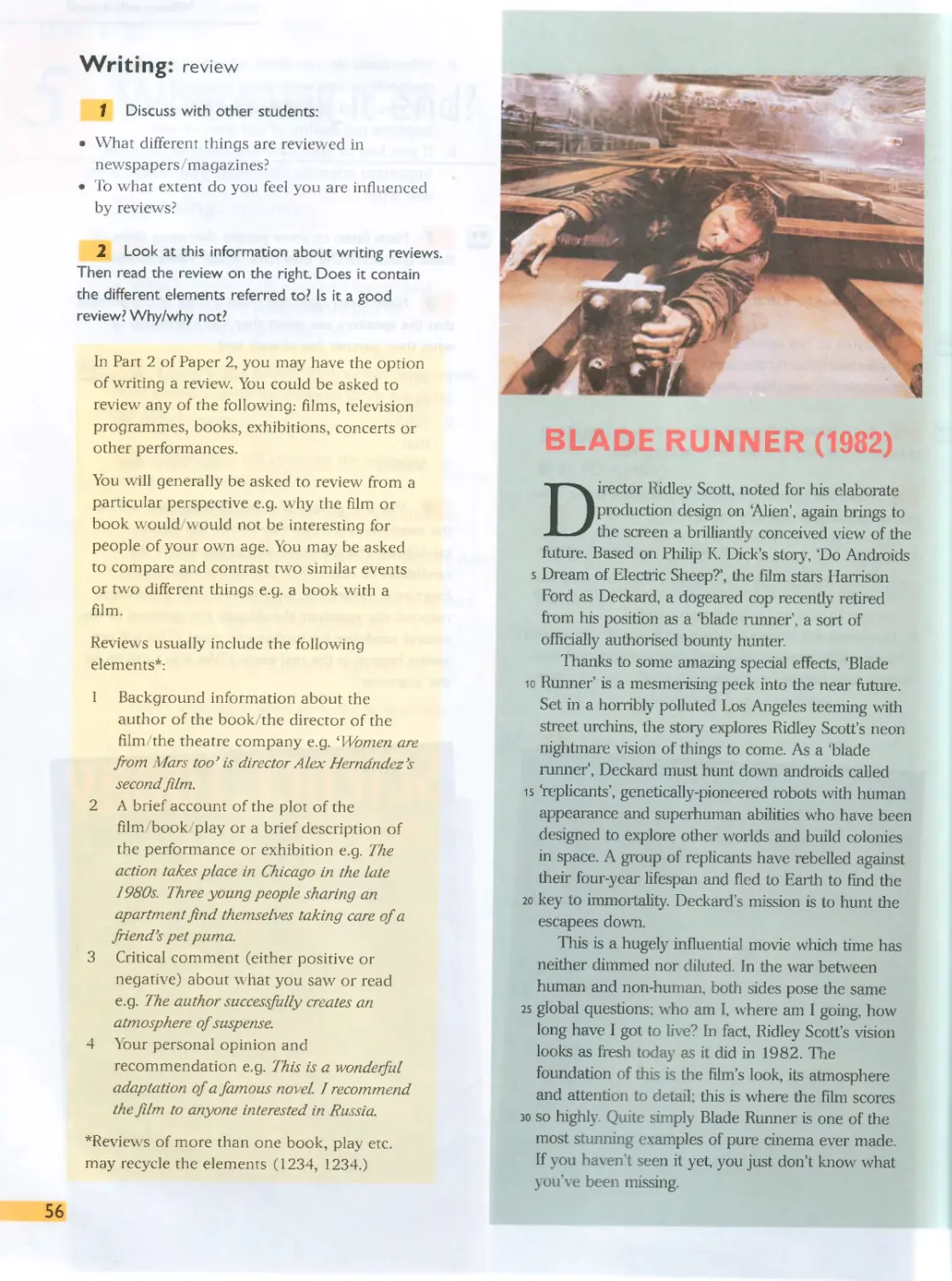

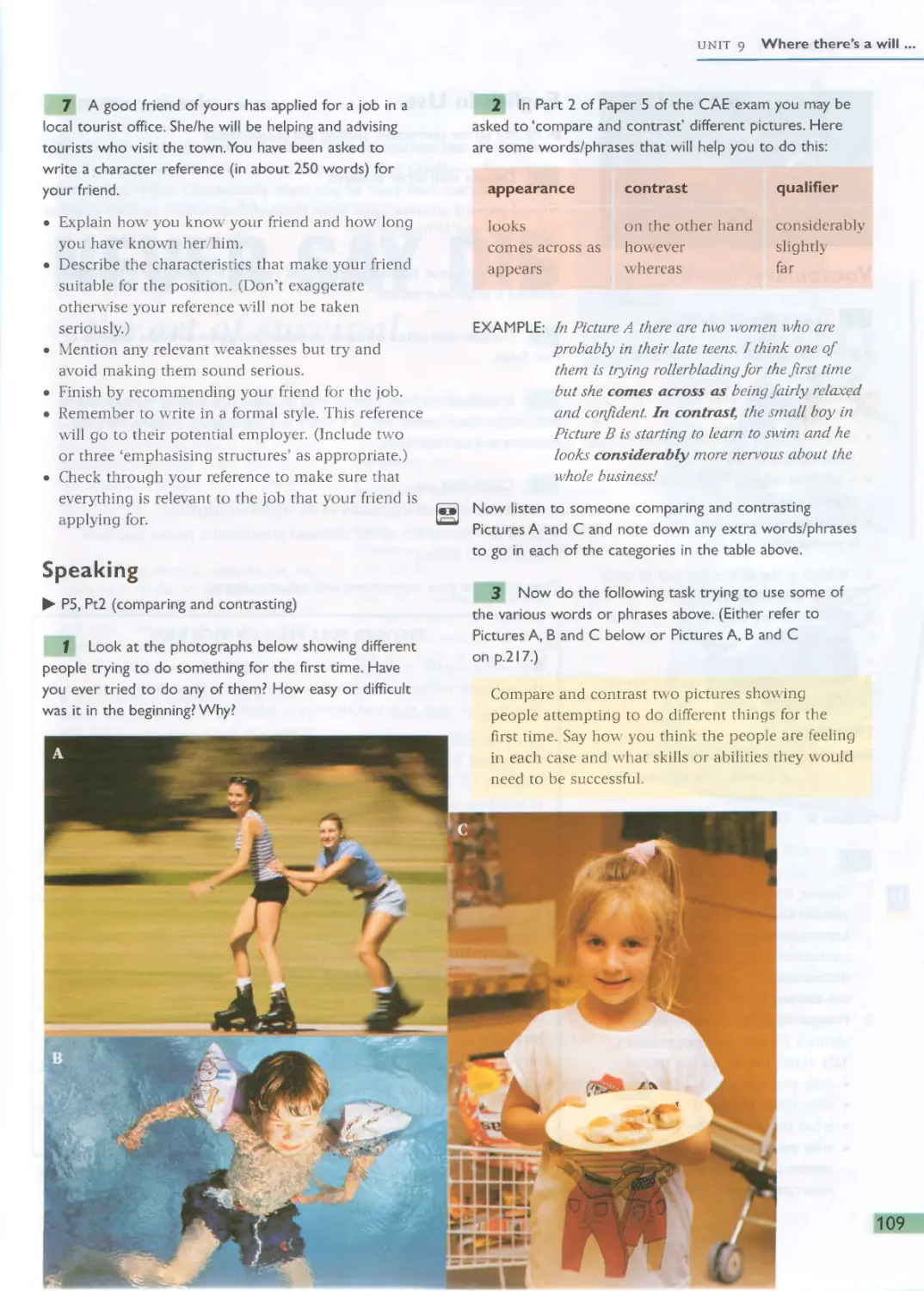
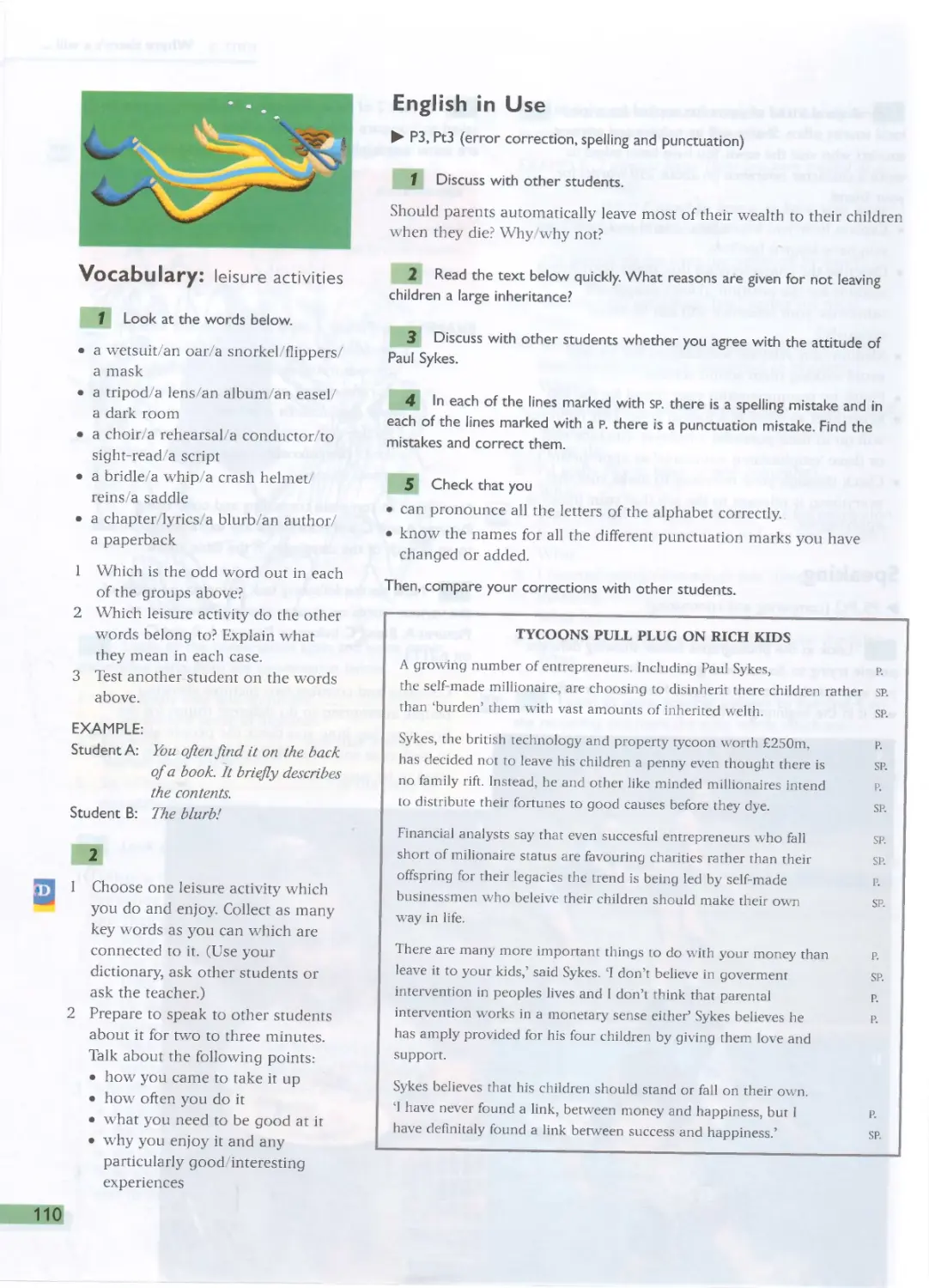
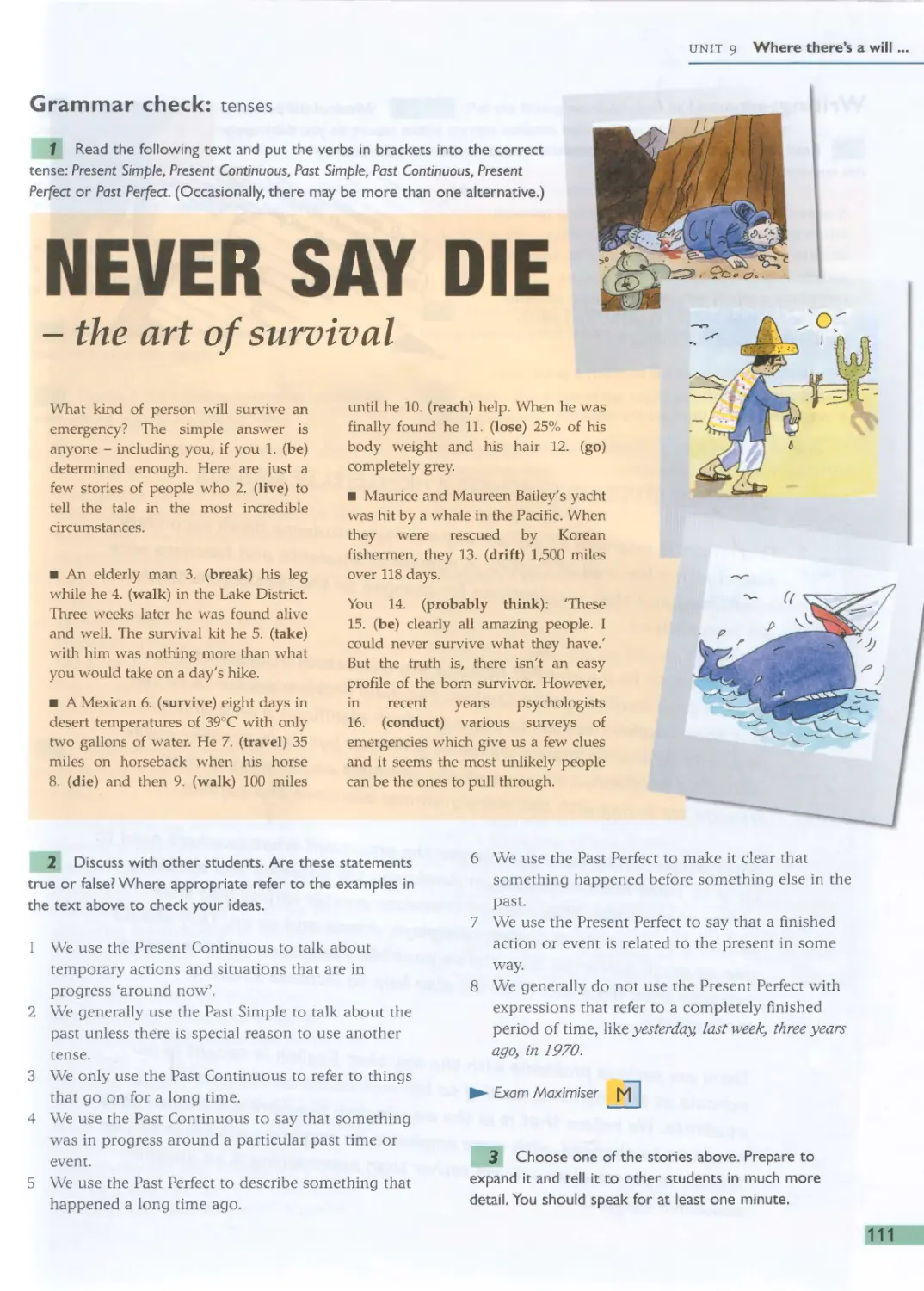
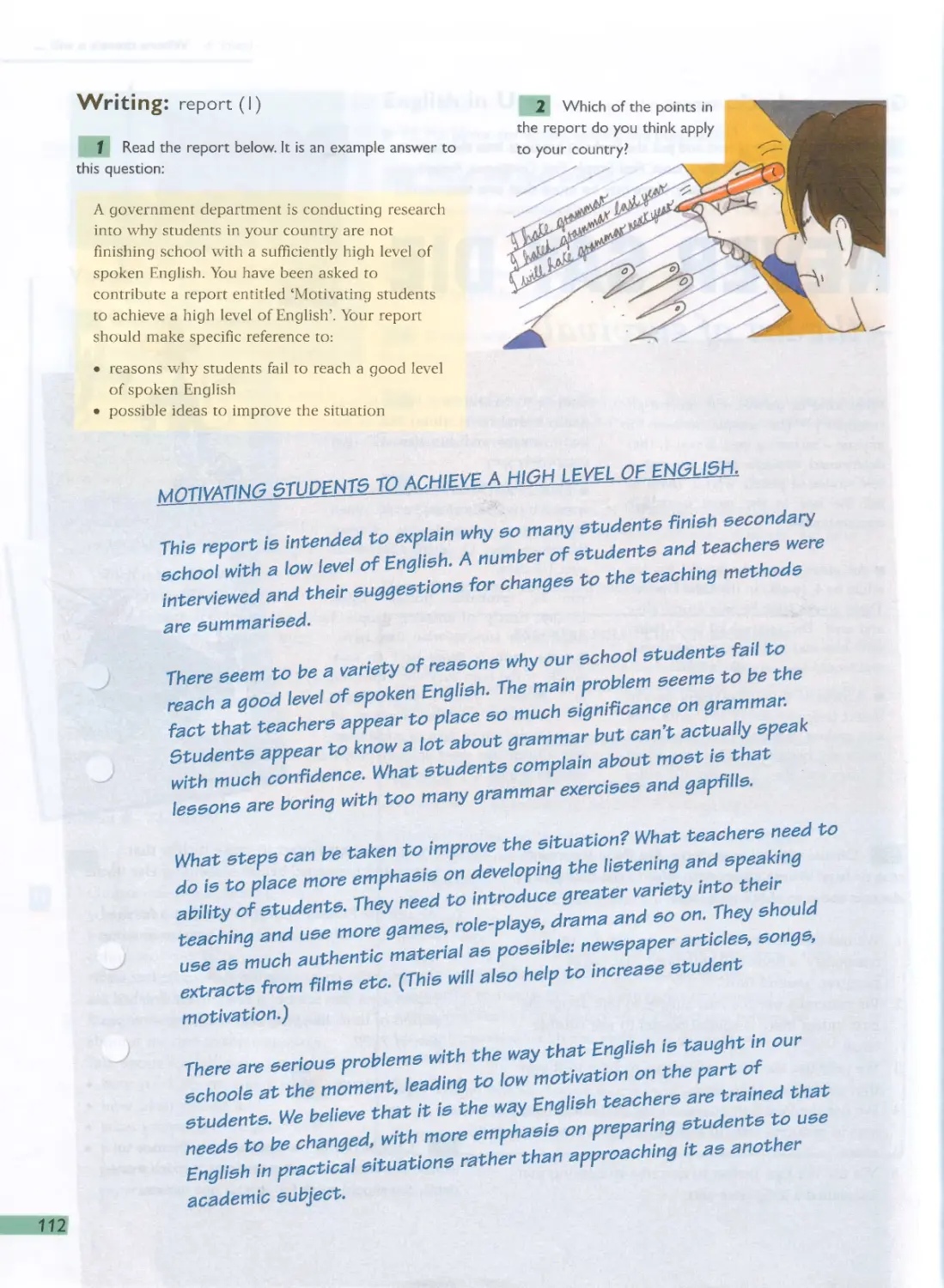
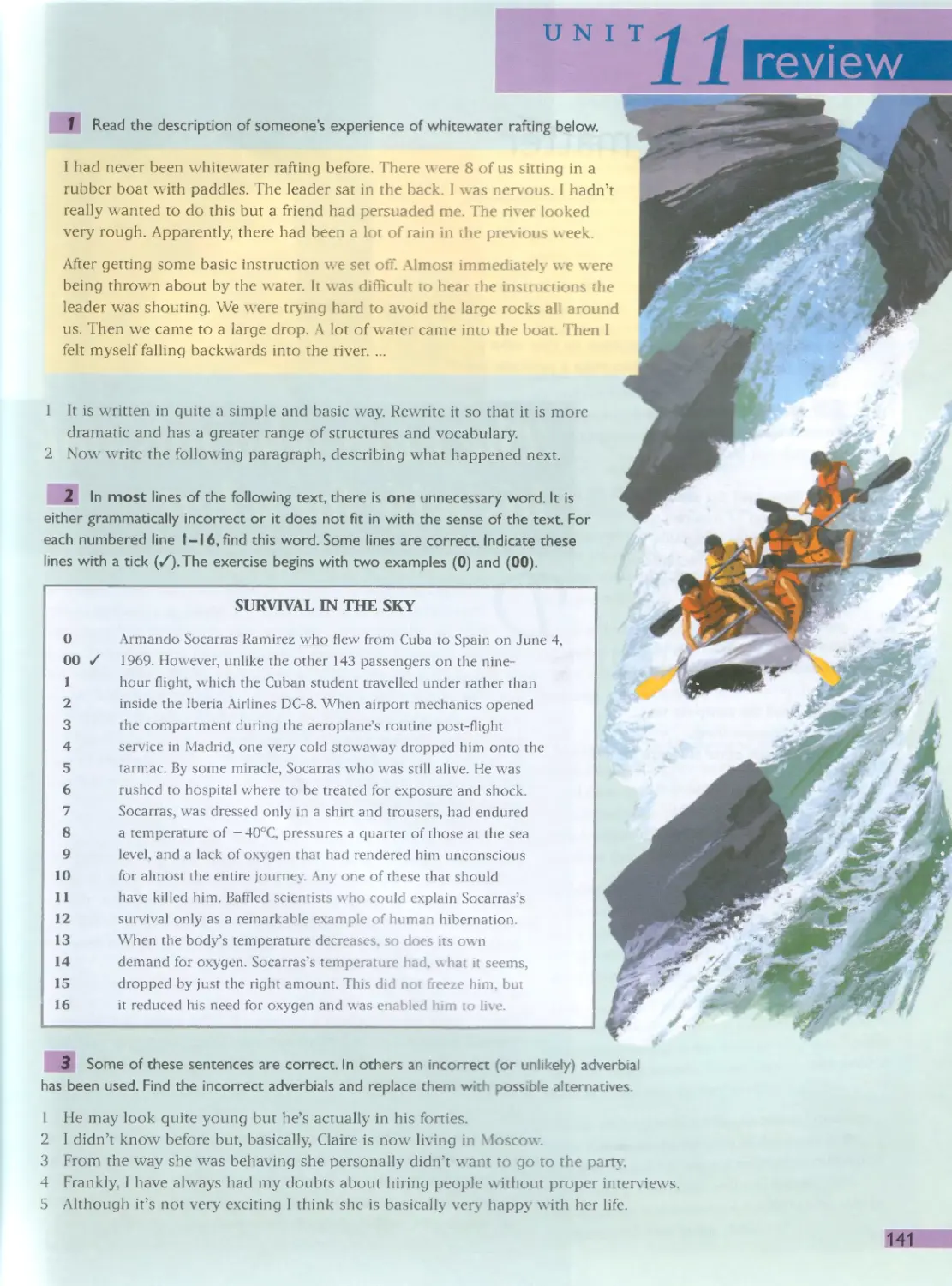
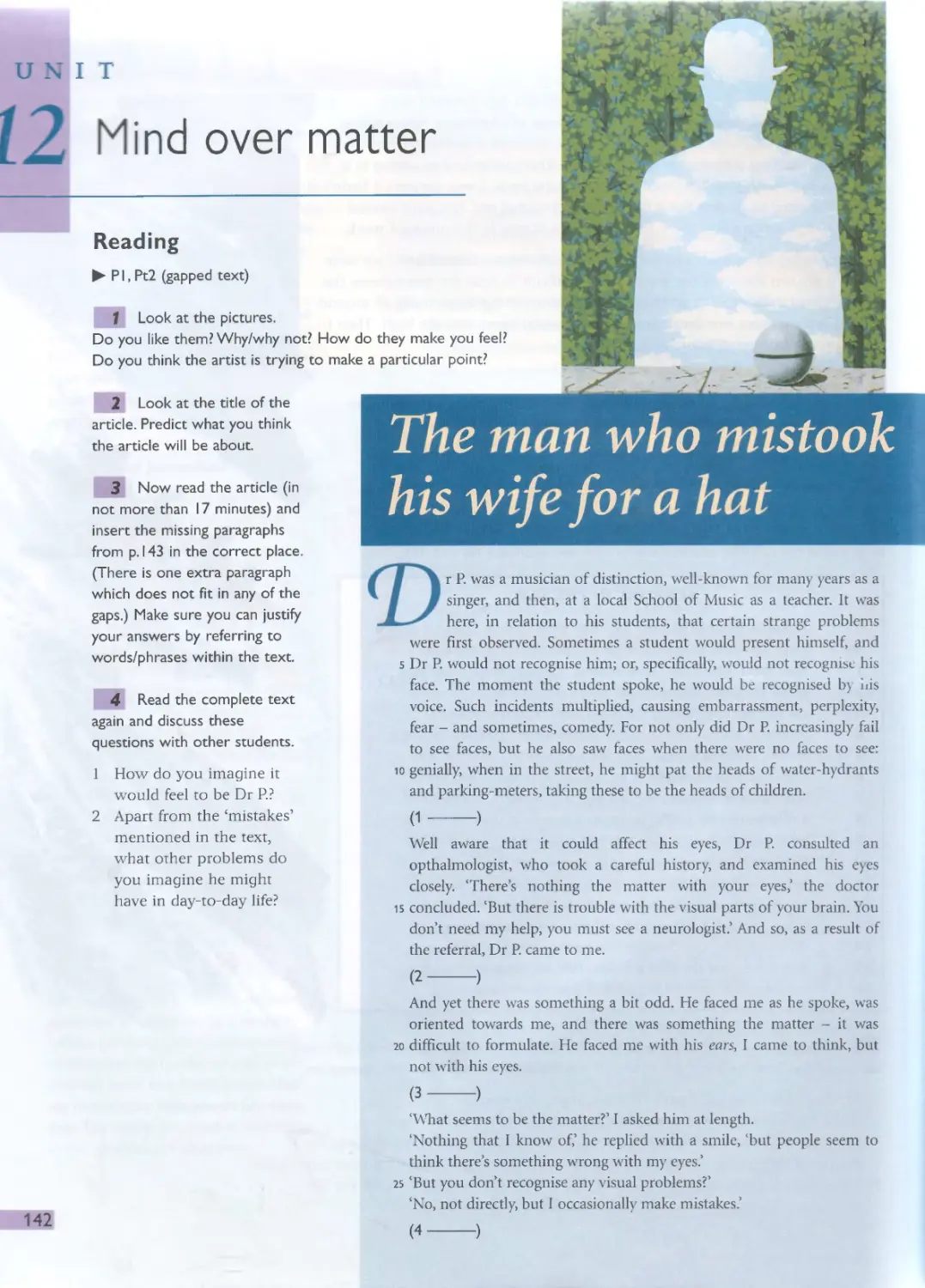
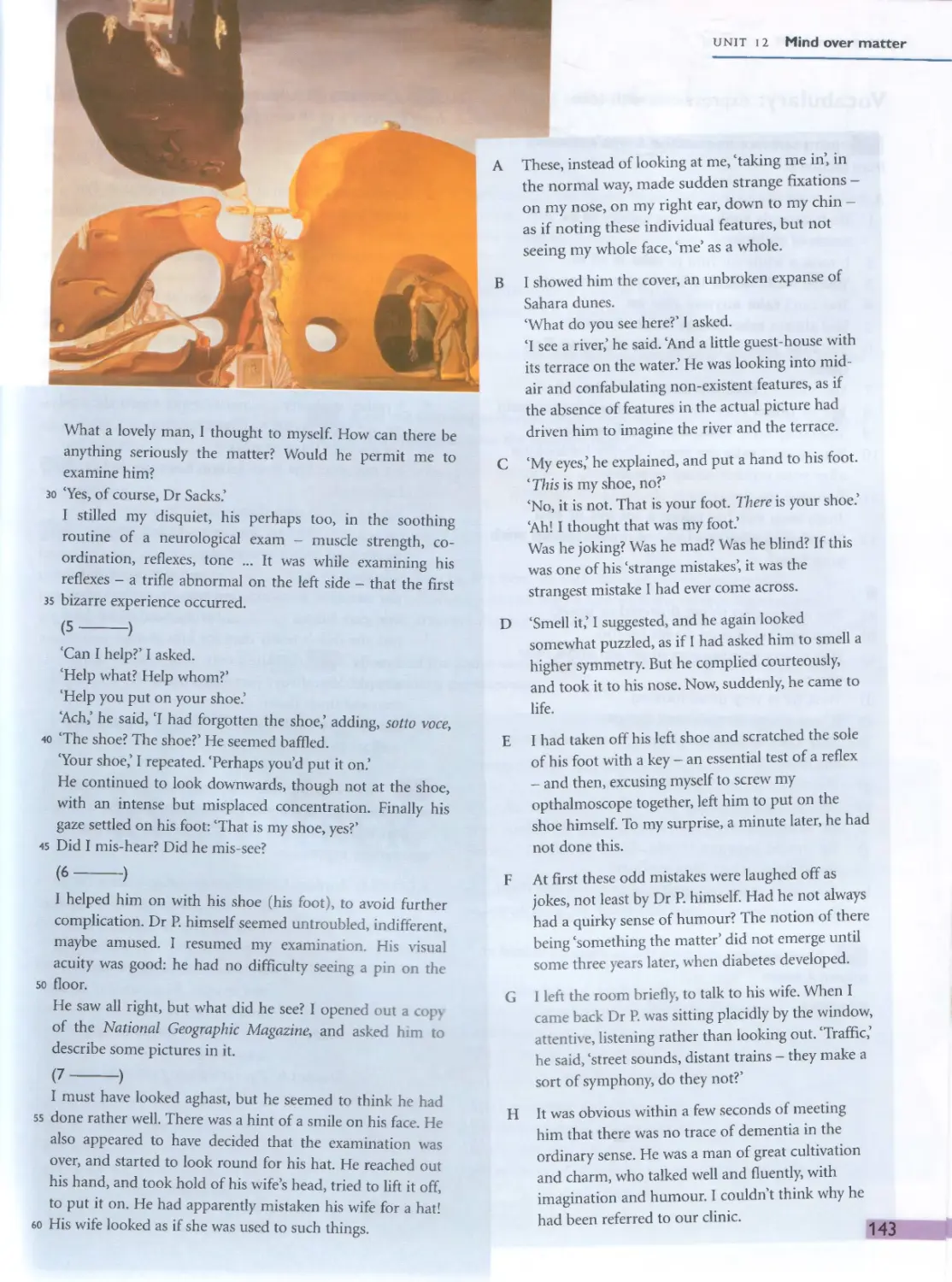
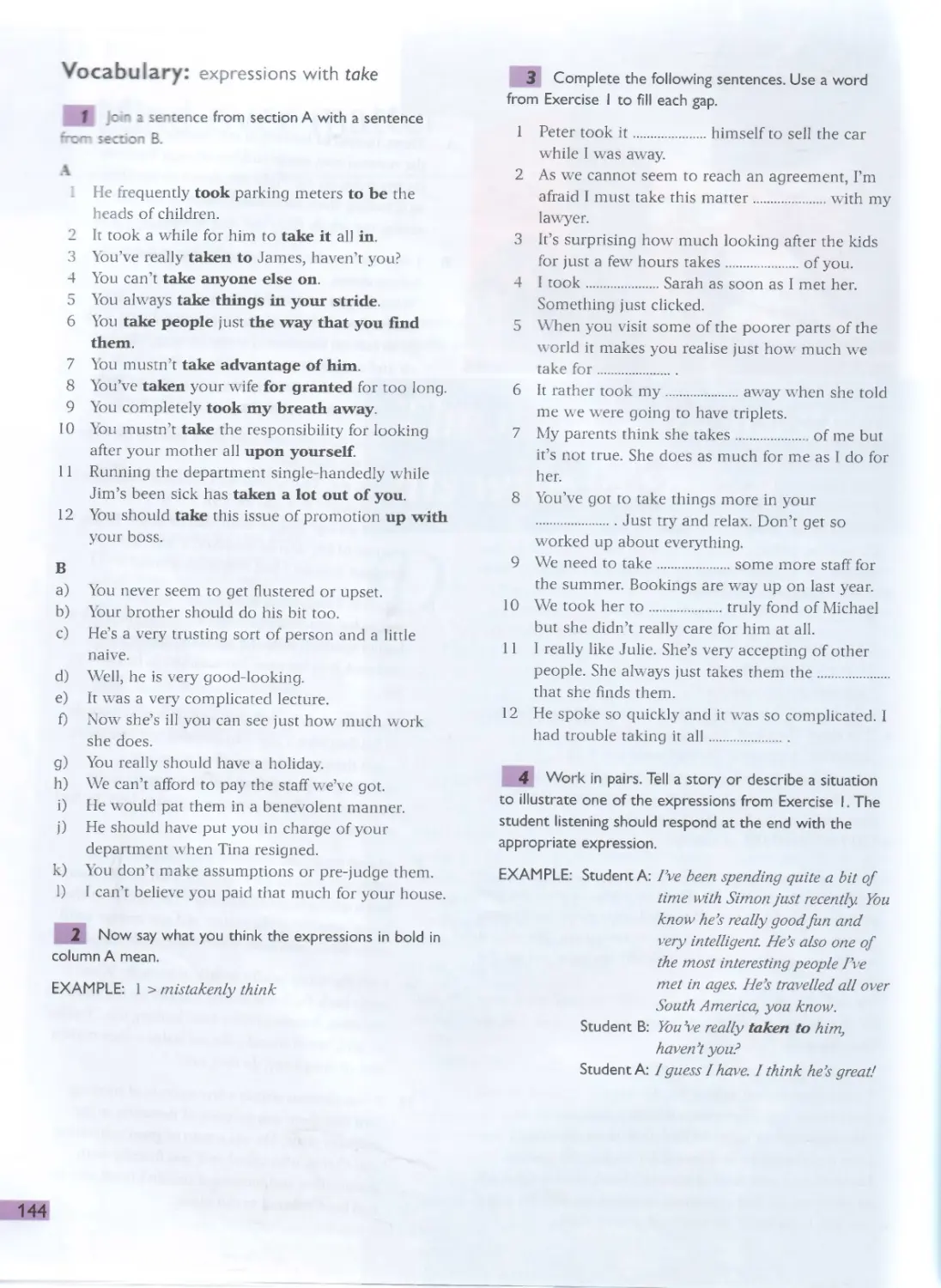

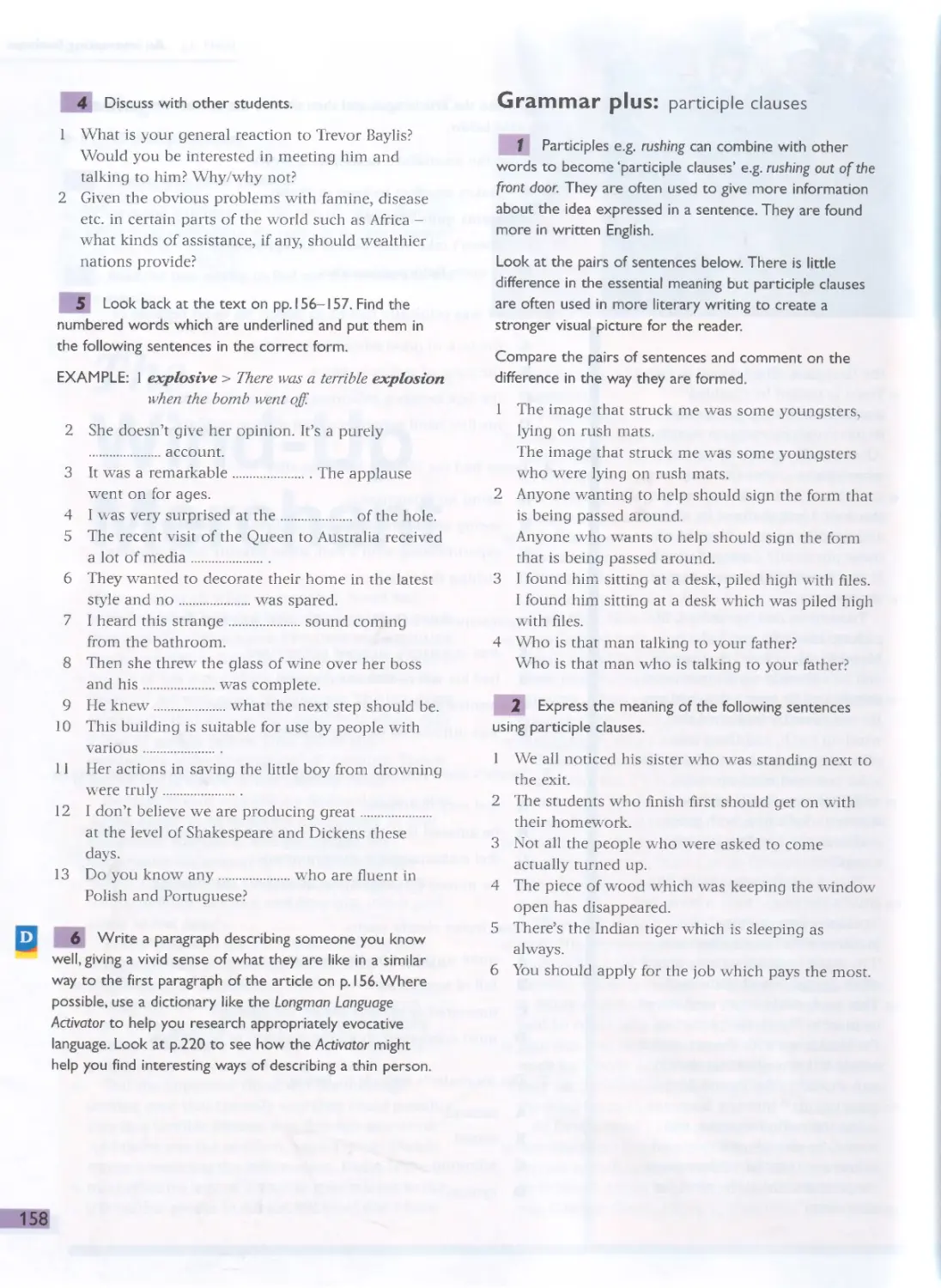
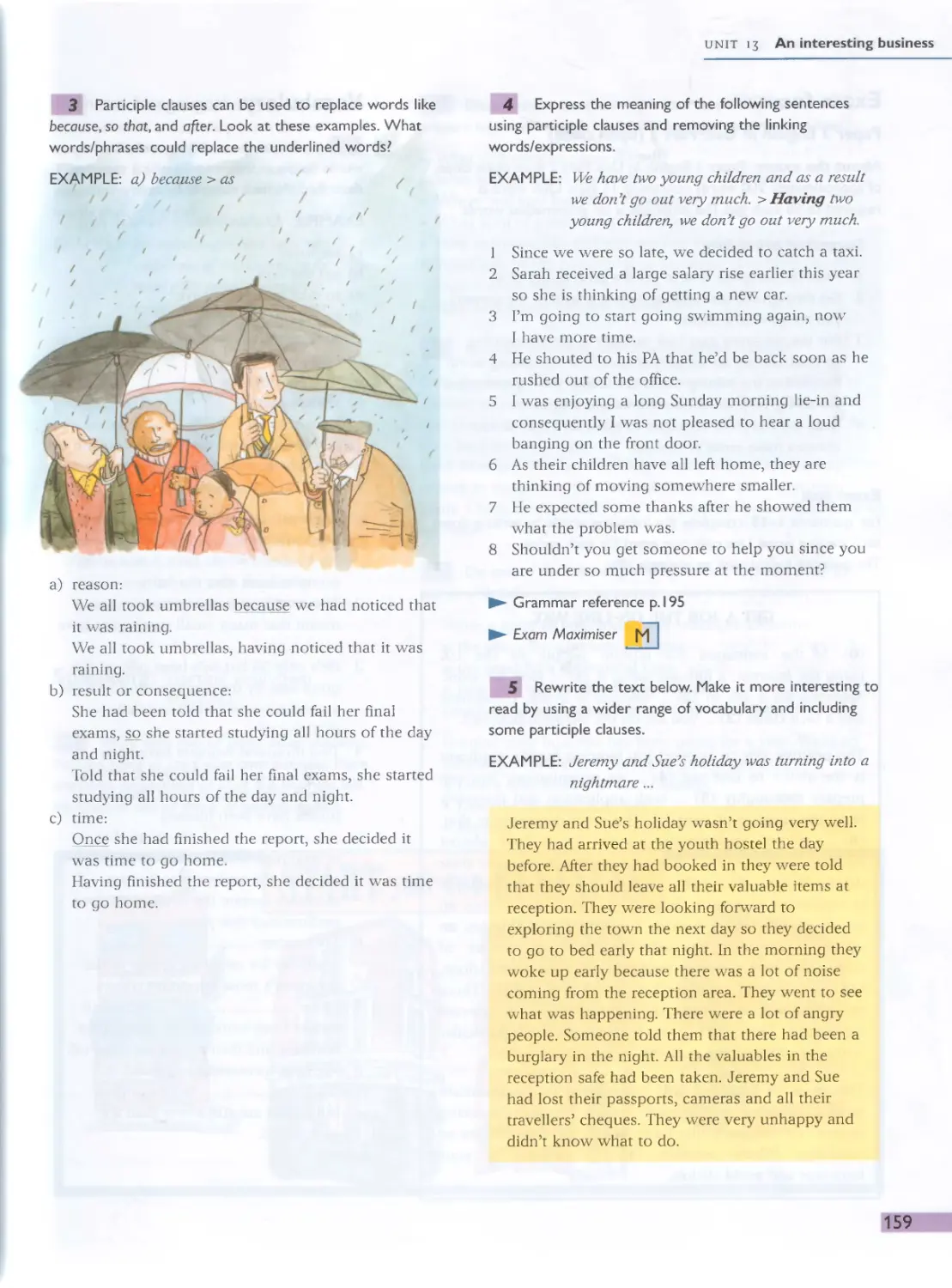
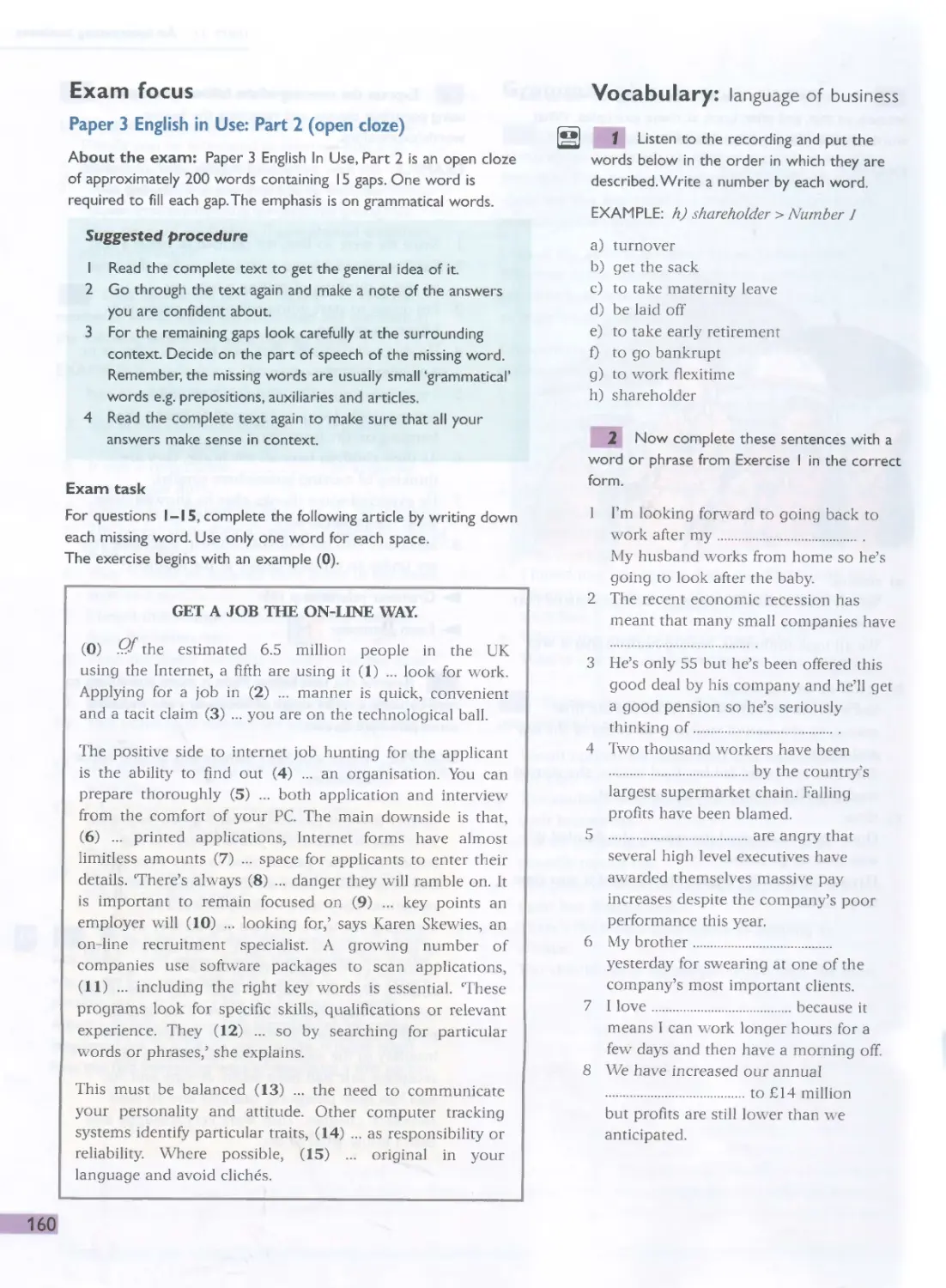
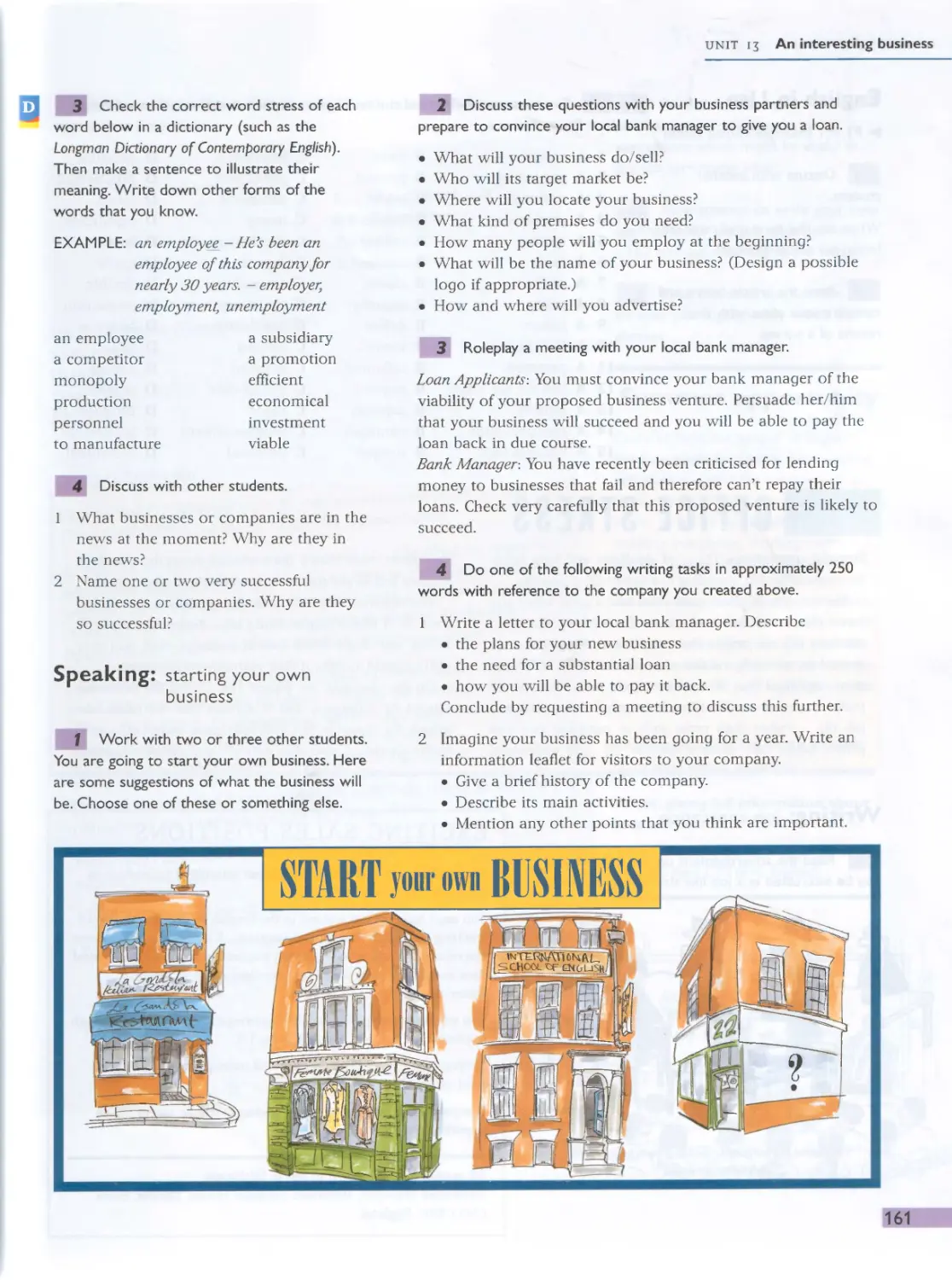
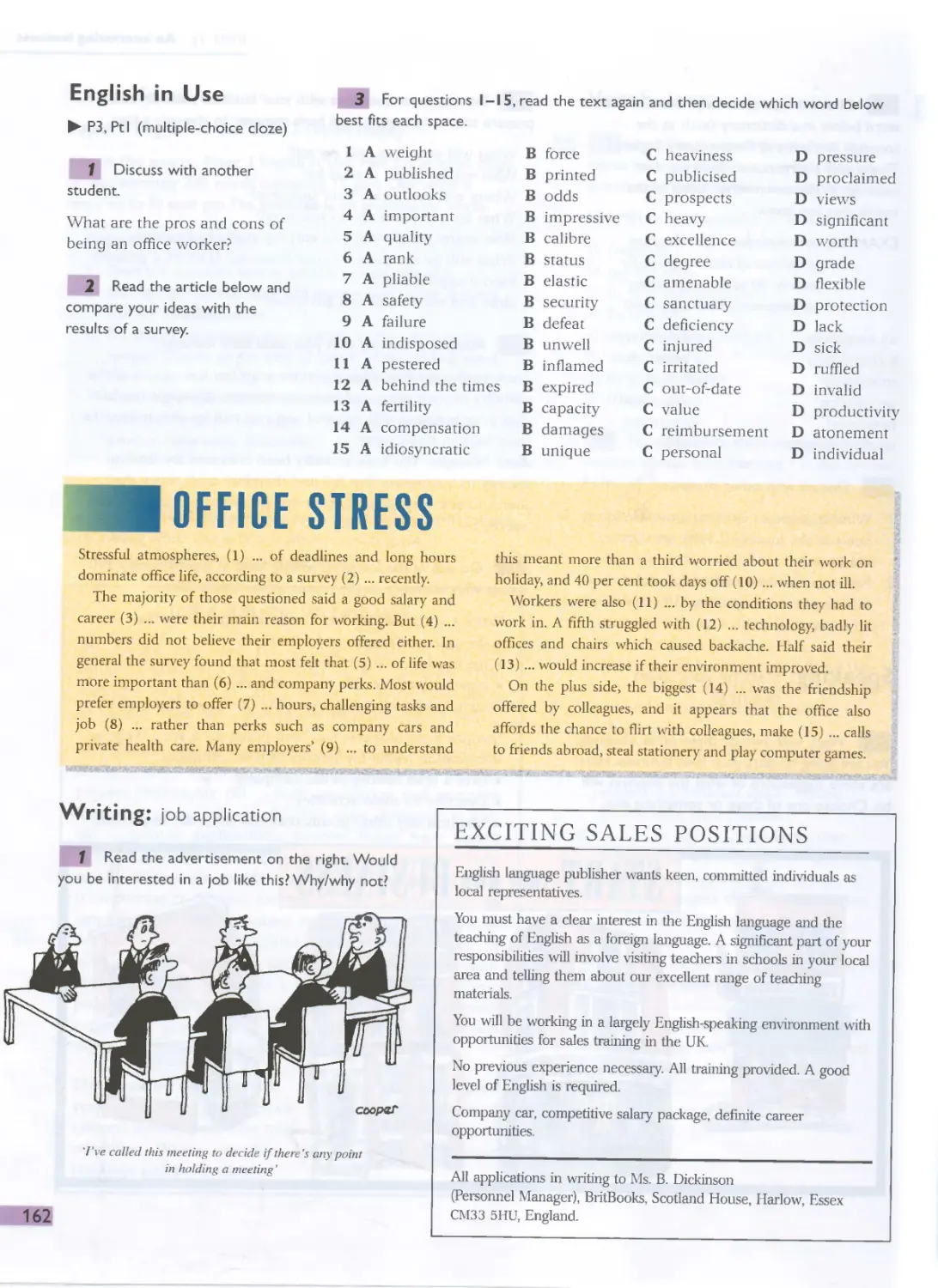
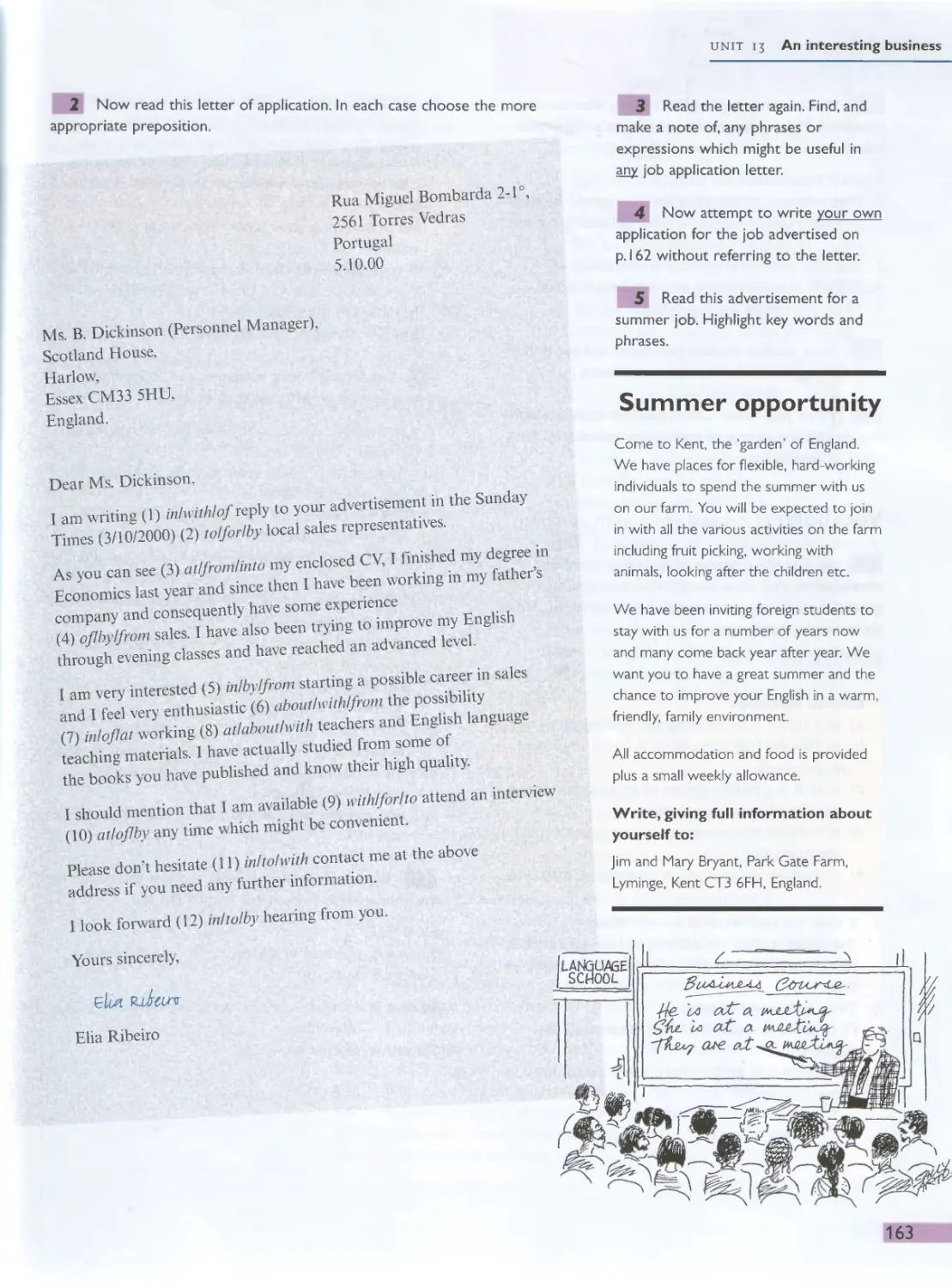
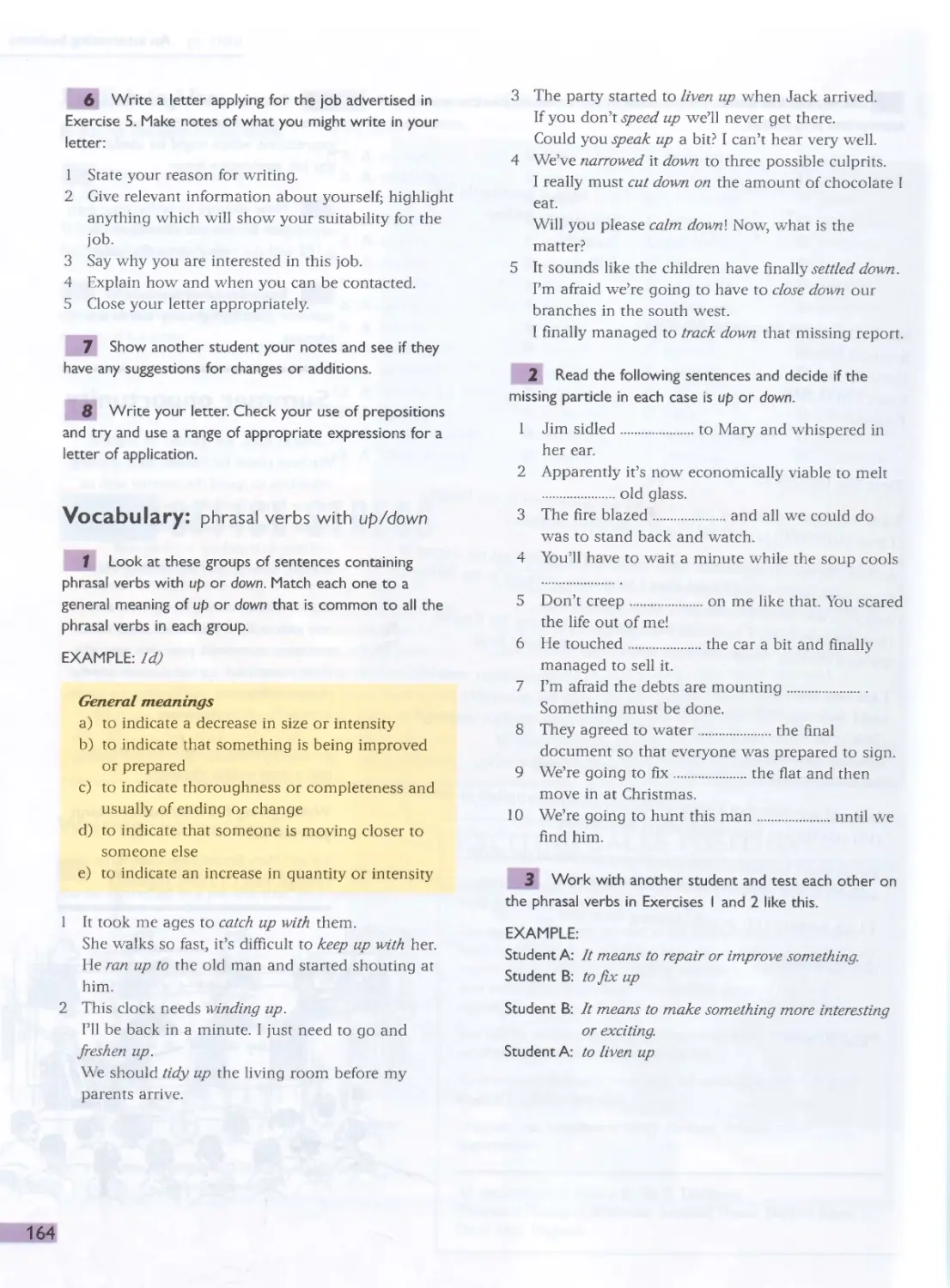
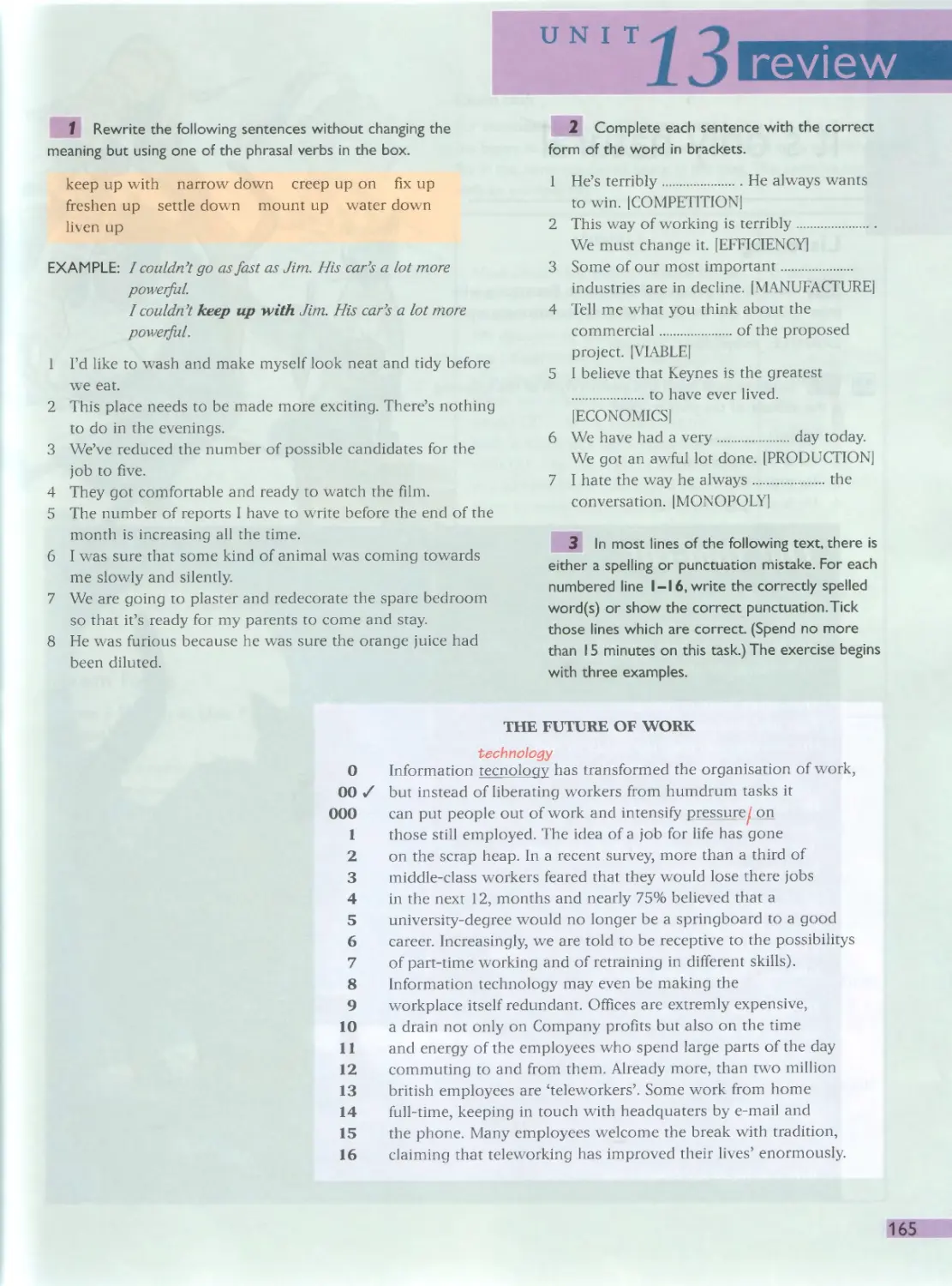
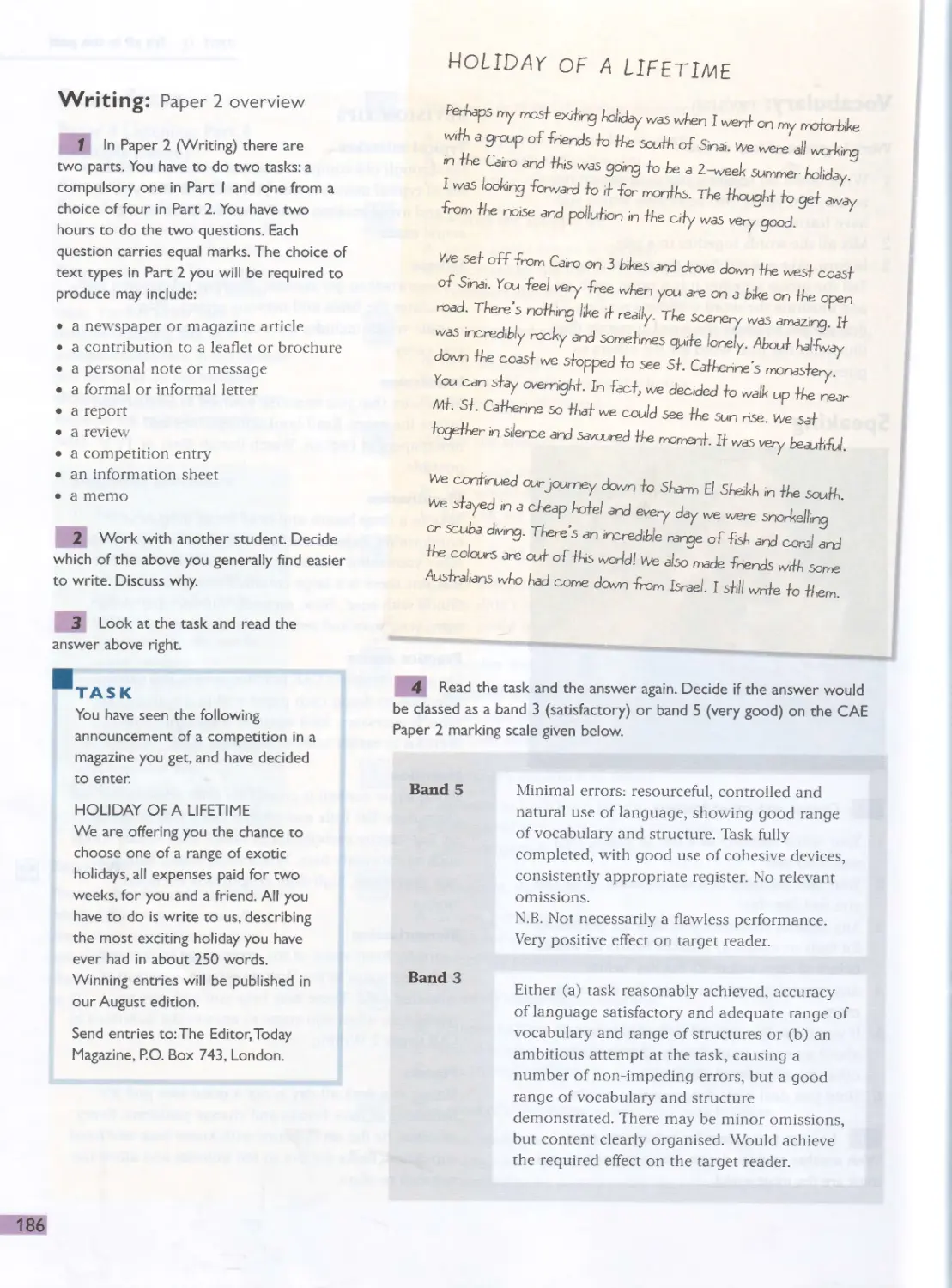
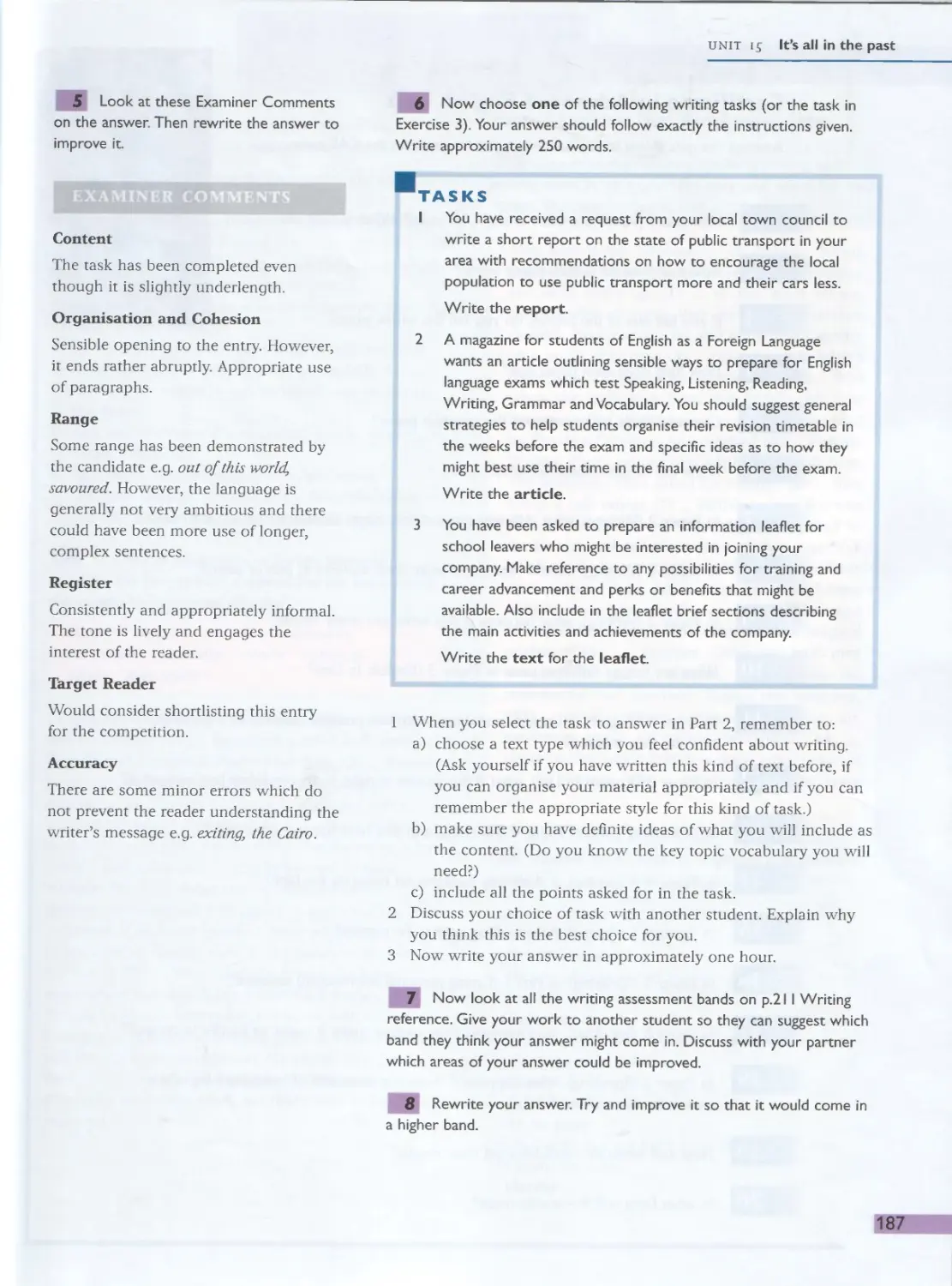
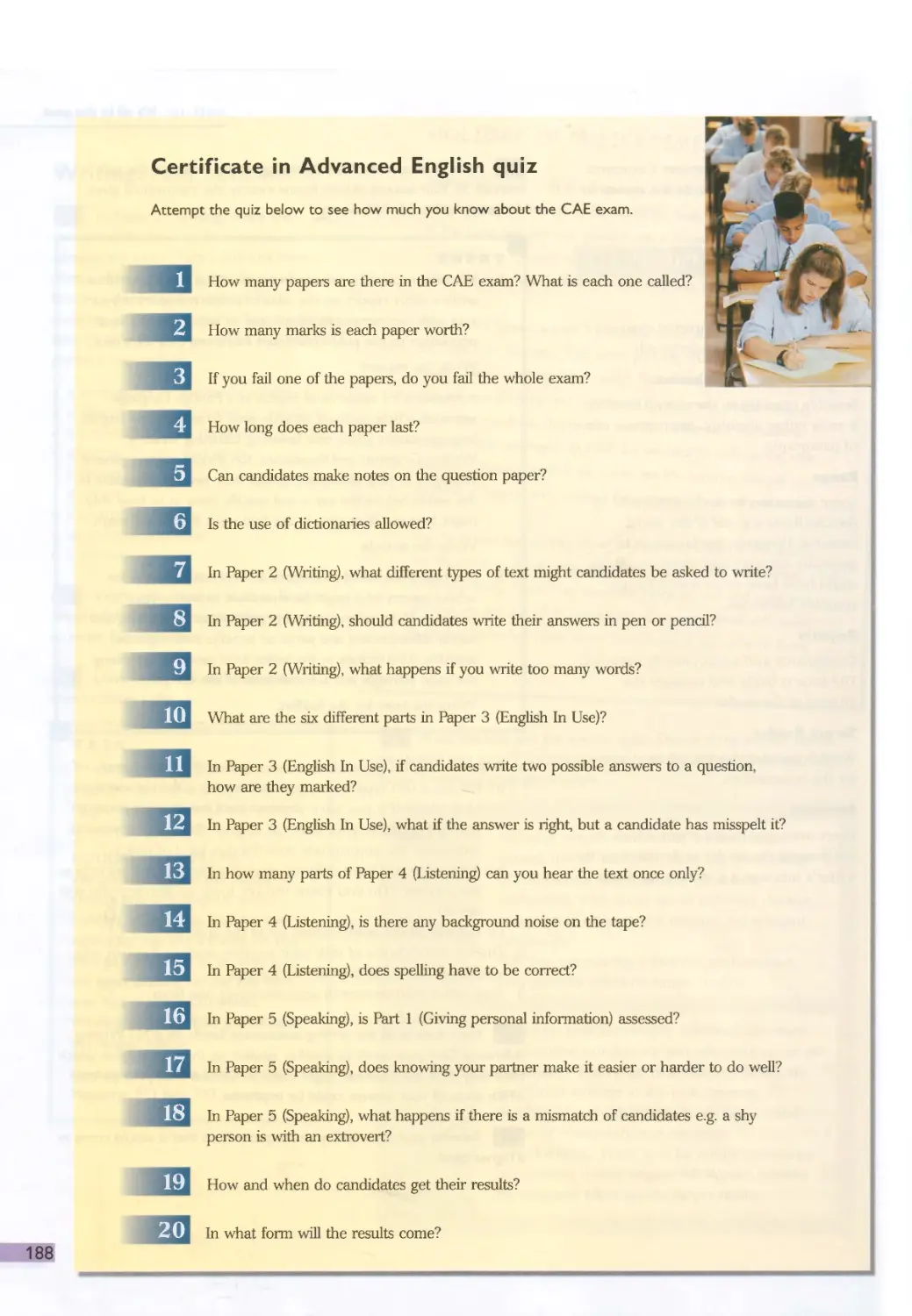
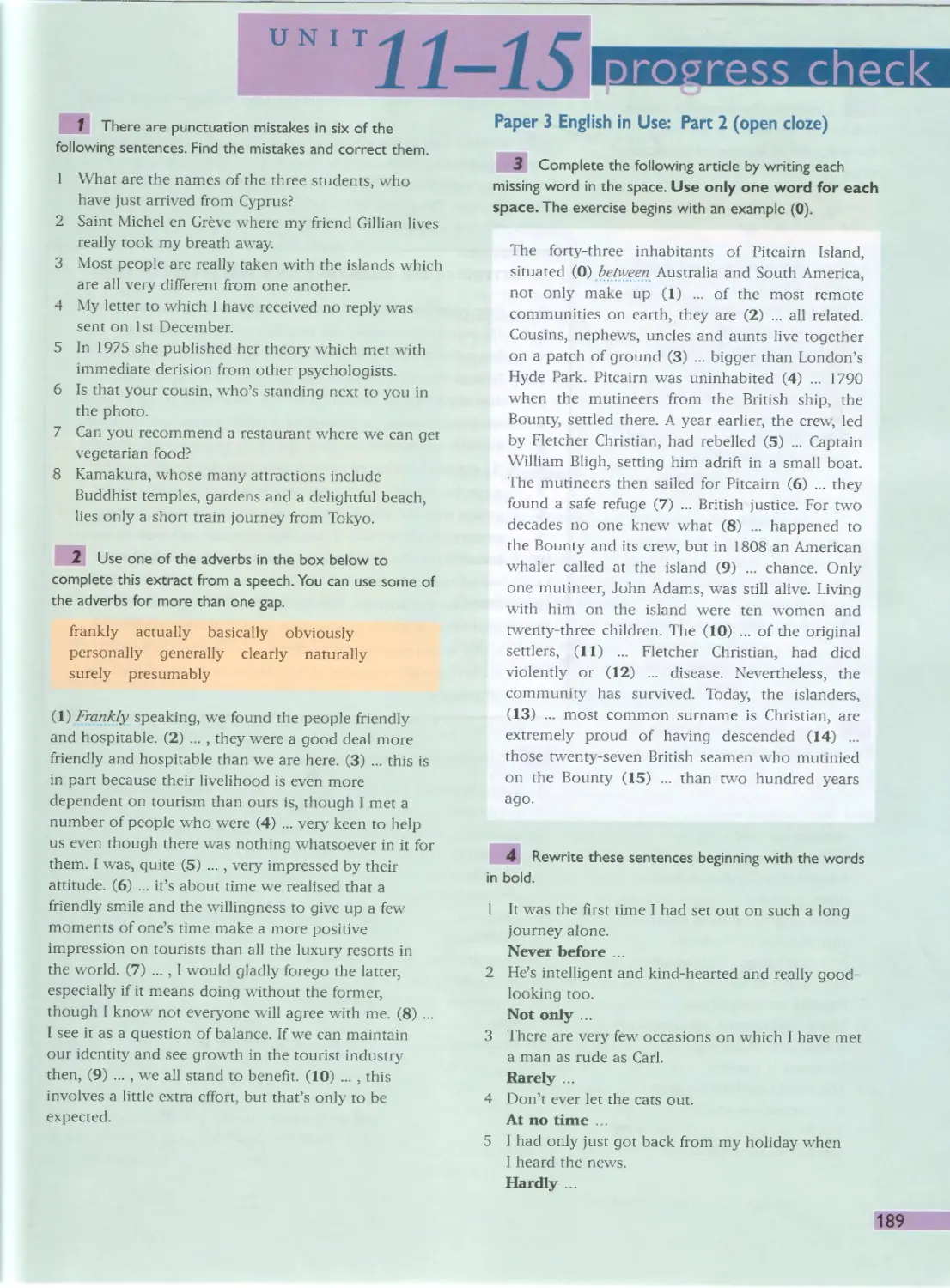
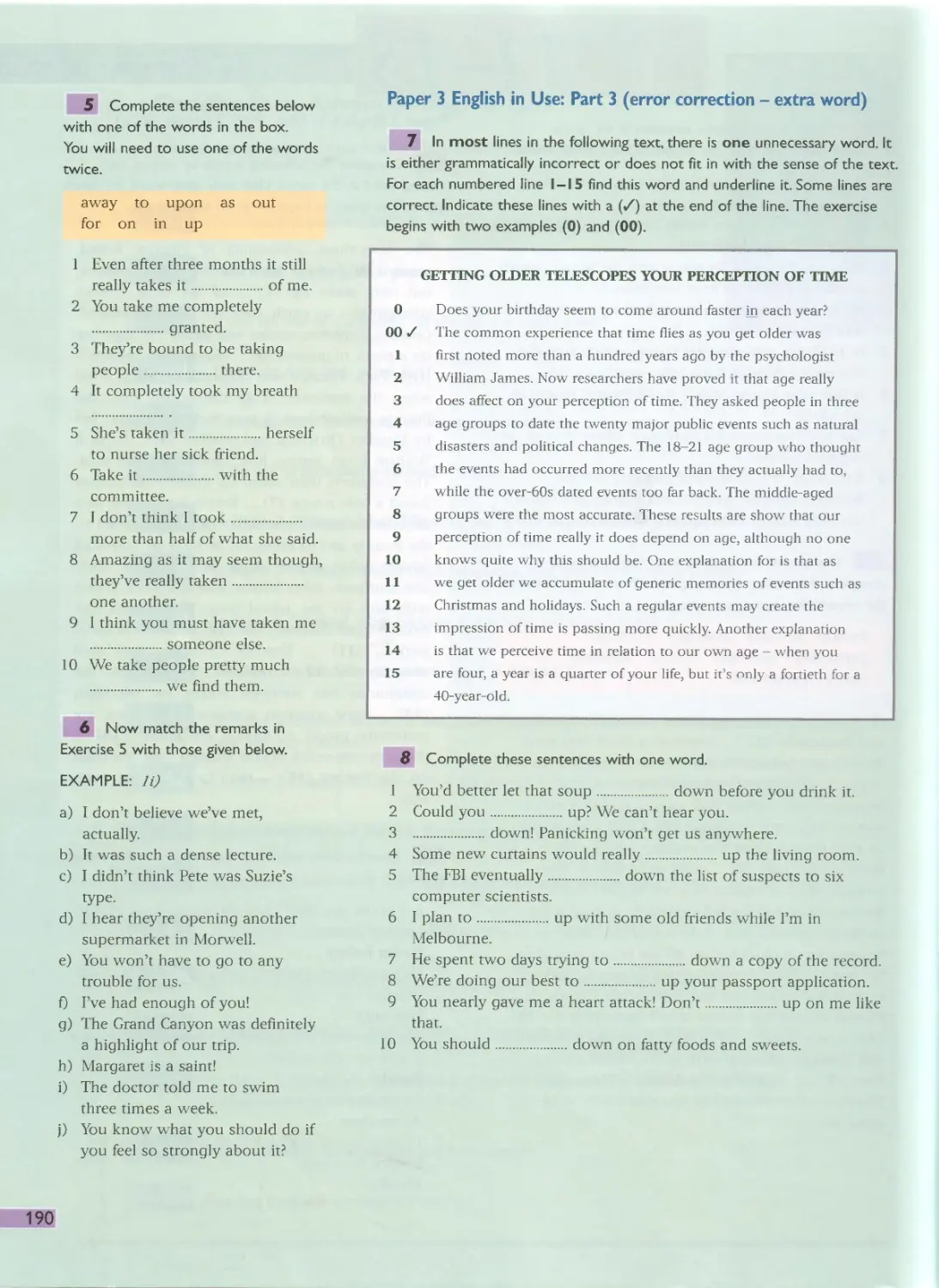
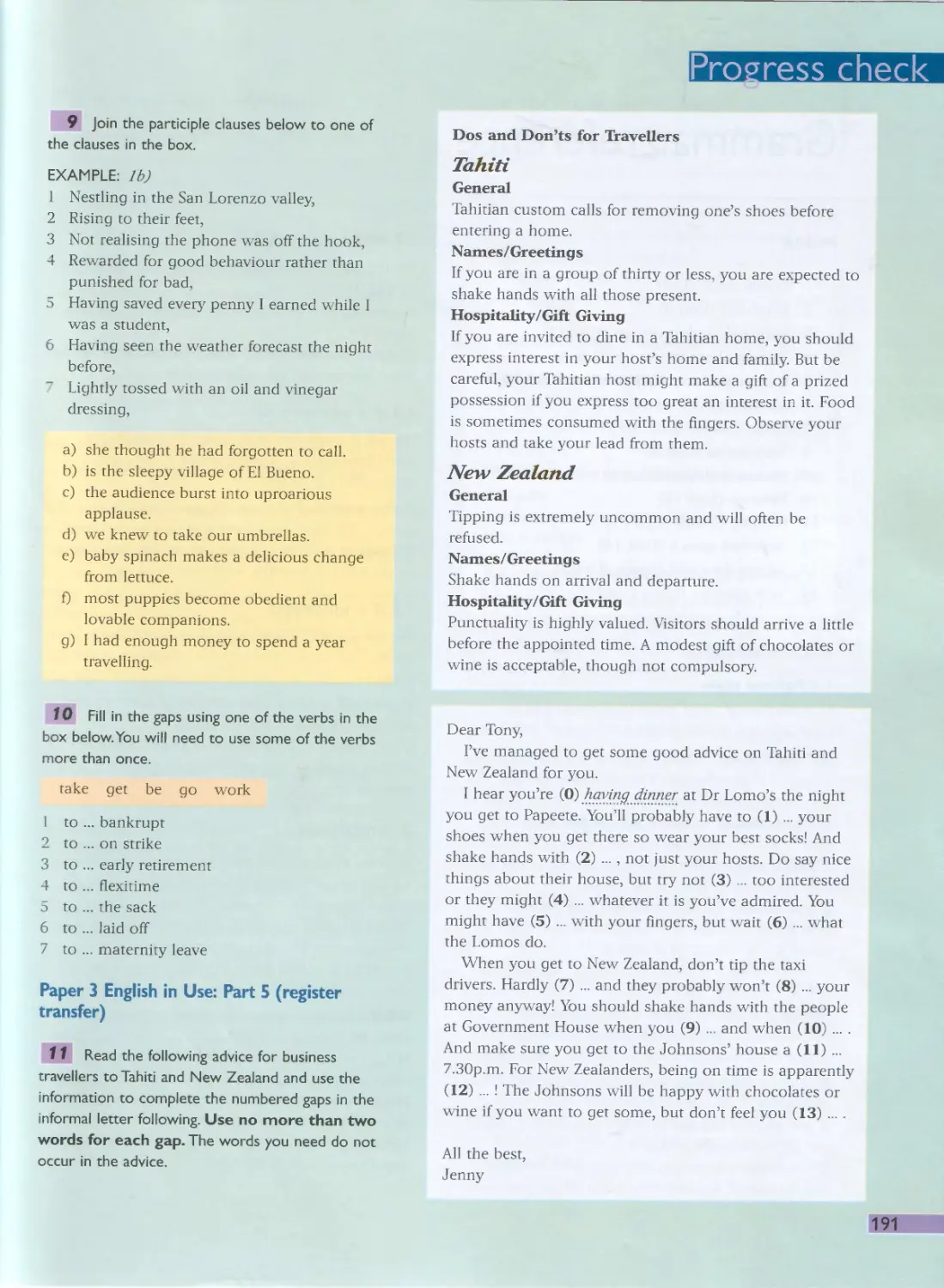
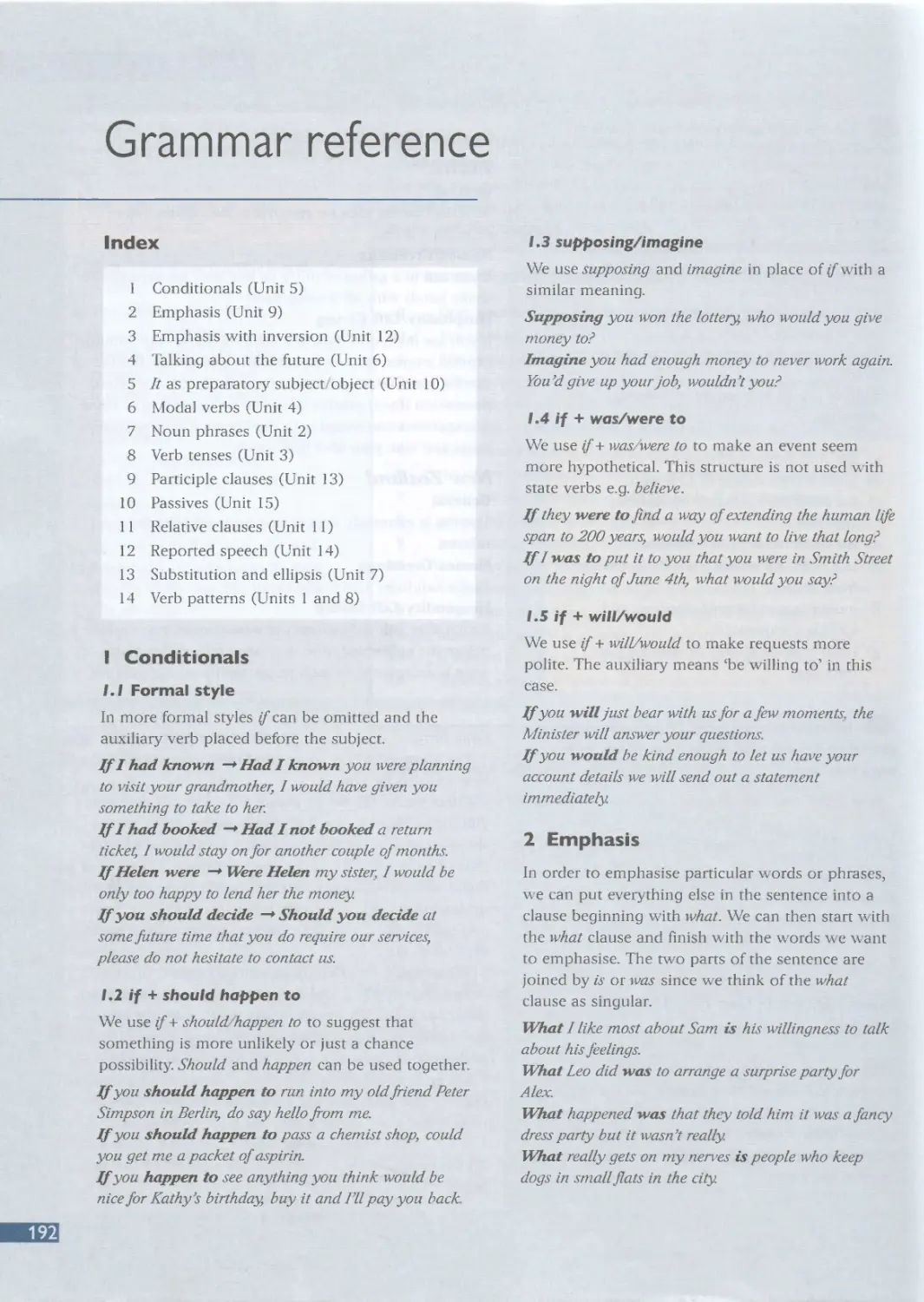
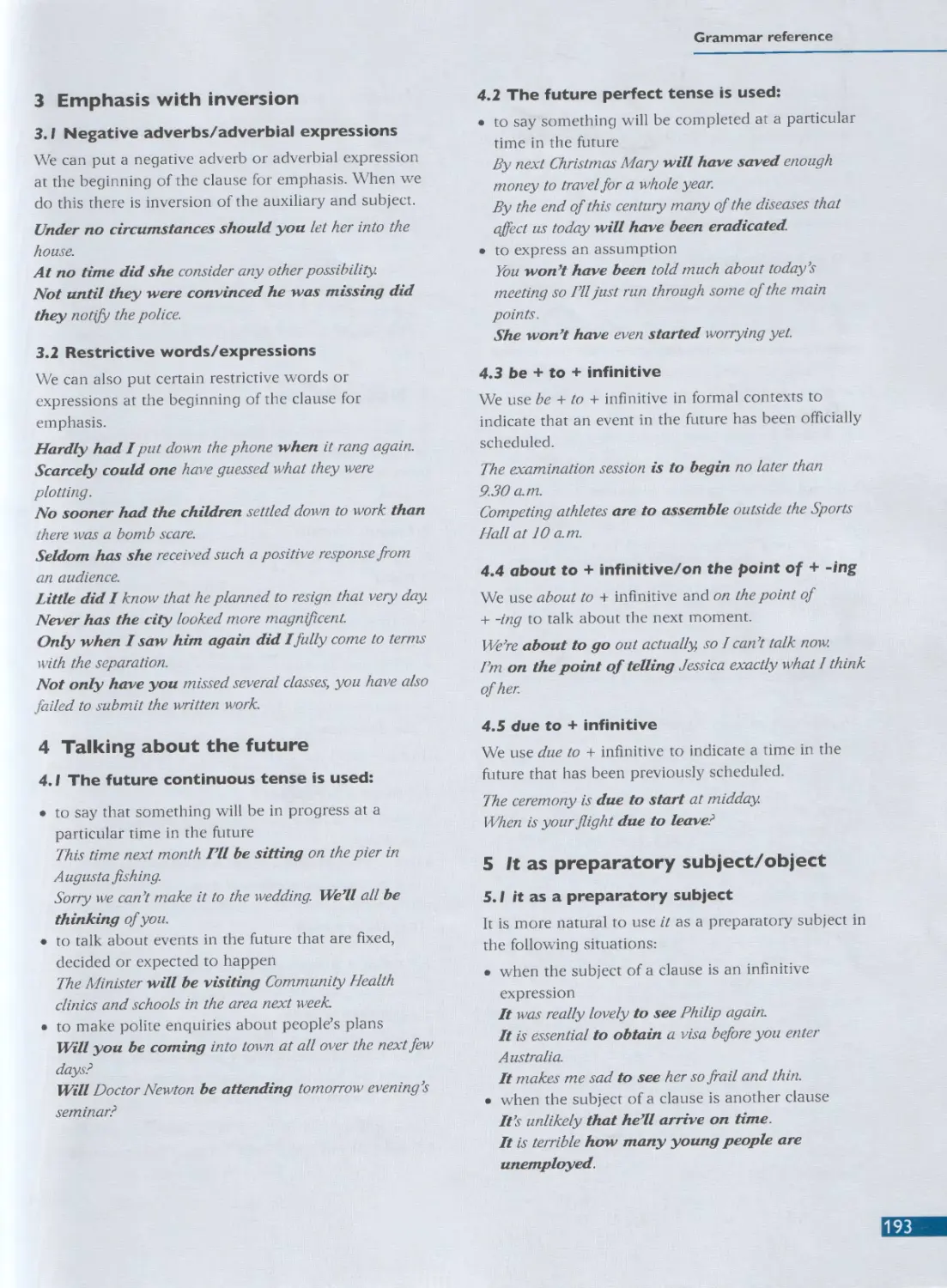
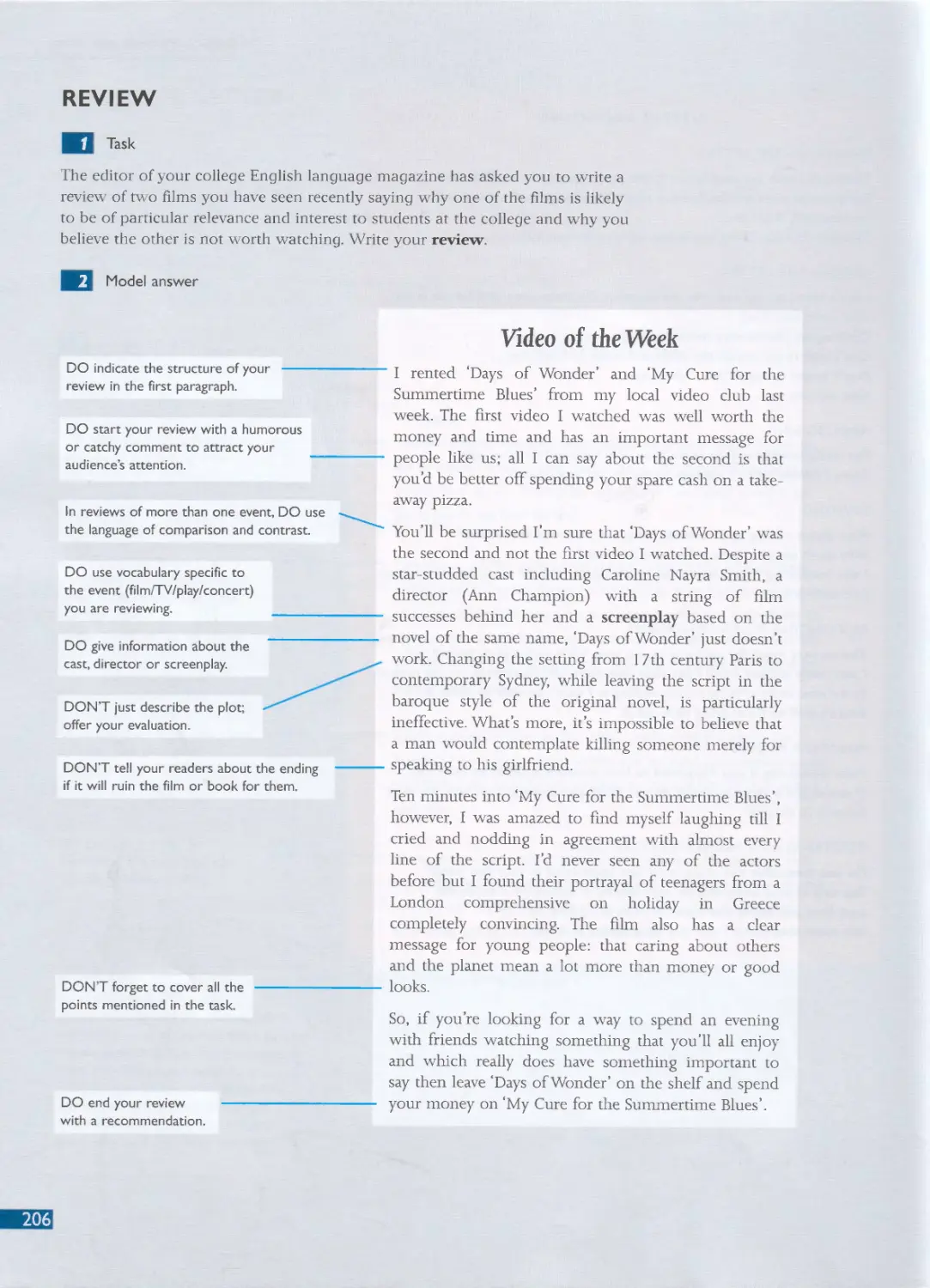
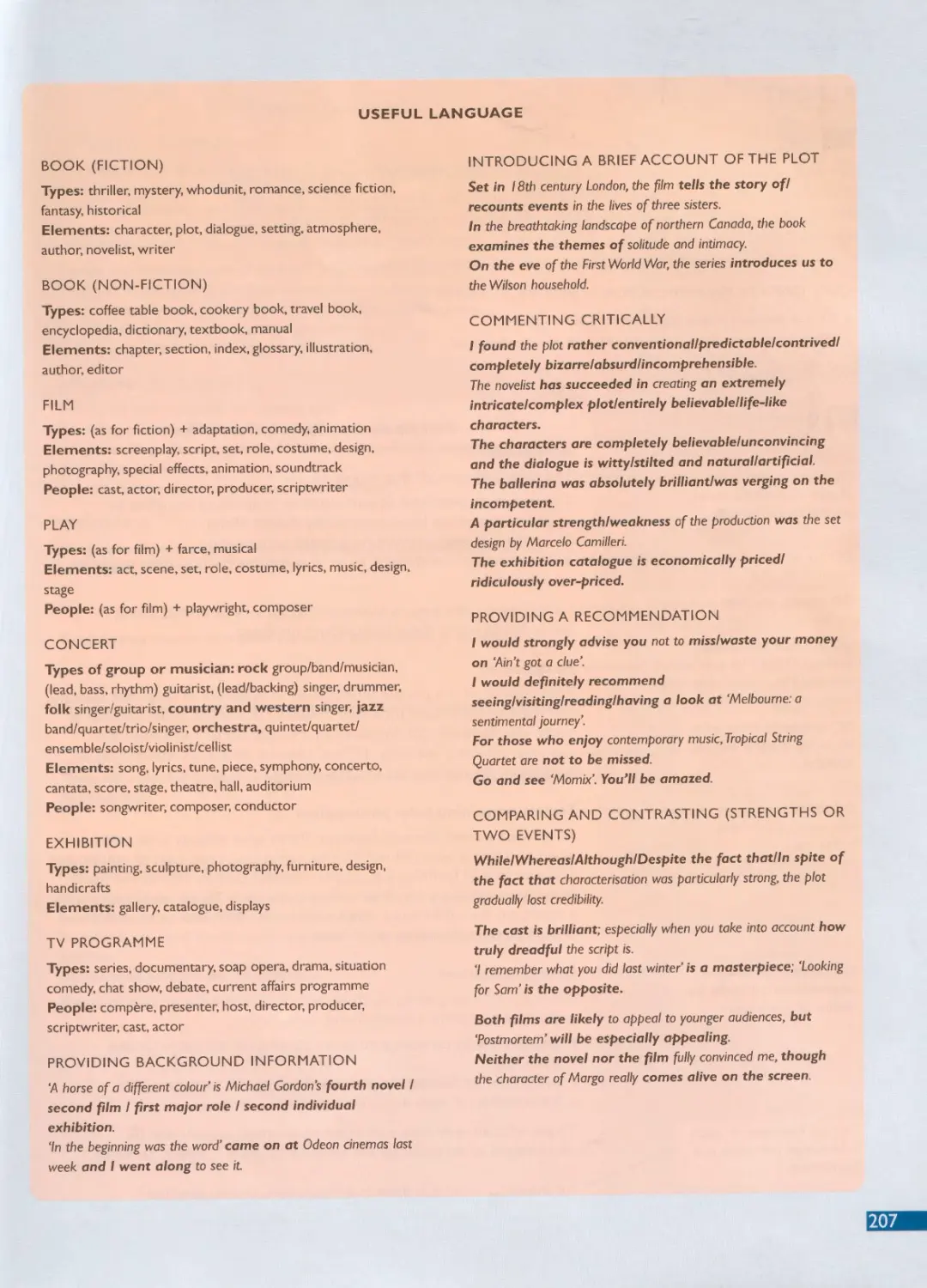
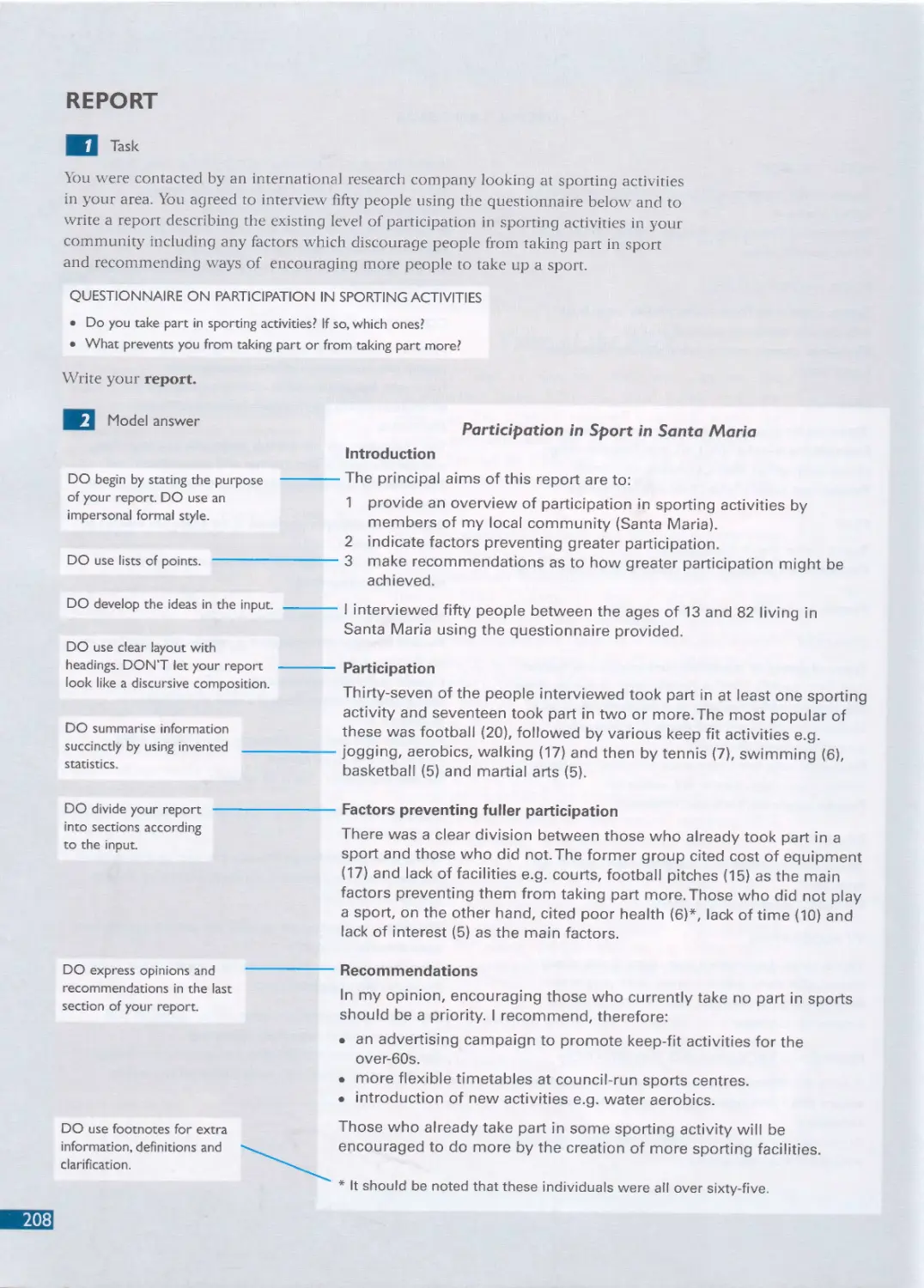
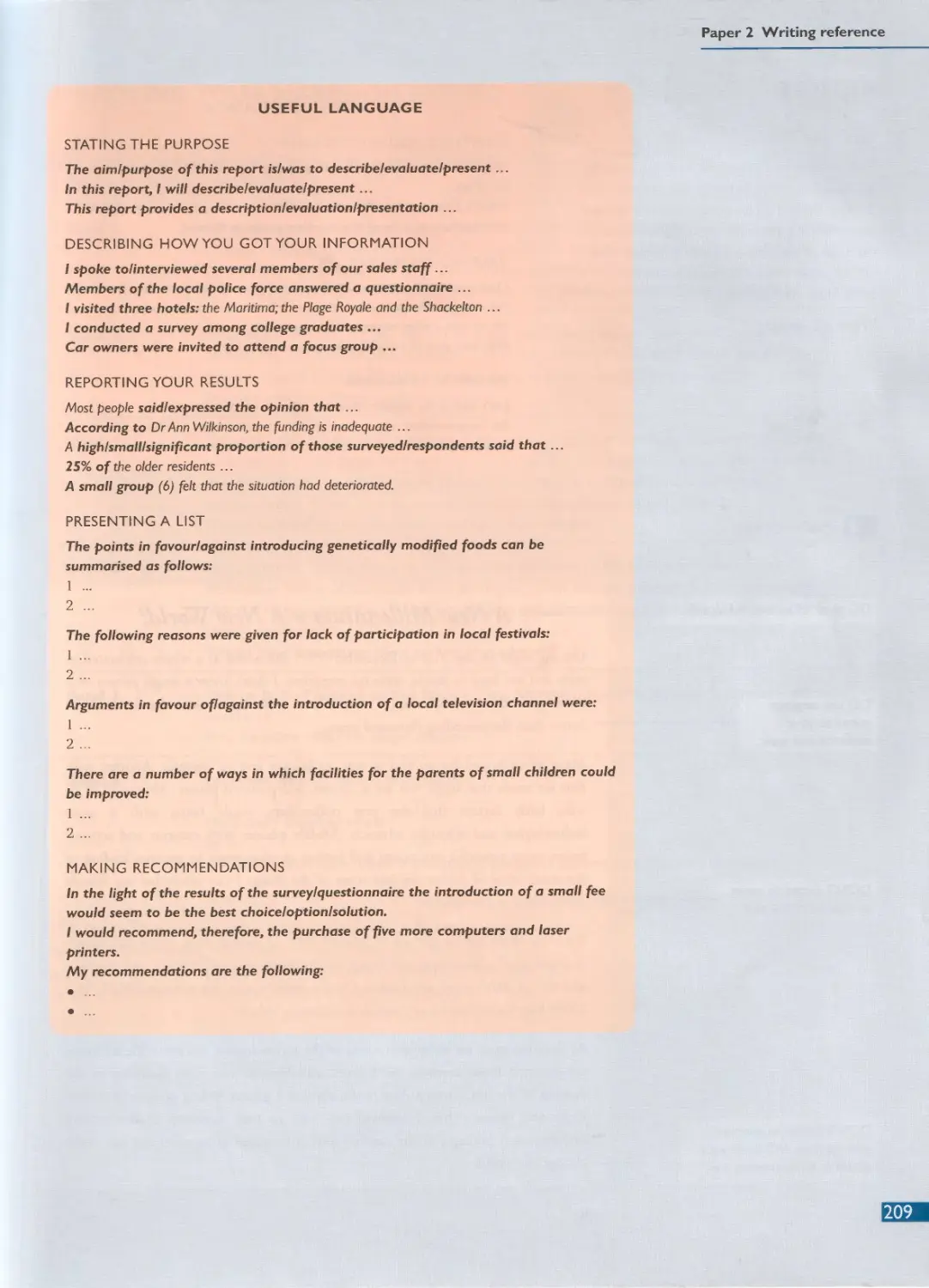



Текст
                    advanced
coursebook
Richard Acklam
with Sally Burgess
Longman
www.longman.com
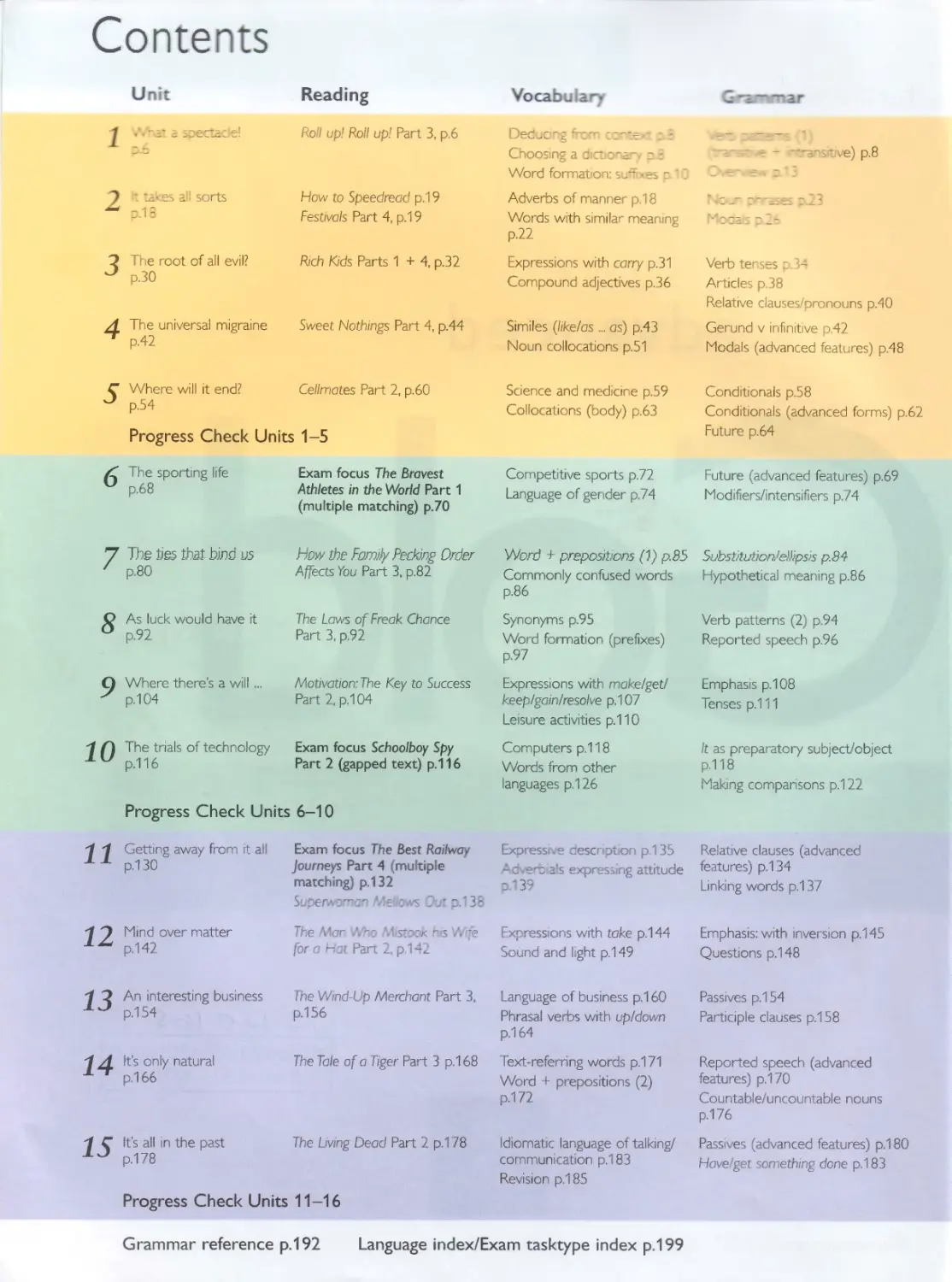
Contents
Unit	Reading	Vocabulary	Gra/типаг
1	Roll up! Rolf up! Part 3, p.6	Choosing a dictionar. p : Word formation: suffixes p * “	- -.ra-stive) p.8
Э t fates all sorts p.18	How to Speedread p.19 Festivals Part 4, p.19	Adverbs of manner p.18 Words with similar meaning p.22	No»-—□ 23 MoOafs p26
9 'he root of all evil? p.30	Rich Kids Parts 1+4, p.32	Expressions with carry p.31 Compound adjectives p.36	Verb tenses p.34 Articles p.38 Relative clauses/pronouns p.40
Л The universal migraine p.42	Sweet Nothings Part 4, p.44	Similes (like/as ... as) p,43 Noun collocations p.51	Gerund v infinitive p.42 Modals (advanced features) p.48
C Where will it end?	Cellmates Part 2, p.60 p.54 Progress Check Units 1-5		Science and medicine p.59 Collocations (body) p.63	Conditionals p.58 Conditionals (advanced forms) p.62 Future p.64
zf The sporting life ° p.68	Exam focus The Bravest Athletes in the World Part 1 (multiple matching) p.70	Competitive sports p.72 Language of gender p.74	Future (advanced features) p.69 Modifiers/intensifiers p.74
7 The ties that bind us ' p.80	How the Family Pecking Order Affects You Part 3, p.82	Word + prepositions (1) p. 35 Commonly confused words p.86	Substitution/eiJipsis p.84 Hypothetical meaning p.86
Q As luck would have it ° p.92	The Laws of Freak Chance Part 3, p.92	Synonyms p.95 Word formation (prefixes) p.97	Verb patterns (2) p.94 Reported speech p.96
Q Where there's a will... ' p.104	Motivation: The Key to Success Part 2, p.104	Expressions with make/get/ keep/gain/resolve p.107 Leisure activities p.110	Emphasis p.108 Tenses p.111
Y /1 The trials of technology Exam focus Schoolboy Spy p.116	Part 2 (gapped text) p.116 Progress Check Units 6-10		Computers p.118 Words from other languages p.126	It as preparatory subject/object p.118 Making comparisons p.122
Y Y Getting away from it all XX p.130	Exam focus The Best Railway Journeys Part 4 (multiple matching) p.132 Superwoman MeUaws Out p.138	Expressive description p.135 Ac.e~ als expressing attitude p.139	Relative clauses (advanced features) p.134 Linking words p.137
Y Э Mind over matter X^ p.142	The Mon Who Mistook his Wife for a Hat Pari 2, p.142	Expressions with take p.144 Sound and light p.149	Emphasis: with inversion p.145 Questions p.148
Y 2 An interesting business X^ p.154	The Wind-Up Merchant Part 3, p.156	Language of business p.160 Phrasal verbs with up/down p.164	Passives p.154 Participle clauses p.158
Y Л It’s only natural p.166	The Tale of a Tiger Part 3 p.168	Text-referring words p.171 Word + prepositions (2) p.172	Reported speech (advanced features) p.170 Countable/uncountable nouns p.176
-f C It's all in the past	The Living Dead Part 2 p.178 ±'J p.178 Progress Check Units 11-16		Idiomatic language of talking/ communication p.183 Revision p.185	Passives (advanced features) p.180 Have/get something done p.183
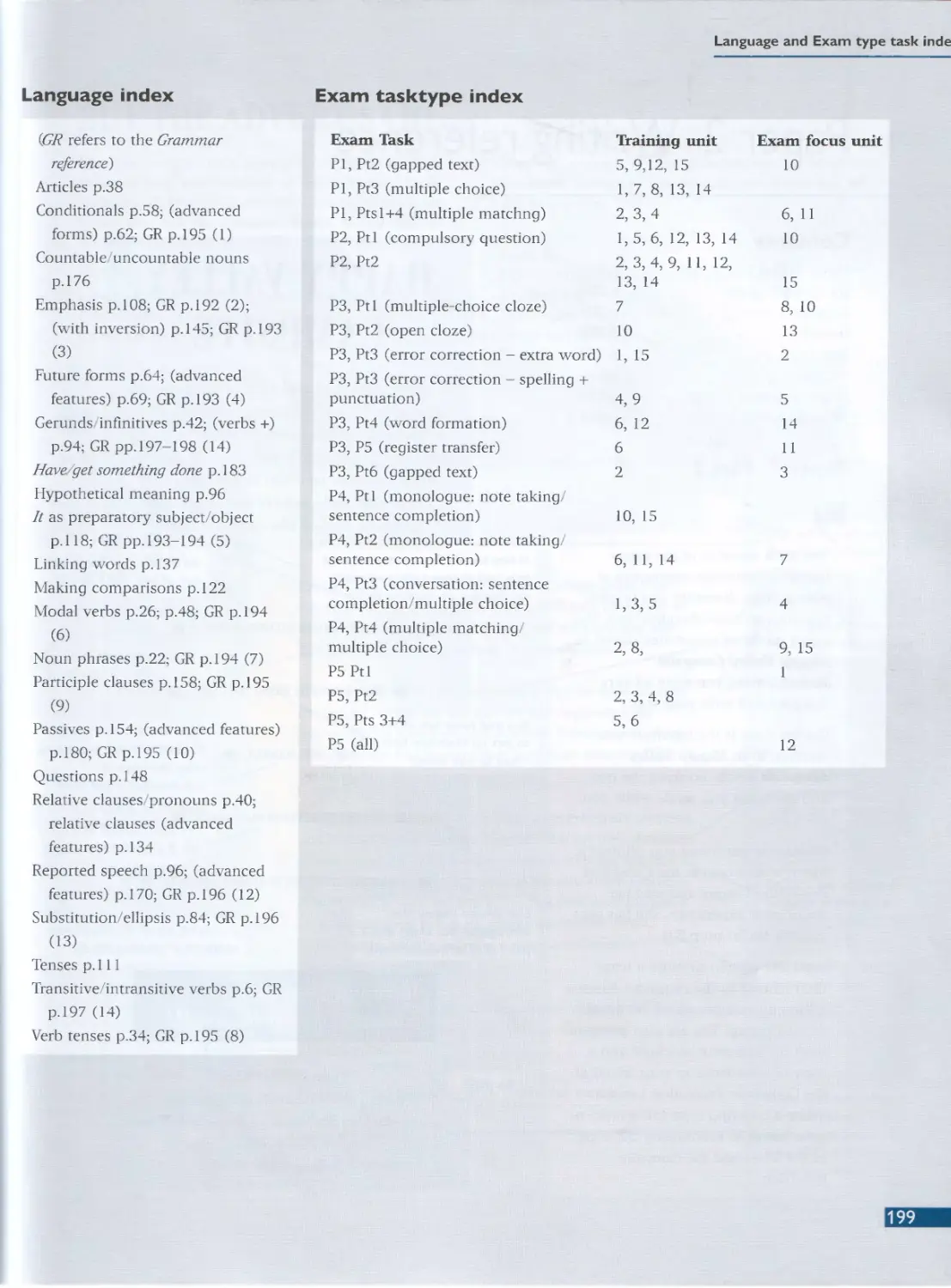
Grammar reference p.192 Language index/Exam tasktype index p.199
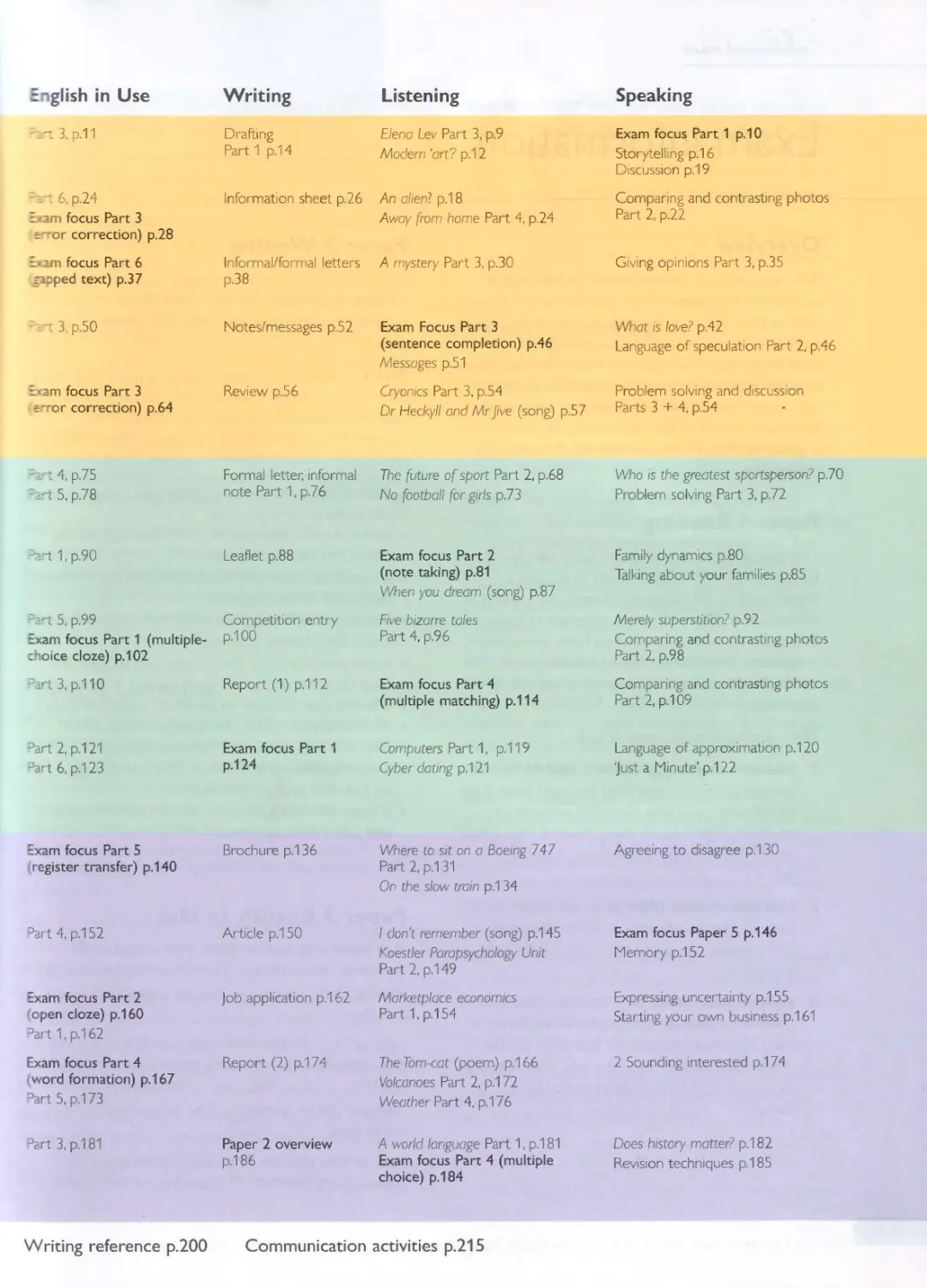
English in Use
- ~ 3. p.1 1
6. p.24
Exam focus Part 3
error correction) p.28
Exam focus Part 6
ppped text) p.37
3. p.50
Writing
Drafting
Part 1 p.14
Information sheet p.26
Informal/formal letters
p.38
Listening
Elena Lev Part 3, p.9
Modem art? p.12
An alien? p.18
Away from home Part 4, p.24
A mystery Part 3, p.30
Speaking
Exam focus Part 1 p.10
Storytelling p.16
Discussion p.19
Comparing and contrasting photos
Part 2. p.22
Giving opinions Part 3, p.35
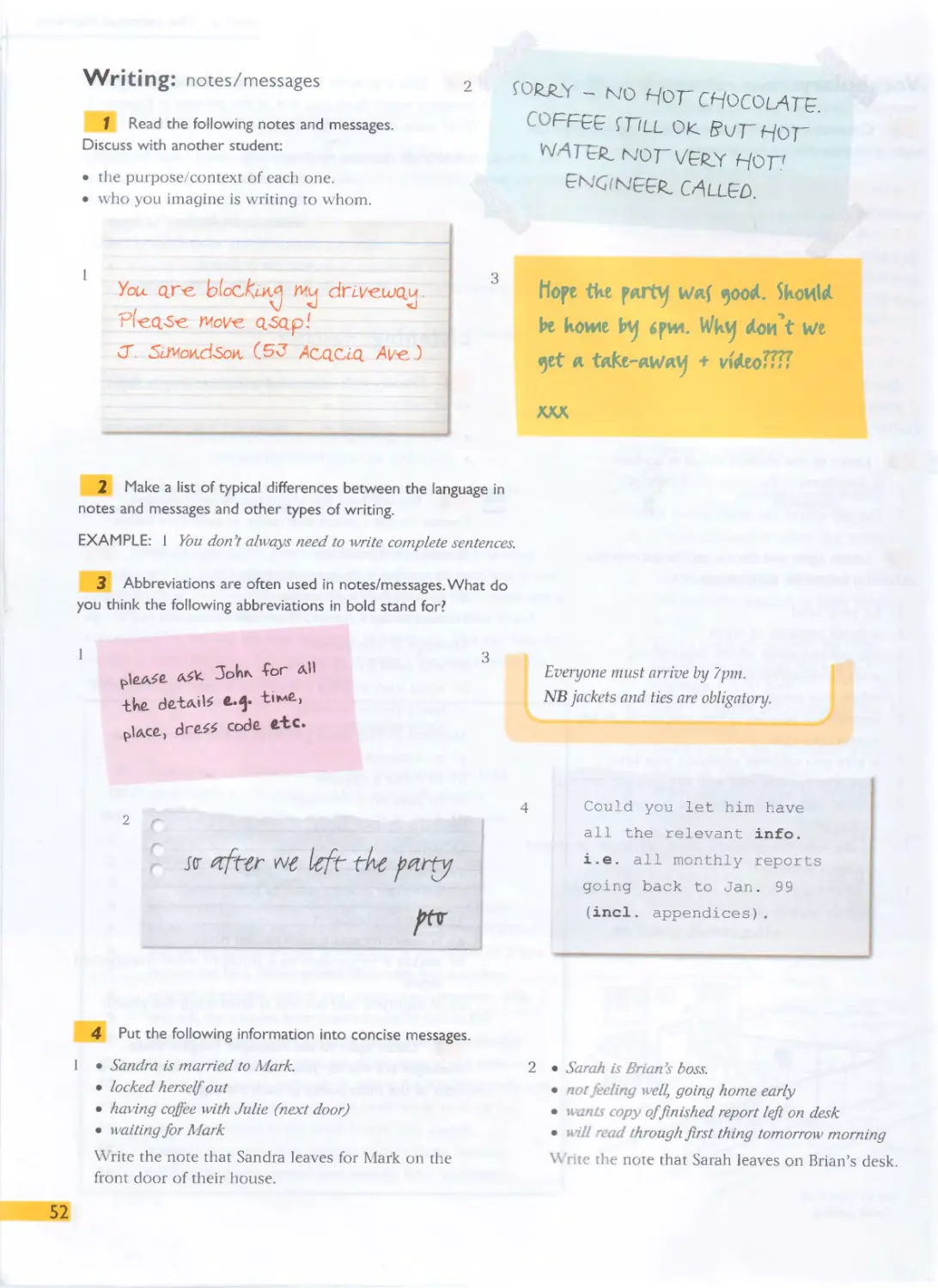
Notes/messages p.52
Exam focus Part 3
error correction) p.64
Review p.56
Exam Focus Part 3
(sentence completion) p.46
Messages p.51
Cryomcs Part 3, p.54
Dr Heckyll and Mr Jive (song) p.57
What is love? p.42
Language of speculation Part 2, p.46
Problem solving and discussion
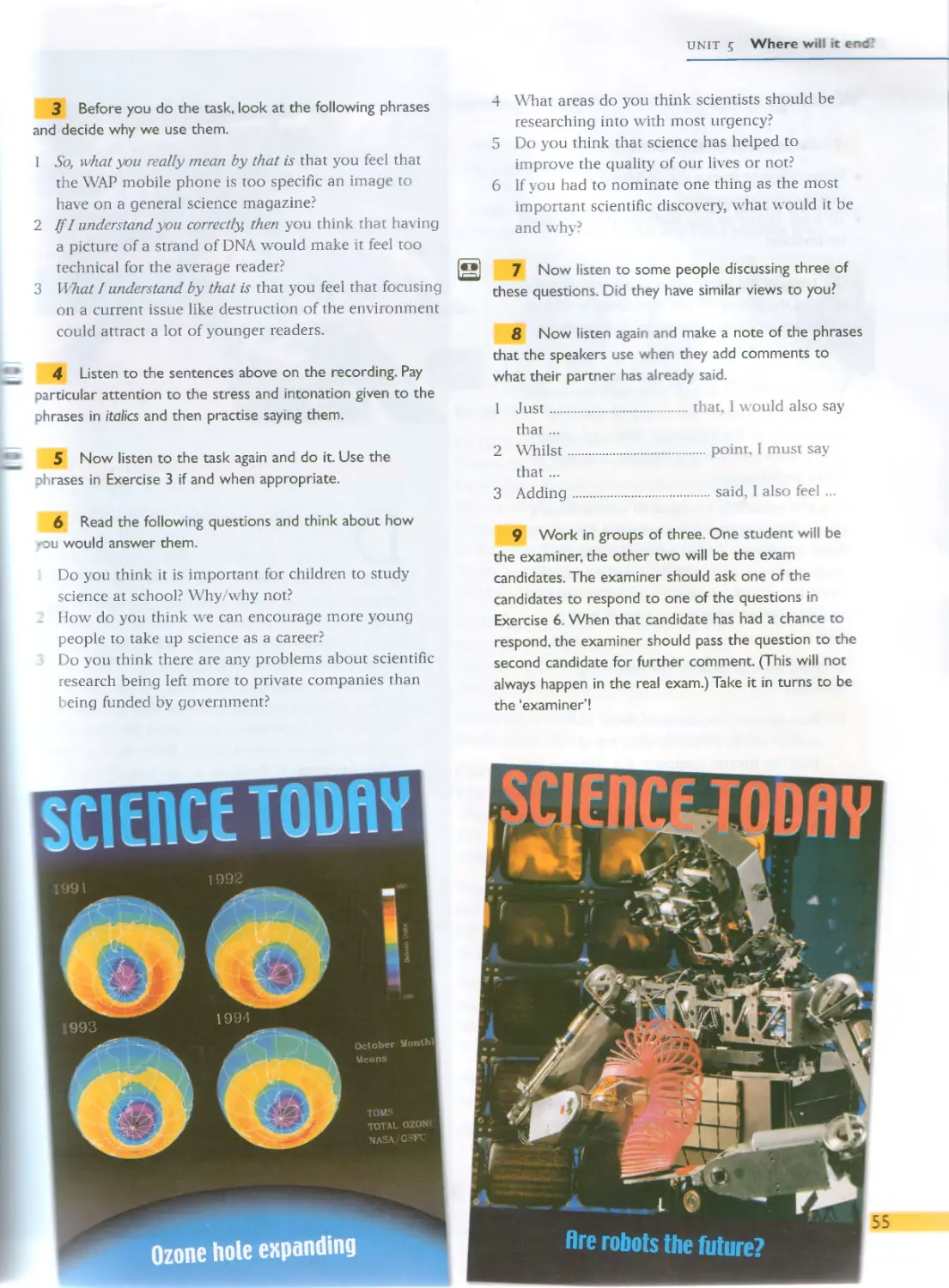
Parts 3 + 4, p.54
-г<1 4, p.75
-art 5, p.78
Formal letter informal
note Part 1, p.76
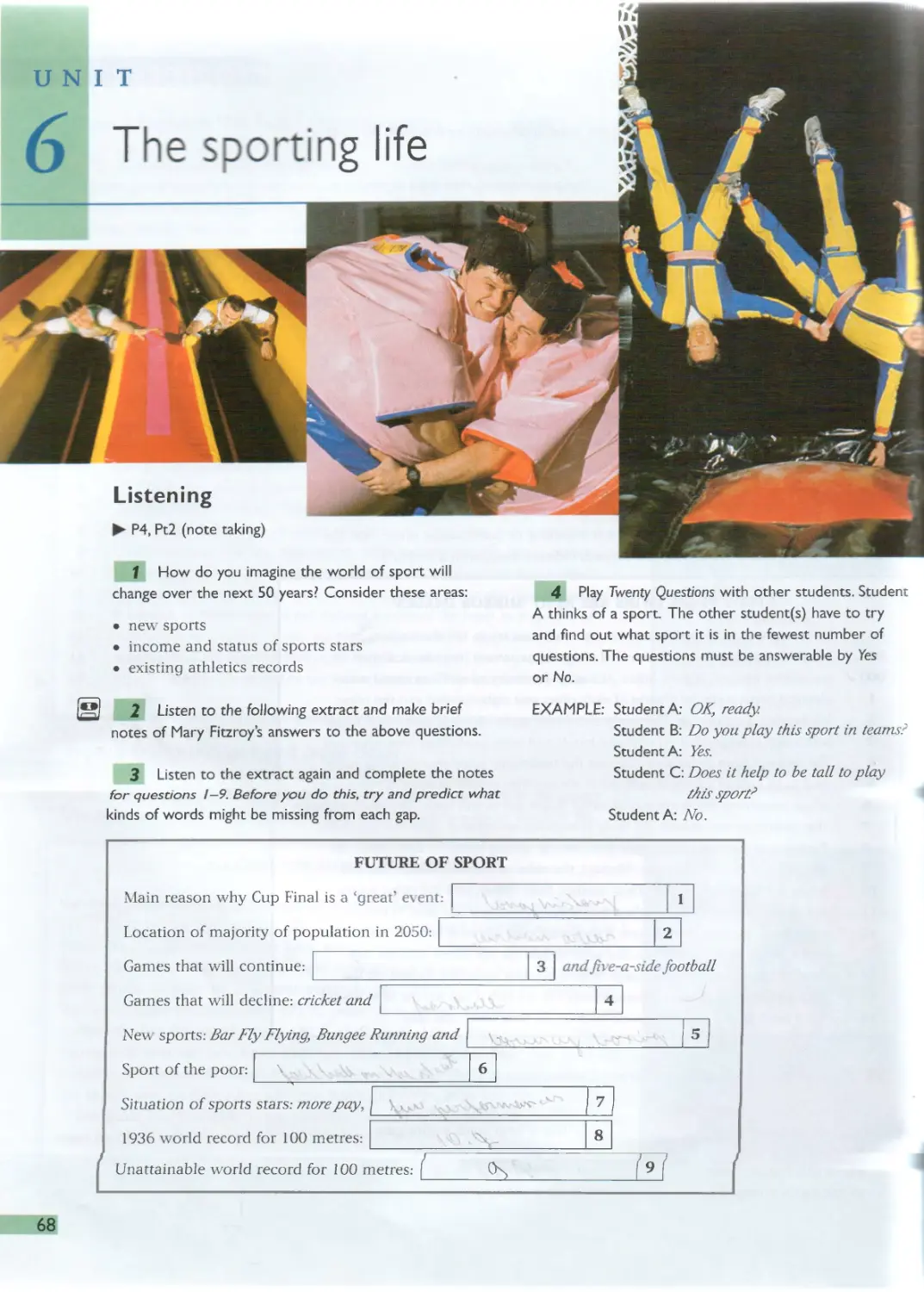
The future of sport Part 2, p.68
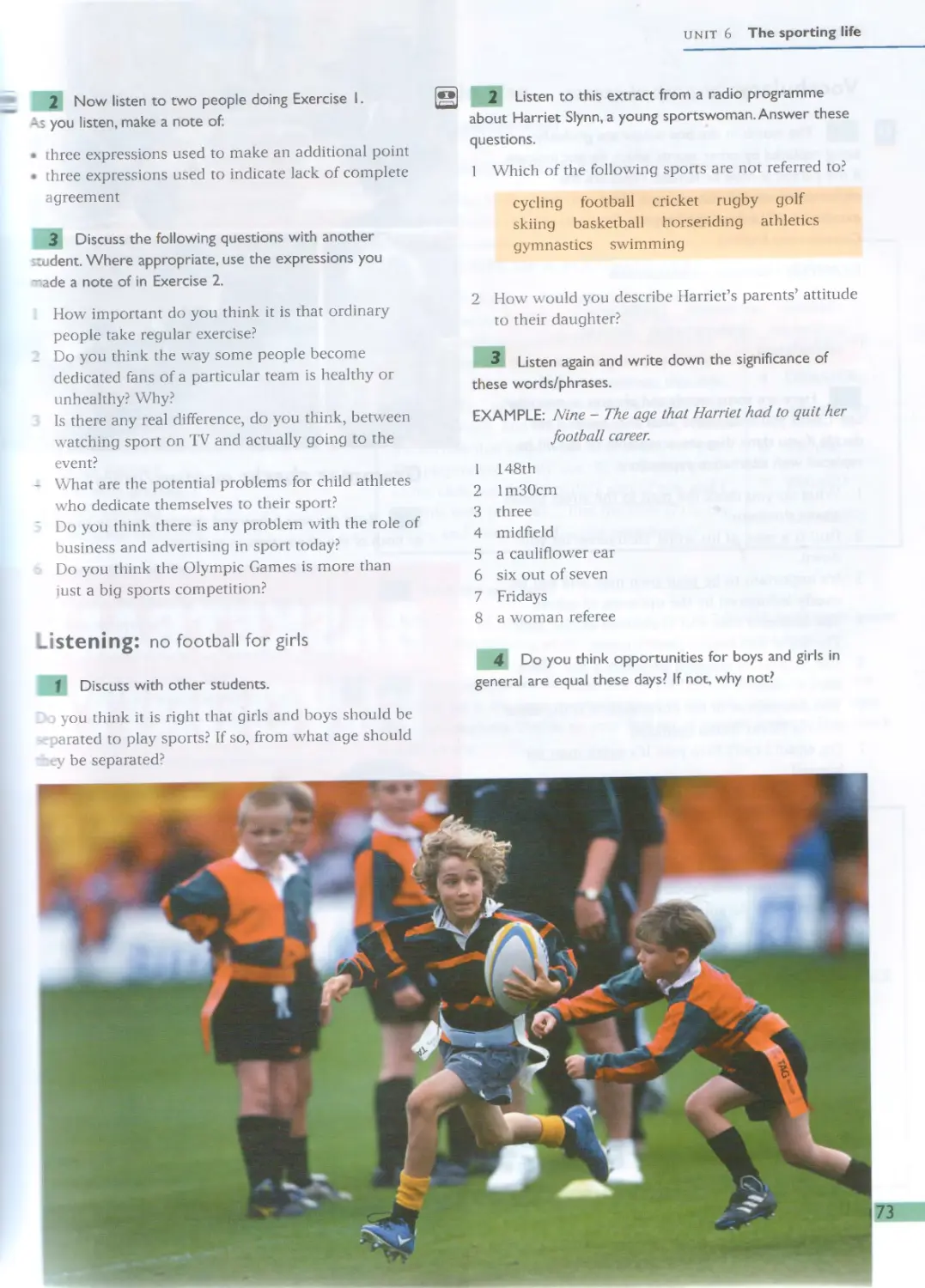
No football for girls p.73
-art 1, p.90
Leaflet p.88
part 5, p.99
Exam focus Part 1 (multiple-
choice cloze) p.102
-•art 3, p.110
Competition entry
p.100
Report (1) p.112
-art 2, p.121
Dart 6, p.123
Exam focus Part 1
p.124
Exam focus Part 5
register transfer) p.140
3art 4, p.152
zxam focus Part 2
open cloze) p.160
Dart 1,p.162
Exam focus Part 4
word formation) p.167
Dart 5, p.173
Dart 3, p.181
Exam focus Part 2
(note taking) p.81
When you dream (song) p.87
Five bizarre tales
Part 4, p.96
Exam focus Part 4
(multiple matching) p.114
Computers Part 1, p.119
Cyber dating p.121
Who is the greatest sportsperson? p.70
Problem solving Part 3, p.72
Family dynamics p.80
Talking about your families p.85
Merely superstition? p.92
Comparing and contrasting photos
Part 2, p.98
Comparing and contrasting photos
Part 2, p.109
Language of approximation p.120
Just a Minute' p.122
Brochure p.136	Where to sit on о Boeing 747 Part 2, p.131 On the slow train p.134
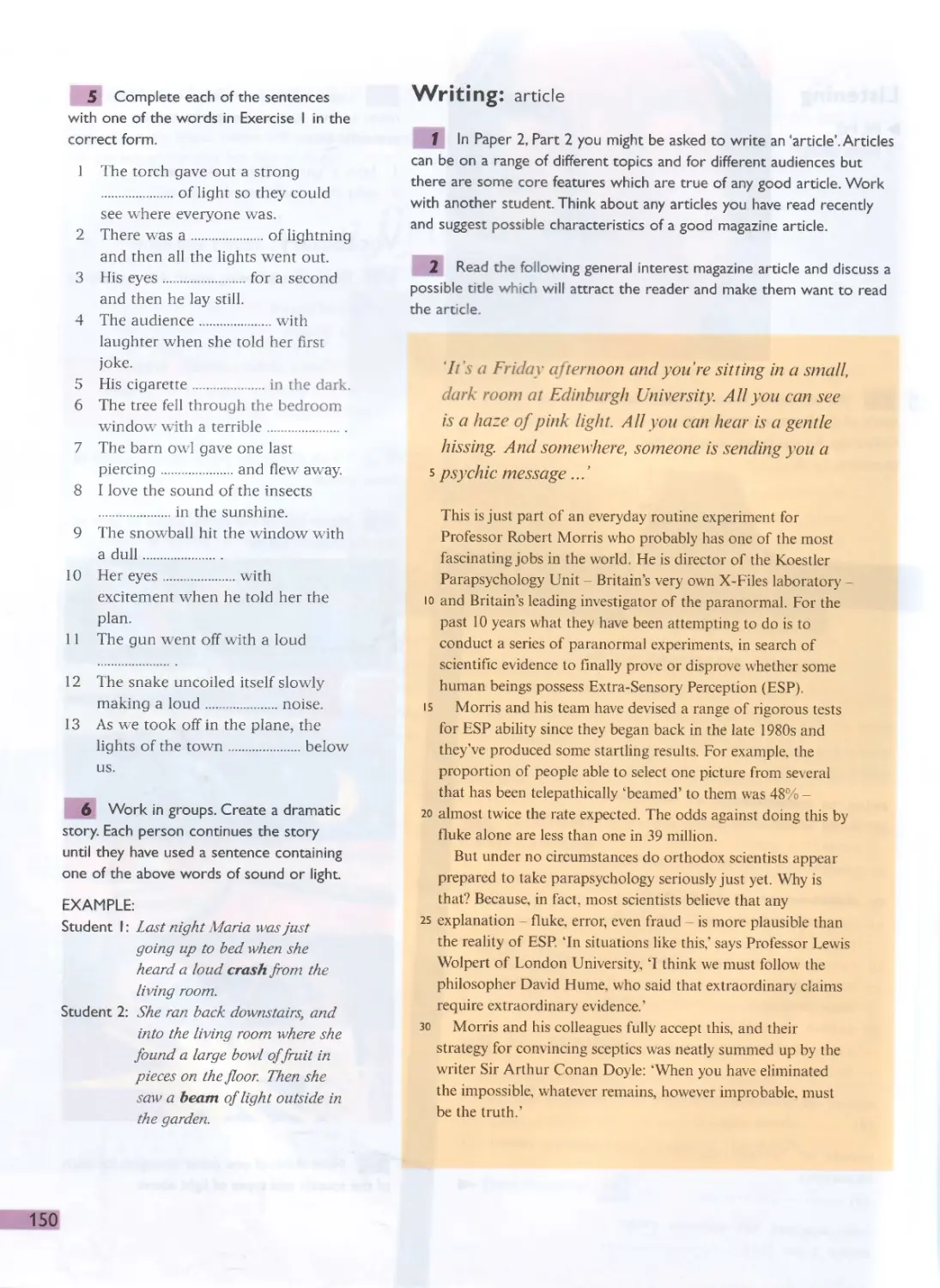
Article p.150	I don't remember (song) p.145 Koestler Parapsychology Unit Part 2, p.149
Job application p.162	Marketplace economics Part 1, p.154
Report (2) p.174	The Tom-cat (poem) p.166 Volcanoes Part 2, p.172 Weather Part 4, p.176
Paper 2 overview p.186	A world language Part 1, p.181 Exam focus Part 4 (multiple choice) p.184
Agreeing to disagree p.130
Exam focus Paper 5 p.146
Memory p.152
Expressing uncertainty p.155
Starting your own business p.161
2 Sounding interested p.174
Does history matter? p.182
Revision techniques p.185
Writing reference p.200 Communication activities p.215
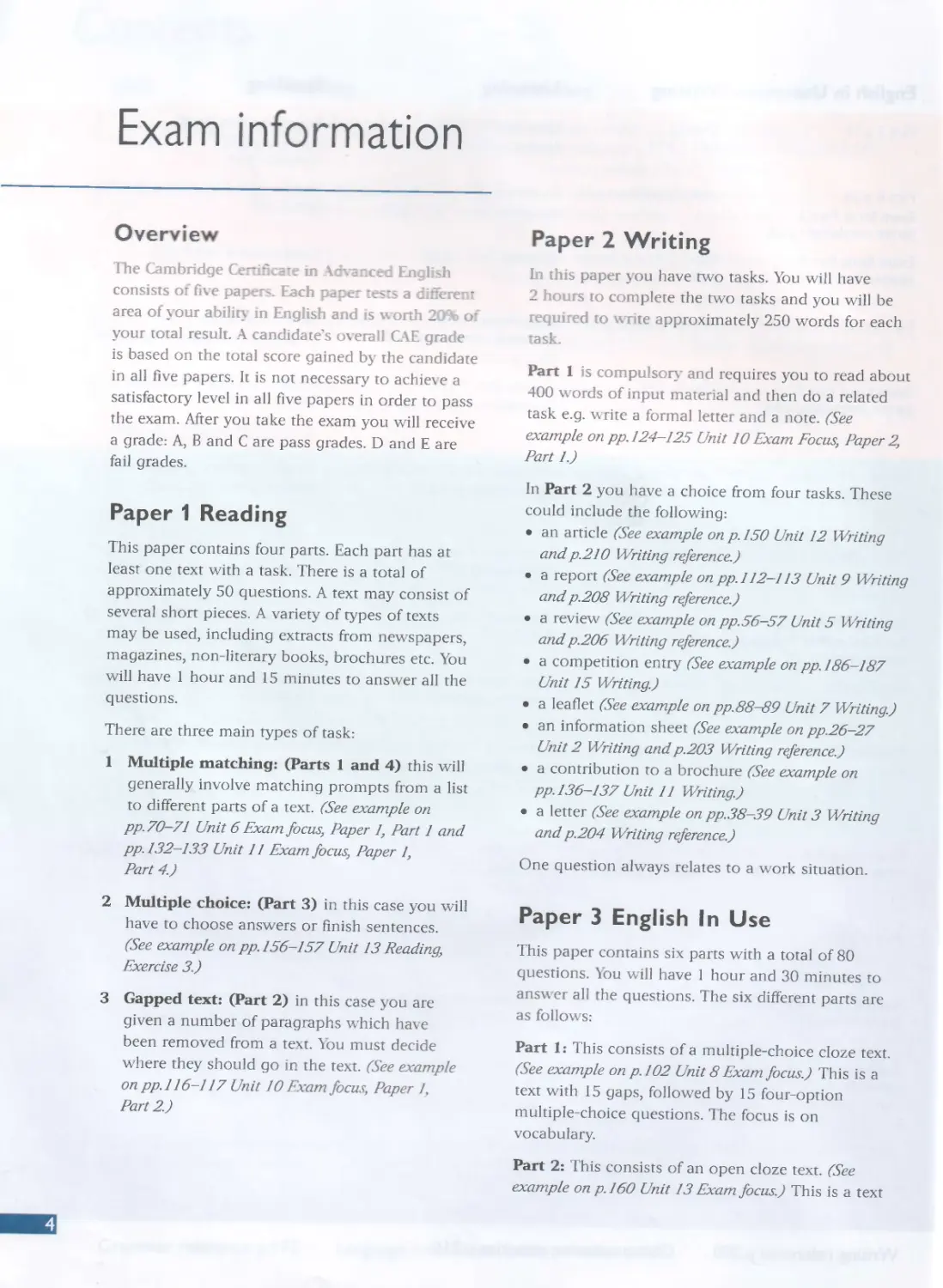
Exam information
Overview
The Cambridge Certificate in Advanced English
consists of five papers. Each paper tests a different
area of your ability in English and is worth 20% of
your total result. A candidate's overall CAE grade
is based on the total score gained by the candidate
in all five papers. It is not necessary to achieve a
satisfactory level in all five papers in order to pass
the exam. After you take the exam you will receive
a grade: A, В and C are pass grades. D and E are
fail grades.
Paper 1 Reading
This paper contains four parts. Each part has at
least one text with a task. There is a total of
approximately 50 questions. A text may consist of
several short pieces. A variety of types of texts
may be used, including extracts from newspapers,
magazines, non-literary books, brochures etc. You
will have 1 hour and 15 minutes to answer all the
questions.
There are three main types of task:
1 Multiple matching: (Parts 1 and 4) this will
generally involve matching prompts from a list
to different parts of a text. (See example on
pp. 70-71 Unit 6 Exam focus, Paper 1, Part 1 and
pp. 132-133 Unit 11 Exam focus, Paper 1,
Part 4.)
2 Multiple choice: (Part 3) in this case you will
have to choose answers or finish sentences.
(See example on pp. 156-157 Unit 13 Reading,
Exercise 3.)
3 Gapped text: (Part 2) in this case you are
given a number of paragraphs which have
been removed from a text. You must decide
where they should go in the text. (See example
on pp.l 16-117 Unit 10 Exam focus, Paper 1,
Part 2)
Paper 2 Writing
In this paper you have two tasks. You will have
2 hours to complete the two tasks and you will be
required to write approximately 250 words for each
task
Part 1 is compulsory and requires you to read about
400 words of input material and then do a related
task e.g. write a formal letter and a note. (See
example on pp. 124-125 Unit 10 Exam Focus, Paper 2,
Part 1.)
In Part 2 you have a choice from four tasks. These
could include the following:
•	an article (See example on p. 150 Unit 12 Writing
and p.210 Writing reference.)
•	a report (See example onpp.l 12-113 Unit 9 Writing
and p.208 Writing reference.)
•	a review (See example on pp.56-57 Unit 5 Writing
and p.206 Writing reference.)
•	a competition entry (See example on pp. 186-187
Unit 15 Writing.)
•	a leaflet (See example on pp.88-89 Unit 7 Writing.)
•	an information sheet (See example on pp.26-27
Unit 2 Writing and p.203 Writing reference.)
•	a contribution to a brochure (See example on
pp. 136-137 Unit 11 Writing.)
•	a letter (See example on pp.38-39 Unit 3 Writing
and p.204 Writing reference.)
One question always relates to a work situation.
Paper 3 English In Use
This paper contains six parts with a total of 80
questions. You will have 1 hour and 30 minutes to
answer all the questions. The six different parts are
as follow s:
Part 1:	This consists of a multiple-choice cloze text.
(See example on p. 102 Unit 8 Exam focus.) This is a
text with 15 gaps, followed by 15 four-option
multiple-choice questions. The focus is on
vocabulary.
Part 2:	This consists of an open cloze text. (See
example on p. 160 Unit 13 Exam focus.) This is a text
Exam information
nth 15 gaps which you must fill with an appropriate
’. ord. The focus is on grammar.
Part 3:	This consists of an error correction text. (See
example on p.28 Unit 2 Exam focus and p.64 Unit 5
Exam focus.) The errors are either a) additional words
or b) wrong spelling or punctuation. You decide for
each line of the text if it is correct or if there is a
mistake.
Part 4:	This consists of a word formation exercise.
(See example on p.167 Unit 14 Exam focus.) You will
read two short texts in which there are a total of 15
gaps. You are given the stem of the word which you
must use to complete each gap.
Part 5:	This consists of two texts. You must transfer
information given in one text to the other. (See
example on p.140 Unit 11 Exam focus.) The two texts
are different in terms of register. Words contained in
the first text cannot be used in the second.
Part 6:	This consists of a gapped text. This is a text
from which several phrases / short sentences have
been removed and placed below the text with
additional phrases. (See example on p.37 Unit 3 Exam
focus.) You must select the correct options to complete
the text.
Paper 4 Listening
This paper contains four parts with a total of 30-40
questions. In Pans 1, 3 and 4 you will hear the text(s)
twice: the text in Part 2 is heard once only. The texts
will be a variety of types, possibly including
announcements, radio broadcasts, telephone
messages, talks, lectures, interviews, meetings.
There will be a mixture of native and non-native
spea- er accents. This paper will last approximately
45 rr utes.
Part 1:	You will hear a monologue lasting about
2 mi Jtes. You will have to take notes or complete
seme . es. (See example on p. 119 Unit 10 Listening.)
Part 2:	You will hear a monologue lasting about
2 rr res. (There may be prompts from a second
spea You will only hear this once. You will have
to i rotes or complete sentences. (See example on
p.l~_ t 14 L istening.)
Part 3:	Abu will hear a conversation between two or
th eakers lasting about 4 minutes. You will have
to ete sentences or answer multiple-choice
qut ns. (See example on p.30 Unit 3 Listening.)
Part 4:	You will hear five short, related extracts of
about 30 seconds each. You will then have to either
a) complete a multiple-matching task. In this case
there are two parts. In each part you must select
the correct option from a list of eight. (See example
on p.114 Unit 9 Exam focus.)
b) answer ten multiple-choice questions. There are
two questions for each speaker. (See example on
p. 184 Unit 15 Exam focus.)
Paper 5 Speaking
This paper contains four parts. The standard format
involves an interview between two candidates and
two examiners. One of the examiners is an
interlocutor who speaks to the candidates; the other
examiner only assesses the candidates and does not
speak. The different parts are as follows:
Part 1:	The interlocutor asks the candidates to
respond to one another’s questions about themselves
or to respond to the interlocutor’s questions. The
questions generally involve giving personal
information of some kind. (See example on pp. 10-11
Unit 1 Exam focus.) This will last approximately
3 minutes.
Part 2:	Candidates comment on visual prompts e.g.
photographs. Each candidate will speak for about one
minute. The second candidate will make a short
response after the other candidate has finished. (See
example on p.22 Unit 2 Speaking.) This will last
approximately 3-4 minutes.
Part 3:	Candidates are given visual prompts (e.g.
photographs, line drawings, diagrams) and are asked
to carry out a problem-solving task together which
may involve sequencing, ranking, comparing and
contrasting, selecting etc. (See example on pp.54-55
Unit 5 Speaking.) This will last approximately
3-4 minutes.
Part 4:	The interlocutor develops the topic covered in
Part 3 and asks the candidates to discuss and give
opinions on more general questions related to the
same theme. (See example on pp.54-55 Unit 5
Speaking.) This will last approximately 3-4 minutes.
In total this paper will last approximately 15 minutes.
(For an example of a complete Paper 5 interview see
pp. 146-147 Unit 12 Exam focus.)
5
UNIT
2 What a spectacle!
1 Discuss with other students:
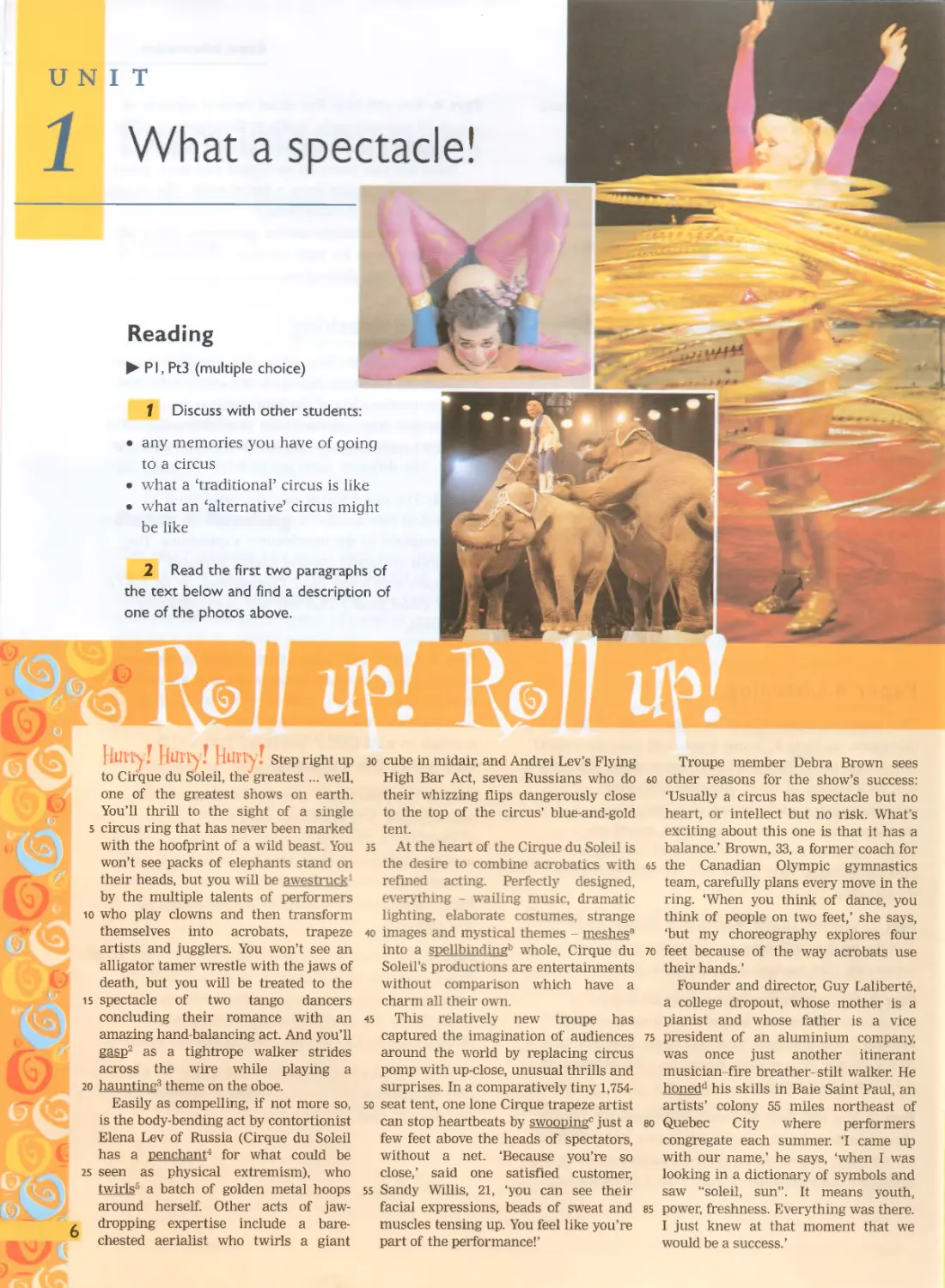
2 Read the first two paragraphs of
the text below and find a description of
one of the photos above.
any memories you have of going
to a circus
what a 'traditional’ circus is like
what an 'alternative’ circus might
be like
Reading
► Pl, Pt3 (multiple choice)
30
5

Rutty! Hurry ! Hurry ! Step right up
to Cirque du Soleil, the greatest... well,
one of the greatest shows on earth.
You’ll thrill to the sight of a single
circus ring that has never been marked
with the hoofprint of a wild beast. You
won’t see packs of elephants stand on
their heads, but you will be awestruck1
35
by the multiple talents of performers
who play clowns and then transform
themselves into acrobats, trapeze
artists and jugglers. You won’t see an
alligator tamer wrestle with the jaws of
death, but you will be treated to the
spectacle of two tango dancers
concluding their romance with an
amazing hand-balancing act. And you’ll
gasp2 as a tightrope walker strides
across the wire while playing a
haunting3 theme on the oboe.
Easily as compelling, if not more so,
is the body-bending act by contortionist
Elena Lev of Russia (Cirque du Soleil
has a penchant4 for what could be
seen as physical extremism), who
twirls5 a batch of golden metal hoops
around herself. Other acts of jaw-
dropping expertise include a bare-
chested aerialist who twirls a giant
cube in midair, and Andrei Lev’s Flying
High Bar Act, seven Russians who do
their whizzing flips dangerously close
to the top of the circus’ blue-and-gold
tent.
At the heart of the Cirque du Soleil is
the desire to combine acrobatics with
refmed acting. Perfectly designed.
65
everything - wailing music, dramatic
lighting, elaborate costumes, strange
40 images and mystical themes - meshes3
into a spellbinding1* whole, Cirque du
Soleil’s productions are entertainments
without comparison which have a
charm all their own.
45 This relatively new troupe has
captured the imagination of audiences
around the world by replacing circus
pomp with up-close, unusual thrills and
surprises. In a comparatively tiny 1,754-
50 seat tent, one lone Cirque trapeze artist
can stop heartbeats by swooping6 just a
few feet above the heads of spectators,
without a net. ‘Because you’re so
close,’ said one satisfied customer,
55 Sandy Willis, 21, ‘you can see their
facia] expressions, beads of sweat and
muscles tensing up. You feel like you’re
part of the performance!’
60
Troupe member Debra Brown sees
other reasons for the show’s success:
‘Usually a circus has spectacle but no
heart, or intellect but no risk. What’s
exciting about this one is that it has a
balance.* Brown, 33, a former coach for
the Canadian Olympic gymnastics
team, carefully plans every move in the
ring. ‘When you think of dance, you
think of people on two feet,’ she says,
‘but my choreography explores four
70 feet because of the way acrobats use
their hands.’
Founder and director, Guy Laliberte,
a college dropout, whose mother is a
pianist and whose father is a vice
75 president of an aluminium company,
was once just another itinerant
musician-fire breather-stilt walker. He
honedd his skills in Baie Saint Paul, an
artists’ colony 55 miles northeast of
so Quebec City where performers
congregate each summer. T came up
with our name,’ he says, ‘when I was
looking in a dictionary of symbols and
saw ‘’soleil, sun”. It means youth,
85 power, freshness. Everything was there.
I just knew at that moment that we
would be a success.’
unit i What a spectacle!
3 In Paper I, Part 3 of the exam you will
:•= 'equired to read a text and then answer
5-7 multiple-choice questions. Read the
z^ocedure suggested for tackling this task
~»t>e in the box below.
Suggested procedure
I Read the whole text through once
quickly to get an idea of the main
areas referred to.
Give yourself three minutes to do
this. Then work with another
student to identify and note down
the main point in each paragraph.
2	Read each question and locate the
part(s) of the text which relate(s)
to it.
Do this and check with another
student that you have identified
the same parts of the text.
3	Read the relevant part(s) of the text
carefully and underline key
words/phrases.
Do this and check with another
student that you have identified
the same key words/phrases.
4	Consider the possible options for
each question carefully. The incorrect
options will be wrong for different
reasons:
•	They are not referred to in the
text (but may be true).
•	They contradict what is in the
text.
•	They are partially (but not
completely) true.
•	They are irrelevant to the
question.
5 Select the best option.
Compare your answers with
another student. Discuss why the
incorrect options are wrong in
each case.
Remember: A question may ask you
to infer the attitude of the writer to the
subject of the text. To do this you will
need to look for evidence throughout
the text. The choice of vocabulary will
often give you clues.
4 Use the procedure in Exercise 3 to complete the questions below.
1	The Cirque du Soleil is a different kind of circus because
A of the number of different acts.
В the animals who perform are treated humanely.
C of how dangerous the acts are.
D there are only human performers who often have more than
one skill.
2	The Cirque du Soleil includes an act where someone
A spins a large ball.
В throws knives whilst blindfolded.
C plays music whilst on the trapeze.
D manipulates her body in unbelievable ways.
3	The Cirque du Soleil has made a big impact partly because
A the audience gets to know some members of the circus
personally.
В of the colours of their costumes.
C they involve members of the audience in the acts.
D of the proximity of the audience to the acts.
4	Debra Brown believes
A the Cirque is more exciting than other circuses.
В the essence of the Cirque is planning.
C she has more scope for creativity than a normal
choreographer.
D her background as an Olympic coach is essential in her
present work.
5	Guy Laliberte
A always knew he would end up in a circus.
В got a poor college degree.
C initially was a fairly typical circus performer.
D seems to owe his success to his parents.
6	He chose the name for the circus because
A he associated the sun with success.
В it had all the characteristics symbolised by the sun.
C he only wanted young people as performers.
D of a previous experience at an artists’ colony.
7	The reviewer’s attitude to the Cirque du Soleil is
A quite sarcastic.
В essentially positive with one or two minor criticisms.
C unreservedly enthusiastic.
D largely neutral and objective.
5 Discuss with other students.
Does this review make you want to see this circus? Why/why not?
7
Vocabulary: deducing from
context and choosing a dictionary
1 The following words are numbered and
underlined in the text on p.6.
1 awestruck (1.8)
2 gasp (1.18)
3 haunting (1.20)
4 penchant (1.24)
5 twirls (1.26)
1 Decide what part of speech they are.
2 Look at the context around them. Write
down possible meanings for each one.
3 Compare your ideas with other students.
(Justify your ideas with reference to the
context.)
2 Now check your ideas by looking at the
dictionary extracts on p.215 which come from
the Longman Dictionary of Contemporary English.
3 Discuss with other students.
1 What do you expect from a good
dictionary?
2 What did you think of the dictionary
extracts you have just looked at? Were
the meanings and examples clear? Did
you get all the information you wanted
about the words?
3 How do these dictionary extracts
compare with other dictionaries you have
used?
4 When do you find it helpful to use a
dictionary?
• Certain verbs are usually followed by a direct object e.g.
He stole some money. These are called transitive verbs.
(They can have a passive form e.g. Some money was
stolen.)
• Certain verbs which are transitive can be followed by
two objects (indirect and direct) e.g. Can you give me
the dictionary? Usually the first object is a person and
the second object is a thing. With many of these verbs,
we can reverse the order of the objects by using to or
for e.g. He gave me his phone number OR He gave his
phone number to me. Some verbs can only have a
second object if this is a prepositional object with to
e.g. He described the missing necklace to the police. NOT
•	Certain verbs are not usually followed by a direct object
e.g. They laughed for hours. These are called intransitive
verbs. (They cannot have a passive form.)
•	Certain verbs can be both transitive and intransitive e.g.
The old man turned slowly. - (intransitive) / He turned
the handle as far as it would go. - (transitive). These
verbs often describe change e.g. open, increase, break etc.
2 Decide which category(ies) each of the following verbs goes
into. Use a dictionary if necessary
burn describe wait invite pull lose sit start want
send happen surprise eat sleep shut explain wake
warn fall make spoil
transitive	transitive with two objects
take	give
Grammar plus: verb patterns (I)
•	You won’t see an alligator tamer wrestle with
the jaws of death ...
•	... my choreography explores four feet because
of the way acrobats use their hands.
•	... a tightrope walker strides across the wire ...
intransitive	transitive and intransitive
laugh	turn
3 Sometimes transitive verbs can have their objects left out
because the meaning is obvious from the context. Which of the
underlined objects in these sentences can be omitted?
1 Read the information in the box in the
right hand column. Then decide if the
underlined verbs in the sentences above are
transitive or intransitive or if they can be both.
(If you are not sure, check in a dictionary.)
1	I can’t find anywhere to park the car.
2	He really enjoys cooking food.
3	They found the cat under the stairs.
4	She’s been smoking cigarettes for years.
5	He slowly and carefully opened the briefcase.
8
4 Look at the following pairs of
sentences. Decide if neither, one or
ooth of the sentences is/are correct
English. What can you say about any
rules’ for how the main verb in each
pair of sentences is used?
a)	He sent me a picture of his
new family.
b)	He sent to me a picture of
his new family.
2 a) Could you explain this
grammatical point to us?
b) Could you explain us this
grammatical point?
3 a) Do you need to borrow me
some money?
b) Do you need to borrow?
4 a) She built a beautiful wooden
doll’s house for her children.
b) She built for her children a
beautiful wooden doll’s
house.
5 a) I can’t believe that we won!
b) I can’t believe that we won
the match!
6 a) I haven’t seen Simon for two
months and I miss terribly.
b) I haven’t seen Simon for two
months and I miss him
terribly.
7 a) They announced their
engagement to the whole
family.
b) They announced the whole
family their engagement.
8 a) Would you bring some more
serviettes for us please?
b) Would you bring us some
more serviettes please?
5 Now choose two verbs from
Exercise 2. Check in your dictionary if
they can be used transitively or
intransitively (or both). Write two
sentences for each verb as above. Show
them to another student and see if
they can decide if neither, one or both
of the sentences is/are correct.
► Grammar reference p. 197
► Exam Maximiser m"I
Listening: Elena Lev
► P4, Pt3 (sentence completion)
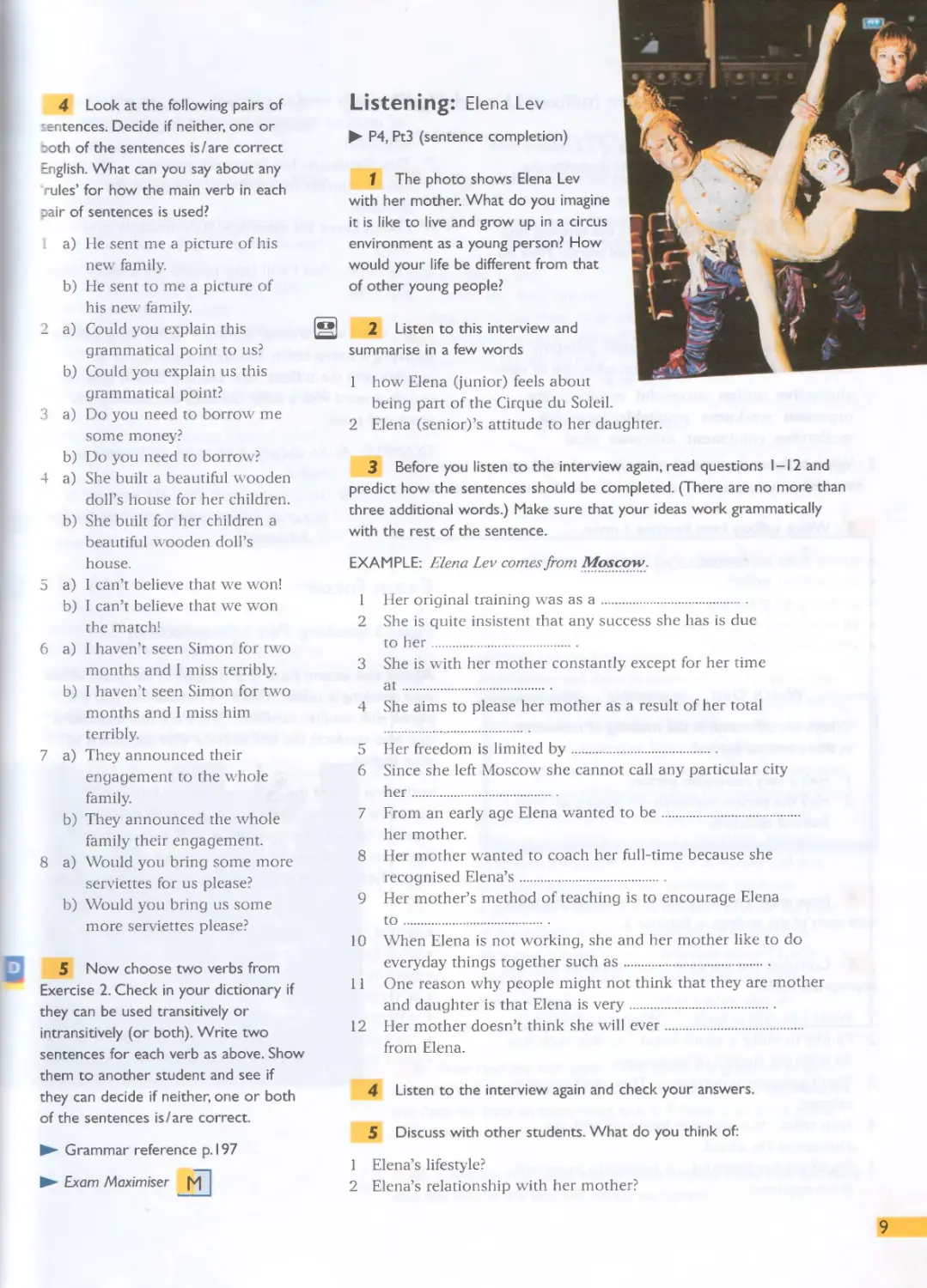
1 The photo shows Elena Lev
with her mother. What do you imagine
it is like to live and grow up in a circus
environment as a young person? How
would your life be different from that
of other young people?
2 Listen to this interview and
summarise in a few words
1 how Elena (junior) feels about
being part of the Cirque du Soleil.
2 Elena (senior)’s attitude to her daughter.
3 Before you listen to the interview again, read questions 1-12 and
predict how the sentences should be completed. (There are no more than
three additional words.) Make sure that your ideas work grammatically
with the rest of the sentence.
EXAMPLE: Elena Lev comes from Moscow.
1	Her original training was as a.....................
2	She is quite insistent that any success she has is due
to her........................
3	She is with her mother constantly except for her time
at.........................
4	She aims to please her mother as a result of her total
5	Her freedom is limited by.....................
6	Since she left Moscow she cannot call any particular city
her........................
7	From an early age Elena wanted to be......................
her mother.
8	Her mother wanted to coach her full-time because she
recognised Elena’s........................
9	Her mother’s method of teaching is to encourage Elena
to........................
10	When Elena is not working, she and her mother like to do
everyday things together such as.........................
11	One reason why people might not think that they are mother
and daughter is that Elena is very........................
12	Her mother doesn’t think she will ever.....................
from Elena.
4 Listen to the interview again and check your answers.
5 Discuss with other students. What do you think of:
1	Elena’s lifestyle?
2	Elena’s relationship with her mother?
9
Vocabulary: word formation (suffixes)
Her act combines the grace and agility of a gymnast with
the flexibility of a contortionist and the dexterity of a
juggler
1 Look at the above extract from the listening text.
What part of speech are the underlined words? How do
you know?
2
1	Decide if the suffixes in bold below generally
indicate that the word is a noun, adjective or verb,
alternative option successful responsibility
organism weakness countable brownish
modernise enjoyment delicious legal
2	What is the correct word stress for each of these
words?
3	Which suffixes from Exercise 2 make
•	nouns from adjectives?
•	nouns from verbs?
•	an adjective meaning lcan be done’?
•	an adjective less precise?
•	verbs from adjectives?
Watch Out! responsible
What’s the difference in the meaning of responsible
in these two sentences?
I He’s a very responsible person.
2 He’s the person responsible for making all
financial decisions.
4 Now make a note of two more words you know
with each of the endings in Exercise 2.
5 Complete the words in these sentences with the
appropriate suffix.
1	What you said is forgiv... . What you did is not.
2	I’d like to make a small donat... to the work you
do with the victims of landmines.
3	That’s absolutely outrage... . They can’t cut our
salaries!
4	Your refus... to cooperate leaves us with no
alternative I’m afraid.
5	I’m afraid her forgetful... is becoming more and
more apparent.
6	We clearly need to standard... our procedures. At
the moment everyone has their own particular
approach.
7	This discussion has been very product... . We now
have a number of possible solutions to the
problem.
8	I don’t know his exact age. He’s probably mid-
thirty... .
9	I’m hope... that I will have passed my English exam
this time.
6 Work with another student. Practise using suffixes
by having a conversation. Include as many words as
possible with the suffixes from Exercise 2. Each time you
include a word with a suffix correctly and sensibly, you
score one point.
EXAMPLE: A: So, did you have much excitement last
night?
B: Fes. I had a great time. We went out to
this great Italian restaurant where the food
is delicious!
Exam focus
Paper 5 Speaking: Part 1 (introduction)
About the exam: Paper 5 is the part of the exam where
your speaking is tested. It lasts 15 minutes and you are
paired with another candidate. There are two examiners,
one who conducts the test and one who just listens to
your English.
In the first part of the interview you will be asked if
you know the other candidate. If you do, then you will be
asked to tell the examiners about your partner. If you
don’t, you will be told to ask your partner about certain
things. Typical subjects for this part of the speaking paper
are:
•	where you are from
•	your home and family
•	your hobbies and interests
•	what you do
•	why you’re learning English
•	your plans for your next holiday
•	your plans for the future in general
10
unit i What a spectacle!
1 Look at these questions. Four of
them contain mistakes. Find the mistakes
and correct them.
1	So where were you brought up from
originally?
2	Tell me little about your family. Do
you have many brothers and sisters?
What are they like?
3	What kinds of things do you like
doing in your free time?
4	Do you have a particular reason of
learning English or is it just out of
general interest?
5	Have you got anything exciting lined
up for your next holiday?
6	Do you have much an idea of what
you’ll be doing over the next few
years?
2 Listen to part of an interview. What
is your opinion of the two candidates?
English in Use
► P3, Pt3 (error correction, extra word)
1 In Paper 3, Part 3 you will have a short text of about 16 lines. In
one task you will have to look at each line and decide if it contains an
extra and unnecessary word. These extra words will be ‘grammar
words’ and will often come from the following groups:
•	articles (the, a, an)
•	auxiliaries (do, have, are etc.)
•	comparatives (as, than, more etc.)
•	conjunctions (because, although)
•	prepositions (to, up, by etc.)
•	personal pronouns (she, it, them etc.)
•	modifiers (too, quite, so etc.)
•	relative pronouns (who, which, that etc.)
2 Read the text below quickly and see how many unusual things
you can discover about Robert Cook. Then compare your answer with
another student.
WHITE FOR ALL OCCASIONS
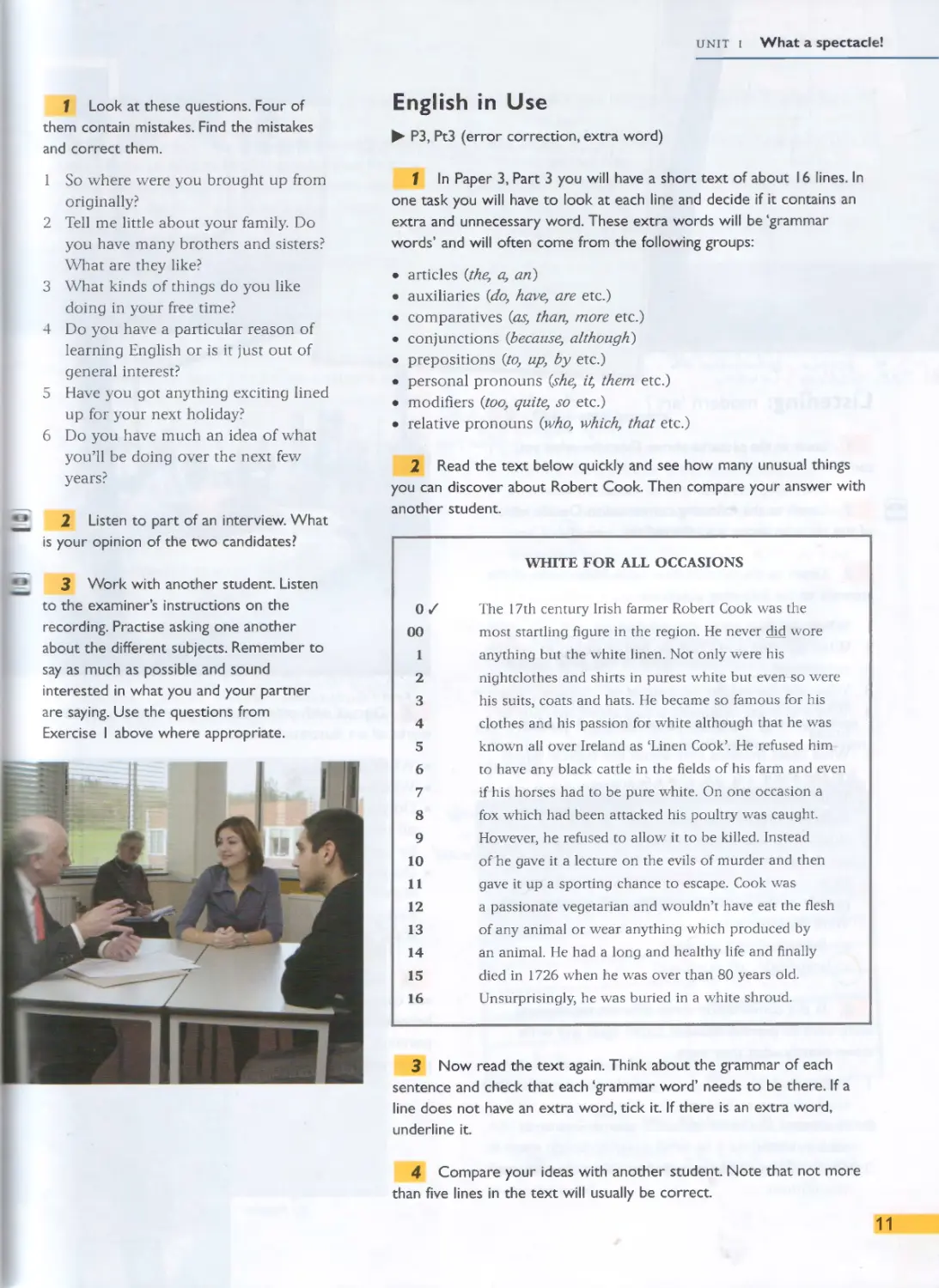
3 Work with another student. Listen
to the examiner’s instructions on the
recording. Practise asking one another
about the different subjects. Remember to
say as much as possible and sound
interested in what you and your partner
are saying. Use the questions from
Exercise I above where appropriate.
0 /	The 17th century Irish farmer Robert Cook was the
00	most startling figure in the region. He never did wore
1	anything but the white linen. Not only were his
2	nightclothes and shirts in purest white but even so were
3	his suits, coats and hats. He became so famous for his
4	clothes and his passion for white although that he was
5	known all over Ireland as ‘Linen Cook’. He refused him
6	to have any black cattle in the fields of his farm and even
7	if his horses had to be pure white. On one occasion a
8	fox which had been attacked his poultry was caught.
9	However, he refused to allow it to be killed. Instead
10	of he gave it a lecture on the evils of murder and then
11	gave it up a sporting chance to escape. Cook was
12	a passionate vegetarian and wouldn’t have eat the flesh
13	of any animal or wear anything which produced by
14	an animal. He had a long and healthy life and finally
15	died in 1726 when he was over than 80 years old.
16	Unsurprisingly, he was buried in a white shroud.
3 Now read the text again. Think about the grammar of each
sentence and check that each ‘grammar word’ needs to be there. If a
line does not have an extra word, tick it. If there is an extra word,
underline it.
4 Compare your ideas with another student. Note that not more
than five lines in the text will usually be correct.
11

Л &
у М сш.йс
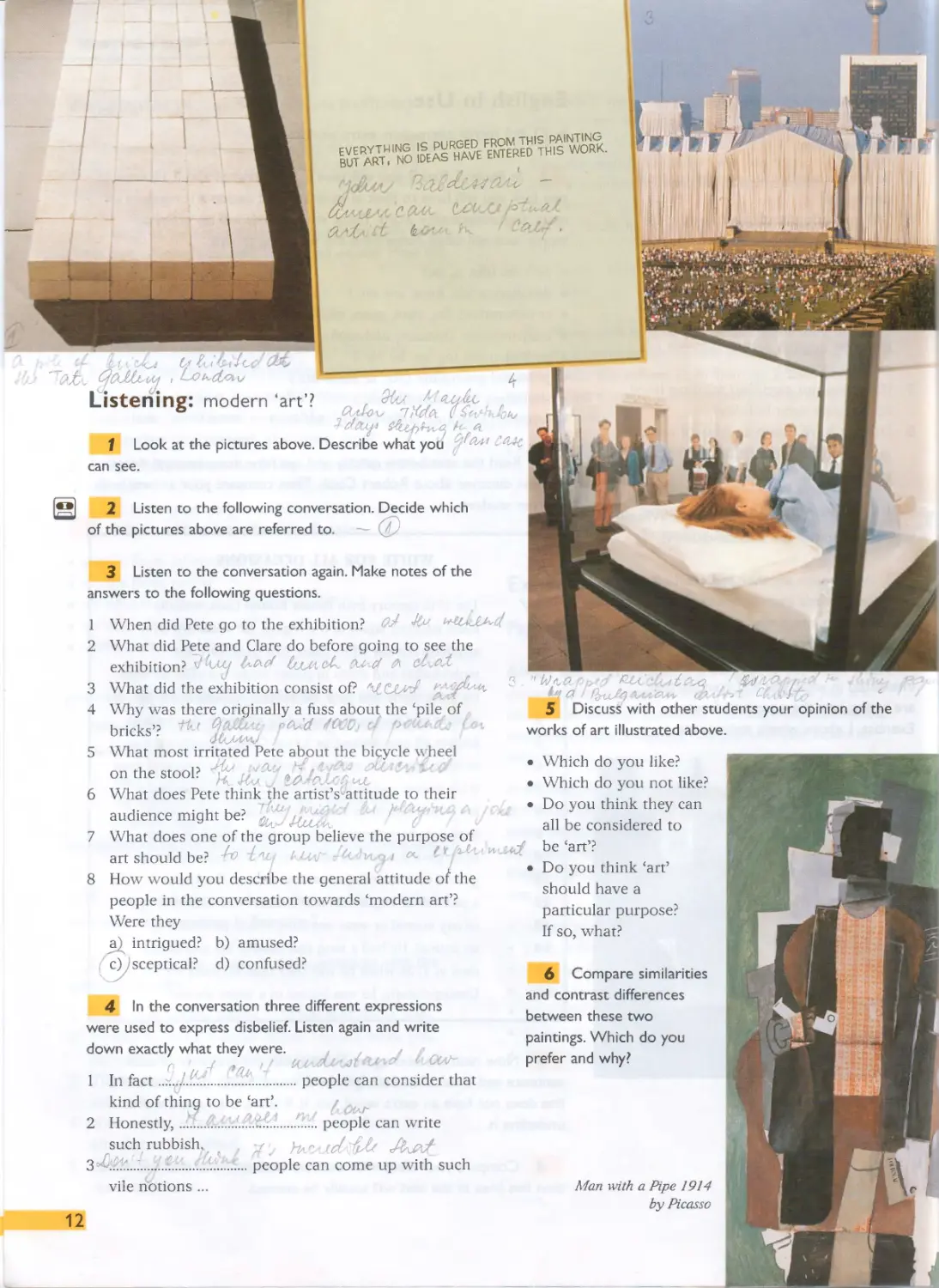
Listening: modern ‘art’?
3
4
1
2
2 Listen to the following conversation. Decide which
of the pictures above are referred to.
t/ 7a
- z/zty-'J	P
1 Look at the pictures above. Describe what you
can see.

3 Listen to the conversation again. Make notes of the
answers to the following questions.
When did Pete go to the exhibition? &
What did Pete and Clare do before going to see the
exhibition?	3./ d A c£ .fid
What did the exhibition consist of?
Why was there originally a fuss about the ‘pile of
bricks’?	МЪ d SCl b

3 . " lri<C%Lpf>
5 Discuss with other students your opinion of the
works of art illustrated above.
5 What most irritated Pete about the bicycle wheel
on the stool? ЙЙ&Г	:
6 What does Pete think the artist’s attitude to their
audience might be?	'
7 What does one of the group believe the purpose of
art should be?	IMaJ
8 How would you describe the general attitude о/ the
people in the conversation towards ‘modern art’?
Were they
a^ intrigued? b) amused?
c) sceptical? d) confused?
Which do you like?
Which do you not like?
Do you think they can
all be considered to
be ‘art’?
Do you think ‘art’
should have a
particular purpose?
If so, what?
6 Compare similarities
4 In the conversation three different expressions
were used to express disbelief. Listen again and write
down exactly what they were.
J ' / ’	( ОШ-
1	In fact ..................people can consider that
kind of thing to be ‘art’.
2	Honestly,	people can write
such rubbish,	Ла/
3^..^...?.Z*.... .'....	people can come up with such
vile notions ...
12
and contrast differences
between these two
paintings. Which do you
prefer and why?
Man with a Pipe 1914
by Picasso
unit i What a spectacle!
Grammar check: overview
1 Each of the following sentences contains a different
basic grammatical mistake in an important area. Find the
mistakes and correct them. (This exercise will help to
show you any significant gaps in your grammatical
knowledge.)
EXAMPLE: I thought that film was absolutely terrified,
terrified > terrifying
1	I am knowing that she wants to be on her own
tonight.
2	We go never out to restaurants any more.
3	Where are car keys? I had them a minute ago.
4	This computer game is a lot more cheaper than
the last one you bought.
5	If I’d have seen him, I'd have invited him to the
party.
6	Unless you work a bit harder, you won’t fail your
exams.
7	They were really helpful and gave us lots of
informations.
8	We considered to go to the new French
restaurant but it was too expensive.
9	My dad won’t let me to stay overnight at John’s
house.
10	1 really wish I would have more time.
11	He went rock-climbing despite of his fear of
heights.
12	They might decided to go to the circus after all.
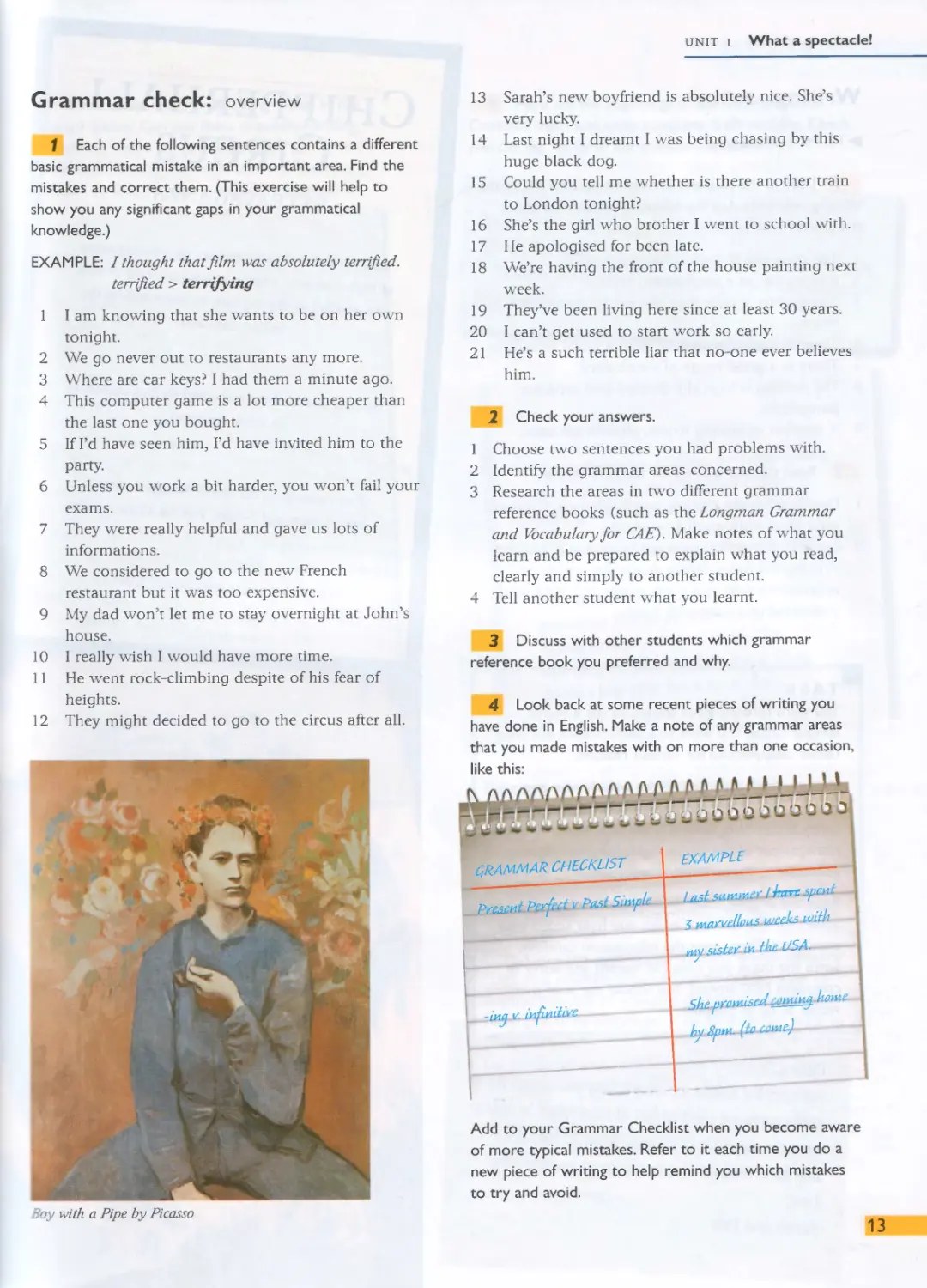
Boy with a Pipe by Picasso
13	Sarah’s new boyfriend is absolutely nice. She’s
very lucky.
14	Last night I dreamt I was being chasing by this
huge black dog.
15	Could you tell me whether is there another train
to London tonight?
16	She’s the girl who brother I went to school with.
17	He apologised for been late.
18	We’re having the front of the house painting next
week.
19	They’ve been living here since at least 30 years.
20	I can’t get used to start work so early.
21	He’s a such terrible liar that no-one ever believes
him.
2 Check your answers.
1	Choose two sentences you had problems with.
2	Identify the grammar areas concerned.
3	Research the areas in two different grammar
reference books (such as the Longman Grammar
and Vocabulary for CAE). Make notes of what you
learn and be prepared to explain what you read,
clearly and simply to another student.
4	Tell another student what you learnt.
3 Discuss with other students which grammar
reference book you preferred and why.
4 Look back at some recent pieces of writing you
have done in English. Make a note of any grammar areas
that you made mistakes with on more than one occasion,
like this:
[\ (\ f\	____
ifc- _ * - - -*- * * ~ ~ ~ ~
—
GRAMMAR CHECKLIST
example
Pre&ntEerferts P^t Siwpk
-Lny v. infinitive
Lasts mnmcr I hrrrc spent
3 marcel leas weeks with
my sister in ike .USA.
She prMisedeatAd^. heme-
by 8pnw(taMMef
Add to your Grammar Checklist when you become aware
of more typical mistakes. Refer to it each time you do a
new piece of writing to help remind you which mistakes
to try and avoid.
13
Writing: drafting
► P2, Pel (compulsory)
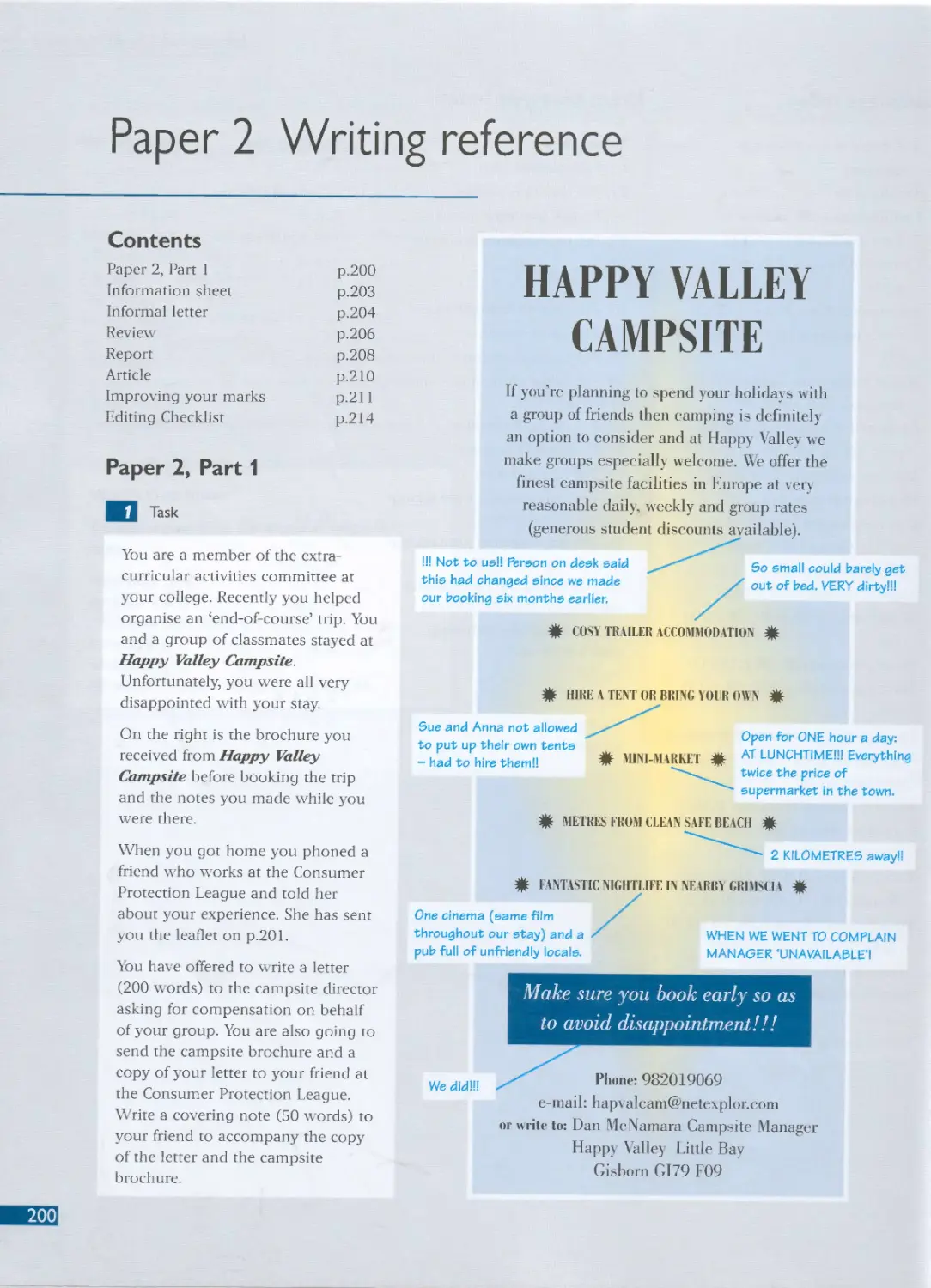
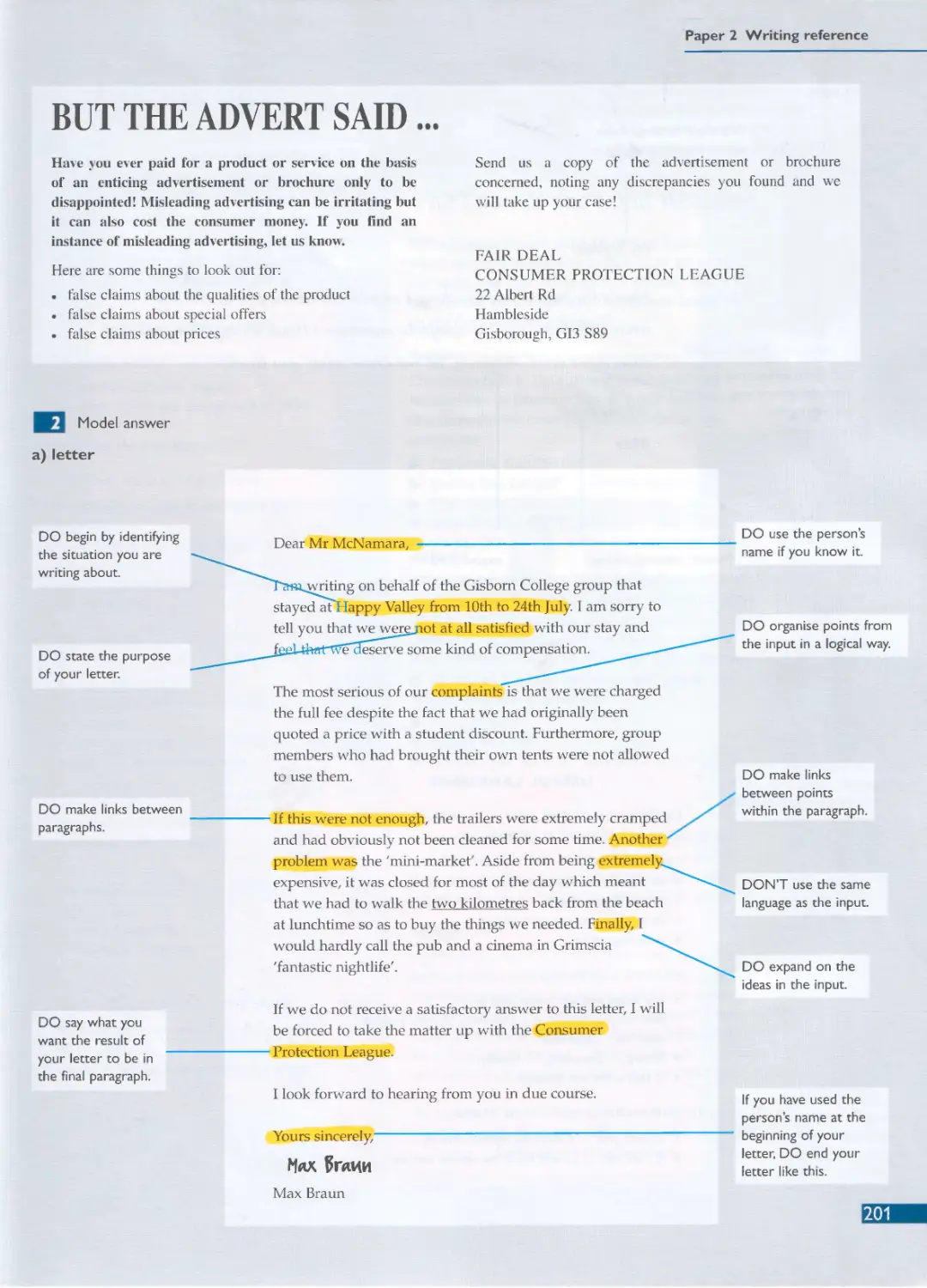
1 Look at the task and answer on pp.200-202 of the
Writing reference. Are the following statements about
the answer true or false?
1	The meaning is communicated clearly.
2	It is written in a very formal style.
3	It is slightly longer than the necessary number of
words.
4	There is a good variety of grammatical structures.
5	There is a good range of vocabulary.
6	The writing is logically divided into separate
paragraphs.
7	A number of linking words/phrases are used.
2 Read the instructions for the task below.
1	Decide what are the key words/phrases. Compare
your ideas with another student.
2	Look at the useful language box on p.202 of the
Writing reference. Write down any words or
expressions that you think might be useful when
you come to do the task below.
Roll up! Roll up! Come and see an amazing array
of high-wire acts, trapeze artists and crazy clowns.
Be terrified by the big cats, be awestruck by the
Indian elephants.
funyoT tke ruty ...
We have travelled the globe and thrilled audiences
in every continent.
ferfv^
Performances in the Grand Marquee every day
jrdkr ... i/. nstrcctH
from 4~6pm and 7-9pm. Fun for all the family.
ьпушМе tv jet a	иь
HOT thwyk yeyU servbny
Ticket prices start at only £10!
“TASK
You were recently given tickets to see a world
famous circus. You went to a performance but were
rather disappointed for various reasons.
Write a thank you note to the friends who gave
you the tickets without going into what you weren’t
happy about. Also, write a letter of complaint to the
management of the circus, highlighting the various
points that you were not happy about.
Read the original letter from your friends and an
advert for the circus to which you have added your
comments. Then, using the information carefully,
write the thank you note [50 words] and letter of
complaint [200 words]. You should use your own
words as far as possible.
VearKKK,	.	,
Here are the tickets we were telling you about We
really sorry we can’t go but at least you’ll be able to
enjoy the show! Do let us know what it’s like. With
«ну luck, we’ll get the chance to go anomer time.
Love,
14 Sarah and Vete
Chipperhall
Circus
extravaganza
unit i What a spectacle!
3 Look at the underlined linking words in the
paragraph below. Can you think of another linking
word/phrase with a similar meaning for each one?
Record these linking words/phrases in a vocabulary
notebook so that you can use them in Exercise 5.
5 Here are the beginnings of the note and letter.
Continue them and write complete draft versions. Check
you can say Yes to all the questions below.
Dear Sir,
I am writing to complain about the
service I received at your hotel
last weekend.
-c So-FG-k o-nd P-eb-e.,
jo-slr a tr<<,-f to
b<c.kets. ...
First of all, on arrival, there
was no record of my booking
although I had faxed the details
several weeks earlier. Secondly,
when I got up to my room, I found
that it had not been cleaned
properly and there were used
towels in the bathroom.
Furthermore, when I came down to
breakfast the next day, I was told
that I was too late, even though
it was only 10am. Finally, when I
was given the bill I was charged
for items from the minibar which I
hadn’t used.
Dear Sir/Madam,
I am writing to you to express my disappointment
at a recent visit to the ‘Chipperhall Circus
Extravaganza’ on Saturday 17th March.
To begin with, although the evening performance
was supposed to start at 7pm, in fact nothing
really happened until 7.30pm which was
particularly hard on my children, who had been
looking forward to the event all day. The
next thing was that we found ourselves sitting
behind a large pillar which meant that...
I’m afraid that I have never
before been treated so appallingly
4 Here is one possible plan of how the thank you
note and letter of complaint will be organised. Discuss
with another student if this is the plan that you want to
use, or whether you would like to change it in some way.
Thank you note
•	say ‘thanks’
•	tell them it was ‘an experience’!
•	hoping to see them soon
Letter of complaint
•	introduce general reason for letter
•	list main complaints and effect on children
•	request refund for cost of tickets and ruined
shoes
•	expect reply soon
•	Have you responded to all the instructions in the
task?
•	Have you organised your answers in logical
paragraphs?
•	Have you avoided copying long phrases from the
input texts?
•	Have you written approximately the right number
of words?
•	Have you used appropriate linking words phrases?
•	Have you referred to your Grammar Checklist to
remind yourself of possible grammar mistakes?
•	Have you used language of an appropriate style in
your answers?
•	Do the letter and note have the intended effect on
the target reader?
6 Show your letter and note to another student. Can
she/he see any obvious problems or mistakes with your
work? Read your partner’s note and letter. Point out any
problems you can see.
15
Speaking: storytelling
1 The pictures below make up a well-known fable,The Emperor’s New Clothes*.
Work with another student and discuss the correct order of the pictures.
4 Discuss with other students.
2 With your partner, tell the story, by taking it in
turns to refer to each picture. (You may wish to use these
words: a weaver, cloth, a loom, a procession.)
3 Now listen to a version of this story. How similar
is it to yours?
•	What is the point of the story?
•	What warning does it give?
•	Does it have any relevance to the modern world?
5 Write the story incorporating any new vocabulary
you have learnt.
16
review
1 The following words are lettered a)-d) and
4 Complete the following article with one word in
underlined in the text on p.6. From the context decide
each space.
what you think they might mean.
a)	meshes (1.40)
b)	spellbinding (1.41)
c)	swooping (1.51)
d)	honed (1.78)
Check your ideas in a good dictionary. Find out:
•	the meaning appropriate to the context in the
review
•	the part of speech
•	any extra grammatical information e.g. is it
generally followed by a particular preposition?
•	the pronunciation
•	a helpful example sentence
2 Four of the following sentences have mistakes in
them. Find the mistakes and correct them.
(V
1 A sudden draught of air blew the door shut.
2 Shaun proposed a wedding to me last night. I
didn’t know what to say.
3 I’m afraid this will definitely add to the overall cost
of the project.
4 Don’t shoot! I’m coming out.
5 You surprised when you said you were leaving at
the end of the week.
6 I wonder if you could suggest me- a good grammar
book?A
7 Why don’t I make you a nice hot cup of tea?
8 He still owes for his share of the holiday we had
together last year.
3 Complete the table with the appropriate part of
speech.
Itch art -
but not as we know ii
MARI^ FERNANDA CARDOSO
(l) 3 4^ never seen a flea circus when she decide
/ r r !
(2) 77. resuscitate the lost art of insect
performance. And for the (3) ... three years, Cardoso, a
34-year-old conceptual artist, has painstakingly trained
hundreds of fleas.
Fleas dislike light but (4) ... attracted to all things furry as
well (5)^. heat and carbon dioxide (animals emit both).
Cardoso uses these elements (6)4Y motivators. She also
manipulates (7) ... with ultrathin wire leashes, looped aroun
flea heads and bodies. A tug on the leash and a flea is
dancing or at (8) ... looks like it. (9) ... these impressive
results, there are still frustrations. ‘Some fleas are just no
good,’ she says, ‘and there’s nothing you (10) ... do.’
VERB	NOUN
ADJECTIVE
to alternate
to opt
to succeed
to enjoy
to weaken
to count
xxxx
Mud
кы С у Mil
responsible
modern
Wearing magnifying goggles and a silver cape and
r- //A
brandishing (11)^. tiny whip, Cardoso conducts the
extravaganza. Under a dollhouse-size circus big top,
Hercules, ‘The Strongest Flea in the World’, pulls a toy
locomotive many (12) ... his size. Estrellita, helped by a
harness, wobbles (13) ... a tightrope on hind legs. Fearless
Alfredo gears up for his highdive stunt with a drumroll and
spotlight. But, alas, after making a ten-inch plunge, he misst
his water-filled thimble, hits (14) ... circus floor and dies.
Is Cardoso upset by the loss? Not really. T treat them well
and I think they know they are special,’ she says. ‘And
(15) they die, well, that’s life.’
TU haridusteaduskond
Raamatukogu
17
Listening: an alien?
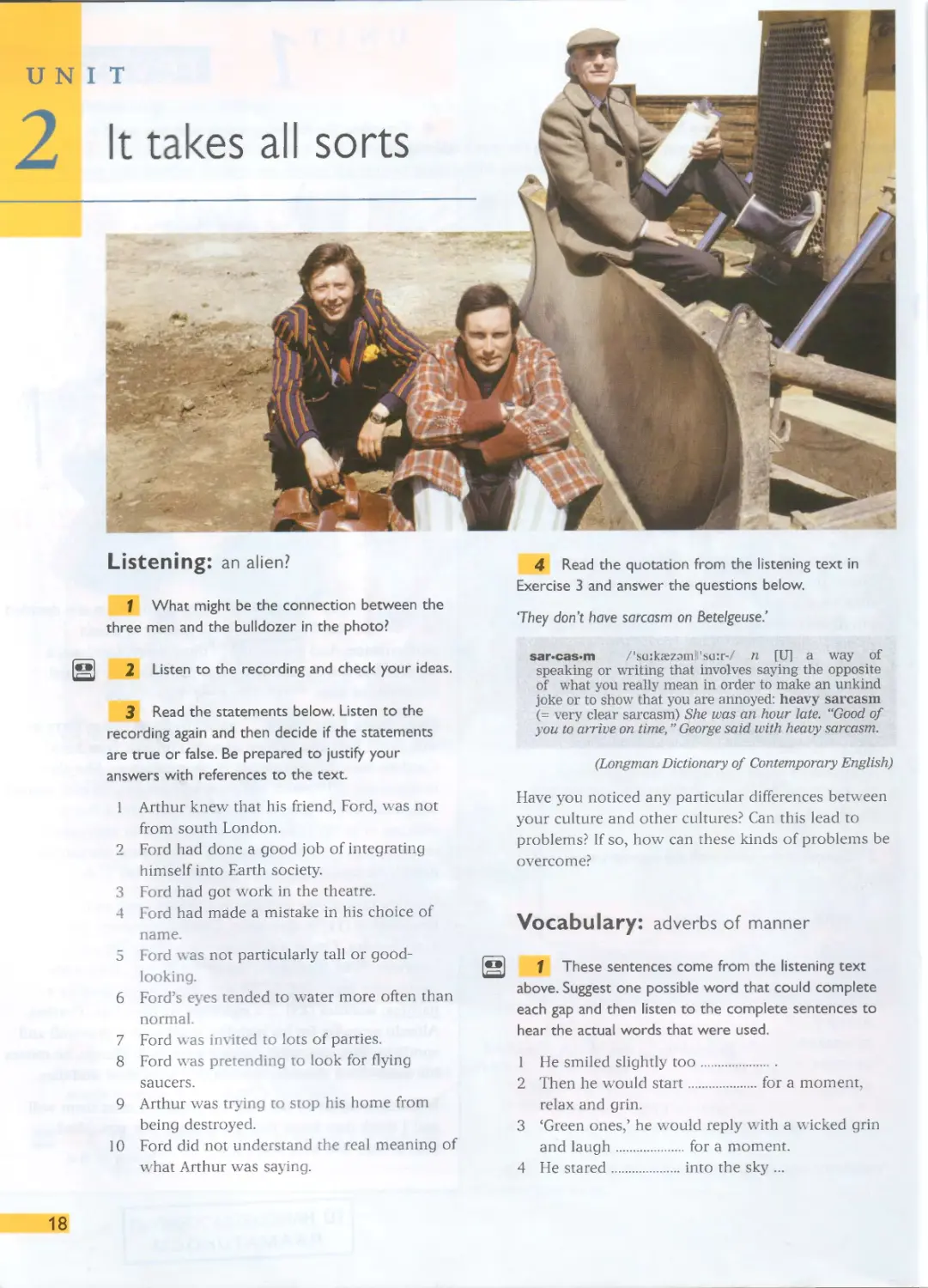
1 What might be the connection between the
three men and the bulldozer in the photo?
2 Listen to the recording and check your ideas.
3 Read the statements below. Listen to the
recording again and then decide if the statements
are true or false. Be prepared to justify your
answers with references to the text.
1 Arthur knew that his friend, Ford, was not
from south London.
2	Ford had done a good job of integrating
himself into Earth society.
3	Ford had got work in the theatre.
4	Ford had made a mistake in his choice of
name.
5	Ford was not particularly tall or good-
looking.
6	Ford’s eyes tended to water more often than
normal.
7	Ford was invited to lots of parties.
8	Ford was pretending to look for flying
saucers.
9	Arthur was trying to stop his home from
being destroyed.
10	Ford did not understand the real meaning of
what Arthur was saying.
4 Read the quotation from the listening text in
Exercise 3 and answer the questions below.
'They don't have sarcasm on Betelgeuse?
sar-cas*m /'suikeezamirsair-/ n [U] a way of
speaking or writing that involves saying the opposite
of what you really mean in order to make an unkind
joke or to show that you are annoyed: heavy sarcasm
(= very clear sarcasm) She was an hour late. “Good of
you to arrive on time,” George said with heavy sarcasm.
(Longman Dictionary of Contemporary English)
Have you noticed any particular differences between
your culture and other cultures? Can this lead to
problems? If so, how can these kinds of problems be
overcome?
Vocabulary: adverbs of manner
1 These sentences come from the listening text
above. Suggest one possible word that could complete
each gap and then listen to the complete sentences to
hear the actual words that were used.
1 He smiled slightly too..........
2 Then he would start...........for	a moment,
relax and grin.
3 ‘Green ones,’ he would reply with a wicked grin
and laugh..............for	a moment.
4 He stared...........into	the sky ...
18
unit 2 It takes all sorts
2 Can you think of any other adverbs that
could complete the sentences in Exercise I.
Reading
► PI, Pt4 (multiple matching)
3 Decide which two of the adverbs on the
r ght go best with each of the verbs on the left.
EXAMPLE: laugh - helplessly, uneasily
1 Read the following questionnaire. Decide if the answer to
each question is Yes or No.
laugh	intuitively irresponsibly
dress	sincerely neatly attentively
listen	drastically helplessly
regret	bitterly imperceptibly
behave	uneasily abominably
change	intimately patiently
know	elegantly
4 Make sentences to illustrate the meaning
of one combination with each verb.
EXAMPLE: He laughed uneasily when his
sister joked that she and her whole
family might come and live with
them.
Speaking
1 Speeds over 1,000 words per minute are possible.
2	We all read, by definition, at a natural reading speed.
3	Word-for-word reading helps comprehension.
4	Your level of motivation does not affect your reading speed.
5	You should try and understand 100% of what you read.
6	You should try and remember 100% of what you read.
7	Your eye should sweep in a continuous flowing movement
along the line as it reads.
8	You will only truly be able to understand what your eyes
focus clearly on.
9	Skipping words is a lazy habit and should be eliminated.
10	When you miss something while reading, you should skip
back to make sure you understand it before you move on.
11	When you come to a word that you do not understand, you
should have a dictionary close at hand so that you can look
it up immediately.
12 A good or important book should be read page by page,
never reading page 20 until you have read page 19, and
certainly not reading the end before you have completed
the beginning.
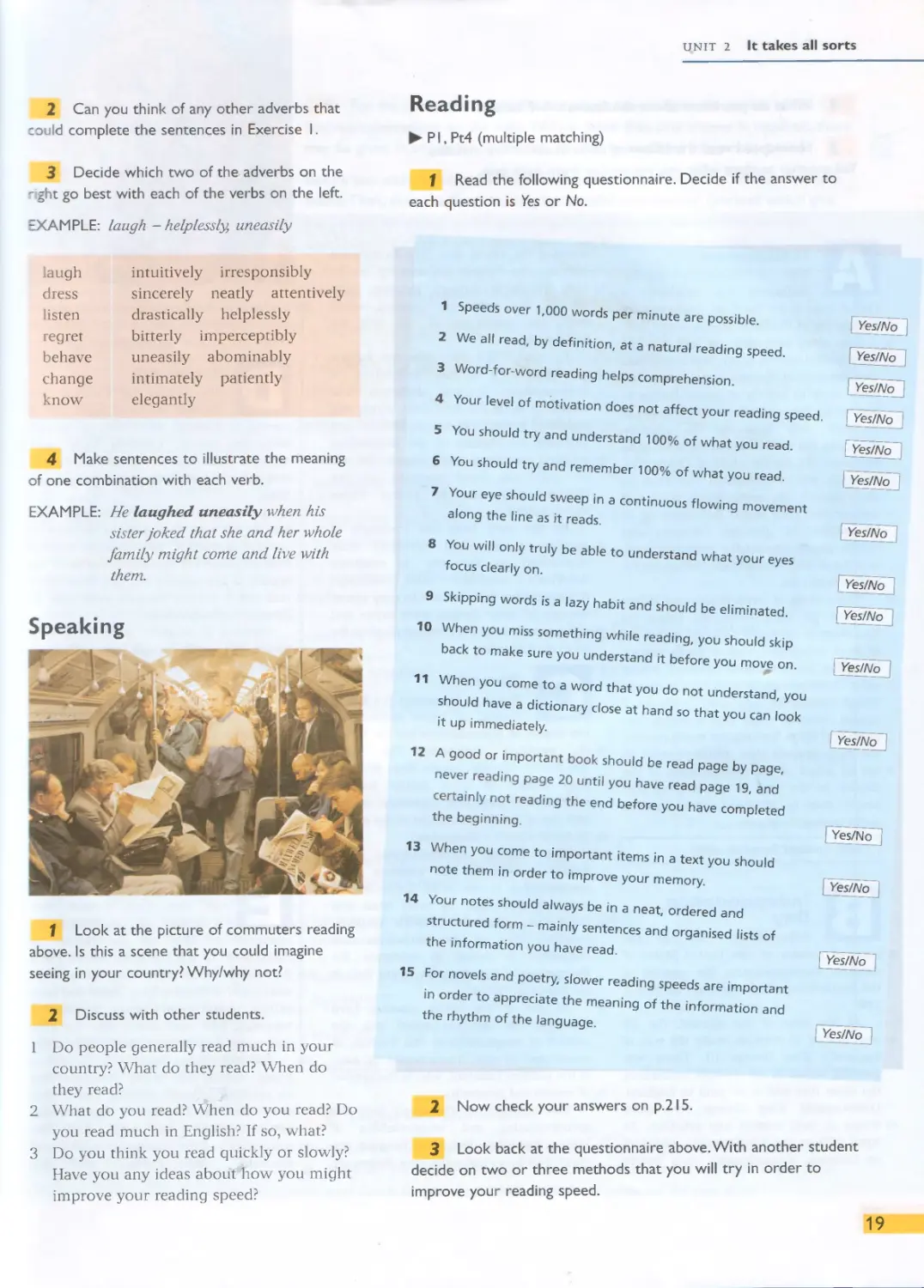
1 Look at the picture of commuters reading
above. Is this a scene that you could imagine
seeing in your country? Why/why not?
13 When you come to important items in a text you should
note them in order to improve your memory.
14 Your notes should always be in a neat, ordered and
structured form - mainly sentences and organised lists of
the information you have read.
2 Discuss with other students.
15 For novels and poetry, slower reading speeds are important
in order to appreciate the meaning of the information and
the rhythm of the language.
1 Do people generally read much in your
country? What do they read? When do
they read?
2 What do you read? When do you read? Do
you read much in English? If so, what?
3 Do you think you read quickly or slowly?
Have you any ideas about how you might
improve your reading speed?
2 Now check your answers on p.215.
Yes/NoJ
\ Yes/No |
|~ Yes/No
\ Yes/No |
< Yes/No
[Yes/No |
Pkes//\/o
[Yes/No
Yes/No \
Yes/No[
Yes/No]
Yes/No
Yes/No
^Yes/No j
Yes/No |
3 Look back at the questionnaire above. With another student
decide on two or three methods that you will try in order to
improve your reading speed.
19
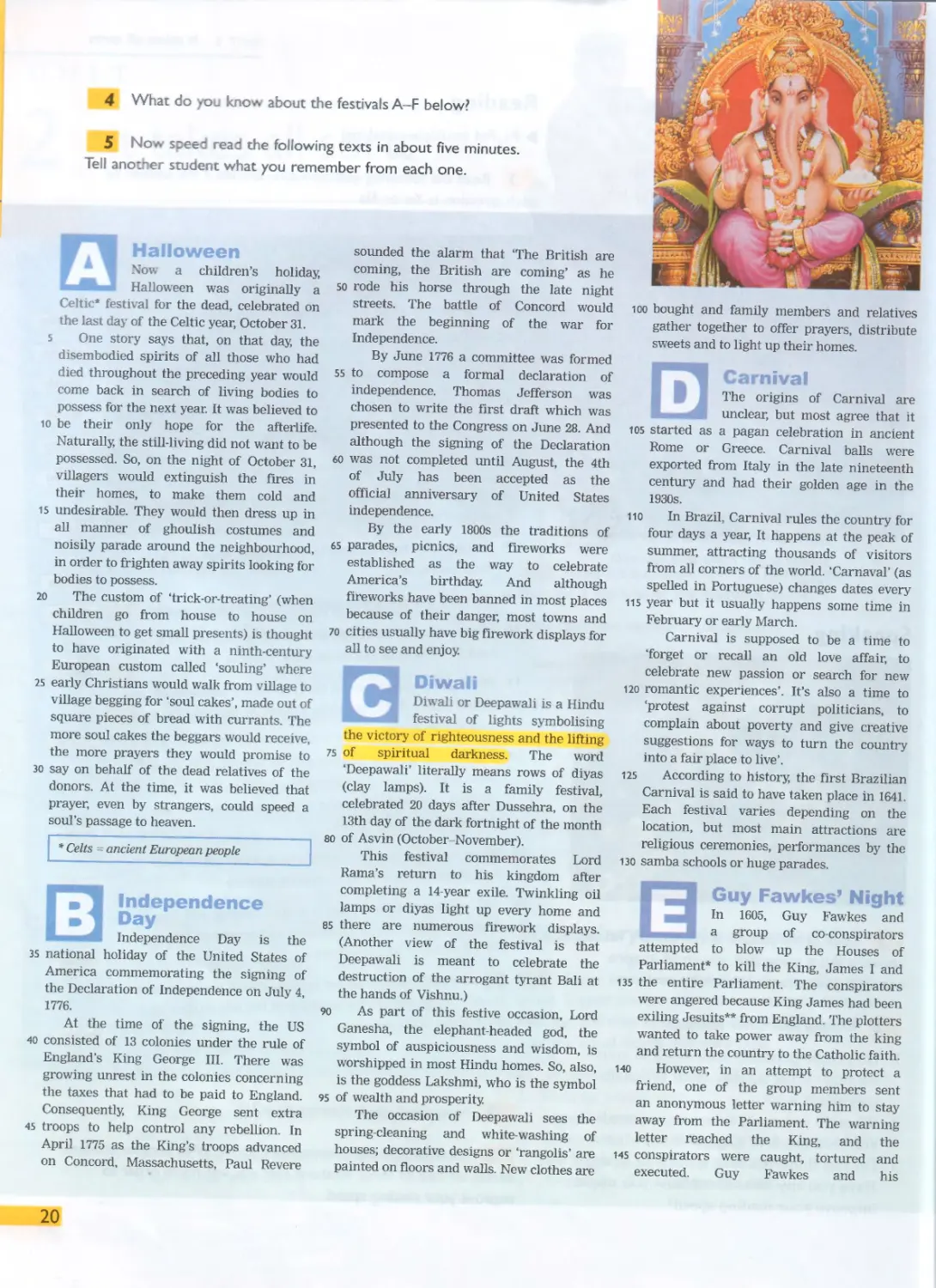
4 What do you know about the festivals A-F below?
5 Now speed read the following texts in about five minutes.
Tell another student what you remember from each one.
Halloween
Now a children’s holiday,
Halloween was originally a
Celtic* festival for the dead, celebrated on
the last day of the Celtic year, October 31.
5 One story says that, on that day, the
disembodied spirits of all those who had
died throughout the preceding year would
come back in search of living bodies to
possess for the next year. It was believed to
io be their only hope for the afterlife.
Naturally, the still-living did not want to be
possessed. So, on the night of October 31,
villagers would extinguish the fires in
their homes, to make them cold and
15 undesirable. They would then dress up in
all manner of ghoulish costumes and
noisily parade around the neighbourhood,
in order to frighten away spirits looking for
bodies to possess.
20 The custom of ‘trick-or-treating’ (when
children go from house to house on
Halloween to get small presents) is thought
to have originated with a ninth-century
European custom called ‘souling’ where
25 early Christians would walk from village to
village begging for ‘soul cakes’, made out of
square pieces of bread with currants. The
more soul cakes the beggars would receive,
the more prayers they would promise to
30 say on behalf of the dead relatives of the
donors. At the time, it was believed that
prayer, even by strangers, could speed a
soul’s passage to heaven.
* Celts ~ ancient European people
Independence
Day
Independence Day is the
35 national holiday of the United States of
America commemorating the signing of
the Declaration of Independence on July 4,
1776.
At the time of the signing, the US
40 consisted of 13 colonies under the rule of
England’s King George III. There was
growing unrest in the colonies concerning
the taxes that had to be paid to England.
Consequently, King George sent extra
45 troops to help control any rebellion. In
April 1775 as the King’s troops advanced
on Concord, Massachusetts, Paul Revere
sounded the alarm that ‘The British are
coming, the British are coming’ as he
so rode his horse through the late night
streets. The battle of Concord would
mark the beginning of the war for
Independence.
By June 1776 a committee was formed
55 to compose a formal declaration of
independence. Thomas Jefferson was
chosen to write the first draft which was
presented to the Congress on June 28. And
although the signing of the Declaration
60 was not completed until August, the 4th
of July has been accepted as the
official anniversary of United States
independence.
By the early 1800s the traditions of
65 parades, picnics, and fireworks were
established as the way to celebrate
America’s birthday. And although
fireworks have been banned in most places
because of their danger, most towns and
70 cities usually have big firework displays for
all to see and enjoy.
Diwali
Diwali or Deepawali is a Hindu
festival of lights symbolising
the victory of righteousness and the lifting
75 of spiritual darkness. The word
‘Deepawali’ literally means rows of diyas
(clay lamps). It is a family festival,
celebrated 20 days after Dussehra, on the
13th day of the dark fortnight of the month
so of Asvin (October-November).
This festival commemorates Lord
Rama’s return to his kingdom after
completing a 14-year exile. Twinkling oil
lamps or diyas light up every home and
85 there are numerous firework displays.
(Another view of the festival is that
Deepawali is meant to celebrate the
destruction of the arrogant tyrant Bali at
the hands of Vishnu.)
90 As part of this festive occasion, Lord
Ganesha, the elephant-headed god, the
symbol of auspiciousness and wisdom, is
worshipped in most Hindu homes. So, also,
is the goddess Lakshmi, who is the symbol
95 of wealth and prosperity.
The occasion of Deepawali sees the
spring-cleaning and white-washing of
houses; decorative designs or ‘rangolis’ are
painted on floors and walls. New clothes are
ioo bought and family members and relatives
gather together to offer prayers, distribute
sweets and to light up their homes.
Carnival
The origins of Carnival are
unclear, but most agree that it
105 started as a pagan celebration in ancient
Rome or Greece. Carnival balls were
exported from Italy in the late nineteenth
century and had their golden age in the
1930s.
110 In Brazil, Carnival rules the country for
four days a year, It happens at the peak of
summer, attracting thousands of visitors
from all corners of the world. ‘Carnaval’ (as
spelled in Portuguese) changes dates every
115 year but it usually happens some time in
February or early March.
Carnival is supposed to be a time to
‘forget or recall an old love affair, to
celebrate new passion or search for new
120 romantic experiences’. It’s also a time to
‘protest against corrupt politicians, to
complain about poverty and give creative
suggestions for ways to turn the country
into a fair place to live’.
125 According to history, the first Brazilian
Carnival is said to have taken place in 1641.
Each festival varies depending on the
location, but most main attractions are
religious ceremonies, performances by the
130 samba schools or huge parades.
Guy Fawkes’ Night
In 1605, Guy Fawkes and
a group of co-conspirators
attempted to blow up the Houses of
Parliament* to kill the King, James I and
135 the entire Parliament. The conspirators
were angered because King James had been
exiling Jesuits** from England. The plotters
wanted to take power away from the king
and return the country to the Catholic faith,
ио However, in an attempt to protect a
friend, one of the group members sent
an anonymous letter warning him to stay
away from the Parliament. The warning
letter reached the King, and the
145 conspirators were caught, tortured and
executed. Guy Fawkes and his
20
unit 2 It takes all sorts
friends had rolled 36 barrels of
gunpowder under the Houses of
Parliament.
These days, Guy Fawkes' Day is
also known as Bonfire Night. The
event is commemorated every year
with fireworks and burning an
effigy of Guy Fawkes on a bonfire.
The effigies are simply known as
guys’. Preparations for Guy
Fawkes’ Day and Bonfire Night
celebrations include making the
‘guys’. In some parts of England,
children keep up an old tradition
by walking in the streets, carrying
the ‘guy’ and begging passers-by
for ‘a penny for the guy’.
*	Houses of Parliament = where
Britain’s laws get made and
national affairs are discussed
*	* Jesuit = member of a Roman
Catholic religious order
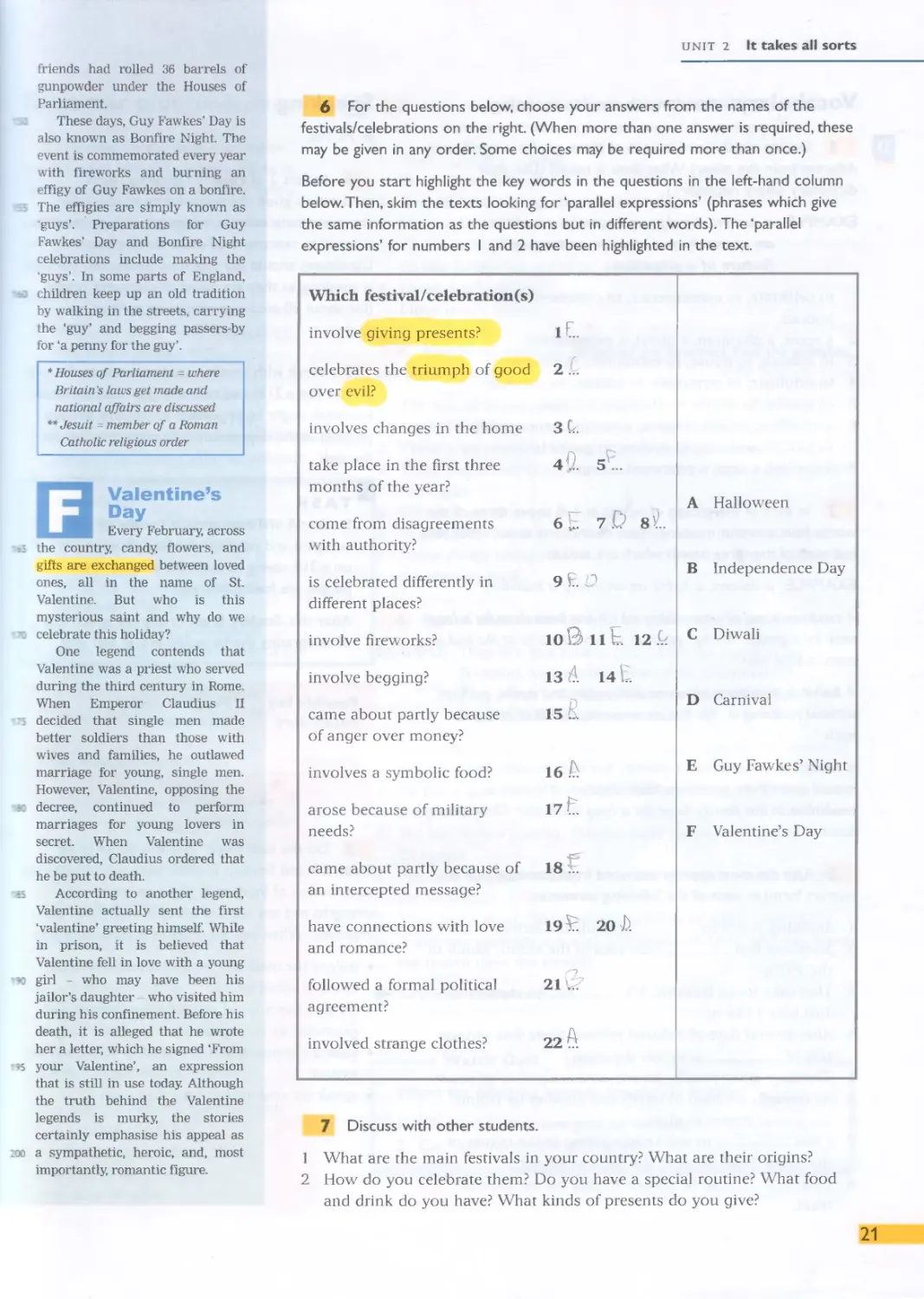
6 For the questions below, choose your answers from the names of the
festivals/celebrations on the right. (When more than one answer is required, these
may be given in any order. Some choices may be required more than once.)
Before you start highlight the key words in the questions in the left-hand column
below.Then, skim the texts looking for ‘parallel expressions’ (phrases which give
the same information as the questions but in different words). The ‘parallel
expressions’ for numbers I and 2 have been highlighted in the text.
F Valentine’s
Day
Every February, across
z the country, candy, flowers, and
gifts are exchanged between loved
ones, all in the name of St.
Valentine. But who is this
mysterious saint and why do we
~ celebrate this holiday?
One legend contends that
Valentine was a priest who served
during the third century in Rome.
When Emperor Claudius II
•’5 decided that single men made
better soldiers than those with
wives and families, he outlawed
marriage for young, single men.
However, Valentine, opposing the
decree, continued to perform
marriages for young lovers in
secret. When Valentine was
discovered, Claudius ordered that
he be put to death.
=s According to another legend,
Valentine actually sent the first
‘valentine’ greeting himself. While
in prison, it is believed that
Valentine fell in love with a young
-эо girl - who may have been his
jailor’s daughter - who visited him
during his confinement. Before his
death, it is alleged that he wrote
her a letter, which he signed ‘From
• ?s your Valentine’, an expression
that is still in use today. Although
the truth behind the Valentine
legends is murky, the stories
certainly emphasise his appeal as
zoo a sympathetic, heroic, and, most
importantly, romantic figure.
Which festival/celebration(s)
involve giving presents?	iL
celebrates the triumph of good over evil? involves changes in the home take place in the first three months of the year? come from disagreements with authority? is celebrated differently in different places? involve fireworks?	2 ... 3L 4... 6 ь 9l 10®	5V 7 .0 8 L n 11 £ 12 C	A В C	Halloween Independence Day Diwali
involve begging? came about partly because of anger over money? involves a symbolic food?	13 A 15 R 16 £	14 C.	D E	Carnival Guy Fawkes’ Night
arose because of military needs? came about partly because of an intercepted message? have connections with love and romance? followed a formal political agreement? involved strange clothes?	17 f. 18 ... 19 V 21 22 R	20 h	F	Valentine’s Day
7 Discuss with other students.
1 What are the main festivals in your country? What are their origins?
2 How do you celebrate them? Do you have a special routine? What food
and drink do you have? What kinds of presents do you give?
21
Vocabulary: words with similar meaning
1 Decide which word in each of these groups is significantly
different from the others. What does it mean? (Use your
dictionary where necessary.)
EXAMPLE: a custom, a habit, an anomaly, a tradition
an anomaly = a strange or unusual
feature of a situation
1	to celebrate, to commiserate, to commemorate, to
honour
2	a spirit, a phantom, a ghost, a premonition
3	to inflame, to douse, to extinguish, to smother
4	to originate, to terminate, to initiate, to conceive
5	to soothe, to startle, to alarm, to frighten
6	a rebellion, an insurrection, a mutiny, an assembly
7	to ban, to sanction, to outlaw, to prohibit
8	a symbol, a sign, a password, a logo
2 In each of the groups of words in 1-8 above three of the
words have a similar meaning. Make distinctions about when you
use each of the three words which are similar.
EXAMPLE: a custom, a habit, an anomaly, a tradition
A custom is usually something which has been done for a long
time by a group. ‘It7s our custom to have a party at the end of
every school yean7
A habit is something someone does again and again, perhaps
without realising it. ‘He has an annoying habit of biting his
nails.7
A tradition is similar to a custom, but may be older and
passed down from parents to their children. We have a
tradition in our family to go for a long walk after Christmas
lunch.7
3 Use the most appropriate word from Exercise I (in the
correct form) in each of the following sentences.
1	Smoking is strictly...........inside the factory.
2	Scientists first..........the	idea of the atomic bomb in
the 1930s.
3	That cake looks fantastic. It’s.........in chocolate.
Just how I like it!
4	After several days of reduced rations, there was serious
talk of............amongst the crew.
5	The dove is universally known as a.............of peace.
6	As children we used to terrify one another by telling
.............stories at night.
7	I was...........to see Andrea sitting in the corner of
the room. I had thought the flat was empty.
8	I felt..........to be chosen to play for the national
team.
Speaking
► P5, Pt2
1 In Part 2 of Paper 5 (Speaking) each
candidate is given the opportunity to speak for
about a minute without interruption. Each candidate
is asked to react to a different set of pictures.
Candidates should pay attention while their partner
is speaking, as they are asked to comment briefly
(for about 20 seconds) after their partner has
spoken.
2 Work with another student. Look at the two
photos (on p.218) and read the task. Discuss what
you think might be important vocabulary and any
possible useful expressions you might need to do
the task.
task
Student A will have about a minute to
compare and contrast the two photographs
on p.218, saying how she/he imagines the
people are feeling in them.
After this, Student В will briefly say which way
of celebrating she/he would prefer and why.
Possible key
vocabulary
Possible useful
expressions
atmosphere
The impression I get is that...
On the one hand...
3 Do the task twice. Take it in turns to be
Student A and Student B. After each turn discuss the
contribution of Student A. Note any particular
strengths and any ways in which it might have been
improved. When you are Student A make sure you:
•	follow the instructions and do exactly what
you are asked to do
•	try and use a good range of vocabulary and
grammar as you speak
•	sound interested and involved in what you are
saying
•	speak for one minute and then stop
22
unit 2 It takes all sorts
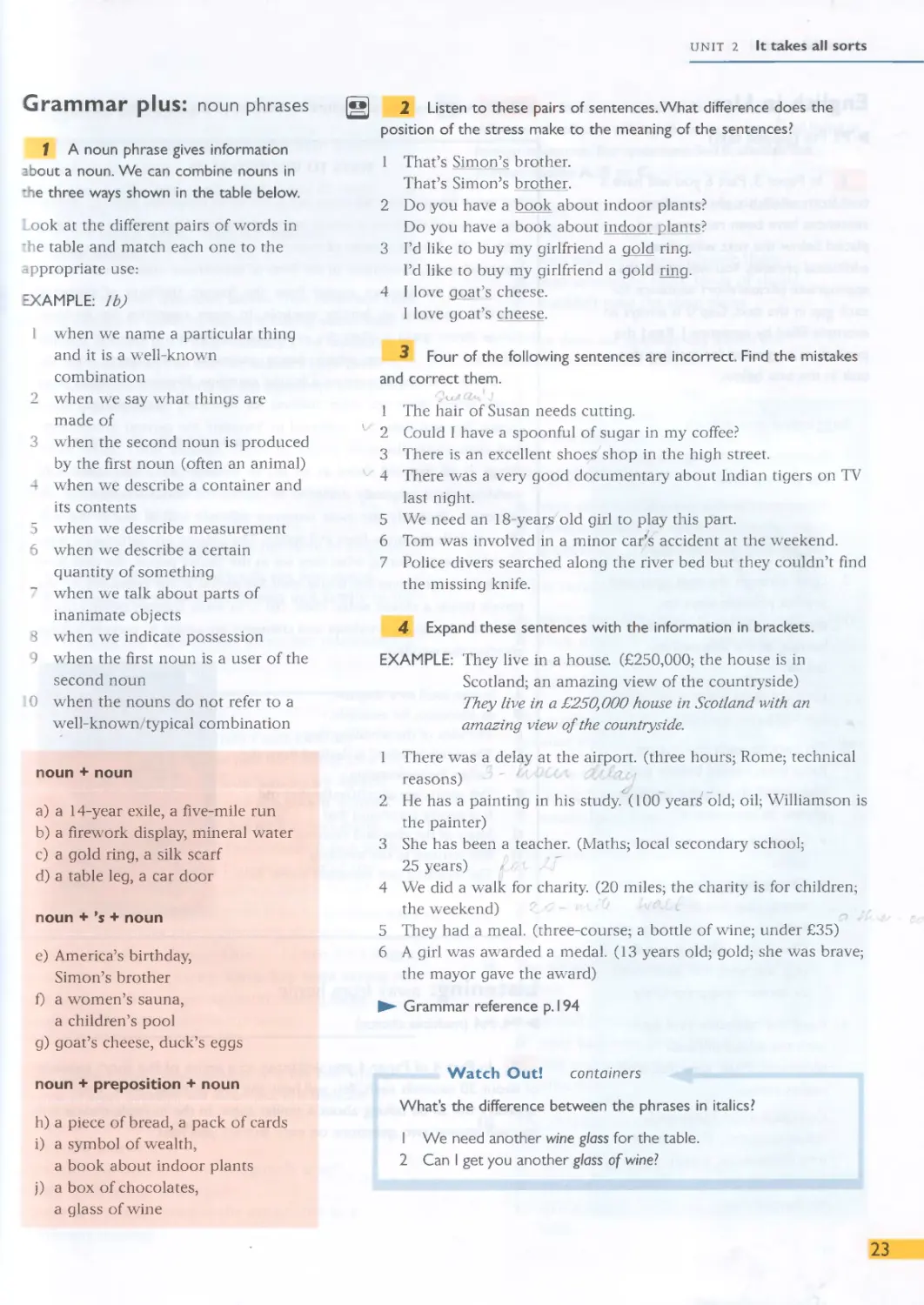
Grammar plus: noun phrases
1 A noun phrase gives information
sbout a noun. We can combine nouns in
the three ways shown in the table below.
look at the different pairs of words in
die table and match each one to the
appropriate use:
EXAMPLE: lb)
1 when we name a particular thing
and it is a well-known
combination
2 when we say what things are
made of
3 when the second noun is produced
by the first noun (often an animal)
4 when we describe a container and
its contents
5 when we describe measurement
6 when we describe a certain
quantity of something
when we talk about parts of
inanimate objects
8 when we indicate possession
9 when the first noun is a user of the
second noun
.0 when the nouns do not refer to a
well-known typical combination
noun + noun
a)	a 14-year exile, a five-mile run
b)	a firework display, mineral water
c)	a gold ring, a silk scarf
d)	a table leg, a car door
noun + ’$ + noun
e)	America’s birthday,
Simon’s brother
f)	a women’s sauna,
a children’s pool
g)	goat’s cheese, duck’s eggs
Я 2 Listen to these pairs of sentences. What difference does the
position of the stress make to the meaning of the sentences?
1	That’s Simon’s brother.
That’s Simon’s brother.
2	Do you have a book about indoor plants?
Do you have a book about indoor plants?
3	I’d like to buy my girlfriend a gold ring.
I’d like to buy my girlfriend a gold ring.
4	1 love goat’s cheese.
I love goat’s cheese.
3 Four of the following sentences are incorrect. Find the mistakes
and correct them.
.Jcc * J
1 The hair of Susan needs cutting.
1 2 Could I have a spoonful of sugar in my coffee?
3	There is an excellent shoes shop in the high street.
4	There was a very good documentary about Indian tigers on TV
last night.
5	We need an 18-years old girl to play this part.
6	Tom was involved in a minor car’s accident at the weekend.
7	Police divers searched along the river bed but they couldn’t find
the missing knife.
4 Expand these sentences with the information in brackets.
EXAMPLE: They live in a house (£250,000; the house is in
Scotland; an amazing view of the countryside)
They live in a £250,000 house in Scotland with an
amazing view of the countryside.
1	There was a delay at the airport, (three hours; Rome; technical
reasons)
2	He has a painting in his study. (100 years old; oil; Williamson is
the painter)
3	She has been a teacher. (Maths; local secondary school;
25 years) л
4 We did a walk for charity. (20 miles; the charity is for children;
the weekend)
5 They had a meal, (three-course; a bottle of wine; under £35)
6 A girl was awarded a medal. (13 years old; gold; she was brave;
the mayor gave the award)
► Grammar reference p. 194
noun + preposition + noun
h)	a piece of bread, a pack of cards
i)	a symbol of wealth,
a book about indoor plants
j)	a box of chocolates,
a glass of wine
Watch Out! containers
What’s the difference between the phrases in italics?
I We need another wine glass for the table.
2 Can I get you another glass of wine!
23
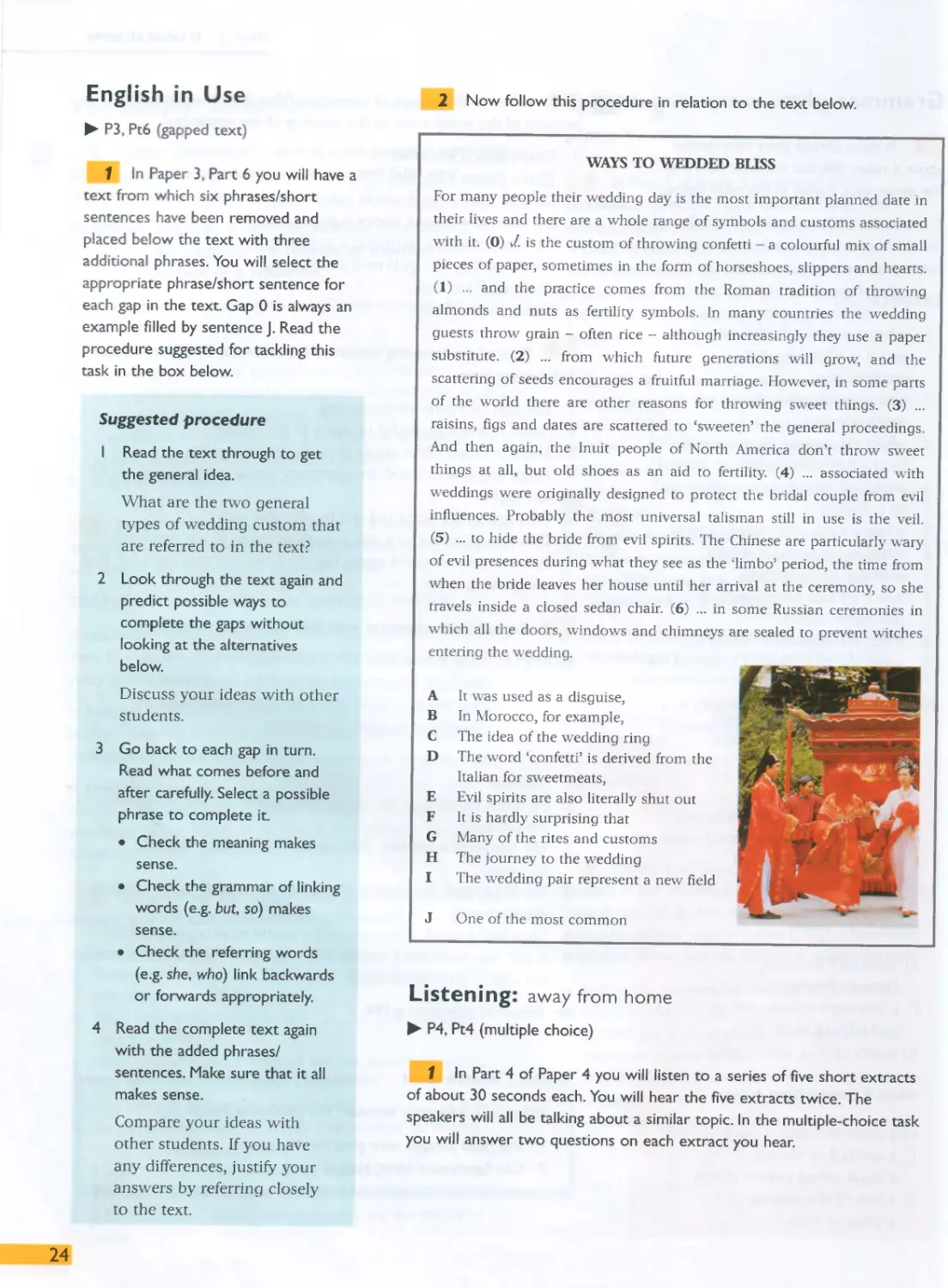
English in Use
► P3, Pt6 (gapped text)
1 In Paper 3, Part 6 you will have a
text from which six phrases/short
sentences have been removed and
placed below the text with three
additional phrases. You will select the
appropriate phrase/short sentence for
each gap in the text. Gap 0 is always an
example filled by sentence J. Read the
procedure suggested for tackling this
task in the box below.
Suggested procedure
I Read the text through to get
the general idea.
What are the two general
types of wedding custom that
are referred to in the text?
2 Look through the text again and
predict possible ways to
complete the gaps without
looking at the alternatives
below.
Discuss your ideas with other
students.
3 Go back to each gap in turn.
Read what comes before and
after carefully. Select a possible
phrase to complete it.
•	Check the meaning makes
sense.
•	Check the grammar of linking
words (e.g. but, so) makes
sense.
•	Check the referring words
(e.g. she, who) link backwards
or forwards appropriately.
4 Read the complete text again
with the added phrases/
sentences. Make sure that it all
makes sense.
Compare your ideas with
other students. If you have
any differences, justify your
answers by referring closely
to the text.
2 Now follow this procedure in relation to the text below.
WAYS TO WEDDED BLISS
For many people their wedding day is the most important planned date in
their lives and there are a whole range of symbols and customs associated
with it. (0) /. is the custom of throwing confetti - a colourful mix of small
pieces of paper, sometimes in the form of horseshoes, slippers and hearts.
(1) ... and the practice comes from the Roman tradition of throwing
almonds and nuts as fertility symbols. In many countries the wedding
guests throw grain - often rice - although increasingly they use a paper
substitute. (2) ... from which future generations will grow, and the
scattering of seeds encourages a fruitful marriage. However, in some parts
of the world there are other reasons for throwing sweet things. (3) ...
raisins, figs and dates are scattered to ‘sweeten’ the general proceedings.
And then again, the Inuit people of North America don’t throw sweet
things at all, but old shoes as an aid to fertility. (4) ... associated with
weddings were originally designed to protect the bridal couple from evil
influences. Probably the most universal talisman still in use is the veil.
(5) ... to hide the bride from evil spirits. The Chinese are particularly wary
of evil presences during what they see as the ‘limbo’ period, the time from
when the bride leaves her house until her arrival at the ceremony, so she
travels inside a closed sedan chair. (6) ... in some Russian ceremonies in
which all the doors, windows and chimneys are sealed to prevent witches
entering the wedding.
A It w as used as a disguise,
В In Morocco, for example,
C The idea of the wedding ring
D The word ‘confetti’ is derived from the
Italian for sweetmeats,
E Evil spirits are also literally shut out
F It is hardly surprising that
G Many of the rites and customs
H The journey to the wedding
I The wedding pair represent a new field
J One of the most common
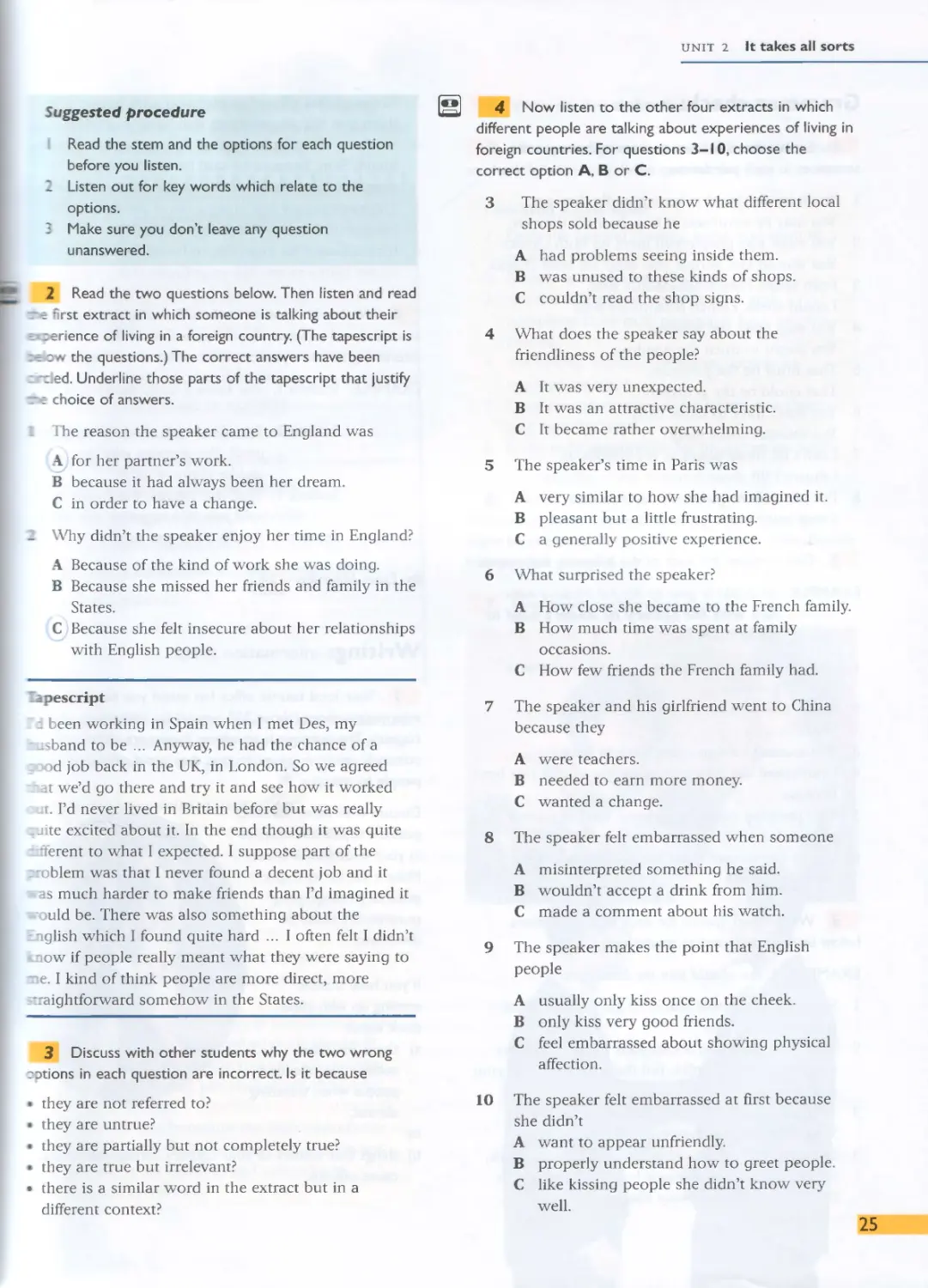
Listening: away from home
► P4, Pt4 (multiple choice)
1 In Part 4 of Paper 4 you will listen to a series of five short extracts
of about 30 seconds each. You will hear the five extracts twice. The
speakers will all be talking about a similar topic. In the multiple-choice task
you will answer two questions on each extract you hear.
24
unit 2 It takes all sorts
Suggested procedure
Read the stem and the options for each question
before you listen.
2 Listen out for key words which relate to the
options.
3 Make sure you don’t leave any question
unanswered.
2 Read the two questions below. Then listen and read
first extract in which someone is talking about their
- нелепее of living in a foreign country. (The tapescript is
ow the questions.) The correct answers have been
~?ed. Underline those parts of the tapescript that justify
choice of answers.
. The reason the speaker came to England was
A for her partner’s work.
В because it had always been her dream.
C in order to have a change.
- Why didn’t the speaker enjoy her time in England?
A Because of the kind of work she was doing.
В Because she missed her friends and family in the
States.
C Because she felt insecure about her relationships
with English people.
Tapescript
2 been working in Spain when I met Des, my
-sband to be ... Anyway, he had the chance of a
>d job back in the UK, in London. So we agreed
at we’d go there and try it and see how it worked
at. I’d never lived in Britain before but was really
z jite excited about it. In the end though it was quite
niferent to what I expected. I suppose part of the
zroblem was that 1 never found a decent job and it
as much harder to make friends than I’d imagined it
ould be. There was also something about the
English which I found quite hard ... I often felt I didn’t
tow if people really meant what they were saying to
~ie. I kind of think people are more direct, more
*raightforward somehow in the States.
3 Discuss with other students why the two wrong
motions in each question are incorrect. Is it because
•	they are not referred to?
•	they are untrue?
•	they are partially but not completely true?
•	they are true but irrelevant?
•	there is a similar word in the extract but in a
different context?
4 Now listen to the other four extracts in which
different people are talking about experiences of living in
foreign countries. For questions 3-10, choose the
correct option A, В or C.
3 The speaker didn't know what different local
shops sold because he
A had problems seeing inside them.
В was unused to these kinds of shops.
C couldn’t read the shop signs.
4	What does the speaker say about the
friendliness of the people?
A It was very unexpected.
В It was an attractive characteristic.
C It became rather overwhelming.
5	The speaker’s time in Paris was
A very similar to how she had imagined it.
В pleasant but a little frustrating.
C a generally positive experience.
6	What surprised the speaker?
A How close she became to the French family.
В How much time was spent at family
occasions.
C How few friends the French family had.
7	The speaker and his girlfriend went to China
because they
A were teachers.
В needed to earn more money.
C wanted a change.
8	The speaker felt embarrassed when someone
A misinterpreted something he said.
В wouldn’t accept a drink from him.
C made a comment about his watch.
9	The speaker makes the point that English
people
A usually only kiss once on the cheek.
В only kiss very good friends.
C feel embarrassed about showing physical
affection.
10	The speaker felt embarrassed at first because
she didn’t
A want to appear unfriendly.
В properly understand how to greet people.
C like kissing people she didn’t know very
well.
25
Grammar check: modals
1 Explain the difference in meaning between the
sentences in each pair below.
1	You’ll be surprised at how friendly they are.
You may be surprised at how friendly they are.
2	You must kiss people you meet on both cheeks.
You should kiss people you meet on both cheeks.
3	I can speak French reasonably well.
I could speak French reasonably well.
4	You may open the window.
You ought to open the window.
5	That must be the postman.
That could be the postman.
6	You don’t have to come early.
You mustn’t come early.
7	I can’t lift those boxes in my condition.
I mustn’t lift those boxes in my condition.
8	I’ve got to leave work by 3p.m. today.
I may leave work by 3p.m. today.
2 Give a reason for each of the following statements.
EXAMPLE: He ought to give up his job because now
he’s won the Lottery he doesn’t need to
go to work,
1	The present Prime Minister won’t win the next
election because ...
2	Jamie doesn’t have to go to school tomorrow
because ...
3	You mustn’t be home late tonight because ...
4	I can’t read the instructions on the side of this box
because ...
5	This painting could be of some kind of animal
because ...
6	You’ve got to start your revision this weekend
because ...
3 Write direct speech for each of the situations
below using an appropriate modal verb.
EXAMPLE: 1 You should join the local gym.
1	Someone you know wants to get fit. Give them
some advice.
2	Someone has asked about your musical abilities
when you were a child. Tell them about about your
past abilities.
3	A friend has asked to smoke in your bedroom.
What question do they ask?
4	Someone has asked you where your friend, Mark,
is. You don’t know for sure but you have one or
two ideas. Tell them your ideas.
5	Someone has offered to give you a lift home. Tell
them it is not necessary as you have your bike.
6	You hear the telephone ring. You are sure it is your
friend, Sam, because he said he would ring at this
time. Tell your flatmate this as you go to answer it.
7	The headteacher has given a pupil permission to
leave school early. What does she say?
8	It’s necessary for everyone to bring their calculator
to the Maths exam. Tell your friend this.
4 Work with another student. Roleplay the above
situations and continue the dialogue. Create the most
interesting scenario you can think of for the dialogue.
EXAMPLE: Student I: You know, I really want to get fit
Student 2: You should join the local gym. It’s
great. But, anyway, why this
sudden desire to get fit?
Student I: Well, don’t laugh, but I want to
take part in next year’s marathon.
Student 2: Really ... Are you sure?
Writing: information sheet
1 Your local tourist office has asked you to write an
information sheet (about 250 words) for visitors to your
country. The purpose is to inform foreigners about any
culturally sensitive issues so that they avoid offending local
people by mistake.
Discuss with other students
possible topics for inclusion
in your information sheet.
Make a list, for example:
gestures, greetings, going
to someone’s house for
dinner etc.
If you have trouble
coming up with ideas,
think about
a) times you have
accidentally offended
people when travelling
abroad;
or
b) things that visitors to your country sometimes do that
cause offence.
26
unit 2 It takes all sorts
2 Choose three or four areas that are culturally
sensitive to include in your information sheet. Make notes
□f points for inclusion under each heading.
_ _ _7"J _ ______ _ □ □ 9 - 9 9 9 9 9
Sreebings
with people you don f know.
Either a handshake or nothing.
2	men to male -friends.
Either a handshake or nothing.
3	men/women to female friends.
Either a single kiss on the cheek or nothing.
4	- in business sifuafions.
Usually a handshake will be appropriate m
most contexts.
3 Look at the information sheet on p.203. Make sure
• ou read and understand all the Dos and Don’ts. Plan the
^formation sheet you are going to write.
Planning your information sheet
1	What title will you give your information
sheet so as to make it interesting and
attractive to your audience?
2	How many sections will you have in your
information sheet and what headings will you
use for each one?
3	Will you need to use a more formal or
informal style with the audience you are
writing for?
4	What is the purpose of your information sheet
(e.g. to inform, warn and advise)? How will
this affect the language you use? (Remember,
you don’t want to put visitors off coming to
your country!)
5	How will you introduce the topics you cover
in each section? (Remember, you don’t want
to make your customs and values seem
illogical to visitors.)
4 Write the first draft of your information sheet.
5 Show your first draft to another student for them
to check by answering these questions.
Checking a first draft
1	Does the general heading make you want to
read the sheet?
2	Is there a helpful introduction?
3	Are the different paragraphs clear and
complete? Does each paragraph have its own
heading?
4	Are linking words/expressions used in an
appropriate way?
5	Does the information sheet inform in a clear
and readable way?
6	Is the style appropriate for the target readers?
6 Discuss your partner’s response to your
information sheet. Listen to any suggestions as to how it
might be improved. Reread your information sheet. Decide
how you will change it.
7 Rewrite your information sheet.
Exam focus
Paper 3 English in Use: Part 3
(error correction - extra word)
About the exam: Paper 3, Part 3 is a correction
exercise of which there are two types. In the first type,
candidates have to identify additional words which are
incorporated into the text. In the second type, errors of
spelling and punctuation have to be identified. There are
sixteen lines to be corrected and candidates should not
expect more than five lines to be correct. In this section
we will look at the first type.
Suggested procedure
I Look at the title and predict what you think the
text will be about.
2	Read the text through to get the general idea.
(Don’t worry about the errors at this point.)
3	Go back and read the text again. Look for typical
types of‘extra’ words e.g. articles and
prepositions.
4	When you have finished, check that no more than
five lines are correct.
5	Read the complete text again, checking that each
sentence is grammatically correct.
In most lines of the following text, there is one
unnecessary word. It is either grammatically incorrect
or does not fit in with the sense of the text. For each
numbered line 1-16, find this word and underline it.
Some lines are correct. Indicate these with a tick (/).
(Spend no more than 15 minutes on this task.) The
exercise begins with two examples (0) and (00).
—
THE POWER OF PAINT
0
00 /
1
2
3
4
5
6
7
8
9
10
11
12
13
14
15
16
People have been always painted their bodies. The reasons are many: religious,
ceremonial, or simply for decoration. In Brazil, the Kayapo Indians
paint to each other’s bodies using the blue-black juice of
the genipap fruit. An unpainted body can mean so that the person has no one who cares
enough to do it. Other Indians regard that an unpainted person as naked. Sometimes
body painting can be quite complicated because of every colour and shape has a particular
meaning. A popular design among the Thompson Indians in North America was to paint
half the face red and the other half black; red did brought the warrior good luck, while
black gave his enemy misfortune. In decoration for a religious occasion, the Australian
Aborigines use themselves traditional colours and patterns and these are applied
by a special person. For instance, when mourning, the mourners they are covered in
white paint. Among the Nuba in the Sudan, body painting is art for art’s sake: it has
no religious meaning, it simply makes the body quite more beautiful. In fact, as a man
gets older and less attractive, he replaces paint by clothing. Also a man suffering illness
or injury will wear clothes until he recovers. Throughout the world, because people
like to decorate themselves according to their own customs. In the Western world
there is a multi-million pound cosmetics industry with vast amounts of money which
being spent on advertising campaigns to persuade the men and women to buy cosmetics.
28
UNIT
1 For questions I-15, read the text and then decide which word
z e ow best fits each space.
When in Britain, you must never complain. Complaining
is very un-British. If you are (1) ... waiting half an hour
in a shop, if a bus (2) ... is rude to you, if a waiter brings
your food ice-cold - you keep your mouth shut. The (3) ...
upper lip is the British way. Other nationalities might make a
(4) ... , protest loudly or call for the manager, but not the
British.
Remember also that British ears are (5)... not tuned to hear
complaints. A friend of mine was a regular (6)... at a famous
and expensive London restaurant. Every day at 2p.m. and
9p.m. the (7) ... manager would come out (as he had been
doing for the last 37 years), go from table to table and (8) ...
‘Did you enjoy your meal?’ For 37 years, hundreds of
thousands of properly (9) ... up English people had replied
to him: ‘Very much indeed.’ The man would smile, say
‘Thank you very much’, and (10)... to the next table.
One day, however, the lunch was so (11) ... that my friend
(Dutch mother, Albanian father) decided to tell him the
naked truth. So, when the antiquated manager (12) ... at his
table as usual and asked, ‘Did you enjoy your meal, sir?’ my
friend replied: ‘(13) ..., not at all. It was appalling.' To which
the manager gave his (14) ... , obsequious smile, said:
‘Thank you very much, sir’, and moved on, quite (15)...
1	A made	В	kept	C stayed	D held
2	A conductor	В	attendant	C assistant	D steward
3	A hard	В	inflexible	C firm	D stiff
4	A discussion	в	argument	C quarrel	D fuss
5	A simply	в	easily	C utterly	D modestly
5	A supporter	в	purchaser	C customer	D guest
у	A mature	в	elderly	C outdated	D vintage
8	A inquire	в	query	C request	D probe
9	A raised	в	grown	C educated	D brought
I w	A motion	в	progress	C stride	D shift
11	A offensive	в	painful	C abominable	D harrowing
*	A appeared	в	surfaced	C descended	D joined
13	A Sincerely	в	Largely	C Bluntly	D Frankly
14	A customary	в	average	C commonplace	D daily
• 3	A convinced	в	fulfilled	C satisfied	D complete
review
2 Select the correct alternative in
each case.
1 Is that your friend/friend’s car?
2 Do you like watching horse /horses
races?
3 Could you pass me the bath’s/bath
towel?
4 Would you like some mint tea/tea
of mint?
5 It was essentially a lost violin film/
film about a lost violin.
6 There are lots of kitchen’s/kitchen
cupboards in the new house.
7 Have you got a timetable of trains/
train timetable?
8 Look! There’s a bird’s nest/nest of
birds in that hedge.
9 This sweater is made of lamb's wool/
lamb wool.
10 Has anyone seen a large matches
box/box of matches?
11 Can you hear a child’s/child voice?
12 There won’t ever be a tax on
educational books /an educational
books tax.
3 Complete each of these sentences
with one of the words in the box below.
drastically sincerely abominably
intimately patiently neatly
intuitively helplessly
1 He listened............as she told her
long and rather boring story.
2 He..............regretted	all the
unpleasant things he had said to her.
3 She knew...............that	there was
something wrong.
4 She’s changed.............since she’s
left home. She’s a new person.
5 He always dresses very..............but
without much style.
6 He behaved..............at the party.
He was rude to several of my friends.
7 He’s terribly funny. We were all
laughing................for	ages.
8 I wouldn’t say I know him..............
We’re just work colleagues.
29
UNIT
3 The root of all evil?
Listening: a mystery
► P4, Pt3 (sentence completion)
1 Look at the pictures above. What do you
imagine is the connection between them?
4 Now listen to the first part of the interview
again for the exact words that are missing.
|Д|	2 Listen to part of a radio interview with Max
Valentin. What is the connection between the pictures?
Did you guess correctly?
3 In Paper 4 (Listening), Part 3 you will be asked
to listen to a conversation between two or three
speakers, for approximately four minutes. You may be
required to complete between eight and ten sentences.
You will need between one and three words to
complete each sentence. The words you need to
complete each sentence will be in the conversation
that you hear. However, you may have to change these
words so they fit grammatically with the rest of the
sentence. You will be tested on your understanding of
specific information, gist and attitude.
Look at the gaps in these two sentences and discuss
with another student how to complete them.
1	Up to now none of the...................has
worked out the puzzle and found the prize.
2	For over ten years..................for Max’s
book lay untouched in his desk.
5 Think about the gaps in the following statements.
Then listen to the whole interview and complete them.
3	Michel Becker......................as	the prize
for the winner.
4	Because the book offered its readers the
chance to become rich it went straight into
5	Max told someone he was wrong in order to
prevent him from.........................a
graveyard.
6	The.....................clue describes
precisely where the prize is buried.
7	Minitel was a kind of....................of
the Internet.
8	The number of hours Max was spending at his
computer began to have a very bad effect on
9	Max feels it would be a kind of
........................to	reveal the location of
the prize.
10	Max thinks that one day he might
........................to	end the hunt.
30
unit з The root of all evil?
to be approved
to be too excited
(of a sound) to be able to reach a certain
distance
to succeed in doing something
to do something too much or for too long
to continue doing something
to be respected and believed by people
to complete a job or put into practice a
plan or order
to help someone manage when they are ill
or having difficulties
2 Now complete these sentences with one of
the expressions in Exercise I a)-i).
1	I got a bit................and bought
three pairs of shoes instead of one.
2	A public speaker needs a voice that
.............well.
3	Sarah’s views.......a lot of...........
with the Sales Director.
4	He felt nervous before the speech but he
.............it...........well in the end.
6 Discuss with other students.
Have you ever been on a 'treasure hunt’? What was it like?
Did you enjoy it?
_ Why do you think some people get so obsessed by a
‘treasure hunt’ like this?
Do you think Max Valentin should put a stop to it or
should he let it continue until someone finds the owl?
5 How long did the party.......................
for after I left?
6 The bill was finally...........despite	strong
opposition.
7 I think we should wait until more tests have
been.........................
8 Despite all the problems they were having,
their love for each other............them
Vocabulary: expressions with carry
1 Look at the sentences below containing expressions with
:arry. Match them to the appropriate meanings above right.
EXAMPLE: a) ii)
a)	People started to get really carried away. One man got
on the table and started dancing.
b)	She’s an important person. Her opinions carry a lot of
weight.
c)	It’s really quite a risky venture. I doubt whether they’ll
be able to carry it off.
d)	Her great courage carried her through her illness.
e)	The motion was carried by 310 votes to 306.
f)	It was all quite funny but they really carried the joke
too far.
g)	His voice didn’t carry to the back of the hall.
I couldn’t hear a word he was saying.
h)	Do you think she’ll carry out her threat to resign?
i)	He carried on talking despite all the noise.
9 The joke was quite funny at first but they
definitely.............it............
3 Discuss these questions with other
students.
1	How long do you think you will carry on
studying English for?
2	Do you know of a situation where a joke
was carried too far? What happened?
3	What happens if parents or teachers make
threats to children which they don’t carry
out?
4	Would you be a good public speaker? Does
your voice carry well in large spaces?
5	Do you have a friend or is there someone in
your family whose views carry a lot of
weight? Why is that?
6	Have you ever managed to carry something
off that you didn’t really think was possible?
31
Reading
► PL Pt I and Pt4 (multiple matching)
1 Discuss with other students what difficulties
young people might have if they became very rich
overnight.
2 Read the text quickly to find out in what
different ways each of the young people became rich.
3 Read the text;
answer the questions below.
again and	THE NATIONAL LOTTERY
ftiss 'Tracev r7ah't -
/owbsj
1
For each question you will
need to look for a ‘parallel
expression sentence’ in the
text. This might be a phrase
/sentence which reflects
or illustrates the meaning
of the question but uses
different words. You will
not find exactly the same
words in the text as in the
question. The parallel expressions
/sentences for each question below
2
have been underlined to help you.
Choose your answers from the list of
people on the right. When more than
one answer is required, these may be
given in any order.
Ш1Т
The Aoyai Bank
of Scotland ptc
AS-1-3[
4 Add two more questions to
those in Exercise 3. (Make sure you
find parts of the text to justify the
answer.) Ask another student to
decide which person or people
is/are being referred to and which
parts of the text justify their
answers.
5 Discuss with other students.
How do you feel about each of
the four people in the article? Do
you think you would like/dislike
them? Give examples from the
text to support your opinions.
Which rich kid(s)
doesn’t feel very positive about
their new financial situation?
is a little concerned about people
who will try to get money from
them now they are rich?
believes a conventional school
education only prepares children
for conventional jobs?
is very style conscious?
have impressed their parents?
haven’t really adjusted to the
idea of having so much money?
initially thought they had only
won a small amount of money?
has good negotiating skills?
haven’t changed their lifestyle
very much?
1	...
2	...
3	...
A Tom Hartley
В Simon Cunliffe-Lister
4	...
5	... 6 ... C Tracey Makin
7 ... 8 ...
D Karl Crompton
9	...
10	...
11	... 12 ...
6 Work with another student.
Student A look at the rolecard on
p.215. Student В look at p.216.
Spend a little time thinking about
who you are, your attitude and how
you will approach the conversation.
‘Winning the lottery hasn't changed its -
we’re still here!’
32
Today there are more and
more young people under
the age of 25 becoming
millionaires. Coming into
5 money at an early age can
be tremendously exciting
but it can also be fraught
with its own dangers
and problems. Here are 4
Ю young people who have
found themselves in quite
extraordinary financial
situations very early on.
A TOM HARTLEY
The thoughts	of	his
is contemporaries	are	of
football, computer games
and the latest designer
trainers. Yet Tom Hartley, who struck
his first deal selling a Porsche when he
20 was 11, has just become Britain’s
youngest self-made millionaire at the
age of 14.
Hartley has a private chauffeur,
mobile phone and wardrobe of designer
25 suits, and in the past year alone he has
been responsible for clinching deals
worth £8m for his father’s luxury used-
car business.
Hartley left school at 11 and since
so then has been educated partly by private
tutors but mostly by the so-called
‘university of life’. T am serving an
apprenticeship and I learn something
every day’ he said. He admits it’s not for
35 him but he certainly doesn’t criticise a
conventional education for others. ‘If
someone wants to be a lawyer or a
doctor, they should take the normal
exams. But for what I want to do, school
40 doesn’t suit me,’ he said.
His father said of Tom, ‘He has been
talking with customers on the phone
since he was 12 and the thing which
really gives him the edge is his ability to
45 know when to close the deal. Tom is a
level-headed young man who can keep
his cool in all sorts of circumstances.
Actually, he’s really more like a partner
which is why I got him a Ferrari - he’d
so earned it.’
В SIMON CUNLIFFE-LISTER
At the age of 15 Simon has been left a
£10million estate with a manor house,
priceless antiques - and a butler. All
inherited from a distant bachelor
55 cousin.
Solicitor’s son, Simon, who plays the
saxophone in a band called Shagwagg,
surveyed his new domain yesterday:
‘The house would be perfect for a rave -
60 but I suppose that’s out of the question.’
Simon will be responsible for the 380-
year-old Burton Agnes Hall, near
Bridlington, Humberside. Paintings by
Renoir and Gauguin, which hang from
65 its oak-panelled walls, and collections of
bronzes, porcelain and furniture attract
30,000 visitors a year. However, Simon’s
untidy bedroom at his current home is
covered in pictures of pop stars.
70 Simon is a pupil at one of the most
famous schools in the country,
Winchester, which costs a hefty £15,000 a
year. His long-term ambition is to
become an engineer after completing an
75 appropriate university course. In the
short term though he is planning to
show his girlfriend, Helen, 15, round the
house and its 42 acres. He added: T've
been told to keep an eve out for gold
80 diggers and I suppose most women
would be impressed by all this but I told
Helen what to expect and she wasn't
overawed at all which is great. Actually,
the people at school have teased me
85 quite a bit. They keep asking if 1 can
lend them £10million!’
C TRACEY MAKIN
The National Lottery’s youngest
millionaire confessed yesterday that she
would have been delighted with a mere
90 £53. 16-year-old Tracey Makin thought
she would be collecting that modest
windfall after matching four numbers in
Saturday’s draw and it was only the next
day, as she was checking her numbers
95 again, that the GCSE student realised
she had picked them all - and a win of
more than £lmillion.
Earlier her mother said
Tracey seemed to be
wo taking the enormous win
in her stride. ‘She is being
very cool about it, but
obviously she is ecstatic,’
she said. T don’t know
Ю5 how she is managing to
study for her exams, but
she is and she’ll be taking
her exams in the summer,
money or no money.’
no Tracey chose her
numbers from a
combination of friends’
birthdays. ‘I probably will
continue playing the
115 lottery although I was told
lightning never strikes
twice in the same place/ she laughed.
‘It’s slowly sinking in but I still haven’t
really had the chance to think properly
120 about what I’m going to do with the
money.’
0 KARL CROMPTON
What do you give the man who has
everything? Well, in the case of Karl
Crompton, something to do wouldn’t go
125 amiss. Amazingly, just a fortnight after
scooping nearly £llmillion on the
National Lottery, the 23-year-old is - to
put it bluntly - becoming bored out of
his brain.
130 Having become one of the richest
young men in Britain, you might expect
him to be drinking champagne, jet-
setting around the Caribbean, or out on
the town clubbing to his heart’s content
135 every night. Instead, the former
electrical store worker dines on fish and
chips at home, spends his evenings
watching videos and goes out motor
cycling with his mates.
140 Yesterday, unshaven and facing
another dreary day of riches beyond the
dreams of avarice, Karl admitted: T hate
sitting around doing nothing. When I
was at work it could be repetitive, but at
145 least I kept meeting different people.
‘It’s hard to comprehend how much
money I’ve got and when I actually stop
and think about it, to be honest, it’s too
much and I haven’t got a clue what to do
150 with it. All I’ve ever wanted is a nice
bike, a nice car and a nice house - and
it’s hard to know what else to get. I
suppose Г11 buy a house at some stage,
but I’ve lived at home all my life and
155 don’t see why I should move out now.’
33
Grammar plus: verb tenses
1 Name the tenses of the verbs underlined in the box.
•	I bought him a Ferrari
because he had
earned it.
•	By the time he is 18
he will have become
Britain’s youngest
multi-millionaire.
•	I have been serving
an apprenticeship for
2 years.
•	I have not been
watching TV, Ihave
been working.
•	I had been waiting
3 hours before she
arrived.
2 Look at the examples above and match each to one of
the uses of the perfect tenses described below.
1	shows the time of an event as being earlier than
another time
2	shows that the speaker sees the event as ongoing and
temporary rather than completed and permanent
3	emphasises the activity rather than whether or not it is
complete
4	shows the event as being completed by a certain time
3 The present, past and future continuous tenses are
often used to express ideas similar to those expressed by the
perfect continuous. Discuss with other students the difference
in meaning between the following pairs of sentences.
1	Jim lives with his parents. ИЛ Ъ&М f
Jim is living with his parents.
2	I’ve been painting the living room.	г '
I’ve painted the living room. / . t
3	She asks me to help her with homework whenever
I’m around.
She’s always asking me to help her with homework
and I really don’t have the time.
4	I won’t see her again after what she’s done to me.
I won’t be seeing her again now the course has
finished. £
5	Who banged on the door? - th
Who was banging on the door? '
6	The food is prepared in here.
The food is being prepared in here.
4 Look at the following sentences and decide if
the verbs underlined are in a likely and appropriate
tense or not. If not, correct them.
1	My neighbours are constantly having wild
parties. It’s terrible.
2	I had been splitting up with my girlfriend and
was feeling terrible.
3	Our boss had been walking into the room
without us noticing. It was very
embarrassing.
4	I was-eutting myself quite badly while
shaving this morning.
О 5 I got to the bus stop and suddenly realised I
had left my wallet at home.
i/ 6 Will you be working from home tomorrow?
7 Have you been hearing the news today?
L 8 Why do you look so sad? What is worrying
you?
w 9 I’ll have been here for three years in
December.
5 The following verbs are rarely used in the
continuous form.
like believe possess know agree
smell deny understand love taste
belong promise hear own care
1 Divide these verbs into five groups according
to meaning. There will be three verbs in each
group. What is common in meaning between
the verbs in each group?
2 Some verbs can be used in the continuous
form when they have one meaning but not
when they have a different meaning. Decide
which of the alternatives below are possible
and, in each case, what the meaning of the
underlined verb is.
a)	I’m thinking you should talk to your bank
manager.
b)	I’m thinking of spending a week in France
in June.
c)	I’m seeing Paul tonight.
d)	Fm seeing what you mean.
M. ' tv
e)	I’m tasting the soup to see if it’s OK.
f)	This soup is tasting fantastic.
g)	She’s feeling we should have a long
holiday.
h)	She’s not feeling very well.
34
unit з The root of all evil?
6 Read the following dialogue between two students. Put the
verbs in brackets into one of the following tenses.
Present Simple, Present Continuous, Past Simple,
Past Continuous, Present Perfect Simple, Present Perfect
Continuous, Past Perfect Simple, Future Simple,
Future Perfect, Future Continuous
A:	Hi Julie. How was your summer break?
B:	Great! I can’t believe it’s all gone so fast!
A:	So, what (1) ....(you do) since you got
back?
B:	Well the main thing has been moving all my stuff into the
house I (2)..........................(share)	with four others
from next Saturday. It (3)..........................
(belong) to the university and it’s really nice.
A:	Great! Well, while you (4)................... (move), I
was revising for my exams in October.
B:	You (5)..................... (joke)! You don’t have exams
already, do you?
A:	Yes, well, you know I (6).................... (fail) a
couple of my June exams. So now I have to retake them.
B:	Oh yes, I (7)...................(completely forget).
How awful!
A:	At least they (8)................. (be)	over soon.
Anyway, what’s it like in your new place?
B:	Well, it’s complete chaos at the moment but with luck we
(9).....................(unpack) most of the boxes by
the weekend.
A: Listen, if there’s anything I can do, just tell me, won’t you?
B: Hey thanks but I think we (10) ..\zzr<......‘.....  (do)
all the main things. Anyway, you should be concentrating
on your exams!
7 Tell other students:
1 two things you have done in the last year which you are
really pleased about
2 two things you hope you will have done by this time next
year
8 Imagine you have won a five-day dream holiday. You have
unlimited funds. You can go anywhere, use any means of transport
and stay in any kind of accommodation.
1 Work with another student. Plan your holiday together.
Decide on two main activities for each day of your holiday.
2 Now work with another pair of students. Take it in turns
to describe your holidays. Decide who has the best dream
holiday. Remember to use the Future Continuous to
describe your itinerary.
► Grammar reference p. 195
Speaking: giving opinions
► P5, Pt3 (problem-solving task)
[”]	1 In Paper 5, Part 3 the examiner sets the
candidates a problem-solving task which often
involves a number of pictures or written
prompts. Listen to an examiner setting two
candidates a task and look at the pictures below.
What three things does he ask the candidates
to do?
2 Now listen to two students doing the
following task. What’s the main problem with the
way they interact during the task?
3 Listen again. Make a note of any
expressions you hear under the headings below
and then add any other expressions you know.
Asking for opinions Giving opinions
Agreeing
Disagreeing
4 Now do the task with another student.
Remember to give each other plenty of
opportunities to express opinions. Use a variety
of expressions from the columns in the exercise
above.	_______ - - -	- - -----
35
Vocabulary: compound adjectives
1 Choose the word that collocates best with the
compound adjective in each sentence.
1	Of course Jim is a self-made...........He
didn’t inherit a penny.
a) success b) tycoon c) millionaire
2	The President of the United States never goes out
in public without wearing a bullet-proof
a) shirt b) suit c) vest
3	Jim is very disorganised. He’s a bit like an
absent-minded.................
a) teacher b) professor c) scientist
4	I’m afraid we’ve had to call this last-minute
..............due	to the unexpected resignation of
Tony, the Sales Manager.
a) meeting b) gathering c) conference
5	Who exactly is this so-called..........who	is
going to tell us all what to do?
a) connoisseur b) expert c) professional
6	I hate these modern, mass-produced.............
I want an old-fashioned one with style!
a) vacuum cleaners b) TVs c) sofas
7	Doesn’t he look great in that tight-fitting
i
a) cap b) scarf c) T-shirt
8	I hate working in air-conditioned...........
I always catch colds.
a) offices b) environments c) spaces
9	I can’t come out tonight. I’ve got a long-
standing .............to have dinner with my
brother.
a) appointment b) arrangement c) agreement
10	Sarah is a very level-headed..........She
never acts impulsively.
a) young woman b) good friend
c) nice teenager
2 Discuss with another student the meaning of each
of the compound adjectives above. When you have
finished check your dictionary. How are the compound
adjectives above pronounced? Where does the main
stress fall?
3 Read these sentences. Then match each of the
underlined compound adjectives with one of the
definitions below.
1 Don’t drive fast in built-up areas. It’s very
dangerous.
2 We were too hard up to afford new clothes.
3 You look quite pale and run-down. Are you eating
properly?
4 That’s the third broken-down old car I’ve seen at
the side of the road today!
5 Now Sarah’s been promoted, we’re actually quite
well-off.
6 You will receive a one-off payment of £500, but
that’s all.
7 I feel really burnt out. I’ve been doing this job for
far too long.
8 I hate going shopping on Saturdays. I’m worn-out.
a)	when a large machine e.g. a lift, has stopped
working
b)	your health is ruined because of working too hard
c) very tired, exhausted
d) an area with a lot of buildings and few open spaces
e) having more money than many other people or
enough money to have a good standard of living
f)	tired and not very healthy
g)	happening or done only once, not as part of a
regular series
h)	not having enough money to buy the things you
need, especially for a short period of time
4 Make sentences which show the meaning of seven
compound adjectives from Exercise I or 3 above. Leave a
gap where the compound adjective should go. Show your
sentences to other students and see if they can decide
which compound adjective is missing.
EXAMPLE: Clive and Nicola have inherited a lot of
money from their grandmother so now they
are very ...
36
unit з The root of all evil?
Exam focus
Paper 3 English in Use: Part 6 (gapped
text)
About the exam: In Paper 3, Part 6 you will
~ead a text from which a number of phrases/
short sentences have been removed. You will
select the appropriate phrase/short sentence for
each gap in the text. There will usually be six
gaps but nine phrases/short sentences to
choose from,
Suggested procedure
I Read the text through to get the general
idea.
2 Read the text again. When you come to
each gap, try and predict ways to
complete it by reading what comes
before and after. Then look carefully at
the alternatives suggested below and
choose the most appropriate alternative.
3 Read the complete text again with the
added phrases/sentences. Make sure that
it all makes sense.
Exam task
For questions 1-6, read the following text and then choose from
the list A-l the best phrase given below it to fill each of the
spaces. Each correct phrase may be used only once. Some of the
suggested answers do not fit at all. The exercise begins with
an example (0). Spend no more than 15 minutes on this task.
BLUNDERING BANK ‘GIVES’ STUDENT £1M
Like most students, Faye Pattison struggles to make ends meet.
So, when she checked her bank balance (0) .*/.
Barclays explained afterwards that a one-figure error in an
international transaction (1) ... . A week later, she was even
richer - to the tune of £500,000. And by the end of the month,
according to her account, she was a millionaire.
Friends began making mischievous suggestions about (2) ... .
Instead Ms. Pattison, a 21-year-old antiques restoration and
conservation student, went to great lengths, helped by her
family, (3) ... .
After repeated phone calls to Barclays’ headquarters in London
the tangle was finally sorted out (4) ... . She said yesterday: The
longer it went on, the more my friends began suggesting I
should just quietly move the money abroad and take off. But
I can honestly say (5) ... . It just wouldn’t be the right thing to
do. It was nice, though, to stare at those figures and dream it
was for real.’
Last night, however, Barclays showed some recognition of Faye’s
honesty by giving her the £300, part of the interest on her
fortune. ^Vliat happened was in no way her fault (6) ... said a
spokesman. ‘We have apologised verbally for the inconvenience
caused by the mistake and will also be sending her a written
apology.’
A although Ms. Pattison was still left with an unexplained
£300
В that I was never really tempted
C to ensure the cash reached its proper destination
D when the bank got in touch with me
E and we feel she deserves a reward
F meant the money had gone to her by mistake
G transferring the money to a Swiss account and
disappearing to South America
H despite having to take out a loan to pay for her tuition
fees
I but 1 can’t say that it didn’t cross my mind
J she was staggered to find it £34,000 in credit
37
Grammar check: articles
1 Read this text and decide for each gap if you need to add
nothing (the zero article)/a!anlthe.
FUNNY MONEY
In 1642 (1)... General Assembly of Virginia solemnly passed (2)...
law declaring tobacco (3) ... only valid currency in (4) ... colony.
(5) ... tobacco then remained (6) ... basis of Virginian currency for
over (7)... century. This was not such (8)... strange aberration as it
might seem. (9) ... history shows that virtually anything scarce,
durable and desirable can become (10)... money.
In more recent times, (11) ... most varied objects have
functioned as money, from (12) ... dogs’ teeth in New Guinea to
drums on (13) ... island of Alor in Indonesia. In (14) ... Thailand,
most parts of a tiger could be used as (15) ... cash, including
(16) ... claws and (17) ... tongue. In (18) ... course of time, as in
(19) ... China, (20) ... real thing was replaced by (21) ... replica.
Pieces of silver in (22)... shape of (23)... tiger’s tongue were still
changing hands in Thailand only (24)... few years ago.
But (25) ... greatest success story among strange currencies
was undoubtedly the cowrie shell. For many centuries it was
accepted in payment through much of (26) ... Africa and Asia. In
the French Sudan, cowries remained an acceptable currency for
paying taxes until 1907, when they at last succumbed to (27) ...
relentless advance of paper money and coins.
2 Look at the rules below for the use of articles. Either
make up or find from the text above one example for each rule.
EXAMPLE: a) They sailed across the Atlantic Ocean.
We use the definite article (the):
a)	with rivers/oceans/seas
b)	with superlatives
c)	when there is only one thing
d)	with particular nouns when it is clear what we are
talking about
e)	with previously mentioned things.
We use the indefinite article (a/an) with:
f)	jobs
g)	singular countable nouns (mentioned for the first time
or when it doesn’t matter which one).
We use the zero article with:
h)	most streets, towns, countries, mountains etc.
i)	uncountable, plural and abstract nouns used in their
general sense.
Writing: informal/formal letters
1 Look at the expressions below. Decide
which would be appropriate in an informal letter
to a friend and which would be appropriate in a
more formal letter e.g. to a bank. Write I
(informal) or F (formal) at the beginning of each
sentence.
a) With reference to your letter of 3rd May ...
b) I am writing to express my concern about
с)	I would therefore be very grateful if...
d)	I’m really sorry for not getting in touch
sooner ...
e)	I look forward to hearing from you ...
f)	It was highly frustrating to discover that ...
g) If this matter is not resolved in the very
near future I will ...
h)	Do write soon and ...
i)	I am writing to enquire whether ...
j)	It was lovely to ...
k)	This is just a quick note to ...
I)	I am sure that you will be aware
that ...
m)	I just wanted to let you know that ...
n) Please give my love to ...
2 Now complete each sentence above in an
appropriately formal or informal manner. Pay
careful attention to the grammar of the sentence.
3 Answer the following questions with other
students.
1	How do you lay out/organise a letter to a
friend/a more formal letter to a company?
2	How do you typically begin and end letters
to friends/more formal letters.
3	Where do you typically begin new
paragraphs?
► Exam Maximiser
M
38
UNIT з The root of all evil?
4	Read the letter below that Faye Pattison wrote to her bank
(see text in Exam focus p.37).There are six parts written in an
inappropriate style. Find them and change them into more
appropriate language.
Dear Sir/Madam,
Just thought I'd drop you a line to tell you
about a series of errors regarding my current
account. This all began last week when I
checked my account and was over the moon to
suddenly find that I was £34,000 the richer!
And this wasn't just a one-off either.
Further mistakes meant that by the end of
that month I had over £lm in my account.
The bit about this that really got on my
nerves was how difficult it was actually
to sort this situation out with Barclays'
headquarters. I had to make repeated phone
calls and was continually being passed from
one person to another. This despite the fact
that I was actually trying to resolve a
problem that Barclays had created.
I can't believe it but everything still
seems really up in the air at the moment
and consequently I have no idea as to how
much should actually be in my account at
the moment.
I do hope Barclays will get their act
together and sort this mess out pretty
soonish!
Faye.
5	Now write the letter that Faye sent to her good friend Laura
telling her all about the whole incident. Use appropriately informal
anguage. Begin like this.
poar Laura,
Roally sorry for nob having boon in Louch soonor
bud dhin^s havo boon roally hoodie horo. You know
how id is! hnyway, whad X roally wandod do boll
you aboud was dho mosd amazing dhing dhad
happonod widh my bank. ...
6 Look at this task and follow the
instructions below.
"task
card. You planned to use the card
while travelling around Britain during
your summer vacation.
Unfortunately, the first time you
tried to use it, the cash machine said
that the personal identity number
you had typed in was incorrect. You
typed it in again and the machine
kept your card but did not give you
any money. When you phoned your
bank, they promised to send a
replacement card immediately. Two
weeks later it had not arrived and
you assume that it was sent to the
wrong address. Fortunately, your
friends in England were able to lend
you money to cover your expenses
during the rest of your stay.
Now that you are back in your
country you have decided to write a
letter (200 words) to the head office
of the bank complaining about the
treatment you received. You are also
going to send a cheque to your
friends and want to write a note
(50 words) to send with it.
I Underline the important information
in the task.
2	Write a plan for the letter and note
including the main points.
3	Think of ways to express the main
points in your own words and
linking words to join the points
together.
4	Use the formal and informal
expressions you practised in Exercises
1,4 and 5 in your letter and note.
5	Check grammar and spelling and
write your letter and note out again if
necessary.
39
Grammar check: relative clauses/
pronouns
1 Read the text below quickly to find out
1	the number of German marks which a dollar would
buy at the end of 1923.
2	the country which has had the worst inflation in
recent times.
2 Read the text again and complete each gap with
one appropriate word.
3 Which of the sentences below is grammatically
correct? Where both in a pair are correct, what is the
difference in meaning?
1 a) My brother, who is a solicitor, lives in Glasgow.
b) My brother who is a solicitor lives in Glasgow.
2 a) The man that owns this hotel, is married to my
best friend.
b) The man that owns this hotel is married to my
best friend.
3 a) The thief got in through the window which had
been left open.
b) The thief got in through the window, which had
been left open.
4 a) The students, who got very good marks, were
allowed to go home.
b) The students who got very good marks were
allowed to go home.
5 a) Why don’t you tell me which evening is best for
you?
b) Why don’t you tell me, which evening is best
for you?
6 a) The Eiffel Tower which was built in 1889 was
the tallest building of its time.
b) The Eiffel Tower, which was built in 1889, was
the tallest building of its time.
4 Make questions to ask another student. Each
question must contain a relative pronoun introducing a
relative clause.
EXAMPLE: Whafs the name of the American city
where there was an earthquake in 1906?
(San Francisco)
► Exam Maximiser M
In the early 1920s, an inhabitant of
Berlin went into a local cafe and
ordered a coffee priced at 5,000
marks. By the time he had finished
5 his coffee this unfortunate individual, (1) ....
bill had risen by 60 per cent in just one
hour, was asked to pay 8,000 marks.
This collapse of the German currency is
the world’s most famous example of
10 hyperinflation. At the height of the crisis,
money was literally not worth the paper it
was printed on. At the end of 1922, (2) ....
the US dollar was valued at 18,000 marks,
Germans thought inflation was bad. But by
15 August 1923 a dollar would buy a million
marks, and by November it was even
worse, when its value was a staggering 130
thousand million.
In practice, all metal currency, (3)....
20 had disappeared from circulation, was
being hoarded by ordinary people because
the metal’s value was far higher than the
face value of the coin. So the government,
(4) .... by this point was getting desperate,
25 made coins of cheap porcelain instead.
Eventually notes were printed on almost
any material that was available - shoe
leather, cloth, cardboard, even old
newsprint.
30 The problems of living with
hyperinflation were enormous. Workers,
(5) .... were paid daily with large bundles
of notes, were forced to spend their wages
immediately. If they didn’t they became
35 virtually worthless, and shoppers were seen
pushing heaps of money through the
streets in wheelbarrows.
Although Germany presents the most
famous inflation horror story, it is not the
40 worst. That record belongs to Hungary’,
(6).... there were bank notes in circulation
in 1946 with a denomination of
100,000,000,000,000,600,000 pengo.
However, then a new unit of currency was
45 introduced called the forint, (7) .... was
valued at an astronomical
200,000,000,000,000,000,000,000,000,
000 pengo.
review
1 Some of the sentences below contain
mistakes in the expressions with carry. Find the
mistakes and correct them.
1 The sounds of laughter carried off as far
as the lake.
2 They are carrying out urgent repairs to
the town hall.
3 The motion to ban the sale of guns was
carried on by 75 votes.
4 Will you speak to the headmaster? Your
views carry a lot of weight.
5 It was hard when she lost her job but
her determination to succeed carried her
through.
6 Don’t you think you’re carrying away
discipline a bit too far? They’re only
children!
7 Sorry I shouted. I can get a little carried
away at times.
8 It’s a demanding role for an actor but
I’m sure she’ll be able to carry it over.
9 They all carried on reading their
newspapers as if nothing was
happening.
2 Decide which of the different
alternative forms of the verb are possible in
each case.
1 What do you think you are doing/will be
doing/will have done this time next year?
2 I’d been having quite a few problems at
work and was feeling/have felt/have been
feeling quite depressed.
3 Shei talking/had talked/’s been talking of
going abroad for a year. Do you think
it’s a good idea?
4 They hadn^/haven’t/won’t have been
getting on very well recently. Do you
know what the problem is?
5 What have you been doing/are you
doing/have you done all morning? I
couldn’t find you.
6 Everything is assembled/is being
assembled/is assembling in these two
rooms.
7 By the time I got home, everyone had
допе/was going/had been going to bed.
3 For questions 1—13, read the following notes written by a bank
manager. Use the information in the notes to complete the numbered
gaps in the letter to a customer who has made a complaint. Use no
more than two words for each gap. The words you need to fill in the
gaps do not occur in the notes.
NOTES
Write to Mr. James (letter of complaint 25th March)
- Sympathise about his long wait to see one of our PBs (Simon
Wagstaffe, Tracy Jones, Rachel Green... all ill that day.'). Explain
it’s really unusual for customers to have to wait so long.
- Re: his account going £300 into the red. All bank notices
pamphlets etc. say £200 is al! that’s allowed, unless you fix up
to speak to someone in the bank first. if he wants to do this, we
could look at his particular situation.
- Say we’re sorry for problems he’s had. Suggest begets in touch
if necessary.
LETTER TO BANK CUSTOMER
Dear Mr. James,
Thank you for your recent letter expressing your (1)...
with the service of this branch. I can quite (2) ... how
frustrating it must have been to wait for over an hour for
an (3) ... with one of our 'personal bankers’ but,
unfortunately, a number of our (4) ... were off sick on that
particular day and such a (5)... is, in fact, quite a (6) ...
As for the matter of your £300 overdraft. Гт afraid it is
clearly expressed in all our (7)... that the (8) ... without
prior (9) ... is £200. Of course, if you would like to make
an (10) ... to discuss your account with us, we could make
sure that your (11)... are adequately taken into account.
I do hope that you will accept my (12) ... for any
inconvenience that you might have been (13)... and trust
that you will contact me if you feel that I can be of any
further assistance.
Your sincerely,
R. J. Thomas
(Manager)
41
UNIT
Love is a universal migraine,
A bright stain on the vision,
Blotting out reason.
(Robert Graves 1895-1985)
The universal migraine
liw is like (juifkstk er щ the hand, leave die fibers
open and it stays. Cliiteh it, and it darts aivay.
(Dorothy Parker 1893-1967)
Speaking: what is love?
Read the quotes about ‘love’ above.
1	Decide which ones are negative about love, which are
positive and which are neutral.
2	Discuss with other students what point you think each
quote is trying to make and whether you agree with it.
Grammar check: gerund v. infinitive
1 Read the following article and answer
these two questions.
1	Is Jin Ye married to the man she loves?
2	Is Lien Hua married?
THE LOST WORLD:
Where women sing to get a husband
JIN YE, 23, sings all the time. She
sings to her children, she sings while
tending the small vegetable patch
behind her house, and singing was
5 a crucial ingredient in the romantic
5-year courtship with her husband.
In the mountains of southern China,
home to the ethnic Dong community,
people communicate largely in song.
10 Jin Ye tells the story she remembers her
parents (1) tell her as a child about a
young man called Jing Bi (Golden
Coin) who introduced songs to the
people. ‘One day he decided (2) go on
15 a long walk. He walked so far that he
reached the Kingdom of Heaven. The
gates were opened and he saw some
young girls who were singing and
dancing marvellously. He stayed for
20 seven days and nights and managed
(3) learn the songs by heart. Then,
when he returned home, he tried
(4) teach his people what he knew.
Songs have been important to us ever
25 since.’
‘Here,’ says Jin Ye, ‘we love (5) sing
and dance. We enjoy (6) sing alone or
accompanied by a violin. By singing
love songs, we fall in love.’ Singing
plays such an important part of life
30 that married couples are not allowed
(7) live together until their families rule
that their voices are in perfect
harmony. Only then can they hope
(8) have a long and happy union. Jin
35 Ye and her husband lived apart for five
years, meeting each day to sing
‘separation’ songs until their songs
were compatible. ‘Song stirs the soul,’
says Jin Ye. ‘When our voices
40 harmonise well, it proves we will get
along.’ There is even a Dong proverb -
‘Whoever cannot sing cannot expect
(9) marry.’
Jin Ye laughs as she talks about her
45 husband’s singing. ‘The first time my
husband offered (10) marry me I
thought he sang really badly. My
boyfriend was much better.’
Although some young people do
so now marry by mutual consent, even
independent-minded girls like Jin Ye
will agree (11) abide by the decision of
their elders. ‘Every parent wishes an
easier life for their children, which is
55 why I listen to them. It was love at first
sight with my boyfriend - we met at
the evening singing meetings - but he
came from a poor family and my
parents wouldn’t accept him so I
couldn’t continue (12) see him. They
60 preferred (13) choose rhe man who is
now my husband.’ Jin Ye doesn’t regret
(14) marry her husband and sees no
conflict between the freedom girls
enjoy before marriage, when they are
65 allowed (15) have different boyfriends,
and having a husband chosen for them.
‘Love and marriage are two very
different things,’ she says.
Some couples rarely see each other
70 after their marriage, either because they
live a long way apart or, quite simply,
because they are not in love. Divorce is
rare, but is accepted if a marriage fails.
Jin Ye’s best friend, Lien Hua, managed
75 (16) divorce her husband to marry the
man she loved, but it was difficult and
expensive. ‘She married a man from
another village,’ Jin Ye explains. ‘As
they only met rarely she started
so (17) see her old lover. When her
husband’s family found out, they
demanded that the liaison should end,
but Lien Hua wanted a divorce. Her
husband refused (18) agree to the
85 divorce at first, so they had to
negotiate and Lien Hua’s family had to
hand back the entire dowry, and a
prized buffalo.’
42
unit 4 The universal migraine
_>ove willfind a way.
(proverb)
between WW'^^asnriA- >’^74’
ay what you will, ’tis better to be left
Лап never to have been loved.
(William Congreve 1670-1729)
2 Read the article again and decide if the numbered
•erb in each case should be a gerund, an infinitive or if it
could be either.
3 Which of the following sentences are grammatically
possible? Correct those that aren’t.
1 Did you remember to get the soap powder?
2 You shouldn’t expect passing your driving test on
the first attempt.
3 I started playing the piano when I was six.
4 I wouldn’t advise driving tonight.
5 We don’t allow to smoke anywhere in these
buildings.
Have you tried using nicotine patches to help you
give up smoking?
I regret to leave school when I was only 16.
9 I’m not accustomed speaking in public.
9 I stopped to run and sat down on a nearby
bench.
He denied to be anywhere near the scene of the
crime.
They admitted to take the money from their
father’s wallet.
2 Would you mind to open the window a little?
I like to go for a walk before breakfast.
- He suggested to go back when it was a little
less crowded.
4 Choose five of the following sentences and
complete them in a way that is true for you.
As a child I generally wasn’t allowed ...
_ I once tried ... but...
On Sunday mornings, I generally like to ...
- I’m not really accustomed to ...
5 I generally avoid ...
I must admit that I rather regret ...
In the future I hope to ...
For people who want to give up smoking, I
would suggest ...
The earliest childhood memory I have is from
when I was about ... years old. I remember ...
Vocabulary: similes (like/as ... as)
1 Discuss what you think the underlined similes
mean.
EXAMPLE: I miss you like the deserts miss the rain.
> to miss someone very much
1 Bringing up the subject of the rainforests when he’s
around is like a red rag to a bull.
2 Keep clear of Tom today. He’s like a bear with a
sore head.
3 Was the bed in your room OK? - It was great. I
slept like a log.
4 I’m afraid it wasn’t my kind of party. I was like a
fish out of water.
5 He’s so insensitive. He just says the first thing he
thinks of. He’s like a bull in a china shop.
2 Use logic or translation from your language to help
you connect the halves of the following similes.
as strong	as a flash
as light	as a sheet
as quick	as a feather
as white	as an ox
as cool	as a cucumber
3 Use similes from Exercises I and 2 to describe
the following.
EXAMPLE: Someone who has a bad temper and is in a
very bad mood.
> like a bear with a sore head
1 Someone who doesn’t fit in.
2 Someone who shows no sign of nerves.
3 When something is done with great speed.
4 How someone looks if they are suddenly very
frightened.
5 When you sleep very deeply and very soundly.
6 Someone who is very insensitive to the situation.
7 When something weighs very little.
8 Something which makes someone very angry.
9 Someone who is physically very powerful.
[**]	4 Listen to this song. Which simile do you hear?
5 Now read the lyrics on p.223 and the missing
phrases/sentences a)-f). Listen to the song again and
decide where a)-f) should go.
Reading
► PI. Pc4 (rmdtiple matching)
f A diche s an expression that is used too often and has lost most of its
mean Do you have the cliche in the cartoon in your language? Look at the
dkhes - bold in the following article. What do you think they mean?
ЖЕТ ИШ
Ж f top and listen to a conversation in the bus or in the supermarket
and time and time again you will hear conclusions along the lines
of: ‘Well, you know what they say ... ’ And how many times have
we all said that ‘birds of a feather flock together’, or, if it happens
5 to be applicable, ‘opposites attract’? Our conversations about life and love
are full of cliches that we pull out time and again without really thinking.
In fact, they communicate succinct1 and powerful messages, but that
doesn’t really explain why we’re quite so keen on them.
Dr George Gaskell from the department of psychology al
10 the London School of Economics likens cliches to conspiracy theories -
‘hard to disprove and with a grain of truth to them ... so once they’re there,
they’re hard to get rid of. There’s something self-reinforcing about them.’ Dr
Gaskell draws on research evidence which reveals that people are much
more affected by something which confirms a hypothesis than something
15 which negates it. So, even if a cliche is disproved ten times more often than
it is proved, we’ll still fall back on the idea that it must be true every single
time.
Cliches, especially those we use when we’re in love, are convenient
short-cuts, avoiding the need for explanation so that someone gets the
20 general idea immediately. Cliches, say the experts, are rarely challenged
and it’s their generality that makes them strong. If you’re too specific,
people have got something to disagree with. Above all, they’re familiar.
The big question has got to be whether these pearls of wisdom are true.
Should we trust the cliches trotted out2 about love, or are they just another
25 set of myths?
□ Does absence make the heart grow fonder, or 0 is out of
sight, out of mind?
The answer to this, according to Dr Jonathan Potter from the department of
sociology at Loughborough University, is that both are features of
30 relationships; people have conflicting feelings and couples can miss each
other when separated, yet be quite capable of getting on with their lives.
'You can use either cliche without fear of contradiction,’ he says.
Well, not quite without contradiction. Professor Nicholas Emler, from
Dundee University, comes down squarely3 on the side of out of sight, out
35 of mind. ‘When people are separated they tend to lose touch - we are veiy
lazy in our personal relationships and forget about them surprisingly
easily.’
Of course, the way you felt about the person in the first place might
play its part.
«о Q Does familiarity breed contempt?
Professor Emler says research suggests that we prefer the familiar, that we
are happiest when we know what to expect and from whom. Experiments
in the States back up4 Professor Emler’s interpretation. In tests, the more
people saw new objects, the more they liked them. But if we do prefer the
45 familiar, why do we get bored?
И Is there a seven-year itch?
This proverb did not fare well with the expert. ‘There is no evidence to
suggest that after any set time couples are likely to break up or have
difficulties,’ Dr Potter says. 'While it’s a good phrase accepting that after
50 people have been together for some time there can be problems, there’s
nothing magical about the number seven, or any other number.’
But if people do get an itch5, who are they likely to go for?
Q Do birds of a feather flock together, or do Q opposites
attract?
55	Professor Emler is quite definite on this: one saying is correct, the other a
load of rubbish. People are much more attracted to ‘their own kind'.
Complementary backgrounds, religious, cultural or social, are vital to a
happy relationship. ‘A lot of research has been done on what draws people
together, but the evidence clearly runs contrary to the theory that opposites
60	attract. The fact is that real opposites run a mile from each other,’ states
Professor Emler.
And what about the theory that the more unobtainable you seem, the
more desirable you are to the opposite sex?
0 Should you play hard to get?
65 Some psychologists say it’s really hit and miss - the theory may work - or
it could hopelessly backfire. The experts agree that being nice, considerate,
witty6 and charming is much more likely to win people’s hearts.
We do, however, attach status to winning the affections of someone
who is seen to be desired by a lot of people, and therefore is necessarily
70 less likely to be obtainable. But ego seems to be the operative word here.
So, why is it that we’re sometimes left asking ourselves the question,
‘What is it she or he’s got that I haven’t?'
0 Beauty is in the eye of the beholder perhaps?
Research shows that there is some consensus7 on attractiveness but there is
75 never 100 per cent agreement. According to Professor Emler, ‘Cultural
stereotypes, cinema and advertising all play their part in shaping our
opinion on beauty. While in one group the majority can agree on what they
find attractive, it is difficult to say why one person stands out.
‘This phrase is a reassurance, it tells people that whatever they look
80 like, there is someone out there who will desire them; that beauty, after all.
really is only skin deep. It’s also something you can’t argue with because
people cannot agree entirely on what beauty is.'
unit 4 The universal migraine
2 Paper I, Part 4 of the exam is a multiple-matching task. You usually have
to link each question to a particular section of the text. Answer the following
questions by following the procedure below.
Which cliche or cliches do the following statements refer to?
similarity is a key factor in	1 ...
attraction
there is hope for those of	2 ...
us wTho aren’t supermodels!	A Absence makes the
these two opposing cliches	4	heart grow fonder.
might both be true	В Out of sight, out of
while it makes a good	5 ...	mind.
general point, it’s wrong to
be so specific	C Familiarity breeds
the truth of this depends	,	contempt. о ...
on the particular context	D The seven-year itch.
one expert believes this is	7 ...
complete nonsense	E Birds of a feather
two experts disagree about	g	g	flock together.
their validity
	F Opposites attract.
scientific research	10 ... 11 ...
contradicts this	G Playing hard to get.
it’s true because people are	12
not good at making the	H Beauty is in the eye
necessary effort	of the beholder.
any truth in this may be	13 ...
rhe result of a kind of
competitiveness
3 Explain the meaning of the
following numbered words/phrases
in the article.
1 succinct (1.7)
2 trotted out (1.24)
3 squarely (1.34)
4 back up (1.43)
5 itch (1.52)
6 witty (1.67)
7 consensus (1.74)
4 Do you agree or disagree
with the research and what the
experts say about the truth of the
different cliches? Where you
7 wish you’d stop putting me on a
pedestal, darling'
Suggested procedure
I First, skim the whole text to get a general idea of
the content. You may wish to highlight parts of each
section which you feel are of special significance or
interest.
Do this for the text on p.44 and then compare
with another student which parts you have
highlighted and why.
2 Then, read all of the questions above, highlighting
key words. If you are confident of any answers
immediately, check them against the relevant part of
the text again.
Do this and compare your answers with another
student. How many answers did you both get?
3 Go back to the questions you are not sure about.
Take each one in turn. Decide which sections they
might refer to. Scan those sections carefully. Look
for ‘parallel expressions’ (words or phrases that
contain the idea of the key words in the questions).
EXAMPLE:
Question 1: similarity is a key factor in attraction
Parallel expression 1.56: People are much more
attracted to ‘their own kind9.
Now find ‘parallel expressions’ in the text for the
following:
Question 7: complete nonsense
Question 12: not good at making the necessary effort
4 At the end, check all the different sections are
included in the answers. Also check you have
answered all the questions.
Compare all your answers with another studem
Where there are any differences go back to the
text to justify your ideas.
Speaking: language of speculation
1 Look at the three photos above. Discuss with
another student what you think the relationships between
the people in each photo might be.Their body language and
facial expressions might give you some clues about this.
How long do you think they’ve known each other? Do you
think they get on well or not in general? Are they ...?
•	strangers	• friends
•	casual acquaintances	• boyfriend/girlfriend etc.
•	siblings
2 Listen to these people discussing their ideas. Did
they have the same ideas as you?
3 Listen again and complete the following expressions
of speculation you hear used.
EXAMPLE: 1 Well, it looks to me like the young couple
are probably...
1	Well,.....................the young couple are
probably boyfriend and girlfriend.
2	My....................it’s	quite a new relationship.
3	I......................she	is about to do something
stupid ...
4	I...................  it’s	pretty up and down ...
5	On second thoughts I.......................they are
only work colleagues.
6	I.....................they	were in some kind of
serious relationship ...
7	I.....................but,	to be honest ...
4 Now describe what you can see in the three
photos on p.223, saying what you think is the relationship
between the people in the photos and why. Try and use
some of the expressions for speculating that you have
just heard.
Exam focus
Paper 4 Listening: Part 3 (sentence completion)
About the exam: In Part 3 of Paper 4 you will hear a
conversation between two or three speakers, of
approximately four minutes, which you will hear twice. It
could be a radio broadcast, a meeting, an interview etc.
You will either have to complete sentences with missing
information (a maximum of three words) or answer
multiple-choice questions. There will be between six and
twelve questions - each question is worth one mark. You
will be tested on your understanding of specific
information, general meaning and the attitude of the
speakers.
46
Suggested procedure
1	You will have 45-60 seconds to look at the questions before
the conversation begins. Read all the sentences and, for the
sentence completion task, predict what the missing words might
be. Remember there will be no more than three words missing.
2	Listen and make a note of the missing words.You will hear the
words you need in the text. Remember, you may have to make
changes to the words you hear in the text so that they fit
grammatically with the rest of the sentence.
3	When you listen for the second time, check the answers you
already have are correct and listen carefully for any answers you
still need.
4	Finally, read through all your answers, checking the spelling and
grammar are correct.
Exam task
You will hear part of an interview with two people who are both
nterested in encouraging young people to enjoy Shakespeare. For
questions 1-9, complete the sentences. You will hear the recording
Twice. Follow the procedure outlined above as you attempt the task
oelow:
According to the programme, a major problem is that young people
find Shakespeare’s work	1
The main characteristics of DiCaprio’s portrayal of Romeo are his
Angela thinks the most significant feature of the film is that the
isn’t simplified or changed.
Angela is sure that the film has been successful in convincing
that Shakespeare’s work is still relevant and exciting.
Simon and Angela agree that the new Shakespeare craze is partly a result of an ongoing
5
in the way teachers approach his plays.
In teaching Shakespeare, Simon, like Luhrmann, divided the text into
Simon believes that Shakespeare can have a powerful effect on
One way of bringing the text to life is to get pupils to
which take place off stage.
	8
14-year-old pupils can now be asked exam questions in which they have to describe how
they would
9
a certain part of a play.
Grammar plus: modals (advanced features)
1 Match each of the following sentences to the idea they
express.
1	Couples can miss each other when separated.
2	She could read before she started school.
3	I've got to finish this work before I go to bed.
4	You can’t smoke in here.
5	You ought to take better care of your dog.
6	You must have had a great holiday. You look so well.
7	You needn’t come to the airport with me.
8	Can I use your car to pick up some shelves?
•	permission
•	theoretical possibility
•	weak obligation
•	strong obligation
•	lack of obligation
•	prohibition
•	deduction
•	ability
2 Look again at Exercise I. What other modals can be
used to express the ideas below? Give examples.
EXAMPLE: permission - can, may
3 Go back to the ‘Sweet Nothings’ article on p.44. Find
three examples of modals. What ideas/meanings do they
express?
4 Some of the sentences below are incorrect or don’t
make sense. Change them as necessary.
1 You don’t have to bring a calculator into the exam
room. If you do, you will automatically fail.
2	They might not have known that the main road was
closed.
3	Do I may leave early today? I’ll come in at 8a.m.
tomorrow.
4	You would better shut the window before you catch
cold.
5	Can’t you to play any musical instrument?
6	You might as well go home now. There’s nothing more
you can do here.
7	You could stay up until 11p.m. tonight as it’s your
birthday but then you must go to bed.
8	Do we have to visit our cousins on Sunday?
9	Try as I might, I couldn’t make him understand my
point of view.
10	The gift is beautiful but I couldn’t possibly
accept it.
11	She can have misunderstood what you were
trying to say. Why else would she react so
strangely?
12	Oughtn't we to have invited Pete and Sarah
to the рапу?
13	By the end of this month I hope I can use
this new computer programme without any
difficulty.
Beginning with the words given, make the
second sentence in each case below mean
approximately the same as the first sentence.
1	It’s not a good idea to drink coffee just
before you go to bed.
You ...
2	I am as happy as it is possible for me to be.
I couldn’t ...
3	It’s possible for it to get very cold here in
winter.
It...
4	It’s impossible that they took the car without
asking me.
They...
5	It’s essential for all students to register by
Wednesday at 11a.m.
All students ...
6	It really wasn’t necessary for you to put up
those shelves. But I’m glad you did.
You ...
7	Perhaps they didn’t realise how late it was.
They ...
8	It would be inadvisable to book the flight
until you are sure you can go.
You’d ...
9	Isn’t it necessary to switch the heating on
manually? It doesn’t have a timer.
Don’t ...
10	It wouldn’t have been right for me to let you
pay for everything.
I...
11 It was wrong of her to call me all those
names.
She ...
6 Read the following advice given about‘first
dates’ in a teenage magazine. Decide which of the
alternative modals in each case is possible. More
than one may be correct.
48
FIRST
Imagine you’ve met someone you really like but you
don’t know them very well. You have finally decided
that you want to ring them up and ask them out but
re feeling pretty nervous about it all.
Actually, there are a number of things you (1) can/
wuld/may do to make the whole process a little less
ainful than it sometimes is.
First of all, you really (2) ought/must/can have some
definite suggestions as to where you (3) must/could/might
Ю go etc. There’s nothing worse than getting into a
conversation like this and then spending ages trying to
work out what you would both like to do.
If they would like to go out with you, then you (4) must/
must have/might make sure that you agree an easy place to
is meet up. Standing, waiting at different exits to a tube
station for hours (5) could/must/can be a bit of a passion
killer on a first date!
Next, when you’re getting ready for the evening, don’t
try too hard. You definitely (6) haven’t to/didnt have
20 to/shouldnt go out and get new clothes for the occasion.
Wear clothes you know and like and feel comfortable in.
If he or she is a bit late, don’t get anxious. They (7) must/
can/mighthave been held up unavoidably. Alternatively
they (8) should/need/mightbe trying to make some kind of
25 point but either way, just relax. If you’re feeling nervous
about what you (9) could/can/might talk about, try thinking
of a few topics which you think will be of interest to the
other person.
During the evening, whatever you do, show interest in
30 the other person. Don’t spend ages talking about yourself.
You (10) have got to/should/could, for example, ask them
about their family, their work/studies, their interests etc.
Check if they (11) have to/need to/ought to be home at a
certain time. Try and make sure that you do both get home
35 on time. There’s nothing worse than upset parents to ruin a
great evening!
If you follow this advice you (12) сап/should/may find
that you (13) cant have/shouldnt have/neednt have worried
after all... and you (14) have to/can/might even manage to
40 fix up a second date!
7 Now write your own short article
giving advice about what to do when you
are invited round for dinner at your
girl/boyfriend’s house to meet their parents
tor the first time. Include as many modals as
possible.
► Grammar reference p. 194
Watch Out! didn’t need to/needn’t hove
Which sentence means
I it wasn’t necessary but it happened?
2 it wasn’t necessary and it probably didn’t happen?
a)	/ needn’t hove cleaned the house today. My parents have
delayed and aren’t coming until the weekend
b)	I didn’t need to clean the house after all. Joe had already i
49
English in Use
► P3, Pt3 (error correction, spelling and punctuation)
1 In Paper 3, Part 3 of the exam you may be asked to identify and
correct spelling and punctuation mistakes in a short text. Look out for:
4 Now correct all the mistakes you have
found including the two examples. Compare
your answers with another student. If you
disagree, either check a dictionary or go back
and look at the text again.
Typical spelling mistakes
•	‘silent’ letters being missed e.g. debt
•	wrong suffixes e.g. independant, conducter etc.
•	words which sound the same but are spelt differently e.g.
bored - board
•	words which double or don’t double the final consonant
e.g. cutting v. printing
Typical punctuation mistakes
•	capital letters	• apostrophes
•	commas and full stops • brackets
5 Look back at a recent piece of written
work. Did you make any mistakes of
punctuation or spelling? Do you understand
why? Make a list of the common punctuation
and spelling mistakes that you make and refer
to this when you check through future
written work.
6 Here are some commonly misspelt
words in English. In each case decide if the
word is correctly or incorrectly spelt. Where
it is incorrect, correct it.
2 Read the text quickly to find out how one married couple
showed their gratitude to Lufthansa airline.
EXAMPLE: 1 definately > incorrect. It
should be definitely
3 Read the text again. There are five correct lines, five spelling
mistakes and six punctuation mistakes. (You will not be told this in the
exam!) Look at each numbered line (1-16). If there is no mistake, put a
tick (/) at the end of the line. If there is a mistake, underline it and
correct it. (Try reading the text sentence by sentence. This can help to
identify if there has been a punctuation mistake.) The exercise begins
with three examples (0), (00), and (000).
THE HEIGHT OF WEDDED BLISS
marriage
0 One of the most unusual marriqe ceremonies ever held
00 / must surely be the mass wedding that took place in
ООО midair between Tok zo and Bangkok in 1972. This was
1	a publicity stunt organised by the german airline
2	Lufthansa to launtch the first commercial jumbo jet
3	fliht of a European airline. Inviting Japanese couples
4	to take part in a jumbo wedding the airline found itself
5	beseaged by eager applicants. Twenty couples were selected
6	and on the appointed day headed across the tarmac of Tokyo
7	airport, led by a Shinto priest). The event was a curious
8	mixture of ancient custom and commercial enterprise. After
9	take-off, the couples were married; one by one in full
10	traditionall dress before a Shinto shrine erected inside the
11	cabin. At the wedding feast, the ritual drink of rice wine was
12	served. After a stop in Bangkok, where the Wedding party was
13	blessed by a Buddhist monk, the newlyweds’ took off for
14	a free honeymoon in the Black Forest. One couple,
15	it seems, were espesially grateful to their hosts, naming
16	the baby boy who arrived nine months later ‘Lufthansa’.
1 We’ve definately taken the wrong
turning.
2	You’re completely wrong!
3	I’m not sure wether to take the job
or not.
4	That’s quiet an interesting idea.
5	Could you recommend a good
restaurant near here?
6	That’s a rather incovienient time for
the meeting.
7	You’ll loose a lot of money if you
invest in that company.
8	What are you going to have for
dessert?
9	We stayed in this wonderfull hotel on
the first night.
10	I’m afraid we don’t have enough
accommodation for all our students.
► Editing checklist p.214
spelling, then’
50
UNIT - The universe
Vocabulary: noun collocations (with of)
1 Connect a noun from the left with a noun from the
right to create well-known phrases.
a grain		opinion
pearls		endearment
a load		gold
a slip		truth
a difference	of	rubbish
a heart		contradiction
a lapse		concentration
a term		wisdom
the price		the tongue
(without) fear		time
a question		failure
2 Listen to the phrases above in context.
1	Check your answers.
2	Decide where the main stress falls.
3	Listen again and decide on the appropriate
definition below for each phrase.
1	be very kind
2	a small amount of truth
3	the consequence of not succeeding
4	a slight disagreement
5	when it is necessary to wait for something
6	something you say when you mean to say
something else
a way you address someone you love
sure that no one else will say you are wrong
a short time when someone is careless
or forgetful
to say something is complete nonsense or stupid
(spoken informal)
wise remarks (often used jokingly to mean
slightly stupid remarks)
4 Take it in turns to describe to another student a
situation which illustrates one of the phrases in Exercise I.
They must respond with the appropriate phrase.
EXAMPLE: Student A: I remember when I was beginning
to learn English I once said
'Where is the chicken?9 instead of
'Where is the kitchen?9.1 knew
immediately what Ed said but it
was really funny.
Student B: It was a slip of the tongue.
Listening: messages
1 Discuss with other students. How do you feel
about
•	leaving messages on answerphones?
•	receiving answerphone messages?
[«I	2 You will hear five short telephone messages.
Decide on the correct alternative in each case below.
Message 1: The caller
a)	is confused about something.
b)	gets slightly embarrassed.
c)	tries to apologise for her behaviour.
Message 2: The patient
a)	will need to see a new doctor.
b)	must wait at least a week for a new appointment.
c)	has a choice to make.
Message 3: The main purpose of the phone call is
a) to reassure.
b) to make a request.
c) to pass on a message.
Message 4: The caller
a) definitely wants to buy.
b) may be interested in buying,
c) isn’t sure exactly what is being sold.
Message 5: The caller
a)	is upset by some unexpected news.
b)	makes a suggestion as a result of some unexpected
news.
c)	is annoyed that no one is answering the phone.
3 Listen again to the messages. Imagine these
messages are not for you, they are for a friend. Make a
note of the main points of each message.
51
Writing: notes/messages
1 Read the following notes and messages.
Discuss with another student:
•	the purpose/context of each one.
•	who you imagine is writing to whom.
2 fOWLY - NO НОГСНОСОМТГ.
COFFeP JTfLL OK ^ОГНОГ
NOFYFO рОП
FNCfNFF^ CALLED.
Ycu are blocd^ Mtj clrti/ewouj
'pf-ea-S-e Moke 0,-sq.p'
C Sd^o^dSo^ (SJ Xc.q,Ci.Q Ak-e.)
Hope tke рлгС^ wa( qood. Skonld
be коже by брж. Wkvj Лоик Wt
«jet a tAke-AWA^ + vfatoTffi
MX
2 Make a list of typical differences between the language in
notes and messages and other types of writing.
EXAMPLE: 1 You don't always need to write complete sentences.
3 Abbreviations are often used in notes/messages.What do
you think the following abbreviations in bold stand for?
ple^e аЛ- ЗоЬа Гог All
the. dfctAil* e.f
plAC£) dre^ coda etc.
Everyone must arrive by 7pm.
NB jackets and ties are obligatory.
2 r
jo- after left the farty
4 Could you let him have
all the relevant info,
i.e. all monthly reports
going back to Jan. 99
(incl. appendices).
4 Put the following information into concise messages.
1	• Sandra is married to Mark.
•	locked herself out
•	having coffee with Julie (next door)
•	waiting for Mark
Write the note that Sandra leaves for Mark on the
front door of their house.
2	• Sarah is Brian’s boss.
•	not feeling well, going home early
•	wants copy of finished report left on desk
•	will read through first thing tomorrow morning
Write the note that Sarah leaves on Brian’s desk.
52
UNIT
review
1 Use the words in the right-hand column to form one
word that fits into the same numbered space in the text.
WEDDING OF STRANGERS
A wedding between two strangers who met for the
first time when they exchanged marital vows
during a peak-time radio broadcast has come in for
widespread (1) ... . Carla Germaine and Greg
Cordell were married after winning each other in a
'lonely hearts’ competition organized by BRMB
radio station. The service, perhaps (2) ... , attracted
the highest ratings figures of the year.
The model and the salesman were (3) ... of their
critics and say they have made a serious (4) ... to
make their marriage work. 'Everyone seems to
have the (5) ... that we will split up, but we’re
going to prove them wrong,’ Cordell said (6) ... .
The couple were selected from 200 (7) ...
candidates by a panel including (8) ... counsellors
and an astrologer. As well as each other, they won
a free honeymoon in the Bahamas, a sports car and
a luxury two-bedroom apartment.
1	CRITIC
2	SURPRISE
3	DISMISS
4	COMMIT
5	EXPECT
6	DEFY
7	HOPE
8	RELATE
2 Complete each of the following sentences
with one appropriate word. (Contractions count as
one word.)
We had............leave now before it gets
dark.
2 Surely they...........have known that you
were going to take us home.
I...........possibly	tell you where Gemma
is. She made me promise to keep it a secret.
- You should have seen Petra’s face when she
spilt that wine on the carpet. She.............
have been more embarrassed.
5 You..............have	told me that you’d
already had dinner. I wouldn’t have cooked
if I’d known.
You know you...............have	paid in cash.
They have credit card facilities.
They............ever	have to work again
now they have won the lottery.
S ...........you need to ask your parents’
permission to have a party at your house?
3 Unjumble the words in italics in the following sentences.
1	I keep having these strange sslepa of concentration. 1 just
can’t explain it.
2	It was just a slip of the gnoteu. I didn’t mean anything
by it.
3	It may be intended as a term of nmdnreteea but to be
honest I don’t like it all.
4	There isn’t a ginar of truth in these accusations.
5	The price of lirfuea is just too awful to contemplate.
6	What he considers to be his rsealp of wisdom are in fact
just outdated cliches!
7	I think I am without fear of rnnccttooiida when I describe
this as the best year we have ever had.
8	We had a slight difference of nniooip but it was certainly
no more than that.
4 Write sentences containing a simile, referring to each of
the words in the box below.
bull fish log feather cucumber ox sheet
EXAMPLE: bull > Don't mention the government to him.
It’s like a red rag to a bull.
53
UNIT
Where will it end?
Listening: cryonics
1 Discuss with other students:
•	What is cryonics? (If you don’t know, look
at the dictionary definition on p.215.)
•	What do you think about this?
2 Listen to this extract from a radio programme.
Make a note of what the Michaels family are doing
and why.
3 Listen again and complete the following
sentences appropriately.
1 The headquarters of The Cryonics Institute is
in.......................
2 Paul and Maureen believe that after they die they
will still.....................
3 The reason for being sent to America is so that
they can be kept in cold storage in
4 Paul doesn’t mind if his son, Alex,
5 Paul’s attitude to what he is doing is totally
7 Famous people who are interested in cryonics
include........................
8 Paul has hated the thought of death since he
was.........................
9 Mrs Michaels compares what they are planning
to do with........................
4 What do you think of what the Michaels are
doing? Do you think it is a sensible use of their money?
Speaking
► P5, Pt3 + Pt4
1 In Part 3 of this paper you will be given some
kind of problem-solving task usually involving pictures.
You and your partner will carry out the task together
for three to four minutes (with no participation by the
examiner).
After this, you may be asked to report the decisions
you have reached and then in Part 4 you will be asked
questions of a more general nature related to the topic
of Part 3 for another three to four minutes.
6 Paul thinks that spending money to be frozen
is like having....................
2 Look at the magazine cover designs below and
on page 55 and listen to the task. Look at Exercises 3,4
and 5 before you do it.
SCI ЕПСЕ TODAY
The end of the desktop computer
man’s genetic code cracked
UNIT 5 Where will it end?
3 Before you do the task, look at the following phrases
and decide why we use them.
1 So, what you really mean by that is that you feel that
the WAP mobile phone is too specific an image to
have on a general science magazine?
2 If I understand you correctly, then you think that having
a picture of a strand of DNA would make it feel too
technical for the average reader?
3 What I understand by that is that you feel that focusing
on a current issue like destruction of the environment
could attract a lot of younger readers.
4	Listen to the sentences above on the recording. Pay
particular attention to the stress and intonation given to the
phrases in italics and then practise saying them.
5	Now listen to the task again and do it. Use the
phrases in Exercise 3 if and when appropriate.
6	Read the following questions and think about how
»ou would answer them.
Do you think it is important for children to study
science at school? Why/why not?
_ How do you think we can encourage more young
people to take up science as a career?
Do you think there are any problems about scientific
research being left more to private companies than
being funded by government?
4 What areas do you think scientists should be
researching into with most urgency?
5 Do you think that science has helped to
improve the quality of our lives or not?
6 If you had to nominate one thing as the most
important scientific discovery, what would it be
and why?
7 Now listen to some people discussing three of
these questions. Did they have similar views to you?
8 Now listen again and make a note of the phrases
that the speakers use when they add comments to
what their partner has already said.
1 Just.....................that.	I would also say
that ...
2 Whilst......................point. I must say
that ...
3 Adding......................said, I also feel ...
9 Work in groups of three. One student will be
the examiner, the other two will be the exam
candidates. The examiner should ask one of the
candidates to respond to one of the questions in
Exercise 6. When that candidate has had a chance to
respond, the examiner should pass the question to the
second candidate for further comment. (This will not
always happen in the real exam.) Take it in turns to be
the ‘examiner’’
Writing: review
1 Discuss with other students:
•	What different things are reviewed in
newspapers/magazines?
•	To what extent do you feel you are influenced
by reviews?
2 Look at this information about writing reviews.
Then read the review on the right. Does it contain
the different elements referred to? Is it a good
review? Why/why not?
In Part 2 of Paper 2, you may have the option
of writing a review. You could be asked to
review any of the following: films, television
programmes, books, exhibitions, concerts or
other performances.
You will generally be asked to review from a
particular perspective e.g. why the film or
book would/would not be interesting for
people of your own age. You may be asked
to compare and contrast two similar events
or two different things e.g. a book with a
film.
Reviews usually include the following
elements*:
1 Background information about the
author of the book/the director of the
film the theatre company e.g. JITbmezz are
from Mars too’ is director Alex Hernandez’s
second film.
2 A brief account of the plot of the
film/book/play or a brief description of
the performance or exhibition e.g. The
action takes place in Chicago in the late
1980s. Three young people sharing an
apartment find themselves taking care of a
friend’s pet puma.
3 Critical comment (either positive or
negative) about what you saw or read
e.g. The author successfully creates an
atmosphere of suspense.
4 Your personal opinion and
recommendation e.g. This is a wonderful
adaptation of a famous novel. I recommend
the film to anyone interested in Russia.
*Reviews of more than one book, play etc.
may recycle the elements (1234, 1234.)
BLADE RUNNER (1982)
Director Ridley Scott, noted for his elaborate
production design on ‘Alien’, again brings to
the screen a brilliantly conceived view of the
future. Based on Philip K. Dick’s story, ‘Do Androids
s Dream of Electric Sheep?’, the film stars Harrison
Ford as Deckard, a dogeared cop recently retired
from his position as a ‘blade runner’, a sort of
officially authorised bounty hunter.
Thanks to some amazing special effects, ‘Blade
w Runner’ is a mesmerising peek into the near future.
Set in a horribly polluted Los Angeles teeming with
street urchins, the story explores Ridley Scott’s neon
nightmare vision of things to come. As a ‘blade
runner’, Deckard must hunt down androids called
is ‘replicants’, genetically-pioneered robots with human
appearance and superhuman abilities who have been
designed to explore other worlds and build colonies
in space. A group of replicants have rebelled against
their four-year lifespan and fled to Earth to find the
го key to immortality. Deckard’s mission is to hunt the
escapees down.
This is a hugely influential movie which time has
neither dimmed nor diluted. In the war between
human and nomhuman, both sides pose the same
25 global questions; who am I, where am I going, how
long have I got to live? In fact, Ridley Scott’s vision
looks as fresh today as it did in 1982. The
foundation of this is the film’s look, its atmosphere
and attention to detail; this is where the film scores
30 so highly. Quite simply Blade Runner is one of the
most stunning examples of pure cinema ever made.
If you haven't seen it yet, you just don’t know what
you’ve been missing.
56
unit £ Where will it end?
3 In the review there were a number of
adverb + adjective/participle collocations e.g.
brilliantly conceived, horribly polluted, hugely
influential. Look at the table below and decide
which of the adverbs on the left can collocate
with the words on the right.
highly
profoundly
utterly
excruciatingly
hugely
amazingly
successful
amusing
moving
ridiculous
disappointing
tedious
impressive
entertaining
4 Look at this task. Decide what you are
going to review. Look through the review on p.56,
the model review on p.206 Writing reference and
the useful language box on p.207. Make a note of
any words or phrases you think you might be
able to use in your review.
TASK
An international magazine for young
people is doing a series of reviews of
books/films called I had to see/read it again!
You have been asked to contribute a 250-
word review of a book or film that you
have read or seen more than once and
which made a deep impression. Give some
background information to the book or
film, briefly describe the contents and then
summarise your feelings about it and why
it made such an impact on you.
5 Now write your review, taking care to:
♦ respond to all the parts of the question
•	organise your review into paragraphs
(Check the elements of a good review in
Exercise 2 above.)
•	begin your review in a way that captures
the reader’s interest
•	use a wide range of interesting vocabulary
Listening: song
1 Who were Dr Jekyll and Mr Hyde? What do you think is
meant by a ‘Jekyll and Hyde’ personality?
2 Read the words to the song below and predict the missing
words.They all rhyme with the last word of a previous line.
Dr Heckyll And Mr Jive
Dr Heckyll works late at the laboratory
Where things are not as they seem
Dr Heckyll wishes nothing more desperately
Than to fulfill all of his (1) ...
5 Letting loose with a scream in the dead of night
As he’s breaking new ground
Trying his best to unlock all the secrets
But he’s not sure what he’s (2) ...
Dr Heckyll is his own little guinea pig
io ’Cos they all think he’s mad
Sets his sights on the search of a lifetime
And he’s never, never (3) ...
Whoa oh, it’s off to work he goes
In the name of science and all its wonders
Chorus
is This is the story of Dr Heckyll and Mr Jive
They are a person who feels good to be (4) ...
Th is is the story of Dr Heckyll and Mr Jive
Believes the underdog will eventually (5) ...
Not long now till the ultimate experiment
20 He’s breaking all the rules
He wants to cure all matter of imbalance
In this world of (6) ...
He locks the door and he looks around nervously
He knows there’s no one there
25 He drinks it down and waits for some reaction
To all his work and (7) ...
Hey hey he fumbles for what to say
He loves the world except for all the people
Chorus
3 Now listen to the song and check your answers.
57
4 Discuss with another student the answers to
these questions.
1 Why do you think ‘things are not as they
seem’? (1. 2)
2 Why does he ‘scream’? (1. 5) What does ‘to break new
ground’ mean? (1. 6)
3 In what way is he ‘his own little guinea pig’? (1. 9)
4 What does ‘to set your sights (on something)’ mean?
(k H)
5 What is ‘the underdog’? (1. 18)
6 What is ‘the ultimate experiment’? (1. 19)
5 Now look at the extract on p.222 from Mary Shelley’s
famous novel Frankenstein about another overambitious scientist
who creates a monster. Answer these questions:
•	What has the narrator done?
•	How does he feel about this?
6 Sometimes students agree to test new drugs for money,
to show what side effects there might be on humans. Would
you ever consider doing, this?
Grammar check: conditionals
1 Put the verbs in brackets into the correct tense in the
sentences below.
1	You........................ (not pass) your science test
unless you do some serious revision this weekend.
2	If he’d known what was going to happen, he
'?	friotstart) the experiment.
3	I .$№.......??................. (go) to the Sheryl Crow concert if
I wasn’t going to be away on holiday next week.
4	If you............ (say)	the word ‘walk’, our dog runs to
the front door!
5	If you.............(do) a bit more exercise you would
feel a lot better.
6	You should read the new Michael Crichton thriller if
you...................(get)	the chance.
7	If you press this button, the machine ....4.C......... (add)
extra sugar to your coffee.
8	Can I borrow your car, if I................ (promise)	to take
good care of it?
9	If you.........................(come)	to the party, you
would have met my sister. /
10	Tell Tom to ring me if he.................(have)	the chance.
2 Refer back to the examples in Exercise I and
complete these rules with the missing tenses.
1 To talk about something that is always true
we can use this structure:
If + Present Simple, +.............
2 To talk about something that is possible we
can use this structure:
If+............., + will
3 To talk about something that is not true in
the present and unlikely or impossible in the
future we can use this structure:
If+ .....!......, + would
4 To talk about something that is imaginary in
the past we can use this structure:
If + ../л!//...., + would have
3 Complete the following sentences in a way
that is true for you. Then find the student in the
class who has completed their sentences in the
most similar way to you.
1	If I have some free time tonight I will ...
2	If I become completely fluent in English,
I will ...
3	If I won £1,000 on the lottery, I would ...
4	If I had the chance to visit anywhere in the
world, I would ...
5	When I was younger, if I had ...
58
unit 5- Where will it end?
Vocabulary: science and medicine
1 Match the following words to the
sefinitions below.
1	to clone
2	a cell
3	reproduction
4	an organ
5	(skin) tissue
6	an embryo *0
7	genetic engineering
S fertilisation
9 a technique
0 a physicist
‘ 1 ethics
2 DNA
a part of the body, such as the heart
or lungs, that has a particular purpose
an animal or human in the early
stages of development before birth
a special skill or way of doing
something, especially one that has to
be learned
moral rules or principles of behaviour
for deciding what is right and wrong
to make sperm join an egg so that a
young baby or animal develops
the act or process of producing young
animals or plants
an acid that carries genetic
information in a cell
to make an exact copy of a plant or
animal by taking a cell from it and
developing it artificially
the material forming animal or plant
cells	. (
someone who works in the science
concerned with the study of physical
objects and substances, and of natural
forces such as light, heat and
movement
the science of changing the genetic
structure of an animal, plant or
human in order to affect the way it
develops
the smallest part of a living thing that
can exist independently
2 Check you can pronounce all the words in
excise I, numbers I-12, correctly.
3 Use your dictionary to find the following parts
of speech.
1 A noun from to clone.
2 A verb and adjective from reproduction.
3 An adjective from embryo.
4 A noun from genetic.
5 A verb from fertilisation.
6 A noun from physicist.
7 An adjective from ethics. ’ < гс/
4 Discuss with other students.
1 What is involved in 'cloning’ and 'genetic engineering’?
What purposes could they be used for? Are there any
ethical issues? If so, what are they?
2 Listen to these comments about cloning. Which of these
views do you particularly sympathise with? Why?
3 Is the role of the 'scientist’ simply to discover new things?
Or are scientists at all responsible for what uses their
discoveries are put to?
Reading
► PI, Pt2 (gapped text)
1 Look at the title of the article
below and discuss.
What do you think the article will
be about and what ideas/views
might be discussed?
2 Read the article, ignoring the
gaps. Decide what the writer’s attitude
to Richard Seed is.
3 Next to the article are
paragraphs which are missing from the
main text.They are in jumbled order
and there is one more than is required.
To help you decide where each one
should go, follow these instructions.
1 Look at Paragraph G. You will see
the words The second cloning
method... have been underlined.
What does this phrase tell us
about what comes directly before
this paragraph? Find the
appropriate gap in the main text
where this paragraph should go.
2 Look at Paragraph C. The words
this and he are underlined.
What/who do they each refer to?
Find the gap in the main text
where this paragraph should go. •
3 Look at the other extracted
paragraphs. Pay particular
attention to the underlined
words. Decide who or what they
refer to. Allocate one paragraph
to each of the gaps.
4 When you have decided on one
paragraph for each gap, read the
complete article from beginning to end
to be sure that it makes sense.
5 Discuss with other students.
How does your view of Richard Seed
compare with that of the journalist
who wrote the article?
Cellmates
Had Richard Seed been your
typical scientist - prone to
caution and qualifying
statements - he would never
5 have become famous. If he’d
even looked different, more
mousy and cerebral, he might
not have got the huge exposure
on American television that
io he did. But as it was, his habit
of uttering alarming far-
fetched statements, his didactic
manner and forbidding
appearance ensured him his
is time in the media spotlight.
For several days at the
beginning of 1998, he became
a household name as the first
person who was going to clone
io human beings.
(1-------)
There are, in fact, two ways
of cloning animals and,
potentially, humans. The first is
by embryo splitting, which
25 already happens naturally in
the case of identical twins.
From time to time a very early-
stage embryo will divide to
form two separate individuals
30 who are genetically identical.
It’s possible to repeat this
process artificially, but because
only a very few cells are
available at the stage where
35 they divide, this method can
only result in a few clones.
Neither the increased
legislation nor the public
condemnation has caused Seed
40 to question the validity of his
plan to clone human beings. A
Harvard-trained physicist who
started working in reproductive
sciences 20 years ago, he co-
45 founded a company in the
1970s that developed a
technique for transferring
embryos in cattle. Later, he
used the same technique on
so humans, attempting to transfer
embryos from fertile to
infertile women.
(3-------)
If the idea of human cloning
makes most of us feel
55 uncomfortable, why don’t
governments simply ban it
outright? The problem is that
we risk throwing the (cloned)
baby out with the bath water.
60 The technology could be
enormously useful. Following
the outrage over Seed’s
announcement, American
biotech companies and
65 scientists were fearful that
hasty, badly worded legislation
would restrict valuable,
ethically acceptable research.
(4---------)
60
unit " Where wnU it end?
Nevertheless., the idea of cloning
:errifying to many because it
eems to diminish us and at the
ame time to give us enormous
- wer, a power we don’t think we
ire ready for. But Steve Jones,
-rofessor of genetics at University
College, London, says we probably
-houldn’t worry so much.
5--------)
A human clone, it is said, would
те a person’s identical twin born 20
r 30 years later. A clone might
>k like a younger version of its
Tarent and have many of the same
'redispositions and inclinations but,
You’re going to get someone who is
used by different parents, in a
different time, who will fall in love
th different people,’ says Thomas
lurray, director of the Center for
Biomedical Ethics, Cleveland, Ohio.
6-------?
The issue of human cloning
raises a hundred questions to which
There are few clear answers. What
about the situation where a mother
vants to ‘replace’ a daughter who
has died in a car crash? Supposing a
couple had a child with kidney
failure: would it be right for them to
clone a sibling to be a compatible
rgan donor?
7--------)
‘If I look at some of my deepest
fears,’ says Steve Jones, ‘they’re not
about cloning. But I do have fears
about genetics. I’m often shocked
that my own students don’t think
there are ethical problems. Many
have the feeling that, if you can do
it, then you should.’
It’s a pity science can’t be made
to stop, back up a bit. We haven’t
had time to fully absorb the ideas
surrounding human cloning, and
already we’re moving into even
more ethically murky waters. Until
we get the issues about cloning
sorted out, what chance do we have
with an even more complicated
matter - our ability to make
offspring who are far superior to us
genetically? Or whatever happens
then to pass as being superior.
Extracted paragraphs
A He claims the procedure led to the birth of three healthy babies.
‘Clones are fun,’ he booms. ‘They’re so much fun, I plan to
make five of my own.’ It’s an alarming thought. The vision of
five more Richard Seeds looming over me is so distracting that I
can’t think of much to say in response.
В ‘My mother is an identical twin, so I’m used to the idea of
human clones. She and my aunt are clearly different people who
happen to look remarkably the same. People who say clones
aren’t natural are effectively saying that people are simply the
sum of their genes. They’re not. People are people.’
C This was not going to be some time far into the future, but
within months. It was a relatively simple matter, he airily
claimed. No matter that other scientists said it couldn’t be done,
or ethicists that it shouldn’t be done. He insisted he was going to
go ahead.
D Having said this, geneticists currently appear to be less
interested in issues of human cloning than the ethical and
practical implications of genetic engineering. This is the kind of
technology that could one day allow us to preselect a whole
range of desirable traits for our children.
E Despite such criticisms, his relative lack of experience in the
field doesn’t seem to concern him. ‘It’s true that there are
probably 40 or 50 people in the US who are better qualified to
do this than I am, but, in the sense of project organisation, I am
definitely number one.’
F ‘They may be utterly uninterested in their parents’ line of work.
If you were to find some DNA of Shakespeare’s, for example,
and create ten embryos from it, it’s very unlikely any of them
would grow up to be a great poet.’
G The second cloning method - the one that Seed says he is going
to use - is nuclear replacement. Genetic material taken from a
foetal or adult cell is introduced into an unfertilised egg that has
had its own genetic material removed.
H This could, amongst other things, give us an insight into the
origins of cancer and information about how and why we age. It
could lead to huge advances in organ replacement and, for
example, a way of creating new skin for burn victims.
George was DNA tested last week but they couldn r find
Grammar plus: conditionals (advanced
forms)
1 Compare the following sentences in each pair.
Then decide if the statements below are true or false.
1	a) Had he been a
typical scientist,
b) If he had been a
typical scientist,
2	a) If you happen
to/should see
Dr Powell,
b) If you see Dr Powell,
3 a) Supposing/Imagine
a couple had a child
with kidney failure,
b) If a couple had a
child with kidney
failure,
4 a) If you were to find
some DNA of
Shakespeare’s,
b) If you found
some DNA of
Shakespeare’s,
5 a) If you’ll wait here,
b) If you wait here,
he would never
have become
famous.
please ask him
about the results
of my test.
would it be right
for them to clone
a sibling to
be a compatible
organ donor?
it’s very unlikely
that you could
use it to create a
great poet.
I’ll see if the
doctor is free.
ЛЛ4/ 1 Inversion (leaving out if): This is more formal
style.
2	If + happen to/should: This form emphasises that
something is more unlikely or just a chance
possibility.
3	Supposing/Imagine (in place of if): This is a more
polite form.
v 4 If+ was/were to: This form makes an event seem
more hypothetical. (It is not used with ‘state’
verbs.)
5	If + will/would: This form is used to make
requests more polite.
► Grammar reference p. 192.
happening.
2	One word is missing in each of the following
sentences. What is it?
1 If I were>say that I had always loved you, what
would you say?
2 We spent more time with her, she might have told us
3	If you’just be patient, I'm sure the doctor will see you
soon.
: - i
4	Supposing yoy had twins, that be a problem?
5	If you happen see Mr Parker before I do, can you
explain why we were late.
6	You to go through with legal action, it could become
very expensive.
3 Complete the second sentence in each case so it has
approximately the same meaning as the first sentence.
EXAMPLE: Please come this way and I’ll show you to the
director’s office.
If you’ll come this way, I’ll show you to
the director’s office.
1	Would you go to college if you got all the necessary
grades?
Supposing ’.t, r
2	Why don’t you do the shopping and I’ll make dinner?
If you’ll J t
3	You wouldn’t be in this situation if you’d listened to
my advice.
Had you ... J
4	Imagine they discovered a cure for the common cold,
they would make a fortune.
If they were ... I ’ r'
5	Could you tell me if, by any chance, you see my
address book?
If you happen T
4 Work with another student to write a short
interesting dialogue which must include the following
sentence.
5b, if you happen to see Leslie, could you please tell him
that it was all a terrible mistake.
5 Think of a ‘dilemma’ to ask other students in your
class. Write your dilemma using one of the new conditional
forms from Exercise I.
EXAMPLE: • Imagine you found £20 in the street, what
would you do with it?
• If you were to see a teenager shoplifting in a
supermarket what would you do?
62
unit $ Where w® it end?
Vocabulary: collocations (body)
1 Decide which of the phrases on the left below you can see illustrated.
2 Now match the phrases on the left with appropriate situations on the right.
EXAMPLE: a) viii)
a) hold your breath VHt
b)	drum your fingers 2U
c)	shrug your shoulders
d) wrinkle your nose 2T
e)	crack your knuckles
0	purse your lips
g)	clench your fist	V
h)	twist your ankle
i)	pull a muscle
j)	raise your eyebrows
k)	shake your head	Tv
I)	lick your lips n
i)	when	you are annoyed
ii)	when	something is tasty
iii)	in disbelief
iv)	to show disagreement
v)	when	you are angry
vi)	when	something smells bad
vii)	when	you	don’t care
viii)	when	you	are feeling anxious
ix)	while playing a sport e.g. football
x)	to annoy other people
xi)	when	you	are impatient
xii)	if you step awkwardly while walking on rough ground
3 Take it in turns to mime each of the actions in Exercise 2 a)—I)
□ your partner. They must say what you are doing/have done.
EXAMPLE: You’re raising your eyebrows!
4 Now respond to your partner miming the actions by asking for a
=ason. Your partner should explain why/how.
EXAMPLE: Student A: (licking her lips)
Student B: HTzy are you licking your lips)
Student A: I’m thinking about the meal that my boyfriend
is going to cook for me this evening.
63
Grammar check: future
1 Read the following dialogue and decide if
neither, one or both of the alternative future
forms are definitely possible.
A:	So, what (1) are you doing/do you
do at the weekend?
B:	Nothing much. How about you?
A: Well, Steve and I (2) will probably
have допе/will probably go to the
Science Museum. They’ve got this
great new section on genetic
engineering which might be useful
for the course I’m doing. By the
way, I’ve been meaning to ask you.
Are you still thinking of moving
out of your flat?
B: Yes. I really do want a place of my
own. I hope I (3) 7/ be saving/’ll
have saved enough by the end of
the year, so I (4) 7/ begin/’m
beginning looking seriously then.
A: That sounds good. And when
(5) do you start/are you going to
start that course in computer
science you keep talking about?
B: October. I can’t wait!
2 Now write down when we use each of
the following forms to talk about the future.
Give an example of each form in a sentence.
EXAMPLE: Present Continuous e.g. Гт
playing tennis tomorrow
evening. We use the Present
Continuous to talk about
arrangements that have already
been made.
1 Present Continuous
2	Present Simple
3	will
4	going to
5	Future Continuous
6	Future Perfect
Exam focus
Paper 3 English in Use: Part 3 (error correction - spelling
and punctuation)
About the exam: Paper 3, Part 3 is a correction exercise of which
there are two types. In the second type, errors of spelling and
punctuation have to be identified.There are sixteen lines to be
corrected and candidates should not expect more than five lines to
be correct.
Suggested procedure
I Read the text through to get the general idea.
2 Read the text again. Read sentence by sentence to help you
identify punctuation mistakes. Look at each word in turn to
help you identify spelling mistakes. Cross out the mistakes as
you find them and write the correction. If a line is correct
tick (/) it.
3 When you have finished, check that no more than five lines
are correct.
Exam task
In most lines of the following text, there is either a spelling or
punctuation mistake. For each numbered line 1-16, find the errors
and correct them. Some lines are correct. Indicate these with a tick
(/).The exercise begins with three examples (0), (00) and (000).
THE POWER OF THOUGHT
0 / A completely paralysed man has been given the ability
00 to communicate^ with the outside world through
000 electronic implants which were fused with his brain^ells.
1	A pear of implants have enabled the man to control a
2	cursor on a computer screen just by thinking about moveing
3	his body. By pointing the cursor at diferent symbols he
4	can make the computer say phrases such as, ‘I’m thirsty.
5	or his favourite, ‘See you later. Nice talking to you.’
6	Researchers at Emory University hope the tecnology
7	will eventually allow paralysed people to operate artificial
8	limbs and New Scientist magazine notes that its the first
9	time such a connection has been made directly in the
10	brain rather than with nerves, in the spine or limbs. Each
11	implant is a hollow glass cone and contains a tiny electrode
12	‘The trick is teaching the patiente to control the strength and
13	pattern of the electric impulses’ being produced in the brain,’
14	says dr Bakay, the leader of the Emory team. ‘After some
15	trainning they are able to “will” a cursor to move and
16	then stop on a specific point on the computer screen.’
64
UNIT
1-5 ।
Dropress check
Paper 3 English in Use: Part 6 (gapped text)
1 Read the following text and then choose from the list
A-J the best phrase to fill each of the spaces. The exercise
:egins with an example (0).
GIFTS ARE FULL OF MEANING FOR
GIVER AND RECEIVER
fillions of the Christmas, anniversary and birthday
presents (0) ....../....... are	dismissed, disdained and
erurned. At the same time, unkind thoughts occur about
hoever chose the gift. What really matters is not the gift
self, (1) Q........... Recipients evaluate the gift and place
in a category: from affirming an already good
ationship to contributing the last straw to a teetering
e. What we all want, of course, (2)	....’.... :
mething that signals that the other person knows what
ur wants and needs are. An affirming present does not
rve to be expensive or personal, just something that
i roves the giver was paying attention. A close marriage or
-endship is most likely to produce these kinds of gifts,
Though in relationships that are already strong a poor
. loice does not normally cause serious rifts. In
ationships that are. good, a present is considered
’lengthening (3) ....^7...... An engagement ring is the
assic example, but it could be anything that symbolises
'eater commitment and understanding. Many gifts have
real impact either way. This is often the case with
mily members, for example, a sister who gives bath oil
a sibling (4) ...........Nobody says anything because
is not worth a scene or hurting feelings. A weakening
esent is one (5) ............ It	signals the giver was
ig through the motions or, worse still, insults
recipient. An example of this is the husband
6 ............ on a romantic anniversary. The severing
т is the last, ugly proof that things have reached the
t of no return. For instance, the ex-lover who gives a
embership to a dating service.
К is something we would not buy for ourselves
Э chat damages the relationship
C when you already have one
J but the symbolism
E when it takes things to the next level
F that you have chosen particularly carefully
5 who gives a vacuum cleaner
H s an affirming present
ho always has showers
 at we select so carefully each year
2 Match the word stems in the left hand
column to the suffixes in the right hand column.You
can use some of the suffixes with more than one
stem.
a)	indecis-	1 -ness
b)	resent-	2 -ion
c)	hospital-	3 -ism
d)	hero-	4 -al
e)	kind-	5 -ment
f)	intellig-	6 -ish
g)	child-	7 -ity
h)	privat-	8 -ious
i)	develop-	9 -ent
j)	spac-	10 -ful
k)	loy-	11 -ise
3 Eight of these sentences contain errors.
Find them and correct them.
1	They’ve risen the life expectancy of people
living in the developed world by more than
25 years.
2	I’m sure our team can win the other team if
they really try.
3	I feel myself rather unwell.
4	She asked me to call her when I was in
Rome but I forgot it.
5	He paid me a ticket to Madrid.
6	I know she’s got a very irritating voice but
she can’t help it.
7	He promised he’d write but Гт still
expecting.
8	Before you close, check that you’ve got your
keys with you.
9	Thank you so much for the perfume. I love!
10	My grandfather tells wonderful stories about
life when he was a boy.
4 In each sentence circle the correct alternative
to complete the sentence.
1	He seemed to know intuitively/attentively that
she felt shy and uncomfortable.
2	When I do my shopping my dog Spot waits
neatly/patiently outside the supermarket for
me.
3	She cried drastically/bitterly when he left.
4	I want to apologise most sincerely/attentively
for the mix up about your order.
5	His hand moved almost imperceptibly/
intimately until it was touching hers.
65
Paper 3 English in Use: Part 3 (error correction - extra word)
5 In most lines in the following text, there is one unnecessary word. It
is either grammatically incorrect or does not fit in with the sense of the text.
For each numbered line 1-16 find this word and underline it. Some lines are
correct. Indicate these lines with a (/) at the end of the line. The exercise
begins with two examples (0) and (00).
CUPID’S TARGET
0 / Why is the heart the organ that represents love? In some ancient religions
00 it was regarded as the place where the spirit dwelled on and in the West it
1 has always been associated with the moral courage. In medieval Europe the
2	hearts of monarchs were often buried in the lands	they had conquered
3	and their bodies returned them to the places they	had come from. A flaming
4	heart was a frequent symbol in Western art of religious intensity and saints’
5	hearts have become revered relics. Strangely until	the seventeenth century
6	no one knew what the anatomical function of the	heart really was being. It
7	was the English surgeon William Harvey, who after years of research into,
8	he discovered that it was a rather simple pump. Even after Harvey announced
9	his discovery in 1628 the romantic mystery surrounding the heart grew up
10	rather than diminished it. Poets like Shakespeare were increasingly inclined
11	to use it as a metaphor for love. In the second half of the nineteenth century
12	it became so fashionable to put stylised images of the heart as a symbol of
13	romantic love on cards. Today modern medical science can mimic the
14	mechanics of the heart to save some lives. It is, after all, just a pumping
15	muscle. But try telling that to the broken hearted. They know where does
16 love lies.
Paper 3 English in Use: Part 2 (open cloze)
7 Make noun phrases for
the following.
1	wool taken from lambs
2	the entrance where
artists enter a theatre
3	a show where boats are
displayed
4	a degree that takes three
years to finish
5	a sauce made with
cheese
6	a ceiling in a living-
room
7	a choir for children
8	the tail on a rabbit
9	the national monuments
found in Poland
10	a door on a cupboard
8 Complete these noun
phrases in as many ways as you
can think of.
1	a bowl of...
2	a carton of...
3	a herd of...
4	a set of...
5	a bunch of...
6	a clove of...
7	a packet of...
8	a litter of...
6 Complete the following article by writing each missing word in the spaces.
Use only one word for each space. The exercise begins with an example (0).
MAKING THE MOST OF CARNIVAL
Carnival is definitely (0) not a spectator sport. It’s very difficult to really get
(1)'?. away by the atmosphere (2) ... you are taking part yourself and by that I
mean (3) ... a disguise of some kind, even if it s nothing (4) ... than a mask or a
funny hat. In fact, the (5) .. <0f people who do not bother to dress up is usually
fairly small, so you (6) ...almost certainly be conspicuous out of fancy dress.
You are bound to regret not (7) gone to a bit of trouble when you see
everybody else having the time (8) their lives. Ask a friend to lend (9) ... a
costume if you do not have (10) Чл . You (11) ... even find that they are
available for hire somewhere. If all else fails, you (12) CAalways improvise with
old sheets and clothes. After all, you don’t (13) ..Yto look spectacular, elegant
or beautiful, but you (14) ... try to enter into the spirit of the festivities if you
want to enjoy (15) ....
66
-’rogress check
9 Complete the sentences by choosing the most appropriate option A, B,C or D to
n the gap.
Negotiators are attempting to..........the peace treaty that was signed last
won th.
A. assure В safeguard C ensure D endanger
The artist Magritte apparently.........great pleasure from simple things
<e walking his dog.
A derived В developed C evolved D decayed
hey are hoping to............a	magazine devoted to e-commerce early in
e new year.
A and В launch C propel D eject
Exposed wires represent a potential fire.........
A certainty В peril C jeopardy D hazard
>u must come to the meeting. Your input is absolutely..........
A crucial В serious C trivia D significant
3 English in Use: Part 3 (error correction - punctuation and spelling)
10 In most lines of the text below there is a spelling or punctuation error. Find the
and correct them. Some lines are correct. Indicate these with a tick (/).
STUDY FINDS TWINS ARE ALSO ‘MIRROR IMAGES’
relatives
Even jvilanves have trouble and others don’t even try to tell them apart
•- but an Australian study has revealed many twins are not just identical/they Z,
XX) / are ‘mirror images’ of each other. Adelaide University researchers found many
identical twins were the reverse of each other one right-handed and the other
2	left-handed, for example. The study also found some identical twins with finger
prints that coresponded on opposite hands and birth marks that were mirrored.
4	The findings have called into question the tradicional belief that identical twins
tend to be carbon copies of each other. Researchers stumbled upon the discovery
when examining the symmetry of twins’ finger prints and teeth. The study suggests
that twinning may ocur as the body is working out what is right and left. Twins
5	Patrick and Michael Gilbey, aged four, are the spiting image of each other. Yet
they are not exactly the same. Michael, the older of the duo, is right-handed,
while Patrick is left-handed. Their mother, Sally Gilbey, said the twins mirror
tendancies started to show when they began pre-school last year. When they
12 were born, doctor’s were unsure if they were even identical because Michael
had a lower birth wait, but he has since caught up. Ms Gilbey said she has
4 herd of cases where mirror-image twins have their appendix located on the
opposite side of the body. People always ask me how I can tell the boys apart,
but I don’t have a problem unless they are on their own’, she said.
Eight of these expressions are wrong. Correct them.
• т a horse in a china shop
: s white as paper
<-leep like a cat
<e a fish out of water
is cool as a courgette
6	like a red cloth to a bull
7	like a bear with a sore paw
8	as quick as a cheetah
9	as strong as an ox
10	as light as a hair
U N
1 How do you imagine the world of sport will
change over the next 50 years? Consider these areas:
Listening
► P4, Pt2 (note taking)
new sports
income and status of sports stars
existing athletics records
4 Play Twenty Questions with other students. Student
A thinks of a sport. The other student(s) have to try
and find out what sport it is in the fewest number of
questions. The questions must be answerable by Yes
or No.
®	2 Listen to the following extract and make brief
notes of Mary Fitzroy’s answers to the above questions.
3 Listen to the extract again and complete the notes
for questions 1-9. Before you do this, try and predict what
kinds of words might be missing from each gap.
EXAMPLE: StudentA: OK, ready.
Student B: Do you play this sport in teams?
StudentA: Yes.
Student C: Does it help to be tall to play
this spо rid
StudentA: No.
FUTURE OF SPORT
Main reason why Cup Final is a ‘great* event:
Location of majority of population in 2050:
Games that will continue:
3 and five-a-side football
Games that will decline: cricket and
New sports: Bar Fly Flying, Bungee Running and
Sport of the poor:
Situation of sports stars: more pay,
1936 world record for 100 metres:
Unattainable world record for 100 metres:
68
unit 6 The sporting life
Grammar plus: future (advanced features)
1 Each underlined structure below has a description
□f its use. Two of the descriptions are untrue. Find them
nd correct them. (If necessary, see p. I93 Grammar
-eference for help.)
1 They will be measuring in thousandths of
seconds in 2050.
to say something will be in progress at a
particular time in the future
2 Will you be going to the weekend training
session?
to make a polite enquiry
3 By 2050 the sporting elite will have been
elevated further...
to say something will be completed at a
particular time in the near future
4 You won't have heard the results of the match
yet.
to express an assumption
5 They're about to begin the opening ceremony
He's on the point of doing his first ever bungee
jump.
to refer to the next moment
6 All competitors for the 100m are to assemble on
the track at precisely 2.45p.m.
to indicate an informal arrangement
7 The race is due to start at 11a.m.
to indicate a previously scheduled time
2 Five of the following sentences contain grammatical
m stakes. Find the mistakes and correct them.
I’ve never smoked and I’m not about to starting
now!
_ I hope we be sitting by the pool in our new house
this time next month.
Work on the new bridge due to start on
September 1st.
- Do you think you’ll be staying for the whole
afternoon?
They won’t have been realised that everything has
been delayed by an hour.
We were on the point of leave when it all started to
get quite exciting.
We are to get a 10% pay rise next month.
S There’s no chance they’ll have finished putting in
the new kitchen by the end of the week.
3 Tell another student if you are on the point of
doing anything significant in your life.
EXAMPLE: Tm on the point of moving out of my
parents' house and into a place of my own.
4 Ask someone politely about the following things
using the Future Continuous.
EXAMPLE: What will you be doing this summer?
I their plans for the weekend
2 the location of their summer holiday
3 the method of returning home today
4 the time they will next see their best friend
5 the length of time they will continue to learn
English
5 Work in pairs. Student A look at the notice below.
Student В look at the notice on p.215. There are five
differences between the information on the notices. Say
what time the various events are due to take place and find
the differences.
EXAMPLE: The evening is due to start at 7p.m. with a
welcome by the director.
CAMBRIDGE SCHOOL 7p.m. We.oome by director
7.15p.m. Open buffet
8.20p m Live band ‘DeLuxe’
9p.m. Disco
10p.m. Results of charity raffle
10.15p.m. Surprise entertainment!
10.50p.m. Live band‘RJE’
11.30p.m. Karaoke competition
midnight swim!
6 Tell another student one thing you hope you will
have done in:
1 three months’ time
2 six months’ time
3 one year’s time
4 five years’ time
► Grammar reference p. 193
69
Speaking
1 Choose someone you
would like to nominate for
the title of world’s greatest
sportsperson. Write down
five facts about them.
2 Tell the other
students the facts about
your sportsperson and
see who can guess their
identity first.
EXAMPLE:
Student A:
1	He was born in Brooklyn,
New York in 1963.
2	He starred in the hit
movie ‘Space Jam
3	He is 2m3cm tall.
4	He is well-known for his
endorsement of many
consumer products.
5	He retired from playing
basketball in 1999.
Student B:
Michael Jordan?
Exam focus
Paper 1 Reading: Part 1 (multiple matching)
About the exam: Paper I Part I is a multiple-matching
task. The text is generally on one topic but is sometimes
divided into different sections. You are usually required to
link each of 12-18 questions with a particular section of
the text.
Suggested procedure
I Read the instructions carefully.
2	Read the whole text to get an idea of the content
of each section.
3	Read all of the questions, highlighting key
words/phrases. Make a note of any answers you
are confident about.
4	Go back to the questions you are not sure about.
Take each one in turn. Decide which sections they
might refer to. Scan those sections carefully for
‘parallel expressions’.
5	Check you have answered all the questions.
Exam task
Answer questions 1-14 by referring to the article about
athletes. For questions 1-14, answer by choosing from the
list (А-D) on the right below. Some of the choices may be
required more than once.
Which athlete ran two long distance events in one Olympics? nearly died between winning their first and second Olympic Games? won one competition despite intense suffering? would consciously do badly on certain occasions?	J: сЙ CO,: : 1 СЧ eo	A	Daley Thompson
suffered physical injury due to the lack of a common household item?	5 ...
had a third Olympic victory which seemed almost miraculous? has impressed the writer by their courage as much as by their continuing athletic achievement?	6?. 7 ...	В	Al Oerter
won his Olympic event more than three times? ignored their doctor’s advice?	«... 9 J	c	Ron Clarke
was believed to be too badly injured to return to competitive athletics' ran in conditions that they were quite unused to? in one competition thought everything depended on the first attempt? suffered physical injury during an opening ceremony? deliberately trained at an unusual time?	10 ... iiC. 12 ... 13^ 14 ...	D	Ana Quirot
70
THE BRAVEST ATHLETES IN THE WORLD
PAT BUTCHER PAYS TRIBUTE TO THOSE SPORTSMEN AND
45 Doctors advised six weeks’ rest, but after a shot of
Novocaine, and with an ice pack taped to his side (and
his neck brace on), Oerter went out and set an
Olympic record in qualifying. But in the final, he
faced Ludvik Danek, who hadn’t lost in 45
so competitions. Oerter told a colleague, Tf I don’t do it
on the first throw, I won’t be able to do it all.’ He
didn’t do it on his first throw. Out of the medals after
four attempts, he gave it everything he’d got on his
fifth. Oerter was probably the only person in the
55 stadium not watching the discus as it winged its way
to another Olympic record - he was doubled up with
pain. But he had won again as he did, albeit in less
heroic circumstances, in the next Olympics.
Multiple world record holder Ron Clarke of
60 Australia was another great athlete who suffered
excruciating pain in the pursuit of his goal in the
Olympic 10,000 metres in Mexico in 1968. Athletes had
WOMEN WHO HAVE VENTURED FAR BEYOND THE PAIN
BARRIER IN PURSUIT OF THEIR DREAM.
There is some intangible element that separates the
champion from the also-ran. Doubtless the geneticists
will be able to isolate it one day and implant it, but for
the time being, we can only marvel at the men and
women who win whatever the odds. Like double
lympic decathlon champion Daley Thompson, who would train
n Christmas Day, strengthened, he said, by the knowledge that
one of his competitors would be doing the same. Thompson
ould also try to reproduce the pressure of competition by
leliberately doing poorly in the first two attempts at one of his
disciplines (the shot put, for example) in order to force himself to
ihrow the best on the third
utempt, since that’s how many
hances he would get in proper
mpetition. And indeed,
"hompson would regularly pull
ut a winner in exactly those
mcumstances, when all seemed
tost.
But more remarkable still are
ose champions who overcome
ipjury, tragedy, war and
ppression to get to the top.
Al Oerter stands in the front
~ank. On the face of it, Oerter’s
four successive Olympic gold
~edals in the discus mark him
at as a man who transcended
umpetition. Yet Oerter had to
face setbacks which would have defied any ordinary athlete to
-ven get to two of those Games.
Oerter lived on the East Coast of the USA, a continent away
□in the Californian sunshine under which the majority of his
Dmpetitors trained. But that was a minor inconvenience 100
mpared with the almost fatal car crash he survived between his
?urprise’ Olympic gold at the age of 20 in Melbourne 1956 and his
incredible triumph in Rome four years later, where he won again.
But his victory in Tokyo in 1964 after a series of grave physical
juries was the sort of comeback which is normally associated
been warned that the thin air at altitude could affect
them badly; there were even fears for their lives. The
65 Australian team doctor was moved to agree when
Clarke collapsed in his arms after finishing as first
non-altitude runner in fifth place, and had to be administered
oxygen while unconscious for ten minutes.
It wasn't the first time that Clarke had been forced to
70 withstand extreme pain in the pursuit of glory. When the
Olympics were in Melbourne in 1956, Clarke, then the world’s
leading junior miler, was chosen to light the Olympic flame. But
the torch had been overloaded with magnesium, and
inextinguishable burning matter fell on the youngster’s arm as he
75 mounted the steps. Uncomplaining, he continued and duly lit the
cauldron. He spent the rest of the ceremony having medical
treatment.
In Mexico, Clarke returned later in the week to contest his other
distance, the 5,000 metres. But the Aussie is convinced that the
so heart condition which he now suffers so badly that he can barely
jog three kilometres without stopping is a direct result of pushing
himself to the limit.
But the Grand Prix for courage in the face of overwhelming
adversity must go to Ana Quirot. World 800 metres silver
85 medallist in 1991 and Olympic bronze medallist the following year,
Quirot was at home in Cuba a few months later, preparing to give
birth to her first child when she was victim of a horrific domestic
accident.
Because soap powder can be difficult to get, clothes are often
90 boiled in an alcoholic spirit. Quirof s wash literally exploded on
the stove and into her face and body. She suffered third degree
burns to much of her skin, lost her child and almost died. She
spent months in hospital, followed by years of skin grafts, and the
odds against her returning to athletics, let alone winning
95 anything, seemed astronomical.
There was surprise when she resumed her training in early
1994. amazement when she turned out for the Pan-American
Games later that year, and incredulity when she won the silver
medal.
We ran out of superlatives the following year when Quirot not
only returned to the highest level of competition, but won the
World 800 metres title in Goteborg, in the fastest time of the year.
Quirot was already a much admired athlete. But she has won
many more fans, not simply by her comeback after such adversity,
Ю5 nor for her victories, but by the manner in which she has
vith a visit to Lourdes*. After Rome, Oerter began to suffer from a
ironic cervical disc injury, which required him to wear a neck
race. Undaunted, he continued to train and compete. If that
asn’t bad enough, a week before Tokyo he tore a cartilage in his
: wer rib.
comported herself. Her willingness to face up to the camera with
pride and defiance has been a source of inspiration to everyone
who has encountered her.
* Lourdes: a small town in S W France considered by Roman	-7 *
Catholics to be a holy place. Many sick people go there to be cured.	z
Vocabulary: competitive sports
1 Match the following words and phrases to the
appropriate definitions.
1	an also-ran
2	the decathlon
3	the shot put
4	to pull out a winner
5	the discus
6	a setback
7	a comeback
8	set a record
9	the pursuit of glory
10	a bronze medallist
11	to resume training
a)	something that delays or prevents progress,
or makes things worse than they were
b)	a competition including ten different sports
c)	someone who has come third in a
competition e.g. the Olympics
d)	to run a race faster, jump further etc. than
anyone else
e)	an event where you try and throw a heavy
metal ball as far as possible
f)	someone who has failed to win a competition
g)	to start practising your event or sport after a
period of absence
h)	to produce the throw, score the goal etc.,
often unexpectedly, which results in victory
i)	doing well again after being absent or
unsuccessful for a period of time
j)	the act of trying to achieve fame and honour
in a determined way
k)	an event where you try and throw a heavy
plate-shaped object as far as possible
2 Do you know how to pronounce the words and
phrases correctly? If not, check in a dictionary.
3 Work in groups with three or four other students
and discuss these questions.
1 If a bronze medal is for third place, what are for
first and second places?
2	There are 'track’ events and ‘field’ events. Apart
from the discus and shot put, what other field
events do you know?
3	What different events are involved in the
decathlon?
4	Do you know any matches or sporting occasions
when a team or player has pulled out a winner at
the last moment?
5	a) Name a sportsperson who has had a number of
setbacks in their career.
b) Name a sportsperson w ho has made a
comeback after a period of absence.
6 Why do you think some athletes are so driven by
the ‘pursuit of glory’?
Speaking
► P5, Pt3 (problem-solving task)
1 Work with another student. Imagine you are
considering ways to encourage people to do more sport
or exercise. Below are some ideas for you to consider.
Talk to each other about the different ideas and try and
decide which two would be the most effective.
unit 6 The sporting life
2 Now listen to two people doing Exercise I.
As you listen, make a note of;
•	three expressions used to make an additional point
•	three expressions used to indicate lack of complete
agreement
3 Discuss the following questions with another
student. Where appropriate, use the expressions you
*ade a note of in Exercise 2.
How important do you think it is that ordinary
people take regular exercise?
_ Do you think the way some people become
dedicated fans of a particular team is healthy or
unhealthy? Why?
Is there any real difference, do you think, between
watching sport on TV and actually going to the
event?
- What are the potential problems for child athletes
who dedicate themselves to their sport?
Do you think there is any problem with the role of
business and advertising in sport today?
Do you think the Olympic Games is more than
iust a big sports competition?
Listening: no football for girls
1 Discuss with other students.
[д|	2 Listen to this extract from a radio programme
about Harriet Slynn, a young sportswoman. Answer these
questions.
1 Which of the following sports are not referred to?
cycling football cricket rugby golf
skiing basketball horseriding athletics
gymnastics swimming
2 How would you describe Harriet’s parents’ attitude
to their daughter?
3 Listen again and write down the significance of
these words/phrases.
EXAMPLE: Nine - The age that Harriet had to quit her
football career.
1 148th
2 1 m30cm
3	three
4	midfield
5	a cauliflower ear
6	six out of seven
7	Fridays
8	a woman referee
4 Do you think opportunities for boys and girls in
general are equal these days? If not, why not?
) you think it is right that girls and boys should be
zparated to play sports? If so, from what age should
ey be separated?
Vocabulary: language of gender
1 The words in the box below are gradually
being replaced by other words which do not indicate
if the person is male or female What are the
replacement words? (Check your ideas with the
extract on p.215 from the Longman Dictionary of
Contemporary English.)
EXAMPLE: chairman > chairperson
chairman air hostess headmaster
policeman spokeswoman fireman
saleswoman
2 Here are some words and phrases in everyday
use. Check you understand what they mean. Then
decide if you think they are acceptable or should be
replaced with alternative expressions.
Grammar check: modifiers/intensifiers
1 What do you think the man in the street thinks
about this issue?
2 Paul is a man of his word. He’ll never let you
down.
3 It’s important to be your own man and not be
overly influenced by the opinions of others.
4 The audience rose and applauded as one man.
The show had been a great success.
5 The helpline is manned 24 hours a day, seven
days a week.
6 The destruction of the environment is the most
serious threat facing mankind.
7 I’m afraid I can’t help you. It’s every man for
himself
8 He’s a real man of the people even though he
holds such a position of power and influence.
3 Discuss with other students.
1 Many women today prefer the title Ms to Miss
or Mrs. Why do you think this is?
2 In many books (see the example below) a
choice is made to use he when referring to
unknown individuals. Is this acceptable?
Alternatives include using she or he/she or
even they. What would you recommend?
EXAMPLE: At the beginning of a new course, the
teacher should always attempt to make
his students feel relaxed and welcome in
their new class. He should introduce
himself and then introduce the students
to one another.
1 Read the text below and decide if you can use one
or both of the alternatives in each case.
7 i
/11
SflU
NDREA CONGREAVES is
probably the highest-paid
British woman playing a team
sport. She has been an
international basketball-player
since the age of 18 but is
unrecognised in Britain. In fact,
she is a celebrity in Italy where
basketball is the most popular
women’s sport. Sometimes this
can be quite a pressure. As
she comments: ‘A lot is
expected of foreign players.
The fans (i) really/terribly
adore you but it can be
(2) rather/quite
overwhelming.’
Congreaves is
(3) absolutely/extremely
angry that there is no
support for women’s
basketball in Britain.
74
unit 6 The sporting life
2 Look at the modifiers/intensifiers in
the box below. Using the text below decide
which are typically used with gradable
adjectives (e.g. interesting) and which with
non-gradable adjectives (e.g. impossible).
Write G or NG next to each adjective.
English in Use
► P3, Pt4 (word formation)
1 Read the text below. Is it written by someone who:
very absolutely rather extremely
fairly terribly really completely
quite pretty totally
1 doesn’t like football fans?
2 can't understand football fans?
3 is a completely dedicated fan?
4 wishes he wasn’t a fan?
THE LIFE OF A FOOTBALL FAN
► Exam Maximiser
M
3 Tell another student about the last
time that you were:
• really cold
♦ quite pleased with yourself
•	totally amazed
•	extremely grateful
•	pretty annoyed
•	absolutely exhausted
Being a fan is not a vicarious pleasure, despite
all appearances to the contrary. Our fun is not
a (1) ..-down version of the team’s fun, even
though they are the ones that get to score the
goals. The (2) ... we feel on occasions like this
is not a (3) ... of others’ good fortune, but it is
truly our own. And when there is a (4) ... defeat
the sorrow that engulfs us is, in effect, self-pity.
The players are merely our (5) ... . I am a part
of the club, just as the club is part of me; and I
say this with total (6) ... that the club (7) ... my
views, and treats me (8) ... on occasions.
1	WATER
2	EXCITE
3	CELEBRATE
4	DISASTER
5	REPRESENT
6	AWARE
7	REGARD
8	APPALLING
Watch Out! quite
What’s the meaning of quite in these
two sentences?
I I think the match on Saturday is
going to be quite hard.
2 I think it’s quite ridiculous of you
to play in a match when you are
feeling so ill!
Read the text again.
1 What part of speech e.g. noun, adjective etc. should go in each space?
2 Should the missing word be in a positive or negative form?
3 Now use the words in the box to the right of the text to form one
word that fits in the same numbered space in the text. Compare your ideas
with other students. Decide on your final set of correct answers. Then check
in a dictionary.
4 Now try another word-formation task.
‘It (4) completely/really annoys me that
basketball isn’t recognised in this country.
The media could do more and the Sports
Council should give more money to the
sport.’ As the England women’s team
manager comments, ‘Andrea is
(5) terribly/very modest, but she is
(6) extremely/really important to England.
She is one of the best players in Europe.’
Andrea is not (7) particularly/terribly
optimistic about the future for British
basketball. ‘Even if we do (8) quite/
reasonably well in future major
championships, I don’t believe things will
change. It’s a shame because there are a
lot of (9) extremely/totally talented
players in this country who just aren’t
getting the support they deserve.*
THE ART OF FENCING
Fencing is a popular sport that demands (1) ...
and quick reflexes. It is, (2) ... , the modern
version of the (3) ... duel and the weapons that
are used are the modern (4) ... of the everyday
swords of the past. The Toil’ is the weapon
distinguished by its (5)...and hits are made
only on the trunk of the body not the limbs or
head. The "epee' is most like the old duelling
sword and is stiffer and more solid. It is (6) ...
with this to make hits anywhere on the body,
head or limbs. The "sabre’ is like the old cavalry
sword and has proved its (7) ... in cutting as
well as thrusting. Fencers wear masks and thick
waistcoats for (8) ... from injuries which can
occur during matches.
1	AGILE
2	BASIC
3	TRADITION
4	EQUIVALENCE
5	LIGHT
6	PERMIT
7	EFFECTIVE
8	PROTECT
75
“task
You recently spent two weeks in Brighton, England
with LangSports Co., a company which organises
combined holiday sports and language programmes.
You feel that the holiday did not live up to the
claims of the original advertisement and you have
decided to write to the Director to complain.
Read the original advertisement for the holiday (and
the notes you wrote on it) and part of a letter from
a friend who you wrote to about your experience.
Then, using the information carefully,
Writing: formal letter/informal note
► P2, Pt I (compulsory)
1 Look at the task and read the model answer on
pp.200-202 Writing reference. Decide which of following
pieces of advice for this task are valid.
•	Never use any words that come from the task or
input texts.
•	Avoid copying long phrases from the task or input
texts. Paraphrase them instead.
•	Use as many words and phrases from the input
texts as possible.
•	Mainly use your own ideas with some ideas from
the information you are given.
•	Use the ideas and information provided. Avoid
inventing new information.
•	Be as imaginative as you can and invent freely.
2 Read the task at the top of the next column and
answer these questions:
1	What are the key words/phrases in the task? The
first few important parts have been highlighted for
you.
2	Look again at the task and model answer on
pp.200-202 Writing reference.
a)	In what ways are the style of the letter to the
Campsite Director and the covering note to
Sophie different? Give examples.
EXAMPLE: The letter begins Dear Mr McNamara;
The note begins Hi Sophie
b)	To what extent will the above differences in
style apply to the letter and note you are going
to write?
3	Now look again at the task on this page. What is
the purpose of the letter to the Director of
LangSports Co. and of the note to Tina?
76
a)	write a letter (200 words) to the Director of
LangSports Co. telling her/him how you feel.
b)	write a short note (50 words) to your friend,
Tina, telling her what you have decided to do.
You should use your own words as far as possible.
Get Fit, Have Fun AND
Improve your English!
ьХзол °пе °'our s₽ec,a"y desi9ned
All enquiries to: LangSports Co.
191 Beaconsfield Road,
Enfield, London N19 30L
Tel: 0208 993 8689
unit 6 The sporting life
.. It really sounds like the holiday didn't match
/ ip to all the thinys they promised in the ad
IVhat a shame! / do think they ouyht to do
somethiny to make up foryour bad experience,
especially asyou'd been lookiny forward to the
holiday so much. if I were you rd complain to
the Director
By the way, my brother went on a similar kind
of holiday this summer and he had a great
time! So, if you want to know more about who
he went with and so on - just let me know,
OK?
Anyway, yood luck with it all and let me know
what happens!
love,
3 Look at this paragraph plan for the letter to the
Director of LangSports Co. Then complete the letter
which has been started for you below in approximately
200 words.
Paragraph plan
1 Say ho you are and give your reason for
writing.
2 Group your complaints logically e.g.
organisation of course, sports training, social
events (you may not be able to refer to all of
them in the number of words available).
3 State what you want done as a result of your
complaint.
4 Close.
Tina.
Dear Sir/Madam.
WOT REALLY ‘TWO WEEKS" WITH LOSIW A MY AT
I ‘EGIWNIW Ah/1> EW ARRIWW AW PEFARTIW
I am writing as the result of my recent 2-week stay in
Brighton on a LangSports Co. "sports break’. Unfortunately
the holiday was...
NEARLY ALL THE OTHER STWEWTS
-ERE FROM GERMANY!
OME ‘TEACHERS’ WERE LOCAL
•DIVERSITY STWENTS
FAMILY С1У1ТЕ NICE M LONG WAY
Л0М COLLEGE
To begin with ...
FOOTBALL, TEXWIS AW MSKEtMLL
As a result of this experience, I think it is only fair ifyou
| MY REGULAR SfORTS ON OFFER
IL ME OF THE STWENTS СОЮ FLAY
I SETTER THAW THE COACHES
-A> TO FAY FOR MANY EVENING
0C1AL EVENTS
I look forward to hearing from you in due course.
Yours faithfully.
Fabiana Judice
07HING ORGANISE» FOR FIRST WEEXEW
4 Prepare a plan for the note to your friend Tina.
Then write the note.
77
English in Use
► P3, Pt5 (register transfer)
4 Now, read the second text and complete the gaps
following the suggested procedure.
1 In Paper 3 English in Use, Part 5 you are required to
read two texts and transfer information from one to the
other. The second text will have gaps in and it will be
written in a different ‘register’ from the first i.e. more
formal/informal. You must complete the gaps with no more
than two words and not use words from the first text.
2 Read the first text below (Schoo) Report) and
summarise the main points to another student.
3 Imagine you are one of Rob’s parents chatting to a
friend about how Rob is getting on at school. Have the
conversation, communicating the main points but in more
informal language. (Do not refer to the second text yet.)
Suggested procedure
I Read the complete text once before you start
attempting to complete the gaps.
2	Make sure you understand the meaning of each
sentence including gaps.
3	Refer to the equivalent part of the first text to
check exactly the meaning of the missing part.
4	Decide on the part of speech of the missing
word(s).
5	Complete the gaps, paying careful attention to the
form and spelling of the words you insert.
6	Do not use words which appear in the first text.
EXTRACT FROM AN INFORMAL LETTER
EXTRACT FROM A SCHOOL REPORT
Physical Education
I am delighted to say that Rob has
participated fully and enthusiastically
throughout this year. He is a strong
athlete who has shown significant
improvement in his strength, stamina
and ability. He has been in school
teams for football and swimming, making
a major contribution to both teams,
which came first in the local schools'
championships. In addition, he was
given the captaincy for 3 important
football matches and was excellent at
fostering a strong team spirit.
There are, however, areas of concern.
First of all, his attendance at
practice sessions has been very
inconsistent. He is often late and in
inappropriate kit. And, there have been
occasions when he has been unable to
control his temper during competitions
which has put the position of the
entire team in jeopardy.
If Rob is unable to deal with these
issues, then next term he will, very
regretfully, be dropped from the teams
concerned.
Yozz asked how Rob's getting °” school. Well,
weve just had his report and the teachers, generally,
seem pretty happy. His PE- teacher is particularly
(o) pleased. with how C?) ... he’s been in the PE
classes. He also said that Rob’s made good all-
round U and that he's done (3) - to help the
school (t) ... the recent championships. They even
... him captain Tor a (J ... matches and,
apparently, he was great at getting everyone to
(7) ... as a team.
Typically, though, Rob hasn't been (4) ... to practice
sessions (?) ... A A/D he's been (lo) ... the wrong
kind of sports clothes! That's bad enough but it
seems he's also (11) ... his temper in matches,
meaning that the team could have been (12) -
1 must talk to him about this otherwise they
probably won’t (13> him play for the school teams
аиу hrore ... .
I
I
I
I
I
1 Complete the gaps in the following sentences with
, one of the words from the box in the correct form.
glory decathlon setback pull resume put
competitor bronze comeback set
I
1 It was amazing. They..............out	a winner by
scoring in the last minute.
I 2 After being 3-0 down they made an amazing
..................and finally drew 3-3.
3 Jack Reeves has.............a new world record
I for the second time this year.
'	4 I will............training as soon as my ankle
injury has healed up.
|	5 After many...............she	will be entering her
first major competition for some time in the
summer.
I 6 I’m afraid he was not very happy about being the
...................medallist.	He could only think of gold.
7	Do you know the ten different events that make
up the...............?
8	It’s the never-ending pursuit of...........which
keeps these athletes training month after month.
9	Don’t you have to be pretty big to be good at the
shot..............?
.0 Two of the.............failed	to turn up for the
race.
2	There is one missing word in each of these
I lentences. Decide what it is and where it should go.
You won’t seen the notice saying that all
tomorrow’s events have been cancelled.
I _ She’s about buy a new flat and move out of her
parents’.
Will you taking the binoculars with you to the
I match?
- What time is the match due kick off?
It’s impossible to know how fast people be
running in a hundred years’ time.
They’re on point of buying that empty land next to
our house to turn into tennis courts.
I ~ All students are assemble in front of the school for
I the awards ceremony.
3	The underlined words have incorrect endings.
I : eplace them with the correct endings.
The fliqhtperson came back and asked if I would
like some more coffee.
।	_ Policepeople seem to be getting younger and
vounger these days.
I
|
I
I
review


3	David will make a very good chairofficer for the
meeting, I think.
4	I could never be a fire attendant. I would be scared
to death!
5	The spokesofficer for the company denied that
there would be any further redundancies.
6	She’s not a very good headmistress. She finds it
difficult to keep the children interested in her
lessons.
4 Complete each of these sentences in a logical way.
1	I thought Tim's parents were very hard on him.
First they said he couldn't go out w ith his friends
for a whole week and on top of that...
2	It’s true that, on the whole. Kylie is a lovely person.
Having said that though ...
3	This government has reduced both inflation and
unemployment. At the same time, we do need to
remember that ...
4	You know that Derek broke the record despite
appalling weather conditions. What’s more ...
5	Did you know that Mr Deacon said he would come
and give us all extra lessons just before the exam?
Not only that ...
For questions 1-15, complete the following text
with one missing word for each gap.
BIRTH OF THE OLYMPICS
It all began in 776 BC, with a simple foot race of
about 200m held at Olympia in Greece. (1) ... four
years from then, athletes as well (2) ... poets and
artists met there for a festival in honour of the god
Zeus. (3) ... from foot racing, the event came (4) ...
include wrestling, boxing and the pentathlon. Winners
became overnight heroes and (5) ... festival merited a
permanent place in the Greek calendar to mark a span
of four years (6) ... they called the Olympiad.
The games (7) ... for nearly 1200 years, until AD
393. (8) ... the Christian Roman Emperor Theodosius 1
banned all such ‘pagan’ celebrations. A millennium and a
half later, a French baron began a campaign to recreate
that spirit i9) ... good-natured but serious competition.
Baron Pierre de Coubertin's family wanted (10) ...
to become an officer in the French Army. But
de Coubertin believed that the cause of peace
(11) ... be better served (12) ... a regular meeting
of amateur, world-class athletes and dedicated his
energy (13) ... realising his dream. During the 1890s he
(14) ... speech after speech to international sports
associations, and (15) ... last persuaded them to revive
the name and spirit of the ancient Olympic Games.
I т
The ties that bind us
Speaking: family dynamics
[**]	1 Read and listen to the quotations below.
Work in small groups. Discuss with other students.
1 What do you think each one means?
2 Which do you agree with? Which do you
disagree with? Why?
2 Choose two of the quotations you found most
interesting. In your group check you know the correct
Our children will hate us too.
John Lennon, singer/songwriter (1940-80)
pronunciation of each word and make a note of the
words which should receive more stress.
3 Work with a student from another group. Read
your quotations out loud to them. Ask them what
opinions their group had about these quotations.
Without a family, man, alone in
the world, trembles with the cold.
Andre Malraux (1901—97),
French novelist and politician
In the healthiest families, the
power is shared by agreement. In
the others, one parent or the other
is usually more powerful.
Actor John Cleese and psychologist Robin
Skinner in Families and How to Survive Them
The family is the place where
the most ridiculous and the
least respectable things in
the world go on.
Ugo Betti (1882-1953),
Italian playwright
No matter how old a mother
is, she watches her middle-
aged children for signs of
improvement.
Florida Scott-Maxwell,
US psychologist
Parents are sometimes a bit of
a disappointment to their
children. They don’t fulfil the
promise of their early years.
Anthony Powell, writer
Ethel Watts Mumford
(1878-1940), humorous writer
God gives us our relatives:
thank God we can choose
80
unit 7 The ties that bind us
Exam focus
Paper 4 Listening: Part 2 (note taking)
About the exam: In Part 2 of Paper 4 you will hear a monologue of
approximately two minutes ONCE only. It could be an announcement, a radio
broadcast, a talk, a telephone message or a speech. You will either have to
complete sentences with missing information or take notes (a maximum of
three words). You will have 30-45 seconds preparation time to read the notes
before you hear the text.
6
8
The young Chris Chaplin (on the right) with
his parents and sister.
Suggested procedure
2
3
4
5
Read the instructions which will usually give you:
a)	the main idea of the text you are about to hear e.g. whales
b)	some information about the speaker e.g. an author
c)	some information about where the text comes from e.g. a radio
interview
Think about the possible content of what you will listen to and typical
words that you might expect to hear.
Read the notes you are given and try and predict the kind of
information that is missing e.g. a date or a name.
Write down the missing information as you hear it. If you miss an
answer don’t get distracted - concentrate on getting the next piece of
information. (Remember that some of the information may be
repeated.)
Look through and check your answers are spelt correctly at the end.
• Exam task
You will hear a talk about Chris Chaplin, the son of Charlie Chaplin. As you
isten, complete the notes for questions 1-8. Listen very carefully as you
will hear the recording ONCE only.
CHRIS CHAPLIN
Physical similarities to father: a)
b) smile
Number of Chaplin children:
2
Occupation:
3
Similar characteristics to mother: a)
b) self-effacing
Father’s financial situation in youth:
Value of father’s estate at death:
People responsible for running Chaplin estate: a) Chris
b)
Quality inherited from father:
Reading
► PI, Pt3 (multiple choice)
1 Discuss the questions below with other students.
1	How much difference does having one, two, three or more
children in a family make to the children?
2	Do you think there is an ‘ideal’ number of children in a family?
3	Do you think the position (i.e. oldest/youngest) can affect the
personality of a child? If so, how?
2 Read the article below. Does the article suggest that there is
an ideal number of children in a family or not? (Ignore the As and
the underlined words for now.)
How the family pecking
order affects you
Are you the eldest in your family? Do you
strive for perfection but A are never
I quite satisfied with what you do?
Perhaps you are the middle child and
s feel a compulsion towards attention-seeking
behaviour, or the youngest A who needs other
people to sort out your problems. Countless
academic studies say your place in the family is
such a strong factor in developing your personality
io that it can have a major influence on the rest of
your life.
Joy Berthoud, A author of a new book, Pecking
Order, has been convinced by research confirming
this. But she is quick to point out that there are
is many variables, dictated most notably by age gap
and the gender of the children. ‘A girl with a sister
two years her senior will be closer to the mode! of
the second child than a girl with a brother 10 years
older, who might well display more of the
2o characteristics of a first or only child.’
As a first child, according to Berthoud, you will
probably adopt some of your parents’ behaviour
and generally be quite ‘grown-up’. You receive all
their attention, but all their expectations are also
25 heaped on you. ‘When child number two arrives,’
she explains, ‘there will be fear of the withdrawal of
your parents’ love and, more than likely, a
noticeable reduction in the amount of attention
they give you. This is when you will start to try to
3o please adults, to become even more like them -
conservative and responsible - in an effort to win
back what you’ve lost. As you grow up, this can
lead to feelings of never being good enough, but
with or without this insecurity, you’ll probably be a
35 high achiever because you’re trying so hard.’
‘I have one clear memory of my sister Jane
arriving on the scene,’ says Julie, 31, a civil
servant. ‘I was two and a half, and I climbed into
her carry-cot when she wasn’t in it and lay down. I
40 think I must have wanted to be a baby again, and
get all the attention she was getting. I was quite
like my mum and dad - they’re both teachers with
a strong art bias, and I became quite arty, too,’
says Julie. ‘I went on to study graphic design. But
45 Jane was into numbers and computers. She was
also far more outgoing than me, with an active
social life. I was less confident and much more
level-headed and sensible.’
The second child is most commonly identified as
so taking the opposite line to their older sibling.
Feelings of inferiority can inspire the second to
outdo the first in academic areas, but they will
usually find something else to be good at. This
position in the pecking order will also give you less
82
unit 7 The ties that bind us
3 Read the article again and answer questions
(I-6) below. Give only one answer to each question.
1	Joy Berthoud feels that academic research
regarding position in the family
A should be treated with scepticism.
В is still in its early stages.
C needs to take complicating factors into
account.
D has made good progress in recent years.
2	Joy Berthoud believes that the effect of the
arrival of the second child on the first is
A largely negative.
В largely positive.
C equally positive and negative.
D never the same.
55 respect for the established order, unlike the older
sibling trying to be like the adults. There will be
nothing to be gained from it. The behaviour of
these children will, in short, generally lean
towards that which attracts attention, and they
:? will more than likely have a more relaxed attitude
to life. Sibling rivalry is also common.
Karen Gunn, 29, a writer and assistant on a
magazine, has a brother, Douglas, seven years
her junior. She also has a sister, Fiona, who is 31.
Middle children are often left feeling like the odd
one out, not having the attachment to their
parents that their older sibling has but also not
being the baby of the family, with the consequent
attention heaped on it. This often provokes
-o attention-seeking behaviour.
Karen admits she has always striven to be
noticed. ‘I was always the crash-bang wallop one
of the family. Fiona was much more reserved and
thoughtful when we visited relatives. I’d always
75 be saying, “Look at me, I can do a hand stand.
The youngest child doesn’t have to worry
about dethronement and can consequently focus
on the road ahead with no distractions. But
equally, being pampered might undermine his or
во her ambition. Only children are similar in many
ways to first children, but their behaviour is not
modified by dethronement. Constant interaction
with adults gives them social maturity but
emotional immaturity. The strong parental
=5 relationship can be supportive and encourage
self-confidence, but it can also be
claustrophobic. Only children may well leave
home early.
3	Julie’s comments about her sister
A contradict Berthoud’s theory;
В only partially support Berthoud’s theory;
C support Berthoud’s theory to a large extent.
D raise issues not referred to by Berthoud.
4	Berthoud believes the second child’s attitude to
the first child will
A lack respect.
В be competitive.
C be quite relaxed.
D be resentful.
5	Middle children
A are quite reserved.
В get the most attention.
C are often rather clumsy.
D can feel disregarded.
6	Only children
A have the same personality characteristics as
first children.
В may feel a strong need to break away from
their parents.
C will only benefit from the amount of
contact with adults.
D can experience a sense of general
insecurity.
4 Discuss with other students. To what extent do
the points in the article reflect your experience?
Grammar plus: substitution/ellipsis
1 Look at the first three paragraphs of the text
on p.82.
1 There are three places marked with a ▲ In each of
these places a different word is understood by the
reader but left out of the text by the writer. Can
you identify what word is missed out in each case?
2 There are are four words/phrases underlined. In
each case, can you identify what the underlined
word refers back to?
a)	line 10 it...............
b)	line 14 this...............
c)	line 29 This .....................
d)	line 32 this...............
2 Look at the box below and decide which substitute
word should be used in each sentence 1-6.
Substitution
We often try to avoid repeating a word or
expression that has already been used. To do this,
we can use other words as substitutes e.g. it, one,
do, there, that, so, neither, not. This has the effect of
tying together or ‘connecting’ phrases and
sentences.
1	Ann: Do you think Mary will come to the film?
Petra: She might......................
2	James: I’ll be at the restaurant by 8p.m.
Kevin: OK, I’ll see you ......................
3	Tina: Are you going to go out with Sam?
Laura: I think....................
4	John: I can’t decide whether to buy a new car or
a second-hand.....................
5	Joe: Are you going to do this essay tonight or
................?
6	Mary: Sarah lost her job on Friday. ................
came as an enormous shock.
3 Look at the box below and decide which words/
phrases are being missed out in each sentence 1-9.
Ellipsis
We often leave out words in order to avoid
repetition. This is called ellipsis.
1	They feel tired but..........very	pleased
with themselves.
2	She was thinking of taking some holiday next
week but now she can’t ................
3	Eat as many as you want............
4	Jim is leaving on Friday. He will ring you later
to explain why................
5	I haven’t got any blue towels. Only green
6	Those are Melanie’s trainers. These........
are mine.
7	She promised she’d come and visit me but she
hasn’t..............
8	If you can........., phone me when you
get to the hotel.
9	I’m sorry I got so angry. I didn’t mean to
4 Look at I-10 below. Find the mistake in each one
and correct it.
1	A: Will Mike pass his exams?
В: I certainly hope.
2	A: Are you going to have the living-room
redecorated?
B: No, I’m afraid I can’t afford.
3	We don’t want a new music system. Our old is
still perfectly OK.
4	A: We won’t have a proper holiday this year.
B: So will we.
5	A: Sandra should be at home after 9p.m.
В: OK, I’ll drop by so after work.
6	They said they’d give us a ring when they arrived
but they hadn’t.
7	A: Tell Julie I want a word with her!
B: Don’t worry. I do.
8	A: Who does this wallet belong to?
B: Oh, 1 think it’s Joan’s one.
9 A: Do you think Paul’s been delayed by traffic?
В: I expect it.
10 We seem to have more free time now than we
used.
► Grammar reference pp. 196-197
► Exam Maximiser
unit 7 The ties that bind us
5 Work with another student. Decide how the
following paragraphs can be improved in style by using
substitution or ellipsis.
It is well-known that relationships between
aduTb₽hand the'S Parents fundamentally affect
b®hav,our- But now the importance of the
relationships between children and their parent?
being challenged as new research shows that
a child s relationship with its siblings may have a
more mportant effact o„ ,u,ure	a
Psychologist Francine Klagsbrun says ‘Our ’
relationship with our siblings is unmatchable We
have our Slb„ngs whetber we
whether we don’t like them. As parents die,
ends drift away, marriages dissolve, that
relationship with our siblings continues and the
memories of life that has been shared with them
= UsforalongtimeafterchiIdhood
Now put the following verbs in the correct
columns according to the prepositions they are usually
followed by.
refer congratulate pay apologise plead
benefit coincide refrain result concentrate
suffer specialise insist confide confess
react apply
in for with from on
to
3 Choose six of the verb and preposition
combinations above that you are less confident about
using correctly. Make one sentence for each to
demonstrate you understand their meaning.Try and make
the sentences true about yourself where possible.
EXAMPLE: I hope to specialise in veterinary science
after I leave school.
6 Check a piece of written work that you have done
recently. Could you have used substitution or ellipsis to
improve your style? Show another student your ideas.
Vocabulary: word + prepositions (I)
Speaking: talking about families
J Listen to Tony describing his family. Complete the
family tree started below and make notes of any special
information about the different family members or
relationships between them.
1 The following sentences come from the text on
pp.82-83. Without referring back, can you complete them
with the missing preposition?
1 Do you strive.............perfection?
2	... but are never quite satisfied............what
you do.
3	... it can have a major influence..............the	rest
of your life.
4	Joy Berthoud has been convinced............
research ...
5	... there are many variables, dictated........
age gap and gender ...
6	As a first child, according........Berthoud,
you will ...
7	... there will be fear of the withdrawal......
your parents’ love ...
8	... a noticeable reduction.........the amount of
attention they give you ...
9	... this can lead........feelings of never being
good enough.
. 0 This position will also give you less respect
...............the	established order ...
2 Work with another student.
1 Speak for two to three minutes without
interruption. Your partner should draw a tree
diagram of your family and make notes of any
special information about the different family
members and relationship between them.
2 After you have finished, your partner should tell
you what they have understood about your family
by referring to their notes. See how much they
remembered.
85
Grammar check: hypothetical meaning
1 Look at the following sentences and decide if they are
correct or not. If they are not. correct them as necessary.
1	I wish my dad couldn't always be so cross with me.
2	I wish I had an older brother.
3	If only I would spend more time with my family’!
4	I’d rather we don't spend the whole evening with
your parents.
5	I wish my sister would come and see us more often.
6	If only grandfather were here today!
7	Don’t you wish you had revised more for the exam?
8	David and Sarah really wish they could be there for
Sam’s birthday.
9	Would you rather I came back a bit later?
10	It’s time the children go to bed.
11	I wish I could stop biting my nails!
12	Suppose somebody will see us taking the money?
2 Now match one of the (corrected) examples above to
each of the rules below. Some of the rules may be used more
than once.
3 Complete the following sentences in a way that
is true for you. Tell another student. They must decide
which one you feel most strongly about.
EXAMPLE: a) 2
a)	We use wish + Past Simple to express a wish
that is not true in the present. We also use it to
express wishes that might come true in the
future.
b)	We use wish + would to talk about other
people’s irritating habits. This form is not often
used with I or we.
c)	To talk about our own irritating habits we use
wish + could.
d)	We use wish + Past Perfect to refer to things
we are sorry about in the past.
e)	If only is used with the same verb forms as wish
but is often used when your feelings are
stronger.
f)	It’s time is used with the Past Simple to talk
about the present or future. We mean that the
action should have been done before.
g)	I’d rather is used with the Past Simple when we
want to say what we want to happen in the
present or future
h)	Suppose means What if? We use it to describe
something that may possibly happen or that
may have happened.
1 I wish I was ...
2 I wish I hadn’t ...
3 I wish (name of someone close to you) wouldn’t ...
4 I wish I could ...
5 It’s definitely time I ...
Vocabulary: commonly confused words
1 Work with other students. Choose one of the
groups of words А-D below. Use your dictionary to
find the differences in meaning between the words in
each pair. Check the pronunciation, part of speech and
meaning of each word.
A: childish childlike; effect/affect; lose/loose;
specially/especially
B:	stationery/stationary; principle/principal;
lonely/alone; memory/souvenir
C:	lie/lay; raise/rise; practice/practise;
ensure/insure
D:	channel/canal; worthless/priceless;
imply/infer; hard/hardly
2 Work with students who have studied different
groups of words. Explain to them the difference
between the words in the pairs in your group.
86
unit 7 The ties that bind us
3 Now complete the sentences below with one of
the words from Exercise I in the correct form.
1	This painting is..............We	know that it is a
fake.
2	You’ll find more paper and pens in the...........
cupboard.
3	Could you...........the table while I finish off
getting the food ready.
4	Are you.............that I haven’t been working
very hard this term?
5	I’ve got............any cash. I must go to the
bank this morning.
6	The film had a very powerful............on me. I
can’t stop thinking about it.
7	Can you.............that your mother remembers
to take her pills?
8	If we...........this	match, we will be out of the
championship.
9	He has no.............He’ll do anything for a
profit.
10	It can be..........difficult for drivers to see
cyclists at night.
Listening: song
1 Discuss with other students. Do you think there is
something special about:
1 a father’s relationship with his son?
2 a father’s relationship with his daughter?
3 a mother’s relationship with her son?
4 a mother’s relationship with her daughter?
2 Read the words to this song and predict the
missing words. Think about the likely rhymes with
previous lines.
3 Listen to the song and check your ideas.
4 Tell another student about a dream you remember.
Do you think it had some kind of special meaning?
When You Dream
With life just begun,	WB
my sleeping new son
has (1)........that roll back in his head
They flutter and dart,
he slows down his heart
and pictures a world past his (2)....
It’s hard to believe
As I watch you (3).......
Your mind drifts and weaves
When you dream
What do you dream about?
When you dream
What do you dream about?
Do you dream about
music or mathematics
or planets too far for the (4)......?
Do you dream about
Jesus or quantum mechanics
or (5)............who	sing lullabies?
I > 4
When you dream
What do you dream about?
When you dream
What do you dream about?
Are they (8)..........or	black and white?
Yiddish or English
or (9).........not yet conceived?
Are they silent or boisterous?
Do you hear noises just
loud enough to be (10).........?
Do you hear Del Shannon’s Runaway playing
on transistor radio waves?
His fontanelle pulses with lives that he’s lived
With memories he’ll learn to ignore
And when it is closed, he already knows
he’s forgotten all he knew (6)...........
But when sleep sets in
History begins
But the (7)..........will win
With so little (11)......,
your mind not yet cognizant
Are you wise beyond your few (12)..........?
When you dream
What do you dream about?
When you dream
What do you dream about?
87
Writing: leaflet
1 What is a ‘leaflet? What are the usual purposes of a
leaflet? Can you give any examples of leaflets you have seen
or been given recently?
2 Read the leaflet below and decide what its aim is.
3 Read the leaflet again. Do you think it is effective?
Why/why not?
1	What do you think of
•	the title
•	the headings
•	the style (appropriately informal/neutral/formal?)
•	the amount of information given
•	the tone (is it selling itself too hard?)
2	Would you consider going on the London Eye as a
result of reading it? Why/why not?
4 Read this task and the answer on p.89. Do you
think the answer is very good/quite good/not very
good? Why?
task
An increasing number of tourists are coming to
visit your country. Your national tourist office is
producing a series of leaflets about tourist
attractions in your area and around the
country. You have been asked to write a leaflet
about one attraction that you know.
Write the leaflet (in approximately 250
words), highlighting why visitors should come
to this attraction and any useful practical
information they should know.
The London Eye *
On top of the world!	.
1
The British Airways London Eye has been launched! See London like
you’ve never seen it before. This stunning attraction is now open to
the public. Amazing views across the whole of London. An event the
whole family will love! To book tickets call 0870 500 0600.
Part of a great tradition
The London Eye is one of the most
imaginative Millennium projects to have been
conceived of for London. In its inspiration
and in its design it has drawn on the great
tradition of celebratory structures such as
the Ferris Wheel built for Chicago’s World’s
Columbia Exposition in 1893 and the Eiffel
Tower built for the Paris Exposition in 1889.
The perfect symbol
The architects on the project came up with
the concept of a wheel as the ideal symbol
for the Millennium. It represents the turning
of the century, is a universally recognisable
symbol of regeneration and time, and
introduces a new shape into a rectilinear city.
Research into the history of Ferris wheels
has been drawn on to assist the design of a
wheel on which people can ride, see
breathtaking views of London, and which is
itself an object of beauty.
How to get there:
Tube > Embankment, Waterloo, Charing Cross
Train > Waterloo East, Charing Cross
Opening hours: 10.00-18.00
Prices: Adults £7.45
Children £4.95
Senior Citizens £5,95
88
АД/ или
TRs i5 a lea-fief for the increasing numbers of tourists coming bo bks
counbry. If is produced by the National Tourist Office. If fells you abouf
one imporfanf attraction tn fbfS counfry - The Millennium Dome.
The Millennium Dome was builded specifically fo give off the new Millennium
and if Mas all sorbs of expositions inSide about different fhings like Body,
Mind, Work, Faifh, Communication, and so on. If fells many exciting
informafions abouf fhe pasf, presenf and fufure and poinfs fke way
forward for a beffer tomorrow.
There are lofs of interactive fhings for kids fo do so they won’t get
bonrg which is a lucky thing for parents! And fhere are many different
shops and cafes fo look around and have a bite fo eaf in.
Also, you musfn’f miss fhe Millennium Show which is showing everyday
in fhe Central Arena. This is temtic and fhere is an huge combinafion of
dance, sound, lights and acrobahcs fo keep you biting your nails.
The Millennium Dome is a tremendous success and thousands of people
have vtsifed if still. (All my fnends and family have been! So don’f miss out,
it’s fhe luck of a lifetime! And it’s only tZC*.
The easyesf way of getting fhere is by underground on fhe Jubilee line
fo North Greenwich. The trains are offen and conformable and nof foo
much expensive, from fhe tube sfahon if is only a short walk fo fhe Dome
place.
I am recommending fhaf you have a walk around fhe outside of the
Dome if self if you can fear yourself away from fhe exhibits inside 1 If is
very pleasanf fo wafch fhe River Thames and fhere is also a building which
shows how fhe Dome was building and a marvellous little model of if.
5 In fact, on the CAE marking scale for Paper 2 (p.21 I
Writing reference) this answer would be classed as Band 2. Read
the description of a Band 2 answer below and then find specific
examples of how the leaflet matches the Band 2 description.
EXAMPLE: A Band 2 answer it says will contain "notable
irrelevancies’. In the answer the student writes
(All my friends and family have been.)
Band 2
Some attempt at task but lack of expansion
and/or notable omissions/irrelevancies.
Noticeable lifting of language from the input,
often inappropriately. Errors sometimes obscure
communication and/or language is too
elementary for this level. Content not clearly
organised. Would have a negative effect on
target reader.
7 Now rewrite the leaflet about the
Millennium Dome. Improve it so that it would
achieve a higher band result. Invent any further
details about the Dome and its contents that you
would like to add to the leaflet.
8 Prepare to write your own answer to the
task in Exercise 4. Work with another student.
Decide which tourist attraction you will write your
leaflet about.
Suggested procedure
I Write a paragraph plan e.g.
Paragraph 1: Introduction: explaining
what the attraction is and ‘selling’ it to
the reader.
Paragraph 2: Some background history
about the attraction.
Paragraph 3: Information about what
there is to do at the attraction.
Paragraph 4: Practical information for
visitors.
2 Brainstorm possible ideas to include in the
different sections of your leaflet. You can
make up information if necessary.
3 Decide which ideas to include and what
order they will go in.
4 Choose an eye-catching title for your
leaflet.
5 Think about who you expect to read the
eaflet. What will be the most suitable style
to write the text in?
6 Write the text in about 250 words. You
may wish to use bullet points and/or
sub-headings to make the leaflet easy and
interesting to read.
7 Refer to the Editing checklist on p.214
Writing reference. Make sure you haven’t
made any mistakes.
6 Read another student’s answer to a similar task on p.212
of the Writing reference. Look at the teacher’s comments and
advice on pp.212-213. Then read the improved answer that
comes after it. Has it followed all the advice?
9 Show your leaflet to other students. Do
they think your leaflet is attractive, easy to read,
informative and persuasive?
89
English in Use
► P3, Pt I (multiple-choice cloze)
1 Discuss with other students what you
think young people today want most out of life.
2 Read the text below to see if your ideas
were the same as in the study.
The coolest kids in Europe share a
single (1)... : they want to get married,
have children and live happily ever
after. They know it means (2) ... their
children first and sticking with their
spouses even if they (3) ... out of love.
This news comes from the report of a
new study that (4) ... out to find the
answer to the modern riddle: What
will today's (5) ... really, really want
tomorrow?
Poignantly, one of the clearest answers
is that they want to have happy
families. Even in the most (6) ...
countries there was condemnation for
divorce, demands that parents should
keep their marriage (7) ... , and
admiration for stable couples.
It appears that among the middle
classes, the quality of our children's
lives has suffered from the (8) ... on
parents in high-stress professions. In
the days when the concept of 'quality
time' first (9) ... , I remember seeing a
TV producer on (10) ... dial home on
her mobile phone to read her son a
(11) ... story. This is just not good
enough.
Quality time cannot be time-(12) ... .
Children need unconditional time in
the same (13) ... that they need
unconditional love. This study found
a generation that had given up trying
to (14) ... its parents' attention but was
(15) ... to do better by its own children.
3 Read the text again without looking at the words below.
Decide what words might fit each space. Look at the context
around each space.The missing word may be part of a fixed
phrase/expression.
4 For questions I-15 below, decide which word best fits each
space.Think about the precise meaning of each of the options.
Make sure your choice best fits the meaning of the sentence in the
text.
1	A	drive	В eagerness	C ambition	D	yearning
2	A	putting	В keeping	C having	D	wanting
3	A	drop	В fall	C slip	D	jump
4	A	made	В aimed	C looked	D	set
5	A	youth	В young	C juniors	D	juveniles
6	A	loose	В relaxed	C generous	D	liberal
7	A	oaths	В vows	C pledges	D	promises
8	A	pressures	В weights	C burdens	D	loads
9	A	proceeded	В revealed	C emerged	D	rose
10	A	site	В place	C situation	D	location
11	A	bedtime	В goodnight	C pyjama	D	dream
12	A	organised	В managed	C controlled	D	disciplined
13	A	system	В respect	C way	D	method
14	A	have	В make	C get	D	take
15	A	determined	В firm	C persistent	D	stubborn
5 Discuss with other students how true these views are of
young people that you know.
‘The funny thing is, I don’t feel any different
now than I did when 1 was your age,'
review
1 Remove part or all of the underlined word or
phrase to avoid repetition or insert a short substitute
word/phrase in its place.
1 A: Have you been to that new art gallery yet?
B: Yes, I went to the gallery just last weekend.
2 A: Do you reckon that Simon and Julie will get
married?
B: No, I don’t think they’ll get married. They’re too
young anyway!
3 A: Please don't forget to pick up some more butter
from the shops!
B: Of course I won’t forget to get some. It’s on my
list.
4 A: I haven’t sent her a birthday card yet.
B: Don’t worry. I also haven’t sent her a birthday
card.
5 A: Fm probably going to buy that camera we saw
yesterday.
B: Which camera? We looked at hundreds!
6 A: Do you imagine they’ll ever forgive me for what
I did?
B: Yes, I think they will forgive you for what you
did eventually.
2 Delete any words in the following sentences that
do not need to be there.
1	Take as much time as you need to take.
2	I’m sorry Sir. We don’t have any silk sheets left.
Just cotton sheets.
3	I don’t know whose that car is. This car is mine.
4	I’m surprised that he forgot to ring you. I’m sure
that he had intended to ring you.
5	I thought she would have got me a present but she
hasn’t got me one.
6	She is excited by the new job but she is also a little
apprehensive about it.
3 For questions 1-6, read the following text and then
choose from the list A-J the best phrase to fill each of
the spaces. Each correct phrase may only be used once.
Some of the suggested answers do not fit at all.
The exercise begins with an example (0).
ANIMAL FAMILIES
Hissing and grunting loudly, a ‘mute swan’ belies its
name (0) Z . Should a suspected foe approach too
closely, this great white bird can deliver a knockout
blow with its powerful wings, (1) ... .
Many animals protect their young, though not all so
aggressively. Some birds, such as plovers, (2) ... . Either
parent may feign injury, careering across the ground
with one wing held out as if broken, to lure the
predator, such as a fox or stoat, away from their young.
Some birds fly off 3) ... : a rail will carry them, one at a
time, in its bill, while a woodcock carries them between
its feet.
Mother crocodiles too, carry their young. After hatching
from the eggs laid on the river bank, the young
crocodiles are vulnerable to predators such as marabou
storks and hornbills. The mother picks her young up
with remarkable tenderness in her great toothed jaws,
(4) ... . Few other reptiles show such gentle care.
Fish generally leave their eggs and young to fend for
themselves. The mouthbrooders are an exception. The
female or male, or both, depending on the species, take
the eggs into their mouths. Protected from predatory
fish and from fungi and bacteria, the eggs hatch in the
mouth and the baby fish swim out, (5) ... .
Even some insects show a surprising degree of parental
care. Earwigs remain with their eggs until they have
hatched. Among bees, wasps, ants and termites, a
queen does all the laying of eggs, and then the workers
(sterile females) care for the eggs and the larvae (6) ... .
A with their chicks from the danger area
В and takes them down to a safe stretch of quiet
water
C until they turn into adults
D although they do learn from their mistakes
E capable of breaking a person’s arm
F reaching them various hunting techniques
G try instead to outwit a predator
H not needing to sleep more than two hours at
a time
I though they will rush back in should danger
threaten
J in defence of its young against an intruder
U N
I T
As luck would have it
Speaking: merely superstition?
Reading
Discuss the following questions with other students.
1	The objects above are considered by some
people to be symbols of good luck. What other
things do you know that are supposed to bring
good luck?
2	Do you believe in luck? Some people say that
‘you make your own luck’. Do you agree with
that? When was the last time you had some
good or bad luck?
3	What is a coincidence? Have you ever heard of
or experienced any strange coincidences?
► PI,Pt3 (multiple choice)
1 Read the article below quickly. Is the main point of
the article to say that:
1	there are more coincidences in life than we
imagine?
2	scientists don’t take coincidences seriously
enough?
3	there are normally reasons behind coincidences?
4	it’s surprising that we don’t experience
coincidences more often?
Sue Hamilton was working
alone in her office when the fax
machine broke down. Unable
to fix it, she decided to call her
colleague Jason Pegler, who
had set off home a little earlier. Finding
his home number pinned up on a notice
board, she called him and began to
explain the problem. But Jason quickly
10 stopped her saying any more: ‘I’m not at
home,’ he explained. ‘I just happened to
be walking past this phone box when it
rang, and I answered it!’
The number Sue found on the notice
15 board was not Jason’s home number at
all. It was his employee number — which
was the same as the number of the phone
box he was walking past when she called.
It was a bizarre coincidence, one of those
20 that fascinate and perplex us. From a
chance meeting with a long-lost friend to
weird parallels between world events,
coincidences hint at ‘spooky’ laws in our
universe.
25 Last year an amazing set of
coincidences put Paula Dixon in the
headlines - and saved her life. On a flight
from Hong Kong to London, she began
to feel ill. A call went out to any doctors
30 on board the plane, and two — Professor
Angus Wallace and Dr Tom Wong -
duly emerged. The presence of two
doctors was fortunate but not so unusual.
However, Paula had a potentially fatal
35 collapsed lung — Professor Wallace was
not only an expert in accident surgery but
had just finished doing a course
specifically dealing with precisely this
type of crisis. Dr Wong turned out to
40 have with him the one textbook needed
to help them carry out the surgery. They
saved Paula’s life and won world-wide
acclaim.
But scientists claim coincidences are
45 simply the result of people remembering
a few ‘amazing’ confluences of events, but
conveniently forgetting all the times
when nothing amazing happens. A classic
example is the ‘small world’ effect, where
50 two strangers at a party discover they
have a friend in common.
People at parties tend to be from the
same social class, level of education,
income bracket and the same area. So, the
55 likelihood of meeting someone with
whom you share a trait is higher than it
might seem.
Sociologists have found that
individuals typically have around 150
60 people whom they regard as ‘close’.
Therefore each of us typically has an
entourage of around 23,000 ‘friends of a
friend’. Say we have about five
acquaintances for each close friend, the
65 number swells to 600,000. The chances of
meeting someone on a train with whom
you share an acquaintance are therefore
surprisingly high: for the UK population,
it’s around one in a 100. If you also
70 include socio-economic factors that boost
the numbers of people from particular
backgrounds travelling by train to
particular destinations, the chances rise
even higher.
75 There is another effect at work behind
some coincidences. They often seem
surprising because we mix up two
different probabilities: one — the chances
of something interesting happening, and
80 two — the chances of something
interesting happening after it has been
given many opportunities to occur.
92
UNIT 8 As luck would have it
Read the article again and choose the correct
alternative in each case.
1 The first coincidence in the text is surprising
because of the
A time that Jason left the office.
В fact that Jason wasn’t at home.
C number that Sue phoned.
D position of the phone box.
2 The second coincidence is surprising because
A both doctors were experts in the particular area.
В one of the doctors had written a textbook about
this kind of problem.
C there were so many doctors on the flight.
D of the combination of fortunate factors.
For example, the chances of getting a ‘double six’ in a single
hrow of two dice is one in 36. But the probability of getting at
— least one from 25 attempts is 50:50. The more you try, the
etter your chances - but it’s easy to forget the number of
tries’ involved in real-life coincidences. How many millions of
people walk past phone boxes each day, but never find a friend
n the other end of the line if it happens to ring?
Although scientists have little time for everyday
coincidences, they treat them seriously when they occur in
science. Apparent coincidences in nature have often led to
major scientific breakthroughs.
When the chemical elements are arranged according to
their atomic weight, for instance, they seem to fall into groups
with similar properties. Coincidence? The Russian chemist
Dmitri Mendeleev didn’t think so - and in 1871 published his
Periodic Table1, now found on the walls of countless
aboratories. It emerged that the ‘coincidence’ was the result of
a deep principle controlling the behaviour of electrons in
atoms.
The famous discovery of the double helix of DNA1 2 also
benefited from a coincidence. In the early 1950s, an Austrian
biochemist noted that the amounts of key chemicals in DNA -
codenamed A, T, G and C — seemed to follow a rule. If the
amounts of A and T were combined, they always equalled the
levels of G and C. Cambridge scientists Crick and Watson
thought this was a clue, and used it to find the structure of
DNA. This ‘coincidence’ won them a Nobel Prize and
launched the whole field of modern genetics.
1 Periodic Table = a list of elements (simple chemical substances)
arranged according to their atomic structure
2 DNA = an acid that carries genetic information in a cell
3 Which attitude do scientists have towards the
significance of ‘strange coincidences’ in everyday
life?
A disbelief
В respect
C curiosity
D confusion
4 Mendeleev made his discovery because
A of his desire for fame.
В he took a seeming ‘coincidence’ seriously.
C of his obsession with organisation.
D no one else took the behaviour of electrons
into account.
5 Crick and Watson won the Nobel Prize because
they
A discovered a new chemical.
В noticed how DNA reacted under certain
conditions.
C built on someone else’s discovery of a
coincidence.
D learnt new things about certain chemicals.
3 Tell another student your reaction to the article.
Do you agree that coincidences usually have a rational
explanation?
4 Read the text again and make questions for the
following answers.
EXAMPLE: Because she couldn't repair the office fax
machine. - Why did she call Jason?
1 Jason’s home telephone number.
2 London.
3 Because they managed to save Paula’s life under
very difficult circumstances.
4 Because people who go to the same parties will
generally have a lot in common anyway.
5 150.
6 50:50.
7 1871.
8 Crick and Watson’s discovery of the double helix of
DNA.
5 Talk to another student about things you have in
common. You have five minutes. Give yourselves
•	half a point for an easy similarity e.g. you both have
blue eyes.
•	one point for a medium similarity e.g. you are both
22.
•	two points for an unlikely similarity e.g. you both
have a father called Antonio.
See which pair of students can score the most points!
Grammar plus: verb patterns (2)
3 Give the appropriate heading to each set of verbs in the box
1 Find examples of the following verbs in
the ‘Laws of Freak Chance’ text on pp.92-93.
Which are followed by the -ing form? Which
are followed by the infinitive form? Which can
be followed by both?
below by numbering each column.
decide begin stop happen seem
finish need
1	verbs followed by -ing or infinitive (with to) with different
meanings
2	verbs followed by -ing or infinitive (with to) with small or no
difference in meaning
3	verbs normally followed by infinitive (with to)
4	verbs normally followed by -ing
5	verbs normally followed by object and infinitive (without to)
6	verbs followed by an object and infinitive (with to)
2 Six of the following
sentences are incorrect.
Find the mistakes and
correct them.
avoid, detest,
imagine, keep on,
mind, miss,
put off, risk
beg, dare,
encourage, invite,
persuade, urge
allow, attempt,
deserve, expect,
fail, manage,
neglect, threaten
forget, go on, like,
regret, remember,
stop, try
make, let, help
begin, continue,
intend, propose,
start
4 Choose the correct alternative in the brackets in each case
below to finish the rule correctly.
1 She doesn’t
remember tc
learn to ride
the bicycle.
2	I couldn’t imagine to live in a big city.
3	Do you miss having contact with
colleagues now you work from home?
4	1 like to get up an hour before I have
to leave for work.
5	What do you intend doing after you
leave school?
6	Surely you are not allowed to know
the exam questions in advance?
7	I’m sorry but they made me to tell
them where I had hidden the money.
8	Why don’t you try memorising new
vocabulary just before you go to sleep?
9	They encouraged me starting playing
the piano from a very early age.
10	Don’t forget to phone your
grandmother this evening.
11	We didn’t expect you being home so
soon.
12	He went on to say how much he had
enjoyed the evening.
13	They begged to lend them the money
they needed.
14	We intend to start work on the new
concert hall as soon as planning
permission has been received.
15	John tried hard to open the window
but it was stuck.
1	Verbs followed by an infinitive e.g. I expect to see him tonight
often refer (back to the past) (forward to the future).
2	Verbs followed by -ing e.g. I remember locking the front door
when I left this morning often refer to an action or state (before
the main verb) (after the main verb).
5 Complete these sentences using the verbs in the box in the
correct form. (You may need to add an object.)
1	She (persuade/ask) my boss if I could have some extra time
off.
2	Do you {regret/leave) school at 16?
3	Will you {let/help) you cook dinner?
4	Apparently they {expect/work) every evening until this deal is
signed.
5	How did you {avoid/have) to do military service?
6	You should {try/see) a hypnotherapist. It really helped me
give up smoking.
7	We (intend/be) home before midnight but we missed the last
train.
8	We {urge/reconsider) our proposal.
9	You don’t {deserve/treat) so badly by your so-called friends.
10	I’m afraid {neglect/keep) in contact with many of our friends.
11	I {threaten/tell) Sarah if he doesn’t stop seeing Melanie.
12	They {dare/do) a bungee jump and I did!
13	You shouldn’t {attempt/lift) that box by yourself.
14	We had to {stop/check) the oil level several times.
15	Do you {miss/talk) to your brother now he’s left home?
94
unit 8 As luck would have it
6 Take it in turns to ask another student questions using the
verbs from Exercise 3 on p.94.The other student should answer
truthfully. Use a different verb each time.
4 Complete each sentence with an
appropriate word in the correct form from
the table in Exercise I.
EXAMPLE: Student A: Is there anything that you really
regret doing recently?
Student B: Yes. I really regret not having
studied English harder at school!
► Grammar reference pp. 197-198
Vocabulary: synonyms
J Look at the words in the left hand column of the table below
and tick the column which contains an approximate synonym (a word
with the same meaning).
В C D E
chance many normally unlikely increase
1	In order to...........available power,
solar panels are placed on the highest
part of the building.
2	She stared up at rhe great glaring
moon and the..............stars.
3	It is.........British	behaviour to
suffer in silence rather than complain.
4	It’s..........that the missing children
could have survived so long without
food.
5	Many of the factory workers signed up
for overtime to...............their meagre
wages.
6	There’s no skill in a game like roulette.
It’s all.............
7	The cars are..........tested for
safety and reliability before leaving the
factory.
8	.........scholars before Copernicus
had suggested that the earth went
round the sun.
9	The idea of travelling to other solar
systems may sound.................but
scientists now see it as a real
possibility.
10	You’re going to Bermuda? What an
amazing...................So	am I!
boost
far-fetched
typically
countless
maximise
coincidence
inconceivable
generally
luck
numerous
5 Now find one approximate synonym for
each of the following words. (Refer to a
thesaurus or a dictionary such as the Longman
Language Activator.) Make a note of any
differences in meaning with the original word.
Then compare your synonyms with other
students.
Now listen to the words used in context and check your ideas.
• a meeting
• to remember
• interesting
•	a problem
•	quickly
3 Work in groups.
Each group should take one group of synonyms from
Exercise 1. Refer to dictionaries and find out what, if any,
differences exist between the meaning of each word in the
group.
_ Explain your findings to students from other groups.
6 Record in your vocabulary notebook all
the new words you have learnt. Take care to
note the exact meaning and context when
particular words can be used.
Listening: five bizarre tales
3 Listen to these sentences from the extracts.
► P4, Pt4
You will hear five
short extracts in which
various people are
talking about their
experiences of strange
coincidences.
First, match the extracts
as you hear them with
the people, listed A-H,
who are speaking.
Remember, there are
five extracts and eight
speakers to choose
from.
Complete the missing part.
1 Who.......................but	when he eventually
called back ... .
2 Well,......................when	we discovered that
they were his first cousins.
3 and then,.....................,	it turned out that
our brothers were both born on July 5, 1960.
4 Would......................?	She was standing
right next to me.
5 Well,......................In	a passageway were
two large tea chests filled with very old, torn
magazines.
4 Listen again and repeat the extracts with similar
intonation.
TASK ONE
5 Prepare to recount a surprising incident to another
student. Use something that has happened to you or
invent an incident based on one of these situations.
A a father
В a hospital worker
C a boss
D a wife
E a friend
F a grandchild
G a guest
H an aunt
• You met someone today at your school/college/
work who you have just discovered was born and
brought up in the house next door to yours, where
you lived for the first ten years of your life.
• You stood behind a famous TV personality at the
supermarket today and had a short conversation
with them.
6 Now tell your story to another student. Include at
least one of the expressions you learnt above. Begin like
this:
You’ll never guess what happened to me today...
2 Listen to the extracts again and this time match
them with the correct topics A-H below. Make a note of
any key words or phrases that help to justify your choices.
Grammar check: reported speech
TASK TWO
A photographic evidence
В an old boyfriend
C homework research
D encounter with a stranger
E a weird premonition
F fire brigade rescue
G a family reunion
H an illness reveals all
1 Put the following into reported speech.
	6
	7
	8
	9
	10
1 7t was the most amazing coincidence!
2 I’ll never forget the day	3 I’ve often wanted to
I had a premonition that	find out what happened
I should phone my dad.	to my cousins.
4 Are you married to a Cancerian?
5 I couldn’t believe my
eyes when I realised
who it was.
6 I don’t know why but I
must go to this address
tomorrow morning.
EXAMPLE: 1 He said it had been the most amazing
coincidence.
96
unit 8 As luck would have it
2 Complete each of the following sentences with one
of the prepositions from the box.
of for on with from
Vocabulary: word formation (prefixes)
My brother is the unluckiest person I know!
1	Tom apologised..............being	late.
2	They congratulated her............doing	so well in
her exams.
3	Sam pleaded............her not to leave.
4	Mike reminded Jane............the	last time they
went away on holiday together.
5	They tried to discourage her.........leaving
school early
6	He blamed himself............what	happened at
the party.
7	Simon accused his best friend..........lying to
him.
8	Sarah insisted.........going round to her
boyfriend’s flat to see if he was in.
3 Use the reporting verbs in the box to report the
following sentences.
admit suggest warn accuse remind
apologise promise deny agree
EXAMPLE: 1 She reminded him to get his father a
birthday card.
1	Don’t forget to get your father a birthday card.
2	You really shouldn’t hang around with those boys.
3	Why don’t we go out to that new Italian restaurant?
4	I’m sorry I borrowed your car without telling you.
5	I will help you with your essay tomorrow, honestly.
6	I didn’t steal any money from the till.
7	It was you who took my CD, wasn’t it?
8	Yes, it’s true, I have been seeing a lot of Debbie.
9	Yes, OK, I’ll come and help you with the shopping if
you really want me to.
► Exam Maximiser
4 Think of a) an interesting conversation you had
recently or b) part of an interesting dialogue you heard
on a TV programme or film recently. Report it to another
student.
EXAMPLE: I met a friend from school last weekend. I
hadn Y seen her for nearly five years. She told
me that she had given up her teaching job and
had decided to travel around South America. I
asked her how long she was thinking of going
for and she said that...
J Use a dictionary if necessary and write down two
words whose negative can be begun by:
un- dis- im- il- ir-
2 Contradict each of the following statements using
the word in brackets with one of the prefixes above.
EXAMPLE: This chair is quite (comfortable). Actually,
I think it’s quite uncomfortable!
1	What you’re saying is completely {relevant).
2	That dog is always {obedient).
3	I found his story quite (believable).
4	This argument is completely (logical).
5	He’s very (nature) for his age.
3 Look at the prefixes in bold in each of these
sentences. Match them to their meanings below.
1	I’m sure you misunderstood her. She definitely
wants to go to university.
2	He says that astrology is just a pseudoscience.
3	I’m afraid you’ll have to retype this letter. It’s full
of mistakes.
4	You wouldn’t think from his behaviour that he
was an ex-Prime Minister.
5	I hope you won’t think I’m antisocial but I don’t
feel like coming out tonight.
6	The post-mortem revealed very little about the
way that Mills had died.
7	They live in a small semi-detached house in the
suburbs.
8	The garden is getting terribly overgrown.
9	It’s probably the best political autobiography I’ve
ever read.
10	Have you got a monolingual dictionary?
a)	former	f) not real/false
b)	too much	g) against
c)	again	h) one/single
d)	of or by yourself	i) after
e)	half	j) badly/wrongly
4 Now decide which of the prefixes in Exercise 3 can
be added to each of these words.
circle graduate syllable pilot build
clockwise estimate pronounce intellectual
husband
Speaking
► P5, Pt2 (comparing and contrasting)
I
1 Discuss with another student.
What are the four parts of Paper 5
Speaking? What usually happens in Part 2?
How long does each candidate have to
speak? (If you need help look back at the
Speaking Section in Unit 2.)
2 Tell another student about the last
time you had a piece of really good news.
What was it? How did you feel?
3 Work with another student. Look
at Pictures 1 and 2. Decide which of the
sentences (I—3) might be appropriate to
use in comparing and contrasting these
pictures.
1 In the first picture I can see a man
wearing glasses, boots and a heavy
winter coat. He’s got brown hair
and he could be in his forties or
fifties. The same man is on the left
in the second picture.
2 In the first picture, there’s a man
staring at the ground and holding
some kind of machine. I think he’s
probably looking for something as
he’s concentrating hard, so the
machine might be a metal detector.
The second picture seems to
suggest his efforts have paid off.
3 The first picture looks as if it might
be in England. It’s a very muddy
field with a few trees and houses in
the background. It looks quite cold
and cloudy. I can see the same field
in the second picture but here there
is also a tractor in the background.
4 Decide who will be Candidate A
(Pictures I and 2) and Candidate В
(Pictures 3 and 4). In turn:
1 Compare and contrast your pictures.
Say what is happening in each
picture and how people are feeling.
2 Say whether you found the task
easy or difficult and how you could
have done it better.
2
98
unit 8 As luck would have it
3
English in Use
► P3, Pt5 (register transfer)
An English student wants to get a summer job working for the
magazine Would You Believe It? For questions I-13, complete the
formal letter to the editor of the magazine, using the advice given in
the informal letter from a friend who is a journalist for the same
magazine. Use no more than two words for each gap. The
words you need do not occur in the notes.
LETTER FROM A FRIEND
Dear Sally,
This is Just to let you know what I’ve found out about
possible summer jobs here at the magazine.
Firstly, you ought to write a letter to the Editor (Susan
Renshaw) explaining that you are looking for work over the
university holiday period. It’s probably a good idea to mention
my name and mention that I said you should write to her. Tell
her about your university course and also that you do the
sports bit for the student newspaper.
Do explain that you’re really interested in getting into this
area after university and that this would give you a great
chance to learn. Emphasise you can work almost any hours
they want and that you don’t mind doing any kind of job.
Make sure you tell her how to get hold of you and suggest
she gets in touch if there is anything else she needs to know.
Really hope this helps and that it all works out!
Love,
Renzo.
LETTER TO MAGAZINE EDITOR
Dear Ms. Renshaw,	.
I am writing to (0) enquire whether you might have any
(1) ... for temporary employment at Would You Believe .
magazine over the summer period? I’m actually writing
p/ of Renzo Crace (an old family friend).
lam currently doing a (3) ... in English at Manchester
University and I also write a regular sports (4) ... tor the
^should say that I am seriously (5) ... doing a course in
(6 after my B.A. and 1 feel this would (7) ... me wfth some
verv valuable (8) .... I would be extremely (9) ... m terms of
my^ours of availability and I am quite (10) ... to take on any
type of work that you might be able to offer
PI can be (ID - at the above address for the next 4 weeks.
Please (12) ... me know if you require any further (13) ... •
Yours sincerely,
Sally Brattl
Sally Braithwaite
MH
Writing: competition entry
r in raper 2, Hart 2 you may be asked to write an entry to a
competition of some kind.‘Competition entries’ are not a separate text
type but can involve writing a description, an article, a review or a narrative.
It is important to make what you write as interesting and engaging for the
reader as possible.
2 Look at these different examples of‘Competition entry’ tasks.
Discuss with another student which one you would prefer to do and why.
Adverts & competitions
The COMPETITION MAGAZINE March
A
A FUNNYTHING
HAPPENED TO ME THE
OTHER DAY!
В
Have you had a strange or funny experience
recently? Has there been an odd coincidence in
your life or an unexpected piece of luck? If there
has, why not tell us what happened?
We are offering a prize for the 3 most
interesting, well-written 250-word accounts.
The best entries will be included in the June
edition of The COMPETITION magazine.
Get aivay from it all!
Is there somewhere you've always dreamed about
travelling to but have never had the chance? Tell us
where and why you would like to go and you
could win a week's, all-expenses paid holiday to
the destination of your choice.
If you are interested in taking up this opportunity,
write to:
Explore The World, PO Box 412,
Newcastle Upon Tyne.
A Years FREE
Fitness Centre
Membership!
Fitness For All magazine
wants you to share your
experiences of getting fit. If
you’ve had some success at
getting and staying fit, we
want you to tell others about
it. In about 250 words tell us
what you do to stay fit and
how you keep motivated.
The writers of the best
accounts will receive a years
free membersliip of the fitness
centre of their choice.
100
unit 8 As luck would have it
3 Read this entry to A in Exercise 2. Answer these questions about it.
•	Does it include varied and interesting vocabulary? Give some examples.
•	How is the writing organised? What is the purpose of the first and last
paragraphs?
•	What linking words phrases
are used? Find examples.
•	What effect does the entry
have on the target reader?
Do you think it would have
a chance of winning the
competition? If so, why?
•	Is the entry written in a
relatively formal or informal
style? Do you feel this is
appropriate?
A FUNNY THING HAPPENED TO ME THE
for over Ю years.
OTHER PAY'
Аг ,t •>* .n
„here Michelle (my favourite character) J	After
the leg. It eras very dramatic and 1	« "e	of №
It hah tmished I eras absolutely	oM „„„
all Nevertheless. Cd promised myfr.end Jo that
her to see a movie that she's Peen rraotmg to see tor ag .
Come OS or we'll he late' she pleaded in exasperate.
• u,ifh rain and we splashed through the puddles
It »s pouring with ram a P	0„„„ya„M
"="
discovered two seats together.
After a minute though I suddenly thought that I was
hallucinating. I could gulte	up.
gaspers taikin3. The airs
' ТГа"	M «rat Ijost
ZZZ^sta'ad why she wasot in hospital haeleg her leg
seen to and then it dawned on me ...
4 Now write your own entry for one of the
competitions in Exercise 2.
1 Make sure you read the question carefully.
Highlight key words/phrases.
2 Brainstorm all possible ideas for what you might
include in your answer.
3 Select the best ideas. Then try to organise them
into possible paragraphs. Make sure your answer
has a clear structure.
4 Write your draft. Include linking words within and
between paragraphs as appropriate.
5 Show your draft to another student. Ask them if
they think the text is engaging. Does it capture the
reader’s attention? Discuss places in the text where you
could make the language more varied and interesting.
6 Write your final version of the competition entry.
Make your handwriting as clear and easy to read as
possible. Make sure you avoid basic mistakes of grammar,
spelling and punctuation.
101
Exam focus
Exam task
Paper 3 English in Use: Part 1
(multiple-choice cloze)
About the exam: Paper 3, Part I
is a multiple-choice cloze task.There
is a short text with 15 gaps followed
by 15 four-option multiple-choice
questions.This question tests
phrases and collocations, as well as
idioms and phrasal verbs.
Suggested procedure
I Read the complete text
quickly to get the general
idea.
2 Read the text again. Stop
and try to predict the
possible missing word
without looking at the four
alternatives.
3 Look and see if the word
you predicted is one of the
alternatives. If so, choose it.
If not try and eliminate the
alternatives which are
definitely wrong.They may
be wrong because they
don’t fit with the following
preposition or they are the
wrong word for the phrase.
4 И you are left with more
than one alternative that
you think might be correct
- guess! You don’t lose
marks for a wrong answer.
For questions 1-15, read the text below and then decide which word best fits each
space. The exercise begins with an example (0).
HIGH STAKES
Few people in the world of high (О) .C had heard of Marc Colombo.
There w as no (1) ... why they should have done. He was a mere foreign-
exchange (2) ... , at the Lloyds Bank in Lugano, Switzerland. But in 1974,
Colombo (3) ... the headlines around the world leaving (4) ... money
experts open-mouthed in amazement. Lloyds (5) ... that ‘irregularities’
had cost the bank a (6) ... £32 million. What had the 28-year-old
Colombo been (7) ... to? And how had he got (8) ... with it?
Colombo had been watching the world’s leading (9) ... change their
values on the foreign exchange markets. He decided to buy 34 million
US dollars with Swiss francs in three months’ time. If, as he (10) ... , it
turned out that the dollar was (11) ... less when the time came to settle,
he would make a handsome profit. But the dollar’s value did not (12) ... .
It went up. And Colombo lost £1 million.
Consequently he increased his stake, and went for (13) ... or nothing.
Without Lloyds (14) ... a thing, he set up transactions totalling £4,580
million in just nine months. At first, he was betting that the dollar would
lose value. It did not. (15) ... he switched to gambling that it would go
on rising. It did not.
0	A	money	В	investment	(s	) finance	D	banking
1	A	cause	В	purpose	c	basis	D	reason
2	A	dealer	в	salesman	c	merchant	D	retailer
3	A	knocked	в	struck	c	hit	D	beat
4	A	hard-hearted	в	hard-headed	c	hard-pressed	D	hard-hitting
5	A	announced	в	publicised	c	broadcasted	D	divulged
6	A	swaying	в	shaking	c	staggering	D	wobbling
7	A	down	в	off	c	up	D	on
8	A	away	в	on	c	through	D	by
9	A	monies	в	rates	c	accounts	D	currencies
10	A	expected	в	contemplated	c	wondered	D	considered
11	A	value	в	cost	c	worth	D	charge
12	A	tumble	в	trip	c	spill	D	topple
13	A	twice	в	pair	c	twofold	D	double
14	A	considering	в	speculating	c	suspecting	D	believing
15	A	So	в	Moreover	c	Despite	D	However
review
1 Rewrite the sentences below, using
the verb given and keeping the meaning of
the original sentence.
1 Simon finally talked me into applying
for that job at the post office.
persuade
2 My teacher wouldn’t allow me to
leave the class before the bell went.
let
3 I’m really sorry that I didn’t revise
more for my exams.
regret
4 You should have won the
competition. Your poem was by far
the best.
deserve
5 When are you thinking of leaving?
intend
6 Do you think he’ll be able to move
all that rubble by himself?
manage
7 He gave me no option but to promise
never to see them again.
make
8 It really doesn’t bother me if I can’t
smoke in the office.
mind
9 They don’t eat meat if at all possible,
avoid
10 I can’t believe that he owned up to
stealing that car.
admit
2 Choose the correct alternative in
each case.
1 The company launched a publicity
campaign to boost, maximise the
newspaper’s circulation.
2 Twenty years later he was still trying
to get over Marcia’s death. It seems
almost far-fetched Unconceivable,
doesn’t it?
3 Generally!Typically, these small stores
do not keep fresh meat or vegetables.
4 I want to thank all the people, too
numerous ! countless to mention, who
have helped me win this election.
5 Well, isn’t that a luck!coincidence.
I never expected to meet you here!
3 Rephrase these sentences, keeping the same meaning, by adding a
prefix to the underlined words. You may need to change some of the
other words in the sentence.
EXAMPLE: Could you type this letter again?
> Could you retype this letter?
1 I’m sorry. I’ve cooked this meat for too long.
2	John’s former wife rang me at home last night.
3	Sarah is not always loyal to her friends.
4	They kept raising issues which weren’t relevant.
5	He lives by himself and is not at all social.
6	We estimated the work would take longer than it did.
7	We didn’t understand what she meant.
8	Concealing this information is not legal.
4 Use the words in the column to the right of the text to form
one word that fits in the same numbered space in the text.
HARD TO BELIEVE!
Albert and Betty Cheetham hit the
headlines recently thanks to an
astonishing list of coincidences. On
holiday in Tunisia, the (1) ... couple found
themselves dining opposite another retired
couple - Albert and Betty Rivers. And, also
(2) ... , Mr Cheetham and Mr Rivers had
both previously worked for a railway
company, while Mrs Cheetham and Mrs
Rivers had both worked for the post office.
The two couples also made the (3) ...
that they both had two sons and five
grandchildren and, to their (4) ... , that the
date and time of their (5) ... was exactly
the same i.e. 2p.m. August 15th, 1942.
A more sustained coincidence is that seven
of the eight US Presidents who died in
office were elected at exactly 20-year
intervals between 1840 and 1960. It was
eventually Ronald Reagan, beginning his
(6) ... in 1980, 20 years after John F.
Kennedy, who broke the cycle after
surviving an (7) ... attempt and finishing
his last term (8) ... .
1 RETIRE
2 COINCIDENCE
3 DISCOVER
4 AMAZING
5 MARRY
6 PRESIDENT
7 ASSASSINATE
8 LIVE
103
Where there’s a will ...
Rending	Jodie Foster
► PI, Pt2 (gapped text)
1 What do you think the people in these photos have in common?
2 Read the article quite quickly and decide which of the following areas are mentioned:
1 the causes of high levels of motivation
2 problems with getting promoted at work
3 ways that parents affect their children’s attitudes to sports
4 strategies for achieving your goals
5 ways that people cheat in sports
MOTIVATION
The Key To Success
Have you ever wondered
why you have such
trouble keeping your New Years
resolutions, or why you can’t get
5 that promotion1 you want? In
fact, it could all be down to a
problem of motivation2.
(1 --------)
So, what are the causes of these differences? Cary Cooper, a
psychology3 professor, has written several books about people
10 who have really pushed themselves to make it to the top in
business - one pretty reliable4 indicator of high motivation
levels. ‘We found that for quite a few people who’ve achieved
success5, the motivation comes from some adverse life event
early in childhood.’ Cooper concludes that this motivation is
15 not to achieve power6 over others, but to gain control over
events — something most of the people surveyed lacked when
they were younger.
(2---------)
Another area where good motivation can make the
difference between triumphant success and abject failure7 is
20 sport. Dr Stuart Biddle, of the University of Exeter, is a sports
psychology expert. He’s found that athletes have two main
types of motivation: a motivation to win regardless of whether
they’ve played well; and a motivation to play well regardless of
whether they win or lose.
(3---------)
25 Like Cooper, Biddle has also found that these two kinds of
motivational style develop8 at a young age. ‘It could be a
socialisation thing,’ he says. ‘Kids come home from school
after sport and some parents will say, “How did you enjoy it?”
or “Did you improve9?” It’s an
attitude which is going to
enforce that what’s important is
taking part. Others might say,
“Did you win?” and may even
give their children a hard time
if they didn’t. That tells the kid there’s nothing valuable in
playing sport unless they win and they get socialised into that
mentality.’
(4-------)
Take New Year’s resolutions. While most people make them,
hardly anyone actually sees them through. Marie Mosely, a
freelance psychologist, suggests that what you need to do to be
successful is to focus on the outcome of what you want and
how that will affect your life. In other words, instead of
obsessing about all that chocolate and ice-cream you resolved
to give up, try thinking about how good you’ll look a few
months after you’ve given them up.
(5--------) '
Another important factor as to whether you succeed or not
is to do with determination10. Do you really want to lose
weight, or learn that language? This may sound obvious, but
sometimes it can be hard to know your own motives. ‘People
who don’t achieve their resolutions often don’t because they
feel pushed into it by others or feel that they “should” do it for
some reason or other.’
(6--------)
Use anything that works, no matter how strange. But above
all, keep focused on your future success. Imagining it can really
help, so picture what you want and who knows, one day, it
might actually become reality!
104
unit 9 Where there’s a will ...
Richard Branson
4 Check your answers with other students. Say how the
underlined parts of the text relate to the previous or following
paragraphs.
5 Read the text again with the paragraphs in the correct
order and answer the following questions.
1	Why are some people so highly motivated to achieve
success according to Cary Cooper?
2	What kinds of motivation do athletes have?
3	When Biddle says ‘It could be a socialisation thing1, what
does he mean?
4	What different ideas are given in the text to help you
achieve success in your goals?
6 Discuss these questions with other students.
3 Now read the article again (in not more than
15 minutes) and insert the missing paragraphs below
in the correct place. Parts of the text and missing
paragraphs are underlined.These parts give clues as
to where each paragraph goes.
1	Do you agree that motivation levels are fundamentally
affected by childhood experiences?
2	What things are you highly motivated to do/not highly
motivated to do? What do you think are the reasons for
this?
3	Which (if any) advice in the article did you think was
useful for helping to improve motivation levels?
A Other ways to improve your motivation levels include
improving your diet and doing more exercise. Volumes of
research show that exercise can increase overall energy11
levels, which will help with motivation.
В Apart from adjusting your mental attitude, you might also
find a few other useful hints in some of the countless self-
help books cramming bookshops’ shelves. There are plenty
on motivation and they’re full of advice: everything from
taking some extra training to burning energising essential
oils on your desk.
C Cooper believes that this may even apply to more moderate
levels of success. ‘Say you take someone motivated to be
successful at university — that would probably stem from
teachers making them feel that they weren’t very good at an
early age. Basically, they need to prove that they can do it.’
D And research backs up this view of gender differences. A
recent study of 36 British Telecom employees found that
the women were far more likely to want to be seen as
‘experts’ who did their job well, while the men were more
likely to be ‘climbers’, motivated principally by a desire to
scale the career ladder and achieve the most senior
management level possible.
E So, that’s the theory12 of where your motivational style
comes from. But what can you actually do about
improving your motivation levels? When it comes down to
success at specific tasks or objectives, all kinds of factors
can come into play. For example, how you think about
a problem can seriously affect your motivation to resolve it
satisfactorily.
F Of course, many people are fairly motivated to succeed at
school and work. But there’s a big difference between the
person who simply wants to move steadily forward in their
career and the mega-achievers like Richard Branson or Bill
Gates* who push themselves towards ever greater success.
G ‘These two styles have proved very illuminating,’ says
Biddle. ‘We generally find that you must have the second
“task” or “mastery” motivation to play your best — it seems
to be essential. Top sports people will probably have both.
They don’t just want to win, they want to win well, and
they get motivated by improvement.’
Richard Branson = a successfill British businessman
Bill Gates = founder of Microsoft
105
7 understand that if it’s a success they plan to
close down the whole chain.'
8 Check your dictionary to find other important
forms of the words in Exercise 7 e.g. motivate [v] I
motivated [adj] I motivation [n]. Add the words and the
different parts of speech to your vocabulary notebook.
7 Look back at the text on pp. 104-105. Find the
numbered words and put them in the following sentences
in the correct form.
mo*ti*vate /'maot^veitll'mou-/ v [T] 1 to make some-
one want to achieve something and make them willing to
work hard in order to do it: A good teacher has to be able
to motivate her students.
mo»ti«va*ted /'moot^veitijdirmou-/ adj 1 very keen to do
something or to achieve something, especially because
you find it interesting or exciting: They’re a really good
bunch of students - highly motivated and very intelligent.
mo'ti>va-tion /msuti/veijanll moo-/ n 1 [U] eagerness
and willingness to do something without needing to be
told or forced to do it: Jack is an intelligent pupil, but he
lacks motivation.
EXAMPLE: promotion^ They decided to promote him
because of his amazing results.
2	Sometimes it’s very difficult to..........students
to study enough.
3	I’m afraid he’s been having some............
problems. He may need to see a specialist.
4	You can’t...........on Peter, he never does what
he says he will do.
5	She made an............attempt to break the
world record. She was two seconds short of the
existing time.
6	There’s nothing 1 can do. I’m afraid I am utterly
	in this situation.
7	This is the fourth time I have...........my
driving test. I may give up trying.
8	There have been some new...............in	the
current Middle East crisis.
9	He’s made a lot of...........at school. The
teachers are very pleased with him.
10	She’s...........to leave school even though her
parents want her to stay.
11	He’s a very............little boy. He never stops
running about.
12	..........speaking you are right. But what
happens in practice is rather different.
Watch Out! few
Which sentences have a negative meaning?
Which have a positive meaning?
1	a) Quite a few people achieve some degree of
success.
b) Only a few people achieve some degree of
success.
2	a) Few of his friends came to watch him run.
b) A few of his friends came to watch him run.
(from the Longman Dictionary of Contemporary English}
9 Make two resolutions about things in your life that
you would like to do or change. Write them on a piece of
paper. Tell other people your resolutions and collect
suggestions for ways to ensure that you are going to keep
your resolutions.
EXAMPLE:
Resolutions Pm going to learn some new English words
every day
Advice: 1 Give yourself a specific number to learn each
day e.g. five, so you know your target.
2 Get a partner to do it with you. Then test
each other.
3 Try and choose words which are connected to
a theme e.g. weather, sport etc. It will make
them easier to remember.
106
unit 9 Where there’s a will ...
Vocabulary: expressions with make/get/
keep/gain/resolve
1 Put the words in the boxes in the appropriate
columns to form expressions with each of the verbs.
1
make	get	keep
a difference into trouble a resolution
a resolution	a promotion
someone feel something your word
even with someone	an impression
on at someone	a difference
gain	resolve
control	a problem
to leave control experience
a problem your doubts an advantage
2 Complete each of the following sentences with the
expressions above in the correct form.
EXAMPLE: Have you resolved your doubts about
whether to marry Mike yet?
1	You...........a very good...........on my
mother. She thinks you’re great!
2	She...........a lot of useful.........through
working for her uncle and now she’d like to start
up her own business.
3	They............the............of where to send
their son to school by letting him choose.
4	His teacher told him he would
.....................serious...........if he
continued to hang around with that group of
boys.
5	She....................terribly	guilty when she
said how upset she was that I hadn’t been in
touch.
6	She was so unhappy in her job that she
......................by	the end of the year.
7	I think we can...........a	definite.........
over the competition if we launch our new
model in January.
8	You can never believe Jim when he promises to
do something. He just seems unable to
9	I can’t believe that Fiona humiliated me like
that. I’ll..................with her if it’s the
last thing I do.
10	I wish my boss wouldn’t....................me
all the time to finish the report. It doesn’t have
to be done until the end of the month.
11	He’s managed to....................to stop
smoking for six weeks now.
12	My sister has just...................Now,
she’s head of her department.
13	If he...................of	any more
newspapers, he will have a virtual monopoly of
the media.
14	Passing her exams has...................
amazing............to	her levels of self-
confidence!
3 Discuss these questions with other students.
1	Have you ever made any 'New Year’s resolutions’?
If so, what were they? Did you manage to keep
them?
2	If your best friend made you promise to keep a
secret, under what circumstances might you not
keep your word?
3	Describe a situation where someone made
a) a very good first impression on you.
b) a very bad first impression on you.
4	Have you had a problem recently which you have
now resolved? What was it? What did you decide?
5	Did you ever get into trouble when you were
younger? What kinds of things did you do?
6	If you are feeling down, what kinds of things can
you do to make yourself feel happier?
7	Are there any areas of work where you would like
to gain experience? What are they?
107
Grammar plus: emphasis
|”|	1 Listen to this conversation and answer this
question: How did Amanda embarrass Sam?
2 Listen to the conversation again and write down
the missing parts from the conversation below.
1 She’s really nice and so on but................
is her wicked sense of humour.
2 Anyway,.....................Sam	that it was a
'Roman toga’ party.
3 So, of course,..................at	the party in
this elaborate costume.
4 Emphasise the bracketed parts of these sentences
in one of the ways shown in Exercise 3.
EXAMPLE: I want to know (how you were treated as a
child).
What I want to know is how you were
treated as a child.
1	She (learnt all the irregular verbs off by heart).
What she ...
2	(People who are always late) annoy me most.
What ...
3	(He failed all his exams at school and that made
him determined to be successful in business.)
What...
4	(She went on a management course) at the end of
last year.
What she ...
5	I’d really like to have (a new computer).
What ...
6	(She decided finally to ask her boss for promotion
but the company went bust and she lost her job.)
What ...
7	I (started going swimming) first thing in the
morning.
What I ...
8	(She went and told her boss about how she felt.)
What ...
5 Listen to some possible answers to Exercise 4 on
the recording and mark the main words which are
stressed. Try saying the sentences with the same stress.
EXAMPLE: What / want to know is how you were treated
as a child.
3 Look at these pairs of sentences.
6 Choose one of these topics to speak about.
1 What is the difference in effect of using the
structure beginning with What ... in each case?
a) They need to prove that they can do it.
WW they need to prove is that they can do it.
b) She won the race.
What she did was to win the race.
c) He stayed up all night revising but then he fell
asleep in the exam.
What happened was that he stayed up all night
revising but then he fell asleep in the exam.
2	Identify which of the sentences above emphasises:
• a whole sentence
•	the verb
•	the thing
3	Now add each of the sentences from the listening
text to the categories in 2 above.
108
•	What I particularly need to do to improve my
English is to ... because ...
•	I had a slightly strange experience a little while ago.
What happened was ...
•	What I value most about my best friend is ...
because ...
•	What really annoys me is people who ... because ...
•	My friend (name of friend) really surprised me the
other day. What she did was to ...
1») 1 Make notes and prepare to speak for at least a
minute. Start with the sentence you chose. Listen
to the example on the recording.
2 Work in groups. Take it in turns to speak.
► Grammar reference p. 192
unit 9 Where there’s a will ...
7 A good friend of yours has applied for a job in a
local tourist office. She/he will be helping and advising
tourists who visit the town.You have been asked to
write a character reference (in about 250 words) for
your friend.
2 In Part 2 of Paper 5 of the CAE exam you may be
asked to ‘compare and contrast’ different pictures. Here
are some words/phrases that will help you to do this:
appearance contrast
qualifier
•	Explain how you know your friend and how long
you have known her/him.
•	Describe the characteristics that make your friend
suitable for the position. (Don’t exaggerate
otherw ise your reference will not be taken
seriously.)
•	Mention any relevant weaknesses but try and
avoid making them sound serious.
•	Finish by recommending your friend for the job.
•	Remember to write in a formal style. This reference
will go to their potential employer. (Include two
or three ‘emphasising structures’ as appropriate.)
•	Check through your reference to make sure that
everything is relevant to rhe job that your friend is
applying for.
looks	on the other hand considerably
comes across as	however	slightly
appears	whereas	far
EXAMPLE: In Picture A there are two women who are
probably in their late teens. I think one of
them is trying rollerblading for the first time
but she comes across as being fairly relaxed
and confident. In contrast, the small boy in
Picture В is starting to learn to swim and he
looks considerably more nervous about the
whole business!
Iq) Now listen to someone comparing and contrasting
Pictures A and C and note down any extra words/phrases
Speaking
► P5, Pt2 (comparing and contrasting)
to go in each of the categories in the table above.
3 Now do the following task trying to use some of
the various words or phrases above. (Either refer to
1 Look at the photographs below showing different
people trying to do something for the first time. Have
you ever tried to do any of them? How easy or difficult
was it in the beginning? Why?
Pictures A, В and C below or Pictures A, В and C
on p.217.)
Compare and contrast two pictures showing
people attempting to do different things for the
first time. Say how7 you think the people are feeling
in each case and what skills or abilities they would
need to be successful.


/
Л
109
Vocabulary: leisure activities
English in Use
► P3, Pt3 (error correction, spelling and punctuation)
J Discuss with other students.
Should parents automatically leave most of their wealth to their children
when they die? Why why not?
2 Read the text below quickly. What reasons are given for not leaving
children a large inheritance?
1 Look at the words below.
• a wetsuit/an oar/a snorkel/flippers/
a mask
•	a tripod/a lens/an album/an easel/
a dark room
•	a choir/a rehearsal/a conductor/to
sight-read/a script
•	a bridle/a whip/а crash helmet/
reins/a saddle
•	a chapter/lyrics/a blurb/an author/
a paperback
3 Discuss with other students whether you agree with the attitude of
Paul Sykes.
4 In each of the lines marked with sp. there is a spelling mistake and in
each of the lines marked with a P. there is a punctuation mistake. Find the
mistakes and correct them.
5 Check that you
•	can pronounce all the letters of the alphabet correctly.
•	know the names for all the different punctuation marks you have
changed or added.
1 Which is the odd word out in each
of the groups above?
2 Which leisure activity do the other
words belong to? Explain what
they mean in each case.
3 Test another student on the words
Then, compare your corrections with other students.
TYCOONS PULL PLUG ON RICH KIDS
above.
EXAMPLE:
StudentA: You often find it on the back
of a book. It briefly describes
the contents.
Student B: The blurb!
л 1 Choose one leisure activity which
you do and enjoy. Collect as many
key words as you can which are
connected to it. (Use your
dictionary, ask other students or
ask the teacher.)
2 Prepare to speak to other students
about it for two to three minutes.
Talk about the following points:
• how you came to take it up
• how often you do it
•	what you need to be good at it
•	why you enjoy it and any
particularly good/interesting
experiences
110
A growing number of entrepreneurs. Including Paul Sykes,	p.
the self-made millionaire, are choosing to disinherit there children rather sp.
than ‘burden’ them with vast amounts of inherited welth.	sp.
Sykes, the british technology and property tycoon worth £250m.	P.
has decided not to leave his children a penny even thought there is SP.
no family rift. Instead, he and other like minded millionaires intend p.
to distribute their fortunes to good causes before they dye.	sp.
Financial analysts say that even succesful entrepreneurs who fall	sp.
short of milionaire status are favouring charities rather than their	sp.
offspring for their legacies the trend is being led by self-made	p.
businessmen who beleive their children should make their own	sp.
way in life.
There are many more important things to do with your money than	p.
leave it to your kids,’ said Sykes. £I don’t believe in goverment	sp.
intervention in peoples lives and I don’t think that parental	p.
intervention works in a monetary sense either’ Sykes believes he	p.
has amply provided for his four children by giving them love and
support.
Sykes believes that his children should stand or fall on their own.
‘I have never found a link, between money and happiness, bur I	p.
have definitaly found a link between success and happiness.’	sp.
unit 9 Where there’s a will ...
Grammar check: tenses
1 Read the following text and put the verbs in brackets into the correct
tense: Present Simple, Present Continuous, Past Simple, Past Continuous, Present
Perfect or Past Perfect. (Occasionally, there may be more than one alternative.)
NEVER SAY DIE
- the art of survival
What kind of person will survive an
emergency? The simple answer is
anyone - including you, if you 1. (be)
determined enough. Here are just a
few stories of people who 2. (live) to
tell the tale in the most incredible
circumstances.
	An elderly man 3. (break) his leg
while he 4. (walk) in the Lake District.
Three weeks later he was found alive
and well. The survival kit he 5. (take)
with him was nothing more than what
you would take on a day's hike.
	A Mexican 6. (survive) eight days in
desert temperatures of 39°C with only
two gallons of water. He 7. (travel) 35
miles on horseback when his horse
8. (die) and then 9. (walk) 100 miles
until he 10. (reach) help. When he was
finally found he 11. (lose) 25% of his
body weight and his hair 12. (go)
completely grey.
 Maurice and Maureen Bailey's yacht
was hit by a whale in the Pacific. When
they were rescued by Korean
fishermen, they 13. (drift) 1,500 miles
over 118 days.
You 14. (probably think): 'These
15. (be) clearly all amazing people. I
could never survive what they have.'
But the truth is, there isn't an easy
profile of the born survivor. However,
in recent years psychologists
16. (conduct) various surveys of
emergencies which give us a few clues
and it seems the most unlikely people
can be the ones to pull through.
2 Discuss with other students. Are these statements
true or false? Where appropriate refer to the examples in
the text above to check your ideas.
1	We use the Present Continuous to talk about
temporary actions and situations that are in
progress ‘around now’.
2	We generally use the Past Simple to talk about the
past unless there is special reason to use another
tense.
3	We only use the Past Continuous to refer to things
that go on for a long time.
4	We use the Past Continuous to say that something
was in progress around a particular past time or
event.
5	We use the Past Perfect to describe something that
happened a long time ago.
6	We use the Past Perfect to make it clear that
something happened before something else in the
past.
7	We use the Present Perfect to say that a finished
action or event is related to the present in some
way.
8	We generally do not use the Present Perfect with
expressions that refer to a completely finished
period of time, like yesterday, last week, three years
ago, in 1970.
3 Choose one of the stories above. Prepare to
expand it and tell it to other students in much more
detail. You should speak for at least one minute.
111
Writing: report (I)
1 Read the
this question:
report below. It is an example answer to
A government department is conducting research
into why students in your country are not
finishing school with a sufficiently high level of
spoken English. You have been asked to
contribute a report entitled ‘Motivating students
to achieve a high level of English’. Your report
should make specific reference to:
•	reasons why students fail to reach a good level
of spoken English
•	possible ideas to improve the situation
MOVWTJNG STUDENTS TO ACHIEVE A HIGH LEVEL OF ENGLISH.
This report is intended to explain why so many students finish secondary
school with a low level of English. A number of students and teachers were
interviewed and their suggestions for changes to the teaching methods
are summarised.
There seem to be a variety of reasons why our school students fail to
reach a good level of spoken English. The main problem seems to be the
fact that teachers appear to place so much significance on grammar.
Students appear to know a lot about grammar but can’t actually speak
with much confidence. What students complain about most is that
lessons are boring with too many grammar exercises and gapfills.
What steps can be taken to improve the situation? What teachers need to
do is to place more emphasis on developing the listening and speaking
ability of students. They need to introduce greater variety into their
teaching and use more games, role-plays, drama and so on. They should
use as much authentic material as possible: newspaper articles, songs,
extracts from films etc. (This will also help to increase student
motivation.)
There are serious problems with the way that English is taught in our
schools at the moment, leading to low motivation on the part of
students. We believe that it is the way English teachers are trained that
needs to be changed, with more emphasis on preparing students to use
English in practical situations rather than approaching it as another
academic subject.
unit 9 Where there’s a will ...
3 Consider the following areas. Which one of
them is a problem area in the report?
• paragraphing
•	accurate grammar and vocabulary
•	good range of grammatical structures and
vocabulary
•	linking words/phrases
•	spelling/punctuation
•	handwriting
7 Put the linking words/phrases in italics in Exercise 6 in
the correct columns below. Then add any other linking
words/phrases you know.
addition	consequence significance
As well as this So
The main priority is ...
4 Now add an appropriate short heading to
each section of the report.
8 Now attempt to improve the report on p. 112 by adding
linking words/phrases where appropriate. Try and add at least
four.
5 Decide if the following statements connected
with writing reports are True or False.
1	Reports usually have a simple, clear, direct
overall heading.
2	They usually have an introduction
(describing the context and reason for the
report) and a conclusion (often with
recommendations).
3	Informal and dramatic language is often
used.
4	They are often written as one, long,
continuous piece of text.
5	Good use of linking words/expressions (e.g.
firstly, in addition etc.) makes your report
easier to read.
6 Decide whether one or both of the linking'
words/phrases in each of the sentences below are
possible.
1	Unfortunately, our annual budget has been
severely reduced and in addition to this/
consequently we cannot take on any more
teachers for the next school year.
2	And, most importantly I above all, we should
remember the dedication of Michael Harris,
without whom none of this would have been
possible.
3	It is as headmaster,/?^/ and foremost/
furthermore, my pleasure to begin by
welcoming all new parents and children to
the school.
4	We clearly/therefore need to change our
teaching approach if students still can’t
speak any French after seven years of study!
5	The good news is that the numbers of
students passing their English exam has
increased since last year. As a result of this/
moreover there were 20% more £A’ grades.
9 Write about one of the topics below. (The first is the
original question.)
•	Motivating students to achieve a high level of English
•	Motivating students to participate in more sports activities
at school
•	Motivating employees to feel more committed to the
company they work for
Suggested procedure
(Work with other students who are going to write the
same report as you.)
I Decide on the different sections that will go in your
report.
2	Brainstorm different ideas to put in each section.
3	Select the best ideas, put them in a logical order and
think of linking words/expressions to connect them.
4	Write your report in about 250 words. Use a neutral or
formal style.
a)	Begin with an introduction which states the subject
and purpose of your report.
b)	End with a conclusion where you summarise your
report and possibly make recommendations.
c)	Give each of your paragraphs an appropriate heading.
5	Check that you feel confident that all the areas in
Exercise 3 (e.g. paragraphing, handwriting etc.) are dealt
with well. Make any necessary changes.
113
Exam focus
TASK ONE
Paper 4 Listening: Part 4 (multiple
matching)
About the exam: In Paper 4, Part 4 you will listen
to a series of five short extracts of about 30
seconds each.You will hear the five extracts twice.
The speakers will all be talking about a similar topic.
You will either have a multiple-matching task or a
multiple-choice task.
Suggested procedure
Before you listen:
I Read all of the prompts in Task One and
Task Two before you listen the first time.
2	Predict any key vocabulary you might
expect to hear.
As you listen the first time:
3	Focus mainly on Task One.
4	Make a note of any key words/phrases you
hear.
5	Cross off any prompts you are sure you
have matched correctly. Put a question mark
next to any you are not sure about.
As you listen the second time:
6	Focus mainly on Task Two.
7	Listen particularly carefully to the extracts
you are not sure about.
8	Make sure you don’t leave any question
unanswered.
For questions 1-5, match the extracts as you hear them
with the activities listed, A-H.
A climbing a mountain
В passing an exam
C getting a job
D writing a novel
E building an extension on their house
F learning to swim
G giving up smoking
	1

	2

	3

	4

	5
H getting on better with their sister
TASK TWO
For questions 6-10, match the extracts as you hear them
with A-H below.
A talks about how difficult it is
В can’t understand why other people find it
difficult to do
C did it with their best friend
D wants to do it before a particular future
event
E couldn’t do it because of conditions
outside their control
F has had lots of advice but no success yet
	6
	7
	8
	9
	10
[oj Exam task
You will hear five short extracts in which various
people are talking about different things they have
attempted to do.
G was inspired by a famous person
H talks about having to make a lot of effort
Remember that you must complete both tasks as you
listen. You will hear the recording twice.
114
UNIT
rev ew
1 Five of the expressions with make/get/keep/
gain/resolve below are used incorrectly. Find them
and correct them.
EXAMPLE: I wish you wouldn't make on at me to
clean my room. I will do it soon.
> keep on at me
1	I wouldn’t be surprised if she makes an
important promotion by the end of the
year.
2	I’m going to get even with him if it’s the
last thing I do!
3	She made a very good impression on the
interview panel, I’m told.
4	If they keep into trouble, they could be
expelled from school.
5	I’m afraid it won’t make any difference
what you do.
6	There’s no chance that we will be able to
resolve this problem before Christmas.
7	If you make some experience working on
the shop floor, you’ll be a better manager
in the end.
8	If they get their new model out by
Christmas they will gain quite an
advantage in terms of market share.
9	He’s renowned for not being able to make
his word.
10	Being with him always gets me feel great.
That’s why I like him so much.
3 Name the thing that is being defined in each case below.
EXAMPLE: a publisher's short description of the contents of a
book, usually printed on the jacket or the cover
> the blurb
1	a place with a red light or no light, used for developing
photographic film
2	a piece of equipment with three legs, used for holding a
camera in position
3	a book in which you put photographs, stamps etc.
4	a long pole that is wide at one end, used for rowing a
boat
5	a tube that makes it possible for a swimmer to breathe
air while her or his face is under water
6	a group of people who sing together, especially in a
church or school
7	a person who directs the performance of an orchestra,
choir etc.
8	a seat, often of leather, for a rider on a horse, donkey
etc.
9	a long thin piece of leather or rope with a handle, used
for making animals move faster
10	the words of a song
4 For items 1-15, complete the following article by writing
down each missing word. Use only one word for each space.
2 Complete each of the following sentences
with one appropriate missing word.
EXAMPLE: What I love about him is his sense of
humour.
1	What I really can’t stand about my brothers
............the	way they are so bossy.
2	What...........then	was that she threw a
full glass of water over the interviewer.
3	What we...........in the end was to ask
for our money back.
4	What really upsets me is........I see
people being cruel to animals.
5	What I want to know is.........they
managed to get into the building without
being seen.
6	What happened after she ran out of the
church.............that her mother burst into
tears and started shouting at the groom.
уЛ уЛ уф ost people only know Sir Edmund Hillary
у Ш (1) ... the first man to set foot on top of
! 9 Mount Everest. But it is often forgotten
that he (2) ... also the first to reach the South Pole (3) ...
motor vehicle and to jet-boat up the Ganges. He is a
towering, affable man (4) ... doesn’t look anything like
his 80 years and his clear blue eyes give him a
formidable presence.
(5) ... he laughs at the notion, Sir Edmund (6) ...
arguably become the most influential figure in the
region around Mount Everest, which he scaled (7) ...
Sherpa guide, Tenzing Norgay in 1953. That feat might
well have (8) ... impossible without the aid of Sherpa
porters, suppliers, guides and climbers. For that and
(9) ... favours, Sir Edmund initiated the first of
numerous projects. When he asked villagers (10) ... they
most needed, the elders (11) ... him: ‘Our children have
eyes but they cannot see.’ So in 1961, Sir Edmund built
a school in the village of Khumjung (12) ... children
with no knowledge of (13) ... world beyond their deep
valleys. These were the first (14) ... several generations
of ‘Hillary children’, a number of whom have gone
(15) ... to become doctors, airline pilots, teachers and
wealthy businessmen.
115
The trials of technology
Exam focus
Paper 1 Reading: Part 2 (gapped text)
About the exam: In Paper I Part 2 you will
read a text from which six or seven paragraphs
have been removed and placed in jumbled order
after the text. You must decide from where in
the text the paragraphs have been removed.
Only one answer is correct in each case and
there is one extra paragraph which does not fit
in any of the gaps. You will have approximately
18 minutes to do this task.
Suggested procedure
I Read the main part of the text through
to get a general idea of the structure
and the content. Pay attention to the
information and ideas before and after
each gap. Highlight any linking or
referencing words e.g. However,
Consequently, This idea which will help
you put the paragraphs in the right
order.
2	Read the missing paragraphs and see if
any of them obviously fit into the
spaces in the main text.
3	Go through the main part of the text
again. Stop at each gap and check each
missing paragraph. Look for grammar
and vocabulary links. If you are not sure
about a particular gap, leave it and go
on to the next one.
4	Go back and make sure that you have
decided on one paragraph for each gap.
5	Check your ideas by reading the
complete text in sequence. Make sure
that your answers make sense.
Exam task
For questions 1-7, you must choose which of
the paragraphs A-H on p. I 17 fit into the
numbered gaps in the following magazine article.
There is one extra paragraph which does not fit
into any of the gaps.
On the evening of April 15, 1994, six American special
agents sat in a concrete basement at a secret air force base
patiently waiting for an attack. Their unseen and unknown
enemy had for weeks been rampaging across the Pentagon
5 network of computers, cracking security codes and
downloading secret files. Defence officials feared the
infiltrator was a foreign agent. They were monitoring his
movements in a desperate effort to trace him to his lair.
He had first been spotted by a systems manager at the
io Griffiss air base in New York State, the premier command
and control research facility in the United States. He had
breached the security system and was using assumed
computer identities from the air base to attack other sites,
including Nasa. He was also planting ‘sniffer files' to pick
is up every password used in the system.
1
Computer specialists from the Air Force Office of Special
Investigations (AFOSI) were dispatched to Griffiss air base
to catch the attacker. By the end of the second week of their
attempt to outwit him, their windowless basement room
io was a mess of food wrappers, sleeping bags and empty
drinks cans.
2
They carefully tracked him on a computer screen as he used
the access code of a high-ranking Pentagon employee to
sign on. This gave him the power to delete files, copy secret
25 information and even crash the system. As he sifted through
battlefield simulation data, artificial intelligence files and
reports on current weaponry, the agents worked frantically
at their terminals, trying yet again to establish who he was
and where he had come from.
3
3o Pentagon generals insisted it was essential that he should
be found and put out of action. It would have been
relatively simple to shut him out of the Pentagon network,
but he would survive to attack again - and his identity and
the information he had already stolen would have remained
35 unknown. American cyber agents were ordered to continue
chasing him through the electronic maze.
4
UNIT io The trials of technology
The process can often be hit and miss because of the
vast amount of traffic on the Internet and the hacker’s
path was simply too long and circuitous to follow to its
end. The agents almost gave up hope. Then old-
40 fashioned police work was brought to bear. In the cyber
age, where do hackers hang out? On the Internet, of
course. They ‘chat’ with each other through their
screens.
5
Moreover, he was a particularly chatty individual who
45 was eager to engage other hackers in e-mail
conversation. Naive, too. Before long, the informant had
established that Datastream Cowboy lived in the United
Kingdom. He even gave out his home telephone number.
Jubilant, a senior AFOSI agent contacted the computer
so crime unit in Scotland Yard for assistance. Datastream
Cowboy’s number was traced to a house in a cul-de-sac
in Colindale, part of the anonymous north London
suburbs. In cold war days it would have been a classic
address for a spy’s hideaway.
6
55 American agents flew to London and staked out the
address with British police officers. Detectives were
cautious, however, about making an immediate arrest
because they wanted Datastream Cowboy to be online
when they entered the house, so that he would be
: caught in the act.
pT
One of the detectives walked up silently behind the
young suspect and gently removed his hands from the
computer. For 16-year-old Richard Pryce, a music
student, it was the shock of his life. ‘They thought they
were going to find a super-criminal and they just found
me, a teenager playing around on his computer,’ says
Pryce now. ‘My mother had noticed people sitting
outside our house for a few days beforehand, but I didn’t
think much of it. I never thought I would get caught and
it was very disturbing when I did. It had just been a
game or a challenge from which I got a real buzz. It was
unbelievable because the computers were so easy to
hack, like painting by numbers.’
A The agents had informants who cruised the
Internet and	one of these	made the
breakthrough.	He found that Datastream
Cowboy hung out at Cyberspace, an Internet
service provider based in Seattle.
В It was futile. Datastream Cowboy always
bounced around the world before launching an
attack and it was impossible even to establish in
which country he was sitting.
C Posing as a courier, one of the agents knocked
on the door. As it was opened by a middle-aged
man, eight policemen silently appeared and
swept into the house. The officers quietly
searched the downstairs and first floor. Then,
creeping up the stairs to a loft room, they saw a
teenager hunched in his chair tapping frantically
away on the keyboard of his £700 PC World
computer. They had found Datastream Cowboy.
D This was a new type of warfare, a ‘cyber attack’
at the heart of the most powerful military
machine on earth. But the American military had
been preparing for ‘cyber war’ and it had a new
breed of agent ready to fight back against the
infiltrator.
E Having identified his location, subsequent
telephone line checks revealed that the hacker
was first dialling into Bogota, the Colombian
capital, and then using a free phone line from
there to hack his way into the sensitive military
sites.
F But how? They used a process called ‘fingering’
in which they tried to detect every computer that
Datastream Cowboy had used as stepping stones
before attacking them. A computer gives its own
address in the first few bytes of any
communication and the agents tried to trace
Datastream Cowboy’s path backwards.
G The Internet automatically brought hackers to
the very gates of the Pentagon's most secret files
- and it could not be policed, as it had been
deliberately set up without controls to ensure
ease of access for nuclear survivors.
H Sitting among the debris, the American cyber
agents saw a silent alarm throb on one of the
many terminals packed into the 30ft by 30ft
room. Datastream Cowboy, as he called himself,
was online again.
Vocabulary: computers
1 Find these words/phrases in the Exam
focus text, The Schoolboy Spy, on pp. 116-117 and
explain what they mean:
•	a network (of computers) (1. 5)
•	to download a file (1. 6)
•	a (computer) screen (1. 22)
•	to delete a file (1. 24)
•	to crash a system (1. 25)
•	a (computer) terminal (1. 28)
•	a (computer) hacker (1. 38)
•	to be online (1. 58)
•	an Internet service provider (Paragraph A)
•	a keyboard (Paragraph C)
Discuss with other students.
1	Do you use a computer? What do you
use it for?
2	How do you feel about computers? Do
you love them, hate them or have no
strong feelings about them?
3	Do you think computers will ever have
independent intelligence and be able to
act and think for themselves?
4	What can the Internet be used for? Do
you think it is a positive thing?
a)	It was Jane who showed me how to set up my new
computer, not Simon.
It was last night that Sarah called me to tell me. not last
weekend.
b)	It’s surprising how many people still seem to be afraid of
computers.
It appears that he hasn’t heard the latest news.
c)	It’s important to know how to use this software.
It’s unusual to see Derek so excited by his work.
2 The sentences below would sound more natural if they began
with it. Transform each one keeping approximately the same meaning.
EXAMPLE:
a)	Even to establish in which country he was sitting was impossible.
It was impossible even to establish in which country he was sitting.
b)	That he should be found was essential.
It was essential that he should be found.
1	How easy it is to hack into government computers is
unbelievable.
It...
2	To try and find out where he was based was futile.
It...
3	That an outside person knows the password to our system
seems likely.
It ...
4	For us to find out who it was is absolutely vital.
It ...
5	When you give me back that book doesn’t really matter.
It ...
6	That the Prime Minister will resign was announced
yesterday.
It ...
3 It can also be used as a ‘preparatory object’ in this pattern.
Grammar plus: it as preparatory
subject/object
subject + verb +		it + complement	+ infinitive/clause
I	find	it hard	to believe howr much technology has advanced.
They	made	it clear	that they didn't like him.
1 In the following cases, sentences are
often begun with ‘preparatory it’. Match each of
the uses to one pair of example sentences at
the top of the right-hand column.
1	when the subject of a clause is an
infinitive expression
2	when the subject of a clause is another
clause
3	when you want to emphasise what
comes first in the sentence
The following sentences are incorrect. Insert it in the appropriate
place in each one.
1	His headache made difficult for him to work.
2	They thought strange that he hadn’t called.
3	I found surprising to be asked to be on the committee.
4	He made impossible for me to continue working there.
5	She considered a mistake to sign the contract.
4 Look at the use of it in the following sentences.
Which sentences are correct? Which are not correct?
For the incorrect sentences, explain what is wrong and
correct them.
1	I cannot bear it to see people being cruel to
animals.
2	She loves it when you sing to her.
3	I find it thought-provoking hearing you talk like
this.
4	She made it obvious that she never wanted to see
me again.
5	Г11 leave it to you to decide which film we’re going
to see tonight.
6	I knew it that they didn’t really want to come with
me.
7	They owe it to us to tell us the truth.
8	I take it you won’t be coming to Mike’s party at the
weekend.
9	He put it to me that I should really withdraw from
the election.
Listening: computers
► P4, Pt I (sentence completion)
1 What do you know about the man in the photo?
Why is he famous? What do you think of him?
2 The game you can see illustrated is called ‘noughts
and crosses’ in British English and ‘tick-tack-toe* in
American English. How do you play it?
3 Listen to this talk. Which of the following things are
mentioned?
•	how he had the chance to start using computers
•	what he first used a computer for
•	a theory about why children like computers
•	predictions about what computers will do in the
future
•	his sense of awe at the future
4 Listen again and fill in the missing information.
5 Work with another student. Take it in turns to
make sentences beginning with the words below. Ask
questions to get more information.
EXAMPLE: A: It is vital that young people have the
opportunity to learn to use computers at
school.
B: Why do you feel that?
A: Because computers are essential in every
area of work.
•	It’s vital that ...
•	It’s surprising how few/many ...
•	It’s exciting when ...
•	It’s definitely worth ...
•	It’s often said that ...
•	I find it quite difficult to ...
•	I find it very interesting to ...
•	I find it embarrassing to ...
► Grammar reference pp. 193-194
1 The problem he had with the computer he wrote
his first program on was that it was very
2	It was.....................who	were responsible for
his first chance to use a computer.
3	They would find out who won a game by looking
at the paper from a.......................
4	To play a game of tick-tack-toe on computer could
take nearly all of.....................
5	One of the reasons why he and other children liked
using the computer was that they could
6	Something you get from computers that you rarely
get from other things is......................
7	Gates and a friend used BASIC to make the
computer play games.........................
8	His friend taught the computer how to play various
games and it told them the strategies which
9	Gates thinks that children typically try and make
their toys do...........................
119
Speaking: language of approximation
1	Look at the picture above and with a
partner try and describe it as fully as possible.
2	Listen to some people attempting the same
task. At times they don’t know the exact name
for something so they use phrases to help them
express what they want to say approximately.
Make a note of phrases like this that you hear.
EXAMPLE: As far as I can see, it looks like
some kind of tube or machine or
something.
3	Now take it in turns to describe Picture A
and Picture В (on p.216). Describe what you can
see and explain what you think is happening in the
pictures. If you are not sure what certain things
are. use approximating phrases to express what
you think.
4	Now look at the pictures on the right.
Compare and contrast them. Say which of the
two offices you would prefer to work in and why.
120
UNIT io The trials of technology
English in Use
► P3, Pt2 (open cloze)
1 Discuss the following questions with another
student.
1 How many hours do you think it takes surfing
the Internet to qualify as an ‘addict?
2 Why do you think some people become Internet
addicts?
2 Read the article below. How do your answers to
the above questions compare with those given in the
text?
CAUGHT IN
THE NET
IT CAN CONSUME UP TO 80 HOURS A WEEK,
wreck relationships and damage health, and it is
the world's fastest growing addiction. Internet
abuse (1) ... created millions of on-line addicts
(2) ... suffer withdrawal symptoms (3) ... they
switch off their computer and panic attacks if they
have no e-mail.
In the first book (4) ... offer health tips to the
estimated 8.1 million addicts. Dr Kimberley Young
of (5) ... University of Pittsburgh spells out (6) ... to
kick the habit and get back into the real world. It is
difficult (7) ... tell when entertainment becomes
addiction. (8) ... who spends more than 40 hours a
week online is probably suspect, and other clues
(9) ... lying about the amount of time and money
(10) ... spent online, neglect of other work and a
withdrawal (11) ... social contacts.
The big attraction (12) ... the Internet is that it
allows people to escape into a fantasy world at any
time of the day or night. ‘(13) ... ever sees you, so
you (14) ... be whoever you choose. It’s a form of
escape (15) ... allows people to forget their
problems for a time,’ Young says.
3 Go through the text again and decide which
gaps you can complete quickly and confidently with one
word only and which you are not sure about. Write
the answers for the ones you are sure about and put a
question mark for those that you aren’t sure about.
Compare your ideas with another student.
1 Tell each other the answers you are sure about and
why.
2 Then together look at the remaining gaps and try and
work out the missing part of speech by looking at the
surrounding context.
3 Try and suggest some probable answers. Select one of
them.
4 Read the text again to make sure your ideas make
sense.
5 Look at the following types of words. From your work
on the above text and previous cloze texts, say which one is
least likely to be tested in this part of the exam.
prepositions (zzz, on, at etc.)
articles (я, an, the)
pronouns (it, that etc.)
linking words (although, so etc.)
determiners (some, much etc.)
nouns (lamp, earth etc.)
auxiliary verbs (do, will, am etc.)
Listening: cyber dating
f Listen to the conversation and briefly summarise the
attitude of Andrew, Ben and Cathy to the subject of‘making
friends over the Internet’.
2 Listen again. Which of the following attitudes do you
think are expressed during the conversation? How are they
expressed? Give examples.
1 disbelief
2 irritation
3 scepticism
4 concern
5 defensiveness
6 dismissiveness
7 excitement
8 joy
3 In what ways do you think getting to know someone
via text online is different from meeting them for the first
time in a face-to-face situation e.g. at a party?
121
Grammar check: making
comparisons
1 There are nine mistakes connected with
making comparisons in the two dialogues below.
Find them and correct them.
Ann: So, is Alison going to get her new
computer then?
Bill: Yes, well she’s says it’s far much faster
and has lot more memory than the old
one. Personally I can’t see why she
needs a new one. We’ve only just got
the old one after all.
Ann: Well, technology is changing fast and
presumably she’ll be able to get her
work done a bit more efficiently and
download things from the Internet
more quicklier.
Bill: True.
Ann: Do you know what I think?
Bill: No, but I’m sure you’re going to tell
me.
Ann: (laughing) Seriously ... I think the
most interesting and possibly the less
positive thing about all these changes
is the way they’re isolating people.
Bill: What do you mean?
Ann: Well, people don’t have to work
together any more in a social context.
They can all work on their own from
home as long as they have their
personal computer.
2 Look at the following pairs of pictures and make as many
comparisons as you can.
EXAMPLE: Cats are more independent than dogs. They also need
much less looking after...
3 Work with another student. In turn compare and contrast:
1 what you were like five years ago and now.
2 two places that you have been to on holiday.
3 your experience of learning two different subjects at school.
► Exam Maximiser
M
Clare: So how’s the computer course
going?
David: Well, I must say, it’s probably most
difficult thing I’ve ever done.
Clare: Really? But are you coping?
David: I think so but it’s a bit of a struggle
at home. I really need my own
study. We’re thinking of moving to a
slightly biger flat. We’ve actually
seen one possibility but it’s not as
near the tube our present one, and
there are far few good shops nearby.
It’s also on the noisyest main road
in the area, so we’re probably not
going to go for it!
Speaking: Just a minute
1 Look at these topics. Match the comments below to each
topic as appropriate.
EXAMPLE: Cl
A the use of computers for learning English
В mobile phones
C robots
D the Internet
1 It’s amazing how much they can be used for. Soon they’ll
even be helping with major operations I hear.
2 They’re very useful for people travelling alone in cars, in case
they break down on the motorway.
3 It’s not the same as having other people to speak to and try
out new words and expressions with.
4 You almost get too much information. It’s finding your way
around it all which I think is the big problem.
2 Look at the topics in Exercise I. Imagine you have to speak
for one minute about each one. What would you say? Make notes.
UNIT io The trials of technology
3 Work in groups of four or
five. One person in each group is
the ‘chair’, the others are the
players. Read the rules below.
Just A Minute rules
1 You must speak
continuously about the
subject.
2 You must not hesitate.
3 You must not deviate
from the subject.
4 You must not repeat
words except those of
the original subject.
5 You can challenge the
speaker by saying
‘Hesitation’, Repetition’
or ‘Deviation’.
6 The ‘chair’ decides
whether a challenge is
successful or
unsuccessful. If a
challenge is successful,
the challenger takes over
and continues to speak
on the topic for however
much time remains. If a
challenge is unsuccessful
the player continues
talking on the same
topic for the time
remaining.
7 The winner is the player
speaking after one
minute.
4 Listen to some people
playing the game.
5 Work in groups of four or
five and play the game. Decide who
is going to begin and who will be
responsible for checking the time
remaining.
English in Use
► P3, Pt6 (gapped text)
For questions 1-6 below, read the
following text and then choose from the
list A-J the best phrase to fill each of the
spaces. Each correct phrase may only be
used once. Some of the suggested
answers do not fit at all. The exercise
begins with an example (0).
ROBOTS - DREAM OR NIGHTMARE?
Members of the staff of the Franklin Institute in Philadelphia, USA were
puzzled The museum had acquired (0) ./, but no one knew how old it was,
who had made it, or exactly what it was meant to do. Once its mechanism was
restored, however, the figure wrote out a short poem in French - and eerily
signed it with the words, ‘written by Maillardef s automaton’.
This robot, and others made by Henri Maillardet in the early 19th century,
(1) ... designed to mimic the actions of living creatures. As long ago as the
second century ВС, Hero of Alexandria wrote of a theatre manned by
mechanical performers, and Leonardo da Vinci is said to have built a
mechanical lion to greet the King of France on his visit to Milan in 1507.
Not until the 20th century did such inventions (2) ... . The word first
appeared in 1921, in a Czech play about rebellious humanoid machines, and is
derived from the Czech word for ‘forced labour’. It is mainly as helpmates,
though, (3) ... from fiction into the real world. In particular, they are used to
perform many tasks too dangerous, difficult or boring for humans.
For example, robots have explored the wreck of the Titanic, and a robot
even (4) ... . But the main use of robots has been in industry. In Japan, which
employs twice as many robots as the rest of the world put together, one
company has built a factory in which robots (5) ... .
But the dream (or nightmare?) of the future is of robots which can build
other robots - a prospect that would open up such exciting possibilities as the
exploration of deep space by machines (6) ... .
A work nightshifts all on their own
В which could renew themselves unendingly
C has been known to make the occasional mistake
D that robots have found their way
E were by no means the first mechanical devices
F helps doctors to perform brain surgery
G may never learn to show human emotions
H come to be known as ‘robots’
I has to perform a million calculations a second
J what seemed to be a mechanical doll
Exam focus
Exam task
Paper 2 Writing: Part 1
About the exam: Part I of the Paper 2 Writing is compulsory.
You will have to read about 400 words of input material i.e. text and
notes. It is essential that you read all this material carefully, selecting
what is significant and ignoring what is irrelevant to the task.
The task will involve writing about 250 words but this may be
broken into a number of smaller parts. You may be asked to write
formal letters, informal letters, reports, articles, notes or any
combination of these.
Suggested procedure
I Read the instructions very carefully and underline key
words/phrases.
2	Plan your answer. Remember to organise your writing in
clear and separate paragraphs.
3	Use linking words where appropriate.
4	Avoid copying long phrases from the input texts.
5	When you have written your answer, check you:
•	have written approximately the right number of words.
•	have used an appropriate style e.g. formal or informal.
•	will create the desired effect on the reader.
•	have fully answered the question.
"task
You are a student rep. at the college
where you are studying. The director of
the college has recently posted a notice
outside the multi-media centre warning of
its possible closure.
You subsequently organised a survey of
students regarding their use of the multi-
media centre. The results of the
questionnaire you sent out are
summarised below. You have also received
a note from a friend, Pablo, who is
studying at another college, about how
their multi-media centre is used.
Write a letter to the director
summarising the results of your survey
and presenting suggestions/arguments to
keep the multi-media centre. (200 words)
Also write a note to your friend Pablo to
let him know what action you are taking.
(50 words)
FUTURE OF THE MULTI-MEDIA CENTRE
existing videos aid
fashioned... aet
films 9etm°dern
Due to lack of use by students of the multi-media
centre, we are considering the closure of the centre
to make way for more classrooms.
sts. would like to use them
more but no time ... include
as part of classroom time
cassette recorders for
At present it appears that all the available facilities
are under-usedG?e. TV + video recorders, computers,
cassette recorders) with only a few students making
use of them each day and for only a small part of the
day (usually lunch-time).
practising pron. should be in
a different section. Sts. don't
like being overheard by other
Unless we are made aware of particular reasons why
the centre should be maintained it will be closed at
colters are comphoated
to use, old and often
craSh. Program borings
gap-fill exs.
students in the same room.
the end of the next summer course.
T. Dough
Director of Education
unit ю The trials of technology
cLAIZ&Hce School of lAttouAQfcS
И/ *6ngt47
I go4* apur no^e. l-b's good 4*o h&^r 44ш4* ори z^k4*
4*o do Som&4-h./kg 4*o s#vc your nkulVi-^edia centre.
ArtuaWi^ /4*4 оке o-C k*ke mos4* рор/Ллг 4*h/kgS /к
4*ke School here. BvergoKe loves /4*. Probably because
The School m^kes a real e£Cort 4*o help people use
/4*. Bverg cl^ss uses i’4* -Cor #4* le^s-4 оке hoar a a)eek
/к class 47me zxnd цои ф/b shozM hoa) 4*o use everg4*h/kg
bg 4*he 4*eacher. There's also a l1oAudenA Guide To
4*he Mal4*/-Med/a Сек4*ге' /4vch is verq useful. Ik
-Cac4~, Io4*s o-C people have said AhaA 4*he сек4*ге is
оке o-C 4*he ma/к reasons akg 4*heg chose 4*o come
4*o 4*h/'s particular college.
Hope 4*h#4*'s o-C Some use.
Le4* me кко/<) hoa) /4* goes/
РдЫо.
MULTI-MEDIA CENTRE QUESTIONNAIRE SUMMARY
Number of student responses: 40
How often do you use the multi-media centre? S0% = 0—1 Ill’UK per IVCfk
Why do you not use the centre more often?
Don't knew liotv to operate equipment I It's not open at convenient tinies I
Boring oitleos and computer programs I Noone doaikible to help or to
risk questions
If the centre was improved would you want to keep it? If so, why?
75% = Yes
Students can practise the things then find difficult I They can tvork at oivn
speed / Theg can practise pronunciation on the cassette recorders I Lots of
students like ivorking ivith computers
Vocabulary: words from other languages
1 The word multi as in multi-media comes from the
Latin word multus meaning much or many. Below are
some words that English has borrowed from different
languages.
[«] 4 Say how you think the words are pronounced in
English. Then listen to the recording to check your
answers.
5 Work with another student. Check they know and
can pronounce the words below like this:
1 Look at the words in the box and the table below.
Match the words to the illustrations. Eight of the
words do not have illustrations. Which words are
they?
2 Try and guess which language each word in the
box comes from and put it in one of the language
columns below.
3 Now use a dictionary to check the origin and
meaning of any words you were not sure of.
EXAMPLE: A You throw this at weddings,
В Confetti.
2 Discuss with other students.
1 Do you know any words in your language that
English has ‘borrowed’?
2 Are there any English words or versions of English
words which have now become ‘part’ of your
language? How do you feel about this? Is it a
problem?
cosmonaut	marmalade	chauffeur	psychology	origami algebra kindergarten			piano siesta
Greek	Spanish	Japanese	Italian	French	German	Portuguese	Arabic	Russian
drama	mosquito	karate	confetti	duvet	hamburger	cobra	mattress	mammoth
126
rogress check
Paper 3 English in Use: Part 1 (multiple-choice cloze)
1 For questions I-I 5 read the text below and then decide which
word (А, В, C or D) best fits each space.The exercise begins with an
example (0).
2 Use two words to complete each
of the advanced future verb forms in
these sentences.
EXAMPLE: We’d better hurry. The film is
due to start in five minutes.
HELP ALWAYS AT HAND:
A MOBILE IS A GIRL’S BEST FRIEND
If it fits inside a pocket, keeps you (0) A as well as in touch with
your office, your mother and your children, it is (1) ... worth having.
This is the (2) ... of the (3) ... ranks of female mobile-phone users who
are beginning to (4) ... the consumer market.
Although Britain has been (5) ... to be one of the most expensive
places in the world to (6) ... a mobile phone, both professional women
and (7) ... mothers are undeterred. At first, the mobile phone was a
rich man’s plaything, or a businessman’s (8) ... symbol. Now women
own almost as many telephones as men do - but for very different
reasons.
The main (9) ... for most women customers is that it (10) ... a form of
communications back-up, wherever they are, in case of (11) ... . James
Tanner of Tancroft Communications says: ‘The (12) ... of people buying
phones from us this year were women - often young women - or men
who were buying for their mothers, wives and girlfriends. And it
always seems to be a question of (13) ... of mind.
‘Size is also (14) ... for women. They want something that will fit in a
handbag,’ said Mr Tanner. ‘The tiny phones coming in are having a
very big (15) ... . This year’s models are only half the size of your
hand.’
1 I’m on the...........ringing	the
police about all the noise those
people are making.
2 All those taking part in the parade
.............meet outside the main
building at four o’clock.
3 You’ve been away so you won’t
.............about what happened
in the meeting.
4 By the end of the year the number
of people using mobile phones will
.............by 2%.
5 It won’t be long before we’ll all
.............the Internet to buy our
groceries instead of going to the
supermarket.
6 Will you............immediately
after the conference or could you
spare a few minutes to talk to
reporters?
7 They.............about............
launch their new software package
and everyone is very excited.
					3 Choose between the alternatives
0	A safe	В secure	C guarded	D protected	to	complete these sentences.
1	A totally	В certainly	C absolutely	D completely	1	He’s in his early fifties but he still
2	A vision	В vista	C view	D panorama		takes a childlike/childish delight in
3	A swelling	В increasing	C boosting	D maximising		many aspects of life.
4	A master	В dominate	C overbear	D command	2	She very seldom loses/looses her
5	A demonstrated В shown		C established	D seen		temper.
6	A function	В drive	C work	D run	3	The actress Greta Garbo was
7	A complete	В total	C full-time	D absolute		always saying that she wanted to be aloneAonely.
8	A prestige	В fame	C power	D status	4	She had been working really
9	A attraction	В enticement	C charm	D lure		hard/hardly and needed a holiday.
10	A supplies	В furnishes	C provides	D gives	5	Would you mind if I changed the
11	A urgency	В emergency	C predicament	D contingency		canal/channel?
12	A most	В preponderance	C majority	D bulk	6	The painting in the Louvre may be
13	A tranquillity	В calmness	C serenity	D peace		a priceless/worthless fake.
14	A crucial	В necessary	C urgent	D essential	7	It’s important to get there early especially/specially if you want a
15	A impact	В impression	C perception	D image		good view of the parade.
127
Paper 3 English in Use: Part 4 (word formation)
5 Use the prompts to write sentences with
4 For questions 1-15 read the two texts. Use the words in the
boxes to the right of the texts to form one word that fits in the
same numbered space in the text. Write the word in the space.
The exercise begins with an example (0).
preparatory it.
TRAINING FOR A MARATHON A (0) successful marathon training programme starts slowly, (1) ... gradually and then tapers off before the big race to (2) ... maximum energy. A typical schedule for a beginner lasts six weeks, which is enough time to build up the endurance and (3) ... needed to run twenty-six miles while avoiding (4) ... . Before you begin training you should be capable of (5) ... running for 45 minutes. The most important element in the programme is long runs, as these allow you to develop the physical and mental (6) ... that will enable you to run for several hours without (7) .... To be fresh for the race, make your final run two or three weeks before the marathon.	0 SUCCESS 1 INTENSE 2 SURE 3 STRONG 4 INJURE 5 COMFORT 6 TOUGH 7 INTERRUPT
EXAM RLE: Mary/study/aeronautical
en gin eering/un i versi ty
It was aeronautical engineering
that Mary was studying at
university.
1	difficult/know/what/do
2	essential/I/get in touch/Davicl
3	Jane/lent/me/mobile phone
4	Tuesday/Bill/Ieave/Australia
5	terrible/few people/use public transport
6	seem/she/not know/meeting/cancelled
7	his parents/make/clear/they/
not like/new girlfriend
8	important/obtain/student visa
9	I/find/hard/understand/why/I/
not get job
6 Match the prefixes to the words or stems.
BORN TO BICKER
It seems so petty and (8) ... ! While
we expect sibling (9) ... among our
children we’re often embarrassed to
find similar emotions ourselves.
Yet we do sometimes have (10) ...
animosities that can cause some of
the most (11) ... problems of adult
life. (12) ... is inherent in all aspects of
life. If nations compete, it shouldn’t be
surprising that siblings do too - for
their parents’ affection and then for
the (13) ... of bosses, peers and
friends. As we grow older we usually
find that there is enough love and
(14) ... to go round. Some siblings
may be more (15) ... while others
have more urgent needs for love and
attention and this can produce
conflict.
a)	auto-	1	intellectuals
b)	im-	2	come
c)	ir-	3	conception
d)	over-	4	biography
e)	mono-	5	logical
0	un-	6	mature
g)	il-	7	logue
h)	mis-	8	loyal
i)	psuedo-	9	believable
j)	dis-	10	relevant
7 Form sentences by changing the order of
8 CHILD
9 RIVAL
10 PAIN
11 RESOLVE
12 COMPETE
13 ADMIRE
14 RECOGNISE
15 ASSERT
these words.
EXAMPLE: people who ignore pedestrian
crossings annoys me most is what
What annoys me most is people
who ignore pedestrian crossings.
1	left his passport at home happened he
what was
2	what stay at home is like to do and watch
a video I’d
3	is her sense of humour what most about
Clara I like
4	to the airport was to hitchhike what she
did
5	the way he’s always gossiping is what on
my nerves really gets
6	what to find out about using my mobile
phone outside Spain need to do I is
128
Progress check
Paper 3 English in Use: Part 5 (register transfer)
9 Complete these sentences
8 For questions l-!3, read the following e-mail message. Use the information
in it to complete the numbered gaps in the notice. Use no more than two
words for each gap.
using one or two words in each
gap.
E-MAIL MESSAGE
To: Irene Harman: Director of Studies
From: Tina McMahon: Computing Services
Subject: Computer Centre
Hi Irene,
Can you include the following in the notice to teachers? There’s an
official opening next Monday. From Tuesday someone from computing
services will be there every day and we’ll be offering introductory
courses on wwd processing, e-mail and the Internet. I hope you’ll get
your students to come along. Teachers are most welcome too. In fact,
we’re not going to let people use the equipment until they’ve shown us
they know how or have taken one of the courses. There are a few more
rules we’ve had to make. Can you emphasise that these are to stop
people wrecking the machines?
Here goes:
(1) No eating, drinking or smoking while using the equipment.
(2) No using the internet while others are waiting to use word
processing software.
If they break these rules more than once I’m afraid we’ll have to stop
them coming into the centre.
Tina
NOTICE
Computer Centre
The Centre opening will (0) be held on Monday 9th March. From
Tuesday 10th March the Centre will (1) ... by members of the
Computing Services Department. Teachers are asked (2) ... students to
attend the courses on word-processing, e-mail and the internet and are
urged (3) ... so themselves. No one will be (4) ... use the equipment
unless they (5) ... their competence to staff or (6) ... a course. In order
to (7) ... to the equipment two (8) ... rules have (9) ... by centre staff.
They are (10) ... :
(1) Eating, drinking and smoking while using the equipment (11) ... .
(2) Word processing users are (12) ... priority over Internet users.
Please note: repeated breach of these rules will (13) ... denial of the
right to use the centre.
1	He.............a	very
positive impression on the
interview panel.
2	No one has been able to
resolve the...............of
what to do with nuclear
waste.
3	He made me..............so
stupid when he showed
them all the old
photographs.
4	By the fourth lap Criville
had already................a
considerable advantage
over the other riders.
5	After her marriage broke up
she couldn’t...............her
doubts about her ability to
sustain a relationship.
6	Having a decent breakfast
really...............a
difference to the way I feel
half way through the
morning.
7	You can trust John. He
always................his
word.
8	He...........  the
promotion he’d been
wanting for years.
9	After two months of not
allowing herself to so much
as smile she finally
.................some	control
over the class.
10	He got into some sort of
.................with	the
authorities and they refused
to renew his residence
permit.
11	She gained invaluable
................working with
her father in the summer
holidays.
12	We resolved..............on
better together.
129
I т
Getting away from it all
Speaking: agreeing to disagree
The British Tourist Authority wants to
produce its own set of postcards to promote
tourism in Britain. Look at the different
possibilities. Say what you like and don’t like about
each one and decide which three you think would
be most popular with tourists and why.
above task. Which three did they choose in the
end? What were the main reasons for their
choices?
3 Listen again and make a note of three
phrases you hear used to disagree very politely.
4 Discuss the following questions and
practise the phrases you noted above where
appropriate.
1	What kinds of reactions do people have to
tourists in your country? Why is this?
2	What should tourists try and do to reduce
the possibilities of having a negative effect
on the places they visit?
3	How do you think living and working in
another country might be different from
jusr going on holiday there?
4	Do you think the amount and types of
holidays that people are taking these days
are changing? If so, why?
5	If you could go anywhere in the world for a
two-week holiday, where would you go
and why?
5 Work in groups of four or five. You are
going to roleplay a meeting of members of the
local tourist board. You have been asked to come
up with three or four practical ideas to help
significantly increase levels of tourism in your area.
Student A refer to p.217
Student В refer to p.216
Student C refer to p.219
Student D refer to p.220
(optional Student E refer to p.221)
nt Bucking^
Playing the Bagpipes
SCOTLAND
130
unit 11 Getting away from it all
Listening
► P4, Pt2 (sentence completion)
1 In Part 2 of Paper 4 you will hear a monologue of
approximately two minutes, which you will hear only once.
You will have to complete either sentences or notes with
missing information (a maximum of three words).
2 Discuss with other students.
1	Do you enjoy travelling by plane? Why/why not?
2	Are there any places in the plane that you prefer to
sit or not sit?
3	Have you had any bad experiences when travelling
by plane?
Suggested procedure
WHERE TO SIT ON A BOEING 747
3 You are going to listen to someone’s views about the
best places to sit on a Boeing 747. Complete the sentences
in the box following this procedure.
You will have 30—45 seconds to look at the
questions before the monologue begins. Read all
the sentences and try and predict what the missing
words might be.
Listen and make a note of the missing words. You
will hear the words you need in the text but you
may have to make changes to the words you hear
in the text so that they fit grammatically with the
rest of the sentence.

Nottinghlll Carnival
Seat 30C is good if you’re feeling ill as it’s near to
the (1)....................(British	Airways
flights receive support in (2).................
from MedAir.) Sit in seats 30 AB and C or 31HJ
and К if you need to disembark from the plane
(3).................... (Alternatively	try and sit
(4)....................of	the plane in case you
are allowed to use both exits.) If you sit in seats
46-52DEFG, you’ll have to wait until last to get
your (5)....................And if you want to
enjoy the (6).....................make	sure you
sit in seats 55ABCHJK or 45.ABCHJK. For those
travellers who want some (7)...................,
make sure you avoid seats 30C, 31C & H, 32C &
H. Even one wants to sit in seats 54ABC and HJK
as these have more (8)....................than
other seats.
131
Suggested procedure
Exam focus
Paper 1 Reading: Part 4
(multiple matching)
About the exam: Part 4 of Paper I
Reading is a multiple-matching task. You
are usually required to read a text of
700-1,200 words. This is often made up
of a group of short texts or sections of
text.
You will be required to match the
questions with the relevant information
from the text. There may be more than
one correct answer for some questions.
You should spend no more than 18
minutes on this task.
I Read the instructions carefully.
2	Read all of the prompts, highlighting key words/phrases.
3	Read the whole text to get an idea of the content of each section.
4	Make a note of any answers you are confident about.
5	Go back to the prompts you are not sure about. Take each one in
turn. Decide which sections they might refer to. Scan those sections
carefully for ‘parallel expressions’.
6	Check you have answered all the questions.
Exam task
Answer these questions by referring to the article on p. 133 about different
railway journeys you can take in different parts of the world. Choose your
answers from the list of train journeys. (When more than one answer is
required, these may be given in any order. Some choices may be required
more than once.)
On which train journey(s)
should you admire the actual construction	1 ... 2 ... of the railway? can you be treated like royalty?	3 ... is speed a characteristic?	4 ... can you see very old historical sites?	5 ... 6 ...	A The Bullet Train В The Trans-Siberian Express C Venice Simplon-Orient-Express
does it pay to be a foreigner?	7 ... is there a literary connection?	8 ... might you glimpse a rarely seen animal?	9 ...	D Across the roof of Norway E Rocky Mountain Divide
can you tour round a whole country?	10 ... 11 ...	F Crossing Canada
will you get very good value for money?	12 ... do you not have to choose which way to face?	13 ... do you go through large areas where there used to be wildlife?	14 ... can you pass through three or more countries?	15 ... 16 ...	G Peruvian Andes H The whole of India
132
The best
RAILWAY JOURNEYS
in the world
a The Bullet Train
You can whiz past the snow-capped Mount
Fuji, travelling from Tokyo to Osaka on
one of the fastest trains in the world. The
Shinkanses bullet train is covered by the
5 Japan Rail Pass, which is only available to
foreign visitors - you must buy it before
you go. The state-of-the-art railways and
stations are extraordinary and an
experience in themselves and the network
10 is fast and efficient, making it much the
best way to travel around the country.
Many companies offering tours in
Japan use the bullet trains in their
itineraries. Explore Worldwide (01252
is 344161) follows the ancient Nakasendo
Highway through the mountainous centre
of Japan. But after trekking and staying
in traditional inns, you are transported
into the modern world by bullet train
20 back to Osaka.
в The Trans-Siberian Express
Covering about 11,000 kilometres in seven
days, if you go for the non-stop option, the
Trans-Siberian Express has to be the
classic epic rail journey It leaves from
25 Moscow and crosses Siberia to either
Beijing via Mongolia or Manchuria or the
port of Vladivostok - quite literally the
end of the road. It is still cheaper than
flying and surprisingly comfortable. Even
30 better is to take advantage of stopovers
and see Baikal, the deepest lake in the
world, or the remote town of Novosibirsk.
The Imaginative Traveller (0181 742
8612) advertises its Trans-Siberian train
35 trips as costing ‘from less than 4p per
kilometre’. The company also offers
extensions to Hong Kong, travelling south
from Beijing through China and a ‘silk
route’ journey by rail, taking in the
40 ancient cities of Tashkent and Bukhara
in Uzbekistan.
c Venice Simplon-Orient-Express
Travel in style, as in the famous Agatha
Christie novel Murder on the Orient
Express. The service has figured in
45 people’s imagination since 1883, when
prominent people like princes, spies and
film stars started travelling in this
sumptuous train across Europe. As well
as the classic London-Paris-Venice
so journey you can also travel to Florence,
Rome, Prague. New destinations for 1998
are Monte Carlo and, en route to Istanbul,
you can now stop at the central European
capitals Budapest and Bucharest.
55 You can also travel in Southeast Asia
from Singapore to Bangkok, in an Orient
Express railway carriage with an eastern
feel. From December, Australia will also
have its own Orient Express, the Great
во South Pacific Express from Brisbane to
Cairns and Sydney
d Across the roof of Norway
Spacious trains and seats that revolve to
face the direction of travel are a few of
the features of the Bergen line, a service
65 which operates in Norway. It travels into
the Hardangervidda plateau, a remote
mountainous region of glaciers, peaks
and wild moorland, before reaching the
fl ords that make Norway’s coastline
70 uniquely spectacular. It’s not only the
landscape that will impress you; the
engineering of the railways is also
amazing.
Inntravel (01653 628811) runs seven-day
75 journeys in both summer and winter,
travelling from Oslo to Bergen with a
three-night midway break in Geilo, a
picturesque mountain village.
e Rocky Mountain Divide
When people think about travelling in the
so US, they usually think of the classic road
trip - cruising along Route 66. But the
best views and most comfortable ride
across the Rockies is by train. Travel from
one great city to another across the
85 Rockies and the vast, empty Great Plains
where buffalo once roamed. The journey
from Seattle to Chicago brings home the
sheer scale of the Midwest. Amtrak’s
service is skeletal but scenic and you can
90 make reservations through agents in the
UK. There are also several ‘historic
railroads’, such as the Durango &
Silverton Narrow Gauge Railroad in
Colorado, which takes passengers across
95 parts of the Rockies and the western US.
LeisureRail (01733 335599) offer AmTrak
services across the US, and also
represents Rocky Mountaineer Railtours,
which cross the Canadian Rockies.
f Crossing Canada
wo Canada is vast, so it could be a daunting
experience to cross the country by rail.
But the Via Rail network provides
efficient and comfortable travel through
some of the most beautiful and remote
Ю5 parts of Canada. Cross from Halifax,
Nova Scotia through Quebec and the
capital Ottawa and north of the Great
Lakes before heading on to the Rockies
and Vancouver on the Pacific coast. Other,
no smaller networks, such as the E&N
Railiner on Vancouver Island and the
Rocky Mountaineer, serve specific
regions, so it is feasible to travel around
Canada entirely by rail. The Rocky
Mountaineer is a two-day 965-kilometre
journey running during the summer
between Calgary, Banff or Jasper to
Vancouver.
North American Highways (01902
120 851138) offer a wide range of tours, tailor-
made itineraries and help with
independent travel. Leisure Rail (01733
335599) also handles VIA Rail bookings
and offers special packages on several of
125 the Rocky Mountain routes. The company
will also put together a tailor-made
itinerary for all those wanting to cross
Canada by train.
g Peruvian Andes
This is one of the world’s highest
130 railways and links the amazing sights of
the ruins of Machu Picchu with Lake
Titicaca, the birthplace of the Incas and
the bustling mountain town of Cuzco. The
massive stoneworks and idols of the Incas
135 are made relatively accessible by this rail
route along the Peruvian Central Valley
alongside hand-tilled fields. Between Puno
on the shores of Lake Titicaca and Cuzco,
the train passes the source of the
140 Amazon.
Journey Latin America (020 8747 8315)
the leading UK specialist in South and
Central America, has seven trips
available that include the rail journey.
145 One involves spending the night at the
Inca ruins of Machu Picchu.
н The whole of India
India’s rail network is the second
largest in the world, carrying 14 million
people every day. It is still the best and
150 cheapest way to see the country - but it
doesn’t have to be cheap and crowded. A
growing number of specialist companies
are hosting luxurious private tours,
particularly in the palace province of
155 Rajasthan, where you can travel in the
sumptuous style of an Indian prince.
Take in sights such as the Taj Mahal at
Agra, the ‘pink city’ of Jaipur and
ancient Jodhpur. Abercrombie and Kent’s
160 (020 7730 9600) acclaimed Journeys of
Discovery include an escorted Highlights
of India using road, rail and air. The
company also offers other Indian tours
by train and private car. Cox and Kings
165 (020 7873 5025) offers a Palace on Wheels
package, which it claims is India’s most
luxurious train, fitted out in classic
Rajput style. The week-long journey also
includes a visit to the impressive
170 Ranthambore National Park, rated as one
of the places you have most chance of
seeing the elusive and endangered tiger.
Grammar plus: relative clauses (advanced features)
1 L ook at the two examples of relative clauses below. Why is a)
- - c - as a‘defining relative clause and b) as a‘non-defining’ relative
zause? What is the difference in meaning between them?
a The tour which lasted 21 days went to all the places I wanted
to visit.
b) The tour, which lasted 21 days, went to all the places I
wanted to visit.
2 Here is one example of a relative clause from the text on
p.133. How many others can you find? (Look in paragraphs C, D, E
and H.) Are they defining or non-defining relative clauses?
EXAMPLE: The Shinkanses bullet train is covered by the Japan Rail
Pass, which is only available to foreign visitors.
3 Decide if the statements on the left below are true of defining
or non-defining relative clauses.
5 Join each of these pairs of sentences to
make one sentence, using a relative clause.
1 The train was at least 35 minutes late. It
came to a halt again.
2 They didn’t understand why he was so
angry. It was very upsetting.
3 She was a teacher in my school. We all
had immense respect for her.
4 By Friday we had seen an amazing
variety of wildlife. Friday was the last
day of the tour.
5	This is the gentleman. I was telling you
about his son.
6	A young woman gave me this packet.
She asked me to hand it in to the police.
7	Stephanie asked me if I was resigning. I
only had one thing to say.
8	That’s the restaurant! Jim finally
proposed to me there!
defining relative non-defining
clause	relative clause
that can be used in
place of who or which
the relative pronoun
can be left out
commas are generally
used before (and after)
the relative clause
Watch Out! what
What can act as a noun + relative
pronoun together and means ‘the
thing(s) which’. Which of these
sentences is possible?
I We listened carefully to what the
travel agent was saying.
2 We listened carefully to everything
what the travel agent was saying.
4 Correct the mistakes in each of these sentences.
► Grammar reference pp. 195-196
1 It’s the kind of scenery, that you only see once in a lifetime.
2 The cost of the trip was much lower than we had imagined,
what came as a very pleasant surprise.
3 We met a young man, who was terribly helpful, when we got
lost.
4 The company which train this is don’t seem to want to spend
money on improving the state of the interior.
5	The guy led the tour was very experienced and very helpful.
6	This is the hotel which we used to stay.
7	We were unable to discover who the documents had been
sent.
8	I took some great photos which everybody wanted copies of
them when we got back.
Listening: on the slow train
J Discuss with other students.
1 What are the pros and cons of travelling
by train?
2 If you could go on any train, through
any part of the world, where would you
go and why?
Vocabulary: expressive description
2 Listen to a description of a train journey.
Which of the following subjects are not referred to?
•	an important local official
•	different types of accommodation on the train
•	the general state of the train
•	the refreshments available on the train
•	the surrounding scenery
•	the cost of the travel
♦	unplanned stoppages
3 Listen again and make a note of the
significance of the following:
EXAMPLE: 1 4p.m. > the time they go to the
station
J Here are some phrases which are expressed slightly
differently in the extract you listened to in Listening Exercise 2.
Listen again and replace the underlined parts with the actual
expressions the speaker uses.
EXAMPLE: 1 crowds are already milling around
1	... groups of people are already walking around
2	... shakes hands with us all in a friendly way
3	... the whistle makes a loud noise
4	... the large, heavy train begins to move
5	... a large number of people running towards the train
6	... a pale half moon lights up a landscape of silver sand
7	... finished cigarettes bein thrown out of the windows
1 4p.m.
2 29
3 a box of dates
4 5p.m.
5 4,000
6 899
7	wooden struts
8	a personal stereo
9	a vacuum pipe
4 Discuss with other students.
2 Discuss with other students the difference between the
expressions above and the expressions in the extract. What
impact do the ones in the extract have on the listener?
3 Imagine that you have been asked to write an article for a
travel magazine about a memorable travel experience that you
have had.
How would you feel about going on a journey
like this?
1	Describe the experience to another student.
2	Now write a brief description of one part of it in no
more than 100 words. Be prepared to read your
description to other students. Try to make the
description as vivid as possible to keep your readers
interested.
3	Listen to other students’ descriptions. Make a note of
any particularly expressive words/phrases they use.
Writing: brochure
f Look at these extracts from different
• of brochures. Brochures generally aim to
a» inform b) attract their readers. How do the
examples try and achieve their purpose?
Identify any particular words or phrases which
you think are effective.
2 Work with one or two other students
and plan your answer to the task below.
 TASK
You have been asked to prepare part of
a brochure for your local tourist
authority.Your section should inform
visitors about all that the local area has
to offer. In particular, make reference to
special features of the area, the
alternative types of accommodation
available and the variety of activities
that can be enjoyed.
Write the text for your part of the
brochure in 250 words.
1	Discuss the typical kinds of people who
will read this kind of brochure.
2	Decide how many paragraphs you will
have, the subject of each paragraph and
any ideas as to the possible content of
each paragraph.
3	Decide on possible headings for your
paragraphs.
3 Write a rough draft of your text. Keep
in mind the typical people who will read it.
Show it to other students. Can they suggest
any improvements?
4 Now write a final version of your text.
Check for mistakes and include any new
vocabulary/expressions that you have found.
5 Finally, with other students, discuss
what pictures or illustrations you might use to
make the design of your brochure as attractive
as possible to potential visitors.
‘I got off at Durham ... and fell in love with it instantly in a
serious way. Why, its wonderful - a perfect little city ... If you
have never been to Durham, go there at once. Take my car.
Its wonderful.’
bill bryson Notes from о Small Island, 1995
High fliers
96% of our students gain their degrees.
This is 7% above the national average. 93% of our students gain
first or second class degrees.
The College system
We are a Collegiate University. Our Colleges are unique.
We re accommodating
Two thirds of our undergraduates are in University
accommodation.
Bright future
Durham graduates have an excellent employment record. Recent
surveys show us doing consistently well in employment league
tables.
From IT to Italy
Our flexible degree structure offers you a wide range of degree
options. You also have the opportunity to develop your
Information Technology, foreign language and numerical skills,
and in many subjects the chance to spend a year abroad.
Extra curricular
At Durham we promote a broad view of education. You will
have the opportunity to join over 50 University sports clubs
and over 100 University societies, as well as countless College-
based groups.
Take care
Departmental staff, College tutors, our health, careers and
welfare services, our Students* Union and chaplaincy support
networks are there to ensure you can make the most of your
University experience.
Easy reach
You will be in easy reach of most UK and European centres.
Durham is just 264 miles from London (less than 3 hours by
train) ,125 miles from Edinburgh (less than 2 hours by train)
and 187 miles from Birmingham (just 3 hours by train). We are
on the main North-South rail network, two miles from the
A1(M) and 30 minutes drive from Newcastle International
Airport. Find out more ...
unit 11 Getting away from it al

Paris
Grammar check: linking words
This year make your dream
come true at Disneyland, Paris.
f Read the following letter to a newspaper. Which of
the following linking words/expressions could go in each gap?
MCE UPON A TIME is now!
A year inspired by the most magical
dream of all: yours. Be prepared for
spectacular Disney parades, shows,
events, entertainment and good old-
fashioned fun all year round. It’s
going to be a marvel-a-minute
however because although therefore
on the one hand firstly in spite of to begin with
in rhe first place secondly despite because of
finally on the other hand as a result so
Dear Sir Madam.
around every corner. Big or small, you'll thnll, amaze and
smile your way into a whirlwind of impressions. So come
dream with your eyes wide open. It’s Disney magic!
Discover the wonderful world of
Disney festivities that Disneyland
Paris has in store especially for you.
Start with a magical tour, visiting the
continents of the world in the giant, new
Disney’s ImagiNations Parade.
Then, in Adventureland, zoom and
whoosh your way on a new adventure:
There ha** been much debate recently concerning the issue
of tourism m our town. (1)............ ,	I would like to
say that, in my opinion, there is an immediate need for a
tourist information office where tourists can go to find out
about accommodation, places to visit etc. It has been said
that this would be expensive and not worth the cost.
(2)...............at	present, many tourists are unaware
of the range of accommodation axailable and the variety
of places of interest and facilities on offer and.
(3).............this,	they are leaving with a
correspondingly low opinion of the town.
Indiana Jones and the Temple of Peril: Backwards!
Some have argued that we shouldn’t be encouraging
tourists to come at all. Whilst (4)..........1 can
understand the fear that we will lose some of the
traditional character of the town, (5)...........
given the current high level of unemployment I think it is
clear that the local economy needs some kind of boost.
Here you’ll discover the hero inside on a high-speed chase
up, over and under the ruins of an ancient temple before
thrilling your way into a spiralling 360-degree loop. All
this and more ... 100% backwards!
Next stop: Deep in the heart of the jungle,
you are in the middle of a legendary tale:
The Tarzan Encounter, a spectacular
new show at the Chaparral Theater in
Frontierland. After this you will be thrilled
by The Main Street Electrical Parade, a
magical symphony of colours and lights. And
after the Parade glows by, you’ll see stars in your
(6).................the	various points that have been made
about keeping the numbers of tourists low; I still believe
that tourism needs to play a key role in our economy in the
years to come. If we ignore this fact, we run the risk of
suffering from a slow but inevitable decline, something
which I am sure that none of us wrould want.
Yours,
2 Put the different linking words/expressions from the
box in Exercise I in the appropriate columns below. (Which
of the linking words/expressions don’t fit in any column?)
eyes with the shimmering, glimmering Tinker Bell’s
Fantasy in the Sky Fireworks Show.
Disneyland Paris, it’s a year inspired by the most
magical of dreams: Yours.
listing ideas	showing consequence	making contrasts
firstly	therefore	however
3
Add one more linking word/expression to each
Take advantage of our very attractive
special offers:
Tour nights for the price of three’ and
‘Three nights for the price of two’ on certain
dates in April, May and September.
column.
4 Note down any of the linking words that were new to
you and write an example sentence for each of these in your
vocabulary notebook.
137
Reading
| f What different reasons might
someone have for deciding to walk across
an entire continent? What kind of person
do you imagine they might be?
SUPERWOMAN
2 Divide into two groups. Group A will
read the following article. Group В will read
the article on p.221. Read your article and
make notes of the answers to the following
questions.
1 Which of the following adjectives do
you feel describe Ffyona based on
what you have read in your article.
What evidence is there to support
this?
thoughtful awkward determined
mean sincere self-centred
conventional self-righteous
2 Summarise what you learn about
Ffyona’s upbringing and her
relationship with her parents.
3 What reasons does she give for
wanting to walk?
4	What is Ffyona’s attitude to her
sponsors?
5	What did Ffyona confess recently?
6	What are her plans for the future?
3 Work with a student who read a
different article. Compare your answers to
the different questions in Exercise 2. From
hearing the answers of your partner, has
your impression of Ffyona Campbell
changed at all?
WHAT would make a young woman, not yet out of her teens,
begin walking, and walking, and walking, and walking until
she had become the first woman to walk around the world? 'Frankly0
I just thought,’ Ffyona Campbell says, 'that I’d go for a long walk
5 and figure out what I was going to do with my life.’
And so she did. She set out on her trek of self-discovery in John
O’Groats at the northern tip of Scotland in 1983, when she was just
16. Over the next 11 years she walked across North America,
Australia, Africa and Europe.
10 Along the way, she went through 100 pairs of running shoes, in
part because she walks so fast - five miles an hour (most people walk
three). She also nearly wore herself to a frazzle as well. In Australia,
for example, she doubled her normal walk load to an average of 50
miles a day. ‘My feet were covered in blisters,’ she says. ‘I was pulling
15 a litre of pus out a week.’
In Africa she suffered near-constant diarrhoea and bouts of malaria
and typhoid. In Zambia, where an irate villager held a knife to her
throat, she was mistaken for a spy. In Morocco she had to be guided
through a minefield.
20 One of the most formidable obstacles Campbell had to cope with
was her own thorny personality. She made an impressive list of
enemies — from corporate sponsors to the drivers who carried her
food and supplies. In the United States she angered the Campbell
Soup Company, which felt she wasn’t doing enough to raise money
25 tor charity. She even ran afoul of journalists who went along from
time to time. As one commented: Actually1, it’s true she’s horrible.
Unless you’re talking about her, she goes into a shell.’
unit 11 Getting away from it all
MELLOWS OUT
Vocabulary: adverbials
expressing attitude
Her father, Colin, was a Royal Marine captain whose changing
assignments took the family through two dozen homes and fifteen
30 schools by the time Ffyona was 16. They moved so often that
Campbell described the occupation of their mother, Angela, as "she
moves house basically’.2
Campbell says she got her blind determination from her father,
who obviously3 had a penchant for driving Ffyona and her sister
35 Shuna, now 29, to the limits of their endurance. ‘The motto in our
family was, “One last-ditch effort”,’ she says. ‘When you’d been on a
particularly nasty camping trip, in muddy fields and with ice in the
tent, and you hadn’t complained, you earned your green beret.’
The walk was apparently* the only way she felt she could make
*L in ^er upbringing. 7 had to do something to test
i nati to be in an extreme situation to find out who I was and
I Look at the numbered and
underlined adverbials in the text
‘Superwoman mellows out’. Discuss with
another student the meaning of each one
and how they are used to convey the
attitude of the speaker or writer.
EXAM PLE: 'Frankly, Ijust thought, 9 she
says, 'that Pd go for a long walk and
figure out what I was going to do with
my life. ’
> used to show you are speaking directly
and honestly
Я 2 Check your ideas in a dictionary
'ho I wanted to be.’ But now the trek is at an end she feels
comfortable with who I am’ and is not planning any new physical
challenges.
After a holiday in Greece with her 29-year-old sister Shuna and
trips to Europe and South Africa to promote her book, On Foot
Through Africa, she wants to build on the camaradarie that she has
enjoyed on the British stage of her journey after years of travelling
alone. And, unashamedly, she says she finally wants to get married
and settle down. ‘I know I am a long way off that point. But
personally3 I feel that motherhood is the most important thing that
anyone can do. A family may be some way away but, and you will
have heard me say this before, I am determined to do it.’	.
3 Decide which of the alternatives in
each case below is the most likely.
1	The young man was breathing
heavily and was actually/personally/
obviously unwell.
2	Well, basically/apparently/personally
the teacher told me I had to work
every day of my holiday.
3	I’ve known Beatriz for years.
Actually/Basically/Personally she’s my
closest friend.
4	Frankly/Personally/Apparently we had
hoped that you would have stayed
with the firm to the end of the
financial year.
5	I couldn’t go unfortunately but
actually/apparently/frankly, by all
accounts, Jo’s party went really well.
6	Obviously/Apparently/Personally^ I
think it was a mistake to take on
another secretary.
7	Obviously/Frankly/Basically no one
is suggesting for a minute that you
had anything to do with the
disappearance of Mr. Penfold’s wallet.
8	It’s easy to claim the insurance. You
just basic ally/frankly/obviously have to
fill in a short form.
139
Exam focus
STATEMENT OF OBJECTIVES
Paper 3 English in Use: Part 5
(register transfer)
About the exam: In Paper 3 English in
Use, Part 5 you are required to read two
texts and transfer information from one
to the other. The second text will have
gaps in and be written in a different
register from the first e.g. more
formal/informal. You must complete the
gaps with no more than two words and
NOT use words from the first text. You
must also ensure that your answers are
grammatically accurate as well as the
appropriate register.
Suggested procedure
I Read both texts to get the
general idea of what they are
about.
2	Read the second text again,
sentence by sentence, and make
sure you understand the meaning
of each sentence which includes
a gap.
3	Refer to the equivalent part of
the first text to check the exact
meaning of the missing part.
4	Underline or highlight the
relevant words/phrase in the first
text, if necessary.
5	Decide on the part of speech of
the missing word(s).
6	Complete the gap, paying careful
attention to the form and spelling
of the words you insert.
7	Do not use words which appear
in the first text.
Exam task
For questions 1-13, read the following
statement of objectives by a modern
holiday company. Use the information
to complete the numbered gaps in the
informal letter to a friend below. Use
no more than two words for each
gap. The words you need do not occur
in the statement of objectives.
140
Tourism is the world's fastest growing industry and brings many
benefits to the host country and to you, the traveller. However, we
realise that not all the effects of travel are positive. In an effort to
encozirage sustainable tourism with manageable growth and
minimal environmental impact, we have various aims with regards
to the environment which include
► promoting understanding and respect for all local cultures,
environmental issues and wildlife by providing our clients with
background information and Responsible Travellers' Guidelines to
help ensure minimal impact on the area visited.
►	ensuring our tour leaders promote and involve our clients in
environmentally responsible practices in all respects, particularly
regarding waste disposal on treks and safaris.
►	using locally owned hotels and various local modes of transport
where practical and encouraging clients to utilise local products
and facilities so that the local economy is stimulated at source.
►	involving clients in the assessment of our environmental
performance, encouraging their suggestions and undertaking to
react positively to any environmental criticism.
LETTER TO A FRIEND
Dear Jenny
Sorry I hvvedt written for ages but Гm only fust bad
frofmy summer holidays when 1 went on one. ofthos
small group adventure tours. WeXX, actualxy it waj^o и у
mi attitude.. to the environment. 7ou see in
2 bill effw « л
(I) ... as possible.
For a start, we were given lots to (2) ...to heff“S
.bout the people, places and (21	- that we wouxd' b
JeJno. As well as that, we aXl had to be reaXly (P ...
about getting nd of aXX our i о /
(61 ...
C/eneraxly we didnt stay in
AocaX ones
also trued to make Sure
i bio (7) — hotels but smaxler
.hich were fine and had lots of character. They
that we aXwayS (8) ... equipment
the П) ...  h)H all, it was good to feeX
etc. тгае л.	(10)	. the economy
that we were doing something towards /V
cf the area.
ht the end, they were really (П) - (° ^ow what we
(12) cf th& tour and enaronmentax issues an о g
any (121 ... that we might have for improving things.
1 Read the description of someone’s experience of whitewater rafting below.
I had never been whitewater rafting before. There were 8 of us sitting in a
rubber boat with paddles. The leader sat in the back. I was nen ous. I hadn’t
really wanted to do this but a friend had persuaded me. The rfter looked
very rough. Apparently, there had been a lot of rain in the previous w eek.
After getting some basic instruction we set off. .Almost immediately we were
being thrown about by the water. It was difficult to hear the instructions the
leader was shouting. We were trying hard to avoid the large rocks all around
us. Then we came to a large drop. A lot of water came into the boat. Then 1
felt myself falling backwards into the river. ...
1	It is written in quite a simple and basic way. Rewrite it so that it is more
dramatic and has a greater range of structures and vocabulary.
2	Now write the follow ing paragraph, describing what happened next.
2 In most lines of the following text, there is one unnecessary word. It is
either grammatically incorrect or it does not fit in with the sense of the text. For
each numbered line !-I6,find this word. Some lines are correct. Indicate these
lines with a tick (/).The exercise begins with two examples (0) and (00).
SURVIVAL IN THE SKY
0
2
3
4
5
6
7
8
9
10
11
12
13
14
15
16
Armando Socarras Ramirez who flew from Cuba to Spain on June 4,
1969. However, unlike the other 143 passengers on the nine-
hour flight, which the Cuban student travelled under rather than
inside the Iberia Airlines DC-8. When airport mechanics opened
the compartment during the aeroplane’s routine post-flight
seivice in Madrid, one very cold stowaway dropped him onto the
tarmac. By some miracle, Socarras who was still alive. He was
rushed to hospital where to be treated for exposure and shock.
Socarras, was dressed only in a shirt and trousers, had endured
a temperature of — 40°C, pressures a quarter of those at the sea
level, and a lack of oxygen that had rendered him unconscious
for almost the entire journey. Any one of these that should
have killed him. Baffled scientists who could explain Socarras’s
survival only as a remarkable example of human hibernation.
When the body’s temperature decreases, so does its own
demand for oxygen. Socarras’s temperature had, what it seems,
dropped by just the right amount. This did not freeze him. bur
it reduced his need for oxygen and was enabled him io live.
3 Some of these sentences are correct. In others an incorrect (or unlikely) adverbial
has been used. Find the incorrect adverbials and replace them with possible alternatives.
1	He may look quite young but he’s actually in his forties.
2	I didn’t know before but, basically, Claire is now living in Moscow.
3	From the way she was behaving she personally didn’t want to go to the party.
4	Frankly, 1 have always had my doubts about hiring people without proper interviews.
5	Although it’s not very exciting I think she is basically very happy with her life.
141
Mind over matter
Reading
► PI, Pt2 (gapped text)
Do you like them? Why/why not? How do they make you feel?
Do you think the artist is trying to make a particular point?
article. Predict what you think
the article will be about.
The man who mistook
not more than 17 minutes) and
insert the missing paragraphs
from p. 143 in the correct place.
his wife for a hat
(There is one extra paragraph
which does not fit in any of the
gaps.) Make sure you can justify
your answers by referring to
words/phrases within the text.
fl	। r P. was a musician of distinction, well-known for many years as a
f	Ш singer, and then, at a local School of Music as a teacher. It was
A S here, in relation to his students, that certain strange problems
were first observed. Sometimes a student would present himself, and
s Dr P. would not recognise him; or, specifically, would not recognise his
4 Read the complete text
again and discuss these
questions with other students.
face. The moment the student spoke, he would be recognised by his
voice. Such incidents multiplied, causing embarrassment, perplexity,
fear - and sometimes, comedy. For not only did Dr P. increasingly fail
to see faces, but he also saw faces when there were no faces to see:
1 How do you imagine it
io genially, when in the street, he might pat the heads of water-hydrants
would feel to be Dr P?
and parking-meters, taking these to be the heads of children.
2 Apart from the 'mistakes’
mentioned in the text,
what other problems do
you imagine he might
have in day-to-day life?
(1-----------)
Well aware that it could affect his eyes, Dr P. consulted an
opthalmologist, who took a careful history, and examined his eyes
closely. ‘There’s nothing the matter with your eyes,’ the doctor
15 concluded. ‘But there is trouble with the visual parts of your brain. You
don’t need my help, you must see a neurologist.’ And so, as a result of
the referral, Dr P. came to me.
(2---------)
And yet there was something a bit odd. He faced me as he spoke, was
oriented towards me, and there was something the matter - it was
io difficult to formulate. He faced me with his ears, I came to think, but
not with his eyes.
(3--------)
‘What seems to be the matter?’ I asked him at length.
‘Nothing that I know of,’ he replied with a smile, ‘but people seem to
think there’s something wrong with my eyes.’
25 ‘But you don’t recognise any visual problems?’
‘No, not directly, but I occasionallv make mistakes.’
(4--------)
142
UNIT 12 Mind over matter
What a lovely man, I thought to myself. How can there be
anything seriously the matter? Would he permit me to
examine him?
30 ‘Yes, of course, Dr Sacks.’
I stilled my disquiet, his perhaps too, in the soothing
routine of a neurological exam - muscle strength, co-
ordination, reflexes, tone ... It was while examining his
reflexes - a trifle abnormal on the left side - that the first
35 bizarre experience occurred.
(5-------)
‘Can I help?’ I asked.
‘Help what? Help whom?’
‘Help you put on your shoe.’
‘Ach,’ he said, ‘I had forgotten the shoe,’ adding, sotto voce,
40 ‘The shoe? The shoe?’ He seemed baffled.
‘Your shoe,’ I repeated. ‘Perhaps you’d put it on.’
He continued to look downwards, though not at the shoe,
with an intense but misplaced concentration. Finally his
gaze settled on his foot: ‘That is my shoe, yes?’
45 Did I mis-hear? Did he mis-see?
(6--------)
I helped him on with his shoe (his foot), to avoid further
complication. Dr P. himself seemed untroubled, indifferent,
maybe amused. I resumed my examination. His visual
acuity was good: he had no difficulty seeing a pin on the
so floor.
He saw all right, but what did he see? 1 opened out a cop\
of the National Geographic Magazine, and asked him to
describe some pictures in it.
(7--------)
I must have looked aghast, but he seemed to think he had
55 done rather well. There was a hint of a smile on his face. He
also appeared to have decided that the examination was
over, and started to look round for his hat. He reached out
his hand, and took hold of his wife’s head, tried to lift it off,
to put it on. He had apparently mistaken his wife for a hat!
60 His wife looked as if she was used to such things.
These, instead of looking at me, ‘taking me in’ in
the normal way, made sudden strange fixations -
on my nose, on my right ear, down to my chin —
as if noting these individual features, but not
seeing my whole face, me’ as a whole.
I showed him the cover, an unbroken expanse of
Sahara dunes.
‘What do you see here?’ I asked.
T see a river,’ he said. ‘And a little guest-house with
its terrace on the water.’ He was looking into mid-
air and confabulating non-existent features, as if
the absence of features in the actual picture had
driven him to imagine the river and the terrace.
C ‘My eyes,’ he explained, and put a hand to his foot.
‘ This is my shoe, no?’
‘No, it is not. That is your foot. There is your shoe.’
‘Ah! I thought that was my foot.’
Was he joking? Was he mad? Was he blind? If this
was one of his ‘strange mistakes’, it was the
strangest mistake 1 had ever come across.
D ‘Smell it,’ I suggested, and he again looked
somewhat puzzled, as if I had asked him to smell a
higher symmetry. But he complied courteously,
and took it to his nose. Now, suddenly, he came to
life.
E I had taken off his left shoe and scratched the sole
of his foot with a key - an essential test of a reflex
- and then, excusing myself to screw my
opthalmoscope together, left him to put on the
shoe himself. To my surprise, a minute later, he had
not done this.
F At first these odd mistakes were laughed off as
jokes, not least by Dr P. himself. Had he not always
had a quirky sense of humour? The notion of there
being ‘something the matter’ did not emerge until
some three years later, when diabetes developed.
G I left the room briefly, to talk to his wife. When I
came back Dr P. was sitting placidly by the window,
attentive, listening rather than looking out. ‘Traffic,’
he said, ‘street sounds, distant trains - they make a
sort of symphony, do they not?’
H It was obvious within a few seconds of meeting
him that there was no trace of dementia in the
ordinary sense. He was a man of great cultivation
and charm, who talked well and fluently, with
imagination and humour. I couldn’t think why he
had been referred to our clinic.
4
Vocabulary: expressions with take
Щ Jo n a sentence from section A with a sentence
from section B.
A
He frequently took parking meters to be the
heads of children.
2	It took a while for him to take it all in.
3	You’ve really taken to James, haven’t you?
4	You can’t take anyone else on.
5	You always take things in your stride.
6	You take people just the way that you find
them.
7	You mustn’t take advantage of him.
8	You’ve taken your wife for granted for too long.
9	You completely took my breath away.
10	You mustn’t take the responsibility for looking
after your mother all upon yourself.
11	Running the department single-handedly while
Jim’s been sick has taken a lot out of you.
12	You should take this issue of promotion up with
your boss.
В
a)	You never seem to get flustered or upset.
b)	Your brother should do his bit too.
c)	He’s a very trusting sort of person and a little
naive.
d)	Well, he is very good-looking.
e)	It was a very complicated lecture.
0 Now she’s ill you can see just how much work
she does.
g)	You really should have a holiday.
h)	We can’t afford to pay the staff we’ve got.
i)	He would pat them in a benevolent manner.
j)	He should have put you in charge of your
department when Tina resigned.
k)	You don’t make assumptions or pre-judge them.
1)	1 can’t believe you paid that much for your house.
2 Now say what you think the expressions in bold in
column A mean.
EXAMPLE: 1 > mistakenly think
3 Complete the following sentences. Use a word
from Exercise I to fill each gap.
1	Peter took it........himself to sell the car
while I was away.
2	As we cannot seem to reach an agreement, I’m
afraid I must take this matter............with my
lawyer.
3	It’s surprising how much looking after the kids
for just a few hours takes..............of	you.
4	I took..........Sarah as soon as I met her.
Something just clicked.
5	When you visit some of the poorer parts of the
world it makes you realise just how much we
take for...............
6	It rather took my............away	when she told
me we were going to have triplets.
7	My parents think she takes..........of me but
it’s not true. She does as much for me as I do for
her.
8	You’ve got to take things more in your
..............Just try and relax. Don’t get so
worked up about everything.
9	We need to take..............some	more staff for
the summer. Bookings are way up on last year.
10	We took her to............truly fond of Michael
but she didn’t really care for him at all.
11	I really like Julie. She’s very accepting of other
people. She always just takes them the...............
that she finds them.
12	He spoke so quickly and it was so complicated. I
had trouble taking it all...............
4 Work in pairs. Tell a story or describe a situation
to illustrate one of the expressions from Exercise I. The
student listening should respond at the end with the
appropriate expression.
EXAMPLE: StudentA: I've been spending quite a bit of
time with Simon just recently You
know he's really good fun and
very intelligent. He's also one of
the most interesting people I've
met in ages. He's travelled all over
South America, you know.
Student B: You've really taken to him,
haven't you?
StudentA: I guess I have. I think he's great!
unit 12 Mind over matter
Listening: song
Grammar plus: emphasis with inversion
1 Listen to this song.
Decide if it is about:
1 What is the difference in the impact on the reader of each of the sentences in
a) and b) below?
•	a visitor from outer space
•	someone with a serious
case of amnesia
•	an old person thinking
about the past
2 Before you listen again,
read the words to the song
below and attempt to complete
the gaps with an appropriate
word in each case. If you’re not
sure, make a guess.
3 Listen again and check
your answers.
a)	Not only did Dr P. increasing!} fail to see faces, but he also saw faces when
there were no faces to see.
b)	Dr P. increasingly failed to see faces and he also saw faces when there were
no faces to see.
a)	Seldom have I come across such a strange ‘mistake’.
b)	I have seldom come across such a strange ‘mistake’.
2 What is the difference in the way the two sentences in each pair are formed
grammatically?
3 Read the following sentences. Match each sentence with one of the people in
the box and then guess what the situation might be.
witness newsreader politician accountant parent
university lecturer
4 Imagine that one day you
found yourself wandering in an
unknown street. You couldn’t
remember who you were or
anything about yourself. What
would you do?
1 "No sooner had I turned the corner, than I saw these three men in
balaclavas.’
2 "Rarely has this country been in such need of strong leadership.’
3 ‘Under no circumstances can we be late with the figures for next year.’
4 "At no time in recent history have we seen such rapid technological change.’
Say each of the above sentences with appropriate emphasis and sentence
stress. Then listen to the recording.
REMEMBER
I got no means to show identification
I got no (1)...........(to)	show you what I am
You'll have to take me just the (2)........................ that
you find me
What's gone is (3)........................ and I do not give a
damn
Empty (4)............., empty head
I got empty heart and empty (5)........................
I don't remember
I don't remember
I don't remember, I don't recall
I got no memory of anything at all
I don't remember, I don't recall
got no memory of anything at all
- anything at all
Strange is your language and I have no
(6)...................
Why don't you (7) ........................ your intentions clear?
With eyes to the sun and your mouth to the soda
Saying "Tell me the truth, you got nothing to
(8)	"
Stop (9)........................ at me like a bird of prey
I'm all mixed up. I got (10)........................ to say.
I don't remember
I don't remember
I don't remember, I don 't recall
I got no memory of anything at all
I don't remember, I don't recall
I got no memory of anything
- anything at all
I don't remember, I don't recall
I got no memory of anything at all
I don't remember, I don't recall
I got no memory of anything absolutely anything at all
I don't remember
145
5 the following sentences grammatically
correct. You ^ay need to add words. (They all refer to
past omej
EXAMPLE: Never/I (be)/so insulted! > Never have I
been so insulted!
Not only/he (miss) the meeting/but (fail) to finish/
report on time.
2 Rarely/I (meet)/such/interesting individual.
3 At no time/I ever (believe)/Ms Stevens (take)/
money.
4 Hardly/I (leave) the room/I (hear)Zsomeone calling
my name.
5 Only after (sign)/the agreement/she realise/what a
terrible mistake she (make).
6 No sooner/judge (enter) the courtroom/defendant
(start) shouting.
7 Scarcely/we (get) on the plane/the flight attendants
(ask) us/go back to the departure lounge.
8 Under no circumstances/we (allow)Zenter the
building without an identity pass.
6 Listen to these two extracts. Where do you think
they each take place? Who are the people
speaking/listening in each case?
7 Listen again. What differences do you notice
between the two extracts?
8 Listen to the second extract again. Make a note of
four sentences you hear which include inversion
structures.
9 Now write your own short political speech. Include
at least three sentences using inversion for emphasis.
Watch Out!
What difference do you notice in the way these
two sentences are formed?
Exam focus
Paper 5 Speaking: Parts 1-4
About the exam: The Speaking paper takes about
IS minutes for a pair of candidates.There are two
examiners but only one of them speaks with the
candidates. There are four parts to the test:
Part 1:	Candidates have to respond to questions from
the other candidate and the examiner. These questions
usually ask for the candidate to give personal
information about, for example, where they come
from, their family, their free time etc.
Part 2:	Candidates speak for one minute (without
interruption). Each candidate comments on a different
set of pictures or photographs. Candidates are also
asked to speak briefly after their partner has spoken.
Part 3:	Candidates work together and discuss a
problem-solving task for about three minutes.
Part 4:	Candidates respond to questions from the
examiner related to the issues raised in Part 3. The
questions become more abstract as the discussion
develops.
Suggested procedure
•	Listen carefully to the instructions that the
examiner gives you for each part of the test.
•	Be positive in your attitude. Speak clearly and fully
when responding to questions and prompts.
•	If there is something you don’t understand, ask the
examiner.
•	Use a good range of language when responding to
the various tasks.
•	When discussing with your partner, be cooperative
and give them to time to participate as well.
•	Don’t worry if the examiner stops you before you
have finished speaking.
I No sooner had he left the room than they
started talking about him.
2 Hardly had he left the room when they started
talking about him.
[o| Exam task
Work with another student. Decide who is Candidate A
and who is Candidate B. Listen and respond to the
examiner’s questions and instructions on the recording.
Candidate B’s photos are on p.218.
► Grammar reference p. 193
► Exam Maximiser
unit 12 Mind over matter
Part 2
Candidate A’s photos
Part 3
147
Grammar check: questions
I f Read the article below and answer this question.
Did the writer conquer her fear of flying?
ajlying phobic
The dav dawned wet and
miserable, an accurate reflec-
tion of my state of mind. My
task was to conquer my fear of
5 flying which had prevented me
from going on a plane for four
years. The solution, I hoped,
was to attend a course for
first-time passengers or people
10 whose fear was stopping them
flying.
During the first morning we were introduced to
the cabin crew, who would have the daunting task of
coping with potentially hysterical passengers. Then
15 came a session with a psychiatrist, who taught us
breathing and relaxation exercises. He made us close
our eyes to experience the
flight in our imagination. The
closing of eyes was our ticket
20 to further relaxation, and we
were soon asleep. After
waking up, wc were driven in
coaches to the airport, where
several people experienced
25 minor panic attacks.
The rest of us chatted
nervously and, seemingly
without worry, boarded the British Airways shuttle.
As the plane moved towards the runway, my mind
30 was thrown back into reality. The trance which had
led me from the hotel to the aircraft subsided, and I
realised they had won; I was on a moving plane.
2 Read the article again and make appropriate
questions for the answers below:
3 Decide if each of these questions is correct or not. If not,
correct the mistake.
EXAMPLE: 1 What was the day like?
1	Wet and miserable.
2	It prevented her from flying for four years.
3	Attend a course for people afraid of flying.
4	Cope with potentially hysterical passengers.
5	To the airport.
6	Because she was on a moving plane.
1	Couldn’t you have tried to stop him leaving?
2	Who did give you permission to leave school early?
3	Did you use to have many friends at school?
4	About what is that book you’re reading?
5	Aren’t you going to have a holiday this year?
6	Did he tell you whether he would be coming or not?
7	Will you please tell me where did you go last night?
4 Write four questions to ask another student.
The first question must be exactly six words.
The second question must be exactly seven w ords.
The third question must be exactly eight words.
The fourth question must be exactly nine wTords.
unit 12 Mind over matter
O| 1 You will hear a radio journalist describing some of the
work of the Koestler Parapsychology Unit at Edinburgh
University. As you listen, complete the information sheet for
questions I-IO.
placed on
Listen to the information again. Make
notes so that you will be able to explain to
someone else:
1 how a ‘ganzfeld’ test works and
2 why the results are significant.
Vocabulary: sound and light
1 Divide the following words into a group of
1	ty pes of sound
2	types of light
hiss flash flicker crash hum
screech sparkle bang roar beam
thud twinkle glow
these sounds.
3 Match one of the words above to each of
the illustrations below.
KOESTLER PARAPSYCHOLOGY UNIT.
b)
d)
On
a)
b)
c)
4 Now think of one other situation for each
of the sounds and types of light above.
Odds against 48% success rate:
Under 1 in (10) ..............
Founded in: (1) ...............
Name of key test: 'ganzfeld'
Necessary equipment: (2) ....
red light, (3) ................
parts of (4) .
subject's eyes
headphones placed over subject's ears
Prior to commencement of experiment:
a)
commencement of experiment:
computer chooses picture from
(5) .................
'sender' tries to project this telep
computer chooses (6) .................
more pictures and shows them all
person in sealed room tries to
(7) ................. what was transn
by sender.
Number of years Morris has been at institur
(8) .................
Number of 'ganzfeld' tests performed in rec
research:
(9) ..................
149
5 Complete each of the sentences
with one of the words in Exercise I in the
correct form.
1	The torch gave out a strong
..............of	light so they could
see where everyone was.
2	There was a............of lightning
and then all the lights went out.
3	His eyes.............for a second
and then he lay still.
4	The audience............with
laughter when she told her first
joke.
5	His cigarette...........in the dark.
6	The tree fell through the bedroom
window with a terrible................
7	The barn owl gave one last
piercing...............and flew away.
8	I love the sound of the insects
..............in	the sunshine.
9	The snowball hit the window with
a dull...............
10	Her eyes.............with
excitement when he told her rhe
plan.
11	The gun went off with a loud
Writing: article
f In Paper 2, Part 2 you might be asked to write an ‘article*. Articles
can be on a range of different topics and for different audiences but
there are some core features which are true of any good article. Work
with another student. Think about any articles you have read recently
and suggest possible characteristics of a good magazine article.
2 Read the following general interest magazine article and discuss a
possible title which will attract the reader and make them want to read
the article.
12 The snake uncoiled itself slowly
making a loud.................noise.
13 As we took off in the plane, the
lights of the town.................below
us.
6 Work in groups. Create a dramatic
story. Each person continues the story
until they have used a sentence containing
one of the above words of sound or light.
EXAMPLE:
Student I: Last night Maria was just
going up to bed when she
heard a loud crash from the
living room.
Student 2: She ran back downstairs, and
into the living room where she
found a large bowl of fruit in
pieces on the floor. Then she
saw a beam of light outside in
the garden.
'It 5 a Friday afternoon and you re sitting in a small,
dark room at Edinburgh University. AU you can see
is a hare of pink light. All you can hear is a gentle
hissing. And somewhere, someone is sending you a
s psychic message
This is just part of an everyday routine experiment for
Professor Robert Morris who probably has one of the most
fascinating jobs in the world. He is director of the Koestler
Parapsychology Unit - Britain’s very own X-Files laboratory -
io and Britain's leading investigator of the paranormal. For the
past 10 years what they have been attempting to do is to
conduct a series of paranormal experiments, in search of
scientific evidence to finally prove or disprove whether some
human beings possess Extra-Sensory Perception (ESP).
is Morris and his team have devised a range of rigorous tests
for ESP ability since they began back in the late 1980s and
they’ve produced some startling results. For example, the
proportion of people able to select one picture from several
that has been telepathically "beamed’ to them was 48% -
20 almost twice the rate expected. The odds against doing this by
fluke alone are less than one in 39 million.
But under no circumstances do orthodox scientists appear
prepared to take parapsychology seriously just yet. Why is
that? Because, in fact, most scientists believe that any
25 explanation fluke, error, even fraud - is more plausible than
the reality of ESP. Tn situations like this,’ says Professor Lewis
Wolpert of London University, T think we must follow the
philosopher David Hume, who said that extraordinary claims
require extraordinary evidence.’
30 Morris and his colleagues fully accept this, and their
strategy for convincing sceptics was neatly summed up by the
writer Sir Arthur Conan Doyle: "When you have eliminated
the impossible, whatever remains, however improbable, must
be the truth.’
unit 12 Mind over matter
Till. _ _
si ’I riATOR
3 Here are some suggestions for what might make an
article interesting to the reader. How many of these are
included in the text on p. 150?
1	attention-grabbing title
2	intriguing/thought-provoking opening paragraph
3	direct questions to reader
4	addressing readership as ‘you’
5	special grammatical structures to give extra emphasis
6	surprising or remarkable information/facts
7	range of interesting vocabulary
8	concrete examples, not just general statements
9	direct speech quotations from relevant people
10	concluding final paragraph
4 You are going to write one of the following articles in
approximately 250 words. Choose one of the tasks in the box
and work with another student who has made the same
choice. (The article you write in the exam will not require any
specialist knowledge.)
TASKS
I Stress is an increasing problem for
students in this college. Have you got any
ideas that will help students combat stress,
particularly in the lead-up to exams? Your
college magazine needs an article on this
topic and is offering a free day in a local
health club for the best article.
2 You have been asked to write an article for
an international magazine about the
problem of homelessness in your country.
Describe some of the reasons as to why
you think homelessness might occur and
a^y action that you think should and could
be taken.
3 Your college magazine is including a special
section on the contribution of older
people (over 601 to society.You have been
asked to contribute a short article profiling
an extraordinary older person that you
know. Write the article describing the
special characteristics and/or achievements
of this person.
5 Plan and write your article. Follow the
suggested procedure below.
Suggested procedure
I First, decide how you are going to organise
your article. How many paragraphs will you
have? What will be the general subject of
each one?
2 Look at the various points in Exercise 3.
Make notes of how you might include each
one in your article. (They may not all be
appropriate!)
3 Write your article.
•	Exchange your article with your
partner. Make notes of suggested
improvements to their article.
•	Discuss your suggestions with your
partner.
•	Read the model article on p.210 Writing
reference. Check that you are following
the Dos and Don’ts suggested. Can you
incorporate any of the suggested
‘Useful Language’ in your article?
•	Write your final article. Make sure your
handwriting is clear and easy to read.
151
Speaking: memory
1 Look at the objects in the first
picture on p.219 for 30 seconds. Then shut
your book and see how many you can
remember. Compare your result with other
students.
English in Use
► P3, Pt4 (word formation)
1 What different uses are there for hypnotism? How would you
feel about being hypnotised?
2 Now read this short text about a
strategy for remembering things. Discuss
with other students any strategies you use
to improve your short-term memory. How
did you try and remember the items in the
picture?
2 Read the text below to see if the writer seems positive or
negative about ‘self-hypnosis*.
In the days before autocue, Greek and
Roman politicians used ‘memory
theatre’ to order their speeches. They
mentally placed objects they wished
to remember close to familiar places
in their homes, in a street, or indeed
in a theatre. It is said they could
remember thousands of items this
way. And the method persisted. If
you respond to those ads that appear
regularly in the papers offering
memory improvement courses this is
how they will tell you to do it.
3 Look at the lower pictures on
p.219. Do they spark off any memories
from your childhood? Try and link each
picture to something from your past.
Describe the connection to another
student in as much detail as you can.
4 Prepare to talk about another
childhood memory. Speak for one minute
without interruption. Think about a time
when you:
• were very embarrassed.
• did something you were told off
about.
• were very happy.
152
OUT FOR THE COUNT ‘You are wdiat you think you are,’ says self-hypnotist Jonathan Atkinson. So there are 20 of us lying on our backs trying to communicate with our (1) ... minds. We start by describing our problems. I’ve got the usual (2) ... : tiredness, insomnia, (3) ... . Six years ago, Jonathan was a typical 40 cigarettes-a-day executive under too much (4) ... . Then he learnt self- hypnosis. What is particularly (5) ... is that he can stop the bleeding when he cuts himself shaving, and have his teeth filled without needing an (6) ... . Gradually what started off as weird becomes (7) ... . While in hypnosis, Jonathan tells us that whenever we count to ten, with the (8) ... of going into self-hypnosis, we’ll be able to do it. Amazingly, it seems to work.	1 CONSCIOUS 2 COMPLAIN 3 ANXIOUS 4 STRESSFUL 5 IMPRESS 6 INJECT 7 UNDERSTAND 8 INTEND
Read the text again.
1 Look at each gap and decide on the appropriate part of
speech.
2 Write down what you think is the correct form of the word in
capitals.
3 Check your idea in a dictionary.
4 Record in your notebook the important forms of each word
that you didn’t know before.
► Exam Maximiser
M~|
review
1 For questions I —15, read the text below and then decide which word
best fits each space.
YOUR AMAZING MEMORY
The age-old (1) ... that a drowning man’s whole life passes before him
in a (2) ... before he dies is perfectly true. Or so Canadian
neurosurgeon Wilder Penfield, who (3) ... research into the (4) ... in
the 1950s, concluded. And it happens not only w hen a person drowns,
but when he or she believes death is imminent, say those who have
been saved at the last (5) ... .
A curious (6) ... of the experience is that in those (7) ... moments of
consciousness one’s life is replayed backwards:. forgotten people, places
and events crowd into the mind's eye with (8) ... clarity. Penfield
believed that this occurs because the brain normally (9) ... all
memories, but only a special trigger can (10) ... them, such as death,
or the belief that death is imminent.
Another theory is that the temporal lobes, where memories are stored,
are especially (11) ... to interruptions in the supply of oxygen to the
brain, and these in (12) ... wreak havoc with the brain’s electrical
signalling system. People suffocating, drowning or being hanged, for
instance, (13) ... conscious long enough to (14) ... the bizarre effect of
this oxygen starvation. This projects every (15) ... memory into the
consciousness.
2 Rewrite these sentences
beginning with the words given.
Do not change the meaning of
the sentence.
1	Simon broke a bone in his
foot and also dislocated his
shoulder.
Not only...........
2	He walked through the front
door and immediately the
phone rang.
No sooner............
3	I shouted at Jerry for not
waking me up but then I
remembered it was the
weekend.
Only after..........
4	It’s the first time I have been
so attracted to someone.
Never before...........
5	We moved into our new house
and almost straightaway the
central heating stopped
working.
Hardly...........
1	A	conviction	В	belief	c	impression	D	judgement
2	A	ray	В	flicker	c	sparkle	D	flash
3	A	prepared	В	pioneered	c	developed	D	launched
4	A	phenomenon	в	happening	c	event	D	episode
5	A	time	в	period	c	point	D	moment
6	A	mark	в	feature	c	trait	D	quality
7	A	final	в	end	c	conclusion	D	eventual
8	A	absolute	в	entire	c	full	D	downright
9	A	hoards	в	deposits	c	reserves	D	stores
10	A	remind	в	remember	c	recall	D	reminisce
11	A	vulnerable	в	unprotected	c	damaged	D	powerless
12	A	order	в	place	c	turn	D	side
13	A	endure	в	remain	c	wait	D	continue
14	A	behold	в	spectate	c	witness	D	scan
15	A	vacant	в	convenient	c	employable	D	available
3 Replace each of the
underlined phrases below with an
appropriate expression with take.
Look at p. 144 if necessary.
1	If we don’t hire more people
to work over the holiday
period, we’re not going to
cope.
2	I was really shocked to hear
that she had been fired. It
seemed impossible.
3	We really liked Gail from the
beginning. She’s just our kind
of person.
4	Having to look after my
mother after her stroke has
been pretty exhausting.
5	You should raise this matter
with the council. Something
has to be done.
153
I т
An interesting business
Listening: market place economics
► P4, Pt I (sentence completion)
1 How would you define poverty! What images
does this word conjure up in your mind s eye?
[**]	2 Listen to Muhammad Yunus speaking in an
interview on a radio programme. What is he trying
to do? How is he trying to achieve this goal?
Grammar check: passives
1 Read the following text and then summarise the
main points to another student.
2 Read the text again. There are six mistakes
connected with passives (two in each paragraph). Find
them and correct them.
3 Listen again. For questions I-8 fill in the
missing information.
The search for a
CORPORATE IDENTITY.
Despite his excitement about the economic theories he was
teaching, Muhammad began to have
(i)
When Muhammad first saw Sufia she was making
(2)	...................
The price of the bamboo to Sufia was approximately
(3)	...................pence.
Sufia sells the stools in order to (4) .............
Each working day Sufia makes a
(5) ...................of about one penny.
Muhammad found that the number of people in Jobra in a
similar position to Sufia was (6) ...............
To get a loan Muhammad’s clients have to show proof of how
(7) ...................
Every month Muhammad’s bank receives from its clients
nearly (8) ..................
4 Discuss with other students.
1 What do you think of what Muhammad
Yunus is doing? Why do you think that
almost all of the money he lends is repaid
promptly?
2 One problem that many countries have is the
debts they owe international banks and the
interest they must keep paying on their loans.
What arguments are there for and against
such banks cancelling these debts?
154
Today, many companies are being marketing
products or services which are similar. Think
of Burger King and McDonalds, Reebok and
Nike, Coca Cola and Pepsi. So, in order to
encourage customer loyalty, companies seek to
establish a clear image or identity for their
products, one which will instantly
recognised and remains consistent.
The logotype (a word which
generally shortened to ‘logo’) is one
way this is achieved. A logo is an
emblem or other device that is
identifies an organisation or
its products. Logos sum up
the company image using
a kind of visual shorthand.
Visual identity is not a
new concept. Throughout
history and in different
societies, colours and
symbols have used to
represent particular groups
or interests. In medieval
Britain the system of heraldry
- the patterns on a knight’s
shield and battle regalia - was
developed partly because the
heavy armour and helmets made
it difficult to distinguish one
knight from another. Each
knight chose his own pattern
and colours and these were then
passing on to his descendants.
unit 13 An interesting business
3 Look at the box below which outlines three uses of
the passive.
The passive is used*
1	to talk about actions, events and processes
when the action, event or process is seen as
more important than the agent.
A large number of political biographies have
been written in recent years.
2	to put new information later in the sentence.
This photograph was actually taken by my
grandfather.
3	to put longer expressions at the end of the
sentence.
I was upset by the way she continually tried to
ignore me the other night.
Speaking: expressing uncertainty
PEUGEOT
4	Now match each of the sentences below with one
of the uses of the passive outlined in the box above.
1 This kind of pottery was first made by native
American Indians.
2 Santa Cruz was founded in 1495.
3 They were horrified by Simon’s appalling
behaviour in the middle of the party.
5 Transform each of these sentences into the passive
form. Name the verb tense where possible.
EXAMPLE: I take my dog for a walk every morning. -
My dog is taken for a walk every morning.
(Present Simple passive)
1 Above are some logos used by different companies.
Say if you think each one is effective or not. If you are not
completely sure what you think use one of the phrases
below for expressing uncertainty:
•	I don't think I can put my finger exactly on what
I don't like about this one but...
•	I'm not entirely sure what I think about this one but...
•	It's hard to say why I think this is quite effective but
perhaps it's because...
2 Look at these four alternative ideas for a logo for a
new language school called Language Link. Discuss with
another student which two you think are the most
effective and why.
1	They are giving her an award for bravery.
She...................
2	Journalists asked him lots of questions.
He...................
3	They were showing her the new museum of
modern art at 9 a.m. this morning.
She...................
4	Mr Jacobs has asked me to tell you a little about
how the company began.
I..................
5	I hear they are going to make him chairman of the
board.
I hear he..................
6	Bad weather must have delayed the plane.
The plane...................
Language Link
LANGUAGE
LINK
► Exam Maximiser
M~|
Language Link
LANGUAGE
155
Reading
► PI, Pt3 (multiple choice)
1
Discuss with other students.
1 What is the link between the two photographs?
2 What is unusual about the radio in the photograph?
2 Read the text quickly to find out the answers to the
above questions.
The
Wind-Up
Merchant
He was not at all what I’d expected. Short and
barrel-chested, he has a belly that has taken much
time and effort to achieve. Frequent and explosive1
laughter rumbles from its depths. There’s a hole in
5 the toe of his dusty black desert boots and in the
sleeve of his well-worn blue jumper. The luxuriant
moustache that warms his upper lip is white with
a hint of golden yellow. This, ladies and
gentlemen, is the description2 of a genius, Trevor
io Baylis, the inventor of the wind-up radio.
Perhaps Trevor was always destined to be a star.
At the age of 15 he swam for his country In 1970
he became ‘Ramses IF and performed3 an
underwater escapology act in a Berlin circus -
is they’d blindfold him, tie him up, stick him in a
coffin, nail the lid down and drop him into a pool
about 10 feet deep4.
Trevor points to his TV T was watching this
thing on telly, a programme about AIDS in Africa.
2o The image that stopped me dead was some
youngsters, kiddies with hollow eyes, lying on
rush mats, covered5 in flies, dying of this filthy
disease. Then there was a burial party, putting
people down a hole - quite graphic stuff.
25 ‘But the important thing was the message
coming over, that the only way they could possibly
stop this terrible disease was through education.
And there was the problem,’ says Trevor. ‘People
weren’t receiving the information. Radio is the
3o most effective way of bringing information to the
600 million people in Africa, but most don’t have
156
electricity And batteries are horrendously
expensive6.
T was sitting there watching this when suddenly
351 had this strange picture of all those old
colonialists in the films with their monocles and
fly swats, listening to their wind-up gramophones.
And I thought, if you can get all that noise by
dragging a nail round a piece of old Bakelite using
4o a spring, maybe we could use a spring to drive a
dynamo that could drive a radio ...’
It took Trevor five minutes to shift from his
chair in front of the telly to his workshop to start
on his idea. He made the first prototype from a
45 cannibalised radio and a few bits of plastic and
metal7 from his scrapyard of a workroom. Two or
three months later, he made it work for 15
minutes. ‘Then came the worst part. Every British
company I went to turned me down. I was so
so humiliated8, angry and frustrated.
‘But then the BBC World Service put me in
touch with the TV science programme,
Tomorrow’s World. When the show came out, the
phone didn’t stop ringing. It was just lovely, people
55 phoning up saying. “Well done Trev,” and kiddies
ringing up saying, “Can I be an inventor?” That
was absolutely magic. Those people kept me
going.’
There is a certain sweet logic9 to what came
60 next. His appearance on television, that bastion of
high-technology, was the catalyst that turned
Trevor’s wind-up radio from a dream into a reality
A fellow called Christopher Staines faxed me and
said he could help me,’ says Trevor. Chris Staines’
65 plan was that he and partner Roy Stear should
work for Trevor and share in his success. Together
they set up ‘BayGen’, the company that now makes
the wind-up radio.
At first it wasn’t easy, every potential British
70 manufacturer they contacted turned them down
on cost or risk grounds and in the end they had to
go to South Africa to get funding. In 1996, Trevor
was flown to South Africa to visit their factory for
unit 13 An interesting business
3 Read the article again and then choose the correct alternative in
each case below.
1	From the journalist’s description, Trevor
A makes an effort to keep in shape.
В seems quite reserved.
C doesn’t take much care of his appearance.
D is quite fashion-conscious.
the first time. The factory in Cape
75 Town is staffed by disabled10
workers and turns out around
60,000 Freestyle radios a month.
All the staff - many of them in
wheelchairs - were lined up to
so greet him. As I walked through
the door, I was stunned by all the
activity: the smiling faces of all
these physically damaged people.
It was too overwhelming. I cried
85 my eyes out.’
Trevor has met the Queen, to
pick up his OBE, and Nelson
Mandela. He is feted as a hero11
and he’s already a millionaire on
90 paper. And he hasn’t finished yet.
He has recently launched the
wind-up torch, and there are
other new designs on the way: the
solar-powered wind-up radio,
95 which gives a choice of power
sources - both free, both green;
and even the wind-up lap-top
computer.
Then he grabs what looks like a
100 child’s electronic toy - a book that
‘speaks’ when you touch its
pictures with the attached pen.
T’m going to do something about
adult literacy12 and numeracy.
105 This book could be on land mines
or insects. Touch the picture of
the land mine with the pen and it
would tell you what you should
and shouldn’t do. You could do
110 translations13 into any language,
using the radio for power and
sound. So you take literacy and
numeracy into the wilderness or
the jungle without the need for
115 electricity’
2	Trevor was originally moved to design his radio because of
A the lack of good education in Africa.
В the price of radios in Africa.
C the link between information and health in Africa.
D his first hand experience with disease in Africa.
3	Trevor had the idea for his radio after
A using his imagination.
В seeing an old movie about the British in Sudan.
C experimenting with a nail, some Bakelite and a dynamo.
D visiting the Sudan.
4	A consequence of being on television was that Trevor
A was constantly stopped in the street.
В had his self-confidence restored.
C wanted more people to become inventors.
D was introduced to Chris Staines.
5	Trevor’s main reaction to visiting the factory in South Africa was to
A feel very distressed.
В be amazed that the workers could produce so many radios.
C feel embarrassed at their gratitude.
D be moved by the positive attitude of the workers.
6	Now Trevor clearly seems
A quite surprised by his success.
В full of new ideas.
C interested in making money for charities.
D most concerned about the problem of landmines.
7	The journalist’s attitude to Trevor is
A neutral.
В	mixed.
C admiring.
D cynical.
157
4 Discuss with other students.
Grammar plus: participle clauses
1 What is your general reaction to Trevor Baylis?
Would you be interested in meeting him and
talking to him? Why/why not?
2 Given the obvious problems with famine, disease
etc. in certain parts of the world such as Africa -
what kinds of assistance, if any, should wealthier
nations provide?
5 Look back at the text on pp. 156-157. Find the
numbered words which are underlined and put them in
the following sentences in the correct form.
EXAMPLE: 1 explosive > There was a terrible explosion
when the bomb went off.
2 She doesn’t give her opinion. It’s a purely
............account.
3	It was a remarkable............The applause
went on for ages.
4	I was very surprised at the..........of	the hole.
5	The recent visit of the Queen to Australia received
a lot of media.............
6	They wanted to decorate their home in the latest
style and no..............was	spared.
7	I heard this strange.........sound coming
from the bathroom.
8	Then she th rev the glass of wine over her boss
and his..............was	complete.
9	He knew..............what	the next step should be.
10	This building is suitable for use by people with
various...............
11	Her actions in saving the little boy from drowning
were truly...............
12	I don’t believe we are producing great........
at the level of Shakespeare and Dickens these
days.
13	Do you know any..............who	are fluent in
Polish and Portuguese?
6 Write a paragraph describing someone you know
well, giving a vivid sense of what they are like in a similar
way to the first paragraph of the article on p. 156. Where
possible, use a dictionary like the Longman Language
Activator to help you research appropriately evocative
language. Look at p.220 to see how the Activator might
help you find interesting ways of describing a thin person.
1 Participles e.g. rushing can combine with other
words to become ‘participle clauses’ e.g. rushing out of the
front door. They are often used to give more information
about the idea expressed in a sentence. They are found
more in written English.
Look at the pairs of sentences below. There is little
difference in the essential meaning but participle clauses
are often used in more literary writing to create a
stronger visual picture for the reader.
Compare the pairs of sentences and comment on the
difference in the way they are formed.
1	The image that struck me was some youngsters,
lying on rush mats.
The image that struck me was some youngsters
who were lying on rush mats.
2	Anyone wanting to help should sign the form that
is being passed around.
Anyone who wants to help should sign the form
that is being passed around.
3	I found him sitting at a desk, piled high with files.
I found him sitting at a desk which was piled high
with files.
4	Who is that man talking to your father?
Who is that man who is talking to your father?
2 Express the meaning of the following sentences
using participle clauses.
1	We all noticed his sister who was standing next to
the exit.
2	The students who finish first should get on with
their homework.
3	Not all the people who were asked to come
actually turned up.
4	The piece of wood which was keeping the window
open has disappeared.
5	There’s the Indian tiger which is sleeping as
always.
6	You should apply for the job which pays the most.
unit 13 An interesting business
3 Participle clauses can be used to replace words like
because, so that, and after. Look at these examples. What
words/phrases could replace the underlined words?
a)	reason:
We all took umbrellas because we had noticed that
it was raining.
We all took umbrellas, having noticed that it was
raining.
b)	result or consequence:
She had been told that she could fail her final
exams, so she started studying all hours of the day
and night.
Told that she could fail her final exams, she started
studying all hours of the day and night.
c)	time:
Once she had finished the report, she decided it
was time to go home.
Having finished the report, she decided it was time
to go home.
4 Express the meaning of the following sentences
using participle clauses and removing the linking
words/expressions.
EXAMPLE: We have two young children and as a result
we don’t go out very much. > Having two
young children, we don’t go out very much.
1	Since we were so late, we decided to catch a taxi.
2	Sarah received a large salary rise earlier this year
so she is thinking of getting a new car.
3	I’m going to start going swimming again, now
I have more time.
4	He shouted to his PA that he’d be back soon as he
rushed out of the office.
5	I was enjoying a long Sunday morning lie-in and
consequently I was not pleased to hear a loud
banging on the front door.
6	As their children have all left home, they are
thinking of moving somewhere smaller.
7	He expected some thanks after he showed them
what the problem was.
8	Shouldn’t you get someone to help you since you
are under so much pressure at the moment?
► Grammar reference p.195
► Exum Maximiser
M
5 Rewrite the text below. Make it more interesting to
read by using a wider range of vocabulary and including
some participle clauses.
EXAMPLE: Jeremy and Sue’s holiday was turning into a
nightmare...
Jeremy and Sue’s holiday wasn’t going very well.
They had arrived at the youth hostel the day
before. After they had booked in they were told
that they should leave all their valuable items at
reception. They were looking forward to
exploring the town the next day so they decided
to go to bed early that night. In the morning they
woke up early because there was a lot of noise
coming from the reception area. They went to see
what was happening. There were a lot of angry
people. Someone told them that there had been a
burglary in the night. All the valuables in the
reception safe had been taken. Jeremy and Sue
had lost their passports, cameras and all their
travellers’ cheques. They were very unhappy and
didn’t know what to do.
159
Vocabulary: language of business
Exam focus
Paper 3 English in Use: Part 2 (open cloze)
About the exam: Paper 3 English In Use, Part 2 is an open cloze
of approximately 200 words containing 15 gaps. One word is
required to fill each gap.The emphasis is on grammatical words.
Suggested procedure
I Read the complete text to get the general idea of it.
2	Go through the text again and make a note of the answers
you are confident about.
3	For the remaining gaps look carefully at the surrounding
context. Decide on the part of speech of the missing word.
Remember, the missing words are usually small ‘grammatical’
words e.g. prepositions, auxiliaries and articles.
4	Read the complete text again to make sure that all your
answers make sense in context.
[*?]	1 Listen to the recording and put the
words below in the order in which they are
described. Write a number by each word.
EXAMPLE: h) shareholder > Number 1
a)	turnover
b)	get the sack
c)	to take maternity leave
d)	be laid off
e)	to take early retirement
f)	to go bankrupt
g)	to work flexitime
h)	shareholder
2
Exam task
For questions 1-15, complete the following article by writing down
each missing word. Use only one word for each space.
The exercise begins with an example (0).
Now complete these sentences with a
word or phrase from Exercise I in the correct
form.
GET A JOB THE ON-LINE WAY.
(0) Qf the estimated 6.5 million people in the UK I
using the Internet, a fifth are using it (1) ... look for work.
Applying for a job in (2) ... manner is quick, convenient
and a tacit claim (3) ... you are on the technological ball.
The positive side to internet job hunting for the applicant
is the ability to find out (4) ... an organisation. You can I
prepare thoroughly (5) ... both application and interview
from the comfort of your PC. The main downside is that,
(6) ... printed applications, Internet forms have almost
limitless amounts (7) ... space for applicants to enter their
details. ‘There’s always (8) ... danger they will ramble on. It
is important to remain focused on (9) ... key points an
employer will (10) ... looking for,’ says Karen Skewies, an
on-line recruitment specialist. A growing number of
companies use software packages to scan applications,
(11) ... including the right key words is essential. ‘These
programs look for specific skills, qualifications or relevant
experience. They (12) ... so by searching for particular
words or phrases,’ she explains.
This must be balanced (13) ... the need to communicate
your personality and attitude. Other computer tracking
systems identify particular traits, (14) ... as responsibility or
reliability. Where possible, (15) ... original in your
language and avoid cliches.
1	I’m looking forward to going back to
work after my.......................
My husband works from home so he’s
going to look after the baby.
2	The recent economic recession has
meant that many small companies have
3 He’s only 55 but he’s been offered this
good deal by his company and he’ll get
a good pension so he’s seriously
thinking of......................
4	Two thousand workers have been
......................by	the country’s
largest supermarket chain. Falling
profits have been blamed.
5	..................are angry that
several high level executives have
awarded themselves massive pay
increases despite the company’s poor
performance this year.
6	My brother...................
yesterday for swearing at one of the
company’s most important clients.
7	I love...................because	it
means I can work longer hours for a
few days and then have a morning off.
8	We have increased our annual
	to £14 million
but profits are still lower than we
anticipated.
unit 13 An interesting business
3 Check the correct word stress of each
word below in a dictionary (such as the
Longman Dictionary of Contemporary English),
Then make a sentence to illustrate their
meaning. Write down other forms of the
words that you know.
2 Discuss these questions with your business partners and
prepare to convince your local bank manager to give you a loan.
EXAMPLE: an employee - He’s been an
employee of this company for
nearly 30 years. - employer,
employment, unemployment
•	What will your business do/sell?
•	Who will its target market be?
•	Where will you locate your business?
•	What kind of premises do you need?
•	How many people will you employ at the beginning?
•	What will be the name of your business? (Design a possible
logo if appropriate.)
•	How and where will you advertise?
an employee
a competitor
monopoly
production
personnel
to manufacture
a subsidiary
a promotion
efficient
economical
investment
viable
4 Discuss with other students.
1 What businesses or companies are in the
news at the moment? Why are they in
the news?
2 Name one or two very successful
businesses or companies. Why are they
so successful?
3 Roleplay a meeting with your local bank manager.
Loan Applicants-. You must convince your bank manager of the
viability of your proposed business venture. Persuade her/him
that your business will succeed and you will be able to pay the
loan back in due course.
Bank Manager. You have recently been criticised for lending
money to businesses that fail and therefore can’t repay their
loans. Check very carefully that this proposed venture is likely to
succeed.
4 Do one of the following writing tasks in approximately 250
words with reference to the company you created above.
Speaking: starting your own
business
1 Work with two or three other students.
You are going to start your own business. Here
are some suggestions of what the business will
be. Choose one of these or something else.
1 Write a letter to your local bank manager. Describe
•	the plans for your new business
•	the need for a substantial loan
•	how you will be able to pay it back.
Conclude by requesting a meeting to discuss this further.
2 Imagine your business has been going for a year. Write an
information leaflet for visitors to your company.
•	Give a brief history of the company.
•	Describe its main activities.
•	Mention any other points that you think are important.
English in Use
► P3, Pt I (multiple-choice cloze)
3
For questions I-I5, read the text again and then decide which word below
best fits each space.
1 Discuss with another
student.
What are the pros and cons of
being an office worker?
2 Read the article below and
compare your ideas with the
results of a survey.
1	A	weight	В	force	c	heaviness	D	pressure
2	A	published	В	printed	c	publicised	D	proclaimed
3	A	outlooks	В	odds	c	prospects	D	views
4	A	important	в	impressive	c	heavy	D	significant
5	A	quality	в	calibre	c	excellence	D	worth
6	A	rank	в	status	c	degree	D	grade
7	A	pliable	в	elastic	c	amenable	D	flexible
8	A	safety	в	security	c	sanctuary	D	protection
9	A	failure	в	defeat	c	deficiency	D	lack
10	A	indisposed	в	unwell	c	injured	D	sick
11	A	pestered	в	inflamed	c	irritated	D	ruffled
12	A	behind the times	в	expired	c	out-of-date	D	invalid
13	A	fertility	в	capacity	c	value	D	productivity
14	A	compensation	в	damages	c	reimbursement	D	atonement
15	A	idiosyncratic	в	unique	c	personal	D	individual
OFFICE STRESS
Stressful atmospheres, (1) ... of deadlines and long hours
dominate office life, according to a survey (2) ... recently.
The majority of those questioned said a good salary and
career (3) ... were their main reason for working. But (4) ...
numbers did not believe their employers offered either. In
general the survey found that most felt that (5) ... of life was
more important than (6) ... and company perks. Most would
prefer employers to offer (7) ... hours, challenging tasks and
job (8) ... rather than perks such as company cars and
private health care. Many employers’ (9) ... to understand
this meant more than a third worried about their work on
holiday, and 40 per cent took days off (10) ... when not ill.
Workers were also (11) ... by the conditions they had to
work in. A fifth struggled with (12) ... technology, badly lit
offices and chairs which caused backache. Half said their
(13) ... would increase if their environment improved.
On the plus side, the biggest (14) ... was the friendship
offered by colleagues, and it appears that the office also
affords the chance to flirt with colleagues, make (15) ... calls
to friends abroad, steal stationery and play computer games.
Writing: job application
1 Read the advertisement on the right. Would
you be interested in a job like this? Why/why not?
7’ve called this meeting to decide if there’s any point
in holding a meeting’
EXCITING SALES POSITIONS
English language publisher wants keen, committed individuals as
local representatives.
You must have a clear interest in the English language and the
teaching of English as a foreign language. A significant part of your
responsibilities will involve visiting teachers in schools in your local
area and telling them about our excellent range of teaching
materials.
You will be working in a largely English-speaking environment with
opportunities for sales training in the UK.
No previous experience necessary. All training provided. A good
level of English is required.
Company car, competitive salaiy package, definite career
opportunities.
All applications in writing to Ms. B. Dickinson
(Personnel Manager), BritBooks, Scotland House, Harlow, Essex
CM33 5HU, England.
162
unit 13 An interesting business
2 Now read this letter of application. In each case choose the more
appropriate preposition.
Rua Miguel Bombarda 2-Г,
2561 Torres Vedras
Portugal
5.10.00
3 Read the letter again. Find, and
make a note of, any phrases or
expressions which might be useful in
any job application letter.
4
Now attempt to write your own
application for the job advertised on
p. 162 without referring to the letter.
5
Ms. B. Dickinson (Personnel Manager),
Scotland House.
Harlow,
Essex CM33 5HU,
England.
Read this advertisement for a
summer job. Highlight key words and
phrases.
Summer opportunity
Dear Ms. Dickinson,
I am writing (1) ini with! of reply to your advertisement in the Sunday
Times (3/10/2000) (2) tolforlby local sales representatives.
As you can see (3) at!from!into my enclosed CV, I finished my degree in
Economics last year and since then I have been working in my father’s
company and consequently have some experience
(4) oflbylfrom sales. I have also been trying to improve my English
through evening classes and have reached an advanced level.
1 am very interested (5) inlbylfrom starting a possible career in sales
and I feel very enthusiastic (6) aboutlwithlfrom the possibility
(7) inloflat working (8) at!about! with teachers and English language
teaching materials. I have actually studied from some of
the books you have published and know their high quality.
I should mention that I am available (9) withlforlto attend an interview
(10) atloflby any time which might be convenient.
Please don’t hesitate (11) inito/with contact me at the above
address if you need any further information.
I look forward (12) inltolby hearing from you.
Come to Kent, the garden’ of England.
We have places for flexible, hard-working
individuals to spend the summer with us
on our farm. You will be expected to join
in with all the various activities on the farm
including fruit picking, working with
animals, looking after the children etc.
We have been inviting foreign students to
stay with us for a number of years now
and many come back year after year. We
want you to have a great summer and the
chance to improve your English in a warm,
friendly, family environment.
All accommodation and food is provided
plus a small weekly allowance.
Write, giving full information about
yourself to:
Jim and Mary Bryant, Park Gate Farm,
Lyminge, Kent CT3 6FH, England.
Yours sincerely,
ей* йх/лмг
Elia Ribeiro
163
6 Write a letter applying for the job advertised in
Exercise 5. Make notes of what you might write in your
letter:
1	State your reason for writing.
2	Give relevant information about yourself; highlight
anything which will show your suitability for the
job.
3	Say why you are interested in this job.
4	Explain how and when you can be contacted.
5	Close your letter appropriately.
7 Show another student your notes and see if they
have any suggestions for changes or additions.
8 Write your letter. Check your use of prepositions
and try and use a range of appropriate expressions for a
letter of application.
Vocabulary: phrasal verbs with up/down
1 Look at these groups of sentences containing
phrasal verbs with up or down. Match each one to a
general meaning of up or down that is common to all the
phrasal verbs in each group.
EXAMPLE: Id)
General meanings
a)	to indicate a decrease in size or intensity
b)	to indicate that something is being improved
or prepared
c)	to indicate thoroughness or completeness and
usually of ending or change
d)	to indicate that someone is moving closer to
someone else
e)	to indicate an increase in quantity or intensity
1	It took me ages to catch up with them.
She walks so fast, it’s difficult to keep up with her.
He ran up to the old man and started shouting at
him.
2	This clock needs winding up.
I’ll be back in a minute. I just need to go and
freshen up.
We should tidy up the living room before my
parents arrive.
3	The party started to liven up when Jack arrived.
If you don’t speed up we’ll never get there.
Could you speak up a bit? I can’t hear very well.
4	We’ve narrowed it down to three possible culprits.
I really must cut down on the amount of chocolate I
eat.
Will you please calm down\ Now, what is the
matter?
5	It sounds like the children have finally settled down.
I’m afraid we’re going to have to close down our
branches in the south west.
I finally managed to track down that missing report.
2 Read the following sentences and decide if the
missing particle in each case is up or down.
1	Jim sidled..........to Mary and whispered in
her ear.
2	Apparently it’s now economically viable to melt
.............old	glass.
3	The fire blazed...........and	all we could do
was to stand back and watch.
4	You’ll have to wait a minute while the soup cools
5	Don’t creep..........on	me like that. You scared
the life out of me!
6	He touched..........the	car a bit and finally
managed to sell it.
7	I’m afraid the debts are mounting........
Something must be done.
8	They agreed to water.........the	final
document so that everyone was prepared to sign.
9	We’re going to fix........the	flat and then
move in at Christmas.
10	We’re going to hunt this man........until we
find him.
3 Work with another student and test each other on
the phrasal verbs in Exercises I and 2 like this.
EXAMPLE:
StudentA: It means to repair or improve something.
Student B: to fix up
Student B: It means to make something more interesting
or exciting.
Student A: to liven up
164
review
1 Rewrite the following sentences without changing the
meaning but using one of the phrasal verbs in the box.
2 Complete each sentence with the correct
form of the word in brackets.
keep up with narrow down creep up on fix up
freshen up settle down mount up water down
liven up
EXAMPLE: I couldn’t go as fast as Jim. His car’s a lot more
powerful.
I couldn’t keep up with Jim. His car’s a lot more
powerful.
1	I’d like to wash and make myself look neat and tidy before
we eat.
2	This place needs to be made more exciting. There’s nothing
to do in the evenings.
3	We’ve reduced the number of possible candidates for the
job to five.
4	They got comfortable and ready to watch the film.
5	The number of reports I have to write before the end of the
month is increasing all the time.
6	I was sure that some kind of animal was coming towards
me slowly and silently.
7	We are going to plaster and redecorate the spare bedroom
so that it’s ready for my parents to come and stay.
8	He was furious because he was sure the orange juice had
been diluted.
1	He’s terribly.........He	always wants
to win. [COMPETITION]
2	This way of working is terribly.......
We must change it. [EFFICIENCY]
3	Some of our most important.........
industries are in decline. [MANUFACTURE]
4	Tell me what you think about the
commercial.............of the proposed
project. [VIABLE]
5	I believe that Keynes is the greatest
............to have ever lived.
[ECONOMICS]
6	We have had a very..........day	today.
We got an awful lot done. [PRODUCTION]
7	I hate the way he always.......the
conversation. [MONOPOLY]
3 In most lines of the following text, there is
either a spelling or punctuation mistake. For each
numbered line 1-16, write the correctly spelled
word(s) or show the correct punctuation.Tick
those lines which are correct. (Spend no more
than 15 minutes on this task.) The exercise begins
with three examples.
THE FUTURE OF WORK
technology
0 Information tecnoloqy has transformed the organisation of work,
00 / but instead of liberating workers from humdrum tasks it
000 can put people out of work and intensify pressure on
1	those still employed. The idea of a job for life has gone
2	on the scrap heap. In a recent survey, more than a third of
3	middle-class workers feared that they would lose there jobs
4	in the next 12, months and nearly 75% believed that a
5	university-degree would no longer be a springboard to a good
6	career. Increasingly, we are told to be receptive to the possibilitys
7	of part-time working and of retraining in different skills).
8	Information technology may even be making the
9	workplace itself redundant. Offices are extremly expensive,
10	a drain not only on Company profits but also on the time
11	and energy of the employees who spend large parts of the day
12	commuting to and from them. Already more, than two million
13	british employees are Teleworkers’. Some work from home
14	full -time, keeping in touch with headquaters by e-mail and
15	the phone. Many employees welcome the break with tradition,
16	claiming that teleworking has improved their lives’ enormously.
165
It’s only natural
Listening
Look at the pictures of cats above Brainstorm with
other students any words and phrases you associate with cats.
EXAMPLE: independent... curious...
2 Listen to (and read) this poem. Which of the following
is the attitude of the poet to cats?
1	He dislikes them.
2	He is in awe of them.
3	He pities them.
4	He is confused by them.
The Tom-cat
At midnight in the alley
A Tom-cat comes to wail,
And he chants the hate of a million years
As he swings his snaky tail.
Malevolent, bony, brindled,
Tiger and devil and bard,
His eyes are coals from the middle of Hell
And his heart is black and hard.
But at midnight in the alley
he will crouch again and wail,
And beat the time for his demon’s song
With a swing of his demon’s tail.
He twists and crouches and capers
And bares his curved sharp claws,
And he sings to the stars of the jungle nights,
Ere cities were, or laws.
Beast from a world primeval,
He and his leaping clan,
when the blotched red moon leers over the roofs
Give voice to their scorn of man.
He will lie on a rug tomorrow
and lick his silky fur,
And veil the brute in his yellow eyes
And play he’s tame, and purr.
unit 14 It’s only natural
the words which receive particular stress.
Then read the poem to another student
following the same stress pattern.
Exam task
For questions 1-15, read the two texts below. Use the words in
the boxes to the right of the two texts to form one word that
fits in the same numbered space in the text. The exercise begins
with an example (0).
Exam focus
Paper 3 English in Use: Part 4 (word
formation)
About the exam: Part 4 of Paper 3 is designed
to test awareness of word formation. The task
requires candidates to form an appropriate word,
using the given prompt words, to fill each of the
gaps in the two short texts. You should spend no
more than 15 minutes on this part of the exam.
Suggested procedure
I Read the whole text through first to get a
general idea of the subject.
2 Read the text sentence by sentence,
looking at the specific context of each
missing word.
3 Decide on the part of speech of the
missing word and whether it should have a
positive or negative meaning. (Some items
may require the addition of a prefix as well
as a change to the end of the word.)
4 Write the correct form of each word
paying careful attention to accurate spelling.
ANIMALS Most cat or dog owners would swear their pet was virtually human. It’s pleased to see you and shows its (0) disapproval when you go. It may not be particularly (1) ... or a genius at mathematics but it sees grass as green and inhabits a rich world of smells (2) ... to us. Until recently such notions of a pet’s inner life, with (3) ... to our own in some ways would have been met with a (4) ... sneer in many respected (5) ... circles. Nowadays in fact, claiming (6) ... for your pets is commonplace. The problem now is providing an adequate (7) ... of what this actually means. Is it about having sensations like hunger and pain, or is it more about the ability to be aware that you are experiencing something?	0 APPROVE 1 TALK 2 IMAGINE 3 SIMILAR 4 KNOW 5 SCIENCE 6 CONSCIOUS 7 DEFINE
VOLCANOES
Midnight on the tiny island of Reunion in the Indian Ocean, and a	8 EXHIBIT
dazzling (8) ... of light and colour is in full swing. For the past three months, Piton de la Fournaise has	9 ACTIVE
been showing considerable signs of (9) ... , including shooting molten	10 VISION
rock into the sky. The flames are (10) ... even from space. Volcanoes are notoriously (11) ... . But with	11 PREDICT
over 100 eruptions recorded in the past 300 years, this one virtually	12 SENSATION
guarantees a (12) ... show. Volcanologists arrived some time ago. Here was an (13) ... chance to	13 RIVAL
study the physical (14) ... of the earth’s centre, as the magma reaches	14 COMPOSE
the top and emerges as lava. Many now look on in awe at the ferocious (15) ... of the volcano.	15 STRONG
167
Reading
► PI,Pt3 (multiple choice)
Discuss with other students.
1 What different animals do you know which are in serious danger of extinction?
2 What are the reasons for this?
2 Read the following newspaper article and then answer questions 1-6. Give only one
answer to each question. (Don’t take more than 17-18 minutes to do this question.)
The Tale Of A Tiger
We may soon be living in a world
without these fierce and playful
big cats.These intimate photos of
Sita and her family show us what
we could be missing.
She is, in some respects, an unlikely
goddess. She is 16 years old. Deer die
regularly under the assault of her jaws
and claws. From another point of view,
her beauty, grace, charisma - and rarity
- mark her out as divine. Sita the
tigress, named after the Hindu deity of
purity and virtue, lives in
Bandhavgarh National Park in one of 23 areas set aside
Ю as tiger sanctuaries across India. Since 1986 she has
produced six litters, totalling 18 cubs. Sadly, half of them
have died. One of her daughters drowned in a flood;
one son was savaged by an adult male tiger. The others
have been lost to poachers.
15 This tragic family history is emblematic of the plight
of all tigers. At the beginning of the 20th century there
were something like 100,000 roaming Asia and Eastern
Europe. Now, it seems incredible but estimated
populations are dangerously low; a few thousand at
20 most in the whole of India, just hundreds in other
countries such as Malaysia and Russia and as few as 20
or 30 in southern China, where the animal is thought to
have got its stripes more than a million years ago. Three
entire subspecies - the Caspian, Bali and Javan tigers -
25 were long ago driven into extinction.
Humans, it seems, are largely to blame. Wars,
deforestation, farms encroaching on tiger territory, and
the hunting of deer and other classic tiger prey, have all
done their bit to eliminate these massive cats. More
30 sinister is the demand for body parts for use in
traditional Chinese medicine. Poaching to sell the tiger
bodies is an attractive career option for some: a single
tiger skeleton can earn several times a legitimate annual
salary in some places.
35 Not all tigers are killed for their bones. With the
escalation of India's population for example, the buffer
unit 14 It’s only natural
zones that used to ring the reserves have been
eroded, often by farmers needing land to graze
their cattle. Tigers have preyed on the livestock,
40 and as a result, have been seen - not unreasonably
- as pests. Farmers are supposed to receive
government compensation for lost cattle, but this
can be slow to arrive and might cover only a
percentage of the animals' value. The World Wide
45 Fund for Nature (WWF) sees both sides: ways
must be found to protect people and livestock
from tigers, as well as vice versa.
These are not pussycats after all. An adult
tigress like Sita gets through an average of 131b of
so meat a day, and will kill more for her cubs. T saw
Sita kill a couple of times/ says Michael Nichols,
the photographer who took these photos. 'They
only ever kill what they need to eat. I was
speaking to a journalist recently who said, "From
55 my observations, the tiger is cruel." I mean, come
on, it's a predator/
Many of the photographs were taken with a
telephoto lens with the aid of another member of
the animal kingdom. 'Sita is not at all comfortable
60 with humans on foot/ says Nichols, 'but if you
want to watch her properly, the best thing is to get
up on an elephant. She seems to think humans on
an elephant are part of the animal.' Other shots
were taken using camera traps - devices triggered
65 by animals breaking an infrared beam. 'We put
seven cameras around the park and let the tigers
take their own pictures/ The results are delightfully
intimate: a rare glimpse of how these animals
behave in the absence of intrusive humanity. T
70 want to get more photos of Sita's cubs though. I'd
like to have a proper record of their development.'
The last Nichols heard was that Sita was well,
but she was struggling to feed herself and her
growing cubs. As he says, 'She might have a year
75 or so left before her life reaches the end of its
natural span. That's a kind of survival/
1 The journalist thinks Sita
A is just an ordinary animal.
В is an evil force.
C has an unusual mix of characteristics.
D should be worshipped
2 The fall in the tiger population globally over the
last hundred years has been
A unbelievable.
В steady.
C predictable.
D lower than expected.
3 The compensation for the farmers for lost cattle
A is often not paid.
В is complicated to work out.
C depends on where the animal is killed.
D is sometimes inadequate.
4 Nichols’ general attitude towards the view that the
tiger is 'cruel’ is one of
A shock.
В sympathy.
C sadness.
D exasperation.
5 Some of the photos were taken
A by training the tigers to operate the cameras.
В while the tigers were unaware of the cameras.
C in spite of the tigers’ dislike of the cameras.
D by tricking the tigers.
6 Nichols feels that in the circumstances Sita has had
A a reasonable life.
В a very fortunate life.
C a miserable life.
D a dangerous life.
3 How do you feel about Sita’s story? What, if
anything, do you think should be done about the plight of
these tigers?
169
Grammar plus: reported speech
(advanced features)
1 Look at the reported speech sentences below
and then find the direct speech versions in the article
on pp. 168-169.
1	It has been suggested that the tiger is
£cruel’.
2	He told us Sita wasn’t comfortable with
humans on foot.
3	He recommended that we should get up
on an elephant to watch Sita properly.
4	He explained that they put seven cameras
around the park.
5	He says that he wants to get more photos
of Sitas cubs.
6	He believed that she might have a year or
so left.
2 Compare the reported and direct speech pairs
that you have found. Then match them to the
appropriate rule below which they exemplify.
1	If the reporting verb is in a past tense, certain
modals (e.g. would, should, could, might, ought)
will not always change their form.
2	It is not absolutely necessary to report past
tenses with a shift into the past perfect if the
sequence of events is clear.
3	After present, future and present perfect
reporting verbs, tenses don’t usually change.
4	The conjunction that is often dropped (after
common reporting verbs) in informal speech.
(However, it is not usually dropped after nouns.)
5	Certain reporting verbs can be followed by
should (or more formally, the subjunctive) e.g.
advise, agree, recommend etc.
6	Certain reporting verbs can be used in the
passive, introduced by it e.g. announce, believe,
suggest etc. (This is when the speaker does not
want to take personal responsibility for a
statement or may be reporting the views of a
group of people.)
3 Four of the following sentences contain a mistake
connected with one of the rules from Exercise 2. Find the
mistakes and correct them.
1	We agreed that we all spend the night at Jim’s house.
2	It believed that the poachers responsible for the recent
killings all live locally.
3	The kids said they loved the trip to the safari park.
4	He disagreed with my view it was wrong to put
animals in zoos.
5	She said that if she had had more time she could have
helped me fix the car.
6	They recommended that we should go home
immediately.
7	It has announced that the government will raise
interest rates next week.
8	They said it would be good if 1 could start the new
job immediately.
|^1	4 Listen to the sentences. After you have heard each
one, choose an appropriate reporting verb from the box
below and change the direct speech you heard into reported
speech.
congratulate admit introduce warn remind
invite decide advise complain
EXAMPLE: She invited them both to spend the night at her
house.
[g]	5 Say the following sentences to another student using
direct speech. Use appropriate intonation. Then listen to
possible answers.
1 He conceded that he had been wrong to get angry.
2 He boasted that he had earned over £100,000 the
previous year.
3	She claimed never to have met him before.
4	She retorted that she knew how to keep a secret.
5	His father urged him to think about what he was
doing.
6	He stressed that this would be her last chance.
7	He muttered something about needing to change
things completely.
8	He whispered her name over and over again.
► Grammar reference p. 196
6 Listen to these two sides of the same story. Then
write a brief summary of what was said using reported
speech. Finally, compare your versions with that of another
student. Are they essentially the same?
EXAMPLE: The man said that he and his girlfriend had
been getting on really well but the woman had a
different view. She thought that...
unit 14 It’s only natural
Vocabulary: text-referring words
1 Look at the extract below from the text
on pp. 168-169. Which three verbs repeat the
idea of‘dying but in a different form?
Sadly, half of them have died. One of her
daughters drowned in a flood; one son
was savaged by an adult male tiger. The
others have been lost to poachers.
3 Read the following paragraphs. Find pairs of text-referring
words/phrases which have similar meaning.
EXAMPLE: The Chief Inspector this morning spoke to journalists
about the recent allegations of corruption amongst the
police. His reaction to the charges was to flatly deny
any kind of cover up and to question the motives of
those making the accusations. At the end of his
response to the press he said there would be a full-scale
investigation by the local police authority.
2 Here are some nouns which can be used
to repeat (and summarise) a previous idea.
Complete each of the sentences below with the
most appropriate word from the box.
trend situation view aspect issue
problem question topic
1	Should we increase the penalties for
cruelty to animals? This is a(n).........
the government must consider urgently.
2	Global warming is having serious effects
on weather conditions around the world.
This.............looks	set to worsen.
3	Everyone is talking about the forthcoming
2
royal wedding. It is a(n)..........that
has gripped the nation’s interest.
4	Inflation is rising, as are taxes. In fact the
general financial.............is looking
pretty grim.
5	One important..............of modern
society is that women will be successful in
their work life as well as their home life.
6	Many newspapers are saying that the
Prime Minister should resign. This
.............is being echoed in recent
opinion polls around the country.
7	More and more people are working from
home. This...............has led to
individuals feeling isolated and cut off
from their colleagues.
8	They have spent weeks discussing what to
do with the growing amount of nuclear
waste. This..............has already caused
immense controversy.
Pollution in our cities appears to be getting
worse and worse. The government
recognises that the current situation is
unacceptable and has pledged that
something will be done about this appalling
state of affairs.
MEMORANDUM
To __________________________________________________
From ________________________________________________
The student committee has come up with
an idea to deal with the problem of
new students not being able to afford
books for their courses. The key seems
to be to encourage leaving students to
pass on their books to new students.
One possible solution then might be
for the students' union to arrange to
buy books from old students and sell
them on cheaply to new students.
171
Listening
► P4, Pt2 (note taking)
Vocabulary: word + prepositions (2)
1 Discuss with other students.
1 What are Vesuvius and Krakatoa? Which countries
are they in? What else do you know about them?
2 Name different types of natural disasters that you
know. Do you know any actual examples? What
happened?
|*?|	2 You will hear part of a talk about volcanoes. As you
listen, complete the notes for questions 1-8. Listen very
carefully as you will hear the recording ONCE only.
VOLCANOES
After-effects of Krakatoa eruption:
a)	drop in world's temperature
b)	(1)........................
c)	ash and aerosol circled the equator
Number of volcanoes that have erupted over last 10,000
years: (2)...........................
Country where first eruption recorded:
(3)...........................
Number of people threatened by volcanic eruption
(4)..........................
Possible reasons for volcanic eruption:
a) changes in sea level
b) positioning of (5).........................
c) underlying earthquake patterns
d) ground deformation
e) release of (6)........................
Official time allowed for evacuation around area of
Vesuvius: (7)...........................
Dobrarfs suggestions:
a)	advise (8).........................
b)	build 30m high barriers
3 Discuss with other students. What do you think of
Dobran’s suggestions? Are they sensible or alarmist?
1 Complete each of these sentences with a
preposition from the box.
to for (x2) by of (x2) about
1	We are due.............another	major volcanic
eruption.
2	Just how concerned should we be............this?
3	We were shocked............the	attitude of the
government to the danger.
4	He was highly critical........their emergency
plans.
5	They are totally indifferent.........the	latest
research findings.
6	Who is responsible............financing further
research into this area?
7	The lava is capable...........moving much
faster than you imagine.
2 Match the halves of the sentences below.
EXAMPLE: 7 f)
1	He was terribly ashamed
2	Many students are eligible
3	You know that you are immune
4	This course is open to anyone irrespective
5	Scientists are completely baffled
6	The one thing which was absent
7	My young niece seems to be addicted
8	Pm feeling a bit anxious
9	Pm sure there’s something wrong
a)	to chickenpox if you’ve already had it once.
b)	by the latest set of test results.
c)	from the discussion was any kind of reference to
objective facts.
d)	to the computer game I bought her for Christmas.
e)	about travelling around India on my own.
f)	of the way he had behaved at the party.
g)	with my car. It’s making a funny noise.
h)	of previous education or experience.
i)	for some kind of financial support.
172
unit 14 It’s only natural
3 Look again at the sentences
in Exercises I and 2. In your
vocabulary notebook, list which
prepositions follow different
adjectives.
EXAMPLE I: to be ashamed of
something
4 Complete the following
sentences.
EXAMPLE: 1 Sometimes I wonder if
Pm addicted to coffee.
I probably drink six
cups a day!
1	Sometimes I wonder if I’m
addicted to ...
2	I occasionally feel a little
anxious about ...
3	There’s definitely something
wrong with ...
4	I feel completely indifferent to ...
5 My father/mother/best friend is
quite critical of...
6	One thing I am very concerned
about is ...
7	I don’t think I am capable of...
English in Use
► P3, Pt5 (register transfer)
For questions 1-13, read the
following notes left by someone
preparing an instruction leaflet on
caring for cats. Use the information in
the notes to complete the numbered
gaps in the instruction leaflet which
follows. Use no more than two
words for each gap. The words you
need do not occur in the notes.The
exercise begins with an example (0).
NOTES
. Cats or kittens ели be great BUT gou need to look after them well.
. it’s a serious business to hare a cat or kitten so gou do need to think
about what it means e.g. cost of food and seeing the vet
(vaccinations!) + making sure he will be looked after if gou go awag.
. to help gour cat stag healthg gou need to feed it properly - good cat
foods are absolutelg fine. Remember that dried cat food provides the
right amount of all the important things gour cat needs so this is
what he should be eating most of the time. (Make sure gour cat
doesn't get fussg about what tgpes of food he will and won’t eat.) To
get rid of fur balls, trg giving him oilg fish. And for a treat let him
have an egg but REMEMBER eggs need to be cooked otherwise danger
of poisoning.
INSTRUCTION LEAFLET
|F A cat or kitten makes a very worthwhile pet, (0) providing
that he is properly (1) ... for. However, before you take on
the (2) ... of owning one, it is (3) ... to give serious thought
to what it will involve. For example, there is the cost of
feeding and veterinary (4) ... (including the cost of
vaccinations) and you will need to ensure adequate (5) ...
for when you are away.
In terms of keeping your cat in good physical (6) ..., it is
totally (7) ... to give your cat a regular diet of better-
quality cat foods. In general, high-quality dried food gives
the best (8) ... of minerals and vitamins and should
therefore be the (9) ... of your cat’s diet. (Remember not
to let your cat (10) ... to you which brand or flavour he
will eat.) Oily fish can be given as this is very good for the
(11) ... of fur balls. Most cats also like an occasional egg
but it must be (12) ... that this must be cooked so as to
(13) ... the risk of salmonella poisoning.
173
Writing: report (2)
Speaking: sounding interested
Listen to these three people giving their opinions
1 Look at this task and the three plans below.
Which plan do you think is best? Why?
TASK
You were contacted by an international research
company looking at sporting activities in your area.
You agreed to interview fifty people using the
questionnaire below and to write a report
describing the existing level of participation in
sporting activities in your community including any
factors which discourage people from taking part in
sport and recommending ways of encouraging more
people to take up a sport.
QUESTIONNAIRE ON PARTICIPATION IN SPORTING
ACTIVITIES
Do you take port in sporting activities? If so, which
ones?
Whot prevents you from taking part or from taking
part more?
Please submit your report to Dr Betty Nurchison,
Quality Assurance, River Drive, Cardiff.
Write your report.
about zoos.
Plan A
1 Which one sounds the most involved in what they
are saying?
2 Which one doesn’t sound very interested?
3 What effect does this have on the listener?
1 Survey questions
2 Description of people questioned
3 Problems with survey
4 Analysis of survey results
2 Discuss this question with another student. How
do you feel about the role of zoos in society?
•	Begin the conversation by expressing your view in a
bored way.
•	Then change to sound mildly interested in what you
are saying.
•	Finally change to sound interested, engaged and
involved in the conversation.
3 Work with a different student. Student A refer to
the questions on p.216, Student В refer to the questions
on p.220. Take it in turns to ask your partner one of the
questions. Respond to the questions you are asked in a
positive, interested way!
Plan В
1 Description of the problem
2	Survey results
3	Reasons for popularity of football and jogging
4	Best sports for healthy living
Plan C
1	Introduction
2	Participation in sports
3	Factors preventing fuller participation
4	Recommendations
unit 14 It’s only natural
2 Here is some advice for writing reports. There are
eight Dos and one Don’t. Can you find the one negative
piece of advice?
1	begin by stating the purpose of your report
2	summarise information succinctly by using
invented statistics
3	use lists of points where appropriate
4	use footnotes for extra information, definitions and
clarification
5	divide your report into sections according to the
input
6	develop the ideas in the task input
7	use clear layout with headings
8	let your report look like a discursive composition
9	use an impersonal, formal style
TASK 2
Your school/college is considering ‘adopting’ a
particular animal in danger of extinction.This would
involve giving money and distributing information
about the plight of the animal. You have been asked
to select one particular animal that you believe is at
serious risk of extinction and to write a report
describing the animal and its habitat, the reasons
why it could become extinct and any action that
you think that could help save its future.You should
conclude your report by saying why you believe this
animal in particular deserves the support of your
school/college.
Write your report in about 250 words.
3 Read the model answer to the Exercise I task on
p.208 Writing reference.
1 Which plan from Exercise 1 did it follow?
2 Check your Dos and Don’ts from Exercise 2.
5 Look at the useful language section on p.209
Writing reference. Make a note of three or four new
phrases or sentences that you are going to try and include
in your report.
Look at these two tasks. Decide which one you are
going to answer.
TASK I
An international organisation has asked you to
write a report for a survey it is carrying out into
trends in weather change around the world.They
would like you to describe the main seasons in
your country and typical weather conditions
associated with these seasons.You should also
describe any changes in weather patterns over the
last 25 years that you are aware of and suggestions
as to possible causes.They have asked you to
indicate any consequences of these changes in
weather and make any recommendations as to
action that you believe should be taken.
Write your report in about 250 words.
6 Think carefully about who your report is for and
what it is trying to achieve. Then, write your report,
making sure that you:
•	describe the subject and reason for your report in
your introductory paragraph.
•	divide your work into paragraphs. Each paragraph
should have a separate purpose. (You may wish to
use sub-headings.)
•	use some of the expressions in the Useful Language
box on p.209 Writing reference.
•	write your report in a neutral or formal style.
•	use linking words to connect sentences and/or
paragraphs in a logical way.
•	do everything that the question asks you to do.
175
Listening: weather
► P4, Pt4 (multiple matching)
Grammar check: countable/
uncountable nouns
1 Look at the alternatives in the sentences
below. Which is possible/likely? Which is not? Why?
[5] You will hear five short extracts in which various people are
talking about weather conditions. Remember that you must
complete both tasks as you listen.You will hear the
recording twice.
TASK ONE
For questions 1-5, match the extracts as you hear them
with the people, listed A-H.
A a tour guide
В a football player
C a doctor
D a holidaymaker
E a TV weatherman
F a gardener
G a mountaineer
H a politician
TASK TWO
For questions 6-10, match the extracts as you hear
them with the descriptions of the speakers, listed A-H.
A aware of a kind of illness
В	hoping for a good result
C	frustrated with the delay
D surprised by how extreme the weather
conditions are
E angry with the weather forecasters
F wanting to avoid a dangerous situation
G planning practical precautions
H enjoying the weather conditions
1
	2
3
	4
5
	6
	7
7
	8
	9
10
	10
1	I need some advice/advices about how to
look after a kitten.
2	This bed is incredibly heavy. Is it made from
an iron/iron?
3	There hasn’t been much news/many news
about the recent volcanic eruptions in
central Africa.
4	We had a very interesting time/very
interesting time when we visited Vesuvius
last month.
5	We are only just beginning to learn about
the true extent of space/the space.
6	We need additional information/an
additional information about this before we
decide what to do.
7	They want to do research/a research into
the possibility of time travel through black
holes.
8	Oh look. There’s a hair/hair in my soup!
9	A travel/Travel is one of my main interests.
10	Would you like a coffee/coffee before we
start working?
2 Work with other students. What nouns do
you know which are usually uncountable? What
nouns do you know which can be both countable
and uncountable but with different meanings?
3 Work with other students. Identify the
uncountable nouns in the following quotations.Then,
discuss your opinions of the quotations.
1 Advice is seldom welcome; and those who
want it the most always like it the least.
(Lord Chesterfield Tetters to his son’
1771, 22/2/1748)
2 We have no more right to consume
happiness without producing it than to
consume wealth without producing it.
(George Bernard Shaw ‘Candida’ 11898])
3 Love doesn’t just sit there, like a stone, it
has to be made, like bread; remade all the
time, made new. (Ursula K. Le Guin, ‘The
Lathe of Heaven’ (1971) chap. 10)
► Exam Maximiser |^|
14
review
1 Complete each of the following
sentences with an appropriate reporting
verb in the correct form. (You have been
given the first letter in each case.)
3 For gaps 1-6, read the following text and then choose from the list
A-J the best phrase given below it to fill each of the spaces.
1	They c...........me warmly on
my recent promotion.
2	We all u..........him to change
his mind but he paid no attention.
3	She b...........to anyone who
would listen about how well she
had done in the exam.
4	He finally c..........that	I was
right and that he should have
gone to the police straightaway.
5	My parents w.............me	not to
accept lifts from anyone I didn’t
know.
6	Why didn’t you r.............me
that it was Dad’s birthday?’
7	He w.............something	to me
but I couldn’t hear what it was.
There was too much noise in the
room.
8	He c...........bitterly that no one
ever listened to his opinion.
2 Suggest an alternative word or
phrase to replace the underlined text-
referring word. It should convey the
same meaning.
1	This state of affairs can’t go on
much longer.
2	This could be the answer that
we’ve been looking for.
3	This is not the only side to the
problem that we are concerned
about.
4	This reaction by the minister is
typical of his uncaring attitude.
5	This is a subject which has
provoked much interest in the
media.
6	This opinion is not one shared by
the main trades unions.
7	This tendency for young couples
to both work and employ a child
minder is causing concern.
8	This matter has been the source of
intense controversy.
ASTEROID ATTACK
It was just very recently that astronomers warned that a large asteroid,
known as 1997 XF11, might hit Earth in the year 2028 (0) J . So, just
I how concerned should we be about this?
First of all we need to understand (1) ... . The asteroid belt, which lies
between Mars and Jupiter, consists of lumps of rock and ice which
scientists used to think came into being after a planet exploded. Today
most scientists believe that the asteroids are fragments left over from
material (2) ... when the other planets in the solar system were being
formed. Nasa estimates that 1,000 to 4,000 asteroids larger than half a
mile in diameter cross the Earth’s orbit. Of these, scientists have
identified 108 PHOs (Potentially Hazardous Objects) which may pose a
threat to mankind.
The danger actually arises from the kinetic energy released when one of
these asteroids, (3) ... , enters the Earth’s atmosphere. In fact, it is
believed that around 140 large asteroids have hit the Earth since it was
formed.
For example, in 1908, a fragment of ice weighing around 100,000 tonnes
exploded above the sparsely inhabited Lake Tunguska region in Siberia,
releasing a fireball (4) ... . This resulted in an area of 1,000 square
kilometres being flattened. In 1994, a meteor skimming through the
Earth’s atmosphere was spotted by US spy satellites and mistakenly
identified as a possible nuclear missile.
According to Nasa scientists, the chances of being killed directly or
indirectly by an asteroid are greater than the chances of being killed by
wild animals, fireworks, terrorist bombs and airline hijackings. In fact Dr
Victor Clube, an astrophysicist at Oxford University, says that
civilisations have a good chance (5) ... . In theory, however, a potentially
dangerous asteroid millions of miles away would only need a small
nudge (6) ... . Scientists believe, for example, that a nuclear warhead
detonated just off the surface of the asteroid could divert it into a
different orbit.
A with 2,000 times the force of the Hiroshima bomb
В and it takes four years to circle the sun
C of being devastated every 3,000 to 4,000 years
D exactly what asteroids are
E their mass is less than that of the moon
F because of their motion in relation to the stars
G that failed to fuse together millions of years ago
H to be shunted into a safer orbit
I travelling at speeds of around 45,000 miles per hour
J and cause a global catastrophe
177
It’s all in the
past
Reading
► PI, Pt2 (gapped text)
1 Discuss with other students.
What do you think is the connection between these two pictures?
2 Read the following article quickly and answer these questions.
1 What is one possible explanation of the Ъод murders’?
2 What does the writer fear may happen to the bogs?
THE LIVING
DEAD
It was just a flap of skin hanging out of
the peat. It was soft and wrinkled but
unmistakably human skin. It had actually
come to light when one of the workers
s employed in cutting the peat (used in domestic
gardens) had thrown what looked like a piece
of wood on to the ground. As the muck
bounced off it, the wood was revealed to be the
lower part of a human leg with a foot attached,
io Rick Turner, the county archaeologist was
called and spent the next morning searching
in the bog.
What Rick Turner was to unearth following
the discovery of that stray human leg would
is become known as Lindow Man, alias Pete
Marsh, the almost complete remains of
someone estimated to have died nearly 2,000
years ago. The find would change Turner’s life.
His name would be associated permanently
20 with one of the best-known archaeological
finds in Britain.
(I--------)
In the end, it was not just Turner but more
than 50 scientific specialists who contributed
to the British Museum’s first substantial
25 report on Lindow Man. And while ’Pete Marsh’
excited the press and television (more than ten
million viewers watched the first of two BBC
programmes on the find), he gripped
academics too. He was at the centre of the type
3o of multi-disciplinary project that has come to
characterise the best of modern archaeology
(2----------)
Hi-tech scientific analysis of the remnants of
this last meal indicated it had been heated
briefly to 200-250°C - too hot for an oven but
35 achievable on a griddle. He was a healthy, well-
built man about 5'6" tall, aged 25, with good
teeth and fingernails. His short beard and
moustache had been trimmed with scissors.
He was naked except for a fox fur armband
40 worn just above his right elbow.
And his mode of death was, to say the least,
curious. The first thing to be noticed was a
hole in the top of his head. And when his chin
was gingerly lifted away from his chest, a neat
45 cut in his throat was revealed.
(3--------)
In 1984, Lindow Man was thought to be the
first bog body found in Britain. But it was well
known that there were many such remains
elsewhere in Europe. The new British find,
so and the large scientific project that grew up
around it. inspired archaeologists to take a
fresh look at these remarkable discoveries, of
which nearly 2,000 have now been catalogued.
Who were all these people? How did they get
55 into the bogs, and why are they preserved so
well?
(4--------)
178
unit It’s all in the past
j Kead the article again and choose which of the paragraphs below
fit into the numbered gaps. There is one extra paragraph which does
not fit in any of the gaps.
A In addition to these, the forensic report on the body
identified two further injuries, each of which on its own
would probably have been fatal. The head had been hit hard
enough to send splinters of skull deep into the brain and the
man had also received a heavy blow in the centre of his
back, breaking a rib.
В But for what possible reason might these individuals end up
in the bogs in the first place? The Danish archaeologist
P. V. Glob, in a popular book entitled The Bog People
explored the notion of a bog religion. He noticed that while
bog bodies ranged from several thousands of years old to
almost modern, many seemed to originate from just a few
centuries either side of the birth of Christ.
It used to be thought that the key to
preservation was peat bog water. The
natural acidity dissolves the minerals
60 in bones, leaving only the soft tissues.
With no oxygen, on the other hand,
corrupting bacteria cannot act. Recent
research has revealed another and
more important factor, the ubiquitous
65 peat-building Sphagnum moss. This
plant releases a chemical called
sphagnan, which both immobilises
bacteria and tans the bodies.
(5-------)
He noted as well that the Celts of
70 northern Europe were said to drown
deserters, cowards etc. in swamps. To
them, human sacrifice was a common
punishment. Many of the best
preserved bog bodies, it seems, were
75 spring sacrifices of such people to the
Mother Goddess.
(6------)
With the loss of unique environments
and ecosystems go the loss of the
archaeology, and of the bogs as
so repositories of myth and mystery.
Unfortunately, an appreciation of this
will increasingly have to depend on
books and museums. Unless the
government can move rapidly to rein
85 in the exploitation, the bogs
themselves will be but part of the
myth. Who then are the bog
murderers?
C It came to be realised that his clothes actually provide a
unique insight into bronze-age European dress. First, he
was wrapped in an undergarment of coarsely-woven wool
with an embroidered hem that hung to his knees. Then, over
this he wore a skin cape, threaded close around his neck.
D Today, he still feels deep affection for the man whose
remains he saved then; he often talks of feeling ‘protective’,
as if the deceased were a son, or a lost brother. It was
unclear at first but it soon became obvious to Turner that he
had stumbled on an extremely rare and important find.
E This, however, is just one strand of a huge debate raging in
the archaeological world and, unfortunately, opportunities to
resolve the issues with new finds and modern analyses are
fading rapidly. Peat cutting exposed the bodies. But now
industrial peat quarrying and our huge appetite for garden
peat compost has all but removed the bogs.
F In order to begin one’s investigation into this weird world of
bog bodies, it is important to realise that while skin, hair,
nails and internal organs can be exceptionally well
preserved, bones are soft and pliable, and may not even
survive. It is the leathery, tanned skin that keeps things
together. A good bog body is literally a bag of bones and
flesh.
G Many things came of this work. A concentration of certain
minerals on Lindow Man’s skin suggested he had been
painted green or blue, and further research indicated that
this might have been what Caesar was referring to in a
famous passage about painted Britons. The contents of his
stomach were well-preserved. And it appears that they
consisted largely of a chapati-like bread made from two
varieties of wheat and barley.
Grammar plus: passives (advanced features)
1 Read the following news item reporting the original discovery
of Lindow Man. Answer these questions.
1 What problem has Rick Turner had since the discovery?
2 Why has this discovery led to some controversy?
Announcer: It is believed that one of the most
important finds in recent archaeological history has
been made in the middle of a Cheshire bog.
The body was first discovered yesterday morning as
workers were cutting and removing peat from the
bog. As one piece of wood was thrown aside, it soon
became apparent that this was actually the lower
part of a human leg and Rick Turner, the county
archaeologist, was called.
Apparently, Turner informed a local journalist soon
after about the find and since then has been
besieged by reporters for the national papers.
3 Decide whether it is possible to make
the underlined part of the following sentences
passive. If so, make the transformation.
EXAMPLE: Someone removed several valuable
items from the local history
museum last night. > Several
valuable items were removed...
1 Unfortunately, management is going to
make over 20% of the workforce
redundant.
2 Someone will be along shortly to answer
all your questions.
3 They say that archaeologists are close to
discovering the secret of the construction
of the Pyramids.
4 People have been asking if there is any
chance of your giving a talk about life in
Roman Britain.
5 Everybody believes that the government
has made a terrible mistake.
6 She was worrying about how she would
pay the phone bill and then the next day
the people at the Inland Revenue sent her
a large cheque through the post for
wrongly paid tax.
7 You must clean up your room before you
can go out with your friends.
This finding has stirred up some controversy after
the government's announcement last week that
funding for archaeological research would be
significantly reduced next year.
|£?|	4 Listen to the news item in Exercise I.
Then do the following tasks.
2 Look at the news item again. A number of examples of the
passive have been underlined. Match each of the uses below with
one of the examples in the news script.
1 We use the passive when the active form would require
the use of an indefinite or vague pronoun e.g. someone,
they, people.
2 We often use the passive with verbs such as think,
believe, know, say to give a general opinion.
3 Using the passive means we can make a statement
sound more impersonal and less connected to the
speaker.
4 Using the passive means we can avoid an awkward
change of subject in the middle of the sentence.
1 Practise reading it aloud with appropriate
stress/intonation for a TV news report.
2 Construct a report for the TV evening
news. Use as many examples of the
passive as possible/appropriate. Report
on either:
a)	an exciting new archaeological or
scientific discovery.
b)	another important news event e.g. a
famous criminal has been captured.
3 Practise reading your герои aloud. Read
your report to other students. They
should note down how many examples
of the passive you managed to include.
EXAMPLE: Last night, near Stonehenge,
archaeologists are believed to
have finally found definite proof
that...
► Grammar reference p. 195
UNIT ig It’s all in the past

Listening: a world language
► P4, Ptl (sentence completion)
1	Do you think it is possible to create a ‘world
language’? Do you know of any attempts where this
was done in the past? What happened?
2	You will hear part of a talk about ‘a language
for the world’. For questions 1-8, fill in the missing
information. You will hear the recording twice.
St. Hildegard’s language had its own vocabulary and
Wilkins’s new language was completely different from any
People tried
artificial languages at the end of the 19th century.
The main problem with Volapiik was the way it depended on
Zamenhof s idea of Esperanto came from his childhood where there was considerable
People thought that Esperanto might improve the chances for
The Japanese find Esperanto easy although its structures are completely
3
There have been both magazines, books and
8 produced in Esperanto.
What different languages have you attempted
to learn? Which ones were easier to learn and
which were more difficult? Why?
English in Use
► P3, Pt3 (error correction, extra word)
Discuss with other students.
1
2
3
How long do you think people
have been wearing jeans? Who
originally wore them?
How fashionable are jeans
nowadays? Do you wear
them? If so, when?
Do you think there is much ‘
difference between all the
different brand names?

2 In most lines of the following text, there is one unnecessary word. It is
either grammatically incorrect or does not fit in with the sense of the text. For
each numbered line 1-16, find this word and underline it. Some lines are
correct. Indicate these lines with a tick (/).The exercise begins with two
examples (0) and (00).
BLUE GOLD
0
2
3
4
5
6
7
8
9
10
11
12
13
14
15
16
In 1853, a 24-year-old immigrant from Bavaria was named Levi
Strauss arrived in San Francisco, intending to make his fortune by
selling out supplies to the throngs of miners who arrived daily in the
big city to outfit themselves before heading off to the gold fields. Levi
came up to be a well-known and respected figure around the city and
immersed himself in the business, cultural and religious life of San Francisco.
But despite of his stature he always insisted that his employees call
him Levi and not Mr Strauss. In 1872, Levi received a letter from Jacob Davis,
a tailor from Nevada. Davis was one of those Levi’s regular customers
and had hit himself upon the ingenious idea of strengthening jeans
with copper rivets. Legend has it made that Davis was fed up with
repairing miners’ trousers over and over again because they were filled
their pockets with heavy rock samples. Davis and Strauss patented up a
method of 'fastening the corners of pockets in wearing apparel in order
to prevent them from tearing’ in 1873. By the time of the Strauss’s death
in 1902, Levi’s jeans which had made their inventor a millionaire. But he
could hardly have guessed that by the 1970s, his heavy-duty work clothes
would have to become fashionable garb for everyone, including princesses!
3 Look at the ‘extra words’ you have
identified. What types of words are they?
Are there any other types of words that
are often tested in this part of Paper 3?
Speaking
Discuss with other students.
1
2
3
Is it important to have
a knowledge of history?
If so, why?
What ‘history’ do you
think children should
be taught at school?
(e.g. history of their
country/other countries)
What kind of 'history’
were you taught?
Could it have been/
be taught more
effectively or
interestingly?
182
unit It’s all in the past
Grammar check: have/get something
done
1 Complete the second sentence in each pair
below. Use the structures hove something done or get
something done. The second sentence should have
approximately the same meaning as the first sentence.
EXAMPLE: Someone stole our mobile phone last
night.
We had our mobile phone stolen
last night
1 My car is being repaired at the moment.
I’m ...
2 He ordered me to get my hair cut.
‘Get...
3 I’ll make sure the police arrest you if you do
that again.
I’ll have ...
4 Someone eventually came and fixed my
computer.
I eventually got ...
5 I refuse to allow you to use my house as a
hotel.
I won’t have ...
6 It will take me until 9p.m. to do my
homework.
I won’t get...
2 Consider the examples in Exercise I and
decide which one of the following rules is not true.
1 Have get something done usually describes a
service performed for us by someone else.
2 Have/get something done can also refer to
‘experience’, particularly to describe something
unfortunate that happens to someone.
3 Get something done can be used to mean ‘finish
doing something’.
4 Get something done is often used in orders and
with imperatives.
5 Get something done is used in more formal
contexts than have something done.
3 Imagine you had unlimited money. Make a note
of four or five things that you would have done for
you. Then tell another student and see how similar
your lists are.
EXAMPLE: Firstly, I would have my flat cleaned from
top to bottom. Then, I would have my
hair cut by a top stylist
Vocabulary: idiomatic language of talking/
communication
1 Look at the underlined expressions and say what you
think they might mean from the context.
1 His mode of death was, to say the least, curious.
2 I hate these kind of parties. I’m just no good at
making small talk with people I don’t know.
3 Steven Jenkins was extremely naughty today. I had to
give him a real talkinq-to!
4 Will you please get to the point! I haven’t got all day
you know!
5 It’s so boring when you two talk shop. Not everyone
works in the computer business you know!
6 I’m sorry but 1 couldn’t make head or tail of what he
was saying. I think he enjoys using really obscure
words that I’ve never heard of.
7 I think she’s got the wrong end of the stick. She
thinks her boss wants to get rid of her but I’m sure
he’s actually thinking of giving her a promotion!
8 He just talks and talks and talks. I couldn’t get a word
tn edgeways.
9 I think we’ve been talking at cross-purposes. I was
talking about my brother-in-law not my brother!
10 I hate the way he always talks down to me as if I’ve
never done this kind of work before.
2 Work with another student. Describe a situation. Your
partner should guess the expression you are illustrating.
EXAMPLE: Student A: I was having this discussion with my
brother and his friend. As usual my
brother was going on and on about
what he thought. And it was
impossible for me to actually say
anything.
Student B: You mean ... you couldn’t get a word
in edgeways!
3 Discuss these questions with other students.
1 How do you feel about making small talk in social
situations? Are you good or bad at it?
2 Do you know anyone who always takes ages to get to
the point? How does that make you feel?
3 How do you feel about people talking shop when they
aren’t at work? Do you ever do it?
4 If a child has been caught shoplifting, do you think it is
enough for them to be given a good talking-to?
5 Do you know anyone who regularly talks down to
you? How does that make you feel?
► Exam Maximiser
183
Exam focus
Paper 4 Listening: Part 4
(multiple choice)
About the exam: In Part 4 of
Paper 4 you will listen to a series
of five short extracts of about 30
seconds each. You will hear the
five extracts twice. The speakers
will all be talking about a similar
topic. You will either have a
multiple-matching task or a
multiple-choice task. In this section
you will focus on the multiple-
choice task (cf. p.l 14 for the Exam
focus on the multiple-matching
task).
Suggested procedure
1 Read the stem and the
options for each question
before you listen.
(Remember, there will be
two questions for each
extract.)
2 Listen out for key words
which relate to the
options. Listen to the
complete context in
which you hear the
keyword; sometimes they
can mislead you.
3 Make sure you don’t leave
any question unanswered.
I®»] Exam task
You will hear five short extracts in
which different people are talking
about their memories of school
and exams. For questions I-10
choose the correct option A, В
or C
1	The speaker is still disturbed by memories of
A not preparing enough for an exam.
В a particularly difficult exam.
C answering the wrong question in an exam.
2	How does the speaker feel?
A angry about exams in general
В surprised by the impact of the exam
C confused about the significance of the dream
3	What happened while the speaker was supposed to be revising?
A She fell asleep.
В She would walk around the house.
C She became distracted.
4
5
6
7
8
9
10
What’s the speaker’s attitude to her parents?
A She’s sure that they had the right approach.
В She would definitely not treat her children in the same way.
C She can see some benefits from the way they treated her.
Students at the school were motivated because
A they had interesting projects to work on.
В they didn’t have exams.
C they could make some of their own decisions.
The speaker feels that his school
A prepared him well for later life.
В made him work harder than other schools.
C gave the pupils too much responsibility.
The speaker’s approach to exams
A appears to have been largely successful.
В has caused her some serious problems.
C was completely based on luck.
In retrospect, the speaker
A is sure her approach was mistaken.
В has some doubts about her approach.
C is entirely positive about her approach.
The speaker’s experience of school
A appears to have prepared him well for later life.
В was overwhelmingly positive.
C was strongly affected by his substitute family.
The speaker’s commitment to school was because
A of an inadequate home life.
В he was a very good all-rounder.
C he wanted to be popular with the other pupils.
184
unit It’s all in the past
Vocabulary: revision
Work in groups of four or five.
1 Write down on separate pieces of paper: two
nouns, two verbs, two adjectives which you
have learnt recently.
2 Mix all the words together in a pile.
3 In turn, take a word from the top of the pile.
Tell the group whether it is a noun, verb etc.
and illustrate the word without speaking. The
first person to guess the word correctly then
illustrates the next word for the others to
guess.
Speaking
1 Discuss with other students.
1	Your worst memory of a test or exam. Why
was it so bad?
2	Your best memory of a test or exam. Why did
you feel like this?
3	Any general strategies you have for preparing
for tests or exams a) months before b) weeks
before c) days before d) the day before.
4	Any special things you do on the day of an
exam.
5	If you think it is a good or bad idea to talk
about an exam immediately afterwards with
other people who took the exam.
6	How you deal with disappointing results.
2 Look at these ideas for helping you revise.
With another student decide which three ideas you
think are the most useful.
REVISION TIPS
Typical mistakes
Go through old compositions and homework. Make a
list of typical mistakes that you make so that you can
try and avoid making them when it comes to the
actual exam.
Fitness
It’s important to get exercise. Exercise relaxes you and
stimulates the brain and nervous system. Plan a
routine which includes time off for a sport or exercise
you enjoy.
Immersion
Make sure that you immerse yourself in English just
before the exam. Read books, magazines and
newspapers in English. Watch British films or TV if
possible.
Visualisation
Take in a deep breath and hold for as long as is
comfortable. Release the breath and feel all the tension
leave your mind and body. Close your eyes and
imagine there is a large coloured switch marked
‘Study with ease’. Now, mentally turn on that switch,
open your eyes and return to your work.
Practice exams
Do some complete CAE practice exams. Pay careful
attention to doing each paper within the allocated
time. If necessary, look again at the Exam focus
sections in earlier units of Advanced Gold.
Nutrition
Blood sugar control is crucial for both revision and on
exam days. Eat little and often - every two hours or
so. Eat starchy carbohydrates rather than sugary foods
such as chocolate bars. Wholemeal bread, bananas,
raw vegetables, high-fibre crispbreads are good
snacks.
Memorisation
Learn by heart some of the expressions in the useful
language boxes in the Writing reference section of
Advanced Gold. These may help you and give you
confidence when you come to answer the questions in
CAE Paper 2 Writing.
Posture
Sitting at a desk all day is not a good idea and it’s
beneficial to have breaks and change positions. Every
so often, lie flat on the floor with knees bent and head
supported. Relax for five to ten minutes and allow the
spine to re-align.
185
HOLIDAY OF A LIFETIME
Writing: Paper 2 overview
1 In Paper 2 (Writing) there are
two parts. You have to do two tasks: a
compulsory one in Part I and one from a
choice of four in Part 2. You have two
hours to do the two questions. Each
question carries equal marks. The choice of
text types in Part 2 you will be required to
produce may include:
♦	a newspaper or magazine article
•	a contribution to a leaflet or brochure
•	a personal note or message
•	a formal or informal letter
•	a report
•	a review
•	a competition entry
•	an information sheet
•	a memo
2 Work with another student. Decide
which of the above you generally find easier
to write. Discuss why.
Perhaps my mosh exiting holiday was when I wenb on my motorbike
wiTh a group of friends ho fhe soufh of Sinai. We were all working
in the Cairo and fhis was going to be a 2-week summer holiday.
I was looking forward to it for months. The thought to get away
from the noise and pollution in the city was very good.
We set off from Cairo on 3 bikes and drove down the west coast
of Sinai. You feel very free when you are on a bike on the open
road. There’s nothing like it really. The scenery was amazing. It
was incredibly rocky and sometimes gpite lonely. About halfway
down fhe coast we stopped to see St. Catherine’s monastery.
You can stay overnight. In fact, we decided to walk up the near
Mt. St. Catherine so that we could see the sun rise. We sat
together in silence and savoured the moment. It was very beautiful.
We continued our journey down to Sharm El Sheikh in the south.
We stayed in a cheap hotel and every day we were snorkelling
or scuba diving. There’s an incredible range of fish and coral and
the colours are out of this world! We also made fnends with Some
Australians who had come down from Israel. I still write to them.
3 Look at the task and read the
answer above right.
BTASK
You have seen the following
announcement of a competition in a
magazine you get, and have decided
to enter.
HOLIDAY OF A LIFETIME
We are offering you the chance to
choose one of a range of exotic
holidays, all expenses paid for two
weeks, for you and a friend. All you
have to do is write to us, describing
the most exciting holiday you have
ever had in about 250 words.
Winning entries will be published in
our August edition.
Send entries to:The Editor,Today
Magazine, RO. Box 743, London.
4 Read the task and the answer again. Decide if the answer would
be classed as a band 3 (satisfactory) or band 5 (very good) on the CAE
Paper 2 marking scale given below.
Band 5
Band 3
Minimal errors: resourceful, controlled and
natural use of language, showing good range
of vocabulary and structure. Task fully
completed, with good use of cohesive devices,
consistently appropriate register. No relevant
omissions.
N.B. Not necessarily a flawless performance.
Very positive effect on target reader.
Either (a) task reasonably achieved, accuracy
of language satisfactory and adequate range of
vocabulary and range of structures or (b) an
ambitious attempt at the task, causing a
number of non-impeding errors, but a good
range of vocabulary and structure
demonstrated. There may be minor omissions,
but content clearly organised. Would achieve
the required effect on the target reader.
unit i g It's all in the past
5 Look at these Examiner Comments
on the answer. Then rewrite the answer to
improve it.
EXAMINER COMMENTS
Content
The task has been completed even
though it is slightly underlength.
Organisation and Cohesion
Sensible opening to the entry. However,
it ends rather abruptly. Appropriate use
of paragraphs.
Range
Some range has been demonstrated by
the candidate e.g. out of this world,
savoured. However, the language is
generally not very ambitious and there
could have been more use of longer,
complex sentences.
Register
Consistently and appropriately informal.
The tone is lively and engages the
interest of the reader.
Target Reader
Would consider shortlisting this entry
for the competition.
Accuracy
There are some minor errors which do
not prevent the reader understanding the
writer’s message e.g. exiting, the Cairo.
6 Now choose one of the following writing tasks (or the task in
Exercise 3). Your answer should follow exactly the instructions given.
Write approximately 250 words.
’TASKS
I You have received a request from your local town council to
write a short report on the state of public transport in your
area with recommendations on how to encourage the local
population to use public transport more and their cars less.
Write the report.
2 A magazine for students of English as a Foreign Language
wants an article outlining sensible ways to prepare for English
language exams which test Speaking, Listening, Reading,
Writing, Grammar and Vocabulary. You should suggest general
strategies to help students organise their revision timetable in
the weeks before the exam and specific ideas as to how they
might best use their time in the final week before the exam.
Write the article.
3 You have been asked to prepare an information leaflet for
school leavers who might be interested in joining your
company. Make reference to any possibilities for training and
career advancement and perks or benefits that might be
available. Also include in the leaflet brief sections describing
the main activities and achievements of the company.
Write the text for the leaflet.
I
1	When you select the task to answer in Part 2, remember to:
a) choose a text type which you feel confident about writing.
(Ask yourself if you have written this kind of text before, if
you can organise your material appropriately and if you can
remember the appropriate style for this kind of task.)
b)	make sure you have definite ideas of what you will include as
the content. (Do you know the key topic vocabulary you will
need?)
c)	include all the points asked for in the task.
2	Discuss your choice of task with another student. Explain why
you think this is the best choice for you.
3	Now write your answer in approximately one hour.
7 Now look at all the writing assessment bands on p.21 I Writing
reference. Give your work to another student so they can suggest which
band they think your answer might come in. Discuss with your partner
which areas of your answer could be improved.
8 Rewrite your answer. Try and improve it so that it would come in
a higher band.
187
Certificate in Advanced English quiz
Attempt the quiz below to see how much you know about the CAE exam.
How many papers are there in the CAE exam? What is each one called?
How many marks is each paper worth?
If you fail one of the papers, do you fail the whole exam?
4
How long does each paper last?
Can candidates make notes on the question paper?
Is the use of dictionaries allowed?
In Paper 2 (Writing), what different types of text might candidates be asked to write?
In Paper 2 (Writing), should candidates write their answers in pen or pencil?
In Paper 2 (Writing), what happens if you write too many words?
10
What are the six different parts in Paper 3 (English In Use)?
11

12
In Paper 3 (English In Use), if candidates write two possible answers to a question,
how are they marked?
In Paper 3 (English In Use), what if the answer is right, but a candidate has misspelt it?
In how many parts of Paper 4 (Listening) can you hear the text once only?
14
In Paper 4 (Listening), is there any background noise on the tape?
15
In Paper 4 (Listening), does spelling have to be correct?
In Paper 5 (Speaking), is Part 1 (Giving personal information) assessed?
17
In Paper 5 (Speaking), does knowing your partner make it easier or harder to do well?
18
In Paper 5 (Speaking), what happens if there is a mismatch of candidates e.g. a shy
person is with an extrovert?
How and when do candidates get their results?
20
In what form will the results come?
188
UNIT
11-
rogress check
1 There are punctuation mistakes in six of the
following sentences. Find the mistakes and correct them.
1	What are the names of the three students, who
have just arrived from Cyprus?
2	Saint Michel en Greve where my friend Gillian lives
really took my breath away.
3	Most people are really taken with the islands which
are all very different from one another.
4	My letter to which I have received no reply was
sent on 1st December.
5	In 1975 she published her theory which met with
immediate derision from other psychologists.
6	Is that your cousin, who’s standing next to you in
the photo.
7	Can you recommend a restaurant where we can get
vegetarian food?
8	Kamakura, whose many attractions include
Buddhist temples, gardens and a delightful beach,
lies only a short train journey from Tokyo.
2 Use one of the adverbs in the box below to
complete this extract from a speech. You can use some of
the adverbs for more than one gap.
frankly actually basically obviously
personally generally clearly naturally
surely presumably
(	1) Frankly speaking, we found the people friendly
and hospitable. (2) ... , they were a good deal more
friendly and hospitable than we are here. (3) ... this is
in part because their livelihood is even more
dependent on tourism than ours is, though I met a
number of people who were (4) ... very keen to help
us even though there was nothing whatsoever in it for
them. I was, quite (5) ... , very impressed by their
attitude. (6) ... it’s about time we realised that a
friendly smile and the willingness to give up a few
moments of one’s time make a more positive
impression on tourists than all the luxury resorts in
the world. (7) ... , I would gladly forego the latter,
especially if it means doing without the former,
though I know not everyone will agree with me. (8) ...
I see it as a question of balance. If we can maintain
our identity and see growth in the tourist industry
then, (9) ... , we all stand to benefit. (10) ... , this
involves a little extra effort, but that’s only to be
expected.
Paper 3 English in Use: Part 2 (open cloze)
3 Complete the following article by writing each
missing word in the space. Use only one word for each
space. The exercise begins with an example (0).
The forty-three inhabitants of Pitcairn Island,
situated (0) between Australia and South America,
not only make up (1) ... of the most remote
communities on earth, they are (2) ... all related.
Cousins, nephews, uncles and aunts live together
on a patch of ground (3) ... bigger than London’s
Hyde Park. Pitcairn was uninhabited (4) ... 1790
when the mutineers from the British ship, the
Bounty, settled there. A year earlier, the crew, led
by Fletcher Christian, had rebelled (5) ... Captain
William Bligh, setting him adrift in a small boat.
The mutineers then sailed for Pitcairn (6) ... they
found a safe refuge (7) ... British justice. For two
decades no one knew what (8) ... happened to
the Bounty and its crew, but in 1808 an American
whaler called at the island (9) ... chance. Only
one mutineer, John Adams, was still alive. Living
with him on the island were ten women and
twenty-three children. The (10) ... of the original
settlers, (11) ... Fletcher Christian, had died
violently or (12) ... disease. Nevertheless, the
community has survived. Today, the islanders,
(13) ... most common surname is Christian, are
extremely proud of having descended (14) ...
those twenty-seven British seamen who mutinied
on the Bounty (15) ... than two hundred years
ago.
4 Rewrite these sentences beginning with the words
in bold.
I It was the first time I had set out on such a long
journey alone.
Never before ...
2	He’s intelligent and kind-hearted and really good-
looking too.
Not only ...
3	There are very few occasions on which I have met
a man as rude as Carl.
Rarely ...
4	Don’t ever let the cats out.
At no time ...
5	I had only just got back from my holiday when
I heard the news.
Hardly ...
189
5 Complete the sentences below
with one of the words in the box.
You will need to use one of the words
twice.
away to upon as out
for on in up
Paper 3 English in Use: Part 3 (error correction - extra word)
7 In most lines in the following text, there is one unnecessary word. It
is either grammatically incorrect or does not fit in with the sense of the text.
For each numbered line 1-15 find this word and underline it. Some lines are
correct. Indicate these lines with a (/) at the end of the line. The exercise
begins with two examples (0) and (00).
1 Even after three months it still
really takes it.........of me.
2 You take me completely
..........granted.
3 They’re bound to be taking
people...........there.
4 It completely took my breath
5 She’s taken it.........herself
to nurse her sick friend.
6 Take it...........with	the
committee.
7 I don’t think I took.........
more than half of what she said.
8 Amazing as it may seem though,
they’ve really taken...........
one another.
9 I think you must have taken me
............someone else.
10 We take people pretty much
.............we find them.
GETTING OLDER TELESCOPES YOUR PERCEPTION OF TIME
0	Does your birthday seem to come around faster in	each year?
00 / The common experience that time flies as you get	older was
1	first noted more than a hundred years ago by the psychologist
2	William James. Now researchers have proved it that age really
3	does affect on your perception of time. They asked	people in three
4	age groups to date the twenty major public events	such as natural
5	disasters and political changes. The 18-21 age group who thought
6 the events had occurred more recently than they actually had to,
7	while the over-60s dated events too far back. The middle-aged
8	groups were the most accurate. These results are show that our
9 perception of time really it does depend on age, although no one
10 knows quite why this should be. One explanation for is that as
11 we get older we accumulate of generic memories of events such as
12 Christmas and holidays. Such a regular events may create the
13 impression of time is passing more quickly. Another explanation
14	is that we perceive time in relation to our own age - when you
15	are four, a year is a quarter of your life, but it’s only a fortieth for a
40-year-old.
6 Now match the remarks in
Exercise 5 with those given below.
8 Complete these sentences with one word.
EXAMPLE: li)
a)	I don’t believe we’ve met,
actually.
b)	It was such a dense lecture.
с)	I didn’t think Pete was Suzie’s
type-
d)	I hear they’re opening another
supermarket in Morwell.
e)	You won’t have to go to any
trouble for us.
f)	I’ve had enough of you!
g)	The Grand Canyon was definitely
a highlight of our trip.
h)	Margaret is a saint!
i)	The doctor told me to swim
three times a week.
j)	You know what you should do if
you feel so strongly about it?
1	You’d better let that soup...........down before you drink it.
2	Could you............up? We can’t hear you.
3	...........down! Panicking won’t get us anywhere.
4	Some new curtains would really..............up	the living room.
5	The FBI eventually...............down	the list of suspects to six
computer scientists.
6	I plan to............up with some old friends while I’m in
Melbourne.
7	He spent two days trying to...............dowrn	a copy of the record.
8	We’re doing our best to..............up your passport application.
9	You nearly gave me a heart attack! Don’t...............up	on me like
that.
10	You should...............down	on fatty foods and sweets.
9 Join the participle clauses below to one of
the clauses in the box.
EXAMPLE: 7bJ
1	Nestling in the San Lorenzo valley,
2	Rising to their feet,
3	Not realising the phone was off the hook,
4	Rewarded for good behaviour rather than
punished for bad,
5	Having saved every penny I earned while I
was a student,
6	Having seen the weather forecast the night
before,
7	Lightly tossed with an oil and vinegar
dressing,
a)	she thought he had forgotten to call.
b)	is the sleepy village of El Bueno.
c)	the audience burst into uproarious
applause.
d)	we knew to take our umbrellas.
e)	baby spinach makes a delicious change
from lettuce.
f)	most puppies become obedient and
lovable companions.
g)	I had enough money to spend a year
travelling.
10 Fill in the gaps using one of the verbs in the
box below. You will need to use some of the verbs
more than once.
take get be go work
I to ... bankrupt
2	to ... on strike
3	to ... early retirement
4	to ... flexitime
5	to ... the sack
6	to ... laid off
7	to ... maternity leave
Paper 3 English in Use: Part 5 (register
transfer)
11 Read the following advice for business
travellers to Tahiti and New Zealand and use the
information to complete the numbered gaps in the
informal letter following. Use no more than two
words for each gap. The words you need do not
occur in the advice.
Progress check
Dos and Don’ts for Travellers
Tahiti
General
Tahitian custom calls for removing one’s shoes before
entering a home.
Names/Greetings
If you are in a group of thirty or less, you are expected to
shake hands with all those present.
Hospitality/Gift Giving
If you are invited to dine in a Tahitian home, you should
express interest in your host’s home and family. But be
careful, your Tahitian host might make a gift of a prized
possession if you express too great an interest in it. Food
is sometimes consumed with the fingers. Observe your
hosts and take your lead from them.
New Zealand
General
Tipping is extremely uncommon and will often be
refused.
Names/Greetings
Shake hands on arrival and departure.
Hospitality/Gift Giving
Punctuality is highly valued. Visitors should arrive a little
before the appointed time. A modest gift of chocolates or
wine is acceptable, though not compulsory.
Dear Tony,
I’ve managed to get some good advice on Tahiti and
New Zealand for you.
I hear you’re (0) having dinner at Dr Lome’s the night
you get to Papeete. You’ll probably have to (1) ... your
shoes when you get there so wear your best socks! And
shake hands with (2) ... , not just your hosts. Do say nice
things about their house, but try not (3) ... too interested
or they might (4) ... whatever it is you’ve admired. You
might have (5) ... with your fingers, but wait (6) ... what
the Lomos do.
When you get to New Zealand, don’t tip the taxi
drivers. Hardly (7) ... and they probably won’t (8) ... your
money anyway! You should shake hands with the people
at Government House when you (9) ... and when (10) ... .
And make sure you get to the Johnsons’ house a (11) ...
7.30p.m. For New Zealanders, being on time is apparently
(12) ... ! The Johnsons will be happy with chocolates or
wine if you want to get some, but don’t feel you (13) ... .
All the best,
Jenny
191
Grammar reference
Index
1	Conditionals (Unit 5)
2	Emphasis (Unit 9)
3	Emphasis with inversion (Unit 12)
4	Talking about the future (Unit 6)
5	It as preparatory subject/object (Unit 10)
6	Modal verbs (Unit 4)
7	Noun phrases (Unit 2)
8	Verb tenses (Unit 3)
9	Participle clauses (Unit 13)
10	Passives (Unit 15)
11	Relative clauses (Unit 11)
12	Reported speech (Unit 14)
13	Substitution and ellipsis (Unit 7)
14	Verb patterns (Units 1 and 8)
I Conditionals
1.1	Formal style
In more formal styles if can be omitted and the
auxiliary verb placed before the subject.
If I had known —> Had I known you were planning
to visit your grandmother, I would have given you
something to take to her.
If I had booked Had I not booked a return
ticket, I would stay on for another couple of months.
If Helen were —> Were Helen my sister, I would be
only too happy to lend her the money.
If you should decide —* Should you decide at
some future time that you do require our services,
please do not hesitate to contact us.
1.2	if + should happen to
We use if + should/happen to to suggest that
something is more unlikely or just a chance
possibility. Should and happen can be used together.
If you should happen to run into my old friend Peter
Simpson in Berlin, do say hello from me.
If you should happen to pass a chemist shop, could
you get me a packet of aspirin.
If you happen to see anything you think would be
nice for Kathy's birthday, buy it and I'll pay you back.
1.3	supposing/imagine
We use supposing and imagine in place of if with a
similar meaning.
Supposing you won the lottery, who would you give
money to?
Imagine you had enough money to never work again.
You'd give up your job, wouldn't you?
1.4	if + was/were to
We use if + was/were to to make an event seem
more hypothetical. This structure is not used with
state verbs e.g. believe.
If they were to find a way of extending the human life
span to 200 years, would you want to live that long?
If I was to put it to you that you were in Smith Street
on the night of June 4th, what would you say?
1.5	if + will/would
We use if + will/would to make requests more
polite. The auxiliary means ‘be willing to1 in this
case.
Jfyou will just bear with us for a few moments, the
Minister will answer your questions.
If you would be kind enough to let us have your
account details we will send out a statement
immediately.
2	Emphasis
In order to emphasise particular words or phrases,
we can put everything else in the sentence into a
clause beginning with what. We can then start with
the what clause and finish with the words we want
to emphasise. The two parts of the sentence are
joined by is or ivor since we think of the what
clause as singular.
What I like most about Sam is his willingness to talk
about his feelings.
What Leo did was to arrange a surprise party for
Alex.
What happened was that they told him it was a fancy
dress party but it wasn't really.
What really gets on my nerves is people who keep
dogs in small flats in the city.
192
Grammar reference
3	Emphasis with inversion
3	. / Negative adverbs/adverbial expressions
We can put a negative adverb or adverbial expression
at the beginning of the clause for emphasis. When we
do this there is inversion of the auxiliary and subject.
Under no circumstances should you let her into the
house.
At no time did she consider any other possibility.
Not until they were convinced he was missing did
they notify the police.
3	.2 Restrictive words/expressions
We can also put certain restrictive words or
expressions at the beginning of the clause for
emphasis.
Hardly had I put down the phone when it rang again.
Scarcely could one have guessed what they were
plotting.
No sooner had the children settled down to work than
there was a bomb scare.
Seldom has she received such a positive response from
an audience.
Little did I know that he planned to resign that very day
Never has the city looked more magnificent.
Only when I saw him again did I fully come to terms
with the separation.
Not only have you missed several classes, you have also
failed to submit the written work.
4	Talking about the future
4.1	The future continuous tense is used:
•	to say that something will be in progress at a
particular rime in the future
This time next month I’ll be sitting on the pier in
Augusta fishing.
Sorry we can't make it to the wedding. We’ll all be
thinking of you.
•	to talk about events in the future that are fixed,
decided or expected to happen
The Minister will be visiting Community Health
clinics and schools in the area next week.
•	to make polite enquiries about people’s plans
Will you be coming into town at all over the next few
days?
Will Doctor Newton be attending tomorrow evening's
seminar?
4.2	The future perfect tense is used:
•	to say something will be completed at a particular
time in the future
By next Christmas Mary will have saved enough
money to travel for a whole year.
By the end of this century many of the diseases that
affect us today will have been eradicated.
•	to express an assumption
You won’t have been told much about today's
meeting so I’ll just run through some of the main
points.
She won’t have even started worrying yet.
4.3	be + to + infinitive
We use be + to + infinitive in formal contexts to
indicate that an event in the future has been officially
scheduled.
The examination session is to begin no later than
9.30 a.m.
Competing athletes are to assemble outside the Sports
Hall at 10 a.m.
4.4	about to + infinitive/on the point of + -ing
We use about to + infinitive and on the point of
+ -ing to talk about the next moment.
We’re about to go out actually, so I can’t talk now.
I’m on the point of telling Jessica exactly what I think
of her.
4.5	due to + infinitive
We use due to + infinitive to indicate a time in the
future that has been previously scheduled.
The ceremony is due to start at midday.
When is your flight due to leave?
5	/t as preparatory subject/object
5.1	it as a preparatory subject
It is more natural to use it as a preparatory subject in
the following situations:
•	when the subject of a clause is an infinitive
expression
It was really lovely to see Philip again.
It is essential to obtain a visa before you enter
Australia.
It makes me sad to see her so frail and thin.
•	when the subject of a clause is another clause
It’s unlikely that he’ll arrive on time.
It is terrible how many young people are
unemployed.
193
It’s always a relief when it rains after a period of
hot weather.
•	when we want to emphasise what comes first in the
sentence
It was Sally who introduced me to Kaye.
It is on Wednesday that the exhibition starts.
It was in London that they met.
5.2	it as a preparatory object
We can also use it as a preparatory object in this
pattern.
subject + verb + it + complement + infinitive/clause
Ifind it a little hard to believe you met Bill Gates in
Cambridge.
They made it perfectly clear they wanted a room with a
sea view.
We do not normally use it as preparatory object
without an adjective or noun complement after the
verb.
I hate it to see people shouting at their children in the
supermarket. X
She believed it that he really loved her. К
6	Modal verbs
Modal verbs can be used to express the following:
•	permission
Might I have the next dancer
May I ask you another question?
You can use my computer if you want to.
•	theoretical possibility
I may be going away for the weekend of 26th.
The weather in Melbourne can be very changeable.
It might be a good idea to give Mary a call.
•	strong obligation
All those wishing to attend tonight’s lecture must leave
their names at the front desk.
Need we say anything to Kathy about the present?
You will arrive on time in future or face dismissal.
We’ve got to get there on time.
•	lack of obligation
You needn’t drive Lucy to the theatre. Julia can give
her a lift.
•	prohibition
Cars may not be parked beyond this point.
You must not let her in under any circumstances.
You can’t smoke inside the airport.
•	deduction
You must be Mary’s sister.
I can’t have told him I’d be back this week or he would
have been in touch by now.
•	ability
All the members ofMerrilyn’s family can play a
m usical instrum en t.
Ann’s little boy could talk when he was only nine
months old.
•	weak obligation
Y)u really should have an early night.
We had better go and see Aunt Alice tomorrow
afternoon.
Paul ought to start thinking about what he wants to
do.
7 Noun phrases
Nouns combine in the following three ways so that
one noun modifies another: in 7.1 and 7.2 the first
noun acts like an adjective to describe or modify the
second.
7./ noun + noun
•	when we describe a measurement e.g. a 26-hour
flight
•	when we name a particular thing and it is a well-
known combination e.g. a detective story, a tea
cup
•	when we say what things are made of e.g. a cotton
blouse
•	when we talk about parts of inanimate objects e.g.
the door handle
(In most cases the main stress is on the first noun.)
7.2 noun +	+ noun
•	when we indicate possession e.g. Michael’s
wedding
•	when the first noun is a user of the second
e.g. a young person’s railcard
•	when the second noun is produced by the first noun
e.g. sheep’s milk
7.3 noun + preposition + noun
•	when we describe a certain quantity of something
e.g. a litre of milk
•	when the nouns do not refer to a typical or well-
known combination e.g. a premonition of disaster
•	when we describe a container and its contents
e.g. a carton of fruit juice, a glass of wine
(In 7.1 and 7.3 the main stress is usually on the first
noun. In 7.2 it is usually on the second.)
194
Grammar reference
8 Verb tenses
8. / The perfect simple tense is used:
•	to express completion or achievement
By this time next year Lucy will have finished school.
Have you finished stacking the dishwasher?
By the time he was thirteen he had performed in every
European capital.
•	to emphasise duration with for and since
I’ve known Diana since I was eleven.
I hadn’t slept well for more than a week.
By this time next month I will have lived here for
twenty years.
8.2	The perfect continuous tense is used:
•	to talk about temporary situations
I have been visiting a friend in Spain.
•	to emphasise the activity rather than whether or not
it is complete.
He’s been working too hard.
8.3	The past perfect tense
The past perfect is often used to show that one event
happened before another.
1 had only met him once before I found myself sitting next
to him at Sandra’s wedding.
She was convinced that he had been lying to her.
8.4 Continuous tenses
We often use continuous tenses to show that a speaker
sees the event as ongoing or temporary.
She’s living at home at the moment.
She will be visiting Britain next month.
9 Participle clauses
We can combine other words and participles to form
participle clauses. We often use participle clauses to
give more information about the idea expressed in the
sentence.
•	They can be used after nouns.
There’s a man mowing his lawn in the back garden.
Most of the people included in the list were the ones
who had not handed in all the necessary documents.
All those wishing to attend the reception should
ensure they reply by 29th February at the latest.
•	They can be used to replace words like because, so
that, after etc.
Having read the book, I was disappointed in the film.
Thoroughly refreshed after a dip in the lake, they
went back to the hotel for lunch.
10	Passives
•	We use the passive when the active form would
require the use of an indefinite or vague pronoun or
noun.
Someone will process your application in the next few
days.
Your application will be processed in the next few
days.
People purchase the majority of new cars at the end of
the financial year.
The majority of new cars are purchased at the end of
the financial year.
•	We often use the passive with verbs such as think,
believe, know and say to show that it is a general
opinion.
The escapees are believed to be somewhere in the area
around the prison.
She is said to be our greatest living writer
He was known to be particularly partial to smoked
salmon.
•	We can use the passive to make a statement sound
less personal and connected to a particular
individual or group.
Education spending was reduced by a little ov^r 2%
last year.
Offenders will be prosecuted.
•	By using the passive we can avoid an awkward
change of subject in the middle of the sentence.
Hill published his first collection of poems in the early
sixties and since that time has been constantly
praised by critics and public alike.
She placed the advertisement in the paper on a Tuesday
and by Wednesday had been literally inundated with
calls.
11	Relative clauses
11.1	Defining relative clauses
Defining relative clauses say which person or thing
(or kind of person or thing) we are talking about.
The session which/that started at 7.15 was more
convenient for us.
The woman who/that organised the event lives with
my friend Rosemary.
Hanging Rock is a place (which/that) most people
find magical.
The photos of which we made copies for everyone
are in the album.
The woman to whom I was speaking seemed somehow
distracted.
195
11.2	Non-defining relative clauses
Non-defining relative clauses say more about the
person or thing we have already identified.
Next Friday, which is the 3rd of March, we’re having
about twenty people round for drinks.
Nanette, who is one of my oldest friends, has just
produced a film.
Melbourne, where I grew up. is now a really exciting
city
The minister, for whom a press conference had been
organised, had to be rushed straight to hospital.
The treaty, under the terms of which a new border is
to be established, was signed yesterday afternoon.
12	Reported speech
•	If the reporting verbs are in a past tense the modal
verbs would, should, could, might, ought and must do
not always change their form.
I would love to come to lunch on Friday if I could get
some time off work.
She said she would love to come to lunch on Friday if
she could get some time off work.
You should buy a weekly bus pass while you ’re here.
He recommended that we should buy a weekly bus
pass while we were there.
•	When the sequence of events is clear it is not
necessary to report past tenses with a shift into the
past perfect.
Before the seventeenth century no one knew what the
function of the heart иш.
The lecturer explained that before the seventeenth
century no one knew what the function of the heart
was.
We thoroughly enjoyed the wedding.
Vie heard you all thoroughly enjoyed the wedding.
•	When the reporting verb is in the present, future or
present perfect the tenses don’t usually change.
I love children.
He says he loves children.
Fm a vegetarian.
She’ll probably tell you she’s a vegetarian.
Racism terrifies me.
She has often said that racism terrifies her.
•	In informal speech we often drop that after common
reporting verbs (e.g. say, think, tell). That is not
usually dropped after nouns.
He said he’d be here by 9.30.
She told me I shouldn’t let the dog off the lead in the
park.
They accepted his claim that he had been nowhere
near the scene of the crime.
•	Reporting verbs that express the importance of an
action are often followed by should. In American
English this is less common and the subjunctive is
used.
They recommended that we (should) stay
overnight in Madrid.
I insisted she (should) accept payment for the work
she had done.
We all agreed that she (should) be asked to resign.
•	Certain reporting verbs can be used in the passive
introduced by it e.g. announce, believe, suggest, say,
claim. This structure is used when the speaker does
not want to take personal responsibility for a
statement or is reporting the views of a group of
people.
It is commonly believed that there is life elsewhere in
the universe.
It has been claimed that jogging damages leg joints.
It was announced earlier today that the Queen and
Prince Philip would be visiting Australia next month.
13 Substitution and ellipsis
We avoid repetition of words or expressions that have
already been used by means of substitution and
ellipsis.
13.1 Substitution
Substitution involves using other words such as it,
one, do, there, that, so, neither and not.
We’ve been to Thailand several times but as Alan had
never been there he decided to join us on our last trip.
Bill doesn’t really like formal occasions and
neither do I.
She looked at the spilt milk on the floor, took a cloth
and mopped it up.
A: Would you like a cup of tea? B: I’d love one.
A: Are you going skiing this winter? B: We might do.
A: Would you like to come to a picnic at Hanging
Rock on Sunday? B: That sounds wonderful.
A: Is that all we have to do today? В: I hope so.
A: She won’t be in the mood for festivities after what
happened today. В: I expect not.
13.2 Ellipsis
Ellipsis involves leaving out words to avoid repetition.
We do this:
•	after and, but and or
She felt anxious and confused about the situation.
He was excited but a little apprehensive about starting
the new job.
I’m thinking of taking some flowers or perhaps some
wine.
196
Grammar reference
•	ar the end of a verb phrase
She wanted to visit her aunt in hospital but she
couldn't.
She said she was going to do her homework and she
has.
•	with infinitives
I didn't want to give the puppies away but my
mother said I had to.
He doesn't play much tennis now. He used to,
though.
14 Verb patterns
/4./ Transitive verbs followed by direct objects
Transitive verbs are usually followed by nouns and
pronouns acting as direct objects.
The thunder frightened the dog so much that he hid
under the bed.
Shut the door!
Would you advise us to take the fast train?
14.2 Transitive verbs can have passive forms
She was so frightened by the prospect of flying that she
decided to travel by ship.
When I got there the gate had already been shut.
И ё were advised not to bother booking in advance.
14.3 Transitive verbs which can be followed by
both a direct and an indirect object
•	In most cases the indirect object is a person and
comes first.
Could you bring me some orchids from Thailand?
Play me a tune on your guitar.
She gave me a large slice of turkey.
•	In some cases the direct object can be left out
because it is obvious from the context.
You really should give up smoking (cigarettes).
Lynne rides (her horse) at least once a week.
I learnt to cook (food) by watching my mother.
14.4	Intransitive verbs are not followed by a
direct object
Something very strange happened.
Please wait in the queue.
Did you sleep on the plane?
14.5	Verbs which can be used transitively or
intransitively
These verbs often describe change. When some of
these verbs are used intransitively they can have a
meaning similar to the passive.
The sound of the rain on the roof woke her.
She woke early that first morning.
You haven't burnt the toast again, have you?
The cake burnt while I was talking on the phone.
14.6	Verbs which require a preposition or
participle before the object
Can you explain this grammar point to me again?
I find it really distracting to listen to music while I'm
working.
What are you laughing at?
14.7	Different patterns when verbs are followed
by other verbs
• The following verbs can be followed by -ing or the
infinitive with to with different meanings:
I forgot to tell you. I'm going out tonight.
He couldn't forget seeing the ship sinking before his
very eyes*
Hike living here with you.
I like to get up early in the morning and have a swim
whenever I can manage it.
I regret to inform you that your application has been
rejected.
He deeply regretted having sold the ring.
I hope you'll remember to write to your aunt.
He remembered locking the door with the key
We stopped to buy a newspaper on the way home from
the park.
I wish you'd stop drumming your fingers on the table
like that.
I've been trying to get through to her on the phone all
morning.
Try sleeping without a pillow. That might help.
•	When the verbs above are followed by -ing they often
refer to an action or state before the main verb.
•	Begin, continue, intend, propose, start can be followed
by -ing or the infinitive with to with a slight
difference in meaning.
Ifully intended going/to go to the centenary lunch but
I couldn't in the end.
As I turned the corner he started to run/running away
from the house.
•	Attempt, deserve, expect, fail, manage, neglect, threaten
are normally followed by an infinitive with to. These
verbs often refer forward to the future.
I expect to receive some kind of response in the next 24
hours.
You deserve to lose your licence.
197
•	Avoid, detest, keep on, mind, miss, put off, risk are
followed by -ing.
Isn’t there some way we can avoid having to wait
outside in the cold?
I think we’ll have to put off going to visit Melanie
until tomorrow.
•	Make, let, help are followed by an object and an
infinitive without to.
I helped her pack her suitcase.
You made me love you.
Do you think Dad will let us go to the party?
•	Advise, beg, dare, encourage, invite, persuade, urge are
followed by an object and an infinitive with to.
He encouraged me to take part in my first
tournament.
I urge you to give the candidate your full support.
Watch Out!
Watch Out! boxes
The following are items that appear in Watch Out!
boxes:
responsible p. 10
containers p.23
didn't need to/needn't have p.49
quite p.75
what p. 134
No sooner. .. than / Hardly. . . when p. 146
198
Language and Exam type task inde
Language index	Exam tasktype index
(67? refers to the Grammar	Exam Task	Training unit	Exam focus unit
reference)	Pl, Pt2 (gapped text)	5, 9,12, 15	10
Articles p.38	Pl, Pt3 (multiple choice)	1, 7, 8, 13, 14
Conditionals p.58; (advanced	Pl, Pts 1+4 (multiple matchng)	2, 3,4	6, 11
forms) p.62; GR p.195 (1)	P2, Ptl (compulsory question)	1, 5, 6, 12, 13, 14	10
Countable/uncountable nouns	P2, Pt2	2, 3, 4, 9, 11, 12,
p.176		13, 14	15
Emphasis p.108; GR p.192 (2);	P3, Ptl (multiple-choice cloze)	7	8, 10
(with inversion) p.l 45; GR p.193	P3, Pt2 (open cloze)	10	13
(3)	P3, Pt3 (error correction - extra word)	1, 15	2
Future forms p.64; (advanced	P3, Pt3 (error correction - spelling +
features) p-69; GR p.193 (4)	punctuation)	4, 9	5
Gerunds infinitives p.42; (verbs +)	P3, Pt4 (word formation)	6, 12	14
p.94; GR pp. 197-198 (14)	РЗ, P5 (register transfer)	6	11
Have/get something done p. 183	P3, Pt6 (gapped text)	2	3
Hypothetical meaning p.96	P4, Ptl (monologue: note taking/
It as preparatory subject/object	sentence completion)	10, 15
p.l 18; GR pp. 193-194 (5)	P4, Pt2 (monologue: note taking/
Linking words p.137	sentence completion)	6, 11, 14	7
Making comparisons p.l22	P4, Pt3 (conversation: sentence
Modal verbs p.26; p.48; GR p.194	completion/multiple choice)	1, 3, 5	4
(6) Noun phrases p.22; GR p.l94 (7)	P4, Pt4 (multiple matching/ multiple choice)	2, 8,	9, 15
	P5 Ptl		i
Participle clauses p.l58; GR p.l95			1
(9)	P5, Pt2	2, 3, 4, 8
Passives p.l54; (advanced features)	P5, Pts 3+4	5, 6
p.180; GR p.195 (10) Questions p.l48 Relative clauses/pronouns p.40;	P5 (all)		12
relative clauses (advanced features) p.l34
Reported speech p.96; (advanced features) p.l70; GR p.l96 (12) Substitution/ellipsis p.84; GR p.l96
(13)
Tenses p. 111
Transitive/intransitive verbs p.6; GR
p.197 (14)
Verb tenses p.34; GR p.195 (8)
199
Paper 2 Writing reference
Contents
Paper 2, Part 1	p.200
Information sheet	p.203
Informal letter	p.204
Review	p.206
Report	p.208
Article	p.210
Improving your marks	p.211
Editing Checklist	p.214
HAPPY VALLEY
CAMPSITE
Paper 2, Part 1
Task
You are a member of the extra-
curricular activities committee at
your college. Recently you helped
organise an ‘end-of-course’ trip. You
and a group of classmates stayed at
Happy Valley Campsite.
Unfortunately, you were all very
disappointed with your stay.
On the right is the brochure you
received from Happy Valley
Campsite before booking the trip
and the notes you made while you
were there.
When you got home you phoned a
friend who works at the Consumer
Protection League and told her
about your experience. She has sent
you the leaflet on p.201.
You have offered to write a letter
(200 words) to the campsite director
asking for compensation on behalf
of your group. You are also going to
send the campsite brochure and a
copy of your letter to your friend at
the Consumer Protection League.
W rite a covering note (50 words) to
your friend to accompany the copy
of the letter and the campsite
brochure.
If you’re planning to spend your holidays with
a group of friends then camping is definitely
an option to consider and at Happy Valley we
make groups especially welcome. We offer the
finest campsite facilities in Europe at very
reasonable daily, weekly and group rates
(generous student discounts available).
!!! Not to usl! Person on desk said '	So small could barely get
this had changed since we made	/ out of ^ed. yppy dirty!!!
our booking six months earlier.	/
* COSY TRAILER ACCOMMODATION *
* HIRE A TENT OR BRING YOUR OWN *
Sue and Anna not allowed
to put up their own tents
- had to hire them!!
Open for ONE hour a day:
AT LUNCHTIME!!! Everything
twice the price of
supermarket in the town.
METRES FROM CLEAN SAFE BEACH *
2 KILOMETRES away!!
* FANTASTIC NIGHTLIFE IN NEARBY GRIMSCIA *
One cinema (same film /
throughout our stay) and a /	WHEN WE WENT TO COMPLAIN
pub full of unfriendly locals.	MANAGER ‘UNAVAILABLE’!
Make sure you book early so as
to avoid disappointment! ! !
We did!!!
Phone: 982019069
e-mail: hapvalcam@netexplor.com
or write to: Dan McNamara Campsite Manager
Happy Valley Little Bay
Gisborn GI79 F09
200
Paper 2 Writing reference
BUT THE ADVERT SAID...
Have you ever paid for a product or service on the basis
of an enticing advertisement or brochure only to be
disappointed! Misleading advertising can be irritating but
it can also cost the consumer money. If you find an
instance of misleading advertising, let us know.
Here are some things to look out for:
•	false claims about the qualities of the product
•	false claims about special offers
. false claims about prices
Send us a copy of the advertisement or brochure
concerned, noting any discrepancies you found and we
will take up your case!
FAIR DEAL
CONSUMER PROTECTION LEAGUE
22 Albert Rd
Hambies ide
Gisborough, GI3 S89
2
Model answer
a) letter
DO begin by identifying the situation you are writing about.	а , ллкт	DO use the persons Dear Mr McNamara, 			.,	, name if you know it. v\ riting on behalf of the Gisborn College group that stayed аГНарру Valley from 10th to 24th July. I am sorry to tell you that we wergjiot at all satisfied with our stay and	DO organise points from
DO state the purpose of your letter.		~	feeJjfeat~W7p~<1eservesome kind of compensation.	—— "~~"	'nPut *n a logical way. The most serious of our complaints is that we were charged the full fee despite the fact that we had originally been quoted a price with a student discount. Furthermore, group members who had brought their own tents were not allowed to use them.	DO make links / between points
DO make links between paragraphs.	If this were not enough, the trailers were extremely cramped .s'	PSP and had obviously not been cleaned for some time. Another ' problem was the 'mini-market'. Aside from being extremely. expensive, it was closed for most of the day which meant	DON’T use the same that we had to walk the two kilometres back from the beach	language as the input, at lunchtime so as to buy the things we needed. Finally, I would hardly call the pub and a cinema in Grimscia 'fantastic nightlife'.	DO expand on the ideas in the input.
DO say what you
want the result of
your letter to be in
the final paragraph.
If we do not receive a satisfactory answer to this letter, I will
be forced to take the matter up with the Consumer
Protection League.
I look forward to hearing from you in due course.
Yours sincerely,
Мях 5глии
If you have used the
person’s name at the
beginning of your
letter, DO end your
letter like this.
Max Braun
201
b) note
DO begin informal notes
with a friendly greeting.
DO say why you are writing.
Hi Sep hie,
DO invite a response
from the person you
are writing to.
Here's the misleading brochure / mentioned on the phone and the
letter I've drafted to the campsite manager I think we've got a good
case,dgtf't gou? A ng wag, let me know what gou think.
Л// the best,
Max
DO close your note with a
friendly informal ending.
DO use informal linking
expressions.
USEFUL LANGUAGE
LETTERS OF COMPLAINT
STATING THE CIRCUMSTANCES
/ am writing
•	to draw your attention to
•	to complain about
•	to express my concern about
•	with regard to
LISTING COMPLAINTS
•	My most serious complaint is ...
•	Not only (+ inversion e.g. Not only did your employee
insult us) ... but also
•	Firstly,... Secondly,... Finally,...
•	If this were not enough ...
DEMANDING ACTION BETAKEN
•	Unless you ...I have no option but to ...
•	If I do not ... , I will have no choice but to
202
Paper 2 Writing reference
INFORMATION SHEET
Model answer
1
Task
DO think of a title for your sheet that
will provoke the reader’s curiosity.
DON’T provide illustrations.
Your local tourist office has asked you to
write an information sheet (about 250
words) for visitors to your country. The
purpose is to inform them about the main
public holidays that occur throughout the
year. Write your information sheet.
USEFUL LANGUAGE
TALKING ABOUT HISTORY
Founded in 1825, the city of...
The Sports Centre was established in / 934
1956 saw the founding of...
TALKING ABOUT LOCATION
Nestling in the Saint Laurent Valley is the
village of...
A short drive along the coast road takes
you to El Escobar ...
Directly opposite the Houses of Parliament,
you will find ...
TALKING ABOUT FACILITIES
OFFERED OR PRODUCTS AVAILABLE
The hotel offers superb ...
Marine sports facilities at Porto Rico cannot
be bettered.
In addition to innovative products for financial
management, our company also ...
LISTING POINTS OR FEATURES
New developments include:
•	a fully equipped laboratory
• ...
The following courses will be available in
2004:
•	hotel management
•	conference interpreting
•	...
TALKING ABOUT FUTURE PLANS
We hope to expand this service further over
the next few years.
Among several future projects are plans
to create an online service.
The Land of the Long Weekend
We’re famous for our public holidays, many of
which are on a Monday or Friday. Here are some of
the main ones that fall in each of the four seasons.
(Be warned: banks and most businesses are closed
on the days marked with an *!)
Summer --------------------------------DO use section headings-
Christmas falls in the summer in the Southern
Hemisphere so there are lots of public holidays at
this time. We celebrate our national day in this
season too.
► Christmas Day (25/12)*
► Boxing Day (26/12)*	-----------------
► New Year’s Day (1/1)*
DO use lists of
bullet points.
► Australia Day (26/1)*
Autumn
When the leaves begin to fall, Australians think of
the Easter holidays and of another national holiday,
ANZAC day. The latter is a day on which Australians
and New Zealanders remember their compatriots
who lost their lives in the First World War. Members
of the armed forces as well as ex-servicemen and
women take part in a parade.
► Good Friday*
► Easter Monday*
► ANZAC Day, April 25th (Australia and New
Zealand)	DO think of an interesting way
of introducing each section.
Winter
Winters are mild in Australia so if you don’t like
very hot weather this is a good time for visiting!
The most important public holiday is 9th June*
which is Queen Elizabeth Il’s official birthday
Spring
In Victoria, one of the states, the most important
public holiday of this season is Melbourne Cup Day
The Melbourne Cup is a horse race which takes
place on the second Tuesday in November*. Many
locals go to watch the race and people from all over
Australia ... and beyond ... follow it closely on radio
or television, especially if they have placed a bet!
So whenever you choose to come to Australia, you’ll DON’T forget to
be able to join the Australians having fun on one of--ас^ a conclusion.
their many public holidays.
203
INFORMAL LETTER
1
Task
Recently you went on holiday abroad and stayed with a friend. Unfortunately,
you misread the departure time on your return tickets and missed your flight.
You were able to get another flight the same day but had no money to pay for
the ticket yourself. Your friend bought your ticket for you and you promised
you would pay her/him back as soon as you got home. Write a letter to
your friend explaining how you have arranged repayment and inviting
her/him to stay with you when s/he visits your country.
2
Model answer
	Dear Clara,
DO begin by telling your friend why you’ve decided to write.	Thought I d better drop you a line straightaway to thank you for helping me out on Friday. I'm really sorry I had to bother you at such an unsociable hour and I'm sure you can imagine how embarrassed I was about haring to ask you to pay for my ticket like that.
DO divide your letter into paragraphs, each of which should cover a different element from the task input.	— 	I am now back home safely, as you can see. I went into the bank yesterday and arranged to transfer the price of the ticket from mg bank account to yours, so you should find the money in your account any day now. I'm enclosing the receipt so you can see how much the ticket cost in dollars and check that the amount Ire sent in pounds is correct. I hope it is, as I asked the people in the bank to double check.
DO expand upon the task input by using your own ideas.	Despite missing the plane like that, I had a really wonderful time in San Francisco. I particularly enjoyed meeting your niece and going out skating with her friends. I also looed the city, especially the bay and hope I’ll get to go back some time.
DO close your letter by mentioning the next time you will see or speak to them.	I know you said you might be coming over to London in the summer. I really hope you do manage to get the time off work and that if you do, you will come and stay with my family. There’s plenty of room here and you’d be very welcome, so just let us know when you’re coming.
DON’T finish your letter with Yours
sincerely/faithfully. DO use an
appropriate INFORMAL phrase.There
are various ways of closing letters to
friends depending how well you know
them. For very close friends or
relatives you can use With (all my) love,
Love or Lots of Love; with friends use
All the best; with people you still don’t
know very well use (With) best wishes.
All the best... and thanks again!
John
204
Paper 2 Writing reference
USEFUL LANGUAGE
BEGINNING THE LETTER
Thanks so much for your letter. It was really great to hear from you.
Sorry not to have writtenlbeen in touch for so longlsuch a long time.
I ve been really busy lately.
Thought rd betterldrop you a linelwrite to let you know ...
ENDING THE LETTER
/ think that’s all my news for the moment. Do write soon and let me know
what you’ve been doing.
Once again, thanks very much for being so nice to Susie ...
Can’t wait to see you on the 24thlnext week in Cambridge ...
Don’t forget to say ‘hi’to ... from me.
Give my love to ...
APOLOGISING
I’m really/terriblylawfully sorry about what happened the other night.
Sorry I couldn’t!didn’t manage to see you last time I was in ...
INVITING
How about meeting up for a drink/coming over for a meal some time?
Why don’t we try to get together some time soon?
I was wondering if you might like to get together with the rest of the old gang next
time you’re in town.
RESPONDING TO AN INVITATION
Thanks very much for inviting us to your party. Were really looking forward to it.
I was really excited when I got your invitation. Unfortunately, I’ve now realised
it’s the same weekend as my cousin’s wedding so I won’t be able to make it I it
doesn’t look as if I’m going to make it.
MAKING A REQUEST
I was wondering if you happened to know anywhere in Dublin we could stay.
If you’ve got a spare moment, do you think you could find out when the music
festival is on this year?
REFERRING TO A PREVIOUS LETTER (TASK)
Do you remember that sports centre you mentioned in your last letter?
You said in your letter that you were thinking of applying for a scholarship.
Last time you wrote you asked how Tina was getting on.
You know that course I told you I had applied for. Well,...
205
REVIEW
1
Task
The editor of your college English language magazine has asked you to write a
review of two films you have seen recently saying why one of the films is likely
to be of particular relevance and interest to students at the college and why you
believe the other is not worth watching. Write your review.
2
Model answer
Video of the Week
DO indicate the structure of your ---------------------
review in the first paragraph.
DO start your review with a humorous
or catchy comment to attract your
audiences attention.
In reviews of more than one event, DO use
the language of comparison and contrast.
DO use vocabulary specific to
the event (film/TV/play/concert)
you are reviewing.
DO give information about the
cast, director or screenplay.
DON’T just describe the plot;
offer your evaluation.
DON’T tell your readers about the ending
if it will ruin the film or book for them.
DON’T forget to cover all the
points mentioned in the task.
DO end your review
with a recommendation.
I rented ‘Days of Wonder’ and ‘My Cure for the
Summertime Blues’ from my local video club last
week. The first video I watched was well worth the
money and time and has an important message for
people like us; all I can say about the second is that
you’d be better off spending your spare cash on a take-
away pizza.
You’ll be surprised I’m sure that ‘Days of Wonder’ was
the second and not the first video I watched. Despite a
star-studded cast including Caroline Nayra Smith, a
director (Ann Champion) with a string of film
successes behind her and a screenplay based on the
novel of the same name, ‘Days of Wonder’ just doesn’t
work. Changing the setting from 17 th century Paris to
contemporary Sydney, while leaving the script in the
baroque style of the original novel, is particularly
ineffective. What’s more, it’s impossible to believe that
a man would contemplate killing someone merely for
speaking to his girlfriend.
Ten minutes into ‘My Cure for the Summertime Blues’,
however, I was amazed to find myself laughing till I
cried and nodding in agreement with almost every
line of the script. I’d never seen any of the actors
before but I found their portrayal of teenagers from a
London comprehensive on holiday in Greece
completely convincing. The film also has a clear
message for young people: that caring about others
and the planet mean a lot more than money or good
looks.
So, if you’re looking for a way to spend an evening
with friends watching something that you’ll all enjoy
and which really does have something important to
say then leave ‘Days of Wonder’ on the shelf and spend
your money on ‘My Cure for the Summertime Blues*.
206
USEFUL LANGUAGE
BOOK (FICTION)
Types: thriller, mystery, whodunit, romance, science fiction,
fantasy, historical
Elements: character, plot, dialogue, setting, atmosphere,
author, novelist, writer
BOOK (NON-FICTION)
Types: coffee table book, cookery book, travel book,
encyclopedia, dictionary, textbook, manual
Elements: chapter, section, index, glossary, illustration,
author, editor
FILM
Types: (as for fiction) + adaptation, comedy, animation
Elements: screenplay, script, set, role, costume, design,
photography, special effects, animation, soundtrack
People: cast, actor, director, producer, scriptwriter
PLAY
Types: (as for film) + farce, musical
Elements: act, scene, set, role, costume, lyrics, music, design,
stage
People: (as for film) + playwright, composer
CONCERT
Types of group or musician: rock group/band/musician,
(lead, bass, rhythm) guitarist, (lead/backing) singer, drummer,
folk singer/guitarist, country and western singer, jazz
band/quartet/trio/singer, orchestra, quintet/quartet/
ensemble/soloist/violinist/cellist
Elements: song, lyrics, tune, piece, symphony, concerto,
cantata, score, stage, theatre, hall, auditorium
People: songwriter, composer, conductor
EXHIBITION
Types: painting, sculpture, photography, furniture, design,
handicrafts
Elements: gallery, catalogue, displays
TV PROGRAMME
Types: series, documentary, soap opera, drama, situation
comedy, chat show, debate, current affairs programme
People: compere, presenter, host, director, producer,
scriptwriter, cast, actor
PROVIDING BACKGROUND INFORMATION
‘A horse of a different colour’ is Michael Gordon’s fourth novel I
second film I first major role / second individual
exhibition.
'In the beginning was the word’ came on at Odeon cinemas last
week and I went along to see it
INTRODUCING A BRIEF ACCOUNT OF THE PLOT
Set in 18th century London, the film tells the story of I
recounts events in the lives of three sisters.
In the breathtaking landscape of northern Canada, the book
examines the themes of solitude and intimacy.
On the eve of the First World War, the series introduces us to
the Wilson household.
COMMENTING CRITICALLY
I found the plot rather conventional/predictable/contrived/
completely bizarre/absurd/incomprehensible.
The novelist has succeeded in creating an extremely
intricatelcomplex plotlentirely believablellife-like
characters.
The characters are completely believable/unconvincing
and the dialogue is witty/stilted and natural/artificial.
The ballerina was absolutely brilliant/was verging on the
incompetent.
A particular strength/weakness of the production was the set
design by Marcelo Camilleri.
The exhibition catalogue is economically priced/
ridiculously over-priced.
PROVIDING A RECOMMENDATION
/ would strongly advise you not to missfwaste your money
on ‘Ain’t got a clue’.
I would definitely recommend
seeing/visiting/reading/having a look at ‘Melbourne: a
sentimental journey’.
For those who enjoy contemporary music, Tropical String
Quartet are not to be missed.
Go and see ‘Momix’. You'll be amazed.
COMPARING AND CONTRASTING (STRENGTHS OR
TWO EVENTS)
While/Whereas/Although/Despite the fact that/ln spite of
the fact that characterisation was particularly strong, the plot
gradually lost credibility.
The cast is brilliant; especially when you take into account how
truly dreadful the script is.
‘I remember what you did last winter is a masterpiece; ‘Looking
for Sam’ is the opposite.
Both films are likely to appeal to younger audiences, but
‘Postmortem’ will be especially appealing.
Neither the novel nor the film fully convinced me, though
the character of Margo really comes alive on the screen.
207
REPORT
1
You were contacted by an international research company looking at sporting activities
in your area. You agreed to interview fifty people using the questionnaire below and to
write a report describing the existing level of participation in sporting activities in your
community including any factors which discourage people from taking part in sport
and recommending ways of encouraging more people to take up a sport.
QUESTIONNAIRE ON PARTICIPATION IN SPORTING ACTIVITIES
•	Do you take part in sporting activities? If so, which ones?
•	What prevents you from taking part or from taking part more?
Write your report.
Model answer
DO begin by stating the purpose
of your report. DO use an
impersonal formal style.
DO use lists of points. ---------
DO express opinions and
recommendations in the last
section of your report.
DO use footnotes for extra
information, definitions and
clarification.
Participation in Sport in Santa Maria
Introduction
The principal aims of this report are to:
1	provide an overview of participation in sporting activities by
members of my local community (Santa Maria).
2	indicate factors preventing greater participation.
3	make recommendations as to how greater participation might be
achieved.
DO develop the ideas in the input. ----------
DO use clear layout with
headings. DON’T let your report -------------
look like a discursive composition.
DO summarise information
succinctly by using invented
statistics.
DO divide your report -----------------------
into sections according
to the input.
I interviewed fifty people between the ages of 13 and 82 living in
Santa Maria using the questionnaire provided.
Participation
Thirty-seven of the people interviewed took part in at least one sporting
activity and seventeen took part in two or more.The most popular of
these was football (20), followed by various keep fit activities e.g.
jogging, aerobics, walking (17) and then by tennis (7), swimming (6),
basketball (5) and martial arts (5).
Factors preventing fuller participation
There was a clear division between those who already took part in a
sport and those who did not.The former group cited cost of equipment
(17) and lack of facilities e.g. courts, football pitches (15) as the main
factors preventing them from taking part more.Those who did not play
a sport, on the other hand, cited poor health (6)*, lack of time (10) and
lack of interest (5) as the main factors.
Recommendations
In my opinion, encouraging those who currently take no part in sports
should be a priority. I recommend, therefore:
•	an advertising campaign to promote keep-fit activities for the
over-60s.
•	more flexible timetables at council-run sports centres.
•	introduction of new activities e.g. water aerobics.
Those who already take part in some sporting activity will be
encouraged to do more by the creation of more sporting facilities.
* It should be noted that these individuals were all over sixty-five.
208
Paper 2 Writing reference
USEFUL LANGUAGE
STATING THE PURPOSE
The aim!purpose of this report islwas to describe/evaluate/present ...
In this report, I will describefevaluatelpresent ...
This report provides a description/evaluation/presentation ...
DESCRIBING HOW YOU GOT YOUR INFORMATION
I spoke toHnterviewed several members of our sales staff...
Members of the local police force answered a questionnaire ...
I visited three hotels: the Maritime; the Plage Royale and the Shackelton ...
I conducted a survey among college graduates ...
Car owners were invited to attend a focus group ...
REPORTING YOUR RESULTS
Most people said/expressed the opinion that ...
According to Dr Ann Wilkinson, the funding is inadequate ...
A highlsmalllsignificant proportion of those surveyed!respondents said that ...
25% of the older residents ...
A small group (6) felt that the situation had deteriorated.
PRESENTING A LIST
The points in favour!against introducing genetically modified foods can be
summarised as follows:
1	...
2	...
The following reasons were given for lack of participation in local festivals:
1	...
2	...
Arguments in favour oflagainst the introduction of a local television channel were:
1	...
2	...
There are a number of ways in which facilities for the parents of small children could
be improved:
1	...
2	...
MAKING RECOMMENDATIONS
In the light of the results of the survey/questionnaire the introduction of a small fee
would seem to be the best choiceloptionlsolution.
I would recommend, therefore, the purchase of five more computers and laser
printers.
My recommendations are the following:
209
ARTICLE
Task
You have been invited to write an article
for an international magazine called
‘Future Perfect’. The article should discuss
expectations you and your friends had for
the new millennium before it began and
say to what extent these expectations
have been fulfilled so far.
Write the article.
USEFUL LANGUAGE
QUESTIONS YOU ASK YOURSELF
We’re all supposed to hate advertising, but do we? I don’t think we
do at all.
What’s Lodz got to offer the tourist? Everything from magnificent
architecture to one of the loveliest parks in Poland.
‘TALKING’TO THE READER
I bet you don't want to spend the rest of your life living with your parents.
Гт sure you'll agree diet is even more important than exercise.
We all hate it when someone keeps us waiting.
Why not give it a try? You’ve got nothing to lose.
INFORMAL LANGUAGE
Let's look at the problem from two different perspectives.
So, the government should clear up this mess os soon as possible.
Another problem with banning cars from the city centre is deliveries to shops.
Model answer
1
DO think of an interesting title.
DO use language
suited to your
audience and topic.
DON’T forget to cover
all aspects of the task.
A New Millennium — A New World?
On the night of the 31st of December 1999 the world as a whole celebrated in
style and we, here in Xania, were no exception. I don’t know a single person who
didn’t greet the new millennium with at least some expectations that it would be
better than the preceding thousand years.
Many of us hoped for an end to war, to hunger and to injustice. Another wish
that we made that night was for a cleaner, less polluted planet. Almost all of us
were fairly certain that the new millennium would bring with it more
technological and scientific advances. Mobile phones with cameras and screens,
faster, more powerful computers and further developments in genetics leading to
the eradication of disease are just some of the things I can remember my friends
mentioning as possibilities.
We woke, however, on the 1st of January 2000 to find that the world had hardly
changed at all. Wars were still being fought, there was still hunger and injustice
and the air didn’t smell any fresher. On the positive side, the notorious Y2K (Year
2000) bug hadn’t caused any significant damage either.
DON’T forget to express
your opinion. DO finish your
article in an interesting way.
As time has gone on we’ve seen many of the technological and scientific advances
we dreamed about come to be. Science continues to find cures for many of the
diseases of the last century. As a result, there is a greater feeling of optimism than
there was before. This, I believe, can help us find solutions to the world’s
problems and perhaps, as the century and millennium grow older, we can really
------------- change the world.
210
Paper 2 Writing reference
IMPROVING YOUR MARKS ON PAPER 2
I Each of the two pieces of writing produced by a candidate for Paper 2
is given an impression mark as follows:
Band 5	Minimal errors: resourceful, controlled and natural use of language, showing good range of vocabulary and structure. Task fully completed, with good use of cohesive devices, consistently appropriate register. No relevant omissions. N.B. Not necessarily a flawless performance. Very positive effect on target reader.
Band 4	Sufficiently natural, errors only when more complex language attempted. Some evidence of range of vocabulary and structure. Good realisation of task, only minor omissions. Attention paid to organisation and cohesion; register usually appropriate. Positive effect on target reader achieved.
Band 3	Either (a) task reasonably achieved, accuracy of language satisfactory and adequate range of vocabulary and range of structures or (b) an ambitious attempt at the task, causing a number of non-impeding errors, but a good range of vocabulary and structure demonstrated. There may be minor omissions, but content clearly organised. Would achieve the required effect on the target reader.
Band 2	Some attempt at task but lack of expansion and/or notable omissions/irrelevancies. Noticeable lifting of language from the input, often inappropriately. Errors sometimes obscure communication and/or language is too elementary for this level. Content not clearly organised. Would have a negative effect on target reader.
Band 1	Serious lack of control and/or basic errors. Narrow range of language. Inadequate attempt at task. Very negative effect on target reader.
Band 0	(a)	Fewer than 50 words per question. or (b)	Totally illegible work. or (c)	Total irrelevance (often a previously prepared answer to a different question).
This general impression mark scheme is used in conjunction with a task-
specific mark scheme, which focuses on criteria specific to each
particular task (e.g. report, article, formal letter), including relevance,
range of structure, vocabulary and presentation and register.
211
Now look at the task below and the answer a student has written. The
students work has been annotated by their teacher. Look again at the CAE marking
criteria on p.211. Into which band would you put this answer?
The tourist authority want to encourage tourists and locals to spend more
time walking around the capital city in your region or country. They have
decided to prepare a leaflet on walks that people can take. Their intention
is that the leaflet should include three walks taking in important buildings
and monuments, parks and open spaces and a part of the city that is
particularly interesting for cultural or historical reasons. You have been
asked to prepare the leaflet.
Not a very interesting title and taken straight
from the question. What about the tourists?
It’s not their capital city after all.
Try to make the idea of walking
sound more inviting.
Another rather dull heading taken
straight from the question.
Think about who you are writing for and
why. People will presumably want to take
these walks so it would be better to
describe the buildings and monuments in
the order in which they will see them during
SPEND MORE TIME WALKING AROUND
YOUR CAPITAL CITY!
There are lot of walks around your city you can take and
get to know better. Here are three nice ones:
Important buildings and monuments
San Cristobal has many important buildings and
monuments. There is the cathedral of the Immaculate
Conception which were built in the seventeen century.
There are also very nice houses that once belong to rich
marchants in the area near to the market. You should also
see the Bishop’s Palace and the History Museum.
the walk. You could begin like this ’Start
out from the magnificent Cathedral and	/ Parks and open Spaces
walk straight on until...’	/ This is a short walk because there are not so many parks
and open spaces. You have to go out to the country or to
Think of another more interesting way of saying this. the mountains for this. If your are stuck in San Cristobal the
only green space is the Humboldt Park. This is not a large
This sounds as if you don’t like the park very	park and you can walk around it in about twenty minutes or
much yourself. Try and make it sound more ------------------- half an hour. There is a pretty flower show in the park in
attractive. You could suggest that it is a	April SO it is better if you go then.
good place to go for people who want to relax
after shopping or taking the other walk.	Д parf of cjfy ^at js interesting for Cultural reasons
/ The area around the State theatre is very interesting, Apart
This needs a heading that will make people want to take	from the theatre there is ЭП important art gallery with a
the walk. Do not just copy phrases from the question.	collection of pointings by famous artists. You can also find
some small private galleries around here. Next door to the
Make this more interesting. Describe the walk
itself and introduce each of the buildings in order.
theatre is a very grand building. This is the State Library.
You can’t borrow any of the books though.
I hope you enjoy this walks.
Is this relevant?
Can you come up with a way of finishing that
will have more of an impact on your audience?
212
Paper 2 Writing reference
3
Now check your assessment of this answer with the teacher’s comments below.
Teacher’s comments and advice on improvement
Obviously you know your city very well and you’ve got plenty to say. You’ve also
thought carefully about the layout of your material. Nevertheless, this would be
graded as Band 2 if it were an exam answer because you don’t really expand on any of
the ideas in the input task and you have taken a lot of language directly from it.
Another problem is that a lot of the language you use is very simple (adjectives such
as nicey important and beautiful-^ sentence structures with There is/are ...). I also don’t
think that someone reading this would feel like taking the walks, do you? I’ve made
some suggestions on how your answer could be improved but you also need to edit
your work thoroughly for grammar and spelling errors using the Editing checklist.
Have another try and hand it in again.
4
Now look at the student’s second attempt at the same task .This is now a Band 5 answer.
GETTING TO KNOW SAN CRISTOBAL ... ON FOOT!
The best way to get to know a city - even the one you grew up in - is by
seeing it on foot. We’ve come up with three exciting walks that will show you
just how varied our city is.
Walk 1: Architectural Marvels
Start out from the awe-inspiring cathedral of the Immaculate Conception,
built in the seventeenth century. Walk down Santiago Street with its
luxurious villas, once the homes of rich merchants trading in silks and
spices. Perhaps the most magnificent of these are the Bishop’s Palace and
the Villa San Pedro which now houses the History Museum. At the end of
the street you’ll find the market with its wide variety of exotic fruits and
flowers. Walk through, buying your picnic lunch on the way.
Walk 2: A breath of fresh air
Not so much a walk as a pleasant stroll, Humboldt park is our next
destination. If you're lucky enough to be there in April, as you walk along the
shaded paths, you’ll also be able to enjoy the annual flower show. At
whatever time of year the park is a wonderful spot for a picnic, so sit down
on one of the benches facing the glorious central fountain and enjoy your
lunch.
Walk 3: The art of the city
This walk takes you from the State Theatre and its imposing neighbour the
State Library, through a series of quaint winding streets to the Municipal
Gallery. The Gallery houses an impressive collection of works by local
artists, but the many small galleries in the area also have plenty to offer.
Stop for a coffee in one of the many attractive cafes. You’ll probably need to
put your feet up, but we know you will have thoroughly enjoyed getting to
know San Cristobal in this way!
213
EDITING CHECKLIST
When you have finished the first draft of a piece of
work check that you have:
•	done everything you were asked to do in the task
input
•	used language suited to your audience
•	used appropriate layout for the task (sections,
headings, bullet points etc.)
•	used different language from the language of the
input
•	made links between paragraphs and between
sentences in paragraphs
•	written an accurate piece of work in terms of
grammar, spelling and punctuation
- Have a mental list of the kinds of errors you tend
to make and pay particular attention to these
errors.
- Read your work at least three times and look for a
different type of error each time e.g. the first time
check for grammar, the second time for
punctuation and the third time for spelling.
COMMON MISTAKES
GRAMMAR
Agreement: nouns and pronouns
My brother works at home. She He has a computer and her his
boss sends work through the Internet for her him to do.
Agreement: subject and verb
People often finds it difficult to adjust to change.
Sarah and Jeff’s three teenage children who had just got home
from school wes were surprised to find their grandfather in the
kitchen.
Verb tense
First I hed washed the dishes and then I swept the floor.
I em have been living in London for six months now.
Word order
Do you often go often to the cinema?
Questions
I wonder what ere Bill and Alan are doing now?
Who did come came to the party?
Irregular verbs
Nanette has teeehed taught herself to play the guitar.
Verb form
I have being been meaning to write to you for weeks.
If I would have had realised the phone was out of order I wouldn't
have been so worried.
He suggested we going to a Mexican restaurant.
Tesmokc Smoking is not allowed in any part of the airport
Articles
I think that without the love we could not survive.
Design of the living room was blend of modern and classical
styles. X
The design of the living room was a blend of modern and classical
styles. /
PUNCTUATION
Commas
My cousin who is coming to dinner tonight lives in New Zealand. X
My cousin, who is coming to dinner tonight lives in New Zealand. Z
Question marks
I've been meaning to ask you where you buy your coffee? X
I’ve been meaning to ask you where you buy your coffee. Z
How often does the average student use the Internet. Our survey
shows that it is more often than you might think. /
How often does the average student use the Internet? Our survey
shows that it is more often than you might think. Z
Apostrophes
The streets appearance had changed. /
The street’s appearance had changed. Z
The visitor’s carpark was full so we had to park in the street X
The visitors’ carpark was full so we had to park in the street Z
Quotation marks
Soon 55% of households will be connected to the Internet'said
Mark Wilcox. /
‘Soon 55% of households will be connected to the Internet,’said
Mark Wilcox. Z
Hyphens
My sixteen year old niece is studying fashion at school. X
My sixteen-year-old niece is studying fashion at school. Z
SPELLING
Omission of silent letters
sychology / psychology Z
Suffixes and prefixes
responsable / responsible Z
desadvantage / disadvantage Z
Homophones
here/hear there/their where/wear piece/peace
Letter doubling
neccesary X necessary У
occurence X occurrence Z
Letter order
recieve X receive Z
rethorical X rhetorical Z
214
Communication activities
Unit I,Vocabulary Exercise 2,p.8
Unit 3, Reading Exercise 6, p.32
awe «struck	/'oistrAkll'o:-/ adj feeling extremely
impressed by the importance, difficulty, or seriousness of
someone or something: She gazed awestruck at the jewels.
gasp /gcnspllgassp/ v [I,T] 1 to breathe in suddenly,
quickly and in a way that can be heard, especially
because you are surprised or afraid; “My leg! My leg!” he
gasped. “Ithink it's broken!”
haunt*ing /'homtirjIPhom-/ adj sad but also beautiful and
staying in your thoughts for a long time: a haunting
melody - hauntingly adv
pen«chant /'ponfon, 'pentfontll'pcntjant/ n [Cl French a
liking for something, especially something that is slightly
disapproved of by other people [+ for] a penchant for fast
cars
twirl /tw3il twairl-/ v [I,T] to turn around and around or
make something do this: [+ around/round] twirling
around the dance floor I twirl sth around/round He
twirled the gun around in his hand.
(Longman Dictionary of Contemporary English - 3rd edition)
Unit 2, Reading Exercise 2, p. 19
Answers to reading quiz
If you have answered only one of these questions
with a Yes, then you are probably already a speed
reading expert! And that one question was the
first - Speeds of 1,000 words per minute are
possible.
All the others should have been answered with a
resounding No. These remaining 19 questions
covered the full range of current misconceptions
about reading.
If you believe these false assumptions, not only
are you believing in something that is not true,
you are believing in something that will actively
make your reading habits worse and worse, your
reading speed slower and slower, and your
comprchcnsion and understanding more and
more difficult and unsatisfactory.
Student A: You have recently won £ 1 m on the lottery.
You have been thinking about what/who to spend it
on. You are worried about how the money will affect
the attitude of your relatives and friends towards you.
Unit 5, Listening Exercise 1, p.54
‘Cryonics’ is the ‘art’ of freezing the bodies of people
who have recently died. The hope is that one day
science will have discovered how to bring these
bodies back to life again.
Unit 6, Grammar Plus Exercise 5, p.69
Student В	—
Welcome by director
Open buffet
Live band ‘Delirious’
Disco
‘Coolest couple’ award
Surprise entertainment!
10.50p.m. Live band‘RJE
11.30p.m. Fireworks
midnight swim!
SCHOOL
CAMBRIDGE
7p.m.
7.50p.m.
8.20p.m.
9.30p.m.
10p.m.
10.15p.m.
Unit 6, Vocabulary Exercise I, p.74
USAGE NOTE: MAN
POLITENESS
Many people no longer use man to mean ‘men and women
in general’ because it gives the impression that women
are not included. They prefer to use humans or human
beings: abilities found in humans (rather than in man)....
It is also advisable not to use words that contain man in
the names of jobs, because this seems to mean that only
men do that job or that the person is a man. So say that
someone is a chairperson, rather than a chairman,
especially when it is a woman. Similarly it is better to say
spokesperson, businesspeople, or salesperson.
Sometimes you do not need to use -man, -woman, or
-person in the names of jobs at all. For example, people
are more likely to say firefighter than fireman, police
officer rather than policeman, and in British English,
headteacher or head instead of headmaster or
headmistress.
(Longman Dictionary of Contemporary English - 3rd edition)
215
Unit 3, Reading Exercise 6, p.32
Student B: You are a journalist who wants to interview a lottery winner and get an
interesting story for their paper. You want to find out how Student A feels about
having all this money and what they intend to do with it. You may need to persuade
Student A to talk to you.
Unit I I, Speaking Exercise 5,p.l30
Student B: You make lots of suggestions (some of them rather eccentric, impractical
and expensive).
Unit 14, Speaking Exercise 3, p. 174
Student A
•	To what extent do people have a responsibility to look after the welfare of animals?
•	Does it matter if certain animals become extinct?
Unit 10, Speaking Exercise 3, p. 120
216
Communication activities
Unit 9, Speaking Exercise 3, p.l09
Unit I I, Speaking Exercise 5, p.l30
Student A: You are going to chair the meeting. It is your
responsibility to make sure everyone has a chance to express
their opinions and to arrive at a shortlist of the best three or
four ideas by the end of the meeting.
217
Unit 12, Exam Focus, Speaking, Paper 5, Part 2, p. 146
Candidate B’s photos
218
Communication activities
Unit 11, Speaking Exercise 5, p. 130
Student C: You are concerned to make a good impression on the chairperson
(who is your boss). You are very polite about other people’s ideas but usually
want to change them a little so they end up being YOUR idea.
Unit 12, Speaking Exercise I, p. 152
Unit 12, Speaking Exercise 3, p.152
219
Unit 14, Speaking Exercise 3, p. 174
Student В
•	In what ways can ordinary people help endangered
animals?
•	Do you think there are any fundamental differences
between humans and animals? If so, what are they?
Unit I I, Speaking Exercise 5, p. 130
Student D: You have worked in the tourist board for
many years. You have heard most of these ideas
before. You have a generally negative attitude and are
quick to point out the downside of any new ideas.
Unit 13, Reading Exercise 69 p. 158
THIN PERSON
1	words meaning thin
2	thin and strong-looking
3	thin in an attractive way
4	thin in a way that is not attractive
5	too thin, for example because of hunger or
illness
6	words for describing a face that is thin
7	to become thinner
1 words meaning thin
thin
slight
thin /6т/ having very little fat on the body [adj]
Larry was tall but very thin with dark brown hair
and bright blue eyes. I The war years had turned
my mother into a thin, ailing old woman. I I wish
my legs were a bit thinner!
slight /slait/ thin, delicate, and often weak-
looking [adj]
The girl’s name was Juana, she was slight and
delicate-looking. I Her father’s figure was slight,
which made him appear taller than he really
was. I He pulled the little girl to her feet,
marvelling that so slight a creature could have put
up such a fight.
3 thin in an attractive way
slim	willowy
slender	keep your figure
trim
slim /slim/ [adj]
He was tall, slim and blond and really good-
looking. I Mrs Ester was in her late thirties, about
average height, with a slim figure. I "Does he look
like Dan?” "He’s slimmer than Dan, has chestnut
hair and a neat beard. ”
slender /'slcndaY thin in an attractive and
graceful way [adj]
Laurence was a tall slender young man with a
light brown moustache. I Mandy had her mother’s
colouring, she was slender and very fair with long
golden hair. I Although her face was quite plain,
she had long, slender expressive hands, like a
concert pianist.
trim /trim/ someone who is trim, especially a
woman, has an attractively thin body and all her
flesh looks very firm [adj]
Joan’s trim figure suited the dark uniform she had
to wear. I She strolled along the beach toward
him, her body sleek and trim, without an excess
gram of fat. I I play badminton regularly to help
me keep trim.
willowy /'wilaoi/ a woman or girl who is
willowy is attractively tall and thin in a graceful
way [adj]
In contrast to Francesca, who was tall and
willowy, Diana was small and curvy. I Anastasia
was willowy and graceful, with grey eyes and
long, straight red hair.
keep your figure /.khp jo:r 'figor II -'figjar/ to
manage to stay thin in an attractive way even
though you are getting older [a phrase]
Lovely to see you again, Joan. You’ve kept your
figure well all these years. I Superstars like
Jagger and Nureyev must have worked incredibly
hard to keep their figures into middle age.
(Longman Language Activator)
2 thin and strong-looking
lean
wiry
lean /li:n/ thin and physically fit, especially
because you do a lot of exercise or physical work
[adj]
He’s a very handsome man: tall, lean and tanned
with thick white hair. I At seventy-two my
grandfather was lean and strong and I expected
him to live forever. I She was looking lean and
very fit today in training for tomorrow’s race.
wiry /'waiari/ a man or boy who is wiry is thin
and strong, though often not very tall [adj]
Archie McNeile was a wiry, upright figure with an
alert, intelligent face. I Jedd rolled up the sleeves
on his wiry arms and was soon sawing the tree
trunk with quick strong movements.
220
Communication activities
Unit I I, Reading Exercise 2, p. 138
Group В
My curiosity about the sporting
lie was piqued by an episode
that took place in the US a number
of years ago but came to light only
s recently, in Britain, when Ffyona
Campbell, a distance walker,
admitted that she had lied about a
walk across the United States.
During a 1,000-mile stretch, she
Ю said, she had cheated, accepting
occasional rides from her
companion and driver.
‘Nobody knew, nobody was hurt, I
rationalized,’ Campbell wrote in her
is book The Whole Story, published amid
controversy last November in Britain.
Campbell’s American crossing was the
first of four tremendous walks,
totalling 19,586 miles, that won her a
20 place in the Guinness Book of Records
with the longest distance ever walked
by a female. But the lie preyed on
Campbell for years.
Campbell is, to put it mildly, a
25 difficult person. Restless, self-
absorbed, and prone to moralistic
pronouncements, she covers her body
with the logos of corporate sponsors
while castigating multinational
30 corporations for destroying the earth.
She walks farther than any woman
before her but generally doesn’t seem
to notice a single pretty thing along
the way.
35 Certainly, Campbell’s childhood
was hard. Her family moved 25 times
in 12 years. Her mother seems not to
have known how to handle Ffyonas
ferocious spirit. Clearly Campbell’s
40 relations with her father, a tightly
TRUTH BE
TOLD SHE
LIED
wound former Royal Marine
helicopter pilot, were smouldering
and remote.
As a young woman, Campbell
45 frequently ran away from home and at
age 16 somehow hatched the idea of
walking the full length of Britain, a
dream that slowly consumed first her
imagination and then her energies.
50 She was starved for attention in those
days (she wore a sweatshirt that said
‘Sponsor Me!’).
In 1988 she walked Australia. In
1991-1993 she traversed Africa, a
55 walk interrupted twice by political
unrest. Along the way, she wrote two
popular books that described her
adventures. Then in 1994 she did
Europe. Typically she would walk 30
60 miles a day on the shoulder of the
highway. Every ten miles, a
companion would be waiting for her
in the supply vehicle. She’d take a
break, eat, maybe drain some blisters
65 with a syringe.
Her life between walks wasn’t any
easier, Campbell says. She flitted from
job to job and seems to have alienated
many supporters with her self-
70 involvement and lecturing manner.
But as she worked her way across
Europe, a worm was turning inside
her. She was being devoured by a lie
that was now almost a decade old.
75 It all began back in Indiana, a little
over a thousand miles into her east-to-
west walk across America in the mid-
eighties. Her pace had left her
exhausted and weepy, and she started
80 to fall farther and farther behind
schedule. Her sponsor, Campbell’s
Soups, threatened to pull out. Then
one afternoon she discovered why she
was flagging: she was pregnant.
85 The moment Campbell gave in to
Noel’s offer to give her a lift, her
misery faded. ‘When things got too
hard, I just got in the van till I was
walking very little at all, just on the
90 approach to a town to do the
interviews,’ Campbell writes in The
Whole Story. A little farther past rhe
town and I’d jump in again, all
through Illinois and Missouri and
95 Oklahoma and Texas.’
Campbell is still on the move. She
lived with aboriginal women in
northern Australia for a few weeks last
year, and though gratified by the
Ю0 challenges of tracking in the bush, she
felt called back to the developed
world. ‘I found out 1 had to go back,
to find my home.’
‘Ffyona, what are you going to do
Ю5 for a living?’ I ask.
Tm a retired pedestrian,’ she says.
‘But I really don’t like people asking
me what I’m going to do. It’s limiting
when you declare something.’
Unit 1 I, Speaking Exercise 5, p. 130
Student E: You make some quite cautious suggestions. You are aware that
the board has a limited budget and cannot afford to spend a lot of money
on new ideas.
221
Unit 5, Listening Exercise 5, p.58
It was on a dreary night of November that I
beheld the accomplishment of my toils. With
an anxiety that almost amounted to agony,
I collected the instruments of life around me, that I
5 might infuse a spark of being into the lifeless thing
that lay at my feet. It was already one in the
morning; the rain pattered dismally against the
panes, and my candle was nearly burnt out, when,
by the glimmer of the half-extinguished light, I saw
io the dull yellow eye of the creature open; it
breathed hard, and a convulsive motion agitated its
limbs.
How can I describe my emotions at this
catastrophe, or how delineate the wretch whom
15 with such infinite pains and care I had
endeavoured to form? Ilis limbs were in
proportion, and I had selected his features as
beautiful. Beautiful! Great God! His yellow skin
scarcely covered the work of muscles and arteries
20 beneath; his hair was of a lustrous black, and
flowing; his teeth of a pearly whiteness; but these
luxuriances only formed a more horrid contrast
with his watery eyes, that seemed almost of the
same colour as the dun-white sockets in which
25 they were set, his shrivelled complexion and
straight black lips.
The different accidents of life are not so
changeable as the feelings of human nature. I had
worked hard for nearly two years, for the sole
30 purpose of infusing life into an inanimate body. For
this I had deprived myself of rest and health. I had
desired it with an ardour that far exceeded
moderation; but now that I had finished, the beauty
of the dream vanished, and breathless horror and
35 disgust filled my heart. Unable to endure the aspect
of the being 1 had created. I rushed out of the
room and continued a long time traversing my
bedchamber, unable to compose my mind to sleep.
At length lassitude succeeded to the tumult I had
40 before endured, and I threw myself on the bed in
my clothes, endeavouring to seek a few moments of
forgetfulness. But it was in vain; I slept, indeed, but
I was disturbed by the wildest dreams. I thought I
saw Elizabeth, in the bloom of health, walking in
45 the streets of Ingolstadt. Delighted and surprised, I
embraced her, but as I imprinted the first kiss on
her lips, they became livid with the hue of death;
her features appeared to change, and I thought that
I held the corpse of my dead mother in my arms; a
so shroud enveloped her form, and I saw the grave-
worms crawling in the folds of the flannel. I started
from my sleep with horror; a cold dew covered my
forehead, my teeth chattered, and every limb
became convulsed; when, by the dim and yellow
55 light of the moon as it forced its way through the
window shutters, I beheld the wretch - the
miserable monster whom I had created. He held up
the curtain of the bed; and his eyes, if eyes they
may be called, were fixed on me. Ilis jaws opened,
60 and he muttered some inarticulate sounds, while a
grin wrinkled his cheeks. He might have spoken,
but I did not hear; one hand was stretched out,
seemingly to detain me, but I escaped and rushed
downstairs. I took refuge in the courtyard belonging
65 to the house which I inhabited, where I remained
during the rest of the night, walking up and down
in the greatest agitation, listening attentively,
catching and fearing each sound as if it were to
announce the approach of the demoniacal corpse
70 to which I had so miserably given life.
222
Pearson Education Limited Edinburgh gate Harlow Esssex CM20 2JE England
www.longman.com
© Pearson Education 2001
The right of Richard Acklam and Sally Burgess to be identified as the authors
of this Work has been asserted by them in accordance with the Copyright,
Design and patents Act 1988.
All rights reserved; no part of this publication may be reproduced, stored in
a retrieval system, or transmitted in any form or by any means, electronic,
mechanical, photocopying, recording, or otherwise without the written
prior permission of the Publishers.
Set in 10 13pt Admark by Oxford Designers & Illustrators
First edition published 2001
Second impression 2001
Printed in Spain by Graftcas Estella
ISBN 0 582 338042
Publisher Acknowledgements
The publisher wishes to express thanks and appreciation to the following
reporters: Keith Greenwood, Brian Nield, Ana Gutierrez de Francisco,
Roy Norris, Susan Bolland, Joanne Johnson, Susan Cleveland, Brian Brennan,
Nick Shaw, Lisa Girling, Spain; Carmel Engin, Emma Tuhill, Laura De Souza,
Louise Leonard Cavalier, UK; Magdalena Wojdylo, Ewa Spirydowicz, Poland
Author Acknowledgements
I would especially like to thank the following people: all the Longman team
and, in particular, Ann Hislop (Project Manager) Therese Naber and Araminta
Crace for their comments and advice at an early stage of the project.
We are grateful to the following for permission to reproduce copyright
material: Atlantic Syndication Partners (Solo) for extracts from articles
‘Blundering Bank..’ by Roger Scott in DAILY MAIL A/7197, reading text based
on article in DAILY MAIL 21.1.98, ‘I’m Proud of my Dad..’ by Lester
Middlehurst in DAILY MAIL 26.1.98, and an adapted extract from the article
‘Alternative revision secrets’ by Bonnie Estridge in DAILY MAIL 18/5/98;
BBC Worldwide the author’s agents for an extract from THE SPEED READING
BOOK 1997 by Tony Buzan ppi4-15 . Copyright © Tony Buzan 1997;
Cover Magazine for extracts from the articles ‘Are you losing your memory?’
in COVER Magazine Sept. 1998, ‘Computer commanded by brain power’,
extract from an article by Lisa Sykes (originally in ‘Geographical’) all in
COVER Magazine Dec. 1998; Disneyland Paris for an extract from ppl-2
Disneyland Paris OFFICIAL HOLIDAY GUIDE Spring/Summer 2000; EMI Music
Publishing IMP for song ‘Dr Heckyll and Mr Jive’ from the album Cargo by
Men at Work; European Magazines Ltd for extract from the article ‘ The Lost
World..’ by Simon Pradinas & Zhu Xiao Ling in MARIE CLAIRE February
1998; Gruner & Jahr Ltd/National Magazine Co for extracts from the articles
‘The Laws of Freak Chance’ by Robert Matthews in FOCUS July 1996,
‘University of...’ by Robert Matthews in FOCUS August, 1997, ‘The art of
survival’ by Robin Hood m FOCUS Oct 1997, ‘MOTIVATION: Are you up for
it” in FOCUS March, 1998, ‘First to conquer Mount Everest’ by Nick Smith in
FOCUS Sept. 1999 (FOCUS 43) and ‘Getting older telescopes our perception of
time’ in FOCUS March 2000; Guardian Newspapers Ltd for an abridged extract
from the article ‘The search for corporate identity’ in GUARDIAN EDUCATION
20.4.93, extracts from the articles ‘Basketball favourite...’ by Richard Liston in
SUNDAY OBSERVER 30.4.95, ‘Stress takes toll on office staff by Alison Daniels
in THE GUARDIAN 21.10.97, ‘Web of Intrigue’ by Roger Dobson in THE
GUARDIAN 3.2.98, ‘Credit’s due’ by Muhammed Yunus in GUARDIAN
SATURDAY REVIEW 3\ 10 98 and ‘The living dead’ by Michael Pitts in THE
GUARDIAN WEEKEND 28.3.98; Independent Newspapers Ltd for extracts from
articles ‘Superwoman mellows out’ by John Arlidge in THE INDEPENDENT
14.10.94, ‘How the family pecking order affects you’ by Elizabeth Udall in
THE INDEPENDENT 16.9.96, Reading text based on an article in THE
INDEPENDENT 21 1 98, adapted extracts from ‘Does your pet have an inner
life?’ by Jerome Burne in THE INDEPENDENT 8/6/98, and ‘Out for the Count’
by Jane Feinmann in INDEPENDENT ON SUNDAY 19.4.98 and ‘Smart move’
by Meg Carter in THF INDEPENDENT ON SUNDAY 20.9.98; Levi Strauss & Co
.Archives for text extract about the history of Levi Strauss; IMP for the
songwords ‘When Abu Dream’ Words and Music by Ed Robertson and Steven
Page © 1998 Treat Baker Music/WB Music Corp, USA Warner/Chap pell Music
Ltd, London W6 8BS. Lyrics reproduced by permission of IMP Ltd;
Minneapolis Star Tribune for an adapted extract from the article ‘Borne to
Bicker’ by Maxine Abrams in MINNEAPOLIS STAR TRIBUNE 2/A197', New
Crane Publishing Ltd for an article on Trevor Bayliss by Lesley Dobson in
SAINSBURYS THE MAGAZINE July 1998 pp49-51; News International
Syndication for extracts from articles “Tycoons pull plug on rich kids” by
Andrew Alderson in THE SUNDAY TIMES 29.3.98 © Times Newspapers Ltd
1998, “Used car dealer makes his first million aged 14’’ by .Andrew Alderson
in THE SUNDAY TIMES 8.3.98 © Times Newspapers Ltd 1998, ‘New' Review'’
and “The schoolboy spy” by Jonathan Ungoed-Thomas in THE SUNDAY
TIMES 29.3.98 © Times New spapers Ltd 1998. extract from story about Max
Valentin by Christopher Hable}' in SUNDAY TIMES MAGAZINE 8.11.97 ©
Times New spapers Ltd 1997, ‘Tiger teeth...’ by Tony Barrell inYf/ATMT TIMES
MAGAZINE 15.2.98 © Times Newspapers Ltd 1998, ‘cloning ‘ by Tania
UnswTorth in SUNDAY TIMES MAGAZINE 14.6.98 ©Times Newspapers Ltd
1998, adapted extract from article by Robina Dam in SUNDAYTIMES
MAGAZINE 15.12.98 © Times Newspapers Ltd 1998, ‘The day I conquered my
fear of flying’ by Julia Gorst in THE TIMES 10.3.98 © Julia Gorst/Times
Newspapers Ltd 1998, ‘A generation born to conform’ by Celia Brayfield in
THE TIMES 24.6.98 © Times Newspapers Ltd 1998 and reading text based on
article in the THE SUN 1/9/93; New' York Times Synd. Sales Corp for extract
from article by Marina Isola (The New'York Times) in COVER Magazine 1998;
Premier Media Partners for an extract from the article ‘The bravest athletes in
the World’ by Pat Butcher in British Airways Magazine 77/67/ /Т/Z/ August,
1997; The Reader’s Digest Association Ltd for extracts from the articles ‘Did
you Know?’ in various editions of THE READERS DIGEST, 1990; ReaKvorld
Music Ltd for song ‘1 Donf Remember’ from the album Peter Gabriel by Peter
Gabriel; Sony Music Publishing for lyrics from ‘Missing’ by Ben Watts/Tracey
Thorn; Telegraph Newspapers Ltd Encyclopedia Britannica for extracts drawn
from I article ‘Outdoors....’ by Sebastian O’Kelly 20/9/97 and
ENCYCLOPAEDIA BRITANNICA ‘Pitcairn Island’ Copyright © 1996, extract
from the articles ‘Cupid’s Target’ in SUNDAY TELEGRAPH 14.2.97 and ‘Study
finds twins are also “Mirror Images’” by Katrina Creer in SUNDAY
TELEGRAPH 2/1 /00; Time Inc. for an extract from Winners: Sole Survivor’ by
Michael Neill/Lydia Denworth in PEOPLE © 1994 Time Inc; Time
Inc/Newsday Inc. for extracts from article ‘Cirque du Soleil Proves a Little
Circus can make the Big Time’ by M Small & D Lindeman in PEOPLE 25 88
Aileen Jacobson in NEWSDAY 31 /3/95; Director of Corporate
Communications, University of Durham, for an extract from the University of
Durham’s website; Viking Penguin, a division of Penguin Putnam Inc for an
extract from THE ROAD AHEAD by Bill Gates ‘Copyright © 1995 by William
H Gates III; The Week for an extract from the article ‘Briefing’ in THE WEEK
21.3.98; the author, Philip Weiss for an extract from his article ‘Truth Be Told
They Lied’ in OUTSIDE Magazine May 1997.
We have been unable to trace the copyright holders of the article ‘Sweet
Nothings’ by Belinda Wallis or the story from ‘The Man who mistook his wife
for a Hat’ by Oliver Sacks and would appreciate any information w'hich would
enable us to do so.
We are grateful to the following for permission to reproduce copyright
photographs: Ace Photo Agency for 19; Action Plus for 73; AKG London for
12 top middle; All Sport for 71 top (Clive Brunskill) and 74 bottom; Art
Directors and TRIP for 20 (Helene Rogers) and 74 middle left (S Grant);
Aviation Images for 148 (Mark Wagner); BBC Photographic Library for 18,
101 and 157; The Body Shop International for 155; Bridgeman .Art Library for
12 bottom (Musee Picasso, Paris), 13 (Mr & Mrs John Hay Witney, New' York)
and 143 (Peggy Guggenheim Foundation): British Telecom for 155; Bntstock-
IFA for 131 middle; Bubbles Photo Library for 109 bottom right (Shona
Wood) and 185 (Jennie Woodcock); C.M. Dixon for 178; Colorific Philippe
Bourseiller for 172 left and 172 right; Corbis (UK) Ltd for 156; Mary Evans
Picture L ibrary for 104 right; Sam Faulkner for 31; Firepix International for 96;
Focus Magazine for 149; Getty One Images for 14, 27 top, 46 top left, 46 top
right, 46 bottom, 66, 74 top, 80 middle right, 80 top, 80 bottom, 80 middle
left, 83, 120 bottom, 130 top, 130 middle top right, 147 top right, 172 bottom
(background), 218 bottom right, 219 top middle, 219 bottom right. 223 top
left and 223 top right; Ronald Grant Archive for 47 top, 47 bottom, 56 and 81
top; Sally & Richard Greenhill for 120 middle, 147 middle right and 174 top;
Robert Harding Picture Library for 6 bottom left, 28 bottom, 130 middle
bottom left, 130 bottom, 136 and 137 middle; Hulton Getty for 40; The
Hutchison Library for 24; Image Bank for 109 bottom left, 131 bottom,
217 bottom left, 218 top left and 218 bottom left; Images Colour Library for
219 top right and 219 bottom left; Katz Pictures for 216 right; Moviestore
Collection for 81 bottom; NASA for 55 left; National Geographic/Michael
Nichols for 168 and 169 Network Photographers for 6 top. 9 and 216 left;
NHPA for 91 (Nigel J Dennis); Nokia for 54 left; The Oldie for 32, 36, 45, 50,
61, 118, 162 and 163; PA Photos for 32 top (David Giles), 32 bottom (Brian
Little) and 53 (David Jones); Pearson Education Gareth Boden for 99 top,
99 bottom and 151; Peugeot Motor Company for 155; The Photo Library,
Wales for 130 middle bottom right (Steve Benbow) and 131 top (Richard
Davies); The Photographers Library for 26, 28 top left, 74 middle right, 76, 82,
89, 109 top left, 181 bottom left, 219 top left, 219 bottom middle; Pictor
International for 27 bottom, 125, 147 left, 181 bottom middle and 218 top
right; Popperfoto for 59, 70, 71 bottom, 105. 119 and 181 top; Powerstock
Zefa for 217 right and 223 bottom; reproduced by permission of Punch for
90 and 106; Rex Features for 6 right, 12 middle, 12 top right, 28 top right,
54 right, 60, 98 top, 98 bottom, 104 left, 123, 137 top, 137 bottom, 138 left,
138 right, 139 and 181 bottom right; Science Photo Library for 30 left (Jorge
Sclar), 55 right (Peter Menzel), 58 (Geoff Tompkinson), 120 top (NASA)
and 179 (British Museum Munoz); The Shakespeare Birthplace Trust for
130 middle top left; Frank Spooner Pictures for 30 right (Gamma) 68 left,
68 right and 68 middle (Jimmy Bolcina); Superstock for 142; Swift Imagery
for 88 top and 88 bottom; late Picture Library for 12 top left; Telegraph
Colour Library for 49 and 217 top left; Times Newspapers for 33 (David
Jones)and 117; University of Sussex/Stuart Robinson for 10 11; John
Walmsley for 188 and Woburn Safari Park for 174 bottom.
We regret that we have been unable to trace the copyright holder of the
photograph on page 42 and would welcome any information enabling us to
do so.
Illustrated by Nigel .Axtell, Aldo Balding, Rowan Bames-Murphy,
Warrick J Cadwell (East Wing), Linda Clarke (Ian Fleming & Associates).
Doug Gray. Louise Morgan (Arena), Mark Oldroyd (Arena).
Oxford Designers & Illustrators, Brian Sw eet (Arena), Shaun Williams.
Longman
DICTIONARY OF
CONTEMPORARY
ENGLISH
We recommend the Longman
Dictionary of Contemporary
English to accompany the
course. Visit our website for
more information, or contact
your local bookshop.
The Gold series provides the most effective and popular preparation for the
Cambridge First Certificate, Advanced and Proficiency exams.
With the unique Exam Maximiser, Gold is the preferred choice of students
and teachers.
•	Gold teaches students all the language, skills and techniques they need
for exam success
•	Gold builds students’ confidence by explaining what they have to do,
showing them how to do it, and providing plenty of practice
•	Gold makes exam preparation fun - with stimulating texts and
motivating practice activities
•	The Exam Maximiser is packed with extra practice, exam tips and
strategies to maximise students’ potential, plus a complete Practice Test
advanced Gold checklist:
Z A variety of authentic texts including songs, poetry and extracts
from literature
Z Exciting visuals to stimulate interest and discussion
/ A wide range of Speaking activities to develop fluency
Z The basics reviewed in Grammar Check sections
Z Grammar Plus sections to extend students’ grammatical range
Z Intensive practice of idiomatic expressions, collocations and phrasal verbs
Z Writing Reference section with model answers and useful language
Z Regular opportunities for revision and testing,
The complete course consists of:
Coursebook
Teacher’? Book
0 582 33804 2
0 582 33799 2
Companion Website
www.longman.com/exams
TARTU OPETAJATE SEMINAR
Pearson
Education
ik-б RK F
ACKLAM, Richard
Advanced Gold Coursebook
2001
n Rfi? nwn
0-582-33804-2 +pi
TS120168