/


Теги: weapons military affairs ammunition
Год: 1945

Текст
                    DIRECTOR OF ARMAMENTS (INDIA) PUBLICATION.
Restricted.
The information contained in thia
Report is not to be communicated,
either directly or indirectly, to the
press or to any person not authorised
to receive it.
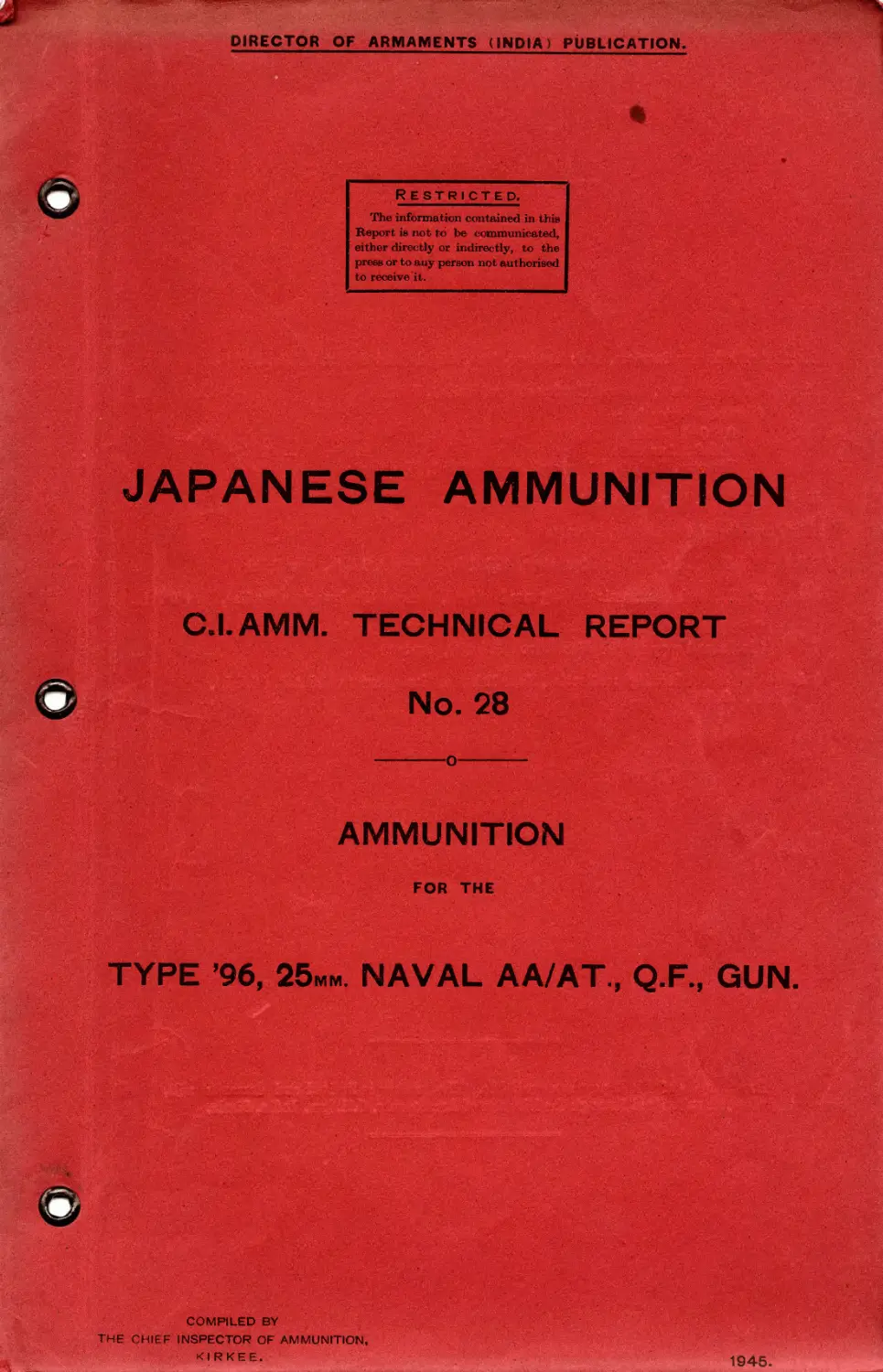
JAPANESE AMMUNITION
C.I.AMM. TECHNICAL REPORT
No. 28
---Q—--
AMMUNITION
FOR THE
TYPE ’96, 25мм. NAVAL AA/AT., Q.F., GUN.
COMPILED BY
THE CHIEF INSPECTOR OF AMMUNITION,
KIRKEE.
1945.
RESTRICTED.
JAPANESE AMMUNITION.
C.I.AMM. TECHNICAL REPORTS.
REPORT NO. 28.	JANUARY, 1945.
AMMUNITION FOR THE JAPANESE ,
TYPE * 96T 25-MM. NAVAL A.A./a.T. Q..F. GUN.
GENERAL,
Two rounds of the above ammunition were received here
in November 1944 from the S.W.P. Area. Before describing the
•rounds in detail it will be useful to review briefly some
general details of the ammunition for this equipment based
on information available here.
The ammunition is fired from a multiple barrelled full
automatic high angle gun and is primarily for A.A. use. Tue
gun is described as a 25-mm. A.A./A.T. gun, Type ’96, Model 2.
No reports can be traced, however, of any A.P. ammunition
being found for this ghn. The projectile has obviously a
very high velocity and if of an A.P. type should /be effective
against light tanks and similar armour#.
2.	The cartridge cases may be. of steel or brass and
according to American reports those examined so far were , for,
Naval use which Conformswith the general report that the
equipment is purely Naval.
3.	The following different types of ammunition have been
reported:-
(a)	H.E./T. Shell		•	0.16” green band below the fuze, remainder of the body painted orange, down to the driving band.
(b)	H.E./T.	Shell •	—	-As above, but the colour of. the
(o) (d)	H.E./T. with self-destroying element. H.E./Incend iary			body is nearer red than orange. Red body and green band below the fuze. Full details are not avail- able . Green body.
(e)	H.E.	*		Maroon colour. 0.16” green band
NOTE;-	It is	possible	below the fuze; remainder: of body painted chocolate or dark maroon, down to the driving band. that the only difference between
(a) and (b) is actually in the .body colour. Different
shades of paint used in manufacture or weathering may
account for the slightly different body colour.
{
2
4.	The two types of rounds critically examined at Kirkee
were
(i) H.E./T. Shell (orange coloured body).
(ii) H.E. Shell (chocolate or dark maroon coloured body)
Except for the shell, all components of the two rounds are
the same, and the description below applies equally to both
type s.
D E S 0 R I P T I 0 N.
 C.ARTR IDGE.
5.	Details of this are clearly shown in Plates В & C.
External appearance is shown in Plate D. It is a solid
drawn brass case of the rimless S.A.A. type. The .case is
heavily necked and attached to the shell by squeezing or
rolling the neck round the rear driving band with the mouth
of the case coned tightly at the rear of the forward driving
band. The markings on the base of the case are reproduced in
the plates. The ’anchor* is the Japanese Naval manufacture
sign and between this mark and 'the date of manufacture
(Arabic numbers) is the. .Inspection mark. The rST is believed
to indicate a particular batch of cases while the 7-17 and
11-17 refer to the 7th and the 11th month of the 17th year of
the Showa era, i.e. July a nd''November. 1942. -The other character
in front of the S 11-17 and S 7-17 is believed to refer to the
-shellused i.e. common shell. . This character has been omitted »
in error from Plate B.	'
Dimensions of the cases are given in the plates.’ The
cubic capacity for ballistic purposes, is 129 c.cs. The inter-
nal walls of the case were lacquered or varnished, with a heat
resisting black finish.
Propellant
6.	The propellant is loose in the case, similar to an
S.A.A'. cartridge. The charge consisted of 3.7-ozs. of a
graphited tubular N.C. powder. - See chemical analysis below.
No decoppering material was found.
Primer.
7.	This is made oi brass throughout and the details are
clearly shown in Plate A. It is of the "push in" type and is
firmly fixed in the cartridge .case. The case had to be cut
away Before the primer could be removed. The cap is of the
loose anvil Boxer type and contains about 1 3/4 grains of
cap composition, see chemical analysis below. The magazine
of the primer is filled with a. perforated pellet of. gunpowder,
weighing 11 grains.. American reports state the weight to be
12 grains; the difference is small and is probably due to
methods of weighing or filling tolerances.
FUZE.
8.	Details of construction and dimensions of the fuze
are shown in Plate A. The assembly sequence of components is
shown in Plate D. It should be noted that in this plate the
centrifugal bolt is described incorrectly as a detent.
3
9* For convenience of description the faze may be divided
into seven main components:-
(i) Nose portion of the body (18) , which Is made of brass
and houses the striker (17).
(ii) Main body portion (16) made of brass. This is
threaded externally at the upper end (R.H.T.) to take
the nose portion, while the lower half is threaded
externally (R.H.T.) to screw into the shell. It is
also threaded internally (L.H.T.) to take the gaine (5)
which secures in position the holder for the detonator
and shutter assembly (8).
 (iii) Striker (17) , which comprises the head made of
duralumin and a steel needle, parkerised finish,.
(iv)	The centrifugal bolt (13), and steel spring (14).
(v)	Holder (8) made of white metal or plated brass, which
houses the detonator and safety shutter (11).
(vi)	G-aine (5), made of a light alloy.
(vii)	Brass booster plug (7), which boosts the flash from
the detonator and initiates the gaine.
ЗЮ. Following usual Japanese practice, the' detonator has a
fulminate of mercury composition filling, below which is a small
perforated pellet of G.P. to boost up the flash from the deto-
nator. The main gaine filling is G.E. into which is pressed a
small pellet of lead a'zide. Details of filling s are given in
the chemical analysis below.
Safety Devices:-
11.	(a) A centrifugal bolt (13) which under pressure of the
spring locks the striker (17) and prevents' it from
impinging on the detonator during handling and .
transport, and in the bore of the gun during accele-
ration.
(b) The safety shutter (11) which masks the flash' hole
in the fuze diaphragm until it is opened by centri-
fugal force on deceleration after firing.
NOTE;- The shutter swings completely clear of the
flash hole in the diaphragm, unlike the
shutter in British type fuzes which usually
has a stemmed G.E. channel and on opeping of
the shutter this is brought into line with
the detonator and helps to boost up the
flash.
Action; -
12.	On firing, the striker (17) sets back on to the centri-
fugal bolt (13) vmich also sets back on to its seating in the
fuze. This prevents the bolt (13) from opening under the action
of the centrifugal force and retains the striker locked.
Similarly the safety shutter sets back and continues to mask
4
the flash hole in case of any failure such as in the centri-
fugal locking device. On deceleration the centrifugal bolt
flies out against the' pressure of its spring thus releasing
the striker. At the same time the shutter opens exposing
the flash channel. The striker is now free to be driven by
impact on to the detonator.	**	'
NOTE:- The striker is extremely light and presumably creep
action is sufficient to retain the striker away from
the detonator. No spring is used and fuze must be very
- sensitive. It may function on heavy graze.
6- H E L. L.
H.E./T.^ (Orange coloured, body) ;-
13.	Details of construction and dimensions of the shell
are shown in Plate. B. External appearance of the shell is
shown in Plate D.
The shell body*is machined from steel bar and is stream-
lined, the angle of taper being approximately 10°. It follows
usual small arm H.E./T. construction. The dimensions of both
cavities are given in Plate B. Internal walls have a black
lacquer or varnish finish. The two driving bands appear to
be made of a copper alloy both having about the same degree
of hardness. The steel washer closing the tracer cavity is
secured in by t he base of the shell being spun over.
Owing to one shell only of each type being available, it
has not been possible to arrange for metallurgical analysis
of the shell body and' driving bands* The filling consists of
three prepressed blocks of T.N.T./Aluminium, the total weight
of the three pellets being 145 grains; chemical analysis of the
filling is given below.
The charge weight percentage is approximately 3,65% for
the H.E./T. stell against 6.65% for the H.E. shell.
Ths tracer cavity contains 135 grains of priming and trac-
ing composition. These are pressed in two increments, one of
tracing composition followed by a tapping of priming compo-
sitiont ч- . see chemical analysis below.
H.E. Shell (dark maroon coloured body)
14.	Details of construction and dimensions of the shell are
shovm in Plate G. External appearance of the shell is shown in
, Plate D. Note that in this plate the colour is described as
T'Chocolate1 . Actually it is difficult to describe the colour
accurately. It is really dark maroon to chocolate.
The shell bod}^ is generally similar in construction to the
shell described in para. 13 above. The following are the main
differences.
(i)	The body is longer by nearly .2-in.
(ii)	The H.E. shell has no tracer cavity; it is drilled
out from the nose to its full length to take an H.E.
filling.
б
(ill)	The weight of the H.E. filling is 257. grains-against
the 145 grains of,the H.E./T. shell.
METALLURGICAL ANALYSIS.
Owing to one round only of each type being available no
detailed analysis has been possible. Hardness figures takan on
the brass case showed:-
V.P.N.
1-in. frdm base	• • • _ • •	• • •	154.
2--in. from base	• • • • • •	• • •	152.
-in. from base	• • • • • •	• • •	110.
Centre of coned	shoulder...	• • •	117.
Neck g—in. from	mouth.		125.
CHEMICAL ANALYSIS. ,
(By C.I.M.E.,Kirkee.)
Propellant (in both cases):-
N.C. and graphite.	...	...	...	...	89.8%
D.N.T. ...	................. ...	7.4%
Diphenylamine	...	...	...	...	2.8%
Graphited tubular cords, size 0.2” X 0.1”,
internal diameter 0.025”.
Primer (in both cases)
Cap Composition.
1.74 grains of a composition of:-
Mercury fulminate )
Potassium chlorate ) ^aptitative examination not carried
Antimony sulphide ) out, the quantity being too small.
Magazine .
11 grains of mealed gunpowder (sulphur present).
Fuze'(in both cases)
Detonator
Black composition containing fulminate of mercury.
Booster pellet (perforated).	 :
1.54 grs. of compressed mealed gunpowder (sulphur present).
Gaine	‘
Filling consists of Lead Azide--(2.5/grs.) , embedded in a
C.E. pellet (11.88 grs.), as shown in the drawing.
6
She’ll Н.Е.Ут. (orange coloured body}:*
Fill ing	'	' . . \
T.N.T. Grade I	...	...	... 60% ) 145 grs.
Aluminium	...	...	... 40% )
Tracing composition:-
Barium nitrate	...	...	...	35.3%)
Barium peroxide	.	...	...	...	24.5%)
Magnesium	,	•..	...	.. ..	34.0%) 135.32 grs.
Wax	...	...	..•,	.5.8%)
iron	.	...	..... .0.4%)
Shell H.E. (dark maroon coloured body) ;-
Filling .'
Top	Bottom
T.N.T.	. 61.2%	59.9%) 257 grs.
Aluminium .	‘ '38.8%	. 40.1%)
- ’ APPRECIATION.	'
(Economic,manufacture, and development aspects) ?
The ammunition follows generally S.A.A. design
as is used in the British Service for the larger calibres.
In the form of ca’se, depth of bullet seating etc. it con-
forms very closeljr to our 15-mm. ВЕЭА cartridge. The
standard of workmanship and finish is high and comparable
with British standards.
SUMMARY OF DATA.
Complete round (fuzed)
Overall length ...	...	...	9.2-ins.
Weidit	24-ozs. (H.E./Т.Shell);24.27-ozs . (H.E .Shell)
Cartridge Case;-
Length
Diameter over rim
Propellant:-
Weight
Nature
6.43-ins.
1.68-ins.
...	...	3.7-ozs.
... Tubular graphited,N.C.
with D.N.T. and
Diphenylamine.
Primer
Overall length .. .
Diameter over body ;
Diameter over rim ...
Weight (filled)
Nature and weight of
magazine fill ing. •..
Nature and weight of
cap composition.
...	0.69-ins.
,..	0.49-ins.
...	0.63-ins.
•.. 195.6 -grs.
(Pressed perforated
...(G.P. pellet 11 grs.
Mercury fulminate, )
potassium chlorate,)1.3/4
Antimony sulphide. ) grs.
7
Shell (without fuze):-
H.E./T,
H.E
Length.
Weight (filled)
Weight of- H.E. filling
Nature of filling.
Weight of tracing
composition.
Nature of tracing
composition.
3.37-ins.	3.56-ins.
7.11-ozs.	7.37-ozs.
145 grains.	257 grains.
T.N.T./Aluminium T .N.T. /Aluminium.
132.32 grs.
Barium nitrate.
Barium peroxide.
Magnesium.
Wax.
Iron.
Colour of body and
band markings.
Orange.	Dark maroon.
with 0.16” green band at the mouth.
Length ...	...’
Weight (filled) ...
Weight of gaine filling
.. .1.98-ins4
.. Д.48-ozs<
• 47.89-grs-«
CHIEF INSPECTORATE OF AMMUNITION,
KIRKEE, INDIA.
FIRST ISSUE '
JANUARY 1945.
PLATE A
RESTRICTED.
COPPER DISC.
BRASS FUZE NOSE.
STRIKER HEAD (DURALUMIN). f i a i г
STAMPED MARKING ON REVERSE. J or
R.H.T.	[bAGV.
TOMMY HOLES-
BRASS FUZE BODY.
NEEDLE STEEL (JOINED TO DURALUMIN
STRIKER HEAD).
CLOSING PLUG (PAINTED WHITE).
CENTRIFUGAL BOLT (BRASS).
CENTRIFUGAL BOLT SPRING-
TIN-FOIL DISC-
DETONATOR HOLDER•
DETONATOR (F.OF M-IN COPPER SHELL).
R.H.T.
SHUTTER.
HOLDER FOR DETONATOR AND SHUTTER
ASSEMBLY.
L.H.T.
PRESSED G.P. 1-54 GRS.
BRASS BOOSTER PLUG (R.H.T.).
PAPER DISCS •
LEAD AZIDE PELLET 2-5 GRS.
С.Е.П-ав GRS.
GAINE (DURALUMIN).
WEIGHT OF FUZE COMPLETE WITH GAINE 1-48 or.
SHUTTER. О
PIVOT PIN.---
STOP PIN. —
HOLDER
SHUTTER DETENT BOLT
IQ] SHUTTER SPRING
CENTRIFUGAL BOLT. Пз]
SHUTTER ASSEMBLY IN HOLDER.
PAPER DISC
49"
CAP COMPOSITION
POTASSIUM CHLORATE
ANTIMONY SULPHIDE
MERCURY FULMINATE
LACQUERED PAPER DISC.
4-T4GRS.
H--------63
PRESSED G.P. PELLET..IIGRS.
BRASS BODY.
ANVIL ( BRASS)
BRASS CAP ( 15-43 GRS- FILLED)
TIN FOIL DISC.
PRIMER. СП
“PUSH IN"TYPE
D.A. FUZE ^“PUSH-IN” TYPE PRIMER
FOR
JAPANESE NAVAL A. A. CARTRIDGES 25 мм. (RIMLESS) |Ж£Ж
PLATE В
FUZE (SEE SHEET №-3)
. H.T.
I»75__
3-375
EEL WASHER.
923
REAR
•23*
STAMPED MARKING (hAGV.)ON
REVERSE.
GREEN BAND -16
WEIGHT OF COMPLETE ROUND
24-00 OZS
4-355
□RANGE RED.
CARDBOARD WASHER (£
T.N.T./AL PELLETS
TOTAL WEIGHT 145 GRS.
FORWARD DRIVING BAND
LACQUERED INTERNALLY.
REAR DRIVING BAND.
TRACING COMPOSITION-1 135 32
PRIMING COMPOSmM l <**'
CARTRIDGE CASE.
LACQUERED INTERNALLY.
PROPELLANT CHARGE 3 73 «3
GRAPHITEO TUBULAR NX WJTN
DUX A DWHEMYLAWNE.
,PRIMER (!) (SEE SHEET N»3)
(push«T^
№..__________
forward
JAPANESE NAVAL A.A. CARTRIDGE 25 MM.(RIMLESS)
WITH H.E. TRACER SHELL
(ORANGE BODY)
SHEETZ OF3SHEETS
CI.Amm.S/931
KIRKtt NOV. W44
PLATE С
GREEN BAND *16
DARK MAROON
T.N.T./AL.ZSJ GRS-
FORWARD DRIVING BAND
CARDBOARD WASHER
RIMLESS BRASS
CARTRIDGE CASE
STAMPED MARKINGS О A 1 F)ON _
REVERSE.
PRIMER (T) (SEE SHEET N* 3)
(PUSH WTN^
FUZE. (SEE SHEET № 3)
R.H.T.
—PROPELLANT 3 7 OZS-
GRAPHITED TUBULARM C WITH
aM.lAOmEIIYLMNNE(z)
REAR DRIVING BAND
- LACQUERED INTERNALLY.
DRIVING BANDS-
FORWARD.
92*
643
WIGHT OF COMPLETE ROUND:—
24-27 OZS.
REAR
JAPANESE NAVAL A.A.CARTRIDGE 25 MM.(RIMLESS)
WITH H.E. SHELL
(DARK MAROON BODY.)
SHEET 1 OF 3 SHEETS.
C.I.Amm.S/351
WRME.N0V.I54.A
RESTRICTED
RIMLESS BRASS
CARTRIDGE CASE.
COMPLETE ROUND
PRIMER. (£)
( PUSH FIT)
GAINE.
CARD
plug(t) shutter(i
C.I.Amm.	INCHES _ wW
П । fin ^-ЯК-—lUU
GREEN BAND
(.Ife-IN)
37 ozs. GRAPH IT ED
TUBULAR N C/OlNT ©
CHOCOLATE
detonator @
SHUTTER SPRING (W)
-SHUTTER DETENT
DETENT SPRING 14
STRIKER U7>
-FUZE NOSE (8)
-FUZE BODY <16
-DETENT PLUG (15
(WTO? OF FILLIH6)
HOLDER FOR.-------I
DETONATOR AND
SHUTTER ASSEMBLY ©

JAPANESE NAVAL A.A. CARTRIDGE.25мм.(RIMLESS)
(COMPLETE ROUND AND ASSEMBLY SEQUENCE)
PLATE О