/



























Автор: Laurillard D.
Теги: child development pedagogy education of children
ISBN: 978-0-415-80385-4
Год: 2012
Похожие




Текст
                    Teaching as a Design
Science
Building Pedagogical Patterns for
Learning and Technology
Diana Laurillard

First published 2012
by Routledge
711 Third Avenue, New York, NY 10017
Simultaneously published in the UK
by Routledge
2 Park Square, Milton Park, Abingdon, Oxon OX14 4RN
Routledge is an imprint of the Taylor & Francis Group,
an informa business
© 2012 Taylor & Francis
The right of Diana Laurillard to be identified as author of this work
has been asserted by her in accordance with sections 77 and 78 of the
Copyright, Designs and Patents Act 1988.
All rights reserved. No part of this book may be reprinted or reproduced
or utilised in any form or by any electronic, mechanical, or other means,
now known or hereafter invented, including photocopying and recording,
or in any information storage or retrieval system, without permission in
writing from the publishers.
Trademark notice: Product or corporate names may be trademarks or
registered trademarks, and are used only for identification and explanation
without intent to infringe.
Library of Congress Cataloging-in-Publication Data
Laurillard, Diana, 1948Teaching as a design science : building pedagogical patterns for leaning
and technology / Diana Laurillard.
p. cm.
Includes bibliographical references and index.
1. Teaching—Philosophy. 2. Professional learning communities.
3. Educational technology. I. Title.
LB1025.3.L375 2012
371.102–dc23
2011037142
ISBN: 978-0-415-80385-4 (hbk)
ISBN: 978-0-415-80387-8 (pbk)
ISBN: 978-0-203-12508-3 (ebk)
Typeset in Minion
by Cenveo Publisher Services

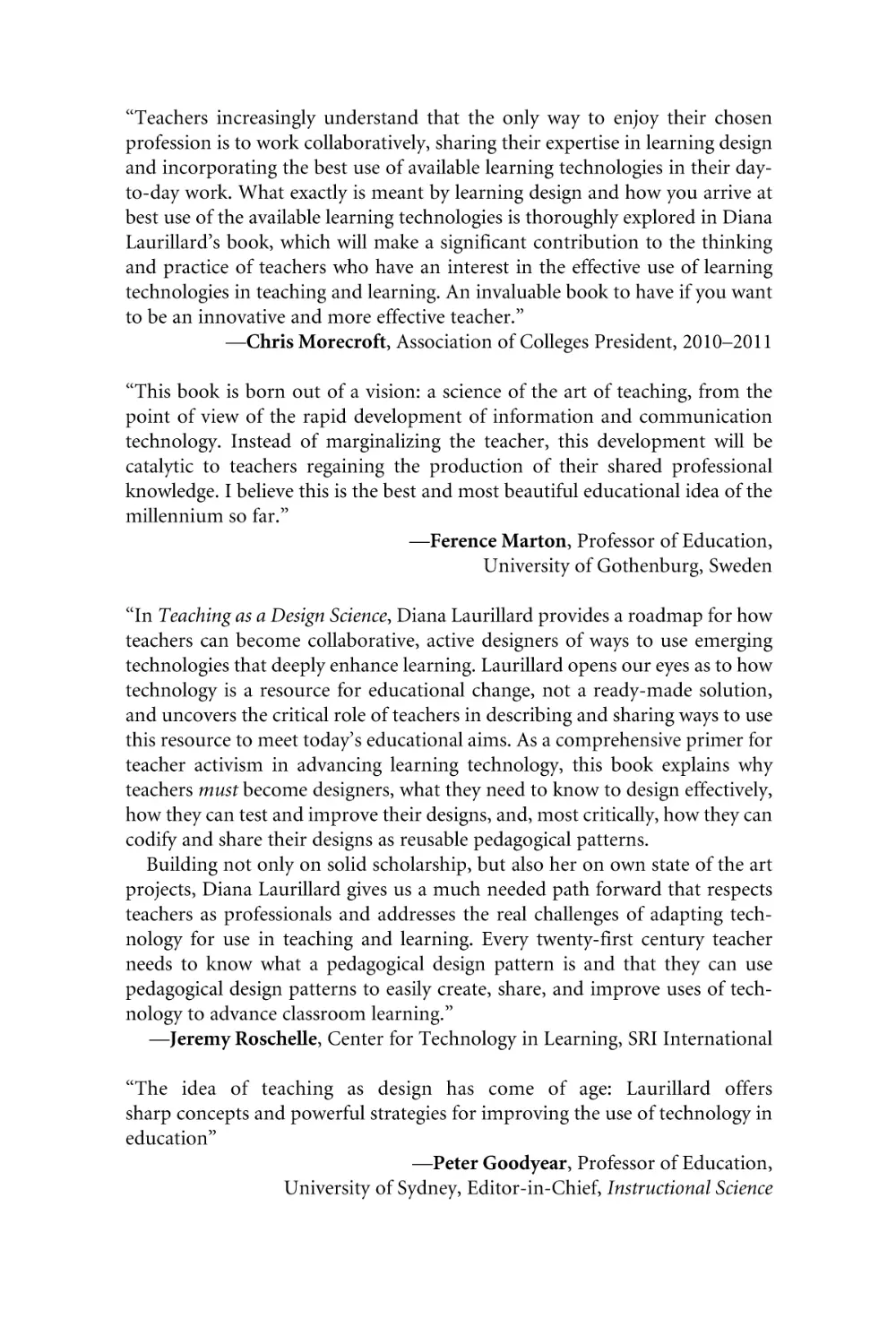
“Schools and colleges have invested billions in technology with the promise
of radically improving learning. It hasn’t. Why not? Diana Laurillard’s
penetrating new book provides an important part of the answer. Affirming that
teaching is both art and science, she argues that faculty have been left out of the
development equation. Only when teachers are directly involved in designing
educational technologies can we create the tools necessary to improve learning. This book is a ‘must read’ for those wrestling with the complex questions
about how to improve teaching effectiveness in a world of diverse learners and
messy realities.”
—Gail O. Mellow, President, LaGuardia Community College,
City University of New York
“As researchers, we can no longer close our eyes to what is NOT happening in
schools. For those who want to improve teaching, this book will inspire the
design of powerful pedagogical patterns.”
—Pierre Dillenbourg, Professor, CRAFT, École Polytechnique
Fédérale de Lausanne
“Professor Laurillard’s book argues forcefully and persuasively that teachers
remain the lifeblood of education in a digital age, while also underlining the
necessity for pedagogical practice to be transformed if we are to really seize the
opportunities technology presents for significantly improved learning
outcomes—to the broader benefit of society as a whole.”
—Lord Puttnam, CBE
“Teaching as a Design Science presents the case for the next generation of
scholarly research and implementation of technology in education. It brings
together the rigor of existing research with the promise of teacher-led collaboration for the sharing of good practice with technology. If the ideas of Web 2.0
and user-generated content have the potential to transform teaching
practice—we can call this Teaching 2.0—then this book provides an outstanding foundation for this new field.”
—James Dalziel, Macquarie University and Inventor of LAMS

“Teachers increasingly understand that the only way to enjoy their chosen
profession is to work collaboratively, sharing their expertise in learning design
and incorporating the best use of available learning technologies in their dayto-day work. What exactly is meant by learning design and how you arrive at
best use of the available learning technologies is thoroughly explored in Diana
Laurillard’s book, which will make a significant contribution to the thinking
and practice of teachers who have an interest in the effective use of learning
technologies in teaching and learning. An invaluable book to have if you want
to be an innovative and more effective teacher.”
—Chris Morecroft, Association of Colleges President, 2010–2011
“This book is born out of a vision: a science of the art of teaching, from the
point of view of the rapid development of information and communication
technology. Instead of marginalizing the teacher, this development will be
catalytic to teachers regaining the production of their shared professional
knowledge. I believe this is the best and most beautiful educational idea of the
millennium so far.”
—Ference Marton, Professor of Education,
University of Gothenburg, Sweden
“In Teaching as a Design Science, Diana Laurillard provides a roadmap for how
teachers can become collaborative, active designers of ways to use emerging
technologies that deeply enhance learning. Laurillard opens our eyes as to how
technology is a resource for educational change, not a ready-made solution,
and uncovers the critical role of teachers in describing and sharing ways to use
this resource to meet today’s educational aims. As a comprehensive primer for
teacher activism in advancing learning technology, this book explains why
teachers must become designers, what they need to know to design effectively,
how they can test and improve their designs, and, most critically, how they can
codify and share their designs as reusable pedagogical patterns.
Building not only on solid scholarship, but also her on own state of the art
projects, Diana Laurillard gives us a much needed path forward that respects
teachers as professionals and addresses the real challenges of adapting technology for use in teaching and learning. Every twenty-first century teacher
needs to know what a pedagogical design pattern is and that they can use
pedagogical design patterns to easily create, share, and improve uses of technology to advance classroom learning.”
—Jeremy Roschelle, Center for Technology in Learning, SRI International
“The idea of teaching as design has come of age: Laurillard offers
sharp concepts and powerful strategies for improving the use of technology in
education”
—Peter Goodyear, Professor of Education,
University of Sydney, Editor-in-Chief, Instructional Science

To Brian, Amy, and Anna, my constant teachers

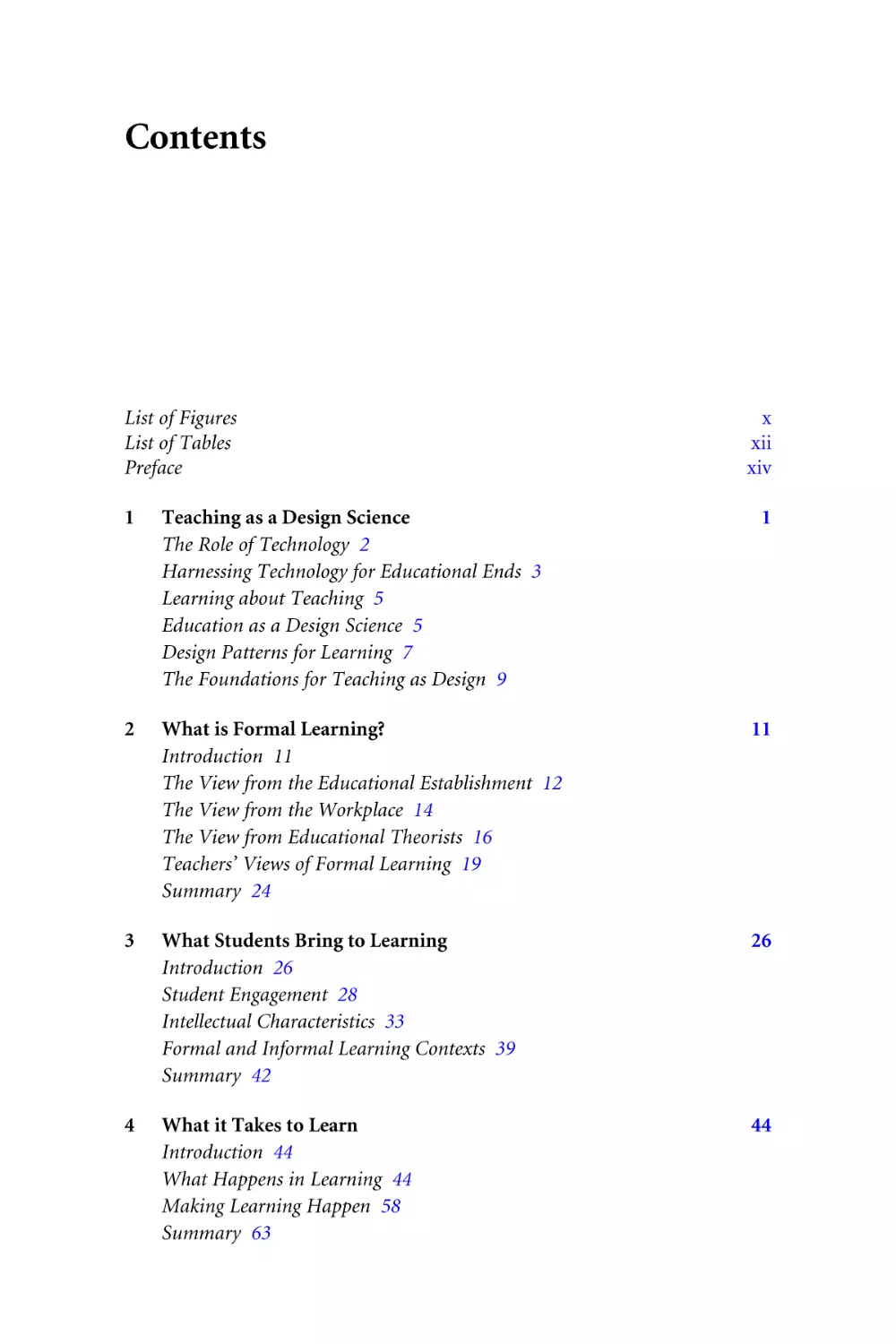
Contents

List of Figures
List of Tables
Preface

x
xii
xiv

1

Teaching as a Design Science
The Role of Technology 2
Harnessing Technology for Educational Ends 3
Learning about Teaching 5
Education as a Design Science 5
Design Patterns for Learning 7
The Foundations for Teaching as Design 9

1

2

What is Formal Learning?
Introduction 11
The View from the Educational Establishment 12
The View from the Workplace 14
The View from Educational Theorists 16
Teachers’ Views of Formal Learning 19
Summary 24

11

3

What Students Bring to Learning
Introduction 26
Student Engagement 28
Intellectual Characteristics 33
Formal and Informal Learning Contexts 39
Summary 42

26

4

What it Takes to Learn
Introduction 44
What Happens in Learning 44
Making Learning Happen 58
Summary 63

44

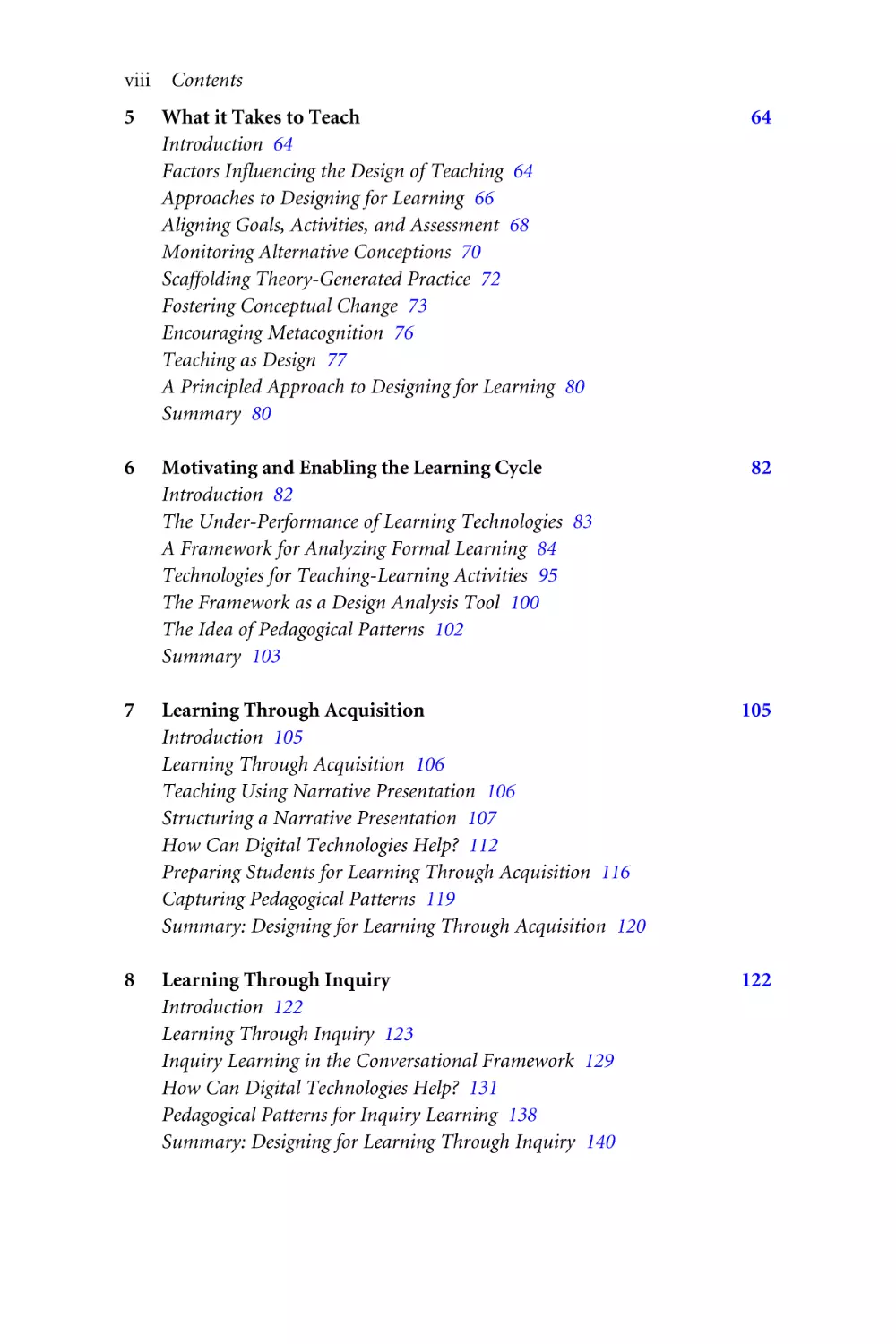
viii

Contents

5

What it Takes to Teach
Introduction 64
Factors Influencing the Design of Teaching 64
Approaches to Designing for Learning 66
Aligning Goals, Activities, and Assessment 68
Monitoring Alternative Conceptions 70
Scaffolding Theory-Generated Practice 72
Fostering Conceptual Change 73
Encouraging Metacognition 76
Teaching as Design 77
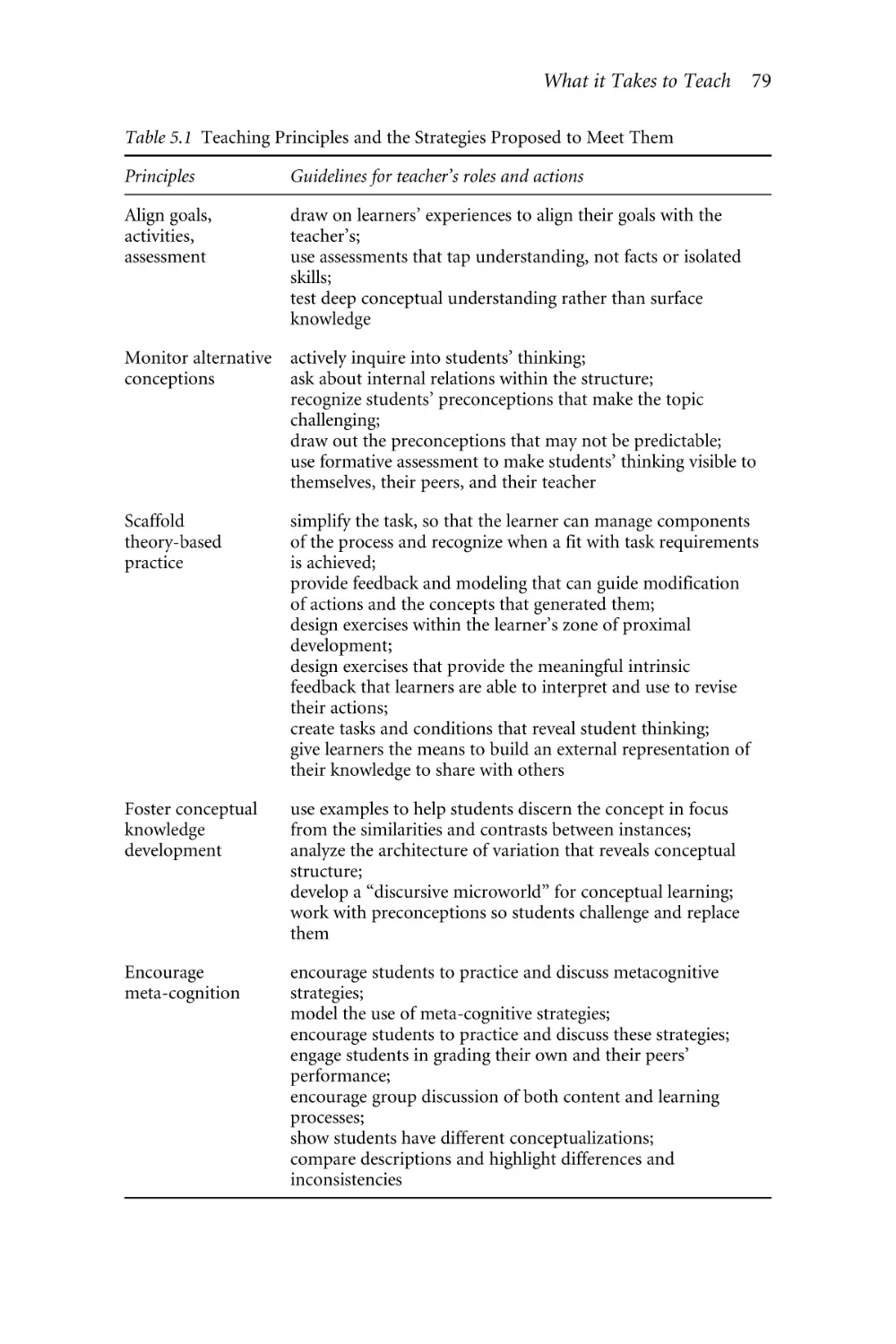
A Principled Approach to Designing for Learning 80
Summary 80

64

6

Motivating and Enabling the Learning Cycle
Introduction 82
The Under-Performance of Learning Technologies 83
A Framework for Analyzing Formal Learning 84
Technologies for Teaching-Learning Activities 95
The Framework as a Design Analysis Tool 100
The Idea of Pedagogical Patterns 102
Summary 103

82

7

Learning Through Acquisition
Introduction 105
Learning Through Acquisition 106
Teaching Using Narrative Presentation 106
Structuring a Narrative Presentation 107
How Can Digital Technologies Help? 112
Preparing Students for Learning Through Acquisition 116
Capturing Pedagogical Patterns 119
Summary: Designing for Learning Through Acquisition 120

105

8

Learning Through Inquiry
Introduction 122
Learning Through Inquiry 123
Inquiry Learning in the Conversational Framework 129
How Can Digital Technologies Help? 131
Pedagogical Patterns for Inquiry Learning 138
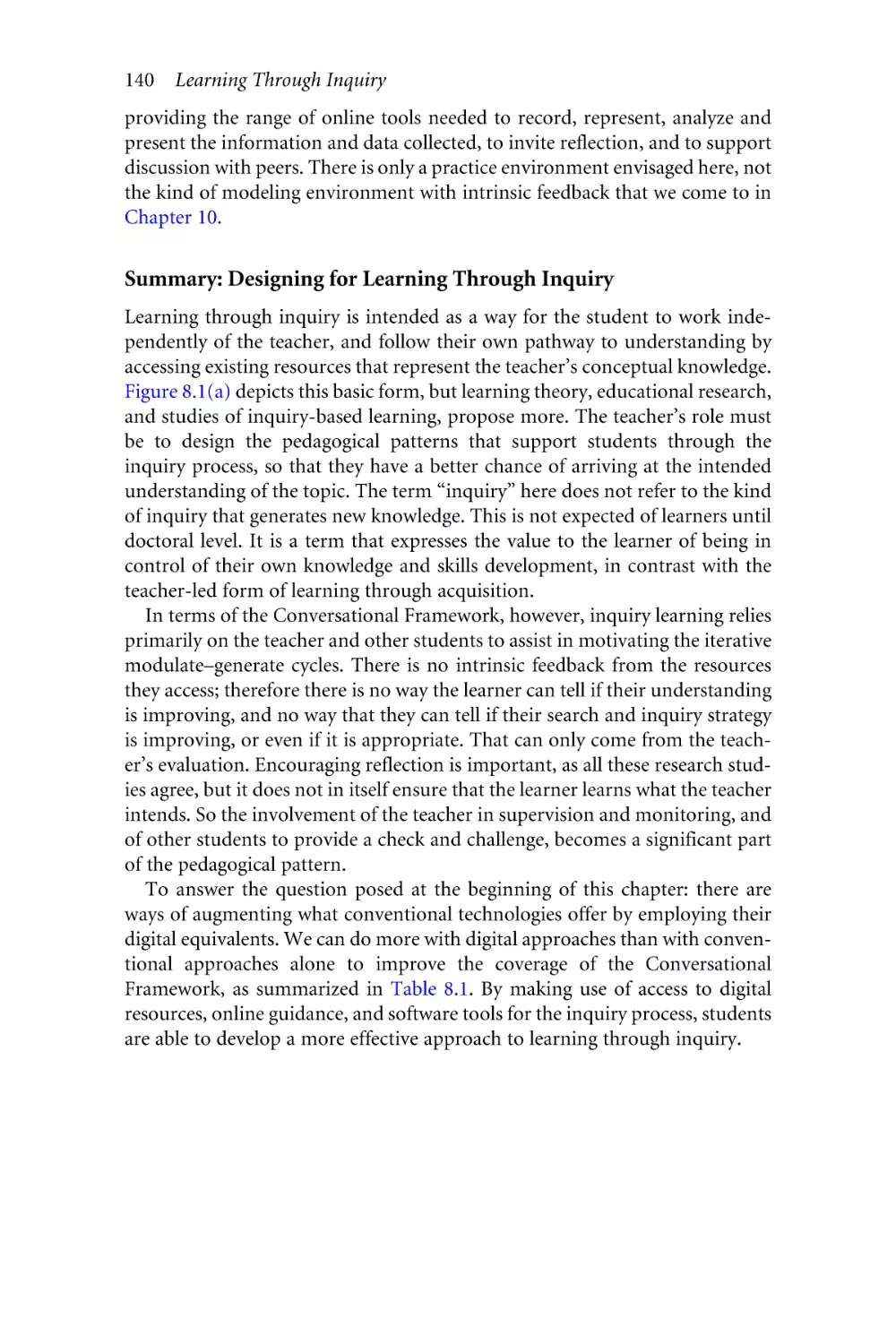
Summary: Designing for Learning Through Inquiry 140

122

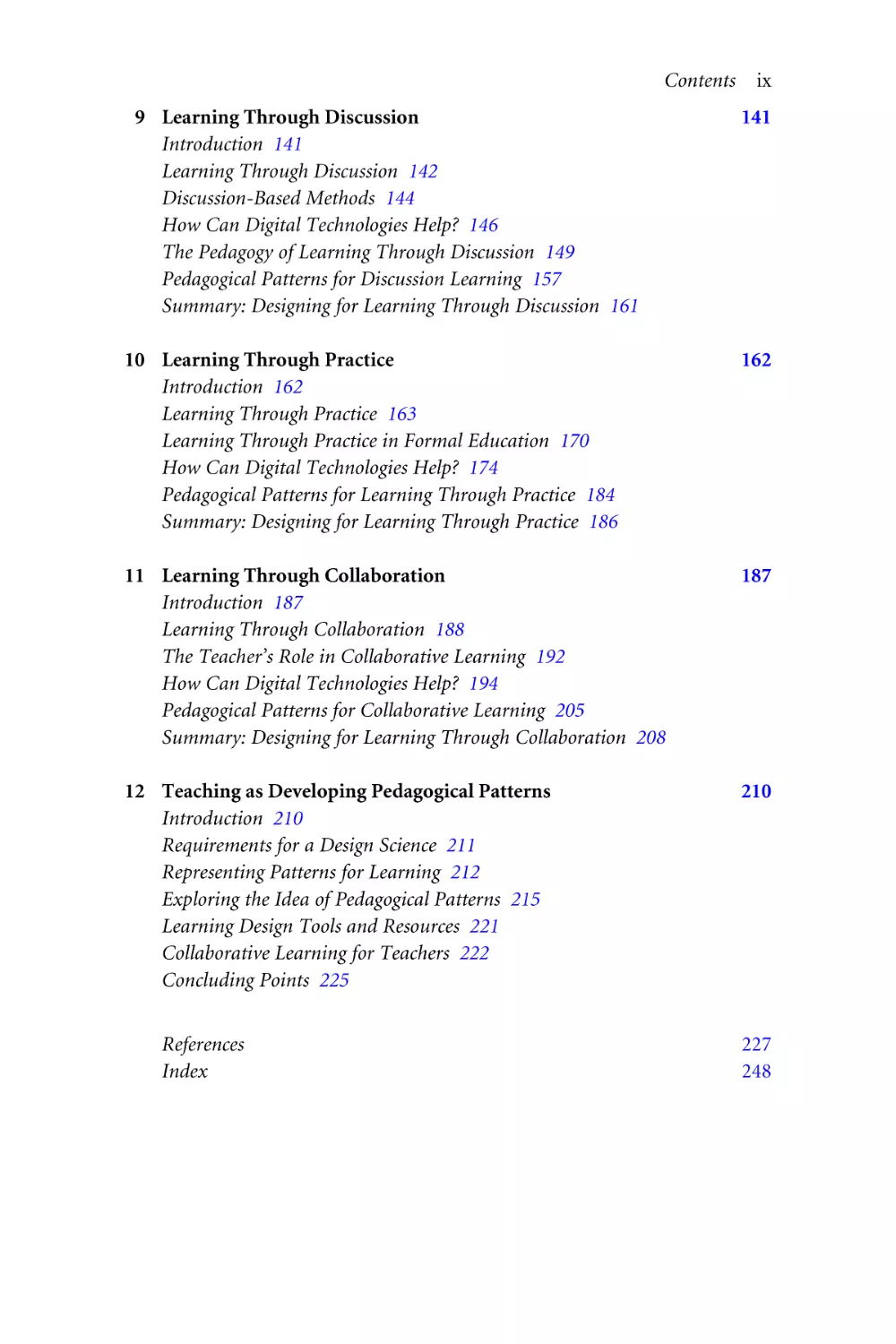
Contents
9 Learning Through Discussion
Introduction 141
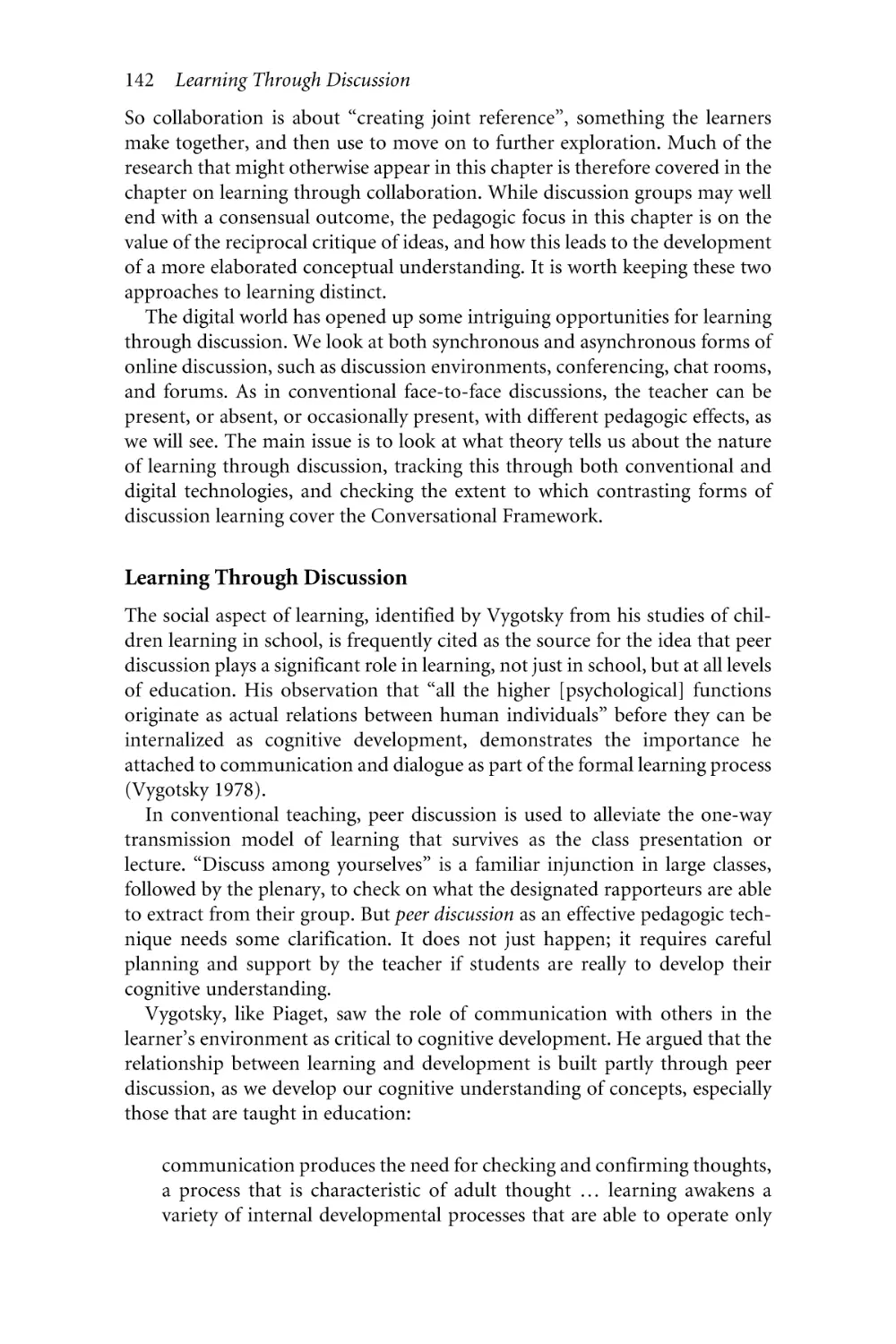
Learning Through Discussion 142
Discussion-Based Methods 144
How Can Digital Technologies Help? 146
The Pedagogy of Learning Through Discussion 149
Pedagogical Patterns for Discussion Learning 157
Summary: Designing for Learning Through Discussion 161

ix
141

10 Learning Through Practice
Introduction 162
Learning Through Practice 163
Learning Through Practice in Formal Education 170
How Can Digital Technologies Help? 174
Pedagogical Patterns for Learning Through Practice 184
Summary: Designing for Learning Through Practice 186

162

11 Learning Through Collaboration
Introduction 187
Learning Through Collaboration 188
The Teacher’s Role in Collaborative Learning 192
How Can Digital Technologies Help? 194
Pedagogical Patterns for Collaborative Learning 205
Summary: Designing for Learning Through Collaboration 208

187

12 Teaching as Developing Pedagogical Patterns
Introduction 210
Requirements for a Design Science 211
Representing Patterns for Learning 212
Exploring the Idea of Pedagogical Patterns 215
Learning Design Tools and Resources 221
Collaborative Learning for Teachers 222
Concluding Points 225

210

References
Index

227
248

Figures

3.1
4.1

5.1
6.1

6.2

6.3

6.4

6.5

7.1

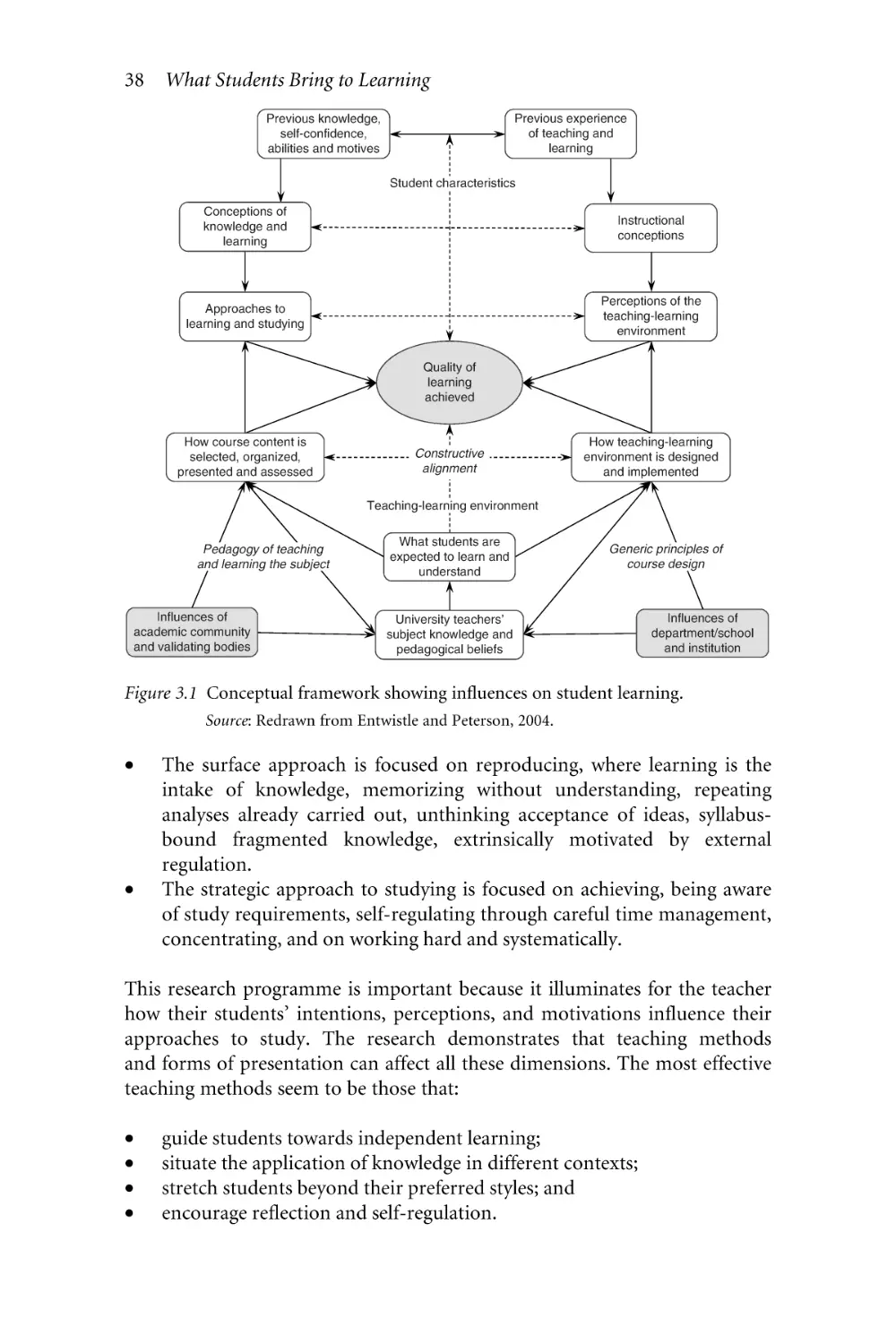
Conceptual framework showing influences on
student learning
Consolidation of theories on what is involved in
learning from the external environment, and in learning
from a teacher
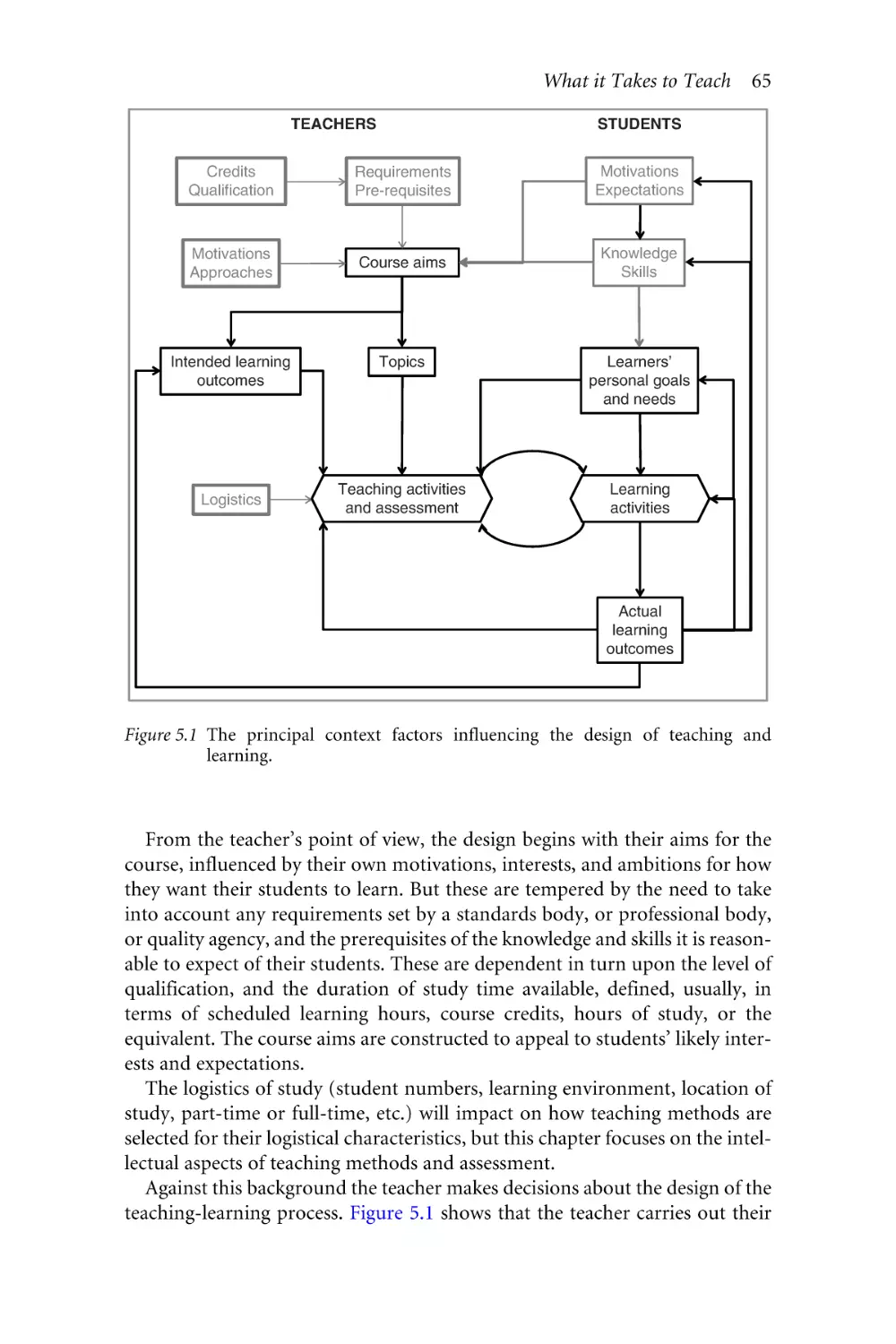
The principal context factors influencing the design of
teaching and learning
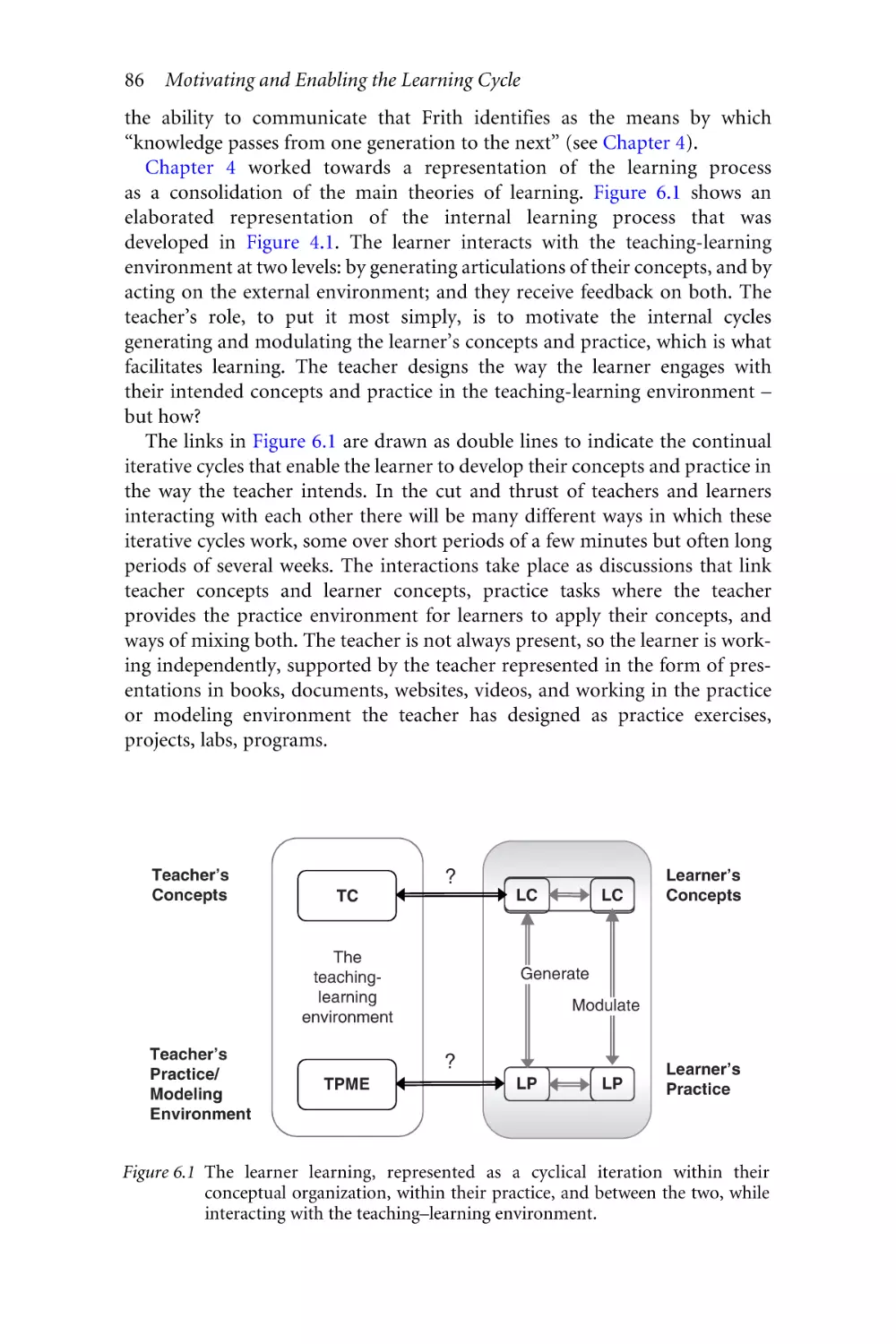
The learner learning, represented as a cyclical iteration
within their conceptual organization, within their practice,
and between the two, while interacting with the
teaching–learning environment
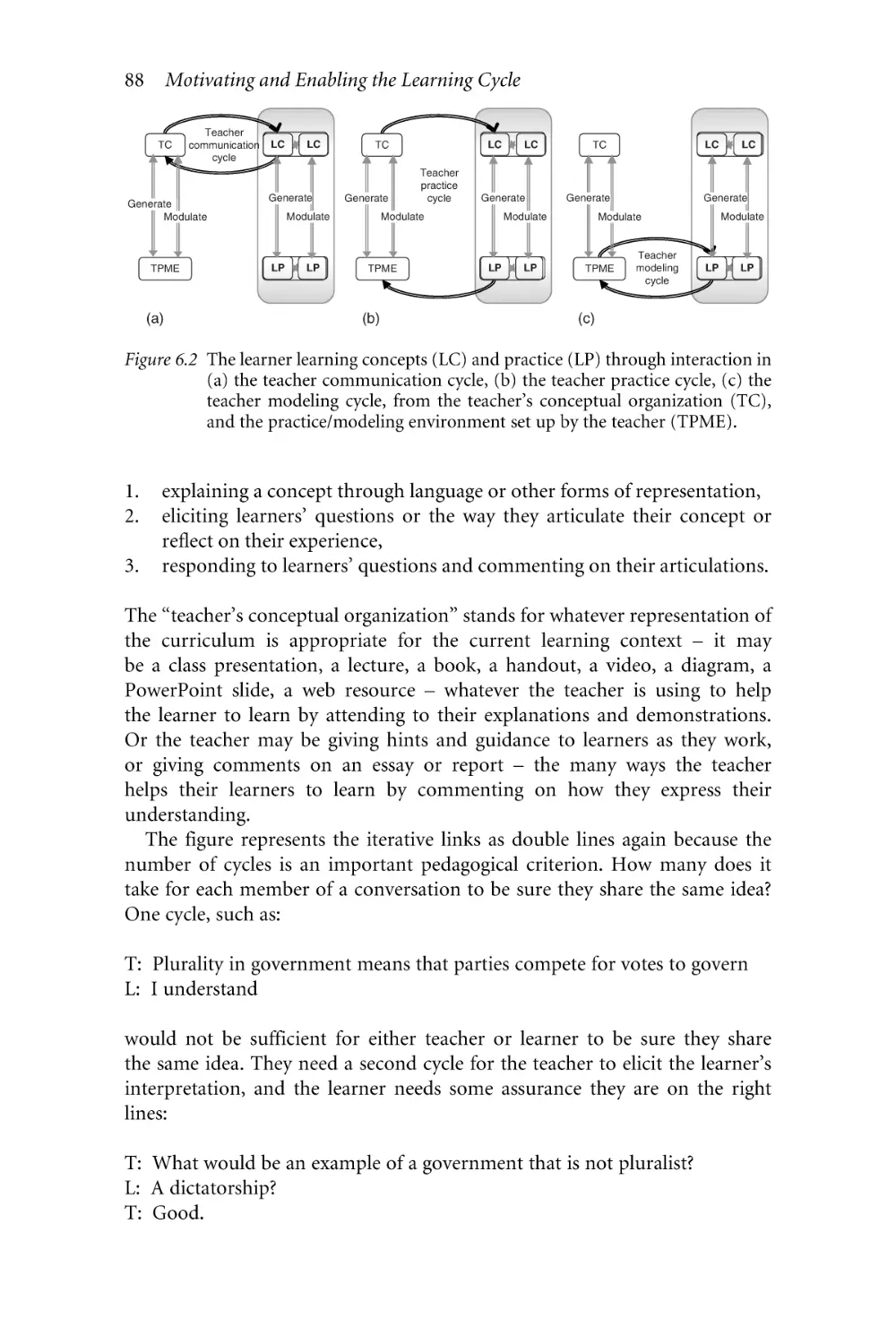
The learner learning concepts (LC) and practice (LP)
through interaction in (a) the teacher communication cycle,
(b) the teacher practice cycle, (c) the teacher modeling
cycle, from the teacher’s conceptual organization (TC),
and the practice/modeling environment set up by the
teacher (TPME)
The learner learning through interaction with peers’
concepts and practice (PC, PP), exchanging concepts
and the outputs of their practice
Types of individual learning mapped to the
Conversational Framework (a) learning through
acquisition, (b) learning through inquiry, (c) learning
through practice, and (d) learning through production
Types of social learning mapped to the Conversational
Framework (a) learning through discussion, and
(b) learning through collaboration
Sequences for the alternative learning patterns
(a) “Double telling,” and (b) “Discovery and telling,”
for learning through acquisition, mapped to the
Conversational Framework

38

60
65

86

88

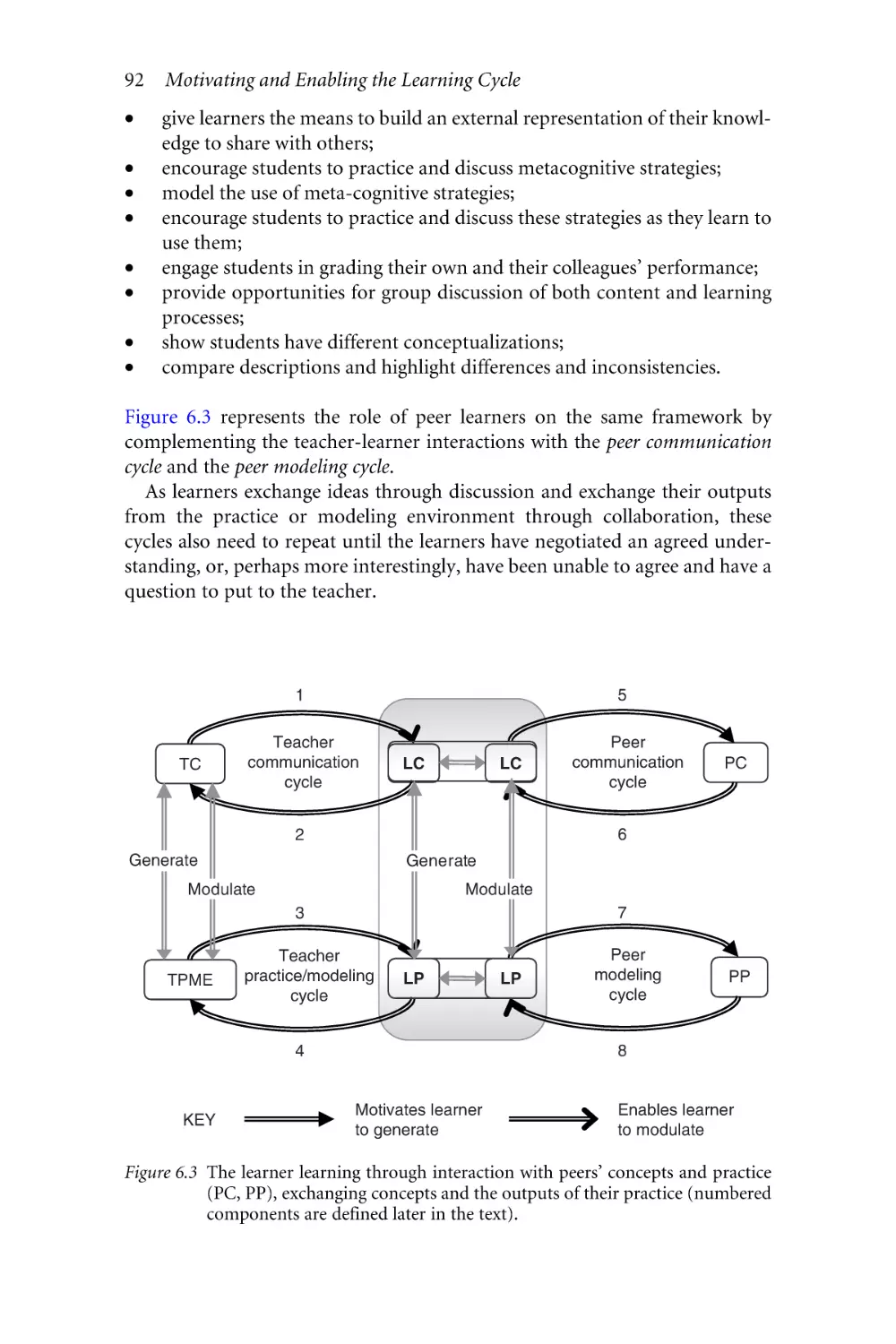
92

97

99

118

Figures
8.1

8.2

9.1
9.2

9.3
10.1

10.2

10.3

10.4

11.1

11.2

12.1

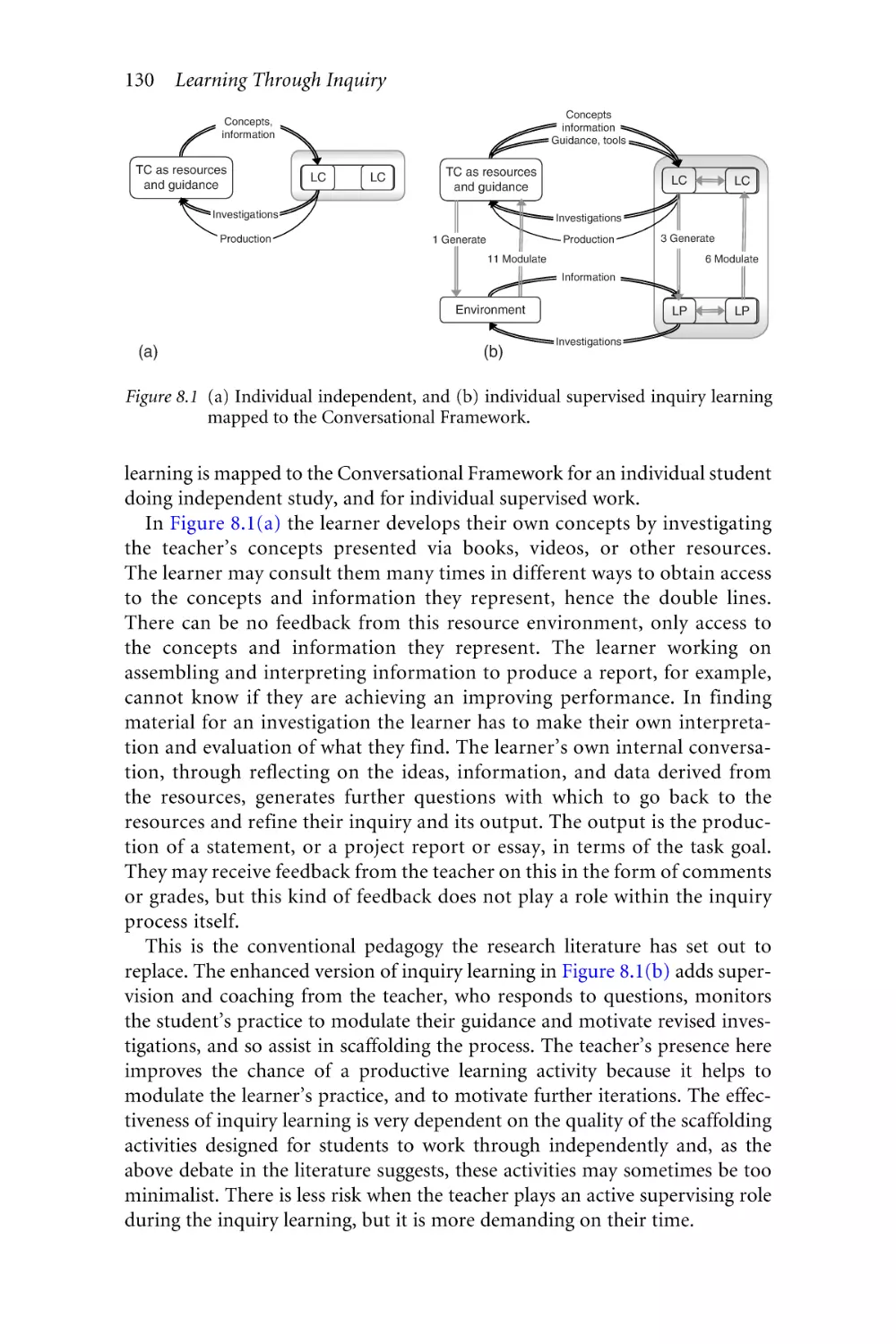
(a) Individual independent, and (b) individual supervised
inquiry learning mapped to the Conversational
Framework
Collaborative supervised inquiry learning, showing
the additional demands on the learner to share their
ideas and output, and the support provided through
access to other learners’ ideas and outputs
Learning through peer discussion
InterLoc: A dialogue environment that prompts
each student to think about the nature of their
contribution before they type their text
Discussion learning using (a) “class-wide discussion,”
and (b) “peer instruction”
(a) Kolb’s Experiential Learning Cycle, and (b) The
Experiential Learning Cycle (bold italics) mapped onto the
Conversational Framework
Kolb’s Experiential Learning Cycle extended to
include “Conversational Learning,” which affords
“meaning making” through reflection on experience
(a) How teacher reflection on the learner’s actions
provides extrinsic feedback, and (b) How the
practice/modeling environment provides intrinsic
feedback, prompting learner reflection
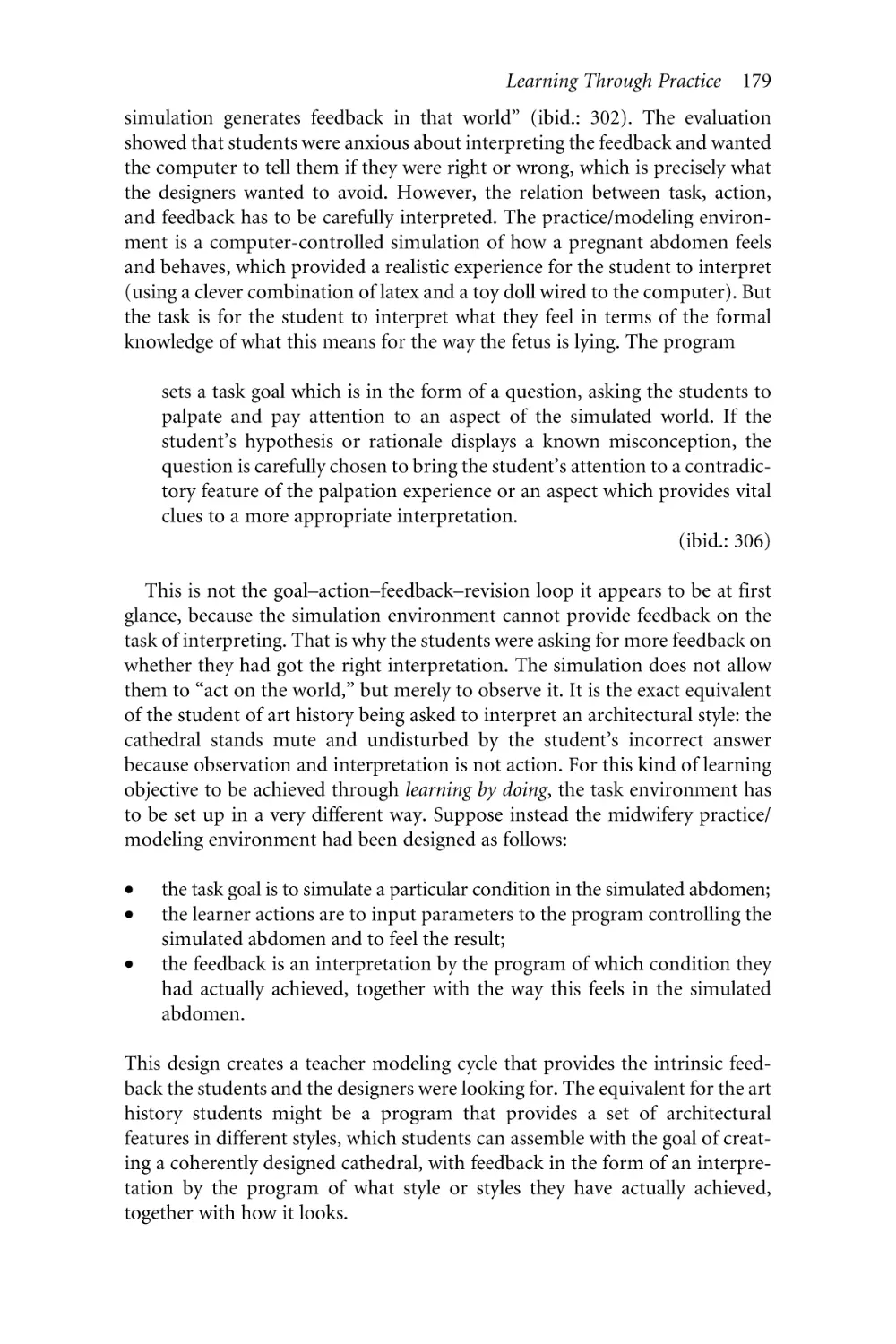
(a) An over-defined task for students working on a
real or simulated environment, and (b) Goals set for
the student to achieve through their own actions on
the environment, are more likely to elicit an internal
learning cycle
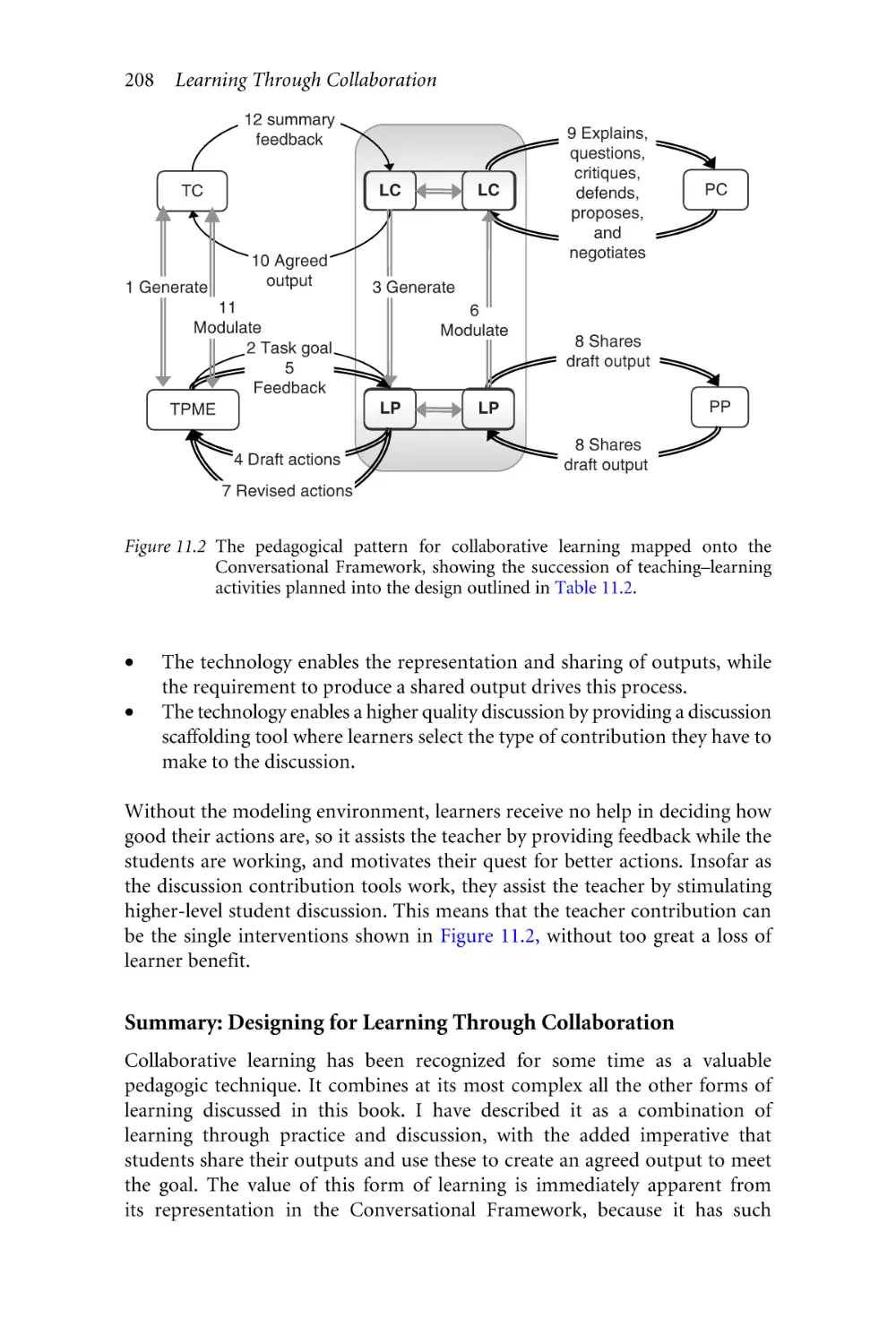
Learning through collaboration as a combination
of learning through discussion and sharing of the
outputs from practice and inquiry
The pedagogical pattern for collaborative learning
mapped onto the Conversational Framework, showing
the succession of teaching–learning activities planned
into the design outlined in Table 11.2
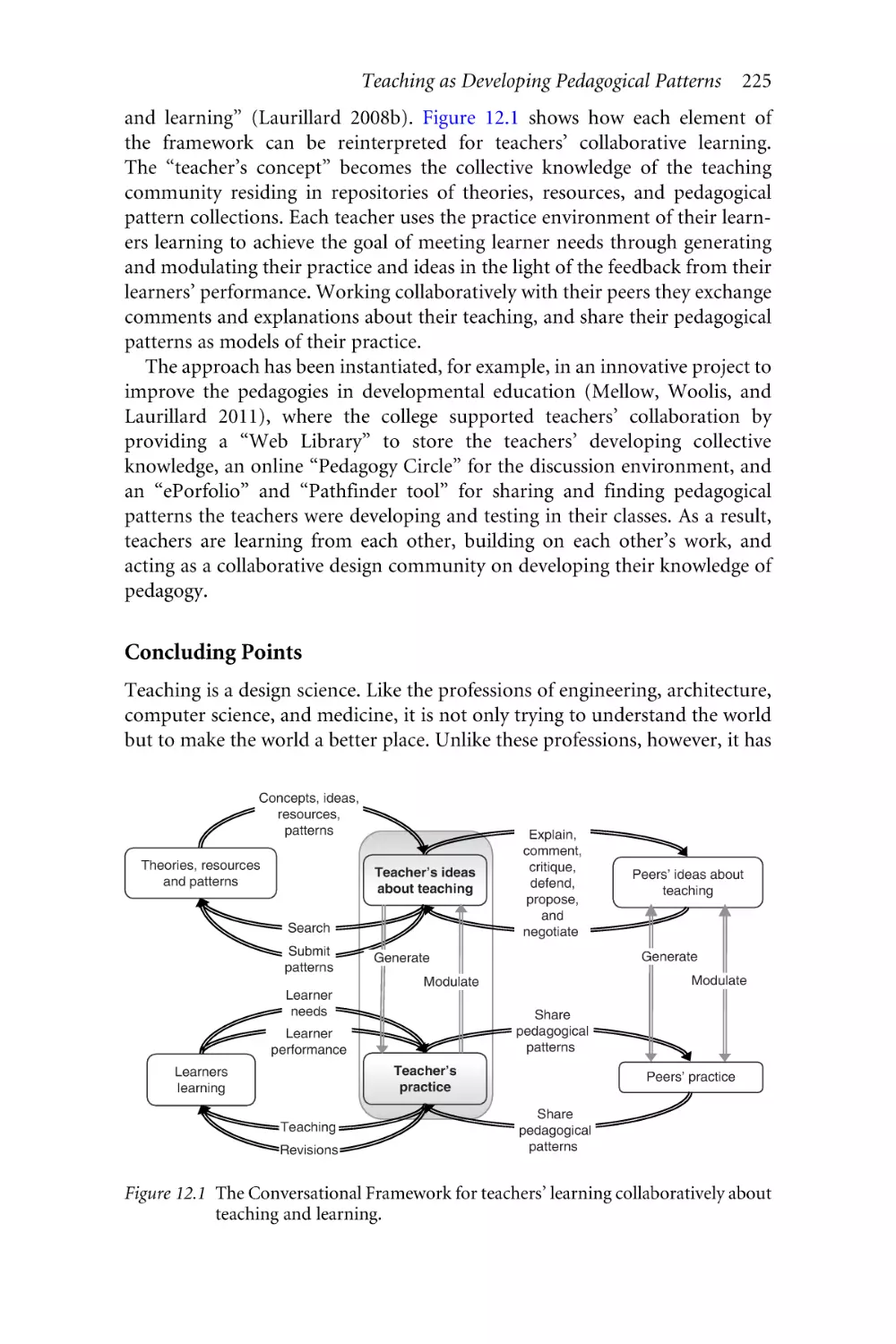
The Conversational Framework for teachers’ learning
collaboratively about teaching and learning

xi

130

131
144

154
159

168

169

173

178

191

208
225

Tables

2.1

4.1
4.2
5.1
6.1
6.2
6.3

6.4
6.5
7.1

8.1
9.1
9.2
10.1

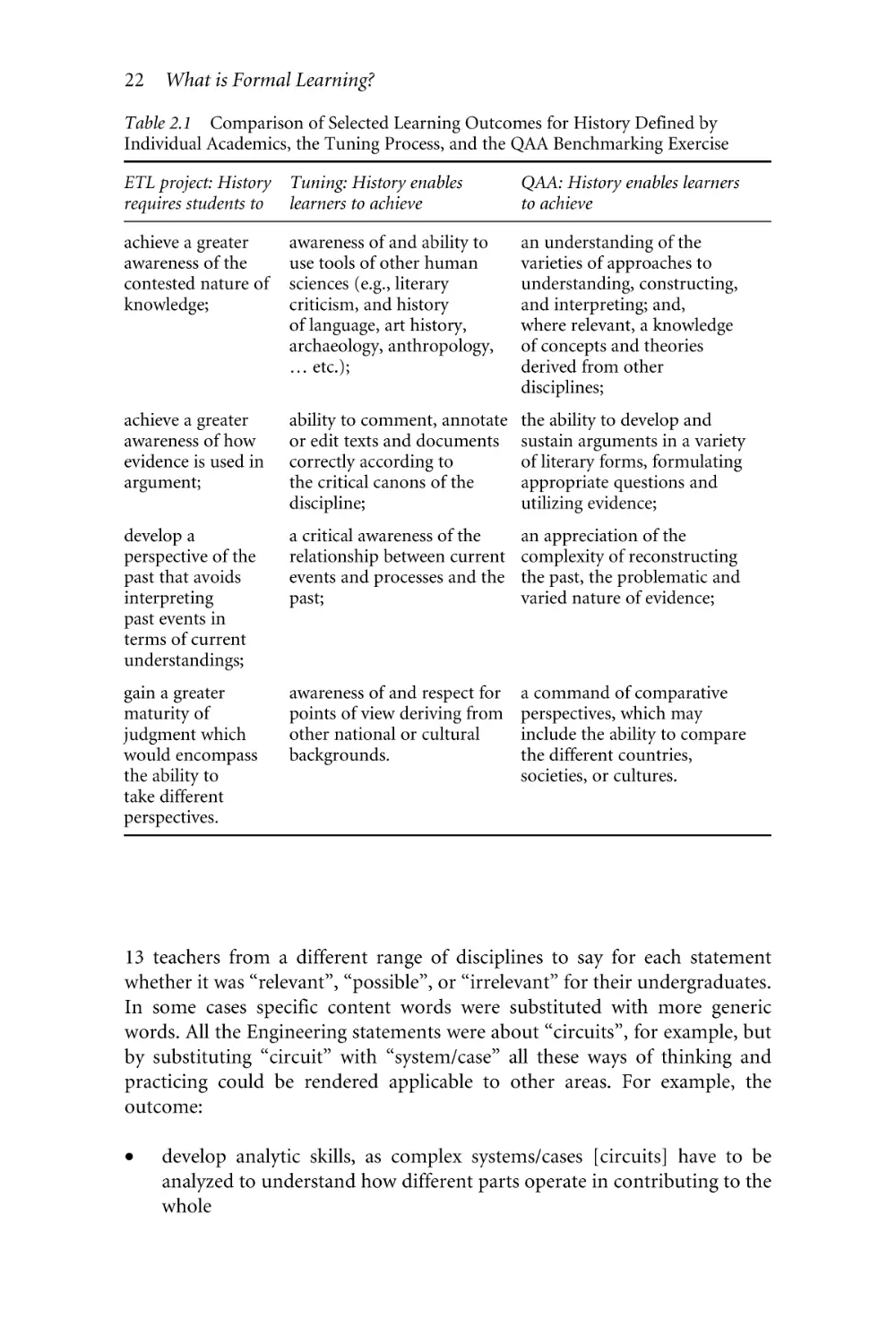
Comparison of Selected Learning Outcomes for History
Defined by Individual Academics, the Tuning Process,
and the QAA Benchmarking Exercise
The Concepts and Relations Involved in Learning
Consequences for the Teacher of the Conditions for
Active Learning
Teaching Principles and the Strategies Proposed to
Meet Them
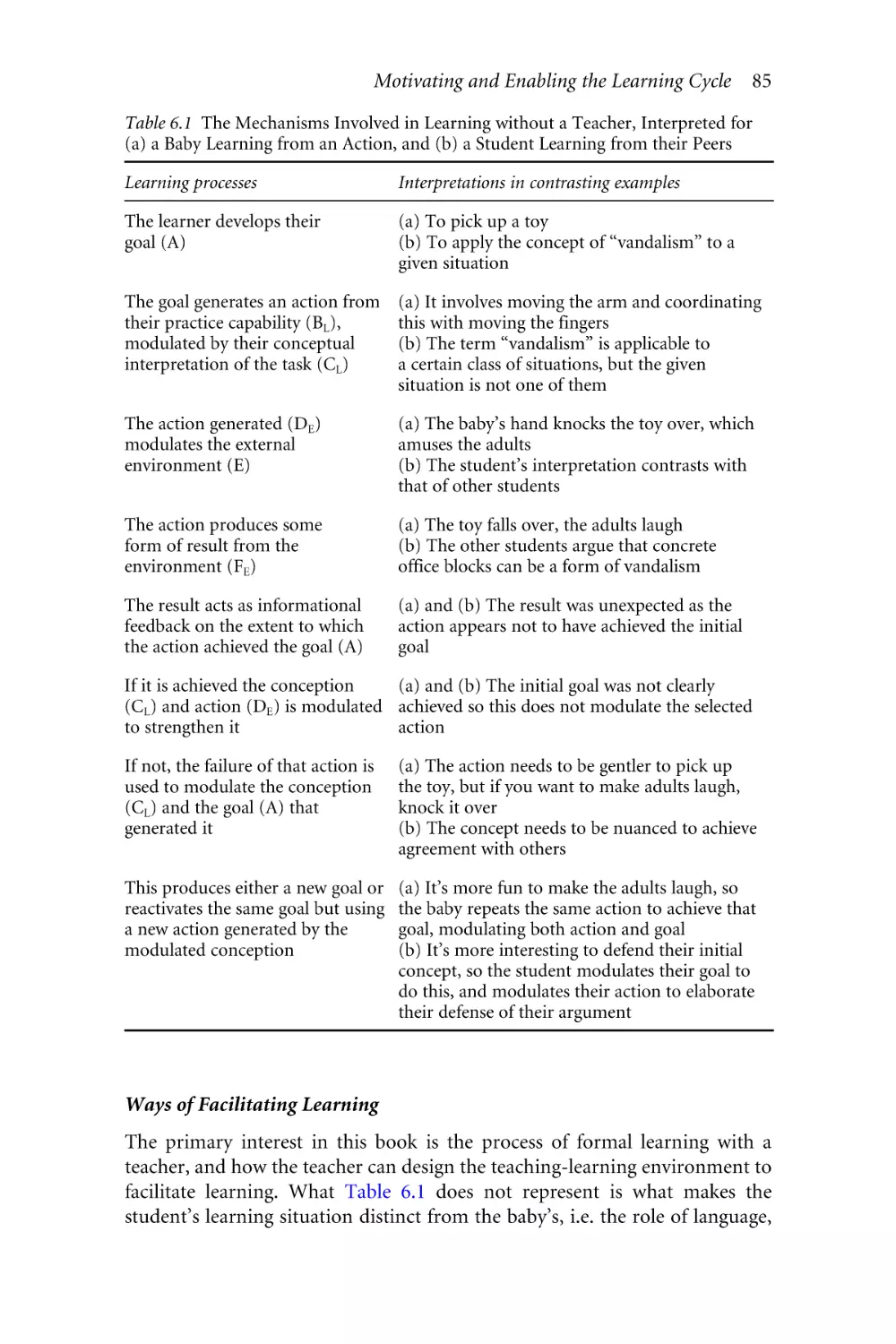
The Mechanisms Involved in Learning without
a Teacher
Design Elements Mapped to Activities within the
Conversational Framework Cycles
Types of Learning and the Different Types of
Conventional and Digital Learning Technologies that
Serve Them
Using the Conversational Framework to Show how
Digital Tools Create a Richer Learning Design Pattern
Design Criteria for the Teaching-Learning Cycles to
Motivate and Enable Learning
Alternative Pedagogical Patterns Mapped to
Conversational Framework Cycles with their
Respective Outcomes
A Consolidated Pedagogical Pattern for Learning
Through Inquiry
Alternative Pedagogic Patterns for Class-Based
Discussion Learning
A Consolidated Pedagogical Pattern for Learning
Through Peer Discussion Online
A Generic Design Pattern for Learning Through Practice,
Mapped to the Teacher Modeling Cycle (TMC), Teacher
Practice Cycle (TPC), and the Learner’s Internal Learning
Cycle (ILC) in the Conversational Framework

22
59
62
79
85
95

96
101
102

117
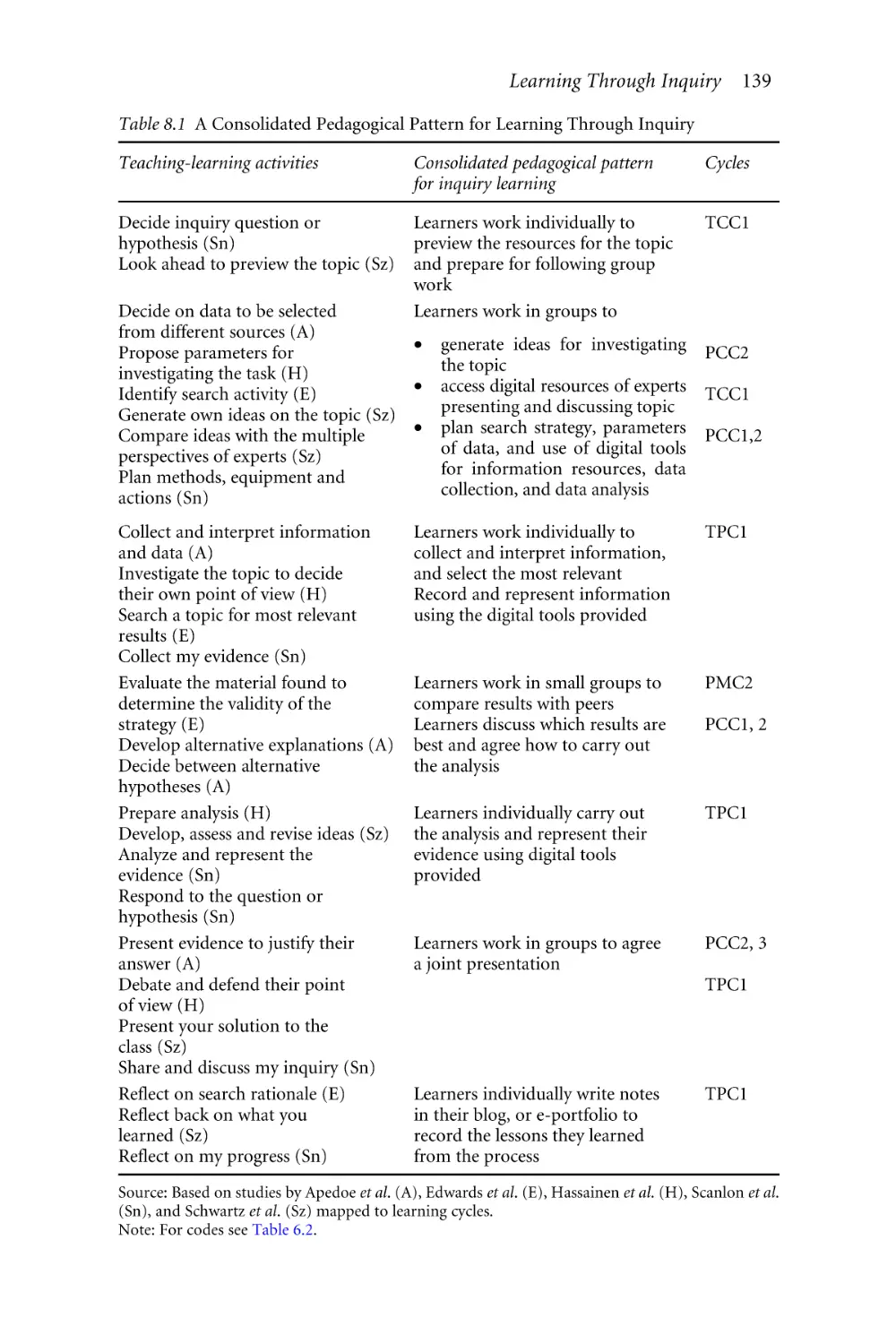
139
158
160

185

Tables
11.1
11.2

12.1
12.2
12.3
12.4

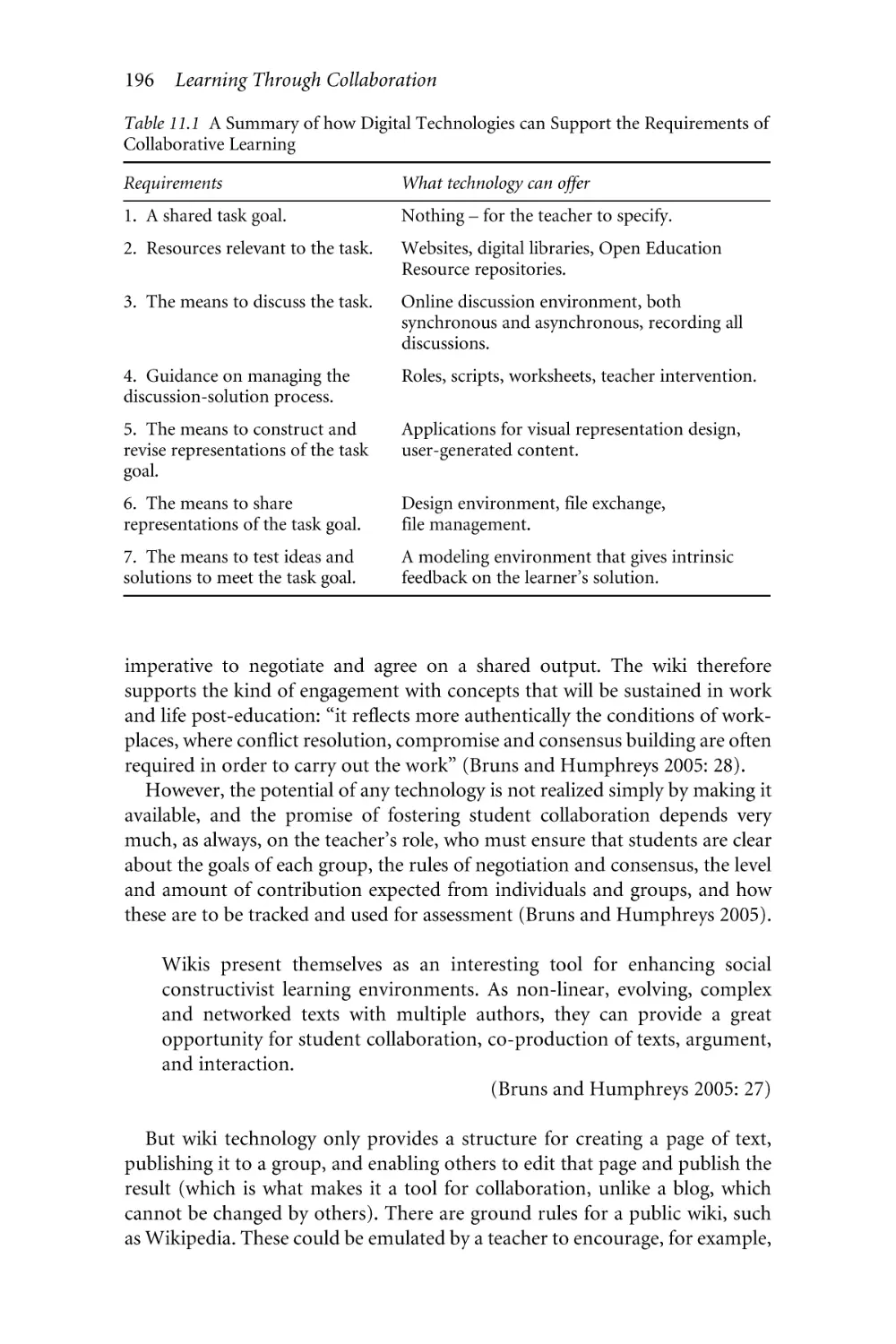
A Summary of how Digital Technologies can
Support the Requirements of Collaborative Learning
A Generic Pedagogical Pattern for Collaborative
Learning Designed to Elicit the Successive Cycles in
the Conversational Framework
How Digital Technologies Contribute to the Pedagogic
Design Criteria
Format for a Pedagogical Pattern
A Pedagogical Pattern to Substitute Physical Resources
and Tools with Digital Equivalents
A Pedagogical Pattern Adapted for a Different
Topic Area

xiii
196

207
216
218
221
223

Preface

There is something extraordinary happening in education. Teachers and
learners are embracing technologies that will change the way we develop and
share human knowledge and skills. But it is a very gradual change.
The digital technologies available to education have already expanded
dramatically in recent years, but it takes more than technology infrastructure
to transform a profession. How can teachers do this at the same time as
fulfilling their current teaching duties?
People are fond of pointing out that the nineteenth-century time traveller would be astonished by our banks, factories, and operating theatres – all
transformed by new technology – while the classroom has hardly changed.
However, bankers, industrialists, and surgeons have had huge resources
devoted to developing the specialised systems they need for transformation.
Teachers have not. Yet it is a much more tractable problem to model the activity that moves a credit from one account to another than to model the activity
that moves a mind from confusion to understanding. Governments provide
education with the tools developed for industry and commerce, but who is
there to help teachers and lecturers work out how to use them to transform
teaching and learning?
This is only feasible if we harness the work of individual teachers who, every
day, in all sectors, discover and test new ways of using digital technologies for
teaching and learning.
It will take a while to work out how best to use the extraordinary collection
of technologies now available but, with a new perspective on the profession
of teaching, education could be discovering a fundamentally different way of
developing and sharing human knowledge and skills.
This book explores what it would mean for teachers to take on this complex
design project themselves.

1

Teaching as a Design Science

Teaching has always been recognized as an art, because it demands creativity
and imagination. Teachers perform and respond to their audience to inspire
and enthuse their learners. They discover how to make a productive connection between themselves, their learners, and their subject. Teaching is certainly
an art. But in the arts anything goes; the imperative is to create a powerful
experience for the audience. That is not true for teaching; it must do more than
that. It also has a formally defined goal. The imperative for teaching is that
learners develop their personal knowledge and capabilities.
So is teaching also a science? Educational researchers do science when they
investigate teaching, but do teachers do it themselves? They do not, after all,
develop and share theories and explanations based on experimental evidence.
Teaching is not a theoretical science that describes and explains some aspect of
the natural or social world. It is closer to the kind of science, like engineering,
computer science, or architecture, whose imperative it is to make the world a
better place: a design science. Herbert Simon made this distinction in his
classic book on The Sciences of the Artificial, contrasting them with the sciences
of the natural world, including the social sciences, which aim to understand
and explain: “the natural sciences are concerned with how things are … Design
on the other hand is concerned with how things ought to be” (Simon 1969:
132–133).
A design science uses and contributes to theoretical science, but it builds
design principles rather than theories, and the heuristics of practice rather than
explanations, although like both the sciences and the arts, it uses what has gone
before as a platform or inspiration for what it creates. Teaching is more like a
design science because it uses what is known about teaching to attain the goal
of student learning, and uses the implementation of its designs to keep
improving them.
The story of this book is to explore what it means to treat teaching as a
design science, and how the teaching community could collaborate, as design
professionals do, to make things work better – in this case the institutions of
formal learning. The hero of the story is technology – not a knight in shining

2

Teaching as a Design Science

armor, or a saintly savior. This hero is the flawed and misunderstood anti-hero
who ought to come good in the end. At least, that’s my intention.

The Role of Technology
There has always been a strong relationship between education and technology. Tools and technologies, in their broadest sense, are important drivers of
education, though their development is rarely driven by education. Writing,
one of the most important tools in the development of human civilization, was
not invented for education but for commerce. Books were used initially to
spread the word of religion, not to educate (Manguel 1997). Education adopted
both, but had little effect on driving the development of either. Blackboard and
chalk was one of the very few tools ever invented specifically to serve education, and its modern counterpart, after all the years of digital technologies, is
the virtual learning environment or VLE. That’s all. Even slide presentation
tools were invented for the business community. We have to acknowledge that,
typically, education does not drive technological invention. Instead we appropriate the useful inventions of the business and leisure industries. In an age of
rampant technological invention, this becomes a critical issue.
The arrival of digital technology over the past three decades, increasingly
impacting on work, leisure, and learning, has been a shock to the educational
system that it has yet to absorb. In fact, the variety and power of digital technologies probably means they cannot be easily assimilated – the system will
probably have to adapt to embrace them fully.
Precisely because of their potential to change education unbidden, it is
imperative that teachers and lecturers place themselves in a position where
they are able to master the use of digital technologies, to harness their power,
and put them to the proper service of education. This is a theme that will
repeat throughout the following chapters – education must now begin to drive
its use of technology.
To do that, we have to be clear about where education is driving itself – what
is its role and purpose in twenty-first century society? And we cannot leave
consideration of technology development far behind in our thinking, because
even though education must lead, it must do that in the knowledge of what
technology has to offer, and the changes it is making to student life. We may
not have decided that what education really needed was an online folk-generated encyclopedia, such as a wiki, but neither should we ignore its existence,
and the fact that many students use it more often than their university library.
If we are confident in our use of technology then we can go beyond mere
awareness to full exploitation of these new opportunities. It is a rational
response to interrogate every new technology for its potential to serve educational aims. But being beholden to the inventiveness of other fields, education
could easily be sidetracked into inappropriate uses of technology if we are not
clear what we want from it.

Teaching as a Design Science 3

Harnessing Technology for Educational Ends
The academic community should challenge digital technologies, and we have
to do that from a position of strength, with a clear and continually renewed
understanding of what education requires of them. These are “knowledge
technologies” in the sense that they change our relationship to what is known
and how it can be known. That strikes deeply at the heart of the educational
process.
Knowledge technologies shape what is learned by changing how it is
learned. Let’s think about three different ways of learning in a business studies
course:
•
•
•

one learner reads and writes about a new business as a case study;
a second role-plays the same case in a small-group business simulation;
and
a third experiments with a spreadsheet model of the same case.

Their respective learning outcomes will share a lot in common about
the factual details of the case, but their very different experiences will yield
very different ways of knowing. Reading and writing enables an inquiring
analytical approach into what has been done and what lessons might
be learned, to generate knowledge in the form of propositions and principles.
Role-play elicits thinking about the relationship between actions and
goals mediated by human relations, which develops a more experiential
understanding of the case. The spreadsheet model offers a way of engaging
with the flow of supply–demand and income–outgoings in a developing
business in an experimental way. This is the kind of learning that can only be
done through digital technology. It enables the learner to experiment with
different decisions about, for example, how much to invest given different
rates of interest and different trajectories of sales. The model shows them the
results of their different decisions in terms of cash flow – giving intrinsic feedback on their actions, very different from the extrinsic feedback of the teacher’s
comment on their essay, and from the social rules operating in the role-play
feedback. The learner is building knowledge of the behavior of the business as
a system.
All of these forms of knowledge – analytical, experiential, and experimental
– are valuable. It means that as the teacher thinks through the curriculum
topics to be covered, and how they are to be taught, the range of learning
outcomes it is possible for their learners to achieve is being determined to a
great extent by the range of teaching methods they employ. If they have no
access to technology, for example, the spreadsheet experience is impossible. If
the learning outcome “awareness of the parameters involved in building a
viable cash flow” is sufficient, then reading and writing about a case study will
be sufficient as a teaching method, but it could not in itself achieve an outcome
such as “understanding how the context of investment decisions can affect

4

Teaching as a Design Science

short-term profits.” Similarly, working with a cash flow model will not engage
learners in thinking about the human relations that affect the case they are
studying. That may or may not matter, depending on the teacher’s aims. The
point here is that the curriculum being covered – what is learned – is significantly affected by the range of teaching methods used – how it is learned.
There is a danger that technology could undermine formal education.
The notion of a formal education system was challenged originally by radical
thinkers such as Illich, who wanted to free the learning mind from
the constraints imposed by the transmission model of teaching practiced in the
formal system (Illich 1973). Arguments against formal education are
now current again but, uninformed by any understanding of the theory of
teaching and learning, they plunge us back into traditional approaches.
Technology opportunists who challenge formal education argue that, with
wide access to information and ideas on the web, the learner can pick and
choose their education – thereby demonstrating their faith in the transmission
model of teaching. An academic education is not equivalent to a trip to the
public library, digital or otherwise. The educationist has to attack this kind of
nonsense, but not by rejecting technology. It is a stronger attack when we
argue that first we must ask what learners need from education and therefore
from technology.
Educationists must resist the idea that because of new technologies students
can do it for themselves – instead they create an even more critical role for the
teacher, who is not simply mediating the knowledge already articulated, but is
more deeply involved in scaffolding the way students think and how they
develop the new kinds of skills they will need for the digital literacies. Roger
Säljö puts the challenge like this:
To deal with these issues, we should try to be even more explicit about
issues such as epistemological beliefs, learning styles, and the problem of
what counts as valid knowledge and valid arguments in various disciplines
and areas of study. The critical and productive learning — and metalearning — of how to use technologies is itself one of the most important
socialising practices of modern education, and that will have to be high on
the agenda.
(Säljö 2004: 493)
The following chapters attempt to demonstrate that we need much more from
technology than access to information and ideas. Technology has much more
to offer than that, and it is up to the academic teaching community to define
and defend the role it should play.
We cannot challenge the technology to serve the needs of education until
we know what we want from it. We have to articulate what it means to
teach well, what the principles of designing good teaching are, and how
these will enable learners to learn. Until then, we risk continuing to be
technology-led.

Teaching as a Design Science 5

Learning about Teaching
For some years now, educators have insisted on a greater focus on learning
than on teaching. The point of teaching is to enable students to learn. But how
do we learn about teaching? The education system has an absence of feedback
loops – we define the outputs of the system (intended learning outcomes), we
design the means by which they are achieved (teaching methods, teaching
schemes, lesson plans), we specify and judge the criteria for the success of the
outputs (exams and grades), and we use that information to judge the student
and the institution, but not – why not? – the teaching design. In a research
project, it would be equivalent to framing the hypothesis (that these teaching
methods will lead to these learning outcomes), measuring the result (through
exams and grades), and concluding that, in the event of the hypothesis being
not proven, the experimental subjects were deficient and the hypothesis
remains intact. Teaching is clearly not a science.
Nor could it be. Teaching is not rocket science: it is much, much harder than
that. Rocket science is about moving atoms from a to b; teaching is about
moving minds. And the whole point is to change those minds into independent
thinkers who will not necessarily bend to the will of the teacher. The independence of the student makes it unfair to judge the quality of the teaching wholly by
what the student learns. So we don’t, but without using that feedback loop, we
cannot learn how to improve the design of teaching. Every individual teacher has
the opportunity in their interaction with students to discover which methods or
techniques work best, and in that sense the feedback loop between teaching
design and learning outcome may be completed. But the knowledge they develop
is not articulated and shared – this is the big difference from science. Developing
the knowledge base in a discipline is done by building on the work of others,
innovating, testing, improving, sharing, and the cycle continues. In education it
is the research community that does this, not the teaching community.
If teaching, like engineering and architecture, were treated as a design science,
then the practitioners themselves would be building the knowledge base.

Education as a Design Science
There is a history to this idea. The appropriate methodology for a design science
for professional practice has been a matter of debate between positivist and
constructivist approaches – whether good practice can be formalized, or most
depend on the practitioner (Cross 2001). In the unstructured, unformalizable
world of much professional practice, do we need design principles or might it
be more appropriate to develop an “epistemology of practice” (Schön 1987)?
The idea that education can be treated as a design science originated in the
1990s, with the ambition to take educational research out of the laboratory
into practice. To do that researchers had to confront “the complexity of realworld situations and their resistance to experimental control” (Collins, Joseph,

6

Teaching as a Design Science

and Bielaczyc 2004). When educational researchers take an innovative teaching method, or educational intervention, into the field, the messy business of
the normal teaching process takes over, and the actual implementation can
turn out to be very different from the intended design. The solution was to
develop a methodology of “design research” that is not classically experimental, but iterative, progressively refining the initial theory-based design as it is
actually implemented. Then it can refine both theory and practice. Allan
Collins clarified the contrasting features of laboratory studies and design
experiments, characterizing the latter as dealing with messy situations, flexible
design revision, social interaction, developing a profile rather than testing
hypotheses, and most importantly, using co-participant design and analysis
rather than experimenter design (Collins 1999). By bringing researchers and
teachers together this way, the design experiment steered a careful pathway
between the two ends of the earlier design science debate, and reconfigured it
as a form of principled reflective practice.
This approach produced a set of design research guidelines for researchers
and teachers to work together to design, test, analyze, redesign, re-test, and
report on an educational intervention. These are the competences of principled
reflective practice in education, keeping close to the rigor of testing, and also
adjusting to the requirements of the local context. But the guidelines are not
quite complete: although researchers emphasize that the theoretical principles
of an intervention are the key elements of its design (Cobb et al., 2003; Collins,
Joseph, and Bielaczyc 2004; diSessa and Cobb 2004), and the intervention
must be evaluated in those terms, there is nothing in the guidelines to ensure
this. They are offered as guidance for people to do design experiments, but
they expect to involve specialist researchers rather than empower the teachers.
The outcome that emerges from this process takes the form of a report on the
goals and elements of the design, the settings where it has been used, and the
lessons learned. This is how the practitioners would build their knowledge
base, although a discursive report may not be the best way to build knowledge
in the teaching community.
In fact, the authors see their approach as requiring “much more effort than
any one human can carry out” (ibid.: 33); it is not a methodology meant for
teaching practitioners.
Design science research has been developed especially in the information
sciences – one of the “sciences of the artificial” – and defined as a rigorous set
of methodological principles to underpin the academic research (Hevner
2007). Practicing teachers cannot match the methodological rigor of a research
team, but there are nonetheless several parallels with what a teaching professional actually does. The following extract defining the nature of design science
research includes my interpretation (in italics in square brackets) to show how
the practicing teacher comes very close to this kind of professional activity:
Design science research [teaching by a reflective practitioner] is grounded
on existing ideas drawn from the domain knowledge base [theories of

Teaching as a Design Science 7
teaching and learning]. Inspiration for creative design activity [new lesson
designs] can be drawn from many different sources to include rich opportunities/problems from the application environment [the classroom, seminar, lab, etc], existing artifacts [other teachers’ lesson designs and resources],
analogies/metaphors [for good pedagogy], and theories [of teaching and
learning]. Additions to the knowledge base [new teaching methods, pedagogic ideas] as results of design research [reflective teaching] will include
any additions or extensions to the original theories and methods made
during the research, the new artifacts (design products and processes
[lesson designs and teaching resources]), and all experiences gained from
performing the iterative design cycles [design and re-design of lesson plans]
and field testing the artifact [the implementation of the lesson plan and
resulting student assignments] in the application environment [the classroom, etc.].
(Hevner 2009: 127)
Ideally, teachers should be able to enact design science as part of their normal
professional practice, and have the means to act like design researchers themselves, i.e. documenting and sharing their designs. Without this they remain
the recipients of research findings, rather than being the drivers of new knowledge about teaching and learning, able to critique and challenge the technology
that is changing their profession.

Design Patterns for Learning
In the same tradition, of looking to design science for inspiration, there
has been a recent resurgence of interest in the idea of “design patterns,”
often explicitly to address the problem of design technologies for learning. A
review of the literature in this area defines this particular type of design
approach:
a design pattern is a semi-structured description of an expert’s method for
solving a recurrent problem, which includes a description of the problem
itself and the context in which the method is applicable … Design patterns
have the explicit aim of externalizing knowledge to allow accumulation
and generalization of solutions and to allow all members of a community
or design group to participate in discussions relating to the design.
(Mor and Winters 2007)
As a methodology, this approach is immediately relevant to teachers because it
presents design patterns as the means by which the teaching community can
participate in design. The key elements of a design pattern are the “problem,”
the “context,” the semi-structured description of the “solution,” and the
fact that this is “externalised knowledge” (Goodyear 2005). Being able to

8

Teaching as a Design Science

externalize the knowledge is what makes it a shared object in a community that
can therefore critique and build its knowledge:
design patterns are usually drafted, shared, critiqued and refined through
an extended process of collaboration. Thus patterns have the potential to
make a major contribution to the sharing of techniques between developers of learning activities.
(McAndrew, Goodyear, and Dalziel 2006)
Here, the knowledge developed by the teacher is externalized in the form of a
design pattern, rather than a “report.” If it properly represents the teacher’s
pedagogic design, then it can act as the means by which the knowledge base
builds.
But what does it take to represent the teacher’s pedagogic design? The exact
form of a learning design pattern is still in contention. This is partly because of
the multiple origins of interest in design approaches (McAndrew, Goodyear,
and Dalziel 2006). A textual description sacrifices the technological advantages
of a machine-readable version, but makes the pedagogic points more simply,
in terms of context, problem, solution, and illustrative diagram. The disadvantage of the machine-readable version is that although it can reproduce the
author’s design and run it online, the teacher may find it difficult to adapt. A
human-readable version means that the teacher can be inspired by the design,
and apply their own expertise to it (McAndrew and Goodyear 2007). This type
of pattern format is semi-structured, where the headings are used to elicit text
and diagrams from the teacher-designer to represent their pedagogy for others.
However, unless it can be expressed computationally it cannot exploit technology to assist the design and collaboration process. Some kind of structured and
formalizable design pattern is needed for expressing pedagogic ideas, as the
basis for the teaching community to collaborate in building its own knowledge
of what learners need, how to teach, and what to demand of the technology.
To summarize the argument so far:
•
•

•

•

Teaching is a design science in the sense that its aim is to keep improving
its practice, in a principled way, building on the work of others.
The continual challenge from digital technologies has forced education
into the position of following rather than leading innovation, and the
academic teaching community needs to gain better control of our use of
technology.
Because technology is changing both what and how students learn we can
only lead educational innovation by being clear about the principles of
designing good teaching and learning, and therefore what education needs
from technology.
The teaching community itself has to contribute to building the
knowledge base because it has to develop fast, in response to the rapid
changes wrought by the technology.

Teaching as a Design Science 9
•
•

This has to be done collaboratively, in order to achieve the aim of
improving practice through building the knowledge base for the academic
teaching community.
Teachers must be able to enact design science as part of their professional
practice; therefore they need the means to do it – to be able to articulate
and share their pedagogic practice, the outcomes they achieved, and how
these outcomes related to the elements of their design.

This is how we arrived at the need for a structured and formalizable pattern for
learning designs as the means by which teachers build the design knowledge of
teaching practice. But what form should it take? Working out how best to
represent a teacher’s pedagogic design and the principles that underpin it, is
the task of the remaining chapters.

The Foundations for Teaching as Design
A design task begins with a requirements analysis. The next chapter does this
by going to the heart of the formal education system, to examine the nature of
academic learning, the knowledge and skills that constitute the contribution
that education makes to society. It is a contested issue, so Chapter 2 sets out to
understand it from the perspective of the various stakeholders who take the
trouble to define it. As students confront this provider-defined offer they come
with their own ambitions, expectations and ideas, to provide a rich mix of
contrasts and common purpose. Chapter 3 surveys and summarizes the
research studies on what students bring to learning, and how this affects the
quality of their learning. Teachers do not always begin their courses with
detailed data on their student population, and yet learner characteristics are an
important influence on how well the teaching is likely to work. Are there ways
we can build on these studies to be better prepared to help the students we find
ourselves teaching?
Thinking through what it takes to teach means understanding what it takes
to learn, so Chapter 4 works through what some of the major studies and
theories tell us about this. They come from a variety of contexts, educational
sectors, and subject disciplines. The type of learning that takes place in formal
education is distinct from, but still builds on the processes of learning that
occur as a natural part of human development, which have no curriculum, and
no formal teaching. Chapter 5 uses this analysis to understand what it takes to
teach, working through alternative approaches in the literature to make the
bridge between what learners need and what, therefore, teachers must do.
There is no clear deterministic link between the two, so there can be no
certainty that even the best designed teaching will necessarily facilitate the
intended learning. That is why teaching has to be an iterative design process.
Clearly we need an educational system with a different structure from the
one we currently have – with a more iterative dialogic structure that enables

10

Teaching as a Design Science

students to learn, but also enables the teachers and the system to learn as well.
Chapter 6 develops the broad design principles that acknowledge this iterative
character of the teaching-learning process in a way that can both guide and
challenge the pedagogies we develop, and in particular, the way they use digital
technologies. The chapter argues that we need to be able to represent those
principles in learning design patterns.
The following chapters work through the main types of learning, to marshal
the lessons learned from the research literature. The studies are chosen for
what they tell us about good ways of teaching, and may or may not involve the
use of digital technology. The aim is to explore what we know about the different ways of learning and identify what education needs from technology. Then
we can test how well technology is serving those needs. The final chapter
consolidates the principles as design patterns for teaching, and ends with a plea
for changing to a professional culture in which teachers play their proper role
in meeting our local and global aims for education.

2

What is Formal Learning?

Introduction
This chapter is about what is being learned within a formal educational
environment, school, college, or university. What contribution does formal
education make to the development of the individual student that is different
from their everyday “informal” learning?
Until quite recently, it was the prevailing view, especially in universities, that
teaching is about imparting knowledge. Sadly, “imparting knowledge” has
usually been only a partially successful teaching activity, as every essay and
examination paper testifies. While higher education was an elitist enterprise,
and exams were designed to select the best minds, it was possible to make this
failure the responsibility of the student. This has changed. Higher education
has become less elitist, and has taken on the task of educating a much larger
proportion of the population to degree level, and we have articulated an
approach to teaching that has a higher ambition: “The aim of teaching is
simple: it is to make student learning possible” (Ramsden 2003: 5). “Making
student learning possible,” where the learning is the kind that helps them
“expand and test knowledge,” places much more responsibility with the
teacher. It implies that the teachers in all education sectors must know more
than what it takes simply to impart subject knowledge, and must understand
something about what it takes to learn and reconceptualize that knowledge.
The nature of formal learning is clearly more than passing on information,
or imparting subject knowledge, but how do we define it now? We need a clear
definition because this is the foundation on which we then build an approach
to designing teaching.
The following sections select the principal sources of influence on how the
education system defines itself – the educational establishment of policymakers and curriculum developers, the workplace that will employ our formally
educated students, the educational researchers who investigate and theorize
the formal curriculum, and the teachers themselves. The analysis begins with
the definitions for post-16 education, since that has a strong influence on the
school curriculum. The point was clearly stated, for example, by former

12

What is Formal Learning?

US Secretary for Education, Margaret Spellings: “States must adopt high
school curricula that prepare all students for participation in postsecondary
education and should facilitate seamless integration between high school and
college” (Spellings 2006).

The View from the Educational Establishment
In most countries, education is a political issue because it is organized and
funded primarily by the state. There are some impressive ambitions to be
found in educational policy documents, the most ambitious being the United
Nations’ millennium goal for education, which every nation inherits: to
achieve universal primary education by 2015. This is the ultimate challenge for
education, and as I write in 2011, we are only halfway towards it.
National policies for education have to recognize competing pressures on
the formal curriculum, and because participation in higher education is
increasing across the world the school curriculum is harnessed closely to the
needs of the post-16 curriculum. Governments are therefore keen to influence
the formal curriculum at all levels, to be sure it meets all needs.
In the UK the most recent review of higher education identified four roles
for a university education as knowledge-oriented, personal, economic, and
social, with main pressures on the curriculum deriving from the aims to:
inspire and enable individuals to develop their capabilities to the highest
potential levels throughout life so that they grow intellectually, are wellequipped for work, can contribute effectively to society and achieve
personal fulfilment...
increase knowledge and understanding for their own sake and to foster
their application to the benefit of the economy and society...
and
serve the needs of an adaptable, sustainable, knowledge-based economy at
local, regional and national levels.
(NCIHE 1997)
The academy and economy will always be sources of influence on the formal
curriculum, while the fourth aim, the social role, is more political, recognizing
the importance of the graduate’s role as citizen, “to play a major role in shaping a democratic, civilised and inclusive society” (ibid.: 72).
Citizenship and human rights education is now part of what is becoming a
global curriculum for formal education across all sectors for all countries,
advocated by bodies such as OECD and UNESCO (Robertson et al. 2007;
UNESCO 2005).
These are ambitious aims. They impose on the teacher a much tougher task
than telling students what they know, and one that cannot be achieved simply

What is Formal Learning?

13

by being knowledgeable in their field. The challenge is compounded by the
twenty-first century ambition to increase the proportion of people educated
beyond school. Educational policy documents demand not only higher quality
but broader reach as well.
At European level the Lisbon agreement of 2000 was “to make the EU the
world’s most competitive and dynamic knowledge-based economy by 2010,”
and led to a succession of follow-up documents placing on universities the
responsibility to change their approach to teaching and learning in order to
achieve this ambition:
In order to overcome persistent mismatches between graduate qualifications and the needs of the labour market, university programmes should
be structured to enhance directly the employability of graduates and to
offer broad support to the workforce more generally.
(CEC 2006: 6) (original bold)
Recent UK government policy was equally concerned to foster employment
skills and emphasized basic skills, such as literacy and numeracy, and generic
skills, such as team working and communication, as being applicable in most
jobs (Leitch 2006; UKCES 2009). The importance of the broader generic skills
is enshrined in the OECD approach to its Programme for International
Student Assessment (PISA), which defines the benchmark for schools across
all its member states:
PISA defines each assessment area (science, reading and mathematics) not
mainly in terms of mastery of the school curriculum, but in terms of the
knowledge and skills needed for full participation in society.
(OECD-CERI 2003)
The EU policy also wants to enable new disciplines and cross-disciplinary
research and teaching to emerge, which will require “focusing less on scientific
disciplines and more on research domains” (CEC 2006: 8), so that students can
move between disciplines through new approaches to teaching and curricula.
It is not just the professional workplace that needs graduates who can work
across the disciplines: those who go into university research must be able to
acquire the skills and habits of interdisciplinary thinking, and not be
constrained by departments “at a time when innovation occurs increasingly at
the intersection of multiple disciplines (including business and social sciences),
curricula and research funding remain largely contained in individual departments” (Spellings 2006).
All graduates should have the chance to develop the high-level cognitive
skills that can be applied within any discipline because it will not be possible to
predict which other subjects they may have to engage with.
For the educational establishment, therefore, the foundational knowledge in
the formal curriculum is not just the detailed understanding of systems of

14

What is Formal Learning?

ideas and explanations of the natural and social world that a traditional curriculum offers. It embraces equally the high-level cognitive skills that the knowledge society requires of its professional workforce and its citizens.

The View from the Workplace
The increasing attention to high-level skills in the workplace, the idea of lifelong learning, and the rapid production and communication of knowledge
made possible by the internet during the 1990s, led to a rethink of the role of
education. Higher and further education need to recognize the importance of
the emerging knowledge society, where a greater proportion of the workforce
are graduates capable of contributing to the production of knowledge, and
ready to learn and hence innovate:
Among the most significant effects of mass higher education … is the
great increase in the market for continuing education, and thus of
the learning society, one in which life-long study, as well as training and
retraining are possible … This readiness to learn greatly increases the
capacity of a labour force to respond to rapid technological change.
(Gibbons et al. 1994: 74)
The pull from the workplace that requires an adaptable workforce is also
reflected in the demands of students and the wider community. Local conditions determine the degree to which a university carries out market research to
discover which courses have most appeal to potential students or where the
public and private sector find there are gaps in graduates’ skills and knowledge.
Market research on curriculum requirements has not been a strong feature of
higher education in general, and at school level government is the dominant
influence. However, because so many universities are now excluded from
access to the highly competitive sources of major research funding, their only
source of growth is student numbers. If the curriculum is to be an attractor,
the courses must either provide a ticket to a good job, or address the student’s
personal interests. For these universities, academics find they have to shift the
boundaries of their own discipline interests in order to build an attractive
curriculum: engineering re-badges itself as design studies, and sociologists
turn their expertise towards media studies.
The problems of interfacing successfully with the requirements of the workplace run deeper, however, because they cannot always be overcome by shifting disciplinary boundaries. The workplace requires capability in a different
kind of knowledge than that generated through research and scholarship,
which remain at the heart of the university curriculum. This continuing
schism between academic and workplace knowledge led to the rise of an
interest in “work-based learning” during the 1990s in the UK, Europe, and
Australia (Boud and Solomon 2001; Osborne 2003). It generated a greater
interest in articulating high-level skills, such as interpersonal, communication,

What is Formal Learning?

15

goal-setting, self-management, and team work skills, that the formal curriculum could be seen as facilitating (Brennan and Little 1996). However, although
there was an impact on the rhetoric, the HE curriculum did not significantly
adjust to the nature of knowledge in the workplace; instead the cognitive skills
identified were mapped to the nature of learning already evident in disciplinebased courses. The problem remained:
Learning in educational settings presents a stark contrast to learning in
work and life … Learning in educational institutions tends to be decontextualised. Courses are often constructed as islands apart from the bodies
of knowledge and practices from which they are generated and on which
they focus.
(Boud and Falchikov 2006: 406)
The schism remains because it is not possible to derive workplace knowledge
from discipline knowledge: it is produced in a very different way. Workplace
knowledge
is created through the implementation of a new work system, through
solving problems which arise in the rapidly shifting context of work or
from the employees’ need to understand a complex situation.
(Reeve and Gallacher 2005: 228)
A work-based learning curriculum could potentially embrace this form of
knowledge (Solomon and McIntyre 2000), but it does not mix easily with
disciplinary knowledge:
There are substantial challenges in making existing course units available
within a work-based learning framework as [disciplinary and workplace]
knowledge may be qualitatively different and unable to be translated from
one to another. It is easier to imagine a dialogue between disciplinary and
professional frameworks within a conventional course, than in a work
setting.
(Boud and Solomon 2000: 10)
An analysis of several workplace learning projects developed a typology of
learning outcomes that embrace more than the disciplinary forms of knowledge, to include: task performance, awareness and understanding, personal
development, teamwork, role performance, academic knowledge and skills,
decision-making and problem-solving, and judgment (Eraut 2004: 265). The
typology helps to clarify why there is a problem because as Eraut points out,
“few of them comprise only skill or only codified knowledge because … these
categories do not match attributes of performance at work” (ibid.: 265). The
workplace puts the highest value on generic cognitive skills such as willingness
to learn, teamwork, and collaborative learning (Coll and Zegwaard 2006;

16

What is Formal Learning?

Crebert et al. 2004), but places little emphasis on discipline knowledge except
in technical roles in the specialized professions.
The knowledge industry is negotiating and generating new knowledge in the
workplace by applying high-level cognitive skills, which it therefore values
more highly than specialized formal knowledge. On the other hand, academic
teaching practice tends to follow academic research interests, which must
focus on specialized knowledge in order to compete. The higher education
curriculum is still in the process of resolving the tension between developing
specialized codified knowledge and the broader workplace demand for generic
cognitive skills.
Meanwhile, the school system is required to orient its curriculum directly to
twenty-first century needs “to consider the integration of 21st century competencies and expertise, such as critical thinking, complex problem solving,
collaboration, multimedia communication, and technological competencies
demonstrated by professionals in various disciplines” (USDoE 2010: xvi).

The View from Educational Theorists
The concept of “the curriculum” in formal education is largely absent from the
discourse of the educational establishment, except when it addresses the topics
and skills necessary for employment and the world of work (Barnett and Coate
2005). As government policy began to focus more on the role of universities,
they had to move beyond the knowledge-oriented curriculum, to describe also
the high-level skills it is developing in a graduate. In the UK this led to a benchmarking process by the Quality Assurance Agency (QAA), the first attempt to
identify standards across the curriculum. The subject benchmarking was
conducted by academics working in separate subject groups, rather than
through a cross-disciplinary approach. They were asked to give an account of
the nature of their discipline in terms of its skills orientation: the knowledge,
generic intellectual, and personal transferable skills it inculcates. It is an interesting case, because although the benchmarking process succeeded in providing a comparable set of standards across subject areas, educational theorists
saw the exercise as “reducing” academic aims to “mere” outcomes.
The argument against the “curriculum as outcomes” approach is that it fails
to address “what is required for capability in the disciplines” (Barnett and
Coate 2005: 25), i.e. what would go beyond knowledge and skills to embrace
also personal dispositions such as critical thinking and personal autonomy.
While the curriculum must include both “knowing and acting,” i.e. what is
known, and how that knowledge is used in practice, it must also embrace
“being” as one of the building blocks of the curriculum. This would be a way
of responding to a world in which an individual finds that their hard-won
knowledge and skills have become irrelevant, or outdated by changes in
science, technology, politics, and culture. For the curriculum to prepare
students for such a world, it must go beyond the current horizons of knowledge and skills in a discipline, to help them develop a sense of “self,” which

What is Formal Learning?

17

may be interpreted as a personal relationship with their subject that enables
them to go beyond the happenstance of current expertise and adapt to new
conditions. The curriculum must be “future-proof,” as it were. The student
should not emerge as a slave to the current state of the discipline knowledge
they studied.
There has occasionally been reference to the idea of a “use-by” date for
qualifications in certain rapidly developing subjects. But if education is serious
about developing deep knowledge and high-level skills, this idea should be an
absurdity – theories and world conditions may come and go, but the welleducated scientist or historian, or graduate in any field, should be equipped
intellectually to cope with such changes. That is what Barnett and Coate seem
to mean by “being” as an aspect of curriculum. It is similar to the outcomes of
a college education that William Perry discerned in some Harvard students as
a commitment to a generalized relativism and to personal values (Perry 1970).
A further critique of the subject benchmarking approach is that it has been
too narrow in its ambitions. As we have seen, the workplace wants the curriculum to embrace the high-level skills of new knowledge production in the
knowledge society, but this is not reflected in the learning outcomes generated
by subject-oriented academics: there is no mention of broader personal
attributes, such as developing multiple identities and the competence to work
across disciplines. Because they have been grounded within discipline boundaries in the way the QAA set them up, there has been no attempt to take a
generic viewpoint on the curriculum (Barnett and Coate 2005). It would take
a different, deliberately cross-disciplinary methodology to address the requirements of the educational establishment and the workplace.
The problem of knowledge and the curriculum is tackled from a different
perspective in the sociology of education, where the aim is to transcend the
division between the “traditional” curriculum, which transmits received
knowledge to the next generation, and the “instrumental” curriculum, which
is oriented towards building a particular form of society (Young 2008). The
“social realist” approach recognizes both the power relations that drive the
curriculum towards relevance and vocational practice, and the specialist
communities that maintain and develop the cognitive interests that are critical
for the development of the discipline:
the extent to which the capacity of any curriculum to be the basis for
acquiring new knowledge in any field depends on cognitive interests,
which will be expressed in the social networks, trust and codes of practice
among specialists that give it an objectivity and sense of standards.
(Young 2008: 33) (original italics)
From this point of view the formal curriculum should be understood
not only as the means to develop society, but also as having a role in the
development of knowledge itself. Young argues for “reorienting the debate
about curriculum standards from attempts to specify learning outcomes … to

18

What is Formal Learning?

identifying cognitive interests and building the necessary specialist communities, networks and codes of practice to support them” (ibid.: 34). This discipline orientation wants to reclaim the special nature of history, physics, or
music as having distinctive and mutually exclusive elements in their curricula.
From this point of view the current focus on generic skills and learning
outcomes swings the pendulum too far from the traditional separation of the
disciplines. Like Barnett and Coate, who also attack the “curriculum as
outcome” approach, this is a plea for redressing the balance between discipline
knowledge and generic skills that would be lost by focusing higher education
too much on the skills needs of employment.
These two major forces influencing the curriculum, academic knowledge
and stakeholder requirements, are reflected in the way educational change is
conducted, where theory is always in conflict with government policy – necessarily so in the view of sociologists such as Foucault, who argue that the role of
the intellectual is to remain critical of those in power, not assist them (Foucault,
Kritzman, and Sheridan 1990). As a social realist Young preferred to resolve
the conflict between theory and policy through a “collaborative model” in
which educational researchers work alongside policymakers to influence
educational change. After some lengthy experience of the collaborative model
in practice, however, he is led to the conclusion that “neither conflict nor
collaboration adequately characterizes the relationship between research and
policy” (Young 2008), because the objective of the researcher is different from
that of the policymaker: the former must preserve an autonomy in the development of concepts and theories, whereas the latter must implement change.
So although discipline-based academics have been working with policymakers and educational researchers to generate changes in the way the curriculum
is articulated, implemented, and then quality-assured, and have been engaged
in what Young would call a “collaborative model,” what they have produced is
seen by the educational theorists as going too far in yielding to the requirements of government, and neglecting the needs of the disciplines.
Certainly, there is a danger that if learning outcomes are made too generic
then we lose the articulation of the specific capabilities needed for a discipline.
The right balance is important. We need both specific knowledge and generic
skills because knowledge and skills have an internal relationship: the skills
enable the learner to engage with knowledge at the right level of complexity,
and the knowledge acts as a vehicle for rehearsing and developing the skills.
Each is an aspect of the other.
A balanced curriculum will include some learning outcomes focusing on
high-level cognitive skills and some focusing on the specifics of a discipline
that will not translate easily across disciplines. Specific knowledge will be peculiar to the discipline, but the generic skills needed for twenty-first century
employment and citizenship are widely applicable across the disciplines. It is
this latter part of the curriculum, in particular, which should be common to
teaching in all subject areas, and will be an equally important aspect of formal
learning.

What is Formal Learning?

19

Teachers’ Views of Formal Learning
Academics have ambitious definitions of formal learning and, in the UK at
least, subject benchmarks provided a good indicator of how the teaching
community defines the nature of formal learning, and what the school curriculum has to feed into. At an international level, the European Union “Tuning
Project” has taken on the task of standardizing such definitions across all the
participating countries (Gonzalez and Wagenaar 2005), and there are similar
mechanisms in other countries, such as accreditation agencies that set and
assure common standards in universities and colleges. The process is collective, drawing on the experience and expertise of leading academics, working
on behalf of their peers, consulting widely, and updating the standards
progressively over the years to take account of changes in the developing disciplines. It is reasonable, therefore, to expect these agencies to be a valuable
resource of collective understanding about the nature of formal learning.
These exercises have effectively established a common core of achievement
that a graduate can expect from a qualification in, say, history, or computer
science, no matter where they study. It must be a complex and difficult process
to agree on the common core of skills and knowledge for a subject discipline.
The problem is an unfamiliar one at school level, except at national or state
level as there is little reason to achieve consensus between countries. But for
the movement of students across Europe it is important to achieve “tuning.”
So for the purpose of understanding the nature of formal learning, it is
useful to have these documents. We can compare the outputs of different
agencies to see how closely they agree on the nature of formal learning in a
discipline. History is a highly contested discipline, for example, but if we
compare the QAA “summary of learning outcomes” with the Tuning “subject
specific competencies,” it is possible to discern nine broad areas of agreement
between them, such as:
•
•

Awareness of and respect for points of view deriving from other national
or cultural backgrounds (Gonzalez and Wagenaar 2005).
A command of comparative perspectives, which may include the
ability to compare the histories of different countries, societies, or cultures
(QAA 2007).

Sometimes the expression may be different, being more or less specific, but the
intention is similar, and points to a similar kind of academic knowledge and
competence:
•
•

Knowledge of and ability to use the specific tools necessary to study
documents of particular periods, e.g. palaeography, epigraphy (Gonzalez
and Wagenaar 2005).
Competence in specialist skills which are necessary for some areas of
historical analysis and understanding cultures (QAA 2007).

20

What is Formal Learning?

They do not always agree: although both agencies set out to define supersets
from which courses may select, each also has items that have no counterpart
in the other. Nonetheless, the degree of broad agreement, albeit with varying
degrees of specificity, does help to validate the idea that there can be a common
core of achievement at degree level for graduates of a subject discipline.
More interestingly, to what extent can a common core of achievement be
defined across subject disciplines? Are the disciplines really distinct in the type
of knowledge and cognitive skill they foster?
A recent research project, “Enhancing teaching-learning environments”
(ETL), worked with 28 diverse university courses to analyze their aims and
learning outcomes, and how best to align these with their teaching methods.
The emphasis was on the particular requirements of each discipline, so this is
a valuable account of how formal learning is defined within each area. A key
outcome of the project was to reconceptualize the nature of formal learning as
going beyond subject matter knowledge to “ways of thinking and practicing”
within the discipline (Entwistle 2005). The methodology used here contrasted
with the quality assurance agencies’ approach to developing clear statements
of learning outcomes:
While clarity about outcomes is essential, formal statements of intended
learning outcomes may fail to communicate the essence of the individual
disciplines and professional areas, which depends on a holistic view of the
knowledge and values involved.
(Entwistle 2005: 72)
Instead, the ETL project interviewed academics, many of whom criticized the
“restrictive nature” of the formal learning outcomes they had to use, to find
out what was important to them as teachers. An initial analysis of six disciplines – Biology, Economics, Electronic Engineering, History, Media Studies,
and Music – documented the “fundamental differences that exist between
subject areas in the nature of learning outcomes” (ibid.: 67). The argument is,
therefore, that the disciplines are indeed distinctive and we cannot expect to
find commonality. This is a problem for my attempt to discern a generic
account of the nature of formal learning, so I want to look closely at the nature
of the distinctiveness.
The first step is to compare, within subject area, the outputs of the quality
assurance agencies with those of the teachers in the ETL case studies, to discern
where they want to go beyond the restrictive definitions of the formal
outcomes. In the case of History, for example, all the statements summarized
by Entwistle are as follows, that it requires students to:
•
•

interpret texts and write essays in which personal viewpoints are encouraged,
as long as they are well supported;
achieve a greater awareness of the contested nature of knowledge;

What is Formal Learning?
•
•
•
•
•
•
•
•
•
•

21

achieve a greater awareness of how evidence was used in argument;
break away from previous, more restricted, ways of thinking about the
subject;
see history in a wider social and temporal context;
develop a perspective of the past that avoids … interpreting past events in
terms of current understandings of authority and society;
view matters from alternative perspectives;
build up a more sophisticated, differentiated picture of a particular area;
gain a greater maturity of judgment which would encompass the [ability
to take different perspectives];
[undertake] a cumulative process of refining skills and developing capacities
and understanding;
express their own views in discussion and feel part of a joint enterprise that
allow[s] them to believe that their views and interpretations [have] value;
communicate ideas in academically acceptable forms of expression and
argument (Entwistle 2005: 75–79) (my italics).

Interestingly, although these twelve statements were from what the teachers
saw as their local idiosyncratic outcomes, only the three in italics appear to
have no clear counterpart in the outputs of the quality assurance agencies.
They are not incompatible, but are expressed in a way that does not fit very
well with the greater specificity the agencies prefer. This perhaps accounts for
the perception of them as “restrictive”. In fact, Table 2.1 shows a reasonable
degree of agreement between several aspects of the overall aims derived from
these different sources.
The restrictions imposed by the agencies do not look too onerous from
these comparisons. It seems to be possible, therefore, to achieve agreement
about the nature of formal learning in the discipline of History. Most of these
statements, despite their complexity, are expressed at quite a high level of
abstraction, and do not appear to be particularly “constraining,” especially as
both QAA and Tuning documents emphasize that courses should select from
the complete list, and not necessarily attempt to cover all the items.
Even within the relatively contentious discipline of History there is a sufficient degree of abstraction in the main learning outcome statements to allow
a broad consensus on what graduates should achieve. The other disciplines
achieved a similar consensus in their own sets of outcomes and competencies
for these agencies. However, looking at the statements for History, apart from
the specifically history-oriented ones (such as the interpretation of past
events), most appear to be sufficiently abstract to be applicable in other subject
areas as well, which is intriguing. Statements such as “the ability to take different perspectives” are hardly unique to History. How far could the consensus
go across discipline areas?
To test this, we ran a survey at the Institute of Education, using the 43 statements collected from the six discipline areas studied in the ETL project, to ask

22

What is Formal Learning?

Table 2.1 Comparison of Selected Learning Outcomes for History Defined by
Individual Academics, the Tuning Process, and the QAA Benchmarking Exercise
ETL project: History Tuning: History enables
requires students to learners to achieve

QAA: History enables learners
to achieve

achieve a greater
awareness of the
contested nature of
knowledge;

awareness of and ability to
use tools of other human
sciences (e.g., literary
criticism, and history
of language, art history,
archaeology, anthropology,
… etc.);

an understanding of the
varieties of approaches to
understanding, constructing,
and interpreting; and,
where relevant, a knowledge
of concepts and theories
derived from other
disciplines;

achieve a greater
awareness of how
evidence is used in
argument;

ability to comment, annotate
or edit texts and documents
correctly according to
the critical canons of the
discipline;

the ability to develop and
sustain arguments in a variety
of literary forms, formulating
appropriate questions and
utilizing evidence;

develop a
perspective of the
past that avoids
interpreting
past events in
terms of current
understandings;

a critical awareness of the
relationship between current
events and processes and the
past;

an appreciation of the
complexity of reconstructing
the past, the problematic and
varied nature of evidence;

gain a greater
maturity of
judgment which
would encompass
the ability to
take different
perspectives.

awareness of and respect for
points of view deriving from
other national or cultural
backgrounds.

a command of comparative
perspectives, which may
include the ability to compare
the different countries,
societies, or cultures.

13 teachers from a different range of disciplines to say for each statement
whether it was “relevant”, “possible”, or “irrelevant” for their undergraduates.
In some cases specific content words were substituted with more generic
words. All the Engineering statements were about “circuits”, for example, but
by substituting “circuit” with “system/case” all these ways of thinking and
practicing could be rendered applicable to other areas. For example, the
outcome:
•

develop analytic skills, as complex systems/cases [circuits] have to be
analyzed to understand how different parts operate in contributing to the
whole

What is Formal Learning?

23

was identified as relevant by teachers in math, philosophy, social science, and
cognitive psychology. In some cases, this was not possible. For example the
History statement:
•

develop a perspective of the past that avoids interpreting past events in
terms of current understandings

does not lend itself to a generic form, and all other teachers identified this one
as irrelevant for their undergraduates.
Across subjects as diverse as math, sociology, philosophy, cognitive science,
and computer science, four of the 43 ETL items were identified by the majority
of teachers as “irrelevant”, while 17 (40%) were seen as “relevant” by more
than 75% of them. These were statements such as “the student should be able
to”:
•
•
•
•
•
•

bring appropriate concepts and research findings to bear in developing
solutions;
build up a more sophisticated, differentiated picture of a particular area;
communicate ideas in academically acceptable forms of expression and
argument;
develop thinking that is logical and analytic in abstracting the key elements
of a problem;
focus on the way in which theories and models help to make sense of the
real world;
master the types of critical thinking about evidence which will be expected
of them in professional work in the field.

The commonality across disciplines of the relevance of these general statements of learning outcome is quite high, and suggests that although some
learning outcomes are clearly unique to a subject discipline, there can be broad
agreement on many of the aspirations for formal learning in terms of the
cognitive competencies being developed. This is significant because it means
there are high-level generic cognitive skills for formal learning that are
common to all areas. Formal learning consists in more than “content” or
“subject knowledge,” as has been argued from the other viewpoints in this
chapter. It also concerns the way that knowledge is developed and used by the
individual, and this is a capability that transcends content and context.
We can certainly, as the ETL project suggests, reconceptualize the nature of
formal learning as going beyond subject matter knowledge to “ways of
thinking and practicing” within the discipline (Entwistle 2005). But we
can go further, and use some of these statements to define the nature of formal
learning in general. Of course there will be statements that are unique to a
discipline, such as those in History that refer to the “diachronic framework
of the past,” but in general, teachers are not treating formal learning as being
merely the acquisition of specialized subject knowledge. Every discipline

24

What is Formal Learning?

is aiming for the same kinds of high-level cognitive skills, or “ways of thinking
and practicing.”
This is an important conclusion. We have to focus on how to help learners
develop these ways of thinking and practicing, and this means a collaborative
effort is possible: teachers can learn from other disciplines and share experiences and results. History teachers are not alone in the difficult challenge of
enabling learners to “understand how evidence is used in argument.” Most
teachers find that relevant. In Engineering, students have to “grasp the function and mode of operation of a wide variety of different circuits,” but by
generalizing this to “a wide variety of different systems/cases” it becomes so
generally applicable that teachers in math, computer science, and HCI also
find it relevant. A collaborative approach to discovering what it takes to help
learners achieve these high-level cognitive learning outcomes is feasible.

Summary
This chapter set out to clarify the nature of formal learning as a basis from
which to improve the way we design teaching. There are clear stakeholder
views on the aims of formal education and the nature of the learning to be
done. We have explored a range of views to define the scope of what the
following chapters must cover. To summarize, over the past decade or so, there
has been a developing consensus about the nature of formal learning:
•

•

•

•

For the educational establishment: formal learning is not just about the
detailed understanding of systems of ideas and explanations of the natural
and social world that a traditional curriculum offers. It embraces equally
the high-level cognitive skills that the knowledge society requires of its
professional workforce.
From the point of view of the workplace: fostering high-level generic cognitive skills is more important than the specific knowledge base for many
professional areas. There is a tension to be resolved between the specialized development of codified knowledge in a discipline and the broader
workplace demand for generic cognitive skills.
From the educational theorists’ point of view: we need a careful balance
of both specific discipline knowledge and generic cognitive skills. Specific
knowledge will be peculiar to the discipline, but generic skills are widely
applicable across the disciplines.
From the teachers’ point of view: a large part of the formal curriculum,
as expressed in learning outcomes, is common across subject disciplines,
so it is feasible for teachers across different discipline areas to collaborate
on discovering what it takes to help learners achieve high-level cognitive
learning outcomes.

This book is taking a generic view of teaching, so a degree of common
interest across the disciplines is important. It means that we can use learning

What is Formal Learning?

25

theories and practices in a common academic enterprise to help educational
institutions enhance and develop their teaching and learning performance. In
thinking about the design of teaching we have to contend with the educational
goal, determined by our rapidly developing knowledge environment, of equipping students with the cognitive skills they will always need:
More than ever, the sheer magnitude of human knowledge renders its
coverage by education an impossibility; rather, the goal of education is
better conceived as helping students develop the intellectual tools and
learning strategies needed to acquire the knowledge that allows people to
think productively about history, science and technology, social phenomena, mathematics, and the arts.
(Bransford, Brown, and Cocking 2003: 5)
This chapter has covered a broad scope across the contending expectations of
formal education, but in practice it is the relationship between teacher and
learner that does most to achieve the demanding goals now set for education.
Chapters 3 and 4 look at this from the learners’ point of view – what students
bring to learning, and how the demands of formal education impact on what
it takes to learn. From this, Chapter 5 then analyzes what it takes to teach.

3

What Students Bring to Learning

Introduction
Having begun with a review of the wider context of expectations of what
formal teaching must achieve, we now look at the wider context that students
themselves bring to learning. This chapter surveys and summarizes the
outcomes of studies of how this affects the quality of their learning.
Knowing our students will be a difficult problem as our mass education
systems continue to require large class sizes, and that in a world where we are
still so far from universal access even to primary education. Expansion of
student numbers and an increase in educational access to all sectors is the aim
in every country, although this is not commensurate with the expansion of
teaching.
There are particular challenges for university teachers, who have to find a
way of providing the teaching needed by a hugely diverse cohort of students,
as class sizes can rise to hundreds and their cultural origins span the world.
There is no foreseeable end to the dilemma of how to manage student-focused
teaching in a mass higher education system. The expansion of student numbers
includes a necessarily wider range of academic attainment as well as an internationalization of the student body. The Western university system has stuck
resolutely to Western-oriented curricula, and has not really taken advantage of
the multicultural opportunities these changes could have provided. So far this
has been tolerated by the many different cultures represented in its student
body, perhaps because they bring with them a respect for and an orientation
towards academic achievement that outweighs the cultural divide they will
undoubtedly experience (Otten 2003). The HE curriculum has had to become
much broader in other ways, by responding to the diversity of professional
jobs and the demands of globalization (Marginson and van der Wende 2007;
Teichler 2004), and this is another trend likely to continue.
In all education sectors, knowing who our students are, and what they need
from our teaching, has become so challenging that the hard-pressed teacher,
busy with the task of continually renewing and updating the curriculum, tends
to trust to the intelligence and motivation of the students themselves to

What Students Bring to Learning 27
construct the bridge between what they bring to their studies and where those
studies are taking them.
Research on the influences on student learning in HE has investigated many
different factors that contribute to the way students approach their studies.
The literature refers to these as presage variables, (or input variables in the US)
that will affect the process or environment variables of what happens during
study, and in turn the product or output variables they lead to (Biggs 1993;
Gibbs 2010). The relationships between them are complex, because “student
characteristics” interact with the learning environment that the institution and
the teachers provide (Entwistle and Peterson 2004). The characteristics identified as most salient are: (i) previous knowledge, self-confidence, abilities and
motives; (ii) conceptions of knowledge and learning; (iii) approaches to learning and studying; and (iv) expectations. All these have in turn been influenced
by the students’ previous experiences of teaching and learning (Biggs 1993).
This is not a uni-directional causal relation, as the interaction between the
individual and their learning environment is inevitably an internal relation,
where each helps to shape the other, for any learning context. A clear expression of this is in Bandura’s account of why it is difficult to interpret the role of
human agency:
in an interpersonal transaction, in which people are each other’s environments, a given action can be an agentic influence, a response, or an environmental outcome, depending arbitrarily on different entry points in the
ongoing exchange between the people involved. In human transactions,
one cannot speak of “environment,” “behavior,” and “outcomes” as
though they were fundamentally different events with distinct features
inherent in them.
(Bandura 2006: 165)
The term “environment” is especially problematic, because while studies of
students learning certainly attend to the learning environment, and are aware
of the interrelationships between environment, behavior and outcomes, even
the locations of the different kinds of “environment” inhabited by a student
are not distinct. Students now move comfortably between the real and virtual
worlds, and the virtual world does not separate work and leisure as clearly as
the real world does. It raises the question of what counts as “the learning environment,” and how much of it does the teacher take responsibility for?
This chapter reviews some of the key studies that offer insights into these
issues, and considers what they mean for the teacher who is aiming to facilitate
the progress of diverse learners towards a common learning outcome, and how
the teacher might prepare for responding to what students bring. We will look
at studies of the emotional characteristics of self-confidence and motivation, the
intellectual characteristics of prior knowledge, conceptions, intellectual skills,
and approaches to learning, and finally the contrasting informal contexts for
learning that students experience alongside the formal context of education.

28

What Students Bring to Learning

Student Engagement
The emotional engagement that students bring to their studies is the most
elusive characteristic, because it is probably the least stable. We will not find in
the studies here any clear guidance on how to manage such diverse experiences
among students, but some of these insights will help to place the more
academic considerations in context.
Self-Efficacy and Motivation
This section is entitled “student engagement” because the term focuses attention on why the emotional aspects of study are important. It is a useful term
for embracing the motivation to study, students’ sense of self-efficacy, and the
role that emotional experiences play in learning. The work in psychology on
the concept of “self-efficacy” makes a strong claim about its interrelationship
with independent “self-regulated” learning in a digital culture:
Students … can use [internet] resources for educating themselves … This
shift in the locus of initiative requires a major reorientation in students’
conception of education. They are agents of their own learning, not just
recipients of information. Education for self-directedness is now vital for
a productive and innovative society. Proficient self-regulators gain knowledge, skills, and intrinsic interest in academic areas; deficient self-regulators achieve limited self-development … At the student, teacher, and
school levels, a sense of efficacy contributes to academic development …
We are entering a new era in which the construction of knowledge will
rely increasingly on electronic inquiry. Students with high perceived
efficacy for self-regulated learning are the ones who make the best use of
Internet-based instruction.
(Bandura 2006)
Students may have a strong sense of self-efficacy born of their internet capabilities, and may bring this to bear on their approach to study. But a sense of
self-efficacy is context-dependent, influencing and influenced by their experiences within an environment, and does not necessarily carry over from general
internet activities to education. A student’s “perceived efficacy for selfregulated learning” has to be developed through their successive encounters
with a formal learning environment in which they are encouraged to be an
agent of their own learning, and able to develop their capacity for self-regulation. The implication for teachers is to be aware of the importance of selfefficacy for the student’s academic experience and to foster a context in which
they can develop it, using the basic principles to:
•
•

help students maintain relatively high but accurate self-efficacy beliefs;
provide students with challenging academic tasks that most students can
reach with effort;

What Students Bring to Learning 29
•
•

foster the belief that competence or ability is a changeable, controllable
aspect of development;
promote students’ domain specific self-efficacy beliefs rather than global
self-esteem (Linnenbrink and Pintrich 2003).

What we can take from Bandura, and the work that follows his approach, is the
importance of enabling students to become “proficient self-regulators” with
respect to their academic learning; they may become proficient in using the
internet independently of their education, but they are still likely to need help
in applying those skills to the context of formal learning. In education, they are
indeed not “just recipients of information,” but the internet does not educate,
nor does it actively support learning. Mostly, it provides information. So to be
able to use academic resources, internet-based or otherwise, students have to
become highly proficient self-regulators, using the kind of high-level cognitive
skill the knowledge society requires, discussed in Chapter 2. It is part of the job
of formal education to enable that.
Motivation to Study
Chapter 2 established the different purposes of a formal education, so it is
inevitable that students will have different reasons for continuing
post-compulsory education. In broad terms the forms of “motivation” or
“orientation” to study are classified as:
•
•

intrinsic – focusing on the content or process of learning itself to develop
a deep understanding of the subject, and a sense of self efficacy in relation
to it; or
extrinsic – focusing on the rewards that result from academic study in
terms of vocational or social advantage.

These are elaborated further as four categories of “academic” or “personal,”
and “vocational” or “social” forms of motivation, which have remained fairly
stable in the literature (Beaty, Gibbs, and Morgan 1997; Entwistle, McCune,
and Hounsell 2003). Intrinsic academic orientation is the one that teachers will
identify with most, because it refers to the study of the subject for its own sake,
for the intellectual challenge and fascination it offers, and a hunger to understand how the world works. Taken to extremes, it is the kind of orientation
that leads students away from the specific demands of the course, to follow
their own lines of interest, so unless balanced with a degree of extrinsic vocational motivation, the students may even fail in their exams. Most students
have a mix of orientations, and for many the focus is not the subject, but the
other advantages of a university education. They may even fulfill their personal
goals without satisfying course demands – this is often a concern at the
Open University, that students are content to study the course assiduously
without taking the exam because, for example, they were not interested in the

30

What Students Bring to Learning

qualification, but in learning about French. Motivation to study is not an
immutable property of a student, but describes “the relationship between the
individual, and both the course of study, the institution and indeed the world
beyond the university. It can also change and develop over time” (Beaty,
Gibbs, and Morgan 1997: 86).
The implication is that the course of study itself can influence the way the
student perceives their expectations. This work does not imply that students
need different types of teaching according to their form of motivation, but that
teaching can shape their motivation, to become more balanced across both
intrinsic and extrinsic forms, and across personal, social, intellectual, and
vocational outcomes.
The Role of Emotional Engagement
Knowing who our students are, and what sense of self-efficacy and motivation
they bring to a course, means we can adapt to their needs more readily. A study
of young entrants from families with no history of HE, for example, shows
that the categories “intrinsic” and “extrinsic” motivation have to be elaborated
to account for the feelings associated with early experiences of university
study (Haggis and Pouget 2002). There were negative feelings of alienation
resulting from school experiences, linked to the absence of effective strategies for
dealing with formal learning, even though they wanted to work hard and do well.
Unable always to find an intrinsic interest in what they were studying,
these students had no study techniques to fall back on to sustain their extrinsic
motivation to do well. The study showed that an access course, which helped
them reflect on the process of study, and provided support in the form of
companionship with other students in the same position, was successful in turning around the negative feelings, and enabled the students to develop stronger
study strategies.
With a much wider range of students, there is arguably a need for a shift
from assumptions about ability, support and “spoon-feeding” towards the
recognition of a need for much greater clarity and explicitness about the
approaches and attitudes that higher expectation teaching currently
assumes. Teaching that engages in explicit discussion and modelling of
desired approaches and styles of thought could ease the pressure on the
perceived need for “support” by dealing with students’ confusion and
disorientation in the working contexts of specific subjects and actual writing tasks, at the time they are experienced.
(Haggis and Pouget 2002: 332)
The process of acculturation to a particular style of thinking and discussing is
what makes university life engaging and memorable for so many students who
pass through it. The emphasis on “modeling” academic behavior is important
here, because that is one of the principal ways of accessing what it means to

What Students Bring to Learning 31
be academic, for students who have not come from a clearly academic
environment.
“‘Support’, for these students, was not something ‘extra’, provided by a
learning centre detached from their mainstream courses, but the way in
which tutors both taught their subjects, and interacted with the students
on an individual level.
(Haggis and Pouget 2002: 333)
The value of the social role of the teacher for the large number of students who
struggle with the process of formal learning suggests that we must make
explicit these other ways in which teaching supports the acculturation to
academic ways of thinking and practicing.
We must be careful in our interpretation of students’ needs with respect to
their orientation to study (Entwistle and Smith 2002; Honkimäki, Tynjl, and
Valkonen 2004), as it may disguise the wide variation in learner experience
that lies behind the “established ‘academic/liberal’ versus ‘vocational/instrumental’ framings” (Haggis 2004: 346). Individual students’ stories are highly
complex, entangling school, home, work, and social encounters in the individual’s perception of self as learner. This is part of what they bring to learning.
But adapting to diverse student backgrounds, knowledge and aspirations is
problematic (Hounsell and Entwistle 2005), and would be unrealistic and
unmanageable for the teacher of a large class. What we can take away from this
profusion of diversity is the default assumption that all students would like to
be successful learners, given the right conditions, but they may often need a lot
more clarity, encouragement, and opportunity to discover how to be the
learner they could be (Haggis and Pouget, 2002).
Engagement and Learning
Studies of “motivation” and “orientation” to study have been elaborated
further by the broader concept of “engagement”. Research on student engagement is underpinned by the constructivist view that education is fundamentally
about students constructing their own knowledge, and it is the role of institutions and staff to generate the conditions that stimulate and encourage student
involvement in learning (Umbach and Wawrzynsk 2005). This study used two
large surveys to examine the relationship between teachers’ accounts of their
behavior, and the perspectives of their students. The conclusion was clear:
The educational context created by faculty behaviors and attitudes has a
dramatic effect on student learning and engagement. Institutions where
faculty create an environment that emphasizes effective educational practices have students who are active participants in their learning and
perceive greater gains from their undergraduate experience.
(Umbach and Wawrzynsk 2005: 173)

32

What Students Bring to Learning

The effective educational practices that were found to engage students more
deeply in their studies are those where teachers:
•
•
•
•
•

use active and collaborative learning techniques, and students teach each
other, or work on projects together;
offer a higher level of academic challenge to write more clearly, do
repeated drafts of a paper, to integrate ideas and information from a variety of sources;
emphasize higher-order cognitive activities, thinking critically and analytically, synthesizing ideas into new interpretations, solving complex
real-world problems;
engage students in enriching co-curricular experiences of community work, practicums, internships, fieldwork studies, foreign language
coursework;
engage in high levels of course-related interactions with their students,
such as discussing assignment grades, using email for communication,
and discussing career plans.

In several of these teacher practices we can discern the ambitions of the learning outcomes discussed in the Chapter 2. The surveys of student engagement
demonstrate the unsurprising finding that students are more likely to engage
in the kinds of learning activities that lead to higher-level outcomes if the
teaching they experience demands and supports such activities.
Teaching and Student Engagement
Entwistle’s conceptual model of influences on students’ level of understanding
brings teacher and student perceptions and actions together, with motivation
mediating between a student’s perception of the teaching and the outcomes they
achieve with respect to the teacher’s target outcomes:
The teacher’s target is interpreted by the students through the filter of
their existing knowledge and personal histories, including their attitudes,
beliefs, and self-concepts. All of these affect their motivation and approach
to studying within the classroom, their comprehension of the target, and
their perception of the learning context. These three components then
influence the learning strategies, effort, and engagement that students
show in carrying out the task, resulting in a personal understanding of the
topic which is then evaluated by the teacher or examiner.
(Entwistle and Smith 2002: 335)
There is a complex interrelationship, therefore, between the teacher’s design
and implementation of the course, and what the student brings to the course.
The analysis offers a framework that clarifies what kind of influence the teacher
has. We can place other educational research outcomes within the framework,

What Students Bring to Learning 33
to illustrate these influences in more detail. For example, the way teachers
conceptualize their teaching affects how students respond to a course, in
particular the extent to which the teachers appear to care about their students
(Hannon et al. 2002). Teachers can play a nurturing role for the whole student
group, creating the sense of belonging to a shared endeavor that can change
student perception of the nature of academic work. In a constructive and
cooperative learning environment the teacher can be demanding without
creating a perception of high workload (Kember and Leung 2006).
The overall implication of this section is that the teacher can make a real
difference to a student’s emotional response to a course. If they foster a sense
of self-efficacy, encourage a balance of orientations to study, and use educational practices that engage, nurture, and challenge their students, their
students can develop the confidence to become effective learners.

Intellectual Characteristics
The previous section highlighted the close relationship between the emotional
and intellectual aspects of formal learning. Now we look at studies of the
intellectual aspects in more detail. From the teacher’s point of view the
most important intellectual characteristic is what a student knows about
their subject, although the range of conceptions and misconceptions that
students exhibit is not itself the focus of these studies. What students know is
seen as an emergent property of how they come to know it. So research studies
have coalesced around two main aspects: the student’s conception of the
nature of formal knowledge (whether it is dualistic or relativistic), and their
approach to study (what contribution they expect to make to the process of
learning).
Conceptions of Knowledge
It was an interesting idea to make a study of what students thought about the
nature of knowledge. This is the concern of philosophers, and probably would
not have entered easily into educational research without the insights of
Harvard student counselor, William Perry. From his work with students who
needed support during their studies he developed a longitudinal account of the
intellectual development they went through, formalized by selecting a group
who were interviewed at length, once a year for four years. This long term
methodology enabled Perry to discern a clear maturational process in how
students thought about knowledge, and the sense of responsibility they had for
what they knew – the intellectual and ethical dimensions of development
(Perry 1970). The understanding he derived from a large group of individuals
he came to know well over the years enabled him to define a scheme of nine
distinct stages of development, to describe the many different individual pathways he observed among his students. This heavily nuanced account of intellectual development is too complex to have survived as a useful tool for

34

What Students Bring to Learning

teachers to use, but the fundamental insight is important: that students
progress, broadly, from
1.
2.
3.

a dualistic position of knowledge as right or wrong being the responsibility
of an authority, to
an open view of knowledge as a multiplicity of positions of equal
value, to
a relativistic view of knowledge as contextualized, requiring a personal
commitment to aligning it with one’s own values.

Progress was not necessarily forwards: sometimes it was possible to find
students who regressed to earlier stages in the light of their perceptions of the
teaching. This three-stage simplification of the Perry stages has been
taken further in the literature, and has informed the development of further
studies.
If the teacher wants to develop an inquiring mind in a student, they must be
aware that some students see themselves as having no part to play in challenging the received view. This point is established by more recent studies that
build on Perry’s work to find out how students’ conceptions of knowledge
relate to the teaching context (Marra and Palmer 2004). Students answered
survey questions about their conception of knowledge, and through interviews
related this to their perception of the teaching. The critical difference between
different types of students seems to be how the student describes their role in
relation to what they are learning:
•
•

If a student perceives a vast body of knowledge to be acquired, then
mastery of it is seen as a struggle, for which they need help from the
teacher to minimize what needs to be done.
If a student sees knowledge as a means for acting in the world, where there
are alternative ways of conceptualizing a particular context and their role
is to take responsibility for how they use knowledge in that context, then
they are in a good position to know what they need from the teacher.

This contrast is reminiscent of the work on self-efficacy, because the intellectually more immature student has not yet developed the confidence that enables
them to take more control of what and how they learn. The result is that
students with lower ratings on the Perry dimensions (PL) are less likely
than those with higher ratings (PH) to take advantage of an education that
encourages a broader contextual view of what is being taught:
This difference is understandable given their differing levels of intellectual
development. The PL students are still holding on to a view of the world
that ultimately has right and wrong answers. In such a world, a knowledge
of context is unnecessary. The PH students have made the shift to
viewing knowledge as relative and contextual, so therefore, exposure to

What Students Bring to Learning 35
experiences, both inside and outside the classroom, that contribute to
their understandings of contexts are valuable and indeed, for these
students, worth investing energy and time.
(Marra and Palmer 2004: 121)
And better still, the study drew the cheering conclusion that both groups
benefitted from teaching and learning experiences where they were guided
through work that put the new knowledge into real-world contexts; and
students valued the sense of progressing from dependency on the teacher to
independent responsibility for using the knowledge they were gaining. To have
a sustained impact on students who are still developing towards the higher
levels of orientation, however, the teaching has to continue to provide these
project-based opportunities as otherwise it will encourage a return to the lower
levels, as Perry documented himself (Wise et al. 2004).
There is no difference between the disciplines here – as we saw in Chapter 2,
teachers’ intentions are similar: the learning outcome “achieve a greater awareness of the contested nature of knowledge” is relevant to all subject areas. Is
this carried through their teaching to be reflected in the student body?
Another study in this area sought to investigate the difference between disciplines by looking at a group of students in science and engineering who were
also studying humanities subjects. Survey items located the students’ level of
orientation on the Perry dimensions, and then did follow-up interviews. The
study showed that the epistemological shift from dualistic to multiple perspectives was harder to achieve in science than in social science for half the students
(26/52), but that the shift from this to the relativistic level was more common
in science. Only four students were at the upper end of orientation towards a
more contextualized view of knowledge in both areas, which is what a good
education should be aiming for (Palmer and Marra 2004). The teaching in the
two areas did not have the same impact across this group of students, suggesting that a Perry level of orientation may not characterize a student, but a
student in the context of a particular style of teaching. Their own intellectual
development is contextualized – it builds according to the learning opportunities provided.
Science and engineering are taught with much more emphasis on what is
known, than on the contextualized perspectives that are common in the teaching of the social sciences. One student quote captures this neatly: “In engineering there’s always an answer. And in philosophy there’s never an answer”. This
is a reflection of the way students are asked to engage with those subjects,
which in turn reflects the way the development of knowledge is practiced –
engineering seeks a workable solution to a problem while philosophy seeks
ways of conceptualizing a problem. A student’s epistemological orientation
may not be consistent across the different subject areas they encounter at any
one moment in time.
We know then, that our students are continually developing their intellectual and personal orientation towards the knowledge they are gaining, and

36

What Students Bring to Learning

their role in using it. We know also that teaching has an impact, but that intellectual development takes place over years, and is an iterative process of maturation in response to the teaching and learning opportunities that present
themselves. Above all, this cannot be taught in a didactic way. Perry puts it
best:
We cannot push anyone to develop, or “get them to see” or “impact”
them. The causal metaphors hidden in English verbs give us a distracting
vocabulary for pedagogy. The tone is Lockean and provocative of resistance. We can provide, we can design opportunities. We can create settings
in which students who are ready will be more likely to make new kinds
of sense.
(Perry 1988: 159–160)
The intellectual characteristics students bring to learning are forged by their
previous educational experiences. This is important because their conception
of knowledge influences how they use the teaching available, but they will also
have developed cognitive skills and ways of approaching their study, which we
look at next.
Approaches to Learning
There is a wide literature now that sets out to capture the approaches to learning that can be found in a student population. The stability of these for any
individual student is unclear, but we should expect that. The point of education, after all, is to develop the individual; it should be possible for every
student to go beyond one particular approach to study, inspired by the teaching and by the learning activities they engage in, and become an independent,
inquiring, and versatile learner.
A recent comprehensive study compared several categories of learning styles
defined in the literature, and points out that while a mismatch of learning style
with teaching may be uncomfortable, a match does not stretch the student.
The optimal teaching style provides a balance that both supports and stretches
all the students in a class, to enable them to develop (Felder and Brent 2005).
Some students will need support from the teacher to adapt to an unmatched
style of teaching. This is clear from a study of approaches to discussion learning, for example. Students who are not aware of the benefits of discussing, or
reflecting on, and revising their ideas “tended not to approach either face-toface or online discussions in ways likely to improve their understanding or
their levels of achievement” (Ellis et al. 2007). Students do choose to avoid
these teaching techniques:
Because of their conceptions of learning and instruction many students
are not willing or able to carry out the activities presupposed in many
learning environments based on constructivist principles, preferring

What Students Bring to Learning 37
instead to cope with learning situations using strategies suitable for more
direct instruction and teacher control.
(Lowyck, Lehtinen, and Elen 2004: 403)
Students may take from the teaching only what suits their existing habits, ideas
and preferences for learning and study (Vermetten, Vermunt, and Lodewijks
2002). But where do these habits and ideas come from? The student is continually interacting with their context of study, and the way the learning environment is organized around them. Their habits and ideas about what it takes to
learn develop within this context, which clearly helps to influence the direction
of that development.
The Role of the Teaching Environment
The main work on the role of the teaching environment concludes that the
principal influences on quality of learning are students’ approaches to learning
and studying, and their perceptions of how the teaching-learning environment
is designed (Entwistle and Peterson 2004). The illustrative diagram of these
influences in Figure 3.1 shows that approach affects learning.
The diagram also shows that the nature of the teaching affects approach, as
we saw in the study of engagement and learning:
University teachers using approaches indicating a student-oriented
approach to teaching and a focus on student learning (as opposed to a
transmission approach) are more likely to have, in their classes, students
who describe themselves as adopting a deep approach in their studying.
(Entwistle and Peterson 2004: 422)
Similar studies agree that students’ perceptions of their learning context are
not stable, but develop continuously in response to that context (Lowyck,
Elen, and Clarebout 2004). Because of the recognition that “students can also
adapt their ways of tackling academic work to circumstances” (Entwistle and
McCune 2004: 333), recent survey studies of these relationships have included
questions relating to reflection, meta-cognition, and self-regulation, which
track the extent to which students adjust their study strategies to their perceptions of the teaching and assessment context.
The overall conclusion from the comparison of six study inventory surveys
(Entwistle and McCune 2004) is that three principal dimensions are needed
to describe the intellectual characteristics that students bring to learning, each
of which encapsulates intentions, motives, and processes of learning and
studying:
•

The “deep approach” is focused on understanding, aiming for meaningful
learning, using critical thinking, relating and structuring ideas, reflective/
elaborative processing, constructing knowledge, and use of evidence.

38

What Students Bring to Learning
Previous experience
of teaching and
learning

Previous knowledge,
self-confidence,
abilities and motives

Student characteristics
Conceptions of
knowledge and
learning

Instructional
conceptions

Approaches to
learning and studying

Perceptions of the
teaching-learning
environment
Quality of
learning
achieved

How course content is
selected, organized,
presented and assessed

Constructive
alignment

How teaching-learning
environment is designed
and implemented

Teaching-learning environment

Pedagogy of teaching
and learning the subject

Influences of
academic community
and validating bodies

What students are
expected to learn and
understand

Generic principles of
course design

University teachers’
subject knowledge and
pedagogical beliefs

Influences of
department/school
and institution

Figure 3.1 Conceptual framework showing influences on student learning.
Source: Redrawn from Entwistle and Peterson, 2004.

•

•

The surface approach is focused on reproducing, where learning is the
intake of knowledge, memorizing without understanding, repeating
analyses already carried out, unthinking acceptance of ideas, syllabusbound fragmented knowledge, extrinsically motivated by external
regulation.
The strategic approach to studying is focused on achieving, being aware
of study requirements, self-regulating through careful time management,
concentrating, and on working hard and systematically.

This research programme is important because it illuminates for the teacher
how their students’ intentions, perceptions, and motivations influence their
approaches to study. The research demonstrates that teaching methods
and forms of presentation can affect all these dimensions. The most effective
teaching methods seem to be those that:
•
•
•
•

guide students towards independent learning;
situate the application of knowledge in different contexts;
stretch students beyond their preferred styles; and
encourage reflection and self-regulation.

What Students Bring to Learning 39
The teacher is responsible for much more than the knowledge and skills to be
taught – they have to create an environment that nurtures all their students
through all the stages of intellectual development mapped by Perry’s original
work.

Formal and Informal Learning Contexts
Having put the onus on the teacher to develop the right context for developing
intellectually, we now have to acknowledge that the student’s environment for
learning extends well beyond the formal institution. Two types of learning
environment, formal and informal, are beginning to merge as the use of social
technologies blurs the boundaries between learning within and beyond the
institution. So are students now bringing new contexts to their studies, which
could distort or perhaps complement the learning environment their teachers
offer?
Formal and Informal Learning
One thread that runs through all these discussions is the distinction between
the learning we do in the context of education, and the learning we do for
ourselves. This has most recently emerged as the contrast between “formal”
and “informal” learning, especially in the context of workplace learning (Eraut
2004; Marsick 2006), although the idea has been discussed by learning
theorists for some time.
Vygotsky, writing in the 1930s, and critiquing Piaget, recognized a fundamental difference between the two types of learning: “It goes without saying
that learning as it occurs in the preschool years differs markedly from school
learning, which is concerned with the assimilation of the fundamentals of
scientific knowledge” (Vygotsky 1978: 84).
While Piaget referred to “spontaneous” and “non-spontaneous” concepts to
differentiate the two, Vygotsky usually referred to the latter as “scientific”
concepts, in the broadest sense of “scientific”, aligning these concepts with
“systematic knowledge” in all disciplines. He argued that scientific/nonspontaneous concepts need special investigation, as we cannot assume that
they are learned in the same way as spontaneous concepts. However, although
the two types of concept are distinct, and “may be expected to follow different
developmental paths from their inception to their final form” (Vygotsky 1962:
86), unlike Piaget, he also argued that they were interdependent, and “must
influence each other’s evolution” (Vygotsky 1962: 87). Vygotsky saw scientific
formal learning (of concepts such as slavery, exploitation, or civil war) as
different but not separate from spontaneous informal learning, and expressed
the unity of the two in terms of their interdependence and mutual value. For
him, the nature of formal learning is that its concepts are systematic and need
to be mediated by a teacher, because they do not come from spontaneous
experience.

40

What Students Bring to Learning

We have to differentiate between studying informal learning about the
world, which is the domain of the psychologist or sociologist or anthropologist, and studying formal learning about others’ descriptions of the world,
which is the educationist’s domain (Laurillard 1987).
Formal learning is made possible through language, which is how we get
access to the concepts that others have developed. Research in cognitive neuroscience tells us that the human brain has evolved to enable us to communicate
successfully, so that we can learn from the experience and ideas of others:
In a successful communication the point is reached where my model of
your meaning matches my own meaning … By building models of the
mental world, our brains have solved the problem of how to get inside the
minds of others.
(Frith 2007: 175)
This is precisely what teacher and student are trying to achieve. And from
the cognitive scientist’s point of view this is what education succeeds in
doing:
Some people are experts who clearly have better models of some aspects
of the world. By putting together the models of many people, we can
construct a new model that is better than any model produced by a single
individual. And our knowledge of the world is no longer derived from a
single lifetime – knowledge passes from one generation to the next.
(Ibid.: 181)
It makes education sound like an impressively successful process. From the
educationist’s point of view, however, we have to look more deeply into what
this means. The idea of education as the transmission of knowledge from one
generation to the next may be a reasonable approximation at this general level
of description, but if we focus on the individual learner trying to grapple with
the complex ideas put together by the experts, we have to recognize that for
many students the knowledge does not transmit very successfully. Frith’s characterization helps to clarify why learning about the world is so different from
learning about others’ descriptions of the world: it takes an expert to develop
a model that the rest of us have not been expert enough to develop, and then
it takes combinations of these models to develop the account we then have to
learn as students. It is no wonder the knowledge is not always transmitted
successfully. That is why it takes more than telling to teach. Language alone is
not enough.
Why Formal Learning is Difficult
The point about academic knowledge is that, being formalized and articulated,
it is known through exposition, argument, and interpretation. Knowledge

What Students Bring to Learning 41
derived from experiencing the world at one remove must be accessed differently from that known through a first-order experience. As neuroscience tells
us, our brains have evolved to develop our first-order knowledge of the world
from the earliest stages of infancy. The developmental psychologist’s view of
learning accounts for the ways in which we all succeed in developing our firstorder knowledge of the world we experience. The educationist’s view tries to
understand why we do not fully succeed in learning the second-order knowledge of the world as described by others (Laurillard 2002). While the psychologist will investigate and celebrate the power of every human brain to learn
how to apply the correct force to the muscles of the arm and hand to pick up
a cup, the educationist has to grapple with the problem that very few human
minds ever grasp the proper Newtonian concept of force. This fundamental
scientific idea cannot be accessed in the same way as the everyday concept of
force, and our brains have not evolved to cope. Informal, spontaneous, developmental learning is immensely successful. Formal, scientific, educational
learning is at best only moderately successful.
For the psychology of learning to influence education, researchers and
teachers have to work out how to organize the learning environment in such a
way that the learning mechanisms we have evolved can be recruited to deal
with these complex and sophisticated descriptions of the world. Telling the
learner the account of the new knowledge will often not be an effective way for
them to learn. This is why we need teachers, not just books. Learning in an
educational context, formal learning, requires more than mere telling.
Teachers have to understand what it takes to learn in this different context.
As Säljö points out:
Institutional learning is, to a large extent, to be understood as a systematic
shortcut to insights that may never occur in individuals unless there is a
rather systematic assistance in the processes of foregrounding perspectives, introducing concepts and discussing models.
(Säljö 2004: 492)
That “rather systematic assistance” is the special contribution of the teacher,
sometimes called “pedagogy,” sometimes now called “learning design.” The
need for it shows that formal learning remains fundamentally different from
informal learning.
What does this mean for the posited “blurring of the boundaries” between
formal and informal learning, and the role of the teacher? In the informal
learning environment of work or leisure, the learner is the key agent, conducting the progress of their own learning in relation to their personal goals and
peer interactions, and the teacher has no direct influence or responsibility
(Laurillard 2007). The teacher’s responsibility is to be aware of that informal
learning environment, value it, and make use of it, but also be aware that it is
not necessarily in alignment with the formal learning environment they are
trying to construct. Precisely because there are strong internal relationships

42

What Students Bring to Learning

between environment, behavior and outcome in which “people are each
others’ environments” (Bandura 2006), the boundaries do not blur completely.
The two types of learning environment, formal and informal, each constitute
a coherent blending of goals, activities, people, opportunities, and outcomes.
Students learn different things in different ways in the two contexts, and may
not be able to build a bridge between the two. The apparent technical link
provided by the virtual world we all now inhabit does not necessarily blur the
intellectual boundaries of formal and informal learning. So the teacher still has
to work hard to help the learner make connections between their formal learning and the contexts it must draw on, and in which they hope it will be applied.
In Chapter 10 we look at the ways in which the technology can assist them to
do this.
What students bring to their studies is a mix of conceptions, skills, and
motivations from their experiences of informal learning. The point of formal
education is to help students develop greater efficacy in the physical and social
world outside the institution. The teacher creating the formal learning environment has the responsibility to make that connection, but must do so in the
knowledge that informal learning environments are an effective and powerful
force for learning, and have their own quite separate agendas. The theory of
the relationship between formal and informal learning is still undeveloped
(Sharples, Taylor, and Vavoula 2007). We need one, because the virtual environments in which students operate in education, work, and leisure are more
easily integrated than their equivalent physical environments. That simple
fact means that these boundaries will certainly begin to break down, and
teachers need to find ways to use this intriguing opportunity rather than be
marginalized by it.

Summary
This chapter has shown that in designing courses and teaching it is important
to be aware of the characteristics students bring with them, because they act as
a filter that comes between our careful designs and the way these are experienced by the students. The interrelationships are complex, and mutually
interdependent.
The emotional characteristics a student brings to their study change in
response to the way the teacher interacts with students, and the way they
nurture a sense of belonging and group cohesion. It seems that students are
more likely to engage in learning activities that lead to higher-level outcomes
if the teaching they experience demands activities such as collaboration, critical thinking, and practical applications, which explicitly model the high-level
learning outcomes we sought in Chapter 2.
A student’s intellectual characteristics may be shaped by their previous
educational experiences, but these are not immutable because they will
continue to be shaped by what they find in their current educational context.
Effective teaching guides students towards independent learning, and situates

What Students Bring to Learning 43
the application of knowledge in different contexts, thereby stretching students
beyond their current approach to learning, and encouraging reflection and
self-regulation. The teacher has to create an environment that nurtures their
students through all the stages of intellectual development from a reliance on
authority for the truth to a sense of personal responsibility for what may be
known within certain contexts.
What students also bring to their studies is the mix of conceptions, skills,
and motivations from their experiences of informal learning. The teacher can
help the learner make connections between their formal learning and the
contexts they must draw on, and in which they hope it will be applied. To the
extent that technology is a common environment for both formal and informal learning it may become possible for teachers to make clearer connections
between theory and its practical applications in more direct ways, as we discuss
in later chapters.
The generalized relationships discussed here do not immediately suggest a
plan of action for the teacher trying to provide the best for each individual
student, because their developmental trajectory may not conform to the norm
(Haggis 2004). It is valuable instead to use these studies to be aware of the
complexity of different attitudes, motives, and ways of thinking likely to be
represented in the student cohort. However, the conclusions from all these
studies are very similar: students’ intellectual and emotional development will
be strongly influenced by what teachers provide and demand, and this in turn
will shape their ability to become the confident independent learners we want
them to be.

4

What it Takes to Learn

Introduction
We know from the studies in Chapter 3 that what happens during the process
of a student learning is dependent on what they perceive and expect of the
learning environment designed by the teacher. But what is actually going on
during that process? Before we can develop an effective approach to learning
design in Chapter 5, we need a sense of the student’s experience of learning –
what are they doing, what are they trying to do, why are they doing it that way,
and what are they not doing? The chapter is titled “what it takes to learn”
to emphasize the focus on what the learner has to do, if they are to learn
effectively.
Chapter 3 elaborated the relevant features a student might bring to a learning session. We now consider what happens in the process of learning itself, in
order to understand the role the teacher can play in optimizing the experience
for the learner. The teacher as designer has to shape the learning environment
to ensure that effective learning takes place, but what counts as effective
learning?

What Happens in Learning
The last century or so of research in psychology and education has seen the
gradual development of a consensus around what it takes to learn in formal
education. In Chapter 3 I argued that a peculiarity of academic learning is to
focus, not on the world itself, but on others’ descriptions of that world. There
is a profound division between the psychologist’s interest in how humans learn
in general, and the educationist’s interest in how humans learn to read, or do
arithmetic, or understand physics, or analyze historical data. Psychology is the
science of how we all learn about an environment from which we are adapted
to learn (Frith 2007). Education is the design of an environment which will
help others learn what experts have articulated (Laurillard 1987).
Theories of learning in psychology are not easy to adapt to the classroom,
because they did not originate there. But these alternative ways of conceptualizing

What it Takes to Learn

45

learning as a fundamental aspect of human cognition contribute to our understanding of formal learning in education. Each theorist takes care to differentiate
their approach from those that have preceded them, of course, but we gain most
from an integrated account of formal learning that harnesses as many perspectives as possible in our attempt to understand and improve this highly complex
human activity.
Although there have been battles between the successive “isms” of learning
theories, they are not strictly mutually exclusive. It is possible to build on the ideas
and findings from behaviorism, instructionism, constructivism, social constructivism, situated learning, and constructionism to develop a reasonably coherent
and comprehensive account of learning in formal education. It can be argued that
the time has come, after a century of distinctive strands of learning theories, to
seek a greater synergy across studies of learning in different disciplines.
What we witnessed a decade ago was paradigm debates between information-processing theorists and situated learning theorists. However, the
debate seems to have ended with a discussion of how theories are more
alike than different.
(Lajoie and Azevedo 2006)
By bringing together what we know about the different approaches to understanding learning we should be able to build a more robust understanding of
what it takes to learn in education (Bransford et al. 2006). Each of the principal
theories of learning has something to contribute, and together they provide a
comprehensive account of what it takes to learn. To what extent can they be
synthesized?
Behaviourism
Because Behaviourism concerns itself with the product and not the process of
learning, it has a different focus from formal learning. It is about learning to
exhibit certain behaviors, and it tells us that behavior can be manipulated
through “operant conditioning” without needing to understand how the
mechanism of learning takes place. That is of use to education only to a limited
extent. But educators cannot dismiss Behaviorism as irrelevant. We certainly
use marks, grades, credits, and qualifications as rewards intended to motivate
students to focus on studying and revising. When exam scores and league
tables are the principal goal, then it does not matter how those grades are
achieved. If students find a way of passing exams by using the mechanisms of
memorizing and parroting, that is sufficient. But formal learning has higher
goals, as we know from Chapter 2. Our intention is to help students become
independent learners, confident in what they know and responsible for how
they come to know it. To be able to do this, teachers must take responsibility
themselves for the process of coming to know, and need to know what it
involves. Behaviorism gives us no help with this.

46

What it Takes to Learn

Associative Learning
Associative learning is of more interest to educators because it derives from the
work of Pavlov and Thorndike, who did concern themselves with the process
of learning as a physiological mechanism. The famous experiments with
Pavlov’s dog tell us that when a stimulus, such as a sound, is experienced prior
to a desired goal, such as food, the brain learns to associate the sound with the
expected consequence, which leads to the conditioned response of salivating
prior to eating. A similar process leads to learned actions to achieve a goal.
Thorndike’s cat could learn to pull a string to access food through trial and
error, after trying many other behaviors, such as scratching, biting, squeezing;
when it accidentally pulled the string once, this became an action that was
more and more likely to be repeated on subsequent trials, until it became a
learned action to achieve the goal. This “connectionism” account is more
useful than “operant conditioning” because it does offer an account of the
process of learning.
The trial-and-error learning process that enables associative learning is now
the basis of neural network models that successfully model phenomena such
as learning to recognize different images, or to distinguish phonemes. This has
clear relevance to education in the early years of learning basic skills. An
understanding of how the brain learns to accomplish these skills efficiently can
help us work out the optimal sequence of tasks to give young learners as part
of the pedagogy of teaching reading and arithmetic. This would benefit adult
learners with learning difficulties as well. There are many high-functioning
dyslexics and dyscalculics in academic life, for example, who have somehow
overcome the early learning difficulties that neuroscience is now helping us to
understand (Frith 2011). Intelligent and ambitious people often find compensatory strategies for dealing with inherited disabilities, but many do not. The
whole-class teaching methods in primary school leave behind many pupils
with low numeracy or low literacy capabilities. It is possible that associative
models of learning could give us a better understanding of how to help learners
with a learning process that is not automatic for them. They seem to need
more than mainstream teaching methods offer.
There are many basic skills that affect our ability to take part in expert-level
thinking – word processing, number-sense, envisaging three dimensions, hearing musical notes, hand-eye coordination – an inability in any of these areas
could prevent adult learners from continuing their education along a certain
path in their domain of study. Current developments in cognitive neuroscience could help to improve our understanding of how these fundamental
capabilities are acquired, and the different ways they can fail to be acquired.
That could enable teachers to assist learners in developing the compensatory
strategies they need to overcome natural cognitive disabilities. Even universitylevel teaching, which has got beyond basic skills, has to assist students with
specific cognitive disabilities that are not related to intelligence. It is important
that all teachers are aware of this fundamental aspect of the way the brain

What it Takes to Learn

47

learns, and in some areas fails to learn, irrespective of the learner’s age or wider
potential.
Cognitive Learning
The principal counter to the behaviorist approach to learning began with the
Gestalt psychologists who emphasized the importance of a cognitivist approach
that would account better for the success of associative learning. How could
trial and error alone be sufficient as a mechanism? Why is the cat more likely
to pull the string in later trials? They accounted for this by suggesting that the
learner uses a success to think differently about the situation: to make a holistic structural reorganization of it that allows a link to be made between the
action and its consequence (Wertheimer 1959). Modern neuroscientists
answer the same question by suggesting that the connections in a neural pathway strengthen in response to the success of a random trial action, making it
more likely that the same pathway will connect when the same situation reoccurs (Frith 2007) – which is a nicely explicit version of the idea of a holistic
structural reorganization of that experience.
Gestalt psychologists extended the idea of structural reorganization to focus
on the importance of meaningfulness to the learner. This was not an unconscious neural mechanism, but a conscious process that enabled the learner to
make sense of the relationship between the goal, their action and its result.
This kind of approach to learning had much more to offer teaching.
Wertheimer in particular applied the structural approach to teaching, and was
able to offer explicit recommendations, e.g. that the rule for finding an area of
a rectangle should not be taught directly; instead the learner should be offered
a meaningful problem to solve, such as how to determine which farmer has the
larger field, as part of which they may discover, or be helped to discover, a way
to determine the respective areas of the fields. This enables learners to build
their own structural organization of the situation in which the solution path
becomes apparent.
Experiential Learning
To take this idea even closer to the implications for teaching, we have to go
back in time to Dewey’s characterization of learning through experience,
earlier in the century. The reader who prefers a quick introduction to the
nature of the formal learning process should simply read anything written by
John Dewey, whose insights have scarcely been improved upon in the subsequent near-century of educational research. There is surprisingly little to be
found in the literature today that has no counterpart in his writings.
Dewey, like Wertheimer, argued that the learner’s own organization of the
problem situation is what enables them to develop new knowledge within a
curriculum, just as they do in their untaught, informal learning about
the world: hence his focus on experiential learning. Education must find the

48

What it Takes to Learn

materials for learning within the learner’s own experience. No matter what
their age or stage, the learner will continually develop their knowledge through
attempting to work through realistic experiential problems involving “the
formation of ideas, acting upon ideas, observation of the conditions which
result, and organization of facts and ideas for future use” (Dewey 1938: 88).
These new facts and ideas form the basis for further experiences in which the
teacher can present new problems, to be dealt with in the same way, the process being a continuous spiral guiding the learner through the ever-expanding
curriculum of that domain. The task for the teacher is to plot the appropriate
sequence of realistic experiential problems for their learners.
Can the learner do it without the teacher? The brain has developed to learn
through imitation, in the sense that our perception of an action triggers a
pattern of brain activity in the same motor areas that will control the action
itself. We interpret the goal of the action and mentally rehearse what we have
to do to achieve it, which is a very efficient way of dealing with the problem,
much better than trial and error. When we then generate the action we will
often find that it misses the mark – the sound I make by drawing a bow across
a violin string is distressingly different from my teacher’s – but there is sufficient similarity that it is now possible to focus on improving the gap. That
works well as a form of experiential learning when the learner is able to discern
and encompass the holistic structure of the action. But we often need the
teacher’s help with this. The way you hold the bow or the angle of your arm is
not necessarily apparent to the learner as being a salient feature of the action,
and the good teacher will deconstruct the action to help focus attention appropriately. Experiential learning requires the learner to undertake an analysis of
the activity in a way that makes the appropriate structural reorganization
possible. For simple tasks, like turning the page of a book, humans are very
good at learning through imitation without the help of a teacher. For complex
activities like reading we need help, and the task of the teacher is to work out
how to deconstruct the activity so that learners become aware of what is salient
to achieving the goal.
Social Constructivism
Learning happens automatically in the brain for our evolved capabilities. But
the skills and knowledge that have been developed by other individuals, must
be learned through imitation, discovery, or communication. Imitation gets
difficult when the complexity of the expert activity does not reveal itself to the
novice. Discovery will be slow if we each have to recapitulate the work of the
millions of individuals who have contributed to the accumulation of human
knowledge. Fortunately, we have communication through language that can
express complex ideas.
Dewey and Vygotsky were probably the first educational theorists to emphasize the role of language and social interaction in development and learning.
For Dewey education is a social process in the sense that the individual is

What it Takes to Learn

49

acculturated through social interaction, which in a democratic society or
group will aim for a variety of mutual shared interests, to secure in individuals
“a consciously socialized interest”, rather than having to control their beliefs
and customs (Dewey 2001). For Vygotsky the role of language, as fundamental
to thought, enables a process of “continual movement back and forth from
thought to word, and from word to thought” which is itself an aspect of cognitive development (Vygotsky 1962). He further argued, in an approach that has
been termed “social constructivism”, that learning through discussion is
important, and distinct from learning through practice, because the act of
articulating an idea is itself a contribution to what it means to know that idea.
As learners discuss with their teacher and with each other, they develop their
ideas in ways that are different from the learning they do through practice and
experience. The exchange may not always be equal, but the less experienced
learner is enabled to move into their “zone of proximal development”, i.e. a
level of development they cannot achieve alone, but that is within their current
practice capability (Vygotsky 1978).
The same idea of a continual iteration runs through the cognitive neuroscientist’s account of how the brain deals with learning through communication.
For learning about objects in the world the brain makes predictions about
what will happen next, and uses the error to refine the prediction until it has a
good model. Similarly, in communication person A’s brain constructs a model
of person B’s idea, compares it with what B should do as a result, and uses any
error in that prediction to see where the difference lies between the two
models, and adapt their communication accordingly:
I can know that my communication has been unsuccessful when my
prediction about what you will do next is not quite right…The nature of
the prediction error tells me how to change my communication: which
points I should emphasize and which are not important […] By modelling
the mind of the person we are talking to we are able to alter the way we
communicate with them.
(Frith 2007)
This neatly summarizes the task of the teacher in adapting their communication to the learner, and Frith goes on to celebrate the value of communication
as enabling us to move beyond the slower processes of learning through imitation and discovery. The quote used in Chapter 3 is worth repeating:
Some people are experts who clearly have better models of some
aspects of the world. By putting together the models of many people,
we can construct a new model that is better than any model produced
by a single individual. And our knowledge of the world is no longer
derived from a single lifetime–knowledge passes from one generation to
the next.
(Frith 2007)

50

What it Takes to Learn

And this neatly summarizes the role of education. However the teacher’s
opportunity to adapt their explanation depending on how the learner interprets it, is a rare luxury in a mass education system. Precisely because communication is not a one-way process, teaching should not be a matter of simply
telling. The classroom of learners is a collection of individuals on the other end
of that communication process, each one trying to model the mind of the
teacher, making sense of what their goal might be, trying to predict what they
will do next, and modifying their model of the teacher’s mind according to
what happens. The problem for education is that these are not dialogues: the
teacher has little opportunity to discover their prediction error for each individual until they come to mark their work; the learner has to work very hard
to keep realigning their personal goals with what they think the teacher’s goal
might be, as well as modifying their model of the teacher’s mind. Perhaps this
explains why Dewey, Wertheimer, and Vygotsky all focused on the value to the
learner of their own articulation of an idea in learning through discussion, not
just the value of what their interlocutor says.
The focus here is on the use of language-based communication for
“articulation”. This is not the same as other forms of communication such as
gesture or facial expression, or tone of voice. Language expresses complex
propositions and relationships between concepts that are not practicable in
other forms of communication.
Conceptual Learning
In formal education, the process of building an appropriate “organization of
facts and ideas”, i.e. knowledge, is a tough assignment for the learner because
the context is so different from that of the physical and social world we are
adapted to learn from. The facts and ideas in question are not those built up
from the goals and actions of the learner, but those built up by scholars and
experts over many years of careful study. This is where the educationist is
abandoned by the neuroscientist who celebrates the capacity of the brain and
can treat the fact that “knowledge passes from one generation to the next” as
unproblematic. In that one celebratory phrase lays all the struggle of students
and the effort of teachers. We will find little help from current theories in
cognitive neuroscience as we try to work out how students are to learn the
complex and alien facts and ideas coming from the minds of others. Even
educational theorists, as we have seen, prefer to rely on experiential learning
and the learner’s attempt to articulate ideas. But in formal education, especially where the concepts are developed by experts, we need to understand how
the learner might learn through communication from the teacher.
Discerning Structure
One of the most influential ideas on how students learn from teaching is a
dichotomy of two different approaches to learning, originally characterized as

What it Takes to Learn

51

“deep and surface level processing”, derived from studying how students read
a text (Marton and Säljö 1976a, 1976b). The key finding was an internal relationship between the approach to study and the learning outcome achieved –
between the how and the what of learning. This work led to a long-term
research program in many countries, investigating the qualitative differences
in how students approach the task of learning others’ ideas from reading texts
and listening to lectures, and in how they conceptualize what they learned as a
result (Marton, Hounsell, and Entwistle 1997). The finding common to all
these studies is that some learners attend to the discourse in a way that distorts
its intended meaning, and so the communication fails. Much of this work is
brought together in a recent book, where Marton and Booth argue that only
when learners are aware of the different structural levels within a text can they
interpret and discern its intended meaning (Marton and Booth 1997).
The research program was convincing partly because it was able to relate the
way students worked on a text – established through interview data – to the
way they were able to summarize it, or use it to solve a problem. Qualitative
differences in approach to reading or lectures led to differences in the level of
complexity in the summary. Without accurately discerning the structure of the
text students distort the meaning and end up with faulty conceptual structures.
For example, if a student fails to perceive the principle-example structure in a
text their summary is about the illustrative examples and misses the principle
completely (Marton and Wenestam 1979). The same result was demonstrated
for students learning from a text that took the form of an educational television program (Laurillard 1991). This kind of research helps to explain the
importance of the “meaningful learning” that learners do for themselves informally, outside their school experience, and which Ausubel contrasted with the
“rote learning” he found to be so common in schools (Ausubel 2000).
We know from the work on conceptual change and concept mapping,
conducted mainly in the context of science and social science (Chi and Roscoe
2002; Novak 2002), that students develop clearly identifiable forms of misconception when they distort the structure of the text or discourse. The research
program inaugurated by Marton’s phenomenographic method of describing
how students understand formal concepts in science, social science, and engineering, established the “outcome space” of the family of misconceptions that
students were capable of developing around the target conception (Marton
1981; Marton and Pong 2007). The phenomenographic method has the
powerful value, therefore, of discovering the structures of misconceptions in a
topic area. If the teacher is aware of the likely misconceptions it is possible to
pre-empt them when they explain a topic, or spot them in what their students
produce, and then adapt their further explanations accordingly.
Developing Conceptions and Misconceptions
How are conceptions developed and misconceptions changed? Why do some
students interpret Newton’s third law of motion as referring to equilibrium,

52

What it Takes to Learn

and only a small proportion interpret it correctly as the inverse proportion
of mass and acceleration of two bodies? The simple answer is that the
correct interpretation has a more complex logical structure, and to discern
it requires the cognitive activities involved in the deep approach to study,
defined as:
•
•
•
•
•
•
•
•

seeking meaning;
looking at the broad picture;
relating ideas to previous knowledge and experience;
looking for patterns and underlying principles;
checking evidence and relating it to conclusions;
examining logic and argument cautiously and critically;
monitoring understanding as learning progresses;
engaging with ideas and enjoying intellectual challenge (Entwistle and
Peterson 2004).

These are the cognitive activities that elaborate what it takes to learn
from communication. They are the activities that protect the learner
from misinterpreting texts and discourses about formal concepts, many
of which can lay traps for those not paying full attention. The idea of
“pedagogenic errors” (i.e. errors generated by the pedagogue) refers to the
traps often present in teachers’ explanations (Laurillard 2002). Newton’s
third law is often confused with equilibrium because it is stated as “every
force has an equal and opposite reaction” – it sounds like equilibrium (the
balance between two forces on an object), because the statement does not
clarify that it is about the forces of two bodies acting on each other. There is
no logical relationship between the correct and incorrect conception, because
they are two entirely different situations. The origin of the misconception
is not in the situation being described by the law, but in the context of the
learning environment in which it is being taught. The definition is not well
phrased.
Marton and Booth argue that only when learners are aware of the different
structural levels within a text can they read it as it is meant to be read, and
discern its intended message. Some students perceive the text as a hierarchical
structure, whereas others “horizontalize” the structure, and therefore distort
the meaning. They suggest that the features of a text that are designed to afford
discernment of its structure may be missed by some students. If the title, subheadings, connecting phrases such as “this example illustrates our main point
that…,” and other helpful markers of structure are absent or too subtle, then
students are less likely to discern the internal structure, and hence the intended
meaning.
From these examples, we can see that “discerning structure” is important
because formal concepts and teaching texts have a complex internal structure,
and by distorting their structure, students will distort their meaning, and fail

What it Takes to Learn

53

to achieve the intended learning outcome. An effective teaching strategy therefore must:
•
•
•

clarify the internal structure of the concept;
clarify the internal structure of the text;
develop the student’s skill in discerning the structure of any concept
or text.

Interpreting Forms of Representation
For many of the concepts and systems of concepts that students confront in
academic study, the forms of representation they use, whether they are special
terms, symbols, notations, diagrams, or graphs, often compound the difficulty
of understanding the texts. These formal representations while helpful to the
cognoscenti present another interpretive challenge for the novice.
In a comprehensive review of the research on learning from formal representations, Ainsworth gives an account of the complexity of coming to understand an idea mediated this way. Formal representations can easily create a
barrier to understanding. She lists the cognitive tasks involved as being to
understand:
•
•
•
•

the form of representation;
the relation between the representation and the domain;
how to select an appropriate representation;
how to construct an appropriate representation.

These are the additional learning processes involved in gaining access to the
ideas and concepts mediated through formal representations, while also trying
to discern the structure and meaning of what they express. To some degree the
learner needs to already have some understanding of the concepts to be able to
make sense of the representations – the holistic structural organization for
these concepts can only be known fully through an iterative process that
gradually strengthens the right links, i.e. that makes the conceptual structure
meaningful. Reading and listening is not enough. The active processing
involved in a “deep approach” to learning is required, either facilitated by the
teacher, or contributed by the learner. The latter are the students who succeed
in getting the point of Newton’s third law.
We know that complex conceptual learning is difficult because every exam
tells us that students do not easily understand the full complexity of the
concepts they have to learn. The research literature suggests that this is because
learners have to interpret the structure and meaning of various verbal,
symbolic, and visual representations if they are to build their own organization
of this knowledge. A great deal of teaching relies on students doing conceptual
learning from texts (mainly presentations by the teacher, and texts available

54

What it Takes to Learn

through print, and digital media), so we have to find ways of enabling teachers
to discover and counter the approaches to conceptual learning in which
students distort structure and meaning.
Constructionism
From Dewey onwards, learning and instructional theorists, no matter what
their discipline focus, have been unanimous in emphasizing the importance of
learning through experience (Bruner 1961; Dewey 1938; Kolb, Boyatzis, and
Mainemelis 2000), learning through practice (Romiszowski 1999; Senge 2006),
learning by doing (Schank, Berman, and Macpherson 1999; Schön 1987),
learning by constructing (Kafai and Resnik 1996; Papert and Harel 1991), or
situated learning (Brown, Collins, and Duguid 1989; Lave and Wenger 1991).
I use the term “constructionism” to characterize these similarities because
Papert’s term was linked explicitly to his idea of a “microworld”, an environment designed to afford the learning of some system or set of concepts and
powerful ideas (Papert 1980). All forms of learning through practice require a
practice environment that has this property of affordance, so the microworld
is a significant idea to make use of, despite its relative under-exploitation in the
learning literature. A microworld that affords the construction of a concept
gives more structure to the basic idea of experiential learning, and this could
help in tackling the problem of making complex conceptual learning more
intelligible for students.
Constructing
The focus on “constructing” aligns it with the idea of social constructivism,
where the construct is developed through language. The nature of the doing in
“learning by doing” depends on the discipline, but in all cases the assumption
is that generating an action in pursuit of a conceptual goal helps the learner to
construct their experience of the academic world:
The idea that effective generation involves overt production reflects a
common interpretation of constructivism in which ‘learning by doing’
means some form of hands-on or external activity … responsible for helping the students learn more deeply.
(Schwartz and Bransford 1998: 492)
This is the form of “constructivism” that Papert identifies as “constructionism” because the actions construct something, an “overt production”, or a
“public entity” of some kind (Papert 1980). Social constructivism concerns the
special case when the overt production is the articulation of an idea, although
the role of feedback on the development of the idea is not typically discussed.
The idea that makes constructionism distinctive is that students learn more
deeply because the actions they take to produce something elicit results that

What it Takes to Learn

55

feed back information about how to improve their next action. This is similar
to the idea of “situated learning”, defined originally in a key article by Brown,
Collins, and Duguid, which argues that learning must be “situated”, in the
sense that the learner’s activity is located in a situation which itself plays a role:
“Situations might be said to co-produce knowledge through activity. Learning
and cognition, it is now argued, are fundamentally situated” (Brown, Collins,
and Duguid 1989: 32).
The central idea in this tradition, though not stated this way, is that the
teacher recruits for academic learning the “unsupervised” learning process that
their learners have already developed for learning about the world without a
teacher. Supervised learning uses guidance and feedback from the teacher to
keep the learner on track. However, if the learning is situated in a meaningful
context with a meaningful goal in view, the learner should be able to cope with
less teacher direction and rely solely on the direct feedback from the environment on their actions. As in the discussion of experiential learning above, the
learner must be able to interpret the feedback, they must be able to “discern
and encompass the holistic structure of the action” to be able to use the feedback for learning. The value of this kind of contextualized learning is a powerful idea, and it keeps returning in the education literature under different
guises, as experiential, situated, problem-based, constructionist learning, and
no doubt there will be more such descriptors.
Types of Feedback
It is worth distinguishing the two types of feedback implied in the discussion
of constructions. Although they are both formative, because they are used to
“form” the learner’s action, they are explicitly different types. Feedback from
the environment and feedback from the teacher – intrinsic and extrinsic
respectively – play different and distinctive roles in learning:
•

•

“Intrinsic” feedback is internal to the action; it takes the form of a natural
or authentic consequence of the action in relation to the intended goal,
from which the learner can work out how to improve their action without
teacher intervention.
“Extrinsic” feedback is external to the action; it takes the form of an evaluative comment on the action, or guidance that the learner can follow to
improve their action with respect to the intended goal.

The intrinsic/extrinsic distinction has been identified also as “consequences of
actions” vs “coach” (Schank, Berman, and Macpherson 1999), and “knowledge of results” vs “knowledge of performance” as commented on by an
instructor (Romiszowski 1999). There is also a construct equivalent to intrinsic feedback in the neuroscience accounts of certain computational models of
learning, where the “critic” element of the learning mechanism uses information from the results of the previous actions generated: the information is

56

What it Takes to Learn

intrinsic feedback on the actions, not guidance from an external element such
as a coach or supervisor (Dayan and Abbott 2001). The value of intrinsic feedback is well established as a critical element in learning because it enables the
learner to make progress in achieving the goal without the presence of
a teacher, and is fundamental to the idea of constructionist, situated, and
experiential learning.
Clear examples of intrinsic feedback are abundant in our normal, everyday
life. We experience it every time we move a mouse, and adjust the movement
to its manifestation on the screen. It is what we would get if we looked for
books about feedback in learning by typing “feedback” into Google Scholar,
and found only books about engineering systems. Intrinsic feedback gives you
more information about your action than simply that it was inappropriate,
enabling reflection that generates a cognitive rethink of how to generate a
better action. In such a case you do not need a “coach’ to provide you with
“knowledge of performance” – the feedback you receive is meaningful, and
therefore sufficient to trigger reflection on how you need to change your
action, e.g. to try searching on “feedback learning” instead.
These examples contrast with “extrinsic” feedback, which does not occur
within the situation but as an external comment on it: right or wrong, technical evaluation, advice about how to improve. It is not a necessary consequence
of the action, and therefore is not expressed by the world of the action itself.
Extrinsic feedback operates at the level of descriptions of actions, and is therefore predominant in education. It is the type of feedback discussed in the
literature on formative assessment, aimed at “reducing discrepancies between
current understandings or performance and a desired goal,” where students
can reduce the discrepancy by using more effective strategies or increasing
their effort (Wiliam 2010). However, this does not give a cognitive account of
how the right kind of feedback can generate an appropriate rethink of the
action or idea.
Extrinsic feedback is potentially more efficient than intrinsic feedback,
because it guides the student towards the optimal answer. But if the guidance
is too helpful, it stops the learner doing their own active reflection.
These issues will reappear again in the following chapters, especially Chapter
10 on learning through practice. At this stage I hope to have established, from
the student’s point of view, the unity between, on the one hand, action with
intrinsic feedback in the world as experienced directly, and on the other hand,
action as description of the world with extrinsic feedback in the form of
comment, guidance, or re-description by the teacher. To use feedback,
students must be able to make sense of it. Students trying to understand an
abstract organization of concepts and ideas are helped by a microworld, or
modeling environment, that affords learning without a teacher, i.e. their situated actions construct an entity that elicits meaningful intrinsic feedback. Or in
a practice environment, the teacher guidance provides meaningful extrinsic
feedback they can follow to improve their actions and so develop their practice
and the concepts that informed it.

What it Takes to Learn

57

Collaborative Learning
The final element in this analysis of what it takes to learn is the learner’s
production of some representation of what they have learned. The nature
of “learning through production” has not been thoroughly researched, despite
the importance in formal education of insisting that learners produce
something to show they have learned. There is some attention to it,
however, in the relatively recent interest in collaborative learning (Stahl,
Koschmann, and Suthers 2006). Collaboration between students as a process
of learning adds to the idea of social constructivism the idea of experiential
learning that requires the learner to produce an output by acting on the world
in some way (Laurillard 2009). It demands more than discussion, argument,
question and answer: it demands also group consensus on producing an
output.
The output may represent in many different ways what they currently know:
as an essay, a report, a design, a diagram, an analysis, a presentation, a
performance, a proof, a media product, a recommendation – it can be many
things, depending on the nature of the learning outcome being represented.
A group collaboration works towards a clear end-point, or output in the
form of a shared understanding that requires the participants to confront any
discrepancies or contradictions in their discussions. In a group discussion it is
often possible to get away with imprecise language to disguise or diminish a
difference in conception, whereas constructing an agreed output – like a joint
communiqué or a common visual representation – demands negotiations,
explanations, process regulation, argumentation, and conflict resolution,
which in turn require that each learner reflects on the other’s ideas in order to
critique or extend them, and on their own in order to defend or develop them
(Dillenbourg and Traum 2006).
The same effect may happen in learning through discussion, in which the
learner has to articulate their idea, recognized by Vygotsky and others as valuable in itself for learning. Each learner may be pushed by their peers to elaborate and defend their idea until they all reach a better understanding. But this
takes some skill, a skill we do not often teach, although it can be taught
(Wegerif 2007).
The discussion group may not act as a social way of constructing a concept,
as we will see in Chapter 9, and often allows each member to keep their current
personal construction unchallenged. Producing the articulated idea requires
some reflection by the learner, but there the process stops. We have established
that reflection is important, but what motivates it? In discussion alone a
learner’s peers may not wish to challenge what they say, but if they have to each
produce an output and then collaborate to construct an agreed and shared
external product, this motivates negotiation at least, which is likely to promote
further reflection and reorganization of each learner’s initial construct. In that
sense, collaborative learning engages both social constructivism and experiential learning. It is a powerful form of learning.

58

What it Takes to Learn

Making Learning Happen
What do we take from this to inform the task of teaching? Psychologists
and cognitive scientists have explored the full complexity of human
learning throughout the last century, and those insights are still valid. Their
findings are now being explained by the underlying neuroscience, and this
helps to illuminate the extraordinary complexity of the learning process that
our brains have evolved for managing our interactions with the natural and
social world. Interestingly, none of these developments are changing very
much the broad conclusions about what it takes to learn in formal education.
In a survey of the research in cognitive science that took psychology into
computational models of information processing, Shuell drew conclusions
about the implications for teaching that would not have surprised John
Dewey:
effective teachers must know how to get students actively engaged in
learning activities that are appropriate for the desired outcome(s). This
task involves the appropriate selection of content, an awareness of the
cognitive processes that must be used by the learner in order to learn the
content, and understanding of how prior knowledge and existing knowledge structures determine what and if the student learns from the material
presented.
(Shuell 1986: 430)
Neither would they have surprised most teachers. More recently, one of the
most comprehensive accounts of learning in formal education is the report
from the Committee on Developments in the Science of Learning in the US
(Bransford, Brown, and Cocking 2003). It is a valuable narrative of many of
the ideas and findings of the past fifty years or so, and acts as a solid foundation
for understanding learning. A later analysis of what learning theories bring to
education quotes the National Academy of Sciences distillation of the research
findings into three fundamental principles of learning:
1

2

3

Students come to the classroom with preconceptions about how the world
works. If their initial understanding is not engaged, they may fail to grasp
the new concepts and information, or they may learn them for purposes of
a test but revert to their preconceptions outside the classroom.
To develop competence in an area of inquiry, students must: (a) have a
deep foundation of factual knowledge, (b) understand facts and ideas in
the context of a conceptual framework, and (c) organize knowledge in
ways that facilitate retrieval and application.
A “metacognitive” approach to instruction can help students learn to take
control of their own learning by defining learning goals and actively monitoring their progress in achieving them (Bransford, Brown, and Cocking
2003: 14–18).

What it Takes to Learn

59

The three principles are compatible with the general account given from the
theories reviewed above, although they do not cover discussion and the collaborative aspects of learning. These are covered in a later analysis that compares
the contributions from studies of “implicit learning” in psychology and neuroscience, “informal learning” outside the classroom, and “formal learning” in
education. They are useful distinctions because the areas of research are carried
out almost entirely independent of each other, and yet, as the analysis shows,
they are still broadly compatible (Bransford et al. 2006).
It seems that our understanding of the fundamental mechanisms involved in
what it takes to learn is surprisingly coherent across the contrasting approaches
to studying it. With all the dramatic social and cultural changes over the last
century, there has been no revision of the fundamental character of human
learning, rather confirmation or elaboration of earlier theories. The teacher
thinking about how best to design teaching and learning activities needs to
have a model in mind of what it takes to learn, and needs to draw on whatever
research and theory can offer. The different theorists defend their differences,
because they each illuminate important insights into the process of learning,
but that does not make them incompatible. For the teacher designing, it is
valuable to try and develop as broad and inclusive a consensus as possible.
The main concepts and relations involved in learning as an active process,
drawn from these different texts, are summarized in Table 4.1. This is compiled
from the point of view of the learner learning, and as it draws on a range of
theories it is phrased to be relevant in any context, implicit, informal, or
formal.
The statements in Table 4.1 provide common ground for describing
the learning process, whether it concerns an infant responding to the goal
of exploring novelty, where the action is controlling their gaze, or an

Table 4.1 The Concepts and Relations Involved in Learning
1
2
3
4
5
6
7
8
9
10
11
12

Learning as an active process is triggered by a personal goal that requires
action
the goal is partly individual and partly socially determined
the learner has access to a model of the relevant actions and their outcome
the action required for the goal is within their current practice capability
and is informed by their current conceptual organization
the articulation required represents their current conceptual organization
which results from access to another’s articulated conceptual organization
or from the use of feedback on previous actions and articulations
or from another’s comment on their own articulated conceptual organization
and the feedback is used to modulate future actions
and to modulate the conceptual organization that generated the action
and to modulate the goal

60

What it Takes to Learn

undergraduate wanting to impress their tutor, where the action is constructing
a good argument.
These essential elements are brought together in a single representation in
Figure 4.1. It shows the learner learning by using their personal goals and
current conceptual organization to select from their current practice to generate actions on the external environment. The learner can use an action
modeled by a teacher, or use results from their own action to modulate and
build their practice capability. What they get from the teacher or the environment may modulate their current concept, their personal goals, or current
practice capability, and so generate new actions in a continual iterative process
of development and learning.
If a teacher is present, there is also the opportunity to learn through
communication, from the teacher’s explanations of their conceptual world, i.e.
the curriculum. The learner may generate their own articulation of the teacher’s explanations, or may use information from their interaction with the
external environment to modulate their concept and generate articulations of
it, again in a continual iterative process of learning and development. If other

(CT) Explanation
(CT) Conceptual
organization

(FT) Comment

(CL) L’s Conceptual
organization

(DT) Articulation

(A) L’s
Personal
goals
(BE) Model action

(E) External
environment

(FE) Result

(BL) L’s Practice
capability

(DE) Action to
achieve goal
KEY

Generate

Modulate

Figure 4.1 Consolidation of theories on what is involved in learning from the external
environment, and in learning from a teacher. Shading identifies the internal
cognitive components the learner depolys during the process, which the
teacher is trying to influence.

What it Takes to Learn

61

learners are present then the modeled action and explanations may come
from them, which may or may not be equivalent to the teacher’s, of course.
Figure 4.1 is a way of combining and representing all the formal descriptions
of learning so that teaching design can benefit from all these insights.
Learning happens when each connection drives the next. Each one has to
generate an output from its origin to modulate its destination component, which
in turn provides an impetus or capability for that component to produce the
next connection, so that the iteration continues. The teacher’s concept generates an explanation to modulate the learner’s concept; the learner’s concept
generates an articulation to inform the teacher; the teacher now generates a
new explanation or comment to modulate the learner’s concept, and so on.
Similarly, the environment generates a model action to modulate the learner’s
practice; the learner’s practice generates an action to match the model action;
the environment generates the result of that action to modulate the learner’s
practice; and so on. The cycles may also begin with the learner’s goal generating an articulation to elicit a response from the teacher, or generating an action
to elicit a result in the environment. If concepts call on experience and actions
call on conceptual understanding this motivates the internal cycle of goals,
concepts and actions. This is a complex account, inevitably, given the nature
of learning; and it demonstrates how many different ways it can break down,
especially when the one-to-one iteration between learner and teacher is
so rare.
Learning as change or development of the individual’s goals, knowledge,
and practice capability is captured in the final three points in Table 4.1, and the
teacher also learns. The extent to which the learner does use their experience
to modulate their current goal, action, and concept is what the teacher has to
use to modulate their own goals, knowledge and capabilities as a teacher.
Because learning is an active process, it follows that the learner will be learning from whatever they are doing – if they are sitting quietly in a class listening
to a teacher, they are learning about social acculturation, and learning about
algebra only insofar as they are successfully modeling the teacher’s mind. So if
the teacher is aiming for the development of formal knowledge and skills, then
each of the statements in Table 4.1 has consequences for how they approach
and learn about their teaching. Table 4.2 proposes what this means for how the
teacher facilitates active learning.
The requirements for the teacher, listed in the second column of Table 4.2,
show the complexity of taking these fundamentals of learning into their
teaching.
It becomes more complex still when we have to interpret what the fundamentals of formal learning mean for the new contexts of learning technologies.
Psychologists and neuroscientists have not yet turned their attention to
whether learning through discussion, practice, and experience operates differently when it is mediated by digital technologies. Historically, and even
currently, our accounts of human learning have been developed in the context
of the natural forms of interaction we have in the external environment of the

62

What it Takes to Learn

Table 4.2 Consequences for the Teacher of the Conditions for Active Learning
What is involved in active
learning

How the teacher promotes successful active learning

Learning is oriented towards
the personal goal of the
learner (1, 2)

The personal goal of the learner has to be aligned
with what the teacher needs their goal to be
Dewey suggests aligning them by grounding
the task to be learned in the learner’s own
experience, and by securing the learner’s socialized
interest (A)
The learner’s current practice capability must
include those needed to achieve the goal
So the teacher has to model and deconstruct
complex actions (BE), setting a task goal that
requires actions that are currently within the
learner’s zone of proximal development
The learner needs access to the teacher’s conceptual
organization (CT)
So the teacher has to clarify the internal structure
of the concept, and clarify the internal structure of
the text (CT)
Building a repertoire of appropriate actions
requires the teacher to provide an external
environment (E) that gives the learner sufficient
feedback for testing actions (DE) in relation to their
goal (A) to build an improved practice capability
(BL) and concepts (CL)
The teacher has to monitor learner actions
in the environment (DE) and articulations of
their concept (DT), as a representation of their
current practice capability (BL) and conceptual
organization (CL)
The teacher has to ensure that the learner receives
meaningful intrinsic feedback from their actions
in the external environment (FE) and meaningful
extrinsic feedback comments or guidance from the
teacher (FT)

The learner uses the model
action and their practice
capability to generate their
action to achieve the goal
(2, 3, 4)
The learner uses another’s
concepts and their current
concepts to generate their
articulation (2, 3, 5, 6, 7)
The learner uses feedback to
modulate their concepts and
practice capability in relation
to the goal (2, 8, 9)

The learner uses feedback
from an action or articulation
to modulate their current
conceptual organization,
practice capability, and
personal goal (10, 11, 12)

Note: Numbers refer to statements in Table 4.1, and letters to components in Figure 4.1.

physical and social world, but digital technologies are changing these forms of
interaction. Explorations of the fundamental mechanisms of learning have not
developed into a theory that embraces social and emotional factors in a way
that allows us, for example, to predict the effects of an absence of these in a
communication medium that relies on text alone.
Much of this interpretive work will have to be done by teachers, which is
partly what this book is about, but we do not start from nothing. We can use

What it Takes to Learn

63

what we know from psychology, cognitive science, and neuroscience, because
the learning mechanisms humans have evolved will still play a fundamental
role in the way learners operate in the new educational media and environments we create for them, just as they did for the once innovative environments of books and classrooms. This is why I set out to express the
fundamentals of the learning process in a way that will help us understand
what happens when the characteristics of the learning environment change.

Summary
This chapter has sought to gain an insight into the learning process from the
student’s perspective. As a complex human interaction, formal learning has
been studied from several different perspectives, and I have drawn on the principal lines of argument to find the common ground. Each theorist focuses on
a particular aspect of the learning process, but the idea of a synergy in our
understanding of learning can succeed, I think, if we treat the contrasting
theories as complementary rather than oppositional, where each offers a
different kind of insight into what it takes to learn.
From the research currently available, from cognitive science, cognitive
psychology, educational psychology, cognitive neuroscience, and education,
this chapter expressed the general consensus around what it takes to learn in
the form of the diagram in Figure 4.1. To summarize, learning is a process of
using concepts and practice to generate articulations and actions that elicit
communication from the teacher and information from the environment to
modulate those concepts and practice.

5

What it Takes to Teach

Introduction
The previous three chapters looked at the nature of formal learning as distinct
from other kinds of learning, what students are likely to bring to the learning
process, and what it takes to learn in the context of formal education. The
general conclusions in each case drew on a range of empirical and conceptual
studies to provide an account of what is known about formal learning. There
is a great deal of material to draw on, but by considering some of the key texts
in each area, and taking an inclusive approach to seeing commonalities across
studies wherever possible, I believe we have a good basis for deriving a principled approach to designing the teaching-learning process.

Factors Influencing the Design of Teaching
To put the focus of this chapter in its context, Figure 5.1 shows a representation of the principal factors that make up the context for designing teaching
and learning.
The contextual influences on the overall curriculum requirements are represented in the greyed out parts of Figure 5.1, because the focus in this chapter
is on the design of the teaching itself within that unchangeable context. The
diagram is compatible with Figure 3.1 showing how factors in the learning
context influence student learning (Entwistle and Peterson 2004). However,
given the importance of the alignment of teacher and learner goals, discussed
in Chapter 4, the influence of learner goals is explicitly included here.
Figure 5.1 presents the context within which the teacher is designing in order
to influence students’ learning outcomes.
Students bring their motivations, knowledge, and skills to their learning
activities, which help to define their personal goals, although these may vary
across different courses, given their background and the nature of the course.
The learning activities they undertake are influenced also by their perceptions
of the teaching methods and assessment, and their actual learning outcomes
(Entwistle and Peterson 2004).

What it Takes to Teach 65
TEACHERS

STUDENTS

Credits
Qualification

Requirements
Pre-requisites

Motivations
Expectations

Motivations
Approaches

Course aims

Knowledge
Skills

Intended learning
outcomes

Logistics

Topics

Learners’
personal goals
and needs

Teaching activities
and assessment

Learning
activities

Actual
learning
outcomes

Figure 5.1 The principal context factors influencing the design of teaching and
learning.

From the teacher’s point of view, the design begins with their aims for the
course, influenced by their own motivations, interests, and ambitions for how
they want their students to learn. But these are tempered by the need to take
into account any requirements set by a standards body, or professional body,
or quality agency, and the prerequisites of the knowledge and skills it is reasonable to expect of their students. These are dependent in turn upon the level of
qualification, and the duration of study time available, defined, usually, in
terms of scheduled learning hours, course credits, hours of study, or the
equivalent. The course aims are constructed to appeal to students’ likely interests and expectations.
The logistics of study (student numbers, learning environment, location of
study, part-time or full-time, etc.) will impact on how teaching methods are
selected for their logistical characteristics, but this chapter focuses on the intellectual aspects of teaching methods and assessment.
Against this background the teacher makes decisions about the design of the
teaching-learning process. Figure 5.1 shows that the teacher carries out their

66

What it Takes to Teach

initial pedagogical design on the basis of two kinds of proximal influence: their
intended aims, learning outcomes and curriculum topics (Chapter 2), and
their perception of the students’ motivations, expectations, knowledge, and
skills that influence their approach to study (Chapter 3). The students’ likely
learning goals and needs in relation to the intended outcomes (Chapter 4)
form the basis of how the teacher designs the teaching and learning activities
and assessment.
Figure 5.1 also shows that there are feedback loops between learning activities and teaching activities, indicating the iterative character of the teachinglearning process. The actual learning outcomes demonstrated in the assessment
can be used not just as an evaluation of the students’ capability, but also of the
effectiveness of the teaching methods. In the larger cycle of teaching and
curriculum review, the students’ performance in assessment also impacts on
an evaluation of the curriculum, learning outcomes, aims, and even the nature
of the assessment itself.
In this chapter I am keeping the focus on the design of learning that an
individual teacher or small team would be responsible for. This is where the
literature on instruction, or learning, or teaching, or pedagogic design typically
begins. But for the practicing teacher the contextual background is important,
as it actively constrains what they can do. The factors and interrelationships for
teachers in Figure 5.1 are similar to those in most books that cover the planning and design of teaching and learning (Entwistle and Smith 2002; Fry,
Ketteridge, and Marshall 2003; Prosser and Trigwell 1999; Ramsden 2003;
Reigeluth 1999a). The factors also coincide with the principal information
required by course proposal documents now in use in most universities and
colleges, which therefore have considerable impact on what actually happens
during the teaching-learning process. But course proposal documents do not
typically ask for an analysis of students’ learning needs in relation to the aims
of the course.

Approaches to Designing for Learning
This section is about “designing for learning” because the teacher’s focus is on
learning. The term is preferable to “instructional design” or “teaching design”
or “pedagogy design” because it maintains the focus on the learner. And
“designing for learning” is more apt than “learning design,” which carries with
it a sense that we can design learning; we cannot. But we can do our best to
design for learning, in the sense that we create the environment and conditions
within which the students find themselves motivated and enabled to learn. I
take all these terms to mean the same.
This chapter revisits some of the work covered in Chapter 4, from the
perspective of what it means for teaching. Chapter 4 worked through different
aspects of the learning process from the point of view of educational psychology, cognitive psychology, cognitive neuroscience, and education, and distilled
their separate insights into a single account of what it takes to learn that is

What it Takes to Teach 67
applicable to formal education. This chapter looks at how educational theorists working in the field of instructional design use their understanding of
learning to generate principles for the design of teaching.
The problem for teachers is that the instructional design literature, as it is
generally called, displays a plethora of different representations of advice and
guidance. In Reigeluth’s extensive volume on instructional design theories and
models, the 40 contributing researchers offer some 20 different diagrammatic
models of the process of teaching and learning, and the lessons learned from
research studies are summarized for each chapter in over 200 guidelines for
teachers (Reigeluth 1999a). A further problem is the lack of consensus, as the
authors in this field rarely reference the same underlying theorists; those who
score best in this volume are Anderson (J. R.), Bereiter, Bloom, Bruner, Dewey,
Gagné, and Vygotsky, but each is mentioned in only four of the 27 chapters.
This is celebrated as a “rich array of approaches to the design of instruction”.
For the practicing teacher, however, it is a field in disarray if it cannot integrate
those ideas into a workable set of guiding principles. In a similarly wideranging volume edited by Duffy and Kirkley, relating instructional design to
distance education (Duffy and Kirkley 2004), only Vygotsky is salient, along
with Duffy, Jonassen, Bransford, and Wenger, each of whom is referenced in
fewer than half the chapters. A UK handbook for university teachers favours
Biggs, Boud, Gibbs, and Ramsden, each referenced in one-fifth of the chapters
(Fry, Ketteridge, and Marshall 2003). In a more recent UK volume explicitly
focused on digital methods (Beetham and Sharpe 2007), only Vygotsky is
salient again, with non-US researchers Dalziel, Engeström, Laurillard, Oliver,
and Sharpe, alongside Wenger being referenced in a third of the chapters.
We are now half-way through the “decade for synergy”, foreseen by Bransford
and colleagues (Bransford et al. 2006), who make a well-supported and extensive case for synergy between cognitive neuroscience, informal learning, and
educational psychology, as the disciplines that contribute to an understanding
of learning. However, they do not yet offer a synthesis, and do not extend
the embrace to instructional design. They do make several references to
Vygotsky.
Perhaps we can all agree on Vygotsky as a shared source of inspiration, but
clearly we do not yet have a unified approach to designing for learning in the
sense of a clear set of guidelines for teachers that builds on a consensual
understanding of the learning process. Entwistle and Smith made a similar
observation:
The aim of all these theories has been to produce ideas with wide generality, and many have been used to suggest ways of improving the effectiveness of learning within education. They do, however, all too often appear
to contradict each other, and may also seem unrealistic. The teacher is
faced with an array of principles, all of which claim to improve learning,
yet few of which have their origins specifically within classroom contexts.
(Entwistle and Smith 2002: 322)

68

What it Takes to Teach

There are several precedents in the literature for establishing guidelines
for teachers. Each one aims to derive from our understanding of learning a
principled approach to teaching. I am attempting to do the same. Perhaps
the attempt is doomed. But without it there is no basis for the comparative
analysis of the range of conventional and digital teaching methods that will
tell us how they may best be used to support student learning. That is an
imperative for our education systems now, so we have to try.
Chapter 4 distilled the form of the learning process to a set of iterative cycles
of change within the learner and between the learner and the teacher and their
external environment. Each part has implications for how the teacher can
assist the learner in completing those cycles of developing capability successfully. Table 4.2 set out the requirements for what the teacher must do to
facilitate successful active learning, suggesting they
•
•
•
•
•
•

align teacher-learner goals;
set task goals that use concepts and actions that are available to the
learner;
clarify the structure of concepts to assist the organization of knowledge;
construct an appropriate practice environment;
monitor learner actions and articulations of their concepts;
ensure meaningful feedback.

The sections that follow cover the principles of design developed in the
instructional design literature – or the “educational design literature” – that set
out to address these kinds of teacher roles.

Aligning Goals, Activities, and Assessment
The principle of alignment derives from the recognition that the teacher must
align the learner’s goals with their own for them to succeed in achieving the
intended learning outcomes. This led to the preference for experiential learning
methods over more didactic approaches, because learners are more likely to be
engaged in trying to achieve a goal that makes sense to them. Didactic teaching
has to work harder to engage the learner’s interest. Ausubel’s “advance organizer” is the most widely known principle for recruiting the learner’s interest to
share the teacher’s goal: the teacher uses an analogy in the learners’ own experience, or an intriguing issue, or a puzzling question, for which the didactic teaching then provides a pleasing explanation (Ausubel 2000). Dewey took the more
radical view that the goals should be negotiated with the learners, and emphasized: “the importance of the participation of the learner in the formation of the
purposes which direct his activities in the learning process…” (Dewey 1938).
The teacher may suggest the goals of learning, although “the teacher’s
suggestion is not a mold for a cast-iron result, but is a starting point to be
developed into a plan through contributions from the experience of all
engaged in the learning process” (Dewey, 1938).

What it Takes to Teach 69
To follow Dewey strictly, we would need to adapt Figure 5.1 to allow learners
to influence not just the Aims, which they can perhaps do post-16 through the
market research process for college courses, but also the intended learning
outcomes for a particular course. A negotiated curriculum is rare in education
below PhD level, and non-existent at the school level Dewey was trying to influence. It is left to the individual teacher to manage that negotiation of goals.
The educational design literature is concerned more with a different kind of
alignment: of learning outcome, teaching method and form of assessment.
This principle is reflected in several texts:
The curriculum is stated in the form of clear objectives, which state the
level of understanding required … the teaching methods are chosen that
are likely to realize those objectives … Finally, the assessment tasks
address the objectives … they should be learning.
(Biggs 2003: 27)
aligning goals for learning with what is taught, how it is taught, and how
it is assessed.
(Bransford, Brown, and Cocking 2003:151)
constructive alignment has been examined as a way of thinking strategically about what and how we want our students to learn (conceptual
change, student focused, or information transmitting, teacher focused?).
(Fry 2009: 146)
Ensure constructive alignment of aims with teaching, assessment and
student support.
(Entwistle and Peterson 2004: 424)
The necessity of pedagogical alignment cannot be over-emphasized. There
are multiple dimensions that must be aligned when designing and implementing any undergraduate course … At a minimum, these dimensions
include: course objectives, course content, pedagogy, task characteristics,
instructors’ roles, students’ roles, technological accordances and assessment strategies.
(Apedoe and Reeves 2006: 336)
The imperative of design logic in any context says that it is important to align
what you intend to achieve with the way you go about it, and with the way you
will judge your success in achieving what you set out to do. So in one sense this
principle offers rather little. The final quote above looks more challenging than
the others, but in fact the course content is contained within the objectives,
and the teaching methodology has been unpacked into pedagogy, task characteristics, roles, and technological affordances. They all advocate essentially the
same principle.

70

What it Takes to Teach

Alignment is an unobjectionable principle, but the question is, how to
achieve it? One answer is that “you get students to do the things that the objectives nominate” (Biggs 2003: 27), literally: it is the “verbs” that are aligned. The
table of objectives against learning activities shows two identical lists of verbs
such as “reflect”, “explain”, “argue”, etc., duly aligned (ibid.: 57). This rather
unhelpfully finesses the problem of alignment. These verbs do not constitute
learning outcomes, which are better framed as capabilities or capacities the
students will achieve through their study activities. It is not the case that, if
we want students to “understand how evidence is used in argument” (see
Chapter 2), we can simply translate this into the learning activity “understand
how evidence is used in argument”. And if you try turning it into “use evidence
in an argument” it tells you nothing about how to help the students do that.
Teachers need an answer to the question “what does it take to understand?” As
we shall see in later sections, it is more complex than aligning verbs.
The representation of the learner learning in Figure 4.1 shows that the
actions generated are informed both by the goal the learner is trying to achieve,
and their current concepts; and that the information that results from the
feedback on their action then modulates their conceptual knowledge in order
to improve the next action, and may also modify their goal. The cycle of goal–
knowledge–action–feedback–modulation constitutes what is learned and how.
What the concept of alignment recognizes is that unless the teacher addresses
the full cycle the intended learning outcome may not be achieved. It might be
achieved, if the learner is able to build for themselves the alignment between
intended learning outcomes ←→ teaching–learning activity ←→ assessment,
but the principle of alignment says that it is the teacher’s role to ensure it.

Monitoring Alternative Conceptions
The principle of alignment, while it is a good general design principle, omits
the idea of the learner’s readiness to learn. This derives from the learning theorists’ insight that the teacher must ensure that the task being set uses concepts
and actions that are available to the learner – i.e. are close to their “zone of
proximal development”. Their current concepts, action repertoire, and access
to concepts and model actions are sufficient for doing the task. Curriculum
design in education, in every subject, is an exercise in finding the appropriate
sequence of concepts and skills. It is an uncertain process, often lacking in
good information about which concepts are especially difficult, and what prior
capabilities, concepts, and knowledge structures are needed at each stage. This
is compounded by the fact that students arrive at each stage of their education
with a wide range of formal academic knowledge, including some serious
misconceptions, which means the teacher may always be building on sand. The
best way to insure against this is to discover what the students already know,
especially where this may be critical for making sense of the new concepts. It is
one of the guidelines to teachers for designing learning environments that
support a deep approach, distilled from the educational research literature by

What it Takes to Teach 71
Entwistle and Peterson: “Relate teaching directly to prior knowledge and to the
‘understanding aims’” (Entwistle and Peterson 2004: 424).
The principle of discovering students’ preconceptions is also one of the key
teaching principles advocated in How people learn, a comprehensive report on
a wide range of learning-related studies drawing on findings from the disciplines of cognitive, developmental and social psychology, learning theory,
learning technologies, education, anthropology, and neuroscience (Bransford,
Brown, and Cocking 2003). From this analysis the authors have derived three
congruent teaching principles, to match the research findings on learning
quoted in Chapter 4. The first is that “teachers must draw out and work with
the pre-existing understandings that their students bring with them” (Bransford,
Brown, and Cocking 2003:19).
This is further elaborated as requiring the teacher to:
•
•
•
•
•
•
•
•

actively inquire into students’ thinking;
create tasks and conditions under which student thinking can be revealed;
use frequent formative assessment to make students’ thinking visible to
themselves, their peers, and their teacher;
provide feedback that can guide modification and refinement in thinking;
use assessments that tap understanding, not facts or isolated skills;
recognize students’ preconceptions that make the topic challenging;
draw out preconceptions that are not predictable;
work with preconceptions so that students challenge and replace them.

These points are the means by which the teacher can cover the requirements
illustrated in Table 4.2 as “monitor learner actions”, “ensure meaningful
feedback”, “set tasks that are within learner’s zone of proximal development”,
and address the expectation specified in Figure 5.1 that the teacher must take
into account the prior conceptions, and therefore the learning needs of their
students. It is the idea advocated in the scholarship of teaching, that teachers
should have an awareness of the “central position of the perceptions of
students” (Trigwell et al. 2000).
The same principle is advocated by Marton and colleagues in an edited
collection of theory and practice-based case studies on teaching and learning
that give the teacher the task of creating “the necessary specific conditions”
that make it possible to learn (Marton and Tsui 2004). Rather than abstract
from the specific findings of the case studies to a generic statement of the principles of teaching design, Marton argues that the teacher must discover the
“specific conditions” for each curriculum topic, and this includes knowledge
of what students bring to their study, i.e. the students’ current capabilities and
prior knowledge
This work is grounded in interview and observation studies of the experience of learning, which used “phenomenography” as the method for eliciting
and describing the phenomena of learning from the students’ points of view.

72

What it Takes to Teach

The methodology is successful in demonstrating the link between the student’s
approach to learning and their personal learning outcome, which is why it has
been influential, as discussed in Chapter 4. Through eliciting students’ ways of
describing a concept, or the meaning of a text, or the interpretation of a
problem-solving exercise, it is possible for researchers to map the outcome
space of the different possible ways of conceptualizing a topic in the group of
learners studied (Marton and Tsui 2004).
The consensus in educational design is that as teachers we must discover the
prior conceptions of students if we are to support their intellectual journey
towards the intended conceptual structures. The focus on prior conceptions
suggests that it is only prior conceptions that we need concern ourselves with.
Unfortunately, our own teaching can also generate inappropriate conceptions,
which is why monitoring the learner’s articulation is a key teacher role in Table
4.2, so that “monitoring alternative conceptions” is a truer description of what
is needed than simply eliciting prior conceptions.

Scaffolding Theory-Generated Practice
Chapter 4 documented the importance of giving learners a practice environment that enables them to learn from experience. With the right type of task
environment they can translate their concepts into practice, evaluate how well
they achieve the goal, and use this to improve their practice and further
develop their knowledge. The analysis generated a challenging set of requirements (see Table 4.2) for the teacher to:
•
•
•

model and deconstruct complex actions to set a task goal requiring actions
that are currently within the learner’s zone of proximal development;
provide a practice environment that offers sufficient practice for testing
and improving their repertoire of actions;
ensure that the learner receives meaningful intrinsic feedback from their
actions.

There is evidence for all these. Deconstructing complex actions is the essence
of “scaffolding”, i.e. the supporting structures the teacher creates (Bransford,
Brown, and Cocking 2003), such as “reducing the number of steps required to
solve a problem by simplifying the task, so that the learner can manage components of the process and recognize when a fit with task requirements is
achieved” (ibid.: 104).
Sufficient practice is important because this is how the learner tests and
modulates the concepts that generated their actions, and the more complex the
concept, or the more unfamiliar it is, the more time they will need: “time on
task is a major indicator for learning and … deliberate practice is an efficient
way to promote expertise (Bransford, Brown, and Cocking 2003: 173).
But deliberate practice requires the feedback and modeling that helps the
learner work out how to improve on their actions:

What it Takes to Teach 73
•
•

marking critical features of discrepancies between what the learner has
produced and the ideal solution;
demonstrating an idealized version of the act to be performed (ibid.: 104)

… where deliberate practice is goal-oriented and provides feedback to enable
improvement. The feedback is a critical element, and Bransford and colleagues
argue for the importance of “having a ‘coach’ who provides feedback for ways
of optimizing performance … it is not efficient if a student spends most of the
problem-solving time rehearsing procedures that are not optimal for promoting skilled performance” (ibid.: 176).
The type of practice environment being described here is the typical one used
in formal education, where students are set a number of problems, or tasks, or
exercises, so they can put into practice what they have learned. This does not
provide “intrinsic” feedback, where students see the results of their actions and
can learn independently. The students working on a traditional writing or
problem-solving task have no informational feedback from the environment to
make use of, which is why Bransford and colleagues advocate the “coach,” who
gives extrinsic feedback which guides them to improve their performance.
There are two difficulties with this. One is pedagogical: the coach must be
careful to “fade” their support and ensure the student does the work of interpreting and analyzing how to improve their performance (Pea 2004), e.g. by
asking them to look at the difference between their output and a model
answer. The ideal practice environment would offer a carefully calibrated set
of exercises, each in the learner’s zone of proximal development, and each
providing the formative intrinsic feedback that enables learners to interpret
results and work out how to improve for themselves – the essence of the learning process. The second problem is logistical: in the context of a mass education system few students can hope to receive the detailed and timely feedback
they need while working on tasks.
The principle of scaffolding, as defined in the educational design literature,
does not differentiate between intrinsic and extrinsic feedback. Extrinsic feedback in the form of advice and guidance from a teacher or coach is valuable,
but a practice environment that gives intrinsic feedback on the results of their
actions enables the learner to be independent. Designing such an environment
is non-trivial, of course, and we return to this in Chapter 10.

Fostering Conceptual Change
Scaffolding students’ learning in a task practice environment is intended to
develop conceptual understanding, but the more common approach is to use
teacher presentations, texts, and specialized forms of representations to
describe and explain the concepts to be learned. Creating a good environment
for learning through practice is important, but is difficult and time-consuming. Class presentations, lectures, books, and digital media are seen as the most
efficient teaching method in terms of teacher time.

74

What it Takes to Teach

Educational design theorists agree about the importance of knowing
students’ prior conceptions as a starting point. There is still too little research
of the kind carried out using the phenomenographic methodology, that would
map the space of student misconceptions in the main curriculum topics,
sometimes referred to as “threshold concepts” or “troublesome knowledge”
(Meyer and Land 2005) – those concepts that are foundational to a robust
understanding of the field, but can be in conflict with natural assumptions, or
are highly complex, or are counterintuitive (examples are “force”, “natural
selection”, “recursion”, and “short-term memory”). To effect successful
conceptual change, the teacher has to understand the relationship between the
learner’s likely conceptual knowledge structure and the intended knowledge
structure, and from this derive the teaching-learning activities that enable
learners to move from the former to the latter. The educational design literature proposes the use of “bridging,” “cognitive conflict,” and “the architecture
of variation.” Each approach is essentially aiming to recreate in the teacherstudent language-based dialogue the goal–action–feedback–modulate cycle of
experiential learning.
The bridging strategy uses intermediate analogous examples to help students
discern the concept in focus as similarities between instances; the teacher
chooses familiar initial situations, progressing to those that are more advanced,
less intuitive, but still subject to the same principle or involving the same
concept. This is often exemplified in science topics (Brown 1992; Clement
1993), but applies equally well to other topics (Clement 1993).
The idea of cognitive conflict is to find what a scientist would call the “critical
experiment,” i.e. the one that is capable of deciding between two conflicting
theories. The familiar teaching strategy “predict–observe–explain” uses this
idea: the teacher sets up a situation designed to get students to predict a known
typical misconception, or inappropriate interpretation, to be confounded
when the student observes the actual consequence, and has to modulate their
conception as a result:
To promote learning, it is important to focus on controlled changes of
structure in a fixed context … or on deliberate transfer of a structure from
one context to another.
(Bell 1985: 72)
Create constructive friction within the learning environment to encourage
development.
(Entwistle 2004: 424)
For example, the art history teacher wanting to jolt students’ assumptions
might ask them to guess who painted a landscape or portrait to demonstrate
the range of styles used by a Picasso or a Mondrian in their early years.
The teacher has to think about the logical relationship between the structure
of the concept and the sequence of controlled changes the learner has to go

What it Takes to Teach 75
through if they are to discern the concept in question. This is what Marton
refers to as “the architecture of variation” (Marton and Tsui 2004). If students
are to discern the structure of a concept or system, and its relationship to the
goal, which they must if they are to understand it, then, Marton argues, they
need to experience it in a particular way. The key to this is that the teacher must
be aware of “the architecture of variation” of a concept, because students can
only discern what they are enabled to discern, and “can never discern anything
without experiencing variation” (ibid.: 43). Rudyard Kipling made the same
point poetically: “he cannot know England who only England knows”.
It is a common finding in the studies of students reading texts (see Chapter
4) that the internal structure of some texts has almost been disguised, so difficult is it to discern, whereas other texts, more easily understood, make the
structure salient and offer an experience of variation that makes the meaning
of the concept discernible (Laurillard 1991; Marton and Wenestam 1979).
Working out the architecture of variation for each topic is the same kind of
design challenge that the microworld presents (see Chapter 4). I have watched
learners trying to use a physics microworld where they have no idea how to
interpret what is happening on the screen, so they cannot use the feedback to
modulate their actions. The same can happen in a teacher-learner dialogue. In
both cases there is a logical relationship between the structure of the concept
to be known, and the learner’s ability to use the information the situation
presents to refine and improve what they produce. When the teacher gets the
design right the situation “co-produces” the knowledge through the learner’s
activity.
All three techniques, bridging, cognitive conflict, and the architecture of variation, specify the form of interaction that must take place between teacher,
student, and subject matter. We must think about the learner iterating through
the learning sequence, having the opportunity to develop perceptions and
approaches, creating new experiences that become background for the next
in the sequence. And for this to be possible, they must be explicitly aware of
variations and contrasts that bring the conceptual structure into focus. Dewey
put it well:
It is part of the educator’s responsibility to see equally to two things:
First that the problem [intended goal] grows out of the conditions of the
experience being had in the present, and that it is within the range of the
capacity of students; and secondly, that it is such that it arouses in
the learner an active quest for information and for production of new
ideas. The new facts and new ideas thus obtained become the ground for
further experiences in which new problems are presented. The process is
a continuous spiral.
(Dewey 1938: 79)
The continual iteration between teacher, student, and content makes this
kind of teacher-student dialogue akin to the process we see in learning

76

What it Takes to Teach

through practice. The teacher is not simply describing the concept, but is
setting up the learning environment as a kind of language-based microworld,
designing the series of instances of the concept to afford the learning of
the concept in general. The intended outcome is an improved conceptual
structure, the learner’s task goal is to use their current knowledge to make an
accurate prediction for an instance of the concept, their action is a prediction
(e.g. a guess at who painted a portrait), and the feedback is an unexpected
result, which requires a rethink of the conceptual structure that produced the
prediction, elicited in the form of an explanation. That is how the teacher
fosters a robust conceptual change process.

Encouraging Metacognition
The sections above have several times referred to the activity of “reflection”.
The representation of “the learner learning” in Figure 3.1 shows all the
opportunities for the learner to modulate their cognition – conceptual organization, goal, repertoire of actions – by reflecting on the feedback from
either the external environment or the teacher. Without it there will be no
learning, and yet it is a process that the learners themselves must be responsible for, and which the teacher can only encourage, not observe. They have to
deduce its presence or absence from their observation of the learner’s actions
or articulations.
Educational design theorists are agreed about the importance of reflection
as part of the process of active learning. It is referred to as “meta-cognition”
because it is referring not to a “trial-and-error” response to a failed action,
but to a response that considers the action itself and its relationship to the
knowledge structure that generated it, as well as the extent to which it
achieved the intended goal. Teaching meta-cognitive skills of this kind is
explicitly advocated:
A “metacognitive” approach to instruction can help students learn to take
control of their own learning by defining learning goals and actively
monitoring their progress in achieving them.
(Bransford et al. 2006: 66)
and it is the teacher’s role to try to elicit these skills, either through encouragement, or modeling:
Encourage reflection, metacognitive alertness, and self-regulation in
studying.
(Entwistle and Peterson 2004: 424)
An effective way of encouraging meta-cognitive skills is to enable students to
articulate and share them, through peer group learning:

What it Takes to Teach 77
Provide opportunities for group discussion of both content and learning
processes.
(Entwistle and Peterson 2004: 424)
Educational design theorists are agreed on the general principle of encouraging
meta-cognitive skills, but it is often the detail of teachers’ specific examples
that provides greater value as teaching design guidelines, than the more general
principle:
a teacher and a group of students take turns in leading the group to
discuss and use strategies for comprehending and remembering text
content … take turns presenting their ideas to the group and detailing
how they use prompts in planning to write. The teacher also models these
procedures. Thus, the program involves modeling, scaffolding, and taking
turns which are designed to help students externalize mental events in a
collaborative context.
(Bransford, Brown, and Cocking 2003: 67)
This detail could be a lot more helpful to a teacher than the more abstract
guideline. It expresses clearly the learning design pattern the teacher used for
helping students become more aware of developing meta-cognitive skills. This
is the point of patterns, first raised in Chapter 1, and we will come to it again
in Chapter 6. Patterns spell out the detail of the pedagogic principle.
The educational design literature must always contend with the balance
between the specific and the generic. Meta-cognition is an important aspect of
learning that must be encouraged, but as a general principle it provides little
help to the teacher. On the other hand, general principles are important for
distilling the vast literature on educational practice. We return to this dilemma
in later chapters in the discussion of learning design patterns.

Teaching as Design
There is consensus that a good understanding of learning should inform the
design of teaching; there is a natural logic to the point. But the nature of the
relationship, and the process by which we derive the one from the other,
remains problematic. Educational research necessarily uses specific instances
of teaching-learning activities targeted on specific learning outcomes. But the
general guidelines distilled from these studies, and the literature on good
teaching practice, tend to distil out all the value – one example is “Learners
have to be brought to ‘engage’ with what they are learning so that transformation and internalization can occur”; another is “Teachers must reduce the
amount of didactic teaching”. They provide no help or guidance in how we
might do this, or they seem obvious and unremarkable, so it is easy to believe
we are already obeying them as we teach.

78

What it Takes to Teach

There is clearly agreement that designing for learning is not an exact science,
and that we need a continual iteration of ideas and experience to generate the
knowledge in the field. All teachers should be able to do continual professional
development: “Teachers are learners and the principles of learning and transfer for student learners apply to teachers” (Bransford, Brown, and Cocking
2003: 242).
The quote is a beautiful encapsulation of the inevitable consequence of the
complexity, uncertainty, and non-deterministic nature of learning design –
teachers must be learners too. It acknowledges that teaching is a “design
science,” more akin to engineering than it is to physics, because it is aiming
explicitly for change towards an intended outcome: “Engineers are not the
only professional designers. Everyone designs who devises courses of action
aimed at changing existing situations into desired ones” (Simon 1969: 129).
Teaching has to make use of what is known about learning and teaching
from research, but must also develop heuristics, skills, and practitioner knowledge to create effective learning designs, rather than relying on the science
alone. This is still a principled approach.
Marton came to the same conclusion. Because of the specificity of conditions in each curriculum topic, discovering the insights into what constitutes
the architecture of variation for each topic is part of the teacher’s professional
role. He proposes that teachers become engaged in what is termed a “learning
study”, or design experiment, which includes the familiar stages in educational
technology:
•
•
•
•
•

Define the set of educational objectives in terms of the capabilities and
values to be developed.
Design the teaching [using] feedback from the previous teaching experience, and findings from research.
Teach according to this plan.
Evaluate the extent to which students achieved the objectives.
Document and disseminate the design lessons learned (Lo et al.
2004: 193).

This is very close to the process represented in Figure 5.1, with the exception
of the final point, which explicitly places teachers within their own professional learning community.
Reigeluth also argues that education should make more use of design-based
research focused on improvement, rather than descriptive research focused on
comparison of methods (Reigeluth 2003). This is expressed by the feedback
loops in Figure 5.1. The methodology requires formative research that generates data capable of improving the efficiency, effectiveness, and appeal of the
teacher’s design (Reigeluth 1999b). The knowledge generated by such work
would be embedded in improved instructional formats, and in generic design
principles. It would be a significant innovation if teachers did their own
research: “faculties seem inclined to use research and experimentation to

What it Takes to Teach 79
Table 5.1 Teaching Principles and the Strategies Proposed to Meet Them
Principles

Guidelines for teacher’s roles and actions

Align goals,
activities,
assessment

draw on learners’ experiences to align their goals with the
teacher’s;
use assessments that tap understanding, not facts or isolated
skills;
test deep conceptual understanding rather than surface
knowledge

Monitor alternative actively inquire into students’ thinking;
conceptions
ask about internal relations within the structure;
recognize students’ preconceptions that make the topic
challenging;
draw out the preconceptions that may not be predictable;
use formative assessment to make students’ thinking visible to
themselves, their peers, and their teacher
Scaffold
theory-based
practice

simplify the task, so that the learner can manage components
of the process and recognize when a fit with task requirements
is achieved;
provide feedback and modeling that can guide modification
of actions and the concepts that generated them;
design exercises within the learner’s zone of proximal
development;
design exercises that provide the meaningful intrinsic
feedback that learners are able to interpret and use to revise
their actions;
create tasks and conditions that reveal student thinking;
give learners the means to build an external representation of
their knowledge to share with others

Foster conceptual
knowledge
development

use examples to help students discern the concept in focus
from the similarities and contrasts between instances;
analyze the architecture of variation that reveals conceptual
structure;
develop a “discursive microworld” for conceptual learning;
work with preconceptions so students challenge and replace
them

Encourage
meta-cognition

encourage students to practice and discuss metacognitive
strategies;
model the use of meta-cognitive strategies;
encourage students to practice and discuss these strategies;
engage students in grading their own and their peers’
performance;
encourage group discussion of both content and learning
processes;
show students have different conceptualizations;
compare descriptions and highlight differences and
inconsistencies

80

What it Takes to Teach

understand and improve every institution, process, and human activity except
their own” (Bok 2006: 317).
Turning teaching into a design-based research activity is an acknowledgement that teachers need to practice a form of experiential learning themselves,
rather than rely wholly on a structured body of formal knowledge. Few teachers make reference to the educational research literature, and no doubt make
use of their own heuristics, but this is not the same as taking a design-based
approach, which demands a more rigorous and collaborative approach.
Treating teaching as a design science would be a radical move in all sectors
of education.

A Principled Approach to Designing for Learning
This chapter has attempted to unpack the core of the diagram in Figure 5.1 –
the teaching activities needed, given the intended learning outcomes and
students’ likely study approaches and learning needs, to elicit the learning
activities that will result in learning outcomes that come close to those
intended.
Chapter 4 ended by summarizing what we know to be the key activities
involved in what it takes to learn. The texts referenced in this chapter provide
assistance to teachers who wish to address those learning needs. I have organized their guidelines for teachers around the five main design principles that
come closest to addressing the requirements generated in Chapter 4: aligning
goals, activities, and assessment, monitoring alternative conceptions, scaffolding theory-generated practice, fostering conceptual change, and encouraging
meta-cognition. These are collected together in Table 5.1.

Summary
Table 5.1 distils the conclusions from the literature that constitute design
guidelines for teachers. There is a consensus across the different schools of
thought on one fundamental issue: that since the learning process and
its context is so complex, we cannot be prescriptive about the principles of
teaching, and therefore teaching should itself be an iterative process of
learning. In design science terms, teachers would be doing the “progressive
refinement” discussed in Chapter 1 that makes improvement possible.
The required learning activities summarized at the end of Chapter 4 are
broadly addressed by the literature on educational design summarized in this
chapter. Educational design theorists have also introduced more reference to
learners engaging with their peers as a way of scaffolding the learning process.
There is a risk however, that the guidelines generated from research tend to be
too generic to be of real practical value.
Teachers wanting to improve the quality and effectiveness of the learning
experience for students need a principled approach that distils theory and

What it Takes to Teach 81
practice on formal learning in a way that informs and guides their design, links
the generic pedagogy to the specific teaching and learning activities relevant to
their subject, and helps them test it in practice.
The next chapter sets out to do this, aiming to achieve a workable consolidation of what the field can say about what it takes to teach.

6

Motivating and Enabling
the Learning Cycle

Introduction
Previous chapters have looked at what formal learning is, what students bring
to the process, what it takes to learn in a formal context, and what it takes to
teach. This, broadly speaking, is one principal thread of the story so far:
•

•

•

•

Formal learning – learning about experts’ descriptions of the world – is different from the way we learn about the world for ourselves, which makes
it much more uncertain and difficult to research, hence the reluctance of
educational design theorists to be specific and prescriptive, no matter how
ambitious the demands on, and aspirations of, our education systems.
Students need help with motivation to learn because formal learning has
distant rewards, except for the intrinsic reward of intellectual curiosity.
They need help with how to approach the learning of something that is the
product of someone else’s thinking, and teachers do not naturally provide
an environment that affords learning of this kind.
What it takes to learn in formal education has processes in common
with what it takes to learn in the natural and social world, but is not the
same. What we know from the disciplines contributing to education
is complementary and gives a complex picture of what the learner needs
to do.
What it takes to teach cannot be determined directly from what it takes
to learn, which means that teachers must be willing to treat the process
as essentially problematic, iterative, and always improvable; we must stop
assuming that teaching can be theorized like a natural science, and treat it
as a design science.

There is a considerable gulf of uncertainty between knowing what it takes to
learn and knowing what it takes to teach, and the educational design world has
not yet bridged it.
The aim of establishing workable guidelines for teachers brings us to the
principal focus for this book. The design of teaching and learning has become

Motivating and Enabling the Learning Cycle

83

far more complex in the last decade or so because the technologies available to
education have expanded dramatically, a trend that looks likely to continue.
Digital technologies are now ubiquitous in education, and have transformed
the range of teaching-learning activities available. They should, therefore, be
subjected to a critical evaluation alongside all the existing conventional methods if we are to use them effectively.

The Under-Performance of Learning Technologies
The promise of learning technologies is that they appear to provide what the
theorists are calling for. Because they are interactive, communicative, usercontrolled technologies, they fit well with the requirement for social-constructivist, active learning. They have had little critique from educational design
theorists. On the other hand, the empirical work on what is actually happening
in education now that technology is widespread has shown that the reality falls
far short of the promise.
The measures used to assess progress by both UK and US public funders of
digital technologies in education, have often focused on input parameters,
such as the ratio of students to computers, rather than output parameters,
such as the benefits and value to the students. Larry Cuban in the US has
argued that the promised revolution in schools is illusory, since the evidence
suggests that teachers “adapt technology to fit the familiar practices of teachercentered instruction” (Cuban 2001). He and his colleagues list some possible
reasons:
1.
2.
3.
4.

Teachers have too little time to find and evaluate software.
They do not have appropriate training and development opportunities.
It is too soon – we need decades to learn how to use new technology.
Educational institutions are organized around traditional practices.

In the UK the government agency Becta collected data over several years,
which showed continual progress in the access and use of technology, and a
gradual shift towards “enthusiastic” and “e-enabled” use, but these are also
essentially input parameters measuring changes in self-description by schools
and colleges, rather than effectiveness (Becta 2006). This kind of data does not
assess the extent to which technology is changing teaching practice, or changing the way learners learn. The latest report echoes Cuban’s reasons for lack of
change in teaching practice: “lack of awareness of the benefits of different
practice for learning, lack of practical pedagogical skills, and possibly lack of
time and incentives to develop practice” (Becta 2008).
Similar issues are apparent in higher education, where the technology has
been available even longer than in schools, and yet has not revolutionized the
quality and effectiveness of the learning experience, partly because of the
nature of our education systems (Laurillard 2008b). These are wide-ranging
systemic issues, such as the politics of education, methods of assessment and

84

Motivating and Enabling the Learning Cycle

quality assurance processes, which the focus of this book does not touch.
But if they were all to change, as they will over time, and create an institutional
and cultural environment more conducive to innovative teaching, there
would still be the problem of exactly how to optimize the design of learning
technologies.
While we cannot expect that a revolution in the quality and effectiveness of
education will necessarily result from the wider use of technology, we should
expect the education system to be able to discover how to exploit its potential
more effectively. It has to be teachers and lecturers who lead the way on this.
No-one else can do it. But they need much more support than they are
getting.
The aim of this chapter is to establish a way of guiding and testing all forms
of teaching-learning activity, conventional and digital, in a way that generates
a workable methodology for teachers as designers.

A Framework for Analyzing Formal Learning
Figure 4.1 brought together in one representation seven different accounts of
the learning process: associative, cognitive, experiential, social constructivist,
conceptual, constructionist, and collaborative learning, and Table 4.2 used it
to show how teachers can make an impact on the process. This single representation depicts what seem to be the irreducible components and the iterative
connections between them, of a learning process involving a teacher.
One version of this cyclical process would be “learning without a formal
teacher”, the “unsupervised” learning that neuroscientists refer to, or the
“developmental” learning of cognitive psychologists, or the “informal” learning of educationists. Table 6.1 illustrates the successive stages that might be
involved in learning without a teacher, and shows two contrasting interpretations: (a) a baby learning to grasp an object, and (b) a student learning to use
a new specialized concept appropriately in analyzing a socio-political situation
in discussion with other students.
The two examples are chosen to show that the same representation is capable of being applied to two very different types of learning situation. They also
show that the initial goal may not determine the outcome of learning. The
learner can react to negative feedback in many different ways, including
adjusting their goal and strengthening the action that failed, rather than
changing the action. This is why teachers have to work to align learner goals
with their own, unless they are content with learners developing their own
goals. The learner’s initial goal–action–feedback cycle takes place in the external environment, which includes both the physical and the social world, and
both can modulate goal, action, or concept. The social science student is acting
in the academic environment of analyzing a situation with fellow students,
but what begins as the goal of applying a concept then becomes a social goal
of winning an argument. The learning process does not have uniquely
determinable outcomes.

Motivating and Enabling the Learning Cycle

85

Table 6.1 The Mechanisms Involved in Learning without a Teacher, Interpreted for
(a) a Baby Learning from an Action, and (b) a Student Learning from their Peers
Learning processes

Interpretations in contrasting examples

The learner develops their
goal (A)

(a) To pick up a toy
(b) To apply the concept of “vandalism” to a
given situation

The goal generates an action from
their practice capability (BL),
modulated by their conceptual
interpretation of the task (CL)

(a) It involves moving the arm and coordinating
this with moving the fingers
(b) The term “vandalism” is applicable to
a certain class of situations, but the given
situation is not one of them

The action generated (DE)
modulates the external
environment (E)

(a) The baby’s hand knocks the toy over, which
amuses the adults
(b) The student’s interpretation contrasts with
that of other students

The action produces some
form of result from the
environment (FE)

(a) The toy falls over, the adults laugh
(b) The other students argue that concrete
office blocks can be a form of vandalism

The result acts as informational
feedback on the extent to which
the action achieved the goal (A)

(a) and (b) The result was unexpected as the
action appears not to have achieved the initial
goal

If it is achieved the conception
(a) and (b) The initial goal was not clearly
(CL) and action (DE) is modulated achieved so this does not modulate the selected
to strengthen it
action
If not, the failure of that action is
used to modulate the conception
(CL) and the goal (A) that
generated it

(a) The action needs to be gentler to pick up
the toy, but if you want to make adults laugh,
knock it over
(b) The concept needs to be nuanced to achieve
agreement with others

This produces either a new goal or
reactivates the same goal but using
a new action generated by the
modulated conception

(a) It’s more fun to make the adults laugh, so
the baby repeats the same action to achieve that
goal, modulating both action and goal
(b) It’s more interesting to defend their initial
concept, so the student modulates their goal to
do this, and modulates their action to elaborate
their defense of their argument

Ways of Facilitating Learning
The primary interest in this book is the process of formal learning with a
teacher, and how the teacher can design the teaching-learning environment to
facilitate learning. What Table 6.1 does not represent is what makes the
student’s learning situation distinct from the baby’s, i.e. the role of language,

86

Motivating and Enabling the Learning Cycle

the ability to communicate that Frith identifies as the means by which
“knowledge passes from one generation to the next” (see Chapter 4).
Chapter 4 worked towards a representation of the learning process
as a consolidation of the main theories of learning. Figure 6.1 shows an
elaborated representation of the internal learning process that was
developed in Figure 4.1. The learner interacts with the teaching-learning
environment at two levels: by generating articulations of their concepts, and by
acting on the external environment; and they receive feedback on both. The
teacher’s role, to put it most simply, is to motivate the internal cycles
generating and modulating the learner’s concepts and practice, which is what
facilitates learning. The teacher designs the way the learner engages with
their intended concepts and practice in the teaching-learning environment –
but how?
The links in Figure 6.1 are drawn as double lines to indicate the continual
iterative cycles that enable the learner to develop their concepts and practice in
the way the teacher intends. In the cut and thrust of teachers and learners
interacting with each other there will be many different ways in which these
iterative cycles work, some over short periods of a few minutes but often long
periods of several weeks. The interactions take place as discussions that link
teacher concepts and learner concepts, practice tasks where the teacher
provides the practice environment for learners to apply their concepts, and
ways of mixing both. The teacher is not always present, so the learner is working independently, supported by the teacher represented in the form of presentations in books, documents, websites, videos, and working in the practice
or modeling environment the teacher has designed as practice exercises,
projects, labs, programs.

Teacher’s
Concepts

?
LC

TC

The
teachinglearning
environment
Teacher’s
Practice/
Modeling
Environment

LC

Generate
Modulate

?
TPME

Learner’s
Concepts

LP

LP

Learner’s
Practice

Figure 6.1 The learner learning, represented as a cyclical iteration within their
conceptual organization, within their practice, and between the two, while
interacting with the teaching–learning environment.

Motivating and Enabling the Learning Cycle

87

Whatever the particular circumstances of the interaction between
teacher and learner, the simplest way of capturing the fundamental form of the
teaching-learning interaction is the diagram in Figure 6.1. Teacher and learner
are the essential participants; concepts and practice are the interrelated capabilities being developed; there are two ways of interacting between teacher and
learner, through language and representations of the concepts, and through
applying the concepts as practice.
Having stripped down the teacher-learner interaction to a framework of its
bare structural essentials, we now have to put back the detail of how this plays
out in the classroom, the tutorial, the lab, the assignment. What are the different ways in which teacher and learner work together in education, and to what
extent do they succeed in motivating the internal learning cycle?
We begin by looking at three distinct cycles of interaction between teacher
and learner: the teacher communication cycle, the teacher practice cycle, and
the teacher modeling cycle.
Teacher Communication Cycle
In Chapter 5 we looked at what the learning design literature proposed for
the roles the teacher could play in facilitating learning. The teacher
communication cycle represents what Table 5.1 summarized as the teacher’s
role in aligning goals, monitoring conceptions, and fostering conceptual
knowledge:
•
•
•
•
•
•
•
•
•
•
•
•

draw on learners’ experiences to align their goals with the teacher’s;
use assessments that tap understanding, not facts or isolated skills;
test deep conceptual understanding rather than surface knowledge;
actively inquire into students’ thinking;
ask about internal relations within the structure;
recognize students’ preconceptions that make the topic challenging;
draw out the preconceptions that may not be predictable;
use formative assessment to make students’ thinking visible to themselves
and their teacher;
use examples to help students discern the concept in focus as similarities
and contrasts between instances;
analyze the architecture of variation that will reveal the conceptual
structure;
develop the “discursive microworld” that affords the learning of the
concept in focus;
work with preconceptions so students challenge and replace them.

Figure 6.2(a) represents this social constructivism and conceptual learning
through the cyclical iteration between the teacher’s and the learner’s concepts.
The arrows in the diagram depict the teacher influencing the learner’s internal
cycle at the conceptual level by:

88

Motivating and Enabling the Learning Cycle
TC

Teacher
communication
cycle

Generate
Modulate

TPME

(a)

LC

LC

Generate

Generate

Modulate

LP

LP

LC

TC
Teacher
practice
cycle

Generate

Modulate

TPME

(b)

LC

Generate

Modulate

LP

LP

LC

TC

Generate
Modulate

Modulate

TPME

LC

Teacher
modeling
cycle

LP

LP

(c)

Figure 6.2 The learner learning concepts (LC) and practice (LP) through interaction in
(a) the teacher communication cycle, (b) the teacher practice cycle, (c) the
teacher modeling cycle, from the teacher’s conceptual organization (TC),
and the practice/modeling environment set up by the teacher (TPME).

1.
2.
3.

explaining a concept through language or other forms of representation,
eliciting learners’ questions or the way they articulate their concept or
reflect on their experience,
responding to learners’ questions and commenting on their articulations.

The “teacher’s conceptual organization” stands for whatever representation of
the curriculum is appropriate for the current learning context – it may
be a class presentation, a lecture, a book, a handout, a video, a diagram, a
PowerPoint slide, a web resource – whatever the teacher is using to help
the learner to learn by attending to their explanations and demonstrations.
Or the teacher may be giving hints and guidance to learners as they work,
or giving comments on an essay or report – the many ways the teacher
helps their learners to learn by commenting on how they express their
understanding.
The figure represents the iterative links as double lines again because the
number of cycles is an important pedagogical criterion. How many does it
take for each member of a conversation to be sure they share the same idea?
One cycle, such as:
T: Plurality in government means that parties compete for votes to govern
L: I understand
would not be sufficient for either teacher or learner to be sure they share
the same idea. They need a second cycle for the teacher to elicit the learner’s
interpretation, and the learner needs some assurance they are on the right
lines:
T: What would be an example of a government that is not pluralist?
L: A dictatorship?
T: Good.

Motivating and Enabling the Learning Cycle

89

This second cycle assures both parties that they share the same idea. The
teacher communication cycle does not normally operate one-to-one, of
course, and the more typical cycle would be:
T: explains concepts
Ls: write essays
T: marks essays.
But most essays will not have achieved the intended learning outcome, so this
cycle will not assure both teacher and learner that they share the same idea, and
would need a further cycle:
Ls: improve essays in the light of teacher comments
T: re-marks essays
This is a “formative assessment” cycle, and is very labor intensive, of course. Is
there a better design? The most efficient cycle a teacher could hope for is to
give a class presentation, use an audience response system to elicit learners’
choices of answer to a question about the presentation, and receive 100%
correct responses from the class – this cycle would assure teacher and learners
alike that they share the same idea (unless learners are guessing – it is still not
infallible). The number of cycles is important pedagogically because this is
how teacher and learner both know the learner has learned what was intended.
And of course it is clear from this how difficult it is for teachers with large
classes to assure the success of the teacher communication cycle for the individual student.
Teacher Practice and Modeling Cycles
The teacher can also influence the learner’s internal cycle at the practice level
that reflects the ideas of experiential learning and constructionism, by:
1
2

providing a practice environment in which the learner can generate actions from their practice repertoire with feedback from the teacher, and
providing a modeling environment that can itself respond with meaningful informational feedback on the actions they take.

The teacher practice cycle in Figure 6.2(b) represents some of the teacher’s roles
in scaffolding theory-based practice summarized in Table 5.1 as:
•
•
•

design exercises within the learner’s zone of proximal development;
create tasks and conditions under which student thinking can be
revealed;
give learners the means to build an external representation of their knowledge to share with others;

90

Motivating and Enabling the Learning Cycle

•

provide feedback that can guide modification of actions and the concepts
that generated them.

These roles will be familiar to every teacher who sets exercises for their students
to practice their skills and to link theory to practice, in homework and assignments for teacher marking. Again at least two cycles are needed to assure both
teacher and learner that the learner is learning, e.g.:
T: sets task to explore how healthy their normal diet is against given
criteria
L: investigates real world properties of diet against criteria and properties of
food types
T: the practice environment specified by the teacher provides the data for the
learner to analyze
L: the learner analyzes and reports on the data collected and interprets the
extent to which this is a healthy diet
T: the teacher comments on the report to indicate to the learner how well they
have done the analysis and interpretation.
The sequence is a mix of practice and communication, where the learner
needs the extrinsic feedback on their report from the teacher to be sure of the
extent to which they have learned because their home eating environment
responds to their actions with information, not feedback.
An environment that does provide feedback reduces the demand on
the teacher, but is more challenging from a design point of view. This
is the teacher modeling cycle, shown in Figure 6.2(c), which represents
what Table 5.1 summarized as the remainder of the tasks in the scaffolding
role:
•
•
•

simplify the task, so that the learner can manage components of the
process and recognize when a fit with task requirements is achieved;
provide feedback and modeling that can guide modification of actions and
the concepts that generated them;
design exercises that provide the meaningful intrinsic feedback that learners are able to interpret and use to revise their actions.

Creating a modeling environment that models the task in such a way that the
learner can see the result of their actions in comparison with the intended
model is one of the most powerful ways of learning, and enables the learner to
“learn without being taught” – when the tasks are within their capability and
they are able to interpret the feedback, i.e. it is meaningful to them. The
modeling environment enables the learner to learn through generating actions
to achieve a goal and using the feedback to modulate their practice as revised
actions to improve the fit with the goal. For example, if the modeling
environment is an interactive model of family eating, the learner can test their

Motivating and Enabling the Learning Cycle

91

understanding without teacher intervention. Here the cycles also have to
repeat to assure learning, e.g.
T: the program sets a task to design a daily menu that achieves given criteria
for a healthy diet
L: the learner selects food types and amounts for a daily intake
T: the program displays the learner’s menu scores against alternative menus
with better scores
L: the learner uses the comparison to design an improved menu
T: the program displays the extent to which the menu achieves a better
score.
For both teacher and learner, the great advantage of this adaptive microworld
is that the learner can keep working on improving their menu design without
feedback from the teacher because they are getting intrinsic feedback on their
actions from the model in the program, and this enables them to see how to
improve.
For non-quantifiable topics, where there are often many acceptable answers,
a program can provide a comparison with alternative good models of an
output, such as alternative ways of translating a text into a second language, or
alternative ways of interpreting child behavior exhibited on a video clip – the
learner’s action may not be wrong, but “model answers” like this enable them
to see how well they have done by comparison, and where they can improve
– again, without teacher intervention.
Peer Communication and Modeling Cycles
The framework we use to analyze formal learning must also represent the role
of other learners. As Vygotsky suggests, they play the important role of eliciting
the learner’s concept as one aspect of social constructivism, and, as Chapter 4
discussed, of encouraging learners to produce and exchange outputs of their
practice. The other learner does not take on the teacher’s responsibility of
initiating explanations of theory or models of practice, and they cannot be held
responsible for meaningful information feedback and accurate comment –
they may happen to do this, but may not be able to. Each learner plays the
same role for each other learner, of eliciting the expression of an idea and its
instantiation in practice (i.e. each of the peer learners is also represented in LC
and LP). They can offer critiques, ideas, comments, questions, and alternative
outputs, and so motivate the iterative cycles between concepts and practice,
and assist each other’s meta-cognition. The peer communication and modeling cycles represent what Table 5.1 summarized as the teacher’s role in
encouraging meta-cognition, and the means to exchange ideas and practice
with their peers:
•

use formative assessment to make students’ thinking visible to their
peers;

92

Motivating and Enabling the Learning Cycle

•

give learners the means to build an external representation of their knowledge to share with others;
encourage students to practice and discuss metacognitive strategies;
model the use of meta-cognitive strategies;
encourage students to practice and discuss these strategies as they learn to
use them;
engage students in grading their own and their colleagues’ performance;
provide opportunities for group discussion of both content and learning
processes;
show students have different conceptualizations;
compare descriptions and highlight differences and inconsistencies.

•
•
•
•
•
•
•

Figure 6.3 represents the role of peer learners on the same framework by
complementing the teacher-learner interactions with the peer communication
cycle and the peer modeling cycle.
As learners exchange ideas through discussion and exchange their outputs
from the practice or modeling environment through collaboration, these
cycles also need to repeat until the learners have negotiated an agreed understanding, or, perhaps more interestingly, have been unable to agree and have a
question to put to the teacher.

5

1

TC

Teacher
communication
cycle

LC

LC

Generate

Modulate

Modulate
7

3
Teacher
practice/modeling
cycle

LP

LP

Peer
modeling
cycle

PP

8

4

KEY

PC

6

2
Generate

TPME

Peer
communication
cycle

Motivates learner
to generate

Enables learner
to modulate

Figure 6.3 The learner learning through interaction with peers’ concepts and practice
(PC, PP), exchanging concepts and the outputs of their practice (numbered
components are defined later in the text).

Motivating and Enabling the Learning Cycle

93

The Conversational Framework
The framework in Figure 6.3 is the Conversational Framework, which was
developed as a way of challenging the use of new technologies in learning
(Laurillard 2002). It was derived from the then current research on student
learning, and inspired by the example of Gordon Pask’s Conversation Theory,
a cybernetic model of teaching and learning (Pask 1976). The framework is
used here to represent the analysis of formal learning that derives from the
wider literature on learning discussed in the previous chapters.
It is significant that our understanding of the formal learning process still
references the work of Dewey, Piaget, and Vygotsky, nearly a century later.
What it takes to learn has not changed, despite the profound cultural and technological developments over that period. The basic account of formal learning
as an iterative process, linking both knowledge and skills (theory and practice),
and engaging the learner with teachers and their peers remains unchanged.
What does change is how we motivate and enable formal learning.
The aim of the Conversational Framework is to represent, as simply as
possible, the different kinds of roles played by teachers and learners in terms
of the requirements derived from conceptual learning, experiential learning,
social constructivism, constructionism, and collaborative learning, and the
corresponding principles for designing teaching and learning activities in the
instructional design literature. This is the simplest possible static visual representation that can capture the complexity of the collective ideas in the literature on what it takes to learn, and therefore what it takes to teach.
Some of the critiques of the Conversational Framework have focused on its
complexity. I wish it could be simpler, as elegant as the Kolb Learning Cycle,
or as memorable as Senge’s Double-Loop learning, but although these representations of learning are compatible with it, I think they omit too much.
Formal learning has to take account of what both teacher and learner do. It has
to acknowledge both theory and practice. And it has to embrace both individual and social learning.
Alternative frameworks are compatible, but can be even more complex
(Conole 2004). The conceptual framework proposed by Noel Entwistle and
Colin Smith provides a useful way of thinking about education, and can be
readily adapted because it is so general, but although it focuses teachers’ attention on what influences a student’s understanding, it does not seek to clarify
the nature of the iterative relationship between teaching method and learning
activity, which together influence the learning outcomes. This is an important
relationship for designing teaching because that is where the pedagogical
power of digital technology lies. Similarly, the analysis of theories of learning
carried out by Bransford and others, referred to in Chapter 5, built a synergy
across the disciplines to provide a better foundation for designing teaching,
but did not represent a synthesis that could be used by teachers for design.
The idea of the Conversational Framework is to try to use the salient ideas
in the principal theories of learning to give us the basis for understanding how

94

Motivating and Enabling the Learning Cycle

to design teaching and learning now that digital technologies are making more
impact on education. It cannot claim to be a complete synthesis perhaps, but
it can offer a practical framework for design.
The Formal Framework
The representation in Figure 6.3 shows all the ways in which the teacher and other
learners motivate the iterations in the internal learning cycle. To make these explicit
they are defined as follows, where numbers refer to the activities in Figure 6.3.
The teacher communication cycle (TCC)
(1)
enables each learner to modulate their concept by giving them access to
the teacher’s concept,
(2, 1) motivates each learner to generate questions or articulations of their
concept and practice because the teacher is giving them extrinsic
feedback.
The teacher practice cycle (TPC)
(4, 1) motivates each learner to modulate their practice by generating actions
that elicit extrinsic feedback from the teacher.
The teacher modeling cycle (TMC)
(4, 3) motivates each learner to modulate their practice by generating actions
that elicit intrinsic feedback from the modeling environment.
The peer communication cycle (PCC)
(6)
enables each learner to modulate their concept by providing access to
their peers’ concepts,
(5, 6) motivates each learner to generate articulations because they are getting
extrinsic feedback from their peers.
The peer modeling cycle (PMC)
(4, 7) motivates each learner to generate actions in the practice environment
because they are sharing the output of their practice,
(8) enables each learner to modulate their practice by using the model of
their peer’s output.
These are the cycles in the external learning context that contribute to the
learner’s internal learning cycle. There are many more complex cycles present
in these iterative loops, difficult to express in a static diagram, but enacted
every day between teachers and learners in all sectors of education.
To sum up the principles embedded in the formal framework: the teacher’s
design is aiming:
•
•
•

to motivate or enable the learner
to generate their articulations and actions
that modulate their concepts and practice

Motivating and Enabling the Learning Cycle

95

and they do this by designing a teaching-learning environment for learners
that provides design elements for each of the activities in each teacher/peer
communication, practice and modeling cycle, detailed in Table 6.2
Any one teaching-learning event will use different combinations of these
design elements. The overall teaching design principle is to use as many design
elements as possible to motivate the iterative internal learning cycle that develops learners’ concepts and practice.
By phrasing the teacher’s design tasks in these terms, we can now see more
easily what roles the technology could play.

Technologies for Teaching-Learning Activities
From the perspective of the individual learner, this framework for theories of
formal learning proposes a rich mix of activities fuelling the impulse to build
a more effective knowledge structure, and more skilled ways of using it. For the
teacher as designer it explains why one design might be better than another in
terms of the mix of teaching-learning activities, and the amount of iteration
the designs motivate.
It takes several types of teaching–learning activity to cover the framework.
Those commonly found throughout education, i.e. learning through

Table 6.2 Design Elements Mapped to Activities within the Conversational
Framework Cycles
Design elements for activities in the Conversational Framework

Cycles

Access to the teacher’s concepts

TCC1

The means to articulate their concepts and reflections on practice

TCC2

Extrinsic feedback on questions or articulations of their concepts

TCC3

A practice environment that facilitates their actions

TPC1

Extrinsic feedback on their articulations of their actions

TPC2

A modeling environment that elicits their actions

TMC1

Intrinsic feedback on their actions from the model

TMC2

Access to peers’ concepts

PCC1

The means to articulate their concepts and reflections on practice

PCC2

Extrinsic feedback from peers on articulations of their concepts

PCC3

Sharing practice outputs with peers

PMC1

Access to peers’ outputs as a model for their practice

PMC2

96

Motivating and Enabling the Learning Cycle

“acquisition”, “inquiry”, “practice”, “production”, “discussion”, and “collaboration”, together support the theories of learning discussed in Chapter 4, and
cover the Conversational Framework. They are listed in Table 6.3, which
shows that each one can use a range of different technologies and methods,

Table 6.3 Types of Learning and the Different Types of Conventional and Digital
Learning Technologies that Serve Them
Learning
through

Conventional
technology

Digital
technology

Acquisition

Reading books, papers; Listening
to teacher presentations
face-to-face, lectures;
Watching demonstrations,
master classes.

Reading multimedia, websites,
digital documents and resources;
Listening to podcasts, webcasts;
Watching animations, videos.

Inquiry

Using text-based study guides;
Analyzing the ideas and
information in a range of
materials and resources;
Using conventional methods to
collect and analyze data;
Comparing texts, searching and
evaluating information and ideas.

Using online advice and
guidance;
Analyzing the ideas and
information in a range of digital
resources;
Using digital tools to collect and
analyze data;
Comparing digital texts, using
digital tools for searching
and evaluating information and
ideas.

Practice

Practicing exercises; doing
practice-based projects, labs, field
trips, face-to-face
role-play activities.

Using models, simulations,
microworlds, virtual labs and
field trips, online role-play
activities.

Production

Producing articulations using
statements, essays, reports,
accounts, designs, performances,
artifacts, animations, models,
videos.

Producing and storing digital
documents, representations of
designs, performances, artifacts,
animations, models, resources,
slideshows, photos, videos, blogs,
e-portfolios.

Discussion

Tutorials, seminars, email
discussions, discussion groups,
online discussion forums, class
discussions, blog comments.

Online tutorials, seminars,
email discussions, discussion
groups, discussion forums,
web-conferencing tools,
synchronous and asynchronous.

Collaboration Small group project, discussing
others’ outputs, building joint
output.

Small group project, using
online forums, wikis, chat
rooms, etc. for discussing others’
outputs, building a joint digital
output.

Motivating and Enabling the Learning Cycle

97

both conventional and digital. None of the technologies provide the design
elements that serve all types of teaching-learning activity.
The first four types of learning – acquisition, inquiry, practice, and production – describe individual learning, while discussion and collaboration describe
social learning, where the learner engages with at least one peer. Figure 6.4
shows how the Conversational Framework represents the types of individual
learning.
For learning through acquisition (Figure 6.4(a)), the learner is reading, hearing or watching an explanation of the teacher’s concept, or the teacher’s model
actions. This enables the learner to modulate their own concept, and see a
demonstration of the teacher’s practice, but does not require them to generate
any action or articulation. Technologies and methods used are typically
lectures, class presentations, books, documents, videos, and web resources.
For learning through inquiry (Figure 6.4(b)), the learner is prompted to
investigate the texts, documents, and resources that reflect the concepts
and ideas being taught. The learner is more in control, but is being guided to

Explain
concepts

Concepts
Information

LC

LC

TC

LC

TC

LC

Investigate
Generate

Generate

Modulate

Modulate
Resources
Data

Demo

TPME

LP

LP

(a)

TPME

LC

LC

LP

LC

LC

Investigate

(b)

TC

LP

TC
Produce

Generate

LP

TPME

(c)

Actions
Revisions

Generate

Modulate

Goals
Feedback

LP

TPME

LP

LP

(d)

Figure 6.4 Types of individual learning mapped to the Conversational Framework
(a) learning through acquisition, (b) learning through inquiry, (c) learning
through practice, and (d) learning through production.

98

Motivating and Enabling the Learning Cycle

investigate and compare concepts or information, investigate and use resources
and data, and so modulate their conceptual organization by generating these
investigations and using what they find to articulate their changing concepts,
i.e. learning through finding out. Technologies and methods used are collections of material and digital resources, fieldwork, site visits, and virtual reality
environments.
This contrasts with learning through practice (Figure 6.4(c)), where learners
are using their developing concepts to improve their actions: to put the theory
into practice in working to a goal, generating an action to achieve it, and using
the feedback to modulate their action or their conception. Examples discussed
in Chapter 5 include analyzing a poem or trying to optimize a model of climate
change. The teacher’s role illustrated here is to provide a modeling environment that requires action and provides intrinsic feedback. Technologies and
methods used are model answers, worked examples, interactive games, simulations, microworlds, and adaptive models.
Learning through production (Figure 6.4(d)) is the way the teacher motivates the learner to consolidate what they have learned by articulating their
current conceptual understanding and how they used it in practice. It is an
aspect of the learning process that is hardly discussed by learning theorists, but
it plays an important role in education. Producing an essay, for example, is
meant to motivate the learner to pull together and organize their exploration
and critique of the literature; the project report motivates them to draw
conclusions from their inquiry and practical work, and account for how they
arrive at them; producing a design or performance motivates them to present
their practice in the form of a public output. Producing an output generates a
representation of the learning enabled by the other types. In its simplest form
it is the learner’s articulation of their current thinking, which enables the
teacher to respond with extrinsic feedback, guidance, and further explanation.
The types of individual learning show the internal conversations the learner
conducts as they think through what they are trying to learn, reflecting on
what they are hearing or reading or receiving as feedback, and modulating
their concepts (LC–LC) and practice (LP–LP) accordingly.
Figure 6.5 shows how the Conversational Framework represents the types of
social learning. For learning through discussion with other students, the teacher
provides some stimulus in the form of a question, or issue, and the learners
generate ideas and questions which in turn create a demand for each learner to
modulate their ideas, and generate further ideas and questions. Technologies
and methods are small groups, seminars, asynchronous online discussion
forums, and synchronous chat.
Learning through collaboration incorporates learning through discussion,
practice, and production. Learners exchange the products or outputs from
their practice, which motivates them not only to modulate their actions, but
also to generate a discussion of the reasons for them. The teacher’s role here is
to provide the means to create shareable outputs, the task goal to produce a
joint product, and a practice/modeling environment for developing

Motivating and Enabling the Learning Cycle
Ideas

Issues
Questions
LC

TC

99

PC

LC
Questions

Generate
Modulate

TPME

LP

PP

LP

(a)

Ideas

Project
LC

TC

PC

LC

Joint
product

Questions
Generate
Modulate

Goals
Feedback
TPME

(b)

Practice
output
LP

Actions
Revisions

PP

LP
Practice
output

Figure 6.5 Types of social learning mapped to the Conversational Framework
(a) learning through discussion, and (b) learning through collaboration.

their output. This type of learning is likely to motivate more iteration between
the learner’s concept and practice than the other types discussed, because
it combines both learning through practice and learning through
discussion. Technologies and methods are group projects, group work
with modeling environments, wikis and other online knowledge-building
environments.
These mappings represent how the learner experiences the types of learning.
We alternate them in lessons and courses precisely because they have different
kinds of value for the learner, so we should be able to express the nature of that
value. Teachers aim for an optimal mix of these common types of learning

100

Motivating and Enabling the Learning Cycle

appropriate to their context. The Conversational Framework provides
a comparative analysis of what each type contributes to supporting the
learner.

The Framework as a Design Analysis Tool
Since it describes what it takes to create an effective learning design, the
Conversational Framework can also act as a design analysis tool. It provides a
way of analyzing a learning design in terms of the mix of activities and the
likely amount of iteration it motivates. In the move to greater use of learning
technologies we should be able to account for why we expect them to improve
the learning experience. For example, the framework has been used to show
why mobile technologies (Cook et al. 2007) are able to enhance the learning
experience in a public space such as an exhibition, museum, or art gallery, in
comparison with a conventional approach (Laurillard 2007). Here is an
illustration of how it works.
The learning outcome is that students should be able to articulate the thesis
being presented in the exhibition. The teaching methods for the initial design
combine class work and fieldwork to help the students make the most of their
visit to the gallery. The first column in Table 6.4 outlines this conventional
approach. The second column annotates the initial design with the associated
components of the Conversational Framework. Since this reveals that the
design covers only some of the components, the third column redesigns the
learning experience by making use of students’ mobile phones to provide a
more effective practice environment, and to give students the means to collaborate. The fourth column annotates the new activities with the associated
components of the Conversational Framework. The redesign is a much richer
learning experience, fuelling more iteration of all dialogue forms and, in that
sense, is more likely to be effective for the students.
The reason for using the digital technology is clear from the improved
coverage of the Conversational Framework it achieves and from the opportunities it creates for learners to repeat the learning cycles of generating and
modulating their concepts and practice.
By setting out the learning design in this way it should be possible to show
how it can answer the questions:
•
•

What motivates the learner to keep generating actions and articulations?
What enables the learner to keep modulating their concepts and practice?

Table 6.5 shows the extent to which each cycle in the Conversational
Framework addresses these two questions, where the design criteria are linked
to the types of learning listed in Table 6.3.
The effectiveness of any teaching-learning design has to be tested with learners to find out whether it succeeds in eliciting the intended activities
from students, and whether they achieve the intended learning outcome.

Motivates each learner to generate
a comment that elicits feedback to
each learner (PCC2)
Enables learner to modulate
concepts (TCC3)
Motivates each learner to generate a
shared output (PMC1, 2)

Same, plus:
Students use the whiteboard to display
their records and notes from the gallery
Same, plus:
Students’ outputs are a collaborative
digital catalog of the exhibition on the
school website

Motivates the learner to
generate a comment that
will elicit feedback in class
(TPC1)

Motivates each learner to
generate a comment that
elicits feedback in class
(TPC2)

Enables learner to modulate
concepts (TCC3)

Students to work in pairs in the
gallery, using the guide to make
notes

In the next class discussion,
students are asked to report on
what they noticed and the notes
they took

The teacher summarizes students’
comments in terms of the
intended thesis

Students record and upload their ideas
and observations to a shared website

Students to generate challenges and
responses for other student pairs;

Same, plus:
Guide provides digital codes for each
painting;
Instructs students to identify features in
paintings, and upload answers;
Students can check their inputs against
the teacher’s model answer

Motivates each learner to
generate analyses that will
elicit later feedback in class
(TPC1, 2)

Teacher provides access to gallery
and study guide for students to
work in pairs on the key paintings
and the relations between them;
Instructions to take notes to bring
back to class

Motivates each learner to generate
actions that elicit alternative actions
(PMC1)
Motivates each learner to generate a
comment that will elicit feedback to
each learner (PCC1, 2)

Motivates each learner to generate
actions that elicit immediate
feedback to each learner (TMC1)

Enables the learner to modulate
concepts (TCC1)

Same, plus:
Teacher provides extracts of the
presentation for students to download to
their mobile devices

Enables the learner to
modulate concepts (TCC1)

Teacher introduces the work of
the artists;
Teacher provides extracts of the
catalog linked to key paintings for
students to read in advance

CF components covered

Redesign (adding digital technology)

CF components covered

Initial design (conventional)

Table 6.4 Using the Conversational Framework to Show how Digital Tools Create a Richer Learning Design Pattern

Motivating and Enabling the Learning Cycle
101

102

Motivating and Enabling the Learning Cycle

Table 6.5 Design Criteria for the Teaching-Learning Cycles to Motivate and Enable
Learning
What motivates the learner to generate actions and articulations?
What enables the learner to modulate their concepts and practice?
Teacher Communication Cycle
(TCC)
Learning through acquisition and
production
Figure 6.4(a) and (d)

Enables the learner to modulate their
conception by providing access to the
teacher’s concept, and motivates them to
generate an articulation that elicits extrinsic
feedback

Teacher Practice Cycle (TPC)
Learning through inquiry
Figure 6.4(b)

Motivates the learner to generate an action
that elicits extrinsic feedback, enabling them
to modulate their concept

Peer Communication Cycle (PCC)
Learning through discussion
Figure 6.5(a)

Motivates the learner to generate a comment
that elicits a comment from a peer, enabling
them to modulate their concept

Teacher Modeling Cycle (TMC)
Learning through practice
Figure 6.4(c)

Motivates the learner to generate an action
that elicits intrinsic feedback from the
model, enabling them to modulate their
concept and their practice

Peer Modeling Cycle (PMC)
Learning through collaboration
Figure 6.4(b)

Motivates each learner to generate an output
to negotiate as a shared output, enabling
each learner to modulate their concept and
their practice

Note: For codes See Table 6.2.

The framework used in this way provides an explicit account of what is
expected, so it sets the criteria for a formative evaluation of the design.

The Idea of Pedagogical Patterns
Chapter 1 argued that teachers could be seen as design scientists, working in
the way designers and reflective practitioners do in all such professions, to
keep improving their practice, in a principled way, building on the work of
others, and developing the knowledge base of the field. Unlike other professionals, we have few tools for representing, testing, and sharing teaching
designs. Sharing the resources developed through the Open Educational
Resource movement is good, but this only shares the practice; teaching
journals, conferences, and magazines are good, but only articulate the
principles. And none of these properly develop our knowledge of the optimal
use of technology for learning.
The idea of “pedagogical patterns” is to develop a way to articulate, test, and
share the principles and practice of teaching that builds our knowledge of
how to use digital technologies (Laurillard and McAndrew 2003). The name

Motivating and Enabling the Learning Cycle

103

“pedagogical pattern” differentiates this format from the more generic “design
patterns”, from the more technical “learning design”, and from the less structured “learning pattern” (McAndrew, Goodyear, and Dalziel 2006), and
attaches it to “pedagogy” as the means of facilitating formal learning. Chapter
1 proposed the categories of description a pedagogical pattern would need to
include, at the heart of which was the link between “a sequence of teaching–
learning activities” and the warrant for the design in terms of how they related
to “design principles.”
To articulate the practice of teaching, the design pattern must be able to
“capture the pedagogy” that a teacher has found to be effective (Laurillard
2008). A “sequence of teaching–learning activities” (see Chapter 1) can be a
simple narrative account, but that would not link to learning design principles.
The Conversational Framework provides a way to do this. It specifies the
roles to be played by teachers and learners in terms of the principal ideas in
theories of learning, so the teaching–learning activities in a pedagogical pattern
can be mapped to types of learning or learning cycles in the framework.
We have seen an example in Table 6.4 of a sequence of teaching–learning
activities specific enough to be useful to a teacher, mapped to design
principles, and showing the beneficial role of the technology.

Summary
This chapter set out to consider how we might evaluate the different teaching–
learning activities in the teacher’s repertoire against the requirements derived
from theory. The Conversational Framework is intended to act as a challenge
to the way both conventional and digital teaching–learning activities are
designed to motivate and enable learning.
The collective understanding from over a century of educational research is
that formal learning requires a complex set of iterative transactions between
teachers and learners, and between the concepts and practice of the individual
learner. The professional teacher takes all these into account in designing for
learning:
•
•
•

to motivate or enable the learner
to generate their articulations and actions
that modulate their concepts and practice.

Without that, the learners are left to their own resources. They may succeed.
In fact the framework provides an effective definition of the outcome of
“learning to learn”:
Skilled learners conduct their own internal learning cycles by setting
up the means to interact with the environment and with others to
generate the articulations and actions that elicit the feedback needed
to modulate their concepts and practice.

104

Motivating and Enabling the Learning Cycle

The ideal for many teachers in schools, colleges, and universities is to
develop such independent learners, but when the institutional focus is on passing exams, rather than on ways of thinking and practicing, the responsibility
rests with the individual teacher to provide the scaffolding environment that
develops independent learners.
The format for a pedagogical pattern that can represent its pedagogic design
principles with reference to the Conversational Framework would meet the
criteria set at the end of the last chapter.
The framework is as simple as possible given what we know about teaching
and learning, and neutral with respect to the range of conventional and digital
methods now available to teachers.
This last point is important. Digital technologies have been around for a
long time now in all sectors of education. It should now be commonplace to
include them in an analysis of how teachers should help students learn.
However, in most of the books on theories of learning and instructional
design, there is still a separation between conventional and digital technologies. There are theories that are common to both, but conventional and digital
methods are discussed in separate chapters. The blend of teaching and learning
methods that constitutes the practice of probably now the majority of teachers
is not yet reflected in the literature that aims to support them.
To summarize: the Conversational Framework attempts to encapsulate
what we know about the nature of formal learning, what students bring to
learning, what it takes to learn, and what it takes to teach. The vertical iterative
cycle represents what theories of learning claim about what happens in
the mind of the learner, whereas the horizontal iterative cycles represent
what educational design principles prescribe as the activities by teachers and
learners and their peers that lead to productive learning. The teacher’s vertical
iterative cycle generates and modulates the teaching–learning environment
they create.
On this basis, the next few chapters analyze the design of the teaching–
learning process. Each chapter takes the perspective of the types of learning
discussed here: through acquisition, inquiry, discussion, practice, and collaboration. Learning through production happens when learners generate articulations from all the other types of learning, as part of the teacher communication
cycle. Each chapter shows how research on teaching and learning enables us to
understand and challenge both conventional and digital methods, and through
that analysis develop learning designs and pedagogical patterns that are optimized to be as effective as possible for our students.

7

Learning Through Acquisition

Introduction
This chapter works through studies of learning through acquisition – this
is what learners are doing when they are listening to a lecture or podcast, reading from books or websites, and watching demos or videos. The process of
learning through acquisition is probably still the most common in formal
education. The student is playing a relatively passive role while the teacher uses
the transmission mode of teaching.
Active learning has been an explicit intention of educational design since
Dewey’s advocacy of experiential learning a century ago, and yet students are
still likely to spend a large part of their formal learning time in listening and
reading. Learning technologies have simply shifted the narrative account of the
subject matter from one medium to another, lectures to podcasts, and books
to web resources. The multimedia capabilities now available through technology have been exploited well to improve presentational quality, using pictures,
diagrams, animation, audio, video, and hypertext, but these attractive presentational formats still invite the learner to follow rather than initiate action, and
language is still the dominant form of presentation.
The recent work on multimodality recognizes the importance of looking
beyond language to acknowledge “the new multimodal configurations and
genres (in both digital and print media) that are significant for creativity and
learning” (Jewitt 2008). Jewitt argues that a multimedia environment, either
physical or digital, with teachers co-present or not, is an opportunity for
students to engage in many ways other than just following the storyline. A
multimodal analysis shows that the affordances and constraints of a multimedia presentation can alter “as people strategically mix media and modes in
performing concrete social actions” (Jones 2009). So the medium does not
determine the form of learning. The teacher does that, by using it to convey
what is to be done and what is to be learned (Jewitt 2008). In later chapters the
same media mix will feature in more active forms of learning. In this chapter
the focus is on what happens when the media are used to give a narrative
account of the subject matter for learning through acquisition.

106

Learning Through Acquisition

The narrative form is remarkably robust, no doubt because it is very efficient in terms of scarce and expensive teacher time, and remains a dominant
form in teaching, even though students do not typically attain all the intended
learning outcomes. And in higher education there has been no great clamor
from students to change. In fact they have been known to complain when we
stop lecturing and insist on them doing active learning. So in this chapter,
because learning through acquisition plays such a significant role in formal
education, the question is: “How do we make sure we use presentational teaching methods effectively?”

Learning Through Acquisition
The Conversational Framework shows all the types of teaching-learning
activity we can use to make a learning design effective. It is a poor strategy to
rely on just one, “teacher explains concept,” which is the teacher side of “learning through acquisition,” because it leaves so much for the students to do for
themselves. We cannot avoid learning through acquisition. Students do need
to learn what others have discovered, to hear about expert ways of thinking
and practicing, and what is known already in their field. If Newton felt the
need to stand on the shoulders of giants, the rest of us should probably do that
too. It is this sense of enabling students to build on the work of others that is
fundamental to formal education and the progressive development of ideas.
As we saw in Chapter 1, learning outcomes expect students to develop
“awareness”, “knowledge”, “understanding”, “perspectives”, – we have many
ways of saying we expect them to learn about the pre-existing knowledge of the
discipline. We would disappoint our students if we did not. Many students are
motivated, as Chapter 2 discussed, by an intellectual curiosity about why the
world is the way it is, and how it works. From childhood onwards there is a
hunger and curiosity to find out more about the world. Educators agree on the
importance of understanding the key ideas and theories of our culture, science,
and history, so learning through acquisition is important and inevitable. What
educational theorists insist on is that simply telling the story of one’s subject is
not enough; hence the complexity of the framework that represents their theories. This chapter looks at the challenge of making learning through listening,
reading, and watching – learning through acquisition – an active process.

Teaching Using Narrative Presentation
The media we naturally use to tell a story – present a theory, explain a concept,
demonstrate a phenomenon, describe a perspective, or offer a point of view –
are those that best support the narrative form: lectures, books, presentations,
demonstrations, websites, podcasts, and videos. How can they support active
learning?
Listening, reading, and watching are not the same as doing. They elicit a
constrained form of thinking, requiring the audience to keep pace and follow

Learning Through Acquisition

107

the narrator, rather than follow their own ideas. Teachers are aware of these
limits, and mix in questions and discussion in their class presentations, and
exercises with model answers in readings, and audience participation in
demonstrations.
Listening to presentations and podcasts, reading books and digital resources,
and watching demos and videos are appropriate for learning through acquisition because they share the fundamental pedagogical feature that they require
the student to follow the teacher’s concepts and ideas through a structured
narrative that has an intended meaning. For podcasts and digital resources the
learner can control pace and sequencing, but the meaning and internal structure of the narrative are still there for the learner to follow.
The great value of the narrative form is its structure, and the cues that enable
the audience to discern the author’s meaning (Luckin et al. 2001). So this
section looks at how a teaching method or medium uses structure to assist
learner comprehension. The next section looks at ways of using digital technologies to augment these methods and improve their effectiveness. The
following section considers how to prepare students well for learning from
narrative presentations.

Structuring a Narrative Presentation
We know from Chapter 3 that academic discourse, whether presented in
spoken, written or visual form, creates difficulties for students trying to follow
the presentation. Students fail to discern the salient characteristics of the key
concepts, and horizontalize the structure of the text, which distorts its meaning. To help in developing the skills of discerning structure, we concluded
(see Table 4.2), that the teacher must:
1.
2.

clarify the internal structure of the concept;
clarify the internal structure of the text.

Because of the greater focus in the research literature on methods seen as
supporting constructivism, there are rather few recent studies on how to
design lectures, written texts, websites, podcasts, or videos for learning.
The few there are confine their advice to reiterating the conclusion from
student learning research, that it is important to make the structure clear, and
suggest signposting and organizing devices such as headings, graphics, advance
organizers, repetition, and summaries (Biggs 2003; Butcher, Davies, and
Highton 2006; Duffy 2008; Fry, Ketteridge, and Marshall 2003; Horgan 2003;
Mayer 1999).
The recent awakening of interest in audio and video podcasts, where lectures
can be downloaded to mobile devices, has generated extensive use, but little
evaluation and research. There is evidence that podcasts are effective for revision (Evans 2008; Lazzari 2009), which reflects the convenience of the medium
more than its intrinsic pedagogic value, and that students in higher education

108

Learning Through Acquisition

value podcasts as a supplement to, rather than a replacement of traditional
lectures, as they still want the contact with lecturers (Copley 2007). Lectures
also fare well in comparison with web resources, where the straightforward
transfer of the same material to its digital equivalent achieves no significant
difference in knowledge acquisition. A study that compared a set of lectures
with their equivalent on the web found that the requirements of the
Conversational Framework, such as “Clear task goals, so that they know when
they have achieved them … Intrinsic feedback that is meaningful, accompanied by access to extrinsic feedback” were “the very features for which our
course members identified a need” (Frederickson, Reed, and Clifford 2005),
namely, the interaction and feedback that learning theories propose, but that
go beyond what the narrative form itself normally offers.
The digital equivalents of the traditional narrative methods used in education bring no special pedagogical advantage in terms of their narrative form, it
seems, but are appreciated for their logistical convenience. How can the
teacher optimize their pedagogic value? For that we turn to studies that address
the two design requirements above.
Clarify the Structure of the Concept
Variation Theory is designed to address this issue. Chapter 3 recorded examples from several different disciplines of students who oversimplify the internal
structures of concepts or fail to spot their salient features. The Conversational
Framework, being derived from studies of how students learn, has nothing to
say about how teachers should structure their presentation of the concept.
Variation Theory does.
Variation Theory proposes how the text (in whatever medium) can help
students focus on its structure, other than simply using good signposting and
organizing devices (Marton and Booth 1997). The key is in building the “relevance structure” for their experience. Marton and Booth characterize learning
as a “change in something in the world as experienced by a person” (ibid.: 139),
an idea based on an experiment by Székely in 1950. The experiment gave a
group of students a text on mechanics and moments of inertia followed by a
demonstration showing the behavior of a torsion pendulum unwinding under
different conditions. The second group was shown the demonstration and were
asked to predict the effects of moving the weights; later they read the same text.
The learning outcomes of the second group were much higher on a transfer task
of predicting the outcome of a new experiment. Marton and Booth explain this
in terms of the “relevance structure” of the learning activity, i.e. the learner’s
experience of a sense of a need to know. The learners in the second group, who
saw that their prediction was wrong, had the great advantage of a wake-up call.
Those in the first group, who were simply asked to follow the text and demonstration could slumber on in ignorance of their ignorance.
“Relevance structure” is an interesting idea because it gives some logical bite
to the idea of “constructive alignment,” and suggests how the learner’s goal is

Learning Through Acquisition

109

shaped by the nature of the task and their interaction with it. It also recalls the
idea of an “advance organizer”, which uses the concepts the learner already has
to build a bridge to the new, perhaps more complex concept, as a way of
making it meaningful and relevant (Ausubel 2000). Although the precise form
of the advance organizer may not always be clear, the value of advance organizers is to enable the learner to compare and contrast the new ideas with what
they already know (Ausubel 1980). Marton takes this further to bring greater
precision to the argument by focusing on the internal logic of the conceptual
structure being learned.
Some concepts are more logically complex than others, which makes them
more difficult to teach. A concept as a set of properties (e.g. coffee is made of
x and costs y) is less complex than a concept that expresses a relation (e.g. the
price of the coffee depends on the relationship between supply and demand).
The teacher’s task is to provide an experience of variation between instances of
the concept that enables the learner to focus on its salient features. A nice
example of this is the concept of “price”, which can be seen as a property of a
commodity, or as a relation that is dependent on demand (coffee got cheaper
when everyone wanted one), or as dependent on supply (problems with the
coffee harvest made it more expensive), or as dependent on the relationship
between the two (the price of coffee varies in order to balance the relationship
between supply and demand). Marton and Pang studied how teachers introduced the concept of price and concluded that the more successful pedagogical
patterns focused more carefully on presenting an experience of variation of all
aspects of the concept (Marton and Pang 2006):
•
•
•
•

instead of using different commodities to illustrate variation of price with
supply and of price with demand, they use the same commodity for each
aspect of the concept;
instead of showing the variation of price against just increases in
supply and demand, they show the variation against both increases and
decreases;
instead of considering just cases where both supply and demand increase,
they show also cases where they change simultaneously in opposite
directions;
instead of a static diagram to represent supply–demand curves, they use
a computer animation to represent dynamically the relative change of
magnitude in demand and supply so that the simultaneous movements
between the two curves show directly how the balance between the two
magnitudes changes.

These findings show how it is possible for the teacher to present a relational
concept (price) more clearly by deconstructing it into all the forms of variation
of its parameters (supply/demand, increase/decrease/relative change), and
then reconstructing it to enable the learner to experience it as a simultaneous
whole. The particular role of multimodal presentation was apparent in this

110

Learning Through Acquisition

study because it could show the simultaneous change in two magnitudes.
This is a complex abstract idea that can only be visualized through computer
animation, and could be critical to scaffolding the learner’s full understanding.
There are many other examples in Marton and Tsui’s book, such as those
already discussed in Chapter 5 (Marton and Tsui 2004).
The importance of the idea of variation in the way theoretical concepts are
presented to students is also found in the work on representation. Many forms
of non-textual representation are common in textbooks – symbols, diagrams,
charts, graphs, icons, etc. Teachers often use multiple representations of a
concept to assist the understanding of the text, because there are several
advantages:
1.

2.

3.

one may complement another so that together they provide a complete
representation – visual and verbal versions of a story in a second language;
words and diagrams describing the behavior of a system;
one may constrain the interpretation of another – an animation assists
the interpretation of a graph; a symbolic form makes a verbal description
more precise;
two different representations may together assist the construction of a
deeper abstraction of the concept – a novel and an acted play depicting a
political situation; an equation and a concrete instance of an event.

The disadvantage is that learners must be able to interpret the technical representations accurately, and integrate them with the meaning of the text, and this
is a hard cognitive task in its own right (Ainsworth 2006). While multimodal
theory celebrates the increasing multiplicity of forms of representation made
possible by new technology, cognitive psychologists are showing that this may
make the understanding of texts, and learning through acquisition more difficult, not less. Attractive visuals and dynamic animations may seem the most
salient aspects of the presentation to the learner, but may not be the most
important for understanding.
Cognitive load theorists, who come from a very different tradition, have
investigated the issue most extensively, and provide a useful analysis. A teaching text creates three main sources of difficulty:
•
•
•

the intrinsic complexity of the concepts;
the extraneous complexity contributed by the way the text is presented;
and
the “germane cognitive load” (the cognitive activities relevant to making
sense of the presentation).

We are stuck with the intrinsic complexity, but we can help with the other
points. One way is to reduce the extraneous complexity, by introducing a static
version of a graph or picture before a dynamic one, for example, to give the
learner more time to process the information involved. Recent work has

Learning Through Acquisition

111

focused on the “germane cognitive load” by devising activities that make
explicit the work it takes to interpret and integrate the different forms of representation. One example is to use “completion problems,” where the student
has to fill the gaps in progressively incomplete problem–solution paths. This
technique is successful on transfer tests because the strategy helps students to
abstract the generalized solution paths they need by working across variations
in problem tasks (van Merriënboer et al. 2002), as Variation Theory would
predict.
A second example is to direct students to link the textual and algebraic
components of a screen presentation to their visual counterparts by drag and
drop, so that learners can construct the integration of the two forms of representation themselves, and then check the accuracy (Bodemer et al. 2004). Here
again we find the value of explicit variation across conceptual features, or situations, as a way of helping students focus on what is relevant. The teaching
design does not rely on the presentation alone – it also directs learners to
activities that deconstruct the concepts and their internal relationships.
To clarify the internal structure of the concept, therefore, the teacher must
think about how to expose the whole complexity of the conceptual structure,
and create tasks that coax the learner into focusing on what is salient, and
thinking about how one part relates to the others.
Clarify the Internal Structure of the Text
We know that students using a surface approach to learning will fail to discern
the structure, and therefore the meaning, of a text, whether given as lecture, or
book. I found the same problem in a study of students learning from social
science videos. The internal structure of the video was elaborate and yet
obscured from the students, so they found it difficult to discern the overall
meaning conveyed through that structure (Laurillard 1991). Their summaries
of the videos focused on local meanings of particular sequences, especially
those represented most evocatively through filming a vicarious experience and
not just pointing the camera at talking heads.
The study built on Marton and Wenestam’s work (see Chapter 4) on
students’ understanding of texts with a principle-example structure, and
applied a similar methodology. The structural levels within five Open
University videos were described in a similar way to that used for text, in terms
of “the main point”, which was made up from “component points”, and illustrative “examples of components”. Students’ understanding of the videos was
judged from their summaries, and the quality of these varied greatly across the
five videos. The one on Political Theory generated summaries at the main point
level from only 46% of the students; another, on Social Integration, generated
summaries at the main point level from 80% of the students.
Why was the latter so much more successful? All the videos had the same
principle-example structure as the text examples in the earlier study, but there
was an important discriminating feature. The amount of time a video devoted

112

Learning Through Acquisition

respectively to the main point, the component points, and the examples, was
distributed differently. Social Integration had a relatively high proportion of
screen time on the main point, repeatedly clarifying the relation between it and
the evidence cited at the example level. A feature of this kind would assist those
students for whom the internal structure might otherwise be “horizontalized.”
The Political Theory video made the main point that there are alternative
political theories to explain how society changes. The total time spent on this
was very small in comparison to the time spent on the two contrasted theories,
of Marxism and Pluralism, and their respective examples. The structure
appeared to be sequential, not the hierarchical structure it in fact was, with the
examples being illustrative of the more abstract relational point about alternative theories.
The implication is not that videos should devote a third of their screen time
to the main point, but that they should offer ways of helping students discern
the main point. The Political Theory video spent too much time on illustrating
the two theories and too little time reflecting on the variation between them.
Whatever medium is used for a text, its meaning is revealed through its structure. So the first guiding principle for supporting learning through acquisition
is that we have to make the structure clear, through using the usual organizational techniques, but also by helping students actively discern the structure.
Most studies that discuss the problems of surface approaches to learning
recognize that efforts to clarify the structure will not always succeed. Students
may still “horizontalize” the text or discourse, or be distracted by the power of
the example and miss the point it is illustrating. This brings us to another way
of supporting learning through acquisition, which is to augment it with other
forms of learning that help to optimize its value.

How Can Digital Technologies Help?
There are many studies in the literature that run comparisons between one
method of teaching and another, such as lectures versus print materials, or
PowerPoint slides versus notes. Either they find no significant difference, or if
they do, this is used to draw conclusions about the nature of the medium. For
example, one study concludes that “whereas PowerPoint structures the content
of lectures, it does not structure how students interact with the material
outside of the classroom.” There is no study that could possibly be done that
could legitimately draw such a conclusion about a medium, because the
instance cannot represent the medium in general, and in all educational situations there are many factors at work that cannot be isolated. With the right
context and execution of the idea it would be perfectly possible to use slide
handouts to structure students’ follow-up work, as we see in the next section.
The studies discussed here do not attempt to make spurious comparisons,
and instead focus on what has been achieved for students by extending a narrative presentation to include digital technologies and methods such as student
discussion, handouts, and activities.

Learning Through Acquisition

113

Enabling the Teacher-Student Dialogue
The classical way to improve on the form of a class presentation is to allow for
questions. The approach has spawned many elaborate ways of engaging
students: buzz groups and small group role-play exercises are good ways of
interrupting the one-way flow, or getting students to work together to understand or comment on a point, so that the teacher can respond to the higher
quality questions thus generated for the benefit of all students.
Cutts and his colleagues at Glasgow University show how the Conversational
Framework can be used to challenge new digital technologies to take this
further (Cutts et al. 2004). “Clicker” technology, or a Group Response System
(GRS) contributes usefully by collecting a quantitative and anonymous representation of how a large class is thinking from responses to multiple-choice
questions, without embarrassing the individual student. In responding to class
thinking the teacher can enter into a large-scale dialogue with their audience.
The same technology can be extended to groups, so that role-play or buzz
group discussions generate a collective response from each group that is aggregated with all the other groups’ responses. This pattern gives each learner a
richer learning experience because they:
•
•
•
•

have an iterative dialogue with other learners;
generate an agreed response;
see the variation in responses across all groups; and
hear the teacher’s discussion of each one.

The discussion cycle in the Conversational Framework is therefore addressed
very well in comparison with a class presentation alone, by using new
technology explicitly to augment learning through acquisition with learning
through discussion: “As Laurillard’s model predicts, these interventions have
been shown to improve educational performance significantly” (Cutts et al.
2004: 1).
A more radical shift, from class presentations to a blend of these with interactive resources, showed that students’ relative evaluation of the “narrative
lecture” put it below text, interactive materials and the PowerPoint presentation (Dalsgaard and Godsk 2007).
Improving the Presentation of Structure
The visual support most commonly used currently in education is a slide presentation tool created for business presentations. The software can provide a
pleasing professional result and slides are often made available on an institution’s intranet. Prepared notes or slide handouts are a good way to supplement
the class, as students can organize their notes better (Susskind 2005), and in
class they can concentrate on understanding, not on simply recording the
event in note form (Sutherland, Badger, and Goodith 2002).

114

Learning Through Acquisition

Slides can improve the pedagogic value of the class by engaging the learner
actively in some way (Kinchin 2006; Levasseur and Sawyer 2006). The same
slide that illustrates a concept can include a question to the student, for them
to complete at a later stage. This is especially useful if they only download the
slides without attending the class, which is increasingly common in post-16
education as students take more control over how they study. Extending the
record of the class event even further, some institutions make the slides available together with an audiovisual recording of the presentation and in-class
annotations. In one study, evaluation suggested that it was the materials, not
the lecture, that was most used outside the lecture itself (Winer and
Cooperstock 2002). This would depend crucially on the quality of the slide
design.
Activities and Feedback
There are many other ways of introducing student activities as part of learning
through acquisition, especially as a result of new technologies. Jewitt makes the
important point that digital media do not have to maintain a pre-determined
storyline. Being able to contribute to the narrative takes it to a higher level,
making it more appropriate for more contested subject areas where the learner
can expect to contribute, or learn to contribute to the discourse:
the facilities of new technologies make non-linear narrative more
possible than the printed page does. The design … serves to fragment the
notion of linear narrative and to encourage readers to see themselves as
writers. In doing so, these texts “undo” the literary forms of closure and
narrative … and offer the reader the potential to create (however partially)
the text being read.
(Jewitt 2005: 329)
We know from the discussion of “relevance structure” that the teacher must
create space for the learner’s contribution as they respond to the sense of a
need to know by trying to complete their partial understanding. There have
been many attempts to make learners active in reading a text by using in-text
questions, e.g. students are asked to write down their point of view on a topic
before reading on to compare the author’s point of view with their own;
students are set analytical tasks, or calculation tasks, as appropriate to the
material. Unfortunately, evaluation studies of in-text questions have not been
particularly encouraging, as students use them much less than the designer
would expect (Fung 2005; Lockwood 1992; Marton and Booth 1997).
Ference Marton’s studies of students’ reading demonstrated this through
the discovery of the surface approach (see Chapter 3), and he further confirmed
that students may take an instrumental approach to reading even when
the text included instructions to take a more active approach (Marton and
Booth 1997).

Learning Through Acquisition

115

Only a small proportion of students actually write something down when
asked to do so in an activity (Fung 2005; Lockwood 1992). But in-text questions too often create quite difficult open-ended tasks that disturb the narrative flow of the text, or students treat them more like rhetorical markers, where
the question posed will clearly soon be answered if you read on. Such tasks
seem unfair. If a student works on an exercise, they feel the need for some
feedback. Hannon reported this finding from evaluating a design for an online
course based on both Gagné’s sequential instructional model and on the iterative Conversational Framework, concluding that the latter was supported by
students’ comments: “Students want (and expect) quick and detailed responses
to their questions and concerns, as well as timely, qualitative feedback on their
work” (Hannon et al. 2002: 11).
Even for distance learning students active interaction with teachers is
expected, and Hannon found that introducing techniques such as posting
model answers and frequently asked question (FAQ) responses in a subsequent version of the course improved the satisfaction of both teachers and
students.
This is just as true for the engaging medium of video, which is becoming
increasingly important now that there are so many user-generated videos
available online for use in learning and teaching (Duffy 2008). An evaluation
study of videos of children doing mathematics, used for teacher training,
concluded that students found it useful to have teacher notes setting task goals
at the end of short sections of video, but also wanted feedback on their
actions:
There is also clear evidence that if questions and directives are highlighted … they will need to be supported by some indication of the
answers or observations students might make. Without such support
many students felt both frustrated and anxious about the quality of their
learning.
(Durbridge 1984: 240)
Durbridge suggests ways in which “pre-emptive” extrinsic feedback can be
offered: for example, the teacher’s version of the answer, such as the identification of behavior in a certain part of the video that matches a defined category,
or their comment on an expected wrong answer, is written at the end of the
notes. The advantage of digital media, of course, is that this kind of feedback
can be conditional – students are only given access to it when they have developed and submitted their own answer.
One interesting feature of narrative in a digital form is that interactive
hypertext invites the learner to deconstruct the given narrative line, and
construct their own. The reader does indeed have the potential to, in Jewitt’s
words “create the text being read.” That frees the learner from the text, but it
may also free them from understanding the intended meaning, which puts the
responsibility back to the teacher to help them do this. The point was made in

116

Learning Through Acquisition

a study of learners’ use of educational digital resources, which concluded that
it is important for the designer to keep them focused on the development of
the argument, i.e. to:
•
•
•
•
•
•

clarify the overall goal;
keep reminding them of the goal;
help them define their own sub-goals;
motivate their own articulation of what they know;
motivate them to refine it; and
enable them to assess for themselves the extent to which they are achieving
the goal (Laurillard et al. 2000).

To augment the narrative form, these studies, culled from different educational research traditions, have all suggested using activities that together have
the effect of extending learning through acquisition to learning through
discussion, inquiry, practice, and collaboration as well. There are still remarkably few studies that help us with ensuring that the text itself is presented in a
way that makes it reliably intelligible on its own.

Preparing Students for Learning Through Acquisition
In this section we look at the role of individual study prior to learning through
a class presentation. Schwartz and Bransford found a way to prepare students
for getting the best out of a class by giving them a particular kind of preparation activity.
Prior to a presentation on concepts of memory in classical psychology, they
prepared a textual description of the target concepts and the experiments that
exemplified them. Students were asked to make a summary of the text.
A second teaching design prepared students for the presentation by giving
them a text that described data from experiments that provided contrasting
cases to help students develop differentiated knowledge of the target concepts
in the psychology of memory. The students were asked to analyze the data,
generate distinctions between them, and graph their results.
Following these two forms of preparation all students then went to the same
class presentation that explained the theory and concepts they had been studying. The learning outcome being tested was the extent to which the two different
learning experiences enabled students to act like psychologists – had they internalized an appropriate way of thinking and practicing? Could they transfer what
they had learned to making a reasonable prediction about a new hypothetical
experiment in the same domain (Schwartz and Bransford 1998)? The two pedagogical patterns are shown Table 7.1 , where each stage of the pattern is mapped
to the teacher modeling and communication cycles defined in Chapter 6. Posttests showed that the second group had a significantly higher probability of
being able to transfer their learning to making a successful prediction.
As a result of the first design the learner does not do enough to challenge
their initial concept, and so fails to transfer to the new task of prediction. In the

Learning Through Acquisition

117

Table 7.1 Alternative Pedagogical Patterns Mapped to Conversational Framework
Cycles with their Respective Outcomes
“Double telling” (Fig 7.1(a))

Cycles

“Discovery and telling”
(Fig 7.1(b))

Cycles

(1) Teacher prepares short
chapter that develops target
concepts, and uses the
experiments to exemplify those
concepts

TCC1

(1) Teacher prepares
simplified experimental
designs and data from classic
psychology experiments,
selected to show contrasting
cases
(2, 3, 4) Student works on
task to analyze contrasting
cases by looking for patterns
in the data and generate
distinctions between
contrasting cases
(5) Student is required
to produce graphs of the
contrasting cases
(6) Presentation on concepts,
experiments and results of
the same studies, with graphs
that summarize the relevant
data, and explain the meaning
of experiments in terms of
implications for human
behavior in the relevant
domain, with concepts to
account for the variations in
the data cases.
→ High probability of transfer
to making predictions
using same concepts from
contrasting cases

TPC1

(1) Student is set task to read the TCC1
chapter on theoretical concepts
and experiments

(2) Student is required to
TCC2
produce a three page
summary of the text
TCC1
(3) Presentation on concepts,
experiments and results of
the same studies, with graphs
that summarize the relevant
data, and explain the
meaning of experiments in
terms of implications for human
behavior in the relevant domain,
with concepts to account for the
variations in the data cases.
→ Low probability of transfer to
making predictions using
same concepts from contrasting
cases

TPC1

TCC2

TPC2

Note: Numbers refer to Figure 7.1. For codes see Table 6.2.

second design, the practice environment with teacher feedback (TPC) motivates them to modulate their concept and so succeeds in transferring to the
prediction task. The “Discovery and telling” pattern, is more effective than the
“Double telling” pattern because the teacher has designed a succession of stages
each of which builds the motivation for the student to act at the next stage in
the optimal way. There are several critical differences in practice apparent in the
table:
•

students analyze the contrasting data cases to generate distinctions, rather
than just read about the data others have analyzed;

118
•

Learning Through Acquisition
students produce graphs to express these distinctions, rather than just
produce summaries of the text;
students attend to the explanations of the distinctions they generated,
rather than just follow the account being given.

•

The study shows that the form of the contrasting cases text was crucial to
enabling the students to work analytically, the graph was crucial to doing the
analysis in such a way that it created a readiness to hear the explanation, and
the class presentation was crucial to completing the gap in understanding they
were now aware of.
Figure 7.1 shows how the six steps in the “Discovery and telling” pattern
use both the teacher communication cycle and the teacher modeling cycle,
whereas the “Double telling” pattern uses only the former. It offers the same
time on task – that was carefully controlled. The more successful pattern works
because it creates a readiness to hear the explanation, whereas writing a
summary of a text requires only a reinterpretation of the text, and does not
throw up any puzzling challenges to claim the learner’s deeper attention.
Schwartz and Bransford point out the importance of making sure that the
learning activities are aligned with the learning outcome, i.e. the contrasts in
the case data should differentiate the features that exemplify the principle
being taught, as in Variation Theory, so that as students analyze the data their
attention is drawn to the anomalous cases, e.g. those that can only be explained
using the concept of “recency effect”, or “script intrusions”.
The study demonstrates the power of the class presentation when the
students are well prepared to learn from it. As Schwartz commented:

1 Text on
concepts
3 Presentation

6 Presentation
LC 1,
2, 3

TC

LC 3, 4,
5, 6

TC

5 Graphs

2 Summary
1 Generate
data on cases

3 Generate
2 Data

4, 5 Modulate

4 Distinctions

TPME

(a)

LP 2, 3,
4, 5

TPME

LP

(b)

3 Analyze
data

Figure 7.1 Sequences for the alternative learning patterns (a) “Double telling,” and
(b) “Discovery and telling,” for learning through acquisition, mapped to
the Conversational Framework (numbers refer to Table 7.1).

Learning Through Acquisition

119

This result provides an important lesson for those who believe that direct
teaching (e.g., a lecture) is contrary to constructivist ideals. As argued
above, people construct their knowledge regardless of whether the input
comes from the physical or linguistic world.
(Schwartz 1999: 211)
The successful preparation activity requires more creativity from the teacher
because it is not just a matter of selecting an appropriate text and asking them
to summarize it. The task for the teacher is to understand the relevance structure of the relationship between the concept they are teaching, and the kind of
activity the learner must carry out to become aware of the need for that
concept, or explanation. It is not a trivial task – but if it is hard for the teacher,
how much harder it must be for the learner to think about the meaning of the
concepts being presented in relation to their practical application, without the
prior assistance of a challenging activity.

Capturing Pedagogical Patterns
What can we conclude from these studies that will help us make best use
of the still dominant “narrative presentation” in education? One important conclusion from all these studies is that learning through acquisition
must be supplemented before, during, or after, by other types of learning,
as the Conversational Framework suggests. There is little help from the
literature, except from Variation Theory, on how best to organize and
present the conceptual structure of a domain whether in conventional or
digital form.
The problem is critical now that so much informational material is available
through the digital media of web documents, animations, podcasts, and
videos. It would be absurd to imagine that because students can easily navigate
them this will somehow make the internal structure and meaning of the
myriad of digital documents more intelligible. Multimodal texts and new
forms of e-learning have not been shown to be different or better than conventional forms. They are easier to find and to navigate; they still need careful
effort by the teacher to make them intelligible. Access to a variety of different
explanations of a concept, if the learner is prepared to look beyond Wikipedia,
may offer useful alternative explanations, and links to information and
concepts they already know, but this is simply relying on the wonderful ease of
access to multiple narratives provided by the internet. If we have not yet
worked out how to make the conceptual narrative itself clear and intelligible to
the learner, then each narrative may still be poorly understood. The teaching
community still has the responsibility of working out how to structure an
intelligible presentation of a difficult idea.
Perhaps the development of Open Educational Resources will create a
bazaar of multiple ways of presenting the difficult formal concepts of each
domain of study, enabling the wisdom of the crowds of students and teachers

120

Learning Through Acquisition

using them to determine which are the best? For this to work the teaching
community needs to articulate and exchange its best teaching ideas, as a way
of building on each others’ work, much as the research community does, to
discover best practice (Laurillard 2008; Laurillard et al. in press).
We have seen that the narrative form, whether as lecture, book, digital
resource, video, or podcast, needs to be accompanied by activities that help the
learner to discern its meaning. There are no studies that demonstrate the
relative value of different ways of sequencing elements such as principle–
example, concept–instance, components–summary, but there are many, like
those discussed above, that offer detail on types of structure, and on the kinds
of activities that elicit the other forms of learning. The similarities between
them suggest that we should be able to capture some of that detail in a generalizable way – by discerning patterns in effective methods for learning through
acquisition.
Figure 7.1 shows that the presentation played a different role in the two
versions of that particular teaching design pattern. The Conversational
Framework represents the difference in the way the presentation impacts on
the learner’s conception: in the “discovery and telling” pattern the “analyze
data” activity drives action at the practice level which motivates the internal
generation and modulation of concepts and practice, which prepares the
learner to use the presentation as informative feedback on their discoveries.
The critical feature of the “analyze data” activity was that it demanded the
discernment of important distinctions, as Schwartz and Bransford point out:
“Before people can productively elaborate on features of the world, they need
to discern those features. This discernment is the unique contribution of
analyzing the cases” (Schwartz and Bransford 1998).
This is the point that Marton makes with the idea of “Variation Theory”.
The Székely pattern of “predict–observe” has some similarity with the
Schwartz and Bransford pattern of “discovery and telling.” In both experiments the learners were given a task that required them to attend to the
internal structure of the situation in order to complete a task, and in both
cases this led to the discernment of the salient concepts in such a way that
the teacher’s input then explained the phenomena they had discerned.
Summarizing was not as good as analyzing in the memory domain; watching was not as good as predicting in the mechanics domain. Summarizing
and watching do not challenge the learner to get inside the internal structure of the concepts being presented. But the curiosity generated by analyzing or predicting gives the learner the goal the teacher needs them to have
when they approach the text – the expectation of finding the answer to a
puzzle.

Summary: Designing for Learning Through Acquisition
We can make learning through acquisition an active process. Although the
narrative media of class presentations, books, and videos are dominant

Learning Through Acquisition

121

throughout education, and retain their narrative character in the digital
equivalents of podcasts, web resources, and online videos, they can all be
modified and augmented to address more components of the Conversational
Framework than simply “teacher explains concepts”.
The chapter has argued that:
•
•
•
•
•

learning through acquisition is an important part of the formal learning
process;
the narrative presentation media that dominate afford learning through
acquisition;
these media alone cover only one aspect of the Conversational Framework;
the digital equivalents of the conventional media of class presentation,
book and video are also essentially narrative media; and
all these media can be augmented to cover more of the Conversational
Framework by combining them with teacher–student dialogue, improving
the presentation of the conceptual structure, and providing activities with
feedback.

The following chapters consider what educational theorists and educators
have to say about the other forms of learning represented in the Conversational
Framework, and the extent to which their pedagogies can be enhanced by
digital technologies and captured in pedagogical patterns.

8

Learning Through Inquiry

Introduction
This chapter works through studies of learning through inquiry. Inquiry learning makes use of resources that provide searchable access to information, data,
knowledge, and ideas, both conventional and digital. The resources include
books, pictures, spoken texts, diagrams, animations, videos, databanks,
libraries, and repositories, in conventional and digital form. Resources may
also be locations, such as museums, art galleries, and exhibitions, or sites of
educational interest, such as historic buildings, archaeologic sites, factories,
laboratories, communities, and other locations, depending on the discipline.
Locations have always been brought into learning environments through
descriptions in documents and videos, but the learning environment can now
be brought to the location, through the use of mobile technologies. All these
technologies, conventional and digital, support the learner in the process of
inquiry. We can think of inquiry learning as the learning activity through
which students turn the teacher’s narrative into their own.
Learning through inquiry should be valuable to the learner because, rather
than having to “follow the storyline”, as in learning through acquisition, they
are in control of the sequence of information, and can “follow their own line
of inquiry”, making them more active, and giving them a greater sense of
ownership of their learning. They will be using narrative and informational
media, but engaging more actively with the content by taking a critical and
analytical approach, and thereby coming to a fuller understanding of it. The
conventional technology of a library supports this form of learning very well,
as it provides access to relevant texts, a catalogue system for searching, and
support staff who are expert in information literacy, and can help students
develop these skills as part of the activity. The conventional form of inquiry
learning, still in use in masters courses, but not confined to them, is to send the
students to the library armed with a reading list and an essay question. This is
not sufficient to ensure that they practice a critical and analytical investigation
of the resources, so we have to ask what it takes to help them do that, whatever
the nature of the resources.

Learning Through Inquiry 123
Beyond books and journals, every discipline makes use of the media most
appropriate for providing authentic exemplars of the theory or concepts in
practice: clinical cases for medicine, business case studies for management
education, nature walks for botany, written texts for literature, databanks for
social science, field trips for anthropology. The digital world now makes an
impact on every discipline because it changes the nature of our access to these
resources. But how does that change our approach to learning design? Do
digital libraries change the quality of the inquiry learning process? Can we
augment what conventional technologies offer by using their digital equivalents for an inquiry? Is there more we can do with either conventional or
digital approaches to improve the coverage of the Conversational Framework,
and support the “inquiry” aspect of the learning process more effectively?

Learning Through Inquiry
Inquiry-based learning is seen as important because it rehearses students in the
fundamental skills of learning that are essential for developing their own
knowledge, which should be continually adapted, and refined. This is the
means by which students use their studies to learn how to learn. The perceived
need for education to deliver the curriculum, however, has tended to bias the
teacher’s interest towards acquisition rather than inquiry learning, leaving the
student to discover these skills themselves; or not, as often happens. So it
became important for educational theorists to promote the value of inquiry
as a learning skill, and forcefully, as Postman and Weingartner did in their
monograph on “teaching as a subversive activity” in 1969. They argued for a
fundamental shift in the teacher’s approach from “telling” to encouraging the
learners to “ask questions,” because “regardless of source, unless the learner
perceives an inquiry as relevant, no significant learning will take place”
(Postman and Weingartner 1969: 47).
The process of inquiry they saw as a core skill of learning to learn:
Good learners … know how to ask meaningful questions; they are persistent in examining their own assumptions; they use definitions and metaphors as instruments for their thinking and are rarely trapped by their
own language; they are apt to be cautious and precise in asking generalizations, and they engage continually in verifying what they believe.
(Postman and Weingartner 1969: 30)
This is inquiry learning as the critical examination of descriptions of the world,
of theoretical knowledge as presented by the teacher, where the student learns
how to use existing texts and materials for their own intellectual inquiry,
coming to a more contextualized understanding, and making it their own, not
content with the mere acquisition of someone else’s ideas. Since then inquiry
learning has taken on a wide range of meanings. It may be termed also
“inquiry-based learning” (IBL), or “problem-based learning” (PBL), or

124

Learning Through Inquiry

“project-based learning”, but in all cases the aim is to get beyond the conventional pedagogy of class presentation + assigned readings + knowledge-based
assessment in the form of short questions or essays (Schwartz et al. 1999).
Inquiry learning makes students active participants in developing a response
to a set problem or task:
Inquiry-based learning describes a learning … through research and
investigation activities in response to set problems and tasks.
(Oliver 2007: 4)
Inquiry involves posing and exploring questions; gathering, interpreting,
and synthesizing different kinds of data and information; and developing
and sharing an explanation to answer the given questions.
(Quintana, Zhang, and Krajcik 2005: 235–6)
Student and tutor alike are involved in the revision and making of
knowledge … engaged with the construction and revision of bodies of
knowledge, and … bodies of practice.
(Martin 2003: 303–4)
Participate and practice the activities involved in inquiry, including using
the language, tools, theories and methodologies associated with the
particular discipline.
(Apedoe and Reeves 2006: 324)
A user-defined community of practice continually evolves through
student interactions with problems, solutions and insights, and by building a common domain of knowledge that can be accessed jointly by all
members.
(Nathoo, Goldhoff, and Quattrochi 2005: 216)
IL has its origins in the practices of scientific inquiry and places a heavy
emphasis on posing questions, gathering and analyzing data, and constructing evidence-based arguments.
(Hmelo-Silver, Duncan, and Chinn 2006)
Learners are to unravel the relations between input and output variables
through systematic experimentation. This process proceeds through five
phases: analysis, hypothesis generation, experiment design, data interpretation, and conclusion.
(van Joolingen et al. 2005: 674)
In all these cases the learner is not in fact branching out on a wholly new area
of inquiry, as they would within a doctoral program. The essence of inquiry
learning is to go beyond learning through acquisition alone, so it is relevant to

Learning Through Inquiry 125
all sectors of education. The aim is to foster an active approach
to the subject content in texts and resources, so that students develop a
richer understanding, and a more personal engagement with the ideas,
including eventually a more relativist, and critical stance towards the
knowledge.
There is an interesting internal relationship here. Students develop their
knowledge by practicing the skills listed in the quotes above: questioning,
investigating, analysing, hypothesizing, designing, interpreting, sharing,
arguing, synthesizing. At the same time the motivation to practice these skills
is the goal of developing their knowledge, so there is a symbiotic relationship
between knowledge and skills in inquiry learning. The learning outcomes are
still defined by the teacher, and the students’ output is assessed as conforming or not to those outcomes, so teachers take care to set up a supportive
environment to guide and scaffold the activity that learners undertake.
Because the development of knowledge and skills is interdependent, students
need guidance in taking an iterative approach, testing the knowledge they
develop, and honing their skills to improve on what they find. They need
some interim challenge to the quality of the conceptual knowledge they are
developing, to be sure they are succeeding in developing both knowledge
and skills.
Properties of Inquiry Learning
Clearly, inquiry as a learning activity broadly embraces a “family” of experiential pedagogic approaches (Hmelo-Silver 2004). Each is identified with different discipline areas, but they share the same underlying pedagogic aims, no
matter what the name: inquiry-based learning (IBL), problem-based learning
(PBL), cooperative learning, project-based learning, anchored instruction,
case-based learning, experiential learning, service learning, or discovery learning (Coombs and Elden, 2004). These terms have also been aligned with
constructivist, independent, and collaborative learning (Kirschner, Sweller,
and Clark 2006). All these terms have been used to denote interesting forms of
pedagogic design, and there are several common features of learning through
inquiry that can be derived from the literature (Conole et al., 2008; Coombs
and Elden 2004; Hmelo-Silver, Duncan, and Chinn 2006) to provide a broad
consensus on the main properties of this pedagogy:
1.

2.

3.

It sets a challenging task, designed to assist the learner in linking theory
to its application in a process approximating to authentic practice in the
discipline, and relevant to the learner.
It provides specialized task resources, which may be: print and digital resources; a location, such as a lab or field trip or performance space; digital
simulation or modeling environments.
The learner has some guidance, designed to model and elicit the
skills of inquiry, investigation, interpretation, integration, analysis,

126

Learning Through Inquiry
critique, evaluation, resolution, synthesis, and representation of a problem
or issue.

All three features, task, resources, and guidance, are essential, no matter what
name is given to the pedagogic form. Inquiry learning often combines both
individual work and collaboration with other students, but researchers do not
always characterize the latter as essential. There is little information about the
exact nature of collaboration in this context, other than “negotiating ideas,” so
it is not seen as a key pedagogic feature. The other features are important to
clarify.
Task
The task should be chosen to help the learner to link theory and practice, and
develop Entwistle’s “ways of thinking and practicing” discussed in Chapter 2.
Inquiry learning complements learning through acquisition by changing how
the knowledge is learned. Instead of listening to or reading about what is
known, inquiry learning helps the learner emulate at least some of the practices
of how the expert comes to know.
The nature of the task is important because the student’s perception of
relevance drives their motivation to work on it. If it is not their own question,
or is not linked to their known interests and concerns, or there is no prior
negotiation with them to establish it as an interesting and relevant question,
then there is a risk that it will not hold their interest (Oliver 2007). If it is their
own question, there is a high risk that the question is not tractable through the
inquiry conditions available. Of course prior negotiation with the teacher to
establish a researchable question is common at post-graduate level, but it
could turn out to be a negotiation of the curriculum itself, so allowing the
student freedom to decide the inquiry question is risky for most teachers, even
though it is strongly advocated by researchers, even at primary level (Alexander
2004). Instead, because it is important to align teacher and learner goals, the
teacher has to negotiate the task with the individual or the class, and establish
a link with their interests and experience.
Inquiry learning helps learners make the link between theory and practice,
and engage with the knowledge at a deep level through developing their thinking skills. Students need to experience the “ways of thinking and practising”
within their discipline. In this respect, inquiry learning has similar objectives to
the “problem-based learning” that was first developed in medical education:
It is centered on the use of real-world or authentic problems that capture
the complexity and ambiguity that learners will face in their careers rather
than being structured around separate academic disciplines. These problems form the context for learning within which both content knowledge
and skills or competencies are developed.
(Coombs and Elden 2004: 527)

Learning Through Inquiry 127
The sense of personal engagement with the inquiry is common to all these
studies, emphasizing learning as a personal process: active, student-driven
learning (Coombs and Elden 2004), and student-based exploration of an
authentic problem (Wilke and Straits 2001).
Resources
The materials provided depend on what is available for students physically and
digitally. Physical resources include books, documents, locations, artifacts,
objects, recordings – they take many forms, depending on the subject area.
Digital equivalents extend what is available to students, as we come to in a later
section. Perhaps because resources are so subject-dependent there is little
discussion in empirical studies of how they should be selected or provided, but
clearly they have to fit the nature of the task.
It is interesting that although Hmelo-Silver and colleagues strongly
advocate IBL and PBL, one of their key strategies for scaffolding is
“embedding expert guidance” through lectures, texts, resources, and videos,
all of which require learning through acquisition. Including such resources
as a form of guidance, of course, begs the question of how well those
resources support learning through acquisition. Embedding them within
an inquiry learning task does not necessarily make them more intelligible.
We saw in Chapter 7 an example of how it takes a particular learning
sequence and task design to make the class presentation fully intelligible, so for
learning through acquisition and inquiry to complement each other in inquiry
learning we need to know more exactly how the expert guidance is designed
and used.
Guidance
Guidance is essential, given the difficulty and complexity of the inquiry
process. Sometimes referred to as scaffolding, or scripting, guidance is the
planned support the teacher designs in to ensure that learners spend their time
productively. This aspect of inquiry learning has generated some debate in the
literature, where it has been criticized for offering only “minimally-guided
instruction” (Kirschner, Sweller, and Clark 2006). In fact, as the response to
this critique demonstrates at length, there are many examples of guidance in
the literature of inquiry learning, such as:
•
•
•
•
•
•
•

modeling the intended skills;
adaptive coaching during the activity;
collaborative problem-solving;
eliciting explanations;
support for interpretation and representation;
prompts to use reasoning strategies;
templates for explanations

128

Learning Through Inquiry

…many of which are similar to the techniques advocated in the critique, i.e.
the standard methods of worked examples and process worksheets (HmeloSilver, Duncan, and Chinn 2006). In fact these two articles derive from very
different approaches to educational research; they have only six references in
common out of a total of around 100 in each paper. Given that they cover
exactly the same narrow topic this is a remarkable lack of overlap, and is a
further indication of the problem identified in Chapter 5, of the lack of
common ground in the theoretical underpinnings of learning design. The
main debate is around either the need for instruction:
in so far as there is any evidence from controlled studies, it almost
uniformly supports direct, strong instructional guidance rather than
constructivist-based minimal guidance during the instruction of novice to
intermediate learners.
(Kirschner, Sweller, and Clark 2006: 83)
or the need for more active learning:
we argue that IL [inquiry learning] and PBL [problem-based learning]
approaches involve the learner, with appropriate scaffolding, in the practices and conceptualizations of the discipline and in this way promote the
construction of knowledge we recognize as learning.
(Hmelo-Silver, Duncan, and Chinn 2006: 105)
We can resolve the issue quite simply, by noting that those advocating a
constructivist approach do not advocate minimal guidance and do have many
ways of scaffolding the learner’s work. The controlled studies showing that
constructivist methods fail may be picking up the fact that the task is poorly
designed, just as instruction fails through poor design. It is not possible to
carry out a controlled study that decides whether instructionism or constructivism is the most effective method in general, because the experiment will
depend so much on the particular instantiation of each approach. Where
“constructivist-based minimal guidance” fails, the response should be to
improve the guidance, not reject constructivism.
Another way to resolve the issue is to note that none of the descriptions of
the pedagogy of inquiry learning give sufficient attention to challenging the
learners’ developing knowledge as a way of getting them to critique their skills.
This could be characterized as “appropriate scaffolding,” where the form it
takes is not more instruction, but the opportunity to test their developing
knowledge and skills – and that implies an iterative approach. Students may
challenge each other (making collaboration a key feature), or they could test
their developing ideas against a model, or they could be challenged by the
teacher. However it is done, they need feedback rich enough to enable them to
improve their practice. For that reason, an iterative structure of the learning
design should be seen as an essential feature for inquiry learning.
The Conversational Framework suggests that the guidance provided
through inquiry learning activities has to be designed in a way that motivates

Learning Through Inquiry 129
learners to continue iterating around the teacher practice/modeling cycle – the
goal–action–feedback–revision cycle, and the modulate–generate cycle.
The point comes up again towards the end of this chapter.
Inquiry Learning as a Distinctive Pedagogy
This discussion of inquiry learning has shown that educational theorists agree
that it is a distinctive pedagogy. Consensus on its essential character is harder
to find. There is clear agreement that it includes an appropriate task, negotiated with students, using appropriate resources, and guidance on the skills and
knowledge they are developing. I have also argued that because of the interdependence of knowledge and skills, and because there is still debate about the
nature of the instruction or scaffolding provided, we should recognize the
importance of an iterative process that includes feedback on students’ practice.
The design issues for the teacher to address, therefore, are the four features of
task, resources, guidance, and iterative feedback:
1.
2.
3.
4.

negotiate the task or question that is appropriate for rehearsing students in
the ways of thinking and practicing in their field;
identify the resources and task environment to be used by students;
design scaffolding and fading of guidance in the inquiry process;
provide opportunities for learners to test and modulate their developing
skills and knowledge.

Some examples of inquiry learning in the literature include collaboration
between students. Providing formative feedback can be highly labor intensive
for the teacher, who may not have sufficient time for this. So the advantage of
peer collaboration is that students receive feedback from other students by
having to discuss or defend ideas, and share their attempts at the task, such as
their analysis of a document, an interpretation of a rock formation, a graph of
data, a problem solution, a collection of images, a summary of a text, etc. Many
studies in the literature refer to student collaboration, but are very unclear
about what form this takes, and how exactly they are meant to collaborate.
There is a lack of detail about all these design tasks for the teacher, as the focus
is often on demonstrating students’ reactions to the comparative benefits of
the approach rather than the design detail (Oliver 2007). This imprecision
unfortunately hampers the development of our understanding of how to
optimize these methods.
The final section returns to this point as we consider alternative pedagogical
patterns for inquiry learning.

Inquiry Learning in the Conversational Framework
The Conversational Framework differentiates between acquisition learning
and inquiry learning by representing the latter as covering more transactions,
depending on the teacher’s role. Figures 7.1(a) and 7.1(b) show how inquiry

130

Learning Through Inquiry
Concepts
information
Guidance, tools

Concepts,
information

TC as resources
and guidance

LC

LC

TC as resources
and guidance

Investigations
Production

LC

LC

Investigations
Production

1 Generate

3 Generate
6 Modulate

11 Modulate

Information

Environment

(a)

(b)

LP

LP

Investigations

Figure 8.1 (a) Individual independent, and (b) individual supervised inquiry learning
mapped to the Conversational Framework.

learning is mapped to the Conversational Framework for an individual student
doing independent study, and for individual supervised work.
In Figure 8.1(a) the learner develops their own concepts by investigating
the teacher’s concepts presented via books, videos, or other resources.
The learner may consult them many times in different ways to obtain access
to the concepts and information they represent, hence the double lines.
There can be no feedback from this resource environment, only access to
the concepts and information they represent. The learner working on
assembling and interpreting information to produce a report, for example,
cannot know if they are achieving an improving performance. In finding
material for an investigation the learner has to make their own interpretation and evaluation of what they find. The learner’s own internal conversation, through reflecting on the ideas, information, and data derived from
the resources, generates further questions with which to go back to the
resources and refine their inquiry and its output. The output is the production of a statement, or a project report or essay, in terms of the task goal.
They may receive feedback from the teacher on this in the form of comments
or grades, but this kind of feedback does not play a role within the inquiry
process itself.
This is the conventional pedagogy the research literature has set out to
replace. The enhanced version of inquiry learning in Figure 8.1(b) adds supervision and coaching from the teacher, who responds to questions, monitors
the student’s practice to modulate their guidance and motivate revised investigations, and so assist in scaffolding the process. The teacher’s presence here
improves the chance of a productive learning activity because it helps to
modulate the learner’s practice, and to motivate further iterations. The effectiveness of inquiry learning is very dependent on the quality of the scaffolding
activities designed for students to work through independently and, as the
above debate in the literature suggests, these activities may sometimes be too
minimalist. There is less risk when the teacher plays an active supervising role
during the inquiry learning, but it is more demanding on their time.

Learning Through Inquiry 131
Concepts,
information
Ideas

Guidance, tools

TC as resources
and guidance

LC

Ideas

Investigations
Production

Generate

PC

LC

Generate

Modulate

Modulate
Outputs

Environment

LP
Plans and findings

LP

PP
Outputs

Revisions

Figure 8.2 Collaborative supervised inquiry learning, showing the additional demands
on the learner to share their ideas and output, and the support provided
through access to other learners’ ideas and outputs.

To reduce the pressure on the teacher, therefore, the literature has advocated collaboration between students, to make demands on the learner to
discuss and defend their questions, analysis, and outputs. Figure 8.2 shows
how the collaborative form of inquiry learning maps to the Conversational
Framework. With the additional impetus of feedback and motivation provided
by other learner(s) there is likely to be more iteration around the modulate–
generate cycle, prompting further development of understanding and ideas,
and lessening the need for teacher guidance and feedback, which is represented
here as only one iteration around that loop (see also Chapter 11).
The three representations in the two figures illustrate different ways of
offering scaffolding support to students as they work through the inquiry
learning process. The prediction is that the more demands from teacher, practice environment, or other learners to generate ideas and actions, and the more
information, guidance, feedback, comments, and shared outputs available to
them, the more the learner is likely to iterate through the modulate–generate
cycle that promotes learning.
By mapping the different forms of inquiry learning to the Conversational
Framework we can see the pedagogic value it could have for supporting
students in the process of inquiry learning. To what extent can new technologies change and improve the experience of inquiry learning?

How Can Digital Technologies Help?
The effectiveness of inquiry learning depends heavily on the quality of
resources, and the “digital revolution” creates an indisputable transformation
in the quality and range of resources available to education. There are many

132

Learning Through Inquiry

ways of building activities around resources in different subject areas and
stages of education, but the basic task model is that the learner should be able
to follow their own narrative line, navigate their way through, generate and
test their ideas, and analyze and synthesize what they find. This is common to
all inquiry learning but now the question is how digital technologies can
improve this type of learning experience. We look at what they do for both
resources and guidance.
With the digital equivalents of libraries, archives, museums, and field trips
and their associated learning activities, there are many opportunities for extensive inquiry learning, but what new affordances do they bring for students?
Digital technologies should be valuable for inquiry learning by giving access
to informational resources and to guidance, challenge, and support that
is present with the learner throughout their study. How well do they do in
practice?
Investigating Digital Resources
Digital libraries have been developed in many discipline areas in the form of
digitized books, materials, artifacts, documents, data, etc. They provide an
extensive resource for students to explore as an expert would, and emulate the
physical library for students in remote locations (Koohang 2004). It is exciting
for students to come close to the practice of the experts in their field, and
teachers are keen to exploit the availability of new kinds of resource this way.
In many areas, however, these resources are still innovative, and in the early
days of development, so are not always optimally designed for students. One
study that based a whole course around using a well-developed digital library
found that students were unable to use the specialized library due to its inadequate organization and interface, and instead found their own resources
through the higher quality general search engines (Apedoe, Walker, and
Reeves 2006). Nonetheless, the evaluation study revealed strong student
support for the overall approach, and demonstrated improved inquiry skills:
Students reported enjoying many of the laboratory activities because the
activities allowed them to investigate topics in depth and develop greater
understanding of the phenomena under investigation. Students particularly enjoyed the activities in which they were given the opportunity to
represent their knowledge in creative ways, such as drawing a pictorial
geological timescale.
(Apedoe, Walker, and Reeves 2006: 419)
The study also revealed that the approach covers less of the curriculum than
a standard delivery. Does that matter? In this case not, as the experience of the
students’ responses changed the teacher’s attitude, to the extent that she
changed her other courses to the same design: “Rather than having students
focus on the products of science, the professor began to believe that the process

Learning Through Inquiry 133
of science was much more important for students to learn” (Apedoe, Walker,
and Reeves 2006: 419).
The study is important particularly for the way it contrasts conventional
instructional pedagogy with the inquiry approach. The greater curriculum
coverage in the original course was achieved through carefully guided work on
a larger scientific problem, but it used low-level cognitive activities such as
gap-fill, labeling, and memorization activities. None of these activities effectively engage students at the practice level of the Conversational Framework,
allowing them simply to realign conceptual descriptions without having to
adapt them to any instantiation in practice. There is nothing to motivate
the pull-through from theory to practice and vice versa. In the revised course
these content-oriented activities were dropped in favor of process-oriented
activities in which, given the task and data resources, students had to:
•
•
•
•
•

decide on the data to be selected from different sources;
collect and interpret data;
develop alternative explanations;
decide between alternative hypotheses; and
present evidence to justify their answer.

By introducing the practice level in this way, the teacher elicited the iteration
between theory and practice by using the teacher modeling cycle, where
learners generate actions to achieve a goal. The redesign makes an important
difference, because the students’ learning activities are much more challenging. This is the essence of inquiry learning, that the learner develops their
knowledge and understanding through activities that are as close as possible to
the authentic practice of the discipline. Guessing the nouns missing in a
sentence is no part of any professional’s authentic practice. Instead, in order to
help students develop more authentic skills the teacher modeled the inquiry
process through the activities she gave them. This is very different from
sending students to the library with a reading list and an essay question.
Digital libraries of collections of online resources provide a wonderful
opportunity for the extension of inquiry learning into authentic practice for
students in all subjects, but they do not drive the development of learners’
skills. That can come only from the scaffolding the teacher sets up to support
learners in the process.
Inquiry learning using extensive digital materials on the web, is sometimes
referred to as a “webquest” (Kanuka, Rourke, and Laflamme 2007), where an
important element of the design is that the teacher selects the websites that are
rich enough to be worth exploring, yet constrained enough to focus students’
attention on the topic goal, rather than a fruitless general web search. Again,
the model is that the learner is conducted through a sequence of activities. One
of these studies shows how important it is to make sure that each activity motivates the next (Hassanien 2006). The activities are similar to those above, i.e.
given an issue (e.g. philosophies of research):

134
•
•
•
•

Learning Through Inquiry
propose parameters for investigating the task;
investigate the topic to decide their own point of view;
prepare their analysis;
debate and defend their point of view (Hassanien 2006).

The findings show that students value the sense of personal engagement they
experience in the process:
Students felt that the use of the webquest focused their minds and
enhanced their understanding of the competing research paradigms,
enabling and empowering them to take a more active role in the debate.
Therefore, students were looking forward to participating in the debate
to defend their favoured research philosophy and to evaluate their own
arguments.
(Hassanien 2006: 45)
The result expresses how the prospect of defending and debating their findings
affects the learner’s attention to their investigative search activities. The
sequence the teacher builds around the resources is a critical aspect of the
design, and we should tease out exactly what this needs to be. Making sure that
the student is motivated and enabled to work effectively on each activity is an
important part of that.
Students exhibit a range of different approaches to information search tasks.
A study that focused closely on how students worked on such tasks characterized their approaches in terms of (i) awareness of the task focus, (ii) approach
to the task, and (iii) use of reflection. These were defined, in increasing order
of capability, as
•
•
•
•

“looking for a needle in a haystack”, where the focus is the topic but the
structure of the environment is not perceived, and planning and reflection
are poor;
“finding a way through a maze”, focusing on the process of the information search, an awareness of the search environment, and some planning
and reflection;
“using the search tools as a filter”, focusing more on process than content
and the structure of the search tool, planning, and looking at quality of
information, and reflecting to change practice;
“panning for gold”, where the topic, the structure of the search tool, and
the quality of the information resource, planning, and reflection, are all in
focus to limit the results to only the highest quality resources by using the
most appropriate tools (Edwards and Bruce 2004).

The scaffolding for an inquiry activity therefore has to help learners improve
their approach and practice from the lower-level practice to the more
accomplished approach of “panning for gold”. With this phenomenographic

Learning Through Inquiry 135
analysis of students’ approaches, the teacher was able to critique the course
assignments and work out which ones helped students develop a more systematic level of reflection (Edwards and Bruce 2004):
•
•

A reflective journal in which they identify their search activity, and evaluate
the material they found to determine the validity of their strategy;
A client information search, in which they search a topic for a client, present the relevant results they select with a summary of their contents, and
report on their search rationale.

These assignments encouraged better reflection, but because they did not
explicitly encourage reflection on how to find and select the highest quality
resources, most students did not achieve the “panning for gold” approach. The
guidance has to be very explicit. The evaluation showed that students were
aware, at least, of the great value of these reflective assignments for the high
quality of learning they did achieve.
Studies that build on the different and separate research literature on metacognition and self-regulation (e.g. Corno and Mandinach 1983; Quintana,
Zhang, and Krajcik 2005; Winne 1997; Zimmerman 2002) propose similar ways
of scaffolding the learners’ work online through support environments that
help students with task understanding and planning, monitoring and regulation, and reflection. There is the potential, therefore, for a common pedagogical
pattern for inquiry learning, as we explore in the next two sections.
Scripted Guidance Through Specialized Resources
Teachers have used technology to enhance inquiry learning by exploiting
digital libraries and web resources that give students access to authentic data,
information, and tools. The teacher’s role here is to constrain the search space
for students to some degree (a particular digital repository, or a specific collection of websites), and work out the optimal sequence of activities that helps
them develop the high-level skills of planning and reflection.
An alternative approach is for the teacher to design the resources as well,
and integrate them with activities that model an authentic experience of the
inquiry process. This more scripted approach to designing the learning activities is based on a particular scenario of how an inquiry will progress. This
means the teacher-designer cannot trust to the luck of what students may turn
up in their own search, and therefore provides the resources they know will
afford the experience they intend. The resources developed may be case studies, or tools, or learning objects, but the focus is on developing the skills of a
particular kind of inquiry. The technology makes a different kind of contribution here, not just access to the resources, but more importantly, to providing
software tools that scaffold the inquiry process itself, emulating the kind of
guidance a teacher might offer (Linn 1995; Puntambekar and Hübscher 2005;
Schwartz et al. 1999).

136

Learning Through Inquiry

One example of an extensive implementation of software support for the
inquiry process presented an interface with icons for each phase of the inquiry
process for meeting a problem challenge:
•
•
•
•
•
•

Look ahead to preview the topic;
Generate your own ideas;
Compare your ideas with the multiple perspectives of experts;
Develop, assess, and revise your ideas;
Present your solution to the class;
Reflect back on what you learned.

Each activity icon in the sequence led to a repository of resources such as
videos of interviews, or demonstrations of techniques, and activities such as
analyzing video interviews, or practicing the techniques. The sequence is
framed by a “Look Ahead and Reflect Back” phase in which students begin by
previewing what they expect to learn from the topic, which can then act as a
benchmark for them to reflect back on when they have completed the challenge, and compare their progress. The name of this software “Software
Technology for Action and Reflection” (STAR) conveys the intention to motivate students to do that all-important reflection through acting to achieve a
goal (Schwartz et al. 1999). A more recent software tool, the “nQuire toolkit”
took a very similar approach by providing icons for support of the phases of
inquiry identified as:
•
•
•
•
•
•
•
•

Find my topic;
Decide my inquiry question or hypothesis;
Plan my methods, equipment, and actions;
Collect my evidence;
Analyze and represent my evidence;
Respond to my question or hypothesis;
Share and discuss my inquiry;
Reflect on my progress.

In this case the topic area was defined, such as “healthy eating” or
“pollution,” but students developed their own specific challenge problem
within the topic. Again, for each phase icon the student could access
relevant tools and resources, and guidance on what to do (Scanlon et al. 2009).
For example, for “Collect my evidence” in a project on healthy eating,
students were given a food diary with categories for the data collection, tables
in which to record details of food eaten for each meal, and graphs for representing the data collected. The specificity of the tools and activities for such a
topic means they must be specially developed – the required tools will not
necessarily be found in existing repositories. For “Analyze and represent my
evidence” the script for the guidance is more generic. Students are advised as
follows:

Learning Through Inquiry 137
•
•

During the data analysis, you need to see your data and transform it in
order to make sense of it, e.g. through different graphs, charts, etc. to help
you understand relationships in data and see trends and patterns.
During this phase, you may find errors in data, and so think why they
occurred (from www.nquire.org.uk).

This more generic advice can be common to all inquiries, which is important if
the software tool is to be a tool for teachers to use in their own teaching. A nice
feature of both STAR and nQuire is that they have an authoring component. For
nQuire, for example, the teacher or educational designer can select, author, and
modify the scripts in order to monitor and guide the student activity. If the teacher
can generate their own tools and resources to create specific repositories for a
topic area, then the toolkit can act as a useful basis for sharing learning designs.
Software tools of this type use a standard sequence of activities, unable to
adjust to the learner’s own developing ideas and understanding, as a teacher
might, so emulation of the good teacher is limited. This is important if they are
providing scaffolding to the learner because, as a critique of these tools points
out, scaffolding is meant to “fade”:
although the new curricula and software tools now described as scaffolds
have provided us with novel techniques to support student learning, the
important features of scaffolding such as ongoing diagnosis, calibrated
support, and fading are being neglected.
(Puntambekar, 2006; Puntambekar and Hübscher 2005)
The software tools we have discussed here do not provide an ongoing diagnosis because they do not have a computational model of the topic or of the
learner in order to make the diagnosis, so they cannot provide calibrated
support, and cannot adjust support by “fading” it (or even, potentially,
enhancing it). These tools are therefore not providing the kind of practice
environment we will be looking at in Chapter 10; they do not have a computational model. However, the teacher can use fading of support. In the STAR
Legacy project, for example, the teacher sets challenges of increasing difficulty;
in nQuire the teacher can use the authoring tool to monitor the student activity and change the guidance offered. The adaptation to learner needs is done
by the teacher, and is enabled by the software.
Digital Tools for Inquiry Learning
Digital resources and tools for inquiry learning provide an exciting range of
opportunities for students to explore topics beyond the range of even the bestequipped institutional libraries. The studies discussed here demonstrate several
distinct ways in which digital technologies contribute to inquiry learning:
•
•

Digital libraries, digital repositories, websites;
Tools for recording data;

138
•
•
•

Learning Through Inquiry
Tools for recording reflections;
Tools for sharing ideas;
An organized sequence of resources and activities.

The support provided by the types of software tool now being used in
education clearly improves on the unsupported private study of conventional
pedagogies. It also improves on the kind of unguided online searching targeted
in the “minimally guided instruction” technique discussed above. The
sequence of activities is designed to motivate the learner at each stage to generate actions to achieve the task goal, act, reflect on what they find, modulate
their conceptions and further actions, and then reflect on the process.
However, it is important to note the critique that the technology is not scaffolding the learner’s development by adapting to their needs: instead it is
modeling and guiding them through the desired sequence of activities. What
exactly does this mean for the pedagogic force of the approach?
From all these studies the importance of fostering student reflection for
inquiry learning has been clear – this is a common finding. But it is interesting
that while they exhibit similarities, they also emphasize different activities. Is
there a common pattern to guide the teacher-designer in creating the optimal
pedagogic design for inquiry learning?

Pedagogical Patterns for Inquiry Learning
We know from the discussion in Chapter 7 that we must enhance the basic
forms of learning to make them optimally effective for learners. Learning
through acquisition is important, but students need help with making their
reading, watching, or listening effective. Similarly, when students use learning
through inquiry by conducting their own investigation of what is known in a
topic area, they need help with making their inquiry process effective, as this
chapter has shown. This will be even more important now that they have digital
access to a much wider range of resources than in conventional teaching.
The research on inquiry-based learning and its counterparts in problembased or project-based learning, has established the fundamental principles of
moving beyond the independent study of library resources to providing learners
with guidance on the inquiry process itself. Each study outlines its preferred
sequence of learner activities, and there is considerable overlap between them,
suggesting that we might expect to find a common optimal pedagogical pattern.
Table 8.1 combines all the teaching–learning activities from the studies outlined
in this chapter. There is overlap, but not complete agreement. The Table presents
in the first column the contrasting descriptions of the stages of inquiry learning,
based on the main studies discussed in this chapter. In the second column it
consolidates these into a common pedagogical pattern, and these are mapped to
the learning cycles in the Conversational Framework in the third column.
We can see from Table 8.1 that digital technologies can make a significant
contribution in two principal ways: providing access to digital resources, and

Learning Through Inquiry 139
Table 8.1 A Consolidated Pedagogical Pattern for Learning Through Inquiry
Teaching-learning activities

Consolidated pedagogical pattern
for inquiry learning

Cycles

Decide inquiry question or
hypothesis (Sn)
Look ahead to preview the topic (Sz)

Learners work individually to
preview the resources for the topic
and prepare for following group
work
Learners work in groups to

TCC1

Decide on data to be selected
from different sources (A)
•
Propose parameters for
investigating the task (H)
•
Identify search activity (E)
Generate own ideas on the topic (Sz)
•
Compare ideas with the multiple
perspectives of experts (Sz)
Plan methods, equipment and
actions (Sn)
Collect and interpret information
and data (A)
Investigate the topic to decide
their own point of view (H)
Search a topic for most relevant
results (E)
Collect my evidence (Sn)
Evaluate the material found to
determine the validity of the
strategy (E)
Develop alternative explanations (A)
Decide between alternative
hypotheses (A)
Prepare analysis (H)
Develop, assess and revise ideas (Sz)
Analyze and represent the
evidence (Sn)
Respond to the question or
hypothesis (Sn)
Present evidence to justify their
answer (A)
Debate and defend their point
of view (H)
Present your solution to the
class (Sz)
Share and discuss my inquiry (Sn)
Reflect on search rationale (E)
Reflect back on what you
learned (Sz)
Reflect on my progress (Sn)

generate ideas for investigating
the topic
access digital resources of experts
presenting and discussing topic
plan search strategy, parameters
of data, and use of digital tools
for information resources, data
collection, and data analysis

PCC2
TCC1
PCC1,2

Learners work individually to
collect and interpret information,
and select the most relevant
Record and represent information
using the digital tools provided

TPC1

Learners work in small groups to
compare results with peers
Learners discuss which results are
best and agree how to carry out
the analysis

PMC2

Learners individually carry out
the analysis and represent their
evidence using digital tools
provided

TPC1

Learners work in groups to agree
a joint presentation

PCC2, 3

PCC1, 2

TPC1

Learners individually write notes
in their blog, or e-portfolio to
record the lessons they learned
from the process

TPC1

Source: Based on studies by Apedoe et al. (A), Edwards et al. (E), Hassainen et al. (H), Scanlon et al.
(Sn), and Schwartz et al. (Sz) mapped to learning cycles.
Note: For codes see Table 6.2.

140

Learning Through Inquiry

providing the range of online tools needed to record, represent, analyze and
present the information and data collected, to invite reflection, and to support
discussion with peers. There is only a practice environment envisaged here, not
the kind of modeling environment with intrinsic feedback that we come to in
Chapter 10.

Summary: Designing for Learning Through Inquiry
Learning through inquiry is intended as a way for the student to work independently of the teacher, and follow their own pathway to understanding by
accessing existing resources that represent the teacher’s conceptual knowledge.
Figure 8.1(a) depicts this basic form, but learning theory, educational research,
and studies of inquiry-based learning, propose more. The teacher’s role must
be to design the pedagogical patterns that support students through the
inquiry process, so that they have a better chance of arriving at the intended
understanding of the topic. The term “inquiry” here does not refer to the kind
of inquiry that generates new knowledge. This is not expected of learners until
doctoral level. It is a term that expresses the value to the learner of being in
control of their own knowledge and skills development, in contrast with the
teacher-led form of learning through acquisition.
In terms of the Conversational Framework, however, inquiry learning relies
primarily on the teacher and other students to assist in motivating the iterative
modulate–generate cycles. There is no intrinsic feedback from the resources
they access; therefore there is no way the learner can tell if their understanding
is improving, and no way that they can tell if their search and inquiry strategy
is improving, or even if it is appropriate. That can only come from the teacher’s evaluation. Encouraging reflection is important, as all these research studies agree, but it does not in itself ensure that the learner learns what the teacher
intends. So the involvement of the teacher in supervision and monitoring, and
of other students to provide a check and challenge, becomes a significant part
of the pedagogical pattern.
To answer the question posed at the beginning of this chapter: there are
ways of augmenting what conventional technologies offer by employing their
digital equivalents. We can do more with digital approaches than with conventional approaches alone to improve the coverage of the Conversational
Framework, as summarized in Table 8.1. By making use of access to digital
resources, online guidance, and software tools for the inquiry process, students
are able to develop a more effective approach to learning through inquiry.

9

Learning Through Discussion

Introduction
We know from the emphasis on social constructivism as a critical feature of
successful pedagogy, that peer discussion must be an important mechanism
for learning. Within conventional teaching methods its role has been recognized in techniques variously called buzz groups, small group sessions, discussion groups, activity groups, tutorials, and seminars. These terms have widely
different meanings for different people, however. A tutorial can sometimes
approximate to a lecture, being less well prepared by the teacher, perhaps, but
still predominantly the teacher talking and students listening. At the other end
of the spectrum a tutorial is a carefully prepared presentation by a student,
with the teacher and one or two other students questioning, commenting, and
challenging the student. The seminar is often this latter style of tutorial, but
with a larger group of students, and shorter presentation time. As a teaching
method it can also be a group discussion of a shared reading. All these forms
involve the students in peer discussion, but they have radically different pedagogic effects. To be sure of eliciting the best learning experience from peer
discussion we need to be careful that the underlying reasons for emphasizing
its importance are respected in the way we set it up. It is part of the job of this
chapter to try and elucidate that rationale.
Learning through discussion is often aligned with learning through collaboration. But there are two different pedagogies here, and it is useful to distinguish them, so collaboration has its own chapter. Collaboration poses a
tougher challenge on the discussion: to produce something, a shared something, as the externalized fruit of the negotiated discussion. Charles Crook in
his book on computers and the “collaborative experience of learning” phrased
it as follows:
The challenge is to discover how discourse is mobilized in the service of
creating joint reference; to see how what is created gets used as a platform
for further exploration; and to see how the material conditions of problemsolving can be more or less friendly towards efforts after this mutuality.
(Crook 1996: 225)

142

Learning Through Discussion

So collaboration is about “creating joint reference”, something the learners
make together, and then use to move on to further exploration. Much of the
research that might otherwise appear in this chapter is therefore covered in the
chapter on learning through collaboration. While discussion groups may well
end with a consensual outcome, the pedagogic focus in this chapter is on the
value of the reciprocal critique of ideas, and how this leads to the development
of a more elaborated conceptual understanding. It is worth keeping these two
approaches to learning distinct.
The digital world has opened up some intriguing opportunities for learning
through discussion. We look at both synchronous and asynchronous forms of
online discussion, such as discussion environments, conferencing, chat rooms,
and forums. As in conventional face-to-face discussions, the teacher can be
present, or absent, or occasionally present, with different pedagogic effects, as
we will see. The main issue is to look at what theory tells us about the nature
of learning through discussion, tracking this through both conventional and
digital technologies, and checking the extent to which contrasting forms of
discussion learning cover the Conversational Framework.

Learning Through Discussion
The social aspect of learning, identified by Vygotsky from his studies of children learning in school, is frequently cited as the source for the idea that peer
discussion plays a significant role in learning, not just in school, but at all levels
of education. His observation that “all the higher [psychological] functions
originate as actual relations between human individuals” before they can be
internalized as cognitive development, demonstrates the importance he
attached to communication and dialogue as part of the formal learning process
(Vygotsky 1978).
In conventional teaching, peer discussion is used to alleviate the one-way
transmission model of learning that survives as the class presentation or
lecture. “Discuss among yourselves” is a familiar injunction in large classes,
followed by the plenary, to check on what the designated rapporteurs are able
to extract from their group. But peer discussion as an effective pedagogic technique needs some clarification. It does not just happen; it requires careful
planning and support by the teacher if students are really to develop their
cognitive understanding.
Vygotsky, like Piaget, saw the role of communication with others in the
learner’s environment as critical to cognitive development. He argued that the
relationship between learning and development is built partly through peer
discussion, as we develop our cognitive understanding of concepts, especially
those that are taught in education:
communication produces the need for checking and confirming thoughts,
a process that is characteristic of adult thought … learning awakens a
variety of internal developmental processes that are able to operate only

Learning Through Discussion

143

when a child is interacting with people in his environment and in cooperation with his peers. Once these processes are internalized, they become
part of the child’s independent developmental achievement.
(Vygotsky 1978: 90)
For the adult learner, internal developmental processes no longer operate only
when the learner is interacting with people, because the experience of their
early years will have developed their capacity to carry out that internal conversation for themselves. Nonetheless, educators have embraced the idea of peer
discussion also for adult learners because that kind of interaction is so powerful for stimulating the productive internal conversation that leads to learning.
Vygotsky did not define precisely the form and nature of the peer discussion
that would produce “the need for checking and confirming thoughts”, but to
have the pedagogic value expected of it, clearly the discussion cannot be just
any form of dialogue about a topic. If we want to elevate peer discussion to an
effective pedagogical form, we need to define clearly what makes it valuable,
and to work out what the teacher must do to motivate the type of peer discussion that succeeds in challenging students’ thinking in the way that Vygotsky
envisaged.
We cannot expect too much from the literature. An extensive review of
discussion learning points out that empirical research on the pedagogic form
and value of discussion learning is only very recent, but does at least conclude
that “the skillful use of classroom dialogue can help to externalize the rational
processes, socializing students into the new ways of thinking” (Reznitskaya
et al. 2009).
Researchers are agreed that peer discussion must take a particular form to
be effective. Combining the results from a number of studies we can conclude
that students need to:
•
•
•
•
•
•

take a particular position with respect to a concept or conjecture;
provide evidence and explanations for their argument or position;
consider, respond to, or challenge counter-arguments; share and critique
each others’ ideas;
reflect on their own perspective in relation to those of others;
work towards an agreed output, negotiating meaning, or collaborating on
a decision;
apply what they have learned (Bonk and King1998; Kanuka and Garrison
2004; Lillejord and Dysthe 2008; Pfister and Oehl 2009; Reznitskaya et al.
2009; Schellens and Valcke 2006; Swann 2007).

The Conversational Framework represents these exchanges as an iterative
series of actions by each learner, in the peer communication cycle, in
Figure 9.1. Of course the effectiveness of discussion as a learning process is
highly dependent on the extent to which those particular types of exchange
actually take place: do learners really challenge each other, and respond to

144

Learning Through Discussion
Generate idea
Explanation,
evidence
TC

LC

LC

PC

Critique
Offer
alternative

TPME

LP

LP

PP

Figure 9.1 Learning through peer discussion.

critiques with evidence and explanations? This is what prompts the internal
conversation that is responsible for the further development of the concept.
Are they prompted to regenerate their ideas or reconfirm their position? It is
important to be sure those are the activities being generated. And what keeps
that iterative loop moving?
Figure 9.1 is sparsely populated in terms of the complete framework. The
only fuel to drive the engine of idea and challenge, of explanation and critique,
of generation and modulation of concepts, is the motivation and intellectual
energy of the students themselves. That can be sufficient, of course, but there
are many research studies now demonstrating that learning through discussion does not necessarily produce clear learning outcomes, and the conclusion
is therefore that we have to work harder to make sure it is productive. This is
not a new problem. Learning through discussion has been an important pedagogic technique for some decades, partly due to Vygotsky’s influence, and
partly to the recognition that the “transmission” method is inadequate on its
own. However, the expansion of communicative media offered by digital technologies has led to an explosion of studies of online discussion-based learning,
and this is now the major source of our understanding of how best to use the
method.

Discussion-Based Methods
Learning through discussion comes in several forms: with or without the teacher
present, teacher-led or student-led, small groups or large groups, structured or
unstructured, embedded within other methods, or stand-alone. We now also
have the choice of face-to-face or online, and synchronous or asynchronous. In
this section we look at the broad categories of synchronous, teacher-led, face-toface discussions (the conventional form). How do they work?

Learning Through Discussion

145

Tutorials, Seminars, and Discussion Groups
The conventional forms of learning through discussion vary principally in the
size of the student group, and the degree to which the teacher leads. The classic
tutorial puts the student at the centre, making a presentation of their point of
view, and being challenged by the tutor and one or two other students.
Students take turns in making their presentation and in commenting on
others’ work. The classic seminar operates in the same way, but with a larger
student group, and less time for each student’s presentation over several
sessions. The classic discussion group is a tutor-led discussion of a specific topic,
problem, or case, where students are encouraged to develop their solutions or
opinions through interaction with each other, guided by the tutor (Abercrombie
1979). These are the classic ideal forms, each of which fails if the tutor too
easily resorts to doing the greater part of the talking (Ramsden 2003).
The principal rationale for student-centered discussion groups is to help
students develop critical thinking and autonomy in learning by engaging in
spontaneous expression of their ideas, and to clarify and deepen their understanding through dialogue and debate. If the tutor is unpracticed at facilitating
such an approach the form collapses, inevitably, into the default form of a
lecture (Anderson 1984).
As class sizes continue to increase, discussion groups get larger. The cut and
thrust of debate in a “small” group cannot be sustained in discussion groups
of 15 and more, and most students only have a vicarious experience of the
discussion. This can be valuable, of course, as each student asking a question
or making a comment can stand in the place of others, and help to disambiguate a confusion or misconception on behalf of all students. But they are
essentially learning through acquisition, not through discussion. The critical
form that differentiates discussion from acquisition is the need to find an
expression for your own thought, to have it challenged, to place this new idea
in relation to your first idea, and through the resolution of that potential
discrepancy develop a more elaborated, or better articulated expression of
your thought. That “need for checking and confirming thoughts” is fundamental. Listening to others debate and argue, it is often our experience that
they have expressed exactly our idea, yet we may not have been able to do it
ourselves. Similarly, learners may follow everything the teacher says as they
explain it, and yet by trying to regenerate it in practice find they cannot. This
is characteristic of learning through acquisition – I can listen, and follow, but
that does not mean I have understood it securely as an idea I can generate
myself. Being called upon to generate it in discussion enables us either to begin
to rehearse that process, or at least to discover that we cannot.
Peer discussion is often not sufficient to secure successful learning.
Argument between students about a topic can be an extremely effective way of
enabling students to find out what they know, and what they do not know, but
does not necessarily lead them to what they are supposed to know. Discussion
between students is an excellent partial method of learning that often needs to

146

Learning Through Discussion

be complemented by further explanation or disambiguation from the teacher,
if students are not to flounder in mutually progressive ignorance. We will
return to this point repeatedly for the other forms of peer discussion.

How Can Digital Technologies Help?
The digital forms of discussion are either asynchronous, where the members
take part at any time, or synchronous, where they participate during a specific
time period, sometimes synchronizing across several time zones if the group is
international. In all cases the members go to a specific online space, either
public or private, and register to join the group, giving them access to others’
messages, to which they can reply, or the means to start a new discussion
thread. Different types of discussion space offer different degrees of structure,
and this is important for pedagogic purposes, as we shall see.
Asynchronous Online Discussion
As digital access increased during the early 1990s, and email began to be
widely used in universities, online communication expanded rapidly, initially
in HE and later in colleges and schools. A variety of digital environments
were developed to support it. Synchronous methods, where participants
wait for each other’s messages before they respond, were not feasible for
most people, due to the very low connection speeds of the time, but asynchronous methods, where you send your message then wait possibly days for a
response, were certainly feasible. It would be another decade before chat
rooms and instant messaging could be used. As a result, asynchronous
discussion environments have had much longer to develop, and are much
more commonly used in education than synchronous environments
(Mason 2001).
This is significant, because the simple fact of decoupling a teaching communication from time and place required a much more radical rethink of how we
teach, than would have been necessary for a shift to “same time, any place”. It
is interesting that during this period there were many attempts to exploit satellite technology for exactly this remote but synchronous teaching. They set up
“remote classrooms” that could function in much the same way as a normal
classroom, but with the teacher at one site and students at another, watching a
large screen, and speaking their questions into a microphone. The method
enabled teachers to reach a wider group without sacrificing the familiarity of
conventional teaching. The expense and technological difficulty of such methods meant that they remained confined to short-term projects, or wellresourced areas such as medical education. Satellite-based synchronous
methods have not become mainstream (Bates 2005). In general, educationists
had to confront the more radical shift to opening up both time and place to
learning that could be offered “anytime, anywhere”, which became the mantra
for e-learning.

Learning Through Discussion

147

Pedagogically, this shift to asynchronous teaching is important because it
recalibrates the way both teachers and students spend their time in a discussion.
Analysis of tutor–student messages in a computer conference running during an
Open University course showed that the average length of student contribution
was 200 words, equivalent to over a minute of continuous speech. Often, tutors
make only 10–15% of the contributions in online discussions (Harasim 1987).
The removal of any time constraint in the online tutorial has some important pedagogical effects:
•
•
•
•

there is no natural limit to the length or frequency of each individual’s
contributions;
students can take their time to reflect on what has been said, and consider
carefully how to adapt and phrase their contribution as a result;
students who hang back from the debate in a tutorial context are released
from their inhibitions and become voluble contributors;
the time it takes to read a message is far less than the time it takes to listen
to someone saying it.

These mainly logistical facts change fundamentally the nature of the interaction. The critical difference is that for asynchronous tutorials time is unconstrained. In a one-hour tutorial the tutor is likely to speak for about half the
time, which leaves half to be shared among the students for their contributions
– about 5% each in a group of ten. The remainder of the time they are listening
to other students or the tutor. Compare this measure for the face-to-face tutorial with the asynchronous case, in which there is no time constraint and
students can write as much as they wish. If we take the example of the tutor
making 10% of the contributions, then 90% is shared between ten students,
nearly doubling the proportion contributed by each student. The teacher may
not read all the student contributions, so their total teaching time could reduce
in comparison with the face-to-face method. Whether they can do this without
reducing the pedagogic value of the discussion is something we return to in the
section on scaffolding.
Of course, as in face-to-face contexts, peer discussion can take place online
with no teacher intervention, requiring all the input to come from the students.
This kind of analysis of how teachers and students spend their time, and
how best to optimize it, will be increasingly important as staff–student ratios
continue to worsen, so we need to understand how these simple parameters of
the different teaching methods work, and how their effects compare in terms
of pedagogic effectiveness.
Synchronous Online Discussion
When good connection speeds and personal computing became widespread
at the end of the 1990s, synchronous online discussion environments
became feasible. It was now possible to replicate the face-to-face tutorial online,

148

Learning Through Discussion

and students could engage in peer discussion of a more immediate kind than
the asynchronous forums offered. Chat rooms, graphical chat environments,
and instant messaging have been successful social environments for synchronous text-based communication, but while some students naturally use them
for their own study-related discussions, the need for quick reactions and fast
typing works against careful thought and reflection. To make the transition to
a viable educational medium the teacher needs to set ground-rules for these
meetings beyond the classroom (Ingram, Hathorn, and Evans 2000).
By comparison with asynchronous discussions so far these formats seem less
interesting for education, especially as the group size needs to be small – up to
five participants ideally, even with graphical support for identifying who is
talking. They have all the constraints of face-to-face without any obvious gain
in pedagogical advantage. Of course the logistical advantage of being able to
meet at a distance can be the difference between tutorial and no tutorial, giving
the method a distinct pedagogical advantage in that sense.
A more sophisticated form of synchronous discussion is supported by
systems that offer a shared online whiteboard, with audio conferencing, bringing
the online experience as close as possible to the small group sitting around a
shared object, or physical whiteboard, as in certain kinds of tutorial. The
teaching focus here may be on a diagram or other kind of visual, to focus the
attention on what the discussion is about. There is no video, so there are no
visual cues for facial expression and body language, but the faithful representation of the verbal language in what is now excellent audio online, makes this
synchronous format a significant improvement on text-only versions. Whether
synchronous communication needs video-based communication, rather than
audio only, is under-researched in education. One series of experiments on
students doing collaborative problem-solving with synchronous audio, with
and without video, showed that video changed the pattern of interaction in a
way that might facilitate conceptual development, although it did not change
performance (Joiner et al. 2002). Further studies suggested this was because
eye contact facilitates negotiation, and in the context of problem-solving, and
perhaps in more general discussion tasks, this improves the quality of the experience and the likelihood of conceptual development (Scanlon et al. 2005).
It is important that we understand the contrasting affordances of these
different media, and their differential value for learning – instant messaging
being good for informal and immediate exchanges, whereas shared-onlineaudio-whiteboard systems are better for focused tutorials (Weller, Pegler, and
Mason 2004). In all forms of synchronous discussion the optimum group size
seems to be a maximum of about five, which does affect the staff-student ratio
possible for such methods. However, there is still relatively little empirical
research in this medium that would tell us about how to support effective
discussion, and what studies there are derive from multiple fields of study
(de Freitas and Neumann 2009). So far, we know that students like this mode
of learning as long as technical problems are minimal, and that it has the
potential to support effective discussion.

Learning Through Discussion

149

The Pedagogy of Learning Through Discussion
Peer discussion is important and valuable, as learning theory tells us, but it
may not afford high quality learning in either face-to-face or online mode, as
practical experience and empirical studies tell us. What they have shown,
however, is that if the teacher plays an active role in shaping and structuring
the discussion – scaffolding the learning process – then it can deliver the value
expected of the social constructivist approach. In this section we look at what
this means for conventional and digital environments.
Scaffolding Peer Discussion
The class discussion has always been part of the teacher’s pedagogic armory in
face-to-face mode, and yet it has not attracted the strong body of empirical
research that would enable us to build on the lessons learned as we explore
digital discussion environments. For the few valuable face-to-face studies we
can draw on, the methods include descriptive case studies and comparisons of
different pedagogical approaches. All of them stress the value of the teacher’s
contribution.
One part of the teacher’s role is to design the context within which the
discussion sits. The learning design sequence for a typical class discussion
session is to:
•
•
•
•

provide materials for students to study and analyze;
advise students to prepare in advance;
clarify that students will be called on to answer questions (“cold calling”)
if they do not raise their hands in class;
grade each student’s level of participation.

The value of discussion comes primarily from active participation by the individual student, so the focus on assessment is seen as critical to success:
to be effective—as well as to guard against inattentive participants or
those unwilling or unable to participate fully and contribute equally—
instructors need to design discourse where the purpose is clearly articulated with accountability and assessable outcomes.
(Kanuka and Garrison 2004: 9–10)
A second aspect of the teacher’s role is the way they conduct the discussion
itself, where students value teachers who:
•
•
•

ensure that ideas are related to real-world experiences, their own and their
students’;
facilitate students in structuring, challenging, questioning, and controlling;
ask critical, leading, open-ended questions;

150
•
•

Learning Through Discussion
create a supportive classroom environment, encouraging, relaxed, creating trust;
affirm student contributions and provide constructive feedback
(Dallimore, Hertenstein, and Platt 2004).

A study comparing alternative approaches to conducting the discussion within
class shows that the teacher must not make too much contribution. Comparing
two contrasting methods: for method A, the teacher questions the students to
promote comprehension of a shared reading (the recitation method); for
method B, the students begin by taking their own position on a “big question”
based on a shared reading, and learn the process of dialogic collaborative
reasoning (the collaborative reasoning method). The former is teacher-led and
teacher-focused, isolating students from each other, and engaging only individuals in active response to the question; the latter makes students much
more actively engaged contributors, encouraging them to provide reasons and
evidence for their positions, to listen to and evaluate each others’ reasoning,
and to address the issues from multiple perspectives. The study found that the
greater degree of engagement in this latter method helps students to rehearse
and construct a higher quality of output. If they use collaborative reasoning
students engage more, as measured by talking speed, proportion of student
talk, and consecutive student turns. This appears to help them also in the
qualitative outcomes they achieve on related essays, evaluated in terms of, for
example, the number of reasons advanced as evidence for an argument, and
the consideration of counter-arguments (Reznitskaya et al. 2009). The two
pedagogic patterns for class discussion are very different, and in this case led
to importantly different learning outcomes.
The teacher’s approach has to blend with what the students bring to a class
discussion and, as we know from looking at this in Chapter 3, the depth of
student engagement with the activity affects the depth of their understanding.
This is illustrated in a study of class discussion based on readings, with the
focus on understanding concepts and theories rather than their application.
The study looked at students’ conceptions of learning through discussion, and
discerned four ways of seeing it, as either: “challenging”, “developing”,
“acquiring”, or “checking” ideas. The first two, “deep approaches” were linked
to “cohesive conceptions” of learning through discussion, whereas the second
two “surface approaches” were linked to more “fragmented conceptions,”
and to lower performances in the final assessment (Ellis et al. 2006). As in
similar studies, there is a holistic relationship between approach and conception and quality of performance (Ellis et al. 2004). The authors derive the
implications for design as (i) an orientation exercise to model successful
approaches to discussion, and (ii) authentic assessment of students’ contributions to motivate deeper conceptions of and approaches to peer discussion
(Ellis et al. 2006).
Students differ, of course, and some will respond better, and become more
engaged through the “energy and immediacy” of the face-to-face discussion

Learning Through Discussion

151

(Meyer 2003), while others need time for reflection, and would fare better in
the slower pace of online discussion environments. As ever, the optimal
approach is for the teacher to offer both – not as options, but as a way of ensuring that all students experience and practice the contrasting advantages of
both. Those who are reticent in class will build their confidence through their
successes online, and those who are less reflective will have the opportunity to
do this online, if, as we see in the next section, the teacher organizes that environment appropriately.
Scaffolding Asynchronous Discussion
Online asynchronous discussion environments have been available and used,
especially in higher education, since the 1990s, and the improving technologies
over the last decade or so have fuelled much greater interest in this technology
in schools and colleges, and therefore much more research. It was also possible
for the online discussion forum to acquire additional respectability by being
aligned with the learning theory of social constructivism, which was growing
in popularity over the same period. But as we saw in the earlier section on
“learning through discussion,” the pedagogic force of this method is achieved
by engaging the students in very active processing of concepts, issues, and
ideas, both internally and in their external expression, in a variety of ways.
Simply making an online discussion forum available to students is no more or
less likely to achieve this than making a meeting room available. Of course they
may take advantage of the opportunity, but the teacher’s job is to ensure that
they maximize the educational benefit of the time spent. So how does this
work in the context of the asynchronous text-based form of communication
that is so different from anything encountered by Vygotsky? How does the
teacher build the foundations students need if they are they are really to be
“checking and confirming thoughts?”
In terms of the Conversational Framework, the teacher has to design the
peer communication cycle so that it enables each learner to modulate their
concept as a result of having to generate articulations, and hear what their
peers have to say – which in turn engages their internal conversation to
develop their conception.
The framework suggests that the teacher should motivate learners to make
links between the theoretical and practical aspects of the concepts being
learned by reflecting on their experience, or by thinking through how they
might change their practice in the light of the discussion. However, researchers
investigating online discussion rarely begin with a methodology for testing the
effectiveness of the social constructivist pedagogy; the test is often whether
discussion and interaction takes place, not whether something is learned:
It may not be possible to test what each student actually learns from a
particular interaction, but it is possible to analyze aspects of both the
interactional patterns and the development of the content, and on the

152

Learning Through Discussion
basis of this make assertions about the learning potential in the particular
activity.
(Dysthe 2002)

Web-mediated discussion groups may give students a starting point, and may
also help to generate a greater quantity of questions, but the summative effect
on final knowledge can remain elusive (Choi, Land, and Turgeo 2005).
The attenuated link between pedagogy and final outcome is too great, given
the multiplicity of variables involved, to allow clear validation of the
pedagogy.
Researchers also argue the benefits of online discussion in terms of the
technology-dependent characteristics of online communication: because it is
asynchronous and text-based:
it can support both reflection before responding (Light, Colbourn, and
Light 1997; McNeill 1992; Nalley 1995; Steeples, Goodyear, and Mellar
1994; Wilson and Whitelock 1998) and on-task recombination of ideas,
by providing the text of messages in reviewable and manipulable form
(Harasim 1989; Henri 1995; McConnell 1998).
(Tolmie and Boyle 2000: 121)
Many of these studies investigate the ways of generating high quality dialogue,
and trust that this will in turn, given the theory of social constructivism,
produce learning.
Researchers clearly agree that the most important element of the pedagogy
of learning through asynchronous online discussion is to provide students
with a structure for their interactions. Engaging students in high-quality forms
of exchange and interaction does not just happen as a result of providing the
discussion forum (Wu and Hiltz 2004). We know from the studies in the
section on learning through peer discussion that the combined conclusions
suggest that learners need to: take a position; explain and defend their position;
share and critique each others’ ideas; reflect; negotiate an agreed meaning; apply
what they have learned. This is what the teacher has to provide for in the
asynchronous context as well.
Researchers have explored several ways in which teachers can structure
interactions (De Wever et al. 2009; Dillenbourg, Järvelä, and Fischer 2009;
Gilbert and Dabbagh 2005; Pfister and Oehl 2009; Salmon 2002; Schellens
et al. 2009; Weinberger et al. 2009). The aim is to scaffold the types of interaction that would count as evidence that social constructivism is taking place,
and there seem to be two distinct ways of doing this: (i) to constrain students
to select a particular type of intervention as they make it, or (ii) to assign
students different roles to play throughout the discussion. Another form of
scaffolding is “scripts”, but these have been studied most extensively in the
research on learning through collaboration, so this is discussed in detail in
Chapter 11.

Learning Through Discussion

153

Selecting Types of Intervention
In the “selecting” approach students are given a set of types of intervention
from which they select one to describe the type of intervention or contribution
they are making, such as:
Question … about a definition, function or reason;
Explanation … of a concept, a function, a system, or a reason;
Conjecture … about an assumption or a prediction;
Comment … as a justification, or a commentary;
Critique … as a complement, a correction, an alternative.
Some of the studies referenced above set out to test effectiveness, but the
empirical evidence remains uncertain. One study, for example, did not manage
to establish an unequivocal link with learning outcomes, but did show that
students chose to use these techniques when they were made available (Pfister
and Oehl 2009).
This approach is also implemented by asking students to “tag” their contributions, with reference to a theoretical classification, such as Garrison’s
problem-solving stages: identifying a problem, defining it more clearly, exploring
the problem and possible solutions, evaluating their applicability and integrating
this understanding with existing knowledge (Garrison 1992). The digital tool
prompts the learner to reflect on the kind of role their contribution is making
to the whole process. In one study they were asked to identify their problemsolving contribution in terms of “thinking hats”, each one related to one of
Garrison’s stages, with some interesting results:
students tagging their contributions by means of the thinking hats,
surpassed the control group students significantly in the achieved general
depth of critical thinking … it can be concluded that students who are
required to reflect on their type of thinking, in order to tag their contributions, are more prone to engaging in focused and in-depth discussions
than their peers in the control condition who are involved in more general
online discourse, keeping the topic under discussion open wide.
Furthermore, students in the experimental condition are also more likely
to introduce new problem-related information and to deal with new
discussion ideas, while control group students have a tendency to restating
what has been discussed before.
(Schellens et al. 2009)
It is a simple device, to get students to reflect on the nature of their contribution simply by tagging it with a formal category, but it can be effective. This is
a clear demonstration of the difference between mere discussion, and learning
through discussion. The latter does not just happen; it has to be deliberately
scaffolded by the teacher.

154

Learning Through Discussion

Figure 9.2 InterLoc: A dialogue environment that prompts each student to think about
the nature of their contribution before they type their text.
Source: from Ravenscroft 2007.

The classification of contributions to an online discussion can be done by
selecting formally defined tags, or types, but it can also be embedded in the
format of the online discussion environment (Nussbaum et al. 2009). The
interactive dialogue tool InterLoc is an example, where students can select
openers for different types of intervention such as inform, question, challenge,
reason, agree, maintain. Figure 9.2 shows how the interface enables students to
consider the nature and form of their contribution, as they make it.
The claim is that the format facilitates students in making coherent and
varied discussions to create constructive conflict with a legitimate argument
(Ravenscroft 2007).
Role-play
The role-play approach operates differently, assigning each student a role to
play within the discussion. One example is to assign them to the roles of:
•
•

starter
summarizer

Learning Through Discussion
•
•
•

155

moderator
theoretician and
source searcher.

This study concluded that the roles acted as a valuable structuring tool, especially when they are scaffolded at the beginning and later faded out (De Wever
et al. 2009).
The idea of assigning roles for discussion is familiar from conventional
formats such as class debates. Again, structure is important, and a study that
compared different formats for discussion learning: nominal group technique,
debate, invited expert, WebQuest, and reflective deliberation, showed that
only the “debate” and the “WebQuest” were sufficiently structured formats to
be effective (Kanuka, Rourke, and Laflamme 2007). Assigning explicit roles to
learners encouraged them to challenge each other’s ideas, so these formats
were more successful at engaging the students’ “cognitive presence”, keeping
them motivated to iterate around the peer communication cycle.
What does this mean for the teacher’s role during the discussion process?
In the asynchronous context, as we know from the earlier section, they can
expect that students will contribute a much higher proportion of the discussion than is likely in the face-to-face context. The teacher can play an important role as moderator, motivating participation, socializing in the online
context, facilitating information exchange, guiding the process, and supporting the development of ideas (Salmon 2003), although several studies have
suggested that peer moderation is more effective than teacher moderation
(Cifuentes and Murphy 1997; Hara, Bonk, and Angeli 2000; Leh 2002; Poole
2000).
A study of teacher moderation reported the teacher as promoting good
discussion by providing student facilitator guidelines (defining their roles and
criteria for good postings) and evaluation criteria (number of postings, link to
grades), in addition to protocols for postings (limited length of a posting,
reference to reading sources). Results showed that directions (protocols for
postings) had a more negative impact, while guidelines for student facilitators,
and evaluation of student performance both had a positive effect on the
amount and quality of student interaction (Gilbert and Dabbagh 2005).
Similarly, a study of the effectiveness of peer moderation showed that it
improved the quantity and quality of student contributions, in terms of
“meaningful interactions”, i.e. messages that (a) relate to a discussion topic,
(b) respond to a previous statement or invite a comment, and (c) add
substance to the discussion (Seo 2007). Student moderators had to perform
the following tasks:
1.
2.
3.

create a friendly environment;
encourage participation by reminding participants of the course
expectations;
encourage sharing of ideas;

156
4.
5.
6.

Learning Through Discussion
start each week’s discussion by clarifying the topic and discussion
schedule;
prompt participants to pursue their ideas; and
end each week’s discussion by summarizing the shared ideas.

Here students are taking responsibility for the social interaction, which is
crucial to effective discussion. This kind of role-play has the benefit of engaging students well, and of enabling them to practice the skills of moderation,
and of reducing the need for continual monitoring by the teacher.
The opportunity afforded by online discussion technologies has had the
valuable effect of stimulating research and investigation of how best to support
this type of learning. We are still in the process of discovering how best to
structure the pedagogy, but the guidelines have certainly moved beyond the
simplistic belief that discussion is valuable in itself. We now have a better
understanding of the importance of structuring this learning process.
Scaffolding Synchronous Discussion
The key difference between synchronous and asynchronous environments is
that it is more difficult for the teacher to support and scaffold peer group
discussions in the synchronous online environment than in either a face-toface class, where teacher control and guidance is expected and facilitated by the
physical arrangements, or an asynchronous online environment, where the
teacher has time to intervene if necessary. The synchronous forum or chatroom is more anarchic, so it is important to create a sense of responsibility for
the enabling roles of a moderator in the students themselves. One study took
the interesting step of eliciting a set of potential roles from the students, which
they were then required to practice. Results showed that they were capable of
increasing their adoption of such roles as:
•
•
•
•
•
•

Exploratory inquiry – asking others to elaborate, explain, or clarify anything that is unclear or not explained in enough depth, or asking for other
examples;
Task management/focus – keeping people focused on the issues to be discussed, encouraging them to move on when necessary and to discuss as
many of the issues as possible in the time available;
Encouraging participation – encouraging those who are not participating
to join in whilst encouraging others to make space for them;
Positive feedback – encouraging contributions by giving positive feedback
when someone contributes well;
Negative feedback – discouraging disruptive off-task behavior, inappropriate social behavior, “shouting” (using capital letters), or non-constructive
criticism;
Content building – responding to requests for suggestions, examples,
evidence or explanations.

Learning Through Discussion

157

However, although the adoption of these roles increased during the initial
phases, they were not maintained for the full 10-week course (Pilkington and
Walker 2003). The conditions of the course could easily account for this – by
the later stages students are often more focused on completing assignments
than on collaborative learning. But these are valuable ground-rules to set for
the medium.
Much easier to manage, from the teacher’s point of view, is the online tutorial, usually supported by synchronous audio conferencing, a shared screen for
showing slides that are controlled by the teacher, and two-way audio, supplemented by a chat facility. This set-up restores to the teacher the control they
have in the face-to-face context, with the immediate downside that students
are therefore less active unless the teacher takes steps to reverse this inevitable
consequence. As with so many digital technologies, this type of “remote meeting” environment was developed for business, not education. The interactional
design supports the chaired meeting, where participants are represented visually with icons, which each individual can change into a “hand-up” icon when
they wish to speak. It is not ideal for education. Students linked in from a
distance, are often reluctant to make such a move, which can be even more
daunting than making a contribution in class. This means that all the techniques discussed for making asynchronous discussion pedagogically effective,
such as structured role-play, are just as important in the synchronous context
(de Freitas and Neumann 2009). Students need the session to be carefully
structured, with the ground-rules laid down in advance, if they are to be
actively engaged in learning through discussion.

Pedagogical Patterns for Discussion Learning
There are few studies that have attempted to compare pedagogical patterns for
discussion learning in face-to-face and online mode. One study has explicitly
compared two contrasting pedagogies (Nicol and Boyle 2003): “peer instruction” (Mazur 1997) and “class-wide discussion” (Dufresne et al. 1996). Both
were class-based and used audience-response technology to collect data on the
frequencies of different responses, though not on the accuracy of responses.
The contrasting patterns, based on these two pedagogic forms are shown in
Table 9.1. The critical differences are in steps 2 and 5, for individual thinking,
and peer instruction.
From interviews, a survey, and a critical incident questionnaire, students
judged that both methods provided more active involvement in learning than
conventional lectures, and were more motivating. Their preferred sequence
was “peer instruction,” because (i) it provided initial individual thinking time,
which meant they were less passive in the peer discussion groups; (ii) this
meant they were more able to engage in dialogue and identify gaps in their
thinking; (iii) there was more opportunity for dialogue and debate (Nicol and
Boyle 2003). The disadvantage of the “class-wide discussion” was that it was
too easy to be confused by a succession of different explanations, some of them

158

Learning Through Discussion

Table 9.1 Alternative Pedagogic Patterns for Class-Based Discussion Learning
Class-wide Discussion

Peer Instruction

1. Concept question posed.
2. Peer discussion in small groups
(3–5 minutes).
3. Students post individual or group
responses.
4. Students see frequencies of
responses as histogram.
5. Class-wide discussion, where students
give, and listen to, explanations for
responses.

1. Concept question posed.
2. Individual thinking (1–2 minutes).

6. Lecturer summarizes and explains
the correct response.
Student evaluation: class discussion
could be confusing and disorganized;
little opportunity to challenge
individuals.

3. Students post individual responses.
4. Students see frequencies of responses as
histogram.
5. Peer instruction, where each student has
to convince a peer that their response is
correct.
Repeat steps 3 and 4.
6. Lecturer summarizes and explains the
correct response.
Student evaluation: provides initial thinking
time; more dialogue helps identify gaps in
thinking; more opportunity for debate.

misconceived, and with little opportunity to challenge on an individual basis.
Mapping the two sequences to the Conversational Framework clarifies the
contrasts, as in Figure 9.3.
A clear contrast is apparent in the amount of learning activity generated,
not just by the fact that there is an additional response requirement in
Figure 9.3(b), but also because of the format of the discussion task:
•
•
•
•

The requirement to post a response motivates the learner to generate an
articulation of their concept in the “individual thinking” phase;
The feedback on class responses enables the learner to modulate their
concept;
The requirement to defend their first response motivates each learner to
generate, and enables them to hear an articulation;
The requirement to post a second response, motivates each learner to
modulate their concept, enabled by the peer instruction, and generate an
articulation of their concept.

In neither case does the teacher provide a “practice environment” for instantiating the concept. And although the study describes the histogram of student
responses as “feedback,” this is not feedback that is either meaningful or helpful: simply knowing how many other students thought response A was correct
tells you precisely nothing about whether it is correct. It is probably not
entirely pointless; the simple act of making a commitment to an answer,

Learning Through Discussion

159

Concept question
Responses
Discuss

Summary
LC

TC

LC

Respond

PC
Discuss

(a)

Concept question
Responses

Explain
Question

Summary
LC

TC
Respond
Re-respond

LC

PC
Question
Explain

(b )

Figure 9.3 Discussion learning using (a) “class-wide discussion,” and (b) “peer
instruction.”

even if it is anonymous, can be motivating in itself. But the introduction of
technology to collect anonymous student responses in a class has very little
pedagogic value beyond the value to the teacher of the feedback on their teaching. What this study demonstrates is the value to students of articulating their
point of view, because it creates some conflict with their peer in discussion,
which in turn enables them to modulate their concept.
The research on learning through online discussion derives originally from
studies of learning through face-to-face peer discussion, but the field is seriously under-researched, given its importance and wide usage. There is some
overlap in the findings of the characteristics of successful online peer discussion so it is feasible to consider a common optimal pedagogical pattern.
Table 9.2 combines all the learner activities from the studies outlined in this
chapter to show what they have in common. The Table presents in the first
column a family of patterns based on the main studies discussed in this chapter
for supporting learning through online discussion. In the second column it
consolidates these into a common pedagogical pattern, which is mapped to the
learning cycles in the Conversational Framework in the third column. The
pattern is for an online discussion group where students are working together

160

Learning Through Discussion

Table 9.2 A Consolidated Pedagogical Pattern for Learning Through Peer Discussion
Online
Sequence of activities

Consolidated pedagogical
pattern for discussion learning

Prepare in advance from materials
provided (K, R)
Learners take turns to act as
“source searcher” (W)
Work towards an agreed output,
negotiating meaning, or collaborating on a
decision (C)
Learners take turns to act as
“summarizer” (W, Seo)

Learners work individually
through resources provided
Each learner is assigned a
group, a task goal, and a role
to find particular types of
resource.

Each learner is assigned a role (P)
Provide evidence and explanations
for their argument or position (C)
Respond to requests for suggestions,
examples, evidence or explanations (P)
Take a particular position with respect
to a concept or conjecture (C, R)
Consider, respond to, or challenge
counter-arguments; share and
critique each others’ ideas (C)
Tag the category of contribution they
are making (S)
Learners take turns to act as moderator
and theoretician (W)
Encourage participation and sharing
of ideas, prompting participants to pursue
their ideas (Seo)
Ask others to elaborate, explain or clarify;
keep people focused on the issues (P)

Learners use a digital
intervention selection tool
to categorize the type of
intervention they are making
to prompt them to:

Reflect on own views in relation
to their peers (C)
Create a friendly environment (Seo)
Encourage contributions with positive
feedback (P)
Discourage negative feedback (P)
The teacher creates a supportive
classroom; affirms student contributions
with constructive feedback (D)

The teacher provides
guidelines on expectations
of the discussion, and how
to create a supportive and
constructive discussion.

TCC1

The teacher facilitates students in
structuring, challenging, questioning, and
controlling; relating ideas to
real-world experiences, theirs and
their students’ (D)
Apply what they have learned (C)
The teacher grades students’
participation (D)

Each group provides access
to their discussion; teacher
provides feedback on how
to conduct a productive
discussion.
The teacher clarifies how
they will grade learners’
participation in groups.

TCC3

•
•

•

Cycles

TCC1

PCC2
take a position,
share and critique ideas,
provide evidence and explanations for their argument
or position, and
respond to requests for suggestions, examples, evidence
or explanations.

PCC3

PCC2, 3

Learners take turns each
week to act as moderator and
theoretician.

TCC1

Note: Letters in parentheses refer to studies by combined researchers (C); Dallimore et al. (D),
Kanuka et al. (K), Reznitskaya et al. (R), Schellens et al. (S), De Wever et al. (W), Seo (Seo), and
Pilkington et al. (P), mapped to learning cycles. For codes see Table 6.2.

Learning Through Discussion

161

with little teacher intervention, so the peer moderation is important. The
teacher’s role here is to advise and guide occasionally, but to motivate learners
to generate articulations and enable each other to modulate their concepts by
providing the guidelines and digital support tools that promote appropriate
roles.
Researchers draw different conclusions on what the teacher’s role should be:
some favor the teacher as moderator; others propose the teacher as facilitator
of student moderation. Digital technologies can make a significant contribution by creating an environment in which there is much less time pressure on
the student, who can therefore spend a higher proportion of time available in
active discussion, and take their time to reflect on their own and peers’ contributions. Tagging or identifying the category of contribution they are making
is only really feasible online, and this appears to encourage attention to the
quality of their contribution.

Summary: Designing for Learning Through Discussion
Learning through discussion has value because it provides the motivation for
each participant to articulate their concepts and ideas, defend them, reconsider
them in the light of challenge, and use them to mount a challenge to someone
else’s idea. When it is well structured, the iterative nature of the discussion
process provides a powerful engine for conceptual development. But all the
research discussed here shows that this demands significant preparation and
monitoring by the teacher to make sure it is productive.

10 Learning Through Practice

Introduction
The previous three chapters considered learning through acquisition, inquiry,
and discussion. They each take students into the world of the discipline, its
theories, concepts, conceptual frameworks, and the types of thinking that are
needed to engage with the theory. The access to understanding in each case is
primarily through language and forms of representation. The learner is being
guided through the formal descriptions of the world (of history, science, business, literature, etc.), and the different ways these are represented in their
subject area – through specialized language and concepts, ways of thinking and
reasoning about the subject matter, diagrams, classifications, relationships,
formalisms, and ways of interpreting and synthesizing. The role of the teacher
is to be present, to inform, explain, guide and advise, as well as to design the
curriculum and the way of accessing it through documents and other
resources.
In this chapter we consider a different way of learning: through practice. It
takes place when the teacher has prepared an exercise for the student to apply
their understanding of the concepts to achieving a task goal. The focus is
mostly on the student working alone, leaving collaboration to Chapter 11.
Learning through practice is an essential part of the learning experience,
because it invites the learner to adapt their conceptual understanding to the
task at hand, and then reflect on what that experience means for how they
might modulate their understanding. For some subject areas there are timetabled practical classes, but not for all. In universities and colleges much of this
kind of learning takes place in private study; in schools it is carried out as
homework. The teacher is not usually present. How do we support that? And
how can technologies help?
Learning through practice is a way of enabling the learner to understand and
use the knowledge and skills of a discipline. It is sometimes referred to as
“learning by doing”, or “learning through experience”, where the learner
adapts their actions to the task goal, and uses the result to improve, without
teacher intervention. Neuroscientists refer to it as “learning through

Learning Through Practice 163
prediction”, when they account for how every child learns about the world
around them through motivation and curiosity, predicting what action is
needed to achieve a result, comparing the result of their action with their
prediction, and adjusting their next action accordingly (Frith, 2007). This is
the goal–action–feedback–revision cycle, the modeling cycle, which is fundamental to the natural learning process.
Traditionally teachers provide homework exercises, worksheets, and problem sheets with model answers, as well as annotated reading lists, study guides,
and other means by which the written word can support the lone student
engaged in independent learning through practice. With digital technologies
other means become available.

Learning Through Practice
As we saw in Chapter 8, inquiry learning helps students engage with the world
of descriptions and formal representations, made available through libraries,
digital resources and databanks. The nature of the “feedback” on their actions
is indirect, as the resource environment does not itself guide them to improve
their actions: the feedback from the teacher or other learners is extrinsic to
their actions. For inquiry learning of the kind that sends students to study
books, resources, data, or information, we cannot expect that the environment
could supply any direct feedback; as Socrates pointed out, books “preserve one
unvarying meaning”.
In Chapter 9 we explored the peer discussion cycle, as a means of powering
the internal cycles of generating and modulating ideas and actions when
students respond to the suggestions and challenges of their peers. Feedback
comes in the form of questions, comments, and guidance from the teacher,
and questions, comments, and alternative thinking from other students, all of
which provide the occasion to reflect and rethink. For learning through discussion this cycle is taking place at the level of theory, ideas, concepts, examples,
evidence, information, but does not in itself require the students to apply their
ideas and concepts in practice.
Learning through practice is different because it goes beyond the realm of
language and representation. In terms of human evolution, learning from
experience long predates learning through language. Learning through
language and communication is, of course, a vastly more efficient way of passing on accumulated knowledge and skills, so the teaching professions from
earliest times naturally made use of “teaching through telling”. Learning
through practice in the form of learning through imitation has always
been part of human, and indeed some animal, society; and learning
through apprenticeship, where the imitation is accompanied by communication, is inevitably more efficient. When you learn flint-knapping and find
you broke off too large a piece of slate, it saves time to have someone tell you
to hit at a different angle when you might have thought you were hitting too
hard.

164

Learning Through Practice

Learning through practice has always been an important part of formal
education, from schooling children in the basic skills of reading, writing, and
arithmetic, to training adult students in professional skills, but for the conceptual knowledge of formal education, language has always been the key. Around
the beginning of the nineteenth century John Dewey was arguing a different
line: that learning through experience was just as important for making the
curriculum meaningful to learners. That idea has persisted throughout twentieth-century education, with the development of more active forms of learning, using specially designed environments such as labs, field trips, projects,
role play simulations, and design activities (Perkins 1991). The aim is to enable
students to come to an enriched understanding of the knowledge through
practicing the academic skills of experimentation, interpretation, debate, and
hypothesis-building. Learning through practice develops our knowledge of the
world, as well as the skills needed to develop that knowledge further. The ways
of thinking and practicing in a discipline afford each other.
Given that learning through practice is so fundamental to the way we learn
in the natural world, it must play an important role in formal learning, and we
have to know how to optimize it.
What Counts as Learning Through Practice
Learning through practice is what the child is doing in learning about the
world when they are learning through prediction, action and revision. When
Seymour Papert asks how babies and toddlers manage to learn so much without teaching, he concludes:
The answer is obvious. It is because the learning is action-oriented and
gets its feedback not from the yes-no of adult authority but from the
resistance and the guidance of reality. Some attempted actions do not
produce the expected results. Some produce surprising results. The child
comes to learn that it is not sufficient to want a result for it to happen. One
must act in an “appropriate” way, and “appropriate” means based on
understanding.
(Papert 1996: 68)
In an educational context “situated learning” and Papert’s “constructionism”,
discussed in Chapter 4, both situate the learner within a “teacher
practice/modeling environment” that provides goal-oriented action with meaningful feedback and revision:
•
•

Goal-oriented – because this provides the motivation to generate an action, and defines for the learner what counts as successful action;
Goal-oriented action – because achieving the goal is what motivates the
learner to use their concept to modulate their practice and generate the
action;

Learning Through Practice 165
•
•
•

Feedback – because this enables the learner to improve their action, by
modulating their practice repertoire according to how effective their
action was;
Meaningful feedback – because the learner must be able to interpret the
feedback to modulate their practice, and their current concept;
Revision of action – because this is what motivates the modulate–generate
cycle.

This is the essence of learning through practice; and with meaningful intrinsic
feedback of the kind discussed in Chapter 4 the learner can be self-reliant
because they have sufficient means to learn without the teacher’s extrinsic
feedback.
In the natural world learning through practice is how a child learns to tie
their shoelaces; in formal learning it is how the student learns to … what? The
high-level cognitive knowledge and skills, the ways of thinking and practicing
in formal learning, do not usually connect the action with goal and feedback
in such a directly accessible way.
What would this mean, for example, for the arts and humanities
student who has to use their discipline’s theoretical language to interpret
a cultural artifact? They are certainly acting within a practice environment,
applying theory to their actions in achieving a goal – i.e. a viable
interpretation – but their interpretation does not have a consequence
in the real world. Books, poems, paintings, and objects do not themselves
provide feedback on an interpretation. As the student checks the coherence
of their interpretation by applying it to other key artifacts they may
discover the need to adjust it, or make it more general, or create a more
sensitive categorization, so a rich diversity of resources to work on would help
with that. But the student has to take a lot of responsibility for the process – the
environment does not in itself support them. They need the reassurance
of extrinsic feedback from the teacher to be sure they are achieving the
intended goal.
The next two sections look in detail at the two main theoretical accounts of
how to help students learn through practice, in addition to “constructionism”,
discussed in detail in Chapter 4. Then we can test the digital technologies
against these expectations.
Constructionism
The central idea of constructionism, introduced in Chapter 4, is that the
learner learns about some aspect of the world not directly from the teacher, but
through attempting to build something in it, and in the process of doing so
develops an understanding of the underlying concepts. It means that the
teacher is not there to give an account of what is known, but has the much
more challenging task of working out what form this environment should
take, for a given set of concepts or system.

166

Learning Through Practice

Take, for example, a student developing the idea of meter in a poem by studying particular poems. The teacher has to design the practice/modeling environment to provide goal-oriented action with meaningful feedback and revision:
•
•
•
•

The collection of poems available must vary in ways that are salient with
respect to the concept;
The learner is given a goal, e.g. to analyze the meter of a poem;
The goal requires actions that are in or are developing within their current
practice repertoire (such as identifying the rhythm of a poem, contrasting
the rhythms of different poems); and
They receive meaningful feedback, which they can interpret to improve
their actions.

Extrinsic feedback would be helpful advice and guidance from the teacher, but
what form could intrinsic feedback take in such a context? How would the
learner elicit helpful information from the context of an action such as marking up a poem? For an action situated in the physical world, such as dividing a
pie equally among four people, the learner attempting to do this has both
operational and social sources for direct feedback on their attempt (Brown,
Collins, and Duguid 1989). The feedback on how good it was comes from their
social environment, i.e. whether others are satisfied with their action or not.
The learner attempting to find the meter of a poem is not in such a lucky
position because their action, i.e. their analysis, elicits no “authentic consequence” of their action that enables them to improve it, and this is common in
formal learning. The feedback on how good it was comes from their social
environment, in the form of agreement or appreciation, or in the form of an
articulated technical evaluation by the teacher, or other students.
The challenge here is for the teacher to create the “microworld” this learner
needs – perhaps it would be feedback in the form of a reading of the poem
according to the learner’s analysis with a contrasting “model” reading using the
correct mark-up, enabling the learner to hear the way in which one analysis
works better than another, and use the information in what they hear to adjust
their marking of the meter. Constructionist learning is often linked to the
sciences (Papert and Harel 1991), but is just as important for conceptual learning in the social sciences and humanities (Kafai and Resnick 1996). Whatever
the discipline, the tough design challenge here is to work out what form the
microworld must take, given the topic and the readiness of the learners.
Authentic and Situated Learning
The interest in authentic learning and situated learning derives from the rise of
constructivism in the latter part of the twentieth century, and it has not diminished with time (Brown, Collins, and Duguid 1989; Dede 2005; Duffy and
Jonassen 1992; Herrington, Oliver, and Reeves 2006; Jonassen 1999; Lave
and Wenger 1991; Mayer 1999; Stein, Isaacs, and Andrews 2004). The two

Learning Through Practice 167
formulations are more or less interchangeable: authentic learning tasks have
real-world relevance and utility, and are situated in real or simulated versions
of the world, enabling students to anchor their understanding of an abstract
concept in its context of use (Herrington et al 2007; Karagiorgi and Symeou
2005; Lombardi 2007; Stein, Isaacs, and Andrews 2004). Emphasis on the
particular context is fundamental to these approaches:
constructive instructional designers must situate cognition in real-world
contexts. Situated cognition suggests that knowledge and the conditions
of its use are inextricably linked … The context facilitates the application
and transfer of knowledge in both heavily ill-structured domains, such as
medicine, history, literacy [sic] interpretation, and well-structured
domains at advanced levels of study, such as mathematics.
(Karagiorgi and Symeou 2005: 2)
The importance of situating knowledge in practice was a strong claim in the
original article introducing the idea of situated cognition:
We should abandon once and for all any notion that a concept is some sort
of abstract, self-contained substance. Instead, it may be more useful to
consider conceptual knowledge as in some ways similar to a set of tools.
(Brown, Collins, and Duguid 1989: 5)
The reaction against abstraction brought a greater focus on concretizing
knowledge in practice (Ackermann 1991). The concept must be understood at
a deep level through situated practice and experience in order to be transferred
successfully across different contexts.
Authentic learning is important because it situates concepts and subjectspecific ways of thinking in a real-world context, providing students with an
opportunity to practice the activities of their subject, and reflect on the feedback that context provides. But it creates a design challenge for the teacher. An
extensive review of the literature finds broad principles but little precision in
how the context, goals, tasks, and feedback must be organized to help students
learn how theory relates to practice (Herrington, Oliver, and Reeves 2003;
Karagiorgi and Symeou 2005; Lombardi 2007).
“Work-based”, “vocational”, and “professional” learning all use the ideas of
authentic and situated learning, because it is so important to ensure that the
curriculum succeeds in linking theory with practice and does not divorce it
from its context of use. But the details of the pedagogy of authentic learning
are quite unclear. The design principles derived from the literature reviews
above leave much of the learning process unspecified, especially the goal–
action–feedback–revision cycle. In the next section we consider an approach
that pays more attention to the teacher modeling cycle in the Conversational
Framework and to the importance of linking this to the peer communication
cycle for discussion.

168

Learning Through Practice

Experiential Learning
The most influential work on experiential learning, since Dewey, has come from
David Kolb and colleagues, who developed the “experiential learning cycle”
to clarify what is involved (Kolb 1984). He identified a sequence of four stages
in the cycle: concrete experience, reflective observation, abstract conceptualization, and active experimentation – leading again to concrete experience to
establish a continually iterative cycle, that may begin or end at any point, but
which through successive iterations is capable of producing learning and development, as in Figure 10.1(a). This theory of experiential learning was seen as
an answer to Dewey’s challenge to find a theory of experience. The four stages
map directly onto the Conversational Framework, as shown in Figure 10.1(b),
to show how these internal and external processes work together.
The Conversational Framework helps to explain why the successive cycles
are important: actions and feedback drive the internal modulate–generate
cycle that links the learner’s conception to their repertoire of actions as practice. It also clarifies the link between the “abstract conceptualization” and how
it is turned into “active experimentation”, by using reflective observation to
modulate the concept in the light of concrete experience (feedback) and generating new actions as active experimentation.
In Kolb’s later writing he moves beyond the learning process of the individual learner to focus on giving the learner an environment for their experiential learning that is both challenging and supportive, noting that higher
education is good at challenging, less good at being supportive. The claim is
that including other students in the experiential learning cycle makes it more
effective: “Making space for good conversation as part of the educational process provides the opportunity for reflection on and meaning making about
experiences that improve the effectiveness of experiential learning” (Kolb and
Kolb 2005: 208).

Abstract
conceptualization
Active
experimentation

Outputs

Reflective
observation

Concrete
experience
(a)

LC

TC

LC

Link to abstract
conceptualization
Generate
Modulate

TPME

(b)

Feedback
from
concrete
experience

Interpret
observation

LP

LP

Actions as active
experimentation

Figure 10.1 (a) Kolb’s Experiential Learning Cycle, and (b) The Experiential Learning
Cycle (bold italics) mapped onto the Conversational Framework.

Learning Through Practice 169
This means that Kolb’s original learning cycle, with its clear emphasis on
the iterative relationship between theory and practice should be extended to
show how the experiential cycle can be further motivated through engagement
with the peer communication cycle (what Kolb and Kolb refer to as “conversational learning”). Figure 10.2 shows how together the “experiential learning”
and “conversational learning” cycles cover more of the Conversational
Framework.
There is no explicit reference in Kolb’s work to learners sharing the products
of their action, or submitting their outputs to the teacher, but his studies of
team learning based on the experiential learning cycle highlight the importance of the team developing a shared goal:
it is essential to develop a climate of trust and safety that encourages
members to converse openly about their experience on the team, including their personal goals and their perception of the team’s purpose
(concrete experience). Only then can the team reflect and talk through
these issues together (reflective observation), synthesize them into a
shared consensus that aligns individual and team goals (abstract conceptualization), and then coordinate action to define and implement specific
goals (active experimentation).
(Kayes, Kayes, and Kolb 2005: 342)
So the team of learners here is not learning through sharing products of their
separate attempts to achieve a task goal. Instead they are using discussion to

Explain
Question
TC

LC
Outputs

Generate

TPME

LC

Feedback
from
concrete
experience

PC

Question
Explain

Link to abstract
conceptualization
Generate

Meaning making

Modulate conceptions via
reflective observations
Interpret
observation

LP

LP

Actions as active
experimentation

Figure 10.2 Kolb’s Experiential Learning Cycle extended to include “Conversational
Learning,” which affords “meaning making” through reflection on
experience.

170

Learning Through Practice

agree the goal, the actions to achieve it, and the way the feedback should be
interpreted and analyzed to modulate a new action from the new conceptualization, and generate the new action. In this way, each individual learner is
supported in their internal observation, interpretation, and abstract conceptualization through engaging with the other learners in the discursive meaningmaking cycle (or “conversational learning”) shown in Figure 10.2. Kolb’s
experiential learning extended to include conversational learning is very
close to the combination of learning through practice and learning through
discussion represented in the Conversational Framework.

Learning Through Practice in Formal Education
The aim of this section is to show that the Conversational Framework
is powerful enough to discriminate between the more and less successful
pedagogies for learning through practice.
Learning through practice should help the learner to link theory to practice,
abstractions to instantiations, discussion to experience. The continual iteration between these is represented in the Conversational Framework as
follows:
The teacher modeling cycle:
→ goal → action → feedback → revised action
drives and is driven by
the internal cycle of cognition:
→ modulate concept → generate practice → generate new action → use
feedback to modulate practice → use modulated practice to modulate
concept →
The teacher’s design task is to create the practice/modeling environment that
provides the feedback the learner needs. As defined in Chapter 6 the teacher
modeling cycle uses an environment that itself provides intrinsic feedback for
the learner to revise their actions without comment from a teacher, while the
teacher practice cycle requires extrinsic feedback from the teacher.
Intrinsic Feedback
The pedagogic value of learning through practice, with the learner getting
feedback on their performance, has been fundamental to every learning theory
as we saw in Chapter 4. There we established that students trying to understand
an abstracted organization of concepts and ideas need an environment in
which their situated actions elicit meaningful intrinsic feedback, i.e. a natural
or authentic consequence of their action in relation to the intended goal, from
which they can work out how to improve it without teacher intervention.
Designing such an environment is not easy, however, as the value of
intrinsic feedback to the learner is very dependent on whether they are able to

Learning Through Practice 171
interpret it. Studies of animal cognition provide an arresting example of this.
The baby chimpanzee has to learn to crack a nut by watching its mother use
one stone as an anvil on which the nut is placed, using a second stone as the
hammer. The baby chimp typically takes some time to work out that two
stones are needed, and the nut has to be placed correctly, and the hammer has
to hit the nut not the stone … initially the feedback from the environment tells
them they have failed to crack the nut, but does not tell them how to improve
their action; and there is no help from the mother, who does not teach.
Eventually, after some years, they learn, motivated by the goal of being able to
crack the nut themselves, to focus their attention on the mother’s actions until
the feedback is interpretable, and they can tell how to revise their actions to act,
as Papert suggests, in an “appropriate” way (Matsuzawa 2003). For intrinsic
feedback to work the modeling environment has to be very carefully set up to
provide the relationship between task goal, learner action, and feedback that is
interpretable by the learner, and they have the conceptual organization capable
of generating an improved action. The modeling environment must provide
support to keep them within their zone of proximal development (ZPD).
The idea of intrinsic feedback is especially valuable when the learner can
act on the world and see an effect, as in learning skills, or in science, engineering, programming, design, modern languages, and even the performing
arts. But for many topics it is more difficult for the student to “act on the
world” to test their concept because it is a formal, abstract description of
the world, such as the “meter of a poem,” or the concept of “pluralism.” Here
the modeling environment can provide intrinsic feedback in the form of a
model output – traditionally the “model answer” against which the learner can
compare their output and interpret what is different and how it can be
improved. This technique preserves the distinctive and motivating feature of
intrinsic feedback, that the learner can use it to improve their action without
teacher intervention.
An intriguing demonstration of the motivational value of this kind of independence comes from a distinctive type of modeling environment, the “teachable agent” (Chase et al. 2009). In this study students instruct their teachable
agent (TA) in the biology topic they are learning by constructing a concept map.
The model for the TA uses the concept map and cause and effect rules to generate answers in a competitive quiz. The intrinsic feedback here is the failure of
their agent to generate the correct answer and the contrasting success of other
TA’s answers. Students improve their agent’s performance by going back to their
information sources to “re-teach” the concepts. This is very different from scoring a student’s answer to the same question because it is the agent that fails:
By occupying the unique social position of part self, part other, the TA
incited motivation to work harder to learn. This type of motivation is
unusual in computer environments, because it removes students from the
very thing that is motivating them; students leave their TAs to read.
(Chase et al. 2009: 349)

172

Learning Through Practice

The study is a fascinating insight into the importance of engagement and selfefficacy, where the students have a sense of responsibility for the failure of their
“protégé” without internalizing the failure. They change the TA’s answer
constructed from their teaching by putting different articulations of their own
concepts into the nodes of the concept map and changing the links between
nodes. The environment provides them with the information sources they
read to work out how to improve their teaching performance and retest it
without teacher intervention.
The form of teachable agent modeling environment is interesting because it
could be used for any topic that can be represented adequately in a concept
map, where there are complex relationships between concepts. Simply creating
a concept map is not sufficient – this is a practice environment that provides
no feedback on the quality of what the learner creates. The critical property of
intrinsic feedback is to provide knowledge of the result of the action that
enables the learner to see how to improve it without extrinsic guidance. The
teachable agent format achieves this; the students construct a map of their
concepts and then see how well it works.
Learning through practice with appropriate intrinsic feedback is a powerful
form of independent learning, which is why learning theorists champion
learning through play, situated learning, and constructionism. In the context
of complex higher-order cognitive knowledge and skills it is important to find
ways of exploiting such a powerful learning mechanism.
Extrinsic Feedback
Education relies heavily on extrinsic feedback, because when well-targeted it is so
efficient in terms of teacher and learner time. Good quality extrinsic feedback will
emulate intrinsic feedback by making it meaningful in terms of how the learner
should adapt their action – rather than saying “very good” or “should try harder”
a more helpful comment would be “you have offered good evidence for your
arguments here”, “you would have achieved a better introduction to this essay by
including some historical background to the field”, etc. Hounsell et al. refer to
this kind of feedback as “intrinsic”. reserving “extrinsic” for assessment only:
one of the final-year units … provided a fascinating instance of intrinsic
feedback. Although there was no assessed coursework within that unit
(and, thus, no opportunity to get feedback of an extrinsic kind), the ways
in which the group problem-solving exercises had been devised meant
that the groups’ solutions or answers were aired and commented upon in
a plenary session led by the lecturer.
(Hounsell et al. 2008: 64)
Wiliam similarly emphasizes the importance of feedback being provided
during learning, distinguishing it from formative feedback given well after the
event (Wiliam 2010: 147).

Learning Through Practice 173
Feedback on the student’s performance has the advantage that it relates their
action to the goal, and to how they need to change their action in order to meet
the goal. In that sense it is close to the way I have defined intrinsic feedback
because it is information about how to improve your action. But consider the
pedagogic implications of this. If the teacher interprets the learner’s action to
provide the feedback on how to improve it, it means that the learner has not
had to do that. Figure 10.3 illustrates the difference between the extreme
versions of the two forms.
In Figure 10.3(a) the learner using a practice environment is not required to
do the work of interpreting the feedback on their action because the teacher
does it. It may enable them to modulate their concept, but the learner can just
obey the instruction without interpreting it in terms of the concept that generated the action. By contrast, in Figure 10.3(b) the learner using a modeling
environment has to do their own interpretation of the intrinsic feedback,
analyzing it in relation to their action, and modulating their concept, in order
to generate a revised action. It is a much richer learning experience, prompting
more iteration by the learner. This characterizes the difference between the
teacher practice cycle, where the learner does not know how well they are doing
until the teacher can comment, and the teacher modeling cycle which gives the
learner intrinsic feedback on their actions. This contrast between intrinsic and
extrinsic makes a more powerful pedagogic point, I think, than one that
reserves “extrinsic” for assessment.
The importance of feedback in the learning process is well understood, and
this is where digital technologies can wield most power: because they are
decision-making machines, they can respond conditionally to user input. With
digital technology it becomes feasible for learners to engage in learning

Feedback
Guidance

TC

LC

LC

Generate

Generate

LC

TC

LC

Generate

Generate

Modulate

Modulate
Goals

Goals
Feedback

LP

TPME

LP

Actions
Revisions

(a)

LP

TPME

LP

Actions
Revisions

(b)

Figure 10.3 (a) How teacher reflection on the learner’s actions provides extrinsic
feedback, and (b) How the practice/modeling environment provides
intrinsic feedback, prompting learner reflection.

174

Learning Through Practice

through practice in whatever type of environment can be computationally
modeled.
The section has shown how we can discriminate between more and less
successful pedagogies for learning through practice. The next section puts the
Conversational Framework to work to challenge digital technologies on the
extent to which they promote the successful pedagogies.

How Can Digital Technologies Help?
The pedagogic requirements for learning through practice, as represented by
the Conversational Framework, provide a critique of the extent to which learning technologies are capable of meeting the requirements of good pedagogy.
Several types of technology are relevant here: adaptive teaching technologies
that can give intrinsic feedback on student action, microworlds and simulations that model some aspect of a system, and games and virtual reality technologies that emulate a real-world experience. The critical feature that
separates these technologies from those in other chapters is that they all
contain some form of model of a real-world environment or system, which
means they can provide intrinsic feedback on the learner’s action.

Adaptive Tutoring Programs
The idea of a computer-based tutor is attractive because it uses the decisionmaking power of an interactive program to respond to learner input, and react
to it in a way that emulates the human tutor. It offers personal tuition that can
keep the learner within their zone of proximal development, being challenged
just enough with each new task, and with guiding feedback on what they do.
However, for much of its history, intelligent tutoring systems of this kind have
been grounded in a didactic model of learning: they are instructivist adaptive
tutoring programs. The program sets a series of tasks similar to those used in
textbooks, checks the learner’s answer, and provides text-based guidance on
what to do next, such as hints on the knowledge source they might use, or a
more appropriate procedure (Aleven and Koedinger 2002). The clever part is
to construct the program so that it can recognize different types of correct and
incorrect problem-solutions, and from a learner’s input deduce where they
need guidance (Lesgold 2009; VanLehn 2006). Such programs have been
developed especially for rule-based subject areas such as mathematics and
science, and would be less easy to apply to open-ended fields where there could
be several different kinds of justification for an argument in a problem solution. So they are not likely to be universal models for learning programs.
However, they represent an important aspect of the use of technology in
education, because they set out to emulate the instructivist approaches of the
one-to-one human tutor, where the aim is to guide the learner towards the
correct procedure, using the appropriate knowledge, on a given task.

Learning Through Practice 175
Microworlds
In intelligent tutoring systems the trick is that the program models the solution
procedure, so it can advise on what to do. By contrast, a constructionist adaptive teaching program models the task environment itself, so it shows what the
learner has done. It is constructionist in the sense that it supports the learner in
trying to make something (Harel and Papert 1990), and adaptive in the sense
that the task goal is determined in relation to their current performance – just
as a teacher would adapt the goal to the learner’s capability, to keep them in
the “zone of proximal development”.
Papert’s constructionism was linked explicitly to his idea of a “microworld”:
“a computer-based interactive learning environment in which the prerequisites are built into the system and where learners can become the active,
constructive architects of their own learning” (Papert 1980: 122).
He wanted to provide learners with an environment that would make
complex conceptual learning more intelligible. A “microworld” is a computational model of some aspect of the world, with its own constraints and
assumptions, in which a user can experience the target concepts by exploring
and manipulating it. They should be able to “engage in tasks of value to them,
and in doing so … come to understand powerful underlying principles”
(diSessa 2001). One of the clearest definitions in the literature expresses the
formal properties of a microworld as:
1.
2.
3.
4.

A set of computational objects that model the mathematical or physical
properties of the microworld’s domain.
Links to the multiple representations of the underlying properties of the
model.
An ability to combine objects or operations in complex ways, similar to
the idea of combining words and sentences in a language.
A set of activities or challenges that are inherent or pre-programmed in the
microworld; the student is challenged to solve problems, reach goals, etc.
(Kalaš 2010).

The most famous example is Papert’s “turtle geometry”, where the software
provides: (i) commands for moving a pointer through distances and angles (the
set of computational objects), (ii) drawings made by the learner shown on the
screen with the list of commands they used (links to multiple representations),
(iii) commands for the learner to select from, put in order, and give values to (an
ability to combine objects), and (iv) the goal to “draw a triangle” or “draw a
circle” (a set of challenges). In this example, learners experience the world of
geometry by attempting to construct geometric shapes. Another example is
learning mathematical generalization: in this software the learners can specify a
rule to try and generate a particular pattern, and the model in the program
produces the pattern corresponding to their rule; from this they can see how
close they are and what kind of change they have to make (Noss et al. 2009).

176

Learning Through Practice

In both these examples the learners see intrinsic feedback on their action in
the environment, instead of extrinsic feedback as advice and guidance in an
instructivist program. It shows them what they made, and how it relates to
what they hoped to make. If they can interpret the feedback to modulate their
action or the concept that generated it, then they can continue to revise
their action as they do in informal, implicit, and unsupervised learning
(see Chapter 6). It is what Papert described as “learning without being
taught” (diSessa 2001; Papert 1980: 7), which, of course is not at all the
same as “learning without a teacher”. The teacher puts their teaching into the
design of the modeling environment.
Another example comes from programs designed to help learners
with dyscalculia who have difficulty in relating the counting sequence
to the number of items in a collection. The software sets the goal of finding
the right digit to match a number pattern; feedback on a wrong answer
shows the pattern that matches their input digit, enabling them to see
the contrast with the target pattern. It then counts the dots onto a number
line, which they can modify until it matches the number line for the target
pattern. The feedback showing the result of their action, and the opportunity
to construct the correct representation on the number line, prompts the
learner to modulate their concept of the dot pattern. The program is
adaptive in the sense that it introduces new number patterns at a rate
dependent on the speed and accuracy of the learner’s response (Butterworth
and Laurillard 2010).
The two contrasting forms of adaptive pedagogy, instructivist and constructionist, are represented in the Conversational Framework in Figure 10.3(a) and
(b) respectively. The critical difference expressed in the two figures is that
because the tutoring program does the work of modulating their instruction in
the light of the learner’s actions (Figure 10.3(a)), there is no motivation for the
learner’s internal modulate–generate cycle to be triggered. In the constructionist account (Figure 10.3(b)) the feedback is intrinsic to the learner’s action, so
the internal modulate–generate cycle is motivated and enabled by the actions
and feedback. This is a very important capability of digital technology. Where
we see it working most frequently now is in digital games for mobile apps. It is
tragically under-exploited for education.
These are the basic forms for a microworld, but of course it is
possible to combine extrinsic advice and guidance from the program
with intrinsic feedback from a modeled task environment, and programs
offering intelligent support now have a greater focus on supporting
tutor-student dialogue, self-explanation, and advice and guidance, to support
both the action on the environment and the process being learned (Luckin and
du Boulay 1999; Noss et al. 2009; Porayska-Pomsta, Mavrikis, and
Pain 2008).
Designing the practice/modeling environment to foster the learner’s
conceptual development is the difficult creative role of the teacher as designer,
but this is the critical issue in the pedagogy of learning by doing.

Learning Through Practice 177
Simulation Environments
Simulation environments used in education are designed to provide a
supported and simulated experience of scientific inquiry, deploying existing
datasets, visualizations of the data, and problems for the student to solve. The
simulation provides an interface to a computational model of a system (which
could be anything from an organizational model of a business, to a procedural
model of equipment operation, to a scientific model of an eco-system, or an
organism, etc.). The interaction with the model usually takes the form of
manipulating a selection of parameters to see the result. The full complexity of
the underlying model remains hidden, and the instructional focus is to help
students see the relationship between the selected parameters. This is much
more common than the alternative of requiring the learner to build or
discover the model of a system, which is a significantly higher level objective,
requiring much more time to teach and support (Alessi 2000; de Jong and van
Joolingen 1998).
The aim in using simulation environments is to foster active exploratory
learning that enables students to improve their understanding by using the
high-level cognitive skills of exploration, analysis, interpretation, and problem-solving, and in doing so to improve those skills as well. These are ambitious programs, but we have to be clear about the learning experience they
elicit. For example, the idea of an “adaptive selective simulation” is intended
to provide an interactive experience that develops the skills and knowledge of
scientific inquiry:
The adaptive selective simulation technique is innovative. Students are
provided with a variety of options before they trigger an event, animation
or simulation. Depending on the selection (e.g. selection of a well at a
specific geographic location), only a subset scenario (e.g. water level
dynamics at the selected well location) is displayed. Students can repeat
the selection process to study other scenarios and space–time processes.
Adaptive selective simulation stimulates experimental learning through
the observation of ecosystem processes using a sequence of events: trigger
an event – observe eco-system process – interpretation – assimilation.
(Ramasundaram et al. 2005: 26)
The term “adaptive” here refers to the way the system adapts to the student’s
choice from a menu. The system provides an impressive simulation of the environment, so can act as a good substitute for the field trip itself. But the process
of selecting a succession of events is not in itself a learning experience, any more
than the real environment would be. The students may interpret and assimilate
from their observations, but there is nothing in the description of this as a
learning design to ensure they do. This is learning through acquisition.
Many of the simulation packages available for computer-based training in
engineering systems work in a similar way, providing extensive and rich

178

Learning Through Practice

models of a system, machine, or environment. Their very richness means that
there is significant time involved in learning to use such a system (Alessi 2000;
Grunwald et al. 2007), which is worthwhile if it forms the basis of a substantial
part of the student’s work on a course. The teacher has to provide guidance on
how to use the simulation, therefore, and in so doing is in danger of providing
too much of a recipe to follow, with students remaining essentially unchallenged. Figure 10.4(a) shows how we can represent the fact that, in the context
of an over-defined set of instructions, students are not motivated to use the
feedback on their actions. By following the instructions they are likely to avoid
failures. If an action does fail, then their response is more likely to be to return
to the instructions than to reflect on how to adjust the action: it was not their
action, but one defined by the teacher/program. However, if a goal is for the
student to achieve through their own actions on the environment, they have
no choice but to interpret the feedback if they want to generate a revised action
that might succeed. Figure 10.4(b) illustrates the contrasting effect of this more
challenging task on the internal learning cycle it is more likely to elicit.
Designing the nature of the task and feedback is critical to the effectiveness
of the practice/modeling environment, and this point is well illustrated by a
very thorough study that evaluated a simulation design based on the
Conversational Framework. The practice environment was a “pregnancy
simulator,” which gave midwifery students practice in assessing the progress of
labor, so “the learning experience is designed as a dynamic combination of the
experience of the physical act of palpation (psychomotor skills), together with
the interpretive processes of conceptualising, visualising and clinical decisionmaking” (Milton and Lyons 2003: 301).
Using the Conversational Framework, they set out explicitly to provide
“intrinsic feedback whereby the student’s action within the world of the

Goals and
Instructions

LC

TC

Generate
Modulate

LC

Generate

Generate

LC

Generate
Modulate
Goals
Feedback

Feedback

LP

TPME

LP

LP

TPME

Actions

(a)

LC

TC

(b)

LP

Actions
Revisions

Figure 10.4 (a) An over-defined task for students working on a real or simulated
environment, and (b) Goals set for the student to achieve through their
own actions on the environment, are more likely to elicit an internal
learning cycle.

Learning Through Practice 179
simulation generates feedback in that world” (ibid.: 302). The evaluation
showed that students were anxious about interpreting the feedback and wanted
the computer to tell them if they were right or wrong, which is precisely what
the designers wanted to avoid. However, the relation between task, action,
and feedback has to be carefully interpreted. The practice/modeling environment is a computer-controlled simulation of how a pregnant abdomen feels
and behaves, which provided a realistic experience for the student to interpret
(using a clever combination of latex and a toy doll wired to the computer). But
the task is for the student to interpret what they feel in terms of the formal
knowledge of what this means for the way the fetus is lying. The program
sets a task goal which is in the form of a question, asking the students to
palpate and pay attention to an aspect of the simulated world. If the
student’s hypothesis or rationale displays a known misconception, the
question is carefully chosen to bring the student’s attention to a contradictory feature of the palpation experience or an aspect which provides vital
clues to a more appropriate interpretation.
(ibid.: 306)
This is not the goal–action–feedback–revision loop it appears to be at first
glance, because the simulation environment cannot provide feedback on the
task of interpreting. That is why the students were asking for more feedback on
whether they had got the right interpretation. The simulation does not allow
them to “act on the world,” but merely to observe it. It is the exact equivalent
of the student of art history being asked to interpret an architectural style: the
cathedral stands mute and undisturbed by the student’s incorrect answer
because observation and interpretation is not action. For this kind of learning
objective to be achieved through learning by doing, the task environment has
to be set up in a very different way. Suppose instead the midwifery practice/
modeling environment had been designed as follows:
•
•
•

the task goal is to simulate a particular condition in the simulated abdomen;
the learner actions are to input parameters to the program controlling the
simulated abdomen and to feel the result;
the feedback is an interpretation by the program of which condition they
had actually achieved, together with the way this feels in the simulated
abdomen.

This design creates a teacher modeling cycle that provides the intrinsic feedback the students and the designers were looking for. The equivalent for the art
history students might be a program that provides a set of architectural
features in different styles, which students can assemble with the goal of creating a coherently designed cathedral, with feedback in the form of an interpretation by the program of what style or styles they have actually achieved,
together with how it looks.

180

Learning Through Practice

These examples perhaps help to clarify the complexity of what it takes to
design an effective practice/modeling environment for independent learning
through practice with intrinsic feedback. It is not necessarily more difficult or
time-consuming than creating a model of a complex environment; it just has
to be designed with attention to how the teacher modeling cycle relates to the
internal learning cycle.
Role-play Simulation
Role-play simulations of authentic practice are especially common in the
professional disciplines, such as health, medical, architecture, business,
management, and engineering education (Agapiou, Maharg, and Nicol 2010;
Kriz 2003). Students use a scenario mapped out by the tutor to explore and
interpret a database of resources and information, and use their analysis to
produce a report or answer to a defined issue, problem, or question. The
resource is a detailed case study taken from or based on real-life experiences of
the professionals – a patient in the case of medicine, a project or a client in the
case of business or engineering, for example. The key pedagogic idea here is to
help students see the link between abstract theoretical concepts and their
instantiation in practice, and to engage more directly with the content by playing a role (Agapiou et al. 2010).
To do that successfully, the teacher maps out the likely scenario for
the professional transactions with a client, or patient, or customer, to conduct
the learner through the sequence of events they are likely to encounter.
The resources are digital versions of documents found in professional practice,
or videos of workplaces, or actors, e.g. staff simulating patients
(Nathoo, Goldhoff, and Quattrochi 2005), or charts, pictures, spreadsheets, or
whatever is appropriate for the particular discipline context. The resources are
usually developed and provided by the teachers themselves, often building on
their own professional practice. The burden of development is heavy, therefore, but the resources developed for one course can potentially be used by
other universities, colleges and schools, if made widely available – hence the
value of the move towards Open Educational Resource repositories
(Boyle 2010).
The pedagogic value of this kind of simulation is certainly the exposure to
authentic documents and professional practices and procedures, but to what
extent does it cover the full sequence for learning through practice as expressed
in the Conversational Framework? Here is a generic version of a sequence devised
for a very thorough study of this kind (Agapiou, Maharg, and Nicol 2010):
•
•

The student’s goal was to conduct a professional process in response to a
sequence of tasks simulating a typical professional scenario.
Students were provided with access to all the documentation they would
require to solve a particular task through the use of electronic document
libraries.

Learning Through Practice 181
•
•
•

The actions taken by students to solve an individual task were recorded
online as actions, notes, and communications made in order to resolve a
task.
The class tutor entered feedback in the form of a likely response to the
students’ actions, notes, or queries, according to the character of the role
they were playing.
Once a task was completed successfully, the tutor released the next
scenario.

The evaluation findings of this study were interesting because students did not
appreciate the sometimes negative feedback from the tutor’s role-play. The
researchers concluded:
What matters is how the students recover from the situation, and what
they learn from it. It needs to be made clear to students at the start of the
simulation, and almost certainly in any feedback or debrief at the end, that
such role-play is a valuable learning opportunity. However, as the students
themselves commented, at such points of failure or conflict it is essential
to be able to step out of role, and possibly consult with a mentor or other
more senior figure as to the possible resolutions of the problem; and this
is something that will be reviewed in future iterations of the project.
(Agapiou, Maharg, and Nicol 2010: 49)
A role-play simulation of this kind has the same form as the simulation shown
in Figure 10.4(b), where the task environment is the collection of resources,
scenarios, and tasks available online, the goal is to conduct the task to a
successful conclusion, through actions similar to those of a professional, such
as write memos, prepare answers to legal questions, or complete official documentation. The feedback is given in the form of realistic workplace responses
to those actions, simulated by the tutor in this case – or it could be an actor
simulating a patient in a medical scenario. This is intrinsic feedback, from a
kind of microworld, representing an aspect of the real world in such a way that
the students are able to engage with the relevant concepts – such as how to
write a legally correct letter in a way that does not offend a client. Interestingly,
in the evaluation of this scenario students wanted not just the intrinsic feedback but extrinsic guidance from the tutor as well. In fact, rather than have
the tutor step out of role to guide them (Figure 10.4(a)) it would be more
challenging to the student to give feedback as “model answers” in the form of
alternative ways of, for example, writing letters (Figure 10.4(b)).
Serious Games and Immersive Environments
There is a strong argument for the value of games in education because of their
affinity with “learning by doing”, or even “being” in the context of role-play
games (Gee 2003; Squire 2006; Van Eck 2006). By combining “play” with

182

Learning Through Practice

“interactivity” (Roussou 2004), they provide the kind of intensive, motivated
concentration of cognitive activity that is precisely what we hope for in
learning (Prensky 2003). In the multiplayer game, learning is “… doing,
experimenting, discovering for the purposes of action in the world. Players
learn in role-playing games for the purposes of acting within an identity”
(Squire 2006: 24).
The advocates of “serious games” are right to argue that they have the
potential to transform the development of high-level knowledge and skills.
The leisure industry is healthy and growing and will continue to be able to
invest heavily in the further development of impressively realistic and computationally complex gaming environments. But the driving economic forces
never take that industry towards the needs of education, and education is
unlikely ever to afford the level of investment needed to emulate these games.
There are some corners of the market that have bravely oriented towards
game-like immersive environments for educational purposes, but they have
not so far engaged very much with the learning theory that should drive their
design, nor with the content that would fit well with educational curricula (de
Freitas and Oliver 2006).
The massively multiplayer online game (MMOG) is interesting for pedagogy because of its inherent cognitive and social complexity:
MMOG game play includes all the traditional characteristics of problem
solving—problem representation, conditions, goals, procedures, strategies, and metastrategies—as well as shared practices typically found in
problem-solving contexts within formal and informal instructional
contexts—debriefings, theorizing about the problem space, apprenticeship, and the valuing of seeking out challenges just beyond the current
level of one’s ability … whether you are Level 5 or 55.
(Steinkuehler 2006: 99)
The communities that form around these games act out all the desired characteristics of a vibrant academic community of teachers, learners, scholars,
experts, and scientists – discovering together and competing together on how
to achieve a meaningful goal, albeit in a virtual world.
Through cognitive (re)construction of mental models, learners change
their perception and interpretation patterns of reality. Simultaneously,
individuals must deal with the environment in which they live and learn
to understand the influence of transformed behavior and communication
patterns on that environment … Simulation games can be defined as the
simulation of the effects of decisions made by actors assuming roles that
are interrelated with a system of rules and with explicit reference store
sources that realistically symbolize the existing infrastructure and available resources.
(Kriz 2003: 496–97)

Learning Through Practice 183
This could be a powerful learning environment if the content were
educational.
There is an inevitable blurring of the line between immersive virtual games
for leisure and serious games for education, because advocates of games in
learning would like to see the motivational effects of intense concentration
crossing over to the world of education. But games become immersive, not
simply because the still primitive graphics look realistic, but because the narrative development of the game has been cleverly designed to set up a continual
iteration of expectation of user input, and response to their input, which is
what drives the narrative along. Games are highly interactive, and interactivity
is important for learning, so the expectation is that game formats should therefore be used for education. But we have to look closely at what kind of
pedagogy they actually support.
Games and virtual environments vary in the degree of interactivity they
offer, and it is important to distinguish between them for their pedagogic
effects. For example, Roussou points out that many VR environments offer
interactivity of the form that merely allows the selection of routes through the
modeled environment, which is little more than a form of multiple-choice
activity. Alternatively, they create the illusion of user influence, although whatever attempts the user makes to modify the world, the outcome is always one
of the predefined options, predetermined by the creator. By contrast, “Active
participation means placing the user in a central active role with the ability to
modify the environment” (Roussou 2004: 9).
This is the design that would fit with the learning theories of constructivism
or constructionism, but these virtual worlds are not designed on that basis.
Virtual environments created in Second Life, for example, often simply give
users multiple-choice options of different routes to sources of information,
and this is not itself a constructivist learning experience.
A specific example is recounted for a wonderfully complex virtual environment “Active Worlds”, used for learning business computing skills, and explicitly grounded in the ideas of constructivism and situated learning. However,
for the learner it provides simply a visual metaphor for setting tasks and
providing access to information and discussion forums (Dickey 2005). There
is no evaluation of this environment, beyond the informal affirmation of
students that they enjoyed it more than class, and the attrition rate decreased.
But the ambitions of situated and constructivist learning lead us to expect
more. Much more was achieved from a second application of the same environment, to teach computer science students about modeling 3D objects. In
this case, the object modeling tool was used alongside a chat tool, enabling the
teacher to present and illustrate a task that the students could then practice and
discuss for themselves (Dickey 2005).
This is proper use of a virtual environment, not as a means to access
tasks, information, and discussion, but as the means to interpret concepts as
practice, and reflect on the feedback from goal-oriented interactions. Coupled
with a chat tool this links the practice to the social dimension, creating a truly

184

Learning Through Practice

rich learning design. Whereas the former case offers little more than learning
through acquisition, and basic inquiry learning, this latter application achieves
something closer to social constructivism, which supports the learning process
more completely.
Exactly this issue has prompted an examination of the role of learning
theory for educational games in order to specify the features of game design
that will promote learning. A model of experiential gaming design, based on
the idea of “flow,” or intensive engagement in goal-oriented activity
(Csikszentmihalyi 1991), and on constructivist learning theory, has been
developed to capture “learning as a cyclic process,” with the challenge goals
driving the game-player round an “ideation loop” and an “experience loop”
(Kiili 2005), i.e. the “internal learning cycle” and “teacher modeling cycle” in
the Conversational Framework. Although it explicitly excludes any link to the
social dimension, the iterative cycles are seen as developing both concepts and
practice:
After the ideation phase the player tests solutions in the experience loop
reflecting greater circulation and observes the outcomes of actions. Game
[sic] should be usable and provide clear goals and appropriate feedback to
the player in order to facilitate flow experience … The reflective observation of the feedback may lead to the construction of schemata and enable
the discovery of new and better solutions to the problems.
(Csikszentmihalyi 1991; Kiili 2005: 19)
Kiili does not express how the current concept generates the action; reflection
using the feedback is explicit, but generating action using the concept is not,
and yet this is critical to the process of testing the concept in practice. There is
also no reference to the social context of learning, which becomes important
for the account of a later application of the model in a business game, where
collaboration was found to be one of the most important elements for an effective learning experience (Kiili 2007).
The Conversational Framework can provide a fuller account of learning by
doing, as manifested in serious games, but the close relationship between these
two models shows that we can represent the learning process in a generic way
to support design across a wide range of learning experiences.

Pedagogical Patterns for Learning Through Practice
What would be the form of a “learning through practice” pattern? Table 10.1
shows how a generic pattern motivates the learner to modulate their concept
and practice repertoire to generate actions and revised actions. It is mapped to
the learning cycles proposed in Chapter 6. An example of this would be the
role-play sequence discussed above, where the practice/modeling environment
gives intrinsic feedback in the form of the behavior of other participants in the
role-play in the teacher modeling cycle. If the designers were to include the

Learning Through Practice 185
Table 10.1 A Generic Design Pattern for Learning Through Practice, Mapped to the
Teacher Modeling Cycle (TMC), Teacher Practice Cycle (TPC), and the Learner’s
Internal Learning Cycle (ILC) in the Conversational Framework
Mapping to CF

Intended cognition

Goal

Generate action

Set a goal for the learner to
create or do something that
achieves a model output

TMC1

ILC

The learner generates an action
in the modeling environment to
achieve the model output
The modeling environment
uses the learner’s input to
generate the output from
their effect on the environment,
and compares it with the model
output

Feedback

The learner generates a
revised action in the modeling
environment to achieve the
model output
The learner seeks and receives
feedback from the tutor on how
to modulate their
concept or action

Questions
Guidance

The learner uses the
feedback to (modulate
their concept or
practice and) generate
a revised action

Revised action

Note: For codes see Table 6.2.

TMC1

TMC2

ILC

The learner interprets
the feedback to
modulate their
concept or practice
and generate a revised
action

Revised action

Modulate–
generate

Cycles

The learner uses their
current concept to
generate an action
from their practice
repertoire

Action

Modulate–
generate

Sequence of activities

TMC1

TPC2

ILC

The learner uses their modulated TPC1
concept or action to generate
a revised action in the practice
environment to achieve an
improved output

186

Learning Through Practice

tutor stepping out of role to give extrinsic feedback instead of intrinsic feedback (represented in the lower part of Table 10.1), then the tutor would be
using the teacher practice cycle to monitor the learner’s actions and provide
guidance on how to improve. However, the learner may use the guidance
directly to generate the action without having to modulate their concept or
practice. So better than this would be a modeling environment that shows a
comparison between the learner’s output and a model output, so that they do
the interpretation of the feedback for themselves.
A well-designed modeling environment is one that enables the learner to
learn unaided, “without being taught”. The model can be many things – an
architectural form, a condition of pregnancy, a river system, a design tool, the
behavior of numbers, the analysis of a poem, a professional procedure – but in
all cases the essential pedagogic requirement is to enable the learner to take
action to produce an effect on that model or see their own output in comparison with a model output. That is how they get the intrinsic feedback they
need. Doing this in the real world can be hazardous and expensive, but it is
now feasible in a virtual world.

Summary: Designing for Learning Through Practice
A computational system is the only educational technology that provides
intrinsic feedback, other than the real world, which does not typically organize
itself to provide feedback on complex formal concepts. If it did, we would not
need formal education.
I have spent some time on the issue of intrinsic feedback because it is peculiar to digital technologies. We have scarcely exploited this wonderful capability in education and the examples in this chapter show that when the modeling
capability of digital technologies is used it does not always meet the challenge
from the Conversational Framework. Education could benefit so much if
teacher–designers could develop and share the pedagogical patterns that properly exploit the modeling capability of digital technologies to support learning
through practice.

11 Learning Through Collaboration

Introduction
Collaborative learning has attracted a lot of attention from researchers in
recent years, although there has been no real consensus on its definition. It has
been seen simply as a situation in which two or more people learn or attempt
to learn something together (Dillenbourg 1999), or learn in collaborative
settings (Jones and Issroff 2005). The recent literature is explicit about distinguishing “collaborative” from “co-operative” learning which was in focus up
to the early 1990s (Slavin 1991). Co-operation is seen as implying that individuals play different roles in a team, with each member having a responsibility for part of the whole. By contrast, collaboration works towards building
shared public knowledge:
By the 1990s the idea of knowledge building as the collaborative creation
of public knowledge had assumed ascendancy, with individual learning as
an important and demonstrable by-product.
(Scardamalia and Bereiter 2006: 106)
Collaboration is a coordinated synchronous activity that is the result of a
continued attempt to construct and maintain a shared conception of a
problem.
(Roschelle and Teasley 1995: 70)
Learning through collaboration is separable from learning through acquisition,
inquiry, or discussion, because although it builds on inquiry and uses discussion
it is about taking part in the process of knowledge building itself (Scardamalia and
Bereiter 2006), through participation not acquisition (Sfard 1988). It is separate
from learning through practice because although it builds something this is necessarily done through participation and negotiation with peers.
The definition above from Roschelle and Teasley neatly characterizes why
collaboration is thought to be pedagogically valuable: coordination helps to
manage the process to its conclusion, the continued attempt suggests iteration,

188

Learning Through Collaboration

to construct means the learners are developing their ideas, and a shared
conception means they have to agree, which is what drives the iteration.
The output could be a simple text – the joint communiqué – or one of many
media: a diagram, animation, video, program, model, performance, design …
and this is where digital technologies make a difference: they provide a variety
of design tools for creating the output.
But while the output is important as a principal driver of the learning cycle,
the process is what makes the learning happen. So to understand how best to
support learning through collaboration we have to look at what pedagogical
features promote good collaboration. The environment could be the conventional classroom or lab, with small groups of students working together under
the guidance of the teacher to make something to show at the end of the
session. That captures all the characteristics identified by Roschelle and Teasley.
Is that enough? And when we take collaboration online, what are the design
features of that environment that promote those desirable characteristics?

Learning Through Collaboration
In studies of cooperative learning the focus is on the individual constructing
their learning in the context of the group, while for collaborative learning the
focus is the social and cultural description of how the group constructs a
shared outcome. I have used the term “collaboration” for this chapter, but
most of the studies in cooperative and collaborative learning agree that both
are distinctive because they focus on students producing a shared output,
which is what takes it beyond just learning through discussion.
Why should cooperative or collaborative learning be effective for learners,
who are, after all, exchanging only imperfect understandings of the
content, if the teacher is not present to advise or correct them? Slavin’s
comprehensive review of research on cooperative learning suggests that,
once the appropriate conditions for the cooperative learning task have
been attended to, it works because it elicits three valuable learning activities from the students: Provision of group goals based on the individual
learning of all group members might affect cognitive processes directly by
motivating students to engage in peer modeling, cognitive elaboration,
and/or practice with one another.
(Slavin 2004: 287)
The shared goal motivates the three learning activities:
•
•

Engaging in “peer modeling” means each learner can learn from how the
others work, what they say and how they address the topic.
Each learns by “cognitive elaboration” through the reciprocal process
of articulating and critiquing their points of view (Boud, Cohen, and
Sampson 1999).

Learning Through Collaboration
•

189

Being motivated to “practice with one another”, to spend time on
generating their explanations and ideas, is more likely to happen as part of
the group, than in individual learning.

The first two points are versions of the “peer modeling cycle” and the “peer
communication cycle” in the Conversational Framework; the final point
explains how the group motivates those cycles. The learning activities identified
as important by Slavin are very similar to those in reviews of “peer learning,”
which also stress the importance of the skills involved in the peer communication cycle: “listening, explaining, questioning, summarizing, speculating, and
hypothesizing” (Boud, Cohen, and Sampson 1999; Topping 2005).
In a critical review of key papers in collaborative learning Schwarz emphasizes the importance of “productive agency” because the individual, as a
contributor to the group, must have the intention to learn, choose to collaborate, and be seen by the others as having that intention (Schwartz 1999). This
analysis acknowledges the social value of the peer group as the means for motivating and enabling the processes of negotiation, learning, and a shared
output. For the individual learner it is important that the group cognition
being developed is available to them beyond the immediate group context, so
they can transfer it to other situations. The learner has to construct and
produce that knowledge:
One of the reasons that production is so important to collaborative learning is that learning itself is productive. People construct their knowledge
through generative mental and physical activities. They do not simply
assimilate someone else’s knowledge or practices; they actively produce
their understanding. The constructive nature of learning has implications
for how people learn, how they come to understand one another, and
what they are likely to learn in groups.
(Schwartz 1999)
The group is valuable to each of its members because it makes demands on
them to produce a contribution to the group goal. In the process of doing so
the learner has to construct an idea, explanation, or description. This idea is
then available to the others to challenge or modify, and for the originator to
defend or redevelop. Each member of the group reciprocates the demands and
contributions of the others.
This analysis clarifies why collaborative learning should have pedagogic
value. Two aspects are particularly salient:
(a) Peer modeling:
a critical component of collaboration involves the representations
that individuals have of one another’s thoughts … this may be at the heart
of understanding collaboration … The “deep secret” of collaborative

190

Learning Through Collaboration
learning seems to lie in the cognitive processes through which humans
progressively build a shared understanding.
(Weiss and Dillenbourg 1999)
learning seems more likely to occur to the extent that agents expend
greater cognitive effort towards mutual understanding than that which
would be minimally required for communication.
(Baker et al. 1999)
Collaborative learning takes agency and productive effort precisely
because people must develop shared meaning across the differences in
their roles and knowledge.
(ibid.: 202)
(b) Constructing something together:
it is the effort after shared meaning that helps explain why we learn when
we collaborate.
(ibid.: 203)
[In a study of 7th grade science students] collaboration among the pair
members led them to generate something new [abstract visualizations]
that was not found in otherwise similar individuals.
(ibid.: 210)
Without production, there is no feedback … People contribute and they
look forward to the responses. This is one way that we come to learn,
by creating ourselves and reappropriating the feedback from our
creation.
(ibid.: 207)

The importance of peer feedback also emerges in a more recent study that
shows very clearly how the use of peer review can act as a valuable form of
collaboration. Each student has to produce an output (in this case draft pages
of an assignment), which is shared with two others for them to comment. The
act of creating an output in order to share it plays a role in motivating the
student’s practice, but being encouraged to engage in peer review of each
other’s work establishes an iterative cycle of:
•
•
•
•

seeing an alternative solution in the output of a peer;
generating feedback for their peer;
using the feedback from others to modulate their concept; and
generating a new output as a result, which enables modulation of their
practice.

Learning Through Collaboration

191

The peer review activity, which neatly exemplifies the combination of the peer
communication and modeling cycles, was evaluated as useful by 84% of the
students (Kear 2004).
These studies have all helped to clarify why collaborative learning is important and valuable. However, empirical studies are also very clear that students
have low expectations of collaboration, do not necessarily collaborate just
because they are put in a group, and do not necessarily collaborate well, even
when they try to (Amhag and Jakobsson 2009; Dillenbourg 2002; Kollar,
Fischer, and Hesse 2006; Lillejord and Dysthe 2008; Valaitis et al. 2005). This
is not surprising. It is the most complex form of learning we have looked at in
these chapters. This is evident in its representation in the Conversational
Framework. Figure 11.1 shows how student collaboration, without teacher
intervention, still touches all parts of the framework, precisely because it
combines learning through practice – constructing something as a production
– with learning through inquiry, discussion, and sharing.
As in Chapter 9, the discussion process is not simply the exchange of ideas,
it is also a debate and dialogue, involving conflict and challenge, support and
scaffolding, but with the shared product as the focus. Outputs are continually
shared, having been informed by investigating the teaching resources, and
constructed in the practice environment. Studies of collaborative learning do
not usually include a practice environment that gives feedback on the
constructs learners produce. The expectation seems to be that the learners

Generate idea
Concepts,
information

Explanation,
evidence
LC

TC

Critique

Investigations
Production

Alternative
idea

Generate

Generate

PC

LC

Modulate
Share outputs

Goal
LP

TPME
Action

PP

LP
Share outputs

Revised
actions

Figure 11.1 Learning through collaboration as a combination of learning through
discussion and sharing of the outputs from practice and inquiry.

192

Learning Through Collaboration

themselves will provide sufficient challenge to keep improving their output
until it is ready for submission to the teacher. The only alternative is for the
formative feedback to come from the teacher during the collaboration process.
Most of these studies make the assumption that learners are not genuinely
contributing new knowledge but are making their own constructions of the
existing knowledge specified in the learning outcomes. If there is no other
model for them to test it against, the validation of what they construct must
come from the teacher.

The Teacher’s Role in Collaborative Learning
Confirming this central role for the teacher, a recent study explicitly focused
on the teacher’s role (Urhahne et al. 2010). They developed five principles for
supporting collaborative learning, derived from the literature and from the
researchers’ experience of this teaching method:
•
•
•
•
•

Envision the lesson: create an image of the lesson, plan and organize
student tasks.
Enable collaboration: arrange small groups or pairs so that one can
learn from the other.
Encourage students: support learners and provide guidance during
knowledge acquisition.
Ensure learning: monitor learning processes and check learning
outcomes.
Evaluate achievement: choose suitable means to assess processes and
products of learning.

These principles were used to categorize the activities of teachers helping their
students to collaborate in their use of computer-based learning environments:
some teachers succeeded in motivating students, while others failed. This level
of description was not sufficient to differentiate successful from unsuccessful
groups, leading them to conclude that “learning environments and the teacher
have only limited influence on collaboration between peers” (Urhahne et al.
2010), even though their main point is to demonstrate that a collaborative
learning environment does not diminish the role of the teacher, who is meant
to be actively monitoring and guiding at each of the five stages of the process
outlined above.
A similar lack of clarity about the teacher’s role was identified in a critical
review of the area:
At present, the design of computer-supported group-based learning
(CSGBL) is often based on subjective decisions regarding tasks, pedagogy
and technology, or concepts such as “cooperative learning” and “collaborative learning”. Critical review reveals these concepts as insufficiently
substantial to serve as a basis for CSGBL design. Furthermore, the

Learning Through Collaboration

193

relationship between outcome and group interaction is rarely specified a
priori.
(Strijbos, Martens, and Jochems 2004: 403)
The authors argue for a more systematic approach that identifies how to elicit
the type of student interaction that will lead to productive learning. The framework they propose outlines the design elements that are appropriate for any
teaching design: to decide on learning objectives, expected student interaction,
task type, amount of pre-structuring, group size, and computer support. This
is constructed as a checklist of questions that map out the kinds of decisions
there are to be made. To determine the expected interaction the teacher must
decide whether the focus will be on
•
•
•

feedback (e.g. commenting draft/final version)?
exchanging (or creating) ideas (or findings)?
discussion, argumentation of multiple alternatives/opinions? (ibid.: 418.)

… and whether the interaction requires co-ordination of activities whilst solving a complex problem, or a collaboratively written report representing shared
understanding. This is essentially a description of the different properties an
interaction can have; while it may be useful for suggesting possibilities, it does
not itself provide guidance on how to elicit the types of student interaction
needed. For selecting the task type the teacher is asked to consider “Will they
have to solve a complex and ambiguous problem with no clear solution?” – but
is offered no help on the consequences of their decision, or how to make it. To
determine the type of pre-structuring needed the teacher is asked to consider,
for example, whether students are
•
•

each assigned to a portion of the material?
each assigned individual responsibilities for interaction and group performance? (ibid.: 418)

These may be important questions to decide, but on what basis should the
teacher decide them? Do they have to decide between them? As the review
suggests, the literature on collaborative learning may be too immature as yet
to provide clear guidelines on many of these issues. But we can be a little more
ambitious, I think, in trying to offer more principled support.
What must the teacher do to ensure that learning does take place in a
collaborative group? What are the “appropriate conditions” that drive or
enable the productive learning activities to take place? To summarize the
collective conclusions from these reviews in the literature, the students need:
•

Construction of a shared output to motivate the need to share meaning,
produce ideas, elicit feedback, and promote abstraction, and to motivate
peer modeling, cognitive elaboration, and practice with one another;

194
•
•
•

Learning Through Collaboration
peer modeling to provide competent performance and enthusiasm;
cognitive elaboration through conflict and challenge, articulating and critiquing points of view, support and scaffolding;
practice with one another, involving listening, explaining, questioning,
summarizing, speculating, and hypothesizing.

This is not yet the definitive list of requirements for successful collaborative
learning. Learners are expected also to be able to refer to authoritative
resources to help them construct their ideas, or solutions, depending on the
nature of the task set, so this requirement should also be included. It gets very
little attention in the literature on collaborative learning, even though it seems
to be an assumption that students will be consulting existing resources to
develop their ideas. And many studies have established that we cannot expect
students to perform this complex set of skills unsupported; we must provide
feedback and guidance on what they produce. A more complete set of requirements for collaborative learning, therefore, would be the full analysis of what
it takes to learn, represented in the Conversational Framework. In addition to
what is covered in Figure 11.1 this would include the teacher’s roles in guidance and extrinsic feedback if they do not provide a practice/modeling environment that gives intrinsic feedback.
So the teacher’s role is to create and promote these conditions, but collaborative learning is an unfamiliar pedagogy for teachers too. Might digital technologies help? Can they take any of the load of supporting the information
provision, guidance on inquiry and discussion processes, and on the practice
and sharing environments that learners need?

How Can Digital Technologies Help?
The perceived value of collaborative learning coincided with the rise of communication technologies, and together they have generated a significant new area
of research and development in learning technology usually referred to as
Computer Supported Collaborative Learning (CSCL). The principal requirements of collaborative learning – the construction of a shared output, negotiated through dialogue and debate – are very well suited to being implemented
through digital technologies. Since the 1990s there have been many studies
designed to demonstrate, discover, or generate the value of CSCL as a form of
learning that suits both the demands of education and the affordances of the
technology. The technology can support communication between participants
and the construction of representations, so we must expect that it has something important to contribute to a form of learning that requires both.
The fundamental question for CSCL was articulated by Stahl, Koschmann,
and Suthers: “In order to design technology to support collaborative learning
and knowledge building, we must understand in more detail how small groups
of learners construct shared meaning using various artifacts and media” (Stahl,
Koschmann, and Suthers 2006: 10).

Learning Through Collaboration

195

Their concern was to leverage the unique opportunities provided by
technology, rather than simply replicate what can be done face-to-face. They
identified three properties of digital technology that “mediate and encourage
social acts that constitute group learning and lead to individual learning”:
•
•

•

Computational media are reconfigurable – so it is easy to construct and
reconstruct representations of knowledge and ideas.
Computer-mediated communication environments keep a record of
activity and product – so there is potential for the persistent record of
interaction and collaboration to act as a resource for inter-subjective
learning.
Computational media can analyze interaction – so there is potential
for adaptive media to prompt, analyze, and selectively respond to the
communication (ibid.: 12).

Combining these and the requirements for collaborative learning defined so
far, Table 11.1 summarizes what the technology can offer.
In the following sections we look at three different types of technology. All
have been identified as forms of computer supported collaborative learning –
wikis, discussion environments, and design environments, and each offers at
least some of the required properties.
The Wiki as a Collaborative Learning Environment
A wiki is a collective website, available either on the internet or on a local
server; it contains text-based content, and enables its users to debate and
change its content online. The wiki therefore fulfils requirements 3, 5, and 6 in
Table 11.1 for collaborative learning, which is why it is seen as a new opportunity for computer-supported collaborative learning (Cress and Kimmerle
2008). The shared goal is the website itself – the text-based document being
developed by the users. The format provides the means for users to construct
their representations as contributions to the shared final document. The
availability on a website or local server provides the means to share their
representations. The wiki is not set up as a discussion environment, but contributions can be arguments in defense of a change, questions, or challenges to a
change, so it can act as a discussion environment alongside the development
of the output itself.
The critical characteristic of the wiki is that, being in essence a collaboratively built encyclopedia, it takes a “neutral point of view”, which means that
the students collaborating to produce the public document must first negotiate
the content. This shared goal motivates the cut and thrust of argumentation,
providing the drive for the peer communication and peer modeling cycles in
the Conversational Framework. This marks it out from the authorial essay or
blog, where the student is expected to provide a coherent critique from their
own point of view, and from the online discussion forum, which has no such

196

Learning Through Collaboration

Table 11.1 A Summary of how Digital Technologies can Support the Requirements of
Collaborative Learning
Requirements

What technology can offer

1. A shared task goal.

Nothing – for the teacher to specify.

2. Resources relevant to the task.

Websites, digital libraries, Open Education
Resource repositories.

3. The means to discuss the task.

Online discussion environment, both
synchronous and asynchronous, recording all
discussions.

4. Guidance on managing the
discussion-solution process.

Roles, scripts, worksheets, teacher intervention.

5. The means to construct and
revise representations of the task
goal.

Applications for visual representation design,
user-generated content.

6. The means to share
representations of the task goal.

Design environment, file exchange,
file management.

7. The means to test ideas and
solutions to meet the task goal.

A modeling environment that gives intrinsic
feedback on the learner’s solution.

imperative to negotiate and agree on a shared output. The wiki therefore
supports the kind of engagement with concepts that will be sustained in work
and life post-education: “it reflects more authentically the conditions of workplaces, where conflict resolution, compromise and consensus building are often
required in order to carry out the work” (Bruns and Humphreys 2005: 28).
However, the potential of any technology is not realized simply by making it
available, and the promise of fostering student collaboration depends very
much, as always, on the teacher’s role, who must ensure that students are clear
about the goals of each group, the rules of negotiation and consensus, the level
and amount of contribution expected from individuals and groups, and how
these are to be tracked and used for assessment (Bruns and Humphreys 2005).
Wikis present themselves as an interesting tool for enhancing social
constructivist learning environments. As non-linear, evolving, complex
and networked texts with multiple authors, they can provide a great
opportunity for student collaboration, co-production of texts, argument,
and interaction.
(Bruns and Humphreys 2005: 27)
But wiki technology only provides a structure for creating a page of text,
publishing it to a group, and enabling others to edit that page and publish the
result (which is what makes it a tool for collaboration, unlike a blog, which
cannot be changed by others). There are ground rules for a public wiki, such
as Wikipedia. These could be emulated by a teacher to encourage, for example,

Learning Through Collaboration

197

the proper sourcing of content, objectivity, and politeness in debates over
conflicting entries.
But there is nothing essentially new in wiki technology that goes beyond a
collaborative class project to create, say, a wall-poster to give an account of a
topic researched by the class. For pedagogic purposes a wiki can even be quite
ineffective, if students only read their own wiki pages, or feel inhibited from
changing what others have written, or only contribute during class hours, and
do not feel ownership of the product (Bruns and Humphreys 2005; Wheeler,
Yeomans, and Wheeler 2008).
The large-scale communicative power of digital technology transforms this
type of collaborative activity into something special that can use the wisdom of
the crowds to build a better consolidation of knowledge than any one individual or group can do. Wiki technology in this more global sense is exciting
and stimulating. But its use within courses is not for such a public purpose; it
is rather to encourage students to engage in negotiating ideas, challenging each
other to clearer and better representations of a topic. The goal of producing a
negotiated and shared output may be the essence of a wiki, but students do not
necessarily embrace that ideal. So the teacher plays a critical role in designing
the task to guide and encourage students to debate and exchange their outputs.
Simply making the technology available would be the equivalent of giving the
class a large piece of paper and sets of post-it notes in the expectation they
could produce a viable presentation of a topic. Again the researchers in this
relatively new area of online collaboration emphasize the important role of the
teacher in making it work (Bruns and Humphreys 2005).
Collaborative Discussion Environments
Chapter 9 looked at online discussion environments as a means of supporting
learning through discussion. Collaboration learning is distinctive because of
the intention to produce a shared output. In the collaborative learning literature the term “CSCL” sometimes refers to using an online discussion environment where the pedagogic design requires collaboration (Lillejord and Dysthe
2008; Schellens and Valcke 2006; Valaitis et al. 2005). These studies define a
clearly stated shared goal, and look at how the student interaction progresses.
The issue is how best to support students in managing the discussion–solution
process to get the intended value from the social construction of the output.
Effective pedagogic design is difficult. What research demonstrates is that
learners do not easily offer diverse viewpoints or contribute interactions of the
kind the researchers expect (Kirschner et al. 2004; Puntambekar 2006), just as
we found in the literature on discussion learning.
One study set rules for student contributions to foster good quality
interaction:
•
•

contributions had to be based on clear argumentation;
the argumentation had to be derived from the knowledge base presented
during the weekly face-to-face sessions;

198
•
•

Learning Through Collaboration
they could refer to a chapter or paragraph of the course reader;
contributions and responses to others students had to reflect the theoretical
framework, the terminology and the propositions of the course reader.

The students’ contributions were evaluated in terms of the following
qualitative categories, derived from a transcript analysis tool (Fahy et al.
2000):
•
•
•
•
•

Closed questions – with a specific correct answer.
Open questions – with no one right answer.
Statements – supplying facts, resources, or information.
Reflections – argumentations, negotiations, thoughts, opinions, judgments,
doubts, beliefs and transfer of personal information.
Scaffolding – learners acknowledge one another, encourage, recognize
contributions, thank, and greet.

The study found high percentages of “statements” and “reflection”, but low
levels of “scaffolding” to foster the collaborative process, possibly because
feedback on contributions was explicitly supplied by the teacher (Schellens and
Valcke 2006). They were able to prove the hypothesis that this CSCL environment produced a high proportion of task-oriented communication.
Unfortunately, this methodology does not tell us what aspect of the design
achieved the good result. They surmise that it was the very operational guidelines
to direct learner discussion behavior; this was not tested, although this is what
teachers really need to know.
The transcript analysis has a useful set of categories, but Murphy’s analysis
of the nature of the discussion needed for collaborative learning, derived from
the literature on communities of inquiry and collaboration, provides a fuller
set:
•
•
•
•
•
•

Social presence.
Articulating individual perspectives.
Accommodating or reflecting the perspectives of others.
Co-constructing shared perspectives and meanings phases.
Building shared goals and purposes.
Producing shared artifacts.

This set of categories makes more explicit reference to the range of contributions students should be making, and covers all those proposed above by Fahy.
As a means of evaluating the extent to which students are engaging in collaborative learning, this set of categories gives a more complete analysis, but does
not explicitly cover the requirements to challenge, debate, and argue. The
tagging tools for discussion in Chapter 9, for example, made explicit the need
for students to inform, question, challenge, reason, agree, maintain, which are
part of the process of “co-constructing”. We still have a rather incomplete set

Learning Through Collaboration

199

of categories for describing what it takes to manage a successful discussion–
solution process.
In all these cases the researchers are demonstrating that the teacher has an
important role to play in setting up the initial task, creating the expectations in
students of what their contributions should be, and guiding them as they work
through the process. The technology enables, it does not drive, or ensure
success.
There is often confusion in this literature between what the technology
enables and what students do with it. An argument for the value of mobile
technologies is that they can “scaffold” the mutual support and coordination
for participants by providing a network available from any location
(Zurita and Nussbaum 2007). But they “can” does not mean they will: the
internet enables communication and mobile technologies enable access, but
the two technologies do not motivate or scaffold communication, and in
particular do not help to ensure that learners coordinate their work and
support each other, or drive the communication process. What students do
depends on the teacher’s design.
In a comparison of two learning designs for collaboration on producing a
shared output from a field trip, such as a visit to an art gallery, I showed how
mobile learning can enhance a conventional learning design, but also showed
how the mobile-supported version is very dependent on the teacher making
use of the affordances of the technology, and providing clear guidance on the
communication to be carried out between students without the teacher being
present (Laurillard 2007). In this case the instructions for students making use
of their mobile phones as digital support were to:
identify features in particular paintings, upload their answers and check
against the teacher’s model answer, set quiz questions to challenge other
pairs, answer challenges from other pairs, record these and their observations on each painting, uploading these to a shared website.
(Laurillard 2007: 165)
In this design the teacher embeds their guidance in the design of the practice
environment: the technology enables the learners to motivate each other’s
contributions to the class observations on the trip. It is scaffolding a productive interaction in the form of a peer communication and practice cycle, releasing the teacher from the need to be constantly present. It does not evaluate
how well they do it, or provide model answers, or offer responsive guidance
and extrinsic feedback, in the way a teacher could, but the role of the technology in limited scaffolding at least is explicit.
One scaffolding technique is unique to technology: the tagging feature that
invites or requires students to categorize their own contribution as they make
it. This is how the technology elicits the appropriate “discourse pragmatics”
for collaboration (Schwartz 1999). In one such study two groups of learners
collaborating online asynchronously on a complex economic problem were

200

Learning Through Collaboration

compared. One group was given a tool to use for indicating the nature of their
message as (i) a new contribution, (ii) a verification, (iii) a clarification, or (iv)
an elaboration. The messages of both groups were coded for these instances.
Interestingly, the tool afforded a much longer discussion, a third as much
again, mainly because it elicited more contributions categorized by the
students as verification and clarification (Kirschner et al. 2004). So it is possible to promote these instances of “reflections” or “co-constructions,” i.e. high
level forms of knowledge-building interaction.
Similar tools, “InterLoc” and AcademicTalk, are discussed in Chapter 9,
where students had to select “openers” as a way of categorizing the type of
contribution they were making to a tutorial dialogue, such as inform, question,
challenge, reason, agree, maintain. The tools help students make constructive
challenges and arguments, and so develop better conceptual constructs in the
science topics being tested (Ravenscroft 2007). This is one of the most promising ways in which digital technologies can scaffold students’ work to improve
the quality of contributions they make and so modulate their conceptions as
they plan their contribution:
with AcademicTalk students addressed previous contributions more
clearly and directly and more arguments were examined and challenged
compared with students using a Chat client. Students were able to engage
in more thoughtful and relevant contributions using this tool, and felt
able to challenge others with direct questioning, which rarely occurred
in similar Chat discussions on the same topics and with the same
preparations. This was shown in the strength and frequency of rebuttals in
discussions, which was not replicated in the Chat discussions.
(Ravenscroft 2007: 8)
Intriguingly, an important difference from the Chat discussions was that
students challenged and questioned the ideas being discussed, rather than the
person proposing them. But the research study also concluded that we need a
greater emphasis on designing for effective argumentation, going beyond a
“prepare–interact–summarize” sequence to engaging more closely with
students’ interests. Again, the conclusion is that the teacher must provide.
Collaborative Construction Environments
This section looks at how digital technologies can help with constructing the
shared output in collaborative learning. The shared output is usually a
text-based document, perhaps with diagrams, or a set of slides, perhaps
with animations. It may not be possible to represent it within the collaborative
discussion environment, and then it is shared as files. Collaborative
construction environments often focus on supporting the construction of the
shared output, not the collaborative discussion, which takes place in the class,
face-to-face, although this could be online.

Learning Through Collaboration

201

An interesting early example of this was Roschelle and Teasley’s “envisioning machine”. This modeling environment set a complex mechanics problem
as the problem solving task, and asked students to work in pairs to model
motion by adjusting parameters in the model, and then compare the resulting
motion with an animation of the real-world motion they were trying to match
(Roschelle and Teasley 1995). This is a good example of a microworld, where
the students are using a modeling tool to create a representation of complex
motion, and the mismatch between the motion they create and the target
motion provides intrinsic feedback to help them modulate their action.
The computer model plays several roles in supporting the collaboration:
•
•
•
•

It disambiguates language by providing precise objects and behaviour
both learners can refer to, e.g. “make it more” has a precise meaning in
terms of what happens on the computer screen.
Feedback from trial actions resolves conflicts over what would work.
Experiments with the interface helped to generate new ideas.
Because the model is constrained to behave according to the theory its
behavior constrains possible interpretations.

In a non-digital environment, where students are working on a shared
problem with paper none of these features are available, so this type of digital
environment makes a valuable contribution to the collaboration by making
the output explicit and testable. Without the intrinsic feedback on their actions
the learners are unsupported and unable to be sure their actions are on the
right lines. This feature marks out the modeling environments from constructionist environments like drawing programs or website construction tools,
where a learner can represent their idea but the technology cannot evaluate it.
The learner can test their input against the machine’s model of how the
mechanical system behaves. Among educational technologies this is unique to
digital technologies, and among digital technologies unique to computational
models, like microworlds. The real world can do it too, but only for aspects of
the world that students can test.
This type of practice environment helps to drive the modulate–generate
learning cycle for each individual, as it motivates the peer communication cycle
through the need to share interpretations of results, as well as the peer modeling
cycle when learners generate successive attempts to solve the challenge as the
product of their collaboration.
The observation of students using the envisioning environment revealed the
characteristics of student work that are important if collaborative learning is to
take place:
In periods of successful collaborative activity, students’ conversational
turns build upon each other and the content contributes to the joint
problem solving activity.
(ibid.: 76)

202

Learning Through Collaboration
collaborative problem solving includes periods in which partners are not
fully engaged … [they] withdraw from active interaction … to work on
ideas that are too ill-formed or complicated to be introduced into the shared
work … usually followed by periods of intense interaction … to incorporate
the individual insight into the shared problem solving knowledge.
(ibid.: 77)
the attempts to reduce conflict by resolving misunderstandings …
take the form of “repairs” … a major means for the achievement and
consolidation of understanding.
(ibid.: 78)
Narration informs one’s partner of the intentions corresponding to
actions. This enhances the partners’ opportunities to recognize differences
in the shared understanding.
(ibid: 78)
both partners agreed their solution was perfect. The challenge closed on
this note of mutual satisfaction.
(ibid: 94)

This detailed account of the learning activity shows how Roschelle and Teasley
have been able to address many of the requirements of collaborative learning
by creating an environment that supports the construction and representation
of the students’ developing knowledge. The collaborative discussion takes
place in class, however, not online.
Online Collaborative Construction Environments
It is possible to achieve collaborative constructive discussion online. One of
the most extensively researched and widely used collaborative online discussion environments is CSILE (Computer Supported Intentional Learning
Environments). It is designed to support inquiry, information search,
and creative work with ideas, among learners of any age, collaborating to
build knowledge (Scardamalia 2004). It addresses the main requirements for
collaborative learning in the following ways:
•
•
•

a multimedia community knowledge space – the means to discuss and
share;
participants contribute theories, working models, plans, evidence, reference material, as text-based notes, diagrams, graphs or concept maps – the
means to construct and revise representations;
knowledge building supports, for the creation of notes and for the ways
they are displayed, linked, and made objects of further work – visualizations
and discourse pragmatics;

Learning Through Collaboration
•

203

revisions, elaborations, and reorganizations over time provide a record of
group advances – affordances to support the discussion–solution process.

The “knowledge building supports” serve the purpose of scaffolding the
contributions students make by using the tagging technique, i.e. selecting
terms to categorize a contribution, such as refining theory, providing constructive criticism. The student can then edit the term into their contribution,
which “helps students embed these forms of discourse in their everyday work”
(ibid: 188). Using tagging tools such as this, digital technology does seem to be
able to make a difference by enabling students to generate articulations at the
higher level forms of knowledge building that make collaborative learning
worthwhile. How is the knowledge construction validated? Again, the teacher
is responsible, because “ascertaining that knowledge building has taken place
requires digging into the content of Knowledge Forum databases and
recordings of class interactions” (Scardamalia and Bereiter 2006). This is labor
intensive work.
Constructing knowledge is seen as being different from inquiring into existing knowledge, so the two areas do not cross-refer very much, but inquiry
learning is also described as a form of computer-supported collaborative
learning. An example of CSCL for inquiry learning is the Web-based Inquiry
Science Environment (WISE), which defines the problems to be investigated
and the resources needed to solve them, such as web pages, online activities,
electronic notebooks, and interactive simulations. Students represent their
answers as documents submitted to the server. The activities provide some
guidance on how to develop solutions to the problems, therefore, but teachers
play a key role in classroom support of the inquiry process. WISE inquiry
projects are so intensively researched that much is known about the teacher’s
role (Linn and Hsi 2000). Experience has shown that teachers differ considerably in their interactions with students when teaching with WISE (Slotta
2004). Researchers therefore spend many months mentoring teachers to
ensure they develop appropriate teaching strategies for making good use of
this online inquiry environment. Again, the teacher is the focus of making the
technology work effectively.
Similar environments focusing on investigating challenges and constructing
solutions provide not just the means to represent shared outputs, but the
means to test them as well, by providing an interactive model or simulation
(Buckley et al. 2004; Urhahne et al. 2010; van Joolingen et al. 2005). The
modeling environment should be able to take some of the load off the teacher
by providing the intrinsic feedback that supports independent learning.
A distinctive example is the work on Co-Lab, which provides the means for
learners to collaborate on producing a solution, and test their understanding
in a model:
Learners express their initial understanding of scientific phenomena in a
model sketch, which is then used to predict and explain what will occur in

204

Learning Through Collaboration
the phenomena being modeled. By testing these hypotheses with the
simulation or the remote lab, learners gain knowledge they can use to
refine or extend their model.
(van Joolingen et al. 2005: 674)

Guidance is offered in the form of procedural advice:
Each goal statement comes with a description stating what learners
should do to accomplish that goal, and one or more hints that
answer frequently asked questions … As learners’ self-regulatory skills
are expected to improve, planning support can be gradually faded. In
keeping with the building metaphor, the Process Coordinator contains
fewer and less explicit directions on higher floors. Fading may occur by
removing the subgoals, the descriptions, and the hints in any preferred
order.
(ibid: 677)
A synchronous online discussion environment takes the form of a chat tool for
pairs of students working together, although the environment is more often
used in face-to-face classes.
This is a serious attempt, therefore, to cover all the requirements for collaborative learning. It creates a very complex environment, difficult for students
to learn to use, and difficult for teachers to implement with confidence. Those
who do use it contribute extensive preparation and student guidance (Urhahne
et al. 2010), so the work has continued in the form of providing more resources
for collaborative work, and intelligent guidance intended to emulate how a
teacher supported students as they used the model (Bravo, van Joolingen, and
de Jong 2009). The development load for such environments is high, and
research funding is too restricted and short-term typically to take promising
developments such as this to full implementation. Instead Co-Lab stands as an
exemplar of what CSCL could be like if it were possible to exploit digital
technologies fully for education.
The conclusion we have to draw, again, is that the teacher’s role is
critical for making a success of these technological opportunities. CSCL is still
a developing field; its contributions and results are promising but teachers
need more help with embracing it. It is not enough to urge the importance of
it, due to its basis in theory, and it is not enough to describe its essential
components. Teachers need to know the principles of pedagogical design they
should be adopting for collaborative learning, and how best to use technology
to support it. The Conversational Framework can help by going beyond a
description of the components of a collaborative process, to an account of how
the components of the pedagogic design combine to motivate the learner to
modulate and generate their concepts and actions. The question is, how can
teachers engage with that, and embrace the still developing systems for
CSCL?

Learning Through Collaboration

205

Pedagogical Patterns for Collaborative Learning
Recognizing the difficulty of ensuring that learners interact appropriately, so
that collaborative learning works as it should, researchers have looked at
supporting students by offering “scripts” (e.g. Ertl et al. 2007; King 2007;
Rummel and Spada 2007; Weinberger et al. 2007). A script is a form of
pedagogical pattern:
A collaboration script is a set of instructions prescribing how students
should form groups, how they should interact and collaborate and how
they should solve the problem. In computer-supported collaborative
learning (CSCL), the script is reified in the interface of the learning
environment.
(Dillenbourg 2002: 61)
Dillenbourg defines five properties of a script, while an alternative definition
defines a more elaborated subset of some of these (Kollar, Fischer, and Hesse
2006), so I have combined them make a superset of properties:
•
•
•
•
•
•
•
•

learning objectives;
task definition;
group size and composition;
sequence of learning activities;
distribution of roles;
type of representation;
mode of interaction (whether online or face-to-face, tutor-supported or
not); and
timing (duration and scheduling).

These are similar to the properties of a pedagogical pattern defined in Chapter
6, although “roles” and “representation” are specific to collaborative learning,
and the “sequence of learning activities” begs the question of what form this
should take.
The research studies show that both face-to-face and CSCL teaching
practice can be described in these terms, not surprisingly. But the problem is
that the research studies only describe what collaborative learning needs to do,
without being prescriptive enough to provide a test of whether it succeeds.
There is insufficient challenge to the pedagogy being practiced.
Without a clear representation of what it takes to achieve effective
collaborative learning, CSCL risks being unable to leverage the unique opportunities provided by technology. The Conversational Framework sets out to
challenge the technology to provide a particular kind of goal, activity, and
form of feedback, and by proposing a generic theory-derived set of requirements can test the extent to which collaborative learning environments
addresses them.

206

Learning Through Collaboration

In a recent analysis of this approach I looked at Dillenbourg’s “ArgueGraph” script (Jermann and Dillenbourg 2003; Kobbe et al. 2007), in terms of
the extent to which it covers the Conversational Framework requirements
(Laurillard 2009), and found that it met more of the requirements than a
“social script,” which operates simply at the level of exchanging ideas
(Weinberger et al. 2005) and maps directly onto the representation of learning
through discussion in Figure 6.5(a). The social script does not ask learners to
construct a shared argument, but simply to offer comments on each other’s
analysis.
By contrast, the “Argue-Graph” script (Jermann and Dillenbourg 2003),
requires more:
Students first individually argue for or against items on a questionnaire.
Their opinion is plotted onto a two-dimensional graph. Students with
highly conflicting opinions (point distance in the graph) are grouped
together in pairs and receive another copy of the questionnaire to fill out.
Students discuss what arguments to write for each item. The teacher
collects the questionnaires and helps each small group in turn to elaborate
on and revise their arguments. The teacher then groups all arguments by
item. Finally, each student is assigned one item for which to write a
synthesis of all arguments.
(Kobbe et al. 2007: 215)
The design of the Argue-Graph script requires more than an exchange of
ideas: it motivates the construction of a shared representation of the learners’
arguments in defense of their conception of the topic. The external practice
environment does not give intrinsic feedback, as a lab, or an audience, or a
simulation, could. It simply motivates the learner to generate their answers to
the questions, and gives extrinsic feedback on how they compare with those of
their peers. The goal to generate a shared set of arguments is what motivates
them to modulate their concept. The Argue-Graph script as a pedagogic design
works in a similar way to the tool-mediated construction activity reported by
Hmelo-Silver (Hmelo-Silver 2003), and the sequence of collaborative activities
recorded by Luckin (Luckin 2003).
Even in the Argue-Graph script the role of the technology is quite minimal,
as it does not itself provide the intrinsic feedback, or promote or support the
collaboration, which is done primarily by the teacher. A script, or pedagogical
pattern for collaborative learning should go beyond this to demonstrate how
to make the best use of technology.
This is the challenge I want to confront. From all the ideas offered from the
literature we should be able to develop a script that covers the essentials of
what makes collaborative learning different from other kinds of learning, and
that also shows what the technology can do to help. Table 11.2 is an example
of such a pattern, designed to meet the requirements specified in the literature
and to elicit the successive cycles in the Conversational Framework, the teacher

Learning Through Collaboration

207

Table 11.2 A Generic Pedagogical Pattern for Collaborative Learning Designed to
Elicit the Successive Cycles in the Conversational Framework
Sequence of activities

Cycles

Teacher generates (1) the modeling environment to set a task goal
(2), and to provide an analysis of learners’ actions as feedback
on the extent to which their actions met the goal.

TMC1

Learner uses their concept to generate (3) draft actions (4) from
their practice repertoire.

TMC1

Model feeds back (5) an analysis to each learner of the extent
to which their actions met the goal.

TMC2

Learner uses the feedback to modulate (6) their concept in
order to generate (3) a revised action (7).

TMC1

Learners each generate for peers their draft actions and the
results from the model to share outputs (8).

PMC1
PMC2

Learners each use peer outputs and results to modulate
their respective concepts (6) and generate explanations,
questions, critiques, and defenses of their respective outputs
(9), and to generate (3) and test revised actions (7).

PCC1
PCC2
TMC1

That cycle repeats until they are ready to negotiate an agreed
output (10).

PMC
PCC
TMC

The teacher reflects on the output (10) and their performance
on the model (11).

TMC1

The teacher presents their summary of the learners’ output and
commentary as extrinsic feedback on how well their output
meets the task goal, in the light of theory (12).

TCC3

Note: Numbers refer to the labels in Figure 11.2. For codes see Table 6.2.

communication cycle (TCC), teacher modeling cycle (TMC), peer communication cycle (PCC), and peer modeling cycle (PMC).
The sequence of teaching and learning activities summarized in Table 11.2
addresses the main requirements that have come from education and from
CSCL studies of collaborative learning. These are mapped onto the
Conversational Framework in Figure 11.2.
It is difficult to represent dynamic cycles in static diagrams, but what the
table and figure both show is the repetition of the modulate–generate learning
cycle. How does the technology help?
•

The iteration round the modulate–generate learning cycle is being driven
partly by the technology contributing the model to provide feedback
on learner actions, which prompts the need to consider how to generate
better actions.

208

Learning Through Collaboration
12 summary
feedback

1 Generate

LC

LC

TC

10 Agreed
output

11
Modulate
2 Task goal
5
Feedback
TPME
4 Draft actions

9 Explains,
questions,
critiques,
defends,
proposes,
and
negotiates

PC

3 Generate
6
Modulate

LP

8 Shares
draft output
PP

LP
8 Shares
draft output

7 Revised actions

Figure 11.2 The pedagogical pattern for collaborative learning mapped onto the
Conversational Framework, showing the succession of teaching–learning
activities planned into the design outlined in Table 11.2.

•
•

The technology enables the representation and sharing of outputs, while
the requirement to produce a shared output drives this process.
The technology enables a higher quality discussion by providing a discussion
scaffolding tool where learners select the type of contribution they have to
make to the discussion.

Without the modeling environment, learners receive no help in deciding how
good their actions are, so it assists the teacher by providing feedback while the
students are working, and motivates their quest for better actions. Insofar as
the discussion contribution tools work, they assist the teacher by stimulating
higher-level student discussion. This means that the teacher contribution can
be the single interventions shown in Figure 11.2, without too great a loss of
learner benefit.

Summary: Designing for Learning Through Collaboration
Collaborative learning has been recognized for some time as a valuable
pedagogic technique. It combines at its most complex all the other forms of
learning discussed in this book. I have described it as a combination of
learning through practice and discussion, with the added imperative that
students share their outputs and use these to create an agreed output to meet
the goal. The value of this form of learning is immediately apparent from
its representation in the Conversational Framework, because it has such

Learning Through Collaboration

209

good coverage. But the question is how well does it drive the moderate–generate learning cycle? That depends on the design, as we have seen, and the extent
to which the design exploits the technology (a) to provide a model that gives
learners intrinsic feedback to drive their revised actions, and (b) to promote
the higher level forms of learner interaction.

12 Teaching as Developing Pedagogical
Patterns

Introduction
Did the technology come good in the end? Chapter 1 posed the question and
chapters 7–11 answered it in the light of the research on teaching and learning
covered in the earlier chapters. The truth is, the story of digital learning technologies has hardly begun, and there will be no end until they have become so
fully embedded in education that we will not even ask the question. My
favorite analogy is with the story of paper in education. Its role is now so
completely embedded, and it is so diverse in its benefits, and potential for even
further benefits, that no-one begins to ask how “effective” it is. And yet paper
is extremely limited as a technology in comparison with digital technologies.
So 30 years after the first program for computers in schools we are still investigating the potential of technology. Understanding and fully exploiting its
potential will take a lot longer (Laurillard 2010).
The task of doing that has to lie with the teaching profession. That is tough,
because the technology industry innovates fast, and not for education. Teachers
could potentially innovate by experimenting and discovering, because they are
close to students every day, and able to test innovative ideas about the roles
technology could play. Researchers in the field deploy the tiny funding opportunities to chase down each new technology to explore its potential. This is
how the field has been able to build its knowledge and practice so far. But there
is not the capacity in the system to maintain its everyday business and keep
pace with technological innovation, so what work there is makes little impact
on the main policy drivers in education (Laurillard 2008d). Investment has not
been directed at changing the system, only at acquiring the technology.
One approach to this dilemma is to argue that investment in education to
exploit technology would deliver a significant return. There are two simple
reasons why digital technology has the capacity to do this: it can improve costs
by operating at scale, and improve benefits by supporting independent active
learning (Laurillard 2011).
While we wait for the investment there is another approach that is equally
necessary: to harness the work of every teacher, working with their students to

Teaching as Developing Pedagogical Patterns

211

discover what they can do with technology. Even with a well-designed
investment program education would still need a teaching profession able to
innovate and build its knowledge about teaching and learning with technology.
This is equally true of educational innovations in areas outside the use of
technology. Often it is the technology-related work where the most interesting
or even the only research on pedagogy is being done, but innovative practice
in pedagogy is taking place all day every day in our educational institutions.
This final chapter pulls together the conclusions from the previous chapters
to propose a way of harnessing and consolidating this knowledge and practice
by looking at what it means to treat teaching as a design science.

Requirements for a Design Science
Chapter 1 proposed that teachers acting as design scientists would observe four
basic precepts, to
1.
2.
3.
4.

keep improving their practice,
have a principled way of designing and testing improvements in practice,
build on the work of others,
represent and share their pedagogic practice, the outcomes they achieved,
and how these related to the elements of their design.

These principles of professional conduct are free of any mention of technology
because they should be neutral with respect to how the practice operates, so the
methodology should work just as well for conventional teaching. Any test of
effective and improving practice should be able to test all forms of teaching to
discover what is optimal for different contexts and settings.
The first requirement is straightforward because teachers already work to
improve their practice as part of their professional role. In many countries
teachers in all educational sectors are required to do it, although with differing
degrees of accountability. It causes difficulty when teachers have too high a
workload to be able to spend time on improving their practice, but this is a
cultural and organizational issue for the institution, not a characteristic of the
professional culture itself.
The second point requires a shared set of criteria for making the design as
effective as possible – as developed in the Conversational Framework. The
criteria could come from any frameworks or theories as long as they can be
clearly related to the learning outcomes and elements of the design.
The third point, building on the work of others, requires a way for teachers
to find each other’s designs, and adopt and adapt them for their own context,
and that means being able to represent them in a formal way, hence the fourth
point.
The fourth point means that the teacher must be able to represent their
design in a way that is findable, understandable, and adaptable by others.
A formal representation that has clear context descriptors will make it findable.

212

Teaching as Developing Pedagogical Patterns

To be understandable it must be possible for the originator to describe
its essence briefly and clearly, and that is covered in the section below on
representing designs.
The four points above are familiar in the academic world as (1) the scholarly
endeavor that sets out to advance knowledge, (2) the methodology of the field,
(3) scholarship itself, and (4) the scholarly publishing on which this depends,
the form of exchange of ideas and findings.
The next section builds on the ideas in Chapters 7–11 of how we might
capture and represent teachers’ effective pedagogic ideas in the form of pedagogical patterns. The basic design principle they aim for, introduced in
Chapter 6, is “to motivate or enable the learner to generate their articulations
and actions that modulate their concepts and practice” and the elements of the
Conversational Framework have been defined to formalize that aim.

Representing Patterns for Learning
The history of patterns for use in teaching has generated many categories for
defining what it takes to provide good teaching. These can be found in the
reports of several different types of project, to represent and transfer good
pedagogic ideas (Bergin 2002; Conole and Weller 2007; Goodyear 2005;
Goodyear and Yang 2009; Green et al. 2006; Herrington, Oliver, and Reeves
2003; McAndrew and Goodyear 2007; Oliver and Conole 2002), to find ways
of formalizing teaching designs for computational manipulation (Laurillard
and Ljubojevic 2011; Mor et al. 2006; Oliver et al. 2002; Paquette et al. 2005;
Sharp, Manns, and Eckstein 2003), or to build and evaluate the design tools
that represent patterns (Dalziel 2003; Laurillard and Masterman 2009;
Masterman and Vogel 2007; McAndrew and Weller 2005; Neumann and
Oberhuemer 2009; San Diego et al. 2008). A valuable recent overview of the
field lists the categories researchers have developed for describing ways of
teaching (Derntl, Neumann, and Oberhuemer 2009). This resulted in the
development and evaluation of a “Teaching Method Template” as part of the
iCOPER project, which describes a teaching design in terms of:
•
•
•

general categories, such as Summary, Rationale, Learning outcomes,
Duration, Group size, Learner characteristics, and Setting;
detailed teaching information, such as Sequence of activities, Roles,
Assessment method, Resources, References; and
comment sections, such as Teacher reflection, Student feedback, and
Peer review.

As the most comprehensive analysis of formal descriptors for teaching this is
useful as a way of describing a teaching design, but such a set of categories does
not itself provide criteria for analyzing the design, or for understanding how it
should work. The most interesting part of a teaching design that other teachers
might want to build on is buried within the single category of “Sequence of

Teaching as Developing Pedagogical Patterns

213

activities” (Laurillard and Ljubojevic 2011). If we want to capture good
pedagogy we need a representation that displays it, not one that buries its creative detail (Laurillard 2008c). Following Derntl, Neumann, and Oberhuemer
(2009), it is certainly valuable to divide the categories of description
into general, pedagogic, and evaluative, but we can say more about the
pedagogy.
The general descriptors are those that enable other teachers to find the
patterns relevant to their context, linked to their pedagogic design principles.
The pedagogic descriptors are those that pass on the lessons of the knowledge
and practice of teaching and learning with technology. The evaluative descriptors help the knowledge to build by proposing how the pattern might be
improved. The general descriptors are defined here as “context descriptors,”
using the categories proposed above and augmented by those discussed in
Chapter 6. These are the givens the teaching design has to work to.
Context Descriptors
•
•
•
•
•
•
•
•
•

Origin (the original source and later contributors).
Summary (brief description of what is being taught and how).
Topics (keywords that will help other teachers decide the relevance to
them).
Learning outcome (what the learner will know or be able to do by the
end).
Rationale (the learning approach or pedagogic design principle).
Duration (total learning hours, not necessarily continuous).
Learner characteristics (educational pre-requisites, experience, interests).
Setting (face-to-face, blended, or online).
Group size (the range of minimum to any maximum).

The origin or provenance of a pedagogical pattern is as important as citations
are in research. Teachers considering adopting a new pattern need to know its
origin, and should be able to track the way it has developed into alternative
versions. Equally, originators and contributors will want their work acknowledged. This category is the means by which intellectual property rights can
remain intact.
Stating the intended learning outcome for a pattern is the most contentious
descriptor. There will often be many. Knowledge and skills are so closely interrelated that it is difficult to improve on one without improving on the other,
so it is tempting to list all the outcomes that are achieved in a session – a
category of “additional learning outcomes” would allow this. But a single
primary outcome helps to clarify how the pattern achieves it, and focuses the
teaching design on making sure at least that is achieved.
These descriptors define the context: what the pattern covers, whom it is for,
and what it tries to do. The pedagogy descriptors must capture what it does,
and how and why it works.

214

Teaching as Developing Pedagogical Patterns

Pedagogy Descriptors
The pedagogy descriptors include both “teaching information” and
“comments.” Since effective pedagogy depends on the internal relationship
between the learning outcome, the activity sequence, and how it assesses
whether the learner has achieved the learning outcome, all these categories are
relevant to the pedagogy. The learner’s experience also depends on the size of
the group they are working in – discussing in a group of three is very different
from a group of ten – so group size for each activity is important. The duration
of each activity inevitably affects what is learned – using a simulation program
for half an hour in class is very different from using it for several hours over
several weeks – so duration should be included.
There should also be an account of the evidence that the pattern has worked,
which can be given in “Teacher’s reflection” and the “Student feedback”
sections of the evaluative comments. This is important, and enables teaching
knowledge to build on a secure foundation, but that it worked does not always
tell us why it worked.
Why a design should work, the design rationale, has to come from theory,
even though this may need to change after evaluation of the design in practice.
The rationale for the way the pedagogy is designed may link it to a learning
approach such as social constructivism, or situated cognition, but the detail of
the sequence of teaching–learning activities can also be linked to design criteria.
Table 7.1 showed how a pattern could demonstrate its comparative pedagogic power by mapping it to the learning cycles in the Conversational
Framework that will “motivate or enable the learner to generate their articulations and actions that modulate their concepts and practice.” The formal
categories for the teaching–learning design criteria are defined as the teacher/
peer communication, practice and modeling cycles, and were introduced in
Table 6.5. These can be used to clarify the extent to which the sequence of
teaching–learning activities in a pattern covers the range of learning cycles in
the Conversational Framework. Previous chapters showed how generic pedagogical patterns for acquisition (Table 7.1), inquiry (Table 8.1), discussion
(Table 9.2), practice (Table 10.1), and collaboration (Table 11.2) can be
mapped to the learning cycles in the Conversational Framework.
Whether the pattern is implemented face-to-face or online, and the tools
and resources used by learners make an important difference to the learning
experience (as illustrated in Figures 10.3 and 10.4 for example). The pattern
description must therefore show how the conventional or digital technologies
are being used. The pedagogic design criteria make explicit demands on the
technologies to be used, so Table 12.1 collects together all the types of digital
tools and resources discussed in previous chapters, to show where they can
meet those demands.
The full pedagogic description of a pattern must therefore include the
design criteria, the properties of the teaching–learning activities, and the capabilities of the conventional and digital tools and technologies being used.

Teaching as Developing Pedagogical Patterns

215

The context descriptors together with the pedagogy descriptors should give
the teacher (i) a principled way of designing and testing the improvements in
their practice (ii) a way of representing and sharing their pedagogic practice, and
(iii) a way of relating outcomes to the rationale and elements of their design.
These are the requirements for being able to contribute to a design science.
Format for a Pedagogical Pattern
The context and pedagogy descriptors combine in the complete format for a
pedagogical pattern, capable of enabling teachers to share their pedagogic ideas
in a principled way appropriate for a design science. Table 12.2 brings them
together in a proposed format. It is completed for a particular pattern relevant
to a dentistry course where the aim is to give students practice in a skill (San
Diego et al., in press). The categories of description cover all those found in the
literature, but the pedagogy descriptors are organized to make the sequence of
activities prominent, as this is where the creative power of the teacher’s pedagogy lies. To reflect how it achieves what it does, this section of the format
categorizes each activity in terms of the size of the group the learner is working
in, and the duration of the activity, since both have significant effects on the
learning experience. The activities are also categorized in terms of the type of
learning cycle they support. Although the acronyms are not self-explanatory,
this should be one of the clearest and simplest ways of accounting for the value
of a design pattern.
The set of principles enshrined as a framework like the Conversational
Framework cannot carry the infinite variety of detail that makes good
teaching. The detail is preserved in the text of a pattern, which links the topic
to the learning outcome and the tools and resources being used. In Table 12.2
the topic-specific parts are in italics; the rest is the detail of the pedagogy being
mapped to the learning cycles. This enables the teacher to record the detail of
their creative pedagogic idea, but also provides a formal account of what they
have designed and why. Categorizing the teaching–learning activities in terms
of the principles in a pedagogic framework helps to clarify why they work, how
to improve them, and where the design might benefit from the use of technologies, given the way they are categorized in Table 12.1.
What this book aims to contribute to the process of teaching design is a
formal description of why a design should work at the planning stage, and the
means to express this at the publication stage. The format of a pedagogical
pattern is intended to provide such a formal description.

Exploring the Idea of Pedagogical Patterns
If the teaching community broadly comes to accept the idea of structured
formats for pedagogical patterns, a number of interesting avenues of further
development begin to open up. This section explores the main ideas still in
development.

216

Teaching as Developing Pedagogical Patterns

Table 12.1 How Digital Technologies Contribute to the Pedagogic Design Criteria
Design criteria

Digital tools and resources that can make a difference to
pedagogical patterns

Access to the teacher’s
conception and means
of production
(TCC1, 2)
Extrinsic feedback or
information from the
teacher
(TPC1, 2)

Partially completed slides for the learner to complete using
access to digital resources and presentations.
Multimodal presentations, digital libraries or repositories
of documents and resources, animations, podcasts, videos.

Intrinsic feedback
on actions from
the model in a
practice environment
(TMC1, 2)

Access to peers’
conceptions
and extrinsic feedback
from
peers
(PCC1, 2, 3)

Clicker technologies in class improve teacher-student
dialogue.
Provide model answers to learner activities and FAQs,
available for access after a certain time, or on condition of
learner input.
Webquest activities to support information searches.
Reflective journal to report and share search strategies.
Online guidance on how to select high quality online
sources.
Icons to link to advice and guidance on steps in the
inquiry process.
Authoring tool for teacher to adjust guidance and tasks.
Tools for recording data, reflections and ideas.
Teacher access to selected student online discussions to
monitor and guide their process.
An adaptive teaching program can adjust difficulty of the
task depending on how it analyzes learner input.
A model of the inquiry or problem process can give
extrinsic advice and guidance depending on how it
analyzes learner input (Chapter 10).
A microworld or simulation gives intrinsic feedback that
can help a learner work out how to improve their action
by showing the output from their input in relation to the
goal or model or intended output.
Role-play simulations provide scenarios of alternative
actions in response to problems, challenges or questions,
depending on how the simulation analyzes learner input.
User-design tools show how the learner’s representation of
a system or idea compares with an expert model or realworld data.
Asynchronous online discussion environments enable
time for reflection and a higher proportion of learner
discussion time than face-to-face groups.
Synchronous meeting environments with online
whiteboard, audio and chat tools with someone in a
chairing role to ensure good discussion.
Online guidance in the form of defined roles, scripts.
Selection tools for tagging contributions.
Websites, blogs, e-portfolios for posting ideas and
suggestions for others.
Clicker tools for posting answers to questions for
follow-up in groups.

Continued

Teaching as Developing Pedagogical Patterns

217

Table 12.1 How Digital Technologies Contribute to the Pedagogic Design Criteria
(Continued)
Design criteria

Digital tools and resources that can make a difference to
pedagogical patterns

Sharing output of
practice and using
feedback from their
peer’s output
(PMC1, 2)

In addition to 3 and 4, a shared modeling environment
assists the collaborative progress to an agreed output.
Wiki environments for collaborating to produce a shared
output with ground rules for optimal negotiation and
outputs (Chapter 11).
Digital project tools assist the collaborative negotiation
of the output through file sharing, manipulating and
managing successive documents and designs.

Note: For codes see Table 6.2.

Pattern Languages
One of the intriguing ideas in the design patterns world is the idea of a “pattern
language.” A pattern has the simple basic form of “context–problem–
solution,” and the pedagogical pattern format has exactly that basic structure,
where the context descriptors set out the context, the learning outcome is the
problem, and the sequence of activities describes the solution. The specific
pattern in Table 12.2 and all the generic patterns in earlier chapters are
designed to address a particular learning outcome.
I have not discussed other kinds of design patterns, to solve problems such
as “how to help students get to know each other” (ice-breakers), “how to get
students to ask questions in class” (small group role-play). These teaching
techniques are targeted on solving a teaching problem, not on achieving a
learning outcome, but they could be part of a pedagogical pattern. So
patterns can be made up from other patterns, or could strongly resemble each
other with small variations, making up families of patterns. The appropriate
ways of combining patterns to make other well-formed patterns suggests there
could be rules – rather like grammatical rules for the structure of language
(Avgeriou et al. 2003; Goodyear 2005): “The hope is that the patterns will
build towards a pattern language, potentially giving educators an alternative
way of understanding the intention behind pedagogical source materials,
alongside the instantiation intended for the learner” (McAndrew and Goodyear
2007: 99).
The format of the “sequence of activities” as a collection of teaching design
patterns building towards an elaborated solution in the pedagogical pattern
could help to do exactly this.
Whether a pattern language for pedagogy will develop is hard to say at this
stage, and in any case it will depend on much more extensive engagement with
the idea of patterns among the teaching community. It is an intriguing
vision.

Table 12.2 Format for a Pedagogical Pattern
Title

Drilling a decayed tooth

Origins
Summary

School of Dentistry
Students are introduced to the goal of a well-prepared tooth,
heuristic principles of how to achieve it, then practice the skill
of drilling a decayed tooth using the drill and plastic teeth, and
revise their approach in the light of feedback.
Drilling a decayed tooth
To be practiced in the skill of drilling a decayed tooth, and able
to improve their own performance in achieving the goal of a
well-prepared tooth.
Experiential learning; learning through practice.
3 hours.
Science A-levels; first year dentistry…
Face-to-face, Lab.
Handouts with detailed instructions on the practice of drilling
a decayed tooth; the tool (drill) and resources (plastic teeth),
questionnaire.
Sequence of teaching–learning activities
Group Time
size
mins

Topics
Learning outcome

Rationale
Duration
Learners
Setting
Resources
and tools
Learning cycles
TCC1

TPC1

TPC2
TPC1

TPC2

The tutor introduces students to the
principles and practice of drilling a decayed
tooth. Talks through the Handouts giving
instructions on how to achieve the best
result. Explains how they will be advised and
evaluated.
Students individually practice drilling a
decayed tooth using the drill and plastic
teeth, and Handouts.
The tutor checks what the student is doing,
and advises on how to improve.
Students individually have a second try at
the skill of drilling a decayed tooth using
the drill and plastic teeth, and Handouts.
Students hand in their completed work.
The tutor checks and evaluates the student’s
performance against the goal of a
well-prepared tooth.

PCC1, 2, 3

70

20

1

60

1

(2.5)

1

60

1

(2.5)

The tutor chairs a class discussion,
70
30
asking for reflections on experiences, and
consolidating the lessons learned.
TCC2
Students complete a questionnaire assessing 1
10
what they have learned.
Designer’s reflection The two one-hour sessions in the conventional classroom
require a lot of tutor time (3 tutors for 70 students) for rather
little guidance for each student. Tutor guidance is estimated at
2.5 minutes per student for each hour in class.
Note: For codes see Table 6.2.

Teaching as Developing Pedagogical Patterns

219

Conventional to Digital Pedagogical Patterns
If teachers were able to treat teaching as a design science, using pedagogical
patterns as the means of exchanging ideas and demonstrating the principle of
why they work, then as a community they would be better armed to take a
critical approach to using digital technologies. One reason for categorizing the
sequence of activities in a design is that the categories tell us something about
why it works and how it can be improved. They also show where different
kinds of technologies can make a difference because of what they contribute to
the teaching–learning process. We saw examples of this in Tables 6.4 and 11.1.
Here is a worked example, using Table 12.2 as a starting point. The pattern
documented a design for a face-to-face teaching lab for developing students’
practical skills. The research project that set out to turn this into a technologyenhanced design used the same basic pedagogical structure but replaced the
physical resources and tools with digital ones – in this case a “virtual drill
microworld”, i.e. a virtual drill using haptic technology, a 3D representation
of the mouth, and 3D glasses, for students to experience the same feel of the
drill, but to get better quality feedback from the software than the physical
tools could give. Table 12.3 shows the new pattern, with the same pedagogy
but replacing the original resources and tools with the virtual drill. The new
pattern represents the change in the categories of learning cycles from TPC
to TMC in the new design – replacing the teacher’s occasional
extrinsic feedback with the model’s continual intrinsic feedback, enabling
unsupervised supported learning for the students, independent of the tutors’
presence.
This is a clear representation of the value of the digital version. The total
time is the same, but the learner experience is very different: instead of receiving extrinsic teacher feedback for a few minutes, each learner has continual
intrinsic feedback on their actions. They can also replay what they did with the
virtual tooth, and destroy far more virtual teeth than there are plastic teeth
(and even be more ecologically sound by not using plastic). The format of the
pedagogical pattern enables this kind of distinction to be articulated in
comparing conventional and digital patterns – and of course it can go both
ways, demonstrating in some cases the greater value of the conventional.
Generic Patterns and Specific Instances
There is another interesting benefit of the pattern format. Having a wellstructured way of describing an instantiated pattern means it can be abstracted
(Laurillard 2008c; Laurillard and McAndrew 2003):
•
•

the topic content can be removed from the specific instance of a pattern to
create a generic form;
the generic form of the pattern can be turned into a different specific instance of the pattern by inserting new topic content.

220

Teaching as Developing Pedagogical Patterns

A project setting out to experiment with this idea is showing some promise
that it could be a way of enabling patterns to travel across subject areas
(Laurillard and Ljubojevic 2011). The best teaching ideas are most likely to be
developed in very specific subject matter contexts. They have even been
referred to as the “signature pedagogies” of a discipline (Shulman 2005). But
why should the best ideas be confined to their original discipline? If good
pedagogic ideas are to migrate from one teacher to another, and one discipline
to another, what transfers is not the content knowledge, but the “pedagogic
content knowledge” (Shulman 2005) and the “technological pedagogic content
knowledge” (Mishra and Koehler 2006). Can content and pedagogy be disentangled? We need to develop good ideas about the use of technology, so it is
important to ask if technological pedagogy can be disentangled to travel across
discipline boundaries. It is too early to be sure, as we have only just begun to
ask the question and develop suitable patterns, but it is an important and
promising area of development. As Chapter 2 demonstrated, the intended
learning outcomes across very different subject areas have a lot in common, so
collaboration across discipline boundaries is feasible.
To see how it might work, we look at an example of how patterns might
evolve from the specific to the generic and back. The pattern in Table 12.3
highlights its specific topic content to separate it from the pedagogy. This can
be replaced with entirely new topic content to generate the same pattern in a
different subject area. The pedagogy is designed to help students achieve the
learning outcome specified, but this can be defined more generically by removing the highlighted content-specific parts to leave the generic form: “To be
practiced in the skill of [X], and able to improve their own performance in
achieving the goal of [Y].” This is a common learning outcome, and if there is
a good way of teaching it, teachers in many other areas would be interested to
try it. Replacing the “content variables” with content terms from another topic
area, for example, for learning the universally difficult skill of “bay parking”,
gives a new specific form: “To be practiced in the skill of [bay parking], and
able to improve their own performance in achieving the goal of [accurate alignment].” If we replace these content terms throughout the pattern, and use a
“virtual car microworld” instead of a “virtual drill microworld”, the
new instance of the pattern fits the new learning outcome, as Table 12.4
illustrates.
The most difficult design issue is to develop the microworld, but if one
existed in the Open Education Resource repository then the pattern would
show how to use it more productively than simply giving learners access to it.
The evolution of a pattern from one setting to another – from conventional
to digital, and from one discipline to another – would be a way of generating
families of patterns for particular kinds of learning outcome. As they migrate
from one context to another it is likely they would pick up valuable modifications that could be shared with others. It is hard to say now if this will be a
reality for education, but it is an intriguing vision of what might be. Steps
towards formal definitions of pedagogical patterns are part of that process.

Teaching as Developing Pedagogical Patterns

221

Table 12.3 A Pedagogical Pattern to Substitute Physical Resources and Tools with
Digital Equivalents
Title

Drilling a decayed tooth

Origins
Summary

School of Dentistry.
Students are introduced to the goal of a well-prepared tooth,
heuristic principles of how to achieve it, then practice the skill of
drilling a decayed tooth using a virtual drill microworld, and revise
their approach in the light of feedback.
To be practiced in the skill of drilling a decayed tooth, and able to
improve their own performance in achieving the goal of a
well-prepared tooth.
Constructionism; learning through practice.
Students of dentistry.
Classroom or IT Lab.
Handouts with detailed instructions on the practice of drilling a
decayed tooth; the virtual drill microworld, questionnaire.
Sequence of teaching–learning activities
Group
Time
size
mins

Learning
outcome
Rationale
Learners
Setting
Resources and
tools
Learning cycles
TCC1

TMC1, 2

PCC1, 2, 3

TCC2
Designer’s
reflection

The tutor introduces students to the principles
and practice of drilling a decayed tooth. Talks
through the Handouts giving instructions on
how to achieve the best result. Explains how
they will be advised and evaluated.
Students individually practice drilling a decayed
tooth using the virtual drill microworld, and
Handouts.
The tutor chairs a class discussion, asking for
reflections on experiences, and consolidating
the lessons learned.
Students complete a questionnaire assessing
what they have learned.
The first and second tries in the two one-hour
sessions in the Lab have been replaced with the
virtual drill microworld that offers independent
practice with intrinsic feedback over two-hours.

70

20

1

120

1

30

1

10

Note: For codes see Table 6.2.

Learning Design Tools and Resources
The pedagogical pattern format is a good way of circulating the currency of
ideas, but the teaching design community will also need the means of exchange
that sustains an infrastructure around the patterns. This will be a mix of tools
for generating designs, and repositories to store, organize, and provide search
and access mechanisms for the resources being created.
There have been several recent research and development projects focusing
on digital support for teachers (Britain 2007), taking the form of digital design

222

Teaching as Developing Pedagogical Patterns

tools, such as a learning activity management system (LAMS), a toolkit
(Conole and Fill 2005), online learning design toolkits such as iCOPER
(Derntl, Neumann, and Oberhuemer 2009) and CloudWorks,1 interactive
design tools (Boyle 2008; San Diego et al. 2008), a customizable inquiry learning platform (Anastopoulou et al. 2009; Schwartz et al. 1999), and collections
of resources, such as a learning object repository (Boyle 2006; Littlejohn and
Margaryan 2006), a patterns collection (Agostinho 2006; Derntl, Neumann,
and Oberhuemer 2009; Mor and Winters 2007), an elicited commentary on
practice (Donald et al. 2009), and a wiki for learning design ideas, approaches
and research findings (Masterman and Manton 2011). Digital technologies
can play many valuable support roles, and given the complexity of the learning
design process, all these methods are likely to be components of a fully
supportive infrastructure for teachers.
One of these projects (the Learning Design Support Environment project)2
uses the implications of the Conversational Framework to inform the pedagogic principles underlying an interactive online tool to support teachers in
designing teaching and learning for individual sessions or for whole courses
and modules. We have drawn on the ideas of microworlds, adaptive systems
(i.e. an ontology of the user’s teaching and learning concepts that adjusts its
definitions according to what the user does), online advice and guidance in the
form of a community wiki, and collaborative learning, to build the “Learning
Designer” support tool (Charlton and Magoulas 2010a; ibid. 2010b; Laurillard
et al., in press; Laurillard and Masterman 2009). The project is ongoing but
responses from the initial evaluation studies show that teachers in universities
and colleges welcome the idea of interactive intelligent support of this kind to
help them develop their teaching ideas (Laurillard et al. in press).
Teachers given the opportunity enjoy innovation. Every type of new
commercial digital tool has been recruited for teaching and learning, even
though none, with the honorable exception of institutional virtual learning
environments, have been developed for education. Historically, tools have
provided the major engine of human development, because they improve the
efficiency of human effort (Wolpert 2003). Teachers, as much as any other
profession, need custom-built digital tools to help them with their ever more
complex working environment. They deserve better support from digital technology. And it could make the critical difference to changing what they are able
to do with their students.

Collaborative Learning for Teachers
A common conclusion from the studies covered in the last five chapters has
been to put a heavy design responsibility onto teachers using technology. To
make it work effectively we have seen many examples where there is an additional load of advice, guidance, activity design, monitoring, and resource
organization to be done. The learning technology community, especially its
commercial arm, has always been keen to emphasize the important role of the

Teaching as Developing Pedagogical Patterns

223

Table 12.4 A Pedagogical Pattern Adapted for a Different Topic Area
Title

[Bay parking]

Origins
Summary

School of Dentistry: drilling a decayed tooth.
Students are introduced to the goal of [accurate alignment],
heuristic principles of how to achieve it, then practice the skill
of [bay parking] using a virtual car microworld, and revise their
approach in the light of feedback.
To be practiced in the skill of [bay parking], and able to improve
their own performance in achieving the goal of [accurate
alignment].
Constructionism; learning through practice.
Adults learning to drive.
Online.
Handouts with detailed instructions on the practice of [bay
parking], the virtual car microworld, questionnaire.
Sequence of teaching–learning activities
Group Time
size
mins

Learning
outcome
Rationale
Learners
Setting
Resources and
tools
Learning cycles
TCC1

TMC1, 2
PCC1, 2, 3

TCC2
Designer’s
reflection

The tutor introduces students to the principles
and practice of [bay parking]. Talks through the
handouts giving instructions on how to achieve
the best result. Explains how they will be advised
and evaluated.
Students individually practice [bay parking] using
the virtual car microworld, and a Handout.
The tutor chairs a class discussion, asking for
reflections on experiences, and consolidating the
lessons learned.
Students complete a questionnaire assessing what
they have learned.
??

??

20

1

120

1

30

1

10

Note: For codes see Table 6.2.

teacher, and the supplementary role of the technology. Commercial software
suppliers are sensitive to the anxiety among some teachers that technology
could be used to replace them. This is now fading as technology shows no
sign at all of doing this, and also perhaps as workloads increase. But as a result
of the collusion between the various interested parties that technology should
not be used to replace teachers in any way, it has not been developed to do so.
It has been developed to replace physical libraries, meeting rooms, noticeboards, paper communication, and whole buildings, but not teaching
activities.
This creates a difficulty because technology can only therefore add to
teaching responsibilities, by demanding familiarity with continual technical
innovations, and then more design and organization. We have to confront this

224

Teaching as Developing Pedagogical Patterns

dilemma if the teaching community is to harness technology to exploit fully
what it can do in education. One solution is to shift to an explicit intention
that technology should make the teacher’s work more efficient, in the sense of
creating greater benefit for students for the design work they put in – a kind of
power tool for teachers. A second solution is to spread the design workload
through collaboration. We need both.
In Chapter 6 the comparison in Table 6.3 showed that there are digital
versions of all the conventional technologies, and in each of the succeeding
chapters there were examples of how digital technologies can enhance
different types of learning. While technology is still used to emulate traditional
forms of teacher–student interaction we make no progress on exploiting
its potential, but we have also seen ways in which it can make a new kind of
difference – microworlds, intervention tagging, adaptive advice and guidance
– these are examples of technology giving the learner effective support in the
absence of the teacher. There could be many more examples if teachers as a
design community were driving the development of learning technologies in
this direction.
Operating as a design community would imply collaboration. The teaching
community has not gone very far in this direction as yet. One way of spreading
the design workload is to use the Open Educational Resource (OER) repositories, such as JORUM in the UK (www.jorum.ac.uk), and MERLOT in North
America (www.merlot.org), but they are still underused by the great majority
of teachers. We have not yet developed a strong culture of building on the
work of others in designing teaching.
Teaching is often a very personal activity. Teachers love their subject and
have a vocation to help others love it too, so the idea that we should use materials and resources that embody someone else’s pedagogy runs counter to our
instinct that nothing should come between the teacher and their relationship
with their students. The pedagogical patterns approach avoids that problem.
The approach enables the teacher to adopt, but also adapt teaching designs – to
build on and improve the work of others – which many OERs do not allow.
Collaboration between teachers would be to exchange and contribute
pedagogic ideas, sharing the design responsibilities that are necessary to use the
technology well.
As Chapter 11 showed, there is a strong move now towards computer
supported collaborative learning for students. Why not for teachers as learners? The argument in Chapter 1 for teaching as a design science was based on
the imperative for teachers to be able to harness the power of digital technologies, rather than be driven by them. The teaching community has to be able to
learn and adapt to the continually changing technological environment as part
of its professional capability. Teachers as learners need to operate in the most
effective way possible. The analysis of collaborative learning in relation to the
Conversational Framework shows how valuable it can be.
The framework can be applied equally well to teachers learning, so it can
also represent collaborative learning for “the teacher learning about teaching

Teaching as Developing Pedagogical Patterns

225

and learning” (Laurillard 2008b). Figure 12.1 shows how each element of
the framework can be reinterpreted for teachers’ collaborative learning.
The “teacher’s concept” becomes the collective knowledge of the teaching
community residing in repositories of theories, resources, and pedagogical
pattern collections. Each teacher uses the practice environment of their learners learning to achieve the goal of meeting learner needs through generating
and modulating their practice and ideas in the light of the feedback from their
learners’ performance. Working collaboratively with their peers they exchange
comments and explanations about their teaching, and share their pedagogical
patterns as models of their practice.
The approach has been instantiated, for example, in an innovative project to
improve the pedagogies in developmental education (Mellow, Woolis, and
Laurillard 2011), where the college supported teachers’ collaboration by
providing a “Web Library” to store the teachers’ developing collective
knowledge, an online “Pedagogy Circle” for the discussion environment, and
an “ePorfolio” and “Pathfinder tool” for sharing and finding pedagogical
patterns the teachers were developing and testing in their classes. As a result,
teachers are learning from each other, building on each other’s work, and
acting as a collaborative design community on developing their knowledge of
pedagogy.

Concluding Points
Teaching is a design science. Like the professions of engineering, architecture,
computer science, and medicine, it is not only trying to understand the world
but to make the world a better place. Unlike these professions, however, it has
Concepts, ideas,
resources,
patterns
Theories, resources
and patterns

Teacher’s ideas
about teaching
Search
Submit
patterns

Explain,
comment,
critique,
defend,
propose,
and
negotiate

Generate

Generate

Modulate

Modulate
Learner
needs

Share
pedagogical
patterns

Learner
performance
Teacher’s
practice

Learners
learning
Teaching
Revisions

Peers’ ideas about
teaching

Peers’ practice
Share
pedagogical
patterns

Figure 12.1 The Conversational Framework for teachers’ learning collaboratively about
teaching and learning.

226

Teaching as Developing Pedagogical Patterns

not, traditionally, been treated as if teaching is meant to be anything other than
a craft-amateur enterprise, where every teacher works alone with their students
to do the best they can, given their initial training. Professional development
programmes provide occasional updates, but this does not embed in the
teacher’s everyday role the idea that they are in a position to discover something that could be of benefit to other teachers. Could this culture change?
The difference that marks out the early years of the twenty-first century
from any previous period in education is that digital technologies not only
enable a change to treating teaching as a design science, they also require it.
The ambitions of education are vast, and on any scale, local, national or global,
cannot be met by our current educational systems. The UNESCO Millennium
goal of Education for All exemplifies the gap between ambition and reality. The
teaching profession cannot bridge the gap without the support of national
governments, but it does have the responsibility to work out how it might be
done, and to press for what it needs. Teachers need the professional capacity
to learn through collaboration, to build the knowledge of what it takes to
teach. A step towards this would be to create the tools and the culture that
enable teaching to be a design science.

Notes
1 http://cloudworks.ac.uk/cloudscape/view/1882)
2 https://sites.google.com/a/lkl.ac.uk/ldse/

References

Abercrombie, M. L. J. (1979). The anatomy of judgment. London: Penguin.
Ackermann, E. (1991). Perspective-taking and object constriction: Two keys to
learning. In Y. Kafai & M. Resnick (Eds.), Constructionism in practice: Designing,
thinking, and learning in a digital world (pp. 25–36). Mahwah, NJ: Lawrence Erlbaum
Associates.
Agapiou, A., Maharg, P., & Nicol, E. (2010). Construction and constructivism: Learning
contract management and administration via simulated transactions. CEBE
Transactions, 7(2), 37–54.
Agostinho, S. (2006). The use of a visual learning design representation to document
and communicate teaching ideas. Paper presented at the 23rd annual Ascilite
Conference.
Ainsworth, S. (2006). DeFT: A conceptual framework for considering learning
with multiple representations. Learning and Instruction, 16(3), 183–198.
Alessi, S. (2000). Designing educational support in system-dynamics-based interactive
learning environments. Simulation & Gaming, 31(2), 178–196.
Aleven, V. A. W. M. M., & Koedinger, K. R. (2002). An effective metacognitive
strategy: Learning by doing and explaining with a computer-based Cognitive Tutor.
Cognitive Science, 26, 147–179.
Alexander, S. (2004). Learners creating the learning environment. In M. Selnger
(Ed.), Connected schools: Essays from international thought leaders in education
(pp. 26–33). London: Premium Publishing.
Amhag, L., & Jakobsson, A. (2009). Collaborative learning as a collective competence
when students use the potential of meaning in asynchronous dialogues. Computers
& Education, 52, 656–667.
Anastopoulou, S., Sharples, M., Ainsworth, S., & Crook, C. (2009). Personal Inquiry:
linking the cultures of home and school with technology mediated science inquiry.
In N. Pachler & J. Seipold (Eds.), Mobile learning cultures across education, work and
leisure; Proceedings of the 3rd WLE Mobile Learning Symposium: Work-Based
Learning for Education Centre.
Anderson, C. (1984). Enabling and shaping understanding through tutorials.
In F. Marton, D. Entwistle & D. Hounsell (Eds.), The experience of learning.
Edinburgh: Scottish Academic Press.
Apedoe, X. S., & Reeves, T. C. (2006). Inquiry-based learning and digital libraries in
undergraduate science education. Journal of Science Education and Technology, 15(5),
321–330.

228

References

Apedoe, X. S., Walker, S. E., & Reeves, T. C. (2006). Integrating inquiry-based learning
into undergraduate geology. Journal of Geoscience Education, 54(3), 414–421.
Ausubel, D. P. (1980). Schemata, cognitive structure, and advance organizers: A reply
to Anderson, Spiro, and Anderson. American Educational Research Journal, 17(3),
400–404.
Ausubel, D. P. (2000). The acquisition and retention of knowledge. Dordrecht: Kluwer.
Avgeriou, P., Papasalouros, A., Retalis, S., & Skordalakis, M. (2003). Towards a pattern
language for learning management systems. Educational Technology and Society, 6(2),
11–24.
Baker, M., Hansen, T., Joiner, R., & Traum, D. (1999). The role of grounding in
collaborative learning tasks. In P. Dillenbourg (Ed.) Collaborative learning: Cognitive
and computational approaches. New York: Elsevier Science.
Bandura, A. (2006). Toward a psychology of human agency. Perspectives on Psychological
Science, 1(2), 164–180.
Barnett, R., & Coate, K. (2005). Engaging the curriculum in higher education.
Maidenhead, UK.: Open University Press, McGraw-Hill Education.
Bates, A. W. (2005). Technology, e-learning and distance education, 2nd edition. London:
Routledge.
Beaty, E., Gibbs, G., & Morgan, A. (1997). Learning orientations and study contracts.
In F. Marton, D. J. Hounsell, & N. J. Entwistle (Eds.), The experience of learning,
2nd edition (pp. 72–88). Edinburgh: Scottish Academic Press (now only available at
www.tla.ed.ac.uk/resources/EoL.html).
Becta (2006). The Becta Review 2006: Evidence on the progress of ICT in education.
Coventry, UK: British Educational Communications and Technology Agency.
Becta (2008). Harnessing Technology Review 2008: The role of technology and its impact
on education. Coventry, UK: British Educational Communications and Technology
Agency.
Beetham, H., & Sharpe, R. (Eds.). (2007). Rethinking pedagogy for the digital age.
London: Routledge.
Bergin, J. (2002). Fourteen pedagogical patterns. Pedagogical Patterns Project. http://
csis.pace.edu/∼bergin.
Beynon, M., & Roe, C. (2004) Computer support for constructionism in context.
Fourth IEEE International Conference on Advanced Learning Technologies
(ICALT’04).
Biggs, J. (1993). From theory to practice: A cognitive systems approach. Higher
Education Research and Development, 12(1), 73–85.
Biggs, J. (2003). Teaching for quality learning at university. Buckingham:
SRHE/OUP.
Bodemer, D., Ploetzner, R., Feuerlein, I., & Spada, H. (2004). The active integration of
information during learning with dynamic and interactive visualisations. Learning
and Instruction, 14, 325–341.
Bok, D. C. (2006). Our under-achieving colleges: A candid look at how much students
learn and why they should be learning more. Princeton, N. J.: Princeton University
Press.
Bonk, C. J., & King, K. S. (Eds.). (1998). Electronic collaborators: Learner-centered
technologies for literacy, apprenticeship, and discourse. Mahwah, NJ: Lawrence
Erlbaum.
Boud, D., & Falchikov, N. (2006). Aligning assessment with long-term learning.
Assessment & Evaluation in Higher Education, 31(4), 399–413.

References

229

Boud, D., & Solomon, N. (2000). Work as the curriculum: Pedagogical and identity
implications. Sydney, Australia: UTS Research Centre Vocational Education &
Training.
Boud, D., & Solomon, N. (Eds.). (2001). Work-based learning: A new higher education?
Buckingham: Open University Press/SRHE.
Boud, D., Cohen, R., & Sampson, J. (1999). Peer learning and assessment. Assessment
and Evaluation in Higher Education, 24(4), 413–426.
Boyle, T. (2006). The design and development of second generation learning objects.
In E. Pearson & P. Bohman (Eds.), Proceedings of Ed-Media 2006, world conference on
educational multimedia, hypermedia & telecommunications. Orlando, Florida.
Boyle, T. (2008). The design of learning objects for pedagogical impact. In L. Lockyer,
S. Bennett, S. Agostinho, & B. Harper (Eds.), The handbook of research on learning
design and learning objects: Issues, applications and technologies. Hershey: Information
Science Reference.
Boyle, T. (2010). Introduction to JIME special issue on Open Educational Resources
(OER). Journal of Interactive Media in Education (http://jime.open.ac.uk/issue/
2010-OER).
Bransford, J. A., Brown, A. L., & Cocking, R. R. (Eds.). (2003). How people learn: Brain,
mind, experience and school. Washington D.C.: National Academy Press.
Bransford, J., Stevens, R., Schwartz, D., Meltzoff, A., Pea, R., Roschelle, J., Vye, N.,
Kuhl, P., Bell, P., Barron, B., Reeves, B., & Sabelli, N. (2006). Learning theories and
education: Toward a decade of synergy. In P. Alexander & P. Winne (Eds.),
Handbook of educational psychology, 2nd Edition. Mahwah, NJ: Lawrence Erlbaum
Associates.
Bravo, C., van Joolingen, W., & de Jong, T. (2009). Using Co-Lab to build System
Dynamics models: Students’ actions and on-line tutorial advice. Computers &
Education, 53, 243–251.
Brennan, J., & Little, B. (1996). A review of work based learning in higher education.
Sheffield: Department for Education and Employment.
Britain, S. (2007). Learning design systems: Current and future developments. In
H. Beetham & R. Sharpe (Eds.), Rethinking pedagogy for a digital age (pp. 103–115).
New York: Routledge.
Brown, D. (1992). Using examples to remediate misconceptions in physics: Factors
influencing conceptual change. Journal of Research in Science Teaching, 29, 17–34.
Brown, J. S., Collins, A., & Duguid, P. (1989). Situated cognition and the culture of
learning. Educational Researcher, 18(1), 32–42.
Bruner, J. (1961). The act of discovery. Harvard Educational Review, 31, 21–32.
Bruns, A., & Humphreys, S. (2005). Wikis in teaching and assessment: The
M/Cyclopedia Project. Paper presented at the Proceedings International Wiki
Symposium, San Diego.
Buckley, B. C., Gobert, J. D., Kindfield, A. C. H., Horwitz, P., Tinker, R. F., & Gerlits,
B. (2004). Model-based teaching and learning with BioLogica: What do they learn?
How do they learn? How do we know? Journal of Science Education and Technology,
13, 23–41.
Butcher, C., Davies, C., & Highton, M. (2006). Designing learning: From module outline
to effective teaching. London: Routledge.
Butterworth, B., & Laurillard, D. (2010). Low numeracy and dyscalculia: Identification
and intervention. ZDM Mathematics Education Special issue on Cognitive neuroscience and mathematics learning, 42(6), 527–539.

230

References

CEC. (2006). Delivering on the modernisation agenda for universities. Education,
research and innovation. Brussels: Commission of the European Communities.
Charlton, P., & Magoulas, G. (2010a). Self-configurable framework for enabling
context-aware learning design. Paper presented at the IEEE International Conference
on Intelligent Systems, London.
Charlton, P., & Magoulas, G. D. (2010b). Autonomic computing and ontologies to
enable context-aware learning design. Paper presented at the Proceedings of the
22nd International Conference on Tools with Artificial Intelligence, Arras, France.
Chase, C. C., Chin, D. B., Oppezzo, M. A., & Schwartz, D. L. (2009). Teachable agents
and the protégé effect: Increasing the effort towards learning. Journal of Science
Education and Technology, 18, 334–352.
Chi, M., T, H, & Roscoe, R. D. (2002). The processes and challenges of conceptual
change. In M. Limon & M. L. (Eds.), Reconsidering conceptual change: Issues in theory
and practice. Dordrecht, Netherlands: Kluwer.
Choi, I., Land, S. M., & Turgeo, A. J. (2005). Scaffolding peer-questioning strategies to
facilitate metacognition during online small group discussion. Instructional science,
33, 483–511.
Cifuentes, L., and K. L. Murphy. (1997). Design considerations for computer
conferences. Journal of Research on Computing in Education, 30, 177–202.
Clement, J. (1993). Using bridging analogies and anchoring intuitions to deal with
students’ preconceptions in physics. Journal of Research in Science Teaching, 30(10),
1241–1257.
Cobb, P., Confrey, J., diSessa, A., Lehrer, R., & Schauble, L. (2003). Design experiments
in educational research. Educational Researcher, 32(1), 9–13.
Coll, R. K., & Zegwaard, K. E. (2006). Perceptions of desirable graduate competencies
for science and technology new graduates. Research in Science & Technological
Education, 24(1), 29–58.
Collins, A. (1999). The changing infrastructure of education research. In E. Lagemann
& L. S. Shulman (Eds.), Issues in education research (pp. 289–298). San Francisco:
Jossey-Bass.
Collins, A., Joseph, D., & Bielaczyc, K. (2004). Design research: Theoretical and
methodological issues. The Journal of the Learning Sciences, 13(1), 15–42.
Conole, G., & Fill, K. (2005). A learning design toolkit to create pedagogically effective
learning activities. Journal of Interactive Media in Education (http://jime.open.ac.
uk/2005/08).
Conole, G., & Weller, M. (2007). The Open University Learning Design Project.
In L. Cameron, A. Voerman & J. Dalziel (Eds.), Proceedings of the 2007 European
LAMS Conference: Designing the future of learning (pp. 65–72). Greenwich: LAMS
Foundation.
Conole, G., Dyke, M., Oliver, M., & Seale, J. (2004). Mapping pedagogy and tools for
effective learning design. Computers and Education, 43(1–2), 17–33.
Conole, G., Scanlon, E., Kerawalla, L., Mulholland, P., Anastopoulou, S., & Blake, C.
(2008). From design to narrative: The development of inquiry-based learning models.
Paper presented at the World Conference on Educational Multimedia, Hypermedia
and Telecommunications. Chesapeake, VA.
Cook, J., Bradley, C., Lance, J., Smith, C., & Haynes, R. (2007). Generating learning
contexts with mobile devices. In N. Pachler (Ed.), Mobile learning: Towards a research
agenda. Occasional Papers in Work-based Learning 1 (pp. 25–38). London: WLE
Centre for Excellence.

References

231

Coombs, G., & Elden, M. (2004). Introduction to the special issue: Problem-based
learning as social inquiry–PBL and management. Journal of Management Education,
28, 523–535.
Copley, J. (2007). Audio and video podcasts of lectures for campus-based students:
production and evaluation of student use. Innovations in Education and Teaching
International 44(4), 387–399.
Corno, L., & Mandinach, E. B. (1983). The role of cognitive engagement in classroom
learning and motivation. Educational Psychologist 18, 88–108.
Crebert, G., Bates, M., Bell, B., Patrick, C.-J., & Cragnolini, V. (2004). Developing
generic skills at university, during work placement and in employment: Graduates’
perceptions. Higher Education Research and Development, 23(2), 147–165.
Cress, U., & Kimmerle, J. (2008). A systemic and cognitive view on collaborative knowledge building with wikis. Computer Supported Collaborative Learning, 3(2), 105–122.
Crook, C. (1996). Computers and the collaborative experience of learning: A psychological perspective. London: Routledge.
Cross, N. (2001). Designerly ways of knowing: Design discipline versus design science.
Design Issues, 17(3), 49–55.
Csikszentmihalyi, M. (1991). Flow: The psychology of optimal experience. New York:
Harper Perennial.
Cuban, L. (2001). Oversold and underused: Computers in the classroom. Cambridge:
Harvard University Press.
Cutts, Q., Kennedy, G., Mitchell, C., & Draper, S. (2004). Maximising dialogue in
lectures using group response systems. Paper presented at the IASTED International
Conference on Computers and Advanced Technology, Hawaii.
Dallimore, E., Hertenstein, H., & Platt, M. (2004). Classroom participation and discussion
effectiveness: Student-generated strategies. Communication Education, 53(1).
Dalsgaard, C., & Godsk, M. (2007). Transforming traditional lectures into problembased blended learning: Challenges and experiences. Open Learning, 22(1), 29–42.
Dalziel, J. R. (2003). Implementing learning design: The Learning Activity Management
System (LAMS). Paper presented at the ASCILITE, Adelaide, Australia.
Dayan, P., & Abbott, L. (2001). Classical conditioning and reinforcement learning.
In P. Dayan & L. Abbott (Eds.), Theoretical neuroscience (pp. 331–358). Cambridge,
MA: MIT Press.
de Freitas, S., & Neumann, T. (2009). Pedagogic strategies supporting the use of
Synchronous Audiographic Conferencing: A review of the literature. British Journal
of Educational Technology, 40(6), 980–998.
de Freitas, S., & Oliver, M. (2006). How can exploratory learning with games and simulations within the curriculum be most effectively evaluated? Computers & Education,
46, 249–264.
de Jong, T., & van Joolingen, W. R. (1998). Scientific discovery learning with
computer simulations of conceptual domains. Review of Educational Research, 68(2),
179–201.
De Wever, B., Van Keer, H., Schellens, T., & Valcke, M. (2009). Structuring asynchronous discussion groups: The impact of role assignment and self-assessment on
students’ levels of knowledge construction through social negotiation. Journal of
Computer Assisted Learning, 25, 177–188.
Dede, C. (2005). Planning for “neomillennial” learning styles: Implications for investments in technology and faculty. In J. Oblinger & D. Oblinger (Eds.), Educating the
net generation (pp. 226–247). Boulder, CO: EDUCAUSE Publishers.

232

References

Derntl, M., Neumann, S., & Oberhuemer, P. (2009). Report on the standardized
description of instructional models. ECP 2007 EDU 417007.
Dewey, J. (1938). Experience and education. New York: Kappa Delta Pi.
Dewey, J. (2001). Democracy and education. Hazleton, PA: The Pennsylvania State
University.
Dickey, M. D. (2005). Three-dimensional virtual worlds and distance learning: Two
case studies of Active Worlds as a medium for distance education. British Journal of
Educational Technology, 36(3), 439–451.
Dillenbourg, P. (1999). What do you mean by ‘‘collaborative learning’’? In
P. Dillenbourg (Ed.), Collaborative learning: Computational and cognitive approaches.
Oxford: Elsevier.
Dillenbourg, P. (2002). Over-scripting CSCL: The risks of blending collaborative
learning with instructional design. In Kirschner, P. A. (Ed.), Inaugural address, Three
Worlds of CSCL: Can we support CSCL? (pp. 61–91). Open University of the
Netherlands.
Dillenbourg, P., & Traum, D. (2006). Sharing solutions: Persistence and grounding in
multimodal collaborative problem solving. Journal of the Learning Sciences, 15(1),
121–151.
Dillenbourg, P., Järvelä, S., & Fischer, F. (2009). The evolution of research on
computer-supported collaborative learning: From design to orchestration. In
N. Balacheff, S. Ludvigsen, T. de Jong, A. Lazonder & L. Montandon (Eds.),
Technology-enhanced learning. Principles and products. Berlin: Springer.
diSessa, A. A. (2001). Changing minds: Computers, learning and literacy. Cambridge,
MA.: MIT Press.
diSessa, A., & Cobb, P. (2004). Ontological innovation and the role of theory in design
experiments. The Journal of the Learning Sciences, 13(1), 77–103.
Donald, C., Blake, A., Girault, I., Datt, A., & Ramsey, E. (2009). Approaches to learning
design: Past the head and the hands to the HEART of the matter. Distance Education,
30(2), 179–199.
Duffy, P. (2008). Engaging the YouTube Google-eyed generation: Strategies for using
web 2.0 in teaching and learning. The Electronic Journal of e-Learning, 6(2), 119–130.
Duffy, T. M., & Jonassen, D. (Eds.). (1992). Constructivism and the technology of instruction: A conversation. Mahwah, New Jersey: Lawrence Erlbaum Associates.
Duffy, T. M., & Kirkley, J. R. (Eds.). (2004). Learner-centered theory and practice in
distance education. Mahwah, New Jersey: Lawrence Erlbaum Associates.
Dufresne, R. J., Gerace, W. J., Leonard, W. J., Mestre, J. P., & Wenk, L. (1996). Classtalk:
A classroom communication system for active learning. Journal of Computing in
Higher Education, 7, 3–47.
Durbridge, N. (1984). Using audio-vision to teach mathematics. In E. Henderson &
N. Nathenson (Eds.), Independent learning in higher education. Inglewood Cliffs,
New Jersey: Educational Technology Publications.
Dysthe, O. (2002). The learning potential of a web-mediated discussion in a university
course. Studies in Higher Education, 27(3), 339–352.
Edwards, S. L., & Bruce, C. S. (2004). The assignment that triggered change: Assessment
and the relational learning model for generic capabilities. Assessment & Evaluation
in Higher Education, 29(2), 141–157.
Ellis, R. A., Calvo, R., Levy, D., & Tan, K. (2004). Learning through discussions. Higher
Education Research and Development, 23(1), 73–93.

References

233

Ellis, R. A., Goodyear, P., Prosser, M., & Hara, A. (2006). How and what university
students learn through online and face-to-face discussion: Conceptions, intentions
and approaches. Journal of Computer Assisted Learning 22, 244–256.
Ellis, R. A., Goodyear, P., Hara, A., & Prosser, M. (2007). The university student experience of face-to-face and online discussions: Coherence, reflection and meaning.
ALT-J Research in Learning Technology, 15(1), 83–97.
Entwistle, N. (2005). Learning outcomes and ways of thinking across contrasting
disciplines and settings in higher education. Curriculum Journal, 16(1), 67–82.
Entwistle, N., & Smith, C. (2002). Personal understanding and target understanding:
Mapping influences on the outcomes of learning. British Journal of Educational
Psychology, 72(3), 321–342.
Entwistle, N., & McCune, V. (2004). The conceptual bases of study strategy inventories.
Educational Psychology Review, 16(4), 325–36345.
Entwistle, N., & Peterson, E. R. (2004). Conceptions of learning and knowledge in
higher education: Relationships with study behaviour and influences of learning
environments. International Journal of Educational Research, 41, 407–428.
Entwistle, N., McCune, V., & Hounsell, J. (2003). Investigating ways of enhancing
university teaching-learning enviroments: Measuring students’ approaches to
studying and perceptions of teaching. In E. de Corte, L. BVerschaffel, N. Entwistle,
& J. van Merrienboer (Eds.), Powerful learning environments: Unravelling basic
components and dimensions. Oxford, UK: Elsevier Science Ltd.
Eraut, M. (2004). Informal learning in the workplace. Studies in Continuing Education,
26(2), 247–273.
Ertl, B., Kopp B., & Mandel H. (2007). Supporting collaborative learning in videoconferencing using collaboration scripts and content schemes. Scripting ComputerSupported Collaborative Learning 6(3): 213–23.
Evans, C. (2008). The effectiveness of m-learning in the form of podcast revision
lectures in higher education. Computers & Education 50, 491–498.
Fahy, P. J., Crawford, G., Ally, M., Cookson, P., Keller, V., & Prosser, F. (2000).
The development and testing of a tool for analysis of computer mediated conferencing transcripts. Alberta Journal of Educational Research, 46(1), 85–88.
Felder, R., & Brent, R. (2005). Understanding student differences. Journal of
Engineering Education, 94(1), 57–72.
Foucault, M., Kritzman, L. D., & Sheridan, A. (1990). Politics, philosophy, culture:
Interviews and other writings, 1977–1984. New York, NY: Routledge.
Frederickson, N., Reed, P., & Clifford, V. (2005). Evaluating web-supported learning
versus lecture-based teaching: Quantitative and qualitative perspectives. Higher
Education Research and Development, 50, 645–664.
Frith, C. D. (2007). Making up the mind: How the brain creates our mental world.
Oxford: Blackwell Publishing.
Frith, U. (2011). Neuroscience: Implications for education and lifelong learning. London:
Royal Society Working Group.
Fry, H. (2009). A handbook for teaching and learning in higher education: Enhancing
academic practice. London: Taylor & Francis.
Fry, H., Ketteridge, S., & Marshall, S. (Eds.). (2003). A handbook for teaching and
learning in higher education: Enhancing academic practice. London: Kogan Page.
Fung, Y. Y. H. (2005). Teachers’ views on and use of printed materials in a distance
learning teacher education course. Open Learning, 20(2), 175–183.

234

References

Garrison, D. R. (1992). Critical thinking and self-directed learning in adult education:
An analysis of responsibility and control issues. Adult Education Quarterly, 42,
136–148.
Gee, J. (2003). What video games have to teach us about learning and literacy. New York:
Palgrave Macmillan.
Gibbons, M., Limoges, C., Nowotny, H., Schwartzman, S., Scott, P., & Trow, M. (1994).
The new production of knowledge: The dynamics of science and research in contemporary societies. London: Sage Publications.
Gibbs, G. (2010). Dimensions of quality. York, UK: The Higher Education Academy.
Gilbert, P. K., & Dabbagh, N. (2005). How to structure online discussions for meaningful discourse: a case study. British Journal of Educational Technology, 36(1), 5–18.
Gonzalez, J., & Wagenaar, R. (2005). Tuning educational structures in Europe II:
Universities’ contribution to the bologna process. Bilbao, Spain: University of
Deusto.
Goodyear, P. (2005). Educational design and networked learning: Patterns, pattern
languages and design practice. Australasian Journal of Educational Technology,
21(1), 82–101.
Goodyear, P., & Yang, D. F. (2009). Patterns and pattern languages in educational
design. In L. Lockyer, S. Bennett, S. Agostinho & B. Harper (Eds.), Handbook of
research on learning design and learning objects: Issues, applications and technologies,
Vol 1 (pp. 167–187). Hershey, PA: Information Science Reference.
Green, S., Jones, R., Pearson, E., & Gkatzidou, S. (2006). Accessibility and adaptability
of learning objects: Responding to metadata, learning patterns and profiles of needs
and preferences. ALT-J, 14(1), 117–129.
Grunwald, S., Ramasundaram, V., Bruland, G. L., & Jesseman, D. K. (2007). Expanding
distance education in the spatial sciences through virtual learning entities and a
virtual GIS computer laboratory. Journal of Distance Education Technologies, 5(1),
54–69.
Haggis, T. (2004). Meaning, identity and ‘motivation’: Expanding what matters in
understanding learning in higher education? Studies in Higher Education, 29(3),
335–352.
Haggis, T., & Pouget, M. (2002). Trying to be motivated: Perspectives on learning from
younger students accessing higher education. Teaching in Higher Education, 7(3),
323–336.
Hague, D. (1991). Beyond universities: A new republic of the intellect. London: Institute
of Economic Affairs.
Hannon, P., Umble, K. E., Alexander, L., Francisco, D., Steckler, A., Tudor, G., et al.
(2002). Gagne and Laurillard’s models of instruction applied to distance education:
A theoretically driven evaluation of an online curriculum in public health.
International Review of Research in Open and Distance Learning, 3(2), 1–16.
Hara, N., Bonk, C. J., & Angeli, C. (2000). Content analysis of online discussion in an
applied educational psychology course. Instructional Science, 28, 115–152.
Harasim, L. (1987). Teaching and learning on-line: Issues in computer-mediated
graduate courses. Canadian Journal of Educational Communication, 16(2),
117–135.
Harasim, L. (1989). Online education: A new domain. In R. Mason and A. Kaye (Eds.)
Mindweave: Communication, computers and distance education. Oxford: Pergamon.
Harel, I., & Papert, S. (1990). Software design as a learning environment. Interactive
Learning Environments, 1(1), 1–32.

References

235

Hassanien, A. (2006). Using Webquest to support learning with technology in higher
education. Journal of Hospitality, Leisure, Sport and Tourism Education, 5(1), 41–49.
Henri, F. (1995). Distance learning and computer-mediated communication:
Interactive, quasi-interactive or monologue? In C. O’Malley(Ed.) Computer supported
collaborative learning. Berlin: Springer-Verlag.
Herrington, J., Oliver, R., & Reeves, C. T. (2003). Patterns of engagement in authentic
online learning environments. Australian Journal of Educational Technology, 19(1),
59–71.
Herrington, J., Oliver, R., & Reeves, C. T. (2006). Authentic tasks online: A synergy
among learner, task and technology. Distance Education, 27(2), 233–248.
Herrington, J., Reeves, C. T., Oliver, R., & Woo, Y. (2007). Designing authentic activities in web-based courses. Journal of Computing in Higher Education, 16(1), 3–29.
Hevner, A. R. (2007). A three cycle view of design science research. Scandinavian
Journal of Information Systems, 19(2), 87–92.
Hevner, A. R. (2009). Interview with Alan R. Hevner on “Design Science”. Business &
Information Systems Engineering, 1, 126–129.
Hmelo-Silver, C. E. (2003). Analyzing collaborative knowledge construction: Multiple
methods for integrated understanding. Computers & Education, 41, 397–420.
Hmelo-Silver, C. E. (2004). Problem-based learning: What and how do students learn?
Educational Psychology Review, 16, 235–266.
Hmelo-Silver, C. E., Duncan, R. G., & Chinn, C. A. (2006). Scaffolding and achievement in problem-based and inquiry learning: A response to Kirschner, Sweller, and
Clark (2006). Educational Psychologist, 42(2), 99–107.
Honkimäki, S., Tynjl, P., & Valkonen, S. (2004). University students’ study orientations, learning experiences and study success in innovative courses. Studies in Higher
Education, 29(4), 431–449.
Horgan, J. (2003). In H. Fry, S. Ketteridge & S. Marshall (Eds.), A handbook for teaching
and learning in higher education: Enhancing academic practice (pp. 75–90). London:
Kogan Page.
Hounsell, D., & Entwistle, N. (2005) Enhancing teaching and learning environments in
undergraduate courses. Final Report to the Economic and Social Research Council
on TLRP Project L139251099. www.ed.ac.uk/etl/
Hounsell, D., McCune, V., Hounsell, J., & Litjens, J. (2008). The quality of guidance
and feedback to students. Higher Education Research and Development, 27(1),
55–67.
Illich, I. (1973). Tools for conviviality. New York, NY: Harper and Row.
Ingram, A. L., Hathorn, L. G., & Evans, A. (2000). Beyond chat on the internet.
Computers & Education, 35, 21–35.
Jermann, P., & Dillenbourg, P. (2003). Elaborating new arguments through a CSCL
script. In J. Andriessen, M. Baker & D. Suthers (Eds.), Arguing to learn: Confronting
cognitions in computer-supported collaborative learning environments. (pp. 205–226).
Dordrecht: Kluwer.
Jewitt, C. (2005). Multimodality, “reading”, and “writing” for the 21st century’.
Discourse: Studies in the Cultural Politics of Education, 26(3), 315–331.
Jewitt, C. (2008). The visual in learning and creativity: A review of the literature. London:
Arts Council.
Jonassen, D. H. (1999). Designing constructivist learning environments. In C. M.
Reigeluth (Ed.), Instructional-design theories and models, Vol. II (pp. 215–239).
New Jersey: Lawrence Erlbaum Associates.

236

References

Jones, A., & Issroff, K. (2005). Learning technologies: Affective and social issues in
computer-supported collaborative learning. Computers & Education, 44, 395–408.
Jones, R. H. (2009). Technology and sites of display. In C. Jewitt (Ed.), The Routledge
handbook of Multimodal Analysis. London: Routledge.
Kafai, Y., & Resnik, M. (1996). Constructionism in practice: Designing, thinking and
learning in a digital world. Mahwah, N.J.: Lawrence Erlbaum Associates.
Kalaš, I. (2010). Recognizing the potential of ICT in early childhood education: Analytical
survey. Moscow: UNESCO Institute for Information Technologies in Education.
Kanuka, H., & Garrison, D. R. (2004). Cognitive presence in online learning. Journal
of Computing in Higher Education, 15(2), 30–49.
Kanuka, H., Rourke, L., & Laflamme E. (2007). The influence of instructional methods
on the quality of online discussion. British Journal of Educational Technology, 38(2),
260–271.
Karagiorgi, Y., & Symeou, L. (2005). Translating constructivism into instructional
design: Potential and limitations. Educational Technology & Society, 8(1),
17–27.
Kayes, B. A., Kayes, C. D., & Kolb, A. D. (2005). Experiential learning in teams.
Simulation and Gaming, 36(3), 330–354.
Kear, K. (2004). Peer learning using asynchronous discussion systems in distance
education. Open Learning, 19(2), 151–164.
Kember, D., & Leung, D. Y. P. (2006). Characterising a teaching and learning environment conducive to making demands on students while not making their workload
excessive. Studies in Higher Education, 31(2), 185–198.
Kiili, K. (2005). Digital game-based learning: Towards an experiential gaming model.
The Internet and Higher Education, 8(1), 13–24.
Kiili, K. (2007). Foundation for problem-based gaming. British Journal of Educational
Technology, 38(3), 394–404.
Kinchin, I. (2006). Developing PowerPoint handouts to support meaningful learning.
British Journal of Educational Technology, 37(4), 647–650.
King, A. (2007). Structuring peer interaction to promote higher-order thinking
and complex learning in cooperating groups. Scripting Computer-Supported
Collaborative Learning 6(1): 13–37.
Kirschner, P. A., Sweller, J., & Clark, R. E. (2006). Why minimal guidance during
instruction does not work: An analysis of the failure of constructivist, discovery,
problem-based, experiential, and inquiry-based teaching. Educational Psychologist,
41(2), 75–86.
Kirschner, P., Strijbos, J. W., Kreijns, K., & Beers, P. J. (2004). Designing electronic
collaborative learning environments. Educational Technology Research and
Development, 52(3), 1042–1629.
Kobbe, L., Weinberger, A., Dillenbourg, P., Harrer, A., Hämäläinen, R., Häkkinen, P.,
& Fischer, F. (2007). Specifying computer-supported collaboration scripts.
International Journal of Computer-Supported Collaborative Learning, 2(2),
211–224.
Kolb, A. Y., & Kolb, D. A. (2005). Learning styles and learning spaces: Enhancing
experiential learning in higher education. Academy of Management Learning &
Education, 4(2), 193–212.
Kolb, D. A. (1984). Experiential learning: Experience as the source of learning and
development. Englewood Cliffs, New Jersey: Prentice-Hall.

References

237

Kolb, D. A., Boyatzis, R. E., & Mainemelis, C. (2000). Experiential learning theory:
Previous research and new directions. In R. J. Sternberg & L. F. Zhang (Eds.),
Perspectives on cognitive, learning, and thinking styles. Mahwah, NJ: Lawrence
Erlbaum Associates.
Kollar, I., Fischer, F., & Hesse, W., F. (2006). Collaboration scripts – A conceptual
analysis. Educational Psychology Review 18, 159–185.
Koohang, A. (2004). Students’ perceptions toward the use of the digital library in
weekly web-based distance learning assignments portion of a hybrid programme.
British Journal of Educational Technology, 35(5), 617–626.
Kriz, C. W. (2003). Creating effective learning environments and learning organizations through gaming simulation design. Simulation and Gaming, 34(4), 495–511.
Lajoie, S. P., & Azevedo, R. (2006). Teaching and learning in technology-rich
environments. In P. Alexander & P. Winne (Eds.), Handbook of Educational
Psychology, (2nd Edition). Mahwah, NJ: Lawrence Erlbaum Associates.
LAMS. Learning Activity Management System. (http://lamsfoundation.org/
Laurillard, D. (1987). The different forms of learning in psychology and education.
In J. Richardson, M. Eysenck & D. Warren-Piper (Eds.), Student learning. Guidlford,
Surrey: SRHE.
Laurillard, D. (1991). Mediating the message: Television programme design and
students’ understanding. Instructional Science, 20(1), 3–23.
Laurillard, D. (2002). Rethinking university teaching: A conversational framework for the
effective use of learning technologies, 2nd edition. London: RoutledgeFalmer.
Laurillard, D. (2007). Pedagogical forms of moblie learning: Framing research
questions. In N. Pachler (Ed.), Mobile learning: Towards a research agenda (Vol. 1).
Occasional papers in Work-based Learning. London:WLE Centre, Institute of
Education.
Laurillard, D. (2008). Open teaching: The key to sustainable and effective open
education. In T. Iiyoshi & M. S. Vijay Kumar (Eds.), Opening up education: The
collective advancement of education through open technology, open content, and open
knowledge. Boston: MIT Press.
Laurillard, D. (2008a). Digital technologies and their role in achieving our ambitions for
education. London: Institute of Education.
Laurillard, D. (2008b). Open teaching: The key to sustainable and effective open
education. In T. Iiyoshi & M. S. Vijay Kumar (Eds.), Opening up education: The
collective advancement of education through open technology, open content, and open
knowledge. Boston: MIT Press.
Laurillard, D. (2008c). Technology enhanced learning as a tool for pedagogical innovation. Journal of the Philosophy of Education. New Philosophies of Learning: Special Issue
42(3–4): 521–533.
Laurillard, D. (2008d). The teacher as action researcher: Using technology to capture
pedagogic form. Studies in Higher Education, 33(2), 139–154.
Laurillard, D. (2009). The pedagogical challenges to collaborative technologies.
International Journal of Computer-Supported Collaborative Learning, 4(1), 5–20.
Laurillard, D. (2010). Effective use of technology in teaching and learning in HE.
In Peterson, Baker & McGaw (Eds.), International encyclopedia of education.
Oxford: Elsevier. 4: 419–426.
Laurillard, D. (2011). Cost-benefit modelling for open learning. Moscow: UNESCO
Institute for Information Technologies in Education.

238

References

Laurillard, D., & Ljubojevic, D. (2011). Evaluating learning designs through the
formal representation of pedagogical patterns. In C. Kohls & J. W. Wedekind
(Eds.), Investigations of e-learning patterns: Context factors, problems and solutions
(pp. 86–105). Hershey, PA: IGI Global.
Laurillard, D., & Masterman, E. (2009). TPD as online collaborative learning for
innovation in teaching. In O. Lindberg & A. D. Olofsson (Eds.), Online learning
communities and teaching professional development: Methods for improved educational
delivery. Berlin: Springer: 230–246.
Laurillard, D., & McAndrew, P. (2003). Reusable educational software: A basis for
generic learning activities. In A. Littlejohn (Ed.), Reusing online eesources: A sustainable approach to e-learning. London: Kogan Page.
Laurillard, D., Stratfold, M., Luckin, R., Plowman, L., & Taylor, J. (2000). Affordances
for learning in a non-linear narrative medium. Journal of Interactive Media in
Education, 2 (www-jime.open.ac.uk/00/2/laurillard-00-2-t.html).
Laurillard, D., Charlton, P., Craft, B., Dimakopoulos, D., Ljubojevic, D., Magoulas, G.,
Whittlestone, K. (in press). A constructionist learning environment for teachers to
model learning designs. Journal of Computer Assisted Learning, (Accepted).
Lave, J., & Wenger, E. (1991). Situated learning: Legitimate peripheral participation.
Cambridge: Cambridge University Press.
Lazzari, M. (2009). Creative use of podcasting in higher education and its effect on
competitive agency. Computers & Education 52, 27–34.
Leh, A. (2002). Action research on hybrid courses and their online communities.
Educational Media International, 39, 31–38.
Leitch, S. (2006). Prosperity for all in the global economy–world class skills: Final
Report. London: HM Treasury.
Lesgold, A. (2009). Better schools for the 21st Century. Pittsburgh, PA: School of
Education.
Levasseur, D., & Sawyer, K. K. (2006). Pedagogy meets PowerPoint: A research
review of the effects of computer-generated slides in the classroom. Review of
Communication, 6(1&2), 101–123.
Light, P., Colbourn C., & Light, C (1997). Computer-mediated tutorial support
for conventional university courses. Journal of Computer Assisted Learning 13,
228–235.
Lillejord, S., & Dysthe, O. (2008). Productive learning practice–a theoretical discussion
based on two cases. Journal of Education and Work, 21(1), 75–89.
Linn, M. C. (1995). Designing computer learning environments for engineering and
computer science: The scaffolded knowledge integration framework. Journal of
Science Education and Technology, 4, 103–126.
Linn, M. C., & Hsi S. (2000). Computers, teachers, peers. Hillsdale, NJ: Lawrence
Erlbaum Associates.
Linnenbrink, E., & Pintrich, P. (2003). The role of self-efficacy beliefs in student
engagement and learning in the classroom. Reading and Writing Quarterly, 19(2),
119–137.
Littlejohn, A., & Margaryan, A. (2006). Cultural issues in the sharing and reuse of
resources for learning. Research and Practice in Technology Enhanced Learning, 1(3),
269–284.
Lo, M. L., Marton F., Pang, M. F., & Pong, W. Y. (2004). Toward a pedagogy of
learning. In F. Marton & A. B. M. Tsui (Eds.), Classroom discourse and the space of
learning. Mahwah, NJ: Lawrence Erlbaum Associates.

References

239

Lockwood, F. (1992). Activities in self-instructional texts. London: Kogan Page.
Lombardi, M. M. (2007). Authentic learning for the 21st century: An overview.
EDUCAUSE Learning Initiative, ELI Paper 1.
Lowyck, J., Elen, J., & Clarebout, G. (2004). Instructional conceptions: Analysis from
an instructional design perspective. International Journal of Educational Research, 41,
429–444.
Lowyck, J., Lehtinen, E., & Elen, J. (2004). Students’ perspectives on learning
environments. International Journal of Educational Research, 41, 401–406.
Luckin, R. (2003). Between the lines: Documenting the multiple dimensions of
computer-supported collaborations. Computers & Education, 41, 379–396.
Luckin, R., & du Boulay, B. (1999). Ecolab: The development and evaluation of a
Vygotskian design framework. International Journal of Artificial Intelligence in
Education, 10, 198–220.
Luckin, R., Plowman, L., Laurillard, D., Stratfold, M., Taylor, J., & Corben, S. (2001).
Narrative evolution: Learning from students’ talk about species variation. International Journal of Artificial Intelligence in Education, 12, 100–123.
Manguel, A. (1997). A history of reading. London: Flamingo.
Marginson, S., & van der Wende, M. (2007). Globalisation and higher education.
OECD Education Working Papers, No. 8. OECD Publishing.
Marra, R., & Palmer, B. (2004). Encouraging intellectual growth: Senior college student
profiles. Journal of Adult Development, 11(2), 111–122.
Marsick, V. (2006). Informal strategic learning in the workplace. Work-Related
learning, 1, 51–69.
Martin, P. W. (2003). Key aspects of teaching and learning in arts, humanities and
social sciences. In H. Fry, S. Ketteridge & S. Marshall (Eds.), A handbook for teaching
and learning in higher education: Enhancing academic practice. London: Kogan
Page.
Marton, F. (1981). Phenomenography–describing conceptions of the world around us.
Instructional Science, 10, 177–200.
Marton, F., & Booth, S. (1997). Learning and awareness. Marwah, New Jersey: Lawrence
Erlbaum Associates.
Marton, F., & Pang, M. F. (2006). On some necessary conditions of learning. Journal of
the Learning Sciences, 15(2), 193–220.
Marton, F., & Pong, W. Y. (2007). On the unit of description in phenomenography.
Higher Education Research and Development, 24(4), 335–348.
Marton, F., & Säljö, R. (1976a). On qualitative differences in learning I: Outcome and
process. British Journal of Educational Psychology, 46, 4–11.
Marton, F., & Säljö, R. (1976b). On qualitative differences in learning II: Outcome as a
function of the learner’s conception of the task. British Journal of Educational
Psychology, 46, 115–127.
Marton, F., & Tsui, A. B. M. (2004). Classroom discourse and the space of learning.
Mahwah, NJ: Lawrence Erlbaum Associates.
Marton, F., & Wenestam, C.-G. (1979). Qualitative differences in the understanding
and retention of the main point in some texts based on the principle-example
structure. In M. M. Gruneberg, P. E. Morris & R. N. Sykes (Eds.), Practical aspects of
memory. London: Academic Press.
Marton, F., Hounsell, D., & Entwistle, D. (1997). The experience of learning, 2nd
edition. Edinburgh: Scottish Academic Press (now only available at www.tla.ed.ac.
uk/resources/EoL.html).

240

References

Mason, R. (2001). Effective facilitation of online learning: The Open University
experience. In J. Stephenson (Ed.), Teaching and Learning Online (pp. 67–75).
London: Routledge.
Mason, R. (2004). Learning and technology. Association for Learning Technology,
Oxford Brookes University.
Masterman, E., & Manton, M. (2011). Teachers’ perspectives on digital tools for
pedagogic planning and design. Technology, Pedagogy and Education, 2(2),
(in press).
Masterman, L., & Vogel, M. (2007). Practices and processes of design for learning. In
H. Beetham & R. Sharpe (Eds.), Rethinking pedagogy for the digital age (pp. 52–63).
London: Routledge.
Matsuzawa, T. (2003). The Ai project: Historical and ecological contexts. Animal
Cognition, 6, 199–211.
Mayer, R. E. (1999). Designing instruction for constructivist learning. In C. M.
Reigeluth (Ed.), Instructional-design theories and models: A new paradigm of instructional theory (Vol. II). Mahwah, NJ: Lawrence Erlbaum Associates.
Mazur, E. (1997). Peer instruction: A user’s manual. Englewood Cliffs, NJ: Prentice
Hall.
McAndrew, P., & Goodyear, P. (2007). Representing practitioner experiences through
learning design and patterns. In H. Beetham & R. Sharpe (Eds.), Rethinking pedagogy
for a digital age: Designing and delivering e-learning (pp. 92–102). London:
Routledge.
McAndrew, P., & Weller, M. (2005). Applying learning design to supported
open learning. In R. Koper & C. Tattersall (Eds.), Learning design: A
handbook on modelling and delivering networked education and training. New York:
Springer.
McAndrew, P., Goodyear, P., & Dalziel, J. (2006). Patterns, designs and activities:
Unifying descriptions of learning structures. International Journal of Learning
Technology, 2(2-3), 216–242.
McConnell, D. (1998). Group communications via computer conferencing: The educational potential. In D. Smith (Ed.), New technologies and professional communications
in education. London: National Council for Educational Technology.
McNeill, D. P. (1992). Computer conferencing: the causes for delay. In M. D. Waggoner
(Ed.) Empowering networks: Computer conferencing in education. Englewood Cliffs,
NJ: Educational Technology Publications.
Mellow, G. O., Woolis, D. D., & Laurillard, D. (2011). Teaching developmental
education: In search of a new pedagogy. Change Magazine.
Meyer, J. H. F. and R. Land (2005). Threshold concepts and troublesome knowledge
(2): Epistemological considerations and a conceptual framework for teaching and
learning. Higher Education 49: 373–388.
Meyer, K. A. (2003). Face-to-face versus threaded discussions: The role of time and
higher-order thinking. Journal of Asynchronous Learning Networks, 7(3), 55–65.
Milton, J., & Lyons, J. (2003). Evaluate to improve learning: Reflecting on the role of
teaching and learning models. Higher Education Research and Development, 22(3),
297–312.
Mishra, P., & Koehler, M. J. (2006). Technological pedagogical content knowledge:
A framework for teacher knowledge. Teachers College Record, 108(6), 1017–1054.
Mor, Y., & Winters, N. (2007). Design approaches in technology-enhanced learning.
Interactive Learning Environments, 15(1), 61–75.

References

241

Mor, Y., Winters, N., Cerulli, M., & Bjork, S. (2006). Learning patterns for the design and
deployment of mathematical games: Literature review: Kaleidoscope Project, London
Knowedge Lab, Institute of Education.
Nalley, R. (1995). Designing computer-mediated conferencing into instruction.
In Z. L. Berge and M. P. Collins (Eds.), Computer mediated communication and the
online classroom, Volume II: Higher education. Cresskill, NJ: Hampton Press.
Nathoo, A. N., Goldhoff, P., & Quattrochi, J. J. (2005). Evaluation of an Interactive
Case-based Online Network (ICON) in a problem based learning environment.
Advances in Health Sciences Education, 10(3), 215–230.
NCIHE. (1997). Higher education in the learning society (No. NCIHE/97/850). London:
HMSO.
Neumann, S., & Oberhuemer, P. (2009). User evaluation of a graphical modeling tool
for IMS learning design. In Advances in web based learning–ICWL 2009. Berlin/
Heidelberg: Springer.
Nicol, D. J., & Boyle, J. T. (2003). Peer Instruction versus class-wide discussion in large
classes: A comparison of two interaction methods in the wired classroom. Studies in
Higher Education 28(4), 457–473.
Noss, R., Hoyles, C., Mavrikis, M., Geraniou, E., Gutierrez-Santos, S., & Pearce, D.
(2009). Broadening the sense of ‘dynamic’: A microworld to support students’
mathematical generalisation. ZDM, 41(4), 493–503.
Novak, J. D. (2002). Meaningful learning: The essential factor for conceptual change
in limited or inappropriate propositional hierarchies leading to empowerment of
learners. Science Education, 86(4), 548–571.
Nussbaum, M., Alvarez, C., McFarlane, A., Gomez, F., Claro, S., & Radovic, D. (2009).
Technology as small group face-to-face collaborative scaffolding. Computers &
Education, 52, 147–153.
OECD-CERI (2003). PISA 2003 Country Profiles. from www.pisa.oecd.org
Oliver, M., & Conole, G. (2002). Supporting structured change: toolkits for design and
evaluation. In R. Macdonald (Ed.), Academic and educational development: Research,
evaluation and changing practice in higher education (pp. 62–75). London: Kogan
Page.
Oliver, R. (2007). Exploring an inquiry-based learning approach with first-year
students in a large undergraduate class. Innovations in Education and Teaching
International, 44(1), 3–15.
Oliver, R., Harper, B., Hedberg, J., Wills, S., & Agostinho, S. (2002). Formalising the
description of learning designs. In A. Goody, J. Herrington & M. Northcote (Eds.),
Quality conversations: Research and development in higher education (Vol. 25,
pp. 496–504). Jamison, ACT: HERDSA.
Osborne, M. (2003). Increasing or Widening Participation in Higher Education?—a
European overview. European Journal of Education, 38(1), 5–24.
Otten, M. (2003). Intercultural learning and diversity in higher education. Journal of
Studies in International Education 7(1), 12–26.
Palmer, B., & Marra, R. (2004). College student epistemological perspectives
across knowledge domains: A proposed grounded theory. Higher Education, 47,
311–335.
Papert, S. (1980). Mindstorms: Children, computers, and powerful ideas. Brighton,
Sussex: The Harvester Press.
Papert, S. (1996). The connected family: Bridging the digital generation gap. Marietta,
GA: Longstreet Press.

242

References

Papert, S., & Harel, I. (1991). Situating constructionism. In I. Harel & S. Papert (Eds.),
Constructionism: Research reports and essays, 1985–1990. Norwood, N.J.: Ablex Pub.
Corp.
Paquette, G., Marino, O., Teja, I. D. l., Lundgren-Cayrol, K., Léonard, M., &
Contamines, J. (2005). Implementation and deployment of the IMS learning design
specification. Canadian Journal of Learning and Technology, 31(2).
Pask, G. (1976). Conversation theory: Applications in education and epistemology.
Amsterdam: Elsevier.
Pea, R. D. (2004). The social and technological dimensions of scaffolding and related
theoretical concepts for learning, education, and human activity. The Journal of the
Learning Sciences, 13(3), 423–451.
Perkins, D. (1991). Educating for insight. Educational Leadership, 49, 4–8.
Perry, W. G. (1988). Different worlds in the same classroom. In P. Ramsden (Ed.)
Improving learning: New perspectives (pp. 145–161). London: Kogan Page.
Perry, W. G. (1970). Forms of intellectual and ethical development in the college years.
New York: Holt Rhinehart and Winston.
Pfister, H., & Oehl, M. (2009). The impact of goal focus, task type and group size on
synchronous net-based collaborative learning discourses. Journal of Computer
Assisted Learning, 25, 161–176.
Pilkington, R. M., & Walker, S. A. (2003). Facilitating debate in networked learning:
Reflecting on online synchronous discussion in higher education. Instructional
Science, 31, 41–63.
Poole, D. (2000). Student participation in a discussion-oriented online course: A case
study. Journal of Research on Computing in Education, 33, 162–177.
Porayska-Pomsta, K., Mavrikis, M., & Pain, H. (2008). Student affect from tutor
perspective. In S. Carberry & F. de Rosis (Eds.), The international journal of
personalization research (Special Issue on “Affective modeling and adaptation” user
modeling and user-adapted interaction).
Postman, N., & Weingartner, C. (1969). Teaching as a subversive activity. Penguin
Education.
Prensky, M. (2003). Digital game based learning. Computers in Entertainment (CIE),
1(1), 21–24.
Prosser, M., & Trigwell, K. (1999). Understanding learning and teaching. Buckingham,
UK: SRHE Open University Press.
Puntambekar, S. (2006). Analyzing collaborative interactions: Divergence, shared
understanding and construction of knowledge. Computers & Education, 47,
332–351.
Puntambekar, S., & Hübscher, R. (2005). Tools for scaffolding students in a complex
learning environment: What have we gained and what have we missed? Educational
Psychologist, 40(1), 1–12.
QAA (2007). Subject benchmark for history. Gloucester, UK: The Quality Assurance
Agency for Higher Education.
Quintana, C., Zhang, M., & Krajcik, J. (2005). A framework for supporting metacognitive aspects of online inquiry through software-based scaffolding. Educational
Psychologist, 40(4), 235–344.
Ramasundaram, V., Grunwald, S., Mangeot, A., Comerford, B. N., & Bliss, M. C.
(2005). Development of an environmental virtual field laboratory. Computers &
Education, 45(1), 21–34.
Ramsden, P. (2003). Learning to teach in higher education. London: Routledge.

References

243

Ravenscroft, A. (2007). Promoting thinking and conceptual change with digital
dialogue games. Journal of Computer Assisted Learning, 23(6), 453–465.
Reeve, H., & Gallacher, J. (2005). Employer-university ‘partnerships’: A key problem for
work-based learning programmes? Journal of Education and Work, 18(2), 219–233.
Reigeluth, C. M. (Ed.). (1999a). Instructional-design theories and models: A new
paradigm of instructional theory, Vol. II. Mahwah, NJ: Lawrence Erlbaum
Associates.
Reigeluth, C. M. (1999b). What is instructional-design theory and how is it changing?
In C. M. Reigeluth (Ed.), Instructional-design theories and models: A new paradigm
of instructional theory, Vol. II. (pp. 6–29). Mahwah, NJ: Lawrence Erlbaum
Associates.
Reigeluth, C. M. (2003). Knowledge building for use of the internet in education.
Instructional Science, 31, 341–346.
Reznitskaya, A., Kuo, L., Clark, A., Miller, B., Jadallah, M., Anderson, R.,
Nguyen-Jahiel, K. (2009). Collaborative reasoning: A dialogic approach to group
discussions. Cambridge Journal of Education, 39(1), 29–48.
Robertson, S. N., M., Dale, R., Tikly, L., Dachi, H., & Alphonce, N. (2007). Globalisation,
education and development: Ideas actors and dynamics: Department for International Development.
Romiszowski, A. (1999). The development of physical skills. In C. M. Reigeluth (Ed.),
Instructional-design theories and models: A new paradigm of instructional theory,
Vol. II (pp. 457–481). Mahwah, NJ: Lawrence Erlbaum Associates.
Roschelle, J., & Teasley, S. D. (1995). The construction of shared knowledge in
collaborative problem solving. In C. O’Malley (Ed.), Computer supported collaborative
learning. (Vol. 128, pp. 69–97). Berlin: Springer.
Roussou, M. (2004). Learning by doing and learning through play: An exploration of
interactivity in virtual environments for children. Computers in Entertainment (CIE),
2(1), 10–10.
Rummel, N. & Spada, H. (2007). Can people learn computer-mediated collaboration
by following a script? Scripting Computer-Supported Collaborative Learning, 6(1):
39–55.
Säljö, R. (2004). Learning and technologies, people and tools in co-ordinated activities.
International Journal of Educational Research, 41, 489–494.
Salmon, G. (2002). E-tivities: The key to active online learning. London: Kogan Page.
Salmon, G. (2003). E-Moderating: The key to teaching and learning online, 2nd Edition.
London: Taylor and Francis.
San Diego, J. P., Cox, M. J., Quinn, B., Newton, T., Banerjee, A., & Woolford, M. (in
press). Research haptics in Higher Education: The complexity of developing haptics
virtual learning systems and evaluating their impact on students. Computers and
Education.
San Diego, J. P., Laurillard, D., Boyle, T., Bradley, C., Ljubojevic, D., Neumann, T.,
Pearce, D. (2008). Towards a user-oriented analytical approach to learning design.
ALT-J, 16(1), 15–29.
Scanlon, E., Blake, C., Joiner, R., & O’Shea, T. (2005). Technologically mediated
complex problem-solving on a statistics task. Learning, Media and Technology, 30(2),
165–183.
Scanlon, E., Littleton, K., Gaved, M., Kerawalla, L., Mulholland, P., Collins, T., Conole,
G., Jones, A., Clough, G., Blake, C., & Twiner, A. (2009). Support for evidence-based
inquiry learning: Teachers, tools and phases of inquiry. Paper presented at the 13th

244

References

Biennial Conference of the European Association for Research on Learning and
Instruction (EARLI), Amsterdam.
Scardamalia, M. (2004). CSILE/Knowledge Forum®. In Education and technology: An
encyclopedia (pp. 183–192). Santa Barbara: ABC-CLIO.
Scardamalia, M., & Bereiter, C. (2006). Knowledge building: Theory, pedagogy and
technology. In K. Sawyer (Ed.), Cambridge handbook of the learning sciences
(pp. 97–118). Cambridge, UK: Cambridge University Press.
Schank, R. C., Berman, T. R., & Macpherson, K. A. (1999). Learning by doing. In C. M.
Reigeluth (Ed.), Instructional-design theories and models: A new paradigm of instructional theory, Vol. II. (pp. 161–181). Mahwah, NJ: Lawrence Erlbaum Associates.
Schellens, T., & Valcke, M. (2006). Fostering knowledge construction in university
students through asynchronous discussion groups. Computers & Education, 46,
349–370.
Schellens, T., Van Keer, H., De Wever, B., & Valcke, M. (2009). Tagging thinking types
in asynchronous discussion groups: Effects on critical thinking. Interactive Learning
Environments, 17(1), 77–94.
Schön, D. A. (1987). Educating the reflective practitioner. San Francisco: Jossey-Bass.
Schwartz, D. (1999). The productive agency that drives collaborative learning. In
P. Dillenbourg (Ed.), Collaborative learning: Cognitive and computational approaches
(pp. 197–218). New York: Elsevier Science/Permagon.
Schwartz, D. L., & Bransford, J. D. (1998). A time for telling. Cognition and Instruction,
16(4), 475–522.
Schwartz, D., Brophy, S., Lin, X., & Bransford, J. (1999). Software for managing
complex learning: Examples from an educational psychology course. Educational
Technology, Research and Development, 47(2), 39–59.
Senge, P. (2006). The fifth discipline: The art and practice of the learning organization.
New York, NY: Doubleday.
Seo, K. K. (2007). Utilizing peer moderating in online discussions: Addressing
the controversy between teacher moderation and nonmoderation. The American
Journal of Distance Education, 21(1), 21–36.
Sfard, A. (1988). On two metaphors for learning and the dangers of choosing just one.
Educational Researcher, 27(2), 4–13.
Sharp, H., Manns, M. L., & Eckstein, J. (2003). Evolving pedagogical patterns: The work
of the pedagogical patterns project. Computer Science Education, 13(4), 315–330.
Sharples, M., Taylor, J., & Vavoula, G. (2007). A theory of learning for the mobile age.
In R. Andrews & C. Haythornthwaite (Eds.), The sage handbook of e-learning research.
(pp. 221–247). London: Sage Publications Ltd.
Shuell, T. (1986). Cognitive conceptions of learning. Review of Educational Research,
56(4), 411–436.
Shulman, L. S. (2005). Signature pedagogies in the professions. Daedalus, 134(3), 52–59.
Simon, H. A. (1996). The sciences of the artificial, 2nd Edition. Cambridge, Mass: The
MIT Press.
Slavin, R. E. (1991). Synthesis of research of cooperative learning. Educational
Leadership, 48(5), 71–82.
Slavin, R. E. (2004). When and why does cooperative learning increase achievement.
In H. Daniels & A. Edwards (Eds.), The RoutledgeFalmer reader in psychology of
education (pp. 268–293). London: RoutledgeFalmer.
Slotta, J. D. (2004). Web-based inquiry science environment (WISE): Scaffolding
teachers to adopt inquiry and technology. In M. C. Linn, E. A. Davis & P. Bell

References

245

Internet environments for science education. Hillsdale, NJ: Lawrence Erlbaum
Associates.
Solomon, N., & McIntyre, J. (2000). Deschooling vocational knowledge: Work-based
learning and the politics of the curriculum. In C. Symes & J. McIntyre (Eds.),
Working knowledge: The new vocationalism and higher education. Buckingham: Open
University Press/SRHE.
Spellings, M. (2006). A test of leadership: Charting the future of U.S. higher education.
Jessup, MD: Education Publications Center, U.S. Department of Education.
Squire, K. (2006). From content to context: Videogames as designed experience.
Educational Researcher, 35(8), 19–29.
Stahl, G., Koschmann, T., & Suthers, D. (2006). Computer-supported collaborative
learning: An historical perspective. In R. K. Sawyer (Ed.), Cambridge handbook of the
learning sciences (pp. 409–426.). Cambridge, UK: Cambridge University Press.
Steeples, C., Goodyear, P., and Mellar, H. (1994). Flexible learning in higher education:
The use of computer-mediated communications. Computers & Education 22, 83–90.
Stein, J. S., Isaacs, G., & Andrews, T. (2004). Incorporating authentic learning experiences within a university course. Studies in Higher Education, 29(2), 239–258.
Steinkuehler, A. C. (2006). Why game (culture) studies now? Games and Culture, 1(1),
97–102.
Strijbos, J. W., Martens, R. L., & Jochems, W. M. G. (2004). Designing for interaction:
Six steps to designing computer supported group-based learning. Computers &
Education, 42, 403–424.
Susskind, J. E. (2005). PowerPoint’s power in the classroom: Enhancing students’
self-efficacy and attitudes. Computers & Education, 45, 203–215.
Sutherland, P., Badger, R., & Goodith, W. (2002). How new students take notes at
lectures. Journal of Further and Higher Education, 26(4), 377–388.
Swann, J. (2007). Designing ‘educationally effective’ discussion. Language and Education,
21(4), 342–358.
Teichler, U. (2004). The changing debate on internationalisation of higher education.
Higher Education, 48(1), 5–26.
Topping, K. J. (2005). Trends in peer learning. Educational Psychology Review, 25(6),
631–645.
Trigwell, K., Martin, E., Benjamin, J., & Prosser, M. (2000). Scholarship of teaching:
A model. Higher Education Research and Development, 19(2), 155–168.
UKCES. (2009). Ambition 2020: World class skills and jobs for the UK.
Umbach, P. D., & Wawrzynsk, M. R. (2005). Faculty do matter: The role of college
faculty in student learning and engagement. Research in Higher Education, 46(2),
153–184.
UNESCO (2005). Towards knowledge societies. UNESCO World Report. Paris.
Urhahne, D., Schanze, S., Bell, T., Mansfield, A., & Holmes, J. (2010). Role of the
teacher in computer-supported collaborative inquiry learning. International Journal
of Science Education, 32(2), 221–243.
USDoE. (2010). Transforming American education: Learning powered by technology.
Washington D.C: U.S. Department of Education, Office of Educational Technology.
Valaitis, R., Sword, W. A., Jones, B., & Hodges, A. (2005). Problem-based learning
online: Perceptions of health science students. Advances in Health Sciences Education,
10(3), 231–252.
Van Eck, R. (2006). Digital game-based learning: It’s not just the digital natives who are
restless. EDUCAUSE Review 41(2), 1–16.

246

References

van Joolingen, W. R., de Jong, T., Lazonder, A. W., Savelsbergh, E. R., & Manlove, S.
(2005). Co-Lab: research and development of an online learning environment for
collaborative scientific discovery learning. Computers in Human Behavior, 21(4),
671–688.
van Merriënboer, J. J. G., Schuurman, J. G., de Croock, M., & Paas, F. (2002).
Redirecting learners’ attention during training: Effects on cognitive load, transfer test
performance and training efficiency. Learning and Instruction, 12, 11–37.
VanLehn, K. (2006). The behavior of tutoring systems. International Journal of Artificial Intelligence in Education, 16(3), 227–265.
Vermetten, Y. J., Vermunt, J. D., & Lodewijks, H. G. (2002). Powerful learning
environments? How university students differ in their response to instructional
measures. Learning and Instruction, 12(3), 263–3284.
Vygotsky, L. (1962). Thought and language. Cambridge MA: MIT Press.
Vygotsky, L. S. (1978). Mind in society: The development of higher psychological processes.
Cambridge, MA: Harvard University Press.
Wegerif, R. (2007). Dialogic education and technology: Expanding the space of learning.
New York: Springer Science+Business Media, LLC.
Weinberger, A., Ertl, B., Fischer, F., & Mandl, H. (2005). Epistemic and social scripts in
computer-supported collaborative learning. Instructional Science, 33(1), 1–30.
Weinberger, A., Ingo Kollar, I., Dimitriadis, Y., Mäkitalo-Siegl, K., & Fischer, F. (2009).
Computer supported collaboration scripts. In N. Balacheff, S. Ludvigsen, T. de Jong,
A. Lazonder & L. Montandon (Eds.), Technology-enhanced learning. Principles and
products. Springer.
Weiss, G. & Dillenbourg P. (1999). What Is ‘multi’ in multi-agent learning? In
P. Dillenbourg (Ed.) Collaborative learning: Cognitive and computational approaches.
New York: Elsevier Science.
Weller, M., Pegler, C., & Mason, R. (2004). Use of innovative technologies on an
e-learning course. The Internet and Higher Education, 8(1), 61–71.
Wertheimer, M. (1959). Productive thinking. London: Harper and Row.
Wheeler, S., Yeomans, P., & Wheeler, D. (2008). The good, the bad and the wiki:
Evaluating student-generated content for collaborative learning. British Journal of
Educational Technology, 39(6), 987–995.
Wiliam, D. (2010). The role of formative assessment in effective learning environments.
In H. Dumont, D. Istance & F. Benavides (Eds.), The nature of learning: Using
research to inspire practice (pp. 135–159). OECD Publishing.
Wilke, R. R., & Straits, W. J. (2001). Taking the mystery out of inquiry: Strategies for
college educators. Paper presented at the Lilly Conference, San Marcos, TX.
Wilson, T., & Whitelock, D. (1998). Monitoring the on-line behaviour of distance
learning students. Journal of Computer Assisted Learning 14, 91–99.
Winer, L., & Cooperstock, J. (2002). The “intelligent classroom”: Changing teaching
and learning with an evolving technological environment. Computers & Education,
38(1–3), 253–266.
Winne, P. H. (1997). Experimenting to bootstrap self-regulated learning. Journal of
Educational Psychology, 89, 397–410.
Wise, J. C., Lee, S. H., Litzinger, T., Marra, R., & Palmer, B. (2004). A report on a fouryear longitudinal study of intellectual development of engineering undergraduates.
Journal of Adult Development, 11(2), 103–110.
Wolpert, L. (2003). Causal belief and the origins of technology. Philosophical
Transactions of the Royal Society of London, Series A, 361(1809), 1709–1719.

References

247

Wu, D., & Hiltz, S. R. (2004). Predicting learning from asynchronous online
discussions. Journal of asynchronous learning networks, 8(2), 139–152.
Young, M. F. D. (2008). Bringing knowledge back in: From social constructivism to social
realism in the sociology of education. Abingdon, UK: Routledge.
Zimmerman, B. J. (2002). Becoming a self-regulated learner: An overview. Theory Into
Practice 41, 64–70.
Zurita, G., & Nussbaum, M. (2007). A conceptual framework based on Activity Theory
for mobile CSCL. British Journal of Educational Technology, 38(2), 211–235.

Index

AcademicTalk 200
acquisition 96, 97, 102, 105–21, 145;
digital technologies 112–16; narrative
presentation 105–6, 106–12;
pedagogical patterns 116–20;
preparing students for 116–19
action: generation of actions 94–5, 100,
101, 102; revision of 164–5, 166
active experimentation 168, 169
active learning 60–1, 62, 105, 128;
teacher’s tasks in facilitating 68
“Active Worlds” 183
activities: alignment of 68–70, 79;
sequence of see sequence of
teaching–learning activities;
technologies for 95–100
adaptive selective simulation 177
adaptive tutoring programs 174, 175–6
advance organizer 68, 109
Agapiou, A. 180–1
Ainsworth, S. 53
alignment of goals, activities and
assessment 68–70, 79
Apedoe, X.S. 69, 124, 132
approaches to learning 3–4, 36–7
architecture of variation 74–5
Argue-Graph script 206
articulations, generation of 94–5,
100, 101, 102
assessment, alignment of 68–70, 79;
formative 89
associative learning 46–7
asynchronous online discussion 146–7;
scaffolding 151–6
audio conferencing 148
Ausubel, D.P. 51, 68
authentic learning 166–7
Azevedo, R. 45

Baker, M. 190
Bandura, A. 27, 28
Barnett, R. 16–17
Becta 83
Beetham, H. 67
behaviorism 45–7
Bereiter, C. 187
Bielaczyc, K. 6
Biggs, J. 27, 69, 70
Booth, S. 51, 108
Boud, D. 15
Boyle, J.T. 157
Bransford, J.D. 25, 54, 58–9, 67, 69,
71, 72–3, 76, 77, 78, 93, 116–18, 120
Brown, A.L. 25, 58, 69, 71, 72–3, 76,
77, 78
Brown, J.S. 55, 167
Bruce, C.S. 134
Bruns, A. 196, 197
building on the work of others 8–9, 211
Chase, C.C. 171
chat rooms 148
Chinn, C.A. 124, 128
Clark, R.E. 127–8
class-wide discussion 157–9
“Clicker” technology 113
closed questions 198
Coate, K. 16–17
Cocking, R.R. 25, 58, 69, 71, 72–3, 76,
77, 78
cognitive: conflict 74–5; disabilities 46–7;
elaboration 188–9, 194; learning 47;
load theory 110–11; skills 14–16,
17–18, 23–4
Co-Lab 203–4
collaboration 57, 96, 98–9, 102, 141–2,
187–209; digital technologies 194–204;

Index
inquiry learning 129, 130–1;
pedagogical patterns 205–8; for
teachers 24, 222–5; teacher’s role
192–4
collaborative: construction
environments 200–2; model of
policymaking 18; online 202–4;
reasoning method 150
Collins, A. 5–6, 55, 167
Committee on Developments in the
Science of Learning in the US 58–9
communication 40, 49–50, 142–3;
peer communication cycle (PCC)
91–2, 94, 102, 189, 201; teacher
communication cycle (TCC) 87–9,
94, 102, 117, 118; see also discussion
computer supported collaborative
learning (CSCL) 194–204, 205;
for teachers 224–5
concept map 171–2
concepts 86–7; clarifying internal
structure of 53, 62, 107, 108–11;
developing conceptions and
misconceptions 51–2; modulation
of 94–5, 100, 101, 102; monitoring
alternative conceptions 70–2, 79
conceptual learning 50–4; fostering
conceptual change 73–6, 79
conceptual organization 60
concrete experience 168, 169
construction of shared output 190,
193; collaborative construction
environments 200–4
constructionism 54–6; learning through
practice 165–6
constructionist adaptive teaching
programs 175–6
constructivist-based minimal
guidance 128
context descriptors 212, 213
contextualized view of knowledge 34–5
Conversational Framework 82–104;
collaborative learning 189, 191,
206–7, 208; collaborative learning for
teachers 224–5; as a design analysis
tool 100–2; discussion learning 143–4,
158, 159, 160; formal framework
94–5; inquiry learning 129–31, 138,
139; learning through acquisition
116–18; learning through practice 168,
169, 170, 173, 178, 185; pedagogical
patterns 102–3; peer communication
cycle 91–2, 94, 102, 189, 201; peer
modeling cycle 91–2, 94, 102, 189, 201;

249

teacher communication cycle 87–9,
94, 102, 117, 118; teacher–learner
interaction 85–7; teacher
modeling cycle 88, 89, 90–1, 94,
102, 173; teacher practice cycle 88,
89–90, 94, 102, 117, 118, 173;
technologies for teaching–learning
activities 95–100
conversational learning 169–70
Coombs, G. 126
co-operative learning 187, 188; see also
collaboration
Crook, C. 141
Csikszentmihalyi, M. 184
CSILE (Computer Supported
Intentional Learning Environments)
202–3
Cuban, L. 83
curriculum 12–14, 16–18, 26
Cutts, Q. 113
Dabbagh, N. 155
Dallimore, E. 150
Dalziel, J. 8
debate 155
deep approaches to learning 37, 50–1,
52, 150
design: community 222–5; criteria 94–5,
100–2, 211; digital technologies’
contribution to 214, 216–17;
experiment 6, 78; patterns for
learning 7–9; see also pedagogical
patterns; research 6–7, 78–80;
guidelines 6; science 1; teaching as
1–10, 77–80, 211–12
development 41, 142–3; stages of 33–5
Dewey, J. 47–8, 48–9, 68, 75, 93, 164
Dickey, M.D. 183
digital libraries 132–3
digital pedagogical patterns 219, 221
digital technologies 2, 3–4, 8, 61–3, 83,
104, 210; collaborative learning
194–204; contribution to the
pedagogic design criteria 214, 216–17;
Conversational Framework as a
design analysis tool 100–2;
discussion learning 146–8; inquiry
learning 131–8; learning through
acquisition 112–16; learning through
practice 174–84; support for teachers
221–2; teaching–learning activities
and the types of learning 95–100;
under-performance of 83–4
Dillenbourg, P. 189–90, 205, 206

250

Index

discerning structure 50–3
disciplines: discipline-based
knowledge 14–16, 17–18, 19–20;
migration of pedagogical patterns
across 219–20, 223
“discovery and telling” pattern
116–18, 120
discussion 57, 96, 98, 99, 102, 141–61,
163; discussion-based methods
144–6; digital technologies 146–8;
online see online discussion;
pedagogical patterns 157–61;
scaffolding 149–57
discussion groups 145–6
distance learning 115
diversity 26, 31
“double telling” pattern 116–18
dualistic conception of knowledge 34–5
Duffy, T.M. 67
Duiguid, P. 55, 167
Duncan, R.G. 124, 128
duration 212, 213, 214, 218, 221, 223
Durbridge, N. 115
Dysthe, O. 151–2
education, as a design science 5–7;
citizenship education 12
educational establishment perspective
12–14, 24
educational theorist perspective
16–18, 24
Edwards, S.L. 134
Elden, M. 126
Elen, J. 36–7
Ellis, R.A. 150
emotional engagement 28–33, 42, 134
enabling 94–5, 100, 101, 102
engagement, student 28–33, 42, 134
engineering 35
Enhancing teaching–learning
environments (ETL) project 20–3
Entwistle, N. 20–1, 32, 37–8, 52, 67,
69, 76–7, 93
environment 60–1, 95; intrinsic
feedback in learning through practice
170–2; learning environment 27,
39–42, 43; modeling environments
170–2, 173, 184–6, 201–2; teaching
environment 37–9; teacher practice/
modeling environment 86, 88;
virtual environments see virtual
environments
environment (process) variables 27
envisioning machine 201–2

ePortfolio 225
Eraut, M. 15
European Union (EU): Lisbon
agreement (2000) 13; Tuning Project
19–20, 22
experiential learning 3–4, 47–8, 54, 55,
168–70; see also practice
experimental learning 3–4
extrinsic feedback 55–6, 73, 172–4
extrinsic motivation 29–30
Fahy, P.J. 198
Falchikov, N. 15
feedback 72–3, 163, 194; extrinsic
55–6, 73, 172–4; inquiry learning
128, 129; intrinsic 55–6, 73, 170–2,
173; learning through acquisition
114–16; learning through practice
164–5, 166, 170–4; peer review
190–1, 212, 214
Fischer, F. 205
formal learning 4, 9, 11–25, 39–42, 43,
82; educational establishment
perspective 12–14, 24; educational
theorist perspective 16–18, 24;
framework for analyzing 84–95; and
informal learning 39–40; learning
through practice 170–4; teachers’
perspective 19–24, 24; why it is so
difficult 40–2; workplace perspective
14–16, 24
formative assessment 89
forms of representation, interpreting
53–4
Foucault, M. 18
Frith, C.D. 40, 49
Fry, H. 67, 69
Gallacher, J. 15
games, serious 181–4
Garrison, D.R. 149, 153
generate–modulate learning cycle
60–1, 207–8
generation of articulations and
actions 94–5, 100, 101, 102
generic pedagogical patterns
219–20, 223
generic skills 14–16, 17–18, 23–4
Gestalt psychology 47
Gibbons, M. 14
Gilbert, P.K. 155
goal alignment 68–70, 79
goal-oriented action with meaningful
feedback and revision 164–5, 166

Index
Goldhoff, P. 124
Gonzalez, J. 19
Goodyear, P. 8
group response system (GRS) 113
group size 212, 213, 214, 218, 221, 223
guidance 125–6, 127–8, 129, 194;
scripted guidance through specialized
resources 135–7
Haggis, T. 30–1
Hannon, P. 115
haptic technology 219
Hassanien, A. 133–4
Hertenstein, H. 150
Hesse, W.F. 205
Hevner, A.R. 6–7
Hmelo-Silver, C.E. 124, 127, 128
Hounsell, D. 172
Humphreys, S. 196, 197
hypertext 115–16
iCOPER project 212–13
Illich, I. 4
imitation 163
immersive environments 181–4
improving teachers’ practice 8, 211
in-text questions 114–15
independent learning 103–4; inquiry
learning 129–30
individual learning 96, 97–8
informal learning 39–40, 41–2, 43;
mechanisms 84, 85
information search tasks 134–5
input (presage) variables 27
inquiry learning 96, 97–8, 102, 122–40,
163, 203; Conversational Framework
129–31, 138, 139; digital technologies
131–8; as a distinctive pedagogy 129;
pedagogical patterns 138–40;
properties of 125–8
instant messaging 148
instructional guidance 128
instructivist adaptive tutoring
programs 174, 176
instrumental curriculum 17
intellectual characteristics, learner’s
33–9, 42–3
InterLoc 154, 200
intrinsic feedback 55–6, 73, 90, 91,
98, 108, 140, 166, 176, 201, 206,
216, 219, 221; learning through
practice 165, 170–2, 173, 174,
178–9, 186
intrinsic motivation 29–30

251

Jermann, P. 206
Jewitt, C. 105, 114
Jochems, W.M.G. 192–3
Joseph, D. 5–6
Kalas, I. 175
Kanuka, H. 149, 155
Karagiorgi, Y. 167
Kayes, B.A. 169
Kayes, C.D. 169
Ketteridge, S. 67
Kiili, K. 184
Kirkley, J.R. 67
Kirschner, P.A. 127–8, 200
knowledge: analytical 3–4; imparting 11;
knowledge base of teaching 5, 6, 8–9;
multiplicity perspective on 34–5;
relationship with skills in inquiry
learning 125; students’ conceptions
of 33–6; relativistic conception
of 34–5
knowledge building supports 202–3
knowledge society 14
knowledge technologies 3; see also
digital technologies
Kobbe, L. 206
Kolb, D. 168–70
Kollar, I. 205
Koschmann, T. 194–5
Krajcik, J. 124
Kriz, C.W. 182
Laflamme, E. 155
Lajoie, S.P. 45
Laurillard, D. 111–12, 116, 199, 225
learners see students
learning 9, 44–63, 82; approaches to
3–4, 36–7; concepts and relations
59–60; design patterns for 7–9;
designing for 66–8; engagement
and 31–2; influences on quality of
37, 38; principles of 58–9; strategic
approach to 38; teacher–learner
interaction 85–7; teaching and
the learning process 58–63;
theories 44–57
learning cycle: experiential 168–70;
motivating and enabling 82–104
Learning Design Support Environment
project (the Learning Designer) 222
learning environment 27, 39–42, 43
learning outcome: feedback loop
between teaching design and 5;
pedagogical patterns 212, 213,

252

Index

214, 218, 221, 223; statements
of learning outcomes 20–4
Lehtinen, E. 36–7
Linnenbrink, E. 28–9
Lisbon agreement (2000) 13
Lo, M.L. 78
Lowyck, J. 36–7
Lyons, J. 178–9
Maharg, P. 180–1
Marra, R. 34–5
Marshall, S. 67
Martens, R.L. 192–3
Martin, P.W. 124
Marton, F. 51, 71–2, 75, 78, 108, 109,
114, 120
massively multiplayer online games
(MMOGs) 182–3
McAndrew, P. 8
McCune, V. 37–8
Mellow, G.O. 225
metacognition 76–7, 79; see also
reflection
microworlds 54, 75, 175–6, 201
Milton, J. 178–9
mobile phones 100, 101, 199
modeling: academic behavior 30–1;
peer modeling 188–9, 189–90,
194; peer modeling cycle (PMC)
91–2, 94, 102, 189, 201; teacher
modeling cycle (TMC) 88, 89, 90–1,
94, 102, 173
modeling environments 170–2, 173,
184–6, 201–2
modulation of concepts and practice
94–5, 100, 101, 102
modulate–generate learning cycle
60–1, 207–8
monitoring alternative conceptions
70–2, 79
Mor, Y. 7
motivation 28–31, 82, 94–5, 100, 101,
102, 106; academic 29–30
multimodality 105, 119
narrative 105–6, 106–12; structuring
a narrative presentation 107–12;
teaching using narrative
presentation 106–7
Nathoo, A.N. 124
negotiation 68–9, 126
neural network models 46
Nicol, D.J. 157

Nicol, E. 180–1
nQuire toolkit 136–7
OECD 12; Programme for International
Student Assessment (PISA) 13
Oliver, R. 124
online collaborative construction
environments 202–4
online discussion 146–8; asynchronous
146–7, 151–6; collaborative
learning 197–200; scaffolding
151–7; synchronous 146, 147–8,
156–7, 204
online whiteboard 148
Open Educational Resources
119–20, 224
Open University 29–30; videos 111–12
Palmer, B. 34–5
Pang, M.F. 109
“panning for gold” approach 134–5
Papert, S. 54, 164, 175
Pask, G. 93
pattern languages 217
Pavlov, I. 46
pedagogenic errors 52
pedagogical patterns 7–9, 77, 102–3;
adaptation for a new topic area 220,
223; collaborative learning 205–8;
collaborative learning for teachers
222–5; context descriptors 212, 213;
conventional to digital 219, 221;
discussion learning 157–61; format
215, 218; generic patterns and specific
instances 219–20, 223; inquiry
learning 138–40; learning design
tools and resources 221–2; learning
through acquisition 116–20; learning
through practice 184–6; pattern
languages 217; pedagogy descriptors
212, 214–15, 216–17; representing
212–15, 216–17, 218; teaching as
developing 210–26
pedagogy descriptors 212, 214–15,
216–17
peer: communication cycle (PCC) 91–2,
94, 102, 189, 201; instruction 157–9;
modeling 188–9, 189–90, 194;
modeling cycle (PMC) 91–2, 94, 102,
189, 201; review 190–1, 212, 214
Perry, W. 17, 36; stages of intellectual
development 33–5
personal goals 60

Index
personal motivation 29–30
Peterson, E.R. 37, 52, 69, 76–7
phenomenography 51, 71–2
Piaget, J. 39, 93
Pilkington, R.M. 156–7
Pintrich, P. 28–9
Platt, M. 150
podcasts 107–8
policymakers 12–14
Postman, N. 123
Pouget, M. 30–1
practice 86–7, 96, 97, 98, 102, 162–86;
authentic and situated learning
166–7; capability 60; constructionism
165–6; digital technologies 174–84;
experiential learning 168–70; in
formal education 170–4; modulation
of 94–5, 100, 101, 102; pedagogical
patterns 184–6; scaffolding
theory-generated practice 72–3, 79;
teacher practice cycle (TPC) 88, 89–90,
94, 102, 117, 118, 173; what counts
as learning through practice 164–5;
with one another 189, 194
predict–observe–explain 74;
predict–observe pattern 108, 120
pregnancy simulator 178–9
presage (input) variables 27
principle–example structure 111–12
principled reflective practice 6
principles: of learning 58–9; of
teaching 68–80
problem-based learning see inquiry
learning
process-oriented activities 133
process (environment) variables 27
product (output) variables 27
production, learning by 57, 96, 97,
98, 102
productive agency 189–90
professional learning 167, 180–1
project-based learning see inquiry
learning
quality assurance agencies 19–21, 22
Quality Assurance Agency (QAA) (UK)
16, 19, 21, 22
Quattrochi, J.J. 124
Quintana, C. 124
Ramasundaram, V. 177
Ravenscroft, A. 200
recitation method 150

253

Reeve, H. 15
Reeves, T.C. 69, 124, 132
reflection 37, 43, 56–7, 76, 95, 134–6,
138, 140, 153, 198, 216; encouraging
meta-cognition 76–7, 79
reflective journal 135
reflective observation 168, 169, 184
Reigeluth, C.M. 67, 78
relevance structure 108–9
remote classrooms 146
remote meeting environment 157
representation 110; interpreting
forms of 53–4; pedagogical patterns
212–15, 216–17, 218; teaching as a
design science and representation
of pedagogic practice 9, 211–12
resources 122–3, 125–6, 127, 129;
authoritative 194; digital 132–5;
specialized and scripted guidance
135–7; and tools in pedagogical
patterns 214, 218, 221, 221–2, 223;
see also inquiry learning
revision of action 79, 90, 164–5, 166,
170, 171, 173, 176, 178, 184, 185,
207–9
Reznitskaya, A. 143
role-play 3, 152, 154–6; simulations
180–1
Roschelle, J. 187, 201–2
rote learning 51
Rourke, L. 155
Roussou, M. 183
Säljö, R. 4, 41
scaffolding 127, 128, 137, 198;
appropriate 128; peer discussion
149–57; theory-generated practice
72–3, 79; see also guidance
Scardamalia, M. 187, 202–3
Schellens, T. 153, 198
Schwartz, D.L. 54, 116–19, 120, 136, 189
scripted guidance 135–7
scripts 152, 205–8
Second Life 183
self, sense of 16–17
self-efficacy 28–30, 33, 34
self-regulated learning 28–9, 37–8, 43,
76, 135, 204
seminars 141, 145–6
Seo, K.K. 155–6
sequence of teaching–learning activities
100, 101, 103; acquisition 116,
117; collaboration 206–7;

254

Index

discussion 159, 160; inquiry 138, 139;
pedagogical patterns 212–13, 214,
218, 221; practice 185
serious games 181–4
setting 212, 213, 218, 221, 223
Sharpe, R. 67
Shuell, T. 58
Simon, H.A. 1, 78
simulation: environments 177–80;
role-play simulations 180–1
situated learning 54, 55, 166–7
skills: high-level cognitive skills 14–16,
17–18, 23–4; relationship with
knowledge in inquiry learning 125
Slavin, R.E. 188
slides 112–14
Smith, C. 32, 67, 93
social: constructivism 48–50, 54, 151–2;
interaction 48–9, 142–3; learning
96, 97, 98–9; see also collaboration,
discussion; motivation 29–30;
realist approach 17–18; scripts 206
sociology of education 17–18
Software Technology for Action and
Reflection (STAR) 136, 137
Solomon, N. 15
Spellings, M. 11–12
Stahl, G. 194–5
Steinkuehler, A.C. 182
Strijbos, J.W. 192–3
structure: discerning 50–3; digital
technologies and improving the
presentation of 113–14; structural
reorganization 47; structuring a
narrative presentation 107–12;
structuring online discussion 152–6
student feedback 190–1, 212, 214
student moderators 155–6
student numbers, expansion of 26
students 9, 26–43; characteristics and
pedagogical patterns 212, 213, 218,
221, 223; engagement 28–33, 42,
134; intellectual characteristics
33–9, 42–3; learning environment
27, 39–42, 43; preparing for learning
through acquisition 116–19; roles
in discussion learning 156–7;
teaching–learning interaction 86–7
supervised inquiry learning 130–1
surface approaches to learning 38,
50–1, 150
Suthers, D. 194–5
Sweller, J. 127–8

Symeou, L. 167
synchronous online discussion 146,
147–8, 204; scaffolding 156–7
Székely, L. 108
tagging of contributions 153–4,
199–200, 203
task 125–6, 126–7, 129; over-defined 178
teachable agent (TA) 171–2
teacher communication cycle (TCC)
87–9, 94, 102, 117, 118
teacher–learner interaction 85–7
teacher modeling cycle (TMC) 88, 89,
90–1, 94, 102, 173
teacher practice cycle (TPC) 88, 89–90,
94, 102, 117, 118, 173
teacher practice/modeling environment
86, 88
teacher–student dialogue 113
teachers 60–1, 86–7; collaborative
learning 24, 222–5; conceptual
organization 86, 88; perspective
on formal learning 19–24, 24;
promotion of active learning 61,
62; reflection 212, 214; role in
collaborative learning 192–4;
role in discussion learning 149–50,
155, 161
teaching 5, 9, 64–81, 82; aligning goals,
activities and assessment 68–70, 79;
approaches to designing for
learning 66–8; changing aim of 11;
as a design science 1–10, 77–80,
211–12; encouraging metacognition
76–7, 79; environment 37–9; factors
influencing the design of 64–6;
fostering conceptual change 73–6, 79;
and the learning process 58–63;
monitoring alternative conceptions
70–2, 79; principles 68–80;
scaffolding theory-generated
practice 72–3, 79; and student
engagement 32–3; transmission
model 4, 11, 105
Teaching Method Template 212–13
Teasley, S.D. 187, 201–2
technology 1–4, 8; digital see digital
technologies; harnessing for
educational ends 3–4; role in
education 2; for teaching–learning
activities 95–100
text, clarifying internal structure of 53,
62, 107, 111–12

Index
theory-generated practice, scaffolding
72–3, 79
Thorndike, E.L. 46
threshold concepts 74
time 147; duration of pedagogical
patterns 212, 213, 214, 218, 221, 223
tools and resources 214, 218, 221,
221–2, 223
transcript analysis 198
transmission model of teaching 4,
11, 105
Tsui, A.B.M. 71–2, 75
tutorials 141, 145–6; online 157
Umbach, P.D. 31
UNESCO 12
United Nations millennium goal for
education 12, 226
Urhahne, D. 192
Valcke, M. 198
Van Joolingen, W.R. 124, 203–4
variation theory 108–10, 120
video 115; social science videos 111–12;
video-based synchronous online
discussion 148
virtual environments 42; immersive
181–4; virtual learning
environment 2

255

vocational learning 167; motivation
29–30
Vygotsky, L.S. 39, 48–9, 67, 93, 142–3
Wagenaar, R. 19
Walker, S.A. 156–7
Walker, S.E. 132
Wawrzynsk, M.R. 31
Web-based Inquiry Science
Environment (WISE) 203
Web Library 225
WebQuest 133–5, 155
Weingartner, C. 123
Weiss, G. 189–90
Wertheimer, M. 47
wiki technology 96, 99, 118, 195–7,
217, 222
Wiliam, D. 172
Winters, N. 7
Woolis, D.D. 225
work-based learning 14–15, 167
workplace perspective 14–16, 24
Young, M.F.D. 17–18
Zhang, M. 124
zone of proximal development (ZPD)
49, 70, 171