/














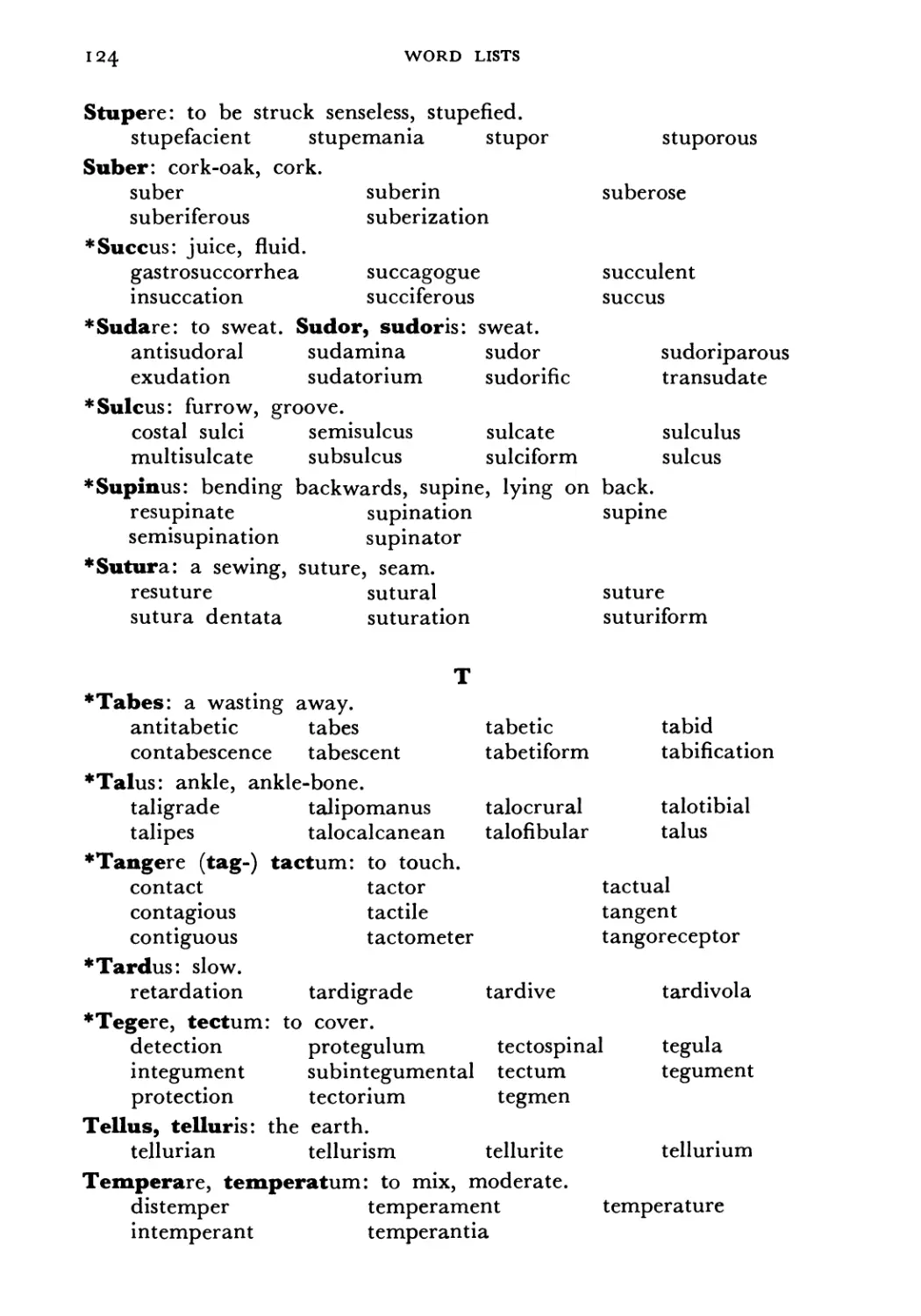
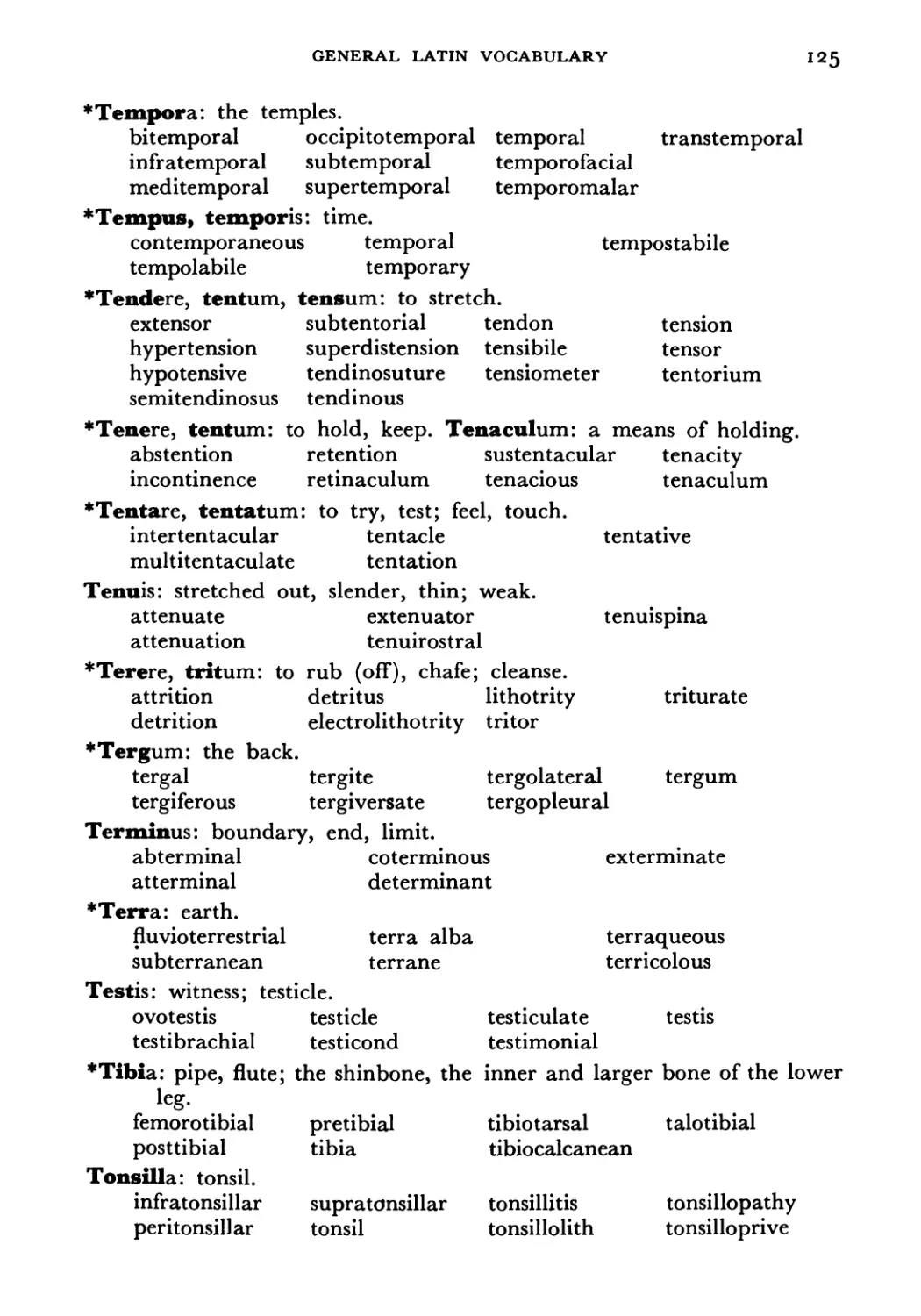

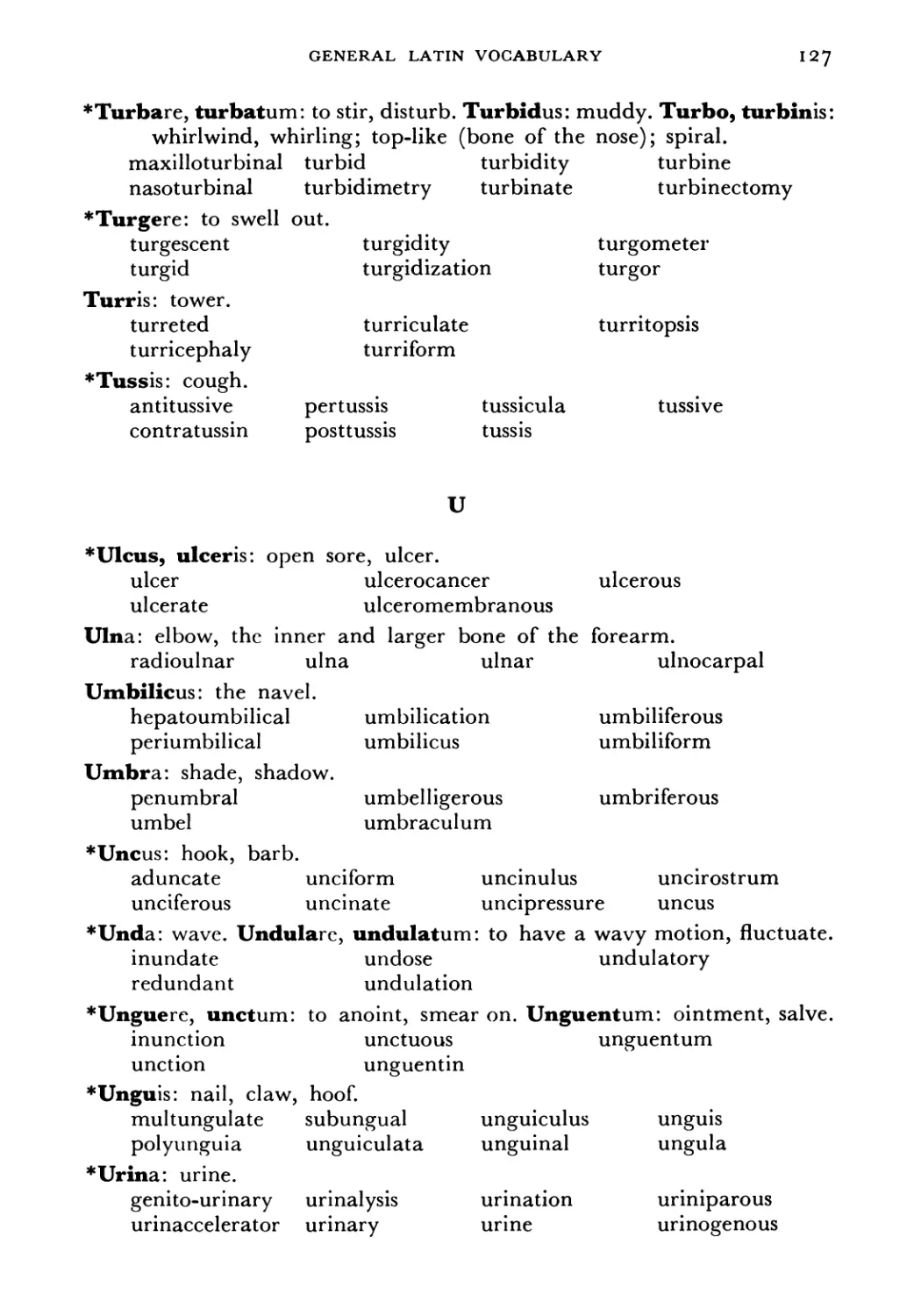


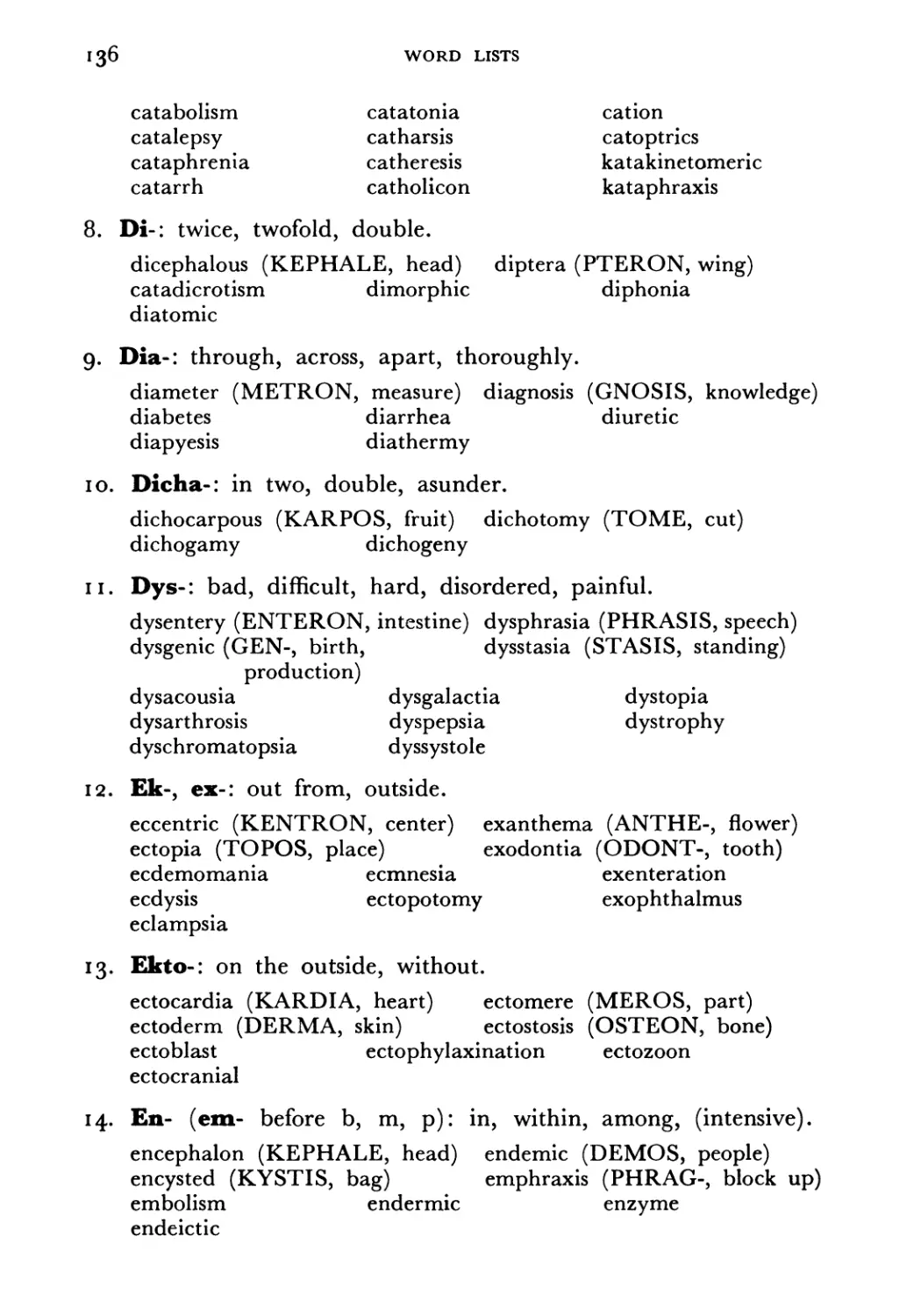


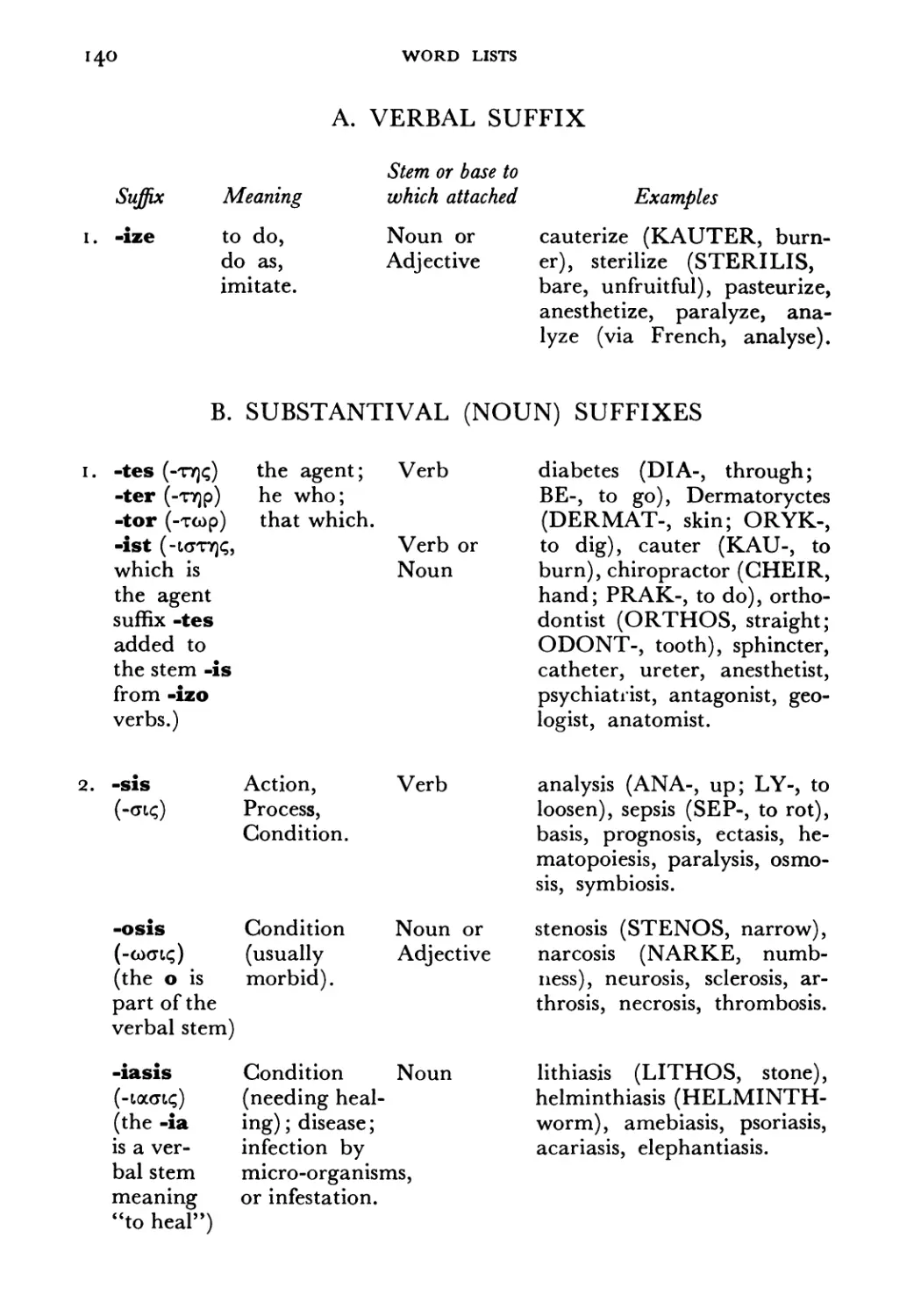


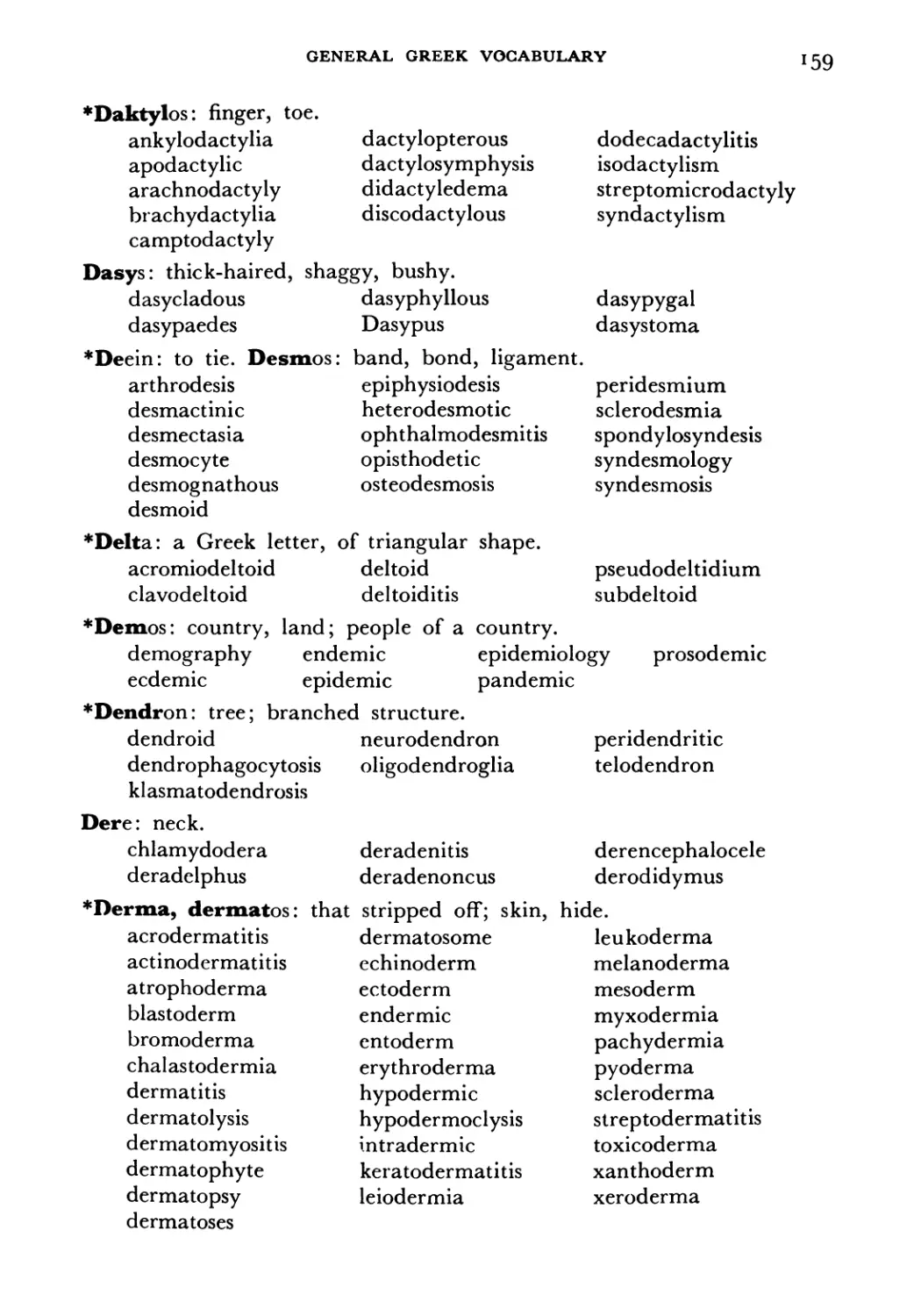


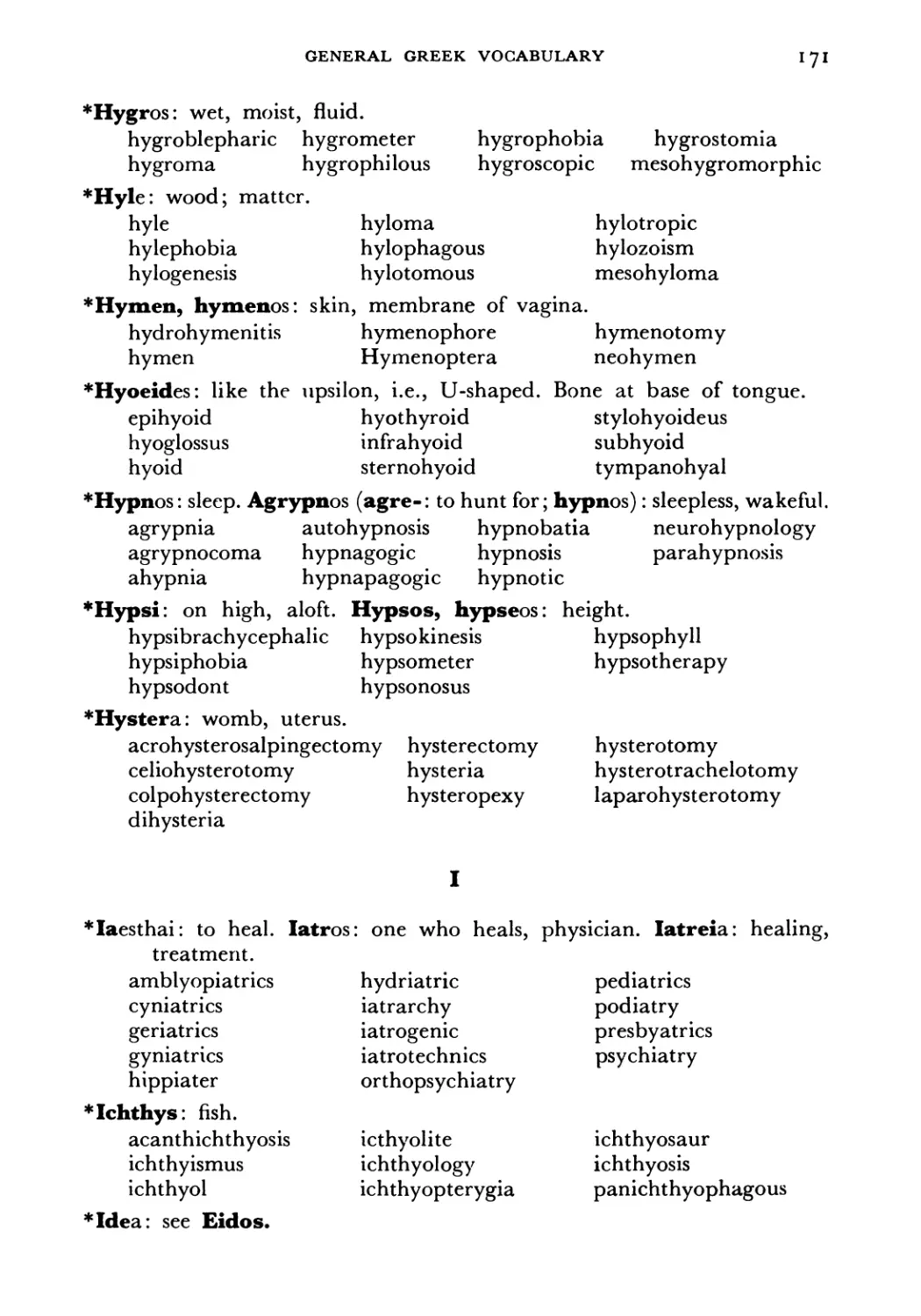

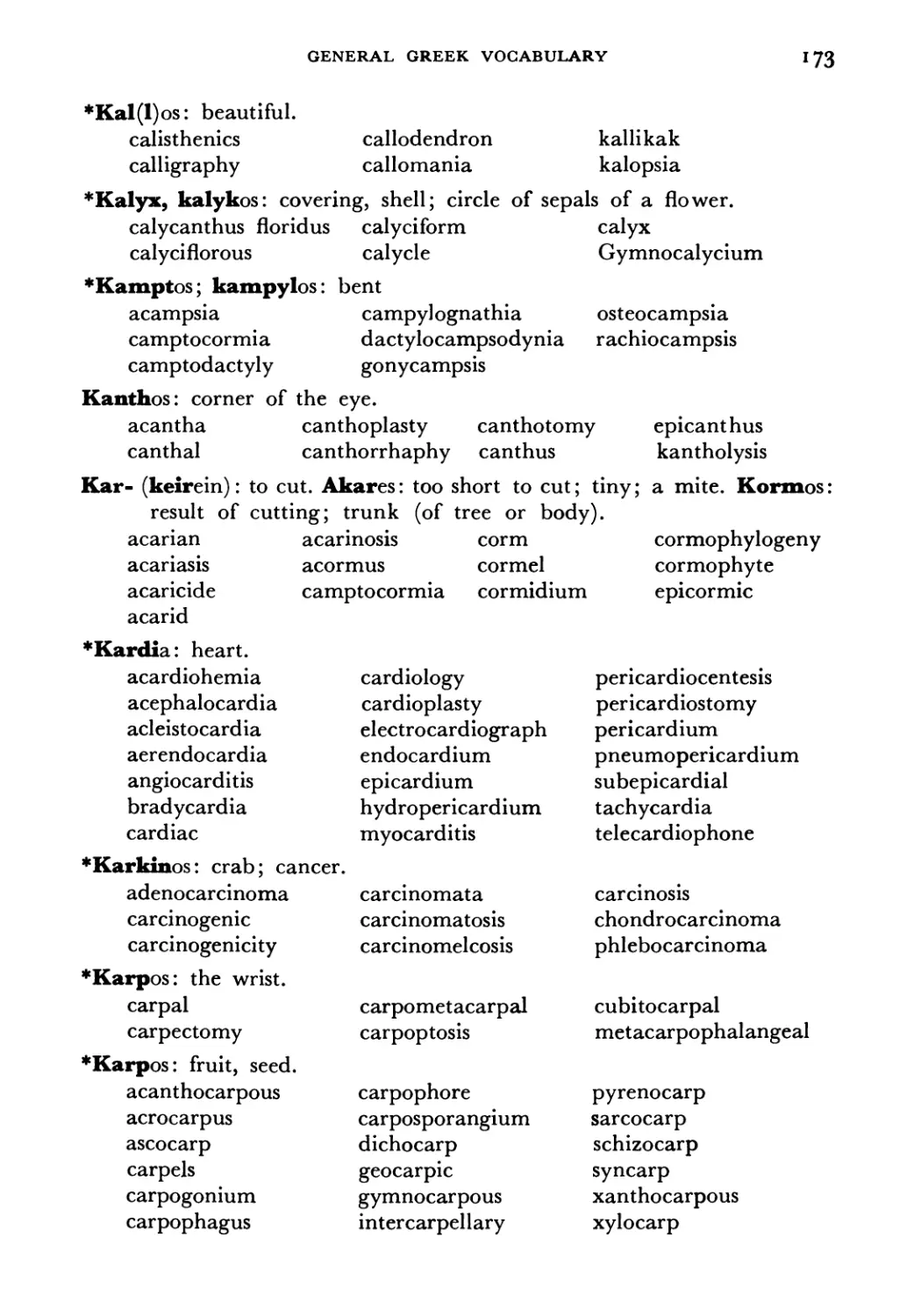



















Текст
GREEK and
LA TIN in
Scientific
Terminology
OSCAR E. NYBAKKEN
G REEK and
L A TIN in
Scientific
Terminology
OSCAR E. NYBAKKEN
Professor Emeritus
Department of Classics
University of Iowa
1+\
The Iowa State University Press, ..A-me6, Iowa
DR. OSCAR E. NVBAKKEN, Chairman of the Department of Clas-
sics at the State University of Iowa, regularly teaches classes
in the writings of Homer and Plato in the original Greek, and
a variety of courses in Latin. Besides holding the doctor of
philosophy degree from the State University of Iowa, he has
studied at Harvard and the American Academy in Rome.
He has been a trustee of the Vergilian Society of America, a
member on the Managing Committee of the American School of
Classical Studies in Athens, Greece, and president of the Classi-
cal Association of the Middle West and South. He is a member
of the American Philological Association, the Archaeological
Institute of America, the Classical Association of the Middle
West and South, and the Virgil Society of Great Britain.
Professor Nybakken has published numerous articles in the
professional classical journals of his field. For ten years he was
assistant editor of The Classical Journal. Besides authoring this
book, he is the translator of selections from Horace's Satires and
Epistles in Latin Literature in Translation (1952).
@ 1959 Oscar E. Nybakken
.-\ll rights reserved. Printed in the U.S.A.
First edition, 1959
Second printing, 1960
Third printing, 1962
Fourth printing, 1968
Fifth printing, 1970
Sixth printing, 1974
Seventh printing, 1977
Eighth printing, 1979
Library of Congress Card Number: 59-5992
International Standard Book Number: 0-8138-0720-4
v
PREFACE
. . . Nobis parienda sunt imponendaque nova rebus novis nomina.
Quod quidem nemo mediocriter doctus mirabitur, cogitans in omni
arte cuius usus vulgaris communisque non sit multam novitatem
nominum esse cum constituantur earum rerum vocabula quae in
quaque arte versentur. (Cicero, De Finibus III, 3)
"We are obliged to create a vocabulary and to find names to attach
to new discoveries. This will not cause surprise to any moderately
well-informed person, when he reflects that in every branch of
knowledge lying outside the most elementary ones there must be a
large measure of "newness" about its vocabulary. This "newness"
grows out of the necessity for each area of knowledge to express the
particular concepts with which it deals."
When Marcus Tullius Cicero, the Roman statesman, orator, and
man of letters, in the year 45 B. C. wrote the Latin words quoted
above, he revealed that the problem of finding suitable names for
things and ideas was already recognized in his day. But even as
he reflected on the problem and wrote those words so many centuries
ago, Cicero could have had only a faint idea of how many names
(nomina) would be required for identifying the enormous number of
"new things" (res novae) yet to be discovered. Pride and faith in his
own country and in its language encouraged Cicero to believe that
the Latin tongue would long be the chief vehicle of communication
and the main source of names for new phenomena and concepts.
Cicero was justified in that belief, as subsequent history has proved.
And yet it is doubtful that even the intellectual Cicero could have
predicted the great significance of the role, both direct and indirect,
which his native Latin and the antecedent Greek were to have in the
formation of languages and words to be used by mankind for the
communication of knowledge.
This book, in its broader aspect, deals with the subject of com-
munication in science. In its narrower aspect, and most particularly,
however, the book deals with the role of the Greek and Latin languages
VI
in the construction of the technical terms, names, and specific epithets
used in the medical and biological sciences. Some consideration is
given to a few of the more common linguistic and practical factors
that relate to the structure, meaning, and pronunciation of scientific
terms. The scope and arrangement of its contents are such that the
book may be used for supplementary work in courses in language or
in science, or it may be used as a textbook for a special course in
the derivation of technical terms of science and medicine.
I wish to express my sincere gratitude to The State University of
Iowa for granting me, through its Research Professorships Program,
a semester's leave from teaching duties in order to complete this
work; to the Graduate College of The State University of Iowa and
to the Iowa State University Press through whose special efforts the
publication of this materia] has been made possible; and to Norma
D. Young, Associate Professor of Physical Education at The State
University of Iowa, who read the manuscript and offered many
valuable suggestions.
Iowa City, Iowa
August, 1958
OSCAR E. NVBAKKEN
CONTENTS
SOME SUGGESTED INSTRUCTIONAL PROCEDURES
CHAPTER I. Introduction and Definitions
I. I ntrod uction
2. Definitions of Some Frequently Used Terms
CHAPTER II. Language: General and Scientific
I. General and Scientific Language
2. The Vernacular in Scientific Language
3. Some Characteristics of Scientific Nomenclature
CHAPTER III. The Latin and Greek Languages
I. Latin and Greek in Scientific Nomenclature
2. The Latin and Greek Languages. Transliteration
a. The Latin Language
b. The Greek Language
CHAPTER IV. Word Lists
I. Introduction to the Word Lists
2. Latin Prefixes
3. Latin Suffixes
4. Latin Numerals
5. General Latin Vocabulary
6. Greek Prefixes
7. Greek Suffixes
8. Greek Numerals
9. General Greek Vocabulary
10. Word-Elements Frequently Confused
CHAPTER V. Practical and l..inguistic Factors
I. Compound Words: Gender, Stems and Bases,
Combining Vowels
2. Pronunciation
VII
Pages
IX-Xl
1-8
1-2
3- 8
9- 2 3
9- 12
12- 15
1 5-23
24-6 I
24- 2 9
29-6 1
3 0 -44
44-6 1
62- 2 3 0
62-66
66-74
75- 8 3
83- 8 4
85- 1 3 1
13 2 - 1 39
1 39- 1 45
145- 1 4 6
14 6 - 22 3
224- 2 3 0
23 I -3 0 7
23 1-24 2
243- 2 49
VIII
3. Synonymy
4. Shortening, Malformations, Misnomers
5. Hybrid Words
6. Eponyms
7. Codes and Rules of Scientific Nomenclature
249- 26 3
26 4- 2 74
274- 280
280-286
28 7-3°7
BIBLIOGRAPHY
Dictionaries
Books
Bulletins and Tracts
Codes and Rules of Scientific Nomenclature
Periodicals
INDEX
3 08 -3 13
3°8-3°9
309-3 I I
3 I I
3 I I -3 I 2
3 I 2-3 I 3
3 I 5-32 I
IX
SOME SUGGESTED INSTRUCTIONAL PROCEDURES
For those who may wish to use this book as a basic text for a special
course in the nomenclature of science and medicine, the following
suggestions may be of some value:
I. Major attention should be given to the lists of Latin and Greek
words and the scientific terms derived from them. Only by learning
the meanings of more and more word-elements and by constant
practice in the recognition of those word-elements as they appear
in varying combinations in compound terms can the student acquire
the ability to compute the meanings of technical words by observing
their structure. The student's efforts in this direction should be
systematic and persistent throughout the course.
A good starting point for a systematic study of the word lists is
the list of Latin prefixes. Latin prefixes not only are the most frequently
appearing Latin elements in compound scientific terms, but many
of them are likely to be familiar to the student already. After a period
of special attention to the prefixes, the student should proceed
systematically through the rest of the word lists, learning all or most
of the words which are marked with asterisks. The same procedure
should then be followed in studying the Greek word lists. If desired,
the Greek word lists may be studied before the Latin lists.
2. The number of words to e assigned at one time must be adjusted
to the achievement level of the students and to the length of the course.
For this reason, the more important words in the General Vocabulary
lists have been identified by asterisks. In most situations, better
results will be obtained if words from the General Vocabulary lists
are assigned in several selective "rounds" rather than in an unaltered
sequence as they appear in the lists. This means that only the most
extensively used words of those marked with asterisks are selected
for study the first time through the list, and that the rest of the words
so marked are left for the second "round." When the students have
learned all the words marked with asterisks, a third "round," or
even a fourth, may include as many of the other words in the list
x
as time and class ability warrant. Such procedure will insure the
giving of maximum attention to the most valuable words, will obviate
any feeling of tedium that the learner may develop at facing an
"unending" list of words, and will enable the instructor better to
gauge the number of words that a class can effectively learn in the
time available. No omissions should be permitted in the lists of prefixes
and suffixes.
3. When studying the derivatives under a Latin or a Greek
entry-word, the student should concentrate his first attention on
those derivatives with which he is already familiar; after that, he
should take special note of those terms which incorporate word-
elements that have been studied or which will be included in the
first (and second) "round"; and finally, he should study the remaining
derivatives under the entry-word. Such progression through the lists
will enable the student to encounter as early as possible those
constructive units which he already knows or which he can most
quickly and easily learn. Those more easily learned units will then
become valuable keys in the analysis of other words. In the beginning
stages when he has yet learned only a few basic words, the student
may need considerable assistance from the instructor in analyzing
the derivative words, but the amount of such assistance should
gradually decrease as he acquires a larger vocabulary and as his
analytic ability increases with practice. The student cannot normally
be expected to analyze and define all the derivatives under the entry-
words selected, especially in cases where the derivatives are very
numerous and range over several scientific areas. Apportionment of
the derivatives, especially of the less familiar ones, among several
students will often be advisable.
4. Sufficient derivatives are given in the word lists to allow the
instructor to draw on them for periodic examination material. Items
on written examinations may be such as require: (a) the dissecting
,
of compound words into their component parts and stating the
basic meaning of each component, (b) matching scrambled terms
and definitions and (c) selecting the correct definition of a particular
scientific word from among several suggested definitions of it.
5. The student should keep a notebook in which he records the
exact definitions of a few derivatives under each entry-word. The
XI
notebook may also be used for gathering historical and linguistic
information about some of the source words and their derivatives.
6. Webster's Unabridged Dictionary and a recent comprehensive
medical dictionary should be made easily available for use by the
students. Other valuable books for reference are The Oxford English
Dictionary, specialized scientific dictionaries, International Codes of
Nomenclature, elementary Greek and Latin texts, and a standard
text on the history of medicine. These, and other reference sources,
are listed in the Bibliography of this text.
7. Concurrent with work on the word lists should be assignments
and discussions on the linguistic and practical factors treated in
Chapters I, II, III, and V. Occasionally the origin, history, form,
and meaning of single words (e.g., eponyms from classical myth,
legend, or history) or a group of related words can provide the basis
for valuable oral or written reports.
CHAPTER I
Introduction and Definitions
Introduction
Not all the difficulties encountered in the study of a science are
inherent in the subject matter; many are due to the terminology
used. In some areas of science the student may spend a year or more
in becoming acquainted with the terminology. In medicine the student
must become familiar with the terminology of several branches of
science, such as anatomy, bacteriology, chemistry, microscopy, botany,
psychiatry, and psychology. In zoology several hundreds of thousands
of separate animals have been identified and named, and every
year some two thousand new generic and ten thousand new specific
names of insects are added. Between five hundred thousand and a
million spccies of plants have been named and described. When to
this host of names arc added those of diseases, drugs, and min-
erals, the numbcr of names and technical words currently required
in scicntific spcech runs into the millions. I A vocabulary already
so cxtcnsivc and still growing rapidly constitutes a problem of
considerable magnitude in some scientific areas and a burden of
no mean proportions for the prcsent-day student of science.
The purposc of this book is to furnish information and material
which will aid in rcducing the vocabulary burden for the student
of biology and nlcdicine. I ts twofold objective is (I) to increase the
student's facility in detcrmining the mcaning of scicntific words by
analyzing their structure, and (2) to encouragc the studcnt to establish
sound nomenclatural criteria for himself and his profession.
The nature and thc scope of the book's contcnts have been largcly
I. Jour. Arner. Med. Assn. CXII, 1939, 1843. Edmund Andrews, A History of Scientific English,
pp. 6 and 312. L. H. Bailey, "Problems in 1"'axonomy," A mer . Jour. Botany XXXVI, 1949, 22.
2
INTRODUCTION AND DEFINITIONS
determined by the fact that the ancient Greek and Latin languages
underlie both the structure and the meaning of most of the technical
names and terms used in biology and medicine. Moreover, all
scientific names of plants, bacteria, and animals have been latinized
and are therefore, in effect, Latin words whose structure, inflection,
and syntax are governed by the rules of classical Latin. For these
reasons, only Greek and Latin words and scientific names and terms
derived from them have been included in the word lists and, with
few exceptions, the words used for illustrative purposes throughout
the book are words of Greek or Latin origin. Of the numerous principles
of word formation and inflection in the Grcek and Latin languages,
however, only those have been outlined in this text which have
had the most direct and extensive application to the construction
and the form of modern biological names and terms.
In order to attain its primary objective, and in order to meet the
student's most immediate and practical need, this book seeks above
all else to provide in ample quantity the kind of material necessary
for learning those Greek and I atin roots, stems, and affixes which
recur most often in the technical terms of medicine and biology.
Thesc essential working materials are furnished in several word
lists which contain the Greek and Latin source words and samples
of modern scientific names and terms derived from them. In seeking
to achieve its secondary objective, the book contains discussions on
certain aspects of biological nomenclature which relate directly or
indircctly to the origin and the structure of technical terms. Some
of the affiliated topics discussed are synonymy, hybrid terms,
international codes of nomenclature, eponyms, and pronunciation.
If studcnts at an early stage in their studies acquire an awareness
of past and present usagcs in scientific nomenclature and an
apprcciation of what are desirable and what are undesirable practices
in the formation of scientific terms, it can reasonably be hoped that
in time thcre will be general agreement among scientists about what
constitutes sound onomatological practices. The happy result will
be that word coinages will rarely result in haphazard terms to add
wcight to an already heavy burden, but will instead be distinguished
mcmorials to scientists who believed that the name applied to a
disease, treatmcnt, drug, plant, or animal should be a help rather
than a hindrance to clcar and cffective communication of ideas.
DEFINITIONS OF SOME FREQUENTLY USED TERMS
3
Definitions of Some Frequently Used Terms
Throughout the discussions in this book certain terms are used
repeatedly. In order that these terms may be fully understood whenever
they appear, the following definitions and illustrations of them are
.
gIven:
I. ROOT
A ROOT is that primitive and fundalnental verbal element which
expresses the basic meaning or suggestion that is common to all
the words of a related group; it is the .core from which several
differentiated words (e.g., nouns, verbs, adjectives, and adverbs)
spring up by the addition of formative elements such as prefixes,
infixes, and suffixes. For example:
Gen- (Gk. gignesthai; Lat. gignere): beget, come into being, be born, become.
autogeny
exogenous
gene
Sta- (Gk. histanai;
amyostasia
hypostasis
instability
Spec- (Lat. spectare or -specere): see, look at, spy.
introspection specialist specific
perspective species specimen
genealogy
generation
genesIs
genus
indigenous
. .
IngenIous
oxygen
progeni tor
Lat. stare): stand, set.
stable stamen
stagnan t static
stature
status
spectrum
speculum
2. STEM
The STEM is that part of a word to which inflectional endings
are attached. Because of morphological and phonetic changes (e.g.,
elision, assimilation) that take place when inflectional endings are
added, the stem of a Greek or Latin word is not always apparent
in the form of the word that is first presented by a dictionary or
textbook.
WORD AND
MEANING
STEM
WORD AND
MEANING
STEM
alga, seaweed
fungus, fungus
alga-
fungo-
soma, body
helm ins, worm
somat-
helminth-
4
INTRODUCTION AND DEFINITIONS
genes-
gere-
gest-
Some stems are SEPARABLE; that is, they may be used alone or
in combination with other stems, prefixes, or suffixes. For example:
radix, root
lithos, stone
radic-
litho-
genos, birth, race
gero, bear, carry
askos (stem, asko-), bag, sack:
ergon (stem, ergo-), work:
ascus; ascocarp
erg; asynergIa
Some stems are INSEPARABLE; that is, they aiways appear in
combination ",,'ith other stems and are never used alone, even though
they may have independent meanings. For example:
algos (stem, alg( es) - ), pain:
algesthesia, cardialgia; but not "algus"
alone
injection, trajection; but not "jection"
alone
-jectum (stem, jecto-), throw:
3. BASE
The terms RASE and STEM are often used synonymously.
Linguistically, however, only STEM has validity. But BASE is a
convenient designation for that part of an inflected word which
remains unchanged so that, even though it has no scientific linguistic
value, BASE does have a practical value in simplifying explanations
of word construction. In the examples below, it will be noted that
the BASE and the STEM of a word may be alike but that more
often they differ in that the STEM ends in a vowel and the BASE
ends in a consonant.
GREEK OR LATIN STEM BASE DERIV A TIVES USING
WORD BASE
mensa, mensae, table mensa- mens- mensal, commensal,
commensalism
lac, lactis, milk lact- lact- lactary, lactiferous,
ablactation
kyklos, kyklou, circle kyklo- kykl- cyclostomate, heteroryclic
sarx, sarkos, flesh sark- sark- entosarc, sarcohydrocele
scribere, scriptum, write scribe- scrib- prescribe, nondescript,
scripto- script- superscription
facere, factum, make, do face- facie- calorifacien t, factor
facto- fact-
DEFINITIONS OF SOME FREQ,UENTL Y USED TERMS
5
4. PREFIX
A PREFIX is an element attached to the beginning of a root,
stem, or base. lts function is to elaborate, qualify, or intensify the
meaning of a word. It consists of one or more syllables and is generally
derived from a preposition or an adverb. For example:
PREFIX
IN COMPOUND WORD
transocular (oculus, eye)
permeate (meare, to go)
hypertrophy (trophe, nourishment)
entophyte (phyton, plant)
trans, across
per, through
hyper, over
ento, within
The term PREFIX s"hould not be applied to noun, verb, or adjective
stems which are used as the first component of compound words;
in "laterocervical" (latus, lateris, side), for example, latero- is not a
PREFIX even though it is "prefixed" to another word.
5. SUFFIX
A SUFFIX is an element of one or more syllables attached to
the end of a root, stem, or base. In addition to contributing its own
particular meaning to a word, a suffix may also indicate part of
speech, gender, case, number, person, tense, mood, or voice.
STEM OR BASE
flex- (bend)
sanat- (heal)
steno- ( narrow)
enter- (intestine)
SUFFIX
-or (that which)
-orium (place where)
-sis (condition of)
-itis (inflammation)
WORD
flexor
sanatorium
stenosis
enteritis
6. COMBINING VOWEL AND COMBINING FORM
A COMBINING VOWEL is used between two constructive units
of a compound word in order to join them euphoniously. The vowels
most commonly used are 0 and i, although the other vowels also
occur. For example:
hydr- (water) plus phob- (fear) == hydrophobia.
anthrop- (man) plus metr- (measure) == anthropometry.
arch- (chief, main) plus blast- (germ cell) == archiblast.
6
INTRODUCTION AND DEFINITIONS
sudor- (sweat) plus fic (make) == sudorific.
cervic- (neck) pi us faci- (face) == cervicofacial.
jlav- (yellow) plus bacteri- (bacteria) == Flavobacterium.
A COMBINING VOWEL is ordinarily not used when the second
constructive member of a compound word begins with a vowel or
a diphthong. For example:
mes- (middle)
plus enter- (intestine) == mesenteron.
plus odont- (tooth) == mesodont.
plus ambulat- (stroll) == noctambulation.
noct- (night)
In some words, however, a COMBINING VOWEL has been
used even if the second member begins with a vowel. For example:
gastr- (stomach)
dextr- (right)
plus enter- (intestine) == gastroenteritis.
plus ocul- (eye) == dextraocular.
A COMBINING FORM is a base plus the combining vowel.
In the examples used above, the combining forms are: hydro-, anthropo-,
archi-, sudori-, cervico-, flavo-, meso-, gastro-, and dext1"a-.
7. VOWEL GRADATION (ABLAUT)
VOWEL GRADATION, or ABLAUT, are terms applied to
changes in the root vowel of closely related words. Such changes
can be observed in groups of English words like sit, sat, seat, set; tell,
told, tale; sing, sang, sung, song; ride, rode, ridden; spring, sprang,
sprung. The same sort of change occurred also in closely related Greek
and Latin words and is reflected in their English derivatives. For
example:
annus (year); perennis (perennial): annual, perennial.
facere (to do); deficere (to fail to do): factual, deficient.
pherein (to carry); phoros (a carrying): periphery, phosphorus.
8. ELISION
ELISION is the omission or the suppression of a vowel when one
word element ending in a vowel is prefixed to another element
DEFINITIONS OF SOME FREQUENTLY USED TERMS
7
beginning with a vowel. The first element usually loses its final vowel.
For example:
magno- (large) plus anzmus (mind) == magnanImous.
epi- (upon) plus arteria (artery) == eparterial.
9. TRANSLITERATION
TRANSLITERATION is the tranSposItIon of a word from one
language into another. For example:
GREEK LATIJV ENGLISH
<i(J.ot amoeba ameba
,
XOXx.o coccus coccus
10. LOAN WORDS
LOAN WORDS are foreign words which have been adopted into
English (or anothcr language) without any change in spelling. Some
familiar examples are apex, antenna, fistula, canccr, serum, genesis,
basis, onyx, cosmos, zone, calyx.
II. DERIVATIVES AND COINED WORDS (NEOLOGISMS)
DERIVATIVES are words obtaincd from other languages by
slightly modifying the spelling of the original word, or by combining
several forcign word elements into ncw words. COINED WORDS,
or NEOLOGISMS, arc words which did not exist in the parent
languages from which their elemcnts wcrc drawn. Most derivatives
in modern scientific tcrminology arc NEOLOGISMS. For cxample:
FOREIGN VORDS OR
UlORD-ELEMENTS
ocularis (pertaining to the eye)
habitus (condition of body)
konos (cone)
strept- (twisted); cocc- (berry)
koin- (common); trop- (turn)
olig- (few); erythr- (red); cyt- (cell); h(a)em-
(blood); -ia (state or condition)
DERIV t TIVES
ocular
habit
cone
streptococcus
koinotropic (or coenotropic)
oligoerythrocythemia
8
INTRODUCTION AND DEFINITIONS
12. HYBRID WORDS
A HYBRID WORD is one constructed from elements derived
from more than a single language. For example:
tele- (Greek, far off) plus vis- (Latin, see) == television.
hyper (Greek, excessive) plus irritabil- (Latin, irritable) == hyperirritability.
hom- (Greek, same) plus later- (Latin, side) == homolateral.
mlcr- (Greek, small) plus teeth (English) == microteeth.
acid- (Latin, acid) pi us phil- (Greek, love) == acidophil.
CHAPTER II
Language: General and Scientific
General and Scientific Language
Language is man's chief medium of communication and makes
possible the expression and preservation of a vast number of facts
and ideas. Over the centuries many different languages have developed,
so that human knowledge finds expression in many tongues. Ordinarily,
however, a person acquires and transmits most of his knowledge
through the use of his native language.
As knowledge and ideas increase and change, there is a
corresponding increase in the number of words which a language
contains. Every new discovery requires a name (nnmen) as a mnemonic
necessity, and minor changes are constantly being made in some of
the words which already exist. Language is therefore vital and changing
and is not a static phenomenon.
As an instrument of communication, the English language has
adapted itself to diverse requirements. "Vernacular English" is the
designation which has been applied to the ordinary speech used
by the large majority of the population in dealing with the basic
and elementary aspects of living. This branch of English is said to
be largely the possession of the masses since they have made and
continue to make that phase of the language what it is. No
authoritarian controls are imposed upon the English language. The
Oxford and the Webster dictionaries and scholars and teachers of
language constitute the only court of appeal in regard to the sound,
form, and meaning of English words. But dictionaries and scholars
exercise only voluntary controls, so that English words undergo
changes in spite of them. Changes in words can therefore be observed
10
LANGUAGE: GENERAL AND SCIENTIFIC
from one part of a country to another, from one period of time to
another, and from one person to another, even at the same time and
in the same place. And in the area of vernacular English, the spoken
word is usually more influential than the written form in determining
the character of the language.
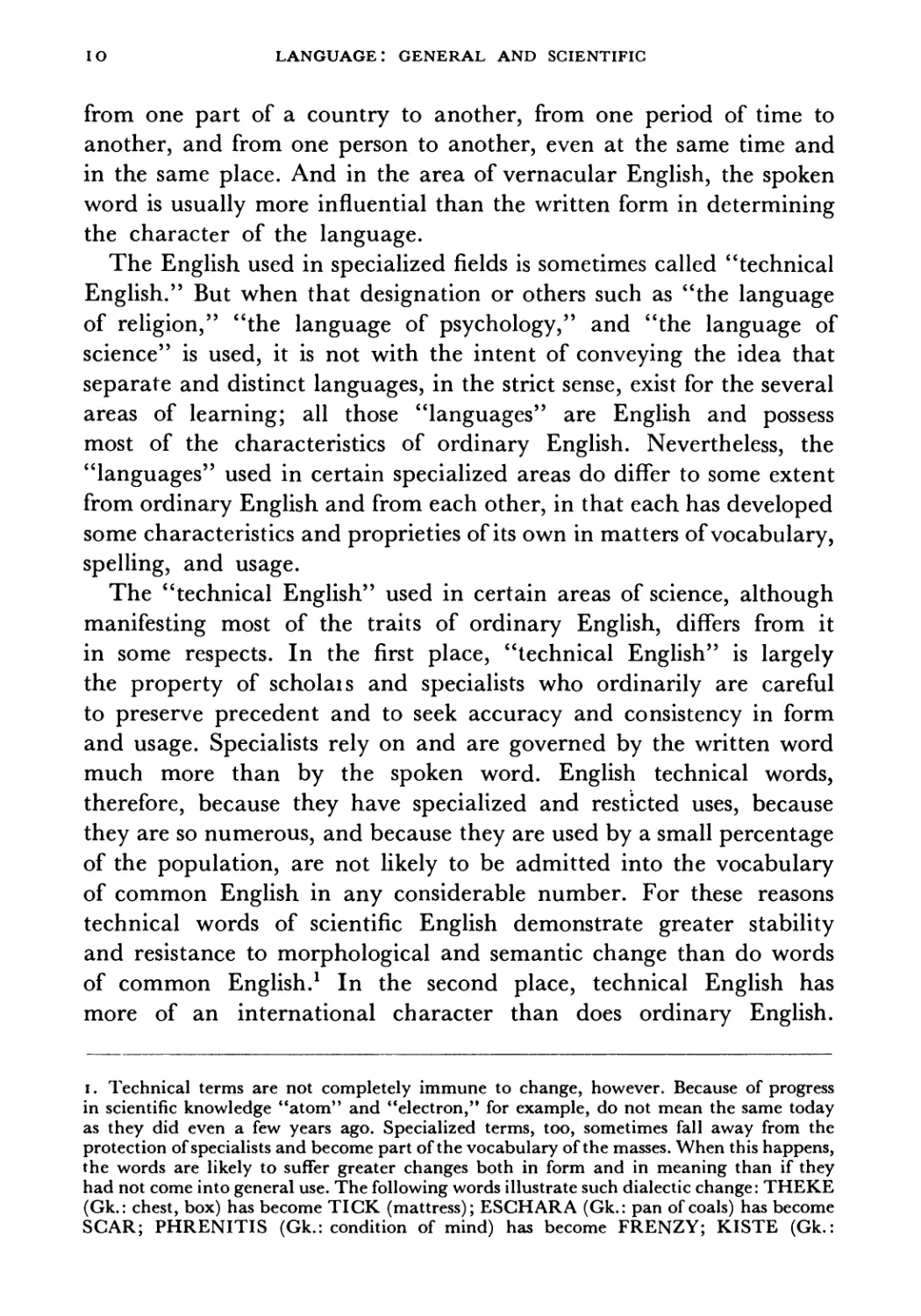
The English used in specialized fields is sometimes called "technical
English." But when that designation or others such as "the language
of religion," "the language of psychology," and "the language of
science" is used, it is not with the intent of conveying the idea that
separate and distinct languages, in the strict sense, exist for the several
areas of learning; all those "languages" are English and possess
most of the characteristics of ordinary English. Nevertheless, the
"languages" used in certain specialized areas do differ to some extent
from ordinary English and from each other, in that each has developed
some characteristics and proprieties of its own in matters of vocabulary,
spelling, and usage.
The "technical English" used in certain areas of science, although
manifesting most of the traits of ordinary English, differs from it
in some respects. In the first place, "technical English" is largely
the property of scholals and specialists who ordinarily are careful
to preserve precedent and to seek accuracy and consistency in form
and usage. Specialists rely on and are governed by the written word
much more than by the spoken word. English technical words,
therefore, because they have specialized and restlcted uses, because
they are so numerous, and because they are used by a small percentage
of the population, are not likely to be admitted into the vocabulary
of common English in any considerable number. For these reasons
technical words of scientific English demonstrate greater stability
and resistance to morphological and semantic change than do words
of common English. 1 In the second place, technical English has
more of an international character than does ordinary English.
I. 1'echnical terms are not completely immune to change, however. Because of progress
in scientific knowledge "atom" and "electron," for example, do not mean the same today
as they did even a few years ago. Specialized terms, too, sometimes fall away from the
protection of specialists and become part of the vocabulary of the masses. When this happens,
t he words are likely to suffer greater changes both in form and in meaning than if they
had not come into general use. The following words illustrate such dialectic change: THEKE
(Gk.: chest, box) has become TICK (mattress); ESCHARA (Gk.: pan of coals) has become
SCAR; PHRENITIS (Gk.: condition of mind) has become FRENZY; KISTE (Gk.:
GENERAL AND SCIENTIFIC LANGUAGE
I I
Many of the words used in technical English writing are identical
or nearly identical in form and meaning with words used in scientific
treatises written in other languages. The number of such words which
are "common" to several languages is considerably larger in technical
English than it is in ordinary English. This fact makes scientific
writing approach the character of an international medium of
communication. The amount of this "common" element will vary
with the particular language involved and with the subject matter
treated: in mathematics, physics, astronomy, and chemistry, for
example, the amount is large; in some branches of the biological
sciences the amount is only slightly less; in literature, economics,
and politics, on the other hand, the amount of such "common"
elements is much smaller than it is in most areas of the natural sciences.
The two pairs of descriptive passages below will serve to illustrate
this characteristic of technical English. The same information is
recorded, first in French and then in English. It will be seen that
technical words (in italics) constitute a high percentage of the
total vocabulary and that they are almost identical in form in both
languages.
. . . la situation des differents territoire evolue profondement au cours
de la gastrulation: Ie chordo-mesoblaste s'invagine completement, ainsi
d'ailleurs que l' entoblaste; du cote dorsal, Ie materiel chordal est etroite-
ment applique contre Ie systeme nerveux prcsomptif; il forme Ie
toit d'une cavite, I'archenteron, qui occupe Ie centre de I'embryon. Quant
au blastocele, il s'est rcduit a I'etat de cavite virtuelle. (Jean Brachet,
Embryologie Chimique, pp. 358-59).
. . . the location of the different areas changes profoundly during
gastrulation. The chorda-mesoderm invaginates completely, as does
the entoderm. On the dorsal side, the notochord material is in direct
contact with the presumptive nervous system, and forms the roof
of a cavity, the archenteron, which is centrally located. The cavity of
the blastocoel is eventually obliterated. (J ean Brachet, Chemical
Embryology [translated by Lester G. Barth] p. 345).
L'etude de l' acide ribonucleique montre que les spermatogonies ont un
cytoplasme beaucoup plus basophil que Ies spermatocytes, tandis que
box, chest) has become CHEST; PARALYSIS (Gk.: loosening, paralysis) has become
PALSY; and KYNANCHE (Gk.: dog-collar) was heard as SYNANKE, which in Middle
Latin became QUINANCIA, then SQUINANCHIA, and finally QUINSY.
12
LANGUAGE: GENERAL AND SCIENTIFIC
les spermatozoides murs ne prcsentent qu'une faible colorabilite du
flagelle. (Ibid., p. 86).
The study of ribonucleic acid shows that the spermatogonia have a
cytoplasm much more basophilic than the spermatocytes, while the
mature spermatozoa show only a weak coloration of the flagellum. (Ibid.,
p. 86).
The Vernacular in Scientific Language
There have always been advocates of the view that scientific theory
and fact should be expressed in the vernacular of the country, that
is, in the ordinary language of the citizen whether that language
happens to be English, German, French, Spanish, or any other.
"Why," asks a person whose native tongue is English, "should a
scientist say or write 'Quercus alba' instead of 'white oak,' or 'Apis
mellifera' instead of 'honeybee,' or 'rubella scarlatinosa' instead of
'measles,' or 'hepaticolithotomy' instead of 'cutting out a liver stone,'
or 'mesogaster' instead of 'mid-gut'? Is 'Pisum sativum' better than
'the cultivated pea,' or 'Rhizopus nigricans' better than 'black bread
mold'? If the vernacular instead of the technical terms were used,
scientific language would be greatly simplified and meanings could
much more easily be conveyed to more people." The adovcates of
this viewpoint usually point out that in the area of anatomy, for
example, many unfamiliar and difficult technical terms have been
substituted for common and familiar words (e.g., dactylus for finger;
articulus for joint; gingiva for gum; ischium for hip), and from general
medical language they cite such pairs of words as those below to
illustrate how use of the technical instead of the popular terms results
in concealment rather than in clarification of meaning.
wristdrop carpoptosis midbrain mesencephalon
eye tooth upper canine cuspid bridge pon tic
heart hurry tachycardia (dentistry)
hindbrain metencephalon swimming bells nectocal yxes
hindkidney metanephros needle holder acutenaculum
heartometer cardiometer foregut prosogaster, or
hairache trichalgia protogaster
lousiness pediculosis squint strabismus
THE VERNACULAR IN SCIENTIFIC LANGUAGE
overfeeding
overgrowth
superalimentation
hypertrophy, or
h yperplas ia
calvities, alopecia,
or atrichia
windpipe
thirst
baldness
13
dipsosis, or
polydipsia
trachea
Sometimes single words combine technical and vernacular clements.
Those who advocate a technical vocabulary for science say that
such terms have "suffered only partial plebification"; for example:
midcarpal mesocarpal megabladder cystauxe
macroteeth macrodontia spontaneous archegony, arche-
fibro-fatty fi bro-adi pose generation biosis, or arche-
genesIs
lousicide pediculicide
Some of the rcasons for objecting to the use of vernacular terms
in scientific language will be made apparent in the discussions of
the charactcristics of scicntific nomenclature and the use of Greek
and Latin in the composition of tcchnical terms \Pp. 15-23; 26-29;
29 I). The most common objections may be stated bricfly as follows:
I. A common word is usually less descriptive of the entity or
concept which it names than a technical word is; compare, for example,
the following pairs of synonymous words:
atavism (atavus, ancestor)
epidermis (epi, upon; derma, skin)
pachyderm (pachys, thick; derma, skin)
rhizodontropy (rhiza, root; odont-, tooth;
trope, pivot)
fi bula (Cibula, brooch)
throwing-back
scarf-skin
elephant
crowning (a tooth)
shank
Occasionally, however, ordinary terms are just as descriptive as
technical terms. In the following comparisons, for example, neither
term has much advantagc over the other if vicwed only with rcspcct
to its descriptiveness and economy:
cephalalgia (kephalos, head; algos, pain)
Melanoplus femur-rubrum (melano-, black;
hoplon, armor; Cemur, thigh; ruber, red)
pedodontia (paid-, child; odont-, tooth)
headache
red-legged grasshopper
children's dentistry
14
LANGUAGE: GENERAL AND SCIENTIFIC
Geomys bursarius (ge-, earth; IDYS, mouse;
bursa, pocket)
acutenaculum (acus, needle; tenaculum,
holder)
pocket-gopher
needle holder
In the particular examples given above, the vernacular terms,
in addition to being as descriptive as the technical terms, will also
be more readily understood by English-speaking people. But this
is not true of most vernacular terms. Moreover, when precise language
is required for complex structures and processes, words of the
vernacular English usually prove inadequate. For many important
scientific entities common names do not even exist.
2. The vernacular term is usually less precise than the technical
term and often has several meanings. "Hindbrain," for example,
may refer to (a) the cerebellum, (b) the cerebellum and the pons,
(c) the medulla oblongata, or (d) the rhombencephalon.
3. A term from the vernacular, or a folk-term, often carries with
it an emotional meaning which may be inappropriate or even harmful;
the corresponding technical term is free from this affective meaning.
Compare, for example, cheiloschisis (CHEILOS, lip; SCHISIS,
cleft) and harelip; rhizodontropy (RHIZA, root; ODONT-, tooth;
TROPE, pivot) and peg-tooth; pediculous (PEDICULUS, louse;
-os US, full of) and lousy. The many words used in ordinary language
for phallus, anus, and flatus strikingly illustratc this character of
popular language. 2
4. Sometimes numerous popular names exist for the same entity;
this results in vague and inconsistent language.
5. Words of popular speech are less stable than technica words
and may vary in spelling and in meaning from place to plac , from
period to period, and from person to person.
6. The acceptance of vcrnacular terms in scientific writing usually
rcsults in an unpleasant mixture of technical and nontcchnical words.
For example, a periodical article or a book may consistently use
"wristdrop" instead of "carpoptosis" and yet never use "windpipe"
instead of "trachea."
2. cr. Edmund Andrews, llzstory oj" Scientific Englirh, Chap. 15.
SOME CHARACTERISTICS OF SCIENTIFIC NOMENCLATURE 15
7. Written treatises which use vernacular words for scientific
concepts and phenomena lose much of their value to foreign readers.
The words "Melanoplus femur-rubrum" and "Geomys bursarius,"
for example, (used as examples in (I) above) would have many
advantages over their corresponding vernacular English words
("red-legged grasshopper" and "pocket-gopher") in that they are
international and would be spelled exactly the same in Chinese,
Hindi, Japanese, French, German, or Russian.
Some Characteristics of Scientific Nomenclature
A nomenclature implies that some systematic scheme is employed
in the naming of things. Viewpoints on whether any system of naming
is necessary at all, or on what the system ought to be, vary widely
from those favoring the use of random names to those demanding
descriptive and carefully chosen euphonious terms. Sonle persons
argue that a name is merely a name; that it is a tag by which something
is identified and that it is unimportant what the tag is. Others argue,
equally fervently, that the name applied to anything should be
meaningful and appropriate. In such areas as mathematics, physics,
and logic, satisfactory solutions to the problem of cumbersome
terminologies have been found in the partial or almost exclusive
use of symbols intead of words. For a while vitamins were identified
by letter and number, but more recently the tendency is to use words.
Not all scientific fields have the same nomenclatural requirements;
each field has peculiar needs of its own. The requirements in the
concrete sciences which deal with material things are not the same
as those for the abstract sciences. Sometimes specialties within the
same field have differing requirements. In the field of biology an
important nomenclatural problem has been to get a genus-species
terminology that would differentiate and classify animals and plants.
In medicine, on the other hand, the problem of classification has
been less important than that of indicating causes, processes,
procedures, and effects. In chemistry, as in biology, the primary
function of the nomenclature is to differentiate kinds, whereas in
dentistry it is to attach meaningful and correctly descriptive terms
to concepts, anomalies, and processes. Most branches of the biological
16
LANGUAGE: GENERAL AND SCIENTIFIC
and medical sciences, however, in spite of some differences in their
particular requirements, share several nomenclatural desiderata.
Some of these desiderata are:
Precise and Restrained Descriptiveness
A good scientific term will not be merely an arbitrary tag, but
will suggest as clearly and as fully as possible the characteristics of
the concept or thing to which it is applied. Seldom can a term fully
describe a structure, anomaly, process, function, or effect, but it
can generally supply a thumb-nail sketch or a shorthand description.
The descriptiveness should be as precise as possible, suggesting the
essential characteristic which differentiates the concept to which
the word is applied from all other concepts; irrelevant or uncertain
details should not be suggested. If, for example, the cause of a
pathological condition is not known, the term used to describe that
condition should not seek to make any etiological designation. And
since there is no theoretical limit to the number of descriptive
components that can be built into a compound word, restraint and
moderation must be used. Attempting to make reference to too many
characteristics, or to those which are not rather firmly established,
will result either in cumbersome words or in terms which in a short
time may prove to be ill-suited to the thing named.
Perhaps the most highly developed descriptive nomenclature in
science is that used in chemistry and in pharmacology. Even without
any previous knowledge about a particular compound, a chemist
can, by observing the name of a compound, write out its chemical
formula. The terms butyl-para-aminobenzoate, I 7-hydroxy- I I -dehydrocortico-
steronacetate, and 2-isobutyl-aminoethyl-para-aminobenzoate, for example,
are good names insofar as they are descriptive of the structures of
the compounds to which they are applied. But the names lack restraint,
economy, and convenience and are difficult to pronounce, and in
recognition of these deficiencies, abbreviated or proprietary names
are used: butesin, cortisone, and butethamine. Sulfa for sulfanilamide is
another example of such shortening. Terms thus shortened are less
precisely descriptive than the longer ones, but they gain much in
economy, convenience, and ease of pronunciation. In effect, therefore,
a nomenclature that is highly descriptive may become nondescriptive
SOME CHARACTERISTICS OF SCIENTIFIC NOMENCLATURE 17
because of the necessity of adjustment to meet other nomenclatural
desiderata.
The basis for naming a chemical compound is the content and
structure of the compound. For that reason, a descriptive term which
attempts to designate all the elements of a chemical compound may
often be a long word. On the other hand, because all the word elements
used in the construction of chemical terms uniformly refer to substances,
the nomenclaure of chemistry is consistent and homogeneous - a
situation which does not obtain in most of the other branches of
science. In the medical and the biological sciences the entities and
characteristics to be designated by descriptive terms range over a
large number of heterogeneous factors such as size, color, movement,
cause, effect, and degree. Under such conditions the difficulty of
att.aining a logical and precise descriptiveness in the nomenclature
is much greater than it is in areas where fewer and more homogeneous
factors have to be taken into account. Because of the large number
of identified plants and because of. the practice of cross-breeding
genera and spe,cies, the problem of naming plants has become so
complex that a different name has sometimes been procured or a
species by the use of an anagram or by inverting some letters of the
standard word (e.g., Muilla instead of Allium). Common or "fancy"
names (i.e., words from the common or vernacular language) have
been permitted for plants arising in cultivation through hybridization
and not numerous enough in the wild to justify botanical recognition,
(in "Sedum spectabile 'Brilliant'," for example the cultivar or "fancy"
name is 'Brilliant')3. Since it is obvious that there are severe limitations
to the descriptive power of a single word and since a very large number
of factors may be involved in a structure or process for which a name
is sought, it is sometimes impossible to get a single word that will
possess the qualities of restrained and precise descriptiveness. In
extremely complex structures, phenomena, or processes, only
descriptive phrases using several words will suffice. In such cases
scientists sometimes resort to acrostic, telescoped, or arbitrarily
fabricated and meaningless words: ACTH, for example, is a sort
of acrostic for "adrenocorticotropic hormone," and Zdeac, in dental
3. cr., J. Lanjouw et al., International Code of Botanical Nomenclature (Utrecht, Kemink en
Zoon N. V., 1956), Article 28.
18
LANGUAGE: GENERAL AND SCIENTIFIC
vocabulary, means "zone of disintegrating epithelial attachment
cuticle." Such words are not descriptive at all, but they do possess
certain other desirable nomenclatural qualities.
Orientation to Its Own and Related Areas
A term is well oriented if it reveals readily its connection and relation
with other concepts in its own area and in other closely related areas.
In the binomial and trinomial nomenclature of the biological sciences,
good orientation is achieved by the use of the two- or three-word
designations of animals and plants. However, because orientation
and classification are so important to the nomenclature of those
areas, there is some danger that too little attention be given to other
important factors in the naming process, such as to structure, process,
quality, and procedure.
Even in areas where names are only single words, good orientation
can be achieved through the use of a sort of "genus-species-variety"
method of designation. By careful use in a word of one or more of
the component elements used in other related words, the relationship
between the several words as well as the special significance of each
will be indicated. For example:
occlusion ("genus")
malocclusion ("species")
neutrocclusion I
mesiocclusion ("variety")
distocclusion
Such words as those in the following groups may also be regarded
as well oriented: (a) gnathic, prognathism, eurygnathic, micrognathia,
pachygnathous; (b) leukopenia, glycopenia, chloropenia, thrombocytopenia
( c) cholecystitis, cholecystogram, perichole0'stic.
Good orientation of terms in a scientific area also requires careful
observation of the terminology used in closely related branches of
science so that words common to both areas may be harmonized
in form and in meaning. If, for example, anatomists regularly use
"deciduous premolars," it would seem questionable for dentists to
use "deciduous molars" to identify the same teeth; or, if the regular
term in anatomy for "broad-headed" is "eurycephalous," it would
SOME CHARACTERISTICS OF SCIENTIFIC NOMENCLATURE 19
seem unwise for psychiatry to use (as it does) "brachycephalous"
to designate the same condition.
A nomenclature which uses well-oriented terms is much more
than a mere recording technique; it furnishes indications of important
interrelationships and differences and thereby assists significantly in
the organization of knowledge.
Specificiry
Specificity is a highly desirable quality for technical terms used
in any area of scicnce. Ideally, every entity should be so delimited
by the name applied to it that all possibility of confusion would be
removed. Technical words which have been carefully sclected for
their descriptivc qualities will ordinarily possess the dcsirable quality
of specificity. But occasionally and for valid reasons, short
nondescriptive or partially descriptive terms are used. In such cases
thcre is a risk of vagueness as, for example, in the word "maxilla."
In ordinary circumstances thc word may be satisfactory, but in those
contexts whcre precision and cxactncss are impcrative it is not
satisfactory because of its lack of specificity. "Maxilla" is only partially
descriptivc, and it can convey the following four slightly different
meanings: (a) the whole upper jaw, (b) the bone of the uppcr jaw,
(c) onc of the two parts of the upper jaw, and (d) cithcr thc uppcr
or the lowcr jaw. If the attributc of prccise dcscriptivcncss does not
impart specificity to a technical word, the only way in which thc
word can attain that desirablc quality is for it to rcceivc a carcful
definition cither from the pcrson who coined it or from thc official
body govcrning the nomenclature in thc arca whcrc thc word is uscd.
Folk-terms or words from thc vcrnacular languagc gcncrally lack
specificity. For cxamplc, thc terms "shin" ("thc front part of thc
leg below thc knce; the front cdgc of thc 1.ibia; thc lower part of thc
leg." - Webstcr) and "shank" ("thc lowcr part of the leg in man;
the part bctwcen thc knce and thc anklc; the shin." - Wcbstcr) fail
to makc clcar thc diffcrencc bctwccn thc inncr (and argcr) and
thc outcr (and smallcr) of thc lcg boncs, whcrcas thc words "tibia"
and "fibula" arc nevcr ambiguous. To cite othcr examplcs, "cannabis"
is not only "hemp," of which there arc many varictics, bu t spccifically
and only "Indian hcmp"; and "scrpcntaria" is "Virginia snakeroot,"
20
LANGUAGE: GENERAL AND SCIENTIFIC
and not merely "snakeroot," which might be one of twelve different
drugs.
Linguistic Correctness
A good scientific word will conform both in its structure and its
form to the best linguistic usage. In constructing the word, careful
attention can be given to assure the use of correct roots, stems, prefixes,
suffixes, combining vowels, terminations, and inflectional forms by
making reference to the parent words from which the several elements
of the technical term were derived, and by observing the rules of
transliteration. Malformed terms and variations in the orthography
of words cause annoying and unnecessary difficulties. (For examples,
see pp. 265-27 I ).
Coiners of scientific words are sometimes expected to explain the
etymology of their terms. This is a sound practice because it not
only reduces errors in word construction but also improves the quality
of the terms chosen. The better scientific dictionaries supply (usually
in the original alphabet and spelling) the words from which the
technical terms have been derived.
Purity
A word constructed from elements derived from a single language
is usually prcferable to a hybrid word, which combines elements
dcrived from more than one language. Constructive elements derived
from a single language ordinarily combine more easily and
euphoniously than elements taken from different languages. (see
pp. 274- 280 ).
Euphony
A word should have a pleasant sound. Complete agreement on
exactly what constitutes pleasantness of sound is not easily attained,
but in gcneral it may be said that words such as "syzygy" and
"psittacistic," which combine elements that are difficult for the
tonguc and vague to the ear of English-speaking people, should be
avoided. In ordinary English a linguistic concession for the sake of
cuphony has becn madc in the word "pacifist" for "pacificist"; a
SOME CHARACTERISTICS OF SCIENTIFIC NOMENCLATURE 2 I
similar concession, though not for reasons of euphony alone, has
been made in "urinalysis" for "urinanalysis" and in "appendectomy"
for "appendicectomy."
Economy
Words which are unduly long or which almost defy pronunciation
should not be used unless absolutely necessary. Terms like "Bra-
chyuropushkydermatogammarus," "pneu moul tramicroscopicsilicovol-
canokoniosis," and "hepaticocholangiocholecystenterostomy" offend
good taste. A term like "laryngotracheobronchitis," however, might
be justified in spite of its length because it so clearly describes the
areas of inflammation and because its pronunciation is not excessively
difficul t.
Functional Facility and Adaptability
A good scientific term is one which is easy to use in normal situations
and which enjoys or easily acquires general approval by adapting
itself readily to the company of closely related words already in
general use. For example, if a compound word must incorporate in
its makeup a reference to the "blind" dilated intestinal pouch, a
familiar word such as CAECUM or TYPHLOS would be a better
choice for supplying the necessary constructive element than would
an unfamiliar word such as AMAUROS or ALAOS even though
all four of these words in the original language mean "blind"; or
in constructing a compound term which must include "worm" in
its meaning, it is ordinarily better to use a familiar word like
HELMINS, SKOLEX, or VERMIS than some rare word like EULE
because not only would the meaning of the latter word be unfamiliar
but it would rarely, if at all, appear as an element in other compound
words. MALAC-, for example, is a constructive unit frequently
used in scientific terms to designate "soft" and is employed in
compounds both before and after the noun it qualifies (e.g., malacosteon,
chondrornalacia); it seems unwise, therefore, to have chosen the
rarely-used constructive unit HAPAL- instead of the familiar MALAC-
when a stem was needed for a compound word to describe "a soft
condition of the nails." Such an unwise choice has made
"hapalonychia" an "orphan" word, the only entry in Dorland's
22
LANGUAGE: GENERAL AND SCIENTIFIC
Medical Dictionary which uses hapal- as the first component.
"Ulotropsis," defined as "gum nourishment," is another example of
a term which lacks the quality of functional facility. Even though
-tropsis is in itself correct both in form and meaning, there is nevertheless
no good justification why it, instead of -trophy, should have been
used for "nourishment" in this word; -trophy is the usual element
employed in scientific terminology to convey the meaning
"nourishment" and is therefore more immediately meaningful than
-tropsis. Similarly, MYKTER is not one of the words commonly
used in anatomical or pathological language for designating "nose";
RHIS and NASUS are the most widely used. In Dorland's Medical
Dictionary MYK TER has supplied the first element for only two
compound terms, "mycreric" and "mycteroxerosis." It should be
stated, however, that in both of these words an added notion may
be conveyed by "V'cter- in that not only "nose" is meant, but "nasal
passages." In such a situation the use of an uncommon word-element
might be justified because it imparts to the compound term greater
specificity than could be attained by the use of the more common
word-element. As a general rule, however, a constructive element
which possesses a helpful mnemonic signal and which through extensive
use has acquired functional facility is superior to an element which,
even though appropriate in meaning, is rarely used and therefore
unfamiliar.
The degree to which the different words possess functional facility
and adaptability can often be of help in making choices among
synonymous terms. For example, on the basis of functional facility,
"helminthology" would be preferred to "scolecology," and "dentistry"
would be preferred to "odontology" or "stomatology"-although
"stomatology" possibly describes the scope of the dental profession
better than either "dentistry" or "odontology" does. Of course not
only the quality of functional facility must be taken into account
in making final choice among synonymous terms; other criteria of
good scientific terms must also be considered.
To achieve functional facility a technical term has to satisfy the
special requirements of the area in which the term will be chiefly
used. The official Codes of nomenclature in a scientific field can be
of valuable assistance in determining what those special requirements
are.
SOME CHARACTERISTICS OF SCIENTIFIC NOMENCLATURE 23
Stability
A word, when once defined, should not without good cause be
given new or additional meanings, nor should its spelling be altered.
Unless technical terms can in general be relied upon to retain their
specific forms and meanings, much uncertainty and confusion in
terminology will result. For the purpose of protecting the form and
meaning of technical terms, the so-called "Law of Priority" (see
pp. 266 and 299) was imposed in some scientific areas. The paramount
importance of a discriminating and intelligent first choice in naming
things is therefore apparent. In spite of the desirability of retaining
terms unchanged when they have once been introduced, a certain
degree of refinement in existing scientific terms is nevertheless necessary,
especially in instances where ill-chosen words have been introduced.
Scientists also recognize that altered circumstances and new discoveries
force upon some words a change in meaning even if the forms of the
words do not change (e.g., "atom" and "electron"). It is partly
due to an awareness of these facts that scientific organizations establish
commissions on nomenclature and demand periodic revisions of
dictionaries.
Sanction
Where choice among alternate terms may seem difficult to make
on the basis of several valid criteria of a good term, that term should
be given preference which has the recommendation of the officiaJ
committee or agency on nomenclature in that scientific area. In
the terminology of dentistry, for example, "denture" is preferable
to "plate," "periodontitis" to "pyorrhea," and "endodontics" to
"endodontia. "4
Not many of the technical terms used in the biological and medical
sciences can satisfy all of the requirements mentioned in the foregoing
discussion; the best terms, however, will be those which satisfy the
largest number of the desiderata.
4. Cf., Report on Second Nomenclature Conference, and Report on Third Nomenclature Conference
(Bureau of Library and Indexing Service, American Dental Assn., 1953 and 1954). For
a rather surprising example in hematology see Margaret E. Hughes, Amer. Jour. Med.
Tech. XV, 1949, 264-72. For zoology, see the regularly published serial, The Bulletin of
Zoological Nomenclature.
CHAPTER III
The Latin and Greek Languages
Latin and Greek in Scientific Nomenclature
Many languages, both ancient and modern, have contributed to
the English words and phrases in use today, but no language has
supplied a larger part of these than have the ancient Greek and Latin
languages. Of the ten thousand most common English words,
approximately 46 per cent are derived directly or indirectly from
the Latin and 7.2 per cent from the Greek; of the twenty thousand
most common English words 52.5 per cent are of Latin and 10 per
cent of Greek origin. These percentages rise even higher when the
words considered are limited to those used in scientific fields. Most
of the technical words used in medicine and dentistry have their
origins in the Greek and Latin languages, and over two-thirds of
present-day medical English is derived from Greek alone.! Anglo-
Saxon, for example, from which is derived approximately one-third
of the words in ordinary English, accounts for less than 5 per cent
of the words in a medical dictionary. The traditional source for
names of plants and animals has long been the classical languages.
The more technical and highly specialized the terms are, the higher
is the percentage of those which ha\te their origins in Greek and Latin,
especially in Greek. These two ancient languages can therefore be
I. Cf., M. J. Siefert, Synthesis of Medical Terminology, p. I. Edmund Andrews in "Medical
Terminology," Annals of Medical History X, 1928, 184-85, states that the percentage from
Greek is 75. The Commission on l'ern1inology of the Federation Dentaire Internationale
has declared: "The rapidly growing odont.o-stomatology vocabulary shows that 90 per
cent of its roots are derived from the ancient languages, more particularly from the Latin
and the Greek." (/nternat. Dent. Jour. III [March 1953], 438).
LATIN AND GREEK IN SCIENTIFIC NOMENCLATURE
25'
said to form the principal linguistic foundation of modern scientific
terminology.
The three short samples of modern scientific writing given below,
the first from an account of an experiment with the adrenocorticotropic
hormone ACTH, the second from a description of a brain malformation,
and the third a description of the chestnut oak, will reveal the pseudo-
Greek-and-Latin aspect of the language. The words which have
their origins in Greek and Latin are in italics.
In six of the ten patients in this group there was a definite roentgeno-
graphic or operative evidence of pituitary chromophobe adenoma or of
craniopharyngioma, in addition to clinical findings characteristic of hypopi-
tuitarism. One patient had a suprasellar tumor, probably a glioma of
the optic chiasm. In one case, the major portion of the pituitary had
been removed or destroyed during craniotomy twelve years prior to
the study. One case represented an example of postpartum necrosis of the
pituitary. (Jour. of Clin. Invest. XXXIV, 1955, 899).
There wcre several bridges of grey matter crossing the internal
capsule, linking the caudate nucleus with the dorsal part of the putamen.
Putamen, caudate nucleus and globus pallidus showed an apparently
normal distribution of small and large cells. The intrastriatal fibres were
normally myelinated; although their arrangement was somewhat
irregular, there was no status marmoratus. (Jour. of Comparative Neurology
CII, 1955, 34 8 ).
Tree with furrowed bark; branchlcts glabrous or pilose and soon
glabrate; leaves heavy and coriaceous, obvate to oblong or lanceolate, often
abruptly acuminate, with acute to obtuse base, yellow-green and lustrous
above, undulately crenate with broad rounded teeth, pale and minutely
downy or glabrescent beneath; primary ribs 10- 1 6 pairs, straight,
prominent beneath; fruiting peduncle shorter than petioles or almost
obsolete; cup mostly tuberculate with hard and stout scales united at
base; acorn ovoid or ellipsoid, broadly rounded above. (Gray's Manual
of Botany, 8th Ed., 195 0 , p. 545).
Not only has thc terminology of scicncc up to the prcscnt been
built largely on word-elements from Grcek and Latin, but these
so-called "dead languages" continue to supply the best word-stock
from which new terms are formed. Word coinages, ncccssitated by
the perennial advances in scientific fields, find their most suitable
and frequent origins in the ancient languages of the Greeks and the
Romans. The words added to medical dictionarics as they progress
26
THE LATIN AND GREEK LANGUAGES
through new editions are largely of Greek origin. 2 The following
reasons may be given why Greek and Latin have furnished and
continue to furnish such a large proportion of the word-elements
in our scientific nomenclature:
I. Although the Greeks were probably not the orIgInators of
science and technology, they nevertheless contributed more to
knowledge and progress in those areas than any people up to the
modern age. Hippocrates (sth century B.C.) and Galen (2nd century
A. D.) were the founding fathers of western medicine and established
Greek as the favored language of that science in Europe. For centuries
throughout the Middle Ages and later, Latin was the language of
science and medicine. For these reasons many of the words used
in science today are found to have their origins in periods when
the Greek and Latin languages were the standard vehicles of expression
for scientific concepts. A historical study of many a branch of science
will ultimately confront the student with ideas and theories which
were expressed in the languages of the Greeks and the Romans.
In fact, the nomenclature used in some sciences might fairly be said
to constitute an epitome of their history. For these reasons alone,
therefore, the balance of favor in scientific nomenclature quite naturally
swings toward the Greek and Latin languages.
2. Since ancient Greek and Latin are no longer used as
conversational languages, the meanings of the words in those languages
have become established and stable. Greek and Latin words are no
longer subject to the morphological and semantic changes which
affect the words of currently spoken languages. For this reason, a
scientific term constructed of elements taken from words whose
meanings and forms have been stabilized will be likely to possess
the same quality of stability in those respects. Precision of meaning
and a lasting stability are highly desirable qualities of words used
in the extensive and increasingly complex fields of science. Moreover,
affective meanings and emotional overtones often adhere to words
taken from currently spoken languages; such distracting qualities
are avoided by the use of technical words whose constructive units
have fixed and precise meanings. In ancient Greek and Latin the
2. Edmund Andrews, A History of Scientific English, pp. 269-70.
LATIN AND GREEK IN SCIENTIFIC NOMENCLATURE
27
scientist can usually find word-elements enabling him to create a
term exactly meeting his needs and one which will be likely to retain
a preciseness of meaning and form. 3
3. The synthetic nature, or affixing chal'acteristic, of the Greek
and Latin languages-especially the Greek-makes those languages
particularly weB suited for use in forming economical, descriptive,
and euphonious compound terms. One or more Latin or Greek
stems, prefixes, and suffixes can be synthesized into a single term that
will furnish both a name and a definition and yet not seem harsh,
artificial, or unwieldy. "Nephrolith" (NEPHR-, kidney; LITH-,
stone), for example, is short, clear, and euphonious; even Latin
requires two words, renalis calculus to express the idea. If further
description is desired, another element can be added to the word
without harming its desirable qualities, for example, "nephrolithotomy'
(TOM-, cut "out"). "Gastralgokenosis" (GASTR-, stomach; ALG-,
pain; KENOSIS, emptiness) is a succinct manner of saying "gastric
pain when the stomach is empty"; "atelencephalia" (A-, not; TEL-,
complete; EN-, in; KEPHAL-, head) is a neat term for "defective
development of the brain"; "strephenpodia" (STREPH-, twist; EN-,
in; POD-, foot) and "strephexopodia" (STREPH-, twist; EXO-,
outward; POD-, foot) are words which in lucidity and in descriptive
qualities surpass "club-foot" or even the common Latin loan phrases
"talipes varus" and "talipes valgus." Since it is a normal characteristic
of Greek and Latin words to be compounded of roots, stems, prefixes,
and suffixes, new words coined in the same manner from Greek and
Latin elements can be adapted to modern requirements and yet
seem neither harsh nor artificial. I t is generally difficult or impossible
to determine from the structure of a technical term whether it is a
word which was used by the Greeks or the Romans in their day or
is one which has been coined in modern times. 4 The synthesis of
several descriptive elements into one word, so desirable and almost
3. In general, words derived from the Greek are somewhat less susceptible to acquiring
secondary meanings than words derived from the Latin.
4. Diaphoresis (perspiration, especially excessive) and ecc ymosis (extravasation of blood;
also discoloration of skin caused by it), for example, are native Greek words used by
Hippocrates, Galen, and Celsus with essentially the same meanings as they carry today;
diather"!y and ectopia, on the other hand, are neologisms formed to meet the need for
descriptive terms for new observations and developments. Yet all these words appear
to be of equally good breeding.
28
THE LATIN AND GREEK LANGUAGES
necessary in the vocabulary of a complex and exact science, is greatly
facilitated by the use of languages which themselves are synthetic
and elastic in nature. Naturalness and pleasant euphony as well as
economy and practical usefulness are the results of such a procedure.
4. Greek and Latin are universal languages. In almost any part of
the world there are educated people who understand these ancient
languages, especially Latin. If a scientist wishes international
recognition of his researches, he writes the diagnoses and descriptive
tracts in Latin; moreover, the codes of nomenclature in some scientific
fields require that he do so. A prescription written in Latin can be
interpreted by pharmacists in almost any country, and in some smaller
countries it is still a requirement that prescriptions be written in
Latin. 5 The universality of the two languages is further attested by
the fact that treatises in foreign languages dealing with scientific
subjects can be read more easily than material in the same tongue
dealing with more general topics. The reason for this is that so many
of the words used by scientists in different countries have a common
source in Greek and Latin and therefore appear alike or nearly alike
even though they have become naturalized in English, French, Spanish,
German, Dutch, Italian, or other languages 6 (see pp. I I - 12). The
technical terminology of science has such a pronounced international
aspect that some persons claim it comes nearer to being an international
language than anything else yet devised.
5. Words constructed from Greek or Latin elements generally
have the advantage of being immediately recognized as technical
terms; their very appearance constitutes a recommendation for
attention. The desire for this "foreignness," or departure from
commonly used expressions, is so urgent that sometimes it accounts
for the use of Greek-derived words instead of the somewhat less
foreign appearing Latin-derived terms.
6. Certain terms constructed from Greek or Latin elements enable
physicians, if they so wish, to conceal from the patient and others
5. Lists of the abbreviations of the common Latin phrases employed in medicine and
pharmacy are available in such books as Lewis, Medical Latin; Beard, Latinfor Pharmacists;
and Dorfman, Pharmaceutical Latin - see Bibliography.
6. Portions of scientific tracts may actually on occasion seem to be pseudo-Latin; witness
a phrase like the following used to describe certain animals: "the nigrescent maculation
of their pristine niveous candour."
THE LATIN AND GREEK LANGUAGES. TRANSLITERATION 29
the nature of a disease. Such concealment may generally be rcgarded
of minor importance, and yet some persons will argue conscientiously
that in diagnosis and prescription writing the use of language which
does not reveal to the patient the nature of his illness or the prescription
may in some instances have a wholesome psychological effect and
therefore be legitimate and wise. 7
7. Extensive and continued use of Greek and Latin words as the
main source for technical names has established in the nomenclature
of the major sciences a cohesion and a unity not otherwise easily
attainable. A modern scientific field can, therefore, by constructing
its terminology on a Greek and Latin base, fruitfully ally itself with
other scientific fields.
The reasons stated above explain why the Greek and Latin languages
have been, and continue to be, the cornerstones on which scientific
words are built. The choice of these two ancient languages was not
a matter of accident or of sentimental yielding to tradition. Favoring
their choice were compelling historical reasons as well as specific
practical advantages that could be expected to accrue from the use
of a common linguistic source which had a varied and extensive
vocabulary but whose words were pliable in form and yet stable in
meaning. A scientific vocabulary developed from such a linguistic
source gave the scientists assurance that their technical terms would
convey clearly and with negligible variation the same meanings
everywhere.
The Latin and Greek Languages. Transliteration
An understanding of the essential characteristics of the Latin and
Greek languages is a most valuable asset for those who use and create
scientific language: it enables them to refer with ease and
understanding to the original words from which such a large
percentage of scientific vocabulary has been derived; it enables
them to use Greek and Latin dictionaries intelligently and to
understand their system of word entries; it provides sound criteria
for judging good and bad word formation; and since many scientific
7. cr. Jour. Mich. State Dental Assn. XXXIII, 195 1 , 205.
3 0
THE LATIN AND GREEK LANGUAGES
dictionaries, nomenclatural codes, and descriptive tracts present
Latin and Greek words in their original forms and refer to several
of their inflectional aspects, it enables the student and the scientist
to make maximum use of that information.
Latin and Greek are synthetic and rather highly inflected languages.
Many Greek and Latin words were constructed by adding prefixes
and suffixes to a comparatively small number of fundamental roots. 8
Words thus formed supplied stems which in turn were combined
with other stems, prefixes, and suffixes in the construction of more
words. In order to indicate their particular function in sentences,
most Latin and Greek words were inflected, that is, systematically
altered in spelling. The basic techniques and principles of word
formation and inflection which were used in the Latin and Greek
languages have long been employed in the construction of scientific
vocabularies, and are still in use today.
The Latin and Greek languages may be studied systematically
under three general headings: (I) Vocabulary: words, their construction,
meaning and pronunciation. (2) Inflections: changes in the spelling
of words to indicate changes in their function. Inflection is usually
referred to as DECLENSION when applied to nouns, pronouns,
and adjectives, and as CONJUGATION when applied to verbs.
(3) Syntax, or Grammar: the rules of word usage in sentences. In this
text, only those facts regarding these three aspects of the languages
will be presented which are most directly applicable and helpful
in attaining the stated objectives of the book. This means that most
of the attention will be given to vocabulary, less to inflections, and
very little to syntax.
THE LATIN LANGUAGE
A. LATIN ALPHABET AND PRONUNCIATION
The English and Latin languages use the same alphabet, except
that the letters wand j are lacking in the Latin.
8. For a convenient and useful list of Latin roots see c. T. Lewis, An Elementary Latin
Dictionary, pp. 935-52.
THE LATIN AND GREEK LANGUAGES. TRANSLITERATION 3 I
I. Vowels: The Latin vowels and their sounds are:
-
a, a:
e, e:
. -
I, I:
0, 0:
"'"
u, u:
.
as In
.
as In
"arch," and "father"
"met," and "prey"
"pit," and "machine"
"obey," and "hole"
"full" and "rule"
,
.
as In
.
as In
.
as In
2. Diphthongs: The Latin diphthongs and their sounds are:
ae: as In "aisle"
au: as In " out"
ei: as In "freight"
eu: as in "feud"
oe: as in "boil"
3. Consonants: The Latin consonants have the same sounds as
they have in English except that:
c is always hard, as in "cap"
g is always hard, as in "gas"
i (consonantal) is pronounced like y in "yet"
v is pronounced like w in "window"
5 always has the sound it has in "son," not as in "wisdom"
4. Syllables and Accent of Latin Words: A Latin word has as many
syllables as it has vowels and diphthongs. Final vowels are always
pronounced. A syllable is long if it contains a long vowel or a diphthong
or if it has a short vowel followed by two consonants or by x or z.
The last syllable (the ultima) is never accented. If the next to
the last syllable (the penult) is .long, it receives the accent; otherwise,
the accent falls on the preceding syllable (the antepenult). For example:
arti' culus; axi' lla; impo' nere; pondero' sus.
B. LATIN INFLECTIONS
The change in the spelling of a Latin word (usually in the ending)
to indicate its grammatical function in a sentence is called
INFLECTION. English also uses this device, but to a smaller extent
than Latin does; for example: horse, horses, horse's, horses'; he,
his, him; carry, carried; sing, sang, sung; fast, faster, fastest.
3 2
THE LATIN AND GREEK LANGUAGES
Latin nouns, pronouns, and adjectives have GENDER (masculine,
feminine, or neuter), NUMBER (singular or plural), and CASE
(nominative, genitive, dati ve, accusative, ablative, or vocative).
Adjectives and adverbs also have DEGREE (positive, comparative,
or superlative). Gender, number, case, and degree of a Latin word
are usually indicated by the spelling of the terminal suffixes.
Latin verbs have VOICE (active and passive); MOOD (indicative,
subjunctive, imperative, infinitive); TENSE (present, imperfect,
future, perfect, pluperfect, future-perfect); NUMBER (singular and
plural); PERSON (first, second, third) . Voice, mood, tense, number,
and person are also indicated in Latin by infixes, suffixes, or other
changes in spelling.
Latin prepositions and conjunctions are not inflected.
I. Declension of NO U NS
A Latin noun falls into (or "belongs to") one of five categories,
generally called "declensions." That which determines into which
of the five declensions a noun falls is its spelling in the genitive case,
singular number. For this reason Latin dictionaries and vocabularies
give, in addition to the NOMINATIVE (the "name" case, used
as the entry form in dictionaries and vocabularies), also the
GENITIVE (corresponding to the "possessive" case in English)
singular form of Latin nouns. This information is valuable because
the genitive case form is frequently used in descriptive phrases of
scientific writing and in binomial names in biology (e.g., musculus
oculi, "muscle of the eye"; flexor digiti, "flexor of the finger"; species
incertae sedis, "a species of uncertain location"; formafoliarum, "shape
of the leaves"; streptococcus hovis, "streptococcus of cattle"). But
the genitive case is of special importance because it reveals the BASE
of the word, that is, that part of the word which remains after removing
the terminal suffix of the genitive case, and which furnishes the
particular constructive element that is necessary for correct word
formation.
The ACCUSATIVE case in Latin corresponds to the "objective"
case in English. Its most common use is as direct object of a verb
or of a preposition (e.g., adde aquam: "add water"; recipe sulfuris
grammata quattuor: "take four grams of sulphur"; ante cihum: "before
(food) meals"; in Pilulas duas: "into two pills").
THE LATIN AND GREEK LANGUAGES. TRANSLITERATION 33
Words in the ABLATIVE case appear often in scientific descriptive
tracts written in Latin. The ablative has a number of uses in Latin
sentences, but two of its most important functions in the context
of scientific writing are to make a word descriptive (e.g., erecta cauda:
"with erect tail"; pedibus nitidis "with glistening feet"; lateribus
convergentibus: "with its side converging") or to designate the "respect
in which" a descriptive adjective applies to the thing being described
(e.g., aPice acuta: "pointed at the tip," i.e. "in respect to its tip, pointed";
colore violaceae vel albescentes: "violet or whitish in color").
Only the nominative, genitive, accusative, and ablative cases wilJ
be given consideration in this text. The characteristic endings (terminal
suffixes) of these cases in each of the five declensions are shown in
the following table:
(The five declensions are designated by I, II, III, IV, V. Genders
are designated by M (masculine), F (feminine), and N (neuter).
The nominative singular in Declension III has various endings.)
SINGULAR
I II III IV V
..--- ---. .r ..----
F M N M&F N M&F N M&F
Nom. -a -us, -er -um ( various) -us -u -es
Gen. -us -.
-ae -I -IS -el
Ace. -am -um -em -urn -u -em
Abl. -a -0 -e (-i) -u -e
PLURAL
Nom. -ae -1 -a -es -a -us -ua -es
Gen. -arum -orum -urn -uum -erum
Ace. -as -os -a -es -a -us -ua -es
Abl. -is -IS -ibus -ibus -ebus
From the above table observe that:
I. The endings of the nominative singular vary, but -a, -us, -urn
are very common.
2. Common nominative plural endings are -ae, -i, -a, -es.
3. Genitive plural endings are -iirum, -orum, -um, -erum.
4. Common accusative singular endings are -am, -em, -um.
5. Common accusative plural endings are -lis, -os, -es.
34
THE LATIN AND GREEK LANGUAGES
6. Ablative plural endings are -is, ibus (-ibus).
7. The nominative and accusative of neuter nouns are spelled
alike, and in the plural always end in -a.
8. The gender of a noun is often indicated by the ending of the
nominative singular:
-a indicates feminine gender (e.g., aqua, alga, lingua, vena).
-us most often indicates masculine gender (locus, digitus, fungus),
but not always (e.g., corpus is ncuter).
-um indicates neuter gender (e.g., cilium, oleum, sputum).
9. If the nominative plural ends in -a, the gender of the word
is neuter (e.g., corpora, genera, cornua, foramina).
A Latin noun can "belong to" only one of the five declensions
and uses the endings of that declension only. The endings shown
in the preceding table are attached to the BASE of nouns, as illustrated
in the sample nouns declined below.
SINGULAR
I II
--,..- --
Nom. aqua fungus cancer cilium.
Gen. aquae fungi cancri cilii
Ace. aquam. fungum. cancrum cilium.
Abl. aqua fungo concro cilio
PLURAL
Nom. aquae fungi cancri cilia
Gen. aquarum. fungorum. cancrorum cil iorum.
Ace. aquas fungos cancros cilia
Abl. aquis fungis cancris ciliis
SINGULAR
III
- '
Nom. cortex extensor ligatio
Gen. . . extensoris ligationis
cortIcls
Ace. corticem. extensorem. ligationem.
Abl. cortice extensore ligatione
Nom. fi nis foramen genus
Gen. fi nis foraminis .
generls
Ace. finelD foramen genus
Abl. fine formine genere
THE LA TIN AND GREEK LANGUAGES. TRANSLITERA TION 35
PLURAL
Nom. cortices extensores ligationes
Gen. corticulD extenso rum. ligationum.
Ace. cortices extensores ligationes
Abl. corticibus extensoribus ligationibus
Nom. fines foramina genera
gen. finium. foraminum. generurn
Ace. fines foramina genera
Abl. finibus foraminibus generibus
SINGULAR
IV V
- -----
Nom. SInus cornu rabies
Gen. sinus cornus rabiei
Ace. SInUID cornu rabiem.
Abl. sinu cornu rabie
PLURAL
Nom. sinus cornua ra bi es
Gen. SInuum. cornuum. rabierum.
Ace. sinus cornua rabies
Abl. sinibus cornibus rabiebus
The STEMS of Latin nouns belonging to Declensions I, II, IV,
and V (and some of those belonging to Declension III) end respectively
in the vowels a, 0, u, and e. Accordingly, those declensions are often
referred to as the A-Declension, the O-Declension, the U-Declension,
and the E-Declension.
DECLENSION
I,
II,
(III)
IV,
V,
or A-Declension
or O-Declension
EXAMPLE
aqua (stem aqua-; base aqu-)
fungus (stem fungo-; base fung-)
tussis (stem tussi-; base tuss-)
fructus (stem fructu-; base fruct-)
facies (stem facie-; base faci-)
or V-Declension
or E-Declension
2. Declension of ADJECTIVES
An adjective must agree in gender, number, and case with the
noun it modifies. Latin dictionaries and vocabularies, therefore,
present the nominative singular forms of adjectives in all three genders.
3 6
THE LATIN AND GREEK LANGUAGES
Latin adjectives use the same inflectional endings as those used
by Latin nouns of Declensions I, II, and III; they never use the
endings of Declensions IV or V. Adjectives may therefore be classified
into two general groups according to the system of declension which
they use:
( I ) Those adjectives which use the endings of Declensions I and II
Adjectives using the endings of Declensions I and II are
usually entered in dictionaries as follows: albus, -a, -urn
(sometimes ruber, rubra, rubrurn). This means that the nominative
singular in the masculine is albus (or ruber), in the feminine
alba (or rubra), and in the neuter album (or rubrurn), and that
albus and album are inflected according to Declension II and
alba according to Declension I.
(2) Those adjectives which use the endings of Declension III
An adjective belonging to Declension III is usually entered
in dictionaries in one of thrce ways: (a) facilis, -e, which means
that the nominative singular in both masculine and feminine
is facilis and in the neuter is facile and that the genitive singular
in all genders is facilis. (b) ingens, -ntis which means that th e
same form is used for all genders and that the genitive singular
is ingentis. (c) acer, acris, acre, which means that the forms in
the nominative singular differ in the three genders and that
the genitive singular in all genders is acris.
The adjectives of this group are declined like the nouns
of Declension III, but it is important to keep in mind that
the NOMINATIVE AND rrHE ACCUSATIVE CASES
IN THE NEUTER are alike, both in the singular and the
plural; that the ABLATIVE SINGULAR usually ends in -i
instead of in -e; that the NEUTER PLURAL IN THE
NOMINATIVE AND THE ACCUSATIVE ends in -ia
instead of -a; and that the GENITIVE PLURAL ends in
-ium instead 'of in -um. Observe these points in the declension
of the sample adjectives facilis, -e and ingens.
Nom.
Gen.
Ace.
Ahl.
Nom.
Gen.
Ace.
Ah/.
THE LATIN AND GREEK LANGUAGES. TRANSLITERATION 37
M & F
facilis
facilis
facilem
facili
faciles
facilium
faciles
facilibus
SINGULAR
N M&F
facile
facilis
facile
facili
N
lngens Ingens
. .
lngentls
ingentem ingens
ingenti
PLURAL
facilia
faciliulD
faci lia
facilibus
ingen tes ingen tia
ingentiulD
ingentes ingentia
ingentibus
Latin adjectives have three degrees of comparison: (I) the positive,
(2) the comparative, and (3) the superlative, and these degrees are
indicated by special terminal suffixes. For example:
Positive
longus, -a, -urn
brevis, -e
velox, -ocis
celer, celeris, celere
facilis, -e
bonus, -a, -um
magnus, -a, -um
Comparative
longior, longius
brevior, brevius
velocior, velocius
(or)
celerior, celerius
( or)
facilior, facilius
(or, irregularly)
melior, melius
. .
malor, malus
Superlative
I ..
onglssllDuS, -a, -UID
b ..
reVISSIIDUS, -a, -UID
velocissimus, -a, -UOl
celerrilDus, -a, -UID
facillilDus, -a, -UID
optilDUS, -a, -UID
maxilDus, -a, -UID
Adjectives in the comparative degree are declined in Declension
III; for example:
Nom.
Gen.
Ace.
Ahl.
SINGULAR
M & F N
PLURAL
M & F N
brevior brevius
brevioris
breviorelD brevius
breviore
breviores breviora
breviorulD
breviores breviora
brevioribus
For purposes of illustraton and review of Latin declensions, a few
nouns and adjectives together have been declined through the four
3 8
THE LATIN AND GREEK LANGUAGES
cases in the singular and the plural. Observe that the endings of the
adjectives are sometimes, but not always, the same as those of the
nouns. Although an adjective must agree with the noun it modifies
in gender, number, and case, the endings of the noun and adjective
need not be alike in spelling because the two words may belong
to different declensions.
Nom.
Gen.
Ace.
Abl.
Nom.
Gen.
Ace.
Abl.
Nom.
Gen.
Ace.
Abl.
Nom.
Gen.
Ace.
Abl.
Nom.
Gen.
Ace.
Abl.
(a yellow corolla)
corolla flava
corollae flavae
corollam flavam
corolla flava
corollae flavae
corollarum
flavarum
corollas flavas
corollis flavis
(a fixed flower)
Aos scssilis
floris sessilis
florem sessilem
flore sessili
flares sessiles
florurn sessilium
flores sessiles
floribus sessilibus
SINGULAR
(the trigeminal nerve)
nervus trigeminus
nervi trigemini
nervum trigeminum
nervo trigemino
(a very high tree)
arbor altissima
arboris altissimae
arborem altissimam
arbore altissima
PLURAL
nervi trigemini
nervorum
trigeminorum
nervos trigeminos
nervis trigeminis
ar bores al tissimae
arborum
altissimarum
ar bores al tissi mas
ar bori bus al tissimis
SINGULAR
(an outlet duct)
ductus efferens
ducti efferentis
ductum efferentem
ducto efferenti
PLURAL
ducti efTerentes
ductorum efferentium
d uctos efferentes
ductis efTerentibus
SINGULAR
(the large occipital opening)
foramen occipitale magnum
forarninis occipitalis magni
foramen occipitale magnum
foramine occiptali magno
(a larger leaf)
folium maius
folii maioris
folium maius
folio maiore
THE LATIN AND GREEK LANGUAGES. TRANSLITERATION 39
PLURAL
Nom.
Gen.
Acc.
Abl.
foramina occipitalia magna
foraminum occipitalium magnorum
foramina occipitalia magna
foraminibus occipitalibus magnis
folia maiora
foliorum maiorum
folia maiora
foliis maiori bus
3. Gender and Agreement
The gender of a Latin noun is not always determined by sex (i.e.,
natural gender) or by what seems appropriate to a sex; it is most
often indicated by the ending which the noun has in the nominative
case (i.e., grammatical gender) or by its signification. For example:
hortus (garden) is masculine because it ends in -us.
ager (field) is masculine because it ends in -ere
aqua (water) is feminine because it ends in -a.
species (appearance) is feminine because it ends In -es.
lutum (mud) is neuter because it ends in -um.
cornu (horn) is neuter because it ends in -u.
Not every Latin noun ending in -us is masculine; a few, such as
manus (hand) and the names of trees (e.g., quercus, oak), are feminine,
and a few are neuter (e.g., corpus, corporis, body).
It is a common practice in science to use many technical words,
whatever their origin, in their latinized forms. In a binomial
nomenclature such as is used in the biological sciences, in descriptive
tracts written entirely in Latin or using numerous Latin phrases,
and in other circumstances where technical terms are used more
than singly, the matter of Latin gender and agreement, as illustrated
above, is very important. 9
4. Conjugation of VERBS
L.atin dictionaries and vocabularies usually list verbs as follows:
ligo, ligare, ligavi, ligatum, to tie, bind.
misceo, miscere, miscui, mixtum, to mix.
scribo, scribere, scripsi, scriptum, to write.
facio, facere, feci, factum, to do, make.
audio, audire, audivi, auditum, to hear.
9. It is also at times a vexing question. See R. E. Blackwelder, "The Gender of Scientific
Names in Zoology," Jour. U'ashington Acad. of Sci. XXXI, 1941, 135-40; R. W. Brown,
The Composition of Scientific Words, pp. 50-54.
4 0
THE LATIN AND GREEK LANGUAGES
Forms such as those above, some of which are abbreviated when
there is no risk of ambiguity (e.g., ligo, -are, -avi, -atum), are called
PRINCIPAL PARTS and furnish the basis for the many inflected
verb forms. For our purposes the most important of a verb's principal
parts are the second, that is, the PRESENT INFINITIVE (ligare,
miscere, scribere, facere, audire), and the fourth, that is, the PERFECT
PASSIVE PAR TI CIPLE (ligatum, mixtum, scriptum, factum, auditum).
Only these two principal parts will therefore be given for the verbs
included in the General Latin Vocabulary Jist (pp. 87- 13 I ), and
verbs will be referred to by their present infinitive form.
Scientific terms use extensively the following Latin verb stems
and bases:
(a) The PRESENT STEM. This stem is found by dropping the
final -re of the present infinitive: liga-; misce-; scribe-; face-; audi-. 10
Such words as ligament, miscegenation, prescribe, audiogram illustrate
how the present stem has been used in the construction of compound
terms.
(b) The PRESENT PARTICIPIAL STEM. The present participle
of a Latin verb is formed by attaching the suffix -ns to the present
stem (if the fi st-listed form of the verb ends in -io, the letters -ie
will appear before the -ns suffix). All present participles are declined
in Declension III, like the adjective ingens (see p. 37). The stem
is found by dropping the case ending -is from the genitive singular
form. The present participles and their stems of the sample verbs
given above are as follows:
(tying)
Nom. ligans
Gen. ligantis
( mixing)
( writing)
scri bens
scribentis
(making)
faciens
facientis
(hearing)
audiens
audientis
.
mlscens
miscentis
Present participial stems are used extensively in words like alligant,
ru beJacient, transaudient.
(c) The BASE of the PERFECT PASSIVE PARTICIPLE. The
passive participial base is found by dropping the nominative case
ending -us, -a, or -urn from the participle, for example:
10. If the present infinitive ends in -ari, -eri, or -iri, drop the final -ri; if it ends in -i only,
change the i to e to form the present stem.
THE LATIN AND GREEK LANGUAGES. TRANSLITERATION 41
P artici ple
ligatus, -a, -um
mixtus, -a, -um
scri ptus, -a, -urn
factus, -a, -um
auditus, -a, -um
Base
ligat-
mixt-
script-
fact-
audit-
Derivative
colligation
commixture
prescription
olfactory
auditorium
It will be useful to note from the examples given that the participial
base very frequently ends in -to The other common ending of the
participial base is -s (occasionally, -x). For example:
Infinitive
haerere (stick)
fundere (pour)
fluere (flow)
flectere (bend)
Perfect Participle
haesum
fusum
fluxum
flexum
Base
haes-
fus-
flux-
flex-
Derivative
adhesion
suffusion
defluxion
semiflexion
For derivative study and for construction of scientific terms the
participial base is the most important single form of the Latin verb.
There are three special Latin verbal forms, all expressing a command
or instruction, which are not infrequently used in scientific writing;
they are the following:
(I) Present imperative (issuing an order):
Verb Present Imperative
recIpere recIpe
ffilscere; dividere misce et divide
solvere solve
slgnare sIgna
Meaning
take!
mix and divide!
dissolve!
mark!
Note that the present imperative form of a Latin verb is identical
with its present stem.
(2) Present subjunctive, third person (another method of expressing
a command):
Verb Present Subjunctive Meaning
stare stet; sten t let it stand; let them stand
agitare agitetur let it be shaken
capere capiat let him (her) take
solvere solvantur let them be dissolved
. siccentur let them be dried
SIccare
4 2
THE LATIN AND GREEK LANGUAGES
Note that the singular endings are -t in the active voice and -tur
in the passive voice; in the plural they are -nt and -ntur. Also note
that these endings are attached to the present stem after the final
vowel of the stem has been changed.
(3) Gerundive, formed by adding the suffix -ndus, -a, -um to the
present stem. This suffix conveys the meaning of obligation or necessity:
nomen conservandum (conservare): "a name to be preserved."
nomen inquirendum (inquirere): "a name to be investigated."
massa in tres pilulas formanda (formare): "shape the mass into three pills."
C. VOWEL AND CONSONANT CHANGES IN LATIN
I. Vowel Gradation (ablaut). The most common occurrence of vowel
gradation in Latin words takes place when a prepositional prefix is attached
to a root or stem. These changes in the spelling of a Latin root or stem
are of course reflected in its English derivatives. The most important
vowel changes are the following:
(a) Before a single consonant (except r), a short a or e in the root
is usually changed to i. For example:
Latin Word
cadere (fall)
caput (head)
facere (do)
habere (hold)
sedere (sit)
tenere (hold)
English
Derivative
caducous
capi tal
ru bifacien t
habenula
sediment
tenaculum
Prefixed
Latin Word
decidere
sinciput occipitium
deficere
inhibere
insidere
continere
English
Derivative
decid uous; coincidence
occipital; precipitate
deficient; calcification
inhibitory
insiduous
continent
(b) Before two consonants, a short a in the root usually changes
to e. For example:
English
Latin Word Derivative
ager (field) agriculture
annus (year) annual
arma (weapons) armiger
barba (beard) barbate
factus (done) factual
Prefixed
Latin Word
English
Derivative
peregrination
perennial
Inerm
imberbe
infection
peregrlnus
perennlus
. .
InermlS
imberbis
infectus
THE LATIN AND GREEK LANGUAGES. TRANSLITERATION 43
(c) ae becomes i, and au becomes u; for example:
Latin Word
caesum (cut)
clausum (closed)
English
Derivative
Prefixed
Latin Word
English
Derivative
caesura
claustrum
InclSus
inclusus
. .
InClSlon, eXClse
inclusion, occlusion
2. Consonant Changes. When certain prefixes ending in a consonant
are attached to words beginning with a consonant, the final consonant
of the prefix is assimilated, fully or partially, to the other consonant;
for example:
ad (to) pI us ligare (to bind) becomes alligare.
com (with) plus ligare (to bind) becomes colligare.
in (in) pI us radiare (to shine) becomes irradiare.
in (not) pi us percipere (to perceive) becomes irnpercipere.
ob (against) plus ponere (to place) becomes opponere.
per (throughout) plus lucidus (clear) becomes pellucidus.
sub (under) plus flavus (yellow) becomes suCfiavus.
D. TRANSLITERATION OF LATIN
Since English and Latin use the same alphabet, transliteration
of words from Latin to English presents no difficulties. The only
changes in spelling to be observed are the following:
I. The Latin diphthongs ae and oe generally become e in English
words; for example:
Latin
adhaesio
caeruleus
saeptum
caecum
English
adhesion
ceruleous
septum
cecum
Latin
aequilibrium
oesophagus
foetid us
English
equilibrium
esophagus
fetid
2. The letter i is sometimes a consonant in Latin; if so, it is
transposed into English as j. For example:
Latin
maior (larger)
iacere, iactum ( to throw)
iungere, iunctum (to join)
English
maJor
jactation
juncture
44
THE LATIN AND GREEK LANGUAGES
3. Minor changes are made in the terminations of some Latin
words when they are brought over into English. These changes are
indicated in the section on suffixes (see pp. 75-8 I). In general, there
is a tendency to drop the inflectional endings since in English they
rarely serve, as they do in Latin, to indicate the grammatical function
of the word in a sentence. It should be emphasized, however, that
in the scientific names of plants and animals and wherever Latin is
used in diagnoses and descriptions, the exact Latin spelling is retained.
THE GREEK LANGUAGE
A. GREEK ALPHABET AND PRONUNCIATION
The Greek alphabet is the parent of our English alphabet. In
its most common version the Greek alphabet had 24 letters, each
with its own name and fixed phonetic value, as follows:
Name of Letter
alpha
beta
gamma
delta
epsilon
zeta
eta
theta
iota
kappa
lambda
mu
nu
Xl
omIcron
.
pI
rho
sIgma
tau
upsilon
phi
chi
pSI
omega
* Where
Capital Small
A oc
B
r y
Ll 8
E e:
Z
H "YJ
o e
I L
K x.
A A
M fJ.
N v
.....
....
.....
Sound
father
bug
gum
do
let
gaze
fete (French)
thin
machine
kin
log
men
Latin and English Equivalent.
now
o
n
p
L
T
y
<I>
X
\f'
Q
alternates
ax.
o optic
7t put
p run
('J', c; sat
't' ta p
u fiber (German)
cp graph
X. chord
ships
w go
are given, see below
a
b
g (or n)
d
e
z
e
th (occasionally t)
I
C (or k)
1
m
n
x
o
p
r (or rh)
s
t
Y (or u)
ph (or f)
ch
ps
o
under Transliteration.
THE LATIN AND GREEK LANGUAGES. TRANSLITERATION 45
The small letters are in more general use than the capital letters.
The VOWELS are oc, €, "1), t, 0, u, and w. Note that both € and
1J come over as e into Latin and English, and that both 0 and w come
over as o. "1) and ware always long in quantity.
The DIPHTHONGS and their sound values are as follows:
OCt as in aisle Of. as In oil.
ocu as ow In cow. ou as In bouquet.
€t as in eight. ut as In quit.
EU as "eh-oo. "
The improper diphthongs , 11, and <p (the "t" under the letters
is called the iota-subscript) are pronounced the same as oc, "1), and w.
The CONSONANTS have the sound values indicated above in
the table of the alphabet. Special attention should be given to the
following consonants:
I. A y before y, x, x., or is called a "nasal gamma" and in Greek
has the sound of the "n" in the English word "ink"; for example:
ocYY€tOV = angeion; ocyxwv = ankon; p6yx.0<; = bronchos; q>&puy =
pharynx.
2. The DOUBLE CONSONANTS are (dz), (ks), and (ps).
3. The MUTES are as folJows, arranged into Classes and Orders:
CLASSES:
Labials: 7t, , q>
Pala tals: x, y, X.
Dentals: 't', , 0
ORDERS:
Smooth: 7t, x, 't'
Middle: , y,
Rough: q>, x., 0
ACCENTS
The accented syllable of a Greek word is always marked. The
ACUTE accent (/) may stand on anyone of the last three syllables
(e.g., xcx.Oocp't'Lx6<;, XPOCVLOV, yp&(.L(.Lcx.-rcx.), the CIRCUMFLEX accent
( A) on a long syllable only and on the last (ultima) or on the next
to the last (penult) syllable (e.g., axo7tw, V€UPOV, YAwaaoc), and the
GRAVE accent (,) on the last syllable only. The grave accent is
used only in composition when a word with an acute on the ultima
is followed by another word (e.g., xocOocp't'txo<; OCAA AWV); it will
therefore rarely appear on words as used in this text.
4 6
THE LATIN AND GREEK LANGUAGES
The kind and the position of the accents will occasionally assist
in distinguishing the meanings of two words which, except for the
accen t, are spelled alike; for example:
ocpcx O<;: prayed to, cursed; OCpOCLO<;: thin, light.
Oe:p(.Lo<;: hot; OEp(.LO<;: bean.
OU(.Lo<; : soul; OU(.Lo<;: warty excrescence.
8 (.Lo<;: people; 8"YJ(.Lo<;: fat.
<1(.Lo<;: shoulder; W(.Lo<;: raw.
(o<; : life; LO<; : bow.
u(J'(J'o<;: bottom; uO'(J'o<;: fine flax.
When a Greek word is latinized or anglicized, the accent is not
transferred to the Latin or the English word.
BREATHING MARKS
Every Greek word beginning with a vowel or a diphthong has
either a SMOOTH (') or a ROUGH C) breathing mark over the
initial syllable. The rough breathing mark signifies that "h" is sounded
before the vowel; the smooth breathing mark signifies that the vowel
is sounded without the "h". All Greek words beginning with rho
(p) or upsilon (u) have rough breathing. For example:
tXvOO<;
, I
ocU't'O<;
anthos
autos
"
L 7t7to<;
( ....
pEU (.LOC
u8wp
hippos
hreuma
hydor
PRONUNCIATION
Each Greek letter, except Y, and each Greek diphthong represents
one sound only (see pp. 44-45). The Greek language has no silent
letters. A Greek word contains as many syllables as it has vowels
and diphthongs.
Pronounce the following words, observing the letter sounds
(including the nasal-gamma), the accent, and the breathing marks:
tXAYO<;
I
ve:x''t'OCp
....
7tUP
x'ocp8£oc
Y&.YYALOV
<1 (.LO<;
x'OV8UAO<;
p£ oc
€YX,E cp OCAO <;
Op(
( I
pooov
8 (.LO<;
( ....
pe:u(.LOC
,
't'pocxu<;
I
(.LLx'pO<;
O'7tA&.YXVOV
THE LATIN AND GREEK LANGUAGES. TRANSLITERATION 47
I
YUfLvoc:;;
8pofLOC:;;
I
XPOVOC:;;
, t:' '
O UC:;;
( I
pLC:;;
Pol
O'7tE LpOC
<;)OV
WV"Yj
EAX.OC:;;
eXYYE 7;ov
I
O'q>uYfLoc:;;
ocv06c:;;
-
7tVEUfLOC
&vOpW7tOC:;;
q>cipuy
"
U7tVoC:;;
"Yjp6c:;;
( I
LO''t'OC:;;
8ep fLOC
( ,
pocx LC:;;
UX
ALOC:;;
( I
E't'EPOYEV"YjC:;;
, I
1JXW
B. GREEK INFLECTIONS
The inflectional characteristics of Greek words are about the same
as those which have been given for Latin (see pp. 31-33).
I. The GENDER of a Greek noun is usually indicated by its ending
and less often by its meaning or natural sex. Briefly, it may be said that
(a) nouns ending in -1JC:;; or -oc:;; are most likely masculine in gender.
(Some nouns ending in -oc:;; are neuter, and a few are feminine)
(b) nouns ending in -oc or -"Yj are most likely feminine.
(c) nouns ending in -ov or -fLOC are neuter.
To a considerable degree, however, the gender of Greek nouns
has to be learned by observation. Dictionaries usually indicate the
gender of a noun by inserting immediately after it the definite article
("the") of the appropriate gender: 0 for masculine, for feminine,
and 't'o for neuter (e.g., q>o oc:;;, 0, fright; XOCL't'"Yj, , hair; OO''t'EOV, 't'o"
bone; 8epfLoc, -cx't'oc:;;, 't'o, skin.) In composition, however, the definite
article normally precedes the noun, as it does in English. The following
examples illustrate how the gender of a noun is revealed by the
definite article, even in instances where the inflectional endings do
not indicate it:
o AOCO''t'OC:;;, the sprout, shoot ( cp AE , the vein
"Yj
( I the band 't'o to'X LOV, the hip-joint
o 0' q> L yx. 't'"Yj P ,
( , I the cause 't'o I the mouth
"Yj OCL't'LOC, O''t' 0 fL oc,
( , the sound , fLEAOC:;;" the limb
"Yj q>wvY), 't'o
( I the belly , '7 the liver
"Yj yocO''t"'YJ p , TO "Yj7tOCp,
2. Declension of NOUNS
Greek nouns are declined in five cases: the nominative, genItIve,
dative, accusative, and vocative. In this text we shall consider only
the NOMINATIVE (singular and plural) and the GENITIVE
(singular) cases. These two cases are important in word-formation
4 8
THE LATIN AND GREEK LANGUAGES
for the same reasons that were given for their importance in Latin
nouns, namely: (I) the nominative (singular) is the "name" case
and is the entry-form used in Greek lexicons and vocabularies;
(2) the genitive (singular) reveals the BASE of the word.
Greek has only three declensions. A noun can "belong to" only
one of the three declensions, and the characteristic endings of that
declension are attached to the BASE of the noun. The characteristic
endings of each declension in the nominative (singular and plural)
and the genitive (singular) cases are as follows:
SINGULAR
I ( oc-declension) II (a-declension) III (consonant declension)
- .... - ' -
M F M N M & F N
Nom. -"1) <; -1) -oc -0<; -ov ( -<;, or none)
Gen. -au -1)C:;; -occ:;; -au -0<;
PLURAL
Nom. -OCt -at -oc -€<; -ex
The following observations will prove helpful:
(a) Most nouns of Declension I end in -"1) or -oc and are feminine.
The corresponding nouns in Latin are those of Declension I ending
in -a (feminine).
(b) Nouns of Declension II are masculine if they end in -oc:;;, and
neuter if they end in -ov. The corresponding nouns in Latin are those
of Declension II ending in -us (masculine) and -urn (neuter).
(c) The nominative plural endings in Declension III (-e:<; and -oc)
are the same as those of I atin in Declension III (-es and -a).
(d) All nouns of neuter gender end in -oc in the nominative plural.
All neuter nouns in Latin also end in -a in the nominative plural.
(e) As noted before, the base of Greek nouns is found by removing
the case ending from the genitive singular form.
Sample nouns from each of the three declensions are declined in
the nominative and genitive cases as follows:
THE LATIN AND GREEK LANGUAGES. TRANSLITERATION 49
SINGULAR
I
' -
-
M
F
-
r
Nom. &:OA"YJ't' c:;;, athlete
Gen. &:OA "YJ't'ou
YAW(J(Jrx, tongue
YAWO'O'"YJC:;;
" .
rxX(.l"YJ, sunlmlt
, ....
rx x (.l "YJ c:;;
PLURAL
Nom. &:OA "YJ't'rxt
(Stem: &:OA "YJ't'rx-
(Base: &:OA"YJ't'-
YAW(J(J(XL
Y AW(JO'(X -
YAWO'(J-
, ,
rx x (.l rx L
&:x.(.lrx - )
&:X(.l- )
SINGULAR
II
M
N
--
Nom.
Gen.
A(X(J't'OC:;;, sprout
A(xO''t'OU
&pOpov, joint
&pOpou
PLURAL
Nom. A(xO'''t'ot
(Stem: A(xO'''t'O-
(Base: ArxO''t'-
&pOprx
&pOpo - )
&pOp- )
SIN G U I A R
III
--
M
F
N
,..----
..----
Nom. ({)wc:;;, light
Gen. cpw't'oc:;;
(Jcfp , flesh
,
(J(Xpxoc:;;
O'''t'O (.lrx, mou th
,
(J't'o (.l rx't' 0 c:;;
&vOoc:;;, flower
&vOouc:;; (&vOz(Joc:;;)
PLURAL
Nom.
,
cpW't'EC:;;
(Stem: ({)w"t'-
(Base: ({)w"t'-
,
(Japxs:c:;;
,
O'apx-
,
aapx-
,
a't'o(.lrx't'rx
,
0' "t' 0 (.l rx "t' -
,
O'''t' 0 (.l (X "t' -
" 0
rxv zrx
&vOz(J - )
&VOE-)
Memoranda:
(a) For nouns of Declcnsion III, thc BASE bccomcs apparent in
the genitive singular; it is not often apparcnt in the nominative singular.
For nouns of Declension I and II the BASE can be observed in the
nominative singular form as wcll as in the genitive.
5°
THE LATIN AND GREEK LANGUAGES
(b) Nouns ending in -(.LOC in the nominative singular (e.g., 8ep(.Loc,
O'7tEp(.LCX, XPW(.Loc) constitute an important group. These are neuter in
gender and are declined like O'TO(.LOC (the nominative plurals therefore
end in -(.Loc't'oc).
(c) Although a noun ending in -0<; is likely to be masculine and
belong to Declension II, some important Greek nouns ending in
-oc:;; are neuters belonging to Declension III (e.g., Xe:LAOC:;;, lip; e:Ovoc:;;,
tribe, nation; pcX(.Lcpoc:;;, beak, bill) and are declined like vOoc:;;.
3. Declenc;ion of ADJECTIVEk-f)
Adjectives must agree in gender, number, and case with the noun
they modify. Greek adjectives use the same inflectional endings
as Greek nouns. Two of the more common patterns for Greek adjectives
are the following:
( a) The use of the endings -oc:;;, -"1) (or -cx), -ov in the masculine,
feminine, and neuter genders respectively. These adjectives are
entered in dictionaries in this fashion: (.Lovo , -"1), -ov. The masculine
and neuter genders are declined in Declension II and the feminine
in Declension I. A few adjectives of this class use -oc:;; as the ending
for both masculine and feminine; for example, rx"'Aoyoc:;; (masc. and
fern.), &"'Aoyov (neut.). The following sample words will illustrate:
SINGULAR
M F N
Nom. , , (.LLxp6v, small
(.LLXPOt; (.LLXPCX
Gen. (.LLXPOU , -
(.LLXPCXt; (.LLXPOU
PLURAL
Nom. , , ,
(.LLXpOl (.LLXpCXl (.LLXPCX
SINGULAR
Nom. , , , alone, one
(.LovOt; (.Lovy) (.Lovov,
Gen. , , ,
(.Lovou (.Lovy)t; (.Lovou
PLURAL
Nom. , , ,
(.LOVOl (.LOVCXl (.Lovcx
(b) The use of Declension III endings in the masculine and neuter,
and Declension I endings in the feminine gender. These adjectives
THE LATIN AND GREEK LANGUAGES. TRANSLITERATION 51
are usually entered in dictionaries in either one of the two following
fashions: (a) YAUXUC;, -e:'L!X, -U or (b) (.LEA!XC;, (.LEA!X LV !X , (.LEA!XV. Their
declensions in the nominative and genitive are as follows:
M
Nom. YAUXUC;
Gen. YAUXEOC;
SINGULAR
F
YAuxe:'La
YAuxe:Lac;
N
YAUXU, sweet
YAUXEOC;
Nom. YAuxEIC;
PLURAL
YAuxe:'LaL
YAUXEa
M
Nom. (.LEAac;
Gen. (.LEA!XVOC;
SINGULAR
F
(.LEA!XL va
(.Le:A!X( vY) C;
N
(.LEAaV, black
(.LEA!XVOC;
Nom. (.LEA!XVEC;
PLURAL
(.LEA!XL val
(.LEA!Xva
4. Conjugation of VERBS
The Greek VERB is elaborately inflected. Dictionaries and
vocabularies ordinarily list for each verb its principal parts (six for
a regular verb), beginning with the first person singular, present
indicative. This first form usually exhibits the endings -w, -0 (.L!XL,
or -(.LL (signifying "I"); the VERBAL STEM can then be determined
by the removal of these endings. Scientific dictionaries which give
the orignal Greek words from which a technical term is derived
often present the Greek verbs, in their present infinitive form. The
most common terminal suffixes used to designate the present infinitive
are -e:LV, -e:aO!XL, and -V!XL, and these are attached to the VERBAL
STEM.
First Person, Singular, Present
(the usual entry form used
in dictionaries)
yp&cpw, I write
ax.( w, I split
ouAOfJ.aL, I wish
Present Infinitive (the usual
form given in scientific
dictionaries)
, .
YP!X<pELV, to wrIte
(J'X.( ElV, to split
OUAEO'eaL, to wish
Verbal Stem
,
ypa<p-
ax. L -
OUA-
52
THE LATIN AND GREEK LANGUAGES
Because of the nature of some Greek verbs, their true stems appear
neither in the dictionary entry forms nor in their present infinitive
forms; in such instances, the dictionary generally gives in parentheses
the true stem or the root of the verb. For example:
Entry Form: first Present Present True Stem
person, singular Infinitive Stem or Root
, ytYVEO'(jCXt , YEV-, become
ytYVO(.Lcxt ytyv-
, , , 7tpcxy-, do
7tpcxO'O'w 7tpCXO'O'E LV 7tpcxO'O'-
, O'X€7t't'EO'(jCXL , O'XE7t-, look at
O'XE7t't'O (.Lcxt O'XE7t't'-
8t8w(.LL 8L8ovCXL 8L80- 80-, give
8EtXVU(.LL 8E LxvuVcxt 8ELXVU- 8EtX-, point out
In analyzing or constructing scientific words, identity of the true
stem of a Greek verb is of p rime importance because it is to this
stem that several of the suffixes used in forming nouns and adjectives
are attached (see Suffixec;, pp. 140-44).
C. VOWEL AND CONSONANT CHANGES IN GREEK
I. An important VOWEL CHANGE (ABLAUT) is that of E
to 0 when a verbal stem becomes a noun stem or an adjective stem;
for example:
Verb and Verb Stem
,
't'pE7tE LV, to turn
('t'pE7t- )
't'EtVEtV, to stretch
('t'EtV - )
,
't'E(.LVEtV, to cut
('t'E(.L v - )
CPEPEtV, to carry, bear
( cpEP - )
AEYEtV, to speak
(AEY - )
EPYOC EO'(jcxt, to work
(€py- )
Noun and Noun
(or Adj.) Stem
, .
't'p07t"Yj, a turnIng
('t'p07t- )
't'OVOC;, a stretching
( 't'ov - )
,
't'0(.L0C;, a cut
('t'0(.L - )
cpop"Yj't'OC;, carried
cpopOC;, that brought
(cpop-)
AOYOC;, word
AOYLXOC;, pertaining
to speech
(AOY- )
" .
opyCXVOV, Instrument
(opy- )
Derivatives
treponema, trepopnea
allotropic, heliotrope
tenesmus, tenodesis
dystonic, peritoneum
Temnodon, Atemnus
atom, dichotomy
periphery, telpher
diaphoresis, sporophore
prolegomena, alexia
(leg- plus sia = lexia),
biology, neologism
allergy, synergistic
organonomy,
. .
mIcroorganIsm
THE LATIN AND GREEK LANGUAGES. TRANSLITERATION 53
2. ELISION occurs when a prefix or a stem ending in a vowel
is prefixed to a word beginning with a vowel; the first element of
the compound usually loses its final vowel. For example:
" I ""1' ' '"I'
E1t't P us OVO(.lCX ELV == E1t'OVO(.lCX ELV
(, I " ( ,
U1t'O P us CXXOUEtV == U1t'CXXOUELV
Further illustrations may be found on pages 133-34.
3. CONSONANT CHANGES. Important consonant changes take
place when joining word elements which begin or end with MUTES.
a. No mute (except x) can stand before a because:
x, y, or X before a ==
(except wth prefix EX; e.g., EXO''t'&<;)
.... a t<;
\ 0'1) 1t' - a L <;
't'p( -at<; 't'p( t<;
t , a't'pE t<;
a't'pEcp -at<;
.... 1t'p L<;
) 1t'p1)X -aL<;
AEy-at<; AE L<;
, eptX-<; epL
, ,
xcxpt't'-<; XCXpL<;
ax (8 - 0' L<; ,
ax ta t<;
, " e "
oPVt -<; OPVt<;
1t', , or cp before 0'
't', 8, or e before a == 0'
(the mute disappears)
b. A mute before (.l changes as follows:
1t', , or cp before (.l becomes (.l: yp&cp - (.loc == yp&(.l(.lcx
x, y, or X before (.l becomes y: 1t'AEX - (.loc == 1t'AEY(.lCX
't', 8, or e before (.l becomes 0' (or remains unchanged):
xAu8 - (.lCX == xAua(.lCX
c. When a labial or a palatal mute stands before another mute,
it must be coordinate with the other mute (that is, of the same ORDER;
see above, p. 45). For example:
EAAt1t' -'t'LXO<;
E1t'LA 1) -'t'LXO<;
't'pt -"t'LXO<;
,
a't'pEcp -'t'LXO<;
,
1t'pcxy -'t'txo<;
,
1t'EY -'t'txo<;
remaIns
becomes
becomes
becomes
becomes
becomes
EAAL1t''t'LXO<;
,"\ '
E1t'L/\ 1)1t''t'LXO<;
,
't'p t 1t''t'txo<;
,
a't' p E1t''t' t X 0 <;
,
1t'pCXX't'tXO<;
,
1t'EX't'LXO<;
54
THE LATIN AND GREEK LANGUAGES
d. When another dental mute ('t', 8, 6) comes before 't', it is changed
to 0'; for example:
7tACX't' -'t'txo<;
XAu8 -'t'txo<;
becomes 7tAIXa't'tx6<;
becomes xAua't'tXo<;
e. Whenever a smooth mute (7t, x, 't') immediately precedes a
word beginning with rough breathing, it is changed to the rough
mute of the same class; for example:
( I) xcx't'cX: plus cxtpEat<; = xIX6cxtPEcrt<; (the final -IX of XIX't'OC elides
before the diphthong oct, which brings the smooth mute 't' before
rough breathing. The mute is then aspirated to 6. The rough breathing
mark disappears on the resultant compound term.)
(2) E7tt plus t7t7tLOV = Ecpt7t7ttov (the final -t of £7tt elides before
the initial vowel of t7t7ttOV; the smooth mute 7t becomes aspirated
to cp) .
(3) EX plus cxL(.L&:aa6) = E cxt(.L&:aO'6) (the smooth mute x becomes
aspirated before the rough breathing of cxL(.L&:aa6)).
f. The consonant v changes as follows:
(I) Before a labial mute (7t, , or cp) it becomes (.L; for example:
, ' 6 b
EV -7tCX 1) ecomes
O'uv- (o<; beconnes
auv -CPUO'L<; becomes
E(.L7t&:61)
aU(.L to<;
,
au (.Lcpuat<;
(2) Before a palatal mute (x, y, or xJ it becomes y (nasal); for
example:
auv -X07t becomes
auv-YEv <; becomes
auv -XPOVOC; becomes
,
aUYX07t1)
,
aUYYEV1)<;
,
auyxpovo<;
(3) Before a 0' it is dropped; for example:
aUV-O''t'OA beconnes aua't'oA
, b '
auv -O''t'pE7t't'O<; ecomes aua't'pE7t't'O<;
(4) Before a A or a (.L it is assimilated; for example:
£V-AO LOV becomes EAAo tov
, b '
auv - (.LE't'ptcx ecomes aU(.L(.LE't'ptcx
THE LATIN AND GREEK LANGUAGES. TRANSLITERATION 55
g. The initial p of a word is doubled whenever another word
ending in a vowel is prefixed; but if the prefix ends in a diphthong,
the p remains single. For example:
( ,
xcx't'cx -p€W
( 0 '
7tCXpCX -pu (.LOC;
, ( 0 '
€U -pu (.LOC;
becomes
becomes
remaIns
,
xcx't'CXpP€W
7tCXp&ppuO(.LOC;
EU?UO (.LOC;
D. TRANSLITERATION OF GREEK
Many Greek words (although only a small percentage of the total
number in the language) were adopted by the Romans, who transcribed
them into Latin by using the letters of their own alphabet. 1'he pattern
which the Romans set has ever since been generally followed in the
transliteration of Greek words into languages which use the Latin
alphabet. I! In transcribing Greek words into English, only minor
deviations from the Latin system have been introduced. As may be
seen from the table on page 44, the Latin and the English equivalents
of the individual Greek letters are the same (except that Greek x
sometimes comes over as k into English, never so into Latin). In
the examples given below of Greek words adopted into both Latin
and English, it will be seen that there are differences between the
Latin and the English versions, but that these differences are not
extensive.
Greek
...
O'cpexLpCX
cX(.LO L
,
XOYX"YJ
pexX(wv
,
O''t'O (.L ex X 0 C;
(jUPLY
"
cxv't'pov
p6(.L oC;
AL
Latin
sphaera
amoeba
concha
brachium
stomachus
syrInx
antrum
rhombus
helix
English
sphere
ameba
conch
brachium
stomach
syrInge
antrum
rhomb
helix
II. In 1737 Linnaeus, who introduced the binomial system of scientific nomenclature,
wrote in his Critica Botanica: "When Greek names are transliterated into Latin, the
equivalents used by the Romans from all time must be adopted in representing the Greek
letters" (Hort translation). This viewpoint still has general support; see Science CXV (Jan.
18, 1952), 63-64. In the area of biology, only the microbiologists (who coordinate their
principles of terminology closely \.vith those in botany and zoology) have officially adopted
an outline, with illustrations, of the accepted usages in the transliteration and latinization
of Greek words. This outline is printed as Appendix A in the International Code of Nomenclature
56
THE LATIN AND GREEK LANGUAGES
Many of our scientific terms have been constructed directly from
the Greek words without first latinizing them. But since the Latin
has exerted greater influence than the Greek in determining the form
(especially the endings) of words in many scientific fields, it is advisable
to adhere to the following general rule in transcribing Greek words
into English: Transliterate the Creek word into Latin first and then
into English.
In the transliteration of Greek words or word-elements into Latin
or English, the following matters deserve special attention:
I. The Greek case-endings are usually changed to the corresponding
case-cndings of Latin. This is regularly done if a Greek word is made
Latin and used as such (e.g., in thc scientific names of plants and anitnals).
For this reason, the Greek feminine endings -"YJ and -(X of Declension
I are both transcribed -a (i.e., the feminine ending of Latin words
belonging to Declension I), and the masculine -oc; and the neuter
-ov of Declcnsion II are transcribed -us and -urn (i.e., the masculine
and the neuter endings of Latin words belonging to Declension II).
For example:
e x"YJ (case) == theca.
XO(.L"YJ (hair) == coma.
xoyx."YJ (shell) = concha.
&op1: (artery) == aorta.
qncfA"YJ (flask) == phiala.
exx(XvOOC; (thorn) == acanthus.
WAOC; (lump) == bolus.
yupoC; (ring) == gyrus.
(J'7tOV8UAOC; (vertebra) == spondylus.
(J'1:pcx L(J'(.L6C; (squint) == strabisrnus.
(J'''t'€PVOV (chest) == sternum.
&v"t'pov (cave) == antrum.
xpcfvLov (skull) == cranium.
YEp&.VLOV ( a flower) == Geranium
(a) In some English words, however, the Grcck endings, especially
-"YJ and -OV, havc becn rctaine<J; for exalnple:
, , ( . )
CXX(.L"YJ pOInt :== acme.
q>wv (sound) === phone.
uX (soul) == psyche.
(J'uyx01t (a cutting) -= syncope.
&(J' z(J''t'oc; ( unquenchable)
:..::..:: asbestos.
xoa(.Loc; (order) == cosmos.
xoAov (colon) -= colon.
VEUpO (nerve) == neuron.
aXEAz"t'oV (dried) == skeleton.
(.LLXPOV (slnall) == micron.
of Bacteria and Vi ruses (1958), pp. 137-4 0 ; also in International Bulletin of Bacteriological
Nomenclature and Taxono/1 Y I I I (J line I, 1953), 63-69. V cry helpful in this matter is R.
E. Buchanan's trcal is(' in Breed, Murray, and Smith's Bergey's Manual of Determinative
/Jarteriolog.y, 7th Ed., 1957, pp. 15-28. Sec also "Funda.nentals of Medical Etyn1ology"
in })orlwuf's .".4edical IJictionary, 23rd Ed., pp. 15 B 3-9 8 .
THE LATIN AND GREEK LANGUAGES. TRANSLITERATION 57
(b) Some Greek words taken into English have dropped their
inflectional suffixes altogether, or substituted an English suffix; for
example:
O''t'O(.LCXX0C; (gullet) == stomach.
7t€'t'CXAOV (petal) == petal.
opycxvov (instrument) == organ.
xOYXYJ (shell) == conch.
't'OVOC; (stretching) = tone.
xwvoC; (cone) == cone.
AO OC; (lobe) == lobe.
O'({)CXLPCX (ball) == sphere.
(c) When Greek words of Declension III are transcribed into Latin -
and used as Latin wordf, they take the case endings of Declension III
in Latin. In the nominative singular and plural, and in some of the
other cases, these endings are the same in Latin as they are in Greek,
as will be noted in the following examples:
Masculine
Nom. XcXAU
Gen. XcXAUXOC;
Dat. XcX:AUXL
Acc. XcX:AUXCX
Abl.
cal yx
cal ycis
cal yci
calycem
calyce
Nom. XcX:AUXe:C; calyces
Gen. XCXAUXWV cal ycum
Dat. XcXAU L calycibus
Acc. XcXAUXCXC; calyces
Abl. calycibus
SINGULAR
Feminine
X ACX(.LUC;
X ACX(.LU OC;
X ACX(.LU L
XACX(.LU CX
chlamys
chlamydis
chlamydi
chlamydem
chlamyde
Neuter
chasma
chasmatis
chasmati
chasma
chasmate
,
xexO'(.LCX
,
X cx 0' (.L cx "t' 0 C;
,
X ex 0' (.L cx't' L
,
XCXO'(.LCX
XcXO'(.LCX't'CX chasmata
xcxO'(.LcX"t'wv chasmatum
Xcf0' (.LCXO'L chasmatibus
XcX:a(.Lcx"t'cx chasmata
chasmatibus
2. A y before x, y, X, or is a nasal-gamma and is transcribed
" , , , , ...
n: oyxoc; = oncos; cxyxwv = ancon; O'uyye:vYJC; = syngenes; cxyye: LOV
angeion; O'uYXpovoC; = synchronos; puyxoC; = rhynchos; XOYXYJ
conche; ({)CXpuy = pharynx; O'cfy7tLY = salpinx.
3. A x is regularly transcribed into Latin as c, and usually so into
English also. In some English words, however, where the hard sound
is desired, and especially in newer coinages in medical areas, the k
is retained. xU(.L-: cymograph, kymograph; xcxx-: cacosmia, kakosmia;
XLVe: - : acrocinesis, ookinesis.
PLURAL
X ACX(.LU e:C; chlam ydes
X ACX(.LU WV chlamydum
X ACX(.LUO'L chlamydi bus
XACX(.LU CXC; chlamydes
chlamydibus
58
THE LATIN AND GREEK LANGUAGES
4. A 0 was occasionally transcribed t in Latin, and English kept
the Latin spelling; for example, a7t&:O"Yj (base, a7t&O-) was used in the
formation of Latin SPATULA (-ula, a diminutive suffix) and English
adopted the Latin word without change.
5. The iota subscript is disregarded in transliteration; for example:
" · , , d
<pOV = oon, <p0"Yj = 0 e.
6. An u is transliteratedy, except when it forms part of a diphthong:
u = y; exu = au; EU = eu; ou = ou or u; for example:
&:v&:AUat<;: anarysis; XPU7t't' -: cryptogenesis.
, , ., d .
ocU't'o: automatIc; aocup - : Inosaur.
AEUX -: leucocyte; EtrYEv -: eugenics.
OCXOU -: acoustic; oupocv -: uranoschisis.
OUA -: hyperbulia.
The final -u of adjectival stems does not elide before an initial
vowel of the next component (YAUXU<; is an exception, its most common
combining form in English words being glyco-); for example:
OCfJ. AU- plus 6S (W7t-) = ambryopia.
7tOAU- plus &AYO<; poJyalgesia.
7texxu - pi us OO''t'EOV pachyostosis.
7. The Greek diphthongs ext, Et, and ot are transcribed into Latin
as ae, ei, and oe. In English words constructed from the Greek, the
Latin spellings of these diphthongs are sometimes retained (especially
in British English), but more often they are reduced to e, i, and e.
In some scientific terms the exact spellings of the Greek diphthongs
are retained (ai, ei, and oi) . For example:
Ot
oe oe (rarely), or e
Examples
octa6E -: aesthetic, esthetic.
7toct8 -: paediatric, pediatrics.
". . .
EtXWV: elconometer, lconomanla.
XEtp-: cheiromegaly, chiropodist.
o!x-: (0 ) ecology.
()fJ.Ot-: hom( 0 )eomorphous.
xo (;A -: coelenterate.
Gk.
Lat. English
ae a e, ore
ext
Et
el el, or 1
The tendency of English to reduce both the ext and the ot of Greek
to e (instead of retaining the latinized ae and oe, or even the Greek
THE LATIN AND GREEK LANGUAGES. TRANSLITERATION 59
ai and oi) sometimes causes uncertainty about the meaning of words.
If, for example, xcxtvoc:;; (new), XEVOC:;; (empty), and xotvoc:;; (common)
are all transliterated CENOS (or KENOS), a valuable key to meaning
is lost; should "cenobium" ( toc:;;, life), for example, be interpreted
to mean "new life", "empty life," or "common life?" Possibly it is
for the sake of clarity that there is a tendency in some of the more
recent coinages to retain the exact Greek spelling of the diphthongs
instead of following either the Latin or the English pattern; for
example:
kainophobia (XCXLVOC:;;, new; cpo oc:;;, fear) instead of c(a)enophobia.
koilonychia (xo LAOC:;;, hollow; ()VU , nail) instead of c( 0) elonychia.
brachycheilia ( pcxXuc:;;, short; XELAOC:;;, lip) instead of brachychilia.
koinotropic (xotvoc:;;, common; 't'p07toc:;;, turning) instead of c( 0 )enotropic.
loimology (AotfJ-OC:;;, plague; AOYOC:;;, word) instead of lemology.
oikophobia (OLXOC:;;, home; cpo oc:;;, fear) instead of ecophobia.
8. Rough breathing C) on an initial vowel or diphthong of Greek
words is represented in Latin and in English by the letter h placed
before the vowel or diphthong; for example: AtOC:;; = helios; OfJ-OAOYOC:;;
= homologos; 080c:;; = hodos; oc!fJ-OC = haema.
Rough breathing on an initial p of Greek words is represented
in Latin and in English by an h follo\ving the r; for example: pe:ufJ-cx =
rheuma; PrXXtC:;; = rhachis.
In the Greek language, the rough breathing on an initial vowel
or diphthong of a word disappeared whenever another word-element
was prefixed to the original word; for example:
8uc:;; (bad) pi us AtOC:;; ( sun) became 8ua Atoc:;;.
&:v (not) plus OfJ-OAOY0C:;; (agreeing) became &:VOfJ-OAOYOC:;;.
fJ-cxxpoc:;; (long) plus fJ-€PCX (day) became fJ-cxxPy)fJ-e:ptoc.
e:LC:;; (into) plus 680c:;; (road) became e:ra080c:;;.
&:v (not) plus cx!fJ-OC (blood) became &:vcxtfJ-tcx.
When the resultant compound Greek words in the foregoing
examples are transliterated into Latin letters, no h will appear
(dyselios, anomologos, macremeria, eisodos, anaemia).
Such loss of the original aspiration of a Greek word element as
illustrated above in Greek words has, however, been irregularly
observed both in Roman and in modern usage. Because of famili-
60
THE LATIN AND GREEK LANGUAGES
arity with the Greek words in their simple form (i.e., not com-
poundcd), the aspirate h was aJways felt to be prescnt and therefore
an h was included in thc Grcck stem regardlcss of whether it was used
as the first or as a later component of a compound term. In modern
scicntific terminology, therefore, no consistcncy can be observed in
thc rctention or the omission of thc aspirate on Grcek stems which
are used as middle or end components of compound words. Often
two versions of a compound are in use, one with and the other
without the h, whilc in othcr similar compounds cmploying the same
aspirated Greck stem, only one version is in use.l For example:
(a) t8pwc; (perspiration) with:
XP )(.L!X (color): both chromhidrosis and chromidrosis.
U7tEp (excessive): both hyperhidrosis and hyperidrosis.
cx!(.L!X (blood): both hemathidrosis and hematidrosis.
O(1(.L (smell): only osmidrosis (wi thou t h).
X1JCXVOC; (blue): only cyanohidrosis (with h).
(b) EAXOC; (ulcer) with:
8 xpuov ( tear): both dacryohelcosis and dacryelcosis.
YCX(1T p (belly): only gastrohelcosis (with h).
WT- (ear): only othelcosis (with h).
XUO'TLC; (bladder): only cystelcosis (without h).
EVTEPOV (intestine): only entcrclcosis (without h).
(c) !X!(.L!X (blood) with:
VE<ppOC; (kidney): both nephrohemia and nephremia.
YAUXUC; (sweet): both glycohemia and glycemia.
8Ep(.LCX (skin): only dermathe]nia (with h).
eXv (without): only anemia (without h).
d) LO'TOC; (tissue) with:
YAUXUC; (sweet) and EXELV (hold): only glycohistechia (\'\Tith h).
U7tEp (excessive) and YAUXUC; (sweet) : only hyperglycistia ( without h).
Since long-standing practice in word construction has retained from
classical Grcek (with sound precedcnt and only rare exceptions) the
h on initial syllables, and since it has also (but without sanction of
preccdcnt from classical Greek) uscd it extensively within compounds,
a Greek stem in modcrn tcrminology has comc to bc morc easily
rccognized if the h is rctaincd than if it is omittcd. For cxample, both
12. According to Dorland's Medical J)ictionary.
THE LATIN AND GREEK LANGUAGES. TRANSLITERATION 61
"icterohepatitis" and "icterepatitis" ('LX"t'EpOC;, jaundice; 7tCXp, liver)
occur in current usage, but the former version is more quickly
recognized and understood than the latter. "Metrypercinesis" ((.L 't'pcx,
uterus; U7tEp, excessive; XLVEO'LC;" movement) and "metryperesthesia"
(CX'LO'OEO'LC;, feeling) present rather strange appearances because of the
omission of the familiar h on "hyper"; and "neurypnology" is not
as immediately clear as its full form "neurohypnology" (VEUpOV, nerve;
U7tVOC;, sleep; AOYOC;, word). Because it contributes to easier recognition
of stems and their meanings, even more frequent use of h within
compound words can be expected in future word coinages, \vhether
these be Latin names for microorganisms, plants, and animals or
scientific names in English. '3 In instances of this kind, a slight deviation
from the best historical and linguistic precedents in the composition
of scientific terms can be justified by the practical advantage gained
in functional facility and clarity of meaning.
9. An INITIAL p of a Greek stem should, according to classical
Greek usage, bc doubled whcn preceded by a vowel and remain single
when prcccded by a diphthong (sce above, p. 55); for example:
1tACX"t'UC; (wide) pI us pLC;, pLVOC; ( nose) = 1tACX"t'UppLVOC;.
YAUXUC; (sweet) plus pL CX (root) = YAUXUppL CX.
EU (good, easy) plus pY)x"t'OC; (breakable) = EUpY)X"t'OC;.
Latin scientific names which have been derived from thc Grcek
should, and generally do, conform to the classical usagc. But in the
construction of English scicntific terms thc practice of using a single
or double rafter vowcls has bccn vcry irrcgular, with a markcd
tendency not to double the r cxccpt in such wcll-established forms
as -rrhca, -rrhagia, -rrhaphy. The irrcgularity is illustratcd by the
following words which are in currcnt use:
macrorhinia (fLcxXpoC; large; pLC;, PLVOC;, nose).
microrrhinia (fLLXpOC;, small; pLC;, pLVOC;, nose).
I h . ( i ' h . f. , f., )
eptor Ine I\Z7t"t'oc;, t In; pLC;" PLVOC;, nose .
bradyrhythmia ( pcx uC;, slow; puOfLOC;, rhyth m).
koilorrhachic (XOLAOC;, hollow; P XLC;, spine).
13. cr., Frederick E. Clements, "Greek and Latin in Biological Nomenclaturt'," L'nll'enity
Studies of the University of Nebraska I I I, 1902, 5B-6o; and Roland \\'. Brown, Compontwn
of Scientific Words, p. 2 I.
CHAPTER IV
Word Lists
Introduction to the Word Lists
In order to attain proficiency in word analysis and to develop an
appreciation of the linguistic, historical, and practical aspects of a
scientific nomenclature, an abundant and convenient supply of
scientific terms must be available for study and practice. The word
lists in this Chapter supply those necessary "laboratory" materials.
Those Latin and Greek words which have furnished the elements
most frequently used in the construction of medical and biological
terms have been classified separately under each language into four
groups: (I) PREFIXES, (2) SUFFIXES, (3) NUMERALS, and
(4) GENERAL VOCABULARY} Except for th numerals and the
suffixes, all the Latin and Greek entry words as well as their English
derivatives have been listed alphabetically in order to make the location
of individual words as easy as possible.
Greek words have been written in English letters, disregarding
vowel and consonant changes usually made in transliteration.
The derivatives listed under the entry words have been drawn
from the vocabularies of various areas of biology and medicine and
I. Words have not been grouped into separate lists for the several specialized areas of
biology and medicine. If such specialized lists are desired, a number are already available
in such books as E. J. Field and R. J. Harrison, Anatomical Terms: Their Origin and Derivation;
John H. Hough, Scientific Terminology; Edmund C. Jaeger, (a) A Source Book of Bio/ngical
Names and Terms; (b) A Dictionary of Greek and Latin Combining Forms Used in Zoological Names;
(c) A Source-Book of Medical Terms; Axel L. Melander, A Source Book of Biological Terms;
O. H. Perry Pepper, Medical Etymology; T. H. Savory, Latin and Greekfor Biologists; Robert
S. Woods, The Naturalist's Lexicon; and glossaries of standard classroom texts in the separate
fields (see Bibliography).
INTRODUCTION TO THE WORD LISTS
63
have been chosen because of their value as "laboratory material."
As good "laboratory nlaterial" these words illustrate the use of a
particular word element in a variety of combinations, they offer a
challenge to diagnosis and interpretation, they illustrate the important
principles of word formation and the variations thereof, and whenever
possible, they provide mnemonic "handles" whereby the forms and
meanings of one or more important word elements can be recalled
when these appear in other combinations. If a word meets most of
the above requirements, it has been included among the derivatives
whether it happens to be a familiar and widely used term or not.
Most of the derivatives throughout the word lists are English words.
In the section on Latin Suffixes, however, the examples used are
Latin words. The reason for using I..atin words in that section is
to illustrate clearly the exact and full endings which Latin scientific
names using those suffixes will have. (Modcrn Latin scientific names
are Latin largely in endings only). By using the illustrative words
in that section as models, the large number of English der\vatives
in the word lists which have used those Latin suffixes in their
construction can easily be converted, if so desired, in to classical or
modern Latin words.
Except in some instances where only a few scientific terms derived
from an entry word exist (more common in the Latin lists than in
the Greek), space has not been given in the lists to derivatives which
differ only in minor detail from a word already listed and which
therefore would present no new challenge to diagnosis. Such
exclusions help to avoid tedious listing of such slightly variant
forms as, for example, " retrograde, retrogradation, retrogress,
retrogression, retrogressive," or "synergetic, synergia, synergism,
synergist, synergistic, synergy."
V cry few hybrid terms are included among the derivatives in
the I...atin lists; in the Greek lists there are more, although their
number is considerably below that which would be required for a
true representation of the proportion of hybrid to "purebred" words
in the terminology of medicine and biology.
No definitions are furnished for the derivative words in the lists.
In choosing between the alternatives of listing a gcnerous number
of derivative words without definitions and a much smaller numbcr
of words with definitions, the former seemed the sounder procedure.
64
WORD LISTS
Ordinarily, the definition of a term can easily be found, but to find
additional derivatives of a foreign word when they are needed is
generally not easy. Moreover, the larger the number of derivatives
given for a word is, the greater is the likelihood that among those
derivatives will appear one or more fairly familiar terms by which
the meaning of that foreign word element can be remembered. Another
important consideration was conservation of space, because definitions
of technical terms arc seldom brief. Furthermore, to supply a definition
for a word would generally disqualify that word as a challenging
exercise in analysis and interpretation-a factor of considerable
importance. Throughout this text the viewpoint is maintained that
the student can develop the ability to formulate a fairly accurate and
meaningful definition of a scientific term by observing its makeup.
Although the student's tentative definition will usually appear
inadequate when compared with the precise dictionary definition,
it can, nevertheless, "put him on the right track" and supply him
with the basic notion involved so that when he meets the word in
context and thereby receives further illumination regarding its probable
meaning he will rarely need the aid of a dictionary.
To learn words in isolation or largely outside of any context is
unnatural and somewhat difficult. In any language, words derive
their full meaning and tone from the contexts in which they appear;
if they are removed from the "society" in which they normally move,
their "personality" becomes rather colorless. Context not only casts
a play of light and shadow on a word, but frequently suggests its
primary meaning. The problem in learning the meaning of words
largely without the benefit of context is therefore one of finding some
"handles" by which forms and meanings can be remembered. In
such learning, the effectiveness of different techniques varies greatly
from person to person. Each student will have to rely largely on
whatever mnemonic device proves effective for him, and in most
cases that will be the association of the foreign word-element with
some word which is already part of his vocabulary.2 It is therefore
suggested that in studying the words in the lists, most attention be
given to the combining form of a word as it clearly appears in an
2. The best road to a genuine appreciation of the meaning and form of words is to study
the language and literature in which those words find their native habitat.
INTRODUCTION TO THE WORD LISTS
65
already familiar or easily learned derivative, whether that derivative
happens to be a scientific term of not. That term can then become
the key by which the basic meaning of the new word-element can
be recalled when it is seen in combination with other stems and affixes.
The inclination to memorize the entry form of the Latin or Greek
word in the lists should be resisted in favor of the procedure suggested.
Furthermore, careful attention to technical terms while reading
scientific texts and listening to lectures will not infrequently furnish
the student with contexts for many of the words in the list. In any
case, it is imperative to proceed systematically and persistently in
the acquisition of a good working stock of high-yielding word-elements.
The word lists that follow, with their generous supply of derivatives,
furnish working materials necessary to achieve that end. The more
"meaning-units" a person comes to recognize in compound terms,
the less likely will he be to shun long words or fall into error in
ascertaining their meanings. The recognition in "visceroptosis," for
example, of viscero- and -ptosis as common combining forms meaning,
respectively, "bowels" and "a condition of sagging" will prevent
such excessive, but seemingly reasonable, dissection of the word as
vis- (power), cer- (wax), and opt-( vision); "ultrasetaceous" will not
be thought to be a compound of ultra- (excessive), se- (apart), and
tac- (touch) instead of one made from the familiar elements ultra-
(excessive), set- (hair, bristle), and -aceous (having the quality of);
and "malacosteon" will immediately be recognized as made up of
malaco- (soft) and osteon (bone), and not of mala- (bad) and costa
(rib) .
When more than one meaning is given for an entry word, the
first is usually the more basic one and in the majority of instances
the most important to remember. From 1he basic meaning, secondary
and metaphorical meanings develop. For example, POIKILOS in
the Greek language meant "many-colored, spotted, mottled" as of
leopards, fawns, etc., and from that basic meaning developed secondary
meanings like "changeful, various, diversified, manifold, and intricate."
In using this adjective in the construction of scientific words, sometimes
one meaning is intended and sometImes another. 3 The best procedure,
3. It may be stated that in general the primary meaning of a word element is more often
intended in zoological, botanical, and bacteriological terms than in medical terms.
66
WORD LISTS
therefore, is to learn first the basic meaning of a word and from that
to make transitions to the metaphorical meanings it may have as
these are suggested in each instance by the other constructive units
used with it in a particular term. In cases where a word is extensively
used in a specialized sense in medical or biological nomenclature,
that specialized meaning will be given even though it was not a
meaning associated with the word in the original language. Moreover,
even in those instances where for modern terminology it is less
important to remember the primary meaning of a word than it is
to recall one of its specialized applied meanings (e.g., acetabulum:
vinegarcup; socket of the hipbone; labyrinthos: a maze of passages;
the internal ear; mys, myos: mouse; muscle), the primary meaning
is nevertheless of considerable value because it casts interesting
sidelights on the history of certain terms and contributes considerably
to an understanding of the processes and factors involved in the
development of scientific terminology.
Latin Prefixes
Prefixes were used extensively as constructive e]ements in the
formation of words in the Latin language, and they have continued
to be used widely in the building of vocabulary in many languages.
The following observations about Latin prefixes are worth noting.
A. Most of the prefixes used in the Latin language were prepositions
and adverbs which in that language could be used as independent
and separate words. These are known as SEPARABLE PREFIXES.
Other prefixes were not used as separate words but adhered to some
following noun or verbal stem. These are known as INSEPARABLE
PREFIXES. For example:
Adrenal: near the kidney; cf. Latin ad urbem, "near the town."
Subcostal: under the ribs; cf. Latin sub terra "under the ground."
Transocular: across the eye; cf. Latin trans flumen, "across the river."
Intussusception: accepting uJithin; cf. Latin intus relictus, "left within."
Retroflexion: a bending backward; cf. Latin retro respicere, "to look back."
Am.bidextrous: both-handed: ambi was not used alone in Latin.
Discrete: separate apart; dis was not used alone in Latin.
Reversion: turning back; re (adverb) was not used alone in Latin.
Segregation: apart from the crowd; se (adverb) was not used alone in Latin.
LATIN PREFIXES
67
B. The force of a prefix when it is attached to a word may vary.
It may convey (a) its literal physical meaning, (b) a metaphorical
or figurative meaning, or (c) an intensive or perfective force.
Occasionally, a prefix adds no perceptible meaning. For example:
Peroral: through the mouth.
Peracid: very (through-and-through; thoroughly) acid.
Subcutaneous: under the skin.
Subfebrile: somewhat feverish.
Incisor: that which cuts in.
Inebriety: habitual (i.e., verily) drunkenness.
Cohesion: sticking together.
Corrugate: to wrinkle thoroughly; practically equivalent to "rugate."
Desalination: absence of salt.
Delacrimation: excessive flow of tears.
Denigration: process of becoming black (same as "nigration").
Degustation: the act of tasting (same as "gustation").
c. More than one prefix may be attached to a single stem. This
means that prefixes will appear within as well as at the beginning
of words. (Latin prefixes, however, are more likely to constitute
the first component of Latin compound words than Greek prefixes
are to constitute the first component of Greek compound words).
For example:
superdistension (super-, dis-).
concomitant (con-, com.-).
predelineate (prae-, de-).
intussusception (intus-, sub-).
irresuscitable (in-, re-, sub-).
decompression (de-, com.-).
preperception (prae-, per-).
coadunate (co-, ad-).
D. When certain prefixes ending in a consonant are attached to
words beginning with a consonant, the consonant of the prefix is
often changed either (a) to the same consonant with which the word
to which it is attached begins, or (b) to another consonant more easily
pronounced in combination with the first consonant of the attached
word. This change is called ASSIMILATION, and the word
"assimilation" is itself an example of the process. For example:
68
WORD LISTS
Ad-similis becomes assimilis.
Con-ruga tor becomes corrugator.
In-pression becomes impression.
Sub-pensor becomes suspensor.
E. In the Latin prefix ex-, the s sound is contained in the x; therefore,
when ex- is prefixed to words beginning with s, the s is dropped.
For example:
Ex-stirpation becomes extirpation.
Ex-sudation becomes exudation.
Ex-spiration becomes expiration.
F. The final vowel of a Latin prefix usually does not elide before
another vowel; for example:
Anteroinferior
Infraoccl usion
Dealbation
Reagent
Preoperative
* * * * * * * * * * *
I. A-, ab-, abs-: away from, off.
abaxial (axis, axis, axis)
aberrant (errare, erratum, to wander, stray)
abscission (scindere, scissum, to cut, split)
abstergent (tergere, tersum, to wipe)
abterminal (terminus, limit, end)
aversive (ver/ere, versum, to turn)
avulsion (vellere, vulsum, to tear)
2. Ad.: (often assimilated to a following consonant): to, toward,
ncar.
accommodation (commodare, commodatum, to adjust, adapt)
adhesion (haerere, haesum, to stick to, cling)
afferent (ferre, Latum, to bear, carry)
agglutinant (gLutinare, gLutinatum, to glue, bind)
alligation (Ligare, ligatum, to bind, attach)
annectent (nectere, nexum, to tie, join)
appctition (petere, petitum, to seek)
assimilation (simiLis, similis, like, similar)
attcrminal (terminus, limit, end)
a ttollcns (tollere, subLalum, to lift)
LATIN PREFIXES
69
3. Ambi- (ambo-, amb-, am-, an-): around, on both sides, both.
am biens; am bi tus (ire, itum, to go)
ambivert (vertere, versum, to turn)
amboceptor (capere, captum, to take)
am bosexual (sexus, sex us , sex)
amplexation (plectere, plexum, to braid, interweave)
ancipital (caput, capitis, head)
4. Ante-: before, forward.
antebrachium (brachium, brachi, arm)
antefebrile (febris, febris, fever)
antepartum (parere, partum, to give birth)
5. Antero-, anterior: before, front or forward part of.
anteroinferior (inferior, inferioris, lower, below)
anterolateral (latuJ, lateris, side)
anteroventral (venter, ventris, belly)
inferoanterior (inferus, below)
6. Bi- (bis-, bin-): twice, twofold.
biciliate (cilium, cili, eyebrow, cilium)
binaural (auris, auris, ear)
binocular (oculus, oculi, eye)
biramous (ramus, rami, branch)
bisaxillary (axilla, axillae, small aXIS, armpit)
bisiliac (ilium, ili, flank bone)
7. Circum-: around.
circumduction (ducere, ductum, to lead)
circumoral (os, oris, mouth)
circumrenal (ren, renis, kidney)
8. Co- (col-, com- beforc b, m, p, con-, cor-): with, together,
completely, (perfcctivc).
cohesion (haerere, haesum, to cling, stick)
colligate (ligare, ligatum, to tie)
commensal (mensa, mensae, table)
conconsciousness (conscius, -a, -um, knowing well)
concretion (crescere, cretum, to grow, increase)
convolvent (volvere, volutum, to roll, turn)
corrugator (rugare, rugatum, to wrinkle)
7 0
WORD LISTS
9. Contra- (counter- often before vowels): against, opposite.
counterirritant (irritare, irritatum, to irritate)
contralateral (latus, lateris, side)
contratussin (tussis, tussis, cough)
contra volitional (vol-, velle, to wish, desire)
10. De-: down from, from, undoing, (intensive).
dealbation (albus, -a, -um, white)
defatigation (fatigare, fatigatum, to tire, become weary)
deferent (ferre, latum, to bear, carry)
degustation (gustare, gustatum, to taste)
delactation (lac, lactis, milk)
delacrimation (lacrima, lacrimae, tear)
deligation (ligare, ligatum, to tie)
dementia (mens, mentis, mind)
denigration (niger, nigra, nigrum, black)
desalination (sal, salis, salt)
desiccant (siccare, siccatum, to dry)
I I. DeDli-: half, part.
demifacet (facies, faciei, face)
demilune (luna, lunae, moon)
deminatured (natura, naturae, nature)
demipenniform (penna, pennae, wing; forma, formae, form)
12. Dis- (dif-, di-): apart from, asunder, separation, removal.
diffluent (fiuere, fiuxum, to flow)
digestant (gerere, gestum, to carry, bear)
dilaceration (lacerare, laceratum, to tear to pieces)
discission (scindere, scissum, to cut, split)
discrete (cernere, cretum, to separate)
13. E-, ef- (before f), ex-: out of, forth, off.
edentata (dens, dentis, tooth)
efferent (ferre, latum, to bear, carry)
emaculation (macula, maculae, spot, blemish)
eviscerate (viscus, visceris, bowels)
expectorant (pectus, pectoris, breast, chest)
extirpation (stirps, stirpis, stalk, lineage)
exudation (sudare, sudatum, to sweat)
LA TIN PREFIXES
7 1
14. Extra-, extro-: on the outside, beyond, outer.
extraligamentous (ligamentum, ligamenti, ligament)
extrapulmonary (pulmo, pulmonis, lung)
extravasate (vas, vasis, vessel)
extrospection (spectare, spectatum, to look)
15. In-, (im-, ir-): in, into, on, against, (intensive).
immersion (mergere, mersum, to dip)
incisor (caedere, caesum, (cid-, cis-), to cut)
inebriety (ebrietas, ebrietatis, drunkeness)
ingestation (gerere, gestum, to bear, carry)
intumescence (tumescere, to swell up)
irradiation (radiare, radiatum, to shine)
16. In- (il-, im-, ir-): not.
illorica (lorica, loricae, breastplate)
imberbis (barba, barbae, beard)
immisci ble (miscere, mixtum, to mix)
imperception (percipere, perceptum, to perceive)
inermis (arma, armorum, weapons)
irresuscitable (resuscitare, resuscitatum, to arouse again)
17. Infra-: below, lower.
infracostal (costa, costae, rib)
infrasca pular (scapula, scapulae, shoulder blade)
infraocclusion (occludere, occlusum, to close)
18. Inter-: between.
interdentium (dens, dentis, tooth)
internatus (nasci, natum, to be born, grow)
interosseous (os, ossis, bone)
intervascular (vas, vasis, vessel)
19. Intra-: within, inside, during.
intra buccal (bucca, buccae, cheek)
intracervical (cervix, cervicis, neck)
intrafebrile (febris, febris, fever)
intravesical (vesica, vesicae, bladder)
7 2
WORD LISTS
20. Intro-: within, inward.
introjection (iacere, iactum, to throw, cast)
introsusception (suscipere, susceptum, to receive)
in trovision (videre, visum, to see)
2 I. Intus-: within.
intussusception (suscipere, susceptum, to receive)
22. Juxta-: beside, near to.
juxtarticular (articulus, articuli, joint)
juxtaspinal (spina, spinae, spine)
23. Non-: not.
nonconductor (conducere, conductum, to lead together)
nonoccl usion (occludere, occlusum, to close)
non parous (parere, partum, to give birth)
nonseptate (saepire, saeptum, to hedge in)
nonvalent (valere, to have strength)
24. Ob- (0-, oC-, op-): against, in the way, facing, (intensive).
obmutescence (mutescere, mutum, to grow dumb, mute)
obnubilation (nubila, nubilae, cloud)
obovate (ovum, ovi, egg)
occiput (caput, capitis, head)
opplete (plere, pletum, to fill)
25. Per- (pel-): throughout, thoroughly, excessively, (intensive).
pellucid (lucidus, lucidi, clear)
peracetate (acetum, aceti, vinegar)
percurrent (currere, cursum, to run)
pernasal (nasus, nasi, nose)
perniger (niger, nigri, black)
26. Post-: after, behind.
postcerebral (cerebrum, cerebri, brain)
postnatal (nasci, natum, to be born)
postpubescent (pubescere, to reach puberty)
27. Postero-: behind.
posterolateral (latus, lateris, side)
posterosuperior (superior, superioris, upper)
LATIN PREFIXES
73
28. Prae- (pre-): before, in front of.
precordium (cor, cordis, heart)
predormitium (dormire, dormitum, to sleep)
premaxillary (maxilla, maxillae, jaw)
prenatal (nasci, natum, to be born).
29. Praeter- (preter-): beyond, past, more than.
pretergress (gradi, gressum, to go, walk)
preterhuman (humanus, -a, -um, human)
preterlethal (lethum, lethi, death)
preternatural (natura, naturae, nature)
30. Pro-: before, in front of, forth, front part of.
procumbent (cumbere, cubitum, to lean, recline)
progenia (gena, genae, chin)
prolabium (labium, labii, lip)
protu berance (tuber, tuberis, bulge, swelling)
31. Re- (red-): again, back, (intensive).
redolent (olere, to emit a smell)
reflorescence (florescere, to blossom)
refraction (frangere, fractum, to break)
refrigerant (frigerare, to make cool)
renascent (nasci, natum, to be born, grow)
32. Retro-: backward, behind.
retroflexed (flectere, flexum, to bend, flex)
retronasal (nasus, nasi, nose)
retroversion (vertere, versum, to turn)
33. Se-: apart, free from.
secretion (cerllere, cretum, to divide, separate)
segregation (grex, gregis, herd, crowd)
34. Semi-: half, somewhat.
semior bicular (orbis, orbis , orb, circle)
semirecumbent (recumbere, recubitum, to recline)
semisomnus (somnus, somni, sleep)
74
WORD LISTS
35. Sub- (suc-, suf-, sup-, sus-): under, below, near, somewhat,
moderately.
subauratus (aurum, auri, gold)
su bcu tis (cutis, cutis, skin)
subdorsal (dorsum, dorsi, back)
succavus (cavus, cavi, hollow, concave)
suffix (figere, fixum, to fasten, fix)
suffrutescent (frutex, fruticis, a shrub)
suppuration (pus, puris, pus)
suspensor (pendo, pensum, to hang)
36. Super- (sur-): over, above, excessively.
superciliary (cilium, cilii, eyebrow)
superdistention (distendere, distentum, to stretch)
supergenual (genu, genus, knee)
supernatant (natare, natatum, to swim, float)
suralimentation (alimentare, alimentatum, to nourish)
surexcitation (excitare, excitatum, to arouse)
37. Supra-: above, upon, upper.
supra-axillary (axilla, axillae, armpit)
suprapelvic (pelvis, pelvis, basin, pelvic region)
suprarenal (ren, renis, kidney)
38. Trans- (often tran- before s): across, through.
transaudient (audire, auditum, to hear)
transforation (forare, foratum, to pierce, drill)
translucent (lux, lucis, light)
transpinalis (spina, spinae , spine)
transpiration (spirare, spiratum, to breathe, exhale)
transseptal (saeptum, saepti, division, barrier)
transude (sudare, to sweat)
39. Ultra-, ultro-: beyond, excessive.
ultraligation (ligare, ligatum, to bind, tie)
ultrasetaceous (seta, setae, bristle, hair)
ultrastellar (stella, stellae, star)
ultromotivity (motio, motionis, movement)
LATIN SUFFIXES
75
LATIN SUFFIXES
Suffixes are among the most important formative elements of
Latin words. Except in rare instances, suffixes did not exist as separate
words in the Latin language, but were used as additions to roots
and stems to impart changes in meaning and to create new words.
Their number and use grew enormously from the relatively few
primary suffixes which were first attached to basic Latin roots. Words
thus formed furnished stems to which secondary suffixes were attached
to create other words. A Latin word may therefore have more than
one suffix.
Because Latin suffixes are so numerous and because their functions
are sometimes quite intricate and overlapping, only a selected list
is given below. They are grouped under: A. Substantival (Noun)
Suffixes, B. Adjectival Suffixes, C. Verbal Suffixes, and D. Adverbial
Suffix. The numbering of the groups will aid in associating those
suffixes which are closely related in meaning. The illustrative words
used in this section are Latin for the reason stated on page 63.
Suffix
I . -or*
A. SUBSTANTIVAL (NOUN) SUFFIXES
Meaning
the agent;
he or that
which does
Stem or base to
which attached
partici pial
base
Examples
extensor (extendere, extensum,
to draw out)
flexor (flectere,flexum, to bend)
infusor ( infundere, infusum, to
pour in)
vector (vehere, vectum, to carry)
When taken into English, Latin nouns ending in -or usually retain
their exact Latin form, for example: flexor, vector, incisor, auditor,
generator.
Suffix
2. -io *
-ura *
Meaning
action, or
condition
resul ting
from an
action
Stem or base to
which attached
partici pial
base
Examples
adhaesio ( adhaerere, adhaesum,
to stick to)
ligatio (ligare, ligatum, to tie)
purgatio (purgare, purgatum, to
cleanse)
7 6
WORD LISTS
Suffix
Meaning
Stem or base to
which attached
Examples
tensio ( tendere, tensum, to
stretch)
fissura (findere, fissum, to split)
junctura (iungere, iunctum, to
join)
ligatura (ligare, ligatum, to tie)
The English version of the suffix -io is -ion; for example: adhesion,
ligation, purgation, tension, excision, fission, articulation.
The English version of -ura is usually -ure; for example: fissure,
juncture, ligature, flexure, fracture, aperture.
*NOTE: The suffixes are actually -tor, -tio, and -tura, which
are attached to the word root. But since the participial suffix is -to,
the net result is the same as if -or, -io, or -ura are attached to the
participial base. Since Latin participial bases end in -t, -s, or -x,
nouns using these three suffixes will always end in -tor, -sor, -xor;
· · · d
-tIO, -SIO, -DO; an -tura, -sura, -xura.
Suffix Meaning
3. -m.en action, or
-m.entulD condition
resulting
from an
action
Stem or base to
which attached
present stem
Examples
foramen (forare, to bore)
semen (serere [se- ] , to sow)
specimen (specere, to look at)
stamen (stare, to stand)
tegmen (tegere, to cover)
fragmentum (frangere, to
break)
nutrimentum (nutrire, to
nourish)
sedimentum (sedere, to sit)
English retains the Latin forms of nouns ending in -men; for
example: foramen, semen, specimen, stamen, tegmen.
The suffix -mentum usually appears as -ment in English words;
for example: fragmf 1t, nutriment, sediment, ligament, segment.
Suffix
4. -ulum
( -ula)
-bulum
( -bula)
-culum
-bruin
-crum
-trum
Suffix
5. -ia (-tia)
-itas
-tudo
-or
LATIN SUFFIXES
Meaning
instrument;
means of
an action;
place
Stem or base to
which attached
77
Examples
cingulum (cingere, to girdle)
coagulum (co-agere, to bring
together)
vinculum (vincire, to tie)
pabulum (pascere [Pa-J, to
feed)
infundibulum (infundere, to
pour into)
mandibula (mandare, to chew)
retinacul um (retinere, to hold
back)
vehiculum (vehere, to carry)
cri brum ( cern ere [cri- J , to
separate)
claustrum (claudere, to close)
Examples
dementia (demens, out of one's
senses)
nigritia (niger, black)
patientia (patiens, suffering)
sequentia (sequens, following)
aciditas (acidus, sour)
loquacitas (loquax, talkative)
senilitas (senilis, old)
altitudo (altus, high)
lassitudo (lassus, weary)
magni tudo ( magnus, large)
calor (calere, to be warm)
tremor (tremere, to tremble)
tumor (tumere, to swell)
In English the Latin suffix -tia remains unchanged or becomes
-ce; for example: dementia, patience, sequence. -itas becomes -ity,
and -tudo becomes -tude in English; for example: acidity, loquacity,
senility, altitude, lassitude, magnitude. Words in -or remain unchanged
in English; for example: calor, tremor, tumor, odor, pallor.
verb root
or stem
Meaning
quality,
condition,
state
Stem or base to
which attached
adjective, or
pres en t
partici pial
stem.
verb stem
7 8
Suffix
6. -ariulD
-oriulD
.
-IUID
WORD LISTS
Meaning
place; space
(of time);
area for
work;
apparatus
Stem or base to
which attached
verb and noun
Examples
aquarium (aqua, water)
solarium (soL, sun)
herbarium (herba, plant)
aviarium (avis, bird)
instrumentarium (instrumenta,
tools)
sanatorium (sanare, to heal)
auditorium (audire, to hear)
compressorium (compremere, to
press)
palpatorium (paLpare, to feel)
preventorium (prevenire, to
preven t )
sensori um (sentire, to feel)
interdentium (inter; dens,
tooth)
puerperium (puer; parere, to
give birth)
predormitium (prae; dormire
to sleep)
interscapilium (inter; scapula,
shoulder)
These suffixes are properly adjectival, but in their neuter forms
have been used substantively. Their English versions are the same
as the Latin, or they change to -0'; for example: aviary, mortuary,
apothecary, laboratory.
Suffix
7 · -ulus
( olus
after a
vowel)
-culus
-iOus
-unculus
-ellus
Stem or base to
Meaning which attached
small; noun
(diminutives ) (occasionally
adjective)
base
ExampLes
globulus (gLobus, sphere)
calculus (caLx, stone)
nucleolus (nucLeus, kernel)
alveolus (alveus, cavity)
petiol us (pes, foot)
capsula (capsa, box)
ramulus (ramus, branch)
lunula (Luna, moon)
auricula (auris, ear)
ventriculus (venter, belly)
radiculus (radix, root)
genicul um (genu, knee)
LATIN SUFFIXES
Suffix
Meaning
Stem or base to
which attached
79
Examples
pal pacul um (palpus, feeler)
corpusculum (corpus, body)
cuticulus (cutis, skin)
pupilla (pupa, doll)
lapillus (lapis, stone)
fibrilla (fibra, fiber)
carbunculus (carbo, coal)
pedunculus (pes, foot)
ocellus (oculus, eye)
flagellum (fiagrum, whip)
lamella (lamina, thin plate)
In English words the Latin spelling of these suffixes is either retained,
or the final syllable is shortened to -e; -culus in often syncopated to
-cle; for example: globule, capsule, ventricle, cuticle, palpacle,
peduncle. Words ending in -ilia often drop the final syllable; for
example: pupil, fibril.
More than one diminutive suffix may be used in a single word;
for example: maxillula (mala, cheek); petiolula (pes, foot).
Some of the instrumental suffixes (4, above) resemble these
diminutive suffixes, but note that the former are attached to verh
stems and the latter to noun stems.
B. ADJECTIV AIJ SUFFIXES
Suffix
Meaning
ability,
capability,
ca paci ty
Stem or base to
which attached
verb
. 1 .
I. -I IS
- bilis
Examples
racilis (facere, to do)
fissilis (findere, to split)
fragilis (frangere, to break)
sessil is (sedere, to sit)
volatilis (volare, to fly)
audibilis (audire, to hear)
flexi bilis (flectere, to bend)
solubilis (solvere, to loosen)
In English these suffixes usually appear as -ile and -hie; for example:
facile, fissile, fragile, sessile, volatile, audible, flexible, soluble.
80
Suffix
2. -idus
WORD LISTS
Meaning
In a state
or condition
of
Stem or base to
which attached
verb
Examples
aridus (arere, to be dry)
flaccidus (flaccere, to droop)
fluid us (fluere, to flow)
frigidus (frigere, to be cold)
rigid us (rigere, to be stiff)
torridus (torrere, to be hot)
turgidus (turgere, to swell up)
In English words these suffixes appear as -id; for example: arid,
flacc d fluid, frigid rigid, torrid, turgid.
Suffix
3. -eus
-ius
-aceus
-aneus
Meaning
made of;
having the
quality or
nature of; like
Stem or base to
which attached
Examples
a ureus (aurum, gold)
ferreus (ferrum, iron)
igneus ( ignis, fire)
ligneus (lignum, wood)
noxius (noxa, harm)
farinaceus ( farina, flour)
capillaceus (capillus , hair)
crustaceus (crusta, shell)
cutaneus (cutis, skin)
calcaneus (calx, heel)
In English these suffixes usually end in -ous; for example: ferrous,
igneous, noxious, farinaceous, capillaceous, cutaneous.
Suffix
4. -alis
-aris
-ilis
noun
Meaning
having a
connection
with; pertaining
to
Stem or base to
which attached
noun
ExamPles
abdominal is (abdomen,
abdomen)
cortical is (cortex, bark)
dorsalis (dorsum, back)
lacteal is (lac, milk)
alveolaris (alveolus, small
hollow)
i ugularis (iugulum, throa t)
ocularis (oculus, eye)
scapularis (scapula, shoulder)
virilis (vir, man)
senilis (senex, old man)
infantilis (inJans, infant)
LATIN SUFFIXES
81
In English these suffixes appear as -ai, -ar, or -ile; for example:
abdominal, cortical, dorsal, lacteal, digital, cerebral, caudal, alveolar,
jugular, ocular, scapular, fibular, virile, senile, infantile.
Suffix Meaning
5. -anus place, or
-enus origin;
-aneus belonging to
-(i)ensis
-( e )stris
Stem or base to
which attached
noun
6. -osus full of
-Ientus
noun
Examples
Americanus (America,
America)
Dar\Ni nian us (Darwin)
montanus (mons, mountain)
meridianus (rneridies, midday)
terrenus (terra, earth)
su bterraneus (sub; terra, earth)
Iowensis (Iowa)
Parisiensis (Paris)
hortensis (hortus, gardcn)
pratcnsis (prata, meadow)
silvestris (silva, forest)
rupestris (rupes, cliff)
fibrosus (fibra, fiber)
fructuosus (fructus, frui t)
pilosus (pi/a, hair)
rimulosus (rimula, small
crack)
rugosus (ruga, wrinkle)
venosus (vena, vein)
corpulentus (corpus, body)
lutulentus (lutum, dirt)
pestilentus (pestis, pest)
somnolentus (somnus, sleep)
succulen tus (succus, juice)
In English words the suffix -osus usually appears as -ose or as -ous;
-Ientus appears as -lent; for example: fibrous, adipose, cellulose, pilous,
rugose, venose, corpulent, pestilent, succulent, somnolent, virulent.
82
Suffix
I. -ate
2. -sc-
WORD LISTS
c. VERBAL SUFFIXES
Meaning
to put into
action;
perform
to begin an
action
(inceptive)
Stem or base to
which attached
noun or
adjective
verb stem
(derived from
noun or
adjective)
Examples
attenuate (tenuis, thin)
elaborate (labor, toil)
radiate (radius, ray, spoke)
stimulate (stimulus, a goad)
calescence (calor, heat)
deliquesce (liquor, fluid)
putrescence (putris, rotten)
arborescent (arbor, tree)
flavescent (flavus, yellow)
florescent (flos, flower)
ru bescen t (ruber, red)
The -en! which is often attached to the -sc- suffix is the present
participial stem (see page 40).
Suffix
I . -ad
D. ADVERBIAI SUF:FIX
Meaning
in the
direction of.
,
toward
Stem or base to
which attached
noun,
adjective,
adverb
l 'xamples
apicad (apex, top)
caudad (cauda, tail)
cephalad (kephalos, head)
dextrad (dexter, the right)
dorsoventrad (venter, belly)
ectad (ecto, outside)
retrad (retro, back)
This suffix has becn developed in modern timcs from the Latin
preposition and prefix ad.
* * * * * * * * * * *
Occasionally a scientific field establishes its own system of suffixes.
Chemistry, for example has chosen to designate particular
combinations of substances by the use of such suffixes as the following:
LATIN NUMERALS
83
Suffix
Assigned Meaning
Example
oxidase
dextrose
sulphate
-ite:
-id (ide):
-01
enzyme
carbohydrate
salt formed from acid whose name ends in
-ic (with a few exceptions)
salt formed from acid whose name ends in -ous
a compound of two elements
alcohol or phenol
sulphite
ferric oxide
glycerol
-ase:
-ose:
-ate:
Latin Nwnerals
The cardinals and the ordinals are listed together. The list includes
only those numbers which appear most frequently in compound
terms; for others, consult a Latin dictionary or textbook.
When used in compound words, most Latin cardinals appear in
their full form; for example: quinquefolius, septemnervia, octogut-
tata, decemplex.
Unus: one.
adunatus
coadunate
malunion
reunient
unifilar
unilaminar
Prim.us: first.
unilateral
Duo (Gk. 8uo): two.
d ualis
duplex
duo parental
Tres (combining form is
Treis in Greek list)
triangle
triceps
unIon
unipenniform
uniseptate
univalent
prImacy
Secundus: second.
reduplicate
secund
secundiflorus
prImary
primates
. .
prImIpara
primogen i ture
primordial
secundigra vida
secundines
secundiparous
Tri- from Gk. 't'pELC;): Tertius: third. (see
triden t
tertian
tertiary
Q,uattuor, quadri-, quadru-: four. Quartus: fourth. Quadrus: fourfold
quadrifid quadrumanous quadrisection
quadrilateral quadruped quartan
quadriparous quadrangle quartile
quadrivalent quadriceps quartos
quadrimaculate quadrifidus
84
WORD LISTS
Quinque, (quin-): five.
qUInary
q uincuncial
quinquecostate
Quintus: fifth.
q uinq uefoliolate
quinquevalent
quintan
quintisternal
quintuplet
Sex (se-): six. Sextus:
seJugous
sexdigitate
sexennial
sixth.
sexfid
sexivalent
sexparti te
sextan
sexti para
sextuplet
Septem.: seven.
septan
septempartite
septenate
Septim.us: seventh.
septennial
septigravida
septivalent
septuplet
septimal
Octo (Gk. QX't'w): eight. Octavus: eighth.
octarius octennial
octavalent octipara
octave
octavo
Novem.: nine. Nonus: ninth.
November nonagon
novennial
nonillion
Decem. (Gk. 8EXCX): ten. Decimus: tenth. Decussis: a Roman coin worth
10 units and marked X; hence, crossed; a chiasm.
decemfid decem partite decimate
decemfoliate decennary decussate
decemjugate decimal
Undecim.: eleven. Undecim.us: eleventh.
undecagon undecifilus
Duodecim. (Duodeni): twelve. Duodecim.us: twelfth.
duedenohepatic duodenum transduodenal
duodenojejunostomy gastroduodenal duodecimal
Viginti: twenty. Vicesimus: twentieth.
vigintiangular vigintilo bus
vicennial
Centum: one hundred. Centesim.us: hundredth.
centipede tercentenary centesimal
Mine: one thousand. Millesim.us: thousandth.
micromilligram millimeter millesimal
millefolius milliped
GENERAL LATIN VOCABULARY
85
GENERAL LATIN VOCABULARY
Many Latin words have come into English as loan words, that is,
without undergoing any change whatever. A few examplcs of such
words are the following:
abdomen arbor cortex irrigator specIes
antenna aXIs cumulus labium stimulus
an terior bacill us femur locus termin us
antrum cadaver focus pallor verte bra
apparatus color fungus rabies vertex
appendix conifer genus SIn us VIscera
In a few instances, English has adopted certain spccific inflected
forms of Latin words. Examplcs of such words are the following:
habi tat
reel pe
in terest
proVIso
VIm
The largcst contribution of l..atin to scicntific English, howevcr,
is in supplying the constructivc clcmcnts from which dcrivative words
are formcd. Many of thesc dcrivative words arc only slightly changcd
from their original Latin forms; many more of them, however, are
neologisms which did not cxist in l..atin but which have bccn
constructcd out of l..atin word clcmcnts to mcet spccific nceds. For
cxample:
Slightly Changed
adjuvant (adiuvans)
aperture (apertura)
capsule (capsula)
expel (expello)
furcate (furcatus)
lacri mo,;e (lacrimosus)
ocular (ocularis)
pistil (pistillurn)
prime (prirnus)
putrid (put,idus)
}/eologisms
alveolodcntal (alveolus, dens, -alis)
axiolinguocclusal (axis, lingua, occlusus, -alis)
brcvipennate (brevis, penna, -atus)
costotransverse (costa, trans, versus)
equibiradiate (aequus, bi-, radius, -atus)
ferrocalci te (ferrum, calx; Ii thos)
mollipilose (mollis, pilus, -osus)
seroflocculation (serum, jloccus, -ulus, -io)
silicotu berculosis (silex, tuber, -culus; osis)
vasoligature (vas, ligatura)
The cn try forIns in the word lists arc Latin words in thcir original
spclling. For NOUNS and ADJECTIVES, only the nominative case
is given unless the gcnitive case form is also ncccssary in order to
86
WORD LISTS
reveal the base of the word. ADJECTIVES have been entered in
their masculine singular form only. For VERBS, only the present
infinitive and the perfect participle are given. The base or stem of
the Latin word is indicated by printing that part of the word in bold
type.
A few inconsistencies may be noticed in the method of listing. For
example, the words acer, acerbus, acetabulum, acetum, acidus,
acus, and acutus have been given separate entries rather than included
under a single entry as might be suggested by the fact that all these
words are built on the same Latin root (ac-) and are therefore closely
related in meaning; on the other hand, the words lux and lucidus
have been included with the entry-word lucere, nocuus has been
entered with nocere, nucleus with nux, and rabidus with rabere.
Further, cingulum and claustrum (loan words), for example, have
been included among the derivatives under cingere and claudere
respectively, even though these same words in Latin are not inserted
on the entry line. In the listing of related words such as those mentioned
the procedure used in each instance has been determined solely on
the basis of which method of presentation has proved in classroom
instruction to be the most effective and economical.
Occasional differences between the spelling of a base as it appears
in the original Latin word and in a derivative (e.g., imberbis under
barba; cingulum under cingere; biceps and precipitate under
caput) will generally be made clear by referring to the explanation
of vowel changes (pp. 42-43).
Greek words adopted by the Romans do not appear in the Latin
lists unless significant differences in spelling or some other special
factor warrant their inclusion: arteria (Greek, &:P"t'Ep((X) and brachium
(Greek, p(Xx.(wv), for example, will be in the Greek lists only; ferre
(Latin) and pherein (Greek, EpELV), however, will appear in their
re pective lists.
The general word list that follows contains about 725 Latin
entry words. The more important of these words (approximately
378) have been designated by asterisks.
* * * * * * * * * * *
GENERAL LATIN VOCABULARY
87
* Abdom.en, abdom.inis:
abdomen
abdominal
abdominoposterior
Acer, Acris: sharp, pungent, bitter.
acescence acrid
Acerbus: harsh, bitter, severe.
acerbate acerbity
*Acetabulum: vinegar cup; the cup-shaped
aceta bulectomy aceta buloplasty
acetabulifera acetabulum
Acetum: vinegar, acetic acid.
acetic acetolysis
acetimeter acetosus
* Acidus: sour; acid.
acidifiable acidogenic
acidify acidophil
acidimetcr acidosis
* Acus: needle, needlelike process.
acum.inis: point.
acicular aculeiform
aciculum acuminate
aciform acuminiferous
acuclosure acuminifolius
aculeate
Acutus: sharp, pointed.
acutilingual
acutipennate
*Adeps, adipis: fat.
adipocellular
adipocere
Adolescere, adultum: to
adolescent
*Aequus: equal, even.
equiangular
equibiradiate
Aestivus: pertaining to
aestivate
Ager, agri: field, land.
agrestal
agricul ture
* Agere, actum: to do,
activator
agent
body cavity, paunch.
abdominous subadominal
postabdomen thoracico-abdominal
acridine
acrImony
exacerbation
socket of the hipbone.
postaceta bular
su baceta bular
acetum
su bacetal
an tacid
monacid
peracidity
Aculeus: small
subacid
superacid
point; sting. Acum.en,
acupresslon
acupuncture
acusector
acutenaculum
acu torsion
biacuminate
pentacula
subacuminate
peracute
subacute
superacute
adipofibroma
adipohepatic
grow up.
adult
adiposity
preadult
equilibrium
equimolecular
summer.
estivoautumnal
equivalence
inequivalve
agromanIa
agronomy
set in motion,
coagulate
counteract
peregrination
function.
reaction
seroreaction
Agitare, agitatum: to shake, excite, hurry.
agit(ata) vas(e) agitographia
agitation agitolalia
* Ala: wing, winglike process.
alar aliped alula
alate alisphenoid basalar
Albumen, albuminis: white of an egg; a common protein.
albumen albuminoreaction exalbuminous
al buminiferous al bumin uria lac tal bum in
*Albus: white.
al befaction
albescent
* Alga: sea weed.
algae algicide
algal algivorous
* Algor, algoris: cold, coldness.
algefacient algid
algoscopy algogenic
* Alim.entum: nourishment, food.
aliment inalimental
alimentotherapy subalimentation
Altus: high.
alticola altimeter altitude altofrequent
* Alveolus: small hollow, cavity, pit; socket of root of a tooth; sac or cell.
alveolodental alveolus basialveolar bialveolar
alveololabial
Alvus: belly, abdomen with intestines.
alveus alvine alvinolith
* Ambulare, alDbulatum: to walk about.
adambulacral ambulatorium noctambulation somnambulate
ambulant interambulacrum pseudambulacrum
Am.plexus: an embracing, encircling.
amplexation amplexicaul
Am.pulla: bottle; flask-like dilation.
ampule ampullaceal
ampulla
Am.ylum: starch.
amylase amylin
Angina: a choking, strangling.
angina pectoris anginal
Angulus: angle.
angulosplenial quadrangle
multangular
88
WORD LISTS
al bicant
albino
agi tos us
exalate
superalbal
algoid
algology
Algere: to feel cold.
algogenin
algor (mortis)
ampullula
amylolytic
anginiform
surangular
algophagus
superalimentation
alvus
semiamplexicaul
juxta-ampullar
amylose
anginophobia
triangle
Angustus: narrow.
angustifolia
* Anim.a: air, breath, life.
animalculum animality
*Annulus: a rIng.
annular
annulet
*Annus: year.
annual
* Antenna: sailyard;
antenna
* Anus: the seat,
anorectal
anovesical
Aperire, apertum:
aperient
* Apex, apicis: tip,
abapical
apex
Apis: bee.
apiculture
apiotherapy
Aptare, aptatum: to fit,
aptitude
* Aqua: water.
aquapuncture
aquatic
Arare, aratum: to plow.
arable
* Arbor, arboris: tree.
arboretum arborization
ar boricul ture
*Arcus: bow, arch.
arc
arcade
Area: space.
area
Arena: sand.
arenaceous
Argentum: silver.
argentation
GENERAL LATIN VOCABULARY
89
angustirostrate
angusty
exanimation
transanimation
annulose
exannulate
interannular
pseudannual
arthropod.
antennifer
lower opening of the
postanal
preanal
perennial
a feeler of an
antennary
fundament, the
anus
circumanal
superannuate
antennule
alimentary
su banal
supra-anal
canal.
to open.
aperitive
summit, end.
apicoectomy
apicolocator
apertometer
aperture
apiculale
subapical
apiphobia
apisination
fasten.
coaptation
apitoxin
apIvorous
maladaptation
aqueous
aquIparous
aquosity
terraqueous
exarate
inarable
arboroid
s u bar borescen t
arciform
arcocentrum
arcuate
subarcuate
areola
areolate
areolitis
arenation
arenicola
arenoid
argentiferous
argentophil
argentous
go
WORD LISTS
* Articulus: knuckle, joint.
abarticular biarticular
articulata disarticulation
Atavus: ancestor.
atava atavic
* Ater, atra, atrum: black.
aterrimus atrament
atrabiliary
* Atrium: entrance-hall,
atriopore
atrioventricular
* Audire, auditum:
audiogram
audiometry
Aura: air, breath; sensation preceding an attack of epilepsy.
aura aural aurophysa aurula
* Auris : ear.
auricle auripuncture postaural
auriculate aurophore preauricular
aurilave biauricular sinistraural
Aurum: gold. Aurantium: an orange.
aurantia auriasis
aurantiasis auriferous
* Auscultare, auscultatum: to listen to.
auscultation auscultatory
Avis: bird.
monoarticular
perarticula tion
atavism
atrica pill us
atropunctatus
room; auricle of the heart.
atrium
atrium sinistrum
to hear.
audiphone
interatrial
auditory
transaudient
sub aural
aurococcus
aurotherapy
auscul toplectrum
aVIan
*Axilla: armpit.
axillar
circumaxillary
*A_. I ·
AXIS: ax e, aXIs.
axial
axiobuccal
avicula
avicularium
avifauna
infra-axillary
primaxil
su baxillary
axiolinguocl usal
axi petal
epaxial
pi uriaxial
postaxial
subaxial
B
Bacca: berry.
baccate bacciferous
*Bacillum (baculum): little rod
bacillemia bacilliform
Barba: beard.
barbate barbicel
barbel
bacciform baccivorous
or staff; rod-shaped bacteria.
baculiform prebacillary
barbule
imberbis
*Bibere: to drink.
bi bacious
*Bilis: bile.
atrabilious
bilification
Bractea: thin metal plate.
bract bracteole
*Brevis: short.
brevicollis
brevid uctor
*Bucca: cheek; mouth.
axio buccal
buccola bial
bucculent
Buccina: horn, trumpet;
buccina
Bulbus: bulb.
bul biferous
* Bullire, bullitum:
bulla
bullate
*Bursa: bag,
bursa
bursal
GENERAL LATIN VOCABULARY
9 1
bibulous
imbibition
subimbibitional
bilin
biliru bin
biliuria
e bracteola te
tribracteate
brevi flexor
brevilingual
brevipennate
brevirostrate
cervico buccal
extra buccal
intrabuccal
muscle of the
buccinator
nasobuccal
post buccal
supra buccal
cheek.
buccinulum
bulbil
to boil. Bulla:
bullation
bulliopsis
pouch, sac (between
bursicule
bursiform
*Cadere, casum (cid-): to fall, befall. Caducus,
cadaver casual deciduous
caducous coincident indeciduate
*Caecus: blind.
caecostomy
caecum
*Caedere, caesum
caesural
cIrcumcIsIon
* Calere: to be warm.
calefacient
calenture
Callum: hard or thick
callosi ty
Calvus: hairless, bald.
calvarium
pseudobulbous
bubble, blister.
bullous
ebullient
parts moving upon one another).
bursitis bursula
bursoli th
retro bul bar
e bulli tion
C
-a, -um: falling, fallen.
intercadence
recidivism
ileocaecal
retrocecal
subcecal
pos tcecal
(-cid, cis-): to
excIse
InCIsor
cut; kill.
locul icidal
subincision
suicide
vermicide
calory
decalescence
skin.
corpus callosum
su bcalorism
transcalent
supracallosal
calvities
decalvant
cancellous
(French, Chancre): crab; cancer, tumor.
cancroid chancre
cancrum orIS chancriform
glitter, be hot. Candidus: white, bright.
candida incandescence
(cip(i)-, cept-): to take, seize, grasp.
inception nociceptive receptor
intrasusception preperception suscepti bili ty
intussusception proprioceptor
minute bodily vessel.
capillary capillitium
capilliculture intercapillary
dioxide.
carbonize
9 2
WORD LISTS
* Calx, calc is : heel. Calcar: spur.
calcaeous calcariferous ecalcarate
calcaneofibular calcarine recalcitrant
* Calx, calcis: limestone, lime concretion.
calcareous calcification
calcibilia calciphilia
calcicole calculus
Cam.bium: exchange.
cambiform cambiogenetic
Canalis: channel, canal.
canal
canalicular
Cancelli: lattice, grating.
cancellated
cambium
canaliculus
canaliform
* Cancer, cancri,
cancer
can crisocial
Candere: to shine,
candescen t
*Capere, captum
amboceptor
exci pie
exteroceptive
*Capillus: hair; a
capillaceous
capillariomotor
*Capsa: box.
capSIcum
capsule
*Caput, capitis
basiocci pi tal
biceps
bici pi tal
capitellum
Carbo, carbonis:
carbogaseous
carbohydrate
Caries: decay, rot.
an ticarious
Carina: keel, keel-shaped
carIna
cariniform
ca psuliferous
intracapsular
(cep-, cip-): head.
capitulum
centriciput
decapitation
JanIceps
charcoal, carbon; carbon
carbonate
car boniferous
occipital
precipitate
quadriceps
carles
structure.
ecari nate
multicarinate
subcalcarine
decalcify
ferrocalci te
su bcalcareous
procambium
canalization
precancerous
precapillary
pentacapsular
sinciput
subcapital
suboccipital
cariosi ty
su bcarinate
GENERAL LATIN VOCABULARY
93
caseification
catenulate
caudad
caudicle
caules
caulescent
ca VIcorn
cellipetal
cell ulose
incarnant
procartilage
caseIn
caseInogen
*Caro, carnis: flesh.
carneous carnification carnucula
carniferrin carnIvorous excarnation
* Cartilago, cartilaginis: gristle, cartilage.
cartilage fibro-cartilage intercartilaginous
* Caseus : cheese.
caseate
Catena: chain.
catenoid
* Cauda: tail.
acaudal
bicaudal
* Caulis : stalk.
amplexicaul
anthocaulis
*Cavus: hollow.
biconcave
cavernosus concave
*Cedere, cessum: to go, move.
abscess antecedent
accessorIUS intercede
* Cella: room, cell.
bicellular
cell
*Cera: wax. Cerumen, ceruminis: earwax.
adipocere cerate ceriferous
ceraceous cere ceromel
*Cerebrum: the brain.
archicerebrum cerebrifugal decerebrate pleurocerebral
cerebellum cerebropedal intracerebral subcerebellar
*Cernere, cretum (cre-): to separate, sift, distinguish; secrete.
discernment excernant incretion secretion
discrete excreta prosecretin supersecretion
*Cervix, cervicis: neck.
cervical cervicodorsal
Cibus: food.
cibation cibomania
* Cicatrix, cicatricis: scar.
cicatrices cicatricose
*Cilium: eyelid; hairlike process.
biciliate ciliola
ci lia cilograde
concatenate
caudiduct
ecaudate
nudicaudate
planicaudate
caulicolous
nudicaulous
triplocaulescent
excavation
precava
retrocession
succedaneum
heterocell ular
lignocellulose
cerumInous
costicervical
endocervicitis
cibophobia
postcibal
cicatricula
cicatrize
intercilium
nasociliary
palpocil
supcrciliary
Cingere, cinctum: to bind about, gird.
cinctoplanular cincture
Cirrus (sometimes wrongly spelled cirrhus):
cirrhobranchiate cirrocumulus
cirri ped cirrose
* Citare, citatum (cie-, cit-): to rouse, put In motion, stir up.
excitation excitor superexcitation
excitonutrient resuscitation
*Claudere, clausum (clus-): to close, shut.
abocclusion claudent
circumcl usion claudiconchi
Clava: club; a structure thickened at the end.
clavate clavicornia
claviceps clavola
*Clavis: key; collarbone.
clavicle
costoclavicular
Clypeus: shield.
anteclypeus
clypeiform
*Colere, cultum: to till,
arenicolous
ca pillicul ture
caulicolous
*Collum: neck.
brevicollis decollation
colliform retrocollic
Colum.en, colum.inis; Colum.na: column.
co1umn columella extracolumellar intercolumnar
Coquere, coctum: to cook; ripen, mature.
coctola bile concoct
coctostable decoction
Copula: a bond, unIon.
copula
*Cor, cordis: heart.
cordate
cordiform
Corium: skin, vascular layer beneath the
corlaceous corIum
*Cornu: horn, hornlike projection.
antecornu caVIcorn
bicorn circumcorneal
94
WORD LISTS
interclavicular
precla vicular
cl ypeo la
cl ypeus
care for; inhabit.
cellicolous
petricola
pratincole
copularium
in tracordal
misericord
cingulum
lock, curl, ringlet.
neurOCIrrus
notocirrus
claustrophobia
occl usion
subclavate
su bclavian
fron tocl ypeus
saxicoline
serocul ture
su bcul ture
torticollis
dementia praecox
precocial
copulate
obcordate
postcordial
epidermis.
excoriation
interramicorn
longicorn
postcornu
( tunica) cornea
GENERAL LATIN VOCABULARY
95
coronet
paracorolla
corona
coronary
body.
corpulent
corpus alienum
bark, outer layer.
cortici petal
corticotropic
Corona; corolla: crown.
corolla
corolliferous
* Corpus, corporis:
bicorporate
corporeal
* Cortex, corticis:
cortiadrenal
cortices
* Costa : rib.
costoscapular precostal
intracostal sternocostal
*Coxa: hip, hipjoint.
coxae coxofemoral coxotuberculosis
coxalgia coxopodite intercoxal
Crepare, crepitare, crepitatum: to rattle, creak, crackle.
crepitation crepitus decrepitate subcrepitant
*Crescere, cretum (cre-): to increase, grow.
accretion concretion decrement
circumcrescent crescent excrescence
Crus, cruris: leg, leglike part.
crura inguinocrural
crural subcrureus
Crus:, crucis: cross.
cruciate
*Cubare, cubatum
forearm.
antecubital decubitus
brachiocubital incubation
cubitocarpal incubus
Cuneus: wedge.
cuneate
cuneus
Cuprum: copper.
cupremla
*Currere, cursum:
concurrent
excurSIon
Cuspis, cuspidis:
cuspid
*Cutere, cussum:
conCUSSIon
corpuscle
intracorporal
decortication
infracortical
subcostal
supracostal
su bcortical
transcortical
tricostate
increment
tricrural
cruciform excruciating
(-cum.bere, cubitum): to lie down. Cubitus: elbow,
postcubital
procumbent
semirecumbent
intercuneiform
obcuneate
cupreous
to run.
incurrent
precurSIve
point, end.
multicuspid
to shake, strike.
discutient
succubus
ventricumbent
praecuneus
cupriferous
recur
electrocuprol
tricuspid
.
perCUSSlO n
.
SUCCUSSIon
9 6
WORD LISTS
*Cutis: skin.
cutaneous
cuticle
cuticolor
intracutaneous
mucocutaneous transcutaneous
subcuticular
D
Decussis: see Decem., In numerals list.
Deglutire: to swallow.
deglutible
*Dens, dentis:
bidentate
dedentition
denticle
* Dexter, dextra,
ambidextrous
dextrad
* Digitus : finger, toe.
digit digitipinnate
digitigrade digitule
*Dolere: to feel paIn, give pain.
dolo res vagi dolorific
* Dorm.ire, dorm.itum: to sleep.
dormant dormoron
*Dorsum: the back, upper part.
cervicodorsal dorsigrade
dorsad dorsonasal
*Ducere, ductum: to lead, draw.
abducent duct
add uctor ductile
conductor ductule
*Durus: hard.
dura mater
duramen
deglutition
tooth.
dentifrice interdental
dentin labiodental
edentate serratodenticulate
dextrum: right (hand or side).
dextra ural dextrocular
dextrin dextrorse
subdental
imparidigitate
interdigitation
dolorogenic
indolent
obdormition
predormitium
dorsulum
mediodorsal
su bdorsal
intraduct
levoduction
oviduct
preinduction
subduct
superabduction
d urilignosa
extrad ural
induration
superdural
E
Ebrietas, ebrietatis: drunkenness.
ebriecation ebrietas
Ebur, eboris: ivory. Eburneus:
eburifera eburnation
Edere (es-): to eat.
comestible
inebriety
of ivory.
eburneola
eburneous
edacious
ed i ble
obesity
* Facere, Cactum (Cacie-, Cic-, Cect-): to do, make, cause.
artifact effector mellifica petrifaction
calcification fructification mucific rubefacient
dolorific infection olfactory
*Facies (Cici-): form, figure; face; outer surface.
bifacial facies interfacial superficies
facet faciolingual nervus superficialis
Faex, Caecis: sediment, dregs, excrement.
defecation feces feculent
Falx, Calcis: sickle, pruning-hook.
falcate falci pedi us
falciform falcula
* Fascia: band, bundle; a band of tissue investing muscles or organs; a
bandage.
extra fascial fasciation
fascia fascicul us
* Fatigare, Catigatum: to grow weary.
defatigation fatigability fatigue
Fauces: throat.
fa uces
Fauna: gods of the grove; animals.
avifauna fauna
*Febris: fever.
antefebrile
febricide
F ecundus: fertile,
fecundate
*Ego: I, the self.
alter ego
*Errare, erratum:
aberration
*Exter, externus,
Extrinsecus:
exteriorize
external ism
exteroceptive
Exuviae: that which
.
eXUVIae
GENERAL LATIN VOCABULARY
egocentric egomania
to wander, deviate.
aberrometer
.
exterior, extrelDus: on
from the outside.
exterofection
extine
extremism
IS shed or cast off, molt.
exuvial
F
fa ucial
febricula febrifugal
febrifacient intrafebrile
frui tful. ( see Fetus).
fecundity
97
superego
erratum
the outside, outermost.
extremi ty
extrinsic
extrorse
exuviate
falx
fasciola
su bfascial
indefatigable
suffocate
faunal
postfe brile
sub febrile
superfecundation
*Fem.ur, Cem.oris: thigh, thighbone.
femoral femur
femorotibial ileofemoral
Fenestra: window,
defenestration
* Ferre, latum: to
ablation
acuminiferous
afferent
* Ferrum: iron.
ferric
ferriferous
F ertilis : fertile.
fertile
* Fervere: to boil,
defervescence
effervescent
Fetor, (Cetidus): stench,
asafetida
Fetus (Ce-): a bringing
effete
feticide
* Fibra: fiber, filament.
fi ber
fi bril
* Fibula: pin, brooch;
calcaneofi bular
Figere, Cixum: to fix, fasten, pierce.
basifixed fixation
dorsifixed fixative
FiHx, CiHcis: fern.
filicifolia
* Filum: thread.
filamen t
filaria
filaricide
* Findere, Cissum
contrafissure
fissilingual
fission
Fistula: reed, pIpe;
fistula
9 8
WORD LISTS
interfemoral
openIng.
fenestra fenestrated
bear, carry, produce.
circumferential Porifera
coniferous seminiferous
efferent somniferous
ferrocalci te
ferrometer
fenestrule
sublation
transference
ferrotherapy
ferruginous
fertility
be hot, glow.
ferment
fervescence
offensive odor.
fetid
forth, offspring,
feticulture
fetus
fertilization
fervid
infertile
fetor
unborn offspring.
superfetation
fi brillate
fibrillose
outer bone of the leg.
fi bula parafi bula
fibrinogen
myofi brillae
ti biofi bular
transfixation
filiciform
filicoid
filicauline
filiform
filopl ume
(Cid-): to split,
fissiparous
fissipedia
fissure
pipelike ulcer.
fistulatomy
fil um
interfilamentar
interfilar
cleave.
multifid
pinnatifid
subfissure
fistulization
q uercifilix
unifilar
superfissure
trifid
gastric fistula
GENERAL LATIN VOCABULARY
Flabellum: small fan.
biflabellate flabellifoliate
Flaccus: flabby, hanging down.
flaccid flaccidi ty
* Flagellum: whip, scourge; whiplike appendage.
biflagellate flagelliform
exflagellate flagellula
FlalDlDa: flame; flame-red.
flamiceps flammula flamosus
* Flare, flatum: to blow, distend with gas.
conflation flatus
flatulence inflation
*Flavus: yellow.
flavella
flavescens
*Flectere, flexum:
anteflexion
circumflex
flexion
Floccus: lock (of wool), tuft.
floccifera floccose
floccilation floccule
* Flos, noris: flower, blossom.
calyciflorous floret
cauliflory floriculture
efflorescence florid
*Fluere, (flux-), fluctum: to flow.
confluent effluvium
defluxion fluviomarine
diffluent fluvioterrestrial
* Folium: leaf.
angustifoliate
defoliate
Follis: bag, bellows.
follicle
* Forare, foratum:
biforate
foramen
* ForlDa: shape,
amoebiform
arciform
*Fossa: something
fossa
fossil
flavin
flavism
to bend, turn.
flexor
flexure
exfoliation
foliferous
flabelliform
reflection
retroflex
geminiflorous
inflorescence
passiflora
Fluvius: river.
flux
ossifluence
profluvium
foliole
foliose
folliculina
to bore, drill.
foraminate imperforation
foraminiferous perforation
form.
bacciform ensiform
bipenniform flagelliform
dug, ditch; depression.
fossiliferous
fossor
folliculitis
fossula
infossate
99
flabellum
flagellum
hemoflagellate
inflammation
insufflate
perflation
Flavobacterium
su bfla vous
semiflexion
superflexion
flocculent
seroflocculation
semifloscul us
reflux
semifluctuation
su bfoliar
unifoliolate
folliculose
postperforatum
transforation
guttiform
laminiform
100
WORD LISTS
* Frangere, (Crag-), Cractum: to break.
anfractuous (ambi-) effraction fragment
diffraction fracture infraction
* Frons, Crondis: leaf, leafy branch.
al bifrons frond
*Frons, Crontis: forehead, front.
adfrontal frontoclypeus
frontal frontomalar
fron ti petal nasofron tal
*Frux, Crugis; Cructus: fruit (of the earth).
fructify frugilegus frutescent
fructose frugivorous fruticulose
*Fugere (Cugare): to flee, shun, put to flight.
basifugal centrifugal fugacious
calcifuge febrifuge nidifugous
Fulgere: to shine, flash, glitter.
effulgent fulgent fulgurating
Fulm.inare: to flash like lightning; develop suddenly.
fulminant fulmination
* Fundere, Cusum: to pour, melt.
effusion infundibulum
funnel infusoriform
* Fungus: mushroom, fungus.
fungicide fungicolous
Funis: rope, cord.
funic
*Furca: fork, prong.
bifurcate furciferous
furcal furci pus
Fuscare, Cuscatum: to darken, make dusky.
fuscin haemofuscin infuscate
*Geminus: twin, paired, born together. Gem.elli: twins.
bigeminal gemelli para geminidens postgeminum
gemellary geminate geminiflorous tergeminate
*Gemm.a: bud, gem.
gemmaceous gemmlparous
gemmation gemmulation
Gena: cheek.
gena
funicle
genal
ossifraga
refrangi ble
frondescence
frondiculus
oculofrontal
sectifrontes
subfrontal
suffruticose
vermifugal
perfusion
suffusion
transfusion
fungiferous
fungivorous
funicular
funiform
furculum
postfurca
obfuscation
G
gemmule
intergemmal
subgemmal
postgena
GENERAL LATIN VOCABULARY
gingivitis
gingivola bial
hairless.
glabrate
glabrificin
101
supergenual
supragenual
genotype
miscegenation
. .
proprIogenIc
.
pen nIger
predigestion
setigerous
germinate
germiparity
primogenitor
ultimogeniture
veliger
subgerminal
vitelligenous
subgingival
glabriscala
glabrous
gladiolus
glandula
gladiomanubrial
gland ulose
globule hemoglobin
globuliferous lactoglobulin
or gather into a ball. Glom.us, glom.eris: a ball.
glomeruliferous glomiform glomus
glomerulus glomospira
latiglumis
glumiferous
gl umiflorous
gelatin (ous).
glutinous
heteroagg I u tinin
to step, walk, go.
gradient
ingredient
intergrade
*Genu: knee, kneelike bend or protuberance.
geniculated genuflection postgeniculatum
genucubital genu pectoral pregeniculum
* Genus, gener is: origin, kind, race; class.
bigeneric gene
congenerous genera
degeneration generic
* Gerere, gestum: to carry, bear.
congestive gestation
decongestive ingesta
egest palpiger
* Germ.en, germ.inis: sprout, germ.
germarium germiculture
germicide germifuge
* Gignere, genitum: to beget.
congenital gignimentum
genitocrural indigenous
*Gingiva: the gum.
buccogingival
gingival
Glaber, glabris: smooth,
glabella
gla bellad
Gladius: sword.
gladiate gladiformis
*Glans, glandis: acorn; gland.
gland glanders
*Globus: ball, sphere.
conglobate
globous
GlolDerare: to wind
conglomerate
glomeronephri tis
GlulDa: hull, husk.
glumaceous
glume
*Gluten, glutinis: glue,
aggl uti native
conglutinant
*Gradi, gressum:
ciliograde
degradation
digitigrade
isoagglutination
progressIve
pronograde
retrograde
saltigrade
tardigrade
102
WORD LISTS
Granum: grain, seed.
granellae granose
granellarium granular
*Gravis: heavy, laden, severe; pregnant.
aggravate gravitational ingravescent
gravid gravity pregravidic
Grex, gregis: flock, herd.
aggregate gregarious
disaggregation locogregiform
Grum.us: a small heap.
grume grumose
Gula: throat.
flavigularis
gula
Gurgitare, gurgitatum:
gurgitation
* Gustare, gustatum: to
degustation
gustation
Gutta: a drop.
gutta
*Guttur, gutturis:
guttural
granulite
primigravida
segregation
grumous
gulamentum
gular
to flood, engulf,
ingurgitate
taste.
gustatism
gustatorius
gullet
flow, whirl.
regurgitate
gustometry
guttation
throat.
gutturonasal
guttiform
guttulate
gutturotetany
H
Habere, habitum: to have, hold.
adhib( end us) habena habenula inhibitory
*Habitare: to inhabit, dwell.
cohabitation habitat inhabited
Habitus: condition, state, habit, physique.
habit habituation
* Haerere, haesum: to stick, cling.
adhesion incoherent nonadherent
cohesion inherent
* Halare, halltum: to breathe. Halitus: breath.
exhalation halituous inhalant
halitosis halitus
HaUucinari, haUucinatum: to wander in mind.
hall ucination hall ucinotic
HaU1Ut, haUucis: the big toe.
hallucal halluces hallux prehallux
GENERAL LATIN VOCABULARY
10 3
Ham.us: hook.
hamate
hamular
Haurire, haustum: to
exhaustion
haustellum
*Hiare, hiatum: to stand open, yawn, gape. Hiatus: an opening, gap,
fissure.
dehiscence
hiant
*Hom.o, hom.inis: man,
homicidal
*Hora: hour. (Used
hor(a) decub(itus)
* Hortus : garden.
horticola horticulture
*Hum.erus: shoulder, upper arm.
humeral scapulohumeral
humerus subhumeral
*Hum.or: liquid, moisture. Hum.idus: damp, moist.
humectant humidity humor
* Hum.us : earth, soil.
humic
humistratus
hamulus
pisohamate
draw out, drink.
haustorium
haustral
rostrohamus
prehaustorium
hiatal
hiatus
human being.
hominal
mainly in abbreviations).
hor(ae) un (ius) spatio
indehiscen t
homunculus
q(uaque) h(ora)
hortulanus
hortulia
xi phih umeralis
humoral
humus
inhumation
posthumous
I
*Ire, itum: to go.
abient
aditus
Ictus: stroke, blow.
ictometer ictus paralyticus ictus sanguinis ictus solis
*Ilium: flank, the wide upper portion of the hipbone. Ileum: the distal
portion of the small intestine.
ileocecal ileotransverstom y
ileofemoral iliac
Incus, iucudis. anvil; a small bone
incudal incudectomy
incudate
Induere: to put on. Indusium; Induviae: clothes, garments; enveloping
membrane.
indusiate
indusiform
ambient
coition
comitalia
concomitant
introitus
transi tory
ilioca udal
iliolumbar
of the ear.
incudes
iliotibial
sacroiliac
incudiform
indusium
ind uviae
ind uviate
10 4
WORD LISTS
*Inguen, inguinis: groIn.
exinguinal
ilioinguinal
* Intestinus: internal;
gastrointestinal
Irritare, irritatum: to excite, stir up.
abirritate counterirritant
inguinal
inguinoscrotal
intestine.
intestival
su prainguinal
in testiniform
irritability
J
Jacere: to lie, be recumbent.
adjacent interjacent subjacent
* Jacere, jactum, (jactare; jacul-): to cause to
dejection injection
ejaculation jactation
ejecta jaculator
Jejunus: empty, fasting; dry.
jejunal Jejunectomy Jejunum (intestinum)
*Jungere, (jugere), junctum: to join. Jugum: yoke; a depression or
ridge connecting two structures.
adjunction disjunction junctional
biconjugate jugal juncture
conjunctive jugum quadratojugal
Jugulum: the collarbone, neck of throat.
intrajugular jugular jugulation
s u perj acen t
lie, throw.
projection
projicient
trajectory
subconjunctival
subjugal
su bjugular
L
*Labi, lapsum:
colla pse
frigolabile
*Labium; labrum:
antelabrum
bilabiate
cervicolabial
*Lac, lactis: milk.
ablactation
delactation
lactase
Lacerare, laceratum: to tear to pieces,
dilacerate laceration
Lacinia: flap, fringe.
lacinia laciniate
to glide, slip, fall. Lapsus: a slip, a falling.
labile relapse
prolapse
Ii p, Ii p-like structure.
dentilabial labial
epilabrum labiatiflorus
labellum labiose
labiovcrsion
labral
prolabium
lactiferous
lactimorbus
lactose
prelacteal
serol actescen t
superlactation
mangle.
laciniosus
lacinula
GENERAL LATIN VOCABULARY
1°5
* LacrUna : tear.
delacrimation
illacrimation
Lacuna: small pit,
lacuna
* Laedere, laesum:
collision
Laevus: left.
laevulose levorotatory
levoduction levotorsion
* Lam.ina; Lam.ella: thin plate, layer.
bilamellar interlaminate lamella
delamination intralamellar lamellirostral
Lana: wool. Lanugo, lanuginis: fine hair, down.
lanate lanolin lanugo
laniferous lanuginose
Lancea: spear, lance.
lancelet
lanceolate
Lapis, lapidis: stone.
lapidicolous lapidify lapillus lapis lunaris
*Larva: ghost; mask; early stage of some animals when unlike the parent,
i.e., "masked."
larvae
larval
Latere: to lie hidden.
deli tescence
latebra
*Latus: wide, broad.
dilatation
dilator
*Latus, lateris: side.
ambilateral collateral latericumbent
bilateral inferolateral laterigrade
* Lavare, lotum (Iue-,lut-): to wash.
ablutomania diluent lavage
alluvial dilution lavation
Lenis: soft, mild.
leniceps lenient lenify lenitive
Lens, lent is: lentil; lens. Lentigo, lentiginis; Lenticula: lentil-shaped
spot; a freckle.
len ticel
lenticonus
lentiform
lacrimal
lacrimator
lacrimose
nasolacrimal
prelacrimal
gap.
lacunose lacunosorugose
to hurt, strike, injure.
elision
lacunule
lesion
levoversion
laminated
lamini plantar
lancet
oblanceolate
su blanceolate
larviform
larvi parous
larvivorous
larvule
latebricole
latent
Dilatatus: expanded.
latirostral
latiseptate
latescent
m. latissimus
lateroflexion
superolateral
lotion
lentigerous
lentiginose
lentiglobus
lentigo
lentil
sublenticular
106
WORD LISTS
*Let(h)um: death.
lethal
lethiferous
* Levare, levatum:
alleviate
Libet: it pleases.
ad libitum
Lien: spleen.
gastrolienal
lienal
* Ligare, Hgatum: to
bicolligate
colligation
deligation
*Lignum: wood.
Ii beroligneous
ligneous
L e H e.
lIDen, IDlDIS:
elimination
LilDus: mud.
limicoline
Linea: line.
collinear
linear
* Lingua: tongue.
breviligulata
cervicolingual
elinguation
*Liquare: to melt.
colliquative
deliquesce
* Locus: place.
antelocation
dislocation
intralocular
*Longus: long.
elongation longicorn longipennate
longicaudal longimanous longiradiate
Lorum: strap, thong. Lorica: a corselet of thongs.
loral lore loricate
lorate lorica lorigera
* Lucere: to shine. Lux, lucis: light. Lucidus: clear,
lucid luciferin luculent
lucidity lucifugal noctilucent
preter lethal
sublethal
to lighten, raise.
elevate
Libido, Hbidinis:
Ii bidinal
super lethal
Levis: light.
leva tor
pleasure, desire.
libidinous
levitation
libido
perilienal
lienculus
lienorenal
bind, tie. Ligam.entum:
intraligamentous
ligation
ligature
ligamen t.
superligamen
ultraligation
vasoligature
lignescent
lignification
lintel, threshold.
liminal
ligniform
ligni te
su bliminal
limicolous
limose
lignivorous
lignocell ulose
supraliminal
limosella
predelineation
linellae
lineola te
Ligula: small tongue, shoe-tongue
fissilingual linguodental
liguliflorous linguoversion
lingula longiligula
Liquescere: to become fluid.
liquefaction liquidambar
liquid liquidity
localize
locellus
loculicidal
locul us
prelocomotion
translocation
or latchet; strap.
perlingual
retrolingual
sublingual
trilocular
longirostrate
longitude
loripes
supraloral
lucid.
relucent
translucent
GENERAL LATIN VOCABULARY
10 7
*Lum.bus: loin.
dorsolumbar lumbago
intralumbar lumbar
*Lum.en, lum.inis: light; space
bioluminescence lumen
intraluminal luminescence
Luna: moon.
lunacy
1 una te
Luteus: orange-yellow.
illutation luteal
* Luxare, luxatum: to dislocate.
luxation reluxation semi luxation
Lym.pha: clear water, liquid; yellowish fluid of the
(See Greek Lym.pha).
lumbocostal
sacrolumbar
between walls of a tubular organ.
luminiferous triboluminescence
transillumination
supralumbar
lunifrons
lunula
lunulet
semilunar
lutein
luteinization
subluxation
body.
M
*Macula: spot, stain.
bimaculate macula
immaculate macular
*Magnus: large, great.
magna-glans magnicaudate
*Mala: cheek, cheekbone, jaw.
deutomalae malar
frontomalar maloplasty
Malleus: hammer, club; one of the small bones of the ear.
ambomalleal malleoincudal malleoramate supramalleolar
extramalleolar malleolus malleus
*Malus: bad, faulty.
malformation malinterdigitation
malignant malnutrition
*Mam.m.a: breast, the mammary gland, pap.
inframammary mammectomy mammilliform
mammal mammilla premammary
*Mandibula (m.andere: to chew): jaw, bone of lower jaw.
basimandibula mandible stylomandibular
ceratomandibular mandibulopharyngeal submandibular
*Manus: hand. Manubrium: handle.
bimanous longimanous maniluvium
dextromanual maniculated manubrium
Margo, m.arginis: edge, border.
emarginate margin
inframarginal marginalia
maculation
maculose
palpimacula
pa pillomacular
magnification
magnirostrate
orbitomalar
malocclusion
mal posi tiort
quadromanous
marginirostral
108
WORD LISTS
* Mater, m.atris: mother.
maternal maternology matrilineal pia mater
* Matrix, m.atricis: a breeding animal; womb; the groundwork in
which anything is cast, or develops.
matrical matrix matrixitis
matrices
* Maturare, m.aturatum: to make ripe. Maturus: rIpe.
immature maturant maturation premature
*Maxilla: jaw, upper jawbone.
bimaxillary maxilli ped maxill ula
inframaxillary maxillodental nasomaxillary
maxilla maxillomandibulary
*Meare: to go, pass. Meatus: passage.
hyperpermeable meatometer permeate
impermeable meatus postmeatal
* Medius : middle.
admedial inferomedian
dorsomedian mediad
immediate mediastinum
Medulla: marrow, marrow-like, pith.
extramedullary medulliadrenal
medullation medullispinal
Mel, m.ellis: honey.
diabetes mellitus melliferous
Mem.brana: membrane.
intramembranous
*Mens, m.entis: mind.
commentary mentalia
dementia
Mensa: table.
commensalism mensal
*Mensis: month. Menstruus: monthly.
bimensal menses menstrual
*Mentum: chin.
hyomental mentigerous
labiomental mentoanterior
Micturire, m.icturitum (m.ictum): to urinate.
emictory miction
Milium: millet-seed; white nodula resembling millet seed.
miliaria miliary
*Miscere, m.ixtum: to mix.
commixtus immiscible
membrane
mediate
mediators
mediopectoral
sarcomatrix
pharyngomaxillary
submaxillary
suprameatal
supermedial
medulloculture
medullosuprarenoma
mellite
mellivora
membranula
mentality
occipitomental
submental
mentism
postmenstrua
supramental
micturition
miscegenation
promIscuouS
GENERAL LATIN VOCABULARY
* Mittere, JDissum: to
dorsi commissure
emIssary
Mola: millstone.
molar
Moles: mass.
bimolecular mole
* Mollis : soft. Mollire, m.ollitum: to soften.
emollient mollipilose
mollescent mollities
Monstrum: a divine portent, omen; malformed
monoaxial monster monstrucide
monstriparity monstrum abundans
*Morbus: disease.
morbidity
morbific
*Mors, mortis:
abmortal
moribund
*Movere, motum:
emotion
locomotion
Mucro, mucronis:
mucrones
*Mucus: mucus.
mucific
mucilage
*Multus: many.
multidentate multilocular
multifid multipara
*Mus, m.uris: mouse. Musculus:
intermuscular murIne
muridae musculature
log
let go, send.
intromittent remittent
postcommissure transmissible
Molaris: adapted for grinding.
molariform premolar
morbigenous
morbilli
death. Mori, m.ortuum: to die.
mortal mortification
mortician mortinatality
to move.
motile
motoceptor
sharp point.
mucronulate
motorium
oculomotor
mucronule
mucocell ulose
mucopurulent
molecule
Molluscus: soft.
molluscous
Mollusca
fetus.
monstrum deficiens
premorbid
postmortal
premortal
ultromotivity
vasomotor
unimucronate
mucus
seromucus
multiped multocular
multituberculate multungulate
little mouse; muscle.
muscule
musculocutaneous
Musca: fly.
muscacide musclcapa
muscae volitantes muscid
* Mutare, m.utatum: to change.
biomutation dismutation
commutator mutarotation
mutation
permutate
musclvora
muscula
transmutation
Naevus: birthmark, mole.
nevoid nevose
* Naris : nostril.
internarial narial
nares narlcorn
be born.
denatality
innate
nascent
* (G)nasci, (g)natum: to
adnate
antenatal
connatal
*Nasus: nose.
naSIon
nasolacrimal
Nectere, nexum: to
annectens
*Nervus: sinew; nerve.
digitinervate
enervose
*Nidus: nest; the point
denidation
innidiation
intranidal
*Niger, nigri: black.
denigrate
nigrescent
*Nocere, nocitum: to
innocent
Innocuous
Nodus: knot
in ternodia
node
*Nom.en, nom.inis:
binomial
Norm.a: a measure,
abnormal
normal
normoblast
*Nox, noctis: night.
equinoctial noctil uca
noctambulation noctilucent
*Nudus: naked, uncovered.
denudate nudicaudate
nudibranchiate nudicaul
110
WORD LISTS
N
nevus depigmentosus
postnarial
natimortali ty
postnatal
pregnant
nasorostral
nasosinuitis
bind, join.
connective
subnasal
supranasal
pernasal
pharyngonasal
nexus
enervate laterinerved
innervation nerve
of origin or development.
nidation nidifugous
nidicolous nidulus
nidificate pilonidal
nIgrI pes
nigri ties
harm, hurt. Noxius;
nociassociation
nociceptive
nigri tude
semI nIger
Nocuus: hurtful.
nocuity
nOXIOUS
nodulose
trinodal
nodulation
nod uliferous
name, means of knowing.
innominate multinomial nomenclature
standard or pattern; regular or normal.
normolineal normotonic
normosexual semi normal
normotensive subnormal
nocturia
nudiflorous
seminude
GENERAL LATIN VOCABULARY
I I I
* Nutrire, nutritum:
excitonutrient
malnutrition
* N .
ux, nUClS: nut.
binucleate
circumnuclear
enucleation
to nourish, feed.
nutriment
nutritorium
Nucleus: little nut,
nucellus
nuciferous
.
nUClvorous
kernel,
subnutrition
supernutrition
core.
nucleofugal
nucleolar
polynucleate
o
*Oculus: eye; bud.
binocular
circumocular
inoculation
*Olere: to emit
malodorous
odoriferous
Oleum: oil (as
ichthyol
oleaginous
*Om.nis: all, every.
omni hora
Operculum: cover, lid.
operculate operculigenous
operculiform operculum
*Orbis: circle, wheel. Orbita: path, track.
antorbital orbicular orbitomalar
circumorbital orbit semiorbicular
*Ordo, ordinis: order, arrangement.
incoordination ordinate
order ordinatopunctuate
*Orire, ortum: to rise, be born. Origo, originis: beginning.
aboriginal abortient disorientation origin
aborticide abortion orientation
*Os, oris: mouth, opening. Orificium: making
aborad oral
circulnoral orificialist
interosculate oscitation
*Os, ossis: bone.
coossify interosseous
deossification osseous
Ostium: door, small opening.
ostiate ostiolar
intraocular
monocule
multocular
a smell. Odor: a
olfactie
olfactometer
ocellated
ocell us
ocular
smell.
si nis trocular
olfactory
redolent
suffix, -01).
olein
oleotherapy
phenol
r higolene
omnipotence
.
omnIvorous
suboperculum
suborbital
supraorbital
superorder
an openIng,
osculum
peroral
preoral
orifice.
ossicle
ossification
ossifluence
ossiphone
ostiole
ostium
112
WORD LISTS
*Ovum: egg, female
ovariotomy
ovary
oVIparous
reproductive cell.
ovi posi t
OVIsac
OVOVIVIparous
Ovarium: place for the ova.
superovulation
synovIa
uniovular
P
* Palatum: roof of the mouth, palate.
maxillopalatal palatonasal transpalatine
palate salpingopalatine vomeropalatine
Pallium: covering, mantle. Paillatus: covered, cloaked; eased, mitigated.
archipallium neopallium palliopeda sinupalliate
integripalliate palliate pallium
Pallna: palm of the hand.
palm palmatifid
palmar palmatilobate
*Palpare, palpatum: to stroke, touch. Palpus:
feeler.
impalpable
pal pacle
pal pa te
Palpebra: eyelid.
interpalpebral palpebra palpebral
Palpitare, palpitatum: to quiver, throb.
palpitant palpitation
Papula: pimple, small elevation. Papilla: nipple.
epapillate papilla papilliform papulae
maculopapular papillary papillomacular papuliferous
*Parere, partum: to bring forth, give birth to. Parturire, parturitum:
to be in labor of giving birth to.
antepartum gemmiparous parturifacient
biparous muciparous parturition
fissiparity nonparous postpartum
* Paries, parietis: wall (of an organ or cavity).
intraparietal occipitoparietal parietal
mastoparietal paries parietotemporal
* Pars, partis: part. Partire, partitum: to divide.
part partition pluripartite
partite pedatipartite septempartite
Patella: a small pan; kneepan.
infra patellar patelliform
patellar
palmula
totipalmate
soft palm of the hand;
palpatorium
palpi
pal piger
palpimacula
palpocil
pedipalp
palpebration
prImapara
puerperIum
squamoparietal
su bparietal
prepatellar
retropatellar
GENERAL LATIN VOCABULARY
I 13
* Patere: to spread
patency
patulent
Pecten, pectinis: comb.
bipectinate pectinate
pecten pectinellae
* Pectus, pectoris: breast, chest.
angina pectoris mediopectoral
expectorate pectoral
* Pellere, pulsum: to push, impel,
compulsion lateropulsion
interpellant propulsion
* Pellis: skin.
appellous pellibranchiate
pellagra pellicle
*Pelvis: basin, basin-shaped cavity.
intrapelvic pelvirectal pelvis pelvisection
*Pendere, pensum: to hang. Appendix, appendicis: something "hung
to," appendage; appendix.
appendage appendiculate
appendicitis pendulous
Penis: tail; the male organ of copulation.
penial penicillin
penicillate penicillus
*Penna: feather, plume, wing; fin. (see Pinna).
brevipennate longipennate penniform
demipenniform penniferous semi pennate
*Pes, pedis: foot. Petiolus: little foot; stalk, stem. Pediculus: little foot;
stem; louse.
biped
breviped
carpopedal
interpediculate
longipes
pedatilobed
*Petere, petitum: to
acropetal
appetite
Pigmentum: paint,
depigmented
impictus
Pila: ball.
pill
pilular
open. Patulus: spreading widely.
patulous rcpatency
prepatent semipatulous
pinnatopectinatc
pcctoriloq uy
subpectoral
strike, beat.
pulse
pulsell urn
repellent
retropulsion
pelliculate
suspensory
penIs
pedicle
pedicular
pediculicide
pediculofrontal
pediculosis
pedicure
peduncle
petiolate
petiole
petiol ule
pinnati ped
quadruped
su bped uncular
su bpetiolate
talipes
seek.
basi petal
centripetal
pigment. Pingere,
multipictus
pigment
pictum:
impetigo
recti petal i ty
to paint.
pigmentatus
su perpigmcn tation
pilule
pil ulifera
stenopil us
I 14
WORD LISTS
Pileus: cap.
callipileum
pileated
* Pilus: hair.
caterpillar
depilate
horripilation
* Pinna: feather,
bipinnatisect
digitipinnate
* Pis cis : fish.
pIsces
pisciculture
Pistillum: small club;
pistil
Pituita: phlegm, mucus.
dyspituitarism pituitary
hypopituitarism pitutrin
*Planta: a sprout or cutting; sole
calcaneoplantar extraplantar
digitoplantar implantation
* Planus: flat, level.
applanate
peneplane
* Plectere, plexum:
amplectant
cervici plex
* Plicare, pHcatum:
centuple
complicant
*Plum.a: feather.
deplumation
filoplume
Plumbum: lead.
plumbiferous
Plus, pluris: more.
pluriaxial
pi uriceptor
Pollen, polUnis: fine
pollen
pollinate
Pollex, pollicis: thumb.
pollex valgus pollical
pileolus
pileorhiza
pileum
piliation
pilifer
pilomotor
wing; fin. (see Penna).
pari pinnate pinnatilobate
pinnatifid pinnatiped
pilonidal
pilose
pilosebaceous
pinnula
pisciform
PIsclvorous
pestle; seed-bearing
pistillate
pisculent
organ of a flower.
pistiUidium
prepi tui tary
of the foot.
laminiplantar
plantigrade
plantula
scutelliplantar
planicaudate planocellular planum
planirostrate planula uniplanar
to plait, interweave. (see Amplexus).
complex plexiform subplexal
plexeo blastus plexus
to fold. -pie: fold.
duplicodentate plicidentin
plication quadruplicate
replicatile
sextuple
plumage
plumicome
plumiped
plumose
plumule
plumbism
plumbotherapy
plurilocular
pi urineuclear
flour; the mass of microspores in seed
polliniferous pollinosis
pollinium
pluripotent
plants.
pollices
prepollex
GENERAL LATIN VOCABULARY
115
Pom.um: fruit, apple.
pome pomiculture
*Ponere, positum: to place, put.
anteposition decompose posture
component ovipositor retroposed
Pons, pontis: bridge; a slip of tissue connecting two parts of an organ.
pons cerebelli ponticular pontimeter subpontine
pontibrachium ponticulus postpontile
Poples, poplitis: the hol1ow of the knee.
poples poplitaeus
Porta: gate, entrance.
portacaval porta hepatis
*Portare, portatum: to carry.
portable portagion
portacid portcaustic
*Potare, potatum: to drink. Potio, potionis:
compotation potable
guttipotor potator
*Potens, potentis: having power, potent.
equipotential pluripotent
impotence potentiation
Prandium: luncheon, meal.
postprandial prandial
*Prem.ere, pressum: to press.
adpressed decompression
compress depressor
Proles: offspring.
proliferate prolific
Pronus: inclined, bending forward.
pronation pronator
Proprius: its own, proper.
proprietary proprioceptor propriodentium propriogenic
Prurire, pruritum: to itch. Prurigo, pruriginis: an itching.
prurient pruriginous prurigo pruritic
*Pubes, puberis: adult; pubic bone.
impuberism puberty pubofemoral
postpu beral pu bescence retropu bic
*Pulm.o, pulmonis: lung.
extrapulmonary pulmobranchia
intrapulmonary pulmonary
gastropulmonary pulmones
pomifera
transposition
popliteal
portal
portella
portligature
transport
drink, potion.
potion
prepotency
totipotent
preprandial
repressIon
suppreSSIon
proligerous
pronograde
semipronation
suprapubic
pulmotor
renopulmonary
subpulmonary
I 16
WORD LISTS
Pungere, punctum: to prick. Punctum:
acupuncture punctiform
punctate punctum
* Pupa: doll, child; stage after larva of insects.
interpupillary prepupa pupate
opticopupillary puparium pupillary
* p .
us, purlS: pUS.
m ucopurulen t
presuppurative
Pustula: blister, pimple.
papulopustular pustulation
Putrere: to be rotten.
putrefactive
a point.
pungent
renipuncture
Pupilla: pupil of the eye.
pupillomotor
puplparous
purulence
seropurulent
suppurate
pustule
pustulocrustaceous
putrescent
putrid
Q
Quadrare, quadratum:
palatoquadrate
quadrant
Quatere, quassum:
conCUSSIon
to make four-cornered, to square.
quadrate quadrature
quadratojugal
to shake, strike. (see Cutere).
percussion quassation
succussation
R
*Rabere: to rage, be mad. Rabidus: mad, raging. Rabies: rage, madness.
antirabic rabid rabific
rabicidal rabies
Racemus: bunch, cluster (as of grapes).
racemation racemiferous
raceme racennose
*Radere, rasum: to scrape, scratch. Radula: scraper.
abradant erasion rasorial
abrasive radula rastellum
corraSlon radulate
*Radius: rod, spoke, ray, beam; bone on outer
dorsoradial octoradiate radiology
equibiradiate postradiation radiomutation
irradiation radial radiotherapy
*Radix, radicis: root.
eradicate
radicel
radices
racemule
rasura
side of forearm.
rad ioulnar
radium
radiciflorous
radiciform
radicivorous
radicula
radiculi tis
radiculomed ullary
GENERAL LATIN VOCABULARY
I 17
* Ram.us : branch.
biramous ramification ramisection
postramus ramiflorous ramous
ramlcorn ramiform ramuliferous
*Regere, rectum: to keep straight. Rectus: right, straight.
(intestinum.): the distal part of the large intestine.
arrector intrarectal rectipetality rectum
corrigen t perirectal recti tis regimen
erectile rectification rectovesical su brectal
inanorectal rectilineal
*Ren, renis: kidney.
adrenal in prerenal reniportal
circumrenal renal reni puncture
intrarenal reniculus renogastric
*Repere, reptum; Reptare, reptatum: to crawl,
repent reptant reptile
Rete, retis: net, network. Retina: the innermost
part of the eyeball.
cilioretinal reticulated
intraretinal reticulocyte
retial reticulose
Rigor: stiffness; cold.
rigidity rigor mortis
Rim.a: crack, chink, fissure.
rIma rimicolous
rimal rImose
ramulose
ramulus
Rectum
suprarenogenlc
creep.
reptilia
coat of the posterior
reticulum
retina
retinerved
su bretinal
rIgor nervorum
rIgorous
rimulose
*Rodere, rosum: to
corrosIve
erOSIon
gnaw.
rodent
rodenticide
eruption, rash.
rosellate
roseola
rosorial
Rosa: a rose; red skin
rosacea
rosaceous
rosular
*Rostrum: beak, snout.
angustirostrate hamirostrate
fissirostral latirostral
*Rota: wheel. Rotare, rotatum: to
birotulate rotator
levorotation rotifer
*Ruber, rubris: red. Rubigo, rubiginis:
bilirubin rubefacient
eru bescen t ru bella
pseudorubella rubeola
planirostrate rostrum
rostellum subrostral
cause to go around.
rotuliform
rust.
ru biginous
rubor
rubricauda
118
WORD LISTS
* Ruga : wrinkle, crease, fold.
corrugator rugae
lacunosorugose rugose
Rum.en, rum.inis: gullet, throat. Rum.inare: to chew the cud.
rumen ruminant ruminatia ruminator
* Rum.pere, ruptum: to break, burst.
abruption eruption
erumpent interruptive
rugulose
ru ptile
rupture
S
*Saccus: bag, sac, pouch.
OVIsac sacciform
sacciferous sacculation
*Sacer, sacri: sacred, holy; bone forming the back of the pelvis.
lumbosacral postsacral sacroiliac vertebrosacral
(os) sacrum sacri plex sacrospinal
*Saepire, saeptum: to enclose, hedge off, separate.
dissepiment multiseptate septulum
interseptal septomarginal septum
Sagitta: arrow; suture between two bones of the skull.
sagittal sagittifolia serrlisagittate
sagittarius sagittocyst
*Sal, salis: salt.
desalination saliferous
salia effervescentia salifiable
*Salire, saltum (sultum): to leap, jump.
dissilient resilium
insultus hystericus salientia
resilient saltation
* Saliva: saliva.
insalivate salivary salivator
Salus, salutis: health, safety. Salubris: healthful,
salubrious salutarium salutary
*Sanare, sanatum: to heal, cure. Sanus: sound,
fucosan sanati ve sanicul t
insanity sanatorium sanitation
*Sanguis, sanguinis: blood.
consanguinity sanguification
exsanguination sanguinolent
sanguicolous sanguinopurulen t
Sanies: bloody matter, serum and blood.
sanies saniopurulent sanlOUS
sacculus
su praseptal
saline
salinometer
Saltare, saltatum:
saltatorial
saltigrade
transilient
to dance.
venomosalivary
wholesome.
salutiferous
healthy, well.
sanity
sanguirenal
sanguIvorous
serosanguIneous
sanloserous
GENERAL LATIN VOCABULARY
Sapo, saponis: soap.
sapo lanolin saponaceous
*Saxum: rock, stone.
saxatile saxicavous saxicolous
Scabies: roughness, scurf, itch. Scaber: rough.
scabicide scabiophobia
scabies scabrate
*Scire, scitum: to know.
.
coconSCIousness preconscIous
.
consCIous prescIence
Scopa: twigs, broom of twigs; brush.
scopate scopula
scopiferous scopuliform
*Scribere, scriptum: to write, draw.
circumscribe scribomania
prescribe subscription
Scrobis: ditch; furrowed or pitted.
scrobe scrobicula scrobiculate
Scrota: a breeding sow; tuberculosis of lymphatic glands.
scrofula scrofuloderma scrofulophyma scrofulotuberculous
Scrotum: bag; pouch of skin containing male sex glands.
intrascrotal scrotitis scrotum
scrotal scrotocele
Scutum: shield, plate; scale, flake.
exscutellate scutellation
scute scutelliplantar
*Sebum: grease, fatty secretion.
pilosebaceous sebific
sebiferous sebiparous
Scalprum: knife.
scalpel scalpriform
Scandere, scansum: to climb.
ascendent descendent
* Scapula : shoulder, shoulder-blade.
cervicoscapular infrascapular
costoscapular interscapilium
humeroscapular scapula
*Scindere, scissum: to cut, split.
abscission discission
circumscissile exscind
119
saponification
saxifrage
scabrities
scabrous
scalprum
scandent
scansorial
scapulalgia
scapulectomy
sca pulocla vicular
suprascapular
scissilabra
. .
SCISSIon
scissi pari ty
.
SCIssura
subconsciousness
scopulite
superscription
scutellum
scutiform
scu ti ped
scutum
seborrhea
sebum
120
WORD LISTS
to cut. Insectum:
insecticide
insectivore
intersegmentalia
intrasegmental
prosector
to sit. Sedare, sedatum: to
sedative
sedentary
sediment
Sem.per: always.
semperflorens sempervirens
Senex, senis: old man.
presenescence presenlum
*Sentire, sensum: to sense, feel,
hypersensitive sensilla
sensation sensimeter
senslgenous sensomobile
Sepalum: leaf of a calyx.
ru brisepal um sepaline
sepal stenosepalous
Sequi, secutum: to follow.
consequent secutor sequela sequence
*Serere, sertum: to JOIn, connect. Series: row, orderly arrangement.
Seriatum: arranged in regular order.
curviserial serial seriations
exserted seriate seriatopora
pluriserial seriatim series
*Serpere: to creep. Serpigo, serpiginis: a creeping eruption.
serpent serpenticola serpiginous serpulite
serpentaria serpentine serplgo
*Serra: saw, saw-like notches.
serranoid serratifolius
serrated serration
*Serum: watery fluid, blood serum.
antiserum serolactescent
intraserous seromucous
seroculture seropurulent
serofi brinous serosanguineous
*Secare, sectum:
bi pinnatisect
bisect
cosecant
dissect
insectarium
*Sedere, sessum:
insessorial
insidious
obsession
*Sem.en, senrlnis:
disseminated
inseminate
seed.
semen
seminiferous
insect. Segm.entum: part, segment.
ramisection segmentation
resection transection
secant venesection
sectile vivisect
settle, calm.
sessile
su bsessile
supersedent
semInlvorous
. .
semInurIa
.
semperVlvum
sempi ternal
senescent
senile
perceIve.
sensorIum
sentient
sentisection
su persensory
trisepalous
serrati rostral serriped
serratodenticulate serrulate
serosi ty
serum
subserous
Sesqui: one-half more,
sesq ui basic
sesquicarbonate
*Seta: bristle.
equisetum
setaceous
Sexus: sex.
ambisexual
asexual
* Siccus: dry.
desiccate exsiccative siccoles
electrodesiccation siccolabile siccostabile
Signum: mark, sIgn, indication. SigiUum: small mark; seal.
sigil sign signature
sigillate signa (s. or sig.) signiphora
*Sllex, silicis: flint; dust containing silicon dioxide.
silex silicious silicole silicotic
siliciferous silicoalkaline silicosis silicotu berculosis
Siliqua: pod.
silicle
silicular
Singultus: hiccup.
singultation
* Sinister, sinistri:
ambisinistrous
sinistrad
*Sinus: curve, bent
sinospiral
sinoventricular
*Sol, solis: sun.
insolation
solar
Solvere, solutum:
dissolvent
*SoID.nus: sleep.
. .
InsomnIa
semIsomnus
*Sonare, sonatum:
consonation
dissonant
magnisonant
*Sopor, soporis:
sopor
GENERAL LATIN VOCABULARY
121
one and one-half.
sesq uichloride
sesquihora
sesquipedal
setiferous
setigerous
setirostral
setula
ul trasetaceous
bisexual
heterosexual
homosexuality
sex
sexology
unisexual
silique
siliquiform
siliq uose
singul to us
left, on the left.
sinistraural
sinistrocular
surface; cavity or recess.
SInuous sInus
sinupalliate sinusoid
singultus
sinistrodextral
sinistromanual
sinistrorse
sinusotomy
solari um solar plexus
solarization sol-lunar
to loosen, dissolve.
soluble solution
solstice
solvent
somnambulism somnifacient
somnarlum somniloquence
to make a sound. Son us: sound.
multisonous sonometer
resonance sonorous
soniferous supersonic
deep sleep.
soporiferous
somnolence
transonance
ultrasonics
soporific
soporous
122
WORD LISTS
aspergilliosis
aspergillus
Spatium: space.
interspace spatial
*Specere, spectum: to see, look at.
inspection specillum
introspect speCImen
retrospection spectacled
*Species: sight, view, appearance;
interspecific speciation
specialist
Spica: point, spike; ear of corn or wheat.
interspicular spicate spicule
spIca spIcose spiculiferous
* Spina: thorn; spine.
cerebrospinal juxtaspinal spiniferous
infraspinous spina spinifugal
intraspinal spinescent spinocortical
*Spirare, spiratum: to breathe, blow. Spiraculum:
Suspirium: deep breath, sigh.
aspiration irrespirable
expiration perspiration
inspiratory respiratory
Sputum: spit.
consputa
* Squama: scale, flake,
desquamation
esquamate
squama
* Stam.en, stam.inis:
instaminate
multistaminate
Stapes, stapedis: a
extrastapedial
*Stare, statum: to
aeros ta t
anteprostate
distal
sputamentum
thin plate.
squamella squamosa
squamocellular squamula
squamoparietal squamulose
thread, fiber; male part of flower.
stamen staminigerous
staminiferous staminodium
stirrup; innermost ossicle of the ear.
mediostapedial stapedius stapes
stand.
equidistant
frigostabile
instability
*Sorbere, sorptum: to suck In.
absorbent resorption
adsorption sanguisorba
*Spargere, sparsum: to scatter.
.
aspersorlum
dispersion
sor befacien t
sorbile
dispersity
. .
InspersIon
interspersion
spatiotemporal spatium
Spectare: to look at.
spectrum transpicuous
spectroscope
speculum
form, kind.
.
specIes
specific
spiculiform
spinule
tectospinal
breathing-hole.
spiracle
spiraculate
spirometer
suspIrIous
sputum
interstice
obstetrics
status
substitution
transu bstantiation
GENERAL LATIN VOCABULARY
12 3
Stella: star.
constellation stellectomy stellular
stellate stelliform
Stercus, stercoris: fecal matter, dung.
stercoraceous stercoremi a stercoroli th
stercoral stercoricolous
*Sternere, stratum: to spread out, layout.
humistratus straticulate stratigraphy substra turn
interstratify stratification stratocumulus
prostration stratiform stratum
Sternutare: to sneeze.
sternutation sternutator sternutatory
*Stilla: a drop.
auristillae instillation stillicidium
distillation stillatim stilliform
Stilus: pointed instrument for writing; pricker.
Incorrectly styl- in stylate, stylet, stylifer; (see Greek Stylos).
*Stimulus: a goad, prick. Stimulare: to goad, excite.
contrastimulism stimulose vasostimulant
stimulation stimulus
Stipes, stipitis: log, stem, branch;
exstipulate stipe
labiostipes stipellate
Stirps, stirpis: stock, stem; lineage
extirpate inextirpable
*Stria: furrow, groove, streak.
corpus striatum striae striocellular
corticostriate striated striola
Stridere: to cry; to make a harsh sound.
strident stridor dentium
stridor stridulate
Striga: ridge, furrow; bristle.
striga strigillose strigose
*Stringere, strictum: to draw tight, press together.
astricti.on constrictor perstriction
astringent infraconstrictor stricture
*Struere, structum: to arrange, construct, build up.
heaped up; tumor; goiter.
antistrumous obstruction
constructive obstrurent
deobstruent structure
instrument
stalk.
stipitiform
stipular
stirpiculture
struma
strumiferous
strumiform
stiUigout
stipule
stirps
striopunctuate
striospinoneural
strid ulous
stricturoscope
su bastringen t
Struma: something
strumiprivous
strumulose
strumose
Stupere: to be struck senseless, stupefied.
stupefacient stupemania stupor
Suber: cork-oak, cork.
suber
su beriferous
*Succus: juice, fluid.
gastrosuccorrhea
insuccation
*Sudare: to sweat.
antisudoral
exudation
* Sulcus: furrow,
costal sulci
multisulcate
*Supinus: bending
resupinate
semisupination
*Sutura: a sewing,
resuture
sutura dentata
*Tabes: a wasting away.
antitabetic tabes
contabescence tabescent
*Talus: ankle, ankle-bone.
taligrade talipomanus
talipes talocalcanean
*Tangere (tag-) tactum: to touch.
contact tactor
contagious tactile
contiguous tactometer
*Tardus: slow.
retardation tardigrade
*Tegere, tectum: to cover.
detection protegulum
integument subintegumental
protection tectorium
TeUus, teUuris: the earth.
tell urian tellurism tellurite
Tem.perare, tem.peratum: to mix, moderate.
distemper temperament
intemperant temperantia
12 4
WORD LISTS
suberin
su berization
succagogue
succiferous
Sudor, sudoris: sweat.
sudamina sudor
sudatori um sudorific
groove.
semisulcus sulcate
su bsulcus sulciform
backwards, supine, lying on
supination
supinator
suture, seam.
sutural
suturation
T
tabetic
tabetiform
talocrural
talofi bular
tardive
tectospinal
tectum
tegmen
stuporous
suberose
succulent
succus
sudoriparous
transudate
sulculus
sulcus
back.
.
supIne
suture
suturiform
tabid
tabification
talotibial
talus
tactual
tangent
tangoreceptor
tardivola
tegula
tegument
tellurium
temperature
GENERAL LATIN VOCABULARY
*Tem.pora: the temples.
bitemporal occipitotemporal
infratemporal subtemporal
meditemporal supertemporal
*Tem.pus, tem.poris: time.
contemporaneous temporal
tempolabile temporary
*Tendere, tentum, tensum: to stretch.
extensor subtentorial tendon
hypertension superdistension tensibile
hypotensive tendinosuture tensiometer
semitendinosus tendinous
*Tenere, tentum: to hold, keep. Tenaculum: a means of holding.
abstention retention sustentacular tenacity
incontinence retinaculum tenacious tenaculum
* Tentare , tentatum: to try, test; feel, touch.
intertentacular tentacle
multitentaculate tentation
Tenuis: stretched out, slender, thin; weak.
attenuate extenuator
attenuation tenuirostral
* Terere, tritum: to rub (off), chafe; cleanse.
attrition detritus lithotrity
detrition electrolithotrity tritor
*Tergum: the back.
tergal tergite
tergiferous tergiversate
Term.inus: boundary, end, limit.
abterminal coterminous
atterminal determinant
*Terra: earth.
fl u vio terres trial
.
subterranean
Testis: witness; testicle.
ovotestis testicle
testibrachial testicond
*Tibia: pipe, flute; the shinbone, the
leg.
femoroti bial
posttibial
Tonsilia: tonsil.
infratonsillar
peri tonsil] ar
terra alba
terrane
preti bial
tibia
supratonsillar
tonsil
temporal
temporofacial
temporomalar
12 5
transtemporal
tempostabile
tension
tensor
tentorium
tentative
tenuispina
tergolateral
tergopleural
triturate
tergum
exterminate
terraqueous
terricolous
testis
testiculate
testimonial
inner and larger bone of the lower
tibiotarsal
tibiocalcanean
tonsillitis
tonsillolith
talotibial
tonsillopath y
tonsilloprive
126
WORD LISTS
Totus: all, entire.
totiety toti palmate
Trabs, trabis: beam, timber; band, bar.
intertrabecula trabeated
* Trahere, tractum: to draw.
abstraction contracture
attrahent extract
contractile retrahens
*Trem.ere: to tremble, shake, quiver.
deliri um tremens tremola bile
tremograph tremor
* Trudere, trusum: to thrust, push.
contrude extrudoclusion protrusible
detrusor intrusion retrusion
*Tuba; Tubus; tube, pipe.
extubation pertubation tubiform
intubate tuba tubovaginal
intubator tubatorsion tubule
*Tuber, tuberis: hump, knob, swelling; projection.
multituberculy tuber tuberculum
protuberance tuberculate tuberiferous
su btu beral tu berculocide tu berosi ty
* Tum.ere : to swell.
detumescence
intumescence
be stiff, numb.
torpidi ty
torpor
torsum: to
extorsion
intorsion
sinistrotorsion
torquate
torque
protu berance.
torulose
Torpere: to
torpen t
torpid
*Torquere, tortum,
a btorsion
acutorsion
con torsions
detorsion
distortion
Torus: swelling;
torose
tumefacient
tumentia
to beat, strike.
obtuse
o btusilingual
* Tundere, tusum:
contusion
obtundent
Tunica: blouse, tunic; coverIng.
tunic tunicate
torporific
twist, turn.
torsion
torsive
torsiversion
torsoclusion
torticollis
torticone
tortuous
tubatorsion
torus (palatin us)
totipotent
trabecula
protractor
retractor
tract
tractell um
traction
tremulor
tremulous
trusion
tu buliflorous
tu bulosaccular
tumid
tumor
obtusipennate
pertusate
retuse
tunicle
GENERAL LATIN VOCABULARY
12 7
*Turbare, turbatum: to stir, disturb. Turbidus: muddy. Turbo, turbinis:
whirlwind, whirling; top-like (bone of the nose); spiral.
maxilloturbinal turbid turbidity turbine
nasoturbinal turbidimetry turbinate turbinectomy
*Turgere: to swell out.
turgescent
turgid
Turris: tower.
turreted
turricephaly
*Tussis: cough.
antitussive
contratussin
turgidity
turgidization
turgometer
turgor
turriculate
turriform
turri topsis
pertussis
posttussis
tussicula
tussis
tussive
U
*Ulcus, ulceris: open sore, ulcer.
ulcer ulcerocancer
ulcerate ulceromembranous
Ulna: elbow, the inner and larger bone of the forearm.
radioulnar ulna ulnar ulnocarpal
Umbilicus: the navel.
hepatoumbilical
periumbilical
Umbra: shade, shadow.
penumbral
umbel
*Uncus: hook, barb.
aduncate unciform uncinulus uncirostrum
unciferous uncinate unci pressure uncus
*Unda: wave. Undulare, undulatum: to have a wavy motion, fluctuate.
inundate undose undulatory
redundant undulation
*Unguere, unctum: to anoint, smear on. Unguentum: ointment, salve.
inunction unctuous unguentum
unction unguentin
*Unguis: nail, claw, hoof.
multungulate subungual
polyunguia unguiculata
*Urina: urine.
genito-urinary urinalysis
urinaccelerator urInary
ulcerous
urn bilication
urn bilicus
urn biliferous
umbiliform
umbelligerous
umbraculum
umbriferous
unguicul us
unguinal
unguIs
ungula
urination
urInIparous
urlnogenous
urIne
Uter, utris: a bag (of skin or hide).
utricle utriculosaccular
utricular utriculitis
.Uterus: womb.
intrauterine
postuterine
rectouterine
Uva: grape. Uvula:
uvea
uveal
.Vaccinus: relating
postvaccinal
serovaccination
.
vaccIgenous
.Vacuus: empty.
abevacuation
evacuant
* Vagina: sheath,
evagination
intravaginal
invaginate
Vagus: wandering.
electrovagogram vagotonia
vagotomy vagotropic
* Valere: to be strong, be well.
ambivalent invalid
convalescence multivalent
equivalent nonvalent
Valgus: bent outward, twisted.
calcaneovalgocavus genu valgum
coxa valga planovalgus
Vallis: valley, depression.
vallecula vallecular valleculate
* Valium: wall, rampart. VaUare: to surround
circumvallate convallariaceous
contravallation vallate
*Valva: 'leaf of a door; valve.
bivalve spirivalve
inequivalve univalve
pseudovalves valvar
128
WORD LISTS
utriform
vesicou terovaginal
uteralgia
uterocervical
small lobe hanging from
uveitis uvula
uviform uvulitis
uterogestation
uterotubal
uterus
palate.
uvulotomy
V
to a cow (vacca).
vaccination vaCCInIa
vaccinator vacciniculturist
vaccine vaccinifer
variolovaccine
evacuator vacuole
vacuolar vacuome
sheath-like structure; vagina.
invaginator vagina
subvaginal vaginismus
supravaginal vaginofixation
vacuum
vaginovesical
vaginula
vagrant
vagus (nerve)
prevalence
univalent
valence
valetudinarianism
tali pes valgus
valgipes
vallis
with a wall or rim.
vallum (unguis)
valviform
valvula
valvulitis
GENERAL LATIN VOCABULARY
*Varius: changing,
convariation
in tervarietal
varicella
variegated, spotted.
varicellation variolate
varietism varioliform
variola varioloid
enlarged and tortuous vein.
variciform varicose
varicocele varicosis
bent inward.
equInovarus
genu varum
* Varis, varicis:
varicellate
varIces
Varus: crooked,
coxa vara
divarication
* Vas: vessel.
cerebrovascular gastrovascular vasodepressor
circumvascular vasiform vasodilation
extravasate vasoconstriction vasomotor
* Vehere, vectum:
advehent
convection
Velare, velatum:
velamentum
velar
*Vellere, vulsum:
avulsion
convulsion
* Vena: vein.
intravenous
paravenous
supervenosity
*Venenum: poison,
antivenin veneniferous
venenation venenific
* Venire, ventum: to come.
adventitious intervention
circumvent prevention
*Venter, ventris: belly, abdomen, cavity.
dorsi ventral venter ventricose ventrolateral
eventration ventral ventriculopuncture
interventricular ventricle ventriflexion
Venus, Veneris: Venus, the goddess of love.
antivenereal venereology
venereal venerophobia
*Vergere: to bend, turn.
convergent
diverge
to carry.
convex
evectional
to cover, veil.
velarium
velate
to tear, puck.
divulsion
evulsion
veIn
venation
venesection
12 9
variolovaccine
varicosi ty
varicula
pollex varus
tali pes varus
vascular
vasculiferous
vasculum
vection
vector
Velum: veil, coverIng.
veliform velum
ve liger
Vellicare, vellicatum: to twitch.
postconvulsive revellent
preconvulsant vellication
venesuture
venipuncture
venofi brosis
venenosalivary
venenum
vehicle
venopressor
venose
venule
venom
preventorium
supervene
venery
deorsumvergence
supravergence
sursumvergence
vergence
13 0
WORD LISTS
· Verm.is: worm.
invermination
vermicide
Verruca: a wart.
vermicular
vermiform
vermifugal
vermination
verruca verruciform
verruca tuberculosa verrucose
*Vertere, versum; (vortere, vorsum): to turn. Vertex, verticis: summit,
top; crown of head. Vortex, vorticis: a whirl, spiral arrangement.
Vertebra: a join t (of the spine).
ambiversion extrovert sinistrorse
anteversion introversion subvertebral
costotransverse inversion transverse
dextrorsal invertebrate versicolored
diverticulum pervert version
everSIon retroversion vertebra
* Vesica: bladder, blister.
cervicovesical
urethrovesical
vaginovesical
*Via: way, path,
bivium
deviation
Vibrare, vibratum:
vibraculum
vibratile
* Videre, visum: to see.
bivisum visibility
television visile
vesIca
vesical
vesicate
vesicle
vesicofixation
vesicospinal
passage.
deviometer
. .
Impervius
to shake,
vi brator
vibration
quadrivial
perVI us
vibrate.
vi brio
vi brissae
vIsIon
visuometer
Villus: tuft of hair, shaggy hair.
intervillous villiferous
villi villiform
* Vir: man. Virtus, virtutis: manliness, virtue,
eviration virile virilism
subvirile virilescence viripotent
Virga: twig, branch.
virgal virgate
* Viridis: green.
semperVIrens viridescent
virescent viridiflora
* Virus: a potent juice, poison.
ultravirus virulent
virucidal virulicidal
virgula
viruliferous
viro logy
verrucosIs
vertex
vertical
verticil
vertiginous
vertigo
vortex
vesicular
vesiculiform
retrodeviation
via ble
vibromasseur
vibrometer
vIsuosensory
villose
villosi tis
strength.
virtual
virgul tosa
viridity
virose
.
VIrus
GENERAL LATIN VOCABULARY
*Viscum: birdlime of mistletoe; a sticky substance
viscid viscoidal
VISCIn viscometer
* Viscus, visceris: internal organ, especially one In a cavity of the
body; bowels.
devisceration
evisceration
* Vita (French, Vie): life.
advitant nonviable viable
avitaminosis previable vital
devitalize subvitaminosis vitalism
Vitellus: yolk of the egg.
vitellarium vitellin
vitelligenous vitelline
*Vitrum: glass.
devitrification vitreous
vi trella vi trescen t
vitreodentin vitriform
*Vivus: living. Vivere, victum: to live.
ovoviviparous victual vivification
revivify vives cent viviperception
*Volare: to fly.
nonvolatile volant
*Volvere, volutum: to roll, roll up.
circumvolve evolution obvolute volvulus
convolution involucrum subinvolution vulva
devolution involution volute vulviform
Vom.er: plowshare; a bone in the septum of the nose.
ethmovomerine vomer vomerabasilar
prevomer vomerIne vomeronasal
Vom.ere, vom.itum: to throw up, vomit.
vomitive vomitory vomiturition
*Vorare: to eat, devour.
baccivorous
carnIvorous
frugivorous
Vox, vocis: voice.
evocator
parietovisceral
retrovisceral
13 1
vIscose
viscosi ty
viscera
viscerad
vIscerosensory
VISCUS
vitals
vitamin
vitaminogenic
vi telloru bin
vi tellose
vitellus
vitrina
vi triol
vitropression
vi visectio n
vivosphere
volatile
volatilization
vomitus
herbivorous
insectivorous
lactivorous
Vocare, vocatum: to call.
provocative vocal
nucIvorous
.
sangulnovorous
voraCIOUS
vox cholerica
13 2
WORD LISTS
GREEK PREFIXES
Prefixes were extensively used by the ancient Greeks in the building
of their vocabulary and the pattern of their original use has been
continued in word construction ever since. In the use of Greek prefixes
the following observations should be noted:
A. Most Greek prefixes were prepositions and adverbs which in
the original language had independent existence as separate words,
for example, PERI as in 7te:pt v Ke:cpOCA V (around the head), and
EXO as in w 't' v Xe:tpoc X.e:LV (to keep the hand on the outside). The
term "prefix," therefore, should not be applied to a noun, adjective,
or verb stem which is used as a first component of a compound word;
ADENO-, for example, in "adenocarcinoma" is not a prefix.
A few prefixes were inseparable particles which in the Greek
language were not used as separate words but which appeared
frequently as elements of compound words; for example:
a-, an-: "not, without," as in civwvufJ-o<; (without a name).
archi-: "chief, superior," as in cipXL't'€XTWV (master-builder).
di-: "two, double," as in 8LK€POCLO<; (two-horned).
dys-: "bad, ill," as in 800itVOLOC (difficulty of breathing).
hem.i-: "half," as in fJ-(KUXAOV (semicircle).
B. A Greek prefix may impart to the word to which it is attached
either its literal physical meaning or a metaphorical one; or it may
convey in varying degrees an intensive or perfective force; for example:
anabatic: a going up
anadipsia: intense thirst
aneurysm: a widening "up"
catadromous: a running down.
catholicon: an "entire" whole.
ectopia: out of place.
eclampsia: a shining "out."
epidemic: upon the people.
ephidrosis: excessive perspiration.
paranephric: near the kidney.
paralogia: disordered state of reason.
(literal) .
( metaphorical) .
(perfective) .
GREEK PREFIXES
133
c. More than one prefix may be attached to a single stem. In
compound terms of Greek origin, therefore, the appearance of a
prefix within a word is very common.
asynchronism (a-, syn-)
anti antidote (anti-, anti-)
hemiasynergia (hem.i-, a-, syn-)
parepithymia (para-, epi-)
hyperhypophysis (hyper-, hypo-)
neuranagenesls
baragnosis
hemodiapedesis
hyperesophoria
D. When the following prefixes ending in a vowel are attached to
a word beginning with a vowel or h, elision (loss of the final vowel
of the prefix) usually occurs:
a-: aneurysm (EURYS, wide), anIon (ION, going).
Anti-: (irregular: in older words the final -i is elided; in neologisms it
generally does not elide. I t is usually hyphenated before another i.)
antarthritic (ARTHRON, joint), antergia (ERGON, work), anthel-
minthic (HELMINS, worm), anthelion (HELlOS, sun), antioxidant
(OXYS, sharp), anti-icteric (IKTEROS, jaundice).
Apo-: apeidosis (EIDOS, form), aphelion (HELlOS, sun).
Cata-: cation (ION, going), catoptrics (OP-, to see), catholicon (HOLOS,
whole), cathemoglobin (HAlMA, blood; GLOBUS, ball).
Dia-: diopter (OP- to see), diuretic (OURON, urine).
Ecto-: (also often hyphenated) ectostosis (OSTEON, bone), ecto-enzyme
(EN-, in, ZYME, ferment).
Endo-: (also often hyphenated) endodontitis (ODONT-, tooth), endosmosis
(OSMOS, thrusting), endo-angiitis (ANGEION, vessel).
Ento-: entamebiasis (AMOIBE, change), entoptic (OP-, to see), entotic
(OT-, ear).
Epi-: (occasionally does not elide before 0) eparterial (ARTERION,
vessel), epaxial (AXIS, axis), Ephedra (HEDRA, seat), ephidrosis
(HIDROS, sweat), epiotic (OT-, ear), eponym (ONYMA, name).
Eso-: (also often hyphenated) esodic (HODOS, road), eso-ethmoid
(ETHMOS, sieve).
Exo-: (also often hyphenated) exodic (HODOS, road), exo-antigen (ANTI-,
against; GEN-, produce).
Hypo-: (also often hyphenated) hypergasia (ERGON, work), hypesthesia
(AISTHESIS, feeling), hyphemia (HAlMA, blood), hyphidrosis
(HIDROS, sweat), hypo-adenia (ADEN, gland).
134
WORD LISTS
Meta-: metencephalon (ENKEPHALON, brain), methemoglobin (HAlMA,
blood; GLOBUS, ball), method (HODOS, road), metonymy (ONYMA,
name) .
Opistho-: opisthencephalon (ENKEPHALON, brain), opisthotic OT-,
ear) .
Para-: (also often hyphenated) paracusis (AKOU-, to hear), parodontia
(ODONT-, tooth), para-analgesia (AN-, not; ALGOS, pain).
E. The final vowel of the following prefixes does not elide before
another vowel or h:
AlDphi-: amphiarthrosis (ARTHRON, joint), amphiaster (ASTER, star),
amphierotic (EROS, love), Amphioxus (OXYS, sharp).
HeD1i-: hemialgia (ALGOS, pain), hemiepilepsy (EPI-, on; LEPSIS,
seizure), hemihypertonia (HYPER-, excessive; TONOS, tension),
hemiopia (OP-, to see).
Peri-: periaxial (AXIS, axis), perienteric (ENTERON, intestine), peri-
odontal (ODONT-, tooth), periungual (UNGUIS, nail).
Pro-: proagglutinoid (AGGLUTIN-, to fasten to), proenzyme (EN-, in;
ZYME, ferment), prootic (OT-, ear).
F. The alternate forms of anth- for anti-; aph- for apo; cath-
for cata-; eph- for epi-; hyph- for hypo-; and meth- for meta-
are eXplained by the above rules of elision and by the principles of
consonant change eXplaincd on page 54. For example:
eXV't'( (against) plus EA(.LLVOLX6c; (pertaining to worms) === eXvOe:A(.LLVOLX6c;
(the -L of eXv't't elides before the vowel e:; the smooth mute 't' then becomes
aspirated before the rough breathing, changing to 0, which is the rough
mute of the same class. The rough breathing mark disappears).
xcx't'eX (down) plus OALXOV (entire) === XCX06ALXOV (the final -cx of xcx't'eX
elides before o. The 't' is then changed to 0 for the same reason as given
in the previous example).
£7tt (upon) plus t8PWO'LC; (perspiration) === Ecp(8pwO'LC; (the final -L of E7tt
elides before L. The 7t is aspirated to cp before the rough breathing).
u7t6 (under) pI us cxt(.LCX (blood) === UcpCXL(.LCX (the final -0 of u7t6 elides;
the 7t before rough breathing becomes cp).
G. For explanation of the variant forms of en- and SYD- see
page 54.
* * * * * * * * * * *
GREEK PREFIXES
135
I. A-, an- (called "the Alpha-privative"): not, without, lack of.
acephalous (KEPHALE, head) asepsis (SEPSIS, decay)
analgesic (ALGOS, pain) asthenia (STHENOS, strength)
abiogenesis anesthesia atom
achromatic anhidrosis cardiasthenia
anemIa
2. Amphi-, ampho-, amphotero-: around about, both, in two ways.
amphibious (BIOS, life) amphogenic (GEN-, to produce)
amphiarthrosis amphodiplopia amphoterodiplopia
amphimixis amphoteric (amphoterous)
3. Ana-, ano-: up, back, anew,
anabatic (BA-, to go)
analysis (L Y -, to loosen)
anabiosis anamnesis
anabolism anaplasty
anadipsia
again, throughout, (intensive).
aneuryism (EURYS, wide)
anode (HODOS, road)
anIon
anoopsIa
4. Anti- (anth-): against, opposed to, resisting.
anti blastic (BLASTOS, sprout) antarthritic (ARTHRON, joint)
antipyretic (PYR, fire; fever) anthelion (HELlOS, sun)
antergia anticatalyst antiseptic
anthelix anticlinal antithrombin
anthelminthic antidote antitoxin
anthypnotic antioxidant
5. Apo- (aph-): from, separation, lack.
apeidosis (EIDOS, form) apochromatic (CHROMA, color)
aphelion (HELlOS, sun) apostasis (ST A-, to stand)
apanthropia apophylaxis apophysis
aponola
6. Arche-, archi-: first, chief, primitive.
archegonium (GONOS, offspring) archiblast (BLASTOS, bud)
archetype (TYPOS, type) archigaster (GASTER, belly)
archecentr\c archinephros archi plasm
archicoel
7. Cata- (cath-) or kata-: down, Jower, under, complete, (intensive).
catabatic (BA-, to go) cathode (HODOS, road)
catadromous (DROl\10S, a kataphylaxis (PHYLAXIS,
running) protection)
13 6
WORD LISTS
catabolism
catalepsy
cataphrenia
catarrh
catatonia
catharsis
catheresis
catholicon
cation
catoptrics
katakinetomeric
kataphraxis
8. Di-: twice, twofold, double.
dicephalous (KEPHALE, head)
catadicrotism dimorphic
diatomic
diptera (PTERON, wing)
diphonia
9. Dia-: through, across, apart, thoroughly.
diameter (METRON, measure) diagnosis (GNOSIS, knowledge)
diabetes diarrhea diuretic
diapyesis diathermy
10. Dicha-: in two, double, asunder.
dichocarpous (KARPOS, fruit) dichotomy (TOME, cut)
dichogamy dichogeny
I I. Dys-: bad, difficult, hard, disordered, painful.
dysentery (ENTERON, intestine) dysphrasia (PHRASIS, speech)
dysgenic (GEN-, birth, dysstasia (STASIS, standing)
production)
dysacousia dysgalactia dystopia
dysarthrosis dyspepsia dystrophy
dyschromatopsia dyssystole
Ek-, ex-: out from, outside.
eccentric (KENTRON, center)
ectopia (TO POS, place)
ecdemomania ecmnesia
ecdysis ectopotomy
eclampsia
12.
exanthema (ANTHE-, flower)
exodontia (ODONT-, tooth)
exenteration
exophthalmus
13. Ekto-: on the outside, without.
ectocardia (KARDIA, heart) ectomere (MEROS, part)
ectoderm (DERMA, skin) ectostosis (OSTEON, bone)
ectoblast ectophylaxination ectozoon
ectocranial
14.
En- (elD- before b, m, p):
encephalon (KEPHALE, head)
encysted (KYSTIS, bag)
embolism endermic
endeictic
in, within, among, (intensive).
endemic (DEMOS, people)
emphraxis (PHRAG-, block up)
enzyme
GREEK PREFIXES
137
IS. Endo-: within.
endameba (AMOIBE, ameba) endothecium (THEKE, sheath)
endospora (SPORA, seed) endothermic (THERMOS, warm)
endobiotic endocranial endodontitis
endoblast endocrine endosmosis
endocarp endoderm
16. Ento-: within.
entocele (KELE, hernia)
entosarc (SARX, flesh)
entamebiasis entophyte
entodermal entoplasm
17. Epi- (eph-): upon, on.
ephemeral (HEMERA, day)
epiblepharon (BLEPHARON,
eyelid)
eparterial
epaxial
ephebogenesis
ephidrosis
. .
epIcranIum
epidemic
entotic (OT-, ear)
entozoa (ZOON, animal)
entoptic
epipetaly (PET ALON, petal)
eponym (ONYMA, name)
epidermis
epigastrocele
epiglottis
18. Eso-: inward, within.
esophoria (PHOROS, carrying) esotropic (TROPE, turning)
esophylaxis esotoxin
19. Eu-: well, good, normal, easy.
eupeptic (PEPT-, digest) euthanasia (THANATOS, death)
euosmia (OSME, smell) euthenic (THE-, place, put)
euergasia eunoia eusthenia
.
eugenIcs
20. Exo-: outside, outward, outer.
exocolitis (KOLON, colon)
exogamy (GAMOS, marriage)
exodic exopathy
. .
exogenic exosepsls
exophylaxis (PHYLAXIS, protect-
ion)
exoplasm (PLASMA, moulded)
exotropia
21. Hemi-: half, partly.
hemialgia (ALGOS, pain) hemiplegia (PLEGE, blow, stroke)
hemimorphic (MORPHE, shape) hemiptera (PTERON, wing)
hemianacusia hemiatropny hemihydrate
hemianesthesia
138 WORD LISTS
22. Hyper-: above, over, exceSSIve.
hyperemic (HAlMA, blood) hypernoia (NOOS, mind)
hyperhidrosis (HIDROS, sweat) hypertonic (TONOS, stretching)
hyperalgesic hyper kinesia hypertrophy
23. Hypo-: under, below, deficient in.
hypesthesia (AISTHESIS, hypobranchial (BRANCHION,
feeling) gill)
hyphemia (HAlMA, blood) hypodermic (DERMA, skin)
hypergasia hypodactylia hypoglycemia
hyphidrosis hypoglottis
24. Meta- (lDeth-) : after, among, beyond, behind; change,
transformation.
metacarpal (KARPOS, wrist)
metathesis (THE-; place, put) metheme
ametabolic methemoglobin
metabolism metamorphosis
metachromasia metapyretic
metencephalon (ENCEPHALON,
brain)
(HAlMA, blood)
metodon tiasis
metonymy
25. Opistho-: behind.
opisthobranchia (BRANCHION,
gill)
opisthencephalon opisthotic
opisthognathism (GNATHOS,
jaw)
opisthotonos
26. Pali(n)-: back, agaIn, once more, backwards.
palikinesia (KINE-, move) palinmnesia (MNE-, remember)
palilalia pal inesthesia palingenesis
palindromous
27. Para-: by the side of, near, accessory; abnormal, perverted.
paranephric (NEPHROS, kidney) parenteral (ENTERON, intestine)
paranoia (NOOS, mind) parodontal (ODONT-, tooth)
paracusis parakinesis paramastoid
paraectasia paralogia paraphyte
28. Peri-: around.
periosteum (OSTEON, bone) peristome (STOMA, opening)
periphery (PHER-, carry) perithecium (THEKE, case, sheath)
periaxial perinephrium peristalsis
pericardium periodontium peritoneum
GREEK SUFFIXES
139
29. Pro-: before, in front of, forward, forepart.
prodromata (DROMOS, prophase (PHA-, appear)
running)
prognosis (GNOSIS, knowledge) proptosis (PTO-, fall)
proenzyme prognathism prophylactic
proglossis
30. Pros-: to, In addition, near.
prosthesis (THE-, place, put)
prosencephalon (ENCEPHALON,
brain)
prosenchyma
prosocele
31. Proso-, prostho-: forward, before, In front.
prosodemic (DEMOS, people) prosthodontia (ODONT-, tooth)
emprosthotonus prosoplasia prosopyle
prosogaster
3 2 . Syn- (sym- before b or p; sy- before s if followed by a mute;
assimilated before m, 1, and s): with, together.
symbiosis (BIOS, life) sy(s)somus (SOMA, body)
syndactylism (DAKTYLOS, systylous (STYLOS, pillar)
finger) syndesis (D E-, bind, tie)
asynchronism syndrome synergIsm
symblepharon syncma sy(s)sarcosis
symphysis
GREEK SUFFIXES
In the growth of the Greek language, many words were formed
by the addition of suffixes to existing roots and stems. These suffixes
imparted more specific meanings to the words and also assisted in
characterizing them as nouns, adjectives, verbs, etc. Greek suffixes
are very numerous, and only those which are most important in
scientific terms are given here. They arc arranged under: (A) Verbal
Suffix, (B) Substantival (Noun) Suffixes, and (C) Adjectival Suffixes.
Suffixes closely related in meaning are listed together under a group
number.
14°
Suffix
.
1 . -IZe
WORD LISTS
A. VERBAL SUFFIX
Meaning
to do,
do as,
imitate.
Stem or base to
which attached
Noun or
Adjective
Examples
cauterize (KAUTER, burn-
er), sterilize (STERILIS,
bare, unfruitful), pasteurize,
anesthetize, paralyze, ana-
lyze (via French, analyse).
B. SUBSTANTIVAL (NOUN) SUFFIXES
I. -tes (- t;)
-ter (- p)
-tor (-'t'w P )
-ist (-La t;,
which is
the agent
suffix -tes
added to
the stem -is
from -izo
verbs. )
.
2. -SIS
( -aLe;)
.
-OSIS
( -waLe;)
(the 0 is
part of the
verbal stem)
. .
-laS1S
( - LcxaLe;)
(the -ia
IS a ver-
bal stem
meanIng
"to heal")
the agent;
he who;
that which.
Action,
Process,
Condition.
Condition
( usually
morbid) .
Verb
Verb or
Noun
Verb
Noun or
Adjective
Condition Noun
(needing heal-
ing) ; disease;
infection by
. .
mIcro-organIsms,
or infestation.
diabetes (DIA-, through;
BE-, to go), Dermatoryctes
(DERMAT-, skin; ORYK-,
to dig), cauter (KAU-, to
burn), chiropractor (CHEIR,
hand; PRAK-, to do), ortho-
dontist (OR THOS, straight;
ODONT-, tooth), sphincter,
catheter , ureter, anesthetist,
psychiatrist, antagonist, geo-
logist, anatomist.
analysis (ANA-, up; L Y -, to
loosen), sepsis (SEP-, to rot),
basis, prognosis, ectasis, he-
matopoiesis, paralysis, osmo-
sis, symbiosis.
stenosis (STENOS, narrow),
narCOSIS (NARKE, numb-
ness), neurosis, sclerosis, ar-
throsis, necrosis, thrombosis.
lithiasis (LITHOS, stone),
helminthiasis (HELMINTH-
worm), amebiasis, psoriasis,
acariasis, elephantiasis.
Suffix
.
3. -51a
( -aLOC )
-ia (-LOC)
-ia (-Lex.)
Meaning
Action,
Process,
Condition.
Action,
Process,
Condition.
Quality,
Condition.
GREEK SUFFIXES
Stem or base to
which attached
Verb
Verb
Noun or
Adjective
14 1
Examples
dyspepsia (DYS-, bad; PEPT-,
to make soft), asphyxia (A-,
not; SPHYX-, to throb),
anesthesia, androlepsia.
manIa (MAIN-, to be fren-
zied), hemiplegia (HEMI-,
half; PLEG-, to hit), hypsi-
phobia, monobulia.
malacia (MALAKOS, soft),
asthenia (A-, not; STHE-
NOS, strength), hyperemia,
leukopenia, ophthalmia.
Many words having the suffix -ia entered English through the
French; these, and others on the basis of analogy to them, end in
:y; for example: agony, anatomy, appendectomy, cheiloplasty,
dysentery, histology.
4. -lI1a (-fJ.oc) Result of
action.
Verb
phyma (PHY-, to grow),
stigma (STIG-, to brand),
aroma, asthma, eczema,
edema, miasma, mitoma,
trauma.
In English words the final -a is often omitted; for example: chasm,
diaphragm, gram, miasm, plasm, phlegm, system.
-oll1a Swelling
( -wfJ.ex.) or tumor
(the 0 is (result of
part of morbid action.)
the verbal
stem)
-11105
( -fJ.OC;)
Result of
action.
Noun or
Adjective
Verb
glaucoma (GLAUKOS,
grey-green) lipoma (LIPOS,
fat), carcinoma, hemangio-
ma, sarcoma, trachoma,
xyloma.
sphygmos (SPHYG-, to
throb), thermos (THER-, to
be hot, warm), marasmos,
desmos, rhythmos, spasmos.
In English this suffix is usually reduced to -m; for example: c(o)elom,
rhythm, spasm, thermo
14 2
Suffix
WORD LISTS
Meaning
Stem or base to
which attached
Examples
embolism (EN, in; BOL-,
throw), isodactylism (ISOS,
equal; DAKTYLOS, finger),
hypnotism, melanism, laryng-
ismus, parametrismus, strab-
ismus, mesmerism, Darwin-
Ism.
-ism.os Result of
(-to'fJ.0<;) action;
(this is Condition;
the verbal Doctrine;
suffix -is Sect.
to which
has been
added the
suffix -m.os).
Various
In English words the final -os of the Greek suffix is usually dropped
or changed to -us, the corresponding masculine suffix of Latin.
.
5. -Ion
(-LOV)
-idion
(-t8tov)
-arion
(-cx.ptov)
.
-ISCOS
( -tGxo<;)
Small ;
Diminutive.
bacterium (BAKTRON,
staff), mastigion (MASTIX,
whip), antheridium (ANTH-
OS, flower), coccidium
(KOKKOS, grain), conid-
ium (KONIS, dust), sporid-
ium (SPORA, sowing),
anthroparion (ANTHROP-
OS, man), Hipparion [ante-
lopinum] (HIPPOS, horse),
asterisk[os] (ASTER, star),
Basiliscus (BASILEUS, king)
meniscus (MEN, month).
Noun
English derived terms usually, but not always, change the
terminations -os (masculine) and -on (neuter) of the Greek words
to the corresponding -us and -um of Latin words.
6. -ides
( -t8"YJ<;)
( -idae,
-ida)
Descended Noun
from;
Related to;
(patronymic) .
Aerides (AER, air), Arach-
nida (ARACHNE, spider),
Muscidae (MUSCA, fly),
Nymphalidae (NYMPHE,
bride, nymph), Potamides
(POT AMOS, river).
These suffixes are used extensively on names in zoology and botany
as terminal indices of rank and classification.
GREEK SUFFIXES
143
C. ADJECTIVAL SUFFIXES
In scientific terminology words with Greek adjectival suffixes are
widely used as nouns as well as adjectives.
Suffix
I . -ticos
( -'t'txoc:;;)
-icos
( -txoc:;;)
-acos
( -lXXOc:;;)
Meaning
Capability,
Fitness,
Pertaining to.
Stem or base to
which attached
Verb
Examples
acoustic (AKOUS-, to hear),
spastic (SPAS-, to draw, pull),
aesthetic, analytic, cathartic,
emetic, narcotic, prophylactic,
septic, static, styptic, synthetic,
zygomatic.
Relation,
Fitness,
Ability.
Noun
hypodermic (HYPO-, under;
DERMA, skin), cardiac
(KARDIA, heart), anthro-
pomorphic, arsenic, celiac,
clinic, graphic, sporadic, tho-
racic, tonic, toxic.
Note that the English derivatives usually drop the Greek -os
inflectional suffix (acousticos, cardiacos, etc.) . In Latin form, the
endings would of course be in -us, -a, -urn (e.g., acousticus, -a, -urn).
In the Greek language many adjectives formed with the suffixes
-tieos, -icos, and -acos virtually became nouns. The Romans,
therefore, when they borrowed these Greek words and wished to
make them adjectives, added to them their equivalent suffix -alis
("pertaining to"). This practice continued thereafter, although not
consistently, and accounts for the fact that many Latin and English
words have both the Greek and Latin suffixes, for example: prac-tie-al,
phys-ie-al, cri-tie-al, log-ie-al, method-ie-al. No consistent diffe-
rentiation of meaning can be made between those words which use
one and those which use both suffixes, although usage does make
a differentiation between some pairs. For example: MEDIC and
MEDICAL; PHYSIC and PHYSICAL; GEOGRAPHIC and
GEOGRAPHICAL; HISTORIC and HISTORICAL; GYMNAS-
TIC and GYMNASTICAL; METHODIC and METHODICAL;
PHARMACEUTIC and PHARMACEUTICAL; ACOUSTIC and
ACOUSTICAL; ECONOMIC and ECONOMICAL. For some
144
WORD LISTS
words there is only one acceptable form. For example: CARDIAC,
CEPHALIC, DRAMATIC, DYNAMIC, MATHEMATICAL,
SPHERICAL. In hybrid words the Latin suffix is usually used if
the last component is a Latin stem and the Greek suffix if the last
component is Greek; for example: LIENOGASTRIC, GASTROLIE-
NAL.
There is a tendency in modern times to use these suffixes substantively
by the addition of the letter -s to designate specialized branches
of knowledge or science; for example: PHYSICS, GENETICS,
ORTHODONTICS, PEDIATRICS, ATHLETICS, TACTICS,
MATHEMATICS, DYNAMICS, POLITICS, DRAMATICS.
Occasionally, however, the -s is not used as, for example, in LOGIC.
These adjectival suffixes from Greek, as well as the corresponding
Latin adjectival suffixes -alis and -aris, have been found especially
convenient in the construction of English words. Since the English
language has no suffix by which it converts a noun into an adjective,
the noun itself has been used adjectivally; for example: "ankle bone";
"eye disease." The Greek and Latin adjectival suffixes have therefore
been of great practical usefulness and convenience, especially in
compound terms where multiple relationships have to be expressed
as, for example: "cervicofacial nerve"; "atrioventricular valve";
"prosthetic dentistry"; "cytogenic reproduction."
Suffix
Meaning
Stem or base to
which attached
Examples
2. -ion
( -LOV)
Belonging or
related to;
"the part
which."
Noun
epigastrium (EPI-, upon;
GASTR-, stomach), perineu-
rium (PERI-, around; NEU-
RON, nerve), acromium,
epimysium, myocardium,
parametrium, pericardium.
Again, note in the derivatives the preference for the Latin
termination -urn over the Greek -on.
3. -ite( s)
( - L't'"YJ <; ;
-L't'€C;)
Belonging to; Noun
of the nature of.
dendrite (DENDRON, tree),
saurites (SAUROS, lizard),
chlorite, dynamite, phyllites,
somite.
GREEK NUMERALS
145
In pathology a word using this suffix may modify the omitted,
but understood, noun u8pw (dropsy), for example: ascites, tympanites.
Suffix
Meaning
Stem or base to
which attached
4. -itis
( -t't'LC;)
Condition,
usually an
inflammation.
Noun
Examples
arthritis (ARTHRON,joint),
nephritis (NEPHROS, kid-
ney), bronchitis, bursitis,
enteritis, laryngitis, rhinitis,
sinusitis.
Many words using this suffix may originally have modified the
feminine noun vQao<; (disease); the noun was then gradually omitted
in common usage and the adjective became a substantive.
5. -oid Like; in the
(-oides; shape of.
-odes)
Noun
colloid (KOLLA, glue),
xiphoid (XIPHOS, sword),
adenoid, Eriocampoides,
Lucodes, pterygoid, sigmoid,
thyroid.
-oid is not strictly a suffix; it developed from the noun E!8oc; (shape,
form).
GREEK NUMERALS
Only the CARDINAL numbers are listed here. Of the Greek
ORDINALS, only the first four are often used in compound words
and those are included in the General Greek Vocabulary list; the four
are: protos (first), deuteros (second), tritos (third), and tetartos
(fourth) .
Hen: one.
henogenesis
Dyo: two.
dyad
Treis, tria: three.
catatricrotic
isotrimorphism
somatotridymus
henosis
dyaster hendyadys
Tricha: three-fold.
triactinal
triandrous
tricephalus
pentdyopent
trichotomism
triskaidekaphobia
Pente: five.
pentacapsular
pentachromic
Hex: six.
discohexaster
hexacanth
Hepta: seven.
heptachromic
heptad
Okto: eight.
octamerous
octogynous
Ennea: nine.
ennead
Deka: ten.
decapod
Hendeka: eleven.
hendecagon
Dodeka: twelve.
dodecamerous dodekadactylon
dodecandrous dodekagynus
Hekaton (hecto-): one hundred.
hectogram hecatomeric
ChiHoi (kilo-): one thousand.
chilianthus kilerg
Myrioi: ten thousand; innumerable.
myriad myriapod
14 6
Tettara (tetra-): four.
tetracarpellary
tetracerous
WORD LISTS
tetrad
tetrameric
tetratomic
pentadactyl
pentagon
pentamerous
pentapetalous
pentapterous
hexacyclic
hexahedron
hexahydrate
hexapod
hexastichous
heptagon
heptagynous
heptandrous
octopetala
octopus
octostichous
trisoctahedron
enneaphylla
enneatic
dekastigma
triskaidekaphobia
(h)endecatomus
dodekahedron
hecatoncephalus
hecatophyllous
kilodyne
myriophyllum
GENERAL GREEK VOCABULARY
Many Greek words have been adopted into English without any
change; many othcrs have undergone only slight changcs by adjusting
their terminations to those uscd in Latin, French, or English. The
following words are some examples:
GENERAL GREEK VOCABULARY
Creek Words Adopted without Change
, ,"\ I
(XV(XI\UO't<; : ana ysis
&O' €O''t'o<; : asbestos
, ,
(xu't'of.L(X't'ov: automaton
&O't<; : basis
, .
Y€V€O'L<; : genesIs
8uO'7t€ t(x : dyspepsia
At : helix
wv"Yj : zone
Owp(X : thorax
, "\, . I
to'oO'X€I\"Yj<;: Isosce es
X&AU : calyx
XA(f.L(X : climax
,
xOO'f.Lo<; : cosmos
x6 pu (X :
xw f.L(X :
,
xP(X't'"YJp:
,
f.L(Xxpov :
" t:'
OVU :
7t(Xp&AUO't<; :
O'x€A€'t'6v:
,
O''t' L Y f.L (X :
,
O'UVX07t"Yj :
,
't'p07t"Yj :
,
X(Xp(xx't'"YjP:
XOA€p(x :
I4i
coryza
coma
crater
macron
onyx
paralysis
skeleton
stigma
syncope
tro pe
character
cholera
Creek Words Adopted with Latin Terminations
&X(XvOO<; : acanthus WAO<; : bol us
&v't'pov : antrum ,
v(XuO't(X : nausea
Creek Words Adopted with French or English Terminations
, 0 ' anther 7tA(xV 't'"YJ<; : planet
(xv"Yjpo<;:
8t(Xt't'(x : diet 7tA"YjY : plague
860't<; : dose , styptic
O''t'U7t't'tXO<; :
€7ttA"Yj t(X : epilepsy O'UPLY : syrInge
, therffi x.op8 : chord
€Pf.L°<;:
Because the base of a Greek NOUN belonging to Declension I
or Declension II is apparent from the nominative singular, that
form only is given on the entry line of the word list below. For most
nouns belonging to Declension III, both the nominative and the
genitive singular forms are given because their bases are not often
evident from the nominative form.
When the base of a Greek ADJECTIVE is apparent from the
nomina live masculine form, only that form is given; when it is appa-
rent only from the spelling of the genitive case or from the form of
the femininc gender, those forms also are given.
For Greek VERBS (except for some irregulars), the present
infinitive (uncontracted) is used as the regular entry form. In those
instances where the true stem or variants which are used in derivatives
14 8
WORD LISTS
differ from the present stem, those forms also are given on the entry
line.
The list contains approximately 885 Greek word entries. If a
reduction from this number is desired, the more useful words (about
470) have been marked with asterisks.
* * * * * * * * * * *
Achilleus: a Greek legendary hero vulnerable only in his heel; heel-
tendon; yarrow (a plant).
achiUeaefolia achillod ynia
achillobursitis achillorrhaphy
Adelphos: brother, twin, twin fetal monster.
adelphogamy deradelphus endadelphos
adelphotaxy diadelphous heteradelphia
* Aden, adenos: gland.
adenalgia
adenitis
adenocarcinoma
adenochondrosarcor.na
adenodynia
adenoid
adenoidectomy
* Aer: air; gas.
aeration aerogenous aerostat
aerendocardia aerohydrotherapy aerotaxis
aerobion aeropathy aerotherapeutics
aeroembolism aerophore aerotropism
aerogastria aerosporln anaerobe
* Agogos: leading; promoting the flow, expelling.
anagoglc chromagogue hypnagogic
anagotoxic dacryagogatresia lithagogic
cholagogue galactagogue sialagogue
Agonia: anguish, struggle, intense suffering, the struggle preceding death.
agonist antagonist preagonal
. .
agony coagonlze proagonlc
Agora: a bringing together; assembly. Paregorikos: consoling, soothing.
agoraphobia category paregoric
A
adenolipomatosis
adenoma
adenomyoma
adenopathy
adenophyllous
adenopodous
anadenia
achillotenotomy
achillotomy
ischiadelphus
monadelphous
blennadeni tis
blepharoadeni tis
dacryadenalgia
maschaladenitis
polyadenous
sialadenitis
splenadenoma
anaerophyte
.
anaerOSlS
helioaerotherapy
hemataeronaeter
microaerobion
GENERAL GREEK VOCABULARY
149
* Agra: a taking,
agremla
anconagra
arthragra
* Aisthesis: feeling,
acanthesthesia
acroparesthesia
akinesthesia
allesthesia
Aither: the upper
ether
etherification
* Aitia: cause.
aetiogenous etiopathology
etiology etiotropic
Akantha: thorn, spine, prickle.
acanthesthesia acanthocladous acantholysis
acanthocarpous acanthopodious acanthosis
* Ake; akme: point, tip; highest pcint of.
aciphyllous acmesthesia
acmastic acospore
acme diacmic
Akos, akeos: relief, remedy, cure. Akestos:
aceology acestoma
acesodyne acognosia
* Akouein: to hear.
acouesthesia acousmatagnosis bradyacusia
acoulalion acoustic diplacusis
acouophone anaCOUSla hemianacusia
* Akros: at the end, summit; extremities.
acragnosIs acrocyanosIs
acroasphyxia acrodermatitis
acroblast acrodrome
acrocephalosyndactylia
acrocephaly acroedema
* Aktis, aktinos: ray; light rays for chemical effects; raylike or radiating
structure.
abactinal
actinic
actinocarpous
actinocladothrix
catching; painful seizure.
cardiagra gonatagra
cheiragra melagra
cleidagra podagra
sensation, perception. Aisthetos: perceptible.
anesthesia cryesthesia paresthesia
anesthetic hemianesthesia postanesthetic
baresthesia hyperesthesia preanesthetic
caumesthesia oxyesthesia synesthesia
air; ether.
etheriform
etherion
etheromania
etherometer
su bterethcrial
nosetiology
pyretoetiology
somatetiological
homacanth
paracanthosis
epacmastic
heteracme
paracmastic
healed.
panacea
.
paracusIs
pres byacusia
acromIon
acroparesthesia
acropetal
acrophobia
acrosome
acrospore
megalakria
pachyacria
actinocymography
actinodermatitis
actinogen
actinomorphic
actinomyces
actinothera py
adiactinic
desmactinic
diactinic
15 0
Alexein: to ward off,
alexcteric
alexin
WORD LISTS
defend.
alexipharmac
alexi pyretic
Aigesis: sense of pain.
ca usalgia
cephalalgia
chirobrachialgia
coccygalgia
erythromelalgia
genyantralgia
gonalgia
haphalgesia
hemihypalgesia
alexocyte
toxalexin
* Algos, algeos: paIn.
adenalgia
algedonic
algeoscopy
algesichronometer
algesthesia
algophobia
analgen
antodontalgic
arthralgia
brachialgia
AUas, allantos: sausage. Allantois: an embryonic organ of reptiles,
birds, mammals.
allantiasis allantoic allantois
allantochorion allantoidoangiopagus allantotoxicon
allantogenesis allantoinuria mesallantoid
* Alios: other, different, external, foreign. Allelon: of each other. AUotrios:
strange. Allachou: elsewhere.
allachesthesia allocentric
allelomorph allochiria
allergy allogamy
allobiosis allopathy
Alopekia: fox-mange; loss of hair,
alopecia alopecic
Amaurosis: darkness, condition of dimness;
amaurosis hemiamaurosis
amaurotic meramaurosis
alloplast
allotriodontia
allotriophagy
allotriosmia
baldness.
hyperalgesia
neuralgia
otalgia
paranalgesic
prosopalgia
sphincteralgia
splenalgia
sternalgia
telalgia
allotropic
chondralloplasia
parallelism
parallelometer
alopecist
blindness.
molybdamaurosis
* Amblys: dulled, blunt.
amblyacousia amblygeustia
amblychromasia amblygon
* Amnion: the innermost membrane
amnioclepsis amnionitis
amniogenesis amniorhexis
amnioma amniorrhea
amblyopiatrics
amblypod
enclosing the
amniotome
anamniotic
hypamn ion
* Am.oibe: change.
amebicidal amebiosis
amebiasis amebocytogenous
* Am.ygdale: almond; tonsil.
amygdala amygdalitis
amygdalectomy amygdaloglossus
ameboid
amoebae
hemiamblyopia
fetus.
oligohydramnion
pro amnIon
Dimastigamoeba
mesameboid
amygdalolith
amygdalopathy
periamygdalitis
GENERAL GREEK VOCABULARY
15 1
* Am.ylon: starch.
amylaceous
amylemia
amylobacter
Anem.os: wind.
anemograph anemone anemotaxis
anemometer anemophile anemotropism
* Aner, andros: a man, male; stamen of flower.
anandria androecium andropathy
andranatomy androgen androphile
andrase androgynous androphonomania
andreioma android apandria
andriatrics andrology clinandrium
androcyte andromimetic
* Angeion: vessel (for blood, lymph, bile, etc.);
allantoidoangiopagus angioscotoma
anagioplastic cholangiitis
angiitis cholangiogastrotomy
angioblast cholangiogram
angiocarditis chylangioma
angiohypertonia euangiotic
angIoma
Ankon: something bent; the elbow. Ankylosis: state of being crooked
or hooked; claws; adhesion of parts.
anconagra anconitis ankyloglossia ankylotomy
anconal ankylochilia ankyloses panankyloblepharon
anconeus ankylodactylia ankylostomatic pseudankylosis
* Anthein: to blossom; to break out, erupt. Anthos, antheos: flower;
rash.
anthema
anther
antheridium
anthocarpous
Anthrax, anthrakos: coal; carbuncle.
acacanthrax anthracoid anthracosis
anthracia anthraconccrossi anthracotic
*Anthropos: man, a human being.
anthropoid anthropophilic
anthropology apanthropia
anthropometry enanthrope
* Antron: cave; cavity, sinus.
antrocele antroscope
antrodynia antrostomy
antropyloric antrum
amylogenic
amyloid
am y loidosis
amylolysis
amylophagia
amyloplast
amylorrhea
amylosuria
dodecandrous
ergatandrous
gynander
gynandromorphism
misandria
a case.
gasterangiemphraxis
hemangioma
lithangiuria
sporangIum
telangiitis
telangioma
anthotaxis
anthoxanthine
exanthematous
proteranthous
spiranthy
teleianthous
erythranthema
exanthemata
gymanthous
cacanthrax
glossanthrax
zoanthropy
exanthrope
hippanthropia
philanthropy
prosopan tri tis
genyantralgia
hypantrum
metopantralgia
15 2
WORD LISTS
Aphrodite: Greek
antaphrodisiac
aphrodisia
Arachne: spider or
arachnepho bia
arachnidism
* Archaios: ancient.
Prefixes) .
archaeornis
archaezoid
Archos: the anus.
archocele
archoptosis
* Argyros: silver.
argyrIc argyrochlamys argyrophyllous hydrargyria
argyrite argyrophil argyrosIs
* Arteria: "windpipe"; vessel; artery.
arteriole dysarteriotony
arteriosclerosis end arteri tis
arteriostrepsis intraarterial
* Arthron: joint, juncture of bones; sound in speech.
arthragra arthrocentesis arthroplastic
arthralgia arthroclasia arthropterous
arthrem pyesis arthroclisis arthroxerosis
arthritic arthrodesis chirarthritis
arthri tis arthroncus dysarthria
arthrocace arthropathy enarthrosis
Arytaina: pitcher, cup, ladle; a cartilage of the larynx.
arytenoid arytenoidectomy interarytenoid thyroarytenoid
Askaris, askaridos: thread; worm, intestinal worm.
ascaricide ascarid ascar(id)iasis
* Askos: a leather bag; bladder; gpore envelope.
ascidi um asci tes ascocarp
asclgerous ascitogenous ascococcus
Aspis, aspidos: shield; asp.
aspidobranchiata aspIsoma pychnaspide
aspidosperma porphyraspis rhinaspis
* Aster; astron: star. -aster: pertaining to structure or orIgIn.
amphiaster asterospondylous astroglia spiraster
aster astroblastoma astroid tetraster
asterion astrocyte oxyaster
goddess of love ; Venus. Aphrodisiakos: sexual.
hermaphrodite hyperaphrodisia
hypaphrodisia
spider's web; a brain membrane.
arachnids arachnogastria subarachnoid
arachnodactyly pi(a)arachnoid
Arche: beginning, origin, primitive. (Cf. Arche- in
archebiosis
archenteron
archeocyte
menarche
archorrhagia
archorrhea
archostenosis
archosyrinx
periarteri tis
stetharteritis
hemarthrosis
holarthritis
hydrarthrosis
osteoarthritis
synarthrosis
. .
ascarIOSIS
ascogonIum
ascospore
GENERAL GREEK VOCABULARY 153
Astluna, asthm.atos: panting, short breath, gaspIng.
antiasthmatic asthmatic pseudo asthma
asthma asthmogenic
* Astragalos: anklebone, ball of the ankle joint.
astragalectomy astragaloscaphoid astragalus
astragalocalcanean astragalotibial
Athere: porridge, cereal, mush; degeneration.
atheroma atheronecrosis atherosclerosis
* Atlas, atlantos: a mythological demigod who supported the world
on his shoulders; the first neck vertebra.
antlantad atlantoaxial atlantomastoid
atlantal atlantodidymus atlanto-odontoid
Atm.os: air, breath, vapor, steam.
atmiatry atmograph
atmocausis atmolysis
atmosphere
atmotherapy
*Ba-, (be-): to go, walk. Basis: a walking; that on which one steps or
stands, foundation, base.
abasia basilar
ananabasia basion
basicranial basipetal
basidium basophil
basidorsal
*Bakterion: a little staff, rod; bacteria.
abacterial bacteremia bacteriostasis megabacterium
amylobacter bacteria gymnobacteria streptobacteria
antibacterial bacteriology haplobacteria
Balanos: acorn, barnacle; balanus, the glans penis.
balanite balanocele balanophora
balani tis balanochlam ydi tis
* Autos: self, by itself.
autacoid autogenous
autism auto hypnosis
autochthonous autolysis
* Auxein: to increase. Auxanein:
auxanography auxilytic
auxanology auximone
auxesis auxocardia
auxetic auxometer
autolytic
automatic
autophyllogeny
to grow.
bradyauxesis
epauxesiectomy
hepatauxe
B
basophobia
brachybasia
catabatic
diabetic
autopsy
au tosyn thesis
splenauxe
tach ya uxesis
tricha uxe
diabetogenic
dysbasia
hypnobatia
neuroprobasia
balanoplasty
Chrysobalanus
*BaDein: to thro\\', toss, put. Bole; bolos: a throw. Metabole: change.
aeroembolism ballistics dysbolism metabolism
ametabolic ballistocardiograph glycometabolism sporobola
anabolism balopticon hemiballism strephosymbolia
ballism catabolism hypermetabolism xenembole
*Baros, bareos: weight, pressure. Barys: heavy.
abarognosis barotrauma baryphonia
baragnosis baryglossia hemabarometer
barometer barylalia hypobaropathy
*Bathys: deep, inner. Bathos, batheos: depth.
bathycardia bathyesthesis bathyseism
bathycentesis bathygastria bathysphere
Benthos, bentheos: depth (of the sea).
archibenthos epibenthic
benthosaurus eurybenthic
*Bios: life. Biosis: a living, way of living.
abiogenesis abiotrophy antibiotic
abiology aerobion biocytoneurology
abionarce amphibious biology
abionergy anabiosis eubiotics
abiophysiology anaerobe hematobium
*Blastos: bud, shoot, sprout, embryonic cell.
ablastemic blastolysis hemocytoblast
acroblast blastophore holoblastic
angioblast blastula lipoblastoma
archiblast chondroblast lymphoblast
astroblastoma erythroblastosis meroblastic
blastoderm
Blennos: mucus.
blennadenitis blennostasis
blennemesis blennuria
blennorrhea dacryoblennorrhea
*Blepein: to see. Blepharon: eyelid.
ablepharous atretoblepharia blepharoplasty monoblepsia
ablepsia blepharochalasis blepharoptosis oxyblepsia
achloroblepsia blepharochromidrosis hemiablepsia pachyblepharosis
acyanoblepsia blepharoclonus hydroblepharon pseudoblepsis
ankyloblepharon blepharoncus macroblepharia
Bolos: rounded mass, lump, clod.
bolus pilobolus sphygmobologram sphygmobolometer
Bothros: trench, pit, trough. Bothrion: a little trench; socket. A sucking
groove of Cestoids.
bothrenchyma
bothrium
154
WORD LISTS
Chrysobothris
di bothriocephaliasis
isobaric
eurybathic
polybathic
holobenthic
phytobenthon
microbe
psychobiology
symbiont
symbiosis
nesidioblast
neuroblast
spermatoblastic
teloblast
trophoblast
gastroblennorrhea
otoblennorrhea
polyblennia
odontobothrion
Stenobothrus
Botrys: cluster of grapes.
botrycymose
botryoid
Boubon, boubonos:
anti bubonic
bubonalgia
*Boule: will, wish.
abulia
bulesis
Bous, boos: ox.
bucardia
bulimia
*Brachion: arm, upper
abrachiocephalia
brach ia
brachialgia
*Brachys: short.
brachybasia
brachycephalic
brachycheilia
*Bradys: slow.
bradyacusia
bradyauxesis
bradycardia
bradycrotic
*Branchia: gills
abranchiate branchicolous
branchia branchiomere
Bregm.a, bregm.atos: the front part
and sagittal sutures.
bregma Eurybregma
bregmatodymia stenobregmatic
Bro-: to eat. Brom.a, brom.atos: food.
abrosia bromatotoxism
bromatology diabrotic
bromatotherapy enterobrosis
Brom.os: stench.
antibromic bromidrosiphobia bromism
bromide bromidrosis bromoderma
*Bronchos: windpipe, trachea.
bronchadenitis bronchophony
bronchiolitis bronchopneumonia
bronchitis bronchorrhaphy
bronchography bronchostenosis
broncholith bronchostomy
GENERAL GREEK VOCABULARY
botryomycosis
botryosporium
groin; bubo, a swelling
bubonic
bubonocele
d ys bulia
hyperbulia
hypobulia
monobulia
boophilus
boopia
arm; armlike process.
brachiocephalic
brachiofaciolingual
brachiotomy
brachyknemic
brachypellic
brachyphalangia
bradydiastole
brady kinetic
bradylexia
bradylogia
bradypnea
bradypragia
155
botryotherapy
Botrytis
of a lymph gland.
bubonulus
hysterobubonocele
parabulic
buphthalmus
chiro brachialgia
intercosto brachial
macrobrachia
brachyuran
brachyuranic
symbrachydactylia
bradystalsis
bradytrophic
myobradyia
branchiopod inferobranchiate
dibranchiate nudribranchiate
of the skull at junction of coronal
trachelobregmatic
gastro brosis
osteanabrosis
theobromine
bromopnea
hydrobromide
intrabronchial
peri bronchiolar
tracheobronchoscope
transbronchial
* Chaite: hair.
achetinous chaetoplankton oligochaete
chaetophorus chaetotaxy polychaetous
Chalaein: to slacken, loosen, relax. Chalastikos: laxative.
achalasia chalastic chalone
blepharochalasis chalastodermia dermatochalasis
Chalkos: cooper, bronze; yellow.
chalcography chalcopyrite
chalcone chalcosis
Cham.ai: on the ground. Cham.elos: creeping.
chamaecranial chamaesaura chamelognathous
chamaephytes chameleon platychamaecephalous
Charakter (charassein: to sharpen, engrave) : a graving tool; an engraved
or impressed mark.
biocharacter
character
*Chasm.a, chasm.atos:
chasma
chasmantherous
chasmatoplasson
*Cheilos: lip.
acheilary
acheilia
ankylochilia
brachycheilia
cheilitis
*Cheir, cheiros: hand.
acephalochiria
acheiria
cheiragra
cheiromegaly
cheiropterygium
15 6
*Bryein: to be full,
acrobryous
bryocytic
Bryon: moss.
bryanthus
bryology
WORD LISTS
swell.
bryony
embryo
embryogeny
embryology
bryoma
bryophyllum
C
characteristic
characterology
cleft, opening. Chasis:
chasmogamy
chasmophyte
hygrochasy
cheilognathoschisis
cheiloplasty
cheilosis
genychiloplasty
chirarthri tis
chirobrachialgia
chiropodist
chiropractor
polyembryony
bryophyte
bryozoon
spirochaete
chalcosoma
chalkitis
microcharacter
pol ycharacteristic
separation, division.
pleiochasium
uraniscochasma
xerochastic
macrocheilia
pach ych ilia
synchilia
xerocheilia
encheiresis
heterochir al
surgery
synchiria
Chele : claw.
Achelata chelicerae cheloid
chela cheliferous cheloma
.Chiasm.a; chiastos: crossed, decussation.
chiasm chiasmotype
chiasmatic chiastometer
Chlam.ys, chlam.ydos: cloak, mantle.
achlamydeous chlamydate
balanochlamyditis chlamydospore
*Chloros: green, yellowish green, yellow.
achloroblepsia chloranthy
achloropsia chlorine
anachlorhydria chloromycetin
chloasma chlorosis
*Chole: bile, gall; bitter anger.
acholuria choledochectomy
cholagogue cholelith
cholangii tis cholel i thiasis
cholangiogastrotomy cholera
cholangiogram choleric
cholecystitis cholesterin
cholecystogranl cholesterol
*Chondros: granule; cartilage.
adenochondrosarcoma chondromalacia
chondrification chondron1ucoid
chondriosome chondrosis
chondroblast dyschondroplasia
chondrocranium endrochondral
chondroma
*Chorde: gut-string, sinew, cord.
acrochordon chordi tis
chordectomy chordoma
*Choreia: dancing; St. Vitus' dance.
chorea choreo-athetosis
choreic hemichorea
choreiform
* Chorion : skin; the outermost membrane enveloping the fetus; tunic
of the eyeball.
allantochorion
choriocele
chorion
chorionic
GENERAL GREEK VOCABULARY
c(h)ordopexy
chordotonal
choroiditis
choroidoiritis
cyclochoroiditis
157
chelophores
chiastoneural
postchiasmatic
Chlamydozoa
haplochlamydeous
dechlorination
erythrochloropia
hyperchlorhydria
cholic
cholochrome
choloplania
hypercholesterolemia
melancholia
paracholia
pericholecystic
hypochondriac
hypochondrium
mitochondria
perichondri urn
synchondrosis
notochord
pygochord
monochorea
pseudochorea
cctochoroidea
endochorion
mcsochoroidea
15 8
WORD LISTS
*Chroa; chrolDa, chrolDatos: surface of the body, skin; color of the
skin; color.
achroacytosis
achroiocythemia
achromaturia
amblychromasia
ametachromophil
amphichroic
anisochromia
anti-achromotrichia
chromagogue
*ChroDos: time.
algesichronometer
asynchronism
chronaxia
chronic
chromatin
chromatodysopia
chromatolysis
chromatophil
chromatophore
chromidrosis
chromium
chromosome
cyanochroia
chronicity
chronobiology
gastrochronorrhea
* Chrysos: gold; yellow.
chryselephantine
chrysiasis
chrysocarpous
Chthon, chthonos: earth, ground.
autochthonous chthonosology
chthonophagy heterochthonous
*Chy-; cheein: to pour. ChYlDos; chylos:
fluid. Choane: funnel.
achylanemia chylangioma
achymia chylocaulous
cheoplastic chylocyst
chlorenchyma chylosis
choana chyluria
choanocyte chylomicron
choanoid collenchyma
choanosome dermenchysis
DailDon, dailDonos:
demoniac
demonology
*Dakryon: tear.
chromodacryorrhea
dacryadenalgia
dacryagogue
dacryoblennorrhea
chrysoderma
chrysolite
dichromic
hemochromatosis
heterochromia
hypochromic
leptochroa
metachrosis
polychromatophilia
xanthochroia
heterochronia
isochronous
synchronia
chrysophyll
chrysotherapy
nosochthonography
something poured, JUIce,
dyschylia
ecchymosis
eleomyenchysis
enchylema
enchyma
euchylia
karyochylema
D
a divine power, demon.
demonomania
demonopathy
metachysis
oligochymia
parenchymatous
pyecch ysis
spaerenchyma
synchysis
urecch ysis
demonophobia
dacryocyst dacryopyosis
dacryocystoptosis dacryorrhea
dacryocystorhinostomy rhinodacryolith
dacryolith
GENERAL GREEK VOCABULARY
*Daktylos: finger, toe.
ankylodactylia
apodactylic
arachnodactyly
brachydactylia
camptodactyly
Dasys: thick-haired,
dasycladous
dasypaedes
*Deein: to tie. Desm.os:
arthrodesis
desmactinic
desmectasia
desmocyte
desmognathous
desmoid
*Delta: a Greek letter,
acromiodeltoid
cia yodel toid
dactylopterous
dactylosymphysis
didactyledema
discodactylous
shaggy, bushy.
dasyphyllous
Dasypus
band, bond, ligament.
epi physiodesis
heterodesmotic
ophthalmodesmitis
opisthodetic
osteodesmosis
of triangular shape.
deltoid
deltoiditis
land; people of a
endemic
epidemic
branched structure.
neurodendron
oligodendroglia
*Dem.os: country,
demography
ecdemic
*Dendron: tree;
dendroid
dendrophagocytosis
kl asma todendrosis
Dere: neck.
chlamydodera
deradclphus
* Derm.a, derm.atos:
acrodermatitis
actinodermati tis
atrophoderma
blastoderm
bromoderma
chalastodermia
dermatitis
dermatolysis
dermatomyositis
dermatophyte
dermatopsy
dermatoses
159
dodecadactylitis
isodactylism
streptomicrodactyly
syndactylism
dasypygal
dasystoma
peridesmium
sclerodesmia
spond y losyndesis
syndesmology
syndesmosis
pseudodeltidium
su bdeltoid
country.
epidemiology
pandemic
deradenitis
deradenoncus
that stripped off; skin,
dermatosome
echinoderm
ectoderm
endermic
cntoderm
erythroderma
hypodermic
hypodermoclysis
intradermic
kera toderma ti tis
leioder mia
prosodemic
peridendritic
telodendron
derencephalocele
derodidymus
hide.
leukoderma
melanoderma
mesoderm
myxodermia
pachydermia
pyoderma
scleroderma
streptodermatitis
toxicoderma
xanthoderm
xeroderma
160
WORD LISTS
Dexios: right (as
dexiocardia
* Diaita : life, way
diet
dietary
*Didym.os: twofold,
fetal monster.
anadidymus
atlodymus
catadidymus
craniodidymus
didymalgia
Diktyon: net.
dictyodendron
dictyodromous
dictyogen
Diphthera: tanned
antidiphtheritic
diphtherial
* Diploos : see -ploos.
*Dipsa: thirst.
adi psia
anadipsia
*Diskos: disc.
discal discoblastula
disciflorous discodactylous
Doche: receptacle, receiver. Docheion: holder.
adiadochokinesis choledochostomy
choledochectomy diadochocinesia
choledocholi thiasis
*DoHchos: long.
acrodolichomelia dolichohieric
dolichocephalic dolichopellic
*Dosis: a giving; dose. Doteos: to be given.
antidote dose dosimeter
Drepane: sickle, scythe.
drepaniform
drepanium
Deuteros (deuto-): second, next.
deuteranopia deuteropathy
deuterium deuterostoma
opposed to "left").
dexiotropic
of living.
dietetics
dietitian
twin; one of the
deuterotoxin
deutipara
deutoplasm
dietotherapy
dietotoxicity
two testes. -didymus (-dymus): twin
epididymitis
gastrodidymus
hetero( di)dymus
ischiodidymus
opodidymus
perididymus
somatodidymus
xiphodidymus
Dictyonema dictyotic
Dictyophora Hydrodictyon
dictyostelic paradictyum
skin, leather; diphtheria.
diphtherolysin
diphtherotoxin
sarcodictyum
postdiphtheric
pseudodiphtheria
di psesis
dipsotherapy
hydrodipsomania
polydipsia
discohexaster
discoidal
sialodochoplasty
urodochium
dolichoprosopic
dolichuranic
dosiology
drepanocladous
drepanocyte
drepanocythemia
drepanoptera
GENERAL GREEK VOCABULARY
161
*Drom.os: a running, course.
acrodrome dromophobia
anadromous hemodromometer
antidrornic heterodromous
diadromous katadromous
dictyodromous metadromic
Dyein: to enter, put on, move. Ependym.a: something
membrane lining brain and spinal cord column.
ekdysis ependyma ependymocyte
endysis ependyrnitis subependymal
*Dynam.is: power, active force.
ataxiadynamia gnathodynamics
cardiodynamics hydrodynamics
dynamogenesis hyperdynamic
dynamometer ideodynamism
ergodynamograph isodynamic
Echein: to sound, peal. Echo: a
autoecholalia echolalia
echokinesis echomimia
*Echein (sch-, isch-): to have,
( see hexis).
asynechia
blepharosynechia
chlorhistechia
galactischia
galactoschesis
hematischesis
Echinos: hedgehog; spIny appearance.
echinate echinococcus echinoderm echinostomata
echinochrome echinoconus echinosis echinulate
*Eidos, eideos (id-: to see): that seen, form, shape. -oid: like, in shape
of. Idea: appearance; mental impression, thought.
ameboid eiloid icteroid ideomotor
apeidosis ethmoidal ideation ideophrenic
eidetic gynecoid ideodynamism ideoplastia
eidoptometry haloid ideoglandular monoideaism
Eikon, eikonos: image, likeness.
eikonogen iconomania
iconantidyptic iconomatography
E
palindromic
photodromy
prodrome
syndrome
put on over;
somatodymia
neuradynamia
pharmacodynamics
photodynamics
thermodynamics
trophodynamics
sound, a returned sound.
echopathy metrechoscopy
echopraxis
hold; hold fast, keep back, suppress.
ichemia
ischesis
ischidrosis
ischochymia
sialoschesis
s permatoschesis
synechenterotomy
synechia
synechiotomy
uroschesis
.
ISOlconIa
Eil-: to roll, twist, roll up, cover. Eileos: t\visted (bowel); colic.
blepharelosis eiloid ileac ileus
Elaion: olive oil; oil.
elaeococca
elaeoplankton
elaiopathy
*Elektron: amber; electricity.
electrocardiograph electrocholecystocausis electrotonus
electrocautery electroencephalogram parelectronomy
Elephas, elephantos: elephant.
elephantiasis elephantopus
Eleutheros: free.
eleutherodactyl
eleutheropetalous
*Elytron: cover, sheath;
elytriform
elytritis
elytrocele
*ElDeein: to vomit.
blennemesis
162
copremeSIs
emeSIS
emetic
*Enem.a: see Renai.
*Enteron: that within,
antidysenteric
archenteron
dysentery
enteritis
enterocele
enteroclysis
Eos: the morning
eocene
eocladous
Ephebos: youth;
anephebic
ephebic
Erethism.os: irritation,
cysterethism
d yserethisia
WORD LISTS
eleoma
eleometer
eleomyenchysis
eleosaccharum
oschelephantiasis
eleutherophyllous
the vagina; insects'
elytrocleisis
elytroplasty
elytroptosis
Em.etos: vomiting.
emetine
emetotrophia
hematemesis
hemosialemesis
puberty.
ephebogenesis
ephebology
the intestine.
enterogenous
enterolith
enterolysis
enteroplexy
enteroptosis
exenteration
red, dawn; a rosy color; an early
Eogaea eosinopenia
eosin eosinophil
stirring up.
erethism
erethisophrenia
Phytelephas
e leu therosepalous
anterior wings.
elytrorrhaphy
elytrum
hemelytra
hyperemesis
melanemesis
tyremesis
gastroen terologist
myenteron
orthoenteric
synechenterotomy
typhlenteritis
age.
eosophobia
hypereosinophilia
phylephebic
Schizepheboceras
erethitic
thelerethism
GENERAL GREEK VOCABULARY
*Ergon; ergasia: work,
adrenergic
allergen
allergy
cacergasla
deallergization
d ysergasia
dyssynergia
*Eros, erotos: love, lust.
autoerotism erotic
erogenIc erotopath
*Erythros: red. Erythem.a, erythem.atos:
Erysipelas: disease with red patches.
cholerythrin erythroclastic
erysi pelas erythrocyte
erythema erythrocythemia
erythremia erythroderma
erythroblast erythromelalgia
erythroblastosis erythrophobia
Eschara: hearth, fireplace, pan of coals; scab
escaripora Eschara
eschar escharotic
functioning.
energy
erg
ergasIa
ergasthenia
ergatandrous
ergatogynous
hemiasynergy
*Ethm.os: sieve, strainer.
ectethmoids ethmoidal
esoethmoiditis ethmonasal
*Ethnos, ethneos: race, nation.
ethnic ethnology
ethnography ethnopsychic
*Eurys: wide, broad.
aneurism eurycephalic
colpeurysis eurygnathic
16 3
hepatargia
mIcrurgy
orthergasia
parergasIa
synergIc
zymurgy
erotopsychic
heteroerotism
a redness (of the skin).
erythropoiesis
erythropsia
nephroerysi pelas
phycoerythrin
pneumoerysi pelas
ulerythema
from burn, scab, scar.
scar
ethmopalatal
ethmosphenoid
ethnozoology
holethnos
paleoethnology
eurypterid
hypereuryopia
G
* Gala, galaktos: n1ilk.
agalactia galactagogue
agalactosuria galactic
agalorrhea galactischia
androgalactozemia galactocele
galactacrasia galactoplania
*Gam.os: marriage, wedlock. Gametes;
or reproductive cell.
agamogenesIs exogamy
allogamy gamete
h ys tereuryn ter
procteurysis
galactopoietic
galactorrhea
galactose
oligogalactia
pneumogalactocele
gam.ete: husband, wife; germ
Isogame
mIsogamy
16 4
WORD LISTS
* Gam.os ( contd. )
autogamy
cryptogam
digametic
endogamy
*Ganglion: a mass
diplogangliate
gangliasthenia
gangliectomy
*Gaster, gastros: belly,
acephalogaster
aerogastria
agastroneuria
arachnogastria
archigaster
bathygastria
cholangiogastrotomy
digastric
*Ge: earth.
apogeotropic geode geotropism
biogeography geography hypogeous
epigeal geonyctonastic isogeotherm
geanticline geopathology phytogeography
geocarpIC geophagia zoogeography
*Gen-: to become, be produced, be born. Genesis: being produced,
coming into being, origination. Genos, geneos: breed, race, kind.
Genea: stock, descent.
abiogenetic exogenous
acrogenous gamogenesIs
actinogen gene
aerogenous geneology
agamogenetic gen sIs
agenosomia genetics
agenesIs genoblast
agnogenIc genotype
anagenesIs glycogen
autogenous glyconeogenesis
cacogenesIs halogen
carcinogenic hematogenous
crinogenic heterogeneous
cryptogenic hydrogen
d ysgen ic iatrogenic
enterogenous idiogenesis
eugenIcs
gametogenic
gametogonium
gamobium
gamopetalous
of nerve cells; a small
ganglion
ganglioneure
heteroganglionic
stomach; the bulging fleshy part of a
epigastrium gastropod
extragastric gastrorrhagia
gastritides gastrostaxis
gastritis gastrostomy
gastrocele gastrula
gastroenterologist hypogastric
gastroenterostomy megalogastria
gastrohepatic mesogastrium
phanerogam
progamous
syngamy
xenogamy
hard cyst or swelling.
otoganglion
polyganglionic
muscle.
myelogenous
palingenesis
parthenogenesis
pathogenesis
psychogenic
pyogenIc
pyrogen
rachitogenic
rhodogenesis
spermatogenesis
sporogenesIs
stromatogenous
symphyogenesis
syngenesioplasty
xenogenesIs
zymogen
GENERAL GREEK VOCABULARY
16 5
ageusIa
amblygeustia
Gigas, gigantos: giant.
acromegalogigantism gigantism gigantocyte
GingIYD1os: hinge; a hinge joint.
ginglymo-arthrodial ginglymoid
ginglymocladus ginglymostoma
*Glaukos: gleaming; sea-green, greenish-blue, gray.
aglaukopsia glaucoma glaucosuria
glaucescent glaucomatous phacoglaucoma
glaucogonidium glauconite
Glene: cavity, socket of the eye, eyeball.
Aglenus glenoid
glenohumeral glenospora
*Glia: glue.
astroglia
ectoglia
glia
* Glossa ; glotta: tongue.
aglossia
aglossostomia
amygdaloglossus
ankyloglossia
baryglossia
genioglossus
glossan thrax
glossodynia
Gloutos: buttock.
ectogl u teus
gluteal
* Genys : jaw; cheek.
genial
genioglossus
genIon
* Geron, gerontos: old
acrogerla
agerasla
geratic
geriatrics
* Geusis : taste.
Geneion: chin.
genioplasty
genyantralgia
genychiloplasty
man, old person.
geroderma
geromorphism
gerontology
dysgeusia
hemiageusia
gliacyte
glioma
gliomyoma
genyoschiza
. .
mIcrogenIa
platygenia
Geras, geraos: old age.
gerontophilia
gerontotherapy
progerIa
oxygeusla
parageusIa
gigantosoma
ginglymus
postglenoid
supraglenoidal
gliosarcoma
gliosis
macroglia
mesoglioma
neuroglia
glossopharyngeal
glossotheca
hyoglossus
hypoglossal
macroglossate
macroglossia
melanoglossia
gluteofemoral
gluteus
proglossis
proglottis
schistoglossia
styloglossus
supraglottic
trachyglossate
uloglossitis
glutitis
glutoid
sweet; sugar.
glycerin
glycerol
glycogen
glycogenosis
glyconeogenesis
Glyphein: to carve, engrave. Glyptos: carved.
Cicada hieroglyphica glyptography
glyptodont Ophioglypha
* Gnathos : jaw.
agnathostomatous gnathodynamics
campylognathia gnathoschisis
eurygnathic gnathotheca
gnathion hemignathia
*Gnonai: to know, judge. Gnosis: a knowing,
one who knows, judge; index.
abarognosis anagnosasthenia
. .
aceognosla anosognosla
acousmatagnosis astereognosis
acragnosis baragnosis
acrognosis chromodiagnosis
. ..
agnogenIc cyesIognosIs
agnosia diagnosis
*Gone: generation, semen, seed; offspring.
amphigony gonidangium
aposporogony gonidiophore
endogonidium gonocyte
gonad gonorrhea
gonadopathy hypogonadism
*Gonia: corner, angle.
intergonial
goniocraniometry
goniometer
*Gony, gonatos: knee, joint.
gonalgia gonitis
gonarthrocace gonycampsis
gonatagra gonyectyposis
*Graphein: to draw, write, inscribe. Gram.m.a, gram.m.atos: something
drawn or written, mark, record.
agrammaticism electrocardiograph
agraphia engram
bronchography grapho-analysis
cholangiogram
]66
WORD LISTS
*Glykys; glykeros:
aglycemia
aglycone
gl ucogenic
glucose
polygonal
gl ycopenia
gl ycosuria
hyperglycemia
hyperglycistia
orthogl ycemic
petroglyph
syphonoglyph
micrognathia
pachygnathous
prognathism
saurognathous
knowledge. Gnom.on:
dysanagnosia
lalognosis
pathognomy
physiognomy
pragmatagnosia
prognosIs
stereognostic
oogonIum
. .
perIgonIum
protogonocyte
spermatogonium
zoogony
stethogoniometer
trigonum
gonyoncus
polygonaceous
kymograph
palingra phia
paragrammatism
GENERAL GREEK VOCABULARY
16 7
* Gym.nos : naked.
archigymnosperms
gymnanthous
gymnobacteria
*Gyne, gynaikos: woman; pistil of flower.
androgynous gynandromorphism
dodecagynous gynecoid
ergatogynous gynecology
gynander gynecomastia
*Gyros: circle, ring, turn.
gyrate gyrospasm
gyrencephalic gyrus
*Haima, haimatos:
acardiohemia
achroiocythemia
anematosis
anemIa
anhydremia
antianemic
bactaremia
copremla
drepanocythemia
encephalemia
erythremia
haematobium
hemangioma
hemarthrosis
hematemesis
hematocatharsis
*Hairein: to take, grasp. Kathairesis: destruction.
catheresis cytodiaeresis hemocatheresis
catheretic dieresis neurexaIreSIS
cholaneresis exereSIS ph Ie bexairesis
*Hals, halos: salt.
halo bios
halogen
Ham.artia: error, SIn.
hamartia
hamarti te
*Haploos: see -ploos.
gymnocyte
gymnoplast
macrogyrIa
oculogyric
H
blood.
hematocrit
hematogenous
hematology
hematoma
hematomyelia
hematopexis
hematopoietic
hematoporphyrin
hematorachis
hemic
hemocelom
hemochromatosis
hemocytoblast
hemoglobin
hemokonia
haloid
halophil
gymnospore
hemigymnocarpous
gyn(o)ecium
gynopathy
macrogynospore
spanogyny
pachygyria
pol ygyria
hemolysis
hemophilia
hemostatic
hemothorax
hyperemia
hyperglycemia
hypoglycemia
ischemia
leukanemia
leukemia
Ii pemia
septicopyemia
spanemla
typhemia
uremIa
halophyte
hyperalonemia
stenohaline
hamartoblastoma
hamartopho bia
hamartoplasia
168
WORD LISTS
*Haptein: to fasten, fasten upon, attach; to grasp, seize, touch. (H)apsis:
joining, juncture. Haphe: the sense of touch.
chirapsia haphephobia hyperaphic
dysaphia haptics karyapsis
haphalgesia haptometer paraphia
Hebe: youth, puberty; pubic bone.
hebeanthous hebetic hebosteotomy
hebephrenia heboid ischiohebotomy
*Hed-; hid- (his-, hiz-): to sit, to cause to sit, to place. Hedra: sitting
place, anus, base or side.
akathilia hedrocele
ephedrine kathisophobia
hedratresia polyhedral
Hedone: pleasure.
algedonic
hedonia
*HeHos: sun.
helioaerotherapy
helioencephalitis
heliopathia
*HeHx, heHkos:
ant (i) helix
helices
helico bacterium
*Helkos: sore, ulcer.
carcinomelcosis helcoid
dacryelcosis helcology
gastrohelcosis omphalelcosis
* Helm.ins, heltninthos: worm.
anthelminthic helminthiasis
helminth helminthology
helminthagogue helminthophobia
Delos: nail, nail-head; callus, corn.
anthelotic helobacterium helosis
ephelis heloma helotomy
*HelDera: day.
ephemeral hemeralopia monohemerous
ephemerid hemeranthous nyctohemeral
*Henai: to send going, send, let go. Enem.a, Enem.atos: a sending in.
Paresis: a letting go; paralysis. Katheter: that sent or let down;
a tube for passage of fluids.
angioparesis enemator
catheter enteroparesis
syna ptic
telosyna psis
scalenohedron
su btrihedral
synIzesIS
hedonism
hedonophobia
hyperhedonia
hyphedonia
parhedonia
heliosis
heliotaxis
heliothera py
something spiral-shaped,
helicocarp
helicoid
helicopepsin
heliotropism
helium
a coil; a snail.
helicopod
helicotrema
stomatelcia
thymelcosis
nemathelminth
platyhelminth
pseudelminth
myceleconidium
protomycelium
.
paresIs
paretic
GENERAL GREEK VOCABULARY
16 9
*Hepar, hepatos: liver.
gastrohepatic hepatocirrhosis
heparin hepatoduodenal
hepatargia hepatomegaly
hepaticostomy hepatopathy
hepatization hepatotropic
*Herpes, herpetos: a creeping; spreading blisters. Herpeton: a creeping
animal, especially snake or reptile.
antherpetic herpangina
cephalerpeton herpes
*Heteros : other, different from.
dermatoheteroplasty heterocladic
hcteradelphia heteroecious
hcterandrous heterogeneous
heterochromia heterologous
heterochthonous heteronomous
Hexis: a having, holding; habit (of body), hodily condition, permanent
condition.
cachectic
cachexia
*mdros, hidrotos: sweat, perspiration.
acrohyperhidrosis chromidrosis
anhidrotic cyanephidrosis
blepharochromidrosis hidradenitis
bromidrosis hidrosis
Hieron: sacred place, temple; the sacrum (bone).
dolichohieric hieromania hicrothera py
hicralgia hierophobia platyhieric
Hippocrates: Greek physician of 5th century B. C., foundcr of modern
medicine.
hippocratic hippocratism neo-hippocratism
Hippos: horse. Hippokam.pos: a sea horse; an elongated ridge in cavity
of brain.
ephippium
hippanthropia
*Histos; bistion: tissue,
chlorhistcchia
cytohistogenesis
*Henai (contd. )
catheterization
catheterostat
enema
enemata
gastroparesis
hemiparesis
monoparesIs
hexiology
osteocachexia
hi ppia tric
hippocampal
web.
histiocyte
histionic
pneumonoparesIs
polyparesis
salpingocatheterism
hydrohepatosis
icterohepatitis
intrahepatic
perihepa ti tis
herpetic
herpetology
heteroploid
heterotaxia
heterotopic
myeleterosis
pleonexia
hyphidrosis
maschalephidrosis
paridrosis
hippuric
posthippocampal
histomorphology
histozoic
* HOlDalos : even, level, flat; regular.
anomalotrophy deuteranomalopia
anomaly geomalism
* Hom.os ; hom.oios: like, the' same as, equal.
homeopathy homodesmotic homonomous
homeozoic homodromous homosexuality
* HorlDon, horlDonos: setting in motion, arousing, exciting.
auxohormone exormia hormone neurohormone
dyshormonism hormonagogue hormonopoietic parahormone
*Hyalos: glass.
cytohyaloplasnl
hematohyaloid
hyaline
Hydatis, hydatidos:
hydatid
hydatidism
*Hydor, hydatos: water,
achlorhydria
aerohydrotherapy
anhydremia
dehydrated
hemohydraulics
hydrangiology
hydrargyrun1
hydrarthrosis
*Hydrops, hydropos:
anthydropic
hydrops
*Hygieia: health,
antihygienic
hygiastics
17 0
*Histos (contd.)
hemohisto blast
histamine
his tic
*Hodos: road, way,
centrode
diodangium
eisodic
*Holos: whole, entire,
hemiologamous
holarthritis
WORD LISTS
histoclastic
histodialysis
histology
path.
exodic
hodology
kathodic
all.
holoblastic
holocrinc
hyperglycistia
neurohistology
kinesodic
odometer
pneumatode
holomastigote
holorachischisis
holotrichous
homalocephalus
homalocladous
homothermal
hyalomerc
hyalomucoid
hyalopterous
a watery cyst or vesicle.
hydatigenous
hydatoma
hyalitis
hyaloid
hyaloma
a drop of water;
hydatidocele
hydatiform
fluid.
hydriatic
hydroa
hydrocele
h ydrocenosis
h ydrocephal us
hydrogen
hydromegathcrffi
hydropericardium
dropsy.
hydropic
hydropigenous
soundness of mind or body.
hygieist
hygiene
hydrophobia
hydropic
hydrorrhea
hydroscapha
hydrostatic
hydrotherapy
oligohydramnion
oscheohydrocele
hydropotherapy
hygiogencsis
*Hygros: wet, moist, fluid.
hygroblepharic hygrometer
hygroma hygrophilous
*Hyle: wood; matter.
hyle hyloma hylotropic
hylephobia hylophagous hylozoism
hylogenesis hylotomous mesohyloma
*Hym.en, hym.enos: skin, membrane of vagina.
hydrohymenitis hymenophore hymenotomy
hymen Hymenoptera neohymen
*Hyoeides: like the upsilon, i.e., U -shaped. Bone at base of tongue.
epihyoid hyothyroid stylohyoideus
hyoglossus infrahyoid subhyoid
hyoid sternohyoid tympanohyal
*Hypnos: sleep. Agrypnos (agre-: to hunt for; hypnos): sleepless, wakefu1.
agrypnia autohypnosis hypnobatia neurohypnology
agrypnocoma hypnagogic hypnosis parahypnosis
ahypnia hypnapagogic hypnotic
*Hypsi: on high, aloft. Hypsos, hypseos: height.
hypsibrachycephalic hypsokinesis hypsophyll
hypsiphobia hypsometer hypsotherapy
hypsodont hypsonosus
*Hystera: womb, uterus.
acrohysterosalpingectomy hysterectomy
celiohysterotomy hysteria
colpohysterectomy hysteropexy
dihysteria
* laesthai: to heal. latros: one who heals, physician. latreia: healing,
trea tmen t.
amblyopiatrics
cyniatrics
geriatrics
gynia trics
hippiater
* Ichthys: fish.
acan thich th yosis
ichthyismus
ichthyol
* Idea: see Eidos.
GENERAL GREEK VOCABULARY
17 1
hygrophobia
hygroscopic
hygrostomia
mesohygromorphic
hysterotomy
hysterotrachelotomy
laparohysterotomy
I
hydriatric
iatrarchy
iatrogenic
iatrotechnics
orthopsychiatry
pediatrics
podiatry
pres byatrics
psychiatry
icthyoli te
ichthyology
ichthyopterygia
ichthyosaur
ichthyosis
panichthyophagous
17 2
WORD LISTS
peculiar.
idiomuscular
idiopathic
idioplasm
* Idios : one's own,
idiochromidia
idiogenesis
idiolalia
* Ikteros : jaundice.
anticteric icteroid
icterohemoglo bin uria metaicteric
icterohepatitis pedicterus
* Iris, iridos: the rainbow; colored membrane
aniridia irides
choroidoiritis iridic
iridauxesis iridocyclitis
iridencleisis iridodialysis
*Is, inos: strength; muscle, fiber, tissue.
hyperinosis inoma
inemia inosclerosis
inochondritis inositis
*Ischion: hip-joint, hip.
galactisch ia
ischiadelphus
isch iococcygeal
ischiofemoral
*Isos: equal.
anIsocarpous isochronous
anisochromia isodactylism
anisocytosis isodontic
anisognathous isogamy
*Isthm.os: a narrow neck or
isthmectomy isthmitis
isthmian isthmocholosis
idiosyncrasy
idiothermous
idiotropic
nucleoidioplasm
preicteric
splenicterus
su bicteric
of the eye.
iridoplegia
keratoiridoscope
. .
meSIrIS
ischiopodite
ischiorectal
ischium
isomastigote
Isomerous
isometropia
passage.
isthmoplegia
isthmospasm
K
*Kainos: new. Kainotes:
caenomorphism
caenotophobia
caenOZOIC
* Kakos : bad, disordered, abnormal.
acacanthrax cachexia
arthrocace cacodontia
. .
cacergasla cacogenesIs
cacesthesia
newness, novelty.
cenogenesIs
cenopsychic
cacomelia
cacosmla
gonarthrocace
inosteatoma
inotropic
onkinocele
pubioischiatic
sacrosciatic
sciatic
isomicrogamete
isopetalous
isotonia
isthmus
paristhmion
mlsocaInIa
syn kainoge nesis
kakidrosis
osteocachectic
stomatocace
GENERAL GREEK VOCABULARY
173
*Kal(l)os: beautiful.
calisthenics callodendron
calligraphy callomania
*Kalyx, kalykos: covering, shell; circle
calycanthus florid us calyciform
calyciflorous calycle
*Kam.ptos; kam.pylos: bent
acampsIa campyJognathia osteocampsia
camptocormia dactylocampsodynia rachiocampsis
camptodactyly gonycampsis
Kanthos: corner of the eye.
acantha canthoplasty canthotomy
canthal canthorrhaphy canthus
Kar- (keirein): to cut. Akares: too short to cut; tiny;
resul t of cutting; trunk (of tree or body).
. . .
acarI an acarInOSIS corm
acariasis acormus cormel
acaricide camptocormia cormidium
acarid
*Kardia: heart.
acardiohemia
acephalocardia
acleistocard ia
aerendocardia
angiocardi tis
bradycardia
cardiac
*Karkinos: crab; cancer.
adenocarcinoma
. .
carcInogenIc
carcinogenici ty
*Karpos: the wrist.
carpal
carpectomy
*Karpos: fruit, seed.
acanthocarpous
acrocarpus
ascocarp
carpels
carpogonium
carpophagus
kaUi kak
kalopsia
of sepals of a flower.
calyx
Gymnocalycium
cardiology
cardioplasty
electrocardiogra ph
endocardium
epicardium
hydropericardium
myocarditis
carcinomata
carcinomatosis
carcinomelcosis
carpometacarpal
carpoptosis
carpophore
carposporanglum
dichocarp
geocarpiC
gymnocarpous
intercarpellary
epicanthus
kantholysis
a mite. Konnos:
cormophylogeny
cormophyte
. .
eplcormlC
pericardiocen tesis
pericardiostomy
pericardium
pneumopericardium
su bepicardial
tachycardia
telecardiophone
. .
carCInOSIS
chondrocarcinoma
phlebocarcinoma
cu bi tocarpal
metacarpophalangeal
pyrenocarp
sarcocarp
schizocarp
syncarp
xanthocarpous
xylocarp
* Karyon : nut, kernel,
acaryote
amphikaryon
caryopSlS
diplokaryon
karyochromatophil
* Katharsis : a cleansing,
aca tharsia
ana catharsis
*Kausos; ka1UD.a:
searIng-Iron.
atmocausis
caumesthesia
causalgia
*Kele: tumor, hernia.
celology
celosomia
colpocele
cystocele
derencephalocele
ecto kelostom y
Kelis, kelidos: stain;
celotomia
kelis
*Kenos: empty. Kenosis:
cenanglum
cenapophytes
cenophobia
*Kenteein: to goad, prick. Kentron: sharp point, center. -centesis: per-
foration, surgical puncturing.
archicentra dorsocentral
arthrocentesis eccentropiesis
centocinesia keratocentesis
centrotaxis laryngocentesis
*Kephale: head. Enkephalon: that within the
acephalo brachia clinocephaly
acephaly diencephalon
acrocephalosyndactylia diplocephalus
acrocephaly dolichocephalic
anencephaly electroencephalogram
brachiocephalic encephalemia
brachycephalic encephalitis
cephalad encephalocele
cephalalgia encephalomalacia
174
WORD LISTS
nucleus.
karyogamy
karyokinesis
karyo klasis
karyol ysis
karyo ( r) rhexis
emptying.
cathartic hematocatharsis
cephalocathartic hypercatharsis
burning heat. Kaustos; kautos: burnt. Kauterion:
caustic
cauterize
catacausis
encephalocele
enterocele
galactocele
gastrocele
hydrocele
scar.
keloid
keloidosis
an emptying.
gastralgokenosis
hydrocenosis
karyotheca
megakaryocyte
parikaryon
protokaryon
electroca u tery
thermoca u tery
thoracocautery
kelectorne
meningocele
omphalocele
splenocele
thyrocele
keloplasty
kenotoxic
lithocenosis
paracentesis
pericard iocen tesis
pleurocentesis
rachiocentesis
head; the brain.
hydrocephalus
leptocephal us
opisthencephalon
oxycephalous
pneumoencephalogram
polioencephalitis
porencephaly
postencephalitic
prosencephalon
cercaria
cercaricidal
Keros: wax.
Ceriomyces
ceroplastic
Kestos: stitched,
Cestocrinus
Cestoda
*Kineein: to move.
acrOClneSlS
adiadocho kinesis
a kinesis
akinesthesia
anakinetomere
autokinetic
bradykinetic
*Kirrhos: tawny, orange, yellow.
cirrhonosus cirrhotic
cirrhosis hepatocirrhosis
Kirsos: a varix; dilated vein.
cirsectomy cirsodesis
cirsenchysis cirsoid
*Klaein: to break, destroy. Klados; klaslDa,
which is broken off, a piece; branch or
acan thocladous clasmatosis
aclasia colloidoclasia
actinocladothrix cranioclast
arthroclasia diaclasia
cardioclasis eocladous
chondroclast erythroclastic
cladocarpous heterocladic
cladode histoclastic
cladoptosis
*Kephale (contd.)
cephalic
cephalopod
cephalotheca
*Keras, keratos: horn,
aceratosis
brachycerous
ceratonosus
cyclokeratitis
keracele
Kerkos: tail.
GENERAL GREEK VOCABULARY
encephalomeningitis
encephalom yeli tis
eurycephalic
horny tissue; cornea.
keratectasia
keratocentesis
keratoconus
keratodermatitis
keratoma
cercocystis
cercus
cysticercoid
heterocercal
cerotic
cerotype
embroidered; girdle;
cestodiasis
cestoid
175
sca phocephalic
stenocephalous
telencephalon
keratomalacia
keratosis
kerectasis
monocerous
splenceratosis
procercoid
Ceroxylon
myokerosis
tapeworm.
metacestode
. .
clnemascopla
ca pod ys kinesia
echo kinesia
hyper kinesia
karyokinesis
kinesiology
kinesthetic
kineto blast
ookinesis
palikinesia
photokinetic
synkincsis
nephrocirrhosis
pneumonocirrhosis
h ydrocirsocele
klaslDatos; klon:
twig, a sprout.
karyo klasis
lithoclast
odontoclasts
onychoclasis
osteoclast
periodontoclasia
ph y llocladi urn
thromboclasis
that
17 6
WORD LISTS
*Kleiein: to sheathe, close. Kleistos: closed. Kleis, kleidos: a means
of closing, a bar, a key; the clavicle. Kleitoris: the clitoris.
acleistocardia cleistogamy enteroapocleisis
arthroclisis cleistothecium iridencleisis
cleidagra clitoridoauxe neurosarcokleisis
cleidocostal clitoridotomy otocleisis
cleidocranial colpocleisis splenocleisis
cleidotomy corenclisis sternocleidomastoid
cleistocarp
Kleptein: to steal, hide. Kleptes: thief.
clepsydra kleptomania mycokleptic
kleptobiosis kleptophobia
Klim.ax, klim.akos: ladder. Klim.akter: rung of a ladder; critical stage.
climacorhizal climacteric clymacophobia clymacterium
*Klinein: to bend, turn, slope; make recline, lean; lie down. Klisis:
inclination. Klinikos: pertaining to bed; clinic.
anaclinotropism clinoscope oxyklinocephalic
anaclitic clinostatic patroclinous
clinandrium cliseometer subclinical
clinic enclitic thermocline
clinomania
*Klonos: confused motion, turmoil; muscular spasm.
blepharoclonus clonograph myoclonia
clonic clonospasm paramyoclonus
clonicotonic clonus pseudoclonus
*Klyzein (klyd-, klys-): to wash, wash out.
bronchoclysis coloclyster
cl ysis en terocl ysis
clyster hypodermoclysis
clysterium lithoclysmia
Knem.e: the lower leg; tibia, shin. Knem.is, knem.idos: greave, legging.
acnemla brachyknemic gastrocnemius psilocnemis
ancylocnemis cnemis macrocnemia
anisocnemic entocnemial paracnemls
Knide: a nettle. Knidosis; knism.os: itching.
cnido blast cnidophore cnidosis
cnidocil cnidopod eucnide
Kochlias: snail with a spiral shell; spiral cavity
cochlea Cochliomyia
cochleariform cochliovesti bular
cochlearthrosis
synclon us
metrocl ys t
phleboclysis
proctoclysis
knismogenic
of the inner ear.
ecochleation
gyrocochlea
GENERAL GREEK VOCABULARY
177
*KoiHa: cavity. Koilos: hollow. Koilom.a: a hollow cavity, body cavity.
*Kokkos: berry, grain, seed; berry-shaped bacteria.
COCCI coccogone
coccidiosis coccolith
Coccidoides coccomelasma
coccogenous diplococcus
*Kokkyx, kokkygos: cuckoo; a bone at end
resemble a cuckoo's bill.
coccygalgia coccygotomy
coccygeus coccyx
coccygodynia intercoccygeal
*Koleos: sheath; the vagina.
coleitis coleocystitis
coleocele coleopod
acoelomate
amphicelous
atriocoelomic
celiac
cel iectasia
celiotomy
*Koinos: common.
biocoenosis
cenotype
c (0) enesthesia
c(o)enobium
coenoeClum
celomic
Coelenterata
coelosperm
cystidocel iotomy
encephalocoele
hemocelom
coenogamy
coenosteum
epIcene
h ypercenes thesia
koilonychia
myocel ialgia
splanchnocoel
syringocoele
thoracoceloschisis
koinonia
koinoni phobia
koinotropic
paracenesthesia
megacoccus
. .
menIngococcemIa
pneumococcus
staphylococcemia
of spinal column said to
ischiococcygeal
rectococcypexy
sacrococcygeal
coleopterous
coleoptosis
coleorhiza
coleotomy
colleter colloidoclasia
collodion colloidopexy
colloid isocolloid
of the bowels, the colon.
colod yspepsia
colopexy
ectocolostomy
gastrocoloptosis
laparocolostomy
*Kolla: glue.
collagen
collenchyma
collencyte
*Kolon: lower part
aerocolia
colauxe
colic
colicystopyelitis
colitis
colocl ysis
*Kolpos: swollen out;
celiocol potomy
col pectasia
colpocele
colpocleisis
bosom; vagina.
colpohysterectomy
colpoperineoplasty
colpopexy
kollophore
pseudocolloid
megacolon
mesocolon
nephrocolic
retrocolic
typh locoli tis
myocolpitis
pachycolpismus
pyocol pocele
17 8
WORD LISTS
Kolyein: to chec k,
colyone
kolypeptic
*Koma, komatos:
agrypnocoma
* KOlDe: hair.
albicomous comosum
Callicoma floricome
comatulid melanocomous
*Konche: mussel, shell.
concha conchi tis
conchiform conchology
*Kondylos: knuckle, joint.
ampicondylous diacondylar
condyle entepicondylar
condyloma epicondylalgia
*Konis, konios: dust.
conidiophore
conidiospore
conidium
coniofi brosis
coniology
*KODOS: pine cone, cone.
conenchyma conophorophyta hypocone
coniferous deuterocone keratoconus
hinder.
kolyphrenia
kolyseptic
deep sleep, coma.
comatose psychocoma
opisthocomus
plectocomia
plumicome
conchoscope
conchotomy
epicondyle
ectocondyle
intercondylar
coniophage
conloses
coniotoxicosis
dermatoconiosis
hemokonia
kol ytic
semicomatose
prokomion
protoconch
pseudoconch
supracondylar
konometer
otoconia
pneumonoconIosIs
pycnoconidium
metacone
phragmoconic
*Kopros: dung.
acoprOSIS coprolalomania coprophilic oligocopria
copremeSIS coproli te coproporph yrin orni thocopros
copremia coprophagous coprostasis
Koptein (kop-) : to strike, smite, cut off; to tire, weary. Kopos: a beating;
fatigue.
apocoptic CopopSIa ophthalmocopia
copodyskinesia copos syncope
Korax, korakos: raven, crow. Korakoeides: like a raven's (beak); a
hooklike (curved) process over the shoulder joint.
acrocoracoid coracoid procoracoid
acromiocoracoid hypo coracoid sternocoracoideus
*Kore: maiden, doll; pupil (of the eye).
anisocoria coreplasty dyscoria
corectopia dicoria isocoria
corelysis diplocoria korenclisis
. .
mIcrocorIa
stenocoriasis
GENERAL GREEK VOCABULARY
Korone: crow, crown; apophysis.
corona coronIon
Koryne: club.
corynebacterium corynidia
Kosm.os: order, world.
cosmaesthesia cosmos
*Kotyle: something
acotyledon
coty ledon
*Kranion: cranium,
acrania
basicranial
chondrocranium
cleidocranial
* Krotos : a striking,
acrotism
anacrotism
anadicrotism
*Kryos; krym.os:
cryanesthesia
cryesthesia
crymodynia
crymophilia
crymophyte
crymotherapy
179
coronoid
stenocoronine
corynocarpous
leptocorynus
hollow; soc ket ;
cotyloid
cotylophorous
skull.
macrocosm paleocosmology
cup; a first leaf of a sporophyte.
pol ycoty ledonous
syncoty ledous
cranioschisis
dolichocranial
. .
epIcranIum
intracranial
migraIne
. .
perIcranIum
craniate
cranioclast
craniometry
cranIopagus
*Krasis: a mixing, mixture; temperament.
craSIS galactacrasia
dyscrasia idiosyncrasy
*Kreas, kreatos: flesh; muscle tissue.
apancrea creophilae
creatine dyspancreatism
creatophagous gastropancreatitis
Krikos: a ring. Krikoeides: like a ring; a cartilage of the larynx.
cricoderma cricoid cricotracheotomy keratocricoid
* Krinein : to separate; distinguish, decide; emit, secrete. Krisis: point
of decision.
allocrine
. . .
angIocrInosls
chromocrinia
. .
crI nogenIc
crISIS
cri tical
mal crasis
metacrasis
kreatinuria
pancreatic
dyscrinism
d ysendocrisiasis
eccrinology
endocrine
epicritic
exocrl ne
hematocrit
heterocrisis
holocrine
hypocrinism
Krotesis: a knocking, clapping.
dicrotic
gonycrotesis
pol ycrotic
clear ice; crystal.
crystall uria
hematocryal
hemocryoscopy
isocrymal
urlnocryoscopy
beat; pulse-beat.
anatricrotic
brad ycrotic
catadicrotism
ice-cold, frost. Krystallos:
cryogen
cryophylactic
cryoplankton
crys tal
crystalloidi tis
*Kryptos: hidden.
cryptocarp
cryptogam
cryptogenic
cryptoli th
Kteis, ktenos: comb.
ctene
ctenidio branch
*Kyanos: dark blue.
. .
acrocyanosIs cyanemla
acyano blepsia cyanephidrosis
acyanopsia cyanochroia
chrysocyanosis
*Kyein: to swell; be pregnant. Kym.a, kym.atos: a swell, wave. Kystis,
kystidos; kyste: sac. Kytos: a hollow receptacle; cell.
acephalocyst cystotrachelotomy histocyte
achroacytosis cytaster hypercyesis
achroiocythemia cythemolytic kymograph
actinokymography cytobiology kymotrichous
amebocytogenous cytogamy leukocytopoiesis
anisocytosis cytometer lochiocyte
cholecystogram cytotropism lymphocyte
chylocyst cytula macrocytic
cyesiognosis dacryocyst metacyesis
cyesiology desmocyte mykokymia
cyesis drepanocythemia oocyte
cyme eccyesis pericholecystic
cysticotomy encyopyelitis perikymata
cystidoceliotomy ependymocyte pseudocyesis
cystidolaparotomy erythrocyte psychokym
cystitis excystation pyelocystitis
cystocele gigantocyte spermatocystitis
cystolithectomy gliacyte thrombocytolysis
cystoma hemocytoblast thymocyte
*Kyklos: circle, ring, wheel.
cyclarthrosis cyclostome
cyclic cyclothymic
cyclochorioid i tis iridocycli tis
cyclophoria isocyclic
* Kym.a : see Kyein.
Kyon, kynos: dog.
cynanche
cynanthropy
180
WORD LISTS
cryptoradiometer
cryptozoic
crypts
electrocryptectomy
kryptomnesic
onychocryptosis
syncryptic
ctenidium
ctenoid
ctenophora
ctenostichous
cyanophilous
cyanophyll
cyanosIs
hematocyanin
pyocyanIc
urocyanosIs
pericycle
pol ycyclic
pseudocyclosis
cyniatrics
cynocephalic
kynophobia
cynodont
cynopodous
GENERAL GREEK VOCABULARY
181
Kyphosis: curvature with dorsal convexity;
kypholordosis kyphotic
kyphoscoliorrachitic kyphotone
kyphoscoliosis rachiocyphosis
*Kyste: see Kyein.
*Kytos: see Kyein.
*Labein (Lep-): to
acataleptic
amphilepsis
analeptic
astrolabe
* Labyrinthos : a maze or system of intercommunicating passages; the
internal ear.
labyrinth labyrinthitis
labyrinthectomy neurolabyrinthitis
*Lalein: to talk, chat, speak.
acoulalion dyslalia
alalia echolalia
barylalia em bololalia
bradylalia idiolalia
* Lampein: to shine forth, flash.
eclampsia lamp
eclamptogenic lamprophonia
Lapara: the loins, flank; abdomen.
cystadolaparotomy laparocolostomy
elytrolaparatomy laparohepatomy
hysterolaparotomy
*Larynx, laryngos: the organ of voice at the upper part of the trachea.
endolaryngeal laryngitis laryngotracheitis
laryngeal laryngocentesis laryngoxerosis
laryngemphraxis laryngoplegia otorhinolaryngology
laryngismus
Lekithos: yolk of egg.
aleci thaI
centroleci thaI
ectolecithal
Leichen, leichenos:
lichen
licheniasis
L
humpbacked.
rhino kyphosis
trachelokyphosis
take, grasp,
Cercolabes
epilepsy
kataleptoid
seize. Labe: handle. Lepsis: seizure.
litholabe py knolepsy
nar kolepsy tricholabion
photolepsy trilabe
perilabyrinth
pyola byrinthi tis
palilalia
rhinolalia
tachylalia
laliatry
lalopathy
laloplegia
mogilalia
Lam.pros: clear,
lamprosoma
preeclampsia
eutelolecithal
lec1 thaI bumin
leci thin
tree-moss; eruptive skin
lichenism
lichenography
bright.
psycheclampsia
laparotomy
thoracolaparatomy
oligolecithal
toxolecithin
tropholecithus
disease.
lichenoid
lichenology
182
* Leios: smooth.
leiodermia
leiofi broma
leiomyoma
* Leipein (lip-): to
ellipsis
lei phemia
lipogastry
Lemma: something
alemmal
aneurilemmic
axilemma
WORD LISTS
leiomyosarcoma leiothric
Leiophylluffi lienteric
leiosperma
leave, abandon; fail,
lipophrenia
lipothymia
lipox my
peeled off; a husk, peel;
lemmoblast
lemmocyte
neurilemma
liorhizae
liostethus
neglect.
lipsis
Ii psotrichia
paralipophobia
sheath.
oolemma
sarcolemma
telolemma
Leon, leontos: lion.
leontiasis Leontodon
Leontopodium leopard
*Lep-: see Labein.
* Lepis, lepidos: scale, rind, flake.
ha plolepideous lepidoma lepidosis
lepidodendron lepidophyton lepidotrichia
* Lepros: scaly. Lepra; leprosis: leprosy.
leper lepraphobia leprosy
lepra leproma paraleprosis
Leprantha leprosarium phymolepra
* Leptynein : to make thin. Lepein: to peel. Leptos: peeled, thin, delicate.
iridoleptinsis leptochroa leptophyllous
keratoleptynsis leptodontous leptorhine
leptocephalus leptonema perileptomatic
leptocercal leptophonia
* Lethe : oblivion, forgetfulness. Lethargos:
alethia lethe
antilethargic lethargogenic
lethargy
* Leukos : white.
aleukemia
aleu kocytosis
leuci te
leucocarpous
leucocytosis
* Lexis (legein,
alexia
bradylexia
leucoplasts
leukemia
leukoderma
leu koencephalitis
mesolepidoma
neolepidoptera
drowsiness.
letheomania
lethologica
Lethonymous
leukomyelopathy
leukonychia
leukopenia
leukotrichia
to speak): speech, word, phrase, diction, reading.
dyslexic typhlolexia
paralexia
Lim.os: hunger, famine.
bulimia
limophthisis
* Lipos : fat. Liparos:
adenolipomatosis
alipogenetic
cardiomyoliposis
chromolipoid
hypoliposis
* Lithos: stone.
antilithic
broncholith
bursoli th
choledocholi thiasis
cholelith
coprolith
cryptoli th
dacryoli th
cystolithectomy
* Lobos : a pod, lobe.
intralobular lobopodia
lobar lobose
Lochia: pertaining to childbirth,
child birth.
dyslochia lochiocolpos lochiopyra
lochial lochiocyte lochiorrhea
* Logos : word, speech; thought; reason; discourse, treatise; ratio,
portion. -logy: body of knowledge, science of. (Cf. Lexis).
andrology epidemiology heterologous neologism
anthropology gerontology logagnosia phycology
biology gynecology logoplegia polylogia
bradylogia hematology logorrhea typhlology
dyslogia
* Lophos : ridge, crest.
ectoloph
lophius
lophobranchiate
lophocercal
Lordos: bent backward.
kypholordosis lordoscoliosis
Losos: oblique, slanting.
loxarthron loxophthalmus loxotomy
loxia loxotic metroloxia
GENERAL GREEK VOCABULARY
18 3
limosis
limo therapy
oily, fat.
Ii parocele
liparodyspnea
liparomphalus
lipemia
limitrophic
lipoma
lipomatosis
liposarcoma
osteoli pochondroma
enterolith
Ii thagogic
lithiasis
lithoclast
lithonephritis
lithophagous
lithophyll
lithotomy
lithotrips
microli th
otolith
phlebolite
r hinoli th
sialoli thotomy
splanchnolith
typhlolithiasis
zoolith
lobostomy multilobate
lobotomy pinnatilobate
especially the vaginal discharge after
pro-
lophodont
lophosteon
Lophotrichia
metaloph
monolophous
protoloph
trilophous
lordosis
lordotic
odontoloxia
18 4
WORD LISTS
* Lyein: to loosen, break up. Paralysis: loss of motion or sensory function.
amylolysis histodialysis neuroparalysis
analysis karyolysis odynolysis
antistaphylohemolysis katolysis photolytic
autolysis lyophil psychoanalysis
autolytic lyophobe spasmolysant
blastolysis lysemia steatolysis
chromatolysis lysin stromatolysis
corelysis lysis thermolysis
dermatolysis lysogen urinalysis
enterolysis lytic zymolysis
hemolysis
*Lym.pha (Latin verSIon of nym.phe): a body containing white cells,
lymph.
hematolymphangioma
karyolymph
I ym phadenopath y
lymphatic
*Makros: long,
acromacrla
amacrIne
macradenous
macrocheilia
lymphedema
lymphoblast
lymphodermia
lymphogenic
lymphosarcoleukemia
macrolymphocyte
splenolymph
thrombolymphangitis
M
large.
macrocytic
macroglossia
macrogyrIa
macrospore
macrostomia
macrural
*Malakos: soft. Malaxis:
chondromalacia
dermalaxia
encephalomalaxis
keratomalacia
malacology
*Mania: madness, frenzy, enthusiasm.
acromanla hypomania magalomania
dipsomania kleptomania narcomania
egomanld. manIac pyromanIa
*Manos: thin, rare; tension, pressure, density.
hematomanometer manometer
manocyst manoscopy
Marasm.os; Marantikos: a wasting away.
geromarasmus marantic marasmoid
Maschale: armpit, axilla.
maschaladenitis
maschaleph idrosis
macrophage
macropsIa
macroscopIc
a softening.
malacopterous
malacosarcosis
malacosteon
malacotic
myelomalacia
neuromalacia
stomatomalacia
tarsomalacia
sitomania
manoxylic
sphygmomanometer
marasmus
maschaliatry
maschaloncus
tragomaschalia
GENERAL GREEK VOCABULARY
18 5
knead; massage. Masesis: chewing. Masseter: chewer.
massage masseur massotherapy
masseter massodent thermomassage
whip, flagellum.
isomastigote
mastigium
mastigobranchia
Mastoeides: like a breast;
*Massein: to
amaseSIS
dysmasesia
* Mastix, m.astigos:
Dimastigamoeba
heteromastigote
holomastigote
*Mastos; m.azos: breast.
poral bone.
acromasti tis
amaZIa
eccyclomastoma
gynecomastia
mastectomy
masthelcosis
Maza: barley-cake;
maza
mastitis
mastodynia
mastoid
mastoideocentesis
mazopexy
the placenta.
mazocacothesis
mazolysis
*Megas, m.egalou: large.
acromegalogigantism
acromegaly
cardiohepatomegaly
cheiromegaly
hepatomegaly
hydromegatherm
* Meion : less, smaller.
meiobar meiotic
meiophylly miocardia
meiotaxy miohippus
meiotherm
megacolon
megakaryocyte
megalogastria
megalogonidi urn
megalomania
megalopthalmus
phytomastigopod
polymastigia
process of the tem-
petromastoid
polymastism
sternocleidomastoid
stylomastoid
trachelomastoid
mazopathy
megalops
megazoospore
nephromegaly
somatomegaly
splanchnomegaly
splenomegaly
. .
miopragia
mIOSIS
miosphygmia
osteomiosis
pathomeiosis
rhinomiosis
Mekon, m.ekonos : poppy; opi um. Mekonion : juice of the poppy; discharge
from bowels of new-born infants.
hydromeconic meconidium meconism meconophagism
meconidine meconiorrhea meconium
Mekos, m.ekeos: length.
meCIsm mecodont
mecocephalic mecometer
Mela: the chee ks.
melitis meloncus
*Melas, m.elanos: black, dark.
cardiomelanosis melanephidrosis
coccomelasma melanin
hepatomelanosis melanocyte
melancholia melanoderma
Mecoptera
parameCIum
meloplasty
Somomecus
melotia
melanonychia
melanophore
melanospermous
pneumomelanosis
MeH, m.eHtos: honey. MeHssa: bee.
melichera melissophobia meiltagra
Meliphaga melissotherapy melitemia
*Melos, m.eleos: limb.
acrodolichomelia
acromelalgia
amelia
cacomelia
dolichostenomelia
erythromelalgia
*Men, m.enos: month. Meniskos:
algomenorrhea dysmenorrhea
amenorrhea emmenology
catamenia menarche
186
WORD LISTS
melitoptyalism
meli turia
hemimelus
macromelia
melagra
melomelus
melorheostosis
melosalgia
mesomelic
monomelic
nanomelia
symmelia
semi-lunar, crescent.
meniscitis
meniscocyte
.
menISCUS
menopause
menophania
monomenISCOUS
*Meninx, m.eningos: membrane; one of three membranes enveloping the
brain and spinal cord.
meningeal
.
menInges
meningitis
part, segment. Merism.os:
encephalomeningitis
hydromeningitis
leptomeninges
*Meros, m.ereos:
a divider.
adenomere
amerIsm
anakinetomere
blastomere
dodecamerous
dysmerogenesis
Meros: thigh.
merocele meroparesthesia
merocoxalgia merosthenic
*Mesos: middle, intermediate.
diamesogamy mesion
mesenteron mesobranchial
mesiad mesocolon
mesially
* Metra : womb, uterus.
ametrohemia
dimetria
endometritis
gastrometrotomy
mesometrium
meningocele
myelomeningocele
a partition. Meristes,
.
Isomer
merismatic
meristematic
meristic
meristogenic
meroblastic
meromorphism
merotomy
metamere
monomerIC
polymeria
platymeria
tetrameric
mesoderm
mesogastrium
mesoglioma
mesonephros
mesoprosopIc
mesorachischisis
metrectasia
metrectopy
metreurynter
metrocele
metroptosis
myometrium
parametritis
pyometra
GENERAL GREEK VOCABULARY
* Metron : measure,
ametropia
barometer
cl iseometer
cytometer
dermametropathism
* Mikros : small.
measuring instrument.
dynamometer
dysmetria
emmetropia
hypermetrope
metronania
amitosis gamomites
chondromitome karyomitotic
Mitra: belt, girdle, headband.
Gyromitra mitral mitrephorous mitriform
*Mnaesthai: to remember. Mnem.e: memory. Mnem.onikos:
remembering, memory.
.
amneSIa ecmnesla
anamneSIS hypermnesia
catamnesis kryptomnesic
dysmnesia
Mogis: with toil
mogiarthria
mogigraphia
*Monos: alone, single.
gynomonoeClOUS
monandrous
monarthri tis
acromIcrIa
. .
amIcroscopIC
amphimicrobian
chylomicron
micracoustic
*Mim.esis; m.im.ia:
amimetic
echomimia
hypermimia
Misos: hate.
misandria
ffiIsocaInIa
*Mitos: thread.
microbe
micrognathia
micrometer
. .
mIcroorganIsm
microphakia
imitation.
macromImIa
mImeSIS
necromImesls
mIsogyny
misologia
mitochondria
mitoschisis
logamnesia
mnemonICS
palinmnesis
and difficulty, barely.
mogilalia
mogiphonia
*Moros: dull, sluggish,
monomorla
morIa
monatomic
monoblepsia
monoganglial
stupid.
morology
moron
18 7
micrometer
ophthalmometer
optometry
symmetry
tachymeter
.
mIcroscope
microtome
splanchnomicria
streptomicrodactyly
pantomimetic
paramImIa
pathomimesis
. .
mIsoneIsm
misopedia
mi tosis
telomi tosis
for
paramnesIa
pseudomnesia
telemnemoni ke
mogitocia
monomorphic
monophobia
monoplegia
morosaurus
morOSIS
* Morphe : form, shape,
amorphous
anamorphosis
coremorphosis
geromorphism
gynandromorphism
*Myein: to close, shut.
myope
myopIa
* Myelos : marrow; bone
amyelencephalia
amyelotrophy
diastematomyelia
encephalomyelitis
hematomyelia
leukomyelopathy
Myia: a fly.
cochlimyia
dermatomyiasis
enteromyiasis
*Mykes, m.yketos: mushroom; fungus, mold.
acromYCOSIS mycetoma
actinomycetic mycetophagous
aureomYClll mycogastritis
chloromycetin mycology
mycetogenetic mycorrhiza
Myle: mill; grinders, molars.
lithomyl myloglossus mylohyoid stylomyloid
* Myrinx, m.yringos: a membrane, especially the ear-drum membrane
mycomyringitis myringitis myringotome
myringa myringomycosis myringotomy
* Myrm.ex, m.yrm.ecos: ant.
myrmecoid myrmecophagous myrmecophyte
myrmecology myrmecophile myrmecoxenous
*Mys, m.yos: mouse; muscle.
acromyotonia geomys
adenosarcorhabdomyoma hydromys
amyostasia leiomyonla
amyosthenia monomyoplegia
amyotaxy myalgia
amyotrophy myenteron
dermatomyositis myocarditis
188
WORD LISTS
figure.
histomorphology
isomorphism
meromorphous
metamorphopsia
metamorphosis
myosIs
myotic
marrow; spinal cord.
macromyelon
myelocyte
myelogenous
myeloma
myelomalacia
myelomeningocele
Micromyiophilae
mYIaSIS
monomorphic
morphology
morpholysis
pleomorphic
rhizomorph
pseudomyopia
myelophthisic
myeloplast
poliomyelitis
syringomyelia
syringomyelocele
myiodesopsia
ophthalmomyiasis
onychomycosis
saccharomycetes
staphylomycosis
Strobilomyces
trichomycosis
typhlomyrmex
myoma
myometrium
myonymy
myorrhaphy
paramyoclonus
. .
perImysIum
rhabdomyochondroma
*Mys (contd.)
dysmyotollia
electromyogram
endomysium
. .
epImYSIum
* Myxa : sli me; mucus.
amyxla
amyxorrhea
gastromyxorrhea
hypomyxia
GENERAL GREEK VOCABULARY
18g
myocardium
myodynamic
myoischemia
myokymia
stethomyitis
thoracomyodynia
trachelomyi tis
myxasthenia
myxedema
myxodermia
myxoflagella te
myxoid
myxoma
myxopodium
N
Nanos (nannos): dwarf.
hypernanosoma nan(n)oplankton nanomelia
metronania Nannorhynchia nanophyll
nanIsm nanocephalia
Narcissus: In Creek rnythology, a beautiful youth who fell 111 love with
his own image; self-love.
narCISSI
*Narke: numbness,
a bionarce
acronarcotic
anarcotin
electronarcosis
narcISSIsm
stupor.
encephalonarcosis
narcoanesthesia
narcomania
narcosIs
narcotic
narkolepsy
osmonarcotic
Nastos: pressed close.
epinasty geonyctonastic hyponasty
*Naus: ship. Nautes:
aeronautic
Cyphonautes
*Nekros: dead body;
diaspironecrosis
necrectomy
necro biotic
necrology
Nektos: swimming.
Callinectes
Eunectes
*Nema, nematos:
diplonema
leptonema
nemathelminth
Nechein: to
ncctocal yx
nectocyst
thread.
nematode
nematogone
nematology
photonastical
sailor. Nausia: seasickness.
naupathia nausea
nauseate
dead.
necropsy
necrosIs
necrotic
otonecrectomy
rhino necrosis
steatonecrosis
sWIm.
nectophore
nectopod
nectosome
nekton
nematophore
nematospermia
splroneme
Treponema
19 0
*Neos: new, young.
erythroneocytosis
gl yconeogenesis
. .
mIsoneIsm
WORD LISTS
neologism
neomorph
neonatal
neophilism
neoteny
pseudo neoplasm
cloud, mist.
nephelometry
nephelopia
*Nephele; nephos:
nepheligenous
nepheloid
*Nephros: kidney.
archinephron
cystonephrosis
epinephroma
hepatonephromegaly
mesonephros
Nesos: island. Nesidion:
nesidiectomy
nesidioblast
*Neuron: sinew, tendon;
acroneurOSlS
acrotrophoneurosis
agastroneuria
biocytoneurology
dysneuria
endoneurium
. .
epIneurIum
gastrohyponeuria
mononeuritis
*Nom.os: law, ordering.
aitionomy
autonomic
nephelopsychosis
nephology
nephremphraxis nephrotoxic
nephritis protonephron
nephropathic pyelonephritis
nephropexy pyonephrosis
nephroptosis ureteronephrectomy
islet; (islands of Langer hans of the pancreas).
ne .idioblastoma nesophylax
nesomys
nerve.
neuralgia
neurasthenia
neurilemma
neuroblast
neuroglia
neuropathology
neuropterous
neurOSIS
neurotomy
neurotropism
. .
perIneurIum
polyneuritis
protoneuron
psychoneurosis
teleneuron
toponeurosis
trophoneurosis
zygoneure
heteronomous
nomotopic
nosonomy
mind. Noem.a,
eunOia
hypernoia
mononoea
economy
*Noos (nous):
anoeSIa
anoIa
aponOia
dianoetic
*Nosos: sickness, disease.
.
anosognosia
anthracnose
ceratonosus
cirrhonosus
dermonosology
phytonomy
taxonomy
organonomy
pathonomy
physionomy
noem.atos: thought.
noematachometer
noematic
noometry
noopsyche
nouslc
paranoIa
hematonosis
neuronosis
nosetiology
nosochthonography
nosogenic
pedonosology
trichonosis
trophonosis
zoonosIs
GENERAL GREEK VOCABULARY
ridge.
notocirrus
notomelus
notomyelitis
labium minus;
nympholepsia
nymphomania
19 1
Noton: the back; a
notalgia
notencephalocele
notochord
Nym.phe: bride, female;
nymphae
nymphohymeneal
nymphoidal
Nystagm.os: nodding, slumbering; drowsiness; movement of the eyeball.
nystagmiform nystagmus pseudonystagmus
nystagmograph nystagmus-myoclonus
*Nyx, Nyktos: night.
autonyctonastic nyctalopia
nyctaphonia nyctigamous
pupa
notopodium
nototrematous
nototribe
or chrysalis of moths.
nymphoncus
nymphotomy
nyctitropism
nyctohemeral
o
*Odous, odontos: tooth.
acrodont
anisodont
anodontia
cacodontia
erythrodon tia
exodontology
glyptodont
haplodont
*Odyne: pain.
acrophotodynia glossodynia
anodyne mastodynia
antrodynia odynacusis
enterodynia odynolysis
*Oidem.a, oidematos: a swelling.
acroedema lympheder.na
cephaledema melanedema
dactyledema myoedema
edematous
*Oikos: house, dwelling.
androecium ecomania
coenoeClum economy
dioecious gyn(o)ecium
ecology heterecious
leptodontous
monophyodont
odontalgia
odontogeny
odon toptosis
odontorrhagia
odontostomatous
odontotri psis
nyctophobia
nycturia
orthodontia
pedodontics
periodontium
periodontoclasia
rhynchodont
scolecodont
xanthodontous
odynophobia
omodynia
pleurodynia
tenontodynia
trachelodynia
xiphodynia
Oideein: to swell.
myxedematous
(o)edema
phleboedesis
metoecious
monogynoecial
oikophobia
oi koplast
pneumonedema
staphyledema
trophedema
ooecl um
synoeclous
19 2
WORD LISTS
sexual desire, breeding period.
estrus oestromania
metoestrous ( 0 ) estruation
*Om.phalos: the navel.
acromphalus
cirsomphalos
exomphalos
hematomphalocele
hepatomphalos
*Onkos: bulk, mass, tumor.
arthroncus glossoncus oncocyte
blepharoncus gonyoncus oncogenous
cheiloncus mastoncus oncology
deradenoncus melonchus oncolysis
* Onom.a, onom.atos (onym.a, onym.atos): name.
anonomia (anomia) myonymy onomatomania
anonymous neuronymy onomatopoiesis
eponymIc
* Onyx, onychos:
acronyx
anonychia
epi paronychia
eponychium
hyponychial
*Oistros: gadfly;
anoestrum
estrogenic
*Oisophagos: esophagus,
esophagalgia
esophagectasis
Olekranon: elbow.
olecranarthritis olecranoid
olecranarthropathy olecranon
*OHgos: few, small, scanty.
oligocarpous oligogalactia
oligochylia oligohydramnion
oligocythemia oligoptyal ism
oligodontous oligospermous
Om.m.a, om.m.atos: eye.
Anommatophora
erythromma
* Om.os: shoulder.
acromiocoracoid
acromiothoracic
the gullet.
esophagomycosis
esophagostenosis
monomma
ommatidium
acromIon
brachyome
omagra
omitis
omphalelcosis
omphalocele
omphalomesenteric
omphaloncus
nail of a finger
koilonychia
leukonychia
melanonychia
mononychous
onychalgia
periesophageal
pharyngoesophageal
ole kranarthrocace
oligotokous
oligotrichia
oliguria
ommatophore
rhinommectomy
omodynia
omohyoid
omphalotomy
paromphalocelic
periomphalic
sarcomphalocele
onkinocele
staphyloncus
uloncus
or toe; claw;
onychauxis
onychia
onychoclasis
onychomycosis
onychophagous
hoof.
onychorrhexis
pachyonychia
paronychia
platyonychia
schizonychia
GENERAL GREEK VOCABULARY
193
*Oon: egg, ovum.
epoophoron
oocyesIs
oocyte
ooeclum
Oophoron: the ovary.
ookinesis
oolemma
oophorectomy
oophorocystosis
oophyte
oosperm
ootheca
perioophoritis
oogonIum
*Op-: to see. Opsis: the look or appearance, aspect; view. Ops, opos:
eye; face, countenance. Prosopon: face. Metopon: forehead.
(See optikos).
achloropsia
amblyopia
amblyopiatrics
ametropia
amphodiplopia
. .
anIsopIa
anomalopia
anorthopia
asthenopia
ateloprosopia
autopsy
CopopsIa
diprosopus
Ophis; ophidion:
Ophidia
ophidiophilia
*Ophthalmos: eye.
Acrophthalma
endophthalmitis
enophthalmos
megalophthalmus
Opion: poppy juice,
cryptopia
oplase
*Opisthen: behind, at
part.
opisthencephalon
opisthio basial
opisthion
opisthocoelous
Opse: late.
opsIgamy
opslgenes
emmetropia
erythropsia
hyperope
leptoprosope
macropSIa
megaprosopus
metopantralgia
metopic
metopion
metopodynia
metopoplasty
myopIC
necropsy
nyctalopia
opalgia
opodidymus
photopsia
presbyopia
prosopalgia
prosopan tri tis
prosoposchisis
stereopsis
thanatopsia
xanthopsia
snake.
ophidiopho bia
ophioderma
ophiotoxemia
thanatophidia
toxicophidia
ophthalmiatrics
ophthalmomycosis
ophthalmoplegia
ophthalmoscope
ophthalmotropometer
photophthalmia
xerophthalmia
opIum.
opiate
. .
oplomanlac
the back, backward.
opiophagy
Opisthios: hinder, hinder
opisthocomus
opisthodont
opisthoglossal
opisthognathism
opisthotic
opisthotonos
opsIgony
opsimathy
opsomenorrhea
194
WORD LISTS
Opson: food, dainties. Opsonion: what is bought for food; a substance
in the blood which makes microorganisms more suitable for
phagocytosis.
bacteriopsonic opsonIn opsonotherapy
hemopsonin opsonocytophagic opsophagy
opsiuria opsonophilia tuberculoopsonic
*Optikos: pertaining to vision or the eye. Optos: seen, visible. (See Op-).
cataoptrics opticociliary optomyometer
optesthesia opticopupillary optotype
optical optometry orthoptic
*Orchis, orchidos: testis, testicle; a plant.
cryptorchism mesorchium orchidectomy
enorchia orchid orchiodynia
leptorchis orchidaceous orchiopexy
* Orexis : a reaching after; desire; appetite.
anorexia hyperorexia oreXIa
dysorexia orectic orexIgenIc
*Organon (ergon): something that does work; instrument, tool; organ
of the body.
microorganism organography
organogenIc organonomy
*Ornis, ornithos: bird.
ichthyornis ornithophilous ornithopterus
ornithology ornithopod ornithosis
Orrhos: whey; serum.
orrhodiagnosis orrhomeningitis
orrhology orrhorrhea
*Orthos: straight; correct, normal.
anorthopia orthodontics
metrorthosis orthogamy
orthergasia orthoglycemic
ortho biosis orthopedics
Oscheon: the scrotum.
hematoscheocele
hyposcheotomy
oschelephan tiasis
*OslDe; osphresis: smell, sense of smell. Oze:
anosmatic hyposmia
cacosmia microsmatic
disozonise osmesis
dysosmia osmesthesia
euosmia osmidrosis
hemianosmia osphresiology
hyperosmia osphrcsiophilia
organophyly
organotrophic
orchitis
periorchium
synorchism
paroreXIa
teleorganic
Teratornis
orrhotherapy
polyorrhymenitis
orthophony
orthopnea
orthopterous
oscheohydrocele
oscheoli th
orthosis
orthostichous
orthotonus
oscheoma
synoscheos
bad smell, stench.
osphresis
oxyosphresia
ozena
ozoci otia
ozone
ozostomia
parosmIa
GENERAL GREEK VOCABULARY
*Osm.os: thrusting, pushing.
aposmotaxis exosmOSIS
endosmometer isosmotic
* Osteon : bone.
acrostealgia
coenosteum
craniostosis
dyschondrosteosis
exostosis
osteoanagenesis
osteoarthritis
Ostrakon: shell.
arthrostracous
hypostracum
* Oule: scar.
phyllula
synulotic
*Oulon: the gum.
epulis
parulis
ula
*Oura: tail.
anthurus mastigure uromelus urosteon
brachyurous saururus urosome urosthenic
*Ouranos: sky, heaven; the palate. Ouraniskos: the palate, roof of
the mouth.
brachyuranic
cheilogna thouranoschisis
dolichuranic
mesuranIc
osmology
osmOSIS
osteoclast
osteomalacia
osteomyelitis
osteopetrosis
osteophyte
osteoplasty
os teo poi kilosis
leptostraca
ostracodermous
ulectomy
ulerythema
ulodermatitis
uloid
195
osmotherapy
zoosmOSlS
osteoporosis
osteosclerotic
osteosis
osteostixis
osteosynthesis
periosteum
synosteosis
periostracum
proostracum
ulotomy
uli tis
uloglossitis
uloncus
uranoplasty
uranoplegia
uranostomatoscope
*Ouron: urine. Oureter: one of ducts carrying urine from kidneys to
bladder. Ourethra: duct from bladder to surface.
acholuria
achromaturia
aconureSIS
agalactosuria
allantoinuria
amylosuria
blenn uria
chyluria
cystourethrogram
diuretic
en ureSIS
ulalgia
ulatrophy
ulemorrhagia
uraniscochasma
uranosconitis
uraniscorrhaphy
uranlSCUS
gla ucosuria
glycosuria
hypouresis
nephroureterectomy
nycturia
oliguria
peri urethri tis
pol yuria
stranguria
urelcosis
uremIa
ureter
ureterocele
ureterostenosis
urethra
urethreurynter
urinal ysis
urologist
.
uropenla
uroporphyrin
19 6
WORD LISTS
*Ous, otos: ear.
anotia
hydroparotitis
hydrotis
macrotia
opisthotic
*Oxys: sharp, swift,
oxygen) .
anoxemIa
anoXIa
dioxide
gastroxynsis
hemoxometer
hyperoxemia
otalgia
otic
otolith
otorhinolaryngology
otorrhea
quick; sour, acid. (ox- and oxy- very often refer to
pachyotia
parotidi tis
polyotia
tetraotus
oxyphonia
oxyrhine
oxytocic
oxytropism
paroxysm
oxygnathous
oxylalia
oximetry
oxyosmIa
oxyphilic
megoxycyte
oxyas er
oxy blepsia
oxycephalous
oxyesthesia
P
* Pachys; pachylos: thic k. Pachynsis:
acropachy pachydermia
blepharopachynsis pachygnathous
myopachynsis pachylosis
pachychilia pachymeningitis
*Pais, paidos: child.
lithopedion
logopedia
misopedia
orthopedics
* Palaios: old, ancient.
ornithopaleontologist paleontology
paleogenetic paleopathology
* Palin : again, back.
osteopalinclasis
palikinesia
palilalia
* Paresis: see Renai.
Parthenos: virgin.
hemi parthenosperm
heteroparthogenesis
*Pas, pantos; pan: all,
pamplegia
panacea
pancreatic
thickening.
pachyonychia
pachyotia
pachyphyllous
pedo baromacrometer
pedodontics
pedogamy
paidonosology
pedarthrocace
pediatrics
paleophrenia
paleozoology
palinnlnesis
pal in phrasia
palirrhea
palindromic
palingenesis
palingraphia
parthenospore
parthenoxylon
parthenocarpic
parthenogonidia
entire.
pandemic
panotitis
pantatrophy
pantophobia
pantopterous
GENERAL GREEK VOCABULARY
* Pathein: to be affected, experience, suffer. Pathos, patheos: feeling,
suffering, disease. -pathy: suffering, disease; system of treating
a disease.
acropathy heliopathia
aeropathy homeopathy
allopathy hyperpathia
andropathy hypobaropathy
apathetic idiopathic
cholepathia lalopathy
echopathy lymphadenopathy
empathy myopathy
etiopathology neuropathology
gynopathy osteopathy
Pedaein: to leap, sprIng; throb. Pedesis: a
diapedesis leukopedes
hemodiapedesis metapedesis
*Peg-; pag-: to make fast, fix, fasten. -pexis, -pexy: fixation. Pagos:
something firm-set, united. -pagus: a fetal monster.
chloropexia gastrothoracopagus pneumopexy
chromopexic hematopexis pygopagus
colopexostomy hysteropexy somatopagus
colopexy ischiopagia sympexis
cranIopagus nephropexy
Peiraein: to attempt, try, test.
anapeiratic empIrIc
anempeIrIa
* Pella; pelyx, pelykos:
acanthopelyx
brachypellic
dolichopellic
* Penia: poverty, need,
chloropenia
glycopenia
leukopenia
*Peptein: to make soft,
bradypeptic
colodyspepsia
dyspepsia
Perineon: the region
colpoperineoplasy
ischioperineal
bowl; pelvis.
leptopellic
pel ycalgia
pelycology
deficiency. Peina: hunger.
panhematopenia thrombocytopenia
peinotherapy uropenla
sideropenic
cook, digest.
eupeptic
pepSIn
peptogaster
of the body between
. .
perIna UXIS
perineal
197
parasympathetic
pathocrinia
pathodontia
pa thogenesis
pathognomonic
pathology
pathomimesis
psychopathology
sympathy
telepathy
leaping.
pedetic
metempirics
pelycoscopy
platypellic
peptone
proteopepsis
the anus and the scrotum.
perineorrhaphy
urethroperineoscrotal
Perone: for piercing; something pointed, brooch, fibula; the outer bone
of the lower leg.
antiperonosporin
il io pero neal
Peros: maimed.
perocephalus
perochirus
perodactylism
· Petalon: leaf.
acropetaly
eleu theropetalous
homopetaly
· Petra: roc k, crag.
endopetrion
osteopetrosis
petrifaction
.Phagein: to eat,
aphagia
(bacterio) phage
chthonophagy
dysphagia
geophagist
isophagy
.Phainein (phan-, pha-): to bring to light, show; appear, be seen;
shine. Phaneros: evident. Phasis: appearance, aspect, stage of
development. Phasm.a: apparition, ghost. Phantasm.a: vision,
illusion (as in delirium).
aphantobiont meophania
chromophane ophthalmodiaphanoscope
dermatodysphasia phaenantherous
diaphanoscope phaenocarpous
diphasic phaenoecology
epiphenomenon ph(a)enomenon
fantasy phanerogam
gastrodiaphany phanerogenetic
Phakos: a lentil; lens.
aphakia
microphakia
peri phaci tis
· Phalanx, phalangos:
and toes.
brachyphalangia metacarpophalangeal phalangigrade
hemiphalangectomy phalangectomy symphalangism
hyperphalangism phalanges tarsophalangeal
petal
petalo bacteria
platypetalous
Petros: stone.
petroccipital
petromastoid
petrosi tis
devour.
karyophagy
macrophage
neurophags
ollychophagist
phagocyte
Ig8
WORD LISTS
peronarthrosis
peroneal
peroneotibial
peronospora
perognathus
peromelus
peropus
perosomus
polypetalous
stenopetalous
petrosphere
squamopetrosal
phagology
polyphagia
sarcophagous
scolecophagous
tachyphagia
phanerosis
phantasm
phantasmoscopia
phasmaphobia
prophase
sporophase
tonophant
phacocele
phacoglaucoma
phacoma
line of soldiers; bone
phacomalacia
phacopalingenesis
phacoscope
between joints of fingers
GENERAL GREEK VOCABULARY
199
Phallos: phallus, the penis.
diphaUia phallic phalloncus
phallanastrophe phallodynia schistophallus
· Phanai: to speak; -Phasis: speech. Phem.e: voice. Phone: voice, sound.
acataphasia baryphonea phonasthenia
acouophone bronchophony phoniatrician
allophasis dactylophasia spasmophemia
aphasia diphonia stethophone
aphemesthesia dysphonia tachyphemia
aphemia heterophonia trachyphonia
aphonia nyctaphonia xenophonia
ataxophemia orthophony
.Pharm.akon: drug, medicine, remedy;
alexipharmac pharmacopeia
pharmacodynamics pharmacophobia
pharmacology pharmacotherapeutics
· Pharynx, pharyngos: throat, pharynx.
cricopharyngeal nasopharynx
epipharyngeal pharyngemphraxis
glossopharyngeal pharyngitis
hypopharynx pharyngobranchial
.Pherein: to bear, carry. Phoros: bearing, carrying, bringing.
aerophore dysphoria perioophoritis
ana phoria euphoria periphery
ascophoric exocataphoria phoranthium
chaetophorous idiopher phosphorescent
chromatophore melanophore phosphorous
diaphoresis oophorectomy sporophore
diphorophyll pathophoresis telpher
.Philein: to love. Philia: love, affinity for.
anthropophilic gerontophilia
argyrophil halophile
basophil hemophilia
chromatophil hygrophila
coprophilic karyochromatophil
crymophilia Micromyiophilae
eosinophil neophilism
erythrophil oxyphilic
*Phlegein: to burn, become hot. Phlegm.a, phlegmatos: flame, heat;
phlegm. Phlegm.asia: heat, inflammation (of fevcr). Phlox,
phlogos: flame. Phlogosis: inflammation.
antiphlogistic phlegmonous Phlox
leukophlegmasia phlogistic ureterophlegma
pOlson.
photopharmacology
phytopharmacology
zoopharmacology
retropharyngeal
rhinopharyngocele
stylopharyngeus
philanthropy
philiater
photophilic
psychrophilic
spasmophilia
symphily
xerophilous
200
metrophlogosis
phlegmatic
phlegma topyra
phlegmon
*Phleps, phlebos: veIn.
celophlebitis
endophlebitis
phanerophlebia
phle bectopia
Phlyktaina: blister.
phlyctena
phlyctenophthalmy
*Phobos: fear, flight.
acrophobia
agoraphobia
algophobia
anemophobe
arachnepho bia
*Phone: see Phanai.
* Phoros: 3ee Pherein.
WORD LISTS
phlogocyte
phlogogen
phlog-osis
uterophlegmasia
phlebemphraxis
phlebitis
phlebostrepsis
phlebotomy
phlebopiezometry
pylephlebitis
spermophle bectasia
thrombophlebitis
phlyctenosis
phlyctenothera py
phlyctenule
phly ktioplankton
erythrophobia
halophobe
hydrophobia
kathisopho bia
monophobia
oikophobia
photophobic
triskaidekaphobia
*Phos, photos: light.
acrophotod ynia photesthesis
chromophototherapy photobiology
isophotophyll photodynamics
phosgenic photolytic
phosphorescent photonastic
phosphorus photophilous
*Phrasis: speech, expreSSIon.
aphrasia dysphrasia paraphrasia
bradyphrasia palinphrasia pychnophrasia
*Phrassein (phrag-; phrak-; phrax-): to fence in, block up.
Diaphragm.a: a blocking across; partition.
arthrophragm ethmophract pharyngemphraxis
diaphragmatocele gasterangiemphraxis phlebemphraxis
diaphragmodynia hemidiaphragm phragma
diphragmida kataphraxis splenemphraxis
emphractic nephremphraxis urethrophraxis
cndophragm
*Phroneein: to think, understand. Phronesis: good sense. Phren,
phrenos: diaphragm; mind; phrenic nerve.
aphronesia hyperphrenia phrenohepatic
aphronia idiophrenic phrenoptosis
photophobic
photoph thalmia
photopsia
photosynthesis
phototaxy
spirophototropous
* Phroneein ( contd. )
bradyphrenia oligophrenia
dysphrenia phrenasthenia
epiphrenic phreniclasis
frenetic phrenicotomy
hebephrenia phrenicotripsy
*Phthiein; phthinein: to decline, waste away, decay. Phthisis: a wasting
away, decay.
antiphthisic limophthisis
cystoph thisis mega karyoph thisis
gastrophthisis myelophthisic
hemophthisis neurophthisis
laryngophthisis phthinoid
*Phyein: to be by nature, grow, arise. Physis: growth, nature. Phyton;
phym.a: a growth, plant; tumor.
abiophysiology microphyte
anaerophyte monophyodont
anapophysis oophyte
apophysis osteophyma
chromophytosis osteophyte
cytophysiology paraphyte
dermatophyte pericardiosymphysis
ekphyma phyma
encephalophyma phymatology
entophyte physical
epiphyte physiognomy
hepatophyma physiotherapy
hypophysis phytobiology
rnetaphysics
Phykos: seaweed, algae.
Cyanophyceae
melanophyceae
*Phylassein (phylak-,
ananaphylaxis
anaphylactic
anaphylactotoxin
apophylaxis
* Phyllon: leaf.
adenophyllous
blastophyllum
chlorophyll
leiophyllum
leukophyll
GENERAL GREEK VOCABULARY
phycochrome
phycoerythrin
phylax-): to guard,
cryophylactic
ectophylaxination
kataphylaxis
phylaxin
mesophyll
phyllochlorin
phyllode
phyllophagous
phylloptosis
201
phronesis
pres byophrenia
schizophrenia
tachyphrenia
phthisiogenesis
ph thisiothera py
phthisis
pneumonophthisis
phytogeography
phytopathogenic
phytophagous
philophyton
pteridophyta
rhinophyma
saprophyte
splanchnapophysis
sporophyte
symphyogenesis
symphysis
symphysodactylia
xerophyte
phycology
phycoxanthin
protect, make immune.
phylaxiology
prophylactic
stomatophylaxis
tach yph y laxis
phyllotaxis
sclerophylly
xanthophyll
xiphophyllous
202
WORD LISTS
* Phylon: race, tribe; a primary division of the animal or vegetable
kingdom.
anaphylotoxin
blastophyly
cytophyletic
homophylic
Physa: air, wind;
Diplophysa
gastrophysema
physema
* Piezein: to press. Piesis: a pressing, pressure.
aeropiesothera py hematopiesis
anisopiesis hyperpiesis
eccentropiesis phlebopiezometry
Pikros: sharp, bitter.
picric picrodendron
*Plagios: oblique, aslant.
geoplagiotropism plagiocephalic
plagianthus plagiodont
* PIanos; planktos: wandering.
choloplania leu kocytoplania
coproplanesis meroplankton
elaeoplankton mesoplankton
galactoplania nanoplankton
hypoplanktic phacoplanesis
* Plassein: to form, mold. Plastos: formed, molded; -piast: primitive
living cell. Plasm.a: something formed; fluid portion of blood.
achondroplasty dysembryoplasia plasmolysis
amyloplast elytroplasty plasmoschisis
anaplasty epiploplasty plastodynamia
aplasia genioplasty protoplasm
arthroplastic genychiloplasty sialodochoplasty
blepharoplasty ideoplastia somatoplasm
cardioplasty neoplasm trophoplast
cheiloplasty osteoplasty uranoplasty
colpoperineoplasty plasma zooplasty
coreplasty plasmacyte
* Platys: broad, flat. Plax, plakos: flat or broad plate; a patch of eruption.
amphiplatyan plate platyhelminth
hyperrhinoplaty platelet platyonychia
leukoplakia platycephalic platypodia
malacoplakia platycoria platyrrhine
placo branchia platydacty I platyspondylia
monophyletic
phylephebic
phylogeny
phylogerontic
phylum
polyphyletic
bellows. Physem.a: inflation.
physocele physohydrometra
physohematometra physopyosalpinx
piesesthesia
piezometer
piezotropism
picrorr hiza
picrotoxin
plagiodromous
plagioheliotropism
plankton
planoblast
planocyte
planogamete
GENERAL GREEK VOCABULARY
2°3
*Pleg-: see Plessein.
Pleion; pleon: more,
pleiochromia
pleiocyclic
Plekein: to plait, twist,
enteroplexy
metaplexus
paraplectenchyma
*Plessein (pleg-, plek-, plex-): to strike, hit, smite. Plege: stroke, blow.
antapoplectic hemiplegic paraplegia psychoplege
apoplectic laryngoplegia plegaphonia quadriplegia
cataplexia panplegia plessor thermoplegia
* Pleura: rib, side.
anisopleural pleurocarpous
bronchopleuropneumonia pleurocele
pleurapophysis pleurocentesis
pleurisy pleurodont
pleurobranchiae pleurodynia
*-ploos: folded. Diploos: twofold, double.
diplacusis diploteratology
diplobacterium epiplomerocele
diplocephalus epiploon
diplococcemia epiloplasty
diplocoria haplochlamydeous
diploic haplodermatitis
diplopore haplodont
*Pneein (pneu-): to blow, breathe. Pnoia; pnoe: breath, breathing.
PneulDa, pneulDatos: a blowing; wind, aIr, gas.
adiapneustia eupnea pneumatophore
anapnoic hepatopneumonic pneumoencephalogram
anapnometer liparodyspnea pneumopericardium
anapnotherapy orthopnea polypnea
apneustic pneodynamics spanopnea
bradypnea pneumarthrosis tachypnea
dyspnea pneumatocardia trepopnea
electropneumograph pneumatocele
*PneulDon: lung.
bronchopneumonia
mesopneumon
metapneumonic
pneumocentesis
*Pod-: see Pous.
increased.
pleioph yllous
pleocytosis
weave. Plexis:
plectocomia
plectospondyly
pleomorphism
pleonexy
weavIng.
plekolepidous
pIe koptera
pleurohepatitis
pneumopluritis
somatopleure
Haploos: single,
haplopia
heteroploid
monodiplopia
polyploid
tetra ploid
triplopia
simple.
pneumococcus
. .
pneumoconIosIs
pneumonIa
pneumonoph thisis
pneumopexy
pneumothorax
*Poieein: to make, produce.
cholanopoiesis hematopoietic
erythropoiesis onomatopoiesis
galactopoietic
Poikilos: spotted, mottled;
osteopoikilosis
pecilocyte
Platypoecilus maculatus
Pogon, pogonos: beard.
calopogon
ophiopogon
*PoHos: gray.
polioencephalitis
poliomyelitis
polioneuromere
* Polos: pivot, hinge, aXIS.
apolar parapolar
myopolar polotropism
* Polys : much, many; more than usual. Pollakis: often. (See also Pleion)
gymnopolyspermous polycythemia polyphyodont
hydropoly polydipsia polypnea
pollakicoprosis polygonal polyposis
pollakiuria polyhedral polypus
polycarpellary polyneuritis polyuria
polychromatophilia polyphagia thermopolypnea
* Poros: passag ; pore.
chondroporosis
coelomopore
mIcropore
* Porphyra: purple, red.
coproporphyrin porphyraspis
hematoporphyrin porphyrin
*Pous, podos: foot; stalk.
acephalopodia phinopolypus pododerm
chiropodist platypodia podotheca
gastropod podagra polyposis
macropodia podiatry polypus
nectopod podobromidrosis pseudopod
*Pragm.a, pragDlatos (Prattein, prag-, to do): a thing done, deed;
fact. Praxis: a doing. Praktikos: fit for doing, practical.
actinopraxis dyspragia hyperpraxi pragmatism
apraxia echopraxia parapraxia praxiology
bradypragia eupraxia pragmatagnosia tachypragia
chiropractor hemiapraxia
2°4
WORD LISTS
pharmacopeia
sarcopoietic
thrombopoiesis
changeful, diversified.
poikilocyte
poi kiloden tosis
poikiloderma
poi kilonymy
poikilothermal
poikilothymia
Pogonia
pogonIasIs
pogonorhynchus
pogonotrophy
polioplasm
poliosis
poliothrix
trichopoliosis
tetrapolar
neuropore
osteoporosis
poradeni tis
porencephaly
porotomy
pseudo pore
porphyroleucus
uroporphyrin
strephenopodia
sympus
tri pus
xanthopous
* Presbys; presbytes:
hyperpresbyopia
presbyacusia
*Proktos: the anus.
coloproctostomy
hemoproctia
peri procti tis
proctalgia
Prosopon: see Op-.
Proteus: a god who could assume many shapes; changeable.
proteacae proteosoma proteus (bacteria)
protean
* Protos: first; primitive; simple. Proteios: first, primary; protein.
Proteros: earlier.
chromoprotein
hyperproteinemia
protandry
protein
proteolysis
proteopepsis
Psammos: sand.
psammoma psammophyte
psammophilous psammosarcoma
*Pseudes, pseudeos: false, imaginary.
chromatopseudopsis pseudoanorexia
pseudanthic pseudo blepsis
pseudholoptic pseudocyesis
*Psilos: bare, smooth, thin.
Meropsilus psilodermata
psilocnemis psilophyton
Psittakos: parrot.
lophopsittacus
psittacism
Psoa: loin; loin
iliopsoatic
* Psora: itch, scab,
parapsorIasIs
psoren teri t is
psoriatic
* Psyche : breath of life; spirit, soul; mind. Psychosis: mental activity;
disorder of mental activity.
algopsychalia parapsychology
apsychia physiopsychic
muscle.
psoas
mange.
psorIC
Psorophora
GENERAL GREEK VOCABULARY
2°5
an old person.
pres byophrenia
pres byotic
pres bytiatrics
proctencleisis
proctocl ysis
proctologist
proctorrhaphy
proctoscope
ureteroproctostomy
proteranthous
proteroglyph
protoblast
protogyny
proton
protonephron
protoplasm
protozoan
protozoology
xanthoprotein
psammotherapy
urop5ammous
pseudocyst
pseudomnesia
pseudopod
psilosis
psilosomata
psi t tacomorphous
ps i t tacosis
psodymus
psoi tis
psorophthalmia
psorosperms
psychoneurosis
psychopathology
Psyche (contd.)
bradypsychia
histopsychology
micropsychia
neuropsychiatrist
noothymopsychic
orthopsychiatry
* Psychros: cold.
isopsychric
psychrokliny
psychrometer
Pteris, pteridos:
aminopterin
Cystopteris
*Pteron: feather, wIng.
anisopterous
a pterous
arthropterous
hyalopterous
malacopterous
* Ptosis : a falling.
blepharoptosis
cardioptosis
carpoptosis
cladoptosis
enteroptosis
*Ptyein: to spit.
aptyalia
emptysis
gl ycoptyalism
hemoptysis
* Pyelos: basin, trough;
colicystopyelitis
cystopyelonephritis
diastematopyelia
*Pyge: rump, buttocks.
dipygus pygalgia pygomelus
psilopyga pygidium pygopagus
pygal pygochord pygostyle
* Pyknos: close, freq uent, thick, dense.
apyknomorphous pycnidium
clinopycnidium pyknemia
desmopyknosis pyknic
pycnidiophore
206
WORD LISTS
psychasthenia
psychiatry
psychic
psychoanal ysis
psycho biology
psychogenic
psychrophilic
psychropho bia
psychrophytes
feathery leaves; fern.
pteridifolia
pteridology
Pteryx, pterygos:
neuropterous
Pteridophyta
pteropaedes
pterosaur
pterostigma
Ptom.a, ptom.atos: a fall;
monosymptom
nephroptosis
omphaloproptosis
proptosis
ptomaine
hypo ptyalism
melitoptyalon
oligo ptyalism
psychoses
psychosomatic
psychotherapy
psychotic
technopsychology
psychrotherapy
thermopsychrophorous
pteridophyte
pteroid
wing. Pterygion: fin.
pterygiophore
pterygium
pterygoid
pterygopalatine
xanthopterin
fallen body; corpse.
ptosis
splanchnoptosis
symptom
tarsoptosis
thyreoptosis
ptyalagogue
ptyalectasis
ptyalin
ptyalism
ptyalorr hea
pyoptysis
the pelvis.
encyopyeli tis
pyelitis
pyelocystitis
pyelogram
pyelonephritis
ureteropyelitis
steatopygous
suprapygeal
pyknolepsy
py knosis
pyknosphygmia
* Pyle : gate, entrance. Pyloros: gatekeeper; the distal aperture of the
stomach.
antropyloric
cardiopyloric
eurypylous
gastropylorectomy
hemipylorectomy
* Pyon: pus.
anti pyogenic empyema
arthrempyesis nephropyosis
dacryopyosis ostempyesis
diapyesis otopyorrhea
*Pyr, pyros; pyretos: fire, heat,
alexipyretic galactopyra
antipyretic hyperpyrexia
apyrexial lochiopyra
electropyrexia
Pyren, pyrenos: fruit-stone, pit.
dipyrena pyrenematous
pyrene pyrenocarp
GENERAL GREEK VOCABULARY
20 7
micropyle
prepyloric
pylemphraxis
pylephlebitis
pylethrombosis
pylocyte
pyloristenosis
pylorospasm
pyarthrosis
pyorrhea
pyosalpinx
PYOSIS
fever. Pyrexis: ill
metapyretic
pyretotherapy
pyrogen
pyurIa
septicopyemia
spond ylopyosis
tracheopyosis
of fever.
.
pyromanIa
rheumapyra
traumatopyra
pyrenochaeta
tetra pyrenous
R
Rhabdos: rod, wand.
adenosarcor ha bdomyoma
heterorhabdic
Rhabditis
rhabdoid
rhabdolith
rhabdomyochondroma
rhabdomyoma
rhabdophobia
rhabdopod
rhabdus
statorhab
*Rhachis: the spine; a ridge.
acephalorachia koilorrhachic rachiodont
craniorachischisis pneumorachis rachiostichous
encephalorachidian rachiocampsis rachitogenic
hematorachis rachiocentesis rhacimorphous
*Rhag-: to break, burst. -rrhagia: bleeding. -(r)rexis: a bursting,
rupture. Rhagas, rhagados: cleft; crack, fissure.
amniorhexis karyorrhexis rhagadiose
anarrhexis odontofrhagia rhagidiform
desmorrhexis onychorrhexis tracheorrhagia
gastrorrhagia rhagades
RhalDphos: beak, neb, bill.
allisorhamphus brachyrhamphus leukorhamphus rhamphotheca
*Rhaptein (rhaph-): to sew, stitch. Raphe: seam, suture. Rhaphis,
rhaphidos: needle.
achillorrhaphy myorrhaphy
aneurysmorrhaphy perineorrhaphy
branchorrhaphy proctorrhaphy
celiorrhaphy raphides
herniorrhaphy raphidiferous
*Rheein: to flow. Rheos; rheuma, rheum.atos: flow, stream, current.
anarrhea hydrorrhea rheology
catarrh logorrhea rheotaxis
dacryoblennorrhea melorheostosis rheotropic
dacryorrhea otorrhea rheum
diarrhea ptyalorrhea rheumapyra
galactorrhea pyorrhea rheumatism
gonorrhea
*Rhis, rhinos: nose.
chrornorhinorrhea
dacryocystorhinostomy
laringorhinology
leptorhine
macrorhiny
otorhinolaryngology
*Rhiza: root; nerve root.
Glycyrrhiza rhizanthous
notorhizal rhizobium
pararhizoclasia rhizocarp
rhizanasthesia rhizodontropy
*Rhodon: rose; red, purple.
Rhodococcus rhodogenesis rhodophyll
rhodocyte rhodophylactic rhodopsin
Rhom.bos: spinning top, magic wheel, rhomb.
pseudorhombohedral rhomboatloideus
rhombencephalon rhombocoele
*Rhynchos: beak, snout.
ecchinorhynchus
Harpyrhynchus
*Rhythmos: rhythm,
anisorhythmia
arrhythmia
bradyrhythmia
208
WORD LISTS
oxyrhine
platyrrhine
rhinenchysis
rhinitis
rhinocleisis
,,'hino kyphosis
Microrhyncus
rhynchodont
measure.
dysrhythmia
eurhythmia
pararrhythmia
staphylorrhaphy
tarsorrhaphy
uranorrhaphy
rhinolith
rhinoscleroma
rhinoscopy
rhinotheca
siphorhinal
rhizoidal
rhizoneure
rhizophagous
rhizotomy
rhodorhiza
rhombogen
rhomboid
rhynchophorous
rhynchostome
rhythmophone
rhythmotherapy
GENERAL GREEK VOCABULARY
20 9
s
*Sakcharon: sugar.
eleosaccharum saccharine Saccharomyces
monosaccharide saccharogalactorrhea saccharuria
saccharimeter saccharometa bolism
* Salpinx, salpingos: trumpet; tube; Fallopian or Eustachian tube.
acrohysterosalpingectomy mesosalpinx salpingitis
endosal pingoma oophorosal pi ngi tis salpingo-oophorectomy
hematosal pinx pyosal pinx sal pingopalatine
hydroparasalpinx rhinosalpingitis salpyngemphraxis
*Sapros: see Sepsis.
*Sarx, sarkos: flesh.
adenochondrosarcoma
adenosarcorhabomyoma
anasarca
hydrosarcocele
leukosarcoma
*Sauros: lizard.
dinosaur ophiosaurus sauriasis
ichthyosaur pterosaur sauriderma
megalosaur saurIan saurognathous
*Schizein: to split, cleave. Schistos: cleft.
holoschisis schizocarp
onychoschizia schizogenesis
prosoposchisis schizogony
rhachischisis schizoid
schistocyte schizophrenia
schistoglossia schistosomiasis
*Seiein (seis-): to shake. Seism.os: earthquake.
bathyseism myoseism seismogram
isoseismal odontoseisis seismotherapy
mesoseismal seisesthesia
*Sem.a, sematos; selDeion: mark, sign, token.
allosematic asemaSla
aposemitically mesosemla
*Sepalon (from skepe, covering): a segment of the calyx; sepal.
episepalous sepal stenosepalous
gamosepalous sepalody synsepalous
macrosepalous sepaloid trisepalous
* Sepsis : rotting, putrefaction. Septikos: putrid. Sapros: decayed, rotten.
antiseptic sapremia saprozoic septicopyemia
asepsis saprophyte semisaprophyte stomatosepsis
pyosepticemia sa propyra septicemia typhosepsis
liposarcoma
polysarcia
sarcocarp
sarcogenlc
sarcoid
sarcoma
sarcophagous
sarcosperm
xan thosarcoma
Saurophthalmus
sauropod
sa ururus
schizostele
schizothymic
spond y loschisis
staphyloschisis
stomatoschisis
thoracoschisis
urosemiology
*Sideros: iron.
hemosiderin
sideropenic
siderophilous
Sigm.a: the Greek letter S, sometimes written C.
colosigmoidostomy mesosigmoid
dolichosigmoid perisigmoiditis
macroslgma proctosigmoidectomy
*Siphon, siphonos: tube, pipe.
siphon siphonostele
siphonogamous siphonostomatous
siphonoglyph siphorhinal
* Sitos ; sition: grain; food, bread.
au tosi te en terosi te parasi te
ectoparasites eusitia sitomania
endoparasite necroparasite sitophobia
Skalenos: uneven, triangle with unequal sid s.
mediscalenus scalene
m. scalenus scalenectomy
Skaphe: something hollowed out, bowl, boat; one of the carpal or tarsal
bones.
Hydroscapha
scapha
scaphobrya
sca phocephalic
*Skeletos: dried, dried
dermoskeleton
endoskeleton
epis keletal
*Skelos: leg.
macroscelia
mesoskelic
* Skia: shadow.
Ascia
chronaatoskiameter
dentiaskiascope
.Skirrhos: hard coat or covering; hard tumor.
cystoscirrhus mastoscirrhus
dacryadenoscirrhus melanoscirrhus
210
*Sialon: saliva.
antisialagogue
asialia
glycosialia.
WORD LISTS
hemosialemesis
h ypersialosis
polysialia
sialadenitis
sideroscope
siderosilicosis
sca phogna thi te
scaphohydrocephaly
scaphoid
scapholunar
body, skeleton.
exos keleton
skeletal
microscelous
pol yscelia
scelalgia
skelasthenia
hyperstereos kiagra ph y
orthoskiagraphy
sialodochoplasty
sialolithotomy
sialoschesis
sialosis
siderosis
sideroxylon
. .
slgmasplre
sigmoid
sigmoidotomy
siphuncle
thermosiphon
si tothera py
si totropism
xenoparasi te
scalenohedron
scaphoplankton
talosca phoid
skeletogenous
s keletogra phy
tetrascel us
skiagraph
skiascope
scirrhoblepharoncus
scirr hosarca
GENERAL GREEK VOCABULARY
osteosclerotic
phacosclerosis
rhinoscleroma
scleroblastema
scleroderma
211
sclerophylly
sclerostenosis
sclerotium
sclerotomy
scolecoiditis
scolecophagous
scolecosporum
scolectomy
scolite
scoliosiometry
scoliotic
at, view.
hygroscope
macroscopical
mIcroscope
ophthalmoscope
*Skleros: hard.
acroscleroderma
arteriosclerosis
cystosclerosis
isosclerosis
nephrosclerosis
Skolex, skolekos: worm.
deutoskolex scoleciform
proskolex scolecite
scoleciasis scolecodont
Skolios: curved, twisted, crooked.
kyphoscoliorrachitic rachioscoliosis
kyphoscoliosis scoliodontic
lordoscoliosis
*Skopeein: to look
bronchoscope
conchoscope
cystoscopic
diaphanoscope
Skor, skatos: dung.
scatemia
skatophagy
Skotos, skoteos: darkness.
angioscotoma
hemiscotosis
kinetoscotoscope
Skyphos: cup.
scyphiferous
scyphiform
* Som.a, som.atos: bod y .
acrosome disomus
agenosomla eksomatics
celosomia leptosomic
chondriosome nanosoma
*Spaein (spas-) : to draw, rend, wrench. Spasmos; spasm.a: a wrenching,
drawing, convulsion.
blepharospasm epispastic
chirospasm gyrospasm
clonospasm hemospasia
Spanos; spanios: scarce, rare.
spanandry spanemla
spananthus spanogyny
proctoscope
rhinoscopy
scopophobia
scatophilia
scatoscopy
stereoscopic
stethendoscope
stethoscope
scoracratia
scotography
scotoma
scotophilia
scototropism
scyphistoma
scyphose
scyphozoan
scyphule
psilosomata
psychosomatic
schistosomiasis
myospasmIa
pylorospasm
spasmolysant
somasthenia
somatomegaly
somatoplasm
spasmophemia
spasmophilia
spastic
spanomenorrhea
spanopnea
Spathe: a flat blade; spat(h)ula
spathe spathiflorous
spathella spathion
*Speira: a coil, twist, winding.
sigmaspire spiricles
spiradenitis spiriferous
spiraster spirillum
*SperlDa, sperlDatos: that which
Speirein: to scatter, sow.
cystospermatis spermatangium
diaspironecrobiosis spermatheca
oligospermous spermatic
pyospermia spermato blastic
*Sphaira: sphere, ball, globe.
ectosphere sphaeridia
microspherocytosis spheraster
pterosphere sphero bacteria
sphaerenchyma spherocyte
*Sphen, sphenos: wedge; wedge-shaped bone
acanthosphenote esosphenoiditis
acrosphenosyndactylia sphenofrontal
basisphenoid sphenoid
diplosphene
Sphinkter: that which binds; a ringlike muscle that closes a natural
orifice.
sphincter
sphincteralgia
*Sphyzein (sphyx-): to
acroasphyxia
anisosphygmia
asphygmia
bradysphygmia
*Splanchnon: a viscus,
eusplanchnia
microsplanchnia
splanchnectopia
*Splen, splenos: the
eusplenia
exosplenopexy
gastrosplenic
hepatospleni tis
laparosplenectomy
212
WORD LISTS
(LAT.): instrument with flat blade.
spathiphyllum spatulate
spatula
spiro bacteria
spirochete
spirochetemia
IS sown, seed; germ, semen,
splroneme
spirophototropous
sperm.
spermatocystitis
spermatogenesis
spermatozoon
spermetemphraxis
spheroid
spherometer
spherula
at base of skull.
sphenoparietal
sphenotripsy
sphenozygomatic
sphincteroplasty sphincterotomy
sphincteroscope sphinctriform
throb, beat. Sphygmos: a throbbing; pulse.
chronosphygmograph sphygmomanometer
hypersphixia sphygmotonometer
microsphygmia sphygmus
sphygmograph
entrail.
splanchnicotomy
splanchnocoel
splanchnomegaly
spleen.
microsplenia
nephrosplenopexy
perisplenitis
splenectomy
splenectopia
splanchnopleure
splanchnoptosis
splenelcosis
splenic
splenomegaly
splenophrenic
GENERAL GREEK VOCABULARY
*Spondylos: a vertebra.
diplospondylic
hypospondylotomy
platyspondylia
spondyl
Spongos; spongia:
proterospongia
spongicolous
*Spora (speirein):
scattered.
ambisporangiate gymnospore microsporosis sporidiole
ascospore Haemosporidia sporadic sporidium
chlamydospore megazoospore sporangiferous sporogenesIs
conidiospore microsporaphyll sporangium sporophyte
*Sta-; ste-: to cause to stand, set, fix. Stasis: a standing, stoppage, ar-
resting. Apostasis: a deep-seated abscess; end or crisis. Diastasis:
separation. Diastema: space, fissure.
acatastasia diastematomyelia
ananastasia ecstasy
apostasis hemostatic
bacteriostasis hydrostatic
cholestasia hypostasis
diastasis metastasis
diastema
* Stal-, stol- (stellein): to send; bring
anastalsis diastole
anastole dyssystole
asystole hyperperistalsis
bradydiastole peristaltic
*Staphylc: bunch of grapes; uvula.
an tistaphylococcic sal pingostaph y line
hypsistaphylia staphyledema
leptostaphyline staphyloma
peristaphylitis staphyloplasty
*Staxis: a falling drop by drop, dripping; oozIng.
cystistaxis gastrostaxis urethrostaxis
epistaxis splanchnostaxis
*Stear, steatos: fat, tallow.
hyposteatolysis parasteatosis
inosteatoma steapsin
neurostearic stearic
spond y lexarthrosis
spondylitis
spondylodesis
spondylodynia
sponge.
spongIn
spongioplasm
a sowing; seed; offspring;
21 3
spondylolysis
spondylopyosis
spond y loschisis
s tereospond y lous
sponglose
spongoblast
spore. Sporas, sporados :
nephrapostasis
orthostatic
prostatectomy
splanchnodiastasis
stasidynic
statolith
together; contract.
peristaltiphone
peristole
thermosystaltic
stearin
stearodermia
steatocele
staphylorrhaphy
staphyloschisis
stylostaphyline
s tea tonla
steatorrhea
urostealith
Stele: pillar, post;
dictyostelic
meristele
protostele
* Stenos: narrow.
bronchostenosis
dolichostenomelia
gastrostenosis
laryngostenosis
sclerostenosis
* Stereos : solid.
actinostereoscopy
astereognosis
cholesterol
hypercholesterolemia
*Sternon: chest, breast; breastbone.
entosternum sternalgia
epistern um sternocleidomastoid
mesosternum sternomastoid
schistasternia
*Stethos: chest, breast.
endostethoscope
liostethus
*Sthenos: strength.
adenasthenia
amyosthenia
anagnosasthenia
anisosthenic
asthenia
*Stichos: row, file, arrangement.
heptastichous polystichous
orthostichy rachiostichous
parastichy
*Stizein (stig-, stix-): to prick, puncture; to brand. Stiktos: punc-
tured. Stigm.a, stigm.atos: effect of pricking; dot, mark, spot or
impression; portion of pistil on which pollen falls.
anastigmatic stictopetalous stigmatodermia
astigmatism stigma stigmatospore
hemostix stigmatiferous Stizolobium
osteostixis
*Stom.a, stom.atos: mouth; an outlet, openIng (often surgically
effected) .
acephalostomia
amphistomatic
21 4
WORD LISTS
cylinder of tissue in stem and
schizostele
siphonostele
stelar (system)
stenion
stenocephalous
stenopetalous
stenosis
stereophoroscope
stereoplasm
stereopsis
stethendoscope
stethometer
asthenopia
calisthenics
microsthenic
myosthenometer
neurasthen i a
d acryocys to r h i nos to my
enteroenterostomy
roots of vascular plants.
stele
Stelorrhinus
stenothermal
stenotic
tracheostenosis
typhlostenosis
stereoscopic
stereospondylous
stereotropism
sternotribe
sternotrypesis
xiphisternum
stethomyitis
stethoscope
psychasthen ia
sthenometer
sthenopyra
thrombasthenia
urosthenic
stichidium
tetrastichous
scyphistoma
stomacace
GENERAL GREEK VOCABULARY
* Stoma ( contd. )
anastomosis
ancylostomatic
atretostomia
bronchostomy
cholecystogastrostomy
colocolostomy
Strabismos: a squinting.
strabismometer strabismus strabotomy
*Strephein: to turn, twist. Strepsis; strophe: a turning. Streptos: turned,
twisted, bent.
arteriostrepsis
cardianastrophy
exstrophy
phlebostrepsis
strephenopodia
Strobilos: something twisted; cone.
strobilaceous Strobilocephalus
strobilanthes strobiloid
strobiliferous
Stroma, stromatos: something spread over; a cover; framewor k of
connective tissue.
blastostroma stroma
chaetostroma stromatogenous
*Stylos : pillar, peg; slender projection from
supporting the stigma.
axostyle pygostyle
dolichostylous sarcostyle
heterostyled streptostylic
macrostylous styloglossus
polystylar stylohyoideus
* Stypsis : a drawing together; astringency.
hemostyptic hypostypsis
hyostyptic stypsis
*Syrins, syringos: a shepherd's pipe; pIpe, tube; fistula; syringe.
Syringmos: whistle, ringing.
dacryocystosyringotomy syringitis
hydrosyringomyelia syringmophonia
. . .
microsyringe syringmus
sialosyrinx syringo bul bia
gastroenterostomy
gastrostomy
laparocolostomy
macrostomia
pericardiostomy
strephosymbolia
strepto bacteria
Streptococcus
streptocarpous
21 5
stomata
stomatitis
stomatoschisis
stomions
xerostomia
streptosepticemia
streptostylic
Streptothrix
strophocephaly
stro bilomyces
strobilus
stromatolysis
xylostromatoid
temporal bone; stem
stylomastoid
stylopharyngeus
systylous
tylostyle
zygostyle
styptic
syringomyelia
syringomyelocele
syringotomy
216
WORD LISTS
T
*Tachys: swift, quick, rapid. Tachos, tacheos: swiftness, speed.
cardiotachometer pneumotachograph tachydromous
hematotachometer tachyauxesis tachypnea
noematachograph tachycardia tachypsychia
* Tarsos : frame of wicker-work; flat of the foot; framework of tissue for
eyelid.
mediotarsal tarsocheiloplasty tarsoptosis
metatarsus tarsomalacia tarsorrhaphy
tarsadenitis tarsophalangeal tarsus
tarsectopia
Tauto: the same.
tautogeneity tautomeral tautomorphous
tautomenial
*Taxis: arrangement. Tassein (tag-): to arrange
tagm.atos: an arranged body; order.
aerotaxis dystaxia neurotagma
ataxia heliotaxis paratagma
ataxiaphasia heterotaxia phototaxis
cardiataxia inotagmata rhizotaxis
diataxis
in order. Tagma,
syn tactic
tagma
taxonomy
thermotaxis
*Techne: art, skill, craft.
archi tectonic technic
iatrotechnics techniq ue
odontotechny technopsychology
*Teinein, (tan-, ten-) : to stretch, strain. Ektasis: stretching out, dilation;
extraction. Tetanos: stretched; spasm. Tainia: band, ribbon,
tape; tapeworm. Teinesmos: straining at stool. (cf. Tonos).
bronchotetany hemitetany taeniopteris
cardiectasis neoteinia tenesmus
cholangiectasis nephrectasis teniasis
cystotaenia lithectasy tetanigenous
dacryocystectasia ptyalectasis tetanilla
desmectasia splenectasis tetan us
diplotene taeniacide typhlectasis
gastrectasis
*Tele: far off, at a distance.
brad yteleocinesia tele kinesis
telalgia telencephalon
telecardiophone telepathy
tono technic
zymotechnic
telestethoscope
television
GENERAL GREEK VOCABULARY
21 7
*Telos, teleos: fulfillment, completion; end; an end part; purpose.
T eleios: complete.
atelectasis atelopodia myelatelia teleneuron
atelocardia dysteliology telangiitis teleological
ateloglossia entelechy teleianthous telosynapsis
* Tenon, tenontos (teinein, to stretch): SInew, tendon.
achillotenotomy tenomyotomy tenontophyma
syntenosis tenonectomy tenontothecitis
tenodesis tenon tagra
*Teras, teratos: a marvel; a monster;
diploteratology teratogenic
hen1iterata teratoid
teramorphous teratology
teratism
Tetartos: fourth, quarter.
tetartanopia tetartocone tetartohedral tetartophyia
*Thalam.os: inner room, chamber; anterior portion of the brain stem.
epithalamus sporothalamia thalamophora
paleothalamus thalamencephalic thalamus
polythalamous thalamocoele
* Thallos : young shoot.
heterothallic
hypothallus
merithallos
*Thanatos: death.
apothanasia
electrothanasia
euthanasia
Theion: sulphur.
hydrothionemia
monothionic
* Theke : sheath, cover,
cleistothecium
endothecium
karyotheca
neurothecitis
ootheca
* Thele : nipple; a
athelia
chordo-epi thelioma
desmepithelium
endothelium
fetal monster.
teratophyllum
Teratornis
teratosaurus
prothallium
thallium
thalliophytc
thallospore
thalliotoxicosis
thallus
thanatobiologic
thanatognomonic
thanatoid
thanatopsia
thanatosis
thiemia
thiodotherapy
case.
periootheci tis
perithecium
spermatheca
sporothe ka
thiogenic
thiopexy
tenontothecitis
theca
theci tis
thecodont
nipple-like protuberance,
epi thel i urn
mesothelium
perithelium
polythelia
a papilla.
thelerethism
thel i tis
thelorrhagia
Thelys: female.
thelyblast
thelygenic
*Thenai: to put, place,
proposition.
athetoid
cacothesis
choreoathetosis
cytothesis
dermepen thesis
Thenar: palm of hand; sole of foot.
hypothenar opisthenar
mesothenar thenad
Ther; therion: wild beast, beast; lower animals.
theriatrics theriotherapy theroid
theriomimicry theriotomy theromorph
*Therapeuein: to be a servant to, to take care of; to heal, treat medically.
Therapeia: treatment (by therapy).
actinotherapy limotherapy
bromatotherapy massotherapy
crymotherapy pharmacotherapeutics
dipsotherapy phototherapy
gerontotherapy phthisiotherapy
helioaerotherapy psychotherapy
heliotherapy psychrotherapy
hydrotherapy
*Therm.os: hot, warm. Therm.e: heat; heat
acrohypothermy hyperthermalgesia
diathermy hypothermy
dysthermosia stenothermal
homothermal synthermal
hydromegatherm thermodynamics
*Thorax, thorakos: breastplate; chest.
acephalothoracia hemothorax
acromiothoracic iliothoracopagus
chylothorax laparothoracoscopy
gastrothoracopagus pneumohydrothorax
*Thrix, trichos: hair.
achromotrichia
actinocladothrix
amphitrichous
atrichia
( lastothrix
218
WORD LISTS
Thelygonum thelyplasm
thelyotopy thelytocia
set down. Thesis: a putting, a setting down; a
diathesis
en thesis
metathesis
osteosynthesis
eutrichosis
heterotrichosis
holotrichous
hypertrichosis
leiothric
prosthesis
synthesis
syn thetic
thesis
thenar
physiotherapy
pyretotherapy
teletherapy
therapeutics
therapy
thermotherapy
trophotherapy
of fever.
thermolysis
thermometer
thermopolypnea
thermotaxis
thermotropism
supra thoracic
thoracentesis
thoracic
poliothrix
schizotrichia
sclerotrichia
trichatrophia
trichauxe
*Thrix ( contd. )
districhiasis Leptotrichia
epitrichium pachytrichous
*Throm.bos: a thickening; clot.
antithrombin osteothrombosis
athrombia phlebothrombosis
hematothrombin pylethrombophlebitis
histothrombin thrombasthenia
leukothrombin
*Thym.os: breath, spirit, soul, mind; strong feeling, anger.
abepithymia exothymopexy parepithymia
amphithymia hemothymia poikilothymia
cyclothymosis hyperthymergasia schizothymic
dysthymia lipothymia thymopathy
euthymus noothymopsychic thymopsyche
Thym.os: a warty excrescence; a ductless gland in region of the neck.
acrothymion exothymopexy thymelcosis
cacothymia megalothymus thymocyte
cyclothymia thymectomy thymus
*Thyreos: a shield in the shape of a door (Thyra); the thyroid gland.
athyroidemia hemithyroidectomy thyrocarditis
card iothyrotoxicosis hyperparathyroidism thyrogenic
cricothyreotomy parathyroid thyroid
dysparathyroidism sternothyroid thyrophyma
exothyropexy thyreoptosis
*Tokos: a bringing forth, childbirth.
atokous eutocia ootocous
bradytocia hysterotokotomy oxytocic
distocia mogi tocia pol ytocous
embryotocia oligotokous
*Tom.os: cutting. Tome: a cutting, a segment. Tem.nein: to cut.
achillotomy cholangiogastrotomy micranatomy
adenoidectomy choledochectomy microtome
amygdalectomy diatomic phlebotomy
anatomicopathological dichotomy temnospondylous
anatomy entomology tomotocia
ankylotomy hylotomous xylotomous
atom
*Tonos: stretching,
antrotonia
atony
dystonic
hypertonus
GENERAL GREEK VOCABULARY
tension, tonicity, vigor.
myodystonia
opisthotonos
peritoneum
sphygmotonometer
21 9
trichinosis
trichomycosis
thromboclasis
thrombocyte
thrombophlebitis
thrombosis
thelytocia
tocology
tocophobia
(cf. T einein ) .
thermotonometer
tonic
tonometer
*Topos: place, region, spot.
anatopism isotopes
atopy myectopy
dystopic osteectopia
ectopic splanchnectopy
heterotopic splenectopia
*Toxon: a bow, bow and arrows. Toxikon
actinotoxemia detoxicate
allan totoxicon deu terotoxin
anagotoxic ectotoxemia
anaphylactotoxin intoxication
anatoxic nephrotoxic
antitoxin phytotoxic
bromatotoxism picrotoxin
cardiothyrotoxicosis toxemia
* Trachelos : neck, throat, cervix.
cystotrachelotomy macrotrachelous
hysterotrachelotomy schistotrachelus
laparotrachelotomy trachelectomy
* Trachys ; tracheia: rough. Trachoma, tracholDatos: roughness;
granular conjuctivitis.
cricotracheotomy thermotracheotomy
endotracheitis trachea
laryngotracheitis tracheotomy
sterno tracheal trachoma
Tragos: he-goat; a prominence in front of opening of external ear; tuft
of hair.
antitragus tragacanth
lophotragus tragi
*TraulDa, traulDatos: wound, injury.
barotrauma traumata
microtrauma traumatism
neurotrauma traumatology
*Trema, trematos (tre-, to bore): bored, a hole. Tresis: perforation.
Tretos: bored, perforated.
atresia dacryagogatresia
atretoblepharia lithotresis
atretocystia nephrotresis
atretopsia posttrematic
atretostomia pretrematic
*Trepein: to turn, bend. Trope: a turning,
allotropic hepatotropic
chromatotropism hypertropia
220
WORD LISTS
syndesmectopy
topalgia
topography
topology
toponeurosis
(pharmakon): pOison.
toxicity
toxicology
toxi pho bia
toxophores
tyrotoxism
u ro toxi c
zootoxin
trachelocysti tis
trachelod ynia
trachomatous
trachyglossate
trachyphonia
tragomaschalia
tragophonia
traumatopyra
traumatotaxis
sphenotresia
trematode
trematopora
tresis
attraction, affinity for.
stereotropism
thermotropism
GENERAL GREEK VOCABULARY
*Trepein (contd.)
diatropism
ectropion
esotropia
etiotropic
geotropism
*T:.:ephein (threps-):
abiotrophy
acardiotrophia
acrotrophoneurosi
anomalotrophy
asyntrophy
athrepsia
atrophy
bradytrophic
*Tribein (trips-): to
anatripsis
cleidotripsy
en tri psis
hemocytotripsis
hepa ticol i tho tri psy
*Tricho-: see Thrix.
TrislDos: a screaming, grinding; spasm; lockjaw.
anti trismus hysterotrismus trismoid
idiotropic
neurotropism
paraheliotropism
semianatropous
to nourish. Trophe:
dystrophy
hypertrophy
polytrophia
threpsology
threptic
threphocyte
trichatrophia
trophod ynamics
rub, crush. Tripsis:
Ii thotri psy
neurotri psy
nototri be
odon totri psis
paratrimma
221
Treponema
trepopnea
trepostomata
tropophyt
nourishment.
trophology
trophoneurosis
trophoplast
trophotherapy
trophotropism
ulatrophy
rubbing, friction.
phrenicotripsy
sterno tri be
tri psis
xerotripsis
trism us
Tritos: third.
tritanopia tritocerebron tritocone tritoxide
*Trochein: to run. Trochilia: pulley, roller of a windlass; the articular
surface of a joint. Trochos: wheel, disk. Trochanter: runner; two
bony processes of the femur.
intertrochanteric trochanter
peri trochanteric trochate
podotrochilitis trochlea
supratrochlear trochocardia
*Trope (see Trepein).
*Trophe: (see Trephein).
*Tryein: to rub down; digest. Trype: effect of rubbing, a piercIng; a
hole. Trypanon: a borer; auger.
chymotrypsin odontotrypy
craniotrypesis rhizodontrypy
dystrypsia sternotrypesis
endotrypsin trypanol ysis
hemotrypsia trypanosoma
trochocephalia
trochoid
trochosphere
trochus
trypanostoma
trypesls
trypsin
tryptic
222
WORD LISTS
Tylos: knob.
Monotylus
tylhexactine
Tylopoda
*Tym.panon: a drum; ear-drum.
antrotympanic hypotympanic
craniotympanic mastoidotympanectomy
entotympanic supratympanic
gastrotympanites tympanites
*Typhein: to raise smoke, to smoulder; to conceal. Typhos: smoke,
stupor; typhoid bacilli.
laryngotyphoid pyretotyphosis
meningotyphoid splenotyphoid
nephrotyphus typhemia
paratyphoid typhogenic
*Typhlos: blind; the caecum.
epityphlon perityphlitis
holotyphlon typhlectasis
la parotyphlotomy typhli tis
nyctotyphlosis typhlolexia
*Typtein: to beat, strike, hit. Typos:
archetype ecotypical
a typical genotype
chiasmatypy heterotypic
Tyros: cheese.
tyremesis
tyreusis
ty losis
tylostyle
tylotoxea
tylus
tympanitis
tympanosclerosis
tympanotomy
typhoid
typhophor
typhus
typhlology
typhlon
typhlostenosis
a blow; impression, form; type.
somatotypy
typology
tyrogenous
tyroid
tyroma
tyrotoxism
x
*Xanthos: yellow.
pseudoxanthoma
xanthemia
xanthine
* Xenos : foreign;
heteroxenous
lipoxeny
menoxenla
xanthocarpous
xanthochromia
xanthocyanopsia
stranger, host, guest. Xenia:
metoxenous xenia
rnonoxeny xenogarny
xenembole xenogenesIs
xanthodont
xanthoma
xanthophyll
hospitality.
xenoparasite
*Xeros: dry.
arthroxerosis
col poxerosis
dermatoxerasia
laryngoxerosis
Phylloxera
xerocheilj a
xeroderma
xerophilous
xerophthalmia
xerophyte
xerOSIS
xerostomia
GENERAL GREEK VOCABULARY
223
*Xiphos: sword.
chondroxiphoid
retroxi phoid
*Xylon: wood.
epixy lous
leptoxylem
manoxylic
xiphodynia
xiphoid
xiphisternum
xiphodidymus
xiphophyllous
parthenoxylon
xy 10 balsamum
xylocarp
xyloma
xylophagous
xylose
xylotherapy
xylotomous
Z
* Zeein: to boil, seethe, bubble up. Ekzema: a boiling out; skin eruption.
eczematoid eczematous urozema zestocautery
* Zone : girdle, belt; zone.
algaezone sclerozone
scapulozona zona
* Zoon: something living; an animal.
celozoic histozoic spermatozoon
Chlamydozoa homozoic zoanthropy
coprozoa megazoospore zoiatrics
enzootic microzoon zooerythrin
epizootic protozoon zoolith
hemacytozoon
*Zygon: yoke, crossbar. Zygoma, zygomatos: a yoking, yoke. Zygotos:
yoked, joined.
azygobranchiate
azygospore
azygous
enzygotic
epizygal
* Zyme : that which
fermentation.
antizymic
azymIa
enzyme
enzymIc
erythrozYlne
zonated
zonesthesia
zonociliate
zonula
zoology
zoonOSIS
zooplasty
zootoxin
zootrophic
heterozygosis
homozygote
monozygotic
sphenozygomatic
syzygiology
causes a seething,
syzygy
zygodactyly
zygoma
ZygOSIS
zygote
a ferment; leaven.
Zymosis:
hematozymosis
lysozyme
mIcrozyme
nephrozymosis
zymase
zymocyte
zymogen
zymology
zymolysis
224
WORD LISTS
WORD-ELEMENTS FREQUENTLY CONFUSED
Errors in the analysis of compound words sometimes occur because
certain constructive units are exactly or almost alike or because
their position in a compound term makes them appear like another
word-element. The number of such errors can be sharply reduced
by giving special attention to some of those constructive elements
which are most easily confused. A selected list of these, with compound
terms using them, follows:
I. aesthe- (octO'O€O't<;): feeling, sensation.
astheno- (cx-; aO€voc;): debility, weakness.
anaesthetic, paresthesia, myasthenia, neurasthenia.
2. -agra (&:ypoc): seizure, severe pain. (Usually a suffix).
agro- (ager, agri): field, land. (Rarely a suffix).
argyro- (&pyupo<;): silver.
arthragra, podagra, agromania, agronomy, argyrophil, hydrargyrism.
3. alg(e)o- (&AYO<;): pain.
algi- (alga): sea weed.
algo- (algor): coldness.
algophobia, analgesic, hemialgia, algicide, algoid, algology, alge-
facie nt, algogenic.
4. ante- (ante): before.
anti- (eXv"t't): against.
antebrachium, antevert, antisudoral, antidote.
5. anth- (eXv"t't as eXvO-): against.
anth(e)o- (&vOOC;): flower.
anthropo- (&vOpW7tOC;): man.
anthelminthic, anthoecology, anthodium, anthophore, exanthema,
anthroopometry, apanthropia.
6. arci- (arcus): bow.
arche-, archi- (&:pJ.€-, &:pJ. t- ): first, chief.
archo- (eXpJ.6<;): anus, rectum.
arciform, subarcuate, archegonium, archigaster, archoptoma:
archosyrinx.
7. auri- (aurum): gold.
auri- ( auris): ear.
aura- (aura): air; mental sensation.
auriasis, aurotherapy, aurilave, sinistraural, aura, aural.
8. hi- (his): twice, paired.
hio- ( to<;): life.
biauricular, bicipital, biocatalyst, symbiont.
WORD-ELEMENTS FREQ,UENTL Y CONFUSED
225
9. brachio- ( pcx.xtwv): upper arm.
brachy- ( pcx.XUC;): short.
branchio- ( P&:YXLOV): gill.
broncho- ( poYX.OC;): trachea.
brachialgia, brachiocephalic, brachyuran, brachycephalic, bran-
chiopod, n udi branchiate, bronchorrhagia, trans bronchial.
10. caeno-, ceno-, -cene (Xcx.LVOC;): new, recent.
caeno-, ceno- (XOLVOC;): common.
ceno- (XEVOC;): empty.
c(a)enogenesis, cenopsychic, Eocene, c(o)enotype, c(o)enoecium,
cenophobia, cenangium.
1 I. carpo- (xcx.p7tOC;): fruit.
carpo- ( xcx.p7tOC;): wris t.
schizocarp, macrocarpous, carpalia, metacarpus, carpophangeal.
12. celo-, kelo-, -cele (X A"Yj): tumor, hernia.
celo-, -cele, celio- (XOLAOC;; XOLAtcx.): hollow, cavity, belly.
celo-, kelo- (X"YjAtC;, X"YjAL8oc;): spot, scar.
celosomia, hematocele, kelotomy, blastocele, celozoic, celiopara-
centesis, keloid, celotomy, keloplasty.
13. ceri-, kero- (x"YjpoC;; cera): wax.
cera-, kero-, kerato- (X€pcx.C;, X€poc't'oC;): horn; cornea.
ceroplasty, keritherapy, keroid, kerectomy, keracele, ceratonosus.
14. chordo- (x.op8 ): cord (vocal, or other).
cordo- (cord): cord (vocal, or other).
cordi- (cor, cordis): heart.
choro- or choreo- (xopOC;; xope:tcx.): dance.
chorio- (XOpLOV): skin, enveloping membrane.
cori- (corium): skin, leather, skin layer beneath epidermis.
core- (xop"Yj): doll; pupil of the eye.
chorditis, chordectomy, corditis, cordopexy, cordiform, obcordate,
choromania, choreiforn1, chorioma, chorimeningitis, coriaceous,
excoriation, corectopy, coreometry.
15. chromo- (Xpw(.Lcx.): color.
chrono- (XPOVOC;): time.
heliochrome, isochronic.
16. cirro- (cirrus): curl; ringlet.
cirrho- (XLpp0C;): yellow, tawny.
cirso- (xLpaoc;): varix, varicose vein.
cirriped, cirrhonosus, cirsodesis.
17. clavi- (clava): club; thickened end.
clavi- (clavis): key; collarbone.
Claviceps, su bclavate, interclavicular, subclavian.
226 WORD LISTS
18. -cl (e) isis (XA€(€tV): to shut, close.
-clysis (XAU €tV): to wash out.
arthroclisis, corenclisis, enteroclysis, phleboclysis.
19. coni- (x6vt<;): dust.
cono-, coni- (xwvo<;): cone.
coniology, coniotoxicosis, conophorophyta, coniferous.
20. dis-, di- (dis-): a part from, asunder.
di- (8(<;): twice, double.
dia-, di- (8teX:): through, thoroughly.
discrete, dilaceration, digastric, dicrotic, diatherm, diuretic.
2 1 . -fer (Jerre): to bear, carry.
ferro- (Jerrum): iron.
afferent, ferrotype, ferriferous.
22. gen(i)- (gena): cheek.
geni- (Y€V€LOV): chin.
gen- (Y€V-): birth; descent; production.
genu-, genicul- (genu): knee, joint.
geny- (y€vu<;): jaw.
genal, genioplasty, platygenia, gene, dysgenic, genuclast, genu-
cubital, geniculata, genyplasty, genyantralgia.
23. gluteo- (YAou't'6<;): buttock, rump.
glutini- (gluten, glutinis): glue, gelatinous.
degluti- (deglutire): to swallow.
glutitis, gluteal, gluteofemoral, glutin, glutinous, glutoscope, deglu-
tition, deglutible.
24. gymno- (yufJ-v6c:;;): naked.
gyno- (yuv ): female.
gen- (Y€V-): be born.
gymnogenous, gymnogynous, heterogynous, heterogenous.
25. halo (&A<;, ocA6<;): salt.
holo (OAO<;): whole, entire.
halophyte, holoblastic.
26. hemo- (cx!fJ-cx): blood.
hemi- ( fJ-t): half.
hemoleucocyte, hemisotonic, hemialgia, hemihypertonia.
27. hepato- ( 7tOCp, 7tcx't'o<;): liver.
hepta- ( £7tTeX:): seven.
hepatatrophy, heptamerous.
28. homeo- (OfJ-oto<;): like, similar.
homo- (ofJ-6<;): the same, in common.
homi-, homin- (homo, hominis): man.
homeopathy, homochromatic, homomorphous, homunculus, homi-
culture.
WORD-ELEMENTS FREQ,UENTLY CONFUSED
227
29. hyo- (UOEt C;): U -shaped.
hyalo- (UCXAO<;): glass.
hyoid, hyolithid, hyaloplasm, hyalomere.
30. hypno- (U7tVOC;): sleep, stupor.
hypo- (U7to): under.
hypsi- (U L): on high, height.
hypnology, hyposphyxia, hypsicephalic.
3 I. idio- (t to<;): one's own; self-produced.
-idium (-t tov): diminutive suffix.
idioblast, idiopathic, antheridium, coccidium.
32. ischio- (lax.tov): hip, hip-joint.
ischo-, -ischia (LO'X.ELV): to hold back, suppress.
ischioneuralgia, ischiodidymus, ischogalactic, hematischesis.
33. -lepsis, -leptic, -lepsy (AE7t-): to grasp, seize.
lepto- (AE7t't'OC;): peeled, thin, delicate.
lepido- (AE7tt<;, AE7tt OC;): scale, flake, husk.
narcolepsy, analeptic, amphilepsis, leptophyllous, leptodontous,
lepidolite, lepidotrichia.
34. liga- (ligare): to bind, tie.
ligni- (lignum): wood.
ligamen tary, colI igation, lignivorous, lignification.
35. lipo- (AEL7tEtV): to leave, fail.
lipo- (At7tOC;): fat.
lipothymia, paralipophobia, lipodystrophy, liposarcoma.
36. mal- (malus): bad, faulty.
mal(o)- (mala): cheek.
malaco- (fJ-CXACXX.OC;): soft.
malocclusion, malformation, maloplasty, frontomalar, malacology,
malacosteon.
37. mani-, manu- (manus): hand.
mano- (fJ-OCVOC;): thin; pressure; tension.
mani- (fJ-OCVtcx): madness.
maniluvium, manubrium, manometer, sphygmomanometer, pyro-
mania, megalomania.
3 8 . megalo- (fJ-EYOC<;, fJ-EYcX:AOU): large.
melano- (fJ-€AOC<;, fJ-€AOCVO<;): black.
megalopsia, melanoderma.
39. mel (0)- (fJ-£AO<;): limb.
melo- (fJ- AOC): cheeks.
meli-, melito- (fJ-€At, fJ-EAt't'O<;): honey.
melano- (fJ-£ACX<;, fJ-£ACXVO<;): black.
melagra, acromelalgia, meloncus, meloplasty, melitemia, meliphaga,
melanoderma, cardiomelanosis.
228 WORD LISTS
40. mixi- ((.L( oe;): mixed.
myxo- ((.Lu cx): mucus, slime.
mixochromosome, amphimixis, myxofibroma, myxospore.
4 I. myo- ((.LUC;): muscle.
my- ((.LUELV): to close, shut.
myelo- ((.LUEAOe;): marrow.
myco- ((.LuxY)e;): fungus.
myxo- ((.Lu cx): mucus, slime.
myasthenia, myocarditis, myopia, myelomeningocele, actinomy-
cosis, mycohemia, myxasthenia, myxomycete.
42. opsi- (W E): late.
-opsia, -opsy (O Le;): appearance, view, vision.
opo-, -opia (w , W7tOe;): eye, face.
opso-, opsono- (o ov; O WVLOV): food, provisions.
opsigenes, opsigamy, erythropsia, autopsy, opalgia, presbyopia,
opsophagy, opsonotherapy.
43. -osis (-WO'Le;): condition, physiological or pathological.
-osus (-osus): full of, abounding in.
arthrosis, stenosis, granulosus, rugose.
44. osm-, -osmia (oO'(.L ): smell.
osmo- (oO'(.LOe;): thrust, push.
osmosthesia, cacosmia, osmometer, isosmotic.
45. ped- (pes, pedis): foot.
ped- (7tCXLe;, 7tcxL8oe;): child.
carpopedal, pedicure, pedometer, pediatrics, orthopedics, pedar-
throcace.
46. -phase, -phasic (cpcX:O'Le;): appearance; stage of development.
-phasia, -phasis (cpoc-): to speak.
sporophase, diphasic, dysphasia, dactylophasia, allophasis.
47. philo-, -phil (cpLAOe;) : friendly, fond of, affinity for.
Phylaco- (<pUACXX-): to guard, protect.
phyllo-, -phyll (cpUAAOV): leaf.
phylo- (cpUAOV): race, class.
philopterus, xerophilic, anaphylactic, kataphylaxis, phylloptosis,
diphyllous, monophyletic, phylogeny.
48. plagio- (7tAcX:YLOe;): slanting, sloping.
-plegia (7tAY)Y ) : blow, stroke.
plagiocephalic, plagiodromous, panplegia, thermoplegia.
49. -pore (7tOpoe;): passage, pore.
-spore (O'7tOp&): seeding, seed, cell.
blastopore, micropore, archespore, gymnospore.
WORD-ELEMENTS FREQUENTLY CONFUSED
229
50. pro- (7tpo): before, forepart.
pros- (7tpOC;): near.
proso- (7tpoO'<.t)): forwards, onwards.
prosopo- (7tpoO'<.t)7tov): face.
prostho- (7tpOO'OEV): before, in front of.
proto- (7tpw"t'OC;): first.
prognathous, prosethmoid, prosthesis, prosodemic, prosoplasia,
prosopalgia, ateloprosopia, prosthodontia, emprosthotonus, proto-
blast, protonema.
5 I. pur- (pus, puris): pus.
pure (purus): pure.
puromucus, purulent, pure speCIes, aqua pura.
52. pyo- (7tuov): pus.
pyro- (7tUP, 7tUPOC;): fire; fever.
pyosis, antipyogenic, pyrogen, antipyretic.
53. radi- (radius): rod, radius, ray.
radici- (radix, radicis): root.
irradiation, triradiate, eradicate, radicivorous.
54. septi-, septe1n- (septem): seven.
septico- (O'Y)7t"t'LX.OC;): pu trid, rot ten.
sept- (saeptum): separated ofT; dividing membrane.
septan, septemfoliate, s ptipara, septicemia, septicopyemia, septal,
mul tiseptate.
55. spiro- (spirare): to breathe.
spiro- (a7tELpELV): to scatter, sow.
spiro- (O'7tE LptX): coil, twis ted.
spirograph, inspiratory, diaspironecrobiosis, spirochete, spiriferous.
56. stearo-, steato- (O'''t'EClp, O'''t'ECl''t'OC;): tallow, fat.
stereo- (a"t'zpzoc;): solid.
stearodermia, ncurostearic, stereoplasm, actinostercoscopy.
57. stellO- (a"t'Evoc;): narrow.
stheno-, -sthenia (aOEvoc;): strength.
stenocardia, stenopetalous, sthenometer, myasthenia.
58. tachy- ("t'ClXUC;): s\,vift.
tax- ("t'cX LC;): arrangement.
trachy-, tracheo- ("t'pClXUC;, "t'ptXx-zLCl): rough; trachea.
tachypnea, tachycardia, leucotaxis, taxonomy, trachycarpous, tra-
cheostomy.
59. th)Jmo- (Ou(.LoC;): breath, spirit, strong feeling.
thyrno- (6ufLOC;): a gland of the neck.
euthymus, thymopsyche, megalothymus, thymocyte.
23 0
WORD LISTS
60. -tomy (TofJ.6<;): cutting.
-stomy (0''t'6fJ.oc): mouth, opening.
-ost ( e) osis (oO''t'€ov): bone.
phlebotomy, gastrotomy, cyclostomate, gastrostomy, exostosis,
craniostosis, chondrosteoma.
6 I. tricho- (ept , 't'ptx.6<;): hair.
tricho- ('t'ptx.cx.): three-fold.
trichomycosIs, trichophagy, trichotomism.
62. trop- ('t'p07t ): turning.
troph- (TpOcp ): nourishment.
heliotropic, tropometer, autotrophic, trophotherapy, trophotropism.
63. typ- (TU7tO<;): pattern, mold.
typho- ('t'ucpo<;): smoke, stupor, typhoid.
genotype, homeotypic, typhogenic, typhosepsis.
64. ulo- (OUA ): scar.
ulo- (OOAOV): the gum.
ulectomy, ulodermatitis, ulalgia, uloglossitis.
The forewarned and practiced eye will not often err in analysis
of words, even of those which use the elements listed above. But a
few ambiguities and pitfalls will always remain; rare indeed is the
person who does not stumble occasionally. Dissect the following
words and formulate tentative definitions; then look them up in
a medical dictionary:
.
cyanemla
hypergasia
incosta pedial
inostosis
kathisophobia microsmatic
leiphemia peropus
CHAPTER V
Practical and Linguistic Factors
Compound Words: Gender, Stems and Bases, CODlbining
Vowels
Many words in the ancient Greek and Latin languages were simple
(i.e., uncompounded) terms using only a single stem. Many more
of them, however, especially in Greek, were compound words formed
by combining two or more stems into a single term. Through the
use of a flexible system of synthesizing roots, stems, prefixes, and
suffixes, the Greeks and Romans built up extensive vocabularies.
Many of the Greek and Latin words thus formed, both simple and
compound, have throughout the years been adopted without change
as suitable for the vocabulary of science. The majority of the technical
scientific terms in use today, however, have had to be coined to
meet specific demands, and most of these are compound words formed
by using Greek and Latin word-elements in manifold combinations.
In the construction of these compound terms of science, an effort
has been made to adhere to the original classical procedures in the
use of prefixes, suffixes, stems, bases, and combining vowels.
The proportion of compound words to simple words is higher in
ancient Greek than it is in ancient Latin. The somewhat greater
flexibility of the Greek has always recommended its use in the
construction of compound words and for this reason the more nu-
merous and longer compound terms in modern scientific terminology
are of Greek origin. Sometimes, therefore, a Latin or Latin-derived
vocabulary may seem rather poor in multi-compound terms when
it is compared to a Greek or Greek-derived vocabulary.
In every compound word constructed from two or more nominal
(i. e., noun), adjectival, adverbial, or verbal elements, each one of
its components stands in some syntactical relationship to the other
23 2
PRACTICAL AND LINGUISTIC FACTORS
components. When two or more words of equal rank are linked
together, the resultant compound is called a coordinate compound.
Such compounds are rarely made from English words, although
"town-gown" and "farmer-labor," might be taken as examples.
In many more English compound words, the several components
are not of equal rank but stand in varying syntactical relationships
to each other. This might be illustrated by the English compounds
'''toothpick,'' "leg-plying," "strong-box," "onlooker," "hardheaded,"
and "downtown-building," in which it is evident that the first element
of each word qualifies the second element. But the qualification is
not the same in all the words: in the word "toothpick," made from
two nouns and meaning "a pick for the teeth," the noun "tooth"
has a limiting or referential (i.e., "in reference to the teeth") function
in the compound; in "leg-plying," which uses a noun and a verbal
adjective in its construction, the word "leg" is the direct object of
"plying"; in "strong-box," an adjective functions as a direct modi-
fier of a noun; in "on-looker," the first element functions as an adverbial
modifier of a verbal noun; in "hard-headed," the qualifying function
of the adjective "hard" is added to by the possessive idea introduced
by the suffix -ed and therefore means "having a hard head"; in
"downtown-building," a prepositional phrase ("down town") functions
as an adjectival modifier of the second element. In these examples,
the second unit of each word furnishes the basic idea and the first
unit, by introducing some qualification, is subordinate to the second.
Such compounds are therefore called subordinate compounds.
In scientific words borrowed or derived from Greek and Latin,
both coordinate and subordinate compounds are numerous. In
subordinate compounds, the syntactical relationships between the
several elements of the words are so diverse as to defy any attempt
at complete analysis or classification. Nevertheless, a large number
of compound scientific terms will be found to fall into one or another
of the categories and subdivisions illustrated below.
I . Coordinate Compounds
scapulohumeral: "pertaining to the scapula (scapula) and the
humerus (humerus) . "
frontonasal: "pertaining to the frontal (frons) and nasal (nasus)
bones. "
COMPOUND WORDS
233
dentilabial: "pertaining to the teeth (dens) and lips (labium)."
gastroenteritis: "inflammation of stomach (yex.O'Tf)p) and intestines
(€v't'€pov).' ,
pneumocardial: "pertaining to the lungs (7tV€u(.Lwv) and heart
( XCXp Lex.) . "
gynandrous: "pistils (yuv ) and stamens (&:v p) together."
2. Subordinate Compounds
a. The first element is a descriptive adjective modifying the
second element. Such compounds are very numerous.
brachyuran: "short ( pex.X.UC;) tailed (oup&)."
microspore: "small ((.LLXpOC;) seed (O'7tOpOC;)."
platyhelminthic: "broad (7tACX't'UC;) worm (EA(.LLVC;)."
multifid: "much (multus) split (findere)."
eq uivalence: "equal (aequus) worth (valere). "
b. The first element is the direct object of the second, which
is usually verbal.
Anthophora: "bearing (q>EP€LV) flowers (&vOOC;)."
halophil us: "liking (q>LAELV) salt (&AC;)."
hematopoiesis: "formation (7tOL€LV) of blood (ex.t(.Lex.)."
lignivorous: "eating (vorare) wood (lignum)."
c. The first element designates the place or thing in respect to
which (where? what?) the meaning of the second element
applies.
omodynia: "pain (o uv"YJ) in the shoulder (l)(.LOC;)."
bronchostenosis: "narrowing or stricture (O''t'EVOC;) of the bronchus
( poyX.OC;). "
soma tomegal y : "largeness ((.L€yex.C;) of body ( O'W (.Lex.) . "
d. The first element stands in an "instrumental" or "means"
(how?) relationship to the second.
heliotherapy: "treatment (OEpex.7tELex.) by use of sun's ( ALOC;) rays."
acupuncture: "pricking (pungere) with a needle (acus)."
manufacture: "making (facere) by hand (manus)."
dactylophasia: "speaking (q>&O'LC;) with the fingers ( &X't'UAOC;)."
234 PRACTICAL AND LINGUISTIC FACTORS
e. The first element qualifies the second In regard to "manner,
or outstanding characteristic."
plantigrade: "walking (gradi-) on the entire sole (planta) of the
foot. "
phagocyte: "devouring (cpcfYEtV) cell (xu't'oC;)."
fissiparous: "producing (parere) by fission (findere)."
A. GENDER OF COMPOUND WORDS (see also pp. 295-9 6 ;
3 06 - 0 7)
The gender of compound scientific names is generally governed
by the following rules (most scientific names are Latin in form):
I. If the final component of a word is a noun, the gender of that
noun in its original language determines the gender of the
compound word. For example:
a. "saccharomyces is masculine because (J.ux"YJC; is masculine
b. "dimorphotheca' is feminine because O x"YJ is feminine
"polygnathus" is feminine because yv&:OoC; is feminine
c. "ceratophyllum" is neuter because CPUAAOV is neuter
"oxyrhynchus" is neuter because pUYXoC; is neuter
"Trypanosoma" is neuter because O'w(J.oc is neuter
If, however, the nominative suffix of the final element is changed,
the gender of the word will accord with the grammatical gender of
the terminal suffix. For example:
a. "Hymenocarpus" (xcxp7t6c;) is masculine, but "Polycarpaea" is
feminine because the feminine terminal suffix -aea has been used
instead of the masculine suffix -us.
b. "Rhynchostoma" is neuter because O'T6(J.oc is neuter, but "Bactrach-
ostomus" is masculine because the nominative suffix -us has been
attached. If the nominative suffix -urn is attached, as in "Scleros-
tomum," the word is neuter.
2. If the final and the next to the final components of a compound
are a noun and an adjective, respectively, the word is an adjective
used in the regular manner. But if such a compound is used as
a substantive-as often occurs in binomial nomenclature-the
geuder of the compound is determined by the gender of the noun.
For example:
COMPOUND WORDS
235
a. "Phylloxera" when used as a generic name is neuter because
CPUAAOV is neuter, even though the -a ending would seem to identify
the word as feminine gender.
b. "Cordyloides" is masculine because Cordylus is masculine; "Dasy-
chiroides" is feminine because Dasychira is feminine; and "Centrop-
tiloides" is neuter because (7entroptilum is neuter. The suffix -ides
may be any gender.
[The Botanical Code, however, urges that all
generic names ending in -oides or -odes shall
be feminine (see p. 307)].
B. STEMS AND BASES
A cardinal rule in the construction of scientific terms is to use as
constructive units the true stems or bases of the Greek and Latin
source words. This practice is supported both by classical usage
and by recommendations in most of the Codes of scientific nomenclature.
As has been eXplained (pp. 32-41; 47-52), the base of a Greek or Latin
noun or adjective is best ascertained from the genitive singular form
of the word, and the stems of a verb are seen in its present infinitive
and perfect participle forms. Certain scientific terms furnish evidence
that there has been some deviation from this recommended practice,
however, and especially so in the case of compound words formed
from the base of those nouns and adjectives which belong to Declension
III and which increase by a syllable in the genitive case. The following
words will illustrate how, in the constructing of scientific terms, not
only the bases of some nouns have been used, but also the apparent
nominative stems.
Apparent
Original Word Nominative Stem Base Derivative Words
Nom. cpw<;, light phos- phot- phosphorous
Gen. cpw't'6<; photol ytic
Nom. 8€pfJ-oc, skin derm.- derm.at- dermoblast
Gen. 8ep fJ-CX't'O<; der11latology
Nom. , gynandrous
YUV'Y), woman gyn- gynaec-
Gen. yuvcxtx6<; gynecomorphous
Nom. sanguis, blood . . sanguirenal
sanguJ- sanguJn-
Gen. sanguznzs consanguzneous
23 6
PRACTICAL AND LINGUISTIC FACTORS
The "short stems" from the nominative case of some nouns also
appear frequently as terminal elements of compound words; for
example: "polypus" and "xanthopous" (-1tou<;, 7to86<;, foot); "ectoderm"
( , , k . ) " t " ( " . )
oe:p(.LOC, oe:p(.LCX't'o<;, S In; gastros omy O'TO(.LCX, O''t'O(.LCX't'O<;, openIng;
" " ( - , b d )
acrosome O'W(.LOC, O'W(.LCX't'o<;, 0 Y .
The use of the "short stem" in the construction of compound words,
although for practical reasons usually avoided in the coinage of
scientific terms, has some precedent in classical usage and on that
basis occasionally finds advocacy in modern word construction. The
following Greek and Latin words illustrate how compound words
in those languages used both the "short" and the "long" stems of
the words referred to above:
"Short" Stem
cpwacpopo<;, bringing light
&EPfL67t't'e:po<;, with membranous
.
wIngs
yuvcxv8po<;, of doubtful sex;
womanish
sanguisuga, blood sucker
" Long" Stem
cpw o7tot6<;, making light
&EPfLa ocp6po<;, clothed in skins
yuvaucoxpCX't'LCX, dominion of
women
sanguinarius, of blood
The use of the "short stem" of Greek and Latin nouns and adjectives
has therefore a measure of precedent in classical usage and may be
interpreted, from a philological viewpoint, as a testimony of the
strength and vitality of those languages. Nevertheless, the more
usual practice in the Greek and Latin languages when forming
compound words was to use the full stems rather than the "short
stems."! Therefore, despite the fact that classical precedent can be
found for the use of the "short stem" in the construction of compound
words and despite the fact that the "short stem" may sometimes
produce more easily pronounced terms, its general use in the
construction of scientific words should be discouraged. Regular use
of the "short stem" would be contrary to the best and most common
I. In an investigation of derivatives using stems from that large group of Greek neuter
nouns ending in -(.lCX with the genitive in -(.lcx't'ot;, it was found that the "long stem" was
used in most of the words; see Frederic E. Clements, "Greek and Latin in Biological
Nomenclature," University Studies of the University of Nebraska, III (December, 19 02 ), 31-32.
See also, International Bulletin of BlUteriological Nomenclature and Taxonomy, II (April 3 0 ,
195 2 ), 67- 68 .
COMPOUND WORDS
237
precedent both ancient and modern, and its occasional and irregular
use tends to cause uncertainty, indifference, and carelessness about
determining the true stem. Indifference about the true stem, in turn,
leads to many errors, malformations, and unnecessary synonyms. A
quicker and surer recognition of constructive elements and their
meaning, elimination of many unnecessary synonymous terms, and
an avoidance of confusion arising out of an uncertainty and
inconsistency of usage, are important nomenclatural advantages
that accrue from rcgular use of the true stems and bases in the
construction of scientific names and terms.
C. COMBINING VOWELS
Combining vowels are a phonetic convenIence for joining two
constructive units of a compound word. If a base or stem used as
a constructive unit begins with a consonant, a vowel is needed to
attach that unit euphoniously to the previous unit of the compound;
if the second unit begins with a vowel or diphthong, no additional
vowel is needed (see pp. 5-6). Since the insertion of a combining
vowel is mainly a matter or phonetic convenience, it might seem
that any vowel could be used which would contribute to the euphony
and the pronunciation of the compound word. Although that viewpoint
might seem sound, it is nevertheless necessary to consider some linguistic
and historical factors relating to the choice of combining vowels
before a general policy is established.
As has already been pointed out (pp. 35; 39-40; 49), the true stems
of many Greek and Latin words end in the vowels a, e, i, 0, U, or y.
Whenever one of these stems is used as a constructive unit of a compound
word, there is a natural tendency to retain the terminal vowel of
that stem as the connective medium between that unit and the one
that follows. This has sometimes been advocated as the only reasonable
and linguistically correct procedure and accounts in part for the fact
that instances of the use of all the different vowels as connectives
can be found among compound scientific terms constructed from
Greek and Latin word-elements.
Classical Greek and Latin words show a preference for certain
combining vowels. In classical Greek the usual combining vowel
was 0 whether the stem of the noun or adjective ended in (x, 0, L,
23 8
PRACTICAL AND LINGUISTIC FACTORS
u, or in a consonant. The final vowel of the stem was generally displaced
by 0 or, if the stem ended in t, u, or a consonant, 0 was added. The
following Greek words illustrate these usages:
YVWfl "YJ (stem, yvwflCX-), maxim: YVWflOAoytOC, speaking in maxims.
&v6pw7to<; (stem, &v6pw7to-), man: eXv6pw7tocp&:y0<;' man-eating.
cpuO't<; (stem, CPUO'l-), nature, features: cpuO'tOyvwflwv, judging of man
by his features.
£X6u<; (stem, LX6u-), fish: LX6uocp&:yo<;, fish-eater.
7tocr:<; (stem, 7tOCt&-), child: 7toct8o't'pocploc, rearing of children.
The predominant use of 0 as combining vowel in classical Greek
compound words may have been based partly on analogy with words
belonging to Declension II, whose stems do end in 0 (see &v6pw7to<;,
above) .
There were some exceptions, however, to the use of 0 as the
combining vowel in Greek words; other vowels also were used. For
example:
ocyopoc (stem, ocyopoc-), mar ket : ocyopcxv6flo<;, clerk of the market.
6&:AOCflO<; (stem, 6OCAOCflo-), chamber, room: 6OCAOCflY)7t6AO<;, chambermaid.
AOCfl7t&:<; (stem, AOCfl7toc8-), torch: AOCfl7toc8Y)cp6po<;, torch-bearer.
cpuO't<; (stem, cpuO't-), nature: cpuO'{ oo<;, life-producing.
In classical Latin, i was by far the most prevalent combining vowel.
The final stem-vowel of many Latin adjectives and nouns was a,
0, or u, but these were usually displaced by i when those stems were
used in compounds. This was due mainly to vowel gradation, by
which the strong vowels a, 0, or u were weakened to i (see p. 42).
Sometimes the vowel was omitted altogether. If the stem ended in
a consonant, the vowel i was added. The following Latin words
illustrate these usages:
spica (stem, spica-), ear of grain: spicilegium, gleaning of ears.
caper (stem, capro-), goat: capricornus, horn of the goat.
ignis (stem, igni-), fire: ignicolorus, flame-colored.
cornu (stem, cornu-), horn: cornipes, horn-footed, hoofed.
dens (stem, dent-), tooth: dentifricium, tooth powder.
manus (stem, manu-), hand: manceps, purchaser, contractor.
In classical Latin, exceptions to the use of i as the combining
vowel are rare. In late Latin, however, exceptions do occur and
the use of other vowels, especially 0, appears. For example:
COMPOUND WORDS
239
albus (stem, alba-), white: albogilvus, whitish yellow;
albogalerus, white hat.
caper (stem, capro-), goat: capragenus, flesh of the goat.
On grounds of classical prototype, therefore, sound precedent
exists for the practice of using 0 as the predominant combining vowel
in Greek-derived words and i in Latin-derived words.
Observance of this usage is enjoined or recommended by some
scientific nomenclatural Codes 2 (see pp. 295; 306). Moreover, it may
be said that most technical scientific terms do conform to the
recommended usage in this respect. The following words are typical:
bacca (stem, bacca-) , berry:
uncus (stem, unco-), hook:
dorsum (stem, dorso-), back:
carD (stem, carn-), flesh:
fructus (stem, fructu-) , fruit:
(J.opcp (stem, (J.opcpoc-), shape:
&x.po<; (stem, &x.po-), point:
v:rj(J.oc (stem, v (J.oc't'-), thread:
cpuO't<; (stem, cpuO't-), nature:
[Xeu<; (stem, lXeo-), fish:
bacciform, baccivorous
uncipressure, uncirostrum
dorsiflexion, dorsispinal
carnification, carnivora
fructiferous, fructiform
morphology, morphogenetic
acroneurosis, acrophobia
Nematocera, nematoblast
physiology, physiopsychic
ichthyophagy, ichthyotoxic
Some modern word coinages have followed the precedent set in
late Latin and have used 0 instead of i for combining two Latin-derived
elements. In hybrid terms the combining vowel is predominantly
o. For example:
scapula (stem, scapula-) , shoulder-blade: scapuloclavicular,
scapulohumeral
albus (stem, albo-), white: albocerus, albocinereous
serum (stem, sero-), watery fluid: serofibrinous, seromucous
apex (stem, apic-), tip: apicolocator, Apicotermes
alga (stem, alga-), seaweed; cpocy-, eat: algophagus
apex (stem, apic-), tip; AOO't<;, destruction: apicolysis
Deviations from the most common classical usage in the matter
of combining vowels are accounted for by (I) the power of analogy
2. cr., International Code of Botanical Nomenclature, Recommendation 73G, (d); International
BtI&teriological Code of Nomenclature (195 8 Ed.), Recommendation 27, i. p. 113.
24°
PRACTICAL AND LINGUISTIC FACTORS
with the Greek usage (the Greek language is rich in compound words
and, as has been stated, the predominant combining vowel in words
of that language is 0) and (2) the fact that 0 is both the stem-vowel
and the combining vowel for the many Latin nouns and adjectives
of Declension II. The dominating 0 has even produced such malfor-
mations as "microcustic" (for "micracustic") and "ptylogogue"
(for "ptylagogue") where it has usurped the place of the essential
vowel a of the second constructive units. The effect of analogy is
observed also in words which are not wholly of Greek or Latin origin.
In the word "heartometer," for example, the combining vowel 0
is presumably used on the basis of analogy with "cardiometer"; for
on the basis of the pattern set by other words of nonclassical origin
(heartburn, heartwater, heartwood), "heartmeter" might have been
expected.
Since the words of classical Greek and Latin do not reveal an
absolutely unvarying pattern in the use of combining vowels, no
single unassailable criterion for correctness in their use in modern
coinages from Greek and Latin elements can be established on the
basis of classical linguistic precedent. Variations of the kind mentioned
above in classical usage, even though they are rare (especially in
Latin), have occasionally furnished a basis for argument in defense
of using combining vowels which deviate from the usual pattern. 3
Such variations may occasionally be justified, but rather on grounds
of some gain in practical facility for a word than on grounds of
linguistic precedent. In the terminology of biology and medicine,
the soundest policy in regard to the use of combining vowels will
be to conform with the recommendations of several Codes of scientific
nomenclature and follow the characteristic classical precedent.
Uncertainty about classical and preferred modern usage in the
matter of combining vowels has produced a considerable number of
unnecessary variants in scientific terms. The numerous pairs of
synonymous words (especially of Latin origin) in which one member
of a pair differs from the other only in the combining vowel used
have added bulk to dictionaries and sometimes cause confusion and
uncertainty. The following examples are cited from medical
terminology:
3. cr., International Bulletin Bacteriological Nomenclature and Taxonomy, II (April 30, 1952), 65f.
COMPOUND WORDS
24 1
oronasal and orinasal (os, oris, base or-)
sinoventricular and sinuventricular (sinus, base sin-)
arcicentrous and arcocentrous (arcus, base arc-)
venepuncture and venipuncture ( vena, base ven-)
muscacide and muscicide (musca, base musca-)
tu batorsion and tu botorsion (tuba, base tub-)
ventrifixation and ventrofixation 'venter, base ventr-)
ipsilateral and ipsolateral (ipse, base ips-)
septavalent and septivalent (septem)
nematocide and nematicide (v (.Lcx, base v (.Lcx1:-)
gynephobia and gynophobia (yuv , base YUVCXLX-)
staphylephoros and staphylophoros (O'1:CXcpUA , base O'1:CXcpUA-)
The variants apicectomy, apicoectomy, apiocectomy, apectomy,
and apiceotomy (apex, base apic-), all synonyms and all given separate
entries in Dorland"s Medical Dictionary, reveal uncertainty not only
about combining vowels but also about stems and elision.
Appertaining to the use of combining vowels are also those variations
that occur in elision and hyphenation when two noun or adjective
bases are combined. The usual practice in cases where the second
member of a compound begins with a vowel is to allow that letter
to serve as the combining vowel. For example:
noct- plus ambulatio: noctambulation
terr- plus aqueus: terraqueous
X€LP- plus &ypcx: cheiragra
opO- plus o8ov1:-: orthodontics
Some compounds, however, reveal an inserted combining vowel
before the vowel of the second component. Sometimes such words
are hyphenated compounds and sometimes not. For example:
radioulnar (radi-o-ulnar)
aestivoautumnal (aestiv-o-autumnal)
tempero-occi pi tal (temper-o-occipital)
vesico-urethral (vesic-o-urethral)
microanatomy ((.LLXP -0 -CXVCX1:o(.L )
stethoendoscope ((j1: O -0 -€v80 -O'X07tOC;).
If the usual procedure had been followed, the examples used above
would have been spelled radiulnar, aestivautumnal, temperoccipital,
vesicurethral, micranatomy, and stethendoscope. Whether the
24 2
PRACTICAL AND LINGUISTIC FACTORS
combining vowel 0 should be added or not in such instances, and
whether the words should be hyphenated or not, are subtle questions
involving consideration of clarity and euphony. But differing tastes
and uncertainty in these matters have produced unnecessary duplica-
tions and indefensible forms. In Dorland's Medical Dictionary the
following variants and irregularities occur:
monarticular and mono-articular
micranatomy and microanatomy
micrangiopathy and micro angiopathy
pyarthrosis and pyoarthrosis
micracustic (even microcustic!), but not microacustic
micrencephaly and micro-encephaly, but not microencephaly
baragnosis and baro-agnosis, but not baroagnosis
meroacrania, but not meracrania
gastrasthenia, but not gastro-asthenia
gastroatonia, but not gastratonia
In most instances of the kind illustrated-and there are many in
scientific dictionaries-it seems to be an altogether fortuitous matter
whether elision should or should not occur, whether the compound
should be hyphenated or not, and whether a single or double dictionary
en try is necessary.
A further illustration of how uncertainty, or the power of analogy,
can produce indefensible and confusing compounds may be seen
in the words "endchondral," "endarterium," and "end-artery." The
only plausible explanation for the omission of the 0 on endo- in
"endchondral" is that on basis of analogy with words like "end-
artery," "end-brain," "end-organ," and "end-plate," end- was
thought to be a proper prefix. The definition of the word reveals that
endo- ("within") is the prefix intended. In "endarterium" the loss
of the 0 from endo- by elision is normal, and the compound is readily
understood. In "end-artery" the prefix end- is not the same word
as end- on "endarterium," and the two words have quite different
.
meanIngs.
In the formation of compound words, adherence to the relatively
simple recommended usages in the matter of combining vowels and
elision will prevent many malformations and will avoid unnecessary
duplication of terms.
PRONUNCIA TION
243
Pronunciation
The factors which influence the pronunciation of English words
are so numerous and varied that it is not possible to give a few simple
rules whereby correct pronunciation will always be assured. It is
even difficult to insist that every word has an invariable "correct
pronunciation." Instead, it is easier to maintain that every word
has what may be called its "standard pronunciation," by which is
meant the particular pronunciation which the majority of educated
persons apply to the word at a given time and which dictionaries
recognize as "correct." For most words this "correct" pronunciation
remains stable, even though changes may occur from time to time
or from place to place in any particular word.
The "rules" which apply to the pronunciation of technical words
of science are on the whole the same as those which apply to English
words generally.4 In spite of the multiplicity and complexity of those
"rules," a few which will be of assistance in pronouncing technical
terms derived from the Greek and Latin can be stated as follows:
A. ANGLICIZATION
Loan-words and derivatives from the Greek and Latin are anglicized
and pronounced according to the standards for the pronunciation
of English words. When the Greek word uX (mind), for example,
is taken into English as "psyche," it loses its Greek pronunciation
and is pronounced si' -ke; when anglicized, the Latin word saeptum
loses some of its Latin phonetic value and is pronounced sep' -tum.
4. See the section on "Pronunciation" in any standard English dictionary.
The pronunciation of English words might well seem to be a matter of caprice when one
observes the shifting syllabic quantities and accents on such words as the following:
a. Respirator is pronounced res' -pi-ri-ter; respiratory is pronounced re-spir' -a-to-ri;
respirometer is pronounced res-pi-rom' -e-ter.
b. Barbital, barbitalism, barbituism, and barbiturism are all accented on the first syllable;
but barbiturate has the accent on the second syllable.
c. Webster's Dictionary recognizes three different pronunciations of salicylate, in order
of preference as follows: sal'i-sil-at, sa-lis'i-lit, sal'i-sil'it. Dorland's Medical Dictionary
gives only sal' i-sil" it.
Although not all dictionaries of the English language or all scientific dictionaries are in
agreement about the pronunciation of some words, the percentage of all English words
over which there is disagreement about pronunciation is very small.
244
PRACTICAL AND LINGUISTIC FACTORS
B. SYLLABLES
A Greek or Latin word contains as many syllables as it has separate
vowels and diphthongs; an English word, on the other hand, may
have syllables which contain more than one vowel. For example:
Gree k: 7tp&y(.Lcx"t'oc;, 7tpa -YfJ-CX -"t'OC;.
Latin: integumentum, in-teg-u-men-tum.
English: branchiostome, bran-chi-o-stome.
C. VOWELS
I. Final i has the long sound, pronounced as "eye." For example:
stimuli, radii.
2. Final a has the sound of "ah." For example: data, ameba.
3. Final es is pronounced like "ease." For example: bases, neuroses,
phalanges.
D. CONSONANTS
I. C and g are soft before e- and i- sounds (e, i,y, ae, oe) and otherwise
hard. For example:
Soft: cecum, cyanide, turcica; genus, gingiva, gyrus.
Hard: carpal, costal, cutaneous; glottis, gonidium, guttural.
2. When preceded by an accented syllable, c or t before an i followed
by another vowel has the sound of "sh." For example: socialis,
species; calvities, nigrities, scabrities, ratio. (Does not apply, for
example, in a word like "cavities" because the -ti is not preceeded
by an accented syllable).
3. Double c followed by i or y is pronounced as in "accident." For
example: cocci, coccyx, flaccid, vaccine.
4. When ps represents an initial of a Greek word it has the sound
of "s"; otherwise it is pronounced as in "lips." For example:
psychology, pseudopod, psilophyton, micropsychia, icopsychric;
necropsy, opsigenes, sepsis, tripsis.
5. When x represents an initial of a Greek word it is usually
pronounced as "z"; it is always so pronounced when it is the first
letter of an English word, and with only few exceptions also when
PRONUNCIA TION
245
it is within a word. For example: xiphoid ( LcpO<;), xeroderma
( "YJp6<;), xylophagus ( UAOV), pseudoxanthoma ( &:vOo<;), arthro-
xerosis ( "YJp6<;). If the x represents a medial or final of a Greek
word, it is pronounced as in "ax." For example: oxygen (o u<;),
taxonomy ('t'OC L<;), hexabasic ( ).
6. Ch (the Greek double consonant xJ almost always has the hard
P ronunciation as in "chemical" "chondra] " and "chromosome".
" ,
occasionally, via the French, it has the "sh" sound, as in
"chancroid" (shang' - kroid) .
E. DIPHTHONGS
I. The Latin diphthongs ae and oe (which often represent original
OCt and ot of Greek words) are usually reduced to e in anglicization;
but whether reduced or not, they are generally pronounced like
"ee" in "heel"; for example: ameba (amoeba), cohere (cohaere),
fetid (foetid), cenogenesis (caenogenesis). If the original di ph thong
is followed by two or more full consonants, there is a strong tendency
to shorten the syllable (see F. below); for example: septum
(saepturn), cespitose (caespes).
2. Ei is usually reduced to i; but even when it remains ei, its
pronunciation is as "i" in "file"; for example: cheiropodist,
eiconometer.
3. Au is pronounced as in "fraught"; for example: caudal, glaucoma.
4. Eu is pronounced as in "neuter"; for example: neurology,
pharmaceutical.
English pronunciation sometimes creates false diphthongs by running
together two vowels which originally were parts of separate syllables.
The words "aeriferous, aerophyte, and aerobe," for example, use
the Greek stem aer-, which has two syllables a-er (cX p) ; accordingly,
the approved pronunciations are a-er-if' -er-us, a' -er-o-fit, and a' -er-ob.
The aer- is often incorrectly pronounced "air" as if the letters "ae"
represented an original Greek diphthong ext (as they do, for example,
in a word like "aesthetic," from exLaO€'t'tx6<;). In the words "ptomaine"
and "cocaine" the ai appears to be the same diphthong as is used,
for example, in "brain" and "train," and consequently is similarly
24 6
PRACTICAL AND LINGUISTIC FACTORS
pronounced. The ai, however, is not a true diphthong in "ptomaine"
or in "cocaine," but is the result of adding the suffix -ine to the
nominative forms of the words ptoma and coca. The "correct"
pronunciations are therefore to' -ma-in and ko' -ka-in, although the
popular pronunciations ko-kan and to-man are increasingly difficult
to deny. Furthermore, because both of these words and their common
pronunciations were widely known, -cain ( e), in spite of its unsound
etymology, has been adopted as a common suffix on other words
such as "novocain," "nupercain," "methycaine," and "procaine."
F. QUANTITY
The quantity of a syllable is either long (-) or short (v).
In Greek and Latin words a syllable is long if it contains: (a) a
diphthong, or (b) a long vowel, or (c) a short vowel followed by
two full consonants (except a mute plus l or r) or a double consonant
(x; , , ). More often than not, the syllabic quantities of the original
word are retained in derivative and loan-words. For example:
Latin or Greek English Latin or Greek English
caecum cecum nidus nidus
cedere antecedent " enteritis
€v't'€POv
haerere inhere 7tcxt8- pediatrics
zncisus incisor .... ptomaine
7t't' W fLcx
... sphere
znnocuus Innocuous acpCXLpcx
seta setaceous , aphemia
cp 1) fL1)
There is a marked tendency in English pronunciation, however,
to disregard the original quantities of syllables, especially if a vowel
or a diphthong is followed by two consonants. For example:
Latin or Greek English Latin or Greek English
aedificium edifice plenus plenitude
caeruleus cerulean saeptum septum
caespes cespitose ' e ' esthetic
cxtO' €'t'LXOC:;
formica formication Y AW't''t'CX epiglottis
magnitudo magnitude o !xoc:; ecology
natura na tural
PRONUNCIA TION
247
G. ACCENTUATION
Technical words borrowed or derived from Greek and Latin, or
words given Latin form, generally observe the rule that applies to
the accentuation of Latin words. That rule is: "The last syllable
(ultima) is never accented. If the next to the last syllable (penult)
is long, it receives the accent; otherwise the accent falls on the preceding
syllable (antepenult)." The crucial n1atter, therefore, is the quantity
of the penult. The operation of the Latin rule regarding accentuation
can be observed in the following words:
abdomen
b ' .
ame iaSIS
apparatus
d iagn6sis
dilemma
foramen
.
gIngiva
,
gymnocarpus
h .
latus
hypOthesis
isochronous
isosceles
notalgia
, .
pareSIS
phenomenon
sequela
, .
synopsIs
synthesis
The Latin rule of accent should of course be applied to the
accentuation of all scientific words that are used as Latin, whether
or not the classical Latin pronunciation is used in other respects.
The rule is helpful also with English words whenever there is
uncertainty about the accentuation of a word, but it can serve only
as a general guide because other factors operate in English words
to cause deviations from it. There is, for instance, a tendency in
English pronunciation to shorten the vowel of an accented penult
and to move the accent forward on the word. This tendency accounts
for the pronunciation ves-ic-al instead ves-ic-al (vesica), cap-il-Ia-ry
instead of cap-il-Ia-ry (capillus), meta-morph-o-sis instead of meta-
morph-o-sis ((.LE't'CX(.LOpcpWO'L<;). It also explains why many persons
,
want to say ab-do-men instead of ab-do-men (abdomen), gin-gi-va
instead of gin-gi-va (gingiva), and du-od-e-num instead of du-o-de-num
(duodenum). The pronunciations of sper-ma-to-cele, mel-an-o-phore,
pter-id-o-phyte, and sal-i-cyl-ate illustrate this same recessive tendency
of the primary accent on polysyllabic compound words. But because
this forward shift of the accent is only a tendency and not an established
principle in the pronunciation of English, dictionaries are either not
in complete agreement regarding the pronunciation of certain words
or they recognize more than one acceptable pronunciation for the
24 8
PRACTICAL AND LINGUISTIC FACTORS
same word. Ifmore than one pronunciation is recognized, the preferred
version is usually that which has the sanction of most extensive use,
even if that version should happen to be a pronunciation which
violates the more commonly observed principles just mentioned
(e.g., an-gi-na instead of an-gin-a [angina], and ec-ze-ma instead
of ec-ze- ma [ex e:fJ.cx. ] ) .
When pronouncing a compound word, there is a natural inclination
to transfer to the compound word the syllabification and accentuation
of its separate constituent elements, especially if attention is being
centered on noting its structural parts. When this is done, the separate
constructive units of the word may perhaps be made more easily
discernible to the ear,s but it often leads to mispronouncing the term.
A compound term should always be treated as a single and unified
word, whose pronunciation is independent of the syllabification and
accentuation of its constituent parts. The following words will furnish
a few ill us tra tions :
I. ambivalence (ambi-, both; valere, to be strong) is pronounced
am-biv-a-Iens, not am-bi-val-ens.
2. parenchymal (para-, beside; en-, in; chymos,juice) is pronounced
pa-reng-ki-mal, not par-en-ki-mal.
3. rhynchospora (rhynchos, snout; spora, seed) is pronounced
ring-kos-po-ra, not ring-ko-spo-ra.
4. anisognathous (an-, not; isos, equal; gnathos, jaw) is pronounced
an-i-sog-na-thus, not an-i-so-gna-thus.
5. hypophysis (hypo-, under; physis, growth) is pronounced
hi-pof-i-sis, not hi-po-fis-is.
6. catadromous (kata-, down; dromos, a running) is pronounced
ka-tad-ro-mus, not ka-ta-dro-mus.
7. acropetal (akron, peak, summit; petere, to seek) is pronounced
a-krop-e-tal, not ak-ro-pet-al.
Technical terms of science usually comply with the general principles
of pronunciation stated above to a greater degree than ordinary
English words do. Nevertheless, the preferred pronunciation of some
scientific words may change from one edition of a dictionary to the
5. R. W. Brown (Composition of Scientific Words, p. 60) advocates a system of pronunciation
which will reveal as clearly as possible the separate components of a word.
SYNONYMY
249
next. And occasionally, in order to increase uniformity and stability
in nomenclature, a scientific society takes action through its
publications or special committees to specify a standard pronunciation
for certain widely used terms.
A few scientific terms are given below for practice in pronunciation:
androgyny
caecostomy
cheilosis
coccygeal
eidopometry
expiratory
facies
fa uces
foci
fungi
guttae
gyniatrics
hirsuties
ischium
nuclei
oedema
ozaenae
phalanges
psorIaSIS
ramus
sca bies
strata
syntheses
traumata
vertebral
xanthopsia
xyloma
SynonYDlY
In literary composition generally, the dextrous use of words which
have identical or nearly identical meanings contributes much toward
the attainment of good style. In scientific language, on the contrary,
the use of synonymous terms is usually discouraged because, for the
sake of attaining preciseness and uniformity in the communication
of ideas, each entity ought to have only one name by which it is
universally known. The use of synonymous terms in technical writing
not only increases the risk of misinterpretation, but also needlessly
increases the number of words in a terminology which is already
burdensome because of its vastness. But although the use of synonyms
in scientific language ought to be discouraged generally, it is an
apparent fact that the language of biology and medicine reveals
many instances where two or more names are in use for identifying
the same thing (e.g., blister, vesicant, bulla, phlyctena; androspore,
microspore; baldness, atrichia, alopecia, calvities; undulant fever,
brucellosis, Malta fever). Synonymy in the nomenclature of the
biological sciences is therefore a matter deserving some attention. 6
6. The multiplication of synonyms was one of the main ills that beset anatomical terminology
some sixty years ago and led to the reforms incorporated in the B. N. A. (see p. 289). Even
in 1955, and against the unanimously accepted principle that "each structure shall be
designated by one term only," the International Anatomical Nomenclature Committee
in its proposed revision of the Nomina Anatomica was compelled to admit into the terminology
of gross anatomy about forty pairs of synonyms (see p. 291).
25 0
PRACTICAL AND LINGUISTIC FACTORS
Since investigations and discoveries in the biological sciences have
continued for centuries and throughout extensive areas of the world,
it is inevitable that different names, originating from many sources,
at different times, and from many languages, will have been applied
to the same scientific phenomena. For this reason, the subject of
synonymy in the terminology of these sciences is one of such vast
scope that only a brief treatment of it can be undertaken here.? In
the discussion that follows, the illustrative terms are mainly single-
word terms (but mostly compound words) having their origins in
Greek and Latin and drawn largely from the terminology of medicine.
Thus restricted, the discussion is arranged under th'e following heads:
(a) Synonyms resulting from the use of Greek and Latin source
words of equivalent meaning, (b) Synonyms resulting from the use
of constructive elements derived from synonymous words of the same
parent language, (c) Synonyms resulting from the use of construttive
elements derived from nonequivalent Greek and Latin words, (d)
Synonyms resulting from metathesis of the constructive units of a
compound word, (e) Synonyms resulting from the use of variant
bases of the same parent word, and (f) Synonyms resulting from
miscellaneous orthographic variants.
A. Synonyms resulting from the use of Greek and Latin source words of
equivalent meaning. One of the main reasons for the large number of
synonymous words in the vocabulary of science is the fact that its
terminology rests largely on the dual linguistic base of Greek and
Latin. Since the elements used in the construction of scientific words
have long been drawn from both of these languages, many twin
sets of synonyms have been produced. This is apparent in the
vocabulary of several scicntific areas, but especially so in that of
anatomy and pathology where corresponding Greek and Latin
words for anatomical parts have been used in the construction of
7. Omitted from the present consideration is that aspect of the problem of synonymy
which grows out of the use of epithets composed of several words, including eponyms,
especially as it applies to the validity of the various published names of plants and animals
in the binomial nomenclature of botany and zoology. For a helpful introductory treatment
of this aspect of the problem, with illustrative cases, see Schenck and McMasters' Procedure
in Taxonomy, 3rd Ed., pp. 17-23, and s. v. "synonymy" in the Index of Camp, Rickett,
and Weatherby, International Rules of Botanical Nomenclature.
SYNONYMY
25 1
terms. Some of the most common of these Greek and Latin anatomica1
equivalents are the following:
Greek Latin English
aden glandula gland
cheilos labium lip
cheir manus hand
chole bilis bile
chondros cartilago cartilage
dakryon lacrima tear
dactylos digi tus finger
derma cutis skin
didymus testis testicle
enkephalos cerebrum brain
enteron intestinum intestine
geneion mentum chin
glossa lingua tongue
gony genu knee
haima sanguIs blood
histos membrana tissue
hystera uterus womb
is(inos) fibra fiber
kephalos caput head
kneme ti bia shin
kolpos .
vagIna vagIna
kore pupilla pupil
kystis veSIca bladder
lapara lumbus loin
mastos mamma breast
myelos medulla marrow
mys musculus muscle
myxa mucus mucus
nephros ren kidney
neuron nervus nerve
odous dens too th
omos humerus shoulder
omphalos umbilicus navel
ophthalmos ocul us eye
osteon os (ossis ) bone
oulon gIngIva gum
ouranos palatum palate
ous ( otos ) a urIS ear
phleps vena veIn
pneumon pulmo lung
pous (podos) pes (pedis) foot
25 2
PRACTICAL AND LINGUISTIC FACTORS
Greek
prosopon
pyelos
rhis (rhinos)
splanchnon
splen
spondyle
staphyle
stoma
thrix
Latin
facies
pelvis
nasus
VISCUS
lien
verte bra
uvula
os (oris)
capillus
English
face
pel vis
nose
bowels
spleen
vertebra
uvula
mouth
hair
Within the field of medicine, the area of descriptive anatomy has
used the Latin words in the above list more than it has used the
Greek words, whereas in the area of pathology and diagnosis the
Greek words have been employed more generally than the Latin
words.
Many synonymous terms are single-stem words derived with only
slight modification from the Greek and the Latin words of
corresponding meaning. For example:
Greek Latin Meaning
dermal (DERMA) cutaneous (CUTIS) pertaining to the skin
cystic (KYSTIS) vesical (VESICA) pertaining to the bladder
genesis (GENESIS) origin (ORIGO) birth; origin
neural (NEURON) nervous (NERVA) pertaining to the nerves
osteal (OSTEON) osseous (OS, OSSIS) pertaining to the bones
splanchnic (SPLANCH- visceral (VISCERA) pertaining to the bowels
NON)
stoma (STOMA) ostium (OSTIUM) mouth; open ing
Numerous synonyms are compound terms whose component
elements are derived from corresponding words in Greek and in
Latin. For example:
Derived from Greek
I. exenteration
(EX-, out; ENTERON, intestine)
2. polyodontia
(POLY-, many; ODONT-, tooth)
3. diarthrosis
(DIA-, through; ARTHRON,joint;
-SIS, condition)
Derived from Latin
I. evisceration
(E-, out; VISCERA, intestines)
2. multidentate
(MULTI-, many; DENT-, tooth)
3. perarticulation
(PER-, through; ARTICULUS,
joint; -10, condition)
SYNONYMY
4. encephalorachidian
(ENCEPHALOS, brain; RHACHIS,
spine)
5. dolichopus
(DOLICHOS, long; POUS, foot)
6. tetradactylous
(TETTARA, four; DAKTYLOS,
finger)
7. dermatolysis
(DERMAT-, skin; LYSIS, loosening)
8. galactophorous
(GALACT-, milk; PHOR-, carry)
253
4. cerebrospinal
(CEREBRUM, brain; SPINA,
spine)
5. longipes
(LONGUS, long; PES, foot)
6. quadridigitate
(QUADRI-, four; DIGITUS,
finger)
7 · cutis laxa
(CUTIS, skin; LAXA, loose)
8. lactiferous
(LACTI-, milk; FER-, carry)
Many pairs of synonyms are compound words having one
constructive element in common and another constructive element
derived, in the one instance from a Greek word and in the other
instance from the equivalent word in Latin. Many hybrid terms
are thus produced. For example:
Synonyms Definition Equivalent Source Words
I. microdontism ODOUS (Gk.)
abnormal smallness of
microdentism the teeth DENS (Lat.)
2. ophthalmomycosis OPTHALMOS (G k.)
any eye disease carried
oculomycosis by a fungus OCULUS (Lat.)
3. nephropathy NEPHROS (Gk.)
kidney disease
renopathy REN (Lat.)
4. meningo-encephali tis ENKEPHALON (Gk.)
inflammation of the
meningocere britis meninges and the brain CEREBRUM (Lat.)
5. splenomalacia SPLEN (Gk.)
abnormal softness of
lienomalacia the spleen LIEN (Lat.)
6. coroscopy KORE (Gk.)
test for determining re-
pupilloscopy fractive power of the eye PUPILLA (Lat.)
254
PRACTICAL AND LINGUISTIC FACTORS
7. hepatopneumonic
hepatopulmonary
pertaining to the liver
and the lungs
8. phleboclysis
PNEUMON (Gk.)
PULMO (Lat.)
PHLEPS (Gk.)
venocl ysis
injection of a fluid into
a veIn VENA (Lat.)
9. uloglossi tis
OULA (Gk.)
gingivoglossitis
inflammation of the
gums and the tongue GINGIVA (Lat.)
10. polyonychia
polyunguia
occurrence of super-
numerary nails
1 I. sternocleidal
ONYX (Gk.)
UNGUIS (Lat.)
KLEIS (Gk.)
pertaining to the sternum
and the clavicle CLA VIS (Lat.)
sternoclavicular
12. orthochromia
normochromia
normal color of red
blood corpuscles
13. anOIa
amentia
mental deficiency;
idiocy
14. chylopoiesis
the formation of chyle
chylofication
15. colocentesis
puncture of the colon
colipuncture
ORTHOS (Gk.)
NORMA (Lat.)
NOUS (Gk.)
MENS (Lat. )
POIESIS (Gk.)
FICATIO (Lat.)
KENTESIS (Gk.)
PUNCTURA (Lat.)
Numerous synonyms of the same type as those listed above are
produced by using the corresponding prefixes and suffixes of Greek
and of Latin alternately on the same stem. For example: Jv1permotility
and supermotility; perirenal and circumrenal; hemic and hemal; .ryngenic
and congenital; dendroid and dendriform.
B. Synonyms resulting from the use of constructive elemt!nts derived from
.rynonymous words of the same parent language. Many pairs of synonyms
SYNONYMY
255
are the result of using synonymous or nearly synonymous words of
the parent lagnuage as the source of one constructive unit in both
terms. For example:
I. odontalgia (ALGOS, pain) and odontodynia (ODYNE, pain)
"pain in a tooth; toothache"
2. helminthology (HELMINTH-, worm) and scolecology (SKOLEK-,
worm)
"the sum of knowledge concerning worms"
3. embololalia (LALlA, talk, chat) and embolophrasia (PHRASIS,
speaking)
"the interpolation of meaningless words into the speech"
4. macropus (MAKROS, long) and dolichopus (DOLICHOS, long)
"long-footed"
5. niphotyphlosis (TYPHLOS, blind) and niphoablepsia (A-, not;
BLEP-, see)
"snow-blindness"
6. toxicophidia (TOXIKON, poison) and thanatophidia (THANATOS,
death)
"venomous snakes collectively"
7. acromegaly (MEGAL-, large) and pachyacria (PACHY-, thick)
"enlargement of the bones, and soft parts of the hands, feet, and face"
8. anoia (A-, not) and aponoia (APO-, away from)
"amentia; idiocy" (the use of synonymous Greek prefixes)
9. evisceration (E-, from) and devisceration (DE-, away from)
"the removal of viscera" (the use of synonymous Latin prefixes)
10. alloplasia (ALLO-, other) and heteroplasia (HETERO-,other)
"the replacement of normal by abnormal tissue"
1 I. gastroptosia (-lA, condition) and gastroptosis (-SIS, condition)
"downward displacement of the stomach" (the use of synonymous
suffixes of Greek or Latin)
12. bradycardia (KARDIA, heart), bradycrotic (KROTOS, a beating),
bradyrhythmia (RHYTHMOS, rhythm), and bradysphygmia
(SPHYGMOS, pulse)
"abnormal slowness of the pulse"
13. colpoptosis (KOLPOS, vagina), coleoptosis (KOLEOS, sheath,
vagina), elytroptosis (EL YTRON, case, vagina), kysthoptosis
(KYSTHOS, genitals, vagina)
"prolapse of the vagina"
25 6
pRACTICAL AND LINGUISTIC FACTORS
As will be observed from the examples given above, the constructive
units of each pair of synonyms are in most cases derived from words
which in Greek and Latin had identical or nearly identical meanings
(nos. I, 2, 4, 8, 9, 10, I I). But it will also be noted that in some
cases the constructive units are derived from words which in Greek
and Latin did not have identical meanings but which have in modern
usage acquired identical meanings (nos. 6, 7). This illustrates the
fact that synonymous terms sometimes result from the modern practice
of attaching limited or specialized meanings to word-elements which
from the etymological viewpoint might very well have other significa-
tions: for example, the terminal elements -adelphus (adelphos, brother),
-didymus (didymos, twin), and -pagus (pagos, fixation) might well
convey clearly differentiated meanings, but modern medical usage
has attached the same meaning to all three (e.g., ischiadelphus,
ischiodidymus, and ischiopagus = "twin fetal monster united at
the hips").
As has already been suggested, the specific meaning of a scientific
term is that which has been assigned to it by officially approved
definition or by widely accepted usage. Thus it happens that some
pairs of words which from the etymological point of view might
well be taken as synonyms are not actually synonymous. 8 For example:
I. adactylia (A-, not, without; apodactylic (APO-, from, with-
DAKTYLOS, finger) out)
"congenital absence of fingers or "without the use of, or the touch
toes" of, the human fingers"
(Compare these terms with the words in No. 8 above).
2. amentia (A-, not, lack of; MENT-, dementia (DE-, away from, lack
mind) of)
"congenital mental deficiency" "acquired mental deficiency"
3. androgynism (ANDRO-, male; gynandrism
GYN-, female)
"hermaphroditism in the female" "hermaphroditism in the male"
8. The terms Phoria and Phoresis, for example, on the basis of their constituent parts might
well have identical meanings. But in medical language Phoria, used as an independent
word or as a common terminal suffix (except in "dysphoria" and "euphoria"), has been
given the meaning "any tendency to deviation of the visual axis of one of the eyes from
the normal" (e.g., "anaphoria") while phoresis, when used alone, signifies "the transmission
of chemical ions into the tissues by means of an electric current," and as a terminal suffix
usually conveys the notion of "a carrying or transmission" in general (e.g., "diaphoresis,"
perspiration; "pathophoresis," the transmission of disease).
SYNONYMY
4. camera (CAMERA, chamber)
"a chamber, compartment; chamber
of the eye; pulp cavity of tooth"
5. dentilabial (DENT -, tooth; LABI-,
lip)
"pertaining to teeth and lips"
6. diastasis (DIA-, through; ST A-,
stand)
" I. a dislocation in which there is
a separation of two bones normally
attached to eacn other without the
existence of a true joint. 2. the
rest period of the cardiac cycle."
,. nephrocystosis (NEPHROS, kidney;
KYSTIS, cyst)
"development of cysts in the kidney"
8. polytocous (POL Y -, many; TOK-,
give birth to)
"giving birth to several offspring
at one time"
257
thalamus (THALAMOS, cham-
ber)
"the anterior portion of the
brain stem"
labiodental
"pertaining to the labial surface
of a tooth"
diastema
"a space or cleft. In dentistry, a
space between the teeth. In
cytology, a narrow zone in the
equatorial plane through which
the cytosome divides in mitosis."
cystonephrosis
"cystiform dilation or enlarge-
ment of the kidney"
multiparous (MUL T -, many;
P AR-, give birth to)
"having given birth to many
children' ,
c. Synonyms resulting from the use of constructive elements derived from
nonequivalent Greek and Latin words. Numerous pairs of synonymous
terms are derived from Greek and Latin words which are not of
equivalent meaning or which are only remotely associated in meaning.
For example:
I. paracnemis (PARA-, beside; fibula (FIBULA, a brooch)
KNEME, the leg between knee
and ankle)
"the outer and smaller of the two bones of the leg"
2. ecphyadectomy (EKPHY AD-, appendectomy (AD-, to; PEND-,
outgrowth; EKTOM-, cut out) hang)
"surgical removal of the appendix vermiformis"
3. hysterotokotomy (HYSTERA, cesarian section (CAES-, cut;
womb; TOKOS, birth; TOM-, cut) SECT-, cut)
"delivery of the fetus by an incision through the abdominal and uterine
walls"
25 8
PRACTICAL AND LINGUISTIC FACTORS
4. dyschondroplasia (DYS-, bad;
CHONDROS, cartilage; PLASS-,
mould)
"a condition of abnormal growth
of long- bones"
5. diaphoretic (DIA-, through;
PHOR-, carry)
"stimulating the secretion of sweat"
diaphyseal aclasis (DIA-,
through; PHY -, grow; A-,
not; KLA-, break)
of cartilage at the diaphyseal end
sudorific (SUDOR, sweat; FIC-,
make)
6. arachnodactylia (ARACHNE,
spider; DAKTYLOS, finger, toe)
dolichostenomelia (DOLICHO-
OS, long; STENOS, narrow;
MELOS, limb)
"long and thin fingers or toes"
In this group of synonyms belongs the large number of eponyms
(cf. pp. 280-86) for which there are equivalent descriptive words.
For example:
I. Marie's disease
2. brucellosis (Bruce)
3. Mitchell's disease
4. Bauhin's valve
acromegaly (AKROS, extremity; MEGAL-, large)
undulant fever (UNDA, wave)
erythromelalgia (ER YTHROS, red; MELOS,
limb; ALGOS, pain)
ileocecal valve (ILEUM, ileum; CAECUS, blind;
caecum)
D. Synonyms resulting from metathesis of the constructive units oj a compound
word. Words of identical meaning are often produced by the
transposition or rearrangement (metathesis) of the constituent elements
of compound words. Since such synonymous terms are constructed
of the same components, they ordinarily present little added burden
to learning; they do, however, add considerable bulk to dictionaries.
The following words are examples of synonyms resulting from
metathesis:
I. mucoserous and seromucous
"containing mucus and serum"
2. nasofrontal and frontonasal
"pertaining to the nasal and frontal bones"
3. naso-oral and oronasal
"pertaining to the nose and mouth"
SYNONYMY
259
4. scapulohumeral and humeroscapular
"pertaining to the scapula and humerus"
5. psychosomatic and somatopsychic
"pertaining to both body and mind"
6. androclinium and clinandrium
"bed of the anther in orchids"
7. osteomalacia and
"softening of the bones"
8. natimortality and mortinatality
"the proportion of stillbirths to the general birth rate"
9. cardiophrenia and phrenocardia
"a psychic condition characterized by pain in the cardiac region"
malacosteon
10. megalodactylia and dactylomegaly
"abnormal largeness of fingers or toes"
1 I. ophthalmoxerosis and xerophthalmia
"conjunctivitis producing an abnormally dry and lusterless con-
dition of the eyeball"
12. acromegaly and megalakria
"a chronic disease characterized by enlargement of bones and soft
parts of the hands, feet, and face"
13. philoneism and neophilism
"morbid or abnormal love of novelty"
14. microsplanchnia and splanchnomicria
"abnormal smallness of the viscera"
In the pairs of synonymous words listed above there might seem to
be little or no reason for preferring one to the other. In the case
of coordinate adjectival compounds (nos. I, 2, 3, 4, 5) the only
basis for preference might be that in some instances one word is
more euphonious or easier to pronounce than the other. If the
synonymous words describe a condition or a state of being, however,
an additional reason exists for preferring one of the terms.
"Phrenocardia" (no. 9), for example, is defined by the medical
dictionary as a psychic condition and not as a heart condition; the
term "cardiophrenia," in which the suffix -ia (condition) is attached
to the key base phren- (mind) is therefore more appropriate than
"phrenocardia," in which the -ia suffix is attached to the subordinate
and qualifying base cardi- (heart). Nevertheless, in the case of these
260
PRACTICAL AND LINGUISTIC FACTORS
two synonyms, Dorland's Medical Dictionary fully defines "phrenocardia"
but accords "cardiophrenia" only a cross reference to "phrenocard-
ia." Such an arrangement in the dictionary probably indicates that
in spite of the considerations just mentioned, "phrenocardia" is
the more widely used of the two terms. In the case of "acromegaly"
versus "megalakria" (no. 12), the former is the recommended term
since it describes a condition of "largeness" (megaI-) qualified by
the first component "at the extremities" (akro-); and in this instance
Dorland's Dictionary gives the full definition under the theoretically
preferred term and only a cross reference to it under the other term.
It would be difficult to demonstrate on the basis of modern usage
of scientific terms that any consistent principle operates to indicate
which synonym in pairs of this sort is the preferred one.
And yet, as has been indicated, linguistically valid reasons exist
for preferring one word to the other in the case of some pairs of
synonymous words that result from the metathesis of constructive units.
When more than two basic constructive units are used in a
compound term, varying arrangements of those units may produce
synonymous words. For example:
I. acephalobrachia and abrachiocephalia
(A-, not; KEPHALOS, head; BRACHION, arm)
2. dyschondroplasia and chondrodysplasia
(DYS-, bad; CHONDROS, cartilage; PLASS-, mould)
3. hypertokotomy and hypertomotoky
(HYPER-, excessive; TOKOS, birth; TOM-, cut)
4. sarcohydrocele and hydrosarcocele
(SARC-, flesh; HYDR-, water; KELE, tumor)
5. symphysodactylia and dactylosymphysis
(SYN-, together; PHYS-, growth; DAKTYLOS, finger)
"Symphysodactylia" and "dactylosymphysis" (no. 5) have a
third synonym in the word "syndactylism." But "syndactylism"
lacks one of the component elements (phys-) used by the other two
words. This illustrates another nomenclatural procedure by which
synonyms are multiplied, namely, by incorporating an additional
constructive unit into a word which already may quite adequately
describe a phenomenon.
Just as the transposition of the components of a compound word
SYNONYMY
261
made up of two basic stems does not always result in synonymous
terms, so rearrangement of the components of a compound word
of three or more elements does not always result in synonyms. The
word "endostethoscope," for example, is defined as "a stethoscope
passed into the esophagus for ausculating the heart" (endo-, within;
stethos, chest; skop-, see) but "stethendoscope" is defined as "a
fluoroscope used in examination of the chest by roentgen rays."
Such differences in the meanings of words composed of the same
constructive units are of course due to usage or arbitrary decision
and not to etymological considerations.
E. Synonyms resulting from the use of variant bases of the same parent
word. Numerous pairs of words with identical meaning have been
produced by using variant bases of the same Greek or Latin word,
especially of words which belong to Declension III. The correct
base of words belonging to Declension III is derived from their form
in the genitive case, but not infrequently a "short" base or the
nominative case form has been used as a constructive unit for
derivatives. For example:
I. spermatheca and spermatotheca (Nom., spenna, Gen., spennat-
os, seed; theke, sheath). The use of both the "short" and the
"long" bases of Greek nouns belonging to Declension III,
especially neuter nouns ending in -ma, has produced numerous
pairs of synonyms. (For a discussion of these bases, see pp. 49-50;
235, and for examples, see derivatives under derma, haUna,
and stoma in the General Greek Vocabulary List; also under
geron, gyne, tenon).
2. stipiform and stipitiform (Nom., stipes, Gen., stipitis, stem or
stalk; forma, shape).
3. stercolith and stercorolith (Nom., stercus, Gen., stercoris, feces;
lithos, stone).
4. aceology and acology (Nom., akos, Gen., akeos, cure; logos,
word). The Greek word akos belongs to Declension III and
its base, as can be observed from the genitive case form, is ake-
But the base ak- has also been used in word composition,
presumably because, on analogy with most Greek nouns ending
in -os, the word was thought to belong to Declension II.
262
PRACTICAL AND LINGUISTIC FACTORS
5. hidradenitis and hidrosadenitis (hidros, sweat; aden, gland).
In this instance, as in others like it (e.g., gastrasthenia and
gasterasthenia), the entire nominative case form of a word has
been used as the combining form in a compound.
6. chylifaction and chylification (chylos, juice; fac- or fic-, make).
In these derivatives alternate stems of the Latin verb facere
have been used.
F. Synonyms resultingfrom miscellaneous orthographic variants. For example:
I. anidrosis and anhidrosis (an-, not; hidros, sweat). The former
term has been used since Hippocrates' time, but modern practice
is inconsistent in its inclusion or omission of the h in compounds
which use an element derived from Greek words having rough
breathing on the initial syllable (see pp. 59-6 I).
2. hyperglycemia and hyperglykemia (hyper-, excessive; glyk-,
sweet; hailDa, blood). The more common transliteration of
Greek )( is c, but k is sometimes preferred.
3. muscicide and muscacide (lDusca, fly; cid-, kill). The only
difference between the two words is in the combining vowel
which is used. Instances of this kind are numerous (see pp. 240-41).
4. pyarthrosis and pyoarthrosis (py-, pus; arthron, joint). The
second term uses a combining vowel (0) in spite of the fact that
the second element of the compound begins with a vowel (see
pp. 24 1 -4 2 ).
5. arhinia and arrhinia (a-, not; rhin-, nose). Such variants result
from irregularity in modern practice regarding the use of a
single or double r in transcribing a Greek word with initial p
(see p. 6).
6. symphalangism and synphalangism (syn-, together; phalang-,
finger). The second word has failed to observe the usual partial
assimilation of n before p (see p. 54).
7. spongoblast (spongos, sponge; blastos, bud, germ) and spon-
gioblast (spongia, sponge). In this case, two Greek words of
identical meaning but of slightly different spelling have been
used in the construction of the derivatives.
SYNONYMY
26 3
8. hidradenitis and hydradenitis (hidros, sweat; hydr-, water;
aden, gland; -itis, inflammation); xylonite and zylonite (xylon,
wood); echophony and ecophony (echo, echo; phone, voice);
myophone and miophone (my-, muscle; phone, voice). Variants
such as these are caused by the similarity of sound in the
pronunciation of the words and by errors in the transliteration
of Greek letters.
9. caenotophobia, cainotophobia, and cenotophobia (kainotes,
a strange thing; phobos, fear); ecophobia and oikophobia (oikos,
home). These synonyms have been produced by variable translite-
ration of a Greek (or Latin) diphthong (see pp. 58-59).
10. alkalimeter and kalimeter (alkali, alkali; metron, measure);
sternodidymus and sternodymus (sternon, sternum; didYlDos,
twin); pachyemia and pachemia (pachys, thick; haima, blood);
leucocytosis and leukosis (Ieukos, white; kytos, cell; -osis,
condition); periclasia and periodontoclasia (peri-, around; odont-,
tooth; klasis, breaking). The clipping of a stem or the abbre-
viation of a compound produces variant words of synonymous
meaning (see pp. 264-65).
I I. tenonitis, tenontitis, and tenositis (tenon, tenontos, tendon;
-itis, inflammation); periectomy and peridectomy (peri-, around;
ek-, out; tome, cutting). For reasons which generally are not
clear, false letters are sometimes inserted into stems, as the s
and the d, for example, have been inserted in "tenositis" and
"peridectomy." Analogy with familiar words, or simplification
of pronunciation, occasionally supply an explanation for some
of the variants of this sort.
12. gomphiasis and agomphiasis (gomphios, a molar tooth;
agomphios, without grinders). BotQ words are defined "looseness
of teeth," and thereby is revealed a disregard of the basic
significance of the constructive units used.
26 4
PRACTICAL AND LINGUISTIC FACTORS
Shortening, Malformations, Misnomers
A. SHORTENING OF WORDS
The shortening of words is a familiar phenomenon in almost all
languages. In the English language, which is especially fond of
monosyllabic words, shortening occurs often: "car," for example,
is used for "motorcar"; "bus" for "auto bus" ; "glasses" for "eyeglasses."
The shortened versions may be taken from the first, the middle, or
the terminal portion of the words; for example: "mike" for "micro-
phone"; "flu" for "influenza"; and "phone" for "telephone."
The tendency to shorten words is stronger in ordinary language
than it is in scientific language. Nevertheless, as "car," "bus," and
"glasses" are abbreviations in ordinary language for longer original
words or phrases, so also some of the more familiar scientific terms
represent longer words or phrases; for example:
Short Form
leukopenia
leukosis
polio
biceps
pIa
arachnoidea
dura
toxicon
Long Form
leu kocytopenia
leu kocytosis
poliomyelitis
musculus biceps
pia mater
arachnoidea mater
dura mater
toxicon pharmacon
Short Form
alveolus
defluvium
rectum
Jejunum
trachea
thalamus
cornea
Long Form
alveolus processus
defluvium capillorum
intestinum rectum
intestinum jejunum
arteria tracheia
thalamus nervi optici
tela cornea
Frequently used word-elements are likely to be clipped when
used in compounds; for example:
Short Form
atlodymus
celiosite
enterosite
Long Form
atlantodidymus
celioparasi te
en teroparasi te
Short Form Long Form
sternodymus sternodidymus
typhloteritis typhloenteritis
xanchromatic xanthochromatic
The telescoping of words may eliminate only one syllable or it
may drastically shorten and alter the form of a word; for example:
Short Form
apilocator
appestat
polyp
Long Form
apicolocator
appetitestat
polypus
Short Form
torsocl usion
kalimeter
hyther
Long Form
torso-occl usion
al kalimeter
hydrothermia
SHORTENING, MALFORMATIONS, MISNOMERS
26 5
If the last syllable of one component of a compound word is identical
or similar to the first syllable of the next component, contraction
of the word may occur. In Latin, for example, the words semodius
and nutrix are contractions of semimodius (semi-, half; modius, a
peck-measure) and nutritrix (nutrit-, to nourish; -trix, she who).
Such shortening is called "haplology," and is more likely to take
place when a word is spoken than when it is written. The abbreviated
written version usually develops from a recording of the sounds which
are heard when the compound word is spoken rapidly. The following
medical terms are examples of haplology:
Short Form
adenema
appendectomy
dermalaxia
megastria
mesomula
metopagus
Long Form
adenonema
appendicectomy
dermamalaxia
megagastria
mesosomula
metopopagus
Short Form
nectarium
plasmeba
pulmotor
thoracen tesis
urinal ysis
Long Form
nectararium
plasmameba
pulmomotor
thoracocentesis
urinanalysis
Although scientific terms do not yield to clipping and telescoping
as easily and as frequently as ordinary terms do, they nevertheless
share this characteristic with words generally. Some shortened words
perform the several functions of good scientific terms very well and
are therefore not objectionable; in some instances, especially in the
case of very long words, the shortened forms are superior to the full
forms (see pp. 16- 17). As a rule, however, clipped terms suffer serious
diminution in descriptive power and clarity of meaning because
their etymology has been obscured by the loss of significant portions
of their makeup. For this reason, it is a good policy to discourage
the shortening of scientific terms.
B. MALFORMATIONS
Some malformed terms can be found in the terminology of all
scientific areas. Scientists' attitudes toward these malformed words
are not uniform but, as indicated by statements in scientific publications
and in international Codes of scientific nomenclature, the prevailing
official viewpoint is that of a desire to refine the terminology by eli-
minating inappropriate and malformed names and to guard against
266
PRACTICAL AND LINGUISTIC FACTORS
further coinage of such terms. Not many scientific areas now insist
on rigid adherence to the so-called "Law of Priority," which gives
the term first applied to an entity, even if it is a poor one, permanent
and sole claim to use as the official name of that entity. But even
though it is possible to replace a poor term by one that is properly
constructed or more appropriate, it is generally difficult to alter or
remove the name which is first applied to a scientific phenomenon.
Malformed words in scientific terminology assume a variety of
forms. Satisfactory explanations of how the malformations came
about cannot always be given, but for some of the words there may
be plausible explanations. Some examples of malformed words, mostly
from medical terminology, are given below.
I . Faulty Transliteration
a. Greek u transliterated as i or u instead of y:
(I) Both "aneurism" and "aneuryism" (EUpUC;, wide) appear in
the medical literature and dictionaries; only the latter is
correct.
(2) "M yobradia" and "miobradyia" ((.LUC;, (.LUOC;, muscle; pcx8uc;,
slow) are both faulty.
(3) "Pachulosis" and "pachylosis" (1tCXXUAOC;, thickish) are both
used; only the latter is correct.
b. Greek t or Et transliterated as y instead of i or ez:
(I) "Myosis" is sometimes used instead of the correct "miosis"
((.LELWaLC;, diminution).
(2) "Barytosis" is not an acceptable variant of "baritosis" (barite,
from &poc;, weight).
(3) The incorrect version "olighydria" sometimes appears instead
of the proper form "oligidria" (OALYOC;, scanty; t8pwc;, sweat).
c. Greek x transliterated as ch; and X as c.
(I) "Oxyechoia" (o u"YJxo(cx, a sharp, quick ear), defined as "a
morbid acuteness of sense of hearing," ought to be "oxyecoia"
or, even better, a nonexistent word, "oxyacousia" (o u, sharp,
acute; cXxoua-, to hear).
SHORTENING, MALFORMATIONS, MISNOMERS
26 7
(2) "Echophony" ( x.w, echo; cpwv , sound) should not be mis-
spelled "ecophony."
d. Omission of initial h on a term derived from a Greek word with
rough breathing:
"Elcosis" and "elkoplasty," for example, are not justifiable
versions from Greek €Ax'O<; (ulcer); the initial h has been omitted.
Although an argument might be made that an early form of
the word was E:Ax'O<; (smooth breathing), it is more likely that
the malformations are due to the influence of the frequently
occurring element -elcosis in such compounds as dacryelcosis,
enterelcosis, cystelcosis, omphalelcosis, nephrelcosis, splenelcosis,
thymelcosis. In these compounds, however, the h has properly
been omitted because the Greek stem is not used as the first unit
of the compounds. The loss of aspiration (i. e., initial h) from a
Greek stem when it is prefixed has sound basis in original Greek
practice (see p. 59). An initial syllable derived from an aspirated
Greek stem, however, should always begin with an h in English.
2. Incorrect or Irregular Bases and Stems
a. Omission of vowels; for example:
In "megadont" (fJ-EYCX, large; 0800<;, o 86v't'0<;, tooth) and "po-
lydontia" (-1tOAO, many; 0800<;, 086v't'0<;, tooth) an important
vowel (0) of the base odont- has been omitted. In the word
"choroid" (x.6ptov, skin; e:!80<;, shape; or x.optoe:tO <;) an i has
been omitted from the base chori-; the word should be spelled
" h .. d " I ". · " ( ' II ' h ) d
c orlOl. n mlcrocustlC fJ-tx,po<;, sma ; ocx'oua-, ear an
"amblykousis" (cX:fJ- AO, dull; cX:xoua-, hear) the initial a of the
second element has been omitted. There may be several explanations
for such omissions, but similarity or confusion of bases (as odont-
and dent-; and chori- and chor- in the above illustrations)
and uncertainty about elision and the proper use of combining
vowels are likely causes for some of the errors.
b. Addition of vowels; for example:
In "copiopsia" (x,67t0<;, fatigue; t<;, sight) and "geriopsychosis"
( pcx<;, yfJpoco<;, old age; ux. , mind) a foreign i has been introduced
into the stem of the first components. One suspects that in the
268
PRACTICAL AND LINGUISTIC FACTORS
latter word, false analogy with a familiar word like "geriatrics"
(y poc<;, old age; Loc't'ptx6<;, healing) accounts for the insertion.
In "metoxenous" (fJ-€'t'&, with; EVO<;, stranger) the insertion of a
false 0 obscures the makeup and meaning of the word.
c. Omission of an essential consonant of the base; for example:
stear, steatos (fat) has been used in the construction of many
compound terms. In some of these terms the true base steat-
has been used (e.g., steatocele; inosteatoma) and in others the
nominative form stear- (e.g., stearodermia; neurostearic). But to
use stea-, as in "urostealith," is an unfortunate aberration.
d. Insertion of consonants; for example:
Rimmose (rilDa, crack; -OSllS, full of); glycosemia (YAUXU<;,
sweet; octfJ-OC, blood); lysemia (AU€tV, to loosen; cx.tfJ-cx., blood);
abionergy (oc-, not; (o<;, life; e:pyov, work); peridectomy (7t€p(,
around; EX, out; 't'0fJ- , cut); tenositis ('t'€VWV, 't'€vov't'o<;, tendon;
-t't't<;, inflammation); and synechtenterotomy (O'uv, together;
X.€tV, to hold; e:v't'€POV, intestine; TOfJ- , cut).
e. Occasional yielding to the temptation of using the entire nominative
form of a word instead of its base as the constructive unit in a
compound; for example:
"melosalgia" (fJ-€AO<;, fJ-EA€O<;, limb; &AYO<;, pain); "sinusotomy"
(sinus, sini; sinus; 't'ofJ- , cut); and "melasanthus" (fJ-€AOC<;, fJ-€AOCVO<;,
black; &vOo<;, flower).
f. Using as the constructive element of a compound the entire
genitive singular form of a word instead of only its base; for example:
"Myositis," "dermatomyositis" (fJ-u<;, fJ-u6<;, muscle; -t't't<;, inflam-
mation; 8€PfJ-OCT-, skin) and other words ending in "-myositis";
"inositis" (t<;, Lv6<;, fiber; -t't't<;, inflammation) and "hyperinosemia"
(U7t€P, excessive; t<;, Lv6<;, fiber; octfJ-cx., blood). Myos and mos
are complete genitive singular forms; the bases of fJ-u<; and t<;
are IDY- and in-.
g. Confusion of similar stems; for example:
"Heptargia" (£7t't'&, seven; &pytcx., inactivity) and "hepatargia"
( 7tOCp, 7toc't'o<;, liver; &pytOC, inactivity) as synonyms cannot be
SHORTENING, MALFORMATIONS, MISNOMERS
26 9
justified; the two stems are distinctly different, and to syncopate
one, even if unwittingly done, is to inject another puzzle into
scientific terms. In "aristocardia," defined as "deviation of the
heart to the right side," the adjective &ptG't'o<; (best) has been
confused with &pLO''t'EpO<; (right). Familiarity with a term like
"aristogenesis" or other compounds which appropriately use
aristo- as a constructive unit would prove an obstacle rather
than a help in arriving at the meaning assigned to the term
"aristocardia. "
h. Creation of false stems; for example:
"Airbrasive," "triphibian," and "cyclotron." In the first term
a false stem bras- has been created, presumably from an erroneous
analogy with the word "abrasive" (ab-, from; radere, rasum, to
scrape); the b is part of the prefix ab- and should not be used as
part of the stem ras-. "Triphibian" has used the prefix tri on
a fabricated stem phib-, which presumably was created on a
supposed analogy with the word "amphibian" (&(.Lcpt, both; to<;,
life); but the phi is part of the prefix amphi-, and the b is the
first letter of the stem bi-. The -tron of "cyclotron" IS not a true
stem; it has been produced.. by false analogy with the word
"electron," in which the -tr is part of the base electr-.
Compound scientific words which use a shorter stem derived from
the nominative case form instead of the longer true stem derived
from the genitive case form (e.g., "sanguivorous" instead of "sangui-
nivorous" [sanguis, sanguinis, blood; vorare, to eat] and "gero-
morphism" instead of "ger6ntomorphism" [y€PWV, y€pov't'o<;, old
man; (.Lopcp , form]) need not, from a linguistic viewpoint invariably
be regarded as malformations, because precedent for such usage can
be found in both the Greek and the Latin vocabularies (see p. 236).
From the viewpoint of a practical nomenclature, however, the use
of such apparent nominative stems is not recommended, and in
certain instances malformation may rightly be charged when use
of such stems imparts to a word an ambiguity which might be avoided
by the use of the true stem. If, for example, "kelidoplasty" (X"YJAt<; ,
X"YJA O<;, scar; 7tAcX:O'GEtV, to mold) had been used instead of "keloplasty,"
no ambiguity of meaning would have resulted through confusion
27°
PRACTICAL AND LINGUISTIC FACTORS
with words such as "kelotomy" and others which use the proper
base of the word X. A'YJ (hernia). "Cervimeter" (cervix, cervicis,
neck; fJ-E't'pOV, measure), defined as "an apparatus for measuring
the cervix uteri," might better have been spelled "cervicometer",
lest someone suppose that the word has something to do with an
instrument for measuring a deer (cervus, deer). In the terms
"tempostabile" and "tempolabile" (tempus, temporis, time; stabilis,
stable; labilis, unstable), the omission of the final consonant of the
stem tempor- may have been deliberate in order to distinguish these
words from the many anatomical terms which use the stem tempor-
(the temples). A more likely explanation, however, is that these
terms are malformations resulting from the erroneous assumption
that the Latin noun tempus belongs to Declension II and that
tempo- is therefore the true stem. Compounds arising from such
erroneous assumptions regarding the declension and true stem of
a parent word are malformations.
3. Miscellaneous
a. "Anosodiaphoria" (oc-, not; v60'0<;, disease; 8Lcx<popci, difference)
is defined as "indifference to the existence of disease" and
"anosognosia" (oc-, not; '160'0<;, disease; YVWO'L<;, knowledge) as
"loss of ability in a person to recognize that he has a disease."
A better arrangement of the components would be "nosadiaphoria"
and "nosagnosia" since the adverbial prefix a- would more properly
modify the verbal elements diaphor- and gno-, thereby conveying
the meanings "indifference to" and "lack of knowledge of." A
similar reason would recommend "xanthanopsia" ( civeo<;, yellow;
cx-, not; o ln<;, vision) over "axanthopsia" (yellow blindness);
"baragnosis" ( cipo<;, weight; oc-, not; YVWO'L<;, knowledge) over
"abarognosis" (loss of weight sense); and "myoastasia" (fJ-U-,
muscle; oc-, not; O''t'ciO'L<;, stand) over "amyostasia" (a tremor of
the muscles).
b. The suffix -ia should not be used, as it is in "orthodontia" and
"orthopedia," to designate a specialized area of study or practice.
Properly employed, the suffix -ia means a condition, quality,
or process.
SHORTENING, MALFORMATIONS, MISNOMERS
27 1
c. "Dyspermasia" (8u<;-, bad; O'7t€PfJ-cx, seed) should be "dysspermasia";
the s of the prefix dys- is regularly retained, even before words
beginning with s (e.g., dysstasia, dyssymmetry, dyssynergia).
c. MISNOMERS.
A good name for a scientific phenomenon is one that "fits," that
is, one which literally or metaphorically describes the phenomenon
to which it is applied or which, by alluding to historical or legendary
data, suggests a reason for the choice of that particular name. The
reason for the choice of most scientific names is therefore not difficult
to ascertain. But in almost all scientific areas there are a few terms,
some old and familiar and others of recent coinage, which seem
malappropriate or altogether inappropriate and which therefore come
under criticism by commentators on scientific terminology. The
criticisms are sometimes prompted by the desire of eliminating certain
inappropriate terms from use in a profession; at other times, the critics
realize the futility of any attempt to dislodge certain well-established
terms even if they are inappropriate to the phenomena which they
name, and hope rather that their criticisms may serve as warnings
against further coinage of similar misnomers. Listed below are a
few samples of what may be called scientific misnomers.
I. "Anemia" (cx-, not, wi thout; oc!fJ-cx, blood) . Ei ther of the
synonymous terms "spanemia" (0'7tocv6c;, scarce; cx!fJ-CX, blood) and
"hypohemia" (U7tO, deficient; cx!fJ-OC, blood) would be preferable
because the condition is one of deficiency and not one of absence of
blood. Likewise, "asphyxia" (oc-, not, without; O'cpU L<;, pulsation)
is not in reality a condition of "without pulse." In "agomphiasis"
(oc-, not; yofJ-cptoC;, molar tooth; -LCXO'LC;, diseased condi tion, infestation),
however, the privative has lost its usual function altogether, for the
word is defined as "looseness of the teeth" and is synonymous with
"gomphiasis." Moreover "looseness" might have been explicitly
expressed by using -seisis (O'€LO'LC;, a shaking, or moving to and fro)
or -adesmia (oc-, without; 8€0'fJ-oc;, fetter, binding), thus producing a
term which would have preciseness and good orientation.
2. "Bradydactylia" and "bradyphalangia" ( pcx8u<;, slow;
8&:X:t'UAOC;, finger; cp&:ACXY , finger or toe bone) for "shortness" of
27 2
PRACTICAL AND LINGUISTIC FACTORS
fingers or phalanges are incorrect. The adjective pcx8oc:;; (slow) has
apparently been confused with the adjective pocxoc:;; (short). When
a psychiatric dictionary defines "brachycephalus" ( pcxxuc:;;, short;
Xe:cpCXA , head) as "broad-headed" it has deviated from the standard
meaning of that term as well as from the regular medical term for
that particular condition, which is "eurycephalic" (e:upoc:;;, wide) .
3. "Emptysis" (EV-, in, on; 7t't'uO'tc:;;, spitting), defined as
"expectoration, especially blood; hemoptysis," has a small measure
of support from classical usage (e(.L7t't'uO'tc:;;), but "ekptysis" would have
had stronger support from classical precedent (!:X7t't'uO'tC:;;) and would
also have been more consistent with usual prcfix usage as well as
with the demands of the definition.
4. The etymology of "allochiral" (&AAOC:;;, other; Xe:tp, hand)
gives a useful indication of the word's meaning, namely "reversed
symmetry; having the relation of the right hand to the left." But
the terms "allochiria" (pricking on one extremity being referred
to the other), "dyschiria" (derangement of power to tell which side
of body has been touched) and "synchiria" (same as "allochiria"),
which might be thought from their makeup to mean "other-handed,"
"disordered hands," and "attached hands" seem to have little, if
anything, to do with the hands.
5. For a term to describe "difficulty in drinking" "dysposis"
(8uc:;;-, impaired; 7toO'tc:;;, drinking) would be preferable to "dysdipsia"
(8uc:;;-, impaired; 8t oc, thirst).
6. "Chalazodermia" would seem to have some connection with
"a hail-like skin" (XcfAcx cx, a hailstone). The word's definition,
"hypertrophy and looseness of skin; dermatolysis," however, shows
that chalasm- (XCXACXO'(.LOC:;;, loosened) is the stem that was intended.
7. "Nostology" (voO''t'oc:;;, a return; AOYOC:;;, word) is an
unsatisfactory synonym for "gerontology" (YEPWV, old man; AOYOC:;;,
word) .
8. There is nothing in the dictionary definition of "orthopedics"
(opOoc:;;, straight; 7tCX C:;;, 7tcxt8oc:;;, child) which limits that branch of
surgery to children.
SHORTENING, MALFORMATIONS, MISNOMERS
273
9. What is there in the make-up of "hemodia" (cxtfJ-cx, blood;
080u<;, tooth) that would indicate its meaning as "unusual sensi-
tiveness of teeth"; or in "hemothymia" (cxtfJ-CX, blood; OUfJ-o<;, soul,
feeling) that would reveal its meaning as "an insane tendency to
murder"?
10. The terminal element -agogue is repeatedly used in
compound words to mean "increase or promote"; but in "chroma-
gogue," defined as "tending to eliminate pigments," it has been made
to mean "decrease."
I I. To signify "a morbid desire to travel away from home,"
psychiatrists have devised the word "apodemialgia" (&:7tO, away
from; 8 fJ-0<;, country, home; &AYO<;, pain). This is a curious use of
-algia.
12. "Ecchymosis" (€x', out; XUfJ-o<;, juice, chyme; -aL<;, condition)
for "extravasation of blood" might better have been "exemosis"
(€ , out; octfJ-cx, blood).
13. "Pyorrhea," "hypnodontia," and "devitalization" are samples
of the many terms which have recently been listed as objectionable
for use by the dental profession. 9 "Pyorrhea" (7tUOV, pus; pe:-, flow),
it is claimed, designates neither the source nor the nature of the
disease because often no "flow of pus" or suppuration is present;
" h d ." ( " I , , , , h) t
ypno ontla U7tVOC;, seep, stupor; OOOU<;, OOOV't'OC;, toot sugges s
that the tooth is hypnotized, whereas it is the whole personality and
not the tooth only that is affected by hypnosis; and "devitalization"
(de- from; vita, life) of a tooth is inappropriate because a pulpless
tooth continues to live, often with as much vitality as one with pulp.
14. "Stethoscope" ((j't' eOC;, chest; ax'07tELV, to view) ought to be
"stethophone" (<pwv , sound) because use of the instrument involves
hearing rather than viewing. "Stethophone" has formally been
proposed as the superior word and has gained some recognition,
but "stethoscope" will likely be the favorite term for a long time yet.
9. cr., Report of Second Nomenclature COT1:ference and Report of Third Nomenclature Conference
(1953 and 1954), published by the Bureau of Library and Indexing Service, Amer. Dental
Assn., Chicago.
274
PRACTICAL AND LINGUISTIC FACTORS
15. "Autopsy" (!Xu"t'oc;, self; () LC;, view) is another term that
will likely stand its ground for a long time in spite of its inappropriate-
ncss; "necropsy" (V€XPoC;, corpse) and "thanatopsy" (O&v!X't'oc;, death)
have been suggested as replacements.
16. "Lithotomy" (AtOOC;, stone; 't'o(.L"Yj, cut) has been attacked
because in thc operation to which the term is applied it is the bladder
that is cut and not the stone.
17. The etymology of "chiropodist" (x.Etp, hand; 7tOUC;, 7to8oc;,
foot; -LO'''t'"YjC;, one concerned with) clearly assigned equal importance
to hands and feet. Nevertheless, since 1949 the approved meaning
of the term designates one who treats affections of the feet only.
18. "Hysteria" (uO''t'€p!X, womb) is a form of neurosis which,
strictly speaking, ought to apply to women only. But males suffer
from the malady, too, and the same term is used to designate it.
In 1886 Sanoaville de Lachese proposed that the word "tarassis"
('t'!Xp&O'O'ELV, to agitate, disturb, trouble) be used to designate hysteria
in the male, but in spite of its appropriateness the term has not
received gcneral acceptance. I t is not always the superior scientific
term that succecds in winning approval.
Hybrid Words
Vicwpoints regarding the use of hybrid words in scientific
terminology range from warm advocacy to most eloquent protests
against any term constructed of elements drawn from two or more
languages. The word "hybrid" is derived from the Greek word
HYBRIS meaning "insolcnce or outrage," and persons who dislike
the use of hybrid terms regard the construction and use of such terms
as an insolent and outrageous defiance of sound linguistic practice.
Most official codes of scientific nomenclature take a moderate
stand on the matter of hybrid terms; they generally discourage their
coinage and use if equally satisfactory "purebred" terms are available,
but they also recognize that there are occasions when hybrid terms
are supcrior to purebred terms and that some hybrids have become
so firmly entrenched in the terminology that it is futile to attempt
to remove them.
HYBRID WORDS
275
A purebred term is generally preferable to a hybrid term for two
reasons: (I) Elements taken from the same language usually combine
into compound words more easily and euphoniously than do elements
taken from different languages. (2) Past practice in the construction
of scientific terms has produced many more purebred words than
hybrid words, so that to construct a word from elements derived
from more than one language is to deviate from the usual and the
expected procedure.
Hybridization is both undesirable and unnecessary when it results
in producing a word that is a synonym of a familiar and satisfactory
purebred word. To designate the ankle bone, for example, both the
Greek word ASTRAGALOS and the Latin word TALUS have
supplied the desired constructive unit, the Latin word having been
used somewhat more frequently than the Greek word. Since the
purebred terms, "talocalcaneal," "talocrural," and "talotibial"
are commonly used for designating relationship to the ankle bone
and adjacent structures, there seems little need for the hybrid
synonyms "astragalocalcanean," "astragalocrural," and "astragalo-
tibial." In scientific writing, stylistic considerations would seldom
be an important factor in choosing between the synonymous words.
Scientific vocabulary, however, has numerous pairs of such synonyms
(see pp. 253-54 for other examples.)
Even though preference should ordinarily be given to the use
of purebred scientific terms, some situations exist where hybrid terms
may be preferable to purebreds. The sanction of long and widespread
use which is enjoyed by such common hybrid terms as "appendicitis"
and "appendectomy," "tonsilitis" and "tonsilectomy," "uvulitis"
and "uvulectomy," for example, will outweigh the advantage of
linguistic purity which characterizes their synonyms "scolecoiditis"
and "ecphyadectomy," "amygdalitis" and "amygdalectomy," and
"staphylitis" and "staphylectomy." "Tuberculosis" has received
universal sanction, and it is not likely in order to achieve linguistic
purity in scientific terms that this word will be replaced by "phyma-
tiasis" or "phymatiosis." The hybrid term "hypertension" is probably
more commonly used than the purebred term "hyperpiesis," even
though the latter term is superior to its synonym in most respects
other than in familiarity and accepted use.
Not infrequently it becomes necessary to express in one word
27 6
PRACTICAL AND LINGUISTIC FACTORS
a relationship between two structures, each of which has only
one standard name, but the names differing from each other in
linguistic origin. In such a case a hybrid term cannot be avoided unless
some new constructive unit based on an unfamiliar word is introduced
to designate one of the structures. But to introduce an unfamiliar
constructive element is undesirable because the new compound term
would then lose the desirable qualities of orientation, functional facility,
sanction, and perhaps also of specificity and economy, If, for example,
a word should be needed to refer to some relationship between the
anterior portion of the brain stem (thalamus) and the outer layer of
the brain (cortex cerebri), the compound term "thalamocortical" would
perform that function well. But the term is a hybrid. The Latin
word for "chamber" which corresponds in meaning to the Greek
word THALAMOS is camera (actually a Latin loan-word, but
completely naturalized, from the Greek KAMARA) but that word
ought not be used because camera in anatomical context regularly
designates the eye-chamber (as thalamus specifically designates the
brain-chamber). If, therefore, the desired word is to be quickly and
easily undersood and if it is to possess the qualities of specificity and
good orientation, hybridization is unavoidable. Moreover, it is also
worth noting that by combining the Greek base thalam- with the
Latin base cortic- the first component of the compound illumines and
delimits the second to the extent that specificity is attained without
use of the qualifying cerebri ("of the brain"). To find satisfactory
substitute terms for the Greek-derived term "choroid" (the brown,
vascular coat of the eye) and the Latin-derived term "retina" (the
innermost tunic and perceptive structure of the eye) would not be
easy. The two structures of the eye designated by "choroid" and
"retina" are closely related, and if a term is needed to describe an
inflammation of those parts, the hybrid word "choroidoretinitis"
would be a logical choice. The word is well orientated and immediately
meaningful. In like manner, the most logical and convenient word
for making joint reference to the optic and the ciliary nerves is the
hybrid adjective "opticociliary." The name "vagus" (Latin vagus,
wandering) has been given to a special nerve of wide distribution
in the pneumogastric region. But the aspects, relationships, conditions,
and processes which are associated with the vagus and other nerves
are in the terminology of anatomy, pathology, and physiology rather
HYBRID WORDS
277
uniformly expressed by Greek-derived elements (e.g., vagotonia,
electrovagogram, vagotropic). Under these and similar circumstances
hybridization of terms is necessary and frequent.
In . order to increase uniformity of usage in the terminology of
hematology, a committee on the nomenclature of that field recom-
mended that the Latin combining form rubri- (instead of the Greek
erythro-) be used in terms referring to cells of the erythrocytic series
even though the resultant words are hybrids. The committee stated
that the nomenclatural advantages to be gained by consistent use
of terms such as "rubriblast," "prorubricyte," "rubricyte," and
"metarubricyte" would outweigh the criticism that the terms are
hybrids. 10
In dental terminology Latin prefixes and adjectives are extensively
used to indicate variations or anomalies in position: pro-, retro-, supra-,
infra-, dextro-, and levo-, for example, occur as constructive elements
in compound descriptive terms so often that their meanings are
immediately understood. But the names of some of the most common
anatomical structures referred to in dentistry and with which the
Latin prefixes and adjectives have to be used are derived from Greek
and not from Latin (e.g., cheil-, lip; odont-, tooth; gnath-, jaw; geni-,
chin; stomat-, mouth). This means that hybridization can hardly be
avoided if the terminology of dentristry is to be logical and meaningful.
Similar circumstances in other special areas of science make hybridiza-
tion of terms almost inevitable.
In the fields of biology and chemistry specialized sets of suffixes
have been adopted to designate taxonomic units and to indicate the
basic nature of substances (e.g., -ales, -ineae, -aceae, -oideae, -eae, -inae;
-ase, -ine, -ose). Since the words and word stems to which those suffixes
must be attached vary widely in respect to their linguistic origin,
it is not possible to avoid the use of hybrid terms in much of the techn-
ical language of biology and chemistry.
In coining compound terms, the scientist can avoid hybridization
in most cases because, in selecting the constructive elements to be
used, he has at his disposal stems of equivalent meaning from either
Greek or Latin (e.g., arthro- from Greek or articulo- from Latin).
In spite of this fact, however, there are certain stems, prefixes, and
10. cr., Amer. Jour. Med. Tech. XV (1949), 269.
27 8
PRACTICAL AND LINGUISTIC FACTORS
suffixes in each of the two languages for which equivalents do not
exist in the other; or, if equivalents do exist, scientific terminology
has largely or altogether avoided using them. For such widely used
Greek-derived elements as pseudo-, para-, -mania, and -itis, for example,
no corresponding Latin-derived elements of equal favor are found;
on the other hand, no Greek-derived word-elements have been able
to compete, for example, with the highly favored Latin-derived terminal
suffixes -fugal and -petal or the familiar combining forms radio- and
fibro-. The result of this is hybridization such as occurs in the following
words, for which there are no "purebred" equivalents:
pseudoseptate: "apparently, but not morphologically, septate."
parafunctional: "characterized by perverted or abnormal function."
medicomania: "excessive fondness for physicians."
appendicitis: "inflammation of the appendix vermiformis."
basifugal: "growing away from the base."
basipetal: "developing from the apex toward the base."
radiotherapy: "the treatment of disease by roentgen rays, radium
rays, polonium rays, etc."
fibrolipoma: "a fibrous tumor that is in part fatty."
Such words as these, even though they mingle Greek and Latin
elements, are probably preferable to any strained or unfamiliar cir-
cumlocutions which might result from seeking strict linguistic purity.
It may therefore be concluded that in a terminology which must
function in the complex and diversely interrelated phenomena of
the medical and biological sciences, the desirable quality of linguistic
purity in the construction of words must occasionally be sacrificed
in order that the terms may possess other more important nomencla-
tural merits.
Numerous Greek words were adopted by the Romans into their
language. Many of those Greek words became so thoroughly natural-
ized by extensive use in the Roman world that they were accepted
as equals with native Latin words. When such words, although
Greek in origin but Latin by adoption, are combined with Latin-
derived elements in the construction of modern scientific terms, the
question may be raised whether or not hybridization is involved at
all. Such words as "brachiocu bital," "brachiocrural," and "brachio-
radialis," which combine the form brachio- with word-elements
derived from Latin are sometimes not regarded as hybrid terms
HYBRID WORDS
279
because the Greek word BRACHION was adopted by the Romans
and naturalized in the Latin language as brachium. "Centrifugal"
should not offend the purist in language because centrum is a Latin
word, fully naturalized from the Greek KENTRON. Other examples
of such Greek loan-words in Latin are axis, calyx, carpus, cera,
gen-, and petra. If this argument results in any yielding on the part
of the purist, the opposition is then given the opportunity to press its
view further. It will argue that throughout the centuries during
which Latin was the language of science and learning, most of the
Greek words now used in technical language were latinized. It will
also point out that in those scientific fields which have officially
latinized the technical names used in their nomenclature (as in
gross anatomy, bacteriology, botany, and zoology), hybridization
does not in fact occur at all because, according to agreement, all
words are Latin whatever their origin may be. In spite of the attrac-
tiveness which this argument holds for some persons, most linguists
and philologists maintain that there is a significant difference between
a thoroughbred Latin word and one which is Latin by adoption.
And contemporary latinization of technical terms usually signifies
only that the terms use the Latin inflectional suffixes; the main structure
of the words on which those Latin endings have been attached may
be of any linguistic origin.
Hybridization does not refer only to the mixture of Greek and
I atin elements in one word; elements from numerous languages may
be involved. Such words as "enterocleaner," "fibrofatty," "hearto-
meter," "lousicide," "microneedle," "macroteeth," and "ebonation"
are hybrid terms combining English constructive elements with
Greek or Latin elements; "hauptganglion" combines a German
and a Greek element into one term. Words such as these are hybrids,
but they border on the vernacular and are generally objectionable
for that reason rather than because they are hybrids.
Hybrid terms are numerous in the vocabulary of ordinary English
and they appear often also in the terminology of many specialized
scientific areas. In spite of the fact that the official attitude in most
scientific fields is a mild opposition to hybrids, a certain amount of
miscegenation of linguistic elements in scientific compound terms
continues to take place. "Antibody," for example, is a mixed term
of relatively recent origin but one which is probably destined for
280
PRACTICAL AND LINGUISTIC FACTORS
a successful future because it is already very familiar both within
and without scientific circles. In certain situations, therefore, hybrid
terms are fully justified, but their free and thoughtless coinage and
perpetuation in scientific terminology should be discouraged.
Eponyms
An eponym is the name of a person, real or legendary, who is so
prominently associated with something that his name has become
a designation for the thing. In medical and biological nomenclature
an eponym usually memorializes the discoverer of some significant
scientific fact or honors a person who first fully described a scientific
phenomenon. Occasionally, other less obvious reasons account for
the use of a person's name in a scientific term; for example: "Achilles'
tendon" was named after Achilles, a legendary hero of Homer's
Iliad who was vulnerable only in th.e heel; intentional injury to one's
own eyes was termed "oedipism" after Oedipus, an early king of
Thebes who tore out his own eyes; and immunity against poison
was called "mithridatism" after Mithridates, a king of Pontus in
the last century B.C. who is said to have gained immunity against
poisons by taking gradually increased doses. ll
The use of eponyms in medical and biological terminology has
long been a subject of controversy. More than a century ago Charles
Darwin objected to eponymous names in biological nomenclature.
He wrote to his friend J. D. Hooker as follows:
"I have lately been trying to get up an agitation (but I shall not succeed,
and indeed doubt whether I have time and strength to go on with it)
against the practice of Naturalists appending for perpetuity the name of
the first describer to species. I look at this as a direct premium to hasty
work, to naming instead of describing. A species ought to have a name so
II. Medical and biological terms derived from classical myths, legend, and history constitute
an interesting division of eponyms. The following references (see Bibliography) are useful
sources of information on this topic: (a) Yancey, Origins From Mythology of Biological Names
and Terms; (b) Skinner, The Origin of Medical Terms; (c) Pepper, Medical Etymology; (d)
Roberts, Medical Terms, Their Origin and Construction; (e) Field and Harrison, Anatomical
Terms: Their Origin and Derivation; (f) "Myt ology as Shown in Medical Words," Jour.
Iowa State Med. Soc., XXXII, 1942, 217-18; (g) "Historic Sidelights on Medical
Terminology," Jour. Mich. State Med. Soc., XXXV, 1936,374-85; (h) "Classical Mythology
in the Systema Naturae of Linnaeus," Trans. Amer. Philological Assn., LXXVI, 194 6 , 333-57.
EPONYMS
281
well known that the addition of the author's name would be superfluous,
and a piece of empty vanity.12
In this connection Darwin's words to Hugh Strickland, who
composed the first Code of Rules for Zoological Nomenclature, are
interesting.
I have been led of late to reflect much on the subject of naming, and
I have come to a fixed opinion that the plan of the first describer's name,
being appended for perpetuity to a species, has been the greatest curse
to Natural History ... I feel sure as long as species-mongers have their
vanity tickled by seeing their own names appended to a species, because
they miserably described it in two or three lines, we shall have the same
vast amount of bad work as at present, and which is enough to dishearten
any man who is willing to work out any branch with care and time. ...
I think a very wrong spirit runs through all Natural History, as if some
merit was due a man for merely naming and defining a species. ... I
do not think more credit is due to a man for defining a species, than to
a carpenter for making a bOX. 13
Strickland's reply to Darwin defended the use of personal names
in naming species; he wrote:
The object of appending the name of a man to the name of a species
is not to gratify the vanity of the man, but to indicate more precisely the
species. 14
The extensive use of eponyms in the biological terminology of
today, and the provisions made in the current International Codes of
botanical and zoological nomenclature for use of personal names as
a source of epithets for plants and animals attest to the fact that
it is Strickland's rather than Darwin's viewpoint that has prevailed
throughout the last century.
In the medical field one of the earliest protests against the use of
eponyms came from Oliver Wendell Holmes, who expressed his
distaste for them as follows:
If a doctor has the luck to find out a new malady, it is tied to his name,
like a tin kettle to a dog's tail, and he goes clattering down the highway
of fame to posterity with his aeolo attachment following at his heels. 15
12. The Life and Letters of Charles Darwin, edited by Francis Darwin (D. Appleton and
Co., 1887) Vol. I, p. 332.
13. Ibid., pp. 334-35.
14. Ibid., p. 33 8 .
15. Cf., L. Benedict, "The Formative Periods of Medical Nomenclature," The Medical
and Surgical Reporter LXX, 18 94, 341 .
282
PRACTICAL AND LINGUISTIC FACTORS
In the year after Holmes' death, leading anatomists took action
through the formulation of the B. N. A. (Basle Nomina Anatomica,
see p. 289) to remove from the terminology of gross anatomy as
many as possible of the excessive number of personal names that
had come into use in that area of medicine. Many names were
discarded, and although a few eponyms were retained for optional
use, the general effect of the B. N. A. was to discourage the coinage
and the use of eponymous terms in anatomical nomenclature. In
spite of this, however, some eponymous terms continued to be used
in anatomical terminology and gradually became very familiar;
those and numerous subsequent coinages have had to be recognized
as legitimate terms whenever they occur. 16 It was in the area of
clinical medicine, however, as new diseases, bacteria, serums, etc.,
were discovered, that eponymous terms multiplied most rapidly.
That eponyms are common in current medical terminology can easily
be shown by making even a rapid examination of the entries in a
medical dictionary under such words as bacillus, body, disease,
duct, fever, fossa, gland, ligament, line, method, murmur, operation,
reflex, serum, solution, suture, symptom, tract, tumor, ulcer, vaccine,
and valve. I7
The most common arguments against the use of eponyms in
scientific nomenclature may be summarized as follows:
I. An eponym in itself is usually meaningless and therefore difficult
to remember. A descriptive term, on the other hand, suggests
relationships, topography, etiology, or other factors relevant to the
context in which the term is used and is therefore a meaningful tool
to the student and investigator. "Bright's disease," "Weil's disease,"
and "Hashimoto's disease," for example, give no clue to the nature
or the etiology of the diseases, whereas the corresponding descriptive
terms "nephritis," "leptospiral jaundice," and "chronic thyroiditis"
are meaningful epithets. "Uterine tube," which is gradully becoming
the preferred term, is more informative than "Fallopian tube";
16. Cf., Jessie Dobson, Anatomical Eponyms; and Louis R. Effler, The Eponyms of Anatomy.
A sample of the present attitude toward medical eponyms is expressed by O. H. Perry
Pepper in Medical Etymology, pp. 11-12.
17. One investigator has found that the eponyms in a medical dictionary, exclusive of
the more familiar ones, would fill a total of 36 pages; see Jeanette Dean-Throckmorton
in Jour. Iowa State Med. Soc. XXXII, 1942, 217.
EPONYMS
28 3
"parotid gland duct" is clearer in meaning than "Stenson's duct."
The case against eponyms is even stronger in the numerous instances
where the eponymous terms are less familiar than those just cited.
"Darling's disease," for example, would be better forgotten altogether
in favor of "histoplasmosis" or even the somewhat cumbersome epithet
"reticulo-endothelial cytomycosis."
2. Eponyms are often historically unjust. Leonardo Botallo, an
Italian surgeon in Paris in the sixteenth century, has been "honored"
by having the "ductus Botalli" named after him. But this duct was
known centuries earlier by Galen, a Greek physician in Rome.
Discoveries can seldom be credited completely to a single person.
Facts necessary for making the crowning step of a discovery possible
have generally been established through preliminary work of many
persons. Sometimes the real discoverer is forgotten in favor of a
later investigator. Moreover, the names of some of the greatest
benefactors in science are omitted altogether from honorary eponymous
terms, whereas many minor contributors have their names memori-
alized. The name of the great William Harvey, for example, does
not appear in any list of medical eponyms.
3. Many eponyms, especially medical eponyms, carry with them
a strong patriotic note, with the result that eponymic designations
for an entity are multiplied to a point where they hamper and confuse
the person who has to use them. The Swiss are likely to refer to the
ileocecal valve as the valve of Bauhinus; the Dutch will call it the
valve of Tulpius; and the Italians will honor their anatomist and
surgeon, Costanzo Varolio, by referring to the same valve as the
valve of Varolius. Although not described in published form until
1825, exophthalmic goiter was first clinically observed by the English
physician Caleb Parry in 1786. Sir William Osler therefore referred
to the goiter as "Parry's disease." But cases of the disease had been
described in I taly as early as 1802 by Giuseppe Flajani, who was
honored by his countrymen by having the malady called "Flajani's
disease." In 1835 the Irish physician Robert James Graves described
cases of the same disease in his country, and in his honor the French
physician Armand Trousseau in 1860 introduced the eponym "Graves's
disease." In Germany the name used is "Basedow's disease" in
honor of Karl Adolph von Basedow, who described the disease in
28 4
PRACTICAL AND LINGUISTIC FACTORS
1840. When several eponyms for the same entity have in this way
been introduced and accepted into the scientific literature of a field,
medical dictionaries must recognize all names as having claims to
their attention. But they are generally of disservice to a nomenclature.
4. The prospect of having his name immortalized by an eponym
sometimes causes a person to name a species before he has fully
carried out his investigations. This usually results also in a poor
and inadequate accompanying description of the species.
5. The honor bestowed upon a person by having his name used
as an eponym may be a dubious one. The "honoree" may be cursed
through the years by innumerable students who have to learn a
meaningless term.
6. Eponyms contribute to an increase in the number of unnecessary
synonymous terms in scientific language.
The most frequently used arguments in favor of employing eponyms
in scientific nomenclature may be summarized as follows:
I. An eponym is at times a convenient means of labeling a
combination of commonly associated factors. "Colles' fracture," for
example, involves a set of factors and conditions which are usually
alike in all instances and which would be very difficult to describe
meaningfully in a single word. This is similarly true of a different
set of conditions and details attendant upon a fracture known as
"Pott's fracture." "Syme's amputation," for example, is an amputation
of the foot at the ankle joint with removal of both malleoli; "Pirogoff's
amputation," on the other hand, is one that is like Syme's except
that a part of the os calcis remains in the flap at the lower end of
the stump. "Throckmorton's reflex" is a variation of "Babinski's
reflex," both involving several uniformly alike characteristics but
each differing slightly from the other in ccrtain respects. I t is difficult
to find terms which are not inordinately long and yet adequate for
describing conditions which combine several coordinate or slightly
deviating factors. Therefore, in phenomena or processes where the
essential characteristics are usually alike in all occurrences, a single-
term label such as an eponym provides a great convenience. An
eponym, it may be said, can convey a paragraph of information.
EPONYMS
28 5
2. The use of a personal name in generic and specific epithets
assists in attaining precise and unmistakable identification because
sometimes more than one person has described and given his name
to the same entity, but only one of thos names is valid. In a binomial
or trinomial terminology, where the problem of classification is of
special importance, personal names supply an easy source for a useful
second or third word in an epithet.
3. Eponymous terms serve the very useful purpose of stimulating
interest and investigation into the historical side of science. They
are a doorway to rewarding acquaintanceships with many significant
personages. Behind eponyms often lie many facts of human and
cultural interest which will broaden and enrich scientific study at
all levels.
4. Some eponyms are so well known that substitution of descriptive
words for them would add to the burden of terminology rather than
reduce it. Long-accepted use of many well-known eponyms, such as
roentgen rays, for example, would make their abolishment not only
difficult but undesirable. "Vincent's infection," for example, is a
euphonious term familiar to dentists;- to substitute for it the descriptive
phrase "acute, necrotizing, ulcero-membranous gingivitis" would be
of questionable wisdom. I8 Some eponyms meet well the objective
of furnishing an exact and meaningful medium of communication
in their field.
5. There are occasions when patients prefer to have the particular
disease with which they are afflicted referred to by an eponymous
term rather than by a descriptive or vernacular term; for example,
"Weber's disease" rather than "nevoid amentia" or "amentia";
"neisserosis" (Albert Neisser) rather than "gonorrhea"; or "tysonitis"
(Edward Tyson) rather than "inflammation of the odoriferous glands."
The prevailing attitude at present, especially in the medical sciences,
is against the use of eponymous terms whenever satisfactory descriptive
terms are available. If, however, a descriptive synonym for an eponym-
ous term is not already available, official caution is expressed against
coining a new word merely for the sake of getting a descriptive name.
18. cr., Jour. Dental Educ. XIV, 1949, 42.
286
PRACTICAL AND LINGUISTIC FACTORS
The Bacteriological Code recommends that genera be dedicated to
persons only if unusual reasons justify it. The most recent edition
(1952) of Standard Nomenclature for Diseases and Operations has avoided
the use of eponymous names wherever adequate descriptive topo-
graphic-etiologic terms can be used. Unlike former editions, the 195 2
edition does not list eponyms separately, but enters them in the
regular alphabetical index and gives cross-references to the appropriate
descriptive titles whenever they exist - a system very helpful to
physician and investigator. One of the most recent and significant
expressions against the use of eponyms is that made in 1955 by the
International Anatomical Nomenclature Committee in its proposed
revision of Nomina Anatomica. The unanimous wish of this committee
is that the use of eponyms be excluded from the nomenclature of
gross anatomy (for the exact recommendation see page 29 I). Most
of the current scientific dictionaries supply full definitions for those
eponyms which are well known and most familiar, but for the less
familiar eponymous words they usually give cross-references to the
appropriate descriptive terms, wherever these exist. In most areas
of biology and medicine, therefore, preference is clearly indicated
for descriptive terms over eponyms. If such preference is long continued
and supported, it will have the effect of reducing the number of
new eponymous terms which are introduced into scientific literature.
To a certain extent it will also cause some of the eponyms in current
use to die out from disuse. The trtatment accorded eponyms by
dictionaries, Codes, and nomenclatural indices can also be expected
to encourage use of descriptive terms while perpetuating the use of
the better-known and familiar eponyms. These effects will be only
slowly noticeable, however. Meantime, because personal names are
already very numerous and in daily use in the nomenclatural epithets
of zoology, bacteriology, and botany, because the more familiar
and well-established eponyms in the terminology of medical sciences
will be perpetuated through their continued and accepted use by
the profession, and because a few new eponymous terms will constantly
be created, it may safely be assunled that, in spite of opposition to
their use, eponyms will for a long time constitute an important element
in the terminology of the medical and biological sciences.
CODES AND RULES OF SCIENTIFIC NOMENCLATURE
28 7
Codes and Rules of Scientific Nomenclature
When the word "nomenclature" is applied to the names used in
a particular branch of knowledge, it implies that a systematic procedure
is followed in the formation and the use of those names; the word
also often implies some scheme of classification such as is used in
botany and zoology. A good nomenclature is therefore expected to
provide and preserve for its special field a sound basis for orderly
and intelligent communication. In order that a nomenclature may
satisfy these requirements, certain principles governing the choice of
terms need to be agreed upon by those who create and use the ter-
minology. Such agreement is not often easily attained and occasionally,
because of the difficulties involved, is not even sought. If, however,
no serious effort is shown in a scientific area to reach official agreement
on basic nomenclatural procedures, it is doubtful that the terminology
used in that area can properly be called a nomenclature. In most
of the areas of the medical and biological sciences, sincere efforts are
made to attain the advantages that accrue to investigation and com-
munication from the use of a good nomenclature.
The several main divisions of the medical and biological sciences
share considerable common ground in respect to the particular
elements from the Greek and Latin languages which they employ
in their nomenclature, as well as the general principles governing
the use of those elements in the formation of their terms. This does
not mean, however, that the several separate branches of science
do not also have some nomenclatural problems and proprieties
peculiar to themselves.
The nomenclatural proprieties established by certain scientific
fields have been formulated into published codes, rules, principles,
and recommendations, and where these have received international
recognition they have been adopted as the official "International
Code (or Rules)" of nomenclature in that scientific area. Some of
the newer divisions or subdivisions of science (e.g., psychiatry, human
genetics, dentistry) have not yet formutaled or adopted international
codes, but through their professional societies are working toward
that end. Within their national and international associations almost
all the major branches of science have established perpetual committees
or bodies whose responsibility it is to give constant attention to the
288
PRACTICAL AND LINGUISTIC FACTORS
nomenclatural problems of their fields. Even when international
rules of nomenclature in a scientific area have been formulated and
adopted, requirements imposed by new developments and more
extensive knowledge subject those rules to periodic revision.
The manifold requirements in establishing a sound nomenclature
for a scientific field demand that attention be given to considerations
both theoretic a] and practical. The principles subscribed to in some
of the official nomenclatural Codes as well as opinions expressed in
other scientific publications reveal that most scientists have an
enlightened awareness of both the theoretical and the practical
factors which require attention in developing and maintaining a
good nomenclature. 19 Of course many of the scientists' nomenclatural
problems, especially those relating to specific needs in the newest
branches of research, lie outside of those particular matters which
are under primary consideration in this text. Nevertheless, several
of the discussions and actions reported in official scientific publications
and many of the factors referred to in the Codes are directly relevant
to the subject-matter of this text. In order to illustrate this fact as
briefly and as directly as possible, the next few pages will present
short summaries of the nomenclatural history of a few selected scientific
areas together with several extracts from some of the international
Codes in those areas.
MEDICINE
Modern medicine brings together numerous subjects, both
theoretical and practical. Comprehended under medical studies are
such areas of study and practice as chemistry, botany, anatomy,
physiology, bacteriology, microscopy, pharmacology, parasitology,
pathology, and psychology. Therefore, as the size of a standard
medical dictionary will attest, a vast number of terms is required in
order to convey the descriptions and the meanings of the numerous
medical phenomena. Each of such clinical areas as surgery, pediatrics,
neurology, gynecology, ophthalmology, dermatology, otolaryngology,
psychiatry, and radiology must formulate, systematize, and develop
19. UNESCO has recognized the problem and is actively cooperating with many agencies
for improvement of communication in science; see, e.g., the general catalog UNESCO
Publications .
CODES AND RULES OF SCIENTIFIC NOMENCLATURE
28 9
its own nomenclature. Articles and discussions in medical literature
make it clear that terminology is one of the perennial problems with
which investigators in these rapidly advancing branches have to
deal and in almost every specialized field of medicine, action has
been taken, usually through a special commission or committee, to
systematize and improve the nomenclature of its particular area. 20
Selected as sample medical fields for review are the areas of Anatomy,
Diseases and Operations, and Bacteriolo y.
ANATOMY
One of the first attempts to systematize the terminology of the
medical sciences was made over sixty years ago when the Anatomical
Society in Germany appointed a committee to revise the entire
nomenclature of gross (macroscopic) anatomy, and in particular
to devise means of curbing or eliminating the rapidly growing trend
toward using multiple designations for a single structure. After seven
years of work this group of anatomists succeeded in devising a system
of nomenclature for descriptive anatomy in which each structure
had only one name, related structures had names that were similar,
and all names were in Latin form 21 and grammatically correct. The
number of terms used in gross anatomy was reduced from 50,000
to 5,000; approximately 45,000 names were eliminated as unnecessary
synonyms. This system, adopted at the meeting of the Society in
Basle, Switzerland, and first published in 1895 under the title of
Nomina Anatomica, was approved and accepted by several countries
including the United States, and since then has been internationally
known as the B. N. A. (Basle Nomina Anatomica). Some of the difficulties
in attaining a satisfactory nomenclature for a scientific area is well
illustrated by the experiences of this early B. N. A. committee. 22
When compared with such medical fields as neurology, bacteriology,
and psychiatry, where there are lively and continuing clinical inves-
tigations, the field of gross anatomy may reasonably be considered
20. See, for example, Amer. Jour. Clin. Path., XVIII, 1948,443-50, and XIX, 1949,56-60;
Amer. Jour. Med. Tech., XIV, 1948, 324-36, and XV, 1949, 264-72.
21. The latinization was a latinization in form only because many words were of Greek
ongln.
22. A short account of the procedures used by the committee and a reprint of the B. N. A.
may be found in A. C. Eycleshymer and D. B. Shoemaker, Anatomical Names, pp. 3-23.
2go
PRACTICAL AND LINGUISTIC FACTORS
one of relative stability; nevertheless, even in that relatively stable
area it took continuous effort over several years to effect a fairly
satisfactory nomenclature.
Even though the B. N. A. committee worked in an area in which
the basic phenomena might be expected to remain relatively static,
they realized that the terms they had selected would nevertheless
be subjected to some revision. At different times minor modifications
and refinements of the B. N. A. have been made by individual ana-
tomical societies. The most significant effort at revision was that
carried out at the Sixth International Congress of Anatomists held
in Paris in July 1955. 23 The revised version of Nomina Anatomica 24
proposed at that Congress, although basically similar to the older
B. N. A., is nevertheless significant because it reflects the consensus
of scientists from many nations regarding the terms and the nomen-
clatural practices to be used in human anatomy. The following extracts
from the Introduction to this latest proposed version of Nomina Anatomica
have immediate relevance to several aspects of the present study:
Page vi: ... it was unanimously agreed that the B. N. A. (1895) should
be taken as the basis for an agreed International Anatomical Nomenclature,
and that the number of changes effected in the B. N. A. (18gS) should
be restricted to the smallest number that proved practicable. ... Having
obtained unanimity on this important matter, the Committee felt that
its first duty must be to consider the principles on which an International
Anatomical Nomenclature should be based, and after a free and frank
discussion extending over several sessions, the following principles were
unanimously adopted:
23. In 1952 at a conference of the International Congress of Anatomists in London under
the auspices of UNESCO, action was taken to bring the B. N. A. up-to-date by a conservative
revision. Seven subcommittees, made up of anatomists representing ten countries, were
appointed to prepare the necessary changes and to submit tentative lists of terms for
each system of the organs of the human body. These revisions were presented at a London
meeting inJune 1954, and the final draft was submitted to the Congress held in Paris in 1955.
24. Published and distributed as a service to science by the Williams and Wilkins Co.,
Baltimore, 1956. The Introduction contains a good short summary of the history of the B.
N. A. as well as of the nature of the nomenclatural problems with which the present
committees had to deal. The main body of the publication lists 5,640 anatomical terms
classified under eleven sections. Appendix II, which contains annotations about some
of the terms in the list, is useful in indicating the viewpoints of the committees in arriving
at certain decisions. Available also, with shorter introduction, in Nomina Anatomica
Parisiensia (1955) et B. N. A. (1895), edited by M. W. Woerdeman, (A. Oosthoek Publishing
Co., Utrecht, 1957).
CODES AND RULES OF SCIENTIFIC NOMENCLATURE
29 1
(a) "That, with a very limited number of exceptions, each structure
shall be designated by one term only."
(b) "That every term in the official list shall be Latin, each country
to be at liberty to translate the official Latin terms into its own vernacular
for teaching purposes."
The Committee was very strongly of the opinion that in scientific publi-
cations, in anatomic and other medical journals, in abstracts and excerpta,
the official Latin terms should always be employed-more especially in
the titles of such publications. ...
(c) "That each term shall be, so far as possible, short and simple."
(d) "That the terms shall be primarily memory signs, but shall
preferably have some informative or descriptive value."
(e) "That structures closely related topographically shall, as far as
possible, have similar names" - e.g., Arteria femoralis, Vena femoralis,
Nervus femoralis, etc.
(f) "That differentiating adjectives shall be, in general, arranged
as opposites" - e.g., major and minor, superficialis and profundus, etc.
(g) "That eponyms shall not be used in the Official Nomenclature
of Gross or Macroscopic Anatomy."
It should be stressed that these principles, which are almost identical
with those enunciated sixty years ago by the B. N. A. (1895), received
the full agreement of all the members of the Committee.
Page ix: Apart from the general principles which have already been
set out [quoted just above], the problem becomes largely one of detail.
Like the B. N. A. (1895) this nomenclature is set out in Latin, because
Latin is still the most useful international language for scientific purposes.
In the B. N. A. (1895), eponyms were retained for optional use, but
in this nomenclature they have been excluded by the unanimous wish
of the I.A.N.C. [International Anatomical Nomenclature Committee].
Even the Wolffian and the Muellerian ducts appear only under infor-
mative names, and with no associated eponym (Ductus mesonephricus
and Ductus paramesonephricus) .
It was the original intention to avoid all use of alternative terms but,
to obviate the possibility of confusion, the Committee was compelled
to introduce alternatives in a number of cases - for example, the terms
"mitral valve" and "mitral orifice" are retained as optional terms, to
meet the strongly expressed wishes of clinicians and because the Committee
felt that in such a case it was desirable that the student should be familiar
with the old established term "mitral," as well as the more modern term
"atrio-ventricular." In order to ensure wider agreement, some forty
or more pairs of synonyms have been admitted.
29 2
PRACTICAL AND LINGUISTIC FACTORS
DISEASES AND OPERATIONS
To insure uniformity in the orthography and meaning of words
used to designate human diseases and operations, the American
Medical Association publishes a volume titled Standard Nomenclature
of Diseases and Operations. This official guide aims to include the name
of every disease that has been clinically recognized and to establish
an acceptable and uniform terminology for all operative procedures.
A dual system of classification is used whereby diseases are identified
and coded according to (a) the portion of the body involved. (To-
pographic) and (b) the cause of the disease (Etiologic). The Topo-
graphic, in turn, is divided into twelve Systems (e.g., Musculoskeletal
System; Respiratory System, etc.) and the Etiological into thirteen
Categories (e.g., Diseases due to infections due to lower plant or
animal parasite; Diseases due to disorder of metabolism, growth
or nutrition, etc.). Operations are classified according to (a)
Topography and (b) Procedure. The eleven Systems under Topogra-
phy are the same as those used under Diseases, and there are nine
basic Procedures (e.g., excision, destruction, suture, etc.). The editor
states in the Introduction (p. x) that "English terms in good usage
are employed wherever possible in preference to Latin and Greek
terms." The statement apparently means that preference has been
given to the anglicized forms of the words rather than to the Latin
forms, for it is clear that the origins of most of the words are in the
Greek and Latin languages. In the section devoted to the classification
of operations, many technical words of Greek and Latin derivation
are given together with their more common synonymous English
equivalents.
Modifications and refinements in this nomenclature are continually
being made by soliciting expressions of opinion from physicians and
surgeons and by periodic revisions of the volume. The fourth edition,
which appeared in 1952, is the version presently in use. This official
guide to the terminology of diseases and operations is a good example
of the extensive and thorough work done in one branch of the medical
sciences to attain a well-founded and systematic nomenclature.
CODES AND RULES OF SCIENTIFIC NOMENCLATURE 293
BACTERIOLOGY
The invention of the microscope greatly accelerated progress in the
field of bacteriology and increased the demand for new names.
Bacteria were named according to the binomial system of Linnaeus,
but it was soon found necessary to impose some restrictions on the
naming procedures because of the excessive liberties that were being
taken, especially in the naming of yeasts, molds and fungi. At the
First International Microbiological Congress, held in Paris in 1930,
the problem of bacterial nomenclature was put into the hands of
a Nomenclature Committee, and in 1947 at its Fourth International
Congress in Copenhagen the International Association of Micro-
biologists adopted the International Bacteriological Code of Nomenclature
which had been developed by their Judicial Committee (composed
of twelve members of their Nomenclature Committee) and recom-
mended by the Nomenclature Committee. This Code was published
in the Journal of Bacteriology (LV, 194 8 , pp. 287-306). In 1950 at
Rio de Janeiro, at the Fifth Congress, certain amendments were
added to the Code and the Committee was instructed to study the
problem of nomenclature further and to make recommendations
for additional revisions to a plenary session at the Sixth Congress
in Rome in September 1953. At that Congress in Rome the amended
Code was adopted, and its official name changed to The International
Code of Nomenclature of Bacteria and Viruses (as a short title Bacteriological
Code is used).25 The Nomenclature Committee continuously reviews
matters dealing with the naming and classification of microorganisms
and publishes the quarterly International Bulletin of Bacteriological
Nomenclature and Taxonomy in which appear important discussions
pertaining to the many phases of the nomenclature of bacteriology.
The nomenclature of bacteriology, which deals with bacteria,
viruses and related organisms, is closely integrated with the system
of naming used in botany and also to some extent with that used
in zoology. As the recently published Code clearly reveals, determined
effort is made to coordinate the Codes in those three fields. Micro-
biologists had registered some complaints that although the botanical
25. International Code of Nomenclature of Bacteria and Viruses (Ames, Iowa, Iowa State College
Press, 1958). The Foreword of this book has a good summary of the history of the Code,
and the extensive "Annotations" throughout the text illumine many ambiguous points.
294
PRACTICAL AND LINGUISTIC FACTORS
and zoological Codes recommend an orthography in names that
would conform with the accepted usage of Latin and latinization,
no outline of such usage had anywhere been provided. Accordingly,
in an appendix of the latest Bacteriological Code a table is furnished
outlining and illustrating the approved method of transliterating
Greek ,vords into Latin. 26
Quoted below are some extracts from the International Code of
Nomenclature of Bacteria and Viruses which have particular relevance
to the subject of this text:
Principle 4: Scientific names of all taxonomic groups (taxa) are usually
taken from Latin or Greek. When taken from any language other than
Latin, or formed in an arbitrary manner, they are treated as if they were
Latin. Latin terminations should be used so far as possible for new names.
Annotations: The meaning of the phrase "usually taken from Latin or
Greek" is made clear by prevailing custom. The phrase does not mean
that only those Latin and Greek words as found in the dictionaries and
lexicons may be used, but that new words proposed as names or epithets
may also be coined from the stems of these words singly or as compounds.
It is assumed that the classic tradition for the forming of new names will
be followed.
In general, it is clearly intended that a name taken from a language
such as Greek should be transliterated in accordance with classic usage,
and that the word be placed in the appropriate Latin declension with
Latin endings.
Rule I: The names of all taxonomic groups (taxa) above the rank of
genus are substantives or adjectives used as substantives, of Greek or
Latin origin, or Latinized words, in the plural number.
Rule 5 a: Names of genera and subgenera are substantives (or adjectives
used as substantives) in the singular number and written with an initial
capital. The names may be taken from any source whatever and may
even be composed in an arbitrary manner. They are treated as Latin
su bstantives.
Recommendation 5 a: Bacteriologists who are forming new generic or
subgeneric names should attend to the following recommendations:
(I) Not to make names very long or difficult to pronounce.
(2) To make names that have an agreeable form readily adaptable
to the Latin tongue.
26. Appendix A, pp. 137-40. The same useful table is published also in International Bulletin
of Bacteriological Nomenclature and Taxonomy III (June I, 1953), 63-69. For further helpful
suggestions in this matter, see R. E. Buchanan, "How Bacteria are Named and Identified,"
in Bergey's Manual of Determinative Bacteriology, 7th Ed. (1957), pp. 15-28.
CODES AND RULES OF SCIENTIFIC NOMENCLATURE
295
(3) Not to dedicate genera to persons quite unconnected with bac-
teriology or at least with natural science or to persons quite unknown.
(4) To avoid the use of adjectives as nouns.
(5) Not to make names by combining words from different languages
(nomina hybrida).
(6) To give a feminine form to all personal generic names, whether
they commemorate a man or a woman.
Recommendation 6 b: In forming specific epithets bacteriologists should
attend to the following recommendations:
(I) To choose a specific epithet which, in general, gives some indi-
cation of the appearance, the characters, the origin, the history, or the
properties of the species. If taken from the name of a person, it usually
recalls the name of the one who discovered or described it or was in some
way concerned with it.
(2) To avoid those which are very long and difficult to pronounce.
(7) To avoid compound specific epithets which include word stems
from two or more languages (epitheta hybrida).
Recommendation 121: An author, when publishing a new generic or sub-
generic name, should give its etymology and also that of a new epithet
when the meaning is not obvious.
Rule 27, Note 2: The use of a wrong (or an alternative) connecting vowel
or vowels (or the omission of a connecting vowel) in a generic or subgeneric
name or in a specific or a subspecific epithet gives rise to an orthographic
variant.
Note 5: The spelling of the name of a taxon or an epithet derived from
the Greek but not transliterated by its author into Latin form in accord-
ance with classic usage (Appendix A) may be corrected as an orthogra-
phic error by the Judicial Commission and placed in the list of preferred
spellings (see Recommendation 27 a). ... Specific and other epithets
and names of Greek origin differing merely by having Greek and Latin
gender endings respectively are orthographic variants.
Recommendation 27 i : Names of taxa and specific epithets are often com-
pound words, sometimes formed from Latin stems, more often from Greek
stems, sometimes (less correctly) from stems from two different languages.
Such compound words formed from the same stems may differ only in
the connecting vowels.
(a) In the formation of compound names of taxa and of specific
epithets from the Latin, the preferred connecting vowel is -i-. ...
(b) The combining vowel in Greek compounds in which the first
component is a noun (substantive) or adjective is usually -0-. It may be
omitted if the second component begins with a vowel or when the first
component ends in y, e.g. glycychylus. Another combining vowel may be
used if there is good Greek precedent, e.g., as in Corynebacterium. ...
29 6
PRACTICAL AND LINGUISTIC FACTORS
(c) Compound words derived from two or more languages (nomina
hybrida) are to be regarded as orthographic variants if they differ only
in the combining vowel. ...
Recommendation 27 j: Authors should give the etymology of new generic
names and also of new epithets when the meaning of these is not obvious.
Recommendation 27 k: When it is necessary to choose between words
which have been validly published as names of taxa or as specific epithets
and which differ in spelling only because of faulty or alternative spelling
of Latin words, or because of faulty or alternative transliterations of
Greek to Latin, or because of alternative transfer of endings denoting
gender or the oblique cases, (particularly the genitive) from Greek to
Latin, it is recommended that choices be governed by the provisions of
Apendix B to this Code.
Rule 28: The gender of generic names is governed by the following
regulations:
(a) A Greek or Latin word adopted as a generic name retains its
classical gender. In cases where the classical gender varies, the author
has the right of choice between the alternative genders. In doubtful cases
general usage should be followed.
(b) Generic and subgeneric names which are modern compounds
formed from two or more Greek or Latin words take the gender of the
last. I f the ending is al tered, the gender is that of the new ending in the
language of origin.
DENTISTR r
Discussions in current dental periodicals indicate that the dental
profession is somewhat dissatisfied with the progress made in sys-
tematizing and improving the nomenclature of dentistry.27 A first
step in the organization of dental terminology was taken in 1849
when Chapin A. Harris published his Dictionary of Dental Science,
but even yet there is no officially adopted guide to the formation
and Llsage of dental terms. No official dental dictionary is presently
in print which includes the words that have entered the vocabulary
27. See, for example, Proc. Amer. Assn. Dental Schools, XXIII, 1946, 294-97; Jour. Dental
Education, XIV, 1949. 38-44 where also is found a useful bibliography on the subject.
Near the end of the article appears this paragraph: "Conclusion: The preceding observations
show that there is a wide difference of opinion about what needs to be done in dental
nomenclature, what should be done, how it should be done, and by whom it should be
done. The only uniformity of attitude encountered is the opinion that something should
be done." Jour. Amer. Dental Assn., XL, 1950, 104-06; and XLII, 1951, 345-50 which
contains a brief history of attempts to systematize the nomenclature of dentistry. Jour.
Mzch. State Dental Aun., XXXIII, 1951, 204-6. British Dental Jour., LXXIII, 1942, 204.
CODES AND RULES OF SCIENTIFIC NOMENCLATURE
297
SInce the latest dictionary was published in 1936. In attempting to
improve the situation, the American Dental Association at first
assigned the problem to a Committee on Nomenclature. In 1948,
however, the task of developing sound and uniform standards of
nomenclature in the field of dental science was given to the Bureau
of Library and Indexing Service of the American Dental Association. 28
This Bureau is actively engaged in a thorough investigation of the
problem by taking into account the historical, linguistic, and practical
factors involved. I t is giving attention to the terminology already
developed in specialized fields of dentistry such as in Orthodontics,
Periodontics, and Endodontics 29 and to all efforts by local, national,
and international societies and organizations to systemize and improve
the terminology in their particular areas. The Bureau's recent
publication The Vocabulary of Dentistry and Oral Science - A Manual
of Dental Nomenclature by George B. Denton (American Dcntal Asso-
ciation, Chicago, 1958) presents in considerable detail thc scveral
aspects of the nomenclatural problem in dentistry. This book will
surely have considerable effect toward improving and systemizing
terminology in the ficld of dental science. Appearing promincntly
on the pages of Dr. Denton's book and included in the agcnda of
the Bureau are studies of the language sources for the terminology
and the principles that apply to the formation of dental terms from
those sources. Those language sources and principles arc predominantly
in the ancient Greek and Latin languages. 3o
ZOOLOGY
In 1914 the firm of Imprimerie Obcrthur in Rennes, Francc,
published in French the full Report of the Proceedings of the Ninth Inter-
national Congress on Zoology held at Monaco in March, 1913. Incorpo-
rated in this report was the International Rules of Zoological Nomenclature
28. Cf., Jour. qf the Mich. Dental Society, XXXI, 1949, 158-6 I.
29. Cr., Amer. Jour. of Orthodontics, XXXIV, 194 8 , 17 8 -9 1 ; Jour. of Periodontology, XIV,
1945, 47-49; 110-12; 14 0 -4 1 ; XVII, 194 6 , 24- 2 7; XIX, 194 8 , 147-49; XXI, 195 0 , 4 0 -43;
Jour. of Endoaontia, III, 194 8 , 58-59.
30. Recognizing the value of a basic understanding of the classical languages for
intelligent formulation and use of dental terms, the Federation Dcntaire Internationale
at its meeting in Brussels in 1951 passed a resolution to require of all students of biology
an elementary course in the Latin and Greek languages; Cf. Internal. Dental Jour., II.
195 2 , 4 2 7, and III, 1953, 43 8 .
2g8
PRACTICAL AND LINGUISTIC FACTORS
which since that time has served zoology as the official code for the
nomenclature of that science. In order to establish a systematic
procedure for the many dubious cases which unavoidably and per-
petually arise in naming and classifying the vast number of new
genera and species of the animal kingdom, or in changing the
orthography or classification of names already in use, the profession
established the International Commission which periodically publishes
Opinions and Declarations Rendered by the International Commission on
Zoological Nomenclature. 31 This Commission in 1943 established the
Bulletin of Zoological Nomenclature as the official organ and medium
for publication of the comments, suggestions, and proposals rcceived
by the Commission regarding the several aspects of zoological
nomenclature. Through published notices in the leading scientific
periodicals, the Commission solicits comments and suggestions on
certain proposals and gives notice of the date on which it will vote
on the cases. 32 In spite of this regularized procedure regarding the
terminology and the taxonomic system to be used, the International
Rules and recommended procedures have at times not been observed
by the profession, nor have officially published copies of the Rules
been easily available. 33 Accordingly, the Thirteenth International
Congress of Zoology in 1948 took steps to revise the Rules and to
reaffirm them as the official guide to zoological nomenclature. It
was decided that, in advance of the Fourteenth Congress in Copen-
hagen in 1953, criticisms and suggestions be solicited so that official
approval for the Rules might be made at the Copenhagen meeting
and concrete steps taken to make the Rules available in printed form
as soon as possible. Awaiting such publication of the revised Rules,
the Commission (through its Publications Office, 41 Queen's Gate,
London) made available the book titled Copenhagen Decisions on Zoological
31. Begun in 1939, but with the earlier volumes incorporating opinions rendered before
that time, the series has been published continuously. Present publications office is 4 1
Queen's Gate, London S.W. 7, England.
32. For samples of such notices, see Science, CXVI, Oct. 17, 1952, 433 and 546; CXVII,
(Jan. 2 and 30, 1953), 16-17 and 112.
33. Only recently has official action been taken to publish the Rules in English and to
make them easily available to zoologists. Privately printed or typwritten copies have
appeared, of which one of the most common and recent is that in Procedure in Taxonomy
by Edward T. Schenck and John H. McMasters (Stanford University Press, 1936; third
edition [1956], enlarged and partly rewritten by A. Myra Keen and Siemon W. Muller)
which was in turn reprinted from Proceedings of the Biological Society of Washington, XXXIX,
1926, 75- 10 4.
CODES AND RULES OF SCIENTIFIC NOMENCLATURE
299
Nomenclature which was to serve as an interim code and which contained
a record of all the actions and decisions at the 1953 meeting.
The latest official complete publication of the Rules is given in
Bulletin oj. Zoological Nomenclature, XIV, June 1958, i-xxviii; Official
Text of the "Regles Internationales de la Nomenclature Zoiilogique"
(English text as it existed up to the opening of the Paris Congress
in 1948), Francis Hemming, editor. The immediate reason for this
publication was to assure a uniform version and ready availability
of the present Rules for the Colloquium on Zoological Nomenclature
in London in 1958.
Attesting further to the continuing and genuine interest in
nomenclatural matters are numerous articles dealing with the
subject of terminology in leading biological publications. Some of
these articles discuss the subject in general terms, others devote
themselves to problems of naming and classification in limited and
specialized areas. 34 Problems of appropriate classification, descriptive
techniques, transliteration of stems from Greek and Latin, and protests
over linguistic offenses in the formation of scientific terms from foreign
words are some of the matters treated in the columns of the periodicals.
Much discussion also revolves about the Law of Priority (Article 25
of the Rules), whether greater or less restriction should be placed on
the Commission in the use of its plenary powers to make decisions
in matters pertaining to priority of names. The chief objective in all
these efforts is to promote stabiJity and universality in zoological
nomenclature.
A large part of the contents of the International Rules of Zoological
Nomenclature, established as they were long ago when knowledge
of Latin and Greek was part of the equipment of most students of
the science,35 presents today's students with linguistic and orthographic
34. For example: Science, XXXII, 19 10 , 295-3 01 ; LXV, 19 2 7, 194-99; LXXI, 193 0 ,
26-28; CXV, 1952, 63-64; Parasitology, XXXI, 1939, 255-62; and Amer. Jour. Human
Genetics, IV, 1952, 347-49, referring to steps taken in 1952 by the American Society of
Human Genetics toward the formulation of an international code for nomenclature in
the field of human genetics.
35. This quotation from the Stricklandian Code, published in 1842 and the parent of
the present Rules, expresses a sentiment perhaps too hopeful to be appropriate for inclusion
in today's Rules: "In the construction of compound Latin words there are certain
grammatical rules which have been known and acted on for two thousand years, and
which a naturalist is bound to acquaint himself with before he tries his skill in coining
zoological terms" (quoted from P. L. Sclater's edition of 1878).
3 00
PRACTICAL AND LINGUISTIC FACTORS
matters which may not be altogether meaningful to them unless
they are familiar at least in an elementary way with those classical
languages. The following extracts from the Rules will serve to illustrate
this point and, further, to indicate the relevance of some of the contents
of the International Rules to the subject of this text:
Article 3: The scientific names of animals must be words which are
either Latin or Latinized, or considered and treated as such in case they
are not of classic origin.
Article 8: A generic name must consists of a single word, simple or com-
pound, written with a capital initial letter, and employed as a substantive
in the nominative singular. Example: Canis, Perea, Ceratodus, Hymenolepis.
Recommendations. - The following words may be taken as generic names:
a) Greek substantives, for which the rules of Latin transcription
rtransliteration (see Appendix F)] should be followed. Examples: Ancylus,
Amphibola, Aplysia, Pompholyx, Physa, Cylichna.
b) Compound Greek words, in which the attributive should precede
the principal word. Examples: Stenogyra, Pleurobranchus, Ty lo din a, Cyclosto-
mum, Sarcocystis, Pelodytes, Hydrophilus, Rhizobius.
This does not, however, exclude words formed on the model of Hippo-
potamus, namely, words in which the attributive follows the principal
word. Examples: Philydrus, Biorhiza.
c) Latin substantives. Examples: Ancilla, Auricula, Dolium, Harpa,
Oliva. Adjectives (Prasina) and past participles (Productus) are not recom-
mended.
d) Compound Latin words. Examples: Stiliger, Dolabrifer, Semifusus.
e) Greek or Latin derivatives expressing diminution, comparison,
resemblance, or possession. Examples: Dolium, Doliolum; Strongylus, Eus-
trongylus; Limax, Limacella, Limacia, Limacina, Limacites, Limacula; Lingula,
Lingulella, Lingulepis , Lingulina, Lingulops, Lingulopsis; Neomenia, Proneomenia;
Buteo, Archibuteo; Gordius, Paragordius, Polygordius.
f) Mythological or heroic names. Examples: Osiris, Venus, Brisinga,
Velleda, Crimora. If not Latin, these should be given a Latin termination
(Aegirus, Gondulia).
g) Proper names used by the ancients. Examples: Cleopatra, Belisarius,
Melania.
Article 14: - Specific names are:
a) Adjectives, which must agree grammatically with the generIc
name. Example: Felis marmorata.
b) Substantives in the nominative in apposition with the generIc
name. Example: Felis Leo.
CODES AND RULES OF SCIENTIFIC NOMENCLATURE
3 01
c) Substantives in the genitive. Examples: rosae, sturionis, antillarum,
galliae, sancti-pauli, sanctae-helenae.
Recommendation. -. The best specific name is a Latin adjective short,
euphonic, and of easy pronunciation.
Latinized Greek words or barbarous words may, however, be used.
Examples: gymnocephalus, echinococcus, ziczac, aguti, hoactli, urubitinga.
It should be noted that while the term "specific name" in zoology
is the second component of the name of a species, the term "specific
name" in botany means the entire name of the species, consisting of
two components. The term "specific epithet" in botany is equated
with "specific name" in zoloogy.
The 1953 publication, Copenhagen Decisions on Zoological Nomenclature,
which has been referred to above, contains several specific recom-
mended revisions and additions for inclusion in the forthcoming
edition of the Rules. Quoted below are four examples of those recom-
mendations (the numbers are used for purposes of reference to the
separate items in the publication):
82. "The Colloquium recommends the insertion in Article 8 of a
Recommandation urging authors, when proposing generic names consisting
of compound words, to avoid selecting words of which one term consists
of, or is derived from, a Greek word and the other a Latin word." (p. 49)
83. "The Colloquium recommends the insertion in Article 8 of a
Recommandation urging authors, when proposing generic names based
upon Greek or Latin words, (i) to determine, if necessary in consultation
with a competent authority, the gender of the words concerned, and (ii)
to include in the description of the genus a statement regarding the gender
of the name and its etymology." (p. 49)
93. "The Colloquium recommends that a provision should be inserted
in Article 14 prescribing that, where a specific name consists of a compound
word, the use of any connective (phonetic) vowel is permissible. (p. 55)
102. "The Colloquium recommends that a Recommandation as follows
should be added to Article 20:
Authors, editors and others concerned with the publication of books
and serial publications relating to zoology are strongly urged to avoid the
use of false diphthongs, that is, to avoid linking vowels together, because
of the risk of errors of transcription by later authors." (p. 58)
3 02
PRACTICAL AND LINGUISTIC FACTORS
BOTANY
The International Code of Botanical Nomenclature (until 1950 called
The International Rules oj Botanical Nomenclature) was formulated by
the Third International Botanical Congress at Vienna in 1905. It
has been modified at various subsequent international congresses, the
last being in Paris in 1954. Since the publication in 1737 of Linnaeus'
Critica Botanica, in which the binomial system of naming plants
(whereby every species is given a name consisting of the name of the
genus to which it belongs, followed by the name of the species) was
introduced, most efforts to establish a workable system of rules for
the nomenclature of plants have not been in the direction of abandoning
the Linnaean system but rather of improving it. 36 The number and
complexity of the taxonomic problems that challenge the botanist
may be partially appreciated when one realizes that between 500,000
and 1,000,000 species of plants have now been named and described. 37
At times some difficulty has been encountered in enforcing the
provisions of the Code; moreover, there have been periods when a
botanist could only with difficulty procure a printed copy of the Code.
For several years after the 1935 meeting of the International Botanical
Congress in Amsterdam, at which time several revisions of the rules
were made, no text of the Code was readily available to workers
in plant taxonomy. An unofficial special edition was published in
Brittonia (pp. 1-20) in April 1947 and from this a reprint made in
1948.38 Such a situation would seem to indicate that the official rules
did not enjoy the prestige which many scholars thought they deserved.
Dissatisfaction with the status quo resulted in active discussions and
several symposia on the subject. 39 A widespread desire was expressed
36. For an excellent brief summary of the history of the International Code, see Amer. Jour.
Botany, XXXVI, 1949, 5-7. This summary is recommended for all students who have
an interest in botanical studies. See also XXVI, 1939, 229-3 1 .
37. Cf., Amer. Jour. Botany, XXVII, 1940, 339-47. Contains a summary of the system
of botanical terminology and a useful bibliography on the subject. See also XXXVI,
1949, 22.
38. W. H. Camp, H. W. Rickett, and C. A. Weatherby, International Rules of Botanical
Nomenclature (Chronica Botanica Co., Waltham, Mass., 1948).
39. Cf., Amer. Jour. Botany, XXXVI, 1949, 1-32. Reference is made to the requirement
laid down by the Vienna Congress in 1905 that after January I, 1908 all new groups
of plants must have a Latin diagnosis, but that the international bodies failed to enforce
this requirement and later set the date for the enforcement of such Latin diagnosis forward
CODES AND RULES OF SCIENTIFIC NOMENCLATURE
3 0 3
that the provisions of the Code be re-examined, revised conservatively
wherever needed, and reaffirmed through official action at an interna-
tional congress; and that thereafter revisions by subsequent congresses,
though not forbidden, be strongly resisted. Such actions were taken
at the Seventh International Botanical Congress in Stockholm in
1950, and in 1952 a preliminary printed version of the Code was
made available. Special committees con tined to work on nomencla-
tural problems and at the Eighth International Botanical Congress
in Paris in 1954 a revised version of the Code was adopted. Published
in 1956, the Code in its present form is printed in English (the official
version), French, German, and Spanish. 40 Rearrangements and
changes, such as separating the Preamble and Principles from the
Rules and Recommendations, have rendered obsolete the Section-
Article numbering of the previous versions of the Code. In general,
the nature of the changes and additions made in the latest version
reflects a realistic and determined effort to make this Code the one
universally acceptable guide to the nomenclature and taxonomy of
plants.
Quoted below are a few extracts from the 1956 Code which deal
with matters closely related to the subject of this text:
Principle V: Scientific names of plants are Latin or are treated as Latin.
Article 20: The name of a genus is a substantive, or an adjective used
as a substantive, in the singular number.
Recommendation 20 A: Botanists who are forming generic names should
comply with the following suggestions:
(a) To use Latin terminations insofar as possible.
(b) To avoid names not readily adaptable to the Latin tongue.
(c) Not to make names very long or difficult to pronounce.
(d) Not to make names by combining words from different languages.
(e) To indicate, if possible, by the formation or ending of the name
the affinities or analogies of the genus.
to January I, 1935. The effect of such actions, it was pointed out, was that the international
body gave validation to much work published in defiance of the Code and at the same time
rendered invalid various plant names that had been established in a spirit of cooperative
adherence to the rules. Principle V and Articles 34, 36, and 40 of the 1956 Code reaffirm
the requirement that scientific names of plants be Latin and that diagnoses be written
in Latin.
40. J. Lanjouw et aI., International Code of Botanical Nomenclature (Kemink en Zoon N. V.,
Utrecht, 1956).
3°4
PRACTICAL AND LINGUISTIC FACTORS
(f) To avoid adjectives used as nouns.
(h) Not to dedicate genera to persons quite unconnected with botany
or at least with natural science.
(i) To give a feminine form to all personal generic names, whether
they commemorate a man or a woman (see Rec. 73 B).
Article 23: The name of a species is a binary combination consisting of
the name of the genus followed by a single specific epithet. If an epithet
cnnsists of two or more words, these must either be united or hyphened.
The specific epithet, when adjectival in form and not used as a substan-
tive, agrees grammatically with the generic name.
Examples: Helleborus niger, Brassica nigra, Verbascum nigrum; Rubus amnicola.
Recommendation 23A: Names of men and women and also of countries
and localities used as specific epithets may be substantives in the genitive
(clusii, saharae) or adjectives (clusianus, saharicus).
Recommendation 23B: In forming specific epithets, botanists should
comply also with the following suggestions:
(a) To use Latin terminations insofar as possible.
(b) To avoid those which are very long and difficult to pronounce.
(c) Not to make epithets by combining words from different languages
Article 34: In order to be validly published, a name of a new taxon of
recent plants, the bacteria and algae excepted, published on or after
I Jan. 1935 must be accompanied by a Latin diagnosis or by a reference
to a previously and effectively published Latin diagnosis.
In order to be validly published, a name of a new taxon of algae published
on or after I Jan. 1958 must be accompanied by a Latin diagnosis or by
a reference to a previously and effectively published Latin diagnosis.
Article 45, Recommendation 45G: The etymology of new names and epithets
should be given when the meaning of these is not obvious.
Article 73: The original spelling of a name or epithet must be retained,
except that typographic or orthographic errors should be corrected.
The consonants wand y, foreign to classical Latin, and k, rare in that
language, are permissible in Latin plant names.
Note 2: The use of a wrong connecting vowel or vowels (or the omission
of a connecting vowel) in a name or an epithet is treated as an orthographic
error (see Rec. 73 G ).
Recommendation 73A: When a new name or epithet is to be derived from
Greek, the transliteration to Latin should conform to classical usage.
The spiritus asper should be transcribed in Latin as the letter h.
Recommendation 73B: When a new name for a genus, subgenus, or section
is taken from the name of a person, it should be formed in the following
manner:
(a) When the name of the person ends in a vowel, the letter a is
CODES AND RULES OF SCIENTIFIC NOMENCLATURE
3 0 5
added (thus Bouteloua after Boutelou; Ottoa after Otto; Sloanea after Sloane),
except when the name ends in a, when ea is added (e.g. Collaea after Colla).
(b) When the name of the person ends in a consonant, the letters ia
are added, except when the name ends in er, when a is added (e.g. Kernera
after Kerner). In latinized names ending in -us, this termination is dropped
before adding the suffix (DiUenia).
Recommendation 73C: When a new specific or infraspecific epithet is
taken from the name of a man, it should be formed in the following manner:
(a) When the name of the person ends in a vowel, the letter i is
added (thus glazioui from Glaziou, bureaui from Bureau), except when
the name ends in a, when e is added (thus balansae from Balansa).
(b) When the name ends in a consonant, the letters ii are added
(ramondii from Ramond), except when the name ends in -er, when i is
added (thus kerneri from Kerner).
( c) The syllables not modified by these endings retain their original
spelling, unless they contain letters foreign to Latin plant names or dia-
cri tic signs (see Art. 73) .
(d) When epithets taken from the name of a man have an adjectival
form they are formed in a similar way (e.g. Geranium robertianum, Verbena
hasslerana) .
If the personal name is already Latin or Greek, the appropriate Latin
genitive should be used, e.g. alexandri from Alexander, francisci from Fran-
ciscus, augusti from Augustus, linnaei from Linnaeus, hectoris from Hector.
The same provisions apply to epithets formed from the names of women.
When these have a substantival form, they are given a feminine termi-
nation (e.g. Cypripedium hookerae, Rosa beatricis, Scabiosa olgae, Omphalodes
/uciliae) .
Recommendation 73D: An epithet derived from a geographical name is
preferably an adjective and usually takes the termination -ensis, -(a) nus,
.. .
-znus, -zanus or -zcus.
Examples: Rubus quebecensis (from Quebec), Ostrya virginiana (from
Virginia), Polygonum pensylvanicum (from Pennsylvania).
Recommendation 73E: A new epithet should be written in conformity
with the original spelling of the word or words from which it is derived
and in accordance with the accepted usage of Latin and latinization.
Examples: silvestris (not sylvestris), sinensis (not chinensis).
Recommendation 73 G: A compound name or an epithet combining ele-
ments derived from two or more Greek or Latin words should be formed,
as far as practicable, in accordance with classical usage (see notes 2 and
3 to Art. 73). This may be stated as follows:
(a) In a true compound (as distinct from pseudocompounds such
as Myos-otis, nidus-avis) a noun or adjective in a non-final position appears
as a bare stem without case-ending (Hydro-phyllum).
3 06
PRACTICAL AND LINGUISTIC FACTORS
(b) Before a vowel the final vowel of this stem, if any, is normally
elided (Chrys-anthemum, mult-angulus), with the exception of Greek y and
i (poly-anthus, Meli-osma).
(c) Before a consonant the final vowel is normally preserved in
Greek (mono-carpus, Poly-gonum, Co ryne-phorus, Meli-lotus), except that a
is commonly replaced by 0 (Hemero-callis from hemera); in Latin the final
vowel is reduced to i (multi-color, menthi-folius, salvii-folius).
(d) If the stem ends in a consonant, a connecting vowel (0 in Greek,
i in Latin) is inserted before a following consonant Odont-o-glossum, cruc-i-
formis) .
Some irregular forms, however, have been extensively used through
false analogy ( atro-purpureus, on the analogy of pseudo-compounds such
as fusco-venatus in which 0 is the ablative case-ending). Others are used
as revealing etymological distinctions (caricae-formis from Carica, as distinct
from carici-formis from Carex). Where such irregularities occur in the
original spelling of existing compounds, this spelling should be retained.
Note. The hyphens in the above examples are given solely for explanatory
reasons. They should all be eliminated in botanical names and epithets
except in nidus-avis, terrae-novae and similar Latin pseudo-compounds.
Article 75, Recommendation 75 A : The gender of generic names should be
determined as follows:
( I) A Greek or Latin word adopted as a generic name should retain
its gender. When the gender varies, the author should choose one of the
alternative genders. In doubtful cases, general usage should be followed.
The following names, however, whose classical gender is masculine, should
be treated as feminine in accordance with botanical custom: Adonis,
Diospyros, Strychnos; so also should Orchis and Stachys, which are masculine
in Greek and feminine in Latin. The name HemerocaUis, derived from the
Latin and Greek hemerocaUes (n.), although mascul1ne in Linnaeus, Species
Plantarum, should be treated as feminine in order to bring it into con-
formity with all other generic names ending in -is.
(2) Generic names formed from two or more Greek or Latin words
should take the gender of the last. If the ending is altered, however, the
gender should follow it.
Examples of names formed from Greek words: The generic name
Andropogon L. was treated by Linnaeus as neuter, but it, like other modern
compounds in which the Greek masculine word pogon is the final element
(e.g. Centropogon, Cymbopogon, Bystropogon), should be treated as masculine.
Similarly, all modern compounds ending in -codon, -myces, -odon, -pan ax,
-stemon and other masculine words should be masculine. The generic
names Dendromecon Benth., Eomecon Hance, and Hesperomecon E. L. Greene
should be treated as feminine, because they end in the Greek feminine
word mecon, poppy; the fact that Bentham and E. L. Greene respectively
CODES AND RULES OF SCIENTIFIC NOMENCLATURE
3 0 7
ascribed the neuter gender to the names Dendromecon and Hesperomecon
is immaterial.
Similarly, all modern compounds ending in -achne, -carpha, -cephala,
-chlamys, -daphne, and other feminine words should be feminine. The
generic names Aceras R. Br., Aegiceras Gaertn., and Xanthoceras Bunge
should be treated as neuter because they end in the Greek neuter word
ceras; the fact that Robert Brown and Bunge respectively made Aceras
and Xanthoceras feminine is immaterial.
Similarly, all modern compounds ending in -dendron, -nema" -stigma,
-stoma, and other neuter words should be neuter. Names ending in -osma
should be feminine, since that is the gender of the Greek word osme.
Names ending in -anthos (or -anthus) and those in -chilos (-chilus or -cheilos)
ought strictly speaking to be neuter, since that is the gender of the Greek
words anthos and cheilos. These names, however, have generally been
treated as masculine: hence botanists are recommended to assign that
gender to them. Similarly, it is recommended that those ending in -gaster,
which strictly speaking should be feminine, should be treated as masculine
in accordance with botanical custom.
Examples of compound generic names where the termination of the
last word is altered: Hymenocarpus, Dipterocarpus, and all other modern
compounds ending in the Greek masculine carpos (or carpus) should be
masculine. Those in -carpa or -carpaea, however, should be feminine,
e.g. Callicarpa and Polycarpaea; and those in -carpon, -carpum, or -carpium
should be neuter, e.g. Polycarpon, Ormocarpum, and Pisocarpium.
(4) Generic names ending in -oides or -odes should be treated as
feminine irrespective of the gender assigned to them by the original author.
BIBLIOGRAPHY
Dictionaries
I. The Oxford English Dictionary (Oxford, at the Clarendon Press, 1933).
2. Webster's New International Dictionary oj the English Language, 2nd Ed.,
Unabridged (G. and C. Merriam Co., Springfield, Mass., 1957).
3. Dorland's Illustrated Medical Dictionary, 23rd Ed., (W. B. Saunders
Co., Philadelphia and London, 1957).
4. The Macmillan Medical Dictionary (The Macmillan Co., New York,
1954). Published in England under the title The Faber Medical Dic-
tionary .
5. Blakiston's New Gould Medical Dictionary (The Blakiston Co., Phila-
delphia, 1949).
6. Stedman's Medical Dictionary 19th Revised Ed., (The Williams and
Wilkins Co., Baltimore, 1957).
7. I. F. Henderson and W. D. Henderson, A Dictionary oj Scientific Terms
(D. Van Nostrand Co., New York, 1952).
8. Benjamin D. Jackson, A Glossary of Botanic Terms, 4th Ed., Reprinted
(Gerald Duckworth and Co., Ltd., London, 1953).
9. William B. Dunning and S. Ellsworth Davenport, Jr., A Dictionary
oj Dental Science and Art (P. Blakiston's Son and Co., Inc., Philadelphia,
193 6 ) .
10. L. E. Hinsie and J. Shatsky, Psychiatric Dictionary (Oxford University
Press, New York, 1940).
I I. Robert S. Woods, The Naturalist's Lexicon (Abbey Garden Press,
Pasadena, 1944).
12. Ernest Weekley, An Etymological Dictionary of Modern English (John
Murray, London, 192 I). A Concise and Revised Edition of the Same
(E. P. Dutton and Co., New York, 1952).
13. Joseph T. Shipley, Dictionary oj Word Origins, 2nd Ed., (The Philo-
sophical Library, Inc., New York, 1945).
14. C. T. Lewis and C. Short, Latin Dictionary (Oxford University Press,
New York, 1957). Formerly, Harpers Latin Dictionary.
15. C. T. Lewis, An Elementary Latin Dictionary (American Book Co.,
New York, 1918).
BIBLIOGRAPHY
3°9
16. H. G. I.liddell and Robert Scott, A Greek-English Lexicon, Two Volumes,
Revised by Henry S. Jones (Oxford University Press, London, 1951).
17. ---- and ------, An Intermediate Greek-English Lexicon
(Oxford University Press, London, 1945).
Books
I. Agard, Walter R. and Howe, Herbert M., Medical Greek and Latin
at a Glance, Third Ed. (Paul B. Hoeber, Inc., New York, 1955).
2. Andrews, Edmund, A History of Scientific English (Richard R. Smith,
New York, 1947).
3. Beard, John G., Latin for Pharmacists (University of North Carolina
Book Exchange, Chapel Hill, 1942).
3a. Breed, Murray and Smith, Bergey's Manual of Determinative Bacteriology,
Seventh Ed. (The Williams and Wilkins Co., Baltimore, 1957).
4. Brown, Charles B., The Contribution of Greek to English (The Vanderbilt
University Press, Nashville, 1942).
5. -----, The Contribution of Latin to English (The Vanderbilt
University Press, Nashville, 1946).
6. Brown, Roland W., Composition of Scientific 1rords (U nited States
National Museum; published by the Author, Washington, D. C.,
1954) ·
7. Campbell, F. R., The Language of Medicine (D. Appleton and Co.,
New York, 1888).
8. Cooper, J. W. and McLeran, A. C., Latin for Pharmaceutical Students
(Sir Isaac Pitman and Sons, London, 1930).
9. Currie, George W., Essentials of General and Scientific Latin (Chapman
and Grimes, Inc., Boston, 1945).
10. Darwin, Francis, The Life and Letters of Charles Darwin, Vol. I (D.
Appleton and Co., New York, 1887).
I I. Denton, George B., The Vocabulary of Dentistry and Oral Science --- A
Manual for the Study of Dental Nomenclature (Bureau of Library and
Indexing Service of the American Dental Association, Chicago, 195 8 ).
12. Dobson, Jessie, Anatomical Eponyms (Bailliere, Tindall and Cox, Lon-
don, 1946).
13. Dorfman, J. S., Pharmaceutical [Jatin (Lea and Febiger, Philadelphia,
193 8 ) .
14. Effler, Louis R., The Eponyms of Anatomy (McManus-Troup Co.,
Toledo, 1935).
3 10
BIBLIOGRAPHY
15. Eycleshymer, Albert C. and Schoemaker, Daniel M., Anatomical
Names (William Wood and Co., New York, 1917).
16. Field, E. J. and Harrison, R. J., Anatomical Terms: Their Origin and
Derivation (W. Heffer and Sons, Ltd. , Cambridge, 1947).
17. Garrison, Fielding H., An Introduction to the History of Medicine, Third
Ed., (W. B. Saunders Co., Philadelphia, 1924).
18. Gray, Asa, Manual of Botany, Eighth Ed., revised by Merritt L. Fernald,
(American Book Co., New York, 1950).
19. Hough, John N., Scientific Terminology (Rinehart and Co., New York,
1953) ·
20. Jaeger, Edmund C., A Dictionary of Greek and Latin Combining Forms
Used in Zoological Names (Charles C Thomas, Springfield, Ill., 1931).
2 I. -----, A Source-Book of Biological Names and Terms (Charles
C Thomas, Springfield, 1944).
22. , A Source-Book of Medical Terms (Charles C Thomas,
Springfield, Ill., 1953).
23. Johnson, Edwin L., Lati'l Words of Common English (D. C. Heath Co.,
Boston, 193 I).
24. Judson, Harry P., The Latin in English (Henry Holt and Co., New
York, 1896).
25. Lewis, Carolyn, Medical Latin (Marshall Jones Co., Francestown,
N. H., 1948).
26. Melander, Axel L., Source Book of Biological Terms (The City College
of New York, 1937).
27. Mettler, Cecilia C., History of Medicine (The Blakiston Co., Philadel-
phia, 1947).
28. Pepper, O. H. Perry, Medical Etymology (W. B. Saunders Co., Phi-
ladelphia, 1949).
29. Roberts, Ffrangcon, Medical Terms: Their Origin and Construction
(William Heinemann Medical Books, Ltd., London, 1954).
30. Savory, T. H., Latin and Greek for Biologists (University of London
Press, Ltd., London, 1946).
3 I. Seifert, M. J., Synthesis of Medical Terminology (D. Appleton and Co.,
New York, 1925).
32. Skinner, Henry A., The Origin of Medical Terms (The Williams and
Wilkins Co., Baltimore, 1949).
33. Smock, John C., The Greek Element in English Words (The Macmillan
Co., New York, 1931).
BIBLIOGRAPHY
3 I I
34. Spilman, Mignonette, Medical Latin and Greek, Second Ed., (Edwards
Bros., Inc., Ann Arbor, 1952).
35. Staples, Clarence L., Professional Latin in Modern English (Thesis,
University of Pennsylvania, Lancaster, Pa., 1914).
36. Wiken, Erik, Latinfor Botanister och Zoologer (Gleerups, Malmo, 1951).
Bulletins and Tracts
I. Bulletin of Zoological Nomenclature, XIV, June 1958, i-xxviii.
2. International Bulletin of Bacteriological Nomenclature and Taxonomy, Ames,
Iowa State College Press, Vol. I (1951), 97- I 02 and I 13-25 ; Vol.
II (1952),64-68; Vol. III (1953),63-69; and Vol. IV (1954), 167-87.
3. Society for Pure English Tracts (Oxford, at the Clarendon Press):
a. John Sargeaunt, "The Pronunciation of English Words Derived
from Latin," Tract No. 4 (1920), I -3 I.
b. William C. Morton, "The Language of Anatomy," Tract No. 9
(19 22 ), 3- 1 9.
c. C. G. Darwin, "Terminology in Physics," Tract No. 4 8 (1937),
280-86.
4. Frederic E. Clements, "Greek and Latin in Biological Nomenclature,"
University Studies III, No. I (1902), 1-85; University of Nebraska.
5. Walter Miller, "Scientific Names of Latin and Greek Derivation,"
Proceedings California Academy of Sciences, Third Series, Zoology, Vol.
I, No. 3 ( 18 97), 115-43.
6. P. H. Yancey, S. J., Introduction to Biological Latin and Greek, Third
Ed., (Bios Classroom Series, No. I, 1946); reprinted from Bios, Vol. XV.
7. , Origins from Mythology of Biological Names and Terms
(Bios Classroom Series, NO.5, 1945); reprinted from Bios, Vol. XVI.
Available from F. G. Brooks, Mount Vernon, Iowa.
8. Report(s) on Second (and Third) Nomenclature Conference(s) (Bu-
reau of Library and Indexing Service of the American Dental Asso-
ciation, Chicago, 1953 and 1954).
Codes and Rules of Scientific Nom.enclature
I. Nomina Anatomica, proposed revision of the B. N. A. by the International
Anatomical Nomenclature Committee; published and distributed by
The Williams and Wilkins Co., Baltimore, 1956. Also in Nomina
Anatomica Parisiensia (1955) et B. N. A. (1895), M. W. Woerdeman,
Editor (A. Oosthoek Publishing Co., Utrecht, 1957).
3 12
BIBLIOGRAPHY
2. Standard Nomenclature of Diseases and Operations, Fourth Ed., by Richard
J. Plunkett (Published for The American Medical Association by
The Blakiston Co., New York, 1952).
3. International Code of Nomenclature of the Bacteria and Viruses (Bacterio-
logical Code), edited by R. E. Buchanan, Ralph St. John-Brooks,
and Robert S. Breed and published in Journal of Bacteriology, LV,
1948, 287-306. The 1953 amendments are published in International
Bulletin of Bacteriological Nomenclature and Taxonomy, IV, 1954, 167-87.
4. Edward E. Schenk and John H. McMasters, Procedure in Taxonomy,
Third Ed., enlarged and in part rewritten by A. Myra Keen and
Siemon W. Muller and including a Reprint in Translation of the
Regles Internationales de la Nomenclature Zoologique (Stanford University
Press, Stanford, Calif., 1956). Official Zoological Code in English
published in Bulletin of Zoological Nomenclature, XIV, June 1958,
i-xxviii. Interim Code: Copenhagen Decisions on Zoological Nomenclature:
Additions to, and Modifications of, the R),gles Internationales de la
Nomenclature Zoologique, edited by Francis Hemming (Office of the
International Trust, 4 I Queen's Gate, London, S. W. 7, 1953).
5. W. H. Camp, H. W. Rickett, and C. A. Weatherby, International
Rules of Botanical Nomenclature (The Chronica Botanica Co., Waltham,
Mass., 1948).
6. J. Lanjouw et al., International Code of Botanical Nomenclature (Kemink
en Zoon N. V., Utrecht, 1956; and The Chronica Botanica Co.,
Waltham, Mass., 1952).
Periodicals
I. American Journal of Botany XXVI, 1939,229-3 1 ; XXVII, 194 0 ,339-47;
XXXVI, 1949, 1-3 2 .
2. American Journal of Clinical Pathology XVIII, 194 8 , 443-50; XIX,
1949, 5 6 - 60 .
3. American Journal of Human Genetics IV, 195 2 , 347-49.
4. American Journal of Medical Technology XIV, 194 8 , 3 2 4-3 6 ; XV, 1949,
26 4-7 2 .
5. American Journal of Orthodontics XXXIV, 194 8 , 17 8 -91.
6. American Scientist XXXVI, 194 8 , 150-51.
7. Annals of Medical History X, 1928, 180-9 8 .
8. British Dental Journal LXXIII, 1942, 204.
9. International Dental Journal II, 195 2 , 4 2 7; III, 1953, 43 8 -39.
BIBLIOGRAPHY
3 1 3
10. Journal of the American Dental Association XL, 1950, 104-06; XLII,
195 1 , 345-5 0 .
I I. Journal of the American Medical Association CXII, 1939, 18 43 and 2423.
12. Journal of the Association of American Medical Colleges XXII, 1947,
29 8 -3 0 1.
13. Journal of Bacteriology LV, 194 8 , 287-306.
14. Journal of Clinical Investigation XXXIV, 1955, 899.
15. Journal of Comparative Neurology CI I, 1955, 34 8 .
16. Journal of Dental Education XIV, 1949, 3 8 -44.
17. Journal of Endodontia III, 194 8 , 58-59.
18. Journal of Investigative Dermatology IX, 1947, 2 13- 18.
19. Journal of Iowa State Medical Society XXXII, 1942, 2 I 7-18.
20. Journal of Michigan Dental Society XXXI, 1949, 158-6 I .
2 I. Journal of Michigan State Dental Assnciation XXXIII, 195 I, 204-06.
22. Journal of Michigan State Medical Society XXXV, 193 6 , 374-85.
23. Journal of Periodontology XVI, 1945, 47-49, 110-12, 14 0 -4 1 ; XVII,
194 6 , 24- 2 7; XIX, 1948, 147-49; XXI, 195 0 , 4 0 -43.
24. Journal of Washington Academy of Science XXXI, 194 I, 135-4 0 .
25. The Medical and Surgical Reporter LXX, 18 94, 339-43.
26. New rork State Journal of Medicine XL, 1940, 1260-62.
27. Parasitology XXXI, 1939, 255- 62 .
28. Proceedings of the American Association of Dental Schools XXI I I, 194 6 ,
294-97 ·
29. Science XXXII, 1910, 295-301; LXV, 1927, 194-99; LXXI, 193 0 ,
26-28; XCVI, 1942, 272; CXV, 1952, 63-64; CX\'I, 195 2 , 433
and 546; CXVII, 1953, 16- 17, 4 0 -4 1 , I 12,
30. Transactions oj the American Philological Association LXXVI, 1946,
333-57.
3 I . Washington University Medical Alumni Q,uarterly VI, 1943, 88-97.
INDEX
Ablative case in Latin, its uses, 33-34
Ablaut, see Vowel gradation
Accent: of English words, 247-49;
of Greek words, 45-46; of Greek
words not transferred in angli-
cization, 46; of Latin words, 31,
247; and meaning of Greek
word, 46
Accusative case in Latin, its uses, 32
Achilles' tendon, 280
Acrostic names, 1 7- 1 8
Acute accent, 45
Adaptability of words, 21-22
Adjectives: agreement with nouns,
35-39, 300, 3 0 4; comparison of,
3 2 , 37; as generic and specific
names, 295, 300; Greek, declen-
sion of, 50-51; Latin, declension
of, 35-39; listing of in word
lists, 85-86, 147; as substantives
(nouns), 143-45, 234, 295, 3 00 ;
suffixes (adjectival), 79- 81 , 143-45
Affective meanings, 12, 26
Affixing characteristic of Greek and
Latin, 27-28
Agreement, see Adjectives
Alpha-privative, 135
Alphabet: of Greek, 44-46; of Latin,
3 0 - 3 1
American Dental Association, 297
Analogy: false, 268-69, 306; power
of, 239-40, 242, 261, 263
Anatomical nomenclature: anato-
mical equivalents in Greek, Latin,
and English, 251-52; B. N. A.
(Basle Nomina Anatomica), 249n,
282, 289-91; development of,
289-91; Latin-derived terms in,
252; see also Nomina Anatomica
Anatomical Society, 289
Anglicization: of foreign words, 243;
of Greek suffixes, 140-45; of Latin
suffixes, 75-83; see also Translit-
eration
Anglo-Saxon, as a source of common
and scientific English words, 24
Antepenult, 3 1 , 247
Article, the Gree k definite, 47
Aspirate, see Breathing marks
Assimilation, 67-68, 262
Asterisks, their meaning in the word
lists, ix, 86, 148
Bacteriological nomenclature: de-
velopment and control of, 239 and
n., 286, 293-96; International Code
of, quoted, 294-96
Base: definition of, 4; derived from
geni tive case, 32, 48-49, 235; of
Greek and Latin words, 34-35,
48-49; participial, 40-41; "short"
base, 261; variations and errors
in 235-37, 267-70; see also Stems
Basedow, Karl Adolph von, 283
Binomial system, 18, 55 n , 28 5, 293,
3 02 , 3 0 4
Biology, functions of terminology
in, 1 7, 1 8- 1 9
B. N. A. (Basle Nomina Anatomica),
see Nomina Anatomica
Botallo, Leonardo, 283
Botanical nomenclature: develop-
ment and control of, 302-03 ;
International Code of, quoted, 303-07
Breathing marks: effect on conso-
nants, 46-47; how noted in trans-
literation, 59-61, 262, 26 7, 304;
smooth and rough, 46
Bureau of Library and Indexing
Service (American Dental Asso-
ciation), 297
3 16
Case-endings: corresponding end-
ings in Greek and Latin, 4 8 , 55-
57; tendency to drop or change,
44, 55-57; see also Declensions,
Suffixes
Cases: agreement in, 35-39; names
and uses of, 3 2 -33, 47-48
Celsus, 27n
Changes: consonant, 4 2 -43, 53-55,
134; in meaning and form of
words, 9-10, 14, 23, 26-27; vowel,
6, 4 2 -43, 52
Chemistry: basis of naming chemical
compounds, 17; function of no-
menclature in, 16- 1 7; system of
suffixes in, 82-83
Cicero, v
Circumflex accent, 45
Classification, a function of nomen-
clature, 15, 29 8 , 3 02
Codes of nomenclature: of anatomy,
249 n , 282, 286, 289-91; of bacte-
riology, 239n, 286, 293-96; of
botany, 239n, 302-07; of den-
tistry, 296-97; of diseases and
operations, 286, 292; of human
genetics, 299n; international re-
cognition of, 287-88; revisions of,
288; of zoology, 281, 297-301
Coined words: definition of, 7; nu-
merous in scientific terms, 231;
similarity to native words, 27;
see also Word coinage
Combining form: definition of, 6;
importance of, 64-65
Combining vowels: definition of,
5-6; final vowel of stem as, 237;
in Greek words, 237-38; in Latin
words, 238-39; in modern word
coinage, 237-42, 295, 3 01 , 3 0 4,
306; variations in, 239-42, 262,
29 6 , 3 0 4
Comparison of adjectives, 3 2 , 37
Compound words: component ele-
ments of: arrangement of, 258-61,
270, 300, coordinate and subor-
INDEX
dinate, 232-34, 258-60, recogni-
tion of, ix, I, 64-65, syntactical
relationships between, 231-34;
excessive dissection of, 65; forma-
tion of, 231 -42; gender of, 234-35,
296, 301, 306; more numerous
in Greek than in Latin, 231;
and the synthetic nature of Greek
and Latin, 27-28, 30, 231; see
also Word-elements, Names, Mal-
formations, Misnomers, Neo-
logisms
Concealment of information, 28-29
Congress, see International Con-
gresses
Conjugations: conjugation defined,
30; of Latin, 39-42; of Greek,
51 - 52
Connecting vowels, see Combining
vowels
Consonantal i, 3 1 , 43
Consonants: changes of: in Greek,
53-55, 134, in Latin, 43, 67- 68 ;
double, 244-45; false, 263, 268;
of Greek, 45; of Latin, 31; pro-
nunciation of, 244-45
Context, and meaning, 64, 65
Coordinate compounds, 232-33
Copenhagen Decisions on Zoolof?ical
NOlnenclature, quoted, 3°1.
Darwin, Charles, 280-81
Declensions: declension defined, 30;
in Greek, 47-51; in Latin, 3 2 -39
Definitions: of frequently used terms,
3-8; tentative, 64; in word lists, 64
Degree of adjectives, 3 2 , 37-38
Dental terminology: function of 15;
present status of, 296-97
Derivatives: definition of, 7; as
"laboratory" material, 62-63 ;
from Latin, 85; learning of, x;
not defined in word lists, 63-64
Descri ptiveness of terms, 13- 1 4, 16-
18, 291
Descriptive tracts: in French and
English compared, 1 1 - 1 2 ; In
Latin, 28; pseudo Greek-I atin
aspect of, 25, 28n
Diagnoses: written in Latin, 28-29,
302n, 303; technical language of,
28- 2 9
Dictionaries: as authorities, 9; use
of in word study, xi
Diminutive suffixes, 78-79, 142
Diphthongs: false, 245-46, 301; of
Greek, 45; of Latin, 31; pronun..
ciation of, 245-46; transliteration
of, 43, 58-59, 26 3
Diseases, nomenclature of, 286, 292
Diseases and Operations, nomen-
clature of, 292
Economy in terms, 2 1
Elision: definition of, 6-7; in Greek,
53; irregularities in, 68, 134, 24 1 -
42; of prefixes and stems, 68, 133-
34, 3 06
Emotional meanings, 14, 26
English language: adjectival suffixes
in, 144; its debt to Greek, Latin
and Anglo-Saxon, 24; "techni-
cal" and "vernacular" English
compared, 9- 12
Endings, see Case-endings
Entry-words: in Greek dictionaries,
47-48, 5 0 -51 ; in Latin dictionaries,
3 2 , 35-3 6 , 39; in words lists:
alphabetical, 62, irregularities in
listing, 86, meanings of, 65-66,
memorization of, 64-65, number
of, 86, 148
Eponyms: attitude toward in Codes,
285-86; Darwin on, 280-81; defi-
nition of, 280; Oliver Wendell
Holmes on, 281 -82; latinization
of: 3°5; number of in medical dic-
tionary, 282; references to in Codes,
29 1 , 295, 300, 3°4- 0 5, 3 06 ; and
synonymy, 258, 284; in terminol-
INDEX
3 1 7
ogy of science, pros and cons of,
280-86
Errors: in naming, 27 1 -74; ortho-
graphic, reference to in Codes,
295, 304, 3 06 ; in word analysis,
65, 224-3°; in word formation,
265-74, 295-96; in transliteration,
see Transliteration
Etymology: and meaning of word,
256-57; of new scientific names,
295, 29 6 , 3 01 , 3 0 4
Etymology of scientific names, re-
quired, 20, 295, 29 6 , 3 01 , 304
Euphony of terms, 20-21, 275
Examinations, suggestions for con-
struction of, x
" Fancy" names, 1 7
Flajani, Giuseppe, 283
Folk-terms, see Vernacular language
"Foreignness" in terms, 28
Functional facility of terms, 21-22
Galen, 26, 27 n , 283
Gamma-nasal, 45, 57
Gender: agreement in 35-39, 300,
304; of compound words, 234-35,
295-96, 3°1, 3°6-°7; in Greek,
47-4 8 ; in Latin, 3 2 , 34, 35, 39;
of personal generic names, 295,
29 6 , 3°4; of specific epithet, 304
Genitive case: used as base, 268;
as the source for the base of a
word, 32, 48, 235-37; in de-
scriptive phrases, 32; for specific
names, 301
Generic names, see Names
Gerundive, 42
Grammar, see Syntax
Grave accent, 45
Graves, Robert J., 283
Greek (classical) : alphabet and pro-
nunciation of, 44-47; inflections
of, 47-52 ; as the language of
science, 26; as source of English
words generally, 24; as a spoken
3 18
language, 26-27; synthetic na-
ture of, 27-28, 30, 231; in the
terminology of science, v, 2, 24-29,
25 2 , 294, 297 n , 299-3 00 ; trans-
literation of, 55-6 I, 294, 295; its
value to the scientist, 29-30;
word lists of, 132-223
Haplology, 265
Harris, Chapin, A., 296
Harvey, William, 283
Hippocrates, 26, 27n, 262
Holmes, Oliver Wendell, 281-82
Homer, 280
Hooker, J. D., 280
H ybrid Words: in Bacteriological
Code, 295, 296; in Botanical
Code, 303, 304; meaning of, 8,
274, 27 8 -79; and synonymy, 253-
54; in terminology of science,
pros and cons, 274-80; in word
lists, 63; in Zoological Code, 30 I
Hyphenation of words and names,
24 1 -4 2 , 3 06
Imperative mood, 41
Infinitives: in Greek, 51-52; In La-
tin, 40-4 I
Inflected Latin forms in English, 85
Inflections: inflection defined, 3 I ;
of Greek, 30, 47-52; of Latjn,
3 0 , 3 1 -4 2
Instructional procedures, IX-Xl
International character of scientific
language, 10- I I, 15, 28
International codes of nomenclature,
see Codes of nomenclature
International Congresses: of Ana-
tomists, 290; of Botanists, 302-°3;
of Dentists, 296n; of Microbiolo-
gists, 293; of Zoologists, 297-99
Iota-subscript, in transliteration, 58
Lachese, Sanoaville de, 274
Language: a changing phenomenon,
9, 10 and n.; for communication
INDEX
and preservation of ideas, 9; ge-
neral and scientific, 9- I 2; in ter-
national aspect of scientific lan-
guage, 10- I I, 28; vernacular, see
Vernacular language
Latin: alphabet and pronunciation
of, 30-3 I ; as a conversational lan-
guage, 26; in diagnoses and de-
scriptions, 28-29, 29 I, 3 02n , 304;
inflections of, 3 1-42; in medical
prescriptions, 28; in the Middle
Ages, 26; for the scientist, 29-30;
as source of English words gener-
ally, 25-26; synthetic nature of,
27-28, 30, 231 ; in the terminology
of science, v-vi, I, 24-29, 250-52,
28 9-9 I, 294-96, 297, 299-3 0 I, 303-
3°7; universality of, 28; word
lists of, 66- 13 I
Latinization: of Greek, 55-58, 278-
279, 294 and n., 295-96; of names
in gross anatomy, 289-9 I; of
names in bacteriology, 294; of
names in botany, 3°3-07 ; of
names in zoology, 299-30 I
Law of Priority, 23, 266, 299
Length of words and names, 16- I 8,
2 I, 294, 295, 3 0 3, 3 0 4
Linguistic correctness of terms, 20
Linguistic purity: sometimes sacri-
ficed, 278; in terms, 20; see also
Hybrid words
Linnaeus, 55 n , 293, 3 02
Loan words: definition of, 7; from
Greek, 146-47; from Latin, 85
"Long" stem, 235-37
Malformations, 259-60, 262-63, 265-
27 0
Meanings: changes in, 10 and n.,
14, 23, 26-27; emotional or af-
fective, 14, 26; established by
usage or arbitrary decision, 256,
261 ; precision of, 14, 16-18,26-27;
primary and secondary, 27 n , 65-
66, 67, 132; stability in, 9- I 0, 14,
23, 26- 2 7, 29; uniformity of, 14,
28; of words in word lists, 63-66
"Meaning-units" of compound
words, 65
Medical terminology: functions of,
15- I 7; broad scope of, I, 288- 8 9;
see also Anatomical nomenclature,
Bacteriological Nomenclature, Dis-
eases and Operations
Metathesis, 258-61
Misnomers, 27 I -74
Mithradates and mithradatism, 280
Mood of Latin verb, 32, 41-42
Mutes in Greek, 45, 53-54
Mythological names, 280 and n., 300
Names: acrostic, I 7- I 8; choice of,
2 3 26 5 -66. "fit" 2 7 I. g eneric
, , " ,
294-9 6 , 3 00 , 30 I, 303-07; hybrid,
see Hybrid words; length of, 16-
18, 21, 294, 295, 3 0 3, 3 0 4; as
mnemonic necessity, 9; mytholo-
gical and heroic, 280 and n., 300;
need for new, v; personal, see
Eponyms; specific, 294-96, 300-0 I,
304-06; as significant symbols, 2,
15; as tags or meaningful epithets,
15, 295, 3°3; of taxa above genus,
294; vernacular, see Vernacular
language; see also Nomenclature,
Misnomers
Nasal gamma, 45, 57
Neologisms: definition of, 7; con-
structed to meet specific needs, 85;
similarity to native words, 27
Nomenclature: of anatomy, 289-91 ;
of bacteriology, 293-96; of botany,
302-°7; of dentistry, 296-97; de-
siderata in, 16-23, 295, 3 00 , 303-
3°4; of diseases and operations,
292; of human genetics, 299n;
and history, 26; meaning and
functions of, 15'" 16, 28 7- 88 ; 303-
304; nomenclatural criteria, 2; of
zoology, 297-301; see also Termi-
nology of science
INDEX
3 1 9
Nomina Anatornica: development of,
289-90; eponyms in, 282, 286,
29 I; Introduction of, quoted, 290-
291 ; synonymous words in, 249n
Nominative case, 3 2 , 47-48
Nominative stems, 236-37, 261, 269-
27 0
Notebooks, suggestions for use of,
X-Xl
Nouns: as adjectives, 144; gender
of, 3 2 , 34, 39, 47-4 8 ; Greek,
declension of, 47-50; Latin, de-
clension of, 32-35; noun suffixes,
75-79, 139-4 2 ; in word lists, 85-
86, 147
Number: agreement in, 35, 3 8 -39,
300, 304; of generic, subgeneric,
and other names, 294; singular
and plural, 3 2 , 34, 4 2 , 47-49
Numerals: Greek, list of, 145-46 ;
Latin, list of, 83-84
Operations, nomenclature of, 286,
29 2
Orientation of terms, 18-19
Orthographic variants, in Codes,
295-9 6 , 3 0 4
Osler, William, Sir, 283
Parry, Caleb, 283
Participles, in Latin, 40-42
Pathology, favors Greek-derived
terms, 252
Penult, 3 I, 247
Person of verb, 32
Pharmacology, terminology of, 16
Plants, naming of, I, 17; see also
Botanical nomenclature
Plural, see Number
Precision in meaning of terms, 14,
16-18, 26-27
Prefixes: definition of, 5; and elision,
see Elision; Greek, list of, 132-39;
incorrect use of word "prefix", 5,
132; Latin, list of, 66-74; sepa-
rable and inseparable 66, 132;
320
several in one word, 67, 133; as
starting point in study of word
lists, ix; variable force of, 67, 132
Prescriptions, language of, 28- 2 9
Principal parts: of Greek verbs,
51 -52; of Latin verbs, 39-42
Priority, Law of, 23, 266, 299
Pronunciation: affected by obser-
ving word makeup, 248; "cor-
rect" or "standard", 243; of Eng-
lish words, 243; of Greek words,
44-47; of Latin words, 3°-31;
practice-words in, 249; of tech-
nical terms, 243-49
Proprietary names, 16
"Purebred" words, 274-75, 27 8
Purity, see Linguistic purity
Quantity of syllables, 3 1 , 246
Restrained descriptiveness of terms,
1 6- 1 8
Roots: definition of, 3;
verbs, 52; number of,
Rough breathing, see
mar ks
Rules of nomenclature, see Codes of
nomenclature
of Greek
47
Breathing
Sanction of terms, 23
Scientific language: cohesion and
unity of, 29; dual linguistic base
of, 250; compared with general
language, 9- 15; international as-
spect of, 10- 1 I, 28; see also Descrip-
tive tracts, Prescriptions
Semantic change, 10 and n., 14, 23,
26- 2 7
"Short" stem, 235-37, 261, 268,
26 9, 27 0
Shortening of words, 16- 1 8, 263,
26 4- 6 5
Simple words, 231
Singular, see Number
Specific names, see Names
INDEX
Specificity of terms, 19-20
Spelling: changes in, 9- 1 0, 14; var-
iations in, 295-96, 304, 306, 3°7;
see also Malformations
Stability of terms, 10, 14, 23, 26-
27, 29
Standard Nomenclature of Diseases and
Operations, 286, 289, 292
Stems: definition of, 4; irregular
and incorrect, 267-70; "long"
stems, 235-37 ; nominative or
"short" stems, 236-37, 261, 268,
26 9-7 0 ; participial, 40-41; sepa-
rable and inseparable, 4; similar,
224-30, 268, 269-70; stem and
base compared, 4, 35, 49; verbal,
39-4 1 , 51 -52, 235; vowel-endings
of, 4, 35, 49; see also Base
Strickland, Hugh, 281, 299n
Subjunctive mood, 41
Subordinate compounds, 232-34
Substantives: adjectives used as,
143-45, 3 00 ; suffixes (substanti-
val), 75-79, 14 0 -4 2
Suffixes: adjectival, 79- 81 , 14,-45;
adverbial, 82 ; in chemistry, 82-83;
definition and function of, 5, 75,
139; diminutive, 7 8 -79, 142 ;
Greek: list of, 139-45, English
versions of, 14°-45; Latin: list of,
75- 8 3, English versions of, 75-82;
primary and secondary, 75; sub-
stantival (noun), 75-79, 139-42;
verbal, 82, 140
Syllables: in English, 244; in Latin
and Greek, 3 1 , 45, 244; quan-
tity of, 3 1 , 246
Symbols for words, 15
Synonyms: in gross anatomy, 289,
29 1 ; causes of, 24 0 -4 1 , 249-63,
28 4; examples of, 24 0 -4 2 , 249-
63; in literary and technical lan-
guage, 249; by usage although
not etymologically, 256-57
Synonymy, see Synonyms
Syntax, 30
Synthetic nature of Greek and La-
tin words, 27-28, 30, 231
Technical terms: Greek and Latin
in, 2, 29; the large number of, I;
mixed with nontechnical, 14; in
"technical English", 10-12; semi-
technical terms, 13; stability of, 10
Tense, 32
Terminology of science: character-
istics of, I, 9-23; "foreignness"
of: 28; international aspect of, 28;
see also Nomenclature
Transliteration: definition of, 9;
faulty, 262-6 , 266-67, 295; of
Greek, 55-61, 294; of Latin,
43-44
Trousseau, Armand, 283
Ultima, 3 1 , 247
UNESCO, 288n, 290n
Universality of Greek and Latin, 28
Varolio, Costanzo, 283
Verbs: Greek, 51 -52; Latin, 39-42;
stems and bases of, 4 0 -4 2 , 5 I -52;
suffixes (verbal), 82, 140; In
word lists, 86, 147-48
Vernacular language: in anatomy,
291 ; in scientific termi nology, pros
and cons of, 12- 15, 19-20; and
technical, compared, 9- 12; mixed
with technical, 13, 14
Vocabulary: of Greek and Latin,
how constructed, 30, 66, 75, 132,
139, 23 1 ; newness of, v; as part
INDEX
3 21
of language, 30; lists, see Word
lists; of science, I; see also Lan-
guage
Voice, of verbs, 32, 42
Vowel gradation: definition of, 6;
in Gree k, 52; in Latin, 42-43; 86
Vowels: changes in, see Vowel gra-
dation; combining, 5- 6 , 237-42,
262, 295, 3 01 , 304, 306; elision
of, 6-7, 68, 133-34, 306; final,
pronunciation of, 244; of Greek,
45; of Latin, 3 1
Word-analysis: errors in, 224-30;
faulty, 65; skill in, 1-2
Word coinage, 2, 294; see also
Coined words
Word-elements: frequently confused,
224-30, 268-69; metathesis of,
258-61 ; see also Compound "vords
Word lists: Greek: general, 146-
223, numerab, 145-46, prefixes,
13 2 -39, suffixes, 139-45; hybrid
terms in, 63; Latin: general,
85- 13 1 , numerals, 83-84, prefixes,
66-74, suffixes, 75-83; method of
listing in, 62-63, 85- 86 , 147-48;
purpose of, ix, 1-2, 62-63; selec-
tion of words in, 63-66; how to
use, ix-xi, 64-66; of word elements
frequently confused, 224-30
Zoological nomenclature: exten-
siveness of, I; development and
con trol of, 281, 297-3°1; Inter-
national Code of, quoted, 300-01