/









Текст
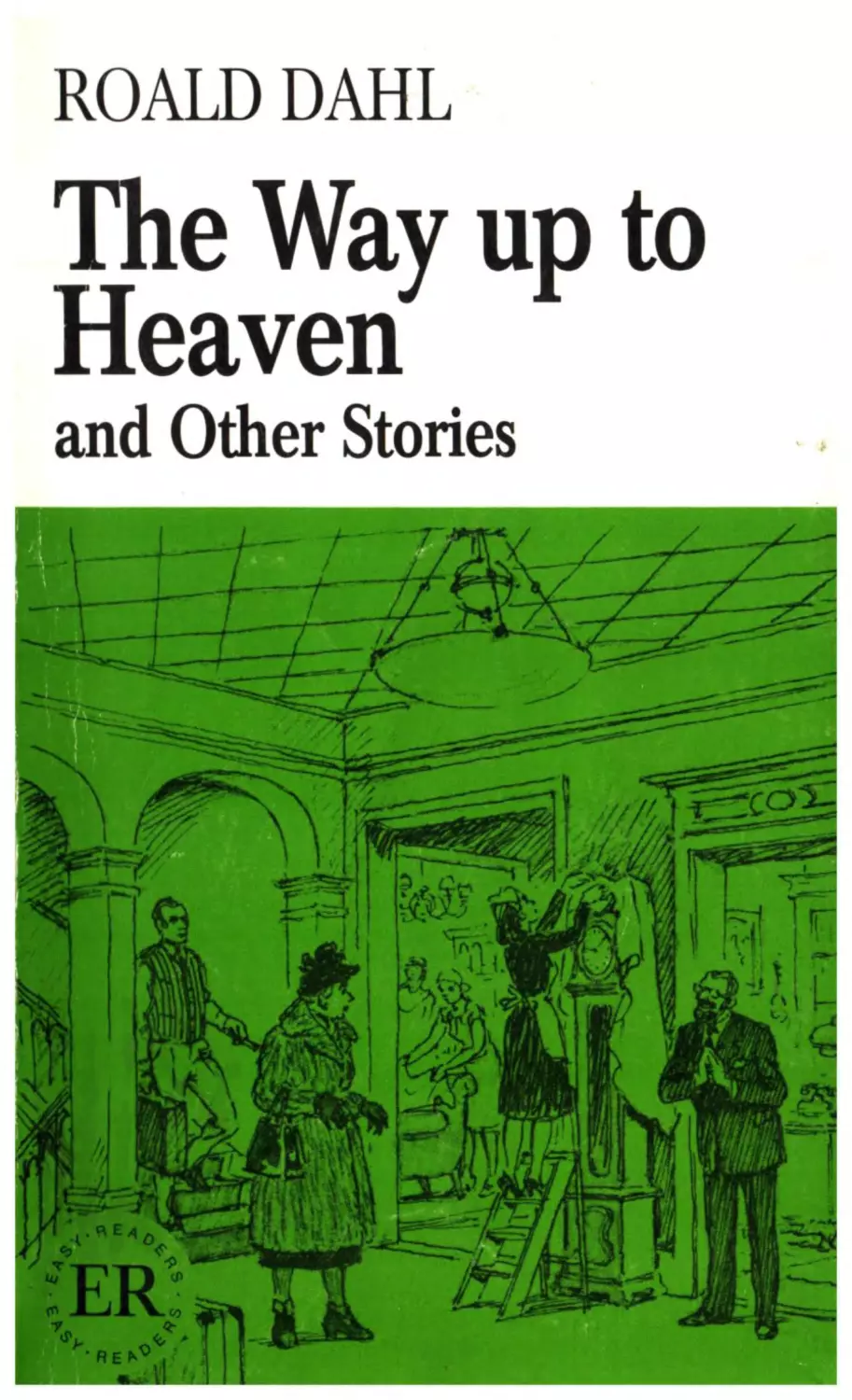
                    ROALD DAHL
The Way up to
Heaven
and Other Stories
GRAF1SK FORLAG Copenhagen
LEHTIKIR|AKAUPPA/TIDNINGSB<)KHANDELN Finland
GYLDENDAL NORSK FORLAG (hlo
К LETT Stuttgart und Munchen
ED1Z1ONI SCOLASTICHE BRUNO MONDADORI Milan
EDITIONS BORDAS Parts
ITACA Madrid
ALMQVIST Л WIKSELL Stockholm
W( )LTERS/N()()RDII()FF Groningen
EMC CORP St Paul, Minnesota, U.S.A.
CIS EDUCATIONAL Australia
EUROBOOK S.A. Athens
ACCENT EDUCATIONAL PUBLISHERS UK
ABI BOOKS (P) LIMITED New Delhi
This edition has been abridged and simplified to provide
graduated reading exercises for students of English.
Vocabulary and sentence structures have been
selected because of their high frequency and practical
value to the learner.
Words which are difficult to understand in context or
fall out of the easy reader frequency modules are
explained by footnotes in simple English or by illustrations.
easy readers are suitable for use in schools, for home
study, or simply for reading enjoyment. See the complete
list of titles on the inside cover.
easy readers are also available in German, French,
Spanish, Italian and Russian.
ROALD DAHL
THE WAY UP
TO HEAVEN
and other stories
The vocabulary is based on
Michael West: A General Service List of
English Words, revised & enlarged edition 1953
Pacemaker Core Vocabulary, 1975
Salling/Hvid: English-Danish Basic Dictionary, 1970
J. A. van Ek: The Threshold Level for Modem Language
Learning in Schools, 1976
Editor Solveig Odland
Illustrations: Oskar Jorgensen
© by Roald Dahl, 1948, 1949, 1950,
1952, 1953, 1959, 1961
© Grafisk Forlag/Aschehoug Dansk Forlag A/S, 1980
ISBN Denmark 87-429-7307-4
Printed in Denmark by
Grafisk Institut A/S, Copenhagen
ROALD DAHL
was bom on September 13, 1916 in South Wales of Norwegian
parents. His father, who was a shipbroker, died four years later.
After he left school in 1932, he spent some months on an expedition
exploring in Newfoundland. At eighteen he joined the Shell Oil Com-
pany in London. After training, the company sent him to Dar-es-
Salaam, Tanganyika.
When the war broke out he drove 1,000 miles to Nairobi to volun-
teer for the RAF. He joined a fighter squadron in the Lybian desert
where he was severely wounded. In 1942 he was sent to Washington
as Assistant Air Attache to the British Embassy.
There he began to write short stories. The first twelve, all about
flying, were sold to major American magazines and were later pub-
lished in a book “Over to You” in 1946.
He got himself removed from the Embassy into the more exciting
field of Intelligence. He left the RAF at the end of the war with the
rank of Wing Commander.
He married actress Patricia Neal in 1953. They have four children.
Roald Dahl has twice received the Edgar Allan Poe Award (“Edg-
ar”) of Mystery Writers in America.
Writings: “The Gremlins” (a juvenile) 1943; “Over to You” (story
collection) 1946; “Sometime Never, a Fable for Supermen”, 1948; “So-
meone Like You”, 1953; “Kiss, Kiss” (story collection) 1960; “James
and the Giant Peach” (children’s book) 1964, filmed as “Willy Wonka
and the Chocolate Factory”; “Switch Bitch” (story collection) 1974;
“Danny and the Champion of the World” (children’s book) 1976;
“The Wonderful Story of Henry Sugar & Six More”, 1977; “The Enor-
mous Crocodile”, 1978. He is also the author of the script “You Only
Live Twice”, a James Bond film. Roald Dahl owes part of his large
American following to his CBS-TV series “Way Out”.

CONTENTS
Man from the South ..................... 6
Skin .................................. 22
The Way up to Heaven .................  43
Mrs Bixby and the Colonel’s Coat ...... 61
Man from the South
It was almost six o’clock. I decided to buy myself a beer
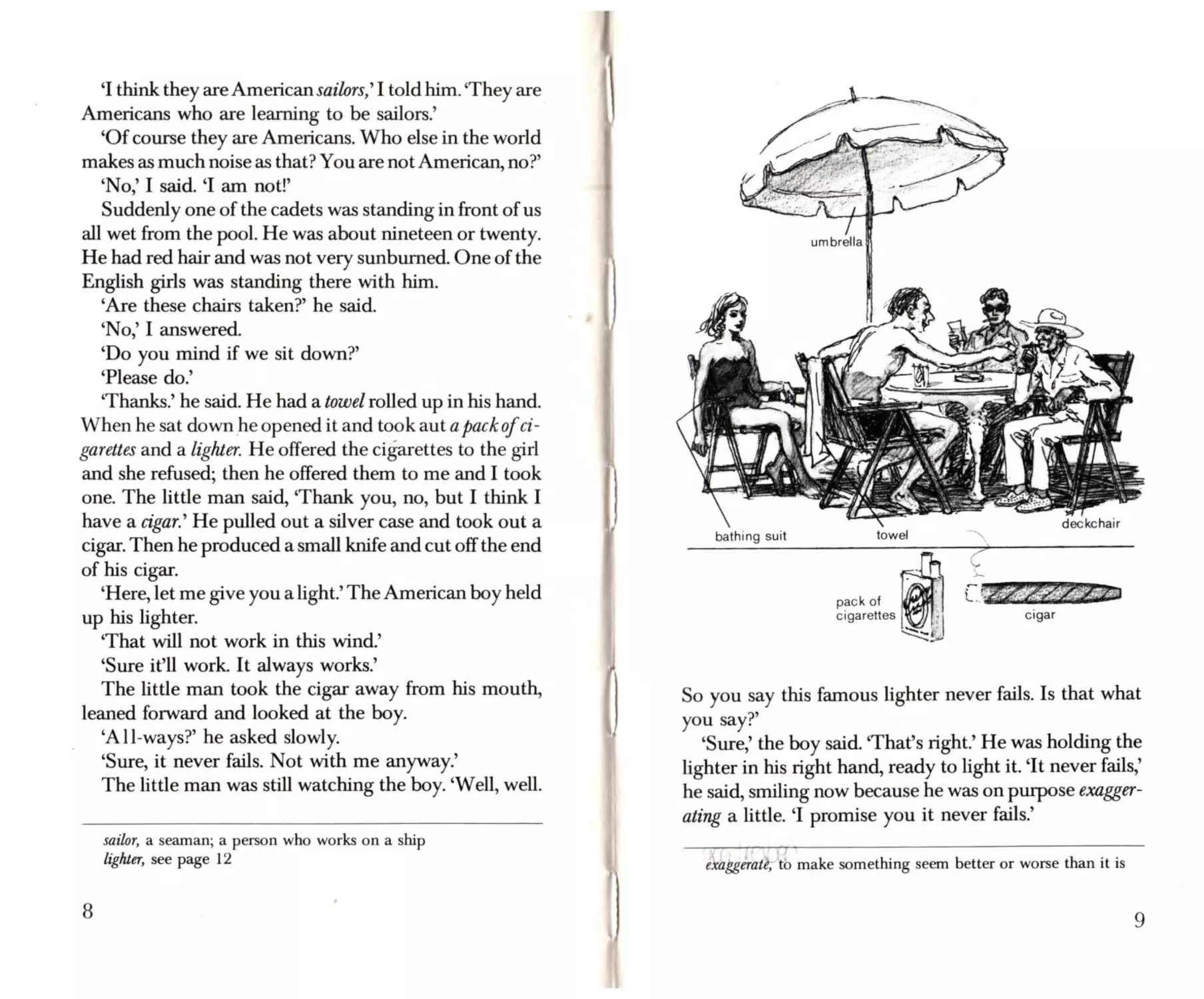
and go out and sit in a deckchair by the swimming pool
and have a little evening sun.
I went to the bar and got the beer and carried it out-
side. Then I walked slowly down the garden towards
the pool.
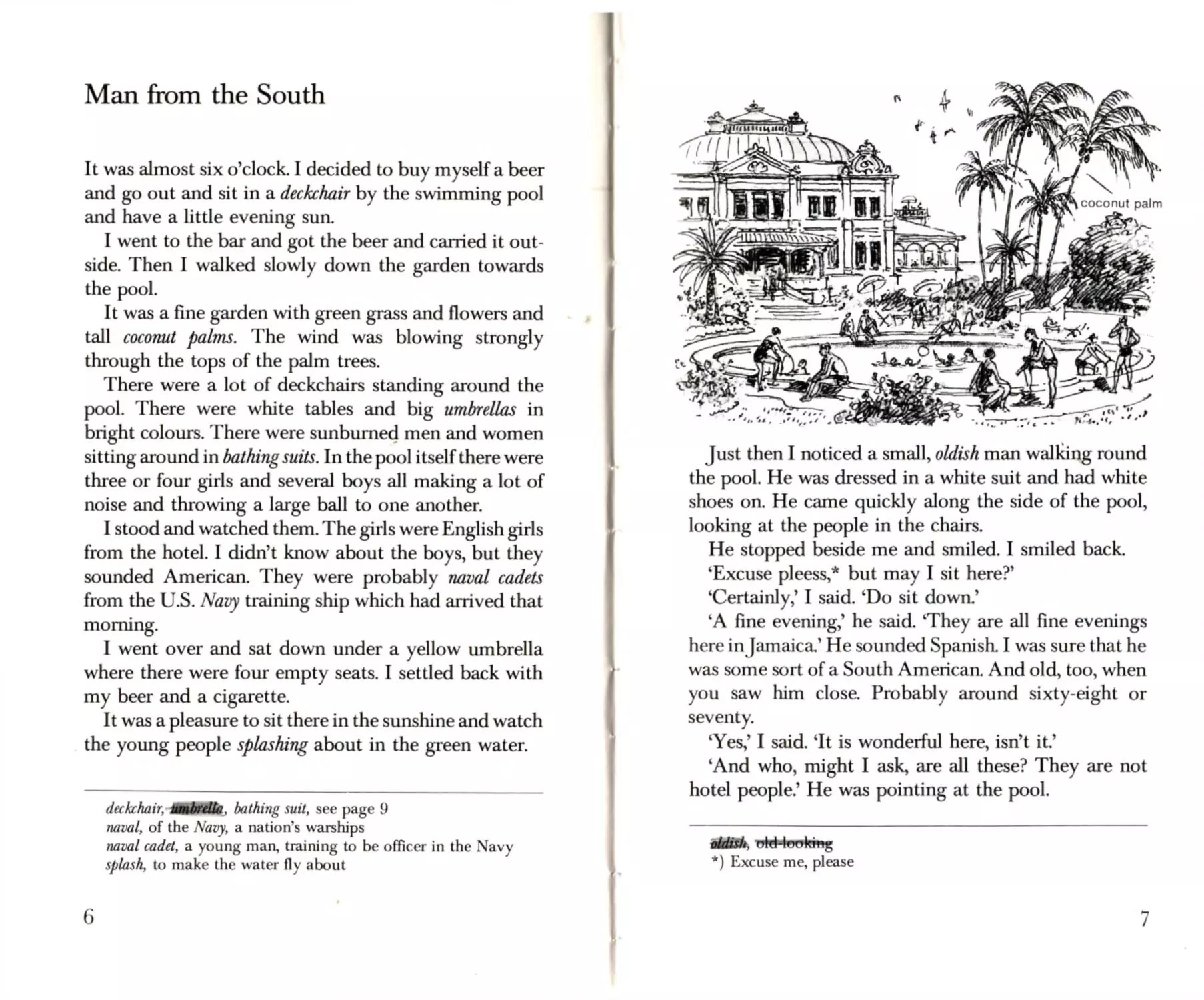
It was a fine garden with green grass and flowers and
tall coconut palms. The wind was blowing strongly
through the tops of the palm trees.
There were a lot of deckchairs standing around the
pool. There were white tables and big umbrellas in
bright colours. There were sunburned men and women
sitting around in bathingsuits. In the pool itself there were
three or four girls and several boys all making a lot of
noise and throwing a large ball to one another.
I stood and watched them. The girls were English girls
from the hotel. I didn’t know about the boys, but they
sounded American. They were probably naval cadets
from the U.S. Navy training ship which had arrived that
morning.
I went over and sat down under a yellow umbrella
where there were four empty seats. I settled back with
my beer and a cigarette.
It was a pleasure to sit there in the sunshine and watch
the young people splashing about in the green water.
deckchair, umbrella bathing suit, see page 9
naval, of the Navy, a nation’s warships
naval cadet, a young man, training to be officer in the Navy
splash, to make the water fly about
6
fl
Just then I noticed a small, oldish man walking round
the pool. He was dressed in a white suit and had white
shoes on. He came quickly along the side of the pool,
looking at the people in the chairs.
He stopped beside me and smiled. I smiled back.
‘Excuse pleess,* * but may I sit here?’
‘Certainly,’ I said. ‘Do sit down.’
‘A fine evening,’ he said. ‘They are all fine evenings
here in Jamaica.’ He sounded Spanish. I was sure that he
was some sort of a South American. And old, too, when
you saw him close. Probably around sixty-eight or
seventy.
‘Yes,’ I said. ‘It is wonderful here, isn’t it.’
‘And who, might I ask, are all these? They are not
hotel people.’ He was pointing at the pool.
oldish. old-looking
*) Excuse me, please
7
‘I think they are American sailors" I told him. ‘They are
Americans who are learning to be sailors.’
‘Of course they are Americans. Who else in the world
makes as much noise as that? You are not American, no?’
‘No,’ I said. ‘I am not!’
Suddenly one of the cadets was standing in front of us
all wet from the pool. He was about nineteen or twenty.
He had red hair and was not very sunburned. One of the
English girls was standing there with him.
‘Are these chairs taken?’ he said.
‘No,’ I answered.
‘Do you mind if we sit down?’
‘Please do.’
‘Thanks.’ he said. He had a towel rolled up in his hand.
When he sat down he opened it and took aut a pack of ci-
garettes and a lighter. He offered the cigarettes to the girl
and she refused; then he offered them to me and I took
one. The little man said, ‘Thank you, no, but I think I
have a cigar" He pulled out a silver case and took out a
cigar. Then he produced a small knife and cut off the end
of his cigar.
‘Here, let me give you a light.’ The American boy held
up his lighter.
‘That will not work in this wind.’
‘Sure it’ll work. It always works.’
The little man took the cigar away from his mouth,
leaned forward and looked at the boy.
‘All-ways?’ he asked slowly.
‘Sure, it never fails. Not with me anyway.’
The little man was still watching the boy. ‘Well, well.
sailor, a seaman; a person who works on a ship
lighter, see page 12
8
So you say this famous lighter never fails. Is that what
you say?’
‘Sure,’ the boy said. ‘That’s right.’ He was holding the
lighter in his right hand, ready to light it. ‘It never fails,’
he said, smiling now because he was on purpose exagger-
ating a little. ‘I promise you it never fails.’
exaggerate to make something seem better or worse than it is
9
‘One moment, pleess.’ The hand that held the cigar
came up high. ‘Now just a moment.’ He had a strangely
soft voice and he kept looking at the boy all the time.
‘Shall we not perhaps make a little bet on that?’ He
smiled at the boy. ‘Shall we not make a little bet on
whether your lighter lights?’
‘Sure, I’ll bet,’ the boy said. ‘Why not?’
‘You like to bet?’
‘Sure, I’ll always bet.’
The man looked at his cigar. I didn’t much like the
way he was acting. It seemed he was already trying to
make something out of this, and to make the boy feel
bad. At the same time I had the feeling that he was
having a game of his own.
He looked up again at the boy and said slowly, ‘I like
to bet, too. Why don’t we have a good bet on this thing?
A good big bet.’
‘Now wait a minute,’ the boy said. ‘I can’t do that. But
I’ll bet you a quarter. I’ll even bet you a dollar.’
The little man waved his hand again. ‘Listen to me.
Now we have some fun. We make a bet. Then we go up
to my room here in the hotel where there is no wind. I bet
you, you cannot light this famous lighter of yours ten
times, one after another, without missing once.’
‘I’ll bet I can,’ the boy said.
‘All right. Good. We make a bet, yes?’
‘Sure. I’ll bet you a dollar.’
‘No, no. I’ll make you a very good bet. I am a rich man
and I am a sporting man also. Listen to me. Outside the
make a bet, to take a chance of losing or winning money on the re-
sult of an event
sporting, ready to play a game, to take a chance
IO
hotel is my car. It’s a very fine car. American car from
your country. Cadillac
‘Hey, now. Wait a minute.’ The boy leaned back in his
deckchair and laughed. ‘I can’t put up that sort of prop-
erty. This is crazy."
‘Not crazy at all. You strike this lighter ten times and it
lights ten times and the Cadillac is yours. You would like
to have this Cadillac, yes?’
‘Sure I’d like to have a Cadillac.’ The boy was still
smiling.
‘All right. Fine. We make a bet and I put up my Cadil-
lac.’
‘And what do I put up?’
The little man looked at his cigar which was still not
lighted. ‘I never ask you, my friend, to bet something you
cannot afford. Do you understand?’
‘Then what do I bet?’
‘I make it very easy for you, yes?’
‘Okay. You make it easy.’
‘Some small thing you can afford to give away, and if
you did happen to lose it, you would not feel too bad.
Right?’
‘Such as what?’
‘Such as, perhaps, the little finger of your left hand.’
‘My what?’ The boy stopped smiling.
‘Yes. Why not? You win, you take the car. You lose, I
take the finger.’
‘I don’t get it. What do you mean, you “take the
finger”?’
‘I chop it off.’
(jazy, mad
afford, to be able to pay for
chop, to cut off with a sudden blow
I I
‘Good God! That’s a crazy bet. I think I’ll just make
it a dollar.’
The little man leaned back, spread out his hands and
shrugged his shoulders. ‘Well, well, well,’ he said. ‘I do not
understand. You say it lights but you will not bet. Then
we forget it, yes?’
The boy sat quite still, staring at the people in the pool.
Then he remembered suddenly he hadn’t lighted his
cigarette. He put it between his lips, put both hands
around the lighter and lit it. The wick burned with a small
yellow flame. The way he held his hands the wind didn’t
get to it at all.
‘Could I have a light, too?’ I said.
‘Gee, I’m sorry. I forgot you didn’t have one.’ - I held
out my hand for the lighter, but he stood up and came
over to do it for me.
‘Thank you,’ I said, and he returned to his seat.
‘Are you having a good time?’ I asked.
‘Fine,’ he answered. ‘It’s pretty nice here.’
There was a silence then. I could see that the little man
had managed to trouble the boy with his absurd bet. The
boy was sitting there very still. Then he started to move
about in his seat and to tap both hands on his knees. Soon
lighter------
shrug one's shoulders, tc draw up the shoulders to show that you are
not interested, or don’t know
gee, American word ^ surprise
absurd, silly; clearly wrong
tap, to knock lightly
12
he was tapping with one of his feet as well.
‘Now just let me check up on this bet of yours,’ he said
at last. ‘You say we go up to your room and if I make this
lighter light ten times in a row, I win a Cadillac. If it mis-
ses just once then I lose the little finger of my left hand. Is
that right?’
‘Certainly. That is the bet. But I think you are afraid.’
‘What do we do if I lose? Do I have to hold my finger
out while you chop it off?’
‘Oh, no! That would be no good. You might refuse to
hold it out. This is what I will do: I will tie your hand to
the table before we start and I will stand there with a
knife ready to go chop the moment your lighter misses.’
‘What year is your Cadillac?’
‘Excuse me. I do not understand.’
‘What year - how old is the Cadillac?’
‘Ah! How old. Yes. It is last year. Quite new car. But I
see you are not a betting man. Americans never are.’
The boy was quiet for a moment. Then he looked at
the English girl, then at me. ‘Yes,’ he said quickly. ‘I’ll bet
you.’
‘Good!’ The little man clapped his hands together
quietly, once. ‘Fine,’ he said. ‘We do it now. And you, sir,’
he turned to me, ‘would you be good enough to come
along and be our referee?"
‘Well,’ I said. ‘I think it’s a crazy bet. I don’t think I like
it very much.’
‘Nor do I,’ said the English girl. It was the first time she
had spoken. ‘I think it’s a very silly bet.’
clap, to strike together
referee, (in games) a judge
13
‘Are you serious about cutting off this boy’s finger if he
loses?’
‘Certainly I am. Also about giving him the Cadillac if
he wins. Come now. We go to my room.’
He stood up. ‘Would you like to put on some clothes
first?’ he said.
‘No,’ the boy answered. ‘I’ll come like this.’ Then he
turned to me. ‘Please do me a favour and come along as a
referee.’
‘All right,’ I said. ‘I’ll come along, but I don’t like the
bet.’
‘You come too,’ he said to the girl. ‘You come and
watch.’
The little man led the way back through the garden to
the hotel. He was almost jumping as he walked along.
‘Would you like to see the car first? It’s just here,’ he
said.
He took us to where we could see the front driveway
of the hotel. Then he stopped and pointed to a beautiful
green Cadillac parked close by.
‘Say, that’s a nice car,’ the boy said.
‘All right. Now we go up and see if you can win it.’
We followed him up to the first floor of the building.
He opened his door and we all entered a large double
bedroom. There was a woman’s dress lying across one of
the beds.
‘First,’ he said, ‘we have a little martini!
The drinks were on a small table in the comer, and
there was ice and several glasses. The little man rang the
bell and began to make the martinis. Then there was a
double bedroom, a room with two beds
martini, a drink-made-with gin and dry vermouth
И
knock on the door and a coloured maid came in.
‘Ah!’ he said, and set down the bottle. ‘Will you do
something for me, pleess?’ He gave the maid a pound
note. ‘You keep that,’ he said. ‘And now we are going to
play a little game in here. I want you to go off and find
three things for me. I want some nails; I want a hammer,
and I want a chopping knife which you can find in the
kitchen.’
‘A chopping knife!’ The maid opened her eyes wide
and clapped her hands in front of her. ‘You mean a real
( hopping knife?’
‘Yes, yes, of course. Come on now, pleess. Surely you
can find those things for me.’
‘Yes, sir, I’ll try to get them.’ And off she went.
The little man handed round the martinis. We stood
there and drank them slowly, the boy and the English
girl in their bathing suits. She was watching him over the
top of her glass all the time; the little man in his white
suit was drinking his martini and looking at the girl.
I didn’t know what to make of it all. The man seemed
serious about the bet and he seemed serious about cut-
ting off the finger. What if the boy lost? Then we would
have to rush him to the hospital in the Cadillac that he
hadn’t won. That would be a fine thing. Now wouldn’t
that be a really fine thing. It would be a crazy and un-
necessary thing so far as I could see.
coloured, belonging to a dark-skinned race
maid, a girl working in a hotel
unnecessary, not needed; not necessary
•5
‘Don’t you think this is rather a silly bet?’ I said.
‘I think it’s a fine bet,’ the boy answered. He had al-
ready had one large martini.
‘I think it is a very silly bet,’ the girl said. ‘What will
happen if you lose?’
‘It won’t matter. Now that I think of it, I can’t remem-
ber that I have ever had any use for the little finger on my
left hand. Here he is.’ The boy took hold of the finger.
‘Here he is and he hasn’t done a thing for me yet. So why
shouldn’t I bet him? I think it’s a fine bet.’
The little man smiled and filled our glasses again.
‘Before we begin,’ he said, ‘I will present to the referee
the key of the car.’ He produced a key from his pocket
and gave it to me. ‘The papers,’ he said, ‘the owning
papers* are in the pocket of the car.’
Then the coloured maid came in again. In one hand
she carried the knife and in the other a hammer and a bag
of nails.
‘Good! You got it all. Thank you, thank you. Now you
can go.’ He waited till the maid had closed the door, then
he said. ‘Now we prepare ourselves, yes?’ And to the boy,
‘Help me, pleess, with this table. We carry it out a little.’
It was the usual kind of hotel writing table. They
carried it out into the room away from the wall and took
away the writing things.
‘And now,’ he said, ‘a chair.’ He picked up a chair and
placed it beside the table. He was working quickly, like a
person preparing games at a children’s party. ‘And now
the nails. I must put in the nails.’ He fetched the nails and
began to hammer them into the top of the table.
9 ownership certificate, papers showing who owns a car
16
We stood there, the boy, the girl, and I, with the marti-
nis in our hands, and watched the little man at work We
watched him hammer two nails into the table. He
allowed a small part of each one to stick up.
Anyone would think the son of a bitch had done this be-
fore, I told myself. Table, nails, hammer, chopping knife.
I le knows just what he needs and how to arrange it.
‘And now,’ he said, ‘all we need is some string? He
found some string. ‘All right, at last we are ready. Will
you pleess sit here at the table?’ he said to the boy.
ГЬе boy put his glass away and sat down.
‘Now place the left hand between these two nails. The
nails are only so I can tie your hand in place. All right,
good. Now I tie your hand to the table - so.’
He made a good job of it. When he had finished, it was
impossible for the boy to draw his hand away. But he
could move his fingers.
»Now pleess, close your hand except your little finger.
You must leave the little finger sticking out, lying on the
table.’
‘Very good! Very good! Now we are ready. You hold
the lighter with your right hand. But one moment,
pleess.’
He went over to the bed and picked up the chopping
knife. He came back and stood beside the table with the
knife in his hand.
‘We are all ready?’ he said. ‘Mister referee, you must
say when we shall begin.’
The English girl was standing there in her blue bath-
son of a biteh, (US) a bad name for a person you don’t like
arrange, to prepare; to put in order
string, see page 15
2 'Die Way up to Heaven	I 7
ing suit right behind the boy’s chair. She was just stand-
ing there, not saying anything. The boy was sitting
quite still, holding the lighter in his right hand, looking at
the chopping knife. The little man was looking at me.
‘Are you ready?’ I asked the boy.
‘I’m ready.’
‘And you?’ to the little man.
‘Quite ready,’ he said and lifted the chopping knife up
in the air and held it there about two feet above the boy’s
finger, ready to chop.
‘All right,’ I said. ‘You may begin.’
The boy said, ‘Will you please count aloud the number
of times I light it.’
‘Yes,’ I said. ‘I’ll do that.’
With his thumb he raised the top of the lighter, and
again with the thumb he flicked the wheel. The wick
caught fire and burned with a small yellow flame.
‘One!’ I called.
He flicked the wheel very strongly and once more
there was a small flame burning on the wick.
‘Two!’
No one else said anything. The boy kept his eyes on
the lighter. The little man held the chopping knife in the
air. He too was watching the lighter.
‘Three!’
‘Four!’
‘Five!’
‘Six!’
‘Seven!’ It seemed to be one of those lighters that
aloud, in a voice which can be heard
thumb, the short, thick finger of the hand
flick to hit or strike tightly with a quick movement
18
worked. I watched the thumb pressing the top down on
the flame. Then the thumb raising the top once more.
I his was an all-thumb operation. The thumb did
everything. The thumb flicked the wheel. The little
flame appeared.
‘Eight!’ I said, and as I said it the door opened. We all
t umed to see a woman standing in the doorway. A small,
hlackhaired woman, rather old, who stood there for
about two seconds.
Then she rushed forward, shouting, ‘Carlos! Carlos!’
She took the chopping knife out of his hand and threw it
on the bed. Then she took hold of the little man and be-
gan to shake him vigorously. She was talking to him fast
and loud all the time in some Spanish-sounding
language.
She shook him so fast you couldn’t see him any more.
Then she shook him more slowly and the little man came
into view again. She pulled him across the room and
pushed him on to one of the beds.
‘I am sorry,’ the woman said. ‘I’m terribly sorry that
this should happen.’ She spoke good English.
‘It’s too bad,’ she went on. ‘For ten minutes I leave him
alone to go and have my hair washed and I come back
and he is at it again.’ She looked sorry and deeply con-
cerned.
The boy was untying his hand from the table. The Eng-
lish girl and I stood there and said nothing.
‘He is dangerous,’ the woman said. ‘Down where we
live at home he has taken forty-seven fingers from differ-
ent people. And he has lost eleven cars. In the end they
vigorously, with strength; strongly
untie, to,set free
2*
19
wanted to have him put away somewhere. That’s why I
brought him up here.’
‘We were only having a little bet,’ mumbled the little
man from the bed.
‘I suppose he bet you a car,’ the woman said.
‘Yes,’ the boy answered. ‘A Cadillac.’
‘He has no car. It’s mine. And what makes it worse,’ she
said, ‘is that he should bet you when he has nothing to
bet with. I am very sorry about it all.’ She seemed a very
nice woman.
‘Well,’ I said, ‘then here is the key of your car.’ I put it
on the table.
‘We were only having a little bet,’ mumbled the little
man.
‘He hasn’t anything left to bet with,’ the woman
said. ‘He hasn’t a thing in the world. Not a thing. As a
matter of fact, I myself won it all from him a long while
ago. It took time, and it was hard work, but I won it all in
the end.’
She looked at the boy and smiled, a slow sad smile.
Then she came over and put out a hand to take the key
from the table.
I can see it now, that hand of hers; it had only one
finger on it, and a thumb.
mumble, to speak with a low voice which is hard to hear
20
Questions
I.	What are people doing around the swimming pool?
2.	Who are in the pool?
3.	Describe the man from the south.
4.	What does the young American do after he has
joined the others at the table?
5.	What kind of a bet does the old man suggest?
6.	Why does the boy accept the bet?
7.	How does the old man prepare the game?
8.	In what way does the woman put an end to it?
9.	What does she tell the party?
21
Skin
That year - 1946 - the winter was very long. Although it
was April, a cold wind blew through the streets of the
city and snow clouds moved across the sky.
The old man who was called Drioli shuffled along the
Rue de Rivoli* *. He was cold and miserable. He was all
covered up in a dirty black coat; only his eyes and the top
of his head could be seen.
He moved along looking without interest at the things
in the shop windows - expensive shirts and ties, fine
books. Then a picture gallery. He had always liked picture
galleries. This one had a single painting in the window.
He stopped to look at it. He turned to go on. He stopped
again and looked back; and now, suddenly, he seemed to
remember something, somewhere, that he had seen
before. He looked again. It was a painting of some trees
leaning to one side, blown by a strong wind. Below the
picture, there was a little plaque which read: CHAIM
SOUTINE (1894-1943).
Drioli stared at the picture. Crazy painting, he
thought. Very strange and crazy, but I like it... Chaim
Soutine... Soutine... ‘By God!’ he cried suddenly. ‘My
little Kalmuck, that’s who it is! My little Kalmuck with a
picture in the finest shop in Paris! Just imagine that!’
----------------------------------
shuffle, toxwalk without lifting the feet from the ground
*) street in Paris, France
miserable, very
picture gallery, rodm(s) for showing paintings
plaque, a flat piece of metal
Kalmuck, a member of a Mongolian race living in Russia
imagine, to form a picture in the mind; to think about
22
The old man pressed his face closer to the window. He
could remember the boy, yes, quite clearly he could
remember him. But when? It was so long ago. How long:
twenty - no, more like thirty years, wasn’t it? Wait a
minute. Yes - it was the year before the war, the first
war, 1913. That was it And this Soutine, this ugly little
Kalmuck, was then a sullen boy. He had liked him -
almost loved him - for no reason at all, except that he
could paint.
How he could paint! It was coming back more clearly
now. Where was it the boy had lived? The Cite Falguiere,
that was it! He was pleased to have remembered the
name. Then there was the studio with the single chair in it,
the dirty bed; the parties with the cheap white wine,
the fights. And always, always the angry, sullen face of
the boy, working on a painting.
It was strange, Drioli thought, how easily it all came
back to him now. There was the business about the tattoo,
for example. Now, that was a mad thing if ever there was
one. How had it started? Ah, yes, he had got rich one day,
that was it, and he had bought lots of wine. He could see
himself now as he entered the studio with the bottles un-
der his arm. The boy was painting his (Drioli’s) wife, who
was standing in the centre of the room.
‘Tonight we shall celebrate," he said. ‘We shall have a
little party, us three.’
‘What is it that we celebrate?’ the boy asked, without
looking up.
ugly, not pretty
,	. fallen, quiet, not friendly
studio, the working-room of a painter
tattoo, see page 24
celebrate, to give a party in honour of someone or something
23
‘We celebrate,’ Drioli said, ‘because today I have made
a lot of money with my work.’
‘And I have made nothing. We can celebrate that also.’
‘If you like.’ Drioli was standing by the table with the
bottles. He felt tired and wanted to get at the wine. Nine
customers, all soldiers, in one day was all very nice. But
the work was terrible for his eyes. He had never had as
many as nine before. But it was evening now and he was
24
rich, and he had three bottles, one for his wife, one for his
friend, and one for him.
The boy stopped working. ‘Oh, Christ,’ he said. ‘How
can one work with all this going on?’
The girl came across the room to look at the painting.
Drioli came over also. He had a bottle in one hand and a
glass in the other.
‘No!’ the boy shouted angrily. ‘Please, no!’ He took the
25
picture away and stood it against the wall. But Drioli had
seen it.
‘I like it.’
‘It’s terrible.’
‘It’s marvellous. Like all the others that you do, it’s
marvellous. I love them all.’
‘The trouble is that I cannot eat them,’ the boy said.
‘But still they are marvellous.’ Drioli handed him a
glass of wine. ‘Drink it,’ he said. ‘It will make you happy.’
Never, he thought, had he known a more unhappy
person, or one with a gloomier face. He had first seen him
in a cafe some seven months before, drinking alone.
Because he had looked like a Russian or some sort of an
Asiatic, Drioli had sat down at his table and talked.
‘You are Russian?’
‘Yes.’
‘Where from?’
‘Minsk.’
Drioli jumped up and kissed him, and told him that
he, too, had been bom in that city.
‘It wasn’t really Minsk,’ the boy said. ‘But quite near.’
‘Where?’
‘Smilovichi, about twelve miles away.’
‘Smilovichi!’ Drioli shouted. ‘I walked there several
times when I was a boy. You know, you don’t look
like a western Russian. You look like a Kalmuck’
Now, standing in the studio, Drioli looked again at the
boy as he was drinking the wine. Yes, he did have a face
marvellous, wonderful; very good
unhappy, sad
gloomy, dark; sad
cafe, a small restaurant or bar
26
like a Kalmuck - very broad with narrow eyes and black
hair and the thick sullen mouth of a Kalmuck; but the
hands - the hands were always a surprise, so small and
white like a lady’s.
‘Give me some more,’ the boy said. ‘If we are going to
celebrate then let us do it in the right way.’
Drioli gave him some more wine and sat down on a
c hair. The boy sat on the old bed with Drioli’s wife. The
three bottles were placed on the floor between them.
‘Tonight we shall drink as much as we possibly can,’
Drioli said. ‘I am very rich. I think perhaps I should go
out now and buy some more bottles. How many shall I
get?’
‘Six more,’ the boy said. ‘Two for each.’
‘Good. I shall go now and fetch them.’
‘And I will help you.’
In the nearest cafe Drioli bought six bottles of white
wine, and they carried them back to the studio. They
placed them on the floor in two rows and opened
them, all six of them. Then they sat down again and
continued to drink.
‘It’s only the very rich,’ Drioli said, ‘who can celebrate
in this manner.’
‘That is true,’ the boy said. ‘Isn’t that true, Josie?’
‘Of course.’
‘How do you feel, Josie?’
‘Fine.’
‘Will you leave Drioli and marry me?’
‘No.’
‘Beautiful wine,’ Drioli said. ‘We are lucky that we are
able to drink it.’
broad, wide
27
Slowly they began to get themselves drunk. They had
done it before, but all the same there were certain rules
that had to be observed. There were a great number of
things that had to be said, then said again; and the wine
must be praised; and it was important to drink slowly, so
that there would be time to feel all the different stages of
getting drunk. The best moment for Drioli was when he
began to walk on air and his feet did not really belong to
him. When he could look down at his feet and wonder
what crazy person they belonged to and why they were
lying around on the floor like that, in the distance.
After a while, he got up to turn on the light. He was
surprised to see that the feet came with him when he did
this, because he couldn’t feel them touch the ground.
Then he began to walk around the room and to look at
the pictures that stood against the wall.
‘Listen,’ he said at length. ‘I have an idea.’ He came
across and stood before the bed. ‘Listen my little Kal-
muck’
‘What?’
‘I have a tremendous idea. Are you listening?’
‘I’m listening to Josie.’
‘Listen to me, please. You are my friend - my ugly
little Kalmuck from Minsk - and to me you are such a
great painter that I would like to have a picture . .
‘Have them all. Take all you can find, but do not inter-
rupt me when I am talking with your wife.’
‘No. No. Now listen. I mean a picture that I can have
drunk, suffering from the effect of drinking to much wine
praise, to talk well of
tremendous, very good
interrupt, to stop a person while he is saying or doing something
28
with me always... for ever... wherever I go... whatever
happens... but always with me... a picture by you.’ He
reached forward and shook the boy’s knee. ‘Now listen to
me, please.’
‘Listen to him,’ the girl said.
‘It is this. I want you to paint a picture on my skin, on
my back. Then I want you to tattoo over what you have
painted so that it will be there always.’
‘You have crazy ideas.’
‘I will teach you how to use the tattoo. It is easy. A
child could do it.’
‘I am not a child.’
‘Please . . .’
‘You are quite mad. What is it you want?’ The painter
looked up into the dark, wine-bright eyes of the other
man. ‘What in heaven’s name is it you want?’
‘You could do it easily! You could! You could!’
‘You mean with the tattoo?’
‘Yes, with the tattoo! I will teach you in two minutes!’
‘Impossible!’
‘Are you saying I do not know what I am talking
about?’
No, the boy could not possibly be saying that because
if anyone knew about the tattoo it was he - Drioli.
‘All I am saying,’ the boy told him, ‘is that you are
drunk and this is a drunken idea.’
‘You could make a picture of Josie. A picture of Josie
upon my back. Why shouldn’t I have a picture of my
wife upon my back?’
‘Of Josie?’
‘Yes.’ Drioli knew he only had to mention his wife and
the boy would get interested.
‘No,’ the girl said.
29
‘Darlingjosie, please. Never in my life have I had such
an idea before.’
‘What idea?’
‘That he should make a picture of you upon my back.’
‘A picture of me?’
‘Nude] the boy said. ‘That is a good idea.’
‘Not nude,’ the girl said.
‘It is a tremendous idea,’ Drioli said.
‘It’s a crazy idea,’ the girl said.
‘It is in any event an idea,’ the boy said. ‘It is an idea
which should be celebrated.’
They emptied another bottle among them. Then the
boy said, ‘It is no good. I could not possibly manage the
tattoo.’
‘Then just the head,’ Drioli said.
‘I could not manage it.’
‘It is very simple. I can teach you in two minutes. You
will see. I shall go and fetch the instruments. The needles
and the inks. I have inks of many different colours - as
many different colours as you have paints, and far more
beautiful . .
‘It is impossible.’
‘You will see,’ Drioli said. ‘I will go and fetch them.’ He
got up from his chair and walked, rather drunk, out of the
room.
In half an hour Drioli was back. ‘I have brought every-
thing,’ he cried, waving a brown bag. ‘All you need is in
this bag.’
He placed the bag on the table, opened it, and laid out
nude, with no clothes on
instrument, a thing used in doing something
needle, ink, see page 24
30
(he electric needles and the small bottles of coloured
inks. He threw off his jacket. ‘Now look. Watch me and I
will show you on my arm how easy it is. First, I choose
iny ink - let us use ordinary blue - and I dip the point of
my needle in the ink... so ... and I hold the needle up
straight. Then I run it lightly over the surface of the skin
... like this... and with the little motor the needle jumps
up and down and punctures the skin and the ink goes in
and there you are. See how easy it is ..
The boy was intrigued. ‘Now let me practise a little - on
your arm.’
He began to draw blue lines upon Drioli’s arm. ‘It is
simple,’ he said. ‘It is like a drawing with a pen and ink.
There is no difference except that it is slower.’
‘There is nothing to it. Are you ready? Shall we begin?’
‘At once.’
‘Come on Josie!’ cried Drioli. He was moving around
the room arranging everything like a child preparing for
some game. ‘Where will you have her? Where shall she
stand?’
‘Let her be standing there, by the table. I will paint her
with her hair down over her shoulders.’
‘Tremendous!’ Drioli pulled off his shirt and stepped
out of his trousers.
‘Sit on the chair,’ the boy said. ‘Sit back to front, then
you can lean your drunken head against the back of it.
Hurry now, for I am about to begin.’
‘I am ready. I am waiting.’
jacket, see page 25
dip, to put into water, here into ink, for a short time
puncture, to make a small hole
intrigued, very interested
31
‘First,’ the boy said, ‘I shall make an ordinary painting.
Then, if it pleases me, I shall tattoo over it.’ He began to
paint upon the naked skin of the man’s back. He worked
quickly, applying the paint thinly so that it wouldn’t get
in the way afterwards when he was going to tattoo. All
his attention was directed towards the painting. He
didn’t seem drunk anymore. In less than half an hour it
was finished.
‘All right. That’s all,’ he said to the girl, who imme-
diately returned to the bed, lay down, and fell asleep.
Drioli watched the boy take up the needle and dip it in
the ink; then he felt how the needle punctured his skin. It
hurt but not too much, and it kept him from going to
sleep. He watched the different colours of ink that the
boy was using and tried to imagine what was going on
behind him.
Far into the small hours of the morning the machine
buzzed and the boy worked. Drioli could remember that
when the painter finally stepped back and said, ‘It is
finished,’ there was daylight outside and the sound
of people in the street.
‘I want to see it,’ Drioli said. The boy held up a mirror
and Drioli turned his head to look.
‘Good God!’ he cried. It was a startling sight. The
whole of his back was shining bright with colour - gold
and green and blue and black and red. The face itself was
quite alive, the background swirling around her head in a
mass of dark green waves.
naked, with no clothes on
buzz, to make a sound like that of a motor
mirror, a looking glass; a glass in which you can see yourself
startling, very surprising
32
‘It’s tremendous!’
‘I rather like it myself.’ The boy stood back and looked
at it. ‘You know,’ he added, ‘I think it’s good enough for
me to sign.’ He took up the needle again and wrote his
name with red ink.
ГЬе old man who was called Drioli was standing in front
of the window of the picture-gallery in a sort of sleep-like
state. It had been so long ago, all that - almost as though
it had happened in another life.
And the boy? What had become of him? He could
remember now that when he returned from the war - the
first war - he had missed him.
‘Where is my little Kalmuck?’ he had asked Josie.
‘He is gone,’ she had answered. ‘I do not know where,
but I heard that a dealer had sent him away to Ceret to
make more paintings.’
‘Perhaps he will return.’
‘Perhaps he will. Who knows?’
That was the last time they had mentioned him. Soon
afterwards they had moved to Le Havre where there
were more sailors and business was better. Those were
the good years, the years between the wars. They had a
small shop and nice rooms and always enough work.
Every day three, four, five sailors came and wanted
pictures on their arms. Those were indeed the good days.
Then the second war had come. Josie was killed. The
Germans had arrived, and that was the finish of his busi-
ness. No one had wanted pictures on their arms any more
background, the space behind the figures in a picture
swirl, to move round and round
dealer, here a man who sells paintings
3 The Way up to Heaven
33
after that. And by that time he was too old for any other
kind of work. He then made his way back to Paris. He
hoped that things would be easier in the big city. But
they were not.
Now, after the war was over, he had neither the means
nor the strength to start up his small business again. It
wasn’t very easy for an old man to know what to do. He
didn’t like to beg. Yet how else could he keep alive?
He was still staring at the picture. So that was his little
Kalmuck. Up to a few moments ago he had even forgot-
ten that he had a tattoo on his back. It had been ages
since he had thought about it. He put his face closer to
the window and looked into the gallery. On the walls he
could see many other pictures and all seemed to be the
work of the same painter. A great number of people were
walking around.
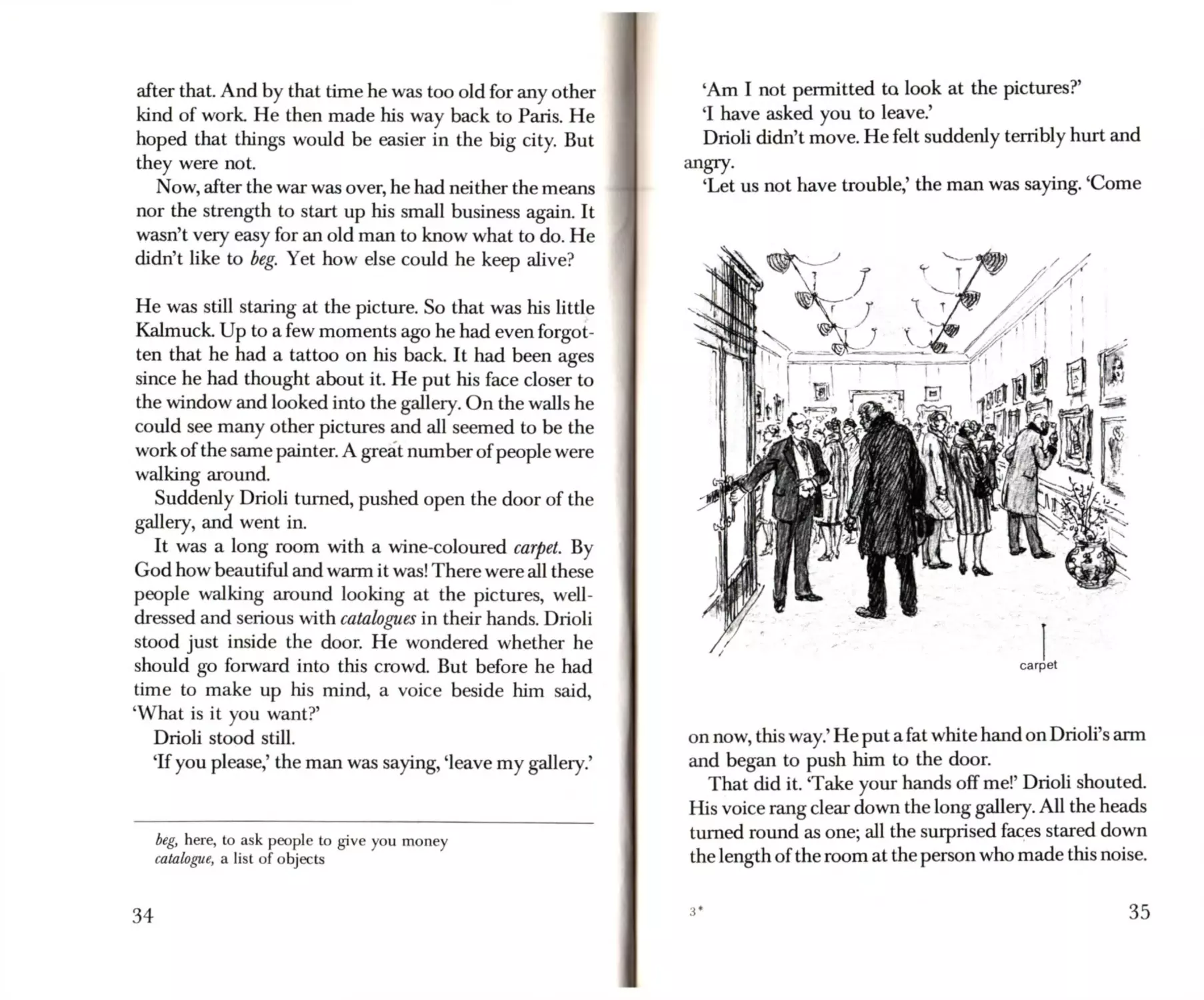
Suddenly Drioli turned, pushed open the door of the
gallery, and went in.
It was a long room with a wine-coloured carpet. By
God how beautiful and warm it was! There were all these
people walking around looking at the pictures, well-
dressed and serious with catalogues in their hands. Drioli
stood just inside the door. He wondered whether he
should go forward into this crowd. But before he had
time to make up his mind, a voice beside him said,
‘What is it you want?’
Drioli stood still.
‘If you please,’ the man was saying, ‘leave my gallery.’
beg, here, to ask people to give you money
catalogue, a list of objects
34
‘Am I not permitted to look at the pictures?’
‘I have asked you to leave.’
Drioli didn’t move. He felt suddenly terribly hurt and
angry.
‘Let us not have trouble,’ the man was saying. ‘Come
on now, this way.’ He put a fat white hand on Drioli’s arm
and began to push him to the door.
That did it. ‘Take your hands off me!’ Drioli shouted.
His voice rang clear down the long gallery. All the heads
turned round as one; all the surprised faces stared down
the length of the room at the person who made this noise.
3*
35
Two men came running over to help. They tried to push
Drioli through the door. The people stood still and
watched. Their faces seemed to be saying, ‘It’s all right.
There’s no danger. They are taking care of it.’
‘I, too!’ Drioli was shouting. ‘I, too, have a picture by
this painter! He was my friend and I have a picture which
he gave me!’
‘He’s mad.’
‘Someone should call the police.’
With a quick movement of the body Drioli suddenly
jumped clear of the two men. Before anyone could stop
him he was running down the gallery, shouting, ‘I’ll show
you! I’ll show you! He threw off his coat, then his jacket
and shirt, and he turned so that his naked back was
towards the people.
‘There!’ he cried. ‘You see? There it is!’
There was a sudden silence in the room. Everybody
stood still. They were staring at the tattooed picture. It
was still there, the colours as bright as ever. But the man’s
back was thinner now, and that gave the picture a
strangely wrinkled appearance.
Somebody said, ‘My God, but it is!’
The people crowde round the old man.
‘It is fantastic, fantastic!’
‘And look, it is signed!’
‘Old man, when was this done?’
‘In 1913,’ Drioli said, without turning round.
‘Who taught Soutine to tattoo?’
‘I taught him.’
‘And the woman?’
‘She was my wife.’
wrinkled, with lines in the skin, produced by age
36
The gallery owner was pushing through the crowd
towards Drioli. He was quiet now, very serious, making a
smile with his mouth. ‘Monsieur* *,’ he said, ‘I will buy it.’
‘How can you buy it?’ Drioli asked softly.
‘I will give you two hundred thousand francs for it.’
‘Don’t do it!’ a voice said in the crowd. ‘It is worth
twenty times as much.’
Drioli opened his mouth to speak No words came, so
he shut it; then he opened it again and said slowly, ‘But
how can I sell it?’ He lifted his hands, then let them drop
to his sides. ‘Monsieur, how can I possibly sell it?’ he said
in a very sad voice.
‘Yes!’ they were saying in the crowd. ‘How can he sell
it? It is part of himselfl’
‘Listen,’ the dealer said, coming up close. ‘I will help
you. I will make you rich. Let us settle this matter
together, just the two of us.’
Drioli watched him with fear in his eyes. ‘But how can
you buy it, Monsieur? What will you do with it when
you have bought it? Where will you keep it? Where will
you keep it tonight? And where tomorrow?’
‘Ah, where will I keep it? Well, now... It would seem,’
he said, ‘that if I take the picture, I take you also. The pic-
ture itself is of no value until you are dead. How old are
you, my friend?’
‘Sixty-one.’
‘But you are perhaps not very strong?’ The dealer
looked Drioli up and down, slowly, like a farmer who
sets a price on an old horse.
‘I do not like this,’ Drioli said, trying to get away. ‘I
owner, one who owns
*) French word meaning Mr or Sir
37
really don’t like it, Monsieur.’ He went straight into the
arms of a tall man who put out his hands and caught him
gently by the shoulders. Drioli looked around. The man
smiled down at him.
‘Listen, my friend,’ the man said, still smiling. ‘Do you
like to swim and lie in the sun?’
Drioli looked up at him, surprised.
‘Do you like fine food and good wine?’ The man was
still smiling. He spoke in a soft manner. His hand was still
resting on Drioli’s shoulder. ‘Do you like such things?’
‘Well... yes,’ Drioli answered, still not understanding
what the man meant. ‘Of course.’
‘And the company of beautiful women?’
‘Why not?’
‘And lots of suits and shirts made for you? It would
seem that you are in need of clothes.’
Drioli watched the man, waiting for the rest of his
offer.
‘Have you ever had shoes made for your own foot?’
‘No.’
‘Would you like that?’
‘Well . . .’
‘And a bell beside your bed to call the maid to bring
your breakfast in the morning? Would you like these
things, my friend?’
Drioli stood still and looked at him.
‘You see, I am the owner of the Hotel Bristol in
Cannes. I now invite you to come down there and live
as my guest for the rest of your life. Your only duty -
shall I call it pleasure - will be to spend your time on my
beach in bathing costume, walking among my guests,
swimming, drinking martinis. You would like that?’
There was no answer.
38
‘Don’t you see, all the guests will be able to look at this
marvellous picture by Soutine. You will become famous,
and men will say, “Look, there is the fellow with the ten
million francs upon his back.” Do you like this idea,
Monsieur? Does it please you?’
Drioli looked up at the tall man. He was wondering
whether it was a serious offer. ‘It is a funny idea,’ he said
slowly. ‘But do you really mean it?’
‘Of course I mean it.’
‘Wait,’ the dealer said. ‘See here, old man. Here is the
answer to our problem. I will buy the picture, and I will
arrange with a surgeon to remove the skin from your back.
Then you will be able to go off on your own and enjoy
the great sum of money I shall give you for it.’
‘With no skin on my back?’
‘No, no, please! You don’t understand. This surgeon
will put a new piece of skin in the place of the old one. It
is simple.’
‘Could he do that?’
‘There is nothing to it.’
‘Impossible!’ said the tall man. ‘He is too old for such
an operation. It would kill him. It would kill you, my
friend.’
‘It would kill me?’
‘Of course. Only the picture would come through.’
‘In the name of God!’ Drioli cried, struck with fear. He
looked around at the faces of the people watching him.
In the silence that followed, another man spoke quietly
from the back of the group, ‘Perhaps, if you offered this
surgeon, a doctor who operates
remove, to take away
39
man enough money, he might agree to kill himself. Who
knows?’ A few people laughed.
Then the tall man put his hand on Drioli’s shoulder
again. ‘Come on,’ the man was saying, smiling his broad
white smile. ‘You and I will go and have a good dinner
and we can talk about it some more while we eat. How’s
that? Are you hungry?’
Drioli watched him. He didn’t like the man’s soft
voice, nor the way he put his hand on his shoulder.
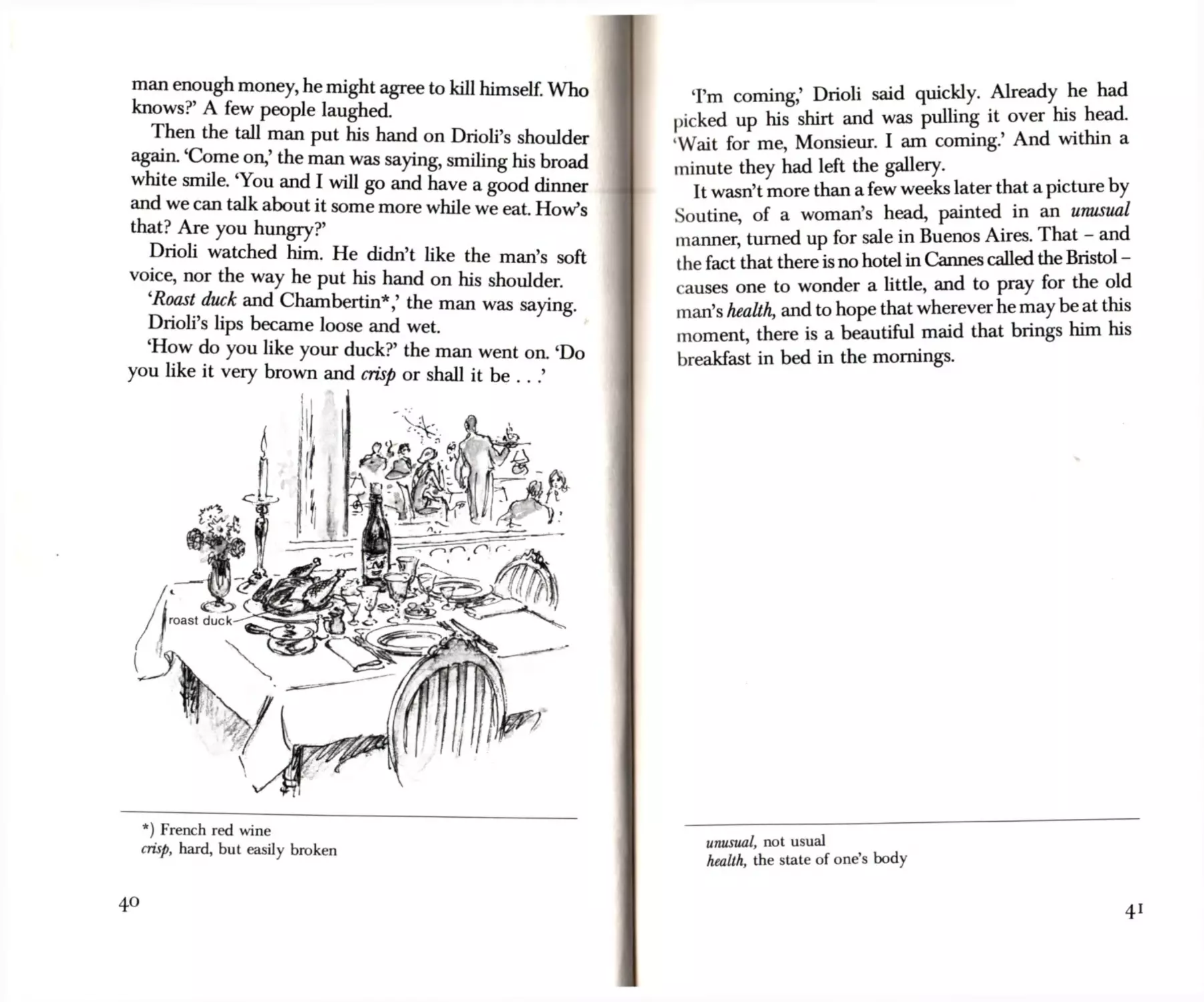
‘Roast duck and Chambertin*,’ the man was saying.
Drioli’s lips became loose and wet.
‘How do you like your duck?’ the man went on. ‘Do
you like it very brown and crisp or shall it be .. .’
*) French red wine
crisp, hard, but easily broken
4O
‘I’m coming,’ Drioli said quickly. Already he had
picked up his shirt and was pulling it over his head.
‘Wait for me, Monsieur. I am coming.’ And within a
minute they had left the gallery.
It wasn’t more than a few weeks later that a picture by
Soutine, of a woman’s head, painted in an unusual
manner, turned up for sale in Buenos Aires. That - and
the fact that there is no hotel in Cannes called the Bristol -
causes one to wonder a little, and to pray for the old
man’s health, and to hope that wherever he may be at this
moment, there is a beautiful maid that brings him his
breakfast in bed in the mornings.
unusual, not usual
health, the state of one’s body
41
Questions
1.	What is the condition of the old man?
2.	What catches the old man’s attention as he is walk-
ing down the street?
3.	What did Drioli think of Soutine?
4.	How did they meet?
5.	How did they celebrate Drioli’s success?
6.	How did Drioli interest Soutine in the idea of a
tattoo?
7.	What happened to them after the first war?
8.	How does Drioli come to be in the rich part of
town?
9.	What effect does it have on the people in the gallery
when Drioli shows them the tattoo?
10.	What does the artdealer suggest?
11.	Why does Drioli decide to go with the “hotel
owner”?
42
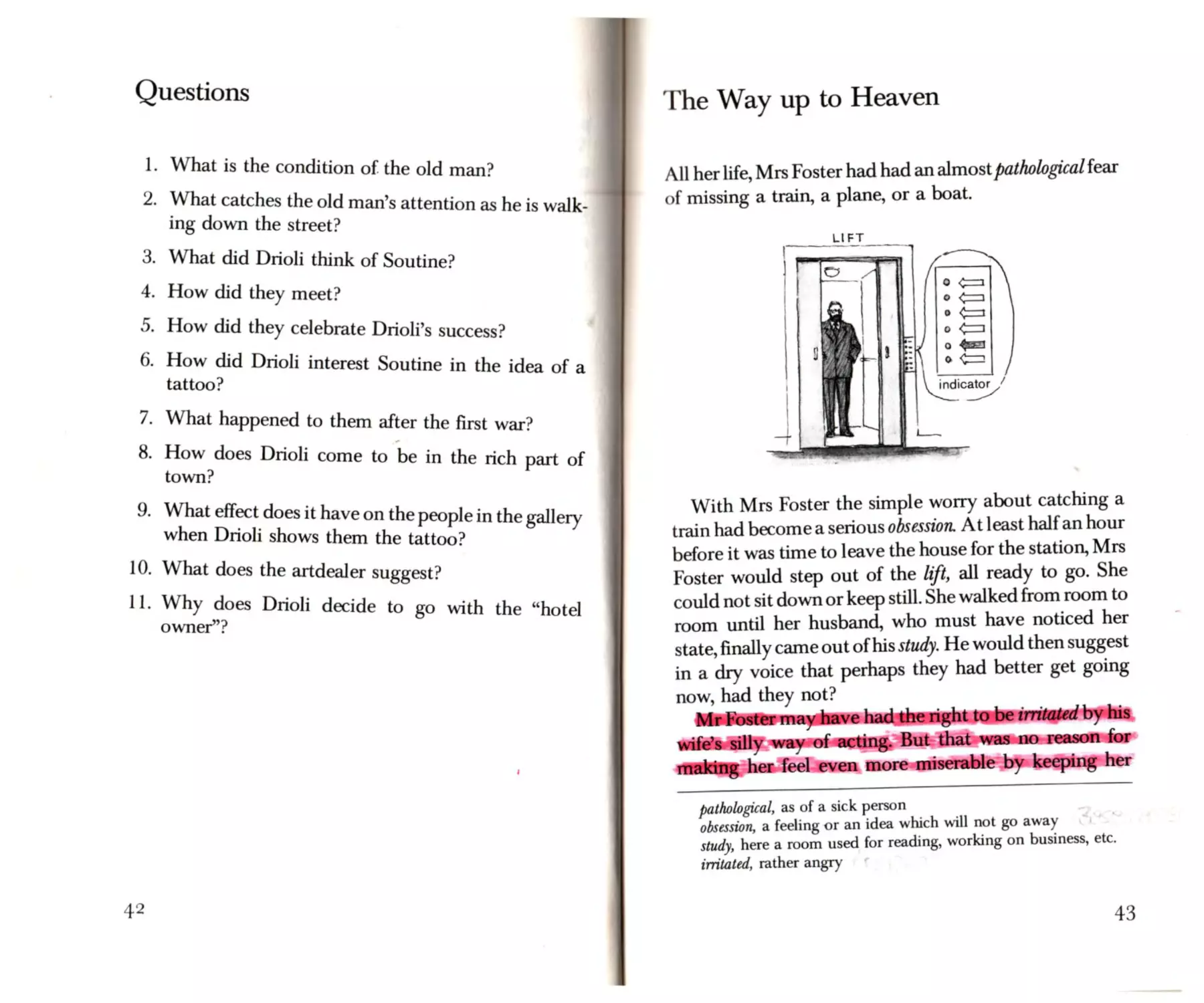
The Way up to Heaven
ЛИ her life, Mrs Foster had had an almost pathological fear
of missing a train, a plane, or a boat.
LIFT
With Mrs Foster the simple worry about catching a
train had become a serious obsession. At least half an hour
before it was time to leave the house for the station, Mrs
Foster would step out of the lift, all ready to go. She
could not sit down or keep still. She walked from room to
room until her husband, who must have noticed her
state, finally came out of his study. He would then suggest
in a dry voice that perhaps they had better get going
now, had they not?
making her feel even more miserable by keeping her
pathological, as of a sick person
obsession, a feeling or an idea which will not go away
study, here a room used for reading, working on business, etc.
irritated, rather angry
43
waiting unnecessarily. Of course, it is by no means certain
that this is what he did. Yet whenever they were to go
somewhere, he was just a minute or two late, and his
manner was so gentle that he seemed to be playing some
private game to make the poor lady suffer. And one
thing he must have known - that she would never call
out and tell him to hurry. He had trained her too well
for that. He must also have known that if he waited
one moment too long, he could drive her nearly into
hysterics. On one or two special occasions it had seemed
almost as though he had wanted to miss the train just
to make the poor woman suffer.
If this were true, what made it worse was the fact that
Mrs Foster was and always had been a good and loving
wife, except for this absurd fear of hers. For over thirty
years she had served him well. There was no doubt about
this. So for years she had refused to believe that Mr
Foster would ever want to make her suffer. But there had
been times in the later years of their married life when
she had begun to wonder.
Mr Eugene Foster was nearly seventy years old. He
lived with his wife in a large six-storey house in New York
City, on East Sixty-second Street, and they had four ser-
vants. It was a gloomy place, and few people cameto visit
them. But on this particular morning in January the
house had come alive. The servants were hurrying about,
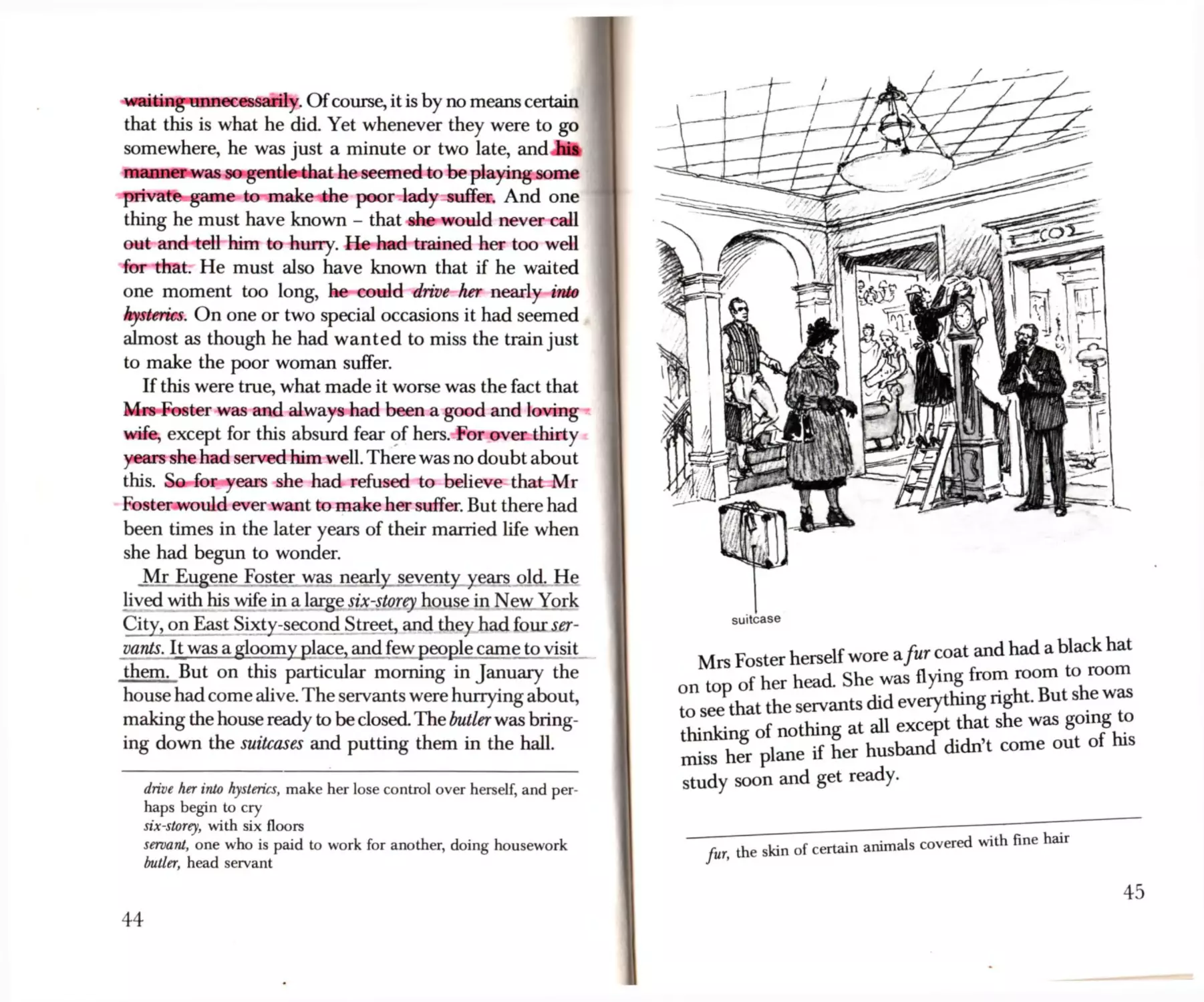
making the house ready to be closed. The butler was bring-
ing down the suitcases and putting them in the hall.
drive her into hysterics, make her lose control over herself, and per-
haps begin to cry
six-storey, with six floors
servant, one who is paid to work for another, doing housework
butler, head servant
44
suitcase
Mrs Foster herself wore a fur coat and had a black hat
on top of her head. She was flying from room to room
to see that the servants did everything right. But she was
thinking of nothing at all except that she was going to
miss her plane if her husband didn’t come out of his
study soon and get ready.
fur, the skin of certain animals covered with fine hair
45
‘What time is it, Walker?’ she said to the butler as she
passed him.
‘It’s ten minutes past nine, Madam.’
‘And has the car come?’
‘Yes, madam, it’s waiting. I’m just going to put the
suitcases in now.’
‘It takes an hour to get to Idlewild*,’ she said. ‘My
plane leaves at eleven. I have to be there half an hour
before to check in. I shall be late, I just know I’m going to
be late.’
‘I think you have time enough, Madam,’ the butler
said kindly. I told Mr Foster that you must leave at nine
fifteen. There are still another five minutes.’
‘Yes, Walker, I know, I know. But get the suitcases in
quickly, will you please?’
She began to walk up and down the hall. Whenever
the butler came by, she asked him the time. This, she
kept telling herself, was the one plane she must not miss.
It had taken months to make her husband allow her to
go.Tf she missed it he might easily decide that she
shouldn’t go after all. And the trouble was that he
wanted to go to the airport to see her off.
‘Dear God,’ she said aloud, ‘I’m going to miss it. I
know, I know, I know I’m going to miss it.’ Her eyes were
very close to tears.
‘What time is it, Walker?’
‘It’s eighteen minutes past, Madam.’
‘Now I really will miss it!’ she cried. ‘Oh, I wish he
would come!’
*) airport outside New York City
see someone off, to go with someone to the train, plane, etc. to say
good-bye
46
This was an important journey for Mrs Foster. She was
going all alone to Paris to visit her daughter, her only
child. She was married to a Frenchman. Mrs Foster didn’t
care much for the Frenchman but she loved her daugh-
ter. And she wanted very much to see her three grand-
children. She knew them only from the many photo-
graphs that she had received and put up all over the
house. Each time a new picture arrived she would carry it
away and sit with it for a long time. They were beautiful,
these children. She stared at them with love and looked
for signs in the small faces of that old blood likeness that
meant so much. She had come more and more to feel
that she did not wish to live out her days in a place where
she could not be near these children. She wanted them to
visit her, to take them for walks and buy them presents,
and watch them grow^She knew, of course, that it was
wrong to have thoughts like these while her husband was
still aliv^She knew also that he would never be willing to
leave New York and live in Paris/ft was a miracle that he
had agreed to let her fly over there alone for six weeks to
visit them. But, oh, how she wished she could live there
always, and be close to them!
‘Walker, what time is it?’
‘Twenty-two minutes past, Madam.’
As he spoke, a door opened and Mr Foster came into
the hall.
‘Well,’ he said, looking at his wife. ‘I suppose perhaps
we had better get going soon if you want to catch that
plane.’
grandchild, the child of one’s son or daughter
blood likeness, there is a blood likeness when members of the same
family look like one another
miracle, a wonderful act beyond the power of man
47
‘Yes, dear - yes! Everything is ready. The car’s waiting.’
‘That’s good,’ he said. With his head over to one side,
he was watching her closely, and she was looking back at
him - at this small, well-dressed man with a beard that
covered most of his face. He had a special way of making
small quick movements with his head. Because of this
and because of the way he was holding his hands to-
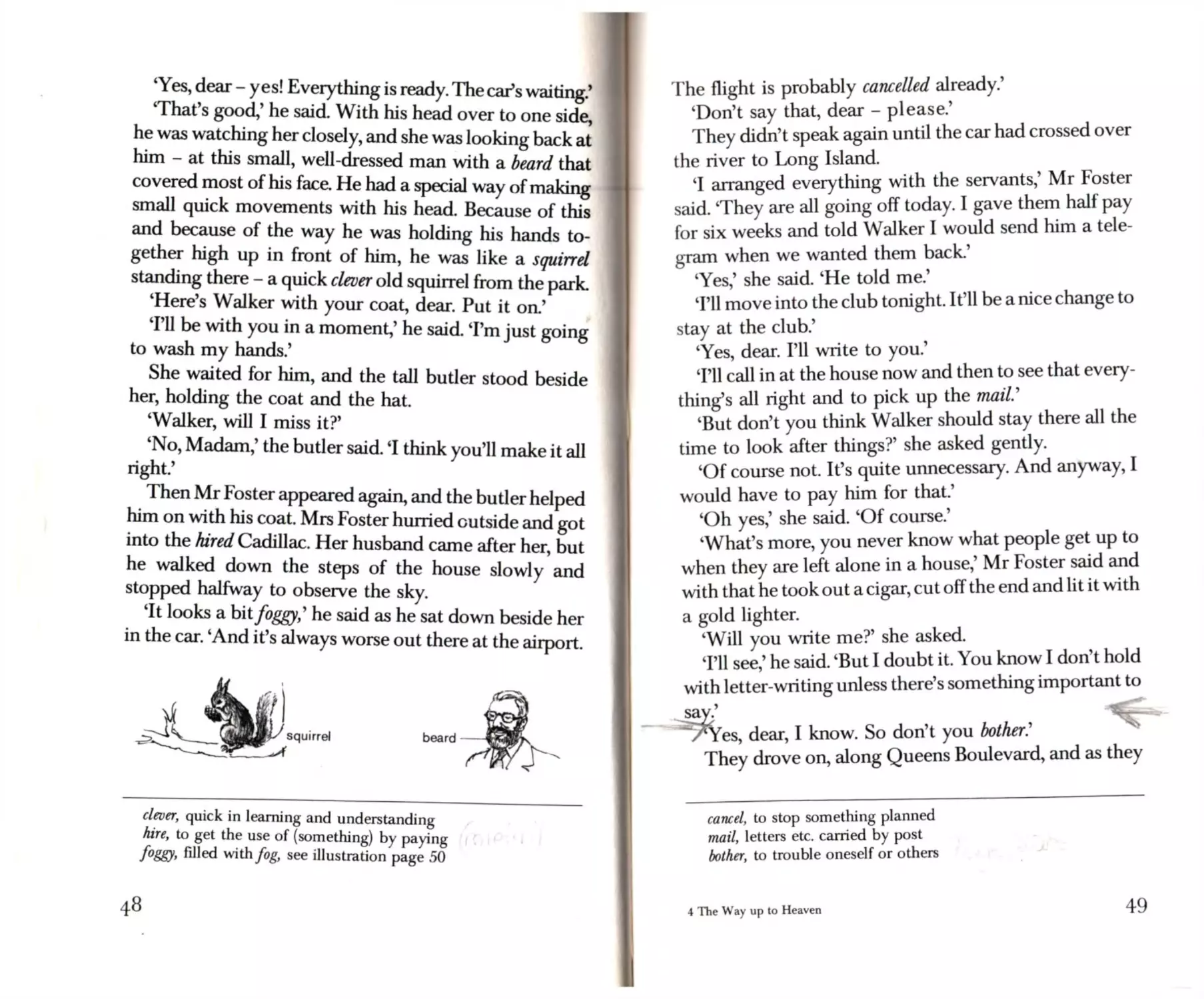
gether high up in front of him, he was like a squirrel
standing there - a quick clever old squirrel from the park
‘Here’s Walker with your coat, dear. Put it on.’
‘I’ll be with you in a moment,’ he said. ‘I’m just going
to wash my hands.’
She waited for him, and the tall butler stood beside
her, holding the coat and the hat.
‘Walker, will I miss it?’
‘No, Madam,’ the butler said. ‘I think you’ll make it all
right.’
Then Mr Foster appeared again, and the butler helped
him on with his coat. Mrs Foster hurried outside and got
into the hired Cadillac. Her husband came after her, but
he walked down the steps of the house slowly and
stopped halfway to observe the sky.
‘It looks a bit foggy,' he said as he sat down beside her
in the car. ‘And it’s always worse out there at the airport.
clever, quick in learning and understanding
hire, to get the use of (something) by paying
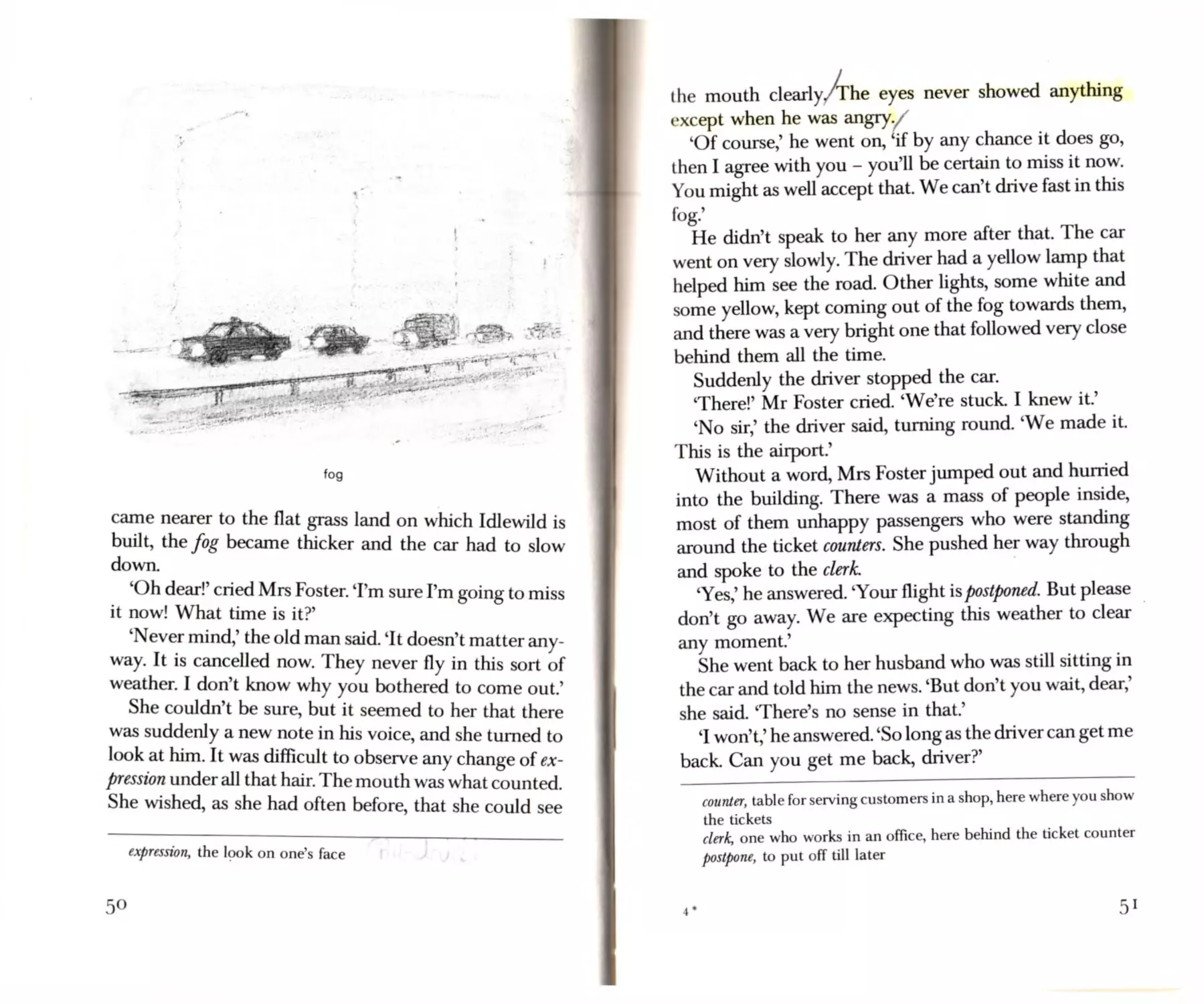
foggy, filled with fog, see illustration page 50
48
Fhe flight is probably cancelled already.’
‘Don’t say that, dear - please.’
They didn’t speak again until the car had crossed over
the river to Long Island.
‘I arranged everything with the servants,’ Mr Foster
said. ‘They are all going off today. I gave them half pay
for six weeks and told Walker I would send him a tele-
gram when we wanted them back.’
‘Yes,’ she said. ‘He told me.’
‘I’ll move into the club tonight. It’ll be a nice change to
stay at the club.’
‘Yes, dear. I’ll write to you.’
‘I’ll call in at the house now and then to see that every-
thing’s all right and to pick up the mail?
‘But don’t you think Walker should stay there all the
time to look after things?’ she asked gently.
‘Of course not. It’s quite unnecessary. And anyway, I
would have to pay him for that.’
‘Oh yes,’ she said. ‘Of course.’
‘What’s more, you never know what people get up to
when they are left alone in a house,’ Mr Foster said and
with that he took out a cigar, cut off the end and lit it with
a gold lighter.
‘Will you write me?’ she asked.
‘I’ll see,’ he said. ‘But I doubt it. You know I don’t hold
with letter-writing unless there’s something important to
say.’
ZYes, dear, I know. So don’t you bother"
They drove on, along Queens Boulevard, and as they
cancel, to stop something planned
mail, letters etc. carried by post
bother, to trouble oneself or others
4 The Way up to Heaven
49
fog
came nearer to the flat grass land on which Idlewild is
built, the fog became thicker and the car had to slow
down.
‘Oh dear!’ cried Mrs Foster. ‘I’m sure I’m going to miss
it now! What time is it?’
‘Never mind,’ the old man said. ‘It doesn’t matter any-
way. It is cancelled now. They never fly in this sort of
weather. I don’t know why you bothered to come out.’
She couldn’t be sure, but it seemed to her that there
was suddenly a new note in his voice, and she turned to
look at him. It was difficult to observe any change of ex-
pression under all that hair. The mouth was what counted.
She wished, as she had often before, that she could see
expression, the look on one’s face
50
the mouth clearly/The eyes never showed anything
except when he was angry./'
‘Of course,’ he went on, ‘if by any chance it does go,
then I agree with you - you’ll be certain to miss it now.
You might as well accept that. We can’t drive fast in this
fog.’
He didn’t speak to her any more after that. The car
went on very slowly. The driver had a yellow lamp that
helped him see the road. Other lights, some white and
some yellow, kept coming out of the fog towards them,
and there was a very bright one that followed very close
behind them all the time.
Suddenly the driver stopped the car.
‘There!’ Mr Foster cried. ‘We’re stuck. I knew it.’
‘No sir,’ the driver said, turning round. ‘We made it.
This is the airport.’
Without a word, Mrs Foster jumped out and hurried
into the building. There was a mass of people inside,
most of them unhappy passengers who were standing
around the ticket counters. She pushed her way through
and spoke to the clerk.
‘Yes,’ he answered. ‘Your flight is postponed. But please
don’t go away. We are expecting this weather to clear
any moment.’
She went back to her husband who was still sitting in
the car and told him the news. ‘But don’t you wait, dear,’
she said. ‘There’s no sense in that.’
‘I won’t,’ he answered. ‘So long as the driver can get me
back. Can you get me back, driver?’
counter, table for serving customers in a shop, here where you show
the tickets
clerk, one who works in an office, here behind the ticket counter
postpone, to put off till later
4*
51
‘I think so,’ the man said.
‘Are the suitcases out?’
‘Yes, sir.’
‘Good-bye, dear,’ Mrs Foster said and leaned into the
car and gave her husband a small kiss.
‘Good-bye,’ he answered. ‘Have a good trip.’
The car drove off, and Mrs Foster was left alone.
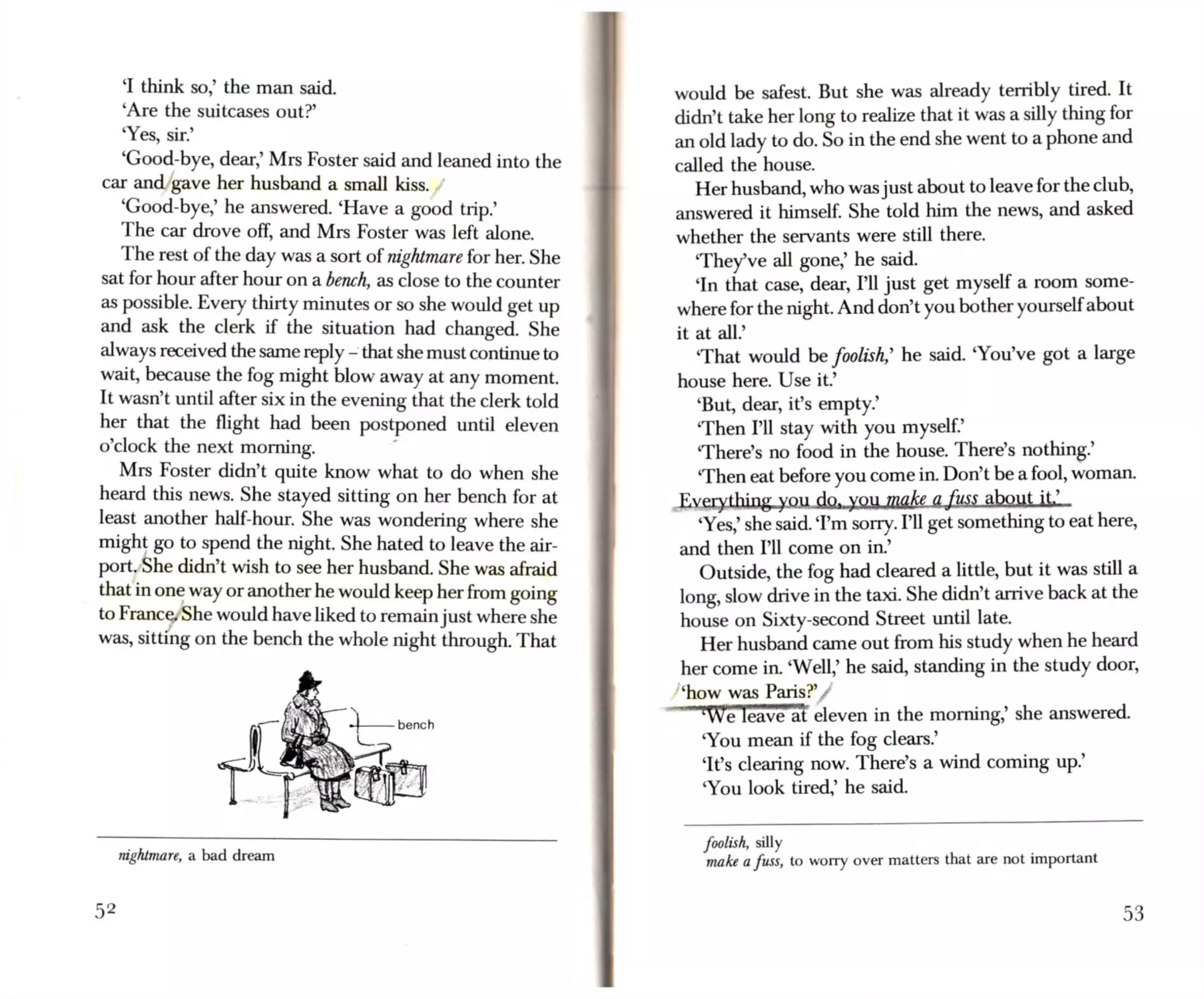
The rest of the day was a sort of nightmare for her. She
sat for hour after hour on a bench, as close to the counter
as possible. Every thirty minutes or so she would get up
and ask the clerk if the situation had changed. She
always received the same reply - that she must continue to
wait, because the fog might blow away at any moment.
It wasn’t until after six in the evening that the clerk told
her that the flight had been postponed until eleven
o’clock the next morning.
Mrs Foster didn’t quite know what to do when she
heard this news. She stayed sitting on her bench for at
least another half-hour. She was wondering where she
might go to spend the night. She hated to leave the air-
port. She didn’t wish to see her husband. She was afraid
that in one way or another he would keep her from going
to France. She would have liked to remain just where she
was, sitting on the bench the whole night through. That
nightmare, a bad dream
52
would be safest. But she was already terribly tired. It
didn’t take her long to realize that it was a silly thing for
an old lady to do. So in the end she went to a phone and
called the house.
Her husband, who was just about to leave for the club,
answered it himself. She told him the news, and asked
whether the servants were still there.
‘They’ve all gone,’ he said.
‘In that case, dear, I’ll just get myself a room some-
where for the night. And don’t you bother yourself about
it at all.’
‘That would be foolish' he said. ‘You’ve got a large
house here. Use it.’
‘But, dear, it’s empty.’
‘Then I’ll stay with you myself.’
‘There’s no food in the house. There’s nothing.’
‘Then eat before you come in. Don’t be a fool, woman.
Every thiog^ou dQ..,yQ.ujKfl.^	iC.
‘Yes,’ she said. ‘I’m sorry. I’ll get something to eat here,
and then I’ll come on in.’
Outside, the fog had cleared a little, but it was still a
long, slow drive in the taxi. She didn’t arrive back at the
house on Sixty-second Street until late.
Her husband came out from his study when he heard
her come in. ‘Well,’ he said, standing in the study door,
‘how was Paris?’/
4Ve leave at eleven in the morning,’ she answered.
‘You mean if the fog clears.’
‘It’s clearing now. There’s a wind coming up.’
‘You look tired,’ he said.
foolish, silly
make a fuss, to worry over matters that are not important
53
‘Yes,’ she said. ‘I’m very tired. I think I’ll go to bed
now.’
‘I’ve ordered a car for the morning,’ he said. ‘Nine
o’clock.’
‘Oh, thank you, dear. And I certainly hope you’re not
going to bother to come all the way out again to see me
off.’
‘No,’ he said slowly. ‘I don’t think I will. But there is no
reason why you shouldn’t drop me at the club on your
way.’
/ She looked at him, and at that moment he seemed to
be standing a long way off from her. He was suddenly so
small and far away that she couldn’t be sure what he was
doing, or what he was thinking, or even what he was/
‘The club is downtown,' she said. ‘It isn’t on the way to
the airport.’
‘You’ll have time enough my dear. Don’t you want to
drop me at the club?’
‘Oh, yes - of course.’
‘That’s good. Then I’ll see you in the morning at nine.’
She went up to her bedroom on the second floor, and
she was so tired from her day that she fell asleep soon
after she lay down.
Next morning, Mrs Foster was up early, and by eight
thirty she was downstairs and ready to leave.
Shortly after nine, her husband appeared. ‘Did you
make any coffee?’ he asked.
‘No, dear. I thought you’d get a nice breakfast at the
club. The car is here. It’s been waiting. I’m all ready to
g°-’
downtown, (US) in the main business district of a city
shortly, a short time
54
They were standing in the hall they always seemed
to be meeting in the hall. /
‘If you are going to take me to the club first,’ he said, ‘I
suppose we had better get going soon, hadn’t we?’
‘Yes!’ she cried. ‘Oh, yes - please!’
‘I’m just going to get a few cigars. I’ll be right with
you. You get in the car.’
She turned and went out to where the chauffeur was
standing, and he opened the car door for her.
‘What time is it?’ she asked him.
‘About nine fifteen.’
Mr Foster came out five minutes later. As on the day
before, he stopped halfway down to look at the sky. The
weather was still not quite clear, but the sun was coming
through the mist.
‘Perhaps you’ll be lucky this time,’ he said as he sat
down beside her in the car.
‘Hurry, please,’ she said to the chauffeur. ‘Please get
going. I’m late.’
The man started the engine.
‘Just a moment!’ Mr Foster said suddenly. ‘Hold it a
moment, chauffeur, will you?’
‘What is it, dear?’ she saw him searching the pockets
of his overcoat.
‘I had a little present I wanted you to take to Ellen,’ he
said. ‘Now, where on earth is it? I’m sure I had it in my
hand as I came down.’
‘I never saw you carrying anything. What sort of
present?’
mist, a thin fog
search, to look or feel or go over (a place, a person) to try to find
something
55
‘A little box in white paper. I forgot to give it to you
yesterday. I don’t want to forget it today.’
‘A little box!’ Mrs Foster cried. ‘I never saw any little
box.’ She began looking for it in the back of the car.
Her husband continued to look for it in the pockets of
his coat, then he felt around in his jacket. ‘I must have left
it in the bedroom. I won’t be a moment.’
‘Oh, please!’ she cried. ‘We haven’t got time! Please
leave it! You can mail it.’
‘Stay here!’ he commanded. ‘I’m going to get it.’
‘Be quick, dear! Oh, please be quick!’
She sat still, waiting and waiting.
‘Chauffeur, what time is it?’
The man looked at his watch. ‘I make it nearly nine
thirty.’
‘Can we get to the airport in an hour?’
‘Just about.’
At this point, Mrs Foster suddenly saw a comer of
something white pressed down at the back of the seat
where her husband had been sitting. She reached over
and pulled out a small white box. At the same time she
noticed that it was pressed down deep, as though with
the help of a pushing hand.
‘Here it is!’ she cried. ‘I’ve found it! Oh dear, and now
he’ll be up there for ever looking for it! Chauffeur,
quickly - run in and call him down, will you please?’
The chauffeur didn’t care very much for any of this,
but he climbed out of the car and went up the steps to the
front door of the house. Then he turned and came back.
‘Door’s locked] he said. ‘You got a key?’
‘Yes, wait a minute.’ She began looking like mad in her
lock, to close a door so that it can only be opened with a key
56
handbag. ‘Here it is! No - I’ll go myself. It’ll be quicker. I
know where he’ll be.’
She hurried out of the car and up the steps to the front
door, holding the key in one hand. She put the key into
the keyhole and was just about to turn it - and then she
stopped. Her head came up, and she stood there without
moving. Her whole body had stopped right in the
middle of all this hurry to turn the key and get into the
house. She waited - five, six, seven, eight, nine, ten
seconds, she waited. The way she was standing still,
with her head in the air, she seemed to be listening for
some sound that had stopped and that she had heard a
moment before from deep inside the house.
Yes, she was listening. She moved one of her ears
closer to the door. Now it was right up against the door.
She remained in that position, head up, ear to the door,
hand on key, for still another few seconds.
Then, at once, she sprang to life again. She pulled the
key out of the door and came running back down the
steps.
‘It’s too late!’ she cried to the chauffeur. ‘I can’t wait for
him, I simply can’t I’ll miss the plane. Hurry now, driver,
hurry! To the airport!’
Her face had turned white, the whole expression of her
face had changed. There was no longer that soft and silly
look. Her face looked hard with a thin mouth and bright
eyes. And her voice, when she spoke, carried a new note
of strength.
‘Hurry, driver, hurry!’
‘Isn’t your husband travelling with you?’ the man
asked, surprised.
‘Certainly not! I was only going to drop him at the
club. It won’t matter. He’ll understand. He’ll get a taxi.
57
Don’t sit there talking, mart G e t go i n g! I’ve got a plane
to catch for Paris!’
With Mrs Foster urging him from the back seat, the
man drove fast all the way, and Mrs Foster caught her
plane. Soon she was high up over the Atlantic. She
settled back in her seat and listened to the sound of the
engines. She was on her way to Paris at last. The new
mood was still with her. She felt strong and in a strange
sort of way, wonderful. She was so surprised at what she
had done that her heart was beating fast. But as the plane
flew farther and farther away from New York and East
Sixty-second Street, a great sense of peace began to
settle upon her. By the time she reached Paris, she was as
strong and calm as she could wish.
She met her grandchildren, and they were even more
beautiful than on the photographs. Every day she took
them for walks, and bought them cakes and presents,
and told them stories.
Once a week, on Tuesdays, she wrote a nice long letter
to her husband, which always ended with the words
»Now be sure to take all your meals every day. I’m afraid
you may not be doing so when I’m not with you.«
When her six weeks were up, everybody was sad that
she had to return to America, to her husband. Every-
body, that is, except her. She did not seem to mind as
much as one might have expected. When she kissed
them all good-bye, there was something in her manner
and in the things she said that made them feel that she
might return in the near future.
urge, to try hard to get someone to do something
mood, the state of a person’s feelings
farther, to a greater distance
calm, quiet; not worried
58
So six weeks after she had arrived, she sent a telegram
to her husband and caught the plane back to New York.
When Mrs Foster arrived at Idlewild she was interested
to observe that there was no car to meet her. She took
a taxi into town. New York was colder than Paris, and
there was dirty snow lying in the streets. The taxi drew
up before the house on Sixty-second Street. The driver
carried her two large suitcases to the top of the steps.
Then she paid him off and rang the bell. She waited, but
there was no answer. Just to make sure, she rang again.
But still no one came.
So she took her own key and opened the door herself.
The first thing she saw as she entered was a lot of mail
lying on the floor where it had fallen after it had been
pushed through the letter box. The place was dark and
cold. There was a strange smell in the air that she had
never come across before.
She walked quickly across the hall and round the
comer to the left, at the back. She had the air of a
woman who knows what she is looking for. And when
she returned a few seconds later, there was a contented
look on her face.
She stopped in the centre of the hall, as if she didn’t
know what to do next. Then, suddenly, she turned and
went across into her husband’s study. On the desk she
found his address book. Then she picked up the phone.
‘Hello,’ she said. ‘Listen, this is Nine East Sixty-second
Street . . . Yes, that’s right. Could you send someone
round as soon as possible, do you think? Yes, it seems to
be stuck between the second and third floors. At least,
smell, that which you sense through the nose
59
that’s where the indicator is pointing. Right away? Oh,
that’s very kind of you. You see, my legs aren’t any good
for walking up a lot of stairs. Thank you so much.
Goodbye.’
Then she settled back calmly in the chair at her hus-
band’s desk and waited for the man to come and repair
the lift.
Questions
1.	In what way did Mr Foster make his wife suffer?
2.	Why was the journey specially important to Mrs
Foster?
3.	Why was Mr Foster going to stay at the club while his
wife was away?
4.	What difficulties did Mrs Foster meet with on her
first trip to the airport?
5.	What trick did Mr Foster use on the second day to try
to make her late?
6.	How did it happen that Mrs Foster decided not to
wait for him?
7.	In what way did Mrs Foster change after she left
her husband?
8.	What did Mrs Foster find on her return?
indicator, see page 43
repair, to make (something) work again
6o
Mrs Bixby and the Colonel’s Coat
America is the land of opportunities for women. Already
they own about eighty-five per cent of the wealth of the
nation. Soon they will have it all. For women divorce pays
well. It is simple to arrange and easy to forget. They can
repeat it as often as they like and become rich that way.
Or they can gain by the husband’s death. The poor fel-
low usually dies from overwork.
Young men can see this happening all the time but
they are still not put off. By the time they are thirty-six
years old many of them have at least two ex-wives on the
payroll. To support these ladies, the men must work like
slaves, which is of course just what they are. As old age
comes on too soon and they begin to realize their state,
fear slowly enters their hearts. In the evenings they meet
in little groups, in clubs and bars, and drink their whis-
kies and tell each other stories to keep up their spirits.
In these stories there are always three main characters
- the husband, the wife, and the dirty dog. The husband is
a good, hard-working man. The wife is false and cannot
be trusted. She is always at some game with the dirty
dog. The husband is too good a man even to think ill of
her. Things look black for the husband. Will the poor
man ever find out? No he won’t. But wait! Suddenly the
opportunity, a (good) chance
divorce, the ending of a marriage
payroll, a list of persons receiving pay
slave, one who is forced to work for a master
dirty dog, here a man who has many love-affairs
61
husband turns the tables on his deceitful wife, and she is
completely beaten.
There are many of these stories going around but
most of them are too foolish to be worth repeating. One,
however, is better than the others; and it happens to be
true. It is very popular with men who have been caught
out two or three times. If you are one of these miserable
men, and if you haven’t heard it before, you may enjoy
the way it turns out. The story is called “Mrs Bixby and
the Colonel’s Coat”, and it goes something like this:
Mr and Mrs Bixby lived in a small apartment some-
where in New York City. Mr Bixby was a dentist with an
average income. Mrs Bixby was a vigorous woman. Once a
month, always on Friday afternoons, Mrs Bixby would
go by train to Baltimore to visit her old aunt. She would
spend the night with the aunt and return to New York on
the following day in time to cook supper for her husband.
Mr Bixby accepted this. He knew that aunt Maude lived
in Baltimore, and that his wife was very fond of the old
lady. There was no reason why they should not have the
pleasure of meeting once a month.
‘Just so long as you don’t ever expect me to come with
you,’ Mr Bixby said in the beginning.
‘Of course not, darling,’ Mrs Bixby had answered.
‘After all, she is not your aunt. She’s mine.’
So far so good.
turn the tables, to pass from a losing to a winning position
deceitful, false; not true
apartment, (US) flat
dentist, a person who looks after teeth
income, that which a person earns
virgorous, full of life and strength
supper, the last meal of the day
62
As it turned out, however, the aunt was not the only
reason for Mrs Bixby to visit Baltimore. The dirty dog
was a rich gentleman known as the Colonel. He lived in a
lovely house just outside the town. He had no wife or
family, only a few servants and several horses. Mrs Bixby
spent most of her time in Baltimore in his company.
Year after year this affair between Mrs Bixby and the
Colonel continued. After all, they met only twelve times
a year so there was little or no chance that they should
get tired of one another.
Eight years went by.
It was just before Christmas. Mrs Bixby was standing
on the station in Baltimore. She was waiting for the train
to take her back to New York. This particular visit which
had just ended had been very pleasant, and she was in a
good mood. But then the Colonel’s company always did
that to her. The man had a way of making her feel that
she was a marvellous woman, someone very special; and
what a very different thing that was from the dentist hus-
band at home. He never succeeded in making her feel
that she was anything but & patient in his waiting-room.
‘The Colonel asked me to give you this,’ a voice beside
her said. She turned and saw Wilkins, the Colonel’s ser-
vant. He was pushing a large, flat box into her arms.
‘My heavens, what a large box! What is it, Wilkins?
Was there a message? Did he send me a message?’
‘No message,’ the servant said, and he walked away.
As soon as she was on the train, Mrs Bixby carried the
colonel, an army officer
pleasant, that gives pleasure
patient, one under the care of a doctor, a dentist, etc.
message, a piece of news sent from one person to another
63
box into the Ladies’ Room and locked the door. How
wonderful! A Christmas present from the Colonel. She
started to untie the string. ‘I’ll bet it is a dress,’ she said
aloud. ‘It might even be two dresses. Or it might be a
whole lot of beautiful underclothes. I won’t look I’ll just
64
feel around and try to guess the colour as well, and what
it looks like. Also how much it cost.’
She shut her eyes and slowly lifted off the lid. Then she
put one hand down into the box. There was some tissue
paper on the top. There was also a card. She didn’t pay
any attention to it but went searching under the tissue
paper with her fingers.
‘My God,’ she cried suddenly. ‘It can’t be true!’
She opened her eyes wide and stared at the coat. Then
she grabbed it and lifted it out of the box. When she held it
up and saw it hanging to its full length, it was so beautiful
that she couldn’t take her eyes off it.
Never had she seen mink like this before. The fur was
almost pure black. At first she thought it was black; but
when she held it closer to the window she saw that there
was a touch of blue in it as well, a deep rich blue. Quickly
she looked at the label. It said simply, WILD LABRA-
DOR MINK. There was nothing else, no sign of where it
had been bought or anything. But what in the world
could it have cost? Four, five, six thousand dollars?
Possibly more.
She just couldn’t take her eyes off it. Nor, for that mat-
ter could she wait to try it on. Quickly she took off her
own plain red coat. Her heart was beating strongly, she
lid, the cover for a box
tissue paper, thin soft paper
grab, to take suddenly
label, a small written note fixed on to something (to tell its con-
tents)
5 The Way up to Heaven
65
couldn’t help it, and her eyes were opened very wide. But
oh God, the feel of that fur!
The great black coat came on almost like a second
skin. Oh boy! It was the strangest feeling. She looked
into the mirror. It was fantastic. Her personality had
suddenly changed completely. She looked radiant, rich,
marvellous, all at the same time. And the sense of power
that it gave her! In this coat she could walk into any place
she wanted and be treated like a queen. The whole thing
was just too wonderful for words!
Mrs Bixby picked up the card that was still lying in the
box. It was from the Colonel:
»I once heard you saying that you liked mink so I got
you this. Please accept it with my sincere good wishes as a
parting gift. For my own personal reasons I shall not be
able to see you anymore. Good-bye and good luck.«
Well!
Imagine that!
Right out of the blue, just when she was feeling so
happy.
No more Colonel.
What a terrible shock.
She would miss him very much.
She put the card away, but she noticed that there was
something written on the other side:
»P.S. Just tell them that nice aunt gave it to you for
Christmas.«
The smile immediately left Mrs Bixby’s face.
personality, one’s personal qualities of mind and character
radiant, shining
sincere, true
parting gift, a gift to or from someone who is going away
66
‘The man must be mad!’ she cried. ‘Aunt Maude
doesn’t have that sort of money. She couldn’t possibly
give me this.’
But if Aunt Maude hadn’t given it to her, then who
had?
She had been so busy opening the box and trying the
coat on that she hadn’t thought about this important
point.
In a couple of hours she would be in New York. Ten
minutes after that she would be home, and her husband
would be there to receive her. Even a man like Cyril, who
always had his attention fixed on his dentist work, would
start asking a few questions if his wife suddenly returned
from a week-end with a six-thousand-dollar mink coat.
You know what I think, she told herself. I think the
Colonel has done this on purpose to make me suffer. He
knew very well Aunt Maude didn’t have enough money
to buy this. He knew I wouldn’t be able to keep it.
But the thought of parting with it now was more than
Mrs Bixby could bear.
‘I’ve go t to have this coat!’ she said aloud. ‘I’ve got to
have this coat! I’ve got to have this coat!’
Very well, my dear. You shall have the coat. Now sit
still and keep calm and start thinking. You are a clever
girl, aren’t you? You have fooled him before. So just sit
still and think. There’s lots of time.
Two and a half hours later, Mrs Bixby stepped off the
train at Pennsylvania Station. She was wearing her old
coat again and carrying the box in her arms. She got into
a taxi.
part with, to give up
5*
67
‘Driver,’ she said, ‘would you know of a pawnbroker
that’s still open around here?’
‘Lots along Sixth Avenue,’ he answered.
‘Stop at the first one you see, then, will you please?’
Soon the taxi pulled up outside a pawnbroker’s shop.
‘Wait for me, please,’ Mrs Bixby said to the driver and
entered the shop.
There was a big cat lying on the counter. The animal
looked up at Mrs Bixby with bright yellow eyes. Mrs
Bixby stood by the counter, as far away from the cat as
possible, waiting for someone to come. She was staring at
the watches, the rings, the eye-glasses, the false teeth.
Why did they always pawn their teeth, she wondered.
‘Yes?’ the pawnbroker said, coming out from a dark
place in the back of the shop. He went up to the cat and
started stroking it.
‘Oh, good evening,’ Mrs Bixby said. She began to un-
tie the string around the box. ‘Isn’t it silly of me? I’ve
gone and lost my pocket-book. To-day is Saturday and the
banks are all closed until Monday. I’ve got to have some
money for the week-end. This is a very expensive coat,
but I’m not asking much. I just want enough money to
get me through the week-end. I’ll come back Monday
and redeem the coat!
The man waited, and said nothing. But when she
pulled out the mink and allowed the beautiful thick fur
pawnbroker, one who lets you have money for an article of some val-
ue which he then keeps until you pay the money back (with some
money, called interest)
pawn, to leave (an article) with a pawnbroker
stroke, to touch gently with the hand
pocket-book, a small, flat case for holding bank notes and personal
papers
redeem, to buy back (articles from a pawnbroker)
68
to fall over the counter his eyes opened up wide. He
drew his hand away from the cat and came over to look
at it. He picked it up and held it out in front of him.
‘If only I had a watch on me or a ring,’ Mrs Bixby said,
‘I’d give you that instead. But the fact is I don’t have a
thing with me other than this coat.’ She spread out her
fingers for him to see.
‘It looks new,’ the man said and touched the soft fur
gently.
‘Oh, yes, it is. But as I said, I only want enough money
to get me through till Monday. How about fifty dol-
lars.’
‘I’ll lend you fifty dollars.’
‘It’s worth a hundred times more than that, but I know
you’ll take good care of it until I return.’
The man fetched a ticket and placed it on the counter.
The ticket looked like one of those labels you tie on to
your suitcase. But it had a line across the middle so that
you could tear it in two.
‘Name?’ he asked.
‘Leave that out. And the address.’
The man lifted the pen, waiting.
‘You don’t have to put the name and address, do you?’
The man shook his head and moved the pen on down
to the next line.
‘It’s just that I’d rather not,’ Mrs Bixby said. ‘It’s per-
sonal.’
‘You’d better not lose this ticket, then.’
‘I won’t lose it.’
‘Do you realize that anyone who gets hold of it can
come in and claim the article?’
lend, to give the use of (something) for a time
69
‘Yes, I know that.’
‘What do you want me to put for a description?"
‘No description either, thank you. It’s not necessary.
Just put the amount of money that you give me.’
The man waited again with the pen on the line beside
the word ARTICLE.
‘1 think you ought to put a description. A description
is always a help if you want to sell the ticket. You never
know, you might want to sell it sometime.’
‘I don’t want to sell it.’
‘You might have to. Lots of people do.’
‘Look,’ Mrs Bixby said. ‘I’m not broke, if that’s what
you mean. I just want fifty dollars until Monday. Don’t
you understand?’
‘You have it your own way then,’ the man said. ‘It’s
your coat.’
At this point an unpleasant thought struck Mrs Bixby.
‘Tell me something,’ she said. ‘If I don’t have a descrip-
tion on my ticket, how can I be sure you’ll give me back
the coat and not something else when I return?’
‘It goes in the books.’
‘But all I’ve got is a number. So you could hand me
any old thing you wanted, isn’t that so?’
‘Do you want a description or don’t you?’ the man
asked.
‘No,’ she said. ‘I trust you.’
The man wrote »fifty dollars« opposite the word
VALUE on both halves of the ticket. Then he tore off the
description, statement that describes
broke, completely without money
unpleasant, not pleasant
70
lower half and handed it to her. He took a wallet from
the inside pocket of his jacket and produced five ten-
dollar bills. ‘The interest is three per cent a month,’ he
said.
‘Yes, all right. And thank you. You’ll take good care of
it, won’t you? Shall I put it in the box for you?’
‘No,’ the man said.
Mrs Bixby turned and went out of the shop on to the
street where the taxi was waiting. Ten minutes later, she
was home.
‘Darling,’ she said as she leaned forward and kissed her
husband. ‘Did you miss me?’
Cyril Bixby laid down the evening paper and looked
at his watch. ‘It’s twelve and a half minutes past six,’ he
said. ‘You’re a bit late, aren’t you?’
‘I know. It’s those trains. Aunt Maude sent you her
love as usual. I’m dying for a drink, aren’t you?’
The husband put away the newspaper and got up to
get her a drink. His wife was watching him carefully,
wondering how long she ought to wait. He had his back
to her now as he was leaning forward to measure the gin.
He was putting his face right up close to the measurer
and staring into it as though it were a patient’s mouth.
It was funny how small he always looked after the
Colonel. I really must try to make him change the way
he dresses, she told herself. His suits are just too ridiculous.
There had been a time when she thought those Edward-
ian jackets were wonderful. Now they just seemed
absurd. So did the narrow trousers. You had to have a
special sort of face to wear things like that, and Cyril
wallet, pocket-book
ridiculous, very silly; to be laughed at
71
just didn’t have it He probably thought he was good-
looking. He would like women to think that he was
interested in them, that he was a bit of a dog. But Mrs
Bixby knew better. There was nothing behind his
manners. It meant nothing.
‘Thank you, darling,’ she said. She took the martini
and seated herself. ‘And what did you do last night?’
‘I stayed on at the office and got the accounts up to
date.’
‘Now really, Cyril, I think it is high time you let other
people do that kind of work for you. You’re much too im-
portant for that sort of thing. Why doesn’t that Pulteney
woman do the accounts? That’s part of her job, isn’t it?’
‘She does do them. But I have to price everything up
first. She doesn’t know who’s rich and who isn’t.’
‘The martini is good,’ Mrs Bixby said, setting down
her glass on the side table. ‘Very good.’ She opened her
bag and took out a tissue paper as if to blow her nose. ‘Oh
look!’ she cried, seeing the ticket. ‘I forgot to show you
this! I found it just now on the seat of my taxi. It’s got a
number on it. I thought it might be a lottery ticket or
something, so I kept it.’
She handed the small- piece of brown paper to her
husband. He took it in his fingers and began looking at it
closely as if it were a sick tooth.
‘You know what this is?’ he said slowly.
‘No dear, I don’t.’
‘It’s a pawn ticket.’
‘A what?’
‘A ticket from a pawnbroker. Here’s the name and
lottery, a game in which people who have bought tickets can win
money or articles
72
address of the shop, somewhere on Sixth Avenue.’
‘Oh dear, I’m sorry. I was hoping it might be some-
thing more interesting.’
‘There’s no reason to be sorry,’ Cyril Bixby said. ‘As a
matter of fact this could be rather amusing!
‘Why could it be amusing, darling?’
He explained to her carefully how a pawn ticket
worked, and told her that anyone who had the ticket
could claim the article.
‘Do you think it’s worth claiming?’ she asked.
‘I think it’s worth finding out what it is. Do you see this
figure of fifty dollars that’s written here? Do you know
what that means?’
‘No, dear, what does it mean?’
‘It means that the article in question is almost certain
to be something of great value.’
‘Do you mean it’ll be worth fifty dollars?’
‘More like five hundred.’
‘Five hundred!’
‘Don’t you understand?’ he said. ‘A pawnbroker never
gives you more than about a tenth of the real value.’
‘Good lord! I never knew that.’
‘There’s a lot of things you don’t know, my dear. Now
listen to me. Since there’s no name and address of the
owner . .
‘But there must be something to say who it belongs
to?’
‘Not a thing. People often do that They don’t want any-
one to know they have been to a pawnbroker. They
don’t want anyone to think they are short of money.’
‘Then you think we can keep it?’
amusing, that gives pleasure; funny
73
‘Of course we can keep it This is now our ticket.’
‘You mean my ticket,’ Mrs Bixby said. ‘I found it.’
‘My dear girl, what does it matter? The important
thing is that we can go and redeem it any time we like for
only fifty dollars. How about that?’
‘Oh, what fun!’ she cried. ‘And we don’t even know
what it is. It could be anything, isn’t that right Cyril?’
‘It could indeed, although it’s probably either a ring or
a watch. We shall just have to wait and see.’
‘I think it’s very interesting! Give me that ticket and
I’ll rush over first thing Monday and find out!’
‘I think I had better do that.’
‘Oh no!’ she cried. ‘Let m e do it!’
‘I think not. I’ll pick it up on my way to work.’
‘But it’s my ticket! Please let me do it, Cyril! Why
should you have all the fun?’
‘You don’t know these pawnbrokers, my dear. You
may get cheated"
‘I wouldn’t get cheated, I promise you I wouldn’t. Give
it to me, please.’
‘Also you have to have fifty dollars,’ he said smiling.
‘You have to pay out fifty dollars before they’ll give it to
you.’
‘I’ve got that,’ she said. ‘I think.’
‘I would rather that you didn’t go, if you don’t mind.’
‘But Cyril, I found it. It’s mine. Whatever it is, it’s
mine, isn’t that right?’
‘Of course it’s yours, my dear. There’s no need to get so
worked up about it.’
‘I’m not. I’m just excited, that’s all.’
cheat, here, to give back a wrong article
excited, not able to keep calm; not at rest
74
‘I suppose you don’t realize that this might be some-
thing for a man - a pocket-watch, for example. It isn’t
only women that go to pawnbrokers, you know.’
‘In that case I’ll give it to you for Christmas,’ Mrs
Bixby said. ‘But if it’s a woman’s thing, I want it myself. Is
that agreed?’
‘That sounds very fair. Why don’t you come with me?
We could both go.’
Mrs Bixby was about to say yes to this, but caught her-
self just in time. She didn’t want the pawnbroker to
recognize her and thus let her husband get the idea that
she had been there before.
‘No,’ she said slowly. ‘I don’t think I will. You see, it
will be even more fun if I stay behind and wait. Oh, I do
hope it isn’t going to be something that neither of us
wants.’
‘You’ve got a point there,’ he said. ‘If I don’t think it’s
worth fifty dollars, I won’t even take it.’
‘But you said it would be worth five hundred.’
‘I’m quite sure it will. Don’t worry.’
‘Oh, Cyril, I can hardly wait! Isn’t it exciting?
‘It’s amusing,’ he said, putting the ticket into his
pocket. ‘There’s no doubt about that.’
Monday morning came at last. After breakfast Mrs
Bixby followed her husband to the door and helped him
on with his coat.
‘Don’t work too hard, darling,’ she said.
‘No, all right.’
‘Home at six?’
‘I hope so.’
exciting, that makes you excited
75
‘Are you going to have time to go to that pawn-
broker’s?’ she asked.
‘My God, I forgot all about it. I’ll take a taxi and go
there now. It’s on my way.’
‘You haven’t lost the ticket, have you?’
‘I hope not,’ he said, feeling in his pocket. ‘No, here it
is.’
‘And you have enough money?’
‘Just about.’
‘Darling,’ she said, ‘if it happens to be something nice,
something you think I might like, will you telephone me
as soon as you get to the office?’
‘If you want me to, yes.’
‘You know, I hope it’ll be something for you, Cyril. I’d
much rather it was for you than for me.’
‘That’s very nice of you, my dear. Now I must run.’
About an hour later, when the telephone rang, Mrs
Bixby ran so fast across the room that she reached it
before the first ring had finished.
‘I got it,’ he said.
‘You did! Oh, Cyril, what was it? Was it something
good?’
‘Good!’ he cried. ‘It’s fantastic! You wait till you get
your eyes on this!’
‘Darling, what is it? Tell me quick!’
‘You’re a lucky girl, that’s what you are.’
‘It’s for me, then?’
‘Of course it’s for you. Though how in the world it ever
got pawned I just can’t understand. Someone is crazy.
You’ll go mad when you see it.’
‘What is it?’
‘Try to guess.’
Mrs Bixby waited a moment. Be careful, she told her-
76
self. Be very careful now.
‘A diamond ring?’
‘Wrong. It’s something you can wear.’
‘Something I can wear? You mean like a hat?’
‘No, it’s not like a hat,’ he said, laughing.
‘Please, Cyril, tell me!’
‘I want it to be a surprise. I’ll bring it home with me
this evening.’
‘You’ll do nothing of the sort!’ she cried. ‘I’m coming
right down there to get it now!’
‘I’d rather that you didn’t do that.’
‘Don’t be so silly, darling. Why shouldn’t I come?’
‘Because I’m too busy. I’m half an hour behind
already.’
‘Then I’ll come in the lunch hour. All right?’
‘I’m not having a lunch hour. Oh, well, come at one
thirty then, while I’m having a little to eat. Good-bye.’
At half past one, Mrs Bixby arrived at Mr Bixby’s
place of business and rang the bell. Her husband, in his
white dentist’s coat, opened the door himself.
‘Oh, Cyril, I’m so excited.’
‘You should be. You’re a lucky girl, did you know
that?’ He let her into the surgery.
‘Go and have your lunch, Miss Pulteney,’ he said to
the assistant, who was busy cleaning some instruments.
‘You can finish that when you come back.’ He waited un-
til the girl had gone, then he walked over to the cupboard
that he used for hanging up his clothes. He stood in front
diamond, a very expensive stone
surgery, here the room where the dentist works on a patient’s teeth
assistant, here, a person who helps the dentist
cupboard, here a part of a room, set back from the rest, with a door,
used for hanging clothes
77
of it and pointed at it with his finger. ‘It’s in there,’ he said.
‘Now - shut your eyes.’
Mrs Bixby did as she was told. In the silence that fol-
lowed she could hear him open the cupboard door and
pull out something from among the other things
hanging there.
‘All right! You can look!’
Mrs Bixby opened one eye just enough to see the man
standing there in his white coat holding something up in
the air.
‘Mink!’ he cried. ‘Real mink!’
At the sound of that word she opened her eyes quick,
and at the same time she started forward to take the coat
in her arms.
But there was no coat. There was only a ridiculous
little fur neckpiece hanging from her husband’s hand.
‘Look at that!’ he said and waved it in front of her face.
Mrs Bixby put a hand up to her mouth and started
backing away. I’m going to scream, she told herself. I
just know it. I’m going to scream.
‘What’s the matter, my dear? Don’t you like it?’ He
stopped waving the fur and stood staring at her, waiting
for her to say something.
‘Why yes,’ she said. ‘I... I... think it’s... it’s lovely...
really lovely.’
‘You really were surprised, weren’t you?’
‘Yes, I was.’
‘Wonderful quality,’ he said. ‘Fine colour, too. You
know something, my dear? I believe a piece like that
would cost you two or three hundred dollars at least if
you had to buy it in a shop.’
scream, to cry out in a loud voice
78
‘I don’t doubt it.’
There were two skins, two narrow skins with their
heads still on, with glass eyes. One of them had the tail of
the other in its mouth.
‘Here,’ he said. ‘Try it on.’ He put it around her neck
and stepped back to admire it. ‘Beautiful! It really suits
you. It isn’t everyone who has mink, my dear.’
‘No, it isn’t.’
‘Better leave it behind when you go shopping or they
will all think we’re millionaires and charge us too much.’
‘I’ll try to remember that, Cyril.’
‘I’m afraid you mustn’t expect anything for Christ-
mas. Fifty dollars was rather more than I was going to
spend anyway.’
He began to wash his hands. ‘Run along now, my dear,
and buy yourself a nice lunch. I’d take you out myself
but I’ve got a patient in the waiting-room.’
Mrs Bixby moved towards the door.
I’m going to kill that pawnbroker, she told herself. I’m
going right back to the shop this very minute. I’m going
to throw this ridiculous neckpiece right in his face and if
he refuses to give me back my coat I’m going to kill him.
‘Did I tell you I was going to be late home tonight?’
Cyril Bixby said, still washing his hands.
‘No.’
‘It’ll probably be at least eight thirty the way things
look at the moment. It may even be nine.’
‘Yes, all right. Good-bye.’ Mrs Bixby went out and
slammed the door behind her.
At that very moment, Miss Pulteney, the secretary-
slam, to shut with a loud noise
79
assistant, came sailing past her on her way to lunch.
‘Isn’t it a marvellous day?’ Miss Pulteney said as she
went by and smiled at her. She looked like a queen, just
like a queen, in the beautiful black mink coat that the
Colonel had given to Mrs Bixby.
Questions
1.	What is the writer’s opinion of American women?
2.	How does Mrs Bixby cover up her visits to the
Colonel?
3.	What are her feelings when the Colonel can’t see her
anymore?
4.	Why can’t she bring his parting gift home with her?
5.	What does she tell the pawnbroker?
6.	What is Mrs Bixby’s opinion of her husband?
7.	How does she explain the pawnbroker’s ticket to
him?
8.	Why is it the husband, and not Mrs Bixby, who
goes to redeem the ticket?
9.	How does Mr Bixby surprise his wife?
8o
EASY READER TITLES NOW AVAILABLE:
Jim Corbett: The Champawat Man-Eater (A)
Sir Arthur Conan Doyle: The Red Circle (A)
Sir Arthur Conan Doyle: The Speckled Band (A)
Nathaniel Hawthorne: The Great Stone Face (A)
R.L. Stevenson: The Bottle Imp (A)
Geoffrey Vickers: The Deer Stealers (A)
Oscar Wilde: The Canterville Ghost (A)
Enid Bly ton: Five on a Treasure Island (B)
Roald Dahl: The Way up to Heaven and Other Stories (B)
Daniel Defoe: Captain Singleton (B)
Sir Arthur Conan Doyle: Black Peter - The Red-Headed League (B)
James Herriot: If Only They Could Talk (B)
Jerome K. Jerome: Three Men in a Boat (B)
Ira Levin: The Stepford Wives (B)
William Saroyan: The Human Comedy (B)
Science Fiction Stories (B)
Isaac B. Singer: The Image and Other Stories (B)
John Steinbeck: Of Mice and Men (B)
Mark Twain: Tom Sawyer (B)
John Wain: The Two Worlds of Ernst and Other Stories (B)
Richard Wright: Black Boy (B)
John Buchan: The Thirty-Nine Steps (C)
John le Carre: Call for the Dead (C)
Roald Dahl: Edward the Conqueror and Other Stories (C)
Sir Arthur Conan Doyle: The Hound of the Baskervilles (C)
Graham Greene: The Third Man (C)
Thomas Hardy: A Mere Interlude and Other Tales (C)
Patricia Highsmith: Broken Glass and Other Stories (C)
Jack London: The Call of the Wild (C)
Alan Sillitoe: Noah’s Ark and Other Stories (C)
Nevil Shute: Pastoral (C)
John Steinbeck: The Pearl (C)
John Steinbeck: Tortilla Flat (C)
R.L. Stevenson: Treasure Island (C)
An Anthology of English Humour (D)
Ernest Hemingway: Two Stories (D)
James Hilton: Good-bye, Mr. Chips (D)
D. H. Lawrence: The Fox (D)
Doris Lessing: The Black Madonna and Other Stories (D)
W. Somerset Maugham: Cosmopolitans (D)
Edgar Allan Poe: The Murders in the Rue Morgue (D)
Dorothy L. Sayers: Murder Must Advertise (D)
Alan Sillitoe: The Loneliness of the Long Distance Runner (D)
R.L. Stevenson: Dr. Jekyll and Mr. Hyde (D)
For copyright reasons some of the above mentioned titles
are not for sale in all the participating countries. Kindly
consult the catalogue of your local publisher.
Four of Dahl’s celebrated short stories appear together in this
volume, all of them extremely gripping and with the usual
unexpected twist at the end.
“Man from the South” takes us tojamaica. Some naval cadets
and some young girls are gathered round a hotel swimming
pool. An elderly gentleman offers a harmless little bet to one of
the young boys - harmless?
“Skin” is the story of an old man with a painting by a famous
artist tattooed on his back. He gets an attractive offer from an
art dealer - but how can the man be separated from his pain-
ting?
After thirty years of married life Fate offers an obedient hou-
sewife the opportunity to free herself from a bullying husband -
and send him on his “Way up to Heaven”.
Mrs Bixby’s lover, in parting from her, gives her an expensive
mink coat. How can she explain this gift to her husband?
Easy Readers
are published in 4 series:
Abased on a vocabulary of
650 words
C based on a vocabulary of
1800 words
based on a vocabulary of
1200 words
D based on a vocabulary of
2500 words
Denmark: GRAFISK FORLAG • ISBN 87-429-7307-4
Finland: LEHT1 KIRJ AKAU PPA/TIDNINGSBOKH.
France: EDITIONS BORDAS • ISBN 2 04-011560-9
Spain: ITACA
Italy: EDIZIONI SCOLASTICHE BRUNO MONDADORI
Greece: EUROBOOK S.A.
Australia: CIS EDUCATIONAL
USA: EMC CORP. • ISBN 0-88436-888-2
Norway: GYLDENDAL NORSK FORLAG • ISBN 82-05-07908-0
Sweden: ALMQVIST & WIKSELL ISBN 91 21-06238 2
Holland: WOLTERS/NOORDHOFF- ISBN 90.01.27557.5
UK. ACCENT EDUCATIONAL PUBLISHERS ISBN 1 85693 021 1
India: ABI BOOKS (P) LIMITED
Germany: KLETT, STUTTGART UND MUNCHEN ISBN 3-12-535270-3