/









































































Текст
                    Other Oxford Books by
Sir Bernard Lovell
THE EXPLORATION OF OUTER
SPACE
The Gregynog Lectures 1961
\.. enthrallingly'interesting... no one is more quali¬
fied to speak on the thrilling discoveries, and possi¬
bilities yet to come, over which his chapters range
Not least in interest is the last chapter reflecting on
ethics and the cosmos . . . and thinking people
everywhere will appreciate Sir Bernard’s wise
observations on the relation of science to what we
term civilization which represent the finale of his
talks.’ New Scientist
THE INDIVIDUAL AND THE
UNIVERSE
The Reith Lectures 1958
Oxford Paperbacks
\ . . contains far the most neatly and clearly ex¬
pounded account today of recent cosmology, both
on the small scale of the solar system and the largest
extragalactic scale. . . .’ Bulletin of the Institute of
Physics
METEOR ASTRONOMY
International Series of Monographs
on Physics
A comprehensive account of the visual, photo¬
graphic, and radio techniques for the study of
meteors.
Oxford
University
Press
MP/N85I6
OVELL
The
Story
of
Jodrell
Bank
The Story of Jodrell Bank
|Л
BERNARD LOVELL
In spite of the rapid advance of science
during the past twenty years, the Jodrell
Bank telescope has not been superseded or
surpassed—an astonishing testimony to
the man who conceived it. Famous as it
now is for its researches into the depths of
space as well as for its tracking of satellites
and space probes, it was built in the face of
enormous difficulties. Delays and mount¬
ing costs, growing debts, and the inability
of officialdom to assess the importance of
the work, wove a nightmare of intractable
problems round Bernard Lovell, who
battled for over twelve years to secure the
site, the finance, and the moral support for
the construction of a radio telescope which
would study the remote regions of time and
space. There were moments when the ruin
of his career seemed near; but it was when
things were at their blackest that his
triumphant justification came about: in
1957 the telescope located by radar the
carrier rocket of the first earth satellite,
Sputnik 1.
Sir Bernard tells this dramatic story
lucidly and with candour; and he presents
the technical problems to the average
reader with disarming skill. This is not
only a distinguished scientist’s own ac¬
count of the critical years of his life; it is
also among the most absorbing chronicles
we have of a visionary’s successful struggle
to realize his dream.
The photograph on the jacket was taken by Tom S tut tart of the
guardian in August 1966 when Luna 11 reached the vicinity of
the moon.
45s. net
IN U.K. ONLY

The Story of Jodrell Bank

The Story of

Jodrell Bank
BERNARD LOVELL

Oxford University Press, Ely House, London W. i
GLASGOW NEW YORK TORONTO MELBOURNE WELLINGTON
CAPE TOWN SALISBURY IBADAN NAIROBI LUSAKA ADDIS ABABA
BOMBAY CALCUTTA MADRAS KARACHI LAHORE DACCA
KUALA LUMPUR HONG KONG TOKYO
© А. С. B. Lovell 1968
PRINTED IN GREAT BRITAIN BY
HAZELL WATSON AND VINEY LTD
AYLESBURY, BUCKS

CONTENTS
Forewords by H. C. Husbajid, C.B.E., D.ScConsulting
Engineer, and R. A. Rainford, M.A., F.A.C.C.A., Bursar,
University of Manchester	ix
Introduction	xiii
1	The origins of Jodrell Bank	i
2	Growth	4
3	The fairground	11
4	The first large aerials	16
5	Radio astronomy	19
6	Dreams	24
7	A new start	28
8	Lobbying	32
9	Land troubles	37
10	The design of the telescope	41
11	The foundations of the telescope	44
12	The first financial crisis	48
13	Railway tracks and power	56
14	Telescope control system	and the control building 59
15	The central pivot and the azimuth bogies	66
16	The driving motors	72
17	The crisis of 1954	78
18	The autumn of 1954	95
19	Simon of Wythenshawe	99
20	The telescope rises	102
21	A quarter of a million pounds in debt	109
22	1955 on the site—a beginning with the bowl	123
23	Appeal and inquiry	128
24	1956 and the Site Committee	136

Vi	CONTENTS
25
Finality on the driving system
45
26
The Treasury and the Public Accounts Committee
148
27
The telescope moves
154
28
Public relations—authorities
160
29
Public relations—the Press
178
30
The Sputnik October 1957
186
31
The search for a financial solution
198
32
Project Able—the American moon rocket
209
33
The final appeal
217
34
13 September 1959. A Soviet rocket
hits the moon
230
35
Pioneer V—the end of our debt
239
36
Jodrell Bank and the University
245
37
Envoi—into the depths of space
250
Index
253

ILLUSTRATIONS
facing page
1	December 1945. The first day at Jodrell	16
2 June 1947. Early morning summer scene at Jodrell 16
3	The large transit radio telescope	17
4	1948. An aerial view of Jodrell	32
5	August 1952. The site of the telescope before the pile
driving began	32
6	Impression of Husband’s original design	for the
telescope	33
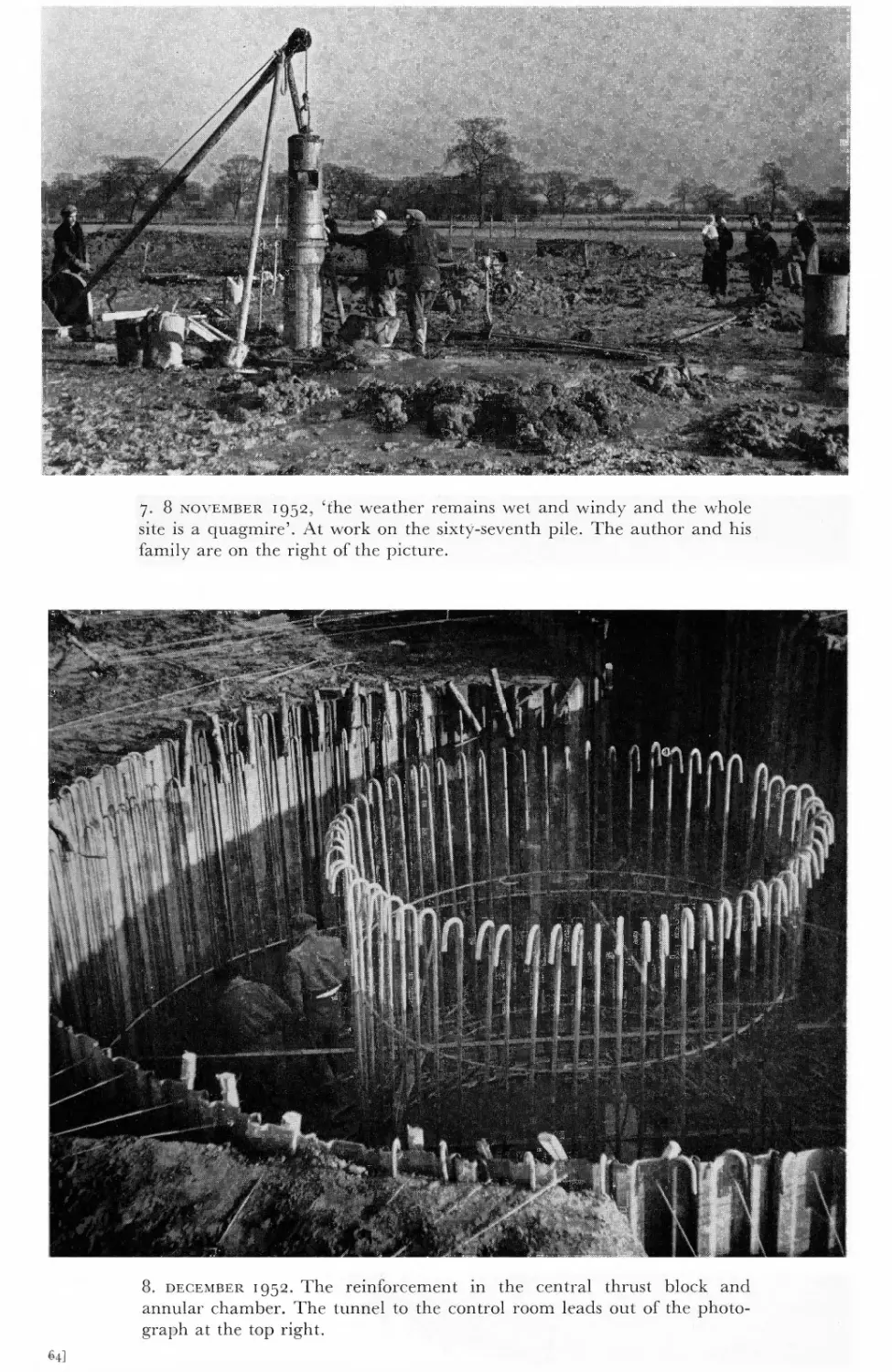
7	November 1952. Pile driving	64
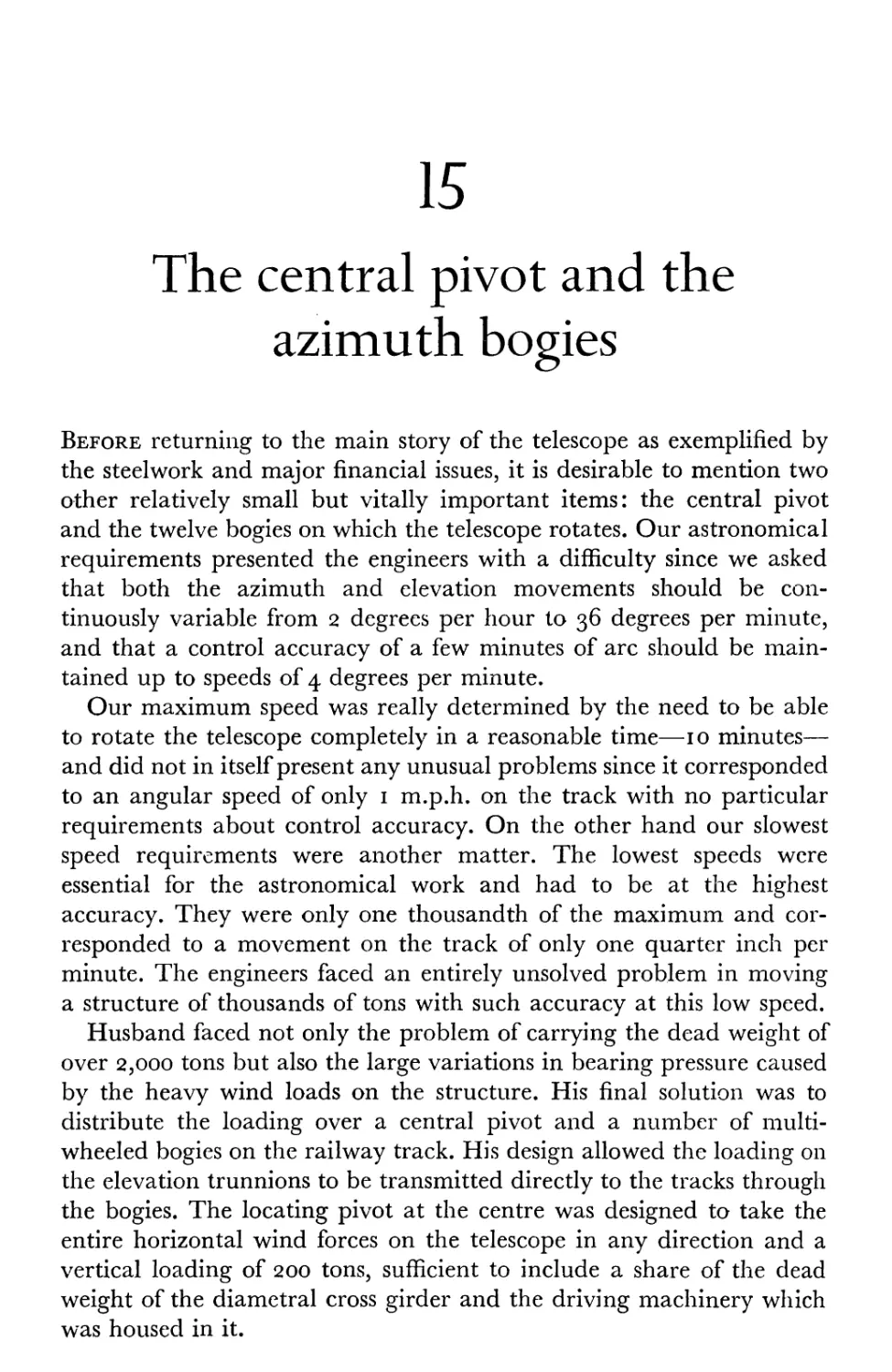
8	December 1952. Reinforcement in foundations	64
9	Foundations of the railway track	65
10	The railway track	65
11	May 1954. The central pivot	80
12	A bogie ready to be rolled into position	80
13	August 1954. First steelwork erection	81
14	October 1954. Building of tower sections	81
between pp. 120 and 121
15 March 1955. A trunnion bearing girder in position
16 April 1955. Aerial view of the structure
17 June 1955. Assembly of the trunnion bearings
18 August 1955. Erection of scaffolding
19 September 1955. Trunnion and bearing ready for
lifting
20 September 1955. Trunnion and bearing at top of tower
21 September 1955. View of cranes, structure and gun rack
2 2 Autumn 1955. The central hub of the bowl in position

Vlll	ILLUSTRATIONS
facing page
23 March 1956. The first ribs of the bowl in position 128
24 May 1956. Progress on the bowl framework	128
25 June 1956. Progress on the bowl framework	129
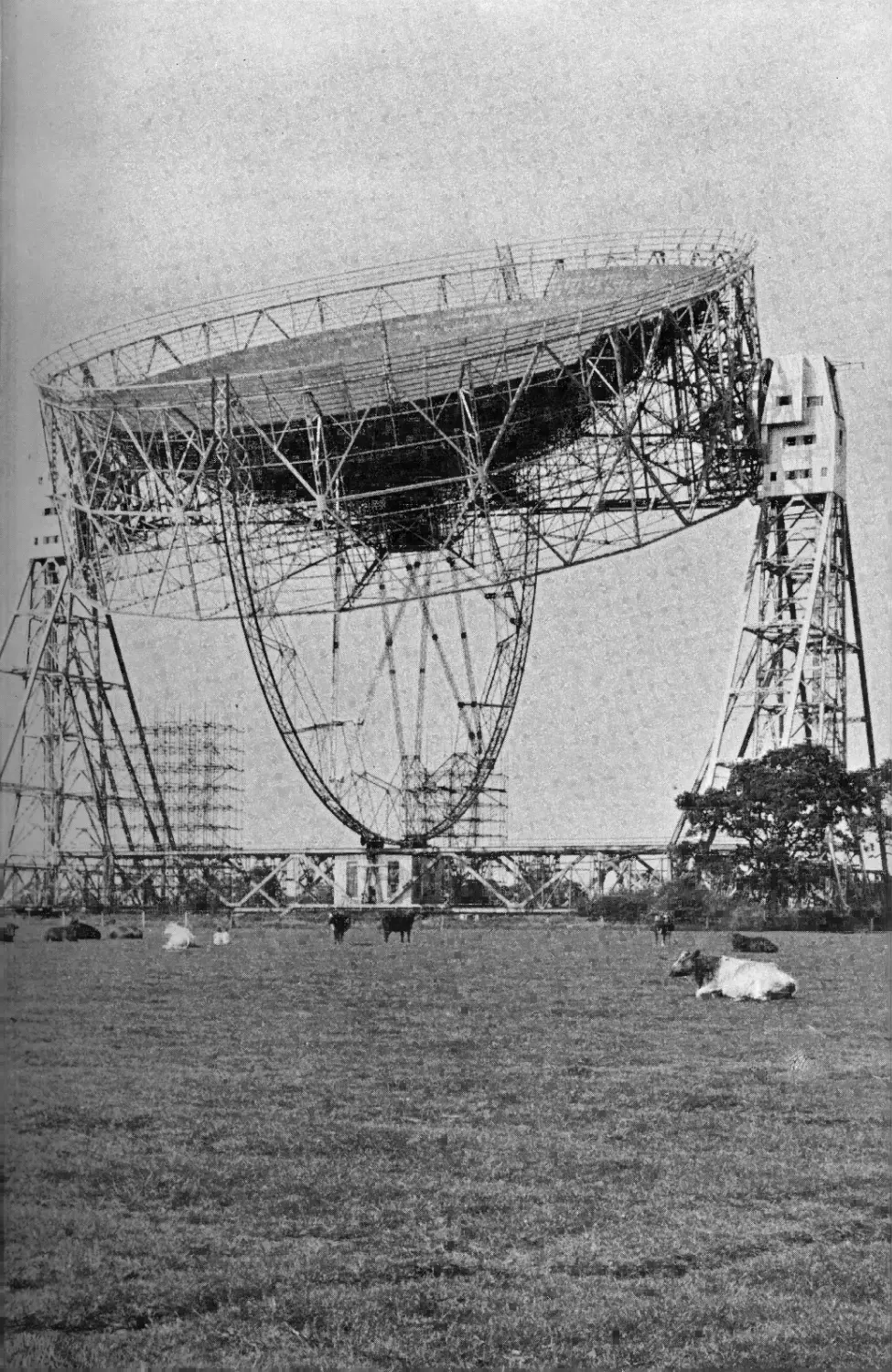
26 September 1956. Aerial view showing the completed
bowl framework	144.
27 The aerial tower	145
28 May 1957. The elevated laboratory going into position 160
29 May 1957. Welders at work on the membrane	160
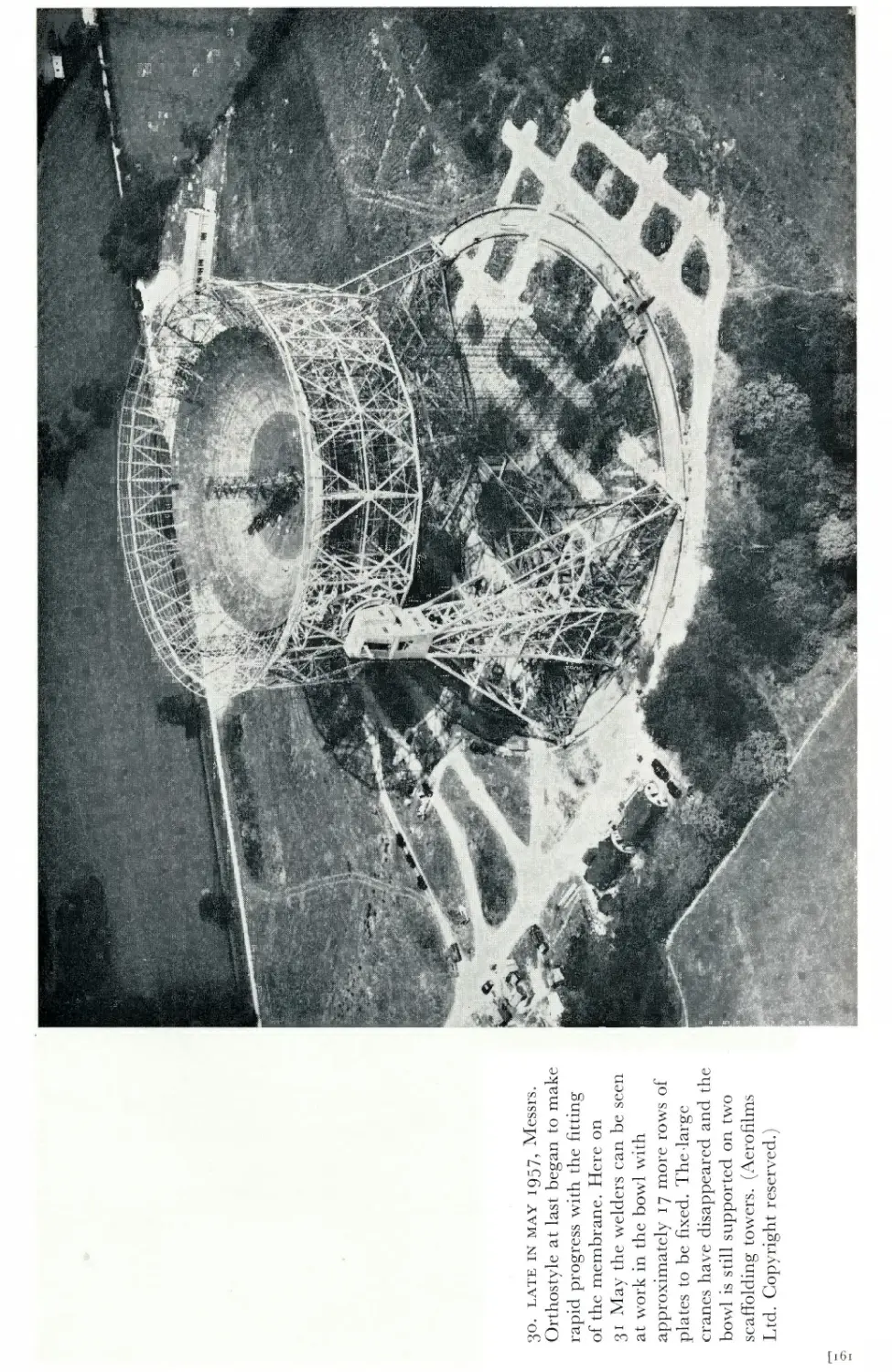
30 May 1957. Aerial photograph showing membrane
partially complete	161
31 Summer 1957. The scene inside the bowl	176
32	20 June 1957. The first movement of the bowl in
elevation	176
33 Summer 1957. In the control room	177
34	2 August 1957. Record of the first signals	177
35	12 October 1957. The radar echo from the Sputnik I
carrier rocket	208
36	13 September 1957. The telescope at the moment
when Lunik II hit the moon	209
37	19 February i960. Prof. Alla Massevitch with the
author near the telescope	224
38	18 March i960. Visit of H.R.H. Princess Margaret 225
IN TEXT	page
Bowl and tower structure timetable	107
Bowl timetable	139
Cartoon by Papas	227

FOREWORDS
by
H. C. Husband, C.B.E., D.Sc., Consulting Engineer
and
R. A. Rainford, M.A., F.A.C.C.A., Bursar, University of Manchester
An author must be allowed to write a book in his own way, but it is
unusual for a character to be taken from the plot and instructed to
write a foreword.
This is the story of acquiring and spending a large sum of money on
equipment for the advancement of pure science. It has always been
difficult for most people to understand the need for scientific research
unless there is an immediate object in view. Only the devoted few
were originally in favour of Professor Lovell’s great telescope, and
perhaps most of these had no very clear idea as to how it was to be
used. Indeed, many new applications have been revealed during the
past ten years.
There might have been no happy ending, to the story, financially at
any rate, had not radio astronomy become entangled, not at all to the
author’s liking, with the mechanics of space research, an expression a
little more self-explanatory. The telescope immediately became popular
and eventually a symbol of Britain’s efforts in the ‘space race’ because
of the fortunate timing of the launch of the first Sputnik, just when the
radio astronomers were in the depths of despair. Jodrell Bank then, to
its horror, almost overnight found itself dealing in applied science,
which is something more tangible to those responsible for spending the
country’s money.
The history of the Jodrell Bank troubles has been compiled very
largely from the diary kept by Professor Lovell, ‘composed from day to
day under the stress of events and with the knowledge available at the
moment’. Life is thereby given to the story. I have a strong feeling that
some of the opinions and criticisms copied from the daybook are differ¬
ent from those which might have been made in retrospect—it must be
very difficult to be a historian of one’s own affairs—but the story seems
to me better for describing both the controversies and the emotions of
the moment.

X
FOREWORDS
No work with which I have ever been associated was carried out by
more devoted contractors, yet so eagerly was the completion of the
telescope desired that any delay during the construction provoked rage
rather than excited sympathy; but the fascination of Jodrell Bank has
prevailed and those who contributed to the work there in the early
days have returned more than once to assist in later projects.
I feel there is an acknowledgement which the author has omitted and
which he may allow me to mention. We were both fortunate during
those years of considerable stress and anxiety to be troubled with no
domestic worries. Lady Lovell has a remarkable calmness and sense of
humour, and my wife was, to say the least, tolerant of my almost con¬
stant absence from home. Both continued the work of bringing up our
large families whilst we went about the building of the first really big
radio telescope.
II.C.H.
It was with pleasure that I heard that Sir Bernard Lovell had written
an account of the birth and development of the Manchester University
Radio Astronomy Department at Jodrell Bank and the problems sur¬
rounding its early days.
I have read the manuscript and, inevitably, have lived again those
anxious and exciting times through which we passed before the largest
steerable radio telescope (Mark I as it is affectionately called) was
fully operational and finally paid for.
The project could never have been carried to its successful conclusion
without the fanatical enthusiasm, drive, and energy of Bernard Lovell,
and only those near to him appreciate the strain which he underwent
during those days.
Enthusiasm is infectious and when it is allied to outstanding ability
the result is certain. It is impossible to work with Bernard Lovell with¬
out being affected and I, like most who knew him well, was carried
along by this enthusiasm. Even in the darkest hours when quick deci¬
sions had to be made—decisions which one knew would lead to later
inquests—it was the confidence in his ability to make a success of the
radio telescope when completed that made the University press on
with all the speed it could. Events have proved the University right and
it is now praised for the very acts for which it was once criticized.
It is extremely doubtful if such a venture could ever have been
completed so effectively except by a University. Universities back men
and ideas and it is only in such a community where one can know men
well and where ideas may be quickly assessed that such new sciences as

FOREWORDS
xi
radio astronomy can come to the fore rapidly. Government depart¬
ments are good at supporting established disciplines and matters of
‘timeliness and promise5 but they must, by their very nature, be ultra-
cautious when dealing impersonally at long range with new ventures.
This is not a criticism of Government departments as I do not see how
they could act otherwise, but it is an argument for local initiative and
central encouragement.
I have always seen the birth of the Radio Astronomy Department of
Manchester University as an example of the value of University free¬
dom. There are, of course, many other examples but I hope that the
readers of this book will consider the account of this enterprise a proof
of the value of giving men with original ideas an opportunity of pursu¬
ing their work with the backing of their colleagues. The opening
remarks of Chapter 2 (‘Growth5) will give the reader an impression of
what I mean.
Even though it is the working of the Mark I radio telescope which
has gripped the imagination of ordinary folk, I, personally, will never
forget the first large aerial system which was built by Lovell and Clegg
and a few assistants in 1947, and which is described in Chapter 4. The
results of their efforts, intellectual and physical, can hardly be exagger¬
ated and it was these results which led to the idea of a large movable
‘dish5 and the association with Dr. Husband, who had the courage and
engineering skill to tackle a job which would have deterred most
engineers.
It was ironical that when the radio telescope was proving its worth,
but the University was still being criticized, the then Prime Minister
(the Rt. Hon. Harold Macmillan) in the House of Commons said:
‘Hon. members will have seen that within the last few days our great
radio telescope at Jodrell Bank has successfully tracked the Sputnik's carrier
rocket5. The italics are mine and when I read this report in the press
I felt he ought to have added after ‘Jodrell Bank5, the words: ‘which
was completed in spite of us5.
It has always been an annoyance to me that whenever the success of
the radio telescope is mentioned it is referred to as the Jodrell Bank
Research Station as though it were a part of a Government or inde¬
pendent establishment, but whenever it was criticized in the early days
the name of the University of Manchester was invariably used.
Some time ago Sir Bernard asked me if, with my present knowledge,
I would go through those trying times again and I answered that I did
not know, though I knew I would, as my faith in him and his colleagues
never faltered and events proved them so right.
I am proud to have been associated with Lovell and Husband in

FOREWORDS
this great project and to know that work has been done and is being
done on this instrument which redounds to the credit of the country.
I must correct one, for me, fatal omission in the book. Lovell tells of the
work of many but there is little reference to one person whose activity
during the most nerve-racking and frustrating period was continuous.
I refer to Lady Lovell whose invaluable but unobtrusive help was not
only a source of strength to Bernard Lovell but to all of us. Her common
sense, loyalty, good humour, ready wit, and supreme confidence was
incalculable. It is in keeping with her character that her husband is not
allowed to mention her but although I am risking her friendship, I
cannot let this opportunity pass without paying my tribute to her and
offering sincere thanks.
R.A.R.

INTRODUCTION
This is the story of the emergence of Jodrell Bank as a scientific estab¬
lishment from a foggy day in December 1945 when my trailer of ex-
Army radar equipment was towed into a muddy field in Cheshire. As
I thawed myself before a coke stove in a gardener’s hut on that day I
had no vision of the future other than to restart my scientific career
after the frustrating years of the war. If I could have seen a flash to an
October day twelve years later with the world’s pressmen packed in a
room under a huge radio telescope then I would have dismissed it as a
dream fantasy. Or if the crackle of the coke had changed to the chatter
of two adjacent teleprinters, one connected to Moscow and the other to
Washington, then I could only have thought that these were idle
meanderings of a scientist’s brain. An amazing and unpredictable con¬
junction of historic events was to bring such fantasies to life. Less than
fourteen years after that December day the telescope recorded the im¬
pact of a Russian rocket on the moon. The story ends fifteen years later,
in i960, when, after a signal from the telescope had released the Ameri¬
can space probe Pioneer V from its carrier rocket, a telephone call
from Lord Nuffield conveyed the joyous news that we were at last
extracted from the frightful entanglements which we had unwittingly
created for ourselves. In that springtime the University freed itself of
the huge debt for which I had been mainly responsible, and which had
almost destroyed those of us associated with the building of the great
radio telescope. It is unlikely that a scientific project has ever survived
so many crises to attain ultimate success.
I realize that this story of the telescope is merely my own story.
Others, whose names occur so frequently in these pages—particularly
Dr. H. C. Husband and Mr. R. A. Rainford—could equally well
describe those years as seen through different eyes. My story is that of a
person for whom Jodrell Bank and the telescope became an obsession
to be realized at any cost. Over those years it occupied almost the whole
of my life and thought and hence, inevitably, the story is sometimes
almost autobiographical. Furthermore, there was the peculiar circum¬
stance through which I dictated an almost daily diary from the moment
in 1952 when I knew we could move ahead to the time in 1957 when

XIV
INTRODUCTION
my career was in peril and Rainford remarked that my diary would
either save me or finally destroy my career. I have never kept a diary
before or since, but without the detail contained in it I could not have
written this book.
I doubt, too, if the book would have been written if it had not been
for the many friends and colleagues associated with those years who
have urged me to do so. They felt that the extraordinary circumstances
and complications surrounding the project demanded a coherent record.
When we were free to move forward once more, other telescopes were
built but the lessons of the first had been learnt and these smaller
instruments were constructed without undue incident. They form no
part of the present story.
I agreed to write this book in 1962, but for a person who is still
young enough to work in the present and plan for the future it is hard
to dwell in the past. I did almost nothing about it for two years and
then an equinoctial gale created a strange ciicumstance which made
me begin. In early October I drove to Southampton to cross the Atlantic
in the s.s. France. Arriving in the early evening I found that the ship
was still held in a French port by a severe gale and could not arrive
until 3 a.m. at the earliest. Released from the possibility of either sleep
or work I found a quiet corner of the terminal building and wrote
Chapter 1 and I continued to write during the next few weeks in various
parts of America. Indeed, I found even in that phantasmagoric creation
of the modern world, Chicago airport on a Sunday afternoon, it is
possible to find a place where the loudspeakers do not constantly search
out individuals. In this strange fashion the first eight chapters came to
life, then during Chapter 9 I had to put it away because I had reached
the stage where I needed the dates and details in the diary. I wrote the
remainder of the book in my office at Jodrell Bank where I had the
diary, the files, and all the other documents which made it possible to
establish facts which had been dimmed in the memory. A contemporary
office, even of an astronomer, is a distracting room, and another three
years passed and another two telescopes were built around me before
I reached the end.
This book takes the story of Jodrell Bank to i960, when it might be
said that we became a reasonably normal scientific establishment. At
that time, with the clearance of our debt, we became free to use the
great telescope on the astronomical researches of our choice. It worked
magnificently. The small group of young men who had stood by me
during the years of crisis now applied their talents to the exploration of
the universe. Scon, a stream of discoveries, vital to our understanding of
the cosmos, began to flow from the recording instruments of the telescope.

INTRODUCTION
XV
In our age, science and its techniques have advanced with an almost
alarming speed. Few of the contemporary large instruments of science
remain effective on an international scale twenty years after their
design. The Jodrell telescope has remained unique and unparalleled
by the passage of time. No one has yet succeeded in building a larger
one.
During the years of construction of the large telescope, space research
and military requirements gave a great stimulus to the development of
electronic techniques for use in the range of wavelengths shorter than
those regarded as useful for radio astronomy when the Jodrell telescope
was designed. Later telescopes have, on the whole, tended to sacrifice
size for accuracy to enable them to study the universe in these centi-
metric wavelengths. It is a measure of the success and versatility of the
Jodrell instrument that it has been able to absorb many of these new
techniques. In spite of the enormous development of the subject it has
remained the world’s superior instrument in the wavelength ranges
longer than about half a metre and has retained a competitive standing
with more modern instruments at shorter wavelengths down to about
18 cm.
It was fortunate that, in spite of the troubles described in this book,
the success of the telescope quickly predisposed the Department of
Scientific and Industrial Research (and subsequently its successor, the
Science Research Council) to listen with a sympathetic ear to my
proposals for new developments at Jodrell Bank. In i960 when this
story ends I was already asking for money to build more radio tele¬
scopes. Two major ones have been built: one to enable us to explore the
universe in the very short wavelength range, below the working limit
of the large telescope, and a second to enable us to develop the technique
of using another large telescope connected to the main Jodrell instru¬
ment by radio link for the measurement of the angular sizes of radio
galaxies situated in the remote parts of the universe. These two instru¬
ments are now working. In their maximum dimension they are only
half the size of the original telescope, but together and with their
associated equipment they cost as much. The building of these instru¬
ments was completed without exceptional difficulty or associated
trauma of the type described in this book. The more accurate of these
smaller telescopes (known as the Mark II to distinguish it from the
250-ft. aperture (Mark I) telescope which is the subject of this book)
was finished in 1964, and although it uses the same servo system of
control as the 250-ft. telescope, a modern digital computer is used to
feed instructions to this system. Instructions for telescope movement
for a whole night are fed in on a yard of punched tape, and the results

XVI
INTRODUCTION
of the investigation appear also in punched tape form. It was the first
instrument in the world to be driven ‘on-line5 by a digital computer in
this manner. A similar digital system has recently been installed as an
adjunct to the less accurate analogue computer of the Mark I.
In these ways Jodrell Bank has developed. The establishment and the
large telescope have survived and absorbed the technical developments
of twenty years. No one questions for a moment that in another twenty
years the great telescope will still be working as one of the major scien¬
tific instruments in the world. It is unlikely to be the largest by then—
for we ourselves are actively designing a larger one.
Bernard Lovell
Jodrell Bank

1
The origins of Jodrell Bank
Six centuries ago a Cheshire archer, William Jauderell, distinguished
himself fighting with the Black Prince at Poitiers. While he was thus
engaged Jauderell learnt that his house in England had been destroyed by
fire and he desired to return to attend to his affairs. The pass, inscribed
on a roll of parchment from which hung a great seal, which the Black
Prince gave him to make his journey possible, is still in the hands of the
Jodrell family—for over the centuries the name Jauderell changed to
Jodrell. Bank is the Cheshire name for a small rise or hill and thus the
name Jodrell Bank is the description of a few acres of fields above a
small brook lying twenty-five miles south of the city of Manchester
near the village of Lower Withington. Nowadays thousands traverse
it daily as they drive southwards from Manchester to join the M6
motorway near Holmes Chapel.
The region had little to distinguish it from the surrounding Cheshire
plain—Jodrell Hall, which in modern times has become a preparatory
school under a different name, a number of farms and smallholdings
and at the foot of the bank the Red Lion Brook wending its way to¬
wards the River Dane near Holmes Chapel. It was here, six centuries after
the return of William Jauderell from Poitiers and just before the out¬
break of another great war, that the University of Manchester bought
eleven acres of farmland from Ted Moston—one of the local farmers.
The land was purchased for the horticultural botany department of
the University.
At the time of this purchase in 1939 I was a young man teaching
physics in the University in blissful ignorance of how my own life was
to become entwined with Jodrell Bank, or with Moston and his tractor.
During the war I remained unaware of Jodrell Bank although I must
have driven past this horticultural botany department on many occa¬
sions when travelling from the south to visit aircraft firms in Manchester.
Of course, the war immediately wrenched almost every scientist in
England from his research work, but with the incurable optimism of
youth I continued to dream even on the freezing aerodromes of how I
could continue my cosmic ray research when peace came. The dreams
J.B.—2

2
JODRELL BANK
were stimulated by the strange echoes which so often appeared on the
radar screens with which we were concerned—echoes which seemed
to hold promise of a new technique for detecting large cosmic ray
showers. These dreams would have remained ethereal but for one of the
determinant things in my life—that I had been an Assistant Lecturer
in a department where the head was P. M. S. Blackett,1 the Lang¬
worthy Professor of Physics in Manchester, the successor of Schuster,
Rutherford, and Bragg. Patrick Blackett’s own wartime duties often
led him to stay with us and the first result of the dreams was the
Blackett-Loveli paper on the possibility of obtaining radar echoes
from the ionization caused by large cosmic ray showers which was
published in the Royal Society Proceedings during the war.2
Then the German armies surged across Europe in the spring of 1940
and all thoughts of cosmic ray research by old or new techniques be¬
came forgotten in the basic struggle for mere survival.
In the autumn of 1945 I returned to my academic career in Man¬
chester, accompanied by two trailers of radar equipment and a portable
diesel generator—equipment which only a few months earlier had
been used to direct ack-ack guns to enemy aircraft. The appearance of
this in the quadrangle outside the physics department caused con¬
sternation, but in the event it did not stay there for long. As soon as we
got it working, hoping to begin our search for cosmic ray echoes, the
cathode ray tube was covered with spikes from electrical interference.
In those days electric trams were still running past the University, but
even in the early hours of a Sunday morning when all was quiet the
interference was far too serious for us to conceive of the possibility of
research under these conditions.
I cannot remember who suggested that I should ask the University
Bursar, R. A. Rainford, if the University had any land outside the city
to which I could take my trailers. The next day I saw him in the Staff
House, and that afternoon followed his directions to a field in the area of
High Legh, near Lymm to the west of Manchester. It was hopeless—
high-voltage grid lines traversed the land. I returned to the attack and
little did he realize what troubles and near disasters his next remark
was to lead us into!
1 P. M.S. Blackett, О.М., C.H.,F.R.S., Nobel Laureate; left Manchester for Imperial
College, London, in 1953. He was elected President of the Royal Society in 1965.
2 I sent a draft to Blackett which he tore up and rewrote in an air-raid shelter in
Westminster during a London blitz. He wrote down the cross-section of scattering
for an electron as (e2/mc2)2 and it was a long time before he forgave me for failing to
correct this by putting in an §я. It was useless for me to protest that I was very busy
on urgent radar work, that I was 200 miles from a library and that it was a minor
factor anyhow.

THE ORIGINS OF JODRELL BANK	3
‘You see that man with the beard over there drinking beer? That’s
Sansome,1 the botanist, who runs a place called Jodrell Bank—try
him.5
Sansome was full of enthusiasm—the exchange was perfect: although
by profession a botanist he was also a tremendously keen radio experi¬
menter; on the other hand I had the radio gear, but as an amateur I
was already growing most of his plants in my garden. Indeed there
were some occasions when I felt that we were better at each other’s
job.
In any case in early December my trailers were being towed by an
Army convoy along the road south from Manchester to Jodrell Bank.
The Army deposited me and the trailers and departed. I was at Jodrell
Bank, with two wooden huts full of fertilizers and spades, two friendly
gardeners—Alf Dean and Frank Foden—no electric power within
miles, and in thick fog and hard frost.
I don’t think that anything would have happened at Jodrell Bank
but for Alf and Frank. The diesel had to be wound with a handle like
a car starting-handle, but vastly heavier, and alone I could scarcely
turn it. With the three of us together we could turn it at a speed at
which the diesel should have sprung into life. Alas it remained cold and
silent. But they knew Moston who had a tractor and a vastly inquiring
mind. Soon the diesel was in pieces and the trouble was simply that it
was so cold that the fuel pipes had become blocked with ice. On the
third day the diesel started: electricity was being generated at Jodrell
Bank, and I was able to switch on my radar transmitter and receiver. I
still have the notebook with the entry for that day. It was 14 December,
the date of maximum of the Geminid meteor shower. Then I knew
nothing about meteors or Geminids and had no inkling that for many
years subsequently 14 December and the Geminids were to be periods
of intense activity at Jodrell Bank.
Alf and Frank were the sole occupants of Jodrell Bank and the two
huts. In one of the huts there was a coke stove before which we thawed,
brewed tea and ate our packed lunches. So, Jodrell Bank began.
These are the answers to the frequent question ‘Why did you pick on
Jodrell Bank?’ It picked me; the gardens, the people, the isolation were
irresistible. For a short time, alas a very short time, I was happy and
content with the trailers, Alf and Frank, and the coke stove.
1 F. W. Sansome, C.B.E., subsequently Professor of Botany in the Ahmadu Bello
University, Nigeria.

2
Growth
The transformation of two trailers and a diesel generator in a field
into a research laboratory happened for two reasons. Many men in the
position of Patrick Blackett might have allowed a member of staff to
engage in a short field excursion, but few would have encouraged the
growth by the supply of money and assistance as he did. Even fewer
would have done so when they realized that the primary object of the
exercise had been abandoned in favour of other researches. But he was
as excited as I was with the successive discoveries which soon poured into
the trailers in the Cheshire fields and the idea of any retrenchment
never occurred to him.
The other reason lies in the traditional freedom of University re¬
searches. No one except Blackett had any power to stop me doing what¬
ever research I wanted with the apparatus in my possession. There was
no formal proposal for research into the possibility of obtaining radar
echoes from cosmic ray showers and no one to check that whatever
time or money I spent would be on that problem. There was no com¬
mitment to write or give verbal reports, no fear that the researches
would cease if the original idea failed. In fact, I never pursued the
original plan of research; too many other exciting astronomical events
impressed themselves on my screens. Many years later, when the
original calculations were refined, it was clear that the experiment
could not have succeeded—at least not with the apparatus at my
disposal then.
The strange short-lived sporadic echoes of the war years were
certainly present again on the cathode ray tube in the Cheshire field.
Now there was time to absorb the literature of the past and opportunity
to see a secret wartime report made by Dr. J. S. Hey of the Army
Operational Research Group. There were strong indications that the
transient echoes, most of which lasted for only a fraction of a second,
were associated with meteors burning up in the earth’s atmosphere.
Hey and the A.O.R.G. had become associated with the problem in a
strange manner. When the Germans started bombarding London with
the V2 rockets the G.L. (gun laying) Radar Sets of A.A. Command

GROWTH	5
were hastily pressed into service to detect the radar reflections from the
rocket during its flight in order to give some minutes’ warning of its
arrival. These G.L. sets apparently carried out this detection task in
an over-enthusiastic manner because many alarms were given when
no rocket arrived. It was soon found that the operators were seeing
echoes and giving the alarms when no rockets whatsoever were in
process of launching from enemy territory. Charged with the task
of investigating this, Hey concluded that whereas the V2 rockets
actually produced echoes on the tube they were only a fraction of the
transient echoes seen by the operators which probably had an iono¬
spheric origin and might be associated with meteors.
My own wartime associations were with the R.A.F. and Air Ministry,
and not with the Army, and I knew nothing of Hey’s secret Army
report until well into 1946 when I was already concluding that these
echoes were not from cosmic ray showers but from meteors. The
pre-war ionospheric literature was plentifully scattered with proposals
that the trail of electrons left by a meteor burning up 100 km in the
atmosphere scattered radio waves back to earth to give a detectable
short-lived echo. But how could we obtain definite proof? Who were
the authorities on meteors or shooting stars? The astronomical text¬
books contained little about the phenomenon.
Blackett’s laboratory in the spring and early summer of 1946 was
already gaining its characteristic cosmopolitan atmosphere and amongst
his young visiting scientists was a delightful Norwegian, Nicolai Her-
lofson,1 who had survived some hectic wartime experiences as a
meteorologist. There is no connection between meteors and meteoro¬
logy, but a meteorologist looks at the skies and should therefore know
something about shooting stars. I don’t think that Herlofson knew a
tremendous amount about the subject when I asked him, but he did
have one vital piece of information. It was that on the whole the study
of meteors did not form a great part of the activities of professional
astronomers because it was considered a waste of telescope time to look
at phenomena which could be studied by the unaided eye. Con¬
sequently the investigation of meteors was largely in the hands of
amateurs. Herlofson also knew that in England there was an active
group of amateur meteor observers organized in a section of the British
Astronomical Association. So Herlofson was dispatched to extract
information from the director of this section, J. P. M. Prentice.
Manning Prentice was, and is, a solicitor in Suffolk. It was a reve¬
lation to me to find out how ardent he and his section were in observing
1 Subsequently Herlofson was appointed to a professorship in the Royal Institute
of Technology, Stockholm.

6	JODRELL	BANK
meteors far into the night after their daily work had finished. The
published works of these people and their predecessors were priceless
contributions to astronomy. Their enthusiasm was terrific and before
the summer of 1946 had ended the lanes of Cheshire were graced by a
new sight—the arrival of Manning Prentice in an open Morris with
the back seat piled with celestial globes, star atlases, and other para¬
phernalia which he used for observing. A deck chair was precariously
strapped on to the back hood and a flying suit was thrown over some of
the instruments. We were to learn quickly that the deck chair and the
flying suit were the key items in this collection.
For the first few months of Jodrell I was a lone figure with Alf and
Frank to help me start the diesel. But I had Blackett’s permission to
recruit whom I could of my wartime associates either to work in his
laboratory or to help me at Jodrell. By the time Manning Prentice arrived
I had two or three colleagues with me in the trailers. The most important
of these scientifically was John A. Clegg. There were two others, В and
P, who lived in the same digs. В insisted on adorning the back of his
bicycle cape with an identification sign so that on one dark night
when cycling home from Jodrell he was mistaken for an escaped
prisoner. That night was memorable because P, who was to take
over the watch from me at 10 p.m., never arrived in the trailer.
I was assured by his landlady that he had departed in his car and so I
sleepily continued making records until at dawn I found that P had
indeed arrived at Jodrell but had unfortunately fallen asleep before
getting out of the car.
J. A. Clegg was the first of the many brilliant young men who were,
in the course of time, to join me at Jodrell.1 But few of these later ones
who enjoyed the benefits of heated laboratories, canteen, office and
supporting staff can have much idea of what scientific research meant
at Jodrell Bank in 1946. To start a night’s observation Clegg and I
often began by wading in gumboots through two fields to our trailers
and wrestling with the diesel, unprotected except by a flimsy canvas
on its own trolley.
At some stage early in 1946 I had borrowed Moston and his tractor
to tow the trailer containing the receiving part of the equipment from
its original position to the third and most distant of the three fields
owned by the University. This was done for technical reasons, but made
1 Dr. J. A. Clegg remained with me at Jodrell until 1951 when he became interested
in the new developments in rock magnetism then being stimulated by Blackett in the
physics dept, of the University. After a short period as Professor of Physics at the
University of Ibadan, Nigeria, he returned to Imperial College, London, and rejoined
Blackett’s staff there.

GROWTH	7
operations even more difficult, because the diesel, transmitter, and re¬
ceiver were now all separated by hundreds of yards of Cheshire mud.
We therefore proceeded to make a road. I’ve made many roads at
Jodrell since 1946—or rather I’ve arranged for them to be made by the
people whose job it is to make roads. Then things were different, and
when I write that we made a road, I mean that Clegg and I made a
road ourselves. We started with spades, but since we wanted it to go from
the main road to our trailers—a quarter of a mile—we found it would
take a long time, so we again pressed Moston’s tractor into service.
Fortunately it had a scoop with which we carved out two tracks about
a foot deep. We then ordered many, many lorry-loads of stone from a
nearby quarry and filled the tracks by hand. With reasonable care we
could drive a car with its wheels on these two rough tracks without
sinking it in the adjoining mud, and so we were able to cut out at least
some of the tiring night walks in gumboots.
We were in that kind of state when Manning Prentice arrived on the
scene. Our idea was quite simple. If our echoes were from meteors then
the echo should appear on the tube at the same time as the visible trail
of the meteor appeared in the sky. We soon learnt from Manning
Prentice that meteors were irregular in their rate of occurrence. There
was always a sporadic background with a diurnal variation in rate, which
at 6 a.m. in the morning, when the rate was a maximum, should give 5
or 10 meteor trails per hour visible to the eye under reasonably clear
sky conditions. However, there were far more exciting events known as
meteor showers, in which for a few nights the earth crossed through a
relatively dense region of debris in space, and then the visual rate might
reach 50 to 100 per hour. These meteor showers are called after the
constellation in which their radiant point appears to lie. The Perseids
in late July and August were according to Prentice a ‘reliable and
regular shower’ giving hourly rates of 50 or 60 at maximum. The
Perseids were convenient for our first joint venture.
We then discovered that the deck chair in Prentice’s car was not for
leisure but for observing. With the chair as near horizontal as possible
Prentice would settle himself with a piece of string, a dimmed torch,
and a writing board. When the meteor streaked across the sky he would
raise the stretched string at arm’s length along the line of the transient
meteor and read off with comparative leisure the stars which defined the
beginning and end points of the meteor’s track. His writing board soon
became covered with symbols which, in the beginning, were mere hiero¬
glyphics to us. We arranged that Prentice should shout when a meteor
appeared so that we, gazing at the cathode ray tube in the trailer,
could establish any correlations between the echoes and the meteors.

8	JODRELL	BANK
Experiments in science are rarely decisive and this one was not. It
was certainly the case that there were many occasions in which Pren¬
tice’s shout coincided with the appearance of the echo on the tube.
However, there were many shouts without echoes, many echoes with¬
out shouts, and strangest of all many shouts which seemed to be followed
after some seconds by an echo. The echoes themselves were a mixed
bag. Some so short lived that they were scarcely visible and others of
many seconds’ duration, generally showing violent fluctuations in
strength. It was to be many years before we understood these complex
phenomena.
The immediate task was to convince ourselves and others that
our echoes were meteoric in origin and the Perseid episode gave
much valuable information1 but did not prove conclusively the com¬
plete correlation of the echoes with meteors. Now we were blessed by
an extraordinary piece of good fortune. After the Perseids, Prentice
said that he would return in mid November because the Leonids were
the next regular shower worthy of investigation, although he said that
on the night of 9-10 October he and his observers would be watching
the sky intently because there was a chance that the earth would pass
through the tail of a periodic comet and there might be an enormous but
short-lived meteor shower. Thirteen years previously the earth had
crossed the orbit of this Giacobini-Zinner comet near the head of the
comet and there had been a spectacular meteor shower. He refused to
commit himself on the chance of a recurrence because even small per¬
turbations of the comet would deflect its accompanying debris out of
the earth’s orbit.
A look at the history of the comet, which was discovered only at the
beginning of the century, and of the subsequent Giacobinid meteor
showers associated with it, showed us that if there had been no
perturbations then the shower of 9-10 October might indeed be
spectacular. In our anxiety not to miss anything we arranged a con¬
tinuous watch of the cathode ray tube for forty-eight hours around the
predicted time of occurrence. We had optimistically fitted up a cine¬
camera to photograph the tube should the echoes be so numerous as
to defy counting.
The hours dragged on to midnight, 9 October. We were seeing two
echoes an hour which was quite a normal background rate. The sky
was clear but nothing visual was evident. Then in a flash, it seemed,
everything was transformed. Just after midnight our echo rate began to
rise dramatically and simultaneously meteors streaked across the sky.
1 The results of this early work were published in the Monthly Notices of the Royal
Astronomical Society, vol. 107, p. 155, 1947.

GROWTH	9
The rates of echoes and visible meteors continued to soar. Soon they
were coming so fast that we were unable to write down any details and
by 2.30 a.m. there were so many that we could not even count them.
We were glad of the cine-camera. By 3 a.m. the sky was streaked
with trails and looked like the drawings of the great meteor showers of
the eighteenth century which we had always thought to be imagina¬
tive. That was the peak. Our echo rate, which had been nearly a
thousand an hour for a few minutes at 3.10 a.m., decreased and by
6 a.m. all was normal, except that those of us who were awake that
night were in a state of great excitement. Moreover, term had begun,
and both Clegg and I had to give lecture courses in Manchester at
10 a.m.
The dramatic correlation of the echo rate with the meteor rate in the
sky finally convinced everyone that the radio echoes were clearly
associated with the ionized meteor trails, although it was equally
obvious that there were many peculiarities to be investigated.1 It
was fortunate that Patrick Blackett came out for some of the night.
Not that I think he ever had doubts that we were on to a good thing,
but his anxiety to help me was increased to the extent that he began to
lobby the Vice-Chancellor and others on our behalf.
During 1946, aided and abetted by Clegg, I acquired much more
apparatus. I had left many friends in the Air Ministry and a brisk
exchange of personal letters with a certain Air Marshal quickly released
for me several trailers of radar equipment, for which I think I paid a
nominal sum of £10, although to buy it in the commercial market
would probably have cost half a million. Clegg enjoyed collecting it.
One of the items was a large cabin packed with electronic equipment,
built on to a prime mover which was commonly known in the service
as a ‘Park Royal’. One day Clegg joyfully appeared with this having
driven it from somewhere in the south, negotiated our tracks, and
proceeded across the field to a point which we had assigned to it. The
Park Royal never reached that point. Half way there the mud proved
too much and it stuck. It remained in that position for many a day and
determined the siting of several of our aerials, and eventually of our
first permanent buildings. The building which, some years later,
was erected near to this trailer to take over its apparatus was instantly
known as the Park Royal and remains so today, although I very much
doubt if more than a handful of people at Jodrell today know the
origin of its name! It was from this beloved Park Royal, stuck in the
mud, that we observed the fantastic Giacobinid meteor shower.
1 These observations of the Giacobinid meteors were published in the Monthly
Notices of the Royal Astronomical Society, vol. 107, p. 164, 1947.

10
JODRELL BANK
I extracted apparatus from the Army and Navy as well as the Air
Force, but I did not have the same kind of contact in the higher eche¬
lons of these services as in the Air Ministry and things were more
difficult. We did, however, manage to get an Army searchlight which
we badly needed—not for its light, but because it was an excellent
turning mechanism on which to mount an aerial. Eventually we
signed forms to have it on loan, but within a few weeks it was obvious
that this particular device would never do service with the Army again.
Clegg was an expert on aerials, and on this searchlight mount he built
a magnificent broadside array which could be turned to any part of the
sky. The possibility of being able to direct the aerial was important
because we found that most of the echoes from the meteor trails were
obtained by ‘specular reflection5—that is, the echo was obtained only
when the ionized column of the trail passed through the aerial beam
nearly at right angles to the direction in which it was pointing. This
aerial was a few yards from the Park Royal and Clegg later used it and
the property of specular reflection to devise a new and fundamentally
important method of determining the radiant points of meteors—the
direction in space from which they apparently diverged. The Giaco¬
binid shower presented us with a marvellous opportunity for a con¬
clusive demonstration of this property of meteor reflection. While the
echo rate was increasing the aerial had been maintained in a direction
at right angles to the position of the radiant point in Draco as it moved
across the sky. Near the maximum, when the echo rate was many
hundreds per hour, we turned the aerial so that it was directed at the
radiant point. The sky remained brilliant with meteor trails, but the
echoes on our cathode ray tube disappeared almost completely.
With the correlation between the radio echoes and meteors finally
established, Manning Prentice's enthusiasm was redoubled. At last he
could find out what the meteors were doing on cloudy and moonlit
nights, and for our part we badly needed his visual correlations to help
us unravel the complexities of the echoes. So it was that Prentice be¬
came a frequent visitor and that winter we understood the reason for
the flying suit. A deck chair at 4 a.m. on a snow-covered field near the
time of maximum of the Geminid meteors in mid December is a severe
test of a man's observing ability. It was a great pleasure to me some
years later when the University of Manchester awarded Prentice the
honorary degree of M.Sc. As an amateur he had given of his spare time
(and I suspect of his business time) unsparingly to help us and his
influence was cardinal to our early development and education in
astronomy.

3
The fairground
In 1947 the field at Jodrell bore a strange appearance: a considerable
number of trailers still in their camouflage paint, several portable
diesels, including some bigger ones which were even harder to start,
and various aerials—all of which led the locals and some visitors to
describe us as the fairground. I mentioned earlier that after the Gia-
cobinids Blackett thought he would introduce the idea to the Vice-
Chancellor and other controlling officials of the University that our
activities at Jodrell had gone somewhat beyond the idea of a temporary
trailer in a field.
The Vice-Chancellor of the University of Manchester was then Sir
John Stopford, F.R.S. (later Lord Stopford of Fallowfield), an eminent
medical scientist, an outstanding Vice-Chancellor, moreover a man
beloved by all and a person of unerring surety of judgement. The
significance of this visit as far as our future was concerned was not lost
on me. We had reached the stage when we urgently wanted not merely
an official blessing to continue, but some form of permanent accommo¬
dation for the precious apparatus in our leaking trailers, more money
for our research, and more staff carrying out research twenty-five miles
away from the University. Vital matters of University policy were
beginning to be involved.
Blackett arrived with the Vice-Chancellor on a golden June morning.
It was our good fortune that, in May, we had realized the significance
of an extraordinary high echo rate which had been present the previous
year. It had again returned and Clegg, by using the ‘searchlight aerial’,
had located the radiant point of a vast region of debris through which
the earth was moving, providing meteor showers in daylight quite in¬
visible and unknown to the human eye. We ourselves were highly
excited because the rate continued to increase as the summer advanced
and we were determining a sequence of these summer daytime meteor
showers. When Blackett had asked me when to bring the V.-C. I begged
him to do so early in the morning when we could display these meteor
streams and not in the afternoon when the radiants would have set. So it
happened that the occasion was perfect and when the V.-C. entered the

12	JODRELL BANK
darkness of our trailer from the brilliant June sunshine he was con¬
fronted with a screen full of these echoes. It was the first of many
critical occasions when the Vice-Chancellor held our future in his
hands, and although we were to cause him much trouble and anxiety
I know that he never for one second regretted his initial and spontane¬
ous enthusiasm and approval.
Most of our time in those early years was occupied with the investi¬
gation of these echoes, and as the staff slowly increased so our techniques
improved. The visual watch of the tube gradually became replaced by
automatic photography and we soon learnt that important information
was to be obtained about the physical properties of the high atmosphere
and ionosphere in addition to the study of the astronomy of the meteors.
For example, we found out that the variation in amplitude of the echoes
was caused by the contortion of the trail under the influence of the
ionospheric winds, and in the years which followed many papers were
published from Jodrell on these physical aspects of our work. Little did
we realize then that ten years later this equipment and our techniques
were to serve us in a radically different kind of experiment.
I think that perhaps the most important of our developments at that
time was carried out by a young research student who had just joined
me, John G. Davies, and a visitor from New Zealand, C. D. Ellyett.
This development was based on an idea by Herlofson who, although not
a nominal member of my staff, remained our close friend and adviser.
The stimulus arose because of the urgent need to find some reliable
method of measuring the velocity with which the meteors entered our
atmosphere. As we became more familiar with the literature on the
subject of meteors we realized that there was a bitter dispute about the
nature of the sporadic meteors—that is, those meteors which can be
seen on any night as distinct from those like the Perseids and the
Geminids which are concentrated in showers. In the case of these
shower meteors it was obvious that they were closely associated with
comets, although even in that case there was no agreement as to
whether the meteor particles were the debris of the comets or were other¬
wise genetically associated with them. The orbits of the comets and
hence of these shower meteors were well known: they were moving in
elliptical orbits around the sun and were confined to the solar system.
There was no such certainty about the sporadic meteors; and many
people believing the evidence from two different sources of measure¬
ments by reliable astronomers firmly held the opinion that these
meteors were not confined to the solar system but were visitors from
interstellar space, temporarily captured by the sun and moving in a
hyperbolic orbit around it. Astronomically, the issue was of some

THE FAIRGROUND
13
importance, since if the sporadic meteors were from interstellar space
then they would give us significant information about the size and
distribution of the interstellar dust.
It had been found impossible to settle this dispute by the normal
methods of observation. In order to deduce the orbit in which a
meteor is moving in space it is necessary to measure both its velocity
and direction with considerable accuracy. For example, the limiting
velocity of a particle moving around the sun in a closed or elliptical
orbit at the earth’s distance is 42*2 km/sec. If its velocity is greater than
this then its orbit is open and hyperbolic and it must be a visitor from
space. This is known as the heliocentric velocity: the velocity around
the sun. But when the meteor enters the earth’s atmosphere it does so
with a velocity compounded of this heliocentric velocity around the
sun and the earth’s own orbital velocity. The earth’s orbital velocity is
29-8 km/sec. and hence the observed geocentric velocity of a meteor
which is actually moving at 42-2 km/sec. around the sun can vary
between 12*4 km/sec. (42*2 — 29*8) and 72 km/sec. (42-2 + 29*8)
depending on whether it enters the earth’s atmosphere on the evening
or morning side. Apart from the computation of the precise orbit it is
obvious that under no circumstances can the observed velocity of a
meteor moving in an ellipse around the sun exceed 72 km/sec. If it does
so then its orbit is hyperbolic and it is not confined to the solar system.
At the time when we became acquainted with this problem the
subject was in disarray. The visual measurement of such high veloci¬
ties from transient appearances of the meteor trails was too approxi¬
mate to enable these fine distinctions to be made and the accurate
photographic measurements which were later made by new types of
camera at the Smithsonian Astrophysical Observatory still lay some
years in the future. Stimulated by this situation, Herlofson suggested
that the radio techniques could provide a precise answer to the problem
if apparatus could be developed to record the amplitude of the echo
from the trail of the meteor every millisecond or so as it passed through
the beam of the aerial. He suggested that in this case we should see the
Fresnel diffraction pattern and since we also measured the range
accurately, then the velocity would be known with precision. In the
apparatus developed by Davies and Ellyett to observe this phenomenon
the first responses from the echo were made to trigger the camera
mechanism and they obtained photographs of the echo amplitude every
thousandth of a second.
The technique was brilliantly successful. Meteor velocities could now
be measured with unerring accuracy and, so I thought, the problem
of the origin of the sporadic meteors was solved. In a flurry of plea¬

14	JODRELL	BANK
sure and excitement I sent the results to the chief adversaries in the
contest. Dr. Opik1 replied, ‘Your results confirm my measurements
that the meteors are from interstellar space’. Dr. Porter2 replied,
‘Your results leave no doubt that the meteors are contained within the
solar system’. Professor Fred L. Whipple3 of Harvard, one of the great
authorities on meteor phenomena whose ground at that time was
neutral in the contest, replied, ‘Your results are indecisive but give
promise of a valuable contribution to the subject’. How wise he was!
Many years later Davies and I carried out a long series of measure¬
ments with the assistance of Mary Almond, and in a number of papers
published in the Monthly Notices of the R.A.S.4 we showed that the
hyperbolic theory was untenable and that the sporadic meteors, like
the shower meteors, were moving in closed orbits in the solar system.
Simultaneously different kinds of radio techniques in Canada produced
similar results, and the new Schmidt cameras of the Smithsonian
Observatory gave the same answer. This work killed the theory of the
interstellar origin of the meteors (a pity I think; it would have been
more interesting if they had been interstellar!); but it did not solve
the problem of the nature and origin of the sporadic meteors in the
solar system. Ten years after this episode Davies devised an even more
sophisticated technique by which he could measure the exact orbit of a
single meteor. The mass of data which he obtained showed that many
of the sporadic meteors (far from being in hyperbolic orbits) were
actually moving in elliptical orbits of short period. The reason for the
peculiar distribution of these short-period orbits in the solar system is a
problem without solution today.
Since I had originally gone to Jodrell Bank to look for radio echoes
from cosmic ray showers, it was natural that we should spend a good
deal of time investigating the echoes which did turn up. We have seen
that there were large numbers of them and that over many years we
came to understand a good deal about their behaviour and about the
meteors which caused them. The appearances of these echoes on the
cathode ray tube were varied and we were used to seeing all types—
some occasionally lasting for several seconds. One night early in
August 1947 when we were studying the Perseids a new phenomenon
1 Dr. E. J. Opik of Armagh Observatory.
2 Dr. J. G. Porter, at that time of the Nautical Almanac Office, Royal Greenwich
Observatory, and director of the Computing Section of the British Astronomical
Association.
3 Prof. F. L. Whipple, the director of the Smithsonian Astrophysical Observatory
and Professor of Astronomy at Harvard University.
4 vol. hi, p. 585, 1951; vol. 112, p. 21, 1952; vol. 112, p. 399, 1952; vol. 113,
p. 411, 1953.

THE FAIRGROUND	15
appeared on our tubes. The meteor echoes were there, precisely defined
in range as usual. Suddenly a diffuse echo appeared on our tube
extending over a large part of the time base (that is in range) and
having the appearance of much frothing and bubbling as though the
whole was composed of a multitude of individual scattering centres.
Moreover, this phenomenon persisted for seconds and then for minutes,
moving to and fro along the time base. We were astonished. Fortunately
the night was clear and outside the cabin we could see great auroral
streamers stretching from the northern horizon nearly to our zenith.
Frantically we did whatever measurements we could. We had two
equipments working on different wavelengths—including the steerable
aerial—and we were able to establish without doubt that our echoes
came from the aurora. By good fortune we had opened another line
of research which for some years provided a fruitful subject for many of
my students and gave important information about the nature of the
aurora borealis. Nowadays radio studies of the aurora are widespread in
many laboratories, particularly those at high latitudes where the
phenomena are of frequent occurrence. But that August night in 1947
contained something new, and like the sky outside it was spectacular
and memorable.
Echoes on the cathode ray tube were not the only phenomena to
impress themselves on our apparatus. Towards the end of July 1946,
when we were about to enter on our combined programme with Man¬
ning Prentice, the noise level on the tube increased to such an extent
that our echoes were obliterated. I thought the apparatus had become
faulty, but this was not so. The noise increase was occasioned by a
gigantic solar flare on the sun. Today there is a vast literature on radio
emission from the sun, but in the summer of 1946 very little was known
about the effect. Some years before the war Grote Reber had searched
for radio emission from the sun in the metre waveband but had failed to
detect any. I have already mentioned J. S. Hey’s secret paper on the
echoes from meteors which were confused with Ws. A year or so
previously he had been called in to investigate a suspected case of
jamming on the A.A. radars. In February 1942 the operators had found
the noise level on their tubes increasing to such an extent that the
echoes from aircraft were obliterated. They suspected jamming by the
enemy. Hey concluded that the rise in noise was associated with the
great solar flare active at that time. I cannot now remember whether
I knew of the existence of Hey’s secret paper at the time of our obser¬
vation, but the July 1946 event was observed by several other workers
besides ourselves and left no doubt about the violence of the radio
emissions from the solar flare.

4
The first large aerials
Although the echoes on the cathode ray tube quickly led us deep into
the study of meteors it was some years before I abandoned the original
intention of searching for radar echoes from cosmic ray showers. Indeed
the development of our ideas in 1946 and 1947 as to how this
should be done eventually led finally and irretrievably to our present
destiny.
I have mentioned that Clegg was an expert on aerials and that lie
built the large broadside array on the searchlight mount. My calcula¬
tions on the cosmic ray problem indicated that success would demand
much greater sensitivity than we possessed and that the only way to get
it at that stage of our technique was to build a large aerial. Clegg and I
therefore started building a huge tower from hired scaffolding tubes on
which to mount the array. In retrospect I am astonished at the manner
in which we gaily started not inconsiderable engineering constructions
without either of us having any professional competence to do so. The
proposed tower obviously needed fixing to the ground and since we
wanted it to be at least a hundred feet high and as wide we decided to
anchor the first scaffolding poles in concrete blocks. We had no cement,
sand, stones, or concrete mixer. We soon collected enough of the
ingredients but a mixer was quite beyond our resources so we mixed the
concrete by spade work.
I think that on the first day of operations I was away lecturing in the
University and left Clegg with instructions to dig eight holes two feet
wide and fill them with concrete. When I returned home in the
evening my wife said that late in the afternoon she had received an
agitated phone call from Clegg to inquire if she thought I realized how
long it took one man to perform such a task! Part of the tower was
eventually built—I have photographs of it now—but we never reached
the stage of constructing an aerial on its framework.
One reason for the abandonment of the tower broadside aerial was
that we had a much better idea. We would build a giant wire paraboloid
on the ground. This we rightly held would be much better because it
would be easy to change the working wavelength, and easier to feed it

I.	December 1945. The first day at Jodrell. The receiver trailer with aerial
attached outside the wooden botany hut.
2.	june 1947. An early morning at the time when the summer daytime
meteor streams were discovered. The ‘searchlight aerial’ is to the left and
the trailer (with prime mover) is the ‘Park Royal’. It was into this cabin
that I led the Vice-Chancellor and Blackett.

3.	The original 218-ft. diameter wire paraboloid at Jodrell Bank. The
paraboloidal bowl was fixed to the ground but the beam direction could be
changed a limited amount by altering the tilt of the mast carrying the aerial
at the focus 126 ft. above the ground. Dr. C. Hazard is on the left and Prof.
R. Hanbury Brown in the centre. (Copyright Central Press Photos Ltd.)

THE FIRST LARGE AERIALS	17
with a powerful transmitter. Once more we worked out our plans on
the basis of our own intuition. The size of the bowl was determined by
the distance between the place where the Park Royal trailer had stuck
in the mud and the hedge of our field. Taking into account the straining
wires we decided that the bowl could be 218 ft. in diameter. Our idea
was to build the paraboloid of wire so that it looked vertically. So the
next problem was the height of the edge of the bowl at its periphery.
This was determined by the necessity that we must easily be able to
reach it on a ladder; so it was fixed at 24 ft. The diameter and depth of
the bowl determined its focal length: 126ft.! There our amateurish
ingenuity failed us. Clegg knew about wooden towers of about that
height that were used on coastal radars (C.H.) during the war. So there
were more telephone calls to the Air Ministry and eventually Clegg arrived
with a lorry-load of wooden struts from which the tower had to be built.
We actually got the concrete work and base section of this tower built be¬
fore the end of 1946,1 think. Then we had to suspend work for the winter.
I have no record of why we abandoned the wood tower at that stage.
It could be that discretion intervened on what would undoubtedly
have been a difficult and dangerous task for two inexperienced people.
Also I suspect that our financial situation was becoming increasingly
favourable. In any case the base of the wooden tower was removed and
in the early spring contractors put in new foundations for a 126-ft. high
steel tube, pivoted at the base and held by guys. The idea was that we
would gain access to the focus by a bos’n’s chair. I never enjoyed that
perilous undertaking. Fortunately the steel tube was hinged at the base
and by manipulating the steel guys it was possible to lower it so that
easier access to the aerial at the focus could be achieved.
The construction of the main part of the paraboloidal bowl was
carried out during the spring and summer of 1947. By that time Clegg
and I were no longer lone hands, but the few people who were with us
certainly learnt how to mix concrete. The first task was to erect the
twenty-four perimeter scaffolding tubes, fixed in concrete blocks. The
main framework of the bowl was then formed by f in. steel wires
radiating from the centre to the tops of these posts and strained to the
ground in more concrete outside the perimeter. These wires were held to
the ground by more vertical posts along the radius. On this framework we
wound miles and miles of thin 16-gauge wire to form the reflecting screen.
In the outer section we drove a lorry around the inside of the bowl and by
standing on a tall platform on the lorry we were able to loop the wire over
its supports with the lorry in motion. The tying of this wire to the supports
with more thin wire was a tedious job and those which could fairly easily
be reached from ground level we left to our wives and children.
j-b.—3

l8	JODRELL	BANK
This large transit telescope, as it became known, was a great success.
Early in the autumn of 1947 we tried some experiments with it to detect
the cosmic ray showers but by that time the new instrument was proving
to be so valuable in other fields of work that we eventually gave up the
cosmic ray experiment.1
Although we did nearly all the constructional work ourselves, the
material for this telescope, particularly the 126-ft. steel mast, cost money
—about £1,000 I think; not much by our standards today but far more
than I had at my disposal for research in 1947 from University sources.
It may therefore be wondered how we afforded this amount. The
answer is that Blackett had introduced me to the machinery of the
D.S.I.R. (Department of Scientific and Industrial Research). One
Saturday morning during our early days I drove the D.S.I.R. official
in charge of university grants to Jodrell Bank with no expectation of
any favourable response. To my surprise after I had shown him some
echoes in the trailer and explained what was going on, he said, ‘This is
exactly the kind of research of timeliness and promise which the
Department likes to support’. I asked, I think, for £1,000 to complete
the building of the large aerial and got it without hesitation.
In the years which followed Jodrell changed its face rapidly and it is
not my intention to describe in any chronological form the details of
our growth once those unforgettable early years were past. Suffice it to
say that the influence of the Vice-Chancellor’s interest soon material¬
ized in the form of permanent buildings which replaced the trailers.
We acquired a technician, labourers, and an engineer to run our
diesels. The old wooden hut was transformed to a small canteen. We built
a small dormitory. Inevitably filing cabinets appeared, and the young
lady2 who had so nobly done my office work in a cold trailer with a type¬
writer surrounded by wire and electronic gadgetry, acquired an office.
The faithful technician and engineer remained with me throughout
all the events described in this book. Edward Taylor (Ted), who
arrived in 1947 and became Chief Technician and head of our Work¬
shop until he retired in 1966, still does part-time work in the Visitors’
Building. The engineer A. W. Smith (Fred) came in 1948 and has
cheerfully and resourcefully borne the vast increase in his responsi¬
bilities over the years.
1 By a strange twist of fate a successful experiment to detect the emission of pulses
of radio energy from cosmic ray showers was carried out at Jodrell Bank in 1964 by
Prof. Graham Smith and his colleagues. As far as I am aware the radio echo experi¬
ment which I originally proposed has never been revived.
2 Miss Ella Ryder, subsequently Mrs. Ella Bradley, who still works part of the day
at Jodrell.

5
Radio astronomy
Ат the time of which I am writing I do not think that the term ‘radio
astronomy5 had been coined. Several small groups of post-war re¬
searchers like ourselves were at that moment working around the
fringes of an entirely new subject, which under that name was soon to
assume major importance in the development of science, and of
astronomy in particular. In order to place the work of the transit tele¬
scope and the evolution of its great successor in perspective it is neces¬
sary to pause in order to consider the state of our knowledge of the
universe in the period of about 1947-49.
Until that time almost our entire knowledge of outer space was
achieved because man has evolved with eyes which are sensitive to
radiations in a small region of the spectrum from the violet to the red.
Radiation from the stars in this part of the spectrum penetrates the
earth’s atmosphere without appreciable absorption. The region is a
window through which we can look into the universe. At wavelengths
shorter than the violet or longer than the red, any radiations are
absorbed by the dust or water vapour in the atmosphere. It was well
known from the fundamental laws of physics that the sun and the stars
give out most of their energy in this visible part of the spectrum. Our
inability to study the radiations from space beyond the red and
violet was not therefore considered to be seriously detrimental to our
study of the heavens, although of course it was recognized that this
restriction of our view hindered our knowledge of many of the basic
processes occurring in the sun and the stars.
Through this narrow window in the atmosphere man had been
able to obtain a vast amount of data about the universe. The ancient
idea that the earth was the centre of creation was shown to be untenable
by Galileo with his 2|-in. telescope 350 years ago. In the succeeding
centuries ever larger telescopes were built which, because their mirrors
collected more light, were able to penetrate even deeper into space.
Nevertheless until the period 1920-30 it was still thought that the sun
and the solar system were at the centre of the universe, a universe
defined by the stars which formed the Milky Way.

20	JODRELL BANK
Our modern ideas did not emerge until the ioo-in. telescope on Mt.
Wilson came into use after the First World War. With this instrument
Harlow Shapley found that the stars in the Milky Way were not sym¬
metrically disposed about the sun, but that they were in the shape of a
flattened disc. Our present figures for the dimensions of the Milky Way
are somewhat different from those initially derived by Shapley but his
general picture remains intact. The 100,000 million stars which comprise
the Milky Way extend for 100,000 light years. They are contained in
great spiral arms emerging from the central nucleus of the galaxy. In
these central regions the disc is about 20,000 light years thick. The sun
and its family of planets is far out in one of the spiral arms 30,000 light
years from the nucleus. The entire system is rotating and at the sun’s dis¬
tance from the centre one rotation takes about 200 million years.
This revelation of the insignificance of our location amongst the
stars of the Milky Way was followed by even more remarkable dis¬
coveries. The existence of diffuse nebulous patches in the sky had been
known for centuries. Kant had suggested that they might be ‘island
universes’ outside the Milky Way, and Herschel inclined to this view,
but the decisive evidence was first obtained by Edwin Hubble with the
ioo-in. telescope. He showed that some of these nebulae were, indeed,
great star systems or galaxies far removed from the Milky Way. The
nearest of these, similar in size and structure to the Milky Way, is the
great spiral M31 in Andromeda. By identifying certain types of star
in this nebula Hubble placed the distance at 700,000 light years, but
we believe now that its distance is 2 million light years and that the
nebula contains 100,000 million stars in a spiral structure with dimen¬
sions similar to that of the Milky Way.
Large numbers of these extragalactic nebulae were soon recognized
and it was found that their light was reddened, the spectral lines of
identifiable elements being shifted towards the red end of the spectrum.
Hubble interpreted this shift as a doppler effect arising from the motion
of the nebula away from us. He found that the extent of this shift and
hence the velocity of the recession of the nebula increased linearly with
distance out to the furthermost limits of penetration of the telescopes.
At the period of which I am writing the 200-in. Hale telescope on
Mt. Palomar had just come into use and this was still further extending
our knowledge of these distant extragalactic nebulae. At that time the
200-in. had photographed clusters of galaxies to distances of about
2,000 million light years whose velocity of recession was 38,000 miles
per second, that is 20 per cent, of the velocity of light. Within this vast
region of space and time it was estimated that there were probably
several million millions of extragalactic nebulae. These nebulae were of

RADIO ASTRONOMY
21
diverse structure and Hubble suggested an evolutionary sequence
beginning with almost structureless elliptical or spheroidal galaxies
evolving to various types of nebulae showing pronounced structure
such as the spiral formation of the Milky Way.
Faced with these revelations of the optical telescopes there was
little reason to believe that significant contributions to our knowledge
of the universe could come from other parts of the electromagnetic
spectrum. This belief existed although many years previously other
radiations from space outside the visible spectrum had been discovered.
In 1931 Karl Jansky of the Bell Telephone Laboratories was investi¬
gating atmospherics as a source of interference in long-distance radio
communication. His apparatus worked in the radio wave part of the
spectrum on a wavelength of several metres, and he noticed that, even
when there were no obvious sources of atmospherics such as thunder¬
storms, a residual noise persisted in his receiving apparatus. He then
made the simple but elegant observation that the strength of this noise
varied throughout the day and that the period of its diurnal variation
was 23 hours 56 minutes. This is a sidereal day—the period of the
earth’s rotation with respect to the stars—and from this Jansky was able
to conclude unambiguously that the source of the noise which he was
receiving must lie, not only outside the earth, but outside the solar
system. He referred to the phenomenon as cosmic static, and decided
that the stars must be emitting energy in the radio wave part of the
spectrum as well as the light by which we see them.
The existence of this other transparency or window in the atmosphere
had been known before Jansky’s work but no one thought it would be
of significance to astronomy. The gap exists from wavelengths of about
a centimetre to several metres. The lower cut-off is caused by absorption
in the water vapour of the earth’s atmosphere. The upper cut-off at
wavelengths of 15 to 20 metres is caused by reflection and absorption in
the earth’s ionosphere—the region of electrons which surround the earth
at heights of 100 to 400 km. The wavelength of this cut-off is variable
and ill defined: it depends on the angle of incidence of the radiation
and on the condition of the ionosphere which is a complex function of
time of day, season, sunspot cycle, and position on the earth’s surface.
It is a most extraordinary affair that no one took any notice of
Jansky’s discovery. Indeed it is recorded that his laboratory asked him
to proceed with the investigations on atmospherics. Fortunately he
published his observations and some years later an amateur investi¬
gator, Grote Reber, made further investigations. Reber built a 30-ft.
paraboloidal bowl which he could steer to different parts of the sky.
He did this in the garden of his house at Wheaton, Illinois. This historic

22	JODRELL BANK
instrument, the first of the paraboloid types of radio telescope which
are so familiar today, has been preserved and re-erected as a museum
piece at the entrance to the United States National Radio Observatory
at Green Bank, West Virginia.
Reber used a much shorter wavelength than Jansky (about 2m) and
because of this and the size of his aerial he had much more directivity.
He was able to confirm Jansky’s conclusions and he made a rough map
of the distribution of the strength of the radio emissions from different
parts of the sky. He found that the radio signals were strongest when his
aerial was receiving from the direction of the Milky Way where most
stars were concentrated and that they were weakest from the parts
where there were few stars. In fact, he discovered that the isophotes or
contours of strength of the radio emission resembled the pattern of the
distribution of the ordinary stars in the Milky Way. This seemed to
confirm Jansky’s idea that the stars were emitting the radio waves.
However, when Reber pointed his aerial at the conspicuous stars in
the sky he failed to detect any radio waves. He failed also to detect radio
waves from the sun (although we know now that this was merely
because he was observing at a minimum period of solar activity). He
concluded, therefore, that the stars could not be responsible for the
radio waves and that the interstellar hydrogen gas between the stars
must be the source of the radio emissions. He described a process
known as a free-free transition, in which an electron moves in the field
of a proton without capture, as a possible mechanism. Reber’s idea
was to suffer many vicissitudes in the years to come but today we know
that he was partly correct. When one remembers that Reber was a
lone hand working in his spare time his achievement stands out as
altogether remarkable.
Reber’s work was published in an American scientific journal during
the war and his observations, together with those of Jansky, consti¬
tuted almost our total knowledge of the radio waves from space when
the war ended. At that time I knew about these observations in a
circuitous manner and had no conception that their further pursuit was
to occupy so much of my post-war career. I remember precisely the
occasion on which I first heard about the existence of this cosmic static.
We were engaged in a desperate attempt to increase the sensitivity of
some of our airborne radars in order to detect enemy submarines and
other land targets at greater range. There were three avenues open to
us: increase the transmitter power, increase the size of the aerial, or
improve the sensitivity of the receiver. The first was at the limit of
current techniques, and in the case of the second we had already caused
consternation amongst the aircraft designers by our demands for large

RADIO ASTRONOMY	23
aerials. The improvement of receiver sensitivity seemed the easiest and
most obvious course. Alas! This easy optimism was punctured by a
member of my group who respectfully informed us about the existence
of cosmic static which must inevitably set a limit to the receiver sensi¬
tivity which could be realized in practice, and in due course he pro¬
duced copies of the papers by Jansky and Reber.
The study of these radio waves from space was not the immediate
incentive for Jodrell Bank, where we were occupied with the problem of
the echoes. Immediately following the end of the war, however, J. S.
Hey while still at the Army Operational Research Group used the
receiving part of the A.A. radar equipment (the G.L. set) to make
further experiments on the extraterrestrial radio emissions. He made
one observation of great importance: that from the direction of the
constellation of Cygnus the radio emissions varied in strength with a
short time period. He argued that this implied the existence of a
localized body or star-like object in that direction which was emitting
the radio waves. He was correct, although later it transpired that by a
strange irony the argument through which he deduced the existence of
the localized source was incorrect. (The variations in signal strength
are not caused by variations in the strength of the waves emitted but
they arise by a diffraction mechanism when the radio waves pass
through the earth’s ionosphere. The effect is analogous to the twinkling
of an ordinary star.)
Hey’s observations were made by his group in the A.O.R.G., and
similarly in Australia a group under the late Dr. J. L. Pawsey, in the
Division of Radiophysics of the Council for Scientific and Industrial
Research, turned their radar apparatus to the study of the emissions
from the sun and from space. In England, Martin Ryle returned to
the Cavendish Laboratory in Cambridge and started his own group
which soon began to obtain results of vital importance to the develop¬
ment of the subject. The Australian group verified Hey’s suggestion
that a localized source of radio emission existed in Cygnus by using an
instrument known as an interferometer, and almost simultaneously
Ryle in Cambridge with a different type of interferometer found another
intense localized source of emission in Cassiopeia.
In the Sydney group John G. Bolton had discovered another source in
Taurus and his suggestion that this source was related to the Crab
Nebula (the remnants of the supernova of 1054 a.d.) was soon generally
accepted, but no one had any idea at that time of the identity of the
sources in Cassiopeia and Cygnus. Even in a short time, it had at least
become clear that Reber’s theory that the radio waves were generated
in the interstellar hydrogen gas could not be the whole story.

6
Dreams
On wavelengths of a few metres the transit telescope had a beamwidth
at least six or seven times smaller than any other instrument which had
so far been used in these studies. The early interferometers in Sydney
and Cambridge had, of course, greater ability to resolve point sources
but they had only the power gain of the small elements of which they
were composed and not the full gain appropriate to the large aperture
of this new telescope. Consequently the variation in the strength of the
signals from the sky in the transit telescope stood out like the humps on
a camel’s back.
After a few days the constant repetition of this pattern almost became
an irritant. If only we could shift the beam it would be possible to build
up a map of the sky and not simply that of the emission from a narrow
strip.1 Moreover, there were other cogent reasons for the desire to be
able to shift the beam. The tower aerial which we abandoned would
have had a beam looking nearly horizontally, and Clegg and I were
constantly discussing the optimum direction for the beam in the
cosmic ray equipment. However, we really only had the option at that
time of building it either looking horizontally (the tower) or vertically
(the paraboloid) and (fortunately as it transpired) we had gone for the
latter.
I cannot remember when or where I first summoned up enough
courage to tell Patrick Blackett that I had visions beyond the transit
telescope. It was probably soon after the instrument began to work in
the spring of 1948. I was becoming more and more obsessed with the
possibilities for all our interests—cosmic rays, meteors, aurorae, the
moon and the planets (with which we were also dabbling), the radio
waves from space, and the sun. However, I should have known better
than to have had any doubts about the outcome of such a conversation.
I explained to Blackett that I wanted a telescope like the transit one, of
at least that size, but which we could steer to look at any part of the sky,
and I told him what I thought we could do with it. Without a second’s
1 Some time later a strip of sky several degrees wide about the zenith was mapped
with this telescope by the device of displacing the aerial laterally from the focal point.

DREAMS	25
hesitation he said that if I could find out some means of building such
a device and the cost, he would back me to the hilt.
After the initial elation I felt like a man in the wilderness. The struc¬
tures already existing at Jodrell were our amateur efforts which owed
nothing to any engineering knowledge or advice. I had no idea of the
procedures for finding the people who might be interested or of the
methods of getting an estimate of the cost of a project like this. I was to
learn the hard way.
To begin with I wrote to a few of the largest engineering firms in the
country to explain what I had in mind. The replies were unanimous in
one respect—that the firms were not interested. The reasons were either
that they were too busy on work of 'national importance’ or that such a
project represented an impossible engineering undertaking. This was a
depressing start and evidently was the wrong way to begin. At about
that time a friend came to see me. He was an important member of a
large engineering firm who had much to do with large optical tele¬
scopes. He was excited about the idea of steering a telescope of this
size and immediately suggested various principles, such as the use of
hydraulic rams, by which it might be done. Alas! he was quite certain
that his own firm would not be interested in the project but he suggested
another firm, who had a special department for unusual jobs, whom he
thought would be thrilled at the idea of tackling this.
This organization was, and is today, an important firm in the British
engineering industry but my contacts with their special projects depart¬
ment brought us to the brink of disaster as far as the idea of the large
telescope was concerned. After the initial introductions I faced the
relevant people and explained what was needed: a steerable paraboloid
at least as big as the transit telescope, preferably even larger. After
some consideration they informed me of their interest and that they
would be willing to carry out a preliminary investigation to find out if
it was possible and give me a rough idea of the cost for the sum of
£1,000. In due course I reported this to Blackett and asked him for the
£1,000. In his great wisdom he said that he would ask the University
Council to finance the investigation. In his view this would make the
University officially associated with the project and would be an im¬
portant point when we reached the stage of approaching the D.S.I.R.
with the request for the full amount of money to build the instrument.
These formalities were completed and I began the discussions with
the firm’s special projects department. This department was in the
vicinity of London, several hundred miles from the main works of the
company. The head of this section had suffered severe war injuries
and it is I think only generous, in retrospect, to bear in mind that this

26	JODRELL BANK
may have accounted for much of the subsequent happenings. There is
no doubt that at the time of the preliminary discussions he was tremen¬
dously keen on the idea of the large telescope and asked for a few months
in which to make a general arrangement drawing of his proposals and
a model. In the early summer of 1950 everything was ready for me to
take Blackett to see the results of our discussions.
At that time we had little idea of the cost of the enterprise on which
we were proposing to embark; but we had of course a rough idea of
what we felt it ought to cost. In fact the figure which had been talked
about internally in the University was of the order of £60,000 to
£70,000. The visit began badly. Blackett had reserved the train journey
from London to discuss some points with me and we had arranged to
meet on the train at Paddington. We missed. We both thought the other
had lost the connection. In fact he was at one end of the train and I was
at the other. We met on the arrival platform at the very end of the
journey.
The tone of the whole visit had been set. I knew immediately that
Blackett reacted unfavourably to the head of the projects department.
The dream telescope which was 300 ft. in diameter was there in the
shape of a beautiful model but we were quickly informed that such an
instrument would cost at least half a million pounds. The special pro¬
jects director then worsened the situation beyond repair by producing
a stream of ideas for redesigning the device, particularly by suggesting
various schemes for a polar axis mounting in which we had no faith.
I think that by the end of the afternoon we had agreed to meet again
in two months by which time there would be an estimate of a real price
on which it might be possible to negotiate for a smaller version in the
region of 200-ft. aperture.
Things were going badly. I had lost much ground with Blackett who
clearly was not prepared to move further unless he was convinced not
only of the soundness of the scheme but also about my own competence
to deal with the issue. He was already pressing an argument that it
would be better to start with a very much smaller and cheaper telescope.
I argued that the state of the science demanded at least a 200-ft. aper¬
ture and preferably larger.
It was under these tensions that we arranged the next meeting with
the director of the special projects department who had promised to
fly to Ringway in a private plane and drive out to Jodrell Bank. The
meeting was fixed for the morning of 27 June 1950 at 10. Blackett
arrived some minutes ahead of time. The special projects head never
turned up. At 10.30 we phoned Ringway who had no knowledge of
the visitor or his plane. At 11 we phoned the special projects department

DREAMS	27
but the number was unobtainable. At 11.30 we got through to the head
office of the firm who regretted to inform us that two days previously
they had closed their special projects department and that the person
we were waiting for was no longer a member of their organization. The
letter which they said we should have received informing us of this had
not arrived neither did it at any time thereafter.
At that time Blackett was a very busy man. He had much on his
mind and I knew without him telling me that he could ill afford to
spare a morning at Jodrell Bank on a wild goose chase. I could only
say that it was a very beautiful summer morning anyhow, at which
Patrick said he hadn’t noticed it but perhaps I was right on that point.
The devastating nature of this situation as far as my idea of a tele¬
scope was concerned needs no further comment. I am glad to say,
however, that the University flatly refused to part with the £1,000 to
the firm.

7
A new start
In the meantime the representative of the only engineering firm with
whom we had contact at Jodrell Bank—the people who had supplied
us with the steel tube for the transit telescope—came on a visit to see
if it was behaving all right. I confided my troubles to him and asked if
he had any advice. He replied that he thought I ought to discuss it with
a good consulting engineer who would not be attached to any particular
engineering firm. He added that he thought he knew just the man.
So it was that on 8 September 1949 I met H. C. Husband on the
perimeter of the transit telescope at Jodrell Bank.
'What’s your problem?’ ‘I want a telescope of at least this size
mounted like that small 30-ft. paraboloid over there so that we can
steer it to any part of the sky. I’ve now been trying for over a year to
persuade someone to do it but I’m told it’s impossible.’
Husband looked, at the device for a few moments, gazed up at the
focal point 126 ft. above ground, and then said calmly: 'Oh, I don’t
know. It should be easy—about the same problem as throwing a swing
bridge over the Thames at Westminster.’ I had emerged from the
wilderness!
Husband soon produced a sketch of his proposal.1 He knew the figure
we had in mind and said that it was impossible to price the telescope
until the details were gone into but he thought that our figure might not
be unreasonable. At that time Sir Ben Lockspeiser2 was the Secretary
of the D.S.I.R. Years later he was chairman at a lecture which I gave
to the Royal Society of Arts3 and in his opening remarks he recalled:
Shortly after the war I was sitting in my office, when a young man came
and asked me to let him have £1,000 in order that he might build a radio
telescope. After he had explained about his idea, I realized that he was pro¬
posing a very promising new line of enquiry, and he got his £1,000.
Two years afterwards, the same young man walked into my office and said
1 This sketch is dated January 1950.
2 Sir Ben Lockspeiser, K.C.B., F.R.S., was Secretary of the D.S.I.R. from 1949
until his retirement in 1956. He was Chief Scientist to the Ministry of Supply 1946-49
and had previously held several important Government aeronautical research posts.
3 Journal Roy. Soc. Arts, vol. GUI, p. 666, 1955.

A NEW START
29
he wanted £100,000 to build a new radio telescope. He pointed out that this
would provide a new method for investigating the universe, and because it
was independent of cloud and other climatic conditions which make obser¬
vational astronomy in this country so difficult, he felt sure that here was an
opportunity for this country to regain its leadership in this field. He produced
a bit of paper with a squiggly line on it, and claimed that this was a record of
radio waves which he had received with his first telescope, and which had
been travelling through space for a million years. I was very impressed, and
I was prepared for his view, which he pressed with considerable insistence,
that what he really wanted was a huge telescope which he could point to any
part of the sky and receive radio waves from any direction. He promised that
if he had this, he would prepare a new map of the universe which would be
even more complete than the one obtained by the great American astro¬
nomical optical telescope.
In the course of my experience, I have always doubled the amount which
any enthusiastic scientific research worker says he wants for any new enter¬
prise, so I said to myself that the amount required would be something like
£200,000 or perhaps £250,000. I did not say anything then, but I asked my
Scientific Grants Committee, on which we take care to see that there are
some good engineers, to look into the proposal in all its aspects. The Com¬
mittee’s conclusion was that this telescope, consisting essentially of a huge
suspended steel bowl, would weigh several hundred tons. The project was
probably feasible but would cost a lot more than £100,000. After some
argument, we gave this young man, whom you will have gathered is our
lecturer, Professor Lovell (in spite of his disarming and innocent appearance),
a few thousand pounds to spend on some good consulting engineers to go
into the question of design in sufficient detail to determine the feasibility of
the proposal and its probable cost.
So it was that the D.S.I.R. became aware of the idea of the telescope
and at a meeting on 22 June 1950 agreed to give me a grant of £3,300
to enable Husband to detail and price the instrument in his sketch.
This time we had no option but to approach D.S.I.R.—the University
was still involved with the £1,000 under demand by the firm concerned
in our previous efforts.
1950 was a year of intense activity. One short visit by Blackett to
Husband’s office in Sheffield was enough to satisfy him that I was now
dealing with an engineer of high competence. Blackett himself suggested
that the naval gunnery experts might help us with the problem of
steering the telescope and the Admiralty’s Gunnery Establishment in
Teddington was one of the many places which I visited with Husband.
This visit in time led Husband to the breaker’s yard where he secured
the 15-in. gun turret racks of the Royal Sovereign and Revenge battleships
at a bargain price. They were dismantled and stowed in our workshop
at Jodrell where they were to remain for many anxious years. The road
between Husband’s office in Sheffield and Jodrell Bank soon became a

30	JODRELL BANK
transit area for both of us and in his company I had glimpses of engineer¬
ing processes and routines which soon made me realize that Husband
had embarked on a mammoth venture. It soon became obvious, too,
that he was doing the job because it was a great challenge and under
financial arrangements which held little hope of profit for his company.
Husband had promised to draw up a memorandum with his outline
proposals, general arrangement drawings, and price estimates by
February 1951. There was a vast amount of work to be done before
then both by Husband and ourselves. Part of his preliminary investi¬
gation was to find out what the foundation situation would be at Jodrell.
This meant getting in a drilling rig—and there I began to bring a
load of troubles on myself.
I should explain at this point that the few acres of land in the posses¬
sion of the University at Jodrell Bank had already become inadequate
for my purpose. We had ‘borrowed5 from the botany department the
third field which had not been brought under cultivation, but I had
already extended into a neighbouring farmer’s field by renting a part
of it from him on which we built one of our meteor aerials. Into a
strip of this field we had sunk over fifty blocks of concrete on which
to build our special aerials and we had erected a hut between them.1
All went well until I tried to pay the farmer his rent. The vigilant
eye of the University’s finance department uncovered the irregularity.
I was told very firmly indeed that land negotiations were the prero¬
gative of the appropriate University officers and I was instructed to
remove my aerials and hand the land back to the farmer. I doubt if
there has ever been an instruction which I had less intention of carrying
out. The building of the aerials had been a hard job and we were in
the midst of the excitement of the daytime meteor streams. Alas! not
for the last time had I acted impetuously and irresponsibly in order to
get on quickly with the research and once again I owe my salvation
to the Vice-Chancellor. One sunny afternoon Sir John said he wanted to
come out to see what all the trouble was about. When I showed him in
considerable apprehension what I had done and the results we were
getting he said, ‘Of course you can’t move this—see if the farmer will
sell us the land’. The final outcome was that the farmer agreed to sell
the entire field and another one some distance away. This other field—
still known as ‘Field 80’—was the scene of my first troubles over the
siting of the new telescope.
1 These were the ‘radiant’ aerials with which the phenomenon of the daytime
meteor showers were elucidated. The aerials and the blocks remained until 1964. The
wooden hut was replaced by a permanent building and that hut formed part of
the cricket pavilion at Chelford, until it was rebuilt in 1964.

A NEW START	31
Although the University owned Field 80 I had never regarded it as
a good place for the telescope. For a variety of scientific and aesthetic
reasons I wanted the telescope built in Field 132. This field belonged
to a large neighbouring farm and inquiries had elicited that there was
no hope of buying it. During the 1950 design stages of the telescope we
had therefore to presume that it would be built in Field 80—the only
site which we possessed which would take the instrument. Unfortunately
we had only a footpath access from our main site to Field 80 and our
only chance of getting Husband’s drilling rigs there was to take them
over land belonging to another neighbouring farmer. As soon as this
situation became apparent I called on the owner of this farm, who was
a pleasant middle-aged spinster running her small farm single-handed
but depending for advice on Joe, a neighbouring farmer. Since the
drilling was becoming urgent I thought that my chances of persuading
Joe to give the right advice for transit of the machinery were reasonable.
Immediately the conversation began I received a severe setback. Joe
didn’t ‘think much of them University people’. His antipathy arose
because several of his cows had died some years before. Hopefully he
asked some University people to test his land. I have no idea who came
out from the University but they certainly created a bad image. Joe
said that two ‘young chaps’ had casually looked at the land and that was
the last he heard from them. In despair he had got other advice and an
obvious source of lead poisoning was discovered. It took me a long time
to build up a better image of ourselves and to persuade Joe to advise
the lady farmer to let the drilling rigs over her land to Field 80. The
delay was irksome and costly. Instead of going in over hard dry land
the rigs made deep ruts in the land softened by the autumn rains and
we had agreed to restore and pay for all damage. However, Husband’s
proposals for the foundations of the telescope were based on the results
of these drillings in Field 80, although the telescope was not in the end
built in that field at all.

8
Lobbying
I suppose that if I had been left to my own devices I would have given
Husband’s proposals to the D.S.I.R. in the spring of 1951. They would
have been faced by a request for a quarter of a million pounds, whereas
they might have expected a request for less than £100,000 based on
my previous contacts with them. It seems quite certain that if this had
happened the idea of the telescope would have died a quick death.
Blackett had much experience and wisdom in these matters and late
in 1949 he began preparing the background which was to turn out to
be so important in later years. He said that an essential condition was
to obtain the backing of the key scientists in the country who might be
interested or be consulted about the project. To do this he asked the
Council of the Royal Astronomical Society to set up a committee—not
primarily to back my telescope, but to ‘consider what ought to be done
to support radio astronomy in the United Kingdom’. At that moment
there were three radio astronomy research teams active in the country:
J. S. Hey’s at the Royal Radar Establishment, Malvern, Martin Ryle’s
team at Cambridge, and my own. The three of us were asked by the
Committee to table our proposals at its first meeting in London on
10 February 1950. I made a strong plea for the proposal to build a
steerable paraboloid 250 ft. in diameter. Minute 11 of the meeting reads:
‘Dr. Lovell then asked for consideration of his project for building in
this country the 250 ft. parabolic receiver so mounted that it could be
swung round to any region of the sky. Preliminary drawings and a
memorandum were submitted. After some discussion it was agreed that
this was a matter of great importance for the future of radio astronomy
in Britain and that the matter should be placed on the Agenda of the
next meeting.’
Since my proposal was the only one requiring special support the
next meeting was quickly arranged for the specific discussion of this
project. Sir Edward Appleton1 was the Chairman of the Committee
1 Sir Edward Appleton, G.B.E., K.C.B., F.R.S., Nobel Laureate, after a most
distinguished scientific career, was Secretary of the D.S.I.R. from 1939 until 1949
and the Principal and Vice-Chancellor of the University of Edinburgh until his

4- 1948. Jodrell Bank in the summer when we were still working in caravans
and trailers. The 218-ft. transit telescope, the searchlight aerial and the
radiant aerials on the borrowed strip of land (see p. 30) can be seen. Field
132 in which the telescope was eventually built is at the right; the position
has been marked.
5. 25 august 1952. The peaceful scene in Field 132. That night the con¬
tractors’ hut seen in the background was demolished and thrown into the
ditch (see p. 40).
32]

зз]
rtist’s impression of the original design of the radio telescope using
wire mesh reflector. (Copyright Husband & Co., Sheffield.)

LOBBYING	33
and we agreed to meet in his rooms at the University of Edinburgh of
which he was Principal. This was the critical meeting and I remember
the anxiety as I drove away from my home late on a Sunday evening
(26 February 1950) to get the night train from Manchester to Edin¬
burgh. Fortunately Blackett and I met on the same train as arranged,
and this ejected us at 6 a.m. on to a bitterly cold platform at Carstairs.
In the cold, dawn journey to Edinburgh which followed, Blackett lost
no time in going over our tactics at the meeting. For some reason he
thought that my new memorandum was a ‘disaster’ but he ‘hoped the
Committee wouldn’t think so’. Even more devastating, though, was his
insistence that I should not put forward the proposal to the Committee
on behalf of myself as something to be built at Jodrell, but as a project
for the U.K. with the Committee to decide the best place to build it.
All this and much more before breakfast on that slow, cold journey from
Carstairs to Edinburgh! On many occasions in later life when I have
reflected on these beginnings I have marvelled at Blackett’s tactical
mastery of the situation. I was like a wild animal, wanting nothing but
the telescope, and I was to leave plenty of wreckage around me. With¬
out Blackett’s clearing of the ways all would have been wrecked at an
early stage in the proceedings.
We had reached a critical moment in the negotiations for the tele¬
scope. I had no illusion that even a murmur of dissent from a single
member of the Committee would have been fatal. I was asked by
Appleton to outline my proposals, during the course of which I ex¬
plained that the project was for a telescope for the U.K. and that it
would be for the Committee to advise where it should be built and who
should run it. It must have been a great effort for me to say that with
any feelings of sincerity, but the Committee reacted like a gunshot and
interrupted my discourse to say that they wished to make it clear that if
any such device was to be built then a condition must be that it should be
built at Jodrell Bank where the techniques existed and be run by the
person who had proposed it. Blackett had instantly achieved his object!
After my explanation there were various questions, and then Apple¬
ton asked each member to state his final opinion on whether the
Committee should back the proposal. I do not think I have ever had
such moments of suspense, as one by one the members gave their favour¬
able opinions. Finally Appleton said in words which I have never
forgotten that he was ‘impressed by the wide list of problems in
astronomy and geophysics which Professor Lovell had listed as capable
death in 1965. My own early researches at Jodrell on meteors impinged on Appleton’s
historic ionospheric researches and he always exhibited the greatest kindness and
helpfulness towards me.
j.b.—4

34
JODRELL BANK
of solution by a radio telescope of this size, but I am even more impressed
by the possible uses of this instrument in fields of research which we
cannot yet envisage’. In later years I have been given frequent causes for
remembering these prophetic words. Without hesitation the Committee
agreed to ask the Council to pass a resolution in the following terms:
The Council of the Royal Astronomical Society strongly endorses the
proposals put forward by the Physical Laboratories of the University of
Manchester for the erection in the United Kingdom of a steerable paraboloid
aerial of 250 feet diameter. The Council considers that by the erection of this
apparatus the prestige of science in Britain would be considerably enhanced.
In giving its support the Council places on record its opinion that the
investigations to be undertaken are of high scientific importance including,
as they do, the systematic survey of both the isolated centres and the general
background of galactic radio emission, the study of the radio spectrum of the
galactic and solar radiations, the extension of the meteor programme to
meteors fainter than the 6th magnitude, the further investigation of auroral
phenomena and the measurement of reflected pulses from the moon, planets,
gegenschein and solar corpuscular streams. The Council is impressed by the
consideration that the construction of the proposed paraboloid would permit
the continuation in the United Kingdom of new methods of astronomical
research, which have been so greatly developed by the skill of scientists in
the United Kingdom, and which are independent of climatic conditions.
In this way Blackett obtained the support of the official body of the
country’s astronomers. With this backing and after further discussion
with Husband, the University sent off my formal application to
D.S.I.R. on 14 June 1950 for the sum of £3,300 for the design study.
Eight days later, as mentioned in the previous chapter, the D.S.I.R.
Committee gave authority for the grant to enable Husband to pro¬
ceed with the detailed study.
In addition to the constant liaison and visits with Husband during
the remainder of 1950, Blackett also insisted that I should draw up a
detailed memorandum on the scientific aspects of the proposal to
accompany Husband’s engineering proposals. This took much time. It
covered all aspects of the problem—the researches at Jodrell Bank and
elsewhere which had led to the idea of the telescope, the tasks which
the telescope could undertake, the scientific basis for the shape, size,
focal length, and other data on which we had asked Husband to base
his design, problems of siting, and power supply. The memoran¬
dum included everything which I could think of as relevant at that
time and it was fortunate that J. A. Clegg was with me to write the
chapter giving the calculations about the beam shape and power gain
of the telescope. In addition J. G. Davies had been assigned the task
of building a bench prototype of the analogue computer which was to

LOBBYING	35
supply the information necessary to drive the telescope in sidereal
motion and he was responsible for the chapter on this matter. Even¬
tually we typed and stencilled several copies of this memo which we
bound in blue cloth so that it soon became known as the ‘blue book’.
Blackett must also have carried out a large amount of background
lobbying, the extent of which I have only been able to imagine in later
years. At that period the only result of which I was aware was that
every appropriate visitor to Blackett was despatched to Jodrell so that
he could be suitably impressed by the new science which was de¬
veloping so rapidly.
Finally, early in 1951, Husband’s proposals and the blue book were
ready. The way was now clear for a formal application to be made to
the D.S.I.R. On the standard forms on which such applications are
made the request for £259,000 to build the telescope was despatched
on 20 March 195.1, I suppose few occasions since the war have been
more inappropriate for such a request to be made. The financial crisis
in the country was causing the suspension of all but the essential and
cheap D.S.I.R. researches and there was little hope of an immediate
grant. Furthermore prices were increasing rapidly and some time after
the application had been made there was a 20 per cent, increase in the
cost of steel—implying at least a similar rise in the estimates for the
telescope.
I have little doubt that at this stage the plans for the telescope
would have been abandoned but for the efforts of the many influential
friends who were working behind the scenes on its behalf. The full
extent of what happened in that year of suspense has never been revealed
to me, but it seems certain that Sir Henry Tizard,1 Blackett, and the
Vice-Chancellor never wavered in their determination to find some
means of financing the project. Tizard, whom I had met frequently
during the war, understood as well as anyone what effect a rejection of
the project would have had on me, and I recall vividly an occasion
when he was in Manchester to open new research laboratories for
Simon Carves Ltd. Afterwards he asked to be taken out to Jodrell and
during that journey he warned me in the kindest possible manner to
be prepared for a failure since there were acute financial difficulties.
However, as the days of 1952 began to lengthen the efforts of these
men and many others triumphed. The D.S.I.R. could not provide all
1 Sir Henry Tizard, G.G.B., F.R.S. At that time Tizard was in the Ministry of
Defence as Chairman of the Defence Research Policy Committee, and of the Ad¬
visory Council on Scientific Policy. An account of Tizard’s distinguished career and
of the vital role which the Tizard Committee played in the development of radar is
given in Biographical Memoirs of the Royal Society, vol. 7, p. 313, 1961.

36	JODRELL	BANK
the money but the Nuffield Foundation had agreed to share the cost of
the project, which was now estimated at £333,000. On a spring after¬
noon in March Blackett phoned and simply said ‘You’re through’, and
a few days later on Good Friday I received a formal letter from the
D.S.I.R. announcing the award and the conditions attached to it. It
was with joy and optimism, ill-matched to the troubles ahead, that I
lived through those days.

9
Land troubles
The proposals which had been accepted were based on a location of
the telescope in Field 80 where the drillings had been carried out.
However, as explained in Chapter 7, I could never visualize the
telescope in this position. I wanted to build it in Field 132. During the
year when the negotiations were proceeding for the finance of the
telescope the elderly lady who owned the farm which included this field
had died. She had several sons, all of whom had moved away to their
own farms except the youngest who was living with his mother and
farming this land. We learnt that this entire farm would have to be
sold in order that the deceased lady’s estate could be settled amongst
her family.
Quickly I informed Rainford who was aware of my desire for Field
132, and with little hesitation he asked the agents to look into this
question. Thereby began one of the most appalling series of troubles
which I have ever faced, since I found myself enmeshed in an em¬
barrassing family dispute. If I had left it to Rainford and to those who
were capable of dealing with such affairs I would have saved myself
much anxiety and I think the final outcome would have been the same.
Alas, I was impatient. As soon as authority was given to build the
telescope Husband began the process of obtaining estimates for the
foundation work and obviously it was essential for him to know whether
the telescope was to be built in Field 80 or 132; moreover, he was
anxious to make a good start with the piling before the autumn arrived.
Since the actors in the saga are now living in happy relations with
Jodrell it would be indelicate of me to relate the details of the private
disputes which led to our troubles. It will be sufficient to say that
Eric Massey,1 who was resident on the farm and had been farming it
for years, saw no reason why he should not continue to do so after the
death of his mother. Formal and personal negotiations always ended in
stalemate. But apart from the University’s interest the legal position de¬
manded a settlement and I spent many anxious hours visiting Eric and
1 I am grateful to Mr. and Mrs. Eric Massey for their help in producing the story
of this chapter in an acceptable form for publication.

38	JODRELL BANK
the other members of the family. But anyone who knows anything about
such affairs in local family communities will realize the endless tangles
and frustrations which again and again hold up a near agreement.
Already, by May of 1952, the indecision about the site was causing
serious concern. Husband had chosen the piling contractors and they
wanted to start work. The formalities of obtaining steel and building
licences had been completed and a starting date of 1 July had been
officially allocated. Planning permission had still to be obtained and the
documents could not even be dispatched to the local authorities until
we had decided whether the site was to be Field 80 or 132. On 5 June
the Area Planning Officer came to Jodrell Bank and yet another compli¬
cation materialized. The boundary line between two rural district
councils (and between two parliamentary divisions!) ran through
Jodrell Bank. Field 80 was in one section, Field 132 in the other.
We were therefore exploring every conceivable avenue to break the
deadlock over the purchase of Field 132, and one of my schemes was to
swap 80 for 132. Rainford promised to come to Jodrell Bank with the
agent to talk about this if I could persuade Eric Massey to attend. On
Friday 13 June we assembled in my office, but the meeting developed
in such a way that the agent (who was a tough individual) became so
exhausted that he nearly collapsed and had to retire from the meeting.
After this there was the utmost pessimism and on that day I wrote: ‘It
now seems to me to be extremely unlikely that we shall gain Field 132
in a year5.
But five days later Rainford’s office phoned me to say that the Trus¬
tee’s solicitor now thought that the transaction would go through and
an answer was expected by the end of the week. Then on 23 June:
‘The position could therefore hardly be worse and I said that it would be
impossible to wait beyond the week; unless the negotiations reach a
conclusion during the week they will be called off on Friday afternoon
and we shall build in Field 80.’ On Friday 27 June—the date agreed
for the final decision—I could find no one in authority, but on Saturday
morning 28 June Rainford said the position was hopeless and I phoned
Husband’s office to tell them to proceed in Field 80. Arrangements
were made to begin the pile-driving in that field in a week’s time.
On any reasonable assessment of the situation that should have been
the decisive end but I was unhappy at a decision which I did not want.
Within minutes of making the arrangement to proceed in Field 80 I
was once more talking to Eric Massey and his wife, and they then agreed
to one of the several proposals which Rainford had made on 13 June.
After confirming with Rainford that he would still be willing to negoti¬
ate along those lines I returned to Eric and promised to visit all his

LAND TROUBLES	39
brothers on the Sunday morning. I did so, but my efforts were in vain
because by Monday morning Eric had changed his mind about accept¬
ing Rainford’s offer.
So the tangle continued and on that day I once more toured the
brothers and their solicitor. I was now moving in circles where I had no
business and I still remember Rainford’s justifiable annoyance and
amazement when I phoned him from the solicitor’s office on that day;
but ‘a series of miracles might still enable us to build in Field 132 this
week, the first one being to assemble the brothers in Chelford at
2 o’clock’. Once more I toured the brothers to extract their promises to
attend. The day was hot and I longed to join them in the hay fields
where they were toiling.
The final manoeuvre to purchase the farm and the critical field then
took a hopeful turn. Counsel’s opinion was sought on both sides and as a
result all the papers were prepared for a High Court decision on 24
July. But it was 1 July, and precisely on time the piling contractors
arrived to begin work. They started boring in Field 80.
On the day of decision—24 July—I had to lecture in Leeds and the
issue of the field was so vital that I had arranged for the solicitor to
communicate with me there. At 4 p.m. his telegram simply said ‘Leave
to sell granted’. I phoned Husband’s office and said the piling operations
must be transferred to Field 132. Alas! the High Court settled the legal
problem but not the personal one. We were far from the end of the
road—signatures were required and legal rights notwithstanding
families tend to cohere when final disruption is threatened. On 19
August the solicitor phoned to say that the eldest brother had asked to
see me again. After much talk he added his signature to the contract.
‘Wednesday August 20. I came away with the contract in my pocket
hardly believing that this would be the end of the affair.’
It wasn’t! That afternoon more difficulties appeared: who was to
carry out the act of possession—the brothers or ourselves? (Eric had
refused to be a tenant.) ‘There seemed no alternative but for me to
return for another interview with the eldest brother. This time I found
him on top of a stack with a load of oats beneath him.’ After the cart¬
load was deposited on top of the stack we walked towards the house
and got the solicitor on the telephone. ‘I have no emotions left—
the whole matter has dragged on so endlessly that I could not believe
that other factors would not arise.’
21st August. [The solicitor] replied like a new man—he said we could now
take possession. . . . this really does at last look like the moment when the
first stage of acquiring the farm is at an end and that tomorrow we should be
able to enter the field with confidence.

40
JODRELL BANK
22nd August ig§2. Just after 2 o’clock the long awaited assembly occurred
for the marking out of the access road and the perimeter of the radio tele¬
scope. ... In Field 132 the site of the telescope was located as far as possible
in the north westerly corner leaving about 20 ft from the fences. The control
building was sited in the SE corner facing towards the paraboloid. . . . The
positioning was done without any interference from Eric. ... It was indeed
difficult to believe that this sunny afternoon marked the real beginning of
the work on the radio telescope with all our requirements over site and
access fully met.
The belief was illusory! At 2 a.m. on the morning of 26 August one
of the night staff at Jodrell phoned to say that a tractor was operating
in Field 132, and that the contractors5 hut had been demolished and
thrown into the ditch together with all our marking-out pegs. Moreover,
daylight revealed the presence of a ferocious bull in the field. I sum¬
moned the police. cWe walked to the scene of the ditching of the hut
and were immediately approached by the bull causing us to retreat.
The police were incredulous and somewhat uncertain what action to
take.5 They returned to their H.Q. with a promise that they would give
me their advice by phone. To my amazement the police said they were
unable to do anything because it was entirely a civil matter. cAugust
28 . . . the situation over Field 132 remains the same, namely the bull in
possession and the hut in the ditch.5
In retrospect it is easy to understand Eric Massey5s fears and anger,
which were probably increased by our impatience, but the University,
when the legal formalities were completed, approved all the offers
made by Rainford to Eric Massey and it must be said that since that
date it could not have had a better or more co-operative tenant. To us
he has been a very pleasant neighbour and the early arguments seemed
to have cemented extremely friendly relations between a good farmer
and a research station.

ю
The design of the telescope
At this stage it is necessary to say something about the telescope as it
was designed to be built at that time. The blue book put forward many
reasons why it should be at least as large as the transit telescope and
we eventually decided to ask for a paraboloid of 250 ft. diameter,
32 ft. larger than the aperture of the transit telescope. There were two
other vital design factors of the paraboloid which had to be settled:
the focal length and the accuracy of the construction. The transit tele¬
scope was of long focal length; as already explained, the bowl, for
purely practical reasons, was shallow and the focus was at the top of a
126-ft. steel tube. This arrangement exposed the primary feed aerial
to unwanted sources of interference and also seemed likely to present
unnecessary problems to the engineers. Therefore we decided to
increase the depth of the bowl and finally we asked for a paraboloid
with the focus in the plane of the aperture. For a 250-ft. diameter bowl
this meant that the engineers would have to provide a 62 £-ft. tower,
rising from the apex of the paraboloid, on which we could mount our
aerial systems.
The accuracy to which the paraboloid was to be constructed and
maintained at all operating angles was of fundamental importance to
the engineers; since on this would depend the stiffness of the instrument
and hence the weight of steel and cost. During the years when we were
discussing these problems the issue appeared to be quite straight¬
forward. The radio emissions from space had been studied only on
relatively long wavelengths and the only known sky surveys were those
of Reber made on a wavelength of i| m. with a beamwidth of 8°, and
of Hey, made on a wavelength of 4 m. with a beamwidth of 130. Our
own transit telescope had surveyed the zenithal strip at much greater
definition on 2 metres where its beamwidth was ^ i°. There was
negligible experience on the reception of the cosmic radio waves on
wavelengths shorter than 1 m. It was therefore a commonsense decision
to take a wavelength of 1 m. as the shortest working wavelength of the
telescope at which its beamwidth would be ^ With a working
wavelength range of 1 to 10 m. the telescope would produce sky surveys

42
JODRELL BANK
of far greater definition than any other one available and would be a
pre-eminent instrument in all our other activities in that waveband.
This decision immediately led to the specification that the shape of
the paraboloid bowl was to be within -}- 5 in. of the true shape relative
to the focus. Further, the size of the mesh of the reflecting surface was
determined by this shorter wavelength limit and we specified that it
should be formed with 2-in. square mesh. With these parameters the
efficiency of the paraboloid was expected to approach the theoretical
value closely at the shortest operating wavelength.
The basic problem which we presented to Husband was therefore to
build such a giant paraboloidal wire mesh bowl and mount it so that
we could drive it separately in elevation and azimuth to give full sky
coverage with continuously variable speeds from 2 degrees per hour to
36 degrees per minute with an accuracy of ± s°« We also specified
that the telescope could move in sidereal motion, that is simultaneously
in azimuth and elevation with the rates determined by a computer so
that the instrument would track a star or planet automatically. Our
detailed specification was loaded with a mass of miscellaneous requests
concerning the detailed nature of the controls, cabling, and access
problems, etc.
All of these requirements were contained in Husband’s report of
February 1951 in which he proposed to meet our demands by driving
the bowl in elevation through the two battleship gun racks mounted on
trunnion bearings supported on two steel towers 186 ft. high. The
azimuth motion was to be obtained by mounting the towers on 12
bogies, 6 under each tower, running on a 320-ft. diameter double
railway track. One acute difficulty which we faced was how to obtain
access to the focal point in order to change our aerials. We asked for
the bowl to be capable of complete inversion so that the aerial tower was
pointing to the ground. Then we asked for a mobile electrically driven
tower to be provided on the top of the cross girder, normally stowed at
one end but capable of motion along the girder to give us access to the
aerial on inversion. This tower and many other features of Husband’s
original design are clearly shown in the illustration facing p. 33.
The cost of this instrument was at that time estimated as just over
£200,000. To this was added another £30,000 for an extension to the
power house, provision of the control building, and miscellaneous
roadworks. At the end of his report Husband wrote, ‘We anticipate
that the whole scheme could be in operation within two and a half
years of work commencing. This estimate of time takes into account
the delivery periods quoted by the various contractors who have
submitted tenders.’

THE DESIGN OF THE TELESCOPE	43
There was already alarm at the rapid increase in the money which I
was requesting. In 1949 I was talking about a figure of £50,000-
£60,000. At the time of the Edinburgh meeting in February 1950 I
find that I estimated the cost as between £50,000 and £100,000. The first
formal application to the D.S.I.R. on the basis of some real estimates by
the engineers was for £154,300, the next application on 20 March 1951
after the more detailed investigation of the design was for £259,000.
In the succeeding year the general rise in prices increased this figure to
£335?000 without a nut being changed by ourselves or the engineers.
How little did I realize when this grant was awarded that we were
merely on the fringe of our financial troubles.

11
The foundations of the telescope
On з September 1952 lorry-loads of sand and gravel began to move
into Field 132. The tender of Messrs. Whittal of Birmingham for the
foundations with the Cementation Company as sub-contractors for the
piles had been officially accepted. The episode of the bull and the
demolition of the contractors’ first hut had left a suspicious air about
the place and the contractors refused to start work until they could be
satisfied that they had a legal right to do so. This was soon resolved
by sending a messenger to the University to bring out as quickly as
possible an official letter from the Bursar’s department to Whittals
assuring them that the University had full legal possession of the field.
During the next few days the first pile was sunk near the region of
the central pivot. There was 40 ft. of running sand, then a mixture of
clay and sand, and at 55 to 60 ft. wet red marl. One hundred and sixty
similar piles were required to support the central foundation block
and the circular railway track. The procedure was to erect a rig over
the pile position and drive in successive lengths of steel casing about
18 in. in diameter. The sand and water was extracted by a bucket
which was lowered into the tubing at short intervals. When the
bottom of the steel casing reached the marl, reinforcing rods were
inserted, concrete was poured in and finally the steel casing withdrawn.
After experience with driving the casing for the first pile it was agreed
at a meeting on 16 September that Cementation should complete the
160 piles in ten weeks so that Whittals had a reasonable chance of
completing the foundations before Christmas. It was not the only target
date to go awry.
September 18. 5 rigs for pile driving arrived and being erected today. The
first bore hole has still not been concreted neither has driving of any of the
others started.
September 20 {Saturday). 3 rigs working and the foreman said that on
Monday they would be working with 6 and with good weather the piling
should be finished in 10 weeks—for some reason which I do not understand
the men work until 4 p.m. on Saturday afternoons. At 3 p.m. there were 20
men on site, 10 in working clothes, the others dressed to go out for the day.

THE FOUNDATIONS OF THE TELESCOPE
45
Of the io in working clothes, 4 were actually working on a pile which had
reached 50 ft. Water was pouring into the bottom but the foreman said they
were driving in another length of casing to seal the bottom and thus save a
fresh start on Monday. At 3.30 the casing was screwed on but after three
small taps a man appeared with instructions to stop work. They downed
tools (at 3.40) and left the water flooding into the hole.
It was the first of many occasions when I was to find myself alone
on a deserted site wondering at the ways of British workmen.
September 23—the trouble at the moment is that so much water accumulates
in the holes overnight that it takes them 3 hours the next morning to clear it
out . . . this is losing 3 hours per rig per day.
The piles were going many feet deeper than expected and by the end
of the month only eight were finished and all had gone deeper than
50 ft. before entering the marl. Now the hope was that the piles would
be finished by the end of the year and the whole foundation by the
spring. Activity on the site began to build up rapidly during October.
The completion of the six piles under the central part of the telescope
enabled Whittals to proceed with the excavations for the thrust block
and cable trench leading to the control room. By 10 October twenty-
six piles had been completed.
... as the pile operations move round the perimeter of the paraboloid it
has become clear that the marl is extremely steeply shelving. The most recent
pile in the SE struck red marl at only 46 ft whereas one in the NE went down
to 60 ft without reaching any marl . . .
21 October—Piles 38, 39, 40 being put in today—the central thrust block
is now being worked on steadily ... for the first time it is possible to see the
size of the annular chamber and the central concrete block marked out . . .
31 October—2 piles completed making the total 57. It was hoped to com¬
plete a third pile to the north but the marl wasn’t reached until late in the
afternoon at 68 ft ... now a considerable worry since it appears that in the
northern sector of the perimeter the marl is at about this level and pre¬
sumably we shall be involved in a great deal of extra expense.
Progress became more and more difficult. Broken land drains added
to the water troubles, the earth walls of the thrust block cavity col¬
lapsed before the concrete could be got in position, and in mid November
I wrote that ‘the weather remains wet and windy and the whole site is
a quagmire’. The hundredth pile was finished on 3 December, and a
giant excavator was carving out the earth from the top of the piles so
that the shape of the ring beam was becoming visible. Unfortunately
the piles were being driven deeper and deeper in the northern sector
and early in December one had gone to 83 ft. before reaching the marl.

46
JODRELL BANK
December 10—the main trouble is the great depth to which these piles are
now being sunk. In the depression, marl is not being encountered until
over 80 ft and the piles on the banks of the depression are having to be sunk
to 75 ft ... a large amount of reinforcing steel is in position along 50 yards of
the tunnel and about 100 yards of the ring beam is in process of excavation
. . . December 12—today’s pile is right in the centre of the depression and has
gone down to 89 ft. It now seems clear that this depression must arise from
some very deep subterranean fault . . . the [second series of load] testing of
the pile has been delayed because of the fiasco over the loading arrangements.
[The ioo-ton blocks of concrete used for the previous tests were no longer
obtainable and it was therefore agreed to procure no tons of steel from S.
Wales.] . . . unfortunately these were despatched in 9 railway trucks ad¬
dressed to Jodrell Bank, Holmes Chapel, Nr. Doncaster. So far only 7 of the
trucks have been located and these are in a small siding near Doncaster.
At the end of 1952 the score of completed piles stood at 108 and the
hopes of finishing the foundation work even by the spring had vanished.
In truth there had been many occasions since September when I was
thankful that we had made even that amount of progress because the
rumblings of the legal dispute over the farm and its tenancy continued.
During January the pile and other foundation work continued slowly
under bad conditions.
. . . the site is full of incredibly sticky mud . . . [Jan. 14] . . . during the
last 9 weeks only 9 piles have been completed . . . [Jan. 23]. Jan. 28—with
Husband on the site—it is now possible to walk down the steps of the thrust
block and although there is a good deal of water on the floor and it is still
full of supporting rods, one can walk inside the annular chamber ... in the
north east region the piles are penetrating 90 ft before meeting the marl . . .
Husband not at all worried about the slowness in finishing the piling because
these operations are fairly far ahead of any progress which can conceivably
be made by Whittals in the next few weeks . . .
After some February blizzards the site dried up and early in March
we were finding it easier to count the piles which still had to be done
rather than those completed. c 134th pile just finished, so that there are
only 18 now to be done ... on the ring beam Whittals are now ex¬
cavating for the fifth section, they will therefore soon be half way
round. [March 5.]’ But the progress was agonizingly slow and far behind
any target date ever set.
. . . Husband came at lunch time, mainly to inspect the work on the foun¬
dations, he is very unhappy with the progress [March 19] . . . Only one
man is now working and he is scheduled to do two per week and does not
appear to be hurrying himself to do more [March 21] . . . the ground on the
site is now caked hard and the foreman is beginning to grumble about the
shortage of bricks and cement [March 25] . . .

THE FOUNDATIONS OF THE TELESCOPE
47
April 2, 1952 (Maundy Thursday) . . . quota of 2 piles completed making
142 and Whittals have finished the ring beam between the first lot of ex¬
pansion joints ... it has taken them 2 weeks to do the concreting in one
section and even at that rate of progress it will be 6 months before the ring
beam is finished . . . Last Easter was the time when the announcement of the
grant for the radio telescope was made, a year later on this stormy afternoon,
the site was almost deserted. It is piled with mounds of earth, and on the whole
is somewhat depressing. There is little to show for the vast amount of steel
and concrete which has already been sunk into the ground . . .
Cementation are on the very last pile. Unfortunately this is the one in
which they have lost the pumping tool [May 12] ... Cementation are still
fishing for the bucket, which is 50 ft down in the last pile [May 15] . . .
managed to recover the bucket from the last pile yesterday afternoon
[May 19].
.On 21 May we heard the last of the pile-driving hammers. An
operation scheduled in September to take two and a half months had
lasted for nine months—a ratio of promise to achievement with which
we were to become wholly familiar. But the completion of the piles did
not mark the completion of the foundations. By mid June Cementation
had gone from the site but Whittals had still only completed half of the
ring beam. In fact it was 31 July before the last gap in the 350-ft. dia¬
meter circle of concrete of the ring beam was closed, and Christmas
Eve before Whittals finished the tunnel from the central pivot to the
site of the control room. Ten thousand tons of reinforced concrete and
nearly £50,000 had gone into the ground. After sixteen months5 work,
all that was visible was a 20-ft. wide, 350-ft. circle of concrete.
The slow progress on the foundations concerned me less and less as
the year progressed—I became submerged in a multitude of other
anxieties and difficulties which threatened the whole concept of the
telescope. The question became not whether it would be finished by 1954
or 1955, but whether it would ever be built at all.

12
The first financial crisis
The increases in the estimated cost of the telescope during the design
and negotiating stages have already been described. In the spring of
1952 when the official announcement of the grant was made the cost
was estimated to be £335,000 and nobody was prepared for, or expected,
more than a 10 per cent, deviation from this figure. Personally I had
no competence or experience to handle financial problems. In the
enthusiasm of that Easter period I felt that I had already had more than
enough of the finance of the telescope and that only the excitements of
construction and use lay ahead. I have often pondered subsequently
what I would have done at that time if I had known even a little of how
utterly wrong that belief was, and that nearly ten years of financial
nightmare lay ahead during several of which every dawn carried with
it the possibility that the project would be abandoned.
The detailed financial procedures were agreed at a meeting between
the D.S.I.R., Husband, and the University a few days after the notice
of award of the grant. Rainford was to place the actual contracts on
receipt of agreed specifications between Husband and ourselves. The
payments of the accounts were to be settled directly between Rainford
and the D.S.I.R. It was also agreed that for contracts of £5,000 and
over the prior consent of D.S.I.R. would be required. In effect this
meant that almost every item for the telescope had to be referred to the
D.S.I.R. before Rainford could take formal contractual action. At this
meeting it was agreed that competitive tenders must be obtained
wherever possible, but on the advice of Husband it was agreed to pro¬
ceed with the United Steel Structural Company Ltd. alone for the main
steel superstructure of the telescope.
In the beginning everything went smoothly, the lowest of the various
tenders were accepted for the foundations, the power house extension,
and the control building. The first glimpse of impending difficulty
which I can find in my diary is on 23 October 1952 where I record a
visit to Jodrell by Rainford who seemed ‘quite happy about the state of
things. His main worry was the lack of the contract for steel5. That after¬
noon I drove over to Sheffield to see Husband about many things and

THE FIRST FINANCIAL CRISIS	49
on that subject he said that he was still waiting for the approval of the
draft contract from the United Steel Structural Co. Ltd. On 2 December
I record that Rainford was still worrying about the contract and that
I promised to make more inquiries during a forthcoming visit to the
steel company. However, my notes of that visit on 10 December are full
of pleasure at the plans for the fabrication of the steel and delivery and
erection at Jodrell to meet the target for completion in 1955 but con¬
tain no mention of any discussions about the contract.
In mid January I find a reference to the fact that Rainford was now
not merely worried, but considerably annoyed about the steel contract
and I don’t think that my conveyance of these sentiments to Husband
helped. A few days later Husband wrote to Rainford about this to say
that there had been much difficulty about the special steel for the rail¬
way track and it was impossible for them to be hurried on a project
where so much was at stake. In any case the appropriate documents
were sent to the Bursar soon after that and on 23 January I mention a
phone conversation with the Bursar’s assistant ‘worrying about certain
aspects and also the increase in price ... estimates that the total amount
specified in the document would come to £109,000 instead of the
£105,000 allowed and there were several items expressly excluded from
the contract, which do not appear to be included elsewhere’. This
seemed to me a minor matter of a few per cent, well within our safeguard
of an estimate to 10 per cent. On 30 January I wrote a long letter to the
Bursar giving my point of view on the increases in cost. The original
figure of 959 tons of steel was based on the provisional drawings of
February 1951. Now the structure had been detailed the tonnage had
increased to 1,000. I agreed with his view that the cost of the steelwork
was now £120,000 instead of £105,000, but I argued that the figure
was still in line with the original estimate, since a 17\ per cent, rise in
steel prices had taken place. However, I promised to explain the
situation to D.S.I.R. and arranged a special visit to do so.
February 20 1953. Husband came over yesterday . . . and the day was taken
up with a detailed price review so that I could present the picture to the
D.S.I.R. on Tuesday. The overall result was absolutely shattering . . . the
net result being that on the capital expenditure we require a 32% increase
of over £92,000 . . . 20% of this is due to rises in engineering costs since the
original schedule and the remainder is due mainly to the fact that the weight
of the structure has now come out at 1200 tons instead of 1000 tons in the
original plan.
On 25 February I faced the D.S.I.R. officials. At this meeting it
seems that my line was to argue that the main increase was due to rising
costs and that we had in fact ‘done quite well to keep the other increases
J-B.—5

50
JODRELL BANK
within about 10 per cent.5. Since we had underestimated the cost of the
mesh by 67 per cent, and of the central pivot by 100 per cent, the basis
of my argument seems a bit thin at this distance in time. Anyhow
D.S.I.R. did not have that amount of money to dispense and it was
obvious that another approach to the Treasury was inadvisable.
‘Evans1 promised to do whatever he could, but saw little hope of obtain¬
ing an answer under two or three months. We thus enter a further
phase of acute anxiety as to whether the telescope can be constructed
at all in its present design.5
If there was to be any progress in getting this additional money we
clearly had to provide D.S.I.R. with a more detailed story of why we
needed it. The truth was, of course, that no one had ever attempted a
similar structure before and numerous additional matters were occur¬
ring as the design became more and more detailed and as estimates
turned into actual tenders. By mid March Husband had sent us an
analysis of the main increases in tonnage. For example, after more
detailed analysis of the stresses he had strengthened the ends of the back
girder of the bowl by 30 tons each to give more torsional rigidity. Alas,
30 tons in the cross girder and 10 tons on each tower were for extra
strengthening on account of the extra windage arising from my request
for a modification to the central part of the mesh (see page 83).
Various other minor increases had raised the weight to 1,177 tons,
562 in the bowl and 582 in the supporting structure and 33 tons auxiliary
apparatus. At this stage Husband was able to say that the United Steel
Structural Co. Ltd. had checked the tonnage and agreed closely with
these figures from which there was unlikely to be any substantial
variation.
In discussion of the overall time scale Husband still holds to the opinion
that the job will be largely complete by the end of 1954. Hence, it still seems
reasonable to anticipate that the instrument will be working by about the
middle of 1955 [19 March 1953] . . .
March jist [referring to a letter from D.S.I.R.] . . . asks us to complete
an application form for the Grants Committee . . . the most depressing part
of the letter was a statement that the Nuffield Foundation felt unable to
increase their allocation by more than another £32,000—making £200,000
and this meant that the D.S.I.R. would have to find £60,000 . . . This was
going to be an extremely difficult matter, and it would be a great help if the
University could demonstrate its backing of the project by making a con¬
tribution.
These difficulties were now causing serious delays because Husband
was unable to progress the steel work until contracts were signed. On
1 I. G. Evans, C.B.E., Assistant Secretary in D.S.I.R. Headquarters. In charge of
grants until he retired in 1953. He was succeeded by Cawley (see p. 77).

THE FIRST FINANCIAL CRISIS
51
the financial side Rainford and the D.S.I.R. refused to make another
move until they could be quite certain of the new overall contract
figures and it was 23 April before contractors5 tenders for all the major
items were available (the last to come being that for the control building).
The total revised highest estimated expenditure was £459,896—a
33 per cent, increase over the money already allocated. In a covering
letter to D.S.I.R. explaining the reasons for this increase we said that
the breakdown of the increase was 10 per cent, estimating errors, 14
per cent, increased costs, 2 per cent, items not originally included,
2*4 per cent, painting and resident engineer, 3-9 per cent, increased
professional fees, and 0-7 per cent, increased salaries. Armed with these
final figures Rainford met the D.S.I.R. finance officials on 28 April. He
found them ‘helpful and anxious to overcome the present dilemma5, but
the practical result was that we had to make a formal application for
the meeting of the Scientific Grants Committee of D.S.I.R. on 6 May.
Although Rainford thought our case was reasonable and that there
might only be a few weeks5 delay in obtaining a further authority to
proceed, nevertheless these were gloomy days. Husband was disturbed
about the delay in placing the steel contract. On 4 May he told me that
the situation was critical. The tender submitted by the United Steel
Structural Co. Ltd. was ‘no different from what it would be if the same
tonnage of steel had to go into building a bus station, and that if there
was much more argument about the contract it was conceivable that
they might withdraw their offer to undertake the work5. Blackett, too,
was intensely annoyed with me and said that if there was too much
delay in completing the telescope there was a very grave danger that
the cream of the programme might be skimmed in other parts of the
world with less ambitious apparatus.
Then the meeting of the D.S.I.R. Scientific Grants Committee on
6 May to which Rainford and I were called went awry right from the
start:
To begin with the Committee was quite different from the one which
originally recommended the award of the grant. Sir George Thomson1
immediately seized on the wind loading problem as it affected the extra
steel and took us back four years to arguments about the wind tunnel tests
. . . finally it was agreed that we should obtain an assessment of the position
from an independent aerodynamic expert—Prof. W. A. Mair was suggested
as one who had earlier been consulted about the project. [The meeting
emphasized that the structural calculations of the consultants were not in
1 Sir George Thomson, F.R.S., Nobel Laureate, was at that time Master of Corpus
Ghristi College, Cambridge. He had retired from the Chair of Physics at Imperial
College (to which Blackett succeeded) in 1952.

52
JODRELL BANK
question—only the basic wind pressure assumptions.] . . . The gloom was
further deepened by an emphatic appeal that the University should show its
backing by making a financial gesture. A violent and stubborn argument
ensued between Rainford and the Committee . . .
(Rainford’s case was straightforward; the University had no capital
with which to help the project and that it was already heavily com¬
mitted to Jodrell by way of staff and running expenses, etc.)
... I have rarely attended a meeting which took a direction so different
from that which I expected, or one which had such a depressing outcome . . .
it seemed to me that we had spent nearly 00,000 and yet were back in
1949 and 1950.
Later in the day I returned to D.S.I.R. and derived comfort from the
permanent officials. Evans said that in spite of the attack made on me
by the Committee he thought they were basically of the opinion that
the project should proceed as quickly as possible. He tried to phone
Mair for me but it was the evening before I could converse with him.
In the early days of our thoughts about the telescope Mair was the
director of the fluid motion laboratory in Manchester and I had often
discussed the problem with him and he had made some calculations
for us. Subsequently he had gone to a chair in Cambridge and now I
was to reap the benefit of this early friendly association with him. As
soon as I told him our troubles he wondered what all the fuss was about
and was quite prepared to write a report on the basis of his original
calculations.
Fortunately Husband was in London and the next day over lunch I
carried out the unpleasant task of explaining this new development.
Understandably he was greatly displeased but nevertheless for the sake
of the project he offered to return immediately to Sheffield and draw
up a report on the wind loading for Mair’s consideration. Mair agreed
to all of this but then, once more at D.S.I.R., I found that Evans was
urgently in need of the document in order to prepare it for the meeting
of the Advisory Council on the 20th, so that a new and immediate
approach could be made to the Treasury. Because of this I phoned
Husband who had now returned to Sheffield and asked him to send the
report directly to Mair.
When I eventually returned home from London late on Friday night
there was an urgent call from Husband who on thinking about the wind
problems had decided that the only feasible way of handling this was
to draw up a document and hold a personal discussion with Mair.
Sunday in Cambridge was the only hope for a week and fortunately
Mair agreed to see us on Sunday afternoon.

THE FIRST FINANCIAL CRISIS
53
Sunday May 10. Met Husband in Market Harborough for lunch and dis¬
cussed the document. Proceeded to Cambridge for the afternoon discussion
with Mair, who readily agreed to the statements made. Mair considered that
the design factors were perfectly reasonable and signed the document which
I then took through to London.
Monday May //. 10 a.m. handed the document to Evans at D.S.I.R. who
thought it would meet the difficulty perfectly . . . seemed quietly confident
that a favourable outcome might result by the end of the month.
The next day I wrote to Sir George Thomson:
Jodrell Bank
May 12, 1953
Dear Sir George,
Following your suggestion at the meeting of the Scientific Grants Com¬
mittee on May 6th, we have prepared a short note regarding the wind pressure
on the radio telescope in consultation with Professor Mair. I have handed the
original, signed by him and the Consulting Engineer, to the D.S.I.R. No
doubt you will be receiving a copy officially, but I should like to take this
opportunity of sending a copy to you with some additional observations.
You may feel after reading the note that we have erred on the side of too
large a safety factor. A wind speed of 134 m.p.h. is required to overcome the
dead weight and anchorage, with the bowl in the worst position. This gives a
factor of safety of two on the basis of the average maximum wind specified for
this district in the B.S.S. document, and a factor of 1 *6 on the abnormal wind
conditions experienced here last winter. We can achieve a further factor of
two by the anchorage arrangement, but we obviously cannot rely wholly on
this—for example we might get a power failure at the critical moment.
Apart from this the strength of the structure is also determined by our speci¬
fications regarding distortion of the bowl at very much lower wind speeds.
We have previously considered this in great detail and unless we are prepared
to have the instrument unusable on certain frequencies on moderate wind
days we cannot reduce the strength.
Mair is perfectly satisfied that the basis of the wind pressure used in the
calculations is correct. In this respect two points are particularly important,
(i)	In 1949 we discussed the question in detail with Mair, who calculated the
forces on the mesh from basic data. The subsequent N.P.L. tests on the sample
mesh confirmed his calculations in a very satisfactory manner, (ii) Only about
50% of the wind loading arises from the mesh itself. The remainder is on the
steel structure which is of the type for which information is well established.
As you know, several years of calculation have gone into the specification
and design, and the note attached is only a very brief summary of the salient
features of wind pressure. We have planned another memorandum in which
this work will be described in detail, but it will naturally take some con¬
siderable time to complete. I very much hope, therefore, that the present
independent assessment by Mair will alleviate your concern.
Yours sincerely,
А. С. B. Lovell

54
JODRELL BANK
A favourable outcome was absolutely vital at this stage and it was with
great relief that I received Sir George’s reply on the following Saturday:
Dear Lovell,
Thank you for your letter and for the report. I am entirely satisfied. I did
in fact ring up Mair and had a short talk. He assures me that the maximum
stresses will occur when the telescope is horizontal and that in these condi¬
tions the chances of aero-foil action are negligible. I am sorry to have given
you the extra trouble, but I think for your own sake it is as well to have the
report signed by an aerodynamics expert just in case anything happened.
Yours sincerely,
G.	P. Thomson
The critical meeting of the D.S.I.R.’s Advisory Council was on 20
May and the next day Evans phoned with good news that the Council
had agreed to provide us with the extra money. Alas there could be no
joy because:
Evans said that it must be known that the Advisory Council was concerned
about the large increase and gave the warning that it may not be possible for
the D.S.I.R. to provide the necessary money for any further such increases in
cost should they arise. In the unfortunate event of more being required it may
be necessary for the University to raise it by appealing to another source.
Rainford’s reaction was even fiercer than I feared: c. . . the job cannot
possibly go on under these conditions’.
While we were floundering around in these financial arguments
Husband was pressing the United Steel Structural Co. Ltd. On 19 May
he had agreed with them that ‘provided the contract could be placed
within the next few weeks—delivery of steel would commence in Febru-
ary 1954 and be complete by May . . . gabbards and cranes could be
erected in January 1954; the steel work erection would begin in March
1954 and be completed in September 1954.’
But how to get permission to place the contract ? I thought up schemes
for removing objections—for example, that we would delay the control
building and thereby keep £30,000 in reserve: c. . . my attitude was
that a control building without any steel work was useless, but that the
steel work without a control building would still be a great deal of
use.’ This helped to the extent that in early June Rainford was willing
to place the steel contract on this basis.
At last I thought all must be clear; the contract could be placed.
Alas, the final details of the contract could not be agreed. £We are now
in the paradoxical situation of having been given permission to spend
the extra money, and yet still not having a steel contract which can be
agreed.’

THE FIRST FINANCIAL CRISIS	55
Worse followed. By mid June it began to emerge that the United
Steel Structural Co. Ltd.’s price was now even more than that for which
we had just got the extra money—£5,805 in fact. On 24 June we all
met in Husband’s Sheffield office and it seemed from this inquiry that
most of the new increases were justified in terms of increased labour
costs, etc. By 6 July Husband had successfully negotiated the removal
of some of the increases with United Steel Structural Co. Ltd. and the
excess came down to £4,000.
At last on 18 July these protracted negotiations came to an end and
we received authority to go ahead with the contract. Throughout the
whole of this the D.S.I.R. officials showed much personal sympathy for
me. ‘Although there are some minor matters to be settled we do not
wish to hold up the placing of the contract as we have no doubt that
Lovell must be very worried.’ Indeed I was beginning to need all the
moral support I could get and it was fortunate that the storm clouds of
the future were still below the horizon. At least by the end of July the
steel for the telescope was being rolled, all partners to the contract
seemed satisfied, and Husband ‘said that everything was in order about
the steel and that there was every intention of carrying out the
erection next year’.

13
Railway tracks and power
In the spring of 1953 when we were preoccupied with the increase in
the tonnage and cost of the main steelwork, there were a multitude of
other less costly but urgent items to be dealt with. In March Husband
was still negotiating for tenders on the control building, the railway
tracks, the bogies and gearing, the main bearings, the driving and
control systems, and the mesh.
The railway track on which the entire telescope was to rotate was
clearly an item of great urgency since until it was in place on the
concrete foundations no erection of any kind would be possible. The
requirements were stringent. The track had to be level over the entire
circle to one eighth of an inch. The diameter of the inner rail circle
was to be 319 ft. and of the outer 353 ft., and double rails had to be used
because the largest standard gauge was not strong enough to take
the weight of the telescope. The outer of the rails had to be -6~£ in.
higher than the inner. Expansion joints were, of course, essential and
these had to be disposed so that not more than one wheel of the 48
bogey wheels passed over one of the joints simultaneously. Husband
originally intended to use specially hardened steel rails but the tender
for this of £19,000 was far outside the estimate and it was fortunate
that T. W. Ward were able to tender for a rail system in ordinary steel
at an acceptable figure of just under £11,000. Before the end of June we
had authority from the D.S.I.R. to proceed with this contract, and a few
days before the ring beam was finished on 31 July Rainford was able
to tell me that the official instructions to Husband to proceed with
T. W. Ward had been sent.
It was fortunate that the placing of this contract was not seriously
delayed by the current controversy over the major financial problem
of the steelwork because Ward’s had already indicated that they could
not start work for three or four months after the receipt of the con¬
tract.
9 Dec 1953 Husband said that the tracks had been successfully drawn and
were now in process of being bent to the correct curvature. . . .
11 January 1934 . . . Some of the sleepers for the railway track arrived on

RAILWAY TRACKS AND POWER	57
Saturday and today the first ten rails have been unloaded. Wards have
already bolted down about twenty of the sleepers. 21 January—about three
quarters of the inner circle is complete
but on ‘29 January . . . Wards are encountering big difficulties in laying
the railway track because all the holding-down bolts are frozen. They
were using a flamegun in an endeavour to melt the ice . . .5, and on
1 February ‘. . . the holding-down bolts are frozen 2 ft into the concrete
. . .5 (at this stage the bolts were loosely held in holes in the concrete
ring beam and these holes were than packed with ice). ‘February 17
... all the rails are now in position except the closing ones over the
tunnel and these are to wait until the exact lengths are determined by
measurement.5
On 15 March I recorded that Wards had completely laid, surveyed,
and adjusted the track and that concreting of the bolts would begin in
a few days. The grouting-in process of the bolts continued steadily and
without incident in the spring weather and in the event the railway
track was complete long before anything was ready to erect on it or
over it.
Another item had been moving forward steadily during this time,
largely free from the troubles which assailed the steelwork. The first
permanent buildings at Jodrell Bank mentioned in Chapter 4 included
a power house for the diesel generators and by this time the battery of
small mobile generators had been replaced by two 105 kW surplus
generators. To provide power for the telescope it was necessary to extend
these supplies and in the estimates we allowed for an extension to the
existing power house in order to house a new 240 kW diesel generator.
In July 1952 we went to Mirrlees, Bickerton and Day near Stockport
where we saw in operation a diesel generator originally intended for
delivery to Spain. The order was cancelled and since the generator with
its automatic controls was precisely what we required at Jodrell Bank we
settled for it immediately, thereby presenting ourselves with the problem
of storing it until the power house extension was available—and this
was at that time still on the drawing board.
By early September 1952, when we were deep in our troubles over
Field 132, four contractors had sent in their tenders for this building
work and since WhittaFs, who were already designated as the contractors
for the foundations of the telescope, were the lowest, their tender was
accepted. There was a large number of minor rumblings over the
costs mainly because I wanted to include a number of miscellaneous
but associated items under the heading of the ‘power house estimate5.
22 October ig$2 . . . hold up on the foundations to power house because of
difficulty in getting the 2000 buff facing bricks . . . cannot get any promise

58	JODRELL BANK
of delivery until mid-December. . . . phoned Butterworth [the University
Buildings Officer] and pointed out that these were the same bricks as those
used in the chimney under construction for the University heating chamber.
The bricks arrived and the power house extension proceeded.
‘March 14—the walls of the power house are nearly to the roof.’ As for
the generator problem we must have persuaded Mirrlees to keep it
for us because: ‘April 23 . . . the roof of the power house is being put in
today. The generator has been booked for delivery on June 1st and is to
be got in before completion of the floor.’ The large cable from the
generator to the telescope site had also been agreed and on that day
‘. . . they are measuring for the main power cable; and expect delivery
five weeks after placing the order, so there seems to be little doubt
that we should be able to get this in during the summer.’ Early in
August the generator was having its preliminary tests, the main
switchboards arrived in October, and although there were further
delays because of the late arrival of automatic regulators, the new
system of power supply was brought into use just after Christmas.
At the end of 1953 we could derive some satisfaction in spite of the
depth of the crisis in the spring and summer. The first major contractors,
Whittals, had completed their tasks on the foundations and the power
house and had cleared away from the site. We were left with a large
ring of concrete and a tunnel leading through the ring beam to the
central pivot housing, an enlarged power house with a new diesel
capable of supplying far more power than we could utilize, and we had
spent £80,000. However, alone on the site on Christmas Eve 1953 I
could find little consolation in this progress which seemed inadequate
to what would be necessary if the telescope was to meet the promised
date of 1955.

14
Telescope control system and
the control building
The blue book of 1951 contained a chapter on the control system of the
telescope. Basically the telescope was to be built as an alt-azimuth
instrument. That is, there were two separate motions: one by which the
telescope could be rotated in azimuth through driving the bogies on
the railway tracks, and the other the motion of the bowl only in elevation
by driving through large racks at the tops of the towers. In principle
the telescope could be used by simply driving the azimuth and elevation
motions separately so that the bowl was directed to the required point
in the sky. However, the actual motions necessary for many astronomical
experiments are much more complicated. In particular it is an important
requirement that a telescope can be driven in sidereal motion; that is
so that if it is directed at a particular star, then it can continue to
follow that star automatically, which effectively implies that the tele¬
scope is driven simultaneously in both elevation and azimuth in order
to compensate for the rotation of the earth.
The positions of the stars and galaxies are given in celestial co¬
ordinates which are the equivalent on the celestial sphere of latitude
and longitude on earth. The equivalent celestial coordinates are Right
Ascension and Declination. The actual azimuth and elevation at which
the telescope must be directed in order to point at a star of certain
‘RA and Dec5 can be calculated by spherical trigonometry. In practice
it was necessary to do this calculation continuously so that the elevation
and azimuth of the telescope could be constantly adjusted in order that
the direction of the telescope should stay at the desired RA and Dec.
A system which enabled this to be done by using magslip resolvers
was devised by J. G. Davies in the years when we were giving detailed
thought to the design of the telescope. He constructed a bench prototype
at Jodrell Bank in which the electrical output from the magslips was
proportional to the sine and cosine of an angle. By using these in a
servo loop system it was possible to solve the fundamental equations of
spherical trigonometry with sufficient accuracy to enable the correct

6o	JODRELL BANK
information to be fed continuously into the azimuth and elevation
driving motors of the telescope.
The control system which we had in mind was the use of this basic
analogue system in order to drive the telescope both in RA and Dec,
and also in similar coordinates which are often used to specify the
positions of stars in the local Milky Way system, in galactic coordinates
or galactic latitude and longitude. Moreover, since we envisaged that
the telescope would often be used to study the sun, moon, and planets
it was necessary to arrange for an automatic parallax correction to be
applied when desired.
The general design of a control system to do this, together with
various other control features such as automatic scanning operations
around a chosen position, had been drawn up in this way and before
submitting the estimates for the 1951 application Husband had already
approached several firms with a view to transferring the ideas into an
actual system capable of controlling the telescope. When it became pos¬
sible to proceed with the telescope in the spring of 1952 Husband was
able to say that he had already obtained three tenders and that sub¬
mitted by Dunford & Elliott of Sheffield was by far the lowest of the three.
In this way we began a long association with the firm of Dunford &
Elliott of Sheffield, and became acquainted with Herman Lindars.
It was soon clear that Lindars had many interests and that refined
instrumentation of the type in which we were interested was only one
activity of his firm. Furthermore it was soon realized amongst those of us
who were musically inclined that this Herman Lindars was indeed the
same person who was the eminent guest conductor of the Halle and
Royal Philharmonic orchestras.
The telescope brought many troubles into my life. It was also to
bring unforeseen and unexpected pleasures. Lindars with the entire
Royal Philharmonic at Jodrell Bank the morning after he had con¬
ducted The Rite of Spring from memory is one of those ineradicable
treasures.
But in 1952 that moment was far in the future.
21 May 1952. Davies reported on visit to Husband and Lindars—Davies
will provide revised and detailed specifications of the instrument panel as
soon as possible, with suggestions as to those parts which should be built in
the first instance as a pilot model. Lindars will then submit drawings of the
proposed layout of the panel for the complete instrument. The pilot model
will be built in this panel and will be used as part of the final design.
Of course the layout of this control system was intimately wrapped
up with the design of the control building itself which we had agreed to

TELESCOPE CONTROL SYSTEM AND CONTROL BUILDING 6l
site in the SE comer of Field 132 just far enough away to give the
operator an overall view of the telescope. Husband’s original drawing
for this building was based on the idea that there would be two short
spurs of a few rooms from the central control block and a sum of £16,000
was included in the estimates. However, we soon began to feel the
need for more laboratory and administration space near the telescope.
12 Sept 1952 . . . Hayes1 came over to discuss details of the control build¬
ing. The main alterations which we have to suggest in the original plan are
the inclusion of a lecture room instead of two of the rooms marked labora¬
tories and for an arrangement for offices and also reception cum tea room.
There were further discussions with the architect in October and on
15 October ‘apart from one or two minor changes we gave our approval’.
Lindars had tackled the job of the control system with great enthu¬
siasm, and on 23 October Davies and I saw his proposed layout and
computing arrangements—the demonstration being divided between
the factory and his home. ‘Money appears to be no object and it is
quite clear that he will make no profit out of his present estimates for the
computing systems.’ At that meeting we settled on the basic layout
with the essential controls at a console with the various indicating dials
of the telescope position and of the celestial coordinates in racks to the
right and left of the console. However, a few days later I had ‘a spasm
of worry about many of the details’ and after a session with Davies
sent four foolscap pages of notes directly to Lindars with a request for
another meeting. This instantly resulted in a reprimand from Hus¬
band’s office for dealing directly with a firm involved in the telescope
construction. We still had much to learn!
Although we had agreed the final details of the control building in
October,, the next stage was long in developing. In December I was
assured by Hayes that they were nearly ready to go out to tender and
on 23 January 1953: cOn the control building Hayes said the bill of
quantities was almost finished and that it should be ready to go out
to tender within a week or so. He alarmed me by expressing the view
that the cost of this building would probably be in the region of
£25,000.’
This was already £9,000 more than the figure discussed on 12 Sep¬
tember when it was ‘still considered that the building as such could be
constructed for £16,000’, and came at a moment when the rapid build¬
up to the overall financial crisis was developing. Hayes had scarcely
left my office when the call from the Bursar’s office about the in¬
consistency in the steel prices came through (see page 49).
1 W. I. Hayes, one of Husband’s senior partners.

62
JODRELL BANK
Feb. 17, 1953 . . . letter from Husband stating that he had looked carefully
into the final details of the Control Building and was now quite sure that this
would cost about £10,000 more than the amount in the building fund, which
he named as £17,000. As a matter of fact the D.S.I.R.’s estimate only in¬
cludes £15,000 for this.
He wanted to know if he should go out to tender or cut off a wing to
bring down the price. ‘I replied without hesitation that we should go
out to tender with the building as it was and analysed why the dis¬
crepancy had arisen.5 My analytical justification was based on the fact
that the original sum which we had put in the memorandum for the
building was £19,000, that it had been cut without justification to
£15,000, and that the new estimate was little more than the increase in
costs since my original figure of £19,000 was entered. Four tenders for
the building arrived in mid April, and the lowest was £26,645, and it
was this figure which was included in the revised estimate of £459,896
which we took to D.S.I.R. in April and May (see Chapter 12).
April 28, 1933. On Saturday Rainford phoned to say he had just received
the plans of the control building, and considered that it was altogether too
lavish. He again reiterated all his arguments about lack of thought . . . [On
the Monday morning I went to his office.] . . . we discussed all the difficulties
and increases in costs of the programme. As far as the control building is
concerned Rainford was, I think, impressed by the consideration that the
major part of the cost of this was in the central portion of the control room it¬
self; and I made the point that the main increase in cost was due to the need
for the basement for cable entry. I said that if pressed, we would reluctantly
decrease the size of the wings by 20 ft each to restore it to the original lengths
which were shown in the drawing in the possession of the D.S.I.R.
A month later, as described in Chapter 12, I was proposing to
Rainford that we should delay the placing of the contract for the build¬
ing so that he would feel that there was money in reserve to justify pro¬
ceeding with the major steel contract. To this plan he agreed, and
when the protracted negotiations on the steel contract were settled in mid
July, ‘Rainford confirmed that the steel contract situation was now in
order and seemed a little less worried about the financial situation than
previously. However he still refused to entertain any idea of placing the
contract for the control building.5 In spite of this, for reasons which are
not at all clear, but probably because I was bothering him daily about
the contract, authority was given on 9 September for Husband to
proceed with the control building.
Unfortunately, Whittals, who had offered the lowest price for the
building, now dragged their heels and on 24 September we were in¬
formed that ‘after investigating the local labour position they had found

TELESCOPE CONTROL SYSTEM AND CONTROL BUILDING 63
that due to demands made by other large contracts in the area, they
estimated the additional costs involved would be £1,050’. It is a pleasure
to record that this manoeuvre to increase the cost was defeated because
Husband interested another contractor in the work—Z. & W. Wade of
Whaley Bridge—and their tender, which was a little lower than any of
the original four, was accepted by mid October, almost exactly a year
after we had settled the final details of the building. Even then there was
another month of trouble with ditches and drains, and not for the first
or last time I sometimes wondered if there was anything a university
professor of radio astronomy was supposed not to deal with.
In the event the delays on this building were of little consequence, but
at that time we were still talking of 1955 as a date for the completion of
the telescope. By March 1954 the control building was not even show¬
ing above ground level.
March 3. The ice has now disappeared sufficiently for the asphalting of the
basement to begin and about half of this was completed by teatime. . . .
April 12 . . . the basement walls are now up to ground level. . . . May 6.
There has been some troublesome correspondence with Rainford over the
minor issue of £1,000 which we have to find to run the auxiliary cable from
our ring main to the control building ... he caused me to be sent a rather
irritable letter stating the position was extremely unsatisfactory, and chow
many more odd pieces of equipment etc. had been overlooked in preparing
the original estimate’.
In reply I agreed that the position was most unsatisfactory and blamed
a firm with whom Rainford and I were already at cross purposes (see
Chapter 16). ‘This morning Cannon1 said that they had accepted this
explanation and were sorry that the need for it had arisen.’
During the summer the brickwork rose steadily:
Sept. 19 . . . The control building moves lethargically forward, although
the concreting of the N wing roof was completed last week. Goodall2 now
says Christmas for completion. . . .
Oct. 19 . . . there is clearly not the slightest hope of this building being
finished before the end of the year. . . . Oct. 27 . . . Goodall now thinks it
might be February before we are in the building.
Towards the end of the year there was trouble about the electrical work
in this building. Husband sent an estimate of £2,000 to Rainford
whereas only £900 had been allowed. It was suggested that the balance
1 D. G. H. Cannon, Chief Administrative Officer in the Bursar’s department, who
subsequently became Bursar of the University of York and later of Bristol.
2 P. D. Goodall, M.I.C.E., Husband’s Resident Engineer and now an Associate in
the firm. Goodall worked imperturbably and with high efficiency on the site through
all the buffetings of these years.

64	JODRELL	BANK
be taken from the telescope cable contract, but as the Bursar was
quick to point out this would leave only £2,000 for the entire telescope
cabling and he wanted an assurance that this reserve would be
sufficient. This assurance could not be given, for by that time we were
deep in our second financial crisis (see Chapters 17, 18). However, early
in January the Bursar agreed to proceed on condition that the excess
charges on the electrical work should be shown as an over-expenditure
on the control building and not taken from the cabling contract. It was,
in any case, an extremely minor matter compared with the financial
horrors that were assailing us at that time.
So we moved slowly and painfully forward through all the stages of
cabling, colours of paint, glazing, and heating.
Feb. 4 1955- Progress on the control building has been almost impercept¬
ible. . . . Feb. 9 ... we have also been having blitzes on various aspects of the
control building and T [one of Wade’s men] assures us that we can get it in
six weeks time. This is almost impossible to believe since the plasterers are
not yet at work, and the electricians faced with a £3000 contract have one
youth and a boy on the job. . . . March 31st. . . The control building is plod¬
ding along slowly but there is little chance that we will be in it within the next
two months. . . . May 3 . . . moves forward shockingly slowly and at this stage
one is reminded of the firm promises one had that the building would be ready
by last October. In actual fact the people are only just now ready to start with
the floors.
At last in late June and July the decorators moved in and the long
process ended on 25 August when a symposium held under the auspices
of the International Astronomical Union had its meetings in the
lecture room of the new building and during September we took com¬
plete possession.
The miserably slow progress of this building, in the end, turned out
to be quite inconsequential. During most of its building we were buoy¬
ing ourselves with hopes that the telescope would be usable in 1955. In
fact when we entered the building in the late summer of that year, the
telescope was still a primitive steel skeleton and as disaster followed
disaster on the financial front the chances of ever finishing the instru¬
ment receded.
Meanwhile, Lindars and his staff proceeded on their efficient way
with the manufacture of the control system. In 1954 we had inspected
the prototypes and passed the final drawings. When the International
Symposium assembled in August 1955 we were even able to interest our
visitors in two of the control racks and a mock-up of the console in the
control room. There is little more to add about this part of the tele¬
scope. Another two years passed during which this complex apparatus

7- 8 November 1952, ‘the weather remains wet and windy and the whole
site is a quagmire’. At work on the sixty-seventh pile. The author and his
family are on the right of the picture.
8. December 1952. The reinforcement in the central thrust block and
annular chamber. The tunnel to the control room leads out of the photo¬
graph at the top right.

9- The reinforcement for the concrete circle on top of the piles which was to
support the railway track. On 31 July 1953 the last gap in the 350-ft. circle
of concrete was closed.

TELESCOPE CONTROL SYSTEM AND CONTROL BUILDING 65
was manufactured while the endless financial storms threatening the
telescope continued. Then at the end of 1956 and early in 1957 first of
all the indicating racks and on 11 April 1957 the control console
arrived at Jodrell Bank and were wired up in their final positions in the
control room.
J.B.—6

15
The central pivot and the
azimuth bogies
Before returning to the main story of the telescope as exemplified by
the steelwork and major financial issues, it is desirable to mention two
other relatively small but vitally important items: the central pivot
and the twelve bogies on which the telescope rotates. Our astronomical
requirements presented the engineers with a difficulty since we asked
that both the azimuth and elevation movements should be con¬
tinuously variable from 2 degrees per hour to 36 degrees per minute,
and that a control accuracy of a few minutes of arc should be main¬
tained up to speeds of 4 degrees per minute.
Our maximum speed was really determined by the need to be able
to rotate the telescope completely in a reasonable time—10 minutes—
and did not in itself present any unusual problems since it corresponded
to an angular speed of only 1 m.p.h. on the track with no particular
requirements about control accuracy. On the other hand our slowest
speed requirements were another matter. The lowest speeds were
essential for the astronomical work and had to be at the highest
accuracy. They were only one thousandth of the maximum and cor¬
responded to a movement on the track of only one quarter inch per
minute. The engineers faced an entirely unsolved problem in moving
a structure of thousands of tons with such accuracy at this low speed.
Husband faced not only the problem of carrying the dead weight of
over 2,000 tons but also the large variations in bearing pressure caused
by the heavy wind loads on the structure. His final solution was to
distribute the loading over a central pivot and a number of multi¬
wheeled bogies on the railway track. His design allowed the loading on
the elevation trunnions to be transmitted directly to the tracks through
the bogies. The locating pivot at the centre was designed to take the
entire horizontal wind forces on the telescope in any direction and a
vertical loading of 200 tons, sufficient to include a share of the dead
weight of the diametral cross girder and the driving machinery which
was housed in it.

THE CENTRAL PIVOT AND THE AZIMUTH BOGIES	67
The design allowed for about one half of the dead weight of the
telescope to be taken on four driving bogies, two located directly under
each of the vertical towers, and this was considered to be sufficient to
provide enough track adhesion to prevent any wheel slip. The remain¬
ing load was to be taken by eight undriven ‘wind bogies’, two located
at the foot of each of the large raking members which gave the instru¬
ment stability against overturning under maximum wind loading
conditions.
The central pivot and the twelve bogies were clearly essential features
of the telescope which had to be available at an early stage before much
progress could be made with the erection of the steel superstructure.
In the summer of 1952 Husband approached Stothart & Pitt of Bath
and hoped that they would be able to manufacture the bogies. Our
special requirements did not ease Husband’s problem as regards the
pivot.
Oct 16, 1992—discussed with Betts1 the problem of getting the main power
cable from the underground duct to the moving structure through the centre
pivot. To our surprise he said he was designing slip-rings, this is of course
forbidden in the specification and caused us some difficulty. He said it would
be impossible to turn the main cable, even over a length of 20 or 40 feet,
through 360°. After discussion we suggested that the best method would be
to split the phases in the underground chamber and run four separate leads
of smaller diameter through the central pivot.
Oct 21—Letter from Husband about the hole through the central pivot.
He considers that the final decision must be to provide a 12 inch hole through
the centre, and he also states that he is devising a method to take up the
± 2000 twist on the main power cables.
The cable twister which was devised over the main pivot eventually
carried many other service and research cables from the tunnel to the
moving structure.
Oct 23—Husband has finished the drawings of the bogies and is trying to
persuade Stothart & Pitt to make them. The trouble is that they are non¬
standard and engineering firms are reluctant to manufacture them.
Oct 31. Hayes said that Husband had persuaded Stothart & Pitt to manu¬
facture the bogies but that their quotation was still awaited. He had also
managed to interest a firm in manufacturing the central pivot . . . discussion
also about the lab which it now appears necessary to build over and around
the pivot and the new idea is to use this to house not only the cable connec¬
tions but also the servo generators and distribution switch gear. . . .
Dec 10. Husband has now finalised the details of the bogies, the central pivot,
the method of getting the cables from the annular laboratory to the rotating
1 Frank Betts, M.I.Mech.E., a mechanical engineer with Husband’s, closely con¬
cerned with the telescope design.

68
JODRELL BANK
structure and the motor house which is to be built on the lower girder of the
telescope. . . . Betts is going to Stothart & Pitt in Bath to settle some details
of the bogie wheels.
On 18 December we had satisfactory reports of this visit and also of
discussions with Hoffman’s about the central pivot, but on 16 January
J953
. . . two disturbing pieces of news—Stothart & Pitt in Bath had still not
tendered a quotation for the bogie wheels, neither had Hoffman’s for the
centre bearing. . . . Jan. 28 still no quotation [but expected in a few days].
Feb. 4 ... he understood it was promised for next week . . . Feb. 12 . . .
letter from Husband containing a rather worrying piece of news that the
price submitted by Stothart & Pitt for bogies was considerably more than
allowed in the estimates and that he was now negotiating with the Yorkshire
Engineering Co. who seem to be more interested in the job.
Actually Stothart & Pitt’s price for the bogies was £35,000, which was
more than half of the £60,000 which we had allowed for the entire
driving mechanism.
Indeed we were moving rapidly into the first of the financial crises
which has already been mentioned so frequently. In the 20 February
meeting (see page 49) when I described the overall result as ‘absolutely
shattering’, Husband had increased the estimate for the driving system
by 32 per cent. (£19,000), £. . . a good deal of this is due to the fact
that the original design of the central pivot was unsatisfactory, and
whereas the allowance was £5,700, the final design which Husband
brought over today will require £12,000’.
No one was in any frame of mind to place orders for the bogies or
central pivot while the protracted financial and steel contract negoti¬
ations of that spring and summer were in progress. In fact, it was mid
July before any new tenders were available for the bogies. In the
revised estimates which had then received the approval of the D.S.I.R.
we had allowed £79,000 for the driving system and the bogies were
included under this heading. On 24 July we heard from Husband that
he had received estimates from four firms ranging from £31,613 to
£43,164. The lowest was from Thornton’s of Huddersfield but we were
agitated because their delivery date was a year and it seemed unlikely
that the United Steel Structural Company Ltd. would be willing to
commence the steel erection without the bogies.
July 24. Suggested to Husband that they could erect on dummies but he
pointed out that distances of one hundredth of an inch are involved and al¬
though it may be possible to depress and elevate the huge structure, it would
be a different matter to carry out any lateral movement ... he hopes to get
in a report on the central pivot in the very near future. In any case the lowest

THE CENTRAL PIVOT AND THE AZIMUTH BOGIES
69
price for the bogies is only £1,613 over the £з°з000 estimated and it is hoped
there will be little delay in giving instructions for this work to proceed.
July 28. Rainford said the documents on the bogies had been sent on to the
D.S.I.R., but again got in a complaint about there being an overexpenditure
on an estimate which was prepared so recently. I am afraid that the next
report on the central pivot and the trunnions is going to cause a major up¬
heaval. I learned from Betts today that the price from Davy & United for
the castings was in the neighbourhood of £12,000. This is the total amount
which has been allowed under this heading—but it also has to include stub
axles for the trunnions which amount to £7,500 and the bearings for the
central pivot for which we have a quotation from Hoffmans for £4,000. It
therefore looks as though this item is going to be overexpended by nearly
£10,000.
However, with these troubles still ahead and ill defined we had the
D.S.I.R.’s authority to proceed with the bogies early in August. 4August
7. All that I now hope is that this [the control building contract] will
be done before Husband’s new missile arrives in the shape of the
quotations for the central pivot and bearings which I am sure will
represent a further considerable over-expenditure.’
By September Husband had negotiated a price of £2,475 with Davy
& United for the castings and assembly of the pivot, and the total
with various bolts and bearings came to £3,952.
Since this is less than £5000 the authority of D.S.I.R. is not required and
I was relieved to hear this morning from Rainford that authority was being
given for this work to proceed. The centre pivot has caused some concern
since when Husband was here in the middle of August he expressed doubts as
to whether the United Steel Structural Co. would be willing to put up the
steelwork unless they had their centre accurately located. . . . this expendi¬
ture of nearly £4,000 leaves only £8,000 for the stub axles and trunnion
bearings on the elevation movement. My impression is that the cost of these
will be almost double this amount. [Sept 9]
However, some comfort could be had since ‘all contracts have now
been placed to enable the steel work to rise at least as far as the
trunnions’. Alas, there was some contractual trouble. £Sept 18—unless
the clause is rejected . . . the whole erection programme might be
scuppered.—I am convinced after talking to Husband that although
the absence of the bogies may not delay the construction it would seem
extremely unlikely that the construction can begin without the central
pivot. The delivery date given by Davy & United is May-June next
year, which is already too late.’
Fortunately there was no delay of consequence.

7о
JODRELL BANK
Oct ij. Holmshaw1 said the castings were now being made . . . and that
the whole pivot stood a good chance of being erected at Jodrell Bank early in
the new year, and he dismissed the idea that it would not be completed until
the summer . . . full of optimism that the steel work of the telescope would be
erected next summer.
Dec i. Husband reported a stroke of good luck with Davy & United—they
asked him to do an urgent job for them and he agreed on the condition that
they would oblige by bringing forward the date for the central pivot.
January 26, 1954. One good item of news from Betts that Davy & United
have cast the central pivot and were on with machining. Also that Hoffmans
were having some trouble with the ball-races and had asked if Davy &
United could accept a slightly larger size. This had been agreed and he
thought that the centre pivot might be available in about a month’s time.
Like most other things the delivery of the pivot was delayed, and
also in common with the other delays on these miscellaneous items it
really did not matter. By the time it came to the site on 11 May, the
cranes were not finally erected (see Chapter 17), and the hopes of the
major steelwork being erected in 1954 and the telescope in use in 1955
were really flights of fancy. However, the arrival of the pivot cheered us
considerably. At last a bit of real machinery had been delivered. It
was beautifully made and we filled ourselves with pride by demon¬
strating that we could rotate it with the push of a hand and yet it was
to carry around the huge structure. Indeed, this device, which as
Husband said had cost as much as an expensive car, was soon to be
hidden underneath a mass of steel.
The D.S.I.R. press office had arranged for the press to visit the tele¬
scope site on 10 June. This was arranged when there was reason to
believe that good progress would by that time have been made with
the steel erection. In the event we were faced with a display of a railway
track on a concrete ring, the shell of a building, and the central pivot.
In an effort to make a minor improvement Thornton’s were pressed to
deliver one of the driving bogies, which they did on 9 June, but
minus its gears. The press day was disastrous. Even in summer weather
sixty press men assembled from all over the country might have been
slightly peeved when they found nothing but partially assembled
cranes. In fact it rained heavily all day and the entire place was a
quagmire. Our press relations had got off to a poor start and as will be
related in due course many years were to elapse before we were viewed
with much favour.
In any case the bogie, after its wet outing from Huddersfield, had to
be returned and it was mid July before a bogie complete with its
1 T. Holmshaw, M.I.Struct.E., Husband’s senior structural engineering assistant
for over twenty years.

THE CENTRAL PIVOT AND THE AZIMUTH BOGIES	71
gearing was safely placed on the railway track. Then there was anxiety
because at last steel began to arrive (see Chapters 17 and 20) and by
August it seemed probable that the erection would be stopped because the
diametral girder would reach the track before the second bogie arrived.
This came, just in time, early in September. The delays in the bogie
deliveries did not, in fact, interfere with the programme, the first of
the wind bogies arrived in the middle of that month as the first of the
chord girders was reaching the railway track. There were, of course,
inevitably phases of apprehension:
Oct. 13—no further bogies have arrived. Messrs Thornton’s could only use
men of particularly high skill on the machine which is handling the bogie
steelwork. He [Husband] is now discussing the possibility of asking them to
deliver the two driving bogies for the northern section before the wind bogies
for the southern section. These will obviously be required during the next
fortnight, if as expected the steel for the girders arrives on the site at the end
of this week.
By 19 October the northern section of the girder was within a bay of the
railway track but ‘the two driving bogies for the northern side are
promised in a fortnight’s time’. ‘Nov. 26—one more bogie has arrived
—a driving bogie for the north side—but this still leaves seven to be
delivered and it will be difficult to start any erection of the tower until
these have been delivered.’ By mid December we had all the driving
bogies, but the completion of the delivery of the remaining undriven
bogies took a long time. ‘Feb. /5 /555—Thornton’s brought over a
bogie from Huddersfield this morning and having crossed the Peak
they got into trouble at Bomish Lane entrance. However, the bogie
was unloaded this afternoon and now there are only three more to
come. Goodall says these are promised by the end of March.’ In fact
the final bogie was delivered in mid-April, but any satisfaction I
might have felt at the completion of another contract for a vital part
of the telescope was at that moment submerged under a mountain of
other anxieties.

16
The driving motors
Various points about the requirements on the motion of the telescope
have been mentioned in the two previous chapters and at this stage it is
convenient to introduce the problem of the motive power. On page 29
I described how Husband and I visited the Admiralty’s Gunnery
Establishment at Teddington in 1950. Husband was impressed with the
mechanical perfection of the mechanism used to rotate the 15-in. gun
turrets and eventually purchased at a bargain price two complete 27-ft.
diameter internal racks and pinions from the 15-in. gun turrets of
H.M.S. Royal Sovereign and H.M.S. Revenge which were in the breaker’s
yard at Inverkeithing. Husband had of course considered other means
of driving the bowl in elevation, such as by a large diameter rack system
behind it but the cost of manufacture of racks of this size would have
been prohibitive.
It was clear during this visit to Teddington that many of the auto¬
matic control problems of the driving motions of the telescope had been
met in much more severe forms in these large gun turrets where
there were problems of high acceleration involved—at least one pro¬
blem which was not important in the telescope. We had therefore no
hesitation in accepting the advice of the experts that the ideal solution
to our problems would be to drive the elevation racks and the azimuth
bogies through a servo loop system, and they particularly recommended
the servo arrangement manufactured by a certain Company.1 In essence
the system we required was one in which the a.c. power from our diesel
generators would drive rotary converters which would feed infinitely
variable direct current to motors mounted on the bogies, and on the
tower tops driving through the necessary gear reduction to the racks
and pinions. The variability of the drive was of course to be determined
by the output of the telescope control system described in Chapter 14.
There were no outstanding requirements about the power. Husband
estimated that even under extreme conditions of wind and ice the
1 In view of our unfortunate dealings with this important British firm I have
accepted legal advice to withhold their name from this book. They will be referred to
throughout as ‘The Company’ and their system as the ‘servo system’.

THE DRIVING MOTORS	73
telescope could be moved by ioo-h.p. motors and that normally the
power required in each motion would be merely a fraction of a horse¬
power. He therefore decided that the rotary converters should be
placed in a motor room immediately over the central pivot and cable
turner, and that these should feed four cl.c. drive motors each in
azimuth and elevation. For the azimuth motion the four motors were to
be distributed on the four driving bogies immediately under the
towers and in elevation two motors were to drive two pinions on each
of the racks.
In principle one of the most straightforward aspects of the telescope
was to turn into a nightmare in practice. Following the advice of the
Admiralty experts we had early and encouraging meetings with the
appropriate department of the Company and when the proposals for
the telescope went to D.S.I.R. in 1951 Husband’s schedule included a
sum of £28,600 which was The Company’s estimate of the cost of
supplying and installing the servo system and the associated gearboxes
and electrical control equipment. In the revised estimates of early 1952
when the grant was finally amended this item remained at £28,600
out of a total estimate for all the driving system which had increased
from £49,700 to £60,070. In the meeting on 29 April 1952 with the
D.S.I.R. officials it was decided to proceed with The Company on the
basis of this estimate. Husband was not in a position to arrange a formal
contract straight away until the details of the azimuth bogies and their
manufacturers had been settled, and. little further progress had been
made with that firm by the end of 1952. On 23 January 1953 my notes
record that The Company was phoning Husband to inquire when
progress could be made, but the bogie details were then still unsettled.
In the spring and summer of 1953, when we had to return to D.S.I.R.
for another £104,000, the revised estimate of the driving system of
£79,000 included an amount of £30,000 for the bogies, but we
had no reason to revise The Company’s estimate of the servo system
which stood at £28,600. £12,000 was included for the main bearings
and castings and £10,000 for the cabling. The difficulties of obtaining
this extra money have been described in Chapter 12 together with the
protracted sequence of events which finally led to the placing of the
main steel contract in July. Alas, within days of the official letter of
grant arriving from the D.S.I.R. I began to view the estimates for the
driving system with dismay. The bogie situation was not too bad—
the lowest tender from Thornton’s was only £1,613 over the £30,000
allowed in the estimate. But it was at this stage, on 28 July (see page 69),
that I wrote that Husband’s ‘next report on the central pivot and the
trunnions is going to cause a major upheaval’. In September, when the

74
JODRELL BANK
price of the pivot had been negotiated with Davy & United, we had
only £8,000 remaining for the stub axles and trunnion bearings on the
elevation movement and we had already spent £5,000 of the cabling
estimates on the main feed cable. Husband had already warned us in
July that the stub axles alone would probably cost £7,500 and apart
from any variations in The Company’s servo system costs we were
obviously in for a considerable over-expenditure. However, at that
moment this was in the future and our energies and thoughts were
directed to placing all urgent contracts so that the steel erection could
begin.
Actually, although we had no inkling of this at that time, the real
crisis here was to come from The Company. It was long in developing.
The price of £28,600 as their estimate had stood for two years, and when
Husband began finalizing arrangements with them after the decisions
on the bogie manufacturers had been made, The Company began to
suggest alterations.
Sept. и, iдзз—The Company have now suggested that standard traction
motors be used instead of servo driving motors and this is delaying the plac¬
ing of the contract for the bogies. . . . Oct. 6. The price for the trunnion
bearings would be in shortly and he named a figure of about £9000. The
situation with The Company also seems to be finalizing and the documents
have now been returned to them for the issue of a formal contract. . . . Oct.
12. Husband recommends the acceptance of the tender for the trunnion
bearings from Cooper Roller Bearings for £9,950. Unfortunately this brings
the expenditure on the main bearings and castings up to £13,900 and only
£12,000 was allowed in the revised estimate. Moreover this is not all. The
figure does not include the stub axles which we already know will cost four or
five thousand pounds. Rainford has sent on the documents to D.S.I.R. and
has complained to Husband about overexpenditure and expressed the hope
that something will be saved on The Company’s contract.
This indeed was a vain hope. Husband was already getting worried
about The Company situation and told me that he thought it unlikely
that any money would be saved there. His worries were soon to be
justified.
Oct 13 . . . letter from Husband containing the grave news that he believed
The Company’s estimate would be in the region of £40,000 to £45,000 in¬
stead of the £28,600 originally specified. He concluded that their original
estimate of £28,600 was quite unrealistic, even allowing for the 30% increase
in price which they claim has taken place. He had asked them to provide
separate estimates for the driving motors and gearing, which were absolutely
essential to move the telescope, and a separate quotation for the electronic
arrangements necessary to give automatic motion. I replied, stating that in
my opinion it was out of the question that we could obtain a further £15,000

THE DRIVING MOTORS
75
or £17,000 on this contract, especially as we were already overspending con¬
siderably on the trunnions and bearings. It would be necessary to make an
additional application which would be viewed with grave disapproval, but I
do not think it is the slightest use doing this until we can have some indication
of the cost of the mesh.
In the event, even Husband’s feelings about the costs which he gave
me in October were optimistic. On 1 December he brought to me the
letter which had at last arrived from The Company in which they
proposed three alternative systems with prices ranging from £50,000 to
£55,000—and their initial estimate on which we had based our applica¬
tions was £28,600.
The only bright spot about this is the deliveries which are offered, namely
the motors and generators in a year, the servo system in fifteen months,
starting equipment in fifteen months and electronic equipment in nineteen
months. What can be done about this at the moment is shrouded in obscurity
—I think it might be advisable to see Rainford and explore the possibility of
a gesture from The Company.
The connections between The Company and the University of
Manchester had been close and friendly over many years and Rainford
readily agreed to explore the possibility of asking them to reduce the
price or make a gift of some of the equipment. On 21 December I went
with Rainford to see one of their directors. He argued that we must
have changed our specification for The Company’s price to go from
£28,600 to £55,000 in two years. Fortunately we had the original
letters which Husband had sent us for the occasion from which it was
quite evident that the £28,600 was an irresponsible guess and even
omitted several important items which were now priced in the new
estimate. Rainford and I came away feeling that The Company was
cornered and full of anticipation that our troubles would be dealt with
by a friendly arrangement.
In all our dealings over the telescope Rainford and I were never,
individually or collectively, more erroneous in our judgement. The
director was unable to do anything.
Jan 6*, ig54 Rainford phoned to say that he had heard from the director
who reported that an investigation of their quotation had shown this to be
perfectly in order and that there was no excess profit which his firm could
forego. His explanation of the discrepancy was that the original one was
merely a rough estimate. . . . Jan 2J Rainford and I met the director. The
result of his investigations and actions have been disastrous. First of all the
approaches made to The Company were effectively blank, they had gone
carefully into the estimates and satisfied themselves that they were reasonable.
. . . Worse was to follow because the director then announced that he had

7б
JODRELL BANK
met Lockspeiser [the Secretary of'the D.S.I.R.] in his Club and had explained
the situation to him. Lockspeiser’s reaction was sharp and instantaneous—
Manchester would not get another penny out of D.S.I.R. and must find the
over expenditure from their own resources.
Rainford and I were much alarmed and distressed particularly at
this unfortunate conversation which the director had with Lockspeiser.
I suggested to Rainford that since we were clearly not going to get any
more money then we should use what we had to buy the elevation drive
from The Company and use tractors to pull the telescope round on the
railway track. Later I wrote:
I realize that we are likely to be faced with an appalling situation should
the cost of the mesh also come out 100% above the estimated value. The
instrument will be useful without the driving system but will be absolutely
useless without the mesh. It is therefore possible that we may be wise to
withhold the driving system contract altogether and hold the money in reserve
to cover any contingency on the mesh. In any case it seems that we shall have
to place contracts with The Company for about £“12,000 of elevation driving
gears and axles even if we were going to adjust this by a winch. If we stopped
at that point it would leave us with a safeguard of about £14,000 to cover
overexpenditure on the mesh.
Husband was on his way back from Washington so I put these
thoughts in a letter to him and also said that it was most desirable to
obtain some big erection on the site as soon as possible. ‘Many people
are still taking every opportunity of saying the project must be can¬
celled.5 On the Sunday following this (31 January) Husband drove
through the snow from Sheffield to see me at home and we spent a long
time discussing the problem. We agreed that Husband would seek an
alternative source of supply—particularly for the gearing and miscel¬
laneous items which amounted to four-fifths of The Company’s estimate.
He said that engineering firms were beginning to get short of work and
he was receiving repeated inquiries for extra work. In any case we were
extremely dissatisfied with The Company’s delivery times even if they
could be relied upon. He also agreed to investigate the possibility of
picking up some cheap traction motors with which we could drive the
telescope in a ‘stop start’ fashion provided the gearing was manu¬
factured. Husband did not think much of my idea of pulling it around
in azimuth by tractors.
He made the very good point that we had already spent £100,000 on an
arrangement to make the thing rotatable and it was therefore a grave error
of principle to give up the idea of automatic rotation, even as a temporary
measure.

THE DRIVING MOTORS
77
Feb //. Greenall1 and Cawley2 here from D.S.I.R. Rainford also for a
part of the morning and had a vigorous discussion with them on the general
subject of over expenditure. . . . Cawley repeatedly emphasized that D.S.I.R.
had no further money whatsoever in their next 5 year programme with which
to assist the radio telescope—Rainford was reluctant to accept that this was
the case especially for covering contingencies of increased costs arising from
labour charges etc. The net result was that Cawley advised Rainford to raise
the question at the very highest level with The Company.
1954 had opened with our major problems centred on this driving
system expenditure. Before many months had gone we were deep in
troubles of such magnitude that this particular episode of the driving
mechanism receded from the front line of our anxieties. Our subsequent
relations with The Company and the story of how the telescope was
eventually driven is contained within the succeeding crises of the next
few years.
1 P. D. Greenall, Principal Scientific Officer, later Senior Principal Scientific
Officer, 1952-61, in the grants division at D.S.I.R. Headquarters.
2 Sir Charles Cawley, C.B.E., was then director of the division at D.S.I.R. con¬
cerned with university grants. In 1959 he was appointed Chief Scientist, Ministry of
Power.

17
The crisis of 1954
In Chapter 12 I explained the tortuous path which eventually led in
July 1953 to the authority for us to place the main steel contract with
the United Steel Structural Co. of Scunthorpe. We had survived a
financial crisis and had obtained a 33 per cent, addition to our original
grant and now had authority to spend just under £460,000 on the whole
project. The original estimate of the steel tonnage of 959 tons had gone
up to 1,177 tons and so had the cost of the steel. At least by the end of
that month all parties seemed satisfied and there was a mood of
optimism that the steelwork erection would be completed in 1954.
The optimism was ephemeral. Within weeks, as we began to face
some of the miscellaneous problems described in the last three chapters,
it seemed impossible that the telescope could be made to work at that
price. Large inroads were made into the allocation headed ‘driving
system’, and we entered the major trouble with the driving system itself
described in Chapter 16. In fact, almost within weeks of the decision to
give the extra money, I could have expressed my doubts to Rainford
and the D.S.I.R. The facts were not available. Neither I nor Husband
knew then the troubles that were hidden in the driving system and the
steel. Other vital possible uses of the telescope were coming to my
notice apart from its use as an astronomical telescope. Every lorry that
entered Jodrell Bank at that time was, for me, carrying a dream of the
future. The path to the realization seemed to lie through an impene¬
trable jungle and the only way to keep it open was to fight for every
item, however minor, with which we were ready to proceed.
As our troubles began to realize themselves in the need to place
contracts costing ever more money I rationalized the situation by think¬
ing of means of saving money on other parts of the instrument. At one
stage this even reached the state of suggesting that we give up its full
steerability, at least temporarily, in order to enable the steelwork to be
finished. Indeed, if the economy had been stable, and if the best esti¬
mates which it was possible to make at that stage on so many unknowns
had been correct, then the major confrontations of the future would
have been avoided. In fact, every possible feature worked against us

THE CRISIS OF 1954	79
and led to a sequence of traumatic experiences which have left their
mark on the individuals involved.
Even as I write about those days, ten years later, I cannot resolve the
personal issues involved. I manoeuvred and pleaded with every
individual I knew who might be in any position to assist. The difficulties
were appalling and the eventual success of the telescope has not, in the
deepest sense, erased the doubts about my personal solution of the prob¬
lem which was thrown up by the events which I describe now.
The erection of the cranes
In the beginning all appeared to be going smoothly. On 11 September
1953 I recorded: ‘Husband is expecting the receipt of shop drawings for
checking in the near future. He still expresses complete confidence that
the erection of the main steelwork will take place during next sum¬
mer. . . .’ On that day I wrote to Rainford answering a request to let
him have my personal views on the probable overall timetable. It is
reproduced here as a summary of the situation as it appeared to those
of us at Jodrell Bank at that time.
11th September, 1953.
Dear Rainford,
In response to your request I set out below my comments on the probable
progress of the Radio Telescope.
(1) Foundations (Whittals). Complete except for part of the tunnel and
miscellaneous earthing arrangements. Most of this remaining work should
be finished by the end of October.
(2) Power House (Whittals, Mirrlees, Brush). Building work complete except
for finish of floor, which is awaiting completion of electrical work. Generator
installed. Switchboards due August, now promised end of September. Whole
should be complete 4 to 8 weeks after delivery of switchboards. Cable laid.
(3) Railway track (T. W. Ward). Delivery and fixing expected before end of
I953*
(4) Bogies (Thornton). Official delivery date, one year, but pressure will be
brought to improve on this especially if the United Steel Structural Co.
refuse to erect without (see below).
(5) Centre Pivot (Davy & United, Hoffman). Delivery expected April 1953.
This delivery may determine date of steel erection (see below).
(6) Steelwork (United Steel Structural Co.). At a meeting held in May 1953
the following programme was promised:—
(a) The United Steel Structural Co. agreed to commence delivery of steel in
February 1954 and complete all deliveries by May 1954.
(b) Cozens (Erection Contractor) agreed to start erection of gabbards and
cranes in early January 1954, and erection of steelwork in March 1954.
Completion was promised by September 1954.
My personal opinion of this programme is as follows: —

8о
JODRELL BANK
(i) there seems to be no reason why the United Steel Structural Co. should
not keep to their delivery dates;
(ii) the erection may be delayed unless the centre pivot and bogies are avail¬
able. There is a difference of opinion between Husband and Cozens as to
whether the steelwork should be erected before the pivot and bogies are in
position. My own opinion is that the centre pivot is essential before much
erection takes place, otherwise the framework cannot be located accurately.
On the other hand the bogies do not seem to be essential since no weight
would be put on them in any case during the process of erection. If my view
is correct, erection is unlikely to commence until the pivot is delivered, which
would delay the erection programme by a month on present dates.
In a recent conversation Husband expressed complete confidence that the
main steelwork would be erected in the summer of 1954.
(7) Trunnion bearings and stub axles. Contract not yet placed. Will be required
before steel bowl can be built.
(8) The servo system (The Company). Quotation expected in 3-4 weeks. Will
be required after erection of steelwork, that is in the autumn of 1954, but this
is probably hopeless optimism.
(9) Control Building (Whittals). Completion unlikely until autumn 1954.
(10) Instrumentation (Dunford and Elliott). Not required until (8) available.
No delivery difficulties anticipated—say spring 1955.
(11) Mesh. Contract not yet placed. Required autumn 1954-spring 1955 on
basis of above programme.
From the above it will be seen that the most probable general programme
is (a) completion of steelwork erection by autumn 1954,
(b)	completion of entire instrument by summer 1955.
Yours sincerely,
А. С. B. Lovell.
During the autumn of 1953 the steelwork arrangements were pro¬
ceeding normally as far as we knew. There were regular assurances that
the erection of the cranes to handle the steel would start in January
1954 and with the firm assurances that the steel erection would be com¬
plete before the end of the year we were still thinking in terms of having
the telescope in use in 1955.
25 November. Husband confirmed that the cranes were now working on a
job which was scheduled for completion at the end of the year and that they
were next assigned to Jodrell. ... 75 Dec. Holmshaw said that yesterday he
was at Scunthorpe and that they were beginning to make good progress with
the shop drawings and other arrangements for the steel.
Early in January 1954 Husband discussed the erection procedure
with the United Steel Structural Co. and Cozens, the erection con¬
tractor. The first major problem was the installation of the cranes to

11.	On 11 May 1954 the central pivot was delivered to the site. Here it is
seen being fixed in position on the central thrust block.
12.	march-april 1955. One of the last undriven wind carriage bogies to
be delivered ready to be rolled under the wind rakers of the northern tower.
80]

LEFT
13. 10 august 1954. The cranes have
just placed the large girder assembly on
the central pivot—the first of the steelwork
to be erected.
BELOW
14. early October 1954, the chord girder
on the southern side was completed and
the cranes began lifting the tower sections
into position.
[81

THE CRISIS OF I 954
81
handle die steel. Two cranes capable of movement on their own rail¬
way tracks were to be employed. About 1,000 tons of ballast had to be
put down for these tracks. First a 120-ft. crane was to be erected and
this crane was to be used to erect the 220-ft. cranes required for the
main erection. It was then proposed to start the steelwork erection from
the central pivot moving outwards to the railway track. The two towers
would then be erected, and the main back girder of the bowl would be
built on scaffolding from the diametral base girder of the telescope and
the ground. It was then intended to invert this back girder and build
the bowl underneath it. The construction of the bowl was to turn
out to be an entirely different matter; in ways which at that time
were quite unforeseen.
On 26 January 1954 there was a site meeting at Jodrell Bank with the
erection firm of Cozens. Arrangements were made about the craifc
tracks and their foundations, power supplies to the cranes, and a mass
of detail.
The erection programme seems to be determined by the ability of the
United Steel Structural Co. to get the components out of their workshops,
and this in turn is determined by the extraction of the drawings from the
draughtsmen. Their representatives confirmed that work was now going
forward as fast as possible, but that it was unlikely that they could commence
deliveries until the end of May or early June. Cozens requires about two
months to erect his cranes so this means that the erection must start in about
six weeks time and it will probably require most of this for the ballast and
power to be prepared on the site. . . . this means it will be at least eight
months from the beginning of the crane work, presumed to be early March,
before the instrument can be finished. They agreed that they were worried
about this excursion into the winter and said they would have preferred to
have been starting the lower girders now.
In retrospect this innocent optimism seems almost absurd but none
of the experts had at that time mentioned, even if they had thought,
that the task was far greater than envisaged in this kind of timetable.
Feb 22 . . . slow progress—only 400 tons of stone for the crane tracks so far
delivered—this will have to be speeded up considerably if the site is to be
ready to receive the cranes by the end of the week . . . March g—by yesterday
evening over 1000 tons of ballast had been brought in to provide the founda¬
tions to the crane tracks but even so the easterly set of tracks is still far from
complete . . .
Even the ballast carried its financial problem:
March 1 j the double crane track road on the east side of the perimeter is
completed . . . about i| thousand tons of stone has gone into the eastern
roads alone. Goodall estimates that the expenditure here will be well over
£3000 and this we have not allowed for at all in the estimates ... no sign of
J-в.—7

82
JODRELL BANK
the cranes . . . Holmshaw said that some of the crane steelwork was loaded a
week ago and this was presumably in transit. . . .
March 18 Husband was impatient like myself of the non arrival of the crane
tracks . . . slightly depressing about the expected rate of progress and he now
thinks that it is unlikely that the bowl can be built this year, he thinks that by
the autumn the erection will have reached the top of the towers ... on the
other hand he feels that there are still grounds for hoping that we may be
able to use it next year.
After some unsatisfactory telephone calls to Scunthorpe Goodall was
dispatched there to find out what was happening on the cranes:
‘March 20 Goodall has returned from Scunthorpe with rather definite
and better news about the cranes. The erection people have promised
to come on Tuesday to commence the erection of a tower with which
they will put up the 40 ft crane gabbards ... he had seen these
gabbards and they were finished.5
Goodall also brought back reassuring news of progress on the actual
steel for the telescope. At the time of his visit various items for the
diametral girder were already in the fabrication shops and he thought
that erection could begin in eight weeks5 time.
At last on 23 March a foreman arrived from the United Steel
Structural Co. followed on the 24th by a large amount of steel. A 60-ft.
tower was erected on the 25th, ready to hoist an 80-ft. tower which in
turn was to be used to erect the gabbards. A 40-ft. crane was to erect
a 100-ft. crane which could then erect the second 100-ft. crane. By
1 April the three 40-ft. gabbards for the main crane had arrived and
the special bogies for the cranes were on the site.
April 12 the first crane is still in process of erection. Unfortunately Scun¬
thorpe have decided that the 40 ft gabbards are not tall enough and are to
erect on top of these further 20 ft sections—now the 80 ft tower which is being
used to erect this first crane is no longer tall enough to do its job.
First change in design, /952
The decision to increase the height of the crane gabbards even while
they were in process of erection was an alarming eruption into practice
of various discussions which I had with Husband, and it is necessary
at this stage to explain the background to this matter which was later
to become an issue of great controversy.
The basis for the original design of the telescope has been described
in Chapter 10. The instrument was intended to work down to a wave¬
length of 1 metre, for which a shape tolerance of di 5 in* an-d a
reflecting membrane formed of 2-in. square mesh was adequate. At
the time these decisions were taken there had been no work of conse¬
quence in the reception of radio signals from space at shorter wave¬

THE CRISIS OF 1954	83
lengths. In 1951 news began to circulate that Ewen and Purcell at
Harvard, Muller and Oort in Leiden, and Christiansen and Hindman
in Australia had all nearly simultaneously succeeded in detecting the
spectral line emission from neutral hydrogen gas in the galaxy on a
wavelength of 21 cm.1 The existence of radio emission on this wave¬
length had been predicted in 1945 by a young Dutch astronomer, van
de Hulst,2 who did his calculations under the oppression of the German
occupation of his country. The discovery was of high importance be¬
cause it was the only line emission known in the radio spectrum. That
is, the radio emissions which had so far been received were over a broad
band of wavelengths, but this 21 cm. emission was a ‘line spectrum’ and
changes in the wavelength received on earth would lead to deductions
about the velocities of the gas clouds in the Milky Way and of the neutral
hydrogen content of the galaxies.
It did not require much foresight to understand that this discovery
would alter the trend and emphasis of much of the future researches in
radio astronomy, and we naturally sought for ways and means of mak¬
ing the telescope usable on this frequency. There were two major
problems. First the shape tolerances of ^ 5 in. were quite inadequate
for work on this short wavelength. Secondly the mesh size of 2 in. was
too open and radiation of this wavelength would leak through.
In the autumn of 1952 I asked Husband if we could change the size
of the mesh on the central 100-ft. section of the bowl to 1 in. x 2 in. It
seemed to us that this central section should have the necessary rigidity
to give a useful performance equivalent to a 100-ft. aperture telescope
on 21 cm. After preliminary talks I wrote on 16 September 1952
to ask Husband to change the specification of the mesh in this central
section ‘provided it did not alter our requirements on the steel struc¬
ture itself.’. ‘September 25. Husband said this was causing more difficul¬
ties than originally anticipated and he estimated that the drawings
would be delayed by about 5 weeks . . . apparently he is worried about
the wind loading on the main back girder which is already extremely
heavy . . .’ In fact, the extra tonnage which had to be put in the back
girder and the towers to meet my request was partially responsible for
the financial crisis of 1953 which developed as soon as we tried to place
the steel contract and which has been described in Chapter 12. This
1 The three sets of observations were published in the same issue of Nature: H. I.
Ewen and E. M. Purcell, ‘Radiation from galactic hydrogen at 1420 Мс/s’, Nature,
vol. 168, p. 356, 1951; C. A. Muller and J. H. Oort, ‘The interstellar hydrogen line
at 1420 Mc/s and an estimate of galactic rotation’, ibid., p. 357; J. L. Pawsey, ibid.,
p. 358, announcing the Australian results of W. N. Christiansen and J. V. Hindman
which were subsequently published in the Australian Jr. of Sci. Res., vol. 5, p. 437, 1952.
2 Professor H. C. van de Hulst of the Leiden Observatory.

84	JODRELL	BANK
issue had been resolved and the money had been included in the new
grant by the time the steel contract was placed in July 1953 and is
relevant only as background to the major design troubles of 1954 which
were first epitomized in practice by the need to increase the height of the
gabbards.
The second change in design, 1954
It is impossible for me to give a strict analysis of the various factors
which led to the great upheavals of 1954. Even from my own point of
view I cannot write freely of the developments because many associated
matters remain either classified or confidential. Further, I could not
presume to have the professional competence to write in any detail
about the many engineering problems which were revealing themselves
to Husband. However, the story of the telescope would remain in¬
comprehensible without some indication of the background to the 1954
changes.
It will be obvious that at this stage, early in 1954, we were realizing
that the new 1953 grant from the D.S.I.R. would be insufficient. In
fact, we were not at that time worried about the cost of the steel, which
as far as we knew was adequately covered in the contractual arrange¬
ments, but our financial difficulties seemed to be tied to the driving
system and the mesh. Furthermore, it is evident from my account in the
last chapter that the D.S.I.R. had made it abundantly clear that we
were unlikely to get any more money from them, the door of the
Nuffield Foundation was firmly closed, and the University had no
funds which it could allocate to the capital cost of the telescope. I was
therefore urgently looking for another source of funds. Like many other
scientists I spent some of my time in the committee structure of external
advisers to certain Ministries. During 1953 and early in 1954 it seemed
to me that for various reasons, radio telescopes were likely to become of
great importance in the world of the future. I was not lacking friends
and ex-colleagues in the appropriate echelons of these Ministries and
I put up various memoranda for discussion early in 1954. As a result I
was asked informally to hold discussions with Husband to find out how
much would be involved in still further stiffening the bowl of the tele¬
scope to make it suitable for the tasks in question.
Y asked for a more accurate assessment of the cost of the modification and
also of the scientific assessment of the performance of the instrument. I agreed
to discuss this with Husband and let him have a report immediately. I felt
that this had been a very satisfactory afternoon and with Y’s interest in these
other matters I felt little doubt that we should get the necessary money with¬
out difficulty. ... I phoned Husband and he agreed to come over to discuss
these things on Monday.

THE CRISIS OF I954	85
My conversations with Husband took place on 1 March. He said
immediately that my new requirements could be met by using fitted
bolts, site drilling and fitting on parts of the bowl structure instead of the
black bolts as specified so far. He said also that some more stiffening
would be needed in the back girder, and the supporting towers and the
aerial tower. We would also have to decrease the size of the mesh from
2-in. to f in., but this would not involve any new windage problems
because the existing design was made on the assumption that the 2 in.
mesh would sometimes get thickly iced. After phone consultations with
Holmshaw, Husband said that half of the 34,000 bolts in the structure
would need to be replaced by the fitted bolts. The cost was estimated to
be £20,000 for the bolts, £13,000 for the extra stiffening, and £13,000
for various other minor changes. This formed the basis of the new mem¬
orandum which I sent to Y. It was important, I said, that a quick
decision should be made because I had been informed by Husband that
it would be impossible to introduce these modifications after the end of
April. In fact Husband told me that he would proceed with the drawing
office work straight away and if it was finally decided not to proceed
with the modifications then only a relatively small drawing office cost
would be involved.
It was clearly my duty to acquaint the other parties involved in the
telescope with this new development if only in outline. I lost no time in
dealing with this. On the same day that I dispatched the memorandum
to Y, I wrote to Cawley at the D.S.I.R. explaining what was likely to
happen. On 4 March I went to see Rainford in the University who
took me to Mansfield Cooper1 who was then acting Vice-Chancellor
during Sir John Stopford’s absence 011 leave. In my experience these
two officers of the University have been unswerving in their support of
progress. On that day and on many subsequent occasions in other
matters I have approached them with schemes and plans apprehensive
of some rebuff, or at least a cautionary warning. The doubts have al¬
ways proved unnecessary. T was extremely pleased with their reaction
which was that they would give all possible help as far as the Uni¬
versity was concerned and that provided D.S.I.R. had no objection I
could take it I was engaging in this affair with the University’s full
support and backing.’
With only two months to the deadline I wanted and expected an
immediate assurance from the Ministry—after all the ground had
been well prepared. Alas, the delicate threads were snapped by a
1 Professor Sir William Mansfield Cooper, LL.M., LL.D., Professor of Industrial
Law in the University, succeeded Sir John Stopford as Vice-Chancellor in October
1956.

86	JODRELL	BANK
departmental transfer early in March. On 4 March all was well, but
on 11 March
I was fed up with the protracted silence and phoned Y to enquire what he
was doing about the memorandum ... he said the thing was not looking so
good . . . this did not seem to be at all in the spirit of the previous recom¬
mendations and I completely failed to comprehend why . . . with such a
vital interest they should be reluctant to spend such a relatively small amount
of money.
I failed absolutely to retie the vital thread. The original supporters
either dropped away or retired into the safeguards of their official
positions. The endless phone calls, visits, and pleadings led to no result
other than an informal letter of regret from Y in mid April and more
official communications of the decisions later in the month.
I was disillusioned and aghast at this blindness to the needs of the
future. In the autumn of 1957 Britain had the only instrument in the
world capable of giving non-visual information about the device with
which the Russians launched Sputnik I. The fact that it had this
ability owed little to those whose job it really was to look after these
matters. However, it must not be thought that I bore any grudge. On
the contrary, at the end of the affair, I was gratified that we had been
left as free agents, to use the telescope on these matters as we thought
fit and not shackled with a financial commitment which might well
have ended with a grievous diversion of the telescope from its astro¬
nomical researches.
Practically in April 1954 I had no alternative but to tell Rainford
that this road had closed and on 26 April I wrote to Husband stating
that I ‘could not authorise him to engage in any modifications to the
steel work which would increase the cost over the present estimate’.
On the day of that letter
Goodall informed me that the reason for making the gabbards higher was
because the final cranes had to be made higher in order to carry out a differ¬
ent process of erection which had been necessitated by my scheme to alter the
rigidity of the bowl. I had not realised that in order to do this Husband had
increased the depth of the back girder, and this made it impossible to carry
out the erection as originally planned.
I was filled with alarm—my request to Husband to abandon the
scheme for increasing the rigidity of the bowl had no effect. It was too
late, the drawings had been issued. I immediately crossed the Pennines
with Davies and spent the whole of 28 April with Husband. In the
earlier conversations Husband thought he could meet my requirements
by inserting fitted bolts at a cost of £46,000. Now he said that the

THE CRISIS OF 1954	87
redesign of the girder was a cheaper and better method of achieving the
same tolerance and rigidity and would involve only £11,000 on extra
steel and about £4,000 on site drilling and fitted bolts.
April 2g (referring to April 28) I was in a dilemma but Husband was deter¬
mined that he would not again change the design of the structure. . . . this
is a far better design and since it represents only 10% of the cost of the steel
work it is in any case within the limits with which he is able to predict the
total tonnage of steel. . . . later when I queried Holmshaw he said that the
estimate of 1100 tons on which the present price is based is unlikely to be
correct to within 10% ... his personal opinion was that it may well be a 10%
over estimate since they had been generous in the allocation of tonnage.
We were by that time studying the problem of the reflecting mesh
and obviously we had underestimated the cost of that. ‘Husband also
passed over some estimates for the cladding for the elevated towers and
motor room. The estimate was for £3490 . . . this is an extra item for
which no allowance has been made in the estimates, and since it seems
extremely unlikely that we shall be able to buy the servo system there
seems to be no reason for worrying about itat the moment.’
Cawley wrote from the D.S.I.R. to say how sorry he was to hear of
the decision and asked if anything could be done now to facilitate a
changeover at a later date. The only hope I held out in reply was that
we might find it possible to install the smaller sized mesh within the
financial provision already made for that item.
The summer of ig$4
As far as I was concerned the activities described in the last few pages
had ended by Husband deepening the back main girder of the bowl at
a cost which was within the limits of which he was able to estimate the
overall tonnage at that stage. There was a worrying ripple early in May
when on a visit to Scunthorpe Husband was told by the United Steel
Structural Co. that they had already cut £2,000 worth of steel for the
original back girder which they thought it would be difficult to dispose
of; he said also that they were making difficulties about other minor
changes and the increase in height of the gabbards, but that he was
visiting them again next week and that these were minor matters on
which he had no doubt that they would meet us. T told Husband that
my great concern was how to escape from the net which would close
when the bills came in’ (4 May).
I was excessively bothered. I could not see how we could drive the
telescope without spending another £20,000 or £30,000. The major
steel structure on which we had believed everything to be finally settled
was taking an indefinably ugly financial look, and miscellaneous minor

88
JODRELL BANK
items—ballast for the cranes, handrailing on the walkways, cladding for
the motor rooms—were all beginning to add up to significant sums which
as far as I could see were not really in the estimates.
May 6. Last night when driving home I realized quite suddenly that we
could save a good deal of money on the telescope by dispensing with the access
tower. Our original requirement was that we should be able to get to the
focus with great ease, but in view of the great financial troubles and because
we have now decided to put a good deal of our apparatus at the base of the
tower it seemed to me perfectly clear that we could save between £10,000
and £20,000 by omitting this tower entirely.
I phoned Husband and after much discussion:
I think he is really pleased with the idea because he said they have taken
18 months and have so far failed to design a satisfactory structure. It is cer¬
tainly the most dangerous part of the telescope from the users’ point of view.
. . . Husband thought we might save £5000 but my estimate is that we shall
in fact save much more, £5000 represents the cost of the steel but to this
would have to be added considerable sums for electrical cables and con¬
trols.
That was the end of the access tower and we had at last, on paper at
least, saved some money. Simultaneously I was pressing Husband on the
cost of the cladding for the motor rooms on the diametral girder and on
the tower tops. T suggested that the cost of these represented a fair sized
house and that it might be cheaper to take the systenToff the rotating
structure into a brick building.’ I did not win that point and Husband
said that in his view the cost of this cladding was chargeable to the
driving system contract.
At least in that case we were not committing money which we did not
have. The remaining funds in that account were quite inadequate to
buy The Company’s servo system as already explained and we were
then intending to buy cheap traction motors so that the surplus re¬
maining could, in principle, go to these housings.
Meanwhile on the site of the telescope itself the erection of the gab-
bards and cranes was proceeding with maddening slowness. CAlay 11 . . .
most unfortunate delays in the erection of the first crane. The latest
trouble is that one gang of men have had to be dismissed because they
were asking for more money in order to work in the country . . . the
foreman now thinks that it will take the rest of the week to have this
first crane in operation.’ In fact, it was not]working until, ‘after a further
agonising series of delays’, the middle of the following week. ‘May ig.
The jib is 120 ft on the gabbards which are already 60 ft above the
ground, hence the total height of the jib at 180 ft is almost exactly the
height of the trunnion bearings of the final instrument. This afternoon

THE CRISIS OF I954
89
it unloaded several sections of the gabbards of the second crane.’ This
was not one of the final erection cranes. The plan was to use this to
erect the second crane with gabbards at 120 ft. The first crane would
then be dismantled and the second crane would build crane No. 3 and
the diametral girder of the telescope simultaneously. T wrote to Hus¬
band to complain about the very slow progress and pointed out that
every single promise which I had ever been given had been broken’
(May 19).
An official of the United Steel Structural Co. came to a lecture which
I gave in London on 21 May and ‘he assured me that it was still his
intention and hope that the telescope erection should be finished this
year’. In retrospect it was clear that any competent assessment of the
situation made nonsense of such a timetable. In any case the schedule
of erection was falling behind hopelessly. 4June 1st1 . . . irritating delays
on the erection of the second crane due to the fact that the intermediate
gabbards have not been finished in Scunthorpe—there is little chance
that this second crane can be working for two or three weeks.’ Goodall
was a frequent visitor to Scunthorpe and often came back with dis¬
quieting news which led to more calls and letters from me to Husband
about the progress. On 1 June Goodall said that he had actually seen
some of the base girders and had got a promise that they would be
delivered in two or three weeks, Ъепсе it seems reasonable to assume
that the actual erection really will begin in June. This is indeed small
comfort after the expectation that the whole of the base girder would be
erected by this time.’
Husband himself remained cautiously optimistic. On 3 June ‘he still
thinks that the instrument will be at trunnion level by September. I
gather that there is very little detailing remaining in Husband’s office
and that the final drawings are all issued and checked apart from some
of the purlin details on the bowl.’ O11 that day two of the three gabbard
sections of the crane were up to 120 ft., and as the hope of a beginning
to the erection of the diametral girder in June was fading rapidly I
once more wrote an agitated letter to Husband. This eventually
elicited a reply from the General Manager of the United Steel
Structural Co. who said that my remarks were ‘disturbing to those who
were doing their best to get the job moving’. The implication of his
outline of the immediate programme was most depressing. He gave 26
June as the target for completing No. 2 crane and said they hoped to
assemble the third crane ‘before their works holiday began at the end
of July’. There was clearly no hope of a start on the erection until
August. A discussion with Goodall on the basis of what he had seen in
the shops during another visit to Scunthorpe led me to conclude ‘there

90	JODRELL BANK
is little likelihood, even if everything goes according to plan, that the
structure can reach the top of the towers before the end of November.
The programme is wildly different from everything on which we have
so far based our hopes.5
At last by mid July both of the final erection cranes were complete
and a 20-ton girder assembly to be bolted to the central pivot as the
mid section of the diametral girder had been delivered. On 10 August,
after days of delay due to the loss of packing pieces, this large girder
assembly was placed on the pivot and the erection of the steelwork of
the telescope had begun.
The third change in design,
Through May, June, and July there was always the nagging background
anxiety of the driving system. Husband and his team approachd several
firms to attempt to find someone who would give a competitive price
for the gearing assemblies. If that could be settled, then arrangements
might be made to find some traction motors at a bargain price so that
we could move the telescope.
However, this and all my previous troubles vanished in the face of
another cataclysm which opened in August. Husband had been to
Ceylon.
July 22. Husband appears to be catching up after his visit to Ceylon. . . .
this morning there was an envelope packed with several letters from him. In
at least two of these he referred to difficulties which he was having with
the United Steel Structural Co. . . . He also referred to the worry which the
increasing weight of the back girder was causing him.
I came out of a conference and spoke to him on the phone; c. . . he
confessed he did not know the final weight to which the structure
would attain. He said that the deepening of the girder had caused un¬
expected lengthening of various other members and it would still be
some weeks before their weight estimates could be finalized . . . the
position is altogether most unhappy.5 The next day he came over to see
me; ‘. . . his worry was not a fundamental one concerned with the
structure itself but only with the cost of the increasing weight . . . there
seems little to be done at the moment in any case. Husband said that it
would still be some weeks before their final weight estimate would be
available.5
On Saturday 14 August I had been away playing cricket. On my way
home I called in at Jodrell. ‘There was a letter from Husband to say
that after several checks he had been forced to the conclusion that the
original design of the bowl had become unreasonably heavy under the

THE CRISIS OF I 954
91
new tolerance conditions. He went on to say that in order to deal with
this he was proposing to redesign the bowl and would let me have pre¬
liminary drawings in a few days.5 He referred to our financial discus¬
sions in March and April as the top limit on our excess expenditure.
But I had already made it perfectly clear at the end of April that the
extra money for this stiffening would not be available! I summoned
Hanbury Brown1 and Davies to meet me on Sunday. We agreed that
if we were ultimately faced with the dilemma we could, on the present
estimates, save the budget by abandoning all aspects which were not
absolutely necessary, such as any idea of driving it at all in azimuth, at
least as a temporary measure. ‘We all felt that a transit telescope cap¬
able of being preset by hand in a comparatively crude manner would
give us many years of work.5 Husband was away that weekend and on
Monday I recorded that my conversation with him was not very satis¬
factory since he said they were hoping to save money by this redesign,
and that the full investigations and detailing would take another three
weeks.
Husband has given his own account2 of the severe problems with
which we had presented him and which had slowly but inevitably
forced him to conclude that the huge back girder design would have to
be abandoned:
A preliminary assessment of the dead weight of the structure was par¬
ticularly difficult at the outset; there was no precedent for a framework of
this size mounted on trunnions and subjected to such stress variations on
account of the rotation on the horizontal axis and the extremely variable
nature of the wind loadings.
The first design, which was worked out in detail, envisaged a heavy cradle¬
shaped girder between the trunnions, with radial cantilever members con¬
nected with a circumferential secondary system carrying the reflecting
membrane or wire mesh. An erection scheme was worked out in detail by
which the cradle girder was to be built on comparatively low scaffolding
from the diametral girder joining the two trunnion towers, and then the
cradle was to be inverted through 180° so that the radial cantilevers could be
conveniently handled by the erection cranes. The whole bowl structure was
to be completed in the form of an umbrella, the only additional scaffolding
being that necessary to steady the structure against rotation.
As the stress analysis proceeded it became apparent that while the
1 Professor R. Hanbury Brown, F.R.S., who joined me in 1949 to study for a higher
degree having already had a distinguished career in military and industrial radar.
His brilliant developments in radio astronomy at Jodrell Bank kept our academic
status at the highest level during these years of distraction. In 1964 he left Jodrell
Bank for Sydney in order to use apparatus which he had developed for measuring the
angular diameters of stars under favourable sky conditions.
2 Proc. Inst. Civ. Engs., vol. 9, p. 65, 1958-

92
JODRELL BANK
deflexions at any angle of elevation would be within those originally specified
for i-m radio reception, the structure did not lend itself to providing the
increased stiffness which was highly desirable if the telescope was to work
efficiently on the 21-cm waveband. Stiffening up the cantilevers added
weight, which was not a very serious matter when the bowl was directed at the
zenith, but which produced troublesome torsional effects in the cradle girder
when the bowl faced the horizon.
These deflexions and dead-weight difficulties led the Author to take more
interest in the geometry of the paraboloid, and particularly of the nature of
its deflexions during rotation on the elevation axis. When directed towards
the horizon or at low angles of elevation the parts of the reflector near the
upper and lower ends of a diameter at right angles to the axis of rotation
tended to slump under the effect of gravity, with a corresponding displace¬
ment of the focus, which would upset the directional control of the radio
beam. On the other hand, if a form of construction could be devised by
which the periphery of the reflector could be kept reasonably in one plane
and circular, inevitable deflexion distortions of the central portion of the
paraboloid, due to the changing angle of gravitational forces during rotation,
would mainly cause a small variation in focal length and a much smaller
angular displacement of the radio beam. With a ‘‘rigid’’ periphery the re¬
flecting surface, supported by main trusses arranged radially, even after
deflexion, would still closely approximate to a paraboloid; small variations
in focal length, if necessary when working on short wavelengths, would be
compensated for by a relatively simple servo-mechanism.
With this general arrangement the bowl is deepest and the focal length
minimum when the instrument is directed at the zenith, and shallowest when
directed towards the horizon.
These considerations encouraged the adoption of a ‘space-frame’ form of
construction with a very deep circumferential girder. Sixteen main radial
trusses were used to connect the panels of the circumferential girder to a
central hub. The calculation of stresses in the framework was tedious but
reasonably determinate, bearing in mind that the whole structure was sup¬
ported at two points only. The most difficult parts of the framework to
design were the members connecting the trunnions to the circular structure.
The shear forces in the framework due to dead weight and wind forces acting
at all directions through 360° were troublesome to deal with, and required a
much greater weight of steel than had been allowed for in the preliminary
structural estimates.
The final design of the bowl structure was extremely tedious because of the
large number of loading conditions which had to be considered, and because
every alteration affected the position of the centre of gravity. It was obviously
highly desirable that the centre of gravity of the whole of the bowl structure
should be closely on the axis of rotation, and the necessary arithmetical
calculations fully occupied an electric calculating machine for nearly a year.
The inquisitions to which I was subjected years later made it per¬
fectly clear that I was guilty of a fatal error of judgement in not report¬
ing this situation in detail immediately to Rainforcl and the D.S.I.R.

THE CRISIS OF 1954	93
I have already made some remarks at the beginning of this chapter on
the general situation which confronted me during those days. I do not
excuse my failure to judge that at that moment in mid August I should
have done things which I did not do. My explanation for inaction is
firstly that the facts were not available. We did not know until Husband
had completed his investigations whether the new design would be
heavier than the back girder version. In spite of this I might well have
talked to Rainford or the Vice-Chancellor about it, but at that moment
Rainford was on holiday and the Vice-Chancellor was in hospital.
Before they returned I went to the assembly of the International
Scientific Radio Union in Holland and a whole month had elapsed
before the normal threads of communication were restored. Even when
I returned Husband was away but my great anxieties were to a certain
extent calmed in a conversation with Holmshaw.
Sept. 11... Husband away but spoke to Holmshaw who has sent me a
general arrangement drawing of the new bowl. I am satisfied that the re¬
design which abolishes the back girder and puts all the steel in a cylindrical
structure containing the paraboloid, is going to be much more rigid than
the original design. . . . Holmshaw said that the weight was less than the old
design.
This conversation restored my hopes that if there were excess costs
then in an emergency they could be covered by abandoning the driv¬
ing system.
Three days later Husband was at Jodrell and confirmed my tendency
to inactivity by saying that the new bowl was only 520 tons, which was
very little heavier than the original design, compared with the 700
tons which the redesigned back girder had reached before it was
abandoned. At that moment it looked as though we would be over¬
weight to a small extent because of an underestimate of the amount of
stiffening required in the substructure. Indeed it seemed that the acute
anxieties of August about the financial consequences of the redesign
were unjustified.
As will be seen in due course we were eventually to be faced with a
huge over-expenditure on the telescope. The public and private inquiries
were to cause me much personal suffering, and as so often happens in
these cases the situation was so complex that the inquiries tended to
concentrate about an obvious point which is not necessarily the vital
one. When the files and records were searched the investigators found
this apparently alarming situation in which I had agreed privately to a
‘change in design5 with Husband. It is true that I had at that moment
agreed to a change which, to the onlooker, altered the appearance
of the bowl of the telescope, but to me as a scientist it was a modification

94
JODRELL BANK
enabling Husband to meet our design requirements which had been
accepted in the 1953 revision. Years of experience have shown that,
in fact, it did just that and no more. Furthermore at this distance in
time when other people have tried, and often failed, to build big tele¬
scopes, and incidentally have wasted vast sums in their efforts, it is
clear that Husband was correct when he said that this revision of the
bowl would save money. I agree that I was guilty of a technical
administrative error of judgement in August 1954. However, it was not
this error which led to the ultimate over-expenditure. This arose partly
from issues which still had to be revealed and partly from the difficul¬
ties of costing the large part of the structure which was in no way affected
by this business.
While acknowledging the error it is I think necessary to add that had
I been primarily concerned with my own skin at that time then either
there would have been an enormous delay in the telescope or Husband
would have been forced to return to the back girder design and this
would certainly have led eventually to an even greater financial up¬
heaval.

18
The autumn of 1954
In September of 1954 when my initial alarm about the bowl had
subsided it seemed that Husband’s idea would enable the telescope to
be finished with a tonnage of steel not greatly in excess of the available
figures on which the existing grant had been made. We had about
£26,000 left in the driving system allocation which was quite inadequate
to meet the new prices proposed by The Company for the servo system.
As far as the viability of our overall financial position was concerned
the condition seemed not unreasonable, since if called to account, this
amount of money would cover any likely excess costs on the steel. At
that moment Husband had no evidence to the contrary and hence
during that autumn I returned to the attempts to bring in enough
money from outside so that we could order the driving system and end
up with a fully steerable telescope as originally intended.
In the previous chapter I mentioned my disillusionment in March
and April of that year when certain channels of action closed. During
the summer mere and more information came to me which made me
determined to try again. I did not hide the fact in these approaches
that we needed more money in order to provide the driving mechanism
to make the telescope steerable, and to cover our underestimates on
the tonnage and cost of the steel.
After the immediate astonishment of the spring rebuff I retired into
the affairs of the telescope and my own researches. I was awakened from
my lethargy by a conversation with a colleague, as we were walking out
into a London street after a meeting. When I received Husband’s
letter on 14 August I was already deep in this renewed activity and the
new financial crisis which this seemed likely to open increased my
resolve. In August and September I visited and was visited by a
considerable number of people whose primary business lay in fields
other than astronomy. By a strange irony Sir Ben Lockspeiser the
Secretary of the D.S.I.R. had arranged to bring the Chairman of the
Public Accounts Committee1 to Jodrell Bank on 20 September. I shall
relate in Chapter 26 that Sir Ben had already appeared before this
1 Sir George Benson, the Labour M.P. for Chesterfield.

дб	JODRELL	BANK
Committee on the affairs of the telescope and when I met them at
Crewe Station his first words to me, in the presence of the Chairman,
were that he had explained to the Committee that no further D.S.I.R.
money would be available for the telescope. It was a bad start.
It is not uncommon for people to come to Jodrell Bank in one frame
of mind and leave in another. At the end of the afternoon the Chairman
of the P.A.C. left full of sympathy for us and our problems. However,
he explained that this could not affect his public duty or that of his
committee when faced with activities which exceeded the estimates. It
did not. Fortunately I knew Lockspeiser well and since he had other
duties in the neighbourhood he was spending the night in my home
near Jodrell. The Secretaryship of the D.S.I.R. has attracted eminent
scientists and Lockspeiser was no exception. He understood our prob¬
lems from the inside, he was, too, a charming man and a most accom¬
plished pianist. Under such circumstances the true issues on both sides
readily break through the formalities of the public exchanges. Sir Ben
asked me to arrange for a certain person who knew the other side of the
story to come to his office and express his interest in having the tele¬
scope completed quickly and in a steerablc condition. It was done and
done quickly and efficiently. I had retied the thread which snapped
early in March.
There was instant action on the part of the D.S.I.R. On 2 October
Cawley wrote to me to say that as a result of Lockspeiser's visit to Jodrell
Bank and the subsequent representations made to him, there had been
‘further discussion of the position in the Department5. He asked for an
explanation of why we were short of money and ‘what additional sums
of money would be necessary to fulfil the original plan5. Rainford was
unwilling for a reply to be sent unless we had a written statement from
The Company to confirm that their price for the driving system of
£55,775 still held. Husband was away in Ceylon but Betts pressed The
Company for this assurance which he did not get. On 8 October Betts
phoned to say that The Company's reply had announced that ‘due to a
special wage award last April all prices in their quotation had now been
increased by 5%’.
On this basis Rainford agreed that my reply to Cawley could be
dispatched. The draft had already been settled in discussions with
Rainford and Cannon and the final letter dated 8 October 1954 was a
long three-page explanation of the current situation. On the subject of
the driving system it said:
In the estimates £27,000 was allowed . . . for the cost of the servo system
and gear boxes . . . but when the Consulting Engineers reached the stage of
finalising the contract last autumn The Company gave a renewed price of

the autumn of 1954
97
£55,775. ... a certain amount could be accounted for by rising costs but by
far the major discrepancy arose because of gross estimating errors on the part
of the firm. [On the steel contract:] . . . the continuing rise in costs of
material and labour has had significant effects on the renewed prices sub¬
mitted to D.S.I.R. early in 1953. On the work already completed there has
been an over-expenditure of £7,500 and there is bound to be a significant
increase in the main structural steel price before the completion of the
work . . .
In his letter Cawley had asked me ‘how precisely are you planning to
meet the situation if no additional funds are forthcoming ? How would
this affect the work you could do with the telescope?5 I explained our
scheme for abandoning the access tower and steerability so that it would
be used only as a transit instrument, and using the money thereby
saved to cover the increased costs of the steel. Finally I said the new
price from The Company was £58,563 and
hence the original allocation of £27,000 would have to be increased by
£31,563 in order that the contract could be placed. Our major reserve to
cover the existing over-expenditure of £7,500 plus the appreciable increase
which we feel is bound to occur in the main steelwork would then be re¬
moved. ... we do not feel justified in making further guesses as to the
probable increases in cost which are likely to occur and which, in any case,
are largely out of our control. We think that this matter can only be assessed
much nearer the completion of the instrument when any further savings in
mesh etc. can be balanced against the present and future over-expendi¬
ture. ...
In making this last statement I was following the advice of Lock-
speiser who thought we should wait until next spring when we would
know how much extra money we really wanted. However, it was
impossible to do this if we were to drive the telescope and with the
backing from the external sources I hoped that we could get immediate
authority for the extra £31,563 required to place the servo system
contract, pending a better assessment of the total requirements at a
later date.
The case seemed to be overwhelmingly strong and I did not doubt
that the authority would be given. I think that at that stage certain
Ministries would willingly have given direct financial aid but it was
well understood that the Treasury would frown on money entering the
same project from different organizations and it was considered
expedient to do it through the D.S.I.R. channel. ‘Y said he had seen
Lockspeiser and that he was certain we should be given the extra
money needed to drive the telescope.5
Alas, goodwill and intentions, even from the highest, had to be
processed through the complicated channels of a Government depart-
J.B.—8

98	JODRELL	BANK
ment and the attrition and the wear and tear began again. A week after
my letter to Cawley it was being explained to me in London that the
D.S.I.R. had ‘committed all its money for the next five years’ and ‘why
did the University not get help from local interests’. By mid October
I was still confident but less sure of the outcome. ‘My impression is
that they (the D.S.I.R.) will find the extra money but that there will be
the usual agony as it goes through the Advisory Council, the Treasury,
etc. Cawley asked if six weeks was too long to wait. . .’ On 18 October
I wrote: ‘This interim situation is therefore not unsatisfactory . . . the
thing I most fear is a conditional kind of reply from D.S.I.R. to the
effect that they will give us the extra money for the driving system but
that the University must find the money to cover the over-expenditure
due to price increases. This would certainly not be accepted.’
Fortunately Sir Hugh Beaver had become the Chairman of the
D.S.I.R. Advisory Council and it is necessary to explain how he came
to Jodrell Bank in the midst of these affairs.

19
Simon of Wythenshawe
It would be imprudent of me to have the presumption to write in any
general terms of two of the most distinguished figures in Manchester’s
history—Lord and Lady Simon of Wythenshawe. However, over the
whole period of the development of Jodrell Bank of which I write they
had a vital influence. Lord Simon was Chairman of the University
Council and Lady Simon a member of that body, and their various
interests penetrated like a sword into a host of University develop¬
ments.
My first direct confrontation with the Simons occurred at Jodrell
Bank in the summer of 1946 when we were in the rudimentary state
described in Chapter 2. It was the pleasant habit of the Professor of
Botany to hold a small garden party when the strawberries were ripe
in the grounds of his department at Jodrell. This occurred on a Sunday
afternoon and the most eminent of the University hierarchy were invited.
It was an occasion for the botanists, but in view of the existence of our
trailers in his grounds the Professor deemed it advisable to suggest that
my wife and I should also now attend this function. We did so with
trepidation and were enjoying ourselves quietly in the shade of a tree
at a respectful distance while the glories of the herbaceous border
were being inspected, when we received an imperious summons. Lady
Simon had spied a strange structure towering over the delphiniums
in the distance. There was no escape, an inspection was demanded
and we set out on the march over the rough ground to the next field but
one.
How much land did I occupy?—A few square yards.—‘Ernest do
you hear that ? Dr. Lovell has to get all this apparatus in a corner. He
ought to have two hundred acres.5 I was myself, at that time, thinking
in terms of the odd acre. I had been judged and found wanting mainly
in terms of the extent of my outlook—a new and electrifying experience
for me at the age of thirty-three. At the end of that day I imagined that
I was to be left to absorb this opinion. My imagination was lacking in
knowledge of the Simons; I was to be helped. On the Monday morning
at 9.30 a.m. I was summoned to the phone by a frantic Bursar (not

100	JODRELL	BANK
Rainford but Kaye his predecessor). ‘Lovell, what the d— went 011 at
Jodrell yesterday afternoon?’—CA tea party. Why?’-—‘Only that
Lady Simon has already been in my office and made me get
out all the maps of Jodrell Bank. She says you want two hundred
acres.’
In 1954 when we were deep in our troubles we had the two hundred
acres and more, but the interest of the Simons never waned. The annual
summer afternoon tea parties of the botanists were supplemented by
tea parties of a different kind—nearly always on a Sunday afternoon.
The Simons would swoop with the suddenness and keenness of the eagle,
bringing with them their weekend prey who was either to be educated
or to be persuaded to help us. We would produce the tea sometimes in
our home and sometimes in my office at Jodrell. The stature of each of
the Simons and the breadth of their experience and knowledge was so
enormous that the two of us together could not stand up to the questions
and inquiries from either of them singly. One felt as though a computer
had prepared the stiffest examination on earth for our personal benefit
and that the answers would be fed back and assimilated for the future
benefit of ourselves and others.
However, we passed and survived, even if without distinction, and
the fact that we did so was a crucial factor in the history of the telescope.
There were situations, which I still have to relate, in which Lord Simon
would have been entirely justified in calling a halt to the construction
of the telescope. I suspect that many Chairmen of University Councils
would have done so without hesitation. Not Lord Simon. He simply
adored big projects. As the governing director of the Simon Engineering
Group of Companies he was not unacquainted with large enterprises or
their difficulties, and although he did not mince his words in expressing
his horror of the administrative muddle in which I had landed the
project—The trouble with you Lovell is that you’re a rotten ad¬
ministrator5—he was determined that it would not fail.
As we fell deeper into our troubles so Lord Simon, both by virtue of
his position as Chairman of Council and because of his personal en¬
thusiasm, became more involved in the telescope and his name will
occur often in this story. Even to the end I never overcame the appre¬
hension accompanying his visits. However, the apprehension was of a
friendly type arising from the deep inward desire of the junior to do well
in the presence of the master. There was to be one dreadful occasion
when the apprehension turned to a frustrated terror and in this, as
will be seen in due course, not only Lord Simon but his entire cohort of
directors were involved.
It was with this Sunday afternoon escort of the Simons that Sir

SIMON OF WYTHENSHAWE
101
Hugh Beaver1 occasionally visited Jodrell Bank. The first occasion on
which he visited was, I think, in the midst of our 1954 autumn troubles
and it was another of our strokes of fortune that he had just then
become the Chairman of the Advisory Council of the D.S.I.R.
Sunday Oct 3 ... in the afternoon Lord Simon came out with Sir Hugh
Beaver and on the site we encountered the general manager of the United
Steel Structural Co. [quite accidentally as far as I remember] . . . He
[Beaver] seemed completely unconcerned about the financial aspect of the
telescope and said that no engineering job of this magnitude had been built
since the war without the price rising by several times.
1 Sir Hugh Beaver, K.B.E., died in January 1967 at the age of 76. At the time of his
visits to Jodrell Bank he was the managing director of Arthur Guinness & Son & Go.
Amongst his many distinguished public services he was the Chairman of the Com¬
mittee on Air Pollution, the report of which led to the Clean Air Act of 1956, and dur¬
ing the war he became Director-General of the Ministry of Works.

20
The telescope rises
Although Sir Hugh Beaver, Lockspeiser, and the senior officials of the
D.S.I.R. were individually anxious to ease our problems at this stage
they could but work through the official channels at their disposal.
With our past unsatisfactory financial history on the telescope the
machine was, perhaps, more sensitive than it might otherwise have
been. My long letters to Cawley in mid October led to a visit of the
Chief Finance Officer1 who came to Jodrell Bank with Rainford on 28
October. He said that D.S.I.R. could not possibly instruct us to pro¬
ceed with the expenditure of another £30,000 to cover the driving sys¬
tem costs unless they knew what the final overall picture was likely to
be. In my letter to Cawley, quoted in Chapter 18, I had explained the
difficulty of doing this, but it was no good; the official machine was
forcing us once more into the kind of estimating which we wished to
avoid. I was left with instructions to present a new table of costs after
discussions with Husband.
I discussed this with Husband later in the day of this visit and we
agreed to meet again in London after a few days during which he would
assemble the appropriate figures. On 4 November we drafted a letter
for Husband to send to Rainford. This gave the information that, as
was already known, we wanted another £30,000 to proceed with the
driving system. Altogether we asked for £50,500, the other major part
of which was £15,000 for the additional steelwork. The explanatory
comments which accompanied these various details seemed to me to
present a reasonable case and I was not unhappy. Indeed one’s state
of happiness in this situation was relative to a constant state of torture—
we had at that time already paid £165,000 of the £390,000 allocated
for the project and we were still almost at ground level.
Rainford was greatly displeased with this letter: ‘he now wants to
know why if it was possible to give such a precise estimate in 1953 there
is now this vague talk of increases in tonnage’ [Nov 9]. We were still
in a tangle of negotiations over the driving system, and, ever optimistic,
1 S. H. Smith, Finance and Accounts Officer in D.S.I.R. Headquarters from 1950
onwards.

THE TELESCOPE RISES	IO3
I was persuading myself that we might save on the £30,000 extra for
which we had asked. I therefore suggested to Rainford that we should
not, after all, communicate our new requirements to D.S.I.R. until we
had the answer to that problem and could put forward more specific
proposals. Rainford agreed and I wrote to Cawley to say that cour
delay in making an application for additional money was not on ac¬
count of any lessening of the urgency but because we had been able to
suggest an alternative source for the gearing which was the most urgent
part of the programme5.
The unfortunate story of our relations with The Company on the
servo system and driving motors has been told in Chapter 16. The im¬
pact of the crisis in the summer of 1954 first led to the idea of a partial
abandonment of the motorized drive, followed by the resuscitation of
the original plan with the still further increased price from The Com¬
pany (see p. 97). Throughout the summer Husband had been in¬
vestigating the possibilities of a cruder form of drive and of sources for
the gearing associated with the driving motors so that we could break
away from The Company5s servo system around which all these various
assemblies had so far been designed. On 26 September Husband came
over to see me to say that he had just returned from Germany and
thought that it would be possible to buy suitable gearboxes for the
azimuth and elevation drives ‘off the shelf5, and also that Siemens
might be able to provide an alternative drive system of the ‘Ward-
Leonard5 type, much more cheaply and with far better delivery dates
than The Company offered. I promised to find out in London if there
were likely to be any political difficulties in purchasing items from
Germany for inclusion in the telescope; at least it seemed that the offer
of good delivery dates and competitive prices from abroad might
radically alter The Company5s attitude. The situation with The
Company was certainly not improving. Apart from the further 5 per
cent, increase in price (see p. 96), we had been informed by the
manager of their Contracts Department in early October that ‘owing
to the fact that they had accepted very big contracts in the department
it was now no longer possible for them to keep to their original delivery
dates and that they would be unable to effect any delivery until Sep¬
tember 1957’.
Oct 13. . . . This, of course is fantastic and I wrote to the director [see
Chapter 16] asking him to find out if this was realistic because if so it meant
that we could never place a contract with The Company even if the money
was available.
In addition to his investigations in Germany, Husband had been
exploring other sources for the supply of the gear assemblies in the U.K.

104	JODRELL BANK
In mid October lie had received a quotation from the Power Plant Co.
of Middlesex. Although the price was not dissimilar from The Com¬
pany’s estimates for these items (about £15,000), the promised delivery
date was altogether more realistic—six to eight months as against three
years. We were, indeed, glad to have this information in our possession
because, as a consequence of my letter to the director of The Company
on 13 October, a meeting took place on 27 October to discuss the
situation with The Company.
Betts tabled a schedule showing that all machinery and gearing would be
required at various times between next February and the end of September
when the telescope was expected to be in operation. The Company’s repre¬
sentative said that this was impossible and they could not deliver under three
years ... I was particularly perturbed by their statement that at least 6
months would be taken up in development and redesign in the drawing
office even if given over-riding priority ... I pointed out that this was in
direct contradiction to the statement made in 1949 when we were advised to
use their standard servo system in order to save this redesign which they are
now claiming would take so much time.
Eventually Betts produced the information that he could obtain the
gear assemblies in six to eight months. With this bottleneck removed
from the schedule \ . . they have now gone away and will let us know
as soon as possible what their new delivery schedule would be and the
price. I phoned the director and pointed out to him that this was now
his opportunity to get The Company to present us not only with a
favourable price but also with a good delivery date.’
These discussions had already taken place when Rainford and the
Chief Finance Officer came to Jodrell on 28 October. The Power Plant
quotations for the azimuth gearboxes were identical with those from
The Company, but the elevation gearboxes were cheaper. In fact the
amount involved was £22,000 against £24,000 in The Company’s
quotation. Neither Rainford nor Smith saw objections to placing this
contract immediately and Husband was anxious to proceed although
he was still hoping for a firm figure from Germany. The appropriate
documents recommending that the contract be placed with Power
Plant had already been sent to D.S.I.R. by the time Rainford received
Husband’s letter in early November and this was the point to which I
made reference in writing to Cawley about the alternative source of the
gearing.
A few days later Husband received the information from Germany
for which we were waiting. The quotations for the gearboxes were only
a few hundred pounds less than those of Power Plant and did not
justify any change in our recommendation to D.S.I.R. On the other

THE TELESCOPE RISES
IO5
hand the news from Siemens was good—they thought; they could pro¬
duce the driving system for the telescope in nine months but needed
more discussion before making firm proposals. Husband asked if I
would go to Germany with him for these discussions but I suggested
that J. G. Davies should go instead since he had made a detailed study
of the driving requirements from our point of view.
Husband and Davies intended to fly to Germany on 22 November
but the visit had to be postponed because Siemens were not ready. On
the other hand Husband received from them on that day a quotation
for a complete driving system at £17,200 with a delivery in nine
months. With the Power Plant quotation for the gearing this gave a
total of £39,000 for the whole system compared with the £58,000,
three-year offer from The Company. What little hope and interest we
had remaining in The Company was quickly evaporating. When
Husband and Davies were finally in Germany on 6 December we
had the revised official communication from The Company which they
had promised on being released from the necessity to manufacture the
gearing. They offered the servo system for £27,100. Not only was this
£10,000 more than the Siemens price but the delivery promises re¬
mained hopeless, there being no promise of completion until 1957.
Davies and Husband returned from Siemens quite happy about the
suitability of the proposed Ward-Leonard drive. However, their original
estimate needed revision because some unnecessary items had been
included and others, such as magnetic brakes and the repeater racks,
omitted. The delay was unfortunate. It was essential that the question
of a further grant for the telescope should be discussed at the meeting
of the D.S.I.R. Advisory Council on 15 December and we had still not
acted officially on the request of the finance officer to put forward our
new requirements. I had many conversations with Cawley in D.S.I.R.
during the days preceding this meeting and conveyed to him informally
the essence of Husband’s November letter to the Bursar—that we
needed another £50,000. Even if we saved on the Siemens quotation
our extra requirement would be at least £40,000.
It seemed to me that the autumn stimulus of Lockspeiser and Beaver
was being lost in the mechanism of grant giving. Cawley was cautious
in the extreme. He said that the question of a University contribution
would certainly be raised again and advised me to ask Rainford to send
him a note of the extent of the University’s present financial involve¬
ment in Jodrell Bank.
Dec 13 ... If the D.S.I.R. refuse to sanction the purchase of the machinery
from Siemens or give us the necessary money to order the system from The
Company then I said [to Cawley] that we should ask for permission to buy

JODRELL BANK
the driving motors at a cost of £7000 from The Company and drive the
instrument in a stop-start fashion . . . if we do not place orders and make up
our minds in the near future we shall neither have the gearing nor any of the
motors by the time the steel work is finished.
I had insufficient faith in Lockspeiser and Beaver!
Dec iy . . . Called on Cawley with some apprehension to hear his report
on the reaction of the Advisory Council ... to my amazement he said they
had taken the very definite view that every effort should be made to finish
off the telescope in its original fully steerable form and had instructed the
Department to find ways and means of getting the extra £40,000 or £50,000
required. I had been prepared for gloomy news ... it was with great relief
that I learnt of this definite and progressive attitude.
Cawley was worried about where this money would come from and
had again written to the Nuffield Foundation asking them to share this
additional cost; but the situation there was not at all favourable.
My relief was only partial. No one was sure that this ‘£40,000 or
£50,000’ was really all we required. We still had no revised quotation
from Siemens and on Christmas Eve 1954 as I surveyed the litter of
steel on the site I noted that ‘the future is dark with financial anxiety’.
Indeed the future was darker than we knew, but throughout all our
troubles the framework of the telescope continued to grow. The begin¬
ning of the erection of the steelwork through the frustrating delays of
the summer has been described in Chapter 17. On 10 August the large
girder assembly at the centre of the diametral girder was placed over
the centre pivot, and within days the telescope started to grow towards
the railway tracks.
August 16—the steelworkers have completed the entire centre section of
the base girder and have now run out of steel. Perry1 said that though another
load was on the way he doubted if it would arrive until the end of the week.
. . . August 18 . . . the steel for the next section of the cross girder still not
delivered. In fact Perry told me that they were not expecting to finish it in the
works before this evening . . . the cranes are in a state of inactivity; they
have been for the past two days and are likely to remain so for the rest of the
week . . . August 21 . . . several hundred tons of steel are in various stages of
transit by road and rail between Scunthorpe and here . . . the main de¬
liveries are expected early next week and it is then anticipated that quite
rapid progress can be made with the next two or three panels of the diametral
girder.
Rapid progress was indeed made. When I returned after two weeks’
absence in Holland at the International Scientific Radio Union the
diametral girder had reached the railway track on the southern side
and the chord girders on that side were going into position. By 20
1 Douglas Perry, D.F.C., Site Engineer for the United Steel Structural Co. Ltd.

THE TELESCOPE RISES
d— LeJibs	(л^лл4уМл
I
107
v^- hf
л {Uk.	J
7^ih <p'<>
^ К—Jr	'	_	<•
September the base girder work on this side was so far complete that
one of the cranes was being moved back towards the pivot in order to
begin the northern section. At the beginning of October the heavy steel
sections at the ends of the chord girder on the south side were in place
and the cranes began the erection of the first section of the southern
tower.
Oct 6 . . . Spectacular progress continues to be made on the steel erection.
At the end of last week the first two sections of the southern tower were in
position; early this week the third section was erected, and today two splices
of the fourth section have been placed in position. The height of the top of
this section of the tower is now nearly 140 ft . . . Oct 13. The main progress
has been on the extension of the diametral girder to the north. There has been
some trouble with the supporting girders for the southern tower and this has
not yet gone to a greater height. There is a good deal of levelling to be done
but Goodall says that the steelworkers would much prefer to be erecting
steel because of the extra payment which they get for working at a height.
A week later the diametral girder was out to the railway track on the
northern side, but of course much detailed infilling of the structure and
riveting had to be carried through. Indeed the riveters were to prove a
constant source of trouble. cOct 29. Husband was reasonably satisfied

ю8
JODRELL BANK
with the progress on the site although there has been a set-back because
the riveters have left the site because they are dissatisfied with their
wages . . .5 They returned in mid November. Under winter conditions
progress slowed up.
Nov /5 . . . steel erectors working on the wind rakers to the southern
tower. Last week they erected most of the western section of the northern
chord girder . . . Nov 22 . . . the wind rakers on both sides of the southern
tower now in position . . . some progress has also been made with the base of
the northern tower. . . Nov 26. Hewson1 [from Scunthorpe] confirmed that
they were hoping to clear away from the works all the tower structure to the
top by the end of this year. The most serious matter at the moment seems to
be the delay in riveting. . . . Husband thinks that this will now be the holding
feature in the construction since it will be impossible to make any progress
with the erection of the bowl until the 17,000 rivets in the base structure have
been attended to . . . Dec 7 . . . still great trouble with the riveters and no
work has been done for the past week.
The target for the completion of the tower structure was the end of
January 1955 an(^ discussions were already taking place about the
erection of the scaffolding necessary to support the bowl during con¬
struction. The basic decisions were made at this time. £Dec 7. Last
week there was a further meeting to discuss the mode of erection
of the bowl at which it was decided to build up the scaffolding from the
diametral girder to take the annular ring at the centre of the bowl and
also a circular rim of scaffolding to take the outer perimeters.’ We were
also finalizing the details of the laboratory which was to swing under¬
neath the bowl and of the approaches to it and the aerial tower. In this
first week of December the chord girder on the northern side was
complete and the tower on that side reached to the second section.
Gales and floods continuously interrupted the erection, but on 14
December I wrote: ‘this afternoon the erectors had got two of the
girders of the northern tower to the 140 ft level’.
On Christmas eve when I noted the gloom in the financial outlook
I also observed that
since last Christmas the site of the telescope has been transformed. Then
there was nothing above ground, not even the railway track and Wades were
only digging the drains of the control building. Now the steelwork of the two
telescope towers rises 140 ft above the ground, and those and the cranes are
an impressive sight for many miles. Even the control building has its roof on
. . . however, there is one thing in common with last Christmas, the driving
system is still in a state of no progress.
1 Philip Hewson, Erection Manager, United Steel Structural Co. Ltd.

21
A quarter of a million
pounds in debt
The year 1955 opened quietly with little sign of the tempests which
were to strike us. The telescope towers were at the 140-ft. level, the
erectors were working on the northern wind rakers and we hoped that
the scaffolding for the bowl would go up in the spring. We still had
placed no orders for the gearing or the motors. Although we had
authority to proceed with Power Plant in the autumn, Husband was
unwilling to commit himself until the issue of the motors was settled
because of uncertainty about the motor speed. We thought we needed
£50,000, and in view of the Advisory Council’s reaction in December
we did not doubt that our grant would be increased as soon as we
were in a position to submit our requirements which had now been
held up since October.
Siemens versus The Company
Although we were poised to place the orders for the gearing with
Power Plant and for the motors with Siemens we failed to make pro¬
gress. At last on 20 January Husband said he had received a letter
from Siemens: ‘they are so anxious to be associated with the telescope
that they are willing to include the magnetic braking without extra
charge. Before submitting a final recommendation Husband is waiting
for the German estimates for the gearing ... he thinks that the German
price may be cheaper than that of Power Plant with delivery im¬
mediately.’ On 20 January Rainford saw Smith, the Finance Officer
of D.S.I.R., in London, and told me on his return that Smith ‘wanted
our prices for the driving system as soon as possible but did not anti¬
cipate much difficulty, although because we were proposing to purchase
from Siemens it would need Board of Trade approval’.
At the end of January Husband went to Ceylon where he was con¬
cerned with large public works and I continued my daily phone calls to
Betts in his office; but always it was the same response—no further
information from Germany. At last on 20 February, Husband, back

110	JODRELL BANK
from Ceylon, brought over a telegram from Siemens offering the gear¬
ing at £12,000. This seemed fine, but until we had the details we could
not compare this with the Power Plant figure. By early March Husband
had been able to obtain enough information to indicate that the
overall cost of the German gear assemblies and bearings would be
£5,000 less than the British quotations, and on 4 March he brought
over the full analysis which in essence was that The Company’s
price for the gearing and motors was £56,000, the combined Power
Plant gearing plus Siemens motors would be £42,000 and the German
gearing plus German motors £38,000.
At last the situation seemed to be clarified. By placing the orders in
Germany we would save £18,000 over The Company’s costs and have
delivery in nine to ten months instead of three years. The delays had
made the placing of the contract an urgent matter. The constructional
programme had receded badly, but the telescope towers were soaring
upwards and all were optimistic that the bowl steelwork would go up
during the summer and autumn. The D.S.I.R. had agreed in principle
to let us have the money to buy the machinery and at last I thought we
were moving out of a hopeless tangle. I was too innocent of the ways of
the commercial world: we were moving into an even deeper tangle.
On 7 March Rainford told me that Lord Simon had heard that we were
proposing to place these orders with Siemens. He and the Treasurer,
Sir Raymond S treat,1 became greatly alarmed at this short-circuit of The
Company issue, and Rainford said that Sir Raymond Streat had writ¬
ten privately to the Director of the parent organization of The Company
to ask him if he was aware of this situation. Like myself, Rainford was
exasperated by the dealings with The Company but he was afraid that
questions might be asked in Parliament about the inability of British
firms to supply machinery for the telescope. Under ordinary circum¬
stances this might not have concerned us, but for reasons which will be
described later the affairs of the telescope were becoming a matter of
political and public concern and we were already in too much disfavour.
In spite of this it was our intention to make the official request to
D.S.I.R. to place the contract with Siemens as soon as Husband provided
Rainford with the necessary documents. Another fortnight elapsed and
then on 22 March Husband came over with a very bad piece of news.
There would be a 20 per cent, import duty on the Siemens system,
putting us nearly back to The Company’s figure. Rainford remained
optimistic: he thought we might avoid the duty.
1 Sir Raymond Streat, K.B.E., was at that time Chairman of the Cotton Board.
He succeeded Lord Simon as Chairman of the University Council in 1957 and, as
will be seen, played a cardinal role in the affairs of the telescope.

A QUARTER OF A MILLION POUNDS IN DEBT	III
March 22. My own impression about the programme is that with good
fortune the bowl will be built before the autumn . . . the delay over the
placing of the orders for the driving system and gearing have again made me
extremely gloomy about this matter and I think we shall be extremely lucky
if next year at this time we are beginning to get delivery of the gearing.
An April of despair
There were many periods of despair during the years of construction
of the telescope. April 1955 was one of the blackest. When the month
opened we seemed on the point of placing the orders which would
enable the telescope to be driven. Within a few days the likelihood of
doing this in the foreseeable future vanished, and this owed little to
problems of import duty or the ethics of using foreign machinery.
The favourable Siemens price renewed our hope that the extra
‘£40,000 or £50,000’ which had been the basis of our talks with
D.S.I.R. since the autumn would be sufficient to finish the telescope.
Rainford and Cannon had arranged to meet Husband and me at
Jodrell on 5 April with the hope that we might finally agree on the
submission of the documents to D.S.I.R. for the German purchases.
The first alarm sounded on the previous Saturday when Cannon read
over the phone Husband’s preliminary letter to them in which he said
that‘in the next few days we would be discussing estimates for the driving
system ranging from £65,000 to £76,000 and that the reasons for much
of this expenditure could only be understood by experi enced mechanical
or civil engineers’.
Even on the top figure from The Company there was another £20,000
which had gone into this estimate. In fact, Husband had now assembled
all the various miscellaneous costs necessary to complete the driving
system, including the cabling. However, the real crisis did not spring
from this sequence of underestimates. On the Monday morning Rain¬
ford smoothed out the thick pad of documents on his desk and pointed
at one line: ‘braking £15,300’.
I had known since a bleak Sunday afternoon in January that
Husband would have to change the existing scheme for the elevation
control but no price had emerged until this moment. The reasons for
these new troubles were complicated and revolved around years of
discussion about the reflecting surface of the telescope and the effect
of high winds on the structure. Today, when the design of complex
steel structures is amenable to analysis by computers, it is hard to
remember that during the design stages of the telescope extremely
little was known about many aspects which are now common know¬
ledge. When the day of reckoning came on the telescope the inquisitors

I 12	JODRELL	BANK
could see readily that our original design for a reflecting membrane of
open mesh had been changed to a solid steel sheet reflector, and in their
eyes I had reached a private agreement with Husband to change the
design not only once but several times. Even after the events in the
spring of 1954 described in Chapter 17 it was held that I had agreed
to still further changes from a mesh to a solid skin reflector, which had
led to further large items of over-expenditure.
In fact, the circumstances which led to the beginning of the ‘braking’
saga had far deeper origins than a simple change of mesh to a solid sheet.
It is true that in the early years of the concept we envisaged an open
mesh reflector. It is also true, and this point was always conveniently
forgotten by those who searched for easy explanations, that one of
Husband’s first acts when he was presented with the design problems
was to ask the National Physical Laboratory to carry out wind-tunnel
tests on some samples of the mesh which we proposed to use. The
results of these tests were given in an N.P.L. report in November 1950,
and they included the case for 2-in. mesh in a condition which was
expected to result in practice under blizzard conditions, that is, so much
icing that it would become impervious to wind. Thus, even the initial
calculations made by Husband assumed that under bad conditions the
reflecting mesh would behave as a solid reflector and even, under
extreme conditions, that the top half might be snowed up more quickly
than the lower half, thereby worsening an already serious turning
moment due to the differential wind pressures. The ultimate design
change from mesh to steel sheet did not therefore, by itself, introduce
the new crisis, although—most fortunately as it transpired—it illumin¬
ated the need for the modification to the elevation drive.
The original design called for a reflecting surface of 2-in. mesh. A
change of the central 100-ft. section to a 1 in. x 2 in. mesh was made
in 1952, and early in 1954 the special circumstances which led to the
desire to use a smaller mesh over all the bowl has been described in
Chapter 17. During these years we had considerable contact with
Messrs. Greenings of Warrington who had machines capable of weav¬
ing mesh of the gauge and length which would be required. On 29
April 1954 I noted that Greenings could supply the 50,000 sq. ft. of
mesh required for £13,500 in copper or £14,800 in a cadmium-copper
alloy and that Husband desired to use the alloy because its tensile
strength was 40 per cent, greater than the copper and its resistance only
50 per cent, greater. Although these figures were well inside the £20,000
allowed in the estimates no one had any reasonable suggestions as to
how to make the thousands of joins needed which could only be done
when the long strips in which the mesh would be supplied were in

A QUARTER OF A MILLION POUNDS IN DEBT	113
position on the bowl framework. At that moment we could only con¬
clude that ‘there seemed to be a good hope that we might be able to
buy and fit the i-|-in. mesh1 within the £20,000’. As mentioned in
Chapter 17 I wrote to Cawley at D.S.I.R. on 29 April to say that we
were proposing to use mesh of this size.
During the summer D.S.I.R. proposed that we should use aluminium
mesh, which according to Cawley would save us four or five thousand
pounds. Greenings said they would weave the mesh in aluminium but
were even more concerned about the joining problems than in the case
of the copper. The problem of making the large numbers of joins
in an economic way which gave not only good conductivity but
sufficient structural rigidity was rapidly beginning to appear almost
insoluble. In September Husband first raised the possibility of using a
solid sheet reflector as a way out of these troubles. Our initial reaction
was cautious for two reasons. First, there seemed to be no available
information about the efficiency of riveted sheets as a reflector when the
wavelength of operation was comparable with the size of the individual
sheets. Second, although the solid membrane added no new problem
to the ultimate safety of the telescope, since the calculations had already
assumed complete icing of the mesh, there was the question whether the
wind loading under more normal circumstances might not be greater
with the solid skin to such an extent that the specified operating wind
speeds for the instrument would have to be lowered. I wrote to Husband
expressing our great interest in the solid skin provided he could guarantee
good conductivity and provided operations’ in wind speeds of 30 m.p.h.
would not have to be sacrificed. [Sept. 19]... Today [Sept. 21] Husband
wrote again on the subject of the solid sheet reflector. He tried to reassure me
over the question of wind speed, but in fact has failed to do so. We are ana¬
lysing our records for the past year and hope to have a fuller appraisal of
the situation in the very near future. Husband also asked for further clari¬
fication about the d.c. conductivity of the joins and we confirmed that a
conductivity at least 100% as good as the material itself, was essential.
During that week J. G. Davies analysed our wind records to get an
idea of what fraction of the time would be lost giving estimates at
various wind speeds. ‘It is clear that no decision can be taken on the
solid sheet bowl until he [Husband] has completed his calculations on
the deflections ... I am not only concerned with the safety of the in¬
strument but also with the distortion which the bowl is likely to suffer
at much lower wind speeds . . .’ (26 September).
1 That is centre to centre. The f-in. mesh size mentioned on p. 85 was the clear
aperture. The i£-in. size was the smallest we seemed likely to get within the £20,000
overall ceiling—Greenings’ price for a if-in. mesh, for example, was £19,000 in
copper or £21,000 in cadmium-copper, for the material alone.
J-»-—9

114	JODRELL BANK
As the need for a definite decision became urgent, so our thoughts
tended increasingly to the idea of the solid skin. Husband’s interest was
structural, because of the additional stiffness over the mesh, and our
interest was operational, because there would be no loss of signal by
leakage through the mesh and no leakage of unwanted interfering
signals through the mesh from behind the bowl. Further, in mid
October, Greenings wrote to say that they could weld the aluminium
mesh, but that the joints were very poor, structurally.
Oct. 28 ... a number of minor points discussed with Husband, not the
least of which was his idea that the membrane of the bowl should now be
made of stainless steel. He pointed out that in the case of aluminium the
expansion was such that buckling and corrugation would certainly result.
Later on the idea of stainless steel was replaced by the idea of mild steel,
which could be painted and which would be very much cheaper.
In order to clarify the new uncertainties about the effects of wind on
a solid sheet instead of the mesh Husband again sought the advice and
help of the National Physical Laboratory. On 4 November I lectured
at the N.P.L. and afterwards visited Scruton1 who was in charge of the
aerodynamics division. In fact, he had recently completed, for an en¬
tirely different purpose, a wind-tunnel investigation on a solid mem¬
brane reflector 2 ft. in diameter. His report on this seemed to contain
all the information which Husband might need, although the bowl was
relatively somewhat shallower than the telescope bowl. Scruton agreed
to carry out further tests immediately if the information in the report
was insufficient. I gave the report to Husband in London the next day,
and after a short study he decided that the scaling up from the reflector
used in these tests was not entirely justified when applied to the deeper
profile and different supporting arrangements of the telescope bowl.
Consequently he arranged for Scruton to test a one hundredth scale
model of the telescope in the wind tunnel.
The scale model was taken to N.P.L. early in December and Scruton
started on the wind tunnel tests immediately. The data about the turn¬
ing moments were in line with expectations—the most out-of-balance
wind force occurring at about 60 degrees elevation, but of a magnitude
well within the safety factors already allowed. Husband was most
pleased with the cooperation which he obtained from Scruton and said
on 20 January that he had now obtained nearly all the required infor¬
mation and would visit me in a few days to discuss the results.
The background drama of the telescope occurred as much in my home
1 C. Scruton, a senior member of the staff of the Aerodynamics Division at the
National Physical Laboratory and a leading world expert on the interaction of
airflows with civil engineering structures.

A QUARTER OF A MILLION POUNDS IN DEBT	I	15
as in my office. It is perhaps fortunate that I never formed a habit of
sleeping away my Sunday afternoons. On 23 January 1955 the most
agonizing of all Sunday afternoons still lay in the future, but this one
was bad enough. Husband came to tell me the final news about Scruton’s
tests. Up to a point all was well. The turning moments and out-of-
balance forces were not significantly different from those on which
Husband had based his calculations on the snowed-up mesh. The wind
tunnel had, however, shown up a new difficulty. In November when I
talked with Scruton at N.P.L. he asked me if I had heard of the type of
structural flutter which, some years previously, had destroyed the
Tacoma bridge in Washington State. When I mentioned this to Hus¬
band he said that the natural frequency of the telescope structure was
probably so high that no trouble would arise in this way. He had, how¬
ever, often discussed with me his anxieties about the teeth on the eleva¬
tion driving racks and pinions and I knew that he realized that this
would be the first part of the telescope to give trouble from wind effects.
Scruton’s flutter tests on the model confirmed both Husband’s belief
about the safety of the main tower structure and, alas, his anxiety about
the bowl flutter. In the model, springs were used to simulate the sup¬
port of the bowl from the towers and Scruton had succeeded in des¬
troying the springs through structural flutter in a wind speed of only
40 m.p.h.!
That was the background to the item of ‘braking’ which suddenly
appeared in the new 1955 April estimates. Husband told me on that
Sunday afternoon that he now had no alternative but to take urgent
steps to introduce some form of braking or damping into the bowl
movement. At that stage he proposed to use two extra pinions, which
were already available, connected to braking drums carrying ton
weights. It was the cost of this work, estimated at £15,300, which ap¬
peared in the estimates. The figure of £70,000 which Husband was now
estimating for the driving system included a revised cost of cables and
it still seemed, even at that dark moment, that provided we could avoid
the import duty on the Siemens machinery and get the extra £50,000
from D.S.I.R. that the overall deficit might not amount to more than
£15,000 or £20,000. Rainford was dismayed and angry and the meet¬
ing on the morrow with Husband seemed likely to be stormy.
Until the time of that meeting on 5 April at Jodrell Bank I could still
persuade myself that in spite of all the cost increases and the introduc¬
tion of the braking we could finish the telescope in a steerable condi¬
tion for a sum of about £70,000 over the original estimates, of which
we had been promised £50,000 by the D.S.I.R. At the end of that
morning, even by summoning all my resources of optimism, I could

JODRELL BANK
have no greater ambition than to finish the telescope with the surface
on and see about driving it afterwards, even if only in a crude fashion.
Rainford asked Husband for an explanation of the £70,000 including
the braking item. Later in the day I wrote:
Husband said that this had been included as a result of recent wind tunnel
tests at N.P.L. on the redesigned bowl, and moreover, that some of the £3000
which he had estimated as the cost of the steel work had already been used
for the top of the towers. This led on to a discussion of the overall over¬
expenditure as detailed in Husband’s letter to Rainford in November and at
that stage the real trouble began. Whereas in that letter Husband had given
his estimate of the overexpenditure as £ 15,000 he now said that he had been
forced to put another 100 tons of steel into the bowl. Even although I had
perhaps some idea that Husband’s £15,000 was insufficient, nevertheless
this news staggered me as much as it did Rainford. All the information I had
was that the complete bowl design had been with the United Steel Structural
Co. before Christmas. . . . Husband agreed that it would be unwise to place
any further orders for the mechanical system until the situation about the
excess expenditure on other parts of the structure had been sorted out.
That was a terrible morning, at the end of which Husband agreed
that he would let Rainford have his final estimates of steel tonnage and
all other items of over-expenditure in two or three weeks’ time—this
to include the contractor’s estimate of the cost of the solid membrane
on the bowl.
The darkest months
The appalling troubles in which we were landed had led to a situation
in which Husband and I were beginning to make our separate cases to
Rainford. Husband’s case was quite straightforward—namely that I
was responsible because of the changes I had made in the design of the
telescope. My case was not simple since I had obviously continuously
discussed changes with Husband, and although I could produce a vast
array of memoranda and letters containing the essential story of the
previous chapters, my position was a weak one. I should say here that
Rainford and the University Officers never wavered in their solidarity
on behalf of the telescope and myself. It was a corporate act of faith
which still had to suffer its greatest strain and is probably unparalleled
in the history of scientific projects.
At the end of the day on 5 April Rainford could no doubt have
spoken to his financial colleagues in London, expressed his alarm, and
asked for the whole project to be stopped. He did not, firstly because he
too was enthusiastic about the telescope and wanted to see it finished,
secondly because the measure of our debt still did not seem unmanage-

A QUARTER OF A MILLION POUNDS IN DEBT	I 17
able—£70,000 with £50,000 promised from D.S.I.R. Before taking
action on the financial front he wanted the complete picture including
the membrane cost and he expected to get it in two or three weeks.
In fact it was five months, not three weeks, before the real issues were
faced. There were at least two reasons for this. The first difficulty was
that Rainford was quite rightly insisting that the next set of figures
should include a contractor’s price for the membrane. The firm of
Dempsters had been introduced to this problem. We made a mock-up
of a small part of the framework on which the steel sheets would have
to be fixed and Dempsters carried out a sample series of welds for their
own assessment and so that we could measure the conductivity across
the joins.
May 3 . . . apart from the fact that Dempsters came here on Monday and
removed the sample surfacing nothing further has happened on the mem¬
brane problem. . . . they have asked permission to have another shot at the
welding in their works. It is obvious that Husband can’t let us have any more
prices until the feasibility of Dempsters process has been assessed and until he
has a price from them, hence all matters on the financial front are also in
abeyance.
May 23. Goodall told me that Dempsters were hoping to attempt a second
weld this week but they found that they had cut the sheets to the wrong
size.
June 3. Husband said that Dempsters’ new attempt at welding the mem¬
brane is still not satisfactory and they have now decided to try with a thicker
sheet. Husband is convinced that they will be able to make a satisfactory job
with this. He pointed out that the cost did not increase very much with
thickness and that in any case the cost of raw material involved was of the
order of £4000 to £5000 compared with the basic cost of £12,000 to £13,000
for the mesh.
June 30 . . . surprised to hear from Goodall that Dempsters have still not
made their third attempt with a thicker sheet.
Meanwhile—
July 6. Trouble is descending on all sides again over the telescope. Lord
Simon is worrying Rainford because he thinks that the expenditure is going to
be so great that the University can’t afford it. Rainford is writing to Husband
who is now back from Ceylon but I have tried to calm him and pointed out
that only 950 tons are in the substructure and that is already completed.
My point is that we certainly have enough money to pay for what is being
ordered, especially if we call on the extra £50,000 which the D.S.I.R. has
promised.
The second difficulty was that Husband was faced with a long
task, in making the detailed costings which Rainford was demand¬
ing. Everything was turning out ever more expensive—the cables for

118
JODRELL BANK
example which were of great complexity and much underestimated
initially. Further, he had been forced to second thoughts about the
damping mechanism. The emergency arrangements with extra pinions
made after the wind-tunnel tests on structural flutter were not good
enough.
June j. It is now proposed to have a large bicycle wheel affair from the back
of the telescope rim moving transversely across the diametral girder where
there will be friction brakes. The great advantage of this is that it will prevent
flutter in high winds but will also give us an auxiliary method of control to
enable the bowl to be moved in elevation. Husband estimated that the cost
of this steel work which is quite light might be about £5000 . . . general
impression is that we will find ways and means of moving the telescope
without the full driving system and this new arrangement in elevation is one.
For the azimuth movement Husband thought that we would have to work
temporarily with winches.
August 8. . . . On the train journey [referring to a meeting in London on
26 July] Rainford produced correspondence which he had with Husband
during my absence. It is quite clear that a major explosion is in the offing.
Rainford is demanding Husband’s new estimate which he promised last
April and Husband is temporising and asking that it should be made quite
clear to the D.S.I.R. that the telescope has been ‘redesigned’ and also de¬
manding to be present when they are presented with the new estimates. It
is a most ugly situation which cannot fail to explode as soon as Husband and
Rainford return from their holidays.
Also on that day:
the Dempster experiments on surfacing still continue, although Goodall told
me that he thought the latest sample was likely to prove satisfactory . . . Aug.
22. I went to Dempsters in Stalybridge last Thursday to measure the d.c.
resistance across the sample steel membrane. Husband says that this sample
is correct to Az J inch and that the whole surface should be true to 1 inch
when the bowl is finally assembled.
At last:
Sept. д. This morning a letter from Husband to the Bursar’s Office gave the
dreadful news that Dempsters wanted £33,000 to do the membrane. Hus¬
band says that the cost of the sheet was only £5000 and that the high cost was
entirely due to labour. Apparently Dempster’s first figure was in the £40,000
to £50,000 region. To this must be added about £2000 for the painting.
Quite clearly nothing can now delay the blow up which must occur when
Rainford gets back from holiday in a week’s time. Even worse Cannon said
there was a certificate from Husband asking for a further payment of £56,000
to the United Steel Structural Co., making £165,000 in all for work com¬
pleted. It is not clear how much of the steel for the bowl this includes, but it
is already far in excess of the contract price of £131,000.

A QUARTER OF A MILLION POUNDS IN DEBT	Iig
The strange aspect of all of this is that even at that stage I was still
hoping to use the telescope (undriven) by the end of the year—the
entry continues:
The other news in Dempster’s letter was that the order would have to be
placed within a few weeks if they were to get delivery of the steel sheet
which would enable them to start work in April 1956 and that given good
weather it would take them 6 months to complete! So much for any hopes we
may have had of starting work this autumn.
The revelation of the true state of our finances was not long in com¬
ing. On Saturday 17 September Cannon phoned ‘with the appalling
news that a letter just in from Husband gave the weight of steelwork as
1700 tons and the cost as £221,000. I was prepared merely for 1500
tons, and this together with the news about the membrane means that
the crisis is far more severe than I had ever anticipated.’
Rainford prepared a document for the Officers and Council of the
University in which he concluded that another £160,000 was needed
to finish the telescope.
Sept. 23 .. . one thing only keeps me reasonably calm, it is that so much of
the structure is now complete that it really is inconceivable that the country
won’t finish it . . .
Sept. 2j. Called on Rainford—who had a violent response from Lord
Simon demanding an investigation of the whole issue as a matter of urgency,
but he [Rainford] said that the Vice-Chancellor was away and until his
return on Friday he could not take any steps.
Eventually on 7 October, Husband, Rainford, and I were summoned
to Sir John Stopford’s office. Sir Raymond Streat (the Treasurer) and
Mansfield Cooper (who had acted as Stopford’s deputy and was des¬
tined to succeed him as V-C.) were present but Lord Simon couldn’t
come (‘. . . Rainford thought it was just as well’).
Rainford had by this time increased his own estimate of our deficit to
£170,000. The agitated meeting continued for ninety minutes. Husband
said that the increased costs over the estimate arose because of the
redesign of the telescope and that I was responsible for the redesign.
Clearly I was the defendant and could only argue that the financial
burden of the redesign to the best of my knowledge amounted to
£50,000 for which I had subsequently obtained a promise of coverage
from the D.S.I.R. Finally
. . . the V-C. asked us to prepare a document on the situation for the informa¬
tion of the Officers of the University only. I said that under present circum¬
stances it was unlikely that Husband and I would reach agreement on the
contents of this paper, but the V-C. said in that case there must be amend¬

120	JODRELL BANK
ments. Streat said the situation was appalling and the only hope was to go
forward with a unified picture from the University end.
The next day I wrote that the proceedings had ‘left me utterly
miserable’. I used to seek comfort by gazing at the great mass of the
telescope. The hugeness of it, even at that time, somehow made it seem
inevitable that it would have to be finished. Two years later almost to
the precise day of that meeting the telescope was to be headlined all
over the world because it had located the carrier rocket of the first
Sputnik. Subsequently I wondered, in moments of idle speculation,
what effect a foreknowledge of that event would have had in October
I955* One thing alone is certain—it could never have added more to
the resolve of the University Officers to see the job finished, distressed
as they were at that time.
Although Lord Simon was not at the meeting, he demanded, and got,
from Rainford and Cooper a full report of the proceedings before
nightfall. The Simons had already arranged to bring Sir Hugh Beaver
out on Sunday afternoon. I had been urgently asked not to discuss the
telescope finances with Beaver (he was Chairman of the D.S.I.R.
Advisory Council). It must have been hard for me to avoid doing this
but in my record of that visit I note that Lady Simon was taken straight
to our home and we followed for tea two hours later. ‘. . . His question
about money had to be side stepped. Instead I carried through my
allotted task and talked hard for nearly two hours about the use of the
telescope . . .’ As for Lord Simon, ‘. . . he was far more comforting
than I expected. In asides he expressed his horror of the situation but
even so talked about ways and means of raising the money from
industry.’
It was inconceivable that we had not reached the nadir of our
troubles. But it was not so, and during those weeks it seemed that
nothing could stop the escalation of our financial burden. For the Vice-
Chancellor and the Officers of the University nothing was more impor¬
tant in the days following the meeting of 7 October than the con¬
sideration of the report for which Husband and I had been asked.
Husband did not produce his part of the report with the alacrity the
V.-C. anticipated. Rainford was pressing Husband daily, and on
Saturday 15 October he and Cannon journeyed to Sheffield in an
attempt to sort out the essential features of the report with Husband.
However, the complication of the situation was great. Husband was on
the eve of departure for urgent business in Ceylon and the main result
of that meeting was an agreement that Cannon would go into the in¬
timate details with Betts and Holmshaw during the following week.
He did this:

15.	march 1955. The crane is still attached to the main trunnion-bearing
girder which was lifted to the top of the southern tower on March 15.
16.	25 april 1955, when the construction of both towers had been com¬
pleted to the trunnion-bearing level. The stone tracks on which the cranes
moved are clearly seen, and also the shell of the control building. (Aerofilms
Ltd. Copyright reserved.)

18. august 1955, as the
mass of scaffolding began
to grow. Here is the tower
built over the central pivot
and diametral girder to
carry the hub of the bowl
which can be seen, waiting
to be lifted, on the top of
the diametral girder.
Э [Й1ж а|!Щ

ig. 14 September 1955. The complete assembly of the trunnion in the
bearing (Plate 17) at the beginning of its lift by two cranes to the top of the
northern tower.
20. 14 September 1955. The trunnion assembly of Plate 19 about to be
lowered into the pedestal bearing at the top of the northern tower.

21. 14 SEPTEMBER 1955*
The two cranes have just
hoisted the trunnion bear¬
ing to the northern tower.
The gun rack can be seen
on the ground near the
base of the right-hand
crane. It was hoisted on
30 September.
22. AUTUMN I955. On
September 14 the trunnion
assembly was lifted to the
top of the northern tower,
the great gun rack followed
on 30 September and on
2 October the 30-ton girder
assembly—the meeting
point of the rack and the
bowl. The central hub was
lifted to the top of the
scaffolding tower on
26 October.
[121

A QUARTER OF A MILLION POUNDS IN DEBT	121
Oct 21 ... as a result of which the true situation is revealed as being more
disastrous than ever. Two things make it so, firstly the United Steel Struc¬
tural Co. are claiming £135 per ton instead of £114 per ton in the contract.
Secondly the weight of steel has again gone up to 1660 tons, i.e. nearly 100
tons more than was being talked about when Husband came over to see the
Officers. The net result according to Cannon is that we are now £240,000 in
arrears, the new estimate being £630,000 compared with the £390,000 of
*953 and with the £240,000 of 1952. The situation is, of course, appalling.
If orders were not placed for the driving system we should save £60,000 and
on the membrane £20,000. That means £160,000 over, and with the
£50,000 promised from the D.S.I.R. leaves £110,000 to be found from
somewhere even to cover the basic steelwork. All the old worries about the
work being stopped return, alleviated only by the thought that this would not
rectify the situation since all the steel is now cut and waiting for transport
to Jodrell.
This revelation of the real state of the telescope finances naturally
caused the utmost gloom and despondency amongst all concerned in
the University. The Vice-Chancellor would clearly have been justified
in dismissing me with ignominy. It is a measure of his great stature that
he did not, and in fact I doubt if such a course of action ever entered
his thoughts. He wrote to me a short letter in which he merely said that
the situation was ‘simply terrible’ and he did not know where the
money would come from. In fact I doubt if those responsible for guid¬
ing the affairs of a University have ever reacted so quickly and so solidly
as the University of Manchester Officers did at that moment.
Oct 2j . . . last night at the V-C.’s reception things seemed a little brighter.
The Treasurer, L. P. Scott1 and Rainford all seemed to be taking the measure
of it. I am to go to lunch on Monday with the Officers, at which the Univer¬
sity policy will presumably be decided. It is a tremendous relief that all the
Officers seemed determined to see the job through, although as the Treasurer
said, reputations would suffer especially in a University which had such a
good reputation for its excellent handling of financial affairs.
As for Lord Simon he seemed entirely concerned, not with the magni¬
tude of the debt, but with whether this implied a basic fault in the
design. ‘He was relieved when I assured him that if the financial trouble
could be overcome we could use the telescope next year.’
The next day (27 October), Rainford had arranged to bring the
Chief Finance Officer of the D.S.I.R. (Smith) to Jodrell. Smith gazed
out of the control room window and then turned to me: ‘the strength
of your position, Lovell, is that huge mass of steel’. Eventually he said
that the D.S.I.R. had the £50,000 in reserve for us and then gave his
1 Laurence Scott, the Chairman and Managing Director of the Guardian and
Evening News Ltd., was also deputy chairman of the University Council.

122	JODRELL BANK
personal opinion that if the Advisory Council could be persuaded it
might be possible to do a pound-for-pound offer on the remaining
£200,000—implying that we would have to raise £100,000 ourselves.
cOn his way back from Crewe, Rainford phoned to say that he felt the
afternoon had been well worth while. He seemed greatly cheered up.’
In fact this was not the first D.S.I.R. job to run into a colossal over¬
expenditure and the situation was not new as far as Smith was concerned.
Nevertheless the problem of putting into action the procedure suggested
by Smith was not easy, and as far as D.S.I.R. was concerned there had
first to be a most searching inquiry.

22
1955 on the site—a beginning
with the bowl
The unfolding of the financial chaos in 1955 occurred against the back¬
cloth of the growing telescope steelwork. Indeed it seemed as impervious
to the financial troubles as it was to the winter winds. I often wished
that our meetings could be under its shadow. The growth of our deficit
seemed less important when measured against the actuality of what
had already been achieved.
The wind rakers for the northern tower were being erected in
January, otherwise, apart from the serious problem of the riveting, the
steelwork seemed fairly complete to the 140-ft. level. A lot of steelwork
was still being delivered but the delivery promises for the top 40-ft.
sections of the towers had been broken. This material was promised
before the end of 1954 but by mid January of 1955 Goodall was expressing
doubts as to whether the steel for these sections would be on site even
by the end of the month. Since the target was to complete the towers
entirely by that time, the programme began to fall behind schedule.
Husband was more concerned about the riveters who gave endless
trouble because of their autocratic behaviour and endless strikes; in¬
deed he said then that he thought the riveting situation might well
govern the overall progress with the telescope.
Jan. 20 . . . situation on the erection somewhat gloomy. Although some
sections for the final parts of the tower have arrived news came this week
that the erection people have been ordered to work only a 44 hour week.
This is the employers’ reply to the sporadic strikes which have been going on
throughout the country. The gravest aspect of this matter is that some mem¬
bers of the team say that it is not worth their while working here for only 44
hours and intend to return to London . . . Jan. 24 . . . situation over the
work of the steel erectors is simply agonising. For almost the first time this
year the weather during the last few days has been very good and yet the
steelworkers finished at 12 on Saturday and 4.10 this afternoon; thus instead
of having the entire north western wind raker erected they are still only
halfway up. Husband is also very depressed about the riveting and estimates

124	JODRELL	BANK
that so far only about 10% of the total amount of riveting required in the
lower part of the structure has been carried out.
In actual fact a few fine days made a big difference. Before the end of
the month the wind raker and the top of the northern tower were
complete. Sometimes it was quite impossible to work on the structure.
‘Feb 21. With Husband on the site in two inches of snow and an icy
wind. This week there has been absolute stagnation; not a single bolt or
rivet has been driven and the steel erectors have been huddled in their
cabin.5 Husband remained optimistic, £he still feels that in spite of the
current delays on account of the weather and the difficulties about
the changes to the top sections consequent upon the introduction of
the brakes that the United Steel Structural Co. must in their own in¬
terest erect the bowl this summer.’ The Managing Director of the
United Steel Structural Co. wrote to me at that time and said that the
bowl was now in their shops and that they were hoping to erect it during
the summer. These estimates and hopes were wrong, but I’m glad that
I did not realize that during those months.
On a spring day in early March when rivets were going in at the rate
of 1,200 a day and men were again working on the tops of the towers I
made an estimate with Goodall of the time needed to complete the
rivets in the base and tower sections. Then about two-thirds of the
diametral girder had been done representing a third of the total:
12,000 done, another 36,000 needed, requiring twenty-four days at that
rate of progress. On 10 March: £. . . a significant occasion when the
racks and the supporting framework from the battleships, which have
been in our workshop for so many years, were loaded for transport to
Scunthorpe. Goodall thinks that these may be back again in about
ten weeks time.’
March was a good month. On the 15th a 12-ton girder containing
the holes for the two pinion axles was hoisted into position on the south
tower. By the 22nd I noted that this tower was complete apart from the
last heavy girder and all the time large amounts of minor strengthen¬
ing steel, including the access ladders, were going into position. The
main trunnion-bearing girder was in place before the end of the month
and attention was transferred to the northern tower. This, too, reached
the trunnion-bearing level a few days before April began to unfold the
depressing financial story.
The structure had now reached the stage where it seemed likely to
remain virtually the same for some time. The riveting and levelling had
now to be completed and the next stage in which the driving racks and
cones, bearings, and trunnions had to be fitted was realized to be one
of the most difficult and critical of the whole erection process. During

1955 ON THE SITE —A BEGINNING WITH THE BOWL 125
the whole of April riveting was the main occupation on the structure.
The steel erectors had little to do except for the installation of minor
parts like handrailing and walkways and some were paid off. Indeed,
even with optimistic forecasts it seemed unlikely that much more visible
progress could occur until June. It was unfortunate that this pause in
construction occurred during the good months of the year.
It was during this time that the ancient oak tree outside my office
window achieved fame. When the levels were checked it was found
that the southern tower was 2 in. out of vertical at the top. It did not
yield easily to struggles with the hawsers until one wise man decided
that the oak could take the strain. It did, and today shows no visible
sign of the huge wire rope that encircled its trunk on those April days.
June 2 . . . Whit week and the railway strike are not very good combina¬
tions for the radio telescope. Actually the riveters have almost completed their
work and it is extremely sad that there should be a shortage of material at
this stage . . . [The trunnion bearings, housings and racks were overdue.]
June 13 . . . Husband wrote that the effect of the railway strike was be¬
ginning to make itself felt rather badly . . . Robeys who have agreed to do
the machining on the big racks have had to reorganise the whole of their
work schedule because of the necessity to stop overtime on account of the
strike. They have informed Scunthorpe that the machining of the rack
which they intended to do in June would now have to be delayed until the
end of July.
In fact a compromise was soon reached by which Robeys agreed to do
the machining in the first week of July before their works holiday after
which the second rack should have been prepared for machining by
Scunthorpe.
In mid June the steelwork for the central hub of the bowl arrived and
since this was to be lifted in one piece the assembly of the central 20-ft.
ring of the bowl was immediately laid out on the ground. Apart
from the background anxieties it would have been an exciting stage
since the main trunnion-bearing assemblies were also being delivered at
this time and there still seemed a chance that the bearings and rack
assemblies could be in place to make a beginning with the main bowl
framework by the end of August.
June 30 . . . the actual situation on the telescope construction changes
extremely slowly. Last week Coopers fitted the part of the bearings which
clamps on to the trunnions, and to everybody’s surprise, except apparently
Cooper’s, these fitted perfectly and the engineers left them covered up on the
site. They have now gone away to do the final machining on the rollers.
There has been a hold up in the delivery of the pedestal bearings and it is
now not expected that these will be hoisted in position until the steelworkers
return from their holiday at the end of July.

126	JODRELL BANK
Another month of holidays and delayed deliveries led to a stagnant
period—a source of great irritation that advantage could not be taken of
so much good weather. In early August the pedestals were on site, one
in place at the top of the southern tower, the other on the ground. The
racks had still not arrived from Robeys and the bowl erection was
receding into the mists of winter.
August 22 . . . the hold up on the erection is serious. It is entirely due to the
delay in the supply of the rather small bearings required for the trunnion
bearings . . . this delay has scotched all hopes of doing an early test on the
telescope in its static condition. Husband is reluctant to commit himself but
it seems clear that there is no hope whatsoever until late next summer.
The hoisting of the heavy trunnions, the racks, and the associated
steelwork required two cranes working in synchronism and after many
delays because there was only one crane driver the first trunnion assem¬
bly was hoisted into position on the northern tower during the morning
of 14 September. On the last day of September the great gun rack was
lifted and two days later the 30-ton girder assembly—the meeting point
of the bowl and the rack. The days were calm, and the sight of these
massive objects imperceptibly moving upwards against the clear blue
sky remains one of the most vivid memories of the whole construction.
During October, as our true financial state was being revealed, a
large amount of steelwork for the bowl was delivered and the first rib
was laid out on the ground and partially riveted. The process of
erection had of course been decided. In principle the central 20-ft.
circular hub of the bowl was to be lifted in place and supported on a
tower of scaffolding built up from the ground and the diametral girder
of the telescope. From this the radial ribs of the bowl would be mounted
with their peripheral extremities supported on the huge mass of
circular scaffolding which was soon to encase the telescope structure.
On 26 October the central hub, which had been built up and riveted
at ground level, was lifted by the two cranes to the top of the central
scaffolding tower. In preparation for this the scaffolders had been
summoned in early August.
Nov 8 . . . the processes on the site have gone through a very trying time
recently since most of last week was spent in trying to centre the rack to
J inch. This was achieved and the rack bolted into position by the weekend.
There is some hope that the first two ribs from the centre hub to this end
piece will be raised this week.
A month later we were still hoping that the ribs would be raised ‘next
week’. Alas the calm weather of autumn had vanished and the oppor¬
tunity to carry out heavy lifts and work at high level occurred rarely.

*955 ON THE S1TE A BEGINNING WITH THE BOWL 127
Moreover there was still continuous trouble with the riveters. There
were even cases when a gang would travel hundreds of miles to Jodrell
Bank, take one look at the place, and leave within the hour. Their
excuses varied. Either it was too far from a town or they could earn
better money ‘riveting a cowshed in comfort’.
On 19 November the first rib was lifted to a vertical position and tied
against the cross girder in preparation for lifting.
. . . What a sight! The partially finished second rib is now over on the East
side and the assembly is nearly complete. If the riveters come back there
would seem to be a chance that the ribs might be lifted next week. . . .
Dec 2 . . . the ribs still not hoisted. Meanwhile the United Steel Structural
Go. have decided to send all the bowl steel here; a new mobile crane has
come and is unloading tons every day. The station at Holmes Chapel has
had to import a special crane!
At last on the calm and sunny Sunday morning of 4 December the
first rib was hoisted and the second one four days later. All went without a
hitch. The next main task was to hoist the two equivalent ribs on the
south side so that the central hub would be securely fastened to the rack
girder assemblies, but this implied the lengthy job of shifting the cranes
across the site, and while they were in the northern position it was
decided to use them to do infilling of the smaller steel members which
braced across between the ribs, and also to lift the steel of the walk¬
ways and other miscellaneous items. The year ended in this way, a far
cry from the expectation that the telescope would at least be usable in
a stationary condition. ‘Christmas Eve 1955—another Christmas
without the telescope—but surely not next year! The site is littered with
hundreds of tons of steel for the bowl—most of it must now be on the
site, but only two of the ribs are up.’

23
Appeal and inquiry
Rainford had brought the D.S.I.R. Finance Officer to Jodrell on 27
October, the day after the central hub of the telescope bowl had been
hoisted to its supporting tower. The anxiety over our finance continued
unabated as the telescope structure proceeded. On 31 October I was
summoned to luncheon with the University Officers.
Lord Simon was in a fairly fierce mood and immediately tabled a list of
30 questions about moral and legal responsibilities for the present situa¬
tion . . . right at the end I was instructed to explore ways and means of
raising the money from industry etc. and was then dismissed. In the quad¬
rangle afterwards I met Rainford who said not to worry since he had seen
Simon write £10,000 in his note book, an action which Rainford took as
indicating his intention to assist.
It seemed to me that my instructions were clear, namely that I had to
set about raising a sum which, at that moment, we believed to be
£100,000 on the assumption that D.S.I.R. would find an equivalent
amount in addition to the £50,000 previously arranged. I set about the
task without delay. I wrote many letters to those of my friends who
were kings of industry, I had meetings with every Ministry whom I
had ever assisted, and sought avenues with the Royal Society for
transferring some of my International Geophysical Year allocations to
the telescope on the grounds that the telescope was vital to the I.G.Y.
programmes.
Although Rainford had already written to Cawley in D.S.I.R. to
explain our intentions and Blackett would in due course have learnt
of the situation officially since he was a member of the Advisory
Council, it was by accident through the I.G.Y. avenue that he first
heard what was happening. My initial probes into the I.G.Y. issue had
left me feeling reasonably hopeful that I might manage to get support
in the £10,000 to £20,000 region. After several interviews with Sir
David Brunt, who, as the Physical Secretary of the Royal Society, had
arranged the Treasury support for the Royal Society I.G.Y. programme,
he suggested that I should put the I.G.Y. story to the D.S.I.R. with a
copy to Blackett. The urgency was such that I sent these documents by

23.	march 1956. The central pair of ribs of the bowl framework in position,
fixed to the central hub of the bowl held on the scaffolding tower rising
above the diametral base girder.
24.	the end of may 1956. The second of the secondary NE ribs (No. 7 in
diagram on p. 139) was placed in position on 27 May. The circumferential
connecting panel (joining ribs 5 and 7 in diagram on p. 139) on which the
men are working was hoisted on 24 May. On the NW side, one secondary rib
(No. 6, hoisted 16 May) and the connecting panel to No. 8 rib (not yet in
position), hoisted 27 May, can be seen. The purlins on which the membrane
was to be fixed were already in position on this northern section between
ribs 5 and 6.
128]

[129

APPEAL AND INQUIRY	129
special delivery arrangement on 14 November (a Monday). ‘Wednes¬
day Nov. 16. . . this morning I had a tremendous blast from Blackett
over the phone who said he had never known such a mess and incom¬
petence ... he accused me of not spending enough time on it (!) and of
trying to do other things as well. He also returned to his old hobby horse
that I had insisted on making it too big against his advice. Not one of
life’s happier mornings.’
An unhappy Sunday afternoon
In Chapter 19 I mentioned that on one occasion my apprehension
which accompanied Lord Simon’s visits turned into a frustrated terror.
The occasion was a winter’s Sunday afternoon—13 November 1955.
Lord Simon was a man of instant action. He did not leave me in the
slightest doubt about his opinion of the incredible situation into which I
had landed the University. But he was fascinated by the telescope pro¬
ject and once he was assured that the troubles really were only financial
and not scientific or engineering ones he was determined that it should
be finished. At the beginning of this chapter I mentioned that at the
luncheon party on 31 October after appearing at his fiercest he
apparently took out his notebook after I had left and wrote £10,000 in
it. His next move was to assemble twelve directors of Henry Simon
Ltd. at Jodrell Bank. I imagined that it must be quite difficult to collect
together the directors of a large firm at short notice. In any case the
Sunday week following the luncheon I met them at 2 p.m. precisely in
a freezing wind outside the power house at Jodrell Bank. I had been
instructed that my duty that afternoon was to impress them with the
necessity of starting the telescope fund with a generous donation of
£10,000.
It did occur to me that perhaps from their point of view their own
firesides might have seemed a more attractive place than a bleak and
bankrupt Jodrell on that Sunday. However, I suspect that some at least
had the same kind of healthy respect for Lord Simon as I had myself.
The proceedings began badly and ended disastrously. Lord Simon was
late! The directors shivered in consternation. He had never in anyone’s
recollection been more than a minute late without communicating the
fact. Alas, Jodrell has two entrances. I had met the directors at one
entrance and Lord Simon’s chauffeur had driven him to the other.
It was a terrible start and the assembly must have found it as hard to
concentrate on the problems of the universe as I did to speak to them in
that frozen state. However, the worst part of the afternoon lay ahead.
I had planned to walk from the control room to the site of the telescope
which at that moment had reached the tower top level. In order to
J.B.—10

13О	JODRELL BANK
impress the directors with the work already accomplished my return
route was to be down the steps underneath the central pivot and along
the cable tunnel into the basement of the control building. This
basement eventually leads back into the entrance foyer of the control
building where my wife was to be waiting with tea.
Unfortunately for me I had issued standing orders that the engineer
on duty was to check that the door at the top of these steps was always
locked and that the door at the other end of the tunnel was also locked
at weekends, in order to prevent unauthorized people entering into the
building. Before leaving the building with the party I had of course
checked that the doors were open. Alas I had not anticipated that the
efficient duty engineer would in mid afternoon check these doors. He
did just that. First, seeing no one around, he locked the door at the
control room end. Then with me already in the tunnel with Lord
Simon and his party he proceeded to the central pivot and locked that
door.
I reached the dark steps at the end of the afternoon’s journey. I said
that if Lord Simon would please permit me to lead the way we would
again enter the relative warmth of the control building where tea
would be served. The door was locked—I was stranded with Lord Simon
and twelve directors on the steep, dark, and cold steps leading out of
the tunnel. I apologized and said that if they would stay there for a few
minutes I would return along the tunnel and re-enter the control build¬
ing over ground. The tunnel is 200 yards long. It was dark and rather
wet, and when I reached the other end that door too was locked. We
were all securely locked in the tunnel. Nowadays it would be easy
to get out. Then the place was deserted, no telephones and no one on
duty apart from the shift engineer who had dutifully returned to the
power house. I returned to the party and hammered and hammered
on the exit door hoping that my wife, who was the only other person
in the building waiting with the tea, would eventually notice that we
were not only late, but had vanished. She did—and we were rescued.
Lord Simon already had little opinion of my ability as an organizer
and then I reached the depths. There is a golden end to that story.
The next morning Lord Simon phoned to say that all had gone well at
his directors’ meeting and that they had agreed to vote £10,000 to the
telescope fund.
Another reprimand
It seemed clear to me that at the luncheon party in the University
on 31 October I had been instructed to start on the job of raising
£100,000 at least, and I had taken immediate action, although not

APPEAL AND INQUIRY	131
with the rapid success of Lord Simon. Every meeting, every party, all
my friends became the target. I accepted and explored every piece of
advice. I had recently spoken at an Institute of Directors dinner.
M told me to write to his father and everyone else on the dinner list. On
Saturday I went through this with H and now have a further dozen local
people to plough through. I am negotiating with R to get a talk with the
Chairman of the Trust. On Saturday evening M said I ought to get hold of
his deputy Chairman. I have written to С to see if he can help get him here.
[Dec 5]
The local people were my undoing. ‘Dec 10 . . . Trouble again.
Frantic phone calls from Rainford yesterday when I was in London,
but he didn’t speak to me until this morning. One of the men I wrote
to . . . immediately phoned the V-G. because he’s also mixed up in the
appeal for hostels.’ Once more I was summoned early on a Monday
morning to the V-C.’s office and
received a very severe reprimand. I asked the V-C. what he expected me to do
after the lunch party and the answer seemed to be that the approaches were
to be very, very preliminary with action depending on the result of the
meeting which, at that time, we thought was to be between the D.S.I.R. and
ourselves ... I defended myself with reference to Lord Simon’s instantaneous
action . . . the situation is quite impossible. I’m in the vice-like grip of
officialdom with the telescope in danger of being stopped for lack of a few
thousand pounds next summer.
There were wheels within wheels. I had, in innocence, trodden on
many corns by moving too quickly. These local entanglements were
explained to me in confidence in calmer times. On that December day
I saw no justice in the affairs of man and I remained sore and mysti-
fied. ‘[Jan 4 1956] ... at a New Years party I told Raymond Streat
about my trouble with the V-C. He said it was certainly his under¬
standing of the lunch party that I had been instructed to get the
money.’
The inquiry
We had hoped that, after the D.S.I.R.’s finance officer’s visit to
Jodrell Bank on 27 October, his suggestion of a pound-for-pound contri¬
bution from D.S.I.R. would be put into effect without further trouble
—or at least wiih no more than additional local internal discussions
between the University and D.S.I.R. Their Advisory Council met in
mid November. On 22 November Rainford and I had letters from
Cawley who assured us that we had his sympathy; ‘nevertheless the
present position raises a number of difficult financial questions which
are now being considered at a higher level than mine.’

132
JODRELL BANK
These considerations had one immediate result. Before D.S.I.R.
would even consider further grants there had to be a Committee of
Inquiry with an independent Chairman. The depressing news came to
me from Rainford on 5 December and his speculation as to whom the
Chairman might be gave me no comfort.
Dec 6 . . . full of depression and anxiety about the proposed Committee of
inquiry—one might as well have embezzled the money or be a pedlar . . .
Rainford insisted on taking a reasonable view of the situation and thought
there was nothing else which could be done ... he horrified me by saying
that they would probably want to go through the files. ... a very grim and
grey situation . . . the evening brightened by a letter from Blackett which I
expected to be a blast but which was actually a very understanding one,
giving his personal view that the Government would eventually fork out the
money, but suggesting that the University might take a chance and place the
outstanding contracts, if necessary borrowing the money to do so.
The inquiry was fixed for 18, 19, 20 January. On the first day the
technical assessors to the Committee were to visit Jodrell and the
remaining proceedings were to be in the University. In fact, some of
the technical assessors made an earlier start on their business. On 3
January 1956 Thomas1 from the Building Research Station and Scruton
of N.P.L. were at Jodrell with Husband, and Saxton2 of the Radio Re¬
search Station came on the 5th and 6th of January. At least to the out¬
side world Husband remained completely unruffled by the proposed
inquiry. I looked on it as an approaching hell on earth which could
not fail to have disastrous results both to the telescope and to those of us
involved in it.
A few days before the inquiry the constitution of the Committee
assumed a more friendly aspect. The independent chairman and the
external structural engineer assessor both withdrew (for reasons which
remained unknown to me). The D.S.I.R. had to seek for replacements
urgently. Finally Mansfield Cooper (our future Vice-Chancellor)
agreed to be Chairman and Prof. J. A. L. Matheson, the University’s
Professor of Engineering, took the place of the engineer. When this
had been decided Matheson telephoned to inform me himself. He was
apologetic and seemed to expect me to resent that a colleague on Senate
should be on the inquiry committee. I was delighted and both then and
in the following years he was a tremendous help.3
1 Dr. F. G. Thomas, M.I.C.E., who was then in charge of structural engineering
research at the Building Research Station, Garston, Herts. He is now Deputy Director.
2 Dr. J. A. Saxton left the R.R.S. in 1964 on his appointment as Director of the
U.K. Scientific Mission in Washington but returned as Director of the Station (then
renamed Radio and Space Research Station) in 1966.
3 In 1959 Matheson left the University to become the Vice-Chancellor of Monash
University in Australia.

APPEAL AND INQUIRY
133
The committee which finally assembled at Jodrell Bank on the
morning of Wednesday 18 January 1956, consisted of Mansfield Cooper
as Chairman, Matheson, Dr. R. L. Smith-Rose Director of the Radio
Research Station, Verry1 from D.S.I.R. (whom I think also represented
the interests of the Nuffield Foundation), P. D. Greenall of D.S.I.R.
as Secretary, Smith the Chief Finance Officer of the D.S.I.R., Sax¬
ton (R.R.S.), Scruton (N.P.L.), and Thomas (B.R.S.). After a brief
inspection of the telescope, control building, and power house
(the only items involved in the telescope finances) the committee
returned to the University and began its deliberations in the after¬
noon.
Apart from the periods when I was summoned to the Committee
room I know little of these deliberations. At the beginning of the
meetings on Wednesday afternoon I was asked to be present at 2.45.
I was shown to a waiting room and remained there alone until 7.30
when I was asked to return on the morrow. I was not used to having
the affairs of the telescope discussed without my presence and I was
profoundly irritated by this treatment. The next day, 19 January, my
turn came and I was investigated for eight and a half hours, alone in
the morning and with Husband and Rainford in the afternoon. My
note in the diary about this long session is dated 20 January.
Everything was discussed and not a single stone was left unturned. Hus¬
band surprised me by his frankness, for example he conceded that the Defence
intervention had not been directly responsible for the change in design but
that it had stimulated the re-thinking which had led to the design being
altered. He also said that at the time when he gave me the November 1954
estimates he did not know that the steel tonnage had gone up. He said it was
the Spring of 1955 before he became seriously worried about this. There was
a big discussion on the mesh versus membrane which towards the end
turned into a discussion of how to secure the steel billets which were in im¬
mediate danger of being sold and would lose us another year. Smith-Rose
seemed to be a tower of strength on our side and continually repeated the
urgency of finishing the telescope in a steerable condition for the International
Geophysical Year. Before the inquiry Mansfield Cooper had received a
letter from D.S.I.R. emphasising that they had not lost faith in the timeliness
and promise of the telescope. At the end of it all I was exhausted but never¬
theless felt reasonably satisfied with the attitude of the Committee. Today
they are meeting to produce their report.
Afterwards Rainford told me that his general feeling was that
D.S.I.R. would somehow find half of the balance required on condition
that we raised the remainder. He also felt that they would do something
immediate over the membrane problem.
1 H. L. Verry, Assistant Secretary in the Overseas Liaison Division of D.S.I.R.

134
JODRELL BANK
Aftermath
After the tension of the Committee I suppose it was natural to antici¬
pate some dynamic result of one kind or another. There were, indeed,
to be consequences enough in due time, but in the months following
those January meetings we were left to speculate. There was, in fact,
one immediate consequential result of significance. My diary note
quoted earlier mentioned the long discussion during the inquiry about
the membrane, during which it became clear that the steel situation
was such that if we did not place orders immediately we should probab¬
ly lose an entire year on the telescope. Rainford was summoned to
lunch with the Committee on their final day (20 January) and asked to
see if the University could take action on this. Within hours he had
persuaded the University Estimates and Finance Committee to allow
the contract for the membrane to be placed with Messrs. Orthostyle,1
with a cover that the University’s liability should be limited to the cost
of the steel (about £5,000) until such time as instructions were given for
the fixing (estimated to be in June). Thus, even if the result of the in¬
quiry was that the whole job would stop (which nobody believed), the
loss would be small. I was enormously encouraged by this action. If we
had lost the option on the billets the further delay to the completion of
the telescope even in an undriven state could scarcely be contemplated.
Now, in principle at least, every major telescope contract had been
placed except for the driving system.
A few days after the meeting, on the advice of Greenall, Rainford
wrote officially to D.S.I.R. asking for an extra grant of £250,000 in
order to complete the telescope. We all realized that this could be little
more than a formality and our hopes never rose above a pound-for-
pound agreement; although at that moment apart from my arrange¬
ment made in 1954 for the extra £50,000, the D.S.I.R. had no official
request for the money.
Jan. 30 .. . Blackett was here on Friday morning . . . beginning to take a
more realistic view of our financial trouble. The news he gives about the
money available for financing independent research is appalling. He,
Beaver and Ashby2 are to see the Lord President soon about the finance of
1 In Chapter 21 the story of Dempsters’ experiments on the solid membrane and
their contract price is related. Fortunately Husband managed subsequently to obtain
a more realistic price from Orthostyle which was within the allowance for this item.
He reported this good piece of news at the meeting with the Vice-Chancellor on 7
October 1955.
2 Sir Eric Ashby, F.R.S., had been the Professor of Botany in the University respon¬
sible for the Jodrell Bank grounds from 1946 to 1950. He was President and Vice-
Chancellor of Queen’s University Belfast at this time. In 1959 he became Master of
Clare College, Cambridge.

APPEAL AND INQUIRY
135
the nuclear programme. He agreed that the telescope should be dealt with at
the same time if the Committee’s report was available. He thought that it
was very unlikely that the D.S.I.R. would go more than half way to meet the
deficit.
However, there was no sign of the Committee’s report.
Feb 11 ... In London yesterday and met Greenall walking along Picca¬
dilly. Its obvious that very little progress has been made with the report. In
fact he said that he had now got 3 days officially free from other business in
order to write it and that he had been working on it that morning. . . .
thought there might be a special meeting of the D.S.I.R. Scientific Grants
Committee called in March and thought that the best which would happen
would be for D.S.I.R. to find half of the deficit. . . . Rainford alarmed at the
delay particularly as Mansfield Cooper is soon going to America for several
months.
Finally, after much rewriting of the initial draft, the document was
signed on 23 February and we gathered that it was to be considered by
a special meeting of the D.S.I.R. Committee on 15 March. Rainford
was certain that it would end by being a 50/50 offer £his main worry
was that they might exclude the £50,000 promised to me by Lock-
speiser and thereby make it pound for pound for the whole excess’.
Another month of waiting and then: ‘March 21 . . . Rainford said
that unofficially he knew that at the London meetings last week it was
proposed that D.S.I.R. should contribute half the money on condition
that the University would find the other half. This is still unofficial
because Treasury approval has to be obtained.’
Any expectation that the issue was now closed apart from a formality
was a grievous misreading of affairs. The machinations which then fol¬
lowed led to an incredible situation which almost wrecked the project
and nearly landed me in prison.

24
1956 and the Site Committee
The entanglements which resulted from the Treasury delays and ob¬
jections were fortunately slow in developing and belong to a later part
of the story. Meanwhile the building of the telescope continued despite
the fact that the up-to-date costs assembled for the inquiry showed that
our deficit had even exceeded the quarter-million-pound figure which
had been arrived at in the autumn of 1955. The sheer momentum and
massiveness of the project saved it from stoppage and disruption.
Although the financial consequences of the D.S.I.R. meeting on 15
March awaited Treasury approval, instant action was taken on other
matters. The Committee of Inquiry had expressed concern that the
University had not followed its normal practice of appointing a Site
Committee to oversee the construction of the telescope as it normally
did for its new buildings. The details of the University reaction to this,
following the acceptance of the report of the inquiry by D.S.I.R., came
to me from Lord Simon on Easter Monday. Although Lord Simon
frequently retired to his cottage at Hellsgarth in the Lake District for
short holidays he never seemed to stop working. In any case it seemed
that Easter Sunday must have been a heavy day for his secretary since
on the Monday morning while I was idly watching some newly hatched
chicks in the sun at home a special messenger brought to me a thick
packet of papers.
The package contained a letter from Lord Simon in which he said
that it was now up to me to raise the University’s share of the money
which by that time meant raising £130,000, and that he enclosed the
copies of his correspondence with Sir Hugh Beaver. This gave the news
that the University Council had appointed a Site Committee ‘to make
sure that the job is finished as quickly and cheaply as possible in time
for the International Geophysical Year’. Sir Charles Renold1 had
agreed to be Chairman of the committee, and the other members were
L. P. Scott, Deputy Chairman of Council (the managing director of the
Manchester Guardian), Matheson, Rainford, and myself. This committee
1 Sir Charles Renold, the Chairman of Renold Chains Ltd. and a member of the
University Council. He died in September 1967 at the age of 83.

I956 AND THE SITE COMMITTEE
137
was to have many frantic meetings, a lot of work, and little pleasure from
its duties. The burden was already on Rainford and me, but I remain
full of admiration for the manner in which the other three so willingly
and voluntarily gave their time and energy to the interests of complet¬
ing the construction of the telescope with the maximum alacrity.
April g . . . meeting with Lord Simon, Raymond Streat, R. B. Barclay
(deputy Treasurer), Sir Charles Renold and the Bursar. Renold’s terms of
reference were emphasised as being to get on with the job within the scope
of the revised estimate of £650,000. There is one small snag—the formal
Treasury approval has not yet been obtained for the D.S.I.R. £130,000
contribution but Rainford isn’t worried about this and expects it any day.
So everyone accepts that we’ve now got to raise £130,000—in other words
back where we were in the autumn. Lord S left it to us.
The completion of the bowl framework
Renold came to Jodrell on 12 April to have a preliminary look at the
shape of things before the first meeting of the Site Committee on the
20th. Already much had changed since the beginning of the year.
In early January the cranes were shifted over to the southern part of
the telescope. The trunnion bearings, rack, and their associated pieces
had been lifted to the northern tower in September and October. The
shifting of the cranes on their own tracks was a time-consuming job and
so the completion of the top of the southern tower had been left while the
cranes worked on the northern ribs.
On 11 January the trunnion bearing was lifted to the southern
tower. The battleship rack was assembled but not riveted on the ground
and the large end girder panel was in process of assembly. Then we
entered a period of absolute pantomime with the riveters. Three weeks
later the rack and end panel were still on the ground.
Jan jo . . . disastrous standstill owing to the failure to obtain any riveters.
Both the rack and panel for the southern tower are ready on the ground but
the steel workers have no room to do anything else until these are out of the
way . . . Feb 2 . . . Yesterday morning the happy sound of riveting emerged
from the site . . . Feb j alas the happy sound lasted only until 11 a.m. this
morning when they decided to pack up and leave! What a state of affairs.
Only another couple of days riveting is required on the rack when it could be
lifted . . . Feb 8 the situation over the riveters is quite unbelievable. Three
more groups have actually collected their travel vouchers but have failed to
arrive.
At last the riveters finished their job on the rack and in a snowstorm
on 13 February there was the splendid sight of it being hoisted to the
top of the southern tower. Another two weeks and more delays with
riveting before the large girder frame was ready for the lift. On the

I38	JODRELL BANK
27th it was lifted on end, with the intention of hoisting on the 28th.
Then a crane broke down and by the time it was repaired in early
March there was a tremendous gale which stopped everything for days.
We were worried, with only two ribs going half way to the centre ring
on the scaffolding tower. cMarch /. Husband says the telescope is in its
most dangerous condition by far until the ribs are across.5 By 5 March
the gale had subsided enough for the great frame to be hoisted. By mid
March the central two southern ribs had been fixed from this frame to
the central ring of the bowl. ‘March ig . . . the second of the pair was
raised today. It looks enormous now that the full parabola can be seen
in position.5
Always the telescope building made apparent progress in great jumps
as some big member was placed in position. Then there had to be con¬
solidation, the filling in with the bracing members and the bolting
and riveting. This was never more so than in the case of the bowl as¬
sembly. The great ribs were laid out on the ground, and it was after
they were hoisted that the long task of the final connections between
them took place. ‘March 2g—the site packed up for Easter at 11.30 this
morning having got further ahead than I ever thought possible a month
ago. The central rib section is now virtually complete apart from rivet¬
ing and crows are busily nesting amongst the trunnions.5
The vital issue now was to finish the bowl steelwork so that at least a
start could be made with the membrane during summer weather.
Unfortunately after the good progress in March there was a shortage of
men and progress became very slow. When Renold came for his pre¬
liminary look on 12 April ‘he was shattered by the little activity on the
site and I got in a good 2 hours propaganda about the action necessary
and the urgent need to get the bowl structure finished by June so that
there was a chance of getting on the steel surface5.
Renold5s site meetings were held in my office at Jodrell and at the
first one on 20 April Husband produced his programme of work for
completing the bowl framework by 7 July. ‘Renold wrote to Com¬
mander Wells1 inviting him over in a fortnight. This particular prob¬
lem seems to be essentially one of getting enough man power on the
site.5
May 5 (Saturday) . . . the first of the twelve secondary ribs is unfortunately
still on the ground. Every day since Wednesday they have intended to lift it
first to the vertical by No. 3 crane (one of the two smaller cranes which had
been brought to the site to help in laying out the steel for the ribs on the
1 Lt.-Cdr. G. W. Wells, D.L., M.I.Mech.E., R.N., then Chairman, Appleby-
Frodingham Steel Co. Ltd., a major firm of the United Steel Companies, now a
director of United Steels.

1956 and the site committee
139
ground) and then to the top, but there is always some delay . . . this morning
the first of the NW panels was lifted but all work ceased at 11.30 no doubt
because of the cup final.
(The panels referred to arc the large outer sections of the bowl struc¬
ture going across the periphery of the ribs.)
Two days earlier Renold held his second site meeting. Wells couldn’t
come but Paterson1 the general manager was present ‘and damped us
all by saying that Husband’s programme for completion by July 7 was
impossible. Their own date was the end of August and hence the end of
September for the trueing up . . . the labour situation is unbelievably
touchy and they are very much afraid of strikes.’
The first of the secondary ribs was in fact hoisted into position on the
north-east side early on Sunday morning 6 May. Then the site be¬
came a giant jig-saw puzzle. The scaffolders were building their great
towers around the railway track of the telescope so that each rib could
1 Kenneth Paterson, the general manager of the United Steel Structural Co. Ltd.

140	JODRELL	BANK
be supported until it was bolted to its circumferential connecting
panels and steelwork. Thus no rib could be lifted until its tower was
ready. There was congestion on the site limiting the framework and
ribs which could be built on the ground, and every movement of a
crane had to be determined by a complex of timing and space. As the
days of May lengthened there were increasing signs of progress.
May /5 . . . the rib was lifted off the ground today but a stiff breeze made
it impossible to lift and it is now vertical on the ground ready to go up to¬
morrow. The riveters are also on the second E rib and it was hoped to get this
up this week before Whitsun, but the scaffolders are too slow and won’t have
a tower ready until Thursday next. There has been a fuss about the rate of
tower building and more effort is promised. The purlins are now in the cen¬
tral N sector and the beginnings of the paraboloid are apparent . . . with 4
cranes going, progress is at least being made with some speed.
At Renold’s Site Committee meeting on 16 May the directors of the
erection firm, Cozens & Butters, were asked to attend. A definite
promise was made that the bowl would be finished and ready for the
membrane in September and 10 August was accepted as a target.
‘. . . apart from labour troubles the main delay is likely to be the
scaffolding towers, but urgent action has been taken to reduce the time
per tower to 9 days ... at last it really does look as though the bowl
must be sheeted this autumn.’ On that morning, before the Site Com¬
mittee assembled, the first of the NW secondary ribs had been lifted.
'May 28, the second NW panel and second NE rib went up yesterday.
. . . now there is great activity. Twelve men are on the next scaffolding
tower and riveters are at work on the bowl steelwork.’ By early June all
the filling-in steel and the purlins for the membrane were in position
over a fifth of the bowl on the northern side. The paraboloid was taking
shape and the work was ahead of the August target schedule.
June II.., the last rib in the NE quadrant went up this morning . . .
from the Bomish Lane entrance the telescope now looks terrific. At last one
can begin to see what a 250 ft bowl looks like suspended 180 ft above ground
. . . [and then] June 14. A black day. Came back from vivas in the University
at 3 and found the men on strike . . . trouble over the bonuses.
After six days the men agreed to return to work while their dispute was
subject to arbitration: ‘it’s all over a stupid business—whether the Whit
Holidays should count as days for the bonus award.’ Good followed bad.
On 21 June the tenth rib and another panel were hoisted: c. . . hence
the EW line is straddled and all the major components in the N hemi¬
sphere are now in position.’
Inspired by the sight of the erected framework for half of the bowl I

I956 AND THE SITE COMMITTEE	141
began to press the question as to when we, as scientists, would be allow¬
ed to make a beginning with the installation of our own bits and pieces
on the telescope. Hopes of having the telescope in a steerable condition
before 1957 hacl vanished, but if the bowl membrane could be com¬
pleted then there was much we could do even if it remained stationary
in the zenith.
There was still a good deal of filling in of minor steelwork to be done
in the northern part of the bowl and the first of the ribs in the southern
half was not in position until 4 July. Erection procedures then became
extremely complicated. The 62|-ft. aerial tower which had been built
on the ground had to be raised while the cranes could still command the
centre part of the bowl, and the construction of further support towers
on the southern side could not be done because the cranes were in the
way.
The large aerial tower was raised to its position first and by the time
of the next site meeting on 25 July, the first of the western ribs in the
southern sector was in position and the whole of that section completed.
At that stage the erection was two weeks behind Husband’s programme
but two weeks ahead of the contractors. With four more ribs to go up
the regular erection procession from north to south was altered in
order to give room for the cranes to manoeuvre and the ribs adjoining
the main southern tower were next on the schedule. The first of these
on the eastern side was erected before the end of July and the one on
the west side on 2 August. The cranes were then moved away from the
structure so that the scaffolders could build the towers under the final
ribs.
Aug 21 . . . telescope situation most aggravating . . . the East tower was
finished on Friday; the panel and rib are ready but nothing has been lifted
because they are dismantling the small crane ... so the days go on and al¬
though we’re probably within 10 to 14 days of the completion of the bowl
steelwork nevertheless we’re 4 weeks behind Husband’s schedule of com¬
pletion by August 8. . . . Aug 22 another disturbing site meeting . . . raised
hell about the work on dismantling the small cranes instead of erecting the
bowl but Husband quite rightly pointed out that he could not instruct
the United Steel Structural Co. on this matter without incurring risk of
charges.
Actually die final rib in the eastern section was lifted on that day and
the last rib of all in the western gap on 1 September.
The construction had, indeed, reached a dramatic state, with the
final panels being built in situ instead of on the ground before lifting as
a whole.

142
JODRELL BANK
Sept y. The E gap is joined out to the last cross piece and even the bottom
one is across. On the W side the first cross braces near the middle are in
position. Will it meet without trouble on the outside?!
Mon. Sept io. The bowl of the telescope is ringed! The bottom level was
joined this morning on the W side and now its a matter of filling in the outer
sections on E and W.—Sept 12. The last two big girders of the bowl went up
this afternoon and both the final west and east top panel sections were com¬
pleted within a few minutes of one another. Quite a moment! Now only
minor pieces for the filling in and the big cranes have nearly finished their
work. The derrick for dismantling them is here and so is the winch which is
to lift the remaining pieces of the stabilizing girder and swinging laboratory.
The membrane
Pleasure and relief at the successful completion of the bowl framework
were tempered by the knowledge that at least a vital month of summer
weather had already been lost on the schedule for a start with the plat¬
ing of the bowl. Although the steel was in position much levelling and
riveting had to be carried out before the fixing of the membrane could
begin. At the Site Committee on September 20
Husband tabled his new programme showing commencement of sheeting
Oct 15, completion Jan 15. There was a long argument about when we could
get on because the sequence indicates that the stabilizing girder and swinging
lab won’t be ready until Feb. March. Finally it was agreed that we could get
our aerial on and have the head amplifiers on the winch platform.
Oct 2 . . . hold up now in riveting . . . the date of Oct 15 for beginning the
membrane looks a bit sick. . . . Oct 15 completion date [of riveting] receded
by 2 weeks . . . however Husband said that they proposed to start plating on
Oct 20 as soon as the centre rivets were done . . . Oct 2g the purlins are
nearly set out to 7 rings but the platers are not yet here . . . Nov 6—still no
plating. Perfect calm sunny conditions and yet the welding gear is not yet in
position.
As the hopes of getting a surfaced bowl by the end of the year receded
I became rather annoyed. The same story which had so frequently
bedevilled progress: never the real hazardous difficulties of erection,
but always petty organizational delays. I was not the only one to be
annoyed: "'Nov 8. Husband is furious about the let down of Orthostyle.
Their electrical supplies are still not at the top.’
At last on 12 November a start was made; two months behind the
promised target made in May and nearly a month behind the target
set in September when the bowl was complete. The delay was to prove
disastrous to the telescope programme, although in the beginning the
plating seemed to make good progress and optimism returned. ‘Nov
13 . . . some plates at last welded. One man did 14 today which seemed
fairly good work to me. Relief anyhow that they’ve started at last.’

I956 AND THE SITE COMMITTEE
43
The procedure was first that Goodall and his assistants checked and
adjusted the level of the purlins and the welders could then ‘tack’ a
series of plates on to these purlins and when sufficient were in position
they would complete the welding. All these operations moved out from
the centre and became increasingly difficult because of the steepness of
the bowl. All together 7,100 steel sheets about 3 ft. X 3 ft. and Д- in.
thick had to be welded to form the complete reflector.
Nov 20 . . . Plates tacked out to purlin 9 but not welded. This final welding
can only be done under dry conditions and so far this has only been possible
on two days. Nov 28 . . . still only one welder on site, the surface is now
tacked out to circle 10 (there are 46 total) but very few are welded. Unfortun¬
ately this man will have to go because he belongs to the boiler makers union
whereas the others belong to the constructional engineers union! . . . Nov 30
. . . we now have the largest plated telescope. It was over 80 ft at lunch time
and another ring is going on this afternoon. . . . the next trouble is that they
will catch up the purlin setting which is still only out to purlin 23.
Alas! we were as far with the plating as we would be for many
months. The dreadful forebodings of the effects of the summer days
became a reality. At the site meeting on 4 December ‘Husband read a
series of letters from Orthostyle amounting to the fact that they pro¬
posed to abandon the job for a few months because of the weather. This
is unspeakable particularly since the weather is mild and dry and balmy
and plating is proceeding apace.’
On 23 December the welders packed up for Christmas and did not
return.
Removal of the cranes and scaffolding
On 10 September, when the telescope bowl steelwork was finally joined
around the outer circumference, the entire structure was encased in a
vast mass of scaffolding. A tower supported the central hub and 16
circumferential towers 130 ft. high supported each of the ribs. These
structures contained 90 miles of scaffold tubing weighing 750 tons, and
the two cranes commanded the whole.
Now the work of the cranes and the scaffolding was nearly done. A
number of miscellaneous items still had to be lifted: cladding for the
tower tops, walkways, and ladders, but mainly the steelwork for the sta¬
bilizing girder and the swinging lab which was to hang beneath the
bowl. Some of the stabilizing girder had been fitted earlier in the au¬
tumn and it was intended to lift the remainder and the other items by
electric hoists instead of the cranes.
The dismantling of the cranes began early in October: ‘Oct 2g [the
cranes] are now down to gabbard level. This must be a devil of a job
but another mobile crane is coming to assist soon.’ The scaffolding also

144	JODRELL BANK
began to disappear. ‘Nov 22 Yesterday about half the scaffolding towers
were released [i.e. their support of the ribs released] and Goodall said
the results were quite satisfactory.’ A few days later and all were re¬
leased. 6Nov 28 . . . the weight of the bowl is now ondhe bearings and
this stage seems to have been passed satisfactorily.’ By mid December the
scaffolding was steadily disappearing but the central tower was still
taking the weight of the central regions of the bowl and two days after
Christmas I had to make a hard decision.
It was originally intended that the whole of the bowl structure should
be supported on the temporary towers until the reflecting membrane
had been completed. Since the steel sheets are welded to the purlins
this would have added appreciably to the structural strength of the
whole reflector framework as a stressed skin effect. Unfortunately the
delay in the membrane and the refusal of Orthostyle to proceed during
the winter led to a critical situation. As long as the scaffolding was
present, particularly that supporting the central hub, it was impossible
to proceed with the stabilizing girder, swinging lab, and various other
parts of the telescope. ‘Husband phoned . . . because of the plating
hiatus they want to remove the central scaffolding tower. . . . Calcula¬
tions show that this will allow the bowl to distort so that the focus
relapses about 2-} ins inside the aperture, with a corresponding differ¬
ent parabola.’
If the background to my anxiety about the completion date of the
telescope had the slightest foundation I had little alternative to agreeing
instantly to this proposal. Equivocation would have removed all pos¬
sibility of completion until the winter of 1957.

144]

[45

25
Finality on the driving system
The long saga on the driving system has been described in Chapters 16
and 20. At last at the beginning of April 1955 we seemed to be on the
point of placing the orders for the driving system and gearing with
Messrs. Siemens in Germany. But with the sudden revelation of our
financial plight, all action ceased on that matter. Apart from one
or two tentative high-level approaches to The Company to probe
the possibility of a gift of the driving system nothing was done for a
whole year. Then, with the D.S.I.R. Advisory Council approval of
the report of the inquiry and of the decision in principle to pay half
the deficit, urgent attention was once more given to this problem,
even though the Treasury’s approval had not been received. At
Renold’s first Site Committee meeting on 20 April 1956 ‘Husband
was instructed to get new prices and delivery dates out of Siemens
urgently’.
At the second meeting on 3 May Husband had the revised figures:
they were only 10 per cent over the original ones and the delivery promise
remained 8 to 9 months. This will certainly be accepted but is to be held up
for a week because Brush are anxious to put in a tender. Their only hope is
that we shall have to pay import duty on the Siemens equipment. . . . May
1 у Cannon phoned to say that the Brush estimate on the driving system was
unlikely to be acceptable.
It was not—at least to us—and at the site meeting on 16 May it was
agreed to accept the Siemens tender and Rainford was asked to obtain
the necessary permission from D.S.I.R. to place the contract.
We thought that this would be a formality. In fact the Siemens’
contract was never placed. D.S.I.R. said that they must first see the
other estimates and Husband had to be asked to draw up another
report. ‘June 6, Rainford said that the documents about the driving
system were with D.S.I.R. The delay in ordering is infuriating.’ On
12 June I saw Greenall in London who told me that D.S.I.R. would
give approval to the Siemens contract with some ‘reservations about
the method of payment’. At a meeting of the University Officers on
J.B.—II

146	JODRELL	BANK
15 June Rainford obtained permission to place the contract in spite of
the grim financial state and by 20 June we understood that Husband
had sent a formal acceptance of the contract. Then at the site meeting
on 23 June:
a most extraordinary situation over the driving system. We understood last
Thursday that Husband had acted on instructions to place the contract for
the driving system with Siemens. He had all letters written and ready for
dispatch when Brush phoned to say that they could now reduce their figure
to a competitive level with roughly the same delivery date as Siemens . . .
The overall estimate was still in excess of Siemens but would be less if the
import duty had to be paid. Rainford phoned D.S.I.R. and after a short time
he got permission to place the orders with Brush if he were satisfied with their
competence. This will now be done!
I never found out what pressures and intrigues took place between
3 May and 23 June which ended in this last-minute switch of the con¬
tract from Siemens to Brush. I was just too thankful that at last this
devilish issue had been resolved and my own worry concerned the
apparent lack of experience of the English firm in this form of drive. In
the event we had our troubles but they were always of a minor charac¬
ter and the extraordinary reliability and efficiency of the Brush system
was to give us prolonged satisfaction.
The arrangement with Brush was that Messrs. Wiseman of Birming¬
ham should manufacture the major gear trains required in the azimuth
and elevation drives.
Sept 25. There is trouble about the gears. Although Husband says that the
Brush dates are OK, Wisemans give 12 months. It was agreed to get them
here for a talk and also to explore the possibility of fixing a definite opening
date of July 1st 1957 . . . the Brush contracts were sealed by the University
Council on Friday even though they haven’t got the money to pay. Hence,
at last, all major contracts are placed!
On 8 November the Chief Executive of Brush and the directors of
Wisemans attended the site meeting: ‘the hold up is the gearing.
Brush’s dates are for next March but Wiseman’s best is May . . . Ways
and means of improving Wiseman’s dates by a month were considered
and the necessary liaison set up.’
Although I had pressed repeatedly for some data on the Brush sys¬
tem it did not come. Eventually J. G. Davies and a colleague from the
Electrical Engineering Department of the University who was a
specialist in control systems visited Loughborough and in late Novem¬
ber I was glad to be reassured that the proposed servo system would
meet our requirements. By the end of the year the news from Brush and

FINALITY ON THE DRIVING SYSTEM	147
Wiseman was good, the urgency which had been conveyed to the
directors on 8 November bore fruit and some means had been found to
bring forward the dates of the crucial gearing. We were promised the
delivery of all gears and machinery by April with the expectation
that assembly would be complete by the end of May.

26
The Treasury and the Public
Accounts Committee
The year 1957 and the last months of the telescope construction should
have been full of the joy of achievement. They were, in fact, bedevilled
by a sequence of events of which I could be only an anguished spectator.
After the meeting of the D.S.I.R. Council in March 1956 which
considered the report of the Committee of Inquiry we anticipated that
our punishment would be the raising of half the outstanding sum
amounting to £130,000. The Treasury still had to give approval to the
D.S.I.R. decision and, as mentioned at the end of Chapter 23, our
expectation that this was to be merely a formality turned out to be a
grievous misreading of affairs. On 9 April 1956 in my notes on the
meeting with Lord Simon and the other officers to decide Sir Charles
Renold’s terms of reference (Chapter 24) I noted that ‘there is one small
snag—the formal Treasury approval has not yet been obtained for the
D.S.I.R. £130,000 contribution but Rainford isn’t worried about this
and expects it any day’. It was rare for the Bursar not to be worried
about a financial outlook, but on this one occasion he was, unfortunate¬
ly, wrong in his expectation of the early Treasury approval. ‘April 20
. . . the financial position is still uncertain. The latest news from
D.S.I.R. is that the Lord President is being awkward. . . . May 25 . . .
still no news of Treasury approval for the additional D.S.I.R. grant.
Rainford pressed this last week in D.S.I.R. It is believed that the
Treasury is afraid of the Public Accounts Committee.’
In June affairs began to take on an ugly look. The Treasury were
said to be asking why the over-expenditure could not be recovered by
legal action; ‘. . . the belief is that they are very much afraid of the
Public Accounts Committee.’ The University Officers were repelled by
the suggestion of legal action and sought Counsel’s advice. ‘June 8 . . .
the ugly fact remains that we still have to find £260,000 and that the
Treasury are still haggling about their half of it.’
We had other troubles, too. The Committee of Inquiry had accepted
a figure of £650,000 as the final estimate, leading to the deficit of

THE TREASURY AND THE PUBLIC ACCOUNTS COMMITTEE 149
£260,000 to be raised. At the site meeting on 3 May Paterson from the
United Steel Structural Co.
also raised the question of the cost of the structure and there was some dismay
but it seems that most of his points must have been considered already by
Husband in the figure given to the Committee. . . . May 25. Cannon said
that Husband had sent on a letter from the United Steel Structural Co.
stating their claim for an additional £ 117,000 over the agreed steel tonnage
price of £114 per ton . . . Husband says this cannot be allowed and has
expressed confidence that the Committee’s investigation will have yielded a
nearly correct figure.
The position was one of enormous complication, and when this claim
was discussed at length by Renold’s Committee on 8 June Rainford and
Cannon thought that only about half of this was included in the Com¬
mittee of Inquiry’s figure. We began to wonder even if £260,000 repre¬
sented the limit of our liability.
On 13 June in London I saw Greenall and Smith and they again
said that their view was simply that the Treasury wanted to cover
themselves fully against the Public Accounts Committee and questions
in the House:
. . . D.S.I.R. obviously takes a poor view of this Treasury intervention in
handling money which has already been granted to them . . . July 25 . . . no
progress whatever with the Treasury and Rainford and the Officers are ob¬
viously getting very anxious . . . August 1 . . . the horrible situation now
seems to be arising that the Treasury may not give their permission unless the
University takes legal action . . . this is of course fantastic; an opinion which
according to Rainford was shared by the Officers.
By mid August wc were given to understand that the Treasury de¬
cision had been made and that D.S.I.R. would be sending a ‘try out’
letter to Rainford. ‘It looks as though a series of nasty conditions arc to
be attached.’ They were: ‘[August /5] . . . Greenall phoned this after¬
noon with news about the grant. At last the Treasury had given an
answer. They are willing for the D.S.I.R. to make half the additional
grant i.e. £130,000 but there are 4 pages of conditions which stick in
D.S.I.R.’s throat and which Greenall is afraid will stick with the Uni¬
versity as well.’ The worst condition was that the University had to
give a written guarantee, with Counsel’s opinion, that the sum was not
greater than it would otherwise be if legal action for recovery of the
money had been taken.
The Treasury had insulted the University, and all concerned with
this great project, which should have been—and indeed was soon to
become—the country’s pride. Of course, I have no knowledge of the
internal considerations which motivated the individuals in the Treasury

150	JODRELL	BANK
who remained unnamed and unknown to me. Our external assessment
that it was fear of the Public Accounts Committee would appear to be
correct—as will be seen from what followed. I felt at the time and still
feel today that these conditions were made by men whose first concern
was the preservation of their own skins, who had no concept of the likely
consequences of their action, and whose horizon was limited by the walls
of their offices. It must be remembered that there was no question of the
Treasury providing additional money since on the advice of the Com¬
mittee of Inquiry and of their Advisory Council, D.S.I.R. intended to
find the money from sums already voted to them by the Treasury. The
consequences of the Treasury’s conditions were disastrous in the
extreme, and only by the narrowest of margins did the project continue
to move forward to success. The episodes which followed nearly ended
my own career and that of the others principally associated with the
telescope.
It was impossible for the University to accept the Treasury con¬
ditions and the instant reaction was to explore other avenues for the
money. It was suggested that I made private approaches to some of
my American colleagues, which I did immediately. I also conveyed to
certain people in London who had an interest in the early use of the
telescope that the Treasury conditions were incompatible with its rapid
completion. Then, as so often happened after a violent disturbance,
there was a long period of quiescence during which the building of the
telescope continued. ‘Oct 2g . . . on the financial front things seem
static. Rainford is seeing Counsel in London tomorrow. Blackett was
here on Saturday and seemed pretty pleased with the look of the tele¬
scope. Since nothing is now held up for money we agreed to let things go
on for the time being.’ The year 1956 continued and ended with the
University in constant touch with its Counsel and D.S.I.R. in an at¬
tempt to find some formula by which the Treasury conditions could be
made acceptable.
The Public Accounts Committee
In 1954 Sir Ben Lockspeiser, who was the Secretary of the D.S.I.R., had
been questioned about the expenditure on the telescope by the Public
Accounts Committee. It was not then a major issue and D.S.I.R. was at
that time facing graver issues before the P.A.C. on the question of a
serious underestimate on the costs of a fisheries research trawler. I have
mentioned in Chapter 18 that Sir Ben offered to bring the members of
the P.A.C. to Jodrell Bank and this resulted in his visit with Mr.
Benson (later Sir George Benson), who was then Chairman of the
P.A.C., on 20 September 1954. Since Lockspeiser had at that time

THE TREASURY AND THE PUBLIC ACCOUNTS COMMITTEE 151
‘explained to them [the P.A.C.] that no more money would be available
for the radio telescope’ it was to be expected that the Committee would
take notice of any future suggestion to supplement the D.S.I.R.’s con¬
tribution.
Even so, the sum of money involved was trifling compared with the
discrepancies which the P.A.C. normally investigated (the investigation
of the £260,000 telescope debit, appeared in the White Paper next to an
investigation of a wastage of several million pounds on Army boots).
It is therefore unlikely that the telescope finances would have assumed
the prominence and importance which they did had it not been that
they were associated with other major issues of policy.
It was our misfortune that the telescope was perhaps the largest and
most expensive single item of research equipment that had, at that time,
been undertaken by a University. It was also an accident of timing that
the period was one in which voices were being raised against the tradi¬
tional freedom of the Universities. The sums being provided by the
Exchequer for University purposes were soaring rapidly. The grants to
the Universities came directly from the Exchequer to the Universities
through the University Grants Committee and were not routed
through a ministerial department (as they have been since 1964). The
University books were not therefore open to inspection1 and in spite
of the considerable amount of public money voted for their use, the
Universities were effectively free agents in the use they made of their
grants.
Strident voices were already being raised in the P.A.C. about these
matters and their inability to criticize the University expenditures.
Thus the relatively minor financial troubles of the telescope came as a
godsend to those voracious individuals who sought for means of gaining
public control of University affairs. Every aspect of the matter was
seized on as indicating that Universities were incapable of controlling
the expenditure of large amounts of money. This was the background to
the anxiety of the Treasury and the University officials. On 4 January
1957 Rainford said at a site meeting that the financial situation re¬
mained ‘terrible’ and no one would move for fear of the P.A.C.
Afterwards I complained to Renold about the difficulty of finding out
the exact position and he agreed. One is constantly confronted by high
sounding phrases about the freedom of the Universities being at stake. . . .
Feb 6 . . . the over-expenditure remains a mess but Rainford said he in¬
tended to wait now for a time—the trouble is entirely P.A.C. and issues of the
Treasury control of University finance are at stake.
1 But in the summer of 1967 the Labour Government passed legislation ending
this favourable state of affairs.

152	JODRELL BANK
I am in no position to assess what effect, if any, the finances of the
telescope had on the transfer of responsibility for University finances
which was made seven years later, but our own immediate troubles
were soon to come to a head. Fortunately, by the time the crisis came
the completion of the telescope was inevitable, and indeed, not for the
first time, it seems that the tardy movements of the financial machinery
saved the entire project.
Sir Ben Lockspeiser had retired during this initial phase of the
telescope’s affairs and his successor, Sir Harry Melville,1 had the un¬
enviable task of appearing before the P.A.C. to which he was sum¬
moned on 21 March. On 19 February, as part of his preparation for this
task, Melville came to Jodrell Bank with several members of the Com¬
mittee of Inquiry in order to familiarize himself with the telescope and
its background. The appointment of Melville continued the succession
of distinguished scientists who held the Secretaryship of the D.S.I.R.
and it was a relief to spend the afternoon discussing the astronomical
aspects of the telescope instead of its finances.
Unfortunately on 5 March Sir Frank Tribe’s report was published
and this document contained the straight factual story of the increasing
cost of the telescope. The influence of the Press on our affairs remains
to be told (see Chapter 29); at this juncture it is sufficient to remark
that apart from an unconfirmed rumour which appeared in a Sunday
newspaper in April 1956 there had been no public indication that we
had accumulated a debt of more than a quarter of a million pounds.
4March 6. . . The newspapers are having a field day.’ The timing could
not have been worse. The Vice-Chancellor and the Treasurer had
only just completed some satisfactory negotiations with Husband who
had been most generous in his attitude to his professional fees. He was
understandably furious at this unexpected release of an unbalanced
part of the story—unbalanced because it was essentially factual without
explanation of the attendant circumstances.
Throughout that spring, as the telescope moved to completion, the
background was tense with apprehension. Legal aspects predominated
and I became afraid to write letters on anything but the most essential
practical matters. I continued my diary of the telescope but it was no
longer typed. cApril 18 . . . yesterday Hingston2 came with further
worries. Although he has no precise information he believes that the
1 Sir Harry Melville, K.C.B., F.R.S., had been Professor of Chemistry in the
University of Birmingham since 1948. He remained with D.S.I.R. and then (in 1965)
as Chairman of its successor, the Science Research Council, until 1967 when he re¬
signed to become Principal of Queen Mary College, University of London.
2 Col. Walter G. Hingston, Public Relations Officer in D.S.I.R. Headquarters.

THE TREASURY AND THE PUBLIC ACCOUNTS COMMITTEE 153
P.A.C. report will be strongly critical.5 Also, at last the Treasury's
conditions for agreeing to payment of half of the grant were officially
transmitted to the University by D.S.I.R. July /. Lord Simon phoned
on Sunday morning. He is seeing the Head of the Treasury tomorrow
to try to get these ridiculous conditions removed. It would really be
fantastic if the University wras forced into any legal action.5
The P.A.C. report which caused us such gloomy forebodings through¬
out those summer days finally appeared on the afternoon of 13 August.
We had reached our nadir: 4August 16. The dreaded P.A.C. report
came out last Tuesday afternoon and the worst 24 hours of the whole
telescope followed. The report criticized Husband for making sub¬
stantial changes without consulting me. The newspapers interpreted
this as lack of general cooperation.5
In our worst moment I do not think that any of us expected this
personal attack. The interpretation was, of course, utter nonsense:
for the previous seven years scarcely a day had passed without a
personal, mail, or phone contact between me and Husband. Husband
was understandably very angry indeed, ‘. . . phoned in the evening
and asked me to write a letter to The Times denying these allegations
otherwise he would sue me personally5. I replied that the P.A.C. report
was a privileged document and that I could not possibly move without
the permission of the Vice-Chancellor. He was on holiday and Rain¬
ford said that I must on no account write such a letter.
‘The irony of this situation is quite unbelievable. To be slashed by
a government committee when this marvellous instrument is begin¬
ning to work is a most strange business.5

27
The telescope moves
The publication of this P.A.C. report did, indeed, coincide with the
moment when we were beginning to test the telescope. 1957 opened
with a farcical situation. Orthostyle had left the site before Christmas
with only 80 ft. diameter of the bowl plated and refused to return until
the weather improved. The year began and continued like springtime,
the weather conditions were far better than those which the Orthostyle
welders had worked through in the autumn and yet they refused to
return to the job. ‘Jan 3 ... I have sent Husband our rainfall records
for July-August, November-December which show far worse conditions
in the summer than those which existed when Orthostyle were on the
site in November and December.’ The steelworkers were on strike and
the sole activity on the site was the dismantling of the scaffolding.
I did not, of course, have any official contact with the workmen,
although since I studied nearly every bolt and rivet that went in we
were well acquainted. Even so I was surprised on 3 January to be
visited by a deputation of the Shop Steward, his deputy, and a man
representing the erectors. ‘They wanted to put their point of view about
the strike which was essentially, that on Dec 31 they had been sum¬
marily informed that the bonus arrangements would not apply as long
as they were working on the purlins. They complained that alterations
had become necessary because of errors in drawing.’ Their argument
was that they were being made to suffer because of a dispute between
the contractors as to who should pay for the extra work involved.
I could not enter into these labour problems and immediately passed
the issue on to the Site Committee which met later in the afternoon.
‘The Site Committee was, as usual, helpless in the face of the strike
and the refusal of Orthostyle to continue with the plating until the
weather improved.’
The strikers came back seven days later and agreed to work while
negotiations were in progress. It was one of the driest and mildest
Januarys on record and before the end of the month the adjustment
and setting of the purlins had been completed. ‘Jan 21 . . . wrote to
Renold pointing out that the steel people had lost less than 2 days in

THE TELESCOPE MOVES
*55
the first 18 of January on account of bad weather and saying that the
decision to do nothing about Orthostyle was convenient administratively
but was inconsistent with the spirit in which the University had
brought the telescope to its present state.’
Husband was anxious to measure the azimuth track friction and on
Sunday afternoon, 3 February, we had the excitement of seeing the
telescope move:
Only an inch, but everything was free. The central scaffolding tower was
released on Friday and is now being taken down as quickly as possible, and
the remaining supports on the ring towers were burnt away on Sunday morn¬
ing. The bowl rocked rather gently in the wind while the 50 ton hydraulic
jacks were applied to the bogies. . . . finally Perry and Goodall had to climb
up the structure to wedge the bowl . . . Febr 6. . . for the first time I really
felt that the telescope was moving inevitably to a finish in the summer.
The Orthostyle management was summoned to a site meeting and
‘gave reasons for not starting again until April. However he promised
to finish by mid-June at the latest.’
Meanwhile the remaining pieces of the steelwork, the stabilizing
girder, the cladding on the elevated motor rooms, and the swinging
laboratory, steadily went into place. Early in March the second crane
lifted its last load and dismantling began. Then on 30 March everybody
went on strike again. ‘March 30 . . . what is particularly infuriating is
that the Orthostyle people turned up on Thursday ready to start on
Monday as promised and were ordered off the site by the Union
officials.’ Another vital week was lost.
These troubles were forgotten by mid April when there was ‘tremen¬
dous activity on site. A lift actually works and yesterday afternoon I
ascended in it with Kington’1 (16 April). The Wiseman gearing and the
Brush motors began to be delivered and the riveters had started on the
stabilizing girder. The membrane was still the holding item; ‘the
platers after over a week are still correcting the distortions in their
original welding’. By this time we were in the midst of cabling problems.
The ‘domestic’ cables for the power and lighting on the structure and
the cables required for the research apparatus were complex and wc
had grossly underestimated the cost of this work.
April 10. . . . violent arguments with Cannon and Hanson.2 I consider that
the only thing is to treat the excess £8000 on the cabling in the same way as
our -£8000 radio frequency cables, i.e. as a research item . . . April 16 . . .
1 G. N. Kington, M.B.E., who had recently joined Husband. Subsequently he
assumed a major responsibility for the mechanical aspects of this telescope and its
successors at Jodrell Bank.
2 James Hanson, the Finance Officer in the Bursar’s department.

156	JODRELL	BANK
leaves the £8,500 excess on Section 1 [the domestic cables] and the £8,400
radio frequency Section 2 cables. The suggestion that the University might
advance this as a mortgage on my research grant was the subject of an
estimates and stipends Committee this morning to which I was summoned.
The Vice-Chancellor and the Treasurer would not buy it.
However, everybody realized that it was now useless to hold up the
essential power wiring and early in May the orders for the Ward Leonard
cabling were given. I was left to beg as much as possible of the research
cabling and the fact that we were able to work at all later in the summer
is a tribute to the generosity of one or two of the major cable manu¬
facturing firms.
Orthostyle failed to keep their promises. Early in May I was again
complaining bitterly: the whole of April had been occupied in dealing
with the autumn plating and not until 5 May was the area of the plated
bowl increased from its pre-Christmas size. Eventually the men were
put on piece work ‘which, of course, is the essential issue . . . Husband
still maintains that this plating could be completed by June 30 which
remains the target date5 (7 May). Indeed the effect of introducing piece
working was a revelation (to me at least): three weeks later (May 27)
‘. . . spectacular results and there are now only 17 rows left to be done
—one counts the rows undone instead of those already done5.
One feature of these days was the remarkable way in which Brush
and Wiseman kept their promises. The driving system which had
bedevilled the telescope progress for years eventually appeared as if
by magic. '(May 2j) . . . Brush and Wiseman have done a marvellous
job and now the motor and gears are going on the driving bogies. The
Ward Leonard room is nearly complete, both motor generator sets and
even some of the electronic equipment is installed.’
By the end of May all the cranes had vanished from the site, the
painters were hard at work and the riveters, too, although they had
little remaining to be completed. The bowl was still supported on two
scaffolding towers; the swinging laboratory had been hoisted into
place underneath the bowl and all the walkways were complete. ‘The
atmosphere is tense and exhausting. The publicity issues are beyond
belief.’
Azimuth motion under power
Indeed by this time I was myself nearly prostrate with exhaustion.
The years of difficulty and tenseness almost without intermission and
relief had taken their toll. Not only the telescope, but the researches at
Jodrell, and our commitments to the International Geophysical Year
were part of the daily run. On 1 June I went with the family to North

THE TELESCOPE MOVES	I57
Wales. I returned on the 6th for a site meeting ‘the day after some fool
had overloaded all our generators and stopped the station 3 hours
after the first IGY alert5. I returned again to North Wales and on
12 June climbed Snowdon with the three elder children. We returned
to find the remainder of the family in an excited state: Husband had
phoned from Jodrell to say that the telescope had moved in azimuth
under power.
Wednesday 12.6.57
Dear Professor Lovell,
We have just seen the telescope move 20 yards—it was most exciting and
the suspense was terrific! In fact at this moment it is being driven back to its
original position. Everything seemed to go very smoothly.
Enclosed are the memorandum and registered envelope.
Hope the weather holds.
Yours sincerely,
Maureen Patrick1
Another week and I was back to find the telescope £in handsome
condition. No further movements but everybody thrilled with the way
it moved last week. Less than 50 kw on the diesel and Davies said the
progression from no movement to motion was superb ... we went inside
the bowl which is quite fantastic. They still have about 12 circles to do,
not much but nearly one quarter of the area!5 (18 June).
The bowl moves under power
We were close to the greatest moment of all:
Thursday June 20. 57. The bowl has been tilted! A marvellous summer
morning and after much clearance of the site and general preparations the
bowl began to move at about 10.30. The transition from no movement to
movement was imperceptible, the motion was superb—only a quiet hum from
the motor room like a great ship. After about 10 degrees they stopped to
regrease the gear racks and then at about 12 o’clock it was put right over to
30 degrees. A majestic sight in the hot sun.
At least for a moment all the past agonies, the present and future
troubles were forgotten—
21 June 1957
Dear Bernard,
Very many congratulations! This is great news. I will look forward to
visiting you and seeing the telescope some time next month . . .
Yours,
Patrick (Blackett)
1 My secretary at that time, who subsequently married one of my research stud¬
ents, Dr. J. V. Evans.

158
JODRELL BANK
A memorable bank holiday—the first signals
Although the bowl had been tilted there was much still to be accom¬
plished. The membrane was still unfinished. ‘July 1... The plating of the
bowl is out to the last circle on the S-side—another 2 or 3 weeks Hus¬
band thinks ... Dunford and Elliott are still in the control room but dials
are now rotating. . . . July /7 . . . things have reached the dragging on
stage . . . yesterday they [the platers] started the last row and by lunch
time were about \ around, then it rained again. The electricians are
not even on the bowl yet and the official Brush tests still have to begin.’
At last we infiltrated to the extent of getting an aerial on the mast
with a cable connecting it to a receiver.
Aug 7 ... we shan’t forget August Bank Holiday 1957. On the Friday
night Aug 2, we got our first recording. 160 mc/s with the bowl in the zenith.
A remarkable run completely free from any sign of interference although the
galaxy was half scale. Hazard reckoned that the sensitivity was at least 6
times up on the transit telescope and Hanbury1 said it was the finest record
he’d ever seen. The next two nights this was repeated at even higher gain and
also with the 90 mc/s on cross polarisation, but this is blacked out by the
B.B.C. except for a few hours in the middle of the night.
These recordings were made although there were no cables available
for our use. In fact our instruments were connected by cables coming
straight to ground from the swinging laboratory. Gradually we tested
more and more of the telescope. We were, of course, impatient to
measure the polar diagram of the reflector on various frequencies. We
began on 9 August. The full controls were not tested and we could
only do these measurements by having the resident engineer in the
Ward Leonard room on the telescope. There were no degree cali¬
brations for the azimuth or elevation motions, so we measured around
the track and the circumference of the stabilizing girder and made our
own temporary fiducial marks. The movement of the bowl from the
zenith was still restricted and we could only work after midnight when
the radio source in Cassiopeia was sufficiently high in the sky. With
field telephones and much shouting we measured the polar diagram
on a number of frequencies and everything was fine.
Aug 23 . . . a note before leaving for URSI in Boulder. On Monday night
we carried out a further series of tests . . . results are superb—again exactly
as calculated . . . the processes of clearing up are slow. No further elevation
motions yet or linkage with the control room. By the time we return I hope
that many of these (and the painters and electricians) will be out of the way.
1 R. Hanbury Brown, see footnote p.91. His young collaborator, Dr. Cyril Hazard,
one of our students, achieved distinction early in i960 for his discoveries relating to
quasars in Australia and America.

THE TELESCOPE MOVES	159
They were not. ‘Sept /7 . . . not very impressed at the rate of progress
on the telescope. In fact I’m dismayed after a few days investigation at
the way in which the job is slowing down to zero. During our absence
the bowl was tilted up once and this bent some girders, since when it’s
been securely fixed in the zenith.’ Worst of all there were no signs of the
tests of the Brush control equipment which had been scheduled for
completion by 21 August. We had expected to find a fully steerable
telescope at our disposal. We were far from it and arranged a programme
of measurements which we could do with the telescope in fixed positions
when no workmen were on it. cOct 2 . . . telescope atmosphere exceed¬
ingly disturbed since my return. At the site meeting [Sept 24] it was
said that 14 days intense work was required to link up the driving system
with the control room.’ After seven days Brush appeared and succeeded
in driving it backwards; ‘due to come again on Tuesday but P refused
to come back with “University people breathing down his neck”.’
Naturally this led to a vicious exchange; meanwhile the lifts were
breaking down continually, the central clamping device still had not
arrived, electricians and painters were all over the telescope and it
still seemed that ages separated us from any reasonable use of the
telescope for scientific purposes.
Two days later the Russians launched Sputnik I.

28
Public relations—authorities
Sputnik I and its successors had a profound effect on our affairs.
On 3 October 1957 we had the attitudes and characteristics of the
traditional scientific establishment, resentful of publicity and waging a
war with the Press whose unwelcome attention we had attracted be¬
cause of the size of our scientific instrument and its financial troubles.
In the course of a few days we were transported on an irresistible flood
to the front pages of the world’s newspapers and had to adapt ourselves
to a new life in which our work came under public scrutiny for long
periods and in which the Press became our friends and fought our cause.
It is convenient to pause at this stage in order to give an account of the
evolution of our relations with the Press and public authorities during
the construction of the telescope. First, our relations with the Ministry
of Housing and Local Government, the Ministry of Fuel and Power,
and the Postmaster-General.
The planners
When the Area Planning Officer first visited Jodrell Bank on 5 June
1952 he said that he anticipated no difficulties whatsoever in the grant¬
ing of planning permission for the telescope. The difficulties which did
exist were of our own making. As related in Chapter 9, at that time
we had not reached a final decision whether to build the telescope
in Field 80 or 132. Although adjacent, the two fields were in different
rural districts.
In the light of the subsequent influence of the telescope on the
development of this region of Cheshire it is a most remarkable fact that
once we had decided on the field, planning approval was given almost
instantly (there was a few days’ delay because of a sewage disposal
problem), and in early August of 1952 we received the official com¬
munication containing only three conditions: (1) we must preserve the
trees and replant, (2) we must discuss the colour of the telescope with
the Council for the Preservation of Rural England, (3) we must inform
the Air Ministry (a) when the construction began and (b) when it was
finished. I was puzzled by this last condition. Many years later when I

PUBLIC RELATIONS — AUTHORITIES
was trying to establish the extent of our statutory obligations to have
aircraft warning lights on the telescope I found the answer. Because of
the height of the structure the planning documents had been referred
to the Air Ministry. Someone there had looked at the maps and decided
that the telescope was only a few miles from an aerodrome at which a
night bomber squadron was stationed. Fortunately, the telescope was
only likely to disturb the sheep which had long since taken over the
decrepit hangars and runways.
A few months after planning permission was given I became aware
through the local newspapers that the area planners were showing a
great interest in the regions around the telescope as a site for a new
town, or alternatively the enlargement of one or more of the existing
country towns to deal with Manchester’s overspill population. I had
no conception then of the difficulties and massive confrontations with
the public authorities which were to be enacted. Although the radio
telescope could penetrate the thickest cloud, its work would be subject
to serious hindrance in the presence of electrical sparks and other forms
of interference generated by extensive communities in the vicinity. At
that time Jodrell Bank was quite isolated. There were no electrical
supplies even in the surrounding villages and we were free of any
significant centres of population for at least six miles.
Seven miles to the south-west were the salt towns of Sandbach and
Middlewich and the danger of subsidence was so great that no one
entertained the idea of extensive building- there. At the same distance
to the south-east was Congleton. It became and remains a great
anxiety to ourselves, the city fathers, and the planners. Envious eyes were
cast on this region by the planners: the Congleton Borough Council
wanted development, but to us it was vital that Congleton should not
grow a great conurbation towards the telescope.
Nov 4 igj2 . . . the recent news about the development of Congleton to
house Manchester’s overspill under the new towns act has again caused me
some concern . . . phoned Cross [the Clerk of the Rural District] who could
not give me the answers I wanted [about the extent of the proposed pene¬
tration]. He suggested I made representation to the Ministry.
I did, and so began the long haul.
Eleven months later it was Cross who was seeking my assistance on
this problem. The Rural District Council had become alarmed at the
possibility of Congleton’s expansion being so great that a considerable
section of the rural area would be absorbed, and the R.D.C. began to
realize that the telescope might be an ally for them. As usual in these
circumstances, the complications were endless. Manchester wished to
extend its territory by absorbing Mobberley and Lymm for rehousing its
J.B.—12

162
JODRELL BANK
people. The Cheshire County Council were violently opposed to this
absorption of its territory and in cooperation with the Congleton
Borough Council they were offering Congleton as an alternative site.
The official University interests were double-sided: on the one hand
they desired to help me to protect the telescope; on the other hand they
could not realistically oppose any Manchester plans for overspill be¬
cause of their urgent need for extending the University premises which
could not be done until the people were rehoused. In October 1953 the
Minister was called upon to adjudicate at a public inquiry as to whether
the Cheshire objections to the Mobberley-Lymm proposals should be
upheld. ‘Sept 24 . . . seems to me to be the fourth successive autumn in
which trouble has been stirred up over the rehousing of Manchester’s
population . . . long discussion with Cross as to the possible avenues
through which we might help.’
I had already been in touch on a previous occasion with the Ministry
of Housing officials but because of the delicacy of the situation I felt
that it was essential to work through the D.S.I.R. machinery. Un¬
fortunately my contacts there were on holiday and I sought Hingston’s
advice.
Sept 2g. Hingston phoned ... he had been in contact with В at the Min¬
istry who had emphasized that the inquiry concerned only the proposals for
housing Manchester’s overspill in Mobberley and Lymm and that Congleton
was not in question. I said that Congleton was certainly an alternative which
Chester would be pressing against Mobberley and Lymm. However В said that
the Chairman of the Inquiry Committee had not yet been appointed and
that in any case it would be inappropriate for him to receive representations
before the inquiry. He recommended that I establish contact with the
Ministry’s Regional Officer in Manchester . . . additionally dismayed last
night to read in the annual report of the C.P.R.E. that they were opposing
the Mobberley-Lymm proposal and were strongly in favour of Congleton.
October was thick with activity and meetings on this problem. The
M.P.s of the district, the Chairman of the County Council^ and the
Regional representatives all separately came to Jodrell for discussion.
We found that the Minister’s regional representative was tremendously
interested in astronomy and it was refreshing to find someone in that
position who was prepared to regard the affairs of the telescope as of
‘paramount importance’. Not everyone took this view of the telescope.
Nov. 10 ig53 . . . telephone call from the Evening Chronicle giving the
information that on Tuesday next Col. Erroll,1 the M.P. for Altrincham
‘would ask the Parliamentary Secretary to the Ministry of Works, represent¬
1 Col. F J. Erroll was the Conservative M.P. for Altrincham and Sale 1945-64.
He was President of the Board of Trade 1961-63, Minister of Power 1963-64, and
was raised to the peerage as Lord Erroll of Hale in 1964.

PUBLIC RELATIONS AUTHORITIES
ing the Lord President of the Council whether he would instruct the
D.S.I.R. to withhold any further grant for the construction of the radio
telescope which is being built south of Manchester until he is satisfied that
the public money so expended will not be wasted by satellite town develop¬
ment, seriously affecting the value of the telescope5.
I had never met Col. Erroll and failed to understand how he could
assess the importance of the telescope in relation to new town de¬
velopment. We were in our financial crisis and the knowledge that he
had visited D.S.I.R. a few days ago to inquire about the telescope
finances increased my worries. Greenall phoned and we drafted the
reply: ‘No sir, it is in the national interest that the telescope should be
built as quickly as possible and the only development likely to effect this
which has been brought to my notice is the large scale expansion of
Congleton to the north west.5
The next day, H November, I phoned Col. ErrolPs agent to express
surprise and annoyance at the tabling of this question without consulta¬
tion. Later, after he had spoken to Col. Erroll, he phoned to say that
Col. Erroll ‘only wished to make sure that public money would not be
wasted5. He did not seem to appreciate that the question should have
been put the other way round, so I sent a telegram to my own M.P.
requesting him to ask a supplementary: ‘Will the Minister ensure that
in the national interest the radio telescope be completed as a matter of
urgency and that no satellite town development be allowed to prejudice
its performance?5
In the interval of a Halle concert in the evening I met H [the Minister's
regional representative] and he was full of the trouble that Col. Erroll’s
question is likely to cause. Fortunately they had inquiries from their own
Ministry and had replied in the same vein as the draft which I had agreed
with Greenall.
Nov 14, 1953. In London . . . saw Greenall who gave me all the details of
the reply and associated information now in the hands of the Parliamentary
Secretary to enable him to deal with ErrolPs question on Tuesday. The P.S.
has been primed that this is a political manoeuvre because of local objections
to the new towns in Mobberley and Lymm. The reply is a refusal to tamper
with the grant and, what is more important, the P. S. will say that he under¬
stands from his Rt. Hon. friend the Minister of Housing and Local Govern¬
ment that should the occasion ever arise when the expansion of Congleton has
to be considered then he is confident that arrangements can be made so as not
to make any interference with the radio telescope . . . The Min. of Housing's
department has therefore co-operated excellently in this matter and the Lord
President's office has accepted the reply which is to be sent.
Nov /7. ErrolPs question due this afternoon . .. 5.30 p.m. phoned Greenall
whose only information was that Erroll had balloted a number over 100 and

164
JODRELL BANK
hence it was extremely unlikely that the question would actually be asked in
the House.
The question and answer duly appeared in Hansard. It did not escape
the eagle eye of Lady Simon: Ts this really all right, or are you still
uneasy?’
On 4 December 1953 the permanent officers of the Cheshire County
Council, including the Clerk and the Planning Officer, made their first
visit to Jodrell Bank to find out what our problems were and why we
were concerned about housing developments. In spite of the troubles
which we caused the county then and have continued to do in the
following years, our relations with them have always been most
friendly. It is fortunate that this has been the case; the good relations
were to suffer many tests and a breakdown would have been, and indeed
still could be, a serious danger to the functioning of the telescope. In
those days our own position was weak. The telescope was scarcely above
ground level and we were already in debt. At no time did the county or
ministerial officials seek to take advantage of our difficulties to press
their own case beyond their normal professional judgement.
At the time of that December meeting the county planners were
concerned about our objections to Congleton but they did not treat it
as a major issue, since it was their opinion that the Minister’s decision
after the recent inquiry would be in favour of the Mobberley-Lymm
proposal. They were wrong in this belief, although it was to be many
months before they knew this.
Oct 22, 1954 ... At the Vice-Chancellor’s reception on Wednesday night
Lady Simon approached me in a most gloomy fashion about Manchester’s
overspill problem. A week ago a letter was received from the Minister of
Housing [Mr. Macmillan] to say that he was rejecting their application for
making the new town in Mobberley and Lymm. Lady S thought that as a
result of this it was almost certain that the question of Congleton would have
to be investigated again. Lord S was also extremely gloomy about the whole
situation.
I wrote to D.S.I.R. to acquaint them with the potential dangers
ahead: ‘Nov /5 . . . reassuring letter from Greenall about the new town
question. He had received every sympathy in his dealings with the
Ministry who had assured him that in the event of any proposal coming
to them they would ascertain that it would not interfere with the
performance of the telescope.’
The next move was not long in coming. Early in 1955 a series of
events began which quickly led to a major confrontation.

PUBLIC RELATIONS—AUTHORITIES
165
Febr 4 [1955] . . . there have been further alarms about the building up of
Congleton . . . concerned at the weekend when the local Gongleton Chron¬
icle contained an announcement that the Chester [county] and Congleton
borough authorities were to meet the Manchester representatives on Tuesday
to discuss new plans for rehousing Manchester’s overspill in Congleton. I phon¬
ed the Town Clerk [of Manchester] on Monday morning to remind him of
the letter which he had in his file from me about the influence on the tele¬
scope of rehousing Manchester in Congleton. He assured me that Manchester
had no interest whatsoever in building up in Congleton and this was entirely
an approach due to the Chester people . . . the report in the paper on Wed¬
nesday morning about this was very unsatisfactory from our point of view.
The result appeared to be that Manchester would consider sending out
50,000 people to Congleton if the Board of Trade thought it possible to
collect sufficient industry. I sent the cutting of this to the D.S.I.R.
There was a lull. ‘Feb 21 . . . the excitement about overspill in
Congleton has died down and the local paper this weekend came up
with a great moan that Manchester was not interested in Congleton,
and in fact the Clerk to the Council said that his view was that Man¬
chester was not interested in over-spilling anywhere.5
The quiescent period in local affairs continued until May. In that
month the local weekly Congleton Chronicle started its campaign against
Jodrell Bank and the University. By avenues which I never dis¬
covered the paper had got information about the memorandum on
restriction of development in the vicinity of the telescope which I had
sent to the Ministry of Housing through the D.S.I.R. The paper des¬
cribed it as ca bombshell which is putting a ban on development, not
only of Congleton, but the whole of the surrounding district’.
At first I ignored the campaign. Then, suddenly, in the third week of
the month I had phone calls from Hingston to say ‘that the Congleton
issue had assumed more alarming proportions because it was now being
taken up by the national press5, and calls from Greenall and Cawley
asking me to come to an urgent meeting at the Ministry to discuss the
Congleton situation.
May 25 [1955] . . • yesterday afternoon . . . meeting at the Ministry of
Housing with Greenall and Smith-Rose who the Ministry wanted in order to
get the official view of a government scientist. I had already received the
detailed plan, via the D.S.I.R., of the Congleton proposals. The ones which
really concerned us were not those concerning slum clearance which were
outside the 6 mile circle but the West Heath development ... we raised
the strongest objections to these and in this I was wholly supported by
Smith-Rose. The difficulty of resiting industry and housing is, apparently,
that Congleton would be involved in the construction of a new sewer costing
£115,000 . . . Under great pressure and with considerable reluctance we
finally agreed that the Ministry should inform Congleton that they would

JODRELL BANK
allow housing to take place only in the southern section of this West Heath
area south of the road to Newcastle but that we raise no objection to the
building of the proposed County College and Schools in the northern part of
this area. With regard to the industrial area, we were insistent that this
would have to be resited.
A near neighbour and friend in the village in which I live was an
industrialist—Mr. L. S. Hargreaves, the founder and director of Aerial-
ite Ltd.—and, unfortunately, on the same day that I received the maps
of Congleton’s proposals from the Ministry I had the documents from
the local planning authority indicating that he had bought twenty
acres in the proposed Congleton industrial zone to develop his factories.
I had no real alternative but to raise strong objections to the proposal:
‘Laurie Hargreaves has already written to the local paper saying that he
will fight this ban since he has already invested £100,000 on the
purchase of an existing factory and land in this area.’
A week later I met Laurie Hargreaves at a parish meeting in the
local village school. He told me that the Member was going to raise the
issue when Parliament reassembled. Things rapidly got worse.
June 3. This morning there was a telephone call from the Manchester
Evening News asking me if I had seen the lengthy memorandum which had
been circulated to all newspapers and local councils by the Cheshire Fed¬
eration of Ratepayers. . . . this memorandum apparently pointed out the acute
dangers facing the district because D.S.I.R. were seeking to enforce building
restrictions in the neighbourhood of the radio telescope . . . went to extremes
by suggesting that we were intending to prevent the erection of any houses or
even to prevent people using television receivers in this 6 mile radius.
On 6 June I had my first real indication of how serious the situation
was. A friend had asked me to talk to the local Congleton Rotary Club,
and in the hope of making an influential group of the local people fully
informed I had agreed to do this. In the evening (a Monday night), when
I arrived in Congleton, I found that instead of a dozen or so people as I
had expected, the meeting had been transferred to the large hall of
Danesford School which was packed to the doors. The assembly was
hostile in the extreme, clearly interested only in the problem of local
development. Question time was the opportunity for long speeches
from the floor. Laurie Hargreaves was in the front row. He began by
asking me ‘What would you do if you had spent £100,000 on an
assurance from the local council that you could develop a factory site
and then be informed that permission could not be obtained because of
the radio telescope?’ Since the ‘local council’ were there in force the
appropriate answer could hardly be given.
One incident I still recall vividly was the speech of a councillor who

PUBLIC RELATIONS AUTHORITIES	167
rose, red with rage, and pointing his finger at me shouted ‘You have
sterilized the whole of the West Heath sewerage scheme—why don’t
you go to the Sahara?’ The next issue of the local Chronicle was de¬
voted almost entirely to the radio telescope and the development of
Congleton. I wrote:
The most astonishing thing about the whole of this business is the, ap¬
parently, genuine belief by the Congleton Councillors that our objections to
their development plans originated only a few weeks ago. They will not
accept my statement that our objections to Congleton’s westward develop¬
ments have been made over periods of years.
Events had passed the danger point. The attack was becoming
personal. My mail was sprinkled with angry letters from local people.
In the shops the assistants withdrew as from a leper, whispering behind
their showcases ‘That’s him’. My disinclination for shopping became
absolute. As the attack developed, fanned by the personal abuse in
the local paper, I withdrew entirely from the Congleton scene and
although my home is only four miles from the town many years passed
before I walked in its streets or shops again.
I have explained already the reluctance of the University to be
associated openly with these local problems. In the person of Rainford
the University was, of course, fully acquainted with the developments
but the daily battles were being carried on by me as a lone individual.
I decided that, at least in the case of Congleton, I needed support. I
asked Rainford to come out so that I could give him a detailed story of
these Congleton developments. He did so on 17 June and I gave him
copies of all the appropriate documents. It is as well that I did so:
‘Laurie Hargreaves came to see me ... he intends to sue the Crown for
a quarter of a million pounds since he has in writing, authority to carry
out these developments and he is seeing the Minister on Wednesday.’
In the local paper that weekend it was stated that the local M.P.,
Air Commodore Harvey, was to ask two questions in the House on
Tuesday. Firstly, what restrictions the Minister had placed on building
developments in the neighbourhood of Jodrell Bank and secondly,
if the Minister would now give immediate authority for Congleton to
proceed with its West Heath sewerage scheme. The answer given to
these questions was, in effect, that there would be a public inquiry over
the objections which we had raised.
The Town Clerk of Congleton asked if he could visit me and did so
on 28 June. In these conversations, based on advice which Rainford
had given me, I suggested a compromise which would allow Laurie
Hargreaves to use his factory and also some limited building to take
place in one of the West Heath areas. On their part Congleton would

JODRELL BANK
withdraw claims for further industrial development on that site and
would withdraw claims to develop West Heath inside our six-mile zone.
‘. . . surprising that Congleton is willing to proceed with this modi¬
fied scheme [I wrote on 28 June] but somehow it all appears to be
connected with their sewerage scheme ... on the whole, therefore,
there are grounds for hoping that the tension over Congleton will
decrease, and the agonising interlude of the public inquiry may not,
after all, have to be faced.5
July 6 ... to my amazement I have been told that the Congleton Council
have rejected the offer of compromise and that the Ministry have proposed
to call a meeting to discuss the situation with all concerned. . . . also shock¬
ing disclosures in the local paper last week on what Laurie Hargreaves is
supposed to have said to me in my office . . . wrote violent objections to
him and to the Town Clerk, and I understand that the editor has promised
to make a withdrawal in next week’s issue.
Air Commodore Harvey proceeded to press the Congleton issue in
the House and asked more questions on 12 July as a result of which the
Parliamentary Secretary to the Ministry of Housing convened a meeting
on 26 July of the parties involved. Harvey led the Congleton delegation
of the Town Clerk, Surveyor, and two Councillors. Cheshire County
Council was represented by the Clerk, the Planning Officer, and other
officials. The D.S.I.R. were represented and it was with no feeling of
pleasure or anticipation of an easy passage that Rainford and I travelled
to face this assembly on that hot July day.
We need not have worried. I was tremendously impressed by the way
in which the Parliamentary Secretary1 dealt with the problem. He
refused to discuss past history or issues of principle. When Harvey
suggested that the telescope should be moved ehe became very fierce and
said that the Government would not consider the possibility for one
moment and that it was a waste of time to discuss it5. When the
Congleton deputation began to abuse me personally he dealt with
them in a peremptory manner.
Eventually a compromise was reached which differed extremely
little from the proposals I made to the Town Clerk on 28 June. The
Minister drew a line on the map which became the famous ‘F line5,
prohibiting development within our six-mile zone. The Congleton
Council had rejected my proposals; now they accepted almost the same
ones from the Minister with joy: the next issue of the local paper hailed
it as a ‘victory for Congleton5. ‘Rainford and I felt quite happy after
this meeting, not only because it seemed that the particular Congleton
issue might at last be settled but also because of the impression of solid
1 W. F. Deedes, the Conservative M.P. for Ashford (Kent).

PUBLIC RELATIONS — AUTHORITIES	169
official backing which was apparent.’ The second assessment was
correct, the impression about Congleton was, alas, quite wrong, although
the recurrence of the trouble belongs to a later period. On 22 August I
wrote, ‘The Congleton issue is quiescent and for the first time for months
the local paper this week contained no mention of Jodrell Bank.’
Years later the Congleton Council renewed its attack on the F line
restriction and it remains today an anxious issue. These and the many
other planning troubles in the neighbourhood have constantly recurred
but lie outside the epoch of this part of the telescope story. It was
fortunate that, following the earlier ministerial advice, we were able to
develop a consistent policy with the Cheshire planning authority.
Clearly we could not ask for an absolute prohibition on any additional
building within miles of Jodrell Bank. The solution was to agree with the
planning authority that certain regions of existing small villages and
townships should be the subject of infilling and minor extension. Out¬
side these regions, particularly in a zone extending to four miles south
of the telescope, we would object to building unless it was for agricul¬
tural use or there were other compelling reasons. These arrangements
have worked well, because we have been at one with the county
planners in opposing attempted infringement of this policy. Frequently
the appellant has gone to appeal and on these occasions—sometimes for
industrial development and often for private houses—I have had to
appear at. the inevitable public inquiry.
It is a sad commentary on our age that most of the private individuals
who have gone to appeal have done so because they saw the chance of
making a considerable sum of money by merely selling land for building
sites, not because they wished to live there themselves. The appellant’s
solicitor has on several occasions asked me if I did not think the
University should pay compensation to his client, a question which I
am glad to say has always been rejected instantly by the Inspector as
being inappropriate to the business of the inquiry.
Most of these cases have been in the Rural District of Congleton and
the inquiries have been in their offices in the small town of Sandbach.
On the whole they have been uneventful, and the final recommen¬
dations have not so far been in opposition to our needs. Two occasions,
however, remain in my memory. It was my practice to ask my assistant,
Mr. R. G. Lascelles, to attend for the whole inquiry so that my own in¬
tervention could be limited to the time at which the University’s case
was to be presented and the subsequent questioning. At one inquiry I
arrived, as arranged, in the early afternoon when the business had
already been proceeding for the entire morning. To my dismay I
recognized the Minister’s representative who was conducting the

170	JODRELL BANK
inquiry—a cousin whom I had not seen for over a decade. I felt it
prudent to declare my relationship, but the appellant graciously allowed
the proceedings to continue. The second occasion echoed around the
world. I was at that time in the middle of some night observations with
the telescope and for several nights previous to the inquiry I had been
infuriated by a source of interference which occurred with surprising
regularity at 11 p.m. In the loudspeaker I easily recognized the
source of interference as the ignition from the type of engine used on
mopeds. However, the source lasted for ten to twenty minutes, and a
moped travelling along one of the nearby roads would be recorded for a
minute or less. Furthermore, the rate of the individual noise sources
varied, precisely as would occur if the driver were stationary in the
beam of the telescope, occasionally opening his throttle and then
closing it again. In order to make my point to the Inspector I displayed
one of my records at the inquiry and remarked that the effect was as
though a young man had taken home his girl friend on the moped,
but was reluctant to say goodnight. At that time of night the telescope
was investigating a star in the direction of Holmes Chapel. A sleepy
local newspaper reporter suddenly awoke, rushed out of the room, and
by the morning most newspapers in the world had the story of my
‘eavesdropping’ on the courting couple.
Electrical troubles
When I first came to Jodrell Bank there were no public electricity
supply mains within miles of the place. The villagers used oil lamps or
candles and a few of the larger country houses had a private electricity
supply plant. For radio astronomy this was good. Overhead mains
generate electrical noise and the higher the voltage the worse it be¬
comes. Electrical gadgets used in and around houses often spark and
radiate more energy into a radio telescope than an entire extragalactic
nebula.
We soon had to resign ourselves to the fact that this ideal situation
was unlikely to last. It would have been unreasonable and unrealistic
to have opposed the bringing in of low-voltage lines to feed the sur¬
rounding villages. However, I reacted sharply early in 1952 when I
learnt of the proposals to erect the Drakelow-Carrington 275 kilovolt
line for the ‘supergrid’ scheme. On the suggested route it would have
come within 7,000 yards of the telescope.
Objections were made to the Electricity Authority and as a result a
meeting was arranged at Jodrell Bank on 10 July 1952. Officials res¬
ponsible for the route of the line were accompanied by a member of
their research division who had recently left Jodrell Bank to join the

PUBLIC RELATIONS AUTHORITIES	I	7	I
Authority. He gave us details of the magnitude of the noise emitted by
a line at this voltage on various frequencies from which we calculated
the effect on the telescope.
The result of this calculation was extremely depressing. With the full gain of
the paraboloid looking in the direction of the line it appeared that the inter¬
ference would be a million times worse than the present noise level. Even with
good conditions with the paraboloid not looking in the direction of the line
it appeared that one still had to contemplate a tenfold increase in the receiver
noise level.
There was an endless discussion which reached an impasse and the
only practical suggestion made at that meeting was that the Electricity
people would look into the possibility of switching on and off a 132 kV
line which ran six miles west of the telescope so that we could make our
own measurements on the effect of this line. I noted that The meeting
was of an extremely irritating character not only because of the
depressing information tabled but also because of the unhelpful attitude
of the three visitors’. Indeed this initial confrontation with the Authority
was, unfortunately, to prove a prototype of much that was to follow in
the years ahead.
The next day (11 July): ‘further discussion with Hanbury Brown and
Davies about yesterday’s meeting on the grid line. The gloom and
despondency was confirmed and continued. It was agreed that I should
write to the planning officer objecting in the very strongest terms to
the erection of this line and asking that it be resited to run north east
of Prestbury and east of Macclesfield.’ We also made our internal
arrangements for making tests on the 132 kV line.
On 24 July I received a memo from the Research Laboratories of the
Authority on the 10 July meeting. I replied that the notes were correct
in so far.as the meeting was concerned, but I objected to the inclusion of
uninformed comments about the levels of interference to be experienced
from other sources in the neighbourhood with which the writer tried to
justify the additional source of trouble which would be caused by this
line. Again, this set a precedent of attempted self-justification, which
was to persist throughout all our subsequent dealings with the Authority.
The testing on the 132 kV line took place during the night of 5/6
August 1952, and since I have been critical in general terms of our
contacts with the Authority I ought to say that in these kind of detailed
arrangements the local individuals have always been exceedingly help¬
ful. The controls and communications necessary for these tests put the
North Western Area people to much trouble and inconvenience but
they extended themselves to meet our requests. The results of our own
measurements on this line cheered us slightly as regards the effect of

172	JODRELL BANK
that particular line on the telescope, but left no doubt as to the serious¬
ness of the 275 kV line project.
The uncompromising and unsympathetic letters from the Authority
made it inevitable that a deadlock would be reached over the 275 kV
line and in September 1952 we received a letter from the Ministry of
Fuel and Power to say that they proposed to call a meeting of all
concerned to attempt to resolve this problem. Eventually the meeting
convened in the offices of the Ministry on 7 October.
The chairman of this meeting was the Minister’s deputy for electrical
affairs. He entered a room full of people. Surprised at the numbers
before him he asked his secretary quietly who they were: ‘From the
electricity authority, sir.5 ‘Where are the University people?’ ‘He is
here, sir.’ I was outnumbered by fifteen to one. The Minister’s deputy
was not at all impressed by the largeness of the Authority’s deputation
and asked his secretary in my hearing if they had no other work to do.
I do not suggest that the final judgement was influenced by this situation
but at least the size of the confrontation had the psychological effect
of placing me in company with the Minister’s deputy as the party resis¬
ting the invasion of his office by these aggressive individuals. At the end
of the day the Electricity Authority were instructed to re-route this
supergrid line away from the telescope.
Although this confrontation had been resolved in our favour I re¬
mained unhappy. Yet the solution was as good as could be found under
the circumstances. If we had attempted to force the line even further
away it would have had to cross the hills and the increase in its height
would have nullified the advantage gained by increasing the distance.
We had asked for it to be placed underground but of this, so we were
told, there was no hope because even an experimental section at this
voltage would cost £500,000 per mile. Furthermore, it seemed to me
that the Authority was developing these overhead lines with ever-
increasing operational voltages and gave little attention to the con¬
sequential problem of interference and means of suppressing it. At least
the amount of information which we were able to obtain from them about
measurements on these matters was negligible. I wrote a complaining
letter about this to D.S.I.R. and to the Scientific Adviser to the
Electricity Authority who had remained aloof during these various
troubles. On 28 November I had his reply suggesting that some actual
measurements instead of speculation might be useful—precisely the
point at issue! He ‘ends his letter’, I recorded, ‘by saying that he does
not think that I have been fair to the officers of the B.E.A. since they
have certainly placed all their available information at my disposal but
this was not the point which I made in my letter. I complained that

PUBLIC RELATIONS—AUTHORITIES
173
they were unwilling to start up any new research on the problems.’
The 275 kV supergrid line was the first of our major issues with the
Electricity Authority but others soon followed with the regional
boards. In the following spring we were acquainted with a proposal to
run a 33 kV line on the western side of the telescope. On 25 May 1954,
the area planning office sent me a map c. . . showing a proposal for
running another grid line from Crewe to Knutsford in order to feed
the Salt Works of Murgatroyds near Middlewich. The projected run
of this line juts right into Holmes Chapel and is completely out of the
question as far as the radio telescope is concerned. I replied that this
line could only be tolerated if it was erected at least as far away as the
existing line between Knutsford and Crewe.’ It really did seem extra¬
ordinary to us—quite apart from any affair of the telescope—that with
one line of pylons running from Crewe to Knutsford, another line was
planned between these two centres along an entirely different route.
Again we entered battle, this time on a golden September day far
too lovely to be spent in the Liverpool dockside premises of the North
Western Electricity Board.
Sept. 19, 1954 . . . On Thursday Hanbury and I spent all day at the N.W.
Electricity Board in Liverpool. They produced new measurements to try to
prove that the 11 kv lines already near Jodrell would give as much interfer¬
ence as their proposed 33 kv line. Of course we refused to budge; all that they
have to do is to move the line a few miles west to the run of the 132 kv line.
They are very obstinate about this on the grounds of wayleave difficulties,
but we were even more obstinate. It was really a trial of endurance which
continued until after 4 p.m. Finally they reluctantly agreed to look into the
possibility of moving near to this line. The situation is absurd. The line is
required to supply 15 megawatts to Murgatroyd’s at a revenue of £ 1 million
per annum, and yet the Electricity Authority is squabbling about the ex¬
penditure of a few thousand pounds involved in resiting this line.
Our day in Liverpool was not wasted: the line was resited!
Early in 1955 publicity was given to the plans for the electrification
of British Railways. The first major enterprise was to be the Euston-
Manchester line and the first test section was to be the Crewe-Man-
chester section, which, between the stations of Goostrey and Chelford,
runs within a few hundred yards of the telescope. I could hardly believe
that the news was correct: only five years previously when we examined
the implications of the site of the telescope we were informed that the
electrification of this section of the line was not to be contemplated for
at least fifty years. Instantly I wrote to D.S.I.R. asking them to inform
British Railways that it would be necessary to undertake complete
screening of the line in the vicinity of the telescope. D.S.I.R. gently

174	JODRELL	BANK
evaded the task by saying that they would prefer us to do these negoti¬
ations ourselves ‘in the first instance’.
Fortunately it transpired that one of the University officers had the
necessary communications at high level and more than a year later, on
4 June 1956, a party of railway engineers visited me at Jodrell Bank
for a discussion of the problem. The seriousness of the situation was not
in doubt: data produced by the engineers at that meeting led to an
estimate that the interfering signal from the railway would be some¬
thing like 300 times the minimum signal detectable by the telescope.
‘The B.R. people seemed quite willing to consider a cage should this be
necessary.5 The further development of this story lies beyond the scope
of this book; the lines were not erected until the telescope had been
operating for several years. Fortunately the good impression created by
the railway engineers at this meeting continued. There were certainly
troubles, but the Chief Engineer’s department and the British Railways
organization exceeded all my expectations in the assistance and help
which they gave in isolating and then curing the interference which
arose when the trains eventually came into service. It was, perhaps, a
fortunate circumstance that one of their number was an enthusiastic
and knowledgeable amateur astronomer.
Radio frequencies
In addition to the troubles caused over a broad frequency band by
interfering signals from power lines, electrical devices, and ignition,
radio astronomers everywhere faced an even more serious problem
because the radio waveband was already nearly monopolized by other
users. Before the advent of V.H.F., radio listeners were only too well
acquainted with the fact that the radio waveband was overfull with
transmissions. V.H.F. helped because the distance over which signals
could be received was much less than on the lower frequencies. Broad¬
casting for television and radio entertainment was merely a small part
of the huge problem of accommodating everybody’s interest in the
restricted band of wavelengths: the armed services, the Home Office,
commercial enterprises, civil aviation, and a host of other interests
all laid claim to use of radio frequencies for communication purposes.
In the United Kingdom frequency allocations are made by the General
Post Office based on broad arrangements made at assemblies of the
International Telecommunications Union for the use of various bands
of frequencies by the differing users.
Radio telescopes now added to the difficulty. Although the needs
of the radio astronomer were relatively small, the enormous sensitivity
of the radio telescope required international clearances of a range of

PUBLIC RELATIONS AUTHORITIES	I	75
frequency bands covering the whole spectrum of radio frequencies. The
study of the radio emissions from a distant nebula could all too easily
be obliterated by the radiation from a transmitter across the Atlantic,
which although out of the line of sight could, for instance, be reflected
from the moon. This is not a speculative example. Unfortunately
precisely this problem has arisen at Jodrell Bank when working on a
frequency which has been cleared for Europe but not for the rest of the
world.
The case of the radio astronomer was weak in the international
forum. It was simply a case of a fundamental scientific study of the
universe in competition with an avalanche of imperative demands for
allocations from organizations where either big money or security and
defence were involved. Martin Ryle was molested by this problem in
Cambridge as much as we were at Jodrell Bank and we soon realized
that only an approach at the highest possible level would be likely to
gain us any sympathy. We therefore jointly worked through the
Royal Society because the Society is responsible for the national re¬
presentation at the international assemblies of many scientific activities.
One of the Royal Society Committees was the British National Com¬
mittee for Scientific Radio, which as a main activity was concerned with
U.R.S.I. (the International Scientific Radio Union). We were both
members of this Committee and repeatedly made complaints that
unless the claims of radio astronomers to a share in the frequency
allocations received serious attention, then within a few years it would
be impossible to continue the researches with the radio telescopes.
Eventually the Council of the Royal Society agreed to send a recom¬
mendation from its British National Committee for Scientific Radio
to the Lord President of the Council and the Postmaster-General.
On 20 October 1953 we were summoned to a meeting at the G.P.O.
Headquarters in London. Nearly every interested party must have been
present at this meeting: the War Office, Navy, Air Force, Civil Aviation,
Home Office, the Chief Engineer’s department, and the D.S.I.R. and
the Lord President’s Office. The expressed purpose of the meeting
was to assist the Lord President to draft a reply to the Royal Society’s
memorandum. We had tabulated our requests for radio astronomy,
essentially an allocation of a few megacycles bandwidth every octave
throughout the spectrum, and the meeting explored the consequences of
securing these allocations. Everywhere there was trouble: there were
reservations either for Civil Aviation, police, taxis, maritime services,
or enormous chunks for the armed services, broadcasting and television.
There were no conclusions to this meeting except that we were able to
demonstrate the urgent needs of radio astronomy, and that our demands

176	JODRELL	BANK
must be taken seriously. 'Nov. 3. Ryle . . . regards the issue of the 200-
400 Mc/s band as a test case ... it is absurd to believe that the Air
Ministry cannot release 2% of this for other purposes. Adds that if
this is the case then their planning is too marginal and hence is not
realistic.5
Inevitably at this stage whenever we caused trouble of this nature
an instant reaction was that we should abandon the construction of the
telescope.
Thus on 5 December 1953:
Greenall (D.S.I.R.) phoned to say that the Lord President was about to
see the Postmaster-General on the question of our frequency problems. He
asked how much of the work had actually been completed so that the Lord
President could answer questions about moving the telescope. ... I said that
this idea which had already arisen as a means of evading the troubles with
grid lines and new towns was fatuous.
Meanwhile Ryle had arranged for both of us to tackle the Air
Ministry to try to persuade them that they could yield in their refusal
to give up a band in their enormous allocation. This band blocked an
important part of the radio astronomy spectrum and we knew from
working illegally in it that the usage rate in some sections of interest
to us was exceedingly low. Unfortunately I missed the meeting com¬
pletely. Having caused much trouble by asking for it to be rearranged
from the afternoon to the morning, the Ulster Express on which I was
travelling remained stationary for two hours because of a derailment.
Alas, Ryle told me later that it was a poor meeting as far as our interests
were concerned.
There was a constant stream of correspondence between Ryle,
myself, the G.P.O., and the D.S.I.R. on problems arising from the
October meeting, and finally in late January or early February 1954
the Lord President replied to the Royal Society. The Executive
Secretary of the Royal, David Martin, showed me the correspondence
on 3 February. An important step had been taken. The Lord President
stated that a decision had been made to appoint members of the
D.S.I.R. to the various committees dealing with frequency allocations
so that they could look after the interests of radio astronomy. However,
the Lord President also indicated in his letter to Sir David Brunt
(Physical Secretary of the Royal) that the discussions had resulted in
many of the astronomers5 difficulties being overcome. I was asked to
comment so that Brunt could reply. T said that the appointment of
members of the D.S.I.R. to the committees was a most important step
but that in the vital frequency band of 30 to 1000 Mc/s we had achieved
no success in effecting frequency recommendations whatsoever5 (3 Feb.).

RIGHT
31. 1957. The scene inside
the bowl during the summer.
Some of the steel plates
for the last 9 rows of
membrane are lying in the
bowl near the welding
equipment. Our first aerial
can be seen on the top of
the central mast at the
focus.
BELOW
32. 20 june 1957. The bowl
of the telescope is moved in
elevation for the first time.
The membrane is in¬
complete and some of the
supporting scaffolding is
still visible.
176]

33- I957* The scene in the control room during the early summer when the
indicating racks and console were being wired. One half of the indicating
racks (actual and demanded azimuth and elevation, and universal time) is
visible and an edge of. the control console on the right.
• * .. «*•««» Sf
si * w 4> a a 3 3 3 %
1 ..
" ’
&4 j
я n s
*» s 00
* ~
-
3
8
8
, /X
9
S3 2 О. О®	«9	«* ЧГ «*	**	— t£ S -	2	эо	'	«•	и»	ч.	«	«
I С 1 : ! I t V Ь1 ! . Р М (М i	‘	0	0	0	0 0 0 ,	*	!	«	II	н	/	п	п-	*	.	:)	*)	Н
34. The record of the first signals received by the telescope during the night
of 2 August 1957. The bowl was fixed in the zenith and the peak in the
record occurred as the movement of the earth swept the beam of the tele¬
scope across the plane of the Milky Way.
[177

PUBLIC RELATIONS AUTHORITIES
177
On 26 March the results of this Royal Society approach were dis¬
cussed at the meeting of the British National Committee for Scientific
Radio which had originally instigated the approach.
Both Ratcliffe1 and I explained that we were grateful for the help which we
had been given. R complained bitterly that a 79 Mc/s transmitter had been
set up 15 miles from Ryle’s interferometer and I complained that having
shifted a frequency of one of our equipments on the advice of the Post Office,
at much cost and time, we were unable to work because of transmissions from
American aircraft. Group Capt. S said he was sorry to hear that we were not
more pleased.
The significant part of the Royal Society approach was that we now
had official representation in the hierarchy of committees responsible
for allocations. Dr. R. L. Smith-Rose, who was then the director of the
D.S.I.R.’s Radio Research Station, was our official representative. He
showed me after the meeting correspondence from the Secretary of
State to the Under Secretaries for Air, Sea, and Army which were
clearly designed to be helpful to us.
It is not appropriate to continue this story in detail. We were to have
endless national and international troubles with frequencies. However,
by this early action we had achieved a national status for the subject and
Smith-Rose has continued, even after his retirement from his official
post, to represent our needs firmly throughout the tiresome and lengthy
national and international meetings which have resulted.
1 J. A. Ratcliffe, G.B., C.B.E., F.R.S., was then Reader in Physics and Fellow of
Sidney Sussex College, Cambridge. He succeeded Smith-Rose as director of the
Radio Research Station in i960 where he remained until his retirement in 1966.
Ratcliffe was a friend of long standing and his own distinguished contributions to
ionospheric research led him to be particularly interested in the work of Ryle and
ourselves. His help to us both in many matters like this was invaluable.
J-B.—I3

29
Public relations—the Press
Our initial relations with the Press were uneventful. Our official
contact was the P.R.O. of the D.S.I.R., Colonel Walter Hingston, and
as we discussed the initial press release in the spring of 1952 we had
little idea that together and separately we were to suffer turmoil for
which we were ill prepared. The release of the news of the decision to
build the telescope was timed for и a.m. on Friday 25 April 1952.
On 24 April I had my first introduction to Press leakage. The Assistant
Editor of the Manchester Guardian phoned to express surprise that they
had not been given news, in view of the local interest and association.
I could not understand how he had any information at all twenty-four
hours before the time of the official release. The answer came from
Hingston: the eagle eye of the Daily Telegraph science correspondent had
extracted a note from the D.S.I.R. annual report and had made a timely
publication, gaining twenty-four hours on his colleagues without
compromising anyone. The papers of Saturday 26 April gave the news
a good reception and The Times carried a pleasant leader on ‘a great
scientific project5.
We were then left in peace and I doubt if it ever entered my head
that the Press was to be a significant factor in our future history.
Hingston, on the contrary, saw many possible troubles. On 23 July 1953
he came to Jodrell ‘pleased to see the progress on the foundations, but
said that he had become extremely worried about the publicity situation
here. He thought that as soon as the steelwork became visible from the
road, we might be submerged under an avalanche of sightseers and
visitors.51
Occasionally we appeared in the newspapers: for example, over the
1 It is interesting that even at such an early stage Hingston was worried about the
visitor problem. Hanbury Brown said that Palomar attracted 150,000 visitors a year.
I did not believe this but Hingston wrote to Dr. I. S. Bowen the director of the Mt.
Wilson and Palomar Observatories who confirmed that this was the case and explained
how they were dealt with. Hingston then produced a paper for the University recom¬
mending that permanent arrangements for visitors should be put in hand. After 13
years of discussion this was done and the Concourse Building for visitors was opened
at Jodrell Bank on 7 May 1966.

PUBLIC RELATIONS — THE PRESS	179
case of Col. ErrolPs question in the House about town development
described in the previous chapter. My first information about this came
from the Manchester Evening Chronicle on 10 November 1953, and that
same evening I agreed with a Manchester Guardian reporter the wording
of a paragraph which he would publish in the next day’s issue. What
actually appeared was a travesty of the agreed statement. I was so in¬
censed, first of all by Erroll’s question and then by this failure of the
Guardian to publish the statement which I gave to their reporter, that I
complained to the Editor, A. P. Wadsworth. For some years before the
war I had been A.P.’s neighbour and many years of friendship enabled
him to deliver to me a sharp reprimand in one of his characteristically
short letters, for which I still remain grateful.
The doleful occasion of our first massive Press visit to Jodrell Bank
on 10 June 1954, has already been mentioned in Chapter 15. The con¬
cept of this visit was Hingston’s. He was worried about the potentially
unfavourable effects of the reports of the first investigation of the P.A.C.
on the telescope finances. In March of that year he had asked the science
correspondent of the Manchester Guardian to publish a piece about the
telescope a few days before the first P.A.C. inquiry on 25 March, and
he was anxious to create a favourable reaction amongst the Press as an
investment against the gloomy future which he was already visualizing.
Unfortunately, as I have described on page 70, the good intentions
misfired in a midsummer quagmire.
Hingston immediately made plans to redeem this misfortune as soon
as the steelwork became impressive. The next effort was in March 1955
when there really was something of the telescope structure to be seen.
This was a major event with many of the picture papers coming days
in advance. The main Press day was on Tuesday 22 March and it
seemed to me that everything had gone well. To judge from the Wed¬
nesday morning papers the reporters had also been quite impressed and
there were many favourable accounts of progress and of the scien¬
tific significance of the project. For me, however, the pleasure was short¬
lived. Before twenty-four hours had elapsed the whole event turned
into one of the sourest of memories. Travelling in the train to London
on that Wednesday morning I was oblivious of a telegram which was
on its way to me. On that afternoon I gave the Trueman Wood Lec¬
ture at the Royal Society of Arts. As I was walking into the lecture room
behind the Chairman I was handed a telegram. It was from Husband :
We are very concerned at lack of acknowledgement in Times and Picture
Post. Picture Post wording most unfortunate. Will you please write Times and
Picture Post that developments and design by Consulting Engineers Hus¬
band & Co. This matter considered most serious and urgent.

l80	JODRELL	BANK
This was followed by a second telegram handed to me after the lecture:
‘Please add Daily Telegraph and Manchester Guardian to my earlier
telegram.5
I was bewildered by this. The Press had obviously been more inter¬
ested in the astronomy than the state of the engineering as it was at
that stage and their published accounts presumably reflected this
interest. As soon as I could after the lecture I phoned Hingston at
D.S.I.R. who most strongly advised me to do nothing whatsoever in
regard to writing to the papers. The correspondence which followed
between me and Husband and Hingston is amongst the most acrid of
the thousands of communications which were exchanged during those
years. This was the immediate prelude to the meetings with Husband
in early April (described in Chapter 21) which revealed the enormous
debt which we were incurring.
Only in the calmer atmosphere of later years was I able to appreciate
Husband’s point of view. He felt quite rightly that unless the engineers,
not only in his office but also in the factories, who were extending them¬
selves to do this extraordinarily difficult job, were given their due share
of acknowledgement, then we would lose their goodwill. It was indeed
an important point. Everybody on the job could have earned their
profits commercially far more easily by conventional activities. Although
I was the scientist on the job and not the engineer I did my best to make
sure that in the future there could be no complaints of this nature and
as far as I can recall there never were, either on this telescope or those
that followed it.
In the light of my experience with the Press in later years I find it
strange that the huge debt which we were incurring on the telescope
escaped their scrutiny for so long. In fact a year elapsed after our own
realization that we were at least a quarter of a million pounds in debt
(Chapter 21), before we were troubled by the Press on this matter. Then
on 13 April 1956: ‘A Sunday Times man phoned this morning about
some new expenditure on “foundations”. I told my Secretary to put
him on to the Bursar.’ Later in the day John Maddox1 (then Science
Correspondent of the Guardian) asked me if I knew that ‘a newspaper—
which he admitted to be the Sunday Times, was coming out with a
story about changes involving £270,000’. The Sunday Times did indeed
come out with this story (on 15 April). We were greatly alarmed, but
the story died, or at least was not followed up in any major way ‘accord¬
1 Until 1955 Maddox had been a Lecturer in Theoretical Physics in the University
of Manchester. His professional association and friendship with us was to turn out to
be of great help and value subsequently during his career as the Guardian Science
Correspondent (1955-64). In 1966 he became Editor of Nature.

PUBLIC RELATIONS THE PRESS	l8l
ing to Rainford, because Hingston handled the Press very well about
it\ Nevertheless, we were uneasy and Hingston’s discovery of the
source of the leakage increased our disquiet.
In my anxiety to keep the Press from news of our troubles throughout
those dreadful days I made a frightful mistake in August of that year.
Still smarting from the consequences of the 1955 Press visit and terrified
of publicity on the financial front while so many delicate matters were
at stake, I did everything in my power to keep information from the
Press. The pursuance of this policy led me to the cardinal and stupid
error of August 1956. The British Association was meeting in Sheffield
and we had agreed with the Secretary that Jodrell Bank could be
included in the itinerary of visits for the scientific sections. A short time
before the meeting I received a further request that members of the
Press should also be included in the visit. I informed the Secretary that
on no account could the Press be admitted, and since I had to visit
Sweden for a scientific meeting on the date of the visit I also left firm
instructions at Jodrell Bank that no members of the Press could be
allowed inside the establishment.
Then, on Monday 3 September: ‘Arrived back from Sweden this
morning to find the Press in a turmoil over the telescope because I had
refused to allow them to come with the B.A. visit last Saturday.’ The
Times had a snooty article about the instrument. It was front-page
news in the Manchester Guardian and the Daily Express announced that I
was to be carpeted and asked to explain the reasons for my ban ‘to a
committee of the Treasury and Press Association’. Apparently tele¬
grams had been sent to the Vice-Chancellor and me the day before the
visit but I was out of the country and knew nothing of this incipient
trouble.
I was especially bothered about The Times article and sought elucida¬
tion from the Editor:
. . . your paper of Sept. 3 contained an article on the radio telescope at this
establishment, from which it appears that your correspondent obtained
access to the Station on Sunday Sept. 2. The entrances to this establishment
carry prominent notices which forbid the entry of unauthorized persons and
I should be glad if you could inform me from whom your correspondent
obtained the necessary authority, and from whom he obtained the misleading
information about the telescope printed in this article.
My complaint was passed on to the Deputy News Editor who
replied:
I must point out that our correspondent was acting in fulfilment of his prime
duty, which is to seek news wherever it is to be found. In this we would
wish to uphold him to the full. I am not prepared to divulge the source

JODRELL BANK
of the authority which he obtained. . . . With regard to your complaint
that we obtained ‘misleading information’ about the telescope, may I say
that we have received no complaints from any sources including the
D.S.I.R.
It was obvious, although I had no actual proof of this, that The Times
correspondent had, in fact, infiltrated on the Sunday afternoon, evad¬
ing the man whom we had guarding the entrance, and gathered his
information from the contractor’s men who were at work at that time.
No member of my scientific or other staff saw this correspondent. For
these reasons I was most dissatisfied with this letter, and wrote again
on an informal basis to the Deputy News Editor in an effort to find out
what led their correspondent to behave in this highly irregular manner.
I had a polite reply but no satisfaction. ‘Our correspondent decided to
present himself at the site and there he gathered his material by means
which are his own concern. He is now out of the country and I have
nothing more to add on this aspect of the matter.’
If this had been an isolated example no one would have worried.
Alas we were in no position to bear the antagonism of the Press, and I
was to pay dearly for my over-zealousness in trying to keep the reporters
away from the load of dynamite 011 which we were sitting. I have already
referred in Chapter 26 to the publication of Sir Frank Tribe’s report on
5 March 1957, and this presented the golden opportunity for a major
onslaught by the Press.
‘March 6. . . Yesterday Sir Frank Tribe published his report and
among other things he spilled the whole story about the financial
chaos on the telescope. The newspapers are having a field day what
with this and the theft last week.’1 Chapter 26 describes why the
timing of this publication was so unfortunate and Husband’s under¬
standable annoyance at the biased publicity.
Hingston, who knew the pulse of the Press by instinct, was beside
himself with anxiety. He told me that various parties in the Press were
against me and had threatened to retaliate because of the incidents last
September on the occasion of the British Association visit. He was afraid
that they were reserving their full blast for the publication of the report
of the Public Accounts Committee. ‘April 18 /557. Our one hope is
that the report may be delayed until July or August in which case the
telescope may be finished. Hingston is even toying with the idea of
1 One of our outstations had been ransacked and some electronic equipment
removed. This had nothing to do with the telescope but the Press seemed to have their
eyes on us whenever we moved. Someone reported the incident and even The Times
phoned me at midnight to inquire if I suspected the activities of an international
agency!

PUBLIC RELATIONS — THE PRESS	183
convening a Press conference to deal solely with the scientific aspects
of the telescope so that I could imbue them with the idea that £100,000
or so was trifling compared with the scientific importance of the
instrument.5
The ‘specialist5 Press conference never materialized. Weeks elapsed
and mercifully the P.A.C. report did not appear as soon as we feared.
As the telescope moved to completion there were insistent demands for
another Press conference both from within and without. Husband,
particularly, repeatedly said that the only way to get the multitude of
minor jobs cleared up quickly was to set a date either for an opening
ceremony or for a final conference when the telescope could be demon¬
strated. A formal opening was out of the question because of the aura of
disgrace which surrounded the enterprise. In late May and early June
1957 the Vice-Chancellor and Hingston decided that a full-scale Press
conference could no longer be delayed. Husband said that the telescope
could be demonstrated in motion at the end of June if the contractors
were given the incentive, and hence the entire last week of June was
allocated to this conference.
In that month, as described in Chapter 26, we were becoming
acquainted with the Treasury's attitude to the clearance of the debt on
the telescope. At the same time, on 18 June, ‘Hingston here with further
details about the Press conference, which is now fantastic. Next
Tuesday 40 photographers, 3 TV news reel and BBC are coming.5
The Press conference really was a major affair. Hingston assured us
that we must produce refreshments and beer and so a large marquee
duly appeared. Vast quantities of literature were also produced by
ourselves and by the various contractors who had worked on the
project. This time, as well as providing the scientific information, we
made sure that anyone who wished to publish the number of rivets in
the structure, who made them, and who put them in had the information
close at hand. However I lived in terror of the occasion—there were so
many questions which I might be asked and to which I could not give
the correct answer because of compromising the delicacy of the back¬
ground negotiations.
July /, 7^57. Last week’s agony is over! TV, News Reels, B.B.C., and in¬
numerable photographers on Tuesday, Press on Wednesday and Technical
Press on Thursday. Actually in the end all went rather smoothly with less
disturbance than I expected—thanks to the tremendous efforts of Hingston
and his staff. The telescope was moved each day and performed superbly.
The only real trouble was with X of The Times who got entangled with the
United Steel people and missed the essential part of the proceedings. Hing¬
ston was furious, but there was not a word in The Times—neither was there

184
JODRELL BANK
about the opening of the Radio Research Board.1 Hingston is intending to
see the Editor. The Manchester Guardian did very well with a 3 page sup¬
plement by Maddox and Co.
The eventual publication of the P.A.C. report on 13 August 1957 has
been mentioned in Chapter 26. The papers were full of the business.
The report and the accompanying minutes of the evidence were
in some parts such a travesty of the actual situation that one could
hardly blame the news media for seizing their opportunity to retaliate
for any imagined or real injustices which they might have suffered at
our hands. For example the P.A.C. report contained the following:
‘Although the University professor, who was primarily responsible for
the outline design, lived on the spot, he was not consulted so far as the
Department were aware.’2 I neither lived con the spot’ nor in ‘Uni¬
versity apartments’,3 and the accusation of ‘no consultation’ was a
strange interpretation of the exchange of thousands of communications
between me and Husband.
This great scientific endeavour had been reduced to the level of a
charade by individuals who in the rightful performance of their public
duty had not taken the trouble to see for themselves what was involved,
or to check from those who really knew the facts that the information
which was to be published as a privileged document was correct. Here
is a typical extract from the dialogue with Melville answering.4
Mr. Arbuthnot. Will that not be a valuable asset to him?—The number of
such telescopes likely to be made is extremely small. There never will be
another one of this magnitude in this country.
Mr. Hoy. It does not require very many at this price.
Mr. Arbuthnot. They are also extremely large?—Yes.
So, therefore, each one is particularly valuable is it not?—Yes.
In these pages there was material enough for anything from Punch
to a Times leader and not a single opportunity was lost to heap the
supposed disgrace on our defenceless heads. The University of Man¬
chester, the Department of Scientific and Industrial Research, Hus¬
band, and I, had carried the burden through nearly ten years of this
feat of British science and engineering. At the moment of its initiation
we received this merciless castigation. Those who were so quick to
publicize our discomfiture over a matter of £100,000 or so should have
turned two pages of the Report where they could have read: ‘in the
1 The new buildings of the Radio Research Station at Slough had just been opened;
and Hingston was also responsible for those Press arrangements.
2 The Committee of Public Accounts Session 1956-57, Class IX, vol. 8, para. 62,
page xliii.
3 ibid., p. 169, para. 1849.	4	ibid.,	p.	173,	paras.	1903-5.

PUBLIC RELATIONS TIIE PRESS	185
rhrce years 1953/54.to 1955/56 works so started by the Army and Royal
Air Force without express Parliamentary sanction were estimated to
cost £4*62 million and //26-2 million respectively’.1
How gratified I was to the faithful John Maddox who ‘came out late
on Wednesday [the day after the publication of the report] and got
some photographs of our first records with a nice piece about the per¬
formance of the telescope in Thursday’s Manchester Guardian’.
1 ibid., para. 70, p. xlv.

30
The Sputnik October 1957
The thrill of the first movements and the reception of radio signals from
space had vanished in the gloom of the attacks by the Press and the
P.A.C. As October dawned our affairs were in such a tangle that all
seemed lost. No one likes to be associated with unfavourable notoriety.
Contractors least of all; and at the end of Chapter 27 I indicated
that a multitude of relatively minor jobs were simply hanging fire.
The lifts broke down and repeatedly stranded us high up amongst the
steelwork, we had no means of driving the telescope except from
the Ward Leonard room, we had few cables, a girder had twisted
in the bowl framework and we could not work at low elevations,
there was no clamping device, and no one seemed imbued with any
desire to get on and complete the job. For perfectly understandable
reasons the relations between all parties were strained to breaking
point.
Husband, in his own defence, had informed Rainford that if I was
not allowed to Correct the record of the P.A.C. report published in
August then he ‘would drag the information out of me in the witness
box’. Rainford and the University Officers were in a frightful dilemma.
Faced with the task of finding another £350,000 they had been presented
with conditions by the Treasury (Chapter 26) which apparently made
this impossible of achievement unless they either rejected me or claimed
damages from Husband. They stood firm and refused to do either. For
me personally there was no comfort; a great hulk of steel over which we
had little control and of no effective use for scientific research, and
responsibility for an overwhelming debt which had generated conse¬
quences out of all proportion to its magnitude. Those responsible for
the ultimate direction of the University, particularly the Vice-Chancel¬
lor, the Chairman of Council, Lord Simon, the Treasurer, Sir Raymond
Streat, and the Bursar, Rainford, never wavered in their support of me
or in their belief in the telescope. The same could not be said for many
of my academic colleagues who fancied that my recklessness would end
up by depriving them of their freedom. The Staff Room of the Uni¬
versity and its environs became a most uncomfortable place for me; an

the sputnik October 1957	187
onlooker might have thought that I was carrying some terrible in¬
fectious disease.
The Press continued its sniping. Judging from the way in which even
our minor troubles always appeared in the gossip columns we were sur¬
rounded by people with binoculars waiting anxiously to be first with the
news of the ultimate collapse of the steelwork.
We needed a miracle, it seemed, to raise us out of this bottomless pit
of troubles. The miracle came—from behind the Iron Curtain in the
form of Sputnik I, the world’s first artificial earth satellite.
The world and the Sputnik
The impact throughout the world of the Soviet success in launching
man’s first artificial earth satellite on 4 October 1957, will live long in
the memory of this generation. The telephone bells which roused me
from sleep in the early hours of the morning carried a message which I
had expected; nevertheless I had no conception of the impact which
this historic feat would have on the world or of its consequences for me
personally and the telescope.
Even at this stage it is hard to understand why the Soviet success
created such a furore of interest and excitement all over the world. The
basis of the surprise was undoubtedly the lack of recognition, particu¬
larly in America, of the advanced state of Soviet science and technology.
People everywhere either had not noticed, or worse, had known but
failed to recognize as realistic, the portents. The excuses for this attitude
were hard to sustain, particularly since plans for an American earth
satellite were well known and hence the technical requirements for
launching were well understood in the western world.
Precisely three years to the day before Sputnik I (on 4 October 1954),
the Special Committee for the International Geophysical Year (I.G.Y.)
meeting in Rome recommended that, as part of the world-wide pro¬
grammes for the I.G.Y. in 1957/58, ‘thought be given to the launching
of small satellite vehicles, to their scientific instrumentation and to the
new problems associated with satellite experiments, such as power
supply, telemetry and orientation’. On 29 July 1955 President Eisen¬
hower formally announced to the world that the United States would
launch a satellite during the I.G.Y.
At that stage no one could accuse the Soviet Union of lacking in
frankness about its space programme. In 1955 (15 April) the Soviet
Academy of Sciences announced that it had set up a Permanent Com¬
mission of interplanetary communications, whose work included the
development of meteorological satellites. On 30 July, one day after
President Eisenhower’s announcement, the U.S.S.R. announced that

l88	JODRELL	BANK
it would also launch a satellite for the I.G.Y. A few weeks later, at the
International Astronautical Congress in Copenhagen, Professor Sedov,
the Chairman of the U.S.S.R. Commission, said that Russia would
launch a satellite within ‘the next two years’ and he also said that it
would be heavier than the satellite proposed by the Americans.
Little notice was taken of these Soviet pronouncements. Indeed, the
possibility that their technology was sufficiently advanced to make their
claims feasible was widely discounted. On the other hand, the U.S.
plans to launch a small Vanguard satellite were well publicized—in¬
cluding the setbacks in the programme—and those who were interested
elsewhere in the world rested on the comfortable assumption that the
world’s first earth satellite would be American. The widespread
attitude about the relevant status of Soviet and American technology
was all the more surprising in view of the official statements which came
from highly placed Soviet scientists. In June 1957 the President of the
Soviet Academy, Academician A. N. Nesmeyanov, said that both the
carrier vehicle and the instrumentation for the first Soviet satellite were
ready, and that the first launching would occur ‘within a few months’.
In the same month the I.G.Y. committees were officially informed by
the Soviet Union that a satellite would be launched ‘within months’.
On 18 September Radio Moscow said it would be launched soon, and
on 1 October the Russians broadcast the frequencies on which their
satellite would transmit. Three days later to the amazement of the
world at large the Sputnik, weighing 184 pounds, was placed in an orbit
ranging in altitude from 140 to 560 miles.
The news of the Soviet success swept the world as no other scientific
and technical achievement has ever done. Sputnik I was far heavier and
larger than the proposed American Vanguard satellite. It was the
epitomization in a form for all to witness of the dramatic advance of
Soviet science and technology in the years since the end of World War
II. In particular, the scorn and disbelief which had commonly been
poured on Soviet pronouncements by America almost instantly turned
into a total re-evaluation of the United States effort.
On 7 October the Manchester Guardian carried the following comment
from Alistair Cooke:
The White House assurance, given out by Mr. Hagerty, the President’s
press secretary, that it did not come as a surprise, is drowned by the astonish¬
ment of the scientists, the defensive surprise of the Pentagon, and the angry
cries of the Democrats. Senators Morse of Oregon, Jackson of Washington,
and Symington of Missouri, were quick to blame the Administration’s de¬
fence economies for the shame of the Soviets’ palpable ‘superiority in the
long-range missiles field’. And Senator Symington applied the classic Amer-

190	JODRELL	BANK
proposed for the telescope would be appropriate. In particular, after
the announcement in 1955 of the intention to launch earth satellites I
included the tracking of these as a useful experiment using the lunar and
planetary radar. We were already obtaining radar echoes from the
moon with smaller instruments and some members of my staff had
developed this technique for the measurement of the total electron
content in the earth-moon space. These measurements would be par¬
ticularly important for the I.G.Y. and it seemed to me that if we could
use an earth satellite as an artificial moon close to earth then by com¬
parison with the lunar results we ought to be able to measure the elec¬
tron density in the interplanetary space between the satellite and the
moon. It was an innocent suggestion made with little realization of the
appalling difficulties of carrying it out—or of the quite unforeseen
consequences. The important point in the history of those days is that
there was an official proposal as part of the Jodrell Bank I.G.Y. effort
to carry out this experiment using the telescope as a radar device to
follow an earth satellite. I regarded it as a rather minor and speculative
part of our I.G.Y. programme.
Naturally the I.G.Y. programmes formed a major part of the dis¬
cussions during the August 1957 meeting of U.R.S.I. (the International
Scientific Radio Union) at Boulder, Colorado. During this assembly
the Director of the Vanguard project, Dr. John Hagen, gave a lecture
on this American earth satellite. The large lecture room was packed.
In his talk Hagen explained that the programme had been delayed and
that a launching could not be attempted immediately. Hagen was a
member of our Radio Astronomy Commission (V) of U.R.S.I. and I
had known him for many years. After the lecture I asked Hagen pri¬
vately what his hopes for the launching were and reminded him that we
were an interested party because of our proposal to use the telescope on
it. He then told me that it would be impossible to attempt a launch for
several months. ‘Then5, I said, ‘you will certainly be beaten by the
Russians.5 To which he replied that he did not believe there was the
slightest chance of this: the Russians were known to be encountering
severe difficulties and were attending a conference in the U.S. in early
October to discuss them.
I was much puzzled by these opinions but could not argue further
with Hagen since he was then tremendously busy with Vanguard and
left immediately for Washington. In fact, a scientific friend who had
spent some time in Moscow during that summer had told me only a
few days before I left England for Boulder that the Soviet Union was
‘nearly ready5 to launch a satellite, and a news item in an American
paper the day before Hagen’s lecture stated that the Soviet Union had

the sputnik October 1957	191
successfully tested an I.C.B.M. The news of the I.C.B.M. test seemed to
me to be a confirmation of my informant’s message. I did not doubt the
implications of the news from Russia. On the other hand I could not
understand why the U.S. project was to be delayed. It was not my
business; Hagen knew all the facts and I could only presume that Van¬
guard was much more nearly ready than Hagen had publicly indicated.
Unfortunately, as was soon to be revealed, Vanguard was not only late
but nearly a total failure. The U.S. had failed to give the project the
priority and support which was necessary. As already mentioned in
Chapter 27 I returned to Jodrell Bank in mid-September to be sub¬
merged again in the troubles of the telescope, and the question of the
earth satellite vanished from my mind.
On 4 October I had no intention whatever of using the telescope to
observe the Sputnik. The telescope was full of troubles, contractors were
in possession, we could not drive it from the control room, there were
few research cables on it, and the radar apparatus which we eventually
intended to use on the American Vanguard was not on the telescope
neither had we any immediate plans for installing it. We could, of
course, easily have used the telescope to receive the beacon transmitter
from the Sputnik—the ‘bleep-bleep’—but this seemed pointless be¬
cause these signals could easily be picked up by a cheap commercial
receiver connected to a small dipole aerial.
However, my restricted scientific judgement on this failed to take
account of many other matters which were soon to descend on me. The
telephone bells rang continually. For reasons which I did not under¬
stand, the news media in Great Britain seemed to think that the tele¬
scope was associated with the Sputnik—or ought to be. The reaction
of the people as a whole was extraordinary: a mixture of excitement,
admiration, and in some cases fear at this Soviet accomplishment in
advance of the Americans.
The Manchester Guardian in a long leading article on 7 October ex¬
pressed the situation admirably.
Thinkers, technicians, and manufacturers must have been given their fullest
scope. Their achievement is immense. It demands a psychological adjust¬
ment on our part towards Soviet society, Soviet military capabilities, and—
perhaps most of all—to the relationship of the world with what is beyond.
. . . What of Russia’s war capacity on earth ? There little doubt can remain.
Mr. Khrushchev was speaking no less than the truth. The Russians can now
build ballistic missiles capable of hitting any chosen target anywhere in the
world.
On the morning of 5 October (a Saturday) the avalanche of inter¬
est was merely the beginning, but I was surprised to find a number of

192	JODRELL	BANK
reporters at Jodrell Bank. J. G. Davies was just back from Washington,
where he had been attending the Satellite Conference. I hoped that he
would bring with him some real information, but although the Rus¬
sians were at the conference he heard the news only when he landed at
Ringway.1 We discussed the situation and for the reasons given above
decided to do nothing with the telescope. He had arranged to attend a
meteor conference in East Germany and I told him that I saw no reason
why he should not leave as arranged on Sunday. This was just another in
the series of appalling misjudgements which I made in those twenty-
four hours. Davies was the only one amongst us who was gifted with the
ability to think instantly and intuitively about orbits. He was one of the
few people in the world at that moment who, with a vast experience
of meteor orbits, could have translated this experience into a judge¬
ment of the probable behaviour of the Sputnik and its carrier rocket.
Today when the positions in the sky of satellites are given with the
weather reports in the newspapers it is hard to remember that in Octo¬
ber 1957 nobody could predict with any reliability the probable be¬
haviour of orbiting objects. So Davies flew away beyond recall or
possibility of communication for the next week and although I did not
realize it on that Saturday morning I was to regret most deeply that I
had not asked him to remain at Jodrell.
Throughout the Saturday and Sunday a state of siege of newspaper
and broadcasting personnel began to develop around my home and
Jodrell. I am still uncertain as to why this happened. There had never
been any public indication that the telescope had any relation with
earth satellites; maybe our Press relations were so bad and our public
image in such disgrace that there was a feeling that some vague de¬
monstration of the usefulness of the telescope should be forced. There
was also the point that no one else in the country apart from our
colleagues with Martin Ryle in Cambridge either seemed capable or
willing to give any scientific information about the satellite, its probable
behaviour, and the general implication of the Russian achievement.
I suppose that honour and the Press would have been satisfied if we
had connected a receiver to the telescope and steered it to receive the
bleep-bleep from the satellite, but since the bleep-bleep was coming
anyhow from simple receivers on the ground at Jodrell I refused to
engage in this kind of pointless demonstration for effect. For me it was
1 Subsequently it transpired that the news of the launching had been given by an
American at a cocktail party in the Russian Embassy, Washington, one hour after Davies
had left to catch the plane. Amongst the Russians present and attending the confer¬
ence was Academician Blagonravov, the head of the Soviet rocket establishment—a
person whom it was presumed was closely associated with the Sputnik.

THE SPUTNIK OCTOBER I 95 7	I93
cither the radar experiment already planned for the telescope or
nothing, and with our apparatus and the telescope in the condition of
early October any rational judgement would have placed the possibility
of doing this experiment many months away.
On Monday morning the situation changed dramatically. There
were two major reasons: one concerning my own outlook and the other
involving Husband. As far as I was concerned a number of telephone
calls from various places in London informed me that there was no
defence or other radar in the country capable of detecting the carrier
rocket. Although I had spent so much of my career on military radar I
had been out of touch during the last few years of telescope crisis and
I simply could not believe that those responsible had so neglected the sit¬
uation. Indeed, my inactivity during those few days had been founded
on an assumption that many radars in the country would be detecting
the carrier rocket and that any use of the telescope for a demonstra¬
tion of this possibility would have been regarded with disfavour and
pity by my colleagues in charge of the defence radars. Before the
end of that day I had learnt with incredulity that, at least in the free
world, not a single radar had succeeded in locating the carrier rocket—
and this was the rocket of a Russian I.C.B.M.! The miracle was waiting
to be grasped. With the vast gain of the telescope even the low power
radar transmitter which we were using on the moon experiments should
be able easily to obtain a radar echo from the carrier rocket.
The installation of this lunar equipment in a few days would have
been a formidable task even if the telescope was fully operational and
under our control. Husband had informed a member of the Press over
the weekend that the telescope was ‘operational’, and he had expressed
considerable annoyance to me that as far as he and the contractors were
concerned we had not demonstrated its potential by receiving the
satellite signals with it. When the situation changed on the Monday I
told him that my attitude remained the same over the bleep-bleep, but
that we would attempt the radar experiment if he, for his part, would
summon Brush, Dunford & Elliott, and the other parties necessary
to complete the work so that the instrument could be driven through the
computer from the control room.
Work which had previously been thought to take months was then
completed in forty-eight hours. The Brush engineer who had refused to
continue with ‘University people breathing down his neck’, now re¬
turned and completed the job with University people and the whole
pack of publicity people breathing down his neck. The change in
attitude under this stimulus was fantastic. At 6 p.m. on Wednesday 9
October the servo loop to the telescope drive was closed and for the first
J.b.—14

194	JODRELL BANK
time the instrument was moving automatically under remote control
from the control room.
Meanwhile we had to face enormous scientific problems consequent
upon the decision to attempt the radar experiment. The entire equip¬
ment weighing many tons was in a laboratory hundreds of yards from
the telescope. To move it bodily on to the telescope at short notice was
out of the question. Our only hope was to connect it by transmission
lines across the intervening field and then by flexible cable on the tele¬
scope itself. The cable was in our schedule for telescope equipment but
we had never been able to afford it and we certainly had no money
available to purchase it at that moment. By this time the Press were
around in force and maintained a minute scrutiny of our activities. The
trouble over the cable did not escape them and the resulting publicity
had the fortunate circumstance that Sir John Dean of the Telegraph
Construction and Maintenance Co. Ltd. most generously offered to
send us any high-frequency cable we required instantly. The cable
arrived at Crewe Station on the Wednesday evening as the servo loop
on the telescope was being closed.
Our first ambition was to test the telescope with this lunar transmitter
connected to it, to see if we could obtain radar echoes from the moon.
By the Wednesday evening the telescope was moving automatically on
the correct coordinates, the transmission lines were across the field,
and on the fixed parts of the telescope structure, the aerial had been
mounted on the aerial mast of the telescope, and we merely wanted
this flexible h.f. cable to join the various sections of the transmission
lines. Dr. Stanley Evans offered to collect the cable from Crewe.
Ninety minutes later he returned without the cable, having had great
difficulty in finding where it was at Crewe and then realizing that a
few hundred yards of heavy cable on a large drum could not be moved
single handed or transported in a small car. We dispatched him a
second time with a suitable van and helpers, and late at night the
necessary joins were made in the transmission line. A few minutes after
midnight the telescope was transmitting to the moon and strong echoes
were received on the cathode ray tube.
The entire place was seething with reporters, live TV was being
transmitted, and the noise and glare of light and publicity made any
scientific task ten times more difficult. At that stage the B.B.C. alone
had many more engineers on the site than I had on my whole staff at
Jodrell Bank. They captured the excitement and the first radar echoes
obtained with the telescope.
Echoes from the moon satisfied us that the equipment and the tele¬
scope were performing satisfactorily, but we had far to go before we

THE SPUTNIK OCTOBER 1957
195
could hope to achieve a radar contact from a fast-moving carrier rocket
whose position in the sky was only vaguely known to us. On top of all of
these problems I faced a severe split amongst my own staff. It happened
to astronomers all over the world. Some were enthusiastic about the
opening of this new age, others saw it as an interference to their work.
The former immediately saw new possibilities for scientific research, the
latter complained that the vast sums of money involved would be better
spent on more telescopes and equipment. So it was in the local Jodrell
community. I do not for one moment blame those who retired to their
homes or offices disgruntled that we had temporarily taken the tele¬
scope away from the slow and painful processes of initiating its re¬
searches in the conventional way, but I am profoundly grateful to those
half dozen who stood by me in those historic days. Amongst these were
Dr. Stanley Evans1 whom I have just mentioned in connection with the
cable. He had been to Hailey Bay in Antarctica as a member of our
I.G.Y. expedition and with his younger namesake, but no relation, Dr.
J. V. Evans2 formed the team using the lunar radar. They remained
imperturbable and highly efficient under this extraordinary pressure.
It was in their small laboratory, almost monopolized by the cathode ray
tube display, that we saw the first lunar echoes during the Wednesday
night. It was with this lunar apparatus that we planned to locate the
rocket, but our success with it was short lived. Almost immediately
some obscure fault developed which—probably because of the extreme
weariness of all concerned—could not be located.
Fortunately, although half my staff had disappeared into oblivion,
the few who remained were full of enthusiasm. Amongst these was Dr.
J. S. Greenhow3 whose research programme involved simultaneous
radar and photographic observations of meteors from a site on the
cliffs near Abersoch (N. Wales) and Jodrell Bank. On Tuesday 8
October when Greenhow realized that we were proposing to connect
the lunar radar to the telescope he came to me holding an envelope on
the back of which he proceeded to demonstrate that if we could place
his small meteor transmitter in the swinging laboratory of the telescope
1 Now Director of the Scott Polar Research Institute, Cambridge.
2 Now at the Lincoln Laboratories, U.S.A.
3 Dr. Greenhow later went to the Royal Radar Establishment, Malvern, but to
everyone’s sorrow he died at an early age a few years later.
Three young research students working with J. S. Greenhow spared no effort to
make his proposal work. They were J. Davis (now in Australia), J. Hall (now at the
Radio and Space Research Station, Slough), and E. L. Neufeld (now with I.B.M.
(United Kingdom) Ltd.).
Until the return of J. G. Davies from Germany, J. Davis offered to help me work
out the probable orbit of the rocket and direction of best look for the telescope. We
did this in my office with a globe, string, and a map of the world.

I96	JODRELL	BANK
then we stood a better chance of locating the rocket than with the
lunar radar. His arguments were perfectly sound. Although his trans¬
mitter was less powerful than the lunar radar one he could place it in
the swinging laboratory, immediately under the telescope bowl, and
thus avoid the severe losses in the long cables and transmission lines of
the lunar equipment. There was another important point. His appara¬
tus worked on a frequency of 36 Mc/s compared with the 120 Mc/s of
the lunar radar and hence the beam of the telescope would be nearly
four times broader, giving us a far greater chance of success in the
search. Of course I agreed immediately, and by the morning of 10
October we had this apparatus on the telescope in addition to the lunar
radar. With the latter equipment still out of action we made our first
search for the rocket during the night of 10 October with this meteor
equipment. We found nothing, and later discovered that the receiver
had gone out of adjustment during the transfer.
When the rocket was above our horizon on 11 October we tried
again. This time the equipment was clearly functioning. The cathode
ray tube was full of the radar echoes from meteor trails and although
there was absolutely nothing to guide us as to what an echo from a
rocket would look like we were reasonably satisfied that one of the
responses was at such a range and of such a character that it was a
response from the rocket. The next evening (Saturday 12 October) there
was no doubt at all. Just before midnight there was suddenly an un¬
forgettable sight on the cathode ray tube as a large fluctuating echo,
moving in range, revealed to us what no man had yet seen—the radar
track of the launching rocket of an earth satellite, entering our telescope
beam as it swept across England a hundred miles high over the Lake
District, moving out over the North Sea at a speed of 5 miles per
second. We were transfixed with excitement. A reporter who claimed
to have had a view of the inside of the laboratory where we were, wrote
that I had leapt into the air with joy. I cannot remember whether this
is correct, but I do remember turning on my elder son who had begged
to be present in a corner of the laboratory, and who was at that moment
showing more interest in the arts than science at school, with the words:
‘If the sight of that doesn’t turn you into a scientist, nothing ever will.’1
By this time it seemed to me that the eyes and ears of the whole world
must be on Jodrell Bank. We had no press officer, no public relations
officer or any means of dealing with this situation. However, within
these few days the entire atmosphere changed, and the friendliness of
all of those present enabled us to survive and succeed in this complex
1 Whether as a result of this event, or other influences, I do not know, he sub¬
sequently graduated in geology.

the sputnik October 1957	197
public and technical situation. Nevertheless it was impossible for me to
answer questions endlessly day and night and at the suggestion of the
Press Association I agreed to give two Press conferences every night at
6 p.m. and 11 p.m. Night after night both before and after our first
echoes our lecture room was packed with reporters and cameramen.
Our families must have produced several thousand cups of tea through¬
out those nights: no reporter dare leave the vicinity and the problem
of sustenance for ourselves and the Press became difficult. Our small
canteen, although accustomed to leaving meals out to be eaten in the
middle of the night, was overwhelmed. One night I found the following
note from the lady who was then in charge of the canteen: ‘Dr. Lovell.
I am very sorry to say there were no Eggs left in the canteen when I
came in this morning. I left eight meat Pies for Supper. I am also sorry
to say I have no Bacon left as we only have a i lb a week and it is due
tomorrow.5 But friends turned up unexpectedly with bottles and the
local W.V.S. offered their services. The whole community had been
stirred into a frenzy of excitement and appreciation. J. G. Davies re¬
turned from East Germany on Saturday 12 October having had no
inkling of what was happening at Jodrell. He recalls that he was
staggered at the change and found difficulty in getting in because of the
collection of T.V. and broadcasting vans.
After two weeks of this life the pressure slackened, but only tempor¬
arily. The launching of Sputnik II on 2 November with the dog Laika
on board stimulated the interest to even greater heights. The Evans5
pair were distraught with annoyance at the failure of their lunar
equipment, but after a week they found and repaired their troubles and
had their reward with the successful location of the carrier rocket at
great range. At their first attempt a few minutes after midnight on 16
October they succeeded in producing a radar echo from the rocket
when it was over the Arctic Circle at a distance of 1,500 kilometres. It
was this equipment which observed the final orbits of the carrier rocket
as it burnt up in the atmosphere in the early hours of 1 December.1
On 29 October in the House of Commons the Prime Minister (the
Rt. Hon. Harold Macmillan) said, ‘Hon. Members will have seen that
within the last few days our great radio telescope at Jodrell Bank has
successfully tracked the Sputnik’s carrier rocket5.2 By any rational
human standards our troubles should have been at an end.
1 The critics on my staff who were against the use of the telescope for these purposes
maintained that we were using it for publicity and not for any programme which had
a scientific justification. They were wrong. Important scientific results were obtained
which were published immediately in Nature, vol. 180, p. 941, 1957. and in Proc. of the
Royal Soc. A., vol. 248, p. 24, 1958. The observations on Sputnik II were published in
Proc. of the Royal Soc. A., vol. 250, p. 367, 1959.	2 Hansard, vol. 525, No. 156, p. 31.

31
The search for a financial solution
If our troubles had been merely financial I think that a solution would
have been close at hand in that fantastic autumn. Jodrell Bank and the
telescope was scarcely out of the news for months. We began to gather
public sympathy and enthusiasm as it became a symbol of at least some
British contribution to the ‘space age5. Placards appeared, issued by the
Government, featuring the telescope as ‘Britain’s great achievement’.
Letters descended on M.P.s in their hundreds and there was lobbying at
the highest levels.
Unfortunately, issues of deep principle had become involved, as well
as money. False statements damaging to Husband were in the public
record; in turn he had threatened me and the University with legal
action for damages. The Treasury had presented the University with
impossible conditions for making even an additional grant for the
telescope (see Chapter 26) and the promises extracted by the Public
Accounts Committee from the D.S.I.R. and the Treasury made it
impossible for the Government to settle the bill and close the matter
honourably, however much it may have been politically desirable to
do so.
Two years previously I had made a too impetuous start in attempting
to raise money to clear the debt (see Chapter 23). Now I could not even
have this release of activity to help myself and others. I was torn
asunder: at one moment elated by the success of the telescope, the next,
sunk in the morass of legalities with my whole career at stake.
Further, my inexperience in dealing with the Press and the lack of
anyone to guide or advise me in those weeks of extreme pressure led me
to make remarks which would have been better left unsaid—justified
though they may have been. For example, at the packed Press confer¬
ence on Sunday night 13 October 1957 I was able to show on the screen
the radar echo from the rocket as we tracked it over England the pre¬
vious evening. It was a marvellous photograph. We were still highly
excited and so were the Press. I still have a cutting from the Manchester
Guardian's front page of the following morning (14 October). It is full of
praise for the telescope, for us, and for the photograph. Alas, at the

THE SEARCH FOR A FINANCIAL SOLUTION	I99
bottom of the page: ‘At the end of last evening’s press conference Pro¬
fessor Lovell said the Government had been treating him and his
colleagues like criminals because there had been overexpenditure on
Jodrell Bank . . . perhaps now the Government would understand its
importance.’ Two weeks elapsed and then under an imposing London
letterhead: ‘Dear Lovell, My attention has been drawn ... we have
gone to great lengths to try and help them [the University] in their
financial difficulties, but statements of this kind issued in the public
press naturally do not make it any easier to conduct these negotiations
in a reasonable way. I have personally spent etc. etc. . . .’ Richly de¬
served, yes, but what a difference even one word of appreciation from
London on the achievement of the radar track would have made.
Throughout all those months there was none, just suspense and criti¬
cism. The vision was submerged in the tangles of bureaucracy.
The dichotomy was apparent in the newspapers. For example, after
the eulogies of early October the Manchester Guardian of 23 October
featured jodrell bank costs followed by columns on the detailed
minutes of the evidence given to the P.A.G. on which the August report
was based,1 and in the same paper there was another item:
TWO GIRDERS OF TELESCOPE BENT. IS IT OPERATIONAL ?
Two steel girders essential to the stability of the Jodrell Bank telescope have
been bent and are now having to be replaced by stronger ones . . . they were
bent when the bowl of the telescope was tilted at a considerable angle to the
horizon during calibration trials some weeks ago. . . . their present twisted
appearance is visible some distance from the telescope. In the circumstances
it is inevitable that there should be some confusion as to whether the tele¬
scope is now fully operational.
This shows how ready the Press was to pounce on us even after the
successes of a few days previously. The bent girders were minor mem¬
bers in one small framework. But only five days later there was another
side to the picture:
TELESCOPE TRIUMPHS
. . . the Jodrell Bank telescope handsomely justified its existence—deformed
steel members notwithstanding—by detecting the Soviet rocket at a range of
more than 1000 miles. This performance has probably never been equalled
by a radar instrument.2
Until the end of the year the work of completing the telescope dragged
on. On 2 October I had made an entry in the diary, then in the furore
of the Sputniks I abandoned it entirely. On 1 January 1958 I made the
1 The minutes of the evidence were not published until 22 October 1957.
1 Manchester Guardian, 28 October 1957.

200
JODRELL BANK
last entry of all to summarize in one paragraph the happenings of the
previous chapter. Then I wrote:
All this time the steel workers were repairing the bent girders and it was with
the utmost difficulty that we managed to get limited use of the telescope.
The weeks dragged on and still the telescope remained unfinished. Now the
only outstanding job is the trueing up of the Brush mechanisms. . . . Goodall
is leaving today and it does at last seem that only days separate us from a
reasonably full use of the telescope—that is apart from the severe organiza¬
tional problem of the hand-over.
The year ended as it had been throughout—in a ferment. The
problems of hand-over were not only those to be expected, but were
exacerbated by the natural desire of Husband to reserve his position
until the financial and other issues had been dealt with. It must be
admitted that without experience to guide, we had not made proper
provision for the necessary engineering staff to be responsible for the
telescope. Husband was asked to give advice and produced a document
with which I could not entirely agree. At the time I was annoyed
that certain parts of the document seemed to be laying down rules
about matters which I thought could only be the internal concern of the
University. But it is only fair to say that now, on re-reading this docu¬
ment, I find it hard to understand why we did not accept it as com-
monsense. Today our organization for dealing with the engineering
aspects of the telescopes is close to that proposed by Husband in the
autumn of 1957. Fortunately I was gently but firmly restrained by the
Vice-Chancellor from the various resignations which I threatened. The
University sent the document to D.S.I.R. because it proposed the
employment of many more men and a senior engineer, for which
money would be needed. Towards the end of the year I wrote: ‘the
D.S.I.R. were believed to be trying to get an assessor from the National
Physical Laboratory to sort out the difficulties. In the meantime Ren-
old has intimated that I might not be allowed to use the telescope.5
Of course this message coming over the phone nearly drove me crazy.
It does indicate the inconceivable tangle of our affairs that at that
moment, after nearly ten years of struggle, with the Sputnik epic
recently accomplished and with the full use of the telescope within
sight, I was being threatened with excommunication from my own
laboratory.
The rest of the world took a different view of our affairs. In The
Times of 1 January 1958 there was a heading: ‘thanks from Moscow
for prof. lovell . . . has received a telegram from Moscow with New
Year wishes. The telegram adds: “Every success in your work. Best
thanks for satellite operations’.”

TIIE SEARCH FOR A FINANCIAL SOLUTION	201
The months of tension
The drama surrounding the association of the telescope with the
Sputnik had completely changed the general attitude towards it. These
events had not in themselves, however, created the conditions under
which a settlement was possible. Before any progress whatsoever could
be made there were two major issues which had to be settled. Firstly
some formula had to be found by which the Treasury’s conditions re¬
specting the award of the additional grant to the University by
D.S.I.R. could be met. Secondly the wrong done to Husband and his
firm by the erroneous statements in the P.A.C. report had to be re¬
dressed. The two were interconnected and tangled. The University
could have met the Treasury’s conditions by moving legally against
Husband. It was clear that a single step in this direction would have
been instantly countered by Husband suing me for damages for allow¬
ing the P.A.C. published record to stand.
There were many influential people who did not know of these
detailed entanglements and who began to make approaches at high
level to persuade the Government to settle the debt. These movements
still further increased the vast difficulties facing the University and
D.S.I.R. in the search for a formula. The situation needed and was
treated with the greatest diplomacy. Again and again the Vice-
Chancellor urged on me the utmost caution. When we were literally
submerged by the Press because of Sputnik, the P.A.C. minutes were
published. The Vice-Chancellor wrote to me on 23 October 1957:
The Press as you know is full of the evidence given before the Public Ac¬
counts Committee and our negotiations with the D.S.I.R. and the Treasury
have reached a highly critical stage. Because of this I want to enjoin you to
be extremely cautious in any statement that you make to the Press. Say as
little as you possibly can, short of losing their good will.
In January when I sought the Vice-Chancellor’s advice about pres¬
sure which some of my friends were bringing at the highest levels he
wrote to me on 30 January 1958:
I am hoping we are, within the next fortnight or so, going to solve major
problems concerning the telescope. It is true that we have been hoping for
this for months but I think there are one or two propitious signs. In view of
this would you kindly hold your hand from contact with — or anyone else
about unorthodox approaches to the financial powers. I think we must work
at the moment through D.S.I.R. and no one else.
On 2 February Sir Raymond Streat wrote to me:
Just a line to assure you that I am fully aware of the urgent importance of
the finance side of the telescope and trying by every means in my power and

202
JODRELL BANK
every day that passes, to get ourselves free to act. I sent an acknowledgement
of your letter [about the other direct approaches to the Government] of a
week ago through Miss Miller [the Vice-Chancellor’s secretary] and raised
it at the Officers’ meeting. But I do want you to feel quite sure of my un¬
remitting efforts at my end. I feel we should get to a better position within
a week or two. Anytime it would help you to talk with me or even just com¬
fort you, telephone and I will drive over.
The crisis was at its height. Two days later the Vice-Chancellor
advised me that I might be requested by solicitors to write a letter setting
out the fact that I had been in continuous consultation with Husband.
He asked me not to do this without consultation with him.
On 7 February I wrote to Raymond Streat to ask if he could see me.
On the following Sunday afternoon he came with Lady Streat to see us
at my home. Raymond and I had tea together in my study where in
the kindest possible way he said that it was his unpleasant duty as
Chairman of the University Council to warn me that I must consider
myself to be in dire peril. I asked him if he could be more explicit and
he replied that it was the opinion of the University that a writ might be
served on me in the near future for a third of a million pounds. I asked,
in view of the fact that I did not possess such a sum of money, what
would happen. He answered that he was sure the University would
bear the costs of the legal action but as long as the P.A.C. record was
allowed to stand they were afraid that the case would be lost. In this
case failure to pay would mean imprisonment.
The memory of this scene, of Raymond Streat’s sympathy and
kindness, of the bleakness of that afternoon are indelibly engraved on
my memory. The conflicts and contrasts were beyond belief. In the
public mind the instrument had become the symbol of Britain’s con¬
tribution to space, the contrast heightened by the arguments centred
around Blue Streak and the truly vast sums of money at issue there.
Apart from its work on the Sputniks the telescope was then beginning its
astronomical researches. Its performance was without parallel. It was
the only major scientific research instrument which the U.K. had pro¬
duced since the war. Thousands of hoardings and advertisements car¬
ried its image. I showed Raymond a copy of a message which I had
received from the Prime Minister’s office the previous day. It assured
one of my contacts who had been pressing for a settlement in high
circles, that a settlement ‘under certain conditions’ had been agreed.
There was still no acknowledgement that the ‘certain conditions’ made
any settlement impossible. I do not think that many people either then
or subsequently realized that this conversation in a Cheshire village on
that February afternoon revealed that the entire enterprise was in the

THE SEARCH FOR A FINANCIAL SOLUTION	203
greatest of all its perils—and this at the very moment of its achievement.
This final catastrophe did not happen because the inexhaustible
patience, skill, and commonsense of those involved slowly but surely
found areas of agreement through which progress could be made. The
vital step was the withdrawal of the previous evidence before the
Public Accounts Committee.
In the week following Raymond Streat’s conversation with me, Hus¬
band submitted a memorandum to Sir Harry Melville, summarizing
the factual evidence of our close association and concluding:
Messrs. Husband and Co. hope that the Committee of Public Accounts will
think that, in the light of the representations which have been set out herein,
the statements contained in paragraphs 62 and 64 of their Report, and which
have been so damaging to Messrs. Husband and Co., do not represent a true
view of the actual sequence of events at Jodrell Bank nor of the conduct of the
Consulting Engineers.
On 28 February Melville wrote to the Clerk of the P.A.C. conveying
this memorandum.
The P.A.C. asked the Vice-Chancellor and Rainford to give evidence
before them on 18 March. By coincidence I was addressing the
Parliamentary and Scientific Committee in another room of the House
at the same time. We emerged simultaneously. They were unhappy and
not hopeful as to what the Committee would say in its report.
The situation remained tense and our anxieties were exacerbated
by the demands of the United Steel Structural Co. for a settlement
of £124,405 in excess of the latest estimates on which our deficit
of £260,000 had been assessed. These additional claims were vigorously
contested by Husband, who advised us in April that the United Steel
Structural Co. were considering abandoning their claims by way of
giving a substantial contribution to the radio telescope. The Bursar
was concerned that this solution to the difficulty would weaken our
case with the Treasury and D.S.I.R. in respect of the 50 per cent, contri¬
bution to the agreed deficit of £260,000. It was within the framework of
this tense atmosphere, uncertainty over the nature of the P.A.C.’s
report after the 18 March meeting, with the probability that the
University still might not get a contribution without satisfying the
agreed Treasury conditions, and with the certain knowledge that if
everything turned out in the best possible way, we still had to find
£130,000, that the Vice-Chancellor summoned the officers and all
concerned to discuss the problem at dinner in the Staff House on 30
April 1958. The members of the Site Committee (Renold, L. P. Scott,
Matheson), the Chairman of Council (Sir Raymond Streat), the

204
JODRELL BANK
Treasurer (Mr. A. V. Symons)1 and his deputy (Mr. R. Б. Barclay),
the Vice-Chancellor, the Bursar, and myself were present.
For the dinner Raymond Streat had tabled an ‘Outline of Telescope
Policy’, a masterly summary of the complexities which then faced us and
for which we had been summoned on that Wednesday evening to find a
solution. His memorandum began:
The total problem of policy has the following facets:
1. The deficit on Capital Account: when and how to reimburse the
University
2. Revenues for running the telescope (a) operation and supervision of
mechanical aspects, (b) scientific programmes
3. Relations with Mr. Husband
(a) financial (b) legal (c) prestige considerations.
4. Considerations affecting the welfare of the University internally,
including: (a) consequences of capital deficit on University programmes
generally (b) consequences on morale and contentment of other
departments
5. Considerations affecting the University’s external relations with
(a) D.S.I.R. (b) U.G.C. (c) Public opinion (d) Opinion in other
universities (e) Treasury (f) P.A.C.
Whilst the chief practical issues (i.e. Capital Deficit, arrangements with
Mr. Husband, and running the telescope, 1, 2 and 3) are of great and
pressing importance they are extensively bedevilled by the intangible issues.
The ideal policy, or plan of action, would be one which held out hope first
of clarifying every facet of the total problem and then of proposing steps
likely to cope with each and all of them. It seems essential that the University
should know what its own version of the whole affair really is and what its
aims are now. It may prove essential to be able to inform our own colleagues
and those, externally, with whom we are involved in this matter as to our
views and intentions. It may be that only a publicly available document will
meet this need since a secret document will give rise to many suspicions and
much controversy.
Raymond Streat’s document sets out the seemingly inextricable en¬
tanglements with which the affair of the telescope had become involved.
For me, as the person who had been the cause of the trouble, and who
now had to justify the scientific importance of the telescope, 2, ‘Rev¬
enues for running the telescope’, had become a pressing issue. The
University was unable to increase the small grant which I had for
research before the days of the telescope, the normal avenue of approach
to D.S.I.R. for special funds in such circumstances ‘for researches of
timeliness and promise’ was barred. Equipment which we urgently
1 He succeeded Sir Raymond Streat as Chairman of Council of the University in
‘965-

THE SEARCH FOR A FINANCIAL SOLUTION	205
needed for minimal researches with the telescope could not be pur¬
chased. Furthermore I was enormously burdened by the sudden descent
of the responsibilities for 2(a). The engineers had left the site, the
resident engineer had departed. We had an enthusiastic and willing
half dozen engineers of our own, we were trying to obtain people whom
we could train as operators of the telescope for the control room, but
this staff was hopelessly inadequate for the job at hand and we had no
senior engineer who could take the immediate responsibility for these
tasks. Apart from our huge debt it was therefore a question of urgency
that our affairs should be settled so that we could make progress with the
negotiation of funds for the operation of the telescope in all its aspects.
Apart from Raymond Streat’s document, the dinner party also had
papers before it from Sir Charles Renold giving some comments on the
situation and a memorandum from Rainford on the Structural Steel¬
work Costs in which he showed how the United Steel Structural Co.’s
current claim for £417,016 compared with the agreed October 1955
estimate of £292,611. In this memorandum he stated that
as a result of prolonged meetings with the United Steel Structural Company,
he (the Consultant) had agreed with them that the weight of steel supplied
and erected was 1750 tons. This was the weight of steel allowed for in the
1955 estimates. Whilst the weight of steel is therefore not in dispute, the
United Steel Structural Company contest that the change of design caused
considerable erection difficulties and, in consequence, additional expenditure.
This is the main issue in dispute between the Consultant and the United
Steel Structural Company.
As far as I am aware there are no minutes or reports of the discussions
at that dinner; I have none myself, and depend on memory alone for
the recollections of an evening which was decisive to our fortunes.
In the prevailing situation it was hardly to be expected that there
would be unanimity or that any decisive line of action would emerge.
From some there were strong feelings that the only solution for the
University was to accept the Treasury’s conditions and secure the
D.S.I.R. grant, and then somehow to raise the balance whatever the
consequences to the individuals involved. I knew well enough that as
far as my future with the telescope was concerned, and probably the
future of the telescope itself, this would have been the end of the road.
After many hours, when papers were being folded up, and this view
was in the ascendancy, the Treasurer, A. V. Symons, quietly said
‘Vice-Chancellor, I suggest we take no action, time is the great healer’.
At least I remember that closing scene of the occasion when the entire
future of Jodrell Bank was at risk.
As the days lengthened so we slowly moved away from the lip of the

206	JODRELL	BANK
precipice. On 24 July 1958 the Public Accounts Committee presented
its report: c. . . In view of this further evidence, it is clear that the
evidence given to the Committee of last session was gravely inaccurate
and misleading, and that there was in fact the fullest collaboration on
scientific and technical matters between the consultants and the Uni¬
versity Professor.’1
The greatest single impediment to action was removed. The Univer¬
sity was at last released from its shackles and moved into action. With
the receipt of the additional £130,000 grant from D.S.I.R. the im¬
mediate target was to clear the remaining capital deficit of a similar
amount. There was, of course, the additional anxiety of the United
Steel Structural Co.’s claim which, if accepted, would have required us
to raise an additional £124,405. Fortunately, this great additional
burden was avoided by the generosity of the United Steel Companies
Limited. Acting on Husband’s repeated advice the University arranged
to extend an invitation to Sir Walter Benton-Jones, the Chairman of
the United Steel Companies. He came to Jodrell Bank on 11 July 1958
and the favourable situation which developed from this visit was later
acknowledged in a fitting manner by the Chairman of the University
Council (see p. 207).
By the autumn of 1958 the entire atmosphere had changed. The
telescope was again involved in international affairs of great moment
(see Chapter 32). At last I was free to seek financial aid from D.S.I.R.,
and on 21 October 1958 Greenall of D.S.I.R. wrote to me: ‘This in¬
formal note is just to let you know as quickly as possible that we have
now had some welcome news from the Treasury about your recent
application for an equipment grant for the radio telescope.’ On 24
October I wrote to Rainford about ‘my visit to Cawley at D.S.I.R.
yesterday. He wishes us to apply again for the running and mainte¬
nance costs of the telescope ... he thinks that this can now be got
through ... I was surprised to find such a marked change in the
atmosphere and I think that we may receive substantial assistance on
the research side from another scheme which is now being developed.’
Quite apart from the entanglements of the capital deficit my own
new and emerging anxieties in the running of the telescope were thereby
eased, and during the summer the appointment of Commander R. F.
Tolson,2 as Chief Engineer removed from me a heavy burden. The
1 Third Report from the Committee of Public Accounts Session 1957-58, para.
60, p. 20.
2 Commander R. F. Tolson, D.S.C., A.M.I.Mech.E., R.N., recently retired after
thirty years service in the Royal Navy of which a large proportion had been spent in the
submarine branch.

THE SEARCH FOR A FINANCIAL SOLUTION	207
stage was set for the final appeal. Its preamble was the superb speech
to Court by Raymond Streat on 12 November 1958. In the following
passages he simultaneously summarized our anguish of the past years
and epitomized our achievements and hope.
Before concluding I wish to make special reference to one topic not men¬
tioned in the text I am presenting. That is the topic of the Radio Telescope
at Jodrell Bank which has been mentioned, I imagine, in every newspaper in
the world, or very nearly so, in the last few days, because of the American
lunar probe experiments. You might think it strange if a subject of such
immense interest to the world at large at this present moment were not to be
mentioned at a Court Meeting of the University to whose credit this unique
achievement stands.
I acknowledge that we have been subjected to criticism as regards the
financial and administrative arrangements at various stages of the history of
the enterprise. We at the University have resisted every temptation to enter
into public discussion of such criticism which might, in any way, diminish, or
lead to misunderstanding concerning the immense achievement at Jodrell
Bank. For we believe that the Radio Telescope cannot be described in lesser
terms. It is an immense achievement whether viewed as a piece of scientific
equipment conceived by Professor Lovell or as an unparalleled feat of
engineering designed by Mr. Husband. Every day that passes emphasizes
these facts and the time is at hand when all due acknowledgments to the help
we have received from many sources, may be made.
In the meantime there are one or two things I wish to emphasize today.
We have received continuous encouragement and assistance from the Press.
Its support has been, at every stage, invaluable. Unfortunately, however,
there has been some suggestion that British industry has been unhelpful. The
facts are far otherwise. Although we have not yet made any formal appeal
for the funds which will enable us to clear off the deficit on the cost of the
instrument, we have already received a sum of £10,000 from Henry Simon
Limited, and £10,000 from Simon Carves Limited. And throughout the
whole undertaking the University has been sustained by the co-operation—
almost amounting to partnership—of the many firms engaged on the project
and chiefly by the main contractors, the United Steel Companies Limited.
That Company’s co-operation in the building of the telescope has, I feel sure,
caused them on many occasions to rate the final achievement much above
purely financial consideration. Indeed we know full well that from the
Company’s point of view their association with the University in this venture
has not been financially profitable but in view of the novel character of the
structure and its great importance to scientific developments in this country,
they have never failed to meet our requests. We are greatly their debtors on
this account and in my opinion the nation and world of science are also in
their debt.
These remarks of mine will make clear that the University already has
cause to be grateful to British industry in this matter.
As to the criticisms made at various points I think the Court of Governors

208
JODRELL BANK
will feel as I do that the whole story reflects a brilliant light of credit on all
concerned. The criticisms arose from the fact that the Public Accounts
Committee, in the perfectly proper execution of their public duty, began to
discuss in public some aspects of the finances which the University was not at
liberty to deal with in equal publicity because of the complexities of its legal
and honourable commitments to other parties. This made it possible for the
public to think the finances had in some way been handled inadvisedly. This
was not really so. True, there were developments which nobody foresaw at
the outset. But I venture to assert that no comparable pioneer enterprise
has ever proceeded from conception to fulfilment without at least some un¬
expected developments. The fact is that Britain is first in the field with a new
scientific instrument of fantastic quality, at a total cost far below what others
will be soon paying for similar instruments and Britain’s contributions to a
new field of knowledge will in consequence for ever redound to our credit.
It is true we at the University might have taken different decisions as each of
the several unforeseen developments in our problems, scientific or financial,
emerged. So might the generals in command of any military campaign. But
the proof of the pudding, for generals, is the success of the campaign and the
proof of the pudding for the University is success in achieving the original con¬
ception in time for it to play an irreplaceable part in historic scientific events.
As to the amounts still outstanding in the total cost I am sure we will be
able to attract satisfactory contributions. Before the end of this month we
shall be addressing an appeal to those whom we believe may be disposed to
help us. We feel confident that there will be many who will be extremely
keen on this great national achievement, resounding round the world from
the Brussels Exhibition to Cape Canaveral and, no doubt, Moscow and will
be ready and willing to help the University to wipe off what is relatively a
small debit balance and so free us for scientific work of the first order of im¬
portance and urgency. Anybody who feels moved to give before being for¬
mally asked to do so and believes with the soothsayer that he gives twice who
gives quickly will find our Treasurer already primed with a book of receipts.
More will fall to be said about this Manchester University achievement in
coming days. Meanwhile we can all rejoice in an accomplishment which
will for ever reflect honourably on the vision and enterprise of the University.
On 28 October 1958 Lord Simon came to Jodrell. He came frequent¬
ly and this may not have been his last visit, but although I saw him at
his home on several occasions subsequently, I like to remember that day
as his farewell to the telescope.1 As usual his black pocket-book came
out of his pocket and with pencil poised he asked the question so
frequently asked in the past. What were my troubles. There were no
real ones except the money. I was not to worry, that would sort itself
out, ‘but technically what about the telescope ?’—‘Oh that’s marvellous’.
The pocket-book snapped to without a note ‘Good, I do like success’.
1 Lord Simon of Wythenshawe died on 3 Oct. i960. An account of his life and many
activities is given in the book by Mary Stocks Ernest Simon of Manchester, Manchester
University Press 1963.

208]

ho <
Й i
<u
H ^
Ъ Я
W +’*
S «
О рй
S H
<u
>4 CO >
ев ~ ■
T5
• 3 1
® СЙ I
Сn
m
PQ
to _H
*
о .2 ^
H й .У Д oj
п H s_i
! § ^
! о О
1 ^ 'S
! и
I _3 «
УQ
с
&) Й
a a ^5 s'j
c*
[209

32
Project Able—the American
moon rocket
The deep gloom of the early months of 1958, occasioned by the unfold¬
ing of the events described in Chapter 31, was touched by two events
which sustained my hope for the future. Less than two weeks after
Raymond Streat’s visit to me in February when all life seemed to be a
wreckage I received a letter from General Sir Ian Jacob (then Director-
General of the B.B.C.) inviting me to give the Reith Lectures that
autumn. I do not know by what processes of consultation the B.B.C.
choose their Reith lecturers. To those who reached a decision to invite
me I remain profoundly grateful for this demonstrative reaffirmation
of faith in me as an individual and in the project which was nearly
destroying me. The lectures were born from the conflict of the agony
of the telescope and the global and universal events for which it was
created.1
The second event, occurring just before Easter and a few weeks before
the dinner party of the previous chapter, was destined to have a major
influence on our future. I received a secret and highly confidential
message that Colonel L of the United States Air Force desired to visit
me. The arrangements for this visit were so confidential that I can find
no record of it in any of our files or diaries. I recall that I was asked to
meet him personally off a certain train at the local Goostrcy railway
station. I did this without the slightest indication of the nature of his
visit. We walked off the station remarking on the beauty of the spring
morning as though we were out for a day’s walk and continued in this
frame until we reached my office. He then requested me to shut all
windows and lock the doors, and the real conversation then began in a
scarcely audible near-whisper. I was astonished at the message he
brought and by his request. It must be remembered that whereas
Sputnik was launched on 4 October 1957 the Americans had not suc¬
ceeded in launching their first earth satellite until 31 January 1958.
1 The Individual and the Universe, the Reith Lectures Nov./Dec. 1958, subsequently
published by Oxford University Press and Harper & Row 1959.
j.b.—15

210	JODRELL BANK
The carrier rocket was an Army missile. Col. L now informed me that
the Air Force had decided that they could use their Atlas Intercontin¬
ental Ballistic Missile to launch a rocket to the moon; further that they
could be ready by August but had no means of tracking it. Would we
use the telescope for this purpose ?
I was amazed at this indication of progress following only a few
months after the somewhat supercilious and unrealistic attitude to the
Sputnik. It remains a telling indicator of the immense vigour of the
American reaction to Sputnik and also of the intense rivalry between the
armed services at that juncture before the creation of the National
Aeronautics and Space Administration.
The request, which was the reason for Col. L’s transatlantic flight,
suddenly appeared before me like the vision of another miracle which,
if achieved, would surely mark the end of our troublous times. Although
as the director of a University research project I was free to decide how
to use the instruments at my disposal, this was clearly a case where
international relations of an unusual character were involved, and
particularly in view of the troubles surrounding the telescope I told
Col. L that I ought to seek some formal authority for engaging in this
exercise. He replied that discussion was out of the question, that an
instant decision was needed, and that he could not allow me to break
to anyone the confidential information which he had conveyed. While
he was speaking I saw the solution. I said that I would agree to join in
this exercise as part of our cooperative international effort in the
I.G.Y. programme. I had funds from the Royal Society for running the
telescope for certain items in connection with the I.G.Y. so that if
questions were asked the answer would be clear provided that he ac¬
cepted the condition that the U.S.A.F. made no attempt to pay us for
our work. He agreed. From our point of view the arrangement left us
free of the tangled obligations and negotiations which at that time would
have stifled the project. I knew too that the concept, in the spirit of the
I.G.Y., would be regarded as praiseworthy. We then discussed details.
Col. L said that a complete trailer-load of tracking equipment would be
flown over from the Space Technology Laboratories in Los Angeles,
about one month before the launch, together with a small party of
technicians. In the meantime I was to make sure that the necessary
supplies and means of connecting to the telescope would be available.
Our return to Goostrey station occasioned no comment and within
hours Col. L was again in Los Angeles, fully satisfied with his mission.
For three months the arrangement made in my office remained a com¬
plete secret. Apart from a few members of my staff it would have
remained so until the day of launch but for an eagle-eyed reporter who

PROJECT ABLE—THE AMERICAN MOON ROCKET 211
noticed with surprise one day in July an enormous trailer on the road
from Burtonwood, with the container marked in huge letters ‘Jodrell
Bank, U.S. Air Force, Project Able’. Then—
Manchester Guardian July 25 1958
JODRELL BANK JOINS IN JOURNEY TO MOON
The United States Air Force will make a serious attempt to get a rocket
to the moon in the next few weeks. . . . The radio telescope at Jodrell Bank
will be used as an essential tool in the tracking of the rocket after its launch¬
ing from Cape Canaveral. This can be inferred from the appearance at
Jodrell Bank of a United States Air Force van full of electronic equipment.
. . . The van at Jodrell Bank appears to have come directly from the United
States and is staffed by three or four American technicians. ... Its presence
there can be explained only if it is proposed to use the Jodrell Bank tele¬
scope as a means of following the broad outlines of the path followed by a
rocket. . . . The Jodrell Bank telescope is uniquely suited to this task . . .
That the United States Air Force should have fallen back on the use of
Jodrell Bank for this purpose is a telling tribute to the versatility and power
of the great telescope.
From my own personal point of view the proposed launching date of
mid August could not have been worse. It had been my intention to
participate in a symposium on Radio Astronomy in Paris from 29
July to 6 August and then after a day’s intermission to go on to Moscow
for the meeting of the International Astronomical Union. After the
leakage in the Guardian we were besieged by the Press. I took counsel
with Walter Hingston who promised that he would handle the Press
with his D.S.I.R. department. With this release, and because at that
time the possibility of conversations in Moscow were of high import¬
ance, I decided after many misgivings to carry on with my plans. J. G.
Davies was also in Moscow and our part in the operations was placed in
the capable hands of J. H. Thomson and J. V. Evans, with the American
team responsible for the data collection in their own trailer. Further¬
more the proposed launching date had been conveyed to me in strict
confidence and any alteration in my travels would have been im¬
mediately interpreted by the Press who were following me around like
detectives. Indeed, in Paris their attentions became so obstructive that
at one stage I was on the point of a decision to return home.
If Hingston had not assumed the responsibility for our external re¬
lations on that occasion I do not think it would have been possible for
me to leave because a frightful tangle developed over the issue of whe¬
ther the announcement of a successful launching should be made first
from Jodrell Bank. Hingston’s memorandum of the developments

212	JODRELL	BANK
begins quietly on 6 August: ‘Met Col. F (female) at J.B. and she attend¬
ed meetings with Lovell and Taber (U.S. scientist). F. admitted she
knew practically nothing of matter; became clear she was acting as
watchdog for U.S.A.F.5 On 15 August (two days before the launch)
‘Visited Foreign Office. Cable received from Embassy Washington. . . .
Foreign Office suggested getting US Embassy to knock heads of
U.S.A.F., P.R. organization and mine together. I welcomed sugges¬
tion.5
I left for Moscow on 7 August after making a recording with Hingston
for him to release if necessary at the appropriate time. The launch date
was Sunday 17 August. It was a strange experience to be so tied up with
this event and yet so isolated in a foreign capital. Eventually with the
help of a friend who was fluent in sixteen languages I spoke to Jodrell
Bank on the phone from the lobby of the Moscow hotel.1 Norman
Manners (Hingston's colleague) told me that the probe had been
launched but had exploded eighty seconds after launch before it came
over the Jodrell Bank horizon. At least I was able to concentrate on the
remaining proceedings in Moscow without distraction.
Pioneer I
This first rocket had several reserves which were to be tried as soon as
the launch pad could be prepared again. The next was scheduled for
October. In the meantime we achieved a more thorough integration of
the various pieces of equipment at Jodrell Bank and carried out ex¬
tensive tests and recordings on an Explorer satellite. The files of the
newspapers are eloquent.
The Times October ii3 1958. With the moon in a favourable position again it
is expected that the United States Air Force will make their second attempt
this weekend to send up a lunar probe . . . Professor Lovell said yesterday
that he knew the proposed date for the attempt but he would not disclose
it out of courtesy for the Americans. Last night the powerful instrument was to
be given an operational test on the orbiting U.S. Vanguard satellite which was
launched in March.
1 The conversation was exceedingly faint and difficult. Ironically the Crewe
exchange could be heard with perfect clarity. The trouble was in the final 13 miles of
line from Crewe to Jodrell. The efforts to make this phone call occupied the whole of
Sunday afternoon and my wife and I were grievously late at an afternoon ‘reception’.
To our dismay we found it was a full scale dinner (at 4 p.m.) and that our host who
was an Armenian proposed our health (expressing relief at our appearance ‘like the
prodigal son’) followed by the demand that we must rise and drink in one act all the
healths which had been drunk before our arrival. This amounted to about a half
tumbler of vodka!

PROJECT ABLE THE AMERICAN MOON ROCKET 213
Evening Chronicle (Manchester) October 11} ig$8
OFF TO THE MOON JODRELL TRACKS IT.
America launched a giant rocket—the Pioneer—on a 221,000 mile flight to
the moon at breakfast time today. The 88 ft rocket soared off the launching
base at Gape Canaveral, Florida, in a flash of brilliant white light within 10
seconds of the scheduled time at 8.42. . . . Prof. Lovell said the giant radio
telescope had picked up signals from the rocket at 8.52 a.m. 10 mins after
the launching. They were ‘most satisfactory’. ... A tense crowd of reporters
and cameramen, including teams from B.B.C. TV and I.T.V. were told
everything is going to plan.
Sunday Pictorial October 12 jodrell sees the dawn of new era
Sunday Times October 12 ... as they sat in the control room beneath the 250
ft high steel mass of the telescope, Prof. Lovell and his assistants seemed to
be treating their work almost as a matter of routine. . . . the only sign he
showed of tension was that his left hand was covered with red ink.
Amongst the packed crowd of journalists were some distinguished
science writers who absorbed the ethos of the occasion as well as the
facts. Amongst these were John Davy (the Observer) and Michael
Frayne (who was then writing for the Guardian). Under the date line
Jodrell Bank 11 October’ John Davy wrote in the Observer of 12
October:
All day, the Jodrell Bank radio telescope has been following the American
moon rocket out into space.
As the wide circular eye of the radio telescope, mounted in its spidery
metal frame, moves across the sky, there is a strange sense of direct contact
with the Pioneer to enhance this historic occasion.
As the launching time approached this morning nerves became taut. At
7.55 a high shrill note—a curiously appropriate science-fiction sound—was
heard from the radio telescope. The wide steel dish began to swing down and
round until it was facing straight at the western horizon. (The noise, someone
said, was irrelevant—it came from damp brake linings.)
At 8.50 the doors swung open for a moment and we heard a snatch of talk
—‘up eight minutes now’. At 8.52 there was a stir in the control room, and
outside, very slowly at first, the great bowl of the telescope began to move.
The shrill noise filled the air again, as it has now been doing all day at
intervals. Faster and faster the bowl swung up from the horizon, turning at
first towards the south. The moon rocket was climbing over the Atlantic,
passing above North Africa, moving at about 25,000 m.p.h. with all its main
rockets already fired.
By 9.30 the telescope was pointing high into the sky, moving very little.
The probe was travelling directly away from the earth. The earth’s rotation
gradually carried its position in the sky back towards the west and down to¬
wards the horizon.

214
JODRELL BANK
Every few minutes, the radio telescope makes small scanning movements,
up and down and from side to side. This helps to fix the direction of the radio
signals from the rocket to within half a degree.
Signals indicating the rocket’s speed, and the micro-meteorites encounter¬
ed in space are being recorded, and transmitted to the United States. An
instrument will measure the moon’s magnetic field (if it has any—this, to
scientists, is one of the most interesting questions). The transmitter for sending
back this information has been designed to work for about seven days. ... A
man-made object is being followed far out into regions of the universe about
which a lot remains unknown. For the scientists it is a great moment—and
for the romantics too.
In fact it quite soon became evident that the rocket was not in the
place where it should have been if it was going to the moon. By the
early evening of that Saturday the rocket was over 60,000 miles from
earth, but we were locating it more than 10 degrees away from the
correct position and it set below our horizon an hour later than we
expected. When we located it early on the Sunday morning, it was near
the apogee of its orbit and during the course of that day, having travel¬
led just over 79,000 miles into space, it began to fall back to earth.
Michael Frayne’s description appeared in the Manchester Guardian on
Monday 13 October, under the date line ‘Jodrell Bank, Sunday9.
JODRELL bank’s TRIUMPH
‘We believe the probe is now on its way back to earth’ said Professor
А. С. B. Lovell, the director of the Anglo-American tracking team here
to-night. It had probably reached a maximum height of between 80,000 and
90,000	miles some time to-day.
He expected that it would return to the vicinity of the earth in the next
day or two, where it would either plunge into the atmosphere and burn up,
or become an earth satellite. Predictions were complicated, however, by the
possibility that the probe’s retro rocket might be fired.
As Pioneer, hovering in the constellation of Libra, set below the Cheshire
horizon to-night, the thin, ethereal screams the radio telescope gives as it
moves made a fitting accompaniment to the news of the probe’s fate. The
feeling here was one of tiredness and strain after Saturday’s triumph. But
Professor Lovell wanted to make it clear that the Pioneer’s failure to reach
the moon did not ‘take even half an ounce away from the Americans’ achieve¬
ment’.
‘If I have a slight look of anxiety,’ he said—and he had just that—‘it’s
because of uncertainty as to what’s happening, not because of any feeling of
disappointment.’ The probe would have achieved all its scientific aims
except the measurement of the moon’s magnetic field, and the televising of
the far side of the moon (which he dismissed as ‘semi-popular’, and which he
thought might be replaced by a more valuable televising of the earth).
‘People who can launch a rocket like this,’ he declared, ‘have already got
almost everything ... as a first shot it’s wonderful.’

PROJECT ABLE THE AMERICAN MOON ROCKET 215
On Saturday afternoon a brilliant rainbow shone in the sky over Jodrell
Bank—a medal ribbon for a gallant day in the history of man’s achieve¬
ment. The probe rose above the radio telescope’s horizon at 8.52 a.m., just
ten minutes after launching, already hundreds of miles up over the Atlantic.
The telescope swung to follow it as it reached its zenith over North Africa.
Its radio signal was strong and clear; soon Jodrell Bank was receiving it
over a greater distance than any radio signal had ever been received before.
As the probe went up into space, the turning of the earth swung Jodrell
Bank away from it, until it sank towards the western horizon from which
it had risen.
JUBILANT
Jodrell Bank was jubilant. Mr John Taber, the head of the American
section of the tracking team, admitted afterwards (as reluctantly as if he were
betraying a State secret) that when the probe was first located T said “We’re
on!” . . . we were all real happy. I saw an awful lot of smiles on people’s
faces then.’
When the probe set at 6.10 p.m. that evening, Professor Lovell declared:
cThis really is a most magnificent achievement on the part of the Americans.
Scientifically, 90 per cent of the achievement has already occurred to-day.’
The probe was measuring three things: the variation in magnetic field, in
micrometeoric impact, and in ion-content, out in space for the first time.
The work at Jodrell Bank has gone off without a hitch (‘Tracking a radio
star is a very much more sophisticated undertaking,’ said Professor Lovell).
During the week-end more than a hundred accurate fixes on the probe’s
position have been made (by deflecting the telescope off the probe’s bearings
and then tracking through it) and transmitted to Los Angeles for computing
along with all the telemetred information from the probe’s instruments.
The rocket failed to reach the moon because the velocity achieved at
the burn-out of the fuel after launching was 34,000 ft/sec. instead of the
required 35,250 ft/sec. In addition the launching angle was wrong by a
few degrees and the probe would have missed the moon by 12,000 miles
in any case. The payload contained a retro rocket which was to be fired
in the vicinity of the moon in the hope that Pioneer would be put into an
orbit around it.1 When it was realized that the rocket was returning to
earth, many attempts were made to fire this retro rocket by radio
command so that it would be turned into a long period earth satellite,
but the mechanism did not respond and in the early hours of Monday
morning Pioneer burnt up as it re-entered the earth’s atmosphere over
the South Pacific.
1 In fact 8 years were to elapse before this feat was accomplished. In 1966 the
Russians achieved a lunar orbiter with Luna 10 on 3 April and the Americans with
Lunar Orbiter One on 14 August. The Russians placed Luna 11 in lunar orbit on
27 Aug., and Luna 12 on 25 Oct. The Americans succeeded again with Lunar
Orbiter Two on 10 Nov.

216
JODRELL BANK
Although Pioneer failed as a moon rocket it was a striking scientific
success; in particular it produced the first information obtained about
the nature of the zones of trapped particles and the magnetic field out to
nearly 80,000 miles from earth. For Jodrell Bank the consequences of
that weekend eventually turned into our final solution. On the Monday
morning the Daily Telegraph carried a message from its correspondent at
Cape Canaveral:
The Americans are relying almost entirely on British reports from Jodrell
Bank for news of Pioneer and for the relay of the telemetry information com¬
ing to earth from its scientific packages. . . . Everywhere one hears generous
praise for the scope and efficiency of the Jodrell Bank equipment. One
American official said to me here today ‘you British ought to shout out a bit
more loudly about your achievements’.

33
The final appeal
At last we were drawing away from our days of misery and disgrace.
At Jodrell we had seized our chances. Failure would have signalled our
end. We succeeded; first with Sputnik (which seems in retrospect the
most chancy and difficult experiment I’ve ever undertaken) and then
with Pioneer. The University was now free to act, and for the first time
fortune was with the Officers. Their release from the shackles of the
Treasury and P.A.C. coincided with the enormous publicity in which
the telescope had been applauded by every newspaper in the free world.
As soon as the publicity of Pioneer began to fade'my,Reith Lectures were
listened to by nearly a million people in Great Britain alone. In the
third of these lectures I used the telescope to transmit a human voice to
the moon and back. In his speech to the Court on 12 November (Chap¬
ter 31) Sir Raymond Streat had intimated that an appeal would be
launched ‘before the end of the month’. In the following weeks all
preparations were made, many letters were written on an individual
basis to industrialists and the Press were kept fully informed. It was
officially launched on 28 November 1958 with the following explana¬
tory leaflet.
The University of Manchester
RADIO TELESCOPE FUND
An explanatory Note for recipients of the Appeal
The University of Manchester is appealing for gifts, by way of seven or
ten year covenants or single donations to a fund of £150,000, to provide
that portion of the cost of the Radio Telescope which has not already been
covered by grants from the Nuffield Foundation and the Department of
Scientific and Industrial Research. Any balance in the fund will be used for
developments in the instrument or ancillary equipment.
The aim is to free the instrument from debt and thus enable all available
resources to be used in furthering the research work for which the telescope
is designed. There is real urgency for this. For the next two or three years
Britain has the only instrument capable of such work in the world and the
University is anxious to exploit this situation to the full. This note has been
prepared confidentially for those to whom the appeal is being addressed to
equip them with the facts about the Telescope and its finances.

2l8
JODRELL BANK
The building of the Radio Telescope was first proposed in 1951. Convinced
of the importance of the conception and inspired by a belief that British
Science could lead the world in this field the Council of the University
adopted the project. It was thought at that stage that the Telescope could be
constructed for £400,000. The Nuffield Foundation and the Department of
Scientific and Industrial Research each agreed to find £200,000. The work
was put in hand.
Some time later, as a result of developments not foreseen with precision at
the outset, which were of a kind often encountered in pioneering enterprises
on this scale of magnitude and originality it was found that to meet the
circumstances and complete the Telescope in time for the International
Geophysical Year, an increased expenditure of approximately £260,000
would be involved. The Council of the University took the best possible
external advice, scientific and technical, and with this before them decided
to proceed with the work.
Subsequently, the Public Accounts Committee in the perfectly proper
execution of their duty, began to discuss the increases in the grants from
public funds. The newspapers reported parts of the proceedings of the Com¬
mittee. At that time the University was not at liberty to deal, in equal pub¬
licity, with the details of the matter because of its commitments to other par¬
ties. This made it possible for the public to think the finances had in some
way been handled inadvisedly. That was not so. It can safely be asserted that
no comparable pioneer enterprise has proceeded from conception to fulfil¬
ment without at least some unexpected developments and there is no reason
to be unnecessarily apologetic because there were some during the construc¬
tion of the Telescope. Fortunately, the final outcome fully testifies that the
University’s decisions at various stages were well taken. The increase of
£260,000 was accepted by the Department of Scientific and Industrial
Research as necessary in all the circumstances, after the fullest investiga¬
tion, and on that basis the Department made a grant of £130,000, leaving
the University to find donors willing to cover the balance. The total cost of
the Telescope is far below what will soon be paid by other countries for
similar instruments and much less than it would have been if the Council of
the University had failed to authorise the carrying on of the enterprise at the
time of the unexpected developments. The instrument is eminently successful
from a technical and scientific point of view, and its contributions to recent
events, notably the launching of satellites by Russia and America, have
brought credit on British Science.
All over the world, tribute has been freely paid to the vision and enter¬
prise which has resulted in Britain being first in the field with an instrument
of this size. Prestige of this sort is a tangible asset in international trade and
the University hopes this will be regarded as a further justification for dona¬
tions from industry, finance and commerce.
The Bursar will be pleased to provide full
information about alternative forms of
covenant and taxation aspects.
Address: The Bursar, The University,
Manchester 13.

THE FINAL APPEAL	2ig
Without exception the Press comments were now almost violently
pro-telescope. The Observer anticipated the appeal on 16 November
and commented: ‘But fundamental science in Britain has come to a sad
pass when a University is reduced to sending round the hat in this way
to pay for a unique research tool that is appearing on hoardings all
over the country as a symbol of British pride and industrial prowess.’
This attitude permeated all comment. Sir Robert Renwick1 wrote to
The Times: ‘the radio telescope has now become the envy of the scien¬
tific world. It is, therefore, to be hoped that one result . . . will be a
clear demonstration that the telescope is a national asset of high im¬
portance and that Manchester University will immediately be removed
from its present financial embarrassment.5 The Sunday Express had a
column headed ‘this is crazy. Of all Britain5s immense technical
achievements since the war, there is one today that remains unique . . .
That enormous apparatus is one of the scientific wonders of the age.
But there is one aspect of Jodrell Bank which can bring not pride, but
anger.5
On 8 December at Jodrell Bank a Press conference was convened with
Sir Raymond Streat, the Vice-Chancellor, and the Bursar present. At
that moment the appeal fund stood at £23,000; mainly composed of
the £10,000 donations from Henry Simon and Simon Carves pre¬
viously promised (see Chapter 31). There was an avalanche of frustrated
horror—mainly directed against the Government—in the Press. There
were columns under such headings as ‘Fantastic5, ‘Science on the
H.P.5, ‘This is a bitter joke5, etc.
It must be emphasized that in the University we never at any time
took issue with the Government for not clearing this debt. The original
J952 grant was for 50 per cent, of the cost and when the final £130,000
grant was promised in the early autumn of 1958, the Government,
through the D.S.I.R., had entirely fulfilled its original promise. How¬
ever, the Government was attacked on our behalf both in the House and
in private correspondence. It may well have found it politically ex¬
pedient to have settled the final debt at that time, but as we knew, this
was impossible because of the promises given to the P.A.C. which was
an ‘all party5 body. There was a sharp exchange at question time in the
House on 18 December. The Parliamentary Secretary to the Ministry
of Works (Mr. Harmar Nicholls) made much of the new grant of
1 Sir Robert Renwick Bt., K.B.E. (created Baron Renwick 1964). I had much to do
with Renwick during the war when he was simultaneously Controller of Communi¬
cations in the Air Ministry and Controller of Communications Equipment in the
Ministry of Aircraft Production. Subsequently he always maintained a close and
friendly interest in my affairs.

222	JODRELL	BANK
the Bursar and I were delighted with this handsome arrangement
which helped so significantly with our financial problem—particularly
since in one of our graver moments a colleague had ironically said in
a meeting that ‘the thing would never earn a damned dollar’.
This arrangement meant that the Jodrell Bank telescope became an
integral part of the U.S. ‘deep space instrumentation facility’. The
thrilling part which it played in the launching of the Pioneer V deep
space probe in i960 was the culmination of our good fortune and, as
will be described in Chapter 35, brought our financial worries to a
decisive end.
The British response to the appeal
Expectations that the successes of the telescope would make it easy
to raise £150,000 turned out to be quite wrong. Although a consider¬
able number of industrial firms responded to the appeal their magnani¬
mity did not approach that of the Simon organizations. The attitude
of the industrialists almost without exception was that the Govern¬
ment should clear the debt notwithstanding our repeated explanations
that they had fulfilled their part of the original arrangement to bear
half of the cost.
On three occasions during the spring and summer of 1959 we held
large money-raising parties at Jodrell Bank, to which the industrialists
and private people who had already contributed were asked and those
we thought might still be persuaded to contribute. Hundreds of
letters were written and all possible contacts explored. In spite of these
efforts, which personally I found increasingly distracting and exhaust¬
ing, the appeal fund had reached only £65,253 by July and had in¬
creased by a mere £530 by the end of the year. Apart from the two
Simon contributions there were seventeen other gifts of £1,000 or
over, and thirteen in the £500-£ 1,000 region.
We were tremendously grateful to the industrialists who responded,
but they numbered less than a hundred and we were greatly disap¬
pointed at this limited response. On the other hand we were amazed
at the response from private groups and individuals. The cynicism
which had grown in us was drowned in a flood of letters from men and
women, unknown to us, enclosing contributions varying from pennies
to hundreds of pounds. The Manchester Branch of the Association of
University Teachers circulated the staff suggesting contributions to an
A.U.T. fund ‘as a gesture of solidarity and confidence in the University’.
Dozens of people sent contributions as a gesture of appreciation of my
Reith Lectures (although of course there was no mention of the debt or
the appeal in these lectures). School children sent in their pocket

THE FINAL APPEAL	223
money and mothers wrote for children who were too young to write
for themselves—
Dear Professor Lovell, The letter and P.O. are sent at the special request of
my daughter P . . . (11 \ years). She is vastly intrigued with everything and
anything appertaining to the Heavens . . . She suggests that if every school
child gave up i week’s pocket money your troubles would be over.
The enclosed letter read
Dear Professor Lovell, Will you please accept this P.O. towards the cost of
your equipment at Jodrell Bank. It is my pocket money for this week, but
having read about your telescope I thought my money would be a little help
towards it. I hope you get enough money to balance your budget.
Dear Sir, Form 4A has seen many pictures in the newspapers and magazines
of your wonderful telescope, so hearing your appeal we thought we would
save up and collect a small sum of money. On doing so we have managed to
save fifteen shillings towards the telescope fund.
Dear Sir, My husband, daughter and self gave up our mid-week bar of
chocolate for a few weeks to save this enclosed 10/-. It was not difficult and
although it is not much it would be a great help to you I am sure if one tenth
of the families in the country took it into their heads to send the same.
Dear Sir, Here is £1 towards your work at Jodrell Bank. I am an old age
pensioner and this is in memory of a dear friend who would have loved to
help.
Dear Bursar, Please accept this P.O. 2/- for the Jodrell Bank. It is a wonder¬
ful piece of technical and scientific mechanism and it is doing a marvellous
job of work. I am so sorry but I cannot send a bigger amount for I am a dis¬
abled man.
The emotional nature of these private responses was almost over¬
whelming. .We certainly did not lack public interest and goodwill but
we still lacked money which we urgently needed. The figures quoted
above show that after six months the impetus of the appeal had been
exhausted. After a year, as 1959 drew to a close, the fund was growing
at a negligible rate, and yet we were £65,000 short of the amount
needed to clear the debt of £130,000 and £85,000 short of the sum of
£150,000 for which we appealed.
A bizarre visit—Miss Sayaha alias Lady de Montford
Easter 1959, when we were still eager with anticipation that significant
sums would come to lighten our burden, was marked by a strange
visitor. Some time previously the Bursar phoned me to say that he had
received an inquiry from a well-known London Business Consultant
asking if he could bring a wealthy client to visit the telescope who

224	JODRELL	BANK
wished to contribute to our appeal fund. Arrangements were made for
the visit on Maundy Thursday (26 March 1959). Shortly before the
the visit Bursar phoned again to say that the Business Consultant had
thought it proper to let him know that his client was a lady of Indian ex¬
traction, Miss S. Sayaha, and that her name had to be kept secret.
On 26 March Rainford met them at Crewe and duly arrived at
Jodrell Bank with the Business Consultant accompanied by a charming
young lady. The luncheon and arrangements for the visit were the best
we could produce and all went happily. Indeed Hanbury Brown who
was born in India was able to talk at great length with Miss Sayaha
about her bicycle manufacturing business in that country. At the end
of the afternoon when we had done our best, Miss Sayaha had a brief'
whispered conversation with her Consultant, who then told us that site
would donate £10,000 to the telescope appeal fund, and £10,000 to
me to be used for whatever programme I wished.
I was electrified with joy. Not only a handsome contribution to the
fund but a tremendously valuable gift to help us with our researches and
other problems at Jodrell. I returned home bearing this wonderful news,
which was dampened only slightly by a telephone call from Rainford
on his way home after returning the visitors to Crewe station. He asked
me what I thought of the day to which I made an ecstatic reply and
said that I had already decided how to spend my £10,000. I asked
Rainford why he had bothered to phone me to which he replied that he
was uneasy and asked me not to say anything about the visit to the
Chairman of Council until we had the cheque. He said he was uneasy
because when I asked Miss Sayaha to sign the visitors’ book at the end
of the visit she had hesitated and had eventually signed Sahaya.1 He
thought it odd that the Consultant did not know how to spell her
name (he had written Sayaha to Rainford).
This seemed to me quite a normal inconsistency (or even a typist’s
error) and I dismissed Rainford’s doubts from my mind. However, the
promised cheque was slow in coming. Rainford invited the Consultant
to come again to see other parts of the University on 15 April because
he had indicated that Miss Sahaya might be willing to contribute to
other University enterprises. This visit did not materialize, but Rain¬
ford had lunch in London with Miss Sahaya and the Consultant on
28 April. A month had elapsed since their visit to Jodrell and they
1 It is strange that although Rainford and I both remembered her with her pen
poised hesitatingly over the visitors’ book, but eventually signing, I cannot find her
signature. The only signature for that date is that of the Business Consultant. Perhaps
she eventually agreed to autograph some other document or book which I have since
lost sight of.

37- Several Russian scientists visited Jodrell Bank during the construction
of the telescope. Here the distinguished Russian astrophysicist, Professor
Alla Massevitch, is shown with the author at Jodrell Bank on 19 February
i960. At that time Professor Massevitch was in charge of the satellite
optical tracking network in the Soviet Union. (Copyright Press Association.)

38. 18 march i960. Her Royal Highness Princess Margaret presses the
button which initiated the command signals from the telescope to Pioneer
V, 1,400,000 miles away in the solar system. Mr. William Young, the head
of the American team working with us at Jodrell Bank, is timing the oper¬
ation. (Copyright Daily Mail Manchester.)

THE FINAL APPEAL	225
promised then to send the cheque immediately. It did not appear.
There were many letters and telephone calls in one of which it was
said that the cheque had been posted but they understood there had
been a fire in the post box and that it must have been amongst the
letters destroyed.
At about this time the Business Consultant informed us that Miss
Sahaya’s real name was Lady de Montford and that it was no longer
necessary to keep her identity secret. By this time I shared Rainford’s
suspicions that something was awry, since an extensive search failed to
reveal the existence of any Lady de Montford. However, it was
impossible to be absolutely certain about the affair because the Business
Consultant was real enough and Rainford had visited him in his
London offices. In November he informed Rainford that Lady de
Montford was out of the country for a few weeks but would send the
cheque ‘as soon as possible’.
By that time even I had followed Rainfbrd’s doubts to the ultimate
conclusion and I was full of admiration for his initial instinct and
wariness. As far as I know not a single other person in the University
knew that we had been the subject of a hoax in particularly bad taste,
until our financial troubles were over.
Lady de Montford, alias Miss Sahaya, had completely vanished
from my mind until one day a year later I noticed in The Times1
a report of the trial and imprisonment of a London typist who
had assumed the name of Lady de Montford. She was finally caught
after arranging for the financing of an American tour by a
combined Oxford and Cambridge Universities Rugby team which
never took place. From the evidence at this trial it appeared that she
had gone through with many escapades similar to the one at Jodrell
Bank, and had also borrowed considerable sums from the Business
Consultant. Everything she told us was a complete fabrication and she
had never at any time been to India. Taking into consideration the
fact that she had carried through several large-scale hoaxes of this
character one feels it is a pity that the girl’s talents could not have been
better used.
I remain puzzled by the fact that a well-known London Business
Consultant could be so unbusinesslike as to be trapped in this
manner!
Before the end of the year we were greatly encouraged by a visit of
another category. On 11 November 1959 we were honoured to receive
a visit from H.R.H. Prince Philip, Duke of Edinburgh. He was
1 28 April i960.
j.b.—16

226	JODRELL	BANK
accompanied by the late Rt. Hon. Lord Woolton who was at that
time Chancellor of the University. Prince Philip’s great interest and
understanding of our work created a memorable impression on all who
were present.
The end of igjg—Still in debt
To the amounts subscribed could be added the dollars which we were
beginning to earn as a partner in the U.S. deep space network. But the
newspapers tell how things still stood at the end of 1959:
The Times December 3 1959•
£60,000 DEFICIT ON TELESCOPE
Jodrell Bank Anxieties
Sir Raymond Streat, chairman of the University Council, disclosed today
at the annual meeting of the University Court that arrangements had been
made for certain users to pay something against capital cost . . . the deficit,
he said, was a cause of much anxiety but there was hope of further contribu¬
tions from those who admired the achievements and recognised the import¬
ance of the telescope . . . Sir Raymond Streat called the building of the
telescope a historic adventure which was by no means at an end. The deci¬
sions taken were not regretted although they had caused a deficit which might
take some time to expunge.
In a leader on 3 December 1959 headed still in debt the Guardian
wrote:
The creation of this superb instrument has given Britain a place in space
research that no other country yet has: we may have no satellites, but we can
tell the Russians and the Americans just what is happening to theirs. It is a
shameful fact that the Jodrell Bank telescope is still in debt and that the
prestige it achieves for Britain still depends on borrowed money . . . The
Americans (it must pass their comprehension that an immensely successful
scientific enterprise is still begging for money) have offered to pay £50 an
hour for the telescope’s time when it is tracking their satellites. ... So far
the Government has refused to give any more help on the grounds that to
give extra money to research projects that exceed their estimates would en¬
courage extravagance. But the Jodrell Bank telescope is unique—it cost more
than was estimated originally because no one had ever built such a tele¬
scope before. £60,000 would be a footnote in the nation’s accounts, and much
less than the Government makes the taxpayers find to pay for errors of
judgement by its own departments over a year. The Treasury would be
setting no precedent by enabling Jodrell Bank to start i960 clear of debt: it
would simply be making a deserved contribution to a project that has enrich¬
ed the whole nation.

THE FINAL APPEAL
227
On 6 December the Sunday Dispatch carried large headlines:
THE SHAME OF JODRELL BANK
Schoolboys send pocket money to save our face
. . . The Chancellor of the Exchequer, Mr. Heathcoat Amory is to be asked
in the House of Commons to save Britain the embarrassment of relying upon
little school boys to uphold her prestige in the eyes of the world . . . Sir
Arthur Vere Harvey M.P. for Macclesfield will urge him to pay off the debt
. . . which prompted the President of the British Association Sir James Gray
to say to me yesterday Tt makes me feel ashamed’.
However, Whitehall maintained a stony silence. The response from
the appeal became negligible and as the spring of i960 approached it
seemed that the remaining debt would never disappear. The agitation
on our behalf increased quite alarmingly. When the service estimates were
revealed (including a huge multi-million sum for the proposed Fyling-
dales defence radar) the Guardian on 3 March carried a cartoon by Papas
(reproduced here by kind permission of the Editor and Mr. Papas). On
15 March this paper had a column headed ‘Stop being mean about Jodrell,
Government told’ which reported that Mr. Will Griffiths (the Labour
AAV?.

228
JODRELL BANK
member for Manchester Exchange) had put down a question to the
Minister for Science (Lord Hailsham). The Guardian's Parliamentary
Correspondent added ‘there is no doubt at all that members on both sides
are quite sufficiently impressed by the value and performance of the
telescope to feel that Government meanness at this stage is out of
place’.
On 25 March the Guardian returned to the subject once more:
The Government’s position on the financing of the Jodrell Bank telescope
was reaffirmed yesterday in the Commons by Sir David Eccles on behalf of
Lord Hailsham, the Minister for Science. In reply to Mr. William Griffiths
and other M.P.s he said that the contribution which the Government had
already made to the capital cost of the telescope £on terms which were well
understood’ was sufficient and that the rest of the money it was understood,
would be raised by the University of Manchester . . . This situation appears
to be accepted with resignation and fortitude at Manchester. . . .
The Guardian's leader writer under the heading mean wrote on the
same day:
The Government persists in its mean refusal to give any further help to
Manchester University . . . Sir David seemed to think that the fact that
‘only £60,000 remains to be collected’ is in some sense a mark of the Govern¬
ment’s past generosity . . . Besides if the Government thinks the sum so
slender, could it not show some belated common sense and free the telescope
from debt ? The excuse to which Ministers repeatedly cling when challenged
—that expenditure in excess of estimates ought not to be considered—ranks
as sheer hypocrisy from a Government which has just presented the country
with a bill for an additional £100 million in the current year . . . only a
few weeks ago we were told that the Seaslug missile has already cost £40
millions to develop, instead of the £1 *5 millions originally estimated, and that
the bill for the Thunderbird missile has risen from an expected £2*5 millions
to £27 million. Jodrell Bank has already brought more credit to British
science and industry than the entire missile programme. Is it not time that
the Government honoured its bills?
The Guardian's comment that the situation appeared to have been
accepted with ‘resignation and fortitude’ was indeed the case. Un¬
fortunately Lord Hailsham who was then Minister for Science believed
that we were responsible for the continual agitation. He did not realize
that we constantly discouraged M.P.s from raising the matter in the
House. Lord Hailsham came to Jodrell Bank on 28 March i960,
three days after the Guardian article. His visit had a most unfortunate
beginning. The Rolls-Royce car in which he was driving to Jodrell with
the Vice-Chancellor caught on fire at the Chelford roundabout three
miles north of the telescope. He arrived late in a Press car which was
following. He said that his desk was piled with letters every day from

THE FINAL APPEAL	229
members of the public demanding that the Government should clear
the debt and he was evidently disturbed at the political consequences
of the mounting pressure on this issue. Only when he received repeated
assurances from me and the Vice-Chancellor that we were not behind
this agitation but, on the contrary, did what we could to damp it
down, did he begin to enjoy his visit.
We were indeed at that moment resigned with fortitude to our debt,
since the response to the appeal had effectively ceased. It seemed to us
then that for as long as could be seen the telescope, which had become
a symbol of British scientific and engineering achievement, would be
burdened with a heavy debt, depressing to the spirit of those of us who
lived with it, and acting like a millstone on our scientific researches for
which we were urgently in need of money.
Then, as will be related in Chapter 35, unexpected and unpremedi¬
tated, a single phone call brought our troubles to a fairy-tale ending.

34
13 September 1959
A Soviet rocket hits the moon
During 1958 the United States made four attempts to send a rocket to
the moon. The first two events have been described in Chapter 32: the
first launched in August exploded less than eighty seconds after lift off;
the second (Pioneer I) launched on 11 October, travelled nearly 80,000
miles into space before falling back to earth; the third (Pioneer II)
launched on 8 November travelled only 1,000 miles. The fourth
(Pioneer III) was launched by the United States Army and travelled
66,000	miles before falling back to earth. When I was in the Soviet
Union in August both the intention to launch and the subsequent
failure of the first American moon rocket were known. It was therefore
natural that I should ask the space scientists the key question as to
whether the Soviet Union was likely to follow the U.S.A. in an attempt
to send a rocket to the moon. The trend of the answers, including a
response from at least one scientist of undisputed authority who
certainly could not have been in ignorance of the true situation, was
always the same, namely that no attempt at a lunar rocket would be
made until they could do the job properly and guide the rockets pre¬
cisely. In November, after the failure of three American attempts, two
eminent Russian space scientists visited Jodrell Bank and the trend of
their answers was similar.
My reflections on these conversations coupled with the fact that as
far as I could see there was no equipment in Russia capable of tracking
a lunar rocket1 led me to the conviction that the Russians had no
1 The Russians had no tracking radio telescope of any significant size until late
1960. In a phenomenally short time they then constructed the radio telescope in the
Crimea which I was shown during a visit to their deep space tracking station in the
summer of 1963. This had an equivalent aperture of about 140 ft. (compared with the
250 ft. of Jodrell Bank) and was rushed through to be ready for the launching of their
probe to Venus on 12 Feb. 1961. I asked how it could possibly have been built in a
matter of months to which the reply was simply ‘It had to be*. Previous to that the
Russians must have used much smaller instruments for tracking but of course by the
standards of those years they had unexpectedly powerful transmitters in the Luniks.

A SOVIET ROCKET HITS THE MOON	231
immediate intention of carrying out lunar or space probe experi¬
ments but were more likely to concentrate on the problems of getting
a human being into orbit around the earth.
It was an erroneous judgement. In the late evening of 2 January
I959? when I was peacefully in my home following the score of Bach’s
Chromatic Fantasy and Fugue, the strident note of the Jodrell telephone
extension confused the opening subject of the fugue. It was the con¬
troller informing me that the Russians had launched a rocket to the
moon. That telephone call conveyed information of intentions which
were in due time to disturb much more in my life than a Bach fugue.
Although we attempted to locate Lunik I with the telescope we failed
to do so. To this day we are not certain why we failed. The Russians
announced the frequencies on which it was transmitting. Probably our
failure arose from inexperience and perhaps also the Lunik trans¬
missions were commanded from earth and in those early days we did
not understand the necessity for a constant watch through endless
hours of quiescence. Although Lunik I missed the moon by 4,600
miles1 it was a tremendous event at that time and made headline news
everywhere. On 5 January 1959 a long leading article in the Guardian
began:
There will be unstinted admiration, not to say astonishment, for what the
Russians have done with their rocket to the moon. By all reasonable tests it
has been an unqualified success . . . Quite properly the Americans were
saying last autumn that they would be content if their rockets get within
fifty thousand miles of the moon: such is the precision needed to aim a
rocket through the earth’s gravitational field . . . Now it is clear as the
regularity of the sputnik launchings suggested, that the Russians are masters
at the accurate guidance of rockets off the ground ... As an experiment
even more than as a way of influencing friends and the friends of enemies,
the Russian rocket has been a resounding success.
However, Lunik I was merely a curtain-raiser. The Russians were
soon to demonstrate in no uncertain manner that they were masters
at the accurate guidance of rockets. As far as I was concerned the
drama of Lunik II was played out in less than thirty-six hours, for
the first six of which I played cricket. I had written to my Russian
colleagues complaining at the lack of information about Lunik I which
would have enabled us to track it, and pointing out that this was a bad
policy because of the existing doubts in the West about their claims.
I got no answer until Lunik II. Even then there was no forewarning.
Shortly after lunch time on Saturday 12 September 1959 when I was
1 And thereby became the first artificial planet of the sun moving in an orbit
around it with a period of 450 days.

232	JODRELL BANK
already in my car with the engine running to go to the cricket match,
I was summoned back by frantic waves from a member of the family.
The telephones had rung in chorus. From Jodrell, the controller to say
the Russians had launched a rocket which would ‘reach the moon’ on
Sunday evening, and on the other phone the voice of a pressman to
ask what we were going to do about it. The answer to the latter was
that I was going to play cricket,1 during which time I would consider
the matter and that in any case it would be more than thirty hours
before the rocket reached the moon. It must be remembered that I
was still feeling somewhat sour and disillusioned over the events of
Lunik I and I had no desire to waste further time by a useless diversion
of the telescope from its planned astronomical programme.
At that moment there were two research programmes on the tele¬
scope. During the daytime until about 6 p.m. in the evening Dr. J. V.
Evans2 was carrying out a radar experiment. After that time through¬
out the night the telescope was being used by Dr. H. P. Palmer2 and
his group in an experiment for the measurement of the angular sizes
of the radio sources. There was a great queue of researches waiting for
the telescope and its diversion to space probe uses was not universally
appreciated by my colleagues. Nevertheless before resuming my
journey to the cricket match I phoned J. G. Davies to ask him if we
could meet at Jodrell in the evening to review the situation, warned
Palmer that he might be late starting his programme that evening, and
asked the duty engineer to make certain preparations in case we decided
to use the telescope on the Lunik.
With the cricket match over I returned to Jodrell in the evening to
find the American contingent in a state of frenzy. They had been con¬
tinuously harassed by voices from Washington the entire afternoon
asking and demanding that they should attempt to locate the rocket.
Unfortunately they could only reply to the effect that I was playing
cricket and that nothing could be done until I returned. The head of
the American team gave me a vivid description of the monologue from
Washington when this information was transmitted. I was unmoved by
this interest from across the Atlantic and remained in a casual frame of
mind until I unlocked the office containing the Telex machine on the
off chance that there might be some message from Moscow. There was!
1 I was then the skipper of the neighbouring village team in Chelford.
2 Reference has already been made to Dr. J. V. Evans in Chapter 30. Unfortunately
in i960 he decided to leave us for America. Dr. H. P. Palmer came to Jodrell in 1952
and since that time has been in charge of the small group responsible for the im¬
portant series of measurements on the angular sizes of the distant radio sources. He
was elected to a Readership in Radio Astronomy in 1967.

A SOVIET ROCKET HITS THE MOON	233
Precise details of the frequencies of the transmitters in the Lunik and
the exact coordinates calculated for the latitude and longitude of
Jodrell Bank giving a time of lunar impact at 10 p.m. B.S.T. on the
following evening. Since the telegram had been despatched from
Moscow less than one hour after launching it was obvious that the
Russians had prepared the calculations for Jodrell Bank in advance
and that they had an almost audacious confidence in the success of the
launching.
We sprang to action. Fortunately the aerial on the telescope being
used in the research programme covered the Lunik frequency band.
Palmer, who had arrived to start his research programme, helped to
make a temporary diversion of his apparatus. To save time we carried
a portable communications receiver to the swinging laboratory and
suspended underneath the bowl we tuned in without difficulty to the
bleep of the Lunik and found it to be on the precise coordinates given
in the Moscow telegram, and at that moment 100,000 miles from
earth. Meanwhile J. G. Davies, who had already arrived on the scene,
located the signals on the other beacon frequency in the 19 Mc/s band.
The measurements which he was to make with this apparatus turned out
to be of cardinal importance. After spending some time in this fashion
we returned the telescope to the zenith so that Palmer and I could
descend to ground level and after further cabling alterations we were
receiving the Lunik signals on both frequencies in the control building
before midnight.
It was evident that the rocket was on the correct course for lunar
impact and as the moon rose over the Jodrell horizon on the Sunday
afternoon the place was already thronged with Press and radio men.
However representatives of the news media from all over the world
concentrated in such a short time at Jodrell Bank remains a mystery to
me. The Lunik’s transmissions were received in good strength immedi¬
ately after moonrise. I suppose that, left to ourselves, tension would
have mounted as the hours passed. Surrounded by dozens of pressmen,
who were as fascinated as we were, the situation became dramatic in
the extreme. We had hooked up our own observing equipment with
cables running from the control room to another laboratory room and
the television and radio people had also run their cables through the
corridor of the building so that the normally peaceful laboratory had a
quite fantastic air on that Sunday evening.
About two hours before the predicted impact time there was a most
urgent call from America which the American team pressed me to take.
Their messages that we had received the signals from the Lunik on course
for the moon were not being believed. When the spokesman from

234
JODRELL BANK
across the Atlantic eventually expressed similar disbelief to me I simply
held up the telephone in front of the loudspeaker and transmitted the
sound of the Lunik across the Atlantic to him.
The predicted impact time was i minute after 10 p.m. B.S.T. The
excitement and the tension remains vivid in the memory as the time
approached. At 10.01 the bleeps were still loud and clear, at 10.02 we
began to think that it may have missed, but 23 seconds later the bleep
ceased—the first man-made object had reached the moon!
The news monopolized the front pages of the newspapers. The
banner headlines read ‘Jodrell Bank captures drama of the Space Age.
‘man hits the moon5 (jDaily Express); ‘The Mind Boggles says Prof.
Lovell. It’s a Bullseye.5 ‘10.2.23 . . . world hears news from Jodrell
Bank5 {Daily Mail); ‘red rocket hits the moon. Signals Stop—
Jodrell Bank Drama5 {Daily Mirror). The Guardian's more sedate head¬
lines (14 September 1959) reac^ ‘Russian Space Rocket Hits the Moon.
The first news came from Jodrell Bank when Professor Lovell and his
wife sat in a small laboratory listening. The signals stopped suddenly
indicating that the capsule had landed on the moon. The time was
10 hr. 2 min. 23 sec.5 Their own reporter described the scene.
Jodrell Bank, Sunday. The bleeps that had been sounding for three hours
through the control building at Jodrell Bank came to a sudden stop at 10 hr
2 min 23 sec tonight. There was no flickering and no fading. One moment—
as the journalists crowded round a doorway and the B.B.G. man crouched
on the floor with a primitive looking field telephone—the whistling sounds
were there; the next, there was just the crackling of atmospherics. For a brief
space all breath was held. Did the fact that the rocket had arrived about 1^
minutes late in a journey of 36 hours mean that it had not hit the moon’s
surface but had instead entered into orbit around it? There were journalists
maintaining their reputation for cynicism—to believe it. But with the B.B.C.
voice breaking in with ‘Hello London, we’re ready to go ahead ten seconds
from now’ it was clear that Prof. Lovell, the director of the Jodrell Bank
Experimental Station, did not. The microphone was held in front of him and,
cautious but somehow confident he told his interviewer ‘We’re inclined to
believe that the lunar probe must have hit the moon’. It was enough. The
stampede for the telephones began, the photographers fingers itched upon
the triggers of their cameras . . . Then it became time for adjectives. Prof.
Lovell called the achievement a brilliant demonstration of the advanced
state of Russian science and technology. One was amazed and astounded,
the imagination boggled, it was quite fantastic from every point of view.
All the national newspapers on that morning of 14 September carried
their own stories of those hours at Jodrell Bank. Those that sought the
personal touches for the interest of their readers found many items
which had little to do with the Luniks but which today re-create the

A SOVIET ROCKET HITS THE MOON	235
atmosphere of the occasion. The Daily Mail carried a minute-by-minute
diary: ‘9.31 Prof. Lovell, shirt sleeves rolled up, went into the tiny kitchen
for a glass of cold milk and two digestive biscuits. His fair haired
daughter, Susan, a 20-year-old nurse was making cups of tea and coffee
for 40 press and radio men. Mrs. Lovell was washing up. 9.40 Dr. John
G. Davies, 35-year-old senior lecturer in radio astronomy and Pro¬
fessor Lovell’s right-hand man, slackened his red tie in the warmth of
the control room.’ According to the News Chronicle at 10.00 ‘Prof.
Lovell took a handkerchief from his pocket and mopped his brow’ and
when the bleep stopped I ‘rushed from the control room exclaiming
“It’s there! They’ve hit the moon!” In his excitement he tripped over
television and sound cables strewn over the floor ready to record this
moment in history.’ The Daily Express described the scene and parti¬
cularly the sounds: ‘At 9.3 they sounded like the noise that comes from
a motor-car starter as it struggles to turn over the engine from a weak
battery. At 9.5 they were still there, but instead of being a “blur-e-e-ep”
they were a slowly descending purr-r-r rather like the noise of a gramo¬
phone record running down. But at 9.6 in the background of the
atmospherics the old high-pitched “blurr-ee-e-ep” came back again,
getting gradually more high-pitched with every second.’
At that stage in the history of space science and technology—only
twenty-three months after the launching of the first Sputnik—the
Lunik was, of course, a most impressive achievement. The event came on
the eve of Mr. Khrushchev’s visit to the United States and the political
significance of the conjunction of these two events was widely noted.
The Americans were once more trailing, and to my amazement there
were signs of disbelief. Mr. Richard Nixon the Vice-President said
‘None of us know that it is really on the moon’. Mr. Truman, former
President of the U.S., said the Russian feat was ‘a wonderful thing—
if they did it’. One of our own radio astronomical colleagues in
America even told the Press that ‘it would be quite easy to have a clock
mechanism installed in the rocket so that the signal could be shut off
at about the time the Russians said it was to hit the moon’.1
Fortunately during the last hour of the rocket’s flight J. G. Davies
had measured the doppler shift as the rocket fell under the gravitational
field of the moon from which it was possible to calculate the general
1 We learnt much later that one radio telescope near the East Coast of the U.S.A.
had succeeded in recording the last minute of the signals from Lunik II as the moon
rose above the horizon. The scientists worked in an establishment with military
associations and were not allowed to announce their success. I was informed that any
such release would have been incompatible with the official American reserve on the
success of Lunik II.

236	JODRELL BANK
region of impact.1 He was able to do this by comparing the frequency of
the received signal on the 19 Mc/s equipment with a standard in the
control room. It was an absolutely crucial measurement which left
no shadow of doubt that impact had occurred. But for this I think that
many Americans would have continued to doubt the reality of the
achievement. Some weeks later the director of the American moon
programme remarked to me that Davies’ measurement was a flash of
genius. It was the first time such measurements had been made; the
technique was to be refined and used in all subsequent moon experi¬
ments to establish the motion of rockets under the gravitational field
of the moon.
In the U.K. the Guardian of 15 September reported: ‘The Foreign
Office was asked . . . whether Mr. Selwyn Lloyd’s comment on the
rocket—“I don’t think many people are terribly interested in it”—
represented the British Government’s official view. The official spokes¬
man said it could certainly be taken as Mr. Lloyd’s comment.’
Whatever the official view might have been the real significance of the
Lunik was admirably described by The Times in a leading article
‘Lessons of the Lunik’ on 15 September:
In putting a space vehicle on the moon the Russians have provided the most
complete, as well as the most dramatic, proof of the length they now hold in
accuracy of launching and control. They had been good at this from the
beginning . . . now they have hit the bull’s eye, or at least scored an inner.
If this was a pure feat of marksmanship—controlled entirely at the time of
launching—even a bull’s eye is an understatement . . . On any view, and
for whatever purpose it may be used, the rocket, in Soviet hands, has become
a precision instrument. If one now asks, why they should bother to hit the
moon when to circle it with instruments would be more informative, then
two different answers can be given. The first and more obvious is that it is a
demonstration to the world of what Soviet technology can achieve—simple,
stark and impressive ... If in addition, the demonstration is as well timed as
this one, that too is impressive.2
Lunik III
The Russians were soon to add even more to the amazement of the
world and the discomfiture of the Americans. On 4 October, precisely
on the second anniversary of Sputnik I, they launched Lunik III
designed to photograph the hidden side of the moon. To us all, coming
only three weeks after the launching of Lunik II, the event was a com¬
plete surprise. I was not even at Jodrell. The Americans had intended
to launch a Pioneer to orbit the moon early in October and I had been
1 The measurements are published in Nature, vol. 184, p. 501, 1959.
2 i.e. on the eve of Khrushchev’s visit to the U.S.

A SOVIET ROCKET HITS THE MOON	237
invited to be present at the launching. While I was on my way to
America the rocket exploded on the launching pad. Nevertheless I
continued my journey to Los Angeles to liaise with the headquarters
and laboratories of the S.T.L. who were then in charge of the American
programmes. On Saturday afternoon Dr. George Mueller (in charge of
the Pioneer project and subsequently head of the Apollo programme)
decided to take me to Disneyland. While we were experiencing the
mock journey to the moon, provided as one of the entertainments in
Disneyland, the Russians launched Lunik III. There seemed something
grimly ironical about this association of events on the precise day
scheduled for the launching of the ill-fated American lunar rocket.
The Americans were still not exhibiting the resolve and the skill neces¬
sary to achieve parity with the Russians—neither did they until the
great incentive of the Kennedy programme materialized.1 As The
Times wrote on 7 October: ‘the Russians have moved with a steady
and impressive dignity. They have preferred to do first and talk
afterwards.’
It was the first time I had been away from Jodrell Bank during a
major space event and I was naturally anxious. I need not have
worried. I soon heard over the U.S. radio that Jodrell had picked up
the Lunik’s signals, and when I spoke to J. G. Davies over the phone I
found that everything was in order and that Moscow had transmitted
the same information about the Lunik’s coordinates as they had done
for Lunik II. By the time I returned to Jodrell on 6 October the Lunik
had already photographed, processed, and transmitted to earth the
historic first photographs of the hidden surface of the moon.
I was delighted to receive the following letter from Academician
A. N. Nesmeyanov, President of the Soviet Academy of Sciences (dated
Moscow 25 November 1959).
Dear Professor Lovell,
We learned with great pleasure about your observations of the Soviet
cosmic rockets II and III. Your participation in observations of Soviet
cosmic rockets marked the beginning of our successful cooperation in cosmic
space investigations.
In accordance with the scientific program of the automatic interstellar
station it was foreseen that the principal information should be transmitted
during the first revolution of the station around the Earth. The main purpose
1 By 1966 the Americans were lagging only months behind the Russians in the
soft landing of photographic equipment on the moon and the injection of orbiting
space craft around it. At this time of writing (early 1967) there seems to be a near
parallelism in the developments in both countries aimed at placing a man on the
moon before 1970.

238
JODRELL BANK
of these investigations was to obtain photographs of the back side of the Moon
and to transmit them to the Earth.
It was supposed that during further revolutions of the interstellar station
around the Earth additional data would be obtained which would make
possible more detailed investigations. However at present communication
with the interstellar station has ceased and this is why we did not send any
ephemeris data after the first revolution of the station.
Trajectory measurements and computations show that the automatic
interstellar station will complete about 11 revolutions around the Earth and
at the end of March or the beginning of April will enter the dense layers of
the atmosphere. Our scientists are at present engaged in the further analysis
of the obtained data. We would appreciate it greatly if you could send us
data of your observations of Soviet cosmic rockets II and III.
Taking this opportunity I am sending you the publication of the U.S.S.R.
Academy of Sciences ‘First Photographs of the Back Side of the Moon5. Later
the USSR Academy of Sciences intends to publish a book with a detailed
description of the photographs transmitted from the interstellar station.
We hope that our collaboration with you will be still closer in the future.
Sincerely yours,
(signed)	A. N. Nesmeyanov
We were happy to send copies of our recorded tapes and other data
on Luniks II and III to the Academy. When Academician Nesmeyanov’s
successor as President, Academician М. V. Keldysh, visited Jodrell
Bank with other members of the Academy on 17 February 1965 I
presented him with a tape of the last few seconds of the bleep of Lunik
II before lunar impact.

35
Pioneer V—the end of our debt
In the face of these great Soviet space successes the Americans were
having a bad time. The Pioneer series with which we were associated
(Chapter 32) had fallen on evil times. Even the partial success of
Pioneers I and III launched in the autumn of 1958 had faded in the
face of the Luniks of 1959. To add to their discomfiture there were two
more failures in the autumn of 1959: the one referred to in the previous
chapter which was to have been launched the same weekend as
Lunik III but which exploded on the launching pad some days
previously, and another launched in November which fell into the
Atlantic because the second stage failed to ignite.
In Moscow in 1958 when the first Pioneer failed in a blaze of
publicity the Russians asked me why the Americans advertised their
failures. In America, when Lunik III succeeded after the Pioneer had
blown itself to bits at Cape Canaveral an American remarked ruefully
to me that it was only necessary for an announcement to be made of
American intentions for the Russians to do it first.
Two extracts from the contemporary Press show well the mood in
America at this juncture. After the success of Lunik II Alistair Cooke
in his dispatch to the Guardian (15 September 1959) wrote:
New York Sept. 14. Between twilight and dawn Americans have had time to
recover from the humiliating trauma that hit them shortly after five last
night when most television and radio programmes were interrupted by the
flash from Moscow and the inaudible thud on the Moon. ... It is safe to
say that some American rocket wizards, and many a loyal officer on the staff
of the Pentagon, were on their knees at the end of the afternoon praying that
the Russians wouldn’t make it, for the lesson has been widely expounded
that a successful shot of this kind would confirm the Russian superiority in
guiding missiles and in developing rocket fuel of enormous thrust. In the
result, the scientists and the newspapers are dumbly or bravely echoing the
verdict of Prof. Lovell at Jodrell Bank that it all amounts to a brilliant demon¬
stration of the advanced stage of Russian science and technology. ... At the
moment the experts and the people are lost in a confusion of wonder and
apprehension. The effects on the American psyche can hardly be less than
the wounding effect of the first Sputnik.

240
JODRELL BANK
After Lunik III was launched three weeks later the leader writer in
the New York Times (5 October 1959) wrote:
If this historic feat succeeds all humanity will applaud the scientists and
technicians who made it possible. Two years ago it would still have seemed
incredible that by this date a man-made object would have struck the moon’s
surface and another would be on its way to photograph the far side of the
moon . . . The sheer growth of mankind’s—particularly Soviet—capabilities
in this field staggers the imagination. ... it can hardly be questioned that
the two latest Soviet rocket feats prove that in space exploration and rocket-
power we still trail the Soviet Union by a wide lap. Since we Americans find
it annoying to be second best in matters scientific, it can be expected there
will be increasing public pressure for a more effective space program than
now exists. Greater financial support may be part of what is needed. But
anyone who has followed our space and rocket progress knows that there are
other obstacles besides lack of money: lack of scientists and engineers of top
quality, lack of imagination in setting policy, friction and rivalry among the
armed services and between the military and civilian directors, ideological
opposition to the kind of effective Government rocket research which is
represented by Werner von Braun and his group, competitive secrecy among
firms engaged in some of the different branches of this technology. It is time
to remove these obstacles and frictions and put this nation’s rich resources
efficiently to work on the conquest of space.
It was our good fortune at Jodrell Bank to be closely associated with
the first striking American success in deep space in the spring of i960.
Pioneer V had originally been conceived as a probe to Venus, but it
soon became clear after the failures of the lunar Pioneers that it could
not be ready in time for launching during the suitable ‘window5 when
the energy conditions for a launching to Venus were a minimum. The
idea of Pioneer V therefore became a probe into deep space without a
specific planetary objective. The spacecraft was built with a number of
major scientific experiments in view. These included an apparatus
designed by the University of Chicago for the measurement of cosmic
rays in space over a wide energy range, apparatus from the University
of Minnesota to measure the ionization and electric charge in a given
region of space, a sensitive magnetometer from the Space Technology
Laboratories in Los Angeles (who had overall responsibility for the
project) to measure magnetic fields far out in space, and a micrometeo¬
rite detection device from N.A.S.A. If data from these experiments
could be obtained as the probe travelled millions of miles into space
then there was every prospect of rich scientific dividends.
Pioneer V was a brilliant success—and unexpectedly it brought our
financial troubles to an end. For months prior to the launching we had
been involved in unusual preparations. Whereas in all our previous

PIONEER V THE END OF OUR DEBT	24I
work with space vehicles we had acted in a ‘passive’ capacity, that is
we had received the signals transmitted by the probe, on this occasion
we were to transmit to the probe as well in order to command its various
functions. The plain fact was that the Jodrell telescope was still the
only instrument which had any hope of transmitting with enough
strength to the probe over distances of tens of millions of miles to
command its functions. Our entire aerial system was therefore re¬
designed and a powerful transmitter was hoisted into the base of the
bowl. This could only be done by cutting away a part of the mem¬
brane and was a major operation.1 More trailers of equipment were
flown over from Los Angeles and the American contingent working with
us was reinforced.
11 March i960 was an epic day in the history of Jodrell Bank. In
addition to the command of Pioneer V’s transmitters in space the
telescope had the vital job of transmitting the signal to the probe to
release it from its carrier rocket after it had been launched from Cape
Canaveral. The launch was originally planned for 10 March. The count¬
down went to 70 seconds and was then called off because of fuel trouble.
The next day there was no hold and a few seconds after i p.m. B.S.T.
the rocket left its launching pad at Cape Canaveral. Twelve minutes
later the probe came over the Jodrell horizon and its signals were
immediately acquired by the telescope. At 1.25 p.m. when Pioneer
was 5,000 miles from earth a touch on a button in the trailer at Jodrell
transmitted a signal to the probe which fused the explosive bolts holding
the payload to the carrier rocket. Immediately the nature of the
received signals changed and we knew that Pioneer V was free, on
course and transmitting as planned. For the rest of the day Pioneer
responded to the commands of the telescope and when it sank below
our horizon on that evening it was already 70,000 miles from earth.
The next evening it was beyond the moon.
The signal transmitted by the telescope captured the imagination of
the assembled pressmen. Everywhere on the Saturday morning, 12
March, there were headlines streaming across the page: ‘Jodrell Bank
sets satellite free. American Pioneer V in orbit around the sun’
{Guardian); ‘Planet control by Jodrell Bank. Telescope orders to U.S.
Satellite’ (Telegraph); ‘U.S. launches Venus Satellite. Jodrell Bank
sets off third stage’ (Times); ‘Jodrell Bank sends America’s Beach
Ball Satellite hurtling into orbit. Britain Calling Sun’ {Daily Express);
‘At 1.25 p.m. a tiny signal from Britain makes space science history.
Jodrell’s Big Hour’ {Daily Mail), and so on.
1 Eventually at the end of the experiments with the Pioneers, the transmitter was
removed by helicopter.
j.b.—17

242
JODRELL BANK
Day after day the telescope commanded and recorded the vital in¬
formation from Pioneer V as it sped into the depths of the solar system.
A week after launching when Pioneer was 1,400,000 miles away H.R.H.
Princess Margaret visited Jodrell Bank and pressed the button which
transmitted the command signals from the telescope. In these early
days the 5-watt transmitter in the probe was commanded. Pioneer also
carried a 150-watt transmitter which was to be used when the probe’s
distance was so great that the 5-watt transmitter was insufficient. On
8 May, when Pioneer was 8,000,000 miles away, the commands to
switch on this transmitter were sent out. It responded immediately1
and we then had high hopes that we could command Pioneer to dis¬
tances exceeding the original target of 50,000,000 miles. On 9 May the
Guardian said CA statement issued last night by N.A.S.A. said that
Jodrell Bank commanded Pioneer V for the first time on the powerful
150 watt transmitter. . . . The statement says “This is truly an historic
event” . . . Dr. Keith Glennan Head of N.A.S.A. said “To our British
colleagues we extend our heartiest congratulations on their magnificent
tracking and communication achievement”.’
After another month there were signs of battery trouble in Pioneer
and the use of the 150-watt transmitter had to be abandoned. Tracking
and data acquisition continued until 26 June with the 5-watt transmitter.
By that time the Pioneer’s batteries were so weak that contact was lost
at a distance of 22,462,000 miles.2 It was under half the distance to
which we had planned to work, but it was enough. The scientific
results had exceeded all expectations. Favoured by a fortuitous series of
spectacular solar events and by the perfect working of the scientific
experiments on board, Pioneer V added greatly to our knowledge of
the interplanetary space. Amongst other outstanding results the
probe’s magnetometer showed the existence of the disturbed magnetic
field 50,000 miles from earth—the boundary between the earth’s own
field and the travelling fields ejected from the sun. The probe’s cosmic
ray equipment showed without ambiguity that the cosmic ray inten¬
sity decreased a million miles away from the earth when there was a
solar disturbance simultaneously with the decrease observed on earth.
1 That is after the i|-minute interval while the signals were travelling to and from
the probe.
2 The silent Pioneer V is now in an orbit around the sun with a period of 312 days.
It will remain in this orbit indefinitely. The carrier rocket from which it was separated
by the signal from the telescope on 11 March is probably in a similar orbit. At the last
point of contact on 26 June the signal from Pioneer was being picked up by the
telescope four minutes after the command button was pressed, two minutes for the
command signal to travel from earth to Pioneer and two minutes for the signal to return
from the probe to earth.

PIONEER V THE END OF OUR DEBT
243
Previously this phenomenon had been ascribed to an effect of the earth’s
local field. Pioneer showed that it was linked with changes in the
interplanetary magnetic field associated with the plasmas travelling
away from the sun when it was disturbed by sunspots and flares.
In July when Pioneer’s batteries had died I was asked to go to
America where I was honoured to be received in the White House by
President Eisenhower who conveyed his appreciation of the part we had
played in the accomplishment of Pioneer V’s mission. I was much im¬
pressed by the President’s detailed knowledge of these space activities.
On 14 July i960 the New Scientist carried a dispatch from John Lear,
their American correspondent:
Shortly after 4 o’clock last Thursday afternoon a music box the approximate
size of an orange and the precise shape of the Man-made planet Pioneer V
was presented as a gift from the American people to Dr. А. С. B. Lovell. . . .
The box plays only one tune, but two sets of words go with it. Both sets are
laden with patriotics. In this country the song is called My Country, 3Tis of
Thee. Citizens of the British Commonwealth sing with equal fervour God save
our Gracious Queen. Professor Lovell received this sentimental token from the
hands of Dr. T. Keith Glennan, chief of the National Aeronautics and Space
Administration, the agency responsible for orbiting Pioneer V between Earth
and Venus. Without the faithful listening 250 ft ear of Prof. Lovell’s radio
telescope, the tiny artificial planet could not have been tracked through the
sky and talked to across 22*5 million miles of space, and Pioneer F’s discoveries
would have been unknown to Man. ‘Nowhere’ said Dr. Glennan, ‘had
NASA experienced such a truly fine example of international cooperation
... so faithful, so efficient, so genuine, as with our good friends in Manchester
England’. It was only proper that the man who ‘conceived and fought for,
helped raise the money for’ the remarkable instrument of that cooperation
should be recognised.
The Pioneer episode had been fraught with a terrible anxiety:
shortly after launching the telescope cracked a bearing in the central
pivot. It would have taken weeks to replace. There were urgent con¬
sultations with Husband, and with his blessing we continued day-by-day
to track Pioneer with an explosive noise like machine gun fire occa¬
sionally emanating from the pivot of the telescope. Few people knew
of this incident and it was a relief when, without any danger to a vital
mission, we could remove the offending pivot and deal with the trouble.
Lord Nuffield
The response to the telescope appeal fund has been described in
Chapter 33. In spite of the national agitations we still carried a heavy
burden of debt when Pioneer V was launched. The money we earned
in the American cooperative space programmes including Pioneer V

244
JODRELL BANK
helped to reduce this sum, but as Pioneer sped into space we were still
shackled with a debt of £50,000; damping to our spirits, a constant
source of anxiety and damaging to our progress.
Then suddenly, without warning, our burden vanished. A few days
after Pioneer V was launched I answered my telephone. It was Lord
Nuffield’s private secretary, Mr. С. T. Kingerlee who had visited Jodrell
Bank in 1955 with the director of the Nuffield Foundation. Lord
Nuffield wished to speak to me: Ts that Lovell?5 £Yes, my lord.5 ‘How
much money is still owing on the telescope?5 ‘About £50,000.5 ‘1s that
all? I want to pay it off.5 I was almost speechless. I tried to thank him
and to say that the telescope could never have been built but for the Nuf¬
field Foundation. ‘That5s all right my boy, you haven't done too badly.5
It was a fairy-tale ending to the years of anxiety the depths of which
were probably known only to my family.
Lord Nuffield asked that in recognition of the contributions made by
his Foundation the telescope should be named the ‘Nuffield-Lovell
telescope5. There were too many difficulties and complications and
eventually Lord Nuffield agreed that the whole establishment should
bear his name. So we changed our name from ‘The Jodrell Bank Ex¬
perimental Station5 to ‘The Nuffield Radio Astronomy Laboratories,
Jodrell Bank5.
The news of the clearance of the debt (a further £25,000 from the
Foundation and a personal gift of £25,000 from Lord Nuffield) was
given on 25 May i960. Our relief was a major news item and the
Guardian leader (26 May) under a debt of dishonour said:
If ever there was a State investment of which a British Government could be
proud it is the great radio-telescope at Jodrell Bank. It cost more than was
estimated, because nobody in the world had tried to build such a telescope on
such a scale before, and unexpected costs had to be met. The Treasury, al¬
though it had never been asked to pay the whole cost of the telescope because
the Nuffield Foundation had contributed £200,000 shrugged off responsi¬
bility, simply leaving a debt of £140,000 to be paid by somebody else. A
public appeal, as demeaning to a great nation as sending round the hat to
make up a Cabinet Minister’s salary, raised some £72,000, and the tele¬
scope earned further money for itself. . . . All this reduced the debt to
£50,000 but still the Government made no move to help. Yesterday came the
news that Lord Nuffield personally and the Nuffield Foundation have each
contributed £25,000 to wipe the slate clean. It is a splendid gesture and we
may take pride in the fact that there remain private citizens who are ready
to shoulder Britain’s debts. But for the Government this was a debt of dis¬
honour, and remains so.
At last we were free of the shackles of the past and the present, re¬
leased to think and plan for the future.

36
Jodrell Bank and the University
Before World War II there was little ‘big science’ in the contemporary
sense of that phrase. Particularly in universities the scientific projects
were small and expenditures of a few thousand pounds were unusual.
Indeed when a professor or member of staff moved from one university
to another it was common for him to take his research equipment
with him. The entire finance of science and of universities generally
was on a microscopic scale compared with the position today. For
example, the period between 1930 and the outbreak of the war can
reasonably be regarded as one of the great phases of British science.
Yet, in a typical year of that period we find that the total expenditure on
research in the U.K. was only £6-| million of which million was
spent on university research. In the financial year 1955-56, the total
expenditure was £300 million and the amount spent on research by
universities and technical colleges was £14-4 million.1 Even when
allowance is made for the threefold change in purchasing power the
increase is remarkable.
This change was accompanied by the large increase in overall uni¬
versity expenditure associated initially with the expansion of the
existing institutions and then with the creation of the new universities.
The pre-war universities were in receipt of grants from the Treasury,
but this income was generally small compared with that from private
endowments and students5 fees. In the University of Manchester, for
example, the total income in 1938-39 was £300,000 of which about
£100,000 came from the Treasury. In 1965-66 it was £6,200,000 of
which £4,700,000 came from the Treasury.2
As this rapid growth occurred in the post-war phase the university
grant continued to be a direct grant from the Exchequer channelled
1 Council for Scientific Policy Report on Science Policy, May 1966, H.M.S.O.
Cmd. 3007. The provisional figures for 1964-65 were £756-6 million and £55-9
million respectively.
2 University of Manchester. Report of Council to the Court of Governors, Part I,
Nov. 1966.

246	JODRELL	BANK
through the University Grants Committee and not through a Minis¬
terial Department. University expenditure was not open to scrutiny by
the Public Accounts Committee and this highly privileged position,
although the envy of educationists in most of the rest of the world, came
under an attack of increasing ferocity by certain sections of the com¬
munity as the amount of the grant soared. This is the background to the
complexities which developed over the telescope finances already des¬
cribed in Chapter 26.
The general attack on the favourable arrangements for British Uni¬
versities was coupled with the argument that the universities
were primarily teaching institutions and not places to engage in
large-scale scientific research. This is not the place to deal with this
fallacious argument. Unfortunately, throughout the years it has been,
and remains, a source of trouble and discontent. Although the attack
is mostly based from without it does, alas, have its supporters inside the
universities, whose voices are heard with increasing prominence when¬
ever financial stringencies occur.
Jodrell Bank was one of the first and certainly the most prominent of
the large-scale post-war university excursions into great and expensive
scientific projects. It will be obvious from the nature of the beginnings
of Jodrell Bank described in the early chapters of this book that it was
not initially conceived as a large-scale enterprise. When I first came
with the trailers to Jodrell the only finance I had was the grant of a few
hundred pounds which Blackett gave me from the Departmental funds.
As we increased in size anxieties grew in certain quarters about the
viability of running a university research enterprise twenty miles from
the University centre, with the supposed consequent diversion of
academic staff from teaching duties. The argument did not stand much
investigation, because it was always a cardinal principle of the arrange¬
ment that no staff member working at Jodrell Bank should receive
preferential treatment in respect of diminution of teaching duties.
Nevertheless those who wished to attack the arrangement failed to take
account of this fact. This attack was largely from within the University
and was a most serious issue. If it had not been for the outlook of Black¬
ett as head of the department, and of Sir John Stopford, the Vice-
Chancellor, Jodrell Bank would not have gone beyond its trailers. It
may surprise many people to learn that there never was an absolute
victory. As we became larger and the telescope grew, the attack shifted
its ground somewhat and demanded that we should be cast away al¬
together from the University. Constant vigilance is necessary even today.
The issue remained in the hands of Blackett and Stopford as long as
the use of staff and funds was a small part of Blackett’s department.

JODRELL BANK AND THE UNIVERSITY	247
However, in 1954, when the University was preparing its estimates for
the quinquennium 1957-62, it was obvious that Jodrell could no longer
hide under the safe banner of the Physics Department allocation. The
telescope finances were becoming a serious issue. Apart from that, my
own research requirements had escalated. In 1954/55 I had nine
academic staff working at Jodrell, the Technical and Administrative
staff were costing £8,600 per annum, and the running and research ex¬
penses were £12,200 of which the University provided £4,700 and the
D.S.I.R. £7,500. My submissions to the Vice-Chancellor on the in¬
creases necessary to continue the researches at Jodrell Bank when the
telescope came into operation made it inevitable that the questions
about the future organization for Jodrell Bank would have to receive
more official sanctions than an internal University arrangement. Other¬
wise the Vice-Chancellor and the Officers would find it increasingly
difficult to maintain their position about Jodrell in the face of the
internal agitation, and the University Grants Committee had clearly
reached the stage where a full understanding was necessary if it had to
justify its finance of Jodrell Bank as part of a university.
The ‘Ides of March’
I suffered the utmost alarm and anxiety that some manoeuvre would
occur to separate Jodrell Bank from the University. Personally, apart
from the war, I had spent my life in a university environment. The
prospect of restrictions on choice of researches and freedom of action
which another organization might entail filled me with dismay. I could
not believe that Jodrell and the telescope could function in a restrictive
environment. In addition to our other troubles in the early part of 1955
this fundamental issue arose in an acute form. In February I received
a message from Sir John Stopford that Sir Keith Murray, the Chairman
of the University Grants Committee, and Sir Edward Hale, the Secre¬
tary, would visit Jodrell Bank on 16 March. I wrote in my diary on 15
February 1955: ‘after seeing the Vice-Chancellor ... I am proposing
to get out a memorandum on the future finance of Jodrell Bank and send
it to Rainford before this meeting happens which will obviously be
extremely critical for the future of Jodrell.’ I did so; it was a straight¬
forward account of our costs and demands for the future. But, I wrote
on 28 February, this
‘does not appear to have had the desired effect. . . . Rainford said this
document would be the best way of damning my case . . . with dismay I
heard from him the true purpose of the U.G.C. visit. It was to help them
make up their minds whether projects such as Jodrell Bank, and Jodrell Bank
in particular, should be the subject of their grants to the University . . .

248
JODRELL BANK
found that the Vice-Chancellor was also unhappy about this document
since it gave him official information of the very considerable financial
demands, of which he would have preferred to have been unaware.’
On Rainford’s advice I wrote to the Vice-Chancellor on 28 February
asking if I might ‘withdraw the memorandum. Under the circumstances
I think it would be desirable for me to submit to you a document which
would be suitable for transmission to the U.G.C.5 I received his reply
011 1 March: ‘Dear Lovell, I herewith return the memorandum on the
future of Jodrell Bank and as the Bursar would explain am greatly
relieved at your action. Yours sincerely, John S. B. Stopford.’
I worked hard on another—a comprehensive document setting out
our relations with the University, our teaching activities, emphasizing
the importance of our postgraduate teaching and the ultimate disposi¬
tion of our students, with Appendices on our research and extra-mural
activities.1 It was entirely academic, not a word of finance in it. First I
took the precaution of showing the draft to Rainford and then I sent it
to the Vice-Chancellor on 4 March: ‘Subsequently I learnt from the
Bursar that much more fundamental issues [than finance] were involved
in this visit and this information has naturally caused me much anxiety.
The Bursar encouraged me in the idea that it might be useful if I pre¬
pared a memorandum to refresh your memory of the relationship
between Jodrell Bank and the University.’ He replied: ‘it will be a very
useful resume to prepare me for the catechizing to which I shall be
subjected by the University Grants Committee. I will do my best for
you.’
The arrangement was that the Vice-Chancellor would pick up the
visitors at Crewe and have lunch on the way to Jodrell. Rainford came
out nine days before the visit so that we could have a test lunch at a
local pub and make sure that all the arrangements were in order.
There was no doubt whatever that our future depended on this
visit and in spite of all our other troubles at that moment the visit
1 It is a surprising fact that even today many people who are well in a position to
know better fail to realize that Jodrell Bank is a research and teaching department of
the University of Manchester. Nearly all the undergraduate teaching is done in the
main University campus in Manchester but nearly all the postgraduate teaching
takes place at Jodrell Bank. Even when this is appreciated we are often regarded as
engaging in an ‘ivory tower’ activity with little association with practical needs. In
fact half of radio astronomy is advanced technology. Recently (end of 1966) I had
occasion to bring up to date the statistics of the posts taken by students who had
carried out research at Jodrell Bank for the Ph.D. degree. Thirty-two per cent, had
gone to British industry or Government Science—nearly twice the national average
quoted for Physicists in Table V, p. 12, of the ‘Interim Report of the Working Group
on Manpower Parameters for Scientific Growth* (the ‘Swann Report’), H.M.S.O.
Cmd. 3102, Oct. 1966.

JODRELL BANK AND THE UNIVERSITY
249
monopolized my hopes and fears. In advance it became known as the
Ides of March in the family circle. The day ended in j*oy not tragedy,
and it remains my opinion that the negotiation of that dangerous passage
was almost wholly the result of the Vice-Chancellor fulfilling his promise
to ‘do his best’.
Thursday March /7, 1955. The visit of Sir Keith Murray, the Chairman,
and Sir Edward Hale, the Secretary of the U.G.C. occurred as planned yester¬
day afternoon with Rainford and the Vice-Chancellor. Rainford met me at
the Power House at half past twelve and we drove to G where the party
arrived in the Vice-Chancellor’s Rolls from Crewe at about 1.15. We came
to Jodrell at about 2.15 and after a fairly quick tour of the station there was a
discussion in the library and the party left at 4.15. The nature of the visit
was completely unexpected. Instead of the endless catechism about the part
which we had to play in University life which I expected, I was surprised to
find that the assumption right from the beginning was that the U.G.C. were
going to finance this instrument. It was clear that my memorandum and the
Vice-Chancellor’s preliminary softening up in the drive from Crewe had
worked miracles. In fact during the early part of the tour Rainford could be
seen searching through his brief case for the original memorandum on finance
which I had asked to be returned from the Vice-Chancellor’s office. Hence
he was well prepared for the financial questions.
Ever since the day in 1947 when Blackett brought the Vice-Chancel¬
lor to our trailers (Chapter 3), Sir John had seen Jodrell through the
eyes of the distinguished scientist which he was, and not as a thorn in
the flesh of a University administrator. The future of an institution was
never more in the hands of a single individual than it was in his hands at
that time. It would have been an easy administrative decision to have
cast us off, pleasing and simplifying to an influential internal group. He
chose the harder path because he believed in us and our future and
because he knew that the work we were doing could only truly flourish
in a University environment. I am happy that he lived long enough to
see the realization of his judgement.
When Sir Keith Murray1 retired from the Chairmanship of the Uni¬
versity Grants Committee in 1963 I wrote to him and reminded him of
that day he visited Jodrell. He was kind enough to reply: ‘Jodrell Bank
is really a jewel in the University crown ... I will never forget the day
that I came to see you with dear Stopford. You succeeded in firing the
imagination of a dour Scot and I’ve never regretted my submission.5
1 Sir Keith was created Baron Murray of Newhaven in 1964.

37
Envoi—into the depths of space
It has been my intention in this book to describe the building of the
telescope and not to continue the story beyond the clearance of the debt
in May i960. After its completion in 1957 I have only related
those aspects of Jodrell Bank which were so closely linked with its early
years of work and which created the situation eventually leading to
Lord Nuffield’s phone call. The telescope became known, and is still
widely regarded throughout the world, as a tracker of Luniks and space
probes. Such operations have been subsidiary to its main use. As I write
now early in 1967 the telescope has been in almost continuous use by
night and day. More than 50,000 hours have been spent on various
researches and only about 1 per cent, of this use has had anything to do
with Luniks or space probes.
The telescope was conceived and built to study the universe and it is
on researches into the depths of space that the instrument is used for
99 per cent, of the time. However, it attained world-wide publicity be¬
cause of the Luniks, because of its use in the American deep space pro¬
gramme, and more recently (February 1966) because of the reception
of the first photographs of the moon from the cameras in Luna 9 resting
on the lunar surface. It may be that the telescope will be remembered in
history for these activities for longer than it is remembered for its work
in exploring the universe.
Jodrell Bank too will be remembered for the telescope, yet in the
annals of scientific literature a future historian may remark that the
first published scientific paper as a result of the use of the telescope (that
on the observation of the carrier rocket of the Sputnik) is number 171 in
the list. The first 170 had included descriptions of our work on meteors,
on the moon, the ionosphere, the aurora borealis, the discovery of radio
emission from the Andromeda nebula, surveys of radio emission from
the Milky Way and many related topics. During that period new
techniques had been evolved for the measurement of the angular size of
sources of radio emission far away in the universe which were subse¬
quently used with the telescope to form an important part of its
research prtfgramme. With R. Q. Twiss, Hanbury Brown had evolved

ENVOI — INTO THE DEPTHS OF SPACE	25I
the principle of the stellar interferometer. Techniques derived for the
radio spectrum had been reversed to apply to the optical spectrum and
under the shadow of the radio telescope, through the hazy skies of
Cheshire, they made the first measurement of the diameter of a visible
star since the time of Michelson.1
As the telescope came into use after 1957 more and more of our
research work became concentrated around it. By the time of the
clearance of the debt to which this story goes we had published another
eighty papers and apart from three publications on the Sputnik and one
on the Lunik nearly all of these described the results of astronomical
research programmes using the telescope. Today the Jodrell Bank
publication list exceeds 350 and, although during the last two years
another smaller telescope has been built (the Mark II), the majority of
these describe the results of the researches with the original telescope.2
Now there is scarcely a moment in the day or night when on some
recorder in a laboratory under the shadow of the telescope a pen moving
on a chart cannot be seen. Its movements may record information about
a planet in the solar system, more often about the nature of the hydrogen
gas in the Milky Way and frequently about the emissions from peculiar
galaxies so far away that the energy collected by the telescope started
out on its journey through space many thousands of millions of years
ago. We believe that in some of these cases, the 4,500 million years
since the earth came into existence represent only a part of the time for
which these radio waves have been on their journey towards us through
space. In much of this work it is possible that the telescope is already
penetrating as far into space and time as man ever will be able to
penetrate. At a capitation cost which is already down to £10 per hour
of use the telescope may, perhaps, be considered to have redeemed the
agony of its construction.
Personally I find it hard to remember that the young men who are
now studying at Jodrell Bank and using the telescope were only in the
cradle when I first came here. In another two or three years the tele¬
scope will be as old as the young people who use it. In an age when
science advances so rapidly that obsolescence occurs on the drawing
board this seems to me to be a significant indication of the versatility of
the telescope. It has survived a revolution in electronic techniques and it
1 Hanbury Brown subsequently built a large version of this instrument which
originally used two Army searchlight mirrors and took it to Australia where the sky
conditions were good.
2 An account of some of the contemporary researches and detailed descriptions of
all the main radio telescopes at Jodrell Bank can be found in my small booklet Our
Present Knowledge of the Universe, Manchester University Press 1967.

252	JODRELL	BANK
remains the largest fully steerable telescope in the world. One attempt
was made to build a bigger one (by the U.S. Office of Naval Research
in W. Virginia at Sugar Grove) but it was abandoned with only the
bogie framework on site.
Apart from the bearing which cracked in the central pivot when the
Pioneer V operation was in progress (see Chapter 35), and the replace¬
ment of some bearings in the bogies, the telescope has had only routine
maintenance and painting although in continuous use for nearly ten
years. It has worked through gales, snow, and torrential rain—surely a
living tribute to Husband and his staff who transferred our vision to
the drawing board, and the brilliant engineers who built it.
I see it now as I end this book, a most beautiful sight silhouetted
against the evening sky.

INDEX
Abersoch (North Wales), 195
Ack-ack radar equipment, 2, 4-5, 15,
23
Administration space near telescope, 61
Admiralty Gunnery Establishment, Ted-
ington, advice from, 29, 72-73
Aerialite, Ltd., 166
Aerials, 11, 142, 158, 194
displacing laterally, 24
large, demand for, 16-18, 22-23
meteor, 30
‘Radiant’, 30
Reber’s, 21-23
searchlight mounting, 10-n, 16-17,24
sites, 9
steerable, 15, 34
system redesigned, 241
tower, 41-42, 85, 108, 141
transit telescope, 41
Air Force, 5, 10, 175
Air Ministry, 5, 9-10, 17, 160-1, 176
Aircraft warning lights, 161
Almond, Mary, 14
Aluminium, suggested for mesh, 113-14
America: see United States
Amory, Heathcoat, 227
Andromeda Nebula, 20, 250
Apollo programme, 237
Appleton, Sir Edward, 32-34
Arctic Circle, 197
Army, 5, 10
Army Operational Research Group
(A.O.R.G.), 4-5, 23
Ashby, Sir Eric, 134
Atmospherics, as a source of interference,
21
Atomic bomb, exploded by Russians
(l949), 189
Aurora borealis, 250
Aurorae, the 15, 24, 34
Australia, observations in, 23, 83
Azimuth movement, 42, 59-60, 66, 72-
73, 76, 91, 103-4,	146, 155-8
j.u.—18	253
Ballistic missiles, 189, 191, 193, 210
‘Bank’ (word), 1
Barclay, R. B., 137, 204
Battleship gun turret racks, use of, 29,
42, 72, 124, 126, 137
Beamwidth, 41
Bearings: see Trunnions and bearings
Beaver, Sir Hugh, 98, 101-2, 105-6, 120,
134» 136
Bell Telephone Laboratories, 21
Benson, Sir George, 95-96, 150
Benton-Jones, Sir Walter, 206
Betts, Frank, 67-70, 96, 104, 109, 120
Black Prince, 1
Blackett, Patrick M. S., 4-6, 9, 11, 18,
24-27. 29, 32-36, 5b 128-9, 132-5,
150, 246, 249; biographical, 2;
paper (with Lovell) on radar echoes,
2; congratulations to Lovell, 157
Blagonravov, Academician, 192
‘Blue book’, 35, 41, 59, 189
Blue Streak, 202
Board of Trade, 109, 165
Bogies, 42, 56, 59, 66-74, 79-8o, 156, 252
Bolton, Dr. J. G., 23
Bomish Lane entrance, 71, 140
Boulder, Colorado, 158, 190
Bowen, Dr. I. S., 178
Bowl (see also Paraboloid), 41-42, 80-87;
changes in design, 84-87, 90-94,
116; mode of erection, 81, 108;
construction prospects, 110-11,
124-6; timetable (diagram), 139;
construction begun, 126-7; progress,
137-44; framework completed, 142;
plating delays, 142-3; plating start¬
ed (see Reflecting surface), 142;
abandoned for time because of
weather, 143-4,	resumed,
i55~8; bowl moves under power,
157-8, 186; girders bent after tilting,
159, 186, 199-200; transmitter in
base, 241

254
INDEX
Bradley, Mrs. Ella (nee Ryder), 18
Bragg, Sir Lawrence, 2
Braking, 105, 109, 111-12, 115-16,
118, 124
Braun, Werner von, 189, 240
British Association, 182-2, 227
British Astronomical Association, 5-6, 14
British	Broadcasting Corporation
(B.B.C.), 158. 183,194.209, 213, 234
British Electricity Authority: see Electric¬
ity Authority
British National Committee for Scientific
Radio, 175, 177
British Railways, 173-4
Brown, Professor R. Hanbufy, 91, 158,
171. x73> x78, 224, 250-1
Erunt, Sir David, 128, 176
Brush mechanisms, 79? H5-6? 155-6,
158-9? 193? 300
Brussels Exhibition, 208
Building development threats in reg¬
ions around telescope, 161-70, 179
Building Research Station, 132-3
Bur ton wood, 211
Butterworth, T. (University Buildings
Officer), 58
Cabling, 64, 67, 74, 79, 111, 115, 118,
155-8? l86, 191, 194-5
Cadmium-copper alloy, suggested for
mesh, 112-13
Cambridge, 23-24, 32, 52-53, 175, 192
Canada, 14
Cannon, D. G. H., 63, 96, 111, 118,
120-1, 145, 149, 155
Cape Canaveral, 208, 211, 213, 216,
239? 241
Capitation cost of telescope, 251
Carrington, 170
Carstairs, Scotland, 33
Cassiopeia, 23, 158
Cathode ray tube, 4-5, 7-8, 10-11,
14-16, 194-6
Cavendish Laboratory: see Cambridge
Cawley, Sir Charles, 85, 87, 96-98,
102-6, 113, 128, 131, 165, 206; in
charge of university grants at
D.S.I.R., 50, 77
Cementation Company, 44, 47
Central pivot, 44, 47, 50, 58, 66-74,
79-81,90, 106, 130; bearing cracked,
243? 252
Ceylon, Dr. Husband’s visits to, 90, 96,
109-10, 117, 120
Chelford, 30, 39, 173, 228, 232
Cheshire, 1, 4, 6-7, 160
Cheshire County Council, 162, 164-5,
168-9
Cheshire Federation of Ratepayers, 166
Chicago University, 240
Christiansen, W. N., 83
Civil aviation, 175
Clegg, Dr. John A., 6-7, 9-11, 16-17, 24,
34; expert on aerials, 10-11, 16-17
Climatic conditions, research independ¬
ent of, 29, 34
‘Colonel L.’ (U.S. Air Force), 209-10, 220
Colour of telescope, 160
Comets, 8, 12; orbits, 12
Committee of Inquiry (1956), 132-6,
145, 148-50
Completion date of telescope, early
prospects, 42, 46-47; hopes for 1955,
49-50? 58, 63-64, 70, 80, 82, 119;
probable overall timetable (Septem¬
ber 1953), 79-80; base and lower
structure timetable (diagram), 107;
end of 1955—without the telescope,
127; prospects for 1957, 139-41,
144, 146; telescope used successfully
for tracking carrier rocket of Sput¬
nik (1957), 193-9; problem of hand¬
over, 200
Computers, and computing systems,
xv-xvi, 34-35, 42, 61, hi, 193
Concourse Building, Jodrell Bank, 178
Congleton, proposed expansion, 161-9
Congleton Chronicle, campaign against
Jodrell Bank and University, 165,
167-9
Congleton Rotary Club, 166
Control building, 42, 48, 51, 54, 56,
60-65,69,80,108,130,133,233-6
Control room, 45, 47, 64-65, 129, 158-9,
191. 193-4> 205, 213, 233, 235-6
Control system, 56, 59-61, 64-65, 72, 80,
158, x93
Cooke, Alistair, 188, 239
Cooper, Professor Sir William Mansfield,
85, 119-20, 132-3,. 135; chairman of
Committee of Inquiry (January
1956), 132-3; Vice-Chancellor from
October 1956, 85, 186, 200-5, 221,
228-9

INDEX
255
Cooper Roller Bearings, 74, 125
Co-ordinates, celestial, 59-61
Copenhagen, 188
Copper, suggested for mesh, 112-13
Cosmic radio waves, 41
Cosmic ray research, 1-2, 4-5, 14, 16, 18,
24, 242
Cosmic static, 21-23
Council for the Preservation of Rural
England (C.P.R.E.), 160, 162
Courting couple incident, 170
Cozens & Butters (erection contractors),
79-81, 140
Crab Nebula, 23
Cranes, erection and working of, 54, 70,
79-82, 86-90, 106-8, 126-7, 137-41;
dismantling of, 141-3, 155-6
Crewe, 122, 212; grid line, 173; station,
96,194,224,248-9
Crimea, radio telescope in, 230
Cross, W. H. (Clerk of Rural District),
161-2
Cygnus, 23
Daily Express, 181, 221, 234-5, 24x
Daily Mail, 234-5, 24x
Daily Mirror, 234
Daily Telegraph, 178, 180, 216, 220-1, 241
Damping mechanism: see Braking
Dane river, 1
Davenport, Colonel Sir Walter Bromley-,
221
Davies. Professor John G., 34, 59-61, 86,
91,113,146,157,171,232-3,237;
and velocity of meteors, 12-14; visits
to Germany,* 105, 192, 195, 197; visit
to Washington, 192; in Moscow, 211;
measurement of doppler shift, 235-6
Davis, J. Dr., 195
Davy, John, 213-14
Davy & United, 69, 70, 74, 79
Dean, Alf, 3, 6
Dean, Sir John, 194
Declination, 59-60
Deedes, W. F., 168
Deep space probe, Pioneer V (i960), 222,
240-1; telescope’s part in, 240-2,
250; results, 242-3
‘de Montford, Lady’: see Sahaya, Miss S.
Dempsters, 117-19, 134
Department of Scientific and Industrial
Research (D.S.I.R.), grant (£1,000)
towards large aerial (1947), 18, 28;
grant (£3,300) for design study
(195°) j 29, 345 application made for
£154,300, 43; application made for
£259,000 (1951), 35, 43; award
announced (1952)536, 48; financial
procedures agreed, 48; no more
money for Manchester, 76-77,
84, 96, 98; 1953 grant prospects, 84;
request for increase of £50,000,
102-3, 105-6, 109-11, 115, 117,
119, 121, 128, 134-5; Committee of
Inquiry (1956): see that title; partic¬
ulars of new requirements, 102-3,
106; extra grant of £250,000
requested (1956),	134; Treasury
approval conditions (see also Treas¬
ury), 148-51; grant of £130,000
(1958), 206, 217-20
Advisory Council, 52, 54, 98, 101, 105,
109,120,122,128,131,145,148,150
contracts, approval of, 48, 55, 56, 69,
104, 113, 145-6
development within region of telescope,
and, 162-6, 168, 172-3
Finance Officer: see Smith, S. H.
frequency allocations, and, 175-6
increase in estimates, and, 49-55, 62,
68, 73-74. 76-78, 97-98, iio-ii,
115, ii7
Lovell’s early contacts with, 28-29, 32,
49
mentioned, 25, 70, 76-78, 85, 87, 92,
96, 102-3, I *3, 118> '33, 162-6, 200,
204
pound-for-pound offer, suggested, 122,
128, i31-2, 134-5, 148
public relations, 178, 180, 182, 184, 211
Scientific Grants Committee, 29, 50-
53, 135
Secretary, 28-29, 95-96, 152
Design of telescope, 28-29,	41-43;
changes (1952), 82-84, (1954), 84-
94; alleged private agreement for
changes, 112; effects of changes, 116,
118-19,133,205
Diffraction, 13, 23
Disneyland, 237
Doppler effect, 20; shift measured, 235
Draco (radiant point of Giacobinid
meteors), 10
Drakelow, 170

258
INDEX
Husband, Dr. H. C.—continued
Engineer for construction of tele¬
scope, 37-39, 42, 46, 48-56, 60-63,
66-76, 78-80, 82-95, 103-26, 138-
46, 149, 154-8, 193, 200, 204; visit to
Washington, 76; visits to Ceylon, 90,
96, 109-10, 117, 120; visits to Ger¬
many, 103, 105; and Committee of
Inquiry, 132-4; his professional
fees, 152; Public Accounts Commit¬
tee accusation of ‘no consultation’
with University Professor, 153, 184,
186, 198, 201-3; Committee declares
its evidence gravely inaccurate and
misleading, 206; asks for acknow¬
ledgement in the Press, 179-80,
182-4; document on engineering
staff for telescope, 200; and Sir W.
Benton-Jones, 206; tributes to, 207,
252; and Pioneer launching, 243
Husband & Company, 179-80, 201,
203
Hydrogen bomb, exploded by Russians
(1953), 189
Plydrogen gas, interstellar, 22-23, 83, 251
Hyperbolic orbits, 13-14
Import duty on Siemens machinery,
iio-ii, 115, 145-6
Institute of Directors, 131
Instrumentation: see Control system
Intercontinental Ballistic Missiles
(I.C.B.M.), 189, 191, 193; (Atlas),
210
Interferometers, 23-24, 177, 251
International Astronomical Union, 64
International Astronautical Congress,
188, 211
International Geophysical Year, 128,
'33> 136, 156-7, 189-90, 195, 218;
satellite experiments recommended
for, 187-90, 210
International Scientific Radio Union
(U.R.S.I.), 93, 106, 158, 175, 190
International Telecommunications
Union, 174
Interstellar space, 12-14
Interstellar station, 237-8
Inverkeithing, 72
Ionosphere, 5, 12, 21, 23, 33, 250
‘Island universes’, 20
Isophotes, 22
Jackson, Senator, 188
Jacob, General Sir Ian, 209
Jansky, Karl, 21-23
Jauderell, William, 1
Jauderell family, name changed to
Jodrell, 1
Jodrell Bank (place), origins, 1-3;
growth, 4-10; land negotiations: see
Land
Jodrell Bank Experimental Station,
name changed to Nuffield Radio
Astronomy Laboratories, 244
Jodrell family (formerly Jauderell), 1
Jodrell Hall, 1
Joe (farmer), 31
Jones, Aubrey, 221
Juno I (Jupiter C) (American satellite),
189, 209
Kant, I., 20
Kaye, G. W. C., 100
Keldysh, Academician, М. V., 238
Kennedy programme, 237
Khrushchev, N. S., 191, 235-6
Kingerlee, С. Т., 244
Kington, C. N., 155
Knutsford, 173
Laboratories, 61, 67; swinging laborat¬
ory, 108, 142-4, 155-6, 158, 195-6,
233
Labour government, and universities, 151
Labour troubles, 123-7, I37~4I> J43>
154-5 (see a^so Riveters); effect of
introducing piece work, 156
Laika (dog), 189, 197
Lake District, 196
Land, fields at Jodrell Bank, 2-3, 6-7, 11;
negotiations, 30-31, 37-40; family
dispute over Field 132 (q.v.), 37-40,
44,46; interest of the Simons, 99-100
Lascelles, R. G., 169
Lear, John, 243
Lecture room, 61, 64
Leeds, 39
Legal aspects of debt, 135, 148-9, 152-3,
198, 201-2, 208; threat of writ, 202
Leiden observatory, 83
Leonids (meteor shower), 8
Libra, 214
Lifts, working, 155; breakdowns, 159, 186
Lindars, Herman, 60-61, 64

INDEX
259
Liverpool, 173
Lloyd, Selwyn, 236
Lockspeiser, Sir Ben, 28-29, 76, 95-97,
102,105-6,135,150-2
Lord President of the Council, 134, 148,
163,175-6
Los Angeles, 210, 237, 240-1
Loughborough, 146
Lovell, Lady, 130, 234-5; in Moscow,
212; tributes to, x, xii
Lovell, Professor (later Sir) A. C. Bernard
{see also subject headings throughout
the index):
career at stake, 150, 198, 200, 205
climbs Snowdon, 157
diary of the telescope, 152
introduction by, xii-xvi
legal proceedings against, threat of,
135, 198, 202
meets cousin at planning inquiry, 170-1
music box as gift from American
people, 243
Public Accounts Committee’s accusa¬
tion against Husband of £no con¬
sultation’ with, 153, 184, 186, 198,
201-3; evidence declared gravely
inaccurate and misleading, 206
recollections by Sir Ben Lockspeiser,
28-29
Reith Lectures, 209, 217, 222
son (elder) in laboratory, 196
Thomson, Sir George, letter-to, 53
treatment by Government, remarks on,
199
tribute by Sir R. Streat, 207
views on probable overall timetable
(September 1953), 79-80
Lovell, Susan (daughter), 235
Lower Withington, 1
Luna 9, photographs of moon, 250
Luniks, 230, 239, 250-1
Lunik I, 231
Lunik II, 231-9; hits moon, 234-6, 239
Lunik III, 236-40; sends moon
photographs, 237-8
Lymm, 2, 161-4
Macclesfield, 171
Macmillan, Harold, xi, 164, 197
Maddox, Dr. John, 180, 184-5
Magnetic field, 242-3
Magslip resolvers, 59
Mair, Professor W. A., 51-54
Malvern, 32
Manchester, 1, 35; overspill population
problem, 161-8
Manchester Evening News, 166
Manchester Guardian, 178-81,	184-5,
198-9, 213, 221, 236, 241, 244;
cartoon, 227; quoted, 188, 191, 199,
211, 214-15, 226, 228, 231, 234,
239
Manchester University (and mentioned
passim):
appeal for funds for telescope: see
Finance; raising of funds
attitute to telescope project, 116-17,
119—21, i4Э_51? 184, 1З6, 246-9;
Sir R. Streat’s speech to Court
(November 1958), 207-8; Lovell’s
memo., 248
contribution from University towards
telescope project, suggested, 50, 52,
54, 84, 98, 105
Council, 99, 100, 110
Estimates and Finance Committee, 134
Horticultural Botany Department, 1;
land ‘borrowed’ from, 30; tea parties,
"-100
income, 245
legal aspects of over-expenditure: see
Legal aspects
planners, and, 162, 167, 169
Site Committee: see that title
Staff dinner party (April 1958), 203-5
‘The Company’, relations with, 75-76
Vice-Chancellor, 85, ид; see Stopford,
Sir John; and (after October, 1956)
Cooper, Sir W. M.
Manners, Norman, 212
Margaret, Princess, 242
Mark I and Mark II telescopes, x-xi,
xv-xvi (^Telescopes at Jodrell Bank)
Market Harborough, 53
Martin, Dr. David, 176
Massey, Eric, 37-40
Matheson, Professor J. A. L., 132-3, 136,
203
Melville, Sir Harry, 152, 184, 203
Membrane question:	see Reflecting
surface
Mesh for reflecting surface, proposed, 80,
91; size, 42, 82-83, 85, 87, 112-13;
cost, 50, 56, 75-76, 84, 97, 113; and

2б0
INDEX
Mesh for reflecting surface —continued
wind loading, 50, 53, 85, 112;
proposal changed to solid membrane,
112-14, 133 {see under Reflecting
surface)
Messier 31 (spiral nebula), 20
Meteors, 3-16, 24, 34, 195, 250; aerials,
30; amateur observers, 5-8, 10;
orbits, 192; showers, 3, 7-12, 14,
30; sporadic, 12-14; trails, 7, 9-10,
12-13, 196; velocity, 13-14 (see also
Geminids, Giacobinids, Leonids,
Perseids, etc.)
Michelson, A. A., 251
Middlewich, 161, 173
Milky Way, 19-22, 60, 83, 250-1
Miller, Miss, 202
Miller, George P., 221
Minnesota University, 240
Mirrlees, Bickerton & Day, Messrs.
57-58.79
Mobberley, 161-4
Moon, the, 24, 60
American probes: see under United
States
hit by Lunik II {q.v.), 234-6
magnetic field, 214-15
photographs, of hidden side, 236-7;
from cameras on lunar surface, 250
radio echoes from, 189-90, 194-7
reflected pulses from, 34
Russian probes: see under Soviet Union
Morse, Senator, 188
Moscow visit (1958), 211-12, 230
Moston, Ted, 1, 3, 6-7
Motor room, 68, 87-88, 155, 157
Motors, driving, 60, 72-75, 103, 106,
109-10,	155-6; traction motors
suggested, 74, 76, 88, 90
Mount Palomar, 20, 178
Mount Wilson, 20, 178
Mueller, Dr. George, 237
Muller, C. A., 83
Murgatroyds’ Salt Works, 173
Murray, Sir Keith (later Baron Murray
of Newhaven), 247, 249
National Physical Laboratory, 112,
114-16, 132-3, 200
Nature, 83, 197
Navy, 10, 175
Nebulae, 20-21, 175
Ncsmeyanov, Academician, A. N., 188,
237-8
Neufeld, Dr. E. L., 195
New Scientist, 243
New York Times, 220, 240
News-Chronicle, 235
Nicholls, Harmar, 219
Nixon, Richard, 235
North Western Electricity Board, 173
Nuclear programme, 135
Nuffield, Lord, personal gift to fund, 244,
250; and naming of telescope, 244
Nuffield Foundation, 36, 50, 84, 106, 133,
217-18, 244
Nuffield Radio Astronomy Laboratories,
Jodrell Bank, name adopted, 244
Oak tree, use for, 125
Observer, The, 213, 219
Oort, Professor J. H., 83
Opik, Dr. E. J., 14
Optical telescopes, 21, 29
Orthostyle, Messrs., 134, 142-4, 154-6
Palmer, Dr. H. P., 232-3
Papas cartoon, 227
Paraboloid {see also Bowl), 16-17, 22, 24,
28, 32, 34, 40-42, 45, 92-93, 138-
40, 144, 171
Paris, symposium, 211
‘Park Royal’ trailer, 9-10, 17
Parliamentary and Scientific Commit¬
tee, 203
Paterson, Kenneth, 139, 149
Patrick {later Evans), Maureen, 157
Pawsey, Dr. J. L., 23, 83
Perry, Douglas, 106, 155
Perseids, 7-8, 12, 14
Philip, Prince, Duke of Edinburgh, visits
Jodrell Bank, 225-6
Photography, automatic, 12; moon: see
under Moon
Picture Post, 179
Pioneer series, (of space probes), 239-40
Pioneer I, 212-17, 220, 230, 239
Pioneer II, 230
Pioneer III, 230, 239
Pioneer V (launched i960), 222, 240-
1; telescope’s part in tracking and
communication with, 240-2; results,
242-3
Planets, 24, 34, 60, 189-90

INDEX
26l
Planning authorities, relations with,
160-70; planning permission grant¬
ed, 160; conditions, 160-1
Poitiers, 1
Porter, Dr. J. G., 14
Postmaster-General, 160, 175-6
Power house, 42, 48, 57-58, 79, 133
Power Plant Company of Middlesex,
104-5, 109-10
Power supply, 34, 57-58, 155-6
Prentice, J. P. Manning, 5-8, 10, 15
Press, visits to Jodrell Bank, 70, 179;
excluded from British Association
visit, 181-2; relations with, 152-3,
160, 165, 170, 178-87, 198-9, 201,
207,	211,	217-21,	226-7,	233;
conferences, 183-4, 219; an<^ Sput¬
nik, 191-2, 194, 197; on American
lunar probes, 211^13; and Lunik II,
234-6
Press Association, 181, 197
Prestbury, 171
Project Able: see under United States
Public Accounts Committee, 95-96,
148-54, 179, 182-6, 198-9, 201-4,
206, 208, 217-19, 246
Public authorities, relations with, 160-77
Public relations, 160-85
Publications by Jodrell Bank, 251
Publicity, attitude to, 156, 160, 178
Punch, 184
Purcell, E. М., 83
Racks, 29, 72, 124-7, 137
Radar echoes, 4-5, 7-16, 18, 23, 189-90,
194-8	•
Radar equipment, 2-3, 6-7, 9
‘Radiant* aerials, 30
Radiations from space, 19, 21-24, 29
Radio astronomy, 19-23, 32, 83; Royal
Astronomical Society Committee on,
32-34
Radio Astronomy Commission of
(U.R.S.I.j, 190
Radio emissions, 22-24, 34, 41, 83, 175,
250
Radio frequencies, 174-7
Radio Research Station (later Radio and
Space Research Station), 132-3,
177,184
Radio signals, first, 158, 186
Radio sources, angular sizes of, 232
Radio telescopes, 22, 84, 251; {see also
Telescopes at Jodrell Bank)
Radio weaves, 251
Railway strike, effect of, 125
Railway tracks, 42, 44, 49, 56-57, 59, 66,
70-71, 76, 79-81, 106-8, 139
Railways, electrification in vicinity of
telescope, 173
Rainford, R. A., University Bursar, 2,
85-86,92-93,96,153,181,186,219
Americans, negotiates arrangement
with, 221-2
Committee of Inquiry, and, 132-5, 149
Congleton issue, and, 167-8
D.S.I.R., and, 48, 51-52, 69, 74, 105,
122, 128, 131, 145-6, 148-9, 206
enthusiasm about the telescope, 116,
186
financial situation, and, 62-64, 69,
74-78,102-4, >09-11, >>5-22,134,
148-51, 203-5
foreword by, x-xii
hoax (Miss Sahaya), and, 223-5
land for telescope site, and, 2, 37-40
overall timetable, and, 79
Site Committee, member of, 136-7,
204
steel contract, and, 48-49, 54, 56, 62
University Grants Committee, and,
247-9
RatclifTe, J. A., 177
Reber, Grote, 15, 21-23, 41
Receiver sensitivity, 22-23
Red Lion Brook, 1
Reflecting surface, 92; proposed mesh
for: see Mesh; proposal changed to
solid membrane, 112-21, 133-4;
wind-tunnel tests, 112; copper or
alloy suggested, 112-13; aluminium,
113-14; stainless or mild steel, 114;
joining problems, 112-14; cost,
116-18; contract placed, 134; pro¬
gramme of work, 138-43; plating,
142-4, 154-6
Reith Lectures, 209, 217, 222
Renold, Sir Charles, 136-40, 145, 148-9,
151, 154, 200, 203, 205
Renwick, Sir Robert {later Lord Ren-
wick), 219
Research, expenditure on, 245; grants,
220; programmes on telescope, 34,
189-90, 232-3, 250-1

2б2
INDEX
Revenge, H.M.S., gun turret racks, 29,
42, 72, 124, 126, 137
Right Ascension, 59-60
Ring beam, 45-47, 56-58
Riveters, constant source of trouble,
107-8, 123-7, 137, 140, 142, 155-6
Roadworks, 7, 42
Robeys, 125-6
Rocket technology, 189, 192-3
Rockets, tracking of: see Tracking
Royal Astronomical Society, 8-9, 14,
32-34
Royal Philharmonic Orchestra, 60
Royal Radar Establishment, Malvern, 32
Royal Society, 2, 128, 175-7, 210
Royal Society of Arts, 28, 179
Royal Sovereign, H.M.S., gun turret racks,
29, 42, 72, 124, 126, 137
Rural districts, adjacent fields under
different authorities, 38, 160
Russians: see Soviet Russia
Rutherford, Lord, 2
Ryder, Ella: see Bradley, Ella
Ryle, Sir Martin, 23, 32, 175-7, J92
Sahaya (Sayaha), Miss S. (alias Lady de
Montford), hoax visit, 223-5
Sandbach, 161, 169
Sansome, Professor F. W.; 3
Satellites, artificial earth {see also under
their names), launching recommend¬
ed for I.G.Y., 187-90, 210; confer¬
ence in Washington, 190,	192;
tracking: see Tracking
Saxton, Dr. J. A., 132-3
Scaffolding, 126, 138-40, 143-4, 154-6
Schmidt cameras, 14
Schuster, Sir Arthur, 2
Scientific Grants Committee: see under
Department of Scientific and In¬
dustrial Research
Scott, Laurence P., 121, 136, 203
Scruton, C., 114-15, 132-3
Scunthorpe, 78, 80, 82, 87, 89, 106, 108,
124-5
Searchlight Mount, 10, 11, 16
Seaslug missile, 228
Sedov, Professor, 188
Servo system, 59, 67, 72-75, 80, 87-88,
95-97, ЮЗ-6, 146, 193-4
Sewage schemes, 160, 165, 167-8
Shape tolerance, 82-83
Shapley, Harlow, 20
Sheffield, 29, 48, 52, 55, 60, 76, 120, 181
Sheldon, Dr. Charles, 220
Shooting stars: see Meteors
Sidereal motion, 35, 42, 59
Siemens, 103-6, 109-11, 145-6; import
duty on machinery, 110,	115,
145-6
Simon of Wythenshawe, Lady, 99-101,
120, 164
Simon of Wythenshawe, Lord, 99-101,
110, 117, 119-21, 128-31, 136-7,
148, 153, 164, 186, 208
Simon (Henry), Ltd., 129-30, 207, 219,
222
Simon Carves Ltd., 35, 207, 219, 222
Simon Engineering group of companies,
100
Site Committee, 136-43, 145-6, 148-9,
154-5, !57, 159, 203
Siting of telescope, 30-31, 34 {see also
Land)
Sky surveys, 41
Smith, A. W. (Fred), 18
Smith, Professor Graham, 18
Smith, S. H., Finance Officer of D.S.I.R.,
102, 104, 106, 121-2, 128, 131, 133,
149
Smith-Rose, Dr. R. L., 133, 165, 177
Smithsonian Astrophysical Observatory,
13-14
Solar corpuscular streams, 34
Soviet Russia:
Academy of Sciences, 237-8
atomic bomb exploded (1949), 189
ballistic missiles, 189, 191, 193
earth satellite programme, 187-91 {see
Sputniks)
hydrogen bomb exploded (1953), 189
moon probes {see also Luniks), prob¬
ability, 230-1; Lunik I launched
but misses moon (January 1959),
231-2; Lunik II hits moon (Sept¬
ember 1959), 231-9; Lunik III
sends moon photographs (October
1959). 236-40
Rocket Establishment, 192
science and technology, advanced
state of, 187-8, 234, 236, 239
tracking facilities, 230
tributes to Jodrell Bank, 200, 220,
237-8

INDEX
United States attitude to Soviet space
successes, 188-91, 232-7, 239-40
Venus probe (1961), 230
Spectrum, 19-21, 34, 83, 175-6, 251
‘Specular reflection’, 10
Sporadic meteors, 12-14
Sputniks, 86, 159-60, 199-200, 202, 231,
235, 239, 250-1
Sputnik I (launched October 1957),
187-99, 209-10; question of use of
telescope, 191-3; telescope suc¬
cessfully tracks carrier rocket, 120,
193-7, 217; Press and, 191-2, 194,
197; thanks from Moscow, 200
Sputnik II (launched November 1957),
189, 197
Staly bridge, 118
Steel, contract, 48-55, 62, 68, 78, 83-84;
rise in costs and prices, 35, 49-56,
61, 78, 84, 86-87, 95, 97, Ю2, 116,
118-19, 121, 149, 205; erection of
steelwork prospects, 67, 69, 70, 74,
79-82; begun, 90; progress, 106-8,
123, 125, 142; labour troubles, 123,
154-5
Steerability of telescope, 21, 24-34, 4°,
44. 78. 95-97, 106, 115, 133, 159,
252
Stockholm, Royal Institute of Technol¬
ogy, 5
Stockport, 57
Stocks, Mary, 208
Stopford, Sir John (later Lord Stopford of
Fallowfield), Vice-Chancellor of
University of Manchester, 9, 11-12,
18, 3°,- 35, 119, 121, 131, 246-9;
absent on leave, 85, 93, 153
Stothart & Pitt of Bath, 67, 68
Streat, Lady, 202
Streat, Sir Raymond, 110, 119-20, 131,
137, 186, 201-3, 209, 219, 226;
memo, on Telescope Policy, 204-5;
speech to Court (November 1958),
207-8, 217
Structural flutter, 115, 118
Stub axles, 69, 74, 80
Sugar Grove, West Virginia, 252
Sun, 19, 24, 60; first artificial planet
(Lunik I) in orbit, 231; Milky Way
and the, 20; orbits around, 12-14;
Pioneer V in orbit, 242; radio
emission, 15, 22-23; solar flare, 15
Sunday Dispatch, 227
Sunday Express, 219
Sunday Pictorial, 213
Sunday Times, 180, 213
Supernova, 23
Supply, Minister of, 221
Sweden, 181
Sydney, Australia, 23-24
Symington, Senator, 188
Symons, A. V., 204-5
Taber, John, 212, 215
Tacoma, bridge, 115
Taurus, 23
Taylor, Edward (Ted), 18
Teddington: see Admiralty Gunnery
Establishment
Telegraph Construction and Mainten¬
ance Company, Ltd., 194
Telescopes at Jodrell Bank, Mark I, x-xi,
xv-xvi; evolution: see subject head¬
ings throughout the index; Mark II
(smaller), xv; transit telescope; see
that title
Television, 194, 197, 213, 233
Testing the telescope, 154-9, 194
‘The Company,’ 72-77, 80, 88, 95-97,
103-6, 109-11, 145
Theft from outstation, 182
Thomas, Dr. F. G., 132-3
Thomson, Sir George, 41, 53-54
Thomson, Dr. J. H., 211
Thornton’s of Huddersfield, 68, 70-71,
73, 79
Thunderbird missile, 228
Times, The, 153, 178-9, 181-4, 20°, 2I2>
219, 226, 236-7, 241
Tizard, Sir Henry, 35
Tolson, Commander R. F., 206
Towers, 42, 50, 59, 67, 73, 81-91, 109-10,
116,	123-5,	I28; access tower
abandoned, 88, 97; aerial: see under
Aerials; eastern, 141; northern, 108,
123-4, 126, 137; southern, 107-8,
124~5, 137з Ч1
Town development, threat of: see Build¬
ing development
Tracking of earth satellites, 86, 190-9,
210-16, 218, 221, 226, 231-8, 250;
no Russian facilities for, 230;
tracking and communication of
Pioneer V, 240-2

264
INDEX
Traction motors: see Motors
Trams, electrical interference from, 2
Transit telescope at Jodrell Bank, 8-19,
24-25,28,41,91,97,158
Treasury, 50; support for I.G.Y., 129;
approval sought for D.S.I.R. con¬
tribution, 135-7, 145, 148; im¬
possible conditions attached to
grant, 149-51, 153, 186, 198, 201-6,
220; University released from its
shackles, 206, 217; attitute to fur¬
ther grants, 226, 244; and univer¬
sity finance, 151, 245
Trees, preservation of, 160
Tribe, Sir Frank, 152, 182
Trueman Wood Lecture, 179
Truman, Harry S., 235
Trunnions and bearings, 42, 66, 69,
73-74,80,88-92,124-6,137-8,252
Tunnel, 47, 58, 67, 79; Lord Simon and
directors locked in, 130
Twiss, Dr. R. Q., 250
United States:
Apollo programme, 237
armed services, rivalry, 189, 210, 240
ballistic missiles, 189, 210
Committee on Astronautics and Space
Exploration, 221
Congressmen’s visit to Jodrell Bank,
220-1
deep space probe, Pioneer V launch¬
ing (i960), 222, 240-1; telescope’s
part in, 240-2, 250; results, 242-3
earth satellite programme, 187-91;
launched (January 1958), 189, 209-
10; see also Explorer; Juno; Pioneer;
and Vanguard
Jodrell Bank telescope, tribute to,
220-1; financial assistance for, 220-
2, 226, 243-4
Kennedy programme, 237
Khrushchev’s visit coincides with
Lunik success, 235-6
Lovell, private approaches to his
American colleagues, 150; visits,
237, 243
Moon probes (Project Able), experi¬
ments, 207, 209-16, 231; Colonel L’s
visit and request for use of telescope,
209-210, 220; plans at Jodrell Bank,
210-12; failure of first attempt
(August 1958),	212,	230,	239;
second attempt (Pioneer I, October
1958), 212-17, 220-1, 230, 239;
third attempt (Pioneer II, November
1958), 230; fourth attempt (Pioneer
III), 230, 239; two more failures
(1959), 236-7,239
National Aeronautics and Space Ad¬
ministration (N.A.S.A.), 189, 210,
221, 240, 242-3
Office of Naval Research, 220, 252
science and technology, reorganized,
189; Press comment, 240
Soviet space successes, attitute to, 188-
91, 232-7, 239-40
Space Technology Laboratories, 237,
240
Telescope, attempt to build larger,
252
United Steel Companies, Ltd., 296-7
United Steel Structural Company, Ltd.,
48-51, 68-69, 78-82, 101, 106,
108, 116, 127, 139, 141, 183; pro¬
gramme, 79-81, 87, 89-90, 124;
prices, 55, 118, 121, 149, 203, 250-6
Universe, knowledge of the, 19-21, 29;
new map of, 29
Universities, expenditure not open to
scrutiny by Public Accounts Com¬
mittee, 151, 246; income, 245; as
research institutions, 4, 245-6
University Grants Committee, 204,
246-9; Chairman and Secretary
visit Jodrell, 247-9
University Teachers, Association of, 222
U.R.S.I.: see International Scientific
Radio Union
V2 Rockets, German, 4-5, 15
Van de Hulst, Professor H. C., 83
Vanguard (American satellite, 1958),
188-91, 212
Velocity of meteors, 13-14
Venus, American Pioneer V and (i960),
240, 243; Russian probe to (1961),
230
Vcrry, H. L., 133
V.H.F., 174
Visitor and sightseer problem, 178
Wade of Whaley Bridge, Z. & W., 63-
64, 108

INDEX
265
Wadsworth, A. P., 179
Wales, visit to, 156-7
Walkways, 88, 125, 127, 143, 156
War Office, 175
Ward, T. W., 56-57, 79
Ward-Leonard drive system, 103, 105,
156, 158, 186
Warrington, 112
Washington, 76, 190, 192, 232
Wavelength range, working, 41-42, 82-
83
Wells, Lieutenant-Commander G. W.,
138-9
West Heath (Congleton), development.
165-8
Wheaton, Illinois, 21
Whipple, Professor Fred L., 14
Whittal of Birmingham, Messrs, 44-47,
57-58,62-63,79-80
Wind loading, 50-54, 66, 83, 85, 91,111-
15, 118
Wind rakers, 67, 108-9, I23~4
Wind-tunnel tests, 51; on mesh, 112; on
solid membrane, 114-16, 118
Windows in the atmosphere, 19, 21
Wiseman of Birmingham, Messrs. , 146-7,
'55-6
Women’s Voluntary Service, 197
Wool ton, Lord, 226
‘Y’, 84-86, 97
Yorkshire Engineering Company, 68
Zenithal strip, 41

т~фф
r. •*?£ г^^йцт»* *-